Dead Horse Point State Park
Dead Horse Point State Park provides elevated views of canyon systems carved by the Colorado River across the Colorado Plateau. The overlook reveals deeply incised meanders where erosion gradually cut through layers of sedimentary rock. The dramatic canyon setting illustrates the interaction between river systems and uplifted terrain.
Exposed rock strata display variations in color associated with changes in mineral composition and environmental conditions during deposition. The canyon’s depth reflects long-term erosion by flowing water acting upon uplifted plateau surfaces. The overlook provides a clear perspective on the geological processes shaping canyon landscapes across the region.
Visitors encounter expansive views that emphasize the scale and complexity of the Colorado River canyon system. The vantage point illustrates how erosion gradually produces steep canyon walls and winding river corridors within the broader plateau environment.

A broad paved walkway runs straight between sturdy wooden railings toward a low, shaded structure at the far end. Desert shrubs and gravel border the path, and strong sunlight casts long railing shadows across the pavement. The centered perspective makes the route’s gentle, accessible grade and clear approach the focus, showing visitor infrastructure within the open plateau setting.
Caption
A broad paved walkway runs straight between sturdy wooden railings toward a low, shaded structure at the far end. Desert shrubs and gravel border the path, and strong sunlight casts long railing shadows across the pavement. The centered perspective makes the route’s gentle, accessible grade and clear approach the focus, showing visitor infrastructure within the open plateau setting.

A bleached, contorted tree trunk fills the foreground, its bare limbs stretching across the view toward a deep red-rock canyon. Green shrubs and sagebrush grow around its base, while layered cliffs and a broad river valley recede behind it. The juxtaposition makes the old tree a natural frame for the distant landscape and gives this overlook a strong foreground structure.
Caption
A bleached, contorted tree trunk fills the foreground, its bare limbs stretching across the view toward a deep red-rock canyon. Green shrubs and sagebrush grow around its base, while layered cliffs and a broad river valley recede behind it. The juxtaposition makes the old tree a natural frame for the distant landscape and gives this overlook a strong foreground structure.

A thick, weathered trunk has fallen and twisted across a slope of low desert shrubs, its bare limbs crossing in several directions. Gray-green sagebrush and small yellow flowers surround the wood, while flat sandstone and gravel show through beneath. The close landscape study shifts attention from the canyon vistas to the dry woodland vegetation and the sculptural form of the fallen tree.
Caption
A thick, weathered trunk has fallen and twisted across a slope of low desert shrubs, its bare limbs crossing in several directions. Gray-green sagebrush and small yellow flowers surround the wood, while flat sandstone and gravel show through beneath. The close landscape study shifts attention from the canyon vistas to the dry woodland vegetation and the sculptural form of the fallen tree.

A slender sandstone pinnacle stands alone on a steep red slope, set against the broad, horizontally banded wall of the opposite canyon. The isolated spire is centered in the frame, its narrow summit contrasting with the massive cliff behind it. Differences in color and texture reveal successive layers of exposed rock without requiring a more specific geologic formation name.
Caption
A slender sandstone pinnacle stands alone on a steep red slope, set against the broad, horizontally banded wall of the opposite canyon. The isolated spire is centered in the frame, its narrow summit contrasting with the massive cliff behind it. Differences in color and texture reveal successive layers of exposed rock without requiring a more specific geologic formation name.

A wide canyon basin opens across the frame in bands of red and pale sandstone, with an isolated flat-topped formation rising near the center-right. Eroded shelves step down toward shadowed depths, and a dark cliff edge borders the left side. The open, unobstructed viewpoint reveals the scale and horizontal layering of the terrain without foreground vegetation.
Caption
A wide canyon basin opens across the frame in bands of red and pale sandstone, with an isolated flat-topped formation rising near the center-right. Eroded shelves step down toward shadowed depths, and a dark cliff edge borders the left side. The open, unobstructed viewpoint reveals the scale and horizontal layering of the terrain without foreground vegetation.

A broad panorama compresses successive canyon rims into horizontal bands, with the Colorado River glinting between distant mesas near the center. Deep shadow covers much of the foreground, while the far plateau remains softly lit and slightly hazy. This atmospheric view emphasizes distance and the repeated scale of the landforms rather than a single prominent river bend.
Caption
A broad panorama compresses successive canyon rims into horizontal bands, with the Colorado River glinting between distant mesas near the center. Deep shadow covers much of the foreground, while the far plateau remains softly lit and slightly hazy. This atmospheric view emphasizes distance and the repeated scale of the landforms rather than a single prominent river bend.

The view stretches from the rocky foreground across a wide system of mesas and ravines to the Colorado River, which appears as a narrow green arc in the middle distance. A flat-topped butte anchors the right skyline, while pale clouds soften the blue above. The extensive depth of field conveys the plateau’s scale and the river’s place within its branching canyon network.
Caption
The view stretches from the rocky foreground across a wide system of mesas and ravines to the Colorado River, which appears as a narrow green arc in the middle distance. A flat-topped butte anchors the right skyline, while pale clouds soften the blue above. The extensive depth of field conveys the plateau’s scale and the river’s place within its branching canyon network.

A stack of thin sandstone ledges projects from the left foreground over a broad, dry plateau. Pale winding channels and scattered low mesas spread toward a distant band of hills, while a narrow reflective watercourse appears near the horizon. The close shelf gives the open basin a strong edge and reveals the horizontal bedding of the exposed rock.
Caption
A stack of thin sandstone ledges projects from the left foreground over a broad, dry plateau. Pale winding channels and scattered low mesas spread toward a distant band of hills, while a narrow reflective watercourse appears near the horizon. The close shelf gives the open basin a strong edge and reveals the horizontal bedding of the exposed rock.

The river’s green channel winds between broad mesas, but the foreground cliffs and canyon walls lie in deep shadow. Brighter light reaches the distant upper plateau, separating its pale, horizontal layers from the dark red formations below. The tonal contrast makes this a study in changing light across the same expansive canyon terrain, with the water serving as a small but vivid guide through the scene.
Caption
The river’s green channel winds between broad mesas, but the foreground cliffs and canyon walls lie in deep shadow. Brighter light reaches the distant upper plateau, separating its pale, horizontal layers from the dark red formations below. The tonal contrast makes this a study in changing light across the same expansive canyon terrain, with the water serving as a small but vivid guide through the scene.

A high overlook opens across a broad river bend enclosed by terraced red and umber cliffs. The Colorado River cuts a green ribbon through the canyon floor, while distant mesas extend beneath a sky streaked with thin clouds. The expansive composition establishes the scale of the plateau landscape and sets the river’s winding course against long horizontal bands of exposed rock.
Caption
A high overlook opens across a broad river bend enclosed by terraced red and umber cliffs. The Colorado River cuts a green ribbon through the canyon floor, while distant mesas extend beneath a sky streaked with thin clouds. The expansive composition establishes the scale of the plateau landscape and sets the river’s winding course against long horizontal bands of exposed rock.

The river’s sweeping curve occupies the center of this closer view, wrapping around a broad bench of pale sediment and red rock. Steep, horizontally banded walls rise beyond it, their ledges alternating between sunlit orange and shadowed brown. The framing gives greater prominence to the river corridor and the sharply defined inner bend than the wider surrounding plateau.
Caption
The river’s sweeping curve occupies the center of this closer view, wrapping around a broad bench of pale sediment and red rock. Steep, horizontally banded walls rise beyond it, their ledges alternating between sunlit orange and shadowed brown. The framing gives greater prominence to the river corridor and the sharply defined inner bend than the wider surrounding plateau.
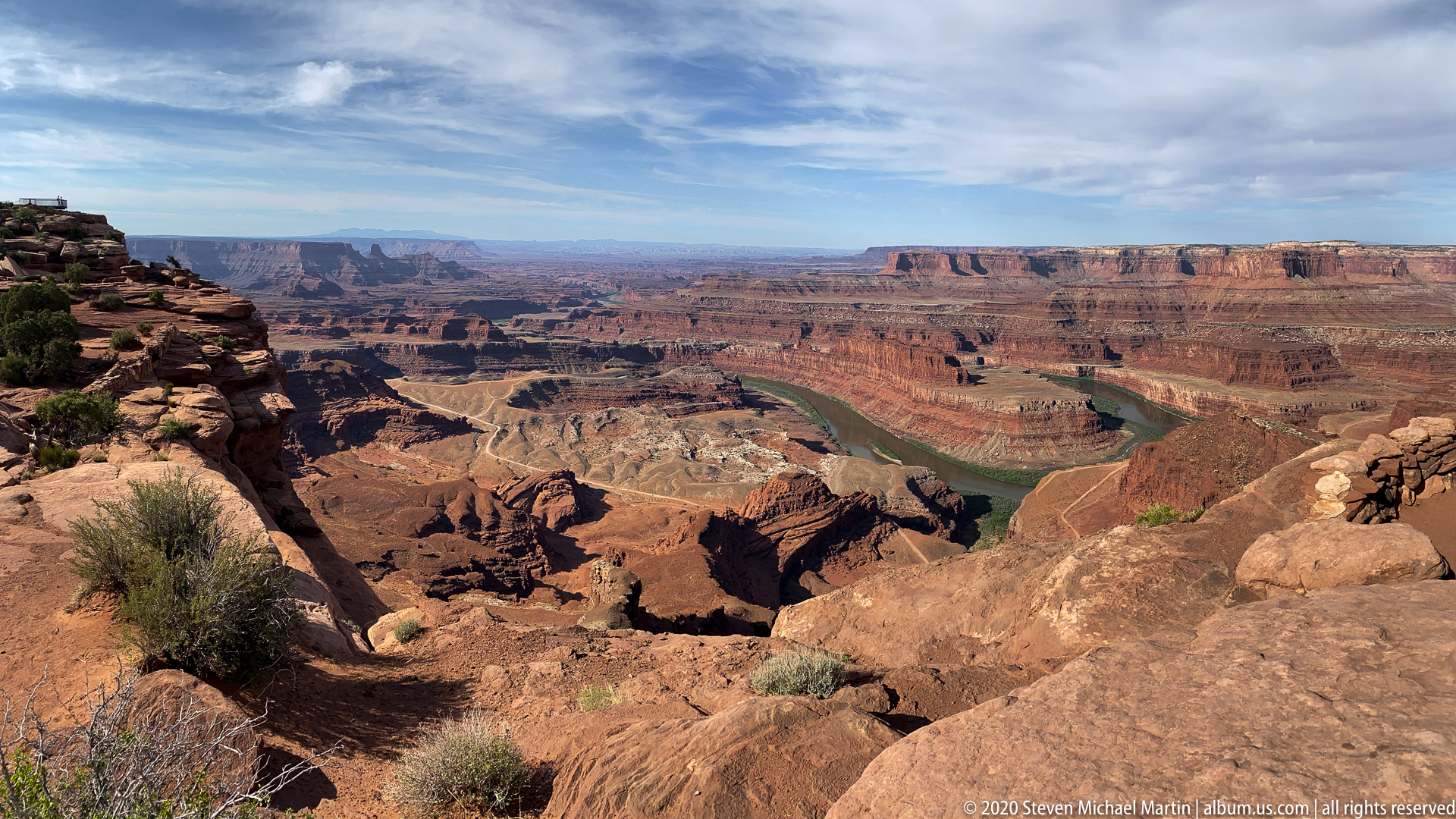
A rough sandstone rim and scattered dry grasses anchor the foreground as the Colorado River winds through the canyon below. The far wall stretches across the horizon in long, level bands, contrasting with the broken ledges and deep shadows nearer the viewpoint. This composition ties the exposed overlook edge to the river’s broad course and the immense relief of the canyon.
Caption
A rough sandstone rim and scattered dry grasses anchor the foreground as the Colorado River winds through the canyon below. The far wall stretches across the horizon in long, level bands, contrasting with the broken ledges and deep shadows nearer the viewpoint. This composition ties the exposed overlook edge to the river’s broad course and the immense relief of the canyon.

From above, the Colorado River traces a long green arc through a maze of rust-colored cliffs, pale benches, and shadowed ravines. A flat-topped mesa stands out on the far skyline, while the river’s inner banks reveal lighter sediment against the darker water. The wide framing balances the sinuous watercourse with the immense, horizontally stratified canyon walls.
Caption
From above, the Colorado River traces a long green arc through a maze of rust-colored cliffs, pale benches, and shadowed ravines. A flat-topped mesa stands out on the far skyline, while the river’s inner banks reveal lighter sediment against the darker water. The wide framing balances the sinuous watercourse with the immense, horizontally stratified canyon walls.

A long section of canyon rim spans the horizon above the Colorado River, which bends around a low, rocky peninsula. Sunlight reveals the layered faces while deep shadows gather in the nearer ravines, giving the plateau a strongly sculpted relief. The river’s green surface provides a continuous line through the composition, connecting the foreground cliffs to the distant mesa country.
Caption
A long section of canyon rim spans the horizon above the Colorado River, which bends around a low, rocky peninsula. Sunlight reveals the layered faces while deep shadows gather in the nearer ravines, giving the plateau a strongly sculpted relief. The river’s green surface provides a continuous line through the composition, connecting the foreground cliffs to the distant mesa country.

A shaded vertical wall at the left edge creates a strong frame for the sunlit Colorado River canyon beyond. The water bends around a broad red-rock promontory, while layered cliffs recede toward the flat horizon. The contrast between deep foreground shadow and bright distant formations gives this view a more enclosed, dramatic perspective than the open panoramas on the preceding page.
Caption
A shaded vertical wall at the left edge creates a strong frame for the sunlit Colorado River canyon beyond. The water bends around a broad red-rock promontory, while layered cliffs recede toward the flat horizon. The contrast between deep foreground shadow and bright distant formations gives this view a more enclosed, dramatic perspective than the open panoramas on the preceding page.

The Colorado River curves tightly around a broad sandstone peninsula, with green riparian growth tracing the inside of the bend. Stepped cliff bands rise across the background, exposing alternating layers of red rock and pale sediment. This closer framing gives the river’s shape and the peninsula’s steep, eroded edges greater weight than the surrounding skyline.
Caption
The Colorado River curves tightly around a broad sandstone peninsula, with green riparian growth tracing the inside of the bend. Stepped cliff bands rise across the background, exposing alternating layers of red rock and pale sediment. This closer framing gives the river’s shape and the peninsula’s steep, eroded edges greater weight than the surrounding skyline.

A posted “Hiking and Biking Trail Map” lays out colored routes across the park, with icons marking overlooks, a visitor center, and other facilities. A “You Are Here” marker locates the viewer near the southern end of the mapped area, and a legend distinguishes trail types. The map translates the surrounding plateau into a practical network for exploring on foot or bicycle.
Caption
A posted “Hiking and Biking Trail Map” lays out colored routes across the park, with icons marking overlooks, a visitor center, and other facilities. A “You Are Here” marker locates the viewer near the southern end of the mapped area, and a legend distinguishes trail types. The map translates the surrounding plateau into a practical network for exploring on foot or bicycle.

A dark wayside panel titled “Colorado River” presents a short account of the river’s long journey and its relationship to canyon formation and water development. A small inset photograph of vegetation accompanies the text, while a river landscape forms the background. The exhibit places the visible canyon within a broader natural and human story without requiring the fine print to be read from this view.
Caption
A dark wayside panel titled “Colorado River” presents a short account of the river’s long journey and its relationship to canyon formation and water development. A small inset photograph of vegetation accompanies the text, while a river landscape forms the background. The exhibit places the visible canyon within a broader natural and human story without requiring the fine print to be read from this view.

A brown trail sign identifies the West Rim Hiking Trail at Dead Horse Point State Park and lists several destinations with distances. A large white arrow points right; a smaller left arrow marks the East Rim Trail, and hiking and bicycle symbols appear along the bottom. The close view turns route information and trail-use guidance into the photograph’s central subject.
Caption
A brown trail sign identifies the West Rim Hiking Trail at Dead Horse Point State Park and lists several destinations with distances. A large white arrow points right; a smaller left arrow marks the East Rim Trail, and hiking and bicycle symbols appear along the bottom. The close view turns route information and trail-use guidance into the photograph’s central subject.

A sweeping view follows the Colorado River as it arcs across the canyon basin below a long, sheer mesa rim. Rust-red slopes and pale terraces descend toward the water, with a rocky promontory in the foreground adding scale. Bright, even light makes the river corridor and broad stratified wall easy to read across the full width of the landscape.
Caption
A sweeping view follows the Colorado River as it arcs across the canyon basin below a long, sheer mesa rim. Rust-red slopes and pale terraces descend toward the water, with a rocky promontory in the foreground adding scale. Bright, even light makes the river corridor and broad stratified wall easy to read across the full width of the landscape.

From an open rim, the Colorado River curves beyond a series of pale, eroded terraces and red ledges. A high, nearly continuous cliff band spans the distance, while the rough foreground slopes descend in irregular channels. The composition pairs the river’s broad sweep with the exposed cross-section of the plateau, making the changing elevations especially clear.
Caption
From an open rim, the Colorado River curves beyond a series of pale, eroded terraces and red ledges. A high, nearly continuous cliff band spans the distance, while the rough foreground slopes descend in irregular channels. The composition pairs the river’s broad sweep with the exposed cross-section of the plateau, making the changing elevations especially clear.

A slender flowering stalk rises from the rocky rim, its small yellow blooms and fine leaves sharply isolated against a softly blurred canyon and river. The shallow focus turns the overlook’s sparse vegetation into the main subject while preserving the distant landscape as context. The plant is identifiable as a flowering desert herb, though the proof-sheet view does not support a precise species name.
Caption
A slender flowering stalk rises from the rocky rim, its small yellow blooms and fine leaves sharply isolated against a softly blurred canyon and river. The shallow focus turns the overlook’s sparse vegetation into the main subject while preserving the distant landscape as context. The plant is identifiable as a flowering desert herb, though the proof-sheet view does not support a precise species name.

A single yellow flower stalk fills the foreground, its narrow leaves and branching clusters of blooms picked out against a creamy blur of red stone and green river. The close focus isolates delicate plant structure that disappears in the larger landscape views. The photograph supports a general wildflower identification, but not a species name from the visible details alone.
Caption
A single yellow flower stalk fills the foreground, its narrow leaves and branching clusters of blooms picked out against a creamy blur of red stone and green river. The close focus isolates delicate plant structure that disappears in the larger landscape views. The photograph supports a general wildflower identification, but not a species name from the visible details alone.

A tall, airy plant with yellow flower clusters stands at the canyon edge, sharply rendered against a defocused river gorge. Red rock and green water merge into broad bands behind the stem, creating depth without competing with its fine leaves and branching form. As in the preceding close-up, the visible evidence supports a generic flowering plant rather than a confident species identification.
Caption
A tall, airy plant with yellow flower clusters stands at the canyon edge, sharply rendered against a defocused river gorge. Red rock and green water merge into broad bands behind the stem, creating depth without competing with its fine leaves and branching form. As in the preceding close-up, the visible evidence supports a generic flowering plant rather than a confident species identification.

A twisted juniper stands on a low rise of angular sandstone blocks, its trunk bent and branching against the open blue sky. A rough, loosely stacked rock border crosses the foreground, with compact desert shrubs around the tree. The clear daylight reveals the juniper’s contorted form and the warm, broken rock surface, bringing a small rim-side detail into focus.
Caption
A twisted juniper stands on a low rise of angular sandstone blocks, its trunk bent and branching against the open blue sky. A rough, loosely stacked rock border crosses the foreground, with compact desert shrubs around the tree. The clear daylight reveals the juniper’s contorted form and the warm, broken rock surface, bringing a small rim-side detail into focus.

From the rim, pale drainage channels fan across a broad basin toward a distant reflective reach of water. Dark mesas and canyon walls form a layered backdrop beneath hazy ridgelines, while a small patch of green vegetation enters at lower left. The scene emphasizes the immense, open scale of the plateau and the contrast between dry land and the distant river corridor.
Caption
From the rim, pale drainage channels fan across a broad basin toward a distant reflective reach of water. Dark mesas and canyon walls form a layered backdrop beneath hazy ridgelines, while a small patch of green vegetation enters at lower left. The scene emphasizes the immense, open scale of the plateau and the contrast between dry land and the distant river corridor.

The sandstone rim occupies the left foreground before dropping into a deep canyon of red walls and stepped benches. The Colorado River is visible in the distance at right, beyond successive ridges and shadowed ravines. A few grasses along the edge provide scale, while the oblique viewpoint stresses the steep descent from overlook to river corridor.
Caption
The sandstone rim occupies the left foreground before dropping into a deep canyon of red walls and stepped benches. The Colorado River is visible in the distance at right, beyond successive ridges and shadowed ravines. A few grasses along the edge provide scale, while the oblique viewpoint stresses the steep descent from overlook to river corridor.

A pale, weathered tree trunk lies diagonally across red sandstone slabs, its exposed roots and branches contrasting with the low green-gray shrubs around it. A wooden railing appears in the background, indicating a maintained overlook or path. The close framing emphasizes the trunk’s worn texture and the dry, exposed ground rather than the distant canyon view.
Caption
A pale, weathered tree trunk lies diagonally across red sandstone slabs, its exposed roots and branches contrasting with the low green-gray shrubs around it. A wooden railing appears in the background, indicating a maintained overlook or path. The close framing emphasizes the trunk’s worn texture and the dry, exposed ground rather than the distant canyon view.

Two low, contorted junipers spread across the rocky foreground, their trunks twisting over bare sandstone at the rim. Beyond them, the Colorado River and layered red cliffs extend toward a long plateau horizon. The trees lend scale and a sense of the exposed, dry habitat while remaining distinct from the expansive canyon panorama behind them.
Caption
Two low, contorted junipers spread across the rocky foreground, their trunks twisting over bare sandstone at the rim. Beyond them, the Colorado River and layered red cliffs extend toward a long plateau horizon. The trees lend scale and a sense of the exposed, dry habitat while remaining distinct from the expansive canyon panorama behind them.

A juniper at the right edge and low shrubs across the rim frame the Colorado River as it bends around a steep red-rock promontory. Pale sedimentary ledges and green banks trace the curve, while distant canyon walls fill the horizon. The foreground vegetation gives this view a grounded frame and helps distinguish it from the more open river panoramas.
Caption
A juniper at the right edge and low shrubs across the rim frame the Colorado River as it bends around a steep red-rock promontory. Pale sedimentary ledges and green banks trace the curve, while distant canyon walls fill the horizon. The foreground vegetation gives this view a grounded frame and helps distinguish it from the more open river panoramas.

A windswept juniper enters from the lower left, its curved trunk and sparse foliage set against the Colorado River’s broad arc. Red cliffs, pale terraces, and flat-topped mesas recede in bright afternoon light. The tree anchors the foreground while the river links the nearer rim to the far canyon walls, balancing intimate vegetation with a wide landscape.
Caption
A windswept juniper enters from the lower left, its curved trunk and sparse foliage set against the Colorado River’s broad arc. Red cliffs, pale terraces, and flat-topped mesas recede in bright afternoon light. The tree anchors the foreground while the river links the nearer rim to the far canyon walls, balancing intimate vegetation with a wide landscape.

The Colorado River sweeps around a broad red-rock peninsula, its green channel sharply contrasting with the pale terraces and rust-colored walls. From this elevated angle, the loop dominates the middle of the frame, while dark ravines and broken ledges fill the lower foreground. The image concentrates on the river’s looping course and the geometry of the eroded landform it surrounds.
Caption
The Colorado River sweeps around a broad red-rock peninsula, its green channel sharply contrasting with the pale terraces and rust-colored walls. From this elevated angle, the loop dominates the middle of the frame, while dark ravines and broken ledges fill the lower foreground. The image concentrates on the river’s looping course and the geometry of the eroded landform it surrounds.

A two-lane paved road curves gently through low desert scrub, with double yellow center lines leading toward the bend. Red sandstone shelves, gravel shoulders, and scattered junipers border the pavement beneath a clear sky. The eye-level viewpoint places the visitor route at the center, shifting from the canyon overlooks to the built access road across the open plateau.
Caption
A two-lane paved road curves gently through low desert scrub, with double yellow center lines leading toward the bend. Red sandstone shelves, gravel shoulders, and scattered junipers border the pavement beneath a clear sky. The eye-level viewpoint places the visitor route at the center, shifting from the canyon overlooks to the built access road across the open plateau.

A broken sandstone rim dotted with junipers and low desert shrubs falls away toward a deep canyon. Beyond it, layered mesas and a broad plateau extend toward a hazy mountain horizon, with a bright river bend visible in the distance. The elevated view emphasizes the contrast between the rough near ledge and the wide, sunlit terrain beyond.
Caption
A broken sandstone rim dotted with junipers and low desert shrubs falls away toward a deep canyon. Beyond it, layered mesas and a broad plateau extend toward a hazy mountain horizon, with a bright river bend visible in the distance. The elevated view emphasizes the contrast between the rough near ledge and the wide, sunlit terrain beyond.

A narrow dark sign rises among junipers and bare branches at the overlook, with layered red canyon walls stretching across the background. Low sandstone slabs and sparse shrubs fill the foreground. The composition places visitor infrastructure within the natural view, while the sign’s lettering remains too small to read and cannot support a more specific identification.
Caption
A narrow dark sign rises among junipers and bare branches at the overlook, with layered red canyon walls stretching across the background. Low sandstone slabs and sparse shrubs fill the foreground. The composition places visitor infrastructure within the natural view, while the sign’s lettering remains too small to read and cannot support a more specific identification.

A weathered interpretive panel pairs a painted canyon scene and horse imagery with text about legends associated with the name Dead Horse Point. The text recounts stories of horses, cowboys, and the narrow neck of land visible from the overlook. Framed closely, the exhibit’s dark, rust-colored palette and layered writing turn local folklore into the subject rather than the canyon view itself.
Caption
A weathered interpretive panel pairs a painted canyon scene and horse imagery with text about legends associated with the name Dead Horse Point. The text recounts stories of horses, cowboys, and the narrow neck of land visible from the overlook. Framed closely, the exhibit’s dark, rust-colored palette and layered writing turn local folklore into the subject rather than the canyon view itself.

A pale, fractured ledge fills the lower foreground beside a deep shadowed cliff on the left. Beyond the overlook, red and cream canyon walls descend in broad terraces toward a green river winding across the basin. A juniper at lower right adds scale to the open view, which contrasts the dark near wall with the sunlit distance.
Caption
A pale, fractured ledge fills the lower foreground beside a deep shadowed cliff on the left. Beyond the overlook, red and cream canyon walls descend in broad terraces toward a green river winding across the basin. A juniper at lower right adds scale to the open view, which contrasts the dark near wall with the sunlit distance.