Glacier NP – Lake McDonald Lodge
Lake McDonald Lodge stands along the eastern shore of Lake McDonald, where dense forests descend from Glacier National Park’s mountains to the largest lake in the park. Built during the winter of 1913–1914, the lodge belongs to the formative era when visitors were beginning to venture into Glacier in growing numbers but roads had yet to reshape how they experienced the landscape. Its rustic architecture, combining native stone, western red cedar, massive timbers, and Swiss-influenced details, was designed to evoke the atmosphere of a wilderness hunting lodge while providing an unexpectedly comfortable retreat deep within the mountains. Today, Lake McDonald Lodge is recognized as a National Historic Landmark and remains one of Glacier’s most important surviving examples of early park architecture.
The lodge began as the vision of John Lewis, who had acquired an earlier hotel on the site and replaced it with a new 65-room building. Construction itself reflected the isolation of the location: materials unavailable locally were transported from the railroad depot at Belton and then carried nearly ten miles up Lake McDonald. Before a road reached the lodge, guests approached by boat, which explains why the building’s principal façade faces the water rather than the modern roadway. Inside, the great lobby, exposed logs, fireplaces, balconies, and rustic furnishings preserve much of the character of the early twentieth-century resort, when travelers arrived here before continuing into Glacier’s backcountry by horse or on foot. Western artist Charles M. Russell was among those associated with the lodge and was known to entertain visitors with stories in its lobby.
Lake McDonald Lodge also occupies an important place in the transition from Glacier’s early era of boats and horseback travel to the automobile age. The construction of Going-to-the-Sun Road eventually connected the lodge with a route across the Continental Divide, fundamentally changing how visitors explored the park. Yet the setting still retains much of the drama that drew travelers here more than a century ago: Lake McDonald stretches for roughly ten miles through a broad valley carved by ancient glaciers, surrounded by forested slopes and increasingly rugged peaks toward the Continental Divide. Seen from the lakeshore, the historic lodge and its mountain surroundings remain closely intertwined, preserving a tangible connection to the period when reaching this corner of Glacier National Park was itself a significant part of the adventure.
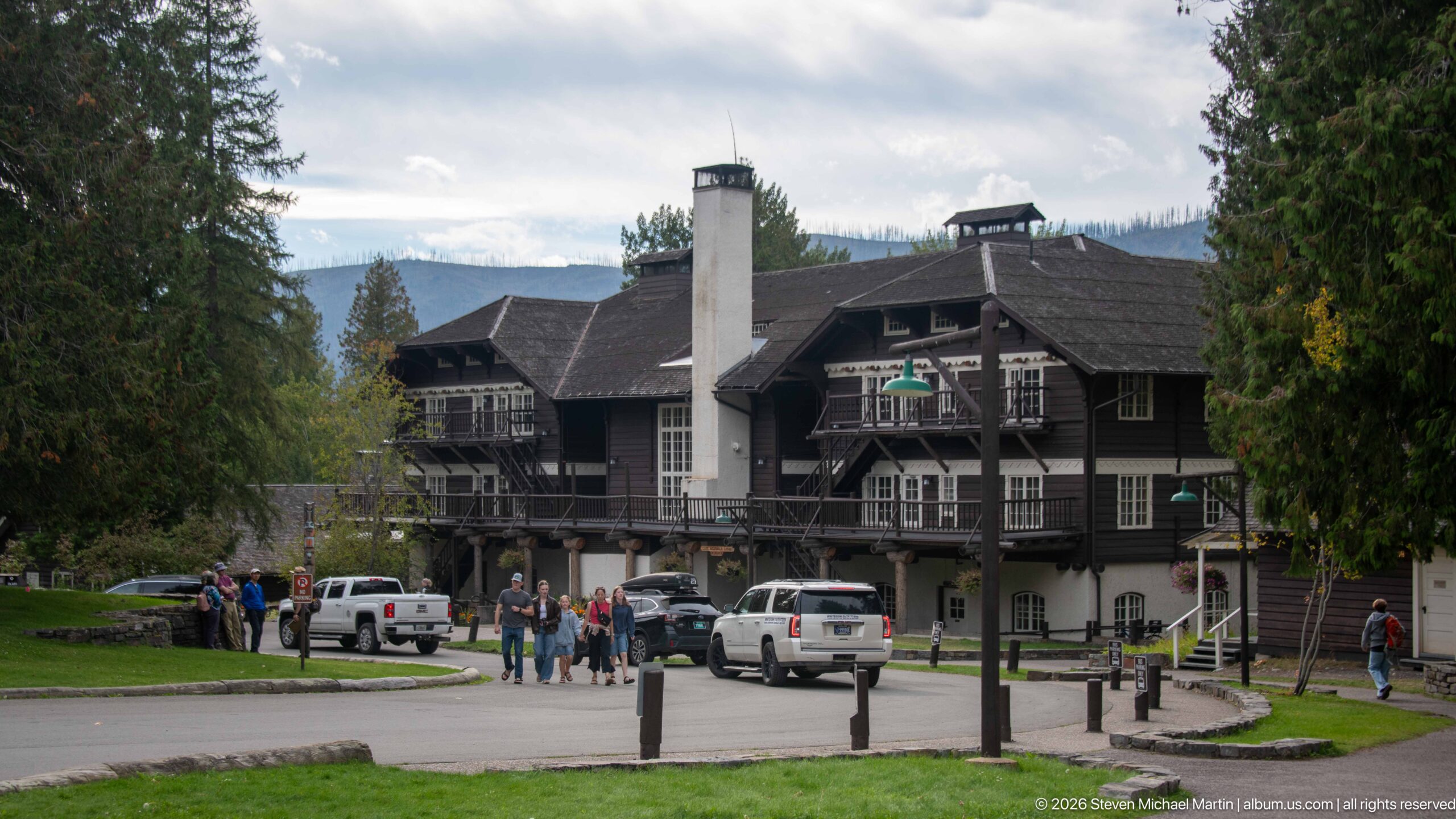
Lake McDonald Lodge spreads across the background in a broad approach view, its dark upper stories, balconies, exterior stairs, pale ground level, and tall chimney visible beyond the drive. Visitors and parked vehicles animate the foreground, showing the building in active use and providing scale. Forested slopes rise behind the roofline, tying the historic lodging complex directly to its mountain setting.
Caption
Lake McDonald Lodge spreads across the background in a broad approach view, its dark upper stories, balconies, exterior stairs, pale ground level, and tall chimney visible beyond the drive. Visitors and parked vehicles animate the foreground, showing the building in active use and providing scale. Forested slopes rise behind the roofline, tying the historic lodging complex directly to its mountain setting.
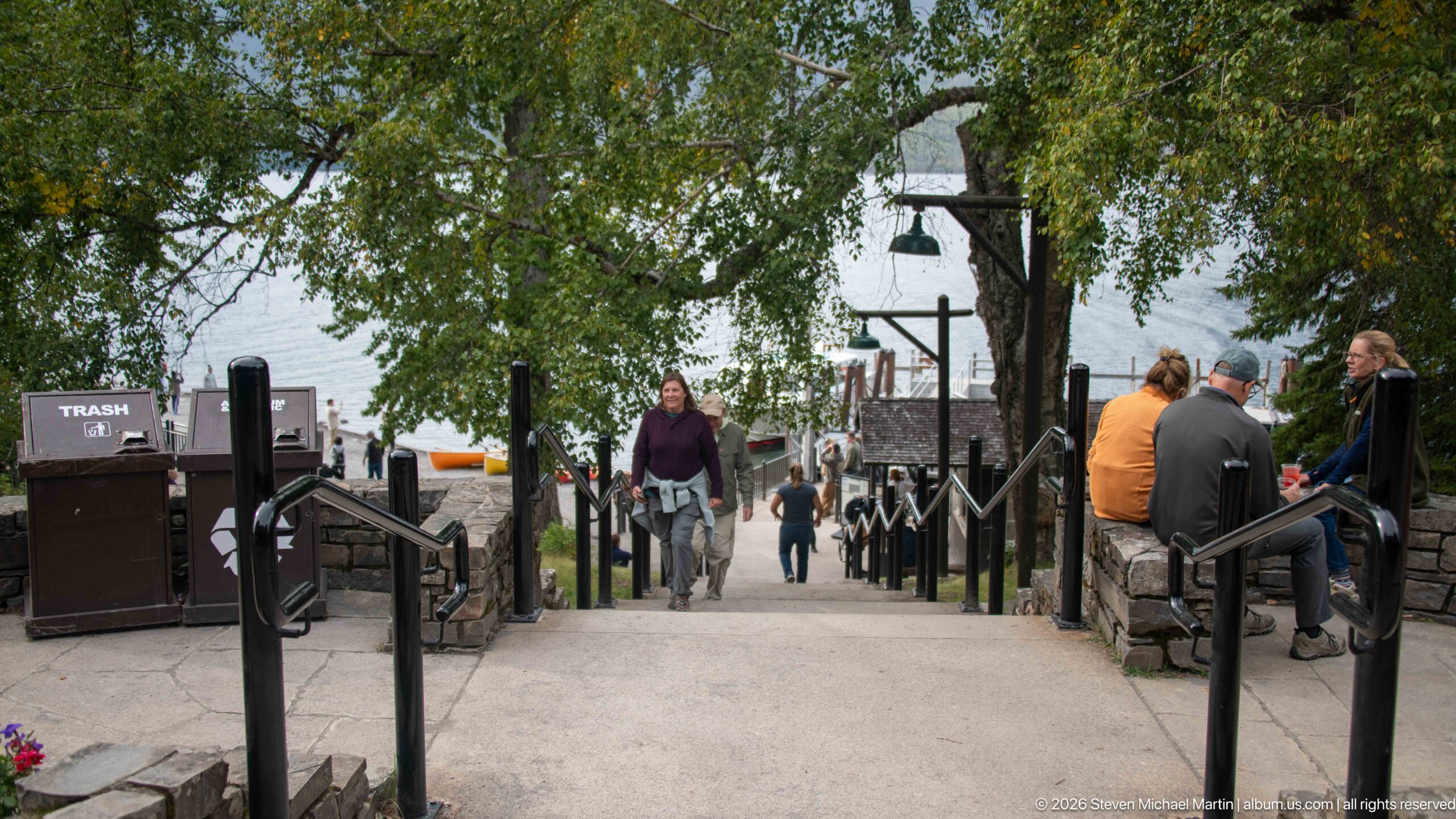
A gently descending pedestrian path leads through mature trees toward the Lake McDonald waterfront, with visitors moving between railings, benches, and lodge-area fixtures. The lake appears beyond the end of the walkway, giving the composition a clear sense of direction from the built lodge grounds toward the water. This view documents the close physical relationship between Lake McDonald Lodge and its lakeshore setting.
Caption
A gently descending pedestrian path leads through mature trees toward the Lake McDonald waterfront, with visitors moving between railings, benches, and lodge-area fixtures. The lake appears beyond the end of the walkway, giving the composition a clear sense of direction from the built lodge grounds toward the water. This view documents the close physical relationship between Lake McDonald Lodge and its lakeshore setting.
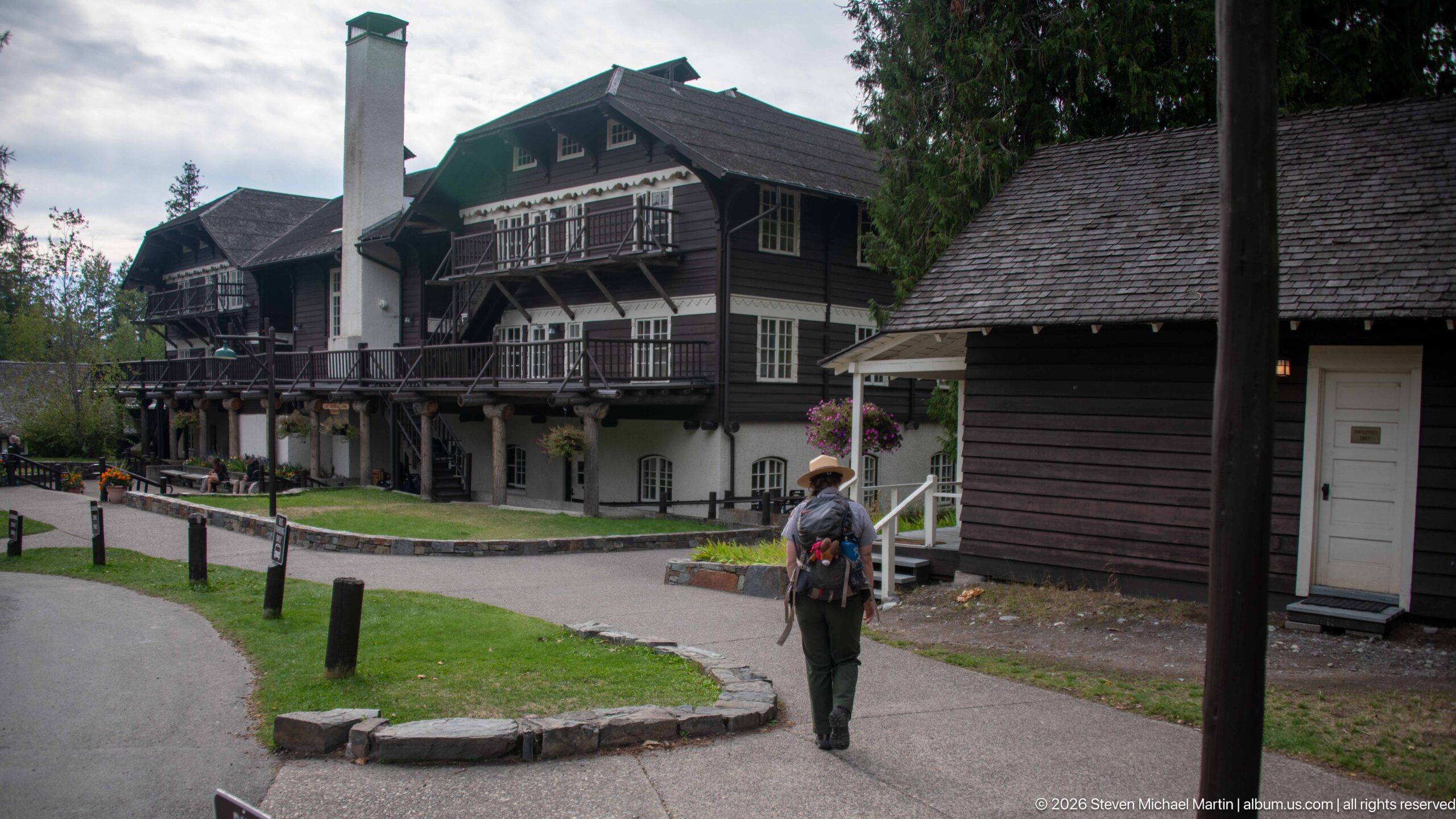
A pedestrian path curves through the lodge grounds between the main building and a small dark-sided outbuilding. The lodge’s balconies, chimney, exterior stairs, and contrasting pale lower story remain visible beyond the lawn, while a visitor walking away from the camera provides scale. This oblique approach view clarifies the relationship between the principal lodge, its smaller service-scale structure, and the landscaped circulation around them.
Caption
A pedestrian path curves through the lodge grounds between the main building and a small dark-sided outbuilding. The lodge’s balconies, chimney, exterior stairs, and contrasting pale lower story remain visible beyond the lawn, while a visitor walking away from the camera provides scale. This oblique approach view clarifies the relationship between the principal lodge, its smaller service-scale structure, and the landscaped circulation around them.
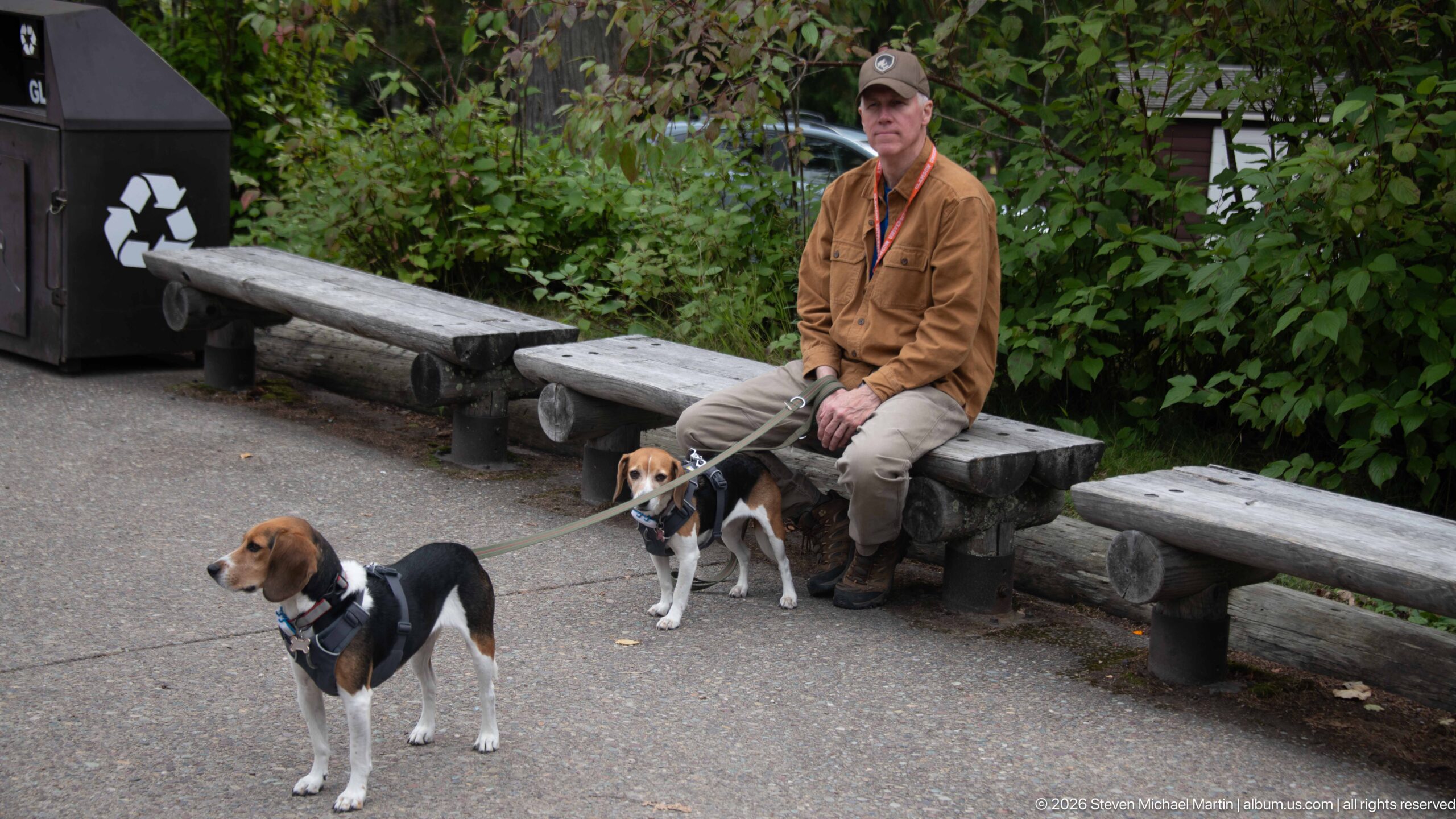
A visitor pauses on a rustic log bench with two leashed beagles beside the lodge grounds. One dog stands in the foreground while the second remains close to the seated visitor, creating a small-scale portrait of contemporary park travel amid the timber benches and dense vegetation. The scene contrasts everyday visitor activity with the deliberately rustic furnishings used around the historic lodge.
Caption
A visitor pauses on a rustic log bench with two leashed beagles beside the lodge grounds. One dog stands in the foreground while the second remains close to the seated visitor, creating a small-scale portrait of contemporary park travel amid the timber benches and dense vegetation. The scene contrasts everyday visitor activity with the deliberately rustic furnishings used around the historic lodge.
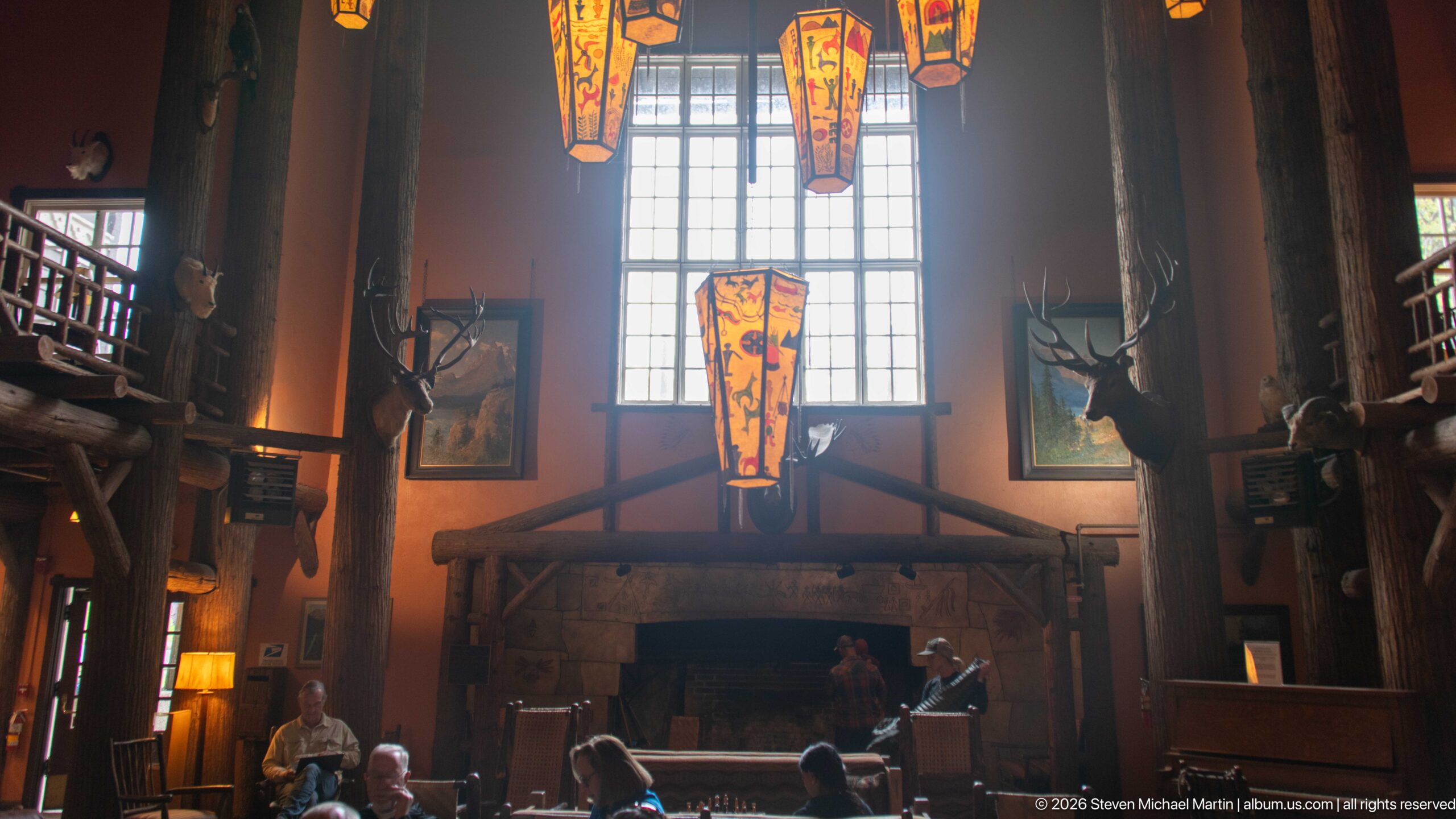
A tall stone fireplace anchors the lodge lobby beneath a bank of windows and a suspended painted lantern. Massive log columns, mounted wildlife, framed artwork, and the upper gallery surround the hearth, while visitors gathered below give the room its human scale. The composition shows how rustic structural elements and decorative furnishings work together in the lodge’s principal interior space.
Caption
A tall stone fireplace anchors the lodge lobby beneath a bank of windows and a suspended painted lantern. Massive log columns, mounted wildlife, framed artwork, and the upper gallery surround the hearth, while visitors gathered below give the room its human scale. The composition shows how rustic structural elements and decorative furnishings work together in the lodge’s principal interior space.
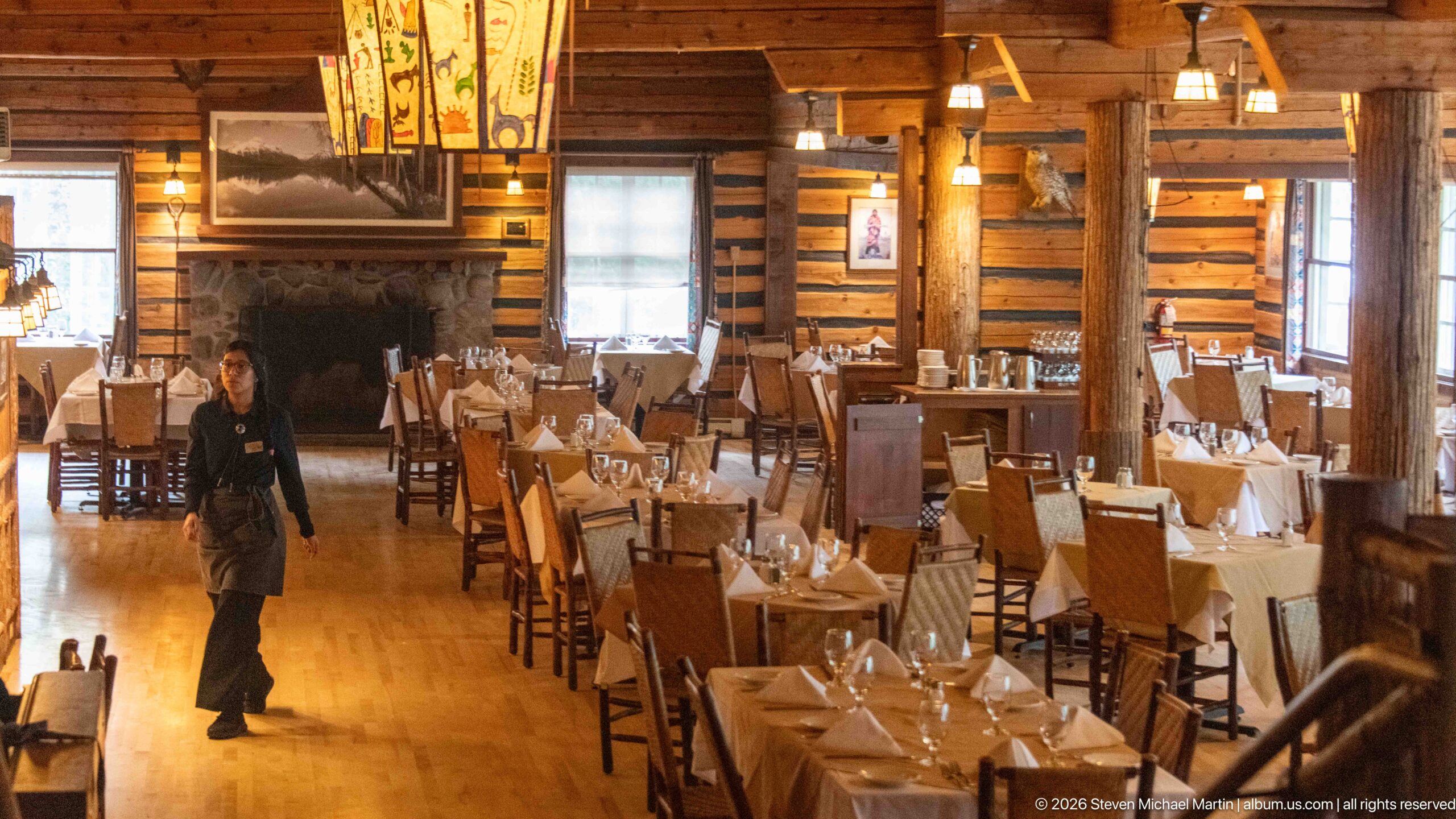
Rows of set tables fill the Lake McDonald Lodge dining room, where log walls, exposed timber columns, hanging lights, and a large stone fireplace create a strongly rustic interior. A staff member crosses the polished wood floor, adding activity to an otherwise orderly arrangement. The broad view records both the room’s dining function and the architectural materials that connect it visually to the rest of the lodge.
Caption
Rows of set tables fill the Lake McDonald Lodge dining room, where log walls, exposed timber columns, hanging lights, and a large stone fireplace create a strongly rustic interior. A staff member crosses the polished wood floor, adding activity to an otherwise orderly arrangement. The broad view records both the room’s dining function and the architectural materials that connect it visually to the rest of the lodge.
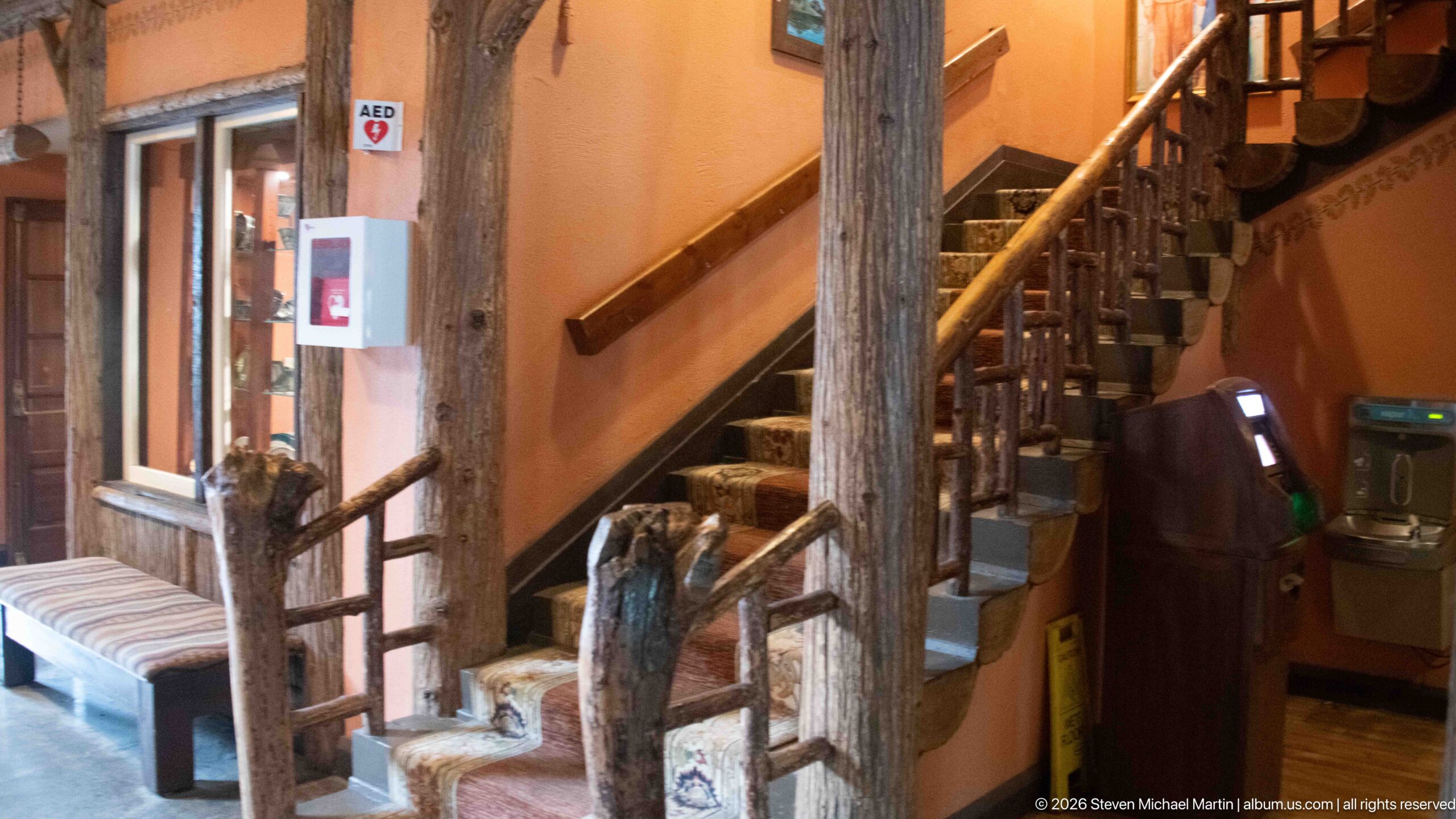
A side view of the Lake McDonald Lodge staircase concentrates on the rough-hewn newel posts, irregular branch balusters, and smooth handrail that define its rustic detailing. The stair rises diagonally behind a massive vertical log, while a bench and wall-mounted safety equipment anchor the adjacent corridor. The composition is less about the full staircase than the tactile contrast among natural wood forms, carpeted treads, and plaster walls.
Caption
A side view of the Lake McDonald Lodge staircase concentrates on the rough-hewn newel posts, irregular branch balusters, and smooth handrail that define its rustic detailing. The stair rises diagonally behind a massive vertical log, while a bench and wall-mounted safety equipment anchor the adjacent corridor. The composition is less about the full staircase than the tactile contrast among natural wood forms, carpeted treads, and plaster walls.
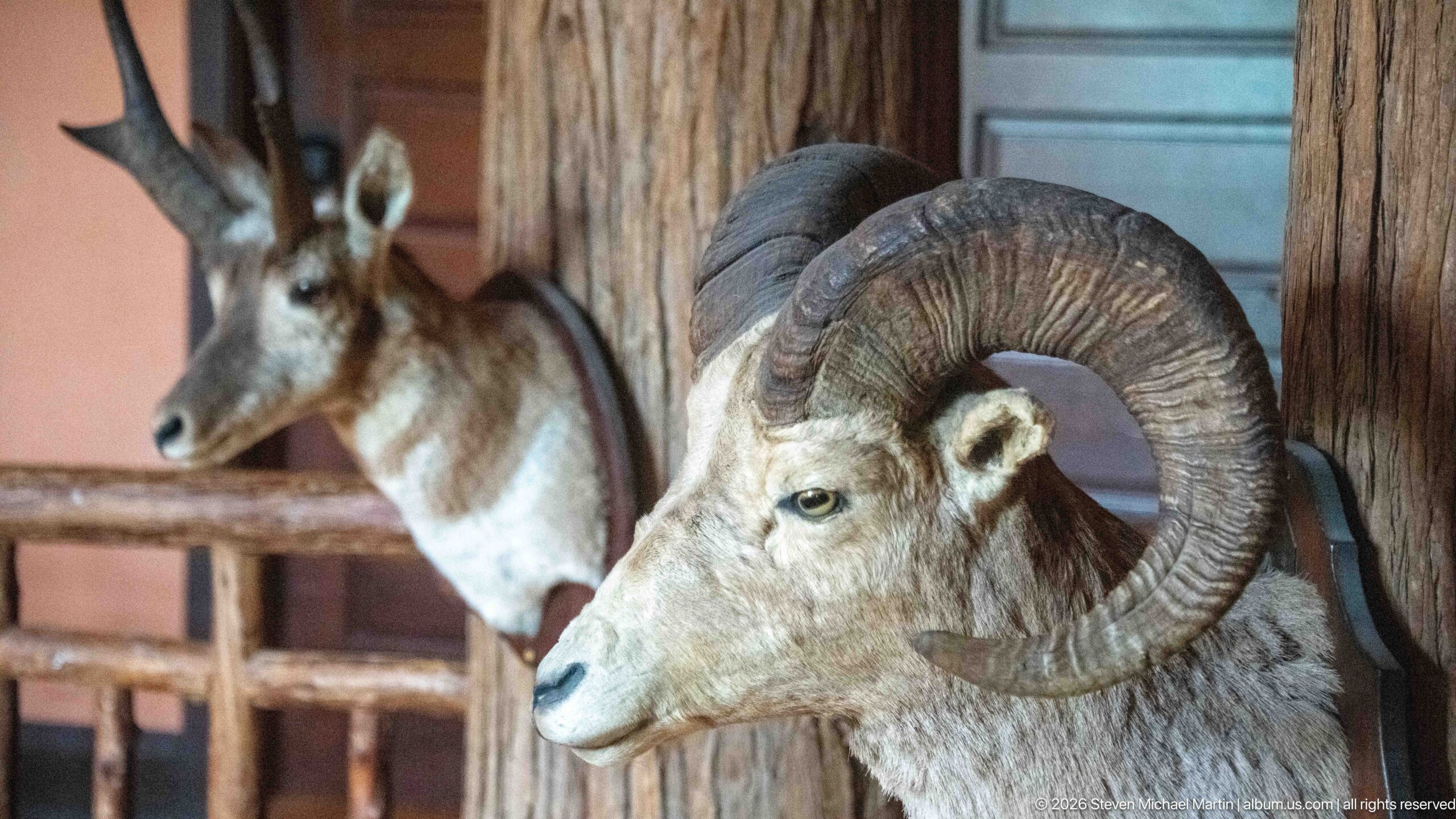
A mounted bighorn sheep ram dominates this close interior view, its massive curled horns forming the most distinctive feature of the display. Another mounted animal appears softly behind it, while rough log posts and railings connect the wildlife display to the lodge’s rustic interior. The photograph concentrates on the specimen’s head and horn structure rather than the larger decorative arrangement.
Caption
A mounted bighorn sheep ram dominates this close interior view, its massive curled horns forming the most distinctive feature of the display. Another mounted animal appears softly behind it, while rough log posts and railings connect the wildlife display to the lodge’s rustic interior. The photograph concentrates on the specimen’s head and horn structure rather than the larger decorative arrangement.
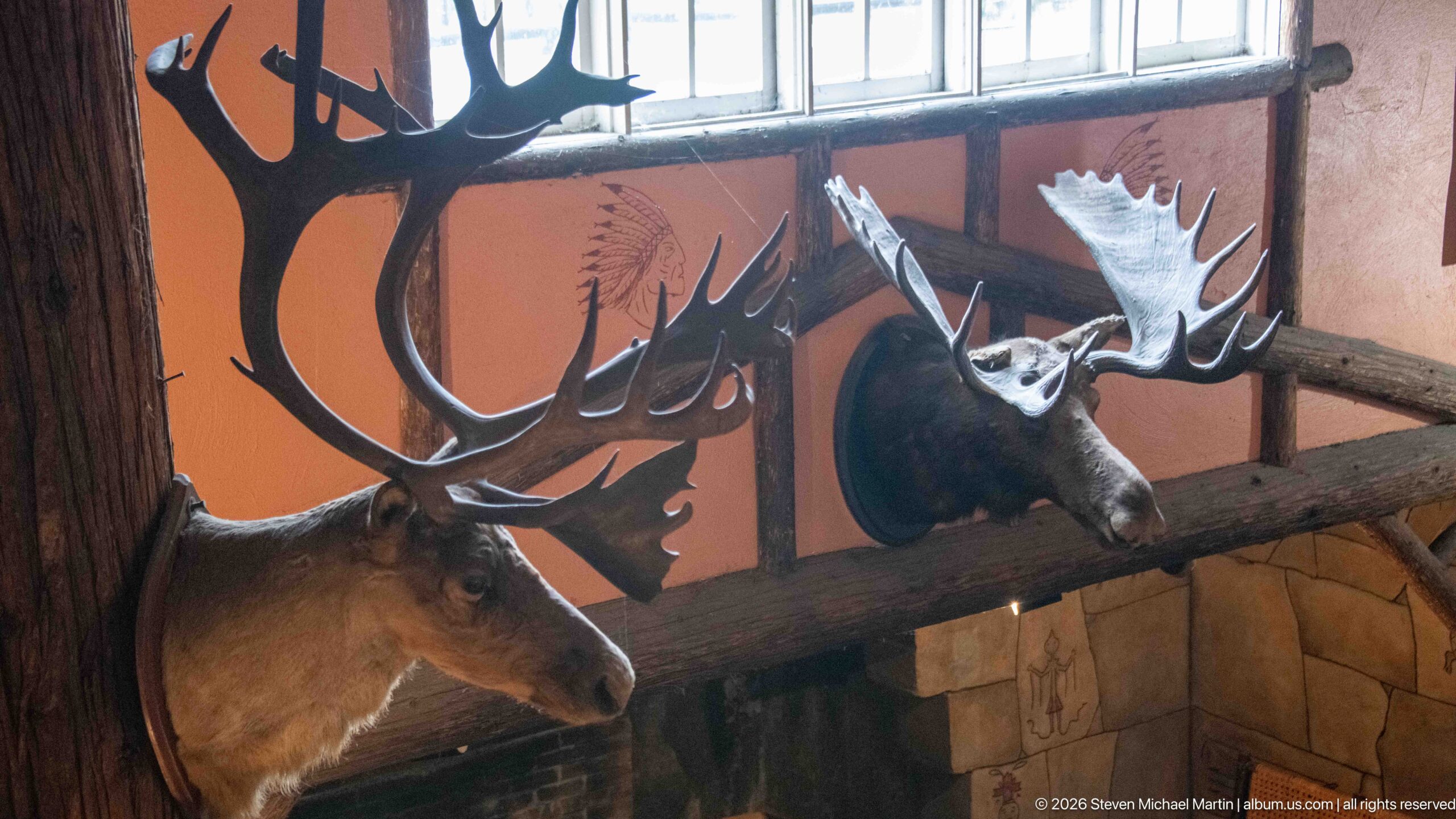
Large taxidermy mounts fill the upper wall beneath a bank of windows, with branching elk antlers overlapping the broad palmate antlers of a moose. Their silhouettes stand out against the daylight, turning the wildlife display into a dramatic element of the lodge interior. The low viewpoint emphasizes the scale of the antlers and their placement above the surrounding log railings and masonry.
Caption
Large taxidermy mounts fill the upper wall beneath a bank of windows, with branching elk antlers overlapping the broad palmate antlers of a moose. Their silhouettes stand out against the daylight, turning the wildlife display into a dramatic element of the lodge interior. The low viewpoint emphasizes the scale of the antlers and their placement above the surrounding log railings and masonry.
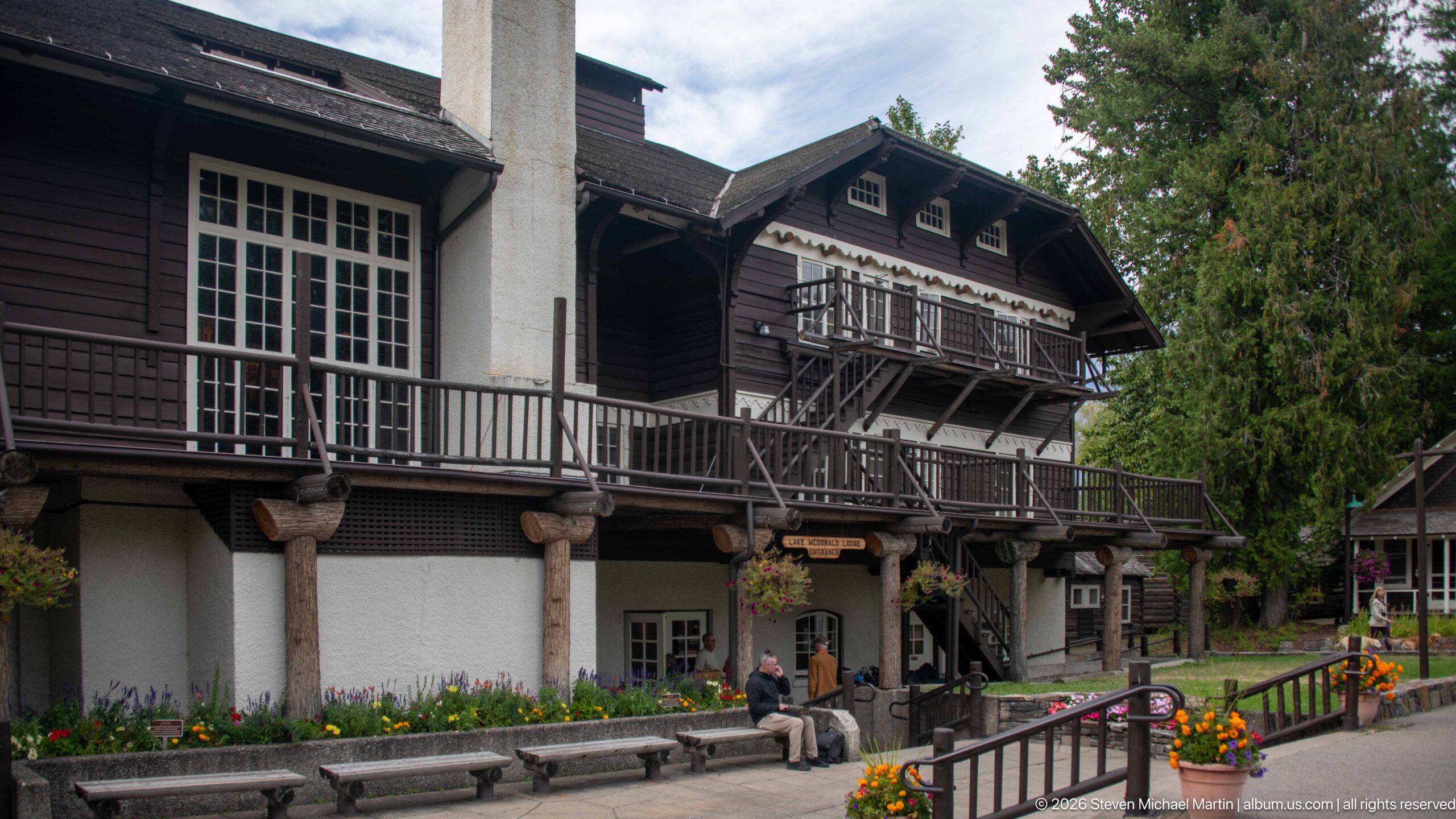
Lake McDonald Lodge rises above a landscaped walkway, its dark wood upper stories, pale stucco base, projecting balconies, and heavy log supports displaying the rustic architectural vocabulary associated with Glacier National Park lodges. Flower boxes and benches soften the building edge while the oblique viewpoint reveals several connected levels, emphasizing how guest rooms and public spaces are stacked beneath broad, sheltering eaves.
Caption
Lake McDonald Lodge rises above a landscaped walkway, its dark wood upper stories, pale stucco base, projecting balconies, and heavy log supports displaying the rustic architectural vocabulary associated with Glacier National Park lodges. Flower boxes and benches soften the building edge while the oblique viewpoint reveals several connected levels, emphasizing how guest rooms and public spaces are stacked beneath broad, sheltering eaves.
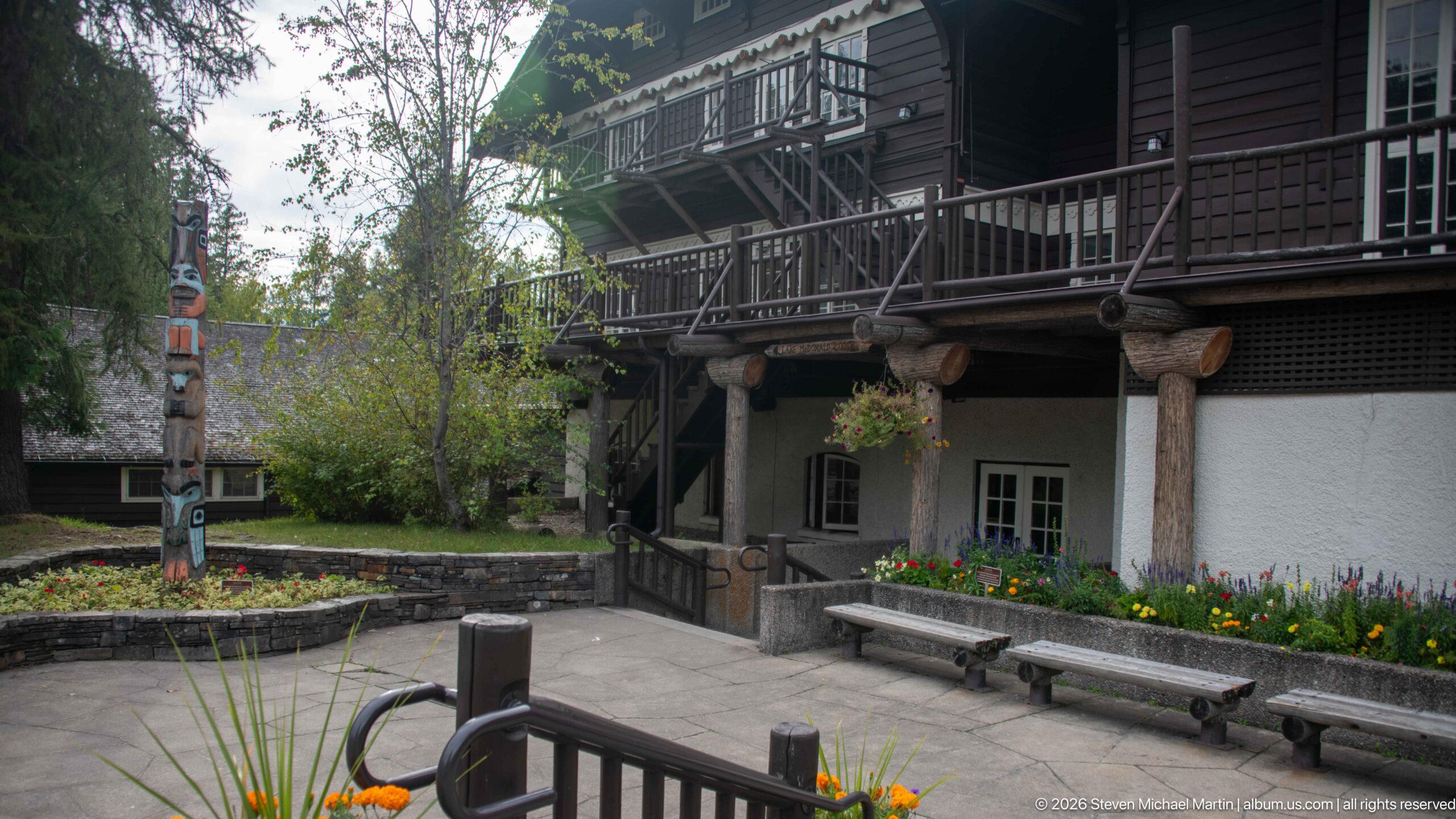
Heavy log columns support an upper balcony along Lake McDonald Lodge, where dark timber railings and siding meet the pale lower wall. A landscaped courtyard and carved vertical post appear at the left, while benches and flower beds line the façade. The closer viewpoint isolates the lodge’s structural and decorative vocabulary rather than presenting the building as a whole.
Caption
Heavy log columns support an upper balcony along Lake McDonald Lodge, where dark timber railings and siding meet the pale lower wall. A landscaped courtyard and carved vertical post appear at the left, while benches and flower beds line the façade. The closer viewpoint isolates the lodge’s structural and decorative vocabulary rather than presenting the building as a whole.
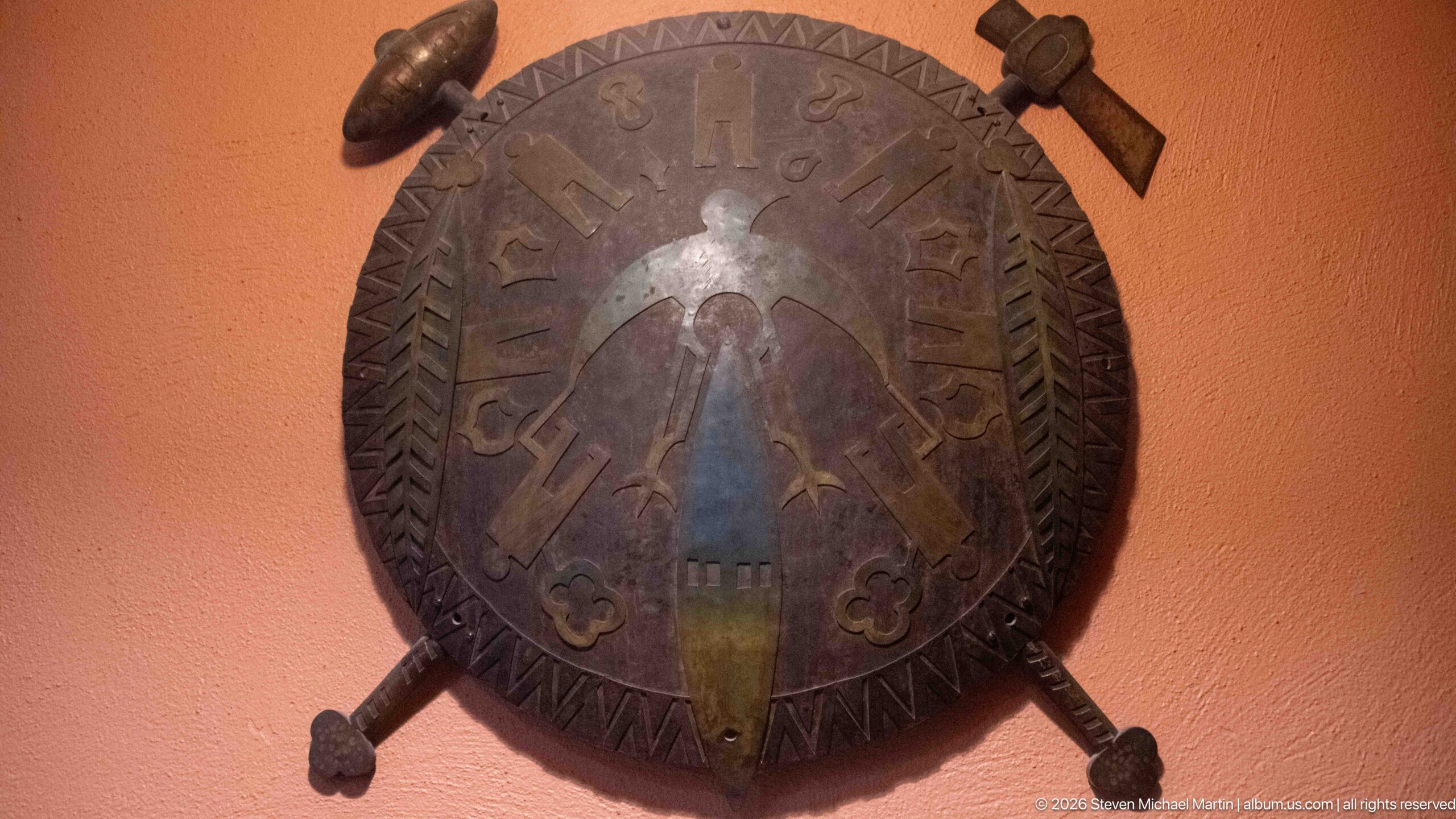
A circular hide-covered decorative object hangs against a warm interior wall, edged with geometric ornament and crossed by projecting handles or shafts. A central painted figure and surrounding motifs give the piece a strong graphic presence. The exact cultural origin and function cannot be established from the proof sheet alone, so the object is treated as lodge décor rather than assigned to a specific Indigenous tradition.
Caption
A circular hide-covered decorative object hangs against a warm interior wall, edged with geometric ornament and crossed by projecting handles or shafts. A central painted figure and surrounding motifs give the piece a strong graphic presence. The exact cultural origin and function cannot be established from the proof sheet alone, so the object is treated as lodge décor rather than assigned to a specific Indigenous tradition.
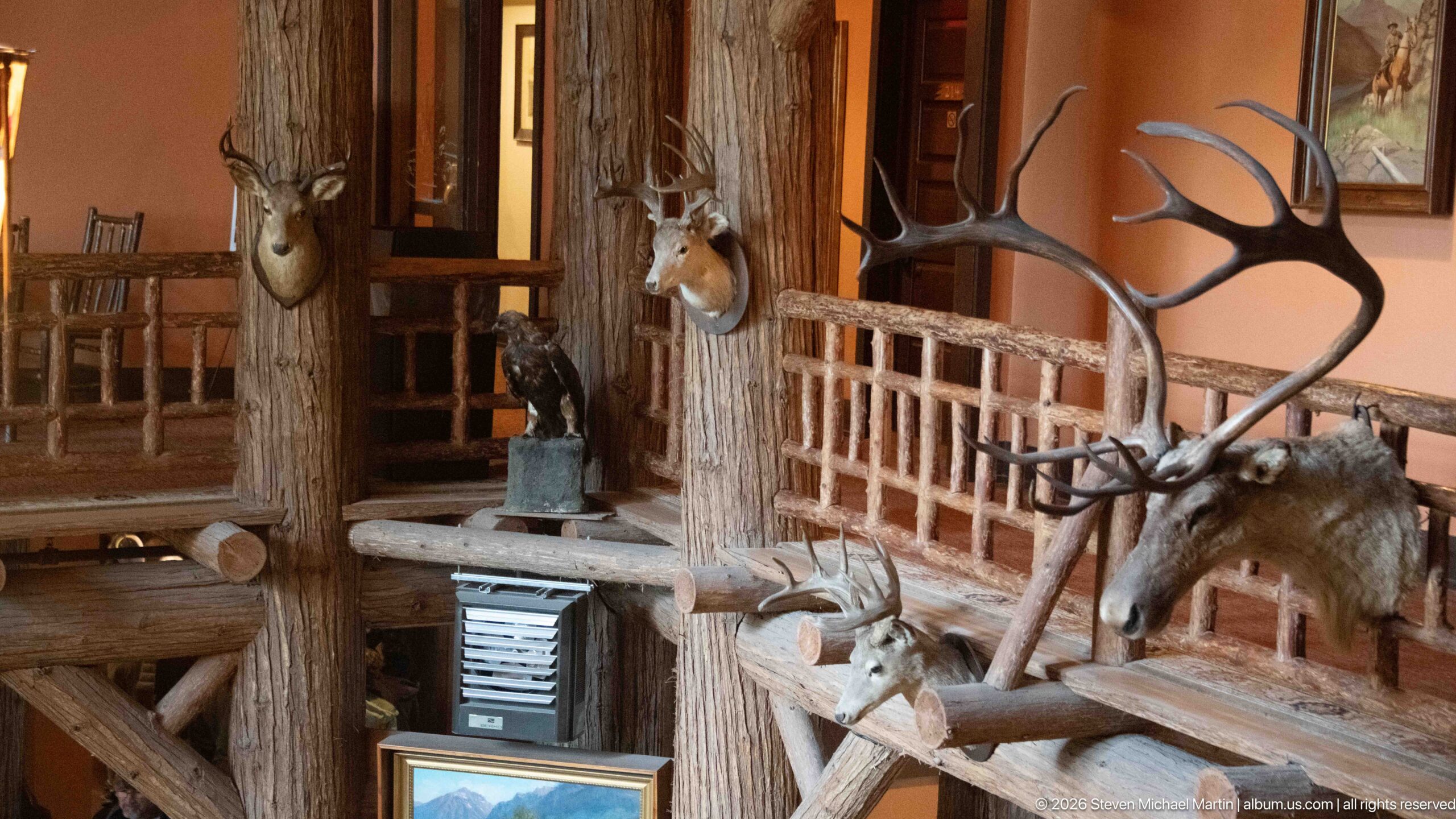
Mounted wildlife trophies occupy the log-framed balcony of Lake McDonald Lodge, including several antlered heads and smaller specimens arranged between massive timber posts. The display is integrated directly into the rustic architecture rather than isolated in cases, making wildlife imagery part of the lobby’s historic decorative character. The oblique view also reveals the handcrafted railings and layered upper-level circulation.
Caption
Mounted wildlife trophies occupy the log-framed balcony of Lake McDonald Lodge, including several antlered heads and smaller specimens arranged between massive timber posts. The display is integrated directly into the rustic architecture rather than isolated in cases, making wildlife imagery part of the lobby’s historic decorative character. The oblique view also reveals the handcrafted railings and layered upper-level circulation.
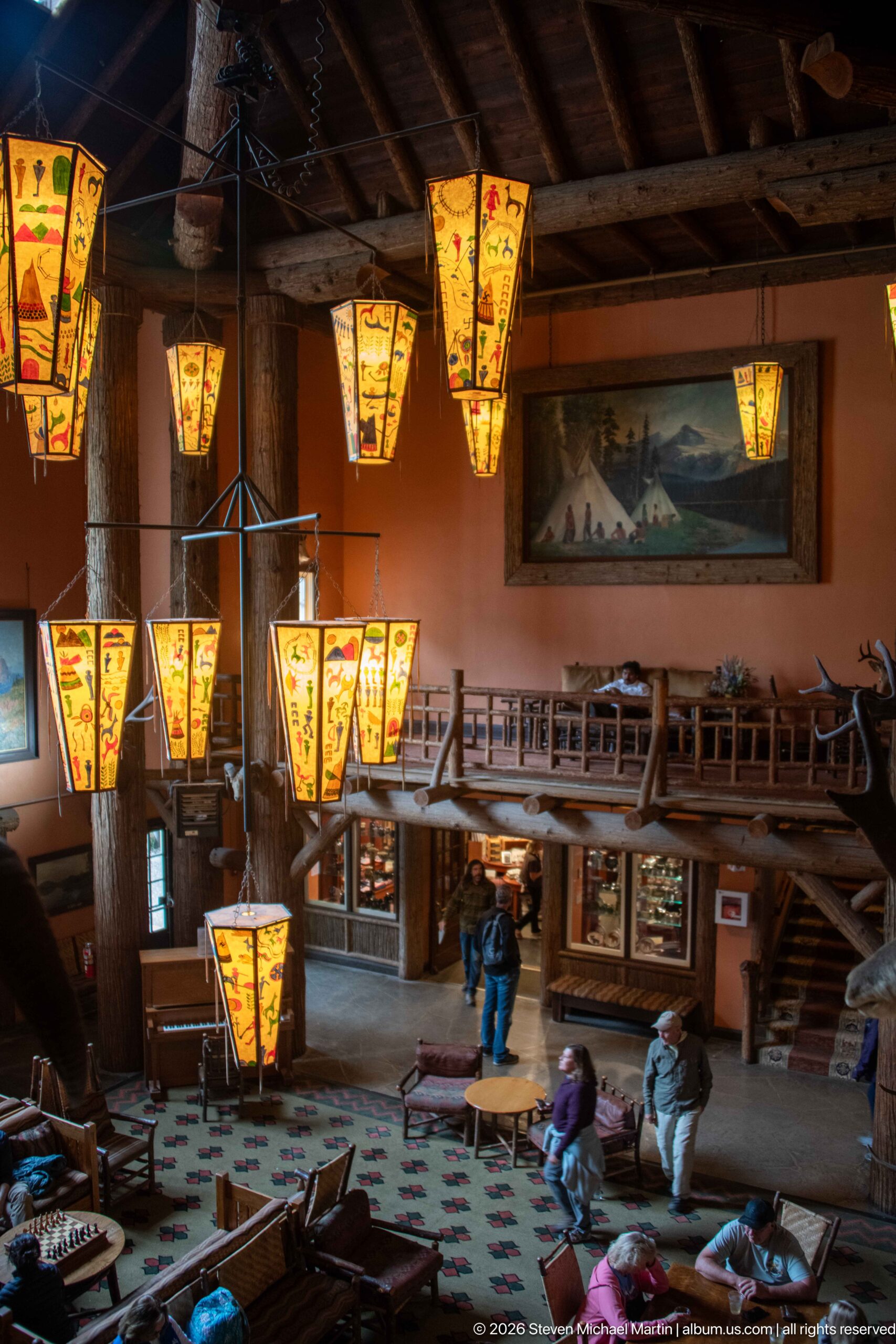
The soaring lobby of Lake McDonald Lodge opens beneath exposed timber framing and a ring of brightly painted hanging lanterns. Massive log columns rise through the multi-level space, while rustic railings, a broad fireplace, and seating areas organize the room below. Visitors gathered across the patterned floor provide scale, underscoring the dramatic vertical proportions of this central public space.
Caption
The soaring lobby of Lake McDonald Lodge opens beneath exposed timber framing and a ring of brightly painted hanging lanterns. Massive log columns rise through the multi-level space, while rustic railings, a broad fireplace, and seating areas organize the room below. Visitors gathered across the patterned floor provide scale, underscoring the dramatic vertical proportions of this central public space.
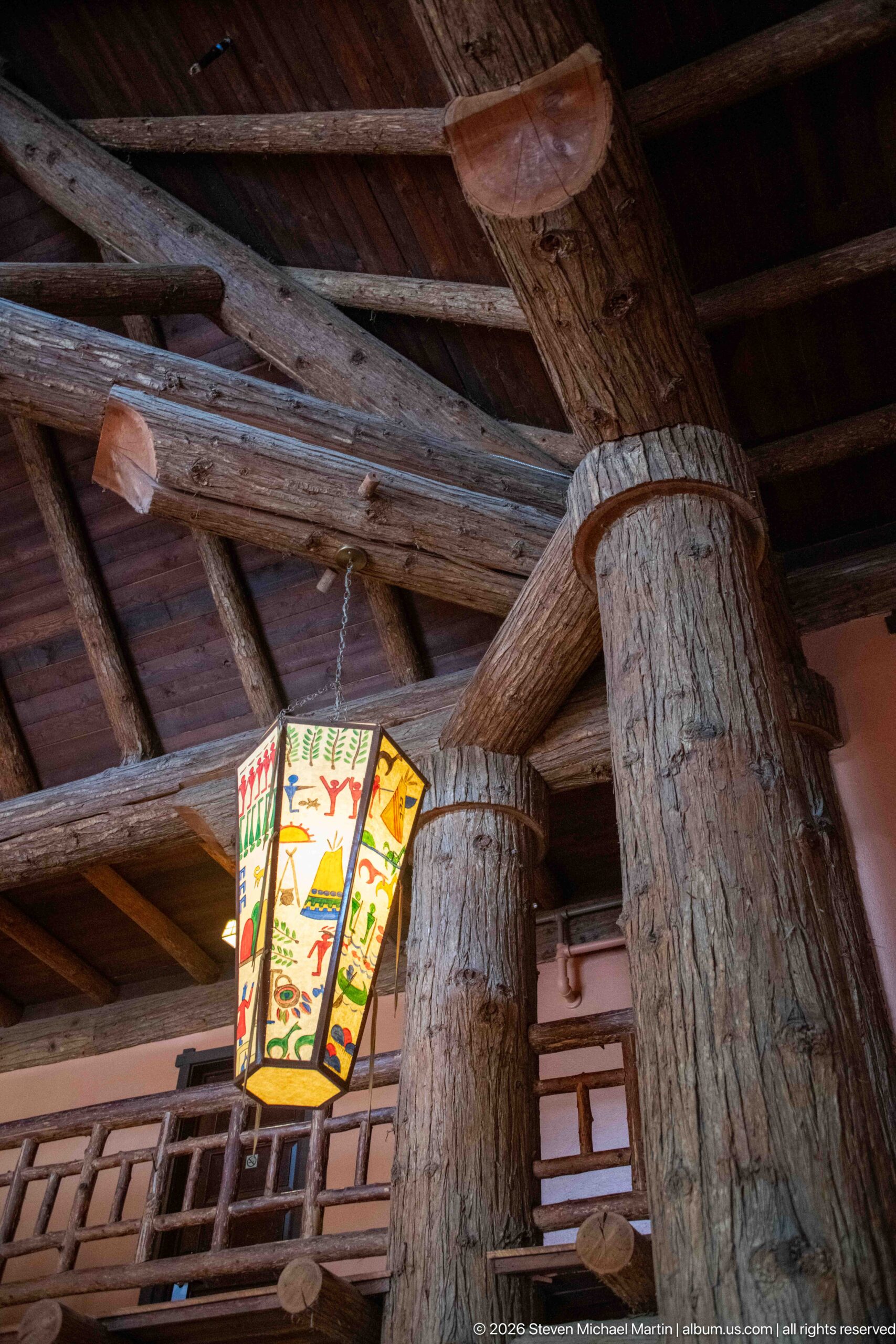
A close upward view isolates the massive peeled-log columns and beam connections that frame the Lake McDonald Lodge lobby. Their rough surfaces, projecting branch stubs, and heavy joinery make the structural timber itself a decorative feature. A brightly painted suspended lantern introduces color beneath the dark wood ceiling, while the balcony railing behind it shows how the lobby’s upper level is integrated into the log framework.
Caption
A close upward view isolates the massive peeled-log columns and beam connections that frame the Lake McDonald Lodge lobby. Their rough surfaces, projecting branch stubs, and heavy joinery make the structural timber itself a decorative feature. A brightly painted suspended lantern introduces color beneath the dark wood ceiling, while the balcony railing behind it shows how the lobby’s upper level is integrated into the log framework.
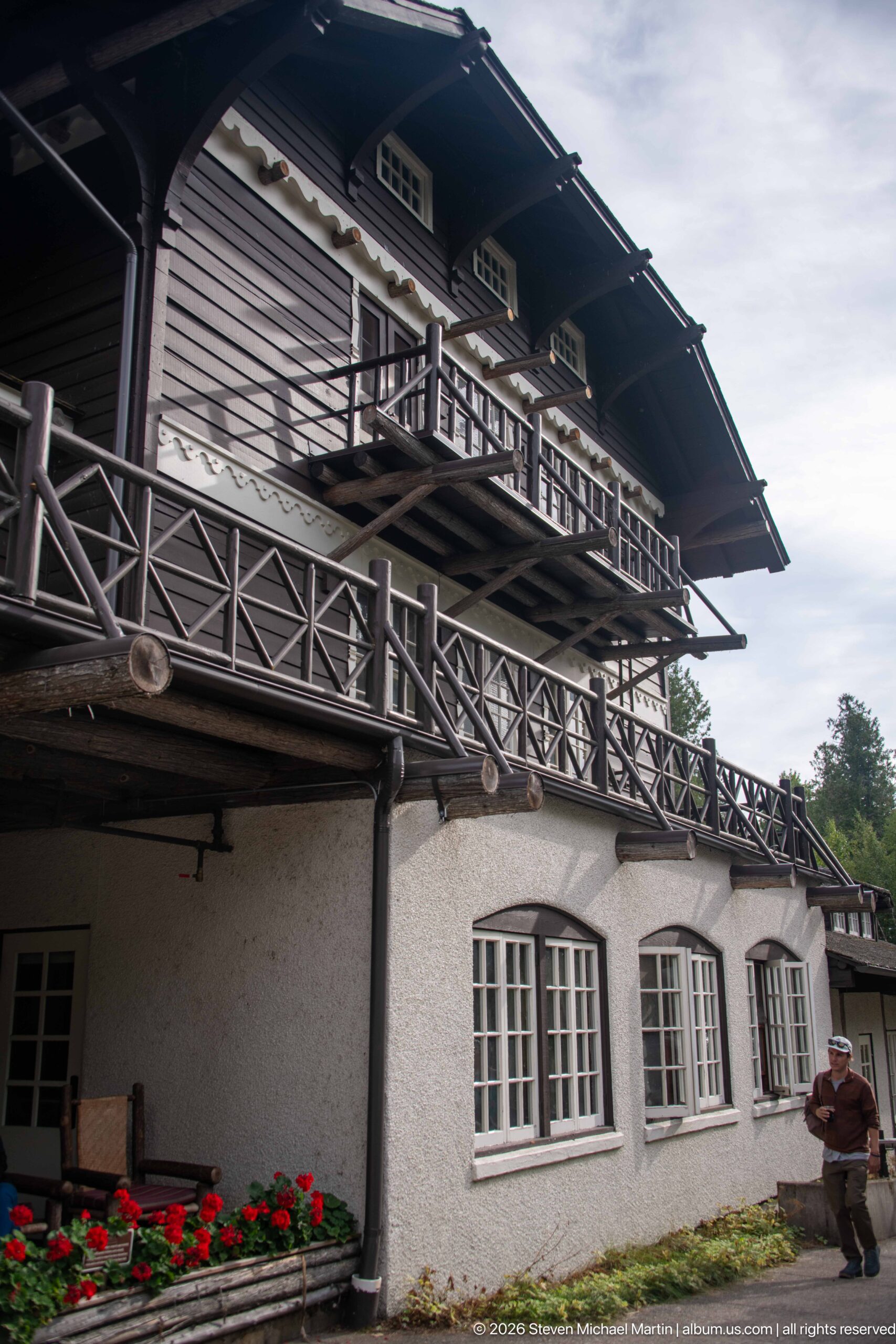
A long timber balcony stretches across the upper level of Lake McDonald Lodge above a pale stucco base punctuated by multi-pane windows. Repeating diagonal rail patterns and projecting log supports create a strong horizontal rhythm beneath the broad roof. The angled viewpoint emphasizes the length of the façade and the contrast between the dark wooden upper stories and lighter masonry-like lower level.
Caption
A long timber balcony stretches across the upper level of Lake McDonald Lodge above a pale stucco base punctuated by multi-pane windows. Repeating diagonal rail patterns and projecting log supports create a strong horizontal rhythm beneath the broad roof. The angled viewpoint emphasizes the length of the façade and the contrast between the dark wooden upper stories and lighter masonry-like lower level.
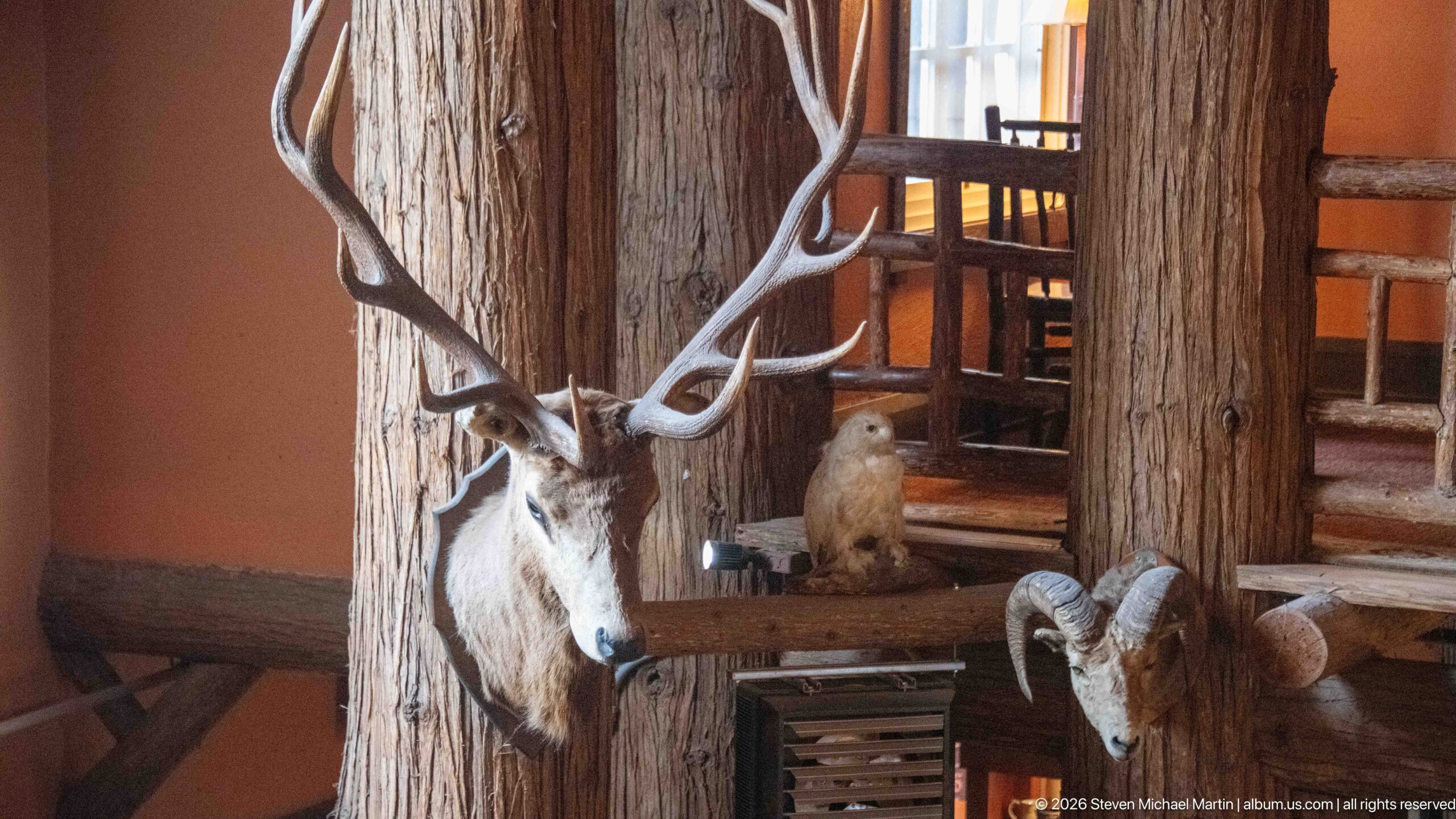
An antlered mammal mount, a small owl specimen, and a bighorn sheep ram are grouped between the heavy log posts of the lodge interior. Seen together, the specimens create a layered wildlife display that uses the architecture itself as a backdrop. The tight composition emphasizes differences in antlers, feathers, and curled horns while preserving the spatial relationship among the individual mounts.
Caption
An antlered mammal mount, a small owl specimen, and a bighorn sheep ram are grouped between the heavy log posts of the lodge interior. Seen together, the specimens create a layered wildlife display that uses the architecture itself as a backdrop. The tight composition emphasizes differences in antlers, feathers, and curled horns while preserving the spatial relationship among the individual mounts.
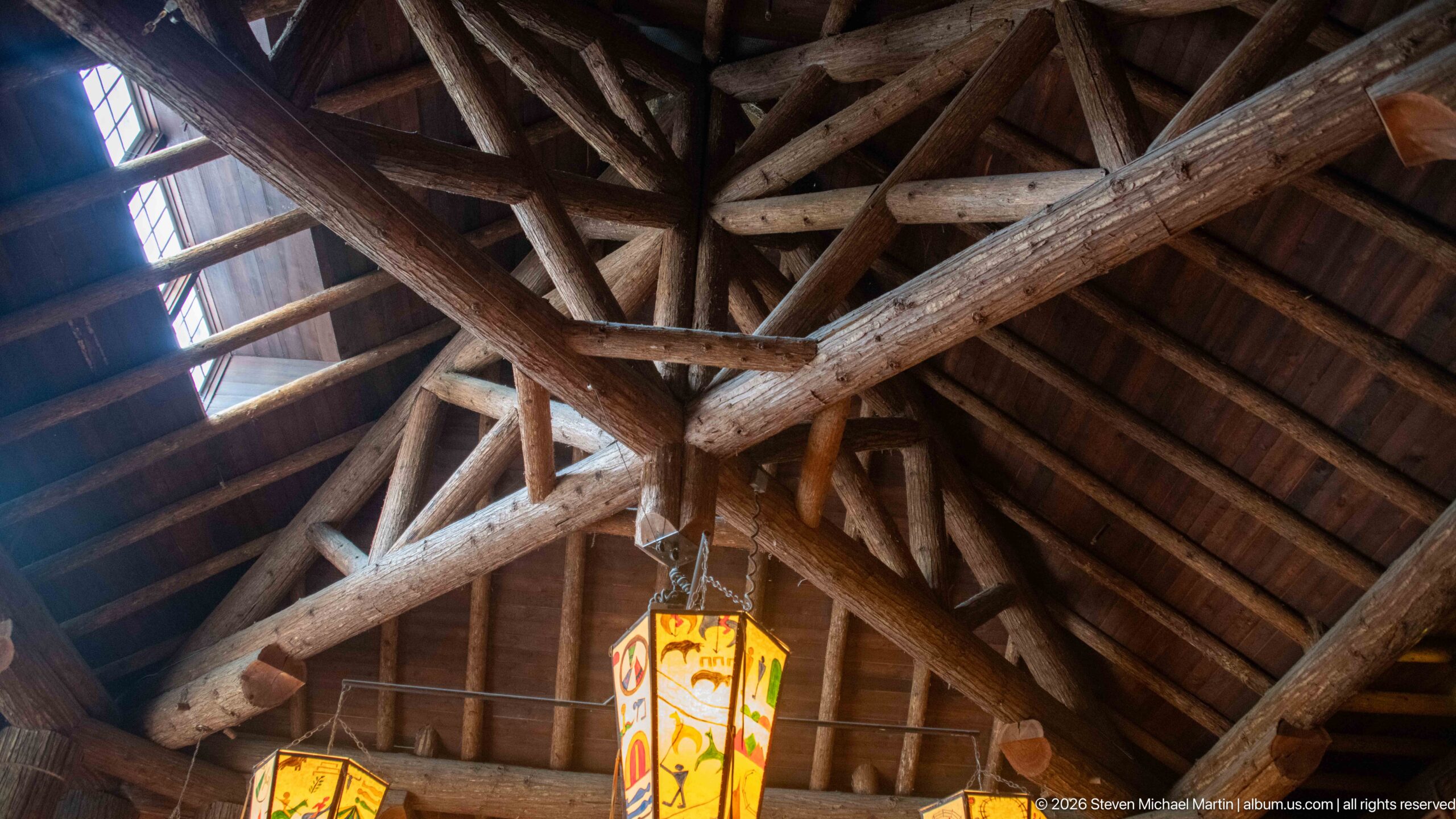
Interlocking logs and diagonal braces form a dense structural web beneath the steep lobby roof. A skylight interrupts the dark roof plane, admitting daylight onto the weathered timber, while colorful hanging lanterns appear below. Viewed almost straight upward, the composition reveals the craftsmanship and substantial scale of the lodge’s exposed roof framing more clearly than a conventional room view.
Caption
Interlocking logs and diagonal braces form a dense structural web beneath the steep lobby roof. A skylight interrupts the dark roof plane, admitting daylight onto the weathered timber, while colorful hanging lanterns appear below. Viewed almost straight upward, the composition reveals the craftsmanship and substantial scale of the lodge’s exposed roof framing more clearly than a conventional room view.
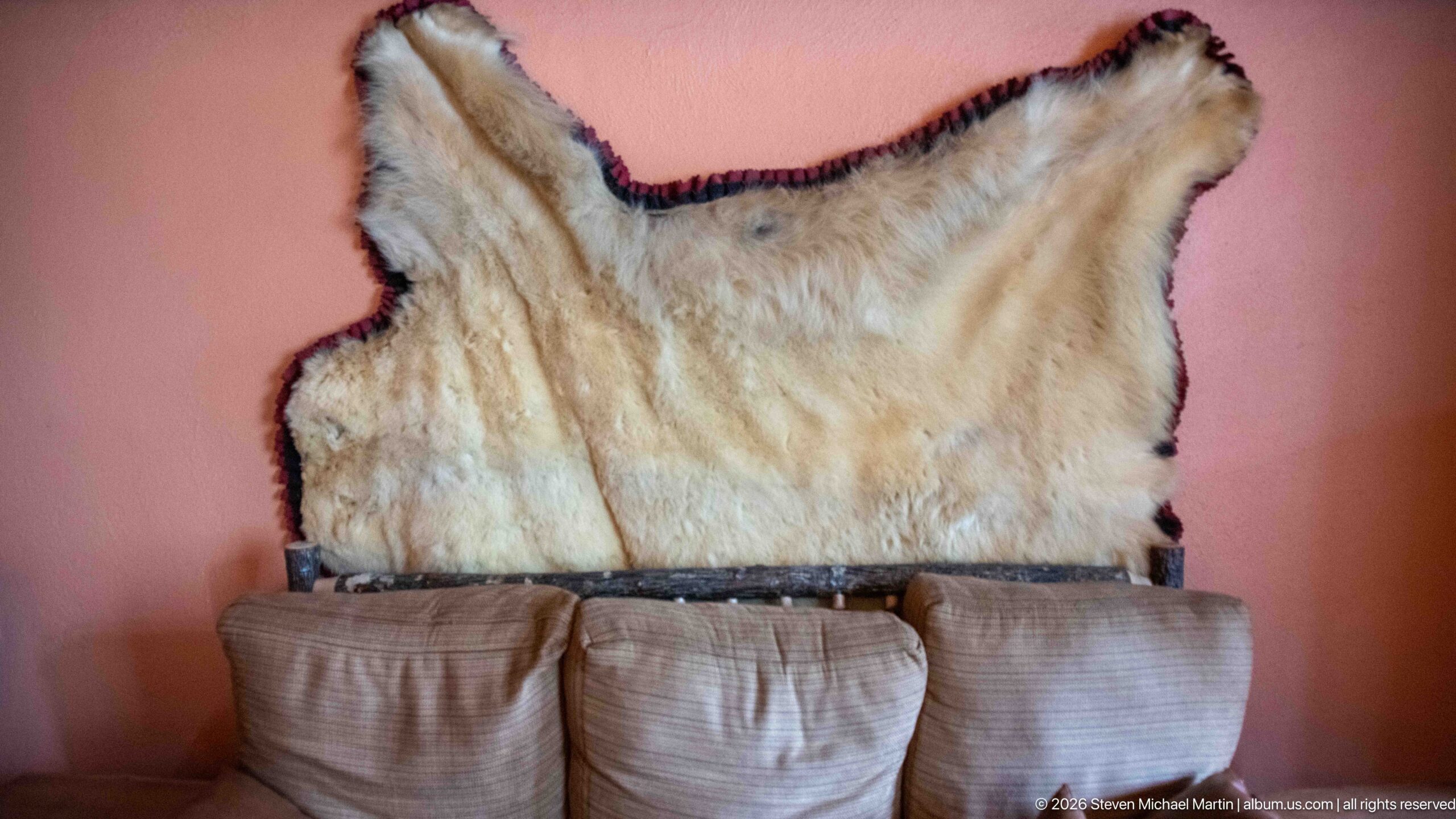
A large pale animal hide is stretched across the wall above upholstered seating in a quieter corner of Lake McDonald Lodge. Its irregular outline and dark-edged perimeter contrast sharply with the warm wall color and orderly furniture below. Because the proof sheet does not provide enough anatomical detail for a secure species identification, the display is described without assigning the hide to a particular animal.
Caption
A large pale animal hide is stretched across the wall above upholstered seating in a quieter corner of Lake McDonald Lodge. Its irregular outline and dark-edged perimeter contrast sharply with the warm wall color and orderly furniture below. Because the proof sheet does not provide enough anatomical detail for a secure species identification, the display is described without assigning the hide to a particular animal.
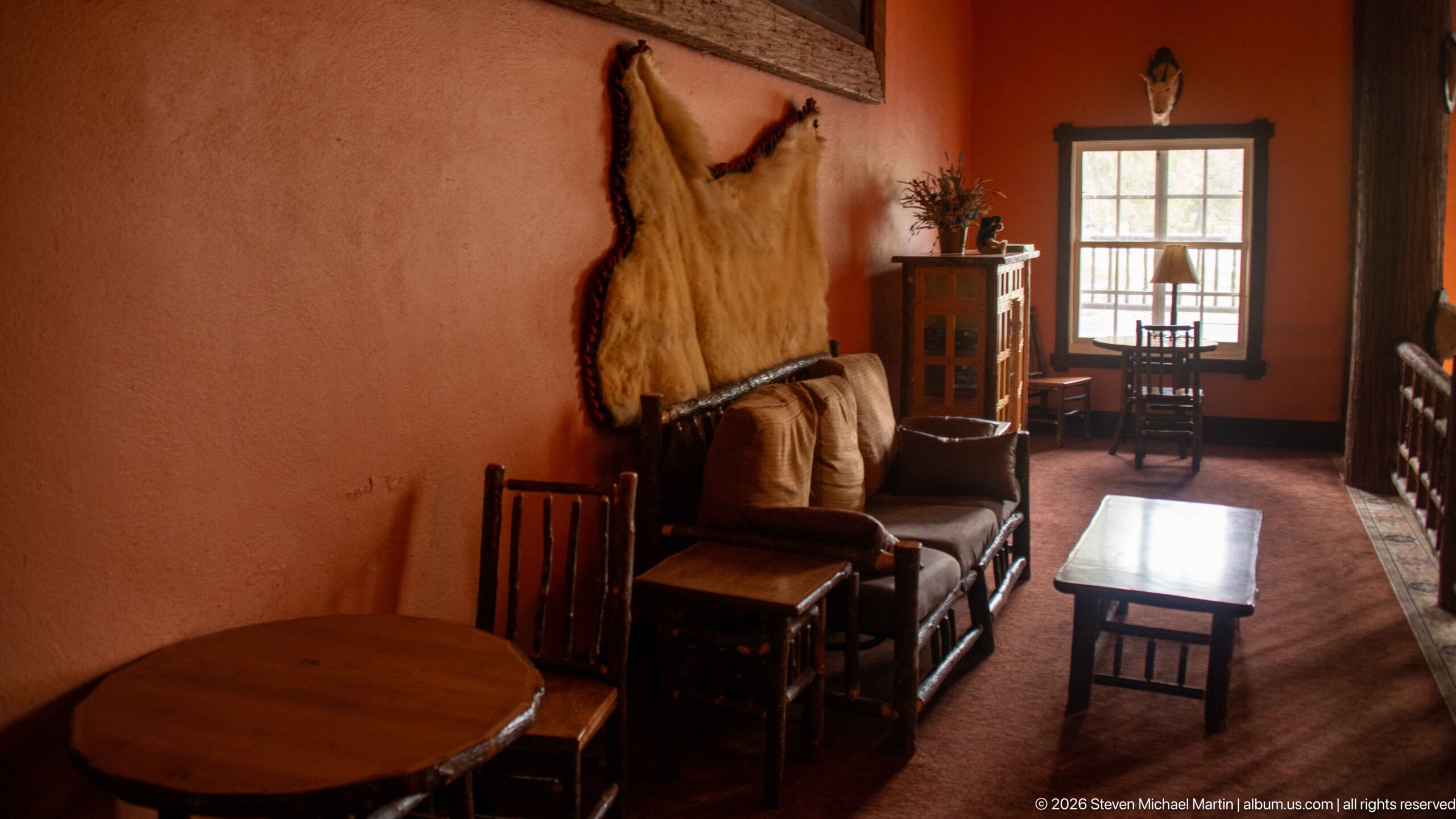
A compact sitting area pairs simple wooden tables and chairs with upholstered seating beneath the mounted animal hide seen elsewhere in the lodge. Daylight from a multi-pane window draws attention toward the far end of the narrow space, while the warm plaster walls and dark wood trim maintain the lodge’s rustic palette. The view documents a more intimate guest area away from the soaring central lobby.
Caption
A compact sitting area pairs simple wooden tables and chairs with upholstered seating beneath the mounted animal hide seen elsewhere in the lodge. Daylight from a multi-pane window draws attention toward the far end of the narrow space, while the warm plaster walls and dark wood trim maintain the lodge’s rustic palette. The view documents a more intimate guest area away from the soaring central lobby.
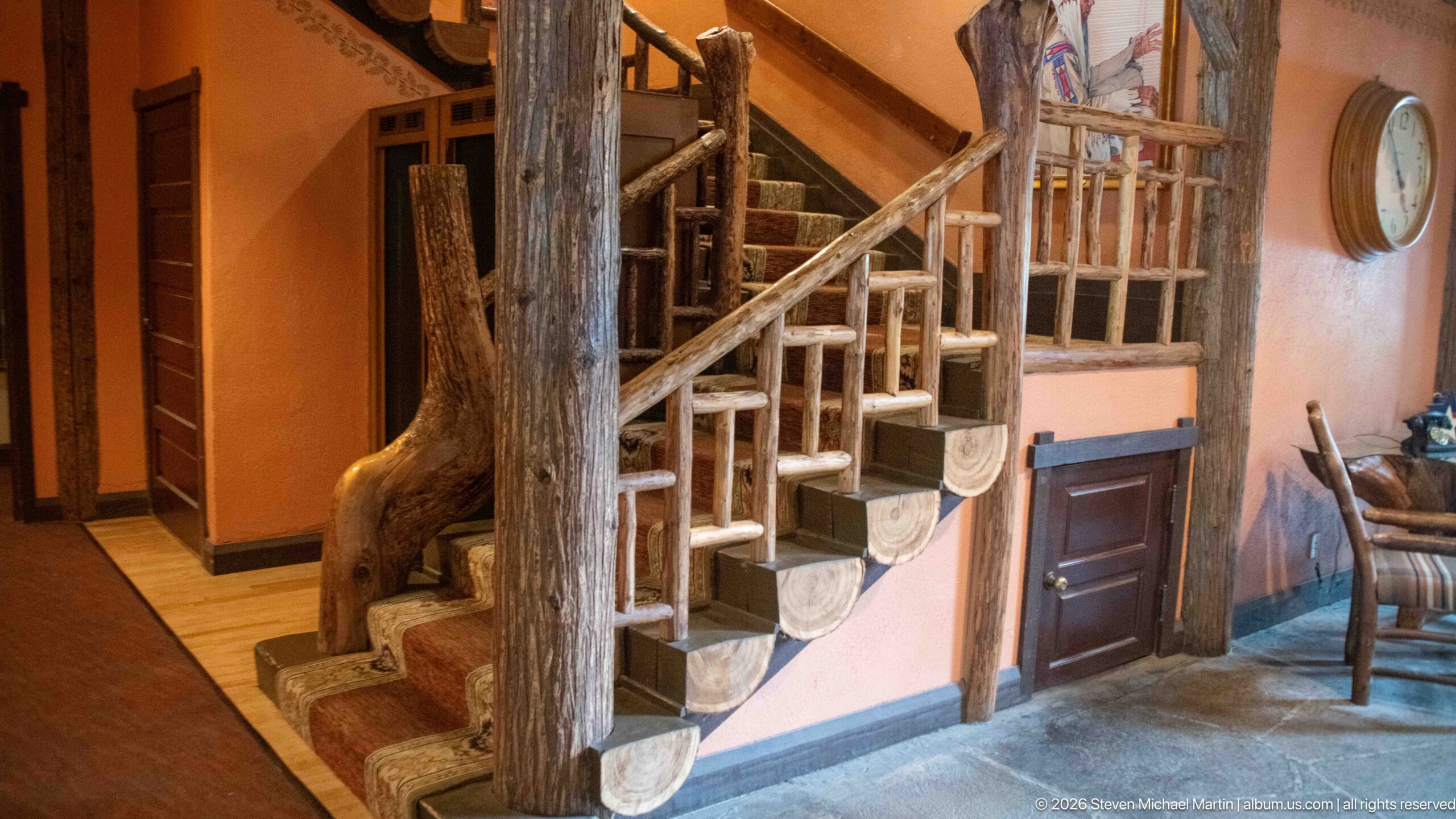
A staircase built around heavy log posts climbs through the Lake McDonald Lodge interior, combining carpeted treads with branch-like balusters and a substantial wood handrail. The irregular natural forms of the railing contrast with the smooth plaster walls and conventional doorway below. This close architectural view shows how rustic design extends beyond exposed structure into circulation elements and handcrafted interior details.
Caption
A staircase built around heavy log posts climbs through the Lake McDonald Lodge interior, combining carpeted treads with branch-like balusters and a substantial wood handrail. The irregular natural forms of the railing contrast with the smooth plaster walls and conventional doorway below. This close architectural view shows how rustic design extends beyond exposed structure into circulation elements and handcrafted interior details.
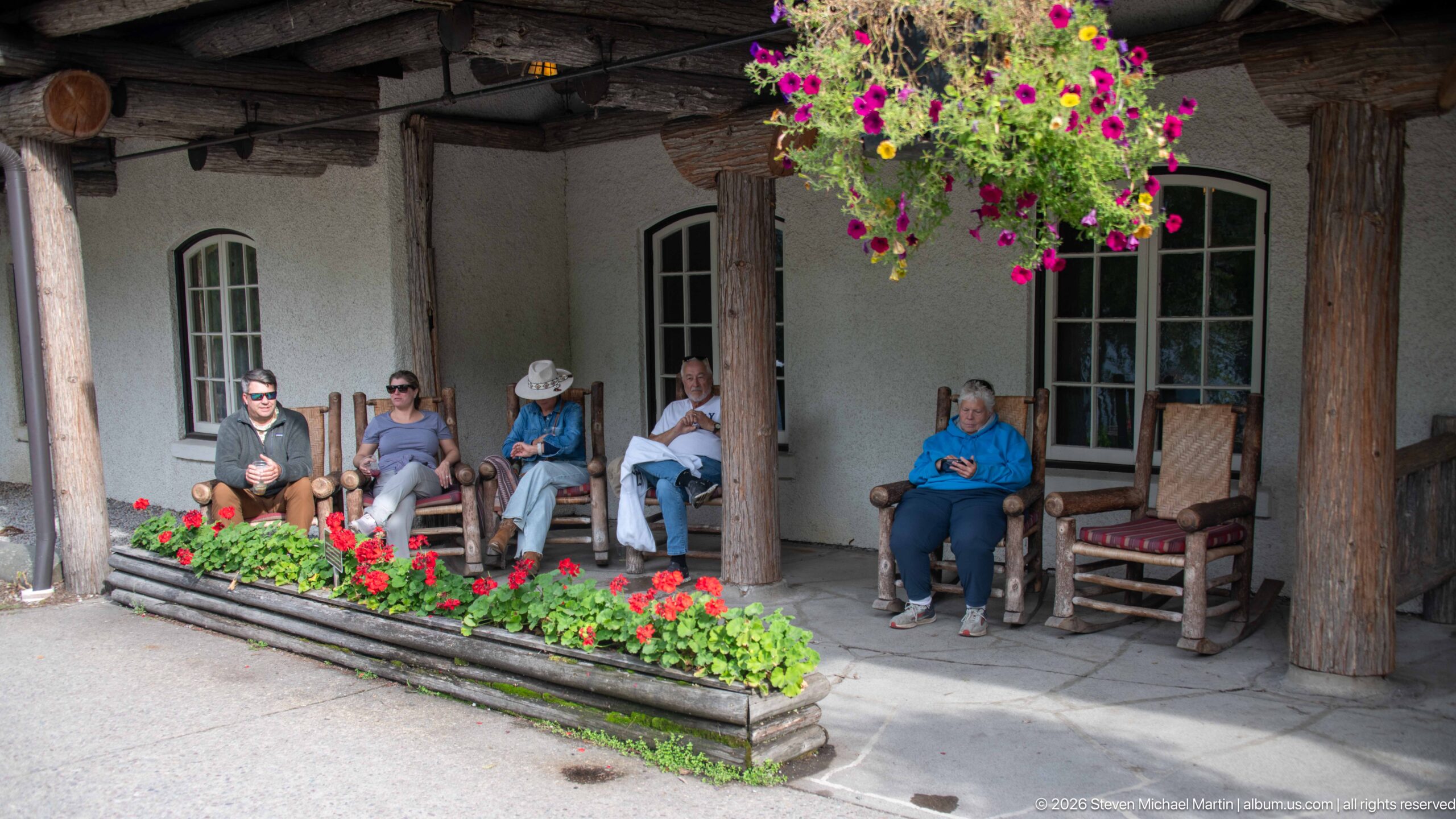
Visitors relax in wooden chairs beneath a covered gallery at Lake McDonald Lodge, framed by thick log columns and a low bed of bright flowers. Hanging baskets spill from the overhead structure, adding color to the shaded seating area. The scene shows the lodge functioning as a social space, with the rustic structural system providing shelter while remaining visually prominent.
Caption
Visitors relax in wooden chairs beneath a covered gallery at Lake McDonald Lodge, framed by thick log columns and a low bed of bright flowers. Hanging baskets spill from the overhead structure, adding color to the shaded seating area. The scene shows the lodge functioning as a social space, with the rustic structural system providing shelter while remaining visually prominent.
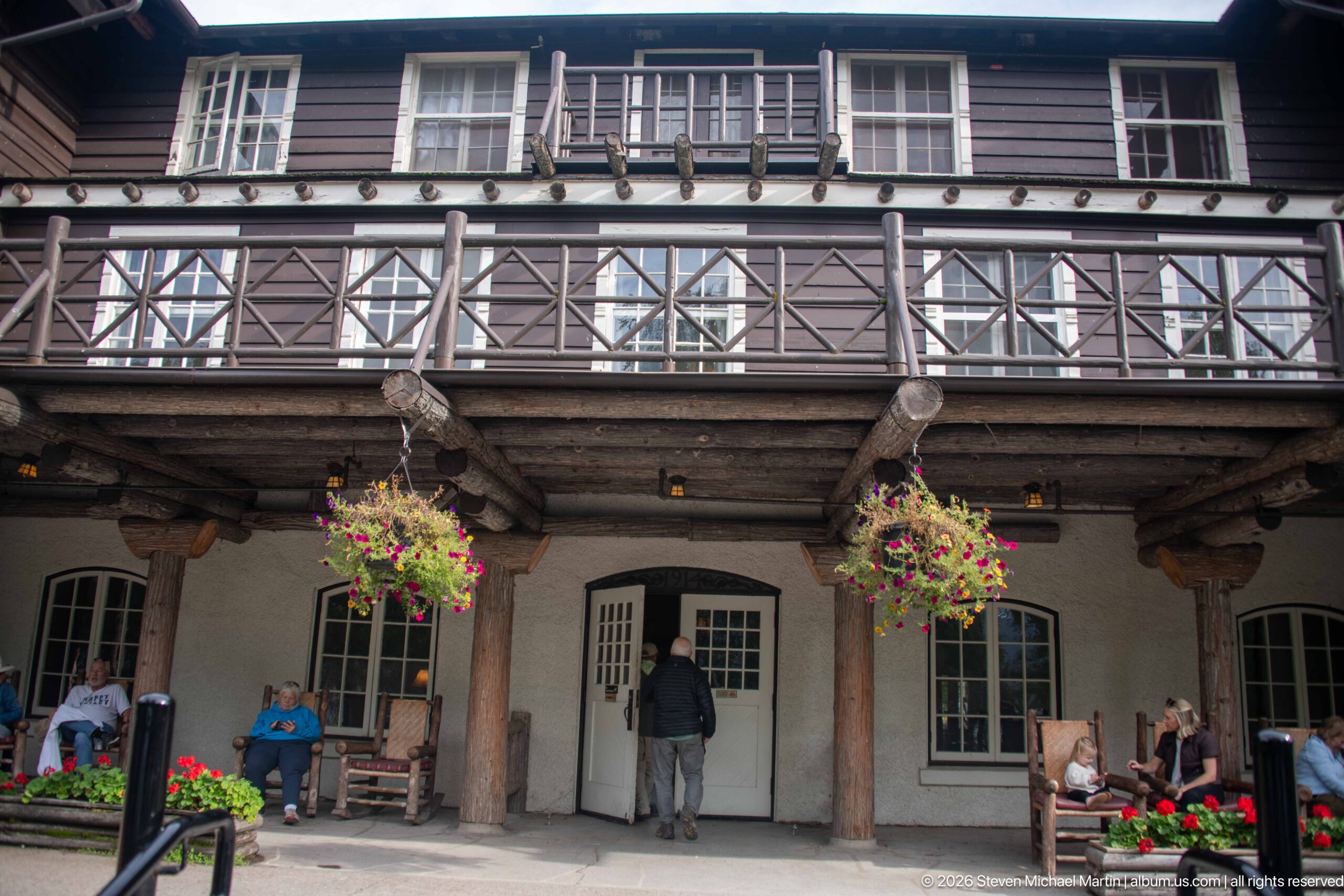
The covered ground-level gallery and upper balcony of Lake McDonald Lodge are shown nearly straight on, revealing the repeating structural rhythm of massive log columns, decorative cross-braced railings, and evenly spaced windows. Hanging flower baskets and beds of red blossoms enliven the façade, while seated visitors provide scale. The frontal composition makes the relationship between the sheltered porch and balcony especially legible.
Caption
The covered ground-level gallery and upper balcony of Lake McDonald Lodge are shown nearly straight on, revealing the repeating structural rhythm of massive log columns, decorative cross-braced railings, and evenly spaced windows. Hanging flower baskets and beds of red blossoms enliven the façade, while seated visitors provide scale. The frontal composition makes the relationship between the sheltered porch and balcony especially legible.
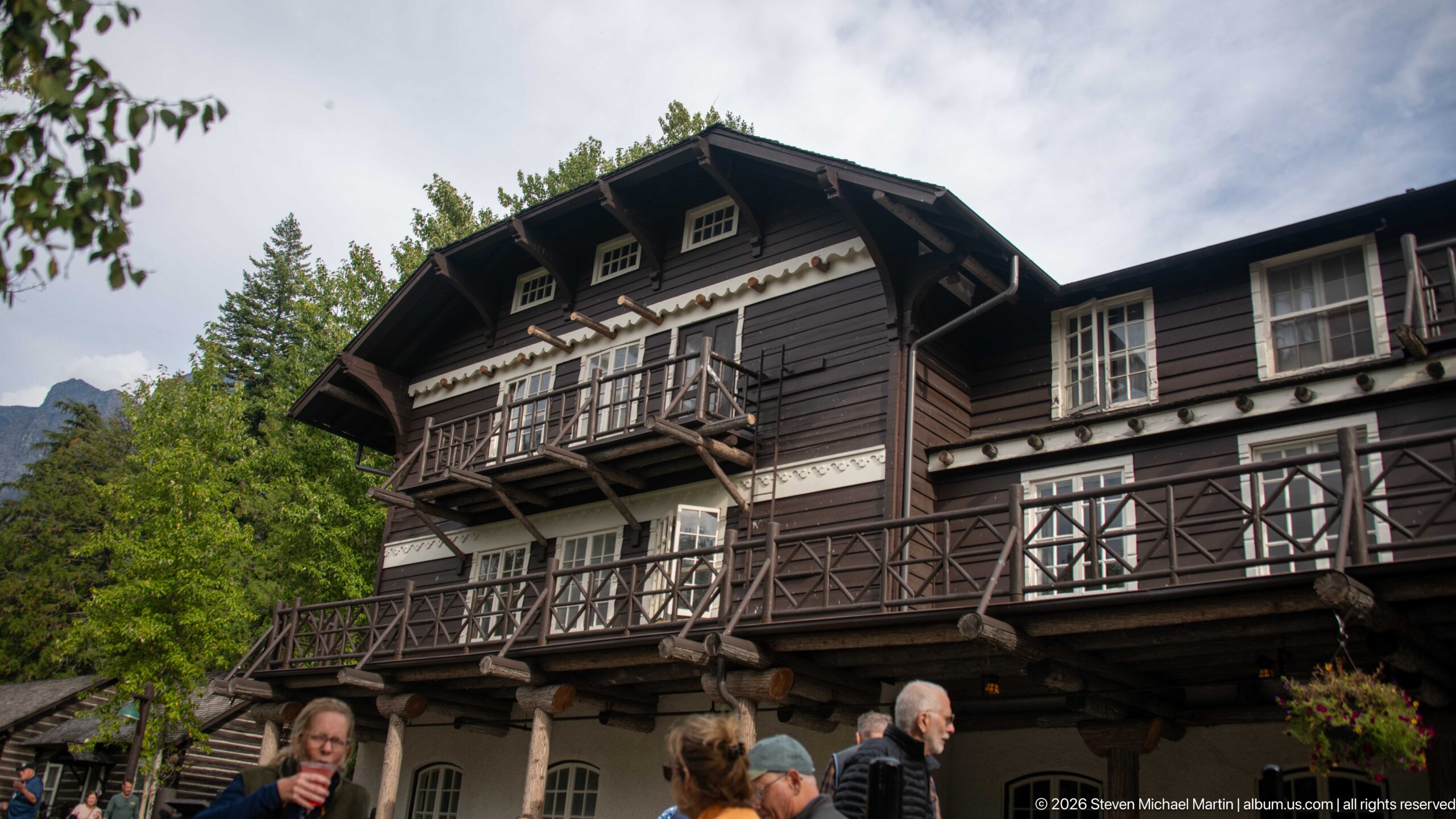
The central gabled section of Lake McDonald Lodge projects above the surrounding balcony system, its dark siding accented by pale decorative bands and small dormer-like windows beneath the roof. A projecting upper balcony and cross-braced lower railings give the façade depth, while visitors at ground level establish scale. The upward angle concentrates attention on the lodge’s layered massing and chalet-influenced exterior details.
Caption
The central gabled section of Lake McDonald Lodge projects above the surrounding balcony system, its dark siding accented by pale decorative bands and small dormer-like windows beneath the roof. A projecting upper balcony and cross-braced lower railings give the façade depth, while visitors at ground level establish scale. The upward angle concentrates attention on the lodge’s layered massing and chalet-influenced exterior details.
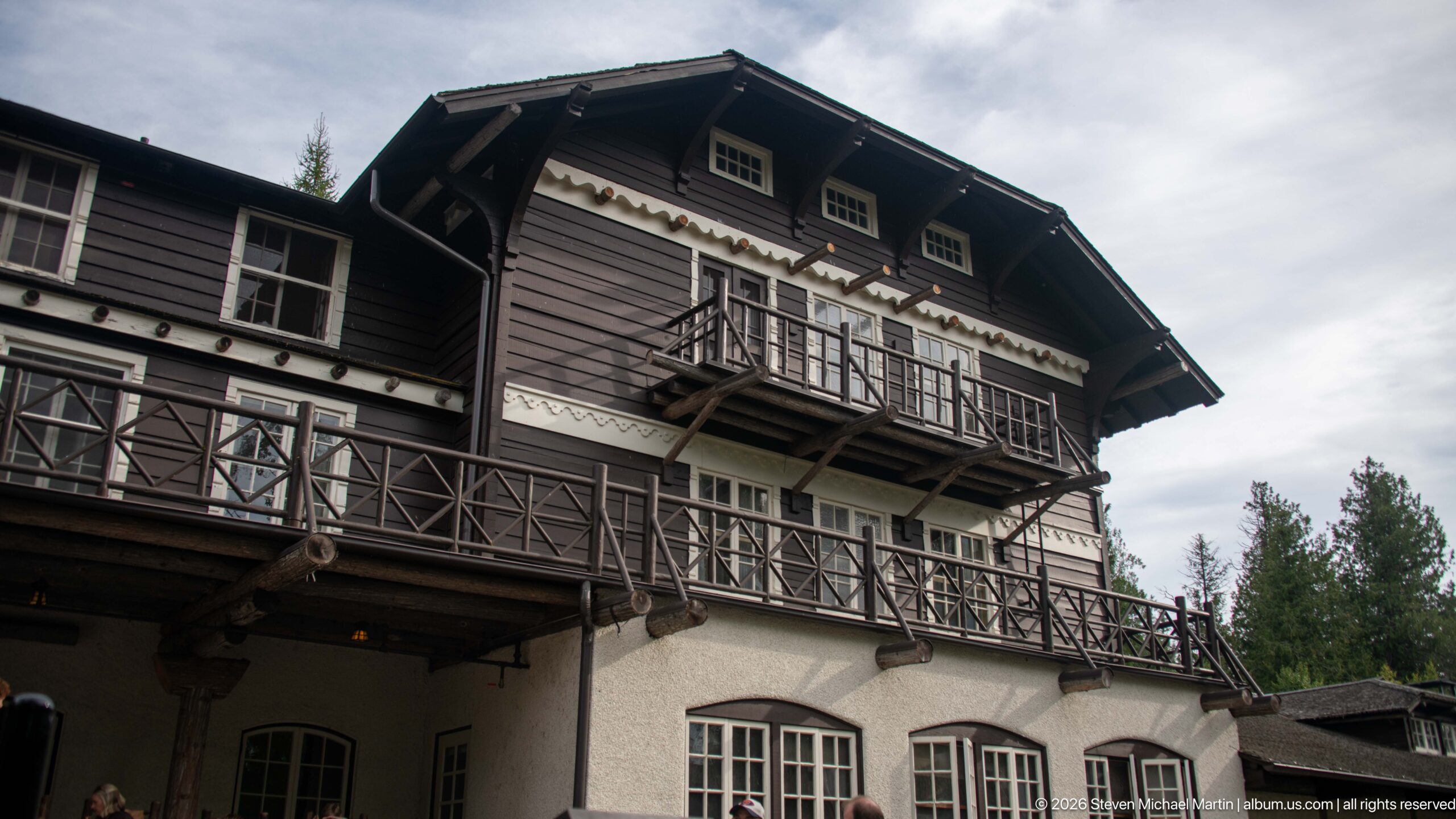
Seen from below, Lake McDonald Lodge presents a layered façade of dark wood siding, pale decorative trim, projecting balconies, and a lighter stucco base. The close crop gives particular emphasis to the gabled upper section and the long cross-braced balcony that wraps across the building. Deep roof overhangs and exposed structural members reinforce the deliberately rustic character of the exterior.
Caption
Seen from below, Lake McDonald Lodge presents a layered façade of dark wood siding, pale decorative trim, projecting balconies, and a lighter stucco base. The close crop gives particular emphasis to the gabled upper section and the long cross-braced balcony that wraps across the building. Deep roof overhangs and exposed structural members reinforce the deliberately rustic character of the exterior.
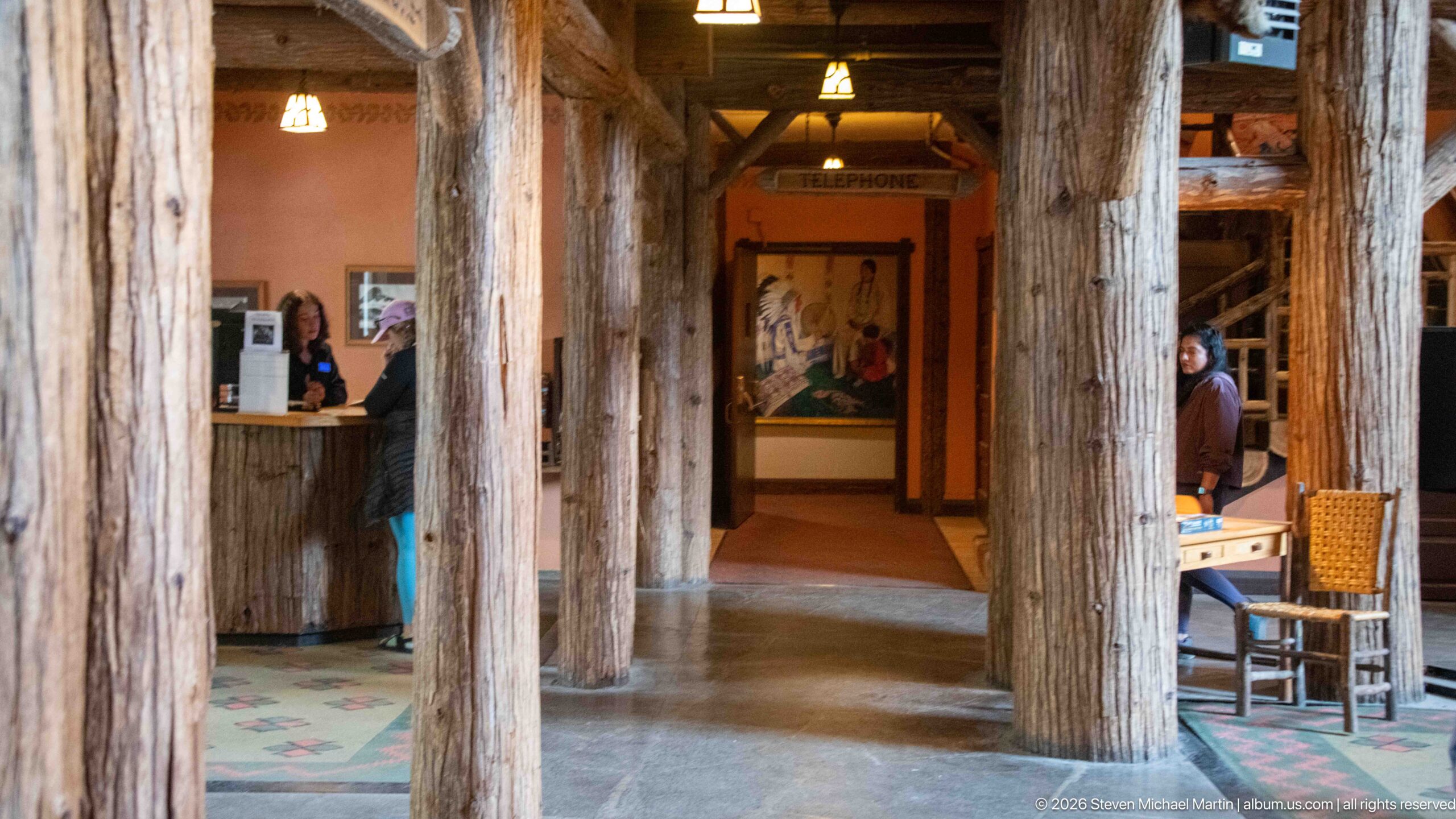
Massive log columns frame an interior passage off the Lake McDonald Lodge lobby, where a suspended sign marked “TELEPHONE” points to an earlier layer of guest service. A counter occupies the left side while framed artwork, seating, and warm plaster walls recede beyond the timber structure. The composition shows how functional spaces are embedded within the lodge’s monumental rustic interior.
Caption
Massive log columns frame an interior passage off the Lake McDonald Lodge lobby, where a suspended sign marked “TELEPHONE” points to an earlier layer of guest service. A counter occupies the left side while framed artwork, seating, and warm plaster walls recede beyond the timber structure. The composition shows how functional spaces are embedded within the lodge’s monumental rustic interior.
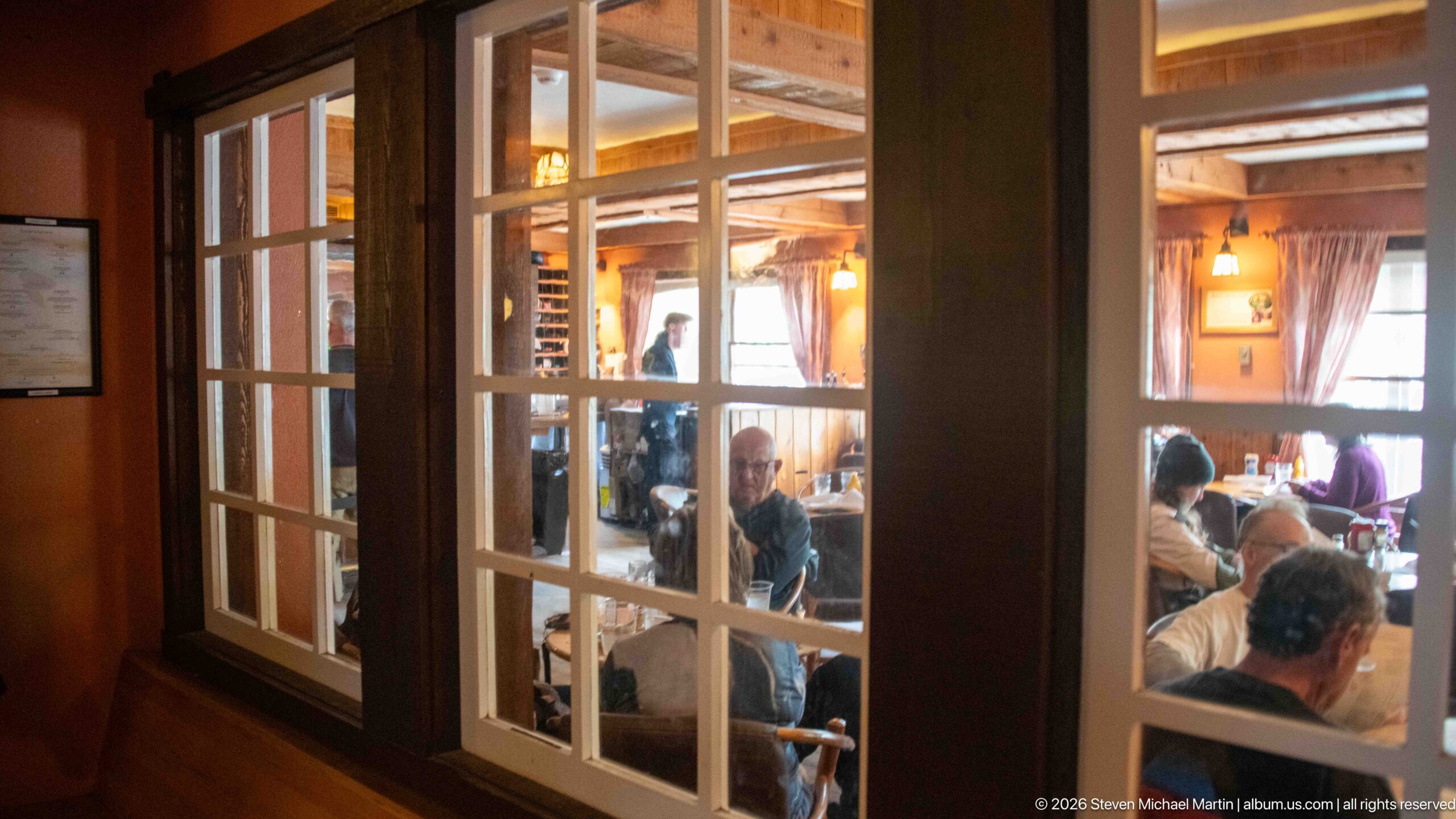
Multi-pane glazed doors and windows provide a layered view into a dining room at Lake McDonald Lodge, where seated guests, tables, timber framing, and warm interior lighting are visible beyond the glass. Reflections and door mullions divide the scene into smaller panels, emphasizing the transition between circulation space and dining area rather than presenting the room directly.
Caption
Multi-pane glazed doors and windows provide a layered view into a dining room at Lake McDonald Lodge, where seated guests, tables, timber framing, and warm interior lighting are visible beyond the glass. Reflections and door mullions divide the scene into smaller panels, emphasizing the transition between circulation space and dining area rather than presenting the room directly.
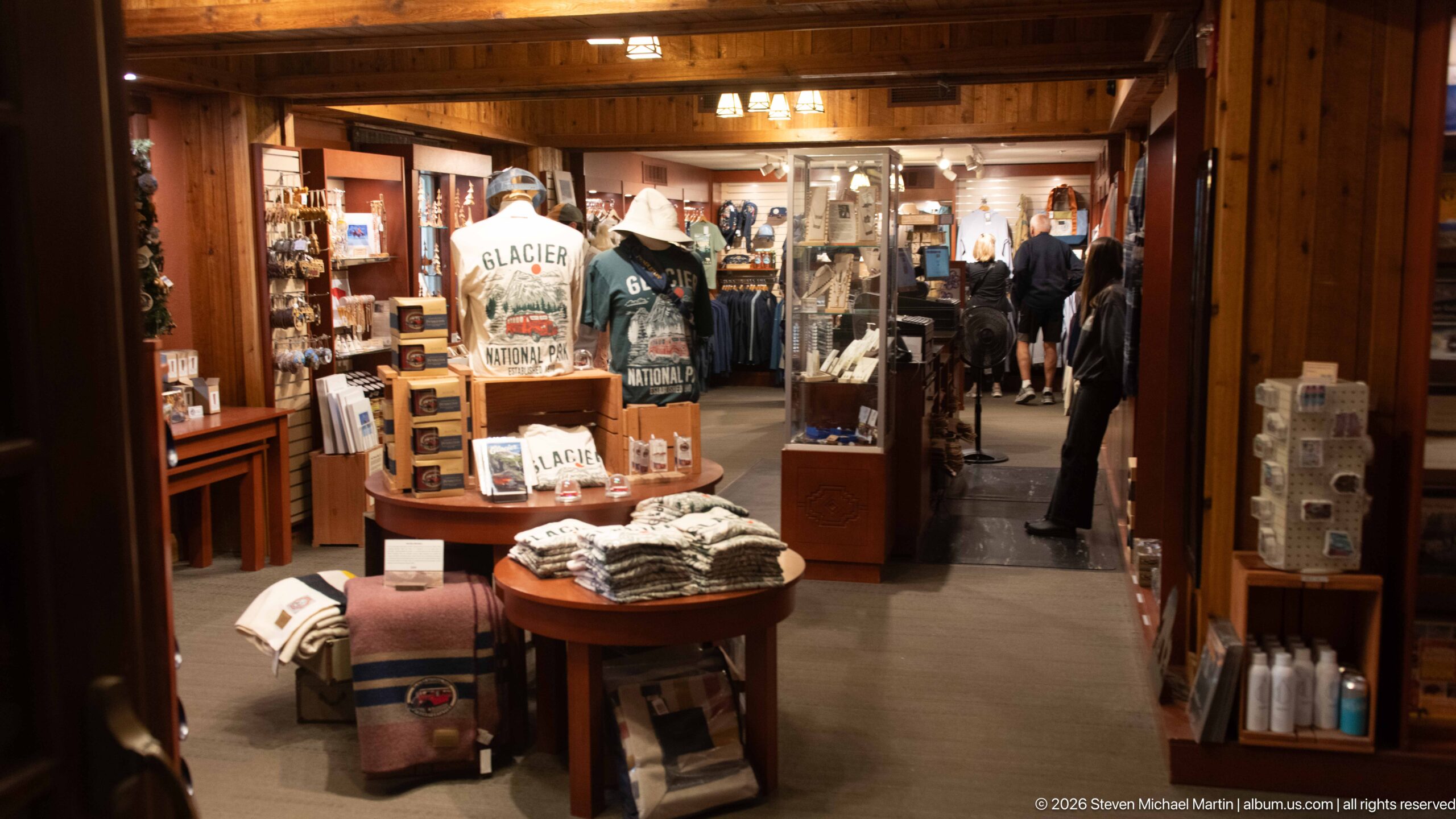
The lodge gift shop occupies a warmly finished wood-paneled interior filled with Glacier National Park apparel, books, souvenirs, and other visitor merchandise. Display tables and cases extend through the compact retail space beneath exposed timber construction, illustrating how contemporary visitor services have been incorporated into the historic lodge while retaining the strongly rustic character of its interior.
Caption
The lodge gift shop occupies a warmly finished wood-paneled interior filled with Glacier National Park apparel, books, souvenirs, and other visitor merchandise. Display tables and cases extend through the compact retail space beneath exposed timber construction, illustrating how contemporary visitor services have been incorporated into the historic lodge while retaining the strongly rustic character of its interior.
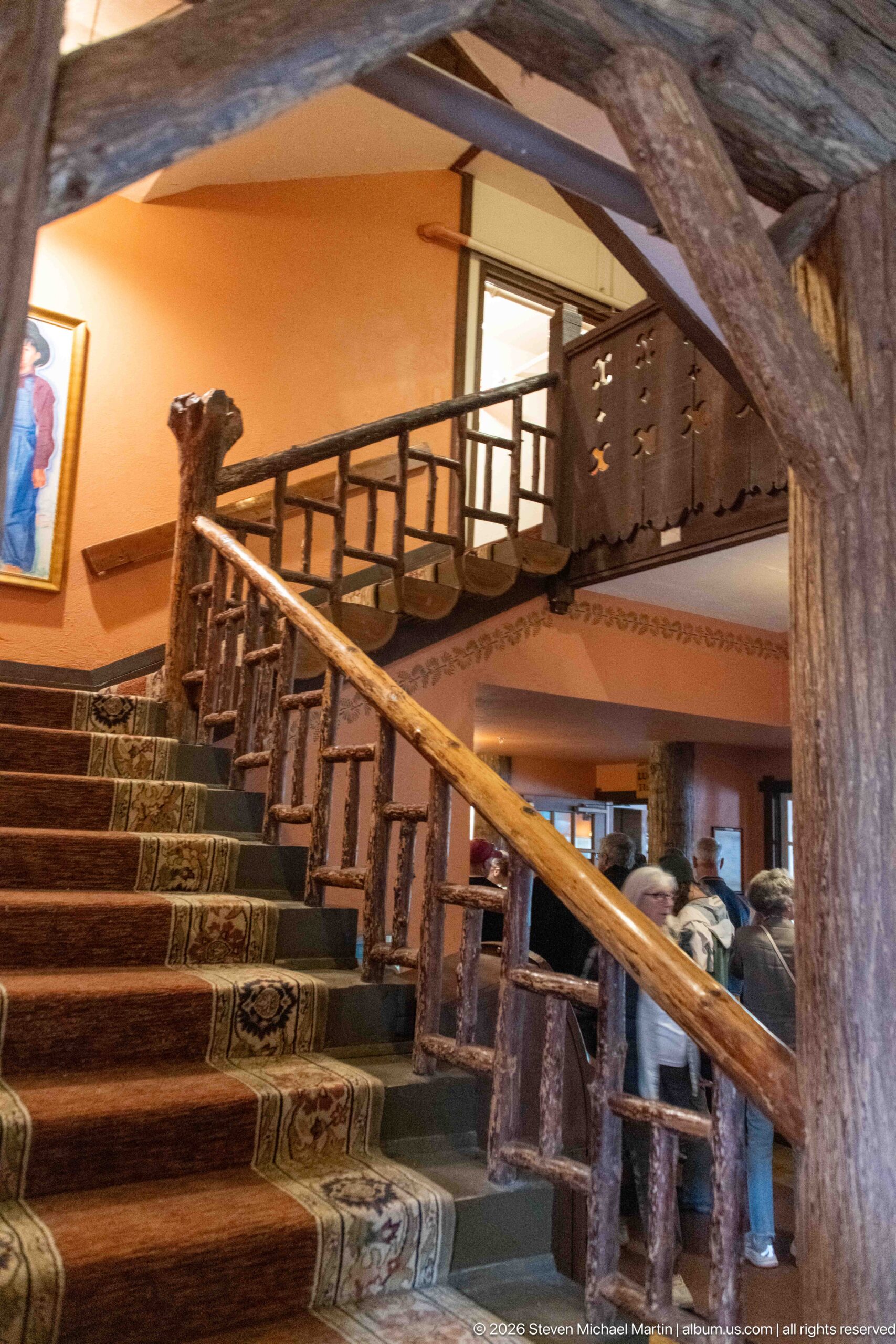
A broad carpeted staircase rises through the Lake McDonald Lodge interior beneath heavy log beams and beside irregular branch-form railings. The upper gallery turns across the background, linking the stairs to the lodge’s multi-level public spaces. This angled view highlights the contrast between patterned carpet, warm plaster walls, and deliberately rough timber elements used to shape the circulation system.
Caption
A broad carpeted staircase rises through the Lake McDonald Lodge interior beneath heavy log beams and beside irregular branch-form railings. The upper gallery turns across the background, linking the stairs to the lodge’s multi-level public spaces. This angled view highlights the contrast between patterned carpet, warm plaster walls, and deliberately rough timber elements used to shape the circulation system.
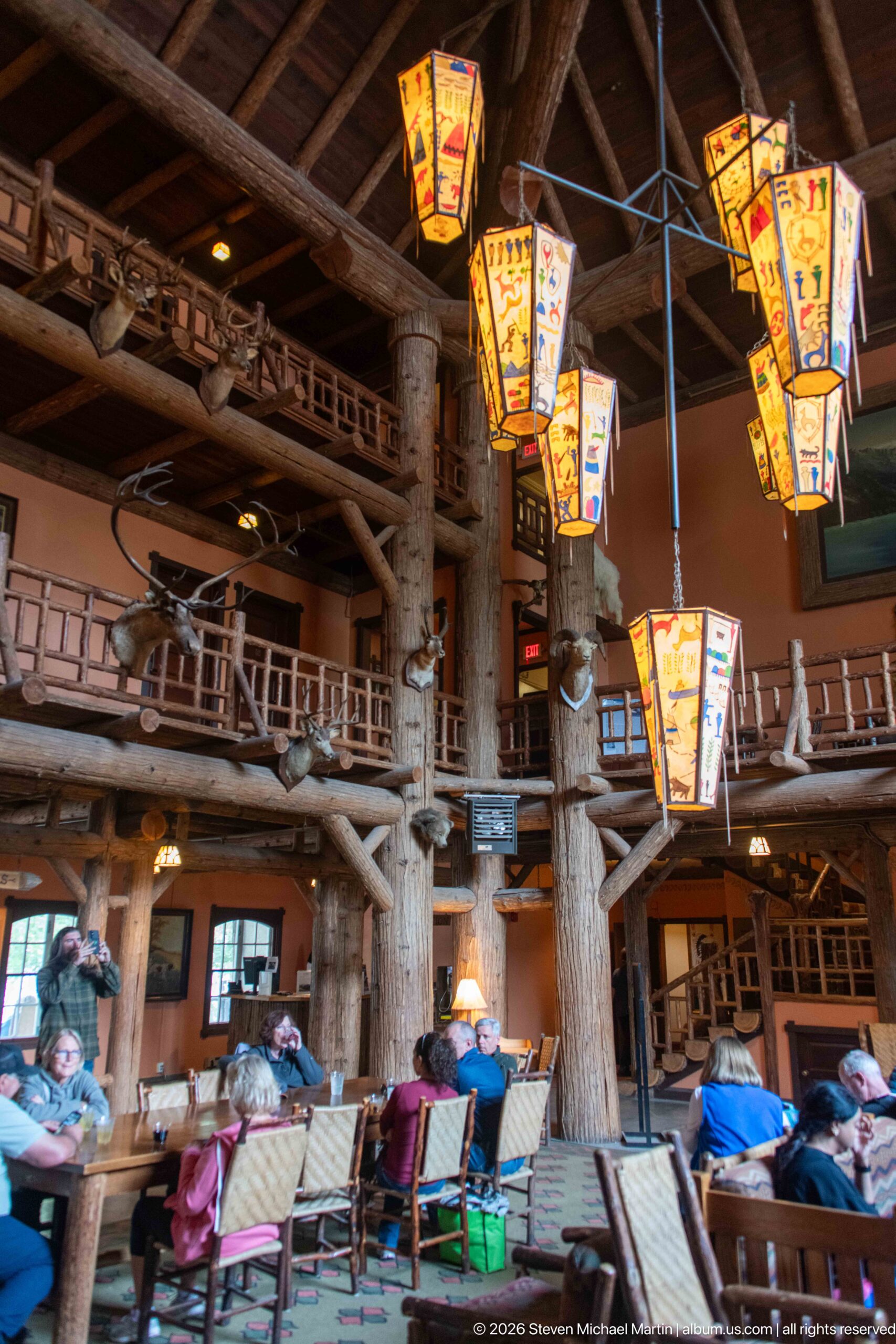
Brightly painted lanterns descend through the tall Lake McDonald Lodge lobby above clusters of seated visitors. Massive log columns support rustic galleries on several sides, creating a layered interior of timber structure, railings, furnishings, and warm light. Compared with the earlier elevated lobby view, this lower perspective places visitors and lounge seating in the foreground, emphasizing the room’s continuing role as a communal gathering space.
Caption
Brightly painted lanterns descend through the tall Lake McDonald Lodge lobby above clusters of seated visitors. Massive log columns support rustic galleries on several sides, creating a layered interior of timber structure, railings, furnishings, and warm light. Compared with the earlier elevated lobby view, this lower perspective places visitors and lounge seating in the foreground, emphasizing the room’s continuing role as a communal gathering space.
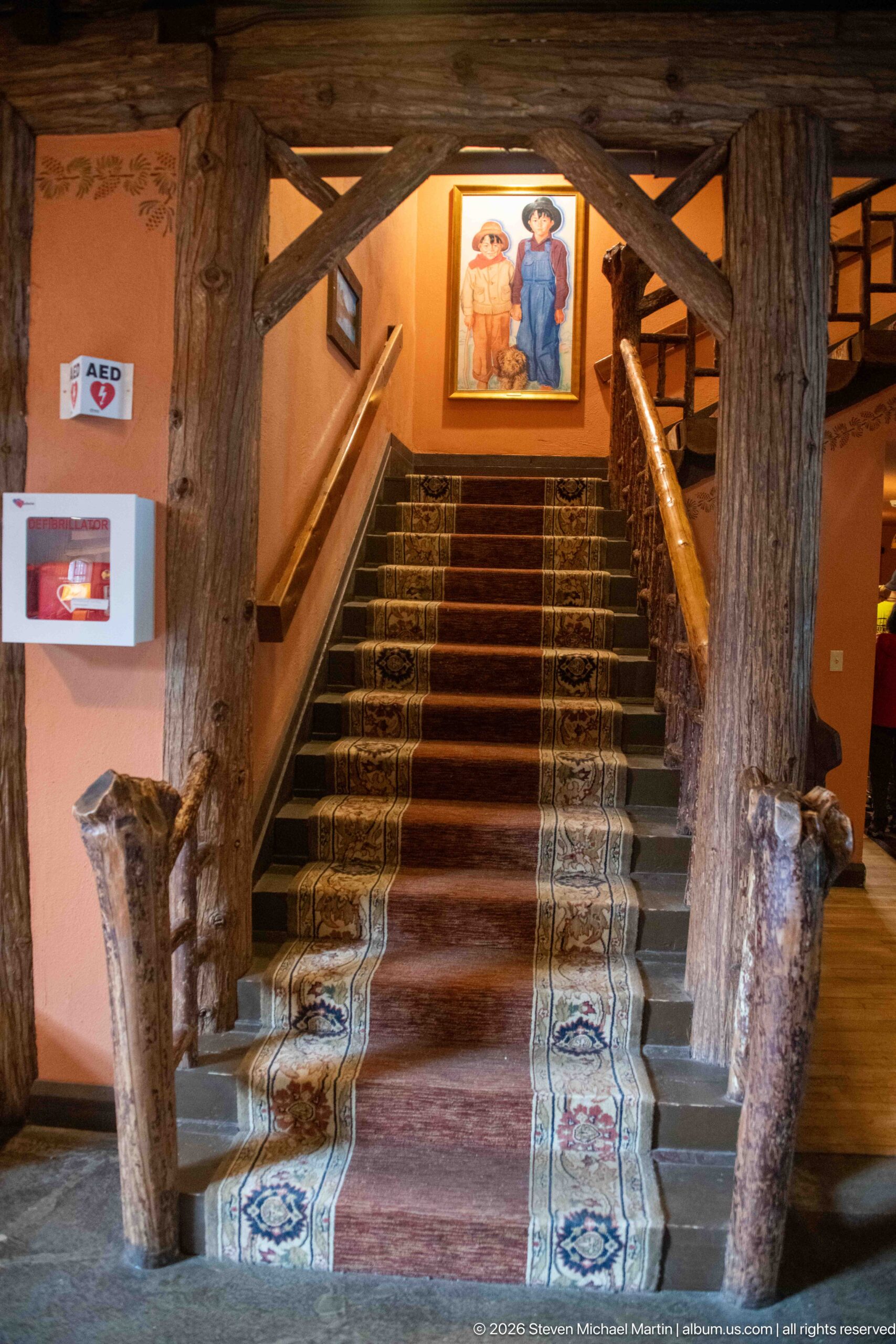
A broad staircase rises directly between massive log posts, its patterned runner leading toward a framed painting at the landing. Rustic branch railings flank the steps while heavy timber beams frame the opening above, creating an almost symmetrical composition. The frontal viewpoint turns a circulation feature into an architectural focal point and clearly shows the lodge’s combination of refined finishes with intentionally rough-hewn woodwork.
Caption
A broad staircase rises directly between massive log posts, its patterned runner leading toward a framed painting at the landing. Rustic branch railings flank the steps while heavy timber beams frame the opening above, creating an almost symmetrical composition. The frontal viewpoint turns a circulation feature into an architectural focal point and clearly shows the lodge’s combination of refined finishes with intentionally rough-hewn woodwork.
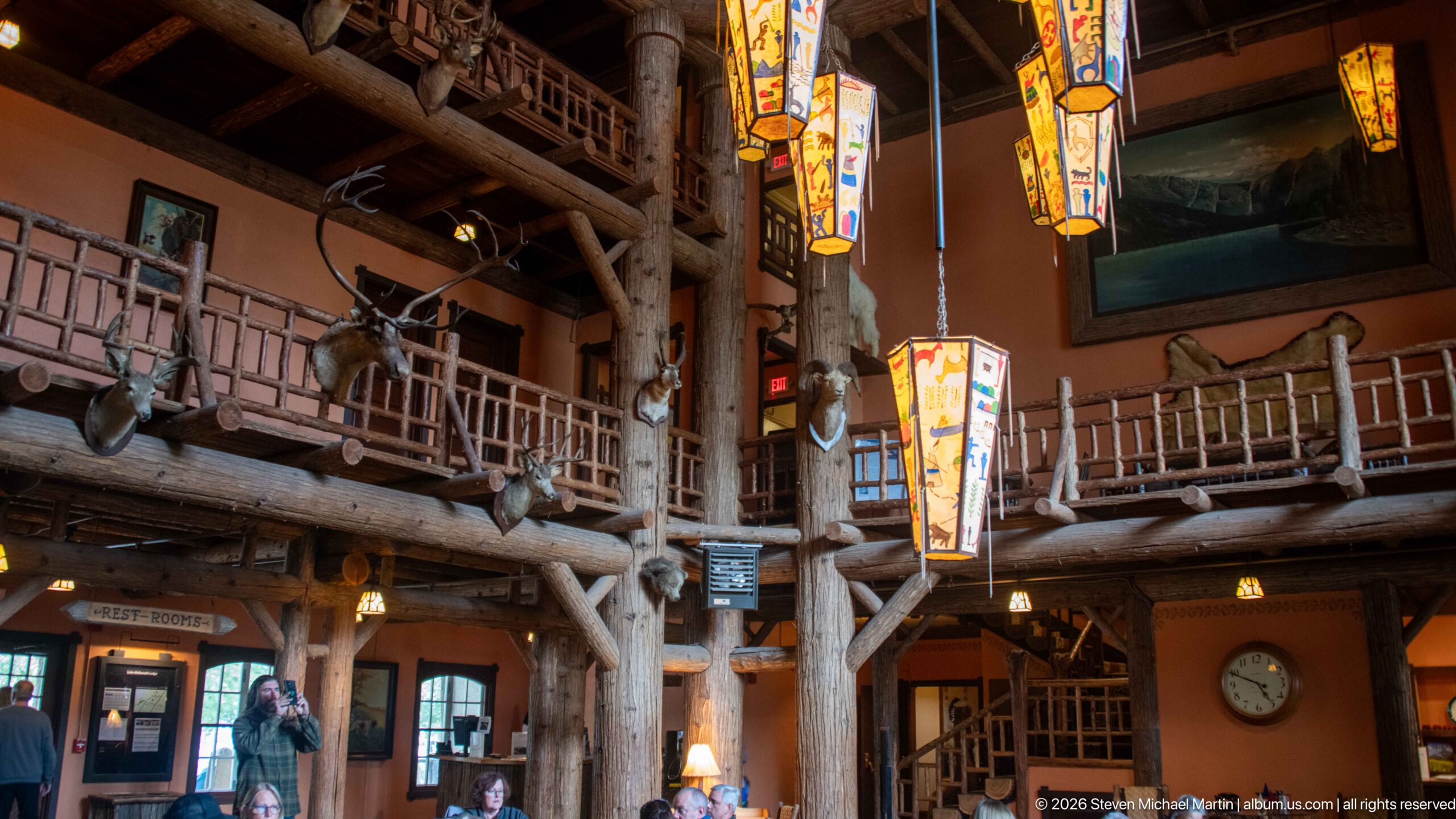
The soaring lobby of Lake McDonald Lodge is defined by massive peeled-log columns, rustic balcony railings, and suspended lanterns descending through the open central space. Two levels of galleries overlook the main floor, revealing the scale and structural expression of the lodge’s interior. The combination of heavy timber construction and colorful geometric lighting gives this gathering space its distinctive early national-park lodge character.
Caption
The soaring lobby of Lake McDonald Lodge is defined by massive peeled-log columns, rustic balcony railings, and suspended lanterns descending through the open central space. Two levels of galleries overlook the main floor, revealing the scale and structural expression of the lodge’s interior. The combination of heavy timber construction and colorful geometric lighting gives this gathering space its distinctive early national-park lodge character.
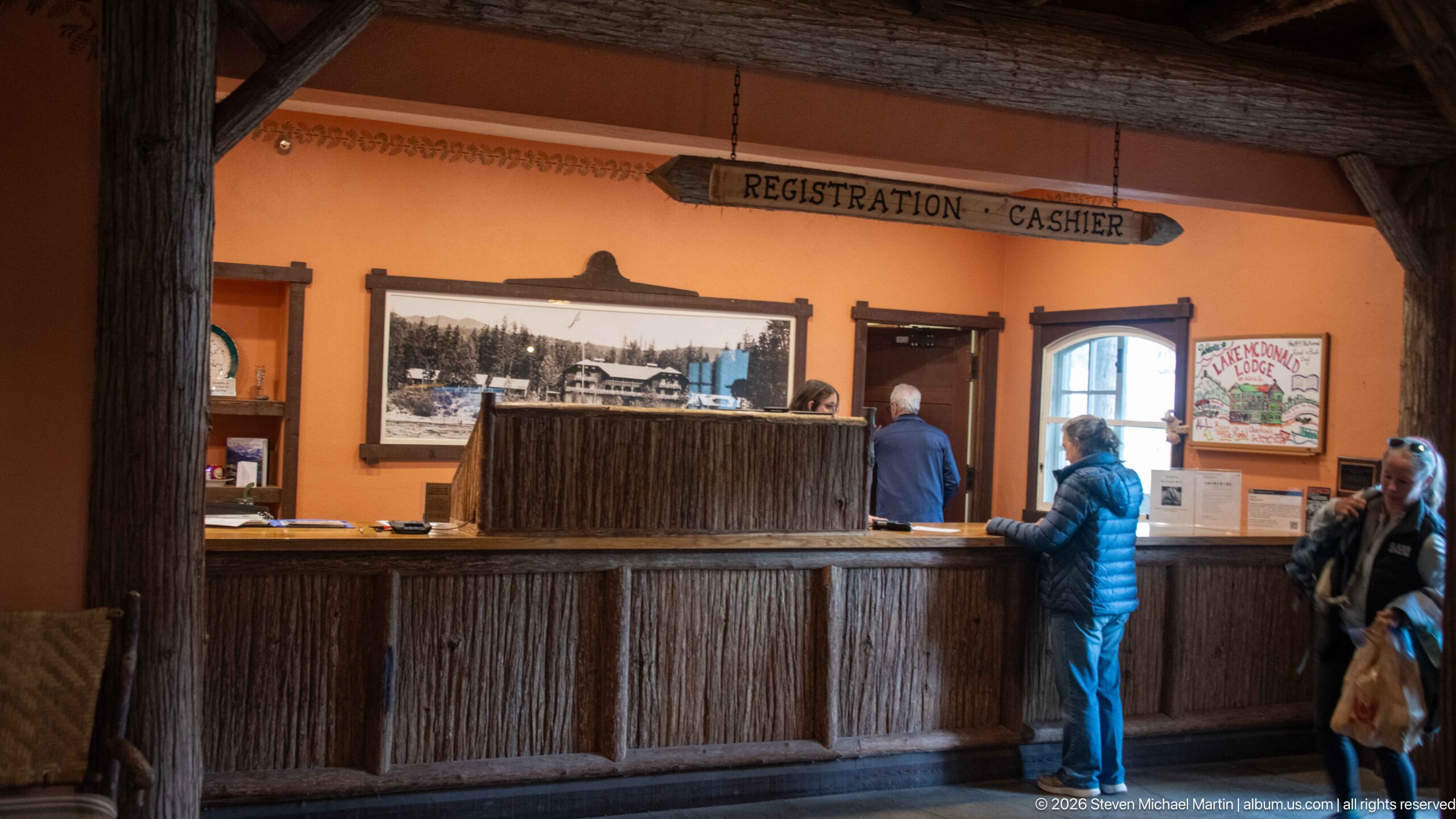
The registration counter occupies a warmly colored corner of the lodge, framed by heavy log posts and a rustic wood front. A carved wooden sign reading “REGISTRATION • CASHIER” identifies the function directly, while guests stand at the counter beneath historic-looking framed imagery. The scene records the working hospitality space within the otherwise highly decorative lodge interior.
Caption
The registration counter occupies a warmly colored corner of the lodge, framed by heavy log posts and a rustic wood front. A carved wooden sign reading “REGISTRATION • CASHIER” identifies the function directly, while guests stand at the counter beneath historic-looking framed imagery. The scene records the working hospitality space within the otherwise highly decorative lodge interior.
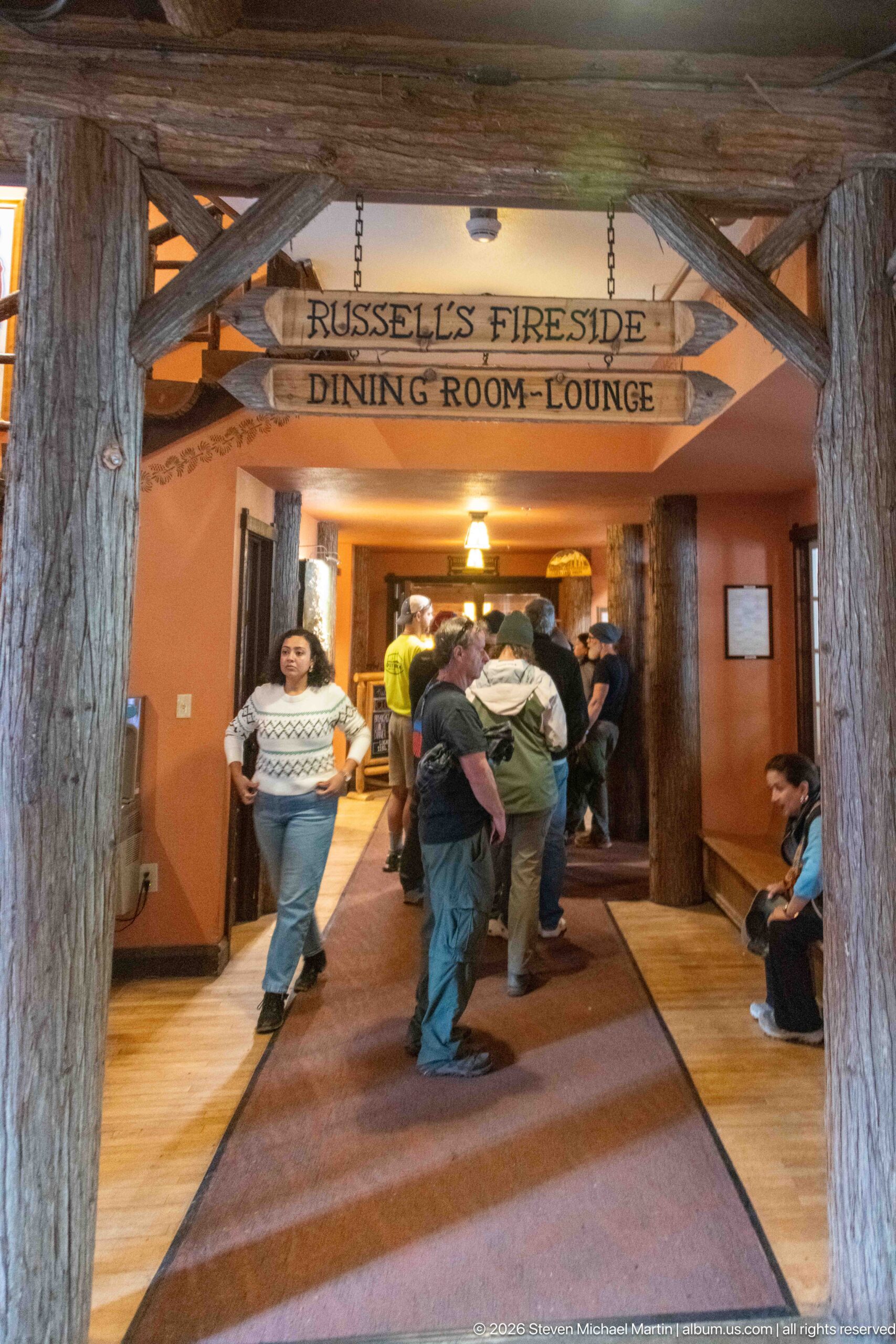
A rustic timber-framed passage inside Lake McDonald Lodge leads guests toward Russell’s Fireside Dining Room and Lounge. Hand-painted directional signs hang beneath massive log beams and diagonal braces, while visitors gather along the carpeted corridor beyond. The exposed woodwork and informal signage reinforce the lodge’s deliberately rustic interior character, carrying its wilderness-inspired architectural vocabulary into the circulation spaces connecting the public rooms.
Caption
A rustic timber-framed passage inside Lake McDonald Lodge leads guests toward Russell’s Fireside Dining Room and Lounge. Hand-painted directional signs hang beneath massive log beams and diagonal braces, while visitors gather along the carpeted corridor beyond. The exposed woodwork and informal signage reinforce the lodge’s deliberately rustic interior character, carrying its wilderness-inspired architectural vocabulary into the circulation spaces connecting the public rooms.
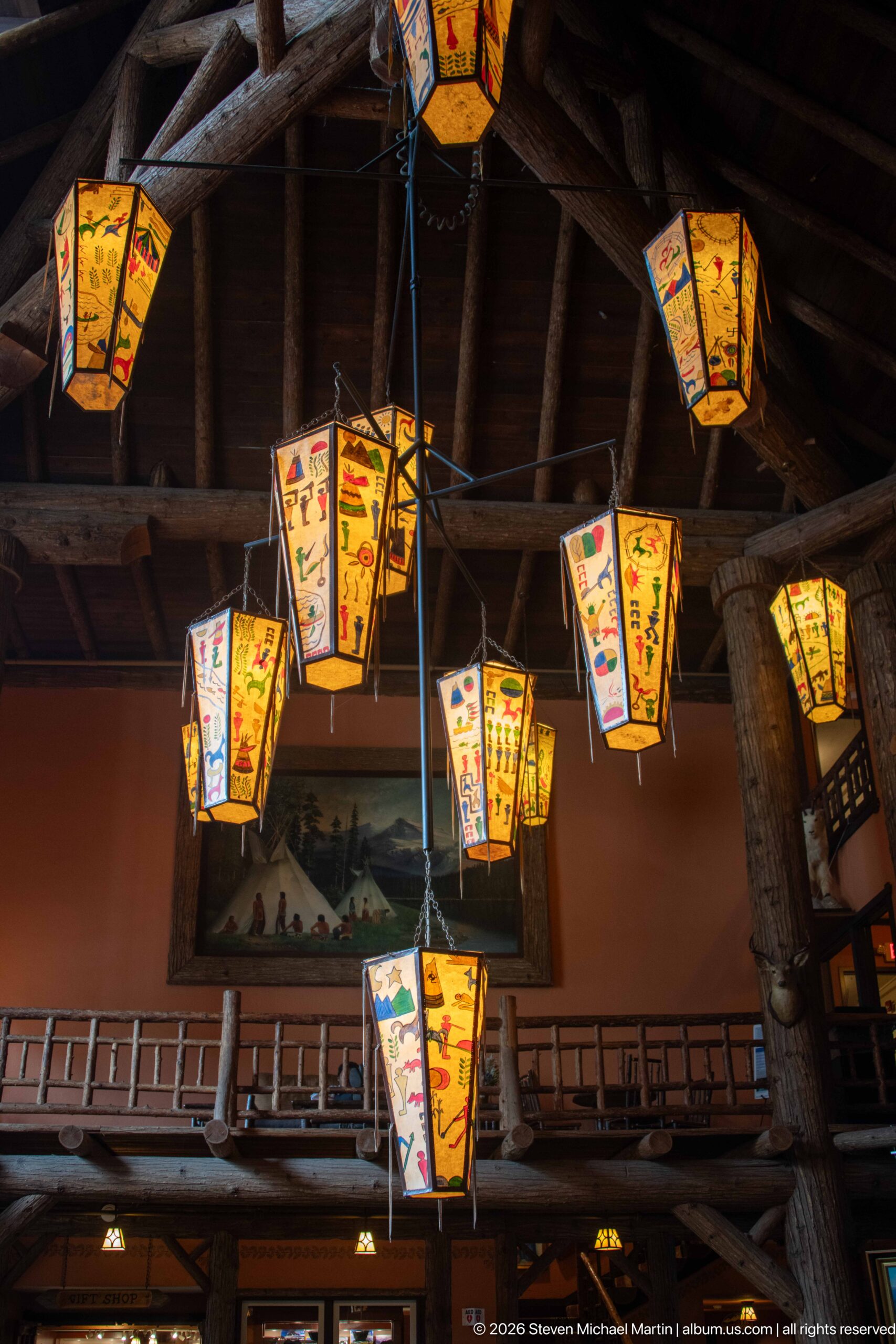
A constellation of painted lanterns hangs at different heights beneath the dark timber ceiling of the lodge lobby. Their warm translucent panels carry brightly colored figurative and geometric designs, standing out against the massive log structure and upper gallery. The upward-looking composition makes the lighting fixtures the principal subject while retaining enough of the surrounding architecture to show their dramatic placement within the room.
Caption
A constellation of painted lanterns hangs at different heights beneath the dark timber ceiling of the lodge lobby. Their warm translucent panels carry brightly colored figurative and geometric designs, standing out against the massive log structure and upper gallery. The upward-looking composition makes the lighting fixtures the principal subject while retaining enough of the surrounding architecture to show their dramatic placement within the room.
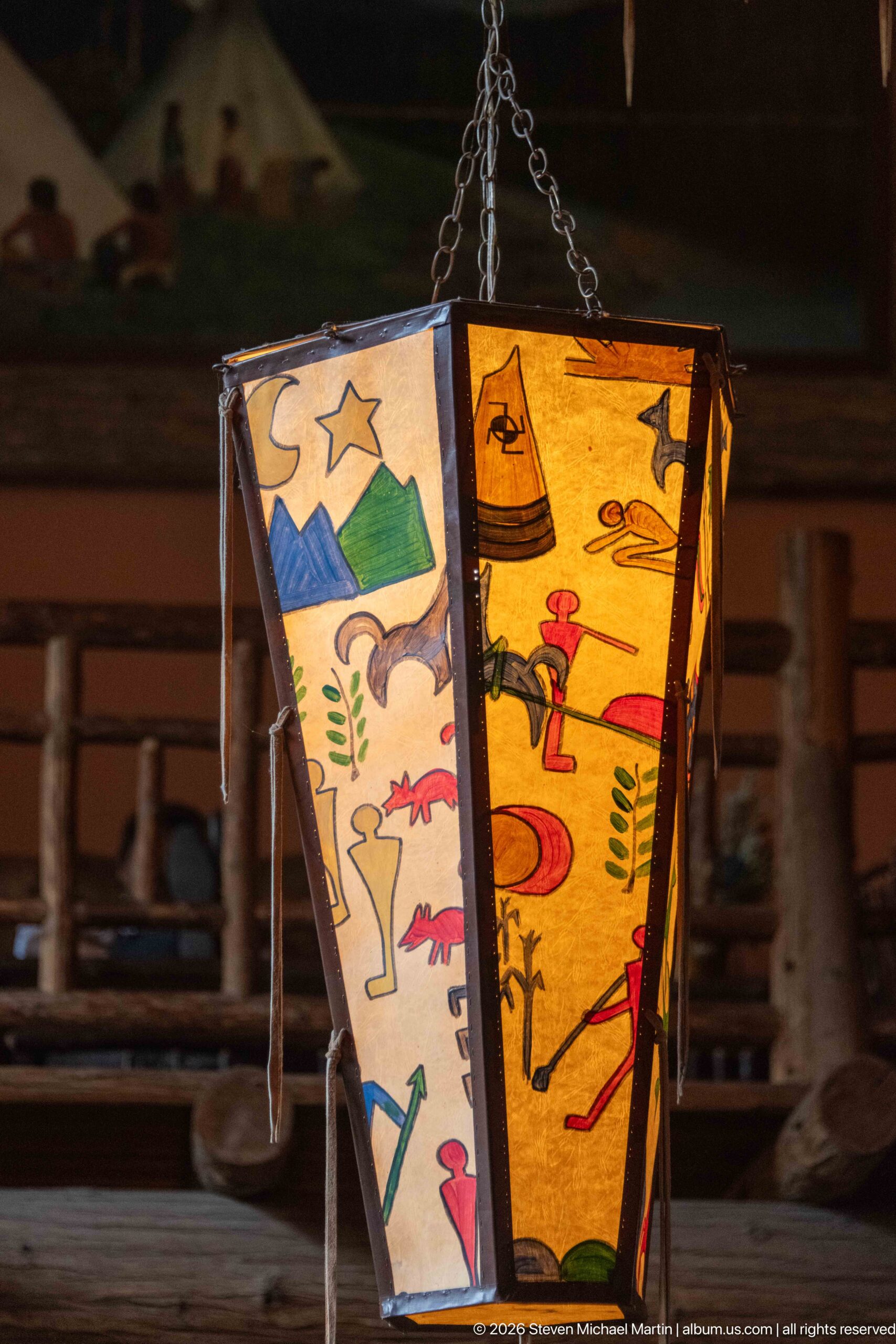
One of the lodge’s hanging lanterns appears in close detail, revealing individually painted panels divided by a dark frame. Stylized mountains, stars, plants, birds, animals, and human figures form a lively pictorial sequence across the glowing shade. The shallow depth of field isolates the fixture from the surrounding log interior, allowing its hand-decorated imagery and construction to be read clearly.
Caption
One of the lodge’s hanging lanterns appears in close detail, revealing individually painted panels divided by a dark frame. Stylized mountains, stars, plants, birds, animals, and human figures form a lively pictorial sequence across the glowing shade. The shallow depth of field isolates the fixture from the surrounding log interior, allowing its hand-decorated imagery and construction to be read clearly.
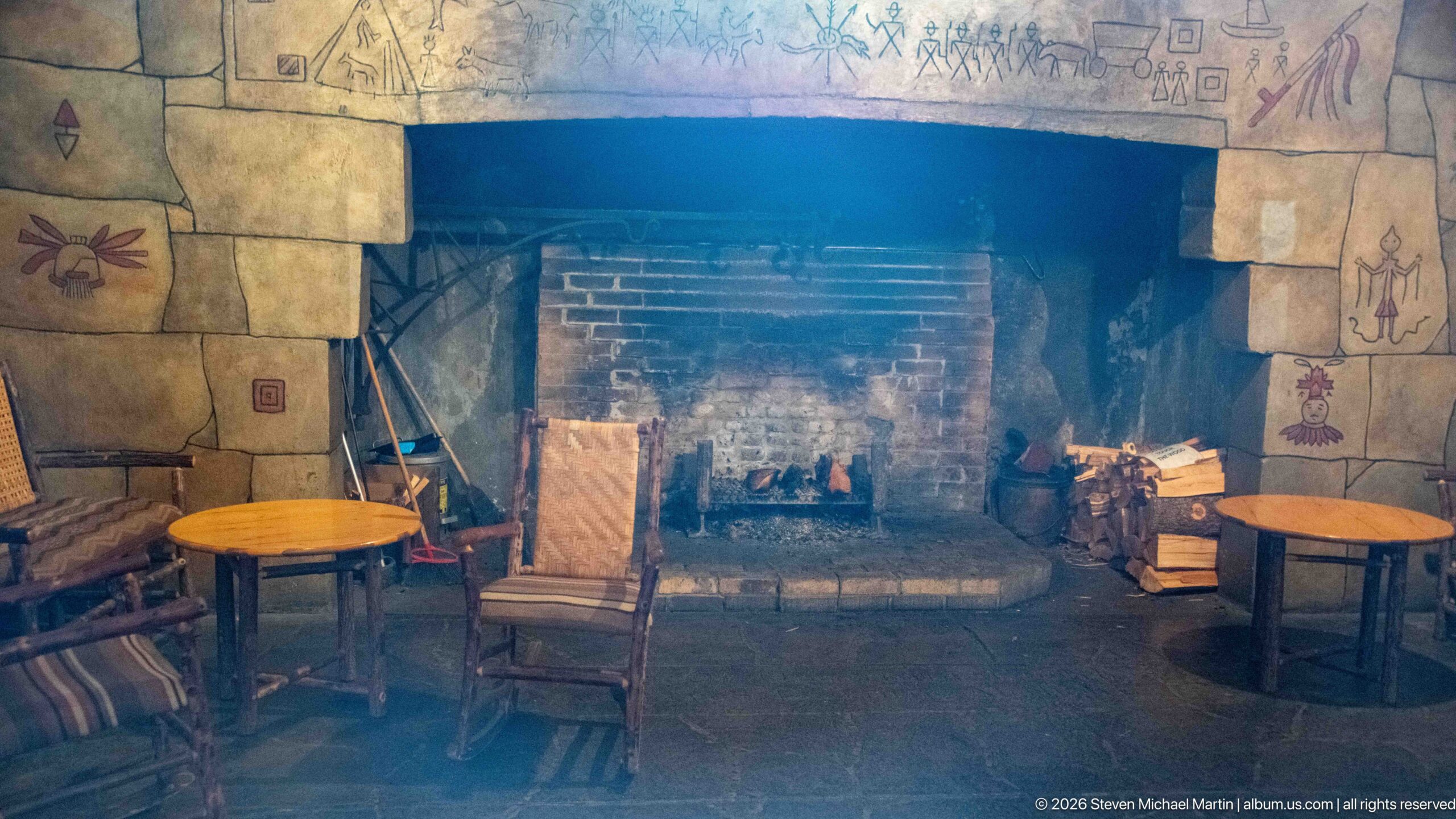
A broad masonry fireplace fills this intimate seating area, its pale surround decorated with painted or incised pictographic motifs. Low wooden tables and rustic chairs flank the dark brick firebox, creating a quieter counterpart to the lodge’s soaring main lobby. The close view emphasizes the handcrafted decorative vocabulary applied directly to the hearth surround and the simple furnishings arranged around it.
Caption
A broad masonry fireplace fills this intimate seating area, its pale surround decorated with painted or incised pictographic motifs. Low wooden tables and rustic chairs flank the dark brick firebox, creating a quieter counterpart to the lodge’s soaring main lobby. The close view emphasizes the handcrafted decorative vocabulary applied directly to the hearth surround and the simple furnishings arranged around it.
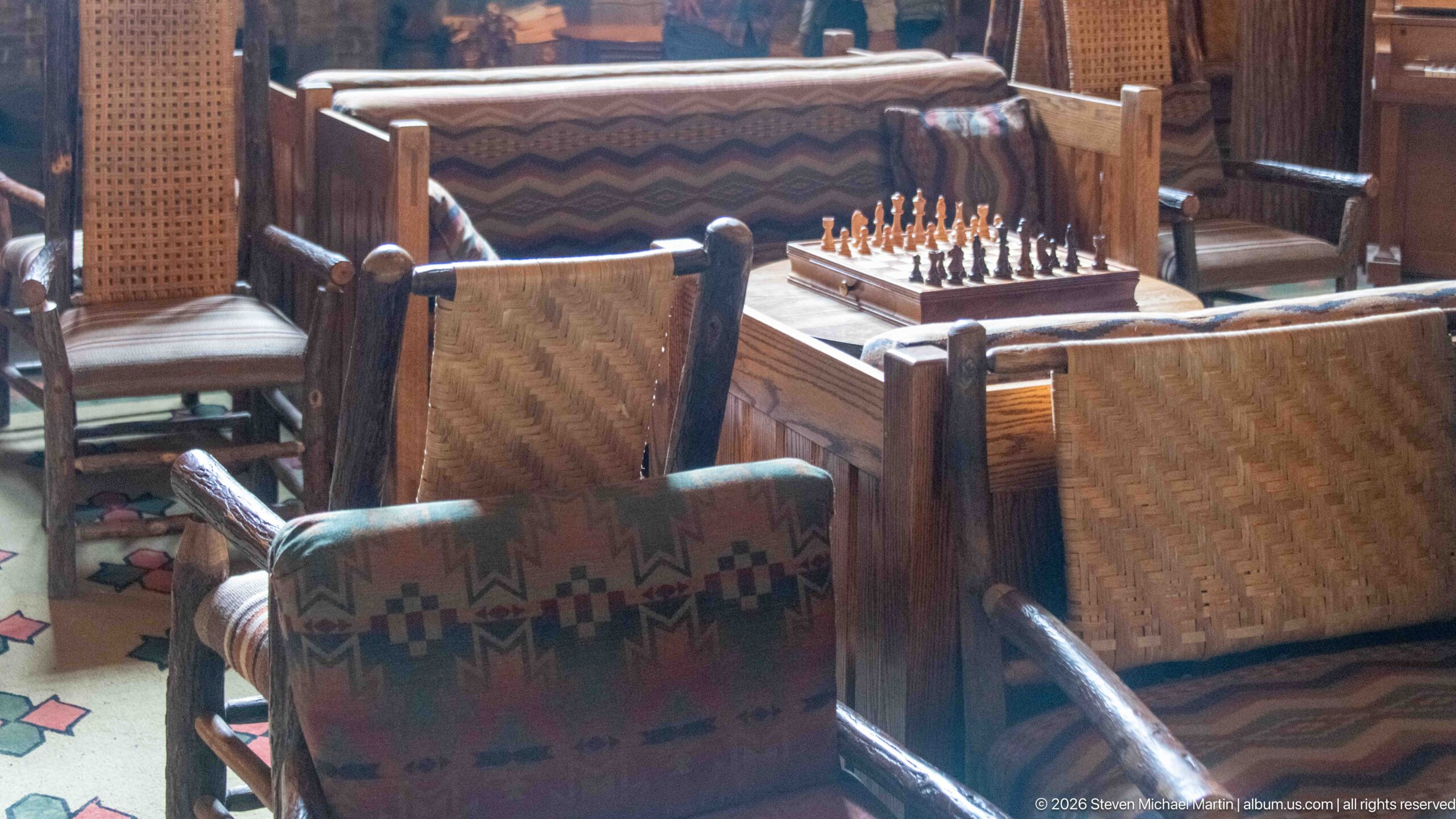
A chessboard set for play rests on a small table amid a cluster of rustic lodge chairs. Woven backs, rounded wooden frames, patterned upholstery, and nearby geometric textiles create a dense study of the lobby’s furnishings at close range. Rather than emphasizing the room’s architecture, this view records the tactile materials and informal recreational character of the seating area.
Caption
A chessboard set for play rests on a small table amid a cluster of rustic lodge chairs. Woven backs, rounded wooden frames, patterned upholstery, and nearby geometric textiles create a dense study of the lobby’s furnishings at close range. Rather than emphasizing the room’s architecture, this view records the tactile materials and informal recreational character of the seating area.
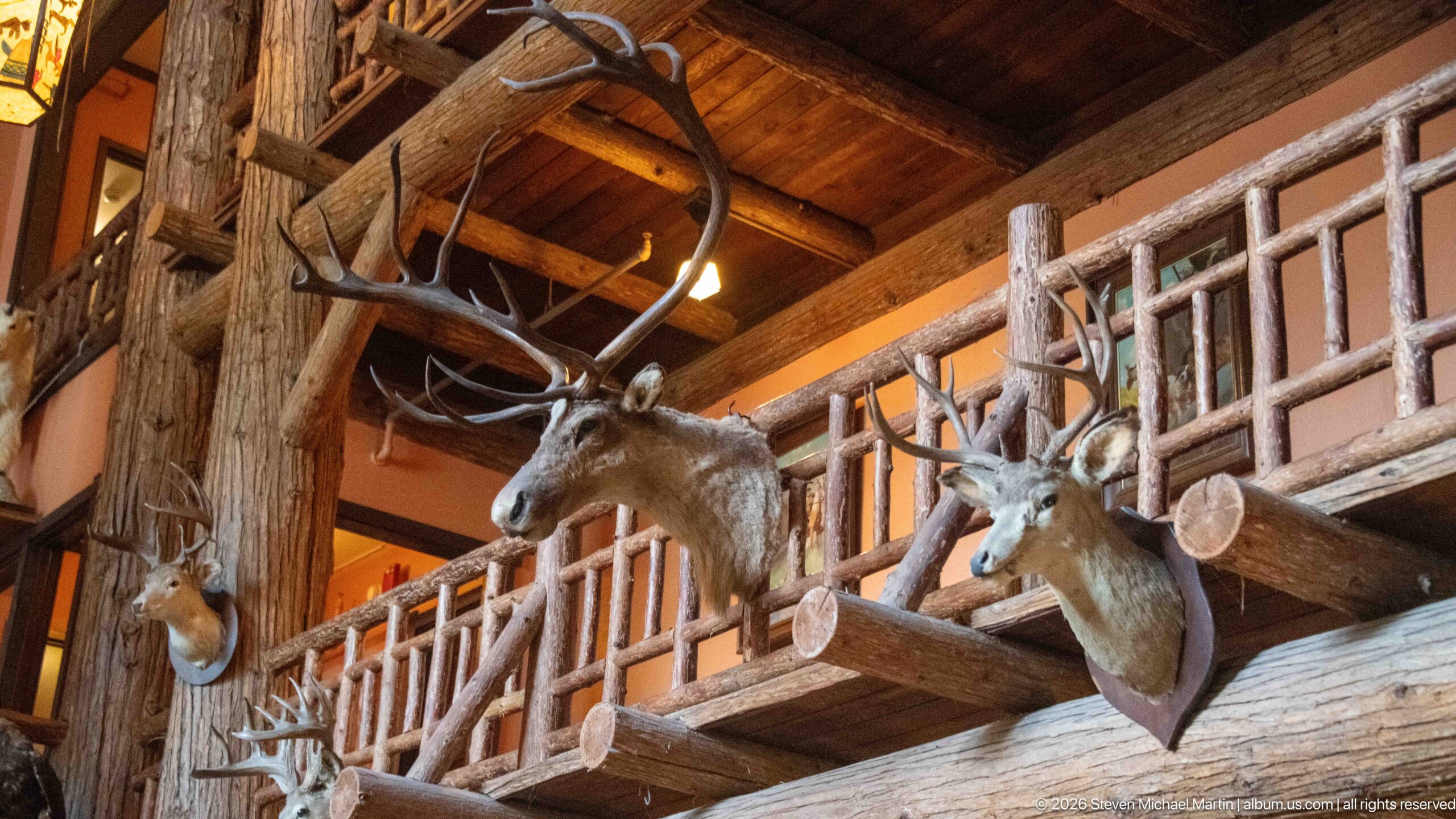
Several mounted deer-family heads project from the massive log structure supporting the lodge’s upper gallery. Antlered specimens alternate with smaller mounts along the rustic railing, creating a concentrated view of the historic trophy-display aesthetic used in the interior. Heavy round logs, branch-like balusters, and the timber ceiling reinforce the visual relationship between the wildlife mounts and the lodge’s deliberately rustic architectural character.
Caption
Several mounted deer-family heads project from the massive log structure supporting the lodge’s upper gallery. Antlered specimens alternate with smaller mounts along the rustic railing, creating a concentrated view of the historic trophy-display aesthetic used in the interior. Heavy round logs, branch-like balusters, and the timber ceiling reinforce the visual relationship between the wildlife mounts and the lodge’s deliberately rustic architectural character.
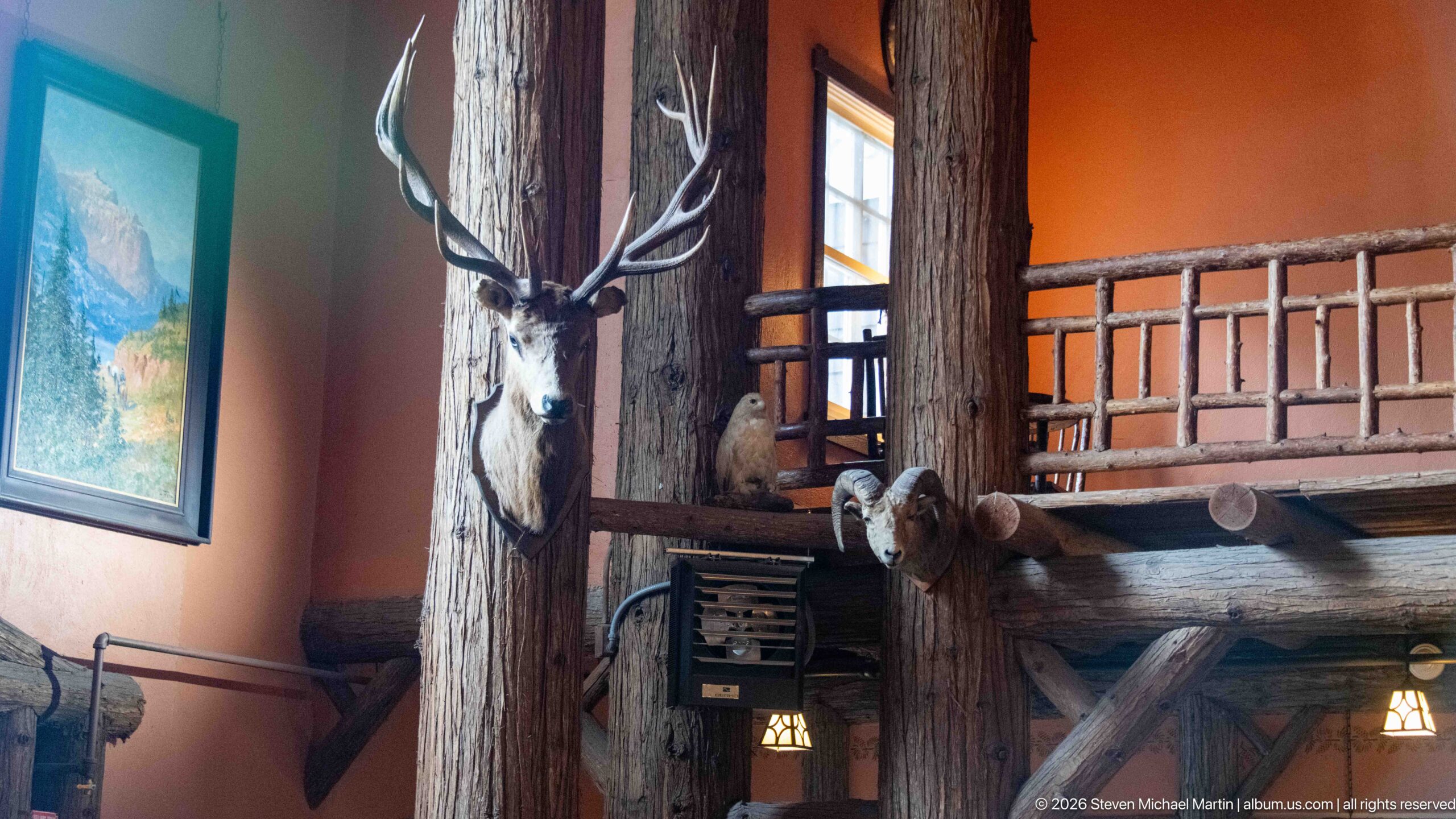
An antlered head mounted high on a log post shares the frame with a curled-horn sheep mount beside the upper gallery. The close composition separates these individual trophies from the broader display seen elsewhere in the lobby and shows their placement directly on the structural timbers. Warm wall surfaces, branch-like railings, and a framed landscape complete the rustic interior setting.
Caption
An antlered head mounted high on a log post shares the frame with a curled-horn sheep mount beside the upper gallery. The close composition separates these individual trophies from the broader display seen elsewhere in the lobby and shows their placement directly on the structural timbers. Warm wall surfaces, branch-like railings, and a framed landscape complete the rustic interior setting.
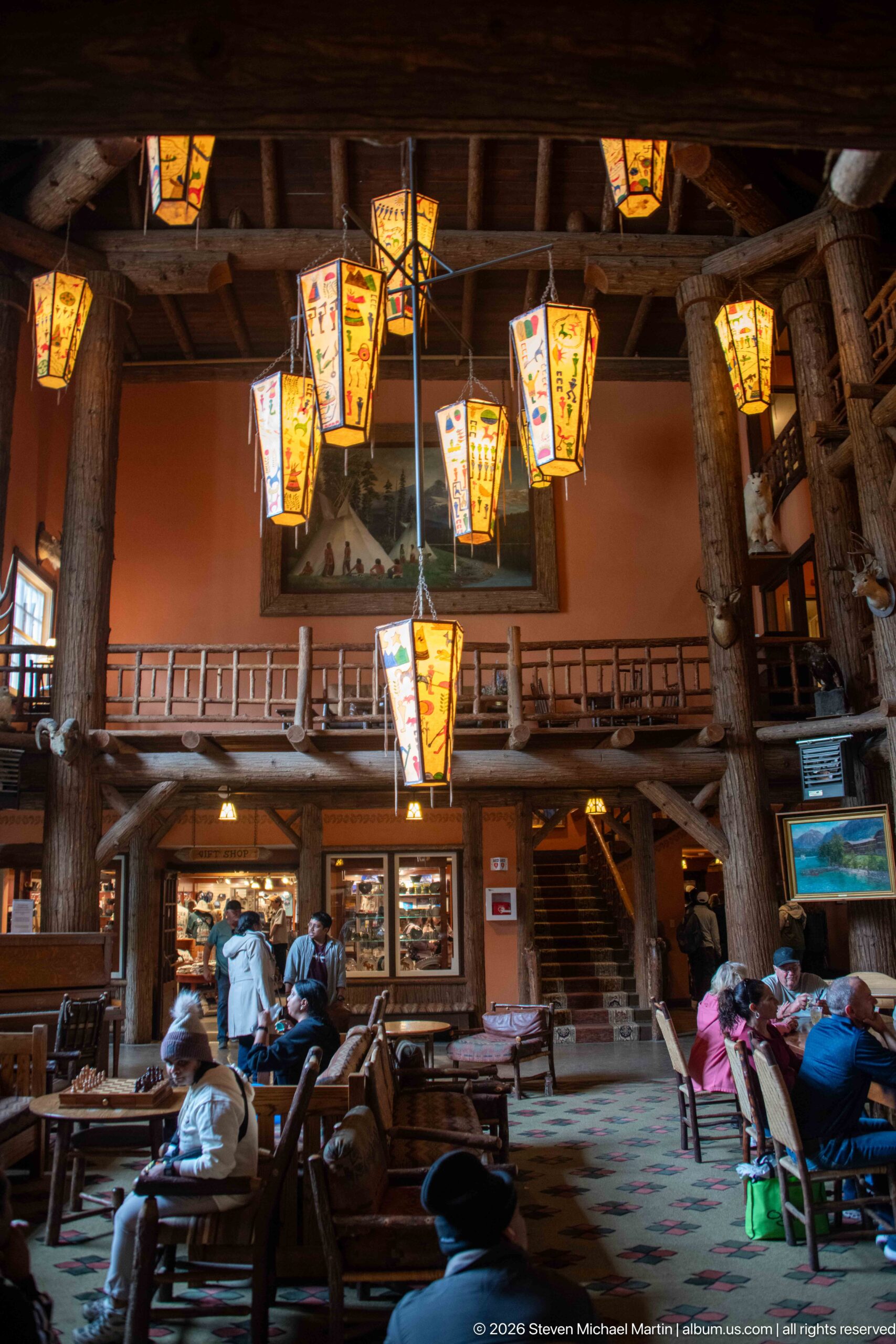
Visitors occupy chairs and tables across the lodge lobby beneath a broad cluster of painted hanging lanterns. The wide view brings together the upper log gallery, display cases, staircase, heavy timber supports, patterned carpet, and framed artwork, showing the room as an active communal space rather than an architectural detail. Human activity also provides scale for the unusually tall, open interior.
Caption
Visitors occupy chairs and tables across the lodge lobby beneath a broad cluster of painted hanging lanterns. The wide view brings together the upper log gallery, display cases, staircase, heavy timber supports, patterned carpet, and framed artwork, showing the room as an active communal space rather than an architectural detail. Human activity also provides scale for the unusually tall, open interior.
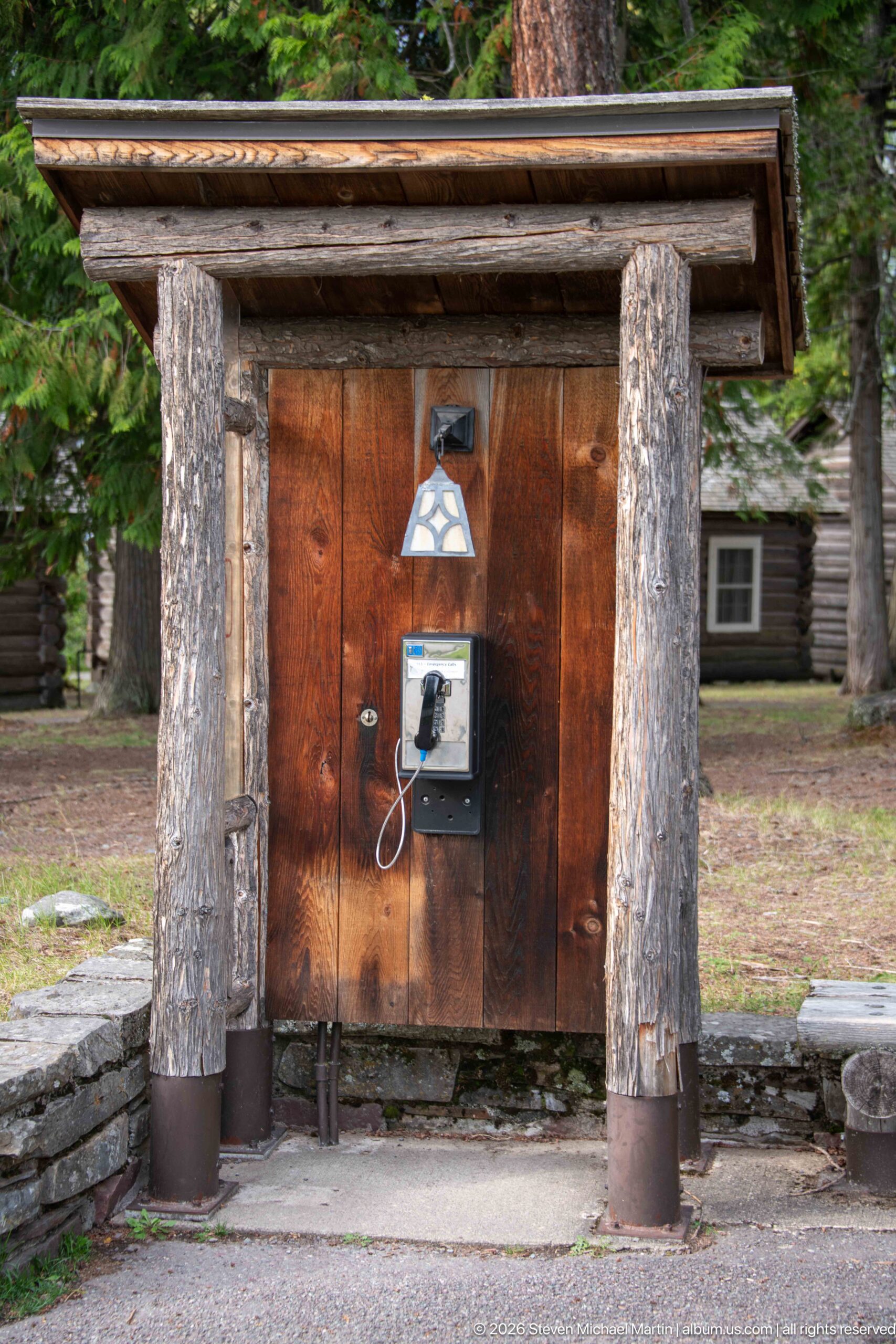
A wall-mounted public telephone is protected by a small rustic shelter built from heavy log posts, a shallow log-edged roof, and broad vertical wooden boards. A lamp hangs above the phone, and a simple bench-like ledge runs across the lower wall. The utilitarian fixture is treated with the same rough-hewn materials used throughout the lodge grounds, integrating modern communication equipment into the rustic setting.
Caption
A wall-mounted public telephone is protected by a small rustic shelter built from heavy log posts, a shallow log-edged roof, and broad vertical wooden boards. A lamp hangs above the phone, and a simple bench-like ledge runs across the lower wall. The utilitarian fixture is treated with the same rough-hewn materials used throughout the lodge grounds, integrating modern communication equipment into the rustic setting.
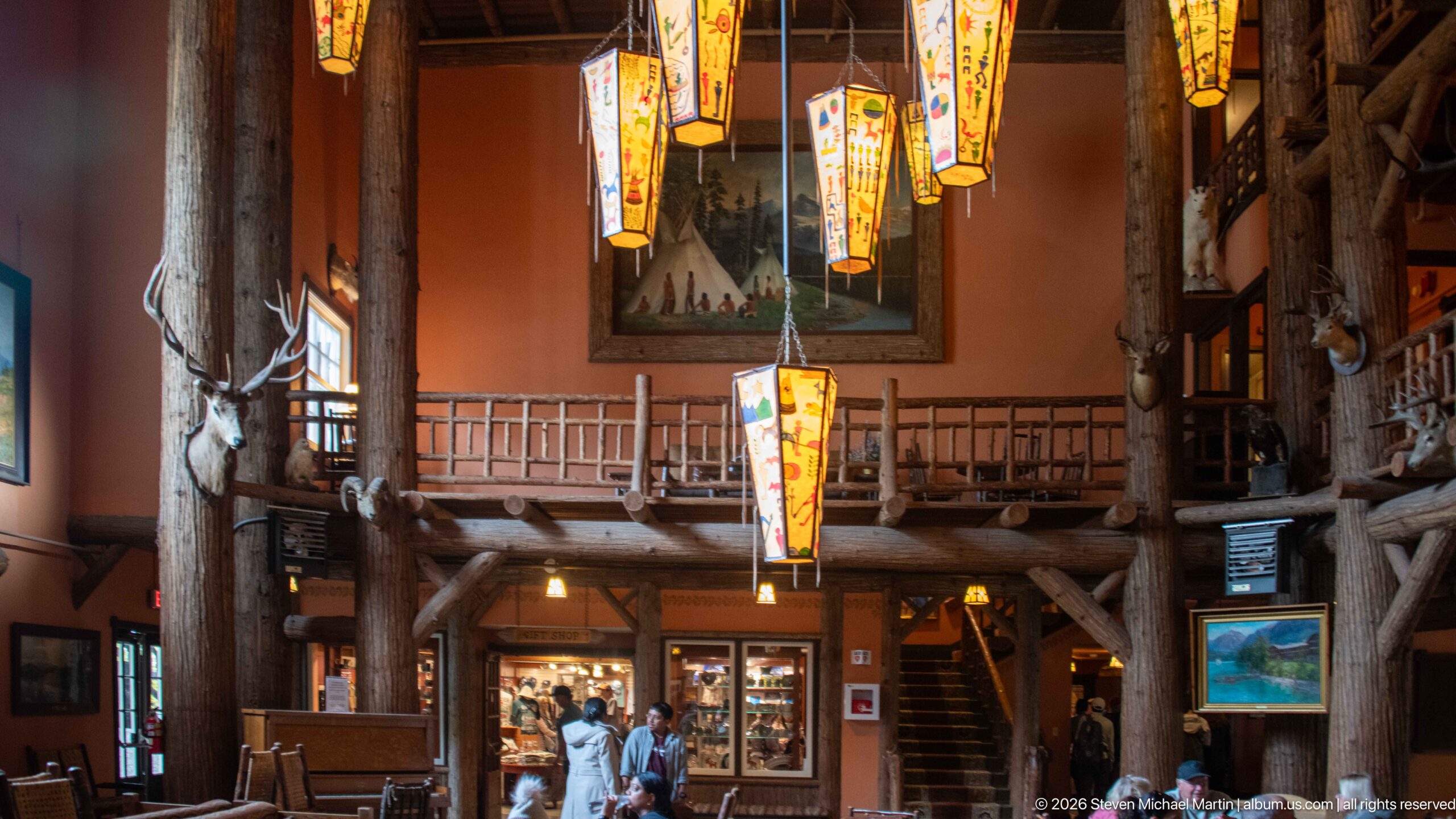
Painted lanterns descend through the tall central volume of the lodge, drawing the eye from the timber ceiling toward the ground-floor circulation area. An upper gallery wraps behind massive log columns, while mounted wildlife, framed art, a staircase, and display cases fill the surrounding walls. The nearly symmetrical view emphasizes the vertical organization of the interior and the visual prominence of its suspended lighting.
Caption
Painted lanterns descend through the tall central volume of the lodge, drawing the eye from the timber ceiling toward the ground-floor circulation area. An upper gallery wraps behind massive log columns, while mounted wildlife, framed art, a staircase, and display cases fill the surrounding walls. The nearly symmetrical view emphasizes the vertical organization of the interior and the visual prominence of its suspended lighting.
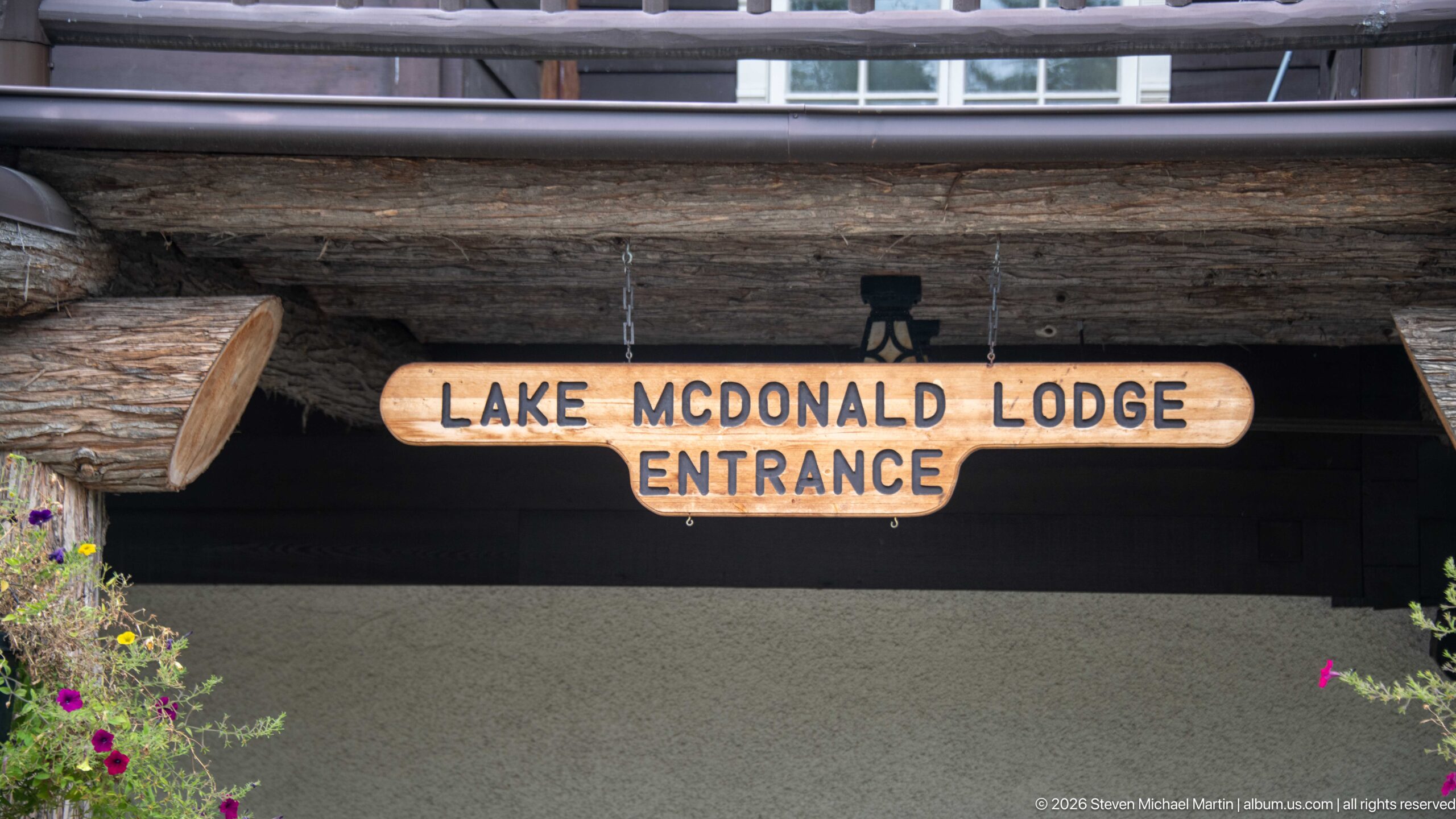
A carved wooden sign reading “LAKE MCDONALD LODGE ENTRANCE” hangs beneath a massive horizontal log at the building approach. Dark siding and a pale lower wall form a restrained background, while flowering baskets soften the heavy timber construction. The tightly framed view makes the hand-lettered entrance marker the defining feature and records the rustic signage used to direct arriving guests.
Caption
A carved wooden sign reading “LAKE MCDONALD LODGE ENTRANCE” hangs beneath a massive horizontal log at the building approach. Dark siding and a pale lower wall form a restrained background, while flowering baskets soften the heavy timber construction. The tightly framed view makes the hand-lettered entrance marker the defining feature and records the rustic signage used to direct arriving guests.
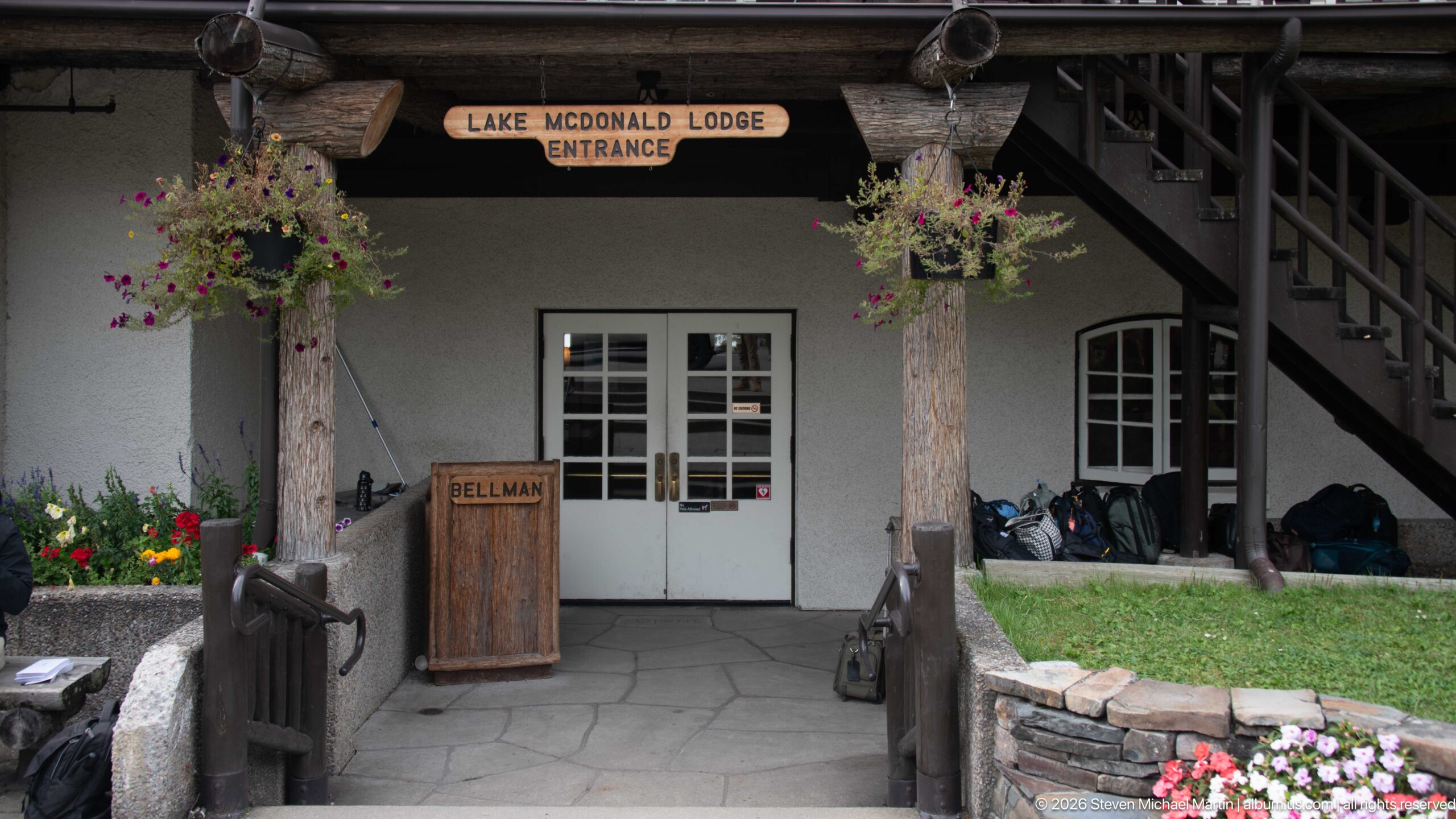
The covered entrance to Lake McDonald Lodge is framed by thick log posts, hanging flower baskets, and an exterior staircase. A wooden bellman stand sits beside the white double doors beneath the lodge entrance sign, while stone edging and planted beds define the approach. This view expands the signage detail into its functional setting, showing the sheltered threshold where guests enter the building.
Caption
The covered entrance to Lake McDonald Lodge is framed by thick log posts, hanging flower baskets, and an exterior staircase. A wooden bellman stand sits beside the white double doors beneath the lodge entrance sign, while stone edging and planted beds define the approach. This view expands the signage detail into its functional setting, showing the sheltered threshold where guests enter the building.
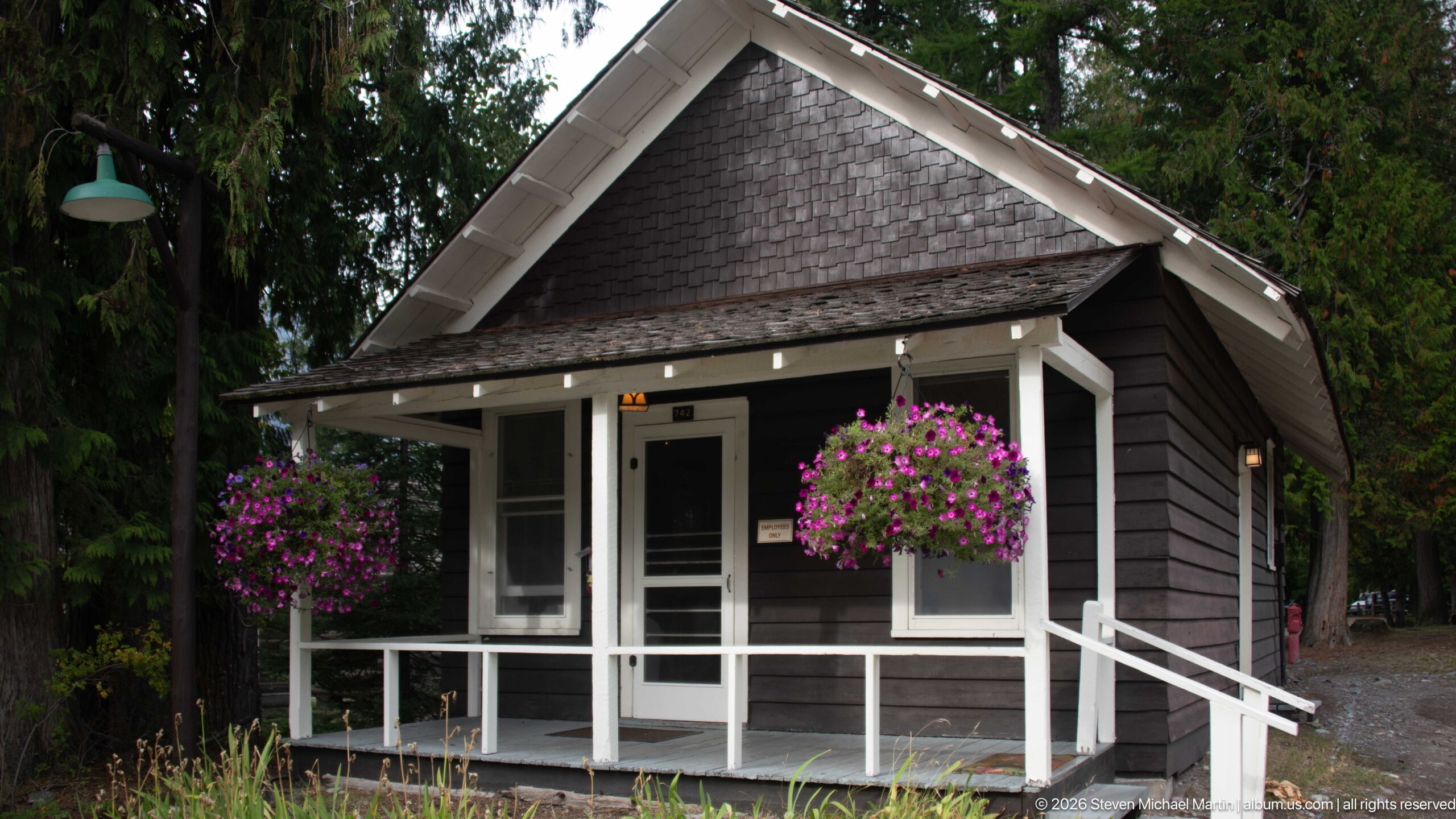
A compact dark-sided building stands beneath tall evergreens, its steep front gable and shingled roof contrasting with crisp white porch posts, railings, and trim. A hanging basket of purple flowers brightens the small covered entry, while a ramp-like walkway leads to the door. The modest scale and simplified construction distinguish this outbuilding from the much larger lodge nearby.
Caption
A compact dark-sided building stands beneath tall evergreens, its steep front gable and shingled roof contrasting with crisp white porch posts, railings, and trim. A hanging basket of purple flowers brightens the small covered entry, while a ramp-like walkway leads to the door. The modest scale and simplified construction distinguish this outbuilding from the much larger lodge nearby.
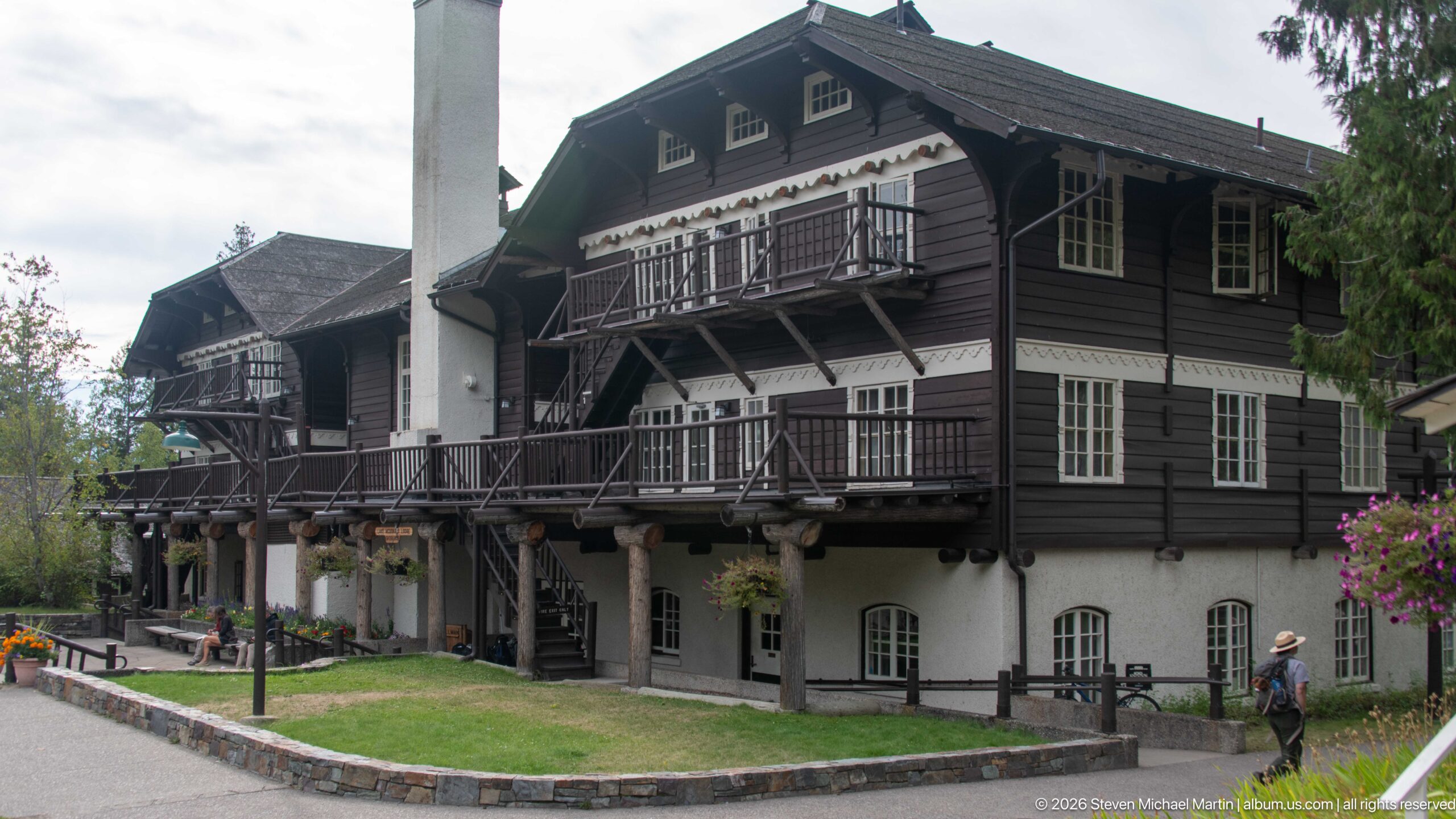
The lodge exterior rises in a series of dark-shingled gables above a pale masonry ground level, with projecting wooden balconies and exterior stairs crossing the façade. White-framed windows punctuate the dark upper walls, and a tall chimney divides the composition. Seen from the landscaped grounds, the view emphasizes the building’s layered massing and the extensive balcony system serving its upper floors.
Caption
The lodge exterior rises in a series of dark-shingled gables above a pale masonry ground level, with projecting wooden balconies and exterior stairs crossing the façade. White-framed windows punctuate the dark upper walls, and a tall chimney divides the composition. Seen from the landscaped grounds, the view emphasizes the building’s layered massing and the extensive balcony system serving its upper floors.
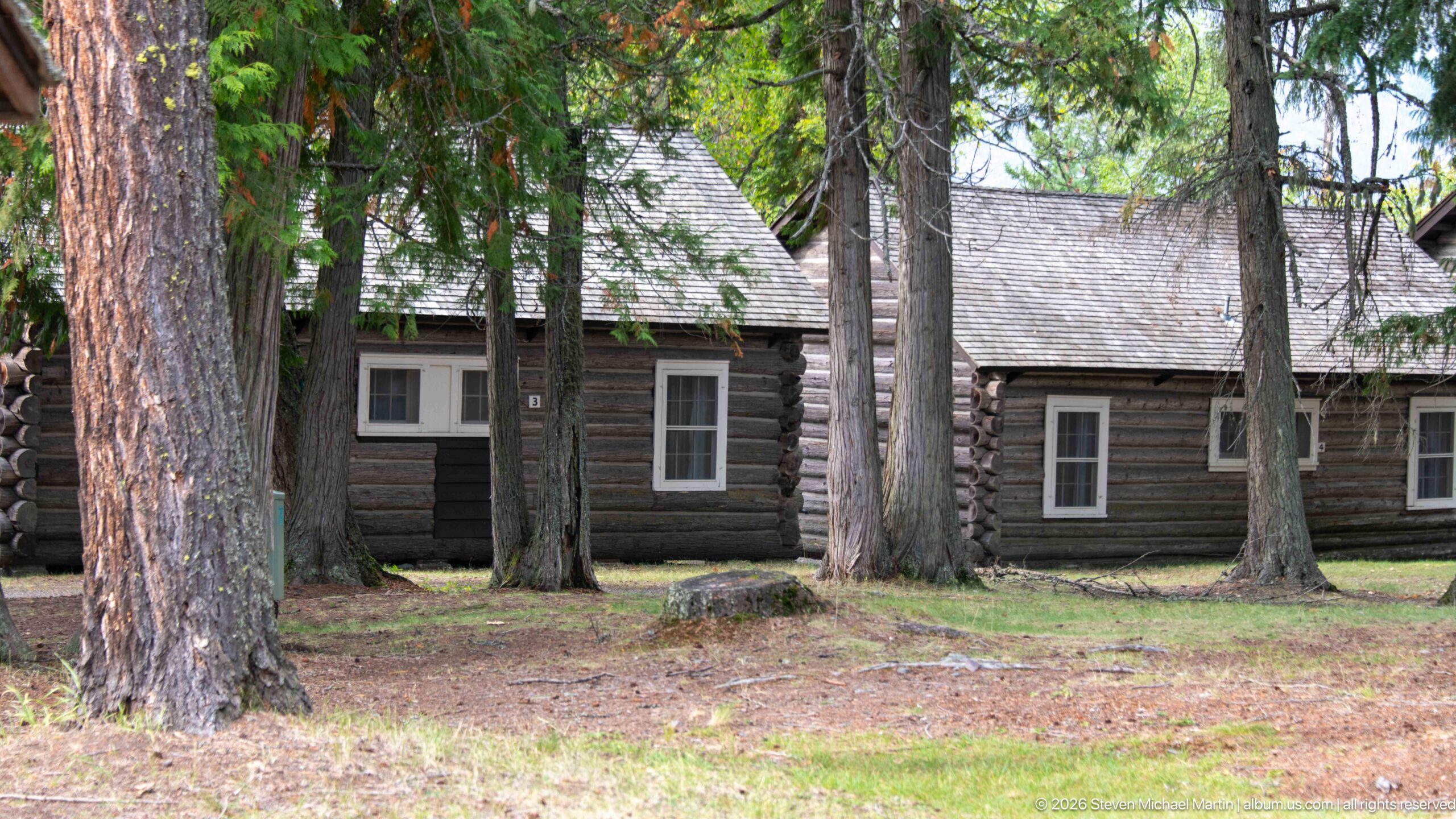
A long, low log cabin sits among mature conifers on the lodge grounds, its horizontal log walls interrupted by small white-trimmed windows. A steep shingled roof and projecting end section give the otherwise simple structure a strongly rustic profile. Tree trunks partially screen the façade, integrating the building visually with the forested setting and distinguishing it from the larger frame lodge structures nearby.
Caption
A long, low log cabin sits among mature conifers on the lodge grounds, its horizontal log walls interrupted by small white-trimmed windows. A steep shingled roof and projecting end section give the otherwise simple structure a strongly rustic profile. Tree trunks partially screen the façade, integrating the building visually with the forested setting and distinguishing it from the larger frame lodge structures nearby.
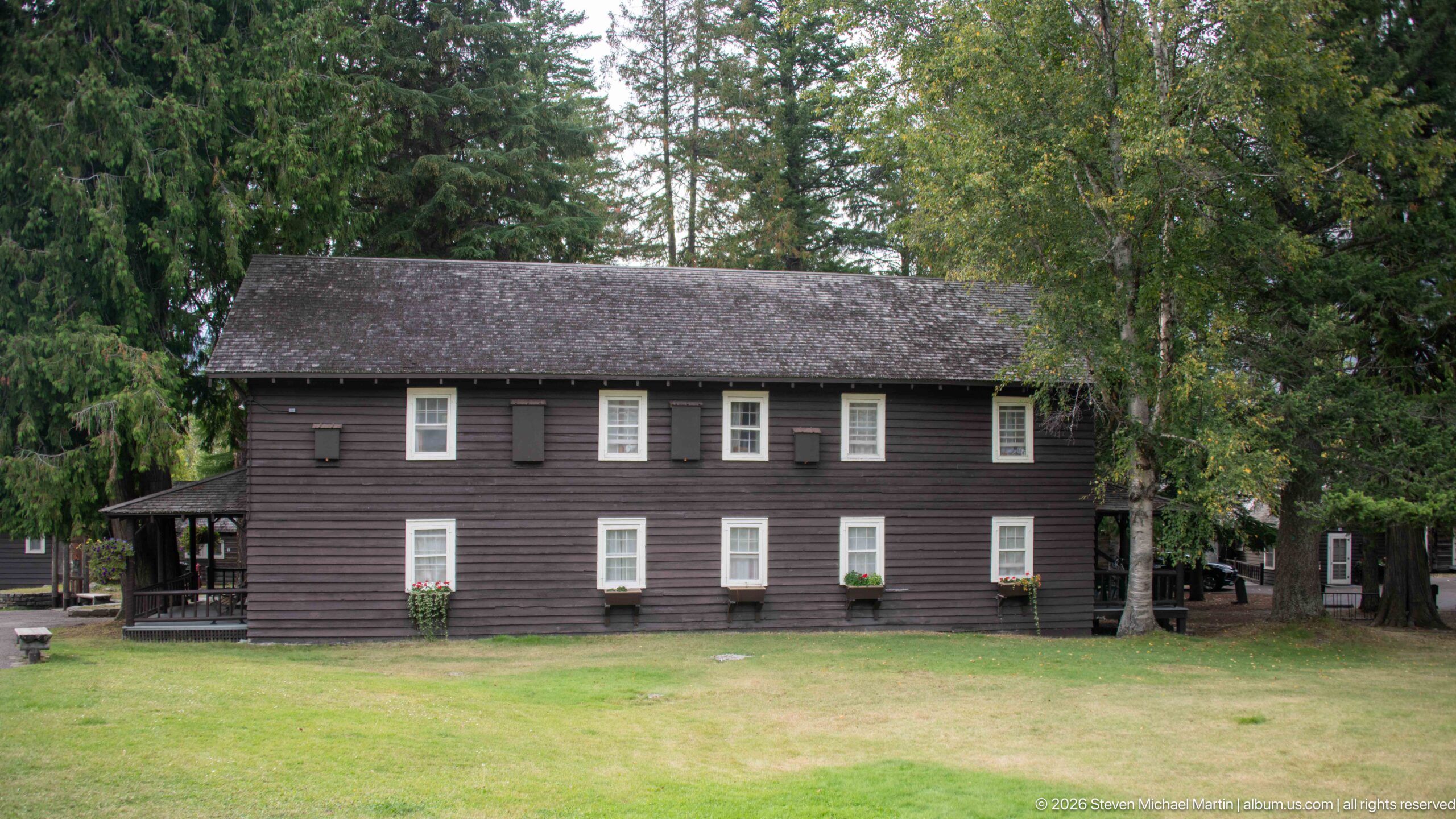
A long two-story building faces an open lawn at the edge of the forest, with evenly spaced white-trimmed windows set into dark horizontal siding. Its low shingled roof, small porch, and restrained rectangular form contrast with the more elaborate balconies and gables of the main lodge. The broad frontal view records the building’s regular fenestration and quiet relationship to the surrounding trees.
Caption
A long two-story building faces an open lawn at the edge of the forest, with evenly spaced white-trimmed windows set into dark horizontal siding. Its low shingled roof, small porch, and restrained rectangular form contrast with the more elaborate balconies and gables of the main lodge. The broad frontal view records the building’s regular fenestration and quiet relationship to the surrounding trees.
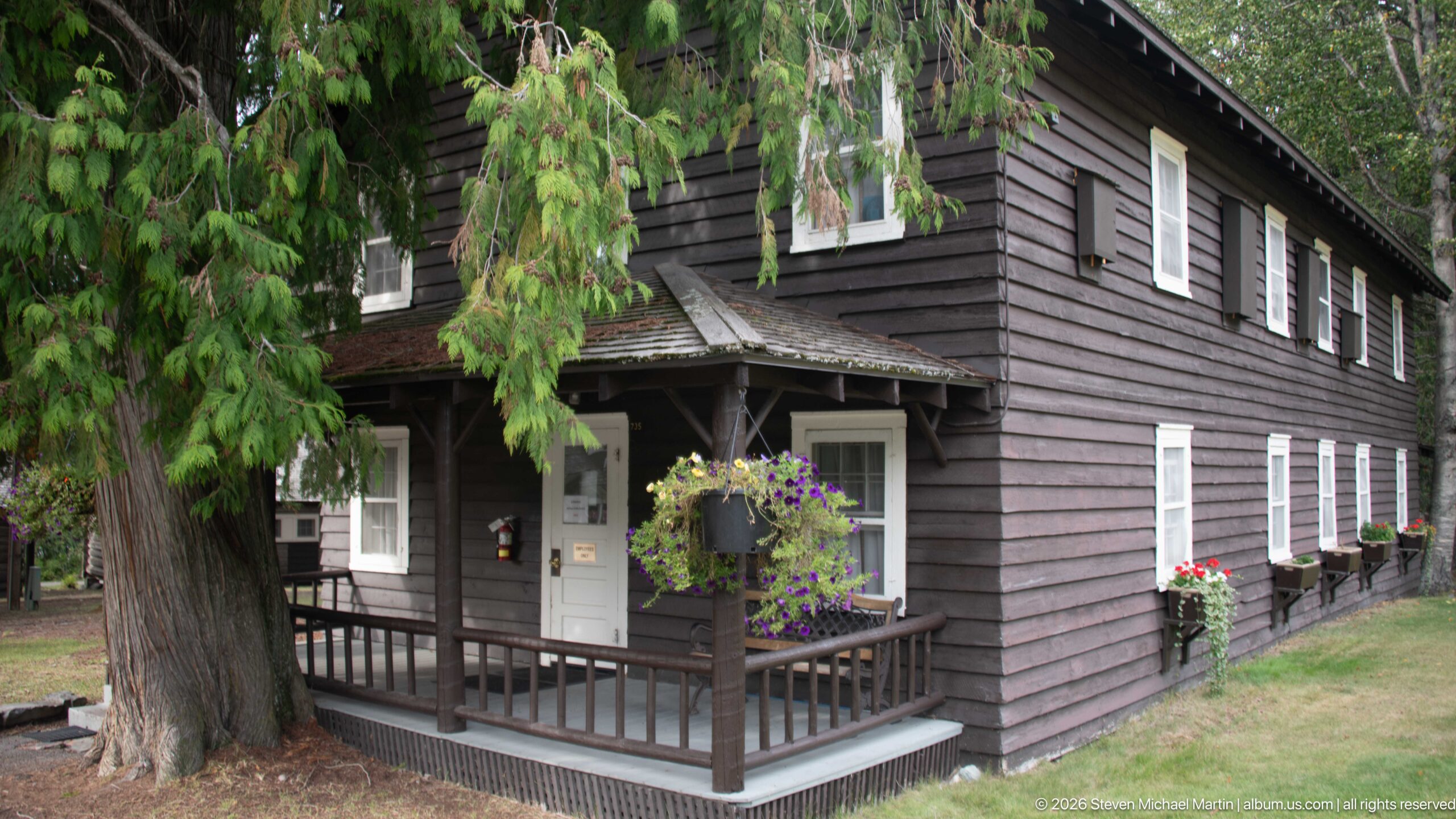
A small covered porch marks the corner entrance of a two-story dark-sided building on the lodge grounds. White-trimmed windows form a regular row along both stories, while a large cedar-like tree and drooping branches partly frame the façade. Hanging flowers and a window box add seasonal detail, and the oblique angle reveals the building’s simple rectangular massing more clearly than the distant lawn view.
Caption
A small covered porch marks the corner entrance of a two-story dark-sided building on the lodge grounds. White-trimmed windows form a regular row along both stories, while a large cedar-like tree and drooping branches partly frame the façade. Hanging flowers and a window box add seasonal detail, and the oblique angle reveals the building’s simple rectangular massing more clearly than the distant lawn view.
Field Guide
Overview
Lake McDonald Lodge stands on the eastern shore of Lake McDonald in Glacier National Park, where forested slopes and mountain scenery frame one of the park’s best-known historic accommodations. Built during the winter of 1913–1914, the lodge belongs to the formative period of park tourism, when visitors commonly reached this part of Glacier by water rather than road. Its rustic architecture combines native stone, western red cedar, massive timbers, broad eaves, balconies, and Swiss-influenced details. The portfolio follows the lodge from its lakeside setting and exterior architecture into its public interiors, where exposed logs, balconies, fireplaces, furnishings, signs, and gathering spaces continue the rustic vocabulary.
Landscape
The lodge is inseparable from Lake McDonald and the mountain landscape surrounding it. Lake McDonald extends for roughly ten miles through a broad valley shaped by ancient glaciers, with dense forest descending toward the shoreline and increasingly rugged mountains rising toward the Continental Divide. The lodge’s placement beside the water reflects the importance of the lake to its original visitor experience. Before road access transformed travel through the park, arriving across Lake McDonald made the landscape itself part of the approach to the building.
Geology
The setting of Lake McDonald Lodge reflects the large-scale glacial processes that shaped Glacier National Park. Lake McDonald occupies a broad mountain valley carved and modified by ancient glaciers, leaving a long lake basin enclosed by forested slopes and higher peaks. From the lodge and lakeshore, the relationship between water, valley, and mountains provides the clearest geological story supported by this portfolio: the historic building occupies a human-scale edge within a much larger glacial landscape.
Ecology
Forest is the dominant natural setting around Lake McDonald Lodge. Trees closely surround the developed lodge grounds and extend up the mountain slopes bordering the lake, creating a strong transition between the historic visitor complex and the protected landscape beyond it. The portfolio supports an interpretation centered on this relationship between forest, lakeshore, and built environment rather than on individual plant species. Landscaping immediately around the lodge introduces a more managed layer of vegetation while the surrounding forest retains the larger national-park setting.
Wildlife
Wildlife is part of Glacier National Park’s broader ecological context, but it is not a principal subject of this Lake McDonald Lodge portfolio. The photographs and supplied portfolio knowledge concentrate instead on architecture, landscape, forest, lake, and visitor experience. For this Field Guide, wildlife is therefore best understood as part of the protected ecosystem surrounding the lodge rather than as a subject documented closely enough here to support species-level interpretation.
Human History
Lake McDonald Lodge was built in 1913–1914 after John Lewis acquired an earlier hotel on the site and replaced it with a new 65-room lodge. Its construction reflected the relative isolation of the location: materials unavailable locally were brought from the railroad depot at Belton and transported up Lake McDonald. Because early guests also approached by boat, the building’s principal façade faces the lake rather than the modern roadway. The lodge later became part of a changing visitor landscape as Going-to-the-Sun Road connected this area to automobile travel across the park. Western artist Charles M. Russell was associated with the lodge and was known to entertain visitors with stories in its lobby.
Recreation and Visitor Experience
The portfolio records Lake McDonald Lodge as both a historic building and an active visitor destination. Exterior walkways, balconies, landscaped areas, public corridors, retail space, dining and lounge signs, and the great lobby show how guests move through and use the lodge today. Inside, massive peeled-log columns, rustic railings, suspended lanterns, fireplaces, and timber-framed passages create a distinctive sequence of public spaces. These interiors preserve the atmosphere of an early twentieth-century park resort while continuing to serve contemporary visitors.
Photography Notes
Lake McDonald Lodge rewards a photographic approach that alternates between setting, architecture, and detail. Wider exterior views establish the relationship among the lodge, forest, landscaped grounds, and Lake McDonald, while oblique views reveal stacked balconies, deep eaves, log supports, and contrasting wall materials. Indoors, the strongest compositions use the lobby’s vertical space, massive timber structure, galleries, lanterns, signs, and furnishings to convey scale and character. Smaller details and circulation spaces complement these broader views by showing how rustic design continues throughout the building.