Introduction to Grey Cliff Prairie Dog Town
Greycliff Prairie Dog Town State Park lies along the open grasslands of south-central Montana near the small community of Greycliff. The 98-acre park protects a colony of black-tailed prairie dogs and provides visitors with an opportunity to observe these highly social animals within their natural prairie habitat.
Black-tailed prairie dogs live in complex colonies composed of interconnected family groups and extensive underground burrow systems. Their grazing and burrowing continually reshape the surrounding grassland, creating habitat that can also support other prairie wildlife. Once widespread across the Great Plains, prairie dog colonies have declined substantially as their native grassland habitat has been converted or fragmented.
Greycliff Prairie Dog Town State Park preserves a small example of this once-vast prairie ecosystem. Visitors can watch prairie dogs feeding among the grasses, standing upright near their burrows, interacting with neighboring animals, and sounding characteristic alarm calls across the colony. The site provides an intimate view of both the behavior of black-tailed prairie dogs and their important ecological role within the grasslands of the American West.
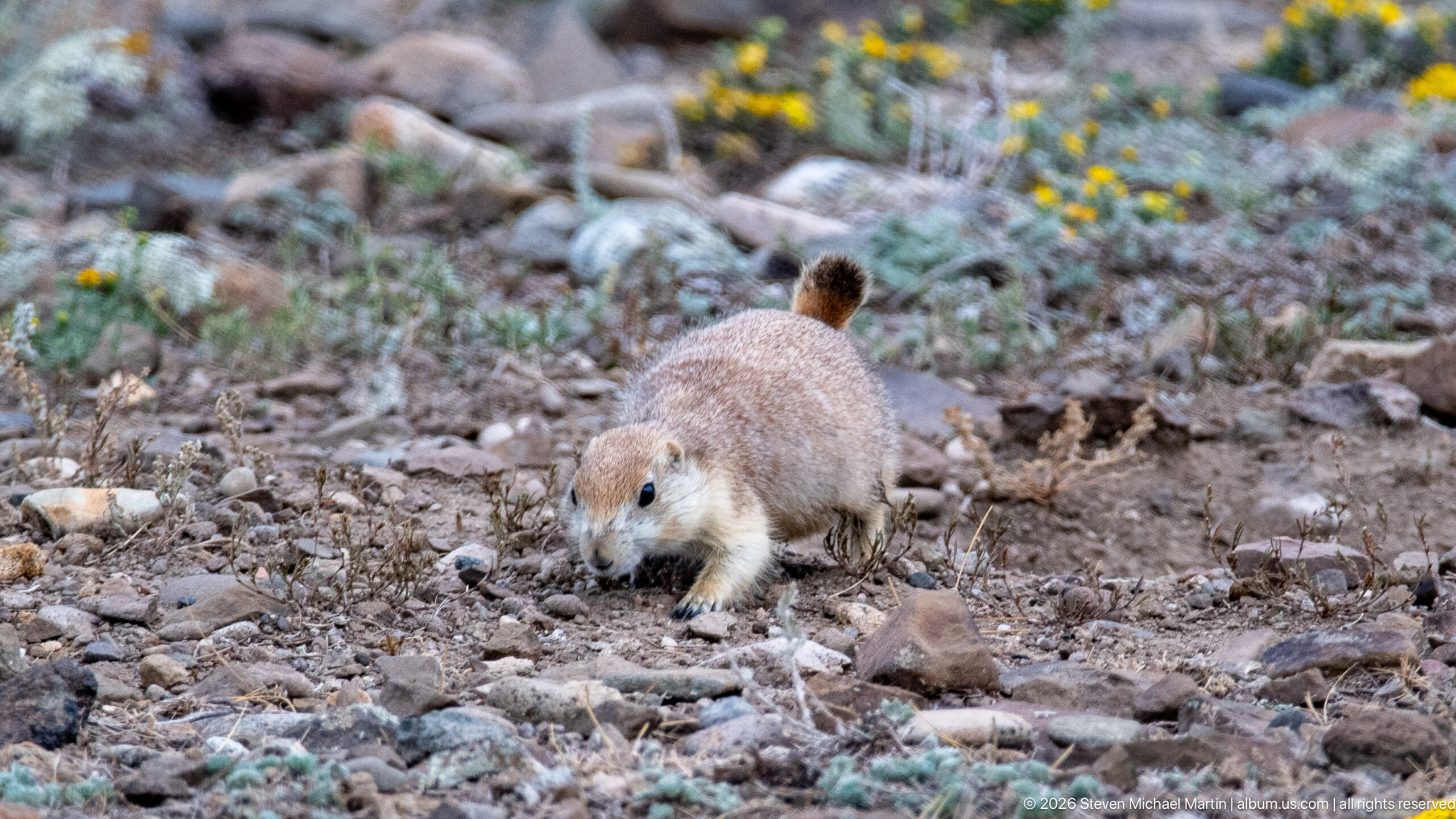
A prairie dog approaches almost head-on across an open patch of rocky soil. Its low, forward-moving stance, pale face, and raised tail create a direct encounter, while scattered yellow flowers and gray-green plants soften the dry, disturbed surface of the colony.
Caption
A prairie dog approaches almost head-on across an open patch of rocky soil. Its low, forward-moving stance, pale face, and raised tail create a direct encounter, while scattered yellow flowers and gray-green plants soften the dry, disturbed surface of the colony.
The Montana State Parks emblem fills the frame with a stylized mountain landscape, winding white river or trail, green foreground, and bold block lettering. Presented against a red field, the graphic provides a strong visual marker of the site’s administration within the state park system.
Caption
The Montana State Parks emblem fills the frame with a stylized mountain landscape, winding white river or trail, green foreground, and bold block lettering. Presented against a red field, the graphic provides a strong visual marker of the site’s administration within the state park system.
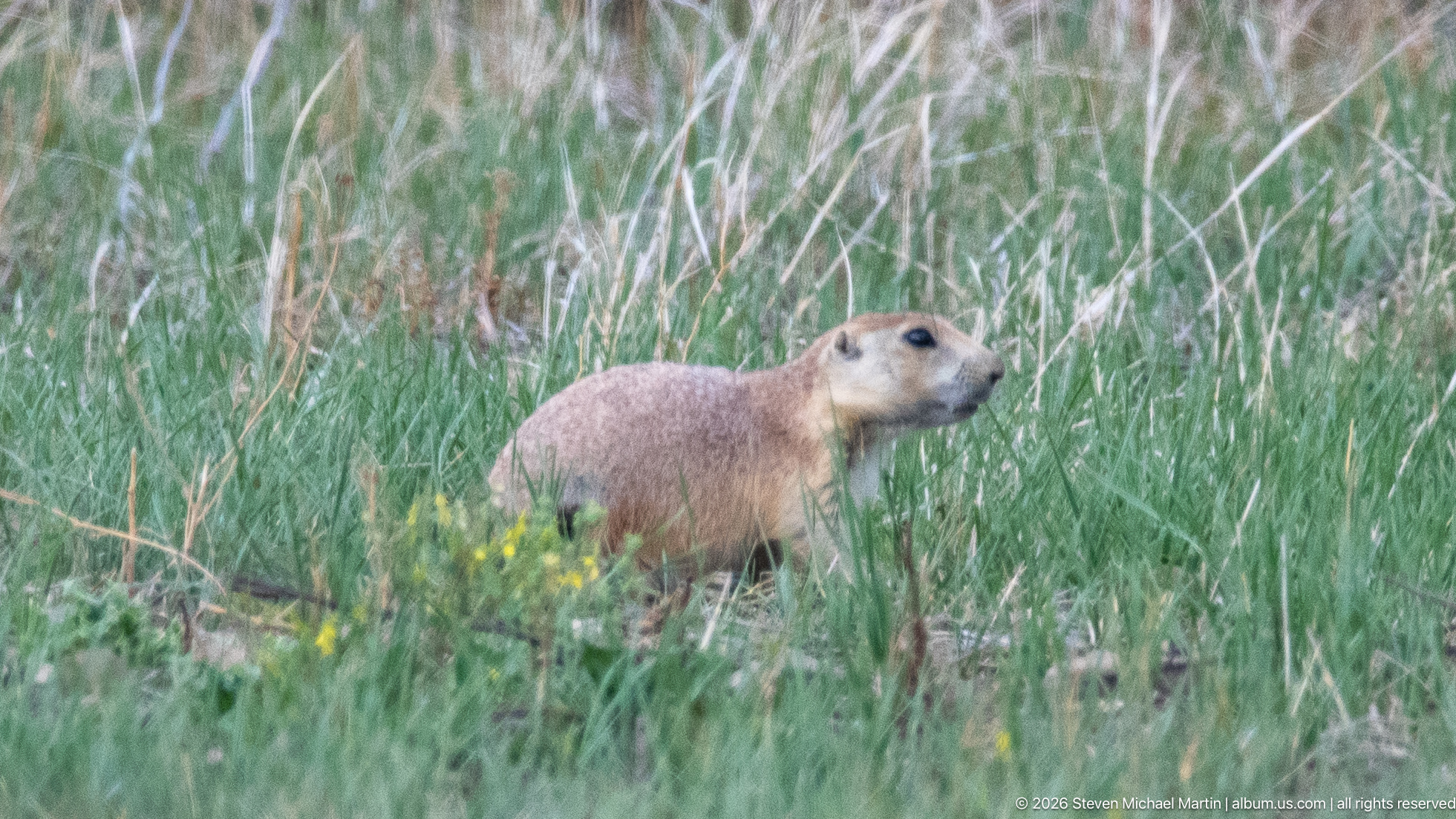
Standing in dense green grass, a prairie dog turns its head to the right with its body held above the surrounding vegetation. Yellow flowers and pale seed heads break up the foreground, while taller grasses soften the background. Unlike the mound-centered views, this frame places the animal fully within the living grassland cover of the prairie-dog colony.
Caption
Standing in dense green grass, a prairie dog turns its head to the right with its body held above the surrounding vegetation. Yellow flowers and pale seed heads break up the foreground, while taller grasses soften the background. Unlike the mound-centered views, this frame places the animal fully within the living grassland cover of the prairie-dog colony.
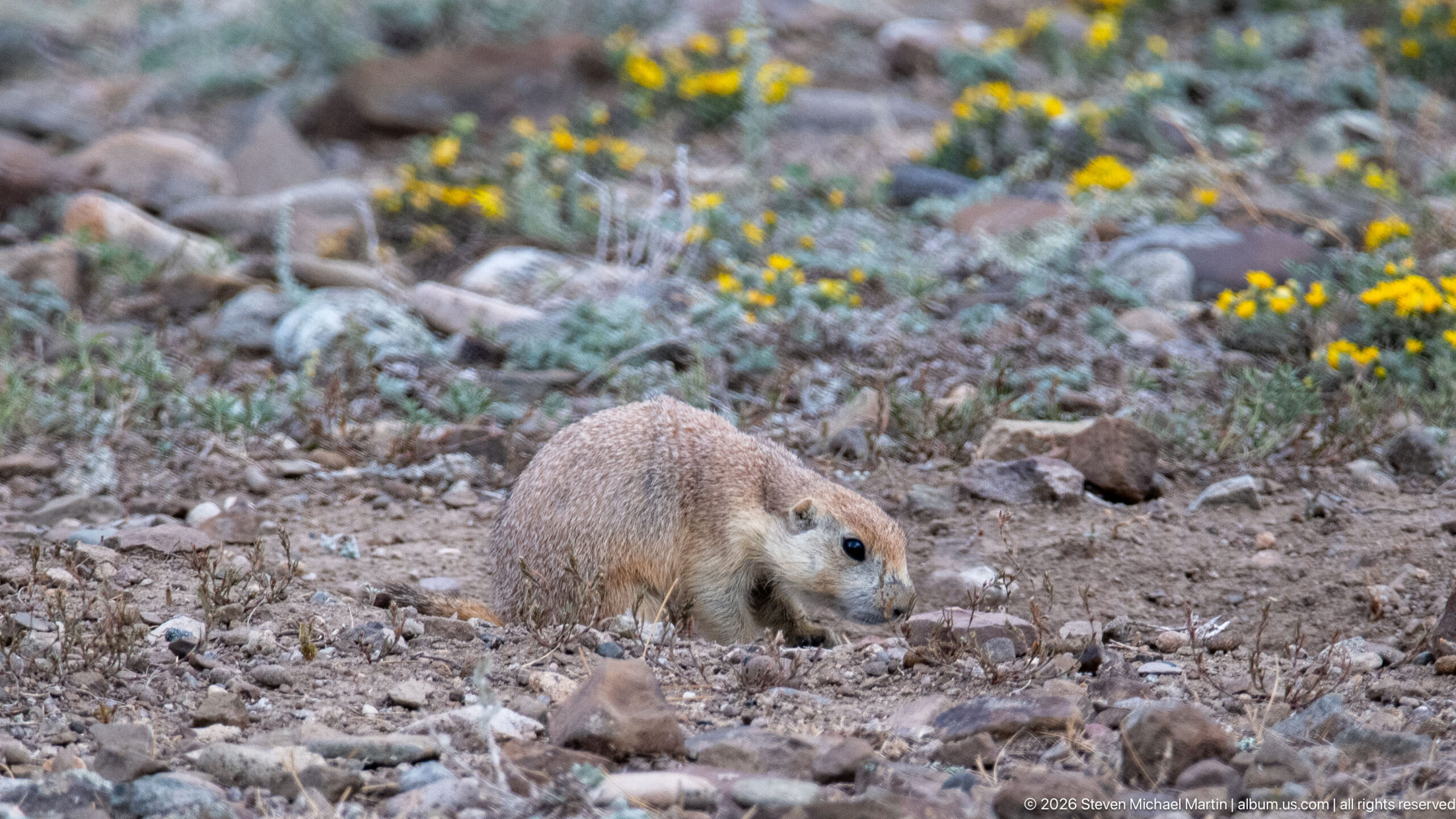
A prairie dog walks across the colony floor with its head held just above the ground. Yellow blossoms and patches of gray-green vegetation rise behind it, while the foreground remains open and stony, showing the close relationship between feeding habitat and exposed soil.
Caption
A prairie dog walks across the colony floor with its head held just above the ground. Yellow blossoms and patches of gray-green vegetation rise behind it, while the foreground remains open and stony, showing the close relationship between feeding habitat and exposed soil.
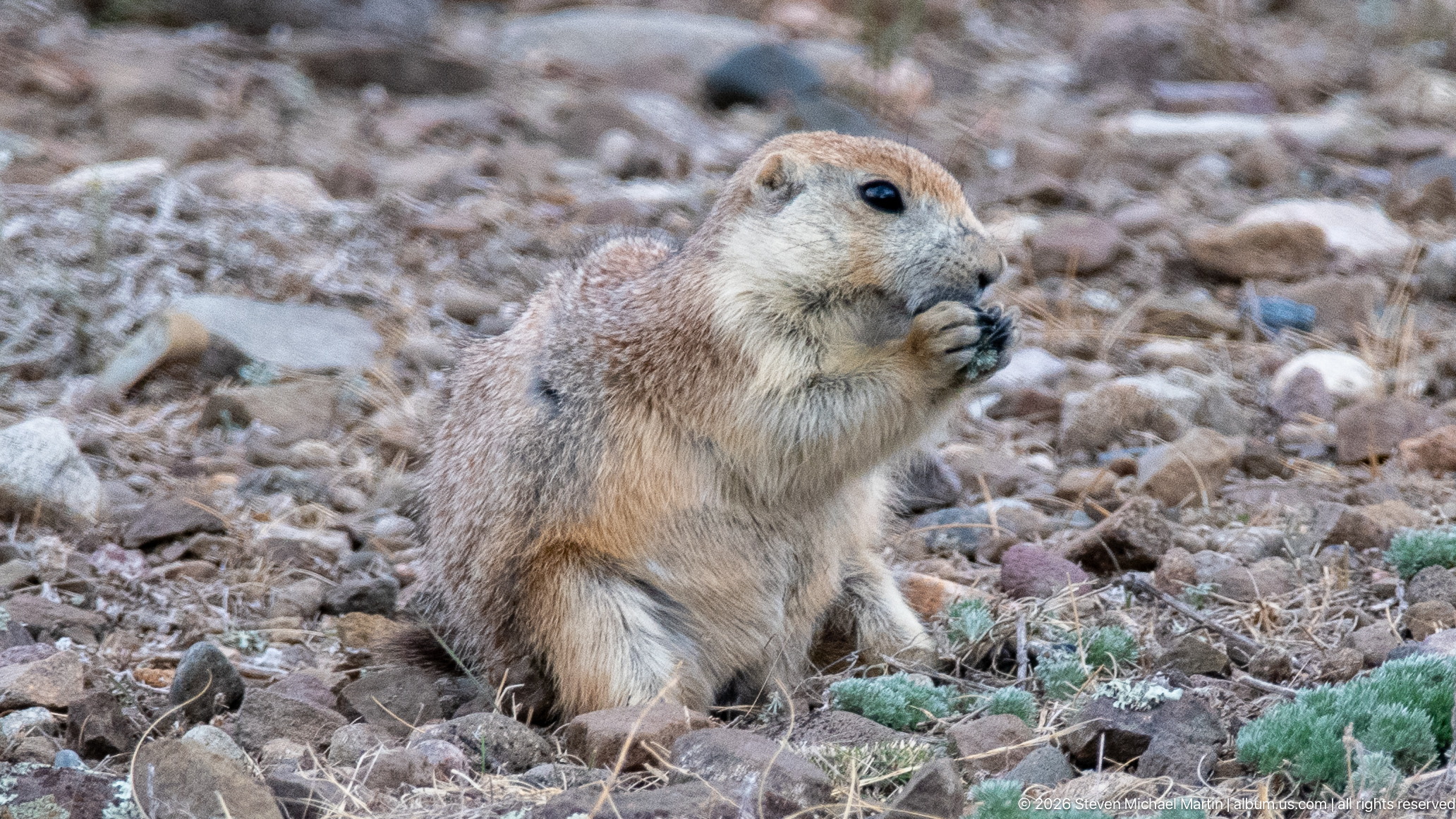
A prairie dog sits tall on its haunches with its forepaws clasped around a morsel of food. The upright pose exposes the pale throat and belly while the animal’s dark eye remains directed outward, combining feeding with the watchful posture common to life in an open prairie colony.
Caption
A prairie dog sits tall on its haunches with its forepaws clasped around a morsel of food. The upright pose exposes the pale throat and belly while the animal’s dark eye remains directed outward, combining feeding with the watchful posture common to life in an open prairie colony.
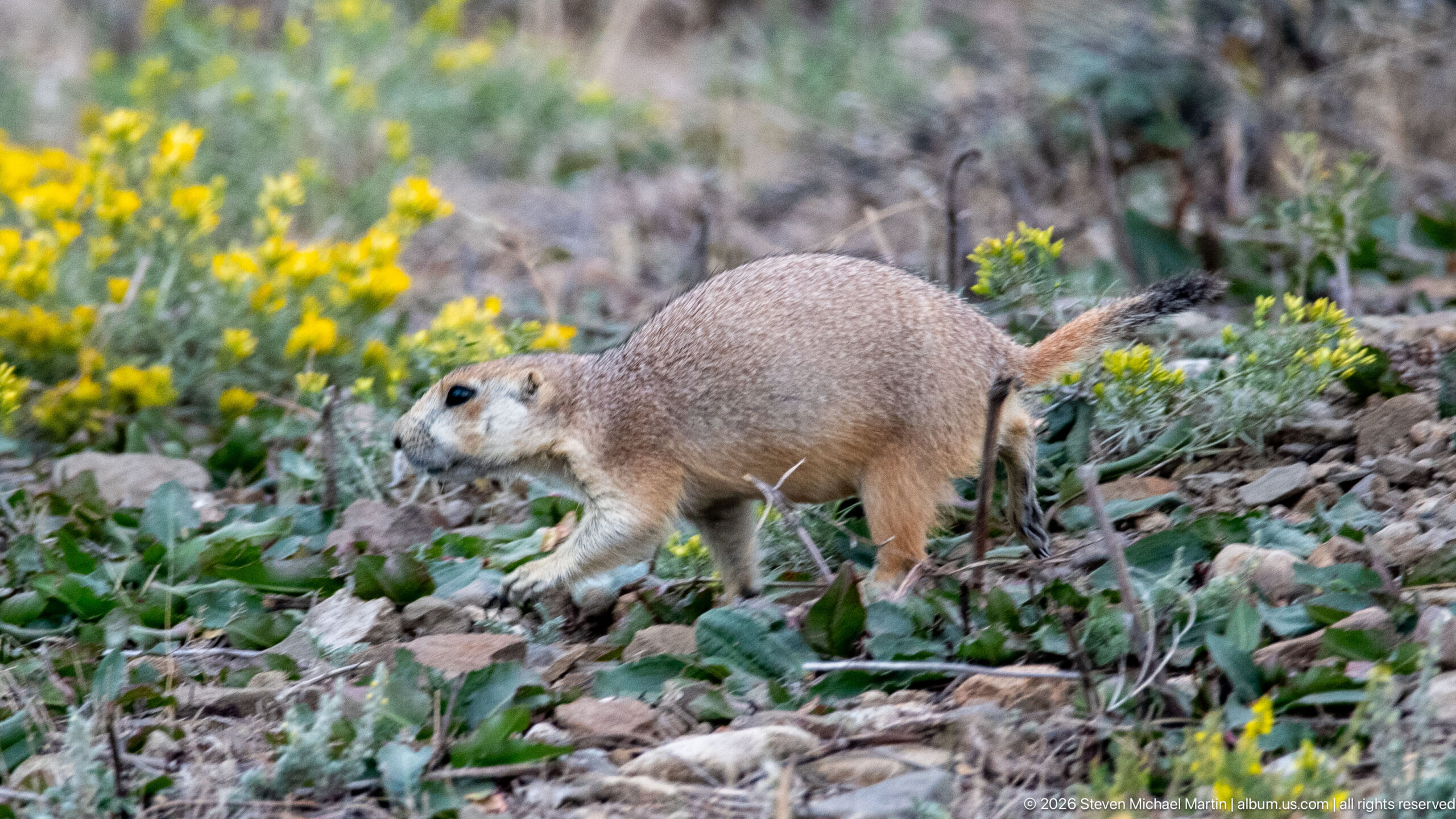
A prairie dog moves low across rocky ground edged by yellow wildflowers and gray-green prairie vegetation. Its extended stride, raised tail, and alert head give the frame a sense of movement while the shallow depth of field isolates the animal from the surrounding grassland.
Caption
A prairie dog moves low across rocky ground edged by yellow wildflowers and gray-green prairie vegetation. Its extended stride, raised tail, and alert head give the frame a sense of movement while the shallow depth of field isolates the animal from the surrounding grassland.
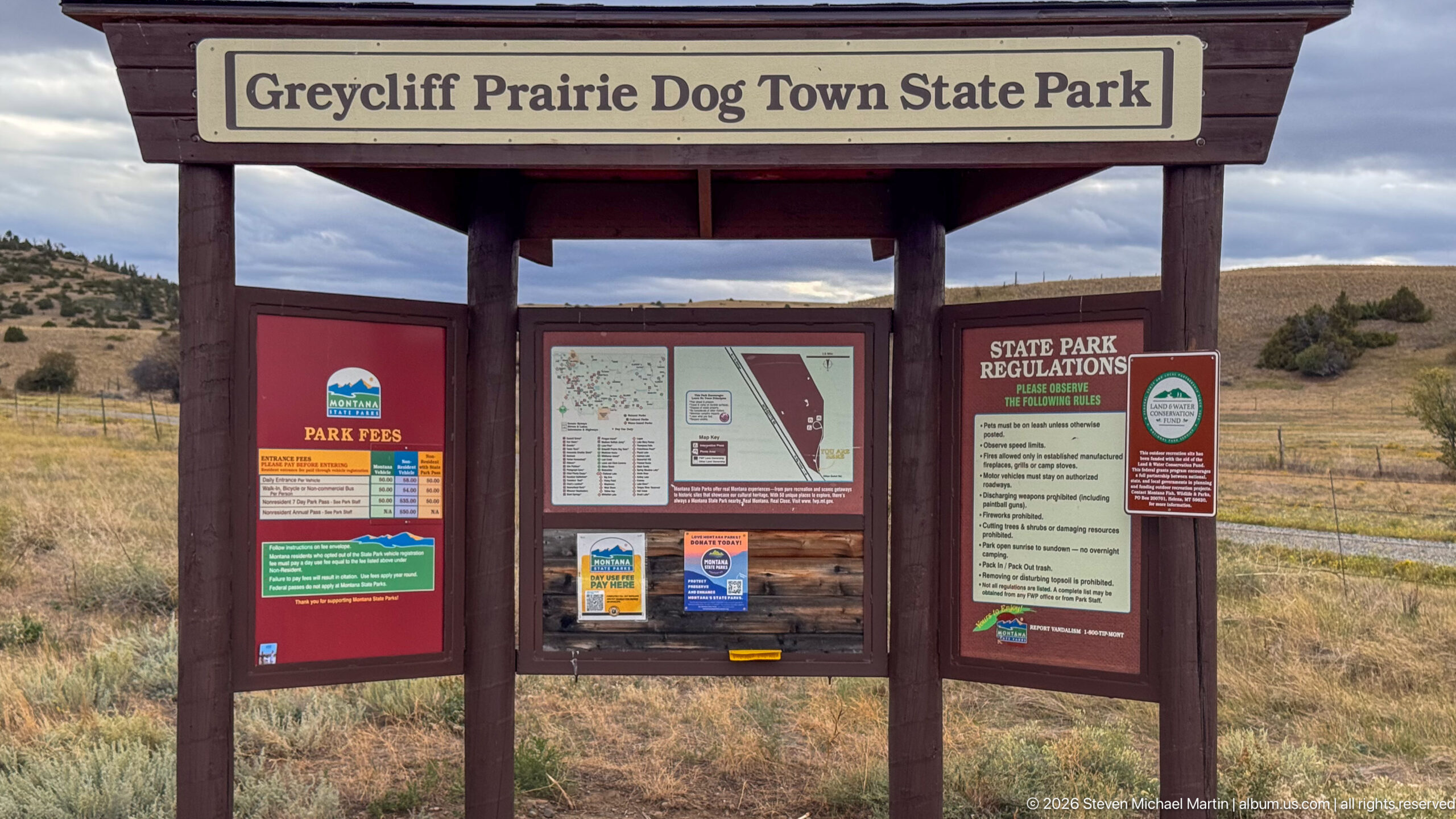
The entrance kiosk at Grey Cliff Prairie Dog Town State Park brings fees, a park map, regulations, and interpretive notices together beneath a timber shelter. Open prairie extends behind the structure, linking the administrative display directly to the grassland habitat visitors have come to observe.
Caption
The entrance kiosk at Grey Cliff Prairie Dog Town State Park brings fees, a park map, regulations, and interpretive notices together beneath a timber shelter. Open prairie extends behind the structure, linking the administrative display directly to the grassland habitat visitors have come to observe.
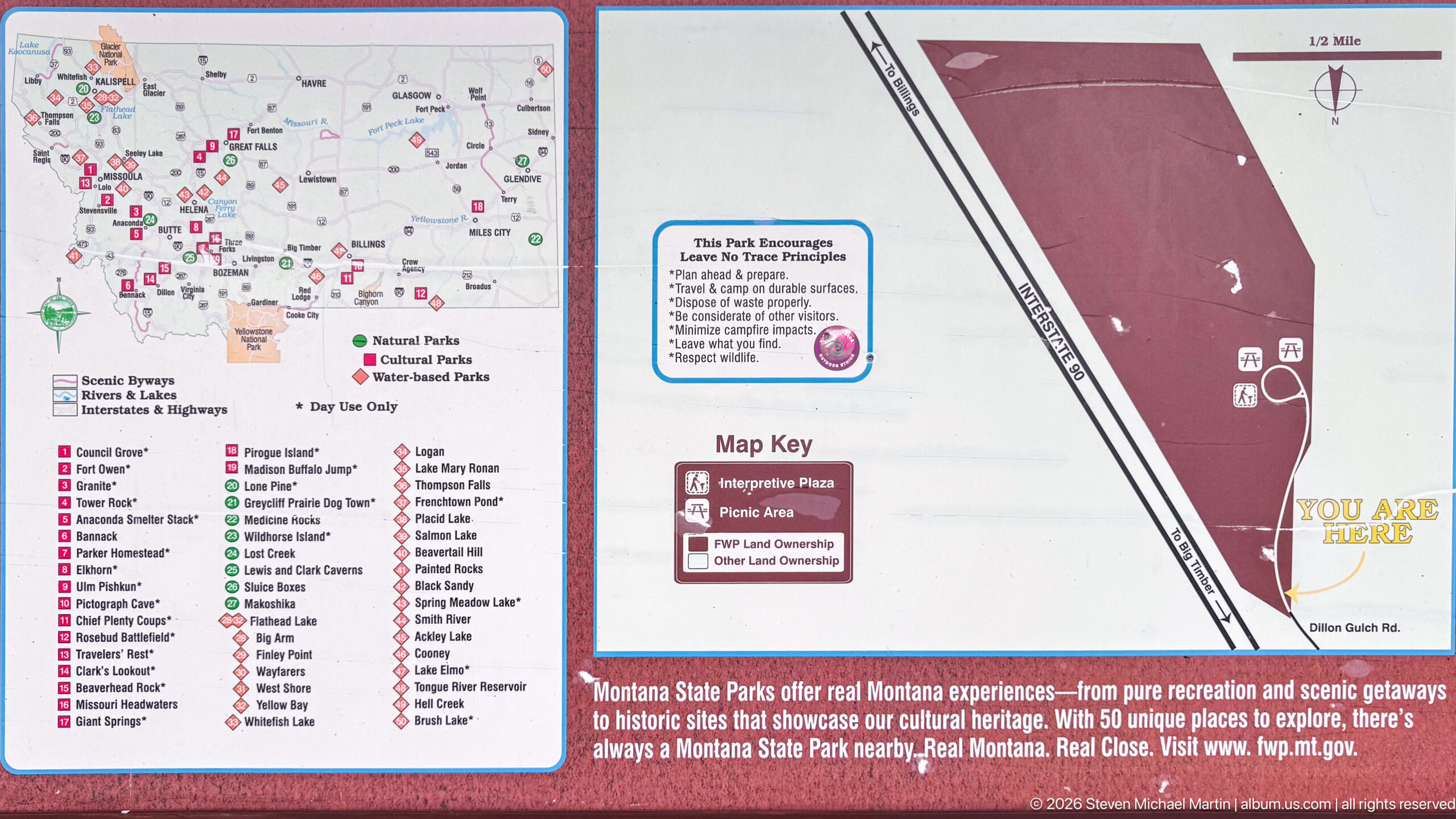
A Montana State Parks map and orientation panel pairs a statewide park directory with a site diagram and map key. The display helps locate the prairie dog town within a broader network of protected recreation and heritage sites while also giving visitors immediate on-site orientation.
Caption
A Montana State Parks map and orientation panel pairs a statewide park directory with a site diagram and map key. The display helps locate the prairie dog town within a broader network of protected recreation and heritage sites while also giving visitors immediate on-site orientation.
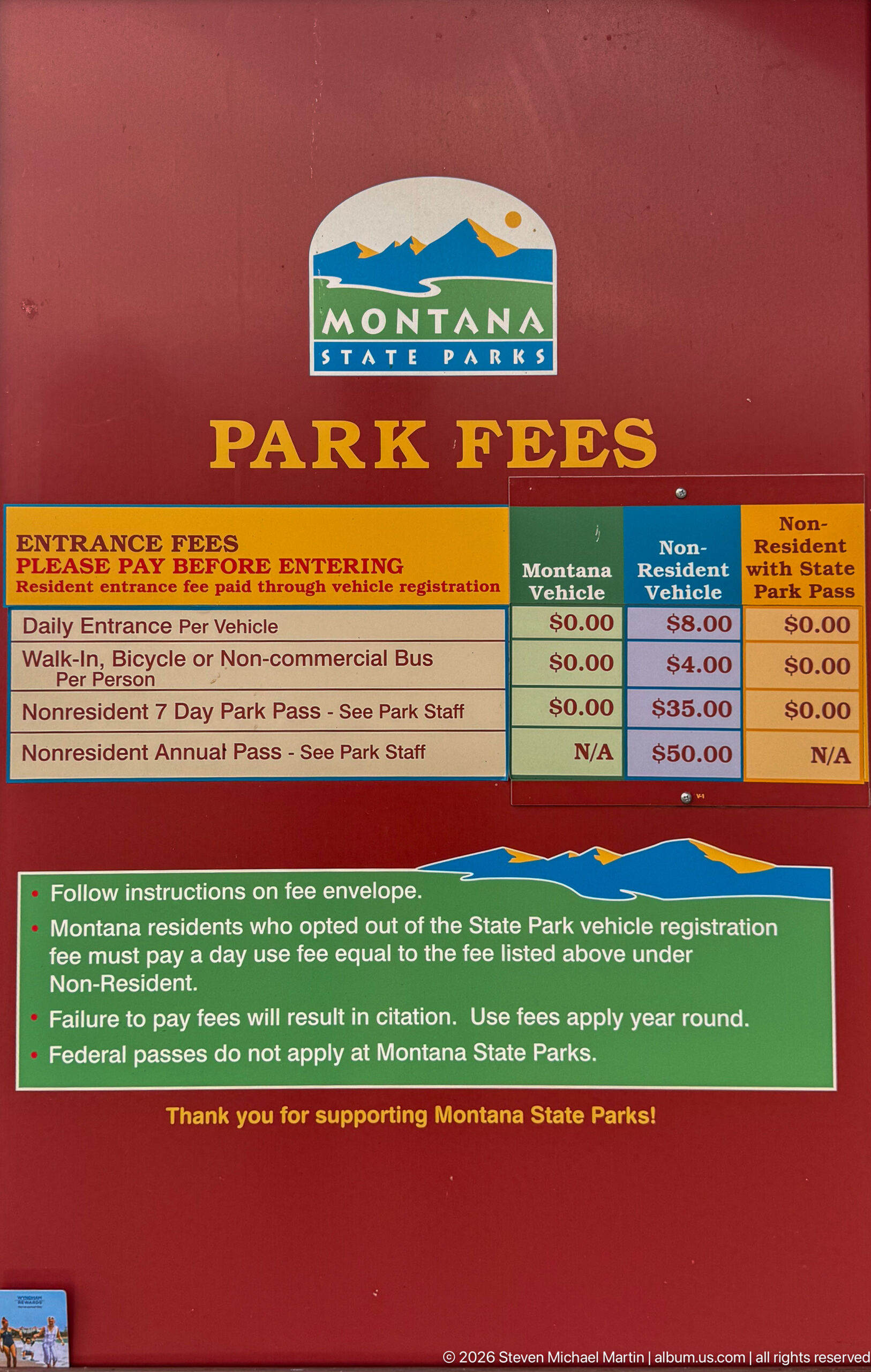
A Montana State Parks fee panel sets out entrance charges and registration instructions for visitors. The red, green, and yellow sign organizes resident and nonresident fees alongside payment directions, placing the prairie dog town within the practical framework of Montana’s state-park system.
Caption
A Montana State Parks fee panel sets out entrance charges and registration instructions for visitors. The red, green, and yellow sign organizes resident and nonresident fees alongside payment directions, placing the prairie dog town within the practical framework of Montana’s state-park system.
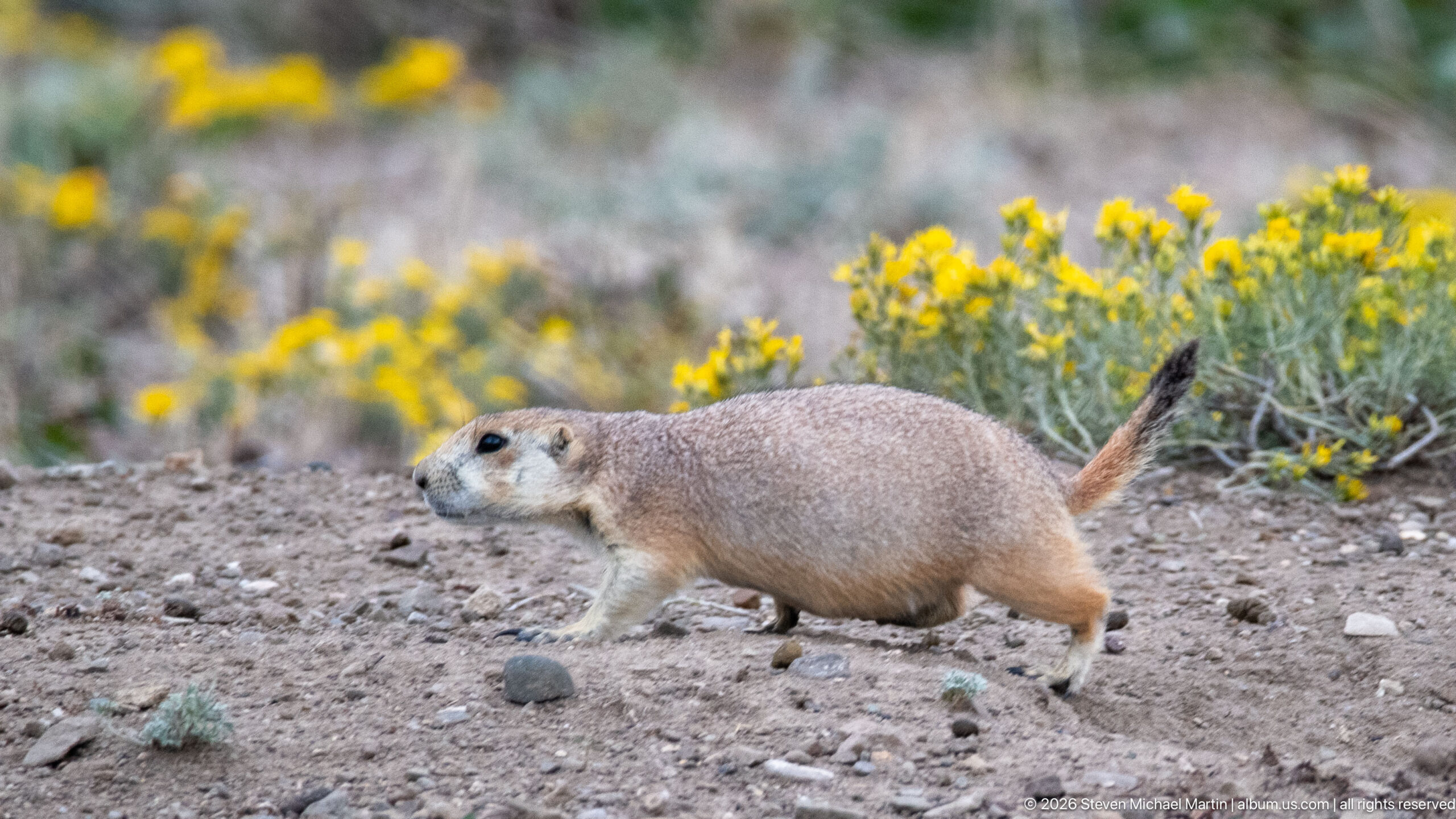
A prairie dog runs across an open patch of compacted earth, its body stretched forward and tail held behind. Yellow flowers blur in the background, while scattered stones and sparse plants reveal the disturbed, closely cropped ground characteristic of the immediate colony setting.
Caption
A prairie dog runs across an open patch of compacted earth, its body stretched forward and tail held behind. Yellow flowers blur in the background, while scattered stones and sparse plants reveal the disturbed, closely cropped ground characteristic of the immediate colony setting.
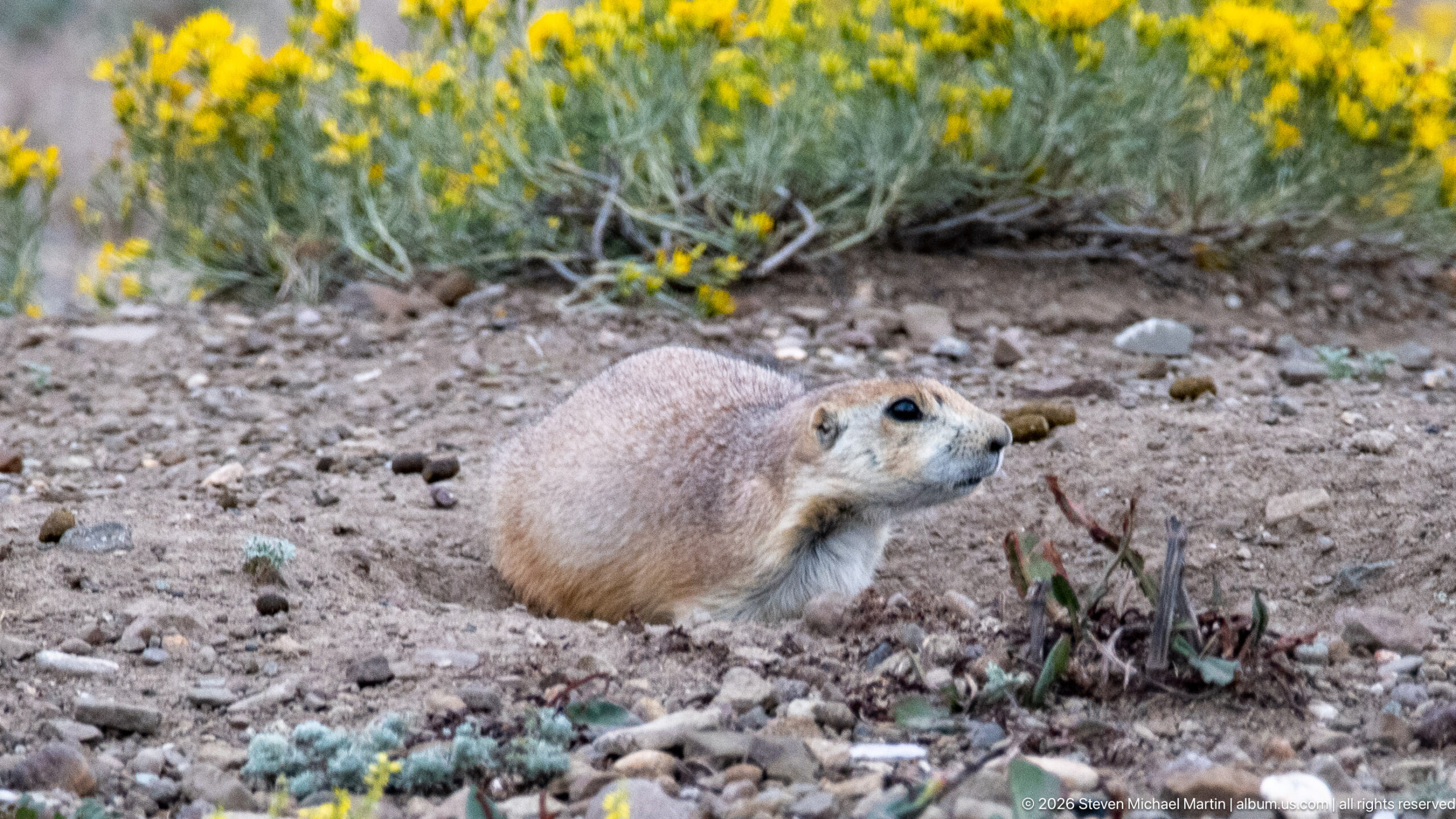
A prairie dog pauses upright on its haunches amid bare soil, scattered stones, and low vegetation. Its head is raised and turned slightly upward, suggesting alert attention to the surroundings, while yellow flowers and sage-colored plants mark the dry prairie setting around the colony.
Caption
A prairie dog pauses upright on its haunches amid bare soil, scattered stones, and low vegetation. Its head is raised and turned slightly upward, suggesting alert attention to the surroundings, while yellow flowers and sage-colored plants mark the dry prairie setting around the colony.
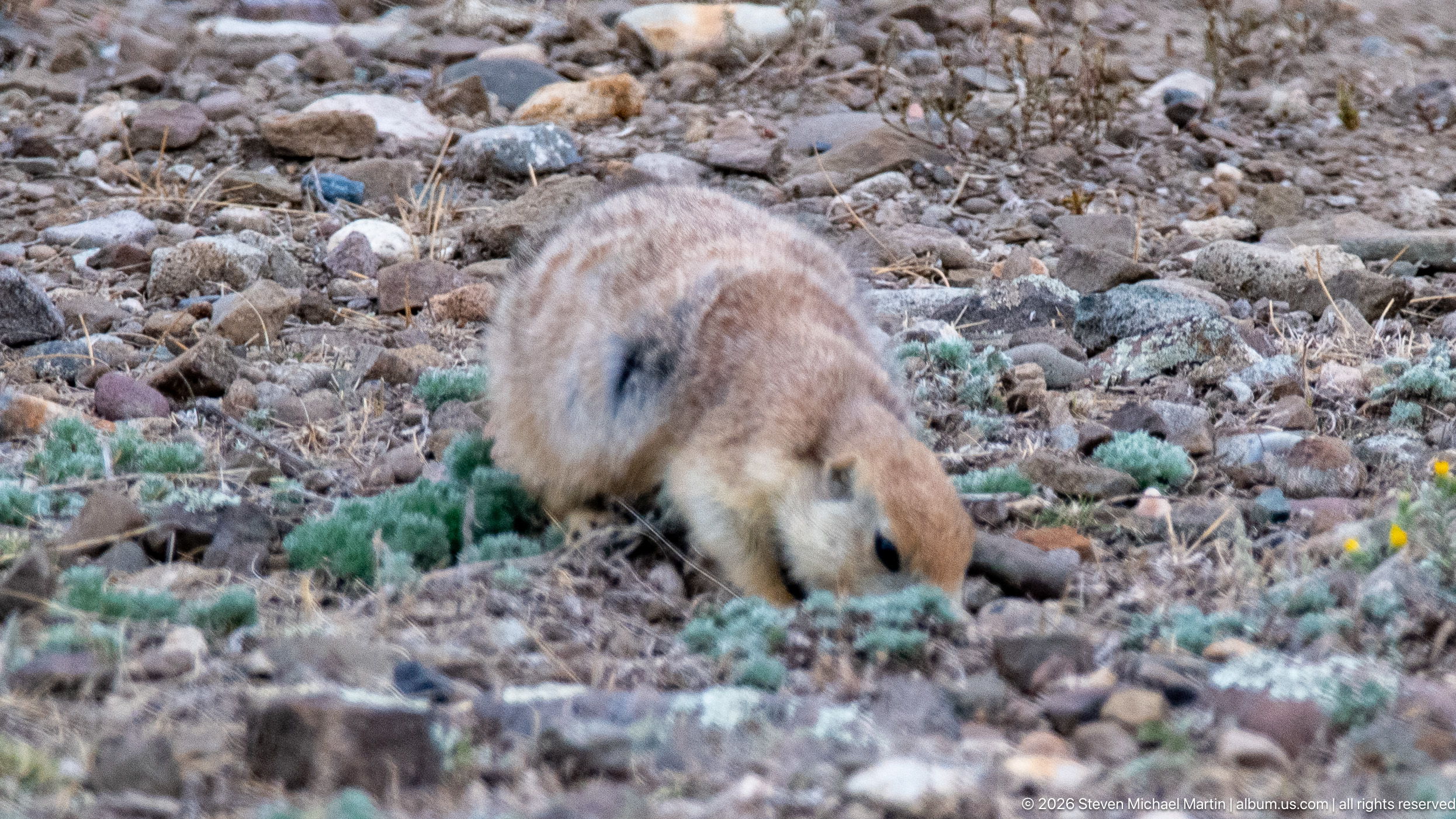
Seen from slightly behind, a prairie dog lowers its head into sparse vegetation and rocky soil while foraging. The close view emphasizes the animal’s rounded back, small ears, and short tail, with muted green groundcover breaking up the otherwise dry, stony colony surface.
Caption
Seen from slightly behind, a prairie dog lowers its head into sparse vegetation and rocky soil while foraging. The close view emphasizes the animal’s rounded back, small ears, and short tail, with muted green groundcover breaking up the otherwise dry, stony colony surface.
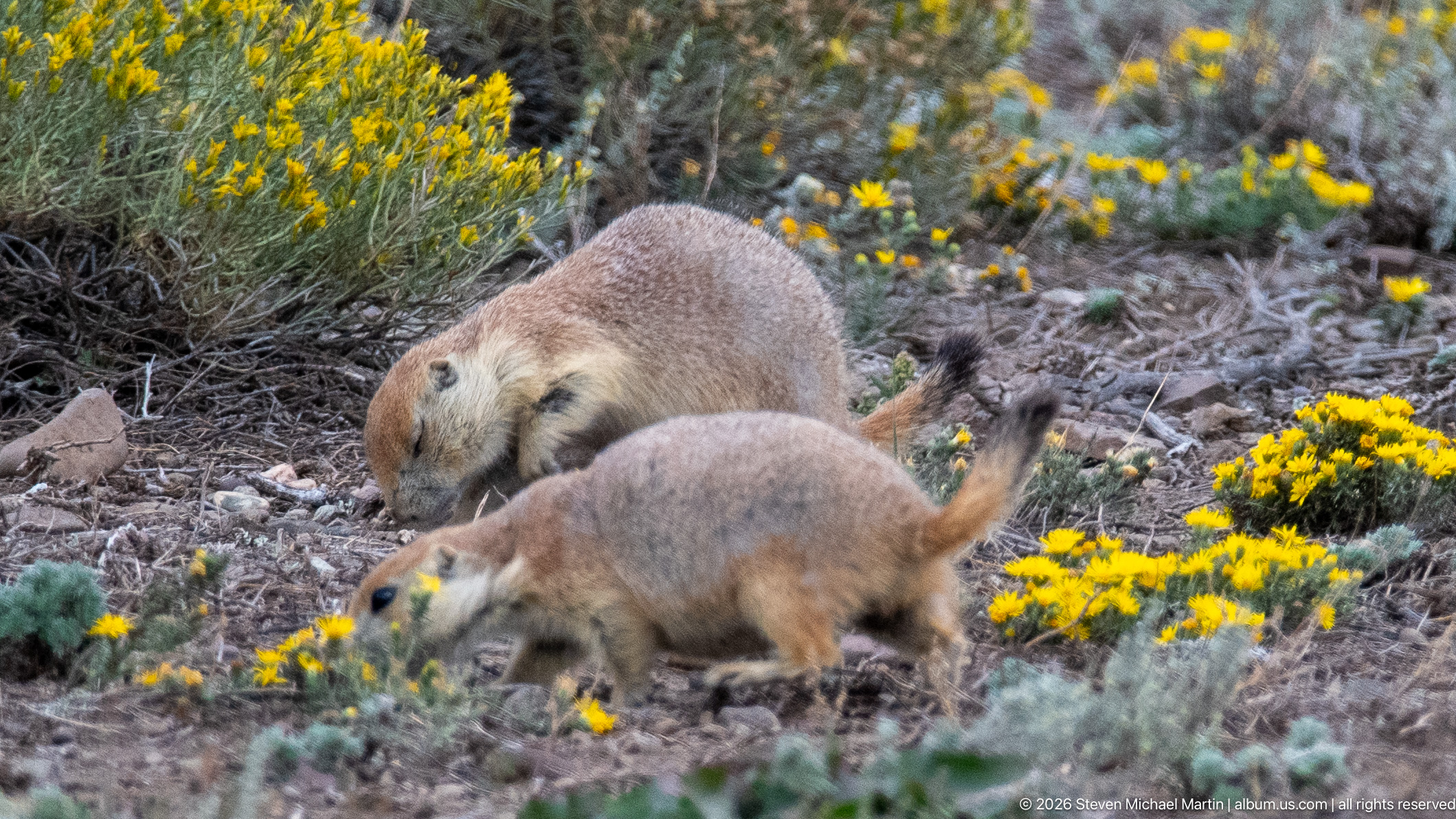
Two prairie dogs forage close together among yellow wildflowers and low prairie plants. One bends toward the ground while the other crosses in front with its tail lifted, creating a layered view of social proximity and feeding activity within the colony’s rocky grassland habitat.
Caption
Two prairie dogs forage close together among yellow wildflowers and low prairie plants. One bends toward the ground while the other crosses in front with its tail lifted, creating a layered view of social proximity and feeding activity within the colony’s rocky grassland habitat.
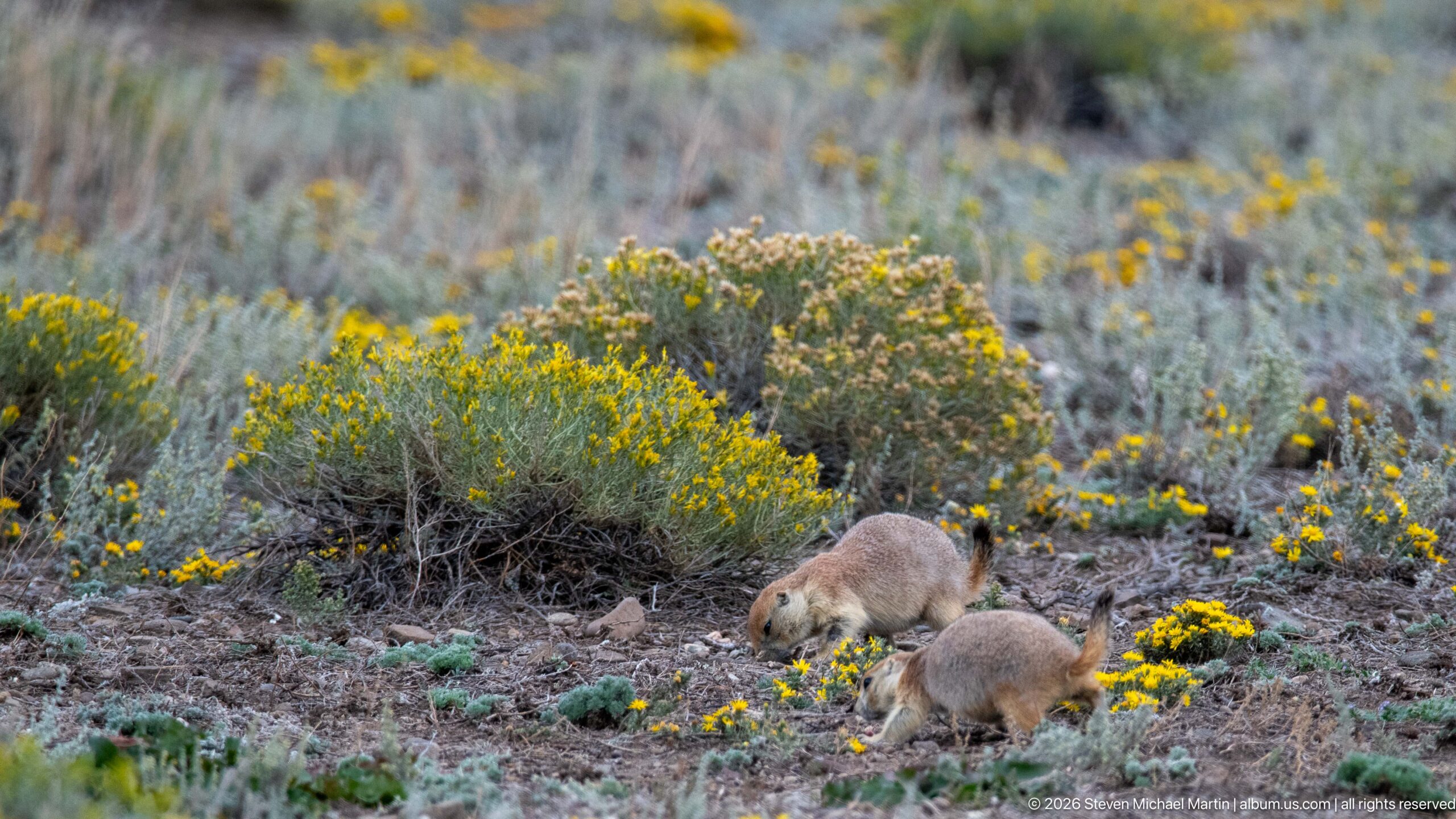
A wider view places two prairie dogs within the textured vegetation of their colony. The animals forage several feet apart beneath clumps of yellow flowers and gray-green plants, making their small scale apparent against the broader patchwork of bare earth, stones, and grassland growth.
Caption
A wider view places two prairie dogs within the textured vegetation of their colony. The animals forage several feet apart beneath clumps of yellow flowers and gray-green plants, making their small scale apparent against the broader patchwork of bare earth, stones, and grassland growth.
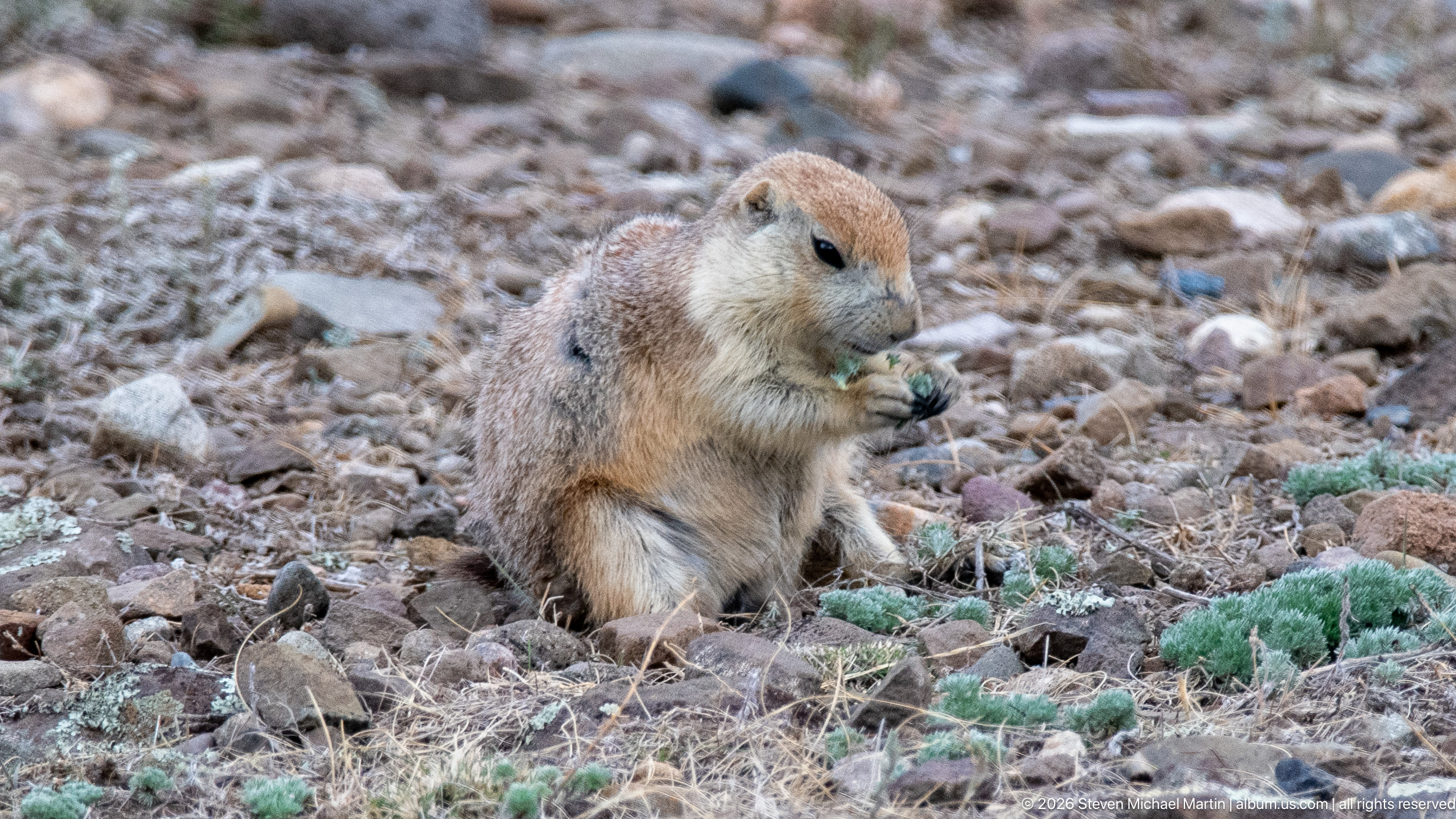
A prairie dog sits upright and manipulates a small piece of vegetation between its forepaws. The close portrait shows the compact body, pale throat, dark eye, and dexterous paws against a background of stones and low groundcover, concentrating attention on feeding behavior.
Caption
A prairie dog sits upright and manipulates a small piece of vegetation between its forepaws. The close portrait shows the compact body, pale throat, dark eye, and dexterous paws against a background of stones and low groundcover, concentrating attention on feeding behavior.
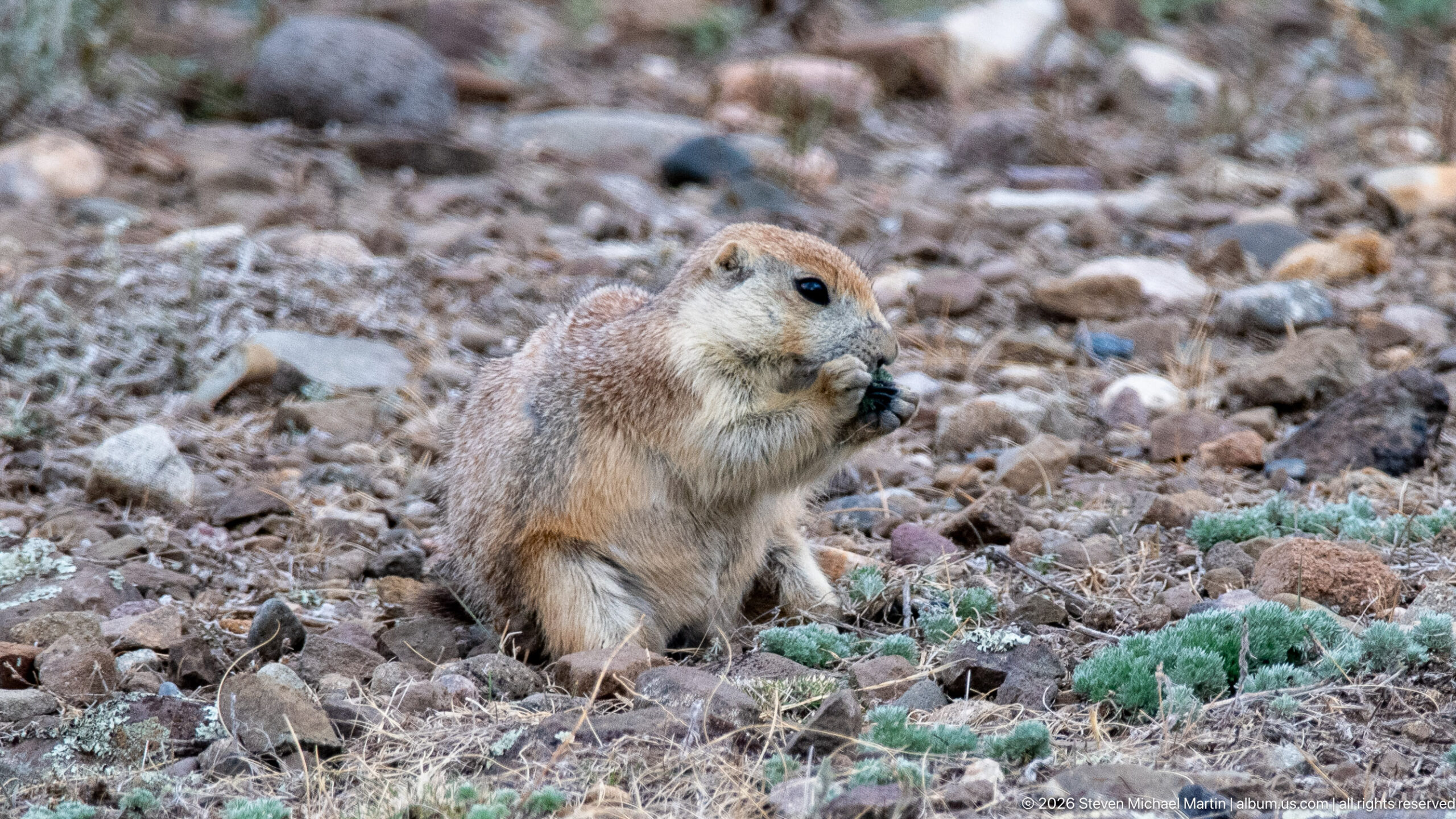
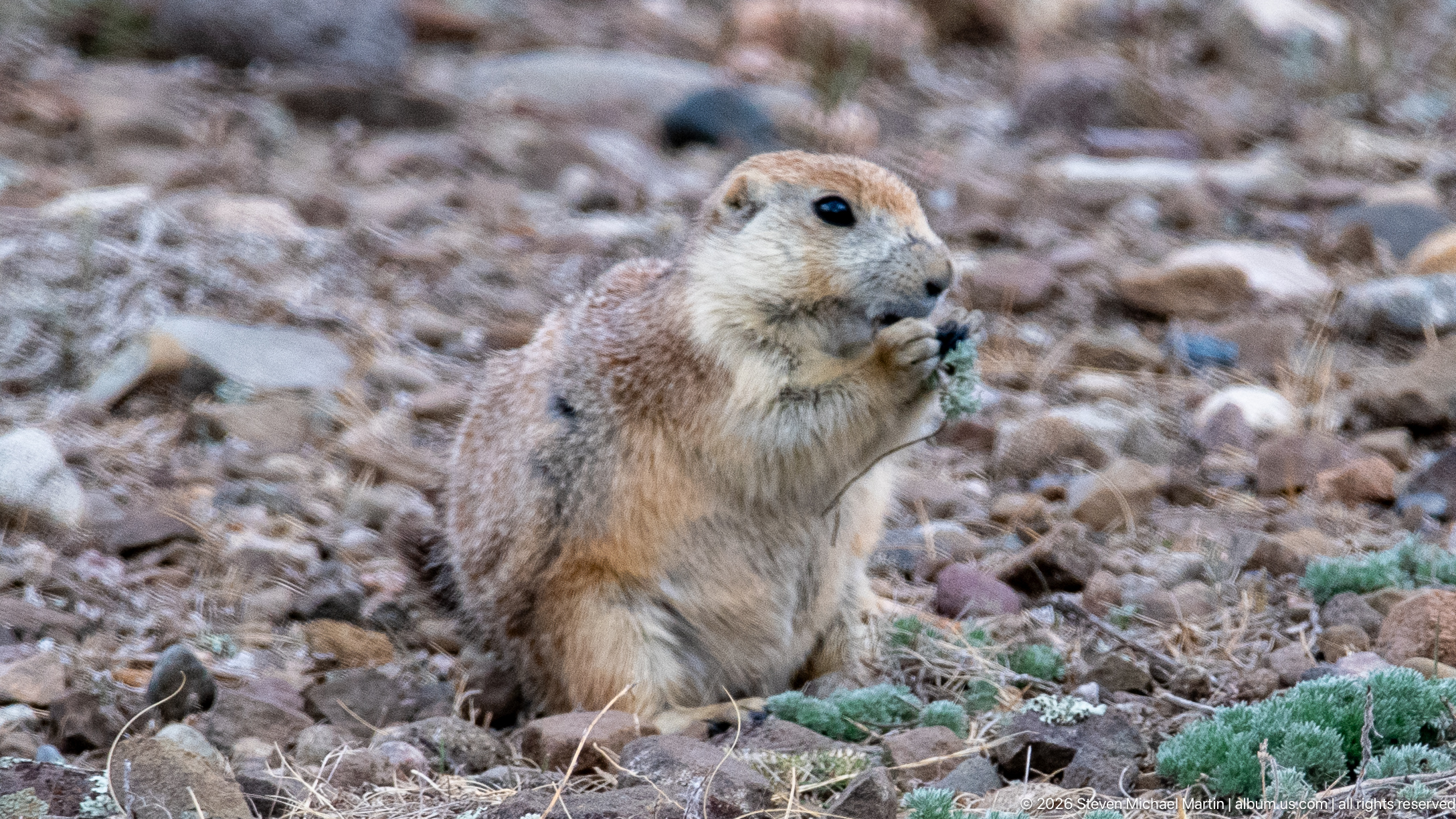
A seated prairie dog brings food to its mouth with both forepaws, caught in a quiet feeding moment on the colony floor. Its pale muzzle and chest stand out against warm brown fur and the surrounding mix of small stones, dry stems, and low green plants.
Caption
A seated prairie dog brings food to its mouth with both forepaws, caught in a quiet feeding moment on the colony floor. Its pale muzzle and chest stand out against warm brown fur and the surrounding mix of small stones, dry stems, and low green plants.
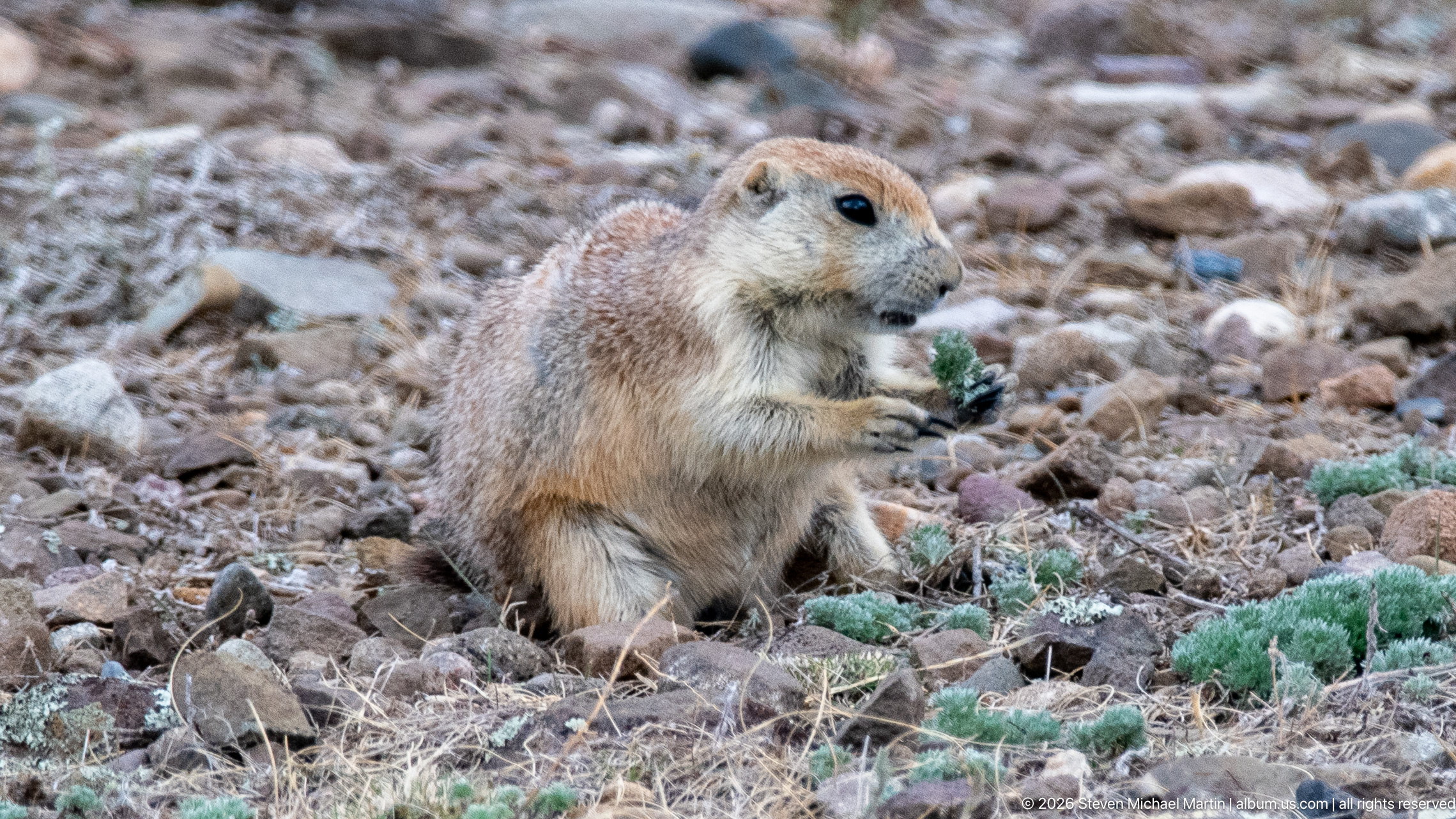
A prairie dog sits upright with a tuft of green vegetation gathered between its forepaws. The animal’s rounded body and pale face are sharply defined against the rocky colony floor, while its downward glance focuses attention on the food being handled rather than on the surrounding landscape.
Caption
A prairie dog sits upright with a tuft of green vegetation gathered between its forepaws. The animal’s rounded body and pale face are sharply defined against the rocky colony floor, while its downward glance focuses attention on the food being handled rather than on the surrounding landscape.
A prairie dog crouches nearly flat against the ground, its body elongated in profile and head stretched forward. The low posture contrasts with the upright sentinel views elsewhere in the series, while blurred yellow flowers and scattered stones retain the colony’s dry grassland context.
Caption
A prairie dog crouches nearly flat against the ground, its body elongated in profile and head stretched forward. The low posture contrasts with the upright sentinel views elsewhere in the series, while blurred yellow flowers and scattered stones retain the colony’s dry grassland context.
A prairie dog rests low against bare soil at a burrow entrance, its forepaws planted on the mound while another animal is barely visible behind it. The close viewpoint isolates the animal against softly blurred grassland, showing how the colony’s excavated earth creates open observation points amid the surrounding prairie vegetation.
Caption
A prairie dog rests low against bare soil at a burrow entrance, its forepaws planted on the mound while another animal is barely visible behind it. The close viewpoint isolates the animal against softly blurred grassland, showing how the colony’s excavated earth creates open observation points amid the surrounding prairie vegetation.
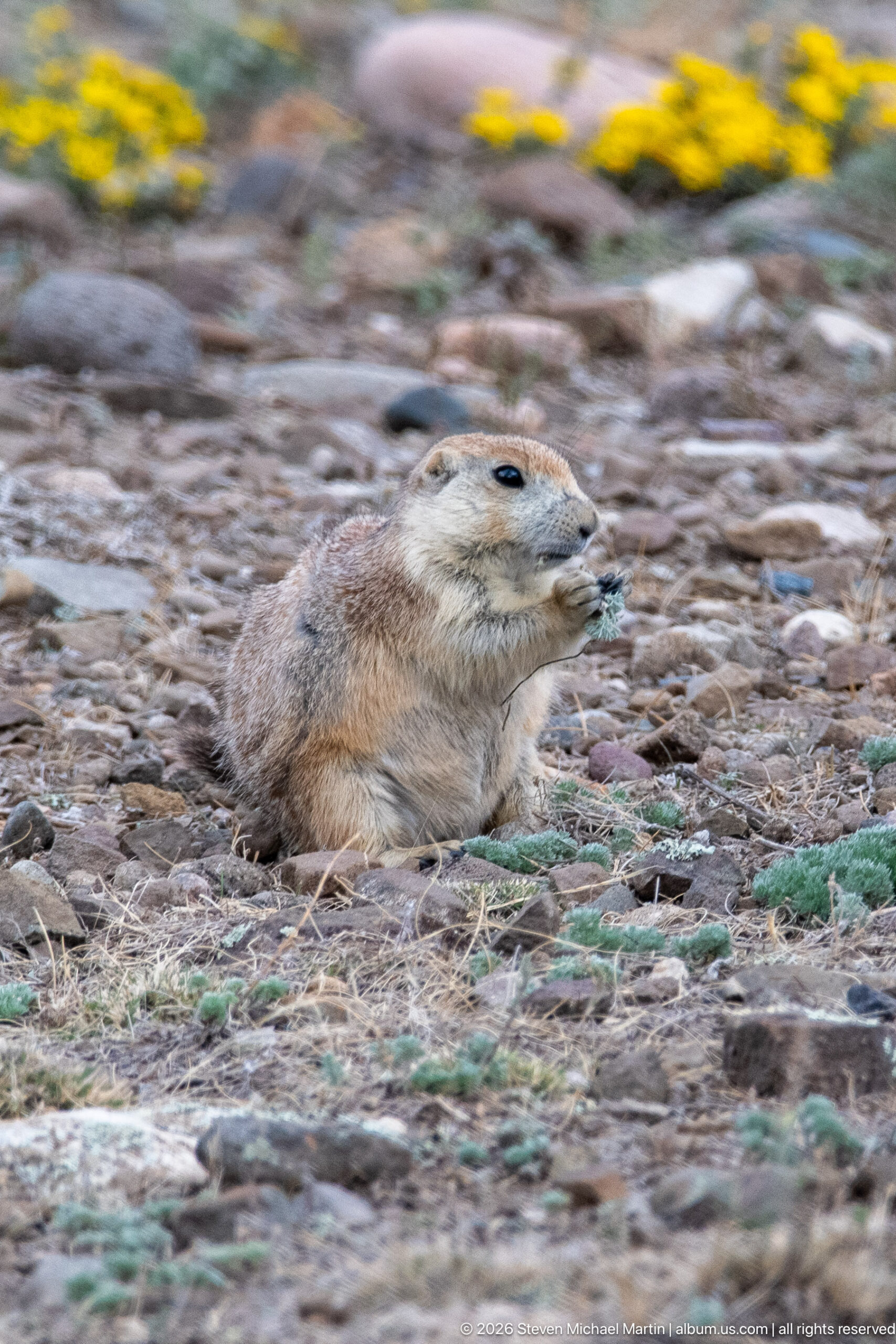
A prairie dog raises a cluster of green leaves to its mouth while sitting upright among stones and dry stems. The close composition records the animal’s use of its forepaws during feeding, with the fresh plant material providing a vivid contrast to the muted browns of the colony floor.
Caption
A prairie dog raises a cluster of green leaves to its mouth while sitting upright among stones and dry stems. The close composition records the animal’s use of its forepaws during feeding, with the fresh plant material providing a vivid contrast to the muted browns of the colony floor.
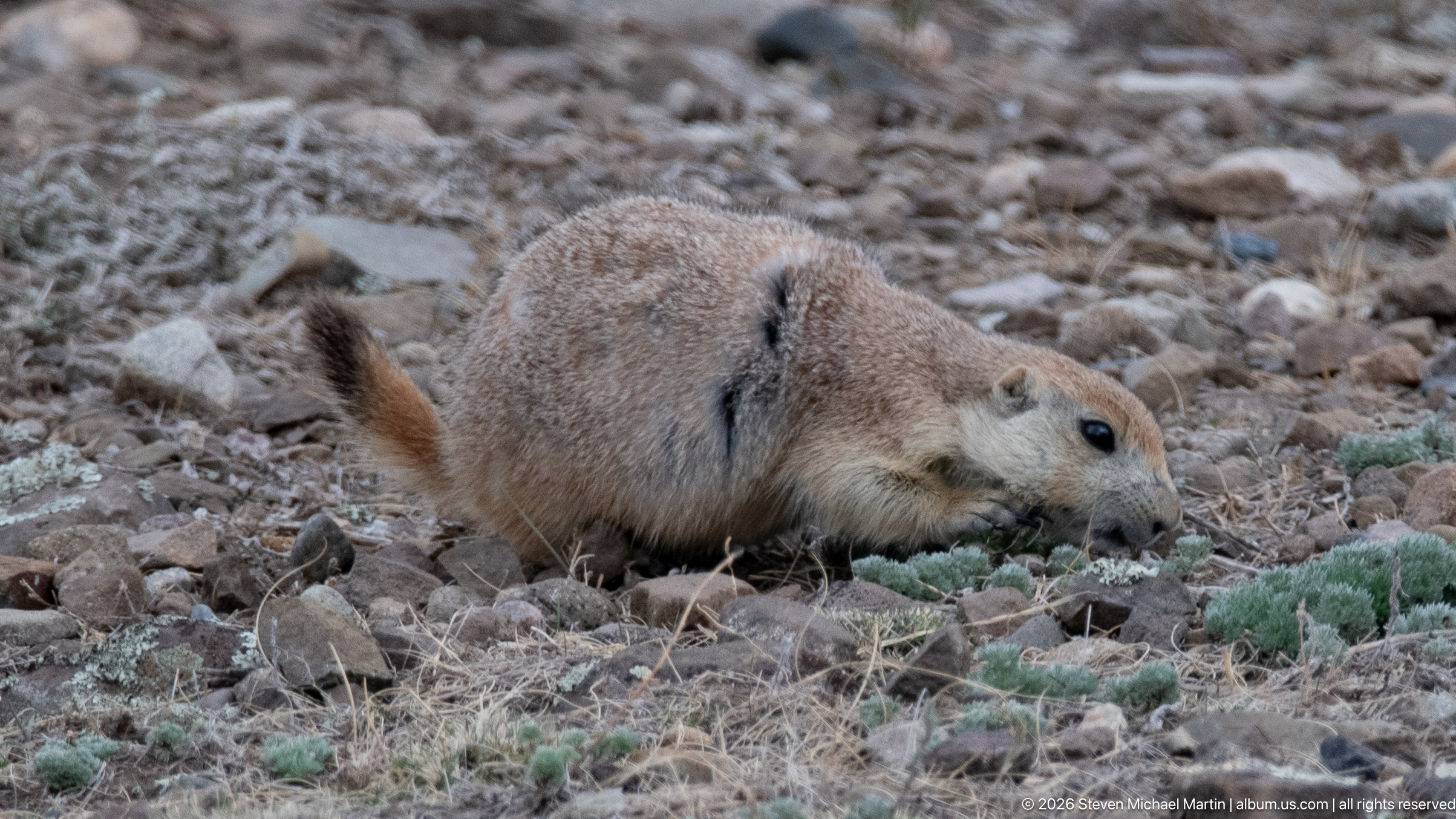
A prairie dog advances across the colony floor with its nose close to the ground, apparently searching among low plants and stones. Its horizontal posture and lifted tail distinguish this active foraging view from the nearby seated portraits, emphasizing movement through the sparse prairie vegetation.
Caption
A prairie dog advances across the colony floor with its nose close to the ground, apparently searching among low plants and stones. Its horizontal posture and lifted tail distinguish this active foraging view from the nearby seated portraits, emphasizing movement through the sparse prairie vegetation.
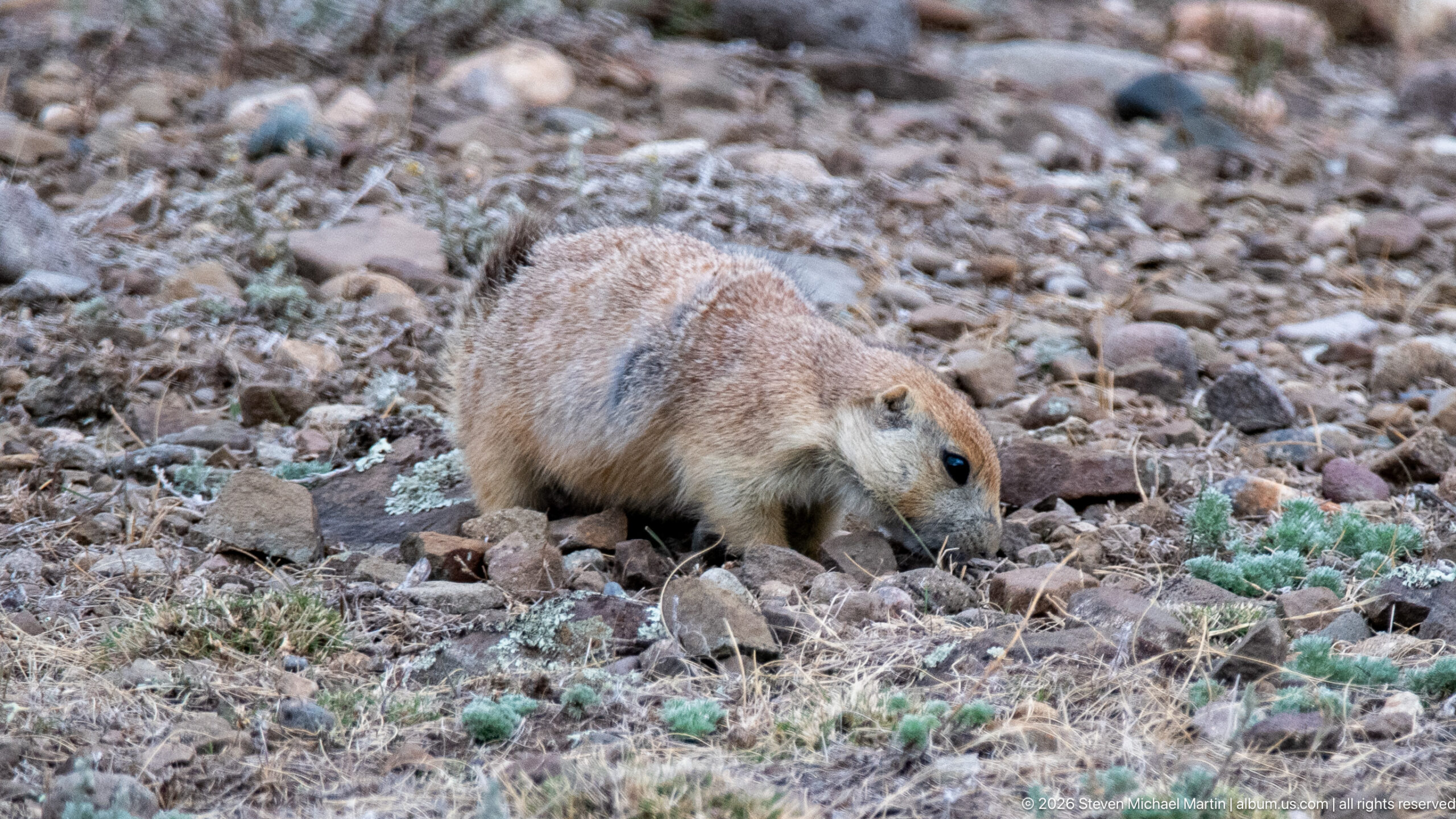
A prairie dog bends into a patch of low green groundcover, feeding close to the soil among angular stones and dry stems. The side view shows the animal’s arched back and compact profile while keeping the immediate foraging substrate clearly visible around its muzzle.
Caption
A prairie dog bends into a patch of low green groundcover, feeding close to the soil among angular stones and dry stems. The side view shows the animal’s arched back and compact profile while keeping the immediate foraging substrate clearly visible around its muzzle.
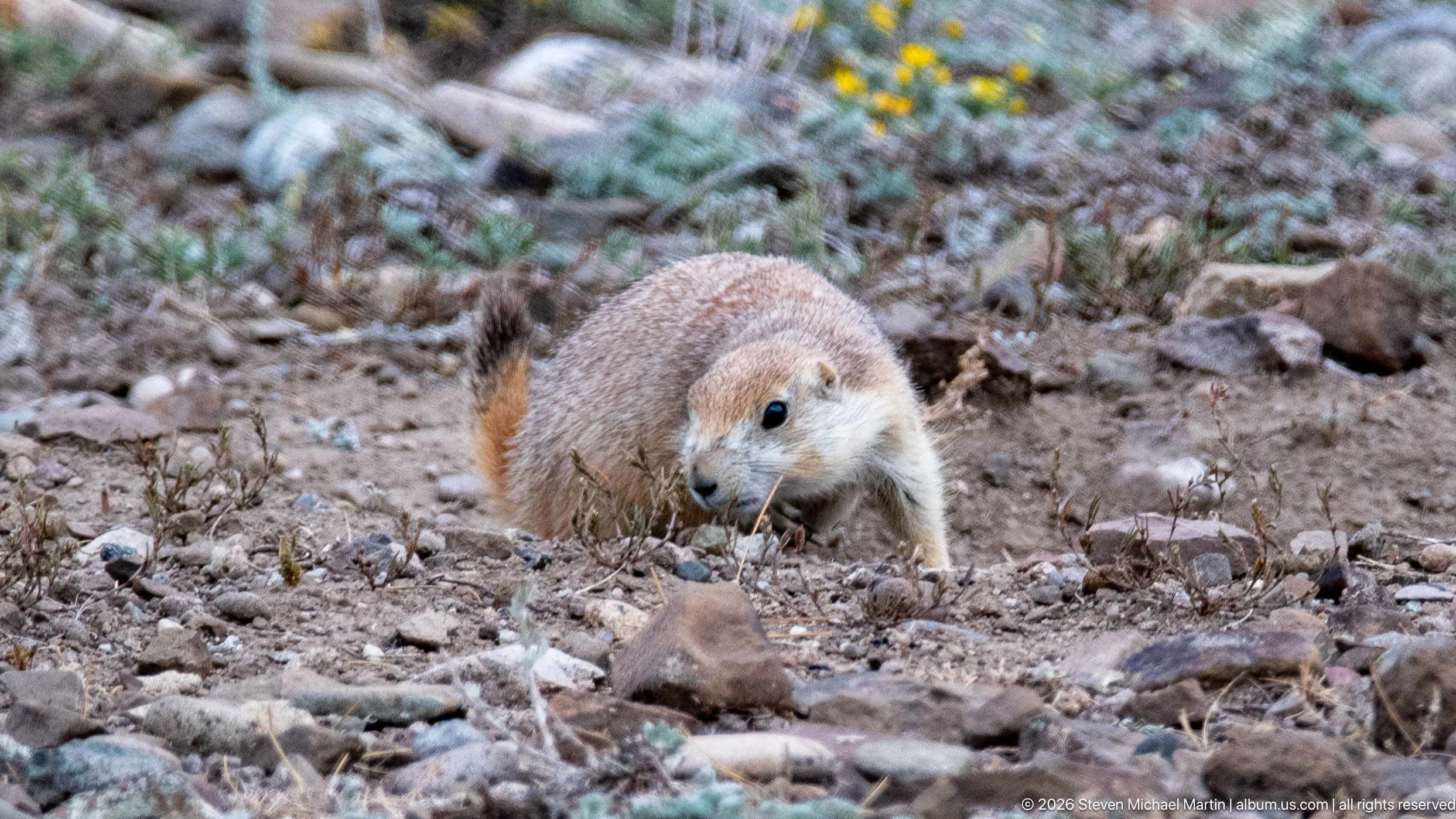
A prairie dog leans forward over bare earth, its muzzle directed toward the ground beside scattered rocks and dry plant fragments. The close, frontal angle emphasizes the animal’s pale face and dark eyes while documenting ground-level investigation within the colony.
Caption
A prairie dog leans forward over bare earth, its muzzle directed toward the ground beside scattered rocks and dry plant fragments. The close, frontal angle emphasizes the animal’s pale face and dark eyes while documenting ground-level investigation within the colony.
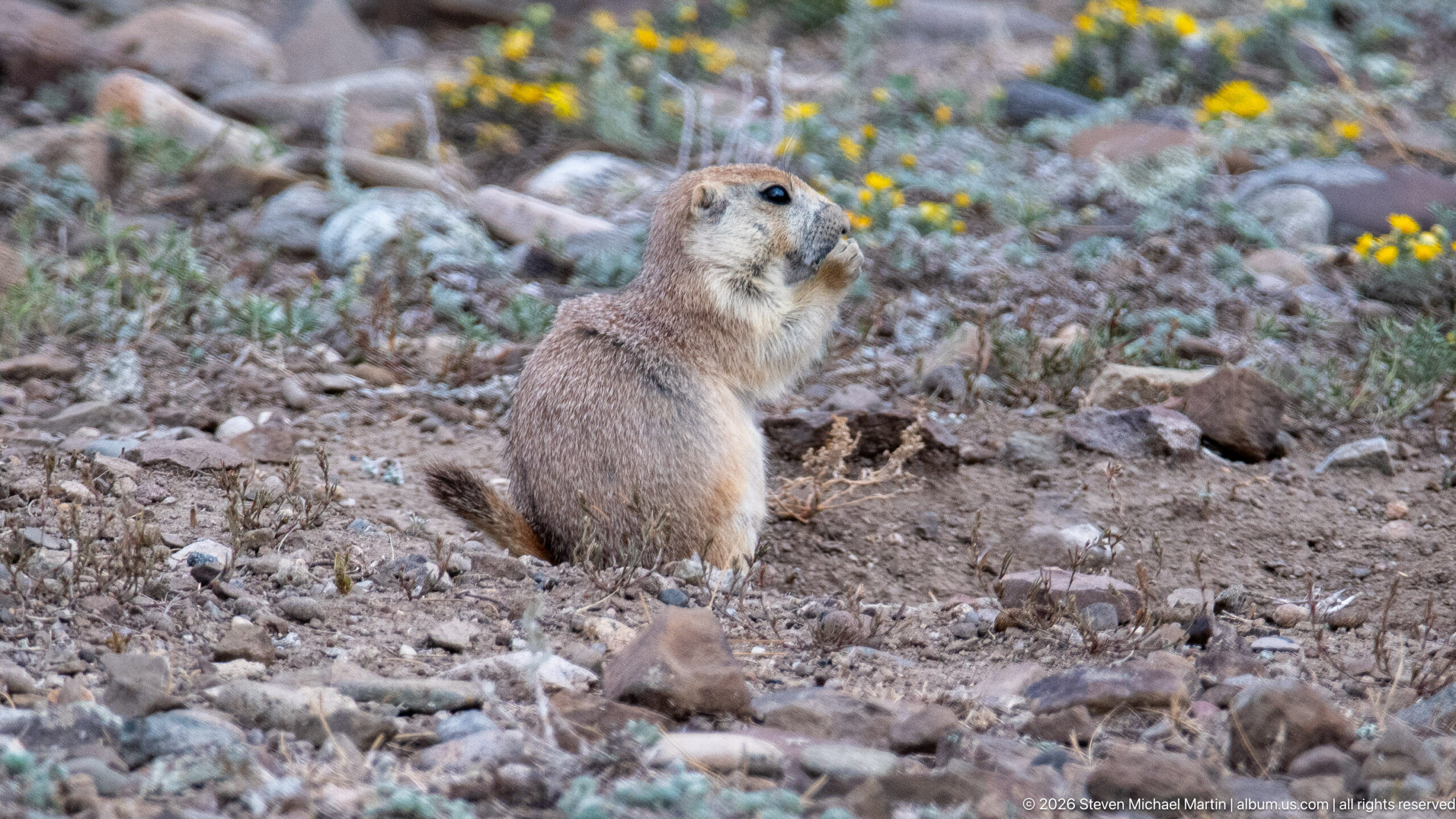
A prairie dog rises upright from a shallow depression and looks upward across the open grassland. The vertical pose gives the animal a clear vantage above the low colony vegetation, while scattered stones, bare earth, and yellow flowers define the immediate prairie setting.
Caption
A prairie dog rises upright from a shallow depression and looks upward across the open grassland. The vertical pose gives the animal a clear vantage above the low colony vegetation, while scattered stones, bare earth, and yellow flowers define the immediate prairie setting.
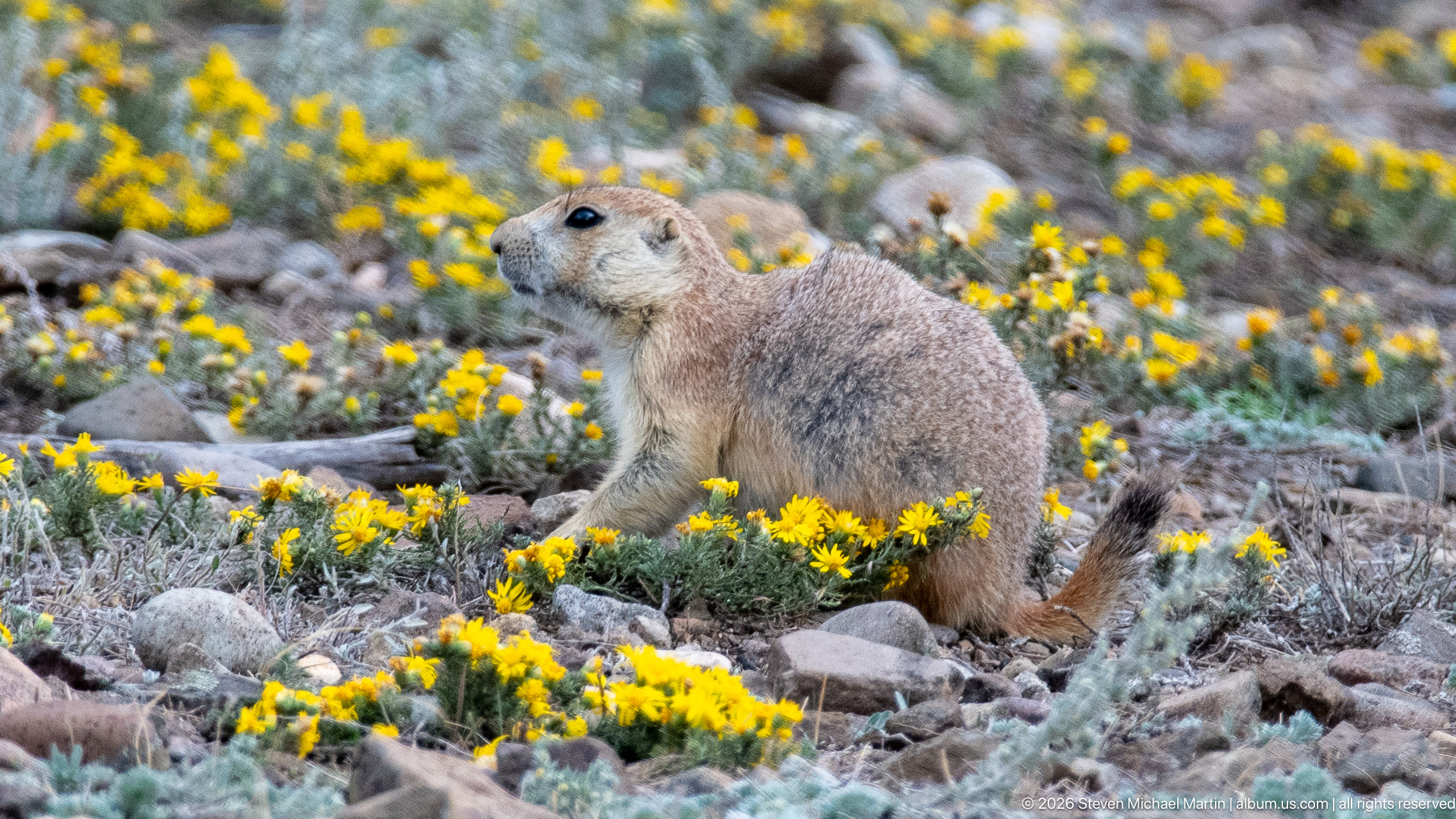
A prairie dog stands prominently among dense clusters of yellow wildflowers, its head lifted above the surrounding plants. The bright blossoms frame the animal’s brown-gray coat and make this view as much a portrait of the flowering prairie habitat as of the colony resident itself.
Caption
A prairie dog stands prominently among dense clusters of yellow wildflowers, its head lifted above the surrounding plants. The bright blossoms frame the animal’s brown-gray coat and make this view as much a portrait of the flowering prairie habitat as of the colony resident itself.
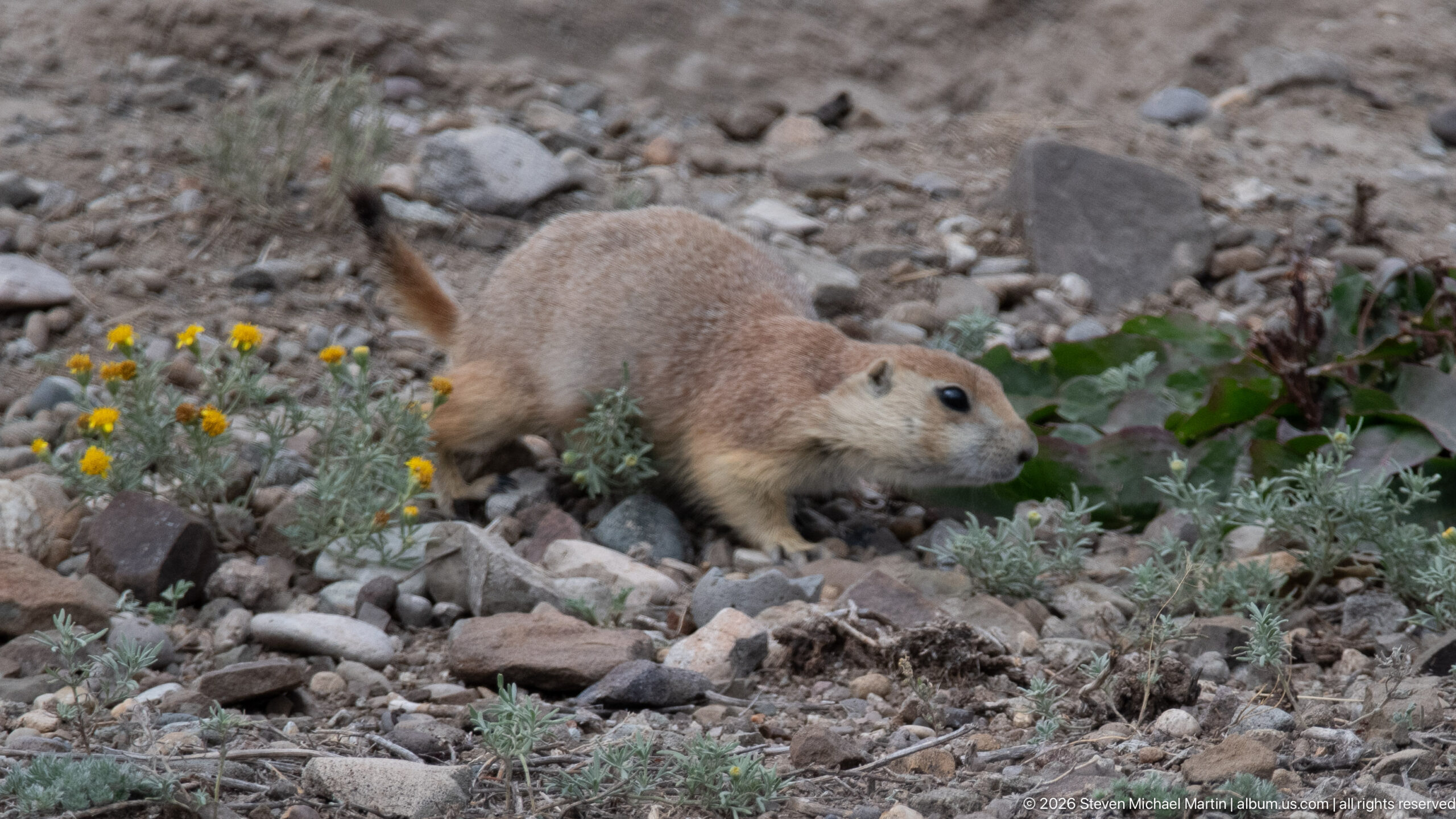
A prairie dog moves through a rock-strewn patch where broad green leaves and small yellow flowers interrupt the otherwise dry ground. Its low profile and forward gaze suggest active travel or foraging, with the mixed vegetation distinguishing this microhabitat from the barer colony surfaces nearby.
Caption
A prairie dog moves through a rock-strewn patch where broad green leaves and small yellow flowers interrupt the otherwise dry ground. Its low profile and forward gaze suggest active travel or foraging, with the mixed vegetation distinguishing this microhabitat from the barer colony surfaces nearby.
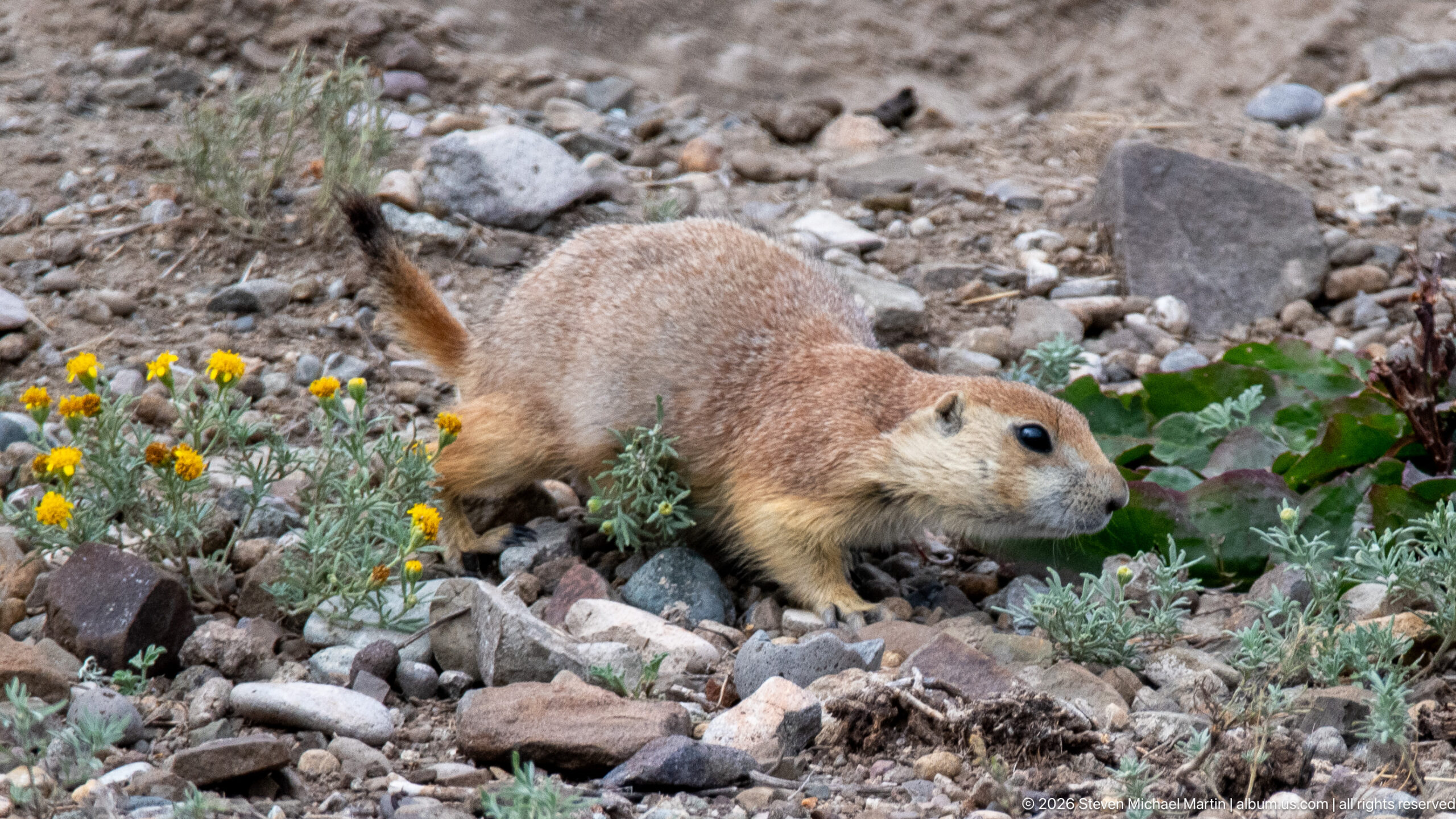
A prairie dog stretches forward through a patchwork of stones, yellow flowers, silvery plants, and broad green leaves. The close profile records the animal navigating a more densely vegetated part of the colony, with its raised tail and extended body conveying purposeful movement.
Caption
A prairie dog stretches forward through a patchwork of stones, yellow flowers, silvery plants, and broad green leaves. The close profile records the animal navigating a more densely vegetated part of the colony, with its raised tail and extended body conveying purposeful movement.
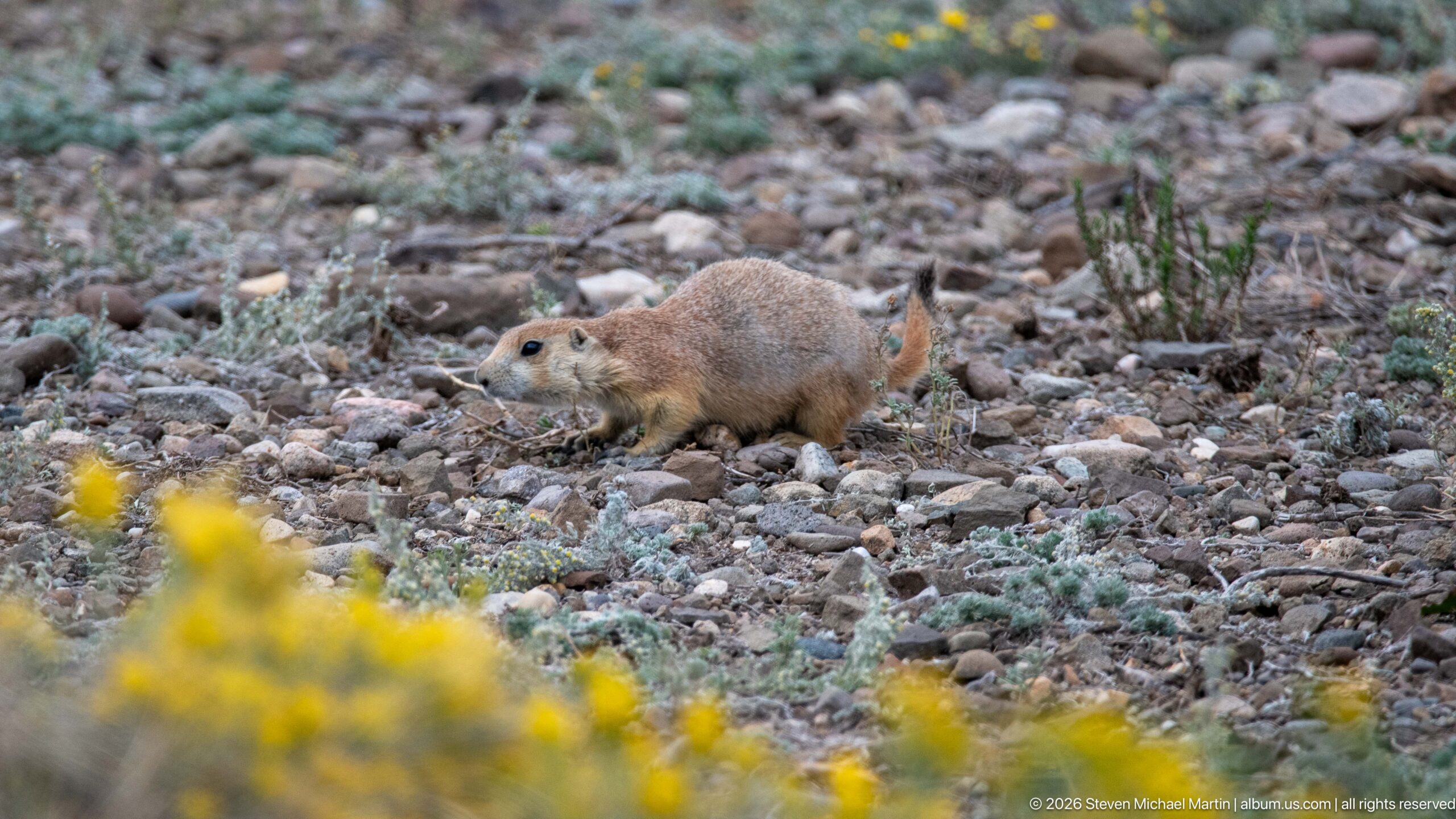
A prairie dog crosses a broad field of stones and low groundcover, with blurred yellow flowers filling the foreground. The wider composition places the animal within its dry prairie habitat rather than isolating it as a portrait, emphasizing the scale and texture of the colony landscape.
Caption
A prairie dog crosses a broad field of stones and low groundcover, with blurred yellow flowers filling the foreground. The wider composition places the animal within its dry prairie habitat rather than isolating it as a portrait, emphasizing the scale and texture of the colony landscape.
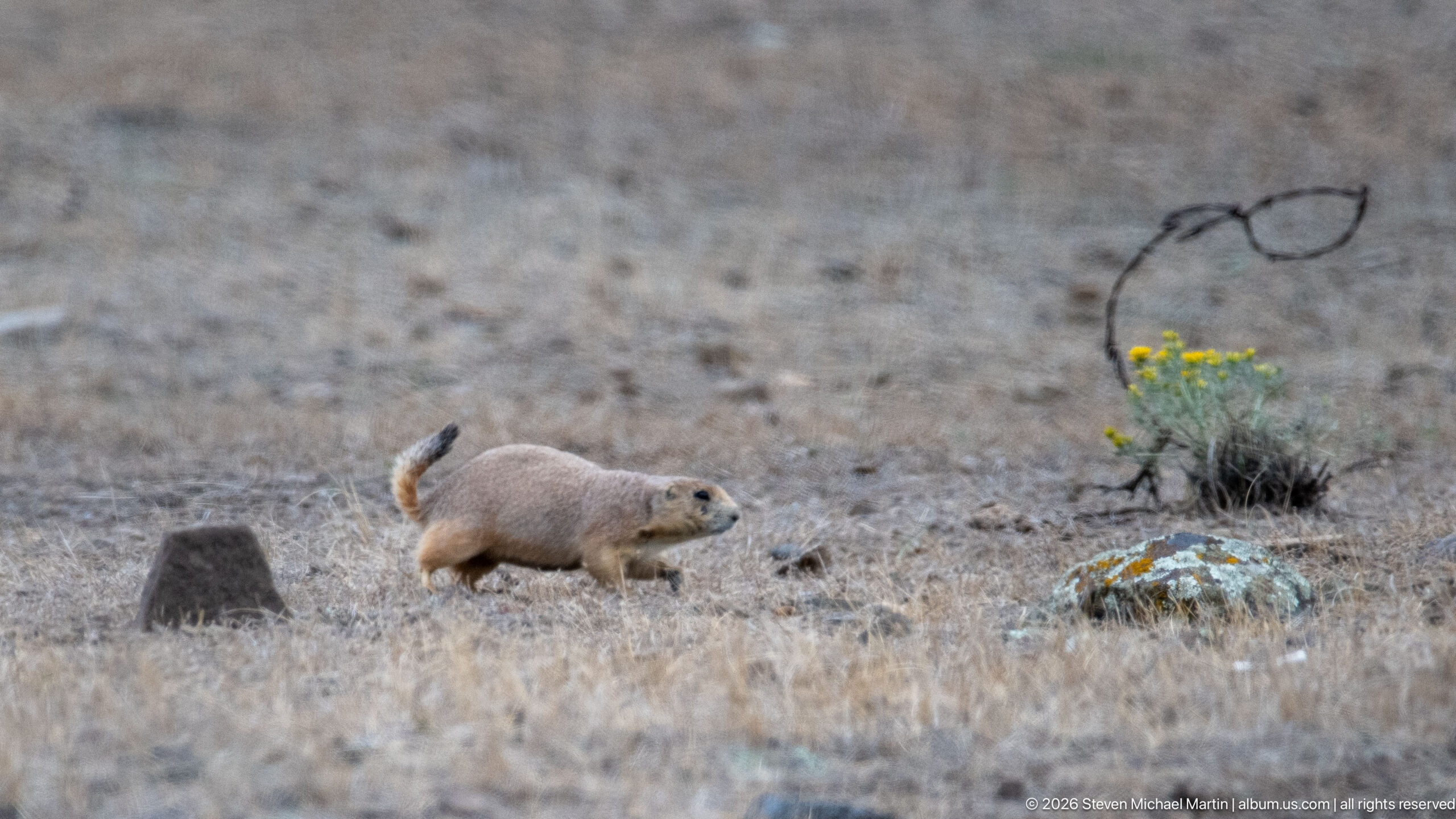
A prairie dog moves through open, dry grassland with only scattered plants and stones around it. Seen at greater distance than most wildlife portraits in the series, the animal appears small against the muted prairie, giving a clearer sense of the colony’s exposed landscape and sparse cover.
Caption
A prairie dog moves through open, dry grassland with only scattered plants and stones around it. Seen at greater distance than most wildlife portraits in the series, the animal appears small against the muted prairie, giving a clearer sense of the colony’s exposed landscape and sparse cover.
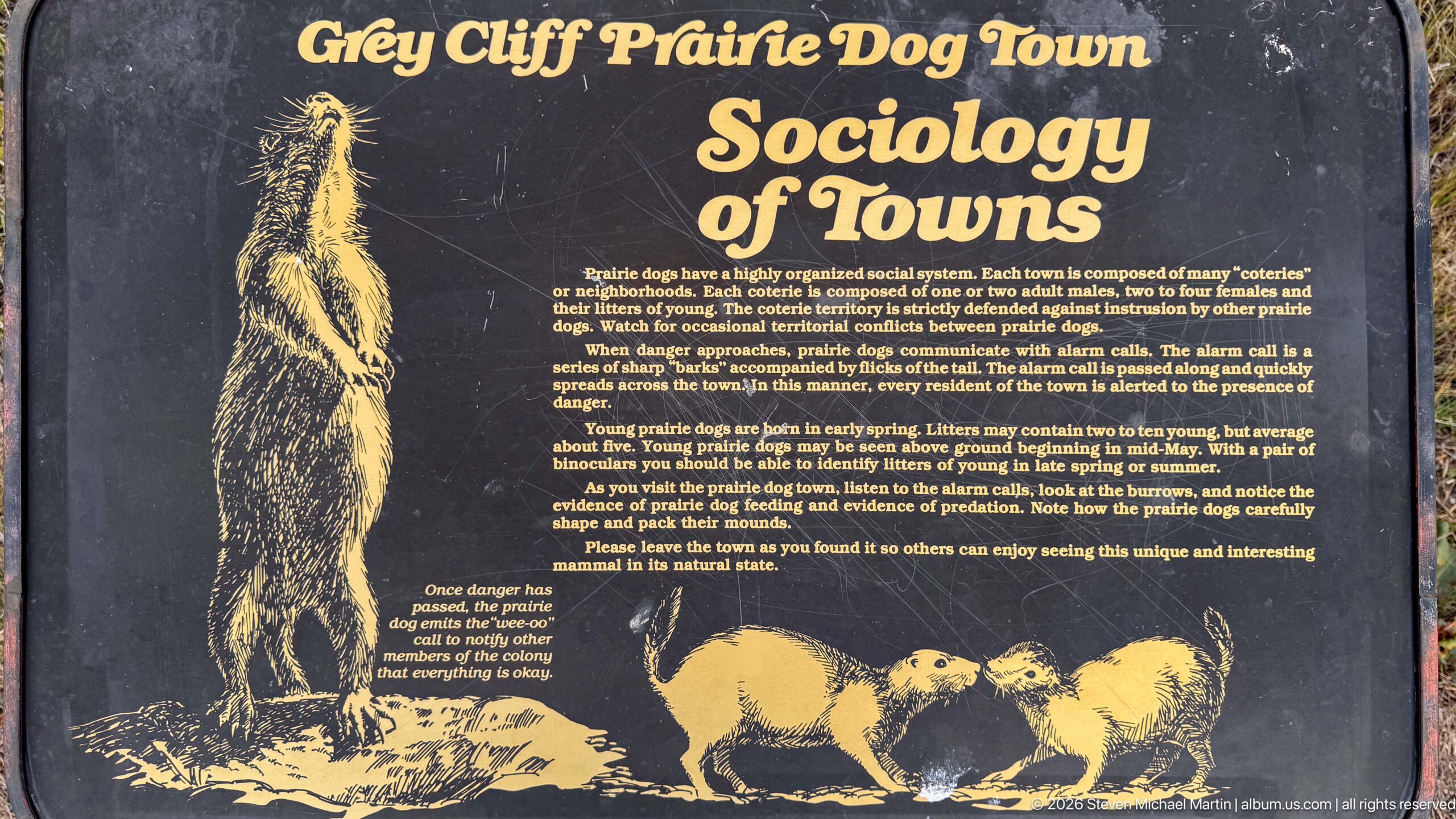
The “Sociology of Towns” panel explains prairie-dog social organization through text and yellow illustrations on a dark background. Drawings of standing and interacting animals accompany discussion of family groups, territorial behavior, alarm calls, and social contact, interpreting the colony as a structured community rather than a random gathering.
Caption
The “Sociology of Towns” panel explains prairie-dog social organization through text and yellow illustrations on a dark background. Drawings of standing and interacting animals accompany discussion of family groups, territorial behavior, alarm calls, and social contact, interpreting the colony as a structured community rather than a random gathering.
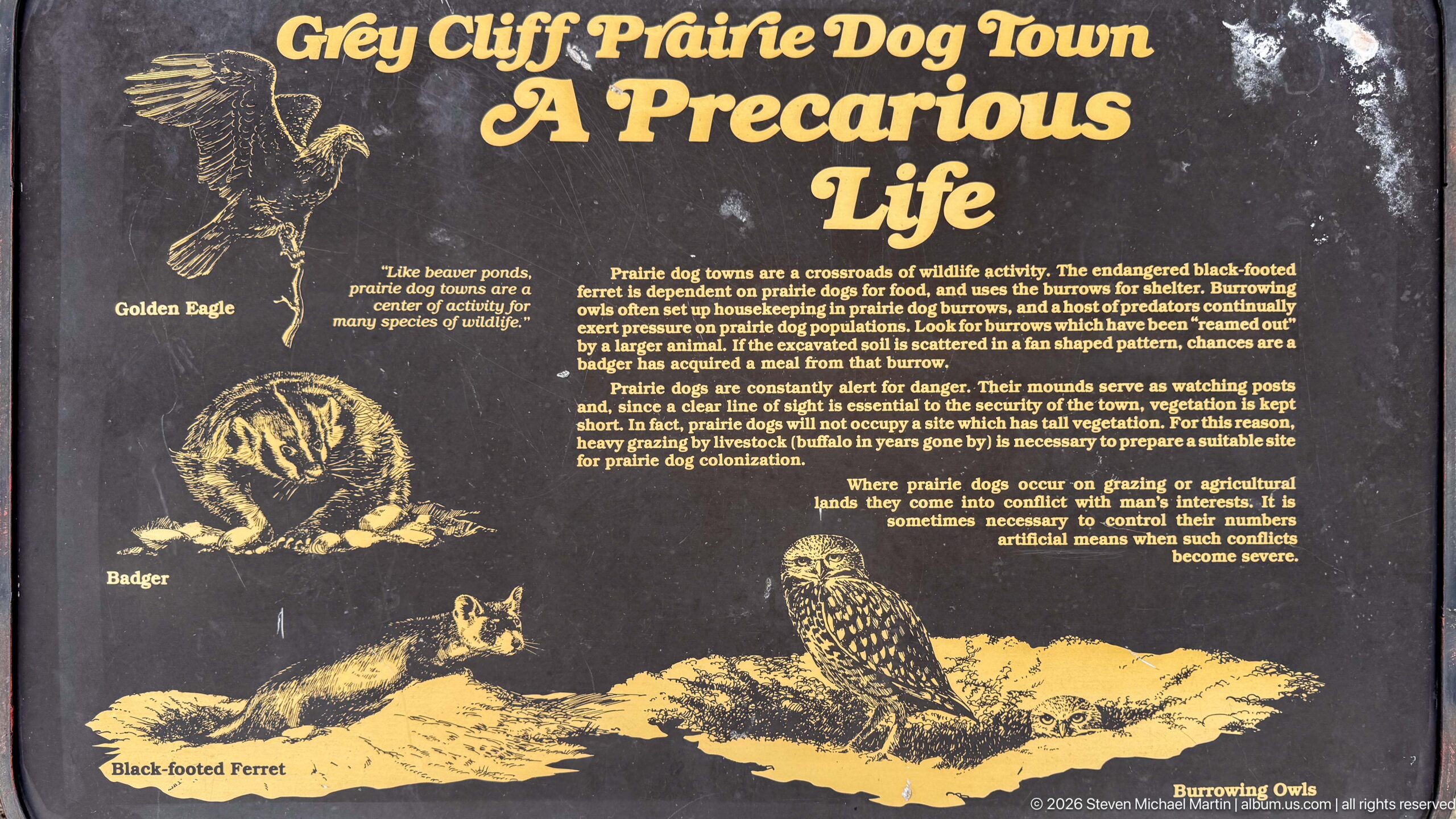
The “A Precarious Life” panel presents prairie dogs within a grassland food web, pairing explanatory text with illustrations of predators including a golden eagle, badger, black-footed ferret, and burrowing owl. Its design emphasizes the colony’s ecological connections and the risks faced by prairie dogs in open country.
Caption
The “A Precarious Life” panel presents prairie dogs within a grassland food web, pairing explanatory text with illustrations of predators including a golden eagle, badger, black-footed ferret, and burrowing owl. Its design emphasizes the colony’s ecological connections and the risks faced by prairie dogs in open country.
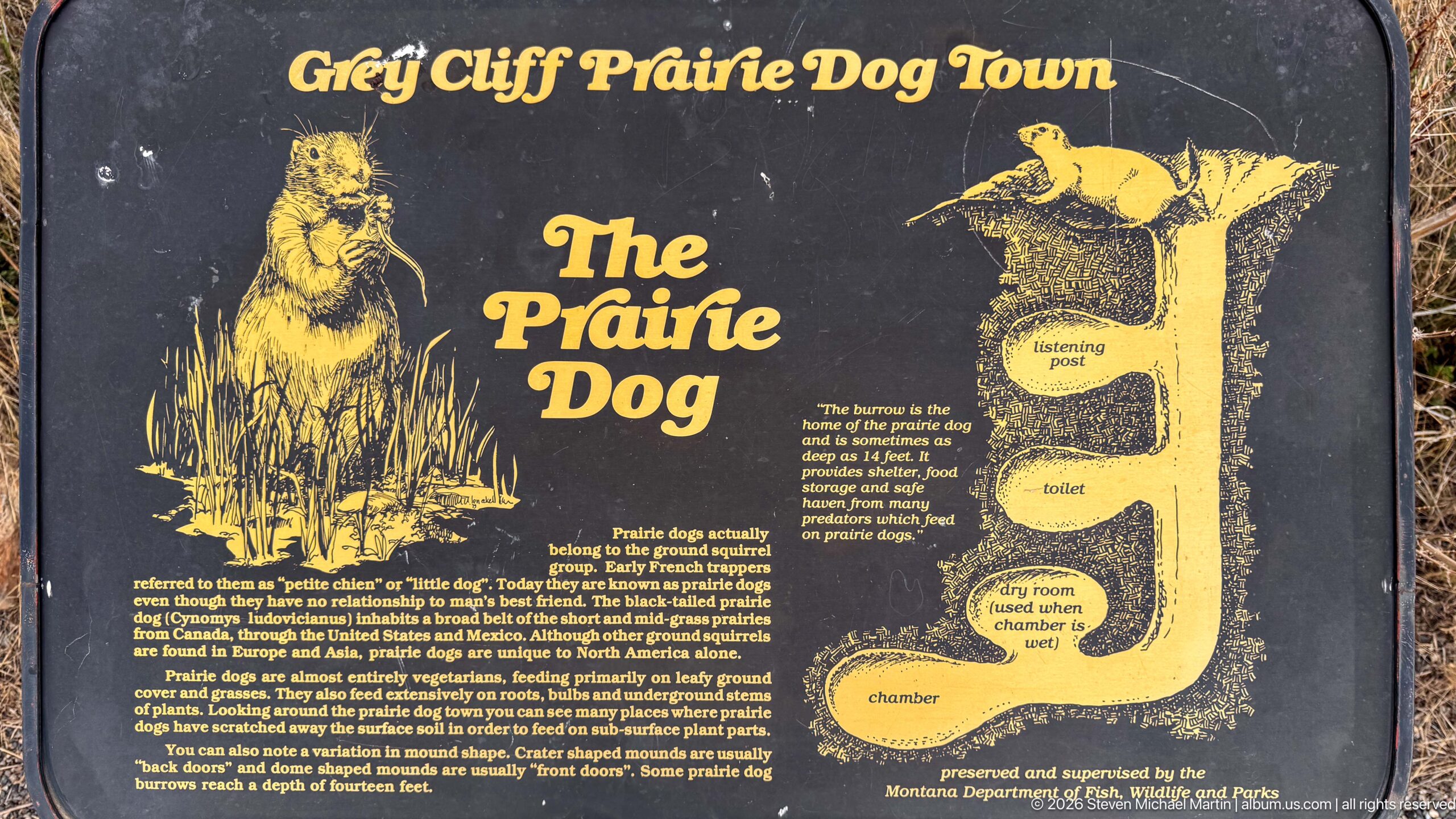
The “Prairie Dog” panel combines a standing animal illustration with a cutaway diagram of an underground burrow. Labeled spaces—including a listening post, toilet, dry room, chamber, and wet chamber—show how the tunnel system is organized, while the accompanying text introduces prairie-dog behavior and colony life.
Caption
The “Prairie Dog” panel combines a standing animal illustration with a cutaway diagram of an underground burrow. Labeled spaces—including a listening post, toilet, dry room, chamber, and wet chamber—show how the tunnel system is organized, while the accompanying text introduces prairie-dog behavior and colony life.
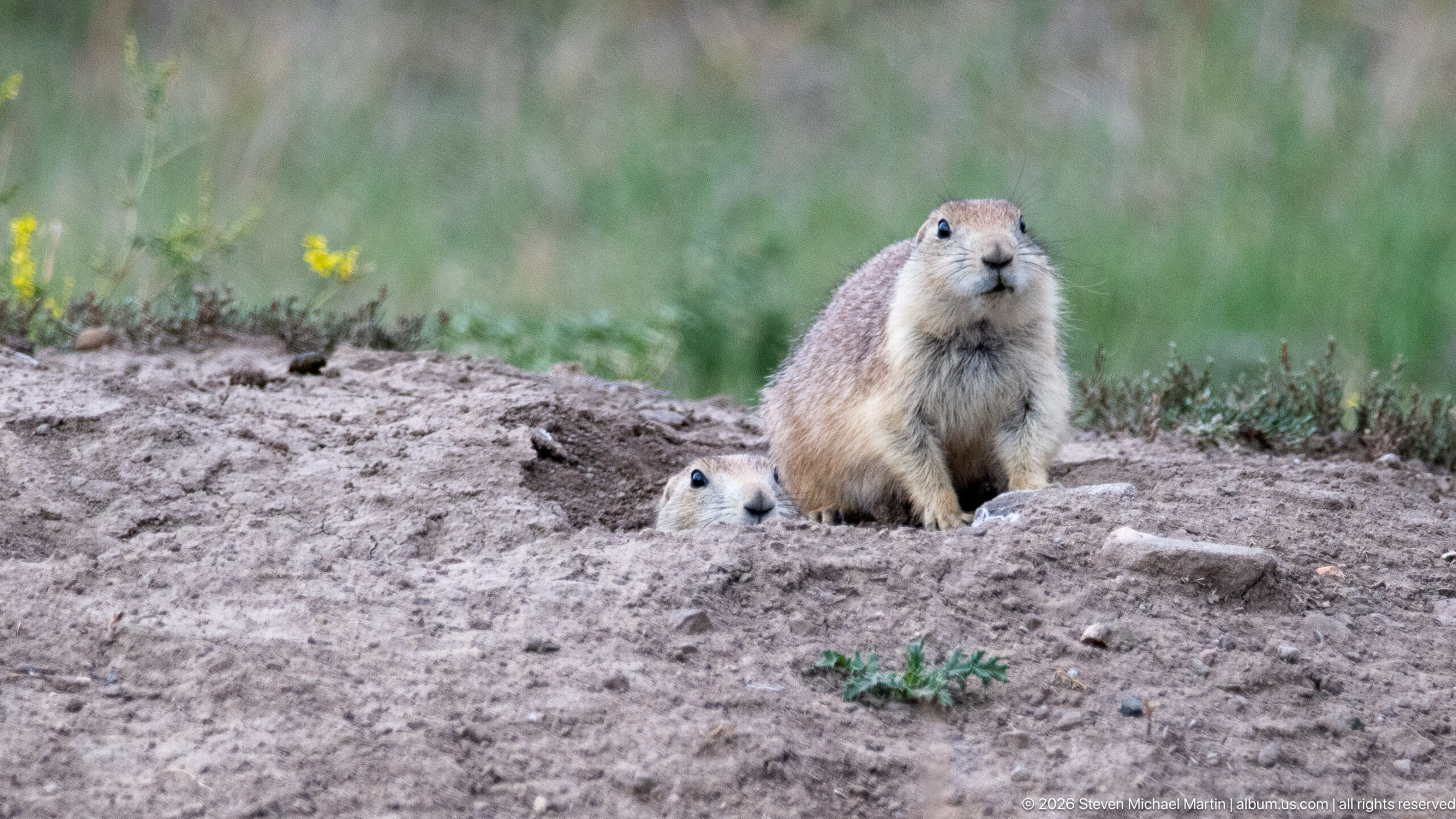
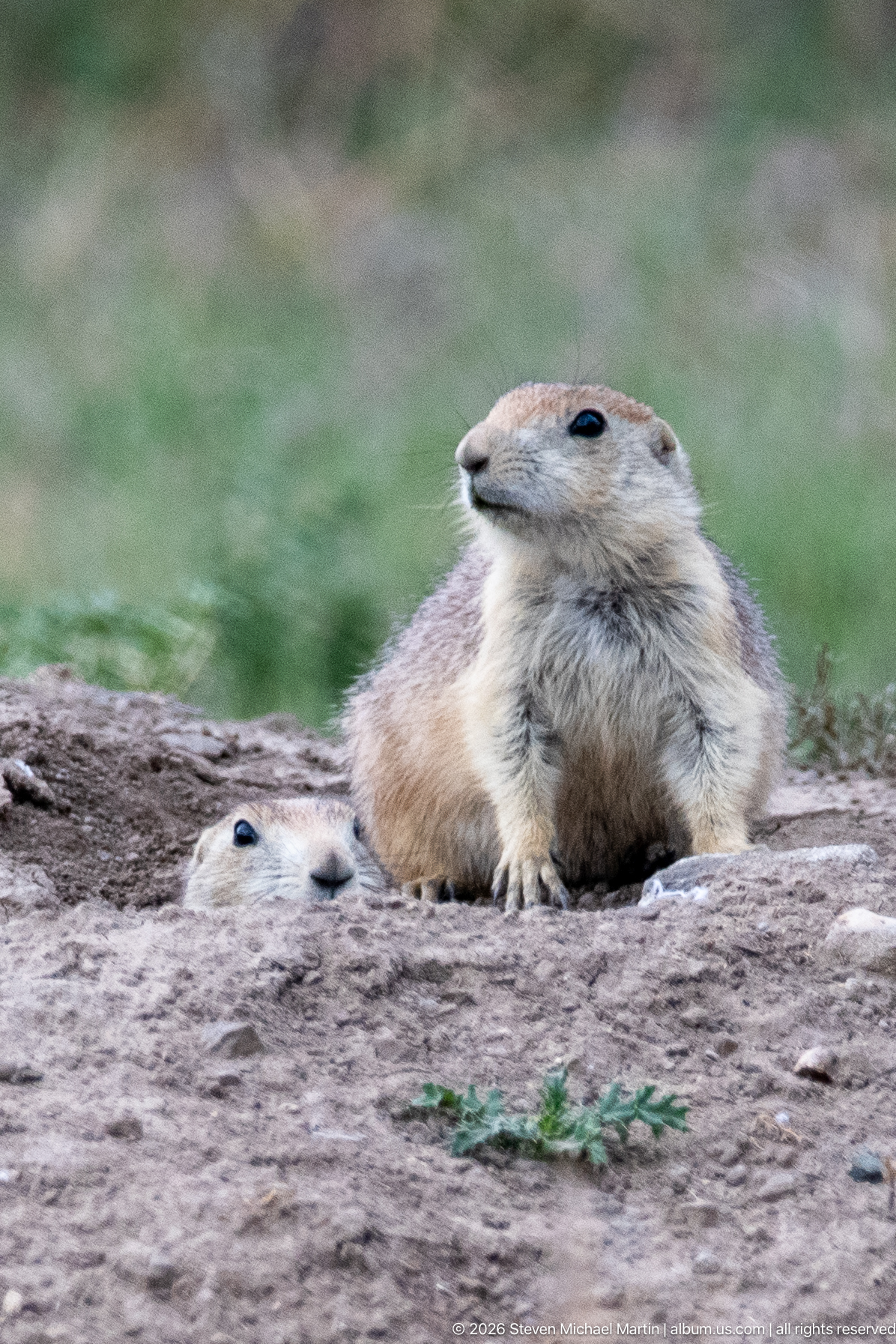
Two prairie dogs occupy different levels of a broad earthen mound: one stands upright near the crest while a second peers from a lower opening. Their contrasting postures reveal the colony landscape as both shelter and lookout, with excavated soil rising above the green grassland and a few yellow wildflowers punctuating the background.
Caption
Two prairie dogs occupy different levels of a broad earthen mound: one stands upright near the crest while a second peers from a lower opening. Their contrasting postures reveal the colony landscape as both shelter and lookout, with excavated soil rising above the green grassland and a few yellow wildflowers punctuating the background.
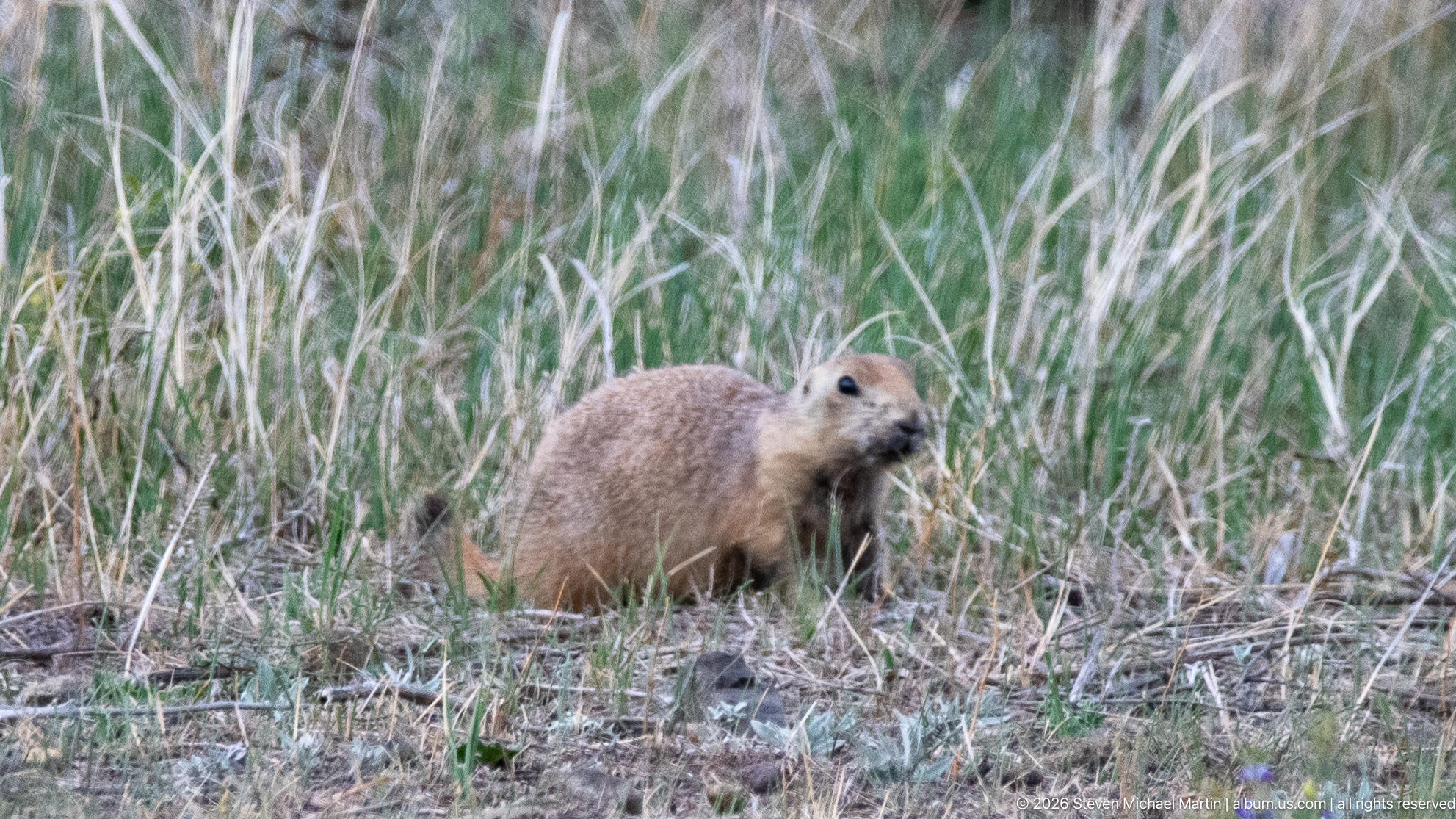
A single prairie dog sits amid taller grasses away from the conspicuous bare-earth mounds seen elsewhere in the colony. The animal’s warm brown coat blends with dry stems while fresh green growth surrounds its feet, placing the wildlife within the mixed-height vegetation of the prairie rather than against an excavated burrow entrance.
Caption
A single prairie dog sits amid taller grasses away from the conspicuous bare-earth mounds seen elsewhere in the colony. The animal’s warm brown coat blends with dry stems while fresh green growth surrounds its feet, placing the wildlife within the mixed-height vegetation of the prairie rather than against an excavated burrow entrance.
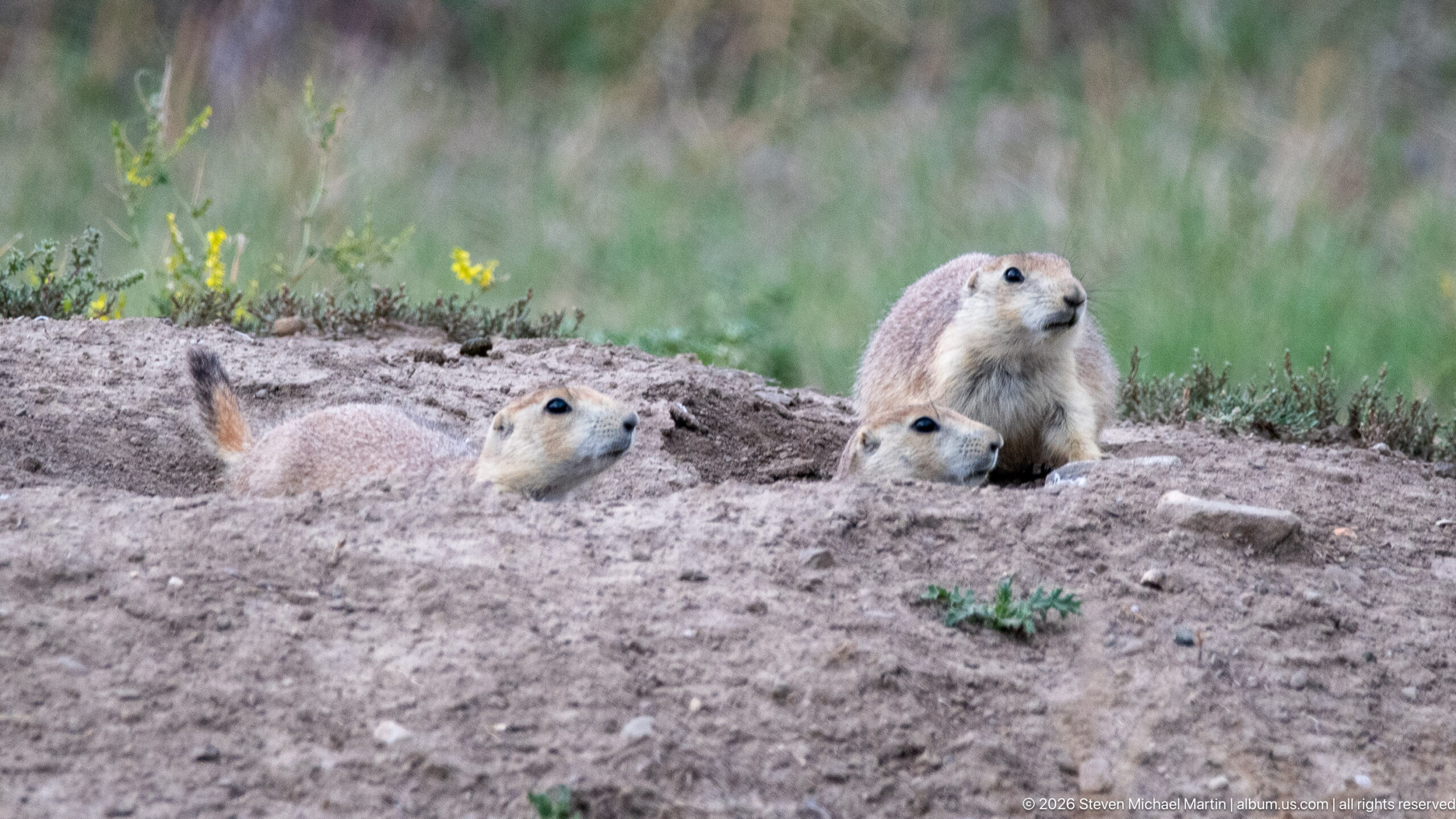
Three prairie dogs share a large excavated mound, creating a compact view of social use within the colony. One animal stands higher at right, another watches from the center, and a third stretches across the left side near the soil surface. The varied positions make the raised mound read simultaneously as refuge, gathering place, and elevated vantage point.
Caption
Three prairie dogs share a large excavated mound, creating a compact view of social use within the colony. One animal stands higher at right, another watches from the center, and a third stretches across the left side near the soil surface. The varied positions make the raised mound read simultaneously as refuge, gathering place, and elevated vantage point.