Little Bighorn Battlefield National Monument
Little Bighorn Battlefield preserves the site of the 1876 conflict between the United States Army and a coalition of Lakota Sioux, Northern Cheyenne, and Arapaho warriors. The battle occurred during a period of rapid expansion into the northern plains and reflects broader tensions related to territorial control and cultural sovereignty. The open grassland landscape provides context for understanding how terrain influenced the course of the engagement.
The monument commemorates both the U.S. soldiers and the Indigenous warriors who fought at the site. Interpretive markers across the landscape illustrate the positions and movements of forces during the conflict. The preservation of the battlefield allows visitors to observe the terrain much as it appeared in the late nineteenth century.
Today, Little Bighorn Battlefield provides insight into the historical complexity of westward expansion and the cultural interactions that shaped the northern plains. The landscape illustrates how geography influenced historical events and how preserved sites contribute to understanding multiple perspectives on the past.

Blue water fills a steep-sided canyon, with a curved concrete dam crossing the distant channel. Red and cream rock layers form the surrounding slopes, while a thin line on the water marks a boundary or cable whose purpose is not clear. The composition emphasizes the engineered barrier within the broad, exposed canyon landscape.
Caption
Blue water fills a steep-sided canyon, with a curved concrete dam crossing the distant channel. Red and cream rock layers form the surrounding slopes, while a thin line on the water marks a boundary or cable whose purpose is not clear. The composition emphasizes the engineered barrier within the broad, exposed canyon landscape.

A broad stretch of dark, still water lies beneath a cloud-filled sky, enclosed by low canyon slopes. In the foreground, rough reddish rock and pale gravel edge the shore; scattered shrubs and trees cover the slopes beyond. The subdued light reduces color contrast and gives the image a quieter, more enclosed feel than the sunlit reservoir panoramas.
Caption
A broad stretch of dark, still water lies beneath a cloud-filled sky, enclosed by low canyon slopes. In the foreground, rough reddish rock and pale gravel edge the shore; scattered shrubs and trees cover the slopes beyond. The subdued light reduces color contrast and gives the image a quieter, more enclosed feel than the sunlit reservoir panoramas.

From an elevated slope, the reservoir curves through a broad valley beneath a bright sky. Red-rock banks frame the water in the foreground, while a flat agricultural plain stretches toward the horizon. The distant fields and open sky give this frame a wider geographic scale than the closer canyon views, linking water, upland terrain, and cultivated land.
Caption
From an elevated slope, the reservoir curves through a broad valley beneath a bright sky. Red-rock banks frame the water in the foreground, while a flat agricultural plain stretches toward the horizon. The distant fields and open sky give this frame a wider geographic scale than the closer canyon views, linking water, upland terrain, and cultivated land.

A close view of pale, horizontally banded rock cliffs rising directly from dark water. Redder strata and sparse shrubs cover the upper slope, while a narrow pale ledge follows the shoreline. The frame concentrates on the contrast between the stratified rock face and reservoir edge, without a visible structure or people to establish a more specific location.
Caption
A close view of pale, horizontally banded rock cliffs rising directly from dark water. Redder strata and sparse shrubs cover the upper slope, while a narrow pale ledge follows the shoreline. The frame concentrates on the contrast between the stratified rock face and reservoir edge, without a visible structure or people to establish a more specific location.

A pale, horizontally layered rock point projects into blue water, narrowing the visible channel between opposing canyon slopes. Dark scrub covers the higher ground, while thin rock bands step down toward the shoreline. The composition is tighter and more focused on the projecting formation than the broad canyon panoramas elsewhere in the batch.
Caption
A pale, horizontally layered rock point projects into blue water, narrowing the visible channel between opposing canyon slopes. Dark scrub covers the higher ground, while thin rock bands step down toward the shoreline. The composition is tighter and more focused on the projecting formation than the broad canyon panoramas elsewhere in the batch.

The reservoir bends between steep canyon walls, with vivid red cliffs across the upper right and pale, layered rock near the water. Evergreen and scrub vegetation covers the nearer slope, adding a dark foreground against the blue channel. The view follows the water into the distance and emphasizes the changing rock colors along the canyon.
Caption
The reservoir bends between steep canyon walls, with vivid red cliffs across the upper right and pale, layered rock near the water. Evergreen and scrub vegetation covers the nearer slope, adding a dark foreground against the blue channel. The view follows the water into the distance and emphasizes the changing rock colors along the canyon.

Three horses stand in dry grass beside a paved road, with low, open hills behind them. A chestnut horse is separated to the left, while a dark adult horse stands close to a smaller foal on the right. Their relationship appears maternal, though the photograph alone does not establish ownership or whether the horses are wild or managed.
Caption
Three horses stand in dry grass beside a paved road, with low, open hills behind them. A chestnut horse is separated to the left, while a dark adult horse stands close to a smaller foal on the right. Their relationship appears maternal, though the photograph alone does not establish ownership or whether the horses are wild or managed.

Rows of upright headstones extend across a grassy cemetery, with one larger stone in the foreground and scattered trees beyond. The markers vary in shape and spacing, and their dark shadows fall across the lawn in bright daylight. Individual names and affiliations are not legible at this scale, so the scene is best described as a cemetery view rather than assigned to a particular group.
Caption
Rows of upright headstones extend across a grassy cemetery, with one larger stone in the foreground and scattered trees beyond. The markers vary in shape and spacing, and their dark shadows fall across the lawn in bright daylight. Individual names and affiliations are not legible at this scale, so the scene is best described as a cemetery view rather than assigned to a particular group.

A large bird glides across a blue sky with its wings extended and tail spread. The underside is dark, and the separated primary feathers are visible at the wingtips, but the image does not provide enough detail to identify the species confidently. The open sky isolates the bird and makes its banking flight the central subject.
Caption
A large bird glides across a blue sky with its wings extended and tail spread. The underside is dark, and the separated primary feathers are visible at the wingtips, but the image does not provide enough detail to identify the species confidently. The open sky isolates the bird and makes its banking flight the central subject.
Historic Site Field Guide
Little Bighorn Battlefield commemorates a significant encounter between U.S. Army forces and Indigenous warriors during the late nineteenth century. The preserved grassland terrain illustrates how geography influenced the movement of opposing groups across the landscape. Interpretive markers provide insight into the sequence of events that occurred during the battle.
🏛 Historical Significance
- 1876 conflict between U.S. Army and Lakota, Cheyenne, and Arapaho forces
- Preserved battlefield landscape illustrating terrain influence
- Memorials recognizing multiple historical perspectives
- Important site in history of westward expansion
- Location associated with cultural and political change
📖 Interpretive Context
The battlefield landscape demonstrates how open terrain influenced tactical movement and visibility during the conflict. The site helps illustrate the broader historical context of expansion into the northern plains and the complex interactions between Indigenous communities and the United States government during the nineteenth century.
📷 Photography Notes
- Wide landscapes convey scale of battlefield terrain
- Markers provide geographic reference points
- Low-angle light enhances grassland texture
- Open horizons reflect historic landscape conditions
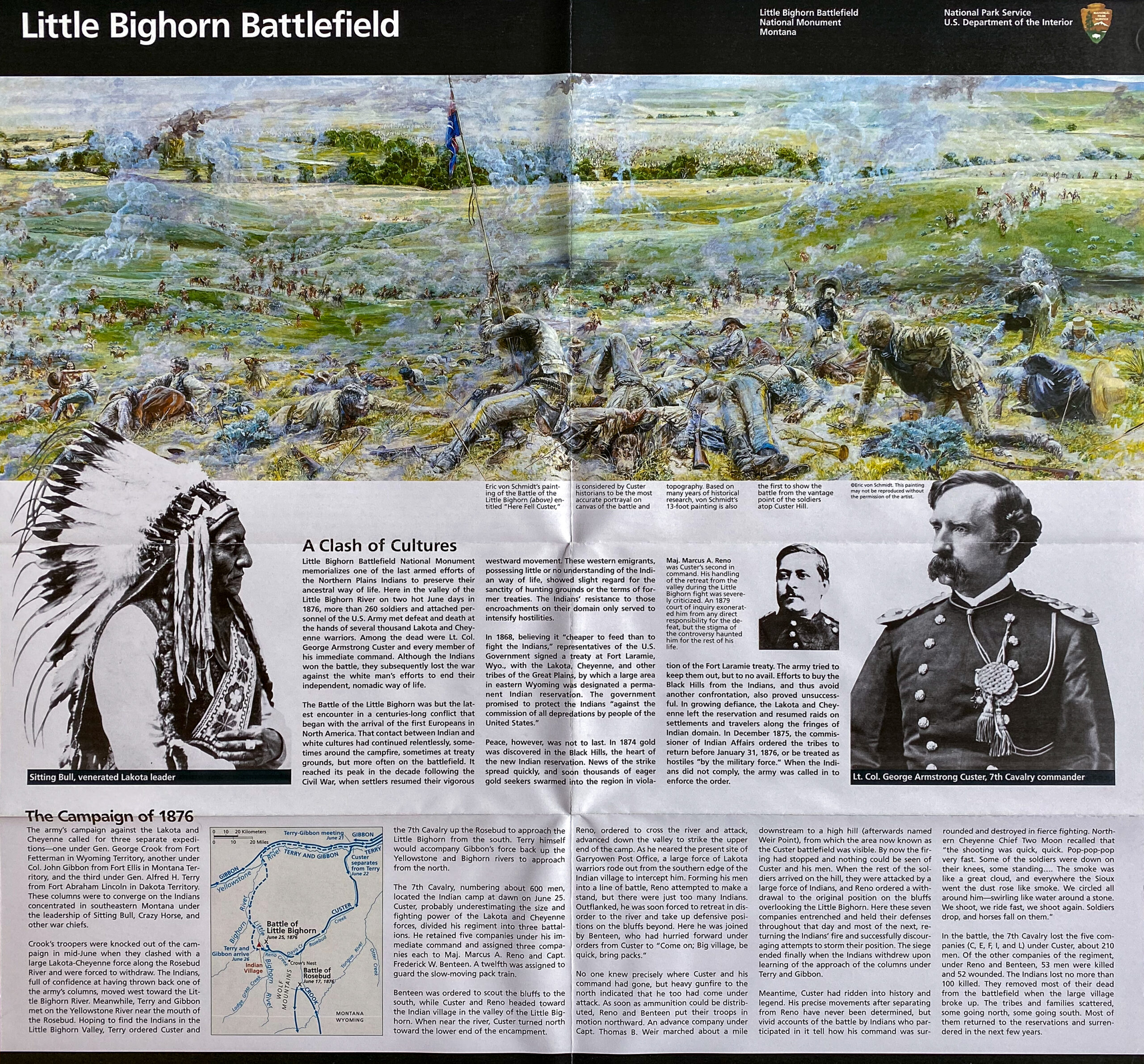
An open printed interpretive brochure combines a color battle scene across the top with portraits, a route map, and columns of explanatory text below. The visible headings include “A Clash of Cultures” and “The Campaign of 1876.” The page documents how the site presents its history to visitors; small text and image details should not be treated as independent photographic evidence about the events.
Caption
An open printed interpretive brochure combines a color battle scene across the top with portraits, a route map, and columns of explanatory text below. The visible headings include “A Clash of Cultures” and “The Campaign of 1876.” The page documents how the site presents its history to visitors; small text and image details should not be treated as independent photographic evidence about the events.
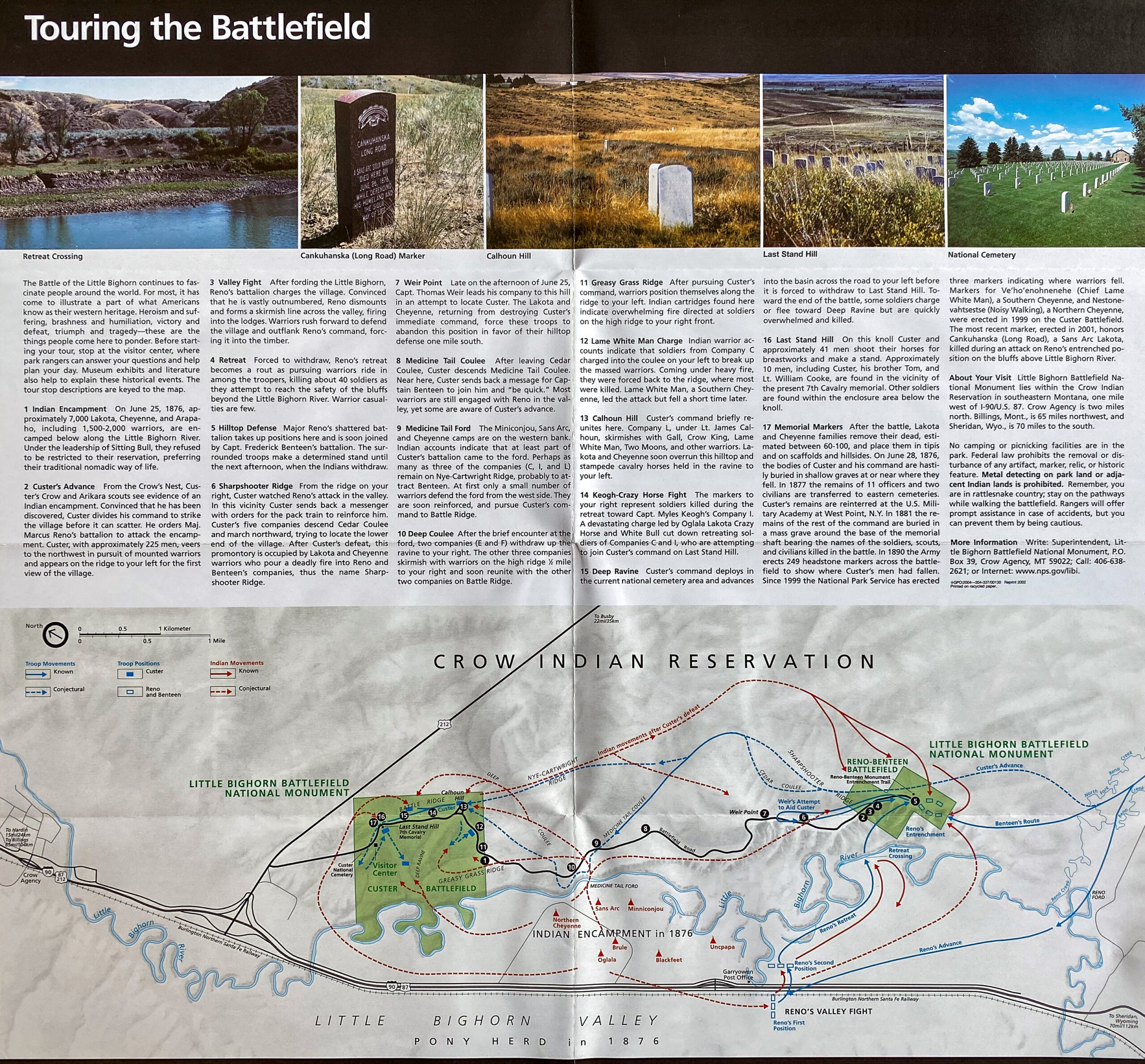
A folded visitor guide titled “Touring the Battlefield” combines small landscape photographs and short text panels across the top with a large map below. The map labels the Crow Indian Reservation and marks the Little Bighorn Battlefield National Monument area, with roads and waterways traced across the valley. The image records the guide’s layout and visitor-orientation function rather than the mapped terrain itself.
Caption
A folded visitor guide titled “Touring the Battlefield” combines small landscape photographs and short text panels across the top with a large map below. The map labels the Crow Indian Reservation and marks the Little Bighorn Battlefield National Monument area, with roads and waterways traced across the valley. The image records the guide’s layout and visitor-orientation function rather than the mapped terrain itself.