Butte Berkeley Pit
The Berkeley Pit cuts into the eastern edge of Butte, Montana, as one of the most dramatic remnants of the city’s extraordinary copper-mining era. Opened by the Anaconda Company in 1955, the enormous open-pit mine represented a fundamental shift from the underground workings that had honeycombed Butte Hill for generations. By the time mining ended in 1982, nearly 1.5 billion tons of material had been removed, including more than 290 million tons of copper ore. The excavation eventually grew to roughly 7,000 feet long, 5,600 feet wide, and about 1,600 feet deep, permanently reshaping both the landscape and neighborhoods on Butte’s East Side.
When mining ceased and the pumps that had kept Butte’s extensive underground workings dry were shut down, groundwater began rising through the abandoned tunnels and into the Berkeley Pit. Contact with exposed mineralized rock created acidic, metal-laden water, transforming an industrial excavation into one of the most visible environmental legacies of American hard-rock mining. The pit became part of the Silver Bow Creek/Butte Area Superfund site, and today its water level and chemistry are closely monitored. Water is pumped and treated to keep the pit below a federally established protective water level, allowing the excavation to continue functioning as the low point toward which contaminated groundwater flows rather than allowing that water to migrate outward.
Seen from the Berkeley Pit viewing stand, the immense terraced walls and strangely colored water offer a stark counterpoint to the historic headframes, brick commercial blocks, and mining neighborhoods elsewhere in Butte. The pit is simultaneously an engineering achievement, an altered landscape, and a continuing environmental-management project—a place where the enormous wealth extracted from the “Richest Hill on Earth” can be considered alongside its lasting costs. More than a century of mining made Butte one of the most important copper-producing centers in the world; the Berkeley Pit reveals what remained when that industrial system finally receded, leaving a landscape that still requires active management decades later.
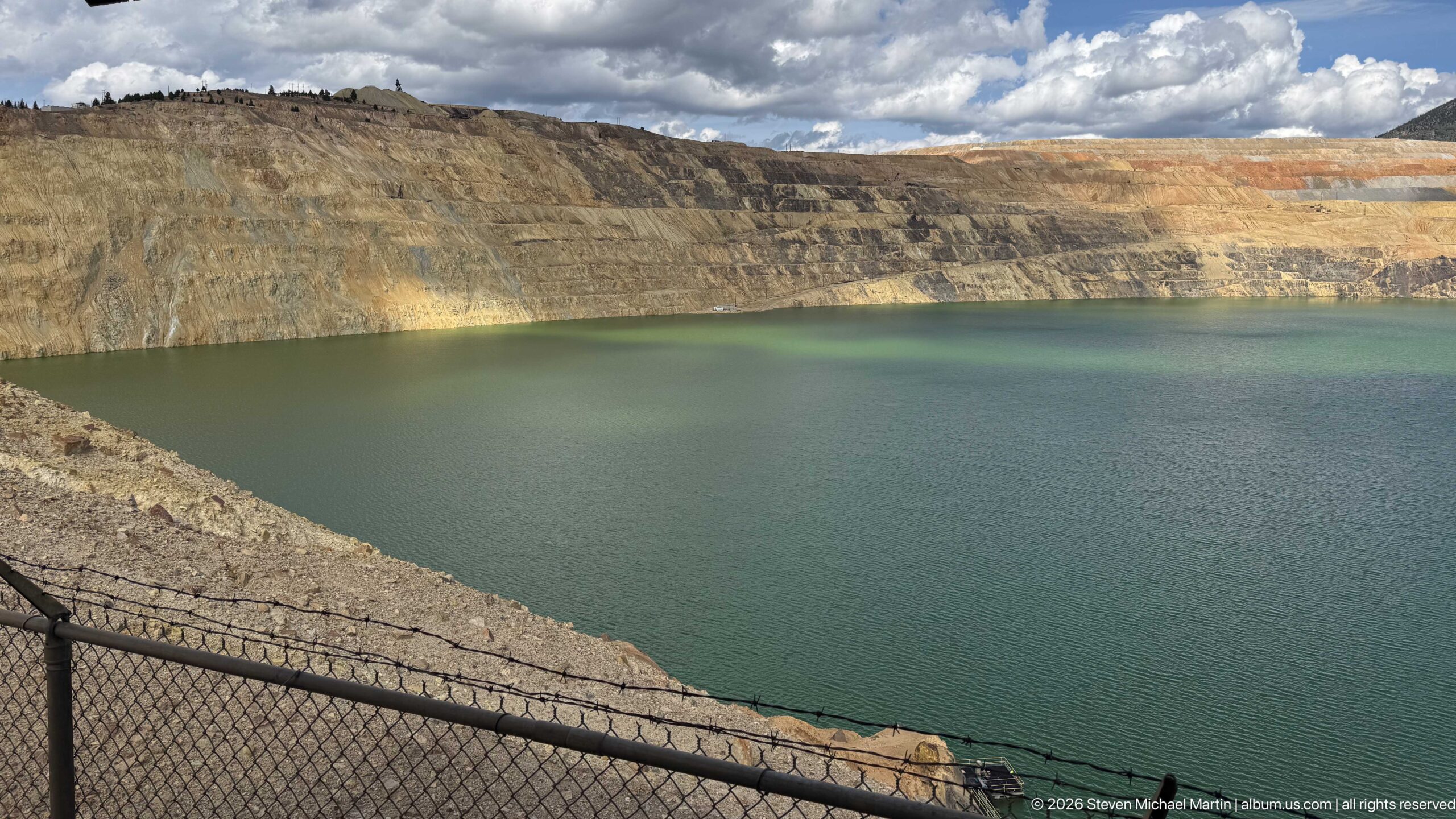
The flooded Berkeley Pit spreads beneath layered benches that expose bands of gray, ocher, and rust-colored rock. A foreground fence marks the public overlook, while broken clouds illuminate portions of the excavated walls, giving this view a particularly clear sense of the pit’s depth, breadth, and engineered geometry.
Caption
The flooded Berkeley Pit spreads beneath layered benches that expose bands of gray, ocher, and rust-colored rock. A foreground fence marks the public overlook, while broken clouds illuminate portions of the excavated walls, giving this view a particularly clear sense of the pit’s depth, breadth, and engineered geometry.
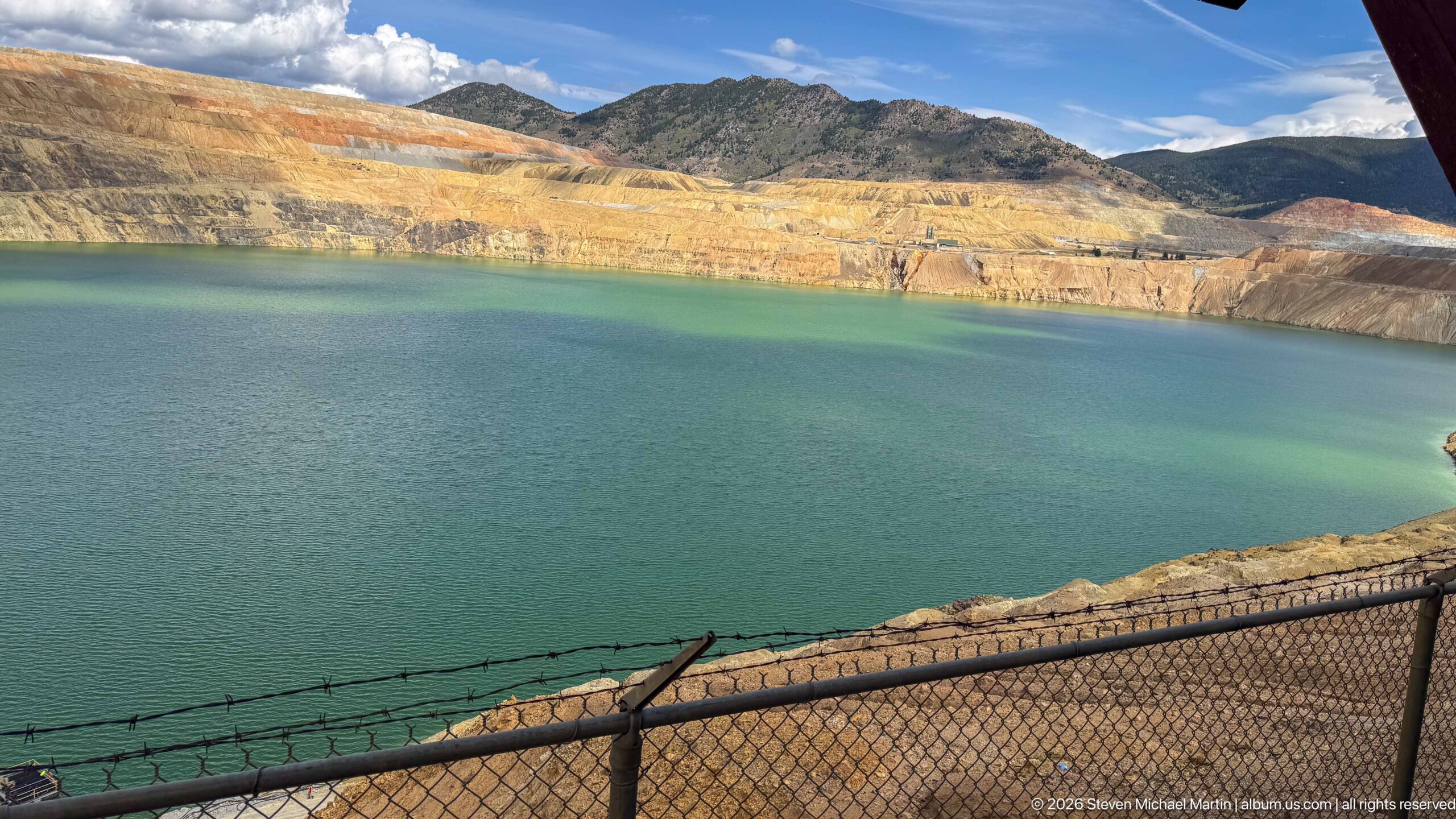
Green-blue water occupies most of this close view across the Berkeley Pit, with yellow, tan, and rust-colored benches rising toward dark mountains beyond. The tighter composition minimizes the viewing structure and concentrates attention on the relationship between the flooded excavation and the stepped walls left by decades of open-pit mining.
Caption
Green-blue water occupies most of this close view across the Berkeley Pit, with yellow, tan, and rust-colored benches rising toward dark mountains beyond. The tighter composition minimizes the viewing structure and concentrates attention on the relationship between the flooded excavation and the stepped walls left by decades of open-pit mining.
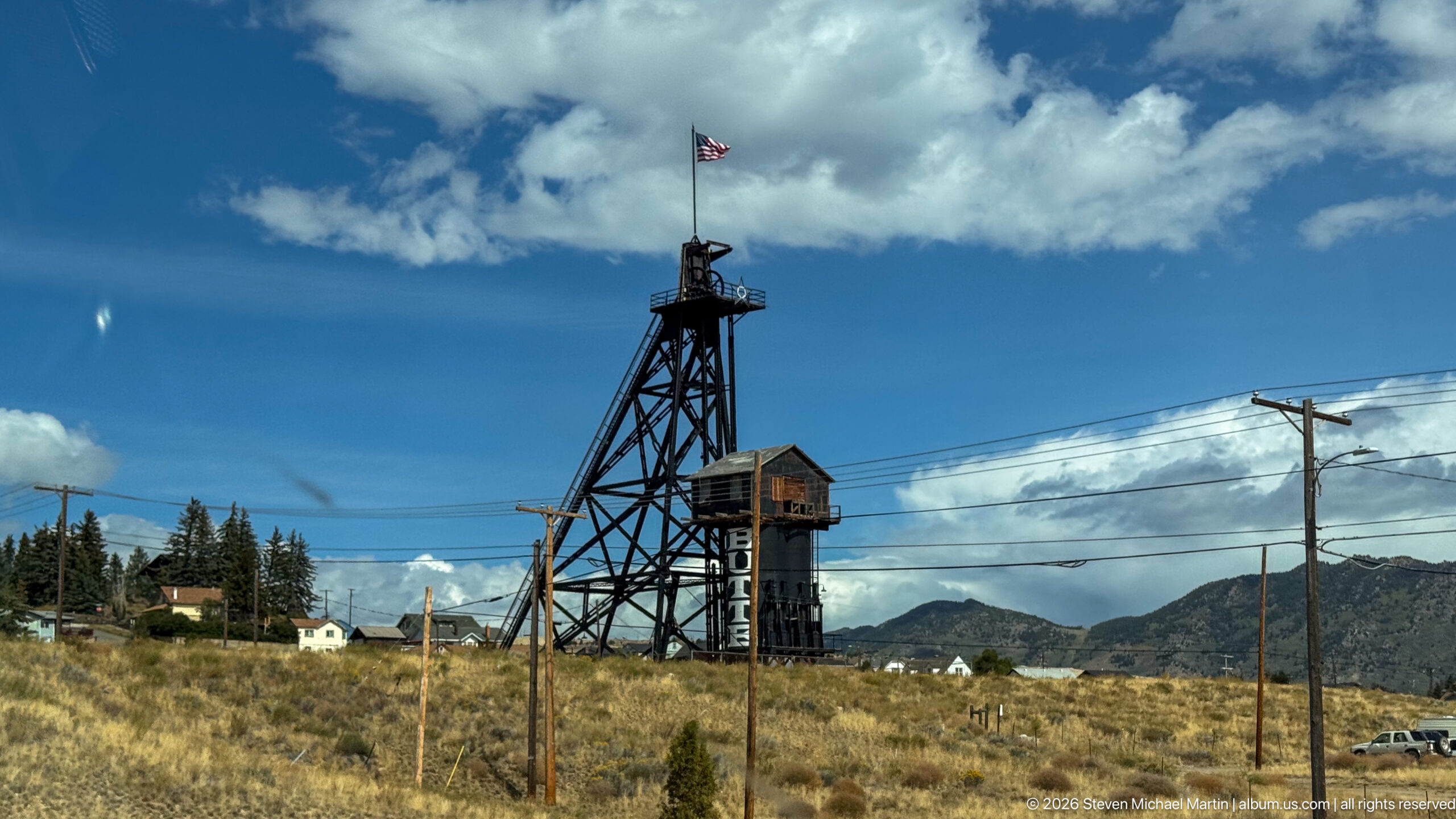
A tall steel headframe rises above the dry grass of Butte Hill, accompanied by a narrow shaft-side structure and crossed by utility lines. The American flag at the summit and exposed latticework make the industrial landmark stand sharply against the mountain skyline, preserving the vertical form that once marked access to deep underground workings.
Caption
A tall steel headframe rises above the dry grass of Butte Hill, accompanied by a narrow shaft-side structure and crossed by utility lines. The American flag at the summit and exposed latticework make the industrial landmark stand sharply against the mountain skyline, preserving the vertical form that once marked access to deep underground workings.
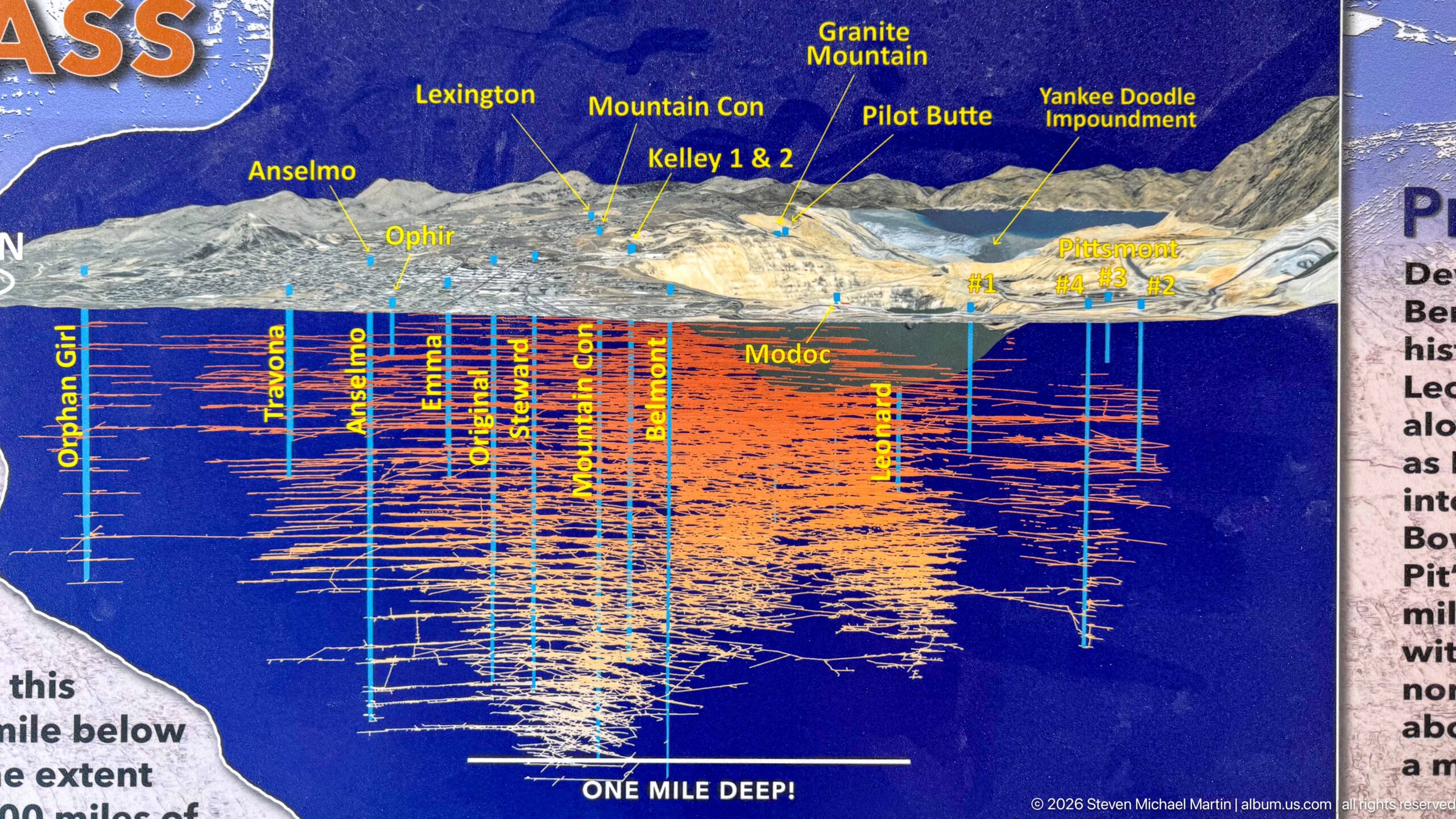
An interpretive cross-section maps the dense network of underground mine workings beneath and around the Berkeley Pit. Named shafts and mines descend through a blue subsurface field filled with orange workings, while the surface profile locates features such as Granite Mountain, Pilot Butte, and the Yankee Doodle Impoundment. The graphic makes visible the hidden mining landscape beneath Butte Hill.
Caption
An interpretive cross-section maps the dense network of underground mine workings beneath and around the Berkeley Pit. Named shafts and mines descend through a blue subsurface field filled with orange workings, while the surface profile locates features such as Granite Mountain, Pilot Butte, and the Yankee Doodle Impoundment. The graphic makes visible the hidden mining landscape beneath Butte Hill.
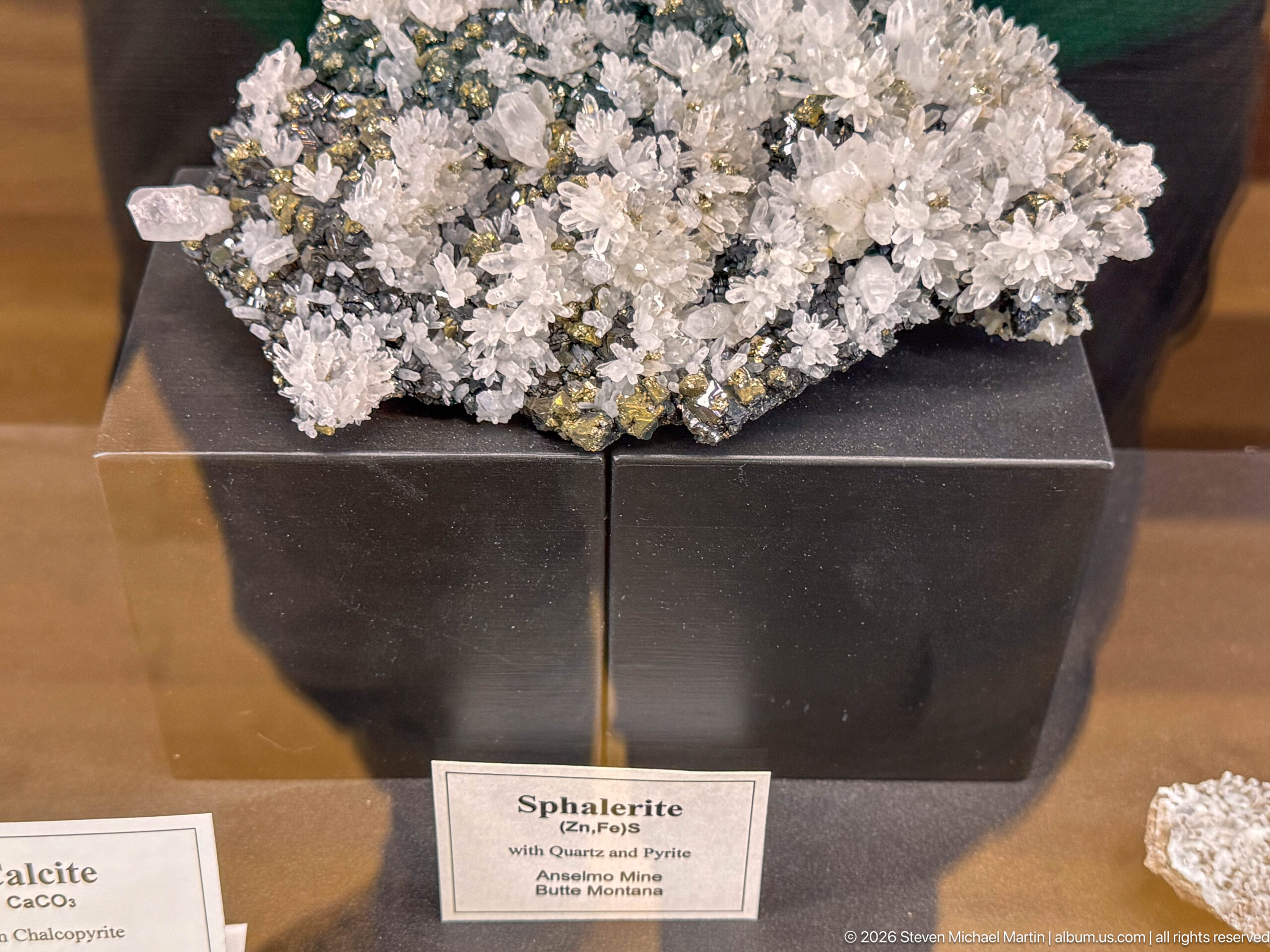
Dark sphalerite crystals are intergrown with pale quartz and metallic pyrite in this specimen from Butte. The combination represents minerals associated with the complex hydrothermal systems of the Butte district, where economically valuable ore bodies contained far more mineral diversity than copper alone.
Caption
Dark sphalerite crystals are intergrown with pale quartz and metallic pyrite in this specimen from Butte. The combination represents minerals associated with the complex hydrothermal systems of the Butte district, where economically valuable ore bodies contained far more mineral diversity than copper alone.
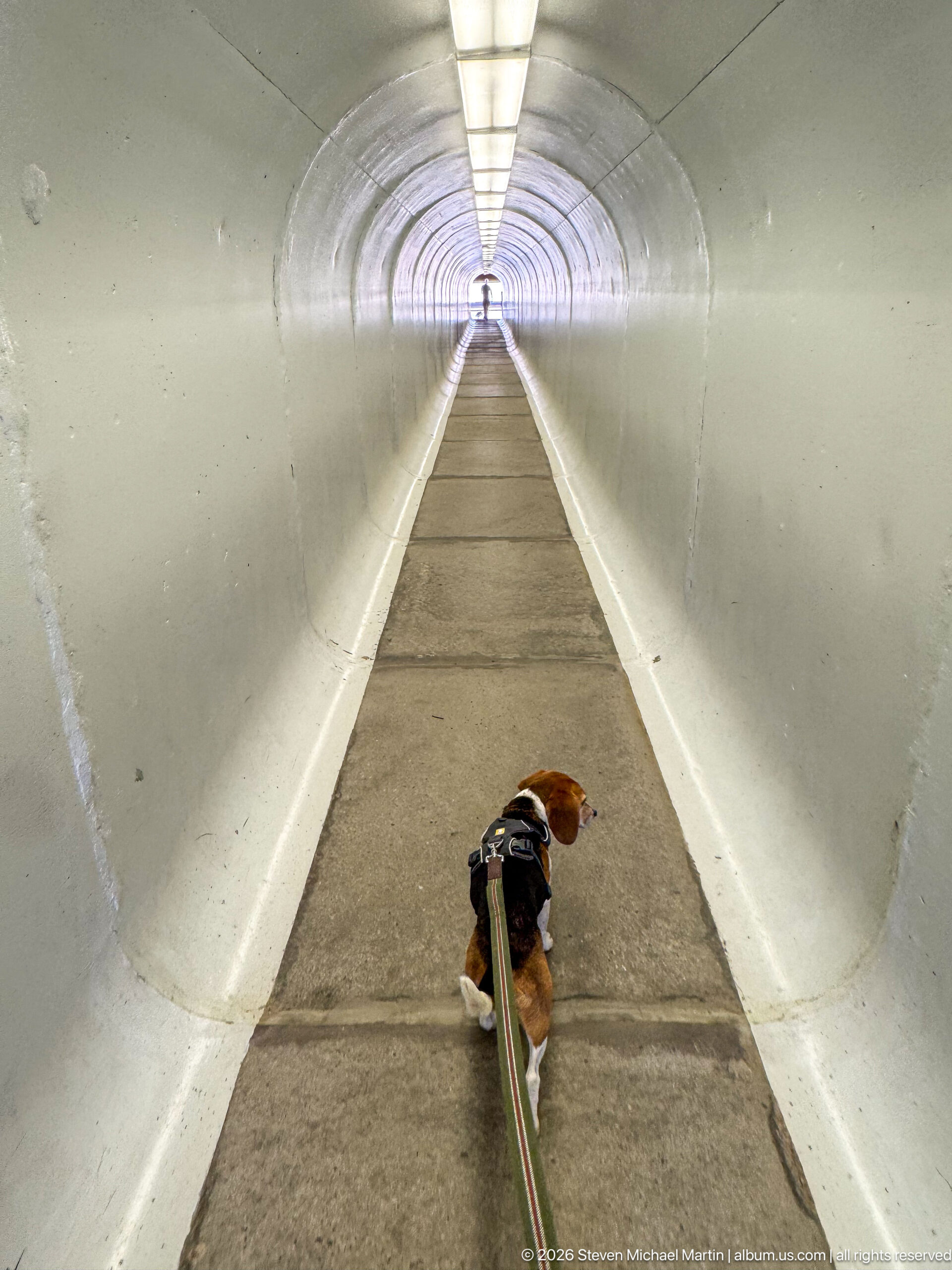
A small beagle walks ahead through the long white access tunnel leading between the Berkeley Pit visitor entrance and viewing area. The dog’s scale accentuates the tunnel’s strong linear perspective, while the continuous overhead lights and curved walls draw attention toward the distant opening at the far end.
Caption
A small beagle walks ahead through the long white access tunnel leading between the Berkeley Pit visitor entrance and viewing area. The dog’s scale accentuates the tunnel’s strong linear perspective, while the continuous overhead lights and curved walls draw attention toward the distant opening at the far end.
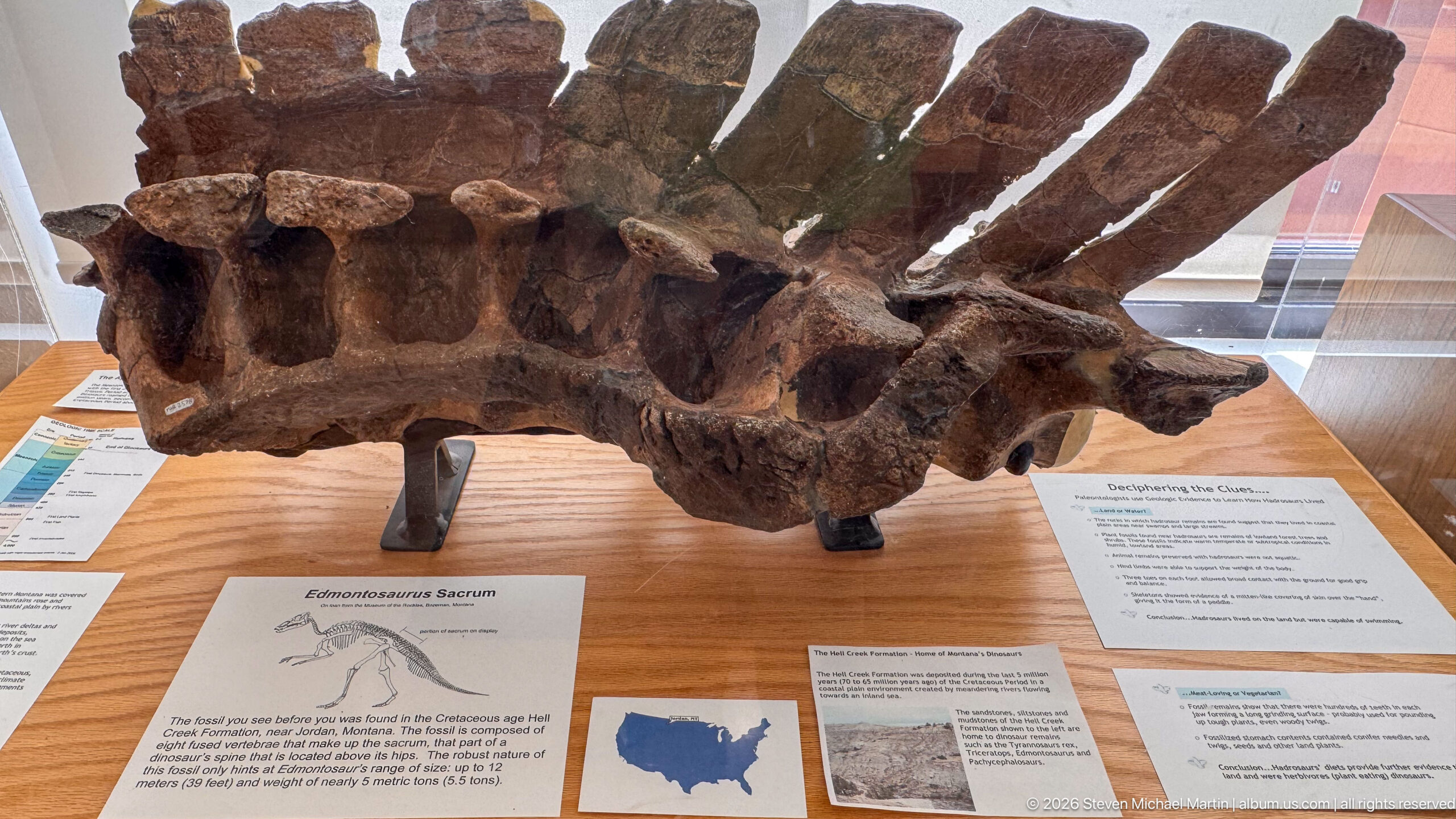
A massive series of fossil vertebrae and tall neural spines forms the centerpiece of this paleontology display. The label identifies the specimen with Edmontosaurus, a large herbivorous dinosaur known from western North America. Viewed from the side, the connected bones make the scale and structural complexity of the animal’s backbone especially apparent.
Caption
A massive series of fossil vertebrae and tall neural spines forms the centerpiece of this paleontology display. The label identifies the specimen with Edmontosaurus, a large herbivorous dinosaur known from western North America. Viewed from the side, the connected bones make the scale and structural complexity of the animal’s backbone especially apparent.
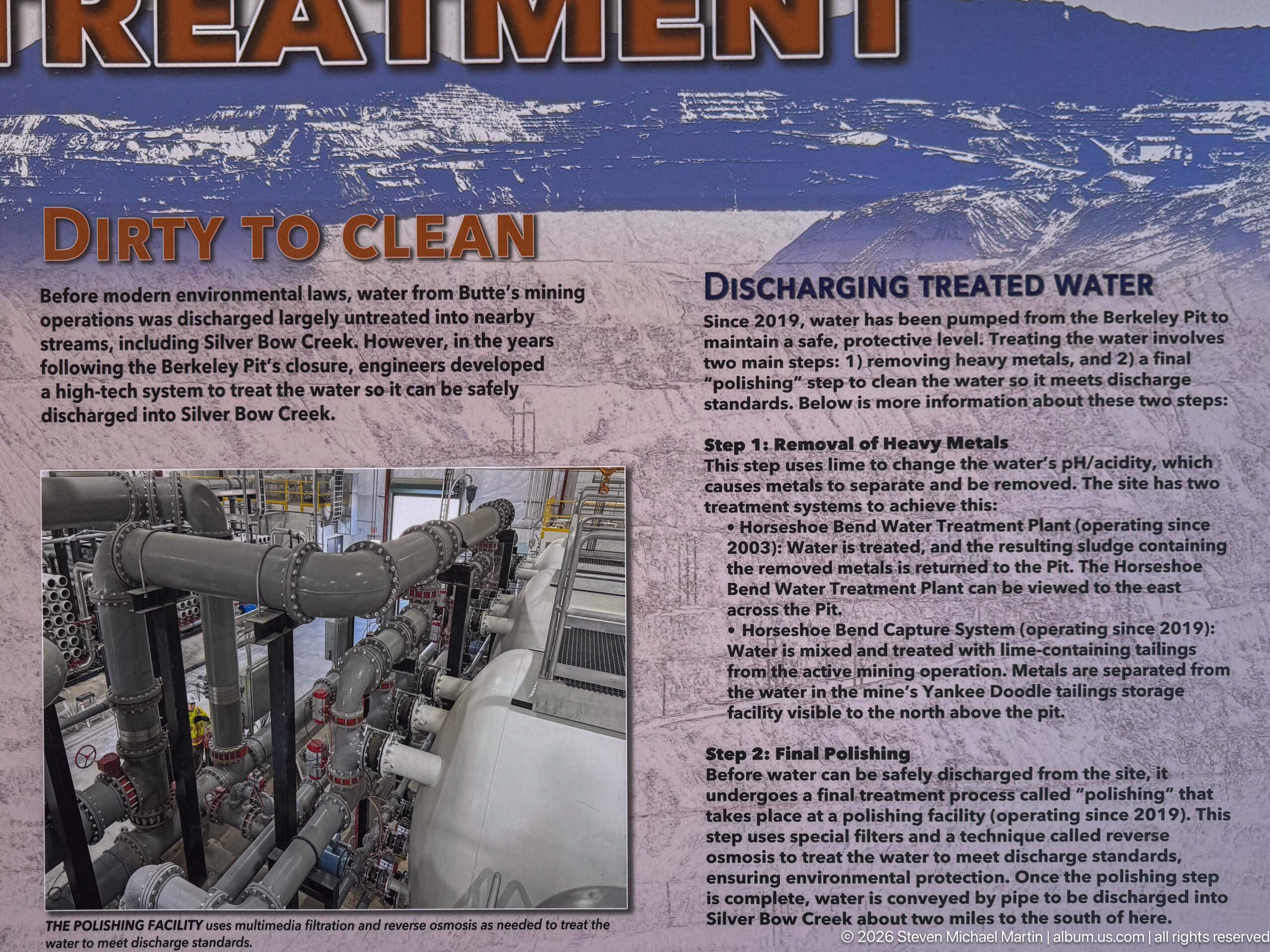
The “Dirty In, Clean Out” panel describes the treatment process used for water associated with the Berkeley Pit. A photograph of treatment equipment accompanies text on heavy-metal removal, lime addition, settling, filtration, and final polishing, translating a complex remediation system into the sequence required before treated water can be discharged.
Caption
The “Dirty In, Clean Out” panel describes the treatment process used for water associated with the Berkeley Pit. A photograph of treatment equipment accompanies text on heavy-metal removal, lime addition, settling, filtration, and final polishing, translating a complex remediation system into the sequence required before treated water can be discharged.
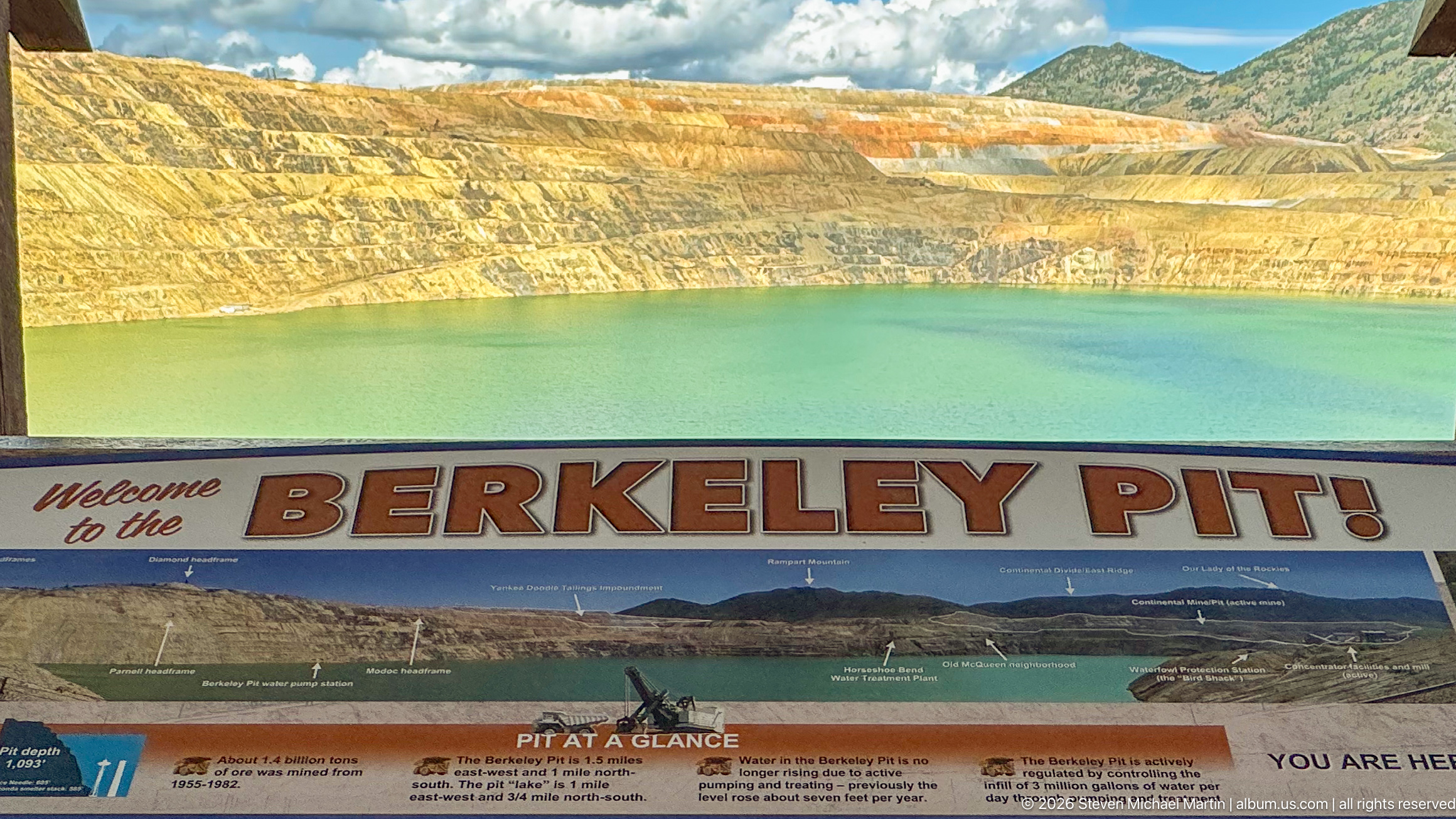
The Berkeley Pit itself rises above a broad “Welcome to the Berkeley Pit!” orientation panel at the viewing stand. The composition deliberately pairs the real flooded excavation with a labeled panoramic diagram below, allowing visitors to compare the terraced walls and surrounding landmarks directly with their interpreted counterparts.
Caption
The Berkeley Pit itself rises above a broad “Welcome to the Berkeley Pit!” orientation panel at the viewing stand. The composition deliberately pairs the real flooded excavation with a labeled panoramic diagram below, allowing visitors to compare the terraced walls and surrounding landmarks directly with their interpreted counterparts.
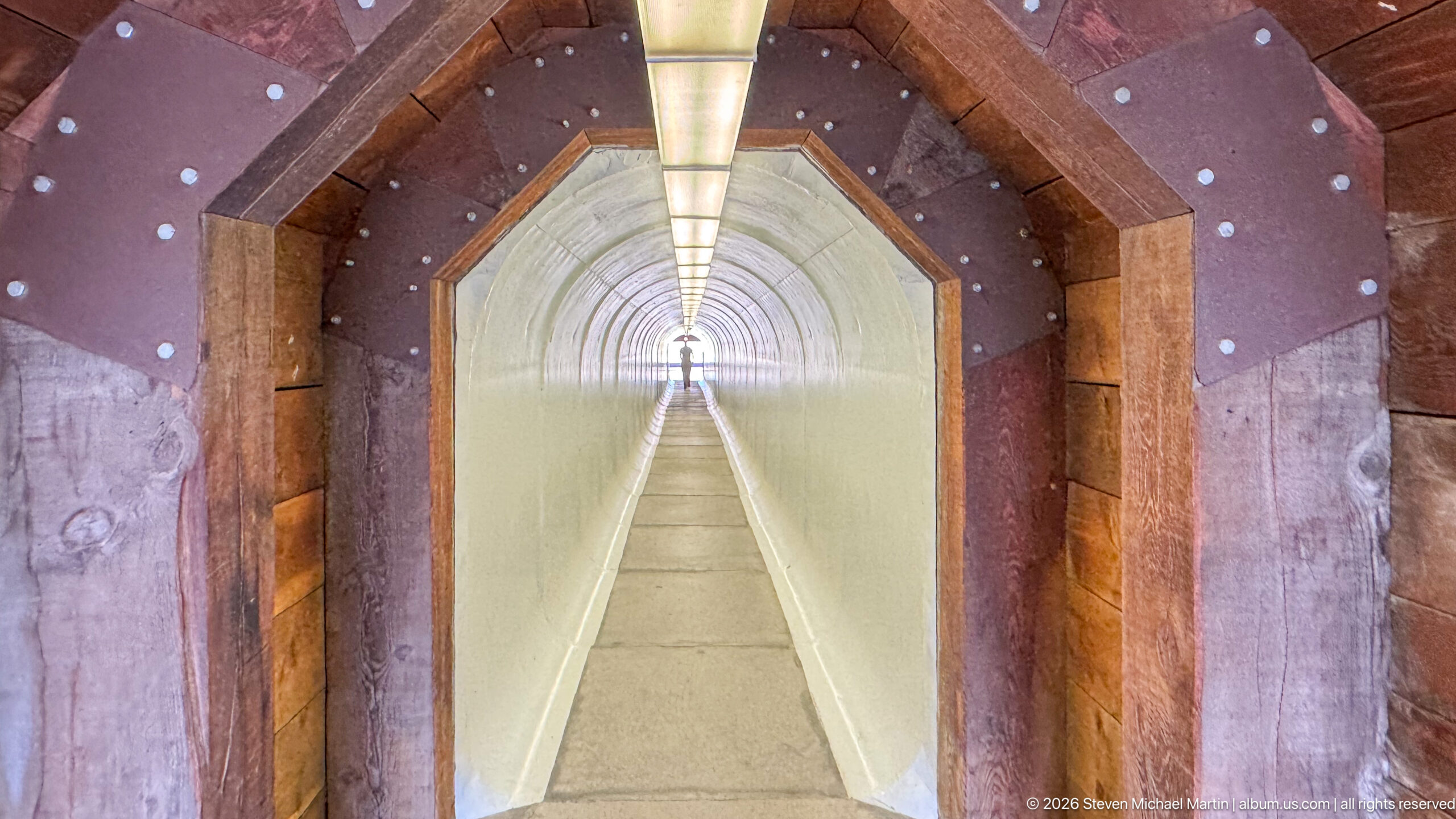
A long, narrow mine-tunnel exhibit recedes through repeated timber sets beneath a continuous strip of overhead lighting. The enclosed passage evokes the underground workings that preceded large-scale open-pit mining at Butte, where timbering and confined haulage routes were essential parts of extracting ore from the mineralized hill.
Caption
A long, narrow mine-tunnel exhibit recedes through repeated timber sets beneath a continuous strip of overhead lighting. The enclosed passage evokes the underground workings that preceded large-scale open-pit mining at Butte, where timbering and confined haulage routes were essential parts of extracting ore from the mineralized hill.
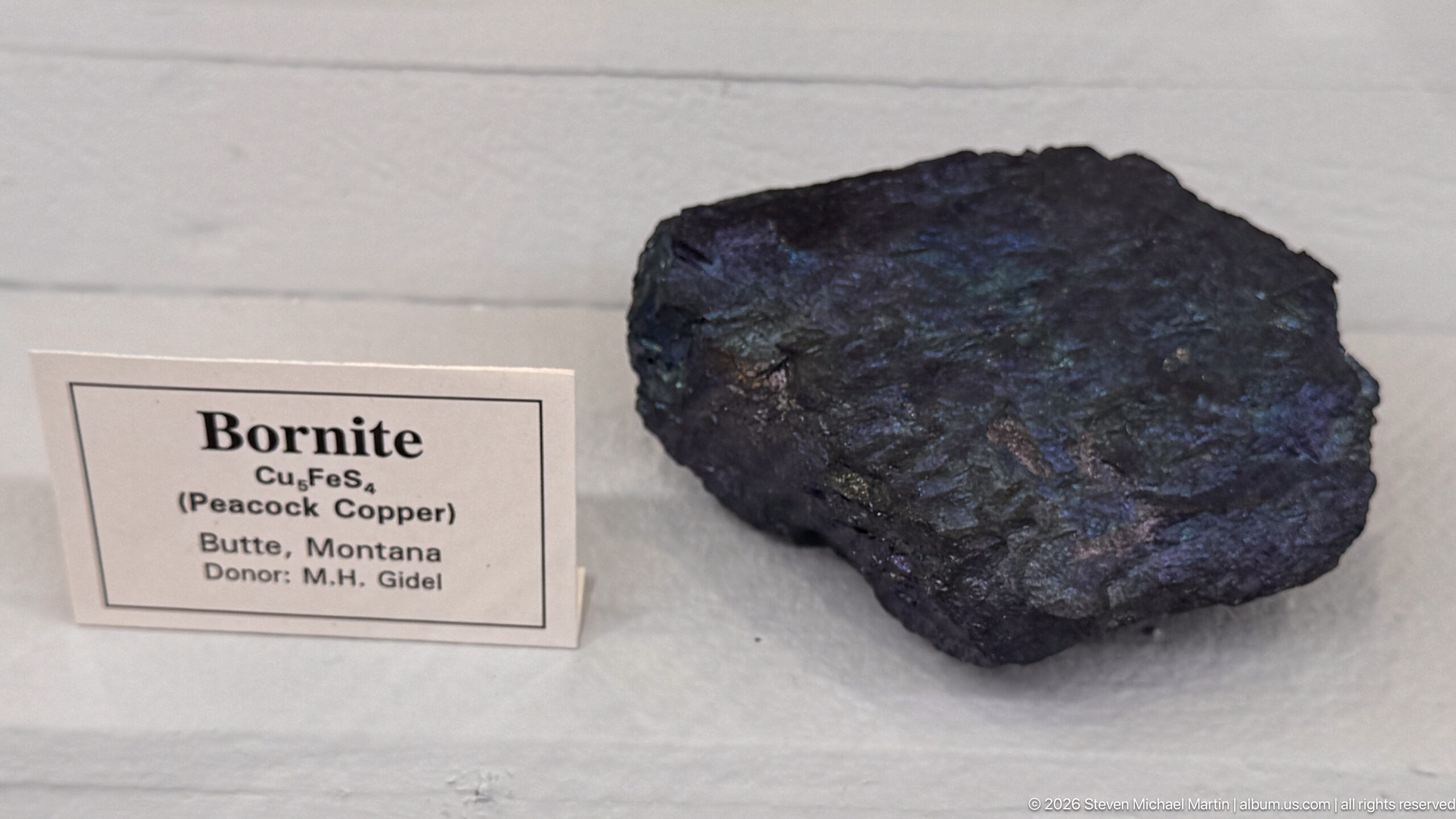
A dense specimen of bornite from Butte displays the dark metallic surface associated with this important copper-bearing sulfide. The museum label identifies the mineral as Cu5FeS4 and records Butte, Montana, as its locality, directly connecting the specimen to the copper ores that drove the city’s mining economy.
Caption
A dense specimen of bornite from Butte displays the dark metallic surface associated with this important copper-bearing sulfide. The museum label identifies the mineral as Cu5FeS4 and records Butte, Montana, as its locality, directly connecting the specimen to the copper ores that drove the city’s mining economy.
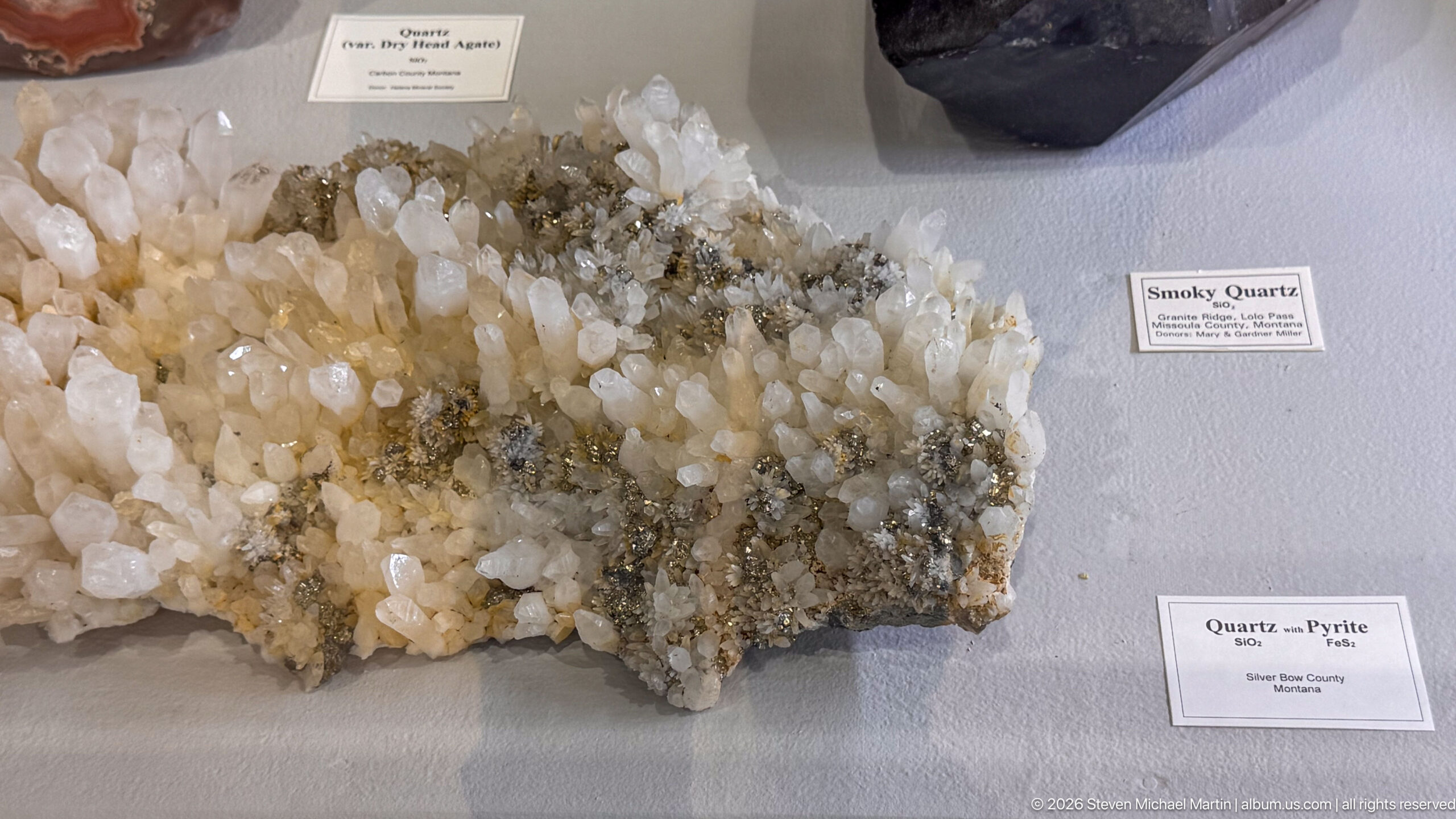
Clusters of milky to translucent quartz crystals spread across this Butte specimen, with darker metallic pyrite concentrated through portions of the matrix. The contrasting crystal habits illustrate two minerals commonly encountered together in hydrothermal ore systems and provide geological context for the mineral-rich veins exploited around Butte.
Caption
Clusters of milky to translucent quartz crystals spread across this Butte specimen, with darker metallic pyrite concentrated through portions of the matrix. The contrasting crystal habits illustrate two minerals commonly encountered together in hydrothermal ore systems and provide geological context for the mineral-rich veins exploited around Butte.
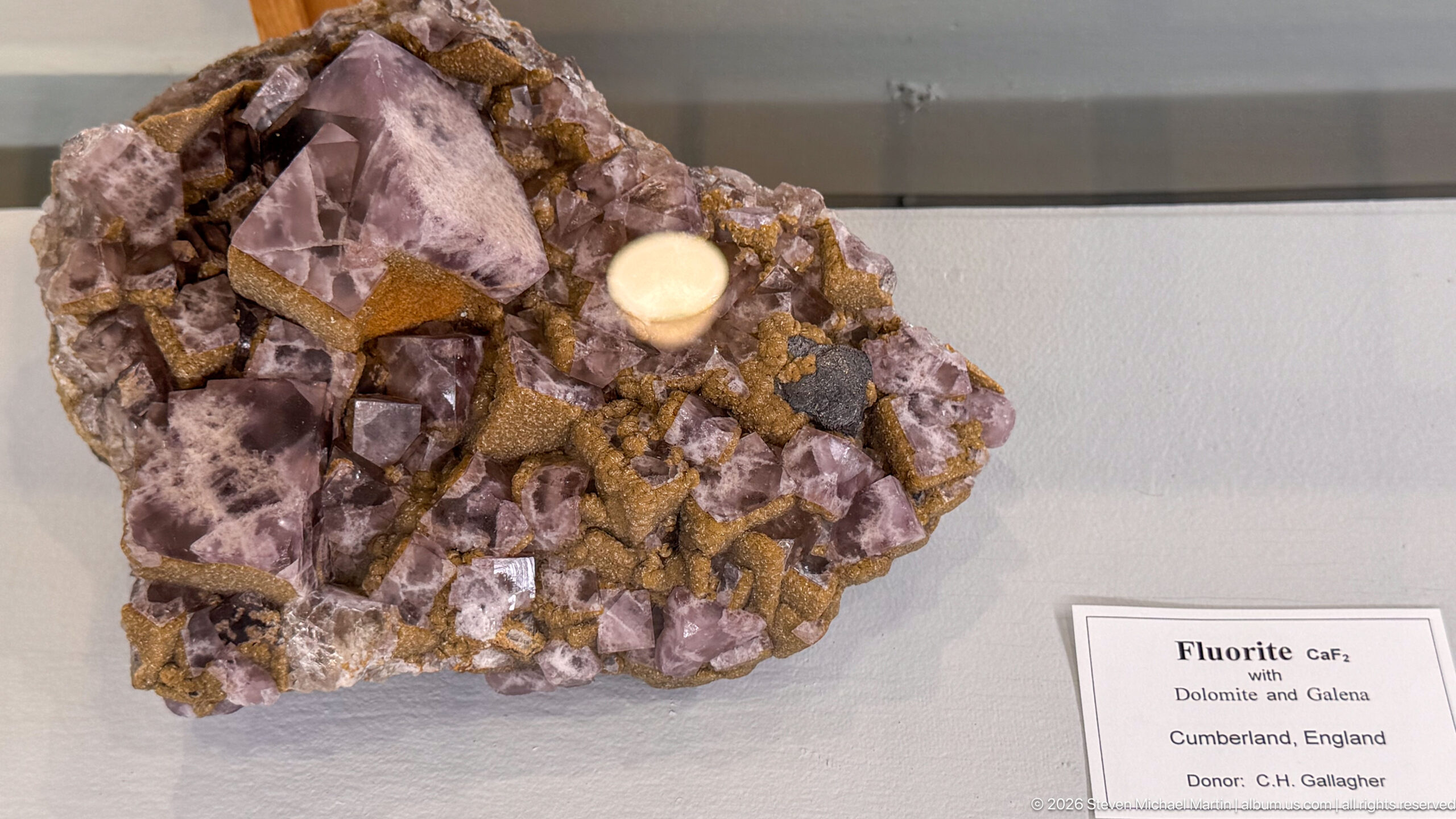
Purple cubic fluorite crystals dominate this richly textured specimen, accompanied by contrasting associated minerals identified on the display label as calcite, dolomite, and galena. Although exhibited in Butte, the specimen comes from Cumberland, England, broadening the collection beyond Montana ores to show the varied forms and associations of collectible minerals.
Caption
Purple cubic fluorite crystals dominate this richly textured specimen, accompanied by contrasting associated minerals identified on the display label as calcite, dolomite, and galena. Although exhibited in Butte, the specimen comes from Cumberland, England, broadening the collection beyond Montana ores to show the varied forms and associations of collectible minerals.
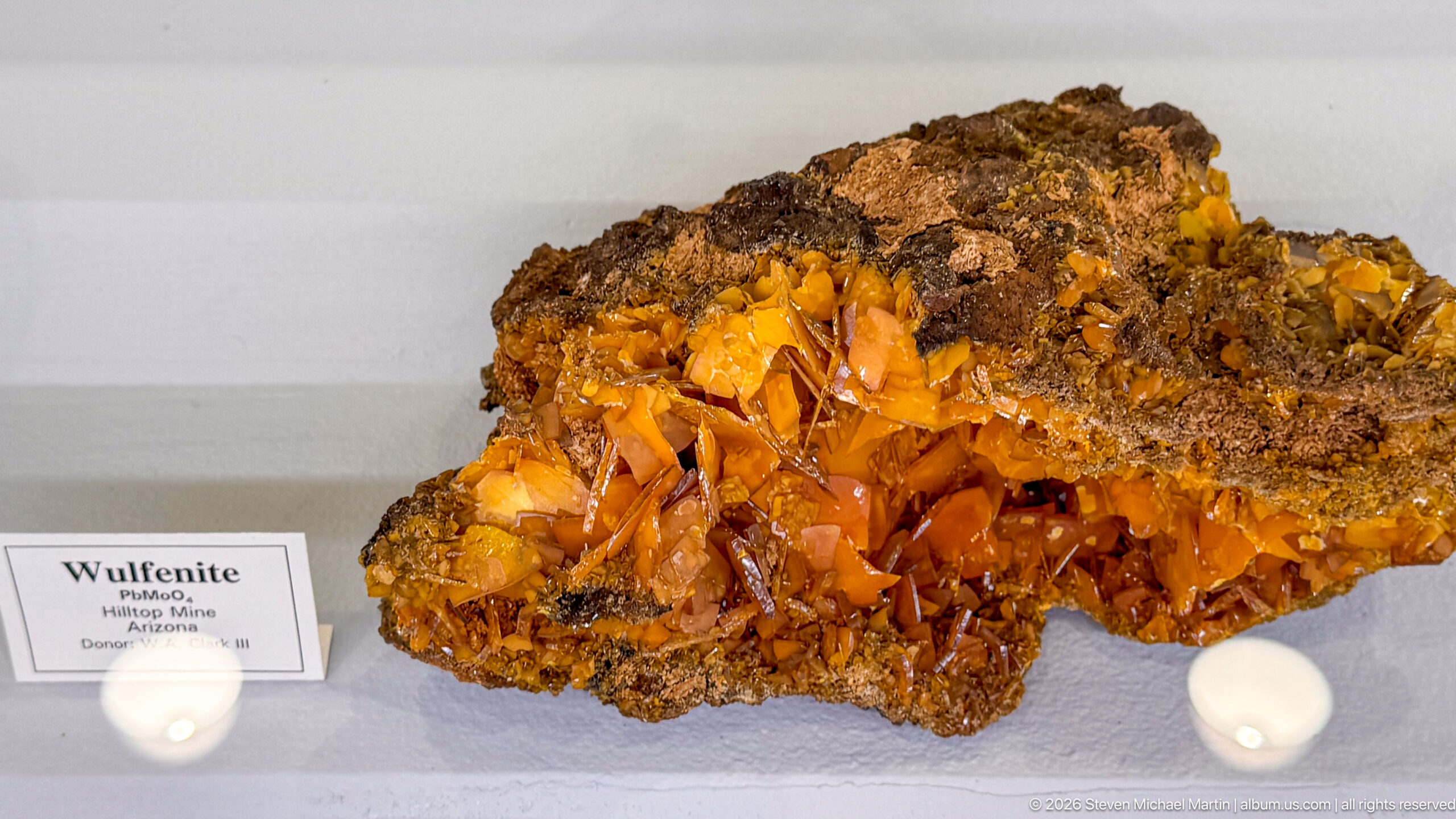
Brilliant orange tabular wulfenite crystals project from a dark brown matrix in this display specimen. The label identifies the mineral as PbMoO4 and gives the Hilltop Mine in Arizona as its source. Its vivid color and thin, plate-like crystal habit make it visually distinct from the metallic copper ores represented elsewhere in the collection.
Caption
Brilliant orange tabular wulfenite crystals project from a dark brown matrix in this display specimen. The label identifies the mineral as PbMoO4 and gives the Hilltop Mine in Arizona as its source. Its vivid color and thin, plate-like crystal habit make it visually distinct from the metallic copper ores represented elsewhere in the collection.
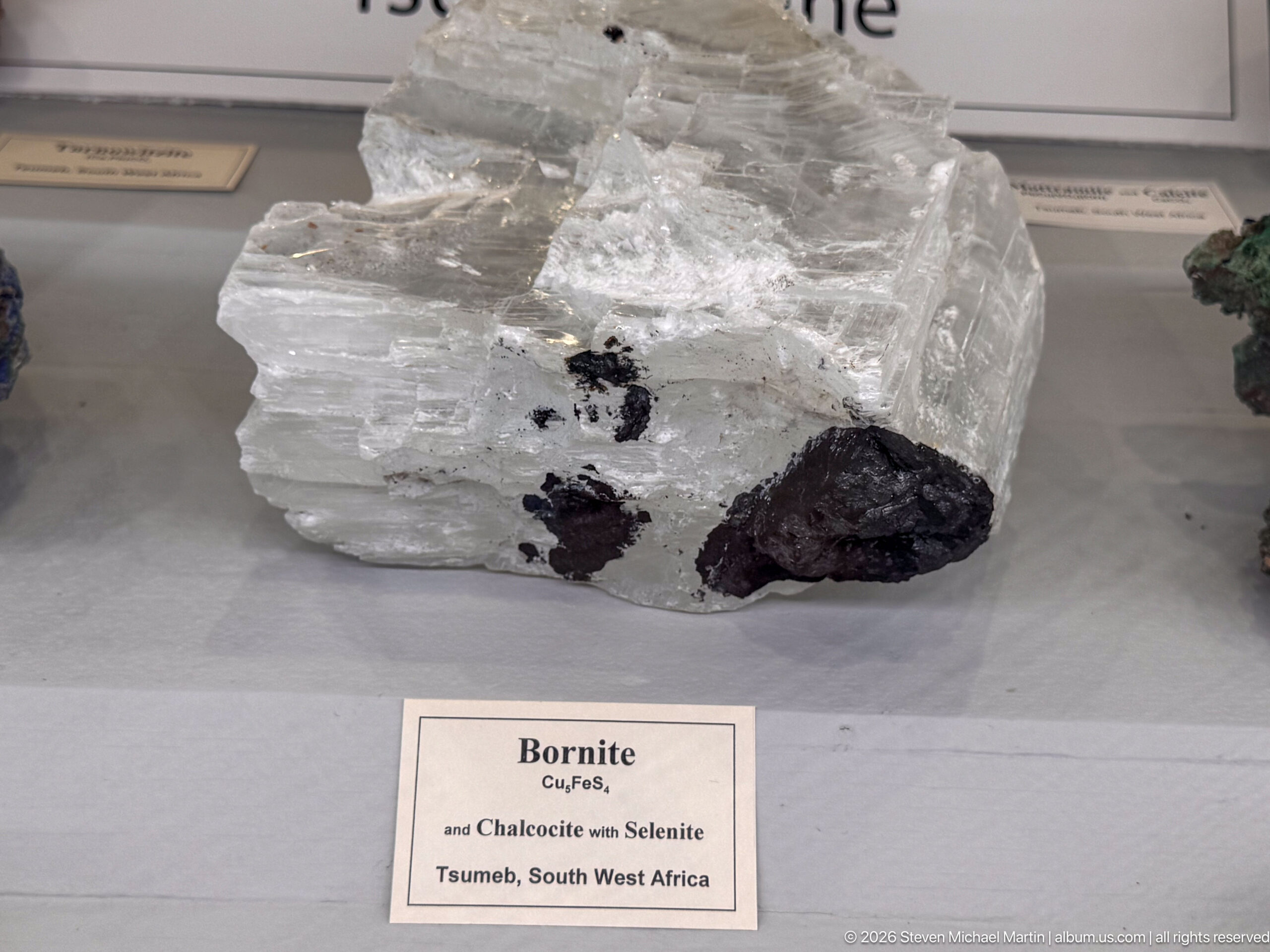
A pale, translucent mass of calcite and selenite encloses contrasting dark patches of bornite in this specimen from Tsumeb. The display demonstrates how copper-bearing sulfides can occur alongside very different crystal forms and colors, while the historic locality designation on the label reflects the specimen’s cataloging provenance.
Caption
A pale, translucent mass of calcite and selenite encloses contrasting dark patches of bornite in this specimen from Tsumeb. The display demonstrates how copper-bearing sulfides can occur alongside very different crystal forms and colors, while the historic locality designation on the label reflects the specimen’s cataloging provenance.
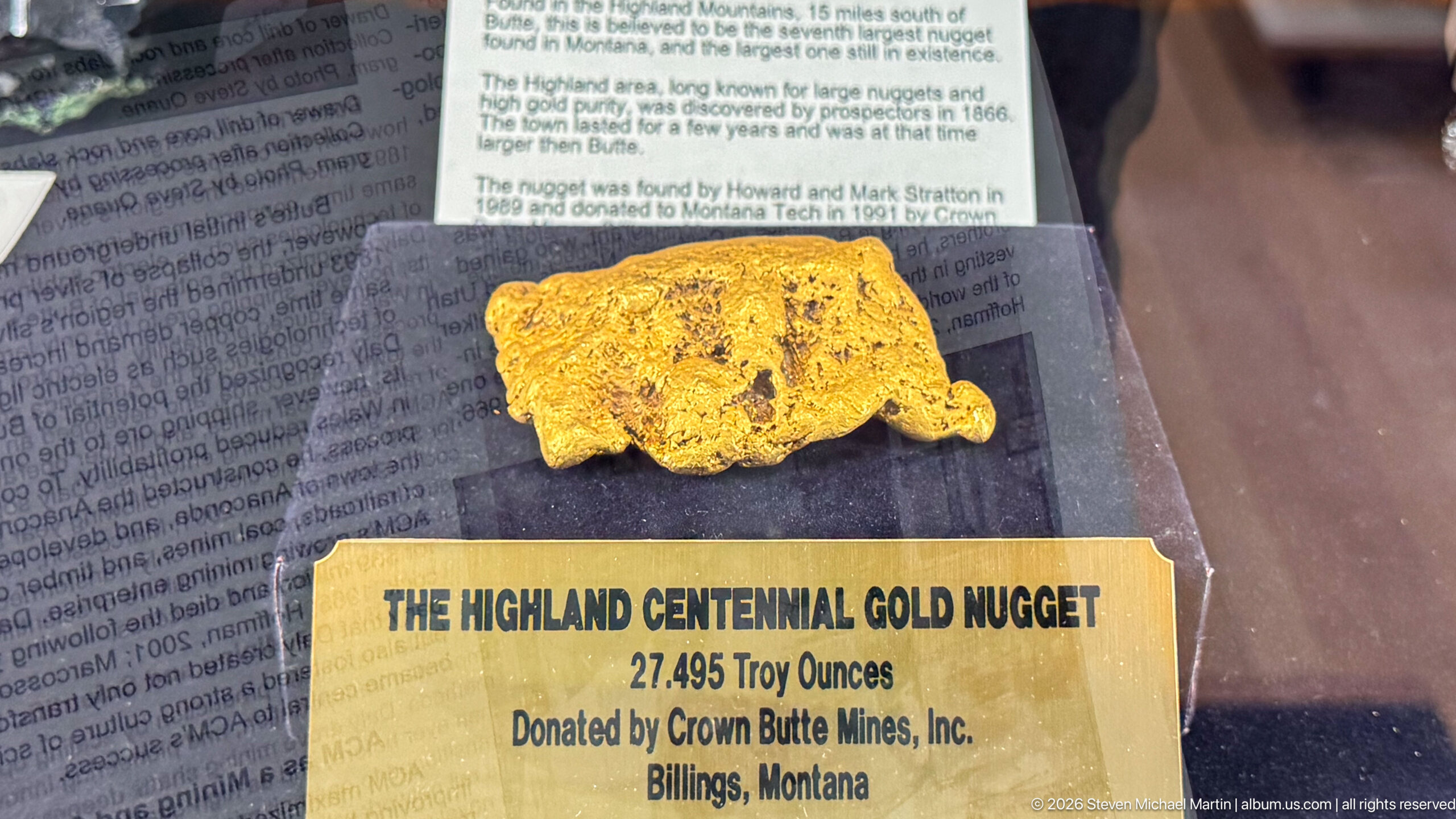
The Highland Centennial Gold Nugget rests above a brass plaque recording its weight as 27.495 troy ounces and its donation by Crown Butte Mines of Billings. Interpretive text behind the case links the specimen to Montana’s Highland Mountains, presenting a tangible example of the precious-metal discoveries that accompanied the state’s broader mining history.
Caption
The Highland Centennial Gold Nugget rests above a brass plaque recording its weight as 27.495 troy ounces and its donation by Crown Butte Mines of Billings. Interpretive text behind the case links the specimen to Montana’s Highland Mountains, presenting a tangible example of the precious-metal discoveries that accompanied the state’s broader mining history.
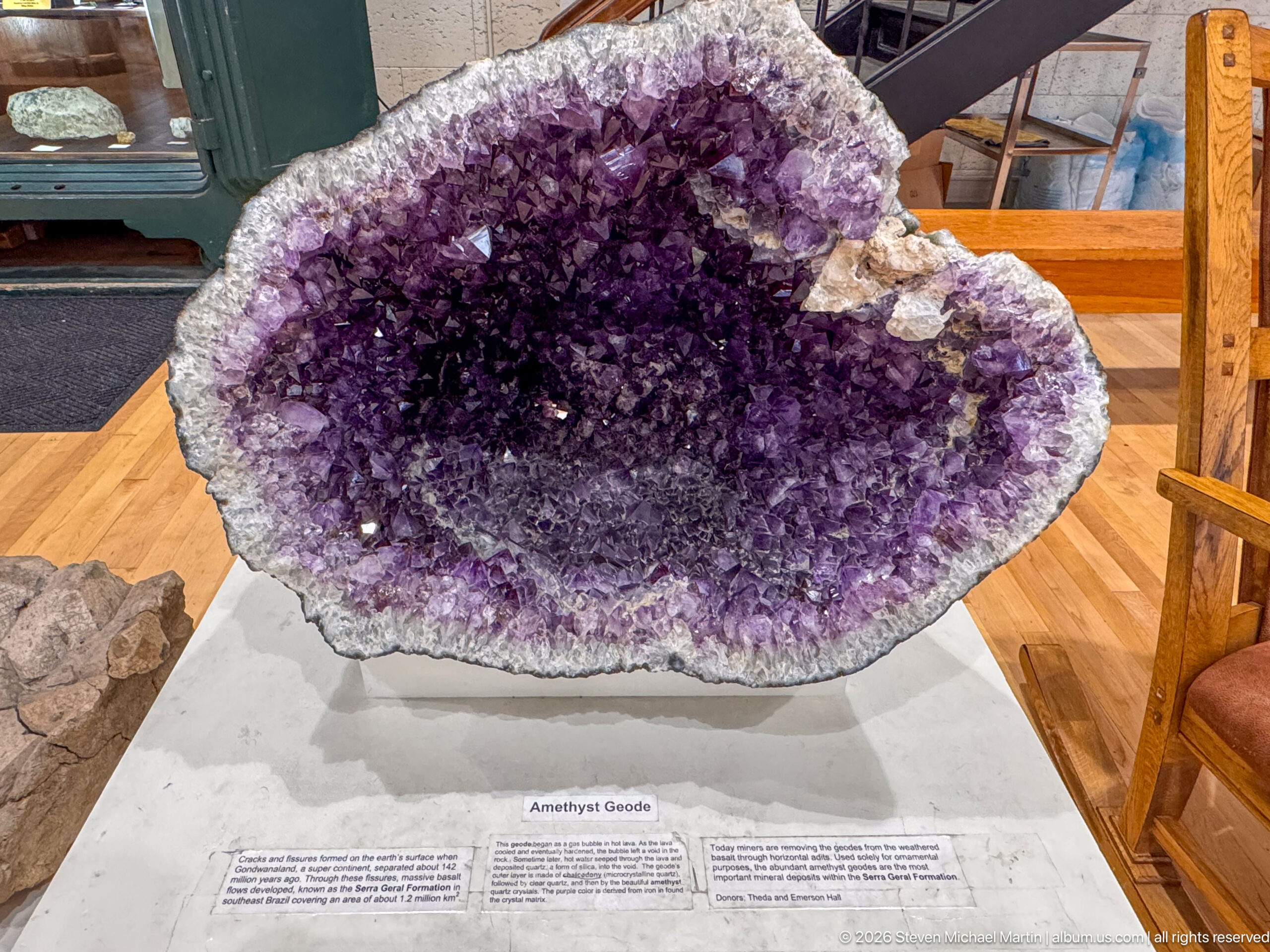
A monumental amethyst geode opens toward the viewer, its pale outer rim framing a deep cavity densely lined with purple quartz crystals. Displayed as a freestanding mineral specimen, it emphasizes crystal growth on a scale far larger than the cabinet specimens nearby and provides a dramatic introduction to the museum’s mineralogical collection.
Caption
A monumental amethyst geode opens toward the viewer, its pale outer rim framing a deep cavity densely lined with purple quartz crystals. Displayed as a freestanding mineral specimen, it emphasizes crystal growth on a scale far larger than the cabinet specimens nearby and provides a dramatic introduction to the museum’s mineralogical collection.
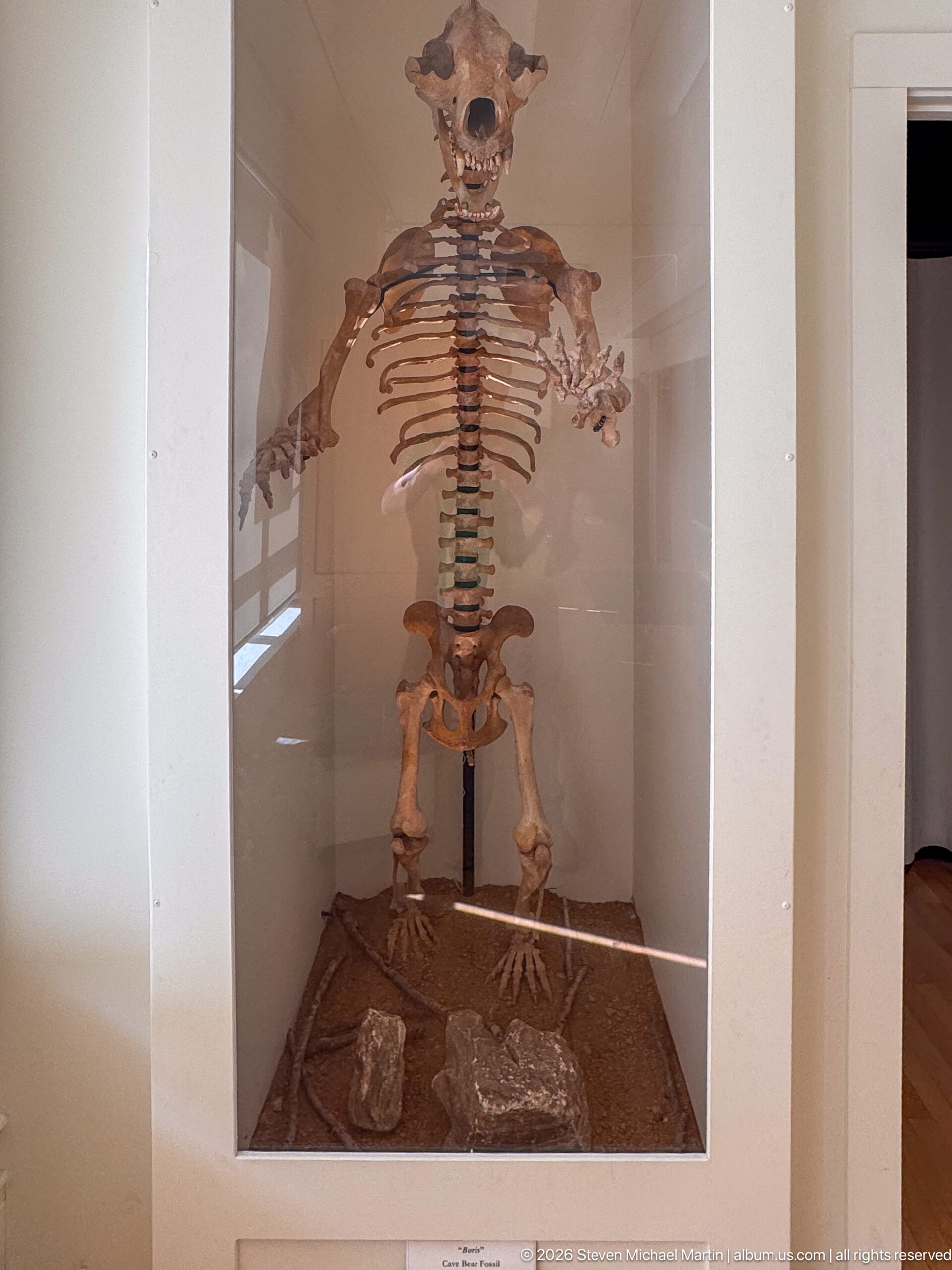
An articulated human skeleton stands upright in a narrow museum case, surrounded by anatomical or geological teaching material at floor level. The display introduces the human body alongside the museum’s natural-history collections, contrasting sharply with the mineral specimens and mining artifacts that dominate the surrounding galleries.
Caption
An articulated human skeleton stands upright in a narrow museum case, surrounded by anatomical or geological teaching material at floor level. The display introduces the human body alongside the museum’s natural-history collections, contrasting sharply with the mineral specimens and mining artifacts that dominate the surrounding galleries.
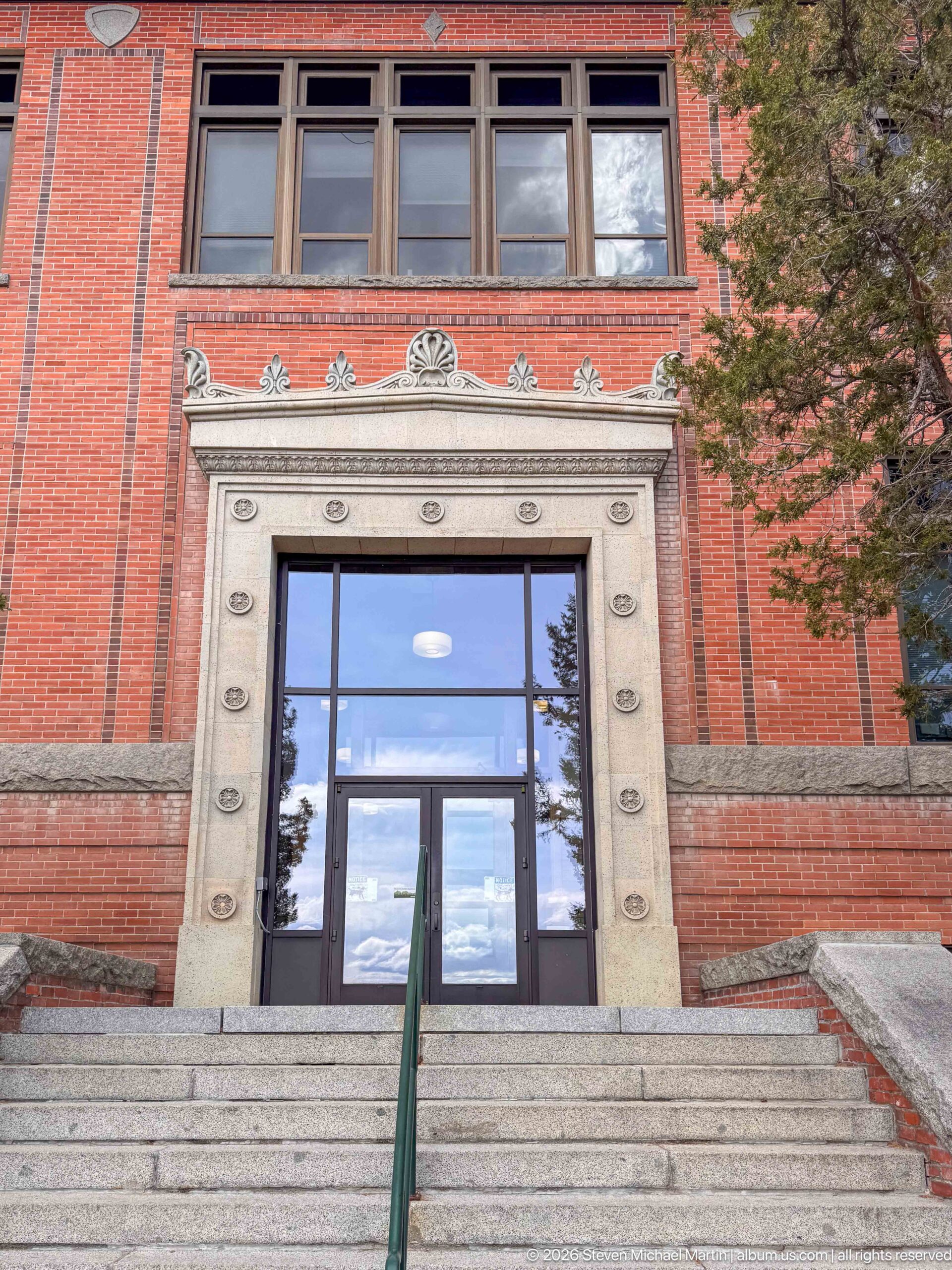
A broad stone stair rises to the formal entrance of a red-brick institutional building, where carved stone surrounds and decorative medallions frame modern glass doors. The restrained classical detailing and substantial masonry distinguish the historic façade from the industrial structures associated with the Berkeley Pit landscape.
Caption
A broad stone stair rises to the formal entrance of a red-brick institutional building, where carved stone surrounds and decorative medallions frame modern glass doors. The restrained classical detailing and substantial masonry distinguish the historic façade from the industrial structures associated with the Berkeley Pit landscape.
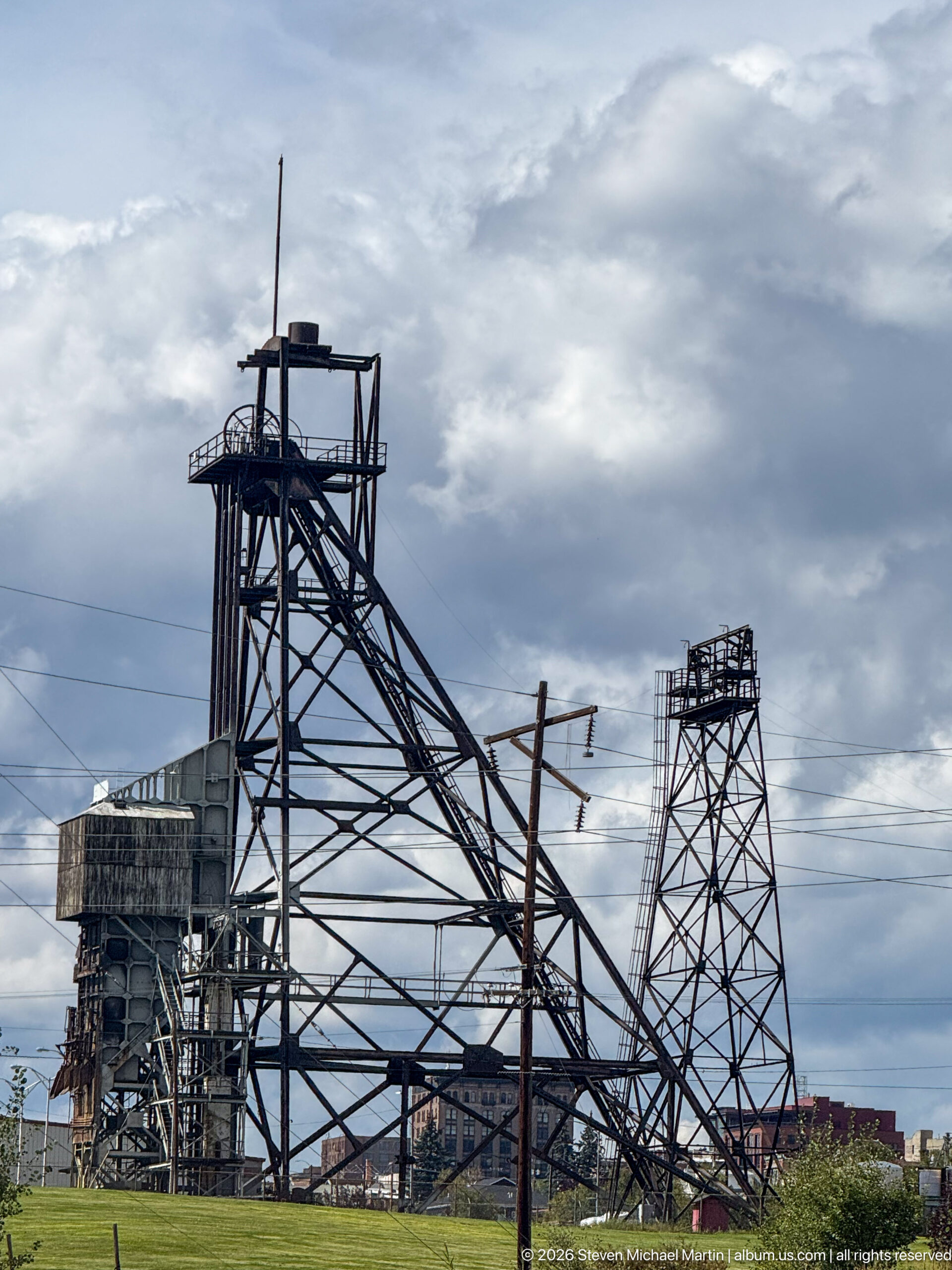
Steel headframes rise against a clouded sky on Butte’s mining landscape, their open lattice structures and inclined supports marking former shafts into the underground workings. These skeletal towers are among the city’s most recognizable industrial forms, surviving as reminders of the deep-mining system that preceded and accompanied open-pit extraction.
Caption
Steel headframes rise against a clouded sky on Butte’s mining landscape, their open lattice structures and inclined supports marking former shafts into the underground workings. These skeletal towers are among the city’s most recognizable industrial forms, surviving as reminders of the deep-mining system that preceded and accompanied open-pit extraction.
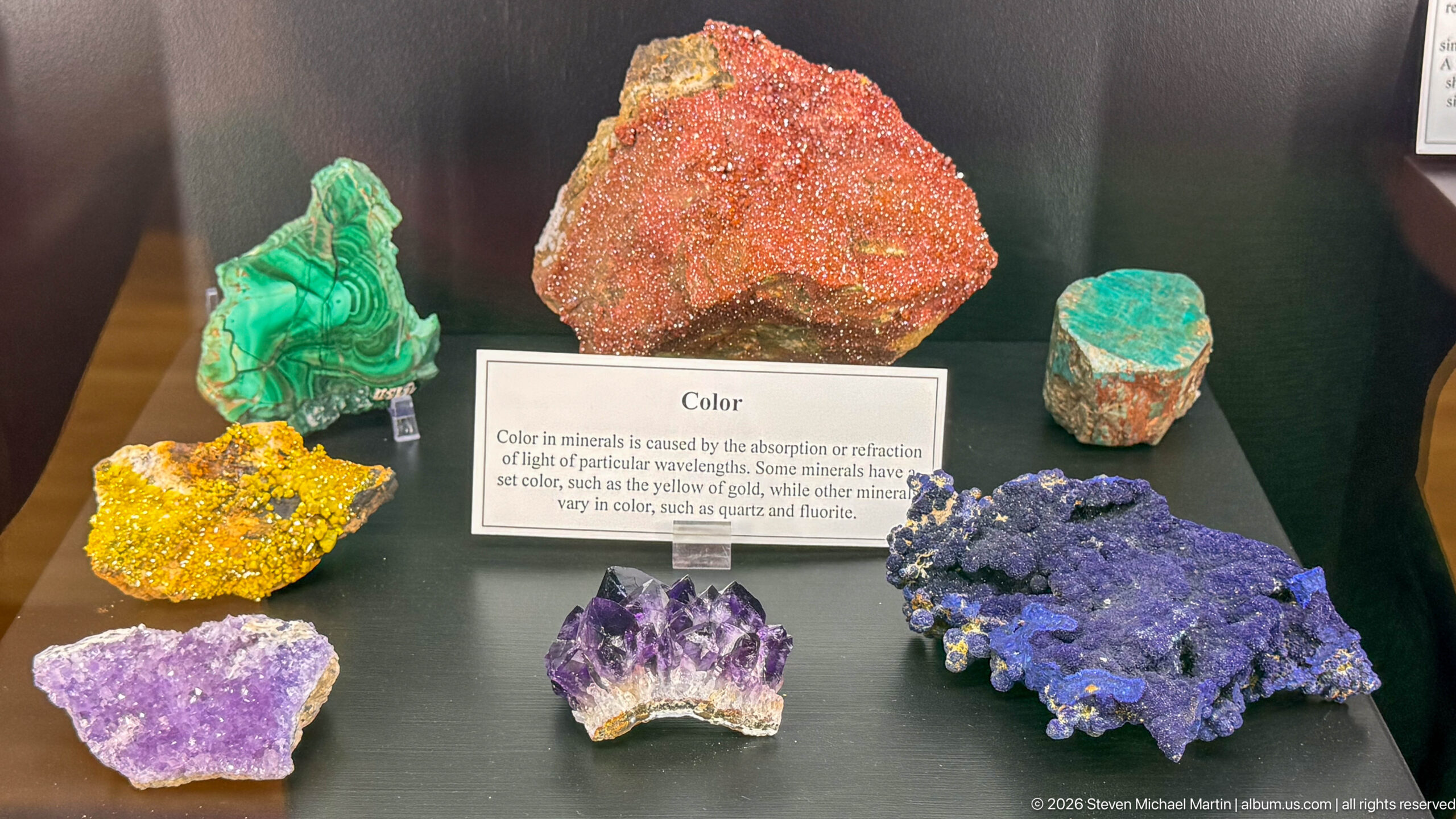
A compact exhibit uses vividly colored mineral specimens to demonstrate color as a mineral property. Green, orange, yellow, purple, blue, and turquoise examples surround an interpretive panel explaining how absorption or refraction of light produces color. The grouping emphasizes both the visual appeal of mineral collections and the diagnostic limits of color alone.
Caption
A compact exhibit uses vividly colored mineral specimens to demonstrate color as a mineral property. Green, orange, yellow, purple, blue, and turquoise examples surround an interpretive panel explaining how absorption or refraction of light produces color. The grouping emphasizes both the visual appeal of mineral collections and the diagnostic limits of color alone.
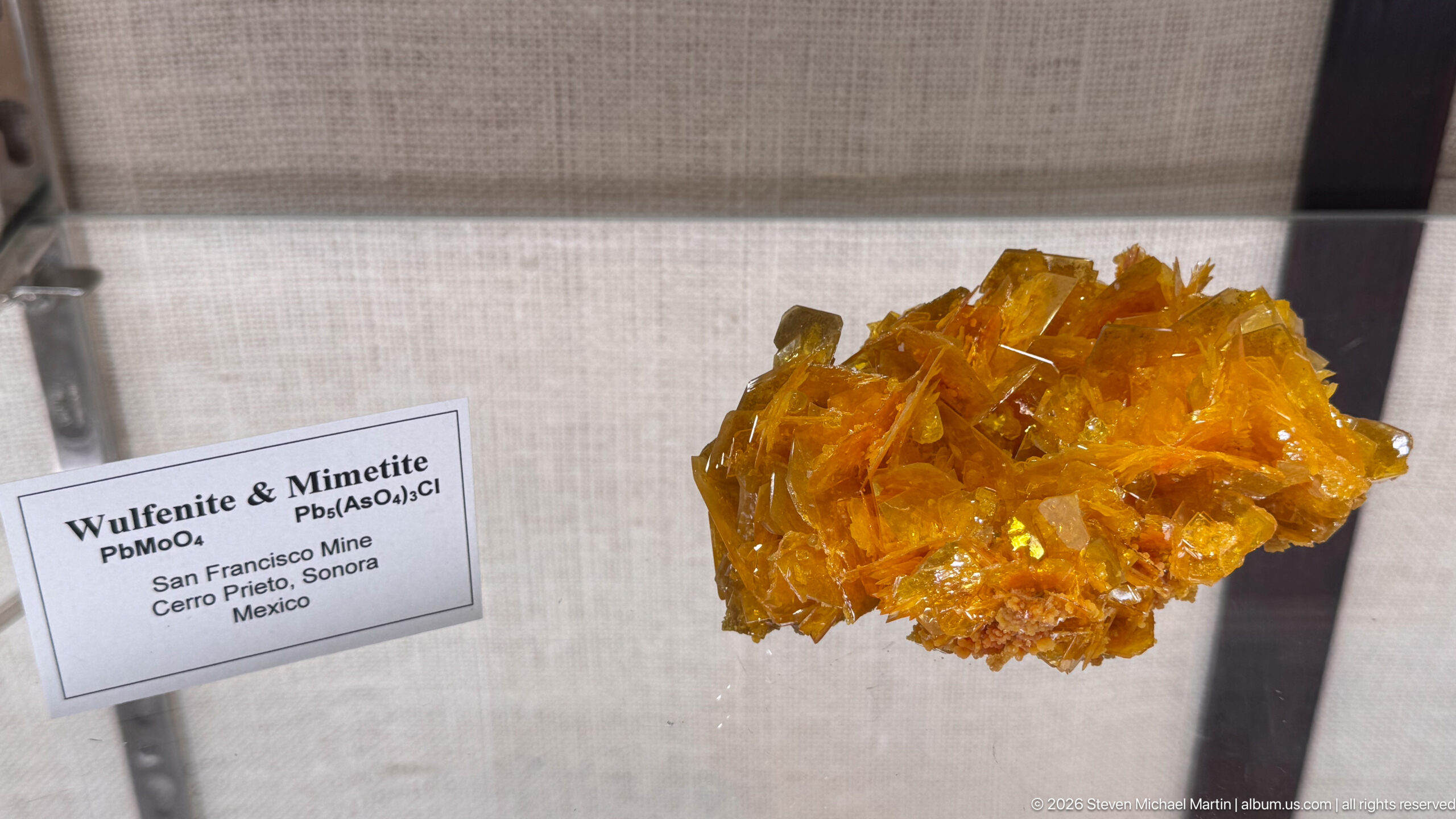
Golden-orange wulfenite crystals form a dense cluster in this specimen from the San Francisco Mine at Cerro Prieto, Sonora. The museum label identifies mimetite as an associated mineral. The specimen’s saturated color and overlapping bladed crystals create a markedly different texture from the cubic fluorites and pale quartz groups displayed nearby.
Caption
Golden-orange wulfenite crystals form a dense cluster in this specimen from the San Francisco Mine at Cerro Prieto, Sonora. The museum label identifies mimetite as an associated mineral. The specimen’s saturated color and overlapping bladed crystals create a markedly different texture from the cubic fluorites and pale quartz groups displayed nearby.
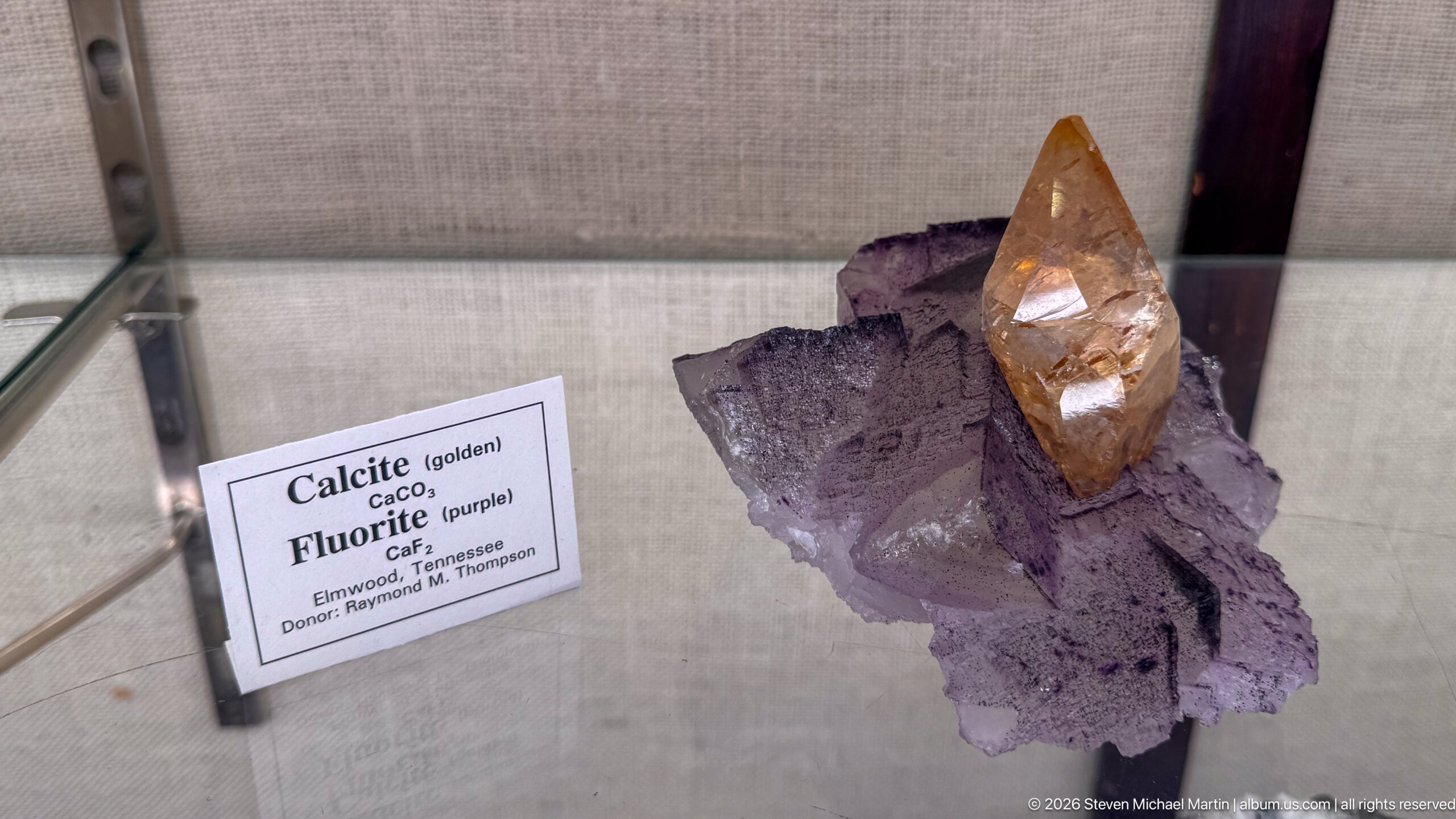
A single golden calcite crystal rises prominently from a matrix of purple fluorite, creating a strong contrast of color and crystal form. The display label identifies the specimen as calcite on fluorite from Elmwood, Tennessee, a locality noted in mineral collections for striking combinations of these minerals.
Caption
A single golden calcite crystal rises prominently from a matrix of purple fluorite, creating a strong contrast of color and crystal form. The display label identifies the specimen as calcite on fluorite from Elmwood, Tennessee, a locality noted in mineral collections for striking combinations of these minerals.
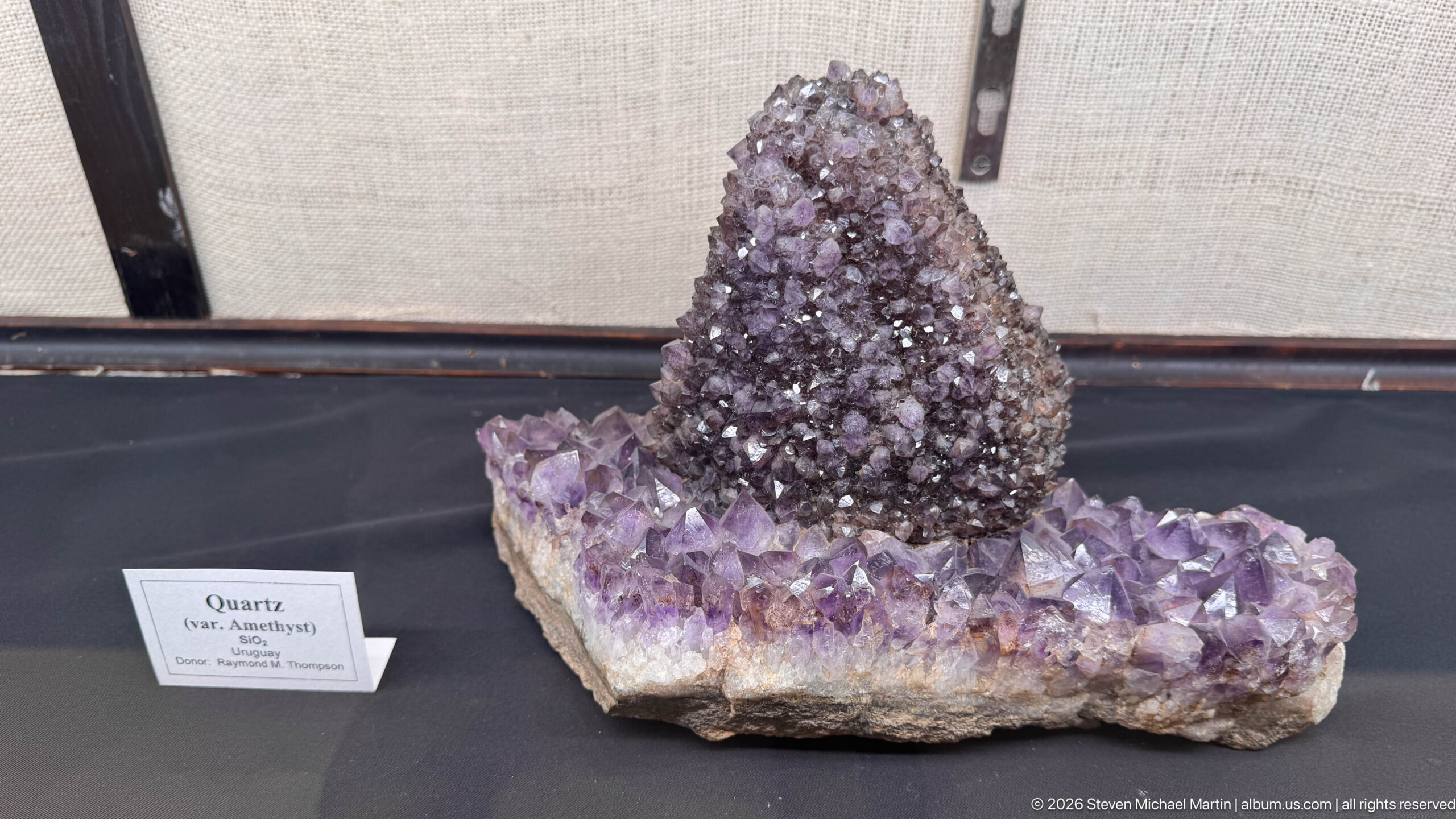
A tall mound of dark purple amethyst rises from a broader bed of lighter lavender crystals, producing two distinct zones of quartz growth within one specimen. The stepped profile and dense covering of crystal points make the piece especially sculptural when viewed against the dark display surface.
Caption
A tall mound of dark purple amethyst rises from a broader bed of lighter lavender crystals, producing two distinct zones of quartz growth within one specimen. The stepped profile and dense covering of crystal points make the piece especially sculptural when viewed against the dark display surface.
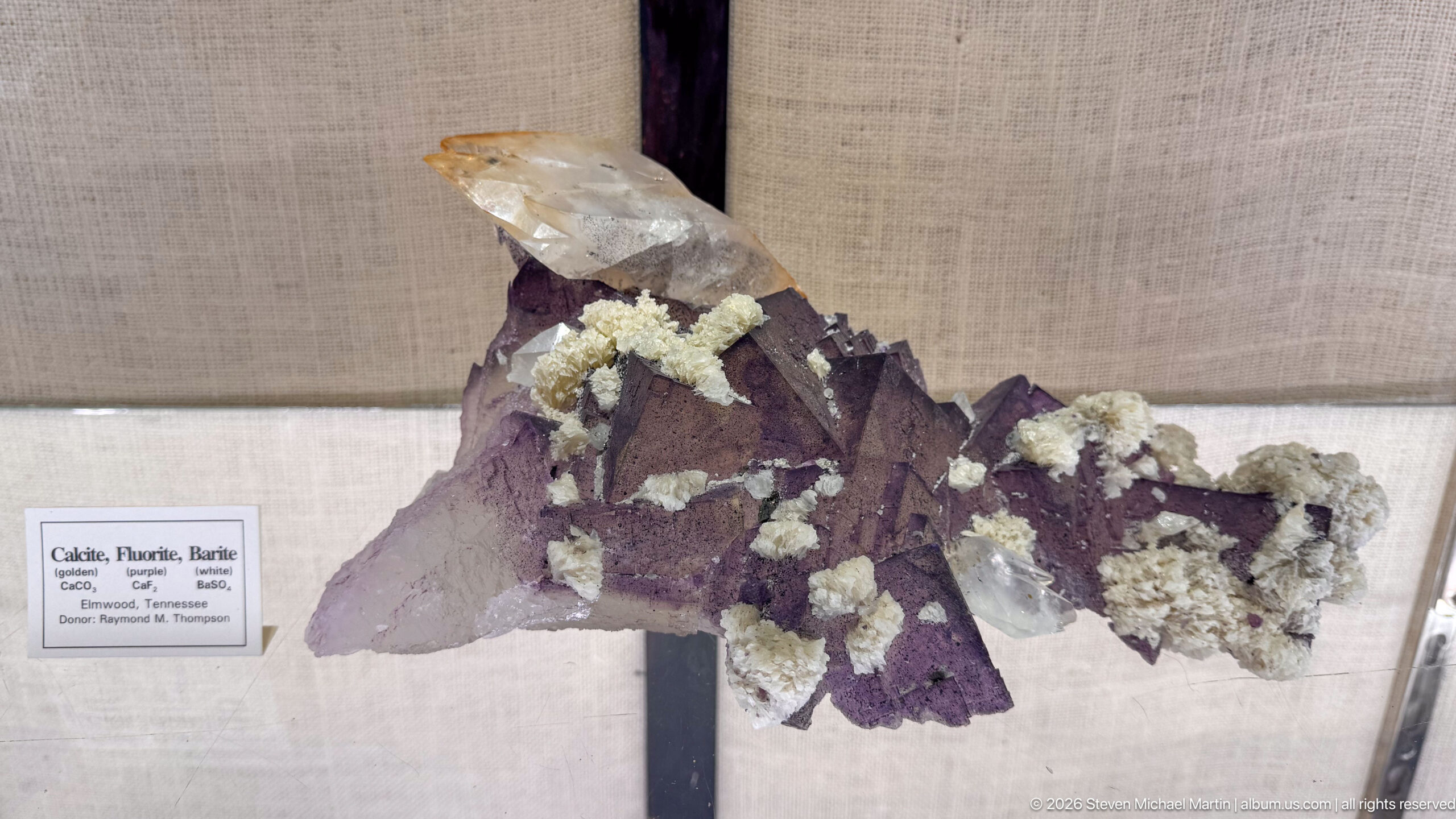
A large translucent calcite crystal crowns a branching purple mineral matrix dotted with pale clustered growths. The adjacent label identifies calcite, fluorite, and barite among the assemblage. Suspended against the neutral case backing, the specimen makes the contrasting crystal forms and colors unusually easy to compare.
Caption
A large translucent calcite crystal crowns a branching purple mineral matrix dotted with pale clustered growths. The adjacent label identifies calcite, fluorite, and barite among the assemblage. Suspended against the neutral case backing, the specimen makes the contrasting crystal forms and colors unusually easy to compare.
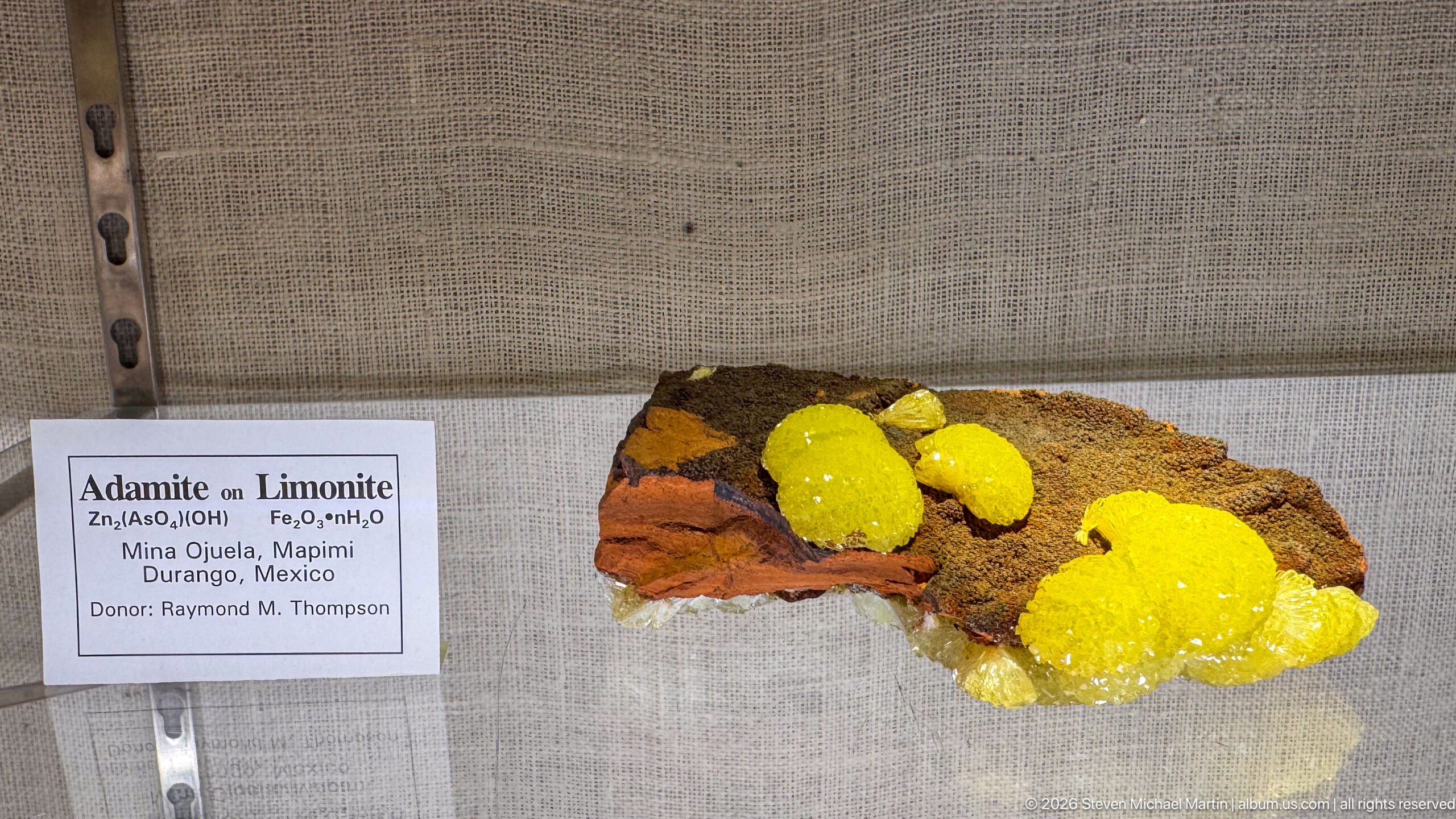
Intensely yellow-green adamite forms rounded crystalline clusters across a rusty limonite matrix in this specimen from Mina Ojuela, Durango. The brilliant color stands out against the iron-rich host material, demonstrating the striking secondary minerals that can develop in oxidized ore deposits.
Caption
Intensely yellow-green adamite forms rounded crystalline clusters across a rusty limonite matrix in this specimen from Mina Ojuela, Durango. The brilliant color stands out against the iron-rich host material, demonstrating the striking secondary minerals that can develop in oxidized ore deposits.
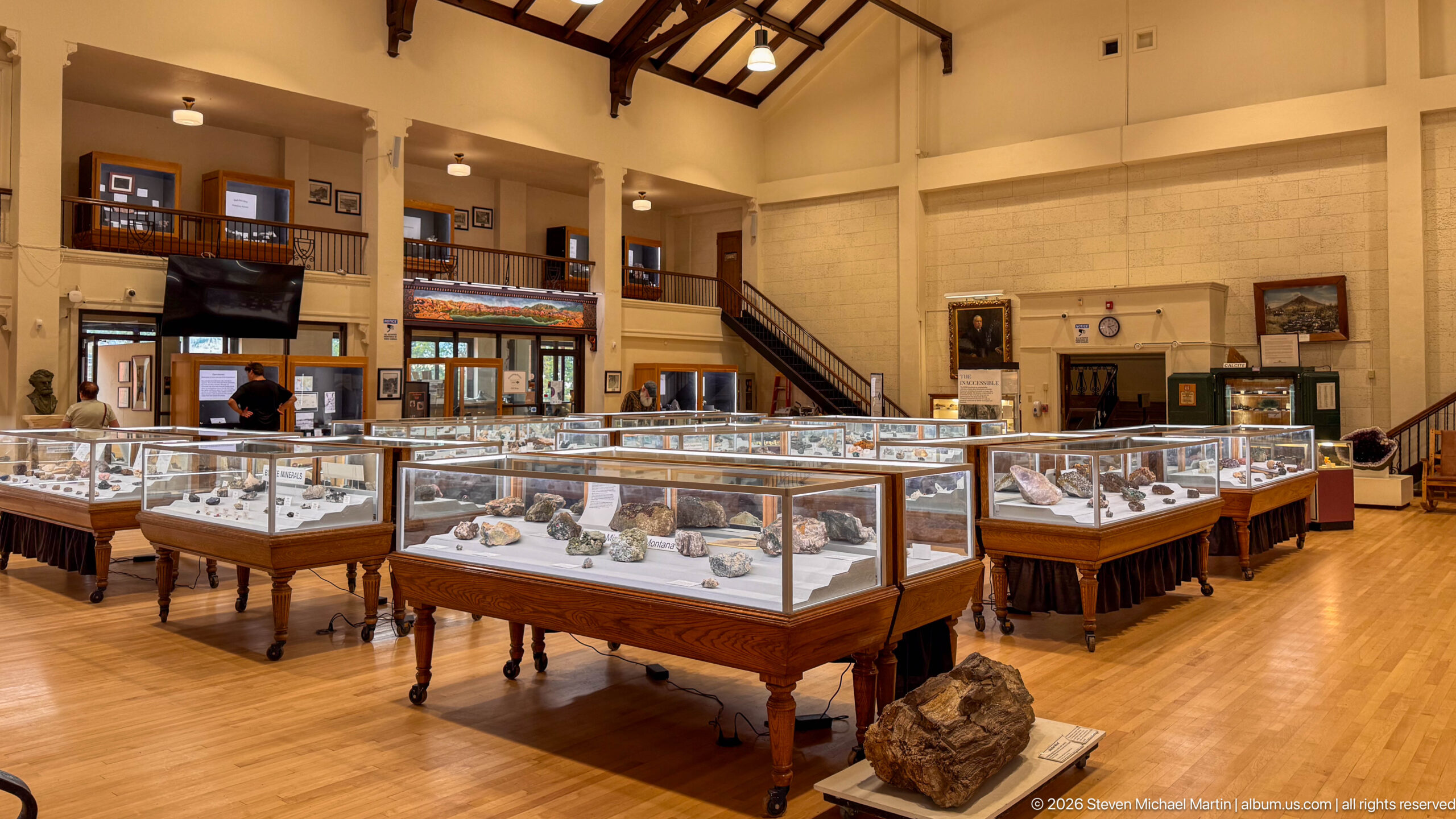
Rows of glass-topped wooden cases fill a high-ceilinged museum gallery devoted largely to minerals and geological specimens. The orderly cases, open floor plan, balcony, and historic institutional interior place the individual specimens seen in adjacent photographs within their broader exhibition setting.
Caption
Rows of glass-topped wooden cases fill a high-ceilinged museum gallery devoted largely to minerals and geological specimens. The orderly cases, open floor plan, balcony, and historic institutional interior place the individual specimens seen in adjacent photographs within their broader exhibition setting.
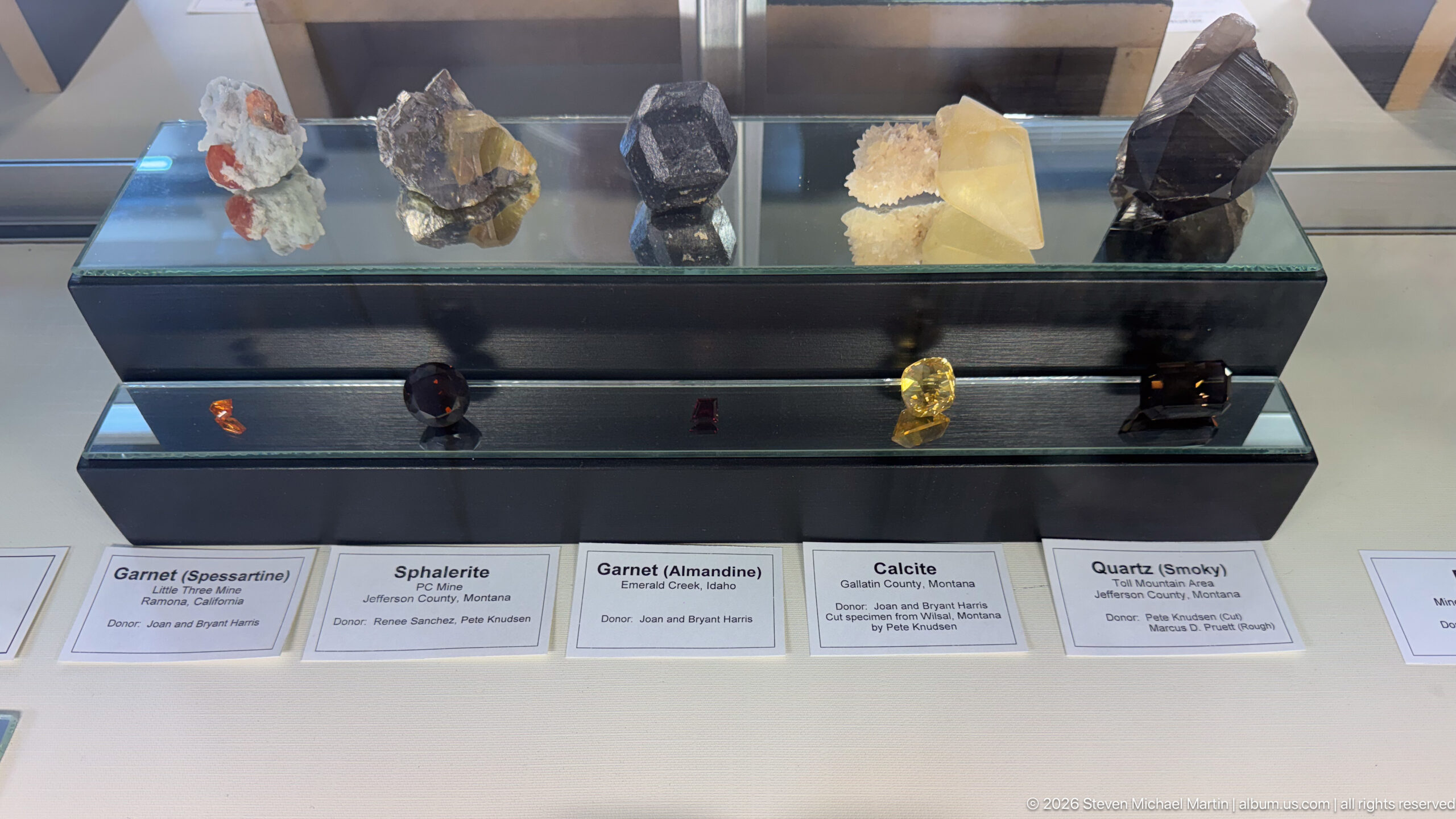
A museum case groups Montana mineral specimens in two tiers, pairing larger natural crystals above with smaller polished or gem-like examples below. Labels identify varieties of garnet, sphalerite, calcite, and smoky quartz from localities including Jefferson City, Philipsburg, Golden, and the Little Rockies, emphasizing the mineral diversity found across the state.
Caption
A museum case groups Montana mineral specimens in two tiers, pairing larger natural crystals above with smaller polished or gem-like examples below. Labels identify varieties of garnet, sphalerite, calcite, and smoky quartz from localities including Jefferson City, Philipsburg, Golden, and the Little Rockies, emphasizing the mineral diversity found across the state.
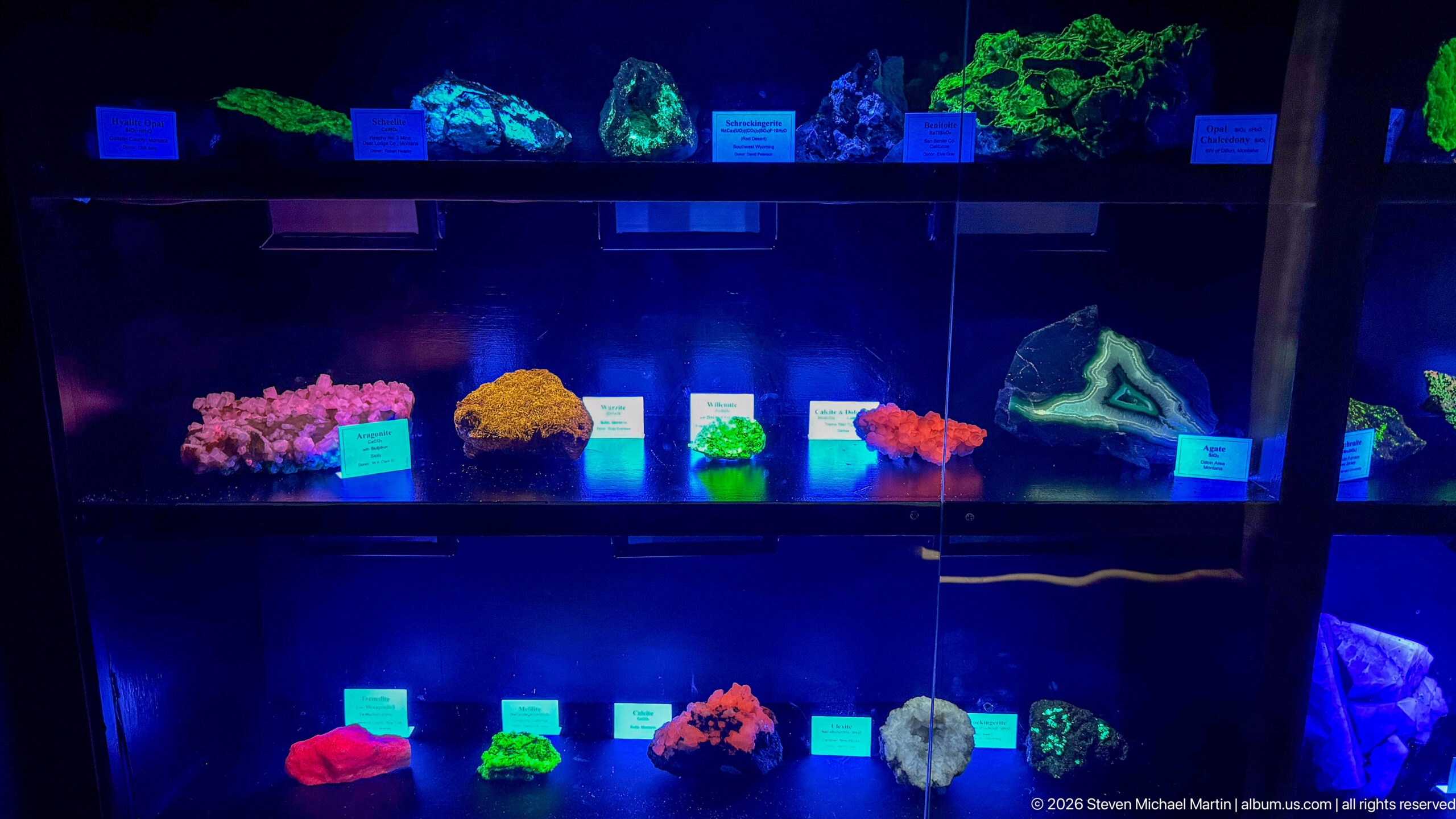
Mineral specimens glow in electric greens, pinks, oranges, and blues under ultraviolet illumination, revealing colors that differ dramatically from their appearance in ordinary light. Arranged on several shelves against a darkened case, the display demonstrates fluorescence as a diagnostic and visually striking mineral property.
Caption
Mineral specimens glow in electric greens, pinks, oranges, and blues under ultraviolet illumination, revealing colors that differ dramatically from their appearance in ordinary light. Arranged on several shelves against a darkened case, the display demonstrates fluorescence as a diagnostic and visually striking mineral property.
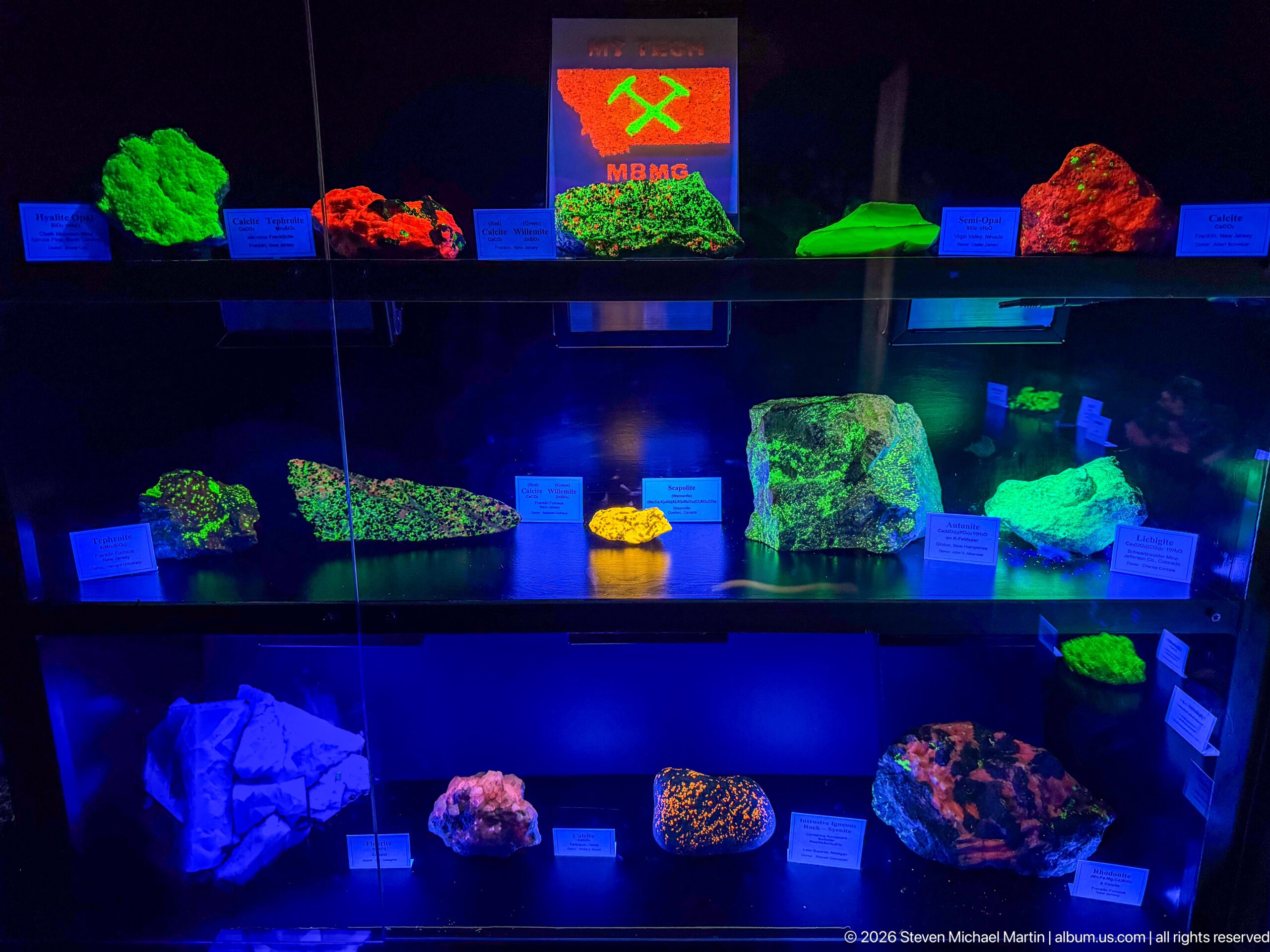
A wider view of the ultraviolet mineral case shows multiple shelves of fluorescent specimens glowing red, green, yellow, and blue. The darkened presentation isolates the emitted colors, while an illuminated mining emblem above the specimens ties the mineralogical display visually to the region’s mining culture.
Caption
A wider view of the ultraviolet mineral case shows multiple shelves of fluorescent specimens glowing red, green, yellow, and blue. The darkened presentation isolates the emitted colors, while an illuminated mining emblem above the specimens ties the mineralogical display visually to the region’s mining culture.
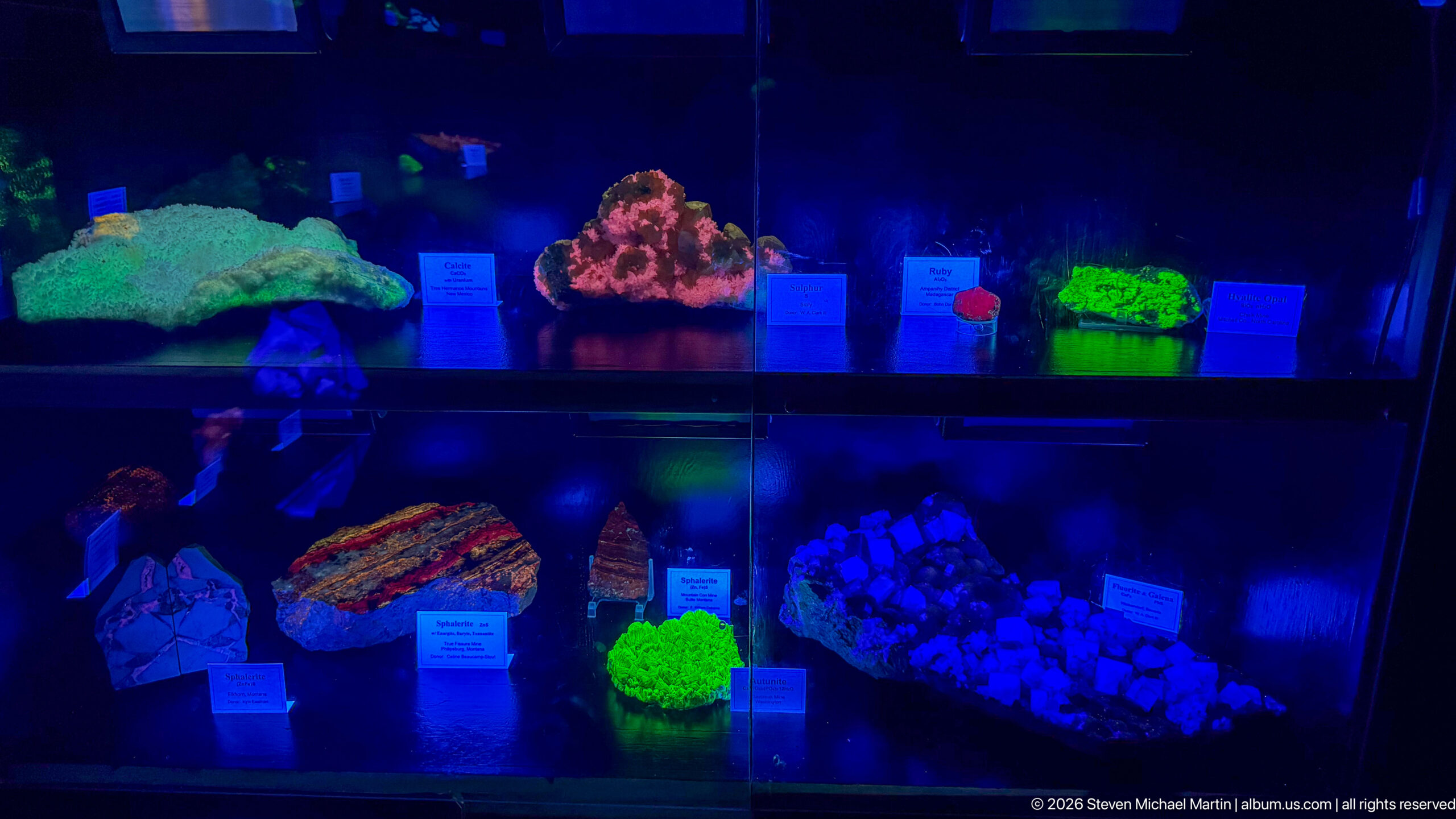
Lower shelves of the fluorescent-mineral exhibit bring individual specimens closer to view, including vivid green, red, yellow, and violet responses under ultraviolet light. The tighter framing emphasizes differences in fluorescence from specimen to specimen rather than the overall case arrangement.
Caption
Lower shelves of the fluorescent-mineral exhibit bring individual specimens closer to view, including vivid green, red, yellow, and violet responses under ultraviolet light. The tighter framing emphasizes differences in fluorescence from specimen to specimen rather than the overall case arrangement.
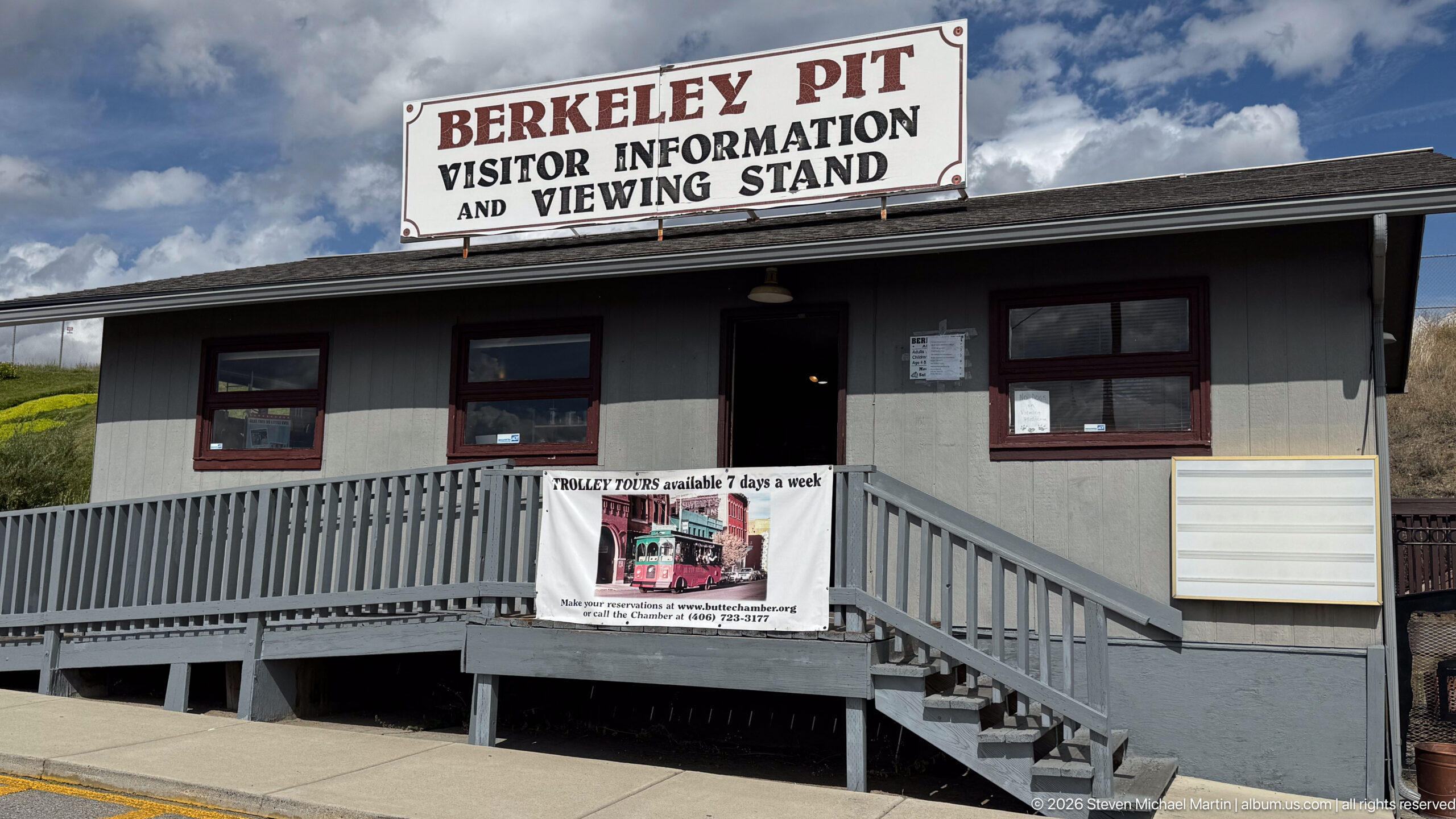
The Berkeley Pit Visitor Information and Viewing Stand occupies a modest building at the entrance to the public overlook. A large rooftop sign announces the site, while stairs and a ramp lead visitors toward the interpretive facility that provides access to views of Butte’s enormous former open-pit copper mine.
Caption
The Berkeley Pit Visitor Information and Viewing Stand occupies a modest building at the entrance to the public overlook. A large rooftop sign announces the site, while stairs and a ramp lead visitors toward the interpretive facility that provides access to views of Butte’s enormous former open-pit copper mine.
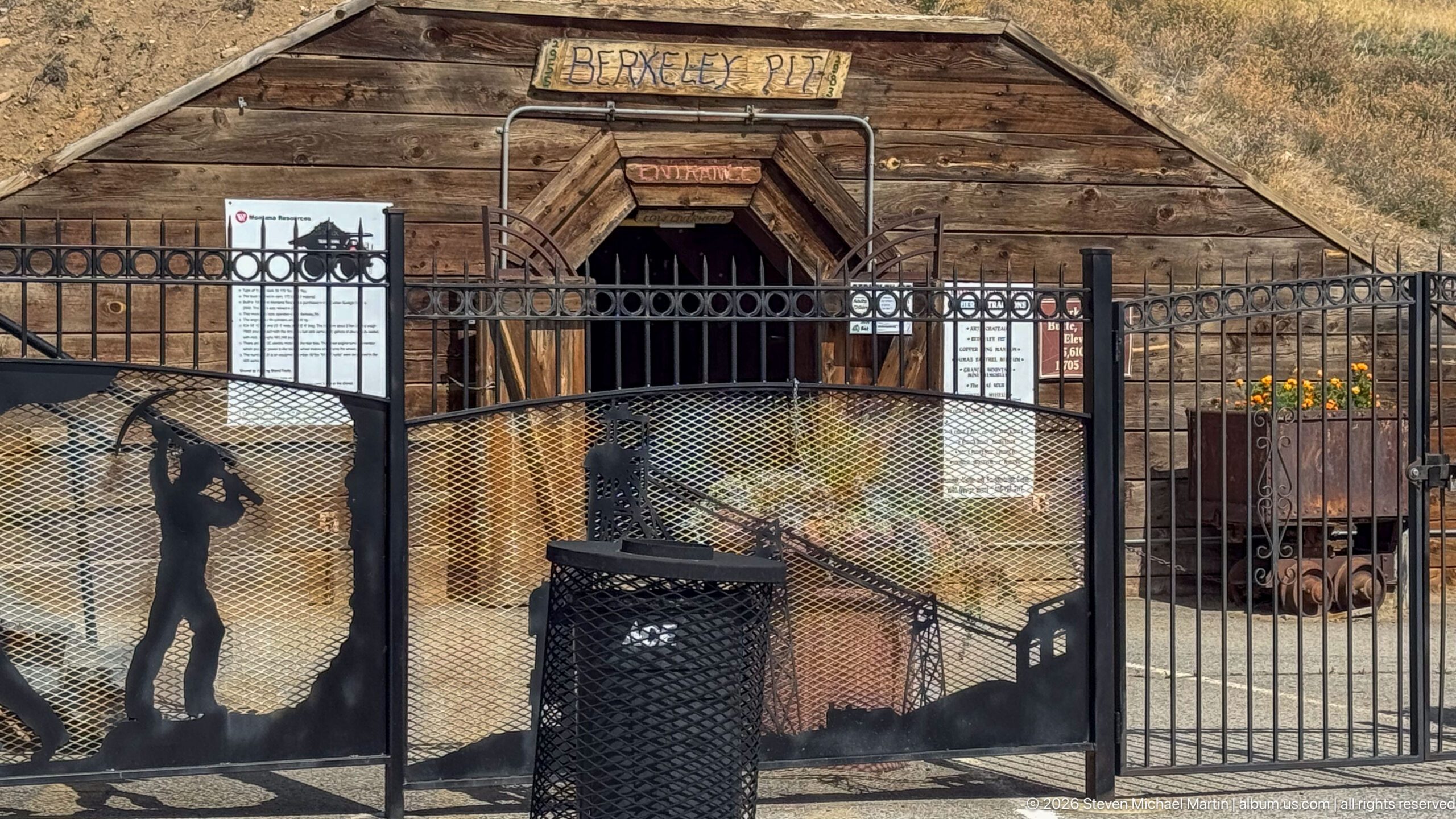
A rustic timber façade marked “Berkeley Pit” frames the entrance to the viewing area, while decorative metal panels incorporate mining imagery into the surrounding fence. The intentionally industrial vocabulary introduces visitors to the mining landscape before they reach the overlook itself.
Caption
A rustic timber façade marked “Berkeley Pit” frames the entrance to the viewing area, while decorative metal panels incorporate mining imagery into the surrounding fence. The intentionally industrial vocabulary introduces visitors to the mining landscape before they reach the overlook itself.
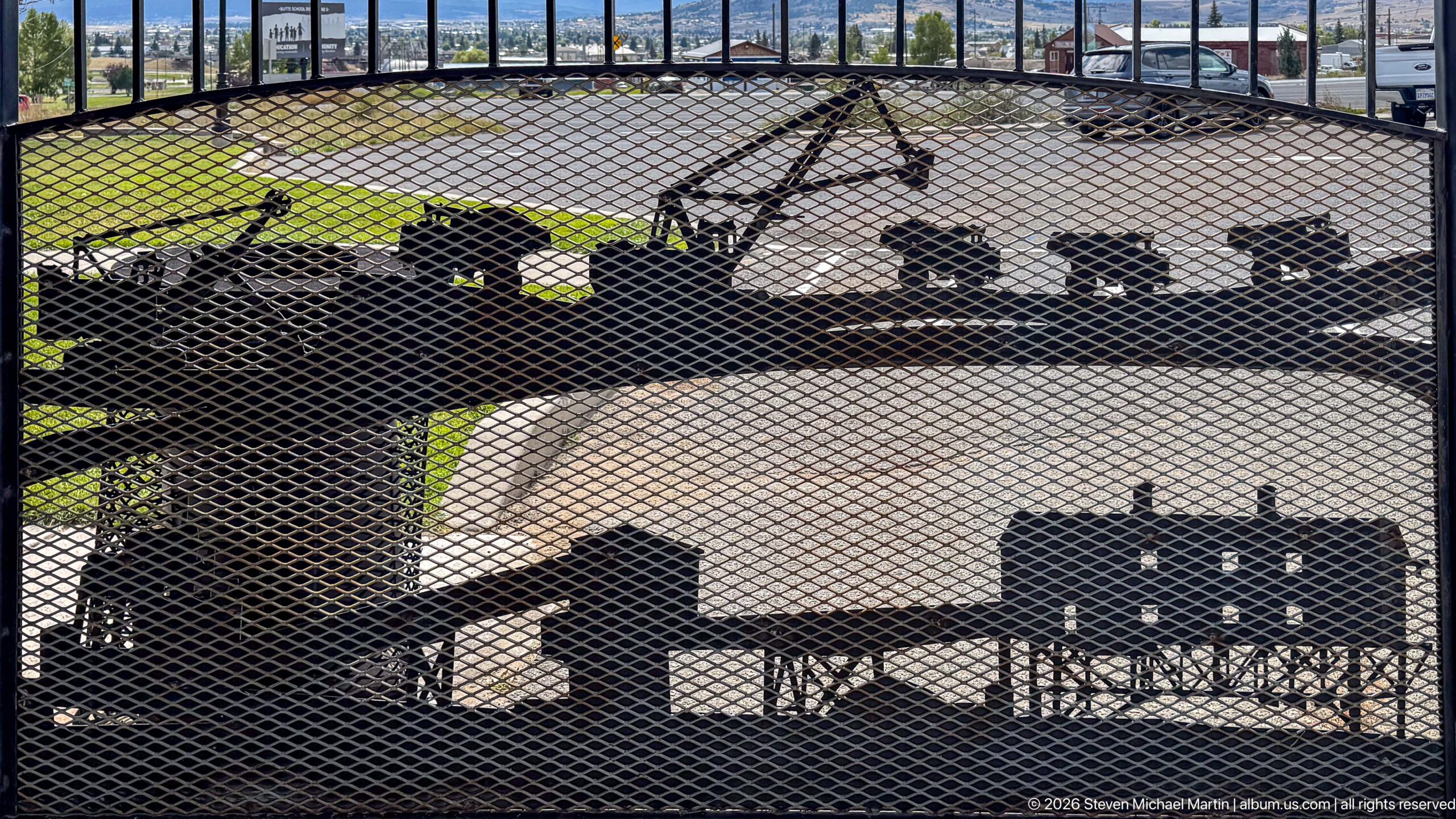
Heavy mining machinery is displayed behind protective mesh near the Berkeley Pit visitor area. Large drums, wheels, shafts, and structural components preserve the scale and mechanical character of equipment associated with Butte’s mining industry, even though the individual machine components are difficult to identify from this screened viewpoint.
Caption
Heavy mining machinery is displayed behind protective mesh near the Berkeley Pit visitor area. Large drums, wheels, shafts, and structural components preserve the scale and mechanical character of equipment associated with Butte’s mining industry, even though the individual machine components are difficult to identify from this screened viewpoint.
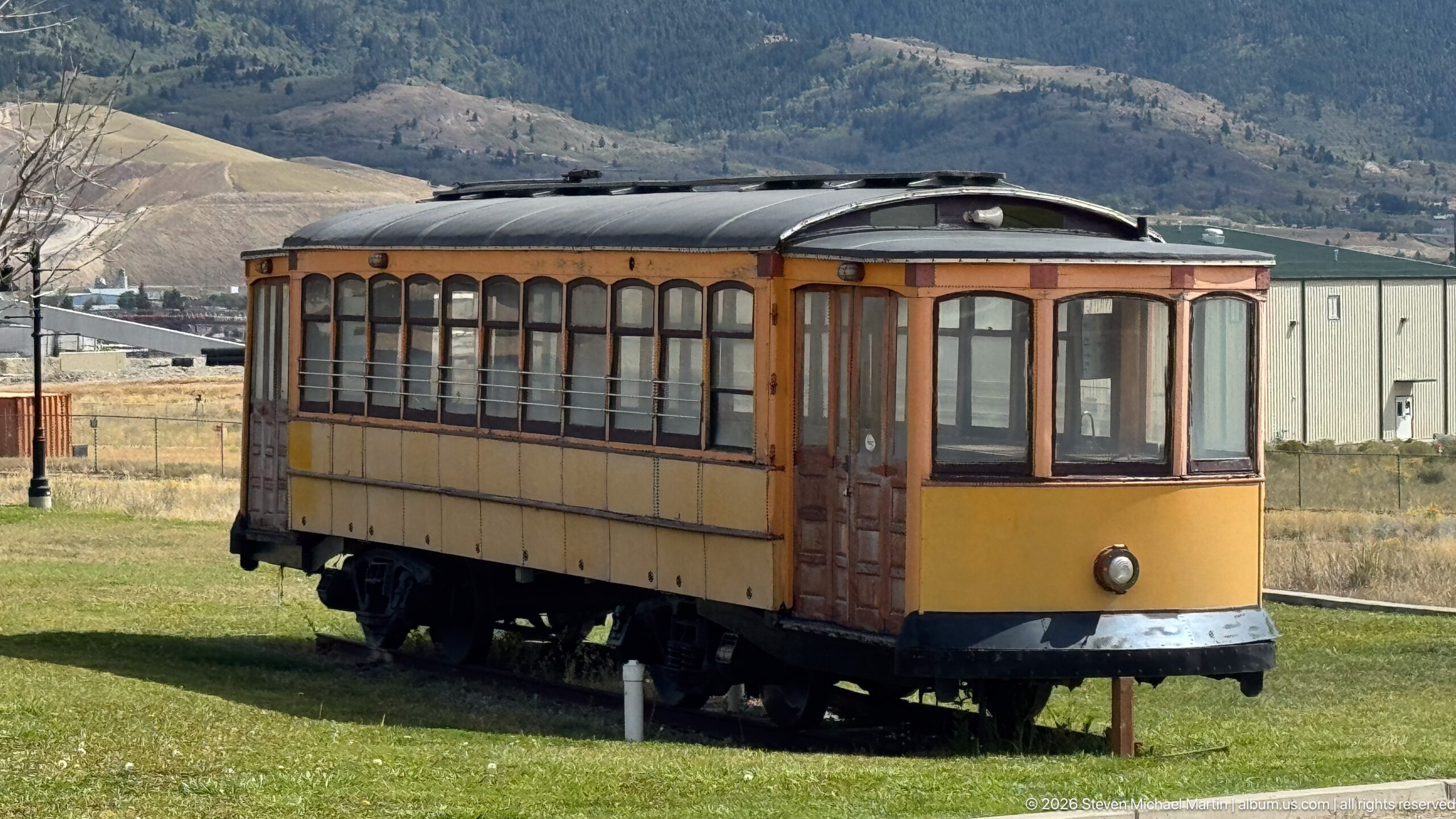
A preserved wooden streetcar stands on a short section of track near the Berkeley Pit visitor area. Its enclosed passenger body, rows of tall windows, end platform, and trolley-era proportions recall the electric transit system that once connected neighborhoods and industrial districts in mining-era Butte.
Caption
A preserved wooden streetcar stands on a short section of track near the Berkeley Pit visitor area. Its enclosed passenger body, rows of tall windows, end platform, and trolley-era proportions recall the electric transit system that once connected neighborhoods and industrial districts in mining-era Butte.
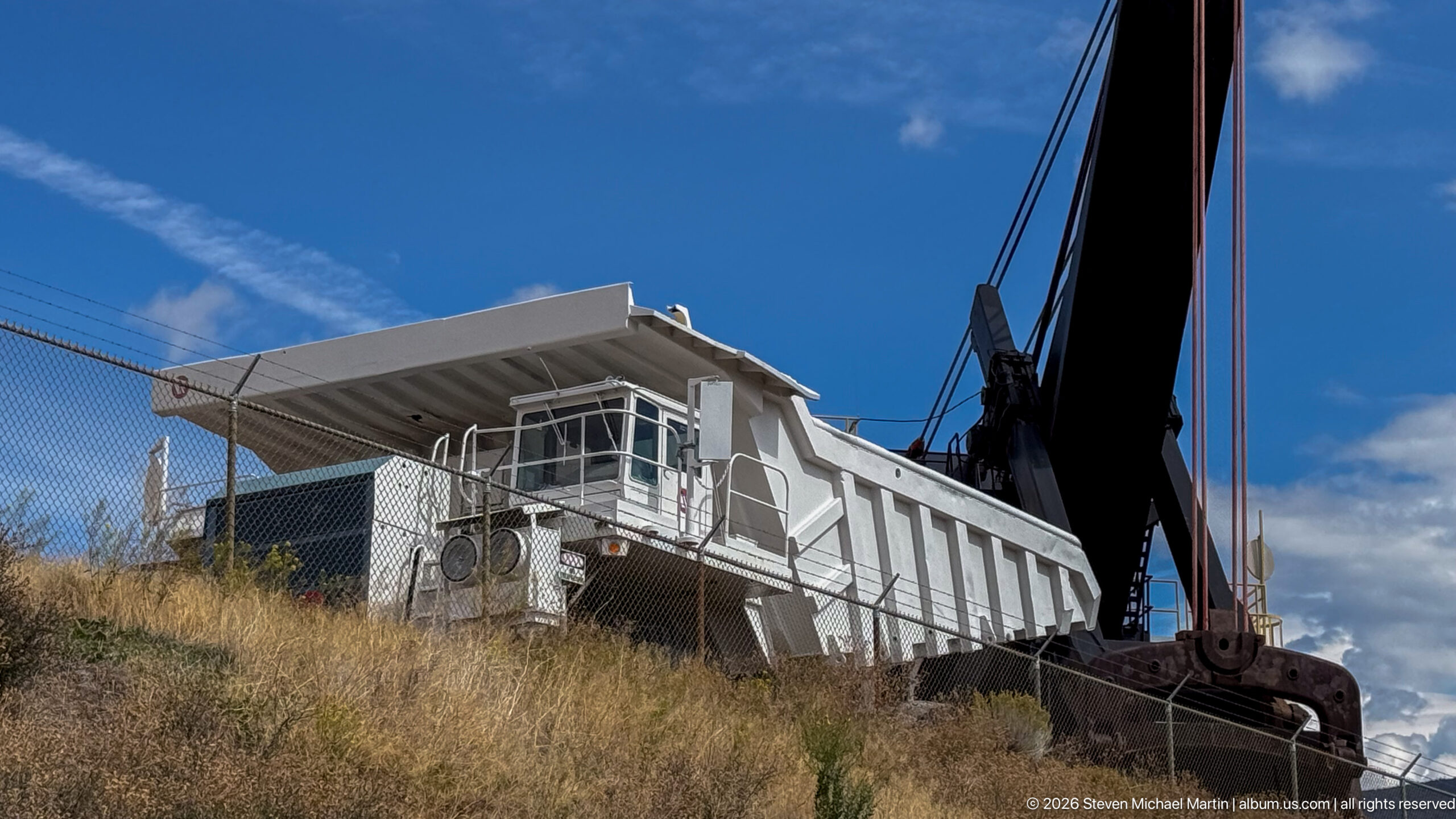
A massive piece of preserved mining machinery rises beside a small white operator’s cab on the slope near the Berkeley Pit visitor area. Heavy cables, pulleys, structural members, and the elevated cab convey the scale of mechanical systems used to move material in industrial mining operations.
Caption
A massive piece of preserved mining machinery rises beside a small white operator’s cab on the slope near the Berkeley Pit visitor area. Heavy cables, pulleys, structural members, and the elevated cab convey the scale of mechanical systems used to move material in industrial mining operations.
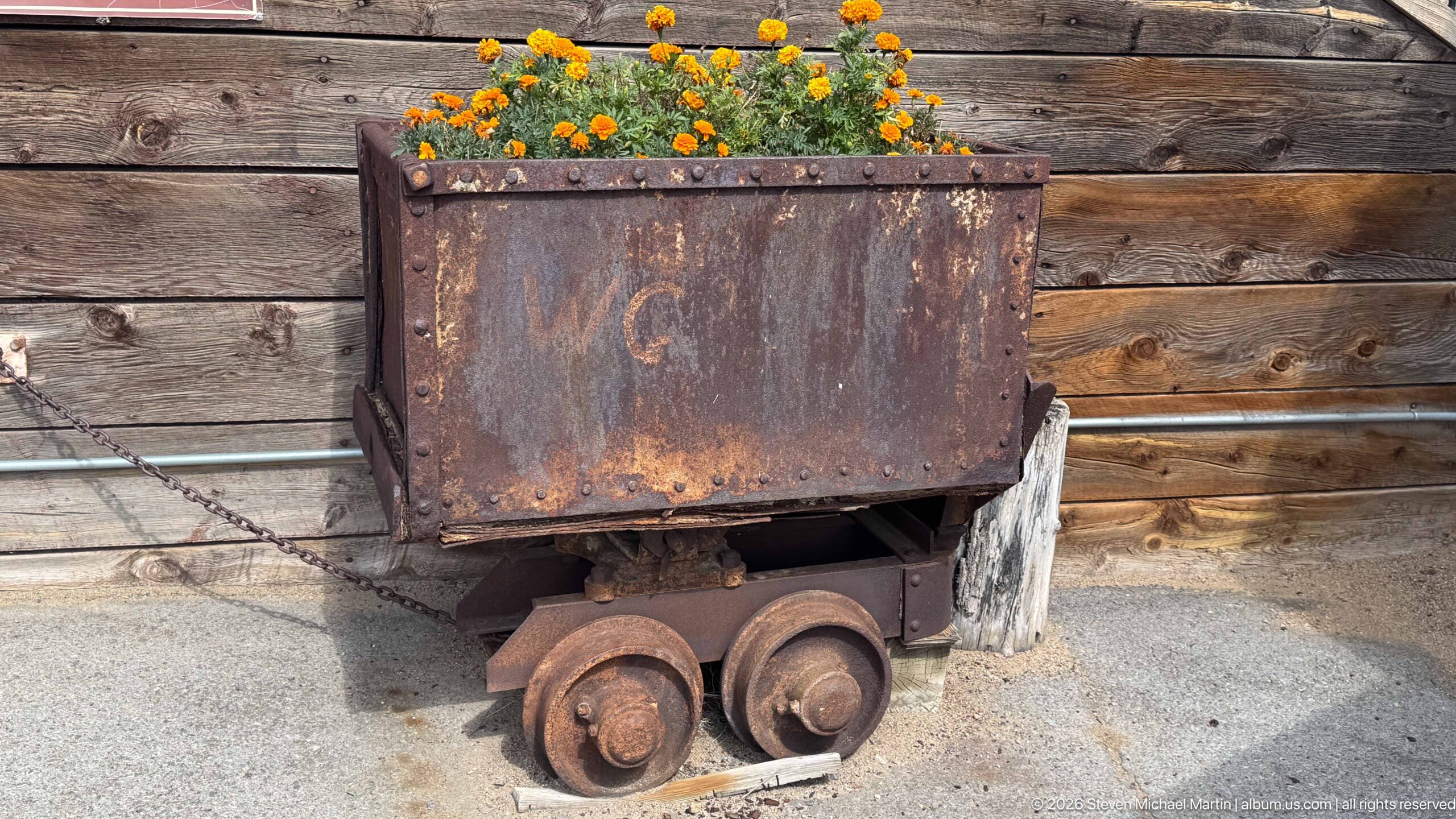
A compact steel ore cart rests on four small flanged wheels beside the timber wall of the Berkeley Pit visitor area. Rust and wear remain visible across the box and running gear, preserving the utilitarian character of equipment once used to move broken rock through mining operations.
Caption
A compact steel ore cart rests on four small flanged wheels beside the timber wall of the Berkeley Pit visitor area. Rust and wear remain visible across the box and running gear, preserving the utilitarian character of equipment once used to move broken rock through mining operations.
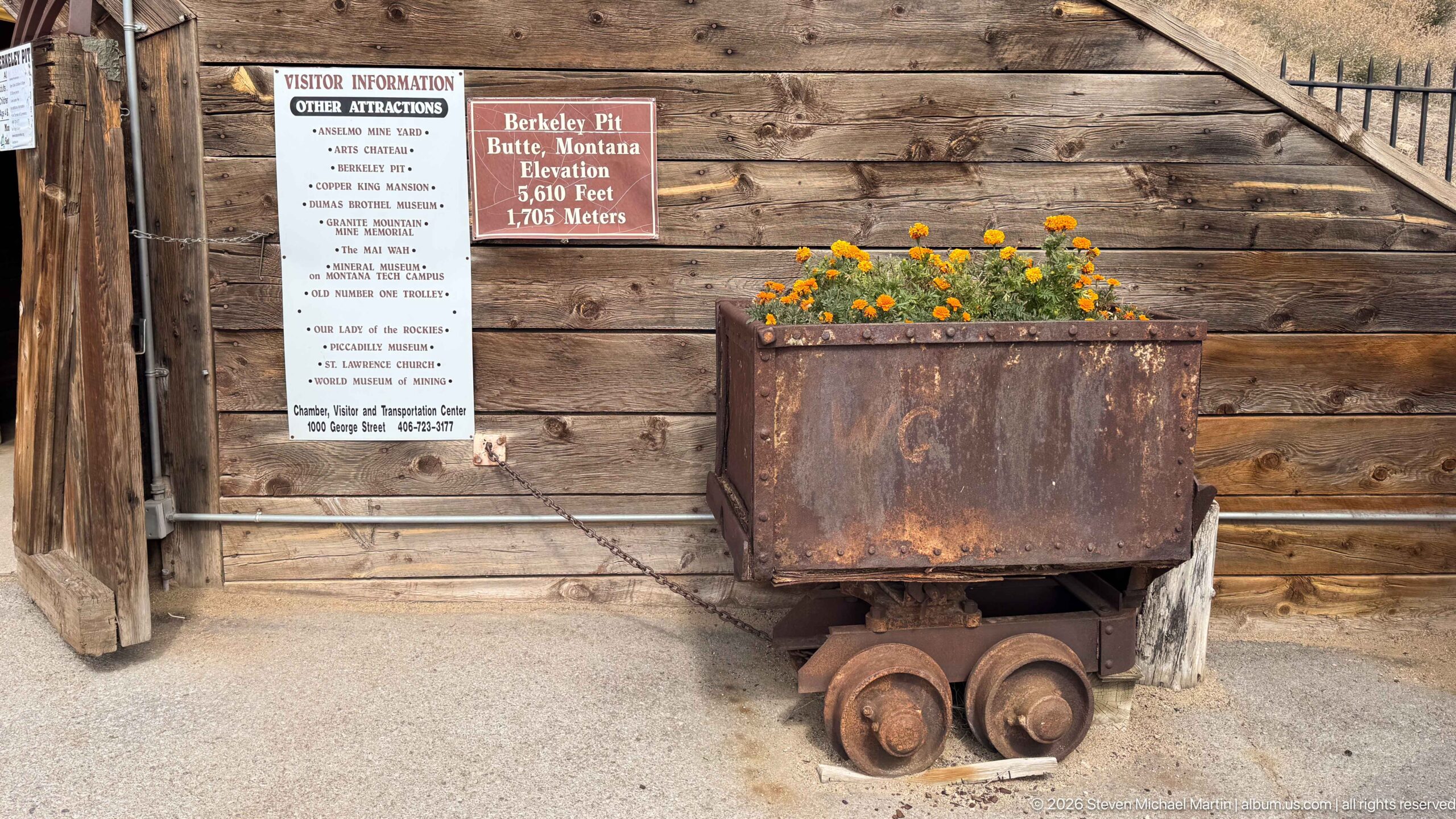
A small steel ore cart stands against the weathered timber wall of the Berkeley Pit visitor exhibit, beside signs marking Butte’s elevation and mining context. Its compact box body and paired flanged wheels recall the rail-mounted equipment used to move broken rock through underground workings before open-pit mining transformed the landscape.
Caption
A small steel ore cart stands against the weathered timber wall of the Berkeley Pit visitor exhibit, beside signs marking Butte’s elevation and mining context. Its compact box body and paired flanged wheels recall the rail-mounted equipment used to move broken rock through underground workings before open-pit mining transformed the landscape.
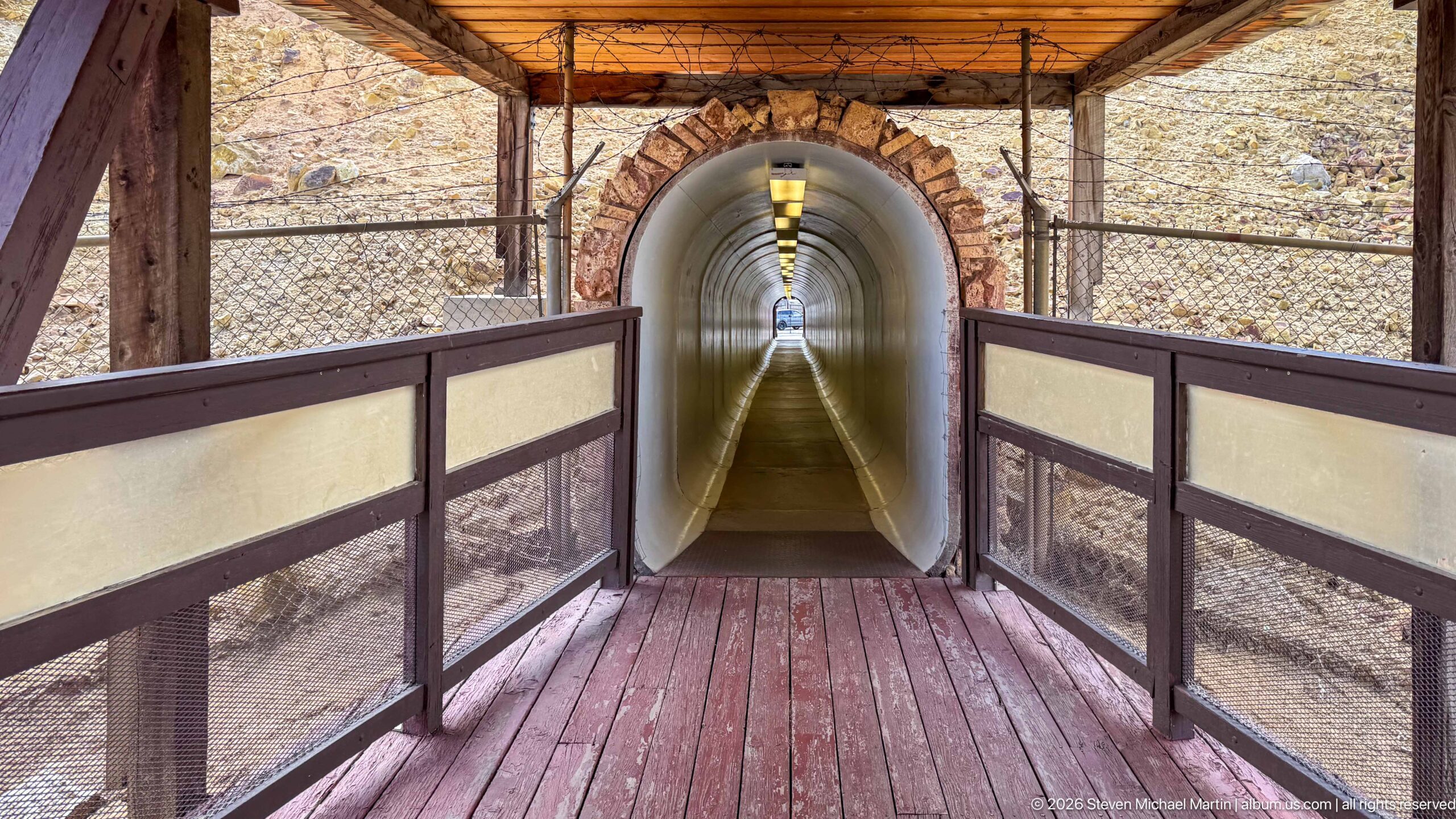
A long enclosed pedestrian tunnel leads from the visitor entrance toward the Berkeley Pit viewing area. Repeated ceiling lights draw the eye through the rounded white passage, while timber framing and rock-filled mesh at the portal evoke a mine opening without reproducing the confined timbered interior of a historic underground working.
Caption
A long enclosed pedestrian tunnel leads from the visitor entrance toward the Berkeley Pit viewing area. Repeated ceiling lights draw the eye through the rounded white passage, while timber framing and rock-filled mesh at the portal evoke a mine opening without reproducing the confined timbered interior of a historic underground working.
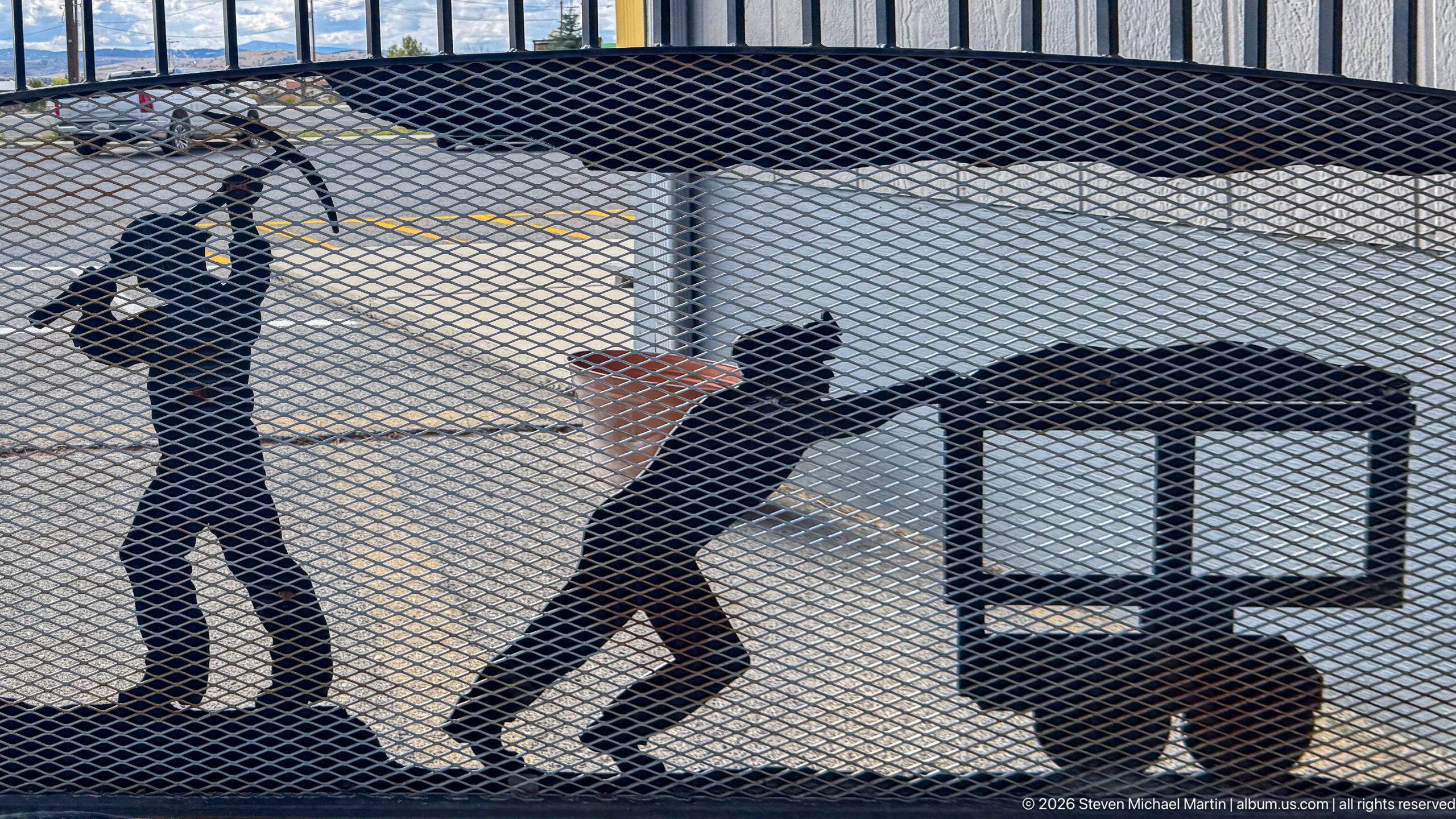
A cut-metal silhouette depicts miners working around a wheeled mining vehicle, turning the visitor-area fence into an interpretive reference to Butte’s industrial past. Seen through the protective mesh, the figures emphasize human labor and machinery rather than the vast geological scale of the pit visible beyond the viewing structure.
Caption
A cut-metal silhouette depicts miners working around a wheeled mining vehicle, turning the visitor-area fence into an interpretive reference to Butte’s industrial past. Seen through the protective mesh, the figures emphasize human labor and machinery rather than the vast geological scale of the pit visible beyond the viewing structure.
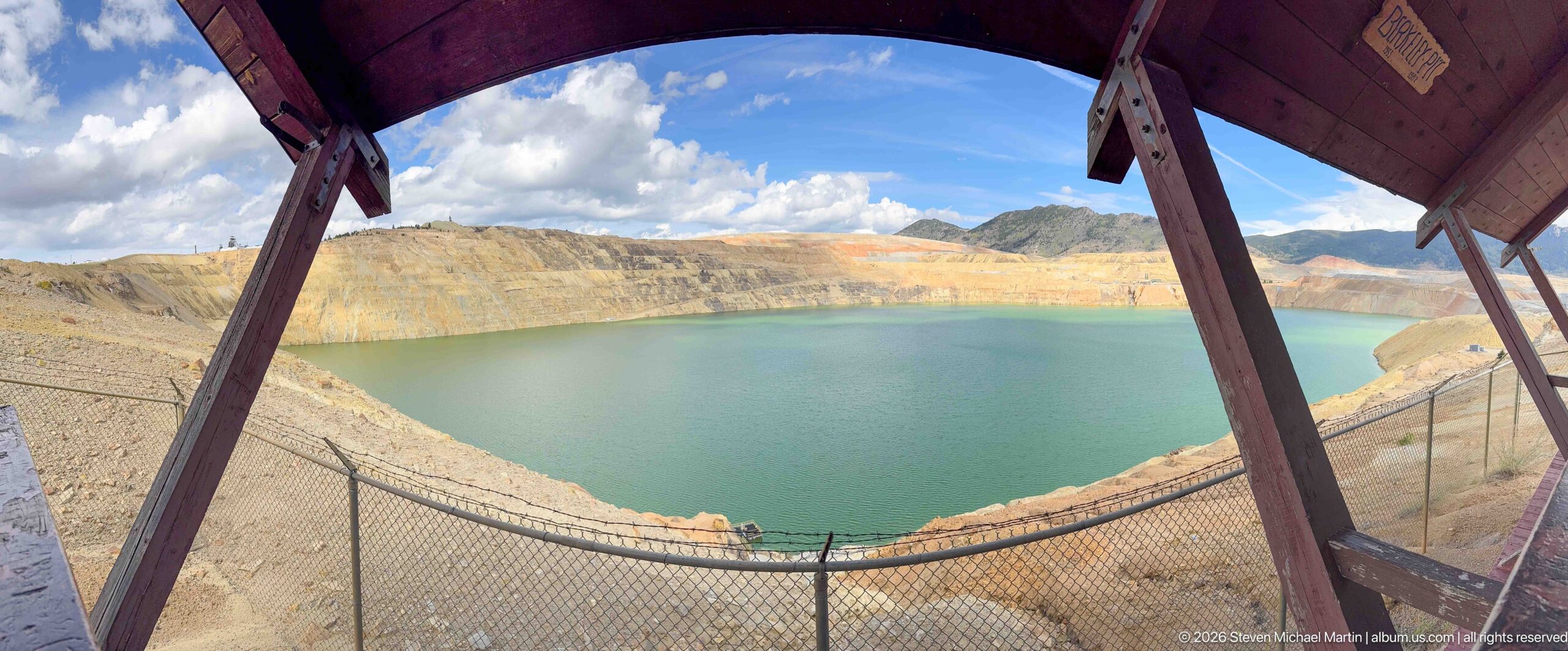
The Berkeley Pit fills the view from the covered public overlook, its green-blue water enclosed by broad stepped benches cut into mineralized rock. Timber supports and the safety fence frame the scene, making the visitor infrastructure part of the composition while emphasizing the immense scale of the former open-pit copper mine.
Caption
The Berkeley Pit fills the view from the covered public overlook, its green-blue water enclosed by broad stepped benches cut into mineralized rock. Timber supports and the safety fence frame the scene, making the visitor infrastructure part of the composition while emphasizing the immense scale of the former open-pit copper mine.
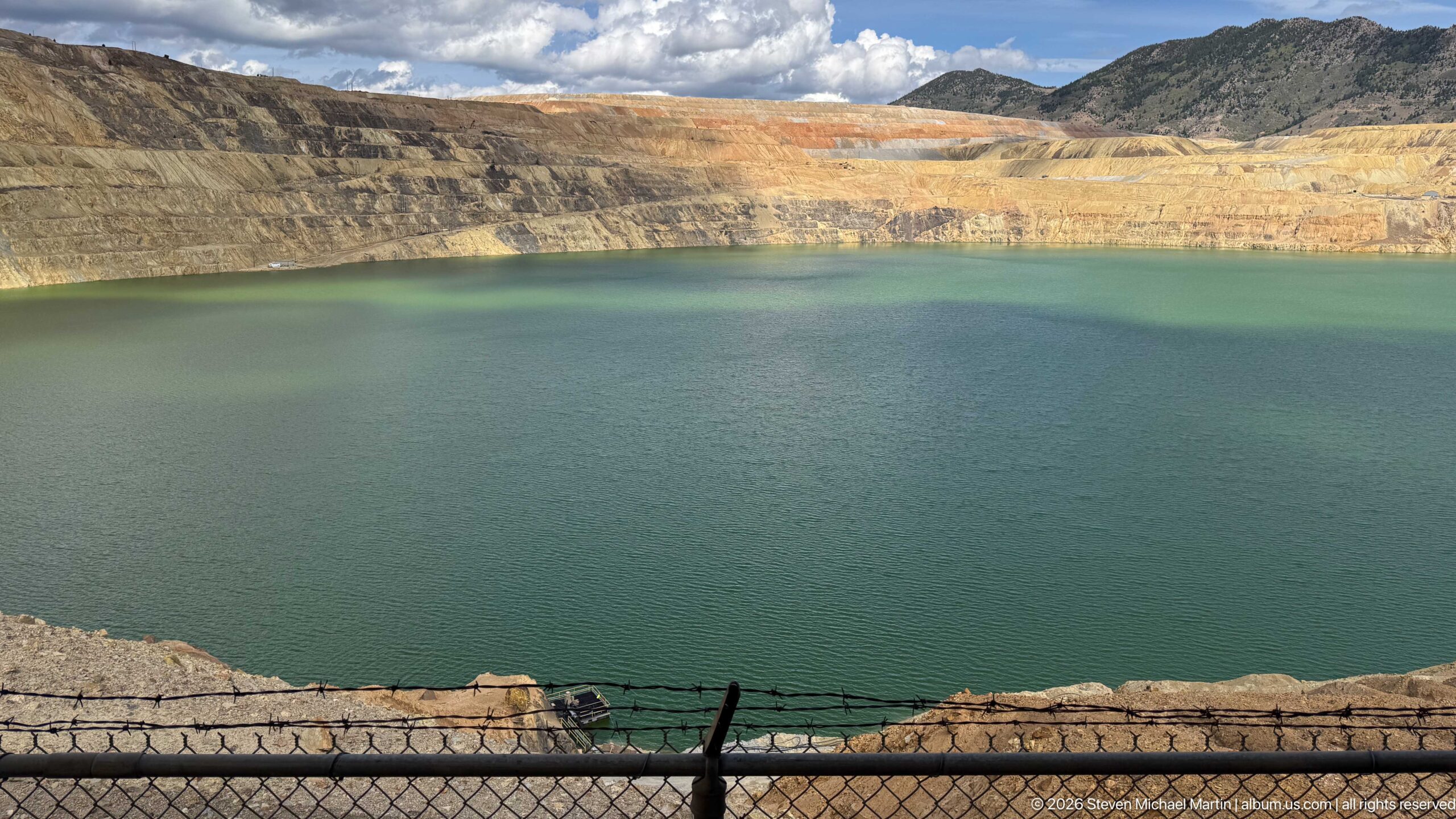
A broad expanse of dark teal water stretches beneath the terraced walls of the Berkeley Pit. Sunlight catches bands of yellow and orange rock on the upper benches while cloud shadows darken the water, revealing how changing light alters the appearance of a landscape shaped by industrial excavation and subsequent flooding.
Caption
A broad expanse of dark teal water stretches beneath the terraced walls of the Berkeley Pit. Sunlight catches bands of yellow and orange rock on the upper benches while cloud shadows darken the water, revealing how changing light alters the appearance of a landscape shaped by industrial excavation and subsequent flooding.
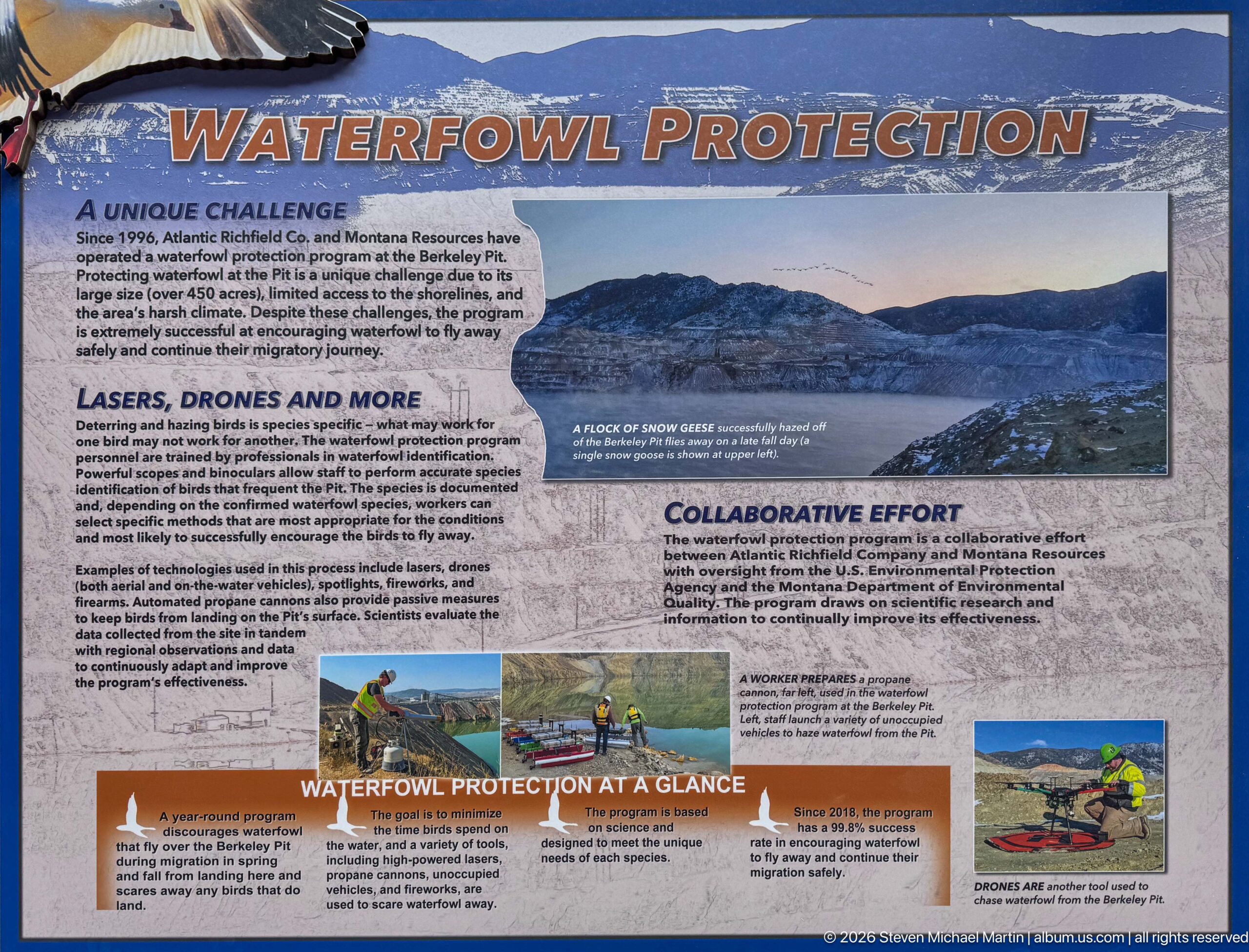
The “Waterfowl Protection” panel explains efforts to keep migrating birds from remaining on Berkeley Pit water. Photographs and text describe a coordinated program using lasers, drones, and other deterrents, placing wildlife management alongside water treatment as part of the continuing environmental response to the former mine.
Caption
The “Waterfowl Protection” panel explains efforts to keep migrating birds from remaining on Berkeley Pit water. Photographs and text describe a coordinated program using lasers, drones, and other deterrents, placing wildlife management alongside water treatment as part of the continuing environmental response to the former mine.
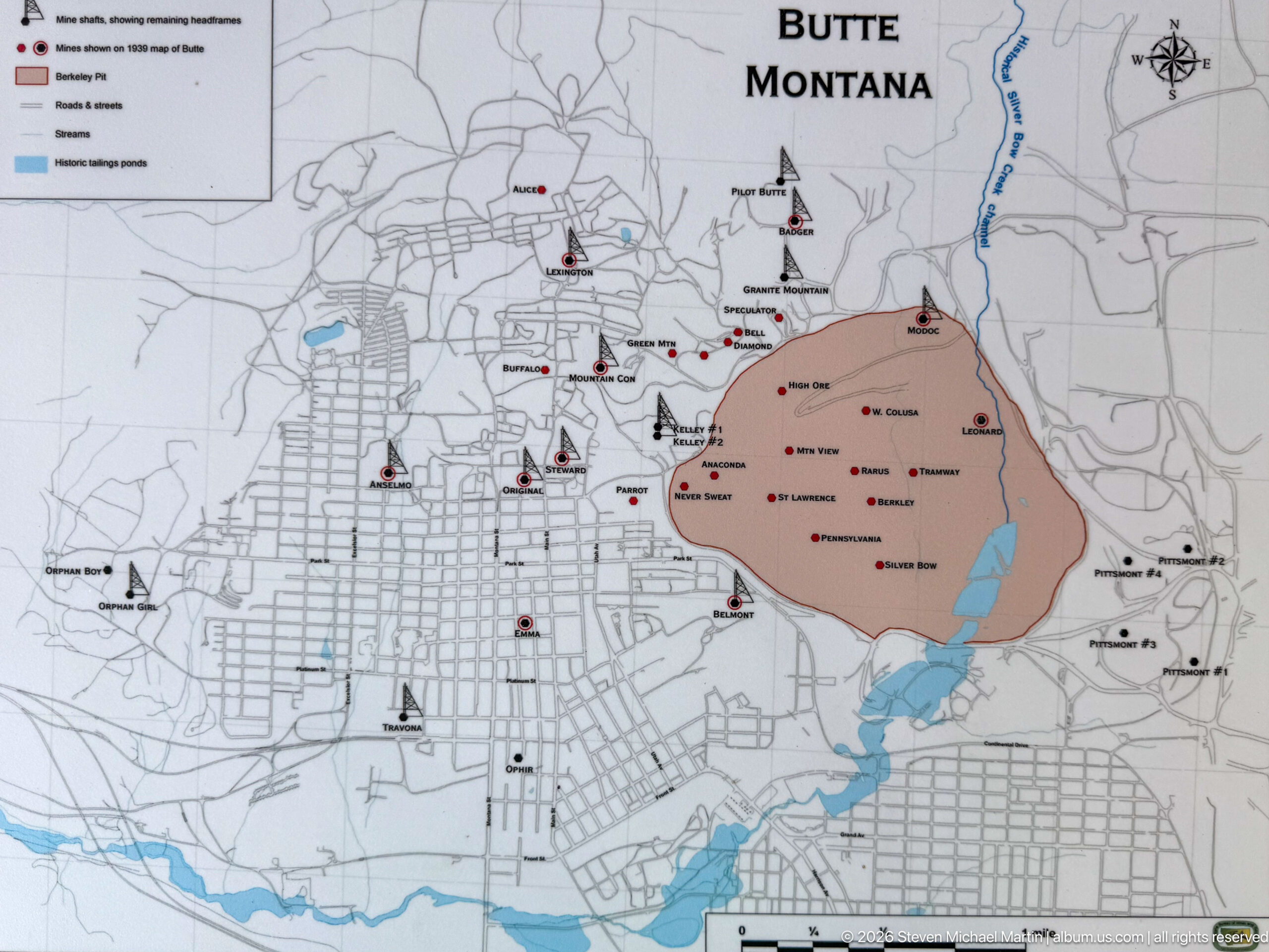
A city-scale map places the Berkeley Pit within Butte’s dense mining landscape. The large shaded pit occupies the eastern side of the urban grid, while mine symbols and labels mark numerous historic shafts and industrial sites across the surrounding hill. The map clarifies how closely mining infrastructure developed alongside the city itself.
Caption
A city-scale map places the Berkeley Pit within Butte’s dense mining landscape. The large shaded pit occupies the eastern side of the urban grid, while mine symbols and labels mark numerous historic shafts and industrial sites across the surrounding hill. The map clarifies how closely mining infrastructure developed alongside the city itself.
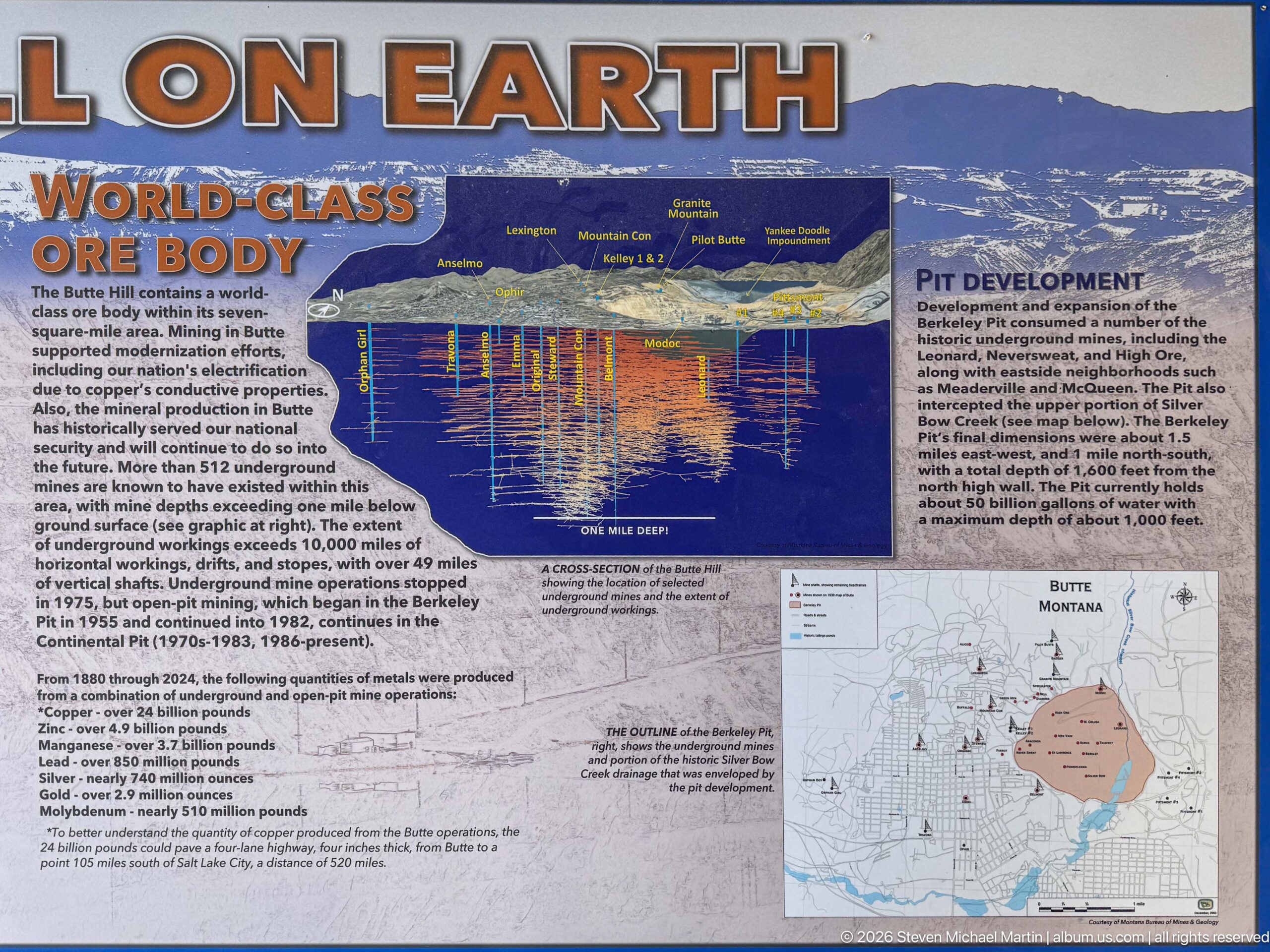
The “World-Class Ore Body” display combines a mine cross-section, historic production figures, a map, and text on pit development to explain the extraordinary concentration of mineralization beneath Butte Hill. By pairing underground workings with the later open-pit excavation, the panel shows how successive mining methods exploited the same complex ore system.
Caption
The “World-Class Ore Body” display combines a mine cross-section, historic production figures, a map, and text on pit development to explain the extraordinary concentration of mineralization beneath Butte Hill. By pairing underground workings with the later open-pit excavation, the panel shows how successive mining methods exploited the same complex ore system.
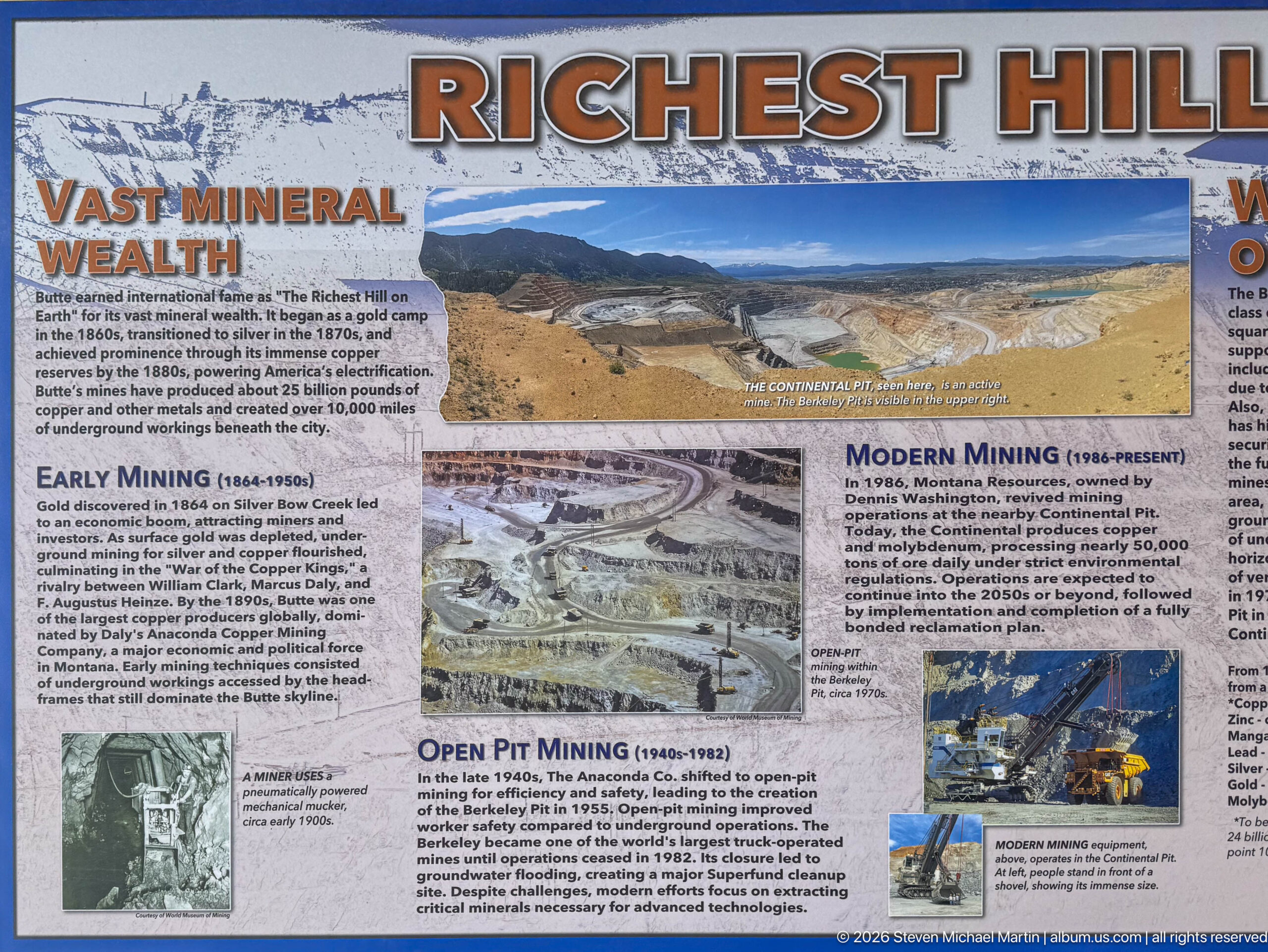
The “Richest Hill” panel traces Butte’s mineral wealth from early underground mining through open-pit development and modern operations. Historic photographs, mine views, and explanatory sections place the Berkeley Pit within a longer technological sequence, showing how changing extraction methods reshaped both the ore body and the surface landscape.
Caption
The “Richest Hill” panel traces Butte’s mineral wealth from early underground mining through open-pit development and modern operations. Historic photographs, mine views, and explanatory sections place the Berkeley Pit within a longer technological sequence, showing how changing extraction methods reshaped both the ore body and the surface landscape.
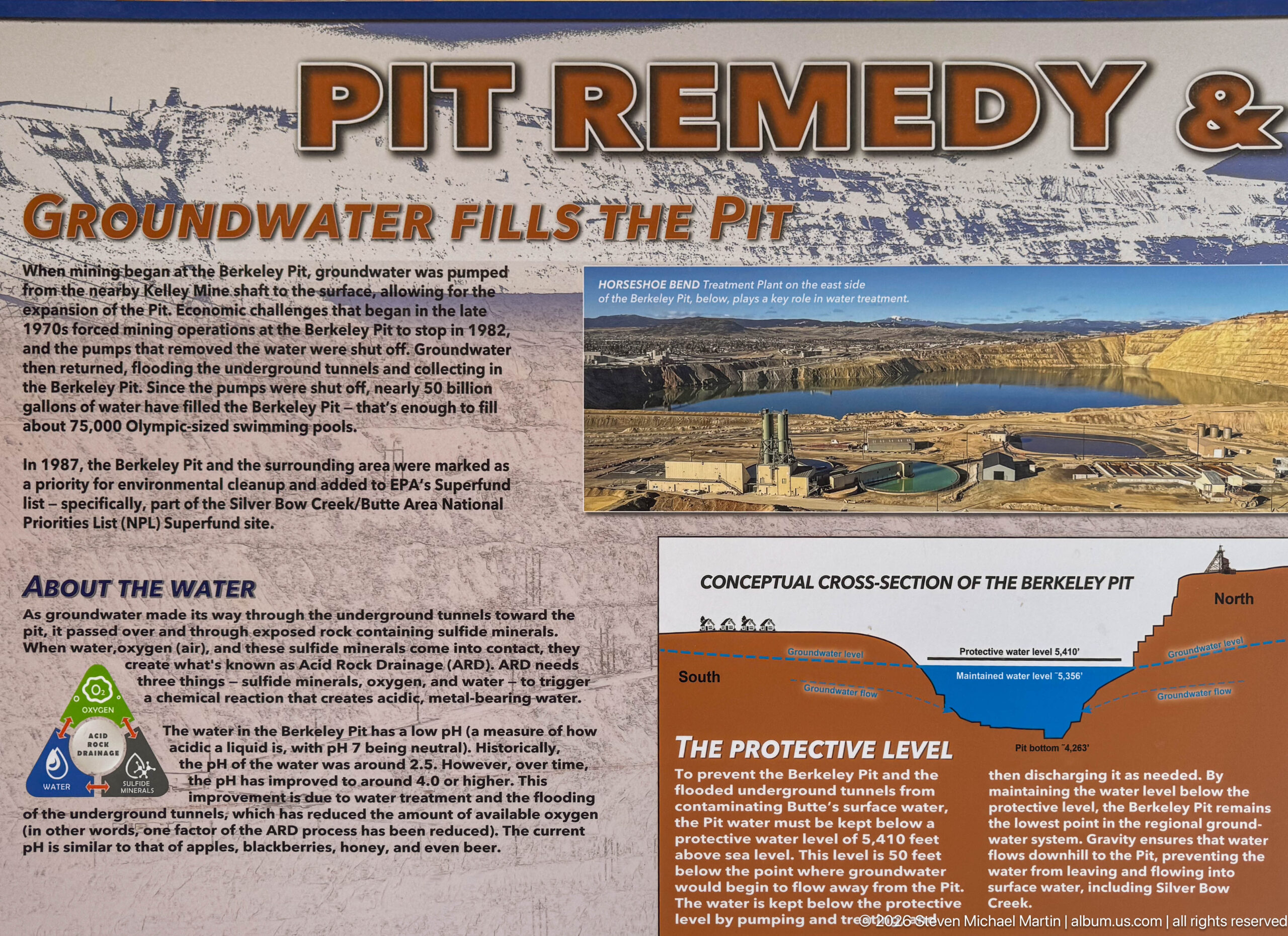
An interpretive panel explains how groundwater continues to fill the Berkeley Pit and how pumping and treatment keep the water below a protective level. A conceptual cross-section diagrams groundwater movement and the controlled pit level, connecting the visible lake to the engineered remediation system designed to manage contaminated mine water.
Caption
An interpretive panel explains how groundwater continues to fill the Berkeley Pit and how pumping and treatment keep the water below a protective level. A conceptual cross-section diagrams groundwater movement and the controlled pit level, connecting the visible lake to the engineered remediation system designed to manage contaminated mine water.
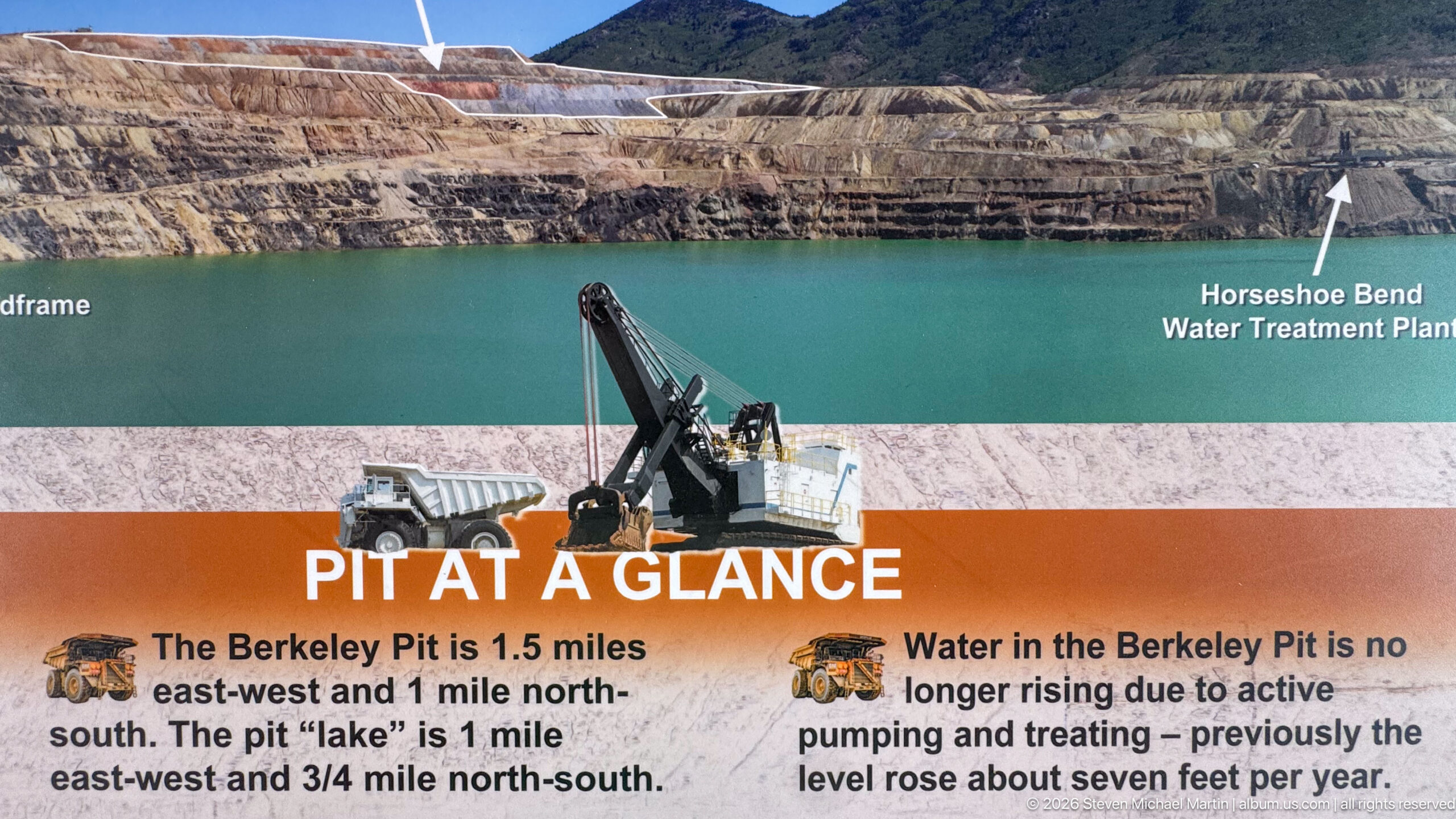
A “Pit at a Glance” display pairs a panoramic view of the Berkeley Pit with concise facts about its dimensions and water management. The upper photograph labels the Horseshoe Bend Water Treatment Plant, while the text below notes that active pumping and treatment now regulate the pit’s water level rather than allowing it to rise unchecked.
Caption
A “Pit at a Glance” display pairs a panoramic view of the Berkeley Pit with concise facts about its dimensions and water management. The upper photograph labels the Horseshoe Bend Water Treatment Plant, while the text below notes that active pumping and treatment now regulate the pit’s water level rather than allowing it to rise unchecked.
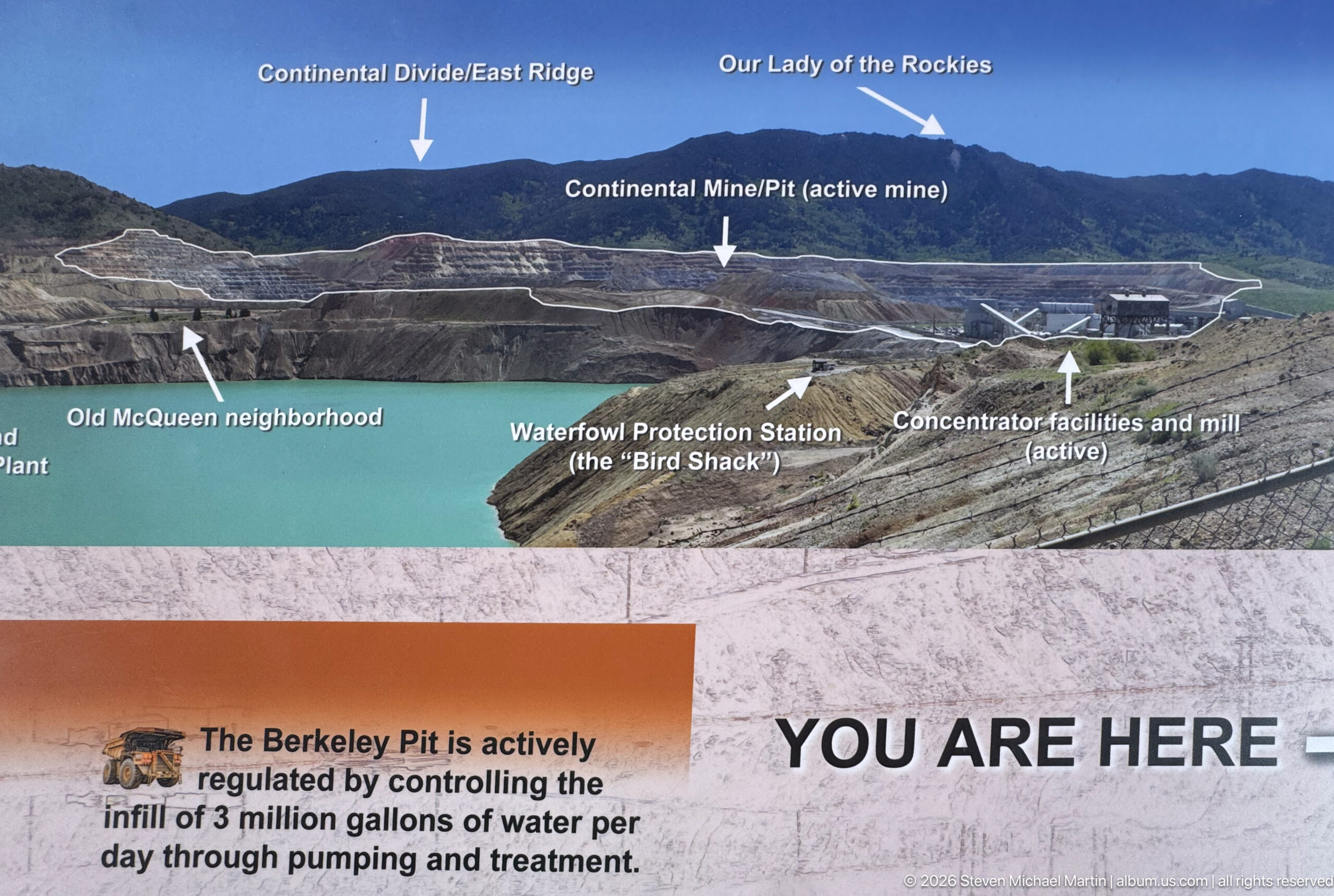
A labeled panorama identifies major features visible beyond the Berkeley Pit, including the Continental Mine/Pit, concentrator and mill facilities, the Waterfowl Protection Station, and distant ridgelines. The “You Are Here” orientation graphic helps visitors distinguish the historic flooded pit from active mining operations that continue immediately beyond it.
Caption
A labeled panorama identifies major features visible beyond the Berkeley Pit, including the Continental Mine/Pit, concentrator and mill facilities, the Waterfowl Protection Station, and distant ridgelines. The “You Are Here” orientation graphic helps visitors distinguish the historic flooded pit from active mining operations that continue immediately beyond it.
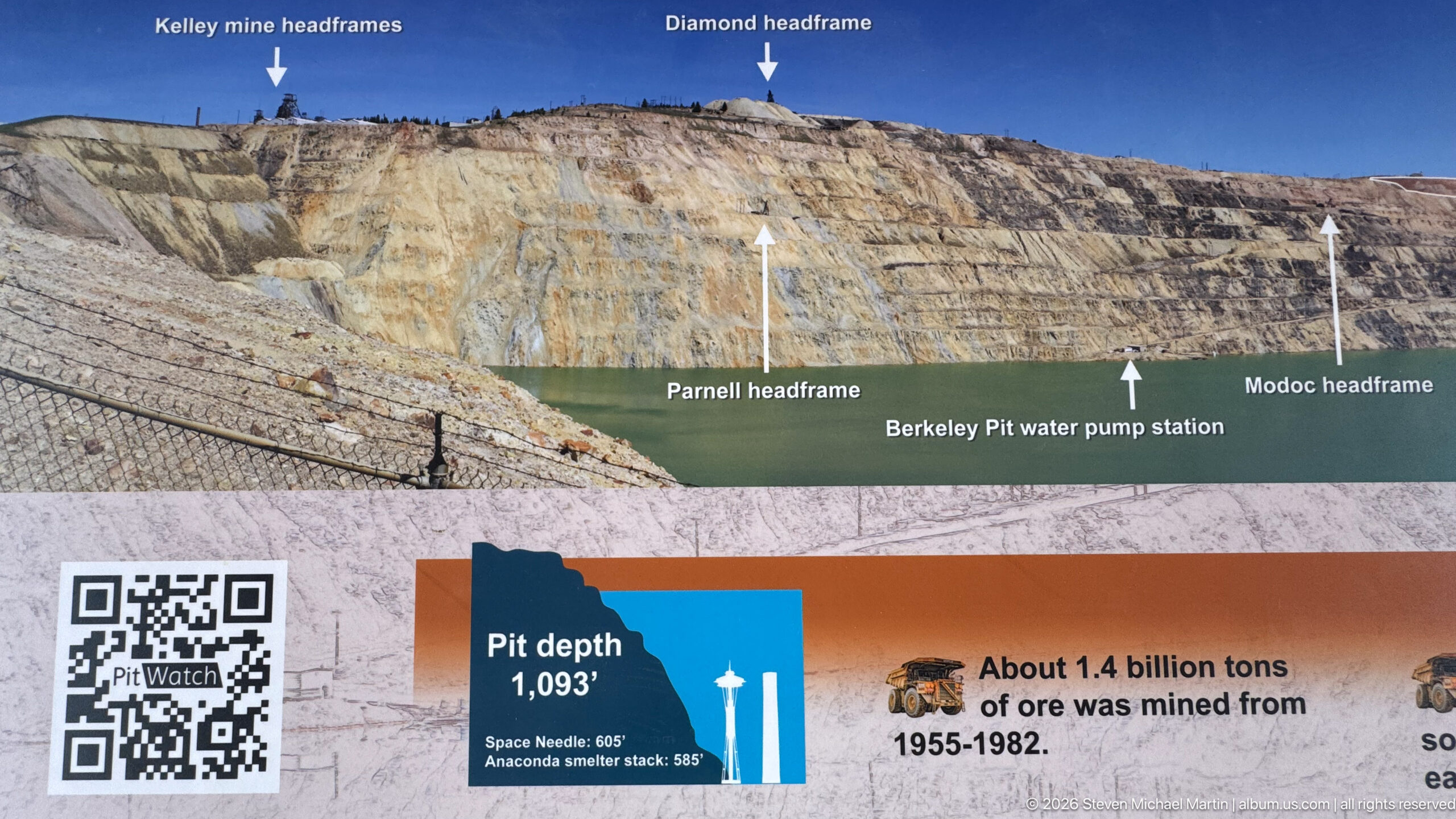
A panoramic interpretive photograph marks surviving mining landmarks around the Berkeley Pit, including the Diamond, Parrot, and Modoc headframes and the pit-water pump station. Below, a depth graphic and production statistic summarize the excavation’s scale, linking named remnants of underground mining to the later open-pit landscape.
Caption
A panoramic interpretive photograph marks surviving mining landmarks around the Berkeley Pit, including the Diamond, Parrot, and Modoc headframes and the pit-water pump station. Below, a depth graphic and production statistic summarize the excavation’s scale, linking named remnants of underground mining to the later open-pit landscape.
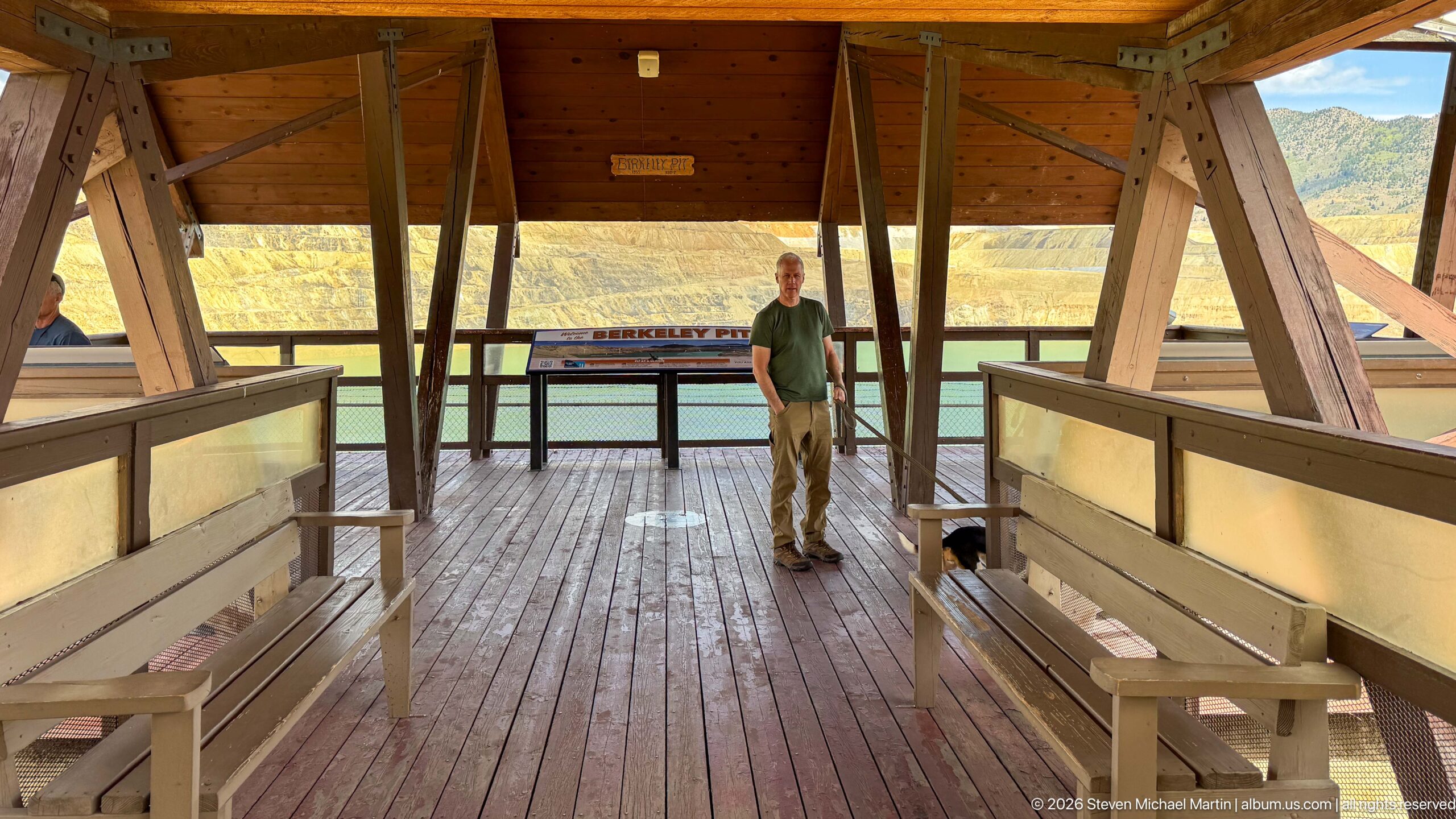
The timber-framed Berkeley Pit viewing stand opens directly toward the flooded mine, with benches lining the covered deck and interpretive material positioned at the railing. A visitor and dog provide a human measure for the structure, while the pit’s pale terraced walls and green water remain visible through the broad opening beyond.
Caption
The timber-framed Berkeley Pit viewing stand opens directly toward the flooded mine, with benches lining the covered deck and interpretive material positioned at the railing. A visitor and dog provide a human measure for the structure, while the pit’s pale terraced walls and green water remain visible through the broad opening beyond.
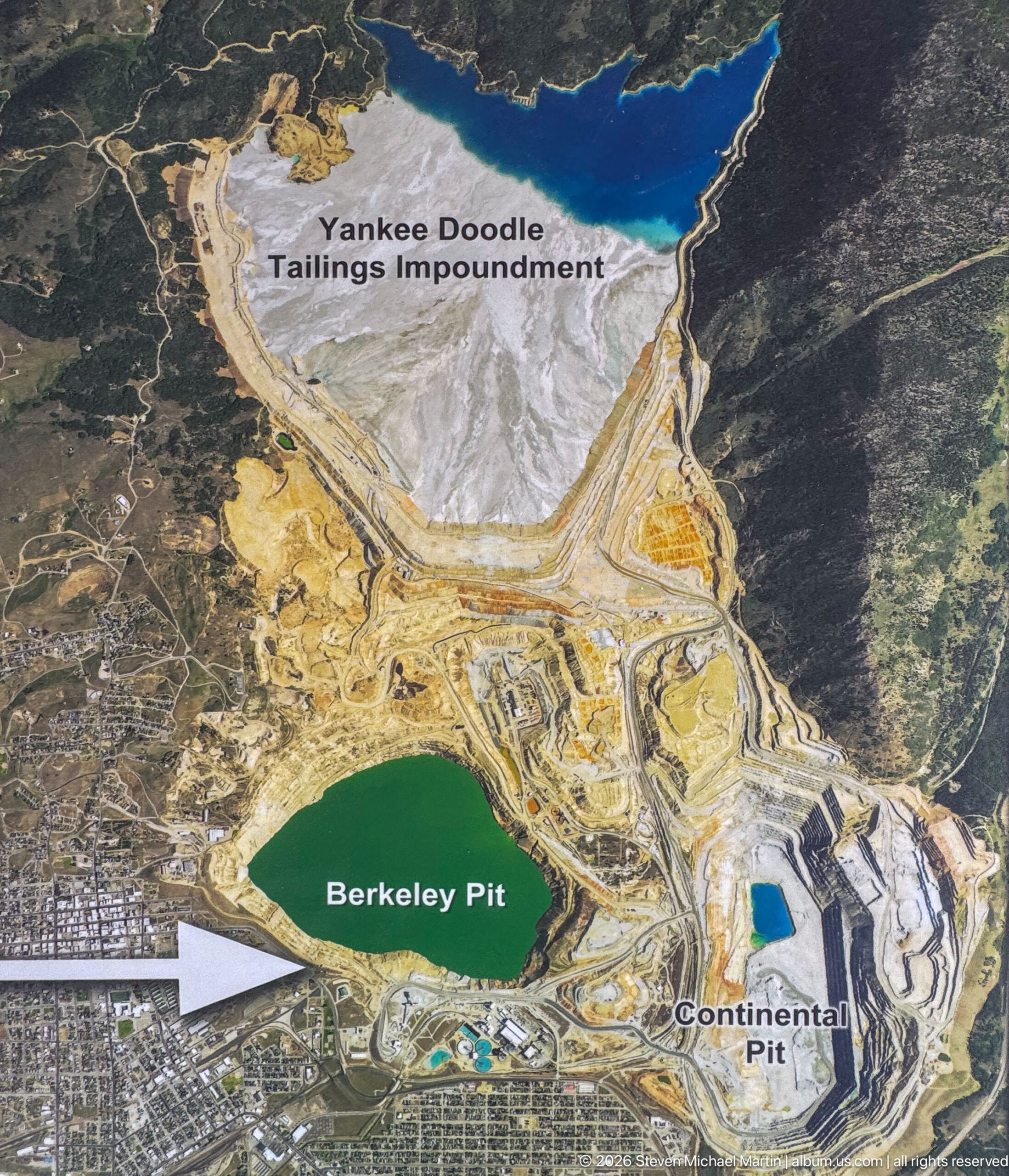
An aerial orientation image shows the Berkeley Pit as a green oval beside Butte’s street grid, with the active Continental Pit and the much larger Yankee Doodle Tailings Impoundment extending to the east and north. The bird’s-eye view makes the scale and proximity of these distinct mining landscapes immediately legible.
Caption
An aerial orientation image shows the Berkeley Pit as a green oval beside Butte’s street grid, with the active Continental Pit and the much larger Yankee Doodle Tailings Impoundment extending to the east and north. The bird’s-eye view makes the scale and proximity of these distinct mining landscapes immediately legible.
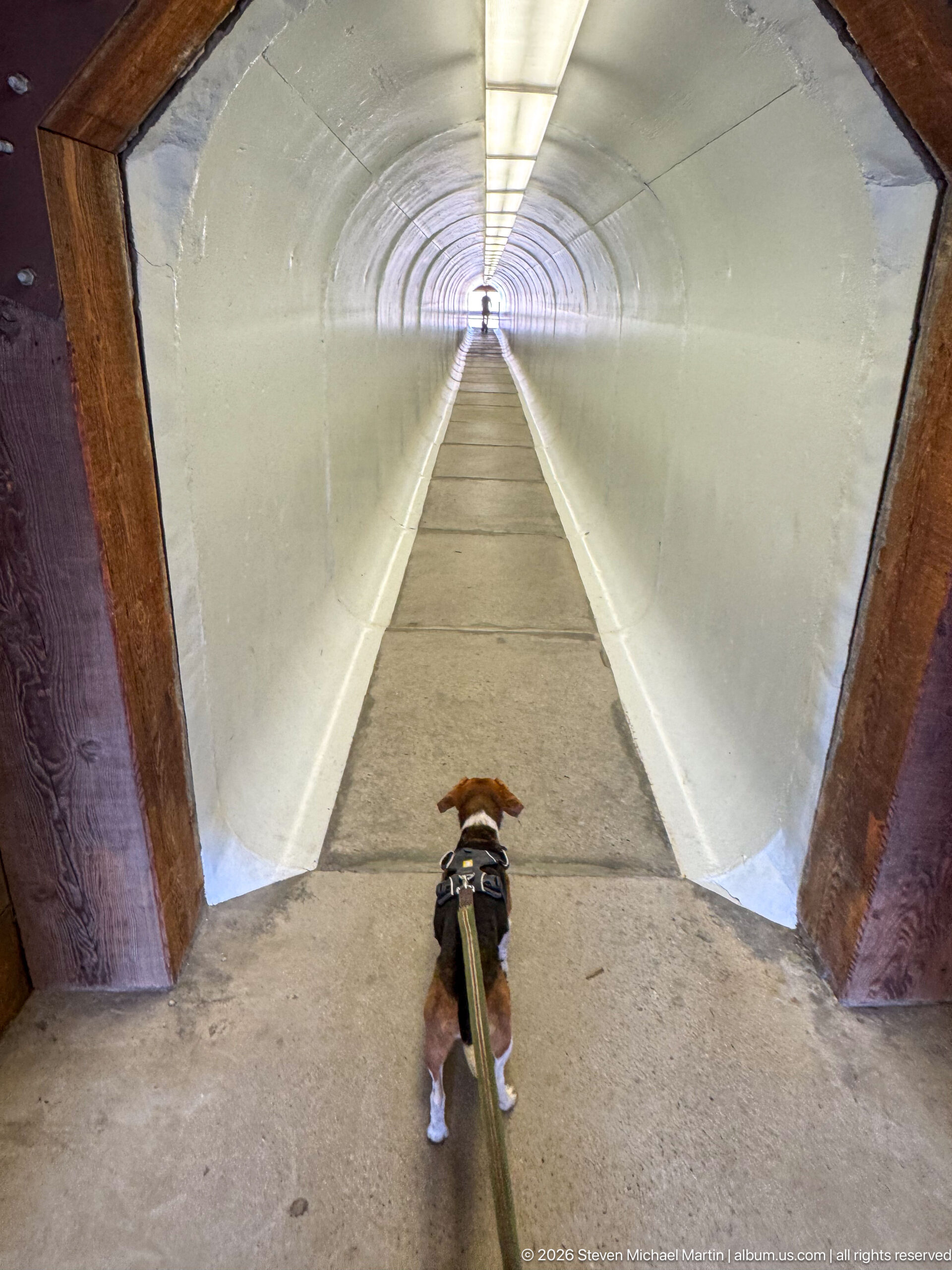
At the timber-framed portal, a beagle pauses before the bright, enclosed passage toward the Berkeley Pit viewing area. The composition contrasts the rustic mine-inspired entrance with the smooth white interior, showing how the visitor route borrows mining imagery while functioning as a modern pedestrian connection.
Caption
At the timber-framed portal, a beagle pauses before the bright, enclosed passage toward the Berkeley Pit viewing area. The composition contrasts the rustic mine-inspired entrance with the smooth white interior, showing how the visitor route borrows mining imagery while functioning as a modern pedestrian connection.
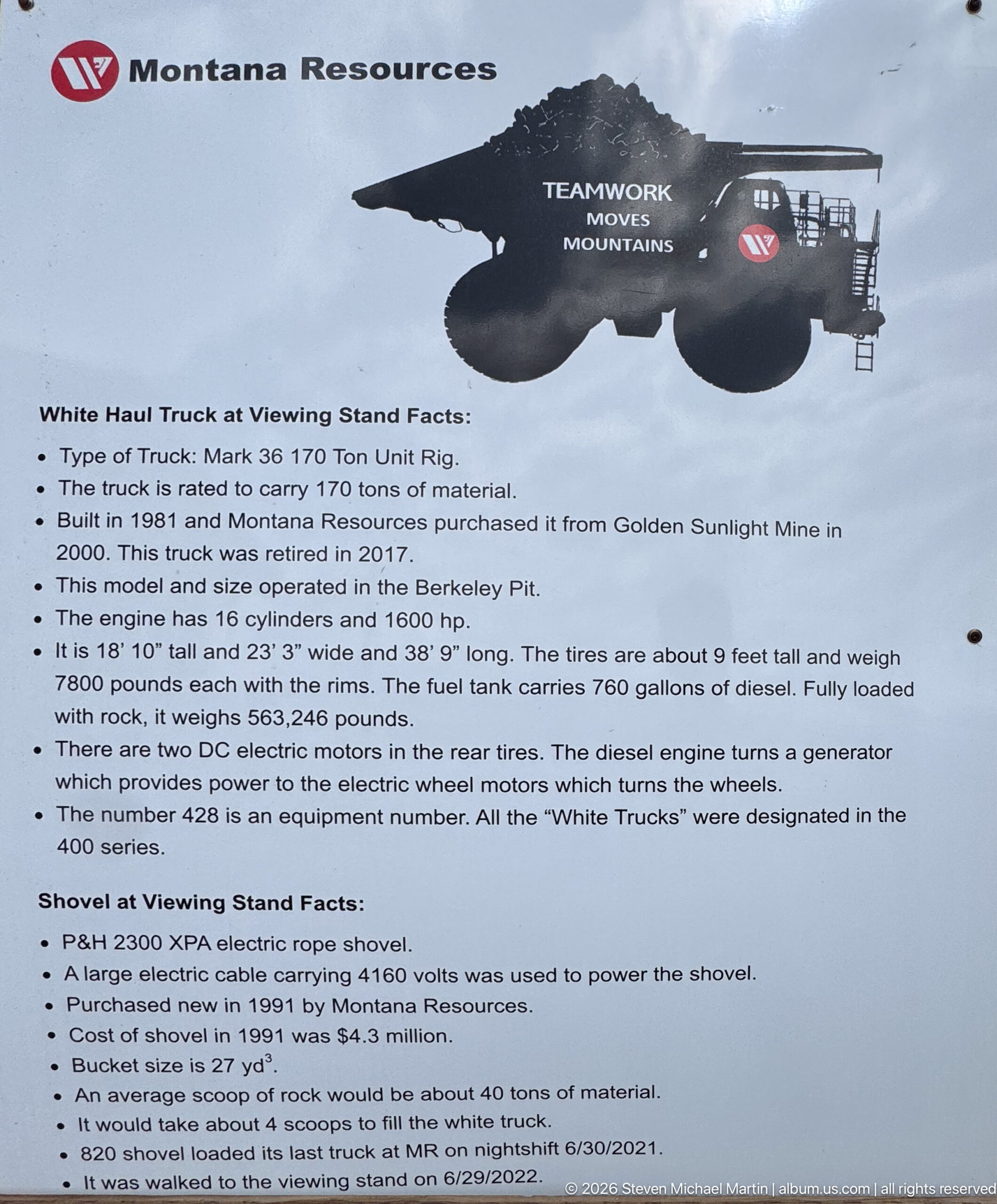
An interpretive sign presents technical specifications for a Montana Resources white haul truck and electric rope shovel associated with the viewing stand. The text records the truck as a Mark 36 170-ton unit and describes the shovel’s power and bucket capacity, translating the immense machinery of open-pit mining into measurable operating facts.
Caption
An interpretive sign presents technical specifications for a Montana Resources white haul truck and electric rope shovel associated with the viewing stand. The text records the truck as a Mark 36 170-ton unit and describes the shovel’s power and bucket capacity, translating the immense machinery of open-pit mining into measurable operating facts.
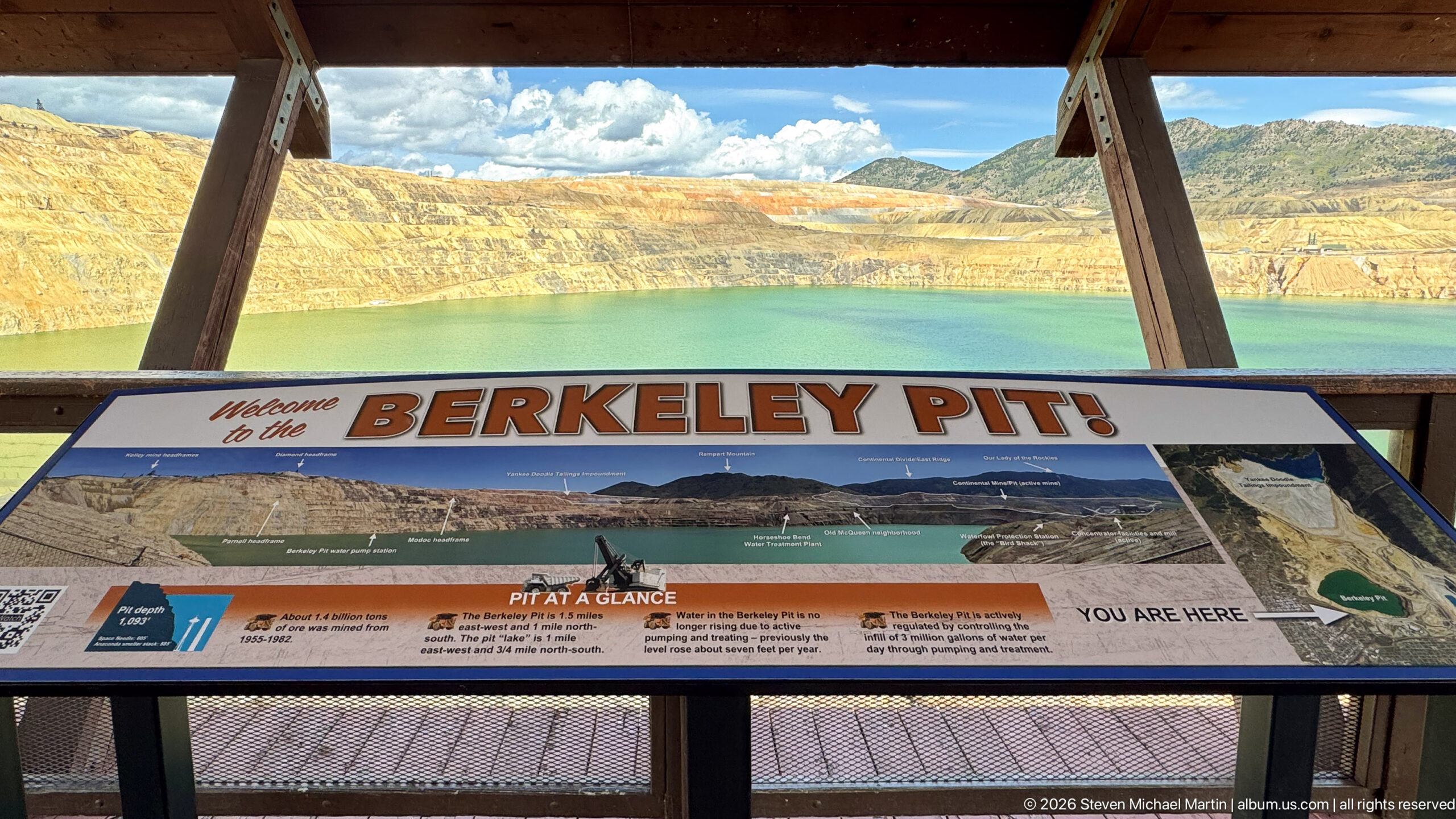
The “Welcome to the Berkeley Pit!” panel fills the foreground while the mine’s green water and stepped walls remain visible beyond the railing. This lower viewpoint gives the interpretive graphic visual priority, emphasizing how the overlook translates the enormous industrial landscape into named features, dimensions, and concise visitor information.
Caption
The “Welcome to the Berkeley Pit!” panel fills the foreground while the mine’s green water and stepped walls remain visible beyond the railing. This lower viewpoint gives the interpretive graphic visual priority, emphasizing how the overlook translates the enormous industrial landscape into named features, dimensions, and concise visitor information.
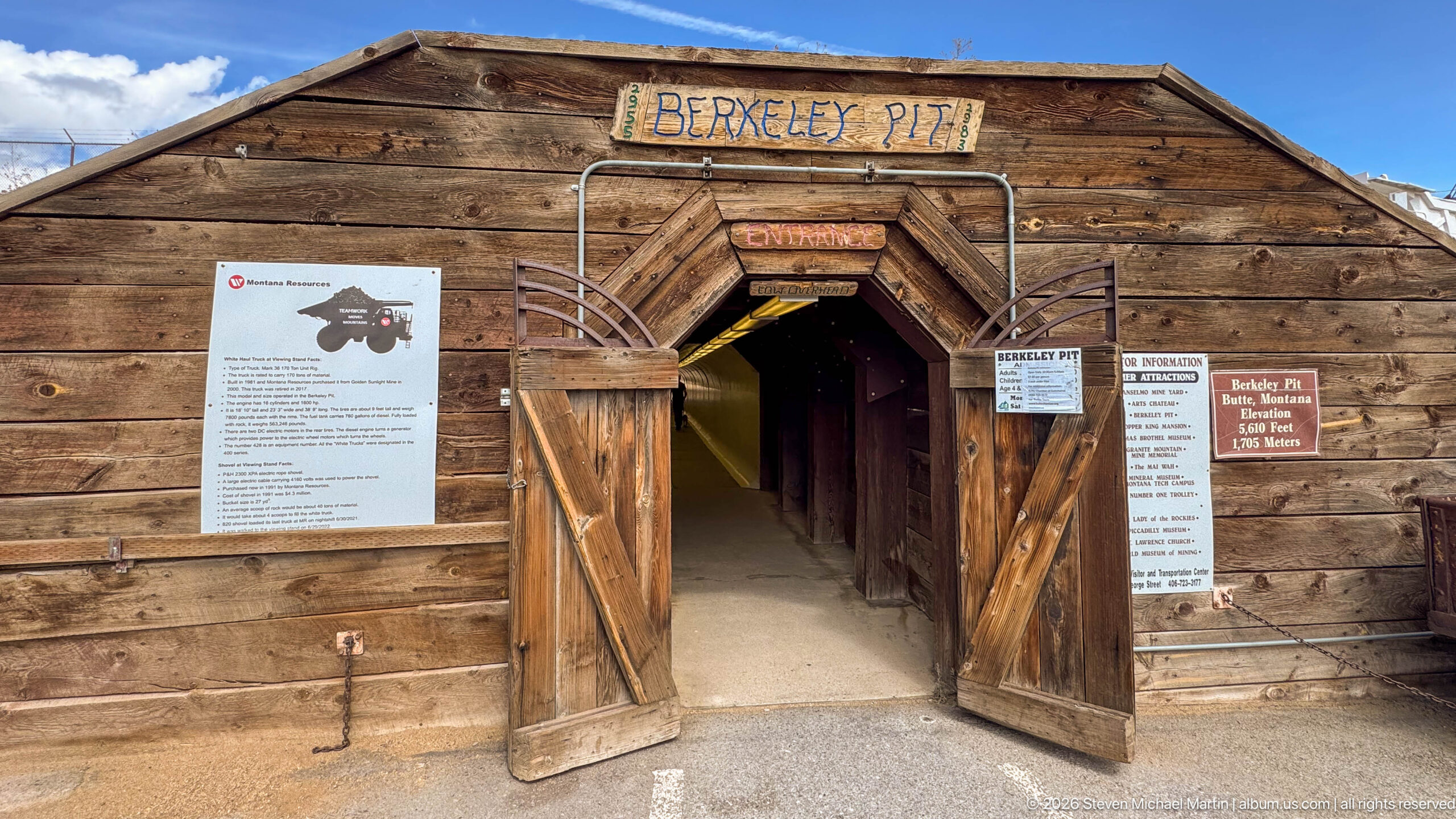
A centered view of the Berkeley Pit entrance shows the timber portal, open plank doors, and surrounding visitor notices as a single composition. The angular framing around the doorway evokes underground mine timbering, while the dark passage beyond reinforces the staged transition from the exterior visitor area toward the pit overlook.
Caption
A centered view of the Berkeley Pit entrance shows the timber portal, open plank doors, and surrounding visitor notices as a single composition. The angular framing around the doorway evokes underground mine timbering, while the dark passage beyond reinforces the staged transition from the exterior visitor area toward the pit overlook.
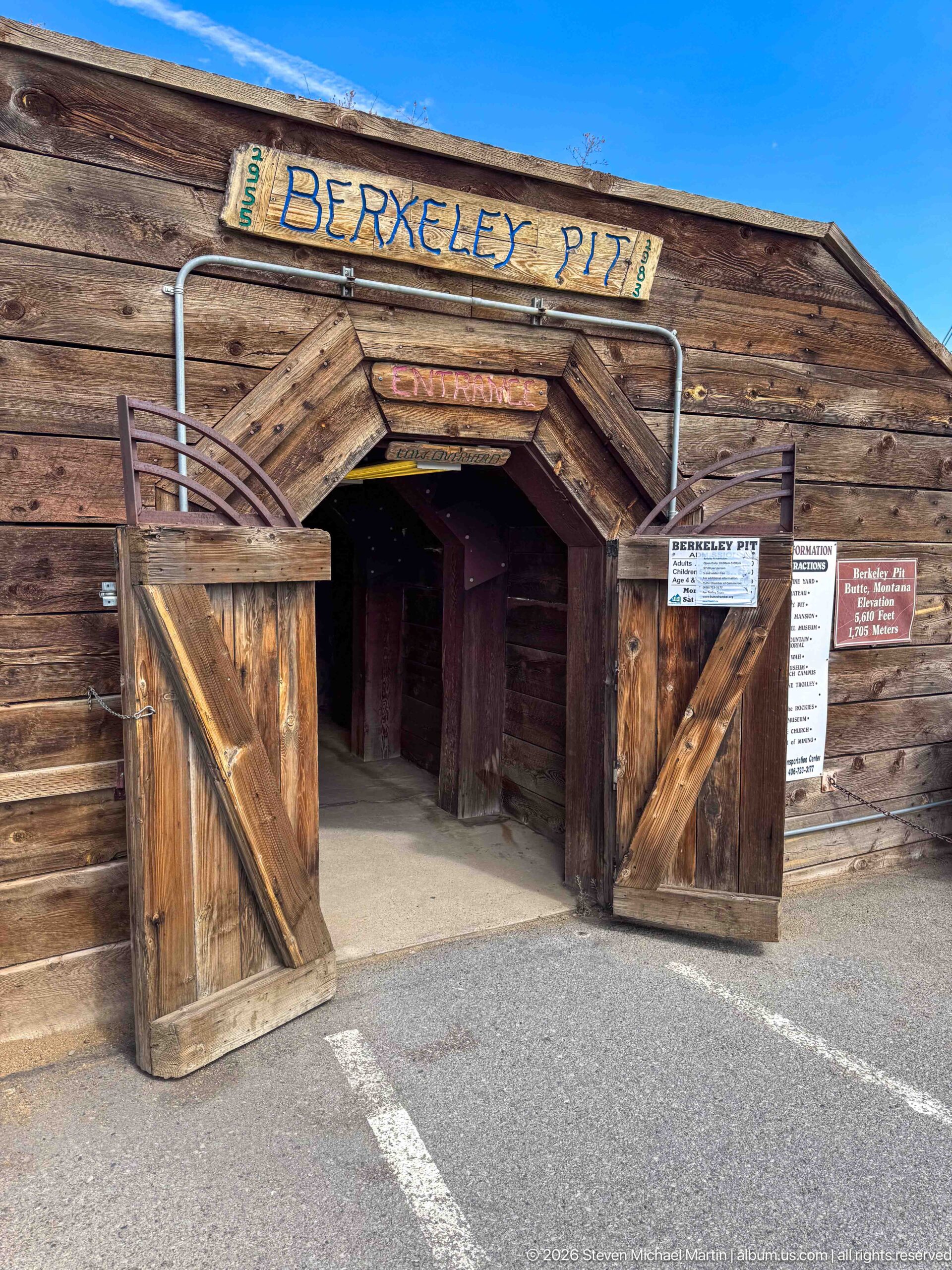
Open timber doors reveal a dark, timber-lined passage beneath the hand-painted “Berkeley Pit” sign at the visitor entrance. Heavy wood siding, exposed framing, and track-like metal details give the façade the appearance of a mine portal, creating a deliberate transition from the parking area into the site’s interpretive experience.
Caption
Open timber doors reveal a dark, timber-lined passage beneath the hand-painted “Berkeley Pit” sign at the visitor entrance. Heavy wood siding, exposed framing, and track-like metal details give the façade the appearance of a mine portal, creating a deliberate transition from the parking area into the site’s interpretive experience.
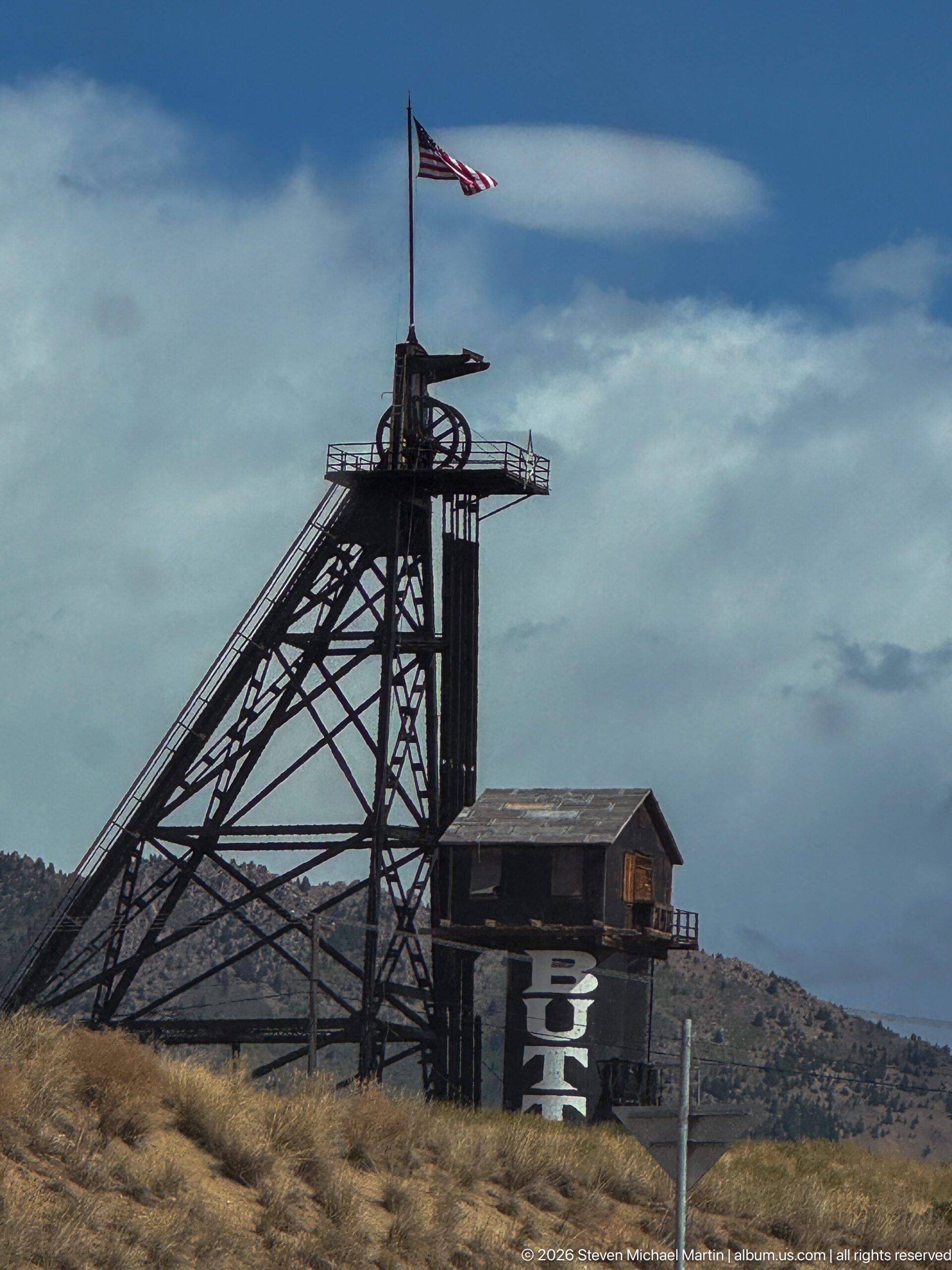
A closer profile isolates a steel mine headframe against the sky, revealing the inclined supports, elevated sheave assembly, platforms, and American flag at its summit. The adjoining dark shaft building bears large “BH” lettering, while the sparse hillside setting keeps attention on the surviving machinery of Butte’s underground-mining era.
Caption
A closer profile isolates a steel mine headframe against the sky, revealing the inclined supports, elevated sheave assembly, platforms, and American flag at its summit. The adjoining dark shaft building bears large “BH” lettering, while the sparse hillside setting keeps attention on the surviving machinery of Butte’s underground-mining era.
Field Guide
Overview
The Berkeley Pit is the most dramatic surviving expression of Butte’s transformation from underground mining center to large-scale open-pit copper production. Opened by the Anaconda Company in 1955, the excavation expanded across the eastern side of Butte Hill as mining shifted from shafts and tunnels to enormous benches cut directly into the mineralized rock. By the time operations ended in 1982, the pit had become a vast engineered landscape whose scale is most clearly understood from the public viewing stand.
Mining did not end the pit’s story. After pumping stopped, groundwater rose through Butte’s interconnected underground workings and into the excavation, reacting with exposed mineralized rock and creating acidic, metal-laden water. Today the Berkeley Pit is simultaneously an industrial monument and an active environmental-management site. Its terraced walls, colored water, surviving headframes, interpretive displays, and treatment infrastructure make visible both the extraordinary scale of Butte’s copper industry and the long-term consequences of extracting the “Richest Hill on Earth.”
Mining History
Butte’s mining landscape began underground. Timbered passages, ore carts, shaft equipment, and the steel headframes still visible around the city recall the deep-mining system that penetrated Butte Hill before the Berkeley Pit was opened. The portfolio’s reconstructed mine passage and historic equipment help establish that earlier world of confined workings, rail-mounted haulage, and vertical access through mine shafts.
The Berkeley Pit represented a fundamental change in method and scale. Beginning in 1955, the Anaconda Company removed the hill itself in stepped benches, replacing selective underground access with open-pit excavation. Interpretive panoramas around the viewing stand connect the later pit to surviving landmarks of the older mining system, including the Diamond, Parrot, and Modoc headframes. Together these remnants show that the pit was not an isolated operation but the later phase of a much larger mining landscape that shaped Butte for generations.
Ore Body & Geology
Butte’s mining industry existed because of the extraordinary concentration and variety of minerals beneath the hill. The portfolio’s mineral displays—among them copper-bearing bornite as well as quartz, pyrite, fluorite, wulfenite, calcite, and selenite specimens—translate the geology of the district into objects that can be examined at human scale. Their contrasting colors, crystal forms, and mineral associations help explain why Butte became such an important center of hard-rock mining.
At the pit itself, geology appears on a vastly different scale. Broad terraces expose bands of differently colored rock around the flooded excavation, while the water occupies the low point created by decades of removal. The mineral specimens and the open pit therefore tell complementary parts of the same story: one reveals the materials miners sought and encountered, while the other reveals the enormous physical intervention required to extract ore from Butte Hill.
Open-Pit Engineering & Industrial Landscape
The Berkeley Pit is an engineered void on a monumental scale. Its broad stepped benches record the geometry of open-pit mining, in which successive levels provided working surfaces and access as excavation descended. Views across the green-blue water toward yellow, tan, and rust-colored walls make the relationship between the flooded floor and the terraced excavation especially clear.
Around the pit, surviving and interpreted industrial structures extend that engineering story. Steel headframes preserve the vertical architecture of underground shafts, while ore carts and mining machinery represent the smaller equipment that supported extraction and haulage. Interpretive panoramas identify historic headframes and the pit-water pump station, and aerial material places the Berkeley Pit beside the Continental Pit and Yankee Doodle Tailings Impoundment. Seen together, these features reveal an industrial landscape extending far beyond the water-filled excavation itself.
Environmental Legacy & Remediation
When mining ceased in 1982 and the pumps that had kept Butte’s underground workings dry were shut down, groundwater began rising through the interconnected mine system and into the Berkeley Pit. Contact with exposed mineralized rock produced acidic, metal-laden water, turning the former excavation into one of the most visible environmental legacies of Butte’s mining era.
The pit is now part of the Silver Bow Creek/Butte Area Superfund site and remains an actively managed system rather than an abandoned landscape. Water levels and chemistry are monitored, and water is pumped and treated to keep the pit below the federally established protective water level. The treatment system allows the pit to remain the low point toward which contaminated groundwater flows instead of permitting that water to migrate outward. The colored water, pump infrastructure, and remediation interpretation therefore document an environmental process that continues decades after ore extraction ended.
Visitor Experience
The Berkeley Pit Visitor Information and Viewing Stand turns an immense industrial landscape into a legible visitor experience. From the entrance, a mine-themed timber portal and long pedestrian passage lead toward the covered overlook, creating a deliberate transition from the visitor facility to the open view of the pit. Ramps, stairs, benches, railings, and interpretive material make the viewing structure itself part of the experience.
At the overlook, the scale of the pit becomes immediate. Timber framing and safety fencing provide a foreground against the green-blue water and immense stepped walls, while interpretive panoramas identify surviving headframes, pumping infrastructure, depth, and production context. Aerial orientation material expands the view beyond what can be seen from the railing, locating the Berkeley Pit within Butte’s broader mining landscape. The result is less a conventional scenic overlook than an outdoor industrial-history exhibit organized around the excavation itself.
Photography Notes
The strongest photographs in this portfolio work by changing scale. Wide views from the covered overlook establish the Berkeley Pit as a vast terraced landscape, while tighter compositions concentrate on the relationship between colored water and exposed mine benches. Including the viewing-stand timbers, railings, visitors, or nearby structures gives the excavation a useful human measure without diminishing its size.
Detail photographs provide the counterpoint. Mineral specimens reveal color and crystal structure; ore carts, machinery, headframes, signs, and interpretive panels explain the industrial system through recognizable components. The sequence is most effective when these close subjects are alternated with broader pit views and contextual images of the visitor facility and surrounding mining landscape. Together they move from material evidence to machinery, infrastructure, excavation, and environmental aftermath rather than repeating variations of the same overlook.