Glacier NP – Many Glacier Road Introduction
Many Glacier Road is more than an approach to one of Glacier National Park’s most celebrated valleys—it is a gradual transition from the open country of the Blackfeet Reservation into a landscape enclosed by some of the park’s most dramatic mountains. Beginning near Babb, the road follows the shore of Lake Sherburne before pressing deeper into the Many Glacier and Swiftcurrent valleys. With each mile, the mountains seem to draw closer, revealing steep ridges, forested slopes, waterfalls, and the great glacially carved basin surrounding Swiftcurrent Lake. The relatively short drive offers an unusually concentrated introduction to the scenery of Glacier’s eastern side.
The road also tells an important chapter in the development of Glacier National Park. Early routes into the Swiftcurrent Valley served prospectors and freight traffic before tourism transformed the region. After Glacier became a national park in 1910, the Great Northern Railway helped develop access to Many Glacier as part of its ambitious effort to bring visitors into the northern Rockies. Construction of an improved route began in the early 1910s, and on August 7, 1913, Great Northern president Louis W. Hill and his party traveled by automobile to what was then called McDermott Lake. Subsequent improvements eventually produced a dependable automobile route into the valley, helping make Many Glacier Hotel and the surrounding trail system accessible to generations of park visitors.
Today, traveling Many Glacier Road remains part of the experience rather than simply a means of reaching a destination. Lake Sherburne provides long views toward the mountains ahead, while the narrowing valley increasingly reveals the immense scale of the peaks surrounding Many Glacier. Wildlife can appear almost anywhere along the route, and changing weather continually alters the character of the landscape. By the time the road reaches the historic Many Glacier Hotel and Swiftcurrent Lake, the broad plains near Babb feel remarkably distant—a fitting arrival in a valley that has drawn explorers, travelers, hikers, and photographers for well over a century.
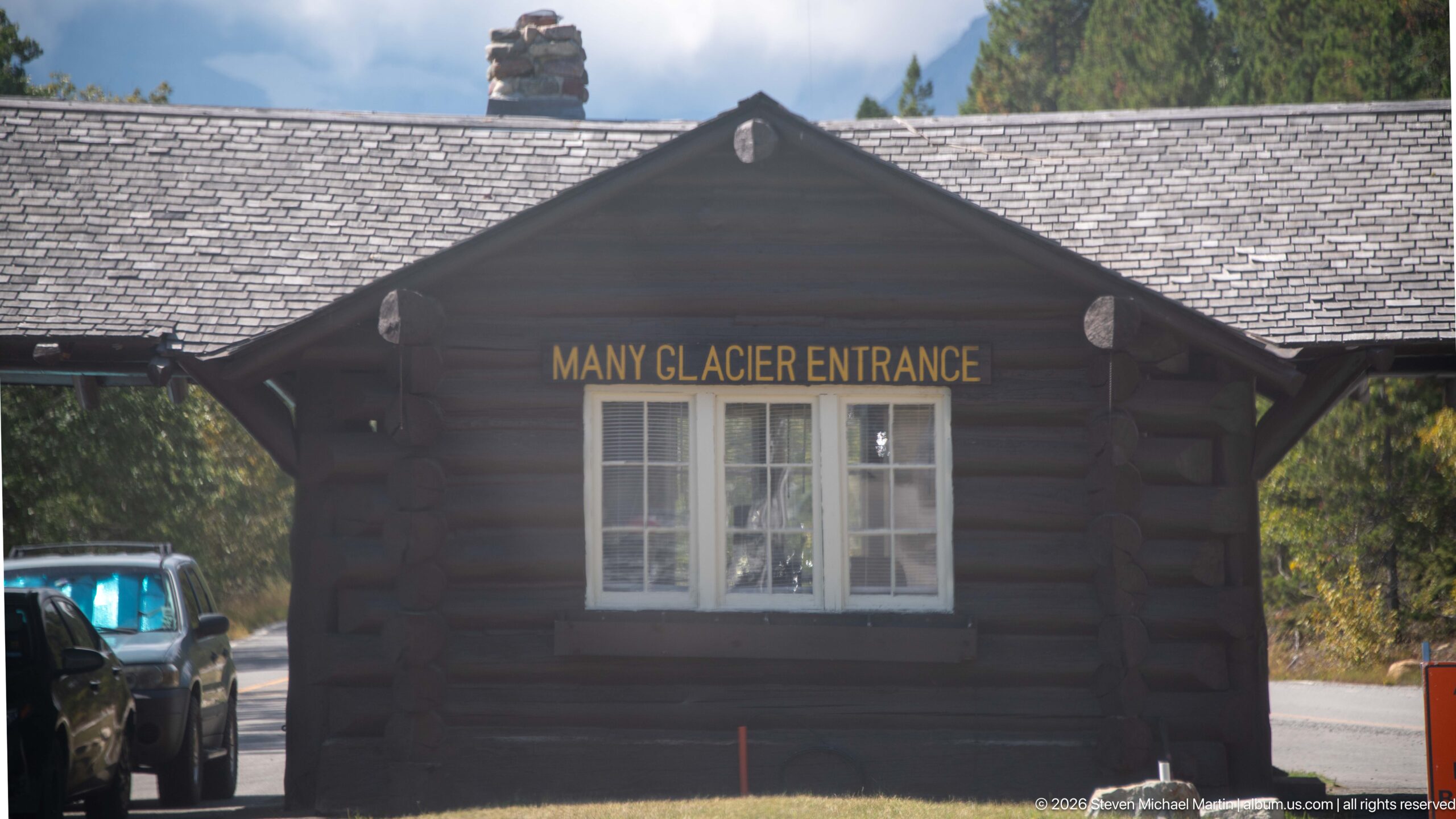
The front of the Many Glacier Entrance station is identified directly by gold lettering above a bank of multipane windows. Dark horizontal logs, a broad shingled roof, and projecting roof ends give the small structure a rustic character, while vehicles and roadway elements at either side show its active role at the park approach.
Caption
The front of the Many Glacier Entrance station is identified directly by gold lettering above a bank of multipane windows. Dark horizontal logs, a broad shingled roof, and projecting roof ends give the small structure a rustic character, while vehicles and roadway elements at either side show its active role at the park approach.
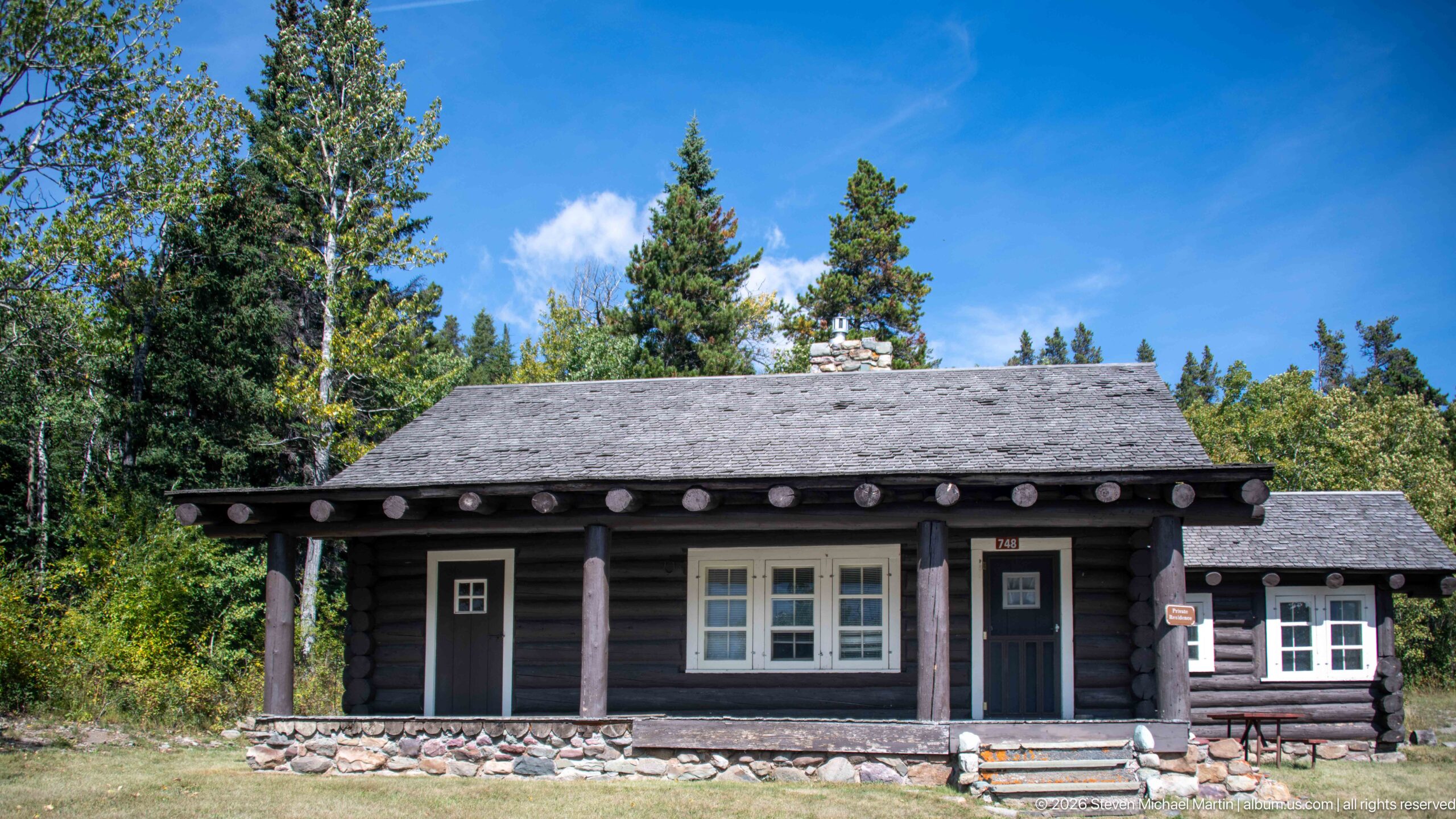
A compact dark-log building with a broad shingled roof, projecting porch, stone foundation, and peeled-log posts stands among trees at the Many Glacier entrance area. White-trimmed multipane windows brighten the otherwise dark façade, while the low horizontal massing and natural materials visually connect the structure to its wooded mountain setting.
Caption
A compact dark-log building with a broad shingled roof, projecting porch, stone foundation, and peeled-log posts stands among trees at the Many Glacier entrance area. White-trimmed multipane windows brighten the otherwise dark façade, while the low horizontal massing and natural materials visually connect the structure to its wooded mountain setting.
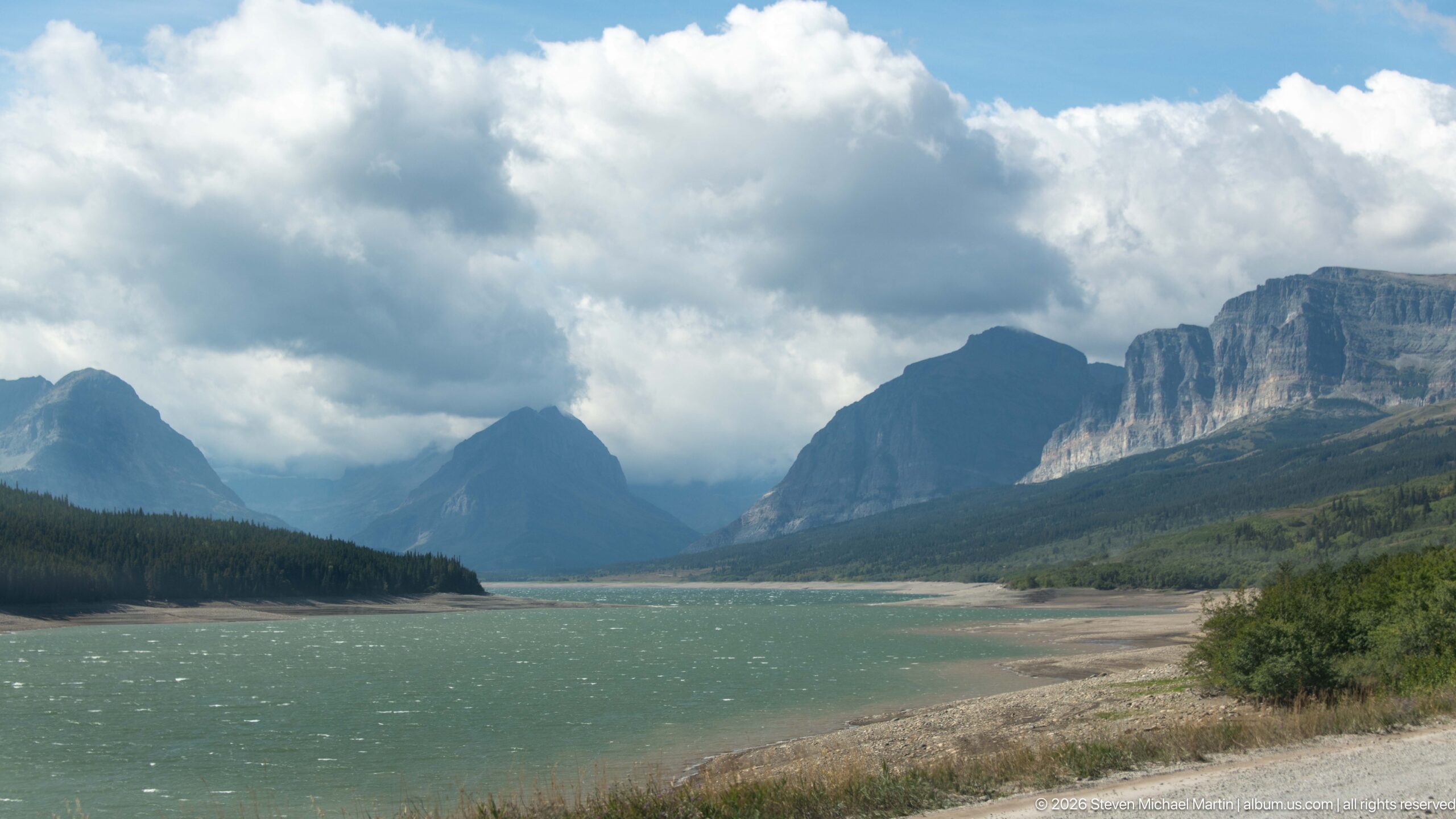
Wind-ruffled turquoise water stretches toward a narrowing mountain valley, with exposed shoreline curving along the right and forested slopes rising toward massive rock walls. The broad view from Many Glacier Road shows Sherburne Lake as a foreground gateway to the high-relief landscape leading deeper into the Many Glacier area.
Caption
Wind-ruffled turquoise water stretches toward a narrowing mountain valley, with exposed shoreline curving along the right and forested slopes rising toward massive rock walls. The broad view from Many Glacier Road shows Sherburne Lake as a foreground gateway to the high-relief landscape leading deeper into the Many Glacier area.
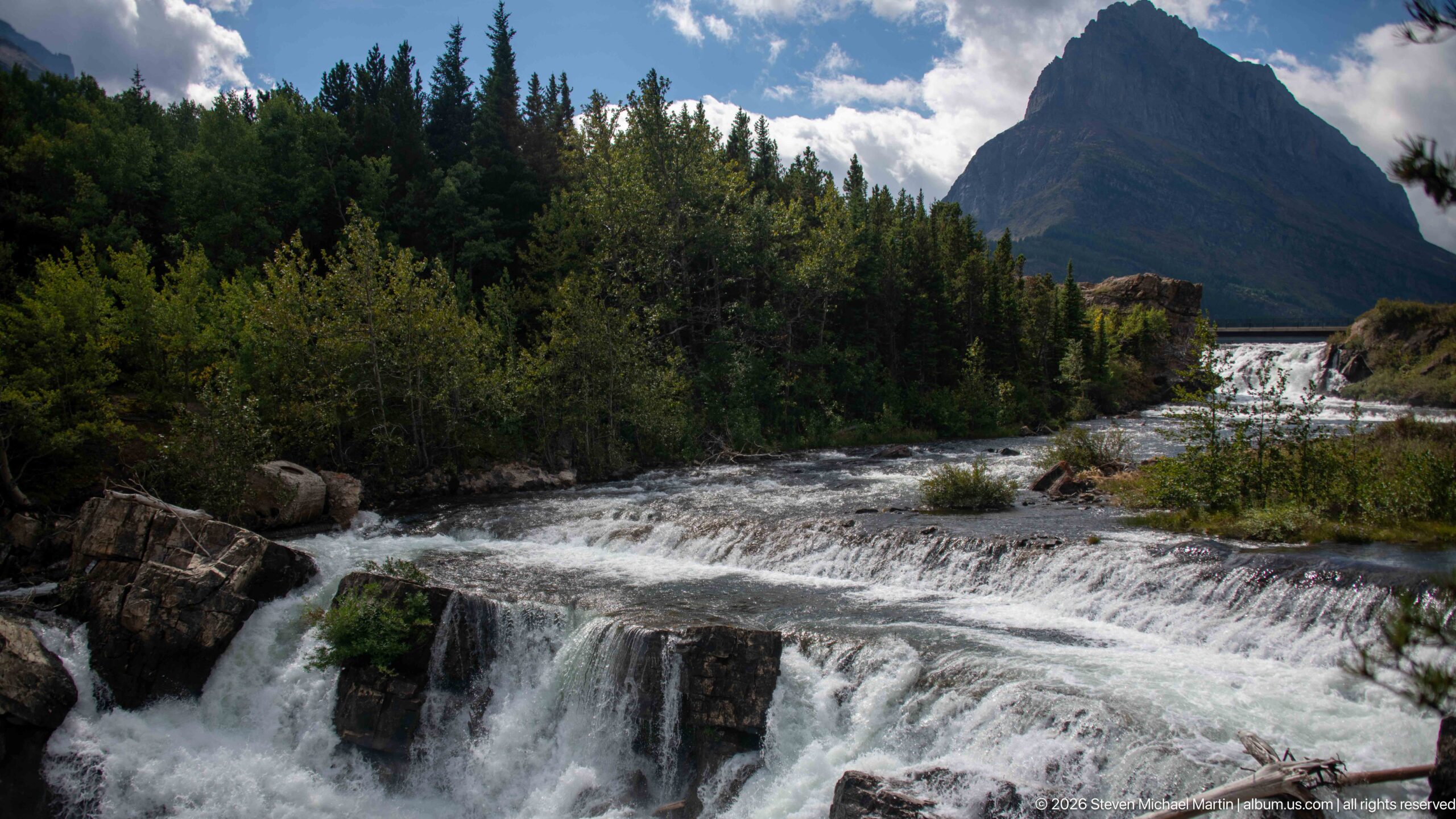
A low rock lip divides the river into a broad upper sheet and several short falls dropping around dark blocks in the foreground. Dense mixed forest fills the middle distance, with a sharply rising mountain above. The centered composition gives equal weight to the structure of the cascade and its enclosed mountain setting.
Caption
A low rock lip divides the river into a broad upper sheet and several short falls dropping around dark blocks in the foreground. Dense mixed forest fills the middle distance, with a sharply rising mountain above. The centered composition gives equal weight to the structure of the cascade and its enclosed mountain setting.
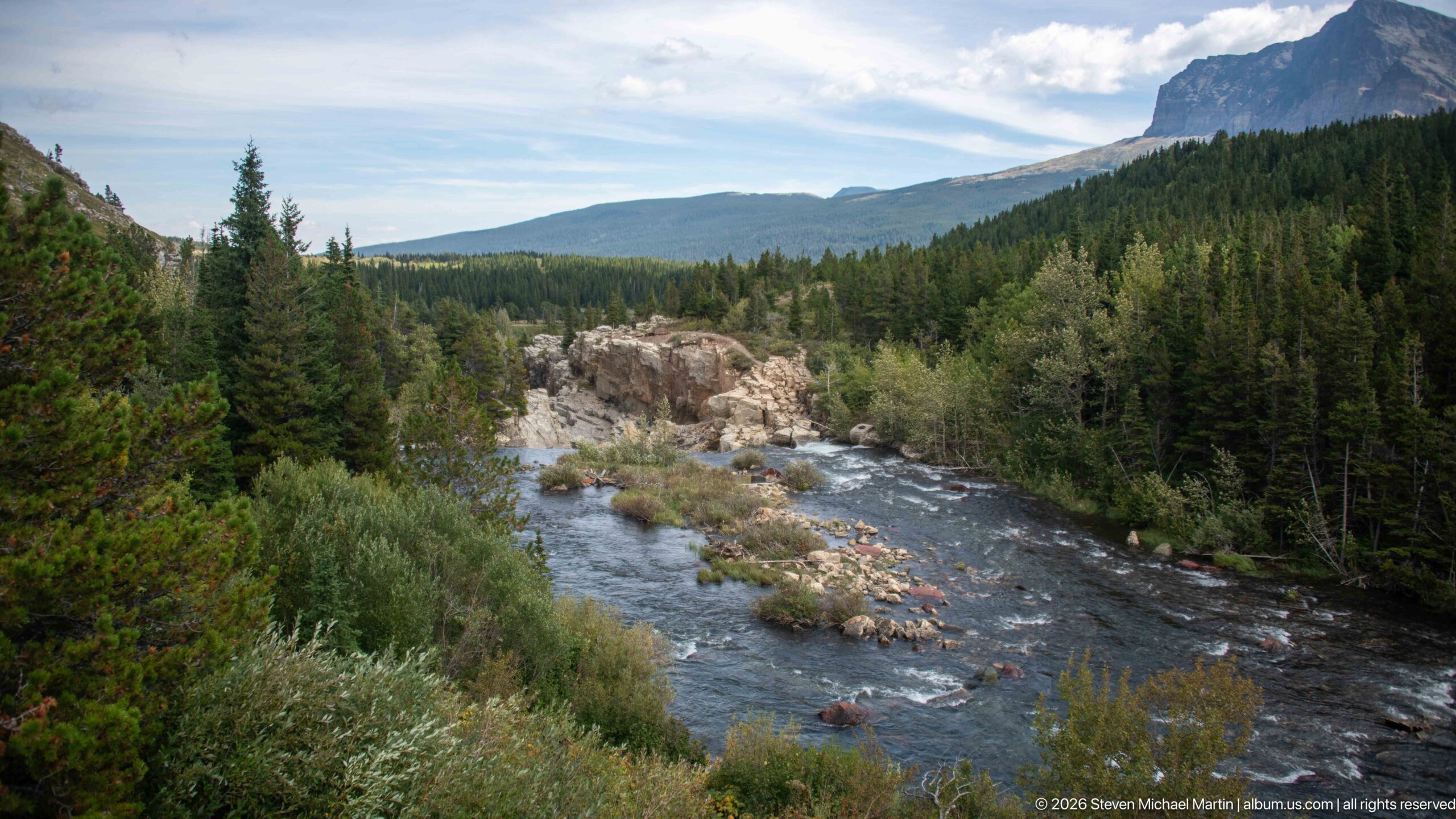
A broad mountain river flows around pale gravel bars and scattered rocks before entering dense conifer forest. Low shrubs and young trees soften the foreground, while layered ridges and a sheer mountain shoulder define the horizon. The calmer water and wider channel contrast with the nearby cascade views.
Caption
A broad mountain river flows around pale gravel bars and scattered rocks before entering dense conifer forest. Low shrubs and young trees soften the foreground, while layered ridges and a sheer mountain shoulder define the horizon. The calmer water and wider channel contrast with the nearby cascade views.
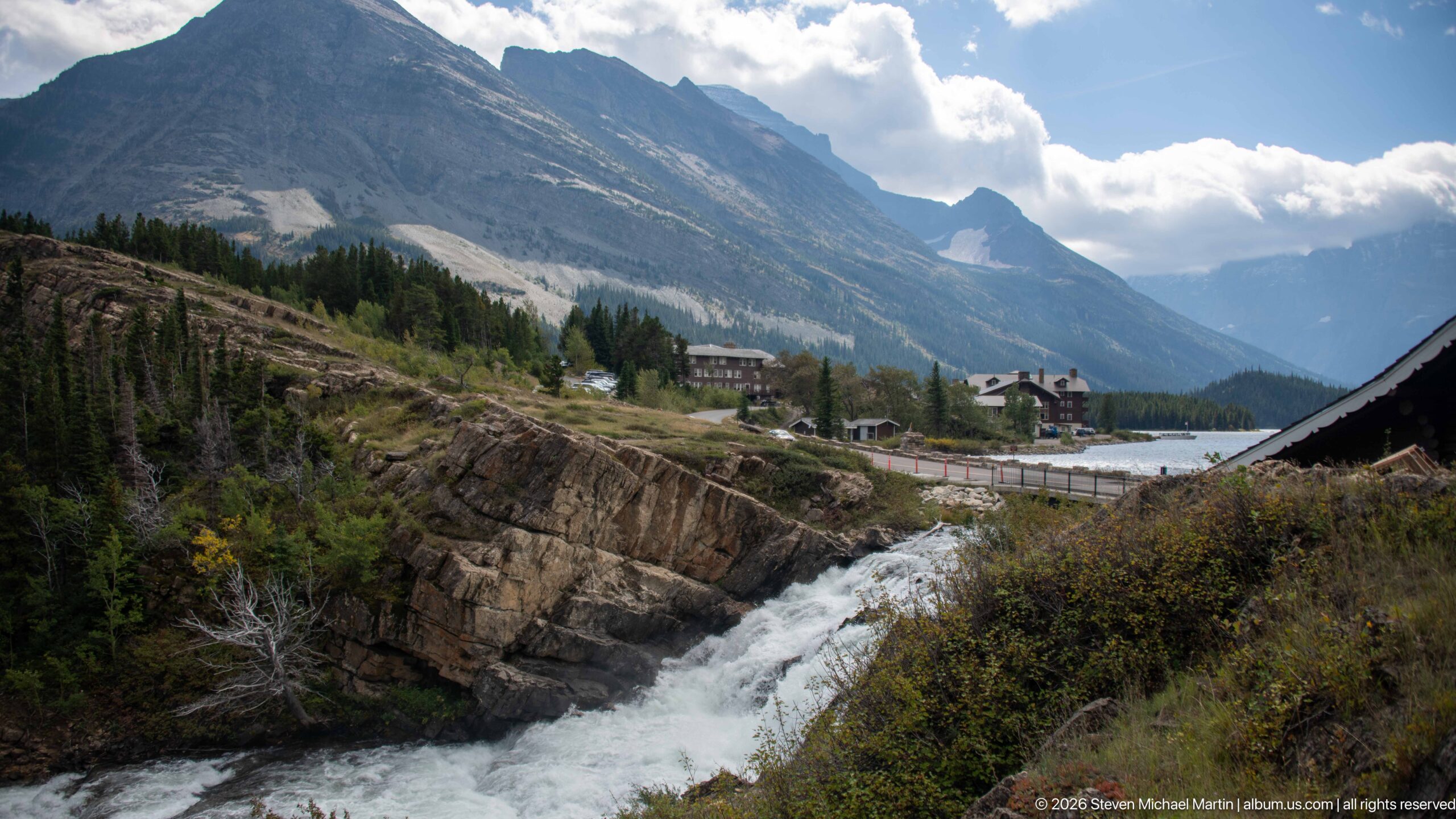
A wider view places the rocky cascade at the base of a developed bench, with a road, several buildings, and a long mountain wall extending deep into the valley. Sunlit clouds gather above the distant notch, while shrubs and rock ledges frame the water below. The scene reads as a broad environmental portrait of the Many Glacier corridor.
Caption
A wider view places the rocky cascade at the base of a developed bench, with a road, several buildings, and a long mountain wall extending deep into the valley. Sunlit clouds gather above the distant notch, while shrubs and rock ledges frame the water below. The scene reads as a broad environmental portrait of the Many Glacier corridor.
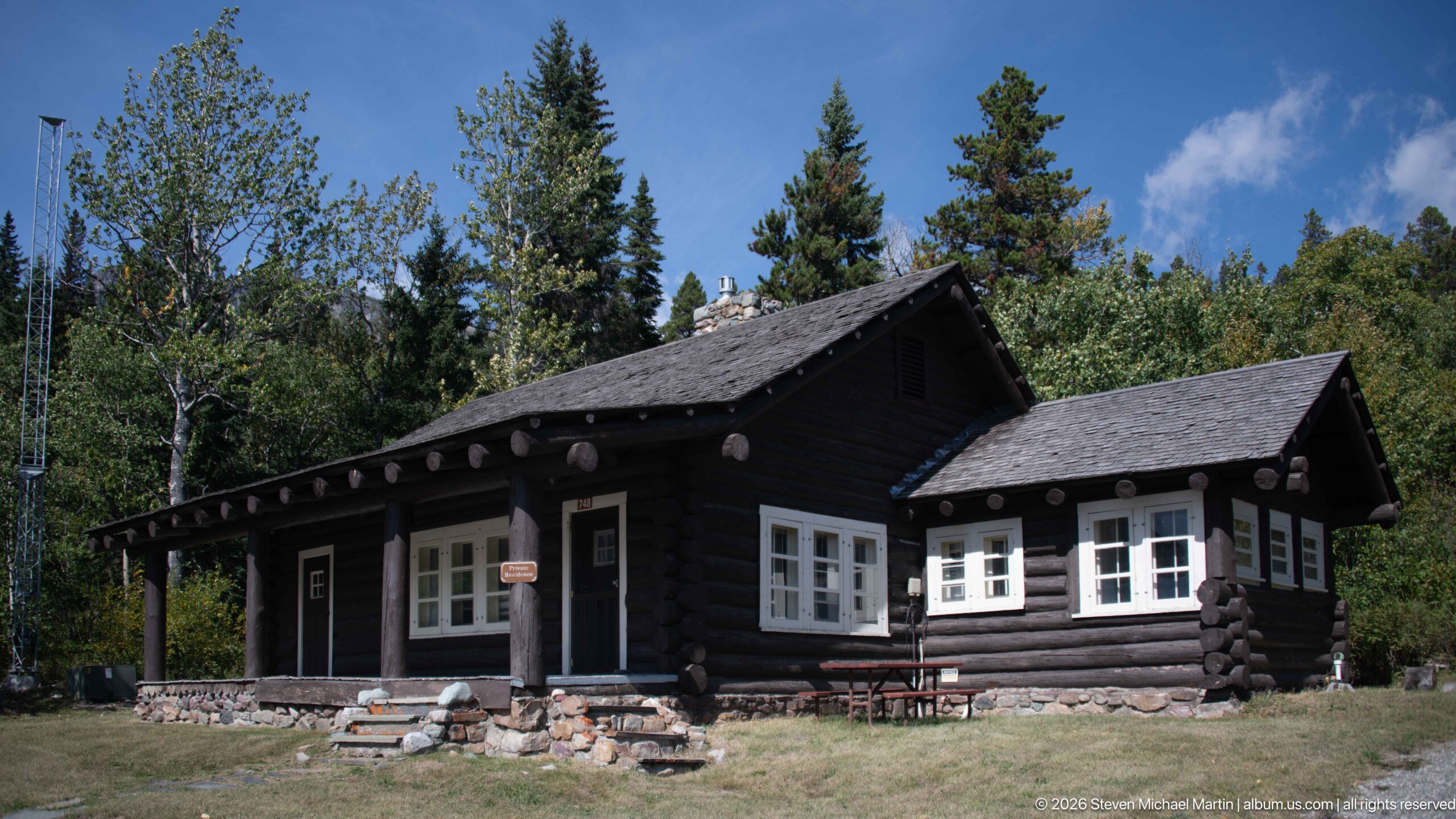
Seen from an angle, the Many Glacier entrance-area building reveals its intersecting roof forms, log walls, porch supports, and rows of white-trimmed multipane windows. The oblique perspective better describes the structure’s depth and side wing than the frontal view, while stonework at the base anchors the dark timber building to the site.
Caption
Seen from an angle, the Many Glacier entrance-area building reveals its intersecting roof forms, log walls, porch supports, and rows of white-trimmed multipane windows. The oblique perspective better describes the structure’s depth and side wing than the frontal view, while stonework at the base anchors the dark timber building to the site.
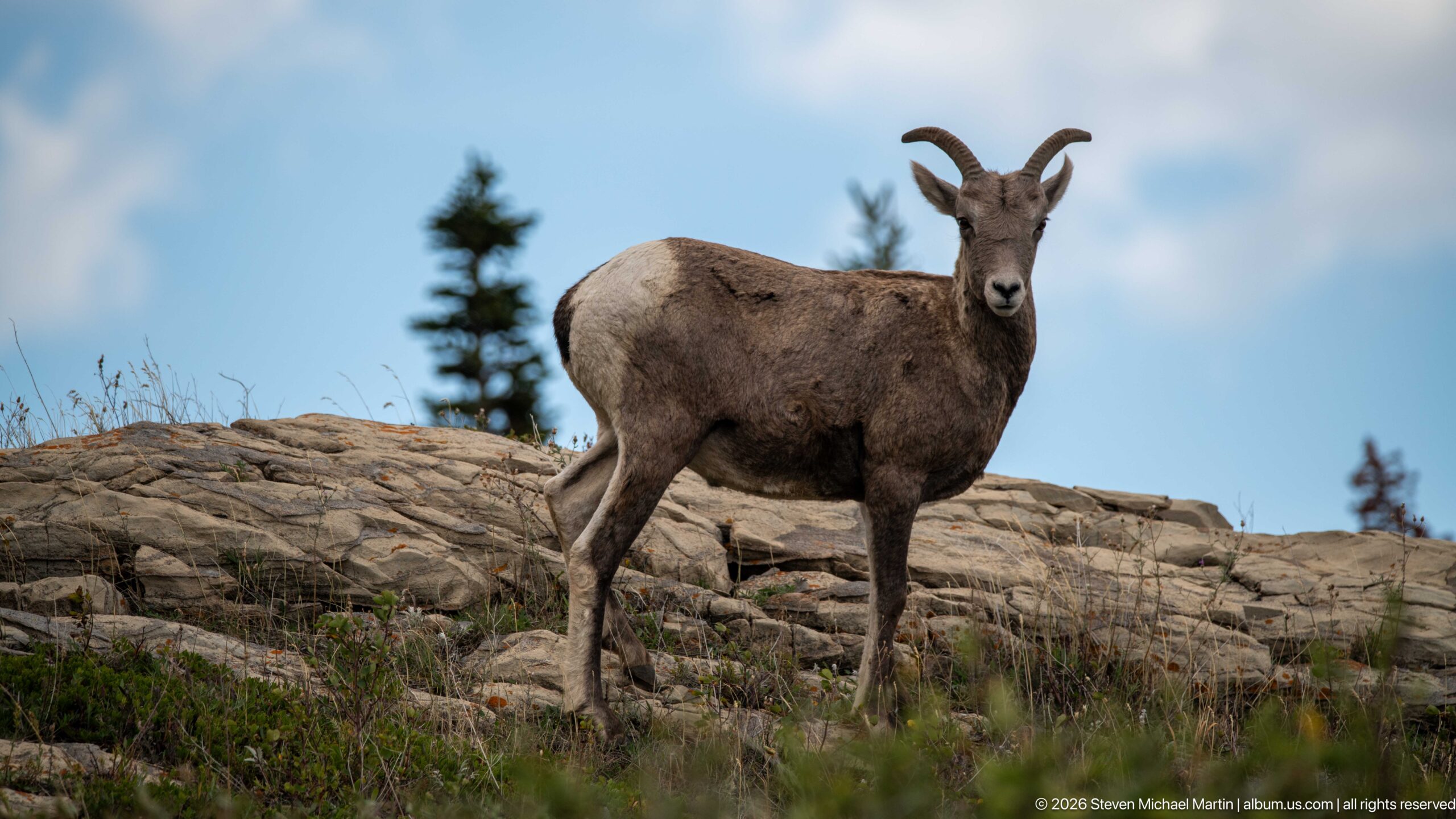
A bighorn sheep ewe stands squarely on a low rock ridge, facing the camera with alert ears and short, backward-curving horns. Her gray-brown coat blends closely with the weathered stone, while the open blue sky and isolated conifer silhouettes keep attention on the animal’s sturdy alpine form.
Caption
A bighorn sheep ewe stands squarely on a low rock ridge, facing the camera with alert ears and short, backward-curving horns. Her gray-brown coat blends closely with the weathered stone, while the open blue sky and isolated conifer silhouettes keep attention on the animal’s sturdy alpine form.
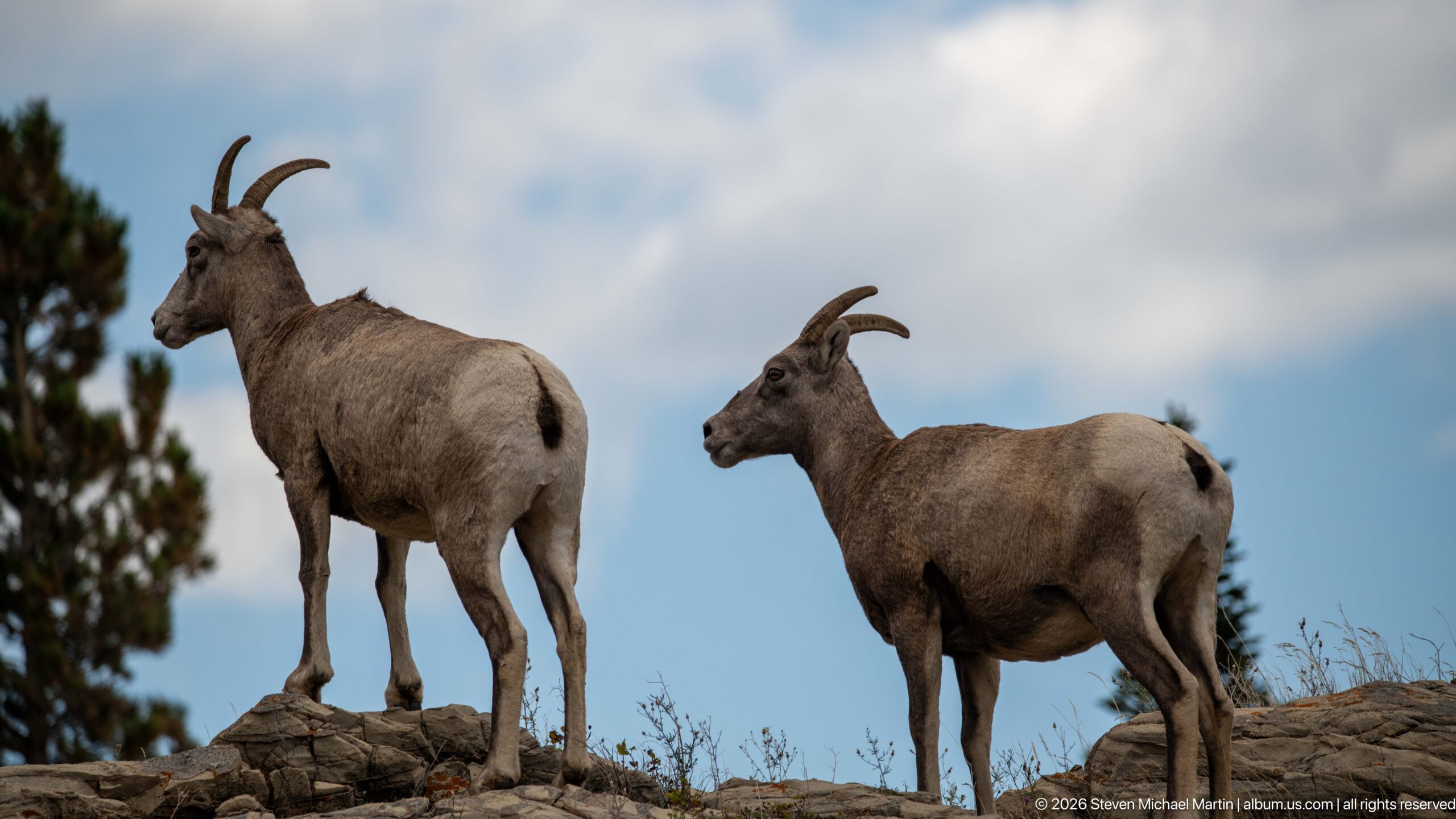
A pair of bighorn sheep stands nearly level along the same rock shelf, creating a balanced side-by-side study of body size and posture. The left animal faces outward in profile while the right animal angles forward, both displaying short curved horns and gray-brown coats against a soft blue-and-cloud background.
Caption
A pair of bighorn sheep stands nearly level along the same rock shelf, creating a balanced side-by-side study of body size and posture. The left animal faces outward in profile while the right animal angles forward, both displaying short curved horns and gray-brown coats against a soft blue-and-cloud background.
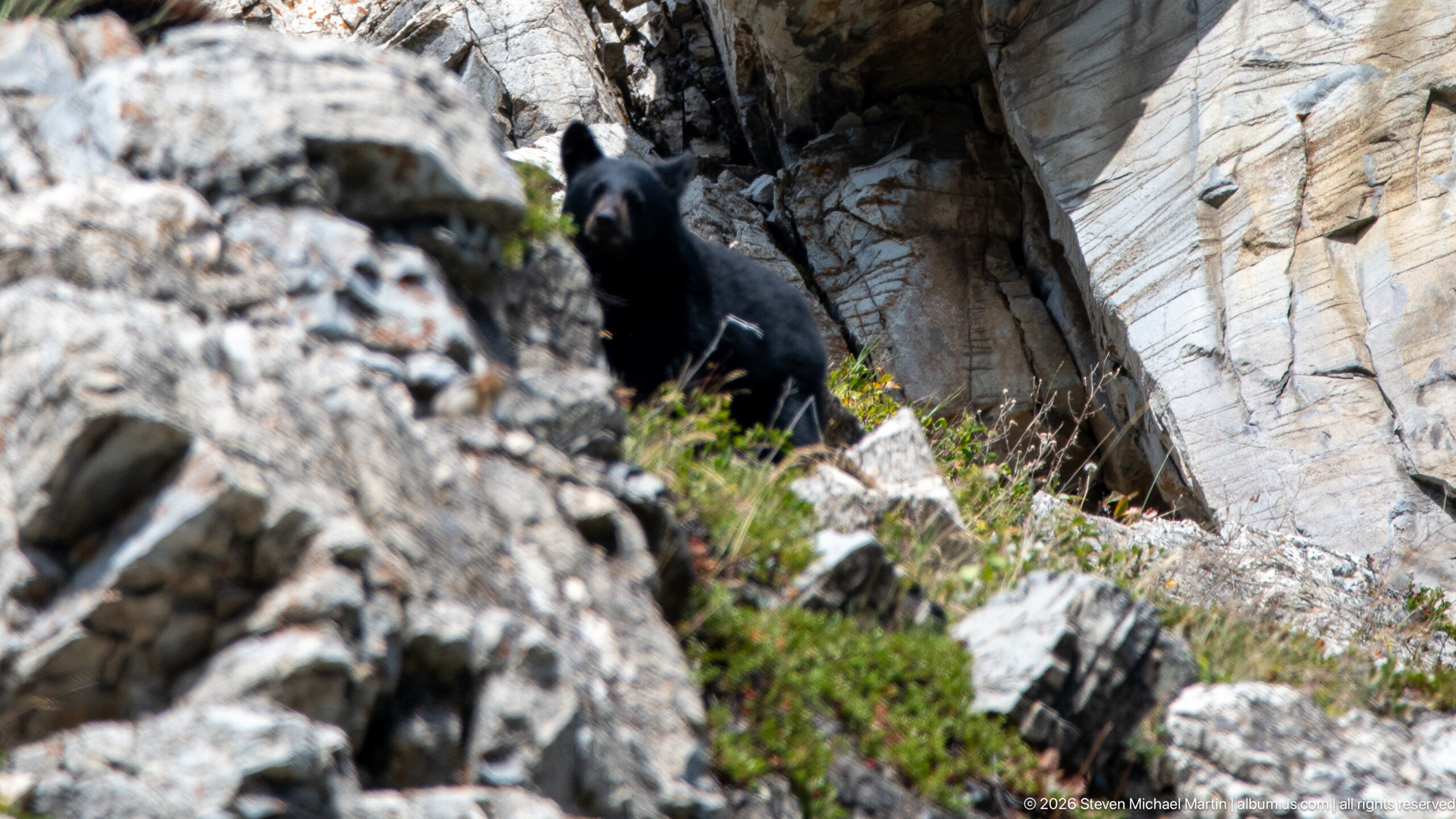
A black bear pauses on a steep, broken-rock slope, its dark coat standing out against pale, angular stone and sparse alpine vegetation. The close, partially screened view conveys how wildlife can appear suddenly within the rugged roadside terrain of the Many Glacier area, where rocky outcrops and low plants create both cover and open sightlines.
Caption
A black bear pauses on a steep, broken-rock slope, its dark coat standing out against pale, angular stone and sparse alpine vegetation. The close, partially screened view conveys how wildlife can appear suddenly within the rugged roadside terrain of the Many Glacier area, where rocky outcrops and low plants create both cover and open sightlines.
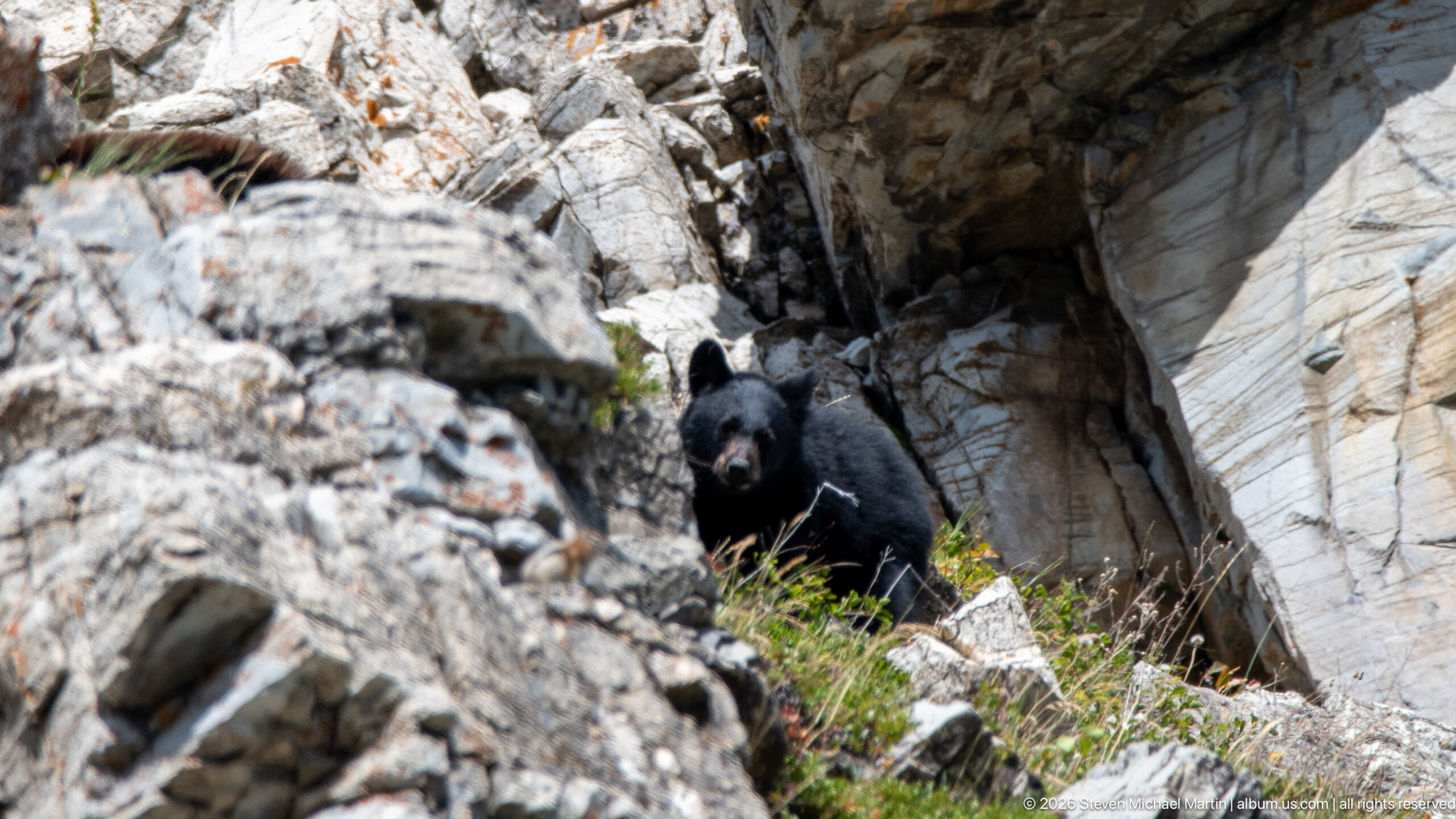
Framed by a narrow cleft in pale bedrock, a black bear looks directly toward the camera from a patch of grasses and low plants. The compressed composition places the animal within the fractured geology rather than isolating it as a portrait, emphasizing the steep, irregular terrain used by wildlife along the Many Glacier corridor.
Caption
Framed by a narrow cleft in pale bedrock, a black bear looks directly toward the camera from a patch of grasses and low plants. The compressed composition places the animal within the fractured geology rather than isolating it as a portrait, emphasizing the steep, irregular terrain used by wildlife along the Many Glacier corridor.
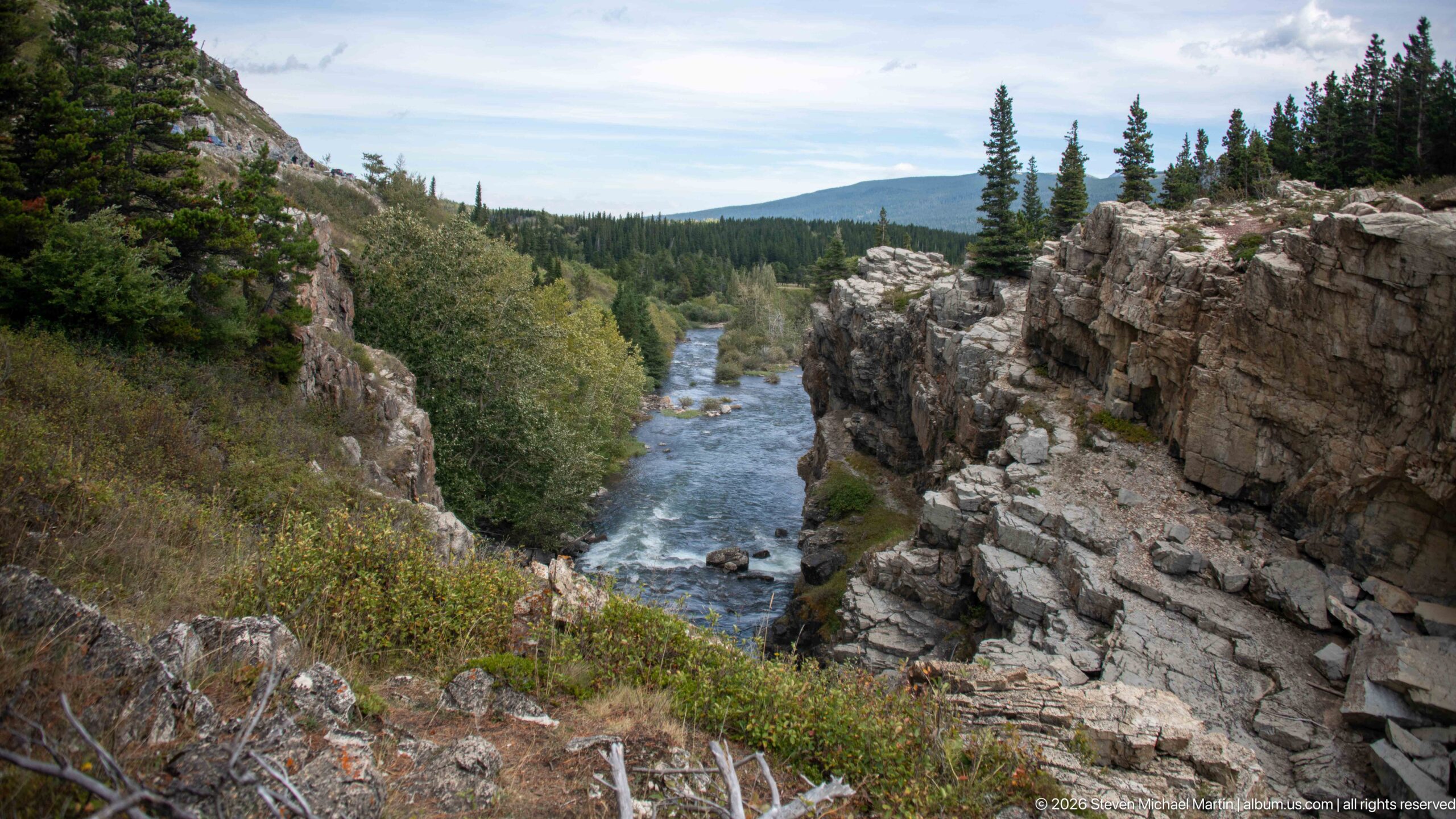
A mountain stream threads through a narrow, rock-walled channel bordered by conifers, shrubs, and exposed ledges. Seen from above, the water alternates between darker pools and pale riffles as it moves through the constricted gorge, giving this view a strong sense of the drainage cutting through the forested Many Glacier landscape.
Caption
A mountain stream threads through a narrow, rock-walled channel bordered by conifers, shrubs, and exposed ledges. Seen from above, the water alternates between darker pools and pale riffles as it moves through the constricted gorge, giving this view a strong sense of the drainage cutting through the forested Many Glacier landscape.
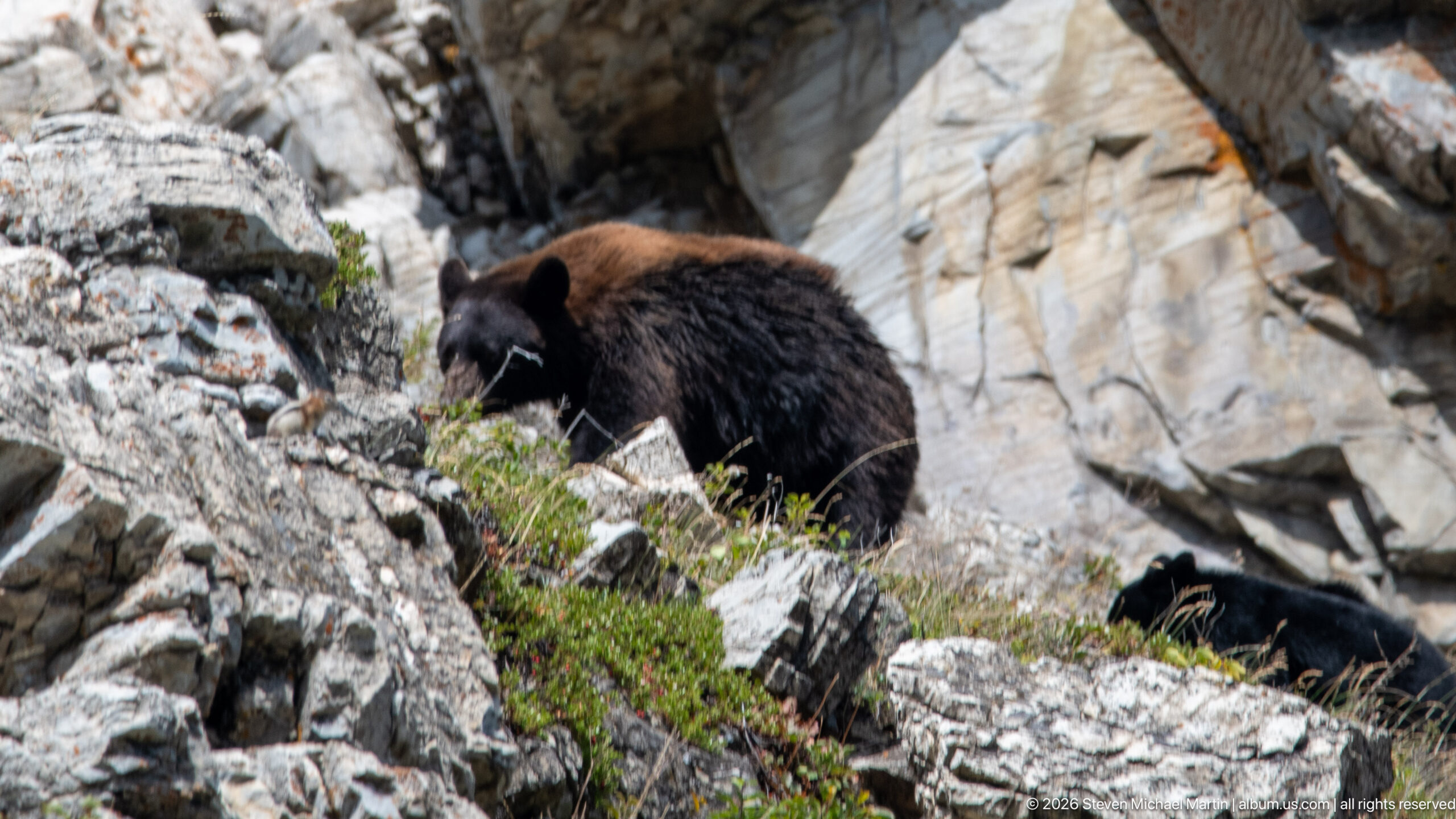
A black bear moves across a steep ledge with its head lowered toward vegetation growing between fractured rocks. Warm brown highlights along the back catch the light while the animal remains largely dark against the pale stone. The side view records active foraging behavior within the rugged, sparsely vegetated terrain of the Many Glacier area.
Caption
A black bear moves across a steep ledge with its head lowered toward vegetation growing between fractured rocks. Warm brown highlights along the back catch the light while the animal remains largely dark against the pale stone. The side view records active foraging behavior within the rugged, sparsely vegetated terrain of the Many Glacier area.
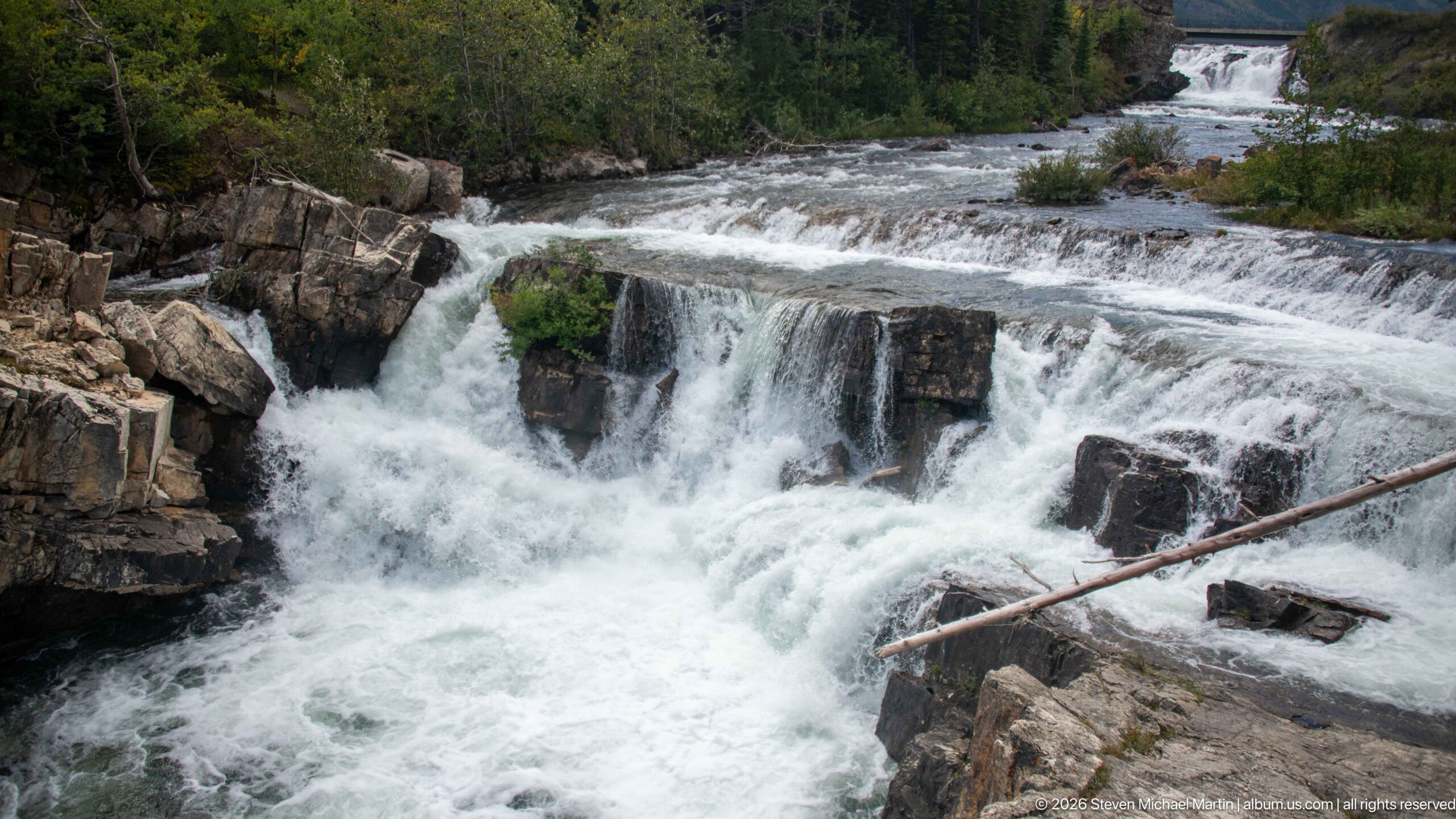
White water pours over a series of dark bedrock steps, breaking into short curtains and churning plunge pools between angular rock margins. A fallen trunk lies diagonally across the lower flow, adding scale to the force of the cascade. The tight composition concentrates on the texture and movement of fast mountain water.
Caption
White water pours over a series of dark bedrock steps, breaking into short curtains and churning plunge pools between angular rock margins. A fallen trunk lies diagonally across the lower flow, adding scale to the force of the cascade. The tight composition concentrates on the texture and movement of fast mountain water.
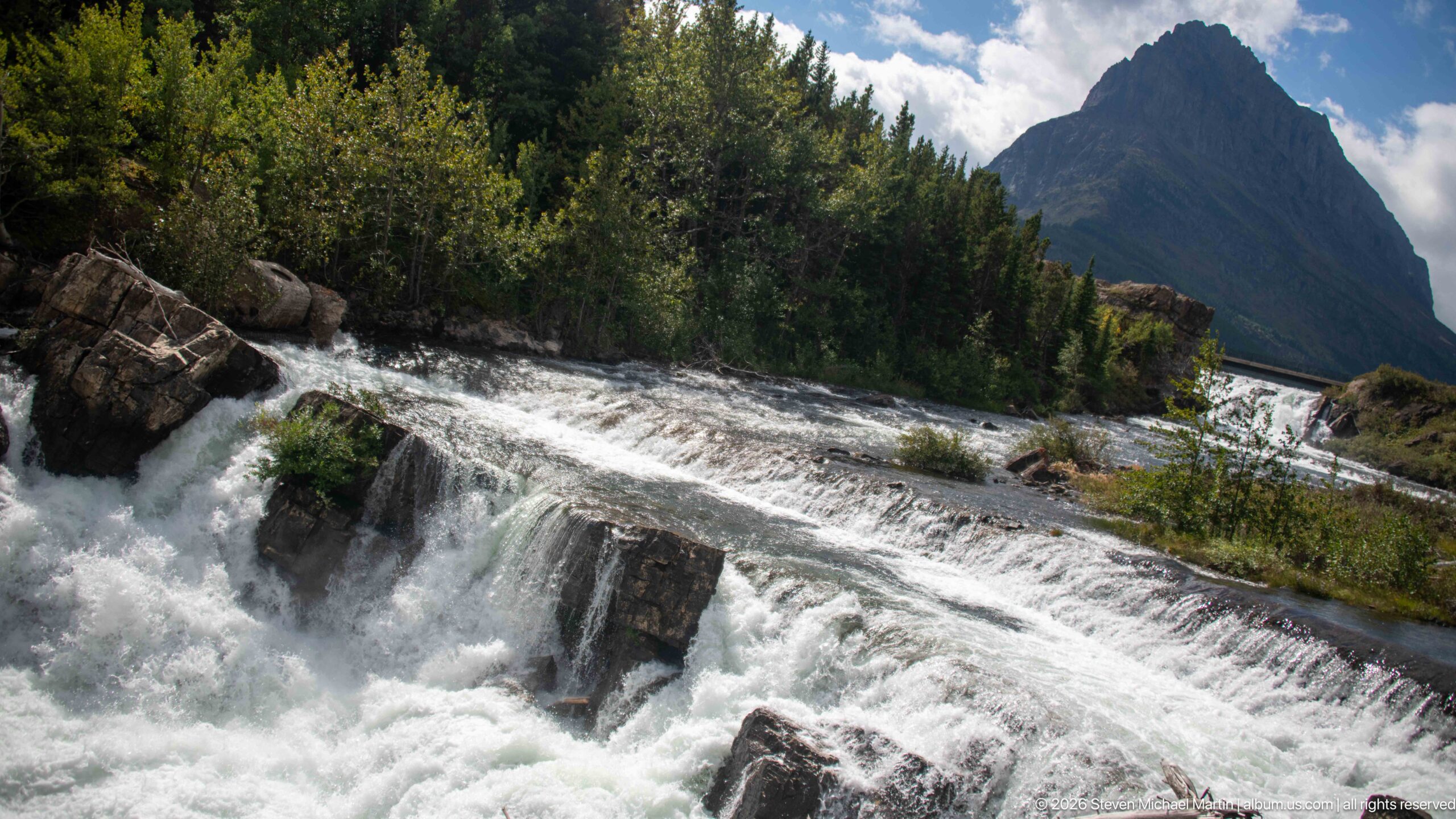
Viewed on a diagonal, a broad cascade tumbles over blocky bedrock while a pointed mountain rises beyond dense riverside trees. The tilted shoreline and sweeping line of whitewater make this frame more dynamic than the preceding views, joining the falls, forest, and mountain into a layered Many Glacier landscape.
Caption
Viewed on a diagonal, a broad cascade tumbles over blocky bedrock while a pointed mountain rises beyond dense riverside trees. The tilted shoreline and sweeping line of whitewater make this frame more dynamic than the preceding views, joining the falls, forest, and mountain into a layered Many Glacier landscape.
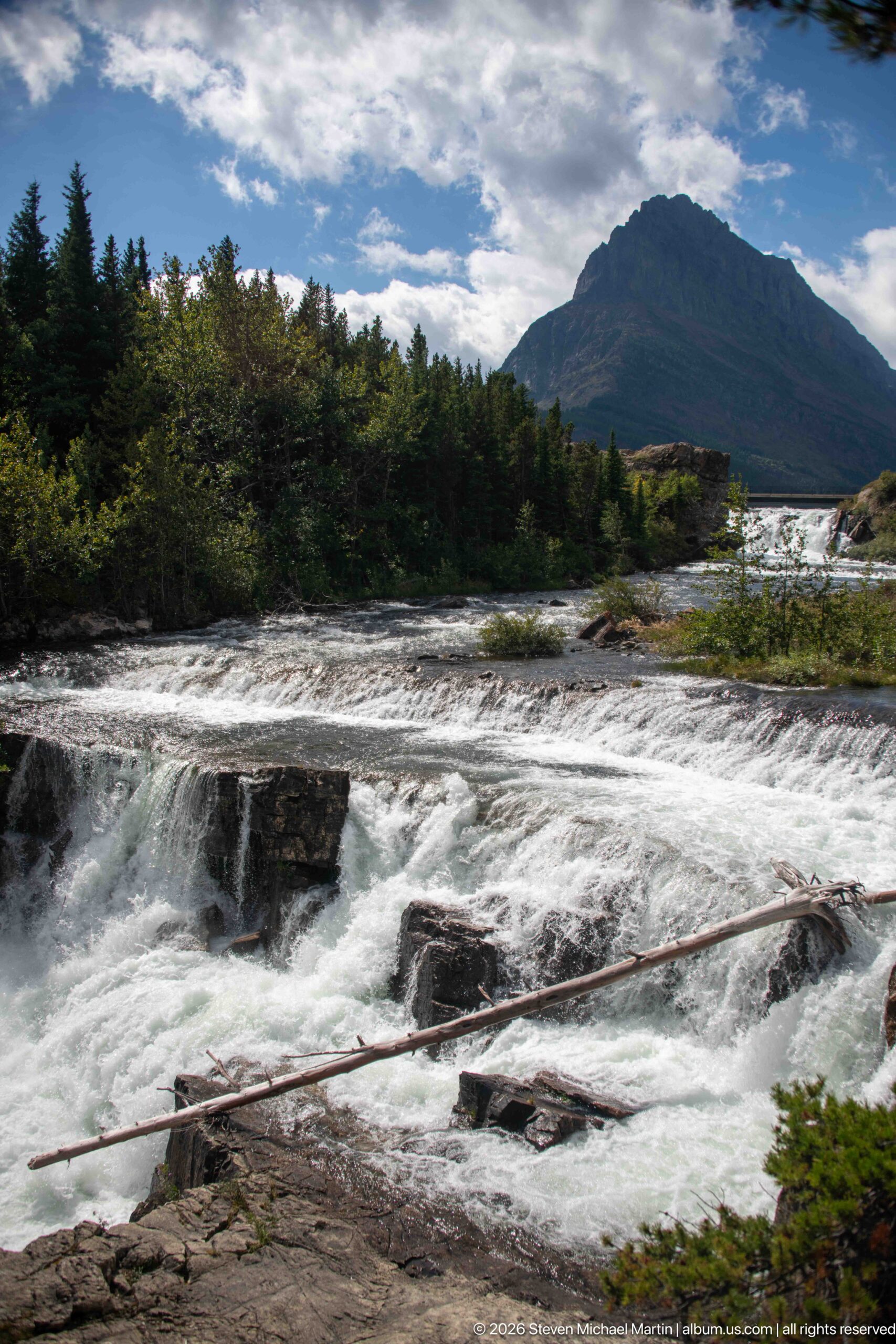
A broad sheet of whitewater crosses the foreground beneath a dark, steep-sided mountain rising beyond a band of conifers. Layered bedrock steps divide the flow into low falls, while a long fallen trunk stretches across the channel. The wider viewpoint connects the energetic cascade to the mountainous setting of Many Glacier.
Caption
A broad sheet of whitewater crosses the foreground beneath a dark, steep-sided mountain rising beyond a band of conifers. Layered bedrock steps divide the flow into low falls, while a long fallen trunk stretches across the channel. The wider viewpoint connects the energetic cascade to the mountainous setting of Many Glacier.
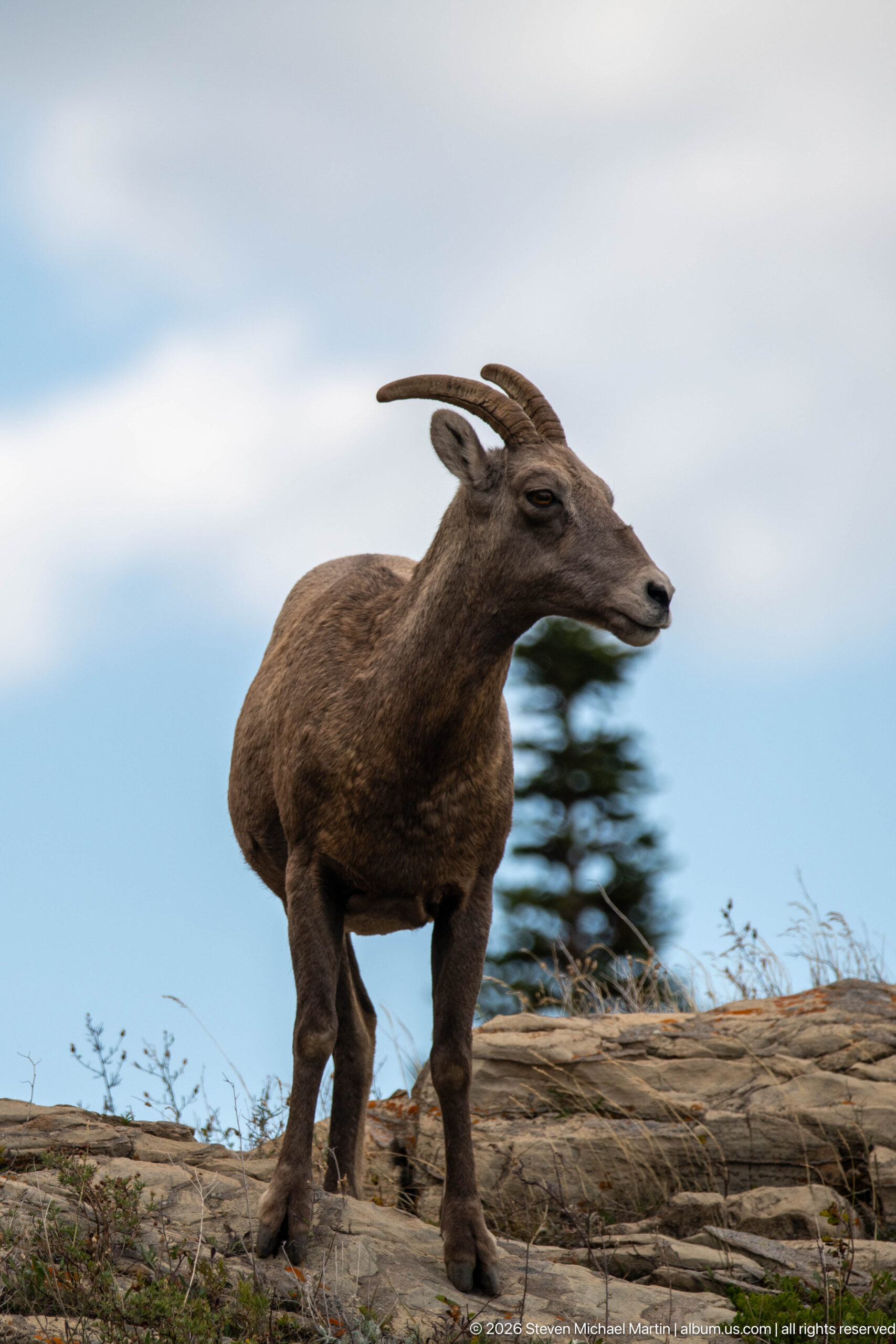
A bighorn sheep strides across exposed rock in profile, one foreleg lifted as it moves along the ridge. The lower viewpoint accentuates the animal’s chest, legs, and swept-back horns, while motion in the head and a blurred conifer behind give this frame a more active character than the surrounding standing portraits.
Caption
A bighorn sheep strides across exposed rock in profile, one foreleg lifted as it moves along the ridge. The lower viewpoint accentuates the animal’s chest, legs, and swept-back horns, while motion in the head and a blurred conifer behind give this frame a more active character than the surrounding standing portraits.
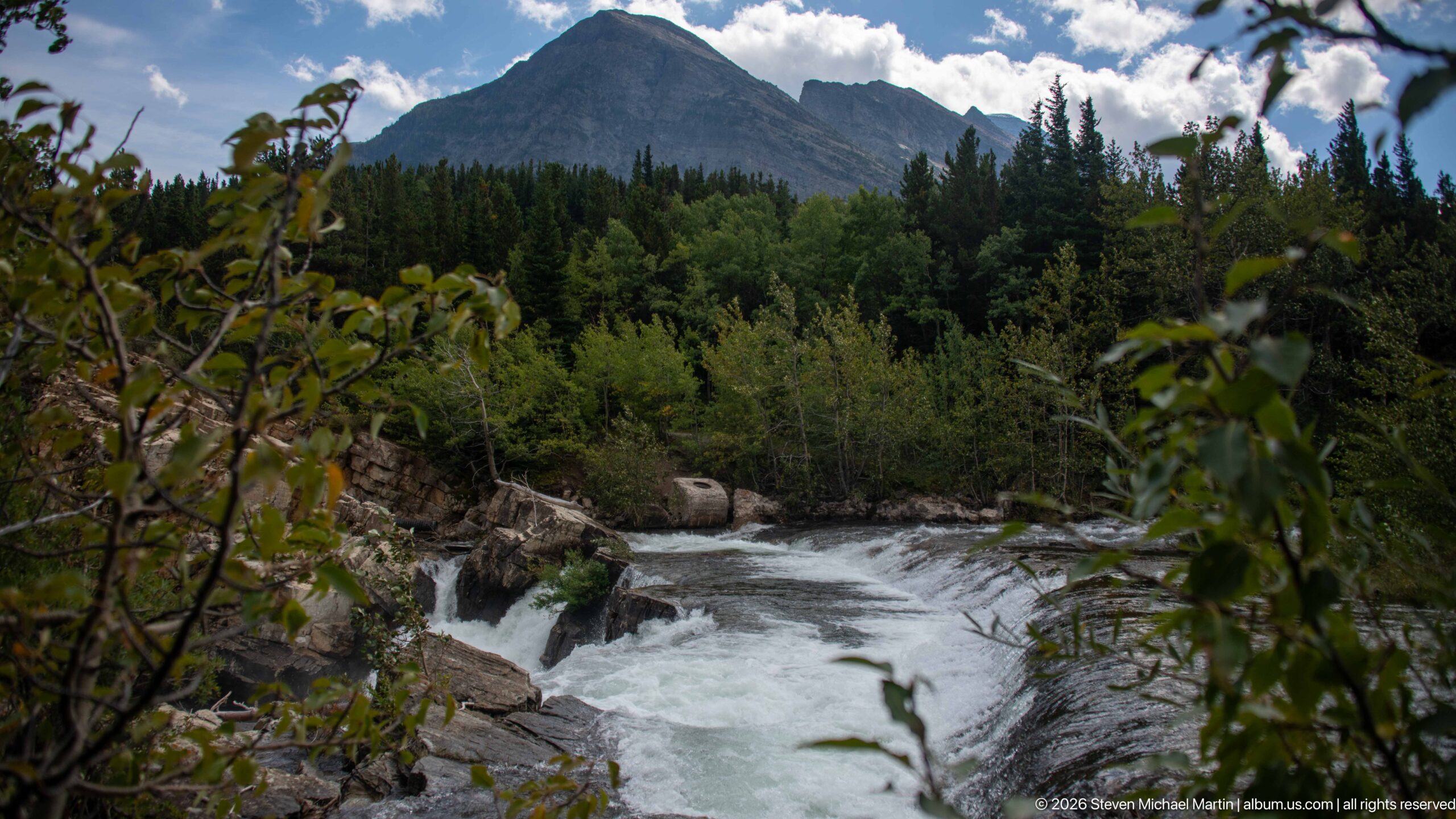
Branches and leaves frame a mountain river as it bends around exposed rock and disappears into dense forest. A steep mountain rises above the treeline, while the partially screened viewpoint gives the scene the character of a roadside glimpse rather than an open overlook.
Caption
Branches and leaves frame a mountain river as it bends around exposed rock and disappears into dense forest. A steep mountain rises above the treeline, while the partially screened viewpoint gives the scene the character of a roadside glimpse rather than an open overlook.
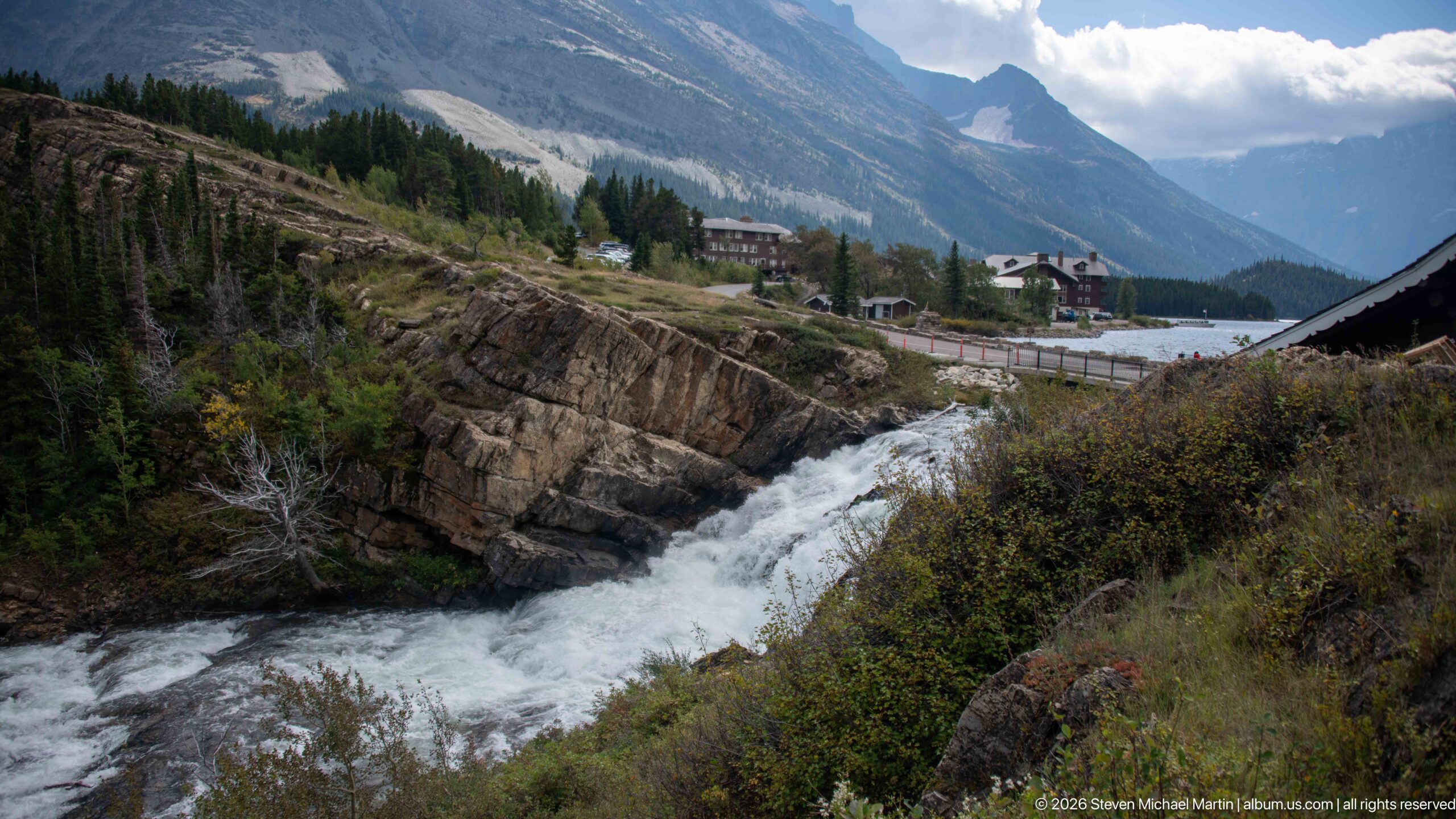
A powerful cascade funnels through a bedrock notch below a road and a small cluster of buildings, linking the natural drainage with the developed Many Glacier landscape. Steep gray mountain walls rise behind the structures, and the elevated viewpoint reveals how closely the roadway and built environment follow the watercourse.
Caption
A powerful cascade funnels through a bedrock notch below a road and a small cluster of buildings, linking the natural drainage with the developed Many Glacier landscape. Steep gray mountain walls rise behind the structures, and the elevated viewpoint reveals how closely the roadway and built environment follow the watercourse.
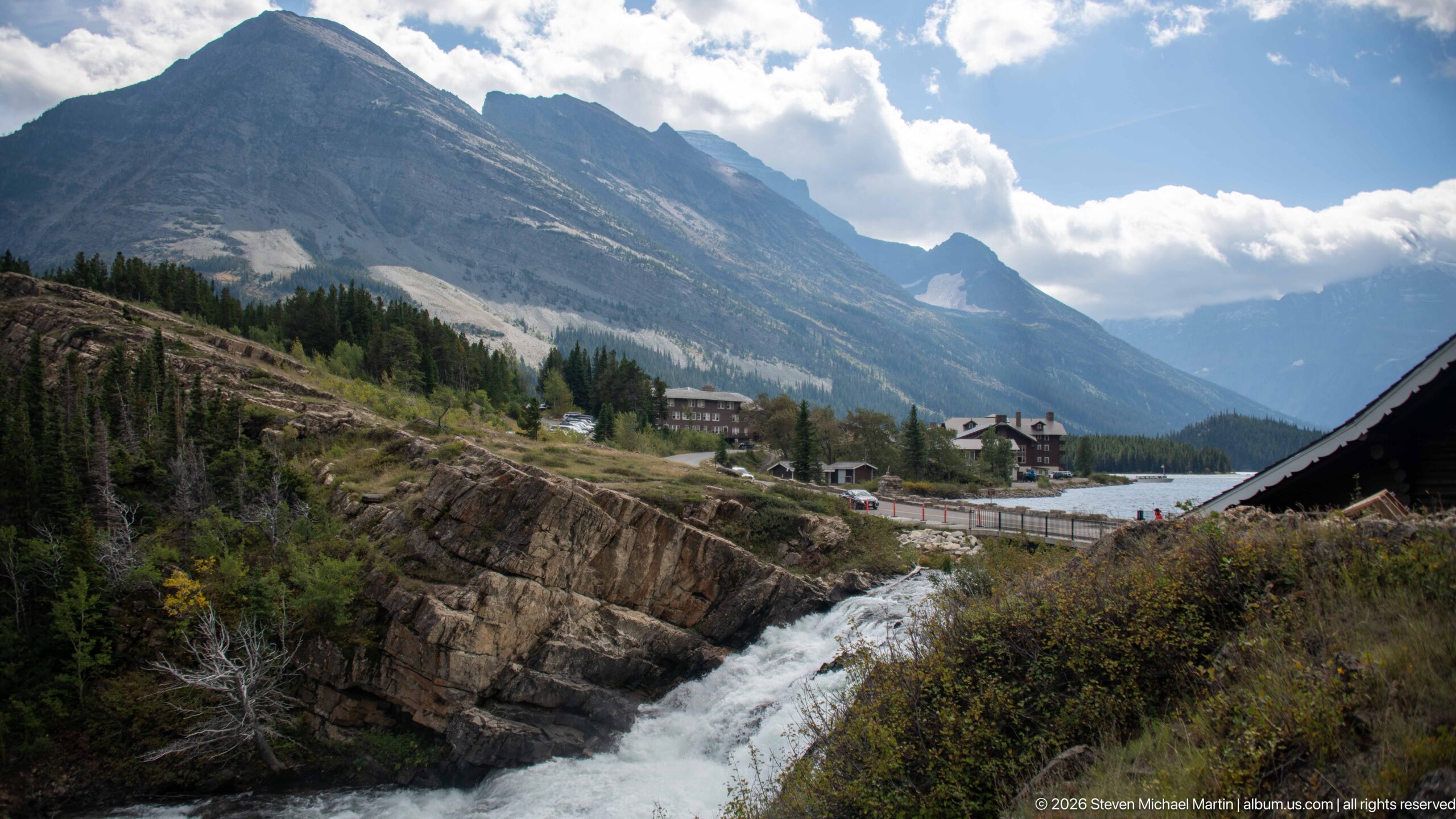
Whitewater drops through a narrow rock cut in the foreground while roadside buildings occupy the bench above the channel. Behind them, a long, striated mountain wall leads toward a distant notch partly veiled by clouds. The composition emphasizes the close relationship among road, water, development, and terrain in Many Glacier.
Caption
Whitewater drops through a narrow rock cut in the foreground while roadside buildings occupy the bench above the channel. Behind them, a long, striated mountain wall leads toward a distant notch partly veiled by clouds. The composition emphasizes the close relationship among road, water, development, and terrain in Many Glacier.
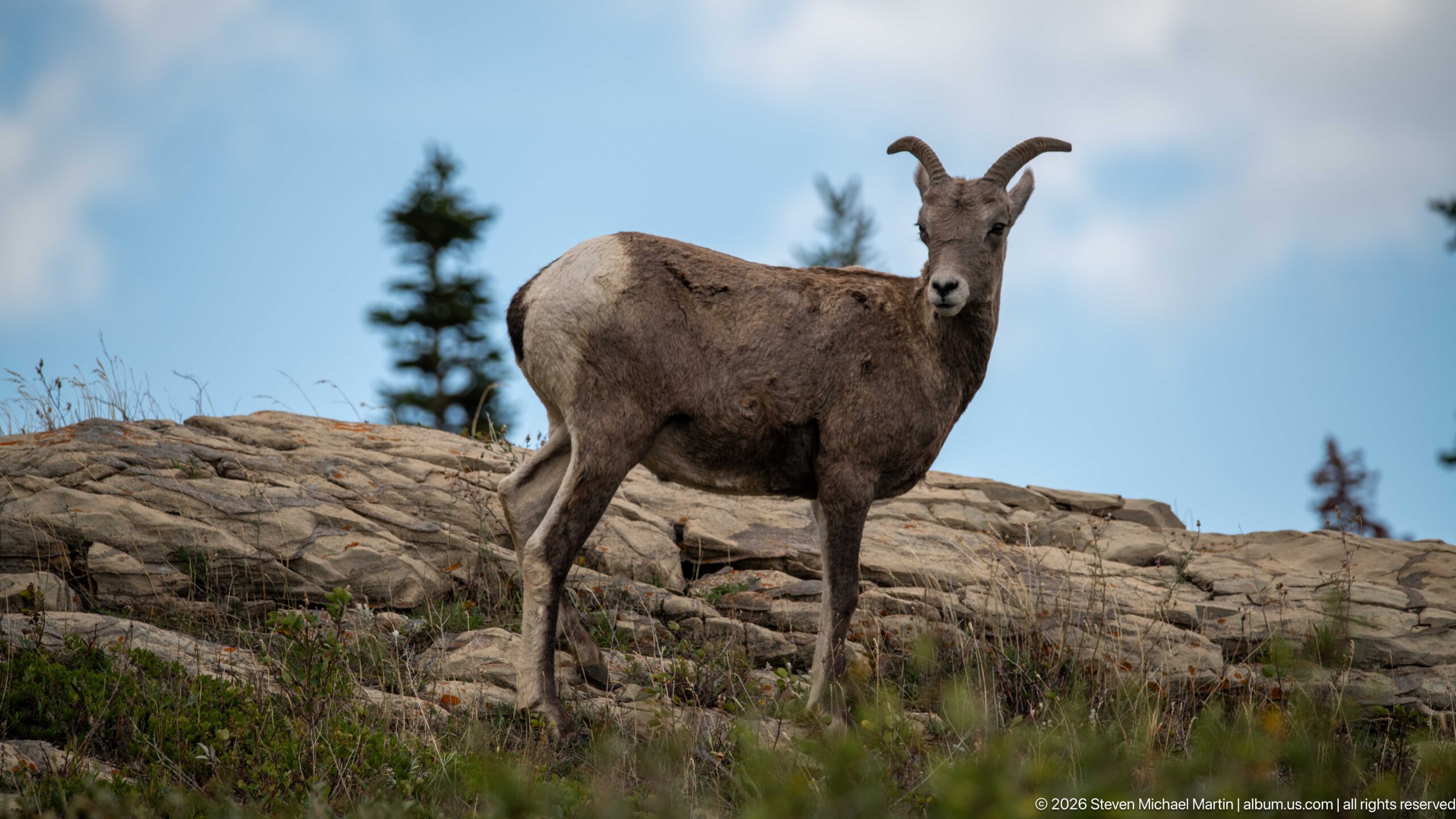
Standing slightly quartered toward the camera, a bighorn sheep ewe holds her head high above a layered rock shelf. The pose reveals the compact horns, pale muzzle, muscular shoulders, and lighter rump characteristic of the species, while a softly blurred conifer and sky separate the animal cleanly from the background.
Caption
Standing slightly quartered toward the camera, a bighorn sheep ewe holds her head high above a layered rock shelf. The pose reveals the compact horns, pale muzzle, muscular shoulders, and lighter rump characteristic of the species, while a softly blurred conifer and sky separate the animal cleanly from the background.
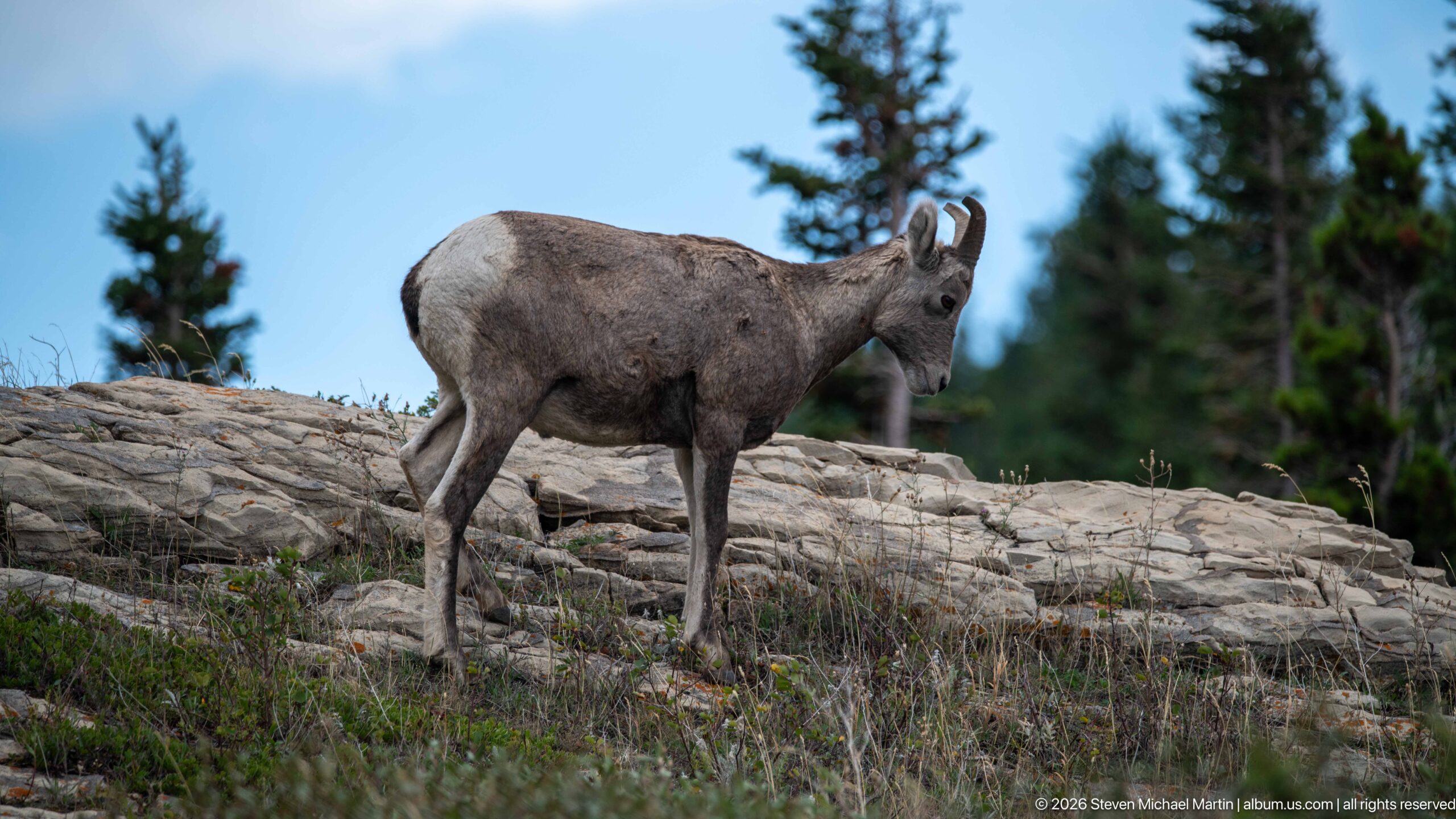
A bighorn sheep ewe pauses on a broad rock slab with her body angled away and head turned slightly to the side. The rear-quarter view makes the pale rump patch especially prominent and shows how closely the gray-brown coat matches the stone. Dark conifers provide a contrasting band behind the open ridge.
Caption
A bighorn sheep ewe pauses on a broad rock slab with her body angled away and head turned slightly to the side. The rear-quarter view makes the pale rump patch especially prominent and shows how closely the gray-brown coat matches the stone. Dark conifers provide a contrasting band behind the open ridge.
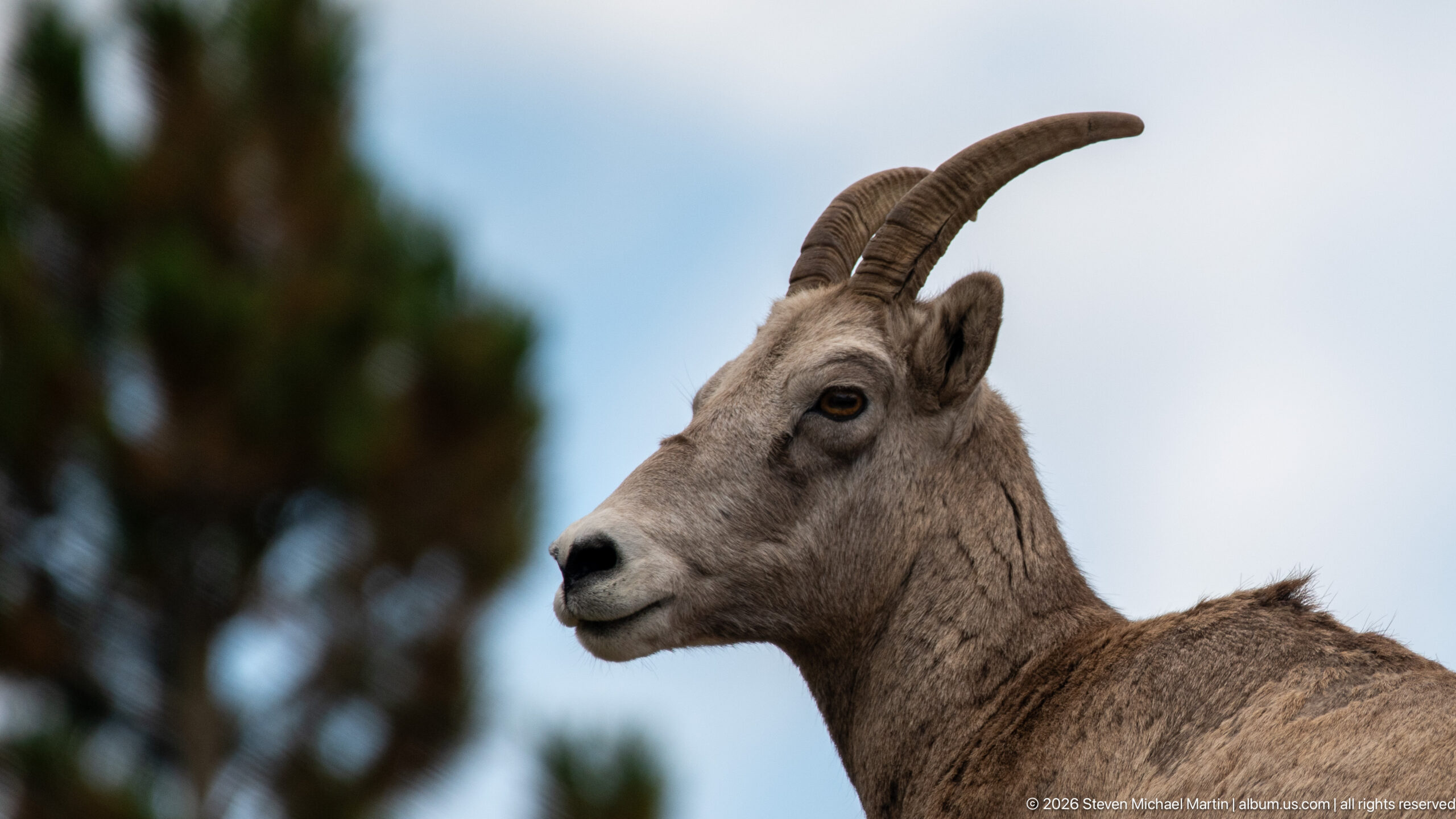
A close profile isolates the head and shoulders of a bighorn sheep ewe against soft sky and blurred vegetation. Fine ridges on the compact horns, the dark eye, pale muzzle, and coarse gray-brown coat are rendered in unusual detail, turning this frame into a study of the animal’s facial structure and horn texture.
Caption
A close profile isolates the head and shoulders of a bighorn sheep ewe against soft sky and blurred vegetation. Fine ridges on the compact horns, the dark eye, pale muzzle, and coarse gray-brown coat are rendered in unusual detail, turning this frame into a study of the animal’s facial structure and horn texture.
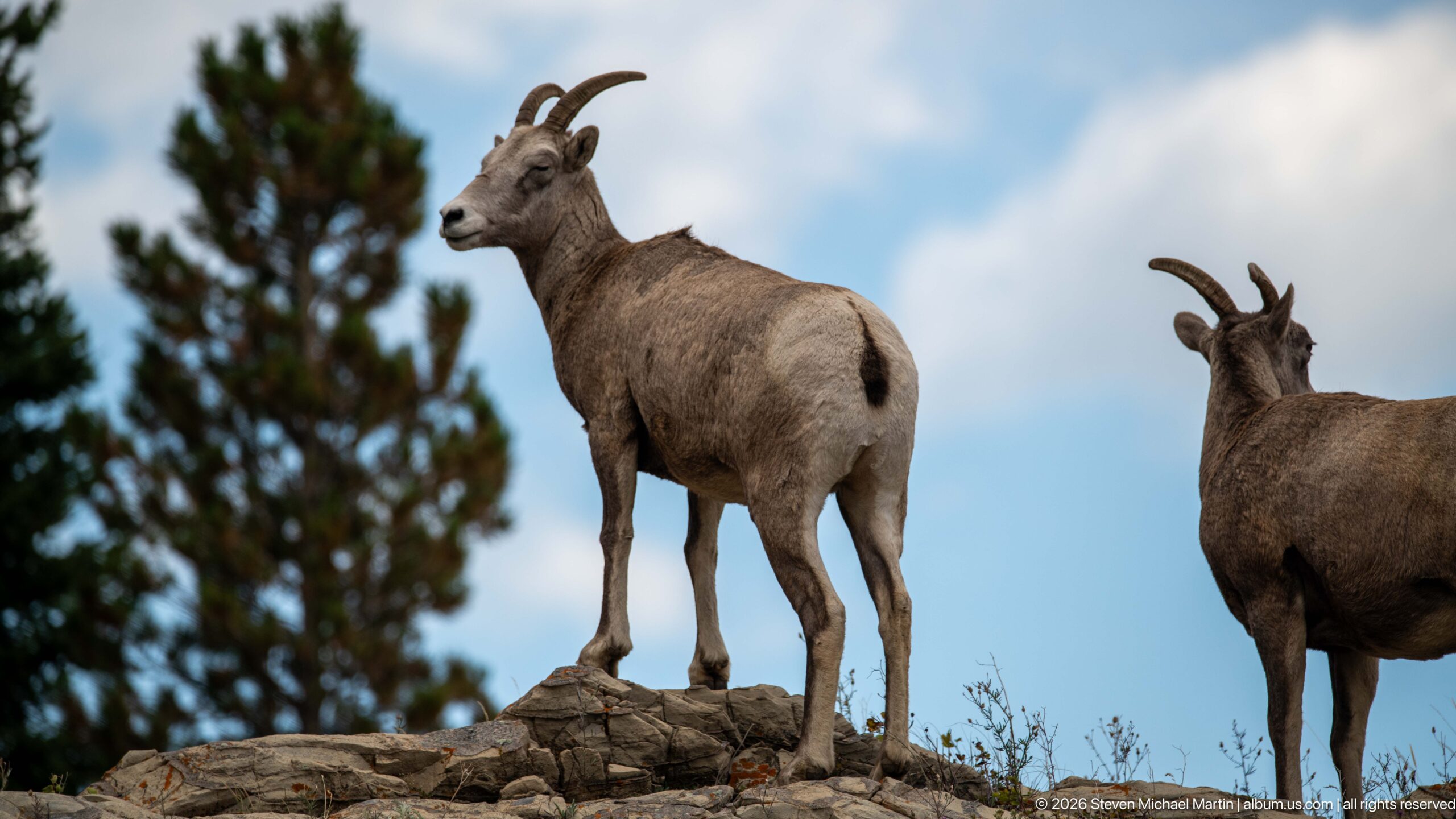
One bighorn sheep stands tall on the crest of a rock slab while a second animal enters at right, partly cropped by the frame. Their gray-brown coats and pale rump patches echo the stone and sky, and the elevated stance of the leading animal creates a clear lookout-like silhouette against the open background.
Caption
One bighorn sheep stands tall on the crest of a rock slab while a second animal enters at right, partly cropped by the frame. Their gray-brown coats and pale rump patches echo the stone and sky, and the elevated stance of the leading animal creates a clear lookout-like silhouette against the open background.
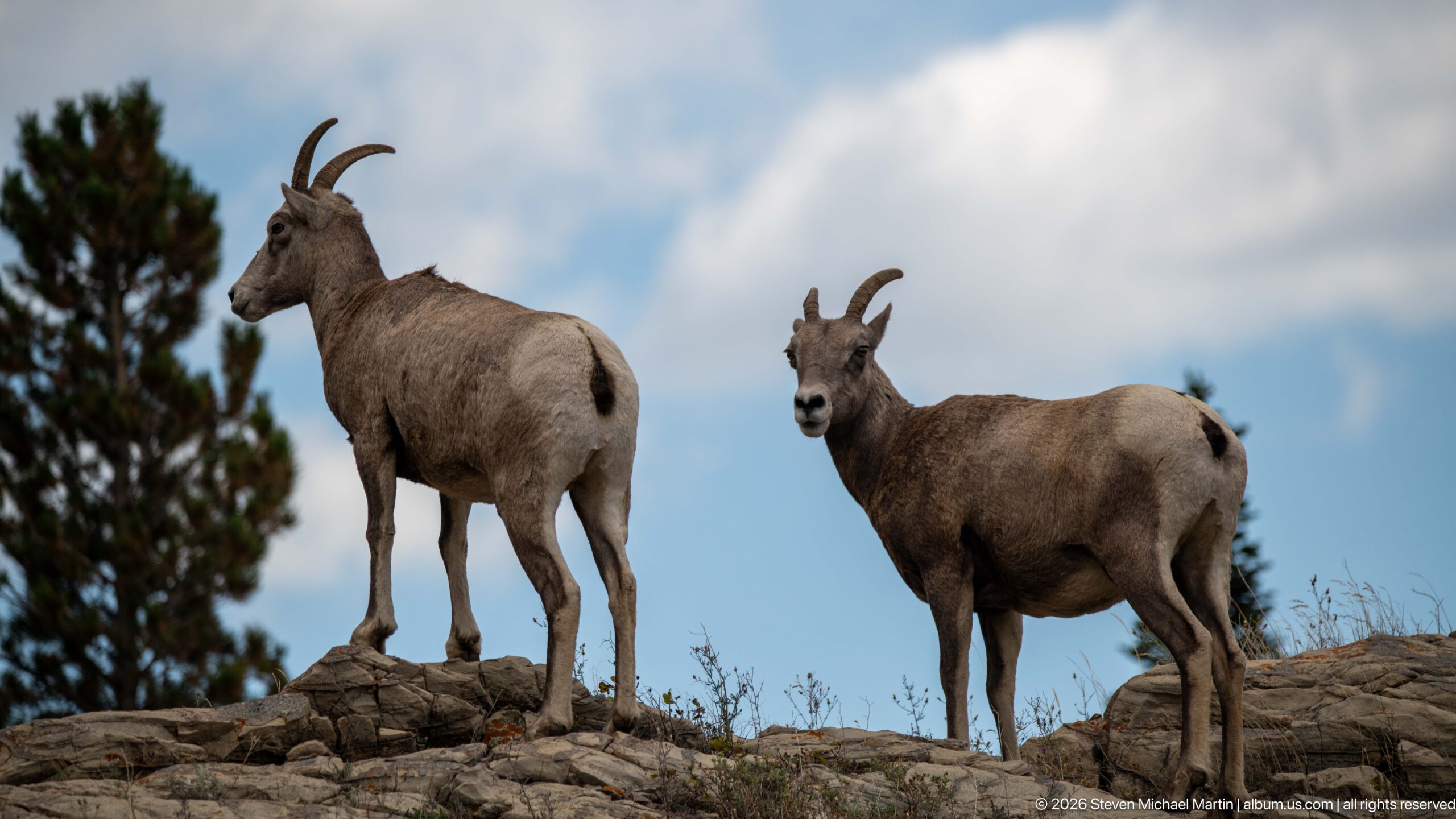
Two bighorn sheep share an exposed ridge, one in profile and the other turned toward the camera. Their different orientations reveal the compact horns, sturdy legs, and contrasting pale rump patches from complementary angles. Sparse plants at their feet and a cloud-filled sky reinforce the open, rocky character of the setting.
Caption
Two bighorn sheep share an exposed ridge, one in profile and the other turned toward the camera. Their different orientations reveal the compact horns, sturdy legs, and contrasting pale rump patches from complementary angles. Sparse plants at their feet and a cloud-filled sky reinforce the open, rocky character of the setting.
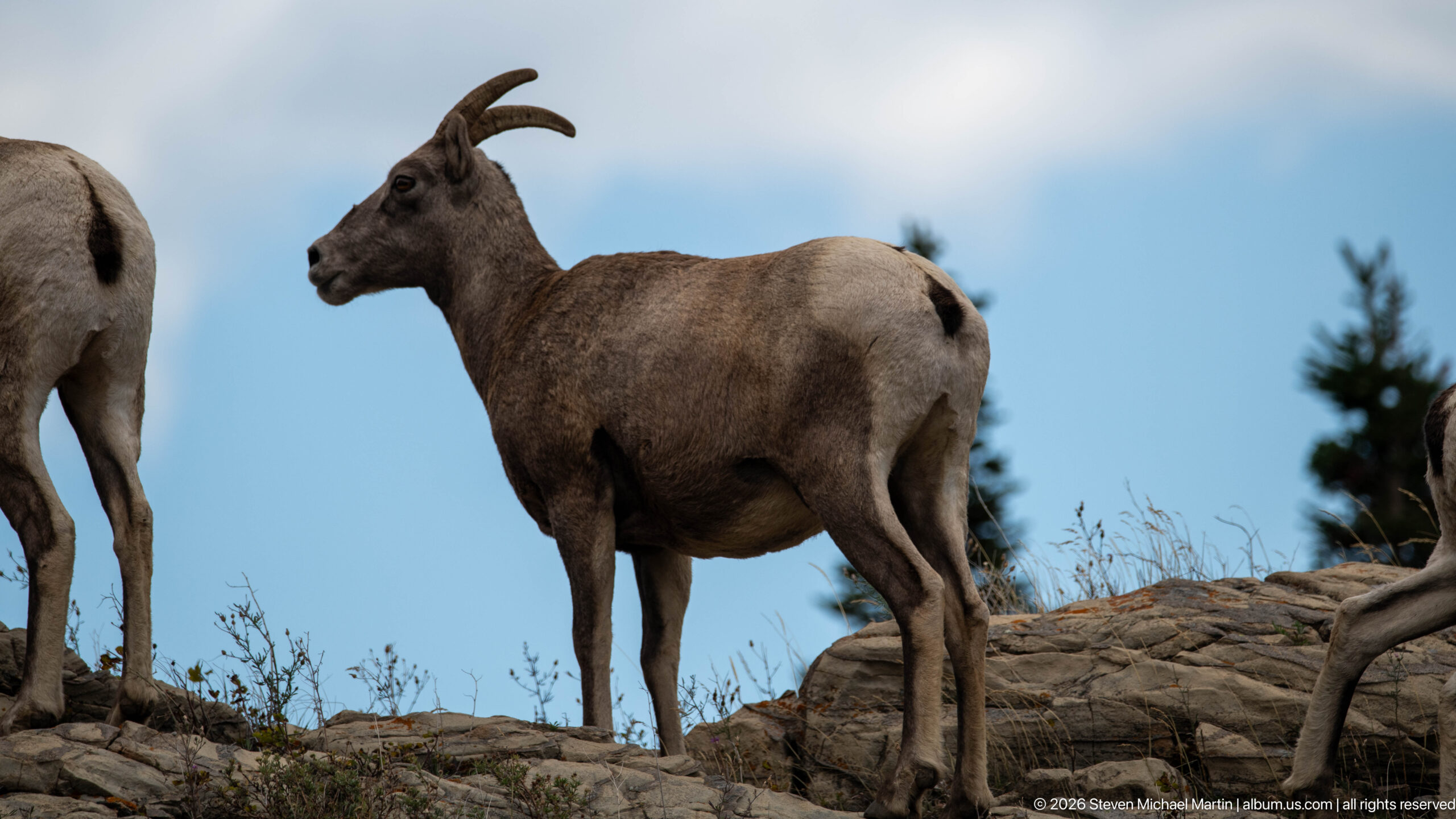
A bighorn sheep stands broadside on a rocky ledge, its compact horns curving back over the head and its pale rump patch contrasting with the darker torso. Cropped portions of other sheep at the frame edges suggest a nearby group, but the centered animal remains the clear subject against sky and sparse ridge vegetation.
Caption
A bighorn sheep stands broadside on a rocky ledge, its compact horns curving back over the head and its pale rump patch contrasting with the darker torso. Cropped portions of other sheep at the frame edges suggest a nearby group, but the centered animal remains the clear subject against sky and sparse ridge vegetation.
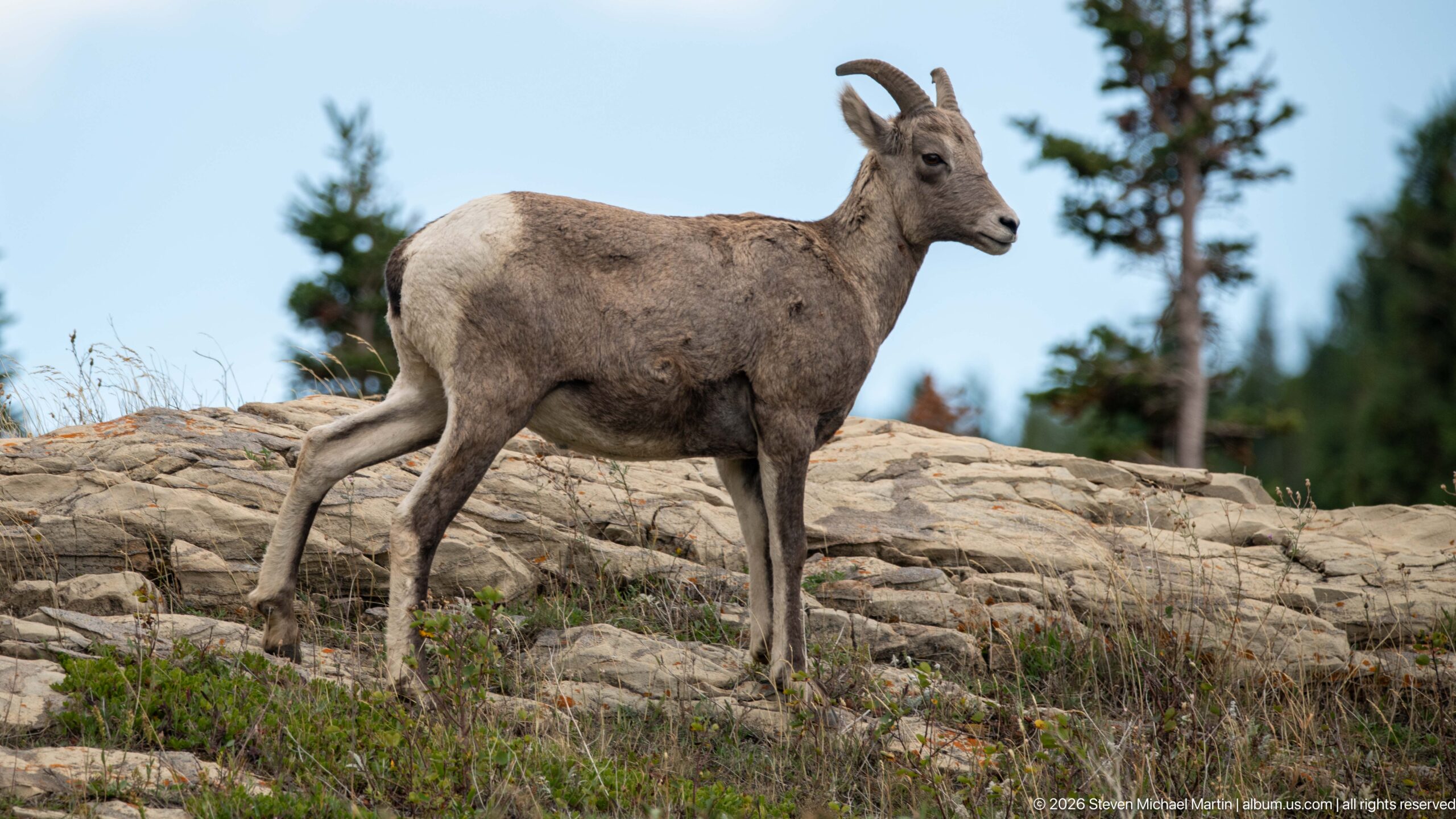
A bighorn sheep moves steadily across a pale rock shelf, its front leg extended and head held forward. The full-body profile clearly shows the arched back, compact horns, dark lower legs, and broad pale rump patch. Conifers and low vegetation soften the otherwise exposed alpine setting.
Caption
A bighorn sheep moves steadily across a pale rock shelf, its front leg extended and head held forward. The full-body profile clearly shows the arched back, compact horns, dark lower legs, and broad pale rump patch. Conifers and low vegetation soften the otherwise exposed alpine setting.
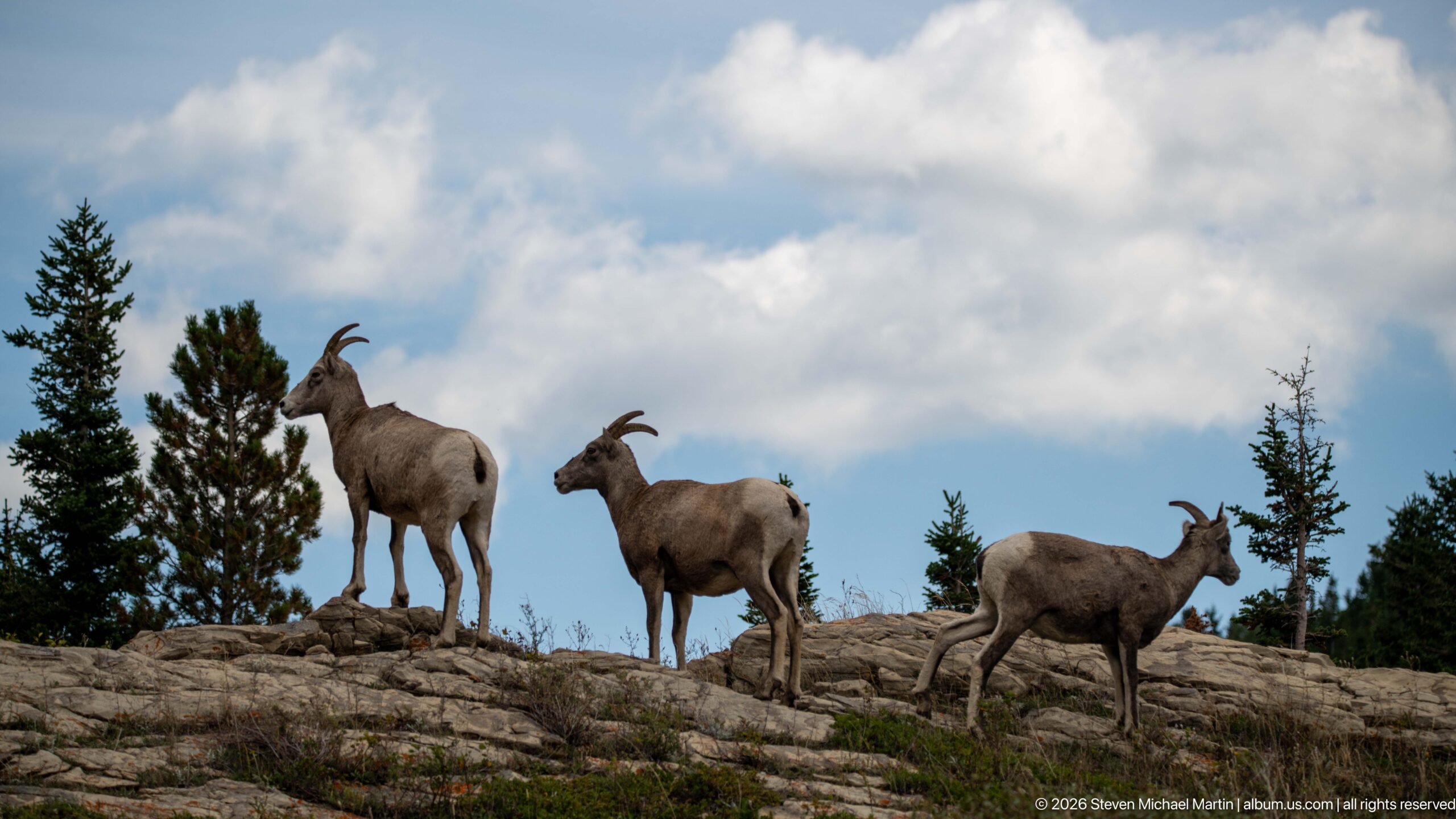
Three bighorn sheep are spaced across the crest of a broad rock outcrop, each oriented differently as the group moves along the ridge. Their silhouettes stand against a bright, cloud-filled sky, with scattered conifers punctuating the horizon. The wider composition records group behavior and habitat rather than an individual portrait.
Caption
Three bighorn sheep are spaced across the crest of a broad rock outcrop, each oriented differently as the group moves along the ridge. Their silhouettes stand against a bright, cloud-filled sky, with scattered conifers punctuating the horizon. The wider composition records group behavior and habitat rather than an individual portrait.
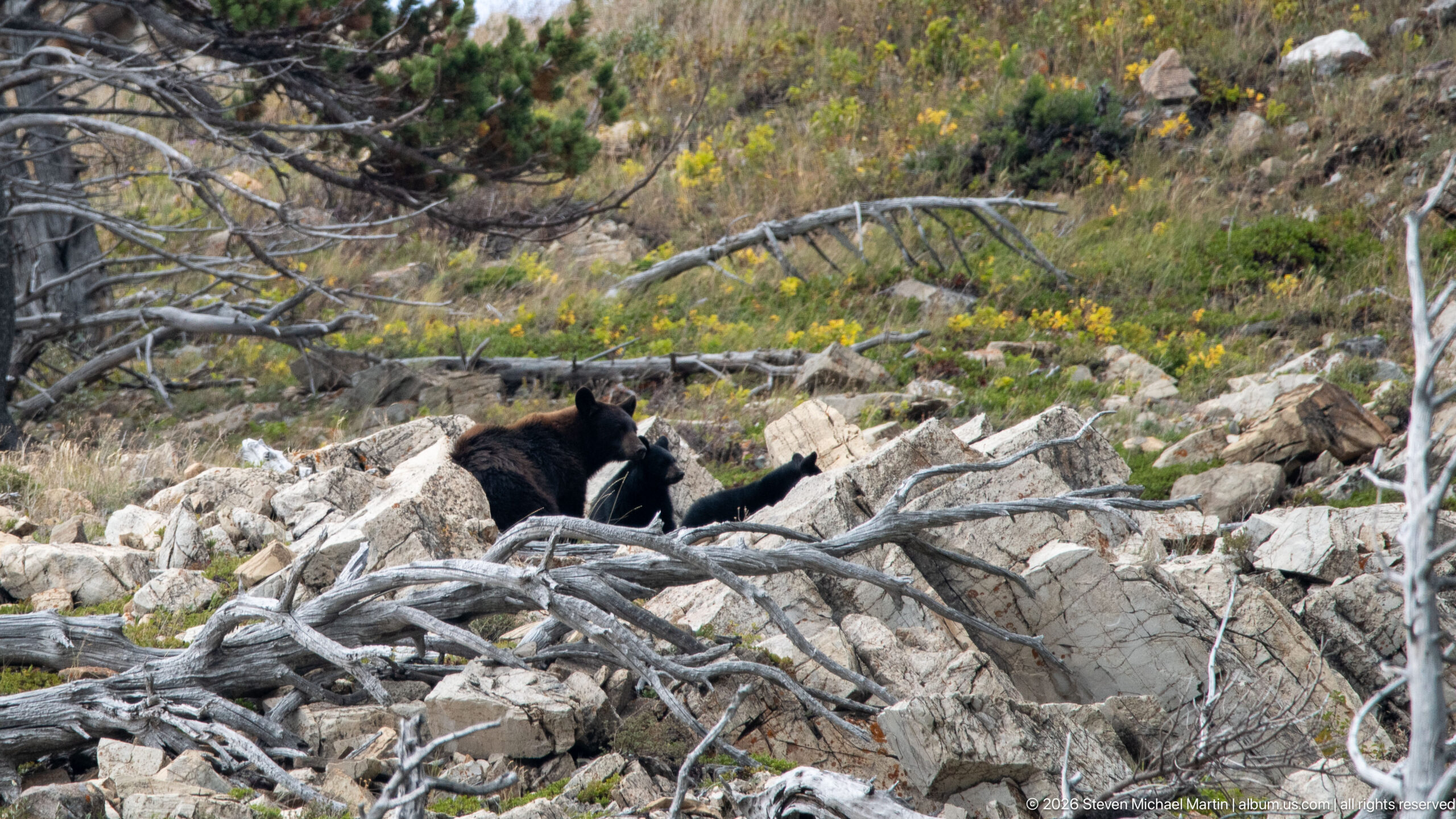
An adult black bear rests among pale broken rocks while smaller dark bears cluster close beside it, partly hidden by a tangle of fallen gray branches. The layered debris and scattered vegetation make the family group difficult to see at first glance, illustrating how effectively dark-coated bears can disappear into complex mountain terrain.
Caption
An adult black bear rests among pale broken rocks while smaller dark bears cluster close beside it, partly hidden by a tangle of fallen gray branches. The layered debris and scattered vegetation make the family group difficult to see at first glance, illustrating how effectively dark-coated bears can disappear into complex mountain terrain.
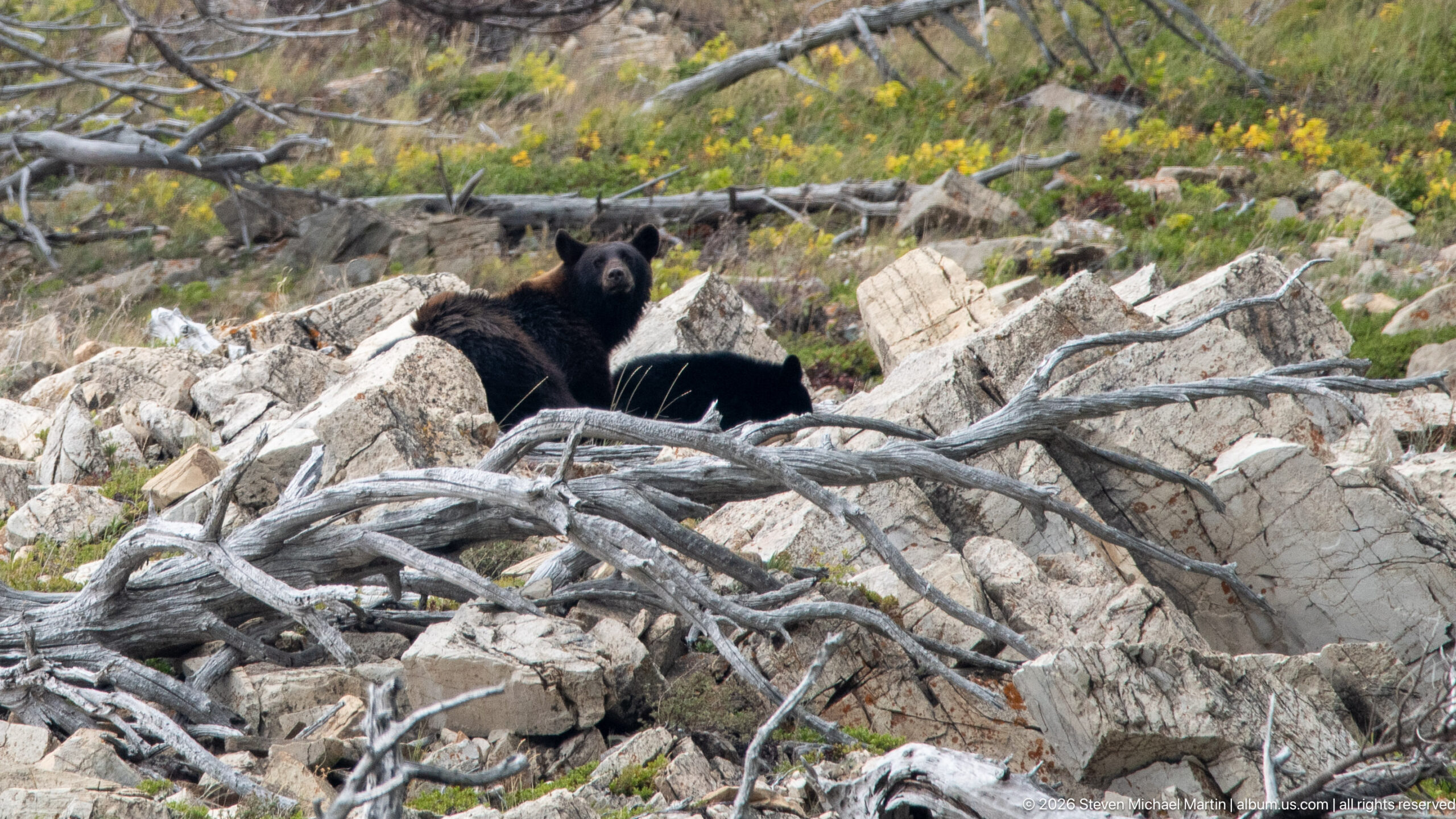
An adult black bear sits upright among pale rocks while two smaller cub-sized bears lie close together at its side. Weathered branches cross the foreground, partially screening the group, while low autumn-toned vegetation spreads across the slope behind. The adult’s raised head gives this frame a particularly alert family-group composition.
Caption
An adult black bear sits upright among pale rocks while two smaller cub-sized bears lie close together at its side. Weathered branches cross the foreground, partially screening the group, while low autumn-toned vegetation spreads across the slope behind. The adult’s raised head gives this frame a particularly alert family-group composition.
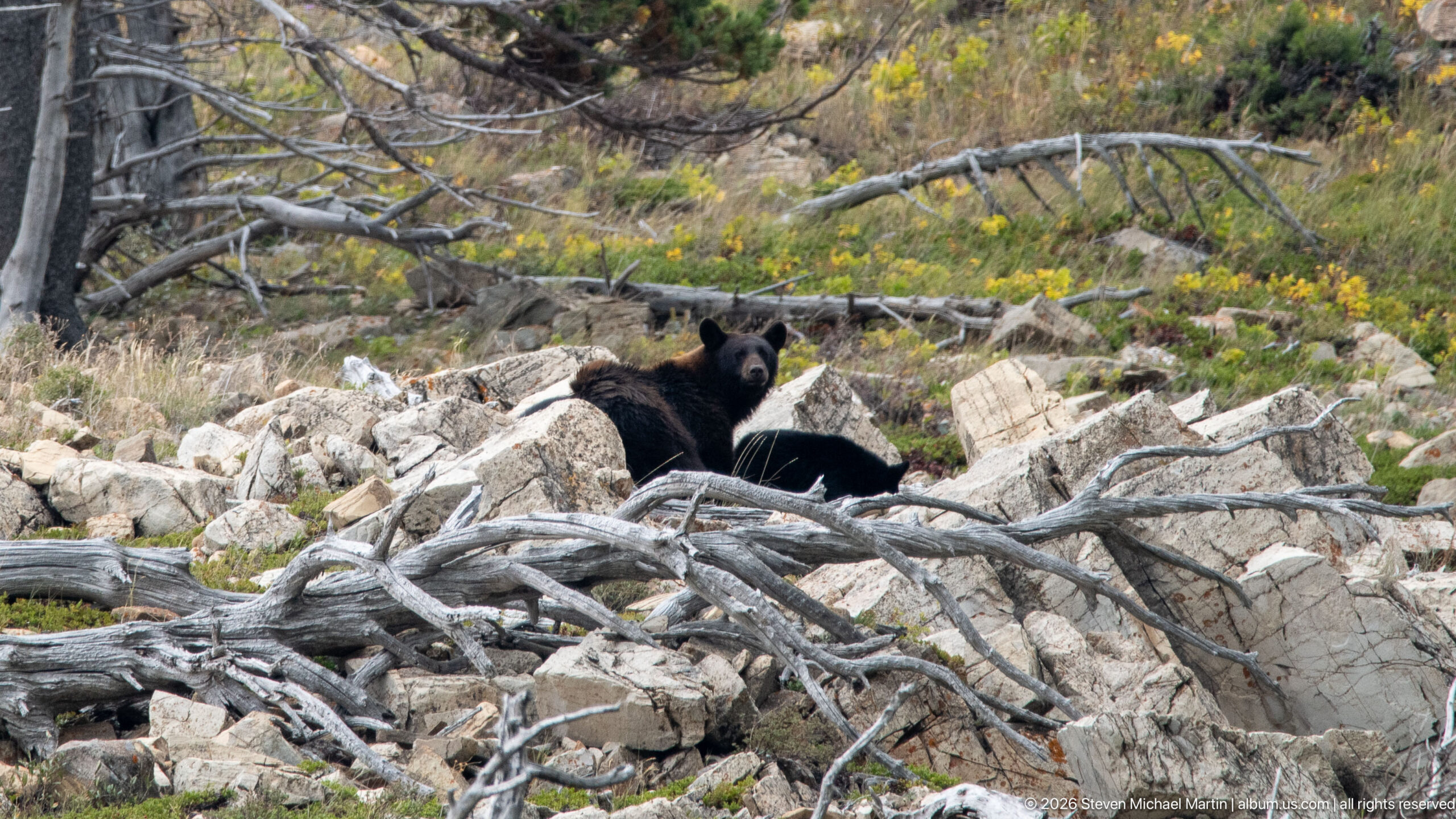
A black bear family rests in a shallow rocky opening, the adult’s head raised while two smaller bears remain lower beside it. Bleached branches form a dense lattice across the foreground, and yellow-green plants color the upper slope. The wider framing emphasizes concealment within the broken rock and deadfall.
Caption
A black bear family rests in a shallow rocky opening, the adult’s head raised while two smaller bears remain lower beside it. Bleached branches form a dense lattice across the foreground, and yellow-green plants color the upper slope. The wider framing emphasizes concealment within the broken rock and deadfall.
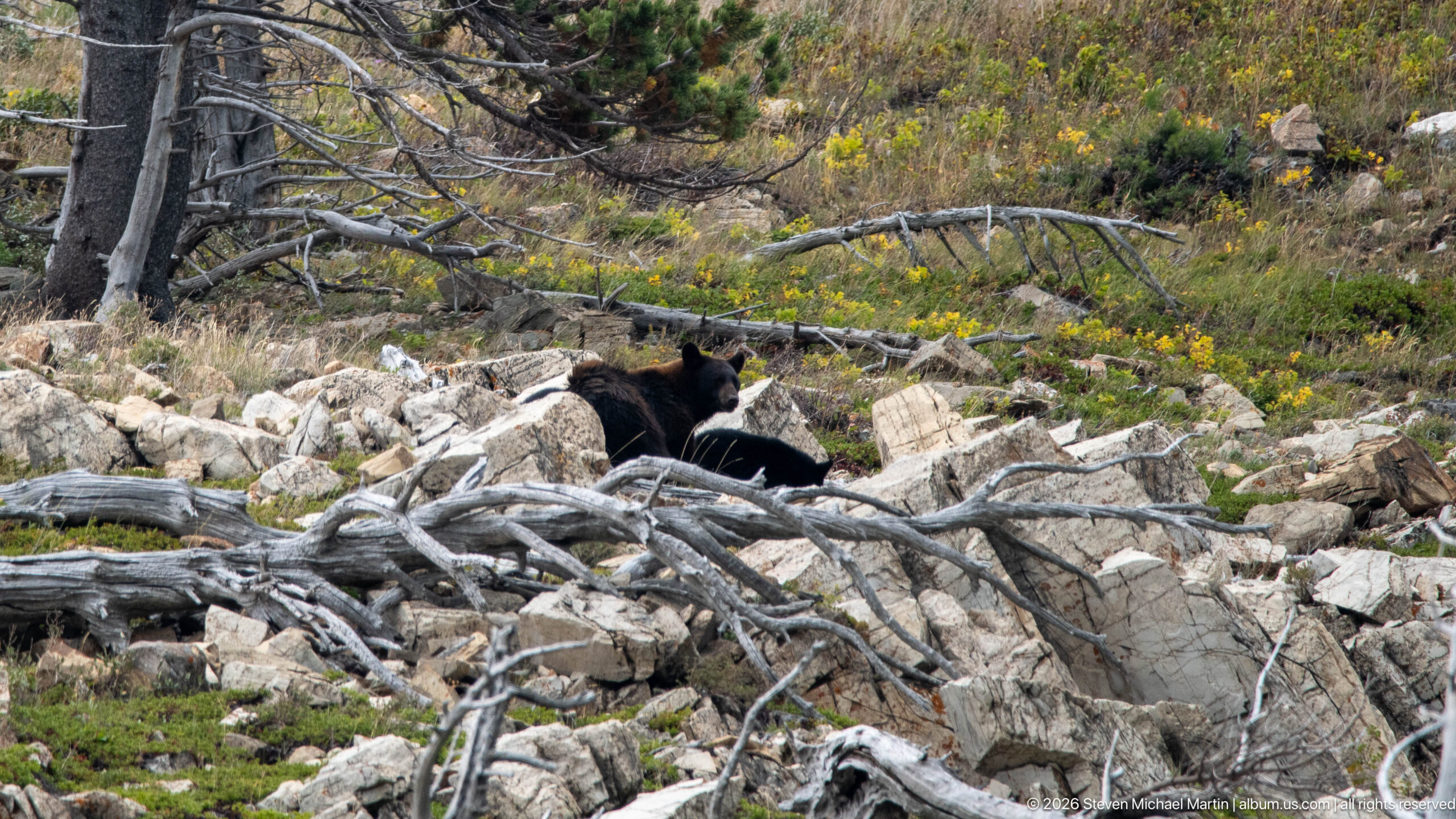
Dark bear forms emerge from a jumble of pale stone and fallen timber, with the adult positioned higher and smaller bears tucked close below. The surrounding slope is mottled with low green and yellow vegetation, while the foreground deadfall repeatedly interrupts the view. The composition shows the group within dense natural cover rather than as isolated portraits.
Caption
Dark bear forms emerge from a jumble of pale stone and fallen timber, with the adult positioned higher and smaller bears tucked close below. The surrounding slope is mottled with low green and yellow vegetation, while the foreground deadfall repeatedly interrupts the view. The composition shows the group within dense natural cover rather than as isolated portraits.
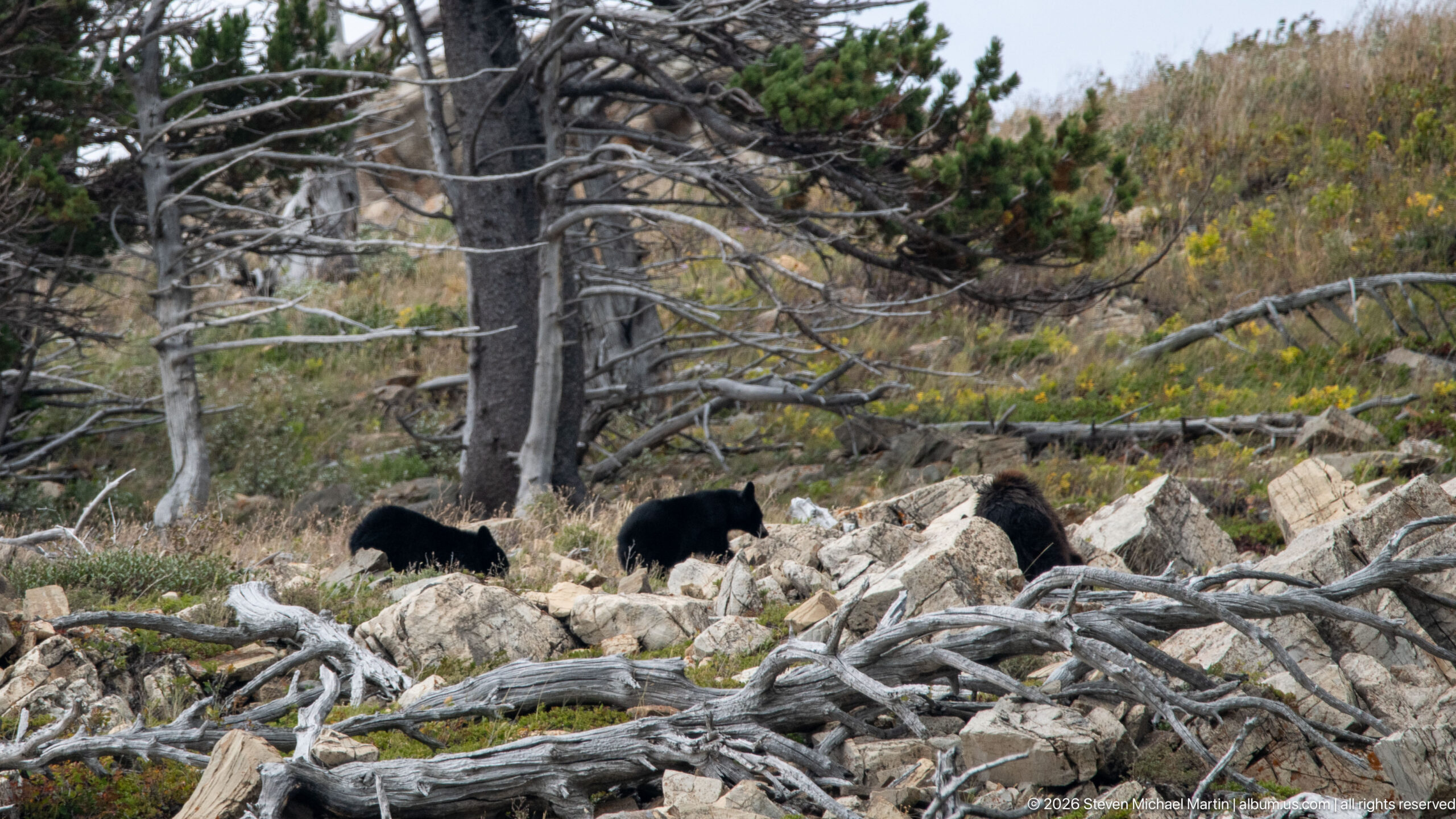
Three black bears move separately through a rocky opening beneath standing conifers, their dark bodies distributed across the frame from left to right. Fallen trunks, bleached branches, and pale stone create a busy foreground, while sparse understory vegetation reveals the animals’ movement through the disturbed-looking forest floor.
Caption
Three black bears move separately through a rocky opening beneath standing conifers, their dark bodies distributed across the frame from left to right. Fallen trunks, bleached branches, and pale stone create a busy foreground, while sparse understory vegetation reveals the animals’ movement through the disturbed-looking forest floor.
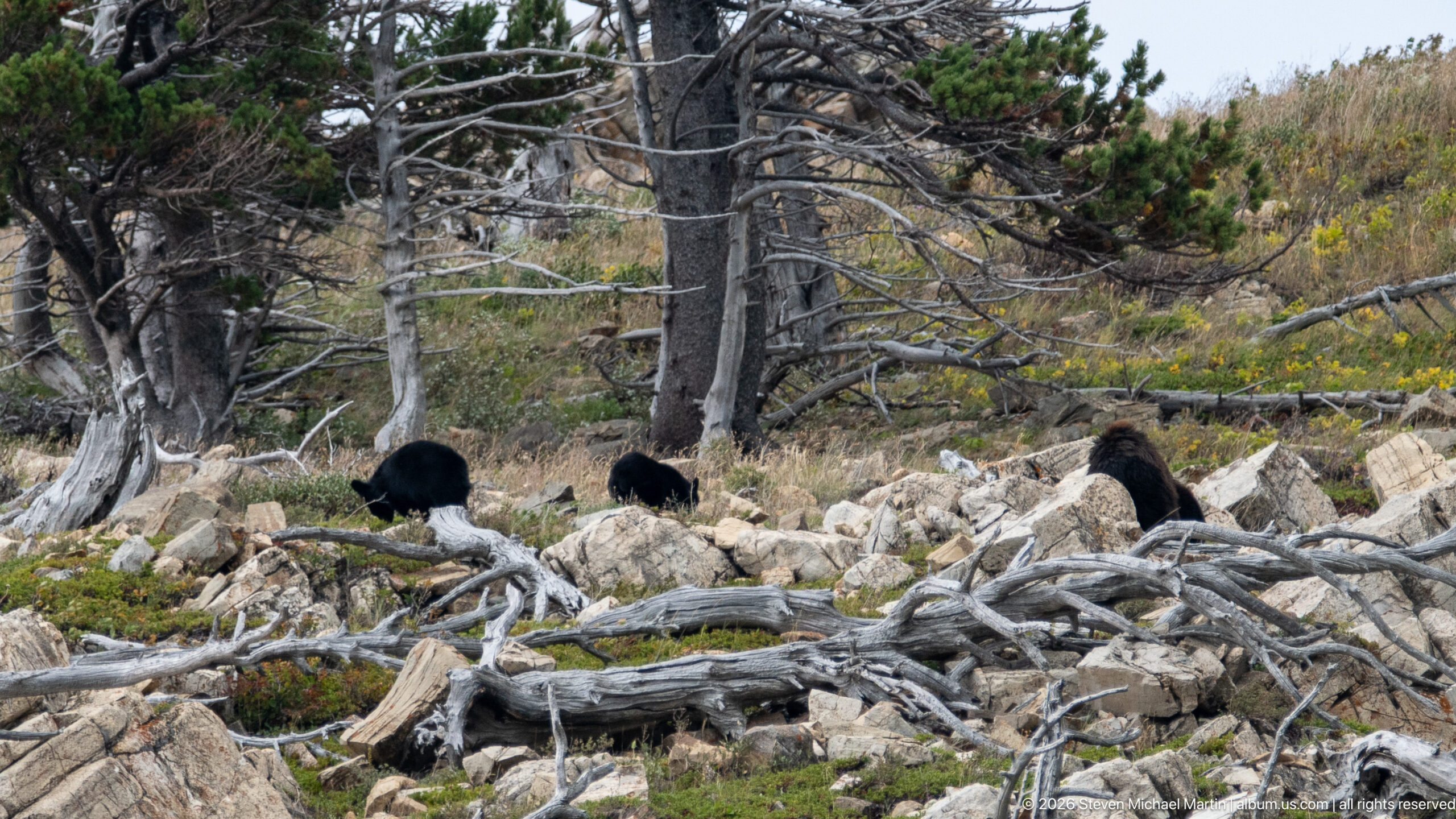
Three black bears forage or move across a broken slope, separated by pale rocks and fallen timber beneath tall conifer trunks. The broadest view of the sequence places the animals within their habitat, where gray deadwood, exposed stone, and patchy vegetation fragment their silhouettes and make each bear easy to overlook.
Caption
Three black bears forage or move across a broken slope, separated by pale rocks and fallen timber beneath tall conifer trunks. The broadest view of the sequence places the animals within their habitat, where gray deadwood, exposed stone, and patchy vegetation fragment their silhouettes and make each bear easy to overlook.
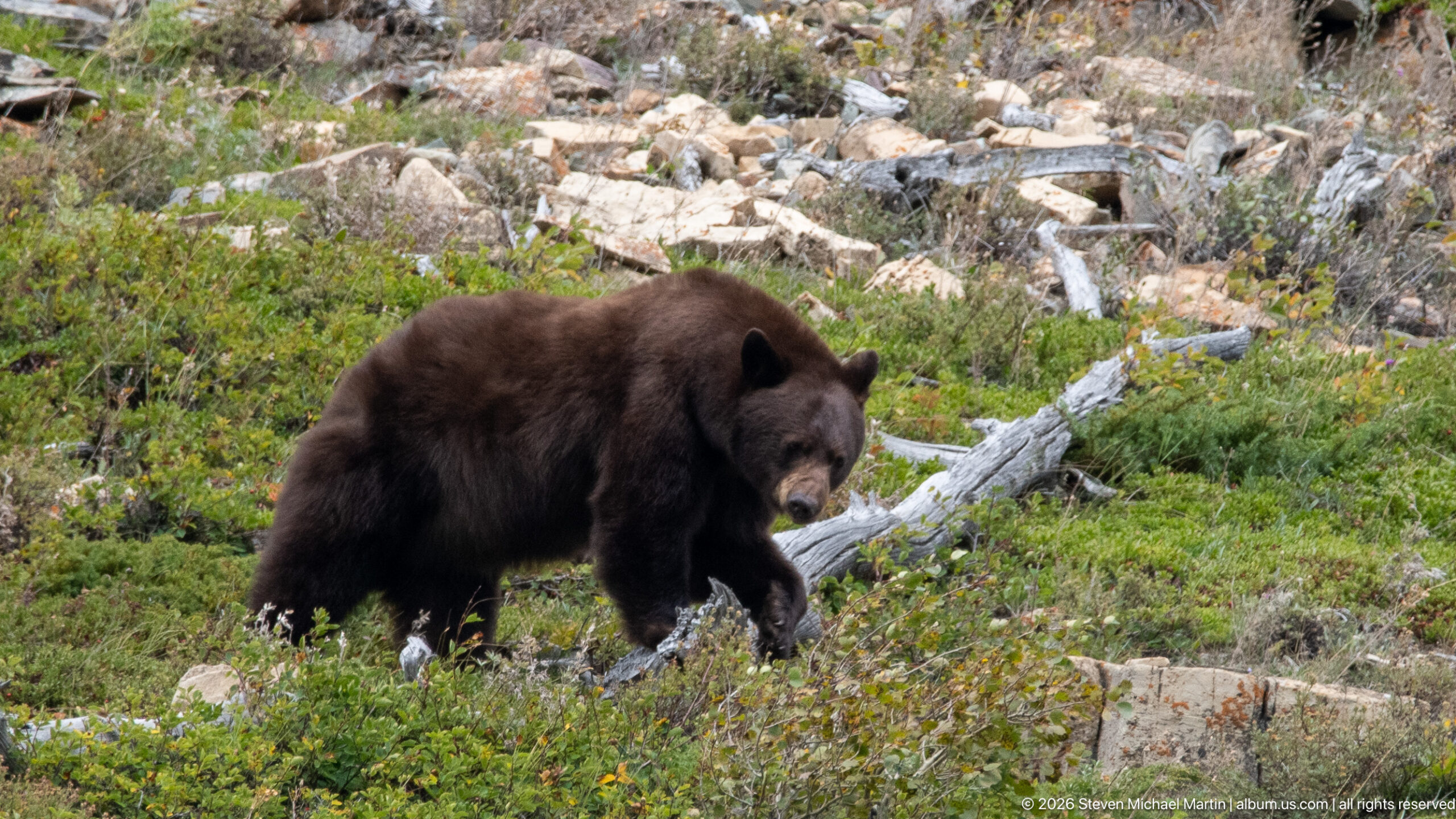
A cinnamon-colored black bear moves across low subalpine vegetation and pale rock fragments beside fallen wood. Its dark legs and muzzle contrast with the warm brown coat, while the open, broken terrain gives a clear view of the animal’s powerful shoulders and deliberate foraging posture along the Many Glacier Road corridor.
Caption
A cinnamon-colored black bear moves across low subalpine vegetation and pale rock fragments beside fallen wood. Its dark legs and muzzle contrast with the warm brown coat, while the open, broken terrain gives a clear view of the animal’s powerful shoulders and deliberate foraging posture along the Many Glacier Road corridor.
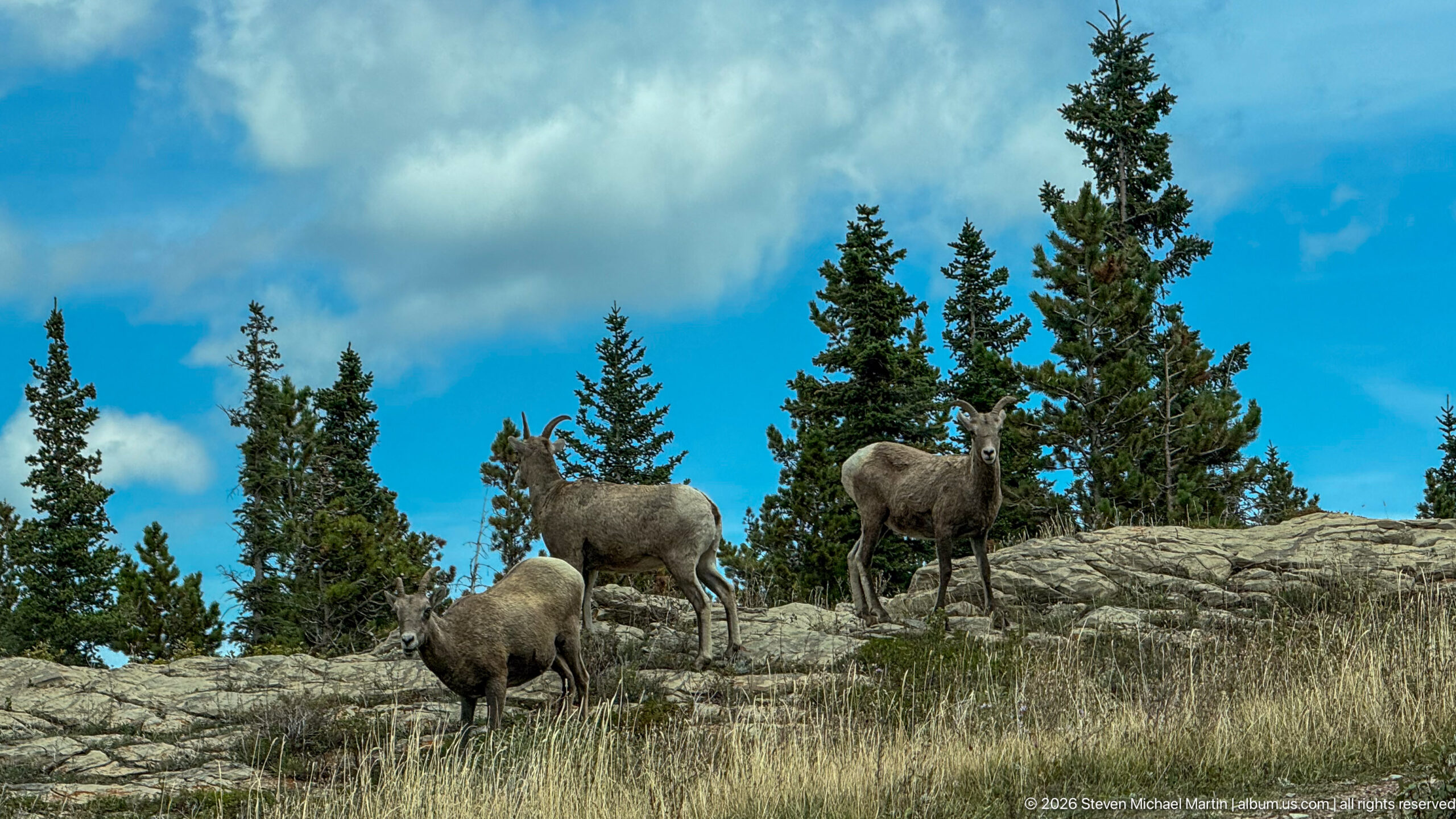
Three bighorn sheep occupy separate levels of a rocky rise beneath conifers, creating a compact study of mountain wildlife in steep terrain. One animal grazes with its head down while two stand alert above it, their pale rumps, sturdy bodies, and curved horns visible against the blue sky and weathered stone.
Caption
Three bighorn sheep occupy separate levels of a rocky rise beneath conifers, creating a compact study of mountain wildlife in steep terrain. One animal grazes with its head down while two stand alert above it, their pale rumps, sturdy bodies, and curved horns visible against the blue sky and weathered stone.
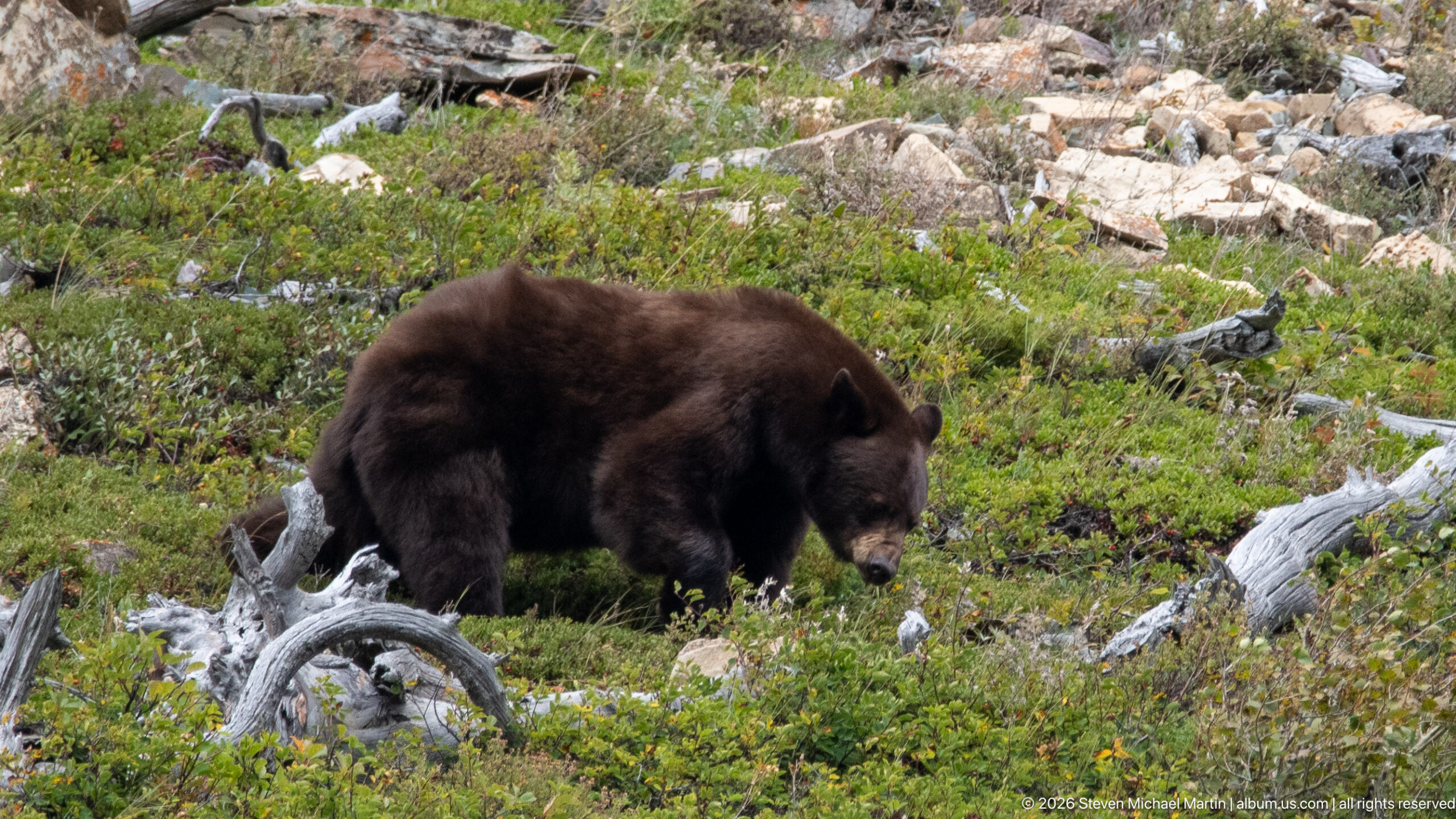
Head lowered close to the ground, a cinnamon-colored black bear searches through dense low vegetation between bleached trunks and scattered stones. The side view reveals the animal’s compact profile and dark lower legs, while the tangle of deadwood places the bear within a naturally disturbed subalpine landscape along the Many Glacier Road.
Caption
Head lowered close to the ground, a cinnamon-colored black bear searches through dense low vegetation between bleached trunks and scattered stones. The side view reveals the animal’s compact profile and dark lower legs, while the tangle of deadwood places the bear within a naturally disturbed subalpine landscape along the Many Glacier Road.
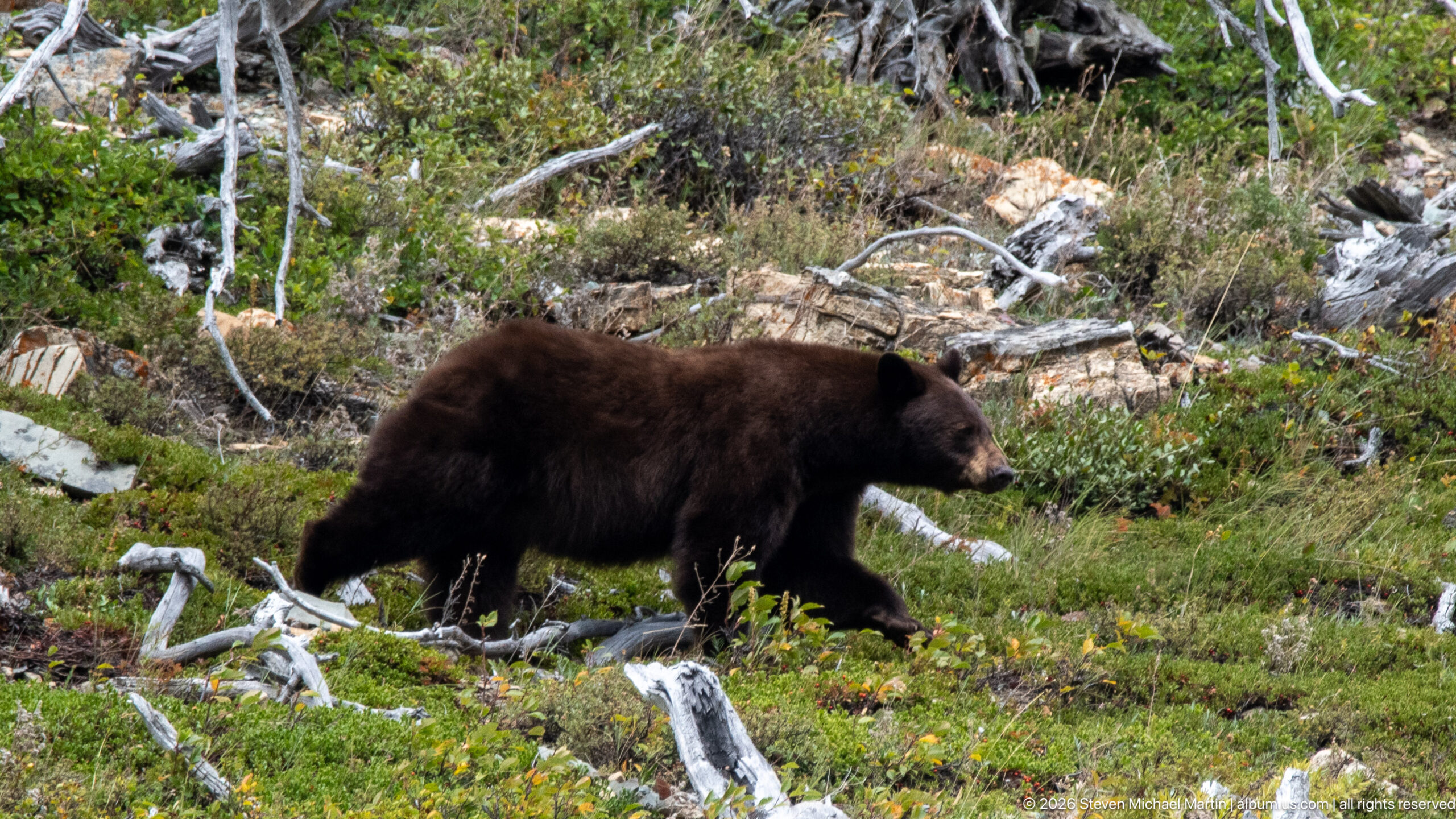
A cinnamon-colored black bear strides through a patchwork of low shrubs, stones, and sun-bleached fallen branches. Seen in full profile, the animal’s long step and forward gaze distinguish this frame from nearby foraging views, emphasizing movement through the open subalpine ground rather than feeding behavior.
Caption
A cinnamon-colored black bear strides through a patchwork of low shrubs, stones, and sun-bleached fallen branches. Seen in full profile, the animal’s long step and forward gaze distinguish this frame from nearby foraging views, emphasizing movement through the open subalpine ground rather than feeding behavior.
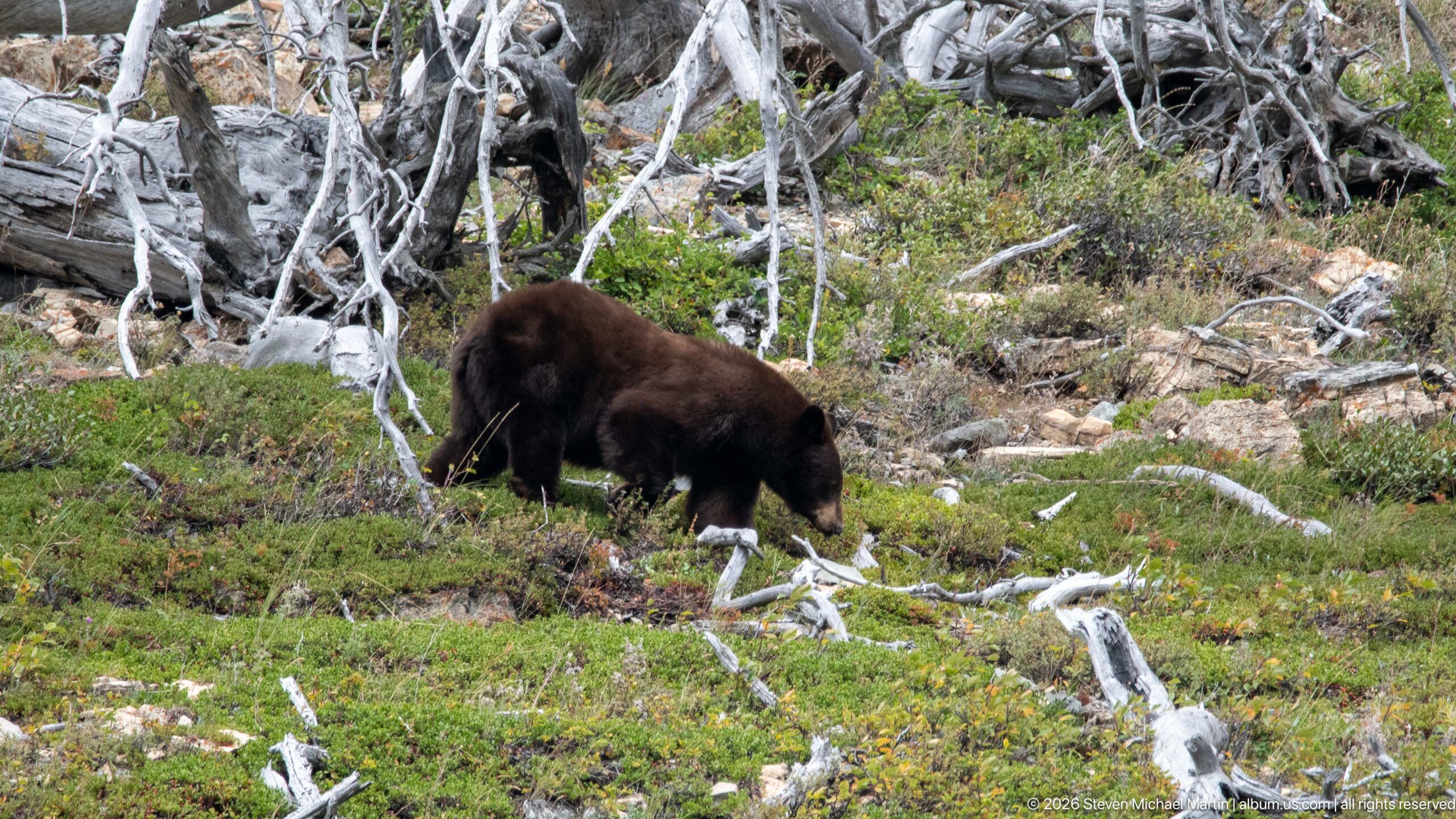
A cinnamon-colored black bear pauses with its head down amid low shrubs and a striking lattice of gray standing and fallen deadwood. The animal occupies a relatively small portion of the frame, allowing the surrounding weathered trunks and rocky ground to convey the scale and complexity of its subalpine habitat.
Caption
A cinnamon-colored black bear pauses with its head down amid low shrubs and a striking lattice of gray standing and fallen deadwood. The animal occupies a relatively small portion of the frame, allowing the surrounding weathered trunks and rocky ground to convey the scale and complexity of its subalpine habitat.
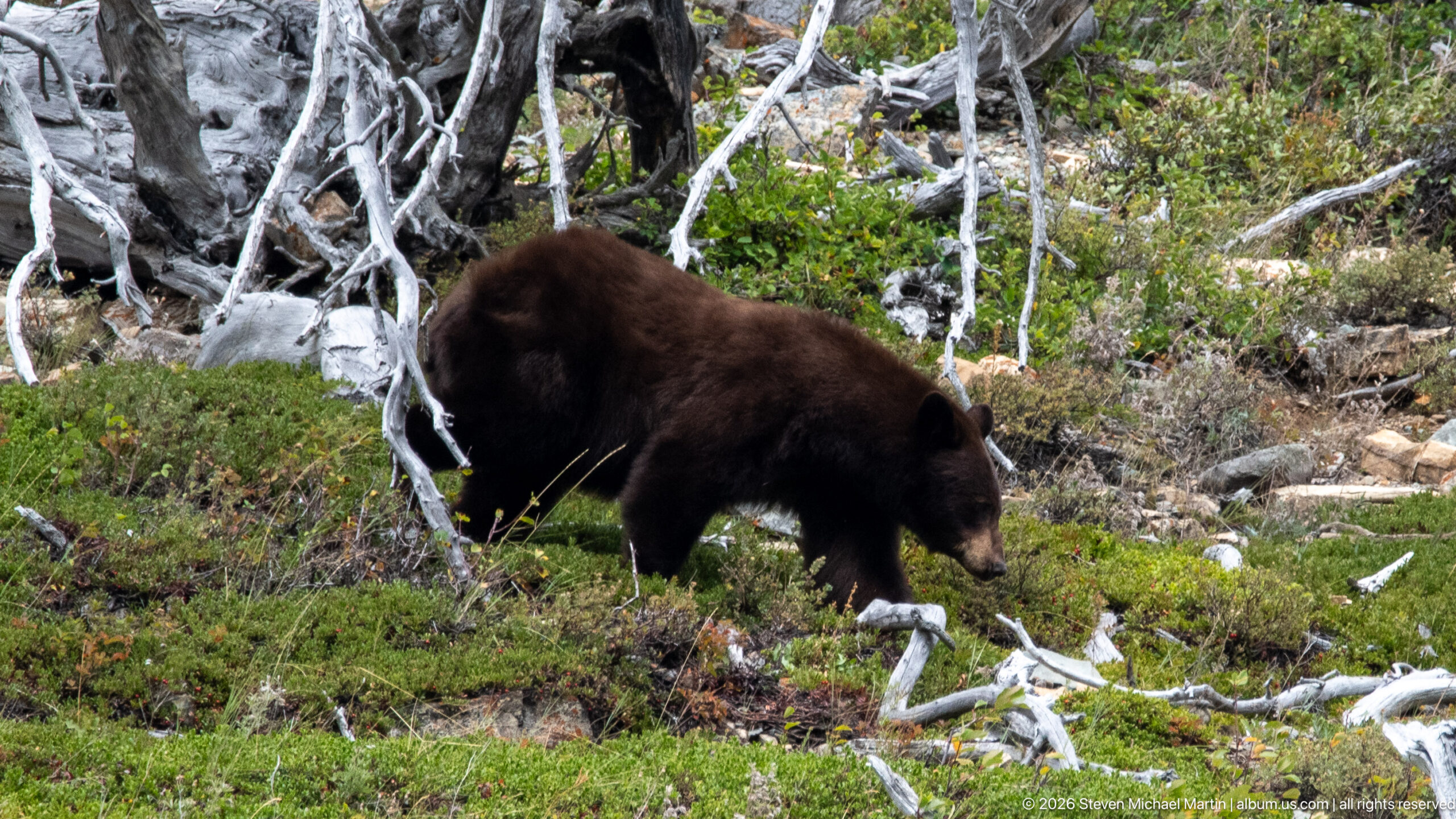
A cinnamon-colored black bear advances through low green shrubs at the base of a pale, weathered tree trunk. The closer framing emphasizes its shaggy brown coat, dark forelegs, rounded ears, and lowered muzzle, while scattered rock and bleached branches identify the open, rugged character of the surrounding slope.
Caption
A cinnamon-colored black bear advances through low green shrubs at the base of a pale, weathered tree trunk. The closer framing emphasizes its shaggy brown coat, dark forelegs, rounded ears, and lowered muzzle, while scattered rock and bleached branches identify the open, rugged character of the surrounding slope.
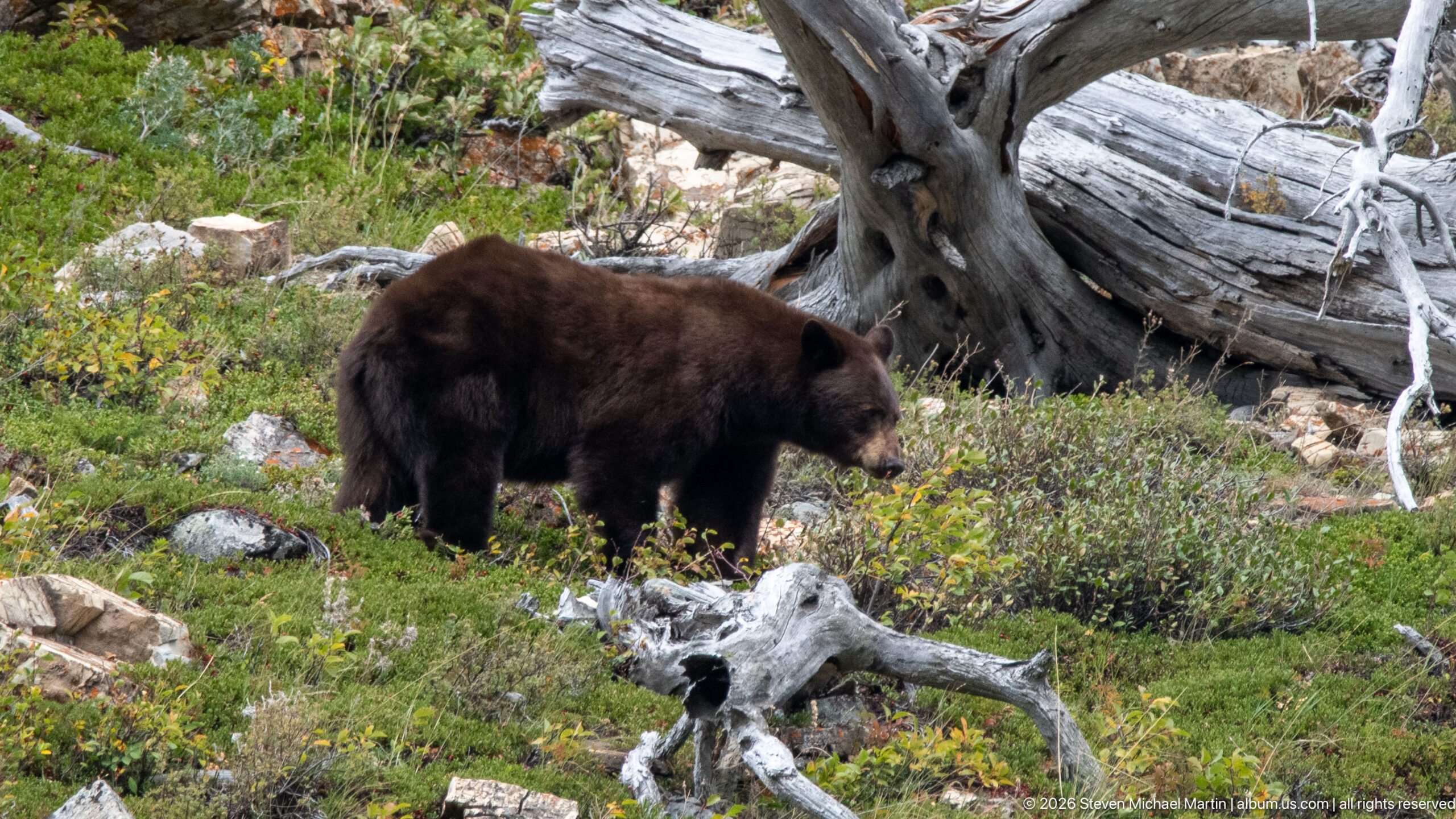
A cinnamon-colored black bear stands amid low vegetation beside the sculptural roots and trunk of a large bleached fallen tree. The animal’s side profile remains clear against the green groundcover, while the oversized deadwood behind it gives the scene a strong sense of scale and the rough texture of subalpine habitat.
Caption
A cinnamon-colored black bear stands amid low vegetation beside the sculptural roots and trunk of a large bleached fallen tree. The animal’s side profile remains clear against the green groundcover, while the oversized deadwood behind it gives the scene a strong sense of scale and the rough texture of subalpine habitat.
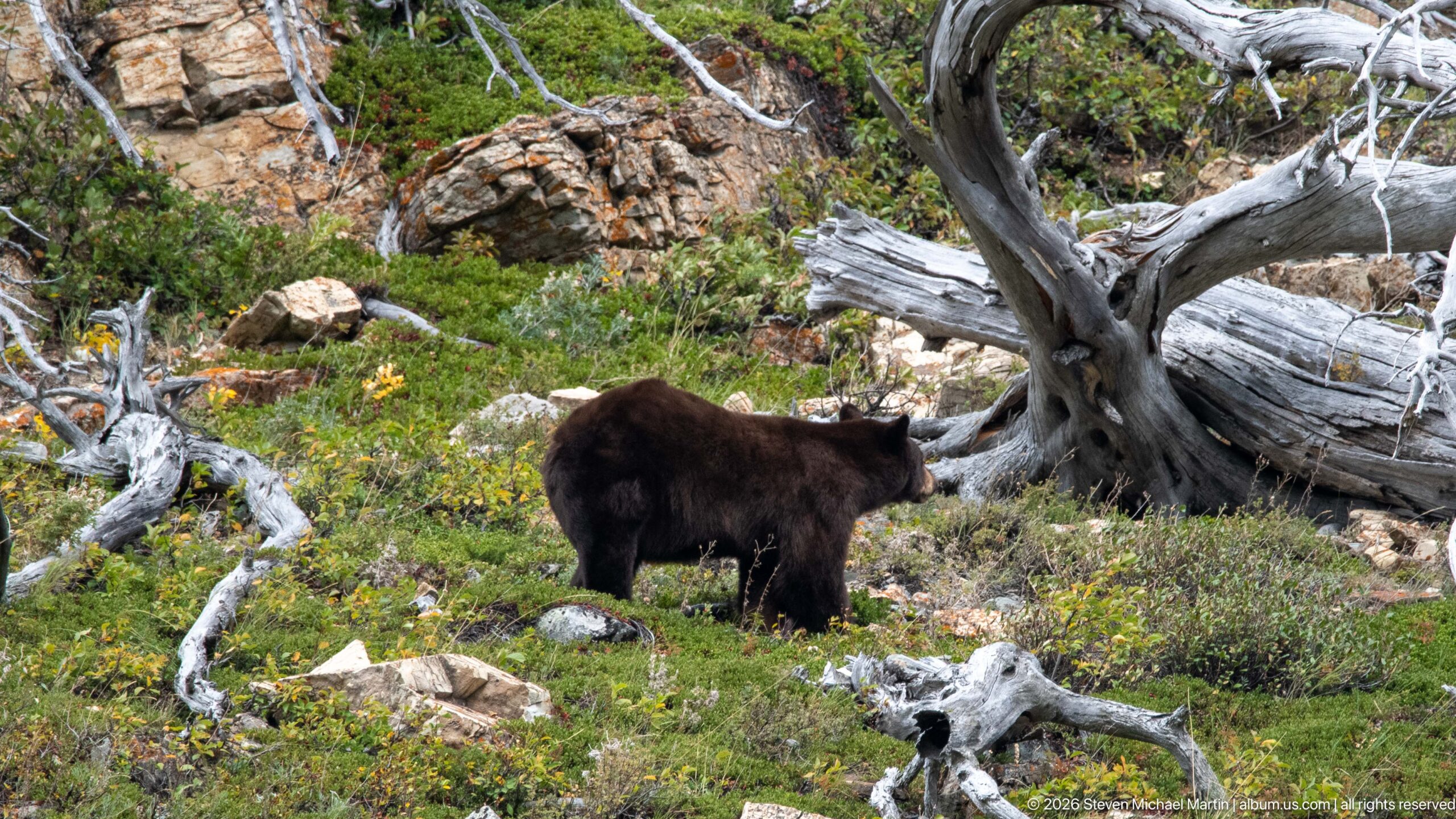
A cinnamon-colored black bear stands nearly broadside in a small clearing framed by bleached trunks, broken rock, and low shrubs. Compared with tighter wildlife portraits, this view gives greater weight to the surrounding terrain, showing how the bear blends into a mosaic of brown stone, gray wood, and late-season vegetation.
Caption
A cinnamon-colored black bear stands nearly broadside in a small clearing framed by bleached trunks, broken rock, and low shrubs. Compared with tighter wildlife portraits, this view gives greater weight to the surrounding terrain, showing how the bear blends into a mosaic of brown stone, gray wood, and late-season vegetation.
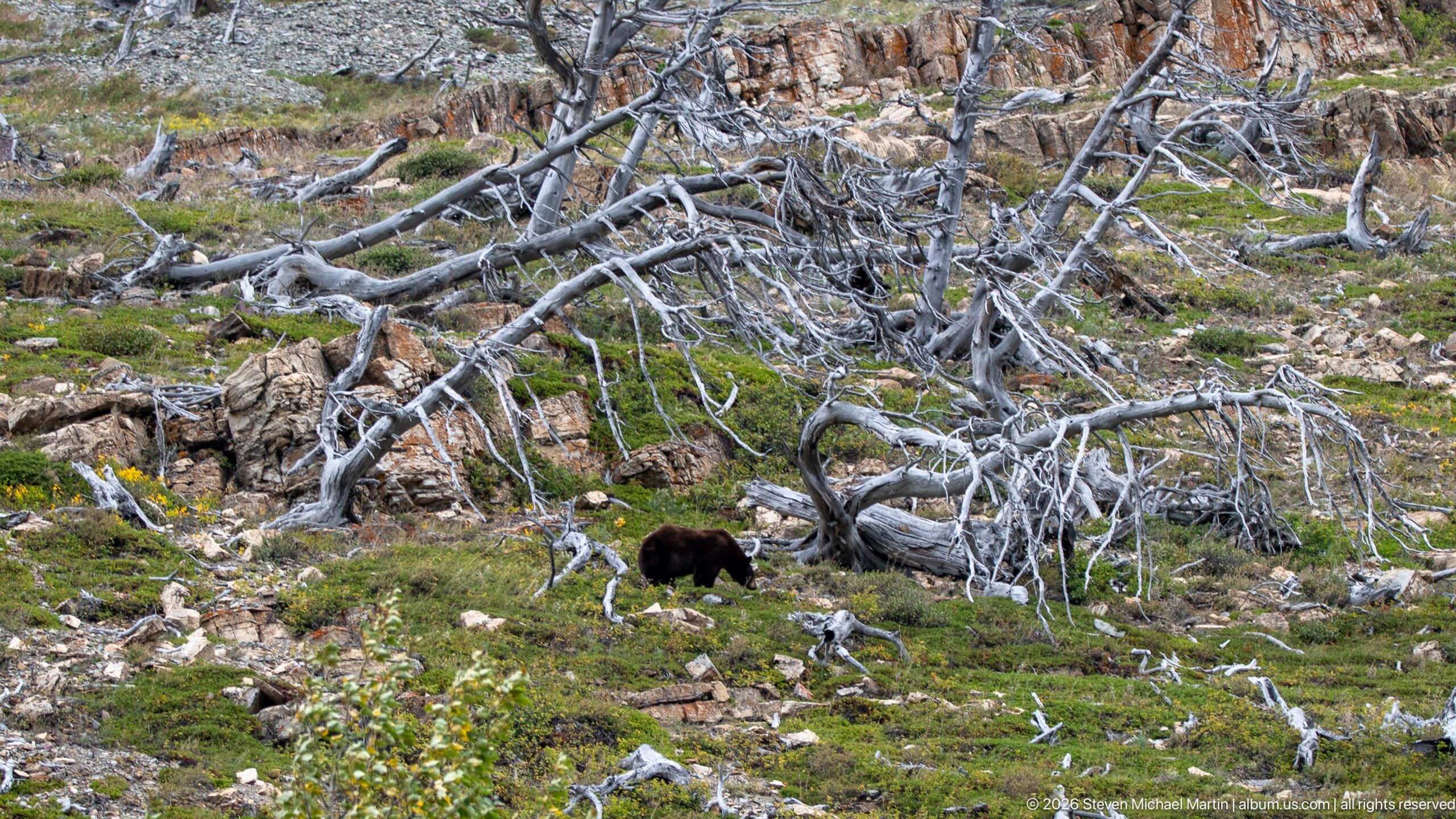
A small cinnamon-colored black bear moves through an expansive field of weathered trunks, broken branches, rocks, and low groundcover. The wide composition shifts attention from portraiture to habitat, making the bear’s dark form a modest element within a complex subalpine landscape shaped by fallen and standing deadwood.
Caption
A small cinnamon-colored black bear moves through an expansive field of weathered trunks, broken branches, rocks, and low groundcover. The wide composition shifts attention from portraiture to habitat, making the bear’s dark form a modest element within a complex subalpine landscape shaped by fallen and standing deadwood.
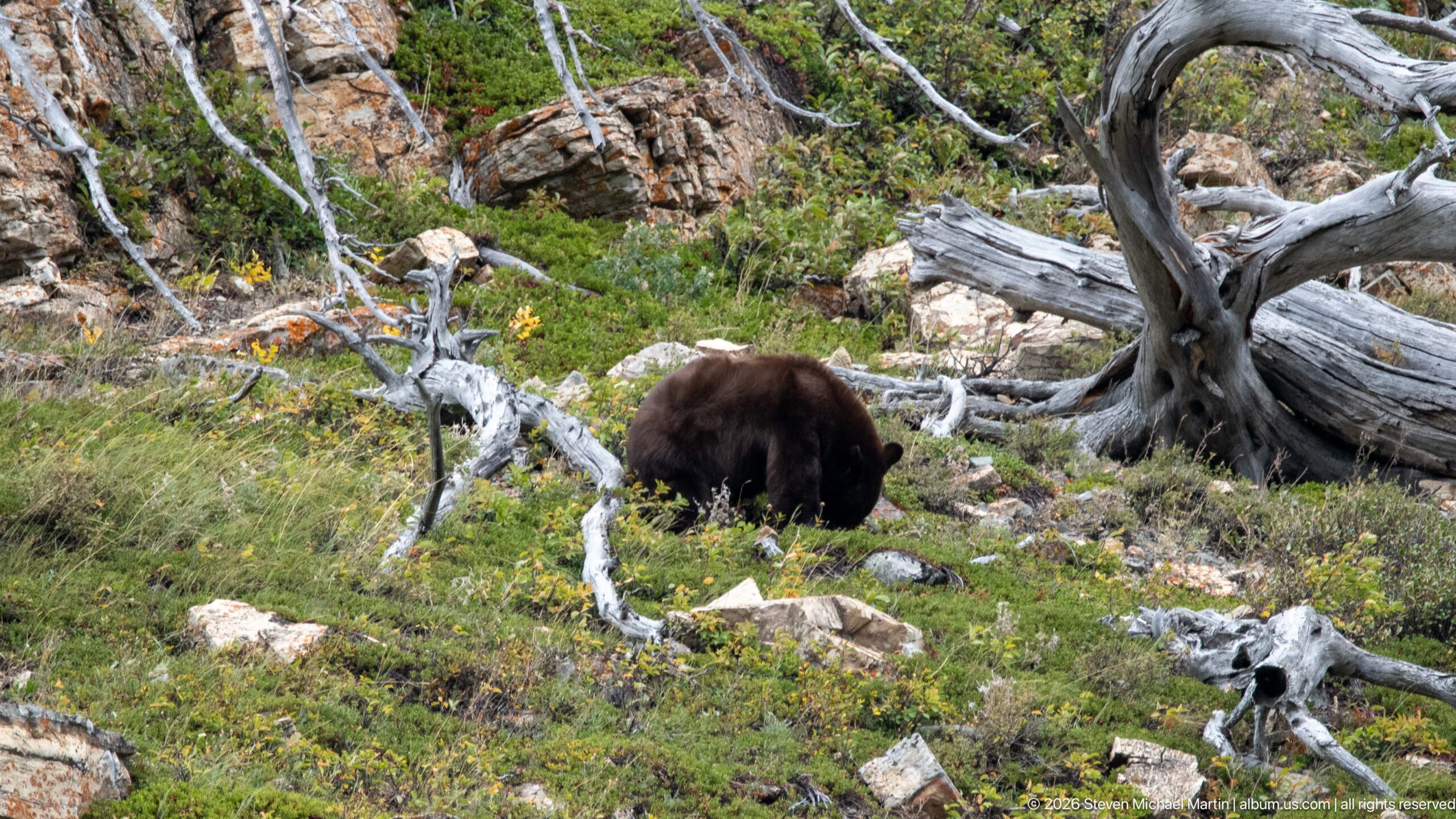
A cinnamon-colored black bear noses through low vegetation in an open pocket between pale fallen trunks and exposed rock. Its rounded back and lowered head create a compact silhouette at the center of the frame, while the surrounding deadwood and patchy groundcover place the foraging animal within rugged subalpine terrain.
Caption
A cinnamon-colored black bear noses through low vegetation in an open pocket between pale fallen trunks and exposed rock. Its rounded back and lowered head create a compact silhouette at the center of the frame, while the surrounding deadwood and patchy groundcover place the foraging animal within rugged subalpine terrain.
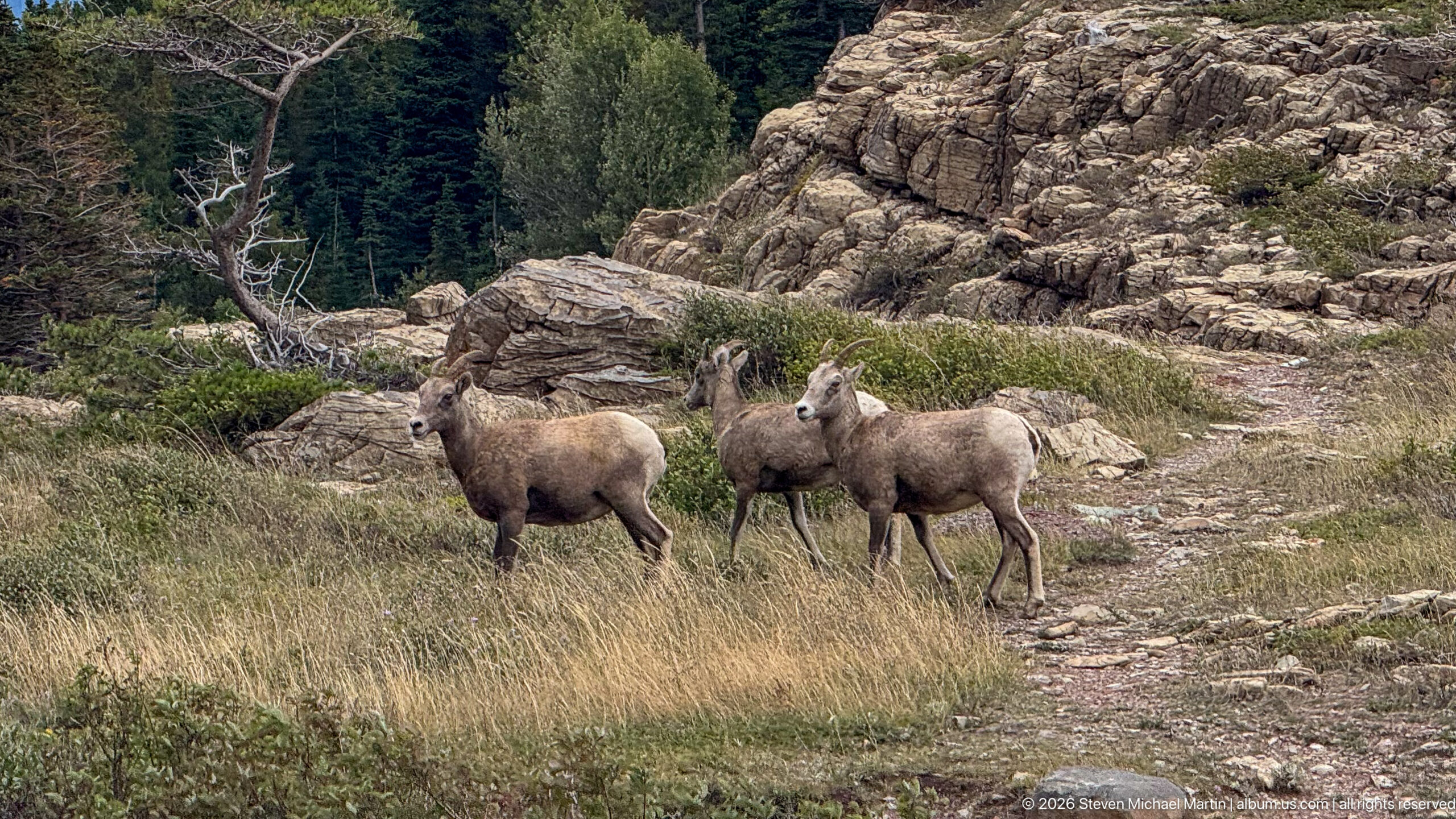
Two bighorn sheep stand together at the edge of a grassy opening backed by layered rock outcrops. Their heavy bodies, pale rumps, and curved horns are sharply visible in side view, while the sparse grasses and broken stone reinforce the steep, dry mountain setting characteristic of their habitat.
Caption
Two bighorn sheep stand together at the edge of a grassy opening backed by layered rock outcrops. Their heavy bodies, pale rumps, and curved horns are sharply visible in side view, while the sparse grasses and broken stone reinforce the steep, dry mountain setting characteristic of their habitat.
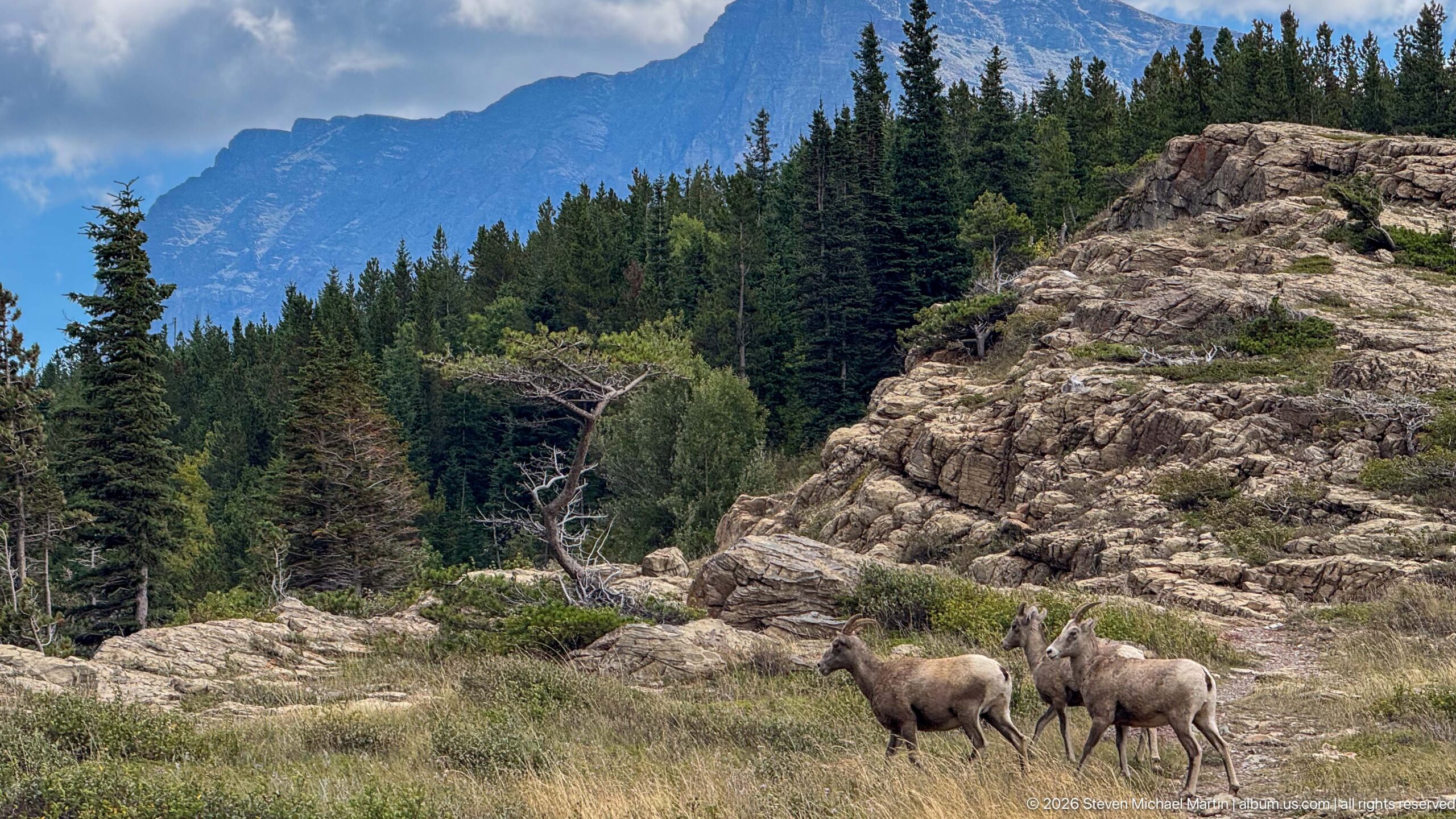
Two bighorn sheep walk across tawny grass at the foot of a rugged rock formation, with dark conifers and a distant mountain wall rising behind them. The wider viewpoint turns the animals into part of a layered landscape, linking open forage, exposed stone, forest, and high relief in a single Many Glacier scene.
Caption
Two bighorn sheep walk across tawny grass at the foot of a rugged rock formation, with dark conifers and a distant mountain wall rising behind them. The wider viewpoint turns the animals into part of a layered landscape, linking open forage, exposed stone, forest, and high relief in a single Many Glacier scene.
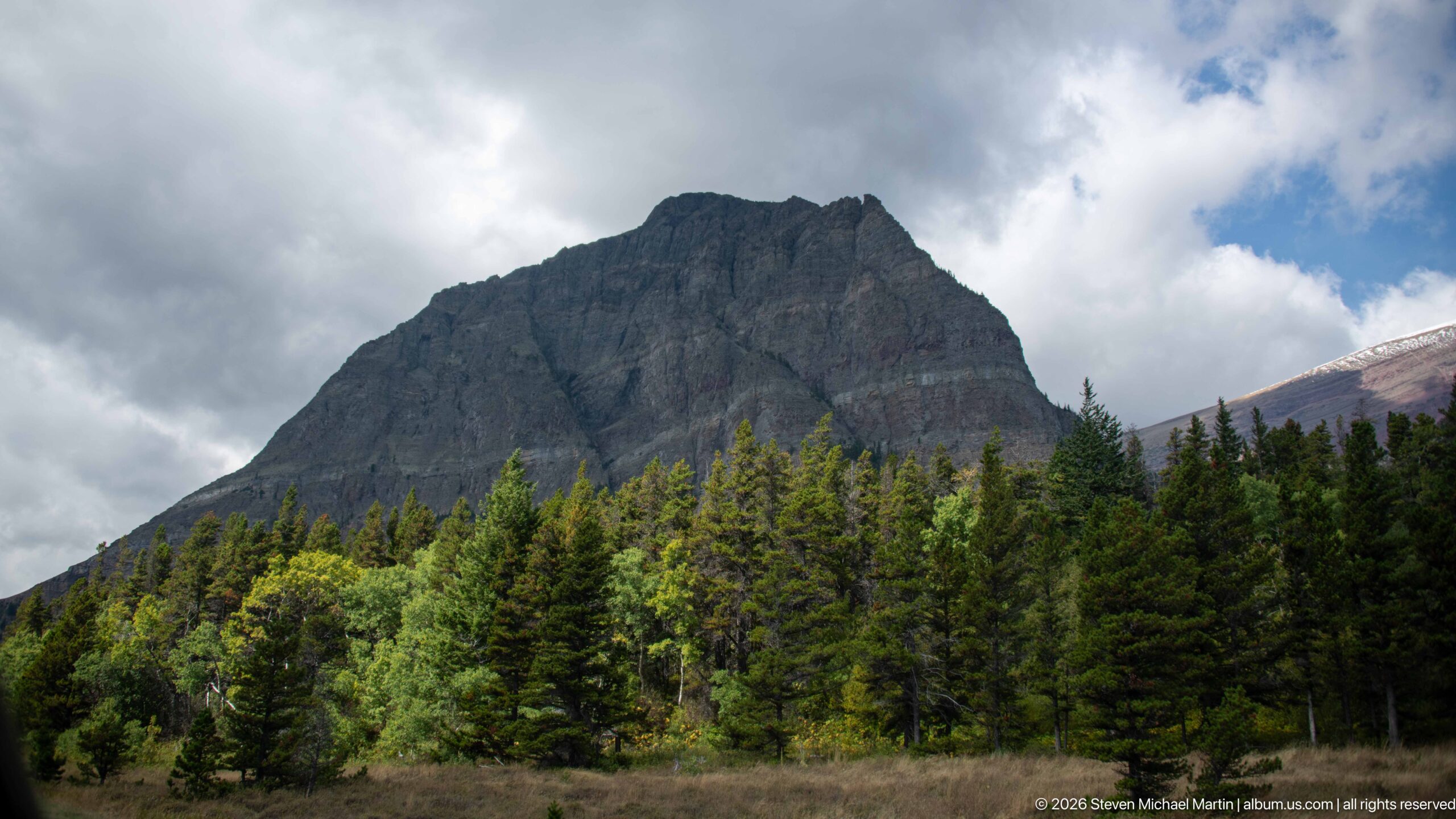
A steep, dark mountain face rises abruptly above a band of conifers and bright green deciduous trees along the Many Glacier Road. Broken cloud cover softens the upper slopes while sunlight catches portions of the forest, creating a strong contrast between the massive rock wall and the varied vegetation at its base.
Caption
A steep, dark mountain face rises abruptly above a band of conifers and bright green deciduous trees along the Many Glacier Road. Broken cloud cover softens the upper slopes while sunlight catches portions of the forest, creating a strong contrast between the massive rock wall and the varied vegetation at its base.
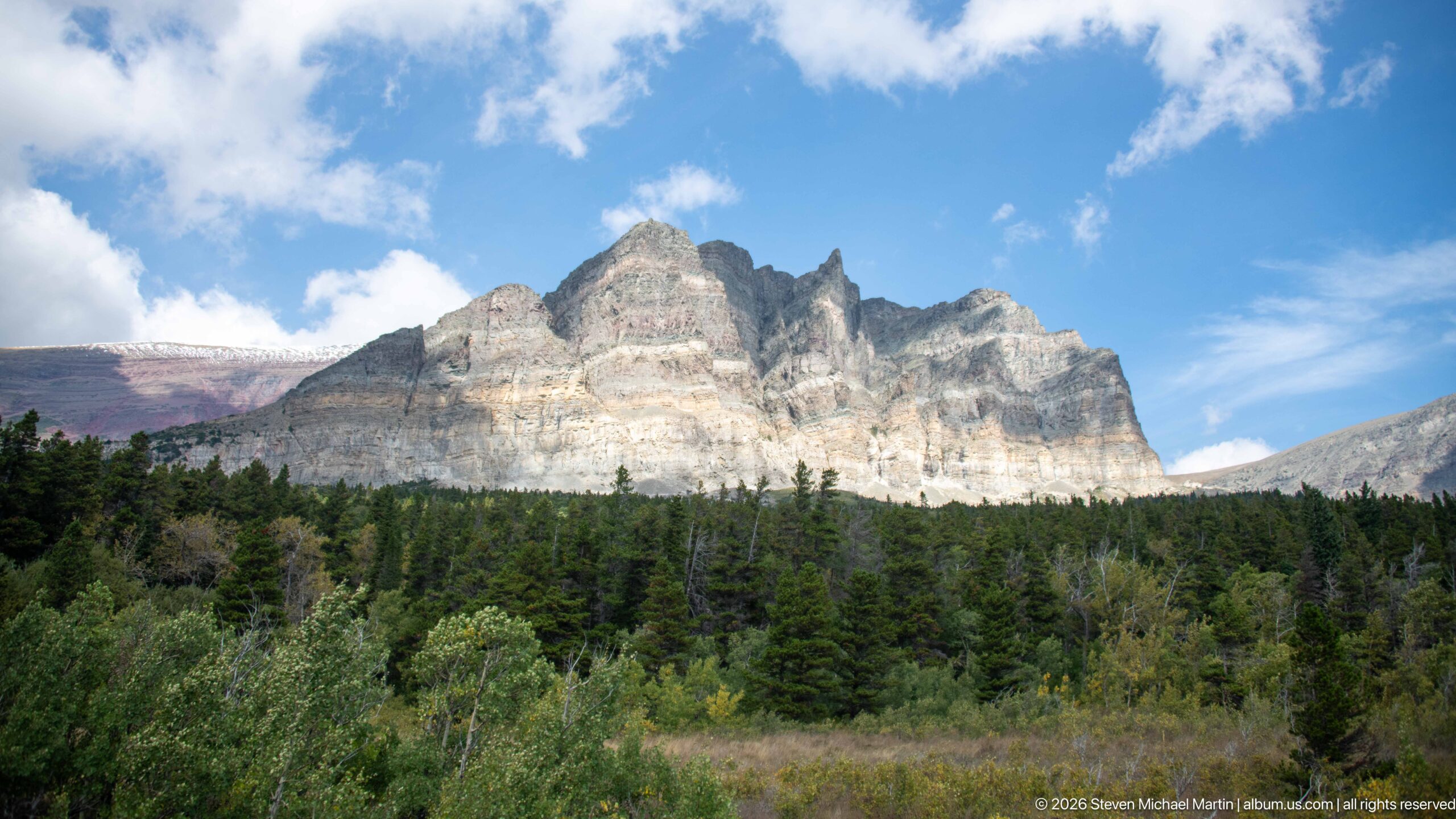
Sunlight breaks across a pale, strongly layered mountain ridge above dense conifer forest and low meadow vegetation. The ridge’s serrated crest and horizontal bands of exposed rock stand out against patches of blue sky and passing cloud, providing a clear view of the dramatic geology that frames the Many Glacier corridor.
Caption
Sunlight breaks across a pale, strongly layered mountain ridge above dense conifer forest and low meadow vegetation. The ridge’s serrated crest and horizontal bands of exposed rock stand out against patches of blue sky and passing cloud, providing a clear view of the dramatic geology that frames the Many Glacier corridor.
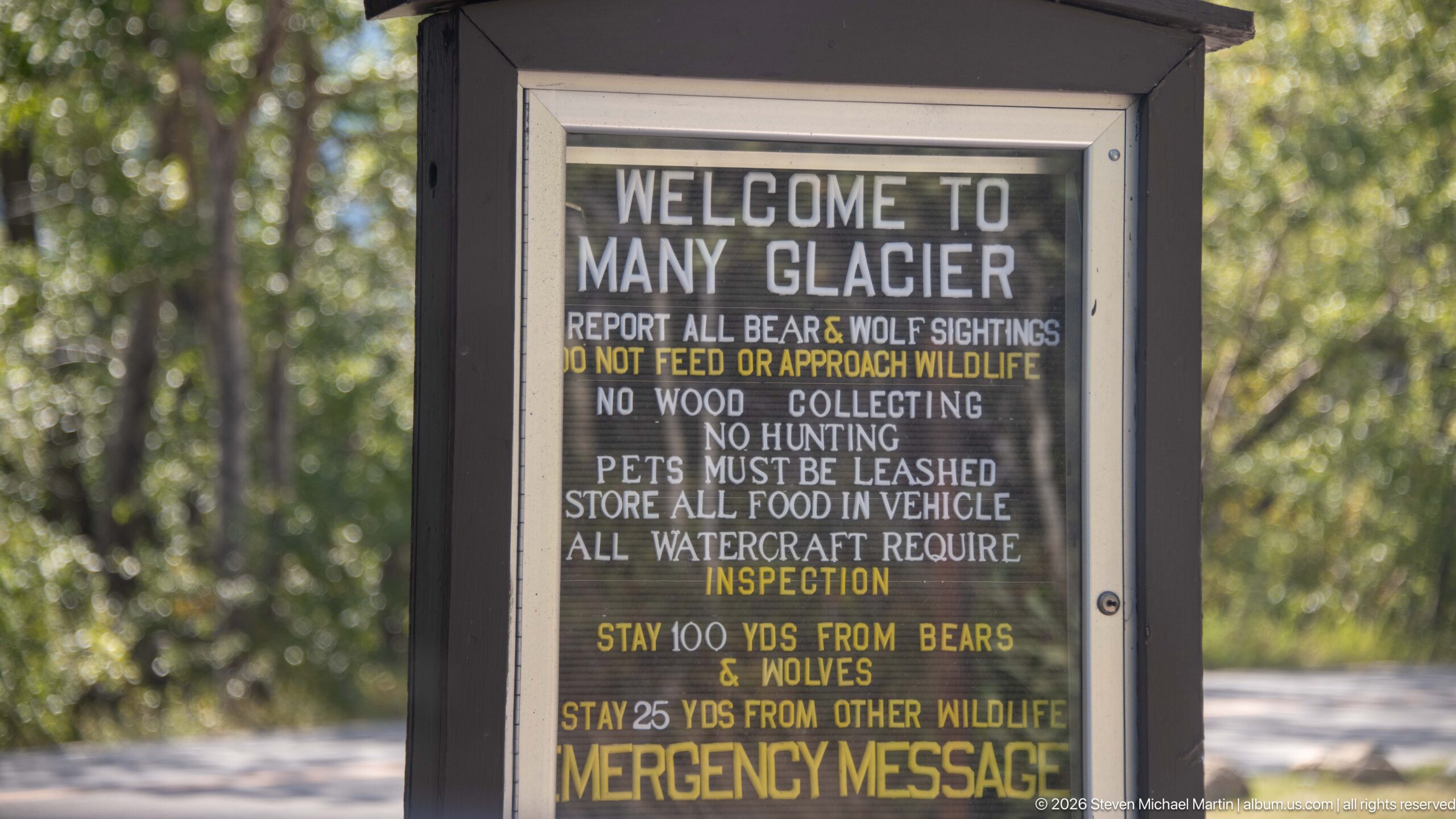
A “Welcome to Many Glacier” sign presents wildlife and visitor regulations at the entrance area, including instructions not to feed or approach wildlife, leash pets, store food securely, and maintain distance from bears and other animals. The tightly framed sign documents the practical conservation rules that shape visitor behavior in this wildlife-rich national park setting.
Caption
A “Welcome to Many Glacier” sign presents wildlife and visitor regulations at the entrance area, including instructions not to feed or approach wildlife, leash pets, store food securely, and maintain distance from bears and other animals. The tightly framed sign documents the practical conservation rules that shape visitor behavior in this wildlife-rich national park setting.
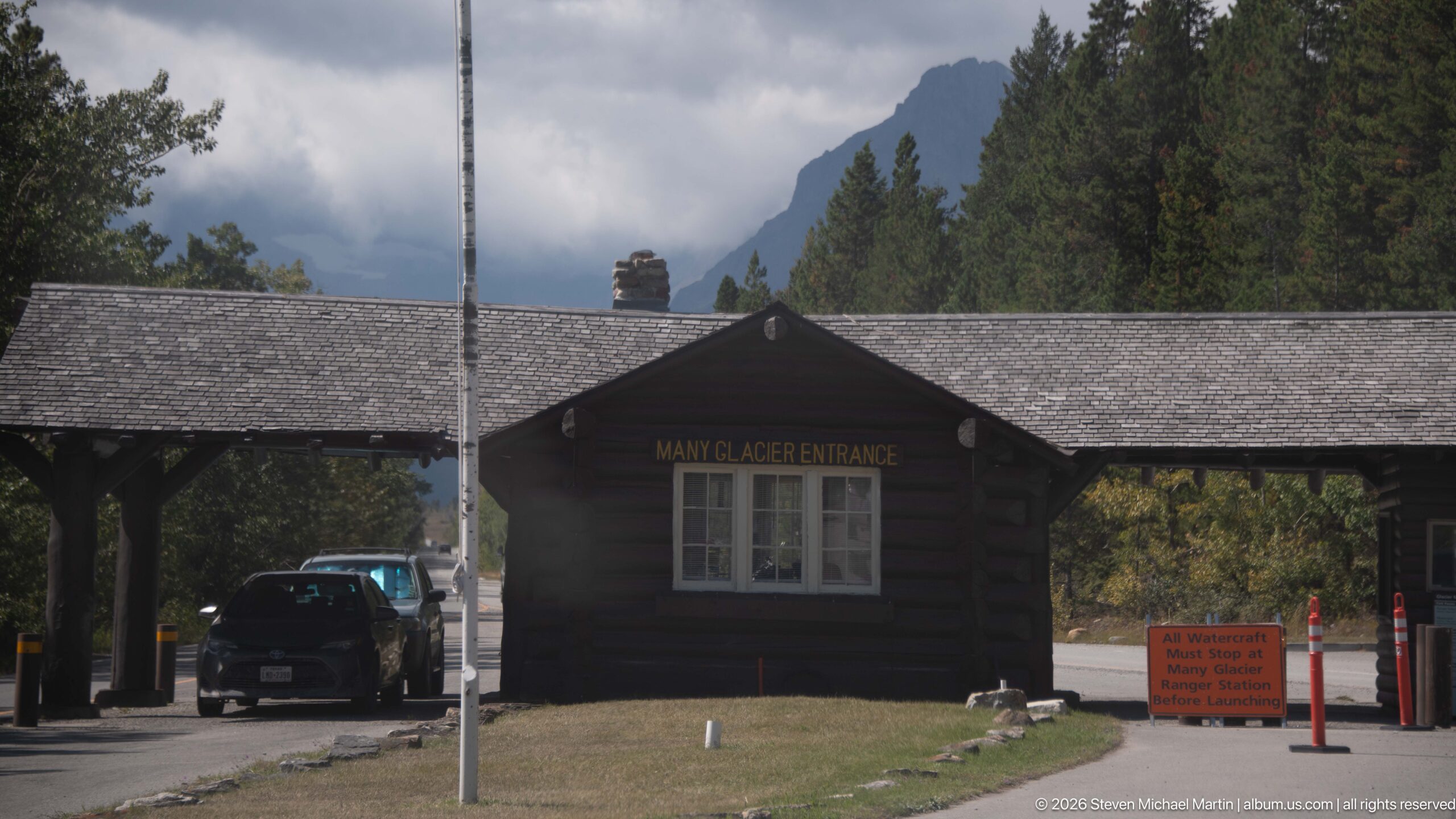
The Many Glacier Entrance station spans the roadway with a central dark-log office and covered vehicle lanes beneath an extended shingled roof. Gold lettering identifies the entrance, while a vehicle, gate equipment, and roadside sign place the rustic structure in its functional context as the controlled approach into the Many Glacier area.
Caption
The Many Glacier Entrance station spans the roadway with a central dark-log office and covered vehicle lanes beneath an extended shingled roof. Gold lettering identifies the entrance, while a vehicle, gate equipment, and roadside sign place the rustic structure in its functional context as the controlled approach into the Many Glacier area.
Field Guide
Overview
Many Glacier Road is the approach into one of Glacier National Park’s most enclosed mountain valleys, moving from open country toward Lake Sherburne and the Swiftcurrent–Many Glacier landscape. The portfolio follows that transition through steep mountain walls, conifer forest, moving water, wildlife, and the entrance area.
The road is therefore more than a connection between destinations. In the photographs, the journey itself becomes the organizing experience: mountain scenery opens and closes around the roadway, wildlife appears on nearby slopes and ledges, and watercourses draw the eye deeper into the valley.
Together, these views present the Many Glacier corridor as a place where landscape and wildlife are encountered in sequence. The photographs repeatedly connect animals to the terrain around them, making the road a useful visual introduction to the protected mountain environment ahead.
Habitat
The photographs show a varied mountain environment in close succession: fractured rocky slopes, conifer forest, low shrubs, grassy openings, stream corridors, waterfalls, and broad mountain water. These habitats overlap tightly along the Many Glacier corridor rather than appearing as isolated zones.
Black bears appear among broken rock, fallen timber, dense groundcover, and conifers. Bighorn sheep use more exposed terrain, including rocky ledges, ridges, and grassy ground below outcrops. The contrast between these settings helps explain why wildlife encounters can change so quickly along a relatively short stretch of road.
Seen as a whole, the portfolio forms a compact visual cross-section of eastern Glacier habitat. Water, forest, open vegetation, and steep rock all contribute to the character of the valley and to the settings in which its wildlife is photographed.
Key Species
Black bears and bighorn sheep dominate the wildlife sequence in this portfolio. The bears include dark-coated and cinnamon-colored individuals photographed in rocky and vegetated terrain, with one sequence showing an adult accompanied by smaller cub-sized bears.
Bighorn sheep appear singly, in pairs, and in small groups. They are repeatedly shown on exposed ledges, ridges, broken rock, and grassy openings, where their bodies and movement can be read clearly against the terrain.
Because both species recur across numerous photographs, they become central characters in the road journey. Their contrasting use of dense cover and exposed rock also reinforces the variety of habitat visible along the Many Glacier corridor.
Behavior & Adaptation
The wildlife photographs emphasize movement and use of terrain rather than isolated portraits. Bighorn sheep walk across exposed rock, pause on ledges, and gather along ridges, appearing comfortable on steep and uneven ground.
Black bears are shown moving and foraging through shrubs, broken ground, rocks, and fallen wood. Several photographs catch them with their heads lowered into vegetation, while others show them resting or moving through openings beneath conifers.
The family sequence adds another behavioral dimension, with the smaller bears remaining near the adult in sheltered rocky terrain. Across the portfolio, behavior is inseparable from setting: the animals are consistently shown negotiating, feeding within, or resting in the landscapes that support them.
Conservation
The clearest visitor-facing conservation message in the portfolio appears at the Many Glacier entrance, where posted information combines a welcome to the park with wildlife regulations, including instructions not to feed wildlife.
That message has particular weight within a portfolio containing repeated close wildlife encounters. Bears and bighorn sheep are not presented as animals separated from the visitor experience; they appear directly along the travel corridor and within landscapes visible from the road.
The entrance station and its signage therefore mark more than a geographic threshold. They also introduce the responsibilities that accompany entering a protected landscape, where visitor behavior and wildlife protection are explicitly connected.
Seasonal Patterns
The photographs record the Many Glacier corridor during a period of open water, green vegetation, and active roadside wildlife. Green shrubs and deciduous foliage contrast with darker conifers, while some grassy areas show tawny tones and exposed shorelines are visible beside mountain water.
These conditions shape the appearance of both the landscape and the wildlife photographs. Bears move through leafy groundcover and mixed rocky vegetation, while bighorn sheep stand out clearly against exposed rock and open grass.
The source package does not establish a complete annual cycle, so the portfolio should be read as a record of conditions visible during this particular visit rather than as evidence for year-round seasonal patterns.
Wildlife Experience
Wildlife encounters are woven directly into the road journey. Bears appear on steep rocky slopes, among dense vegetation, and around fallen wood, while bighorn sheep occupy more open ledges and ridges where their movement is easier to follow.
The experience recorded here depends on watching the surrounding terrain rather than treating the roadway merely as transit. A broad mountain view can give way quickly to an animal on a nearby slope, and the photographs repeatedly shift between landscape-scale scenes and tighter wildlife observations.
That alternation is one of the portfolio’s defining qualities. The road provides a moving sequence in which scenery and wildlife continually reinforce one another, with the animals remaining visibly connected to the mountain environment they inhabit.
Photography Notes
The portfolio demonstrates several useful approaches to photographing the Many Glacier corridor. Wide compositions connect rivers, cascades, forest, and surrounding mountains, while tighter wildlife images retain enough surrounding terrain to show how bears and bighorn sheep occupy the landscape.
Rocky ledges provide especially clear profiles for bighorn sheep. Bears are more often photographed through branches, fallen timber, shrubs, or broken stone, making careful framing important when preserving both the animal and its habitat.
The entrance station provides a different kind of subject, placing built features and visitor information within the larger road narrative. Across the landscape photographs, changing light on layered ridges and mountain walls adds depth and helps convey the enclosed scale of the valley.