Glacier NP – Many Glacier Lodge Introduction
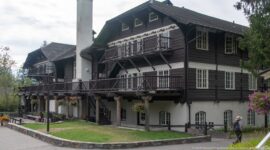
Set along the shore of Swiftcurrent Lake beneath the dramatic peaks of Glacier National Park’s Many Glacier Valley, Many Glacier Hotel occupies one of the park’s most spectacular settings. The broad, Swiss-inspired building seems almost improbably placed between the water and the mountains, with Grinnell Point rising prominently across the lake. From the hotel’s lakeside terraces and immense windows, the surrounding landscape becomes part of the architecture itself—a panorama of forested slopes, exposed rock, waterfalls, and high peaks that captures the rugged character of northeastern Glacier. Long before the hotel was built, however, this valley held deep significance for the Blackfeet, who regard the landscape as a place connected to creation, gathering, and ceremony.
The Great Northern Railway constructed Many Glacier Hotel in 1914–15 as the showpiece of its ambitious network of hotels and backcountry chalets throughout Glacier. Railway president Louis W. Hill promoted the park as the “Alps of America,” using Swiss-inspired architecture and a system of lodges linked by trails to encourage travelers to explore the mountains after arriving by train. Crews worked through severe Montana winters to complete the enormous hotel for its July 4, 1915 opening, using timber harvested nearby and milled along Swiftcurrent Lake. An additional annex completed in 1917 extended the sprawling complex along the lakeshore. With its steep roofs, balconies, exposed timbers, immense lobby, and commanding mountain setting, Many Glacier became the grandest expression of the Great Northern Railway’s vision for tourism in Glacier National Park.
More than a century later, Many Glacier Hotel remains both an operating lodge and one of Glacier National Park’s most important historic buildings. Designated a National Historic Landmark, it preserves an era when visitors reached the park by rail and continued into the mountains by touring car, horseback, or on foot, moving between grand hotels and remote chalets. After decades of exposure to harsh weather and structural deterioration, the hotel underwent an extensive rehabilitation program that restored historic features while strengthening the building for continued use. Today, visitors can wander through its soaring timbered lobby, step onto the lakeside grounds, and look across Swiftcurrent Lake toward the same mountain skyline that helped make Many Glacier one of the defining destinations of the early national park experience.
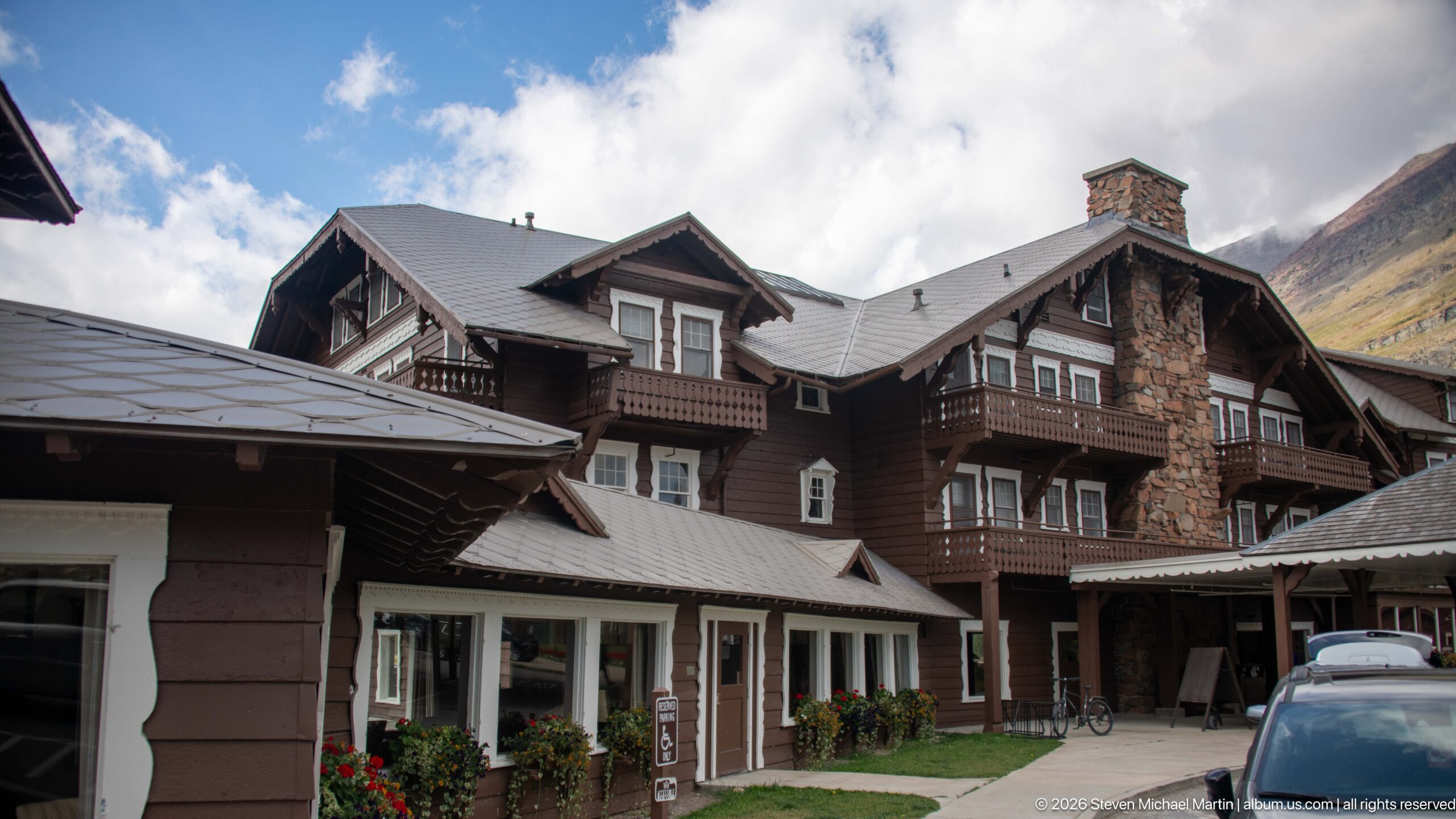
Multiple stories of Many Glacier Hotel rise around a small exterior court, revealing the building’s complex arrangement of projecting bays, balconies, dormers, and stone chimney masses. Dark siding and white-trimmed windows contrast with the gray roofs and rugged mountains beyond. This closer courtyard perspective shows how the immense lodge is assembled from interlocking wings rather than read as a single façade, creating a picturesque, deliberately irregular composition.
Caption
Multiple stories of Many Glacier Hotel rise around a small exterior court, revealing the building’s complex arrangement of projecting bays, balconies, dormers, and stone chimney masses. Dark siding and white-trimmed windows contrast with the gray roofs and rugged mountains beyond. This closer courtyard perspective shows how the immense lodge is assembled from interlocking wings rather than read as a single façade, creating a picturesque, deliberately irregular composition.
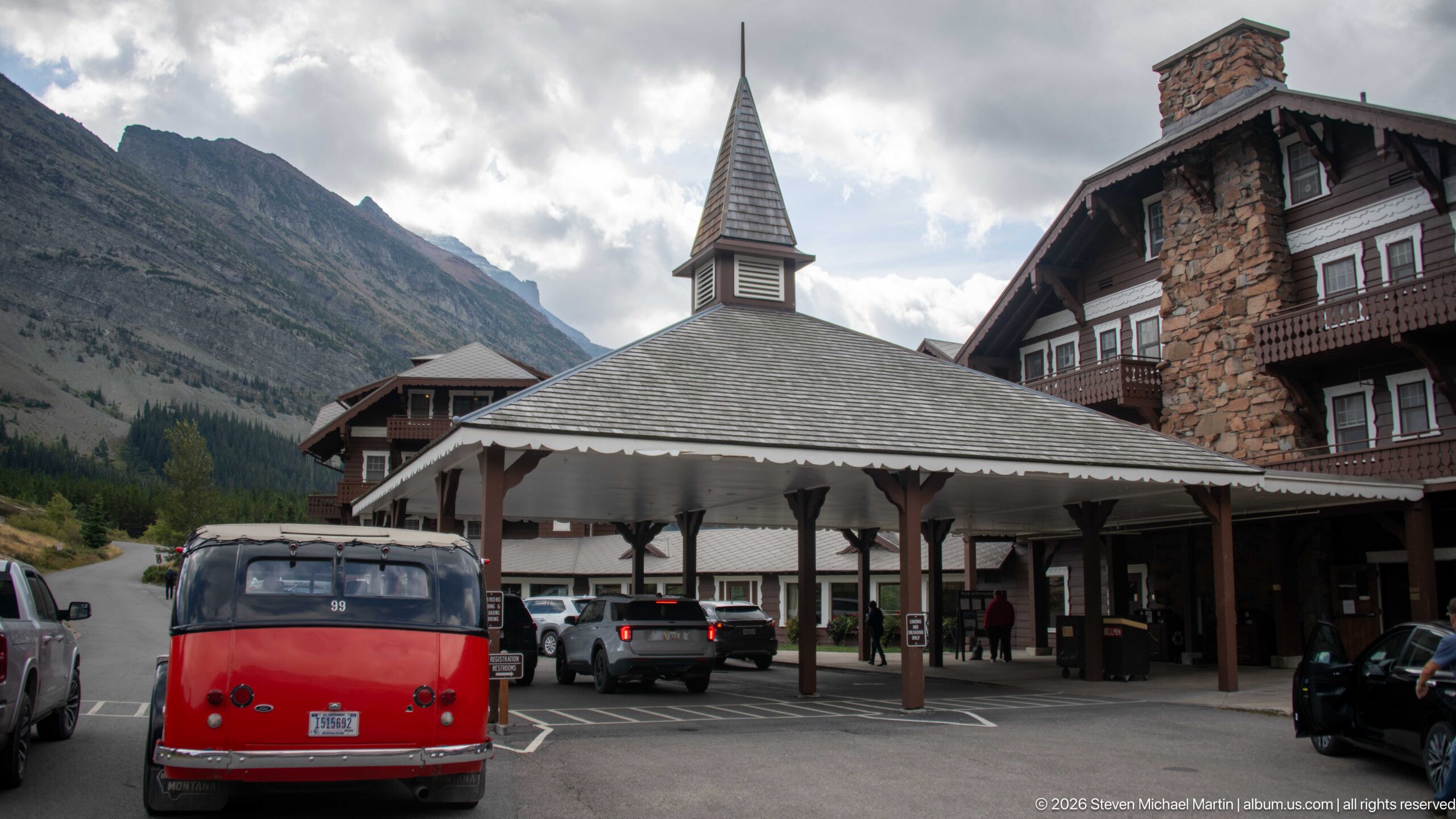
A red Glacier National Park touring bus approaches the broad covered entrance of Many Glacier Hotel, centered beneath the porte-cochère’s steep little spire. Modern vehicles occupy the surrounding drive, while the lodge’s stone chimney and upper balconies rise to the right. The frontal perspective makes the covered arrival structure the principal subject and illustrates the continuing relationship between park transportation and the historic hotel entrance.
Caption
A red Glacier National Park touring bus approaches the broad covered entrance of Many Glacier Hotel, centered beneath the porte-cochère’s steep little spire. Modern vehicles occupy the surrounding drive, while the lodge’s stone chimney and upper balconies rise to the right. The frontal perspective makes the covered arrival structure the principal subject and illustrates the continuing relationship between park transportation and the historic hotel entrance.
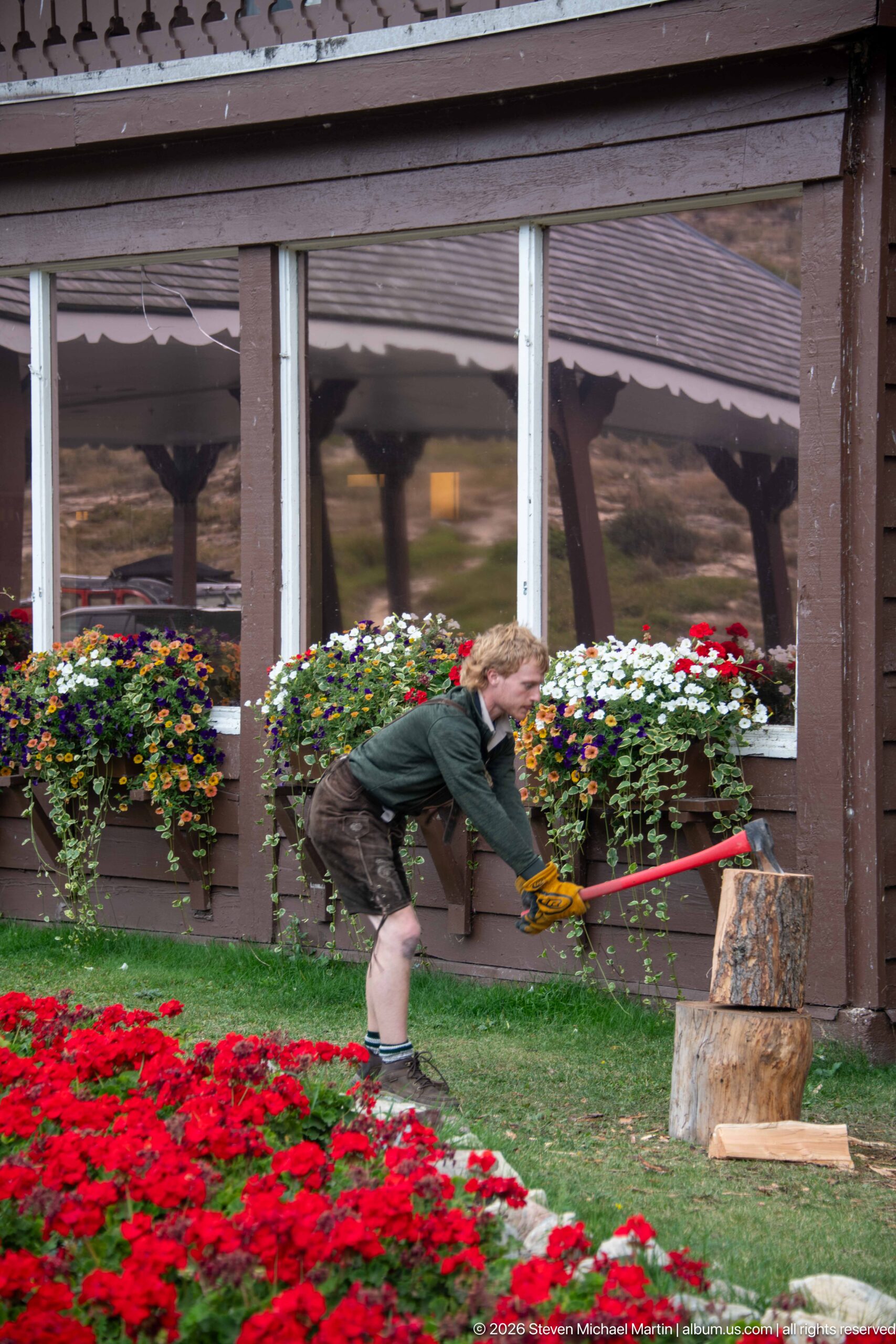
A lodge staff member drives a red-handled splitting tool into a short log set on a chopping block beside the hotel. Bright flower beds and overflowing window boxes frame the work area, creating a vivid contrast between routine outdoor labor and the carefully maintained lodge grounds. The low moment in the swing shows the tool at the wood, while split pieces nearby indicate the continuing task rather than a posed demonstration.
Caption
A lodge staff member drives a red-handled splitting tool into a short log set on a chopping block beside the hotel. Bright flower beds and overflowing window boxes frame the work area, creating a vivid contrast between routine outdoor labor and the carefully maintained lodge grounds. The low moment in the swing shows the tool at the wood, while split pieces nearby indicate the continuing task rather than a posed demonstration.
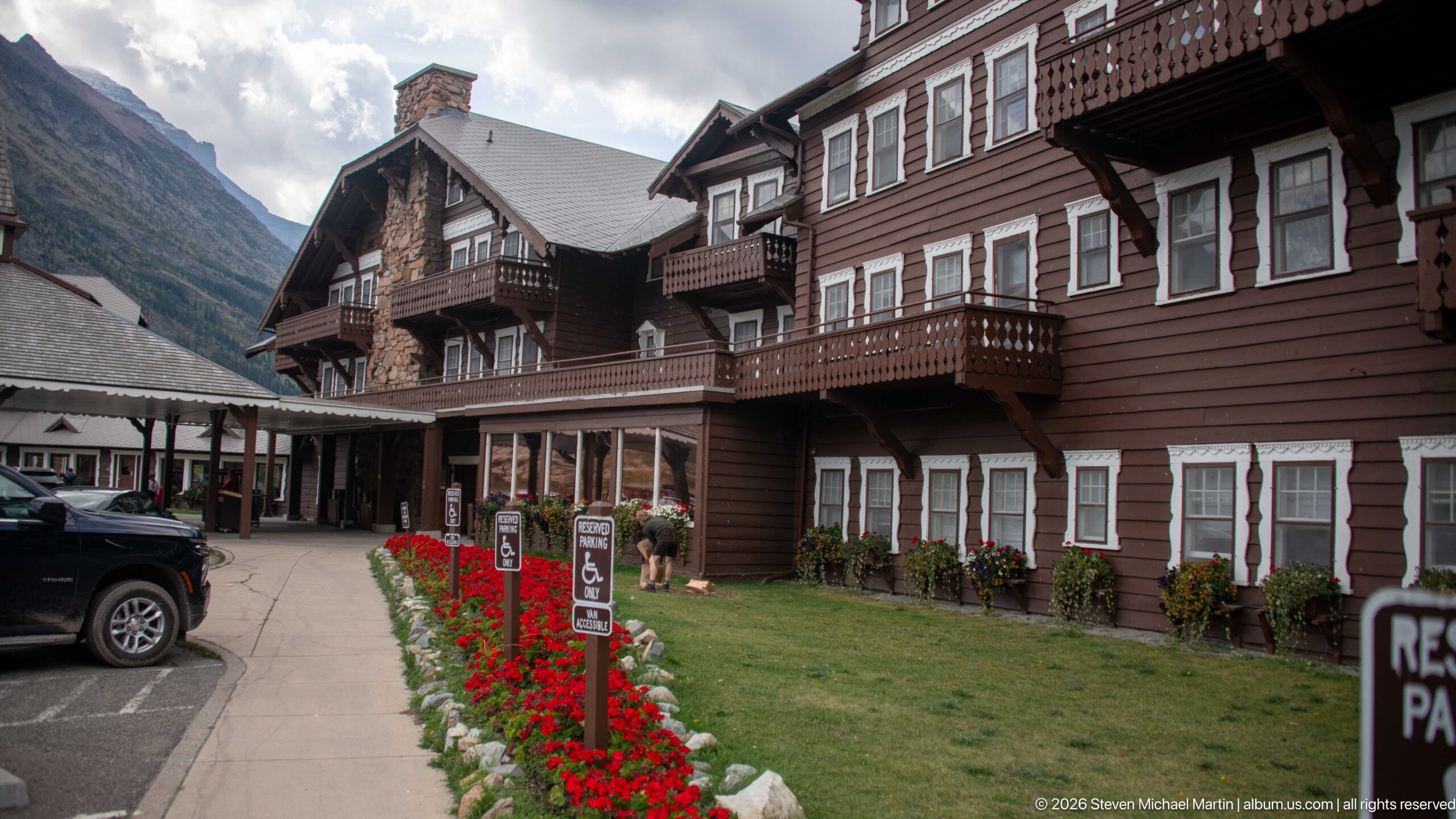
The entrance-side façade of Many Glacier Hotel extends along a narrow lawn edged with brilliant red flowers. Deep wooden balconies project from the brown clapboard walls, while white-trimmed windows and a massive stone chimney break up the long elevation. At left, the covered arrival structure and parked vehicles remain partly visible. This oblique view emphasizes the lodge’s layered balconies and carefully planted foreground rather than the main entrance itself.
Caption
The entrance-side façade of Many Glacier Hotel extends along a narrow lawn edged with brilliant red flowers. Deep wooden balconies project from the brown clapboard walls, while white-trimmed windows and a massive stone chimney break up the long elevation. At left, the covered arrival structure and parked vehicles remain partly visible. This oblique view emphasizes the lodge’s layered balconies and carefully planted foreground rather than the main entrance itself.
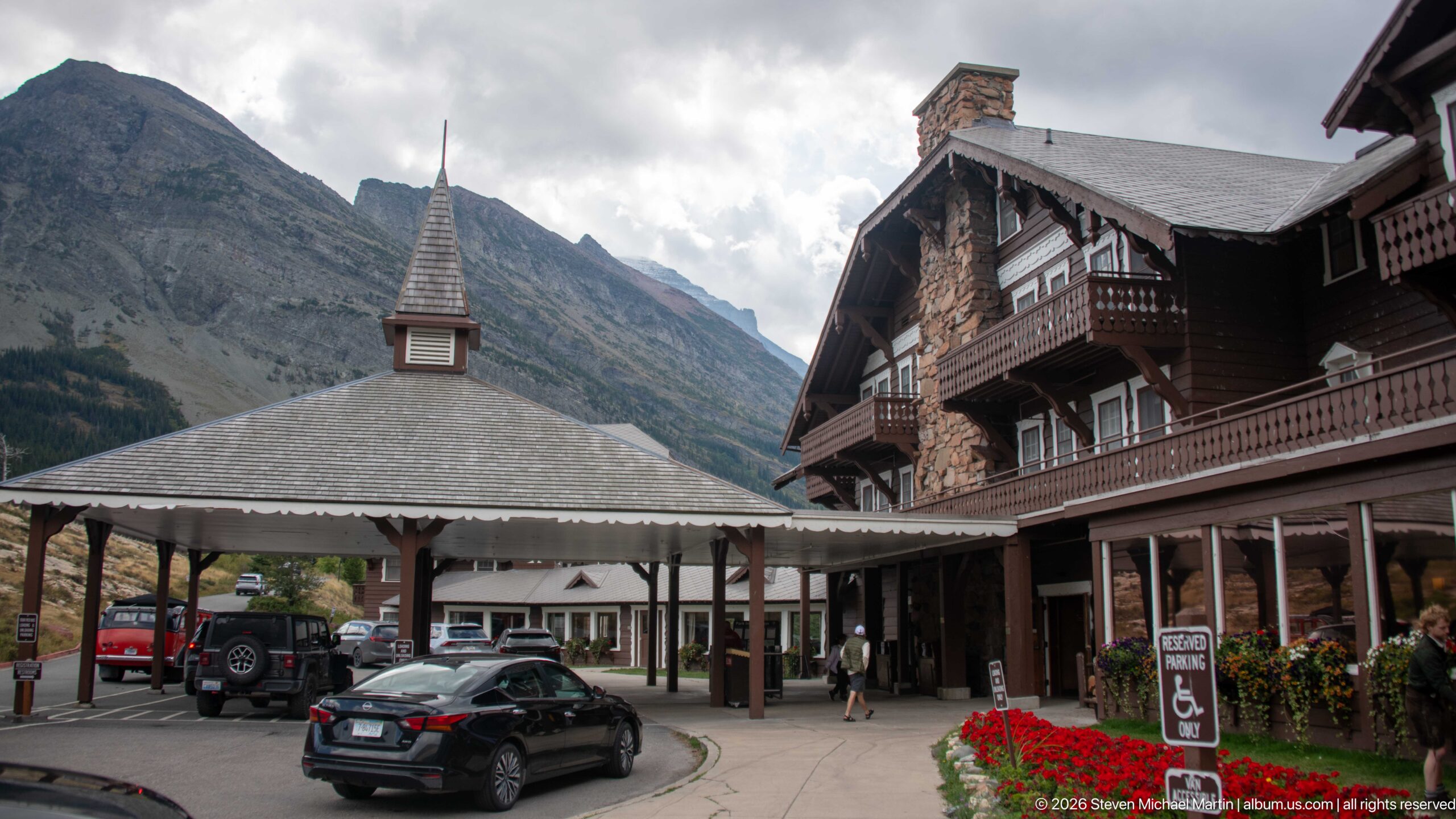
The entrance court of Many Glacier Hotel is framed by a broad porte-cochère with a slender central spire and the lodge’s multi-story brown façade. Stone chimneys, projecting balconies, and white-trimmed windows rise at right while vehicles circulate beneath the covered approach. A steep mountain wall fills the background, making the arrival sequence inseparable from the dramatic terrain surrounding the hotel.
Caption
The entrance court of Many Glacier Hotel is framed by a broad porte-cochère with a slender central spire and the lodge’s multi-story brown façade. Stone chimneys, projecting balconies, and white-trimmed windows rise at right while vehicles circulate beneath the covered approach. A steep mountain wall fills the background, making the arrival sequence inseparable from the dramatic terrain surrounding the hotel.
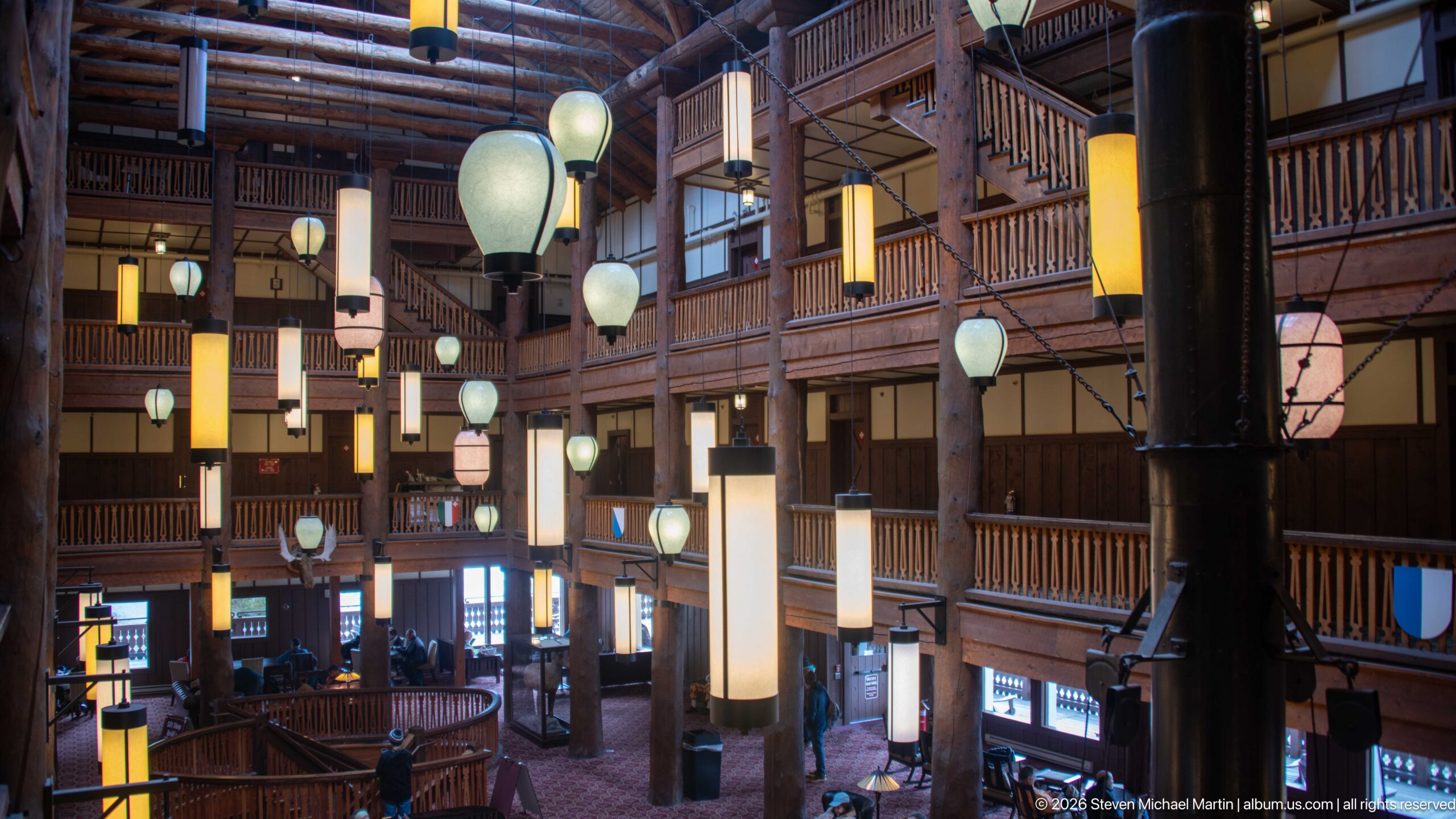
Looking diagonally through the Great Room, ranks of lanterns hang beside stacked wooden galleries and immense log columns, with the lobby floor visible several levels below. The angle gives unusual prominence to the side wall and balcony system, showing how guest-room corridors encircle the central atrium. Daylight entering from windows at the far end mixes with the warm suspended lights, accentuating the depth and vertical layering of the timber interior.
Caption
Looking diagonally through the Great Room, ranks of lanterns hang beside stacked wooden galleries and immense log columns, with the lobby floor visible several levels below. The angle gives unusual prominence to the side wall and balcony system, showing how guest-room corridors encircle the central atrium. Daylight entering from windows at the far end mixes with the warm suspended lights, accentuating the depth and vertical layering of the timber interior.
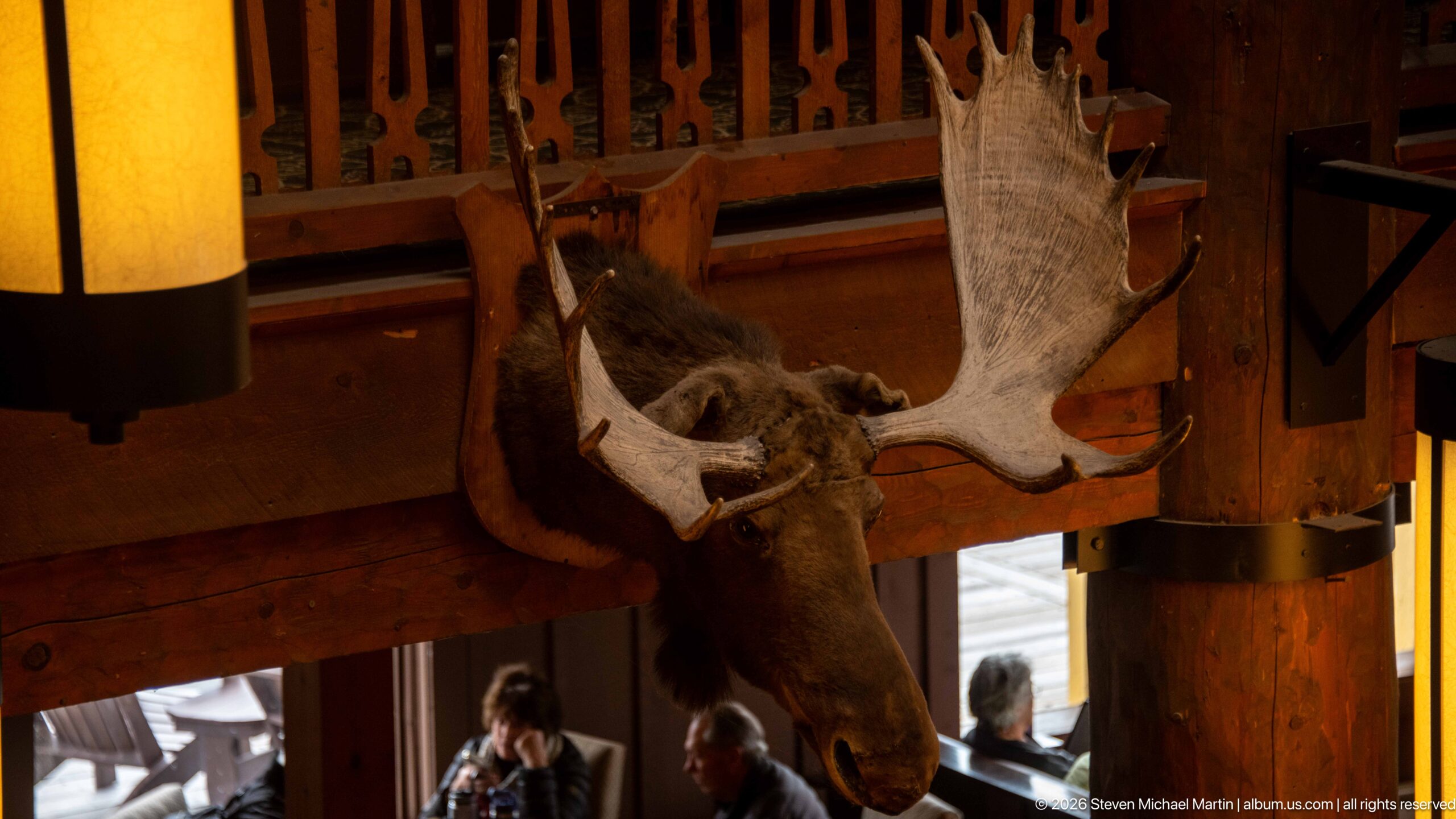
A mounted moose head projects from the timber interior, its broad palmate antlers extending dramatically across the frame above visitors below. The taxidermy display is fixed against dark wooden structural members near the Great Room, where rustic furnishings and wildlife imagery contribute to the lodge atmosphere. Seen at close range, the antler shape, long muzzle, and dark facial features make the animal readily identifiable as a moose.
Caption
A mounted moose head projects from the timber interior, its broad palmate antlers extending dramatically across the frame above visitors below. The taxidermy display is fixed against dark wooden structural members near the Great Room, where rustic furnishings and wildlife imagery contribute to the lodge atmosphere. Seen at close range, the antler shape, long muzzle, and dark facial features make the animal readily identifiable as a moose.
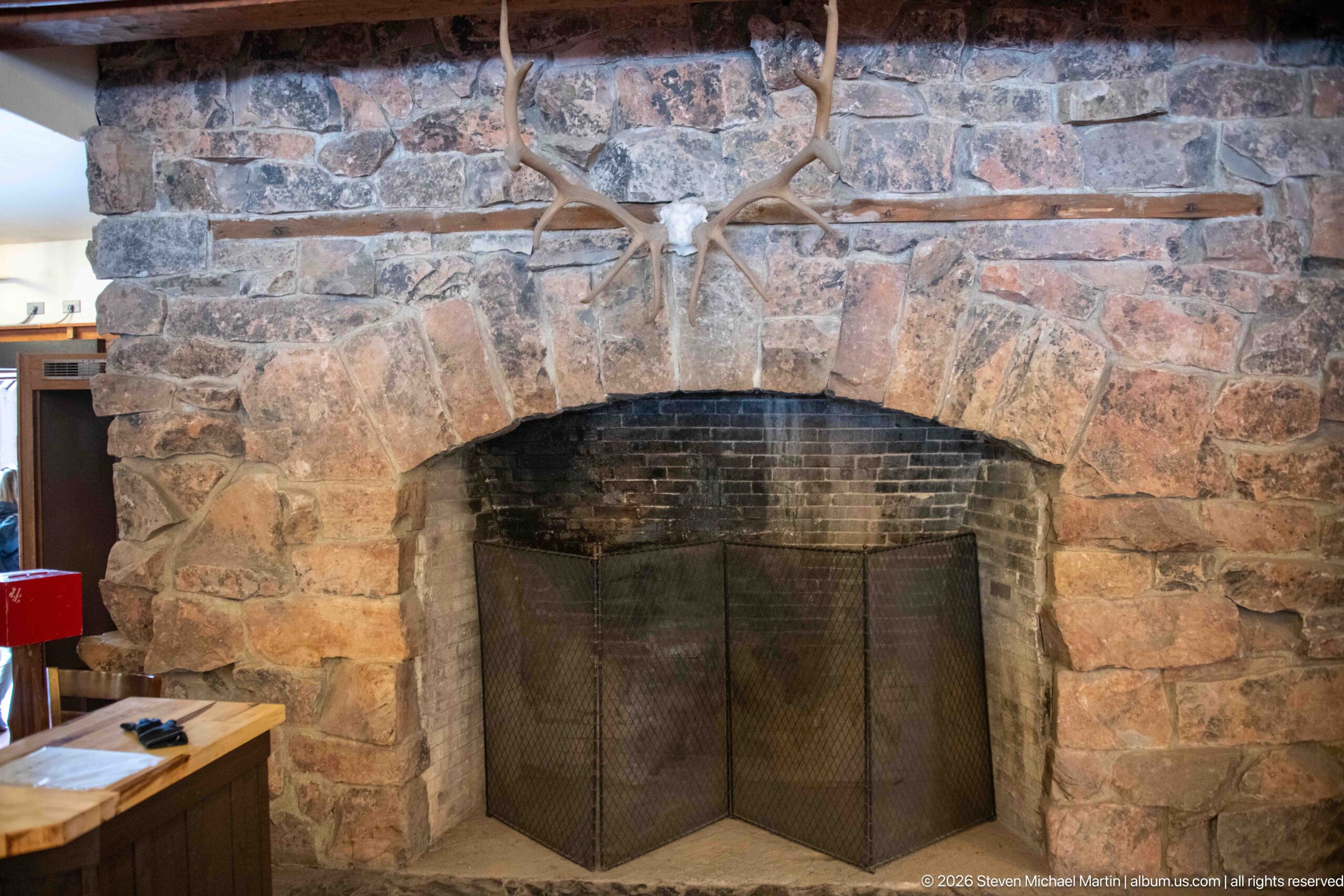
A broad stone fireplace fills the frame, its shallow arched opening protected by a dark metal mesh screen and its masonry assembled from large, irregular blocks. Mounted antlers spread across the stonework above the arch, adding a wildlife motif to the otherwise massive hearth. The close view emphasizes texture and construction rather than the surrounding room, recording one of the lodge interior’s substantial rustic architectural elements at human scale.
Caption
A broad stone fireplace fills the frame, its shallow arched opening protected by a dark metal mesh screen and its masonry assembled from large, irregular blocks. Mounted antlers spread across the stonework above the arch, adding a wildlife motif to the otherwise massive hearth. The close view emphasizes texture and construction rather than the surrounding room, recording one of the lodge interior’s substantial rustic architectural elements at human scale.
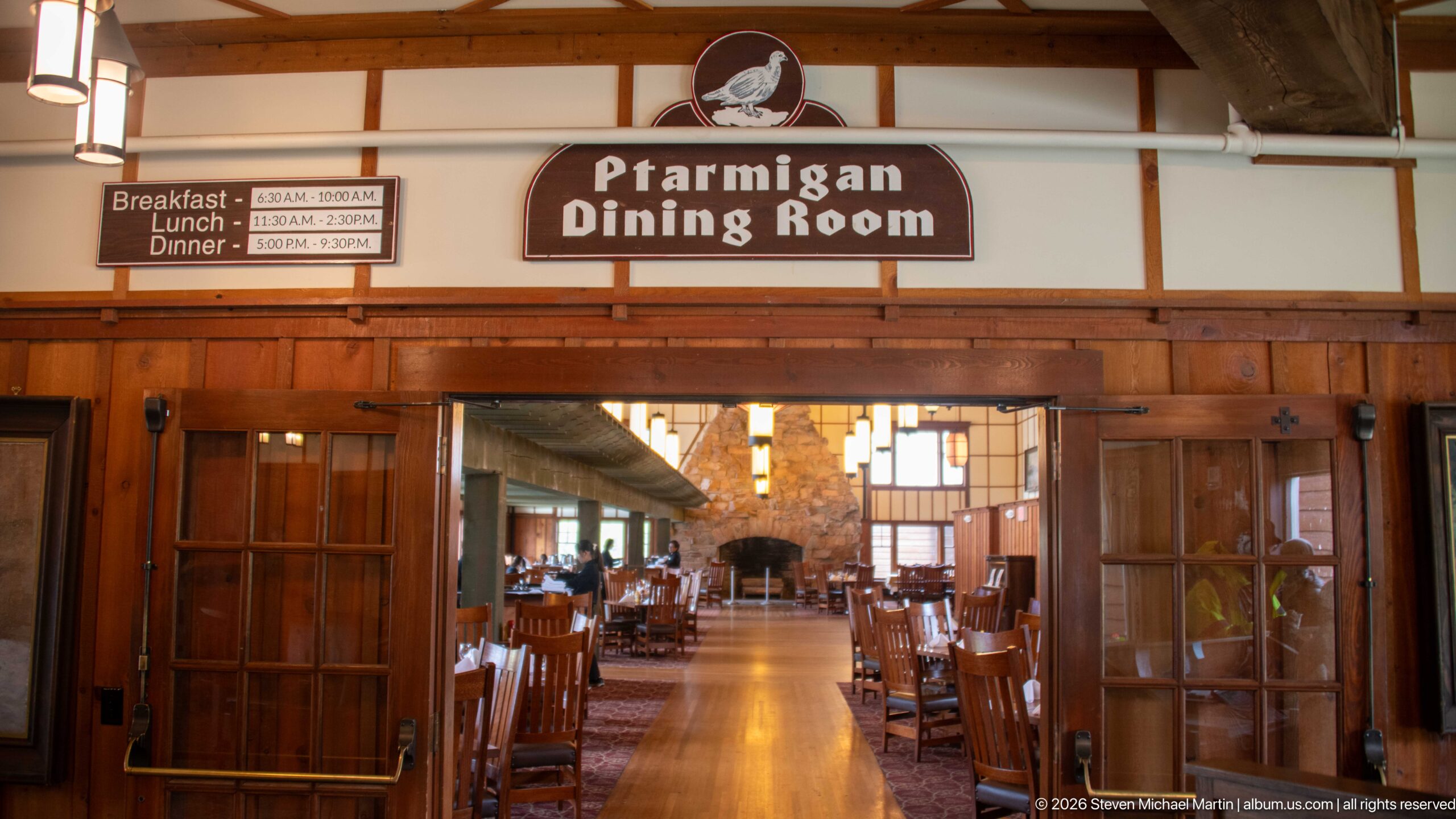
The entrance to the Ptarmigan Dining Room opens onto a long, wood-furnished interior beneath a prominent carved sign bearing the room’s name and bird emblem. A smaller board at left lists breakfast, lunch, and dinner service, while glazed wooden doors frame the view toward dining tables, hanging lights, and a large stone fireplace. The composition records both the named historic hotel space and its warm, lodge-scaled architectural character.
Caption
The entrance to the Ptarmigan Dining Room opens onto a long, wood-furnished interior beneath a prominent carved sign bearing the room’s name and bird emblem. A smaller board at left lists breakfast, lunch, and dinner service, while glazed wooden doors frame the view toward dining tables, hanging lights, and a large stone fireplace. The composition records both the named historic hotel space and its warm, lodge-scaled architectural character.
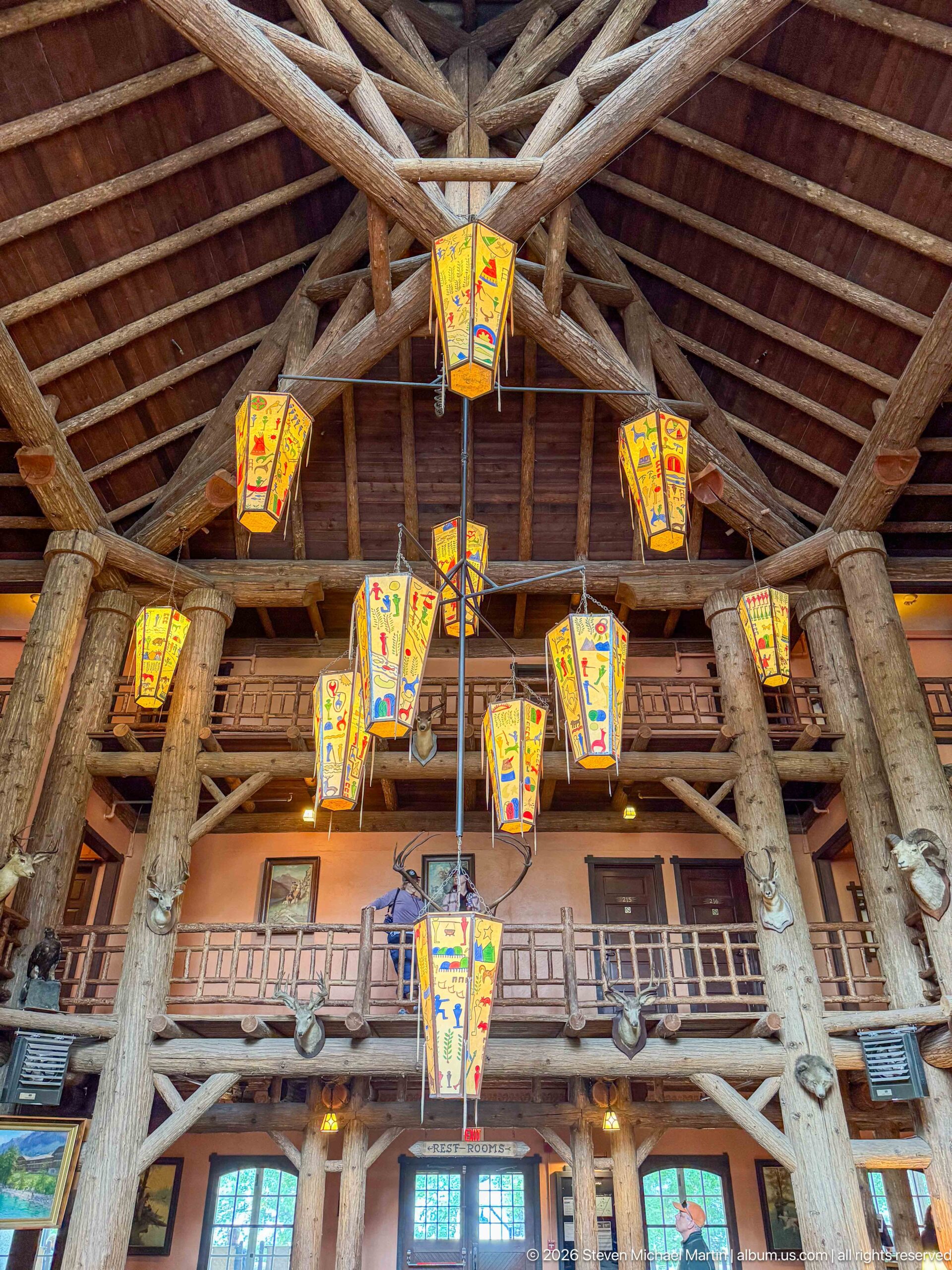
Colorful painted lanterns descend through the soaring Great Room beneath a dense framework of peeled-log columns, beams, and roof trusses. The upward view emphasizes the lodge’s deliberately rustic interior architecture, where massive timber construction is paired with decorative fixtures inspired by the hotel’s early twentieth-century Alpine theme. Balconied guest-room levels and tall windows remain visible below the roof structure, reinforcing the extraordinary vertical scale of the central lobby.
Caption
Colorful painted lanterns descend through the soaring Great Room beneath a dense framework of peeled-log columns, beams, and roof trusses. The upward view emphasizes the lodge’s deliberately rustic interior architecture, where massive timber construction is paired with decorative fixtures inspired by the hotel’s early twentieth-century Alpine theme. Balconied guest-room levels and tall windows remain visible below the roof structure, reinforcing the extraordinary vertical scale of the central lobby.
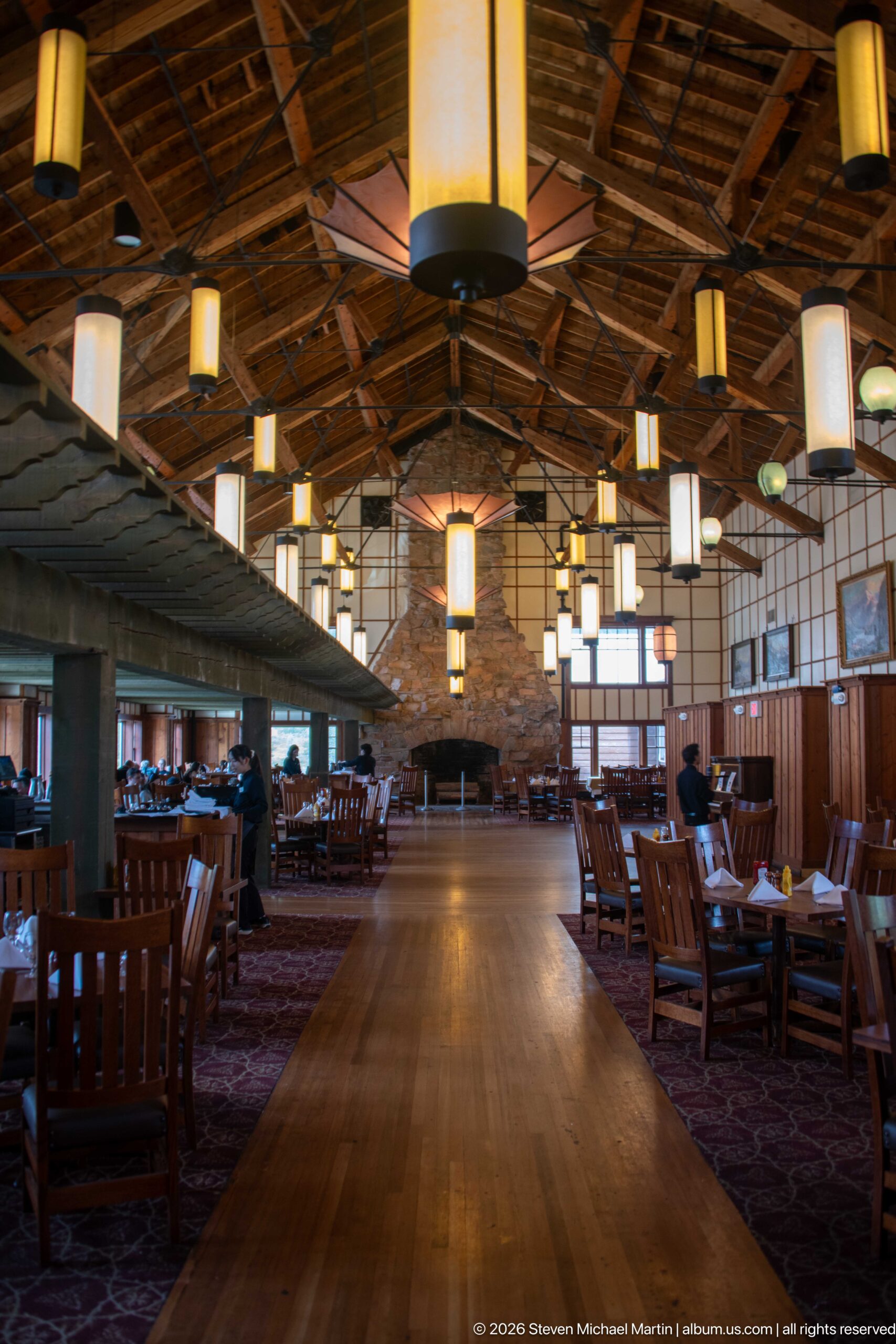
A broad central aisle leads through the Ptarmigan Dining Room toward its monumental stone fireplace, creating a strong axial view of the long hall. Suspended lanterns hang at different heights beneath exposed timber roof framing, while dining tables line both sides of the polished wood floor. The symmetrical perspective makes the room’s scale especially legible and shows how lighting, stone, timber, and furniture work together within the lodge interior.
Caption
A broad central aisle leads through the Ptarmigan Dining Room toward its monumental stone fireplace, creating a strong axial view of the long hall. Suspended lanterns hang at different heights beneath exposed timber roof framing, while dining tables line both sides of the polished wood floor. The symmetrical perspective makes the room’s scale especially legible and shows how lighting, stone, timber, and furniture work together within the lodge interior.
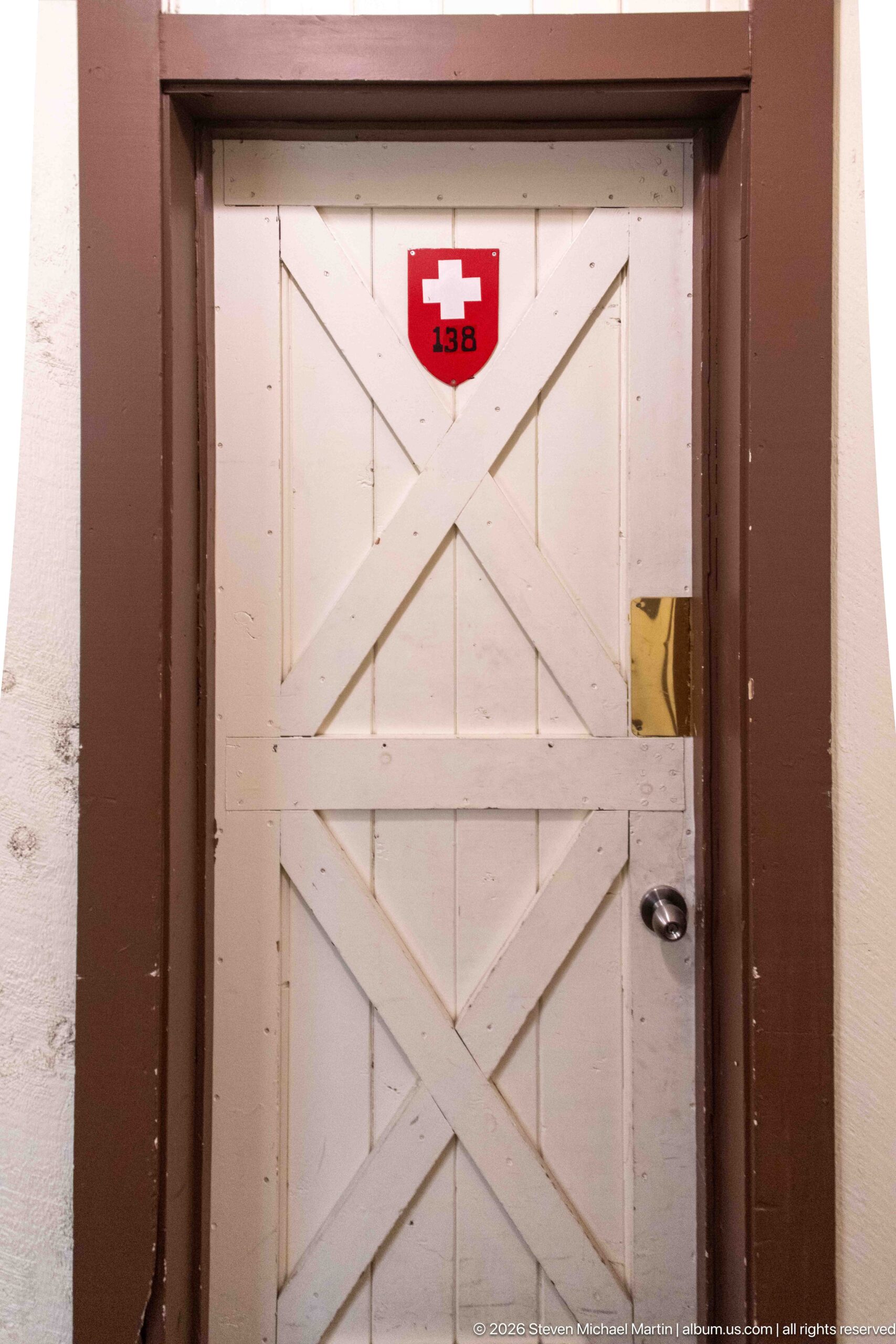
A white, cross-braced wooden door is topped by a small red shield bearing a white Swiss cross and the room number 156. The simple door, dark brown trim, and adjacent wall surfaces provide a close architectural detail of the hotel’s guest-room corridors. The Swiss emblem reflects the Alpine imagery incorporated into Many Glacier Hotel’s decorative program, here reduced to a small but conspicuous wayfinding element above an otherwise utilitarian doorway.
Caption
A white, cross-braced wooden door is topped by a small red shield bearing a white Swiss cross and the room number 156. The simple door, dark brown trim, and adjacent wall surfaces provide a close architectural detail of the hotel’s guest-room corridors. The Swiss emblem reflects the Alpine imagery incorporated into Many Glacier Hotel’s decorative program, here reduced to a small but conspicuous wayfinding element above an otherwise utilitarian doorway.
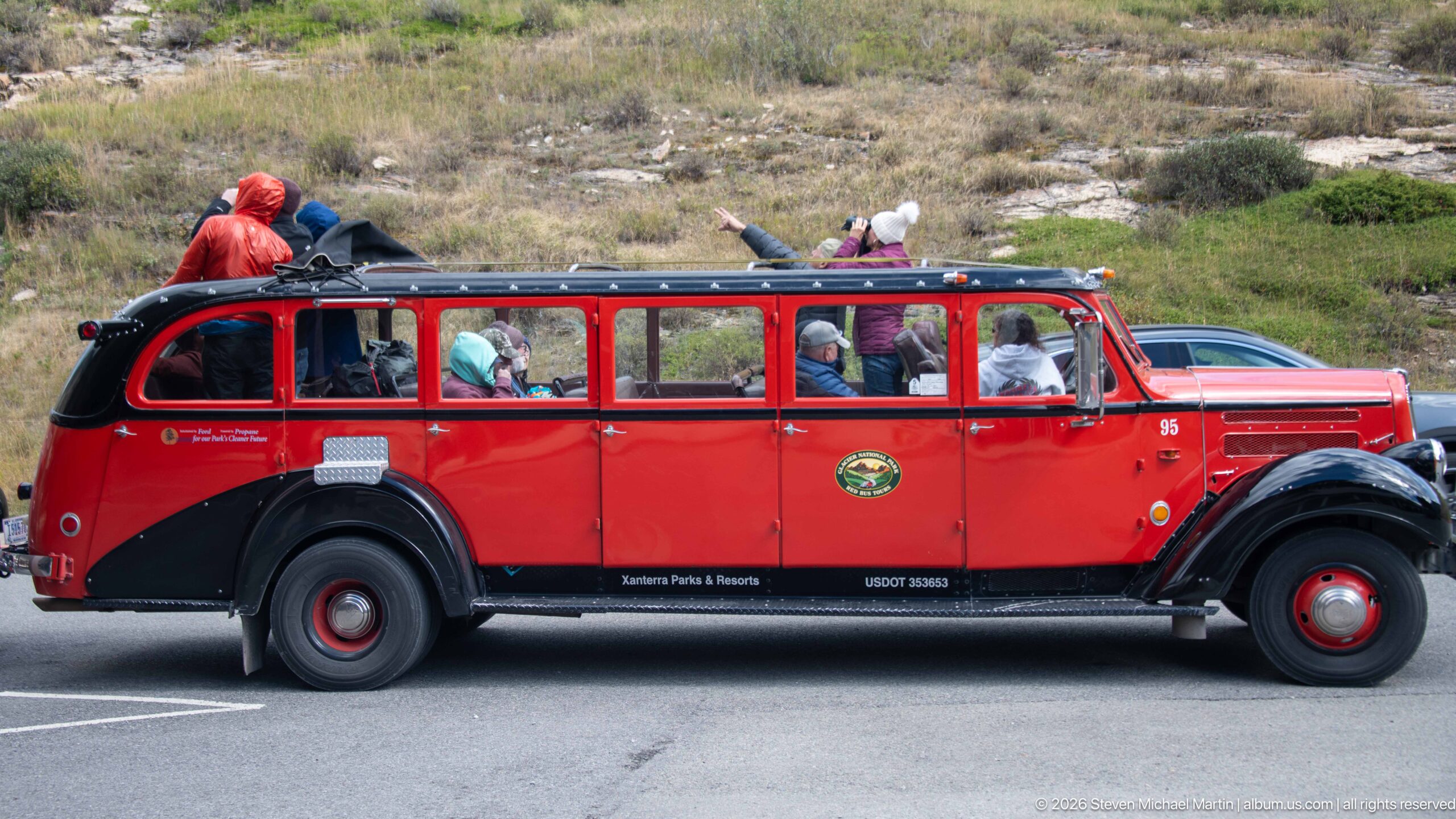
A historic red touring bus pauses beside Many Glacier Hotel with passengers visible through its long row of windows and luggage secured on the roof. The vehicle’s elongated body, black fenders, chrome details, and roll-back roof identify the distinctive sightseeing buses associated with Glacier National Park. Seen against the open mountain landscape, the bus recalls the long tradition of road-based touring that connects the park’s major lodges and scenic corridors.
Caption
A historic red touring bus pauses beside Many Glacier Hotel with passengers visible through its long row of windows and luggage secured on the roof. The vehicle’s elongated body, black fenders, chrome details, and roll-back roof identify the distinctive sightseeing buses associated with Glacier National Park. Seen against the open mountain landscape, the bus recalls the long tradition of road-based touring that connects the park’s major lodges and scenic corridors.
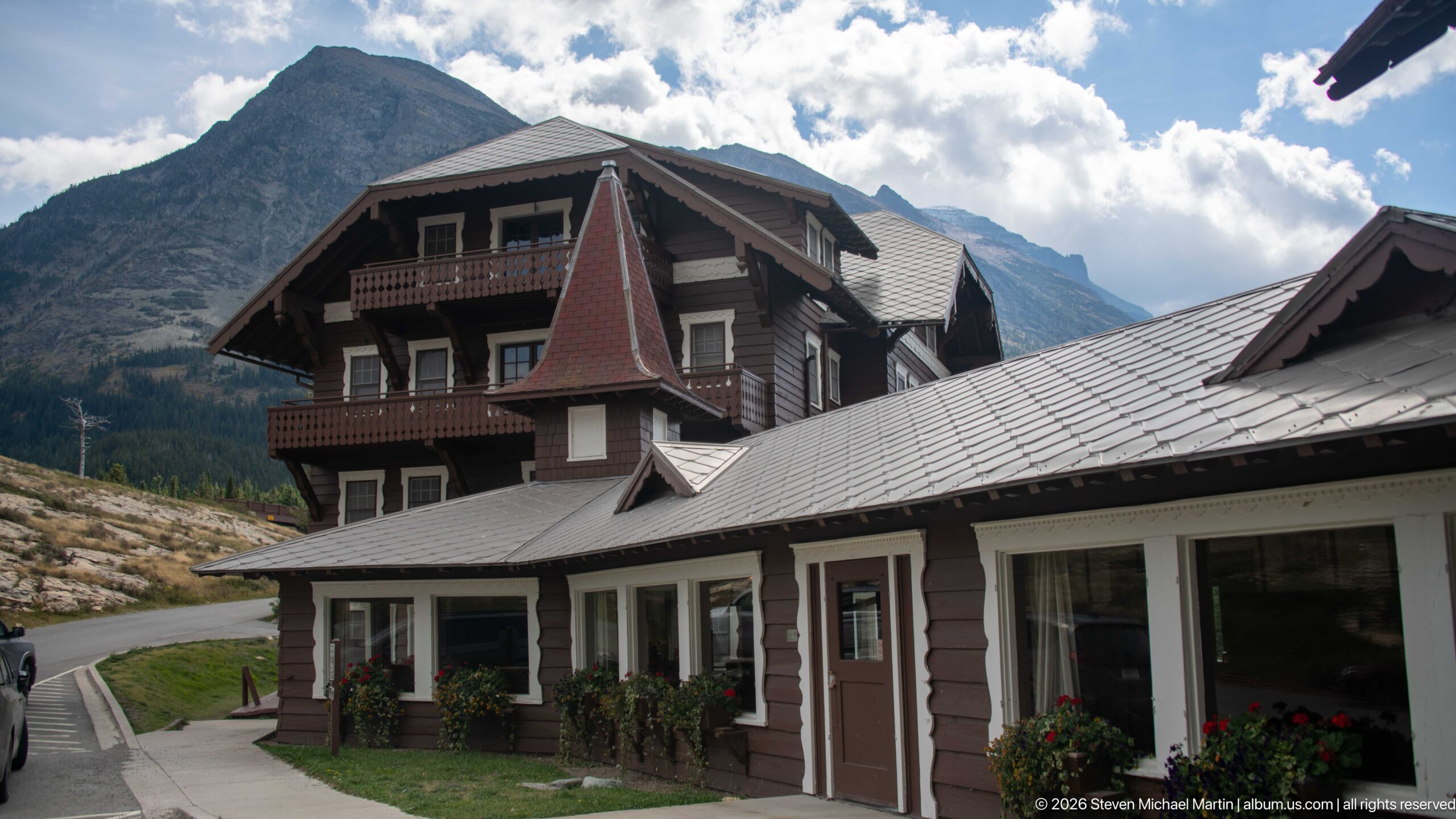
A close exterior view shows one of Many Glacier Hotel’s projecting lodge wings rising behind a lower enclosed walkway. Dark brown siding, white-trimmed windows, deep balconies, broad roof overhangs, and a steep red accent roof create the layered silhouette associated with the hotel’s Alpine-inspired design. Mountains crowd closely behind the building, demonstrating how the sprawling lodge complex was fitted into the narrow terrain along Swiftcurrent Lake.
Caption
A close exterior view shows one of Many Glacier Hotel’s projecting lodge wings rising behind a lower enclosed walkway. Dark brown siding, white-trimmed windows, deep balconies, broad roof overhangs, and a steep red accent roof create the layered silhouette associated with the hotel’s Alpine-inspired design. Mountains crowd closely behind the building, demonstrating how the sprawling lodge complex was fitted into the narrow terrain along Swiftcurrent Lake.
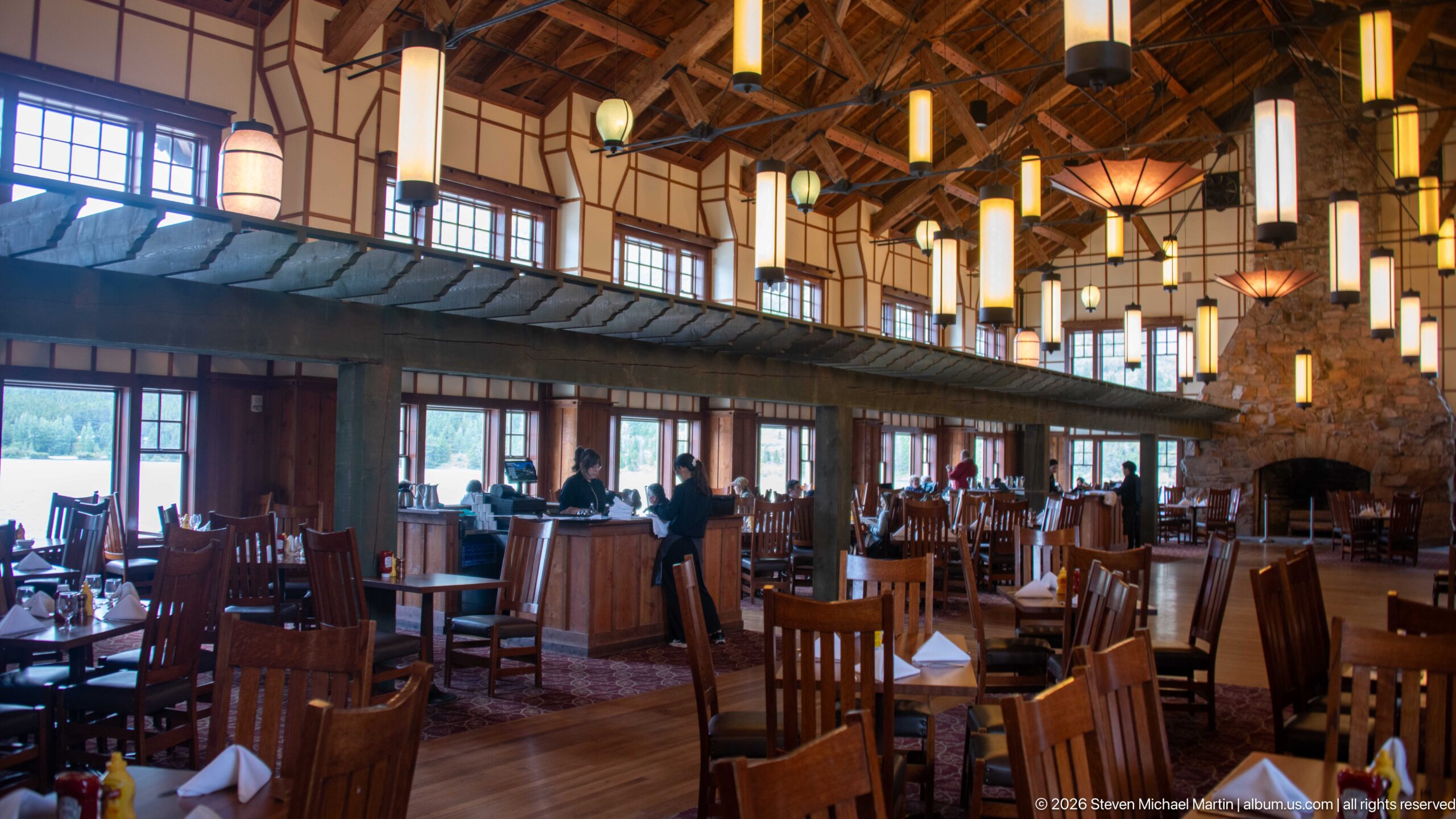
Rows of wooden tables and high-backed chairs fill the Ptarmigan Dining Room beneath exposed roof framing and a varied array of suspended light fixtures. Along the left side, large windows and a broad structural element define the room’s length, while a substantial stone fireplace anchors the far end. Diners and staff provide a sense of scale within an interior that combines rustic materials with the proportions of a grand hotel dining hall.
Caption
Rows of wooden tables and high-backed chairs fill the Ptarmigan Dining Room beneath exposed roof framing and a varied array of suspended light fixtures. Along the left side, large windows and a broad structural element define the room’s length, while a substantial stone fireplace anchors the far end. Diners and staff provide a sense of scale within an interior that combines rustic materials with the proportions of a grand hotel dining hall.
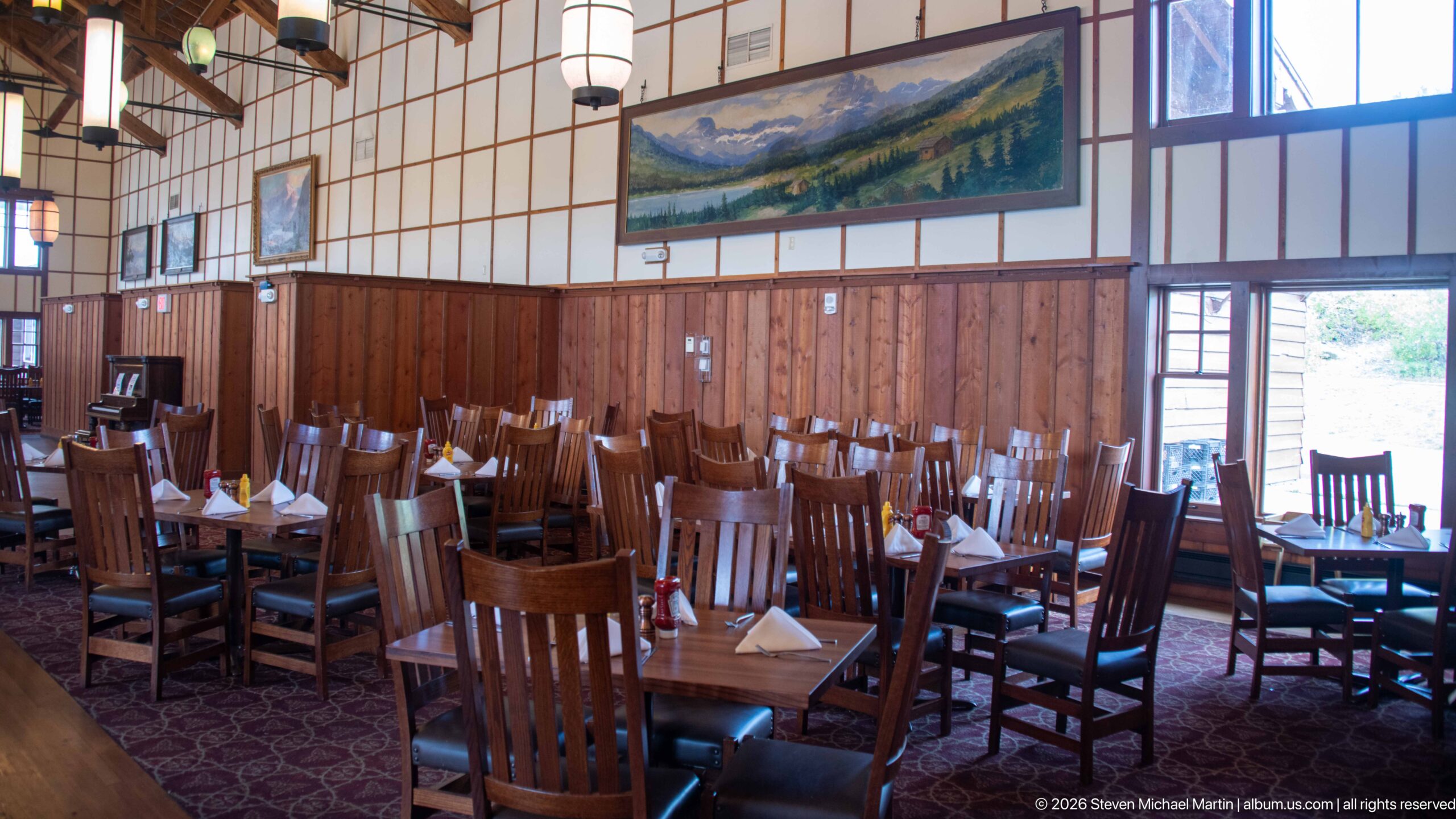
A quieter side of the Ptarmigan Dining Room reveals the room’s restrained decorative treatment: dark wood wainscoting, light upper wall panels, framed mountain artwork, and closely arranged wooden tables set with folded napkins. Large windows at right admit daylight from the lakeside setting. Compared with broader dining-hall views, this composition concentrates on the wall finishes, furnishings, and artwork that give the restaurant its historic lodge atmosphere.
Caption
A quieter side of the Ptarmigan Dining Room reveals the room’s restrained decorative treatment: dark wood wainscoting, light upper wall panels, framed mountain artwork, and closely arranged wooden tables set with folded napkins. Large windows at right admit daylight from the lakeside setting. Compared with broader dining-hall views, this composition concentrates on the wall finishes, furnishings, and artwork that give the restaurant its historic lodge atmosphere.
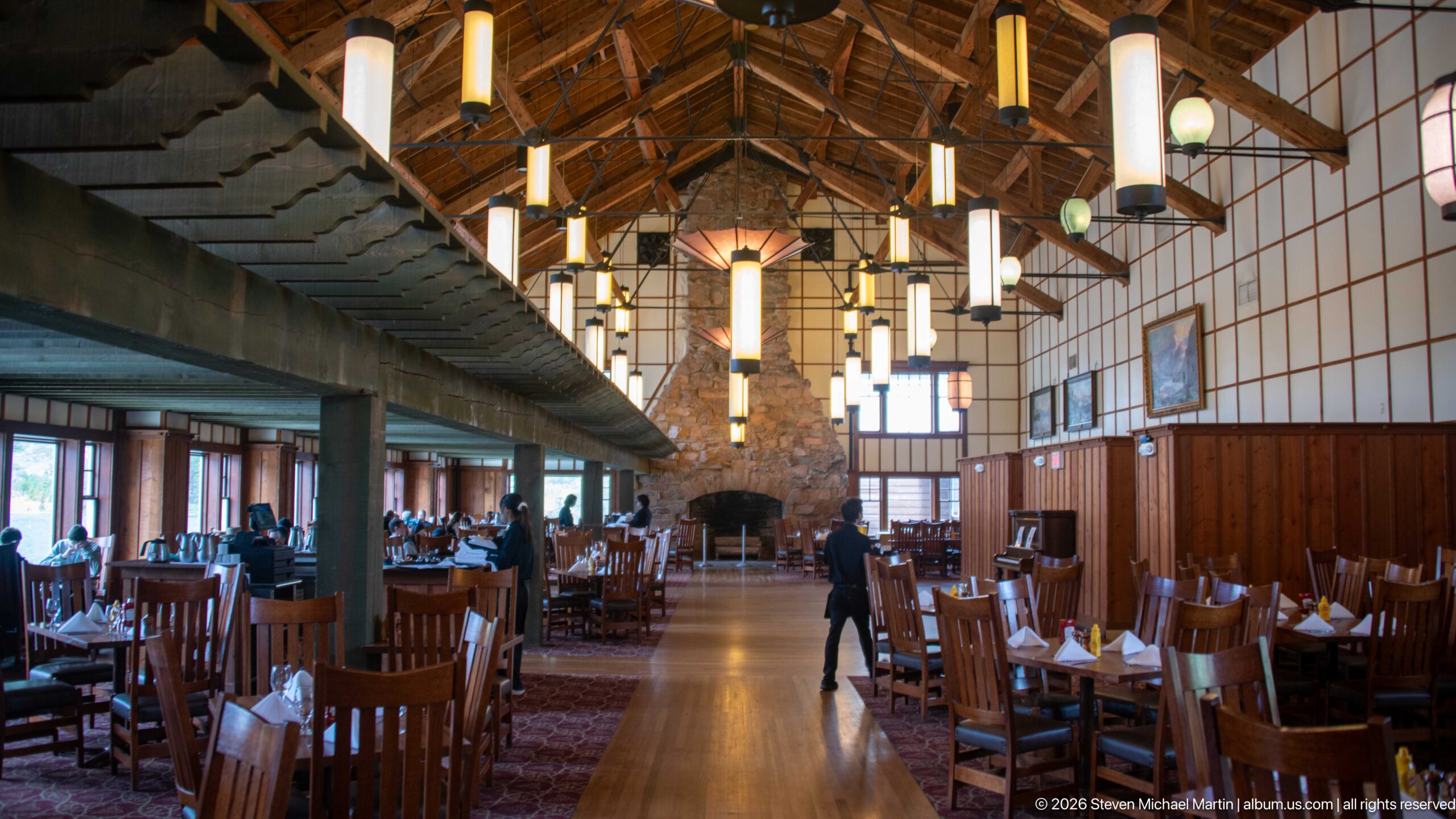
Looking down the Ptarmigan Dining Room, a staff member crosses the central aisle while guests sit near the window side of the hall. Repeating lanterns and exposed roof members draw the eye toward the stone fireplace, and rows of wooden chairs emphasize the room’s considerable length. The human activity distinguishes this view from the more formal architectural studies, showing the historic dining space functioning as an active part of the lodge.
Caption
Looking down the Ptarmigan Dining Room, a staff member crosses the central aisle while guests sit near the window side of the hall. Repeating lanterns and exposed roof members draw the eye toward the stone fireplace, and rows of wooden chairs emphasize the room’s considerable length. The human activity distinguishes this view from the more formal architectural studies, showing the historic dining space functioning as an active part of the lodge.
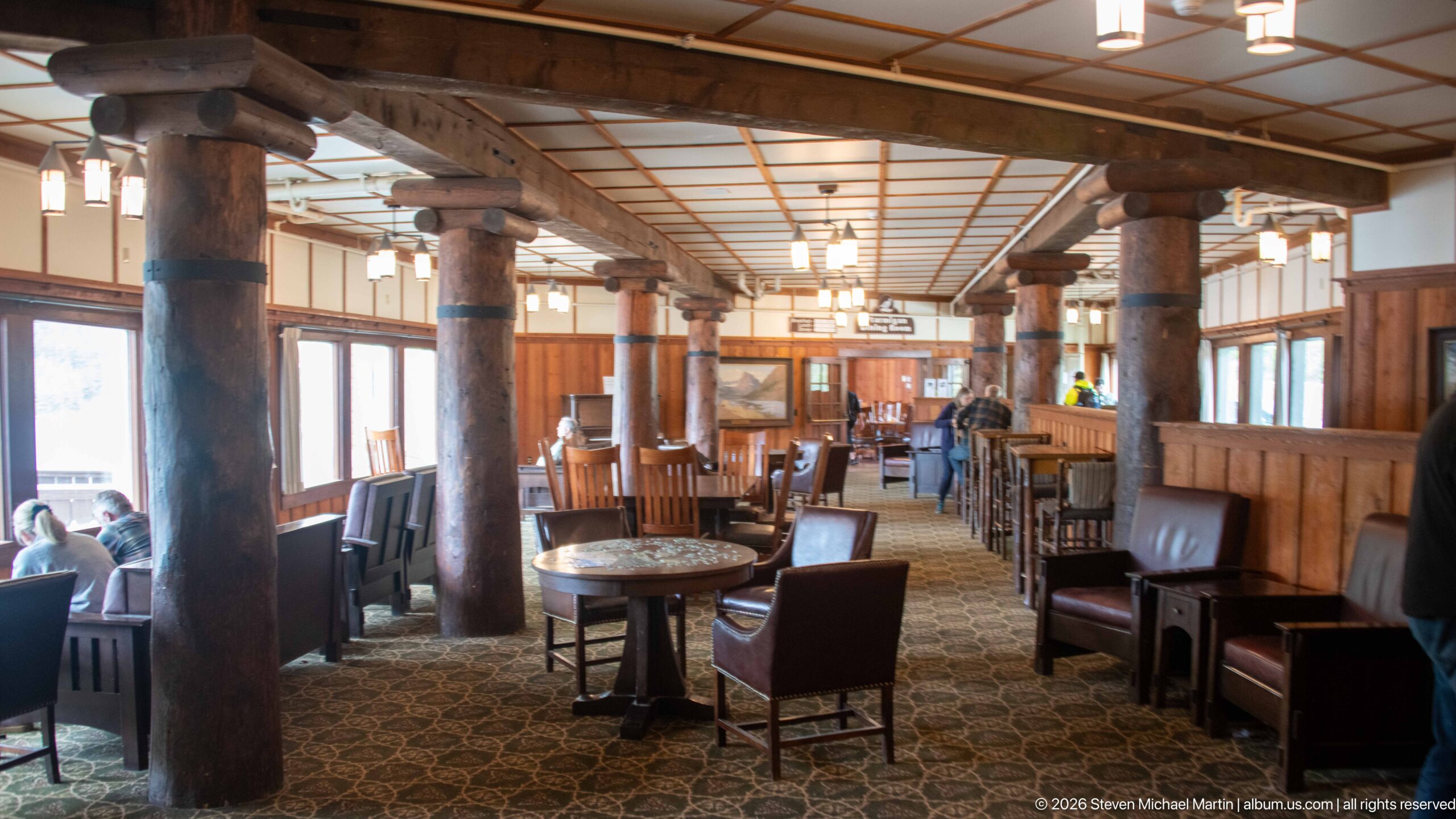
Heavy log columns define a long seating area in the Interlaken Lounge, where leather armchairs and small tables face tall windows overlooking the hotel’s surroundings. The lower ceiling and intimate furniture arrangement contrast with the vast open volume of the adjacent Great Room. Exposed logs, wood paneling, patterned carpet, and simple pendant lights continue the lodge’s rustic vocabulary while creating a quieter social space for guests.
Caption
Heavy log columns define a long seating area in the Interlaken Lounge, where leather armchairs and small tables face tall windows overlooking the hotel’s surroundings. The lower ceiling and intimate furniture arrangement contrast with the vast open volume of the adjacent Great Room. Exposed logs, wood paneling, patterned carpet, and simple pendant lights continue the lodge’s rustic vocabulary while creating a quieter social space for guests.
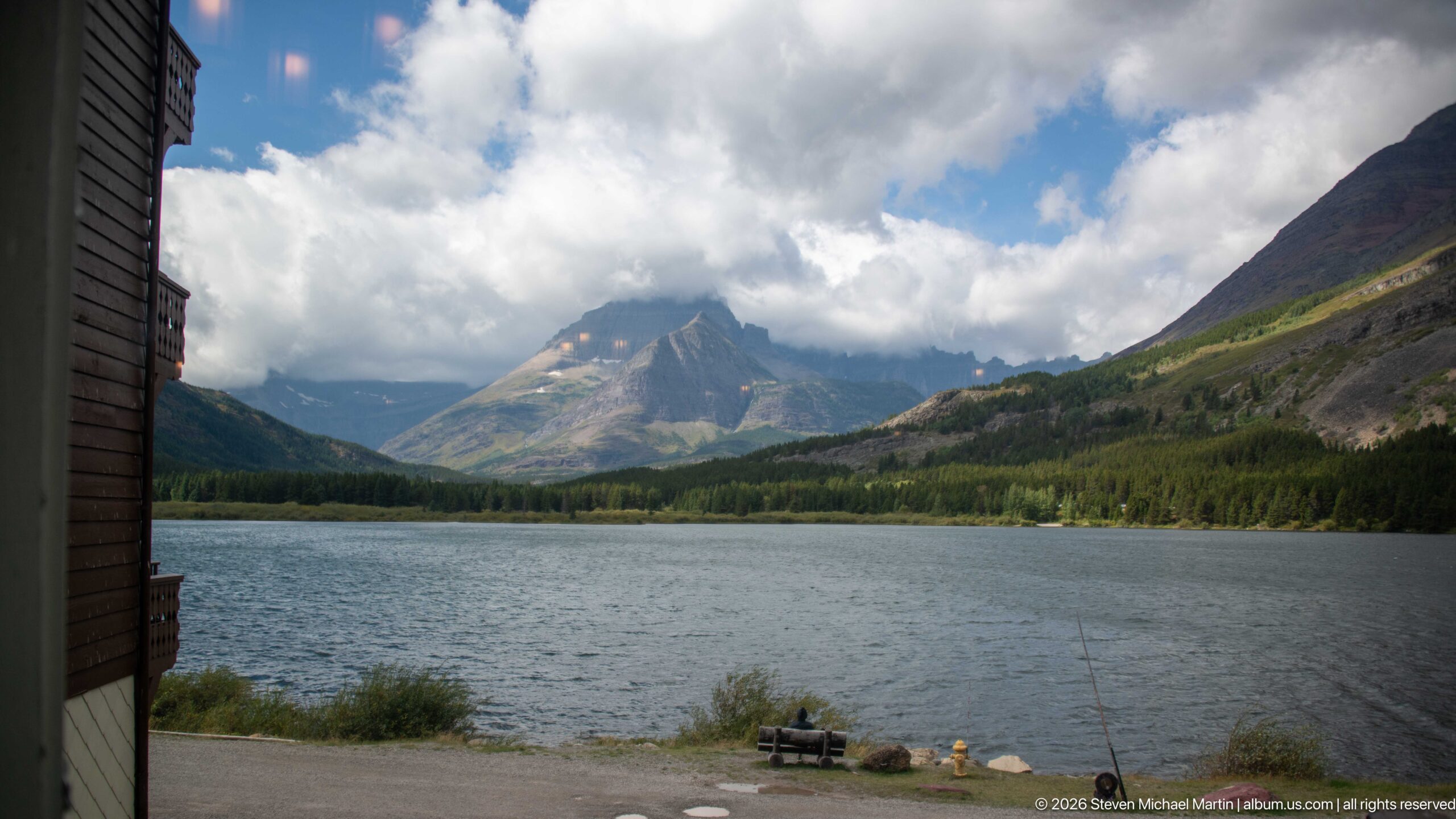
Swiftcurrent Lake fills the foreground beyond the edge of Many Glacier Hotel, with forested slopes rising toward sharply carved mountain walls beneath broken clouds. The partial building edge at left anchors the view to the lodge and emphasizes the immediate relationship between the hotel and the lake. Sunlight breaking across the distant terrain reveals alternating bands of forest, exposed rock, and alpine slopes characteristic of the Many Glacier valley.
Caption
Swiftcurrent Lake fills the foreground beyond the edge of Many Glacier Hotel, with forested slopes rising toward sharply carved mountain walls beneath broken clouds. The partial building edge at left anchors the view to the lodge and emphasizes the immediate relationship between the hotel and the lake. Sunlight breaking across the distant terrain reveals alternating bands of forest, exposed rock, and alpine slopes characteristic of the Many Glacier valley.
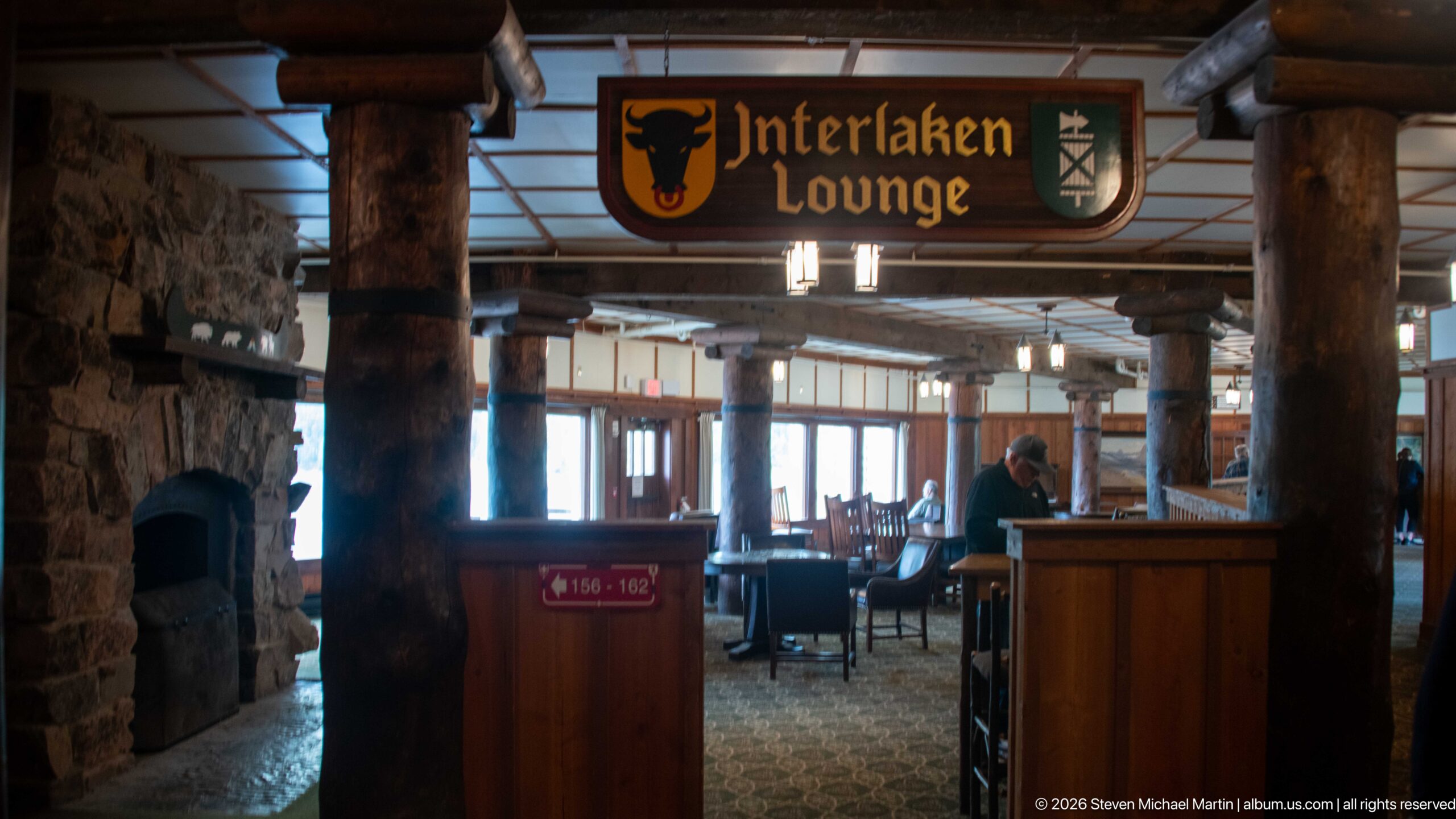
A carved overhead sign announces the Interlaken Lounge between two heraldic shields, framing a view into the hotel’s log-columned seating area. A stone fireplace stands at left, while leather chairs, tables, and broad windows extend into the background. The named sign and decorative emblems make this an especially useful record of the lodge’s Swiss-themed interior identity, connecting its social spaces to the Alpine imagery used throughout the building.
Caption
A carved overhead sign announces the Interlaken Lounge between two heraldic shields, framing a view into the hotel’s log-columned seating area. A stone fireplace stands at left, while leather chairs, tables, and broad windows extend into the background. The named sign and decorative emblems make this an especially useful record of the lodge’s Swiss-themed interior identity, connecting its social spaces to the Alpine imagery used throughout the building.
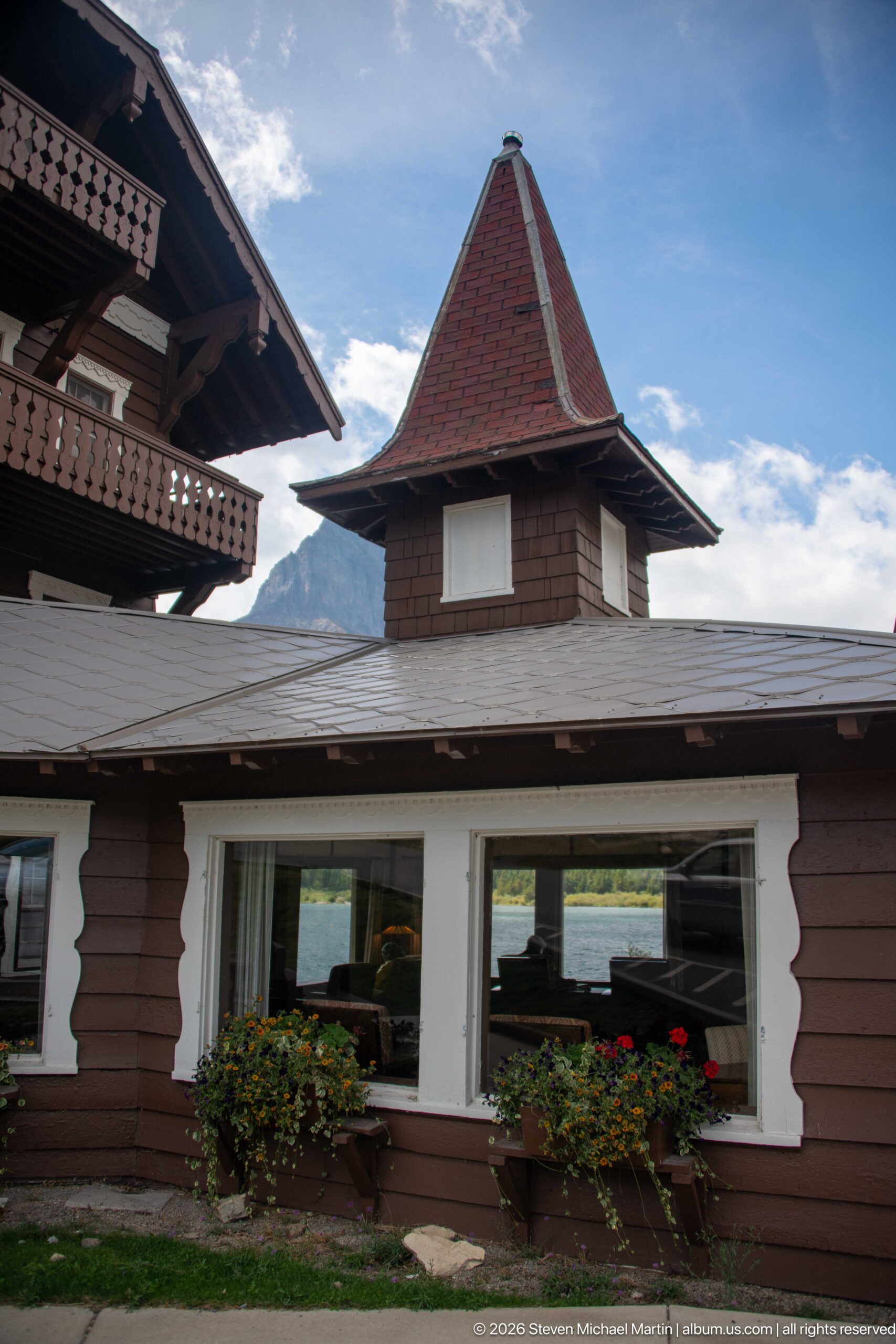
A low wing of Many Glacier Hotel stretches across the foreground beneath a broad gray roof, interrupted by a small tower capped with a steep, red, pyramidal roof. White-trimmed windows and flower boxes soften the dark brown siding, while an upper balcony projects from the adjoining building at left. The composition isolates the hotel’s varied roof forms and decorative massing, details that contribute to its deliberately Alpine-inspired silhouette.
Caption
A low wing of Many Glacier Hotel stretches across the foreground beneath a broad gray roof, interrupted by a small tower capped with a steep, red, pyramidal roof. White-trimmed windows and flower boxes soften the dark brown siding, while an upper balcony projects from the adjoining building at left. The composition isolates the hotel’s varied roof forms and decorative massing, details that contribute to its deliberately Alpine-inspired silhouette.
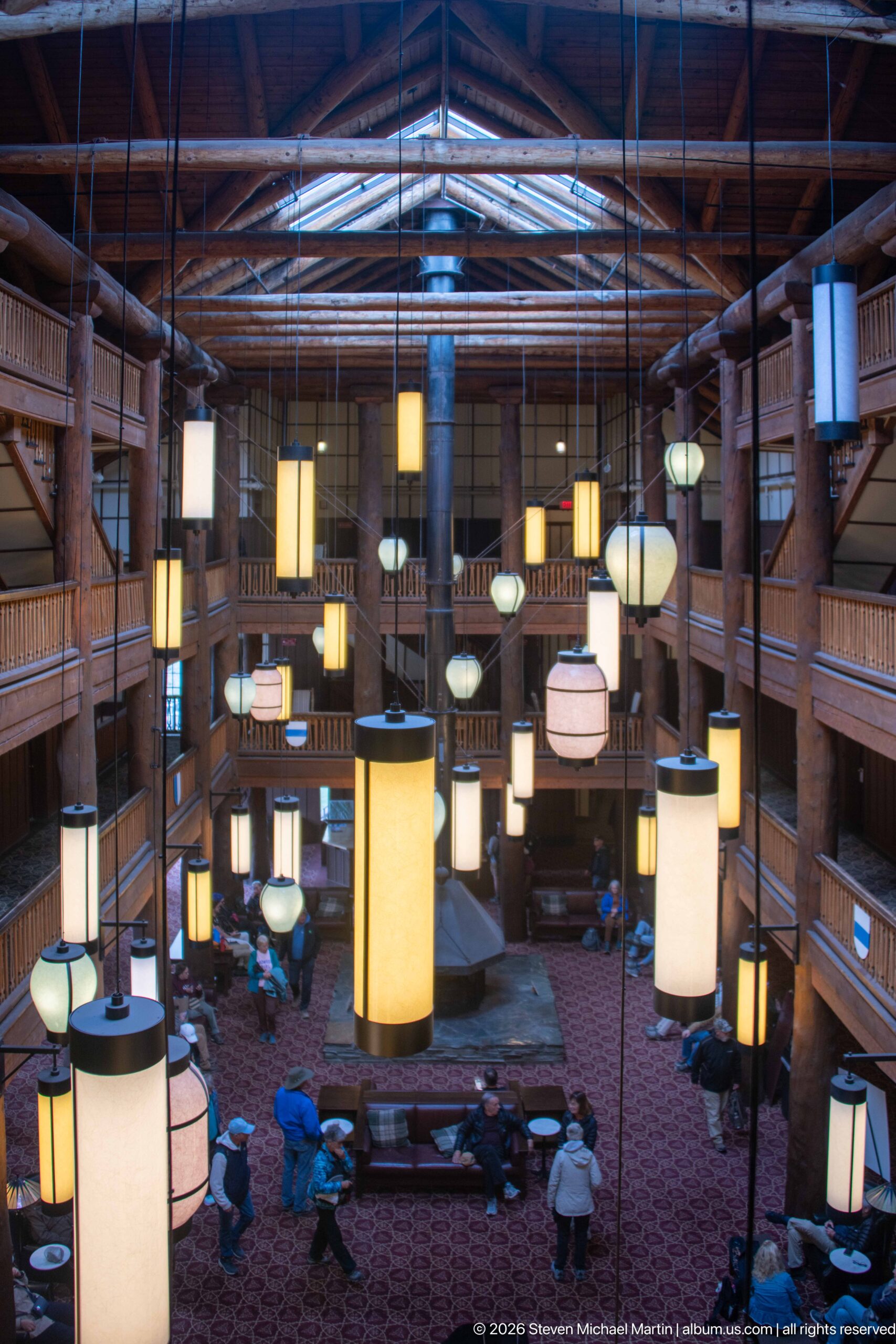
An elevated balcony view looks across the full central volume of the Great Room, where dozens of lanterns hang above clustered seating and a large central fireplace hood. Repeating log galleries enclose the space on several levels, and the roof structure remains visible high overhead. Guests gathered on the lobby floor provide scale, underscoring the unusual height and breadth of the hotel’s principal public interior.
Caption
An elevated balcony view looks across the full central volume of the Great Room, where dozens of lanterns hang above clustered seating and a large central fireplace hood. Repeating log galleries enclose the space on several levels, and the roof structure remains visible high overhead. Guests gathered on the lobby floor provide scale, underscoring the unusual height and breadth of the hotel’s principal public interior.
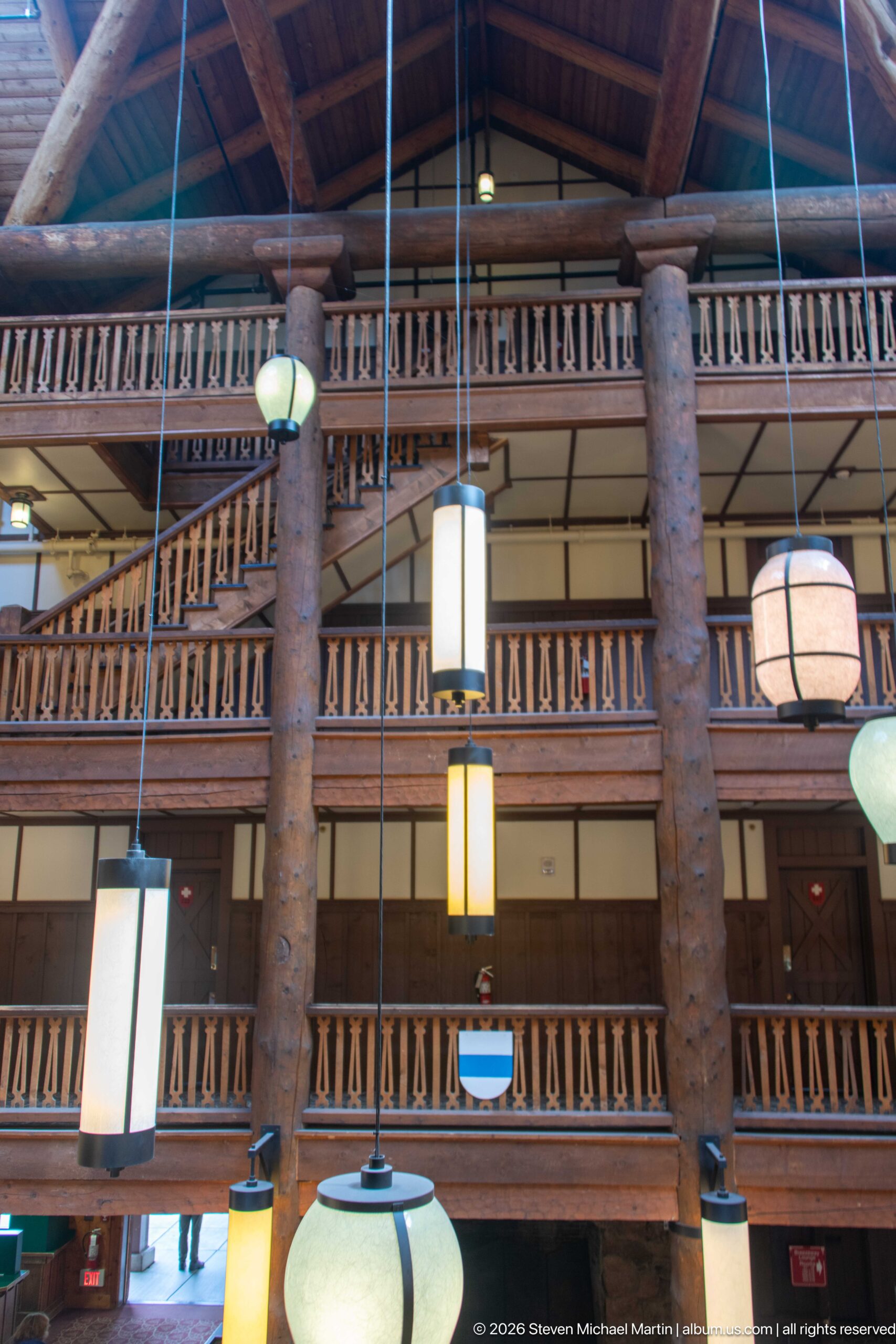
Three tiers of rustic wooden galleries span the far wall of the Great Room between enormous log columns. Suspended lanterns occupy the foreground, their varied shapes and sizes breaking up the strict horizontal repetition of the balcony rails. This tightly framed architectural study minimizes the lobby floor and instead emphasizes the construction of the surrounding guest-room galleries, where peeled logs and patterned balustrades define the hotel’s monumental interior enclosure.
Caption
Three tiers of rustic wooden galleries span the far wall of the Great Room between enormous log columns. Suspended lanterns occupy the foreground, their varied shapes and sizes breaking up the strict horizontal repetition of the balcony rails. This tightly framed architectural study minimizes the lobby floor and instead emphasizes the construction of the surrounding guest-room galleries, where peeled logs and patterned balustrades define the hotel’s monumental interior enclosure.
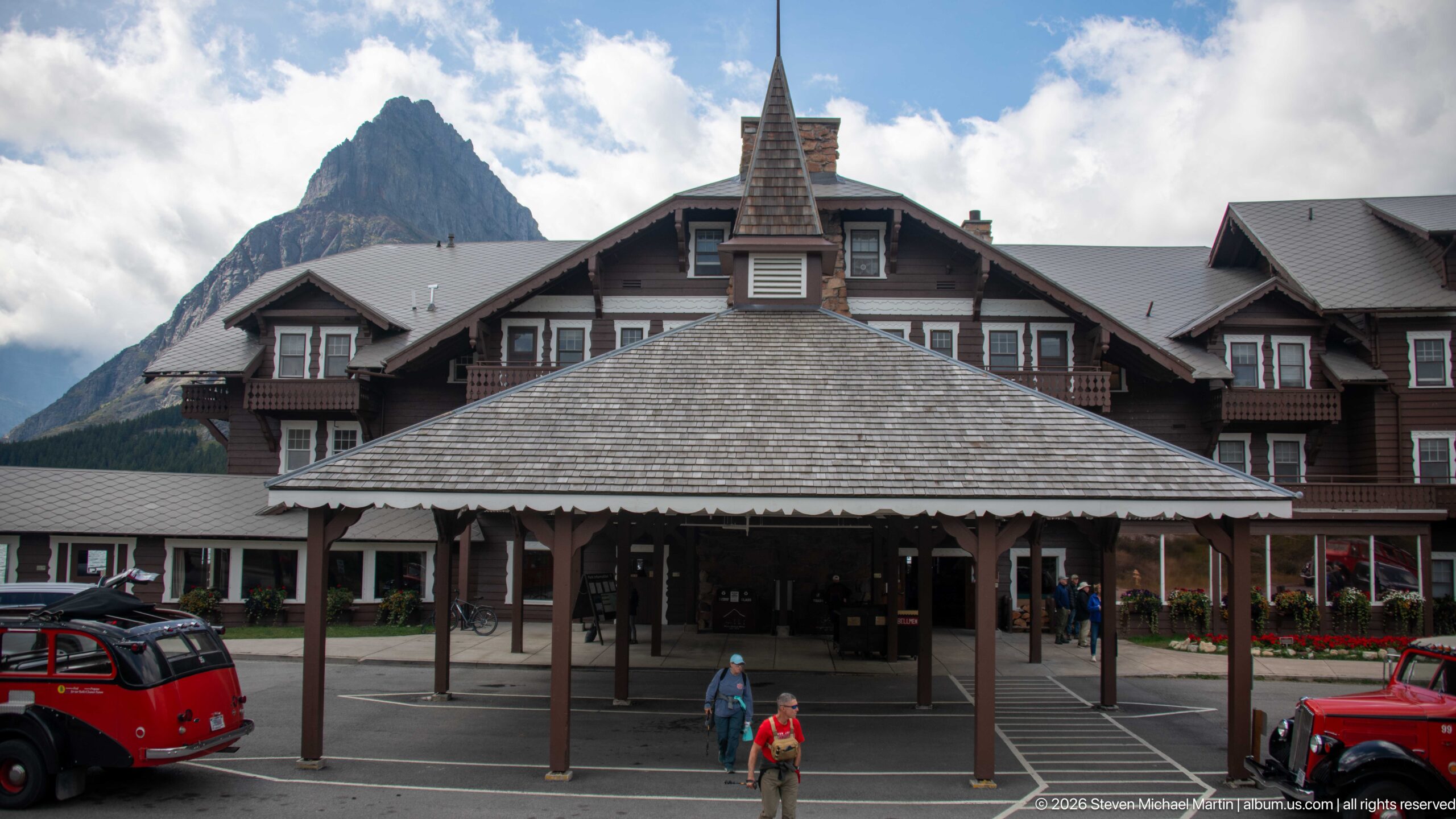
The covered entrance of Many Glacier Hotel projects toward the roadway beneath a broad hipped roof and slender central roof feature, with the larger guest-room wings rising behind it. Historic red touring buses appear at both edges of the drive, and a visitor stands near the entrance. Framed by a steep mountain peak at left, the scene shows the lodge as an arrival point where monumental scenery, hotel architecture, and park transportation converge.
Caption
The covered entrance of Many Glacier Hotel projects toward the roadway beneath a broad hipped roof and slender central roof feature, with the larger guest-room wings rising behind it. Historic red touring buses appear at both edges of the drive, and a visitor stands near the entrance. Framed by a steep mountain peak at left, the scene shows the lodge as an arrival point where monumental scenery, hotel architecture, and park transportation converge.
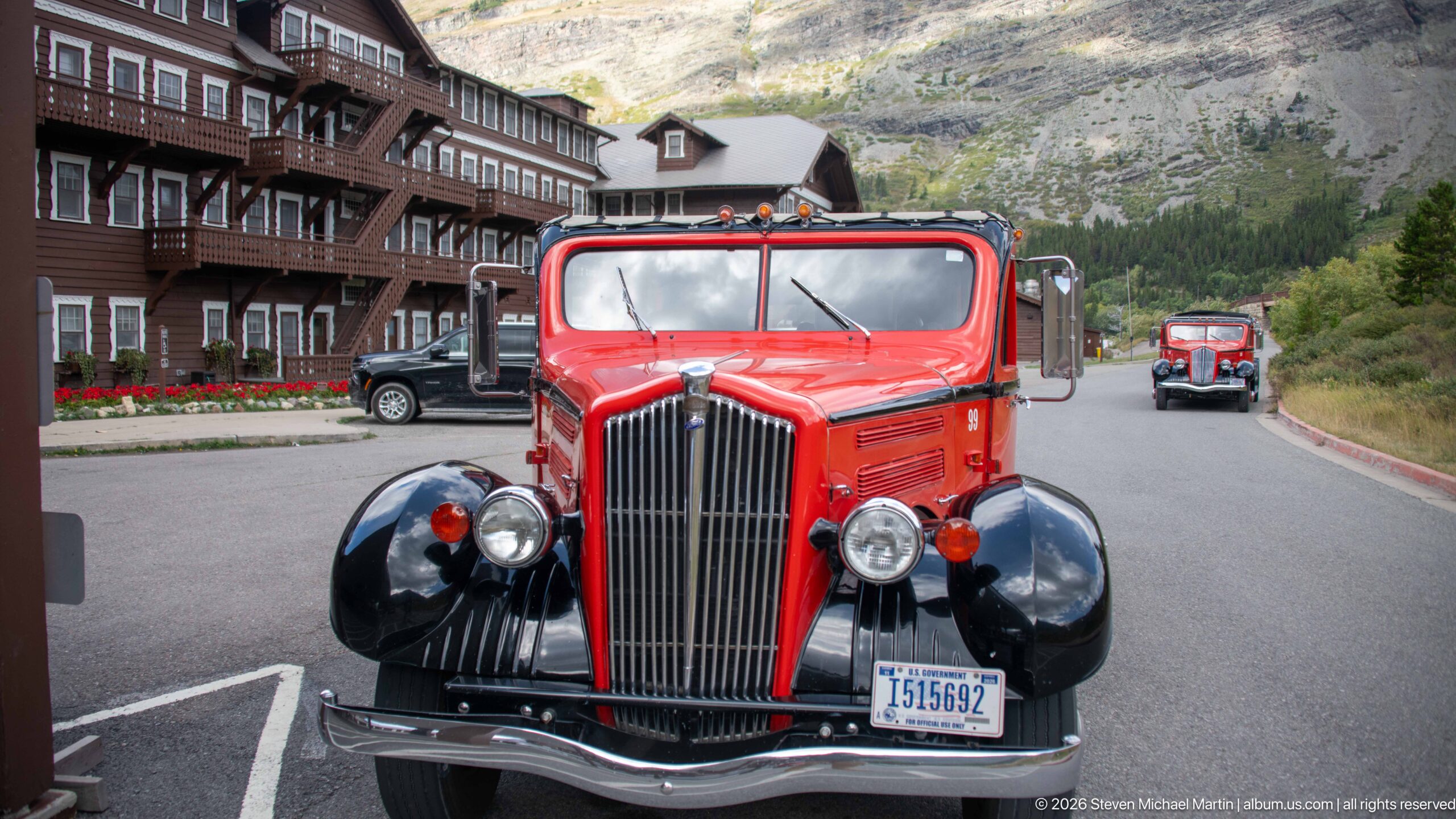
The tall chrome grille and rounded black fenders of a Glacier National Park red touring bus dominate this head-on view outside Many Glacier Hotel. Its bright bodywork, paired headlights, split windshield, and period styling stand out against the brown lodge façade and pale mountain slopes behind. A second red bus farther up the drive reinforces the hotel’s role as a transportation hub for visitors traveling through the park’s historic road-tour network.
Caption
The tall chrome grille and rounded black fenders of a Glacier National Park red touring bus dominate this head-on view outside Many Glacier Hotel. Its bright bodywork, paired headlights, split windshield, and period styling stand out against the brown lodge façade and pale mountain slopes behind. A second red bus farther up the drive reinforces the hotel’s role as a transportation hub for visitors traveling through the park’s historic road-tour network.
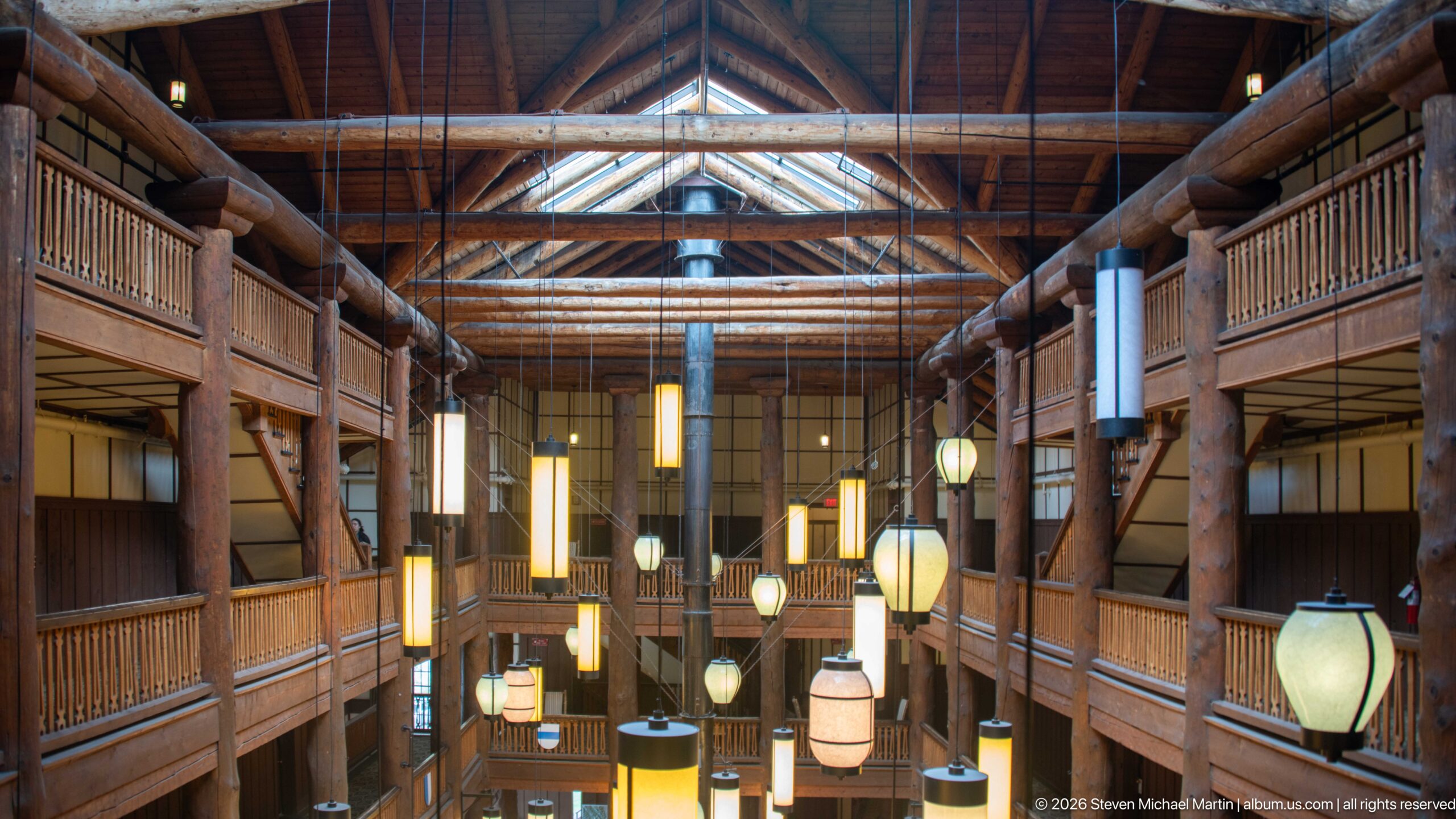
From an upper level, the Great Room opens vertically through several stories of log balconies and suspended lanterns. Massive peeled-log columns rise toward the glazed roof structure while railings repeat along both sides of the atrium. This elevated perspective concentrates on the hotel’s internal circulation and structural rhythm rather than the lobby floor, revealing how the balconies wrap the central volume and transform the interior into a towering timber court.
Caption
From an upper level, the Great Room opens vertically through several stories of log balconies and suspended lanterns. Massive peeled-log columns rise toward the glazed roof structure while railings repeat along both sides of the atrium. This elevated perspective concentrates on the hotel’s internal circulation and structural rhythm rather than the lobby floor, revealing how the balconies wrap the central volume and transform the interior into a towering timber court.
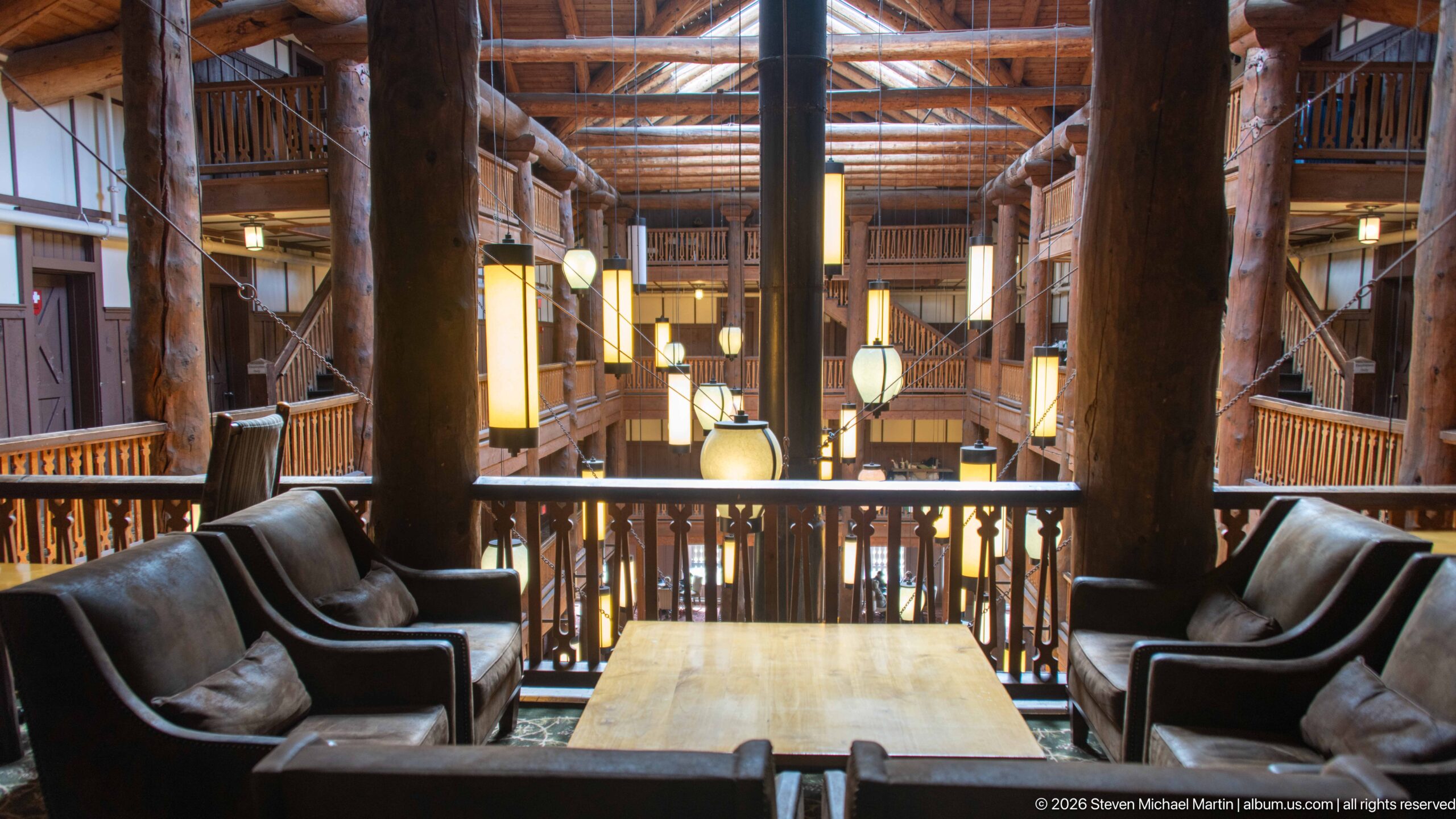
A small seating group occupies an upper balcony overlooking the Great Room, with leather armchairs arranged around a square wooden table behind a rustic railing. Beyond the furniture, suspended lanterns descend through the tall atrium and log galleries continue along the opposite side. The intimate foreground setting contrasts with the immense lobby void, showing how the hotel’s upper circulation levels also function as overlooks and informal gathering places.
Caption
A small seating group occupies an upper balcony overlooking the Great Room, with leather armchairs arranged around a square wooden table behind a rustic railing. Beyond the furniture, suspended lanterns descend through the tall atrium and log galleries continue along the opposite side. The intimate foreground setting contrasts with the immense lobby void, showing how the hotel’s upper circulation levels also function as overlooks and informal gathering places.
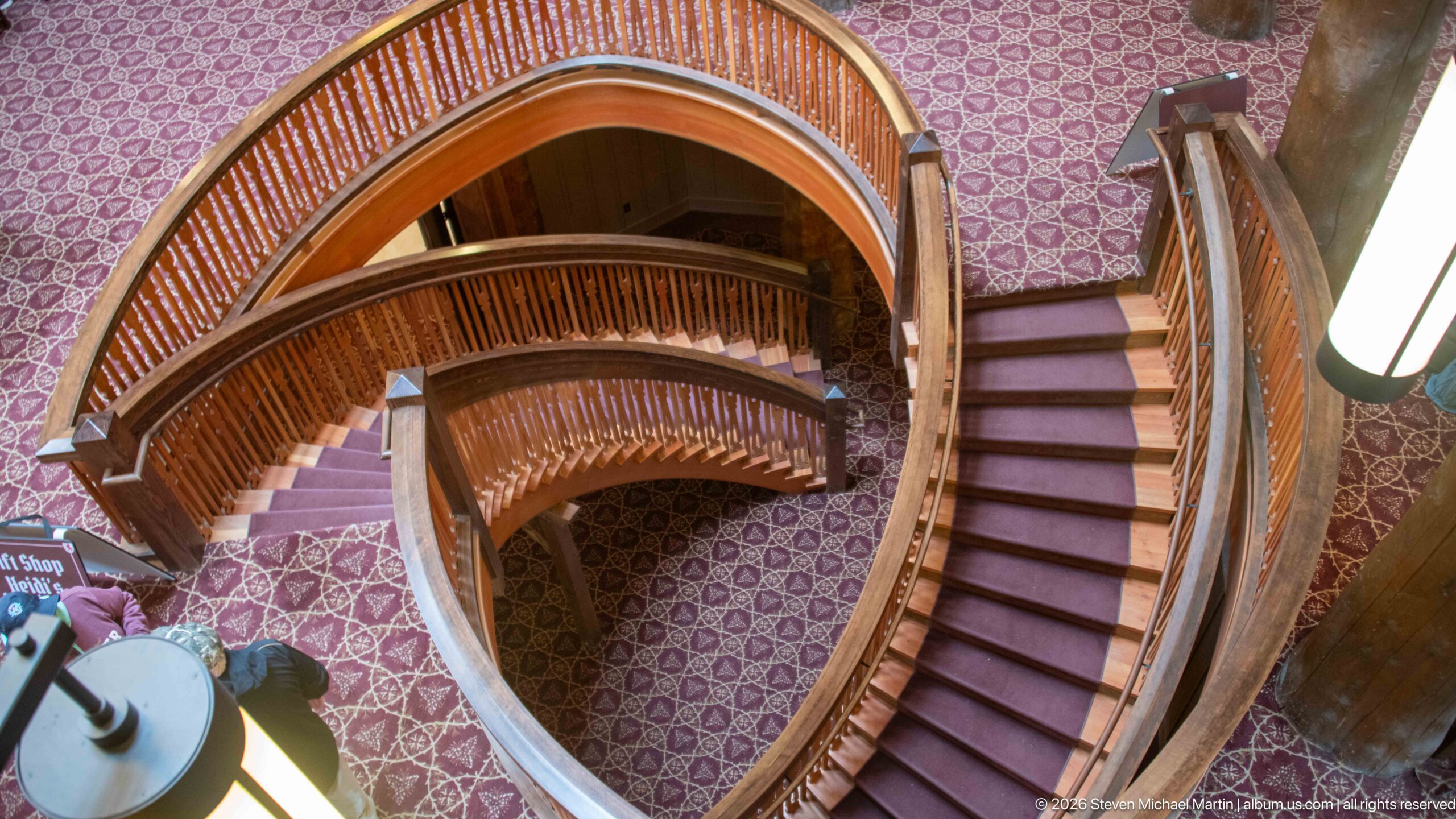
A sweeping wooden staircase curls through the hotel interior in a series of rounded landings and tightly spaced balusters. Viewed steeply downward, the stair forms overlapping arcs against a patterned carpet, turning a functional circulation element into a strong geometric composition. Heavy timber handrails and dark wood construction connect the staircase visually to the lodge’s broader rustic interior, while the unusual viewpoint makes its layered plan especially clear.
Caption
A sweeping wooden staircase curls through the hotel interior in a series of rounded landings and tightly spaced balusters. Viewed steeply downward, the stair forms overlapping arcs against a patterned carpet, turning a functional circulation element into a strong geometric composition. Heavy timber handrails and dark wood construction connect the staircase visually to the lodge’s broader rustic interior, while the unusual viewpoint makes its layered plan especially clear.
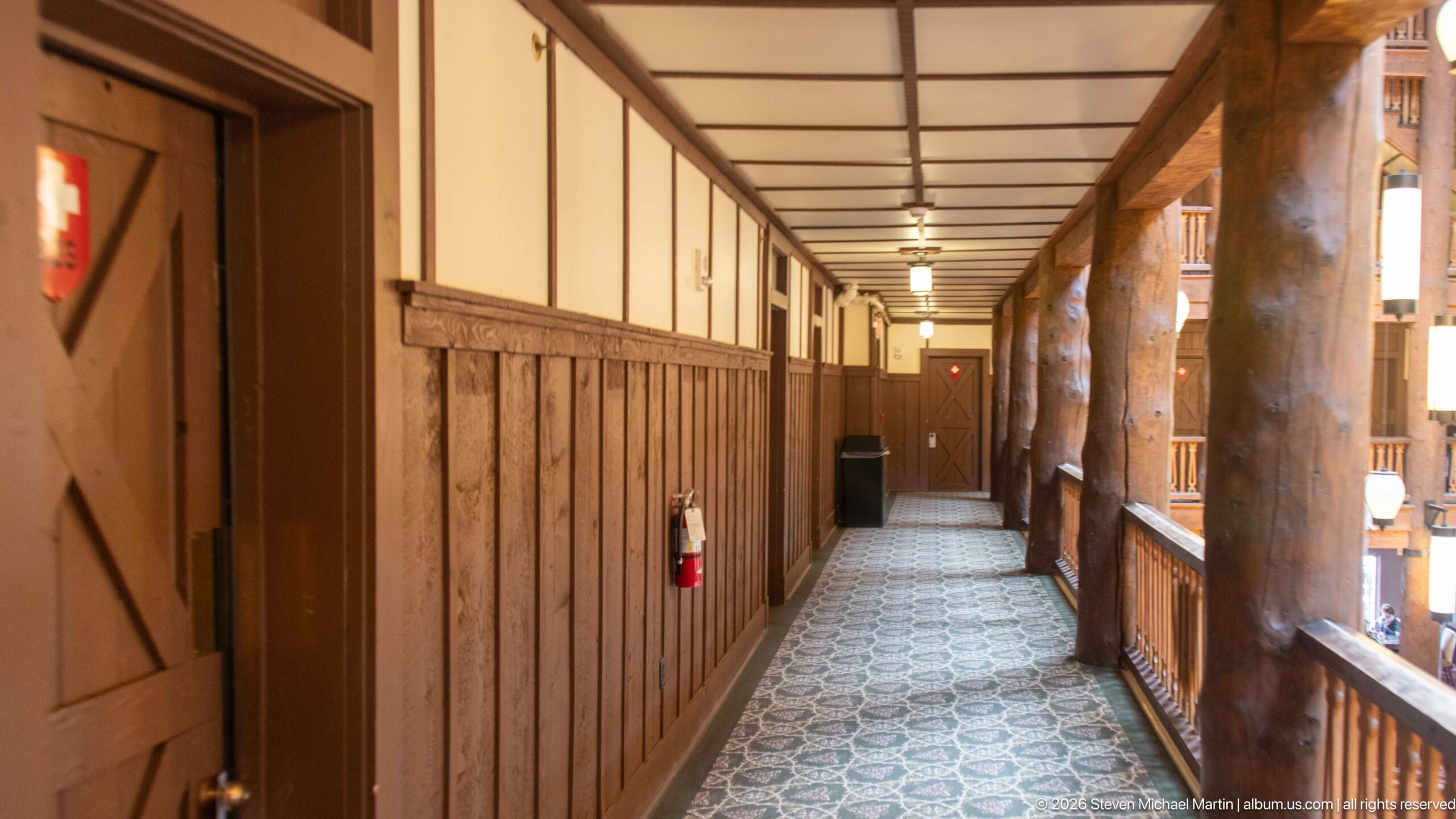
A long upper-level corridor runs beside the open Great Room, with guest-room doors and wood wainscoting lining the left wall and massive log columns defining the balcony edge at right. Repeating ceiling panels, light fixtures, and carpet pattern draw the eye toward a closed door at the far end. The view reveals the practical circulation spaces wrapped around the monumental lobby and the close juxtaposition of guest rooms with the central atrium.
Caption
A long upper-level corridor runs beside the open Great Room, with guest-room doors and wood wainscoting lining the left wall and massive log columns defining the balcony edge at right. Repeating ceiling panels, light fixtures, and carpet pattern draw the eye toward a closed door at the far end. The view reveals the practical circulation spaces wrapped around the monumental lobby and the close juxtaposition of guest rooms with the central atrium.
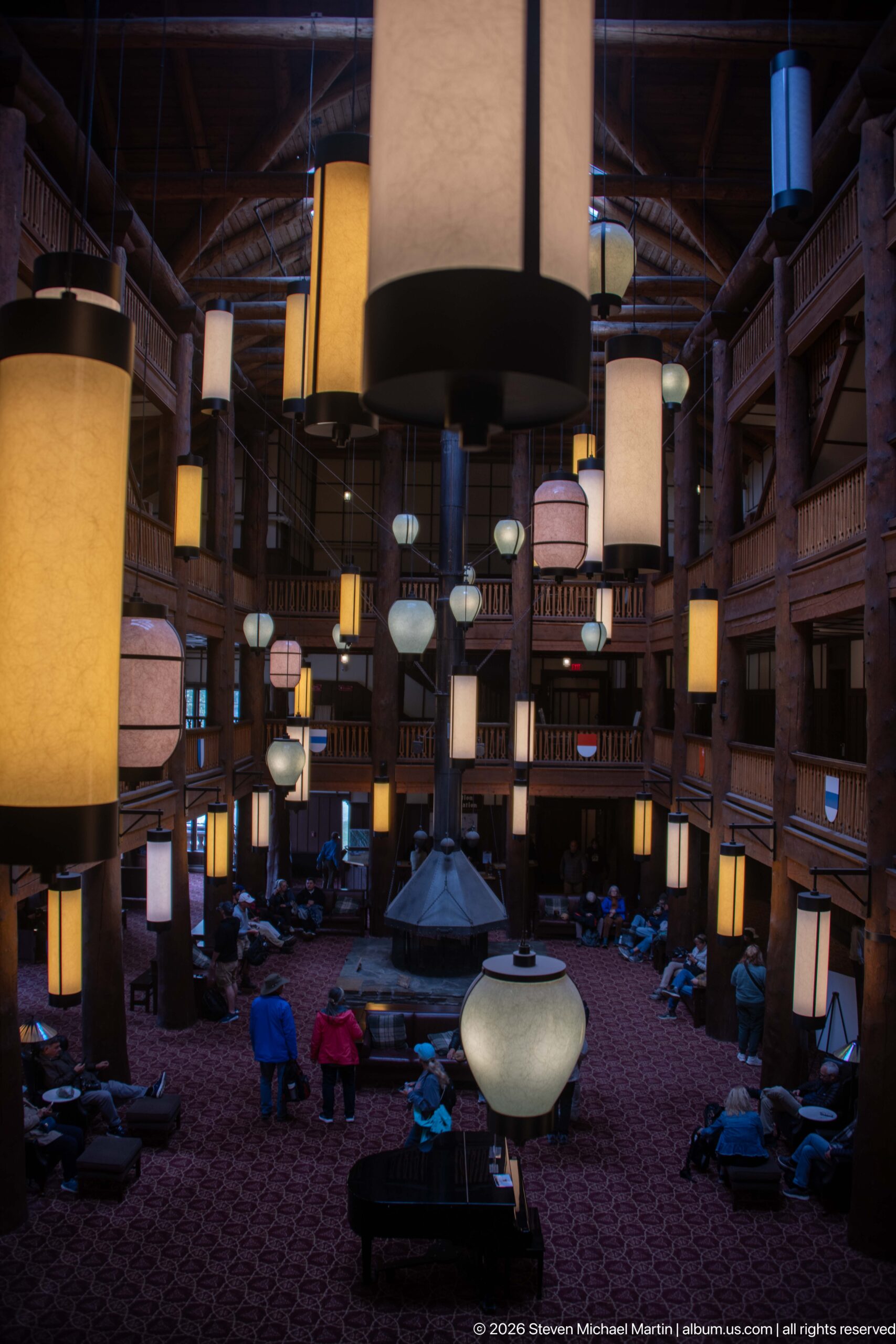
Large cylindrical and globe-shaped lanterns fill the foreground of this elevated Great Room view, partially screening the seating groups and central fireplace below. Multi-level log balconies recede around the darkened atrium, while visitors gather across the carpeted lobby floor. By placing the lighting fixtures close to the camera, the composition emphasizes the decorative system that animates the otherwise massive timber volume and gives the historic interior much of its visual character.
Caption
Large cylindrical and globe-shaped lanterns fill the foreground of this elevated Great Room view, partially screening the seating groups and central fireplace below. Multi-level log balconies recede around the darkened atrium, while visitors gather across the carpeted lobby floor. By placing the lighting fixtures close to the camera, the composition emphasizes the decorative system that animates the otherwise massive timber volume and gives the historic interior much of its visual character.
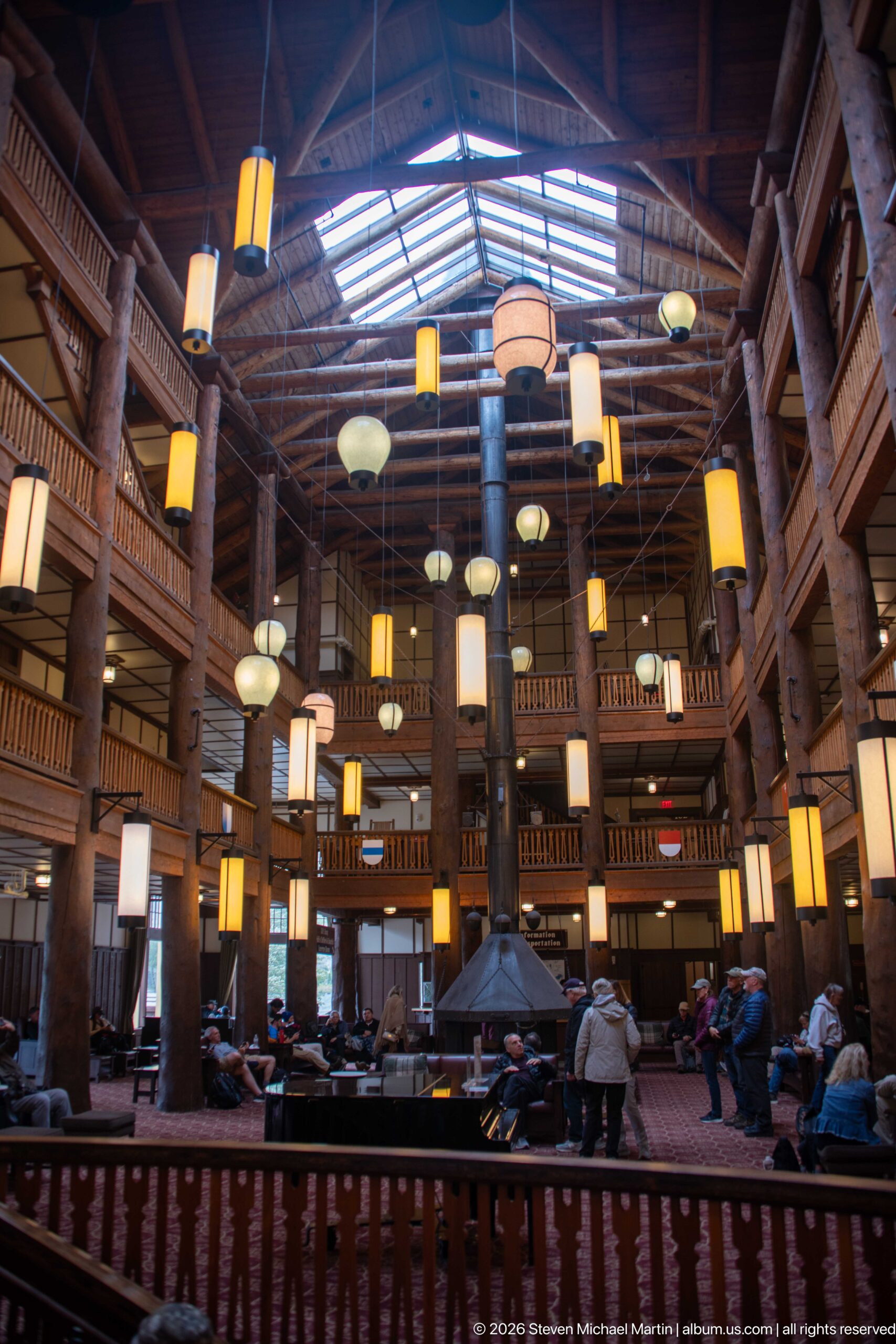
A broad view across the Great Room brings together its defining elements: massive log columns, stacked balcony galleries, exposed roof framing, suspended lanterns, and the central fireplace hood. Visitors occupy chairs and sofas across the expansive carpeted floor, giving the timber structure a clear human scale. Light from the glazed roof and warm fixtures spreads through the atrium, revealing the lobby as both the architectural centerpiece and principal gathering space of Many Glacier Hotel.
Caption
A broad view across the Great Room brings together its defining elements: massive log columns, stacked balcony galleries, exposed roof framing, suspended lanterns, and the central fireplace hood. Visitors occupy chairs and sofas across the expansive carpeted floor, giving the timber structure a clear human scale. Light from the glazed roof and warm fixtures spreads through the atrium, revealing the lobby as both the architectural centerpiece and principal gathering space of Many Glacier Hotel.
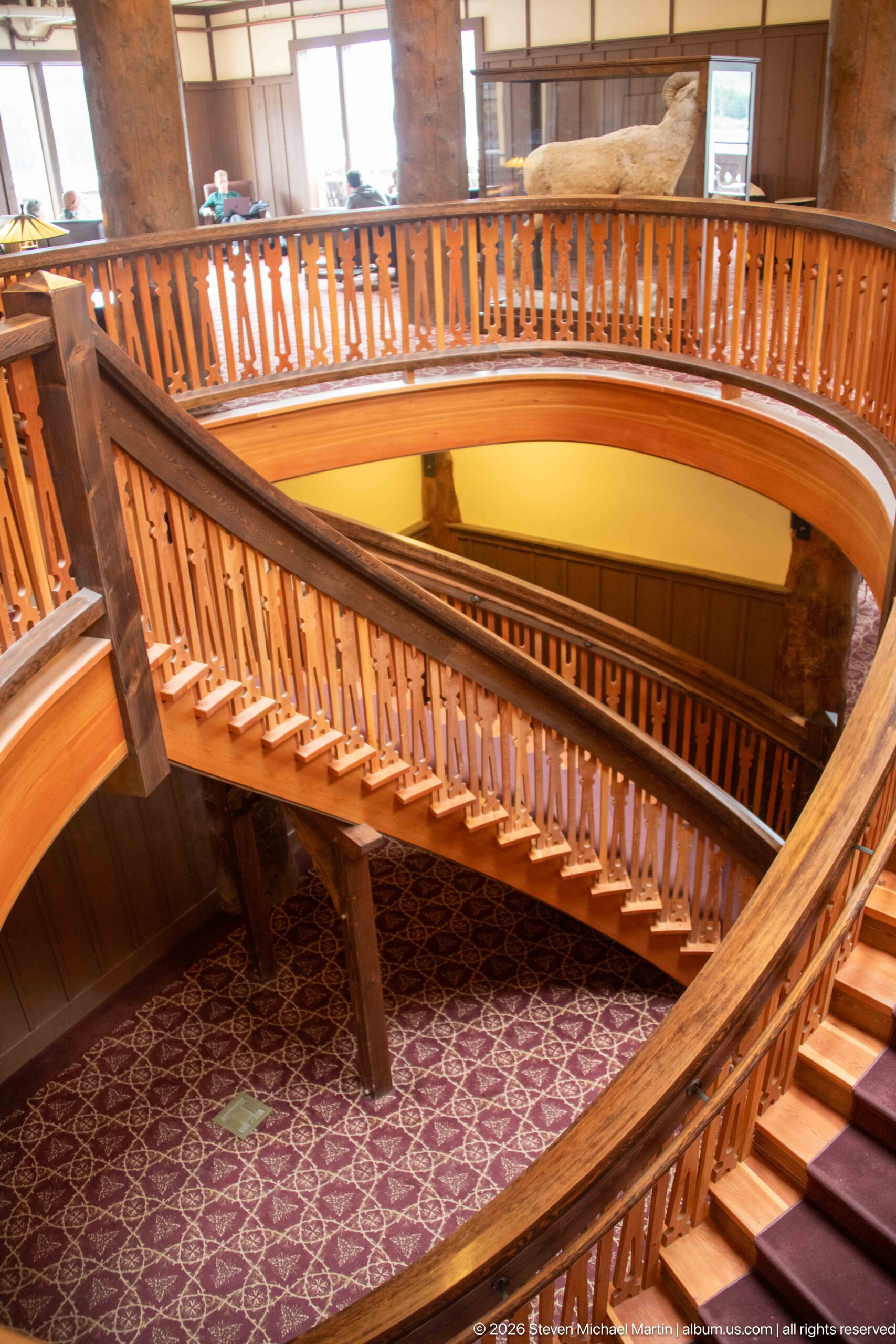
A sweeping wooden staircase turns through several levels of Many Glacier Hotel, its polished handrails and closely spaced balusters forming broad curves above the patterned carpet. Seen from an upper landing, the overlapping flights reveal the stair’s unusually sculptural geometry and careful wood construction. The composition isolates a circulation feature that is easy to overlook amid the lodge’s larger public rooms, emphasizing craftsmanship, changing levels, and the warm tones of the historic interior.
Caption
A sweeping wooden staircase turns through several levels of Many Glacier Hotel, its polished handrails and closely spaced balusters forming broad curves above the patterned carpet. Seen from an upper landing, the overlapping flights reveal the stair’s unusually sculptural geometry and careful wood construction. The composition isolates a circulation feature that is easy to overlook amid the lodge’s larger public rooms, emphasizing craftsmanship, changing levels, and the warm tones of the historic interior.
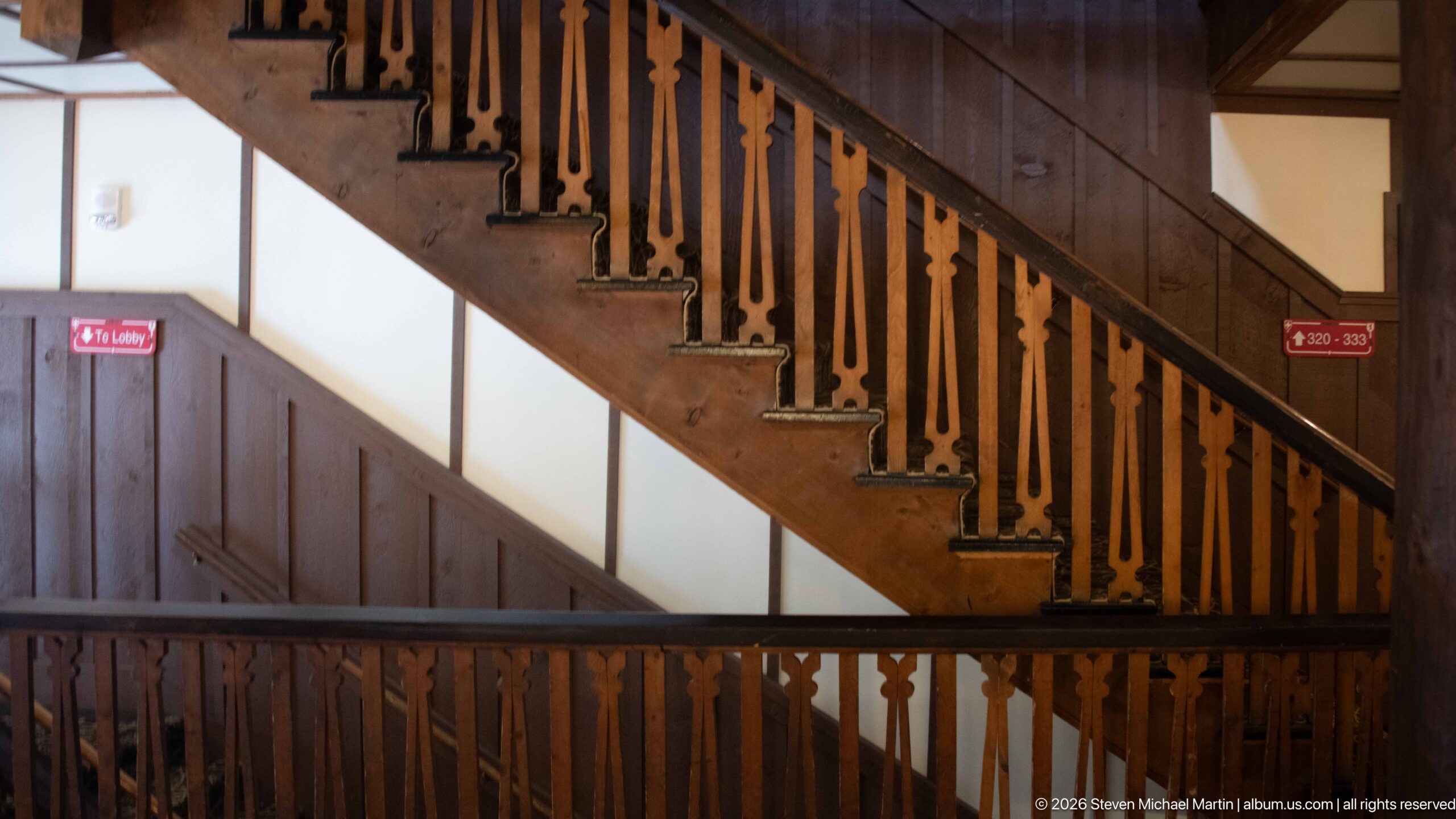
A straight wooden stair rises above an upper-level landing, its rustic balustrade silhouetted against pale wall panels. Small red directional signs mark the route to the lobby and rooms 200–303, turning this close view into a record of both circulation and wayfinding within the sprawling lodge. Dark timber walls, patterned carpet, and the hand-crafted appearance of the railing maintain the building’s rustic visual language even in this utilitarian passage.
Caption
A straight wooden stair rises above an upper-level landing, its rustic balustrade silhouetted against pale wall panels. Small red directional signs mark the route to the lobby and rooms 200–303, turning this close view into a record of both circulation and wayfinding within the sprawling lodge. Dark timber walls, patterned carpet, and the hand-crafted appearance of the railing maintain the building’s rustic visual language even in this utilitarian passage.
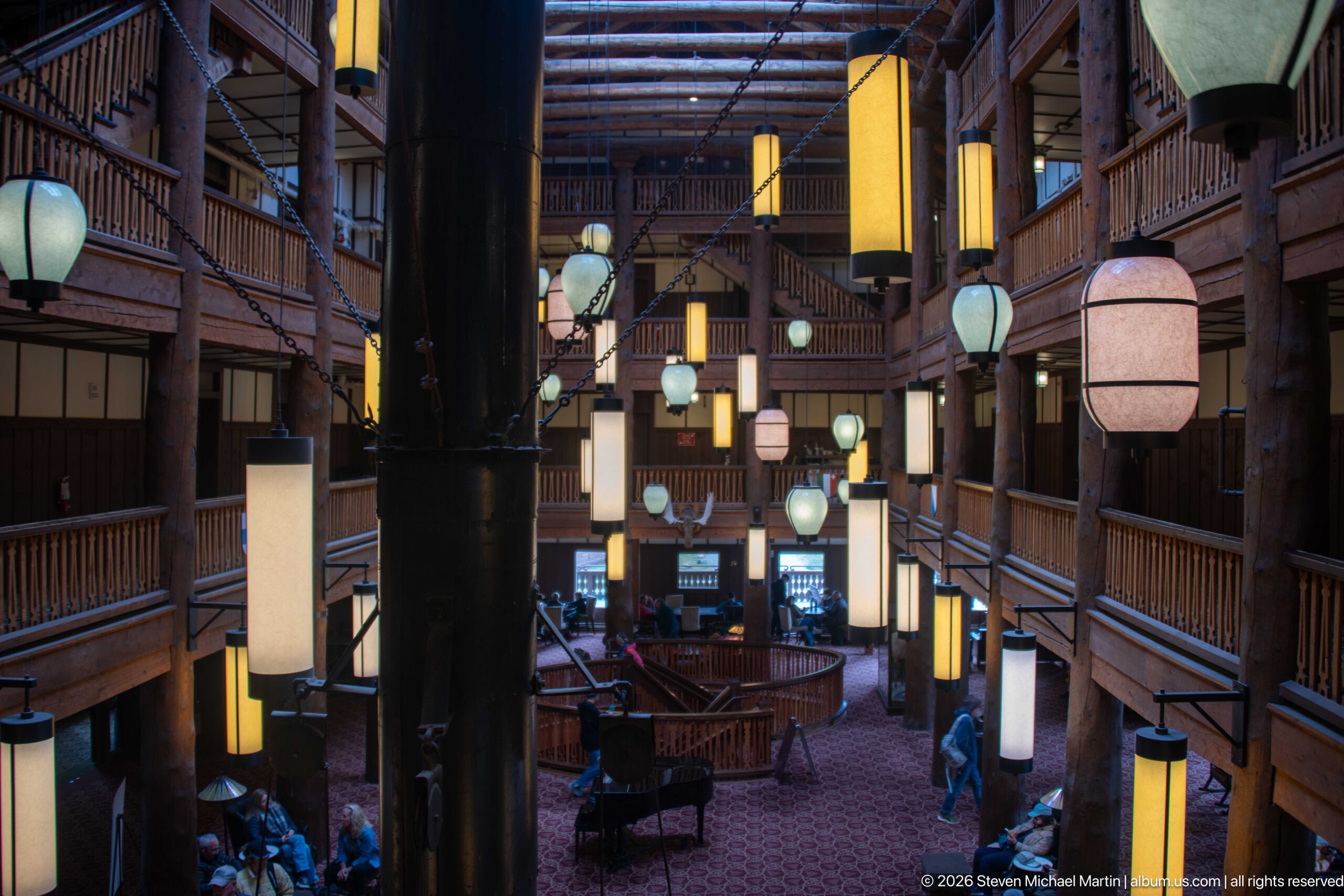
A tall black stovepipe or chimney element rises through the center of this upper-level Great Room view, surrounded by suspended lanterns and stacked log balconies. The strong vertical foreground element divides the atrium while guests and seating occupy the floor below. Repetition of railings, lights, and columns leads toward the far end of the lobby, emphasizing the exceptional depth of the central space as well as its multiple levels.
Caption
A tall black stovepipe or chimney element rises through the center of this upper-level Great Room view, surrounded by suspended lanterns and stacked log balconies. The strong vertical foreground element divides the atrium while guests and seating occupy the floor below. Repetition of railings, lights, and columns leads toward the far end of the lobby, emphasizing the exceptional depth of the central space as well as its multiple levels.
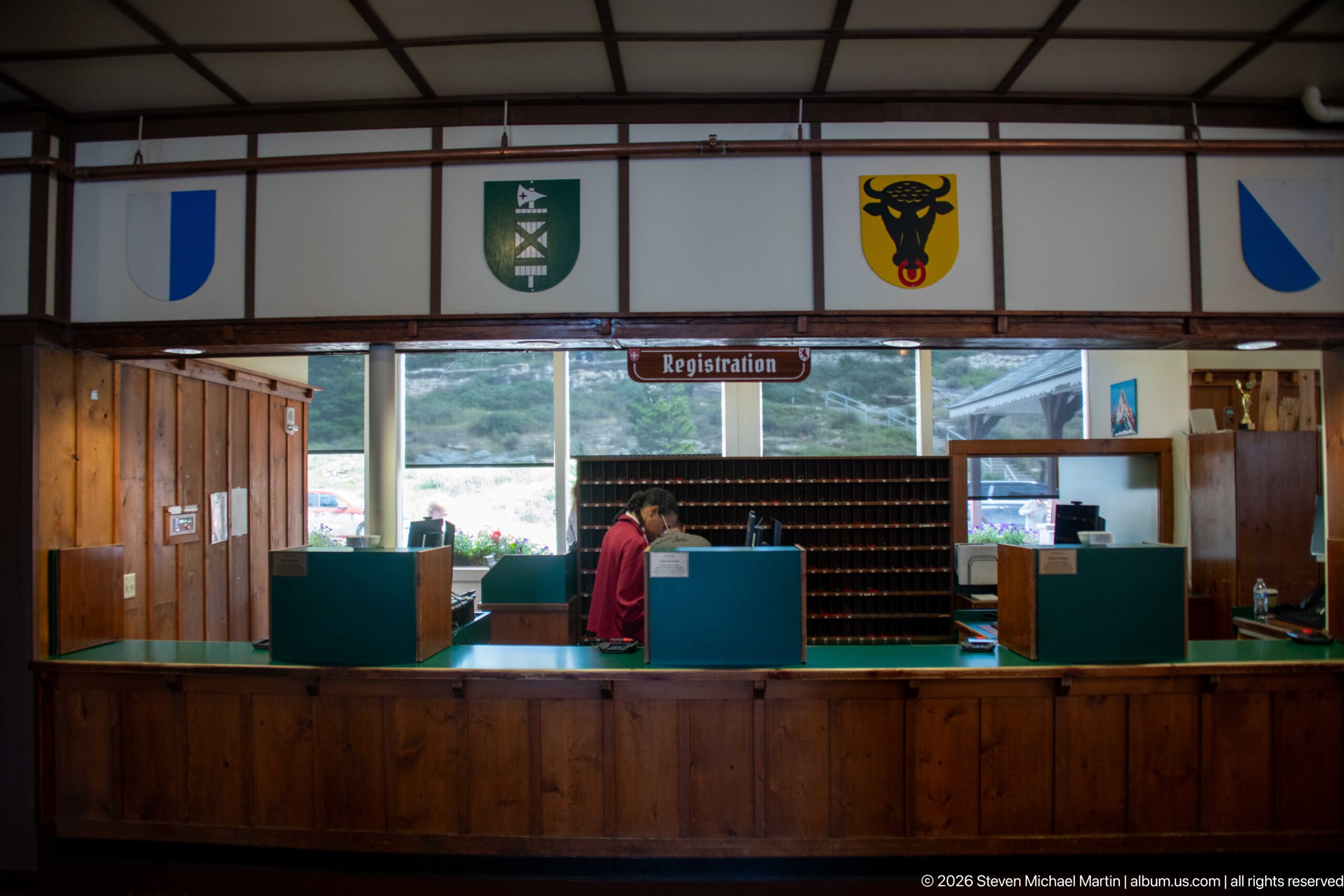
The registration counter stretches across a wood-paneled alcove beneath a clearly labeled “Registration” sign. A staff member works behind green counter partitions, with a wall of small mail or key slots filling the center background. Four heraldic shields mounted high on the wall continue the hotel’s Swiss-inspired decorative theme. The frontal composition documents the operational heart of the lodge while preserving the historic visual character of its reception area.
Caption
The registration counter stretches across a wood-paneled alcove beneath a clearly labeled “Registration” sign. A staff member works behind green counter partitions, with a wall of small mail or key slots filling the center background. Four heraldic shields mounted high on the wall continue the hotel’s Swiss-inspired decorative theme. The frontal composition documents the operational heart of the lodge while preserving the historic visual character of its reception area.
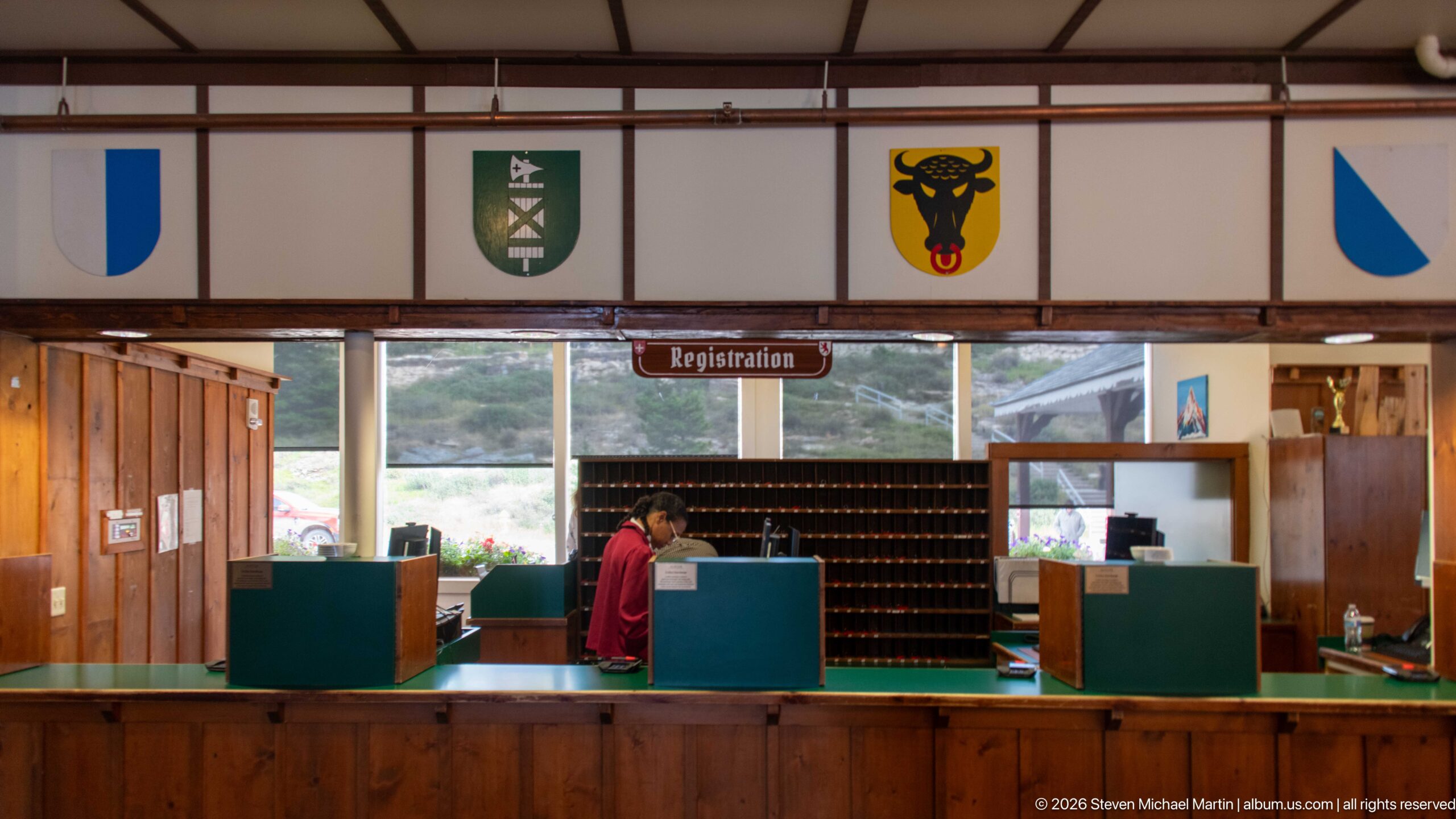
A closer frontal view centers the Many Glacier Hotel registration area, where green counter stations stand before a dense grid of guest key or mail compartments. A staff member leans over the central work surface beneath the small “Registration” sign. Above, painted heraldic shields provide a decorative counterpoint to the otherwise functional wood-paneled desk, illustrating how the lodge’s Alpine motif extends even into its day-to-day reception spaces.
Caption
A closer frontal view centers the Many Glacier Hotel registration area, where green counter stations stand before a dense grid of guest key or mail compartments. A staff member leans over the central work surface beneath the small “Registration” sign. Above, painted heraldic shields provide a decorative counterpoint to the otherwise functional wood-paneled desk, illustrating how the lodge’s Alpine motif extends even into its day-to-day reception spaces.
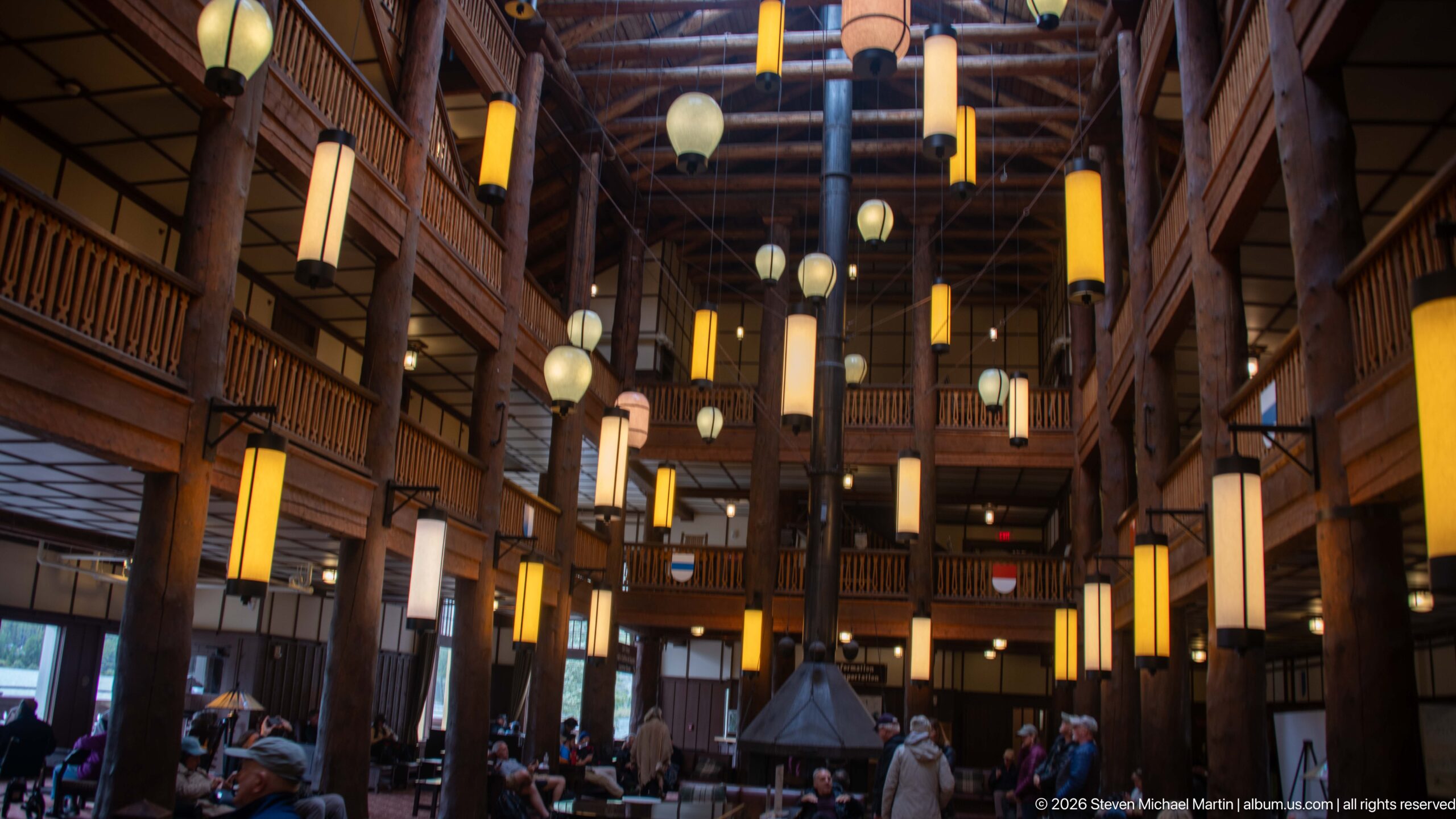
Dozens of suspended lanterns descend through the immense Great Room, framed by peeled-log columns, exposed roof structure, and stacked wooden galleries. Guests occupy seating groups around the central fireplace hood, giving a clear sense of the lobby’s scale. This nearly axial view draws attention to the extraordinary vertical volume of the room and to the decorative lighting that punctuates the dark timber architecture from the lobby floor to the upper balconies.
Caption
Dozens of suspended lanterns descend through the immense Great Room, framed by peeled-log columns, exposed roof structure, and stacked wooden galleries. Guests occupy seating groups around the central fireplace hood, giving a clear sense of the lobby’s scale. This nearly axial view draws attention to the extraordinary vertical volume of the room and to the decorative lighting that punctuates the dark timber architecture from the lobby floor to the upper balconies.
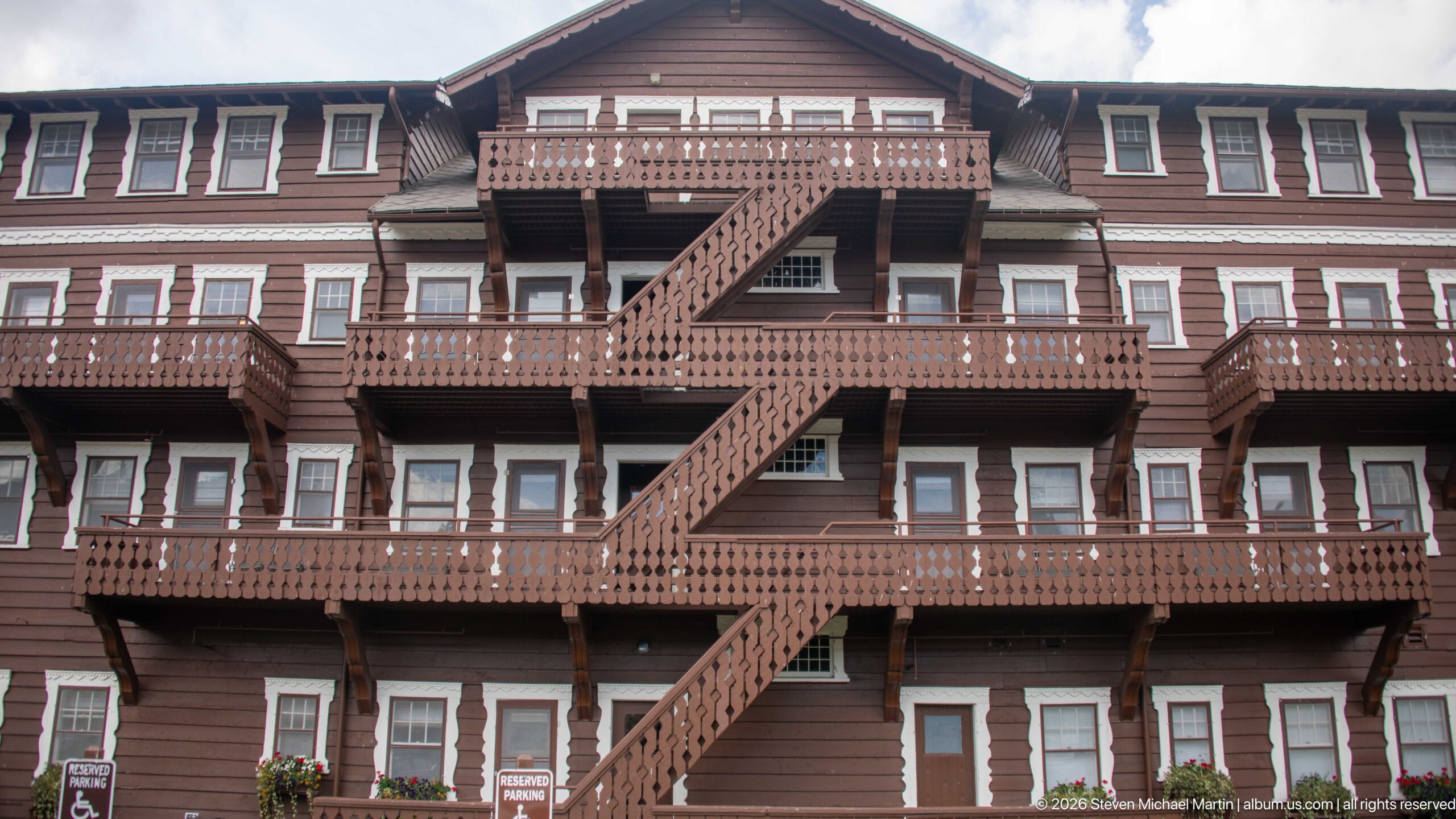
A tall wooden stair climbs diagonally across the lodge façade, linking successive exterior balcony levels in a striking zigzag pattern. Rows of white-trimmed windows, brown clapboard siding, and decorative balcony rails create a regular backdrop to the steep stair flights. The frontal composition isolates this functional exterior circulation system from the larger hotel complex, revealing how stairs and galleries are integrated into the building’s multi-story wooden elevation.
Caption
A tall wooden stair climbs diagonally across the lodge façade, linking successive exterior balcony levels in a striking zigzag pattern. Rows of white-trimmed windows, brown clapboard siding, and decorative balcony rails create a regular backdrop to the steep stair flights. The frontal composition isolates this functional exterior circulation system from the larger hotel complex, revealing how stairs and galleries are integrated into the building’s multi-story wooden elevation.
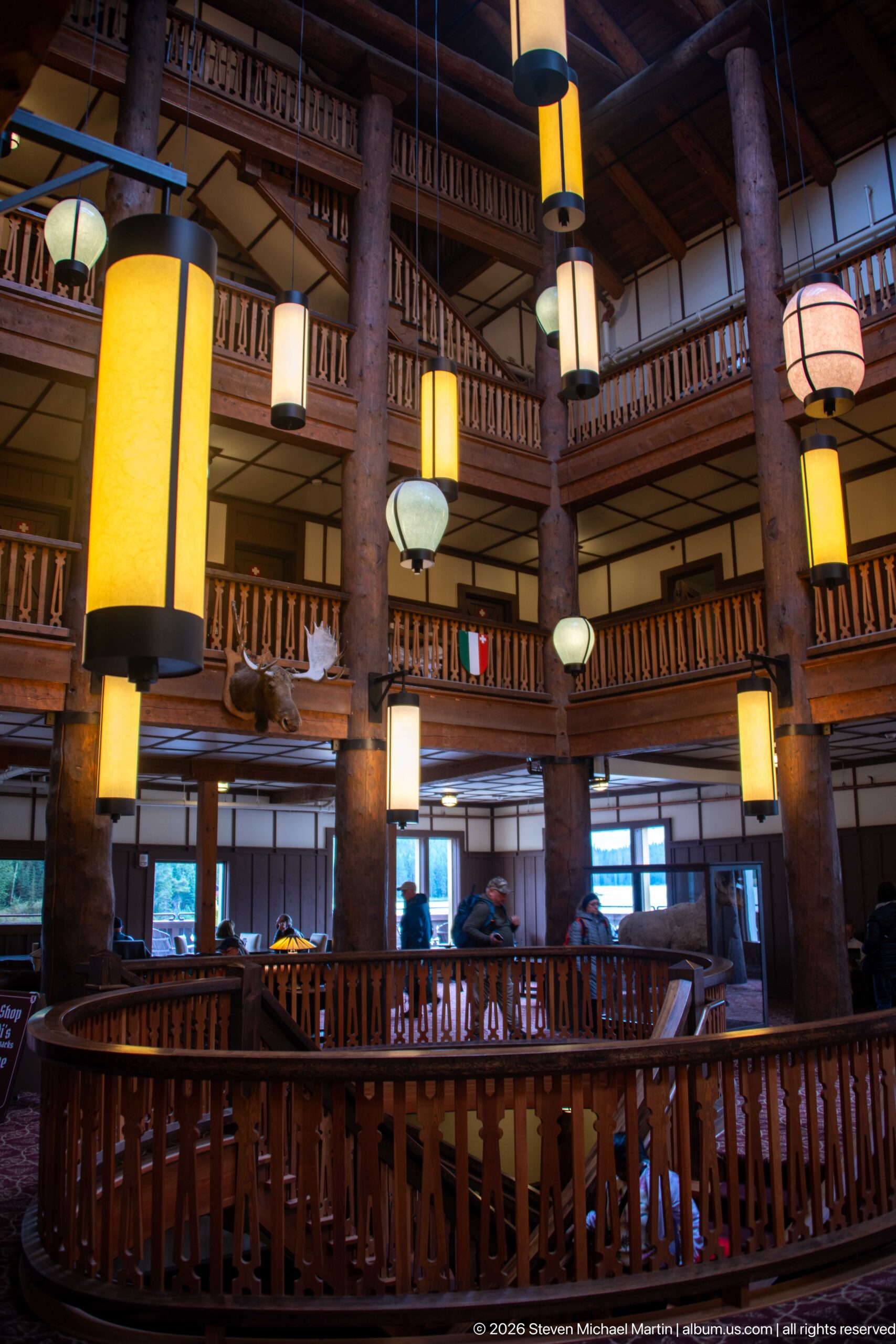
Oversized lanterns hang at different heights among the massive log columns and stacked balcony galleries of the Great Room. This side view compresses several levels of the lobby into a dense pattern of timber rails, cylindrical columns, and glowing fixtures, while windows along the lower level admit cooler daylight. By minimizing the floor area, the composition concentrates on the vertical layering and decorative lighting that give the central interior its distinctive architectural rhythm.
Caption
Oversized lanterns hang at different heights among the massive log columns and stacked balcony galleries of the Great Room. This side view compresses several levels of the lobby into a dense pattern of timber rails, cylindrical columns, and glowing fixtures, while windows along the lower level admit cooler daylight. By minimizing the floor area, the composition concentrates on the vertical layering and decorative lighting that give the central interior its distinctive architectural rhythm.
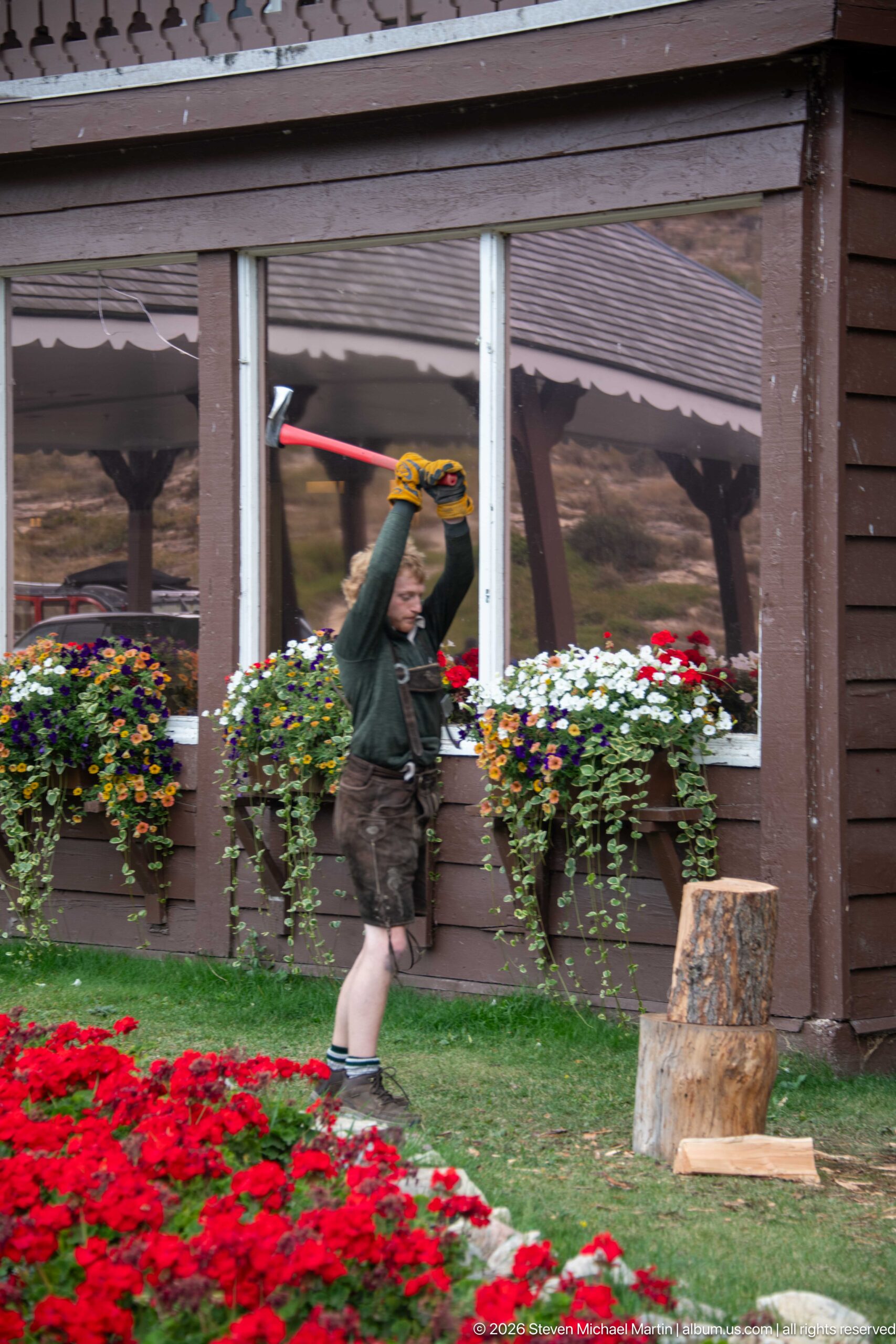
With the red-handled splitting tool raised overhead, a lodge staff member prepares the next strike at a log positioned on a chopping block. The action is frozen at the top of the swing, distinguishing this view from the adjacent photograph taken at the moment of impact. Dense red flowers and multicolored window boxes soften the brown exterior wall behind the worker, placing a practical maintenance task within the cultivated grounds of Many Glacier Hotel.
Caption
With the red-handled splitting tool raised overhead, a lodge staff member prepares the next strike at a log positioned on a chopping block. The action is frozen at the top of the swing, distinguishing this view from the adjacent photograph taken at the moment of impact. Dense red flowers and multicolored window boxes soften the brown exterior wall behind the worker, placing a practical maintenance task within the cultivated grounds of Many Glacier Hotel.
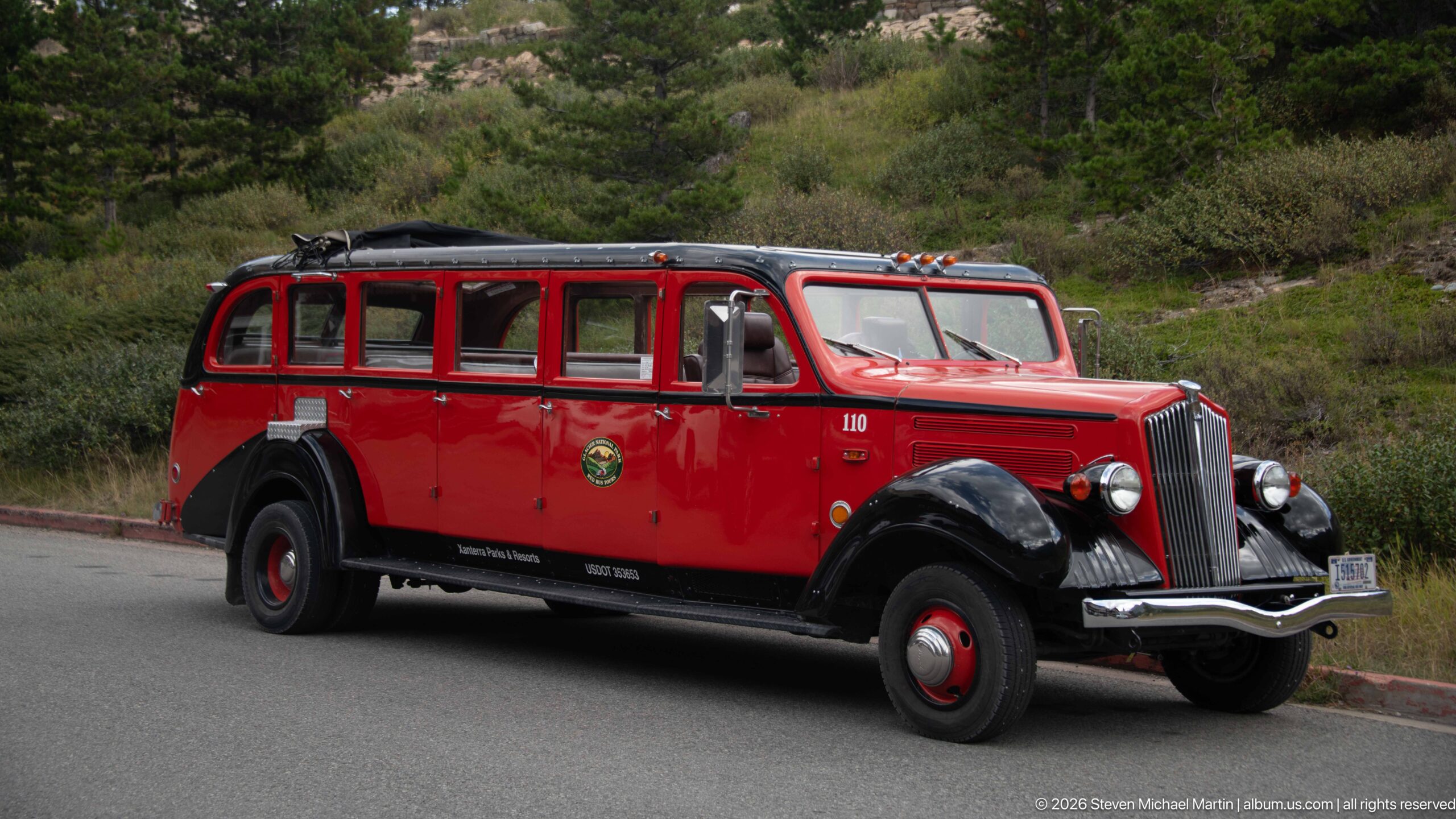
A historic red touring bus stands in profile against a green hillside, revealing its long passenger body, black fenders, chrome grille, paired headlights, and roll-back roof. The unobstructed side view also shows the park emblem on the door and the vehicle number near the windshield. Removed from the busy hotel entrance, the bus becomes the sole subject, highlighting the distinctive vehicle design long associated with sightseeing in Glacier National Park.
Caption
A historic red touring bus stands in profile against a green hillside, revealing its long passenger body, black fenders, chrome grille, paired headlights, and roll-back roof. The unobstructed side view also shows the park emblem on the door and the vehicle number near the windshield. Removed from the busy hotel entrance, the bus becomes the sole subject, highlighting the distinctive vehicle design long associated with sightseeing in Glacier National Park.
Field Guide
Overview
Many Glacier Hotel stands along Swiftcurrent Lake in Glacier National Park’s Many Glacier Valley, where the building’s broad lakeside presence is framed by forested slopes, exposed rock, waterfalls, and high mountain peaks. Constructed by the Great Northern Railway in 1914–1915 and expanded with an annex in 1917, the hotel was conceived as a major destination within the railway’s network of lodges and chalets. The portfolio moves from the mountain setting and sprawling exterior into the Great Room, dining room, lounge, registration area, corridors, stairways, and arrival court, revealing how landscape, transportation, and architecture were brought together in an early national-park resort.
Landscape
The hotel’s setting is fundamental to its identity. Swiftcurrent Lake lies immediately beside the building, while steep mountains rise beyond the water and closely frame the developed site. Views from the lodge connect forest, lake, exposed mountain slopes, and changing cloud and light conditions into a single landscape experience. The portfolio shows the hotel not as an isolated structure but as a building deliberately placed within the larger Many Glacier valley, where the scale of the surrounding terrain remains visually dominant even beside the enormous lodge complex.
Geology
The portfolio presents geology primarily through the dramatic mountain setting surrounding Many Glacier Hotel. Steep rock walls, high peaks, exposed slopes, and the lake basin establish a landscape whose physical form is much larger than the historic building occupying its edge. Although the supplied evidence does not support detailed identification of individual formations or rock units, it clearly shows the close relationship among mountain topography, water, forested lower slopes, and the narrow developed area beside Swiftcurrent Lake. That relationship provides the strongest geological context supported by these photographs.
Ecology
Forest and mountain vegetation form the natural backdrop to Many Glacier Hotel, extending from the lakeshore and developed grounds onto the surrounding slopes. Near the building, maintained lawns, flower beds, and window boxes create a cultivated layer that contrasts with the broader protected landscape. The photographs do not document individual plant communities closely enough for species-level interpretation, but they do show a clear transition from managed lodge grounds to forest, lake, and mountain habitat. This boundary between developed visitor space and the surrounding national-park environment is an important part of the site’s character.
Wildlife
Wildlife is part of Glacier National Park’s broader natural setting, but living animals are not a principal subject of this Many Glacier Hotel portfolio. The photographs concentrate on the lodge, its interiors, transportation, visitor activity, and surrounding landscape. Wildlife appears most directly through historic interior display, including a mounted moose head and antlers associated with the lodge’s rustic decorative character. The supplied evidence therefore supports treating wildlife as part of the wider protected landscape while avoiding unsupported claims about particular species, behavior, or sightings around the hotel.
Human History
The Great Northern Railway constructed Many Glacier Hotel in 1914–1915 as the showpiece of its network of hotels and backcountry chalets in Glacier National Park. Railway president Louis W. Hill promoted the park as the “Alps of America,” and the hotel’s Swiss-inspired imagery helped translate that promotional vision into architecture and visitor experience. The hotel opened on July 4, 1915, and a 1917 annex enlarged the complex along the lakeshore. More than a century later, the building remains an operating lodge and a National Historic Landmark, preserving an important chapter in the development of tourism and transportation in the national parks.
Recreation and Visitor Experience
The photographs show Many Glacier Hotel as an active destination organized around arrival, gathering, dining, lodging, and views of the surrounding park. Historic red touring buses appear at the entrance, while the porte-cochère and arrival court lead into a sequence of public interiors. The soaring Great Room is the visual center, with massive peeled-log columns, stacked galleries, suspended lanterns, seating, and a central fireplace. The Ptarmigan Dining Room, Interlaken Lounge, registration desk, stairways, corridors, and balcony seating areas extend that experience through spaces that continue to serve contemporary visitors.
Photography Notes
Many Glacier Hotel is especially suited to a photographic sequence that moves between landscape, architecture, interior scale, and close detail. Exterior views work best when the lodge is shown against Swiftcurrent Lake, mountain slopes, or the arrival court, while oblique compositions reveal balconies, chimneys, roof forms, exterior stairs, and planted grounds. Inside, elevated viewpoints make the Great Room’s vertical structure legible through repeating galleries, log columns, lanterns, and the central fireplace. Tighter photographs of signs, stairways, dining spaces, registration areas, furnishings, and decorative elements add detail to the broader architectural story.