Dinosaur National Monument
Dinosaur National Monument preserves one of the most important fossil sites in North America, where exposed rock layers contain visible dinosaur remains dating to the Jurassic period. The monument provides a direct connection to prehistoric ecosystems that existed long before the modern Rocky Mountain landscape formed. Its fossil quarry offers a rare opportunity to view dinosaur bones still embedded in natural rock.
Beyond its paleontological significance, the monument includes rugged canyon terrain carved by the Green and Yampa Rivers. Tilted sedimentary rock layers reveal the effects of tectonic uplift and erosion, while broad desert plateaus contrast with deeply incised river corridors. The landscape illustrates how water and time shaped the varied terrain of the interior western United States.
Visitors experience Dinosaur National Monument as both a scientific site and a scenic landscape. Fossil exhibits provide insight into ancient life, while overlooks reveal expansive canyon views that emphasize the scale of geological change. The combination of prehistoric resources and dramatic terrain makes this monument one of the most distinctive protected areas in the Rocky Mountain region.
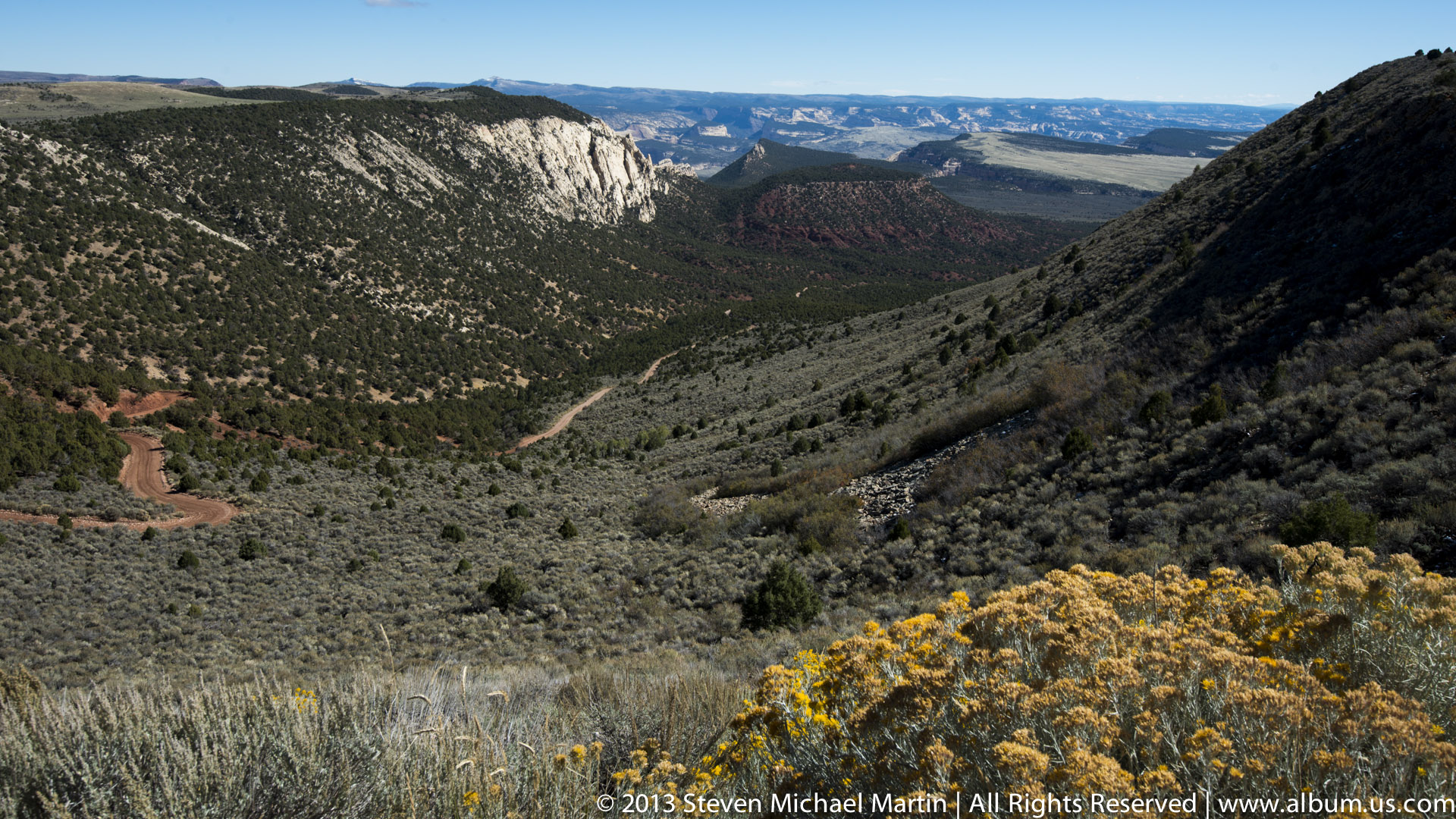
A narrow reddish road snakes across the valley floor and disappears around a low slope, bordered by dense gray-green shrubs and patches of yellow flowers. Tree-covered hills rise on both sides, with a distant opening toward blue ridges at the horizon. The bright vegetation in the foreground and the road’s repeated curves draw the eye through the basin.
Caption
A narrow reddish road snakes across the valley floor and disappears around a low slope, bordered by dense gray-green shrubs and patches of yellow flowers. Tree-covered hills rise on both sides, with a distant opening toward blue ridges at the horizon. The bright vegetation in the foreground and the road’s repeated curves draw the eye through the basin.
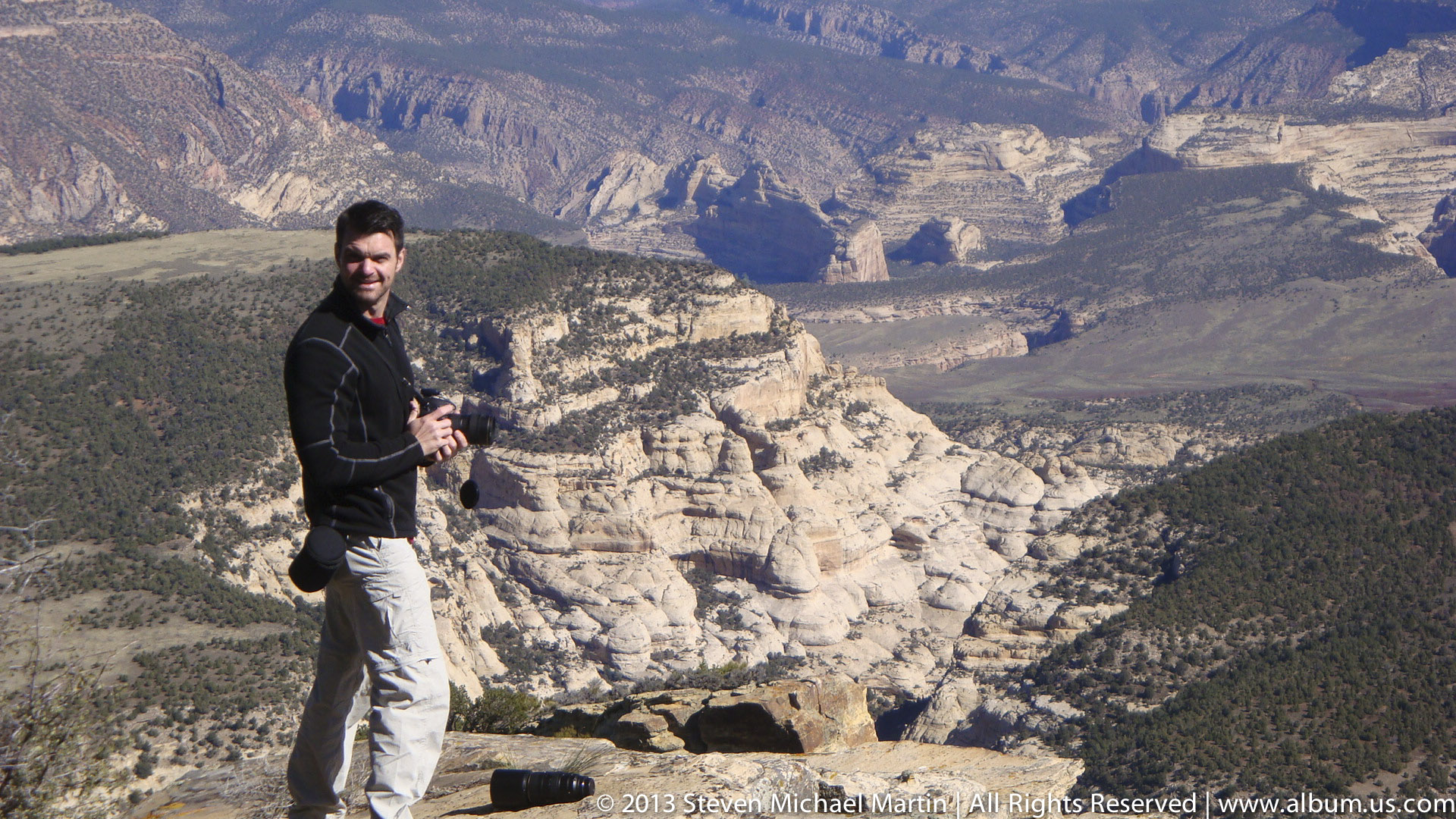
A visitor in a dark jacket stands on a rocky overlook with a camera in hand, turning toward the viewer as pale, stepped canyon walls descend behind him. A second piece of camera equipment rests near his feet. The portrait combines the photographer’s presence with a wide view of the eroded landscape, whose light-colored rock bands contrast with the darker vegetated slopes.
Caption
A visitor in a dark jacket stands on a rocky overlook with a camera in hand, turning toward the viewer as pale, stepped canyon walls descend behind him. A second piece of camera equipment rests near his feet. The portrait combines the photographer’s presence with a wide view of the eroded landscape, whose light-colored rock bands contrast with the darker vegetated slopes.
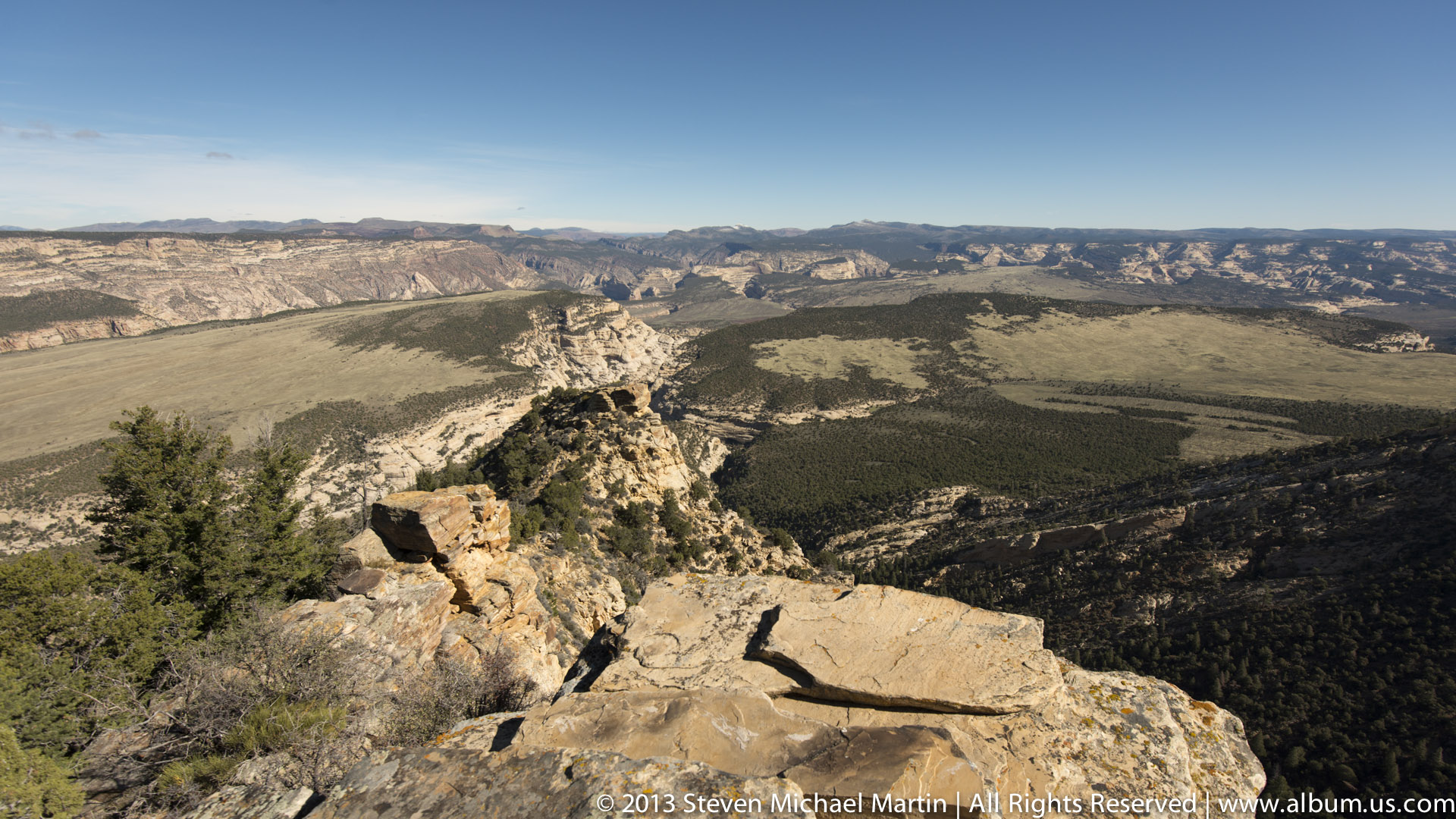
From a pale, broken rock outcrop, the view extends over a wide plateau marked by dark bands of vegetation and distant canyon rims. A small blocky formation sits just below the foreground edge, while successive ridges fade across the horizon. The high vantage point makes the landscape’s broad scale and alternating bands of exposed stone and scrub the main subject.
Caption
From a pale, broken rock outcrop, the view extends over a wide plateau marked by dark bands of vegetation and distant canyon rims. A small blocky formation sits just below the foreground edge, while successive ridges fade across the horizon. The high vantage point makes the landscape’s broad scale and alternating bands of exposed stone and scrub the main subject.
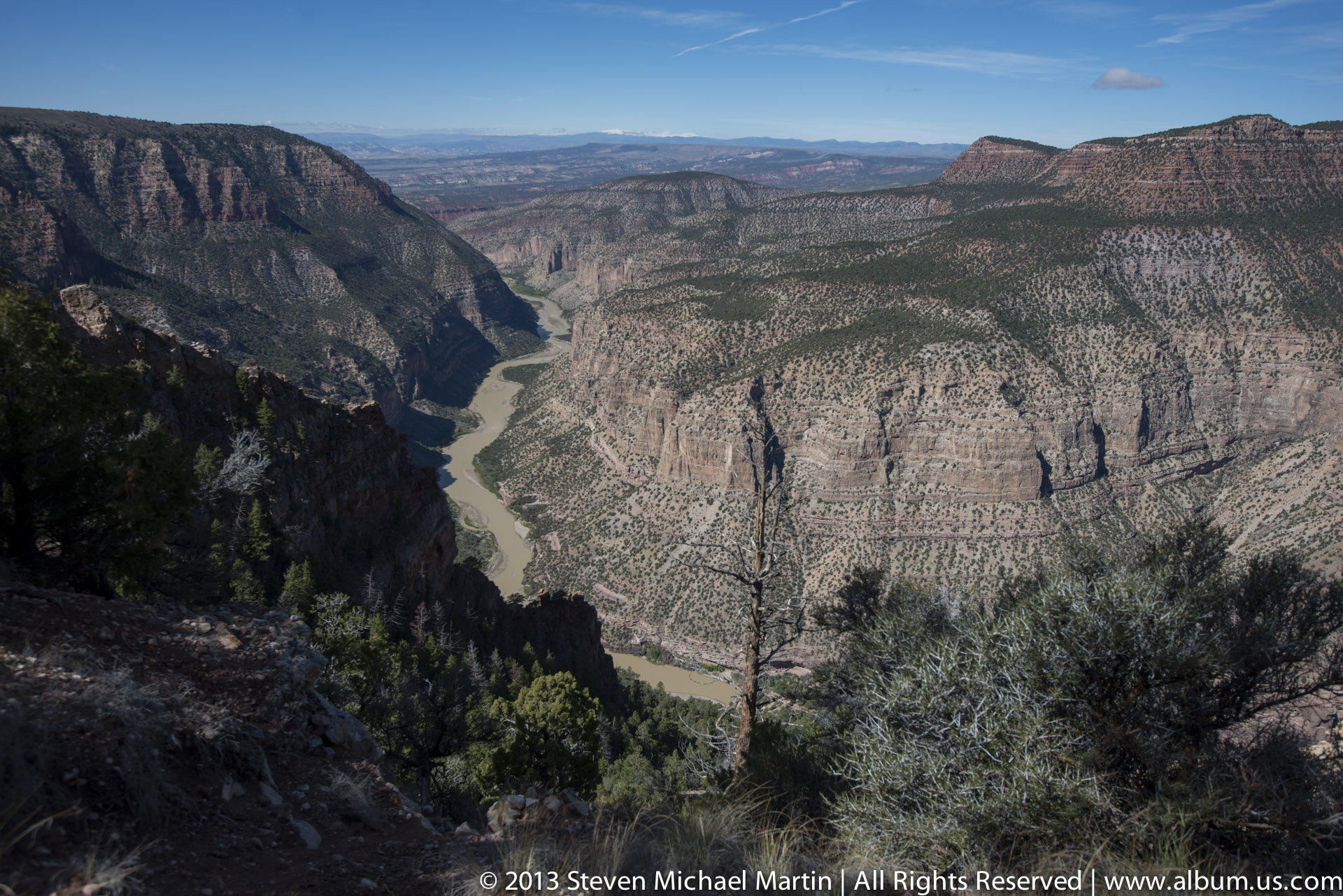
The river winds through a deep gorge framed by broad, stratified walls and distant flat-topped mesas. Dark branches and shrubs edge the lower foreground, adding depth to the open view. Compared with the tighter river bend nearby, this panorama emphasizes the length of the canyon and the repeated ridgelines beyond it, with patches of sunlight and shadow dividing the slopes.
Caption
The river winds through a deep gorge framed by broad, stratified walls and distant flat-topped mesas. Dark branches and shrubs edge the lower foreground, adding depth to the open view. Compared with the tighter river bend nearby, this panorama emphasizes the length of the canyon and the repeated ridgelines beyond it, with patches of sunlight and shadow dividing the slopes.
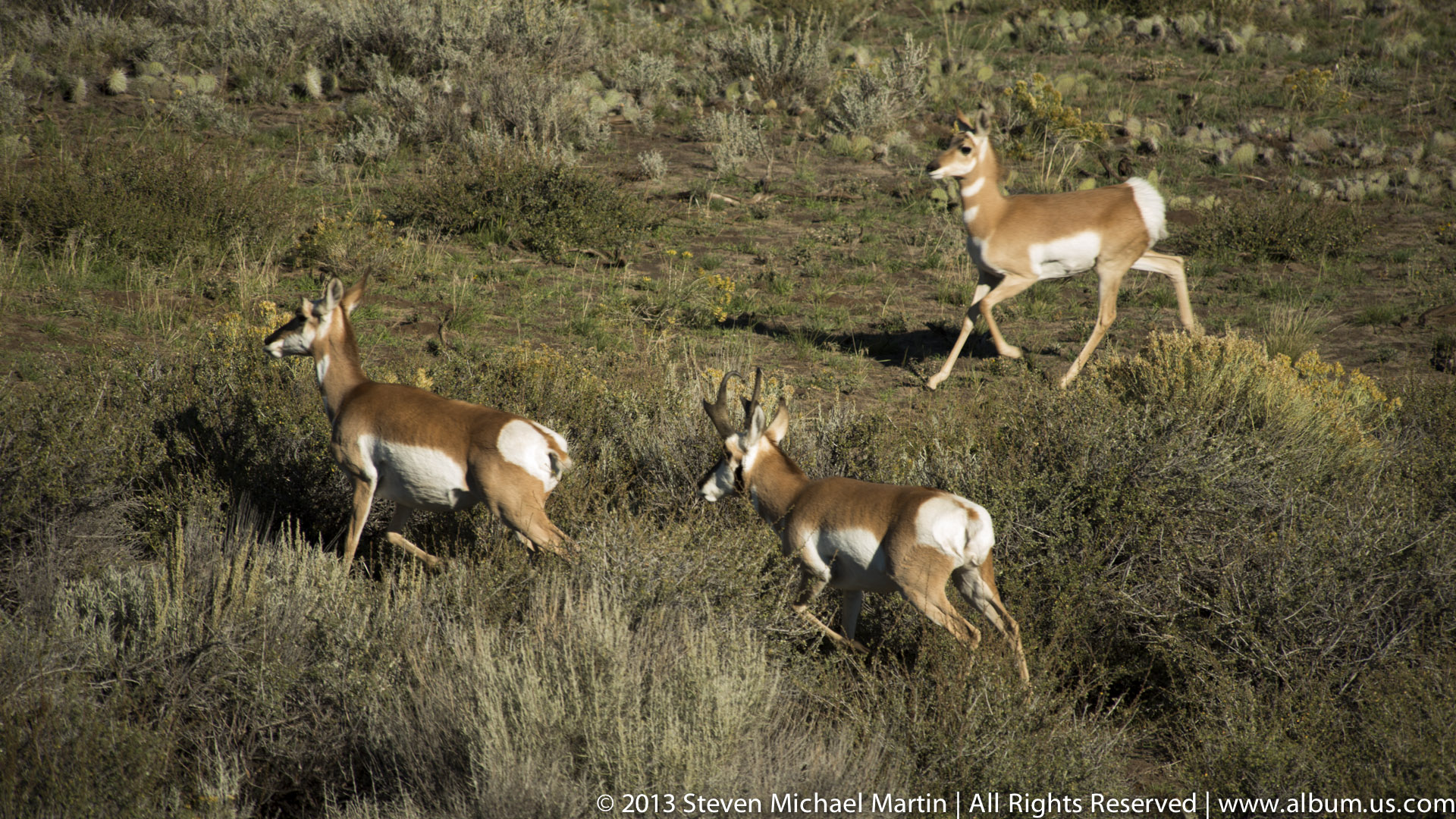
Three tan-and-white pronghorn move through low gray-green scrub, each with a bright white rump patch that stands out against the muted habitat. Their bodies are spaced diagonally across the slope, and two animals appear mid-stride while the third follows higher on the right. The image records a small group in open country without suggesting a direction of travel beyond the visible movement.
Caption
Three tan-and-white pronghorn move through low gray-green scrub, each with a bright white rump patch that stands out against the muted habitat. Their bodies are spaced diagonally across the slope, and two animals appear mid-stride while the third follows higher on the right. The image records a small group in open country without suggesting a direction of travel beyond the visible movement.
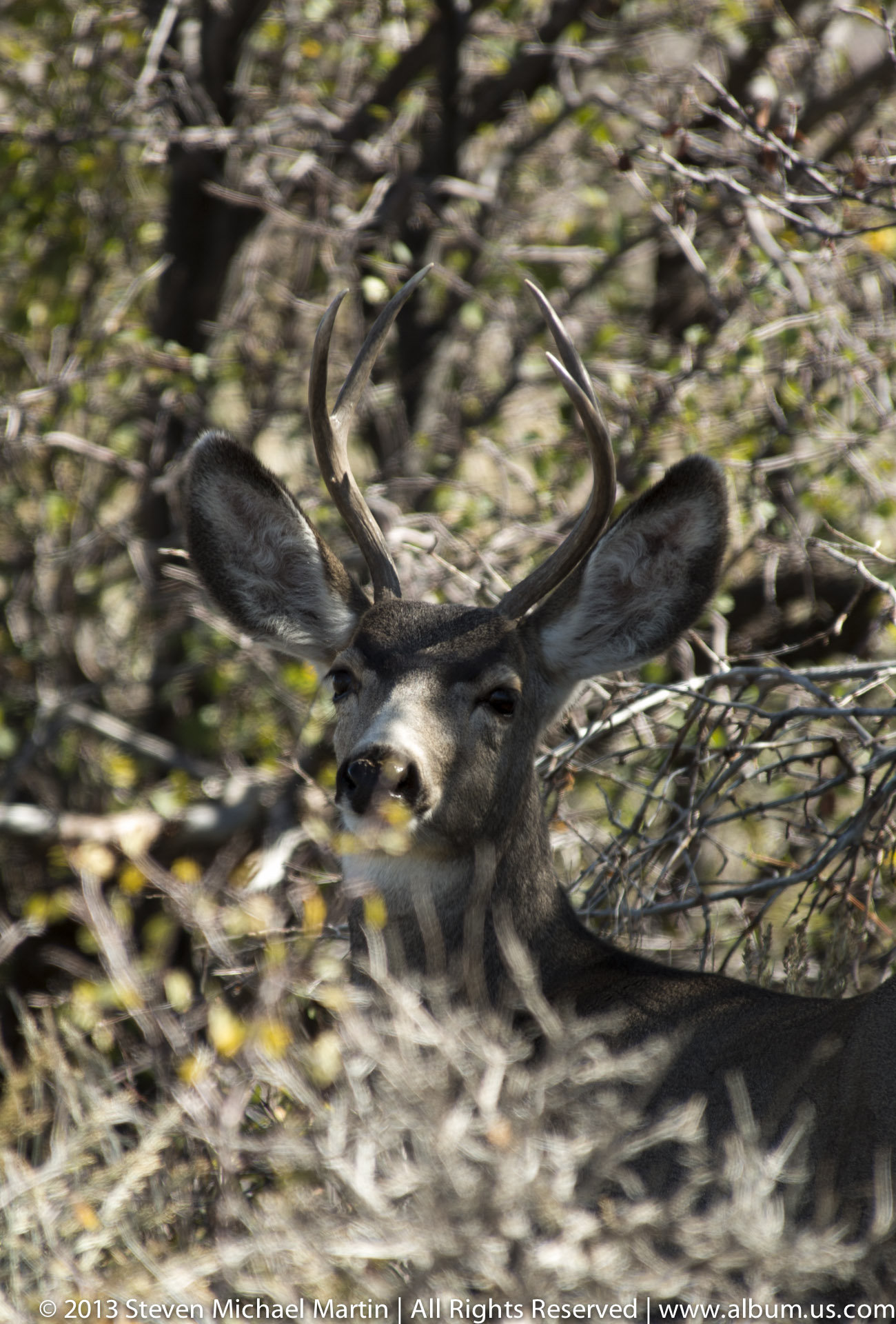
A deer’s face and branching antlers appear through a dense mesh of thin twigs and leaves. The animal looks toward the camera, with its ears extended and muzzle partly screened by the brush. Shallow focus separates the face from the tangled woodland background, but the obstruction and small antlers make finer identification uncertain. The close encounter centers on the animal’s gaze and the vegetation between viewer and subject.
Caption
A deer’s face and branching antlers appear through a dense mesh of thin twigs and leaves. The animal looks toward the camera, with its ears extended and muzzle partly screened by the brush. Shallow focus separates the face from the tangled woodland background, but the obstruction and small antlers make finer identification uncertain. The close encounter centers on the animal’s gaze and the vegetation between viewer and subject.
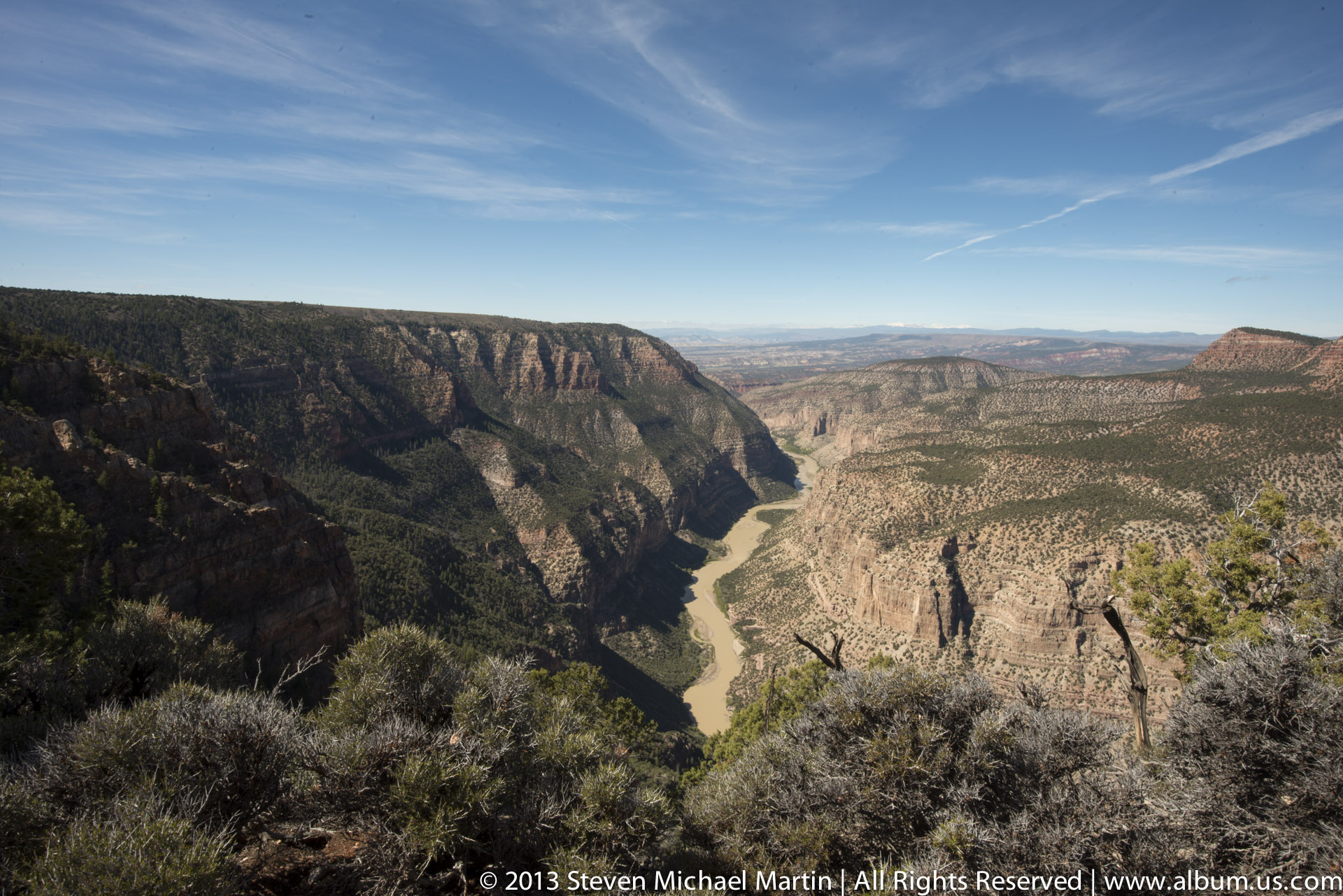
From a high overlook, the river traces a pale curve through a broad canyon whose shadowed wall occupies the left side of the frame. Sunlight reveals the stratified cliff opposite, while thorny shrubs line the foreground rim. Thin clouds and a faint contrail cross the blue sky, adding a sense of openness above the enclosed river corridor.
Caption
From a high overlook, the river traces a pale curve through a broad canyon whose shadowed wall occupies the left side of the frame. Sunlight reveals the stratified cliff opposite, while thorny shrubs line the foreground rim. Thin clouds and a faint contrail cross the blue sky, adding a sense of openness above the enclosed river corridor.
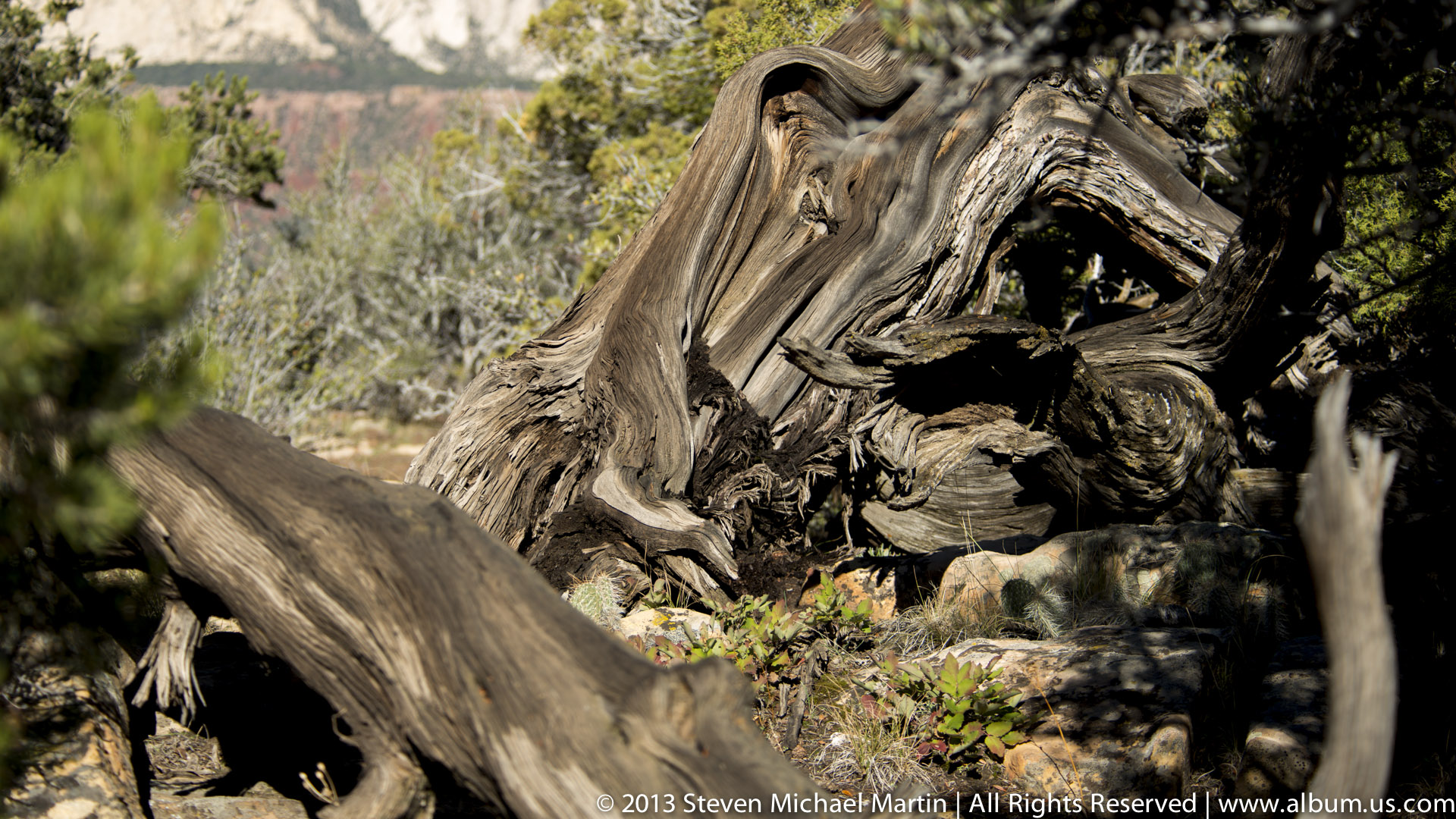
A large fallen trunk twists through the foreground, its weathered wood split into ridges, cavities, and curling strips. Green shrubs and thin branches surround the deadwood, while shallow focus softens the vegetation at the edges. The close framing turns the trunk’s complex grain and decay into the subject, showing how a fallen tree remains part of the woodland floor.
Caption
A large fallen trunk twists through the foreground, its weathered wood split into ridges, cavities, and curling strips. Green shrubs and thin branches surround the deadwood, while shallow focus softens the vegetation at the edges. The close framing turns the trunk’s complex grain and decay into the subject, showing how a fallen tree remains part of the woodland floor.
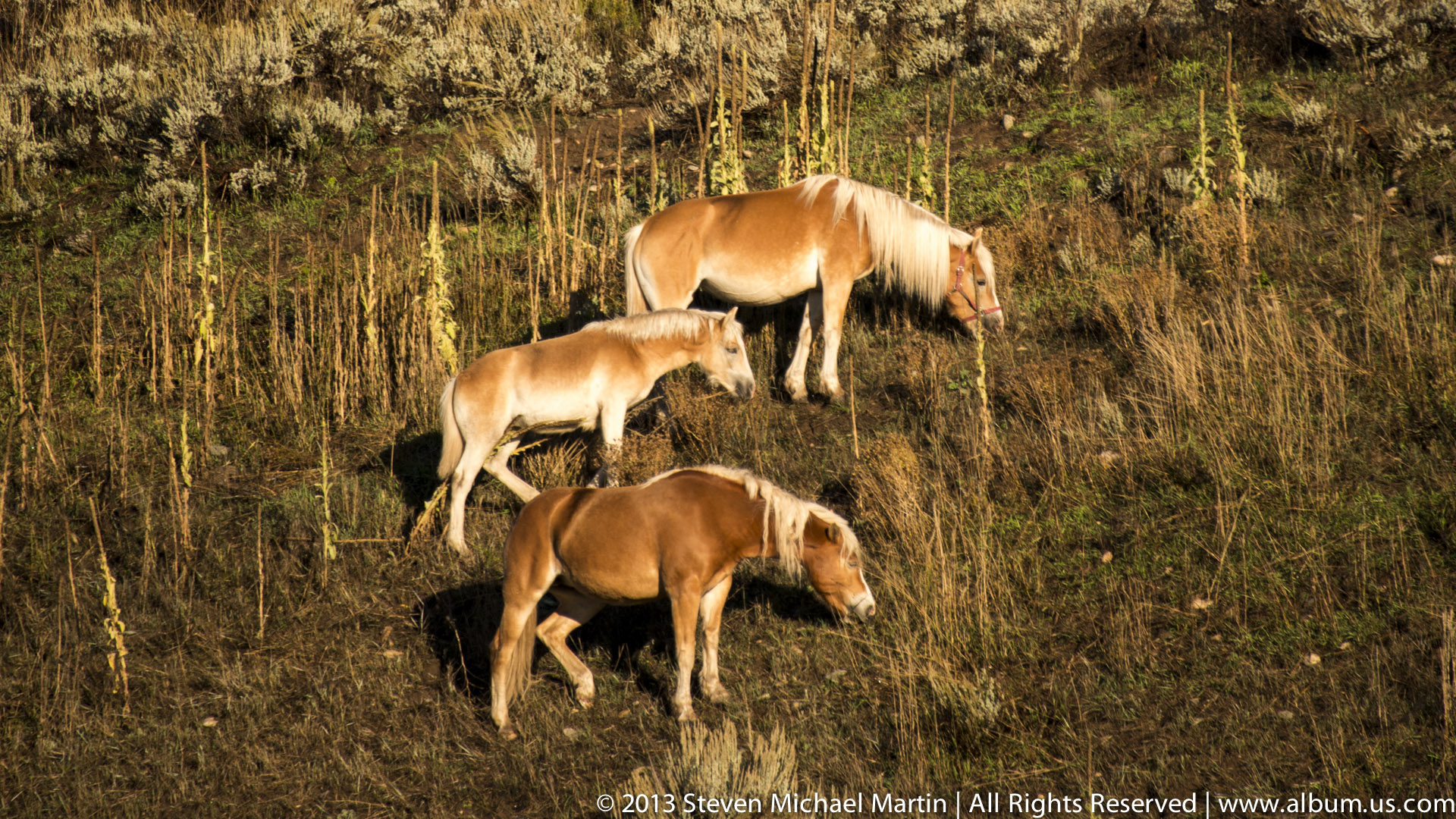
Three horses graze among tall dry grasses and low brush, their heads lowered as warm sunlight brightens their coats. The animals are separated across the frame, allowing their different colors and positions to register against the dense, upright stems behind them. The photograph shows grazing behavior and open habitat, but does not establish whether the horses are domestic or free-ranging.
Caption
Three horses graze among tall dry grasses and low brush, their heads lowered as warm sunlight brightens their coats. The animals are separated across the frame, allowing their different colors and positions to register against the dense, upright stems behind them. The photograph shows grazing behavior and open habitat, but does not establish whether the horses are domestic or free-ranging.
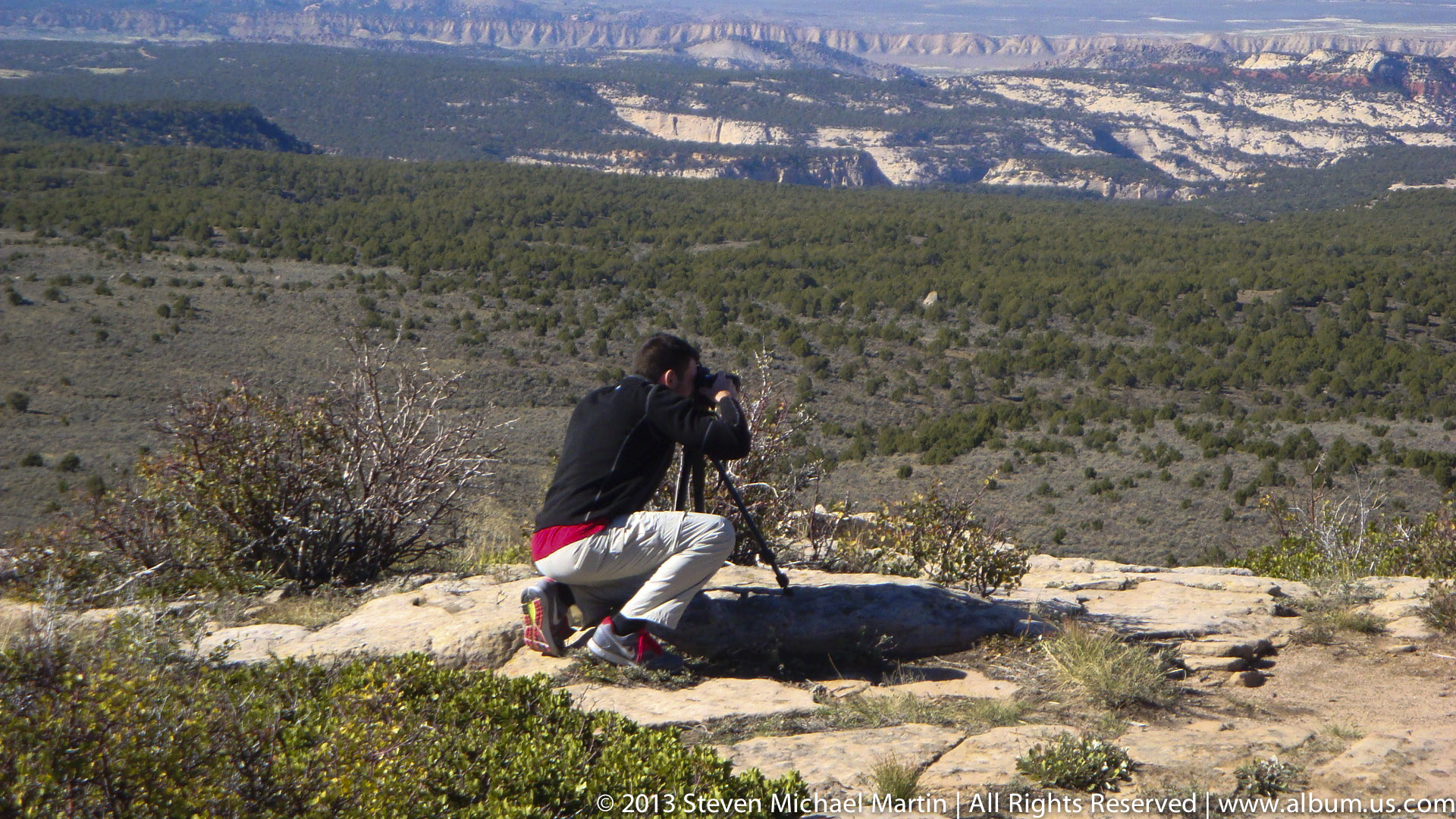
A visitor kneels behind a camera mounted on a tripod at the edge of a broad, shrub-covered plateau. Beyond him, pale, horizontally banded canyon walls stretch across the horizon, while the nearer slope is covered in low vegetation. The low stance and equipment make the act of photographing the landscape the clear subject of this wide view.
Caption
A visitor kneels behind a camera mounted on a tripod at the edge of a broad, shrub-covered plateau. Beyond him, pale, horizontally banded canyon walls stretch across the horizon, while the nearer slope is covered in low vegetation. The low stance and equipment make the act of photographing the landscape the clear subject of this wide view.

A man in a red shirt sits against a broad pale rock face and extends one arm toward a small dark mark or surface feature. The close framing shows fractured stone, shallow seams, and weathered patches around the point he indicates. The feature itself is too small to identify from this view, so the image is best read as a visitor examining the exposed rock rather than as evidence of a particular fossil or mineral.
Caption
A man in a red shirt sits against a broad pale rock face and extends one arm toward a small dark mark or surface feature. The close framing shows fractured stone, shallow seams, and weathered patches around the point he indicates. The feature itself is too small to identify from this view, so the image is best read as a visitor examining the exposed rock rather than as evidence of a particular fossil or mineral.
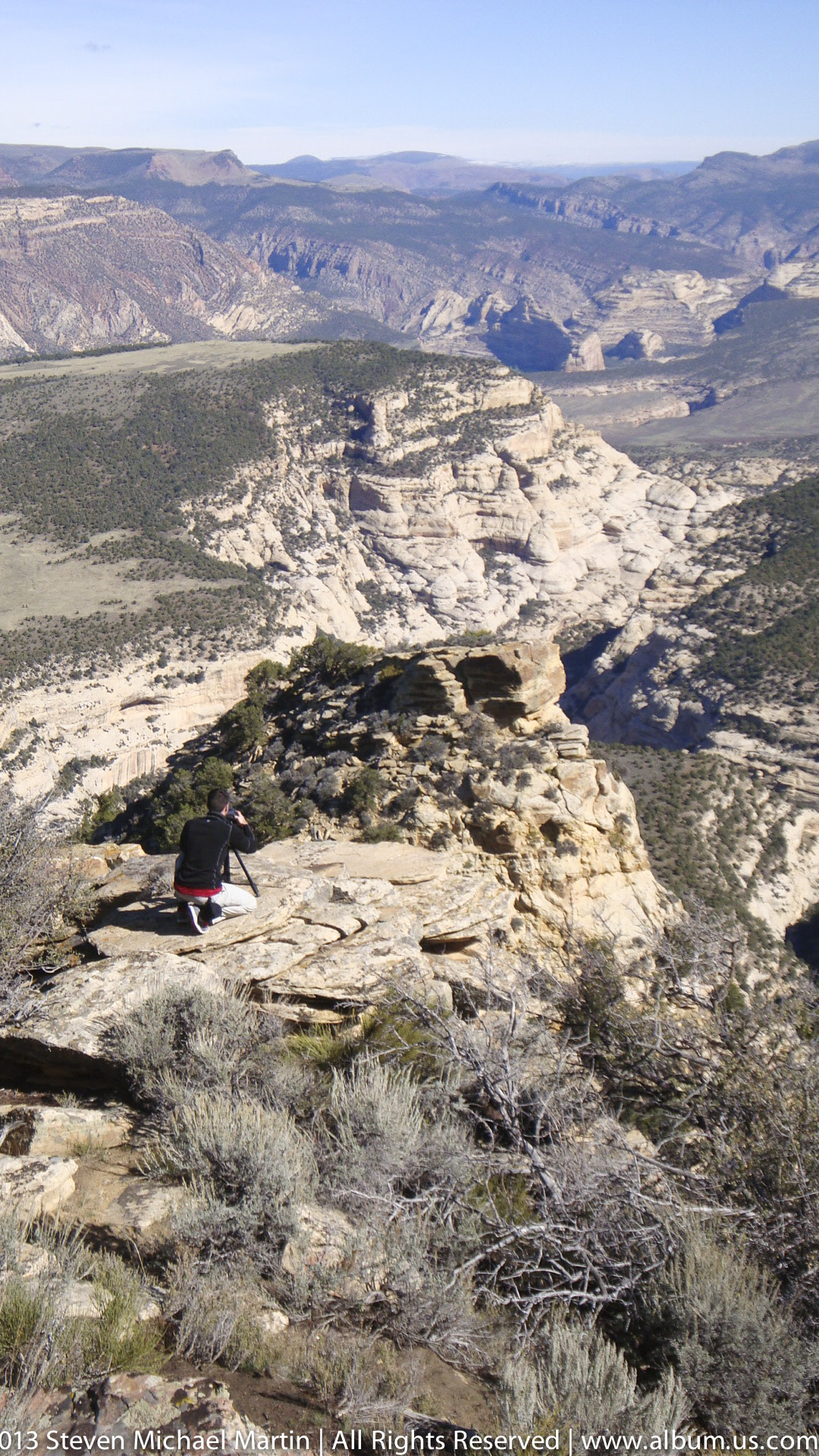
A lone visitor crouches on a pale rock shelf in the lower foreground, dwarfed by a broad expanse of scrubland and distant ridges. The elevated viewpoint reveals a patchwork of dark vegetation, light exposed stone, and shallow drainage lines extending toward the horizon. By keeping the person small within the frame, the photograph stresses the scale of the plateau and the open terrain.
Caption
A lone visitor crouches on a pale rock shelf in the lower foreground, dwarfed by a broad expanse of scrubland and distant ridges. The elevated viewpoint reveals a patchwork of dark vegetation, light exposed stone, and shallow drainage lines extending toward the horizon. By keeping the person small within the frame, the photograph stresses the scale of the plateau and the open terrain.
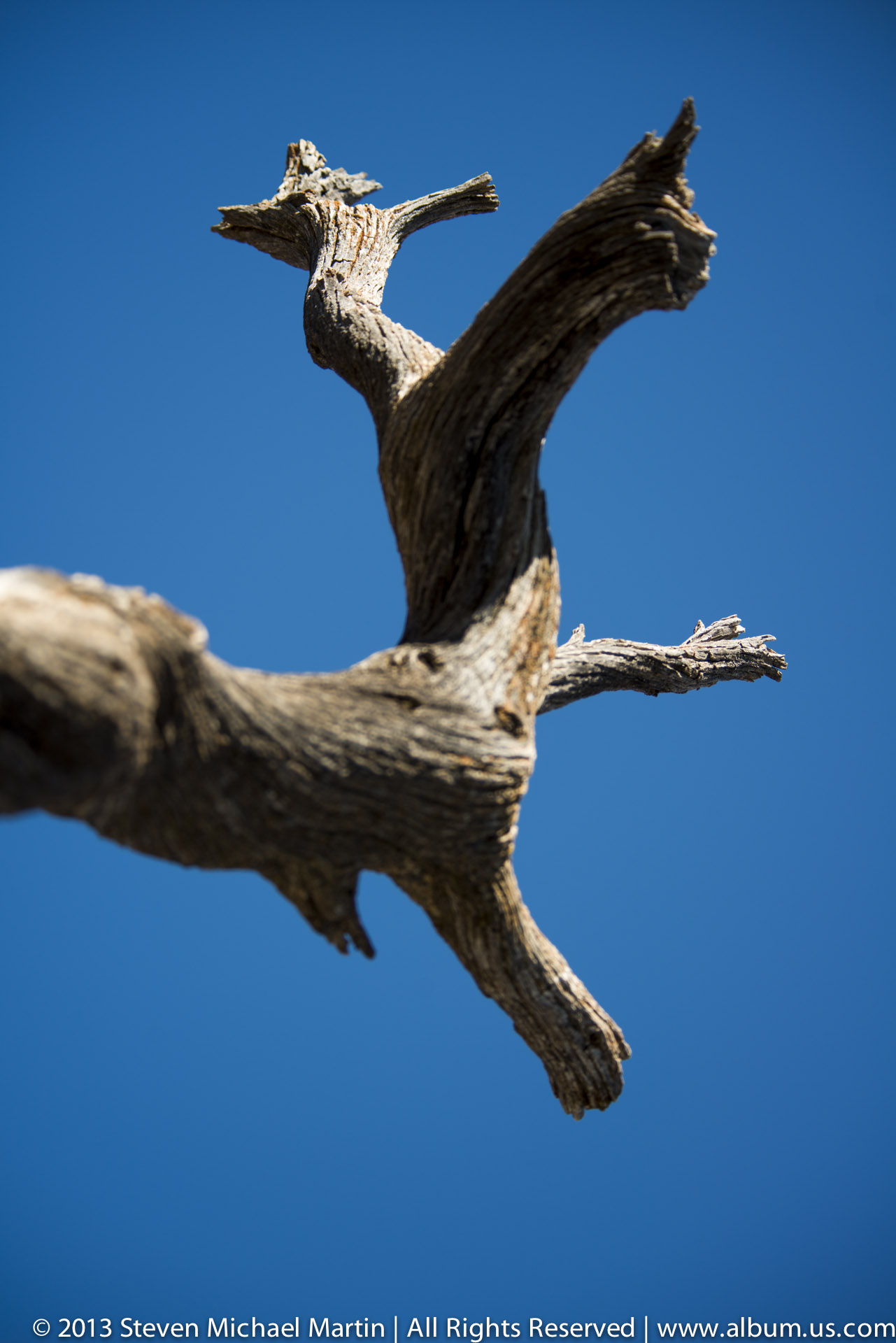
A bleached, weathered limb forks into several blunt points against an uninterrupted blue sky. The close crop removes the trunk and surrounding landscape, concentrating attention on the branch’s curved joints, broken ends, and pale textured surface. Its diagonal reach across the frame gives the deadwood a sculptural form while keeping the identification general, since the tree species is not visible.
Caption
A bleached, weathered limb forks into several blunt points against an uninterrupted blue sky. The close crop removes the trunk and surrounding landscape, concentrating attention on the branch’s curved joints, broken ends, and pale textured surface. Its diagonal reach across the frame gives the deadwood a sculptural form while keeping the identification general, since the tree species is not visible.
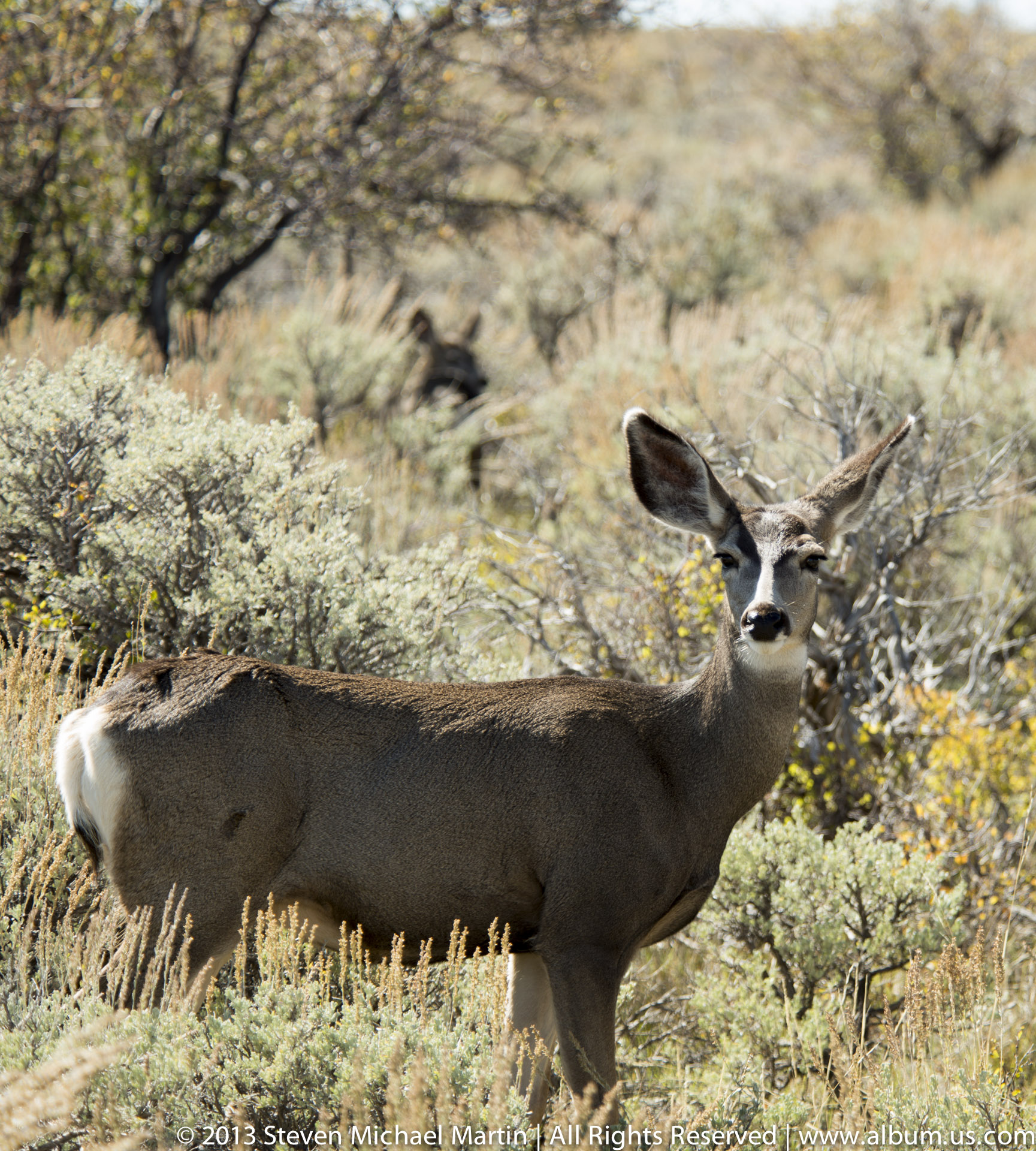
A mule deer stands broadside among pale sagebrush, its head turned toward the viewer and a white rump patch visible at the left. The full-body framing shows the animal’s long legs and large ears against a sunlit, brush-covered slope. Unlike the tighter portrait nearby, this view places the deer within its arid habitat and makes its side profile legible.
Caption
A mule deer stands broadside among pale sagebrush, its head turned toward the viewer and a white rump patch visible at the left. The full-body framing shows the animal’s long legs and large ears against a sunlit, brush-covered slope. Unlike the tighter portrait nearby, this view places the deer within its arid habitat and makes its side profile legible.
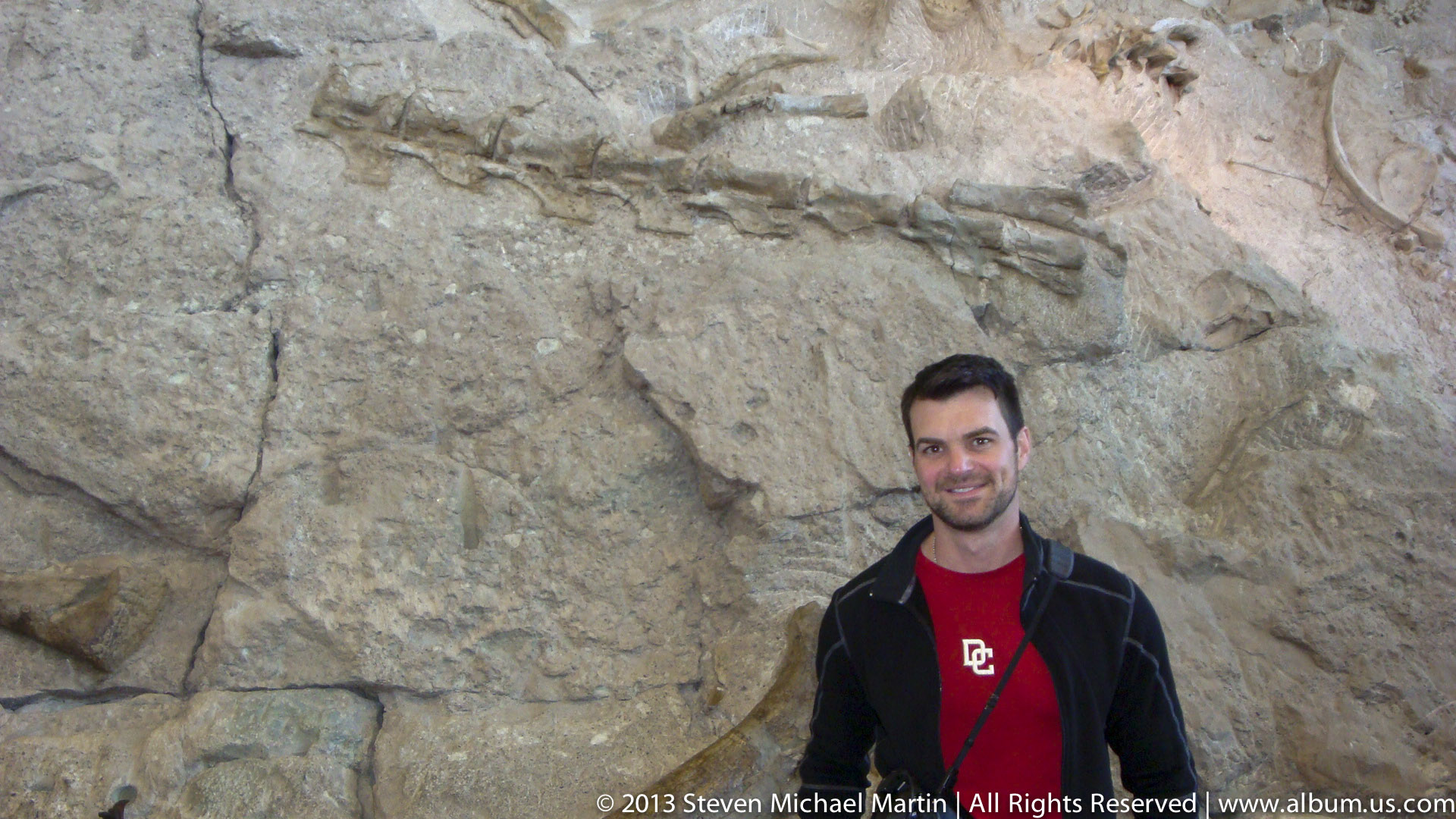
A smiling visitor stands before a massive pale rock wall, whose angular seams and weathered surface fill nearly the entire background. His black jacket and red shirt provide a strong color contrast with the stone. The tight composition records a human presence at the exposed rock face without suggesting what the person is looking at or assigning a specific geological feature to the wall.
Caption
A smiling visitor stands before a massive pale rock wall, whose angular seams and weathered surface fill nearly the entire background. His black jacket and red shirt provide a strong color contrast with the stone. The tight composition records a human presence at the exposed rock face without suggesting what the person is looking at or assigning a specific geological feature to the wall.
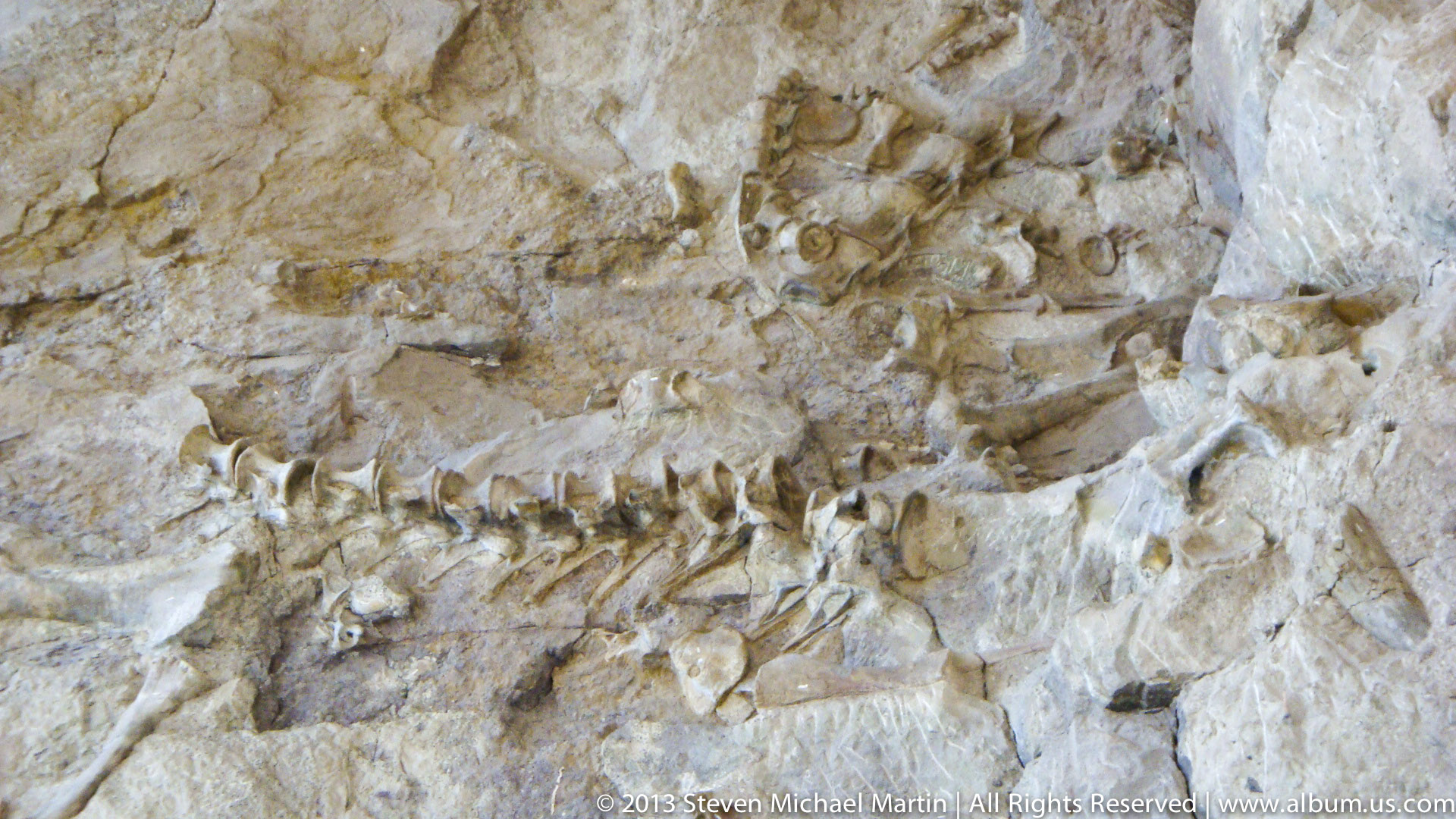
A close view of pale fossil-bearing rock reveals a line of articulated-looking vertebrae and irregular bone fragments embedded in the surface. The remains cross the frame diagonally among mottled tan and gray mineral textures, with no scale or broader quarry setting visible. The photograph supports identification as fossil bone, while the specific animal and the exact relationship among the fragments remain undetermined.
Caption
A close view of pale fossil-bearing rock reveals a line of articulated-looking vertebrae and irregular bone fragments embedded in the surface. The remains cross the frame diagonally among mottled tan and gray mineral textures, with no scale or broader quarry setting visible. The photograph supports identification as fossil bone, while the specific animal and the exact relationship among the fragments remain undetermined.

Dark pictorial marks and pale outlined shapes spread across a sloping sandstone surface in this close detail. The composition records several distinct forms, including elongated and angular motifs, against a rough, banded rock face. Their appearance suggests a rock-art panel, but the proof image does not establish whether the marks were painted or pecked, or identify their makers or meaning.
Caption
Dark pictorial marks and pale outlined shapes spread across a sloping sandstone surface in this close detail. The composition records several distinct forms, including elongated and angular motifs, against a rough, banded rock face. Their appearance suggests a rock-art panel, but the proof image does not establish whether the marks were painted or pecked, or identify their makers or meaning.
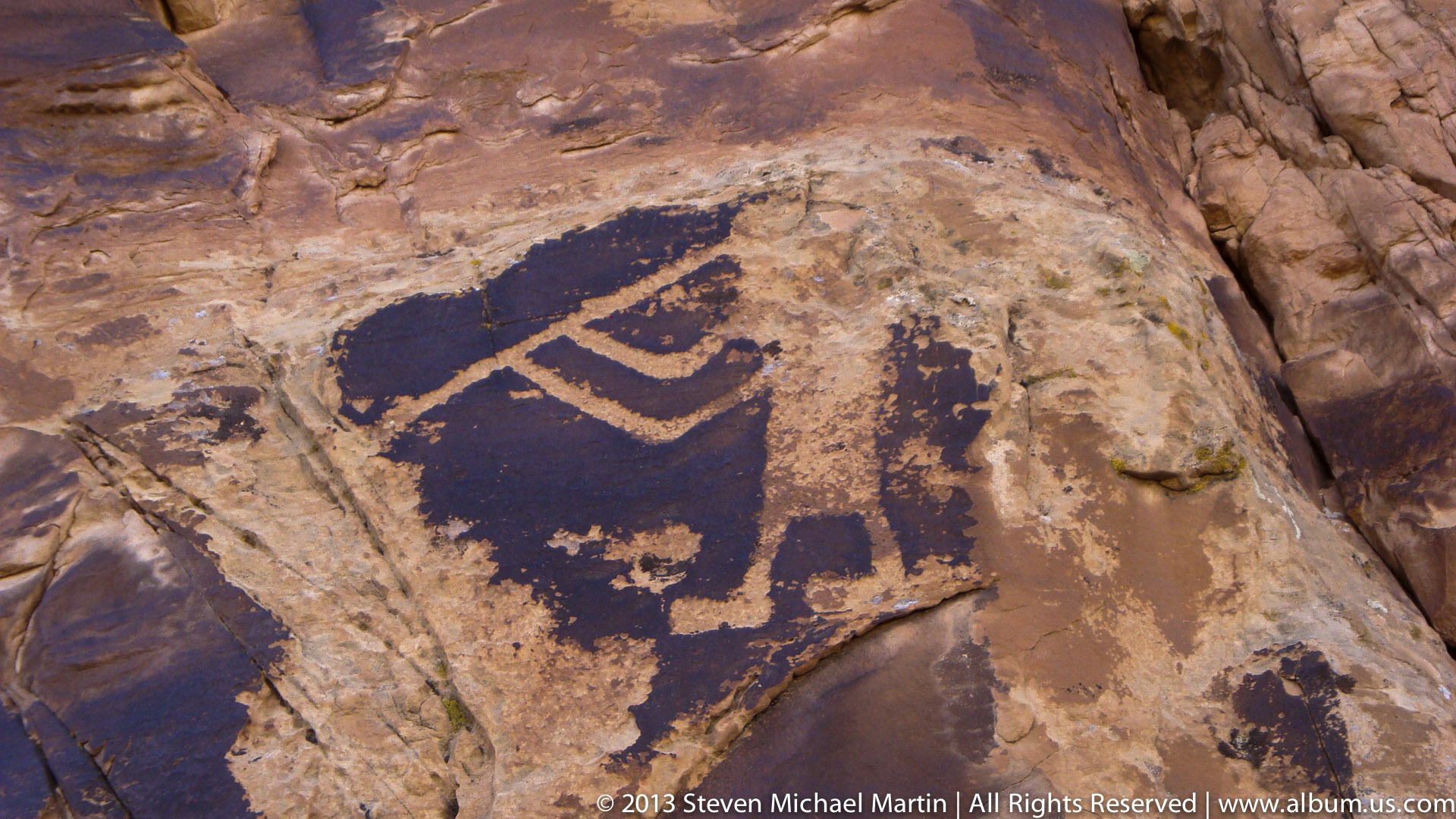
A large dark figure with a rounded body, short projections, and bent limbs occupies the center of a pale sandstone panel. The close crop makes its animal-like silhouette more legible than the surrounding rock surface, though the specific creature and the method used to create the image are uncertain. Treating it as a quadruped-like rock-art motif preserves the visible form without assigning a species or cultural meaning.
Caption
A large dark figure with a rounded body, short projections, and bent limbs occupies the center of a pale sandstone panel. The close crop makes its animal-like silhouette more legible than the surrounding rock surface, though the specific creature and the method used to create the image are uncertain. Treating it as a quadruped-like rock-art motif preserves the visible form without assigning a species or cultural meaning.

Faint reddish and dark marks form several irregular figures across a weathered sandstone wall. The low contrast and uneven surface make individual shapes difficult to distinguish, but the grouping reads as a worked or marked panel rather than a single natural stain. This wider detail preserves the surface condition and the uncertain outlines without assigning a definite subject, age, or cultural identity.
Caption
Faint reddish and dark marks form several irregular figures across a weathered sandstone wall. The low contrast and uneven surface make individual shapes difficult to distinguish, but the grouping reads as a worked or marked panel rather than a single natural stain. This wider detail preserves the surface condition and the uncertain outlines without assigning a definite subject, age, or cultural identity.
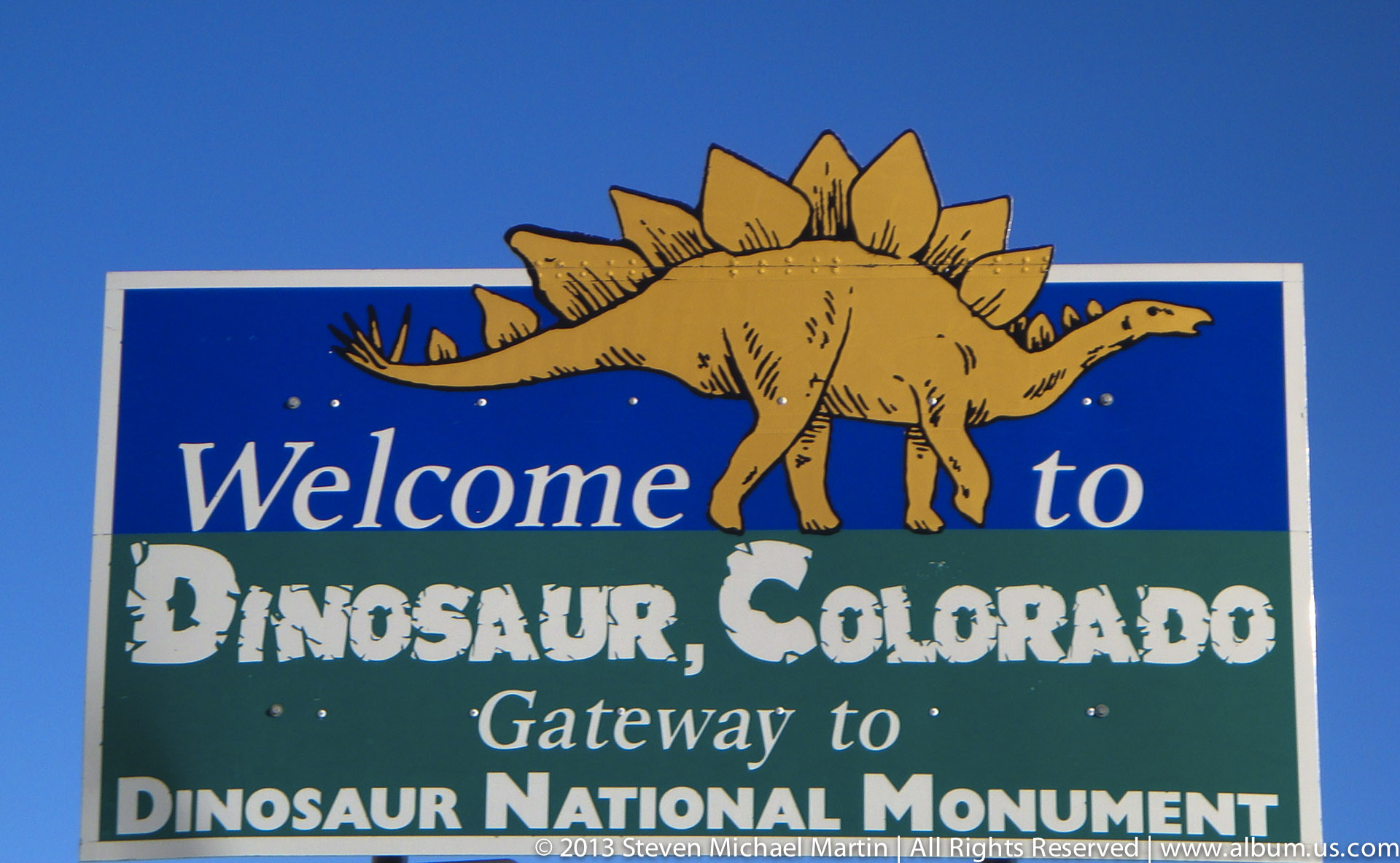
A roadside welcome sign pairs the words “Dinosaur, Colorado” with “Gateway to Dinosaur National Monument” beneath an illustrated stegosaurus. The blue and green panels make the destination text prominent, while the large yellow dinosaur graphic spans the top. The sign links the nearby town to the monument and provides a clear, legible identification of both places.
Caption
A roadside welcome sign pairs the words “Dinosaur, Colorado” with “Gateway to Dinosaur National Monument” beneath an illustrated stegosaurus. The blue and green panels make the destination text prominent, while the large yellow dinosaur graphic spans the top. The sign links the nearby town to the monument and provides a clear, legible identification of both places.
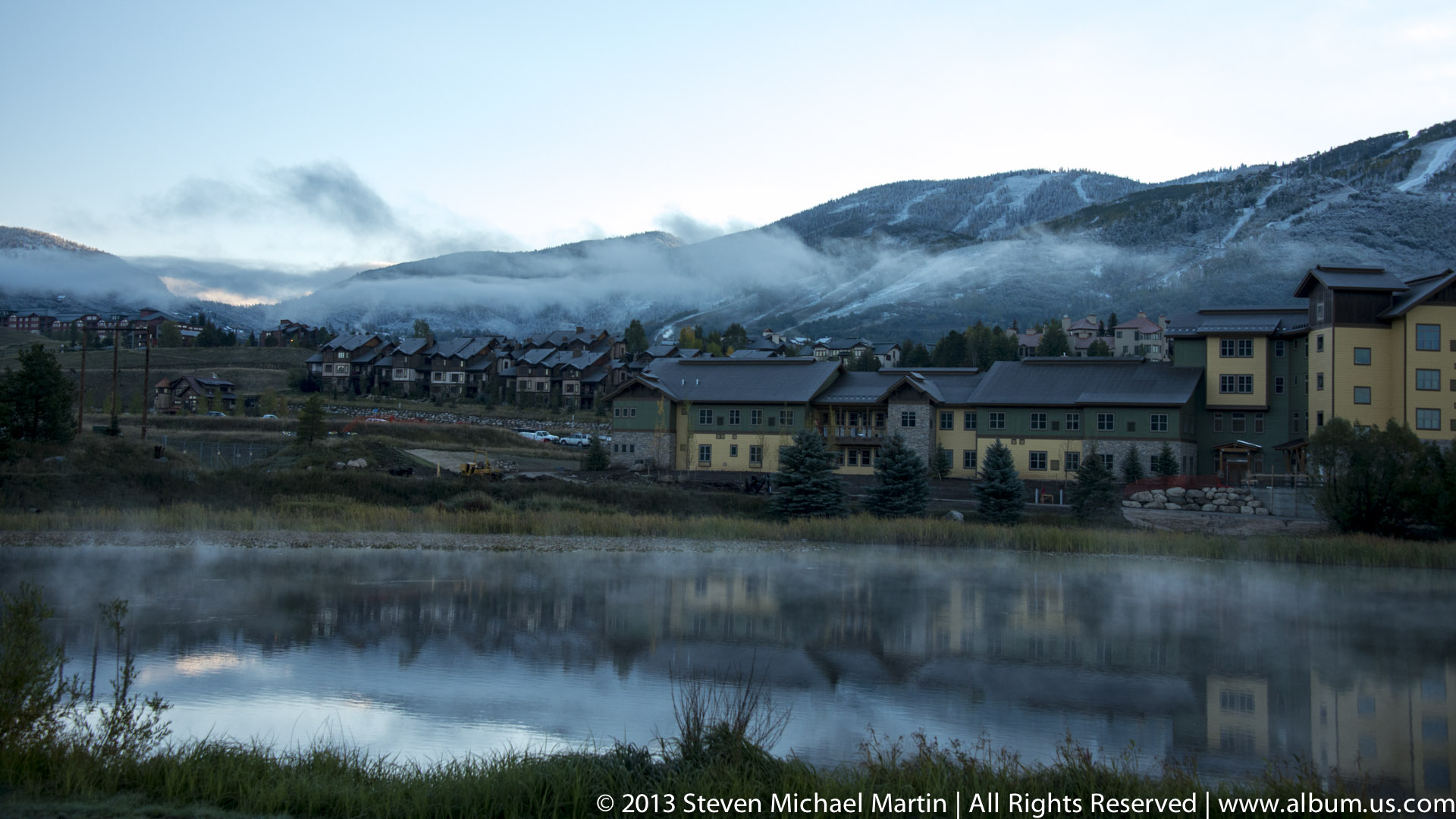
A row of multistory buildings stands across a still pond, their façades and the pale sky reflected in the water. Low cloud or mist clings to the mountain slope behind the roofs, while the foreground shoreline remains dark and quiet. The closer framing concentrates on the buildings and the fog bank, leaving the surrounding landscape only partly visible.
Caption
A row of multistory buildings stands across a still pond, their façades and the pale sky reflected in the water. Low cloud or mist clings to the mountain slope behind the roofs, while the foreground shoreline remains dark and quiet. The closer framing concentrates on the buildings and the fog bank, leaving the surrounding landscape only partly visible.
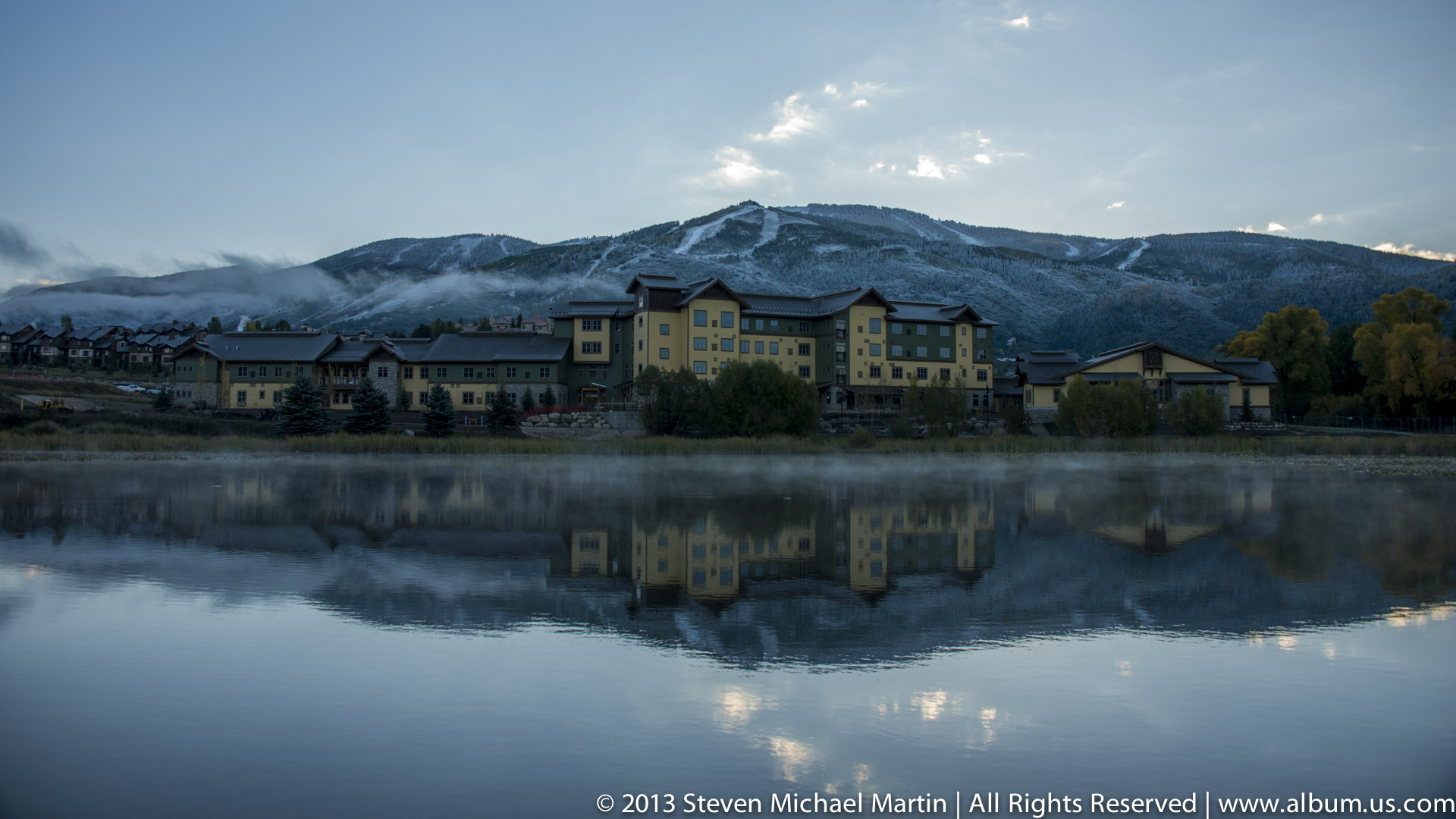
Across a glassy pond, a line of large buildings is reflected beneath a mountain ridge. This wider composition includes more open water and sky than the adjacent view, with small clouds above the ridge and a thin band of trees along the shore. The cool, subdued light and nearly symmetrical reflection give the scene a calm, early-morning appearance.
Caption
Across a glassy pond, a line of large buildings is reflected beneath a mountain ridge. This wider composition includes more open water and sky than the adjacent view, with small clouds above the ridge and a thin band of trees along the shore. The cool, subdued light and nearly symmetrical reflection give the scene a calm, early-morning appearance.
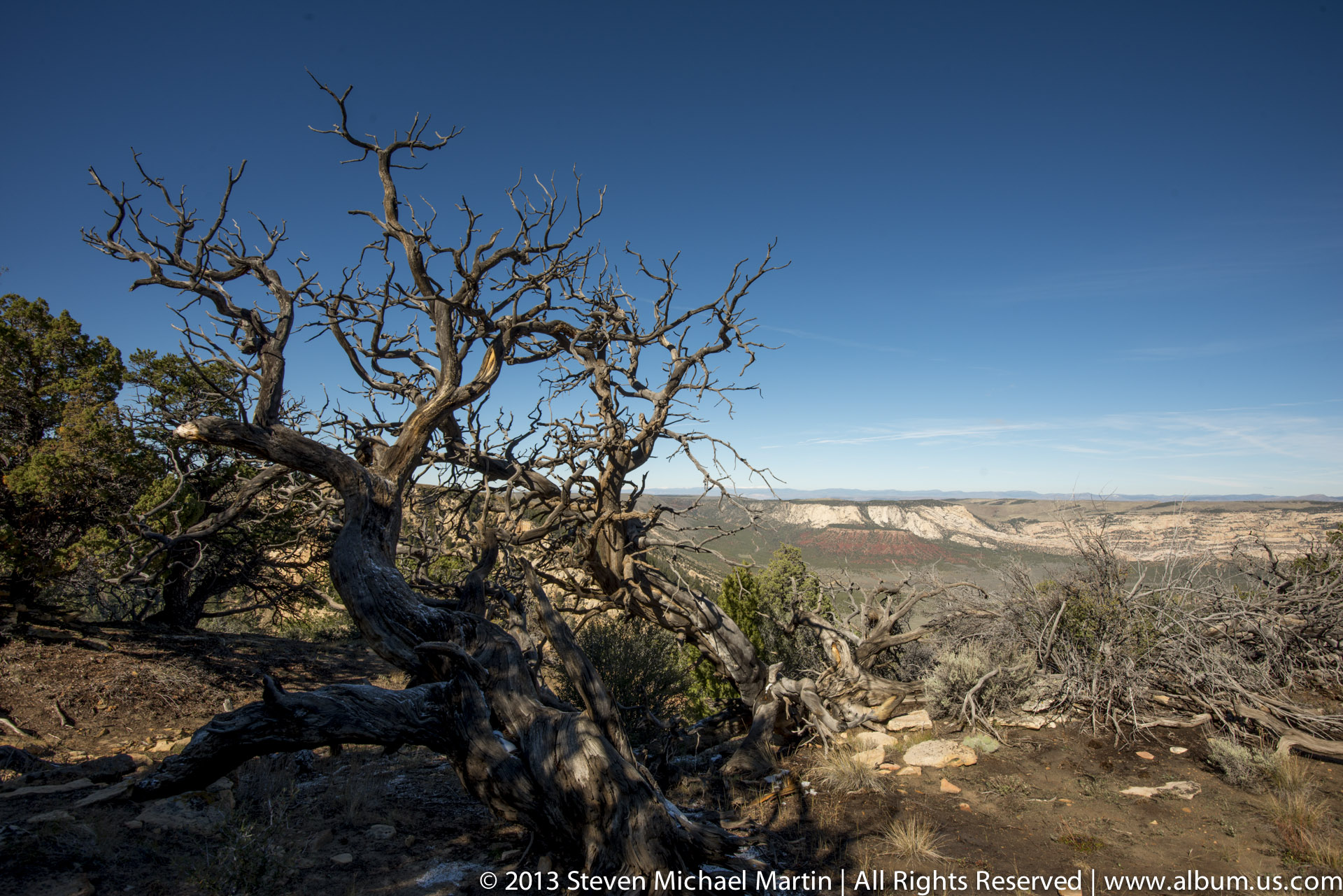
A gnarled, leafless tree spreads across the left foreground, its dark limbs framing a distant expanse of pale, layered terrain. Low shrubs fill the near slope, and blue sky opens above the horizon. The composition contrasts the tree’s intricate silhouette with the broad, sunlit landscape beyond, making both the local vegetation and the open plateau legible.
Caption
A gnarled, leafless tree spreads across the left foreground, its dark limbs framing a distant expanse of pale, layered terrain. Low shrubs fill the near slope, and blue sky opens above the horizon. The composition contrasts the tree’s intricate silhouette with the broad, sunlit landscape beyond, making both the local vegetation and the open plateau legible.
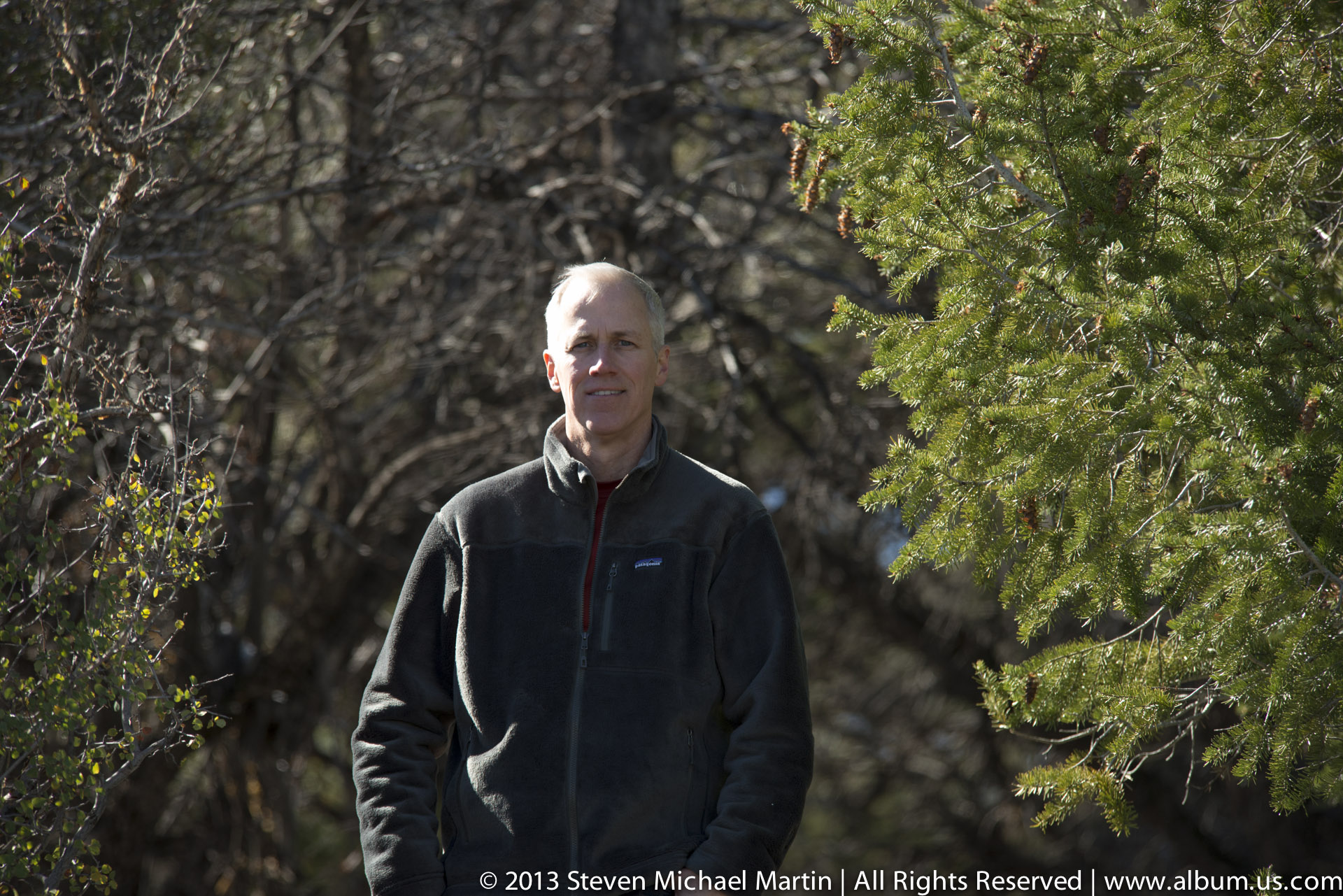
A man in a dark fleece stands centered among closely spaced tree trunks and tangled branches. Dappled sunlight catches leaves and bark around him, while the shaded background remains dense and indistinct. Unlike the open overlooks elsewhere in the series, this portrait emphasizes the enclosed woodland setting and the contrast between the visitor’s dark clothing and brighter foliage.
Caption
A man in a dark fleece stands centered among closely spaced tree trunks and tangled branches. Dappled sunlight catches leaves and bark around him, while the shaded background remains dense and indistinct. Unlike the open overlooks elsewhere in the series, this portrait emphasizes the enclosed woodland setting and the contrast between the visitor’s dark clothing and brighter foliage.
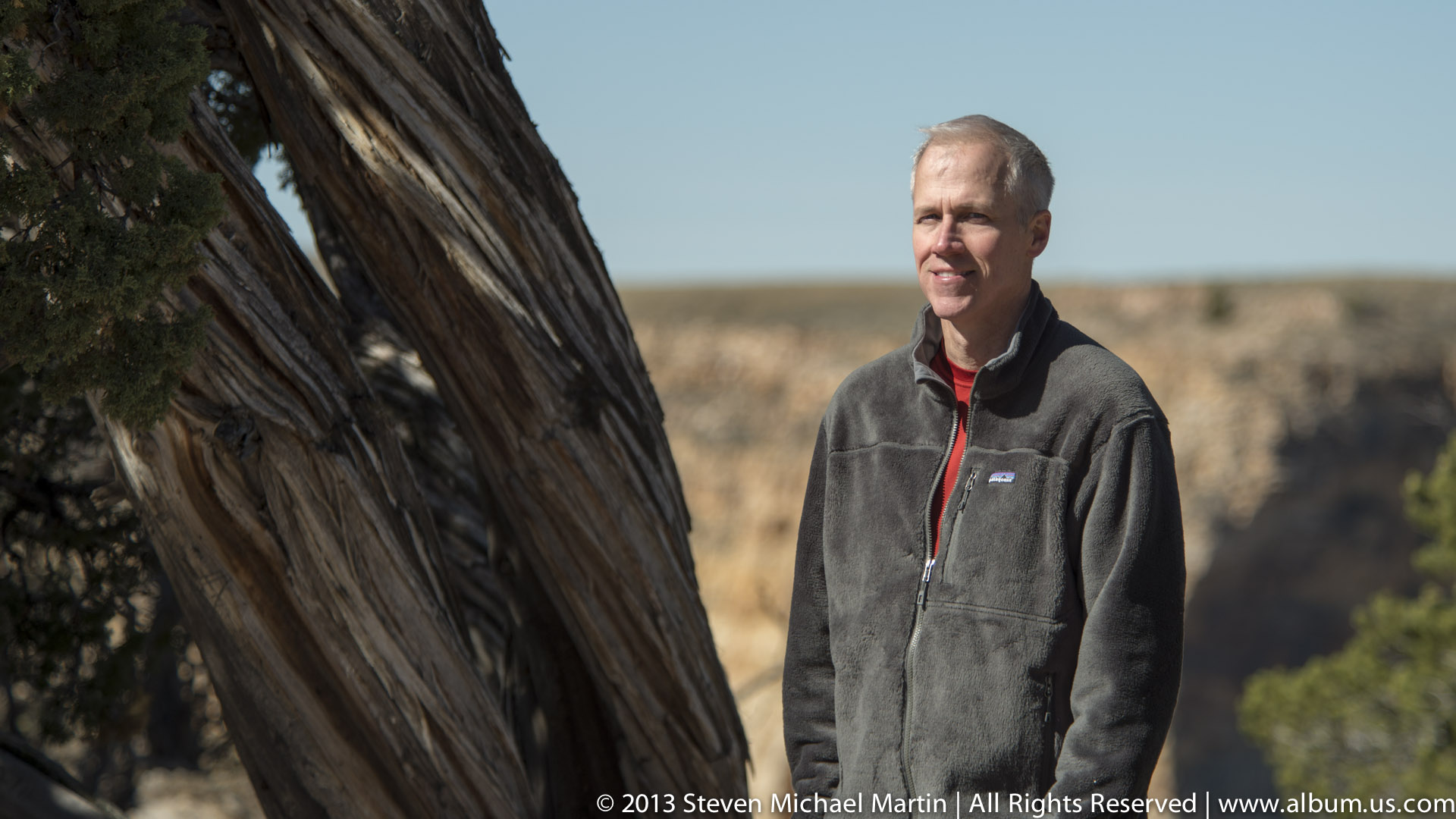
A man stands to the right of a massive, twisted tree trunk whose deeply furrowed surface fills the left foreground. The trunk’s scale and sweeping grain contrast with the visitor’s upright figure, while tawny scrubland and a low horizon remain softly visible behind them. This side-by-side arrangement gives a sense of the trunk’s size without identifying the tree species or its age.
Caption
A man stands to the right of a massive, twisted tree trunk whose deeply furrowed surface fills the left foreground. The trunk’s scale and sweeping grain contrast with the visitor’s upright figure, while tawny scrubland and a low horizon remain softly visible behind them. This side-by-side arrangement gives a sense of the trunk’s size without identifying the tree species or its age.

A man in a gray fleece faces the camera in a close portrait, with his head and shoulders sharply focused against a softly blurred blue-and-tan background. The shallow depth of field suppresses the surrounding landscape and directs attention to his expression and clothing. No location-specific feature is clear behind him, so the caption stays with the visible portrait rather than assigning a precise setting.
Caption
A man in a gray fleece faces the camera in a close portrait, with his head and shoulders sharply focused against a softly blurred blue-and-tan background. The shallow depth of field suppresses the surrounding landscape and directs attention to his expression and clothing. No location-specific feature is clear behind him, so the caption stays with the visible portrait rather than assigning a precise setting.
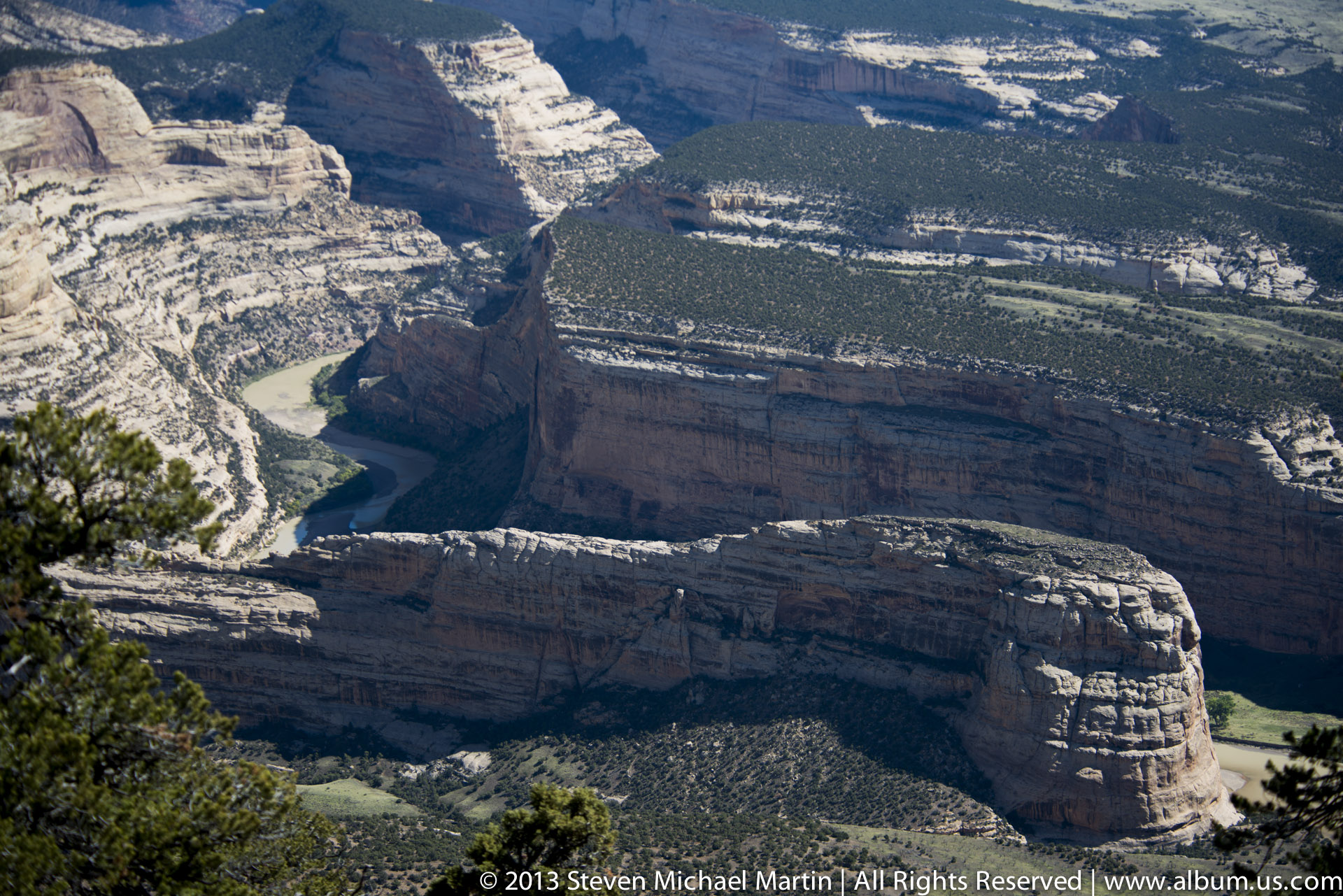
A broad river makes a sharp bend beneath a high, flat-topped rock wall, its green-blue water contrasting with pale ledges and dark scrub. The elevated viewpoint looks down on the canyon’s stepped layers and the vegetated bench beside the river. Sun and shadow divide the cliff faces, revealing their scale and horizontal structure without relying on a named bend or formation.
Caption
A broad river makes a sharp bend beneath a high, flat-topped rock wall, its green-blue water contrasting with pale ledges and dark scrub. The elevated viewpoint looks down on the canyon’s stepped layers and the vegetated bench beside the river. Sun and shadow divide the cliff faces, revealing their scale and horizontal structure without relying on a named bend or formation.
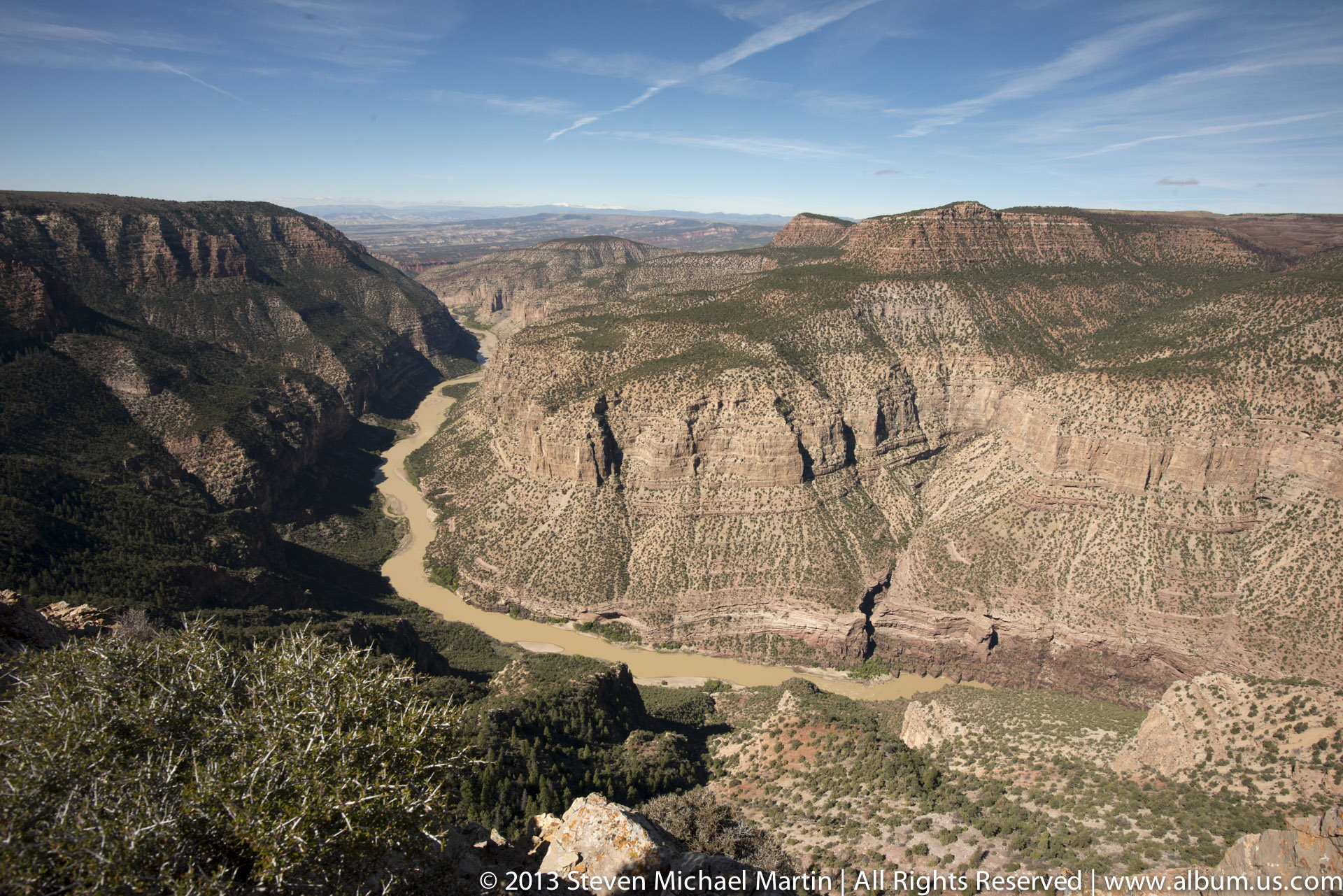
A wide river bend cuts across the canyon floor beneath a tall, sunlit rock wall scored by horizontal layers and vertical gullies. Scrub and small trees occupy the foreground slope, partially framing the water. The opposite canyon side remains darker, making the central cliff face and its banded erosion patterns the dominant feature.
Caption
A wide river bend cuts across the canyon floor beneath a tall, sunlit rock wall scored by horizontal layers and vertical gullies. Scrub and small trees occupy the foreground slope, partially framing the water. The opposite canyon side remains darker, making the central cliff face and its banded erosion patterns the dominant feature.
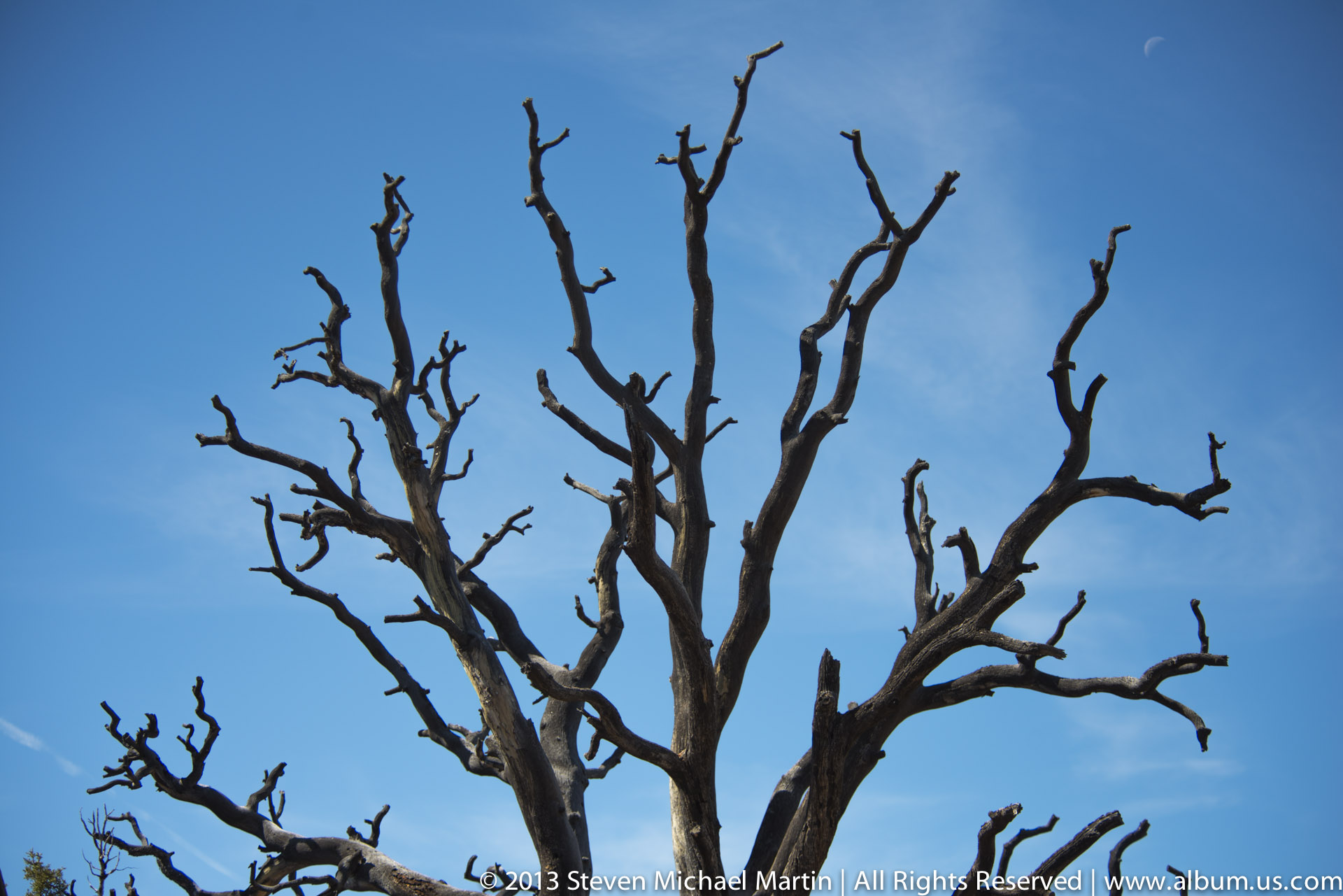
The dark, leafless crown of a dead tree spreads into a clear blue sky, with fine branches dividing into many irregular tips. A thicker horizontal limb crosses the lower part of the composition, while the trunk remains outside the frame. The uncluttered background makes the branching structure and the tree’s weathered silhouette the focus.
Caption
The dark, leafless crown of a dead tree spreads into a clear blue sky, with fine branches dividing into many irregular tips. A thicker horizontal limb crosses the lower part of the composition, while the trunk remains outside the frame. The uncluttered background makes the branching structure and the tree’s weathered silhouette the focus.
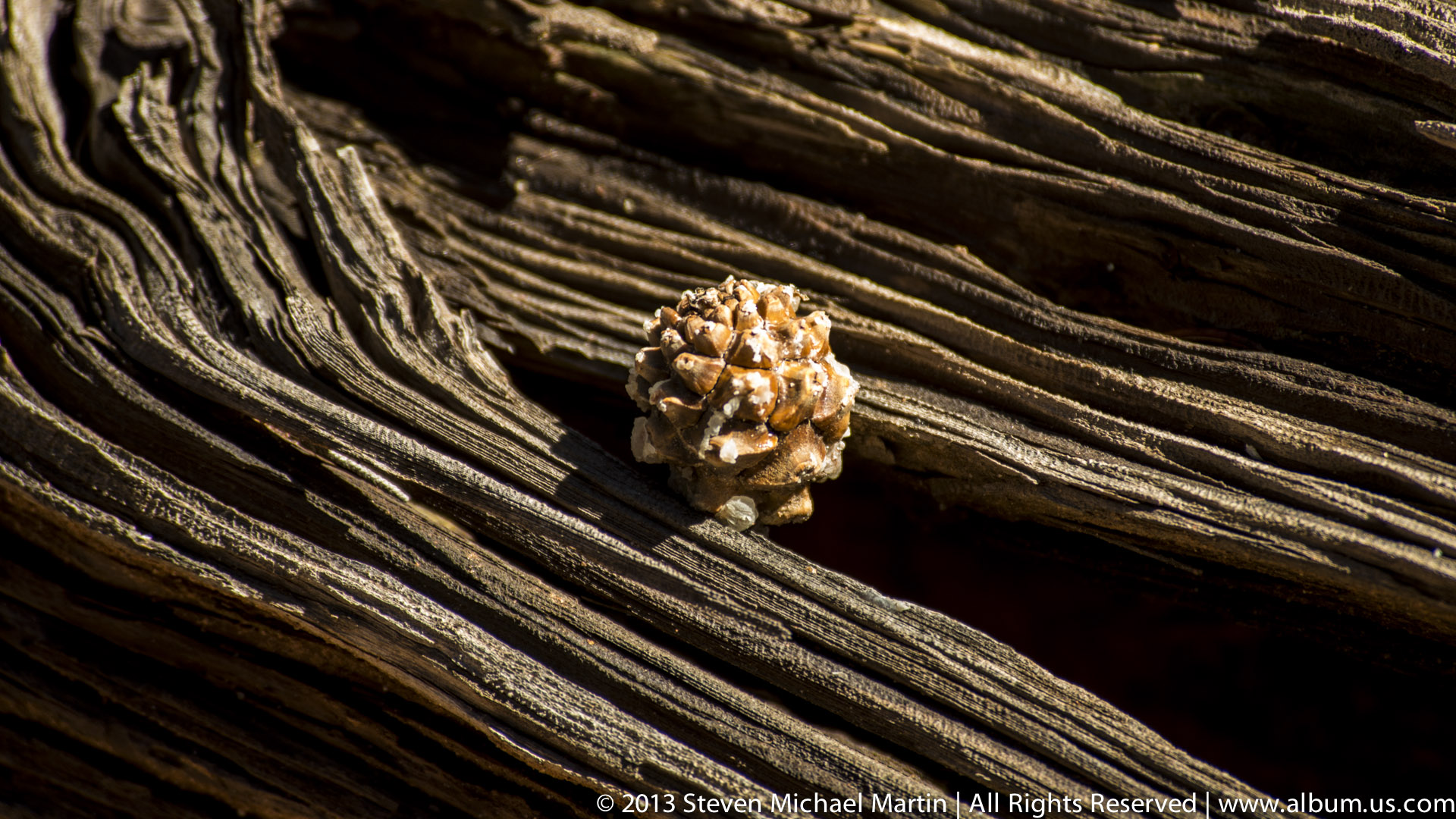
A small woody cone rests on deeply furrowed, sunlit bark, isolated by the close framing. The trunk’s long parallel ridges run diagonally across the image, while the cone’s layered scales create a compact contrasting form near the center. The view records a detail of tree structure and fallen plant material, but does not provide enough evidence to identify the tree species.
Caption
A small woody cone rests on deeply furrowed, sunlit bark, isolated by the close framing. The trunk’s long parallel ridges run diagonally across the image, while the cone’s layered scales create a compact contrasting form near the center. The view records a detail of tree structure and fallen plant material, but does not provide enough evidence to identify the tree species.
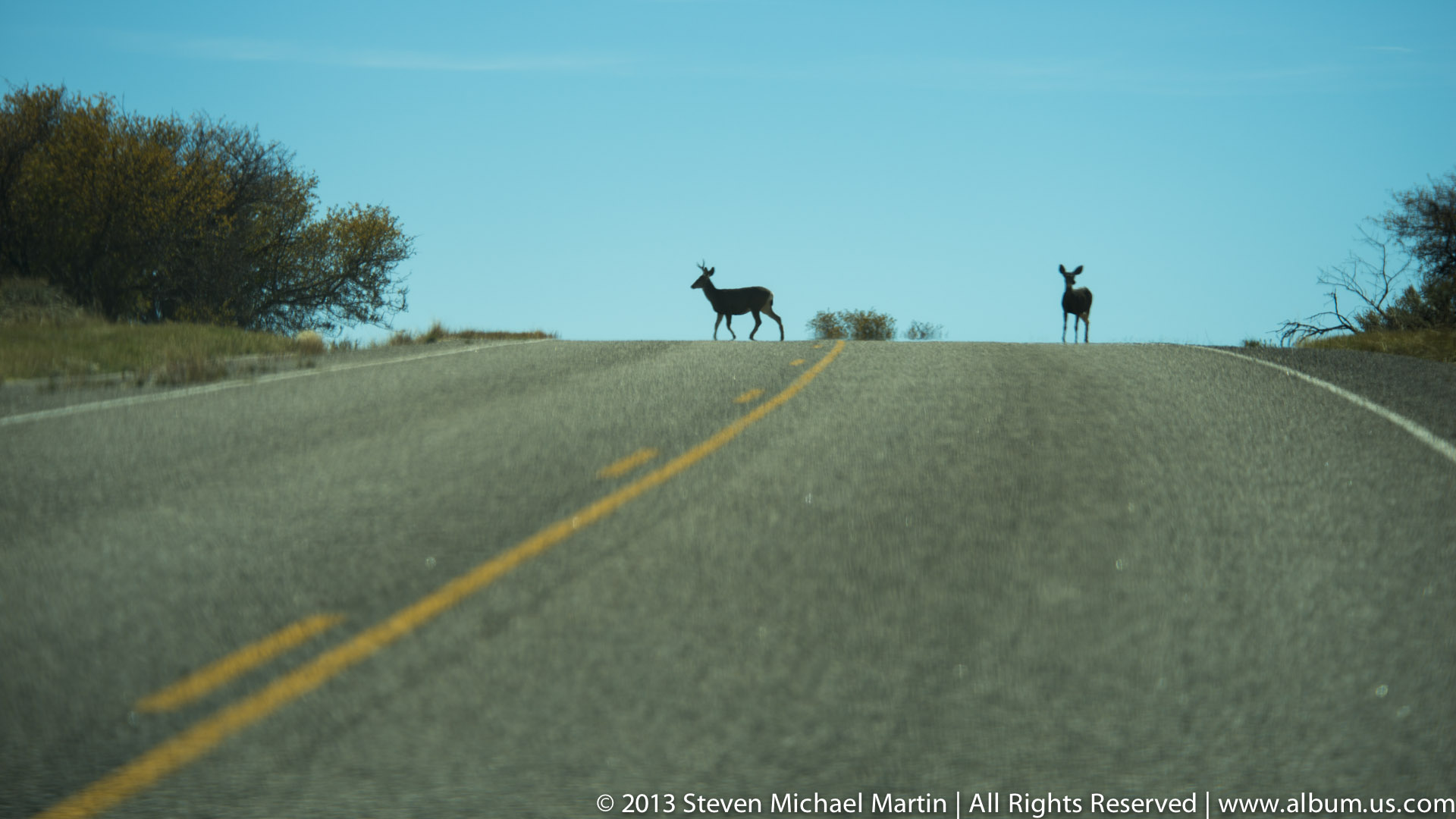
Two deer stand near the crest of a paved road, silhouetted against the bright sky as the roadway rises toward them. A yellow center line leads directly to the animals, with shrubs and trees bordering the shoulders. Their distance and backlighting obscure antler and coat details, so the image supports a general deer identification rather than a more specific species.
Caption
Two deer stand near the crest of a paved road, silhouetted against the bright sky as the roadway rises toward them. A yellow center line leads directly to the animals, with shrubs and trees bordering the shoulders. Their distance and backlighting obscure antler and coat details, so the image supports a general deer identification rather than a more specific species.
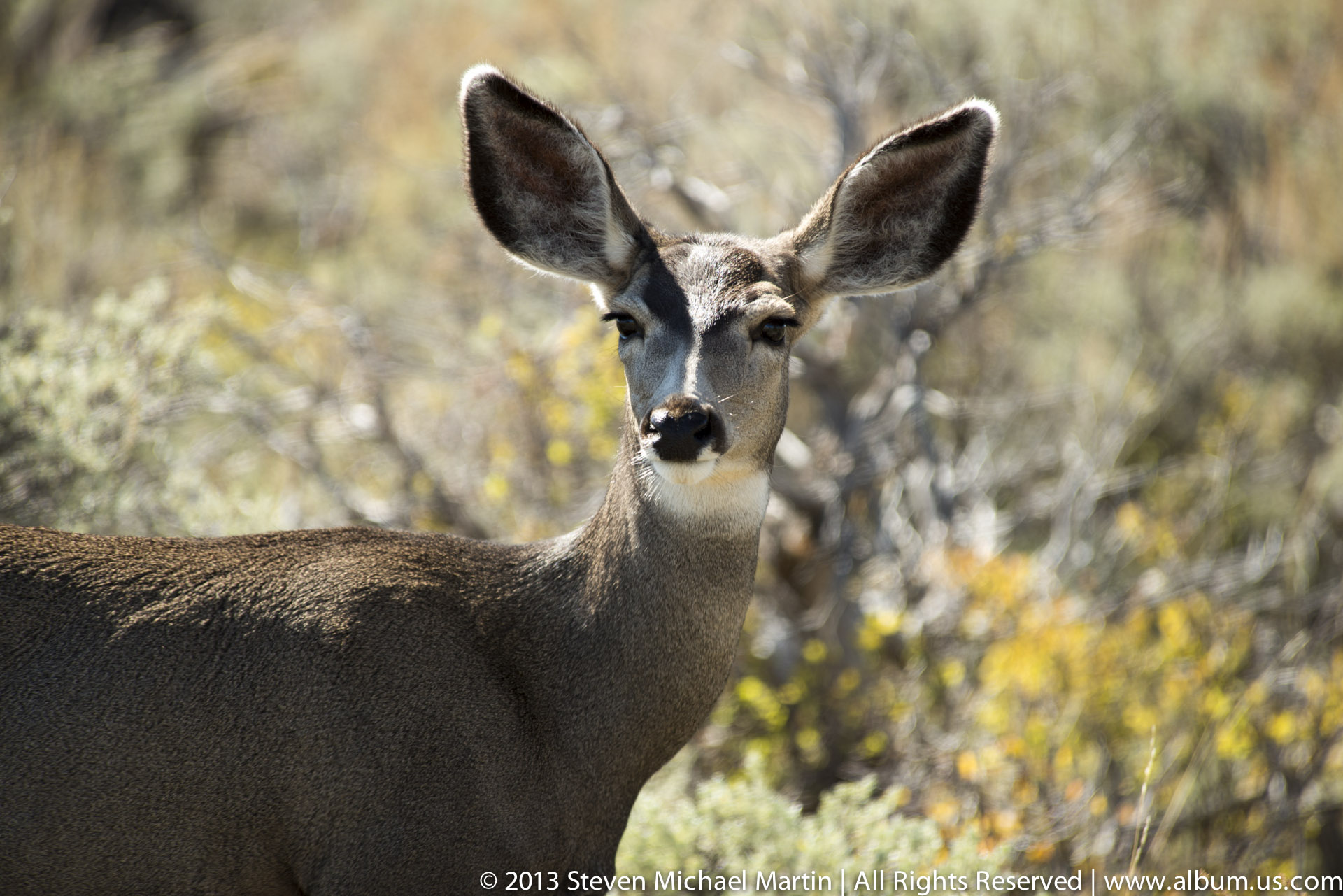
A mule deer doe turns toward the camera, her large ears spread above a narrow face and gray-brown coat. The close crop includes her shoulder and upper body while pale sagebrush and yellowing foliage soften behind her. Direct eye contact and the bright edge light around her ears give this portrait a quiet alertness without obscuring the dry woodland setting.
Caption
A mule deer doe turns toward the camera, her large ears spread above a narrow face and gray-brown coat. The close crop includes her shoulder and upper body while pale sagebrush and yellowing foliage soften behind her. Direct eye contact and the bright edge light around her ears give this portrait a quiet alertness without obscuring the dry woodland setting.
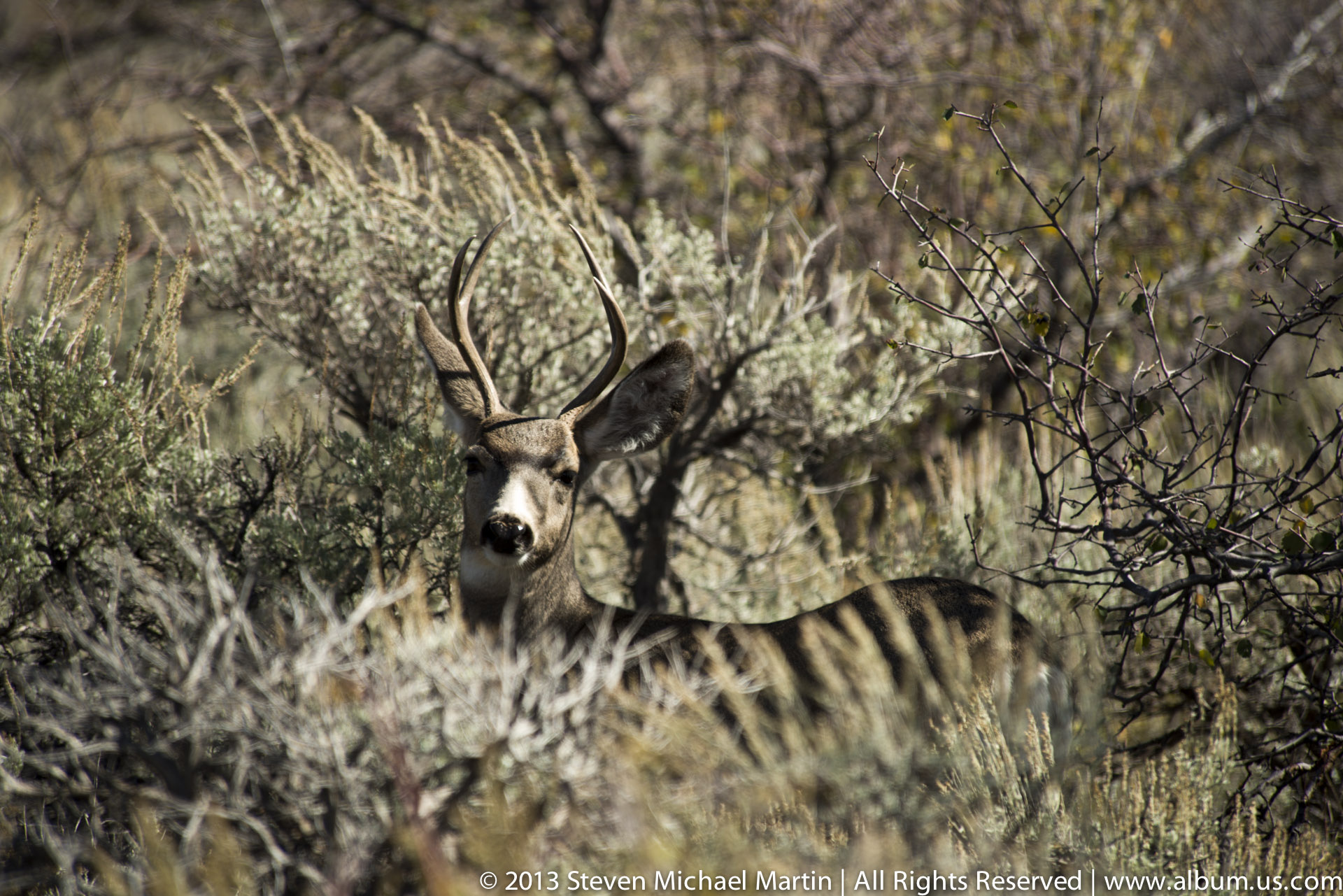
A mule deer buck peers through dense brush, with his face and short branching antlers visible between pale twigs. The vegetation crosses the foreground and partly conceals the animal’s body, creating a more observational wildlife view than the open portraits on the page. His forward gaze and emerging antlers remain the clear focal details.
Caption
A mule deer buck peers through dense brush, with his face and short branching antlers visible between pale twigs. The vegetation crosses the foreground and partly conceals the animal’s body, creating a more observational wildlife view than the open portraits on the page. His forward gaze and emerging antlers remain the clear focal details.

A pale sandstone escarpment rises above bands of ocher and gray eroded slope, with a dark green line of trees at its base. The nearly frontal viewpoint reveals a large shadowed recess in the rock face and broken ledges across the upper ridge. A clear blue sky sharpens the contrast between the warm stone and cooler vegetation.
Caption
A pale sandstone escarpment rises above bands of ocher and gray eroded slope, with a dark green line of trees at its base. The nearly frontal viewpoint reveals a large shadowed recess in the rock face and broken ledges across the upper ridge. A clear blue sky sharpens the contrast between the warm stone and cooler vegetation.
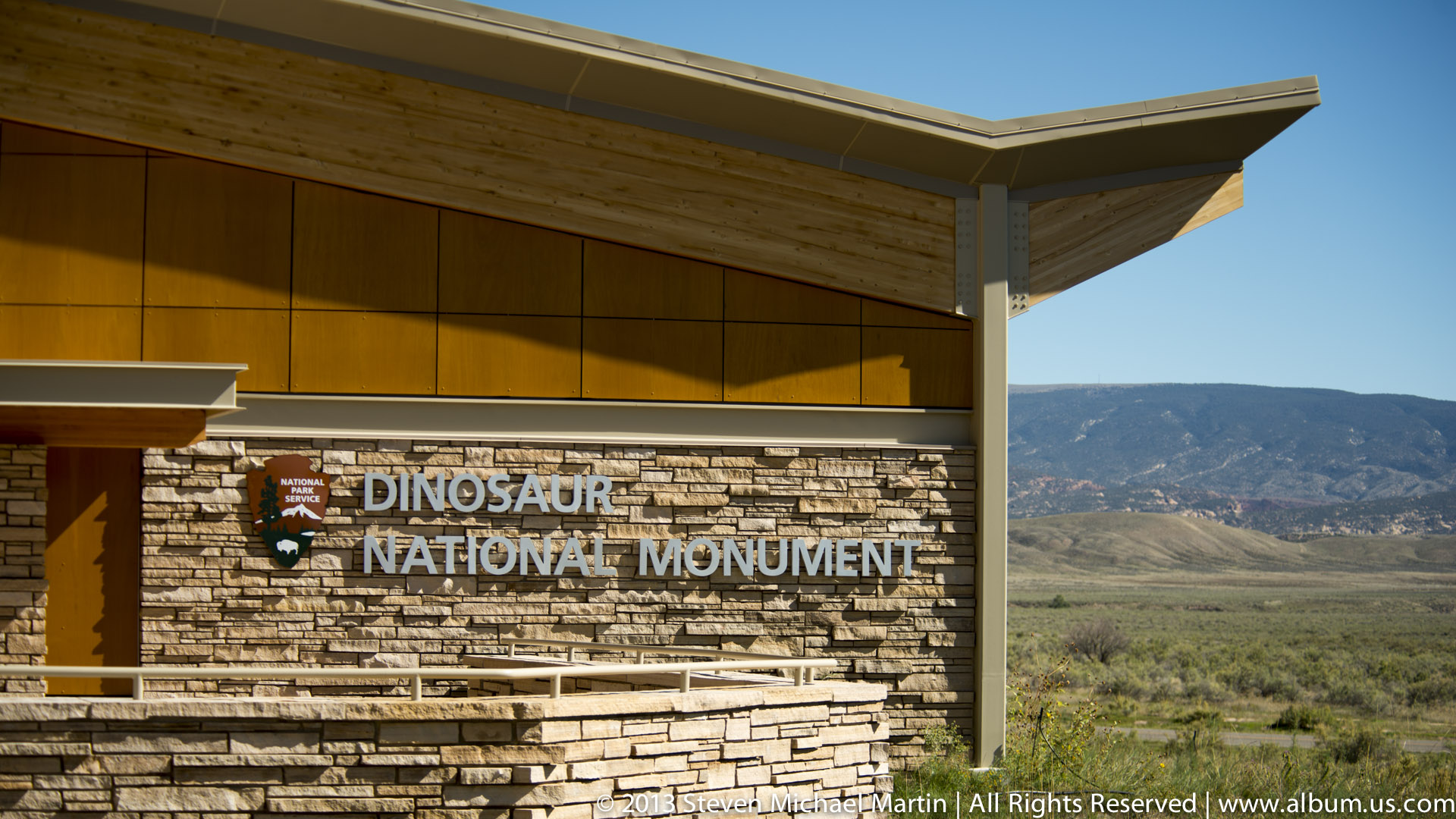
The visitor center’s low modern roof projects over a warm-toned facade, while large letters spell “Dinosaur National Monument” across a stacked-stone wall. A National Park Service emblem sits beside the name, and a mountain valley opens beyond the building at right. The architectural view links the park’s public identity to its surrounding landscape without obscuring either.
Caption
The visitor center’s low modern roof projects over a warm-toned facade, while large letters spell “Dinosaur National Monument” across a stacked-stone wall. A National Park Service emblem sits beside the name, and a mountain valley opens beyond the building at right. The architectural view links the park’s public identity to its surrounding landscape without obscuring either.

A row of pale, irregular fossil forms protrudes from a rough rock surface, with curved segments and ridged edges following the exposed matrix. The tight view isolates the bone-like material from the broader quarry setting and reveals how the remains lie within the stone. The image supports a fossil interpretation but does not establish a species or anatomical identification.
Caption
A row of pale, irregular fossil forms protrudes from a rough rock surface, with curved segments and ridged edges following the exposed matrix. The tight view isolates the bone-like material from the broader quarry setting and reveals how the remains lie within the stone. The image supports a fossil interpretation but does not establish a species or anatomical identification.
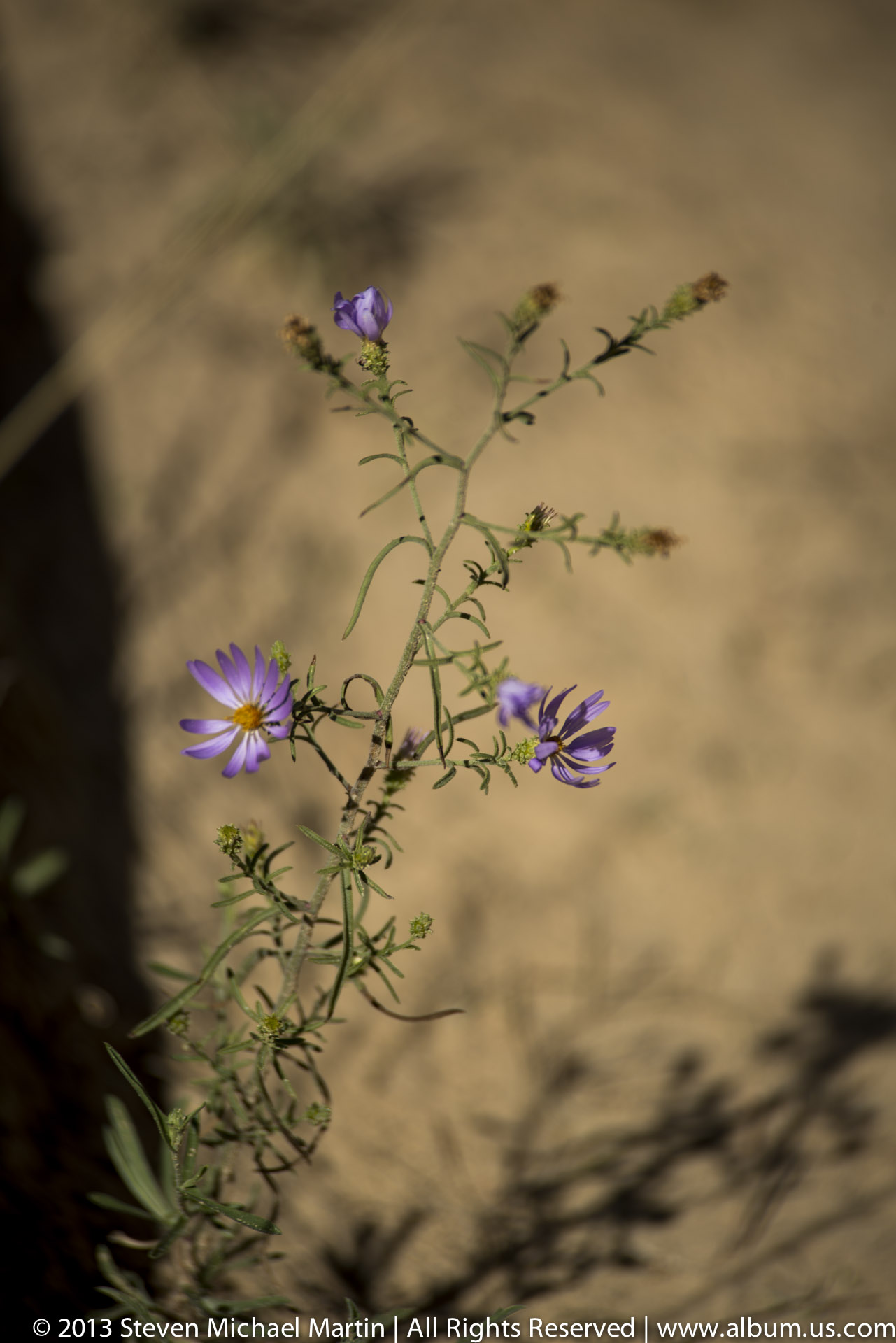
A slender plant carries several purple, daisy-like flowers against a softly blurred tan background. Narrow leaves and branching stems remain visible beneath the blooms, while shallow focus separates the plant from the dry ground. The isolated composition turns a small patch of desert flora into a botanical portrait; the species is not identified from this view.
Caption
A slender plant carries several purple, daisy-like flowers against a softly blurred tan background. Narrow leaves and branching stems remain visible beneath the blooms, while shallow focus separates the plant from the dry ground. The isolated composition turns a small patch of desert flora into a botanical portrait; the species is not identified from this view.
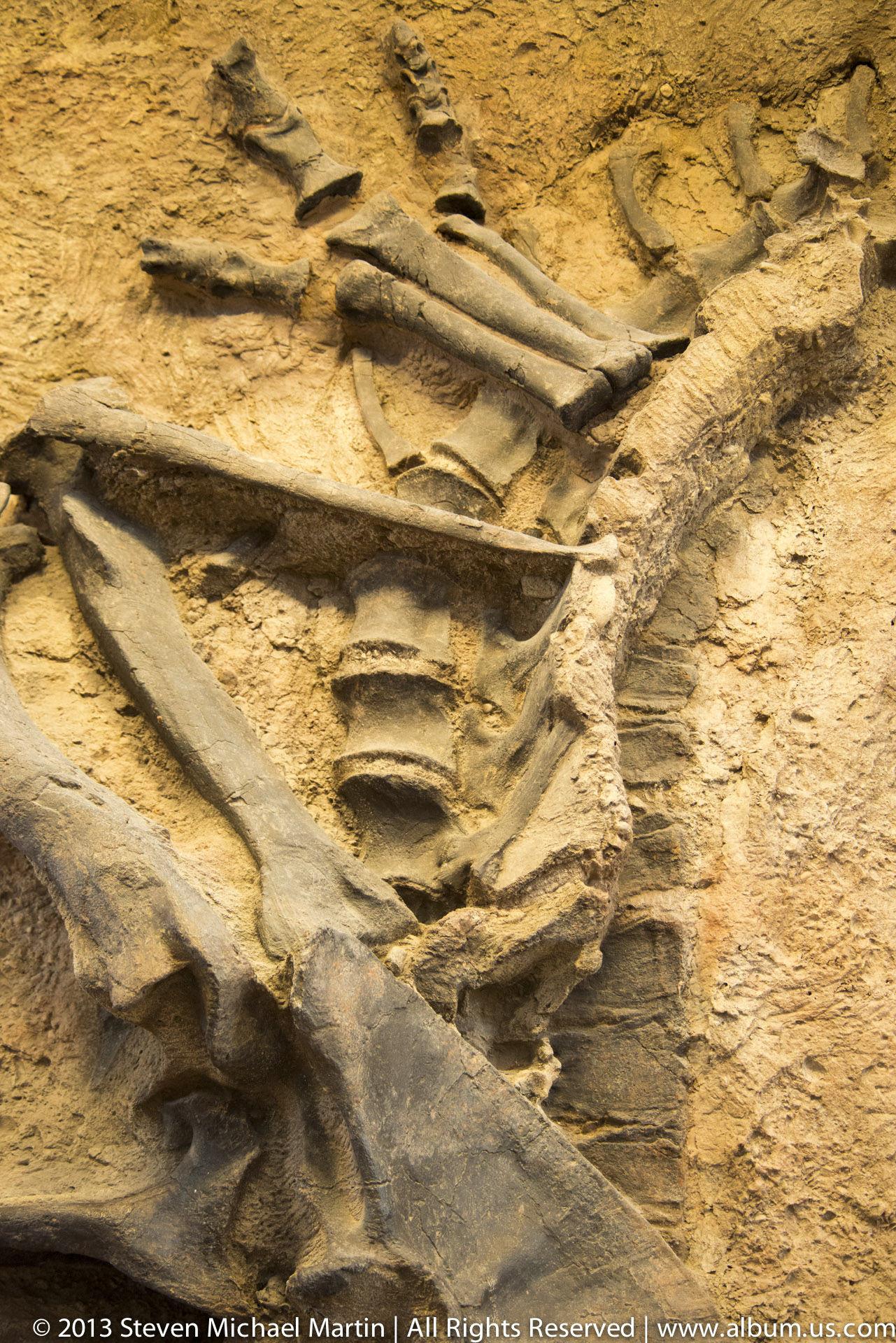
Several elongated fossil bones and segmented vertebral forms cross a warm-colored rock face at different angles. Fractures and horizontal layers in the surrounding stone make the exposed remains appear continuous with the quarry wall. This broader detail shows multiple skeletal elements together rather than isolating one skull or vertebral row; exact species remains undetermined.
Caption
Several elongated fossil bones and segmented vertebral forms cross a warm-colored rock face at different angles. Fractures and horizontal layers in the surrounding stone make the exposed remains appear continuous with the quarry wall. This broader detail shows multiple skeletal elements together rather than isolating one skull or vertebral row; exact species remains undetermined.
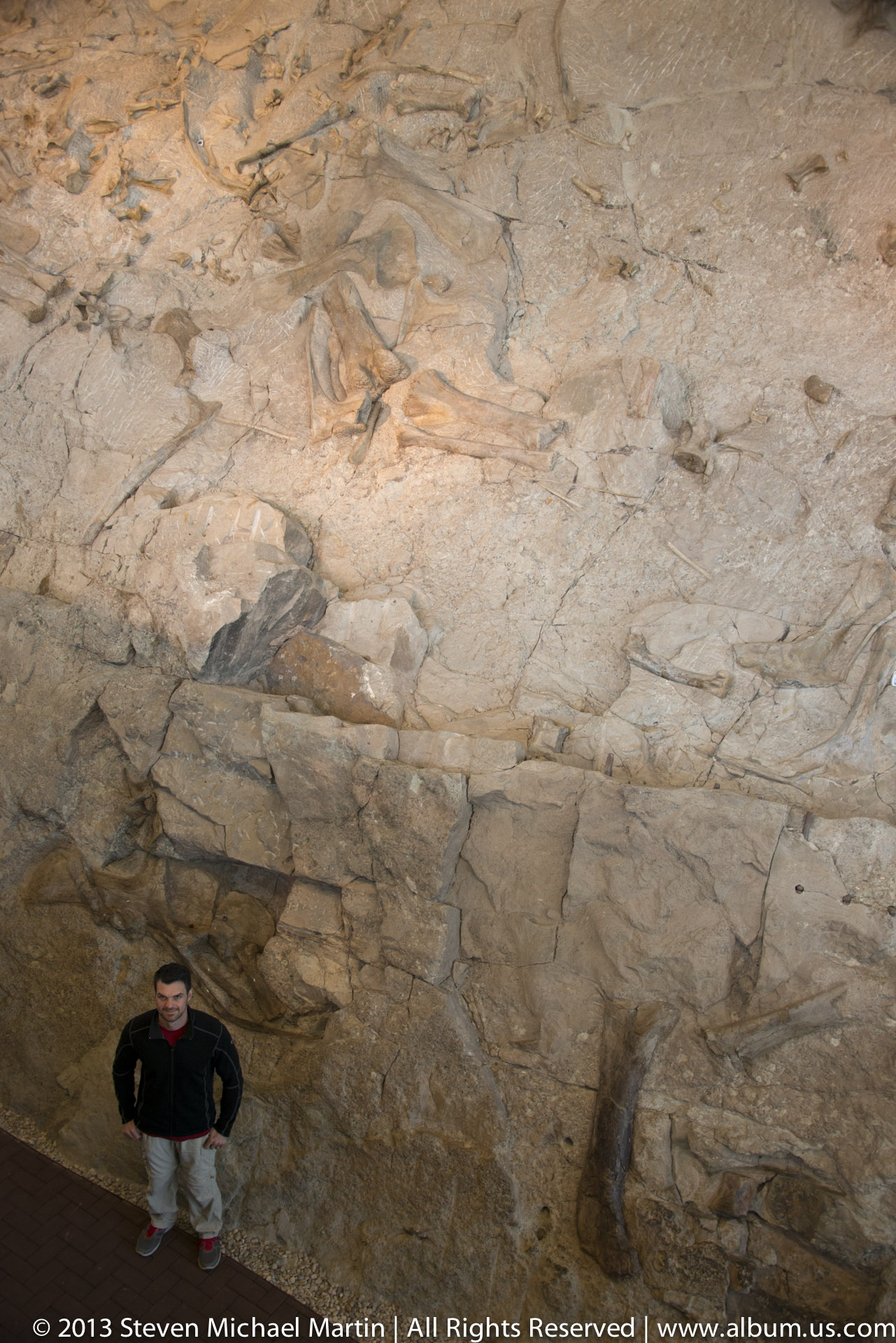
A visitor in a dark top and light trousers stands near the base of a towering, curved rock wall, appearing small against its broad, layered surface. The steep upward view emphasizes scale and the sheltered setting, while the person provides a clear reference point. No exposed fossil is discernible in this frame, so the massive layered rock wall remains central.
Caption
A visitor in a dark top and light trousers stands near the base of a towering, curved rock wall, appearing small against its broad, layered surface. The steep upward view emphasizes scale and the sheltered setting, while the person provides a clear reference point. No exposed fossil is discernible in this frame, so the massive layered rock wall remains central.

Several rounded and ribbed fossil forms emerge from a pale, fractured rock face. Their clustered arrangement follows the uneven stone surface, with darker crevices separating the projecting shapes. The photograph concentrates on the texture and placement of exposed remains rather than a complete skeleton, and it does not support naming a particular animal or bone type.
Caption
Several rounded and ribbed fossil forms emerge from a pale, fractured rock face. Their clustered arrangement follows the uneven stone surface, with darker crevices separating the projecting shapes. The photograph concentrates on the texture and placement of exposed remains rather than a complete skeleton, and it does not support naming a particular animal or bone type.
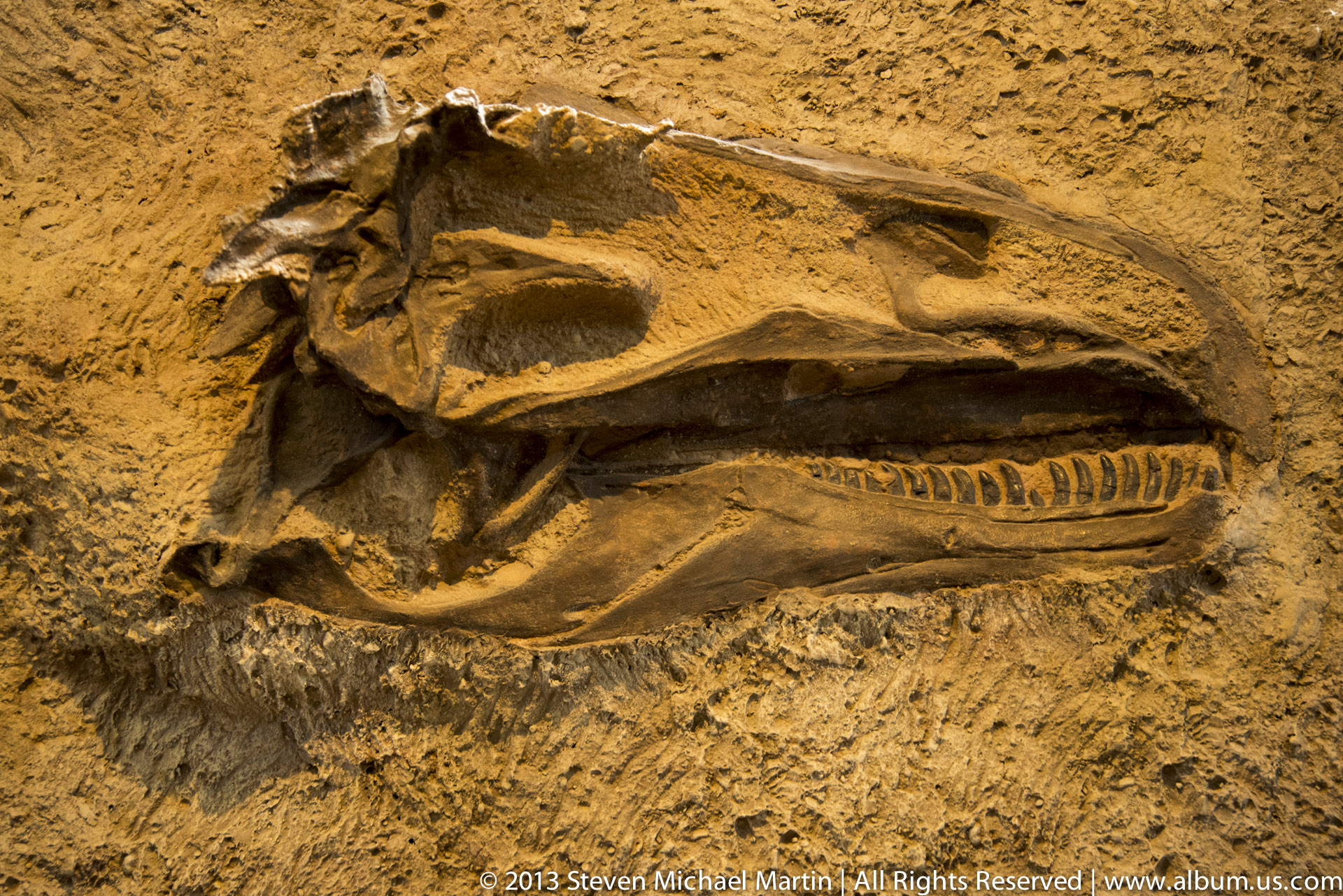
A large fossil skull lies exposed in orange-brown rock, its long jaw and closely spaced teeth visible in profile. The broad cranial structure fills most of the frame, with darker fossil material contrasting against the surrounding matrix. The image presents a striking anatomical detail, but the proof-sheet view does not identify the dinosaur species.
Caption
A large fossil skull lies exposed in orange-brown rock, its long jaw and closely spaced teeth visible in profile. The broad cranial structure fills most of the frame, with darker fossil material contrasting against the surrounding matrix. The image presents a striking anatomical detail, but the proof-sheet view does not identify the dinosaur species.
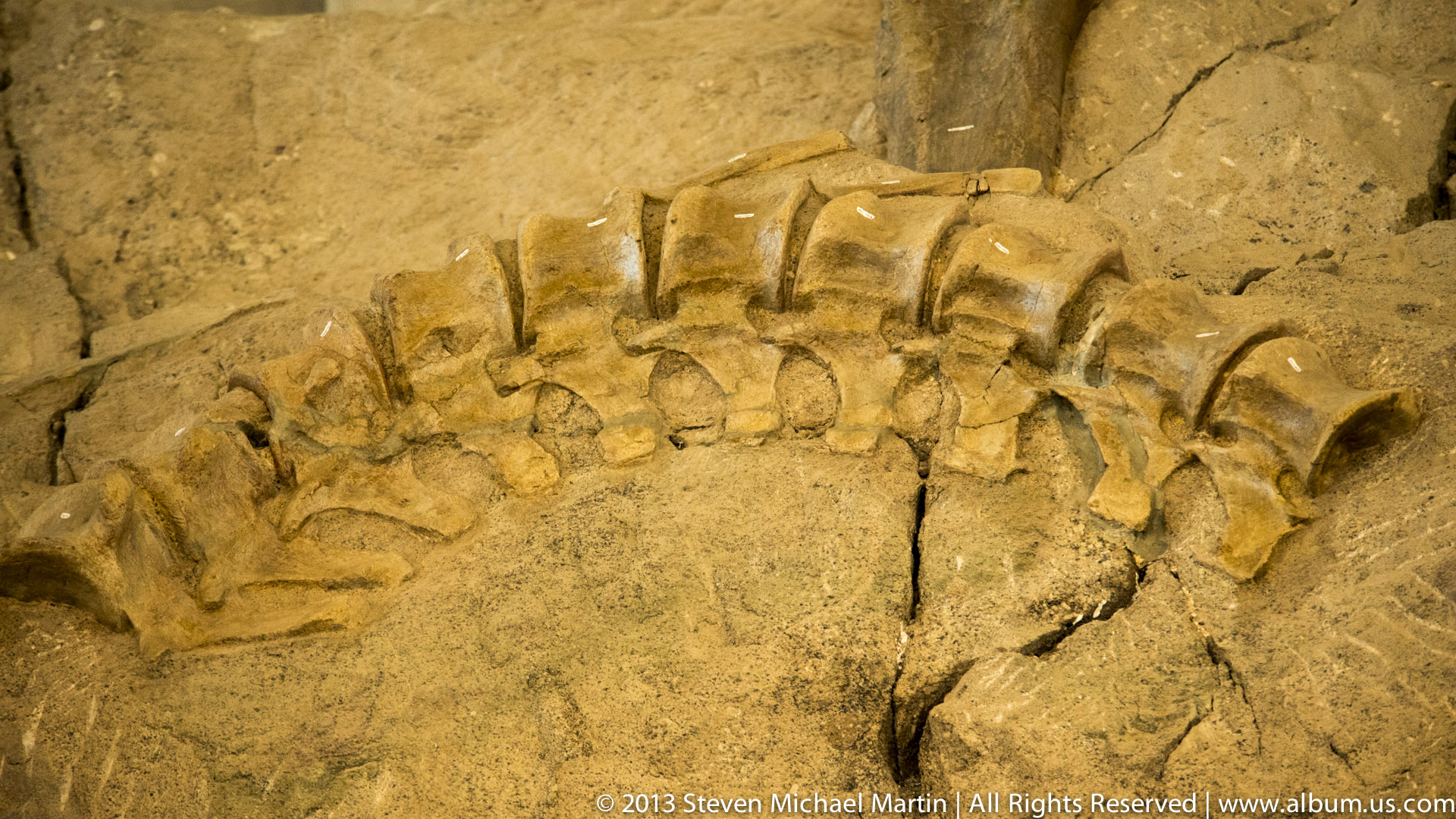
A curved sequence of broad, block-like vertebrae remains embedded in golden-brown stone. The close framing follows the arc of the spine and shows adjoining fossil material partly concealed by the matrix. This anatomical detail differs from the nearby skull and long-bone views by concentrating on the repeated shape and alignment of the vertebral column.
Caption
A curved sequence of broad, block-like vertebrae remains embedded in golden-brown stone. The close framing follows the arc of the spine and shows adjoining fossil material partly concealed by the matrix. This anatomical detail differs from the nearby skull and long-bone views by concentrating on the repeated shape and alignment of the vertebral column.
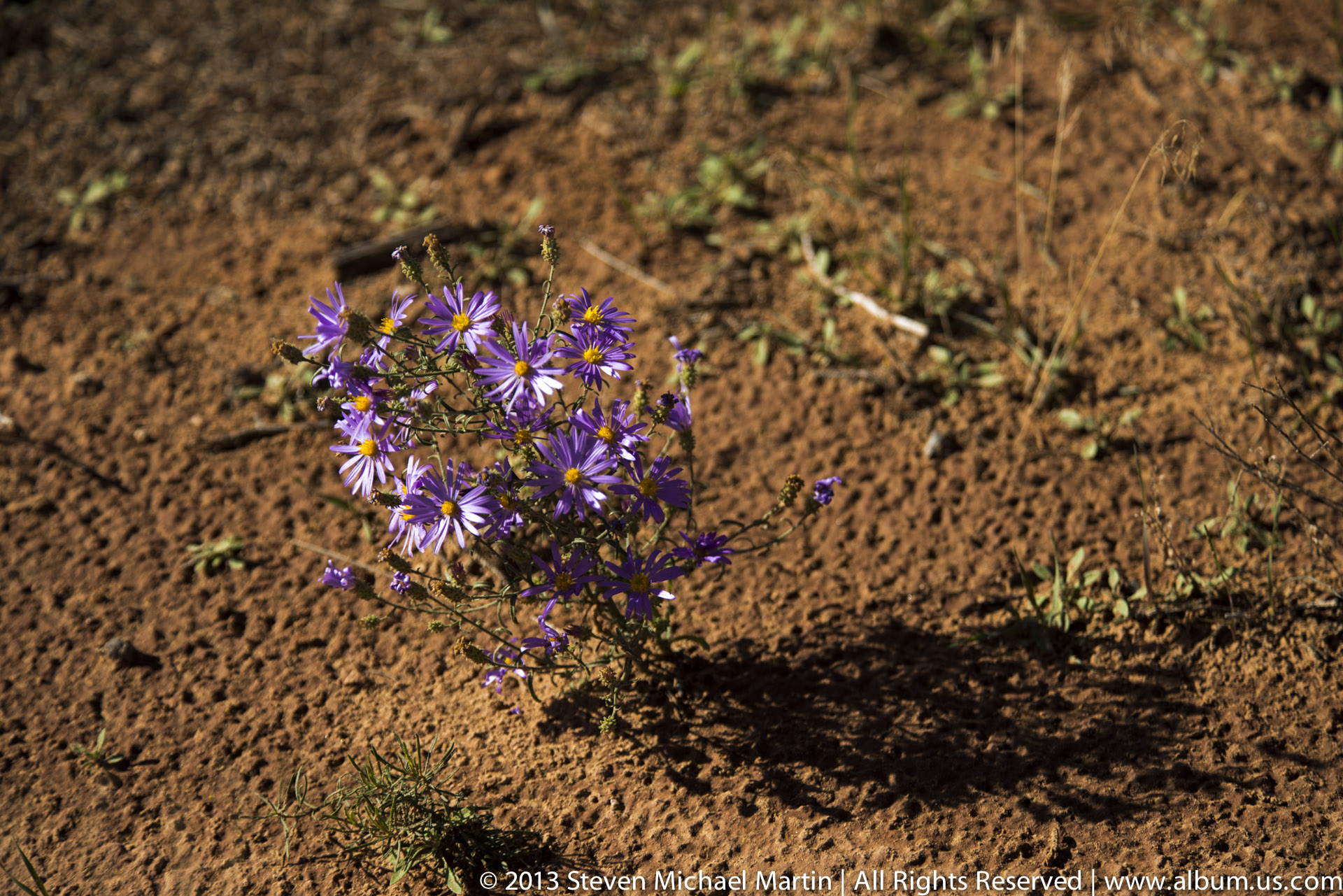
A small cluster of violet, daisy-like flowers rises from a low plant rooted in dry, reddish soil. Direct sunlight casts a distinct shadow across the ground, making the plant’s branching structure and surrounding grit easy to see. The close view differs from the softer flower portrait on the preceding page by including the bare substrate and sharper midday contrast.
Caption
A small cluster of violet, daisy-like flowers rises from a low plant rooted in dry, reddish soil. Direct sunlight casts a distinct shadow across the ground, making the plant’s branching structure and surrounding grit easy to see. The close view differs from the softer flower portrait on the preceding page by including the bare substrate and sharper midday contrast.

A shallow, dark pool rests in a smooth, oval depression in sandstone, reflecting the warm-colored rock wall above it. The surrounding surface is weathered and gently sloped toward the basin, with small grains and dark marks scattered across the stone. The close composition isolates the water-filled hollow from the larger landscape and foregrounds its reflective surface.
Caption
A shallow, dark pool rests in a smooth, oval depression in sandstone, reflecting the warm-colored rock wall above it. The surrounding surface is weathered and gently sloped toward the basin, with small grains and dark marks scattered across the stone. The close composition isolates the water-filled hollow from the larger landscape and foregrounds its reflective surface.
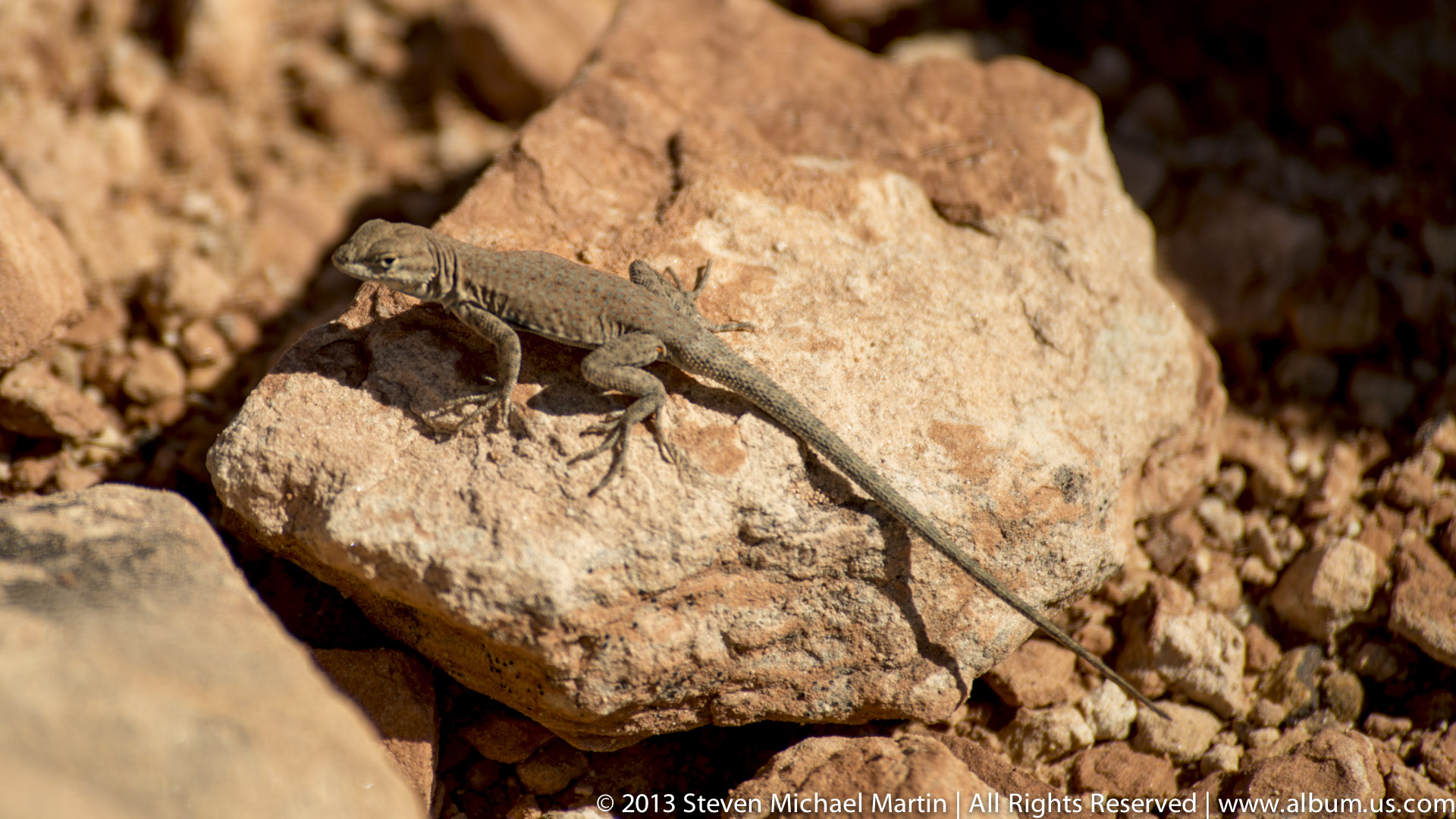
A small lizard stretches across a sunlit sandstone boulder, its long tail trailing down the sloping surface. Its mottled body blends with the rock’s warm tones, while angular stones and a dark recess frame the close wildlife view. The proof-sheet image does not show enough distinctive markings for a reliable species identification, so the animal is described generally.
Caption
A small lizard stretches across a sunlit sandstone boulder, its long tail trailing down the sloping surface. Its mottled body blends with the rock’s warm tones, while angular stones and a dark recess frame the close wildlife view. The proof-sheet image does not show enough distinctive markings for a reliable species identification, so the animal is described generally.
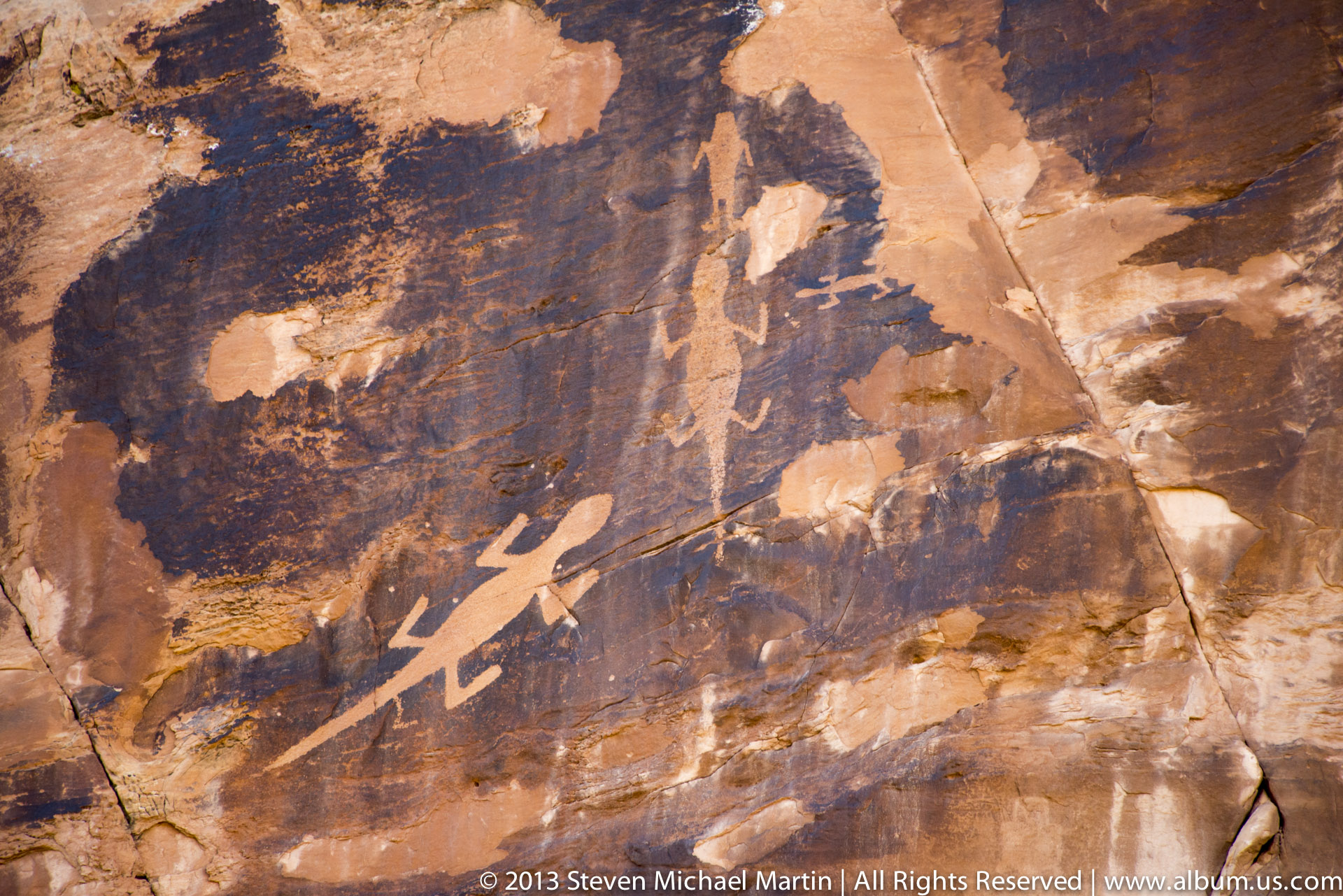
Pale linear motifs cross a dark reddish rock surface, including elongated human-like figures and smaller marks arranged vertically. Natural seams and changing pigment-like tones remain visible around the images. The close view presents the panel as rock art without assigning a maker, period, or technique that cannot be established from the proof sheet.
Caption
Pale linear motifs cross a dark reddish rock surface, including elongated human-like figures and smaller marks arranged vertically. Natural seams and changing pigment-like tones remain visible around the images. The close view presents the panel as rock art without assigning a maker, period, or technique that cannot be established from the proof sheet.

A visitor wearing a red shirt, dark trousers, and a cap stands beside a high sandstone wall in the shade of an alcove. The close framing places him against the rock face, where vertical fractures and warm bands of color fill the background. His stance and clothing are visible, while the image offers little context for naming the precise formation.
Caption
A visitor wearing a red shirt, dark trousers, and a cap stands beside a high sandstone wall in the shade of an alcove. The close framing places him against the rock face, where vertical fractures and warm bands of color fill the background. His stance and clothing are visible, while the image offers little context for naming the precise formation.
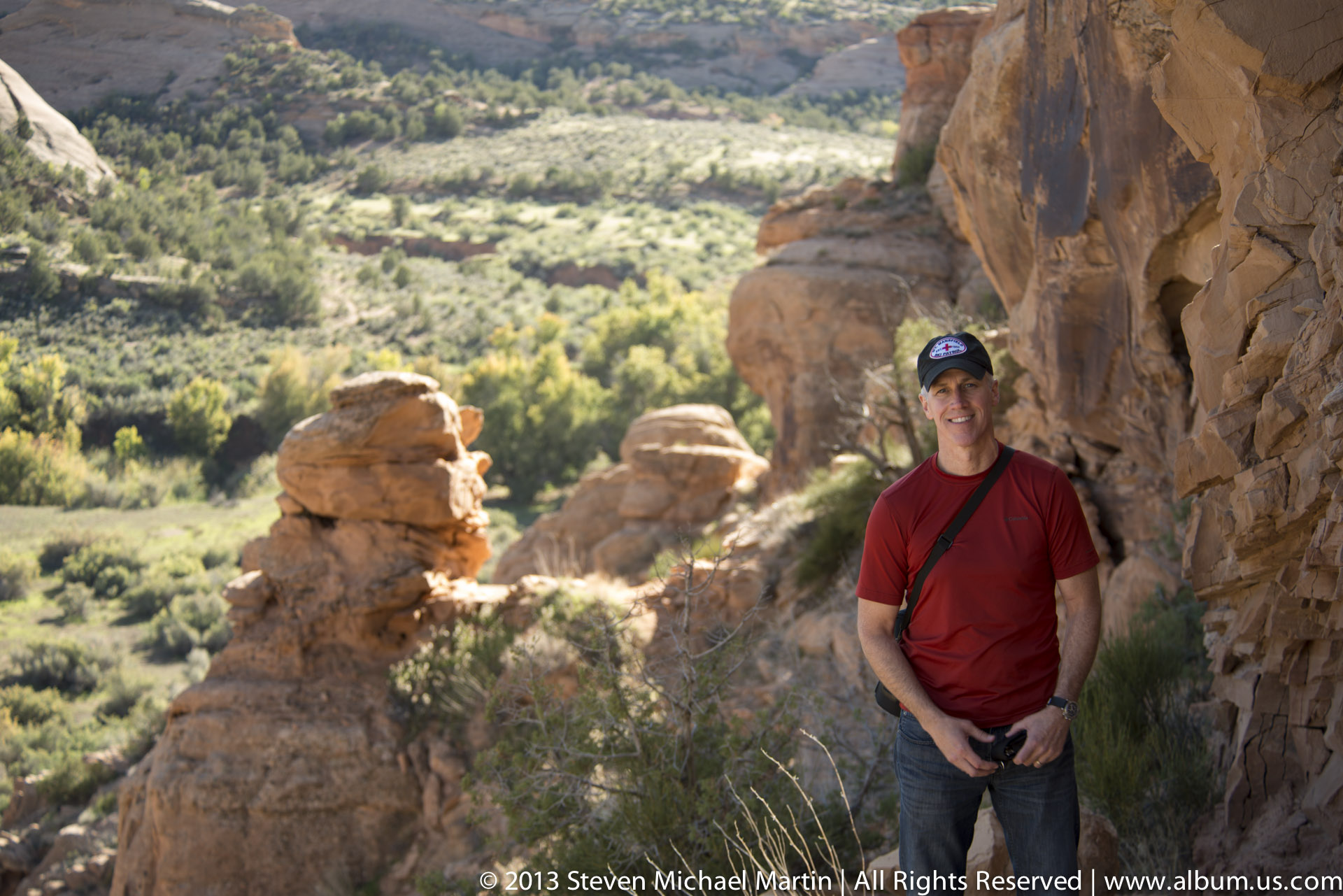
A man in a red shirt stands at the right of a sunlit sandstone passage, with rounded rock pillars in the middle distance and a green valley opening beyond. The wide view places the visitor within the formations rather than treating the stone as an isolated detail. Strong light on the canyon rim contrasts with the darker rock walls around him.
Caption
A man in a red shirt stands at the right of a sunlit sandstone passage, with rounded rock pillars in the middle distance and a green valley opening beyond. The wide view places the visitor within the formations rather than treating the stone as an isolated detail. Strong light on the canyon rim contrasts with the darker rock walls around him.
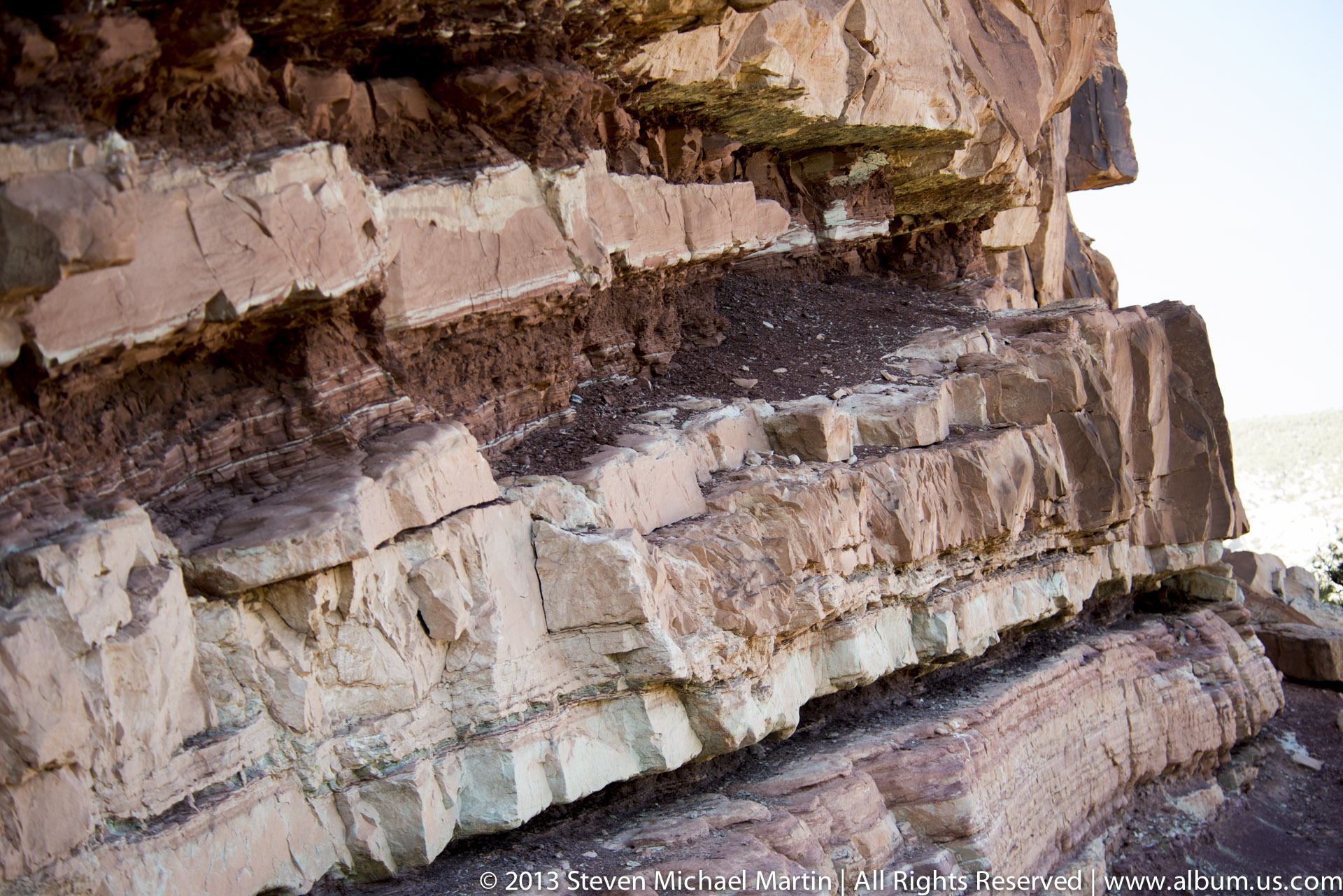
A close view follows a broad sandstone ledge where pale cream layers, red bands, and darker gray seams stack unevenly across the frame. Fractures divide the rock into block-like sections, while a shallow shadow beneath the upper ledge emphasizes its projecting edge. Without a person or wider landscape for scale, the image focuses on texture and stratification.
Caption
A close view follows a broad sandstone ledge where pale cream layers, red bands, and darker gray seams stack unevenly across the frame. Fractures divide the rock into block-like sections, while a shallow shadow beneath the upper ledge emphasizes its projecting edge. Without a person or wider landscape for scale, the image focuses on texture and stratification.
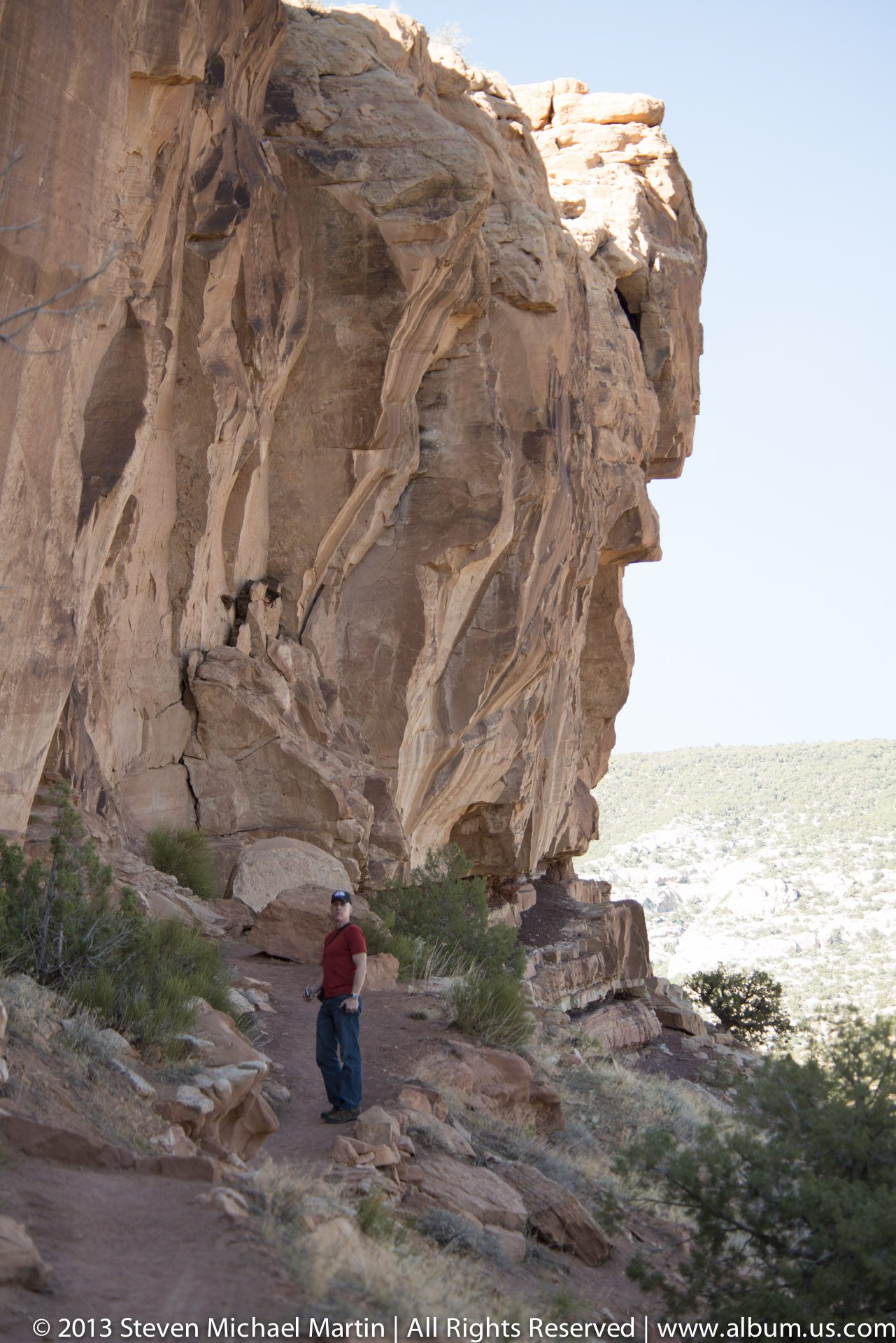
A visitor in a red shirt stands near the base of a massive sandstone overhang, dwarfed by the sweeping rock face above. The cliff’s curved underside and broad horizontal layers dominate the composition, while bright open terrain beyond the alcove contrasts with its shade. The human figure gives scale to the formation and distinguishes this view from the close rock textures that follow.
Caption
A visitor in a red shirt stands near the base of a massive sandstone overhang, dwarfed by the sweeping rock face above. The cliff’s curved underside and broad horizontal layers dominate the composition, while bright open terrain beyond the alcove contrasts with its shade. The human figure gives scale to the formation and distinguishes this view from the close rock textures that follow.
🏛️ National Monument Field Guide
📍 Overview
Dinosaur National Monument preserves one of the most significant fossil resources in North America together with a rugged landscape of canyons and desert plateaus along the Colorado–Utah border. The monument protects exposed dinosaur remains embedded in tilted rock layers, offering a rare opportunity to observe prehistoric life within its original geological setting.
The Green and Yampa Rivers have carved deep canyons through sedimentary rock, revealing layers that record millions of years of environmental change. The combination of paleontology and canyon scenery makes Dinosaur National Monument both scientifically important and visually distinctive within the Rocky Mountain region.
⭐ Highlights
- Fossil quarry with visible dinosaur bones
- Green River and Yampa River canyon landscapes
- Tilted sedimentary rock formations
- Combination of paleontology and scenic geology
- Remote high desert plateau terrain
🔎 Key Features
- Jurassic-period dinosaur fossil beds
- River-carved canyon systems
- Exposed geological layers
- High desert environment
- Scientific importance in paleontology
📷 Photography Notes
- Wide views emphasize canyon scale
- Side lighting highlights rock texture
- Fossil exhibits work well for detail images
- Morning and late light enhance color in sediment layers
- River overlooks provide strong landscape compositions
- Simple framing works well for scientific subjects