Horseshoe Canyon – Canyonlands National Park
Horseshoe Canyon preserves a remote canyon environment within Canyonlands National Park known for significant rock art panels associated with early Indigenous cultural traditions. The canyon’s curved shape reflects long-term erosion by seasonal water flow acting upon uplifted sedimentary rock layers. The landscape demonstrates the interaction between geological formation and human presence across extended periods of time.
Rock art panels located within the canyon include large anthropomorphic figures created by ancestral cultures thousands of years ago. The canyon environment provided sheltered rock surfaces suitable for preservation of these images. The surrounding terrain illustrates the geological processes that created protected canyon walls within the Colorado Plateau region.
Visitors encounter a quiet desert landscape that emphasizes both geological scale and cultural continuity. The canyon illustrates the relationship between environment and cultural expression across a landscape shaped by erosion and climatic variation.
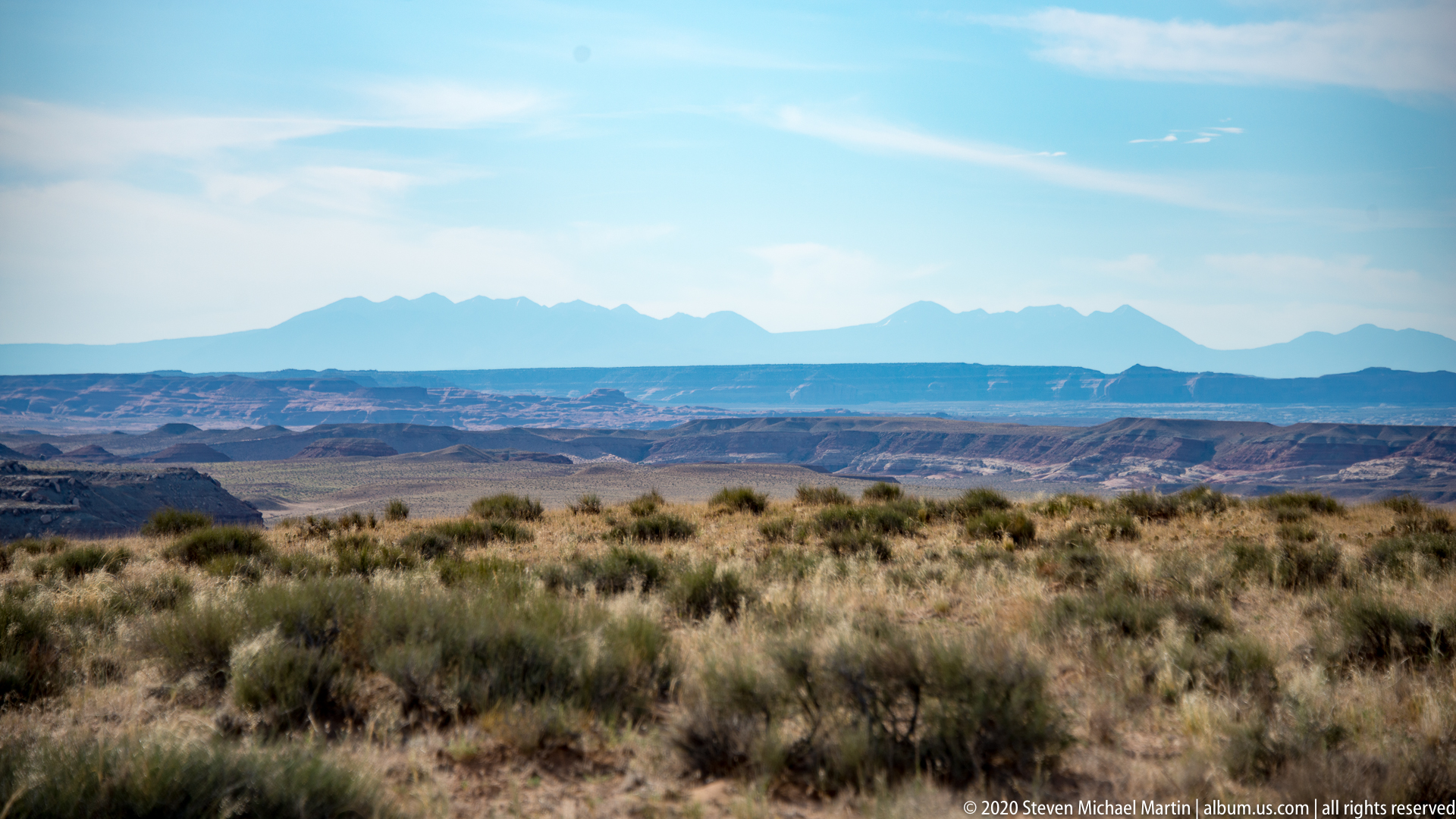
A long, blue-gray mountain range forms a jagged silhouette along the horizon beyond a broad expanse of layered canyon country. Sagebrush and dry grasses cover the near plateau, while atmospheric haze softens the more distant ridges. The elevated viewpoint contrasts the open high-desert foreground with the layered topography stretching toward the mountains.
Caption
A long, blue-gray mountain range forms a jagged silhouette along the horizon beyond a broad expanse of layered canyon country. Sagebrush and dry grasses cover the near plateau, while atmospheric haze softens the more distant ridges. The elevated viewpoint contrasts the open high-desert foreground with the layered topography stretching toward the mountains.
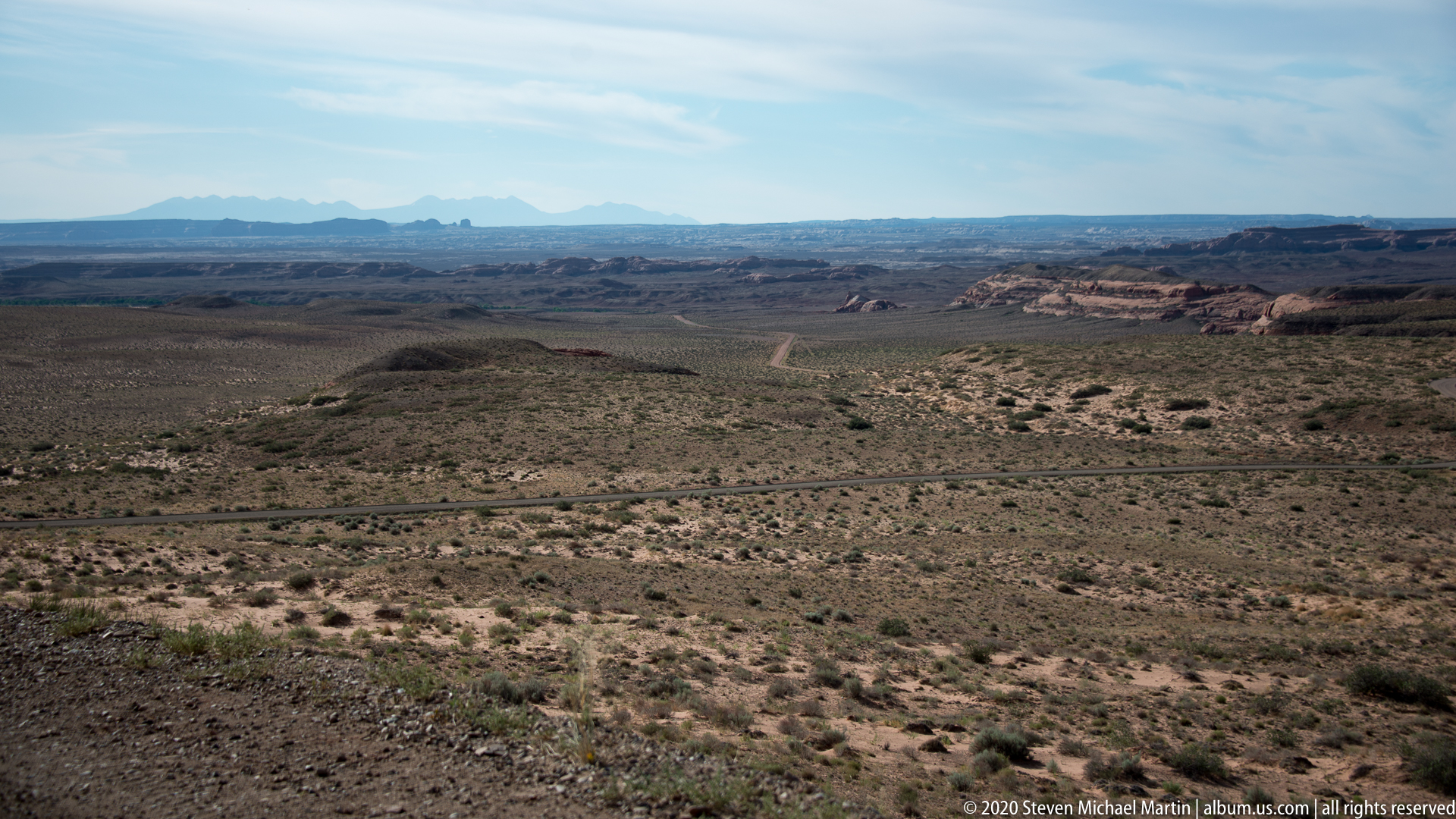
From an elevated rim, dark canyon slopes descend into a wide basin and rise again toward distant mesas and a blue mountain skyline. A narrow road traces the lower foreground, offering a subtle human scale within the expansive terrain. The layered horizon and hazy distance create a broad westward-looking panorama across the high desert.
Caption
From an elevated rim, dark canyon slopes descend into a wide basin and rise again toward distant mesas and a blue mountain skyline. A narrow road traces the lower foreground, offering a subtle human scale within the expansive terrain. The layered horizon and hazy distance create a broad westward-looking panorama across the high desert.
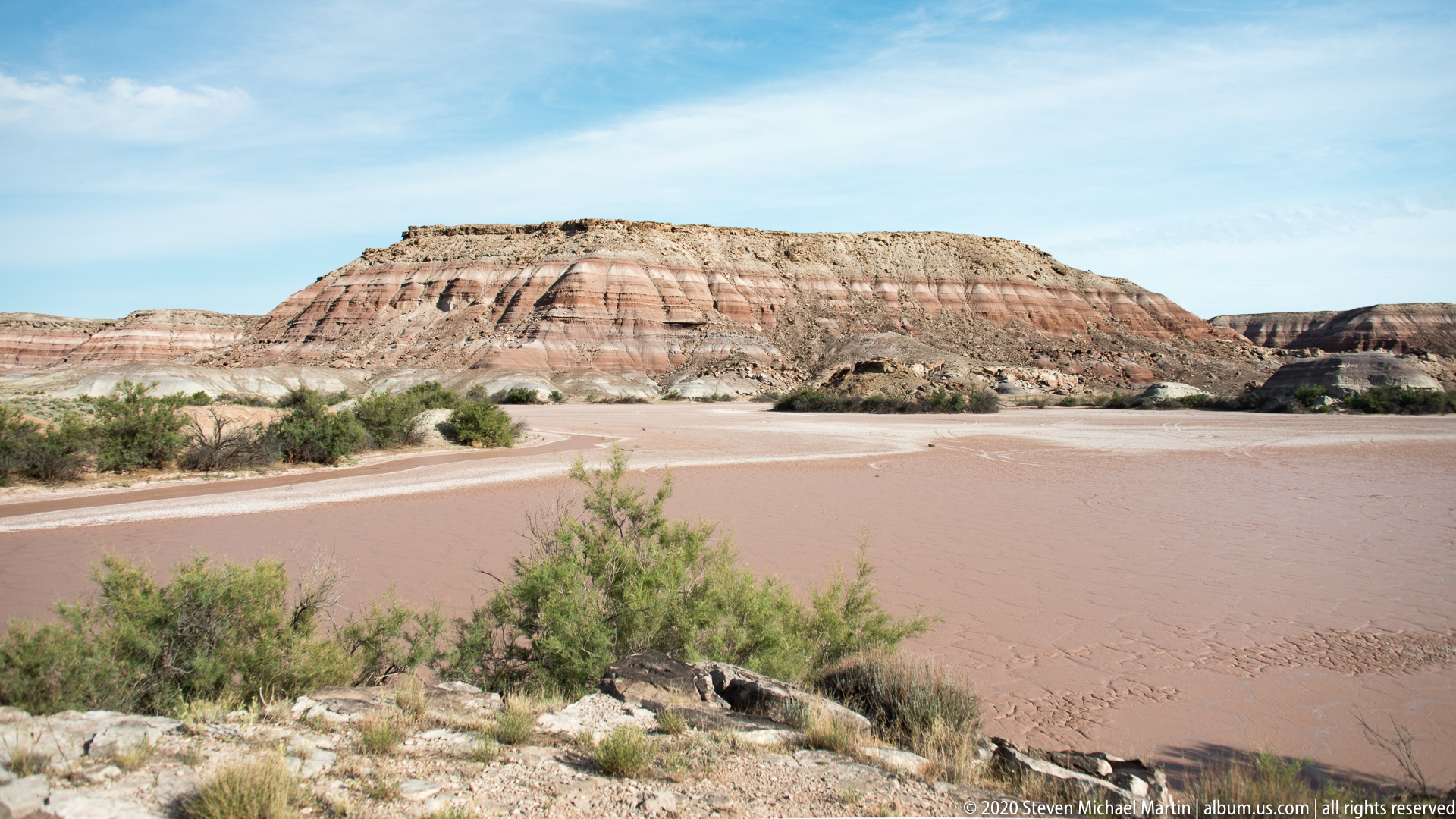
A wide view places a low, banded butte across the canyon beyond a pale wash and scattered scrub. Its reddish horizontal strata rise above a light-colored base, while a darker mesa edge continues across the background. The foreground shrubs frame the open basin and distinguish this contextual landscape view from the close studies of cracked sediment.
Caption
A wide view places a low, banded butte across the canyon beyond a pale wash and scattered scrub. Its reddish horizontal strata rise above a light-colored base, while a darker mesa edge continues across the background. The foreground shrubs frame the open basin and distinguish this contextual landscape view from the close studies of cracked sediment.
Orange dunes undulate across the middle distance, their smooth surfaces interrupted by tufts of grass and low shrubs. A darker, partly cloudy sky opens above a faint line of mountains on the horizon. The foreground vegetation and broad empty dune slopes create depth, while the low skyline keeps attention on the warm sand and changing weather.
Caption
Orange dunes undulate across the middle distance, their smooth surfaces interrupted by tufts of grass and low shrubs. A darker, partly cloudy sky opens above a faint line of mountains on the horizon. The foreground vegetation and broad empty dune slopes create depth, while the low skyline keeps attention on the warm sand and changing weather.
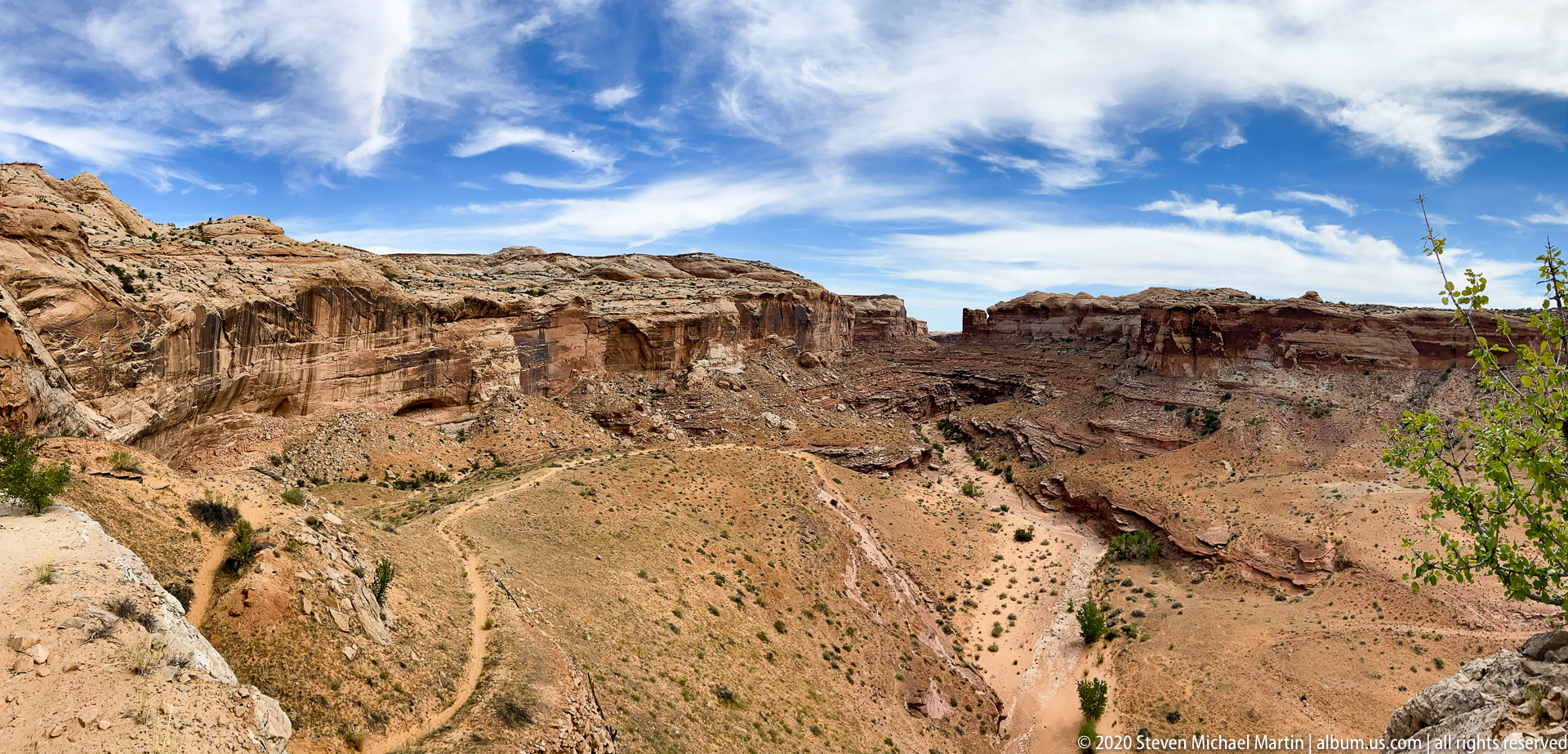
From the rim, steep broken cliffs descend into a broad canyon cut through bands of tan and reddish rock. A small hiker on the left wall provides scale, while a narrow trail traces a diagonal line down the slope. The panorama emphasizes the canyon’s depth and the irregular, weathered surfaces exposed along its sides.
Caption
From the rim, steep broken cliffs descend into a broad canyon cut through bands of tan and reddish rock. A small hiker on the left wall provides scale, while a narrow trail traces a diagonal line down the slope. The panorama emphasizes the canyon’s depth and the irregular, weathered surfaces exposed along its sides.
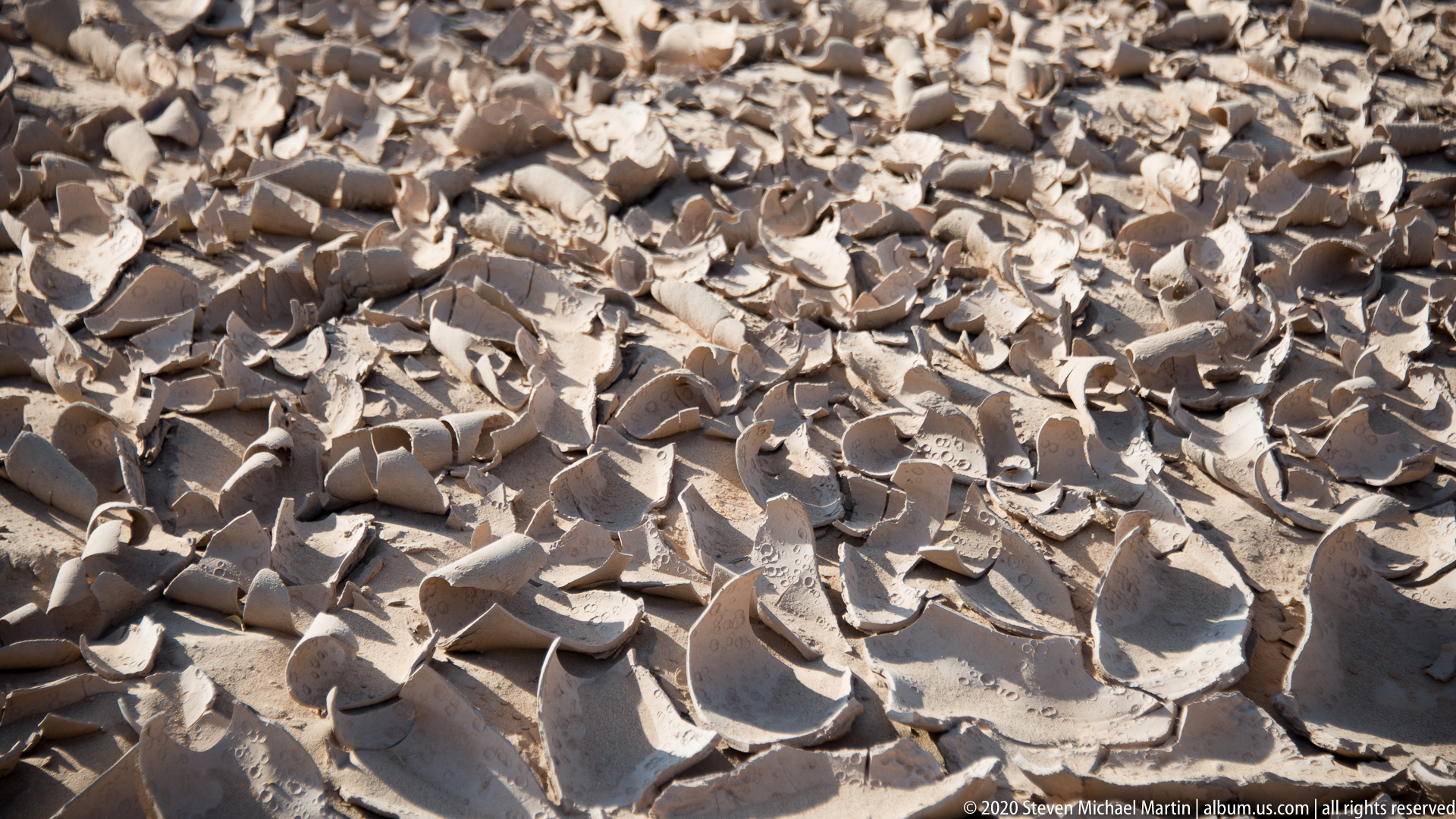
A close view reveals a dense scatter of pale ceramic fragments lying on dry soil. Many curved pieces retain portions of vessel walls and rims, while several carry dark incised or impressed marks. The image documents archaeological material in place; the visible fragments support identifying pottery sherds, but not a specific maker, age, or cultural attribution.
Caption
A close view reveals a dense scatter of pale ceramic fragments lying on dry soil. Many curved pieces retain portions of vessel walls and rims, while several carry dark incised or impressed marks. The image documents archaeological material in place; the visible fragments support identifying pottery sherds, but not a specific maker, age, or cultural attribution.
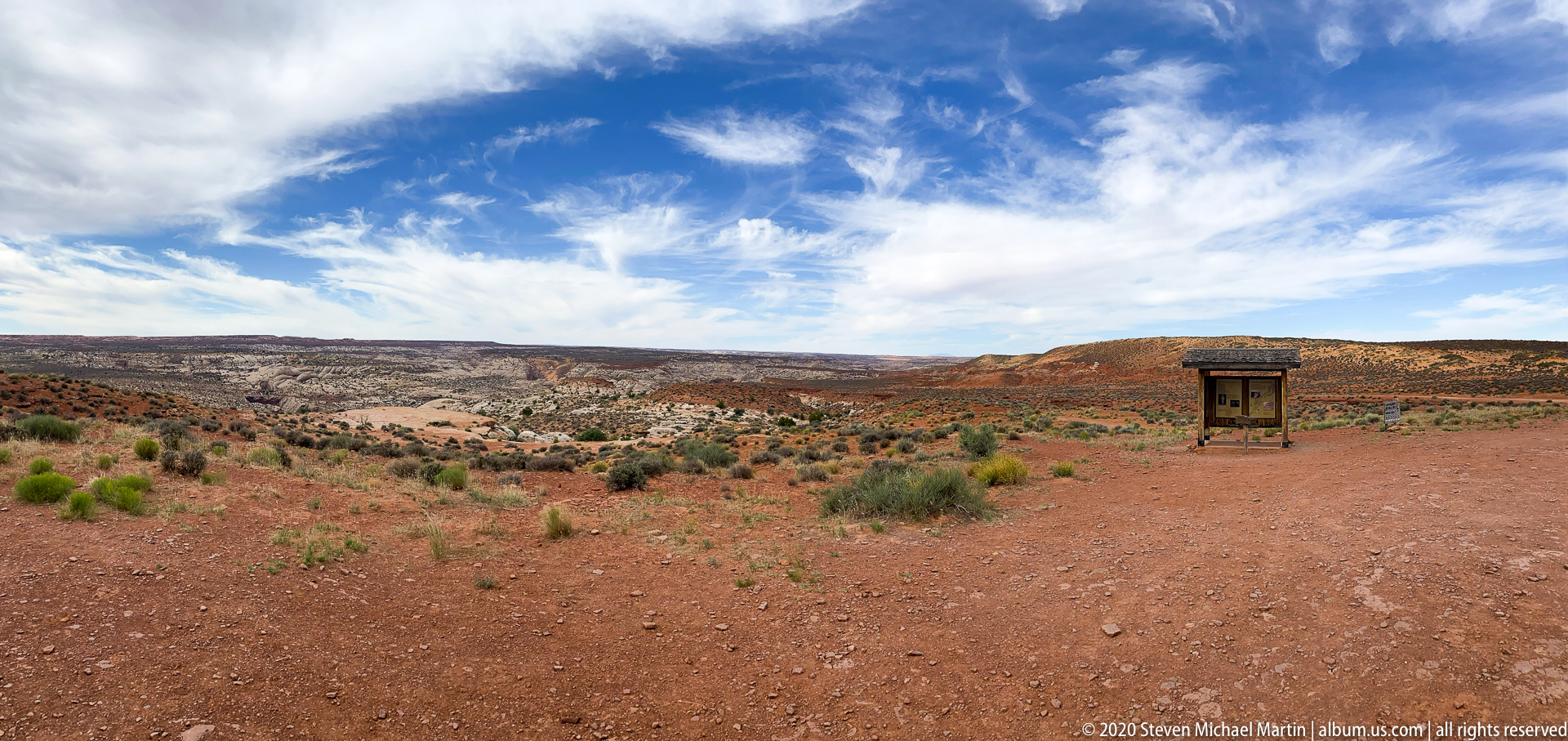
From a red, gravelly overlook, the canyon opens into a broad basin of layered mesas and eroded slopes. A small roofed information kiosk stands near the right edge, providing a human-scale reference against the surrounding terrain. The wide view emphasizes the transition from the bare plateau rim to the deeply cut canyon country beyond.
Caption
From a red, gravelly overlook, the canyon opens into a broad basin of layered mesas and eroded slopes. A small roofed information kiosk stands near the right edge, providing a human-scale reference against the surrounding terrain. The wide view emphasizes the transition from the bare plateau rim to the deeply cut canyon country beyond.
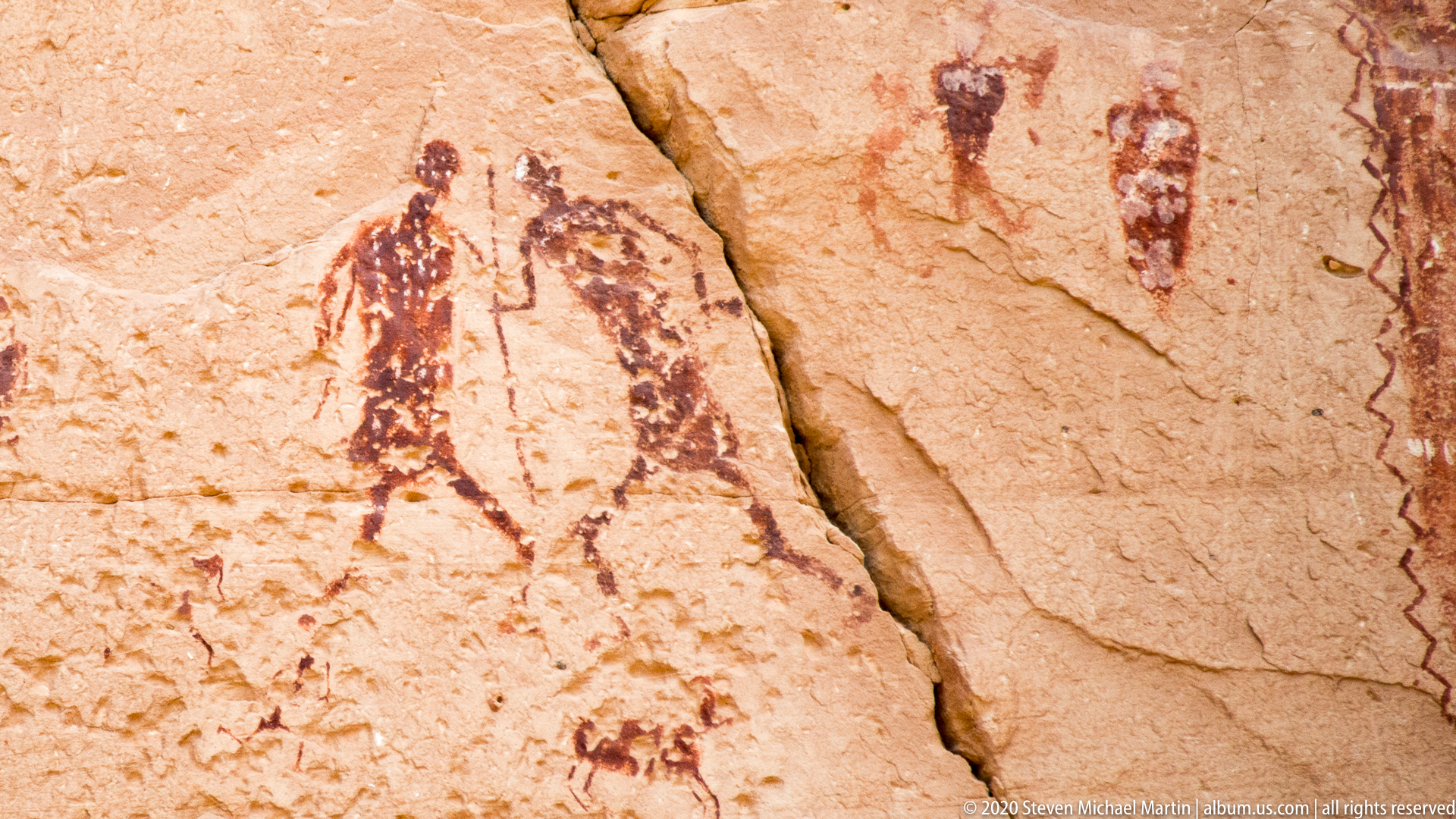
Several small painted forms appear on a pale, fractured rock face. Two larger dark figures and a lighter outline occupy the left side, while another pair stands higher on the right; small animal-like shapes lie near the bottom edge. The open space between motifs and the large cracks are prominent in this comparatively sparse section.
Caption
Several small painted forms appear on a pale, fractured rock face. Two larger dark figures and a lighter outline occupy the left side, while another pair stands higher on the right; small animal-like shapes lie near the bottom edge. The open space between motifs and the large cracks are prominent in this comparatively sparse section.
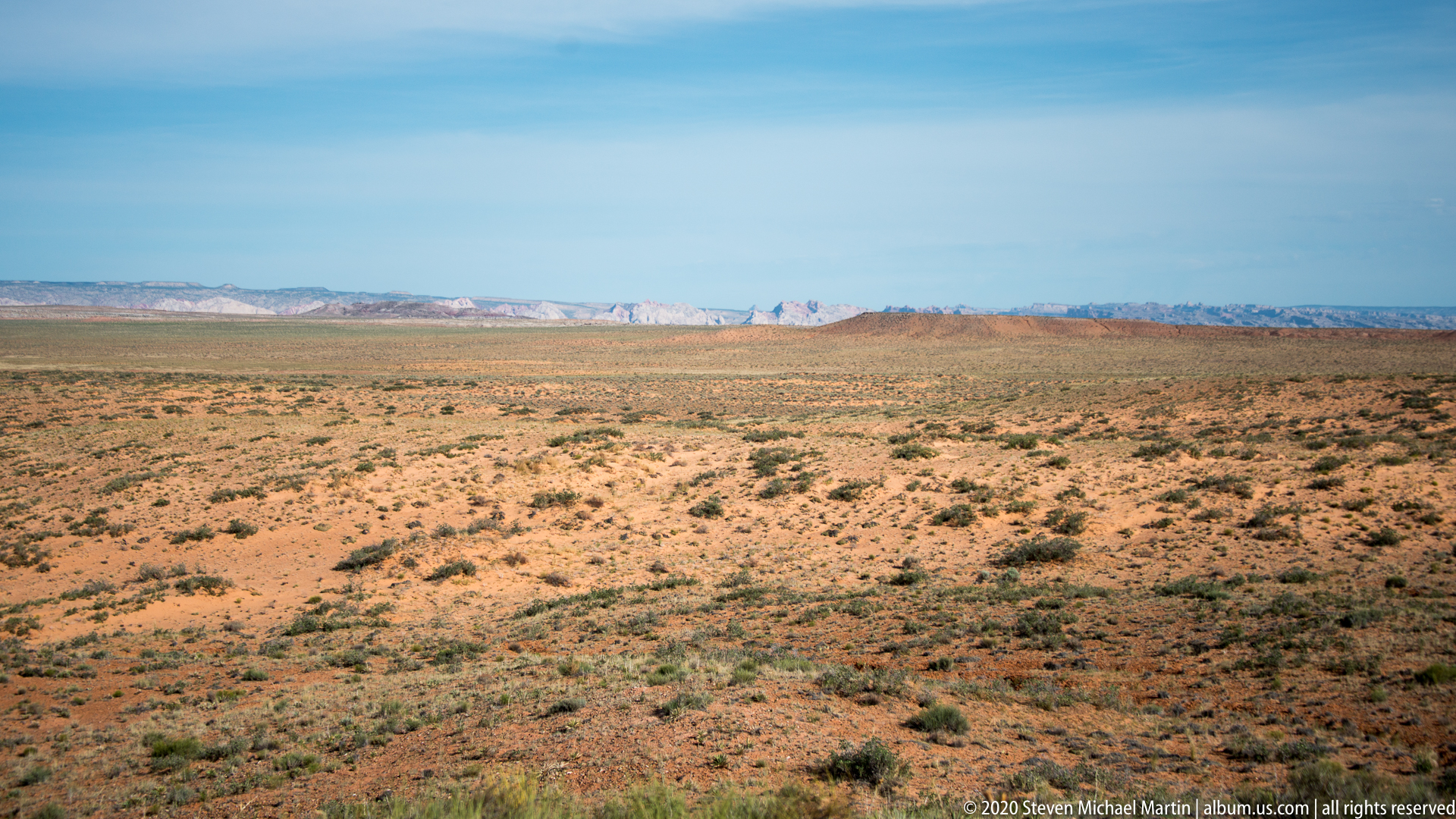
Low orange-brown scrub and grasses cover a broad, nearly level plain extending toward a pale line of mesas on the horizon. The large open sky and thin, distant landforms give the scene a pronounced sense of distance. With no nearby structures or people, the photograph emphasizes the scale and sparse vegetation of the plateau.
Caption
Low orange-brown scrub and grasses cover a broad, nearly level plain extending toward a pale line of mesas on the horizon. The large open sky and thin, distant landforms give the scene a pronounced sense of distance. With no nearby structures or people, the photograph emphasizes the scale and sparse vegetation of the plateau.
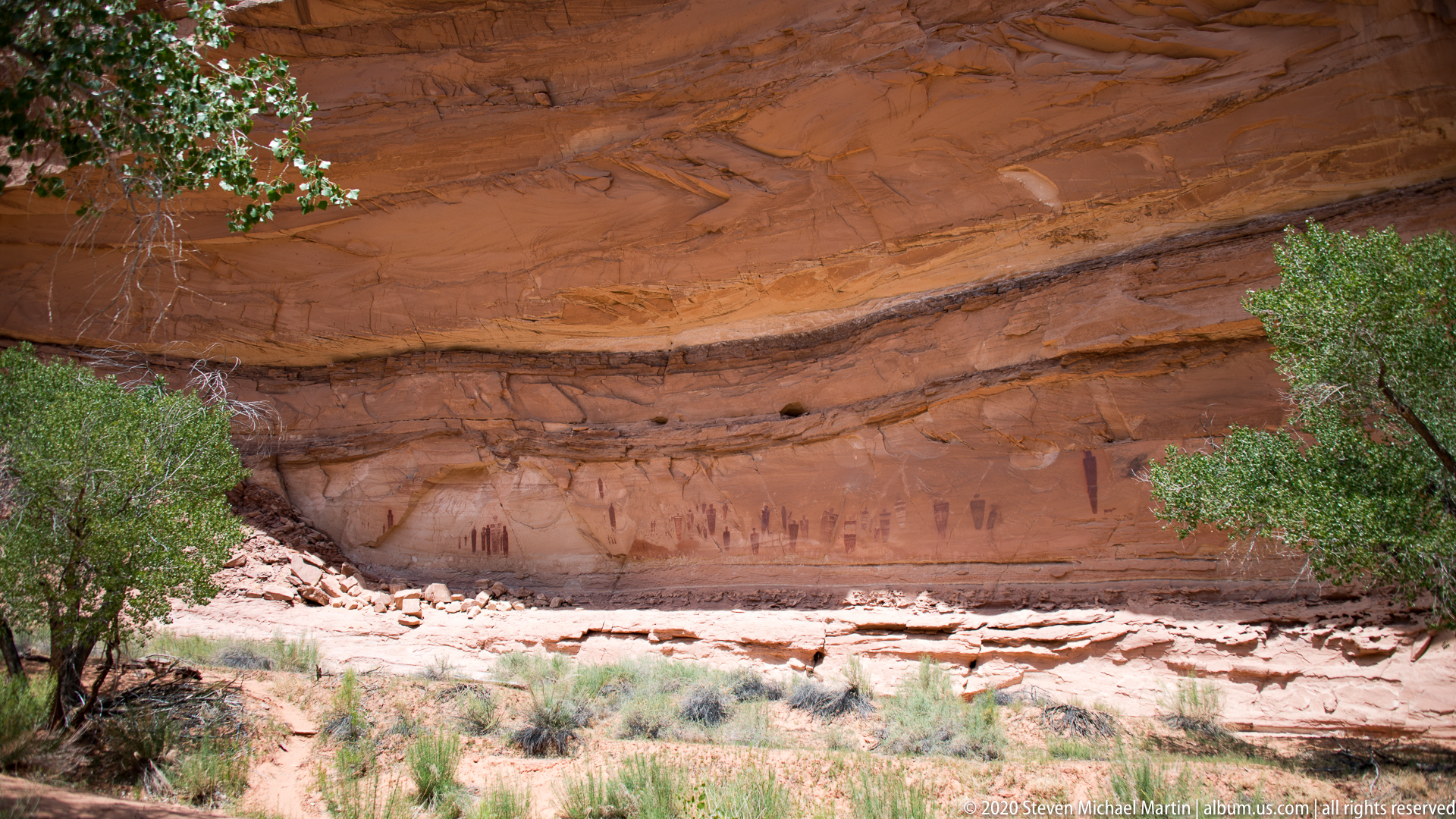
A band of dark reddish figures stretches across the lower face of a broad sandstone shelter, beneath a prominent sloping ledge. Shrubs and a small tree frame the panel from either side, and a bright strip of sand lies at its base. The wider view places the pictographs within the architecture of the overhang and the surrounding vegetation.
Caption
A band of dark reddish figures stretches across the lower face of a broad sandstone shelter, beneath a prominent sloping ledge. Shrubs and a small tree frame the panel from either side, and a bright strip of sand lies at its base. The wider view places the pictographs within the architecture of the overhang and the surrounding vegetation.
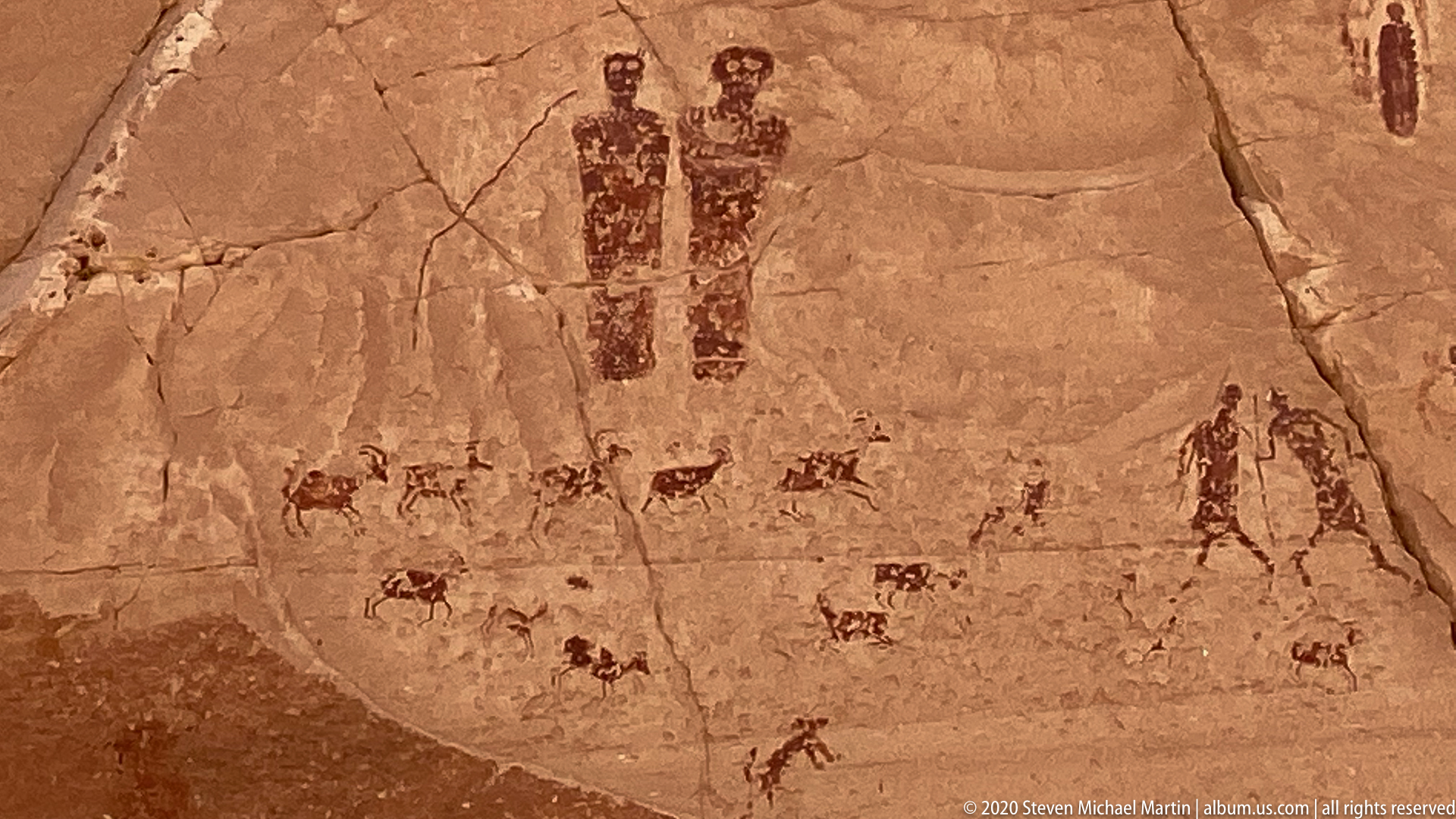
A broad sandstone panel combines two tall humanlike figures near the upper center with many smaller animal-shaped forms distributed below them. A larger outline figure appears at the right, and faint painted marks continue across the rock. The wide view preserves the relationships among figures, animals, and the cracked surface without asserting a narrative.
Caption
A broad sandstone panel combines two tall humanlike figures near the upper center with many smaller animal-shaped forms distributed below them. A larger outline figure appears at the right, and faint painted marks continue across the rock. The wide view preserves the relationships among figures, animals, and the cracked surface without asserting a narrative.
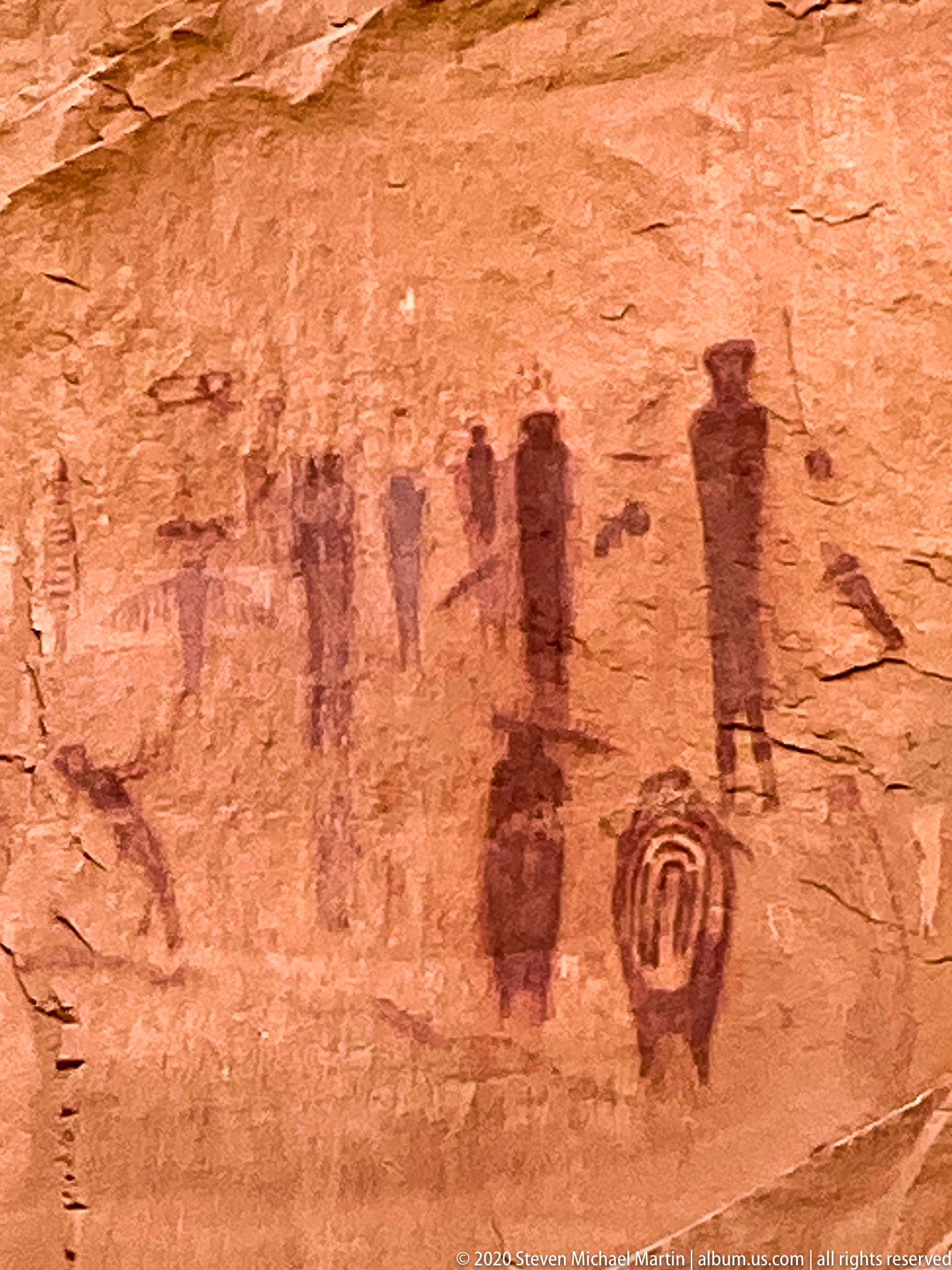
A tighter view isolates a group of red-painted figures on the sandstone surface, including tall forms with squared or rounded heads and a large outlined oval motif near the lower right. Fainter marks extend across the panel, blending with the stone’s natural streaks. This detail shows the range of figure shapes and pigment tones without assigning identities to the depicted forms.
Caption
A tighter view isolates a group of red-painted figures on the sandstone surface, including tall forms with squared or rounded heads and a large outlined oval motif near the lower right. Fainter marks extend across the panel, blending with the stone’s natural streaks. This detail shows the range of figure shapes and pigment tones without assigning identities to the depicted forms.
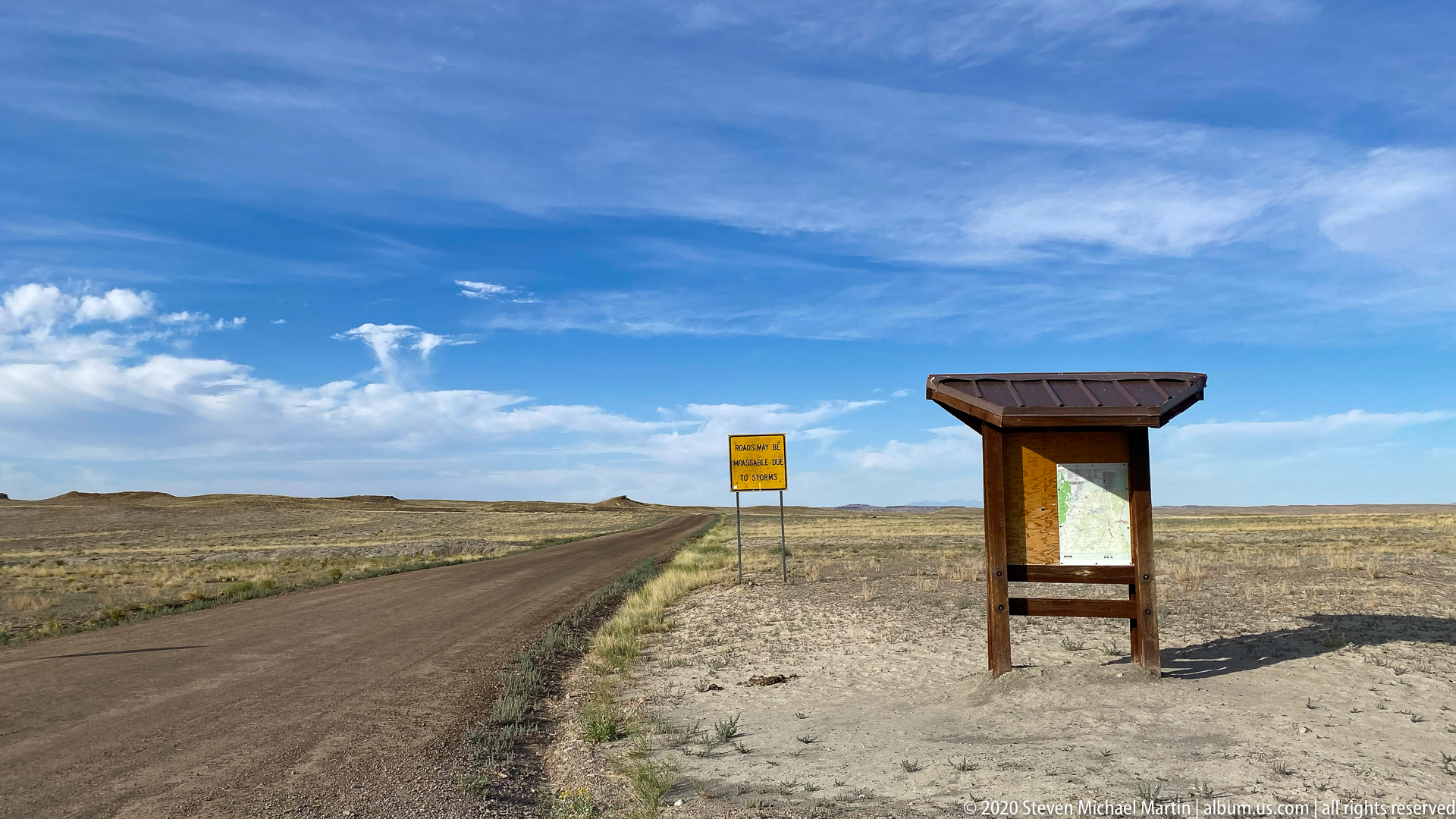
A graded dirt road crosses open sagebrush country toward a low plateau, with a yellow warning sign and a roofed information kiosk beside the route. The quiet, expansive composition situates the approach to Horseshoe Canyon within a sparsely vegetated high-desert landscape. The sign cautions that road conditions can change, while the kiosk provides visitors with orientation before entering the remote area.
Caption
A graded dirt road crosses open sagebrush country toward a low plateau, with a yellow warning sign and a roofed information kiosk beside the route. The quiet, expansive composition situates the approach to Horseshoe Canyon within a sparsely vegetated high-desert landscape. The sign cautions that road conditions can change, while the kiosk provides visitors with orientation before entering the remote area.
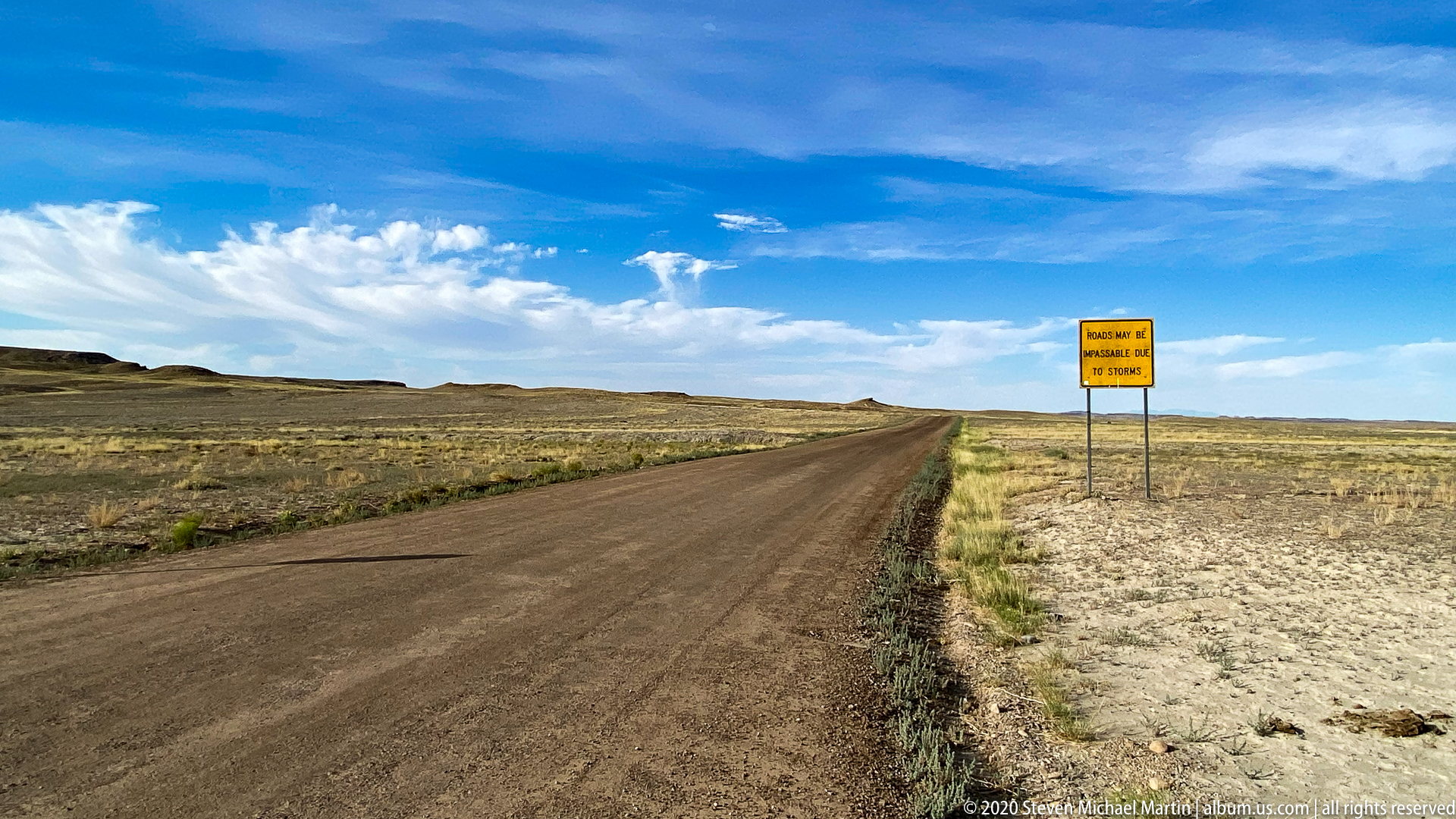
The unpaved road leads toward a low, flat-topped ridge across open grassland, while a yellow sign at the shoulder warns that roads may become impassable during storms. The composition makes the route’s exposure and limited infrastructure part of the scene: there is no nearby settlement or shelter, only a long track through dry upland terrain.
Caption
The unpaved road leads toward a low, flat-topped ridge across open grassland, while a yellow sign at the shoulder warns that roads may become impassable during storms. The composition makes the route’s exposure and limited infrastructure part of the scene: there is no nearby settlement or shelter, only a long track through dry upland terrain.
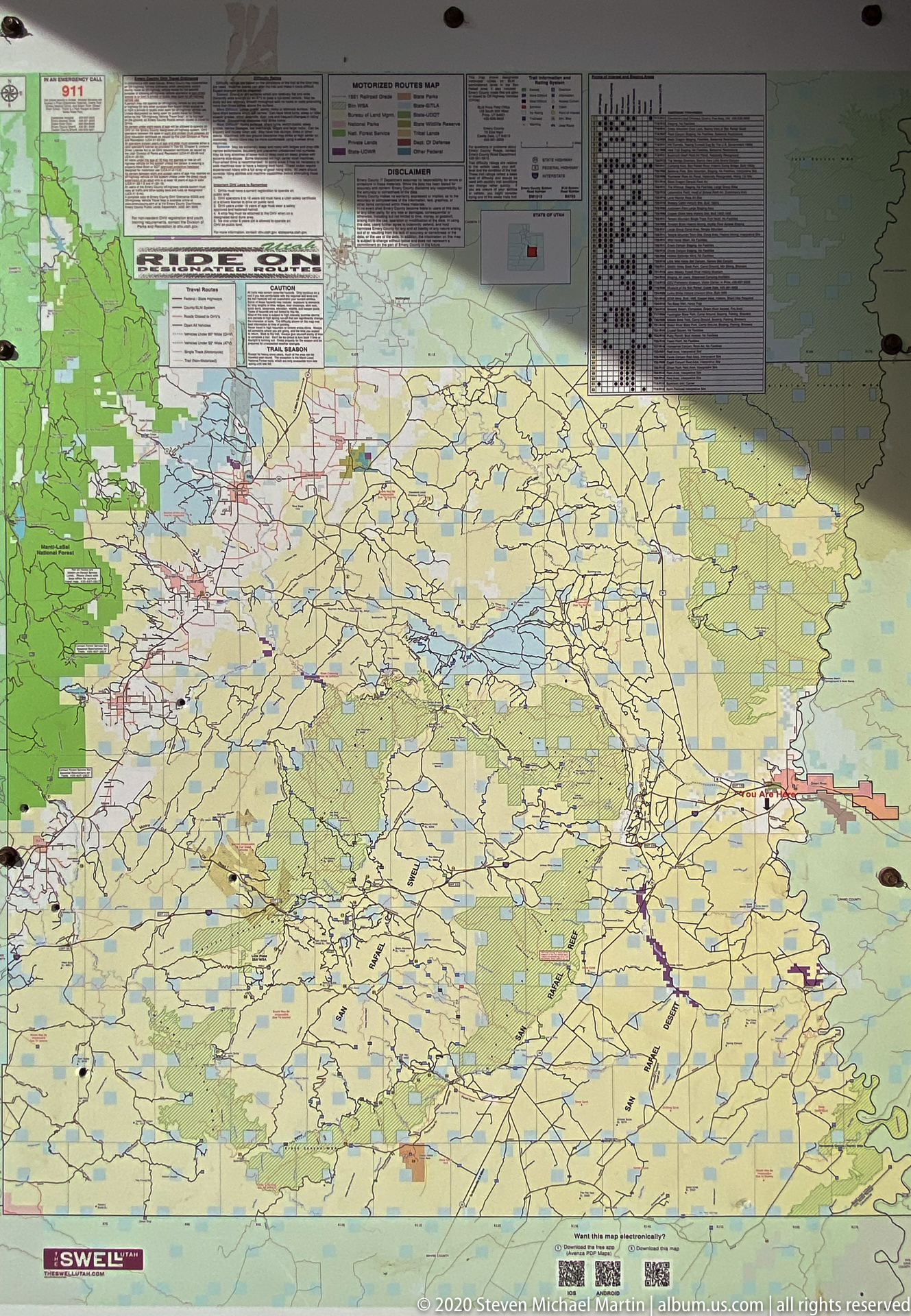
A broad regional road map fills the frame, showing a dense network of highways and smaller routes across a largely tan and green landscape. Several printed notices and a legend are mounted above the map, while a small locator inset marks the featured area. This close view records the practical orientation material visitors consult when planning travel through a remote region.
Caption
A broad regional road map fills the frame, showing a dense network of highways and smaller routes across a largely tan and green landscape. Several printed notices and a legend are mounted above the map, while a small locator inset marks the featured area. This close view records the practical orientation material visitors consult when planning travel through a remote region.
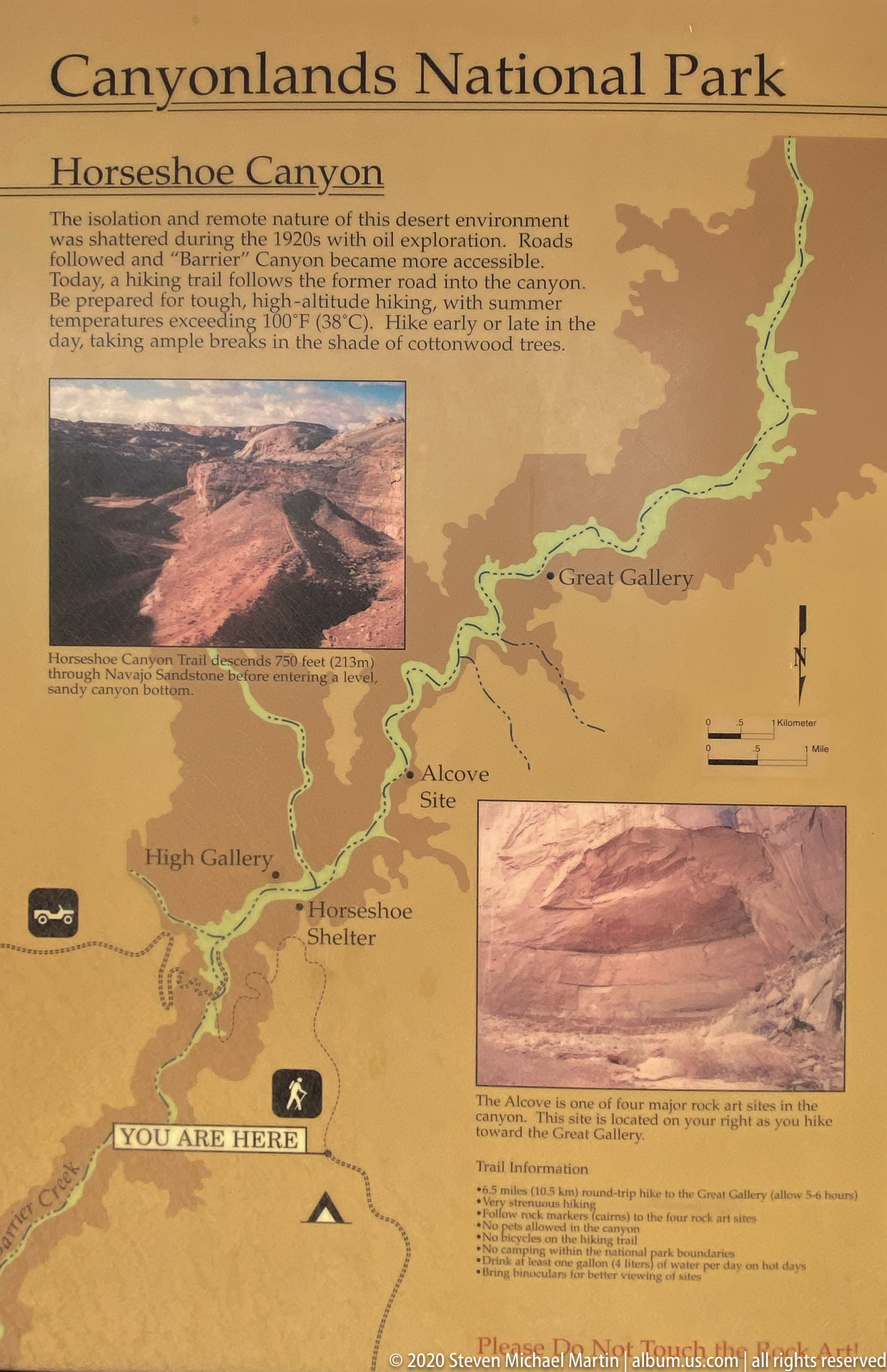
A printed park panel combines a route map with inset photographs and visitor guidance for Horseshoe Canyon. The marked trail follows the canyon past named locations including the Great Gallery and Alcove Site, while “You Are Here” identifies the map’s viewing position. The sign translates the complex landscape into a clear sequence of landmarks for hikers.
Caption
A printed park panel combines a route map with inset photographs and visitor guidance for Horseshoe Canyon. The marked trail follows the canyon past named locations including the Great Gallery and Alcove Site, while “You Are Here” identifies the map’s viewing position. The sign translates the complex landscape into a clear sequence of landmarks for hikers.
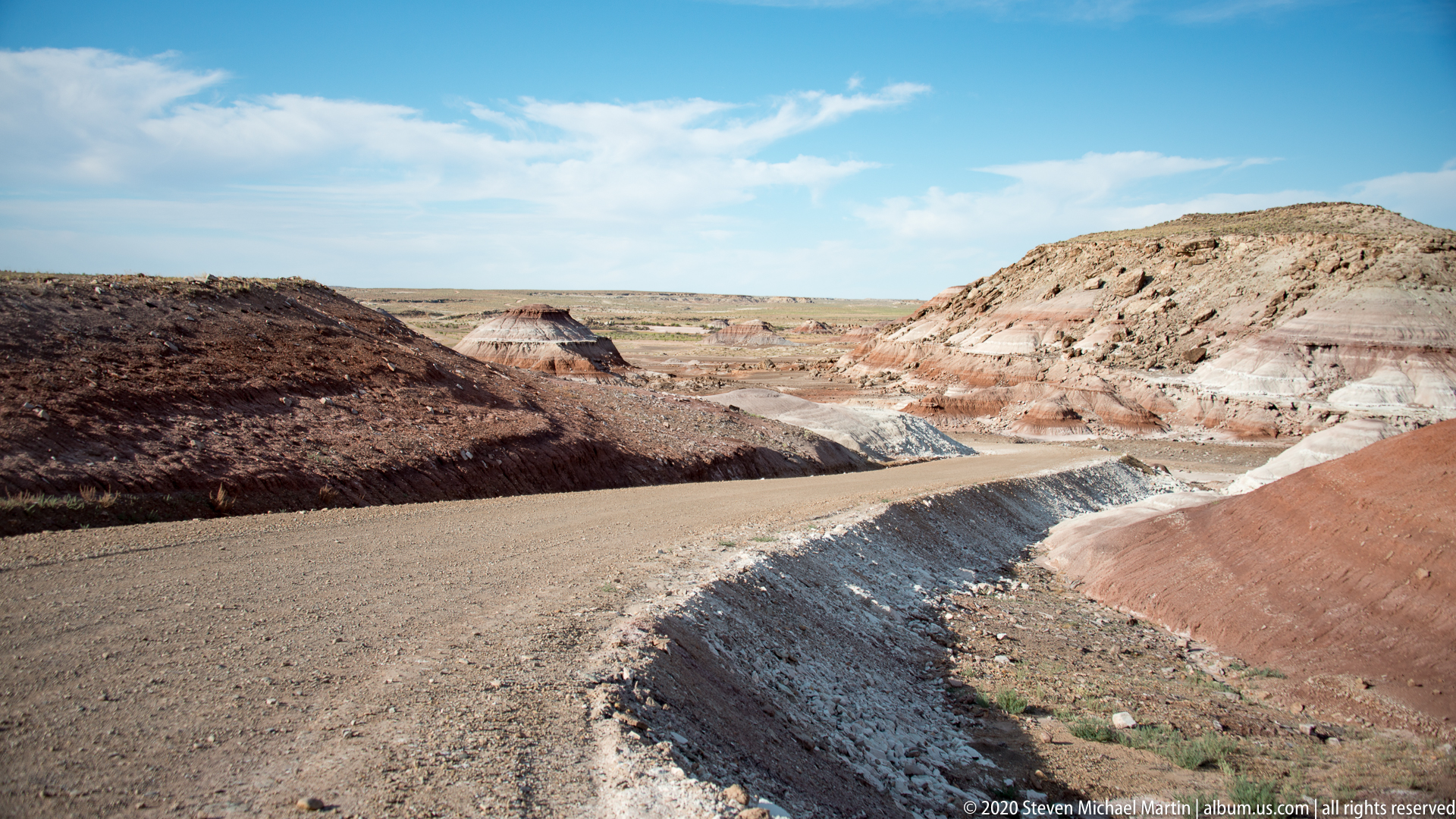
A pale dirt road curves between steeply eroded slopes banded in white, gray, and rust-red sediment. The foreground shoulder drops toward a narrow wash, while rounded buttes and low ridges continue across the background. Strong midday light brings out the contrasting layers and the road’s tight passage through the exposed badlands.
Caption
A pale dirt road curves between steeply eroded slopes banded in white, gray, and rust-red sediment. The foreground shoulder drops toward a narrow wash, while rounded buttes and low ridges continue across the background. Strong midday light brings out the contrasting layers and the road’s tight passage through the exposed badlands.
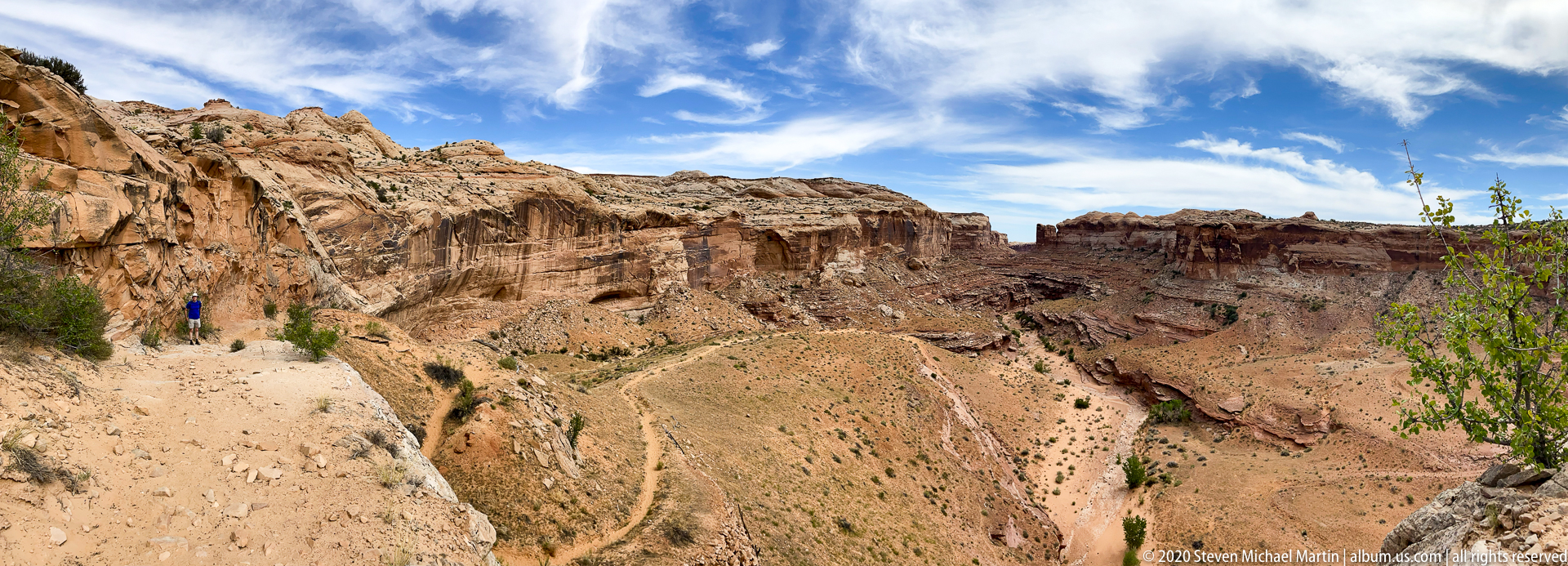
A lone hiker in a blue shirt stands at the base of a high, fractured sandstone wall, appearing small against the layered rock face. A narrow footpath winds down through loose, pale sediment and scattered shrubs toward the canyon floor. The human figure reveals the scale of the wall and the steep descent into the wash.
Caption
A lone hiker in a blue shirt stands at the base of a high, fractured sandstone wall, appearing small against the layered rock face. A narrow footpath winds down through loose, pale sediment and scattered shrubs toward the canyon floor. The human figure reveals the scale of the wall and the steep descent into the wash.
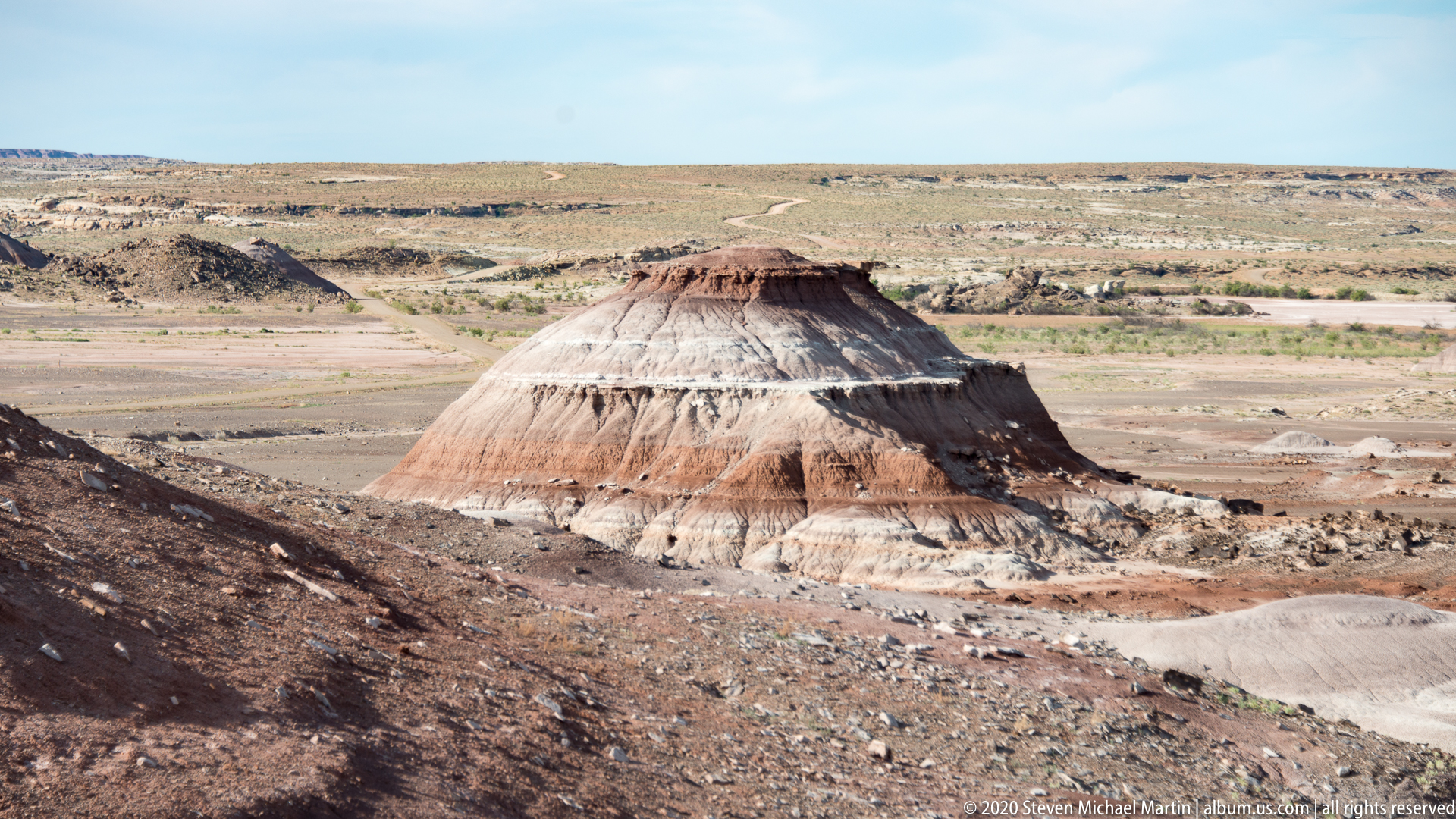
A steep-sided, flat-topped butte rises from an open basin, its pale lower slopes striped with darker sediment and capped by a darker red-brown layer. Sparse scrub and scattered stones fill the foreground, while low mesas recede into the distance. The isolated landform is presented as a geological subject rather than a named landmark.
Caption
A steep-sided, flat-topped butte rises from an open basin, its pale lower slopes striped with darker sediment and capped by a darker red-brown layer. Sparse scrub and scattered stones fill the foreground, while low mesas recede into the distance. The isolated landform is presented as a geological subject rather than a named landmark.
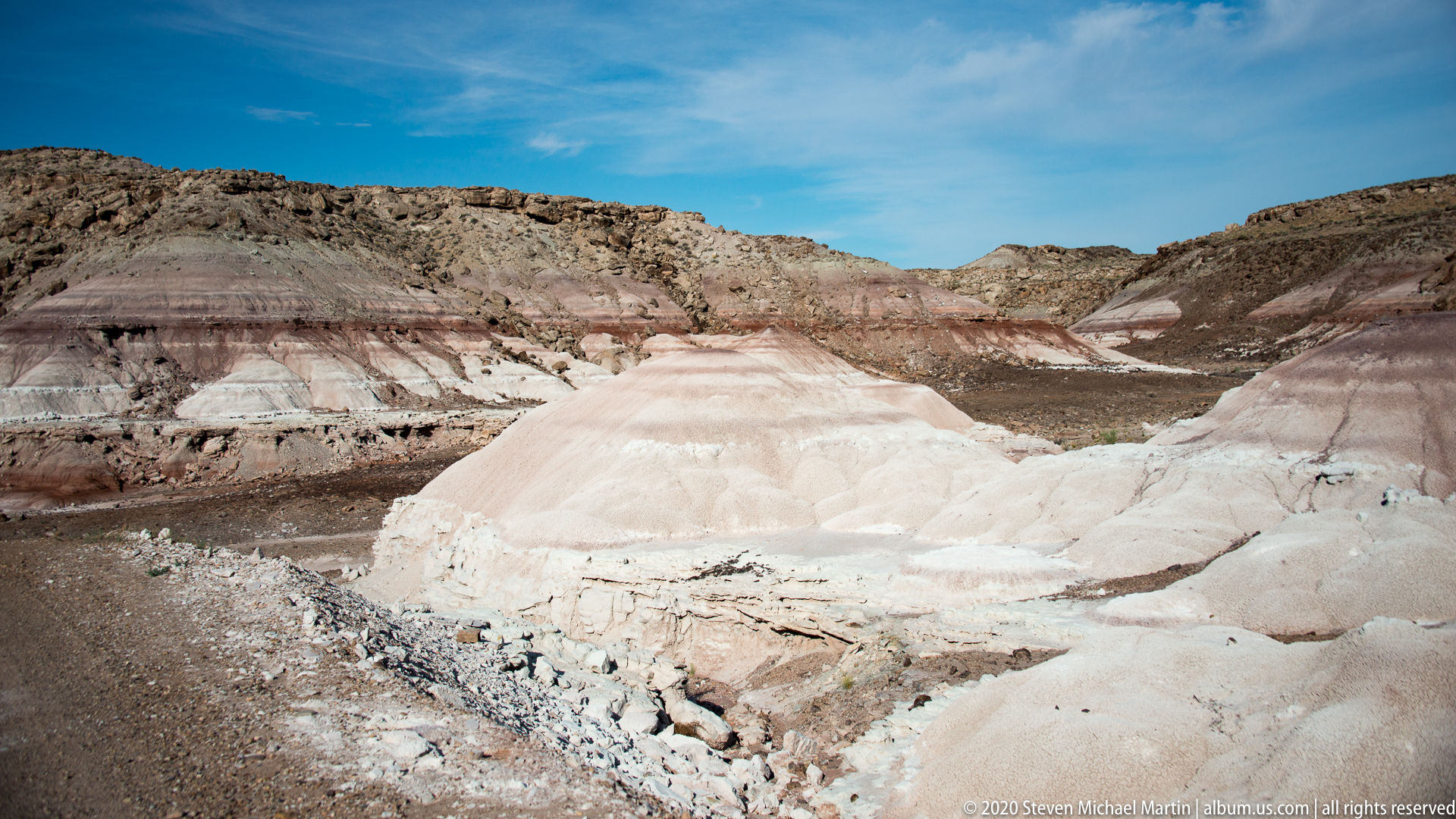
A pale mound of finely banded sediment fills the foreground, with darker gray and brown layers exposed across its rounded surface. Behind it, a broken ridge forms the basin’s upper edge beneath a clear blue sky. The close viewpoint draws attention to the alternating strata and the soft, eroded contours of the badlands.
Caption
A pale mound of finely banded sediment fills the foreground, with darker gray and brown layers exposed across its rounded surface. Behind it, a broken ridge forms the basin’s upper edge beneath a clear blue sky. The close viewpoint draws attention to the alternating strata and the soft, eroded contours of the badlands.

A broad, flat-topped butte dominates the frame, its caprock forming a dark horizontal crown above deeply fluted pale and reddish slopes. Loose stones and shallow gullies gather at its base, revealing the effects of weathering on the exposed layers. The tighter composition isolates the landform’s stepped profile and sharply contrasting bands.
Caption
A broad, flat-topped butte dominates the frame, its caprock forming a dark horizontal crown above deeply fluted pale and reddish slopes. Loose stones and shallow gullies gather at its base, revealing the effects of weathering on the exposed layers. The tighter composition isolates the landform’s stepped profile and sharply contrasting bands.
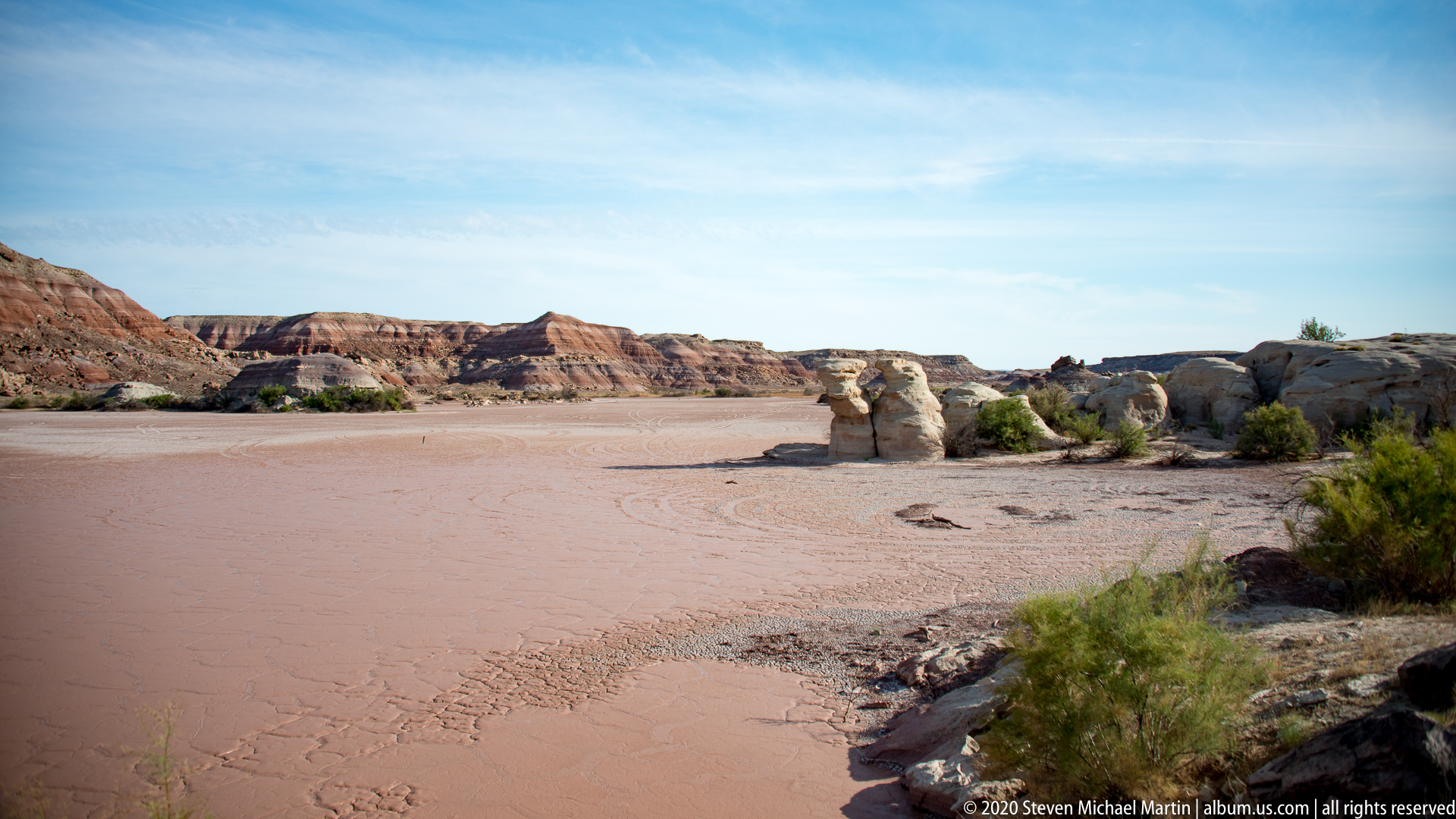
A pale, cracked wash spreads across the foreground toward an isolated upright sandstone pillar. Beyond it, a long line of rust-red and tan ridges encloses the basin, with a few shrubs at the edges of the dry channel. The low viewpoint links the small rock feature to the wide, open canyon-floor setting.
Caption
A pale, cracked wash spreads across the foreground toward an isolated upright sandstone pillar. Beyond it, a long line of rust-red and tan ridges encloses the basin, with a few shrubs at the edges of the dry channel. The low viewpoint links the small rock feature to the wide, open canyon-floor setting.
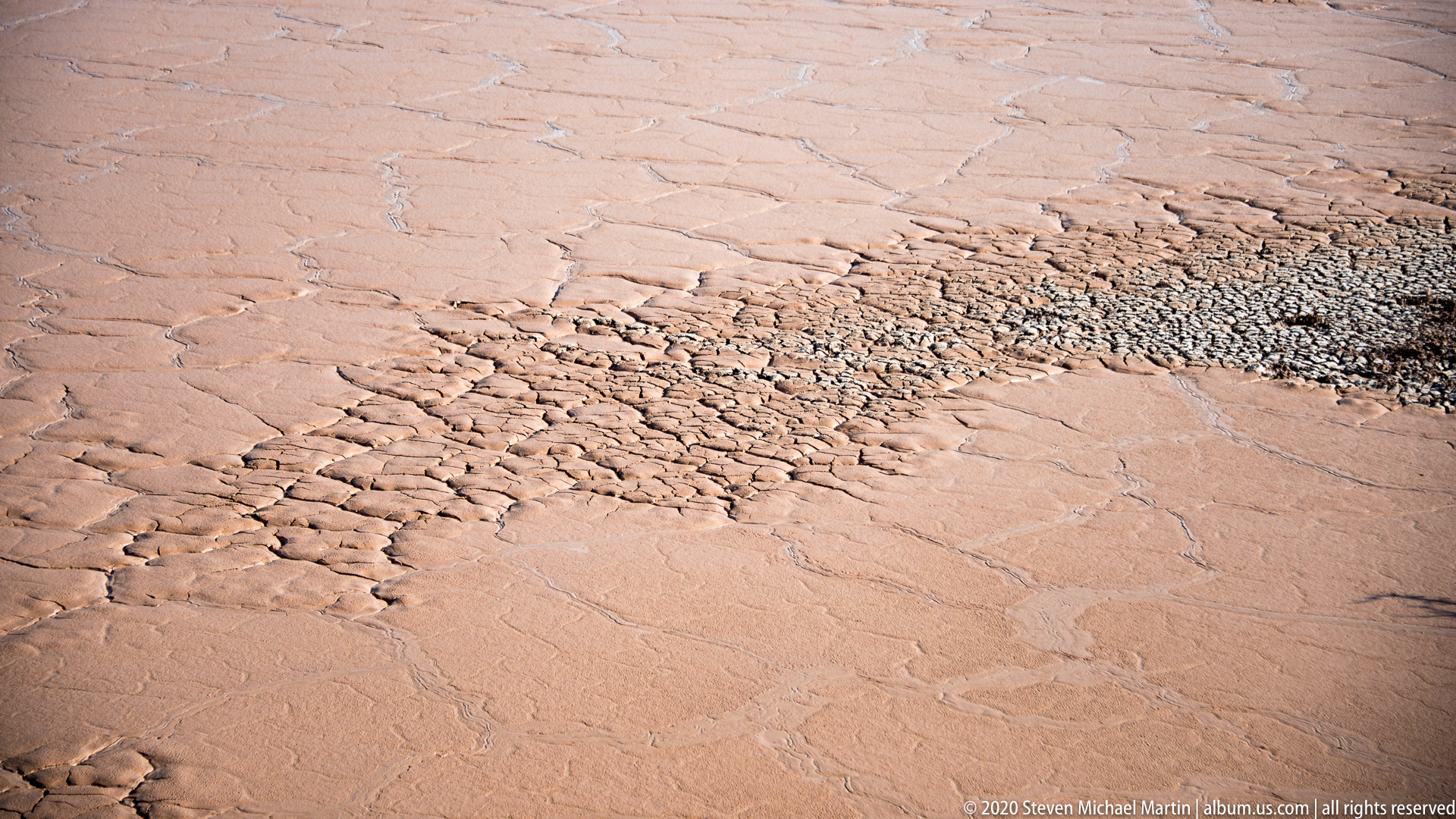
Polygonal cracks divide a smooth, pink-tan surface into broad plates, with a rougher band of smaller fragments crossing the middle of the frame. The close, oblique view turns a dry basin floor into an abstract pattern of texture and scale. No water remains on the surface, and the irregular edges suggest repeated wetting and drying.
Caption
Polygonal cracks divide a smooth, pink-tan surface into broad plates, with a rougher band of smaller fragments crossing the middle of the frame. The close, oblique view turns a dry basin floor into an abstract pattern of texture and scale. No water remains on the surface, and the irregular edges suggest repeated wetting and drying.

A bleached, weathered branch lies diagonally across a rough patch of broken clay plates, contrasting with the smoother, cracked sediment around it. Strong side light deepens the shadows between the fragments and reveals their raised, brittle edges. The image focuses on small-scale surface change rather than the surrounding canyon scenery.
Caption
A bleached, weathered branch lies diagonally across a rough patch of broken clay plates, contrasting with the smoother, cracked sediment around it. Strong side light deepens the shadows between the fragments and reveals their raised, brittle edges. The image focuses on small-scale surface change rather than the surrounding canyon scenery.
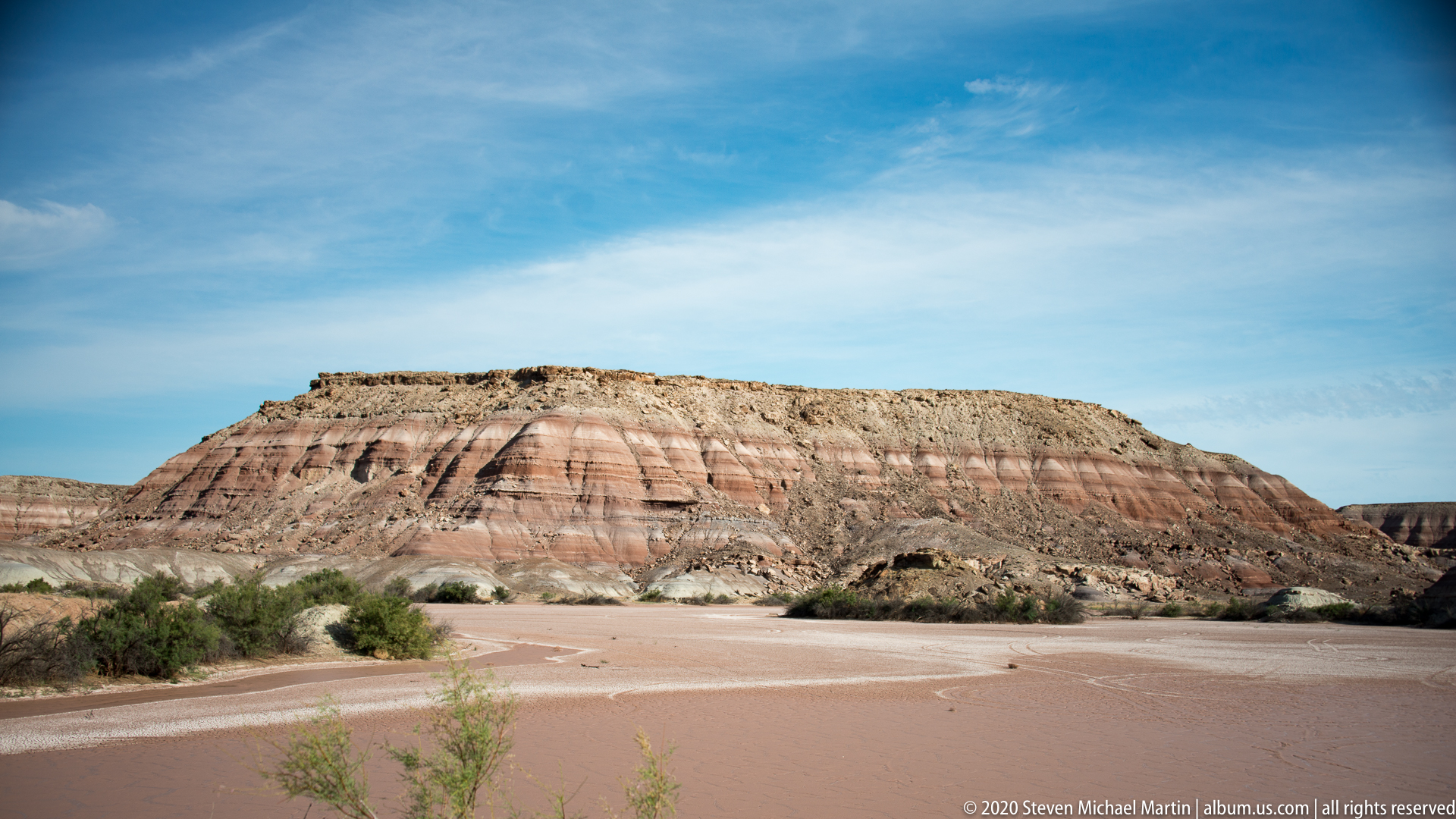
A broad, flat-topped ridge rises beyond a pale basin floor, its slopes striped with red, gray, and cream-colored sediment. Low shrubs line the near edge of the wash, adding a thin band of vegetation to an otherwise exposed scene. The view shows how horizontal strata continue across the ridge before being cut into rounded slopes.
Caption
A broad, flat-topped ridge rises beyond a pale basin floor, its slopes striped with red, gray, and cream-colored sediment. Low shrubs line the near edge of the wash, adding a thin band of vegetation to an otherwise exposed scene. The view shows how horizontal strata continue across the ridge before being cut into rounded slopes.
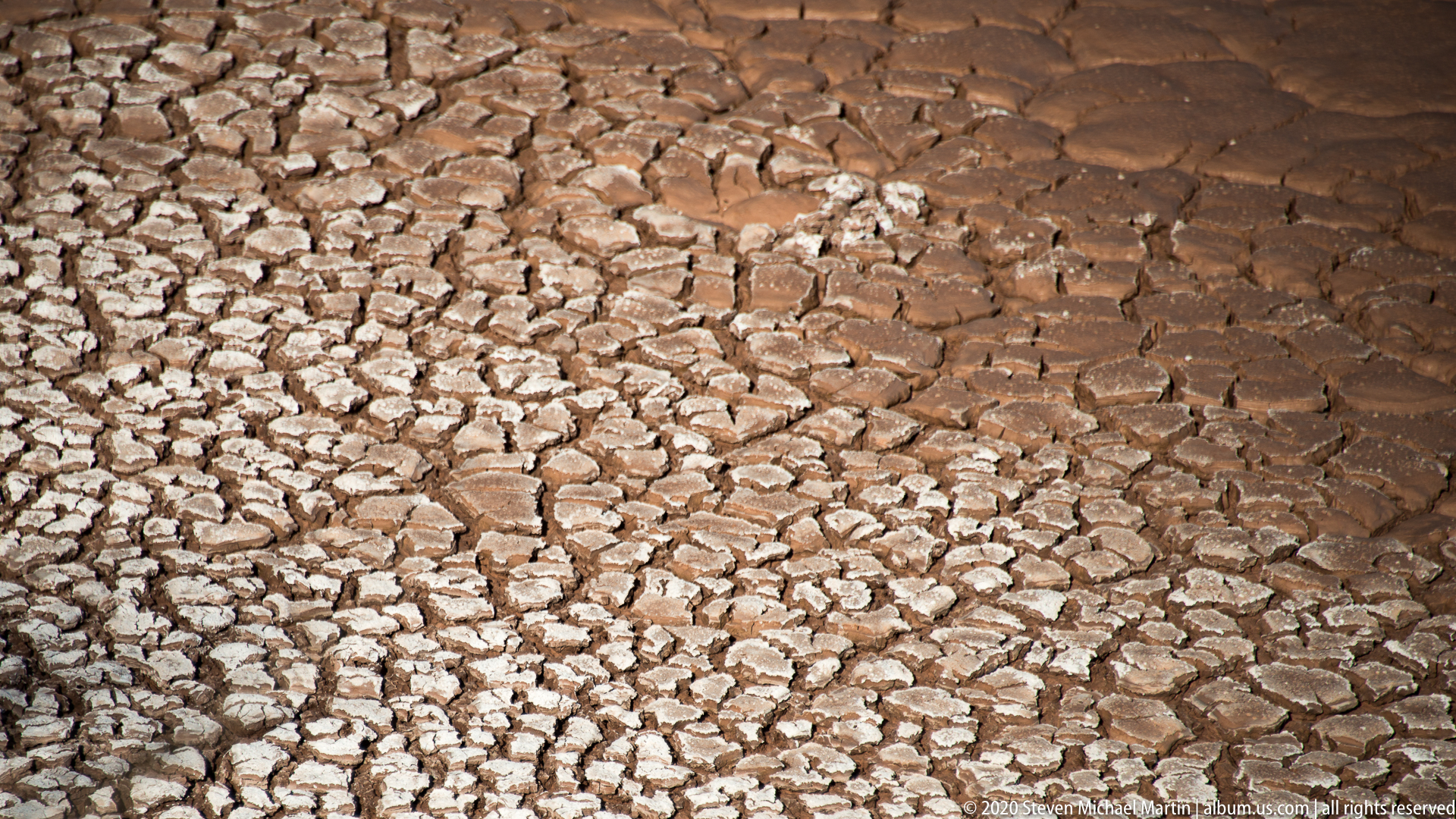
A dense mosaic of raised, angular plates fills the frame, their pale edges set against darker reddish-brown seams. The tight overhead view removes the horizon and concentrates on the repeating geometry created as fine sediment contracts and breaks apart. Differences in plate size and shadow give the otherwise uniform surface depth and visual rhythm.
Caption
A dense mosaic of raised, angular plates fills the frame, their pale edges set against darker reddish-brown seams. The tight overhead view removes the horizon and concentrates on the repeating geometry created as fine sediment contracts and breaks apart. Differences in plate size and shadow give the otherwise uniform surface depth and visual rhythm.
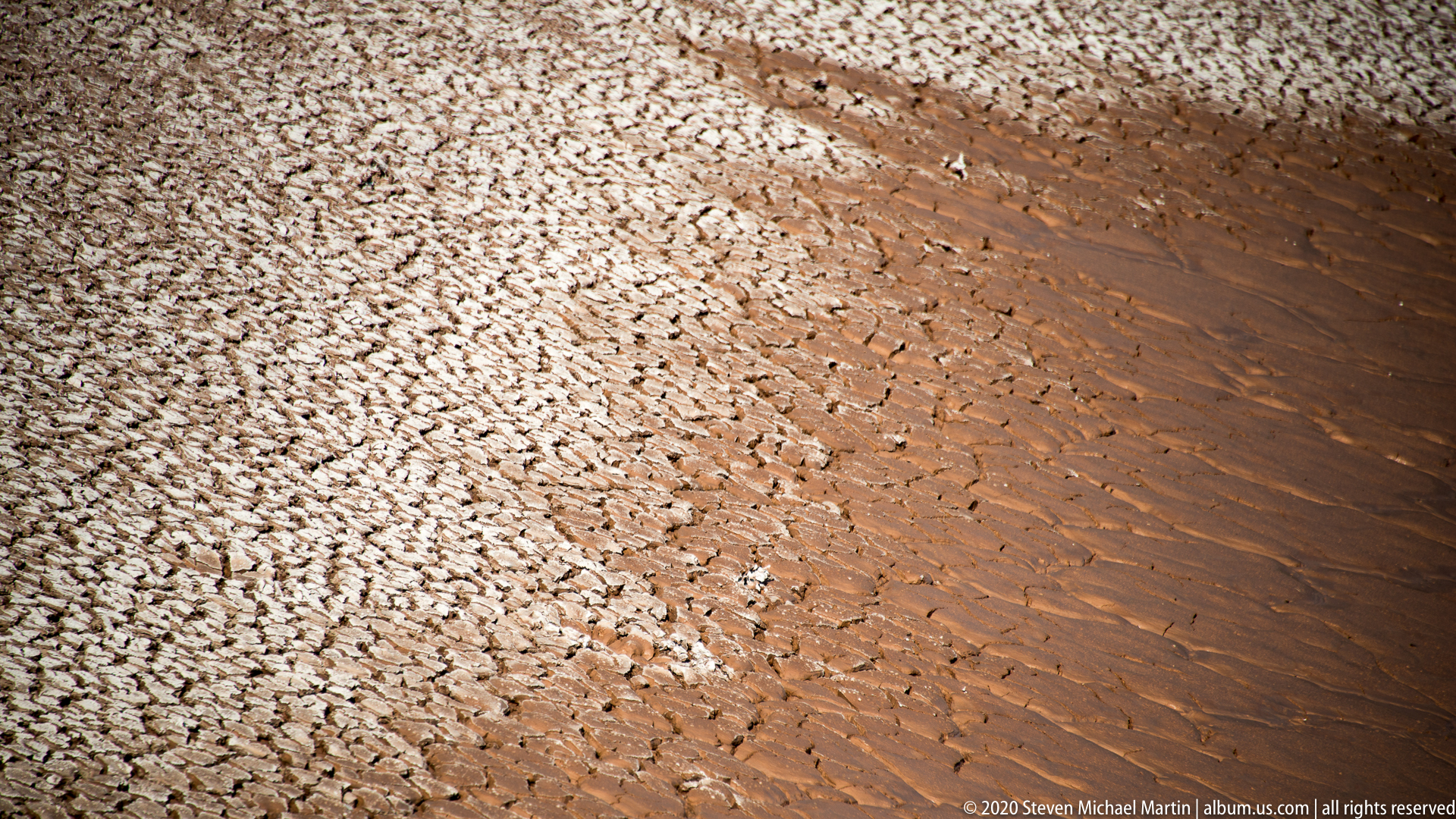
Large pale plates fracture across a reddish surface, with a diagonal band of smaller, tightly packed fragments separating smoother sections. The varied crack widths reveal multiple scales of breakup within the same dry deposit. Warm light accentuates the color contrast between the light clay and the darker sediment filling the fissures.
Caption
Large pale plates fracture across a reddish surface, with a diagonal band of smaller, tightly packed fragments separating smoother sections. The varied crack widths reveal multiple scales of breakup within the same dry deposit. Warm light accentuates the color contrast between the light clay and the darker sediment filling the fissures.

Fine cracks spread across a smooth, pink-tan basin surface before breaking into a rough, darkened field of larger plates near the lower edge. The oblique composition emphasizes this transition from intact sediment to fractured crust. Subtle variations in color and relief make the dry ground itself the subject, with no horizon or vegetation to distract from the pattern.
Caption
Fine cracks spread across a smooth, pink-tan basin surface before breaking into a rough, darkened field of larger plates near the lower edge. The oblique composition emphasizes this transition from intact sediment to fractured crust. Subtle variations in color and relief make the dry ground itself the subject, with no horizon or vegetation to distract from the pattern.
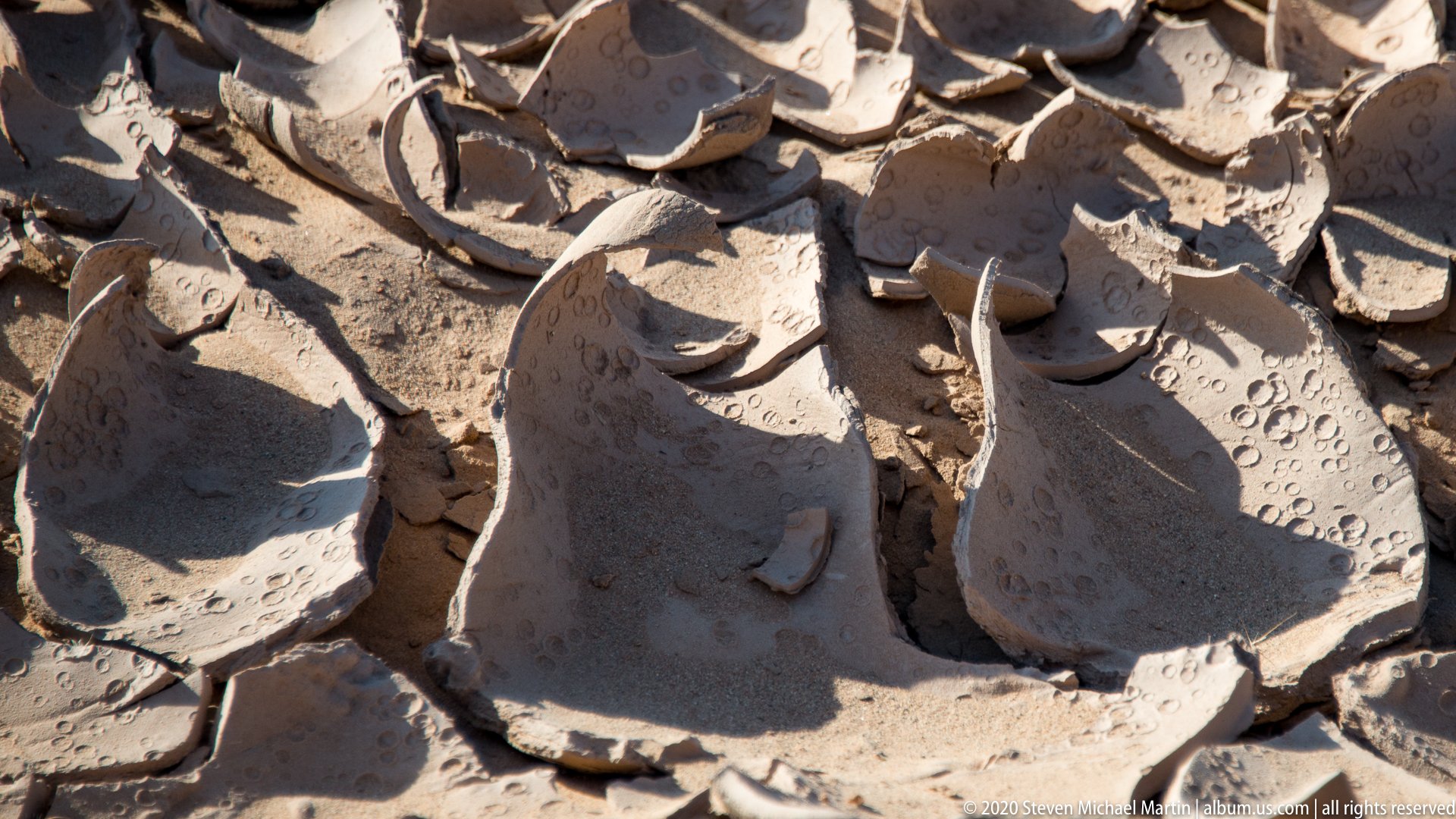
Several large curved sherds fill the foreground, their pale surfaces marked with repeated incised circles and lines. Smaller fragments overlap behind them, showing broken edges and varied thicknesses. The tight framing makes the surface decoration legible while avoiding conclusions about the vessels’ original form or cultural affiliation.
Caption
Several large curved sherds fill the foreground, their pale surfaces marked with repeated incised circles and lines. Smaller fragments overlap behind them, showing broken edges and varied thicknesses. The tight framing makes the surface decoration legible while avoiding conclusions about the vessels’ original form or cultural affiliation.
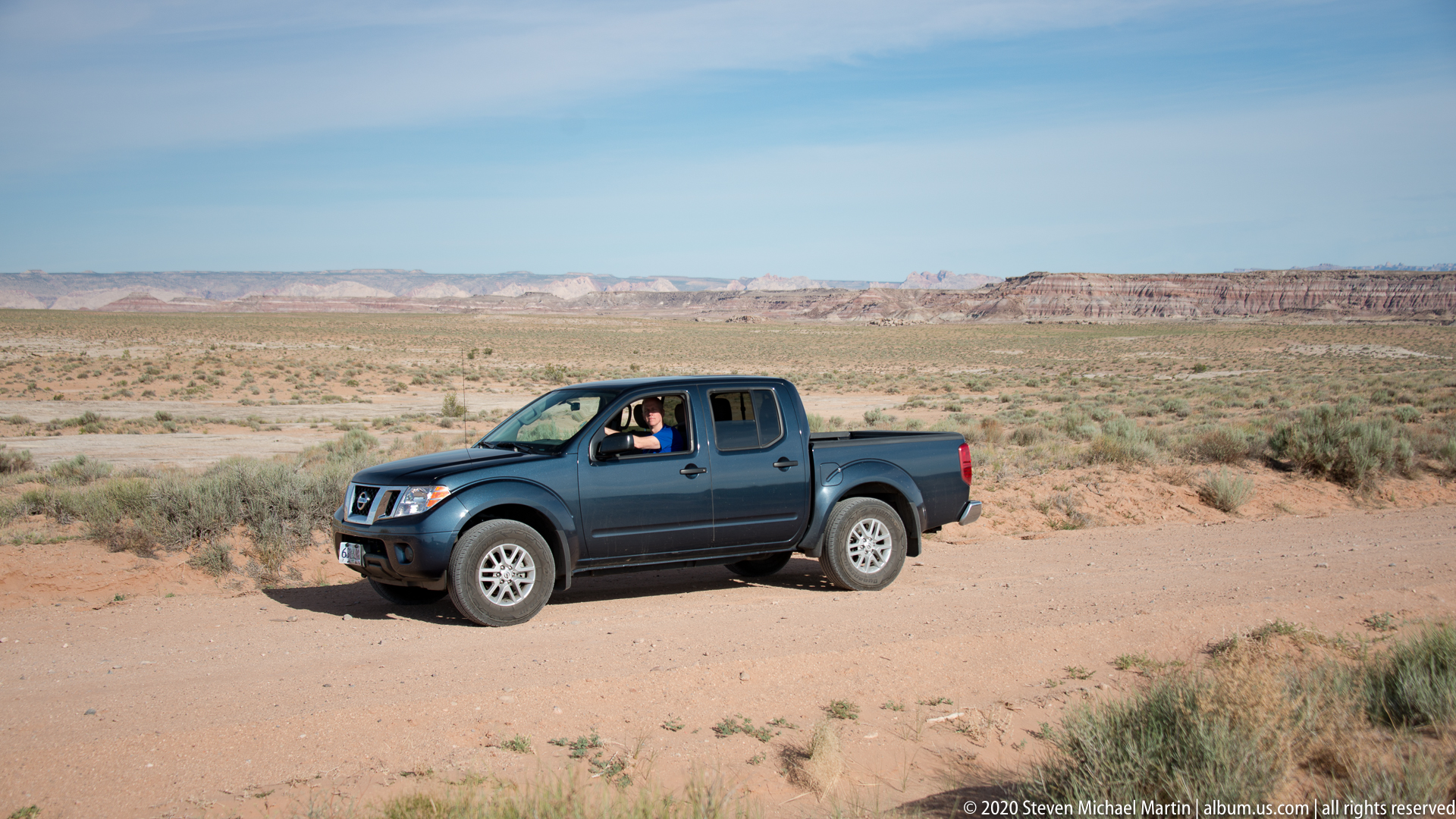
A dark pickup truck is stopped on a sandy track across open desert scrub, with an occupant visible through the side window. A continuous band of mesas and eroded ridges stretches across the horizon, placing the vehicle within a broad, sparsely settled landscape. The side view gives the truck room in the frame and makes its small scale against the plateau clear.
Caption
A dark pickup truck is stopped on a sandy track across open desert scrub, with an occupant visible through the side window. A continuous band of mesas and eroded ridges stretches across the horizon, placing the vehicle within a broad, sparsely settled landscape. The side view gives the truck room in the frame and makes its small scale against the plateau clear.
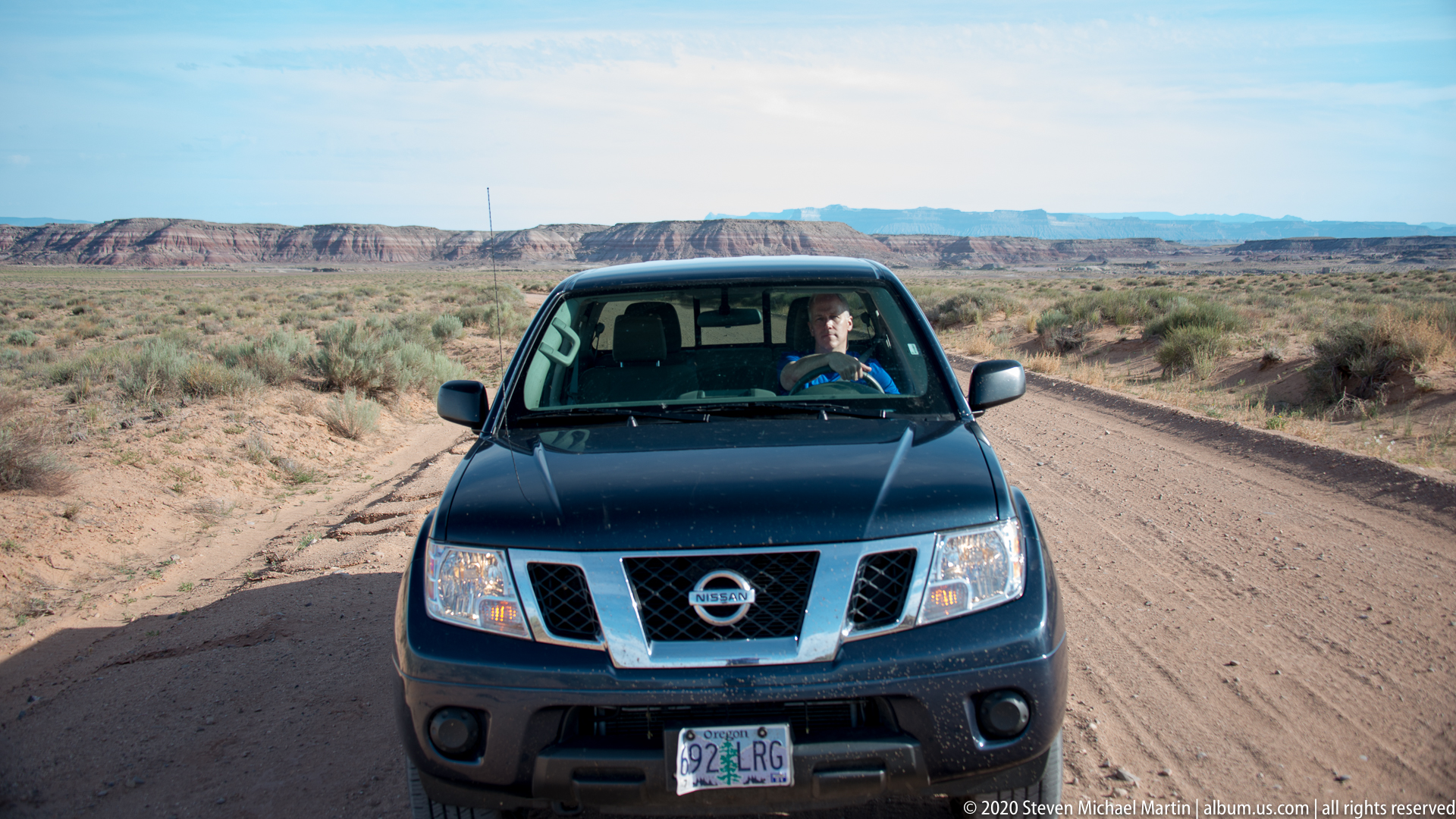
A dark pickup faces the camera on a narrow dirt road, with a driver visible behind the windshield. The track runs straight through low scrub toward a long line of red and tan mesas. This frontal view makes the vehicle the immediate subject while preserving enough of the setting to show the remote, unpaved route.
Caption
A dark pickup faces the camera on a narrow dirt road, with a driver visible behind the windshield. The track runs straight through low scrub toward a long line of red and tan mesas. This frontal view makes the vehicle the immediate subject while preserving enough of the setting to show the remote, unpaved route.
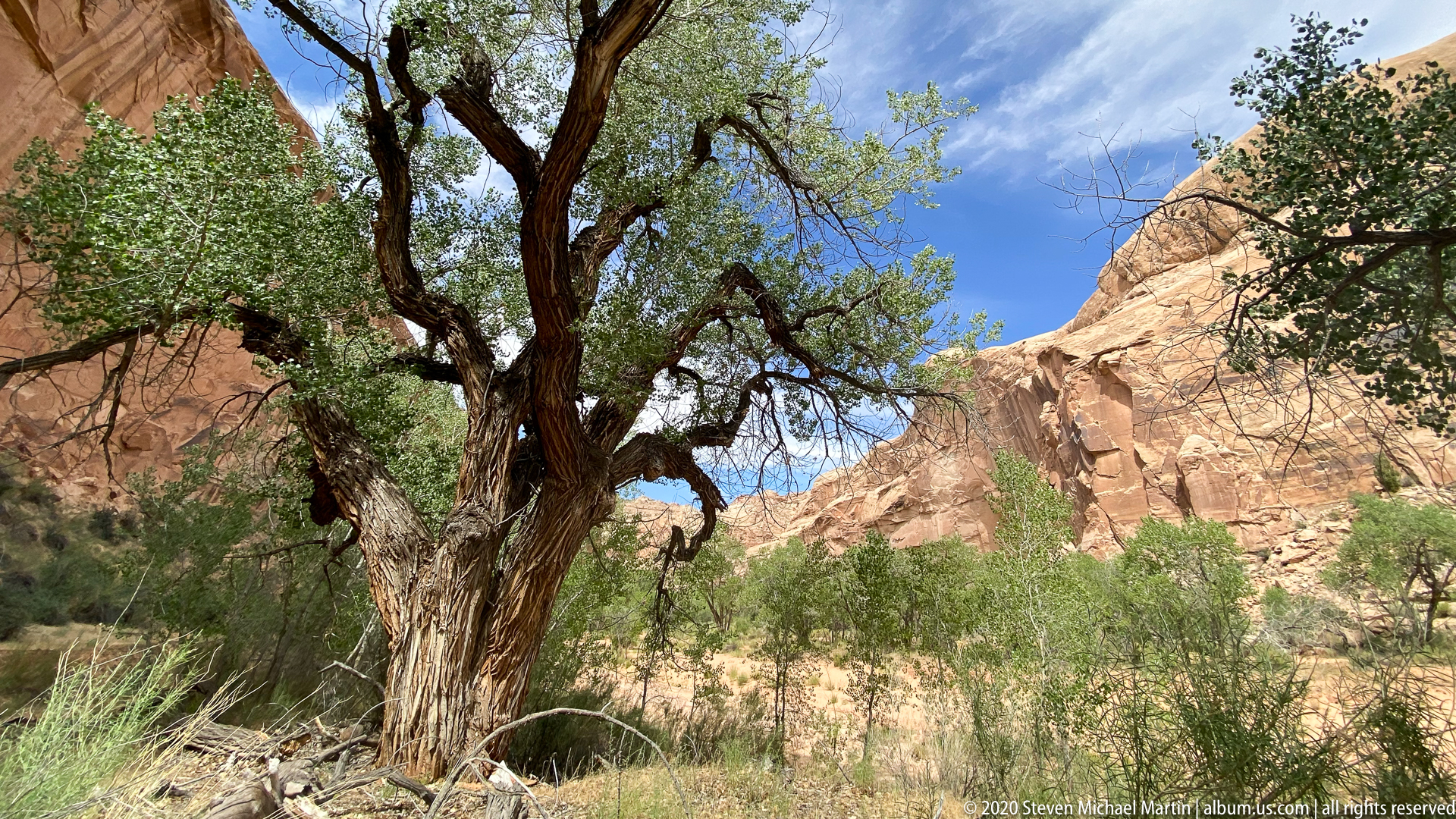
A mature cottonwood spreads its branching canopy across the foreground beneath a steep sandstone wall. Sunlight filters through the leaves, while grasses and shrubs cluster around the trunk at the canyon bottom. The tree’s shade and scale distinguish this sheltered riparian pocket from the exposed plateau and dry basin scenes elsewhere in the sequence.
Caption
A mature cottonwood spreads its branching canopy across the foreground beneath a steep sandstone wall. Sunlight filters through the leaves, while grasses and shrubs cluster around the trunk at the canyon bottom. The tree’s shade and scale distinguish this sheltered riparian pocket from the exposed plateau and dry basin scenes elsewhere in the sequence.
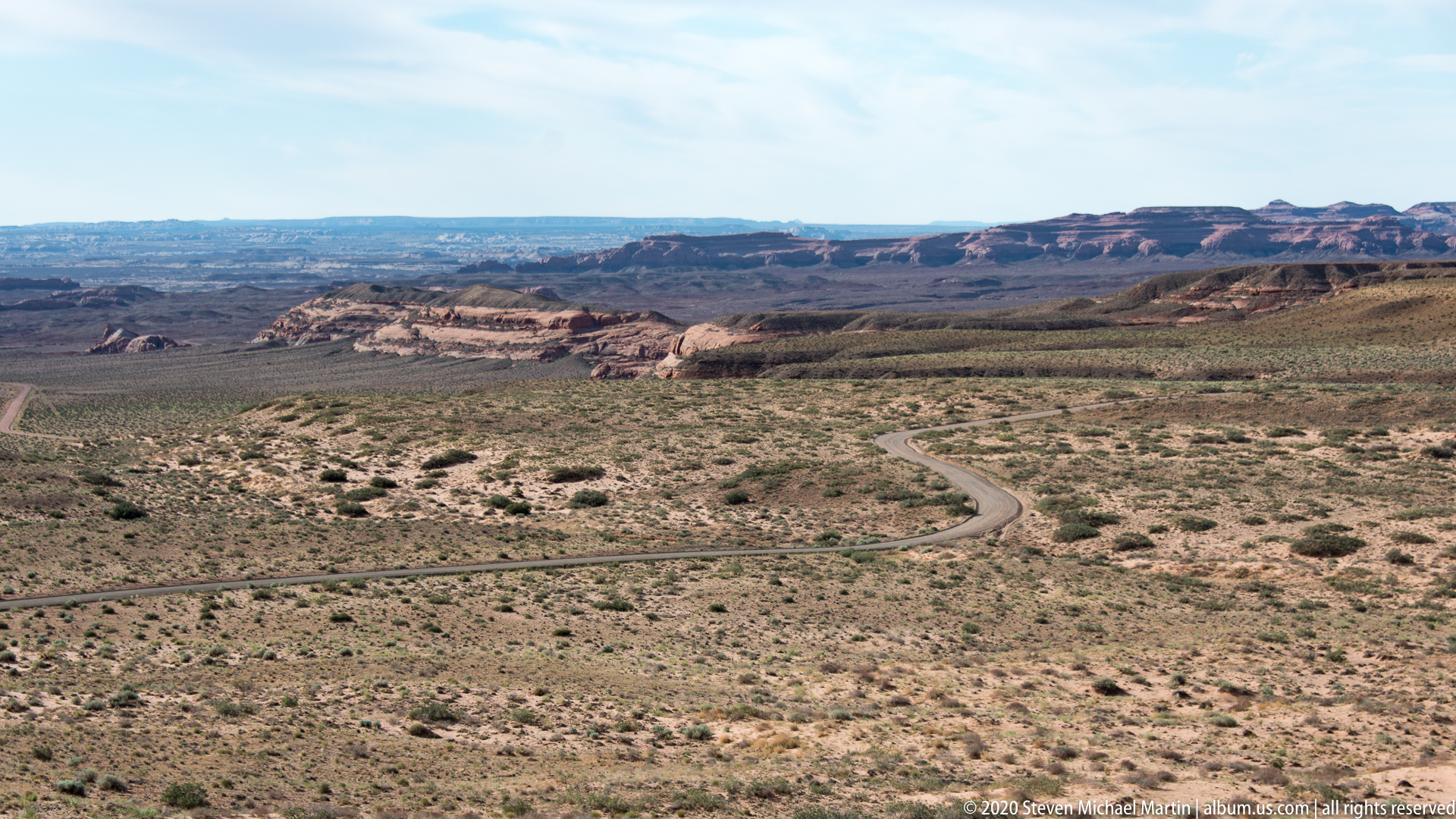
A pale road curves in an S-shape across the near plateau before bending toward red rock mesas in the distance. Low shrubs and grasses cover the rolling ground, while the long horizon reveals several layers of canyon country. The road’s sweeping line provides the main compositional contrast to the broad, open landscape.
Caption
A pale road curves in an S-shape across the near plateau before bending toward red rock mesas in the distance. Low shrubs and grasses cover the rolling ground, while the long horizon reveals several layers of canyon country. The road’s sweeping line provides the main compositional contrast to the broad, open landscape.

A broad, shallow alcove cuts into a warm orange sandstone slope, its irregular overhang casting dark shadows along the recessed wall. Sparse sagebrush and grasses fill the foreground beneath a clear sky. The wide view shows the alcove in its geological setting without assigning it a specific name or archaeological use.
Caption
A broad, shallow alcove cuts into a warm orange sandstone slope, its irregular overhang casting dark shadows along the recessed wall. Sparse sagebrush and grasses fill the foreground beneath a clear sky. The wide view shows the alcove in its geological setting without assigning it a specific name or archaeological use.
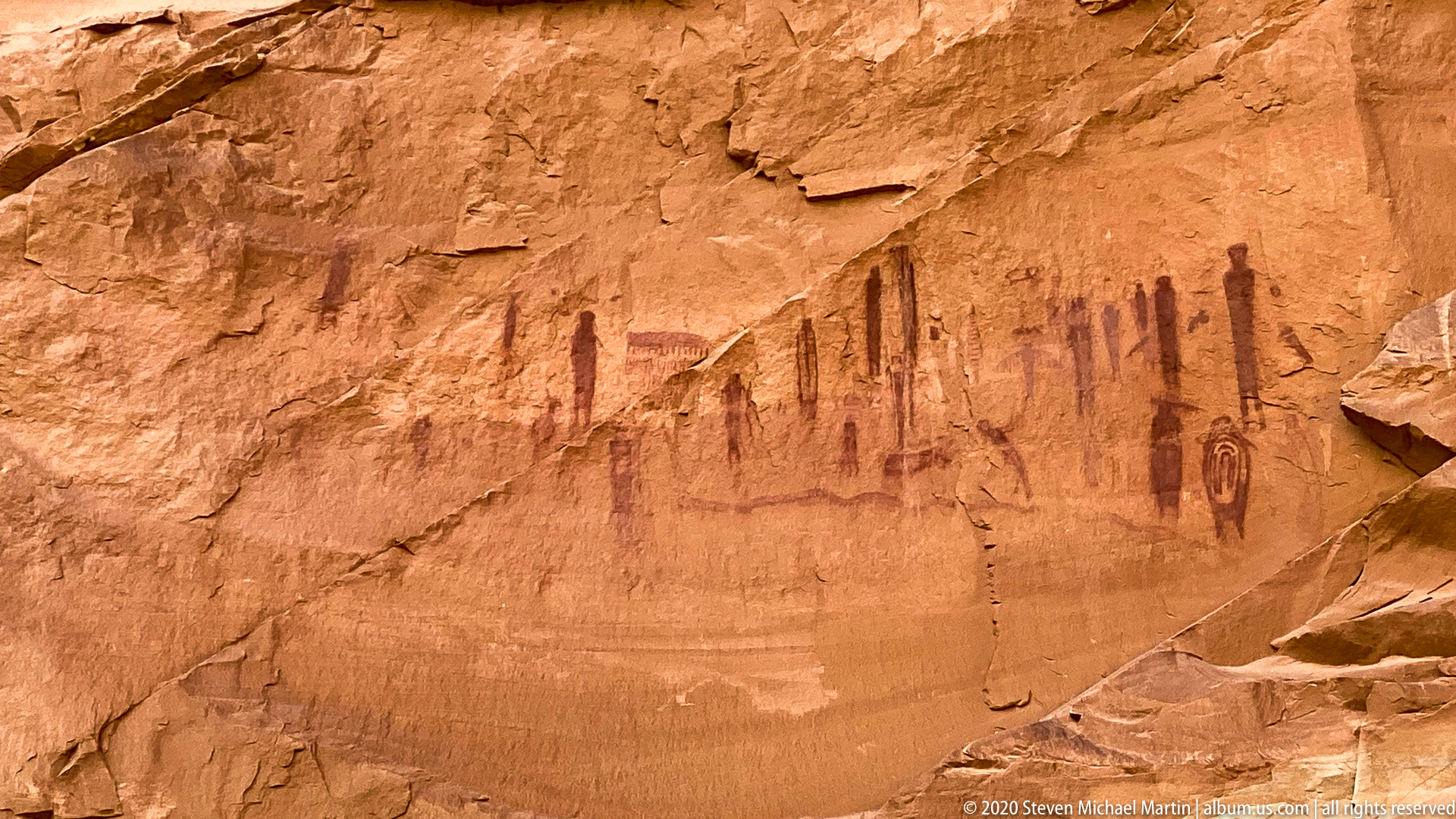
A line of dark red-brown painted figures and symbols appears across the orange sandstone wall. Human-like forms, small circular motifs, and a larger outlined figure are visible against the natural rock surface. The close view supports identifying pictographs, while the marks’ exact age, meaning, and cultural authorship cannot be established from this photograph alone.
Caption
A line of dark red-brown painted figures and symbols appears across the orange sandstone wall. Human-like forms, small circular motifs, and a larger outlined figure are visible against the natural rock surface. The close view supports identifying pictographs, while the marks’ exact age, meaning, and cultural authorship cannot be established from this photograph alone.
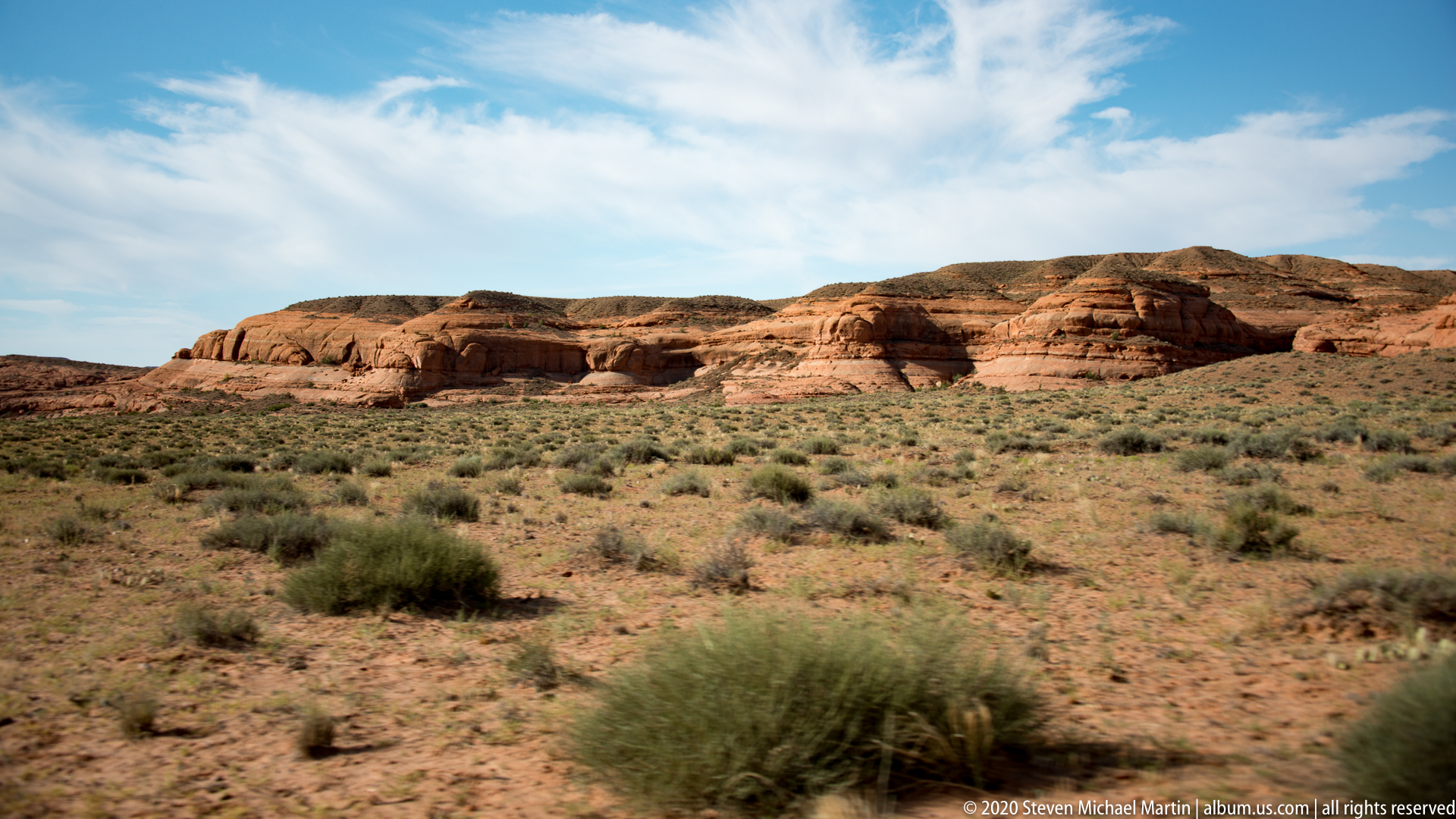
Low sandstone ridges rise beyond a broad plain of sparse desert shrubs beneath a bright, cloud-streaked sky. Horizontal bedding and rounded ledges give the formations a layered profile, while the open foreground conveys the scale of the dry plateau. The distant ridge remains low against the horizon, making the contrast between sky, rock, and scrub especially clear.
Caption
Low sandstone ridges rise beyond a broad plain of sparse desert shrubs beneath a bright, cloud-streaked sky. Horizontal bedding and rounded ledges give the formations a layered profile, while the open foreground conveys the scale of the dry plateau. The distant ridge remains low against the horizon, making the contrast between sky, rock, and scrub especially clear.
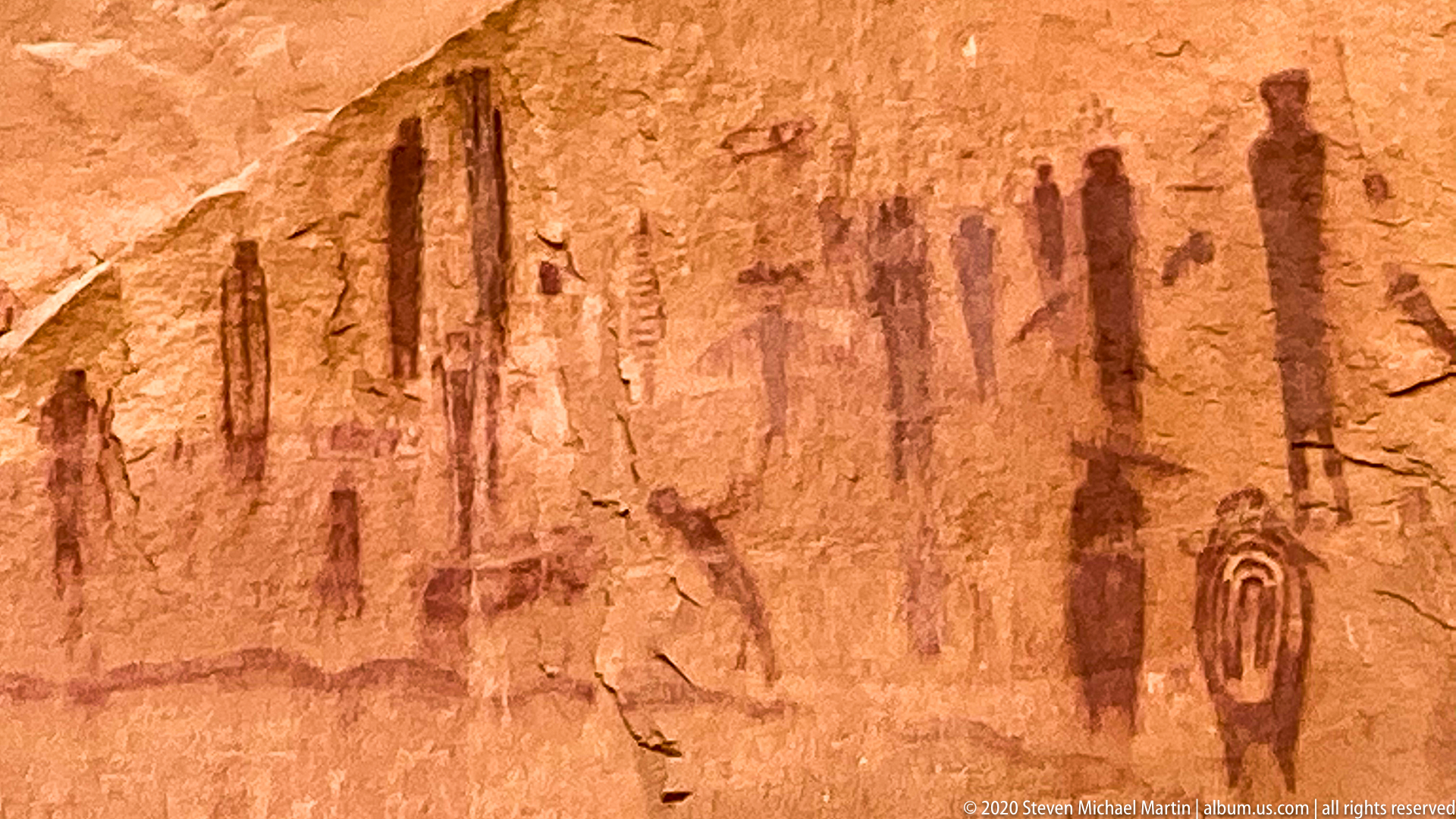
Red pigment figures cover a vertical sandstone wall, including elongated human-like forms, smaller marks, and a prominent nested oval motif. Their varied scale and placement create a dense panel across the warm-colored rock. The close view records the pictographs as a cultural feature of the canyon landscape, while cracks and natural texture remain visible around the painted forms.
Caption
Red pigment figures cover a vertical sandstone wall, including elongated human-like forms, smaller marks, and a prominent nested oval motif. Their varied scale and placement create a dense panel across the warm-colored rock. The close view records the pictographs as a cultural feature of the canyon landscape, while cracks and natural texture remain visible around the painted forms.
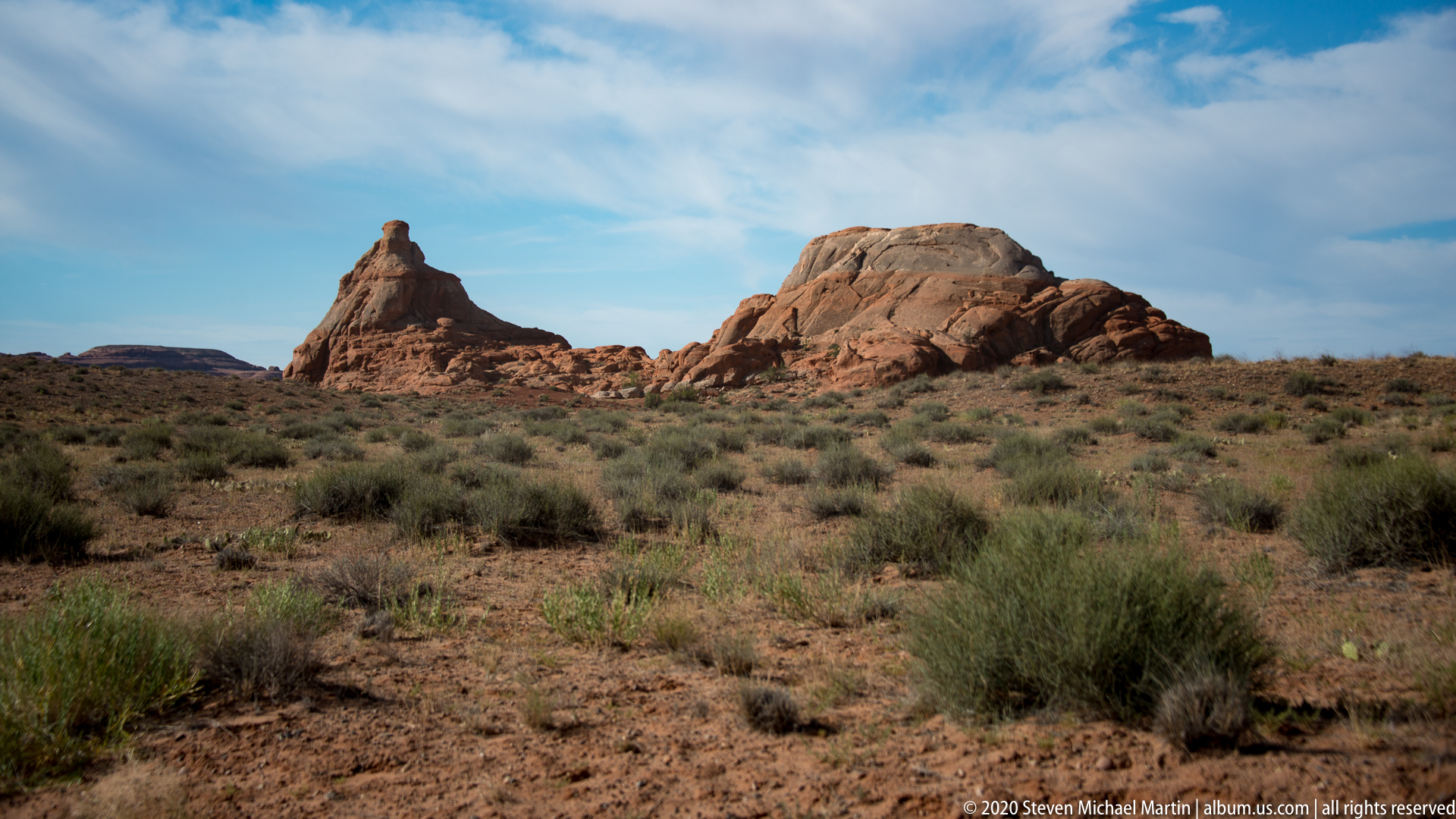
A sculptural sandstone butte rises from a nearly level desert plain, its steep upper spire contrasting with broad, rounded rock shoulders. Low shrubs scatter across the foreground, and layered ridges recede behind the formation beneath a clear blue sky. The distant framing places the butte within the open terrain rather than treating it as an isolated rock detail.
Caption
A sculptural sandstone butte rises from a nearly level desert plain, its steep upper spire contrasting with broad, rounded rock shoulders. Low shrubs scatter across the foreground, and layered ridges recede behind the formation beneath a clear blue sky. The distant framing places the butte within the open terrain rather than treating it as an isolated rock detail.
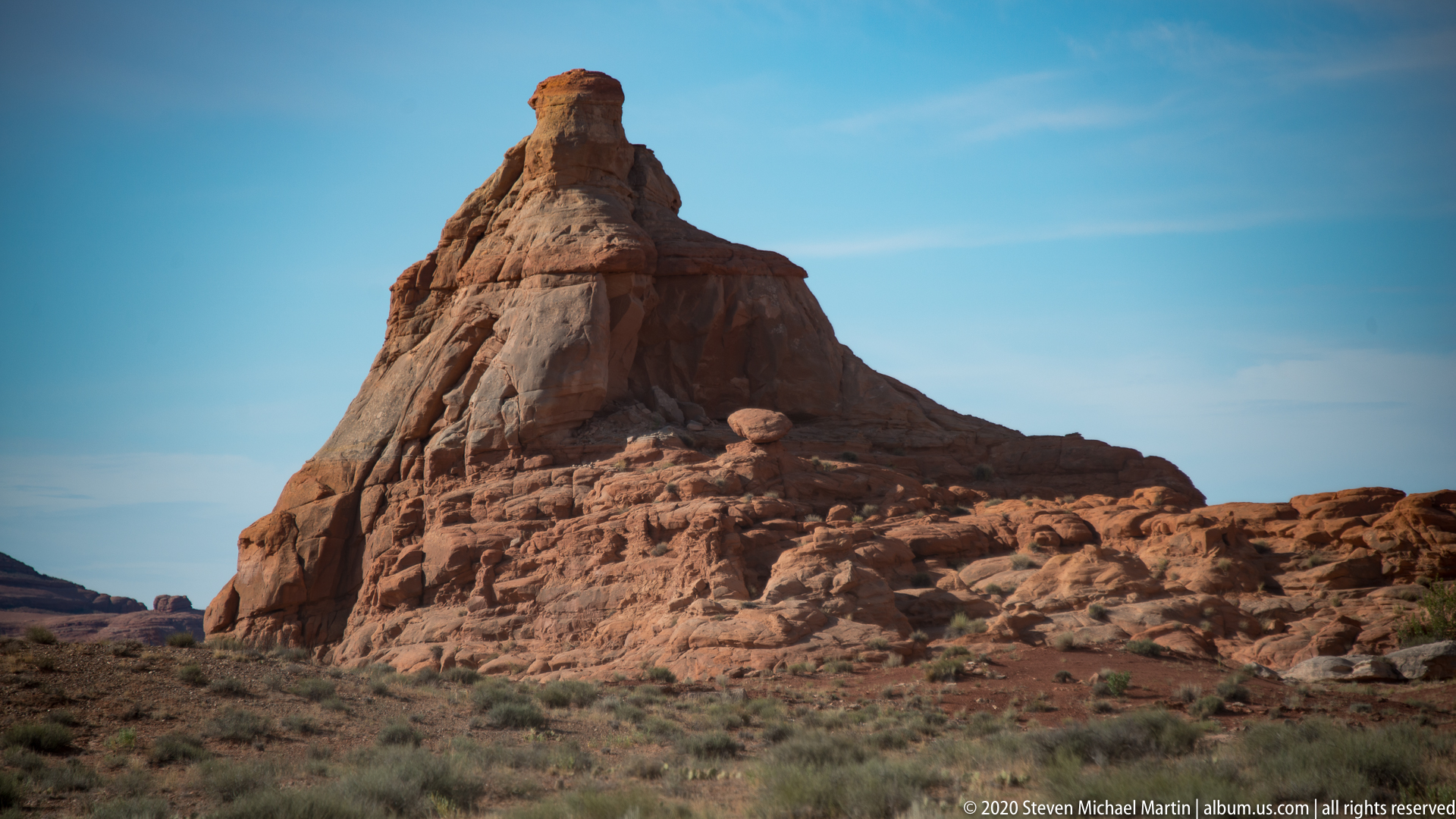
A tall sandstone tower dominates the frame, rising sharply from a broad base of fractured ledges and sloping rock. Side light reveals horizontal bands and deep creases across the darker face, while a small rounded boulder balances on a ledge to the right. The tight composition brings out the formation’s height and weathered surfaces against an uncluttered sky.
Caption
A tall sandstone tower dominates the frame, rising sharply from a broad base of fractured ledges and sloping rock. Side light reveals horizontal bands and deep creases across the darker face, while a small rounded boulder balances on a ledge to the right. The tight composition brings out the formation’s height and weathered surfaces against an uncluttered sky.
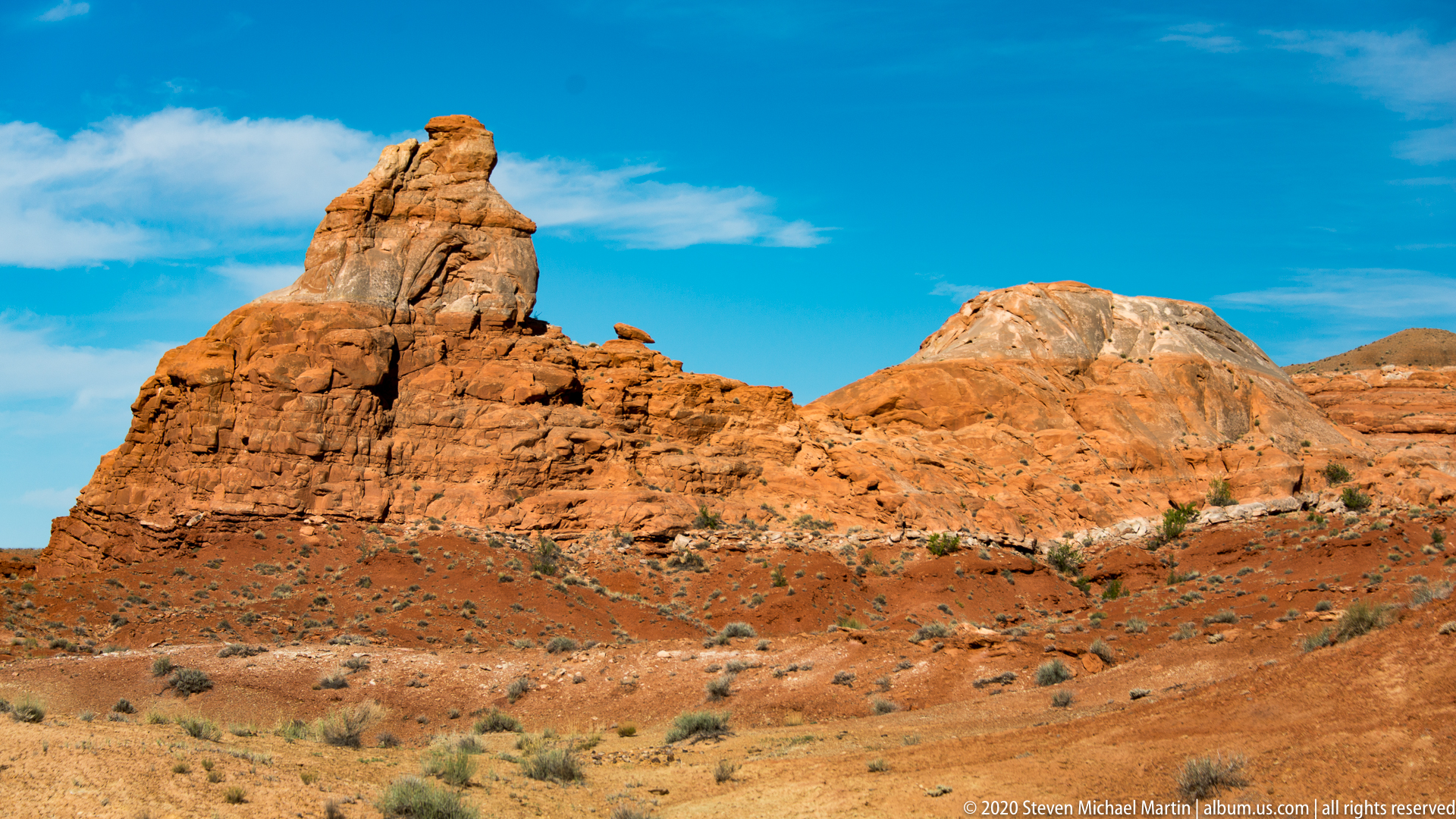
A tall red sandstone spire stands beside a lower, rounded formation, both emerging from a broad sweep of exposed slickrock and sandy soil. Small shrubs punctuate the foreground, and the open blue sky gives the formations a clean silhouette. The wider view shows how the two rock masses relate to one another across the sloping desert terrain.
Caption
A tall red sandstone spire stands beside a lower, rounded formation, both emerging from a broad sweep of exposed slickrock and sandy soil. Small shrubs punctuate the foreground, and the open blue sky gives the formations a clean silhouette. The wider view shows how the two rock masses relate to one another across the sloping desert terrain.
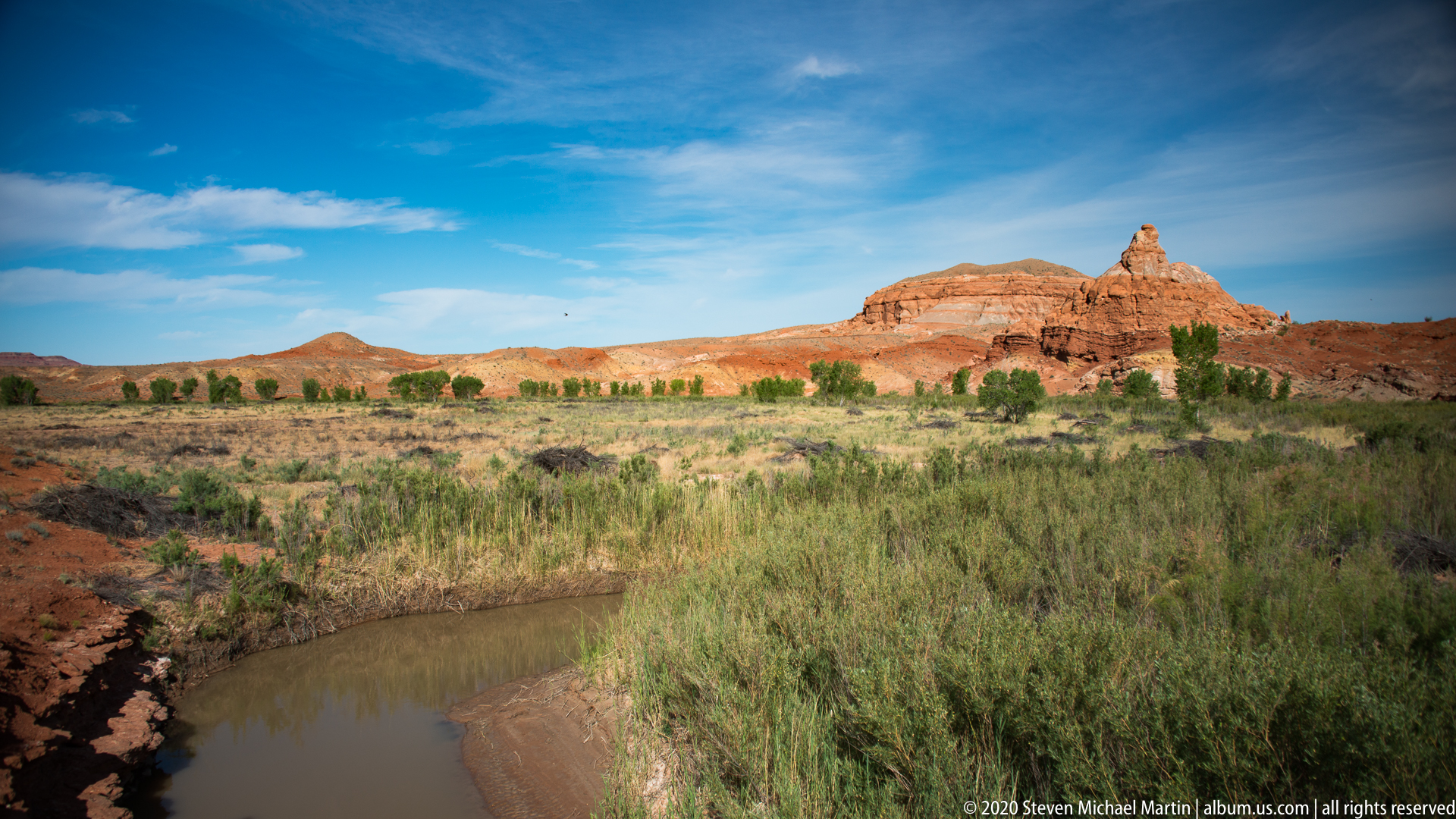
A shallow muddy pool curves through a grassy wash at the base of a broad sandstone ridge. Cottonwoods and other trees form a thin green line beyond the open marshy ground, marking the canyon bottom against the bare red slopes. The distant view combines intermittent water, riparian vegetation, and exposed rock in the arid setting.
Caption
A shallow muddy pool curves through a grassy wash at the base of a broad sandstone ridge. Cottonwoods and other trees form a thin green line beyond the open marshy ground, marking the canyon bottom against the bare red slopes. The distant view combines intermittent water, riparian vegetation, and exposed rock in the arid setting.

A broad, low arch opens through a red sandstone wall, its shaded underside contrasting with the sunlit slickrock and pale sand below. Sparse shrubs grow around the base, while the horizontal rim above the opening remains nearly level. The frontal view makes the arch’s span and the shallow depth of the alcove behind it easy to read.
Caption
A broad, low arch opens through a red sandstone wall, its shaded underside contrasting with the sunlit slickrock and pale sand below. Sparse shrubs grow around the base, while the horizontal rim above the opening remains nearly level. The frontal view makes the arch’s span and the shallow depth of the alcove behind it easy to read.
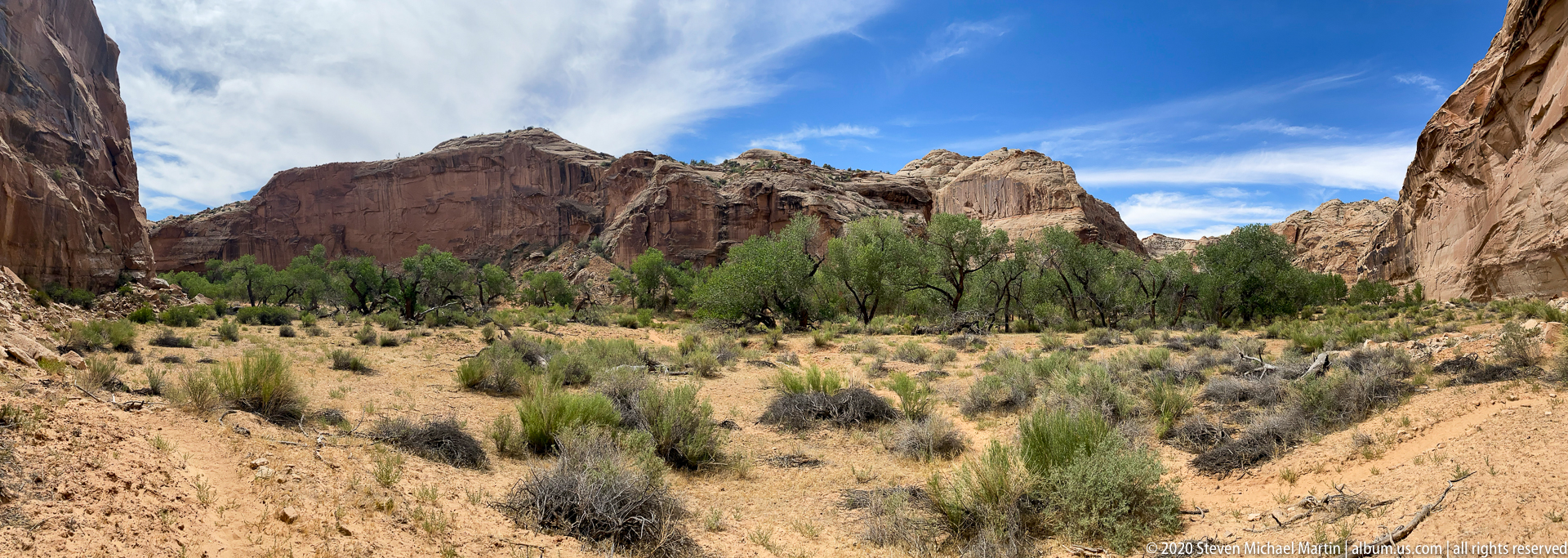
A line of leafy trees fills the canyon bottom beneath tall, nearly vertical sandstone walls. The cliffs form a shallow bowl around the vegetation, with dark streaks and ledges marking the rock faces. A foreground band of sandy ground and scattered grasses leads into the greener center, creating a layered view from dry wash to sheltered riparian corridor.
Caption
A line of leafy trees fills the canyon bottom beneath tall, nearly vertical sandstone walls. The cliffs form a shallow bowl around the vegetation, with dark streaks and ledges marking the rock faces. A foreground band of sandy ground and scattered grasses leads into the greener center, creating a layered view from dry wash to sheltered riparian corridor.
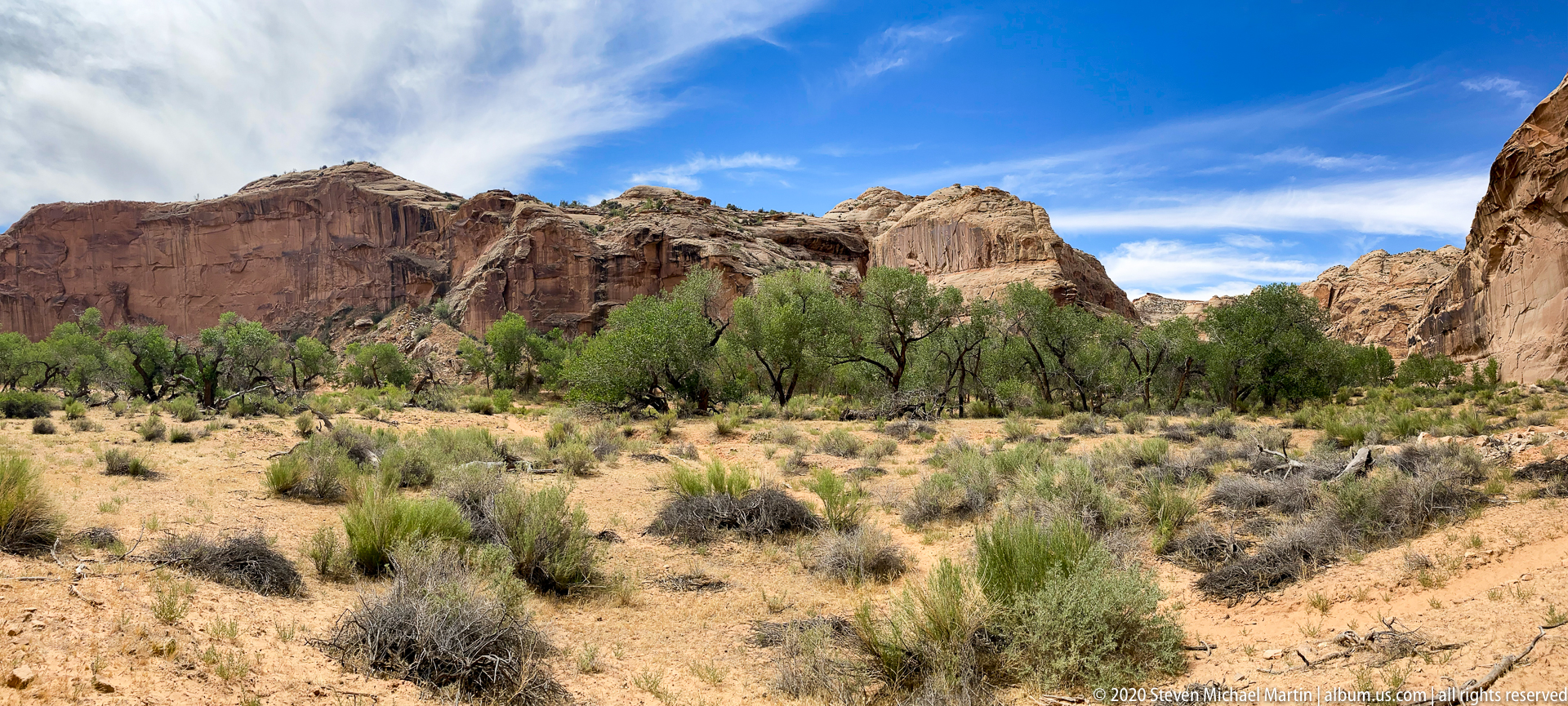
The wider composition spreads the canyon-bottom vegetation across the full width of the wash, with a high sandstone escarpment rising behind it. A dry, pale foreground dotted with shrubs contrasts with the darker tree line, while wispy clouds stretch over the open sky. This view emphasizes the breadth of the canyon floor and its sheltered band of vegetation.
Caption
The wider composition spreads the canyon-bottom vegetation across the full width of the wash, with a high sandstone escarpment rising behind it. A dry, pale foreground dotted with shrubs contrasts with the darker tree line, while wispy clouds stretch over the open sky. This view emphasizes the breadth of the canyon floor and its sheltered band of vegetation.
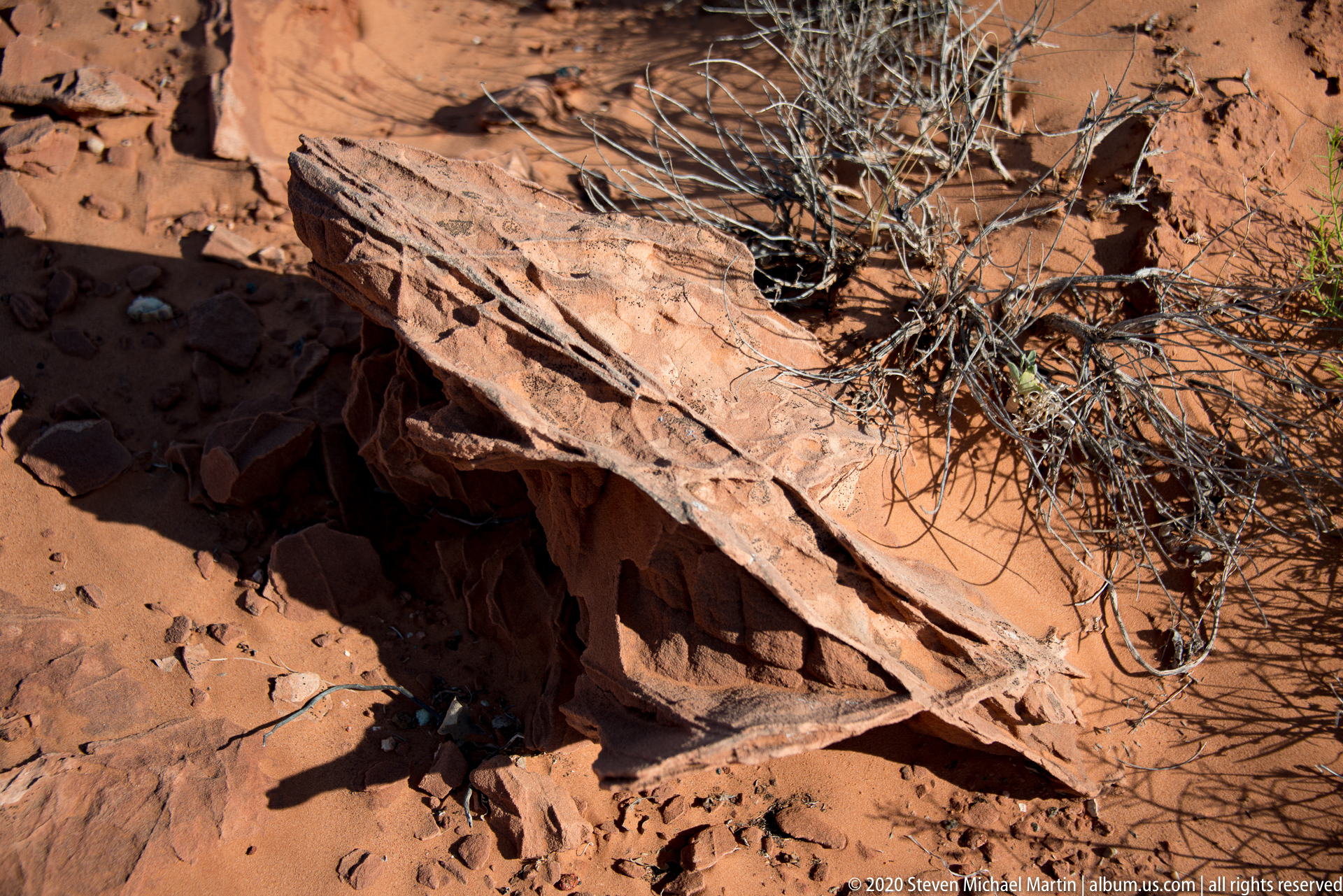
A fractured sandstone shelf projects over a shallow shadowed recess, where loose stones and dark debris collect beneath its edge. A leafless shrub spreads fine branches across the upper right, its roots anchored among the broken slabs. The close downward angle reveals the layered rock and small-scale erosion that shape the canyon’s exposed ledges.
Caption
A fractured sandstone shelf projects over a shallow shadowed recess, where loose stones and dark debris collect beneath its edge. A leafless shrub spreads fine branches across the upper right, its roots anchored among the broken slabs. The close downward angle reveals the layered rock and small-scale erosion that shape the canyon’s exposed ledges.

Fine parallel ripples sweep across an orange sand slope, forming curved lines that converge toward the lower foreground. Shrubs crown the ridge and break the clean surface near the crest, while a small dark footprint or track marks the sand near center. The composition isolates the dune’s wind-shaped texture against a simple blue sky.
Caption
Fine parallel ripples sweep across an orange sand slope, forming curved lines that converge toward the lower foreground. Shrubs crown the ridge and break the clean surface near the crest, while a small dark footprint or track marks the sand near center. The composition isolates the dune’s wind-shaped texture against a simple blue sky.
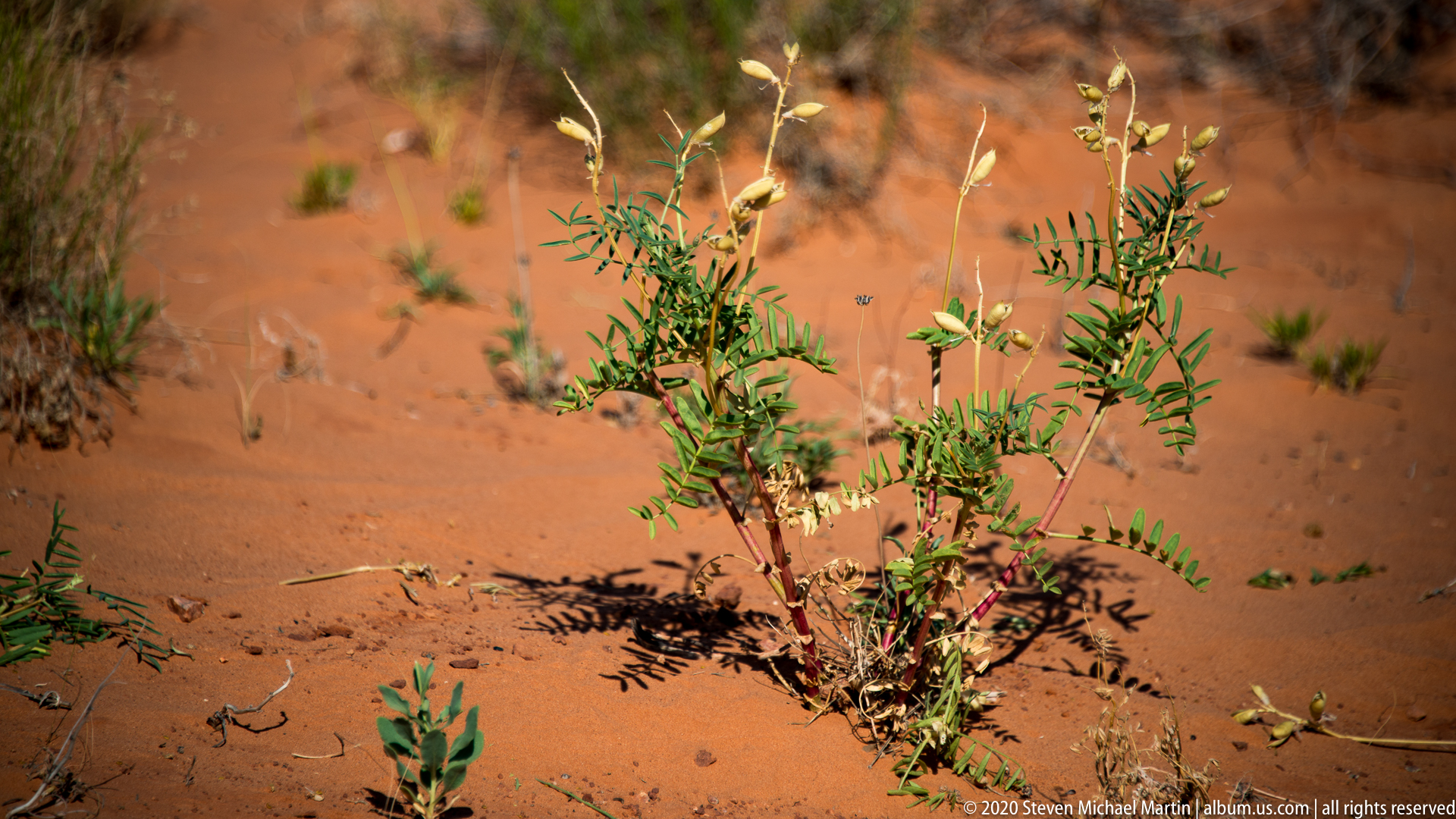
A small desert shrub stands alone on a red sandy slope, its slender stems carrying narrow leaves and pale buds. The sharp focus separates the plant from the softly blurred ground and scattered vegetation behind it. This close view records a modest botanical detail within the exposed canyon terrain without relying on an uncertain species identification.
Caption
A small desert shrub stands alone on a red sandy slope, its slender stems carrying narrow leaves and pale buds. The sharp focus separates the plant from the softly blurred ground and scattered vegetation behind it. This close view records a modest botanical detail within the exposed canyon terrain without relying on an uncertain species identification.

A reddish dirt road runs straight toward the horizon through open scrubland, creating a strong central line across the flat terrain. Low shrubs extend on both sides beneath a broad sky filled with layered clouds. The road’s tire tracks and unpaved surface identify it as a remote access route through the desert plateau.
Caption
A reddish dirt road runs straight toward the horizon through open scrubland, creating a strong central line across the flat terrain. Low shrubs extend on both sides beneath a broad sky filled with layered clouds. The road’s tire tracks and unpaved surface identify it as a remote access route through the desert plateau.
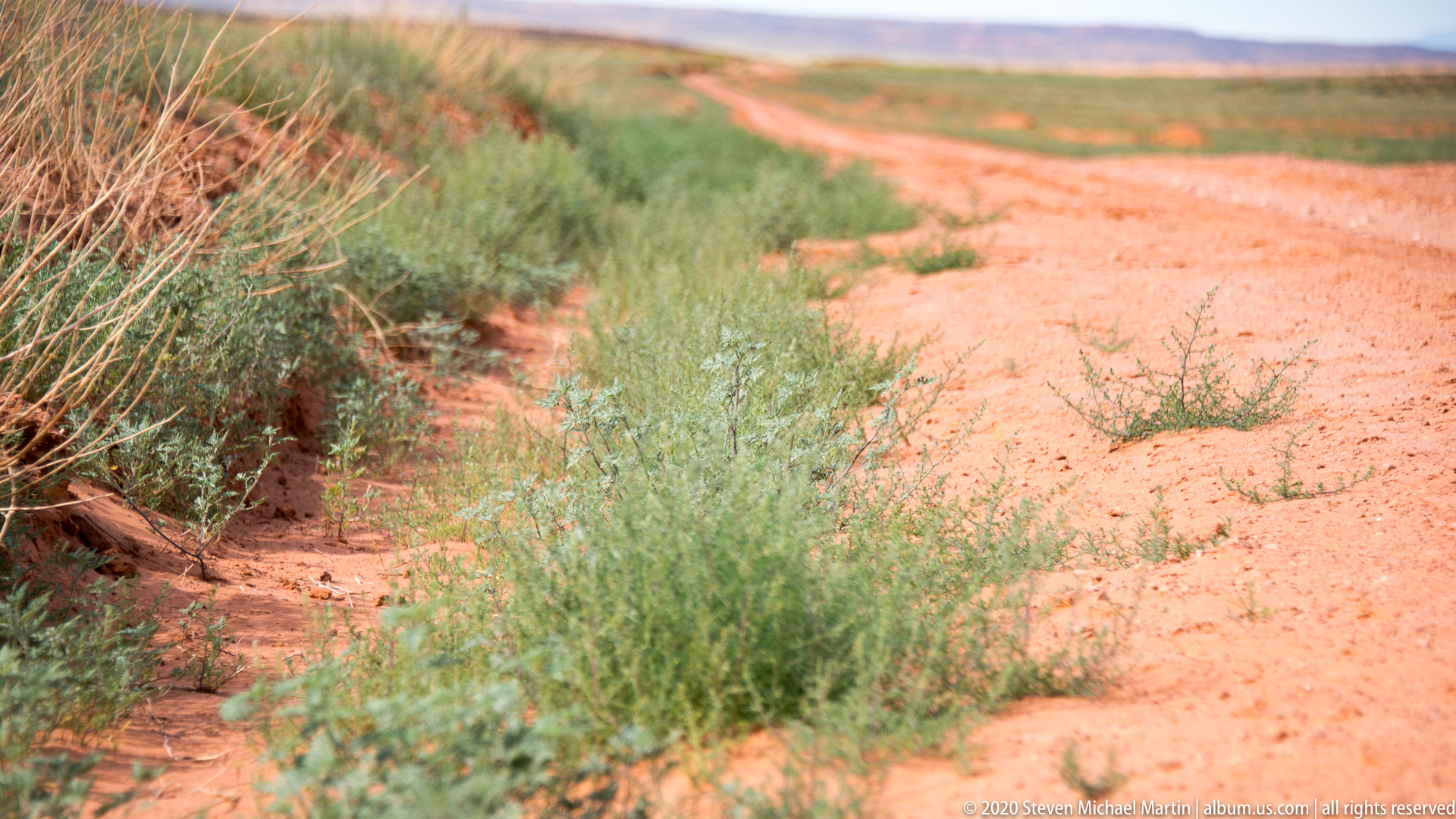
An unpaved road bends gently through low sage-colored shrubs, with the track disappearing toward a distant rise. Dry grasses and bare branches fill the near left edge, while a strip of orange soil leads the eye into the open plateau. The shallow focus softens the far landscape, distinguishing this intimate roadside view from a more distant road panorama.
Caption
An unpaved road bends gently through low sage-colored shrubs, with the track disappearing toward a distant rise. Dry grasses and bare branches fill the near left edge, while a strip of orange soil leads the eye into the open plateau. The shallow focus softens the far landscape, distinguishing this intimate roadside view from a more distant road panorama.

A vast sandstone overhang curves across the frame, its pale upper layers projecting above a deep orange underside. A tiny visitor near the base gives scale to the sheltering wall, while scattered stones and low plants mark the dry floor. The upward angle makes the alcove’s enormous span and sweeping stratified surface the dominant features.
Caption
A vast sandstone overhang curves across the frame, its pale upper layers projecting above a deep orange underside. A tiny visitor near the base gives scale to the sheltering wall, while scattered stones and low plants mark the dry floor. The upward angle makes the alcove’s enormous span and sweeping stratified surface the dominant features.
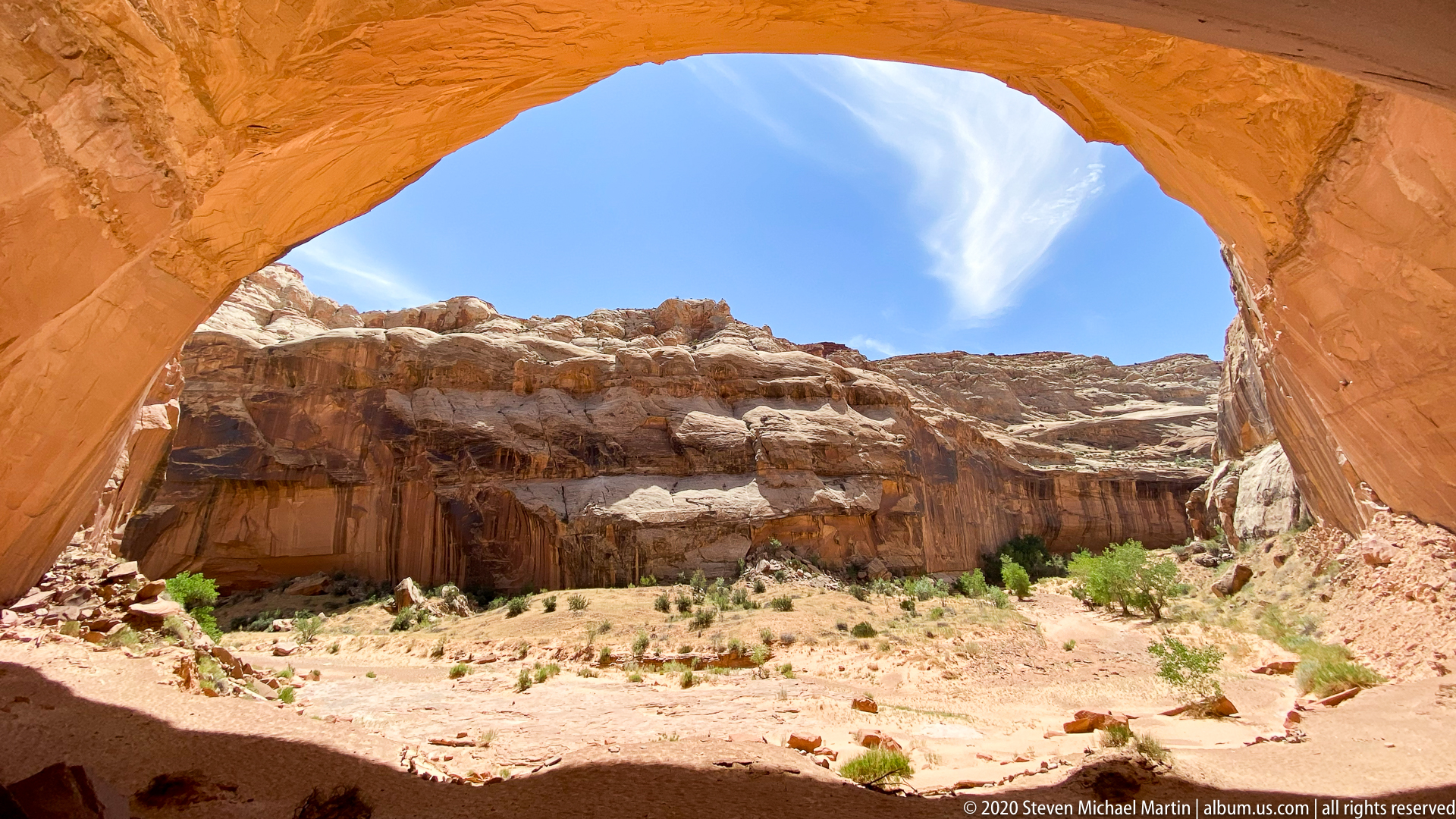
From beneath a red sandstone arch, the opening frames a pale, layered rock wall and a patch of blue sky. The arch’s curved inner surface forms a vivid border around the landscape beyond, while a sandy floor and sparse shrubs remain visible at the base. The composition turns the natural opening into a window onto the surrounding canyon.
Caption
From beneath a red sandstone arch, the opening frames a pale, layered rock wall and a patch of blue sky. The arch’s curved inner surface forms a vivid border around the landscape beyond, while a sandy floor and sparse shrubs remain visible at the base. The composition turns the natural opening into a window onto the surrounding canyon.
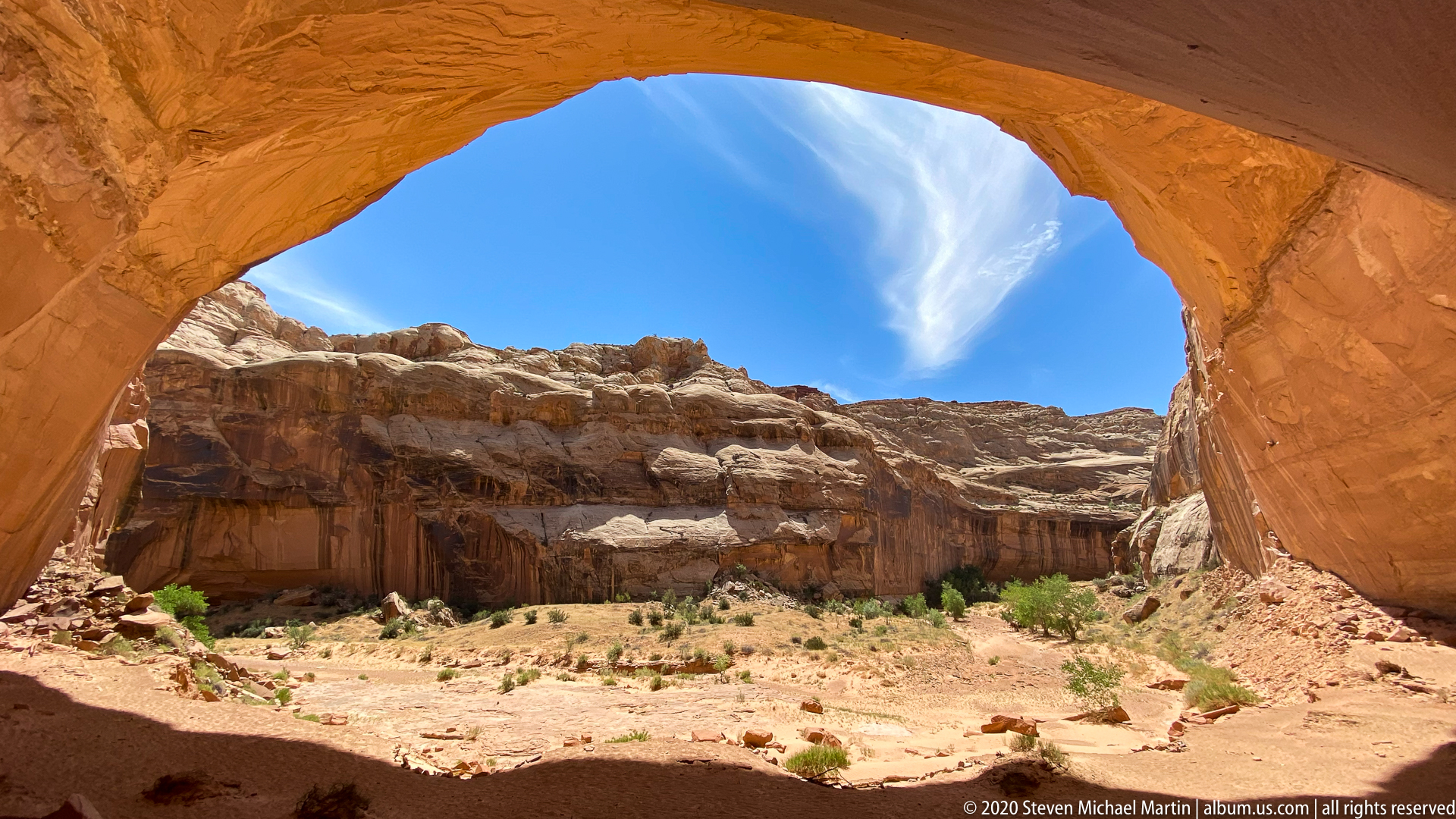
A curved sandstone arch frames a broad view of an opposite cliff, pale sandy floor, and scattered desert shrubs. The inner rock surface occupies the upper and side edges, creating a natural frame around the sunlit landscape beyond. This angle includes more of the canyon basin than the closer arch details, showing the opening’s relationship to the surrounding terrain.
Caption
A curved sandstone arch frames a broad view of an opposite cliff, pale sandy floor, and scattered desert shrubs. The inner rock surface occupies the upper and side edges, creating a natural frame around the sunlit landscape beyond. This angle includes more of the canyon basin than the closer arch details, showing the opening’s relationship to the surrounding terrain.
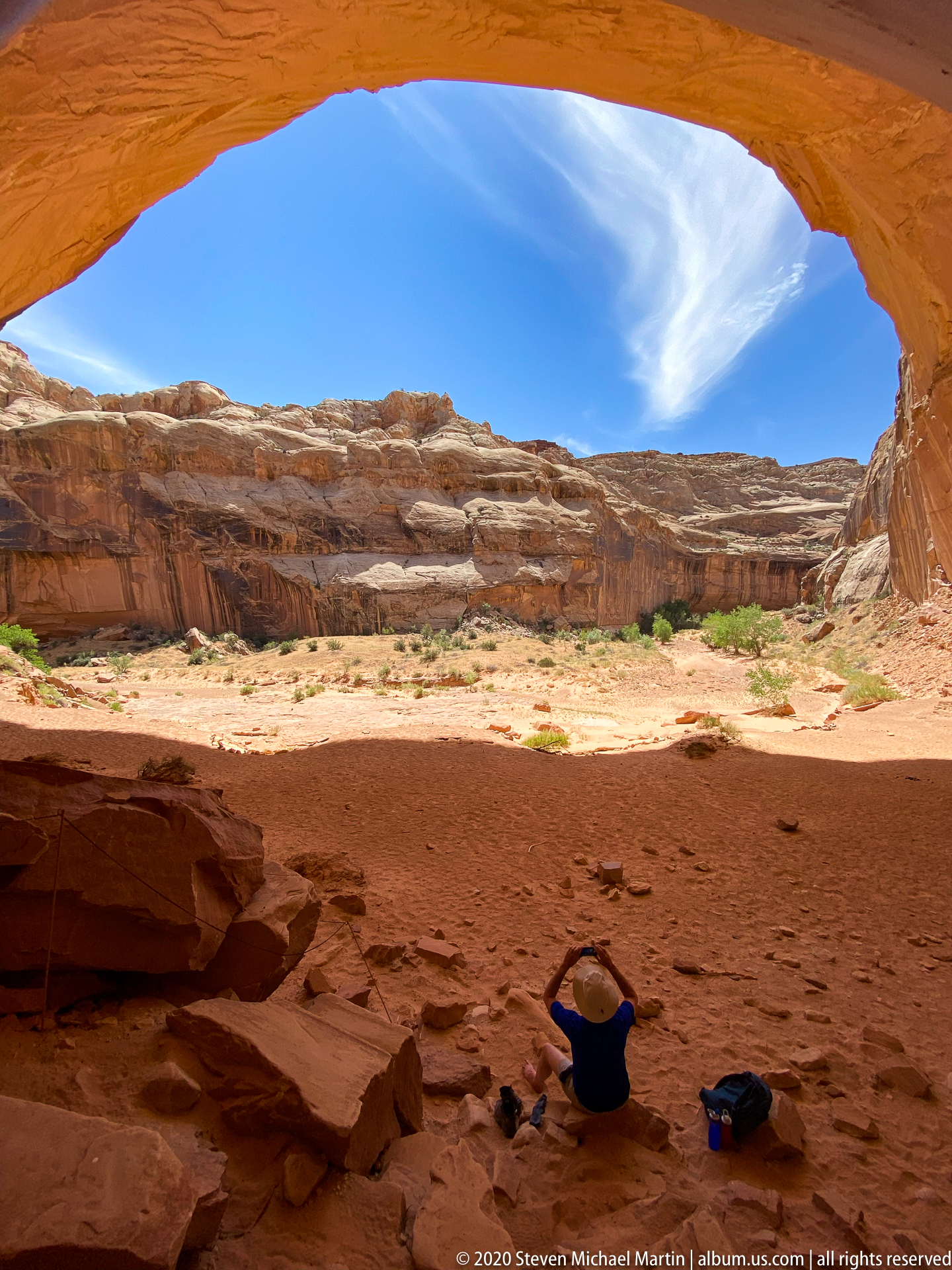
A seated visitor rests beneath a broad sandstone ceiling, appearing small against the sweeping rock wall and open alcove. The figure’s raised arms and blue clothing draw attention to the shelter’s height, while a pack and other gear lie on the ground nearby. Sunlight reaches the far canyon wall beyond the shaded foreground, defining the depth of the recess.
Caption
A seated visitor rests beneath a broad sandstone ceiling, appearing small against the sweeping rock wall and open alcove. The figure’s raised arms and blue clothing draw attention to the shelter’s height, while a pack and other gear lie on the ground nearby. Sunlight reaches the far canyon wall beyond the shaded foreground, defining the depth of the recess.
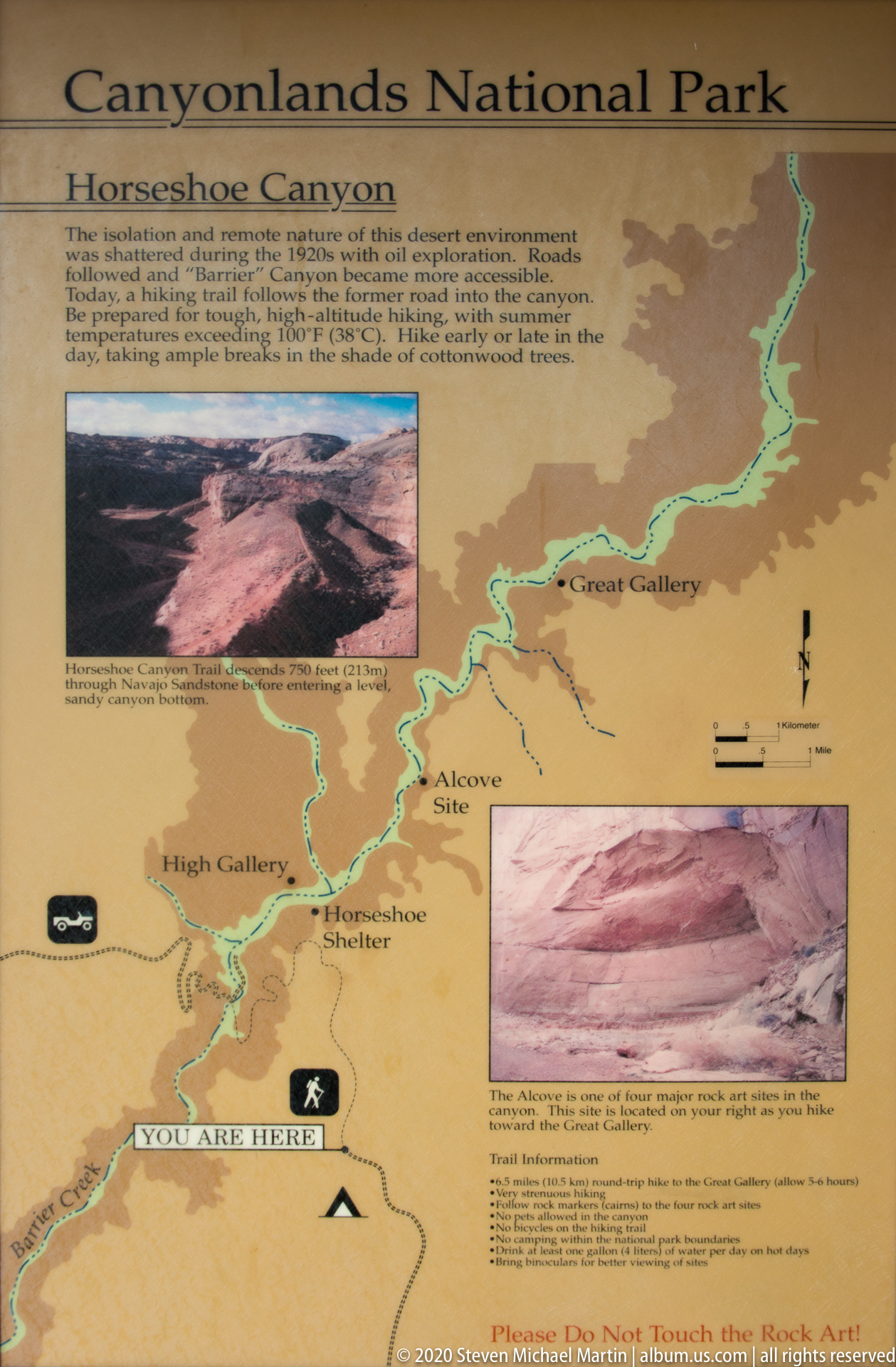
The close view centers a map of Horseshoe Canyon, tracing the route through the canyon and marking sites including the Great Gallery, High Gallery, Alcove Site, and Horseshoe Shelter. A “You Are Here” marker locates the viewer near the canyon entrance, while inset photographs and trail notes provide context. The map connects named rock-art sites with the long approach through the canyon.
Caption
The close view centers a map of Horseshoe Canyon, tracing the route through the canyon and marking sites including the Great Gallery, High Gallery, Alcove Site, and Horseshoe Shelter. A “You Are Here” marker locates the viewer near the canyon entrance, while inset photographs and trail notes provide context. The map connects named rock-art sites with the long approach through the canyon.

An interpretive panel titled “Barrier Canyon Rock Art” describes the painted figures, their pigments, and the archaeological context of the canyon sites. Photographs of anthropomorphic figures accompany text about their forms and preservation, alongside a prominent warning not to touch the rock art. The display presents both cultural interpretation and practical guidance for protecting fragile surfaces.
Caption
An interpretive panel titled “Barrier Canyon Rock Art” describes the painted figures, their pigments, and the archaeological context of the canyon sites. Photographs of anthropomorphic figures accompany text about their forms and preservation, alongside a prominent warning not to touch the rock art. The display presents both cultural interpretation and practical guidance for protecting fragile surfaces.
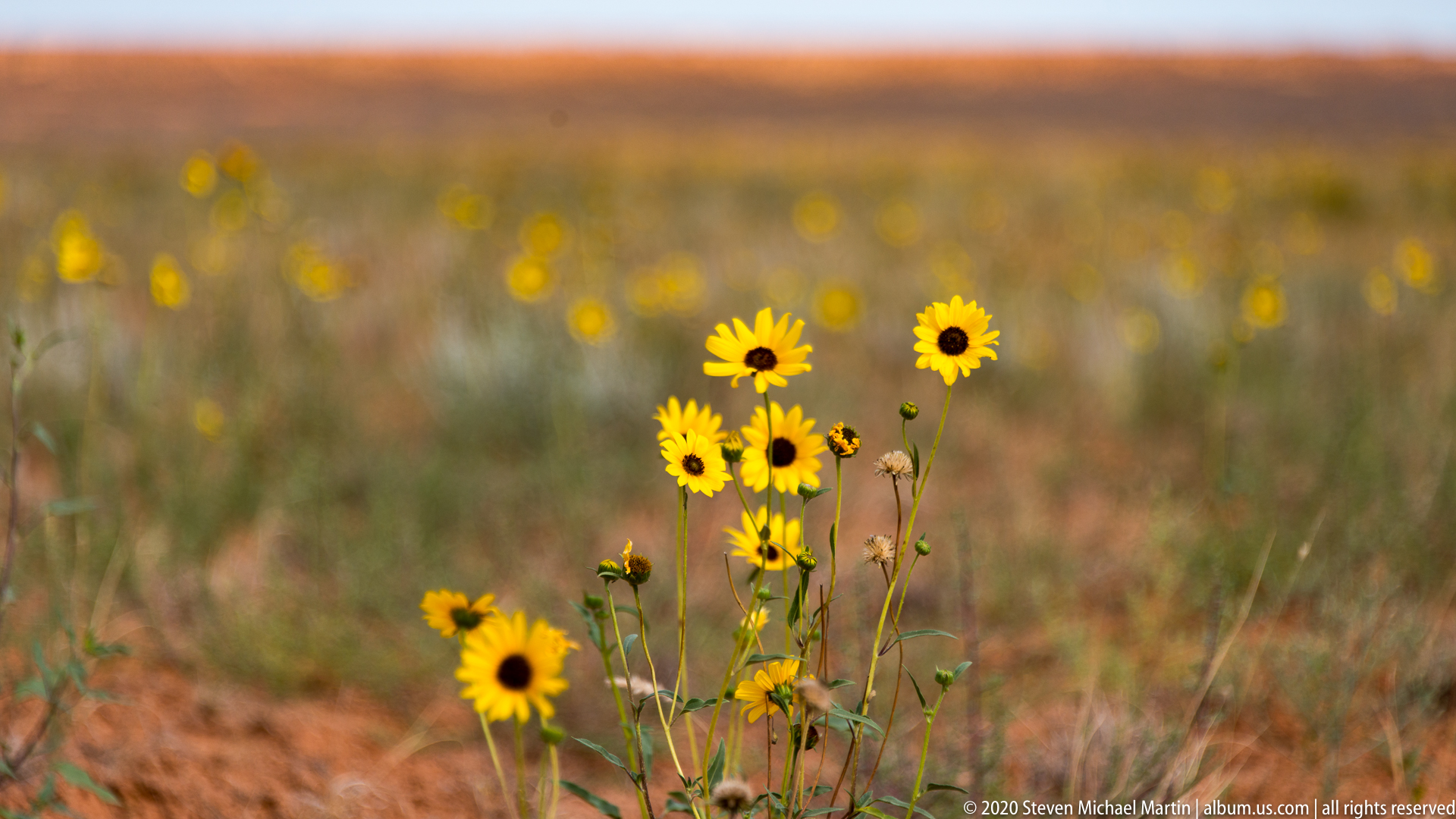
A cluster of yellow daisy-like flowers rises above dry grasses, their dark centers and slender stems sharply focused against a softly blurred field. Smaller blooms and buds extend around the central group, while scattered yellow points recede into the background. The selective focus isolates the flowers and conveys the seasonal color of the otherwise muted desert plain.
Caption
A cluster of yellow daisy-like flowers rises above dry grasses, their dark centers and slender stems sharply focused against a softly blurred field. Smaller blooms and buds extend around the central group, while scattered yellow points recede into the background. The selective focus isolates the flowers and conveys the seasonal color of the otherwise muted desert plain.
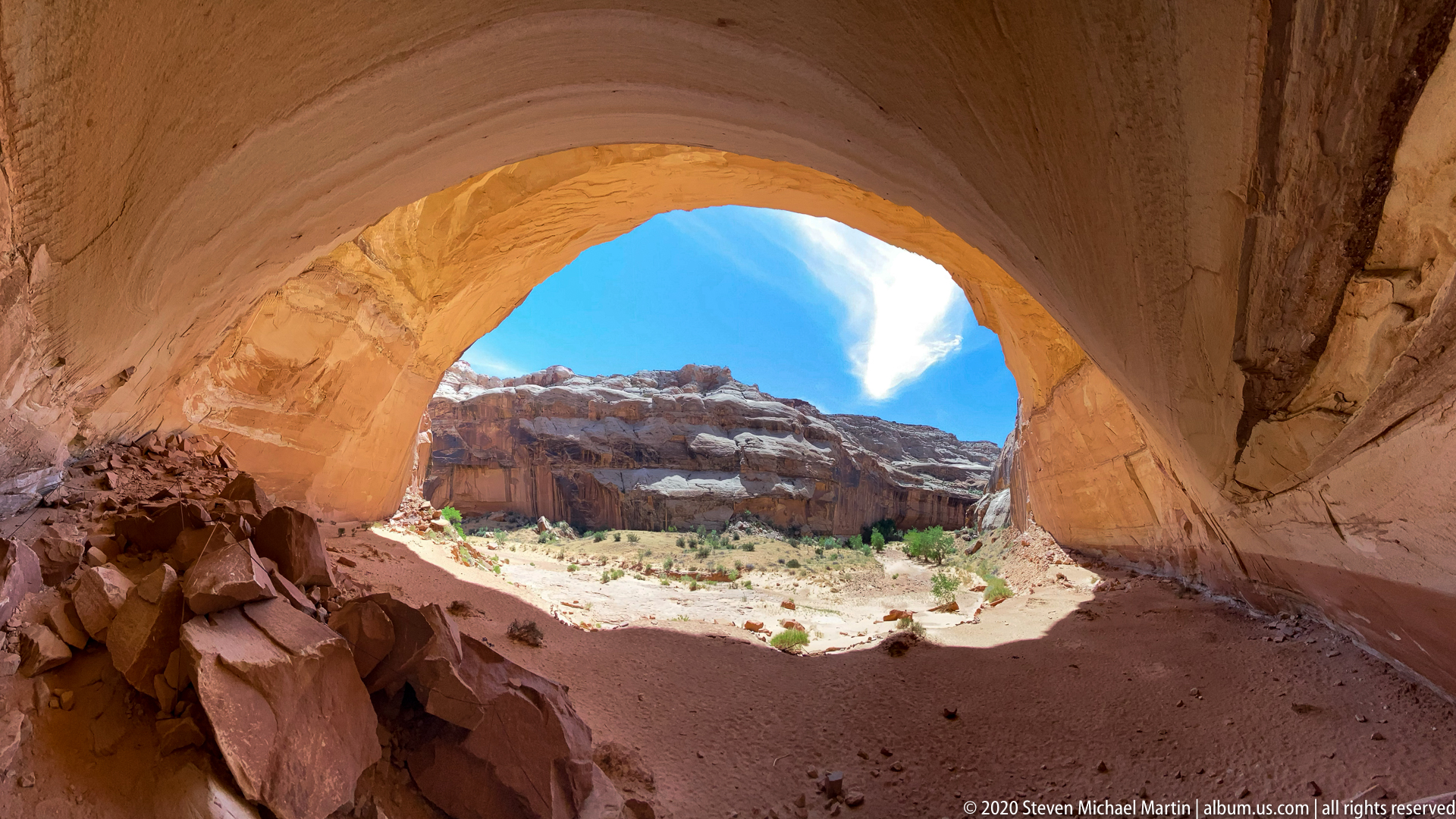
The arch’s shadowed interior fills much of the frame, with its curved opening revealing a sunlit canyon wall and sandy ground beyond. Broken rock fragments collect at the left foreground, while the pale opposite cliff sits centered in the opening. The darker, enclosed viewpoint gives the scene greater depth than the brighter exterior views of the same formation.
Caption
The arch’s shadowed interior fills much of the frame, with its curved opening revealing a sunlit canyon wall and sandy ground beyond. Broken rock fragments collect at the left foreground, while the pale opposite cliff sits centered in the opening. The darker, enclosed viewpoint gives the scene greater depth than the brighter exterior views of the same formation.
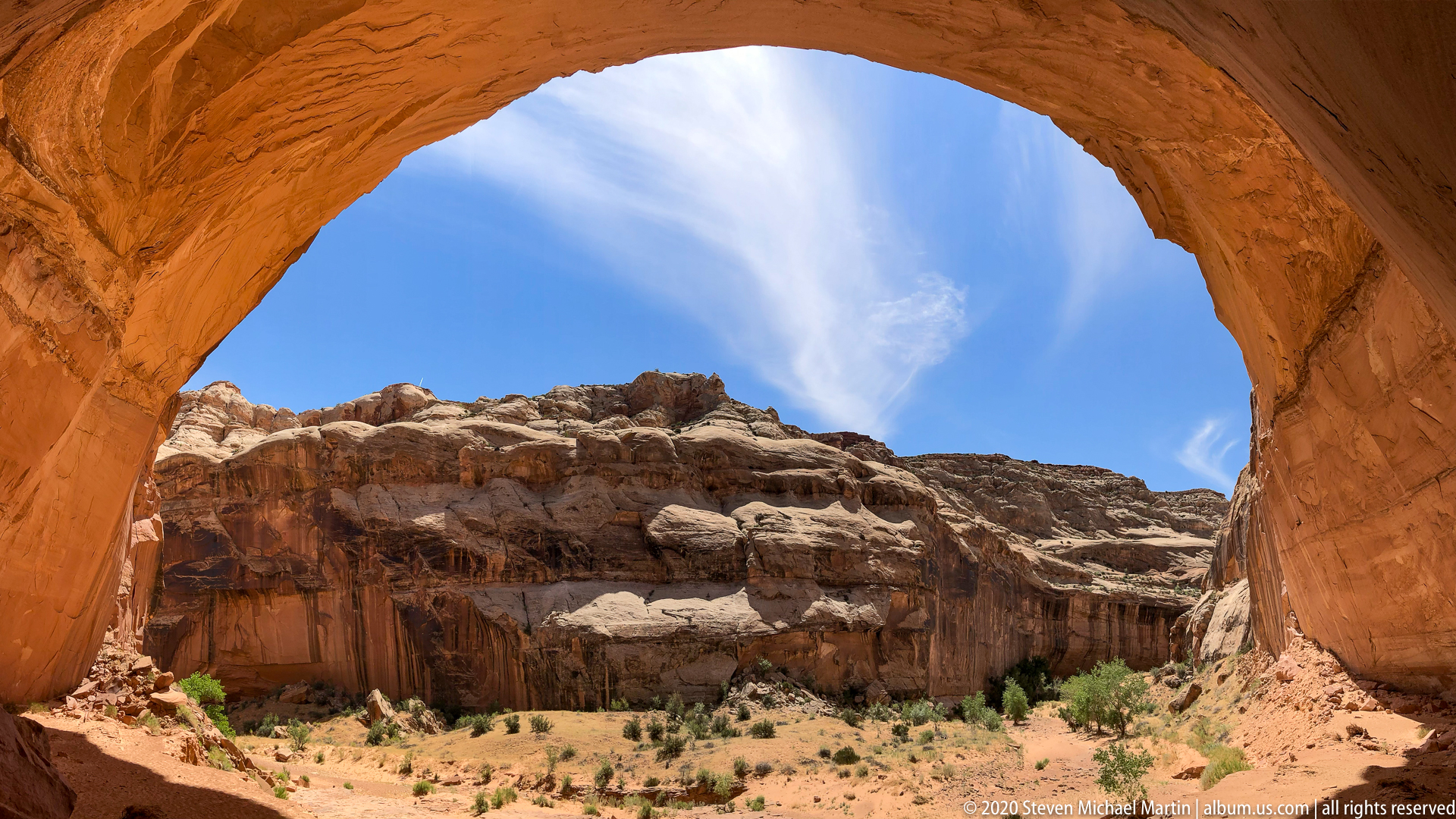
A large orange arch sweeps across the upper frame, opening toward a pale layered wall, scattered shrubs, and a dry canyon floor. Its full curve is clearly visible against the blue sky, with shadow beneath the near rock and sunlight across the distant basin. The balanced composition presents both the natural span and the landscape enclosed by it.
Caption
A large orange arch sweeps across the upper frame, opening toward a pale layered wall, scattered shrubs, and a dry canyon floor. Its full curve is clearly visible against the blue sky, with shadow beneath the near rock and sunlight across the distant basin. The balanced composition presents both the natural span and the landscape enclosed by it.
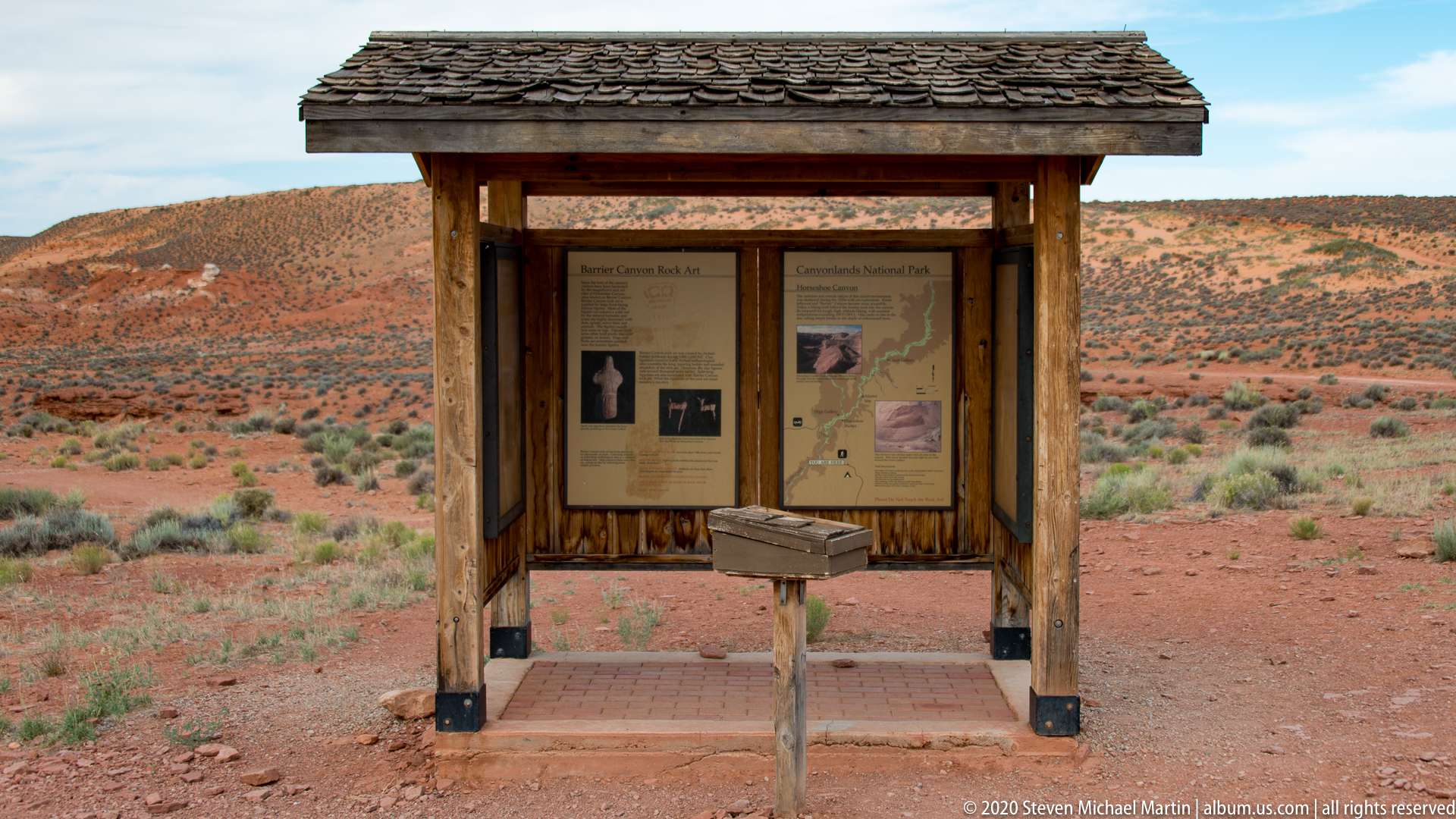
A roofed wooden kiosk stands alone in open scrubland, holding maps and interpretive panels about Horseshoe Canyon and nearby rock art. A small writing shelf projects from the front, and the surrounding red earth and low shrubs extend toward distant hills. The freestanding structure marks an information stop within a broad, sparsely vegetated landscape.
Caption
A roofed wooden kiosk stands alone in open scrubland, holding maps and interpretive panels about Horseshoe Canyon and nearby rock art. A small writing shelf projects from the front, and the surrounding red earth and low shrubs extend toward distant hills. The freestanding structure marks an information stop within a broad, sparsely vegetated landscape.
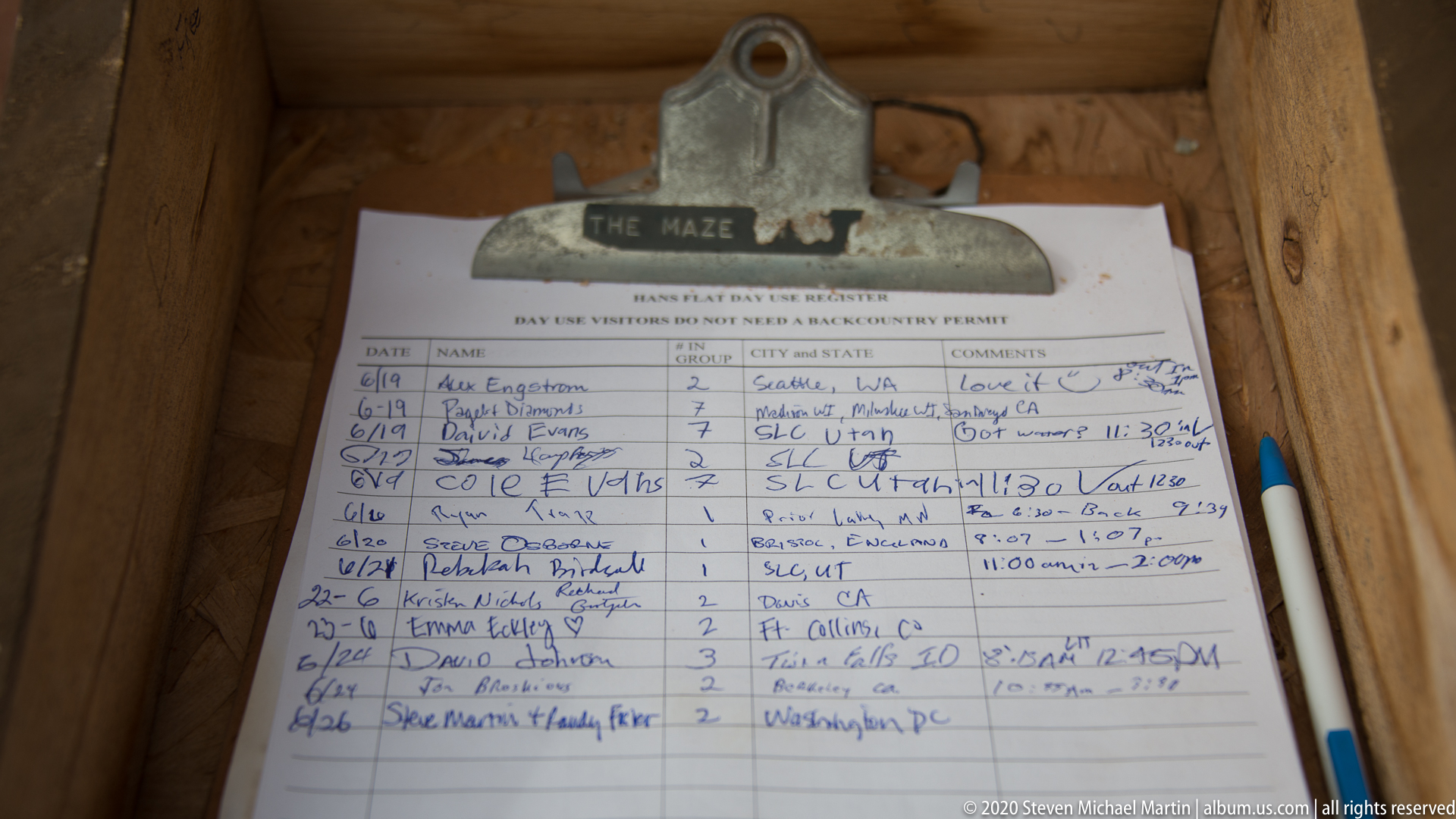
A visitor register lies open on a wooden shelf beneath a metal label reading “The Maze.” The ruled page contains handwritten dates, party sizes, locations, and comments, recording arrivals at a remote backcountry area. The overhead composition focuses on the communal log rather than individual entries, showing how visitors document their passage through the landscape.
Caption
A visitor register lies open on a wooden shelf beneath a metal label reading “The Maze.” The ruled page contains handwritten dates, party sizes, locations, and comments, recording arrivals at a remote backcountry area. The overhead composition focuses on the communal log rather than individual entries, showing how visitors document their passage through the landscape.
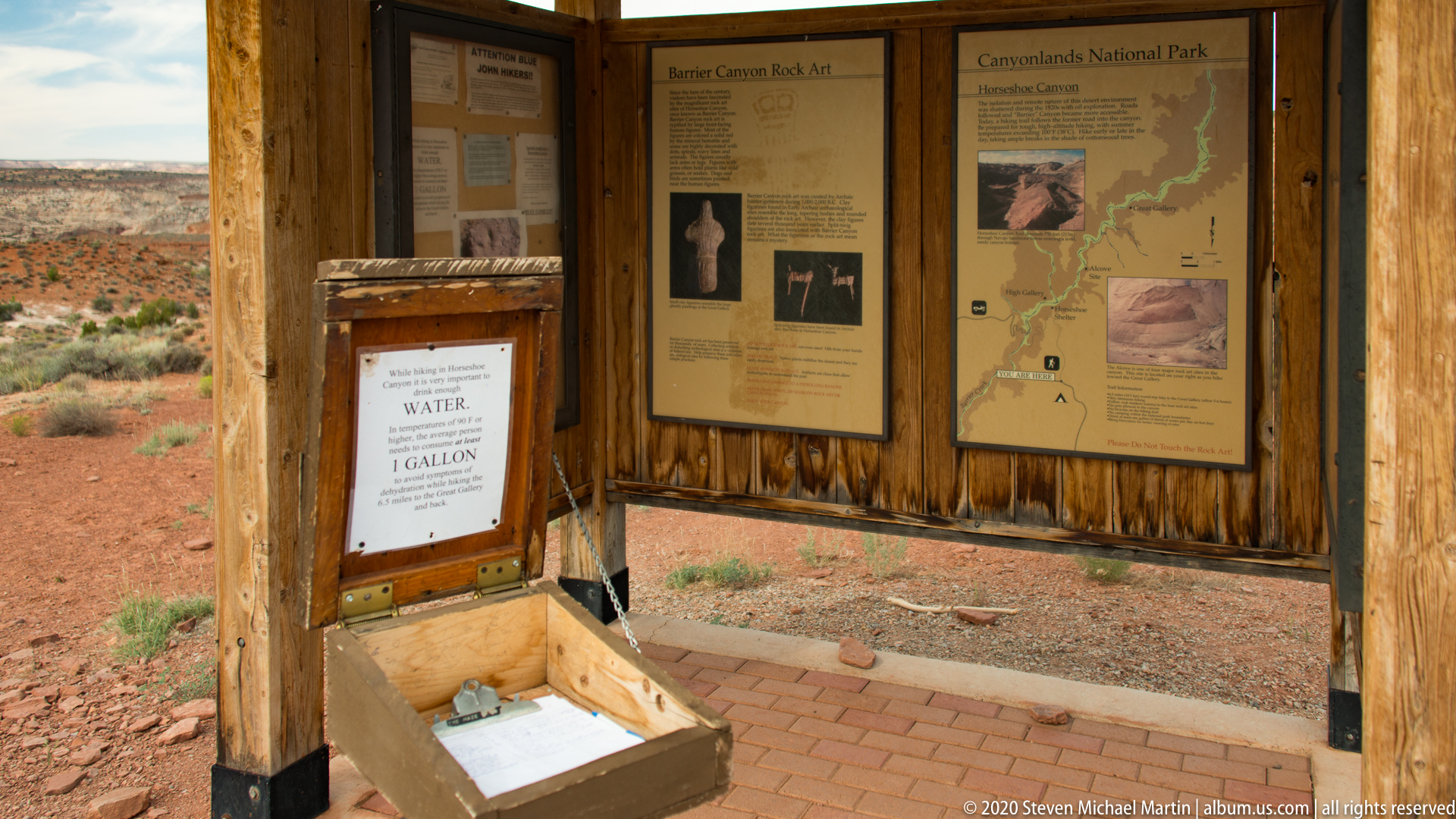
The interior of a timber kiosk contains framed panels about Barrier Canyon rock art and Horseshoe Canyon, a route map, and a notice about water use. A writing shelf and open logbook sit below the displays, while the desert landscape remains visible through the shelter’s side. The view brings together interpretation, trip planning, and visitor services at the canyon approach.
Caption
The interior of a timber kiosk contains framed panels about Barrier Canyon rock art and Horseshoe Canyon, a route map, and a notice about water use. A writing shelf and open logbook sit below the displays, while the desert landscape remains visible through the shelter’s side. The view brings together interpretation, trip planning, and visitor services at the canyon approach.

A gray wooden sign identifies Canyonlands National Park and Horseshoe Canyon, with the National Park Service arrowhead emblem at its upper right. A row of pictograms below indicates permitted and prohibited activities, including hiking and restrictions on bicycles, pets, camping, motor vehicles, and hunting. The sign stands in an open red-earth landscape with low scrub and distant mesas.
Caption
A gray wooden sign identifies Canyonlands National Park and Horseshoe Canyon, with the National Park Service arrowhead emblem at its upper right. A row of pictograms below indicates permitted and prohibited activities, including hiking and restrictions on bicycles, pets, camping, motor vehicles, and hunting. The sign stands in an open red-earth landscape with low scrub and distant mesas.
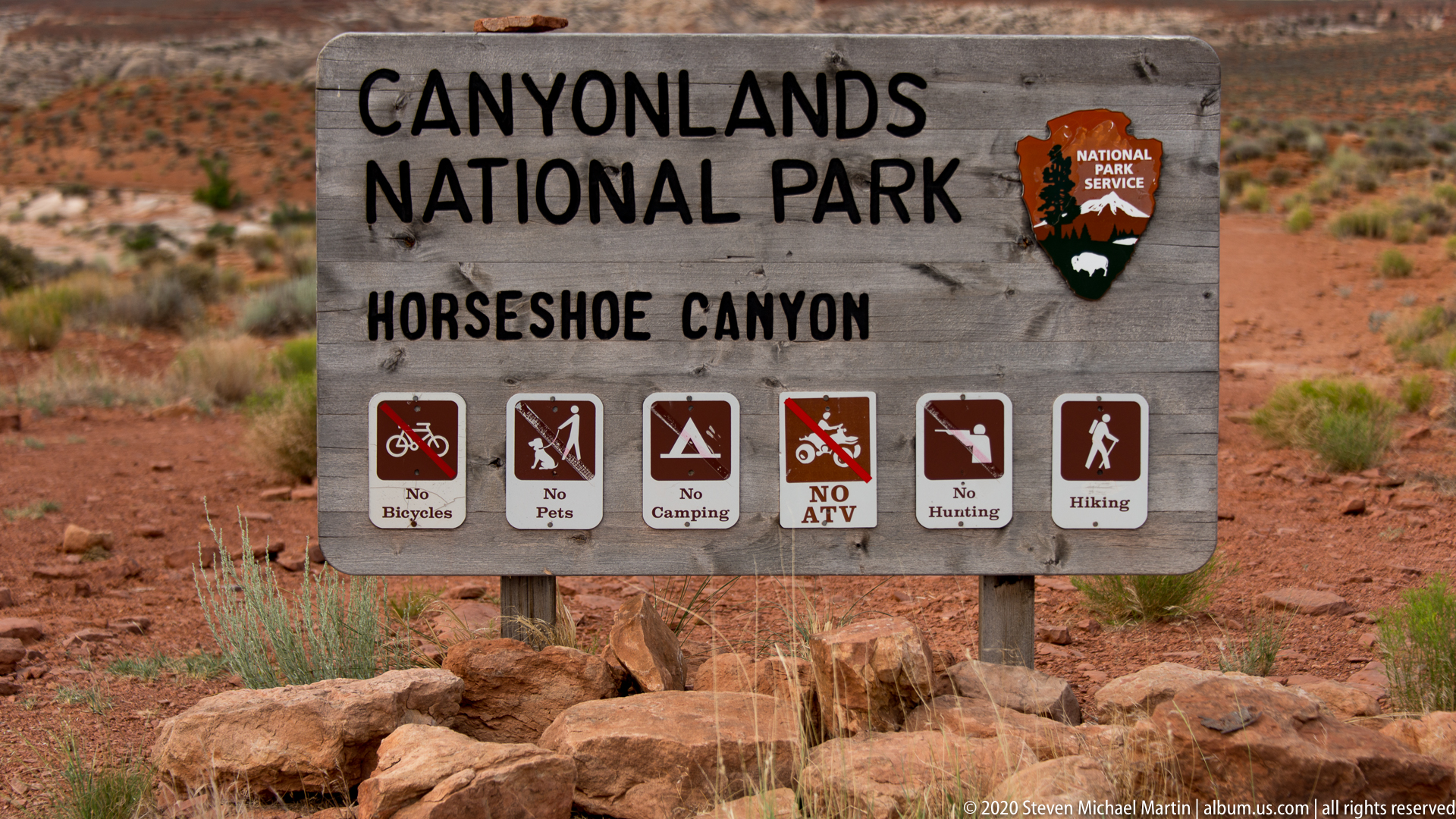
The entrance sign’s lower panels show restrictions on bicycles, pets, camping, ATVs, and hunting, alongside a hiking symbol. The wooden sign fills most of the frame, with red soil and pale shrubs visible around its edges. This close view makes the activity rules legible and distinguishes the specific land-use guidance from the wider park identification sign.
Caption
The entrance sign’s lower panels show restrictions on bicycles, pets, camping, ATVs, and hunting, alongside a hiking symbol. The wooden sign fills most of the frame, with red soil and pale shrubs visible around its edges. This close view makes the activity rules legible and distinguishes the specific land-use guidance from the wider park identification sign.
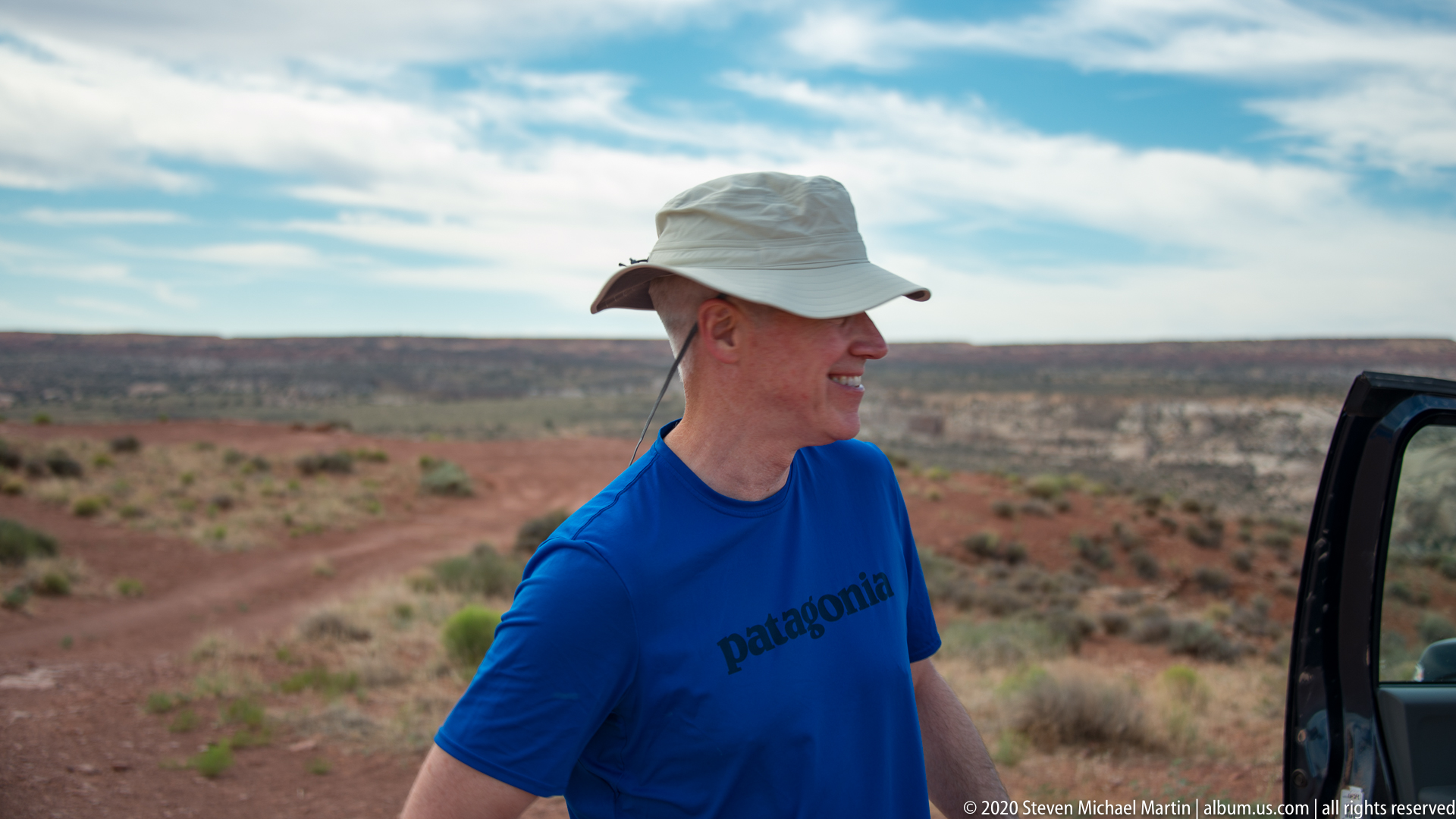
A man wearing a pale sun hat and blue shirt stands beside an open vehicle door, smiling as he looks to the right. Behind him, a reddish track crosses sparse desert vegetation toward a low mesa horizon. The waist-up composition places a visitor at the canyon approach, with the vehicle and open terrain suggesting arrival before a hike.
Caption
A man wearing a pale sun hat and blue shirt stands beside an open vehicle door, smiling as he looks to the right. Behind him, a reddish track crosses sparse desert vegetation toward a low mesa horizon. The waist-up composition places a visitor at the canyon approach, with the vehicle and open terrain suggesting arrival before a hike.
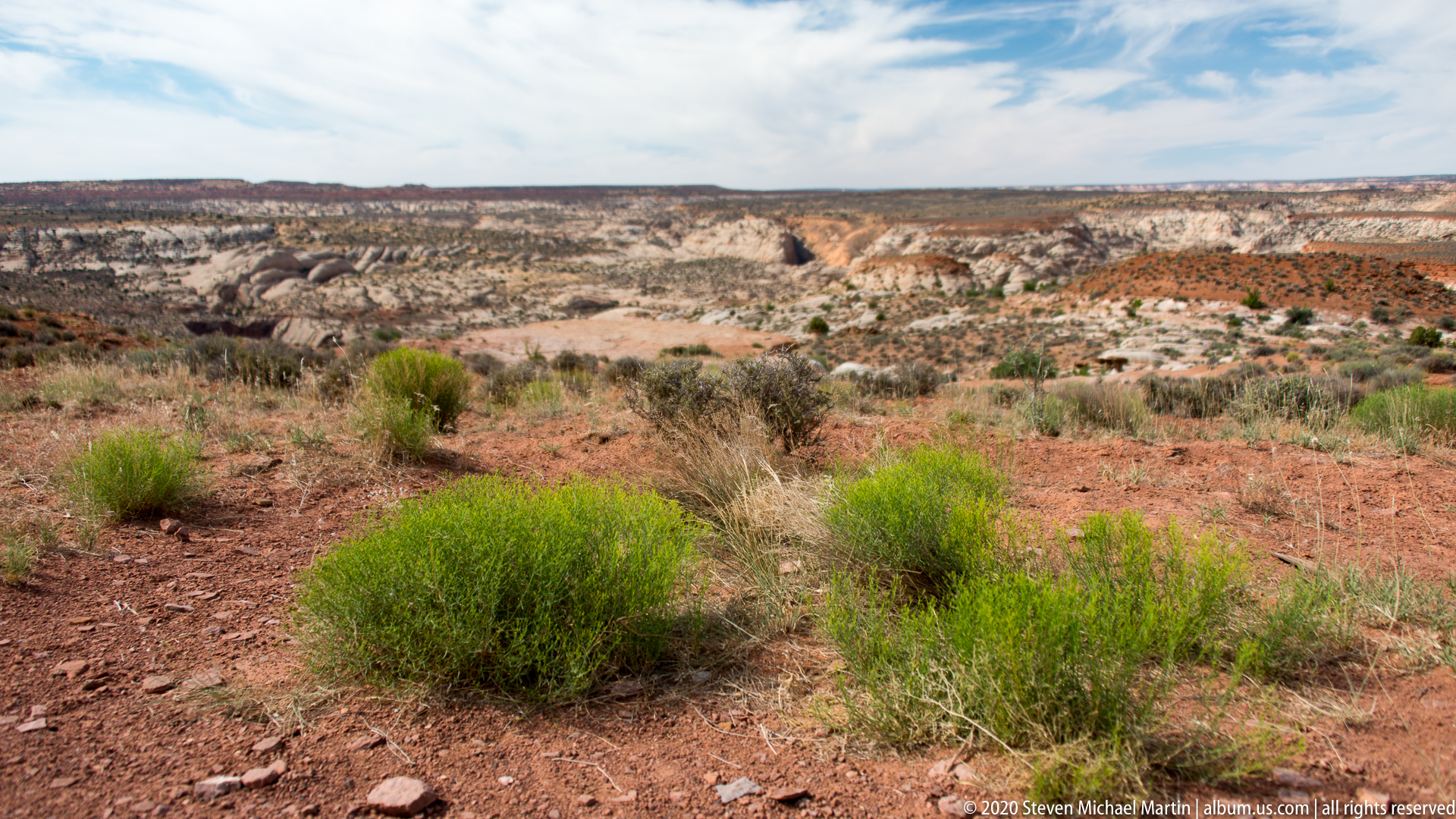
Low desert shrubs punctuate a red-soil bench above a broad, eroded basin. Pale sandstone ribs and broken canyon walls extend toward a flat horizon, while a strip of clouded blue sky opens above the scene. The foreground vegetation gives scale to the sparsely covered ground and contrasts with the exposed layers of rock across the distant slopes.
Caption
Low desert shrubs punctuate a red-soil bench above a broad, eroded basin. Pale sandstone ribs and broken canyon walls extend toward a flat horizon, while a strip of clouded blue sky opens above the scene. The foreground vegetation gives scale to the sparsely covered ground and contrasts with the exposed layers of rock across the distant slopes.

Broad, pale sandstone slabs step down a shallow slope, their bedding planes forming a series of uneven ledges. Small shrubs and young trees grow in cracks between the rocks, while rounded boulders rise along the skyline. The close viewpoint isolates the texture and layered structure of the slickrock rather than the canyon panorama beyond it.
Caption
Broad, pale sandstone slabs step down a shallow slope, their bedding planes forming a series of uneven ledges. Small shrubs and young trees grow in cracks between the rocks, while rounded boulders rise along the skyline. The close viewpoint isolates the texture and layered structure of the slickrock rather than the canyon panorama beyond it.

A rounded sandstone rise occupies the upper center of the frame, its sloping face marked by parallel bedding and weathered grooves. Fractured slickrock shelves descend toward the camera, with scattered shrubs growing in the narrow joints. The upward angle emphasizes the changing scale between the broad dome and the broken stone steps in front.
Caption
A rounded sandstone rise occupies the upper center of the frame, its sloping face marked by parallel bedding and weathered grooves. Fractured slickrock shelves descend toward the camera, with scattered shrubs growing in the narrow joints. The upward angle emphasizes the changing scale between the broad dome and the broken stone steps in front.
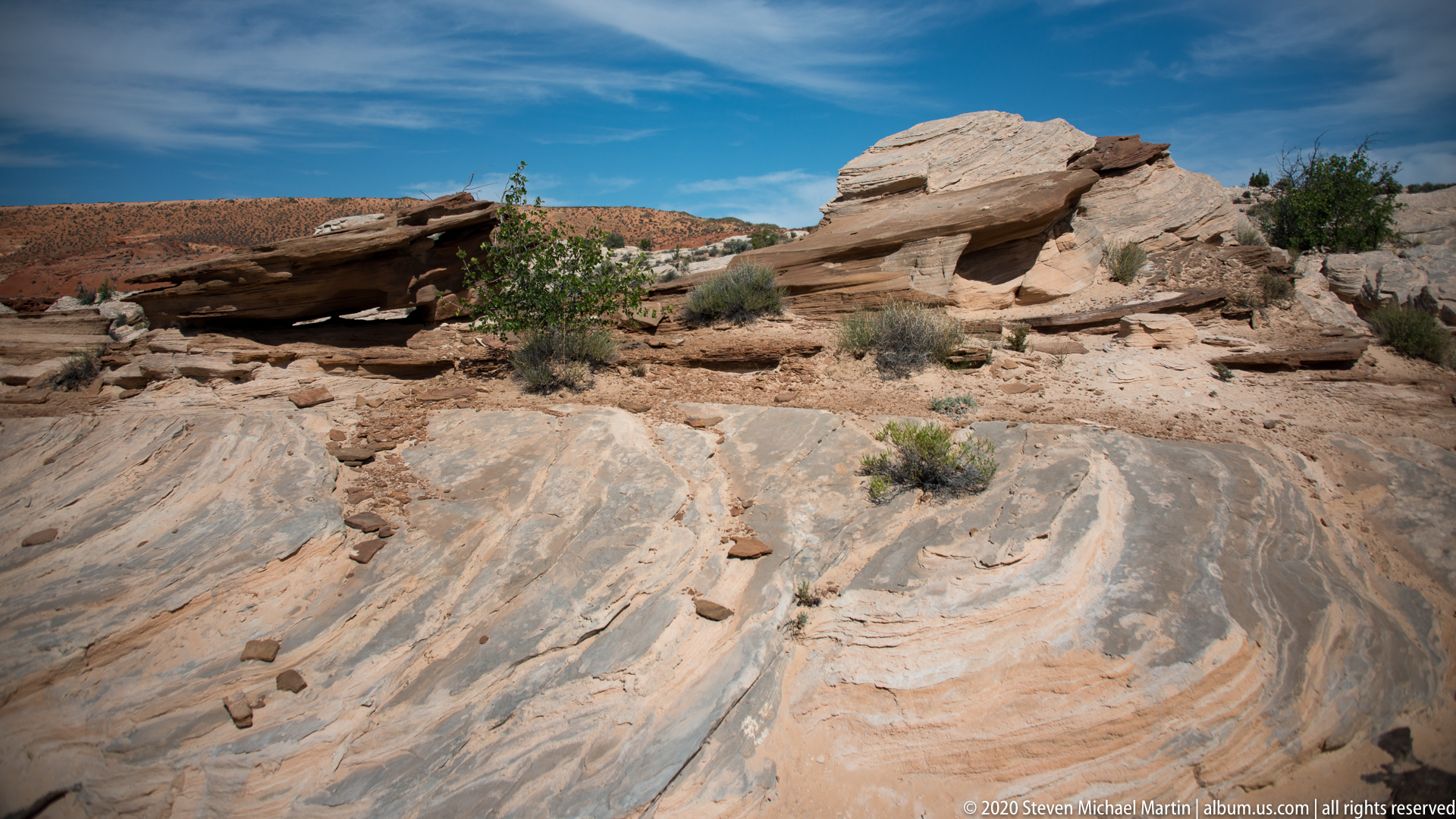
Smooth, sloping sandstone fills the foreground, its pale surface streaked with curved bands and shallow channels. A low shelf of darker, layered rock crosses the middle distance, where a small tree and shrubs emerge from cracks. Beyond the ledge, red ground and a low plateau frame the exposed slickrock, showing how erosion has shaped both the surface and its edges.
Caption
Smooth, sloping sandstone fills the foreground, its pale surface streaked with curved bands and shallow channels. A low shelf of darker, layered rock crosses the middle distance, where a small tree and shrubs emerge from cracks. Beyond the ledge, red ground and a low plateau frame the exposed slickrock, showing how erosion has shaped both the surface and its edges.

Two rounded sandstone masses rise above a sandy wash, their faces carved into shallow pockets and overhanging lips. Darker recesses punctuate the pale orange stone, while low desert plants cluster at the base. The frontal view reveals the sculpted hollows and weathered contours of the outcrop against a deep blue sky.
Caption
Two rounded sandstone masses rise above a sandy wash, their faces carved into shallow pockets and overhanging lips. Darker recesses punctuate the pale orange stone, while low desert plants cluster at the base. The frontal view reveals the sculpted hollows and weathered contours of the outcrop against a deep blue sky.
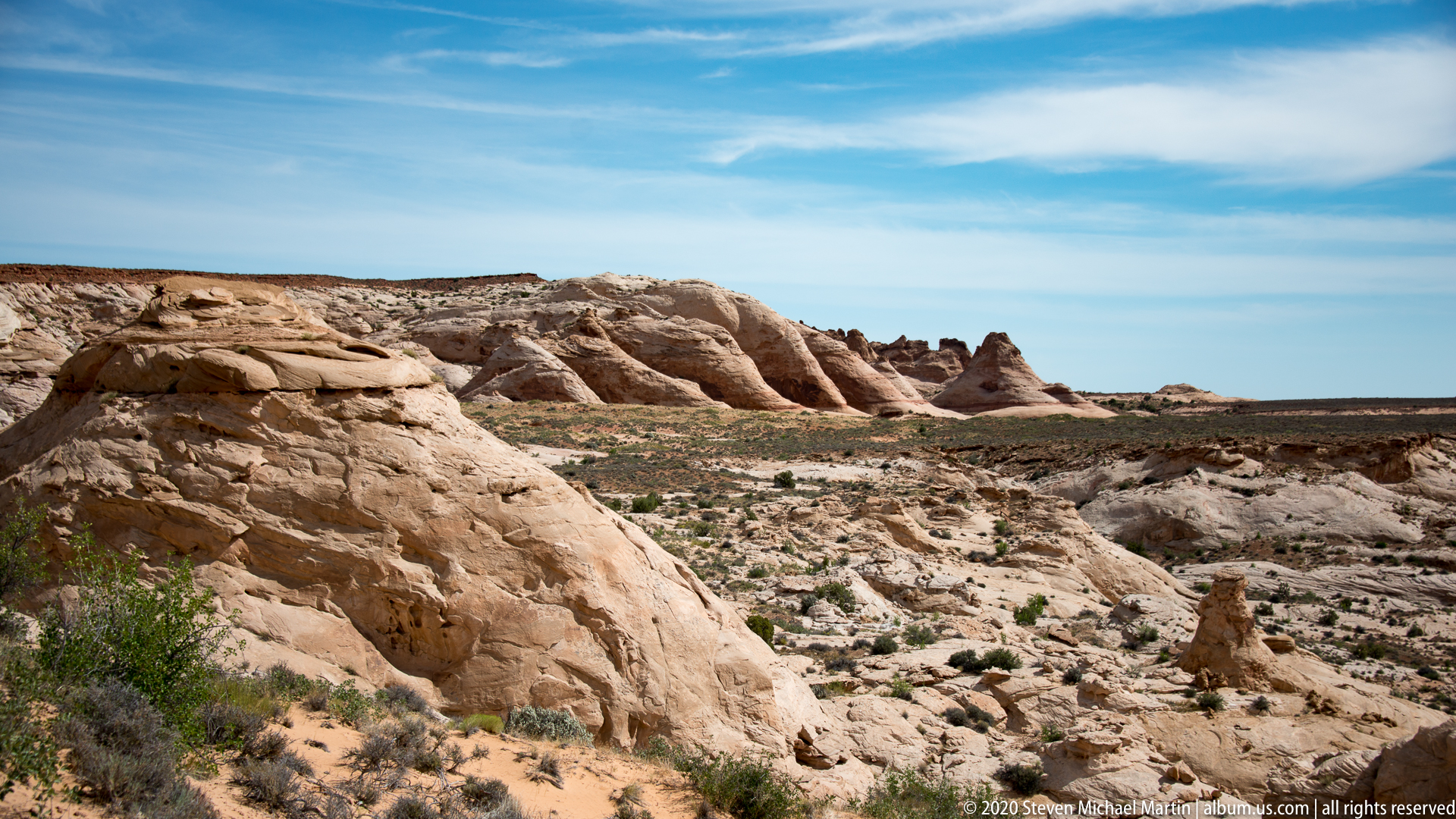
A pale sandstone shelf fills the left foreground and drops toward a broad basin of pale, deeply eroded ridges. Long horizontal bands of red and cream rock run across the middle distance, with scattered shrubs marking the open ground below. This elevated view places the nearby outcrop beside the larger landscape of layered canyon walls.
Caption
A pale sandstone shelf fills the left foreground and drops toward a broad basin of pale, deeply eroded ridges. Long horizontal bands of red and cream rock run across the middle distance, with scattered shrubs marking the open ground below. This elevated view places the nearby outcrop beside the larger landscape of layered canyon walls.

A rough wooden split-rail fence runs across the skyline, marking the edge of a rocky approach through low desert vegetation. Uneven sandstone slabs and gravelly soil fill the foreground, while wispy clouds spread above the barrier. The fence creates a clear horizontal boundary between the walking surface and the open plateau beyond.
Caption
A rough wooden split-rail fence runs across the skyline, marking the edge of a rocky approach through low desert vegetation. Uneven sandstone slabs and gravelly soil fill the foreground, while wispy clouds spread above the barrier. The fence creates a clear horizontal boundary between the walking surface and the open plateau beyond.
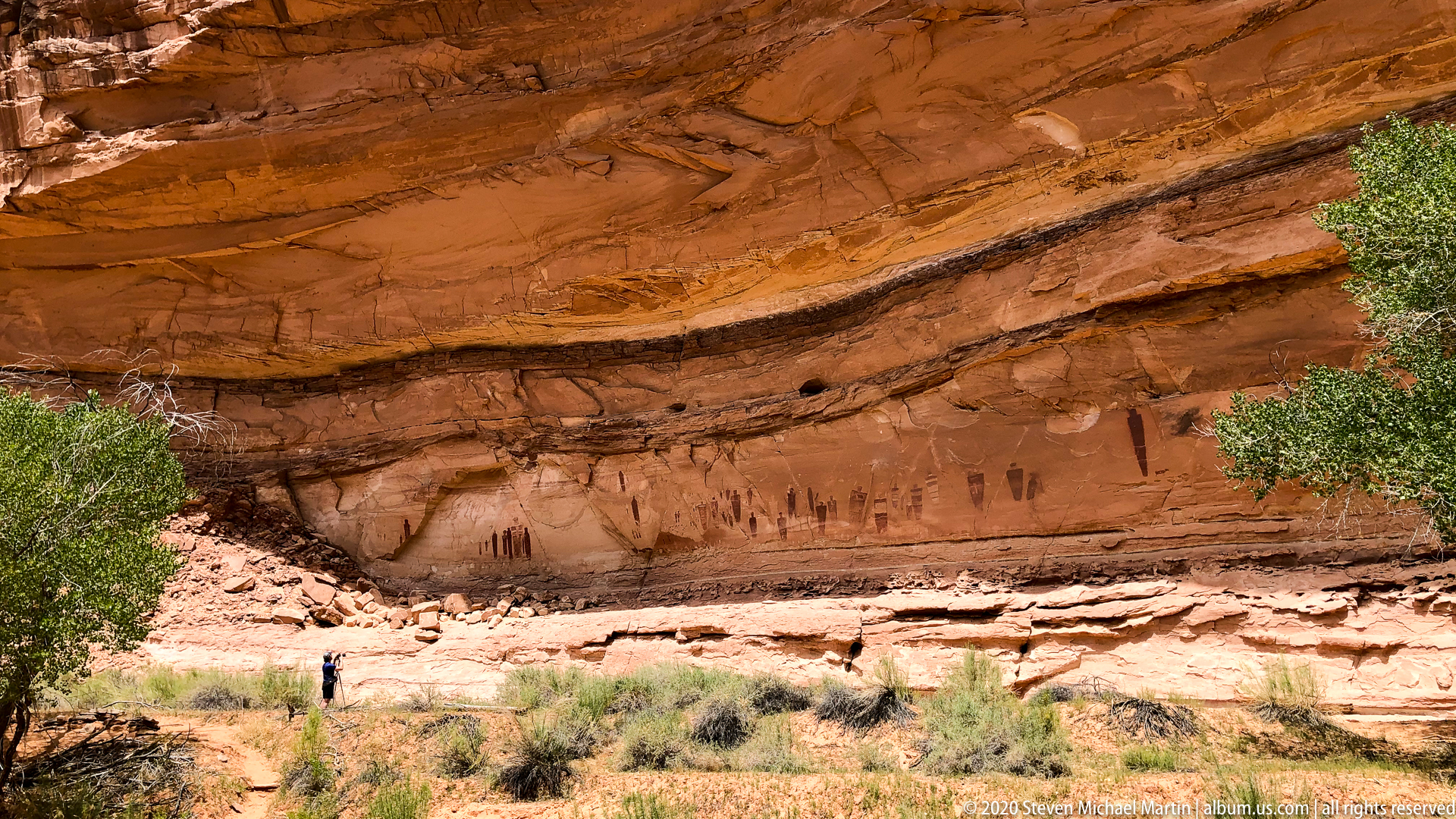
A long sandstone wall carries a band of dark red and brown pictographs beneath a projecting ledge. Elongated humanlike figures and smaller marks line the lower rock face, while a lone visitor stands on the sandy ground below and gives the panel scale. The wide view shows the paintings in relation to the sheltering wall and the open canyon floor.
Caption
A long sandstone wall carries a band of dark red and brown pictographs beneath a projecting ledge. Elongated humanlike figures and smaller marks line the lower rock face, while a lone visitor stands on the sandy ground below and gives the panel scale. The wide view shows the paintings in relation to the sheltering wall and the open canyon floor.
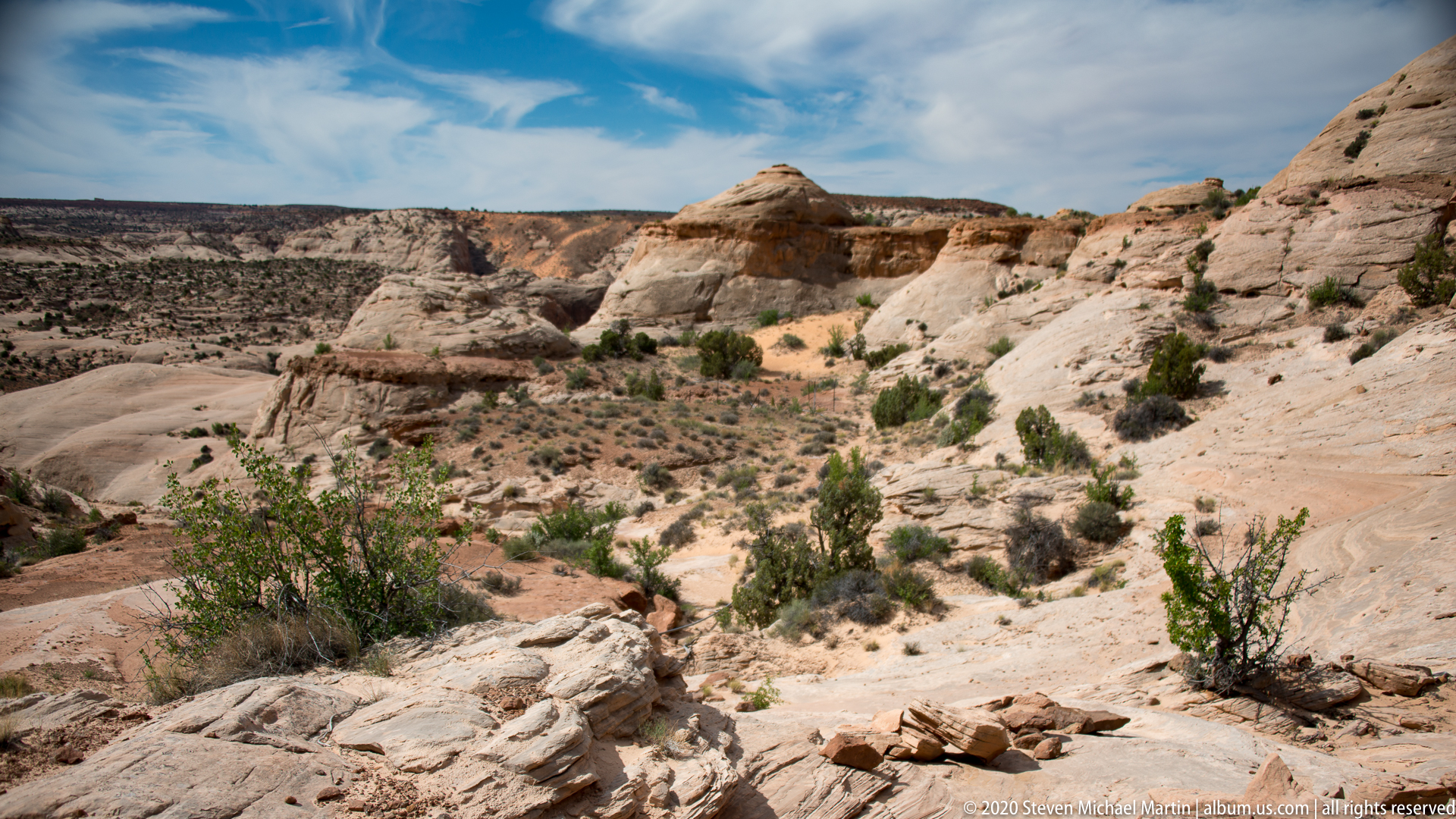
Pale rock shelves descend from the foreground into a shallow basin bordered by rounded sandstone outcrops. Patches of low shrubs trace the drainage and breaks in the stone, while dark, layered canyon walls stretch across the far horizon. The sloping viewpoint connects the nearby slickrock with the wider terrain beyond.
Caption
Pale rock shelves descend from the foreground into a shallow basin bordered by rounded sandstone outcrops. Patches of low shrubs trace the drainage and breaks in the stone, while dark, layered canyon walls stretch across the far horizon. The sloping viewpoint connects the nearby slickrock with the wider terrain beyond.
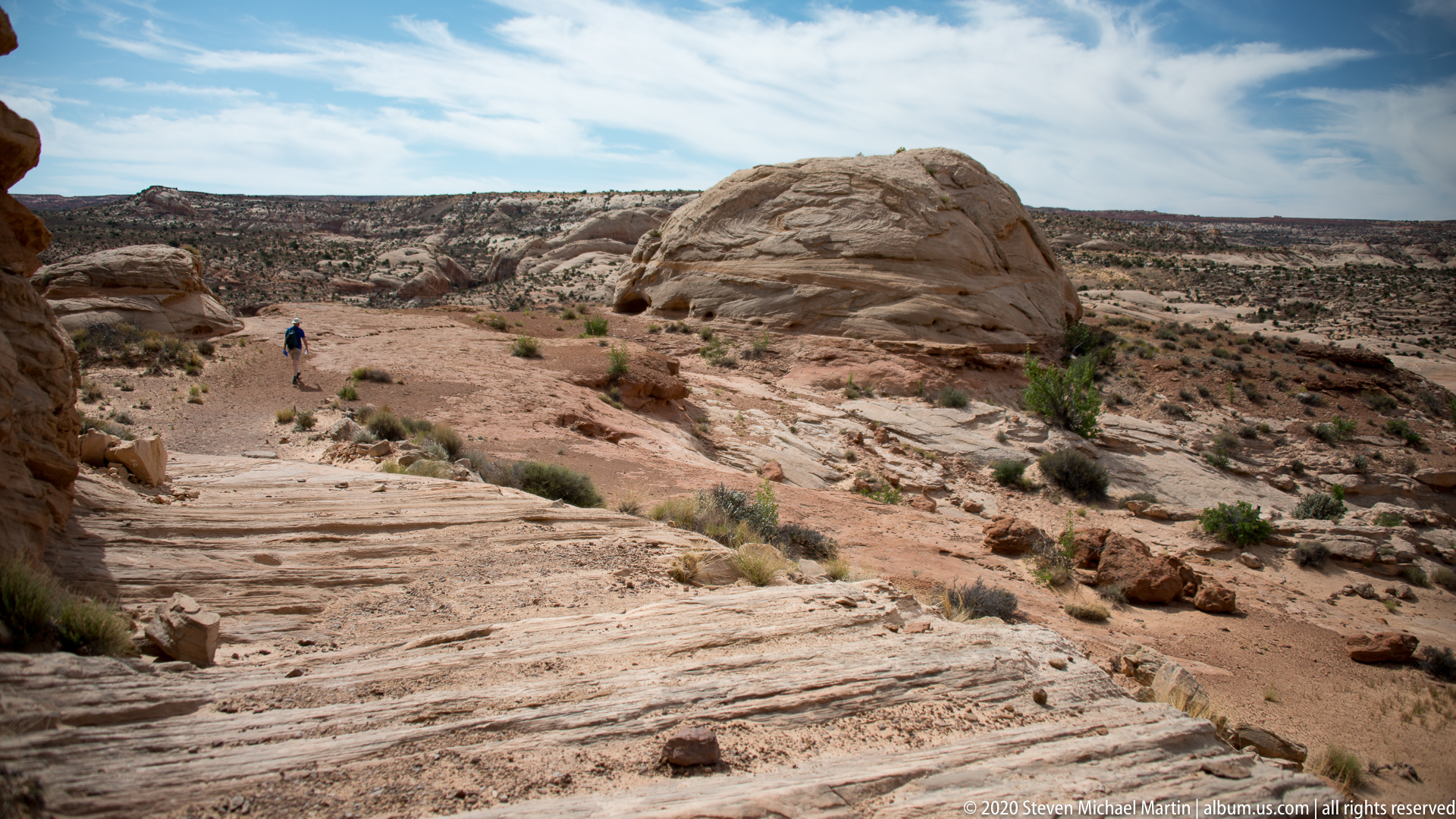
A lone hiker walks across a sandy, rock-strewn route toward a large rounded sandstone dome. Layered shelves descend across the foreground, and a dark canyon rim stretches across the background. The human figure is small against the formation, making the scale of the dome and the open distance between trail and rock especially clear.
Caption
A lone hiker walks across a sandy, rock-strewn route toward a large rounded sandstone dome. Layered shelves descend across the foreground, and a dark canyon rim stretches across the background. The human figure is small against the formation, making the scale of the dome and the open distance between trail and rock especially clear.
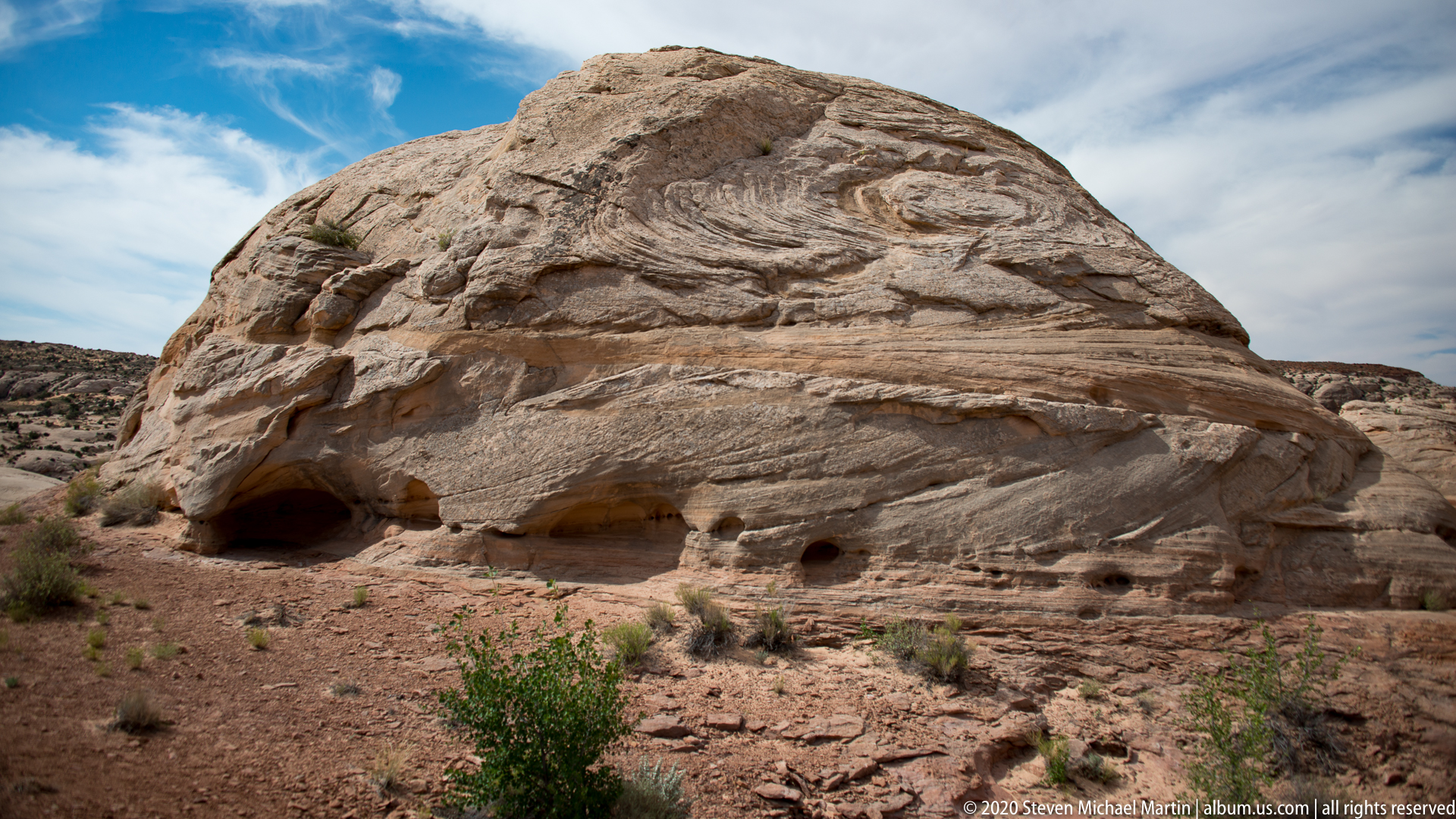
A broad, pale sandstone dome fills the view, its curved face patterned by thin horizontal layers and darker weathering lines. Several shallow cavities open along its base, partly shadowed above the sandy ground. Shrubs at the foot of the rock and the low canyon rim behind it place the close formation within the dry landscape.
Caption
A broad, pale sandstone dome fills the view, its curved face patterned by thin horizontal layers and darker weathering lines. Several shallow cavities open along its base, partly shadowed above the sandy ground. Shrubs at the foot of the rock and the low canyon rim behind it place the close formation within the dry landscape.
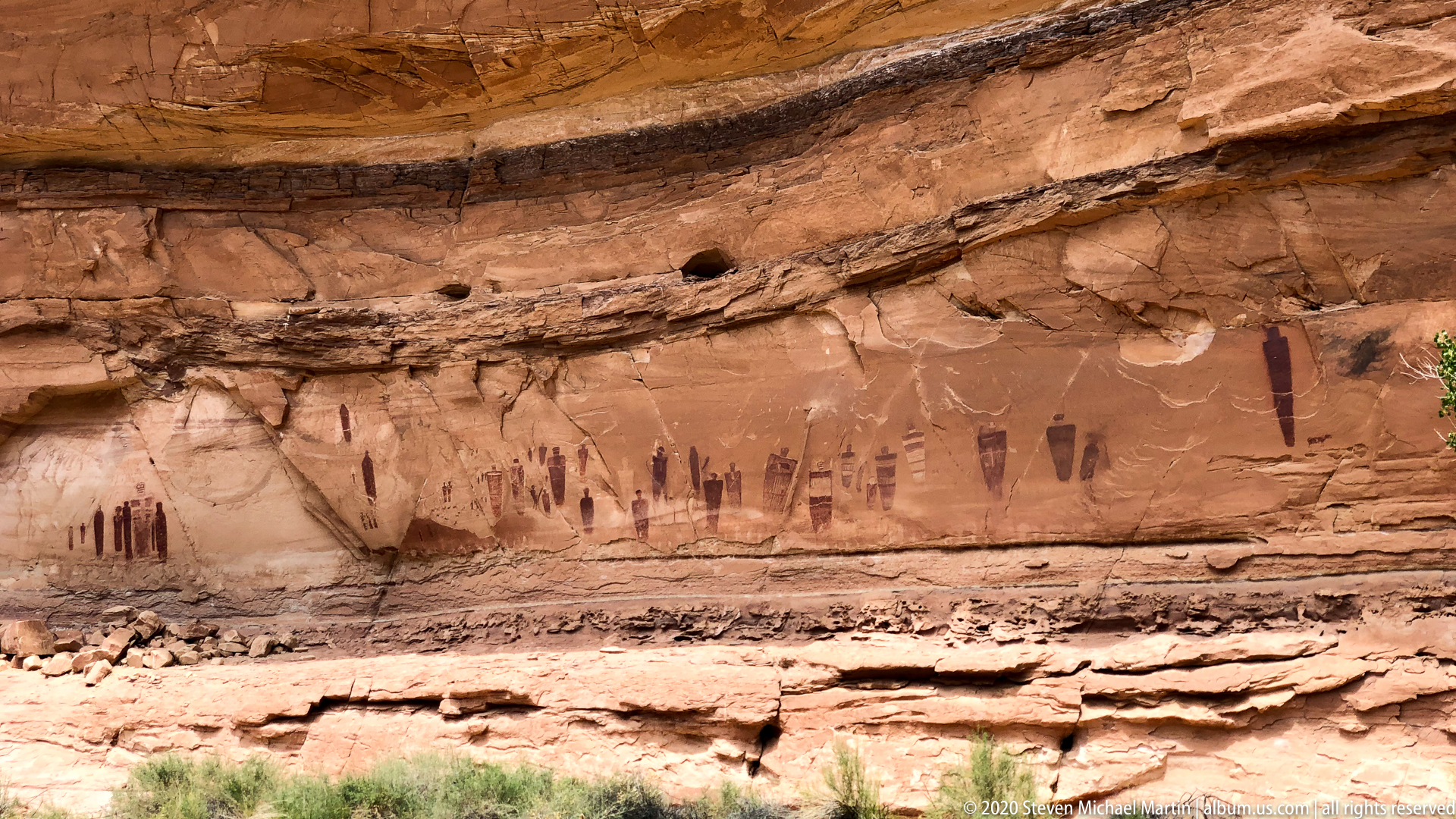
Dark red-brown figures and marks form a horizontal band across a warm sandstone panel beneath a pronounced rock layer. Several tall, narrow forms stand beside smaller shapes, and the close crop reveals irregular outlines and worn pigment against the rough stone. The frame concentrates on the painted surface and its stratified setting rather than the full shelter.
Caption
Dark red-brown figures and marks form a horizontal band across a warm sandstone panel beneath a pronounced rock layer. Several tall, narrow forms stand beside smaller shapes, and the close crop reveals irregular outlines and worn pigment against the rough stone. The frame concentrates on the painted surface and its stratified setting rather than the full shelter.
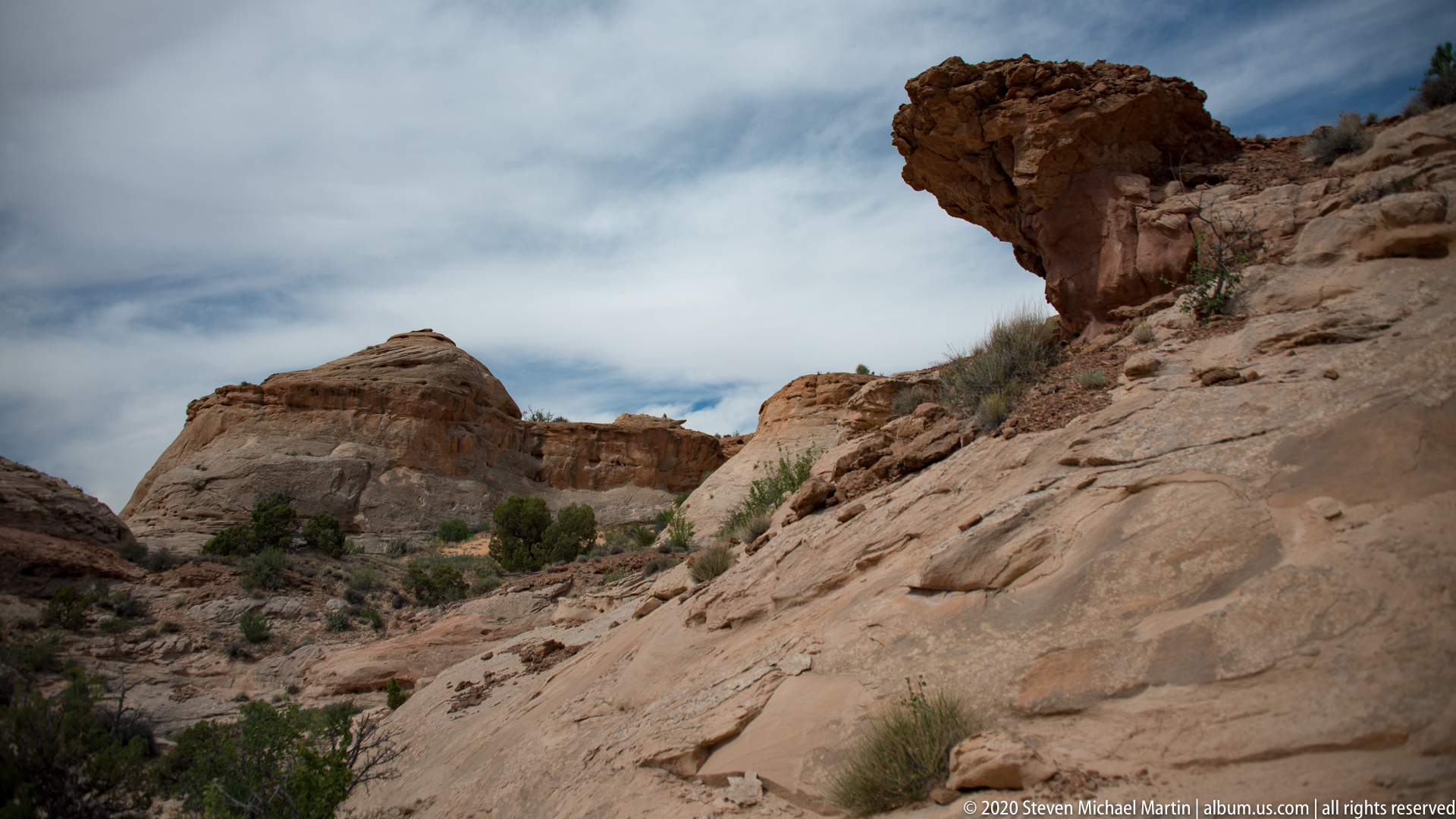
A massive dark-edged sandstone ledge projects over the sloping face of a pale outcrop. The rock rises from a narrow canyon passage where shrubs occupy the lower cracks, while a bright, clouded sky outlines the overhang. The upward view makes the ledge’s projection and the steep, smooth rock beneath it the defining features.
Caption
A massive dark-edged sandstone ledge projects over the sloping face of a pale outcrop. The rock rises from a narrow canyon passage where shrubs occupy the lower cracks, while a bright, clouded sky outlines the overhang. The upward view makes the ledge’s projection and the steep, smooth rock beneath it the defining features.
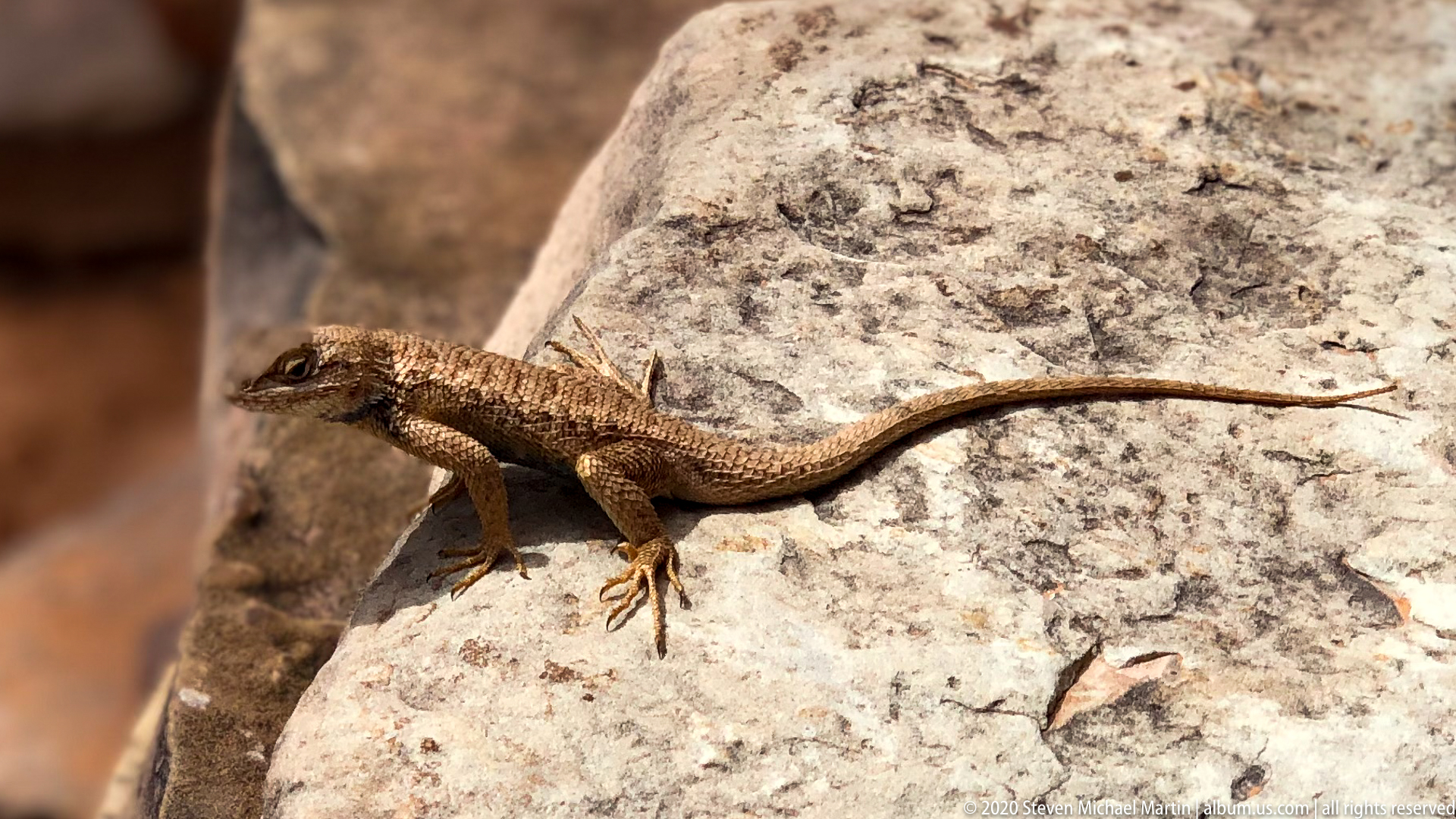
A brown, long-tailed lizard rests on a sunlit pale rock, its body stretched horizontally and its toes spread against the rough surface. The head faces left, while the tail extends almost to the right edge of the frame. Shallow focus softens the surrounding stones and keeps attention on the animal’s patterned scales and alert posture.
Caption
A brown, long-tailed lizard rests on a sunlit pale rock, its body stretched horizontally and its toes spread against the rough surface. The head faces left, while the tail extends almost to the right edge of the frame. Shallow focus softens the surrounding stones and keeps attention on the animal’s patterned scales and alert posture.
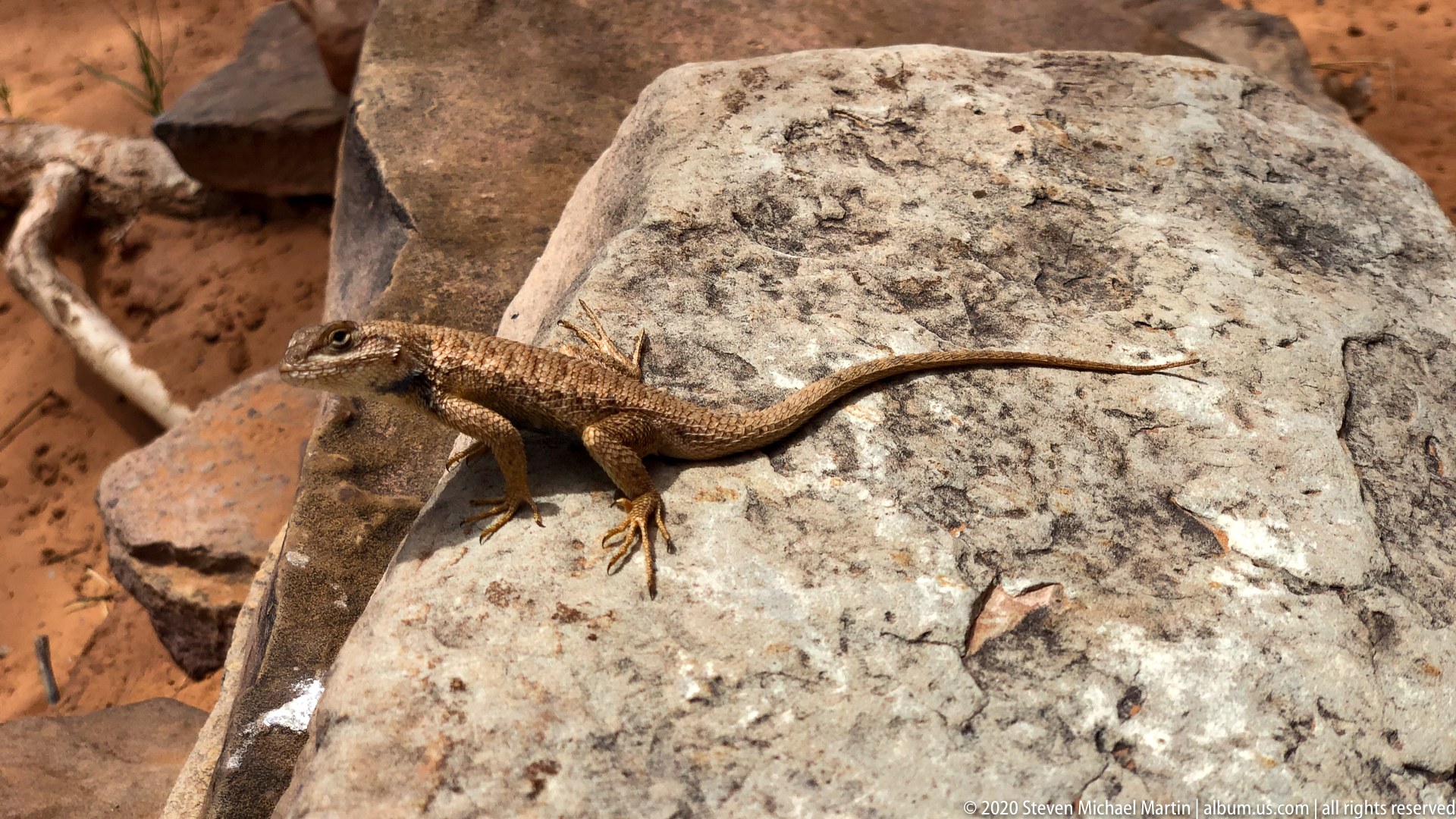
A brown lizard stands across a pale slab bordered by angular sandstone fragments. Its head points left and its narrow tail curves toward the right, while its legs brace against the uneven surface. The wider framing includes the broken rocks surrounding the animal, showing how its patterned body blends into the canyon’s warm stone.
Caption
A brown lizard stands across a pale slab bordered by angular sandstone fragments. Its head points left and its narrow tail curves toward the right, while its legs brace against the uneven surface. The wider framing includes the broken rocks surrounding the animal, showing how its patterned body blends into the canyon’s warm stone.
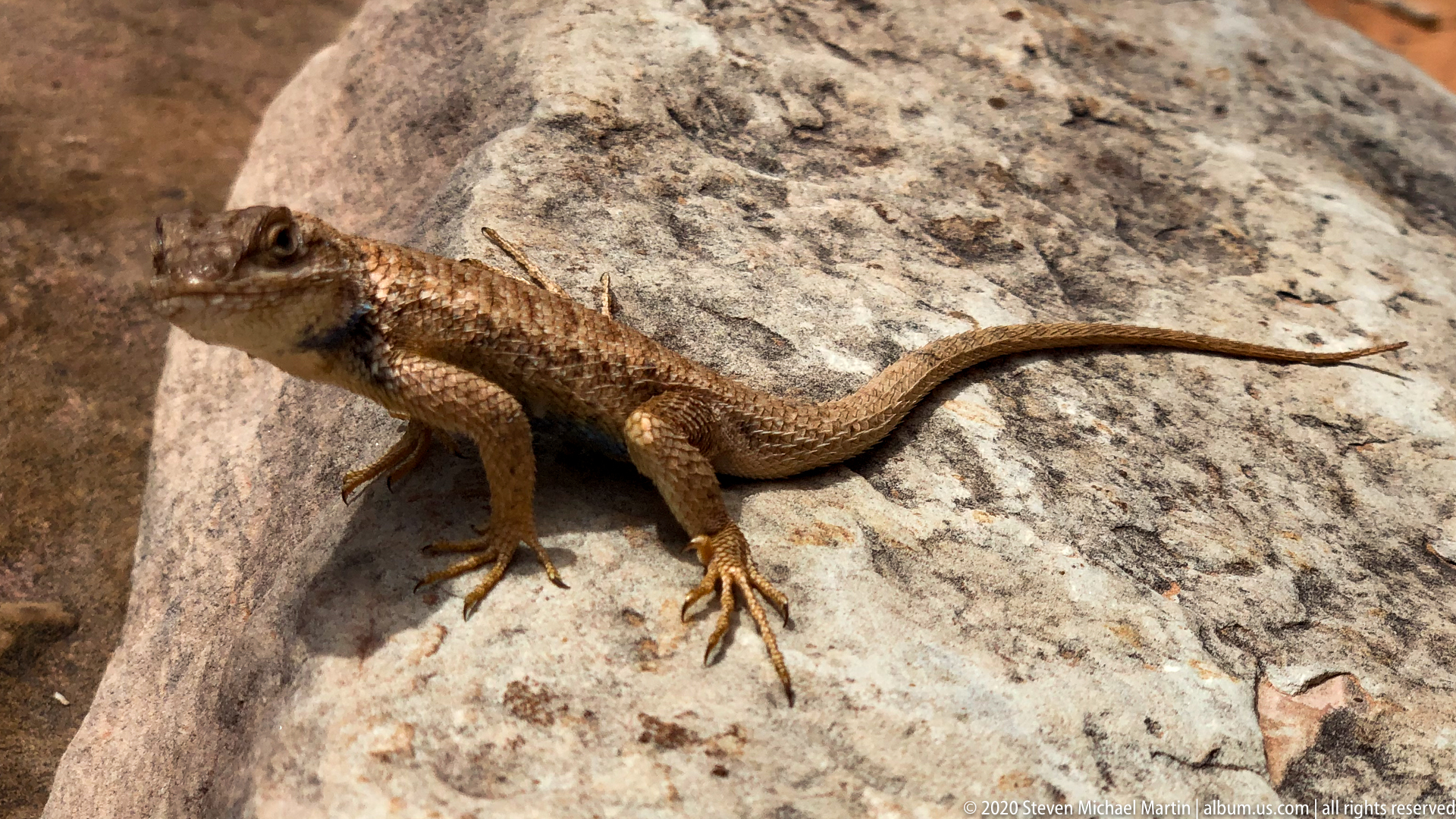
The lizard fills more of the frame, its mottled brown scales, splayed feet, and long tail sharply visible against pale sandstone. Its head is turned slightly toward the left edge, and the body follows a shallow diagonal across the rock. This close portrait isolates the animal’s texture and posture from the surrounding landscape.
Caption
The lizard fills more of the frame, its mottled brown scales, splayed feet, and long tail sharply visible against pale sandstone. Its head is turned slightly toward the left edge, and the body follows a shallow diagonal across the rock. This close portrait isolates the animal’s texture and posture from the surrounding landscape.
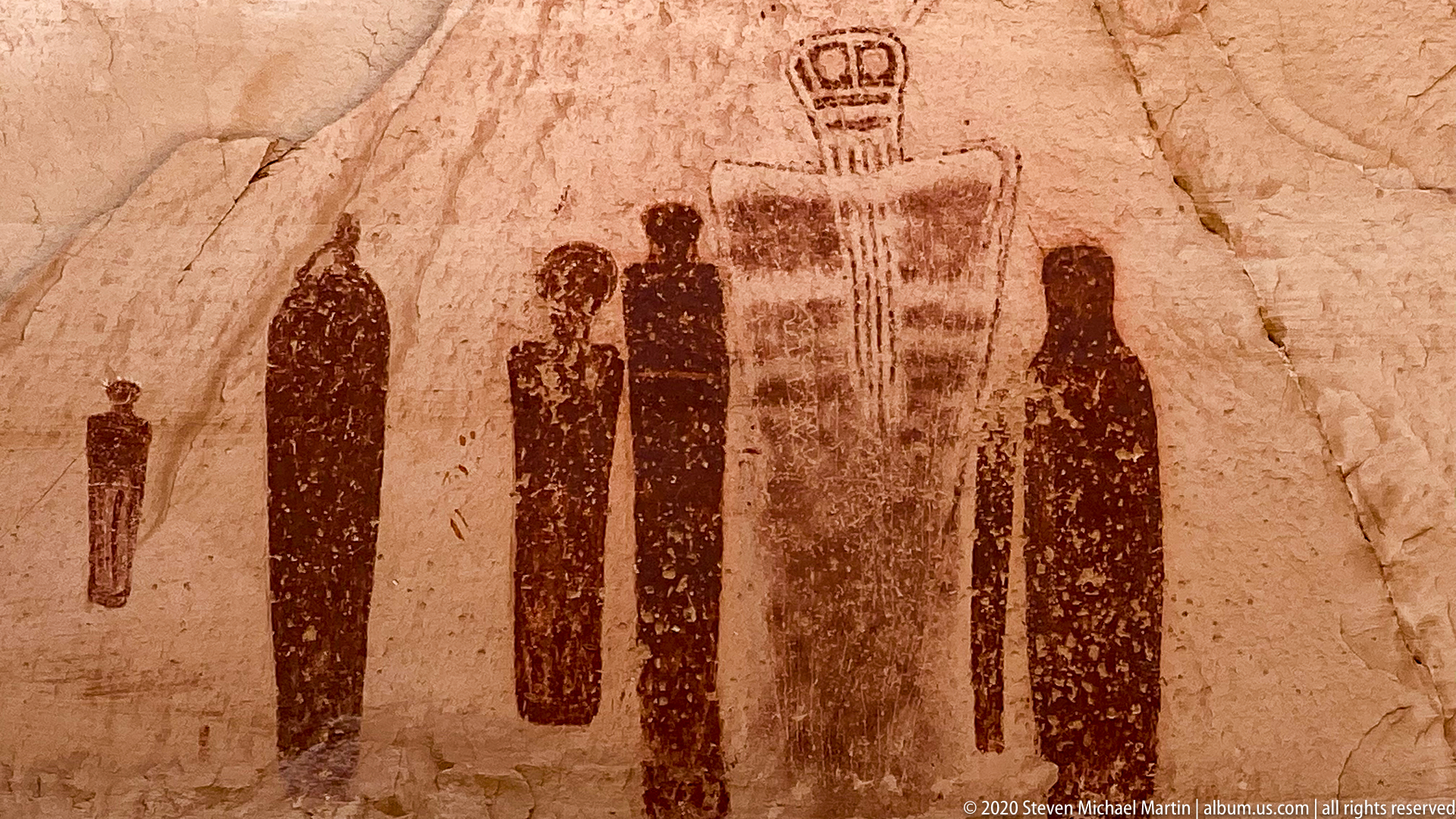
A row of dark, elongated figures stands around a broad central figure with a looped or crownlike element above its head. Smaller forms and faint marks extend toward the edge of the panel, while a vertical crack divides the sandstone surface. The frontal composition makes the contrast between the tall figures and the central motif especially prominent.
Caption
A row of dark, elongated figures stands around a broad central figure with a looped or crownlike element above its head. Smaller forms and faint marks extend toward the edge of the panel, while a vertical crack divides the sandstone surface. The frontal composition makes the contrast between the tall figures and the central motif especially prominent.
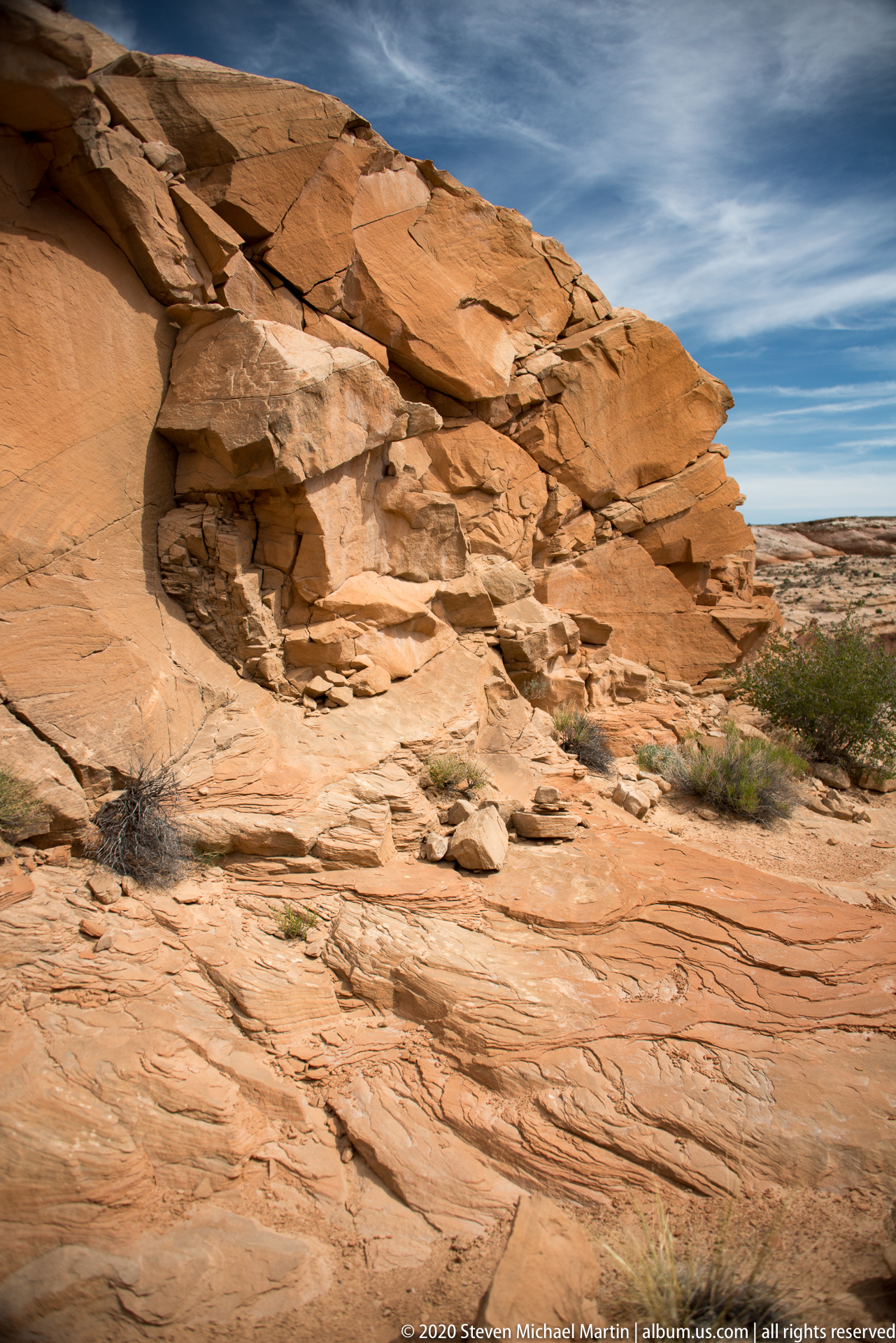
A low orange sandstone overhang projects from a layered outcrop, with broken slabs and angular fragments gathered at its base. The rock face shows alternating pale and rust-colored bands, while a small patch of blue sky and the flat canyon rim appear to the right. The side view reveals the ledge’s depth and the fractured slope below it.
Caption
A low orange sandstone overhang projects from a layered outcrop, with broken slabs and angular fragments gathered at its base. The rock face shows alternating pale and rust-colored bands, while a small patch of blue sky and the flat canyon rim appear to the right. The side view reveals the ledge’s depth and the fractured slope below it.
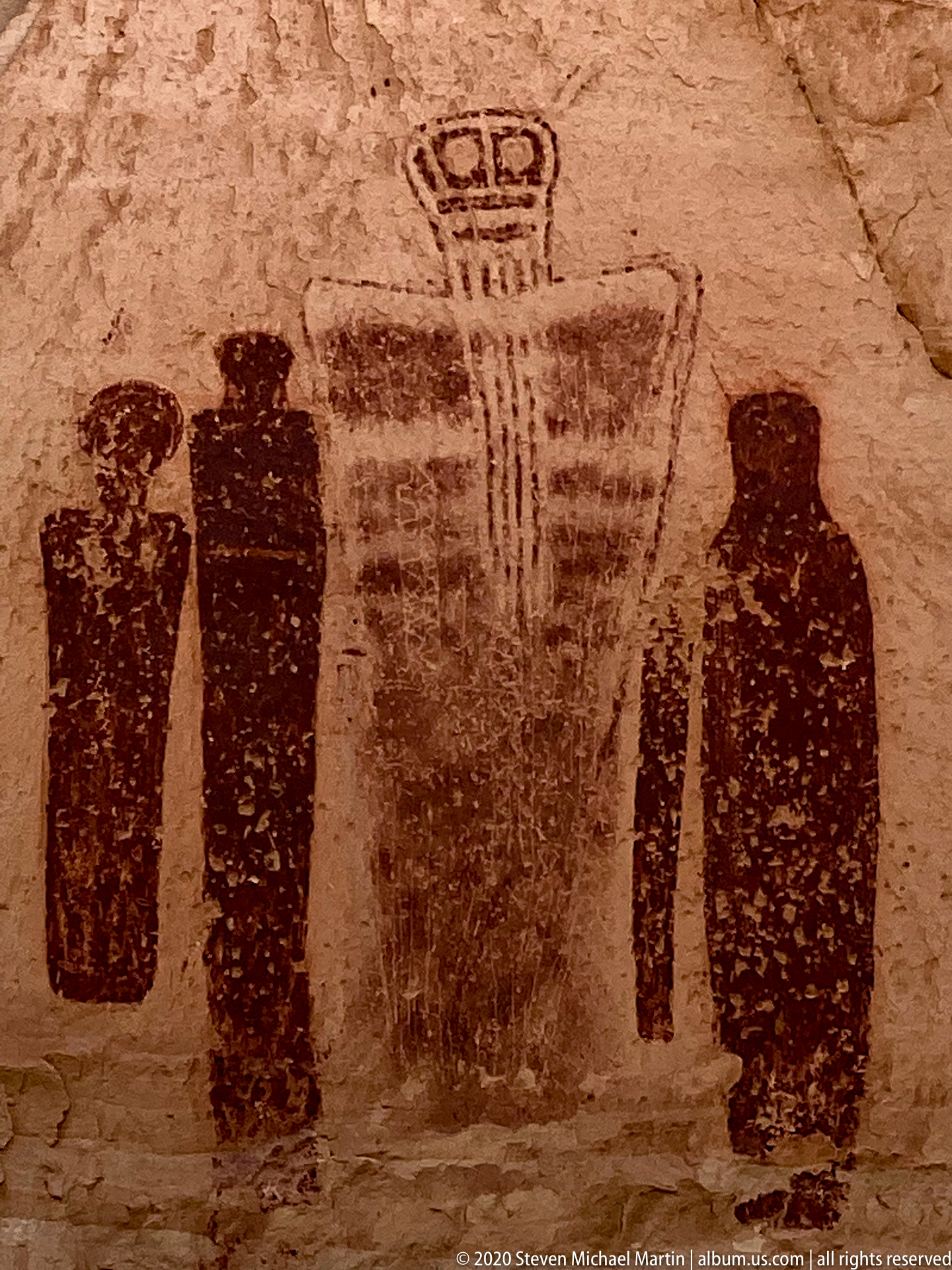
A large painted composition fills the sandstone surface: several dark, elongated figures flank a broad central form topped by a small looped design. Faded pigment and the irregular rock grain soften the outlines, while cracks run through the panel. The close, nearly frontal view presents the arrangement of figures and central motif without assigning identities or meanings.
Caption
A large painted composition fills the sandstone surface: several dark, elongated figures flank a broad central form topped by a small looped design. Faded pigment and the irregular rock grain soften the outlines, while cracks run through the panel. The close, nearly frontal view presents the arrangement of figures and central motif without assigning identities or meanings.

A low juniper grows from a sandy pocket between broad sandstone slabs, its dense dark-green canopy spreading over the pale rock. A fallen or exposed branch trails down the slope toward the foreground, where thin grass and shrubs emerge from cracks. The close ground-level view links resilient vegetation to the fractured slickrock terrain.
Caption
A low juniper grows from a sandy pocket between broad sandstone slabs, its dense dark-green canopy spreading over the pale rock. A fallen or exposed branch trails down the slope toward the foreground, where thin grass and shrubs emerge from cracks. The close ground-level view links resilient vegetation to the fractured slickrock terrain.
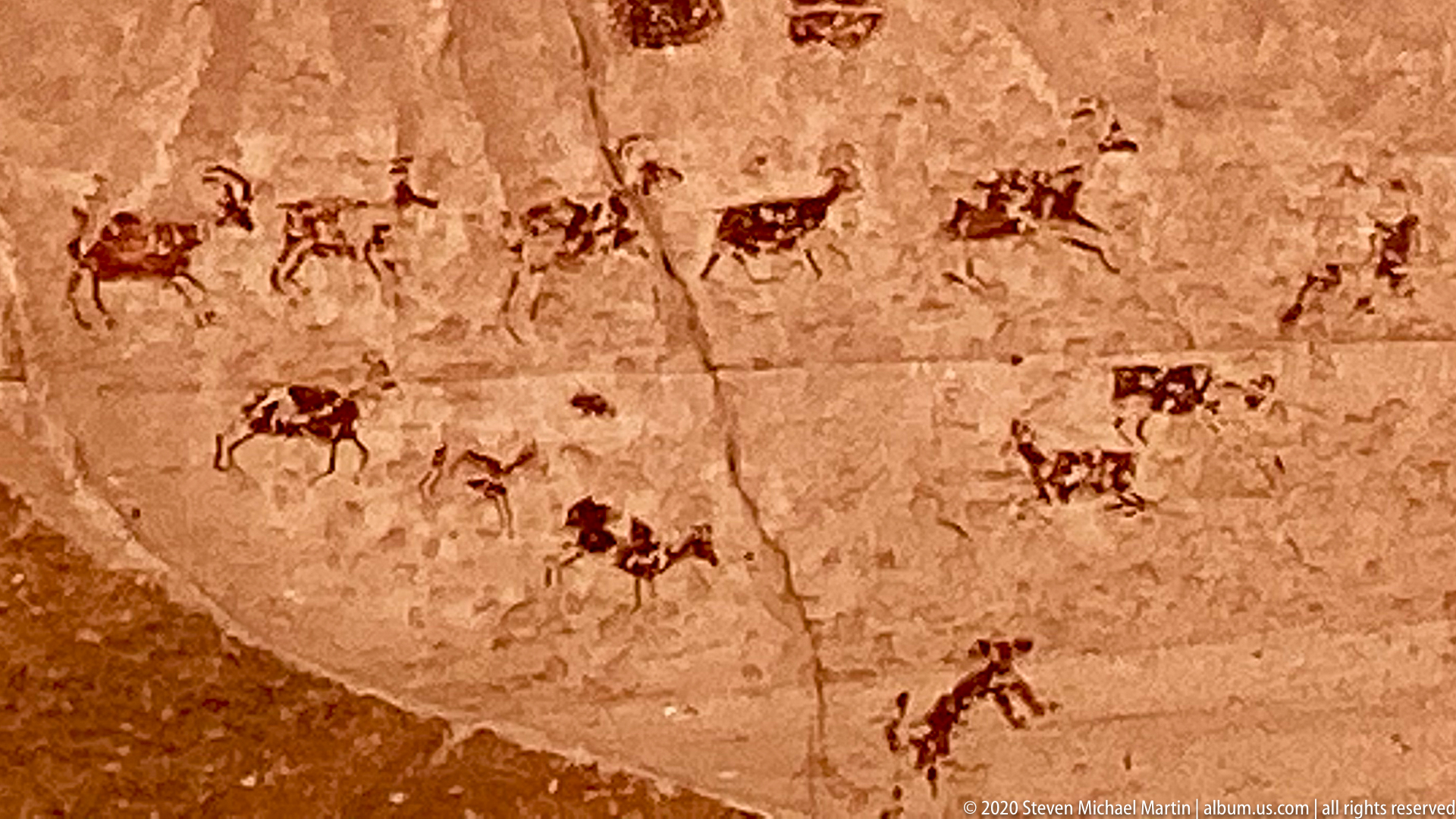
Small dark figures spread across a gently curving sandstone surface, including several animal-like shapes in the upper row and grouped marks below. A larger humanlike form appears near the lower right, separated from the smaller images by open rock. The close framing emphasizes the varied scale and spacing of the painted motifs.
Caption
Small dark figures spread across a gently curving sandstone surface, including several animal-like shapes in the upper row and grouped marks below. A larger humanlike form appears near the lower right, separated from the smaller images by open rock. The close framing emphasizes the varied scale and spacing of the painted motifs.
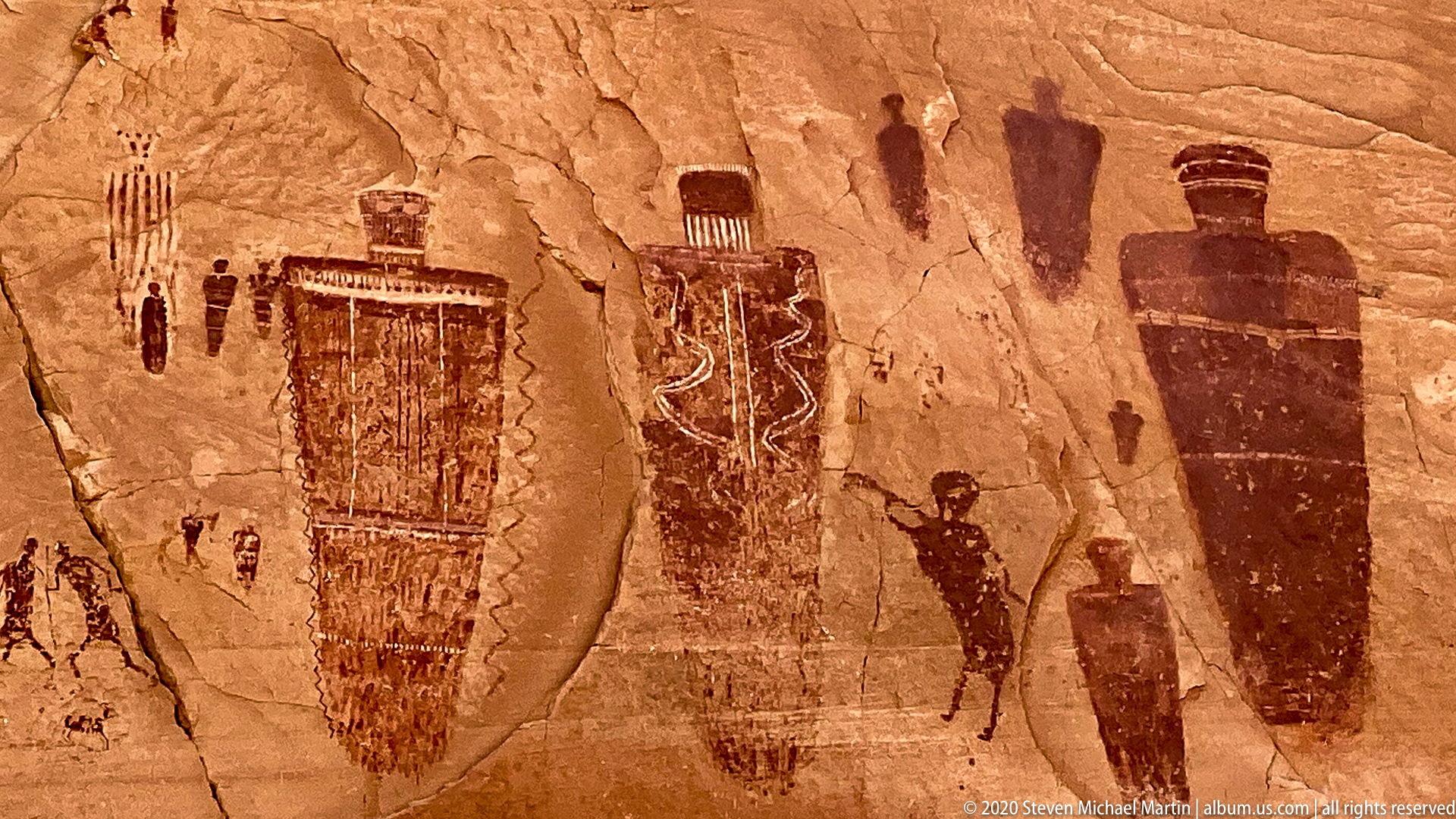
Tall dark figures with rectangular and tapered bodies occupy a densely painted section of the sandstone wall. Fine lines and geometric patterns fill several forms, while smaller figures and marks gather around their bases. The close composition reveals variation in scale and design across the panel, with pigment fading unevenly against the orange rock.
Caption
Tall dark figures with rectangular and tapered bodies occupy a densely painted section of the sandstone wall. Fine lines and geometric patterns fill several forms, while smaller figures and marks gather around their bases. The close composition reveals variation in scale and design across the panel, with pigment fading unevenly against the orange rock.
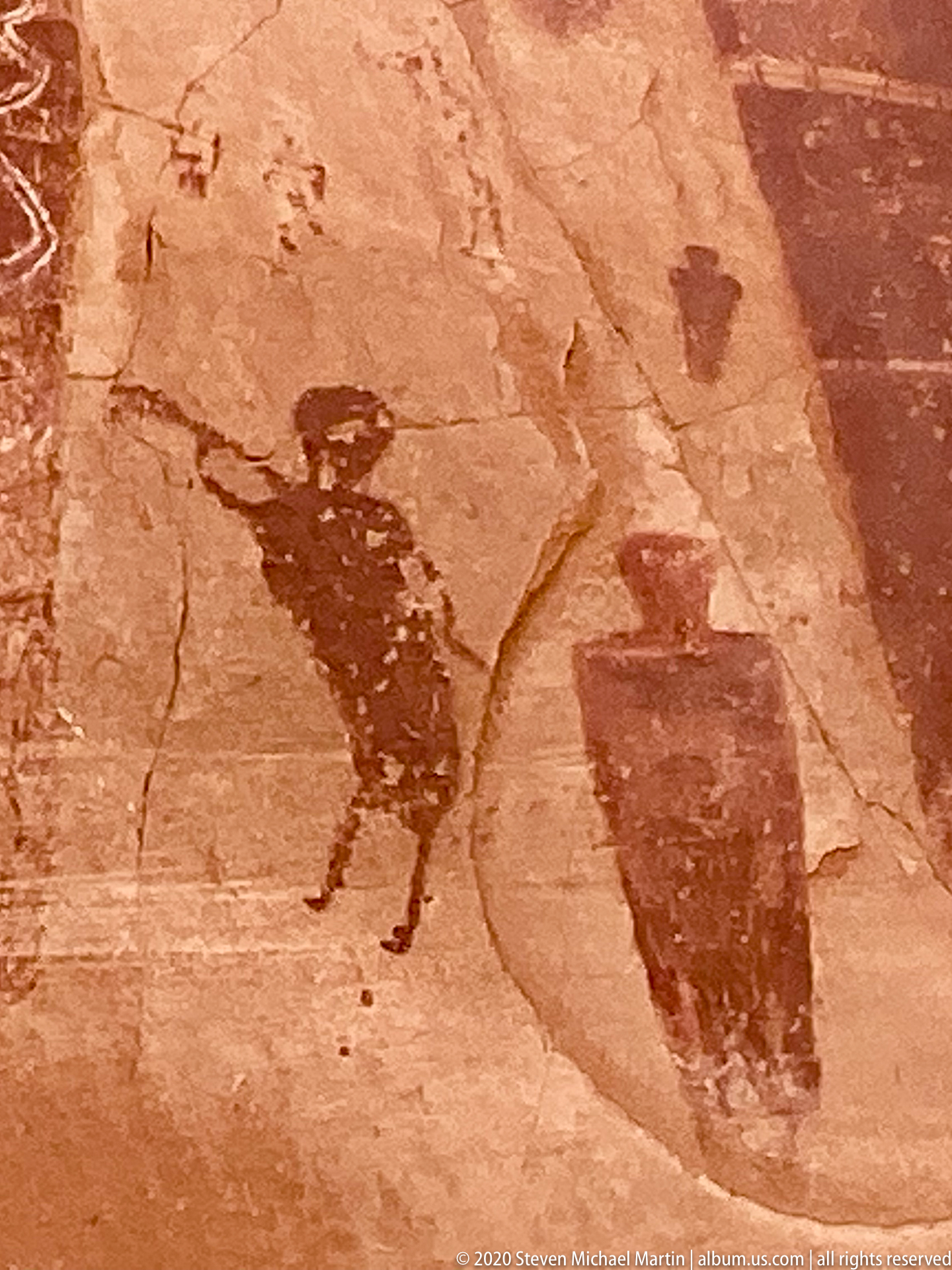
A dark, broad-bodied figure with a small head and extended limbs appears beside a second, blocklike painted form. The surrounding sandstone is crossed by fine cracks and faint pigment traces. This tight crop isolates the two neighboring motifs and their contrasting outlines, leaving the wider panel outside the frame.
Caption
A dark, broad-bodied figure with a small head and extended limbs appears beside a second, blocklike painted form. The surrounding sandstone is crossed by fine cracks and faint pigment traces. This tight crop isolates the two neighboring motifs and their contrasting outlines, leaving the wider panel outside the frame.

Two large dark painted forms dominate the sandstone: one broad and nearly solid, the other tapered with crossed lines and bands inside its outline. Smaller partial shapes appear near the edges of the frame. The close view emphasizes their contrasting silhouettes and surface patterns while the surrounding wall remains visible as a pale, cracked ground.
Caption
Two large dark painted forms dominate the sandstone: one broad and nearly solid, the other tapered with crossed lines and bands inside its outline. Smaller partial shapes appear near the edges of the frame. The close view emphasizes their contrasting silhouettes and surface patterns while the surrounding wall remains visible as a pale, cracked ground.
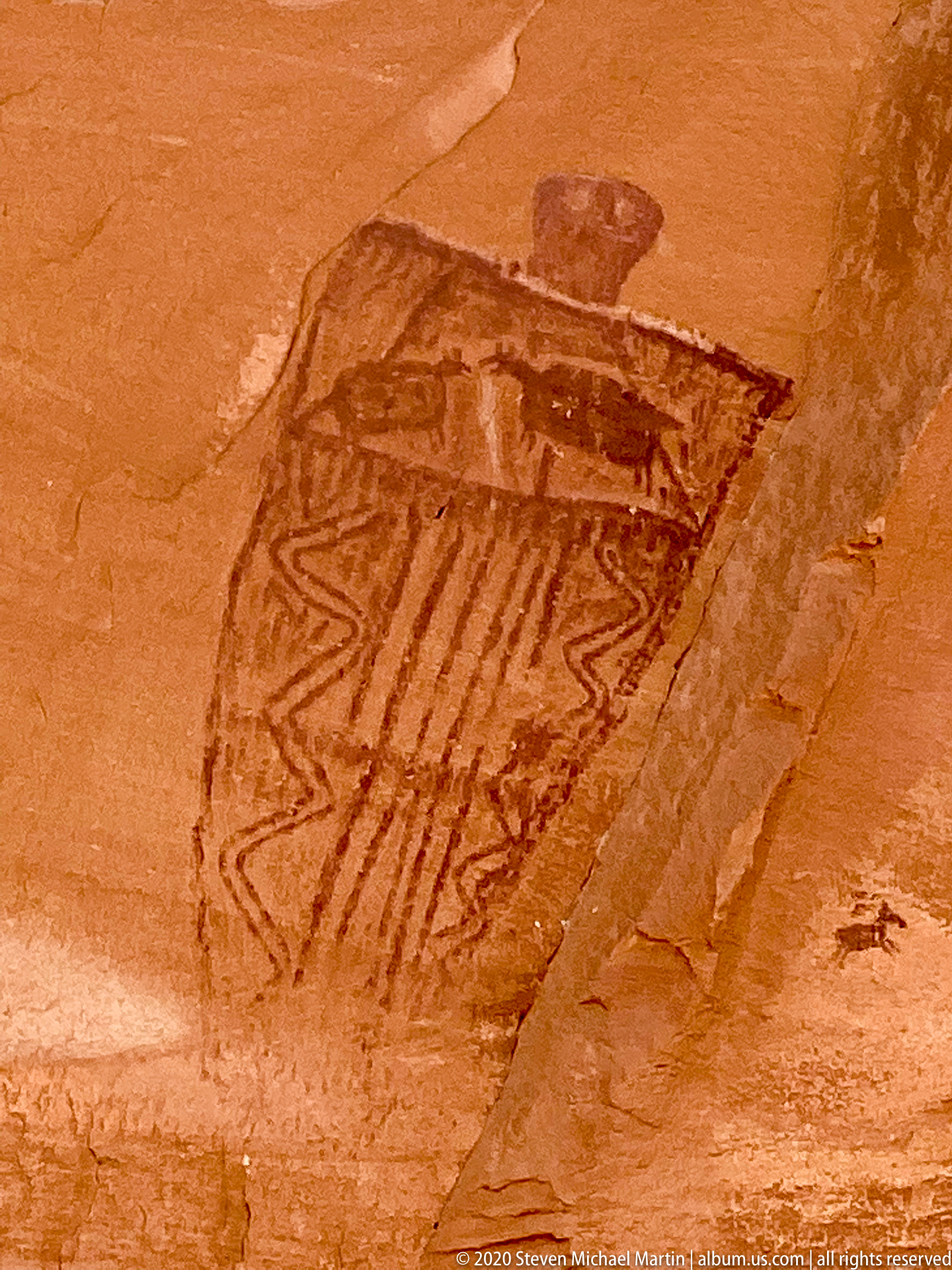
A single large, tapered painted motif fills the frame, its dark outline enclosing parallel lines, angular bands, and a central set of narrow stripes. A small rounded form rises above its upper edge. The close crop reveals the internal geometry and weathered pigment, while the sandstone’s cracks and color variation remain visible around it.
Caption
A single large, tapered painted motif fills the frame, its dark outline enclosing parallel lines, angular bands, and a central set of narrow stripes. A small rounded form rises above its upper edge. The close crop reveals the internal geometry and weathered pigment, while the sandstone’s cracks and color variation remain visible around it.
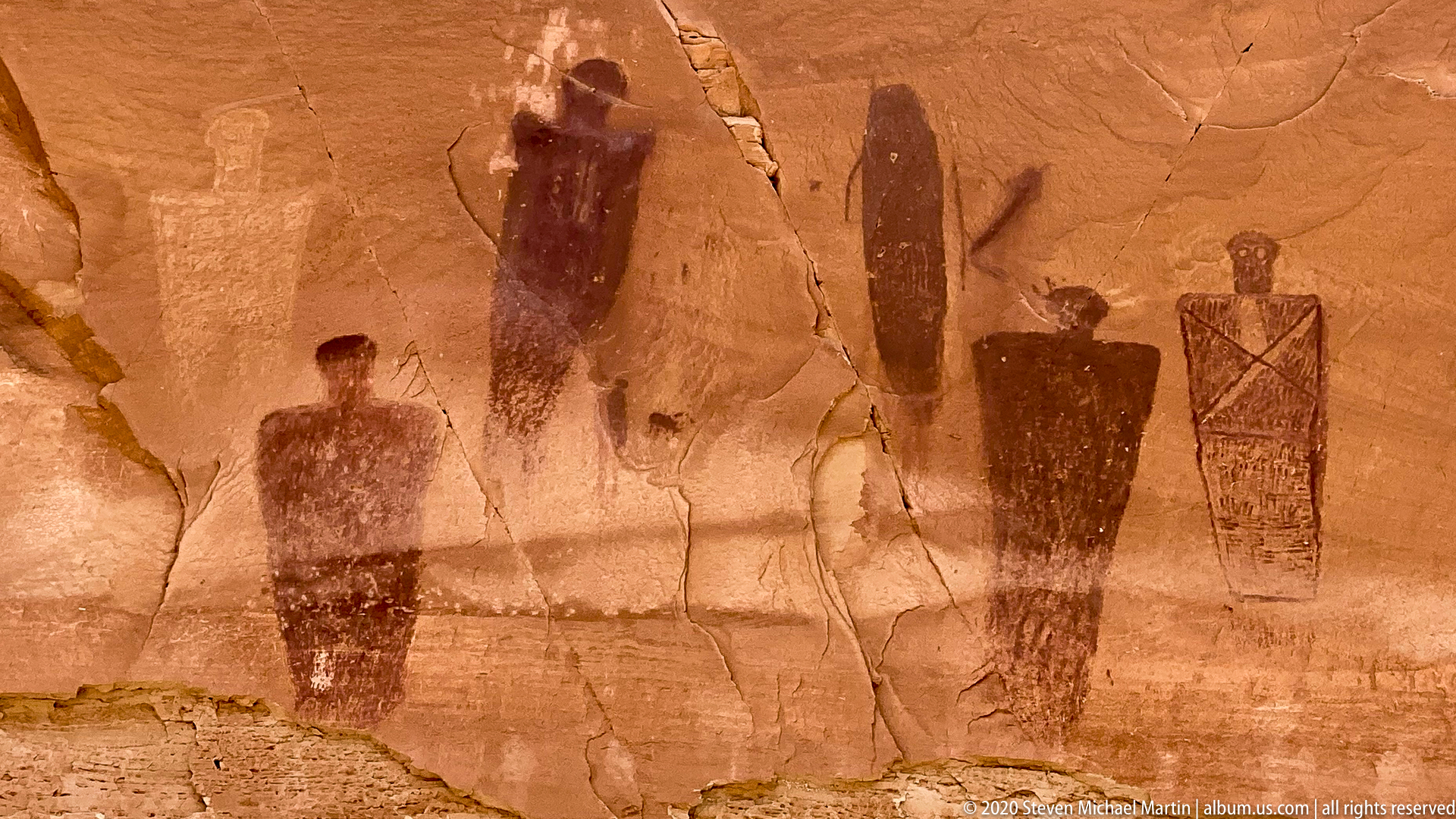
Several dark figures of varied shapes and heights stand across a warm sandstone panel. Some have broad or tapered bodies, and one narrow figure at the right contains a crosshatched pattern. Horizontal mineral bands and vertical cracks pass through the painted surface, showing how the images occupy the rock’s uneven natural plane.
Caption
Several dark figures of varied shapes and heights stand across a warm sandstone panel. Some have broad or tapered bodies, and one narrow figure at the right contains a crosshatched pattern. Horizontal mineral bands and vertical cracks pass through the painted surface, showing how the images occupy the rock’s uneven natural plane.
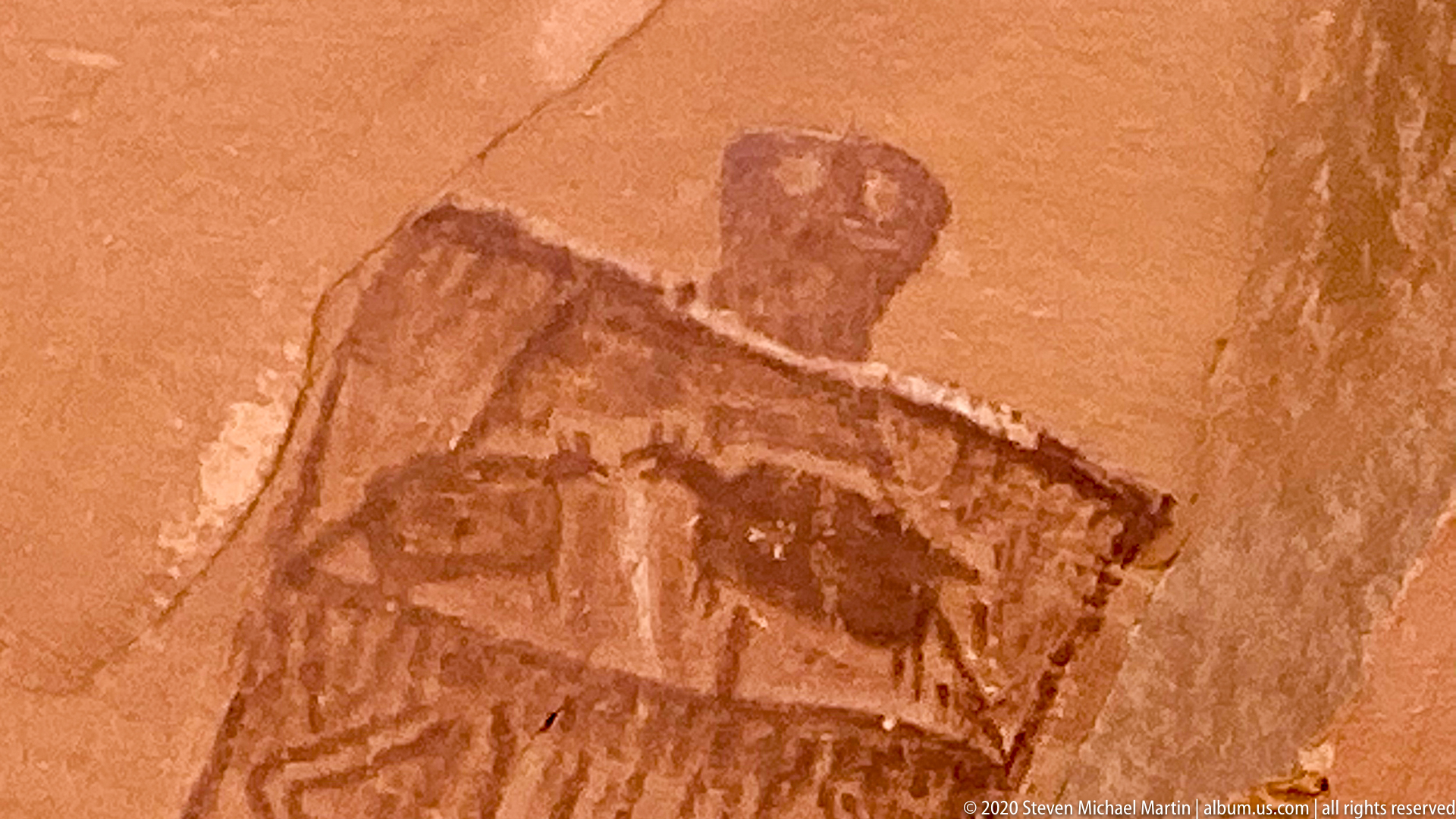
A large outlined form tilts across the sandstone, its interior divided into bands of parallel strokes and angular zigzag patterns. A dark rounded shape rises from its upper edge, and faint pigment remains visible around the main image. The oblique framing shows the motif’s scale against the rock while bringing its geometric interior into close view.
Caption
A large outlined form tilts across the sandstone, its interior divided into bands of parallel strokes and angular zigzag patterns. A dark rounded shape rises from its upper edge, and faint pigment remains visible around the main image. The oblique framing shows the motif’s scale against the rock while bringing its geometric interior into close view.
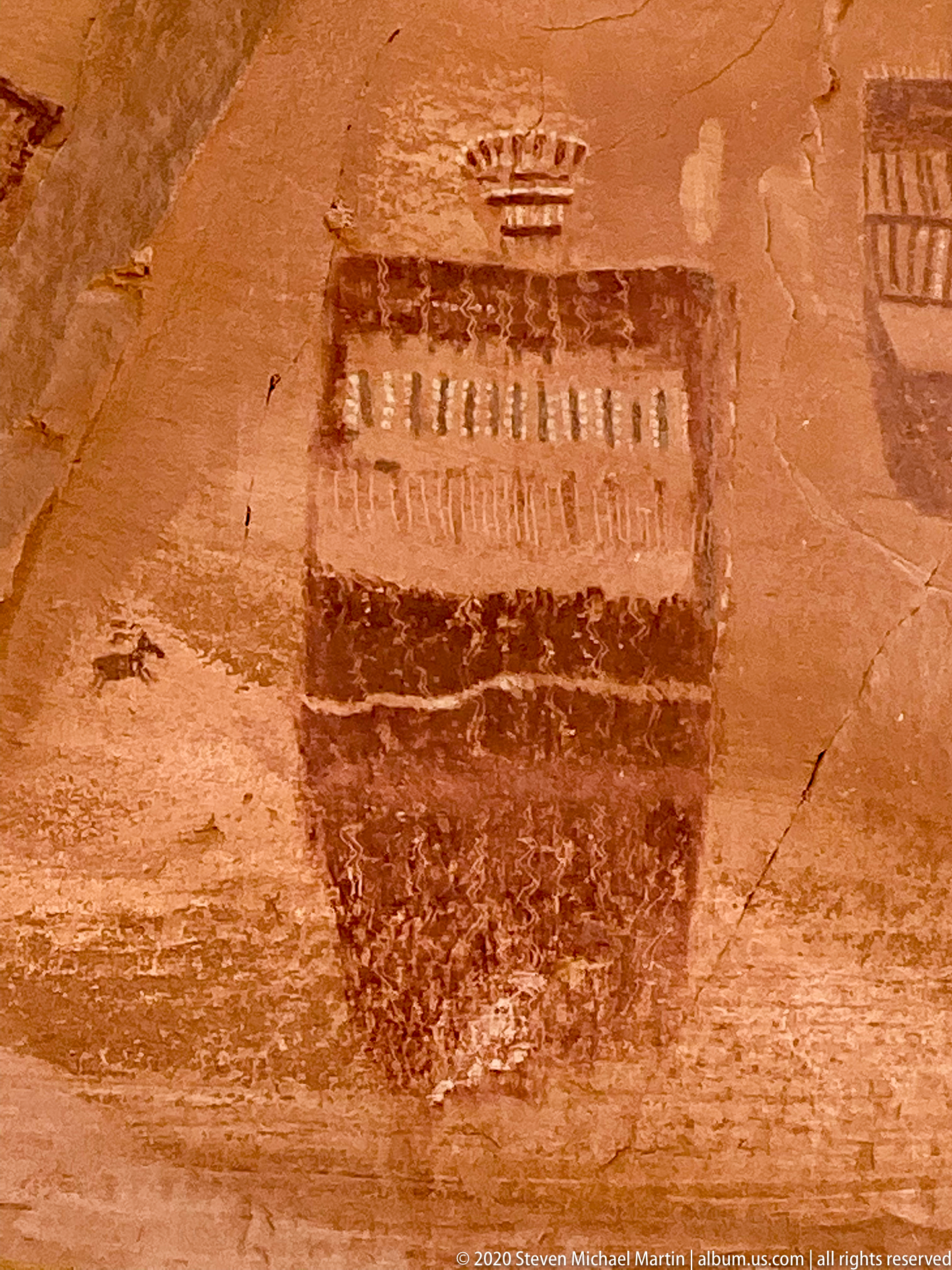
A broad rectangular painted figure has a dark lower body and a lighter upper band filled with repeated vertical marks. A small stacked motif sits above the top edge, and part of another patterned form enters at the right. The tight view centers on the figure’s layered design and the contrast between dense pigment and bare sandstone.
Caption
A broad rectangular painted figure has a dark lower body and a lighter upper band filled with repeated vertical marks. A small stacked motif sits above the top edge, and part of another patterned form enters at the right. The tight view centers on the figure’s layered design and the contrast between dense pigment and bare sandstone.
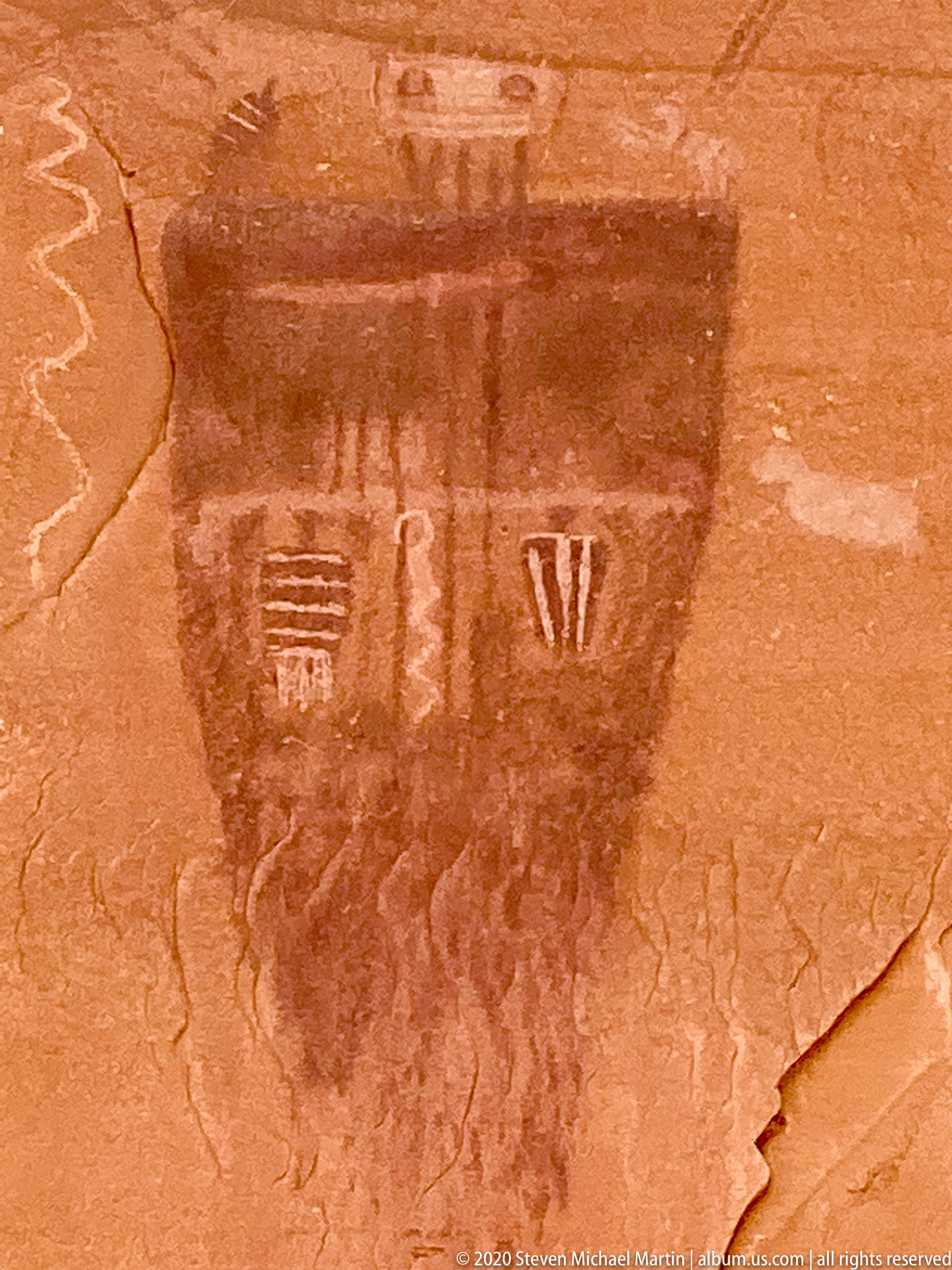
A broad dark, rectangular form fills the sandstone, with a shallow rounded top and a lighter band containing several small inset symbols. Faint marks sit above the main shape, while cracks and worn pigment break its edges. The close composition isolates the contrast between the heavy outer silhouette and the smaller pale designs inside it.
Caption
A broad dark, rectangular form fills the sandstone, with a shallow rounded top and a lighter band containing several small inset symbols. Faint marks sit above the main shape, while cracks and worn pigment break its edges. The close composition isolates the contrast between the heavy outer silhouette and the smaller pale designs inside it.
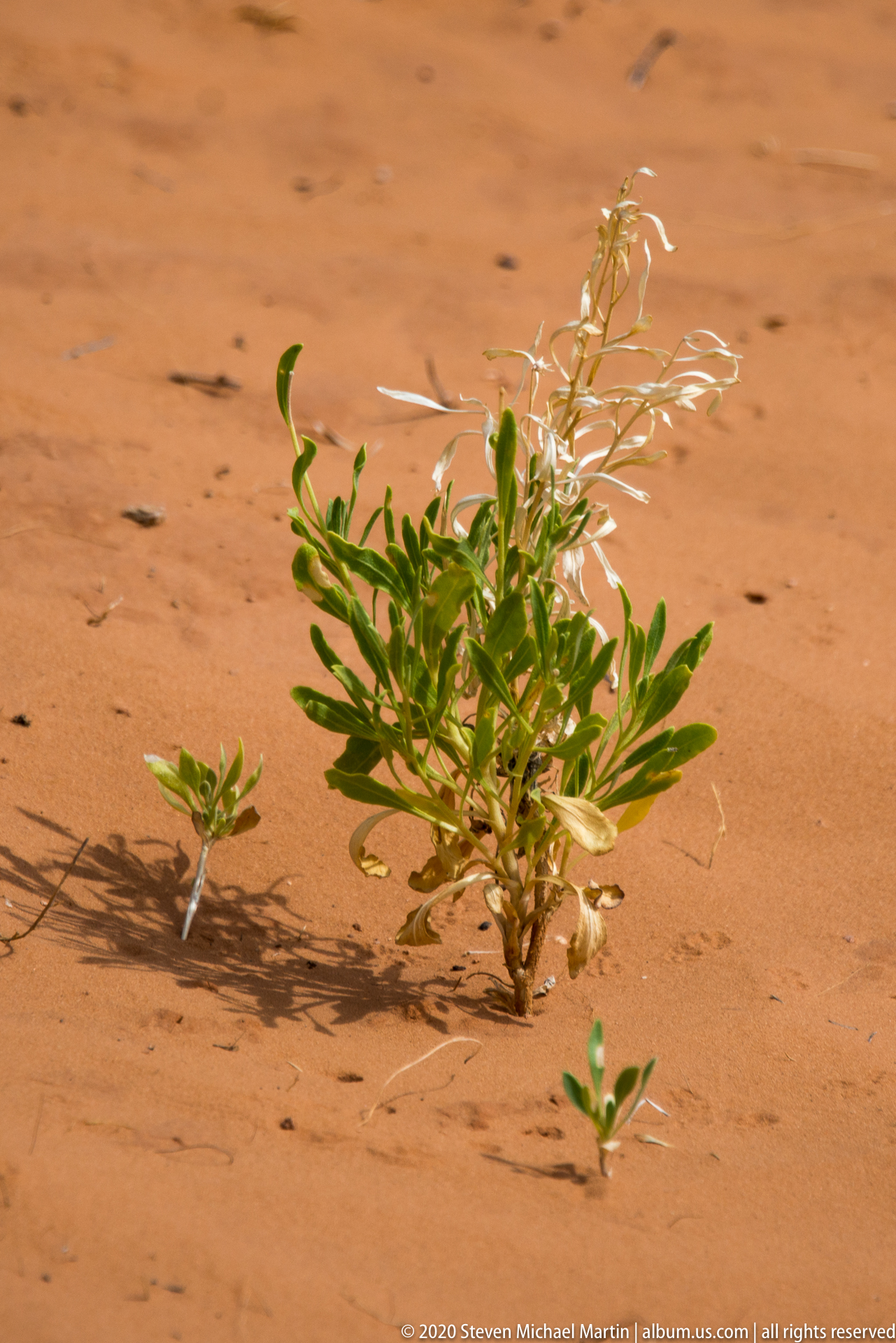
One fuller shrub rises from the sandy foreground, its green leaves and thin branches outlined against a broad, softly focused field of orange ground. Smaller plants sit farther away. Shallow focus isolates the vegetation and its shadow, offering a close study of plant life within the otherwise open, dry canyon floor.
Caption
One fuller shrub rises from the sandy foreground, its green leaves and thin branches outlined against a broad, softly focused field of orange ground. Smaller plants sit farther away. Shallow focus isolates the vegetation and its shadow, offering a close study of plant life within the otherwise open, dry canyon floor.

A hiker pauses beside a green metal gate at the entrance to a sandy route through Horseshoe Canyon. A posted notice asks visitors to protect archaeological resources and avoid touching the rock art. Weathered sandstone walls and a desert shrub frame the approach, while the person provides scale for the narrow canyon passage.
Caption
A hiker pauses beside a green metal gate at the entrance to a sandy route through Horseshoe Canyon. A posted notice asks visitors to protect archaeological resources and avoid touching the rock art. Weathered sandstone walls and a desert shrub frame the approach, while the person provides scale for the narrow canyon passage.
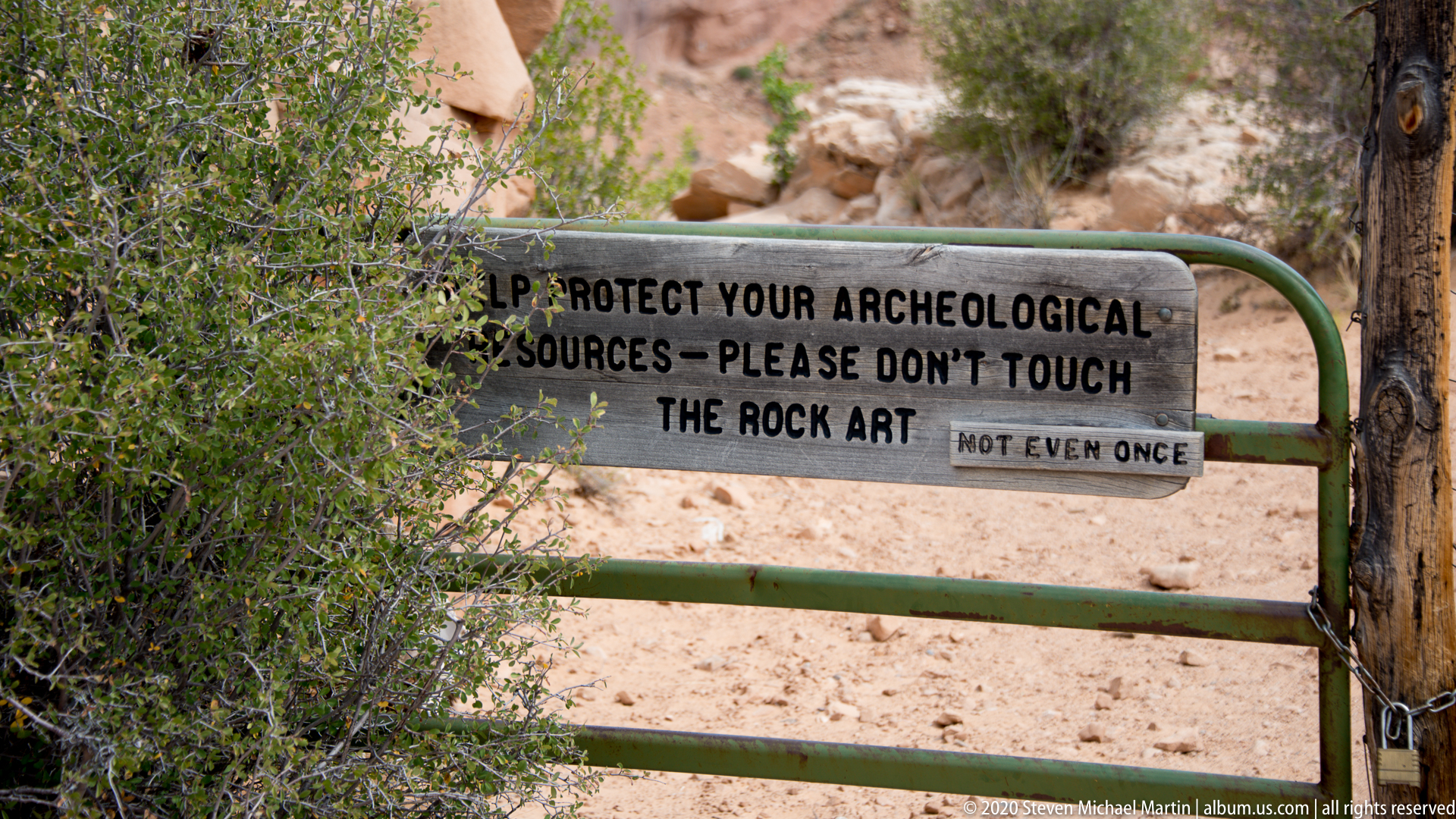
The weathered metal sign is the subject, with its message plainly visible: protect archaeological resources and do not touch the rock art, “not even once.” A leafy branch partly crosses the left edge, while pale sand and sandstone blur behind the gate. The close framing turns a trail-side notice into a direct statement about visitor care.
Caption
The weathered metal sign is the subject, with its message plainly visible: protect archaeological resources and do not touch the rock art, “not even once.” A leafy branch partly crosses the left edge, while pale sand and sandstone blur behind the gate. The close framing turns a trail-side notice into a direct statement about visitor care.
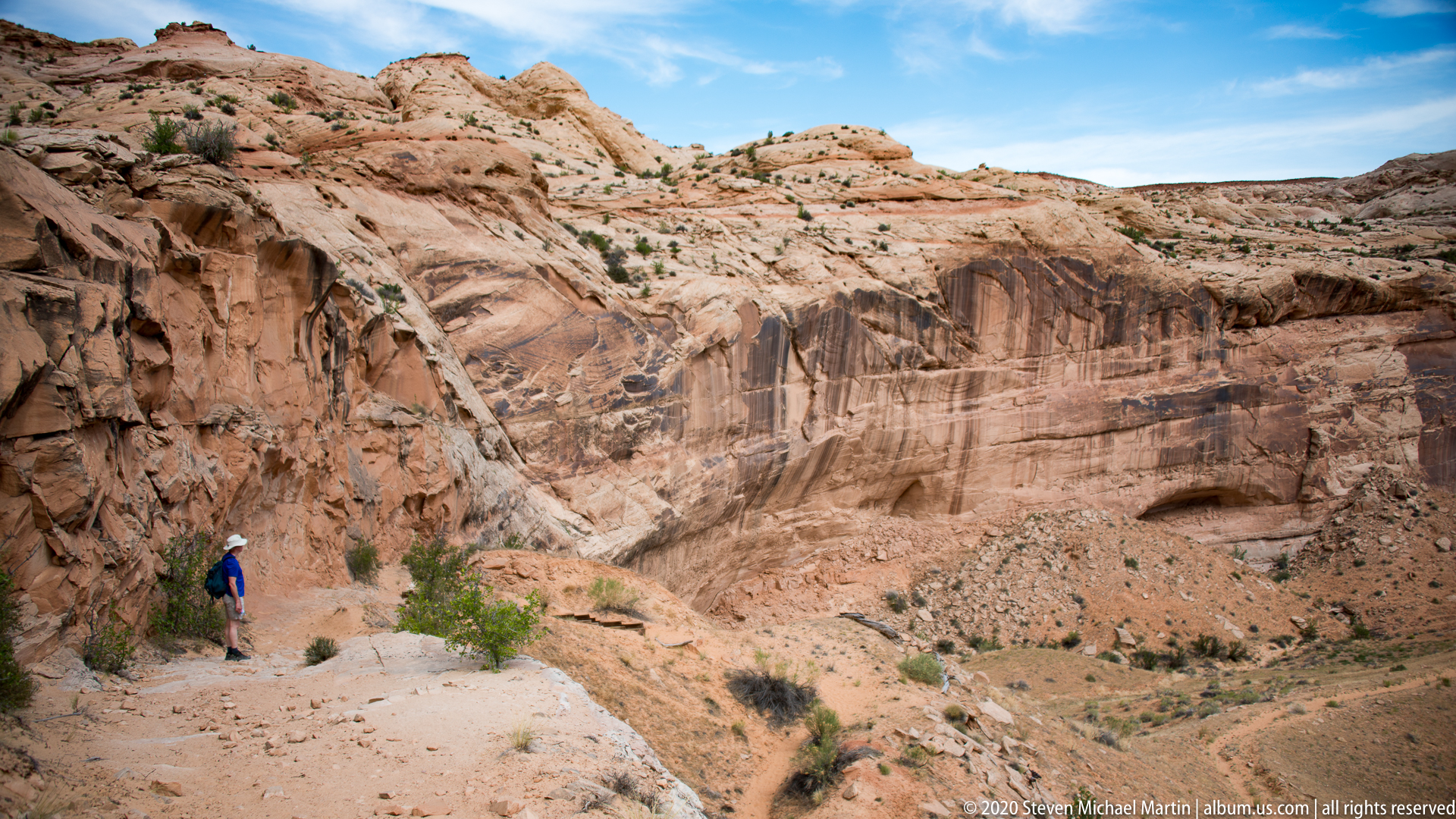
A small hiker in blue moves along a sandy path at the base of a high, curving sandstone wall. The steep cliff fills most of the composition, its ledges and weathered bands emphasizing the canyon’s scale. The trail bends through scattered shrubs and loose rock, showing how the route follows the narrow floor rather than a built walkway.
Caption
A small hiker in blue moves along a sandy path at the base of a high, curving sandstone wall. The steep cliff fills most of the composition, its ledges and weathered bands emphasizing the canyon’s scale. The trail bends through scattered shrubs and loose rock, showing how the route follows the narrow floor rather than a built walkway.
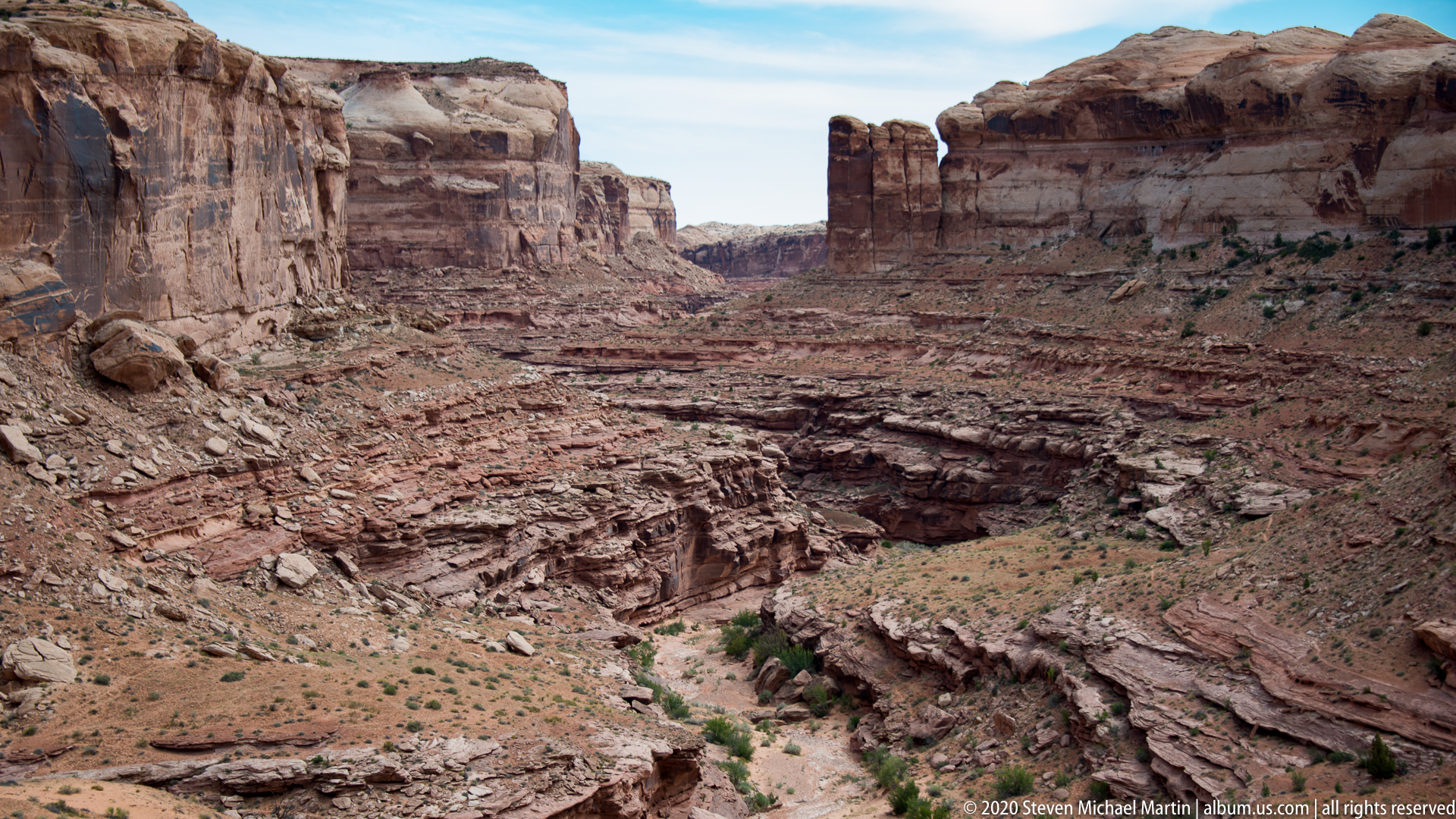
From above the wash, the view looks down a long, enclosed canyon corridor. Banded sandstone cliffs rise on both sides, while broken ledges, boulders, and a pale sandy drainage channel step through the foreground toward a distant gap. Sparse shrubs cling to the lower slopes. The broad composition emphasizes the canyon’s depth and uneven floor.
Caption
From above the wash, the view looks down a long, enclosed canyon corridor. Banded sandstone cliffs rise on both sides, while broken ledges, boulders, and a pale sandy drainage channel step through the foreground toward a distant gap. Sparse shrubs cling to the lower slopes. The broad composition emphasizes the canyon’s depth and uneven floor.
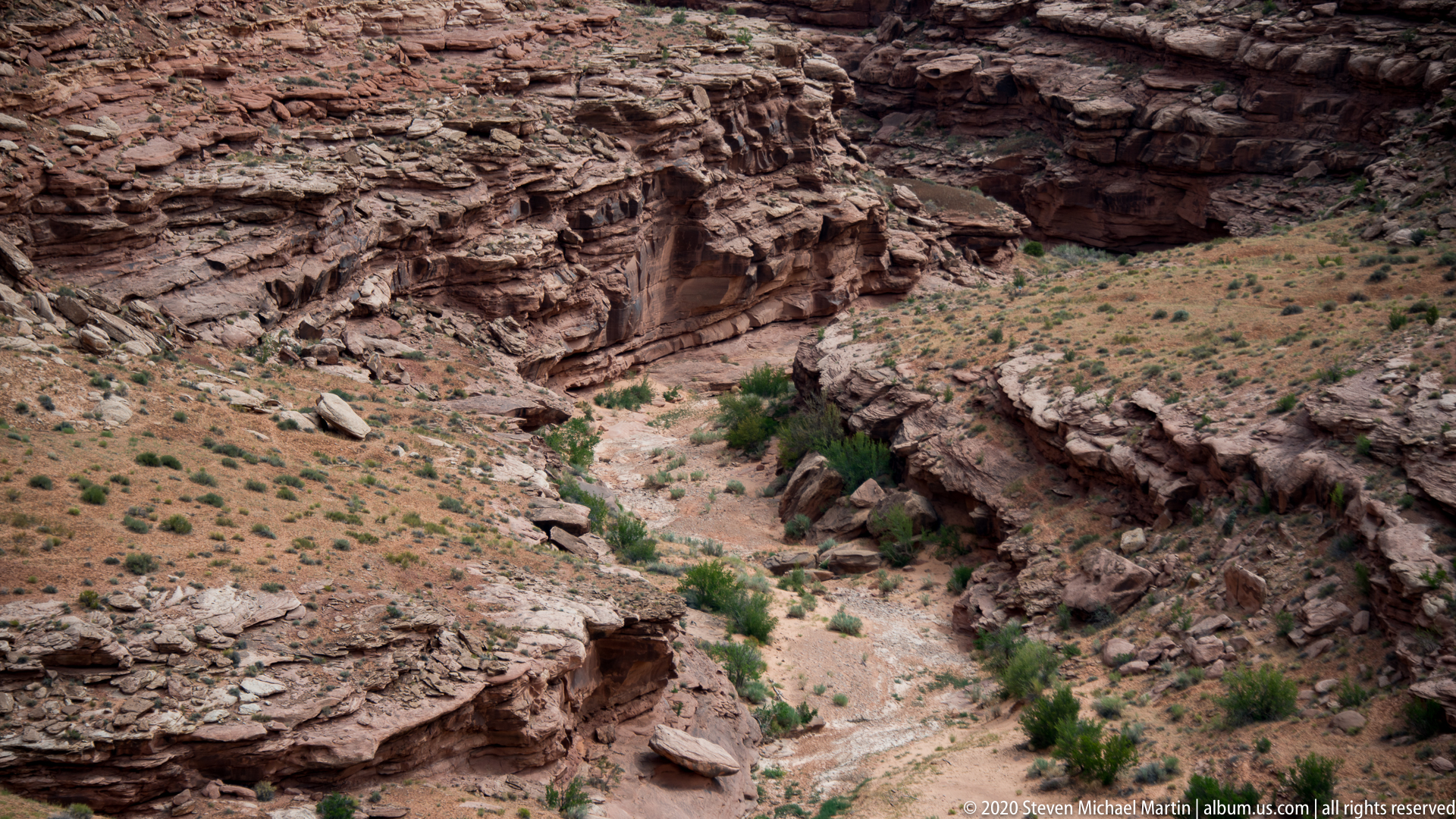
The view drops into a narrower section of the canyon, where a pale wash threads between broken sandstone shelves and boulder piles. Red and brown rock bands form irregular steps along the ravine, and scattered low shrubs mark patches of soil below the cliffs. This frame concentrates on the channel’s jagged route through exposed rock.
Caption
The view drops into a narrower section of the canyon, where a pale wash threads between broken sandstone shelves and boulder piles. Red and brown rock bands form irregular steps along the ravine, and scattered low shrubs mark patches of soil below the cliffs. This frame concentrates on the channel’s jagged route through exposed rock.

Several low plants grow separately from smooth orange sand, with delicate leaves and short shadows revealing strong sunlight. The close view removes surrounding cliffs and trail, focusing on sparse vegetation in an exposed sandy patch. Their scattered spacing and the largely bare surface make the plants’ small scale and the dry canyon-floor setting immediately legible.
Caption
Several low plants grow separately from smooth orange sand, with delicate leaves and short shadows revealing strong sunlight. The close view removes surrounding cliffs and trail, focusing on sparse vegetation in an exposed sandy patch. Their scattered spacing and the largely bare surface make the plants’ small scale and the dry canyon-floor setting immediately legible.
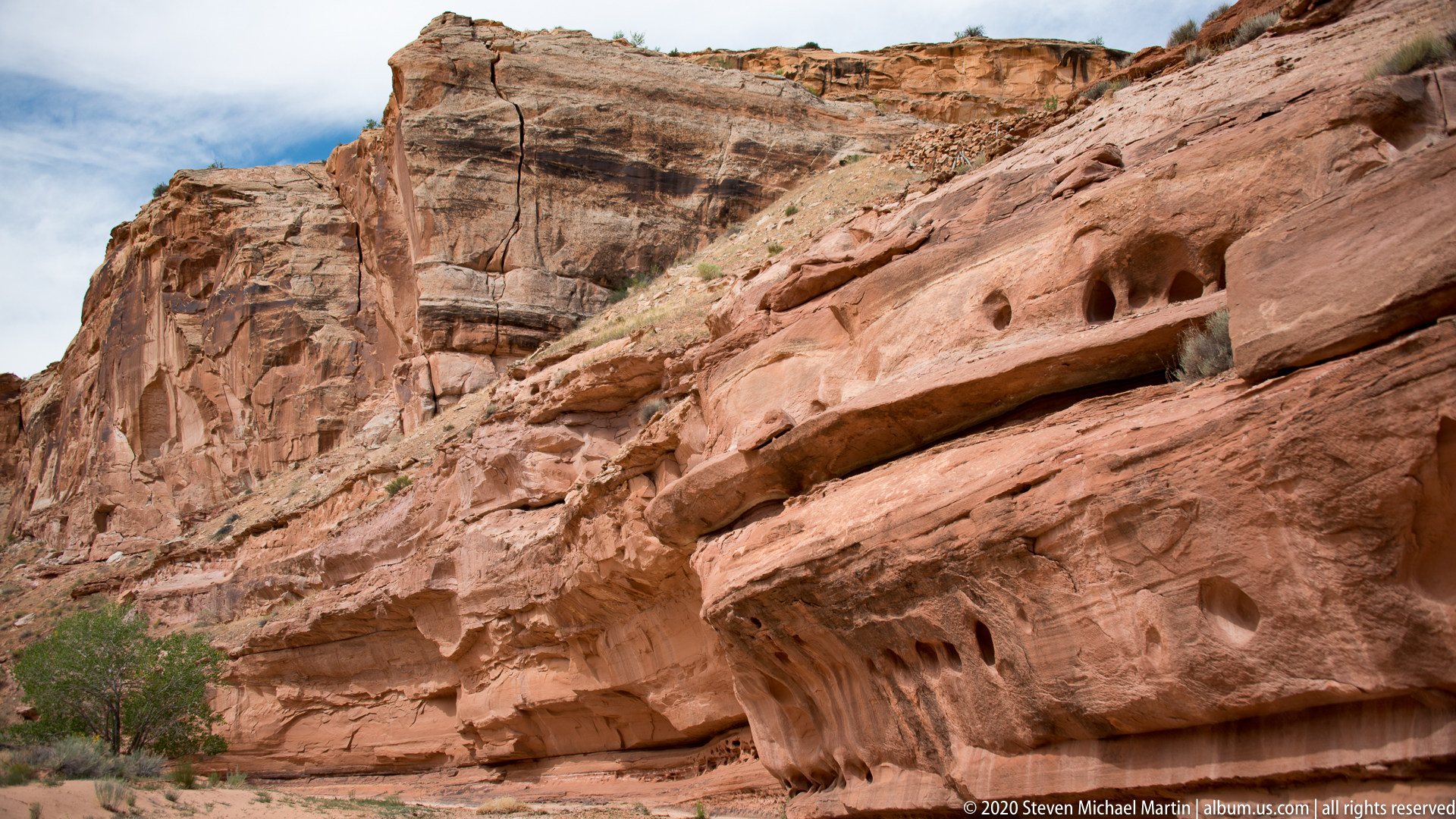
A long, slanted sandstone slab crosses the frame, its face pitted by rows of rounded hollows and irregular pockets. The cavities vary in size and depth, creating a honeycombed texture against smoother sloping rock above and a darker cliff recess behind. The image records weathering patterns in exposed stone without assigning a specific cause to each hollow.
Caption
A long, slanted sandstone slab crosses the frame, its face pitted by rows of rounded hollows and irregular pockets. The cavities vary in size and depth, creating a honeycombed texture against smoother sloping rock above and a darker cliff recess behind. The image records weathering patterns in exposed stone without assigning a specific cause to each hollow.
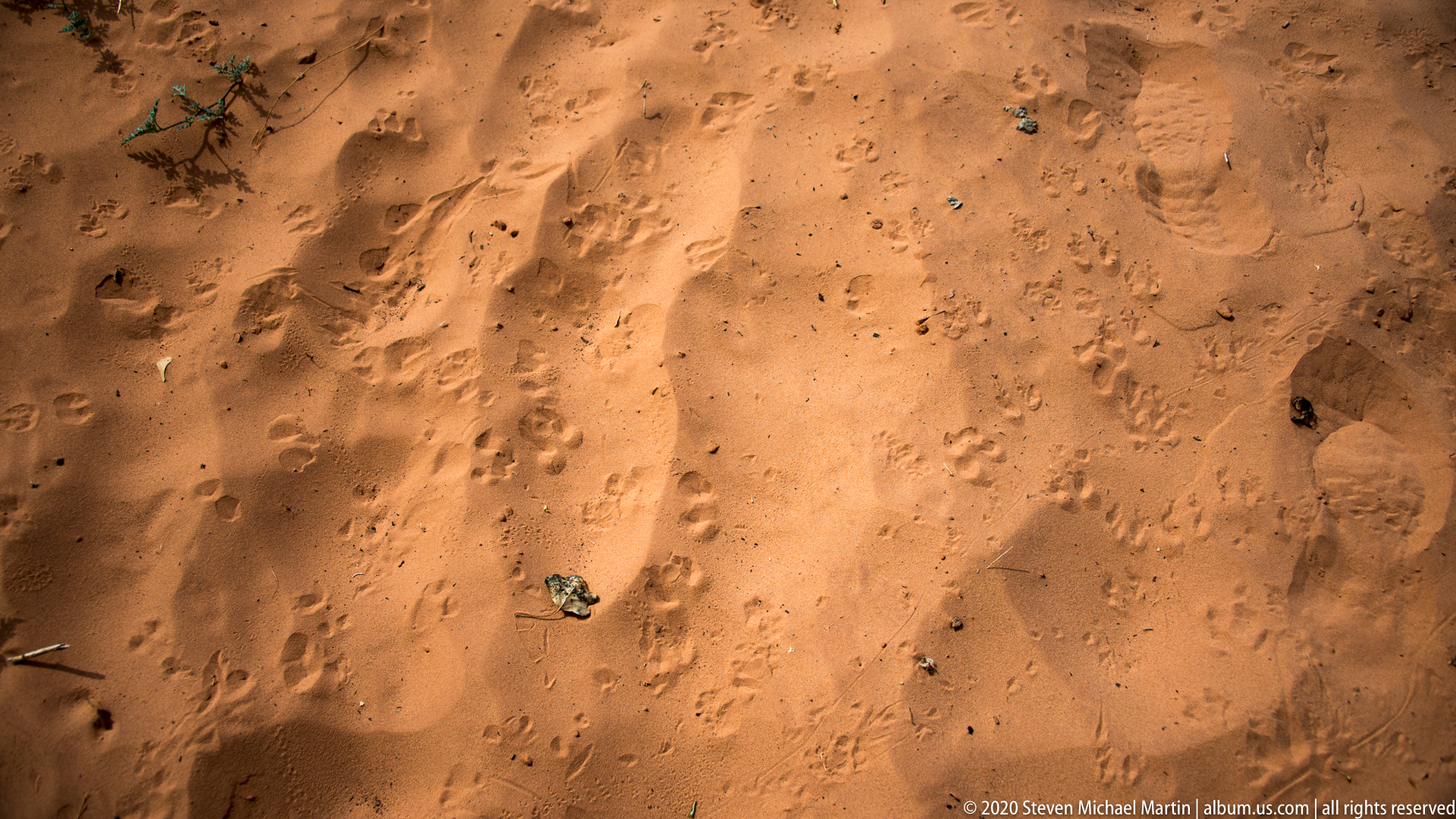
The close, downward view records shallow impressions across orange sand. Some marks form irregular lines of depressions, while narrow grooves and scattered dark fragments interrupt the surface. Their exact source is not clear at this scale, so the scene is best read as tracks and disturbance in the sandy wash rather than assigned to a particular animal or person.
Caption
The close, downward view records shallow impressions across orange sand. Some marks form irregular lines of depressions, while narrow grooves and scattered dark fragments interrupt the surface. Their exact source is not clear at this scale, so the scene is best read as tracks and disturbance in the sandy wash rather than assigned to a particular animal or person.
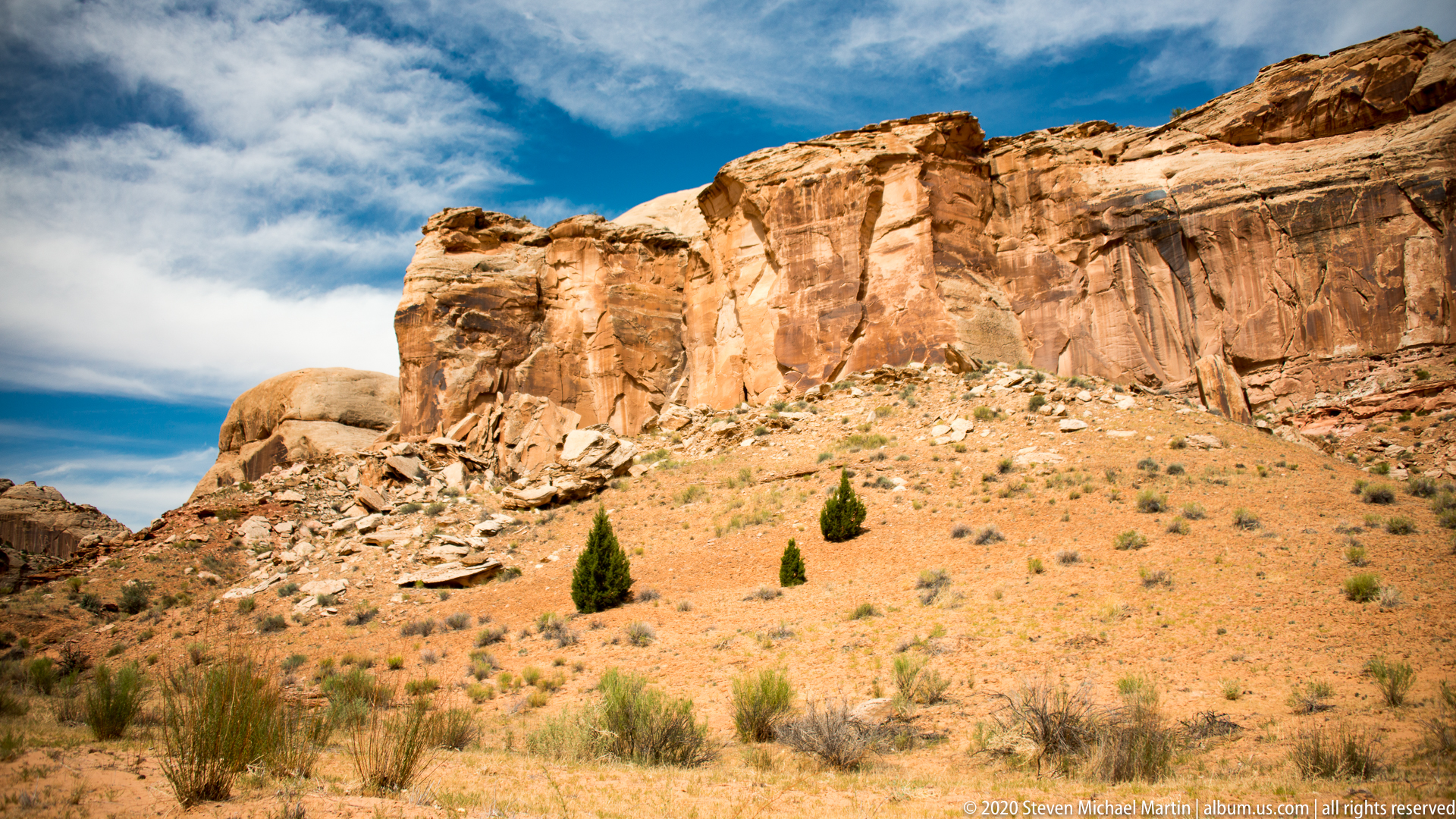
A long orange sandstone wall rises behind an open slope dotted with grasses and low shrubs. Vertical fractures and broad ledges break the cliff face into panels, while a rounded outcrop projects near the left edge. White clouds cross the blue sky. The viewpoint keeps vegetation in the foreground, showing the transition from sandy canyon floor to steep exposed rock.
Caption
A long orange sandstone wall rises behind an open slope dotted with grasses and low shrubs. Vertical fractures and broad ledges break the cliff face into panels, while a rounded outcrop projects near the left edge. White clouds cross the blue sky. The viewpoint keeps vegetation in the foreground, showing the transition from sandy canyon floor to steep exposed rock.
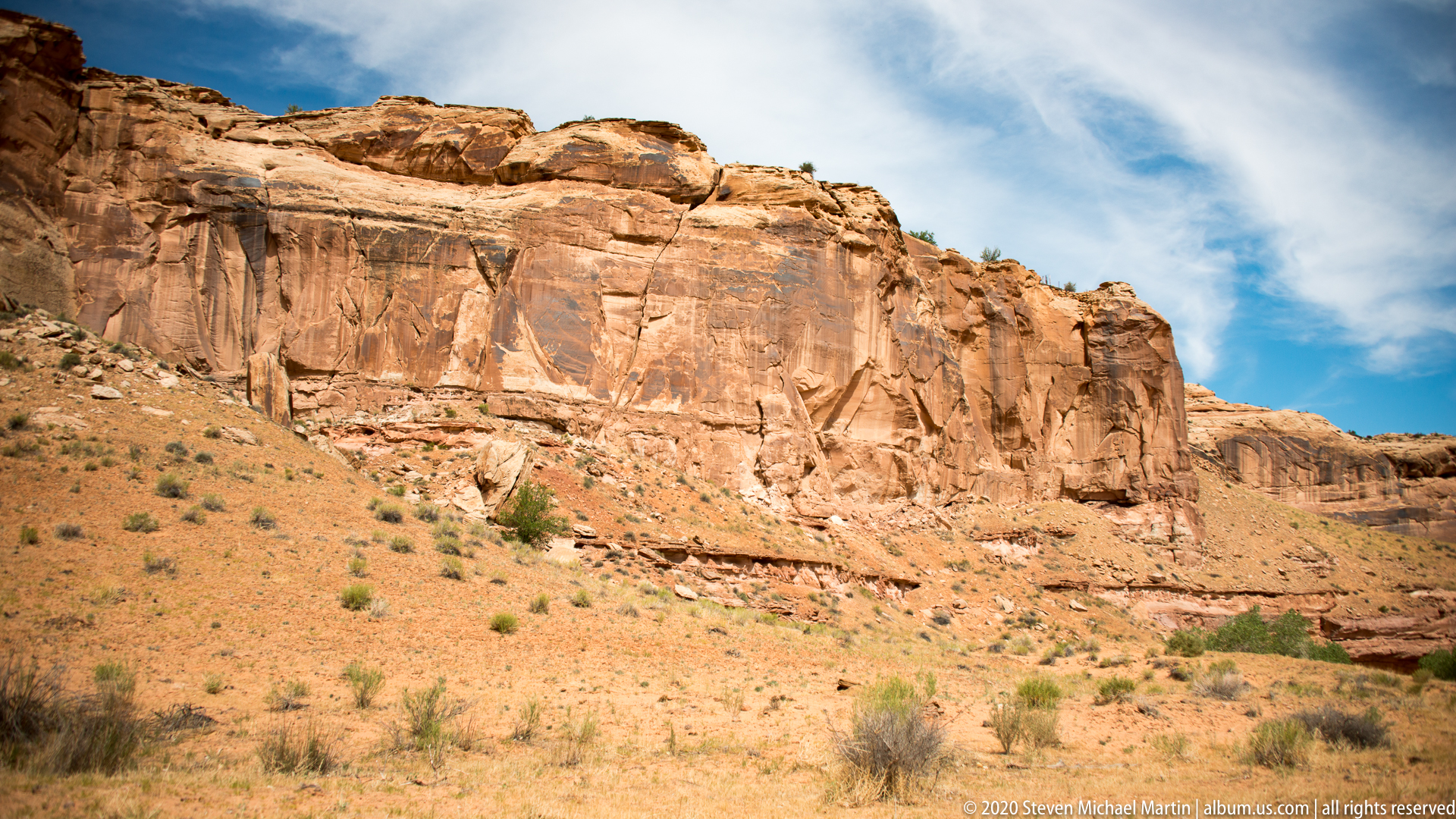
The cliff face fills the composition, showing sheer orange and tan panels separated by vertical seams, ledges, and darker weathering. At its base, a thin strip of grasses and small shrubs provides scale before the ground drops toward the right. Wispy clouds soften the sky above the rim. This tighter viewpoint makes the wall’s height and fractured surface prominent.
Caption
The cliff face fills the composition, showing sheer orange and tan panels separated by vertical seams, ledges, and darker weathering. At its base, a thin strip of grasses and small shrubs provides scale before the ground drops toward the right. Wispy clouds soften the sky above the rim. This tighter viewpoint makes the wall’s height and fractured surface prominent.
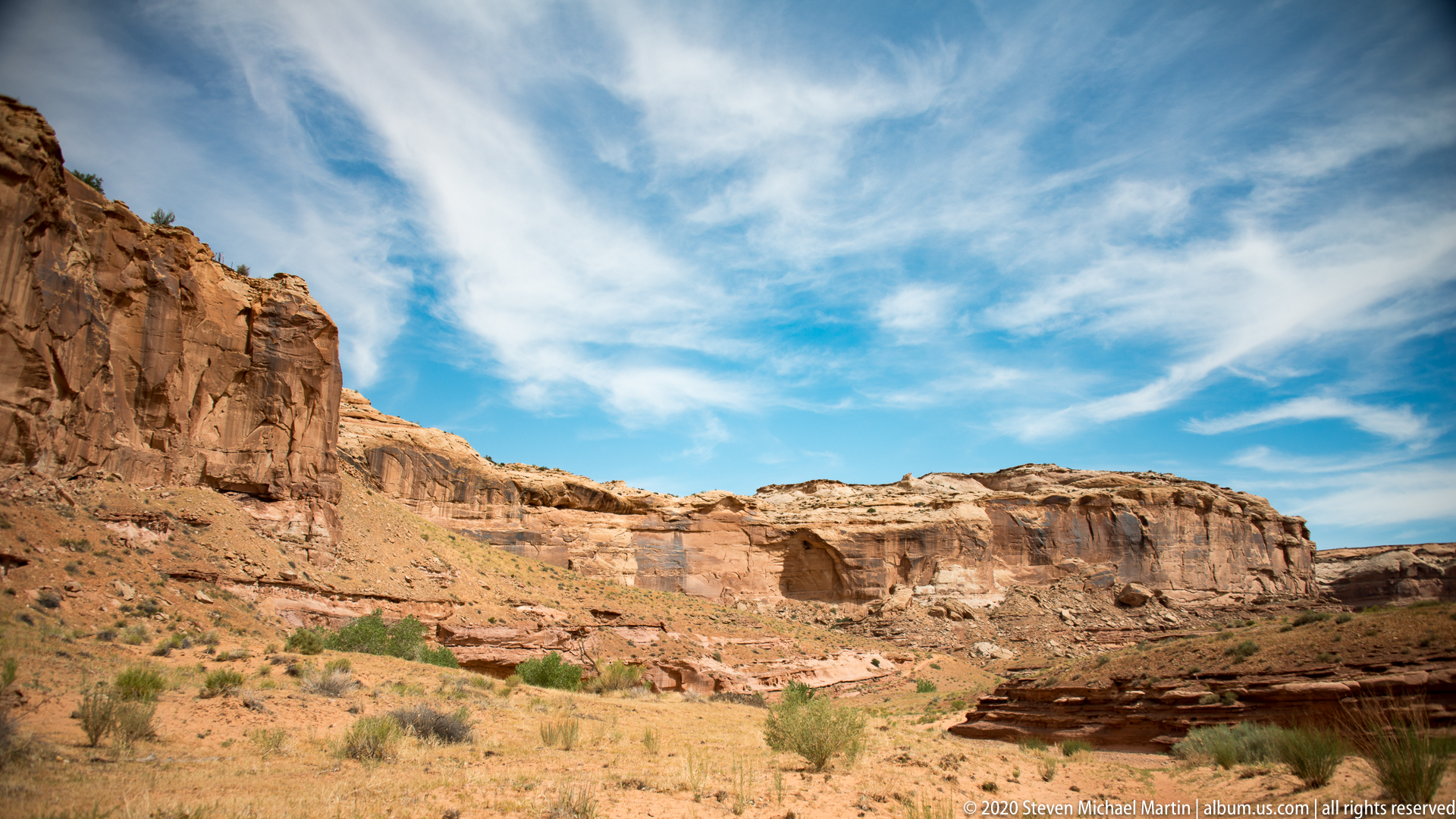
The canyon opens across the frame, with a high sandstone wall receding from the left toward a lower, distant rim. Pale sand, broken rock, and scattered shrubs cover the floor, while a darker ledge enters at lower right. Broad clouds streak across the blue sky. The wider angle connects the cliff face to the open route through the canyon bottom.
Caption
The canyon opens across the frame, with a high sandstone wall receding from the left toward a lower, distant rim. Pale sand, broken rock, and scattered shrubs cover the floor, while a darker ledge enters at lower right. Broad clouds streak across the blue sky. The wider angle connects the cliff face to the open route through the canyon bottom.
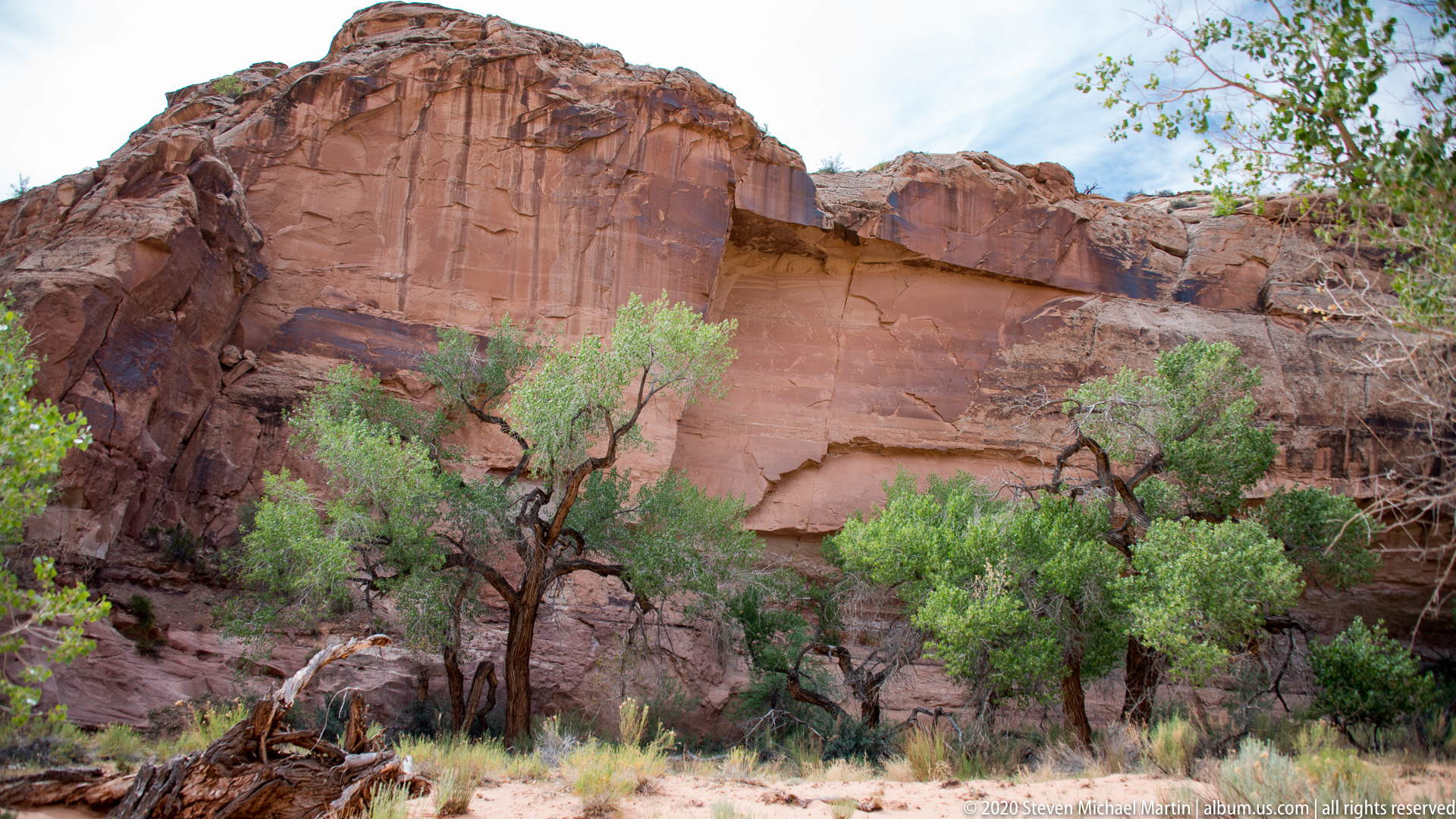
Leafy trees and dense shrubs occupy the canyon floor beneath a broad, sunlit sandstone face. The wall shows horizontal bedding, recessed alcoves, and darker vertical streaks, while fallen branches lie near the foreground. The juxtaposition of green growth and bare cliff suggests the sheltered canyon-bottom habitat without implying flowing water that is not visible.
Caption
Leafy trees and dense shrubs occupy the canyon floor beneath a broad, sunlit sandstone face. The wall shows horizontal bedding, recessed alcoves, and darker vertical streaks, while fallen branches lie near the foreground. The juxtaposition of green growth and bare cliff suggests the sheltered canyon-bottom habitat without implying flowing water that is not visible.

A thick, twisted trunk dominates the left foreground, its ridged bark and looping branches creating a natural frame around dense canyon vegetation. Through the opening, pale sand and a sunlit sandstone wall appear in the distance. Smaller trees fill the middle ground, giving the view a shaded, enclosed character against the exposed cliff beyond.
Caption
A thick, twisted trunk dominates the left foreground, its ridged bark and looping branches creating a natural frame around dense canyon vegetation. Through the opening, pale sand and a sunlit sandstone wall appear in the distance. Smaller trees fill the middle ground, giving the view a shaded, enclosed character against the exposed cliff beyond.
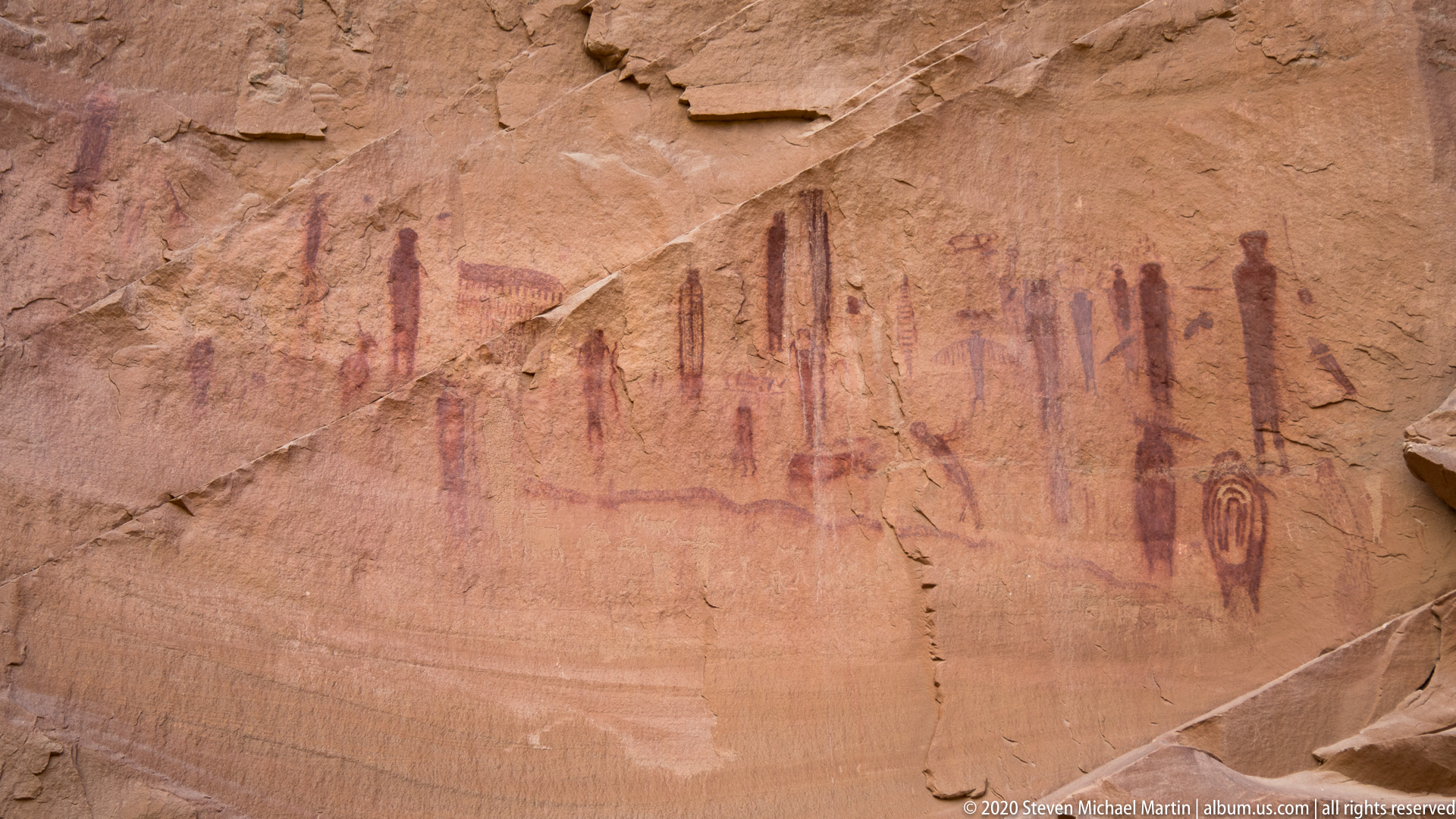
Faint red and brown figures form a broad horizontal panel on smooth sandstone. Several elongated human-like forms stand upright, some with patterned bodies or outlined limbs, while smaller marks and a rounded concentric motif appear among them. This view preserves the panel’s overall arrangement and surrounding rock surface. The imagery is consistent with the Barrier Canyon style known from Horseshoe Canyon, without interpreting individual figures.
Caption
Faint red and brown figures form a broad horizontal panel on smooth sandstone. Several elongated human-like forms stand upright, some with patterned bodies or outlined limbs, while smaller marks and a rounded concentric motif appear among them. This view preserves the panel’s overall arrangement and surrounding rock surface. The imagery is consistent with the Barrier Canyon style known from Horseshoe Canyon, without interpreting individual figures.

Several tall, narrow figures in red pigment stand against the sandstone, with fine lines extending from their bodies and a rounded, nested design near lower center. A pale rock edge intrudes at right, marking the panel’s uneven setting. The close crop emphasizes differences in scale and outline among the figures while preserving the mottled, weathered surface around the paint.
Caption
Several tall, narrow figures in red pigment stand against the sandstone, with fine lines extending from their bodies and a rounded, nested design near lower center. A pale rock edge intrudes at right, marking the panel’s uneven setting. The close crop emphasizes differences in scale and outline among the figures while preserving the mottled, weathered surface around the paint.
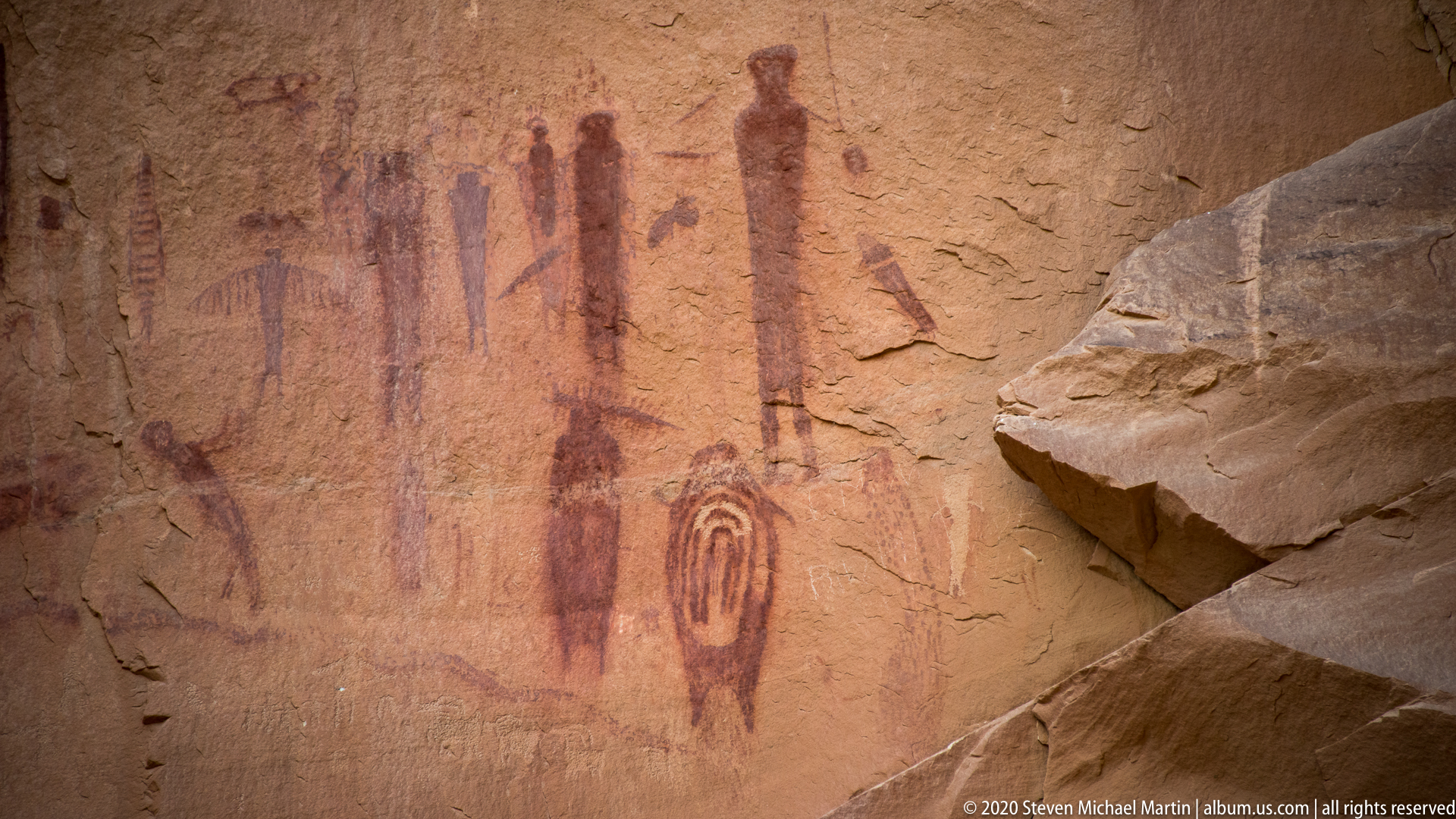
Upright red and brown figures extend across the upper rock face, while a pronounced nested oval motif sits lower in the composition. Thin painted lines, faint outlines, and a natural rock break at right add detail to the panel. This slightly wider view clarifies how the oval design relates spatially to the taller figures without assigning a narrative to the imagery.
Caption
Upright red and brown figures extend across the upper rock face, while a pronounced nested oval motif sits lower in the composition. Thin painted lines, faint outlines, and a natural rock break at right add detail to the panel. This slightly wider view clarifies how the oval design relates spatially to the taller figures without assigning a narrative to the imagery.
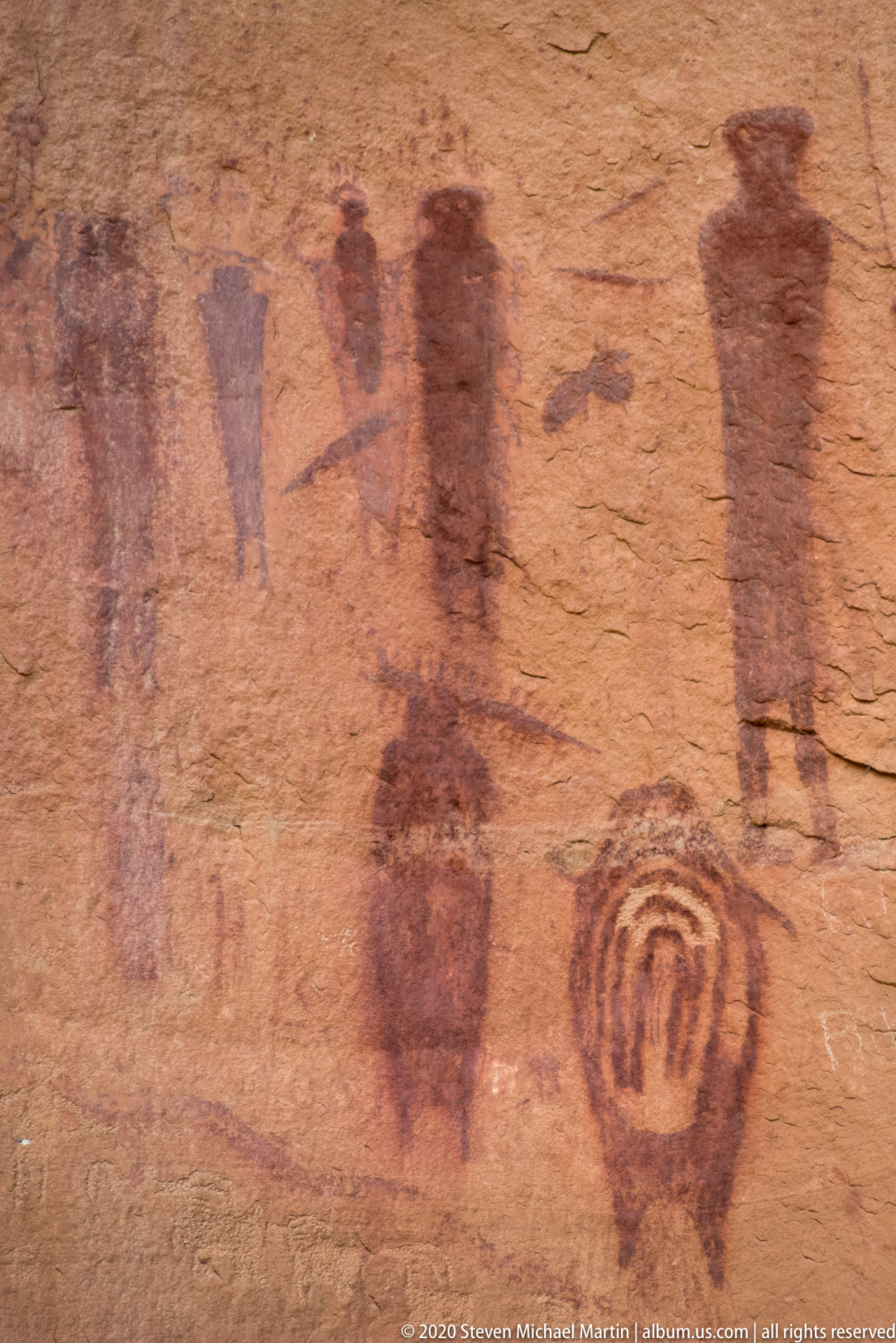
This close crop brings the pigment into focus: broad red-brown figures rise above a smaller oval motif made of concentric outlines. Fading and abrasion soften the edges against the natural grain of the sandstone. By excluding most of the surrounding wall, the photograph emphasizes the contrast between larger anthropomorphic forms and the compact patterned design below them.
Caption
This close crop brings the pigment into focus: broad red-brown figures rise above a smaller oval motif made of concentric outlines. Fading and abrasion soften the edges against the natural grain of the sandstone. By excluding most of the surrounding wall, the photograph emphasizes the contrast between larger anthropomorphic forms and the compact patterned design below them.
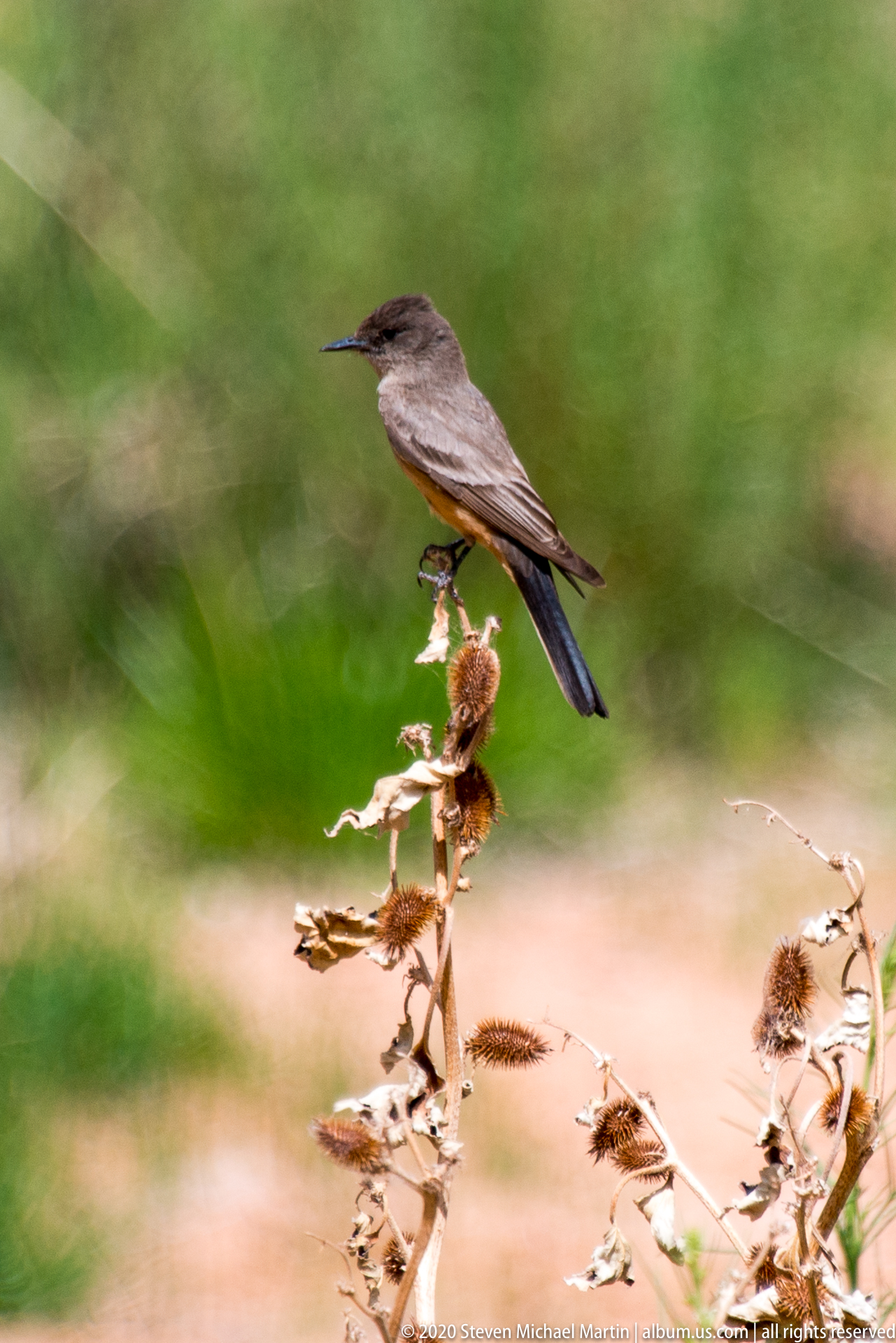
The bird is shown in profile on a dry plant, with a narrow dark bill, pale underside, brown-gray back, and long dark tail. Its body faces left as it grips the stem, and the green background falls into soft blur. This tighter frame reveals plumage and posture more clearly than the preceding view, but not enough detail to identify the species reliably.
Caption
The bird is shown in profile on a dry plant, with a narrow dark bill, pale underside, brown-gray back, and long dark tail. Its body faces left as it grips the stem, and the green background falls into soft blur. This tighter frame reveals plumage and posture more clearly than the preceding view, but not enough detail to identify the species reliably.
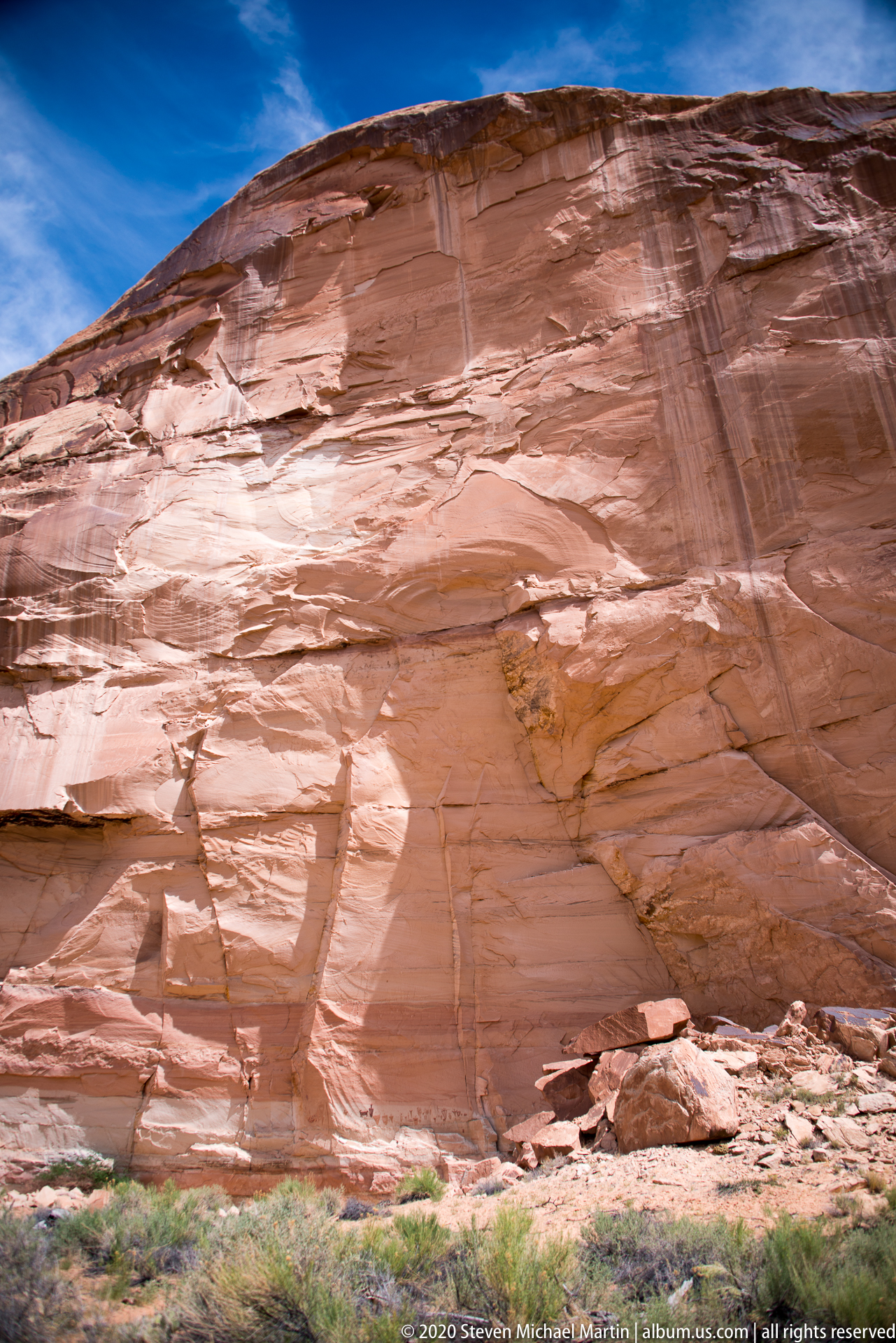
The smooth cliff occupies nearly the full frame, with sweeping horizontal color bands and long dark runoff streaks descending over its face. Broken rock and sparse shrubs collect along the base, while a narrow strip of blue sky follows the rim. This direct view emphasizes the scale and relatively unbroken surface of the sandstone rather than the canyon-floor route seen elsewhere.
Caption
The smooth cliff occupies nearly the full frame, with sweeping horizontal color bands and long dark runoff streaks descending over its face. Broken rock and sparse shrubs collect along the base, while a narrow strip of blue sky follows the rim. This direct view emphasizes the scale and relatively unbroken surface of the sandstone rather than the canyon-floor route seen elsewhere.
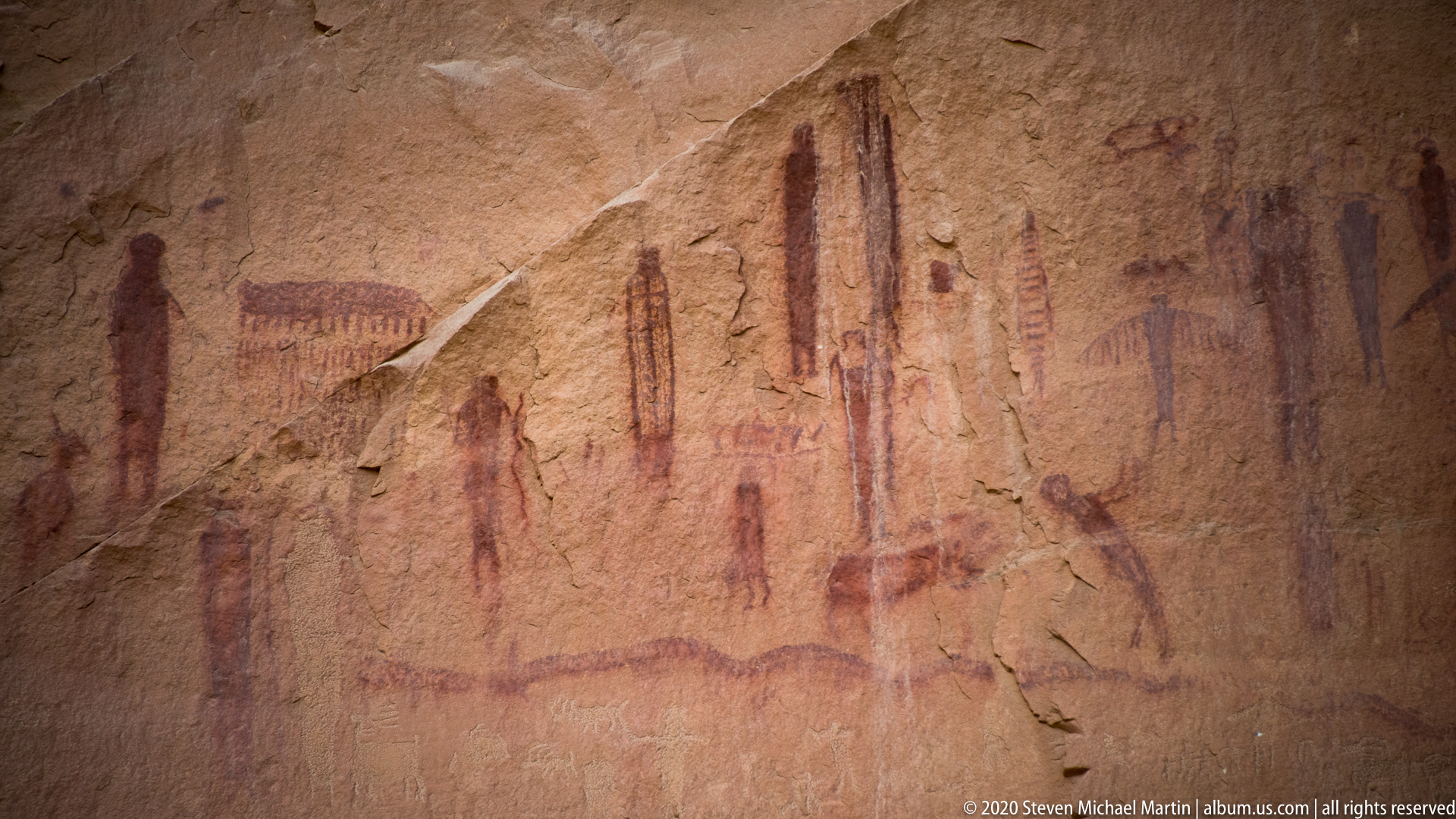
A wide field of red-brown pictographs stretches across the sandstone, combining upright human-like forms, narrow lines, and smaller geometric marks. A pale diagonal scar cuts through the panel at left, and pigment varies from distinct silhouettes to faint traces. The broad framing shows the density and horizontal spread of this rock-art surface, characteristic of Horseshoe Canyon’s Barrier Canyon style panels.
Caption
A wide field of red-brown pictographs stretches across the sandstone, combining upright human-like forms, narrow lines, and smaller geometric marks. A pale diagonal scar cuts through the panel at left, and pigment varies from distinct silhouettes to faint traces. The broad framing shows the density and horizontal spread of this rock-art surface, characteristic of Horseshoe Canyon’s Barrier Canyon style panels.
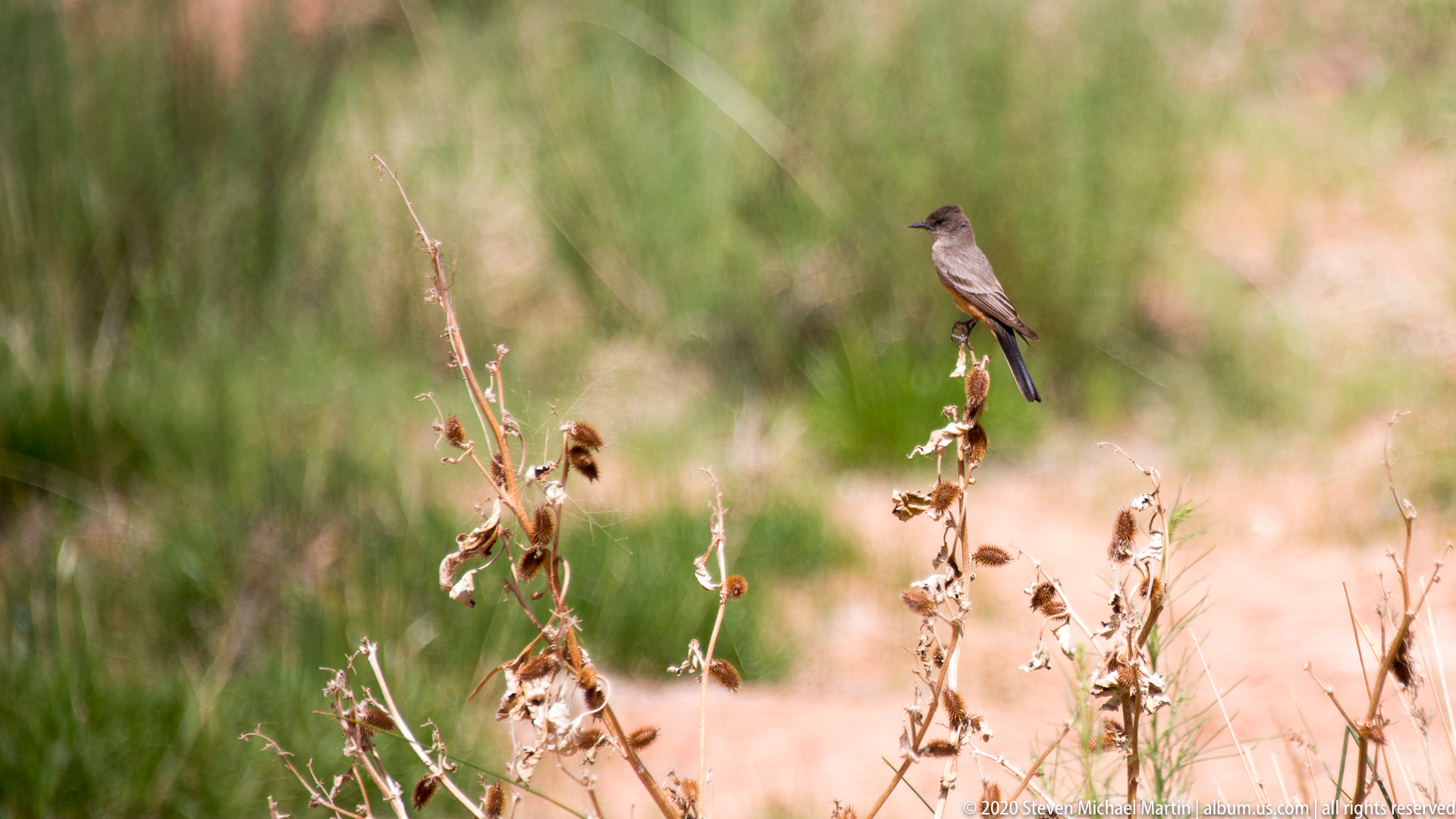
A small bird sits upright on a branching dried stem near the center of the frame. Its muted gray-brown plumage, slender dark bill, and long dark tail are visible, while grasses and shrubs dissolve into soft green and tan blur. Shallow focus isolates the bird from the canyon habitat; the proof image does not support a confident species identification.
Caption
A small bird sits upright on a branching dried stem near the center of the frame. Its muted gray-brown plumage, slender dark bill, and long dark tail are visible, while grasses and shrubs dissolve into soft green and tan blur. Shallow focus isolates the bird from the canyon habitat; the proof image does not support a confident species identification.
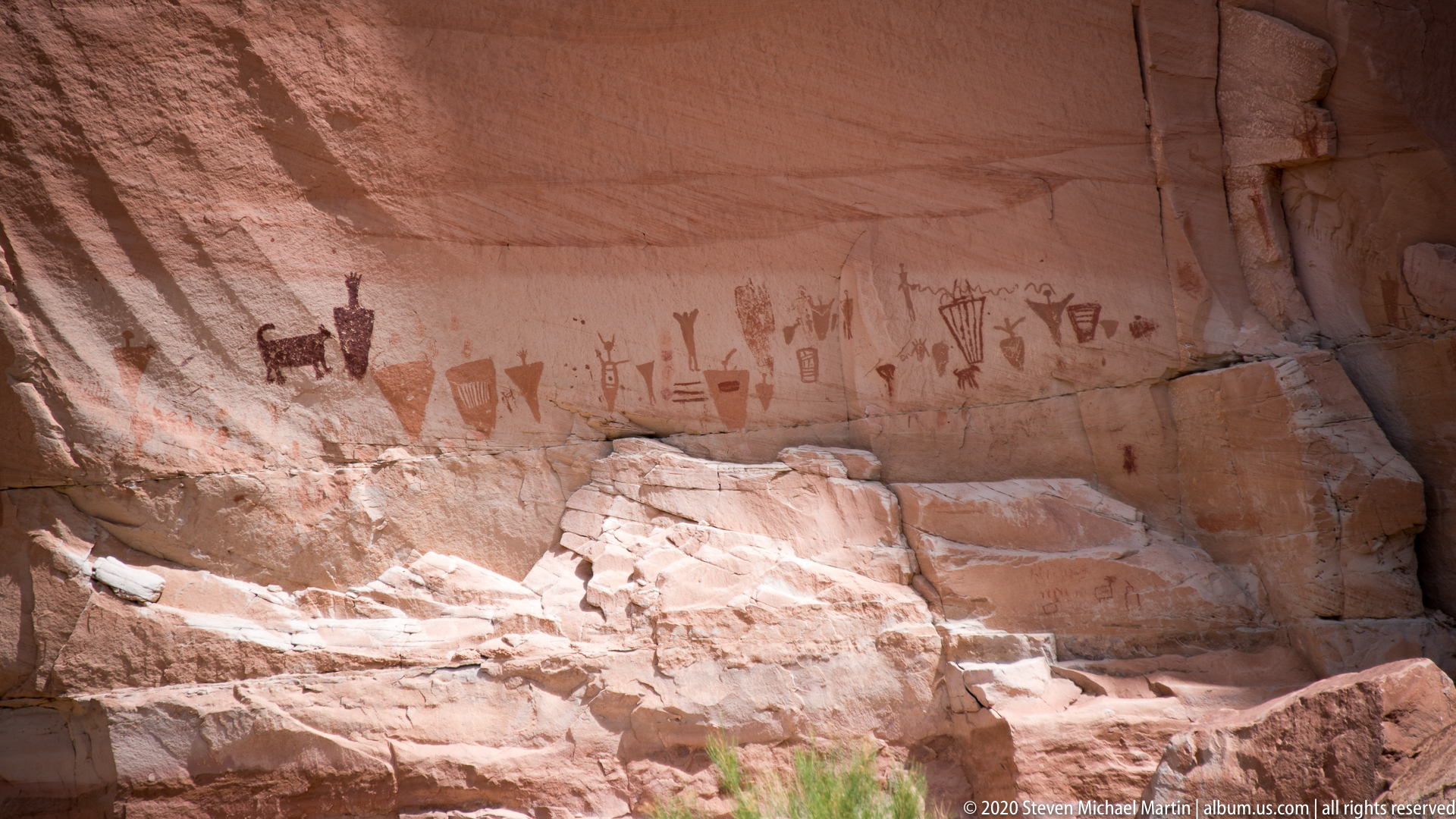
Inside a shallow recess, a horizontal band of faded pictographs crosses the warm sandstone wall. Small human-like forms and geometric marks appear above a pale broken ledge, while deep shade darkens the upper left and foreground. The sheltered setting and uneven light distinguish this view from brighter close-ups of painted figures elsewhere.
Caption
Inside a shallow recess, a horizontal band of faded pictographs crosses the warm sandstone wall. Small human-like forms and geometric marks appear above a pale broken ledge, while deep shade darkens the upper left and foreground. The sheltered setting and uneven light distinguish this view from brighter close-ups of painted figures elsewhere.
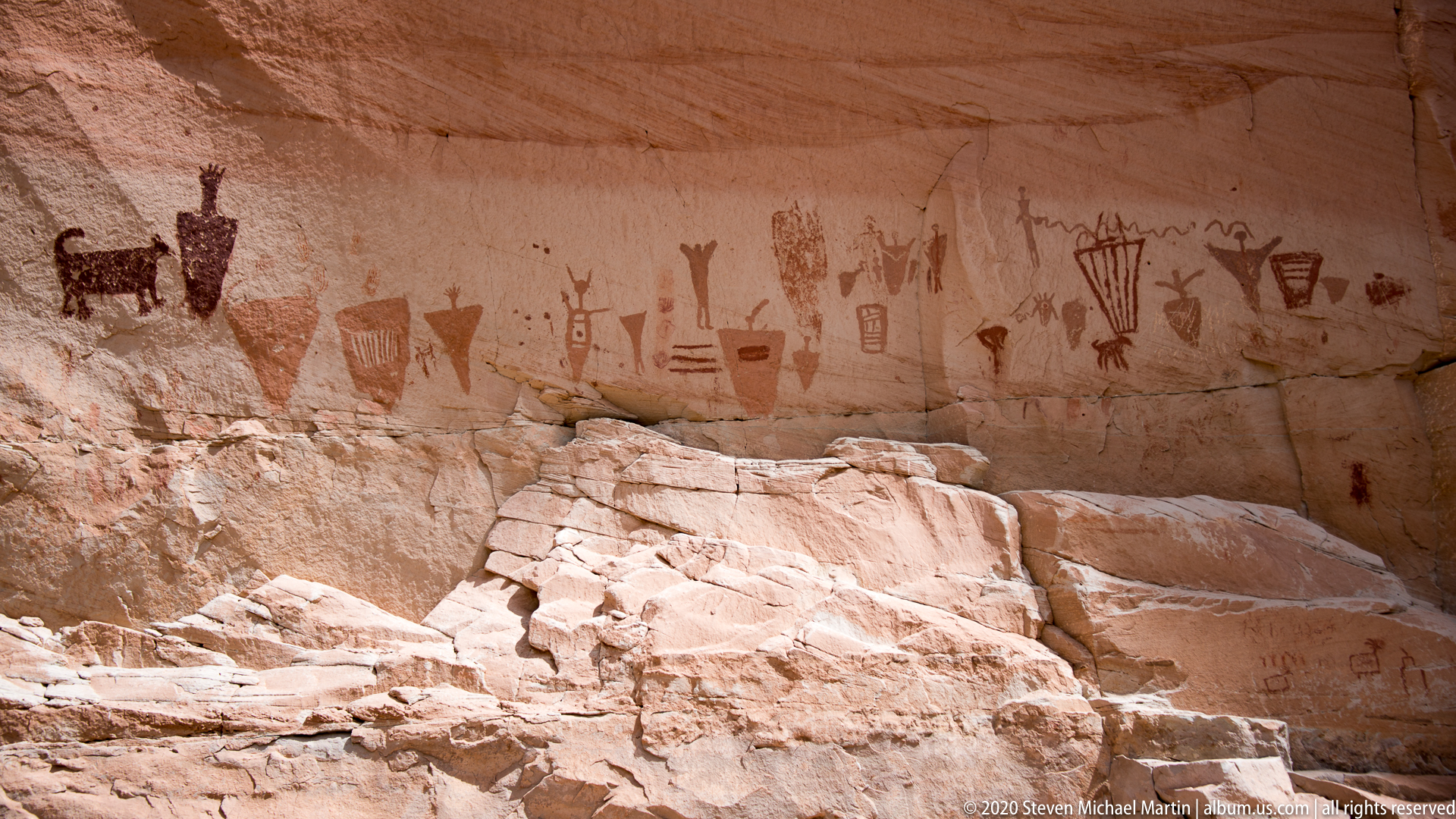
The wider composition reveals a continuous band of painted motifs across the back wall of a shallow shelter. Upright figures, animal-like shapes, and geometric forms occupy the upper strip, while broad pale slabs and a low natural bench fill the foreground. The overhanging ceiling casts warm shade across the panel. The photograph connects the rock art to the alcove and ledge where it appears.
Caption
The wider composition reveals a continuous band of painted motifs across the back wall of a shallow shelter. Upright figures, animal-like shapes, and geometric forms occupy the upper strip, while broad pale slabs and a low natural bench fill the foreground. The overhanging ceiling casts warm shade across the panel. The photograph connects the rock art to the alcove and ledge where it appears.
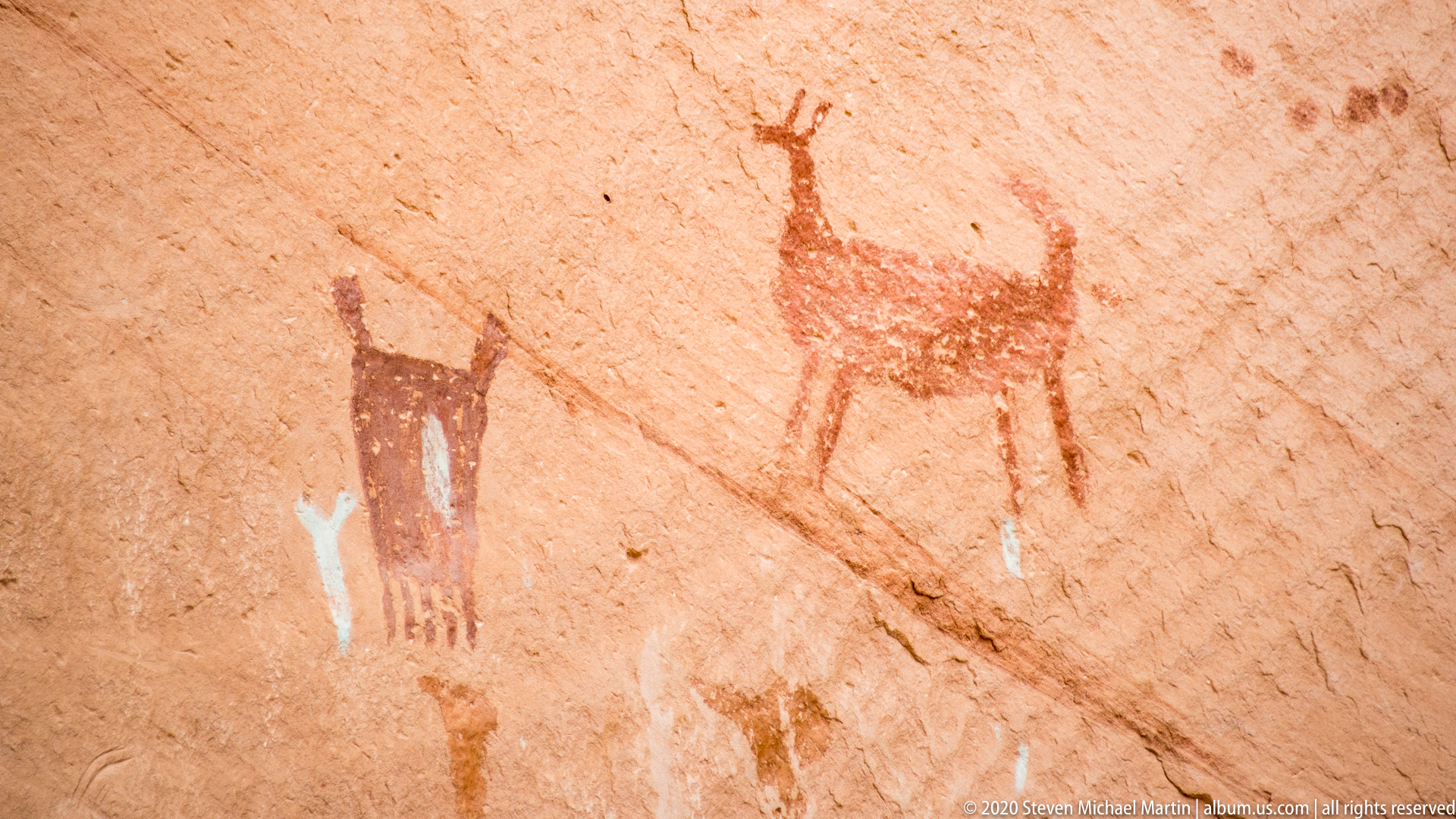
Several faded painted forms occupy a close sandstone surface: upright shapes at left and center and a larger quadruped with branching horns or antlers to the right. Pale pigment traces overlap darker red-brown marks. The close framing makes the animal-like outline and human-like forms legible, but their identities and relationship are not certain enough to interpret as a specific scene.
Caption
Several faded painted forms occupy a close sandstone surface: upright shapes at left and center and a larger quadruped with branching horns or antlers to the right. Pale pigment traces overlap darker red-brown marks. The close framing makes the animal-like outline and human-like forms legible, but their identities and relationship are not certain enough to interpret as a specific scene.
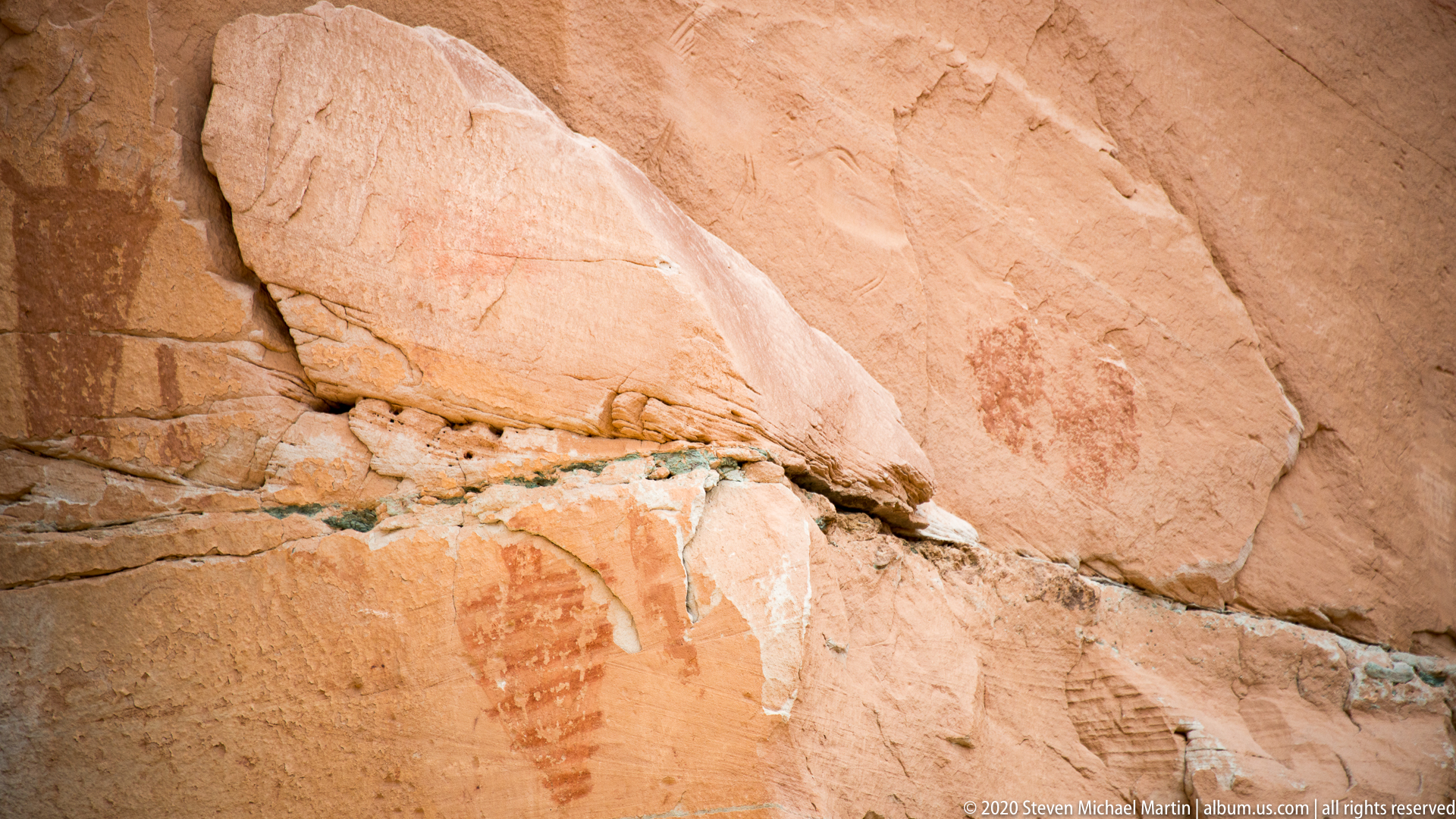
The photograph isolates faint red pigment on a pale sandstone face crossed by a deep diagonal seam. A few narrow marks and a small clustered motif remain below the fracture, while the upper slab projects over the lower surface. The composition pairs traces of painted rock art with the rock’s natural break and exfoliating planes; the motif is too faint for a more specific reading.
Caption
The photograph isolates faint red pigment on a pale sandstone face crossed by a deep diagonal seam. A few narrow marks and a small clustered motif remain below the fracture, while the upper slab projects over the lower surface. The composition pairs traces of painted rock art with the rock’s natural break and exfoliating planes; the motif is too faint for a more specific reading.
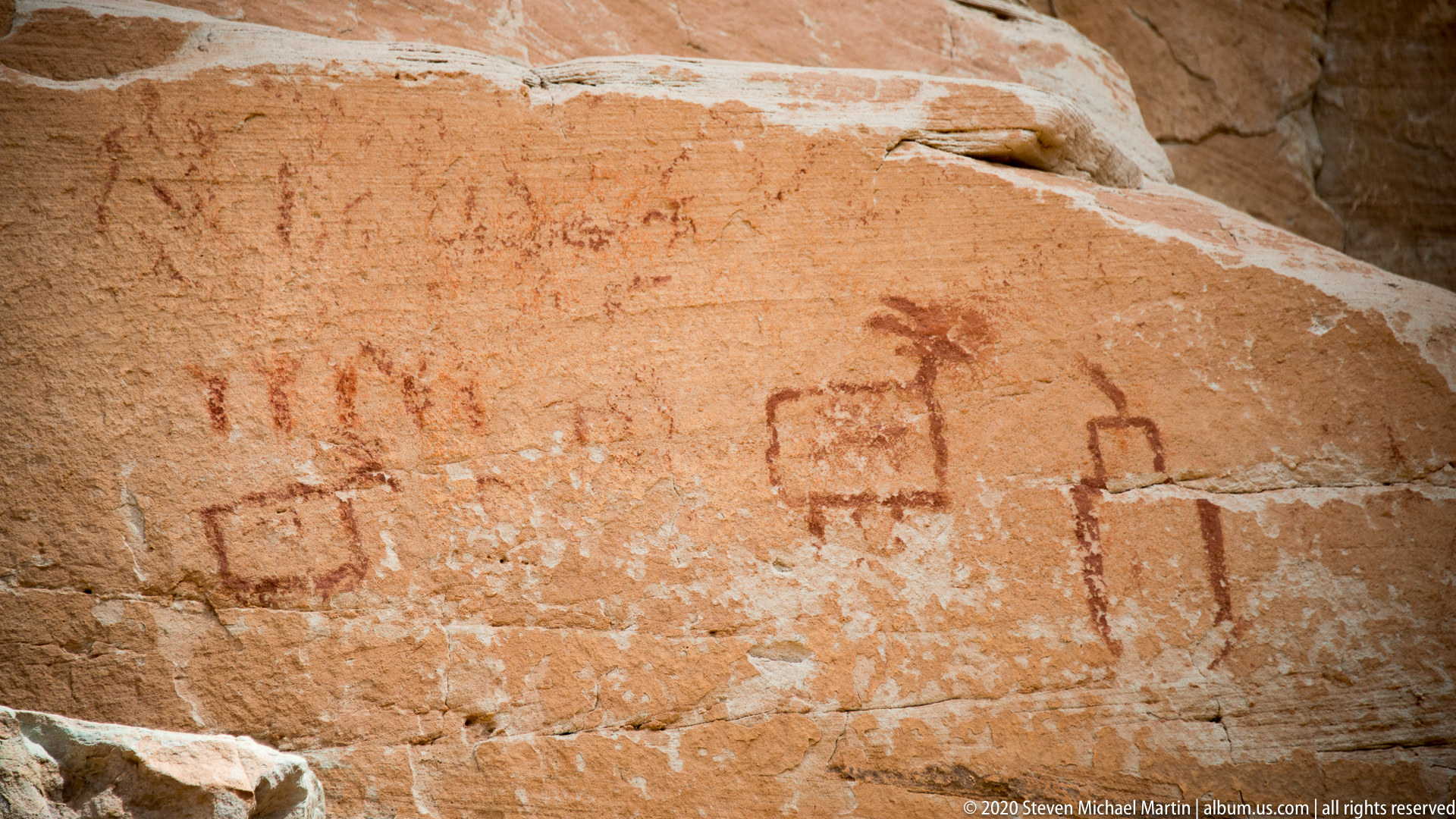
Several red-brown figures are painted across a sloping sandstone panel. The clearest forms have rectangular bodies and short projecting legs, with additional upright and partial outlines nearby. A pale band of rock crosses above them, and broken stone frames the lower edge. The oblique view makes the figures’ relation to the sloped surface apparent; their exact identities remain uncertain.
Caption
Several red-brown figures are painted across a sloping sandstone panel. The clearest forms have rectangular bodies and short projecting legs, with additional upright and partial outlines nearby. A pale band of rock crosses above them, and broken stone frames the lower edge. The oblique view makes the figures’ relation to the sloped surface apparent; their exact identities remain uncertain.
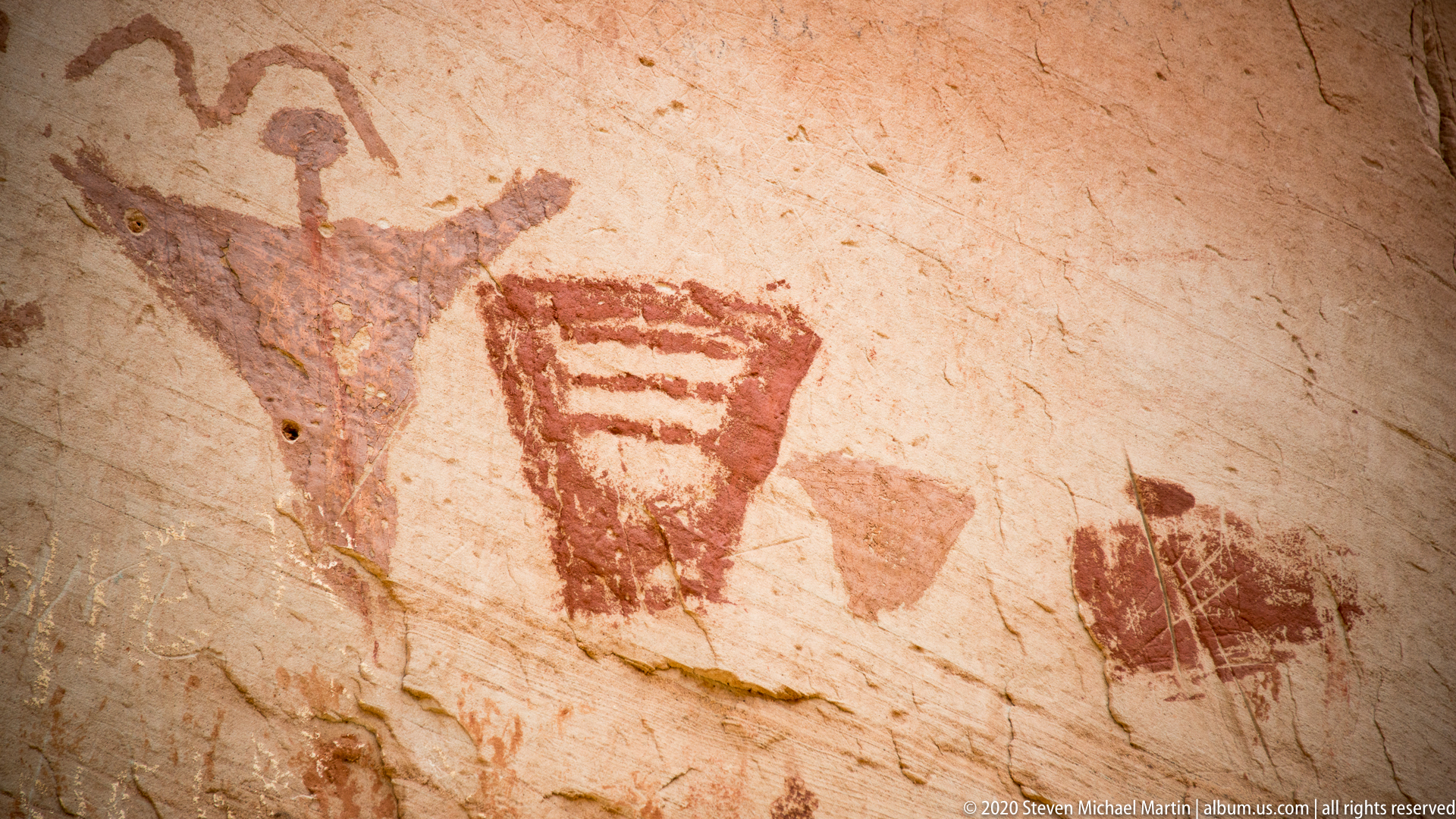
A large branching form at left and a broad trapezoidal shape with horizontal bands dominate this close panel. Smaller pale and red marks continue to the right, partly cut off by the frame. The pigment’s uneven edges and light sandstone make the contrast strong, though the forms’ meanings are not established. The image records a distinctive arrangement of abstract and figure-like rock paintings.
Caption
A large branching form at left and a broad trapezoidal shape with horizontal bands dominate this close panel. Smaller pale and red marks continue to the right, partly cut off by the frame. The pigment’s uneven edges and light sandstone make the contrast strong, though the forms’ meanings are not established. The image records a distinctive arrangement of abstract and figure-like rock paintings.
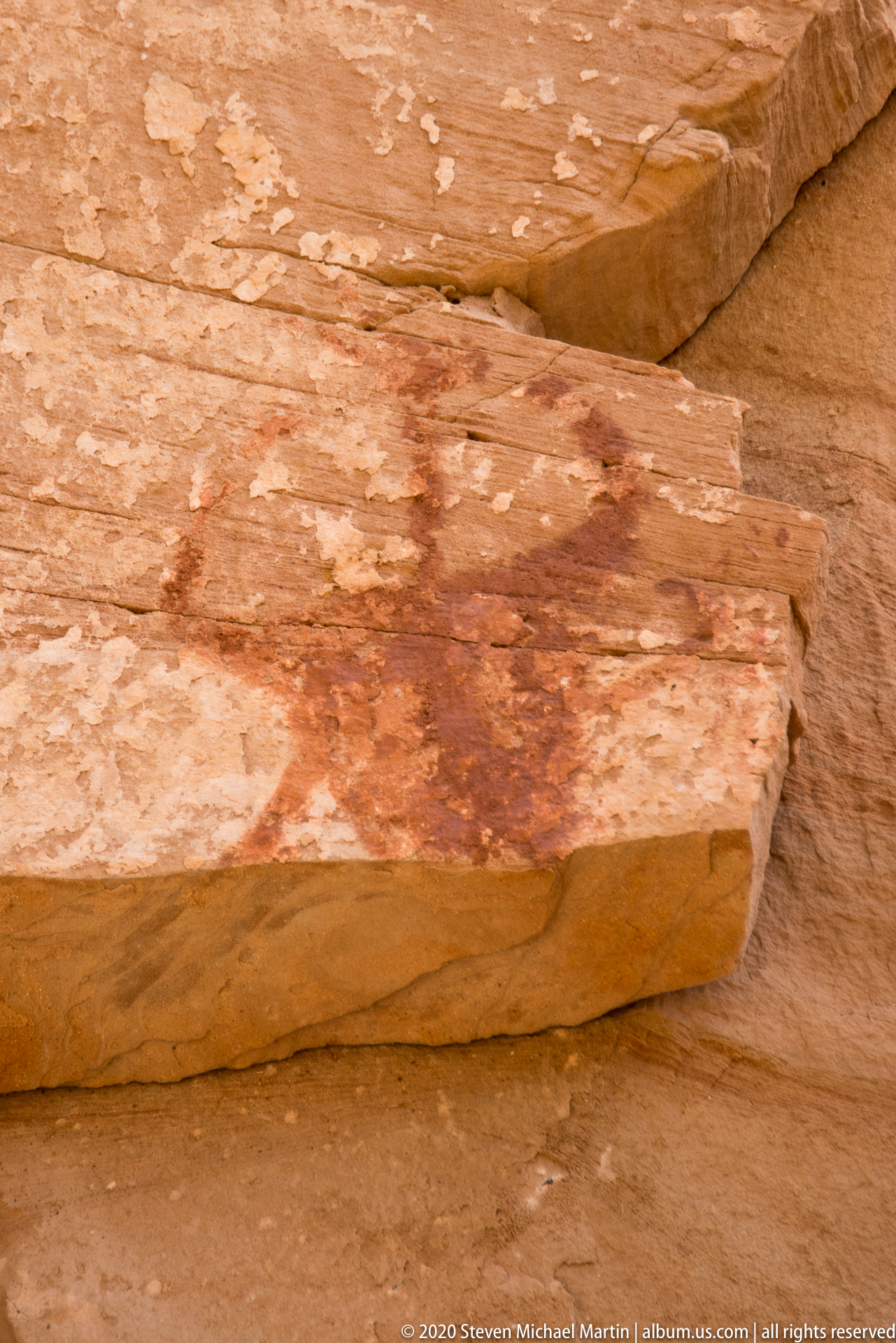
A low, flat slab fills the view, its layered edges forming horizontal bands above a shallow shadowed gap. An irregular dark reddish-brown stain spreads across the upper surface, contrasting with lighter orange stone around it. No definite painted figure is visible in this crop, so the image is best described as a close study of stained, weathered sandstone rather than identified as rock art.
Caption
A low, flat slab fills the view, its layered edges forming horizontal bands above a shallow shadowed gap. An irregular dark reddish-brown stain spreads across the upper surface, contrasting with lighter orange stone around it. No definite painted figure is visible in this crop, so the image is best described as a close study of stained, weathered sandstone rather than identified as rock art.
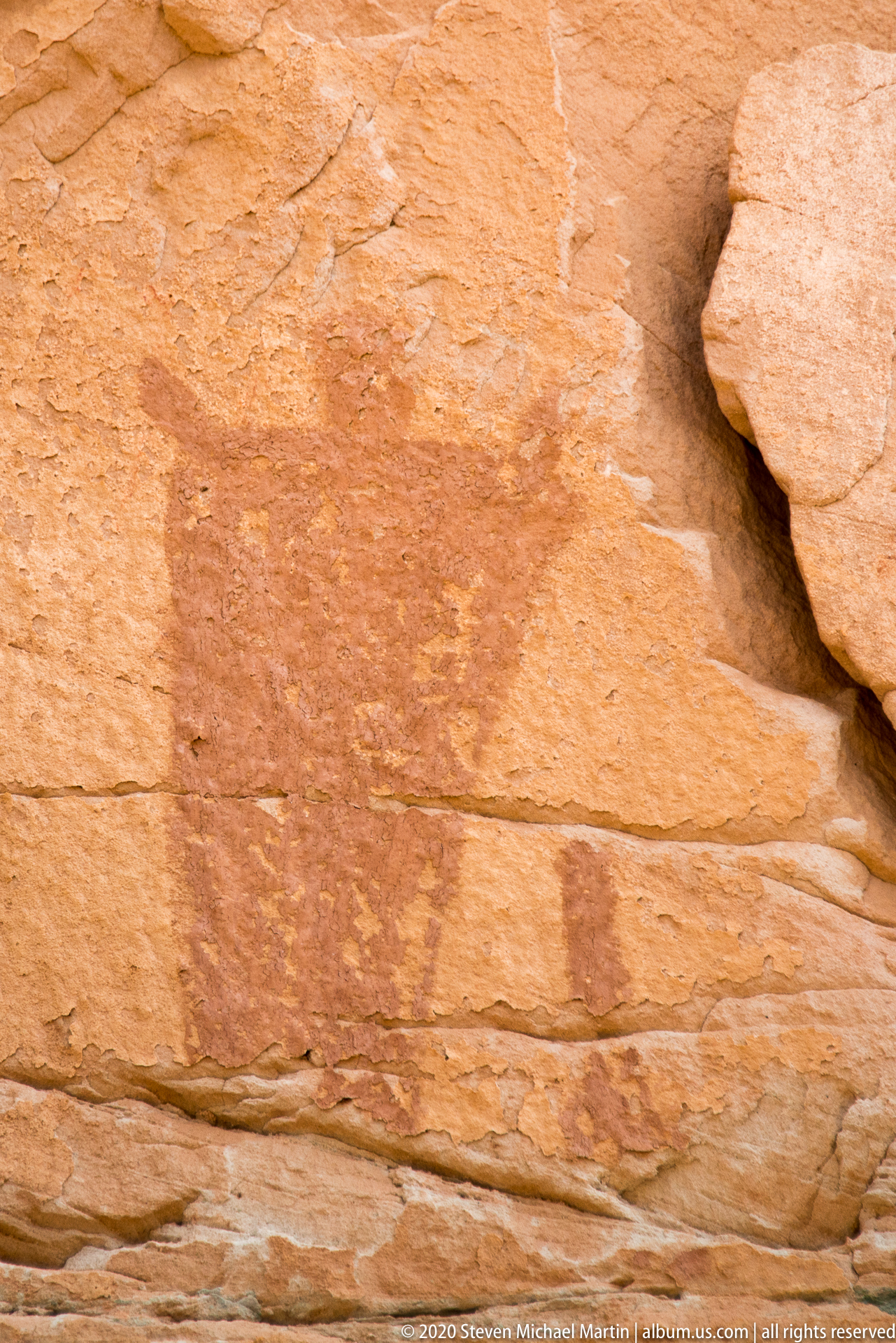
Smooth orange sandstone fills the frame, with a dark narrow crevice opening between overlapping slabs at upper right. Fine horizontal bedding lines and subtle color changes cross the rock, while a faint reddish patch appears near the center. The close composition focuses on the slab’s layered structure and shadowed gap; no clear pictograph is visible at this scale.
Caption
Smooth orange sandstone fills the frame, with a dark narrow crevice opening between overlapping slabs at upper right. Fine horizontal bedding lines and subtle color changes cross the rock, while a faint reddish patch appears near the center. The close composition focuses on the slab’s layered structure and shadowed gap; no clear pictograph is visible at this scale.
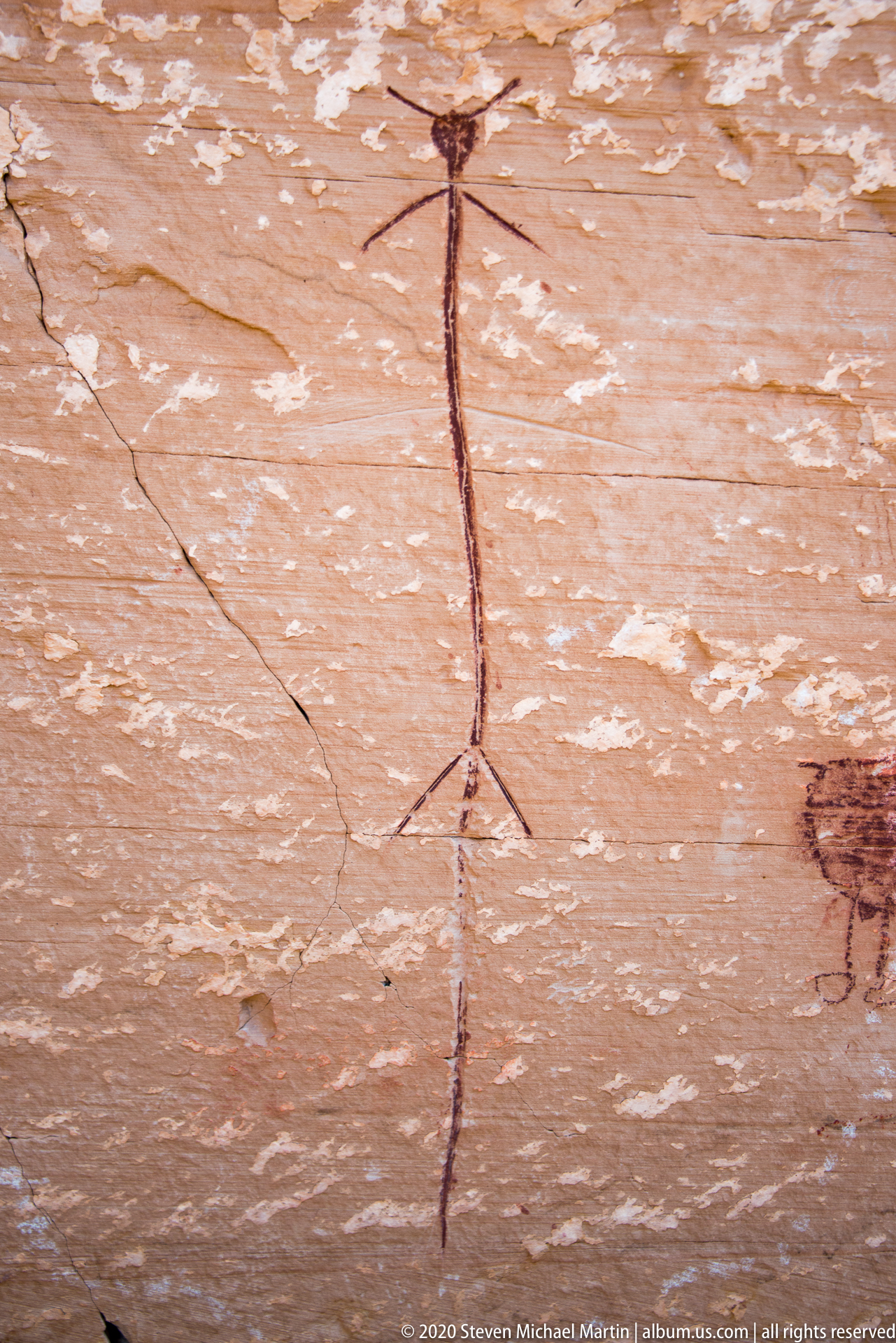
Several animal-like figures occupy a low band of sandstone: a large rounded quadruped at center-right and smaller forms extending to the left. Thin branching lines rise above one of the smaller figures, while a narrow outline stands at far right. The shaded, receding view places the painted group within a ledge and makes the rock’s horizontal bedding part of the composition.
Caption
Several animal-like figures occupy a low band of sandstone: a large rounded quadruped at center-right and smaller forms extending to the left. Thin branching lines rise above one of the smaller figures, while a narrow outline stands at far right. The shaded, receding view places the painted group within a ledge and makes the rock’s horizontal bedding part of the composition.
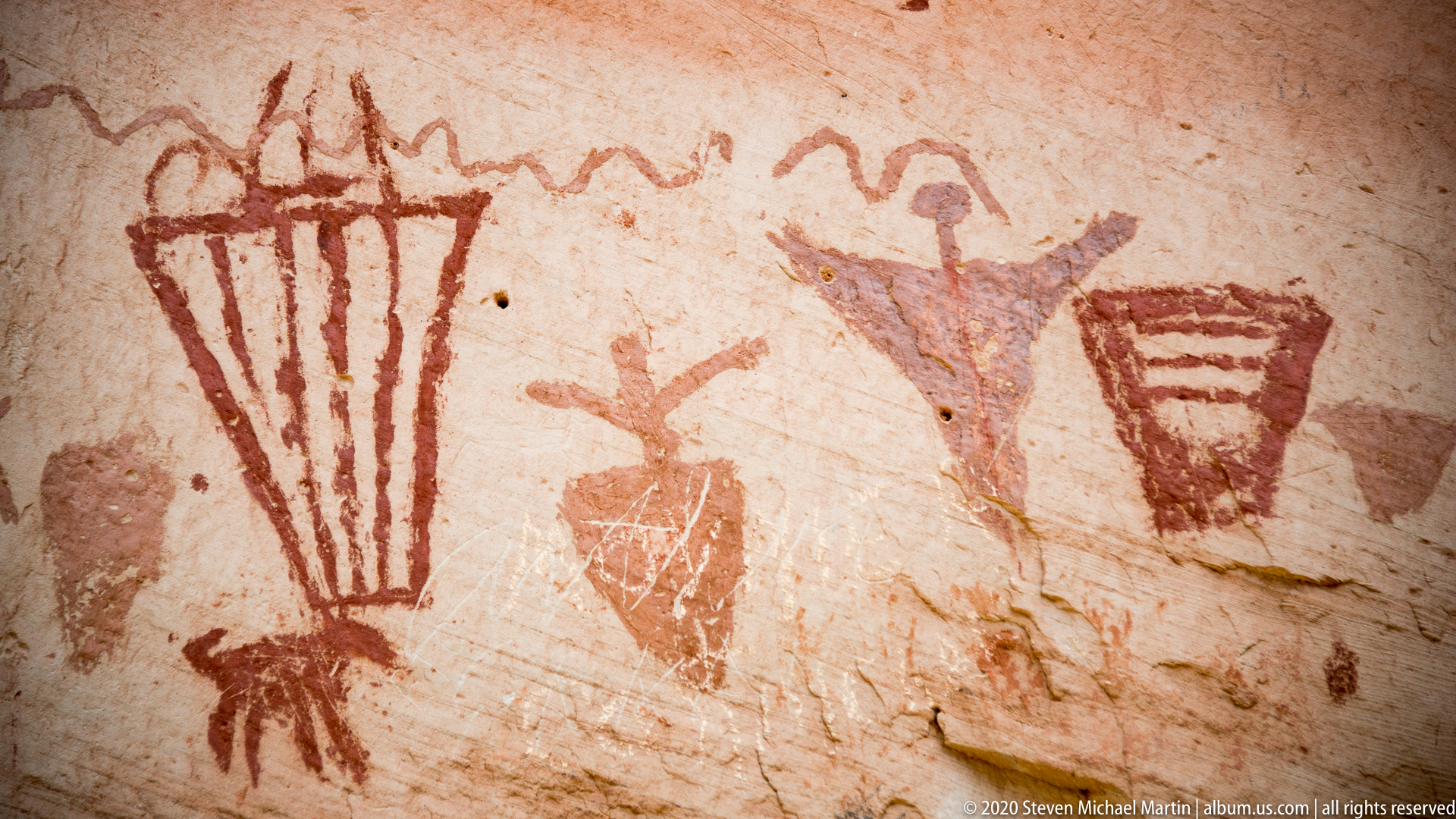
Several rust-red forms flare upward from short bases, beside a faded pale figure and a more saturated purple anthropomorph with outstretched arms. A small barred shape occupies the right side. Their differing pigment strength and scale make this crowded panel read as a sequence of distinct marks rather than a single composition. The shallow rock surface and cracks remain visible through the paint.
Caption
Several rust-red forms flare upward from short bases, beside a faded pale figure and a more saturated purple anthropomorph with outstretched arms. A small barred shape occupies the right side. Their differing pigment strength and scale make this crowded panel read as a sequence of distinct marks rather than a single composition. The shallow rock surface and cracks remain visible through the paint.

This close view isolates one dark red fan-shaped pictograph, its long strokes converging at a broad base that meets a horizontal painted form below. Fainter red and purple marks survive on the left, but the cropped composition gives the dominant motif nearly all the visual weight. Grain, shallow fissures, and uneven pigment expose the natural sandstone beneath the image.
Caption
This close view isolates one dark red fan-shaped pictograph, its long strokes converging at a broad base that meets a horizontal painted form below. Fainter red and purple marks survive on the left, but the cropped composition gives the dominant motif nearly all the visual weight. Grain, shallow fissures, and uneven pigment expose the natural sandstone beneath the image.
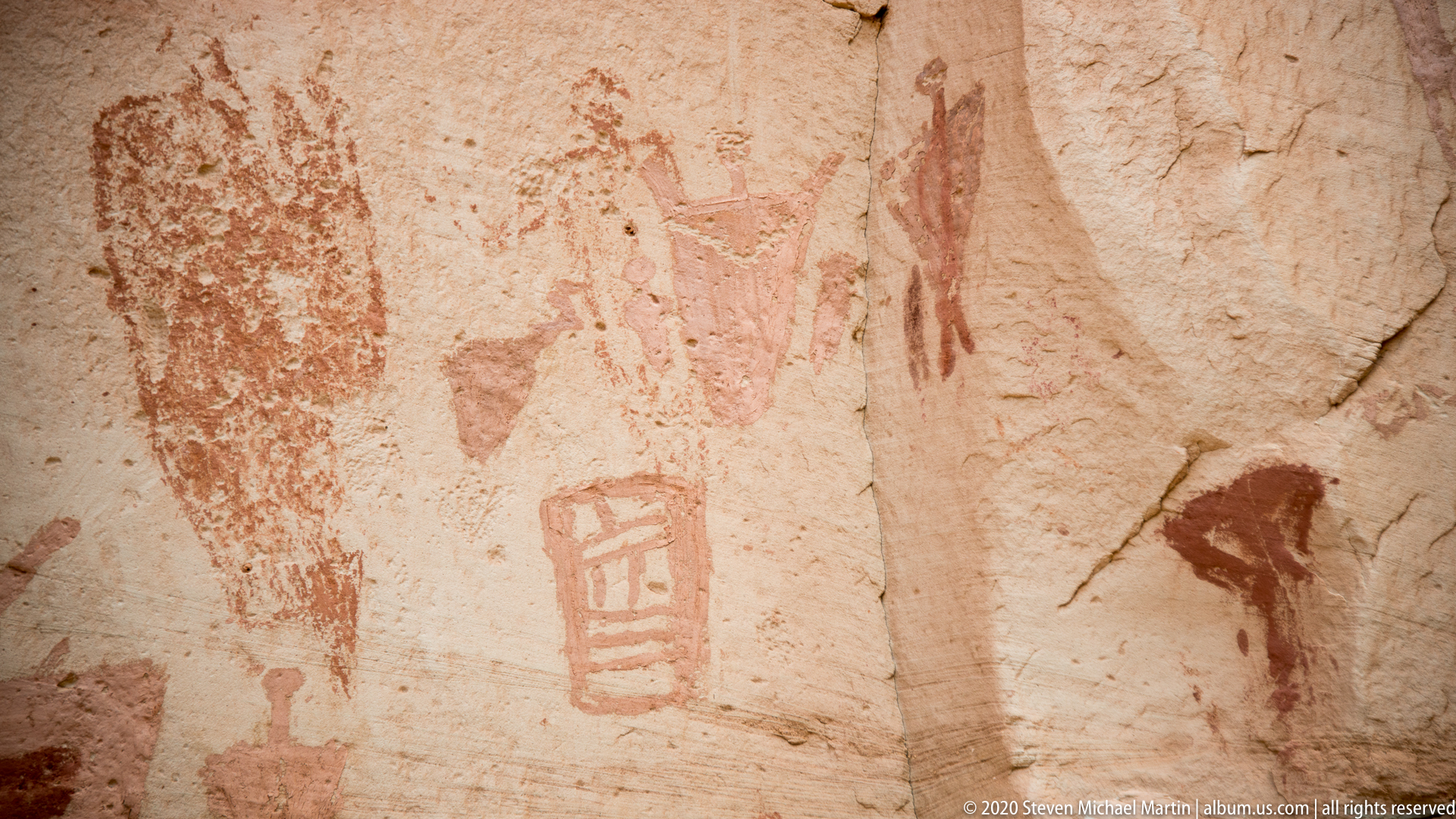
A tall, faded figure occupies the center of this weathered panel, while a small ladder-like motif survives near the bottom. A darker rounded mark appears at right, and scattered pigment traces extend across the pale, cracked surface. The marks differ sharply in legibility, so the surviving barred form anchors a composition whose other figures are difficult to distinguish.
Caption
A tall, faded figure occupies the center of this weathered panel, while a small ladder-like motif survives near the bottom. A darker rounded mark appears at right, and scattered pigment traces extend across the pale, cracked surface. The marks differ sharply in legibility, so the surviving barred form anchors a composition whose other figures are difficult to distinguish.
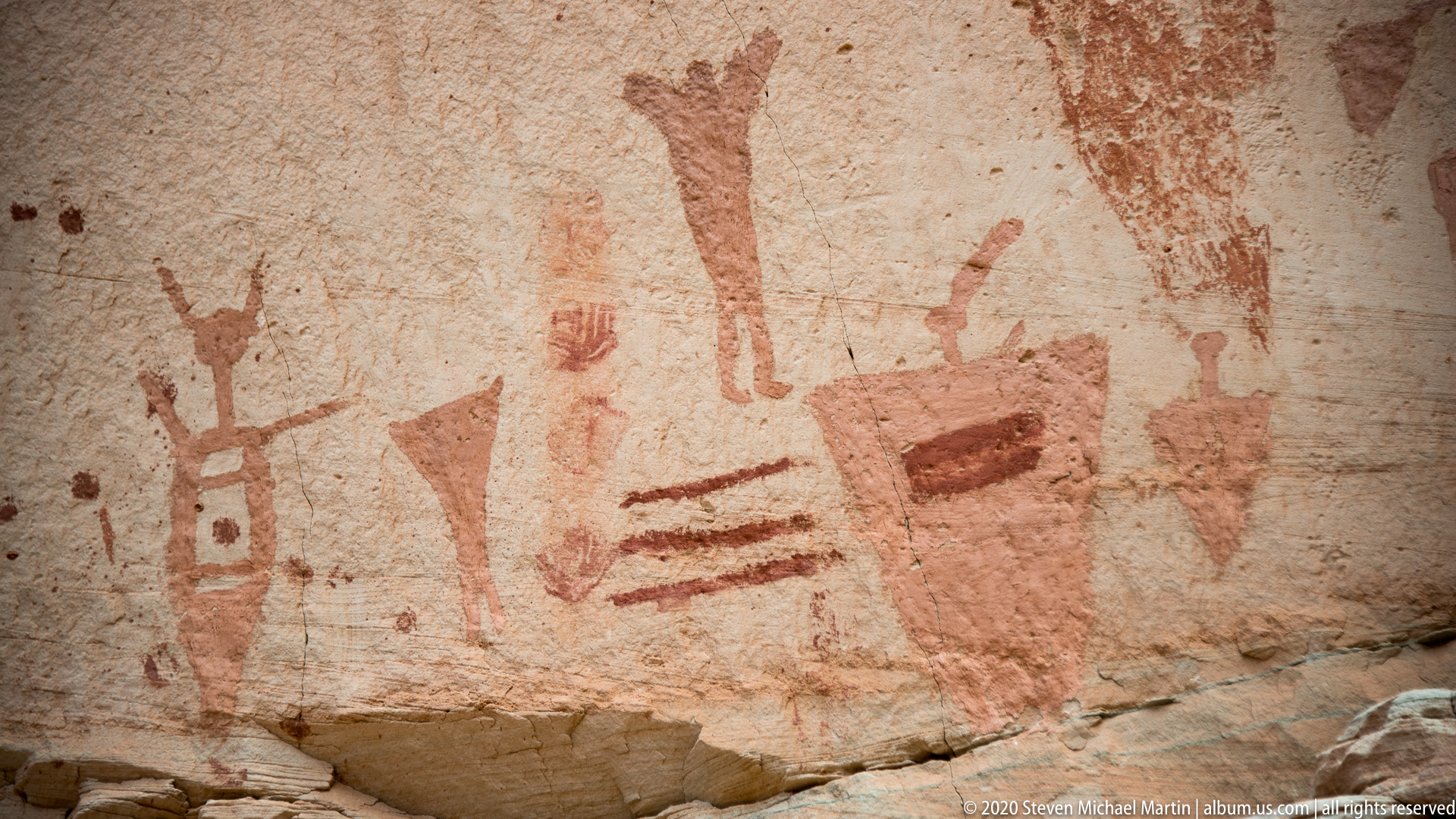
Several red and brown pictographs spread across the wall: a small framed shape at left, a triangular form and short parallel bars near center, and elongated figures above and to the right. Their varied scale and faded outlines sit against a ledge-cut sandstone face. The wide framing preserves the relationships among motifs, rather than privileging one isolated figure.
Caption
Several red and brown pictographs spread across the wall: a small framed shape at left, a triangular form and short parallel bars near center, and elongated figures above and to the right. Their varied scale and faded outlines sit against a ledge-cut sandstone face. The wide framing preserves the relationships among motifs, rather than privileging one isolated figure.
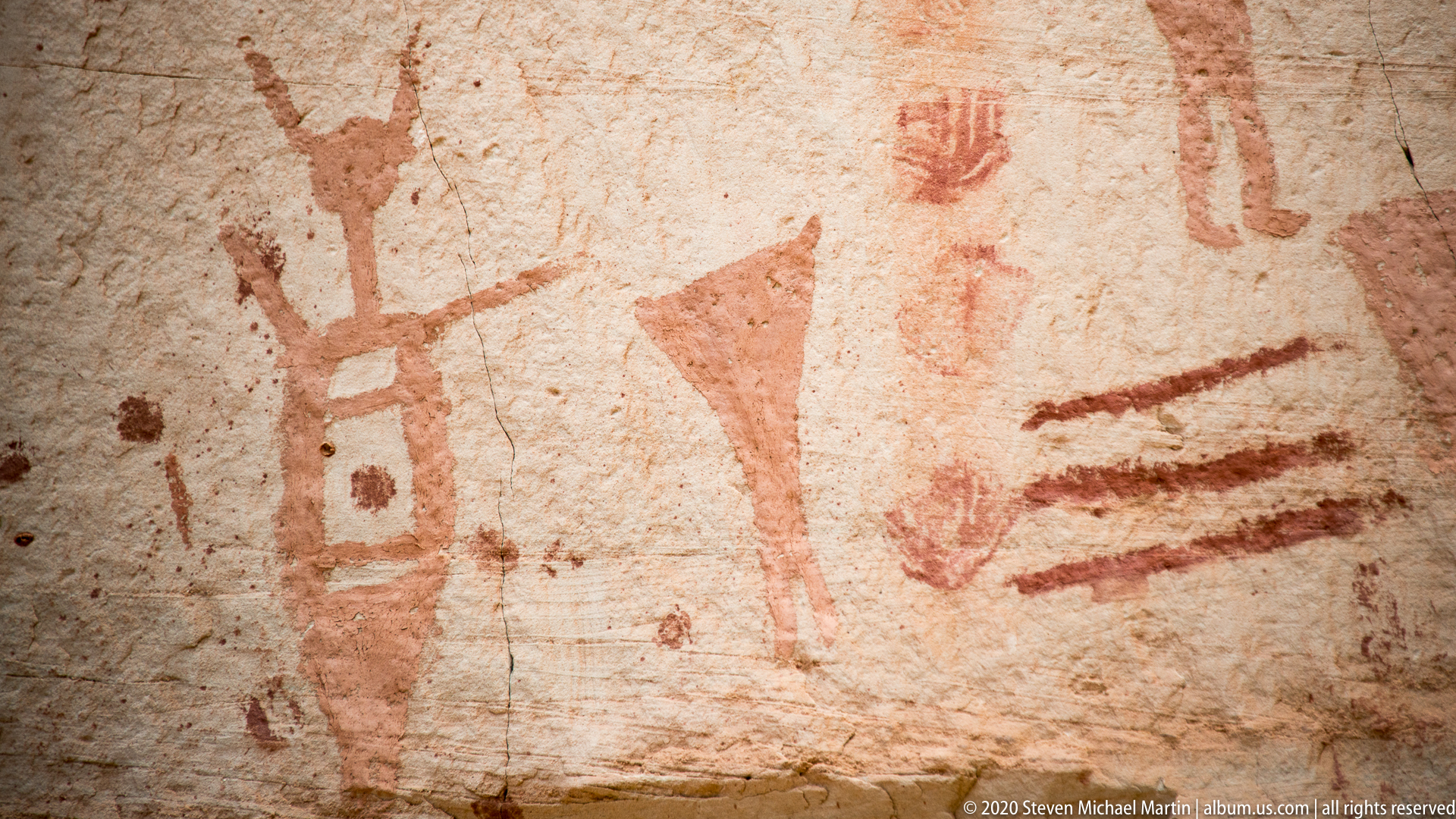
The close crop brings three contrasting marks together: a pale outlined rectangle with a central dark spot, a muted triangular shape, and three reddish horizontal bars. Fragments of taller forms enter from above, linking the details to a larger painted wall beyond the frame. The close viewpoint makes pigment edges, fading, and surface texture especially apparent.
Caption
The close crop brings three contrasting marks together: a pale outlined rectangle with a central dark spot, a muted triangular shape, and three reddish horizontal bars. Fragments of taller forms enter from above, linking the details to a larger painted wall beyond the frame. The close viewpoint makes pigment edges, fading, and surface texture especially apparent.

A dark quadruped with a curled tail stands beside a tall upright figure whose raised extremities resemble hands or branches. Below and to the right, paler triangular and barred motifs continue across the same sandstone surface. The strong contrast of the two dark forms makes them legible at once, while the adjacent faded images reveal how much of the panel has lost definition.
Caption
A dark quadruped with a curled tail stands beside a tall upright figure whose raised extremities resemble hands or branches. Below and to the right, paler triangular and barred motifs continue across the same sandstone surface. The strong contrast of the two dark forms makes them legible at once, while the adjacent faded images reveal how much of the panel has lost definition.
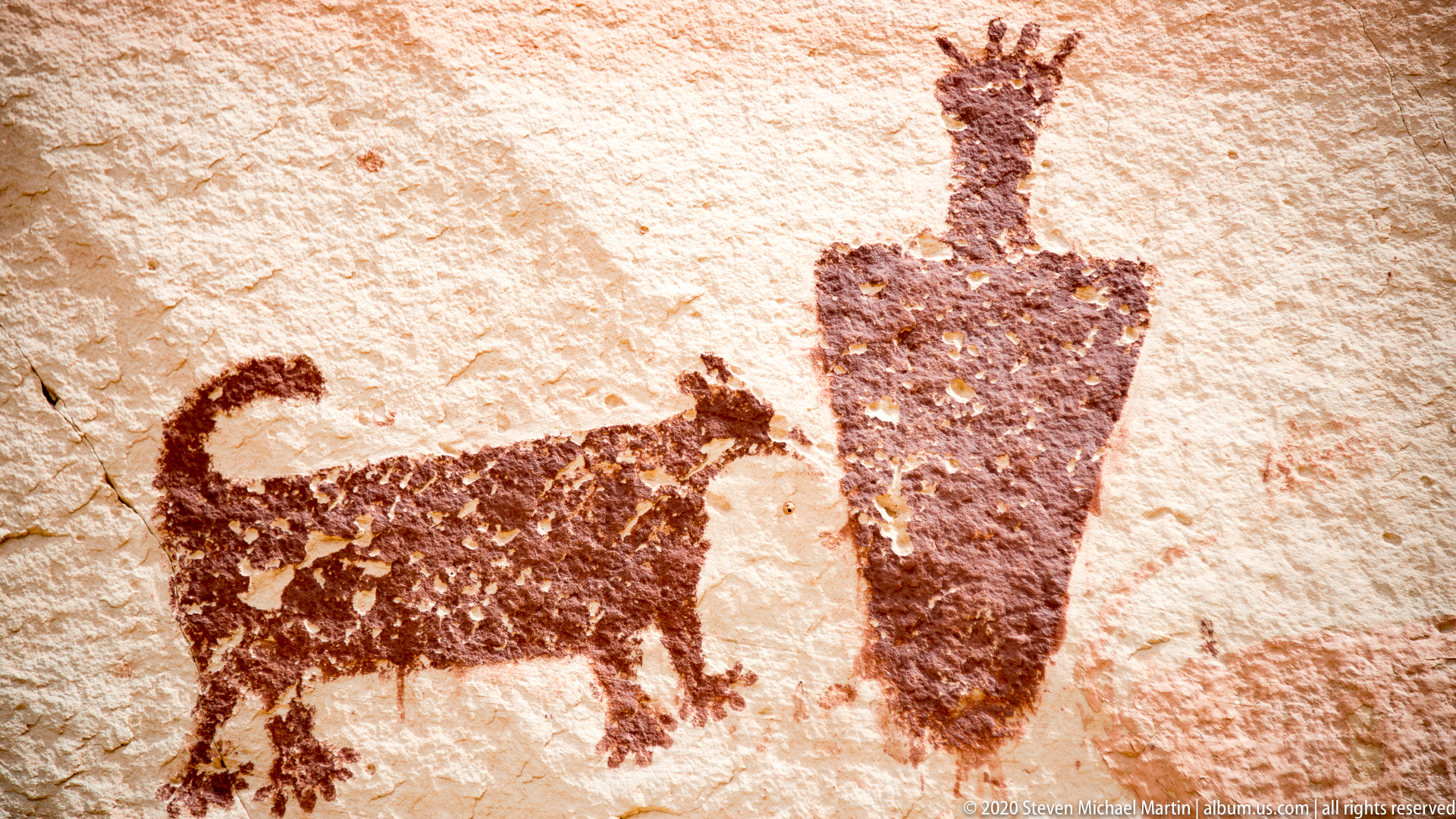
The animal’s long body, four legs, and curled tail are sharply visible beside a tall tapered figure topped with several short projections. Pigment loss creates mottling within both shapes, while a pale horizontal crack crosses the surrounding sandstone. This close composition distinguishes the paired dark figures from the more delicate marks seen elsewhere on the panel.
Caption
The animal’s long body, four legs, and curled tail are sharply visible beside a tall tapered figure topped with several short projections. Pigment loss creates mottling within both shapes, while a pale horizontal crack crosses the surrounding sandstone. This close composition distinguishes the paired dark figures from the more delicate marks seen elsewhere on the panel.
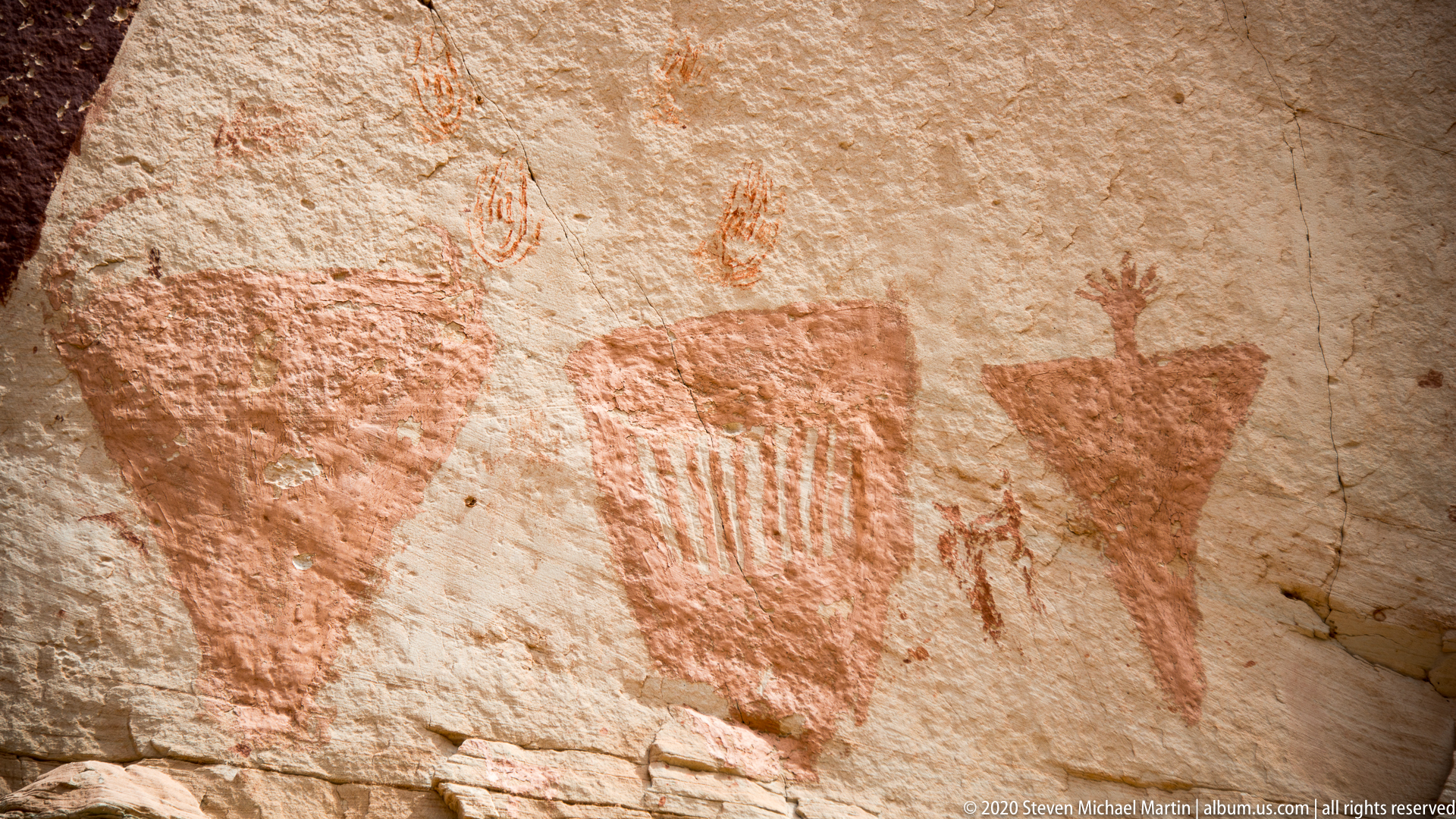
A broad pale triangle at left, a larger central shape filled with vertical bars, and a smaller tapered figure at right form a loose three-part arrangement. Fine outlined marks sit above them, and a faint human-like outline appears between the center and right. The photograph preserves the spacing and relative scale of the motifs across the fractured rock face.
Caption
A broad pale triangle at left, a larger central shape filled with vertical bars, and a smaller tapered figure at right form a loose three-part arrangement. Fine outlined marks sit above them, and a faint human-like outline appears between the center and right. The photograph preserves the spacing and relative scale of the motifs across the fractured rock face.

A single linear anthropomorph rises from a narrow base, its arms extended laterally and its legs angled apart. The figure is small against the broad, horizontally banded sandstone, with a fine crack running down the wall nearby. This spare composition differs from the dense painted groups around it by leaving most of the rock face unmarked.
Caption
A single linear anthropomorph rises from a narrow base, its arms extended laterally and its legs angled apart. The figure is small against the broad, horizontally banded sandstone, with a fine crack running down the wall nearby. This spare composition differs from the dense painted groups around it by leaving most of the rock face unmarked.
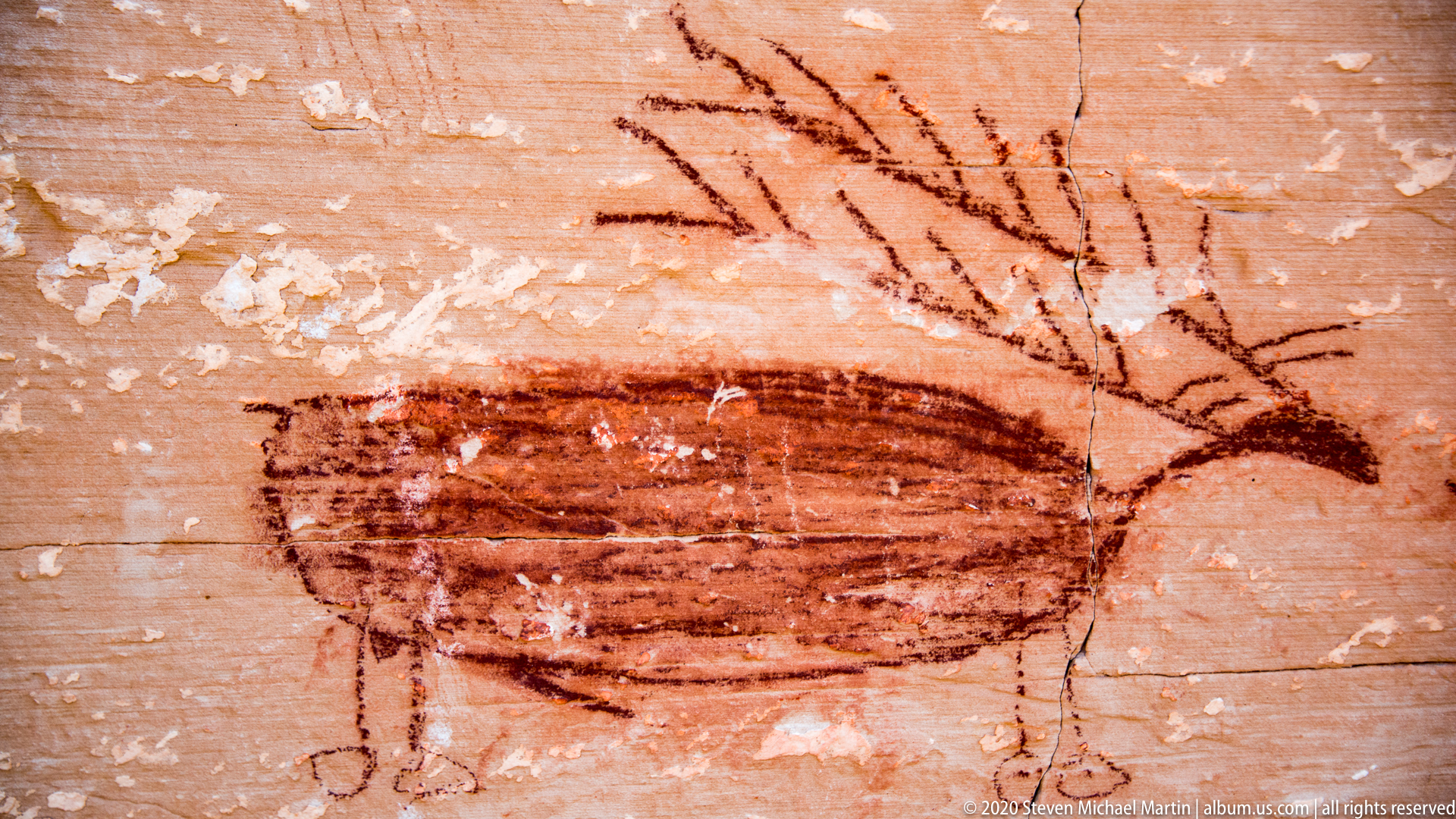
A broad, horizontally striped body with four short legs and a long projecting head or neck dominates the close view. Dark branching lines rise over its back, and scattered pale gaps interrupt the reddish pigment. The tight framing makes the animal’s outline and layered fill easy to examine, while leaving its relationship to the wider rock-art panel outside the picture.
Caption
A broad, horizontally striped body with four short legs and a long projecting head or neck dominates the close view. Dark branching lines rise over its back, and scattered pale gaps interrupt the reddish pigment. The tight framing makes the animal’s outline and layered fill easy to examine, while leaving its relationship to the wider rock-art panel outside the picture.
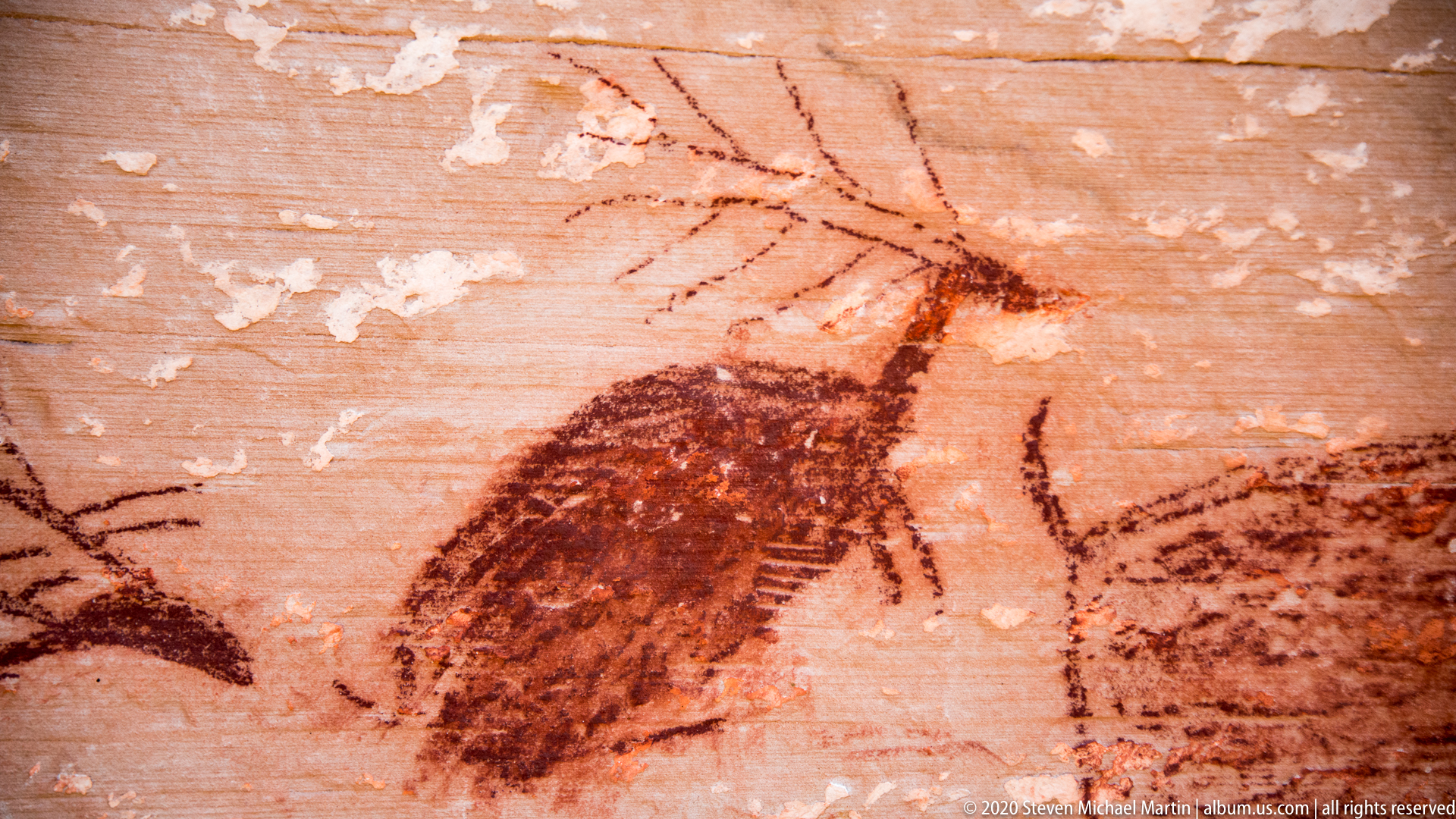
The close crop centers a dark, tapered body with a projecting head and several fine lines branching upward and outward. A curved outline stands to the right, and part of a second broad animal enters from the left. The image emphasizes the dense linear extensions around the central form, whose exact relationship to neighboring figures is obscured by the crop.
Caption
The close crop centers a dark, tapered body with a projecting head and several fine lines branching upward and outward. A curved outline stands to the right, and part of a second broad animal enters from the left. The image emphasizes the dense linear extensions around the central form, whose exact relationship to neighboring figures is obscured by the crop.
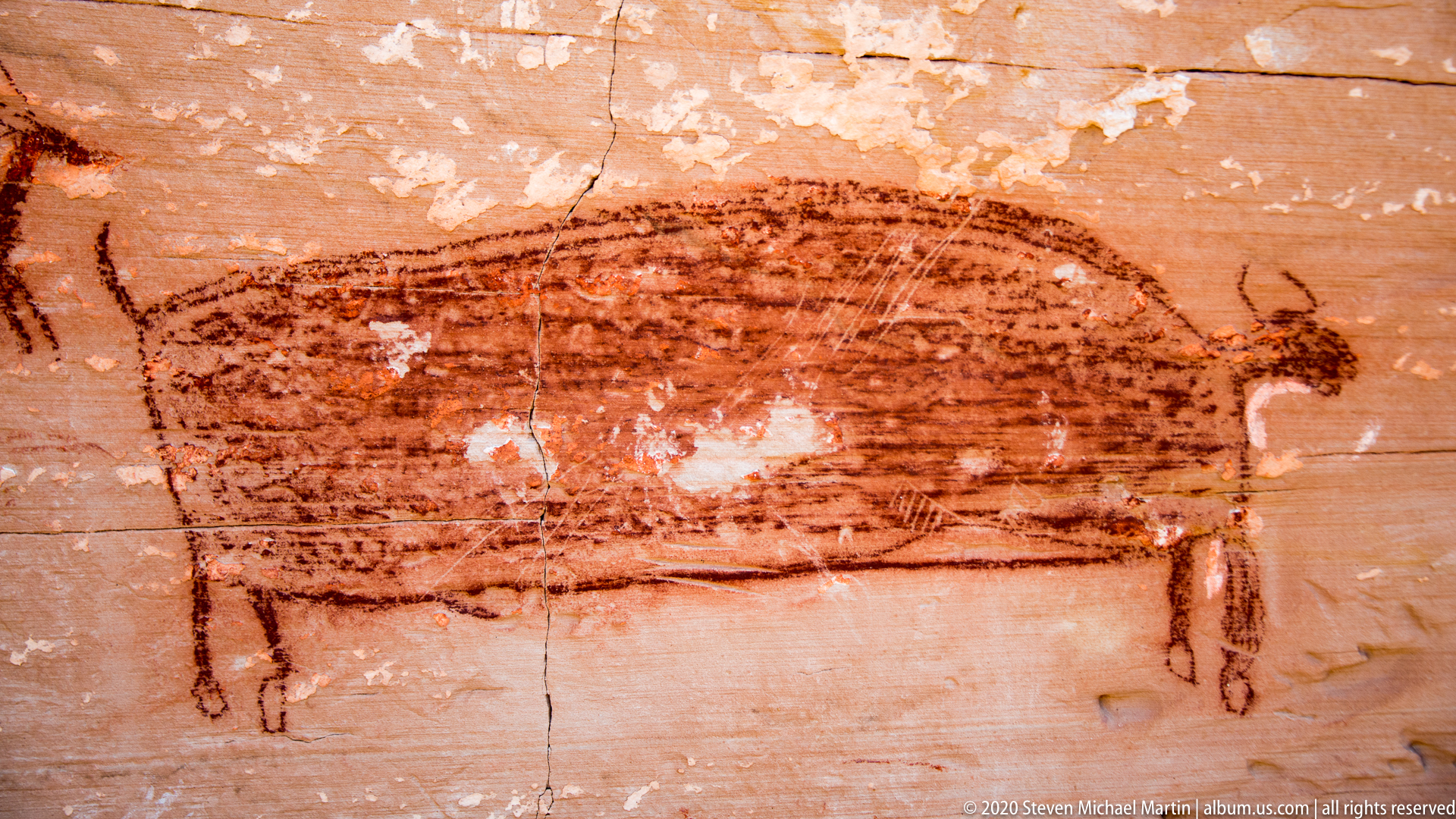
A long-bodied quadruped fills nearly the entire frame, with four legs, a projecting head, and parallel reddish bands across its body. Pale losses and darker pigment patches interrupt the stripes, while the horizontal rock grain runs in the same direction as the figure. The close view foregrounds its unusual striped treatment and worn surface rather than the surrounding panel.
Caption
A long-bodied quadruped fills nearly the entire frame, with four legs, a projecting head, and parallel reddish bands across its body. Pale losses and darker pigment patches interrupt the stripes, while the horizontal rock grain runs in the same direction as the figure. The close view foregrounds its unusual striped treatment and worn surface rather than the surrounding panel.

A slender outlined anthropomorph occupies the center, with arms stretched sideways and legs descending to a small cluster of marks. The head is rounded and slightly radiating, while the body remains mostly unfilled. A vertical fracture crosses the sandstone beside it, offering a clear scale and surface reference for the delicate painted line.
Caption
A slender outlined anthropomorph occupies the center, with arms stretched sideways and legs descending to a small cluster of marks. The head is rounded and slightly radiating, while the body remains mostly unfilled. A vertical fracture crosses the sandstone beside it, offering a clear scale and surface reference for the delicate painted line.
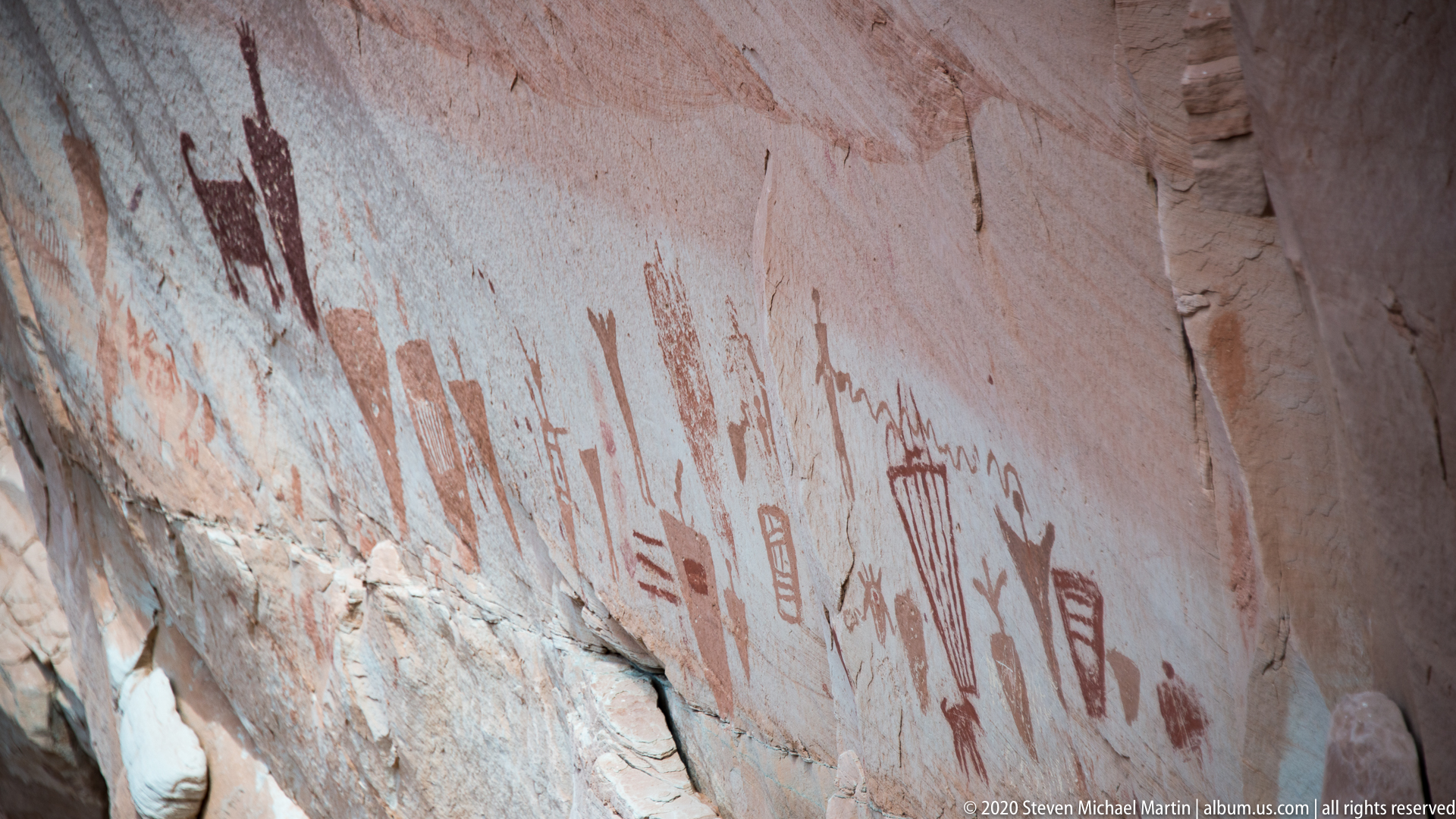
The view follows a sloping sandstone face where repeated red geometric forms and slender figures diminish toward the right. A person appears partly at the lower left, providing scale against the wall and its sheltered overhang. The oblique angle reveals the panel’s length and its placement along a natural rock surface, while individual motifs remain small within the scene.
Caption
The view follows a sloping sandstone face where repeated red geometric forms and slender figures diminish toward the right. A person appears partly at the lower left, providing scale against the wall and its sheltered overhang. The oblique angle reveals the panel’s length and its placement along a natural rock surface, while individual motifs remain small within the scene.
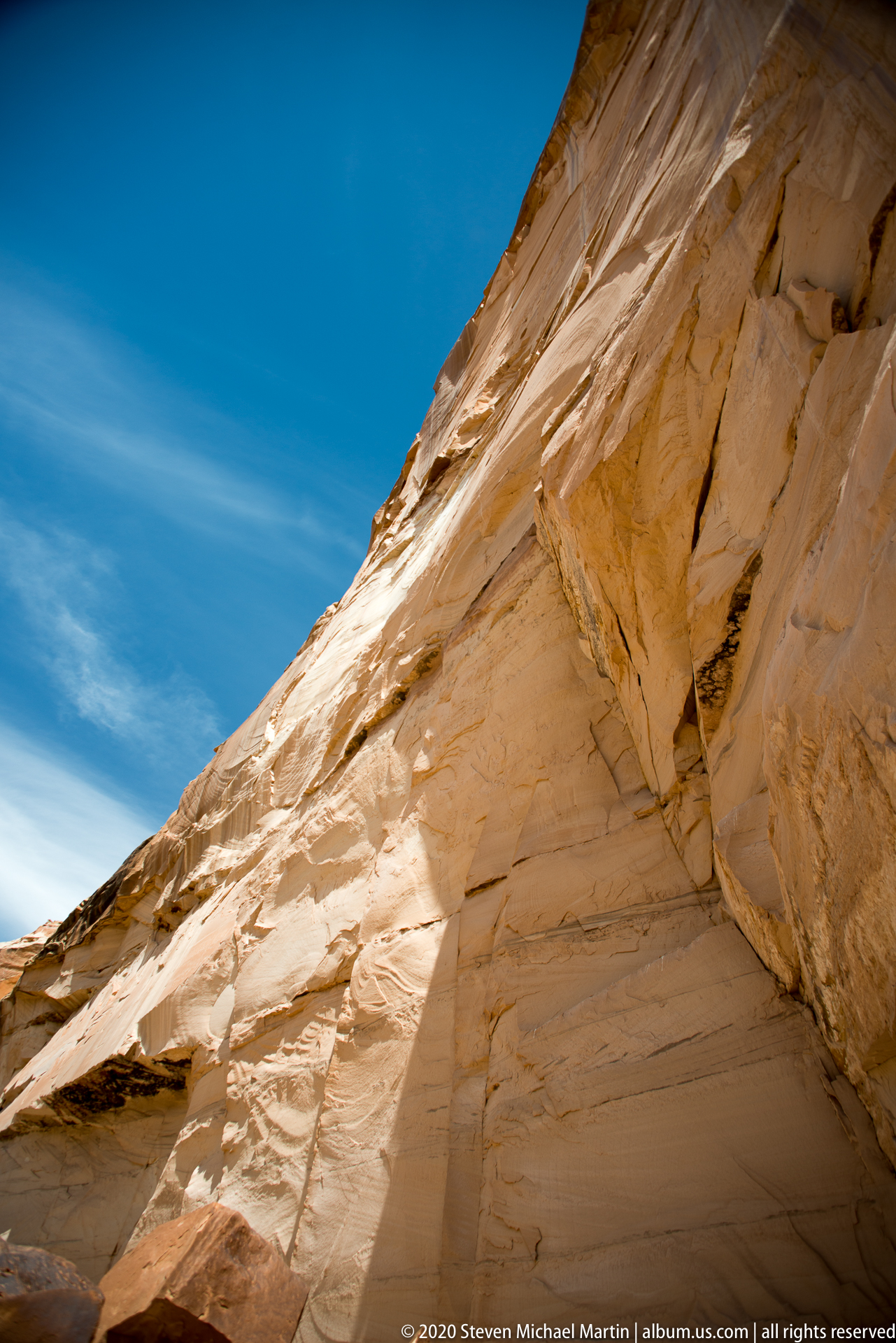
Warm orange and cream bands sweep diagonally across a high rock face, whose smooth curve rises from the lower right toward the open blue sky. A narrow shadowed ledge interrupts the wall near the bottom. The upward viewpoint isolates the sandstone’s layered shape and color, with no people or painted motifs visible in the frame.
Caption
Warm orange and cream bands sweep diagonally across a high rock face, whose smooth curve rises from the lower right toward the open blue sky. A narrow shadowed ledge interrupts the wall near the bottom. The upward viewpoint isolates the sandstone’s layered shape and color, with no people or painted motifs visible in the frame.
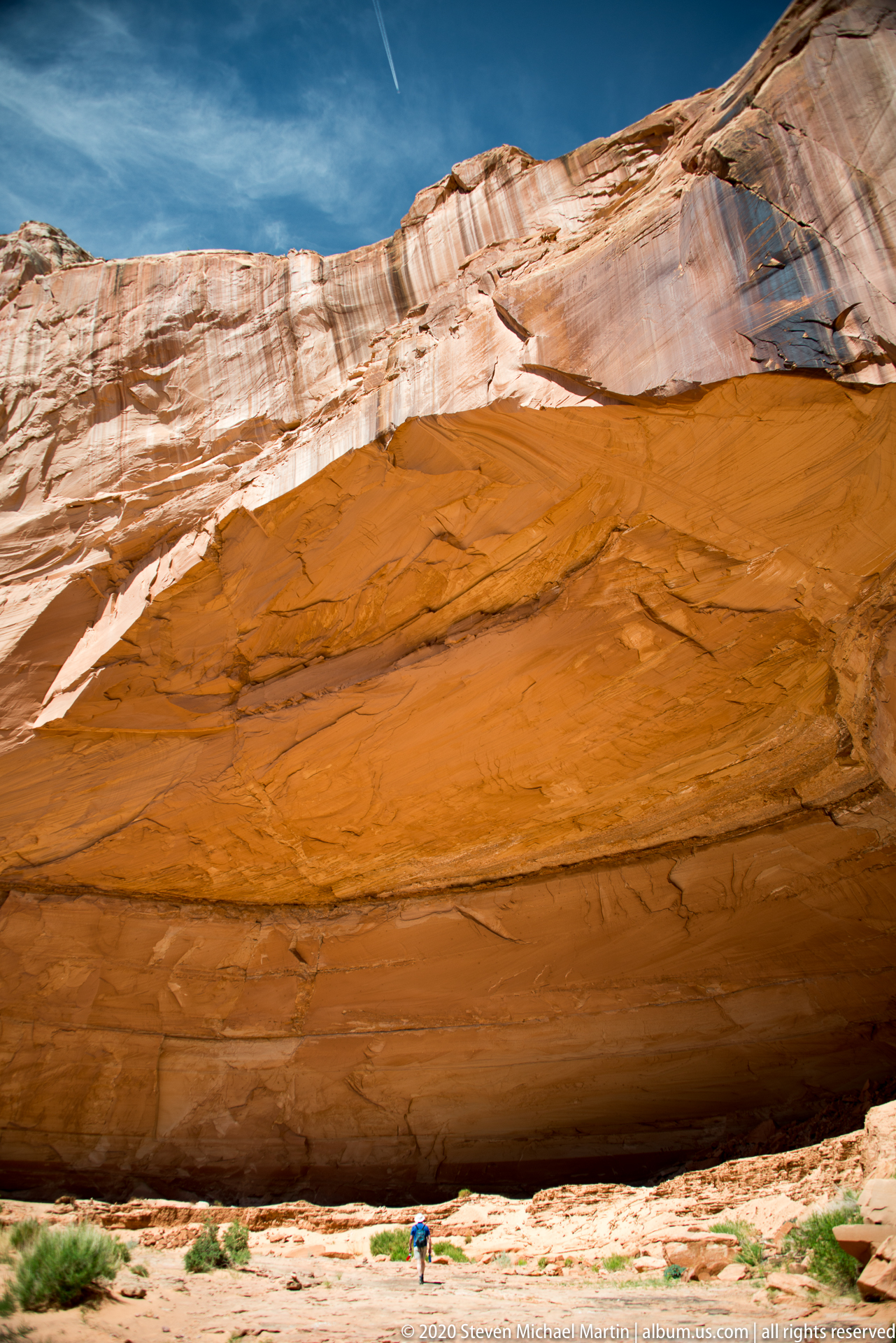
Several pale human-like figures and painted marks appear across a shadowed wall, while large light-colored letters and lines have been scratched or written across the foreground surface. The overlap makes the older painted forms difficult to separate from later markings. The photograph records both layers visibly, but the lettering and its date are not reliably legible at this scale.
Caption
Several pale human-like figures and painted marks appear across a shadowed wall, while large light-colored letters and lines have been scratched or written across the foreground surface. The overlap makes the older painted forms difficult to separate from later markings. The photograph records both layers visibly, but the lettering and its date are not reliably legible at this scale.
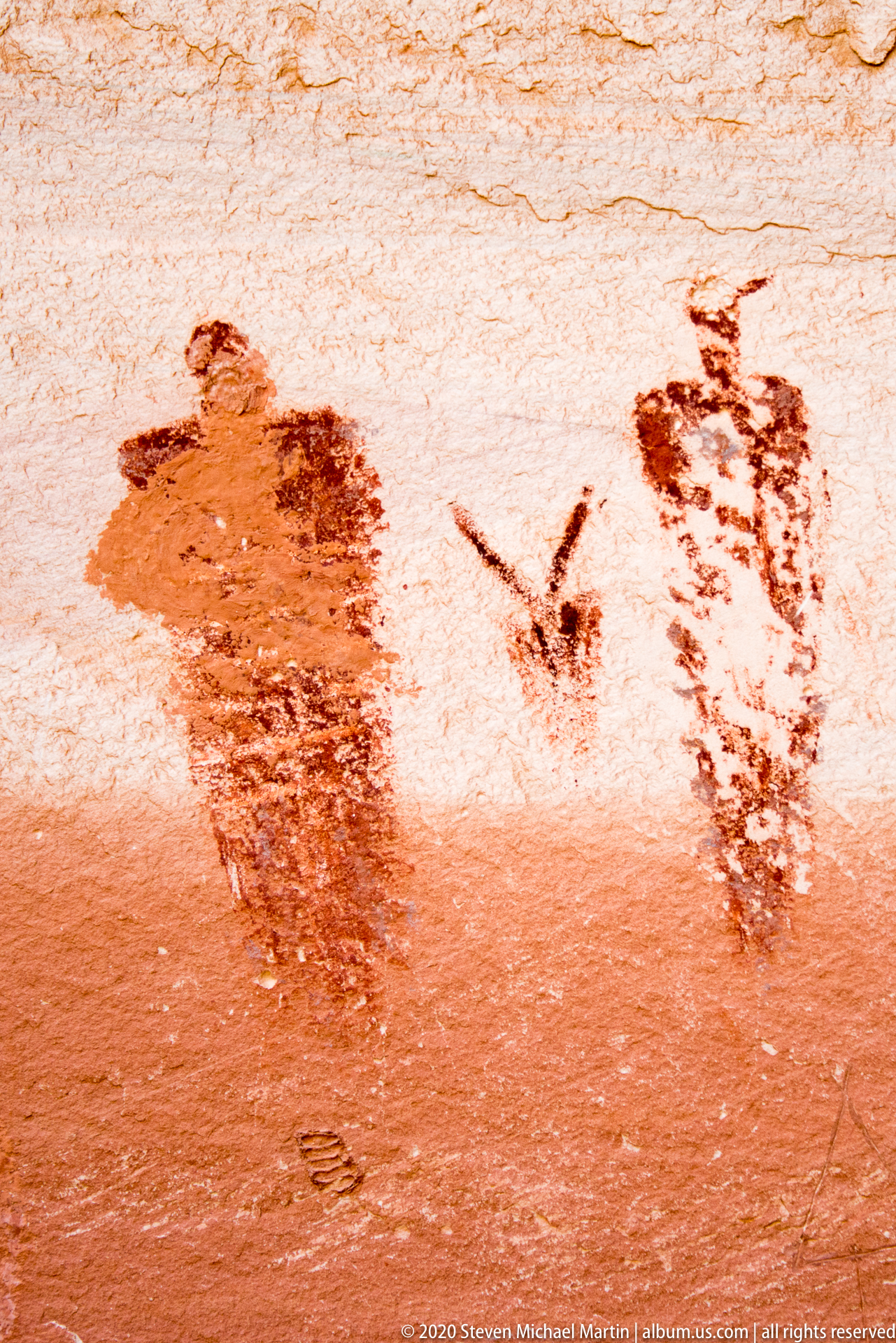
A tall, lightly outlined figure with a broad upper body and narrow lower section occupies the center-left, beside a smaller, darker motif at right. The wall’s pale surface and faint surrounding traces expose the uneven survival of pigment. The close crop gives the larger figure prominence while preserving the contrast between its delicate outline and the compact adjacent mark.
Caption
A tall, lightly outlined figure with a broad upper body and narrow lower section occupies the center-left, beside a smaller, darker motif at right. The wall’s pale surface and faint surrounding traces expose the uneven survival of pigment. The close crop gives the larger figure prominence while preserving the contrast between its delicate outline and the compact adjacent mark.
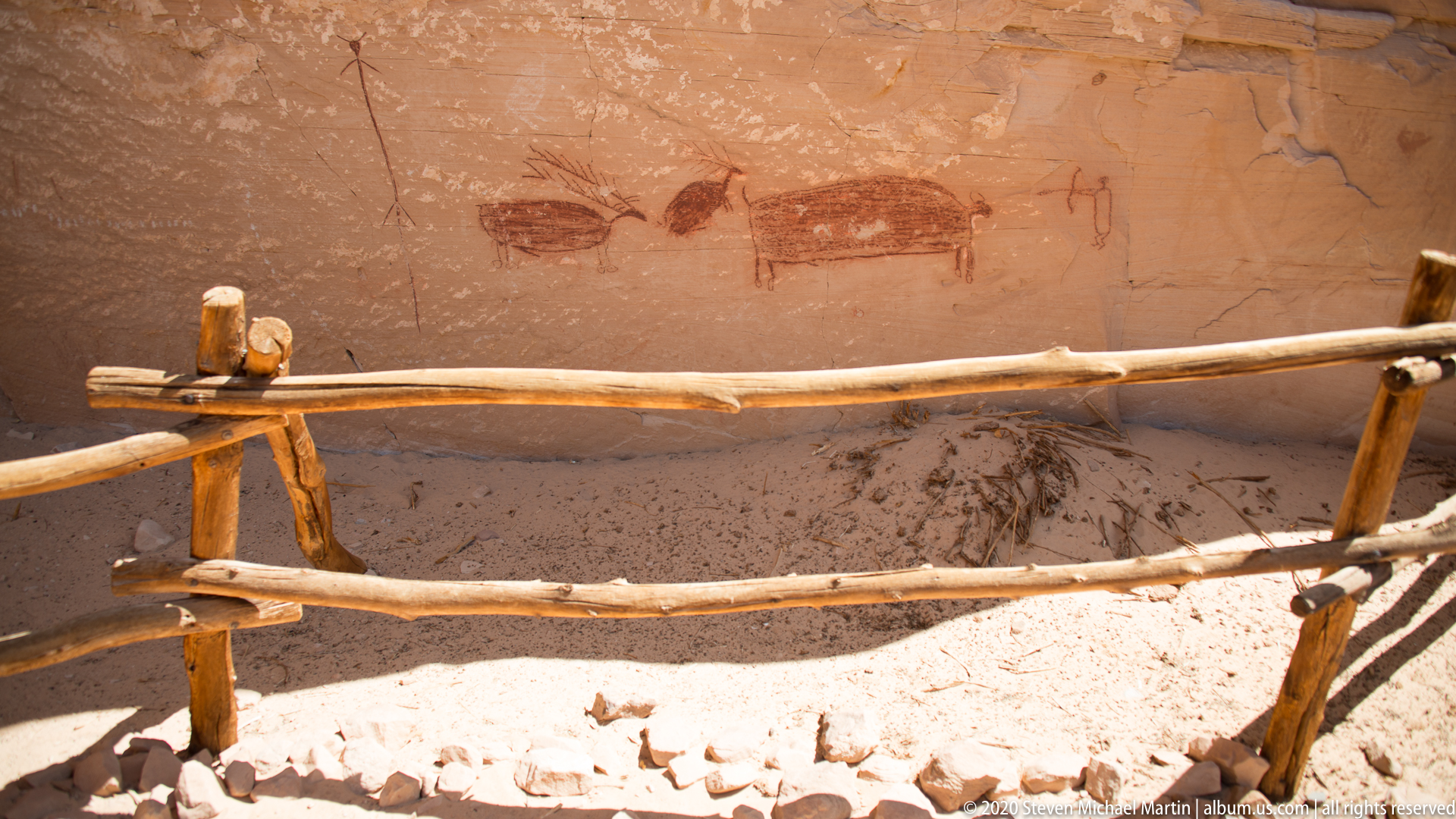
A lone hiker in blue walks toward a monumental orange sandstone overhang, dwarfed by its broad horizontal ceiling and pale upper bands. Low shrubs cluster near the base, and the sandy floor leads the eye from the foreground into the sheltered wall. The human figure makes the alcove’s scale legible within this open, sunlit canyon setting.
Caption
A lone hiker in blue walks toward a monumental orange sandstone overhang, dwarfed by its broad horizontal ceiling and pale upper bands. Low shrubs cluster near the base, and the sandy floor leads the eye from the foreground into the sheltered wall. The human figure makes the alcove’s scale legible within this open, sunlit canyon setting.
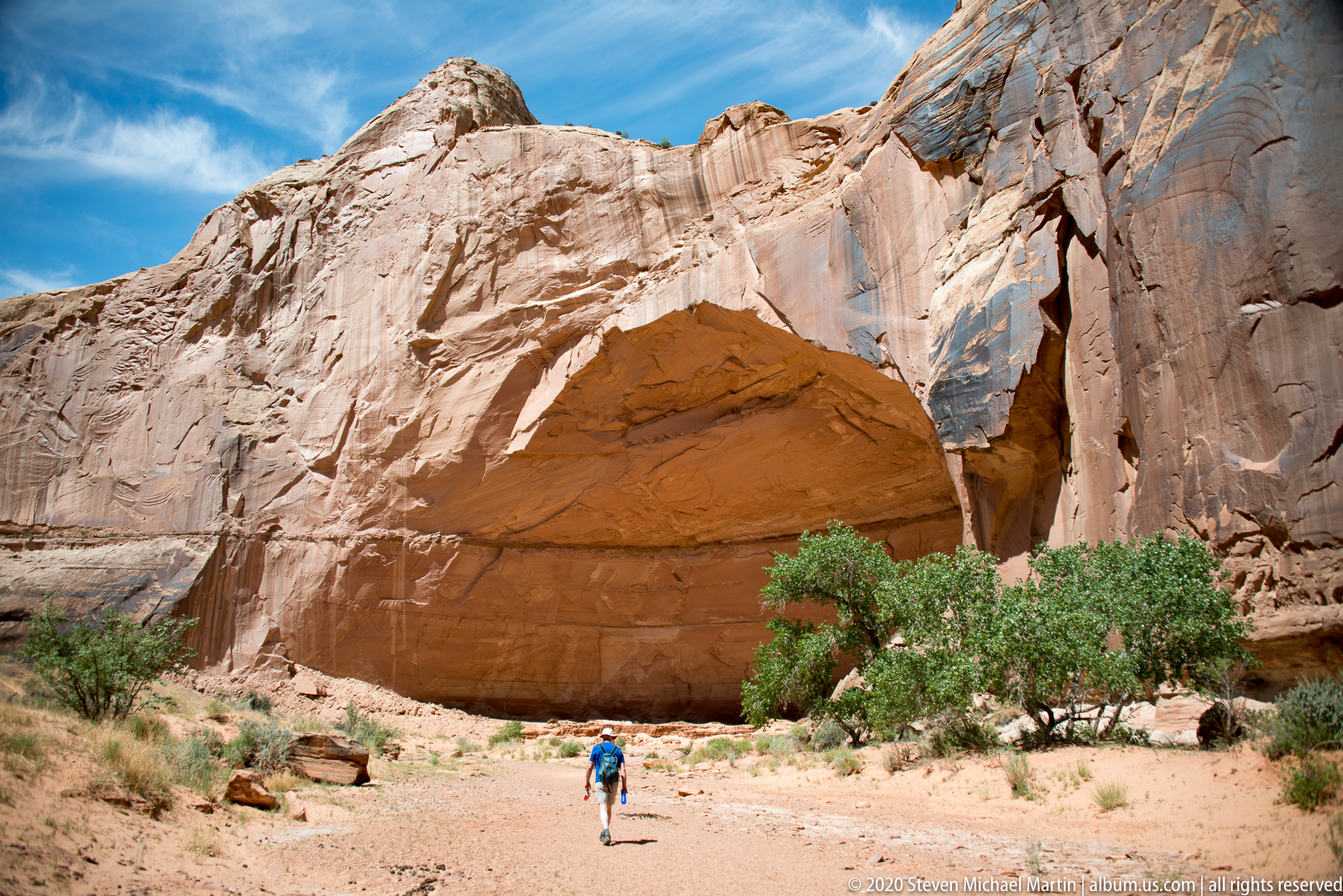
The narrow canyon floor bends between a shadowed dark wall on the right and a lighter, fractured face on the left. Sparse shrubs and grasses grow along the sandy path, which leads toward a bright opening framed by pale rock in the distance. The view emphasizes the passage’s changing light and the contrast between shaded and sunlit sandstone.
Caption
The narrow canyon floor bends between a shadowed dark wall on the right and a lighter, fractured face on the left. Sparse shrubs and grasses grow along the sandy path, which leads toward a bright opening framed by pale rock in the distance. The view emphasizes the passage’s changing light and the contrast between shaded and sunlit sandstone.

A wide, rust-colored rock shelf sweeps across the frame above a narrow strip of ground, compressing the image into rock and scale. A small visitor near the center looks almost lost beneath the overhang, while pale striped bands crown the formation. The photograph’s broad horizontal framing turns the alcove’s span and low, sheltering profile into its principal subject.
Caption
A wide, rust-colored rock shelf sweeps across the frame above a narrow strip of ground, compressing the image into rock and scale. A small visitor near the center looks almost lost beneath the overhang, while pale striped bands crown the formation. The photograph’s broad horizontal framing turns the alcove’s span and low, sheltering profile into its principal subject.
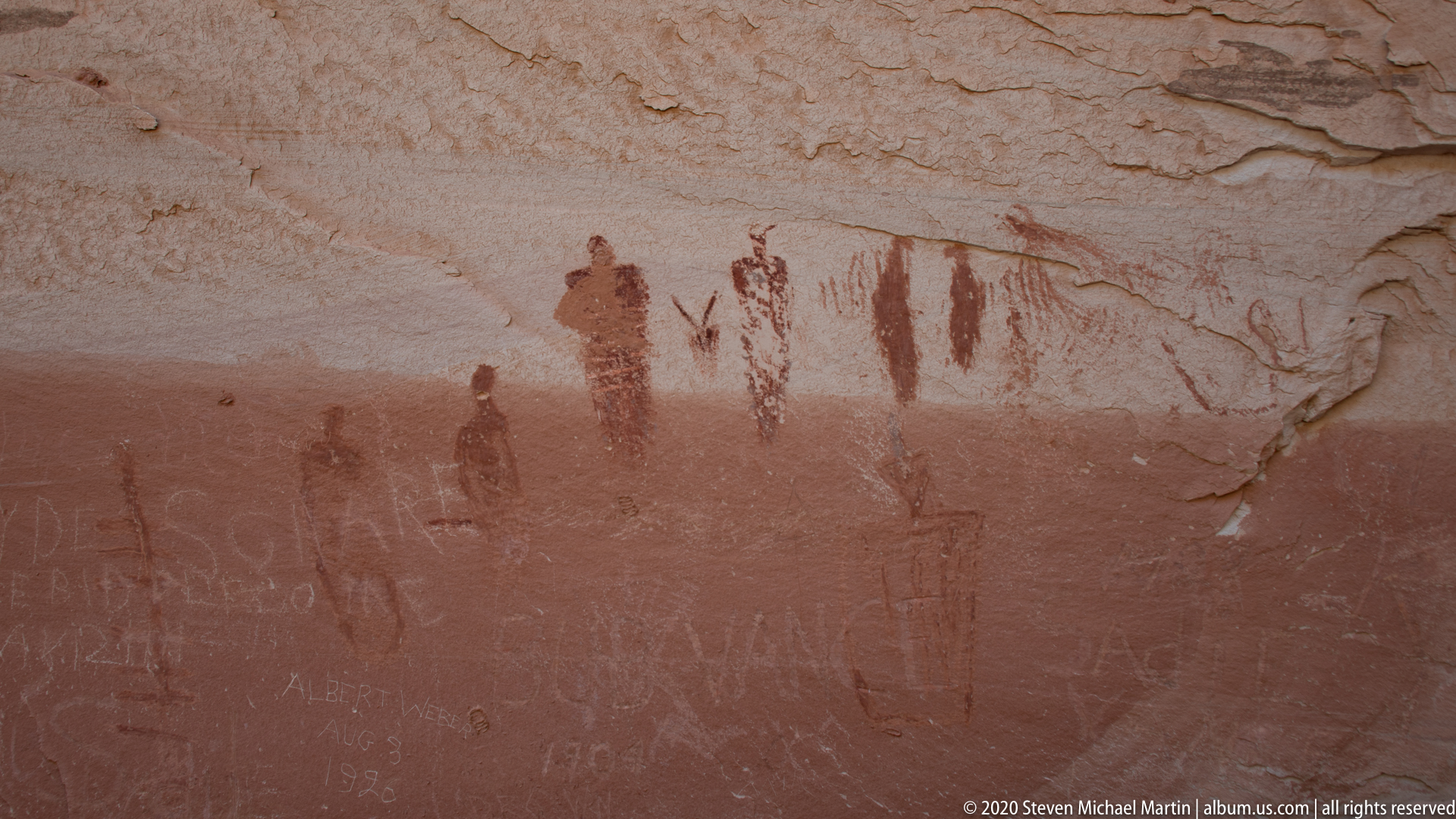
A dark, filled human-like figure stands near the upper right, with fainter linear forms descending across the orange wall. Large pale letters cross the lower portion and overlap the painted marks, making the panel’s layers visually complex. The close framing distinguishes pigment from the lighter incised or written strokes, though the lettering cannot be confidently read.
Caption
A dark, filled human-like figure stands near the upper right, with fainter linear forms descending across the orange wall. Large pale letters cross the lower portion and overlap the painted marks, making the panel’s layers visually complex. The close framing distinguishes pigment from the lighter incised or written strokes, though the lettering cannot be confidently read.
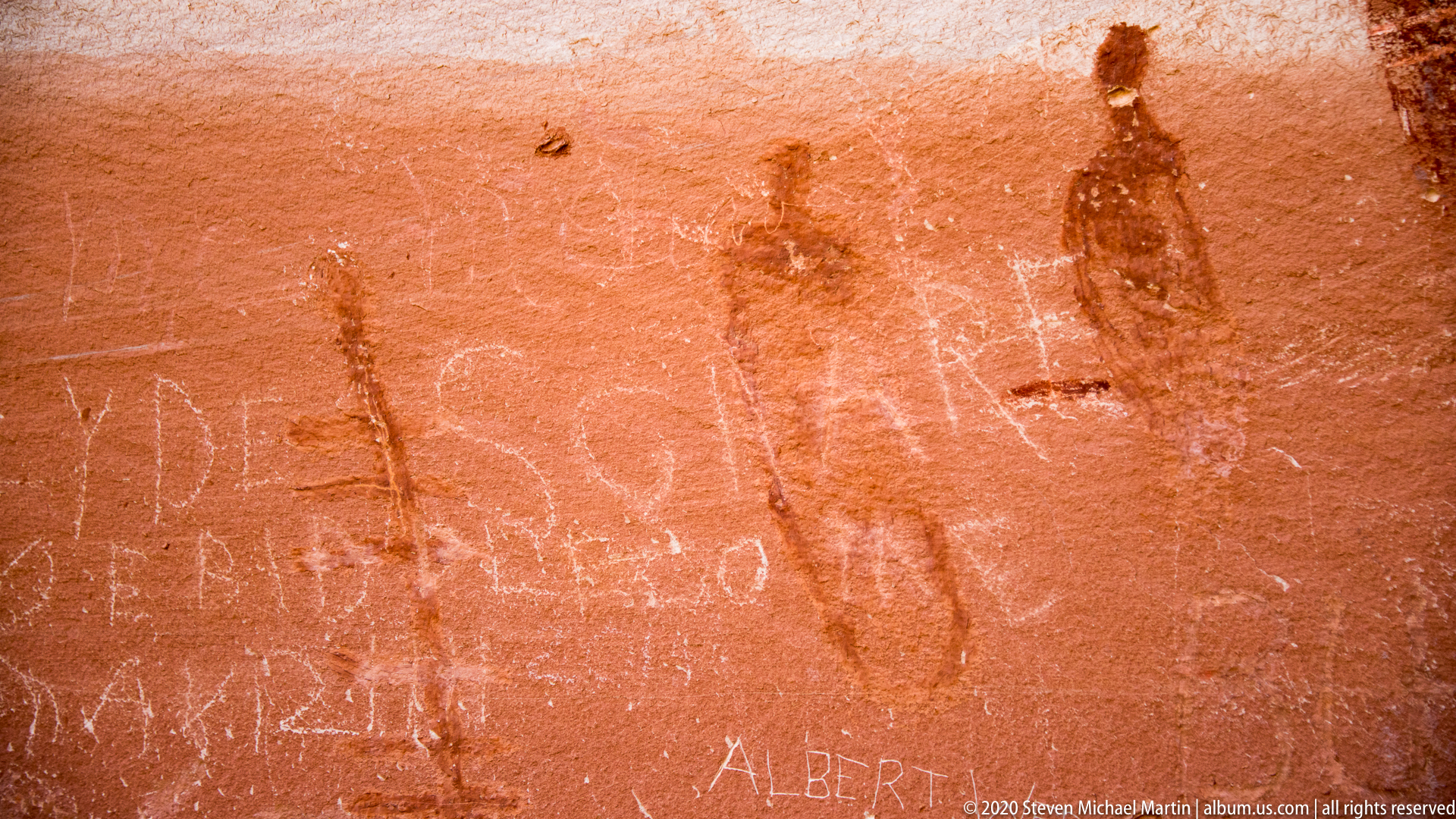
Two reddish anthropomorphs occupy a pale wall: one broad and densely filled at left, the other narrower and more linear at right. Between them, a dark angled motif projects outward like a forked line. Their different pigment density and posture are clear, although the worn surface and close crop limit interpretation of the central form.
Caption
Two reddish anthropomorphs occupy a pale wall: one broad and densely filled at left, the other narrower and more linear at right. Between them, a dark angled motif projects outward like a forked line. Their different pigment density and posture are clear, although the worn surface and close crop limit interpretation of the central form.
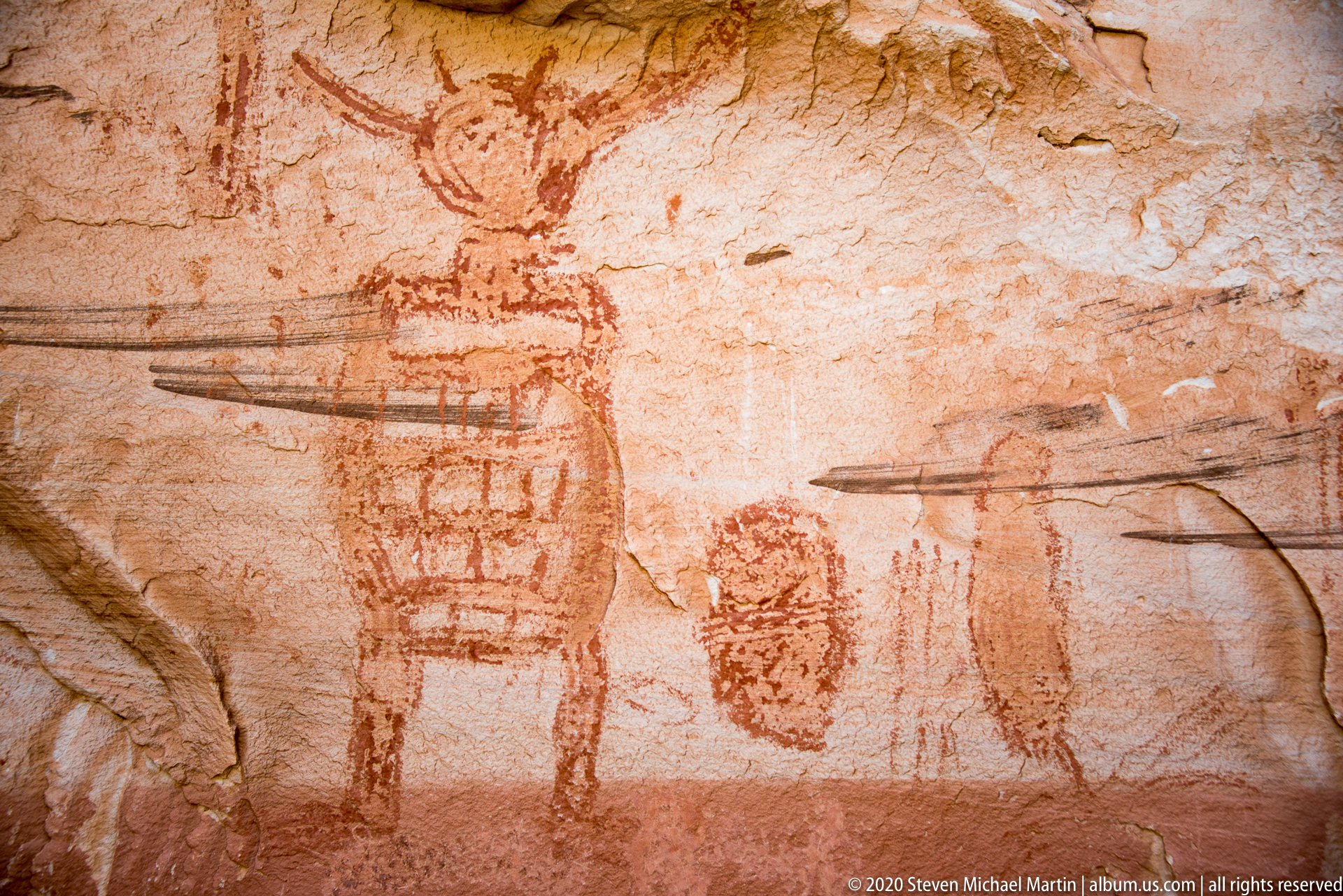
A band of reddish figures and marks runs beneath a shallow projecting ledge, with a larger filled shape near center and smaller forms scattered on either side. Horizontal rock layers frame the painted area, while pale losses and uneven staining soften its outlines. The wide view places the panel in its shelter and shows how the motifs follow the natural wall.
Caption
A band of reddish figures and marks runs beneath a shallow projecting ledge, with a larger filled shape near center and smaller forms scattered on either side. Horizontal rock layers frame the painted area, while pale losses and uneven staining soften its outlines. The wide view places the panel in its shelter and shows how the motifs follow the natural wall.

A dark, roughly rounded painted shape dominates the left side, punctuated by irregular pale gaps. Faint vertical forms and small marks continue to its right, but their outlines are weak against the mottled sandstone. The close view emphasizes the difference between the dense surviving pigment and the panel’s nearly vanished imagery, without assigning precise identities to the less legible shapes.
Caption
A dark, roughly rounded painted shape dominates the left side, punctuated by irregular pale gaps. Faint vertical forms and small marks continue to its right, but their outlines are weak against the mottled sandstone. The close view emphasizes the difference between the dense surviving pigment and the panel’s nearly vanished imagery, without assigning precise identities to the less legible shapes.
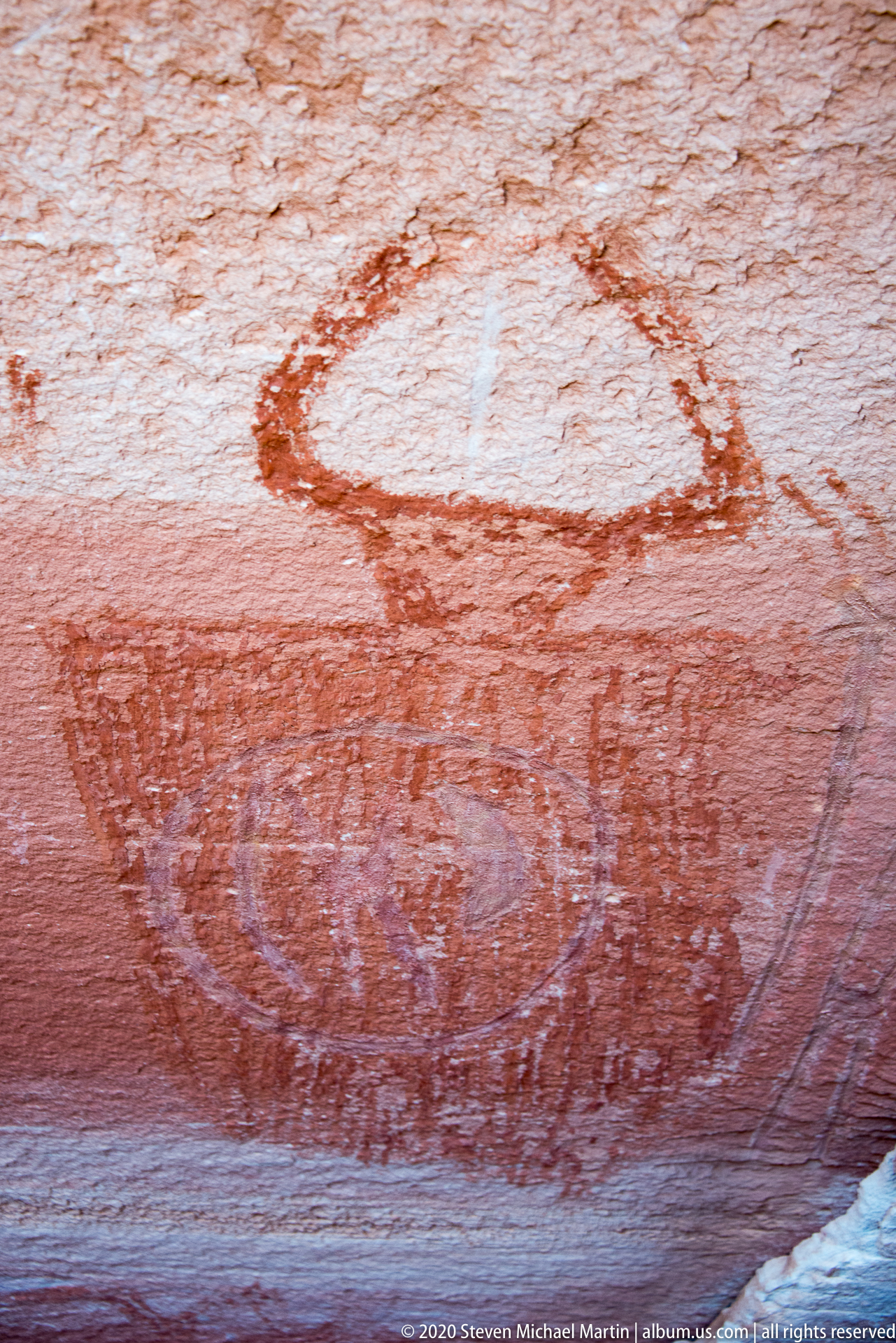
A visitor in a blue shirt and light hat sits on the sandy canyon floor, leaning toward a flat rock among scattered stones. A dark backpack and bright water bottle rest nearby. The close human-scale view shifts attention from the surrounding cliff art to a moment of rest within the rocky setting, with no interaction with the wall visible.
Caption
A visitor in a blue shirt and light hat sits on the sandy canyon floor, leaning toward a flat rock among scattered stones. A dark backpack and bright water bottle rest nearby. The close human-scale view shifts attention from the surrounding cliff art to a moment of rest within the rocky setting, with no interaction with the wall visible.
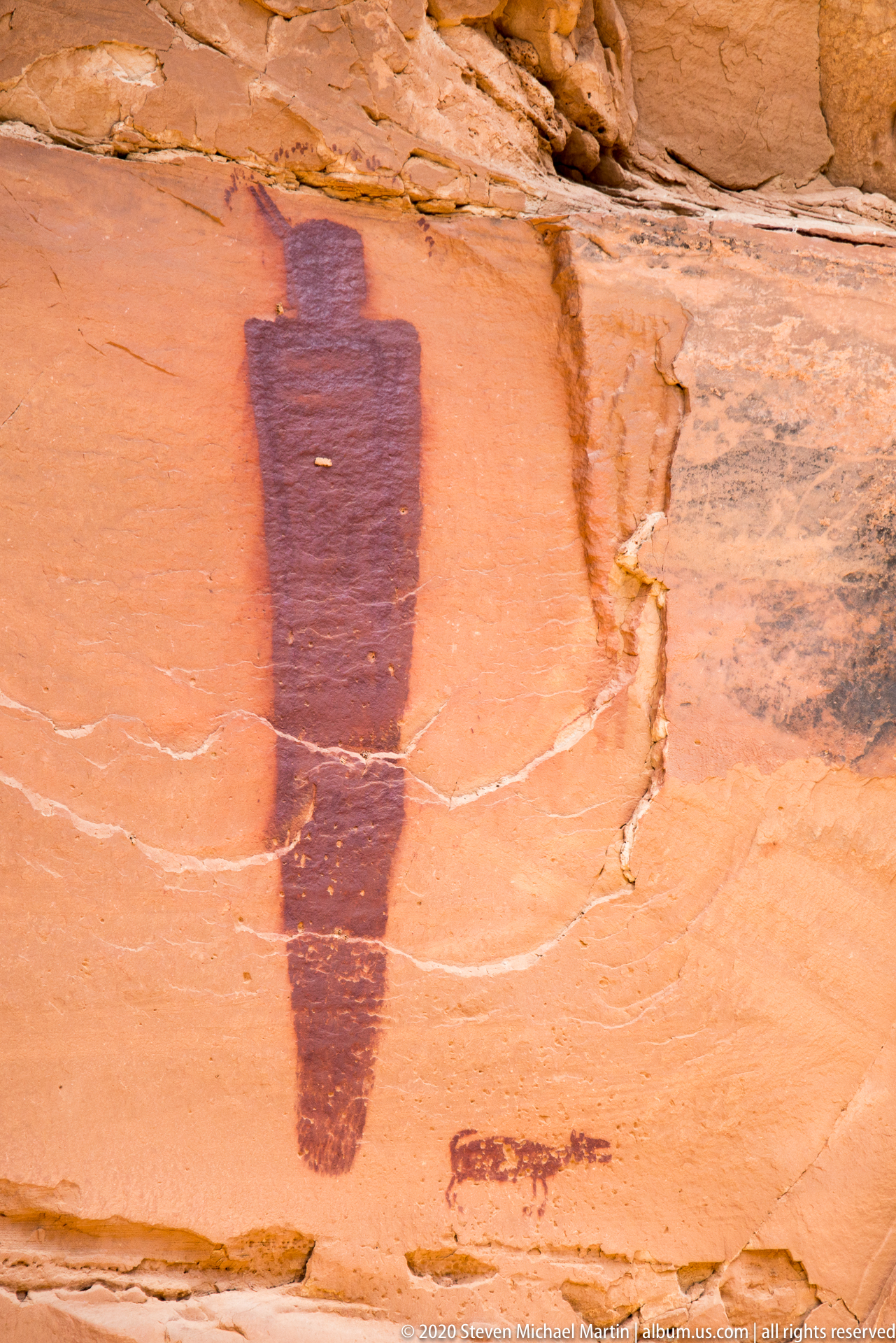
A tall, dark, tapered figure occupies a smooth orange sandstone face, with a smaller horizontal motif below and to its right. Fine pale seams run across the rock, and a vertical crack marks the right side of the frame. The isolated arrangement makes the scale and separation between the two painted elements especially clear.
Caption
A tall, dark, tapered figure occupies a smooth orange sandstone face, with a smaller horizontal motif below and to its right. Fine pale seams run across the rock, and a vertical crack marks the right side of the frame. The isolated arrangement makes the scale and separation between the two painted elements especially clear.
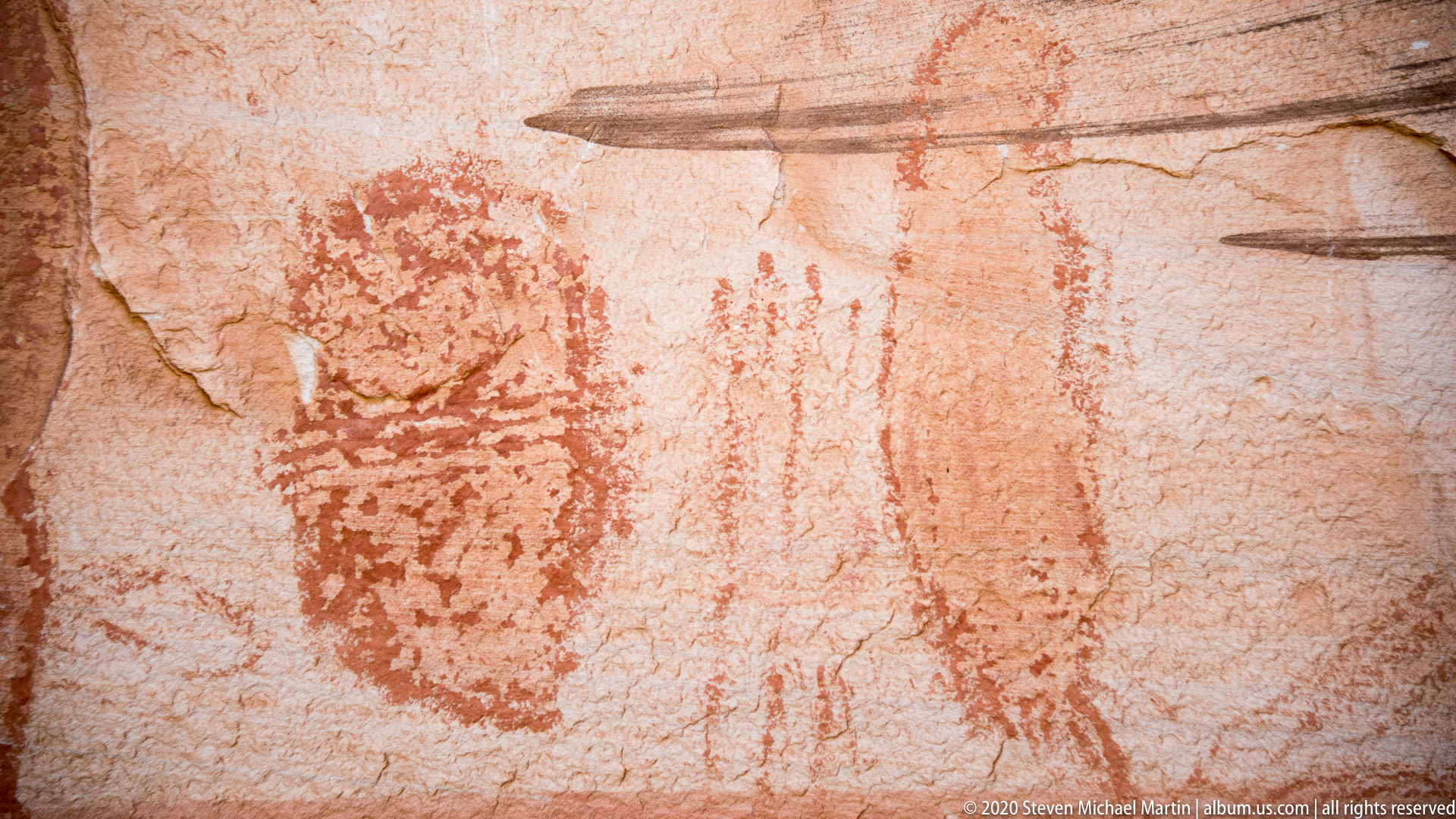
Several elongated reddish forms and small geometric marks descend across a shadowed sandstone face, with their lower edges fading into a dark band. A pale horizontal ledge separates the panel from the lighter rock above. Low contrast and age-worn pigment prevent secure identification of the individual forms, so the composition is best read as a weathered pictograph group.
Caption
Several elongated reddish forms and small geometric marks descend across a shadowed sandstone face, with their lower edges fading into a dark band. A pale horizontal ledge separates the panel from the lighter rock above. Low contrast and age-worn pigment prevent secure identification of the individual forms, so the composition is best read as a weathered pictograph group.
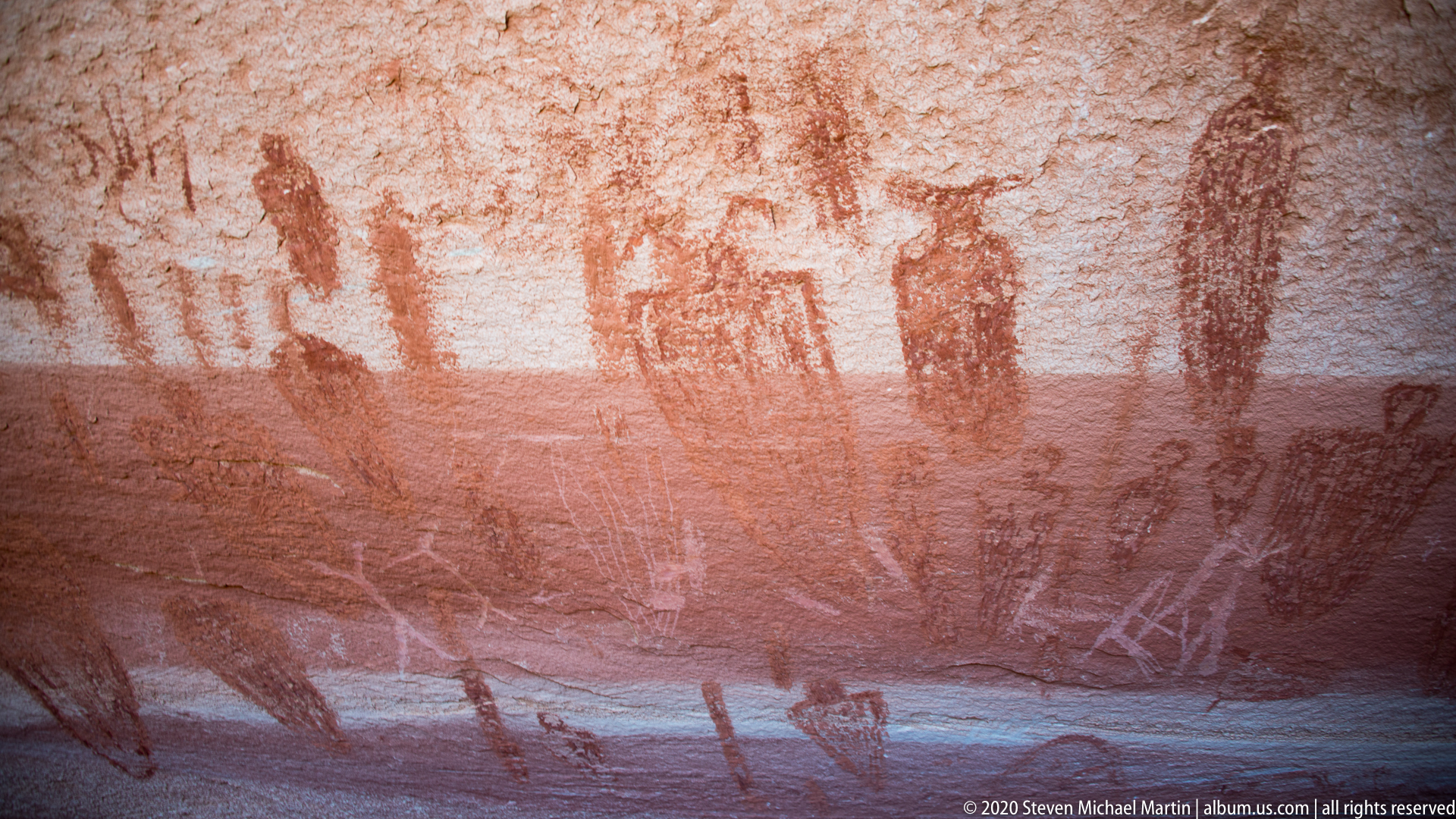
A broad oval or ring-shaped motif occupies the center of a horizontally striated surface. Its reddish outline is strongest along the upper edge, while the pale interior remains mostly unpainted; below it, a dark band of pigment or rock shadow stretches across the wall. The tight crop favors shape, color, and surface texture, leaving the motif’s meaning unresolved.
Caption
A broad oval or ring-shaped motif occupies the center of a horizontally striated surface. Its reddish outline is strongest along the upper edge, while the pale interior remains mostly unpainted; below it, a dark band of pigment or rock shadow stretches across the wall. The tight crop favors shape, color, and surface texture, leaving the motif’s meaning unresolved.

A low stack of thin, rippled sandstone layers projects in horizontal shelves, creating alternating ledges and narrow shadows. Behind it, a darker overhang and rounded pale outcrop rise among sparse shrubs, while blue sky opens at the upper right. The foreground formation exposes the canyon’s sedimentary layering at close range, distinct from the towering alcoves elsewhere in the sequence.
Caption
A low stack of thin, rippled sandstone layers projects in horizontal shelves, creating alternating ledges and narrow shadows. Behind it, a darker overhang and rounded pale outcrop rise among sparse shrubs, while blue sky opens at the upper right. The foreground formation exposes the canyon’s sedimentary layering at close range, distinct from the towering alcoves elsewhere in the sequence.

A low stack of thin, rippled sandstone layers projects in horizontal shelves, creating alternating ledges and narrow shadows. Behind it, a darker overhang and rounded pale outcrop rise among sparse shrubs, while blue sky opens at the upper right. The foreground formation exposes the canyon’s sedimentary layering at close range, distinct from the towering alcoves elsewhere in the sequence.
Caption
A low stack of thin, rippled sandstone layers projects in horizontal shelves, creating alternating ledges and narrow shadows. Behind it, a darker overhang and rounded pale outcrop rise among sparse shrubs, while blue sky opens at the upper right. The foreground formation exposes the canyon’s sedimentary layering at close range, distinct from the towering alcoves elsewhere in the sequence.
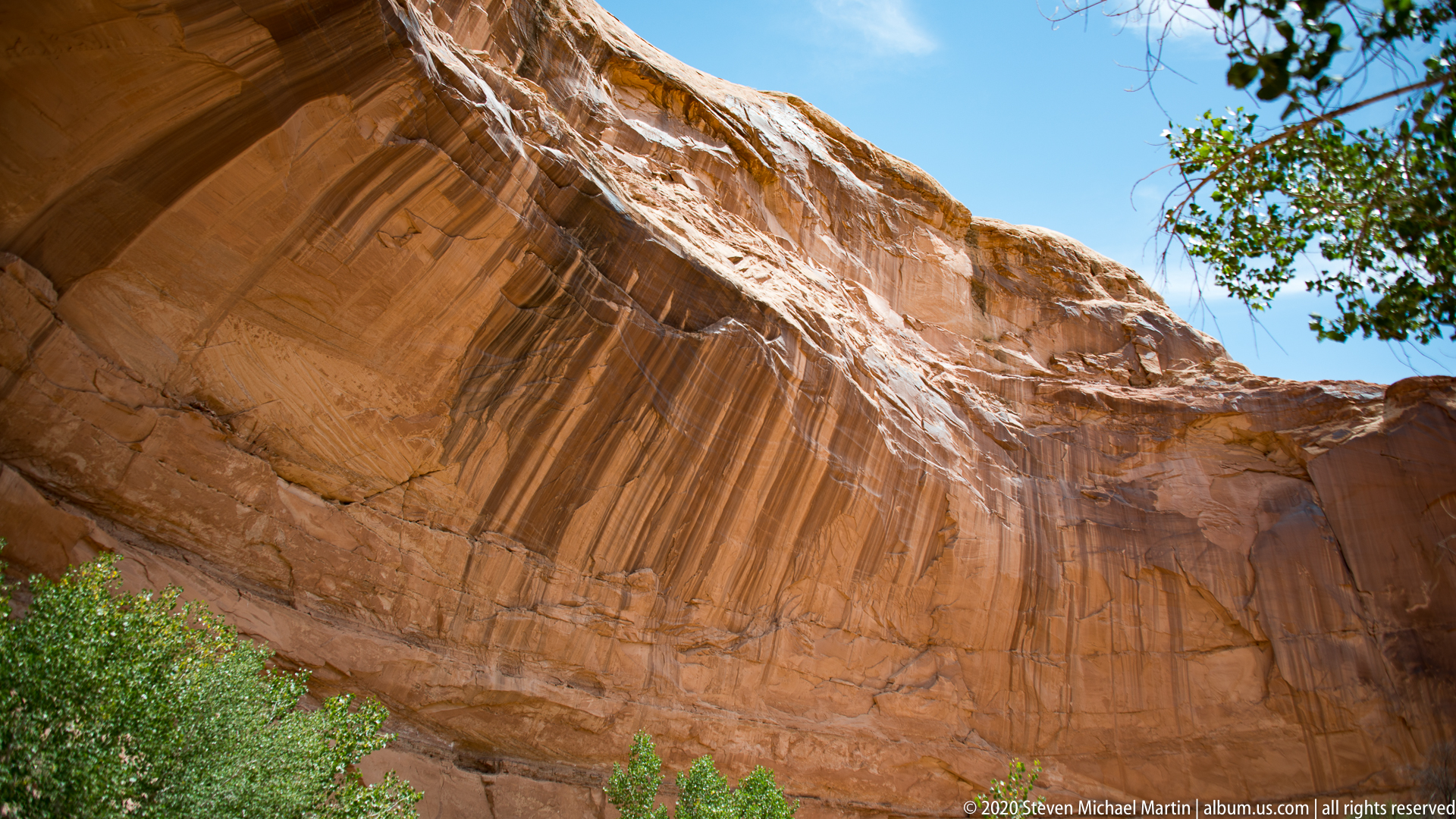
A towering sandstone wall curves above a shaded alcove, its face patterned by long dark streaks that descend from the upper ledges. Pale bands of exposed stone interrupt the rust-colored surface, while leafy branches enter at the right and lower edges. The upward viewpoint conveys the height of the wall and the sheltered space beneath it.
Caption
A towering sandstone wall curves above a shaded alcove, its face patterned by long dark streaks that descend from the upper ledges. Pale bands of exposed stone interrupt the rust-colored surface, while leafy branches enter at the right and lower edges. The upward viewpoint conveys the height of the wall and the sheltered space beneath it.
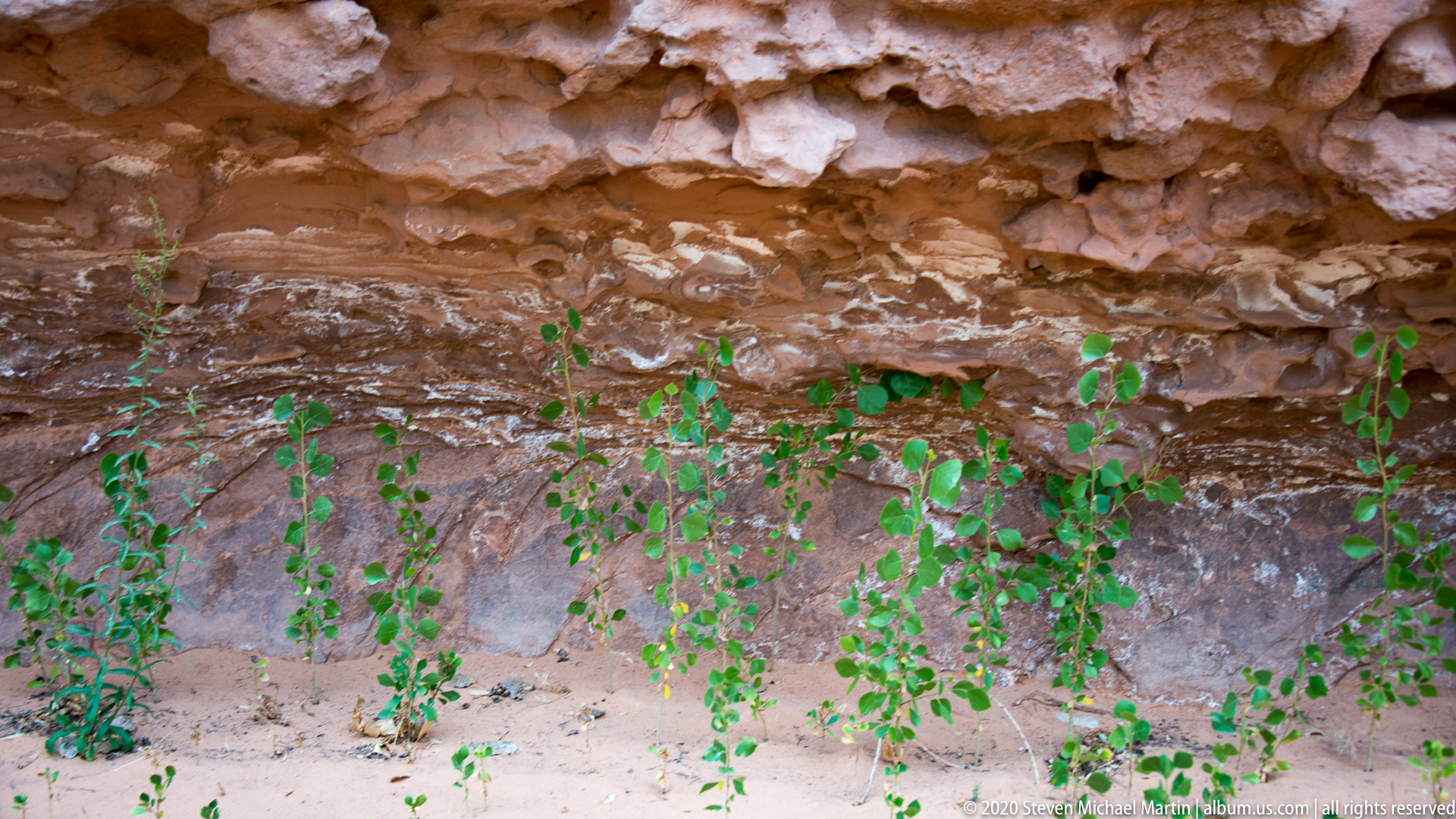
Several leafy shoots grow from sandy ground directly beneath a shallow, scalloped sandstone overhang. The sheltered wall behind them is darkened in broad bands, with pale ledges projecting overhead and small cavities in the rock. The close view draws attention to vegetation occupying a protected recess rather than the larger canyon setting.
Caption
Several leafy shoots grow from sandy ground directly beneath a shallow, scalloped sandstone overhang. The sheltered wall behind them is darkened in broad bands, with pale ledges projecting overhead and small cavities in the rock. The close view draws attention to vegetation occupying a protected recess rather than the larger canyon setting.
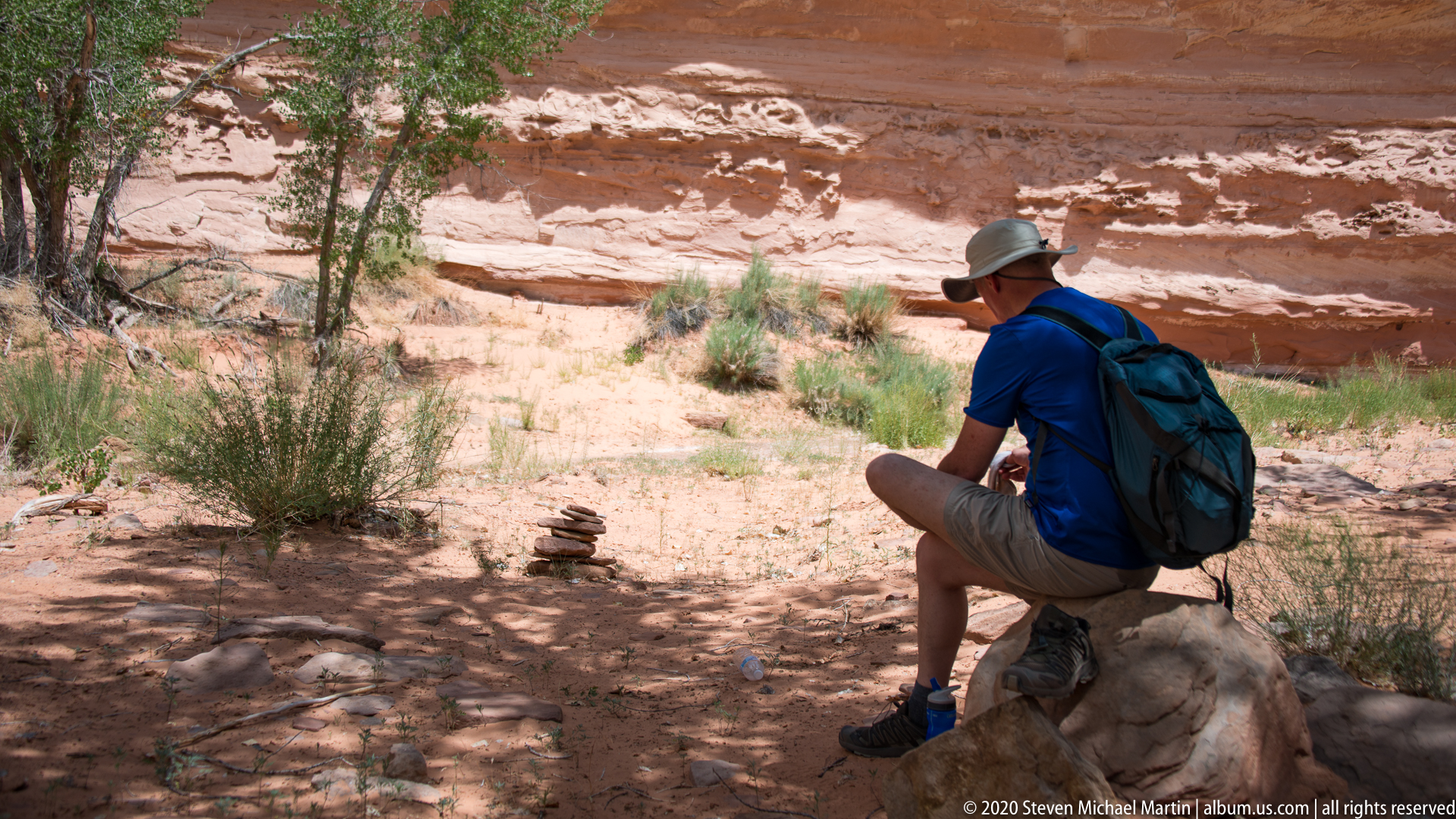
A seated hiker pauses in the shade beside a small stack of flat stones, with a backpack and hat visible in profile. Beyond the visitor, a broad sandstone wall spans the background and shrubs grow along the sandy floor. The human figure establishes the scale of the shelter and shows a quiet rest stop within the canyon.
Caption
A seated hiker pauses in the shade beside a small stack of flat stones, with a backpack and hat visible in profile. Beyond the visitor, a broad sandstone wall spans the background and shrubs grow along the sandy floor. The human figure establishes the scale of the shelter and shows a quiet rest stop within the canyon.
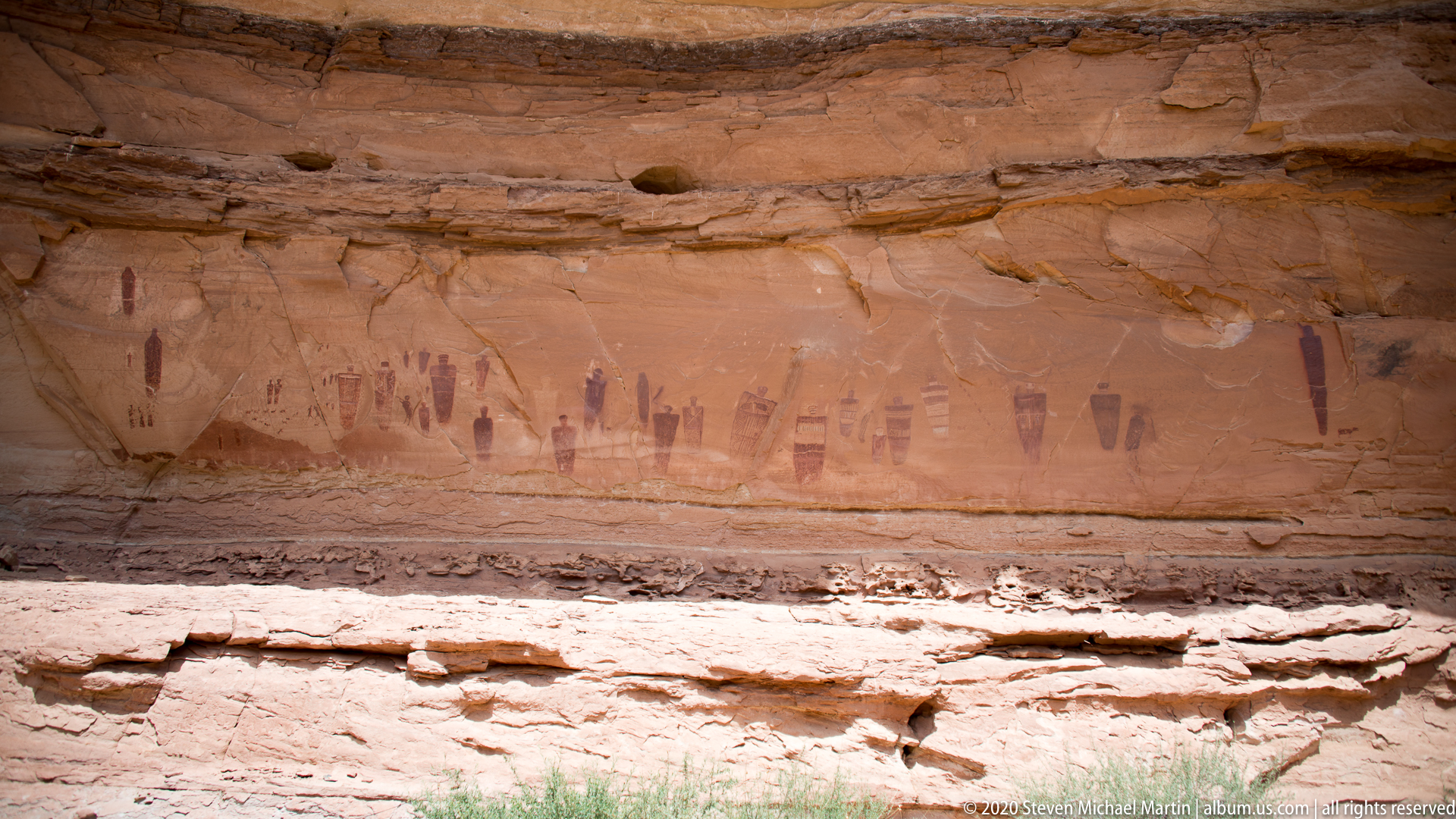
The long recessed wall carries a varied row of dark painted forms, from narrow upright figures to broader shapes with patterned interiors. A deep horizontal ledge shades the panel, while pale fractured sandstone forms a shelf below it. The composition records the full length of the painted surface and the rock layers that shelter it.
Caption
The long recessed wall carries a varied row of dark painted forms, from narrow upright figures to broader shapes with patterned interiors. A deep horizontal ledge shades the panel, while pale fractured sandstone forms a shelf below it. The composition records the full length of the painted surface and the rock layers that shelter it.
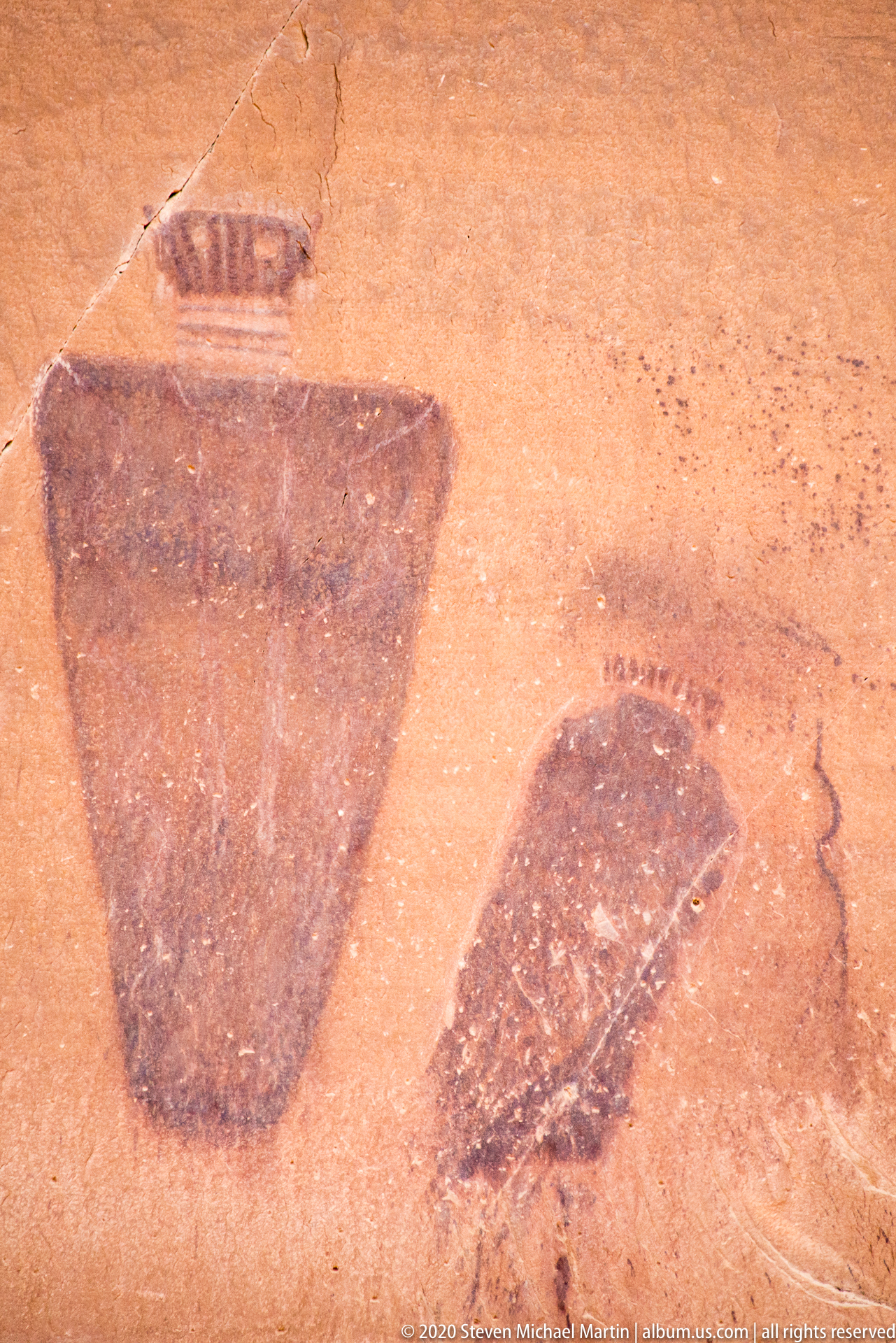
Two large dark forms occupy a warm sandstone surface: one broad and tapered, the other irregular with a mottled interior. A faint horizontal mark sits above the first shape, and a thin outline curves near the right edge. The tight crop highlights differences in pigment density and form while excluding the surrounding shelter.
Caption
Two large dark forms occupy a warm sandstone surface: one broad and tapered, the other irregular with a mottled interior. A faint horizontal mark sits above the first shape, and a thin outline curves near the right edge. The tight crop highlights differences in pigment density and form while excluding the surrounding shelter.

A large outlined form tilts diagonally across the rock, enclosing parallel stripes and angular, zigzag bands. A rounded dark shape projects above its upper edge, while a small separate mark sits near the lower right. Close framing reveals the layered geometry of the pigment against orange sandstone and isolates this motif from the neighboring figures.
Caption
A large outlined form tilts diagonally across the rock, enclosing parallel stripes and angular, zigzag bands. A rounded dark shape projects above its upper edge, while a small separate mark sits near the lower right. Close framing reveals the layered geometry of the pigment against orange sandstone and isolates this motif from the neighboring figures.

A broad rectangular figure dominates the sandstone panel, with a dark upper band, a lighter central section of repeated vertical marks, and a heavily pigmented lower portion. A small stacked motif sits above it. The close, frontal view makes the figure’s layered construction and worn pigment legible against the surrounding cracks.
Caption
A broad rectangular figure dominates the sandstone panel, with a dark upper band, a lighter central section of repeated vertical marks, and a heavily pigmented lower portion. A small stacked motif sits above it. The close, frontal view makes the figure’s layered construction and worn pigment legible against the surrounding cracks.
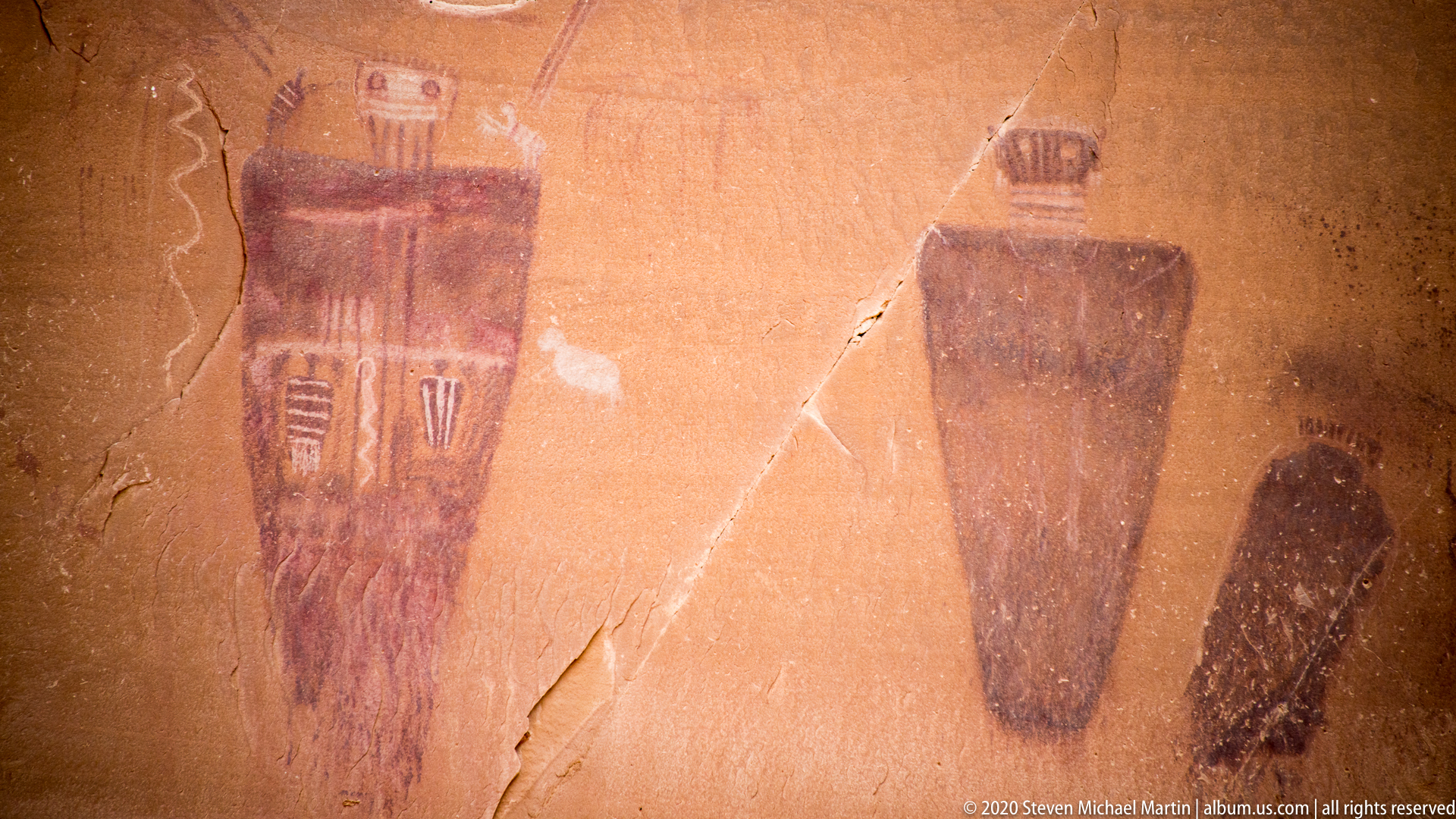
Three elongated painted figures stand against a cracked sandstone surface. The left figure has pale interior markings and a tapered lower section; the central figure is darker and topped by a small banded element; a smaller form is partly visible at right. Their varied scale and decoration distinguish this close grouping from the broad panels nearby.
Caption
Three elongated painted figures stand against a cracked sandstone surface. The left figure has pale interior markings and a tapered lower section; the central figure is darker and topped by a small banded element; a smaller form is partly visible at right. Their varied scale and decoration distinguish this close grouping from the broad panels nearby.
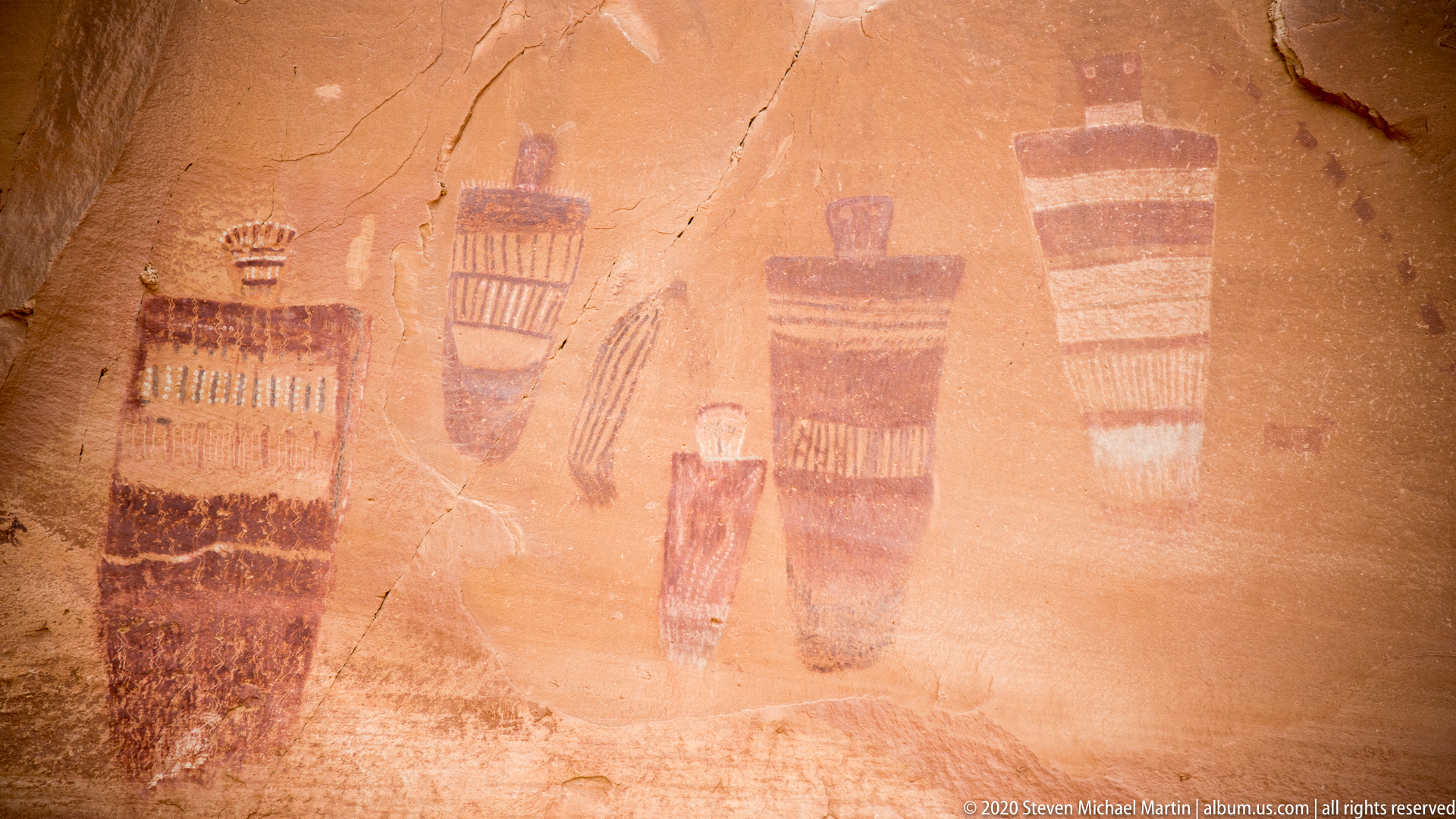
A group of tall painted forms fills the sandstone, several divided into horizontal bands and fine vertical marks. A narrow figure stands near the center, while broader tapered shapes anchor the left and right sides. The frontal view reveals the panel’s repeated body-like outlines and varied internal patterns without implying a shared identity or narrative.
Caption
A group of tall painted forms fills the sandstone, several divided into horizontal bands and fine vertical marks. A narrow figure stands near the center, while broader tapered shapes anchor the left and right sides. The frontal view reveals the panel’s repeated body-like outlines and varied internal patterns without implying a shared identity or narrative.
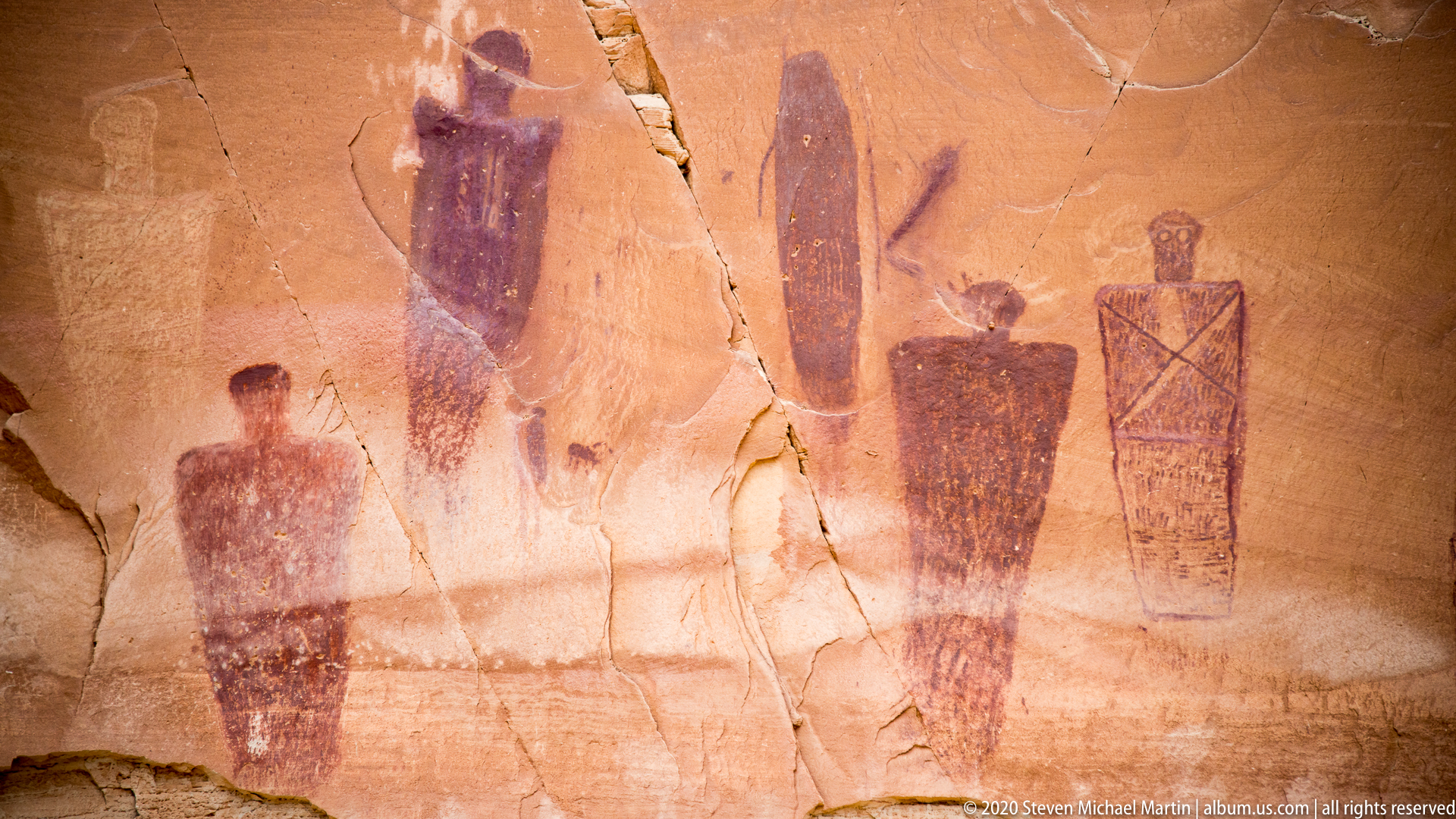
Tall dark and reddish figures form a crowded cluster across a cracked sandstone panel. A narrow figure at the right contains a prominent crosshatched grid, while a central tapered form rises above several smaller shapes. Broad pale mineral bands pass through the images, giving this view a layered, fractured background.
Caption
Tall dark and reddish figures form a crowded cluster across a cracked sandstone panel. A narrow figure at the right contains a prominent crosshatched grid, while a central tapered form rises above several smaller shapes. Broad pale mineral bands pass through the images, giving this view a layered, fractured background.

A dense arrangement of broad, tapered figures and narrower patterned forms covers the sandstone wall. Small humanlike shapes gather between the larger silhouettes, and a fine white line traces across part of the panel. This broader crop shows how motifs of different sizes share the surface while preserving the weathered cracks and uneven pigment.
Caption
A dense arrangement of broad, tapered figures and narrower patterned forms covers the sandstone wall. Small humanlike shapes gather between the larger silhouettes, and a fine white line traces across part of the panel. This broader crop shows how motifs of different sizes share the surface while preserving the weathered cracks and uneven pigment.
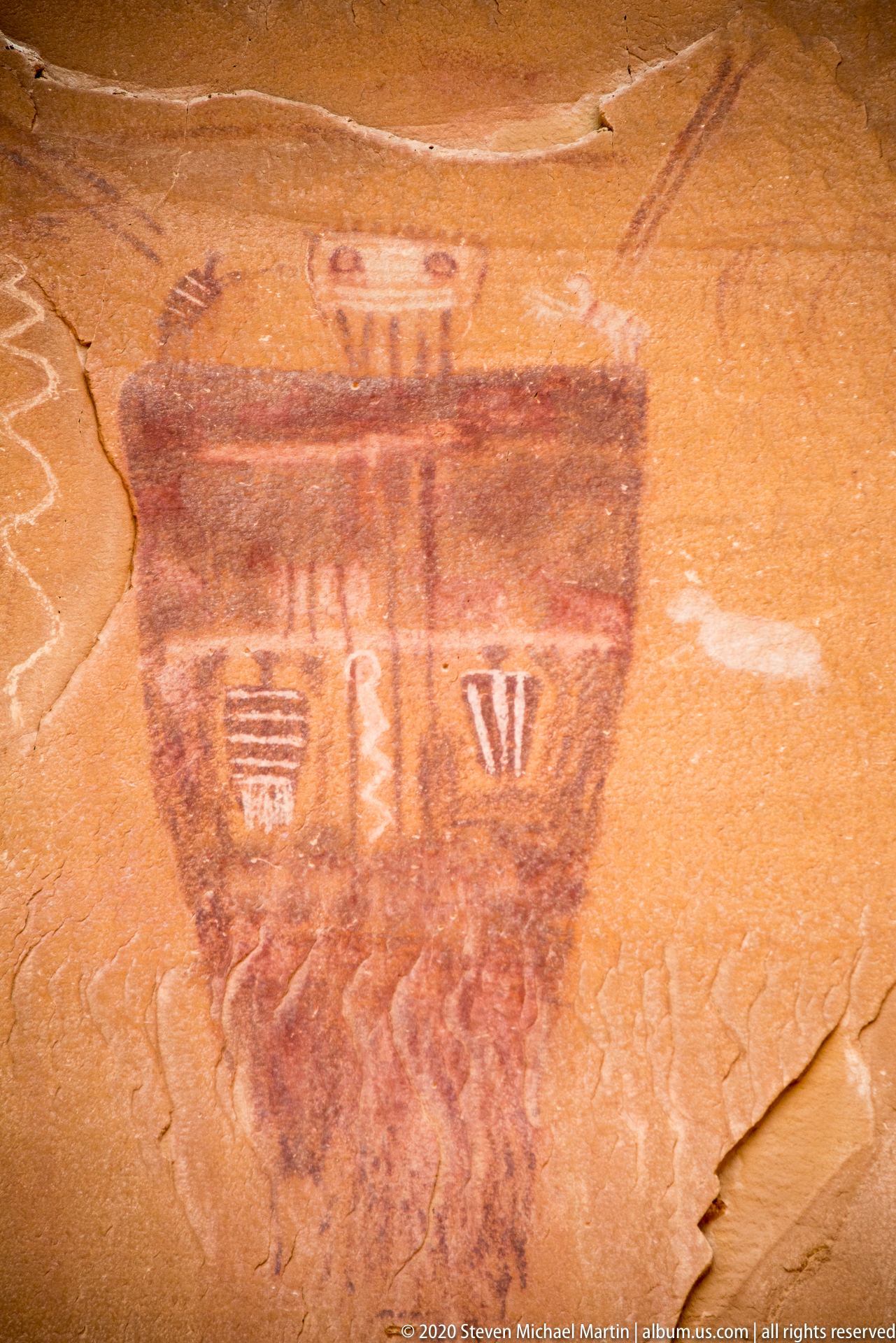
A large tapered figure fills the center of the panel, its dark upper band and lower strip framing two pale symbols in the middle. A small oval element appears above the figure, and fine cracks cross the orange sandstone. The close view focuses on the contrast between the broad silhouette and the lighter internal marks.
Caption
A large tapered figure fills the center of the panel, its dark upper band and lower strip framing two pale symbols in the middle. A small oval element appears above the figure, and fine cracks cross the orange sandstone. The close view focuses on the contrast between the broad silhouette and the lighter internal marks.
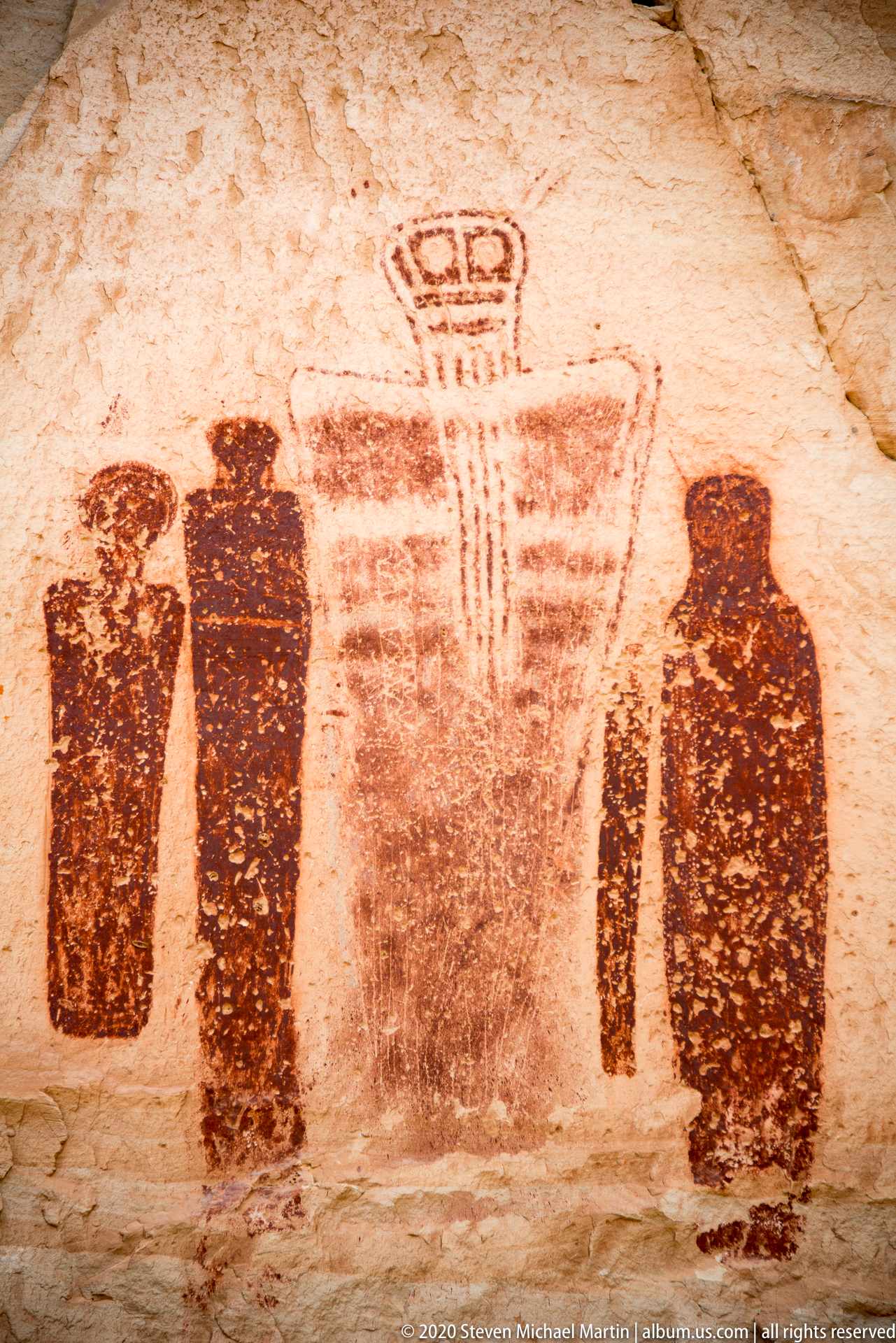
A broad central figure with horizontal bands and a looped crownlike element is flanked by dark elongated figures on both sides. The neighboring forms differ in width and surface pattern, and their pigment is mottled with age and exposure. This close composition concentrates on the central arrangement while keeping the flanking silhouettes in view.
Caption
A broad central figure with horizontal bands and a looped crownlike element is flanked by dark elongated figures on both sides. The neighboring forms differ in width and surface pattern, and their pigment is mottled with age and exposure. This close composition concentrates on the central arrangement while keeping the flanking silhouettes in view.
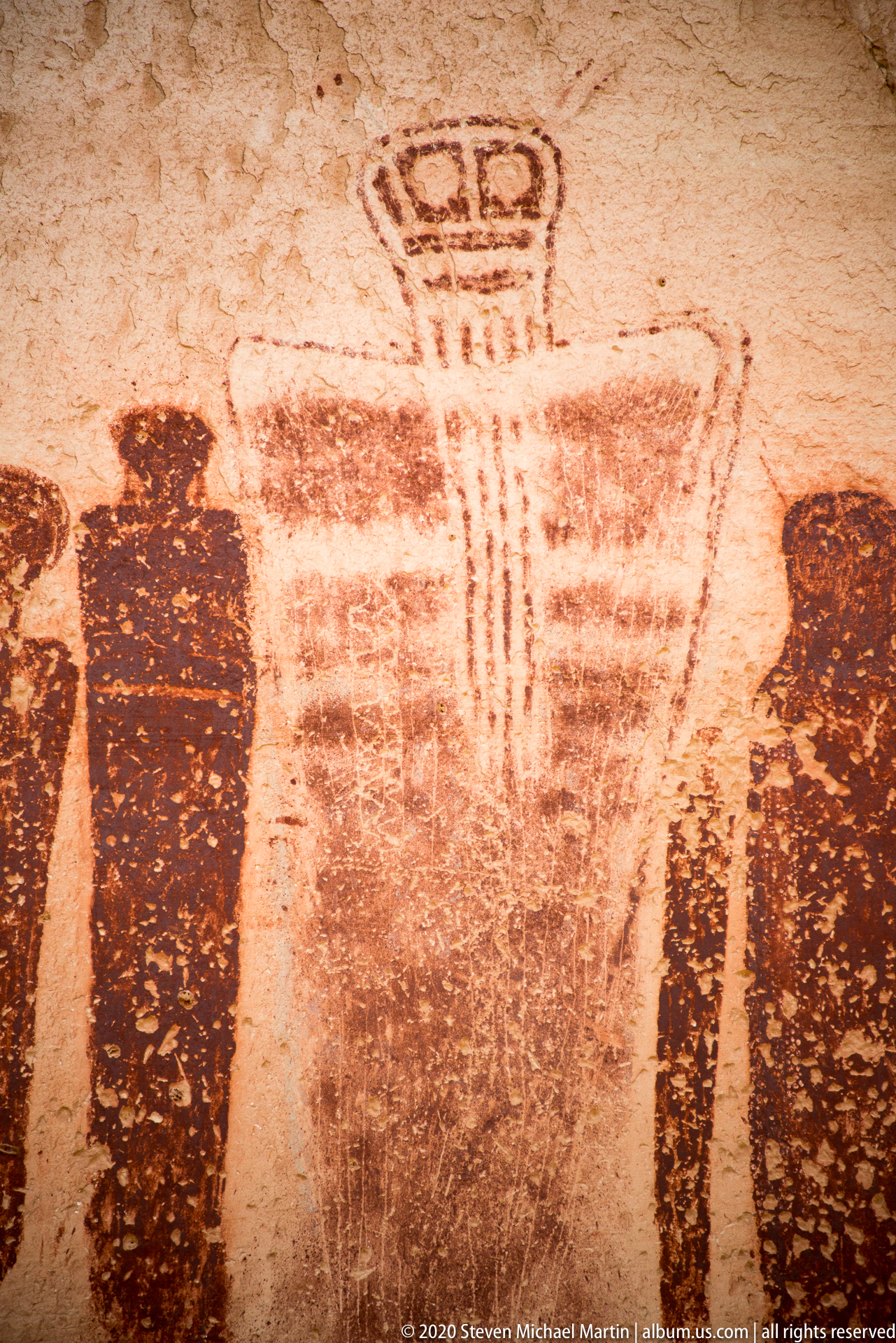
The central painted figure fills most of the frame, revealing broad horizontal bands, vertical interior marks, and a looped element at its top. Dark silhouettes are cropped at the left and right margins, showing the figure’s place within a larger grouping. The close view exposes the mottled pigment and fine sandstone texture.
Caption
The central painted figure fills most of the frame, revealing broad horizontal bands, vertical interior marks, and a looped element at its top. Dark silhouettes are cropped at the left and right margins, showing the figure’s place within a larger grouping. The close view exposes the mottled pigment and fine sandstone texture.
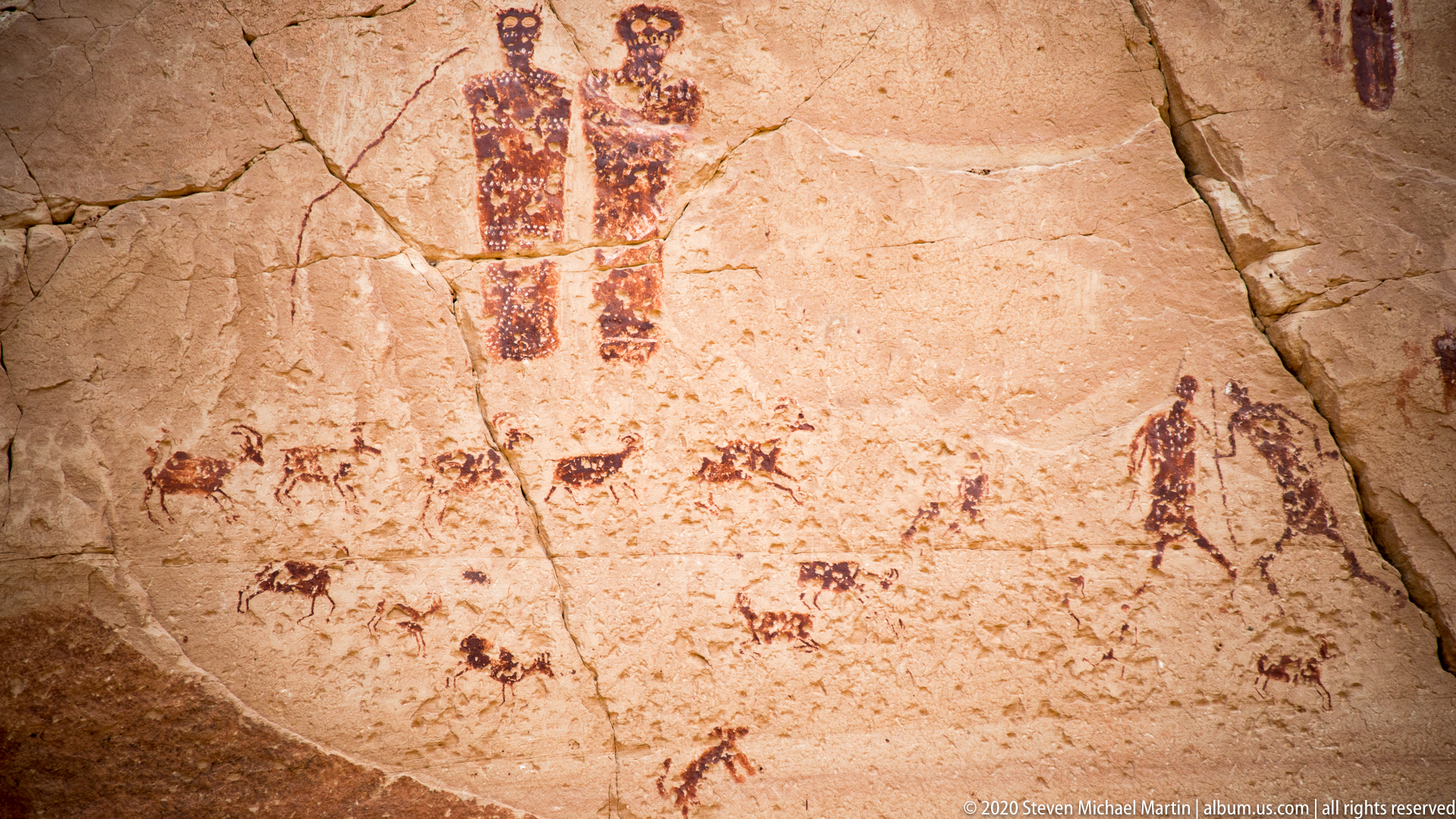
Two tall figures with patterned bodies occupy the upper part of a cracked sandstone panel. Below them, several smaller animal-like forms and isolated marks spread across the rock, with a larger outline figure at the right. The view brings together distinct scales and shapes but does not establish what the figures represent or how they relate.
Caption
Two tall figures with patterned bodies occupy the upper part of a cracked sandstone panel. Below them, several smaller animal-like forms and isolated marks spread across the rock, with a larger outline figure at the right. The view brings together distinct scales and shapes but does not establish what the figures represent or how they relate.
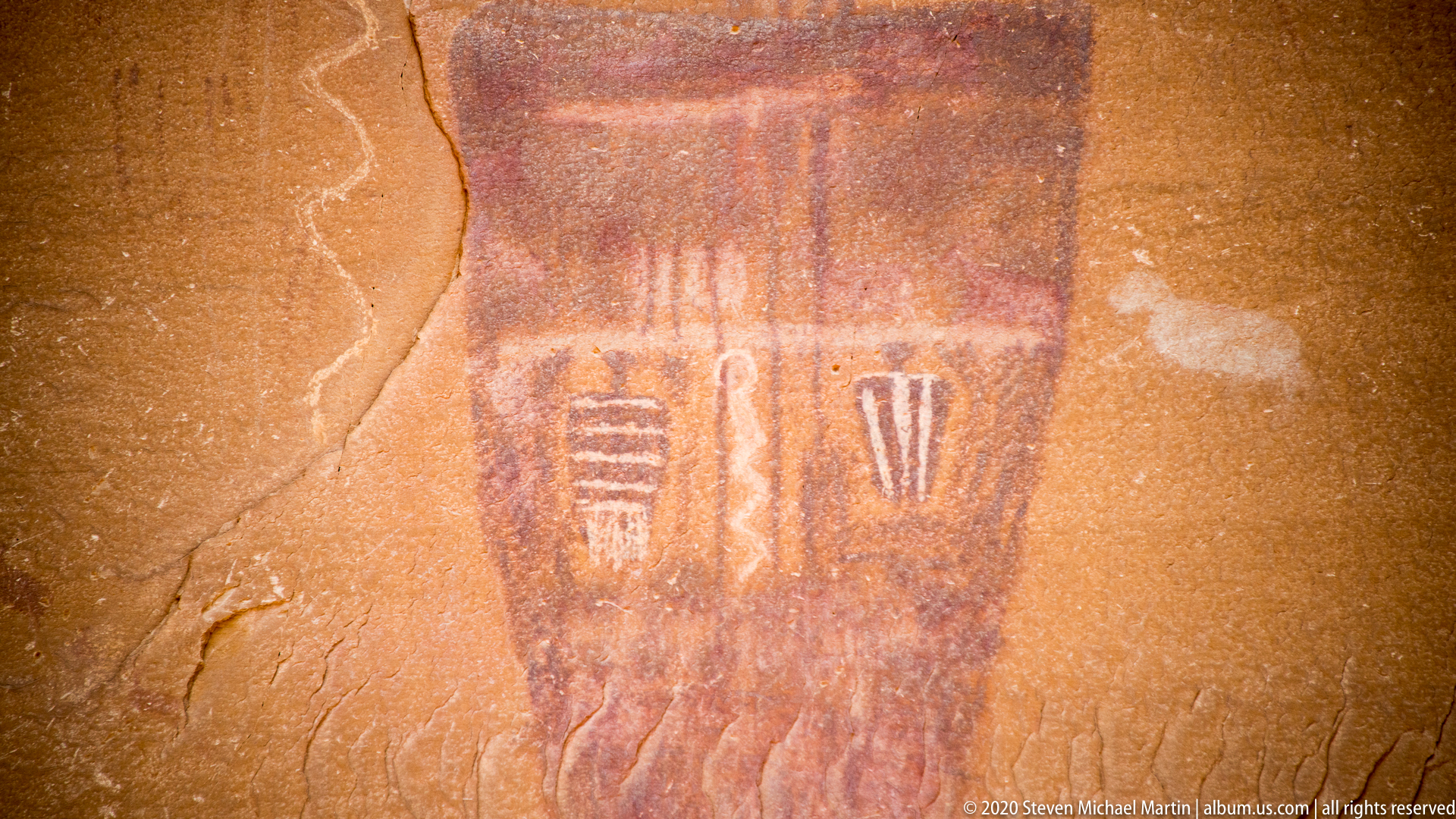
A dark tapered figure fills the frame, its lighter central field containing several distinct pale marks: a striped form, a narrow loop, and a paired curved design. Horizontal pigment bands cross above and below the details, while the surrounding rock shows a long crack. The close crop foregrounds the figure’s internal decoration.
Caption
A dark tapered figure fills the frame, its lighter central field containing several distinct pale marks: a striped form, a narrow loop, and a paired curved design. Horizontal pigment bands cross above and below the details, while the surrounding rock shows a long crack. The close crop foregrounds the figure’s internal decoration.
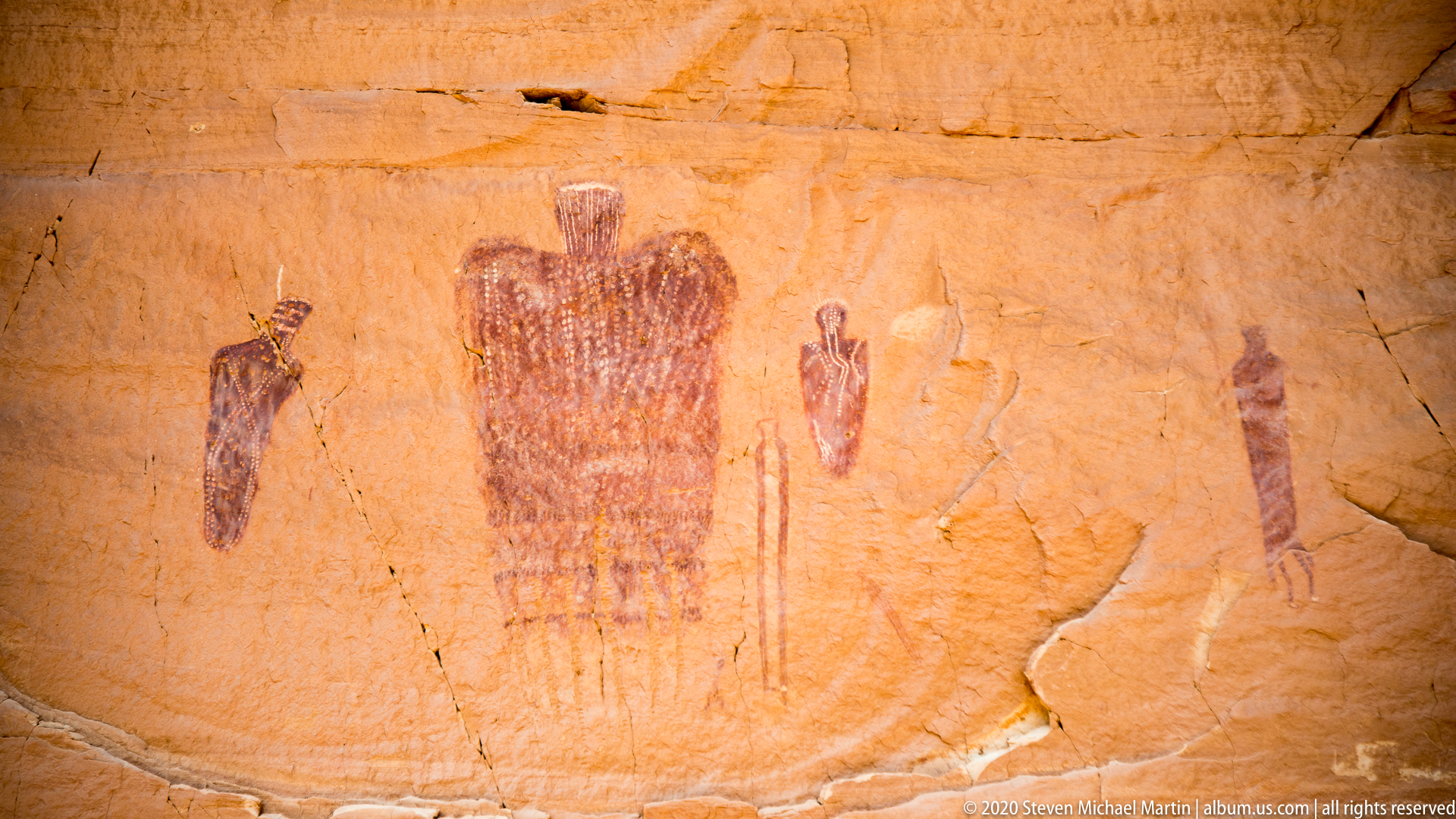
A large, broad-bodied figure occupies the center of a smooth sandstone panel, flanked by smaller elongated forms. Its upper section is densely patterned and a small rectangular element rises above its head; narrow figures at either side have simpler outlines. Broad rock cracks and ledges frame the grouping without obscuring its overall arrangement.
Caption
A large, broad-bodied figure occupies the center of a smooth sandstone panel, flanked by smaller elongated forms. Its upper section is densely patterned and a small rectangular element rises above its head; narrow figures at either side have simpler outlines. Broad rock cracks and ledges frame the grouping without obscuring its overall arrangement.
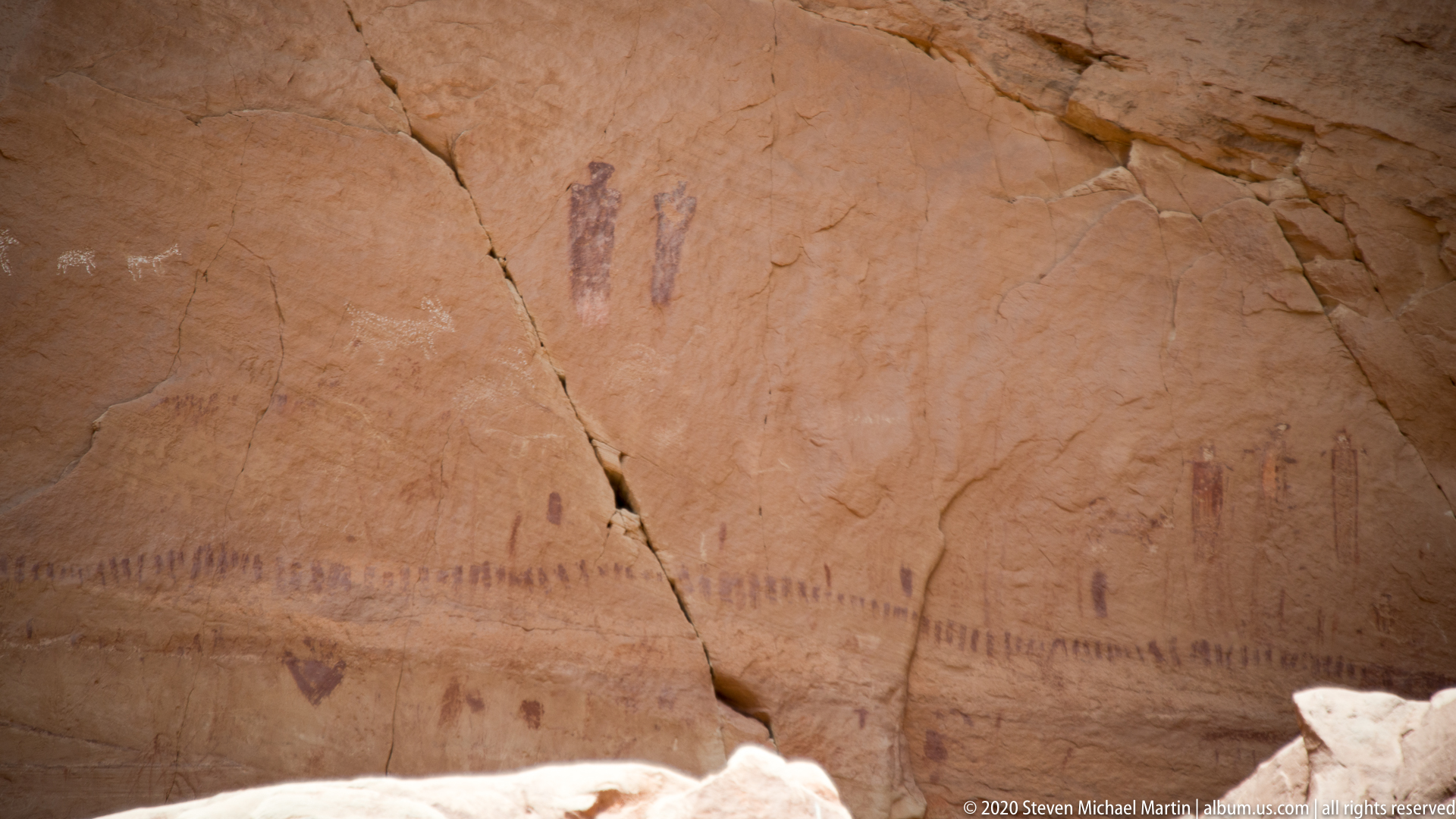
Faint reddish marks stretch in a low horizontal band across a pale sandstone wall, with a few darker upright forms rising above them. A deep vertical crack divides the center, and a broken ledge enters the lower foreground. The soft, low-contrast pigment makes the panel’s condition and the discontinuous spacing of the marks especially apparent.
Caption
Faint reddish marks stretch in a low horizontal band across a pale sandstone wall, with a few darker upright forms rising above them. A deep vertical crack divides the center, and a broken ledge enters the lower foreground. The soft, low-contrast pigment makes the panel’s condition and the discontinuous spacing of the marks especially apparent.

A visitor stands on the sandy canyon floor beneath an extensive painted panel high on the shelter wall. The row of upright figures stretches across the upper rock, while a darker horizontal seam and pale ledge separate it from the person below. The wide composition links the scale of the paintings with the surrounding canyon shelter.
Caption
A visitor stands on the sandy canyon floor beneath an extensive painted panel high on the shelter wall. The row of upright figures stretches across the upper rock, while a darker horizontal seam and pale ledge separate it from the person below. The wide composition links the scale of the paintings with the surrounding canyon shelter.
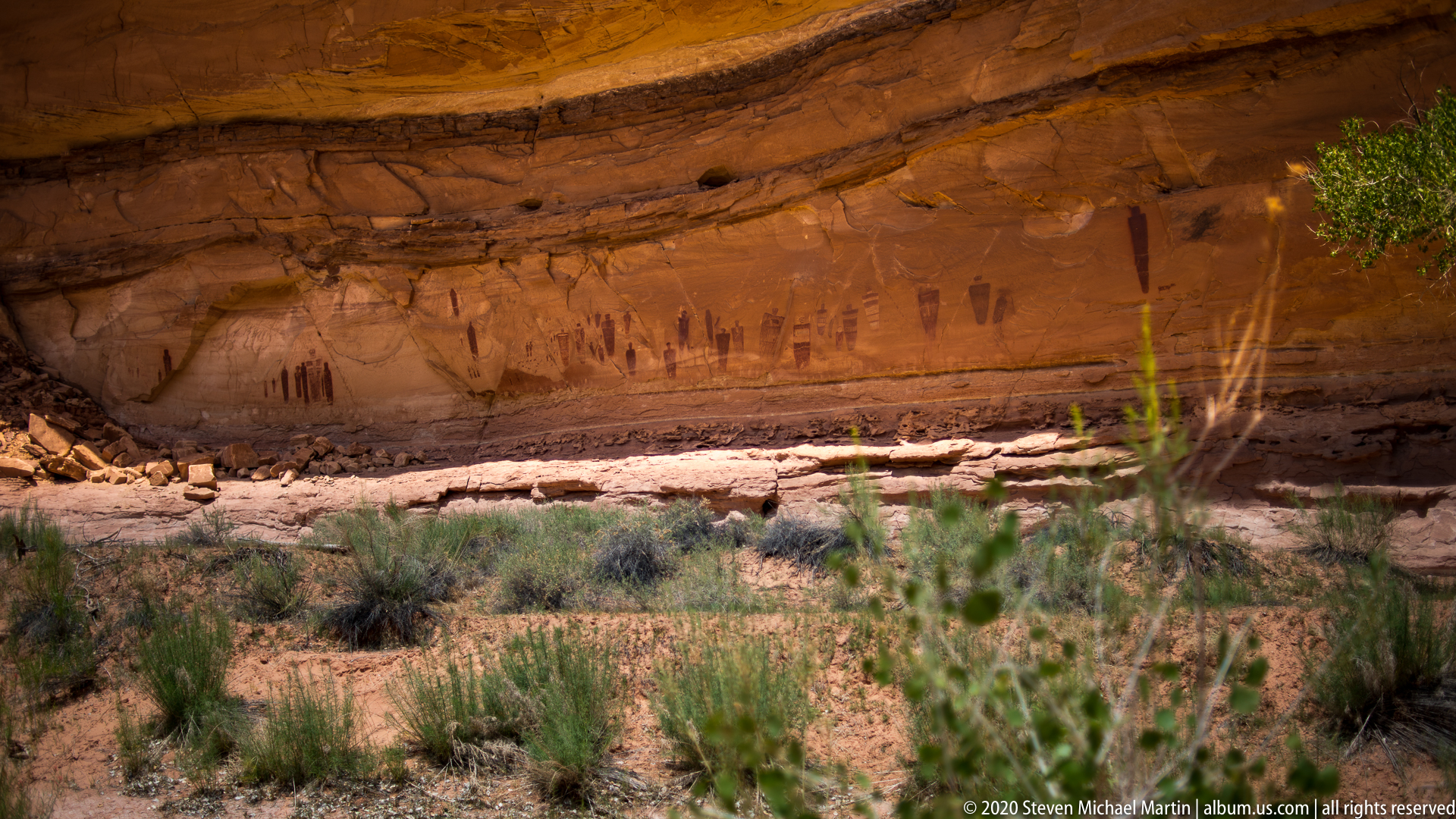
A shaded sandstone panel with rows of dark figures sits high beneath a layered overhang. Leafy trees and dense shrubs frame the shelter, and bright sandy ground occupies the foreground. Compared with the closer views, this composition shows how the painted surface is embedded in a vegetated canyon alcove.
Caption
A shaded sandstone panel with rows of dark figures sits high beneath a layered overhang. Leafy trees and dense shrubs frame the shelter, and bright sandy ground occupies the foreground. Compared with the closer views, this composition shows how the painted surface is embedded in a vegetated canyon alcove.
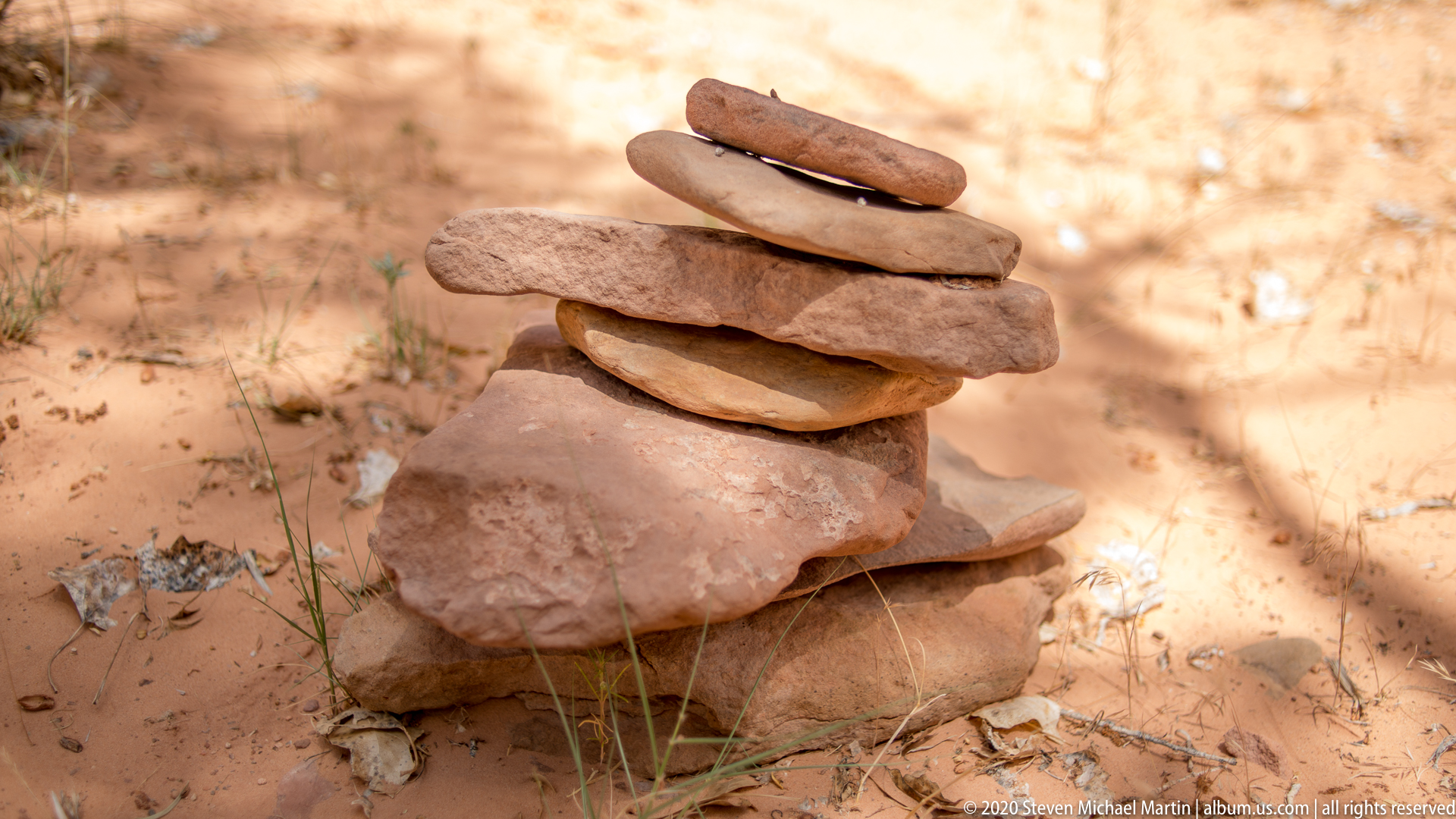
A small stack of flat, reddish stones balances on a larger rock in a sandy area dotted with grass. The pieces vary in size and angle, forming an irregular column against a softly blurred background of tan ground and dark vegetation. The shallow focus isolates the cairn from the surrounding landscape.
Caption
A small stack of flat, reddish stones balances on a larger rock in a sandy area dotted with grass. The pieces vary in size and angle, forming an irregular column against a softly blurred background of tan ground and dark vegetation. The shallow focus isolates the cairn from the surrounding landscape.
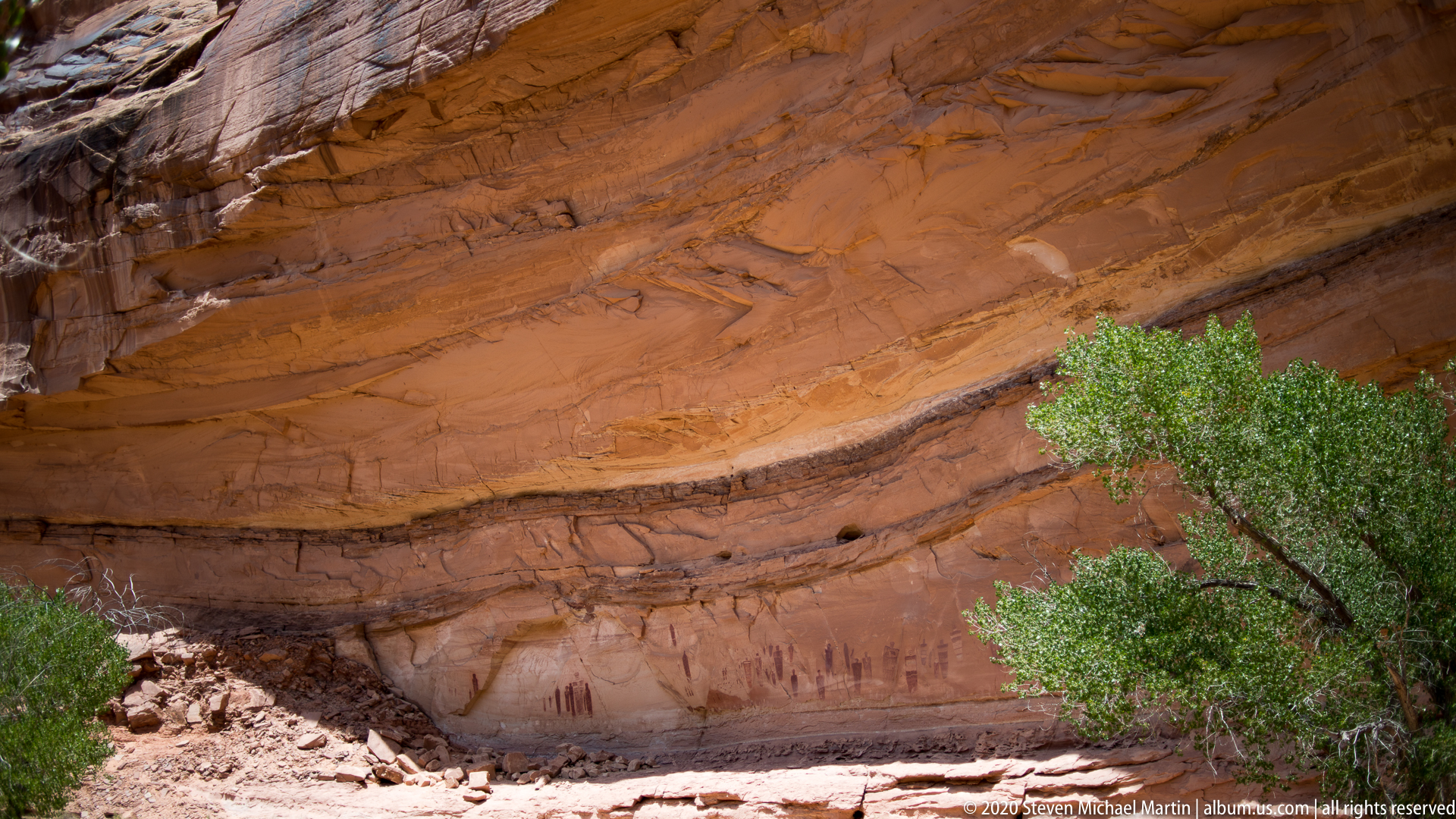
A line of dark painted forms runs along the lower wall of a shallow sandstone recess. The projecting layers above create a broad shaded band, while a leafy tree partly screens the panel at the right and broken stone lies at its base. The view connects the pictographs to the sheltering ledge and sparse canyon vegetation.
Caption
A line of dark painted forms runs along the lower wall of a shallow sandstone recess. The projecting layers above create a broad shaded band, while a leafy tree partly screens the panel at the right and broken stone lies at its base. The view connects the pictographs to the sheltering ledge and sparse canyon vegetation.
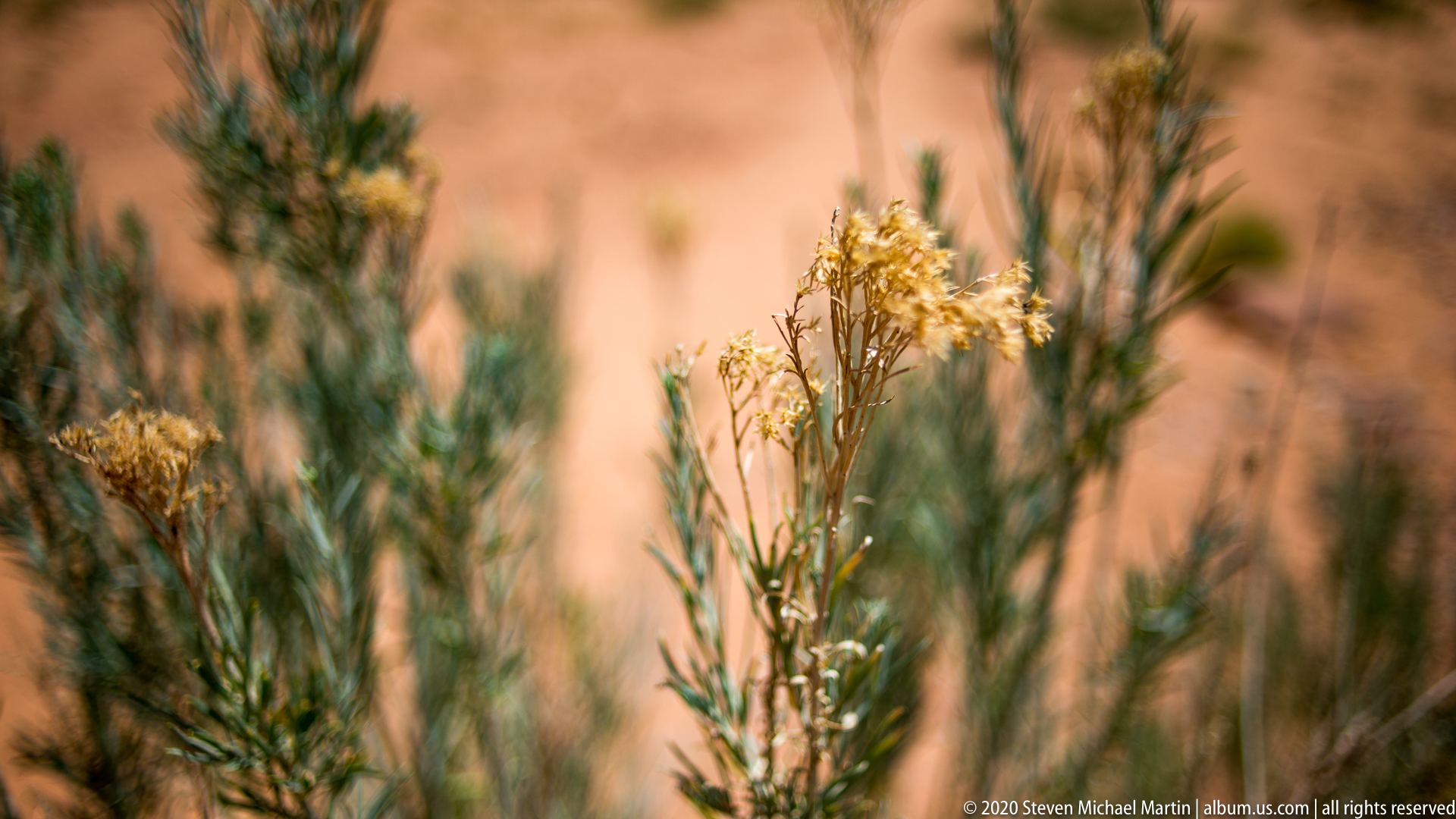
A slender desert plant carries a compact cluster of yellow blossoms at the tip of its stem. Narrow gray-green leaves and adjacent stalks rise around it, while the warm sandstone-colored background falls softly out of focus. The shallow depth of field isolates the flowering head without providing enough detail for a confident species identification.
Caption
A slender desert plant carries a compact cluster of yellow blossoms at the tip of its stem. Narrow gray-green leaves and adjacent stalks rise around it, while the warm sandstone-colored background falls softly out of focus. The shallow depth of field isolates the flowering head without providing enough detail for a confident species identification.
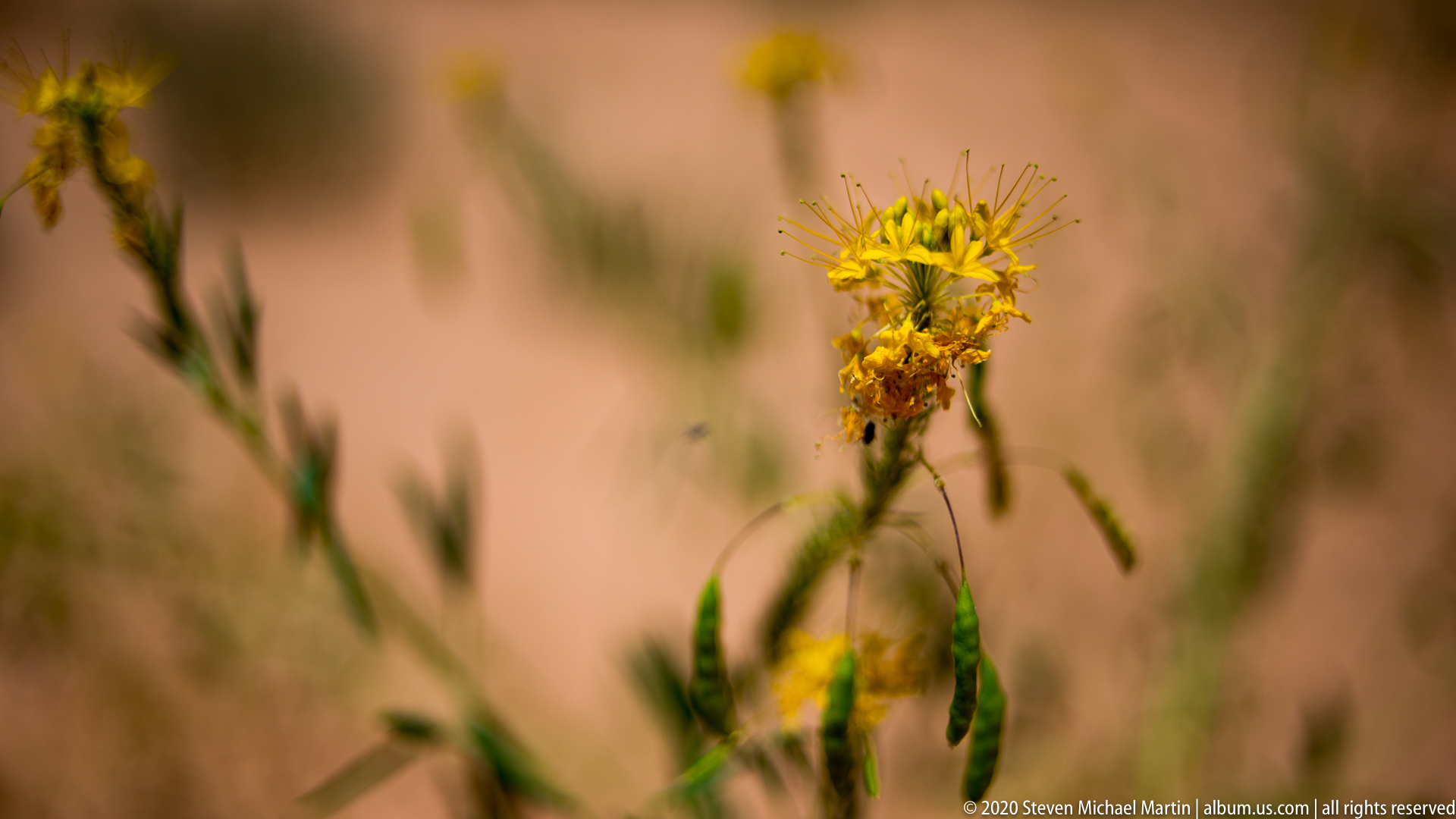
A small yellow flower head with delicate radiating petals rises above a narrow stem, with several unopened buds clustered beneath it. Nearby stems blur into the warm background, leaving the flower sharply defined near the center-right. The close portrait records the plant’s bloom and fine structure without making a species-level identification.
Caption
A small yellow flower head with delicate radiating petals rises above a narrow stem, with several unopened buds clustered beneath it. Nearby stems blur into the warm background, leaving the flower sharply defined near the center-right. The close portrait records the plant’s bloom and fine structure without making a species-level identification.
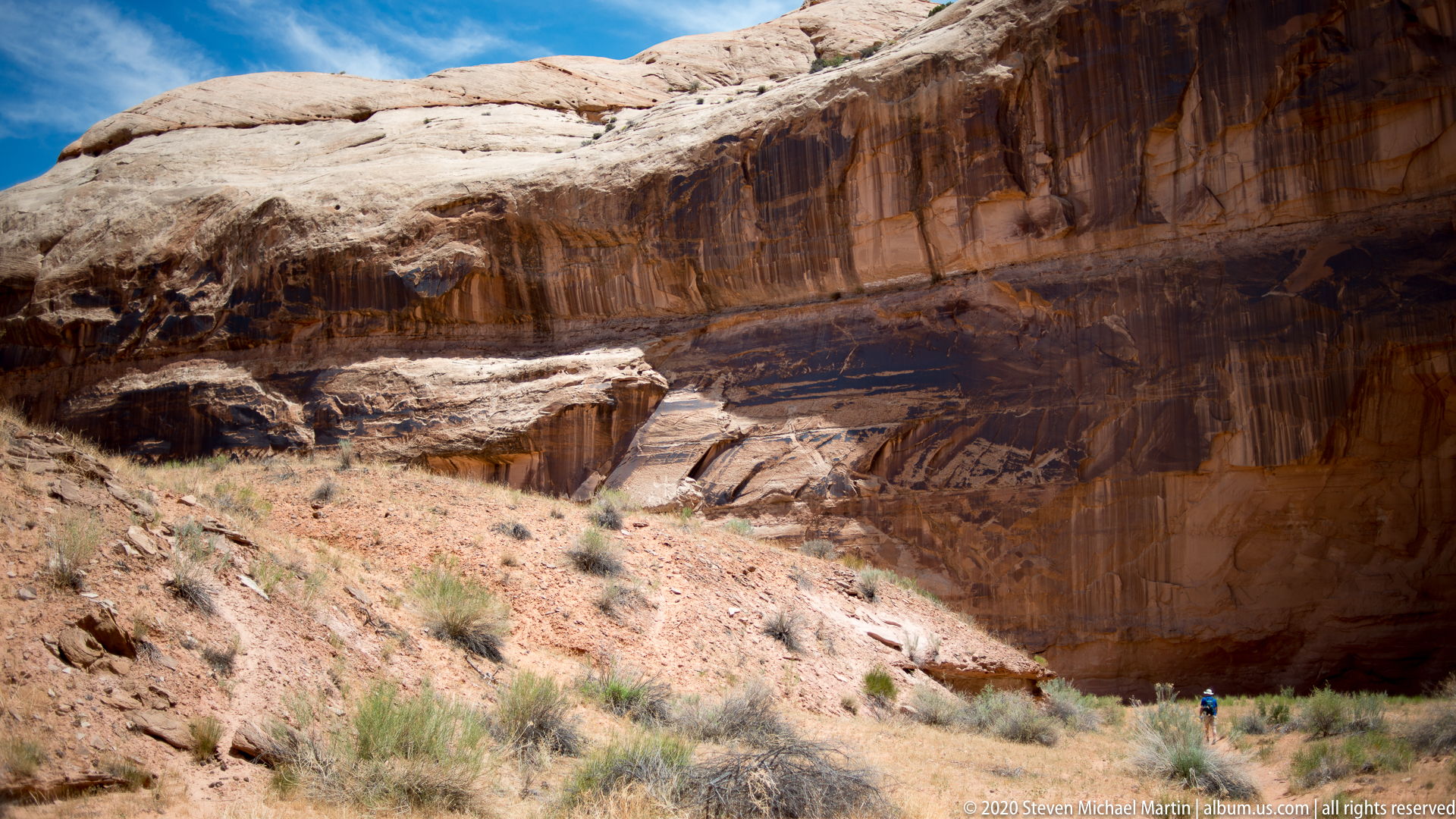
A lone hiker stands at the base of a tall sandstone shelter, beneath dark vertical streaks and a shadowed band of rock art. Pale slickrock rises above the overhang, while shrubs and a sandy slope cross the foreground. The small figure conveys the scale of the wall and the depth of the sheltered canyon space.
Caption
A lone hiker stands at the base of a tall sandstone shelter, beneath dark vertical streaks and a shadowed band of rock art. Pale slickrock rises above the overhang, while shrubs and a sandy slope cross the foreground. The small figure conveys the scale of the wall and the depth of the sheltered canyon space.
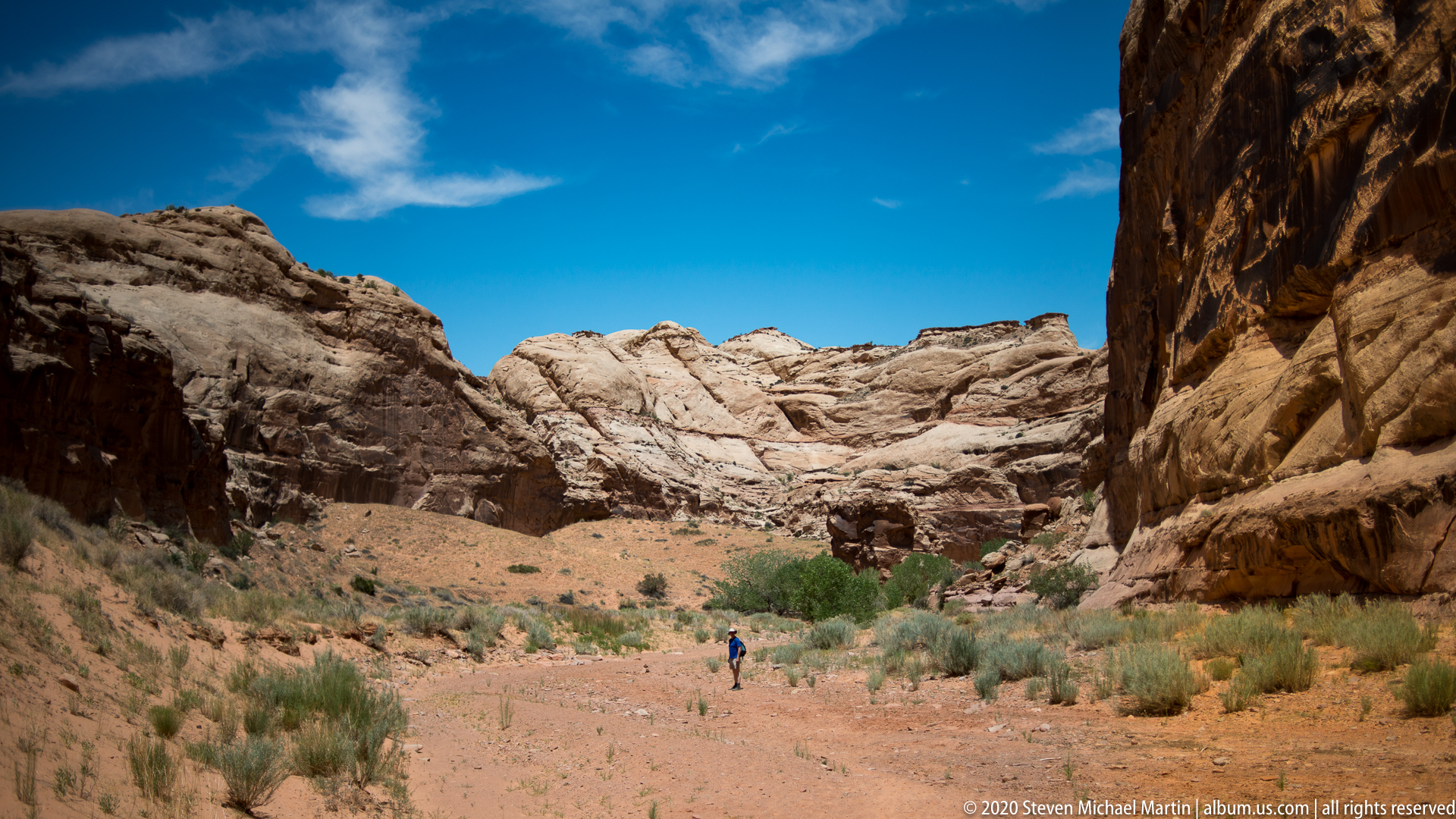
A lone visitor walks through a sandy corridor enclosed by high sandstone walls. Pale rounded rock rises across the far end, while a dark overhang forms a vertical boundary at the right and shadowed ledges line the left. Low shrubs dot the open floor, emphasizing the contrast between the broad passage and its steep sides.
Caption
A lone visitor walks through a sandy corridor enclosed by high sandstone walls. Pale rounded rock rises across the far end, while a dark overhang forms a vertical boundary at the right and shadowed ledges line the left. Low shrubs dot the open floor, emphasizing the contrast between the broad passage and its steep sides.
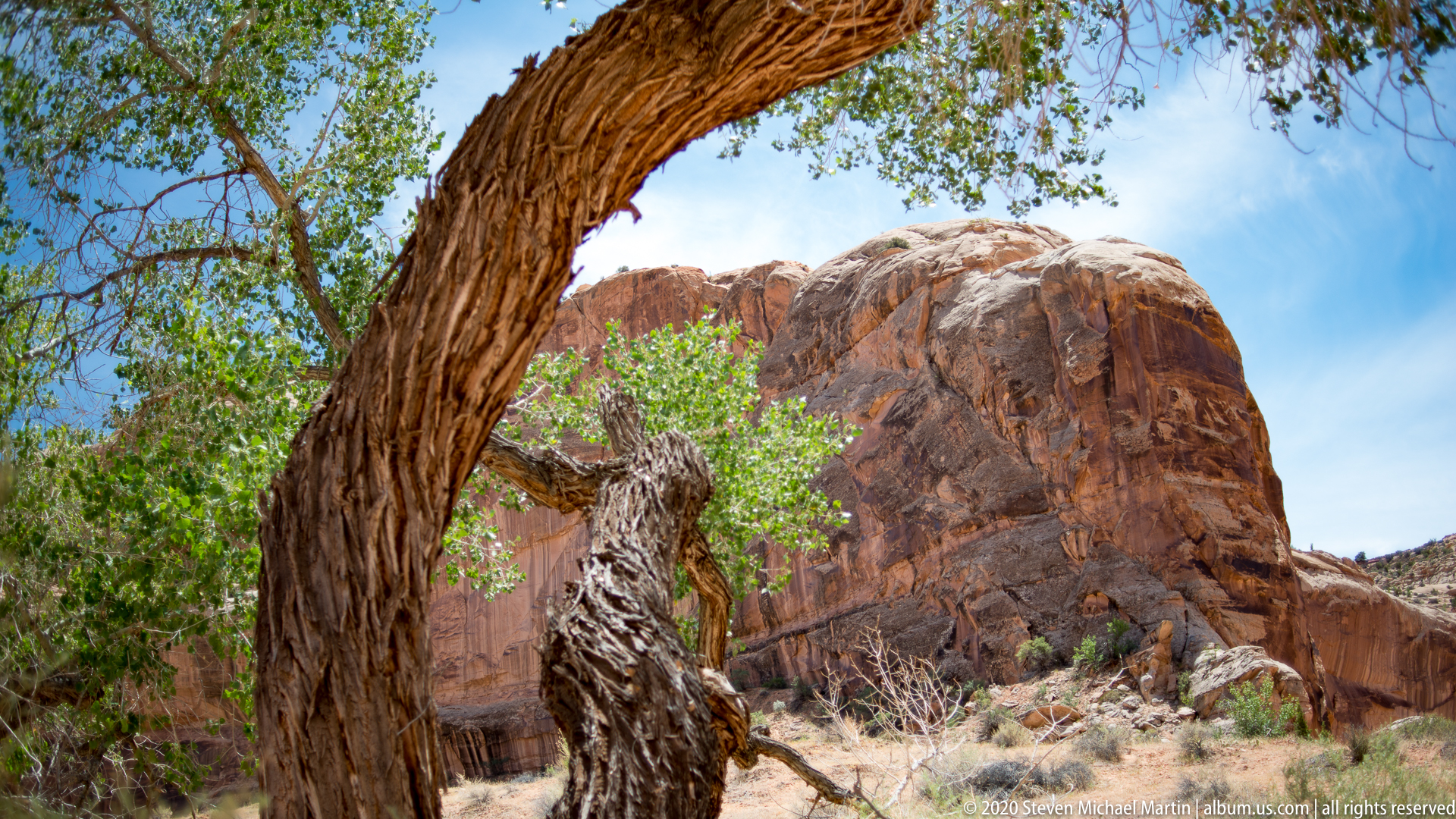
A thick, twisted tree trunk arcs across the foreground, framing a rounded red sandstone outcrop and a second weathered trunk at its base. Leafy branches cross the blue sky, while shrubs fill the shaded ground beneath the rock. The near tree creates a natural frame around the canyon wall and its smooth curved surface.
Caption
A thick, twisted tree trunk arcs across the foreground, framing a rounded red sandstone outcrop and a second weathered trunk at its base. Leafy branches cross the blue sky, while shrubs fill the shaded ground beneath the rock. The near tree creates a natural frame around the canyon wall and its smooth curved surface.

Low orange dunes sweep across the foreground in parallel wind-shaped ridges, punctuated by small clumps of desert vegetation. A dark bank of clouds covers much of the sky, while a narrow strip of brighter light remains near the left horizon. The muted distance and saturated sand create a sharp weather contrast across this open, treeless landscape.
Caption
Low orange dunes sweep across the foreground in parallel wind-shaped ridges, punctuated by small clumps of desert vegetation. A dark bank of clouds covers much of the sky, while a narrow strip of brighter light remains near the left horizon. The muted distance and saturated sand create a sharp weather contrast across this open, treeless landscape.
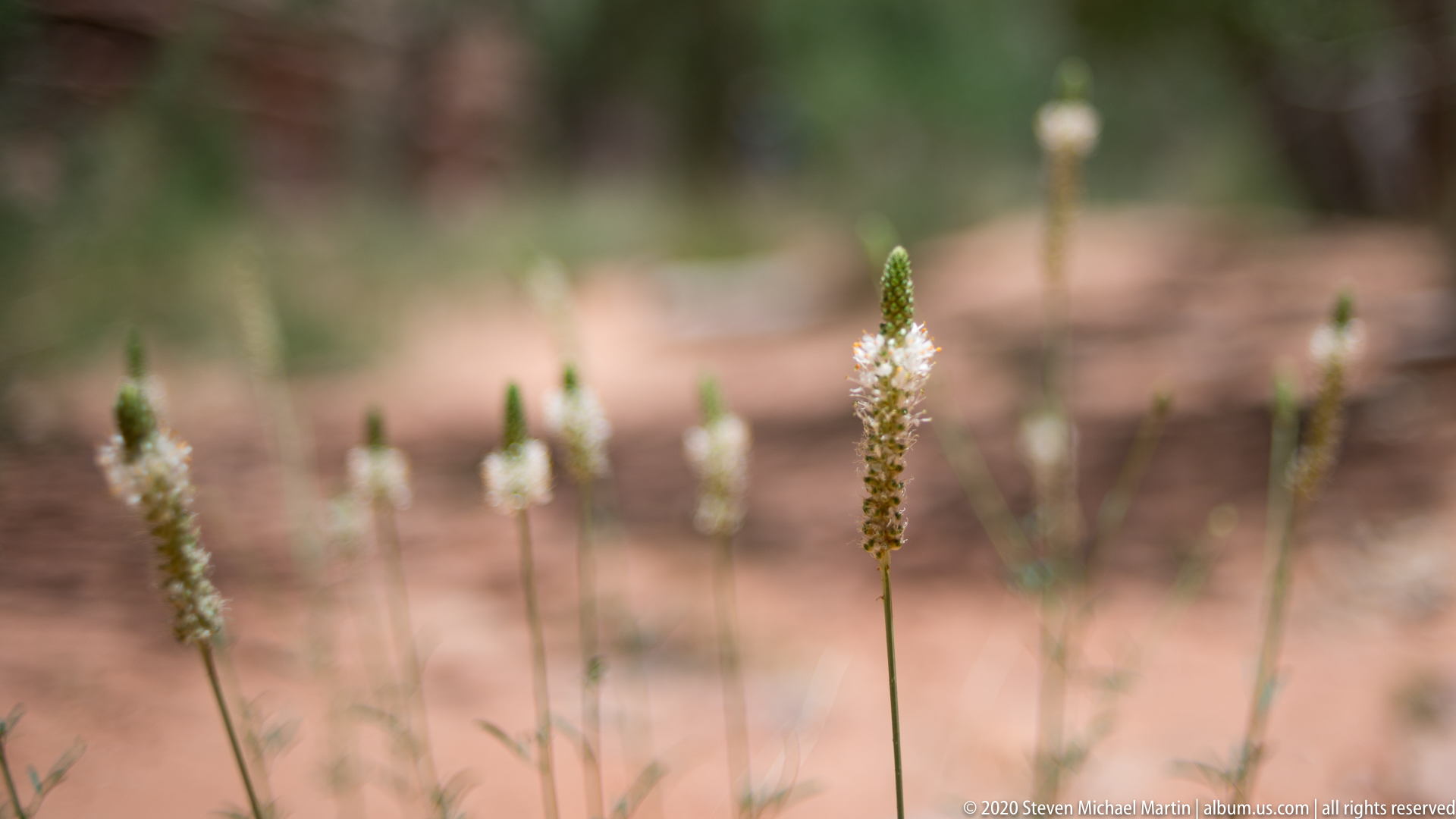
A single upright flowering stalk is sharply focused near the center, its dense white blossoms rising above a narrow green stem. Similar pale spikes recede softly across the frame, while the sandy ground and green-brown vegetation dissolve into a shallow-focus background. The selective focus turns a small desert plant into the subject against the blurred canyon-floor setting.
Caption
A single upright flowering stalk is sharply focused near the center, its dense white blossoms rising above a narrow green stem. Similar pale spikes recede softly across the frame, while the sandy ground and green-brown vegetation dissolve into a shallow-focus background. The selective focus turns a small desert plant into the subject against the blurred canyon-floor setting.
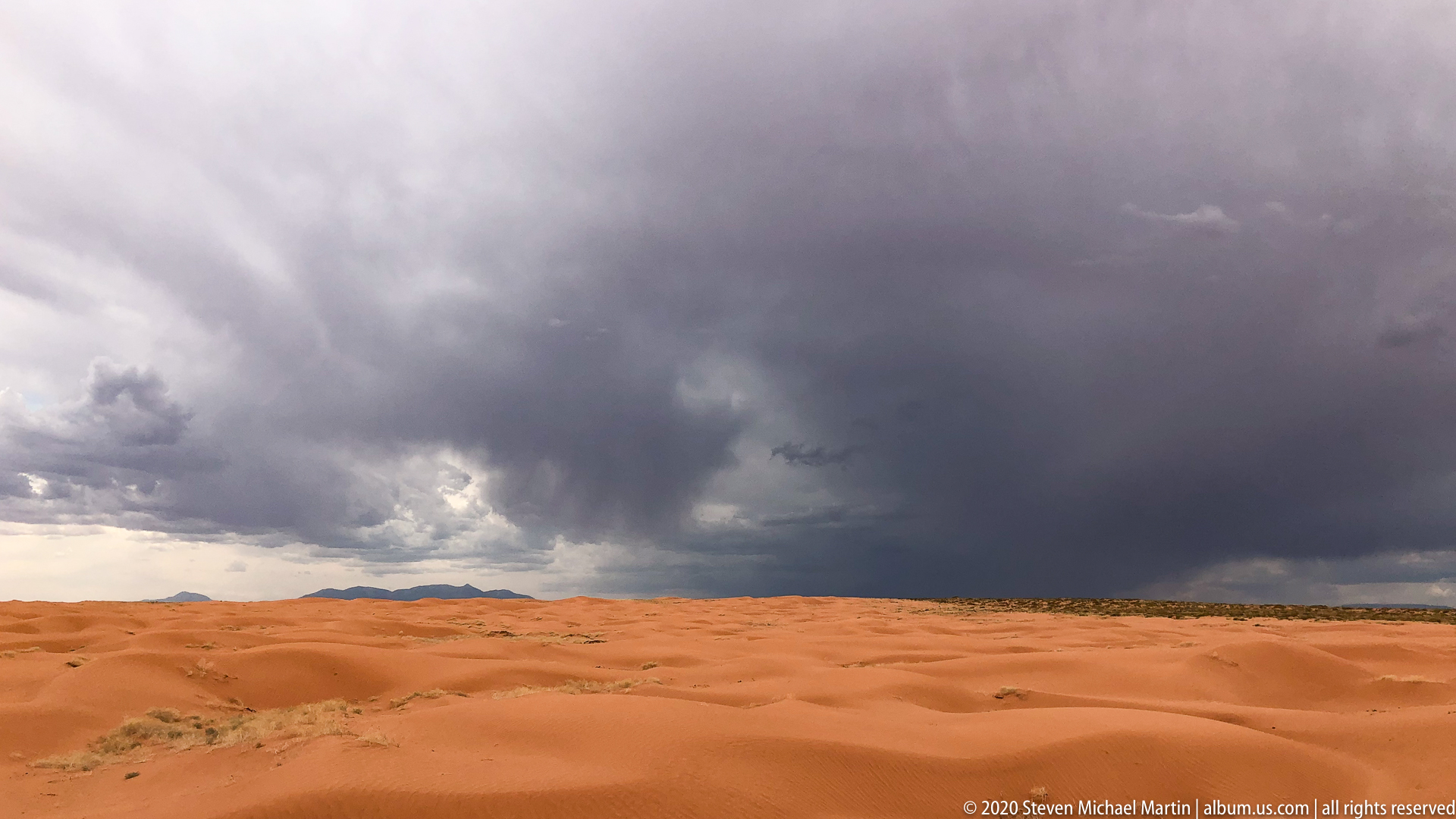
A broad storm cloud hangs over softly undulating orange sand, its darkest mass concentrated across the upper right. The horizon remains low, with distant mesas faintly visible beneath the cloud shelf. Ripples and scattered shrubs texture the foreground dunes, while a brighter break in the clouds at left outlines the approaching weather without obscuring the desert forms.
Caption
A broad storm cloud hangs over softly undulating orange sand, its darkest mass concentrated across the upper right. The horizon remains low, with distant mesas faintly visible beneath the cloud shelf. Ripples and scattered shrubs texture the foreground dunes, while a brighter break in the clouds at left outlines the approaching weather without obscuring the desert forms.
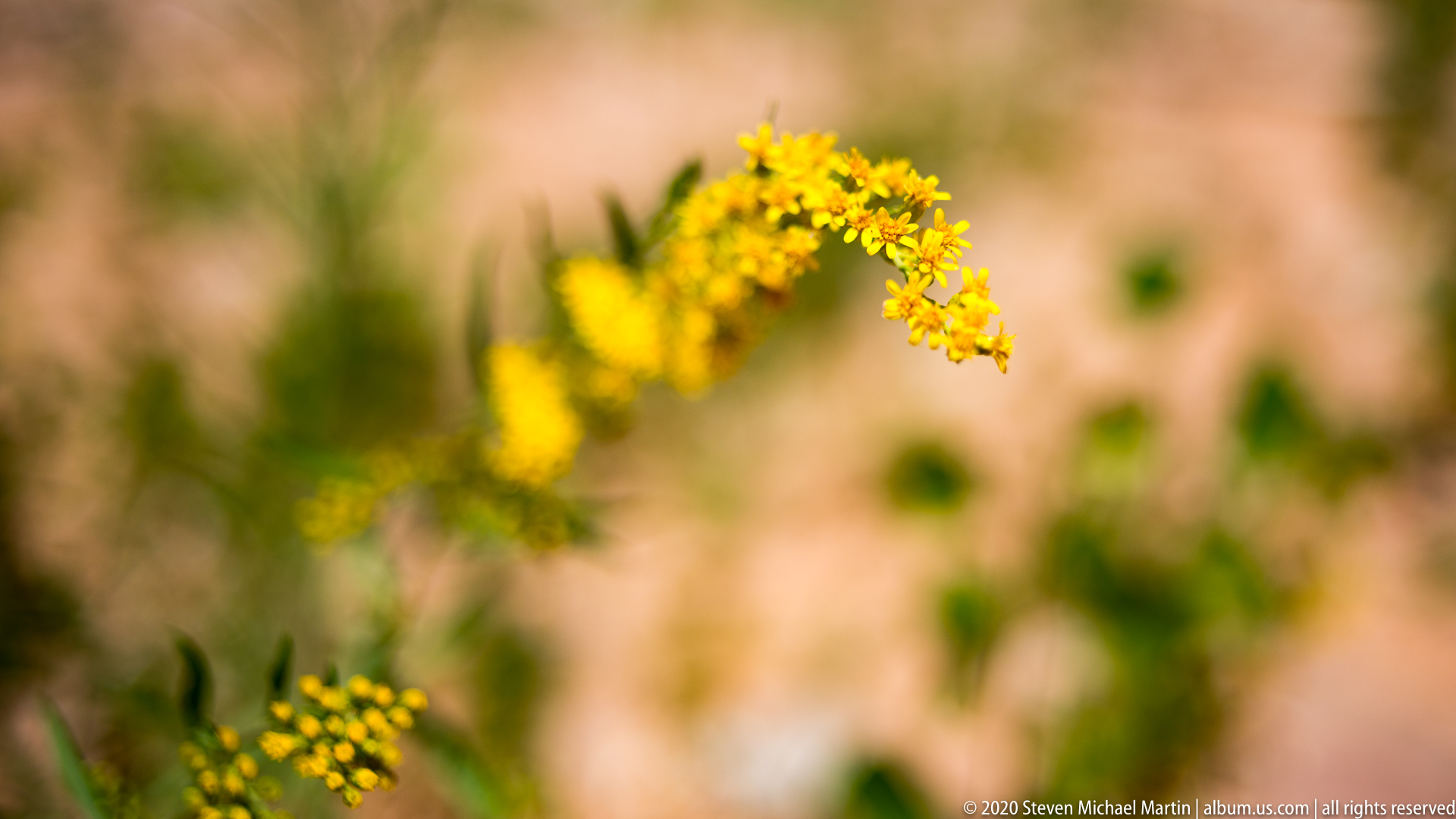
A slender green branch arcs from the lower left toward clusters of tiny yellow blossoms near the center and upper right. The flowers remain crisp against a smooth, warm-toned blur of sand and vegetation, with only a few dark green shapes discernible behind them. Close framing and shallow depth of field isolate the bloom from the expansive canyon landscape.
Caption
A slender green branch arcs from the lower left toward clusters of tiny yellow blossoms near the center and upper right. The flowers remain crisp against a smooth, warm-toned blur of sand and vegetation, with only a few dark green shapes discernible behind them. Close framing and shallow depth of field isolate the bloom from the expansive canyon landscape.
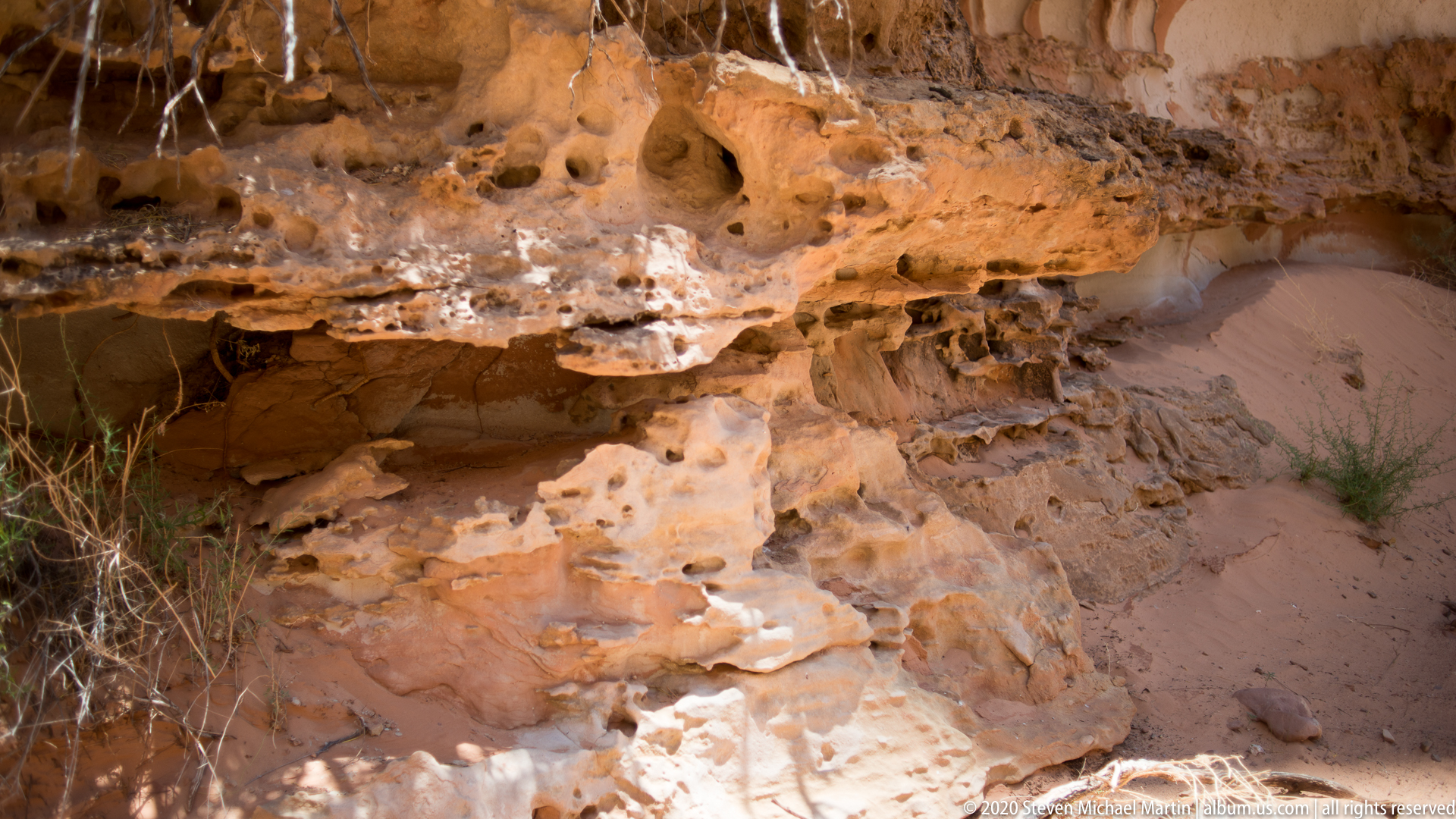
A low shelf of orange sandstone projects over a shaded recess, its face perforated by rounded cavities and irregular weathering pockets. Pale mineral bands cross the darker rock, while sand and sparse grasses collect below the ledge. The close viewpoint traces the porous surface and its undercut edge rather than the canyon’s larger walls.
Caption
A low shelf of orange sandstone projects over a shaded recess, its face perforated by rounded cavities and irregular weathering pockets. Pale mineral bands cross the darker rock, while sand and sparse grasses collect below the ledge. The close viewpoint traces the porous surface and its undercut edge rather than the canyon’s larger walls.
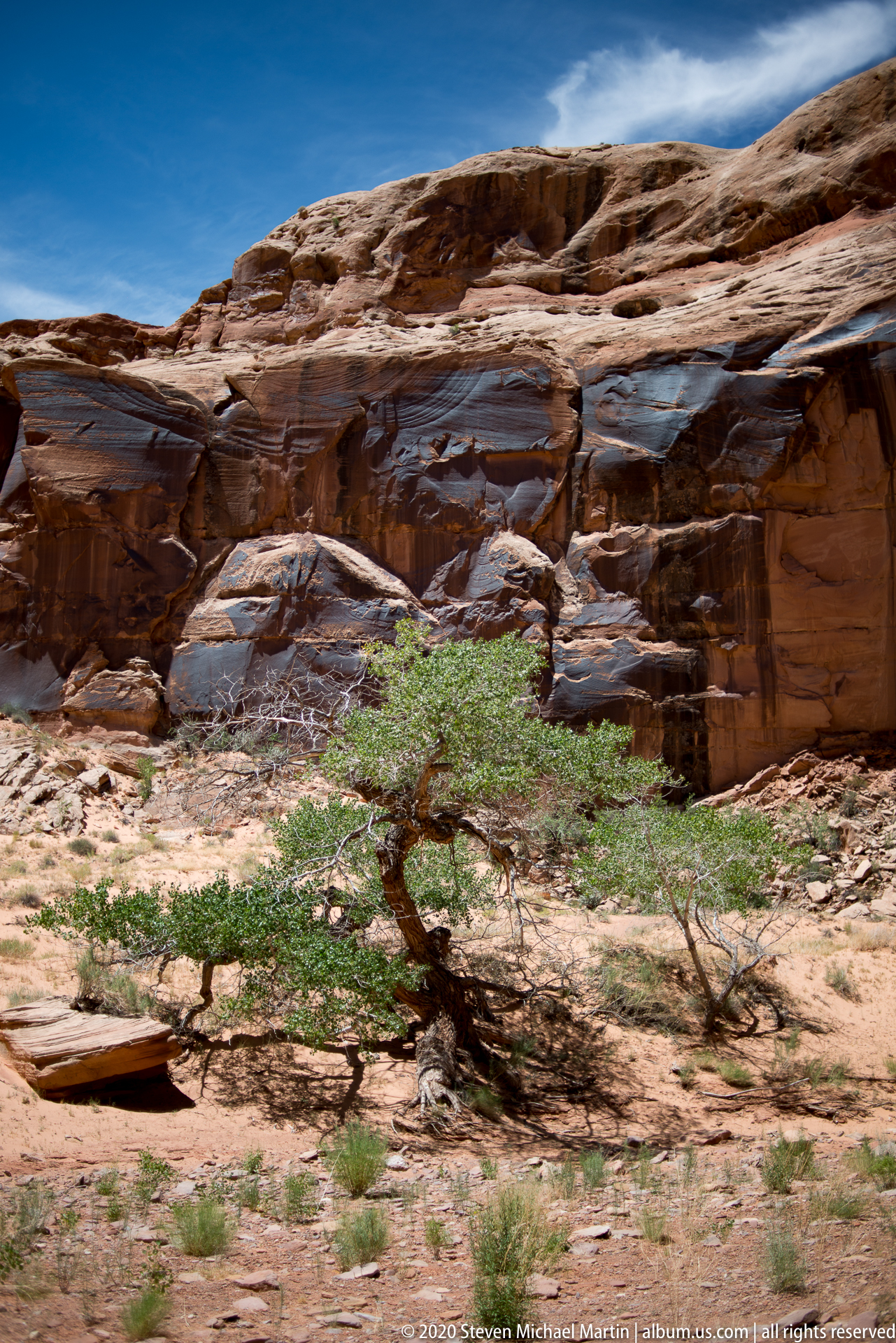
A low, spreading tree fills the foreground, its twisting trunk and wide green canopy set against a dark sandstone wall striped with pale horizontal layers. Loose sand and small stones surround the tree, while blue sky appears above the cliff. The contrast between living vegetation and the broad, weathered rock face gives this sheltered canyon view its defining relationship.
Caption
A low, spreading tree fills the foreground, its twisting trunk and wide green canopy set against a dark sandstone wall striped with pale horizontal layers. Loose sand and small stones surround the tree, while blue sky appears above the cliff. The contrast between living vegetation and the broad, weathered rock face gives this sheltered canyon view its defining relationship.

Dark vertical stains descend across a tall orange sandstone face, following fractures and shallow channels from ledges near the top. Green shrubs cluster at the foot of the wall, providing scale and a band of living color against the rock. The nearly frontal view reveals both the cliff’s vertical height and the irregular pattern of runoff or mineral staining.
Caption
Dark vertical stains descend across a tall orange sandstone face, following fractures and shallow channels from ledges near the top. Green shrubs cluster at the foot of the wall, providing scale and a band of living color against the rock. The nearly frontal view reveals both the cliff’s vertical height and the irregular pattern of runoff or mineral staining.

A small visitor in blue pauses near the center of a sandy canyon floor, dwarfed by steep sandstone walls that rise on both sides. Sunlight catches the fractured pale rock above, while deep brown shadows settle across the lower cliff faces. Green trees and shrubs line the route, making the narrow passage feel both sheltered and immense.
Caption
A small visitor in blue pauses near the center of a sandy canyon floor, dwarfed by steep sandstone walls that rise on both sides. Sunlight catches the fractured pale rock above, while deep brown shadows settle across the lower cliff faces. Green trees and shrubs line the route, making the narrow passage feel both sheltered and immense.
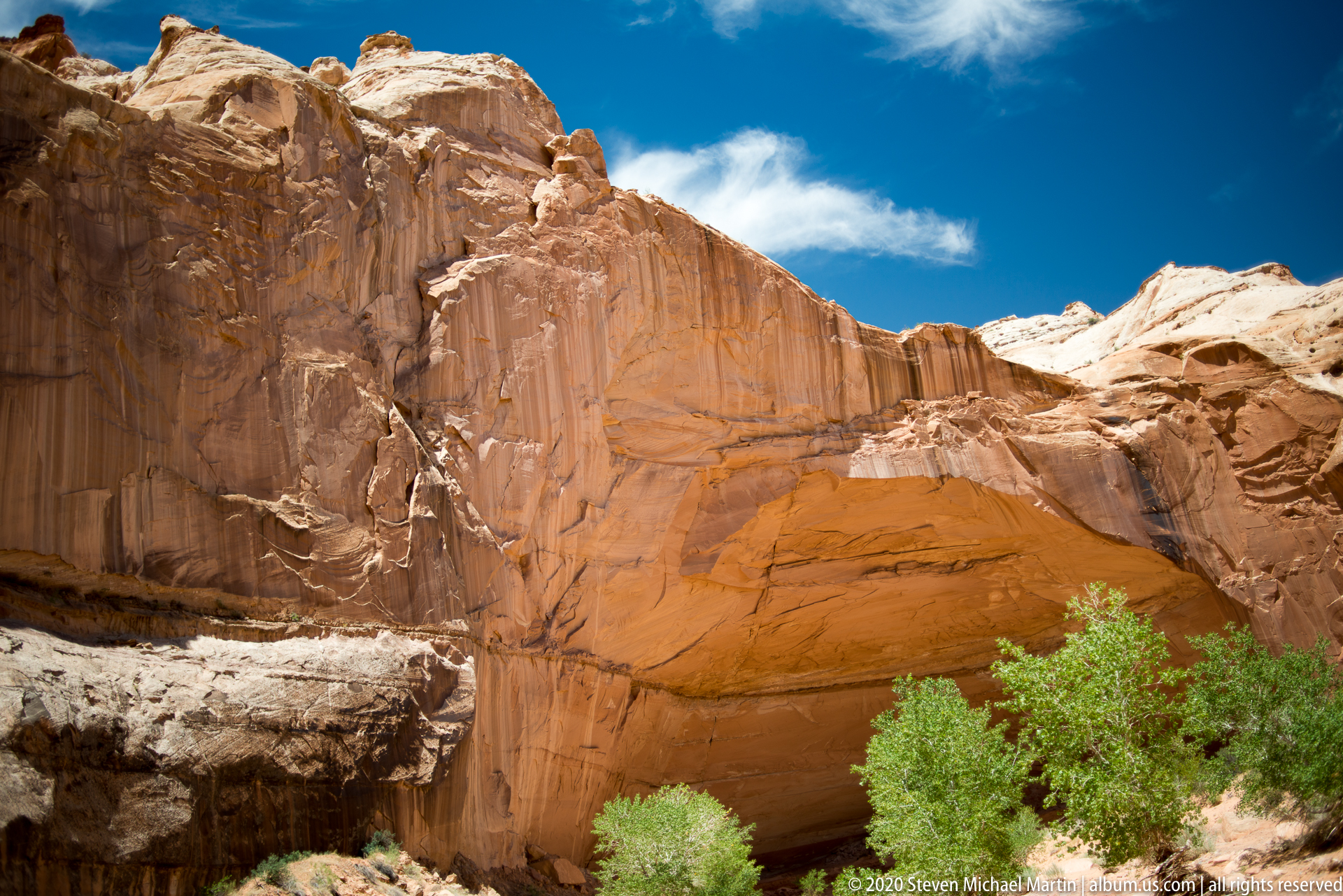
The massive wall rises in a smooth arc, with a broad rust-orange recess framed by fractured pale sandstone above and at left. Sparse green shrubs mark the base, and blue sky opens above the upper rim. The angled view shows how a darker projecting shelf intersects the bright alcove, revealing depth and contrasting rock textures across the formation.
Caption
The massive wall rises in a smooth arc, with a broad rust-orange recess framed by fractured pale sandstone above and at left. Sparse green shrubs mark the base, and blue sky opens above the upper rim. The angled view shows how a darker projecting shelf intersects the bright alcove, revealing depth and contrasting rock textures across the formation.

A lone hiker in blue walks away through knee-high grass along a pale path that winds between tall sandstone walls. The nearer cliffs cast cool shadows across the trail, while sunlit rock and a bright patch of sky draw the eye toward the canyon opening. Low shrubs soften the sandy foreground and mark the route through the confined passage.
Caption
A lone hiker in blue walks away through knee-high grass along a pale path that winds between tall sandstone walls. The nearer cliffs cast cool shadows across the trail, while sunlit rock and a bright patch of sky draw the eye toward the canyon opening. Low shrubs soften the sandy foreground and mark the route through the confined passage.
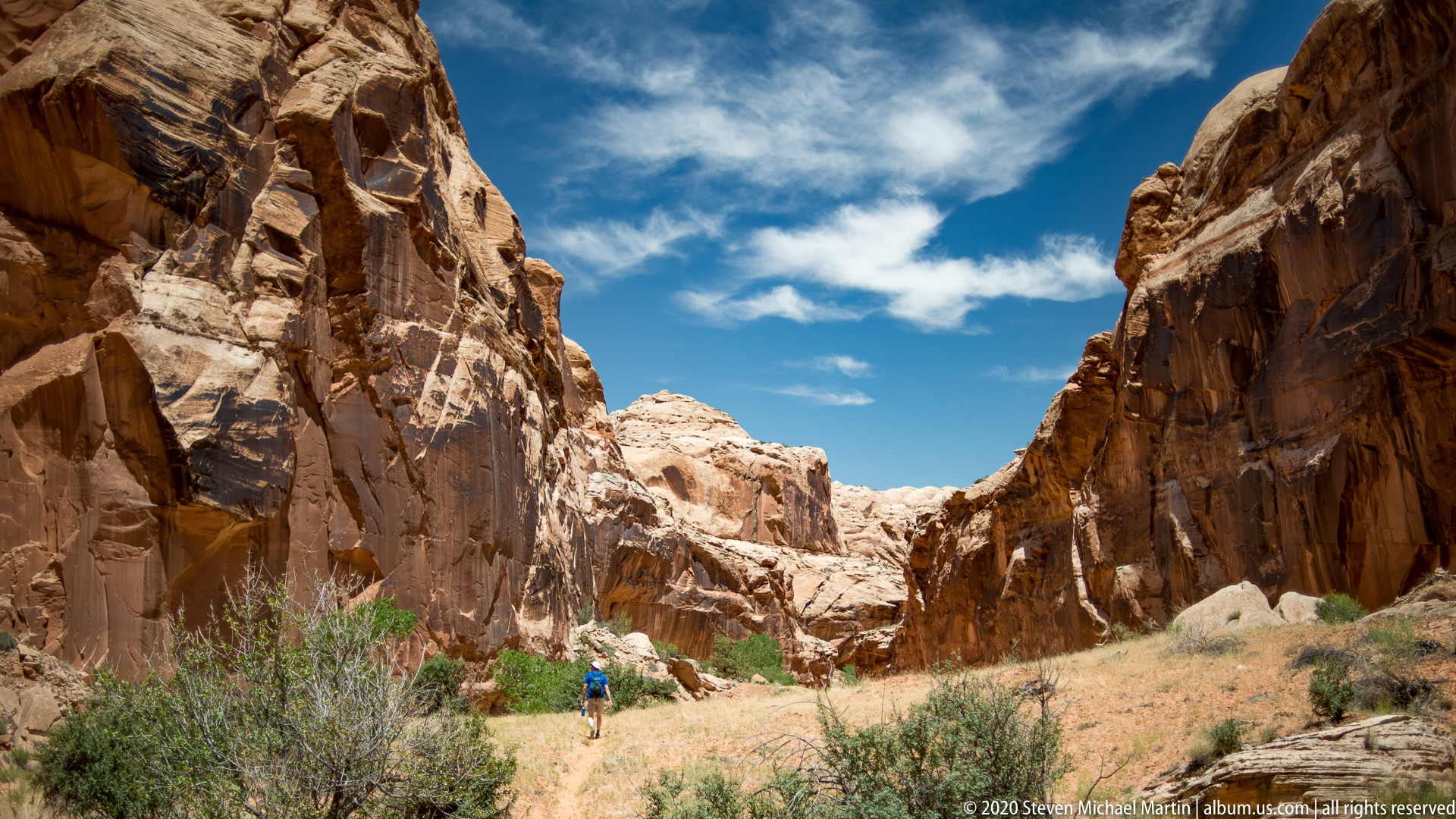
The close, frontal composition fills the frame with a high reddish wall scored by long dark lines and branching stains. Pale rock caps the upper edge, while a few shrubs enter along the bottom. The repeated vertical marks contrast with the sandstone’s horizontal bedding, making the cliff’s varied textures and drainage patterns the dominant subject.
Caption
The close, frontal composition fills the frame with a high reddish wall scored by long dark lines and branching stains. Pale rock caps the upper edge, while a few shrubs enter along the bottom. The repeated vertical marks contrast with the sandstone’s horizontal bedding, making the cliff’s varied textures and drainage patterns the dominant subject.
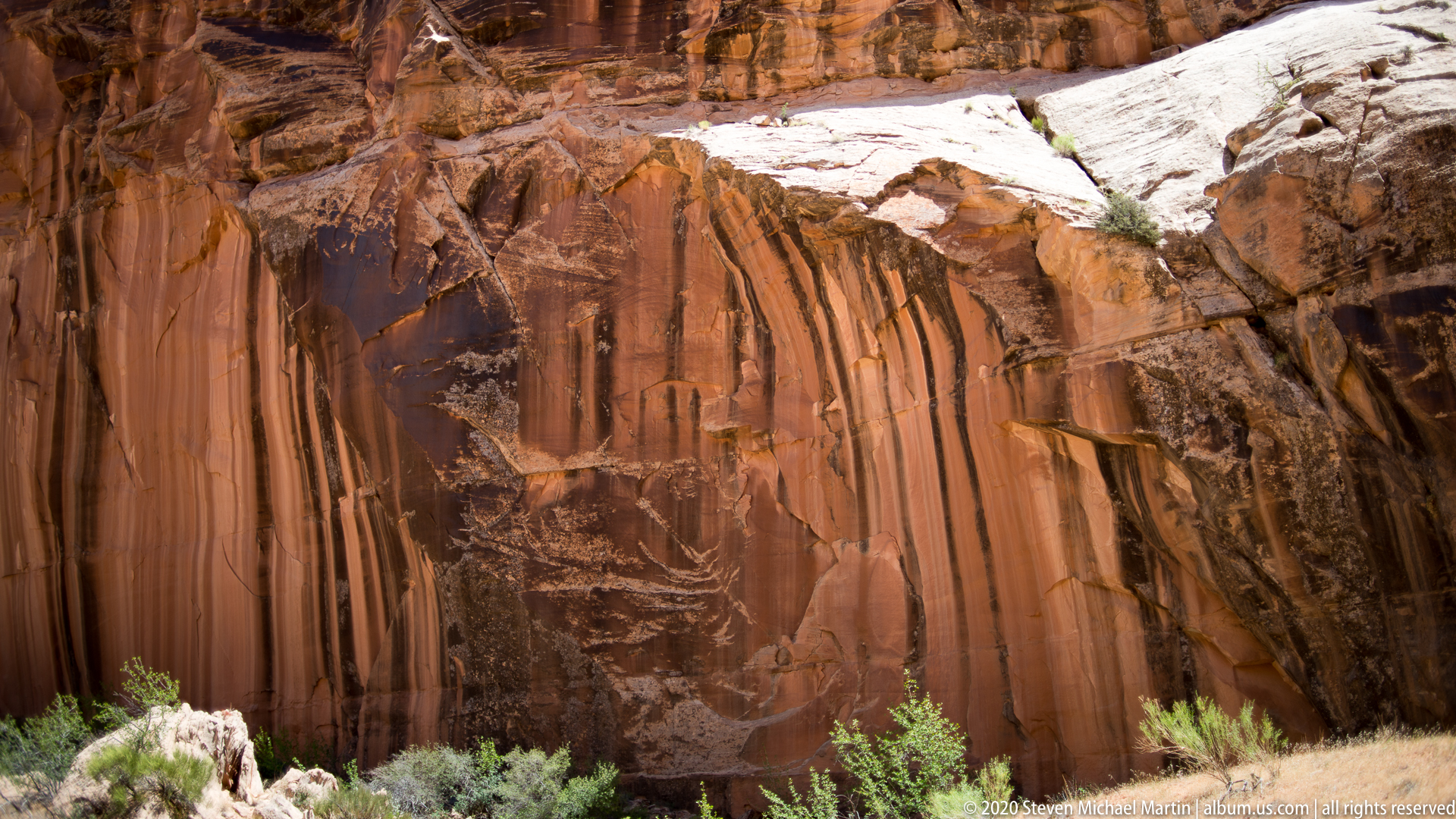
The sandy wash opens between an orange wall on the right and a lower, shadowed ledge on the left. Clumps of grass and shrubs occupy the foreground, while pale sandstone glows in the distance under a blue, cloud-streaked sky. The low viewpoint follows the open route into the canyon, balancing the close walls with a bright central corridor.
Caption
The sandy wash opens between an orange wall on the right and a lower, shadowed ledge on the left. Clumps of grass and shrubs occupy the foreground, while pale sandstone glows in the distance under a blue, cloud-streaked sky. The low viewpoint follows the open route into the canyon, balancing the close walls with a bright central corridor.
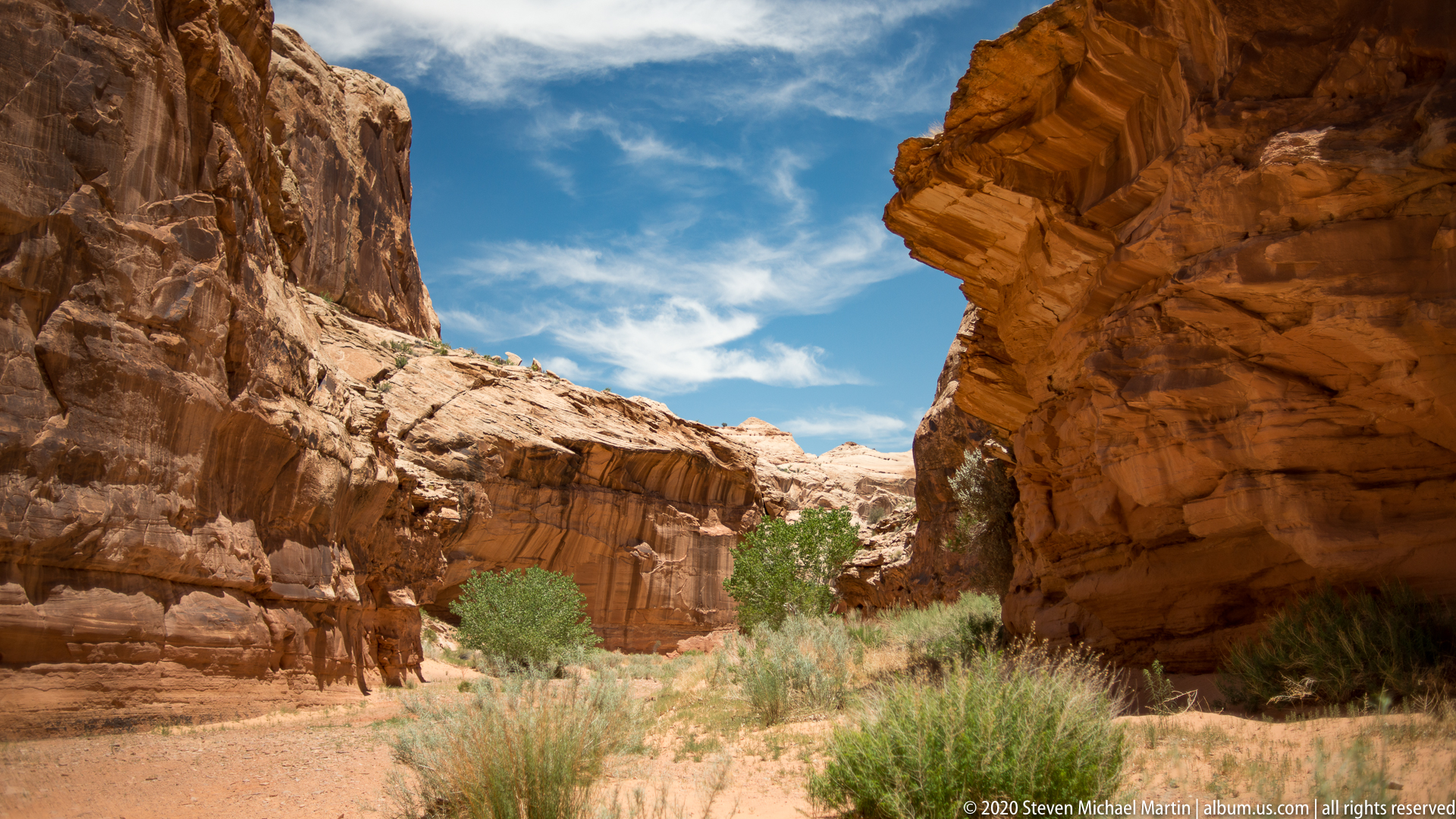
From an elevated viewpoint, a wide basin of broken shelves and shallow gullies spreads toward a continuous line of cliffs on the far side. Sparse scrub dots the brown terrain, and pale sky sits above the rim. The broad framing emphasizes the basin’s stepped geology and the distance between the foreground ledges and the enclosing canyon walls.
Caption
From an elevated viewpoint, a wide basin of broken shelves and shallow gullies spreads toward a continuous line of cliffs on the far side. Sparse scrub dots the brown terrain, and pale sky sits above the rim. The broad framing emphasizes the basin’s stepped geology and the distance between the foreground ledges and the enclosing canyon walls.
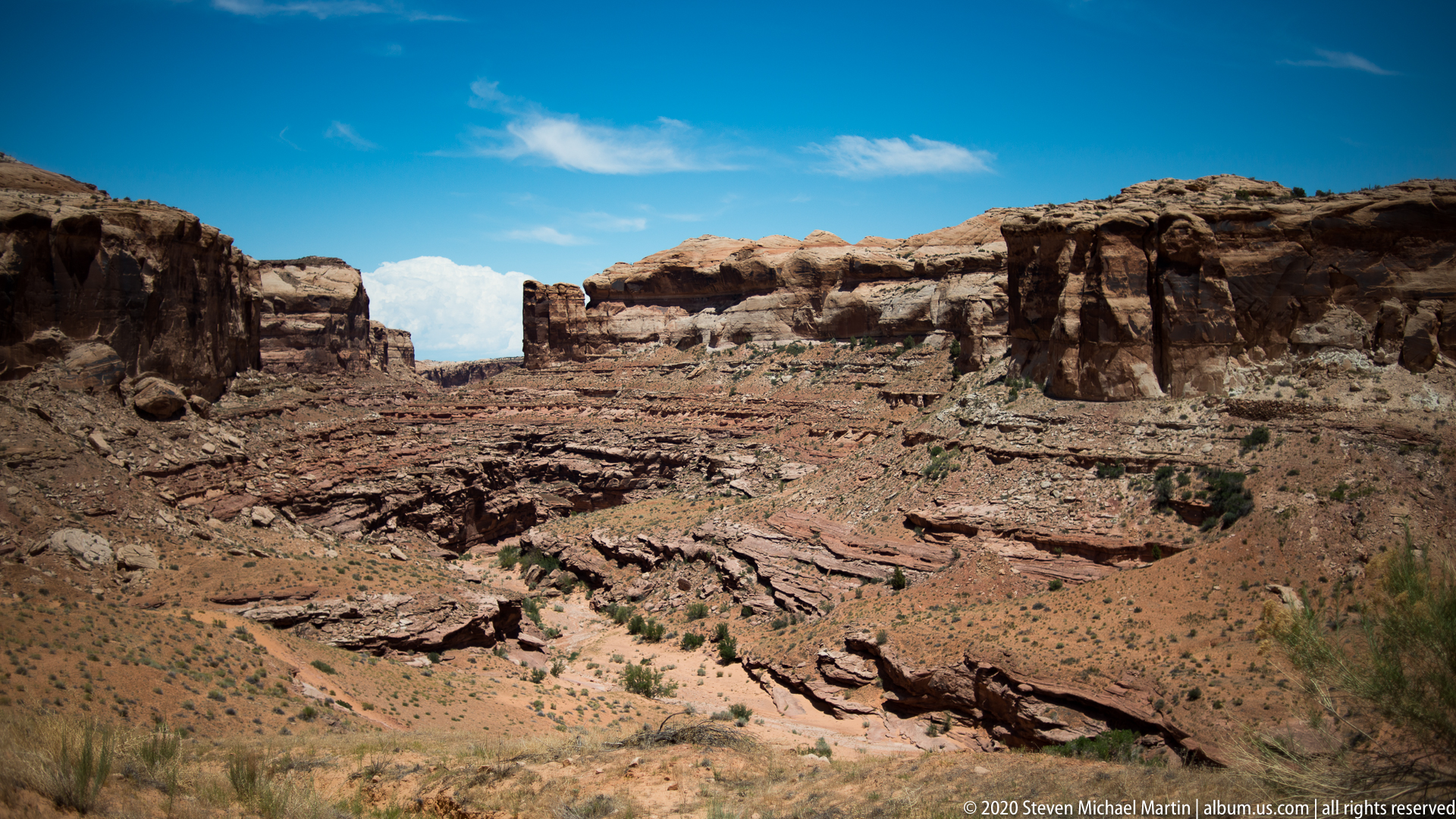
The visitor fills the foreground from the chest up, wearing a pale wide-brimmed hat and bright blue shirt. A sunlit orange sandstone wall and a patch of green vegetation blur behind him, separating the portrait from the canyon setting without competing with his face. The direct, relaxed pose gives this photograph a personal pause within the broader landscape sequence.
Caption
The visitor fills the foreground from the chest up, wearing a pale wide-brimmed hat and bright blue shirt. A sunlit orange sandstone wall and a patch of green vegetation blur behind him, separating the portrait from the canyon setting without competing with his face. The direct, relaxed pose gives this photograph a personal pause within the broader landscape sequence.
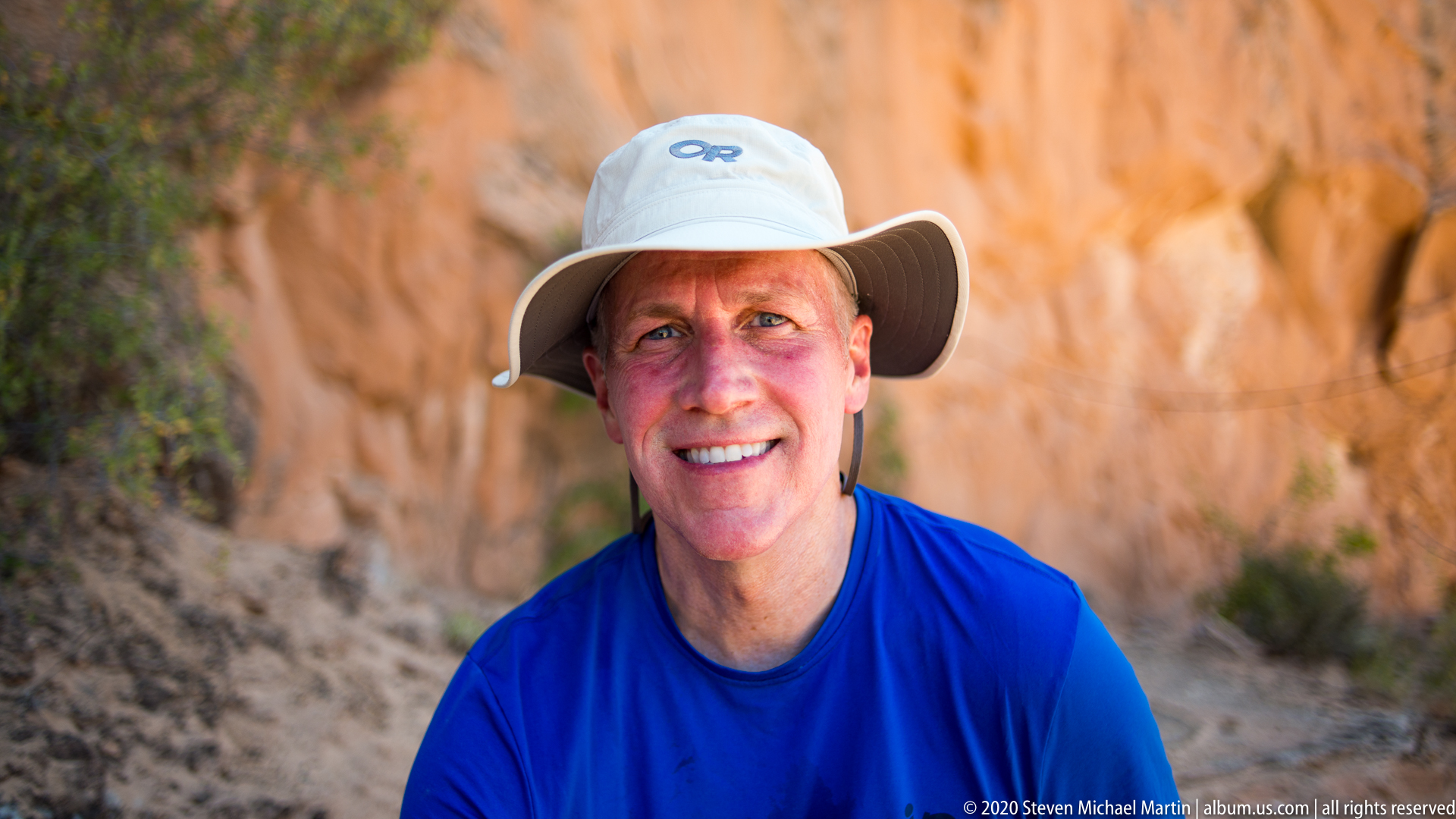
Pale, tilted slabs of sandstone form a broken ridge that runs diagonally from the foreground toward the center distance. Loose blocks and low shrubs scatter across the sandy plateau, while a thin band of clouds crosses the blue sky. The oblique view highlights the rock’s slanted bedding and the open terrain beyond the outcrop.
Caption
Pale, tilted slabs of sandstone form a broken ridge that runs diagonally from the foreground toward the center distance. Loose blocks and low shrubs scatter across the sandy plateau, while a thin band of clouds crosses the blue sky. The oblique view highlights the rock’s slanted bedding and the open terrain beyond the outcrop.
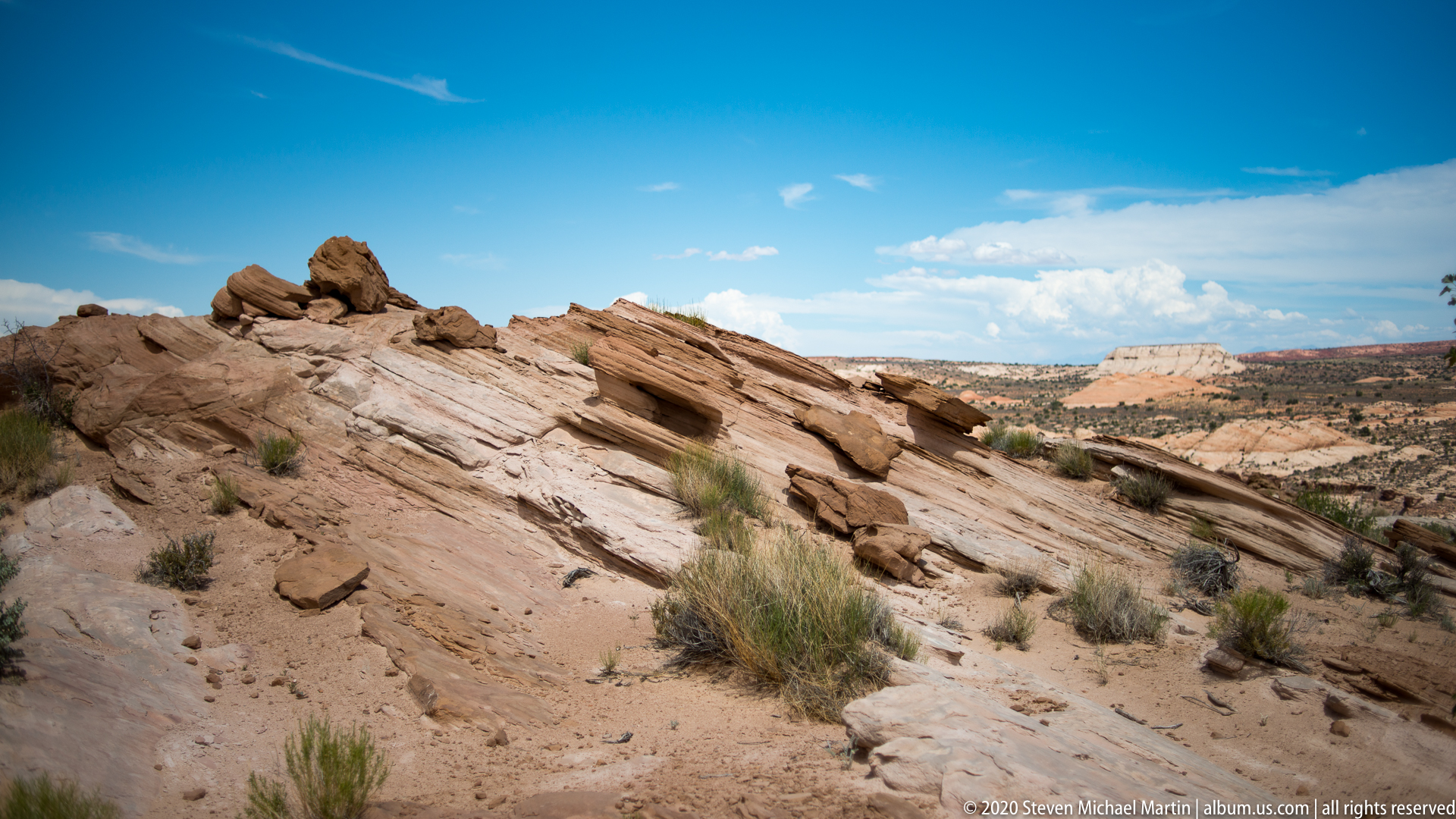
Thin sandstone layers peel away into broad, irregular shelves, with one slab projecting over a darker recess near the center. Scattered bushes and grasses grow among loose rocks on the gently sloping ground. Cloud-filtered light softens the tan and gray surfaces, revealing the repeated bedding lines and broken edges of this low outcrop.
Caption
Thin sandstone layers peel away into broad, irregular shelves, with one slab projecting over a darker recess near the center. Scattered bushes and grasses grow among loose rocks on the gently sloping ground. Cloud-filtered light softens the tan and gray surfaces, revealing the repeated bedding lines and broken edges of this low outcrop.
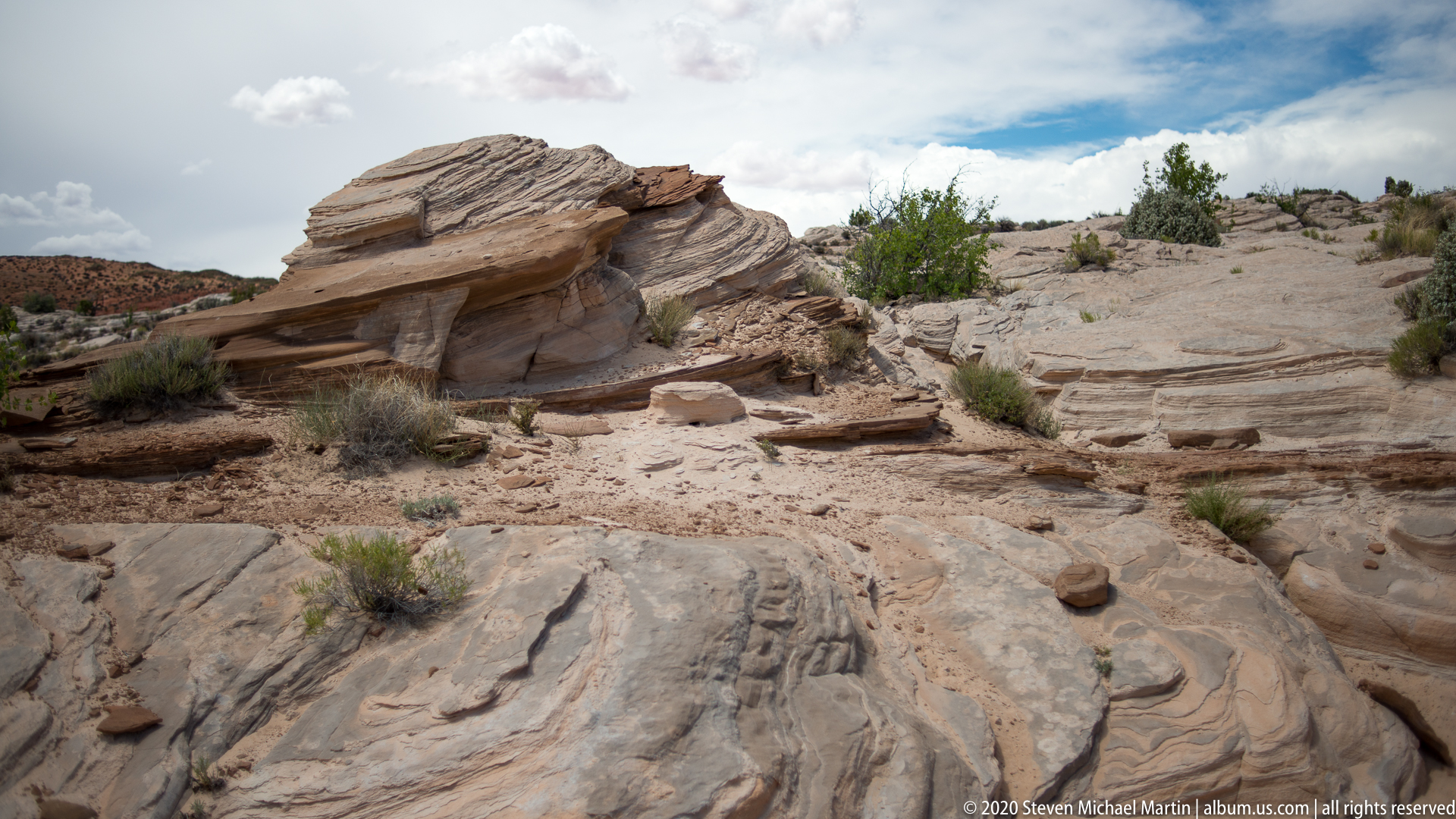
A rounded pale sandstone mass occupies the center, its curved face crossed by thin horizontal bedding lines. Lower shelves step outward toward the foreground, while scattered shrubs and grasses grow in the surrounding sand. The wide view places the formation within an open plateau and shows how erosion has separated the smooth central bulge from flatter surrounding layers.
Caption
A rounded pale sandstone mass occupies the center, its curved face crossed by thin horizontal bedding lines. Lower shelves step outward toward the foreground, while scattered shrubs and grasses grow in the surrounding sand. The wide view places the formation within an open plateau and shows how erosion has separated the smooth central bulge from flatter surrounding layers.
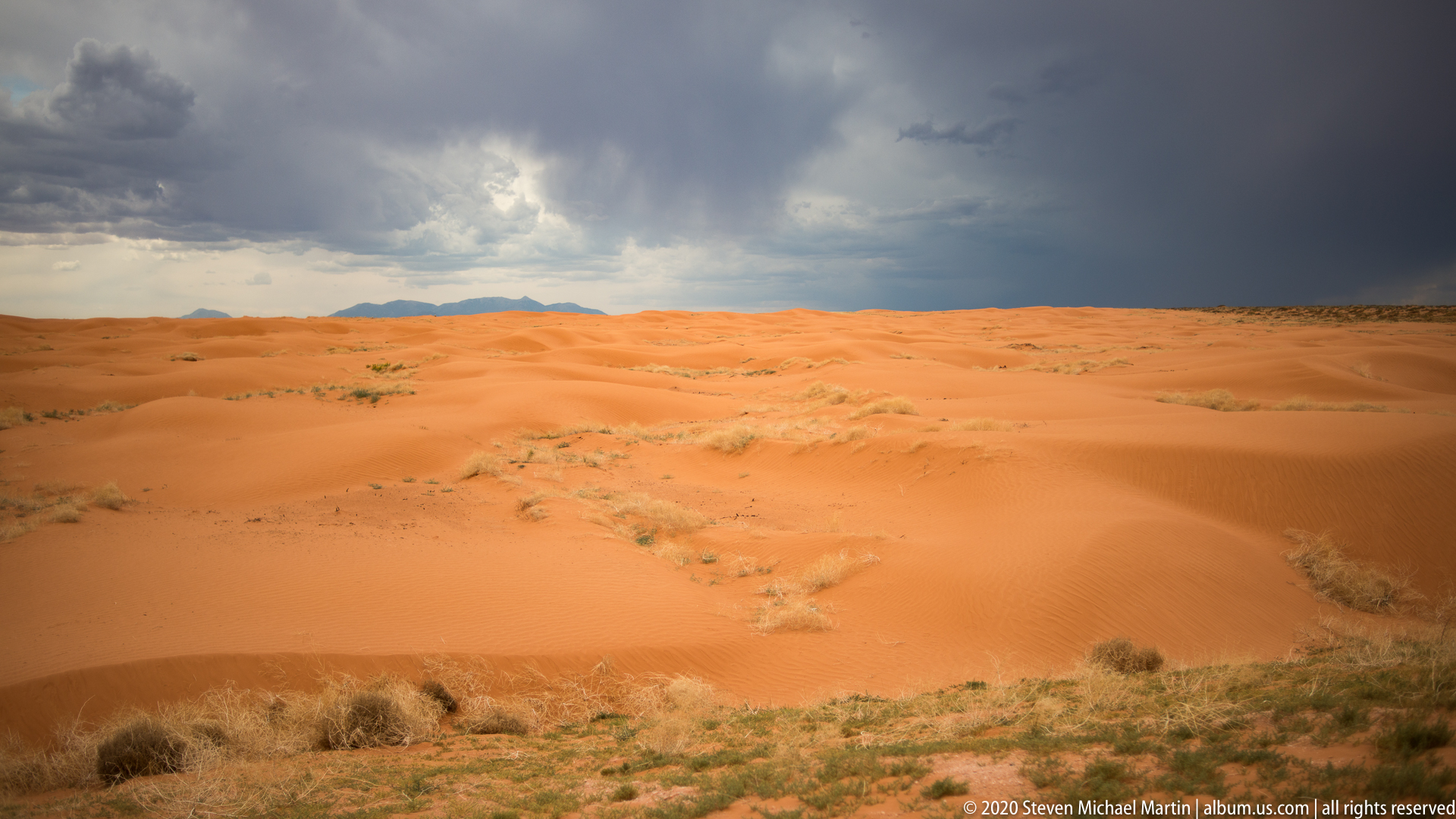
The dune field fills the lower half of the frame, with low ridges running toward a distant line of blue-gray mountains. A dense storm front occupies most of the sky, its darker center aligned above the horizon and a pale opening at left. Sparse vegetation marks the sand without breaking its broad contours, giving the scene a dramatic division between earth and weather.
Caption
The dune field fills the lower half of the frame, with low ridges running toward a distant line of blue-gray mountains. A dense storm front occupies most of the sky, its darker center aligned above the horizon and a pale opening at left. Sparse vegetation marks the sand without breaking its broad contours, giving the scene a dramatic division between earth and weather.
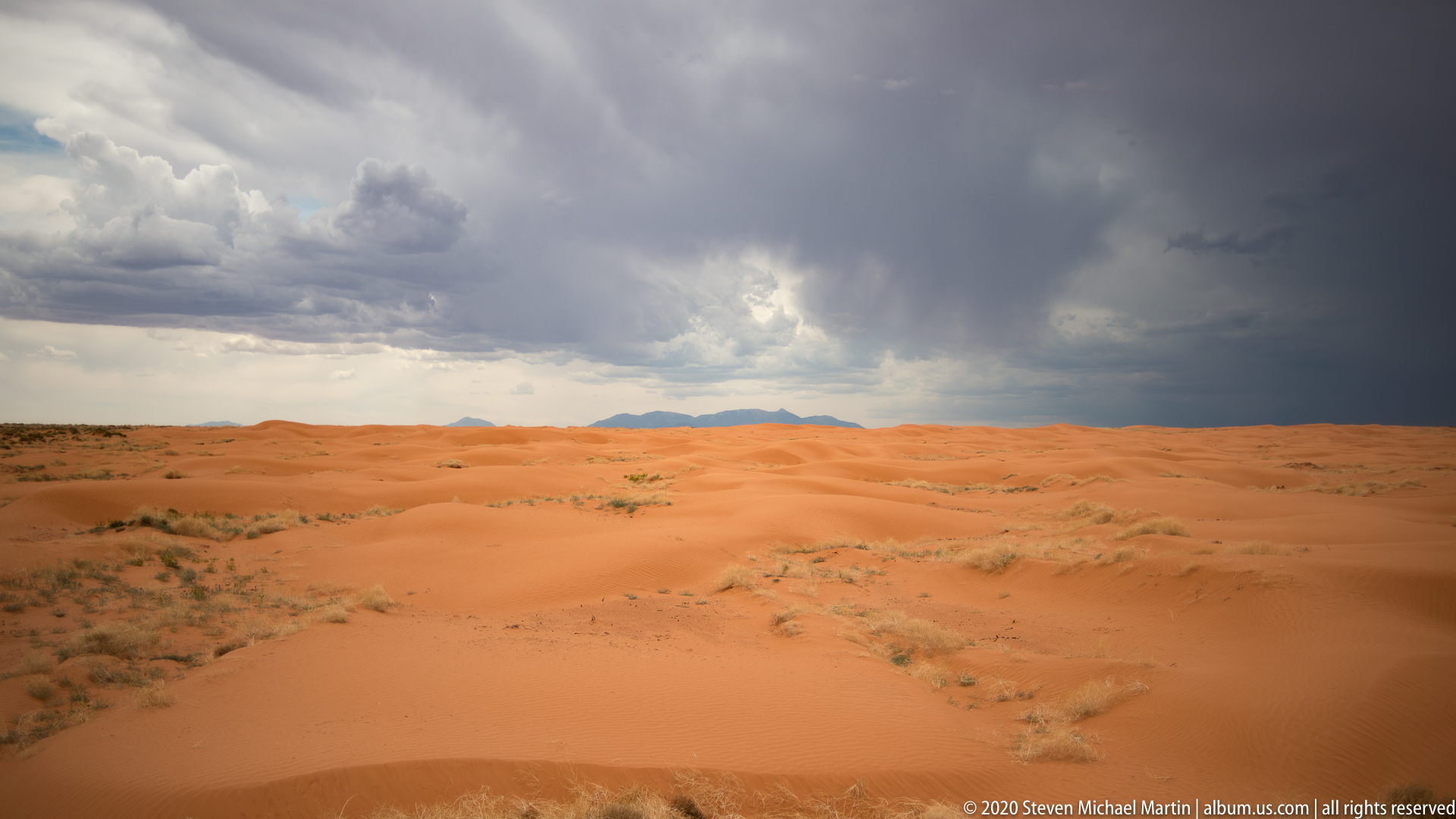
The dune field fills the lower half of the frame, with low ridges running toward a distant line of blue-gray mountains. A dense storm front occupies most of the sky, its darker center aligned above the horizon and a pale opening at left. Sparse vegetation marks the sand without breaking its broad contours, giving the scene a dramatic division between earth and weather.
Caption
The dune field fills the lower half of the frame, with low ridges running toward a distant line of blue-gray mountains. A dense storm front occupies most of the sky, its darker center aligned above the horizon and a pale opening at left. Sparse vegetation marks the sand without breaking its broad contours, giving the scene a dramatic division between earth and weather.
Canyonlands National Park — Field Guide
National Park Field Guide
📍 Overview
Canyonlands National Park preserves an expansive landscape of deeply carved canyons, mesas, and buttes shaped by the Colorado and Green Rivers. Located within the Colorado Plateau, the park illustrates the long-term effects of tectonic uplift followed by gradual erosion that exposed layers of sedimentary rock formed over millions of years. The scale of the landscape reflects geological forces that continue to influence canyon formation today.
The park is divided into distinct districts including Island in the Sky, The Needles, and The Maze, each characterized by variations in rock composition and erosion patterns. Vertical cliffs and layered rock formations illustrate changes in environmental conditions across prehistoric eras. River systems continue to shape canyon depth and structure, reinforcing the visual impression of geological time.
⭐ Highlights
- Colorado and Green River canyon systems
- Island in the Sky mesa landscapes
- The Needles sandstone spire formations
- Horseshoe Canyon rock art panels
- Elephant Hill and Druid Arch geological features
🔎 Key Features
- Deep canyon networks carved by river erosion
- Sandstone fins and spires formed through weathering
- Mesas and buttes created by differential erosion
- Rock layers illustrating long geological time sequences
- Colorado Plateau desert landscape environments
📷 Photography Notes
- Early and late light enhances canyon depth and texture
- Wide compositions help convey scale of mesas and river systems
- Cloud shadows can add dimension to desert landscapes
- Foreground rock formations provide visual depth
- Layered geology creates natural compositional lines
- Look for viewpoints that emphasize canyon scale