Bristlecone Pines – Great Basin National Park
The bristlecone pine groves of Great Basin National Park preserve one of the most remarkable high-elevation landscapes in the American West. Growing just below treeline on exposed limestone ridges, these ancient trees have adapted to severe conditions including freezing temperatures, high winds, and a very short growing season. Their twisted forms and weathered trunks create a landscape that feels both austere and timeless.
Great Basin bristlecone pines grow extremely slowly, and in some years may add little or no visible growth. Their longevity is tied to the harsh conditions in which they live, where limited moisture, thin soils, and exposed ridges reduce competition from other species. These trees are among the oldest living organisms on earth, and they have become one of the defining natural features of Great Basin National Park.
Visitors encounter a quiet alpine environment where stone, sky, and wind-shaped trees combine to create an especially memorable mountain landscape. The bristlecone groves provide both geological and ecological context for understanding the upper elevations of the park, while also encouraging a slower and more reflective experience of the terrain.
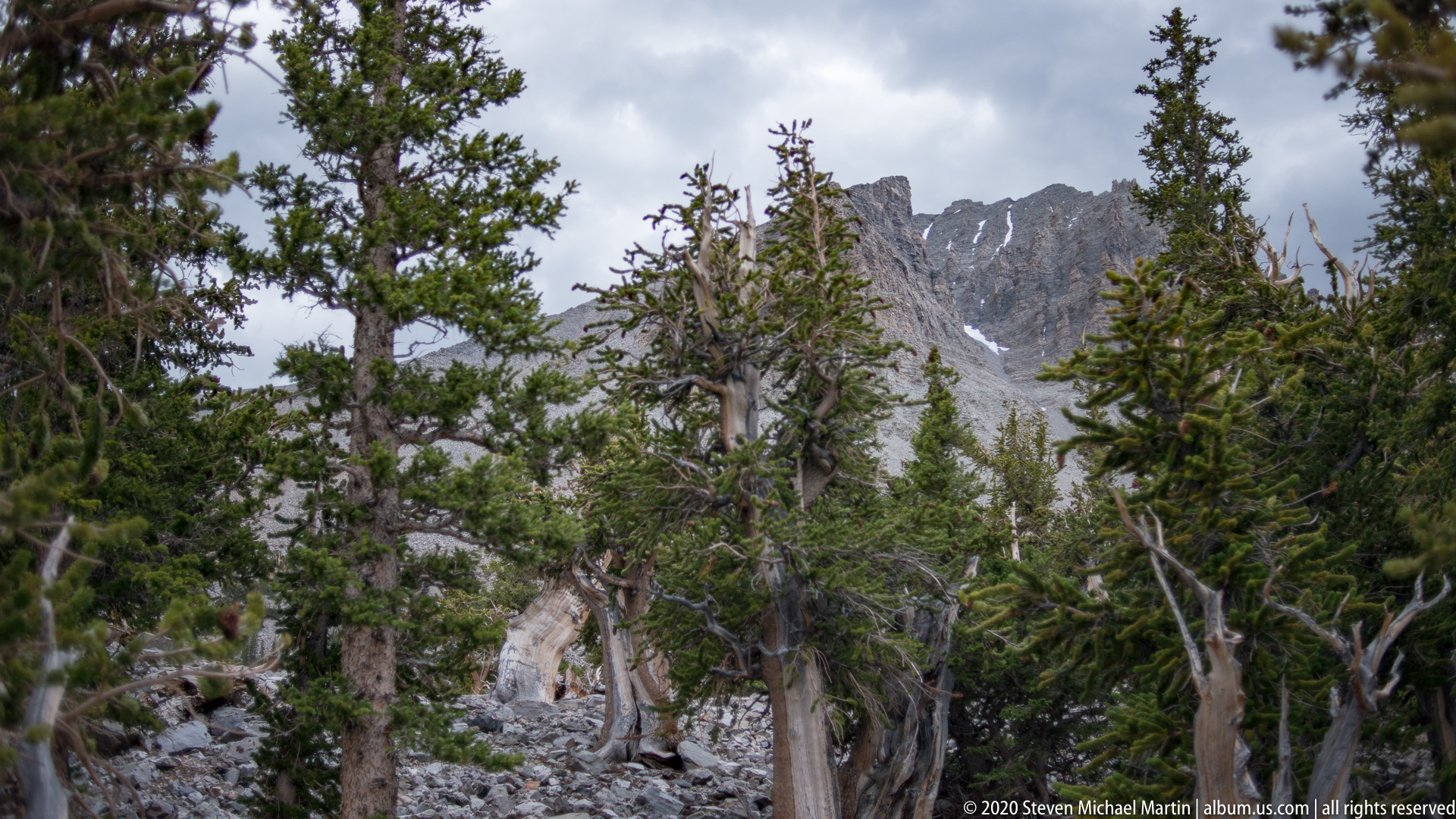
Living and weathered bristlecones occupy a rocky foreground beneath a steep gray mountain ridge streaked with small snow patches. The trees frame the view in layers, from dark needles at the edges to pale trunks deeper in the grove. This landscape connects the grove to its high mountain setting while keeping the trees prominent rather than treating the mountain as the sole subject.
Caption
Living and weathered bristlecones occupy a rocky foreground beneath a steep gray mountain ridge streaked with small snow patches. The trees frame the view in layers, from dark needles at the edges to pale trunks deeper in the grove. This landscape connects the grove to its high mountain setting while keeping the trees prominent rather than treating the mountain as the sole subject.
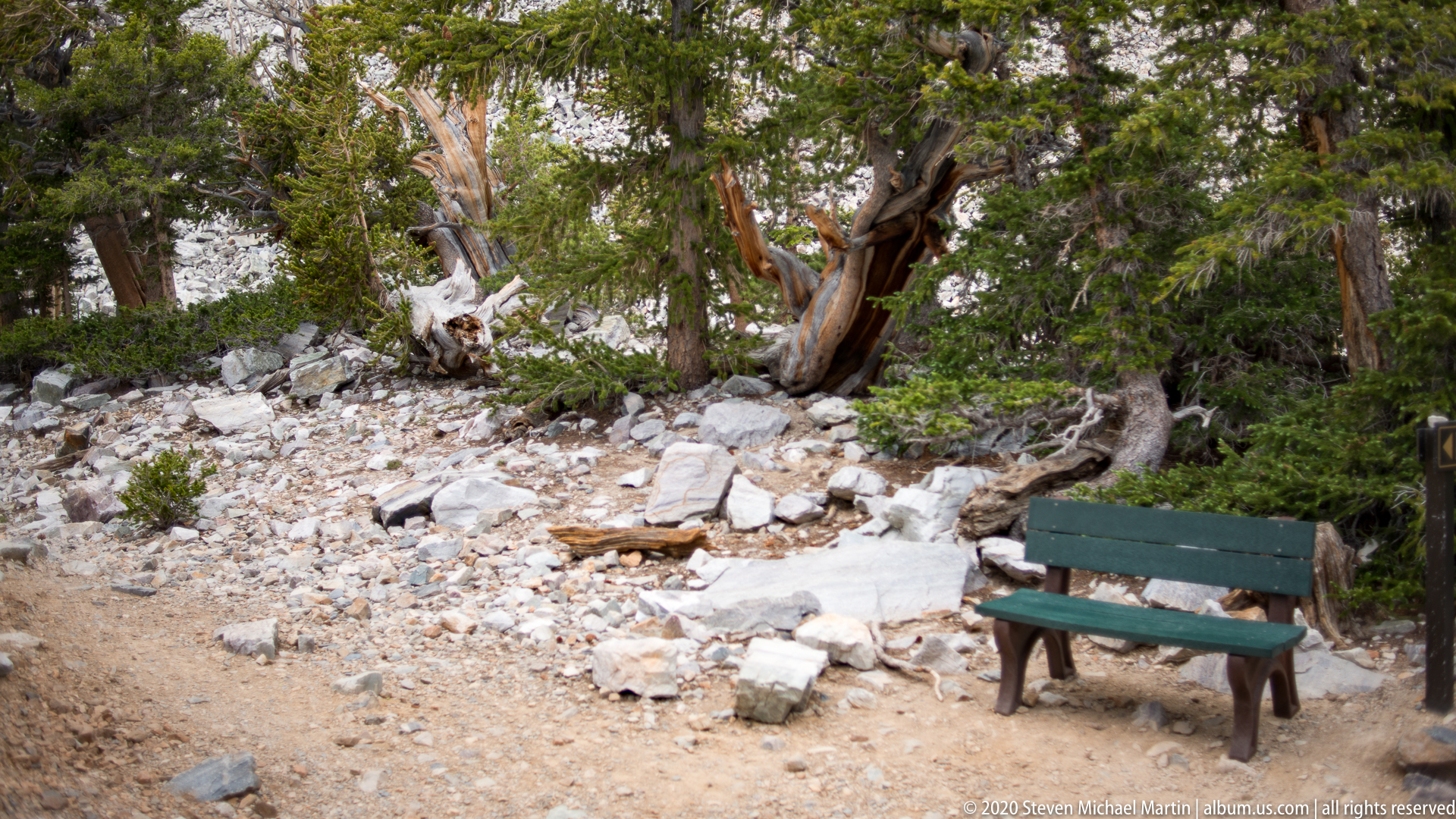
A dark green bench sits beside a pale stone path beneath mature, twisted pines. Fallen trunks and branches lie across the rocky ground, while dense foliage encloses the small clearing. The bench offers a clear human-scale element within the rugged grove, making the resting spot part of the woodland scene rather than an isolated object.
Caption
A dark green bench sits beside a pale stone path beneath mature, twisted pines. Fallen trunks and branches lie across the rocky ground, while dense foliage encloses the small clearing. The bench offers a clear human-scale element within the rugged grove, making the resting spot part of the woodland scene rather than an isolated object.
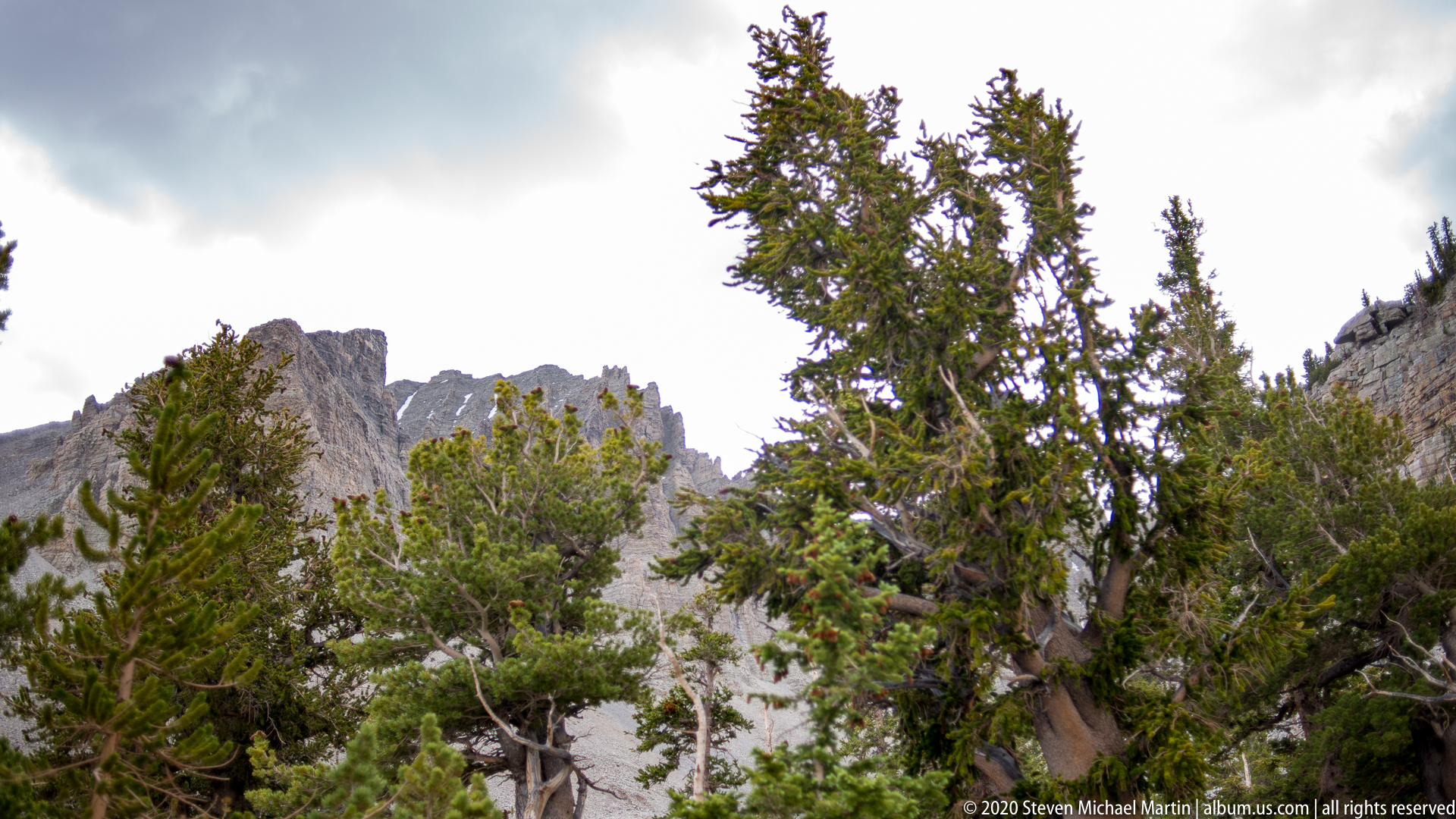
Several living pines rise in the foreground, their irregular trunks and green crowns set against pale, jagged mountain peaks. Cloud cover softens the bright sky above the ridge. The trees occupy most of the lower frame, connecting the grove to its exposed alpine setting without obscuring the rocky backdrop.
Caption
Several living pines rise in the foreground, their irregular trunks and green crowns set against pale, jagged mountain peaks. Cloud cover softens the bright sky above the ridge. The trees occupy most of the lower frame, connecting the grove to its exposed alpine setting without obscuring the rocky backdrop.

A slender pale trunk twists upward from a rocky clearing, with green branches and neighboring pines set against a steep slope of light stones. Fallen limbs cross the foreground. The upright tree forms a narrow vertical accent among the broader foliage and scree, showing how the grove occupies the exposed mountain terrain.
Caption
A slender pale trunk twists upward from a rocky clearing, with green branches and neighboring pines set against a steep slope of light stones. Fallen limbs cross the foreground. The upright tree forms a narrow vertical accent among the broader foliage and scree, showing how the grove occupies the exposed mountain terrain.

From below, pale gray and orange limbs sweep outward from a heavy bristlecone trunk, crossing against a patch of blue sky and white cloud. The bare crown occupies most of the frame, with living needles and neighboring trees at the edges. The low angle emphasizes the branching architecture and the contrast between weathered wood and remaining green foliage.
Caption
From below, pale gray and orange limbs sweep outward from a heavy bristlecone trunk, crossing against a patch of blue sky and white cloud. The bare crown occupies most of the frame, with living needles and neighboring trees at the edges. The low angle emphasizes the branching architecture and the contrast between weathered wood and remaining green foliage.
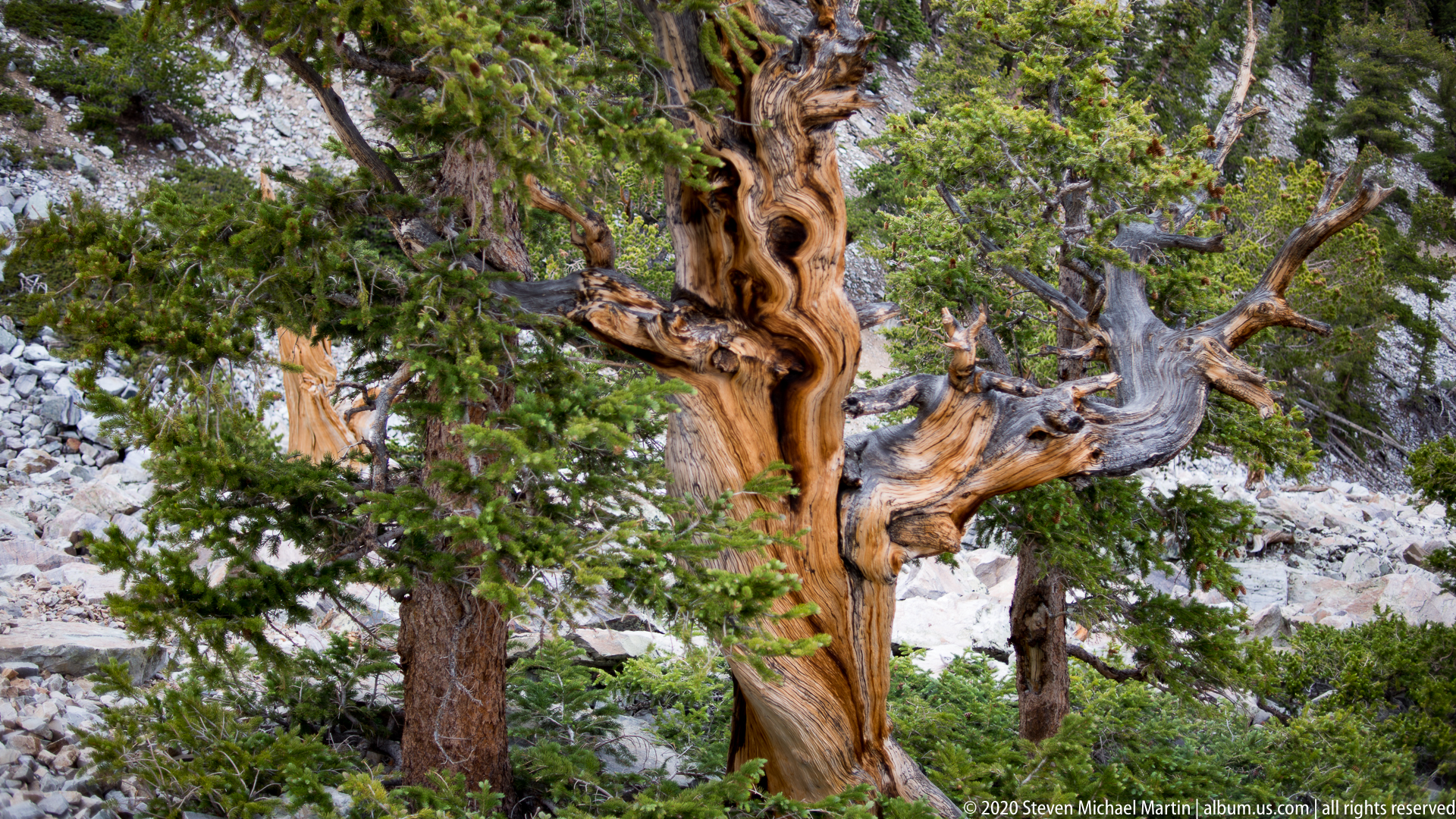
A deeply twisted bristlecone stands amid living pines on a steep bed of pale rock. Its orange trunk bends and divides into irregular arms, while a neighboring gray trunk and green foliage create layers behind it. The medium view keeps the tree’s full lower structure in frame, showing how the old wood shares the slope with younger, denser growth.
Caption
A deeply twisted bristlecone stands amid living pines on a steep bed of pale rock. Its orange trunk bends and divides into irregular arms, while a neighboring gray trunk and green foliage create layers behind it. The medium view keeps the tree’s full lower structure in frame, showing how the old wood shares the slope with younger, denser growth.

Several pale and orange dead trunks stand upright across a slope of angular limestone blocks. Green pines fill the spaces between them, making the weathered stems appear embedded in a living grove rather than alone. The view looks across the rocky ground at mid height, emphasizing the repeated vertical trunks and the rough terrain beneath them.
Caption
Several pale and orange dead trunks stand upright across a slope of angular limestone blocks. Green pines fill the spaces between them, making the weathered stems appear embedded in a living grove rather than alone. The view looks across the rocky ground at mid height, emphasizing the repeated vertical trunks and the rough terrain beneath them.

A weathered bristlecone pine rises among greener trees, its orange-brown trunk stripped in places to pale wood and its upper limbs reduced to angular, broken branches. The close, slightly tilted view brings the sculptural trunk forward while the living grove recedes behind it. Foliage and fallen stone frame this individual without obscuring its age-shaped form.
Caption
A weathered bristlecone pine rises among greener trees, its orange-brown trunk stripped in places to pale wood and its upper limbs reduced to angular, broken branches. The close, slightly tilted view brings the sculptural trunk forward while the living grove recedes behind it. Foliage and fallen stone frame this individual without obscuring its age-shaped form.

The broad crown of a living pine spreads across the frame, its long lateral branches layered with dense green needles. A cloudy sky opens behind the upper canopy, while the dark trunk and lower limbs remain partly hidden by foliage. This wider view shifts from close details to the tree’s overall crown shape and the irregular, windswept spread of its branches.
Caption
The broad crown of a living pine spreads across the frame, its long lateral branches layered with dense green needles. A cloudy sky opens behind the upper canopy, while the dark trunk and lower limbs remain partly hidden by foliage. This wider view shifts from close details to the tree’s overall crown shape and the irregular, windswept spread of its branches.

A framed information board combines an illustrated trailhead overview, photographs, route details and a large map. Its heading identifies the Bristlecone–Alpine Lakes Trailhead, linking the grove to nearby alpine destinations. Photographed straight on, the panel functions as a practical orientation point, with the landscape represented through printed diagrams rather than a direct view of the terrain.
Caption
A framed information board combines an illustrated trailhead overview, photographs, route details and a large map. Its heading identifies the Bristlecone–Alpine Lakes Trailhead, linking the grove to nearby alpine destinations. Photographed straight on, the panel functions as a practical orientation point, with the landscape represented through printed diagrams rather than a direct view of the terrain.
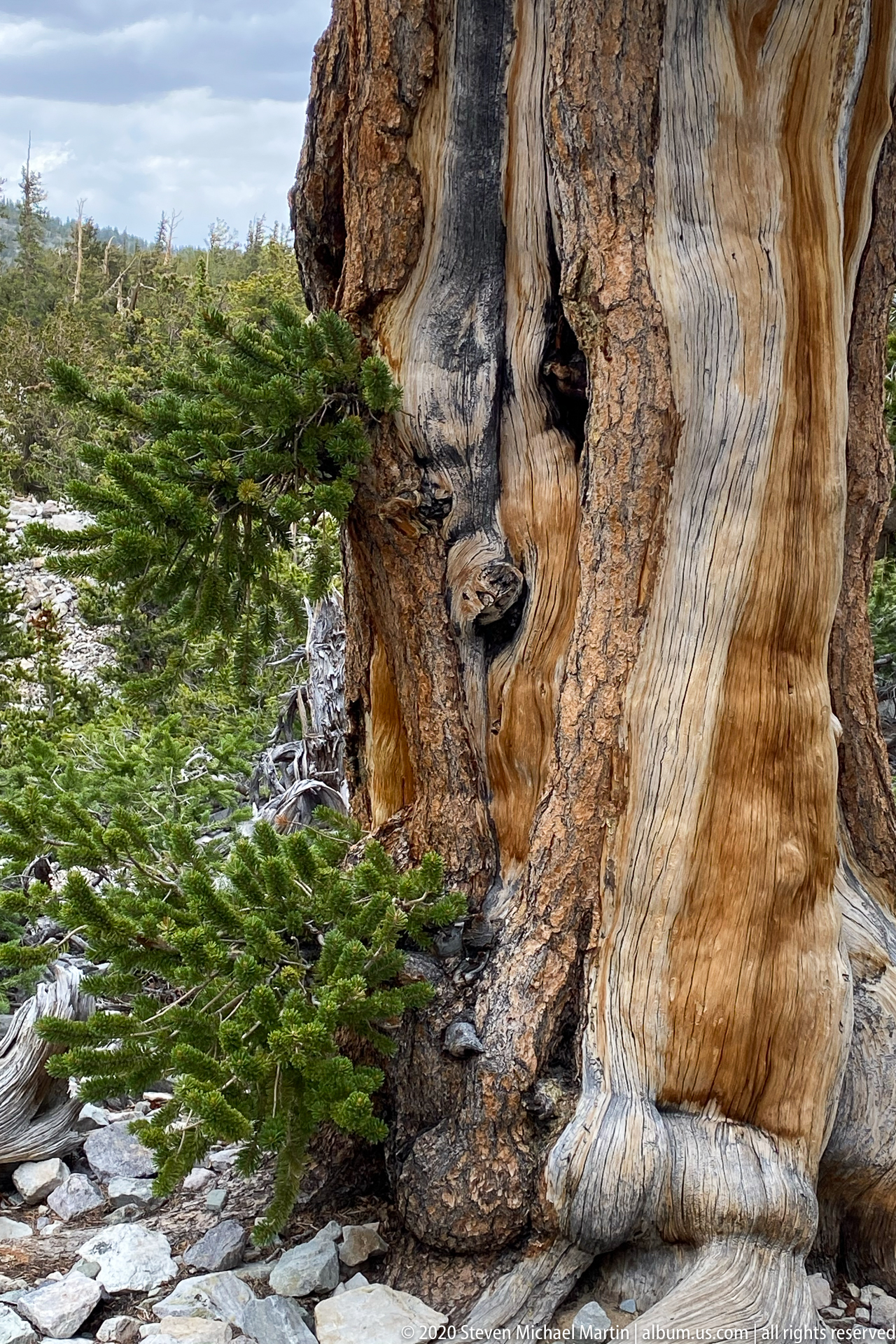
A close view isolates the deeply contoured wood of an old bristlecone pine. Pale tan and gray grain folds around a dark hollow, while rough orange bark and narrow black fissures mark the transition between living and weathered surfaces. A few green branches enter from the left, setting the trunk detail within the grove while keeping attention on its sculptural, eroded texture.
Caption
A close view isolates the deeply contoured wood of an old bristlecone pine. Pale tan and gray grain folds around a dark hollow, while rough orange bark and narrow black fissures mark the transition between living and weathered surfaces. A few green branches enter from the left, setting the trunk detail within the grove while keeping attention on its sculptural, eroded texture.

The old tree’s massive, furrowed trunk fills the center of this wider view, while a living green branch crosses its lower half. Honey-colored wood, gray dead limbs and dark cavities reveal the contrasting textures of the weathered trunk. Other pines and pale stone remain visible around it, giving the close study a stronger sense of the grove’s rocky setting.
Caption
The old tree’s massive, furrowed trunk fills the center of this wider view, while a living green branch crosses its lower half. Honey-colored wood, gray dead limbs and dark cavities reveal the contrasting textures of the weathered trunk. Other pines and pale stone remain visible around it, giving the close study a stronger sense of the grove’s rocky setting.
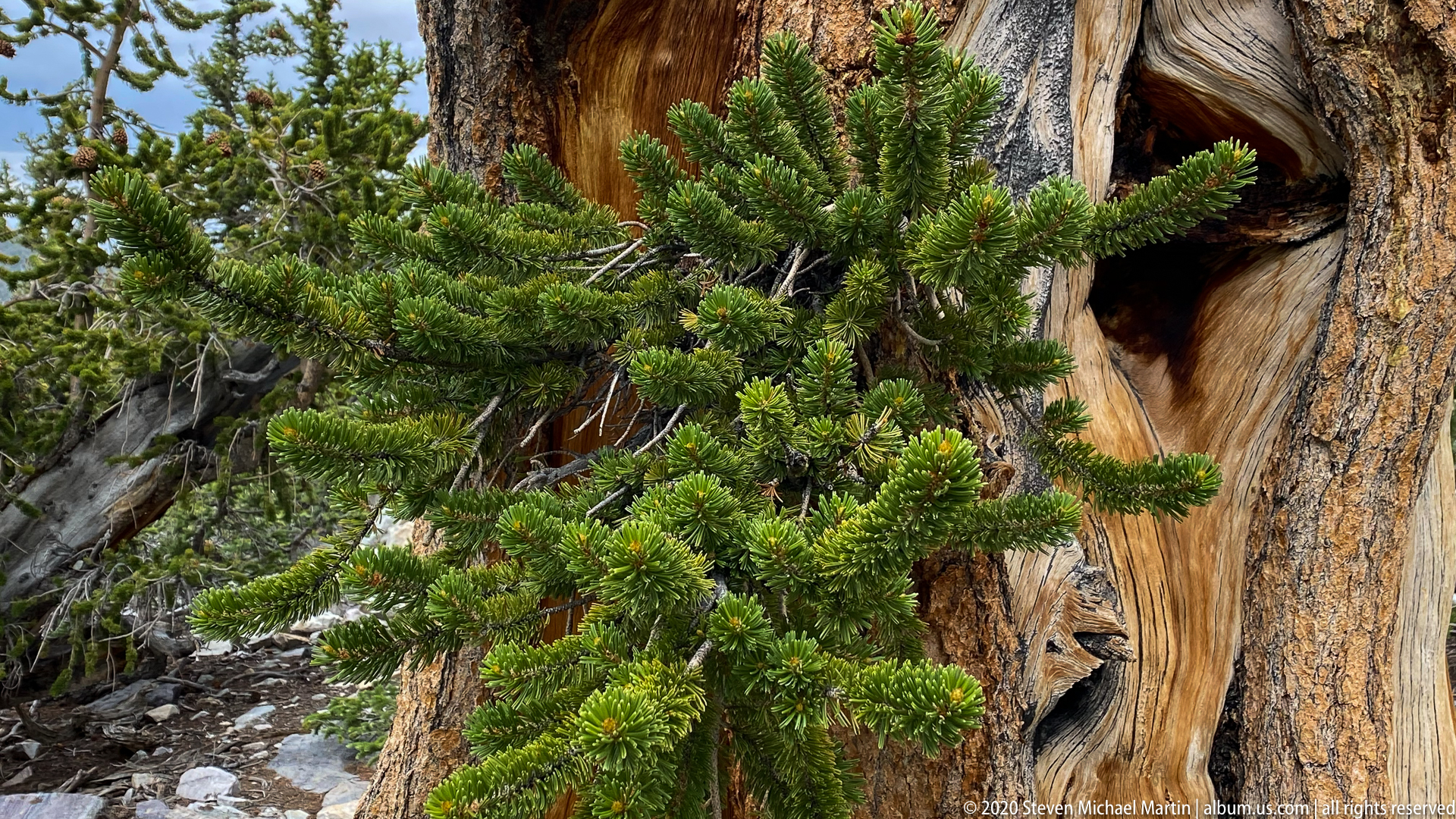
Short, dense needles spread across the foreground beside a pale, twisted trunk, bringing the tree’s living growth into sharp contrast with its dry, sculpted wood. A dark opening in the trunk appears behind the branch, while gray stone and other foliage soften into the background. This intimate composition focuses on the meeting of new growth and long-weathered timber.
Caption
Short, dense needles spread across the foreground beside a pale, twisted trunk, bringing the tree’s living growth into sharp contrast with its dry, sculpted wood. A dark opening in the trunk appears behind the branch, while gray stone and other foliage soften into the background. This intimate composition focuses on the meeting of new growth and long-weathered timber.

An interpretive panel titled “The Bristlecone/Glacier Trail” pairs a drawing of a contorted tree with a description of the route. The text gives the trail length and elevation gain and explains the grove’s ancient pines and nearby glacier setting. Captured frontally, the sign makes both its botanical illustration and visitor guidance legible within one compact view.
Caption
An interpretive panel titled “The Bristlecone/Glacier Trail” pairs a drawing of a contorted tree with a description of the route. The text gives the trail length and elevation gain and explains the grove’s ancient pines and nearby glacier setting. Captured frontally, the sign makes both its botanical illustration and visitor guidance legible within one compact view.

The trailhead display is shown from a little farther back, so its blue interpretive section and broad route map read together as a single orientation panel. Small photographs and text sit above a colored diagram of the surrounding trail network. The frame stands against an open patch of gravel, presenting the grove’s visitor information as a focal point at the start of a walk.
Caption
The trailhead display is shown from a little farther back, so its blue interpretive section and broad route map read together as a single orientation panel. Small photographs and text sit above a colored diagram of the surrounding trail network. The frame stands against an open patch of gravel, presenting the grove’s visitor information as a focal point at the start of a walk.

An orange-brown trunk angles upward into a crown of bare, sharply branching limbs, with a few living pines surrounding it. The gray sky gives the deadwood a stark silhouette, while light catches the exposed trunk and emphasizes its twisted grain. This upward viewpoint isolates the tree’s branching structure rather than its base or the broader grove.
Caption
An orange-brown trunk angles upward into a crown of bare, sharply branching limbs, with a few living pines surrounding it. The gray sky gives the deadwood a stark silhouette, while light catches the exposed trunk and emphasizes its twisted grain. This upward viewpoint isolates the tree’s branching structure rather than its base or the broader grove.
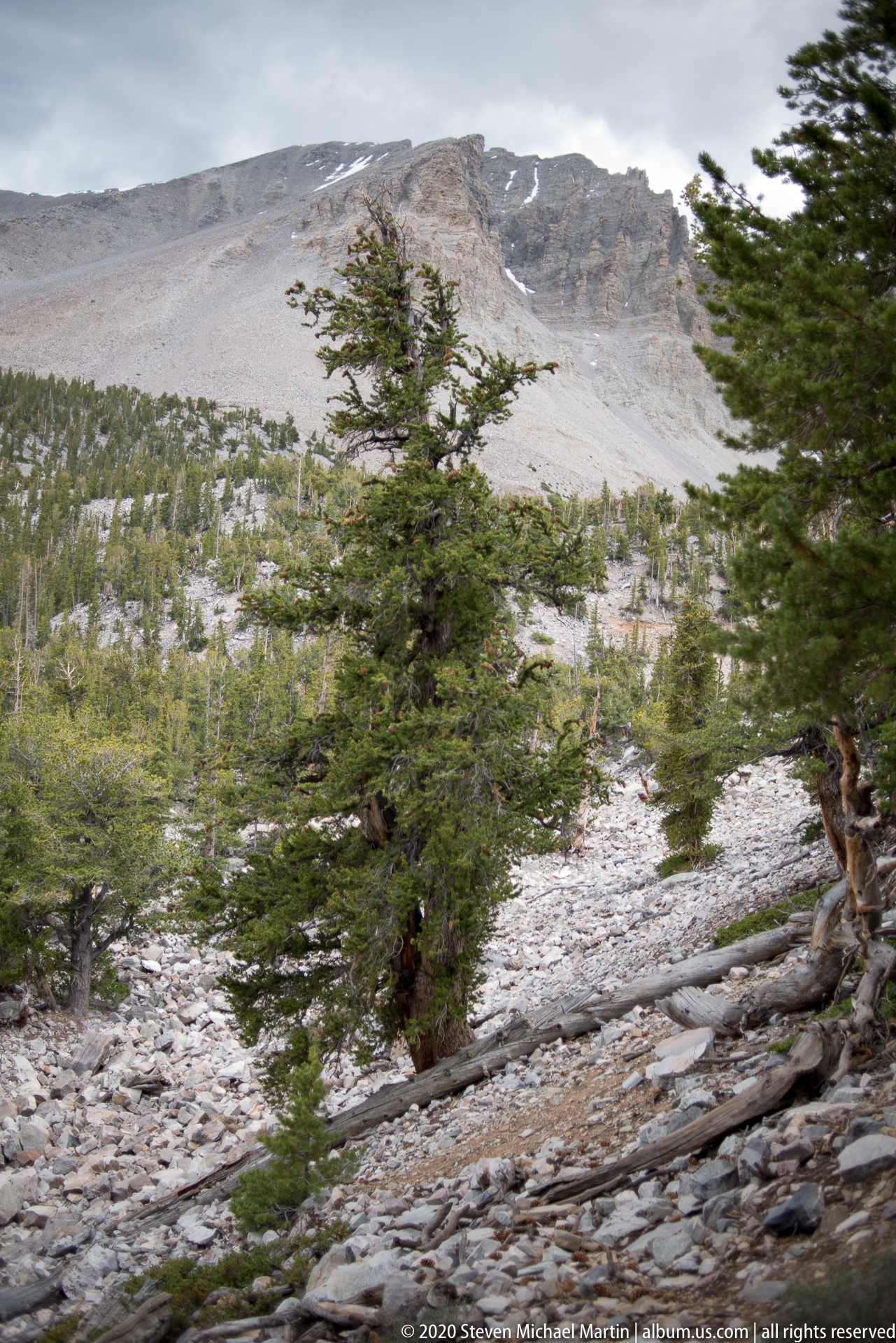
A stony drainage descends from a broad, pale-gray mountain face, its channel filled with angular rock and fallen trunks. Scattered pines cling to the margins and lower slope, emphasizing the sparse, high-elevation terrain. The view follows the wash uphill toward the mountain rather than centering on an individual tree, offering a landscape context for the grove’s rocky setting.
Caption
A stony drainage descends from a broad, pale-gray mountain face, its channel filled with angular rock and fallen trunks. Scattered pines cling to the margins and lower slope, emphasizing the sparse, high-elevation terrain. The view follows the wash uphill toward the mountain rather than centering on an individual tree, offering a landscape context for the grove’s rocky setting.

A white directional marker points left toward Bristlecone Pine Grove and Rock Glacier, and right toward Teresa Lake. The distances are printed beneath each destination name, while a black post and softly blurred pines frame the sign. This close composition turns a trail junction into a clear wayfinding photograph, preserving the route choices and their relative distances.
Caption
A white directional marker points left toward Bristlecone Pine Grove and Rock Glacier, and right toward Teresa Lake. The distances are printed beneath each destination name, while a black post and softly blurred pines frame the sign. This close composition turns a trail junction into a clear wayfinding photograph, preserving the route choices and their relative distances.

A terminal cluster of fresh green needles surrounds a pointed orange-brown bud at the tip of a bristlecone branch. The needles radiate outward in tight groups, while the rocky ground behind dissolves into a neutral blur. This macro-like view highlights the tree’s current growth, replacing the weathered wood and branching forms seen in the broader grove photographs.
Caption
A terminal cluster of fresh green needles surrounds a pointed orange-brown bud at the tip of a bristlecone branch. The needles radiate outward in tight groups, while the rocky ground behind dissolves into a neutral blur. This macro-like view highlights the tree’s current growth, replacing the weathered wood and branching forms seen in the broader grove photographs.

A compact green pine stands alone against a field of pale angular scree. Its tiered branches carry dense needles and small orange-tan tips, while the shallow depth of field softens the stones behind it. The centered, near eye-level view shifts from the grove’s monumental old trunks to a smaller living tree and its delicate growth at the ends of the branches.
Caption
A compact green pine stands alone against a field of pale angular scree. Its tiered branches carry dense needles and small orange-tan tips, while the shallow depth of field softens the stones behind it. The centered, near eye-level view shifts from the grove’s monumental old trunks to a smaller living tree and its delicate growth at the ends of the branches.

A small conifer branch rises from the lower edge, its clustered green needles and warm-colored tips sharply separated from a pale, out-of-focus rocky hillside. The tight focus removes most environmental detail and makes the tree’s compact branching pattern the subject. Unlike the previous wider plant portrait, this frame uses a softer background and more open space around the crown.
Caption
A small conifer branch rises from the lower edge, its clustered green needles and warm-colored tips sharply separated from a pale, out-of-focus rocky hillside. The tight focus removes most environmental detail and makes the tree’s compact branching pattern the subject. Unlike the previous wider plant portrait, this frame uses a softer background and more open space around the crown.

A gnarled old bristlecone occupies the center of a broad, pale scree slope, surrounded by scattered green pines. Its low, twisting limbs spread laterally across the hillside, and a narrow band of trees rises behind it. The wider composition places the ancient trunk within the grove’s open, stony habitat rather than treating it as an isolated specimen.
Caption
A gnarled old bristlecone occupies the center of a broad, pale scree slope, surrounded by scattered green pines. Its low, twisting limbs spread laterally across the hillside, and a narrow band of trees rises behind it. The wider composition places the ancient trunk within the grove’s open, stony habitat rather than treating it as an isolated specimen.

A pale, twisted trunk rises from loose stone and divides into a broad network of dead and living limbs. The full tree is visible against a lightly clouded sky, while green pines and the slope’s scattered shrubs give it scale. This wider portrait shows the tree’s branching silhouette and rooted position, with the bleached central wood distinct from the surrounding foliage.
Caption
A pale, twisted trunk rises from loose stone and divides into a broad network of dead and living limbs. The full tree is visible against a lightly clouded sky, while green pines and the slope’s scattered shrubs give it scale. This wider portrait shows the tree’s branching silhouette and rooted position, with the bleached central wood distinct from the surrounding foliage.

Two tall, stripped trunks frame a view of contorted limbs reaching into a bright, cloud-filled sky. Their exposed wood is dark at the edges and warm tan where the light passes through, while a low line of green pines anchors the composition. The upward framing makes the branching silhouettes and open sky the central relationship.
Caption
Two tall, stripped trunks frame a view of contorted limbs reaching into a bright, cloud-filled sky. Their exposed wood is dark at the edges and warm tan where the light passes through, while a low line of green pines anchors the composition. The upward framing makes the branching silhouettes and open sky the central relationship.

A shallow-focus close-up follows a slender green branch with dense, short needles and small amber buds at their base. The branch arcs diagonally across the right side, while pale rock and dark green foliage dissolve into soft shapes behind it. This detail isolates the bristlecone’s compact leaf clusters and the warm color of its developing buds.
Caption
A shallow-focus close-up follows a slender green branch with dense, short needles and small amber buds at their base. The branch arcs diagonally across the right side, while pale rock and dark green foliage dissolve into soft shapes behind it. This detail isolates the bristlecone’s compact leaf clusters and the warm color of its developing buds.

Several upright shoots carry pale green new needles around compact reddish-brown buds. The closest shoot is centered, with a blurred blue shape and gray stone behind it; a person is faintly visible in the distance but remains indistinct. The image records emerging growth at branch tips, its soft background keeping attention on the buds and fine needle arrangement.
Caption
Several upright shoots carry pale green new needles around compact reddish-brown buds. The closest shoot is centered, with a blurred blue shape and gray stone behind it; a person is faintly visible in the distance but remains indistinct. The image records emerging growth at branch tips, its soft background keeping attention on the buds and fine needle arrangement.

A cluster of short green needles surrounds several russet buds near the center of the frame. Additional shoots blur into a dark, mottled background, creating a layered view of the branch rather than a single isolated tip. The composition brings the tree’s compact growth habit and the contrast between fresh green needles and darker buds into focus.
Caption
A cluster of short green needles surrounds several russet buds near the center of the frame. Additional shoots blur into a dark, mottled background, creating a layered view of the branch rather than a single isolated tip. The composition brings the tree’s compact growth habit and the contrast between fresh green needles and darker buds into focus.

Two sharply focused branch tips emerge against a dark, soft background. Each carries dense green needles and a small brown bud cluster, while the surrounding branches fade into blur. The off-center arrangement creates depth and distinguishes this view from the preceding, more tightly grouped sprigs by showing two separate growth points at different distances.
Caption
Two sharply focused branch tips emerge against a dark, soft background. Each carries dense green needles and a small brown bud cluster, while the surrounding branches fade into blur. The off-center arrangement creates depth and distinguishes this view from the preceding, more tightly grouped sprigs by showing two separate growth points at different distances.
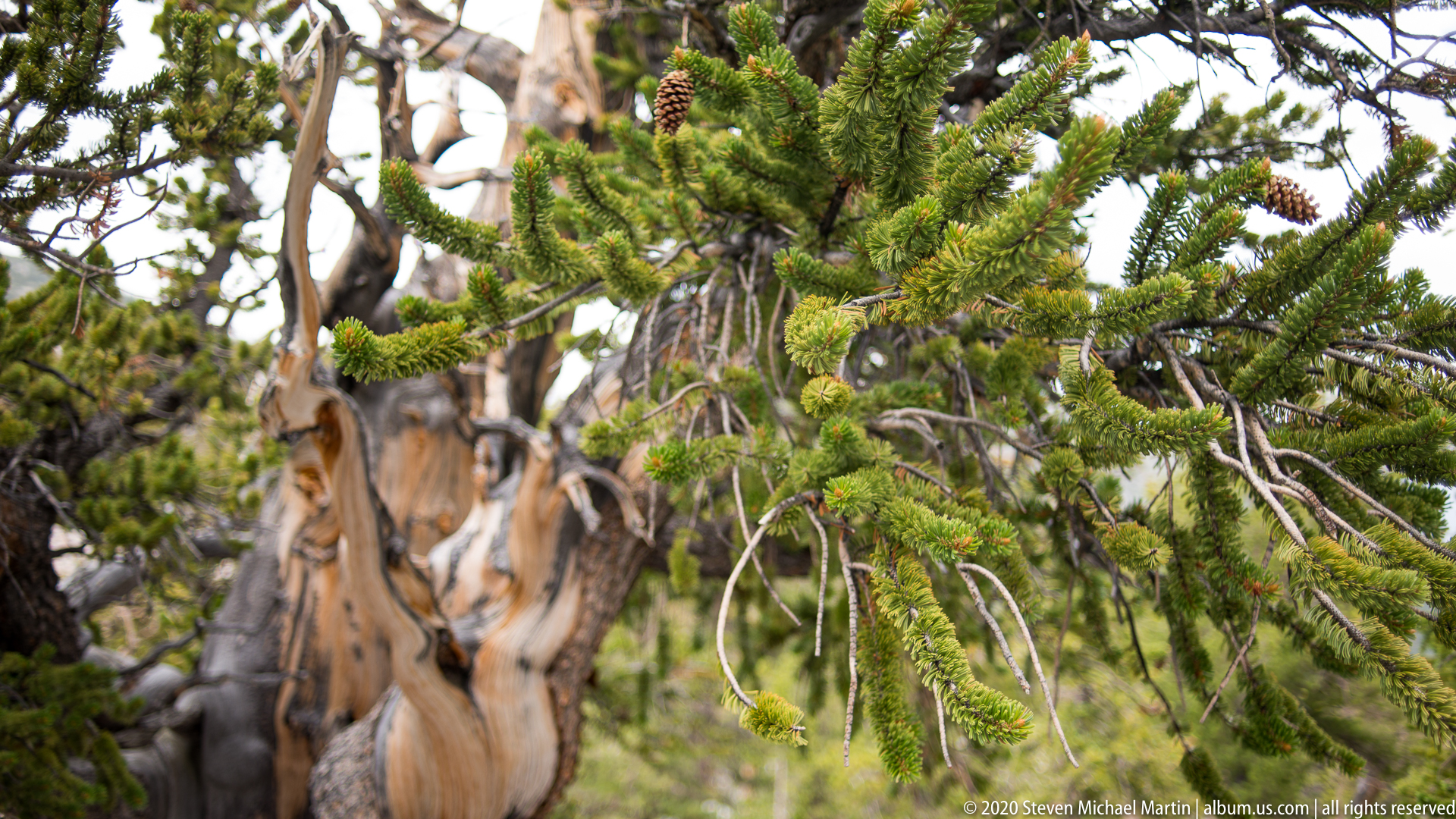
A dense living branch stretches across the foreground, partly veiling the pale, contorted trunk behind it. Needle clusters and a small cone-like form are visible among the greenery, while bare limbs and other trunks create a layered background. The composition links living growth to the old tree’s weathered wood, using the branch as a screen rather than a separate close-up subject.
Caption
A dense living branch stretches across the foreground, partly veiling the pale, contorted trunk behind it. Needle clusters and a small cone-like form are visible among the greenery, while bare limbs and other trunks create a layered background. The composition links living growth to the old tree’s weathered wood, using the branch as a screen rather than a separate close-up subject.
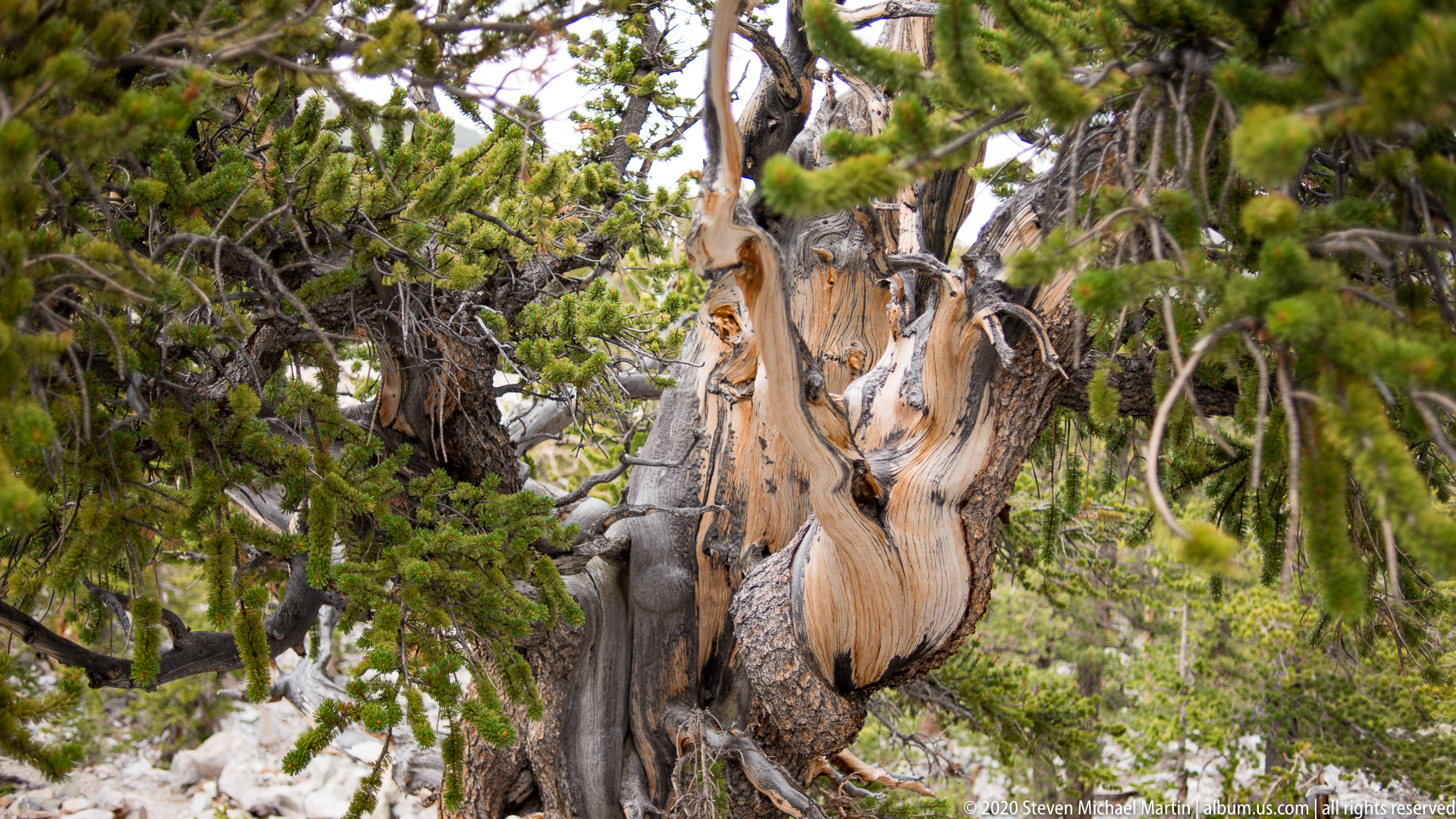
Pale, twisted wood rises through dense green branches, with deep grooves and dark cavities visible along the trunk. The surrounding needles partly conceal its full form, creating a close view that alternates between living foliage and exposed, weathered surfaces. Unlike the isolated trunk details earlier, this composition places the tree’s sculptural wood inside a dense web of branches.
Caption
Pale, twisted wood rises through dense green branches, with deep grooves and dark cavities visible along the trunk. The surrounding needles partly conceal its full form, creating a close view that alternates between living foliage and exposed, weathered surfaces. Unlike the isolated trunk details earlier, this composition places the tree’s sculptural wood inside a dense web of branches.

A weathered bristlecone trunk stands near the center of a pale, open slope, partly concealed by a band of green low-growing pines. Its upper branches twist above the foliage, while darker deadwood lies near the base. The view uses the foreground vegetation to show how old trees and dense ground-level growth occupy the same exposed hillside.
Caption
A weathered bristlecone trunk stands near the center of a pale, open slope, partly concealed by a band of green low-growing pines. Its upper branches twist above the foliage, while darker deadwood lies near the base. The view uses the foreground vegetation to show how old trees and dense ground-level growth occupy the same exposed hillside.

A stripped trunk with upward-reaching branches rises from behind dense green pines on a pale scree slope. Its orange-brown wood remains visible through gaps in the foliage, while the surrounding living branches form a broad horizontal band across the image. This partial view emphasizes the contrast between the old tree’s bare crown and the greenery that obscures its base.
Caption
A stripped trunk with upward-reaching branches rises from behind dense green pines on a pale scree slope. Its orange-brown wood remains visible through gaps in the foliage, while the surrounding living branches form a broad horizontal band across the image. This partial view emphasizes the contrast between the old tree’s bare crown and the greenery that obscures its base.

A massive pine leans across the frame, its twisted trunk supporting a broad green canopy beneath a crown of pale, bare limbs. The dead branches fork into the clouded sky, while younger foliage fills the lower background. The upward angle shows both the tree’s living spread and the sculptural shape of its weathered upper wood.
Caption
A massive pine leans across the frame, its twisted trunk supporting a broad green canopy beneath a crown of pale, bare limbs. The dead branches fork into the clouded sky, while younger foliage fills the lower background. The upward angle shows both the tree’s living spread and the sculptural shape of its weathered upper wood.

A small bristlecone shoot stands in sharp focus against the blurred orange and gray surface of an old trunk. The short green needles radiate from the tip around a warm reddish bud, while a softer branch crosses the lower edge. The close crop connects fresh growth to the weathered trunk immediately behind it, making texture and depth the photograph’s main features.
Caption
A small bristlecone shoot stands in sharp focus against the blurred orange and gray surface of an old trunk. The short green needles radiate from the tip around a warm reddish bud, while a softer branch crosses the lower edge. The close crop connects fresh growth to the weathered trunk immediately behind it, making texture and depth the photograph’s main features.

A short pine twig rises in close focus, its dense green needles gathered around small orange-brown buds. The woodland behind dissolves into soft green and warm brown shapes, separating the sharply defined branch from the surrounding forest. This detail shifts attention from the grove’s old trunks to the fresh growth at their tips.
Caption
A short pine twig rises in close focus, its dense green needles gathered around small orange-brown buds. The woodland behind dissolves into soft green and warm brown shapes, separating the sharply defined branch from the surrounding forest. This detail shifts attention from the grove’s old trunks to the fresh growth at their tips.
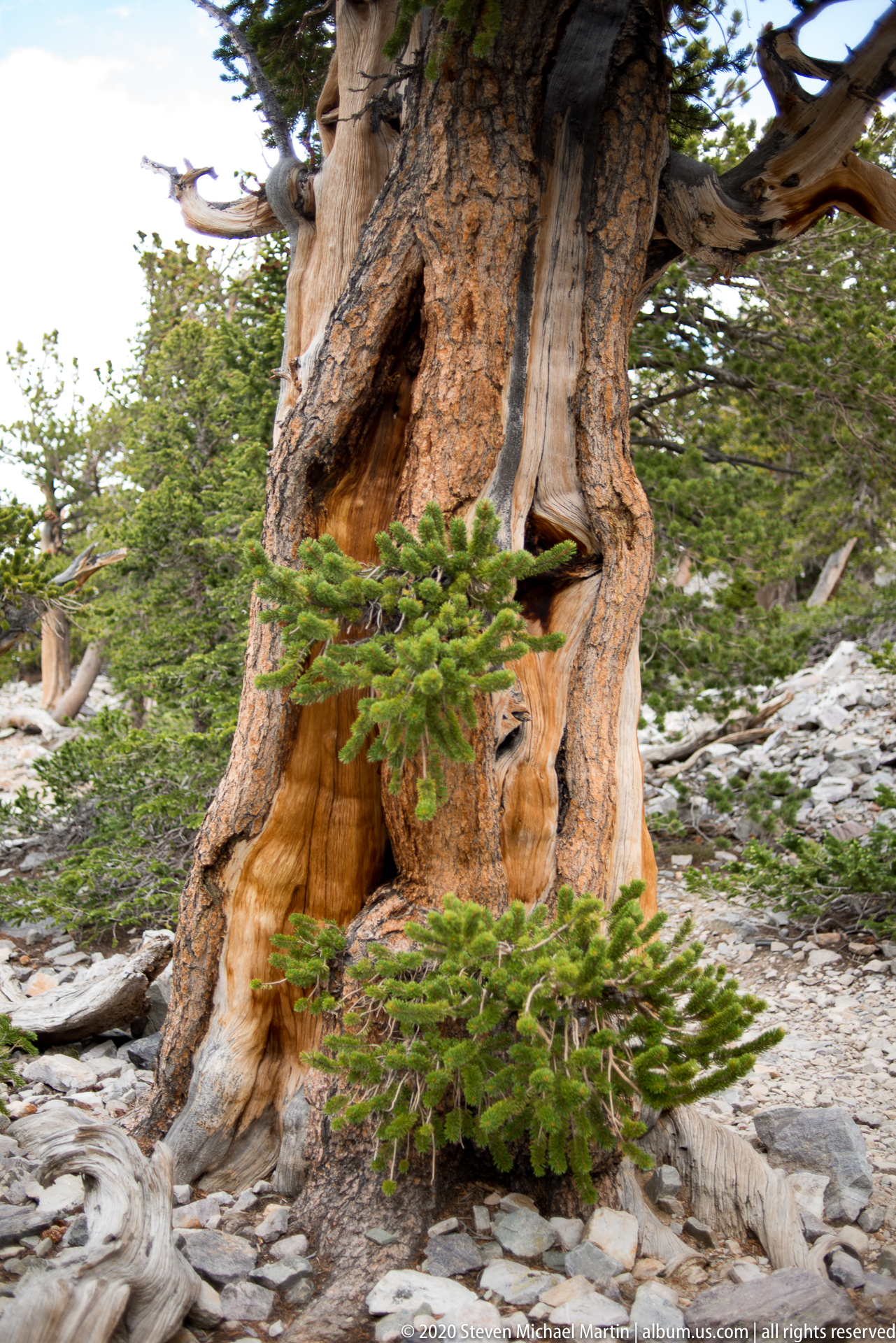
A deeply furrowed trunk fills the foreground, its orange-brown bark split by a dark hollow and crossed by green branches. Pale fallen limbs and loose stones cover the grove floor behind it. The close view brings the tree’s cavities and rough surface forward while keeping the surrounding rocky habitat visible.
Caption
A deeply furrowed trunk fills the foreground, its orange-brown bark split by a dark hollow and crossed by green branches. Pale fallen limbs and loose stones cover the grove floor behind it. The close view brings the tree’s cavities and rough surface forward while keeping the surrounding rocky habitat visible.
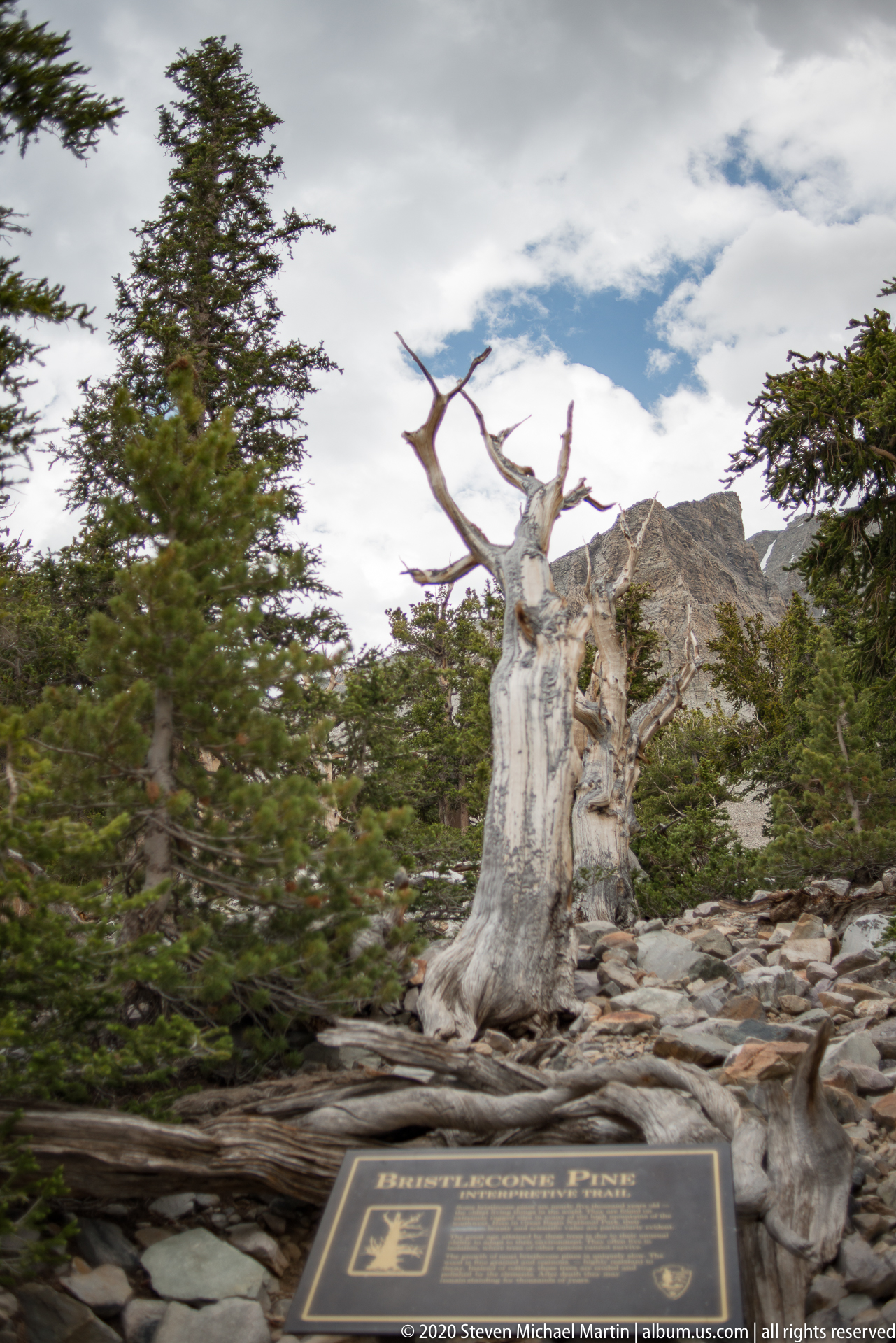
A bleached, branchless trunk rises among living pines and pale rocks, with a low interpretive plaque at its base. The stark deadwood contrasts with the green canopy around it, while the plaque connects the tree to the trail’s educational displays. The frame layers the foreground sign, old trunk, and surrounding grove.
Caption
A bleached, branchless trunk rises among living pines and pale rocks, with a low interpretive plaque at its base. The stark deadwood contrasts with the green canopy around it, while the plaque connects the tree to the trail’s educational displays. The frame layers the foreground sign, old trunk, and surrounding grove.

A low, spreading pine grows close to the rocky ground, its broad green canopy extending across the middle of the frame. Pale stones and a fallen limb fill the foreground, while a subdued ridge and overcast sky sit behind the grove. The low viewpoint emphasizes the tree’s horizontal growth and the rough terrain around its base.
Caption
A low, spreading pine grows close to the rocky ground, its broad green canopy extending across the middle of the frame. Pale stones and a fallen limb fill the foreground, while a subdued ridge and overcast sky sit behind the grove. The low viewpoint emphasizes the tree’s horizontal growth and the rough terrain around its base.
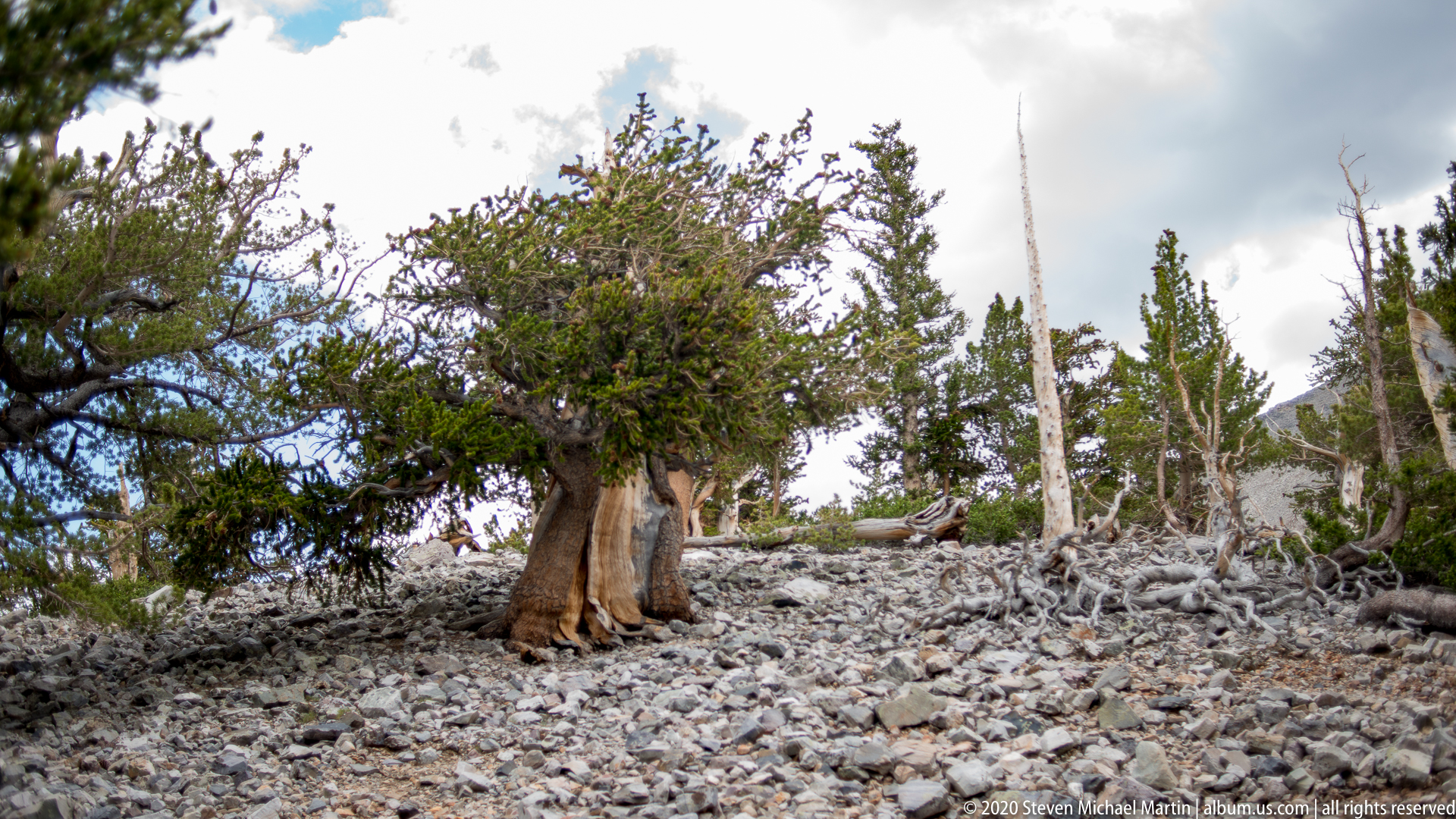
A gnarled pine stands in a broad field of pale stones and fallen limbs, its green crown spreading left as bare snags rise at right. The low viewpoint places the contorted trunk against a cloudy sky and reveals the open, rugged floor around it. Live trees and deadwood share the same rocky grove.
Caption
A gnarled pine stands in a broad field of pale stones and fallen limbs, its green crown spreading left as bare snags rise at right. The low viewpoint places the contorted trunk against a cloudy sky and reveals the open, rugged floor around it. Live trees and deadwood share the same rocky grove.
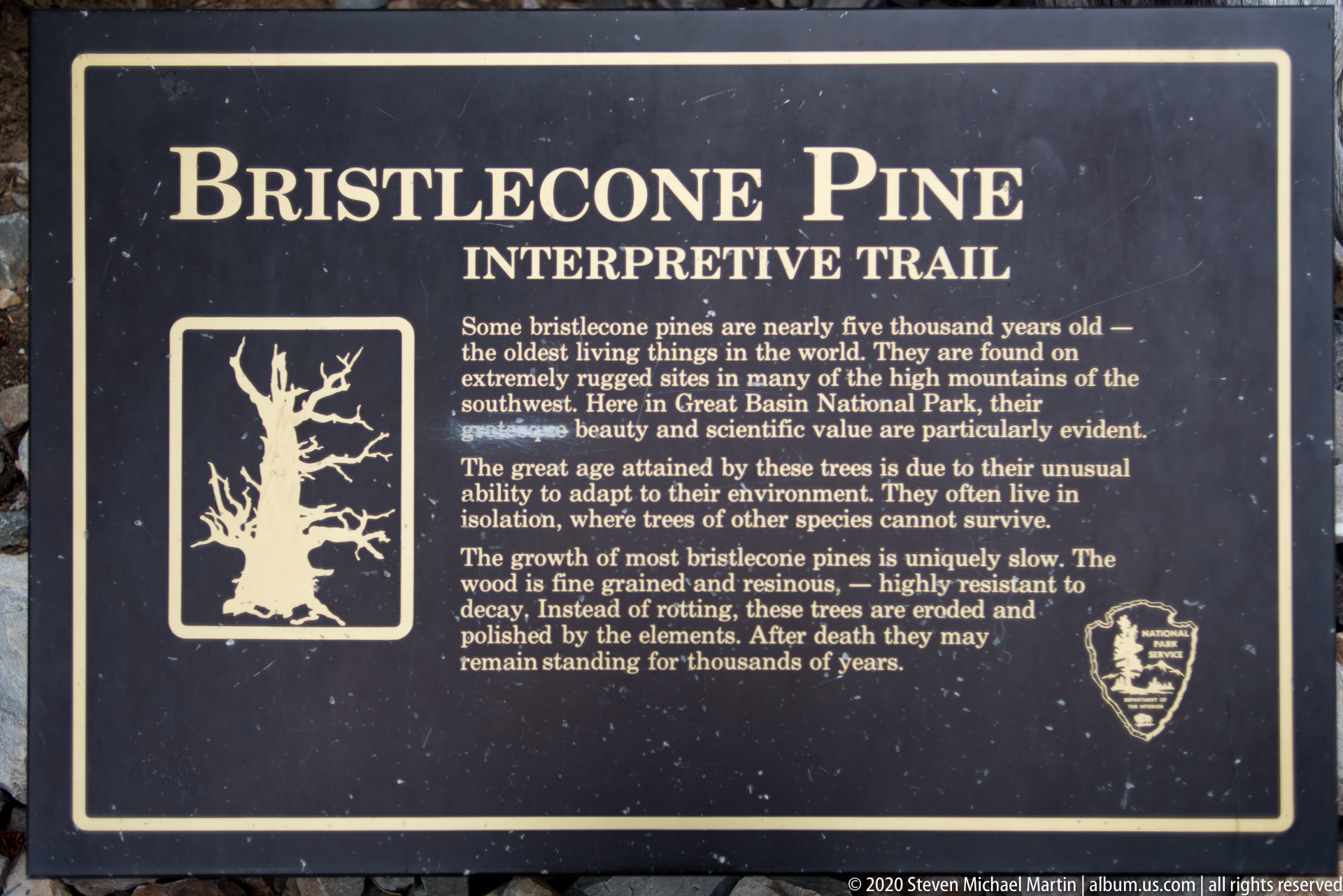
The dark panel titled “Bristlecone Pine Interpretive Trail” explains the trees’ longevity, slow growth, and adaptations to exposed mountain sites. A simple tree illustration and National Park Service emblem accompany the text. The close, frontal view makes the sign itself the subject, turning the surrounding grove’s natural history into readable visitor information.
Caption
The dark panel titled “Bristlecone Pine Interpretive Trail” explains the trees’ longevity, slow growth, and adaptations to exposed mountain sites. A simple tree illustration and National Park Service emblem accompany the text. The close, frontal view makes the sign itself the subject, turning the surrounding grove’s natural history into readable visitor information.

A dark plaque titled “Adversity” describes a bristlecone pine growing in a harsh site and gives dates associated with the tree’s life. A simple tree silhouette accompanies the explanatory text, and angular stones surround the panel. The close view focuses on how the interpretive sign translates an individual tree’s form and age into a story of survival.
Caption
A dark plaque titled “Adversity” describes a bristlecone pine growing in a harsh site and gives dates associated with the tree’s life. A simple tree silhouette accompanies the explanatory text, and angular stones surround the panel. The close view focuses on how the interpretive sign translates an individual tree’s form and age into a story of survival.

A bleached trunk with flowing grain lies diagonally across a rocky forest floor. Beneath it, a small interpretive plaque stands among loose stones, linking the fallen wood to the grove’s educational trail. The trunk’s smooth, pale surface contrasts with the angular ground, while the sign remains secondary in scale and position.
Caption
A bleached trunk with flowing grain lies diagonally across a rocky forest floor. Beneath it, a small interpretive plaque stands among loose stones, linking the fallen wood to the grove’s educational trail. The trunk’s smooth, pale surface contrasts with the angular ground, while the sign remains secondary in scale and position.

An interpretive panel titled “Increment Borer” stands among pine trunks and rocky ground. Its white diagram shows a sampling tool and a sequence of growth rings, explaining how tree cores can be collected to study age and growth. The sign’s clear heading and graphic make this a focused view of the methods used to read a tree’s history.
Caption
An interpretive panel titled “Increment Borer” stands among pine trunks and rocky ground. Its white diagram shows a sampling tool and a sequence of growth rings, explaining how tree cores can be collected to study age and growth. The sign’s clear heading and graphic make this a focused view of the methods used to read a tree’s history.

Broad, weathered pine limbs divide across the frame above a small interpretive plaque. Pale and ochre bark contrasts with the gray stones and fallen wood at the base. A tree icon is visible on the sign, but its smaller text is not legible here; the composition ties the trail’s interpretive material to the old tree beside it.
Caption
Broad, weathered pine limbs divide across the frame above a small interpretive plaque. Pale and ochre bark contrasts with the gray stones and fallen wood at the base. A tree icon is visible on the sign, but its smaller text is not legible here; the composition ties the trail’s interpretive material to the old tree beside it.

Several thick, bleached limbs twist and cross at close range, their smooth gray and golden surfaces marked by dark fissures and weathered grain. Rocks and green foliage show through gaps behind the wood. The close composition turns the interwoven branching structure into an abstract pattern while retaining enough background to place it in the pine grove.
Caption
Several thick, bleached limbs twist and cross at close range, their smooth gray and golden surfaces marked by dark fissures and weathered grain. Rocks and green foliage show through gaps behind the wood. The close composition turns the interwoven branching structure into an abstract pattern while retaining enough background to place it in the pine grove.
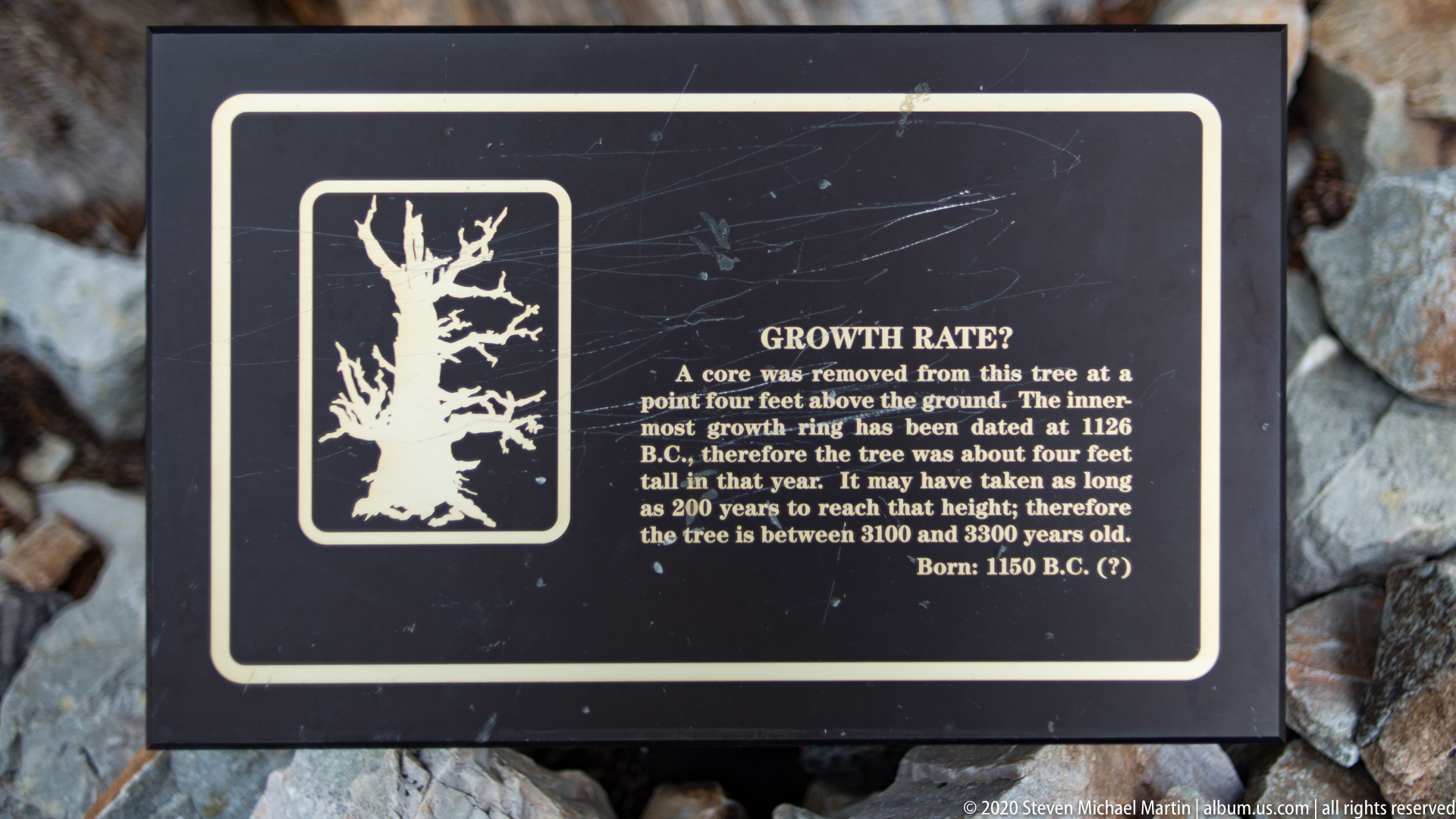
A dark panel titled “Growth Rate?” describes how a core sample and annual rings can be used to estimate a bristlecone pine’s age and growth. A tree silhouette sits beside the text. The close framing gives the interpretive display priority and presents the scientific method as part of the trail’s explanation of these trees.
Caption
A dark panel titled “Growth Rate?” describes how a core sample and annual rings can be used to estimate a bristlecone pine’s age and growth. A tree silhouette sits beside the text. The close framing gives the interpretive display priority and presents the scientific method as part of the trail’s explanation of these trees.
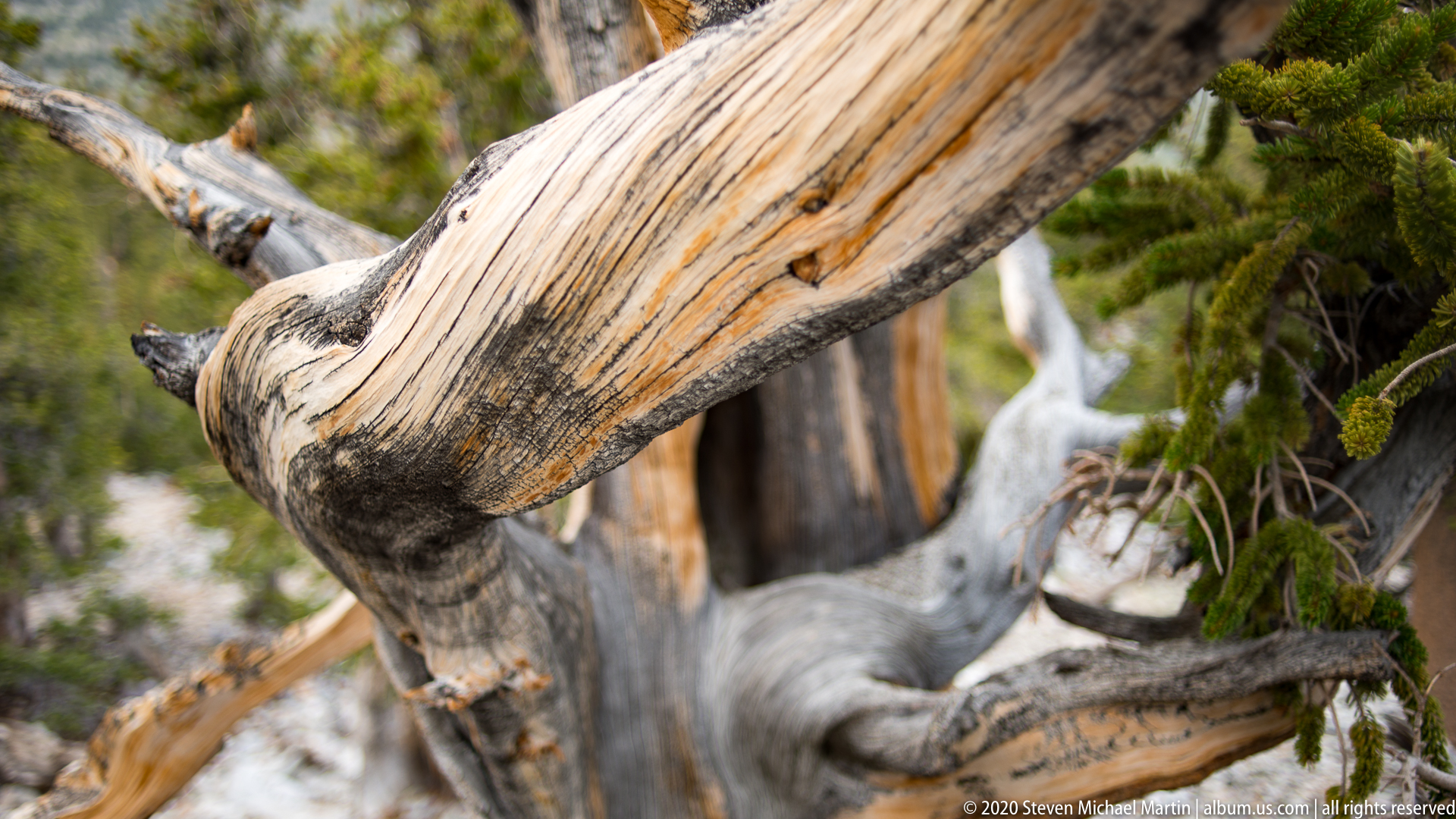
A pale, curved pine limb sweeps diagonally across the foreground, its smooth wood marked by dark streaks and a blackened hollow. A second bleached trunk and green foliage blur behind it. The shallow focus isolates the limb’s bend and weathered surface, turning a small part of the grove into a study of age and exposure.
Caption
A pale, curved pine limb sweeps diagonally across the foreground, its smooth wood marked by dark streaks and a blackened hollow. A second bleached trunk and green foliage blur behind it. The shallow focus isolates the limb’s bend and weathered surface, turning a small part of the grove into a study of age and exposure.

A plaque titled “Hollow Tree” stands low against a massive weathered trunk. The panel explains how growth and decay can leave a hollow form, while broad gray and brown bark fills the surrounding frame. The sign and tree are closely linked, pairing an interpretive explanation with the wood structure it describes.
Caption
A plaque titled “Hollow Tree” stands low against a massive weathered trunk. The panel explains how growth and decay can leave a hollow form, while broad gray and brown bark fills the surrounding frame. The sign and tree are closely linked, pairing an interpretive explanation with the wood structure it describes.

The large heading “Bristlecone?” introduces an interpretive panel with drawings labeled for male and female cones. Explanatory text accompanies the botanical illustrations, which are set against a weathered trunk. The close view shifts from the grove’s twisted mature trees to the smaller features used to recognize and understand the species.
Caption
The large heading “Bristlecone?” introduces an interpretive panel with drawings labeled for male and female cones. Explanatory text accompanies the botanical illustrations, which are set against a weathered trunk. The close view shifts from the grove’s twisted mature trees to the smaller features used to recognize and understand the species.

A living pine trunk arches across the upper frame above a rocky grove. At lower left, a dark interpretive sign stands among pale stones, while dense evergreen branches and fallen wood fill the background. The overhead trunk creates a natural frame around the sign and trail setting, connecting the display to the trees it interprets.
Caption
A living pine trunk arches across the upper frame above a rocky grove. At lower left, a dark interpretive sign stands among pale stones, while dense evergreen branches and fallen wood fill the background. The overhead trunk creates a natural frame around the sign and trail setting, connecting the display to the trees it interprets.

A pale, contorted trunk lies horizontally across loose gray stones, its twisted grain and broken branches forming a dense pattern of curves and knots. Green shrubs and upright trees remain visible behind it. The low viewpoint keeps the fallen wood close and tactile while retaining the living grove in the background.
Caption
A pale, contorted trunk lies horizontally across loose gray stones, its twisted grain and broken branches forming a dense pattern of curves and knots. Green shrubs and upright trees remain visible behind it. The low viewpoint keeps the fallen wood close and tactile while retaining the living grove in the background.
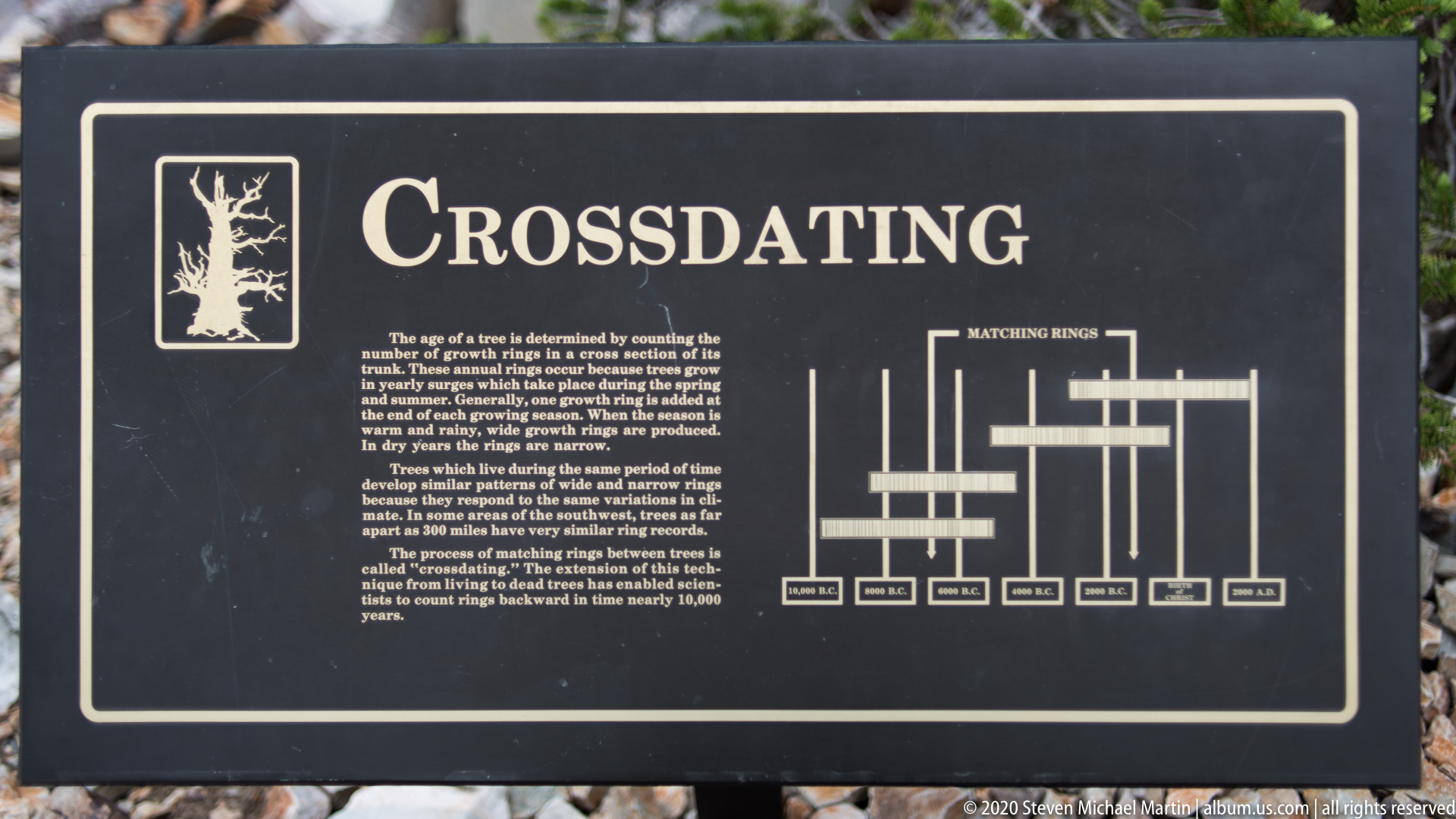
A panel titled “Crossdating” presents a diagram of overlapping tree-ring sequences. The graphic illustrates how matching patterns can be compared across different trees to build a chronology. Pale text and aligned bars stand out against the dark sign, while stones visible around its edge place this scientific explanation within the bristlecone trail.
Caption
A panel titled “Crossdating” presents a diagram of overlapping tree-ring sequences. The graphic illustrates how matching patterns can be compared across different trees to build a chronology. Pale text and aligned bars stand out against the dark sign, while stones visible around its edge place this scientific explanation within the bristlecone trail.

A pale, partly stripped tree stands in shade among darker evergreen trunks and scattered deadwood. Its curved limbs and exposed roots rise from a clearing of rocks and fallen branches. The shaded framing contrasts the light central trunk with surrounding forest, distinguishing this view from the more open and brighter grove scenes.
Caption
A pale, partly stripped tree stands in shade among darker evergreen trunks and scattered deadwood. Its curved limbs and exposed roots rise from a clearing of rocks and fallen branches. The shaded framing contrasts the light central trunk with surrounding forest, distinguishing this view from the more open and brighter grove scenes.
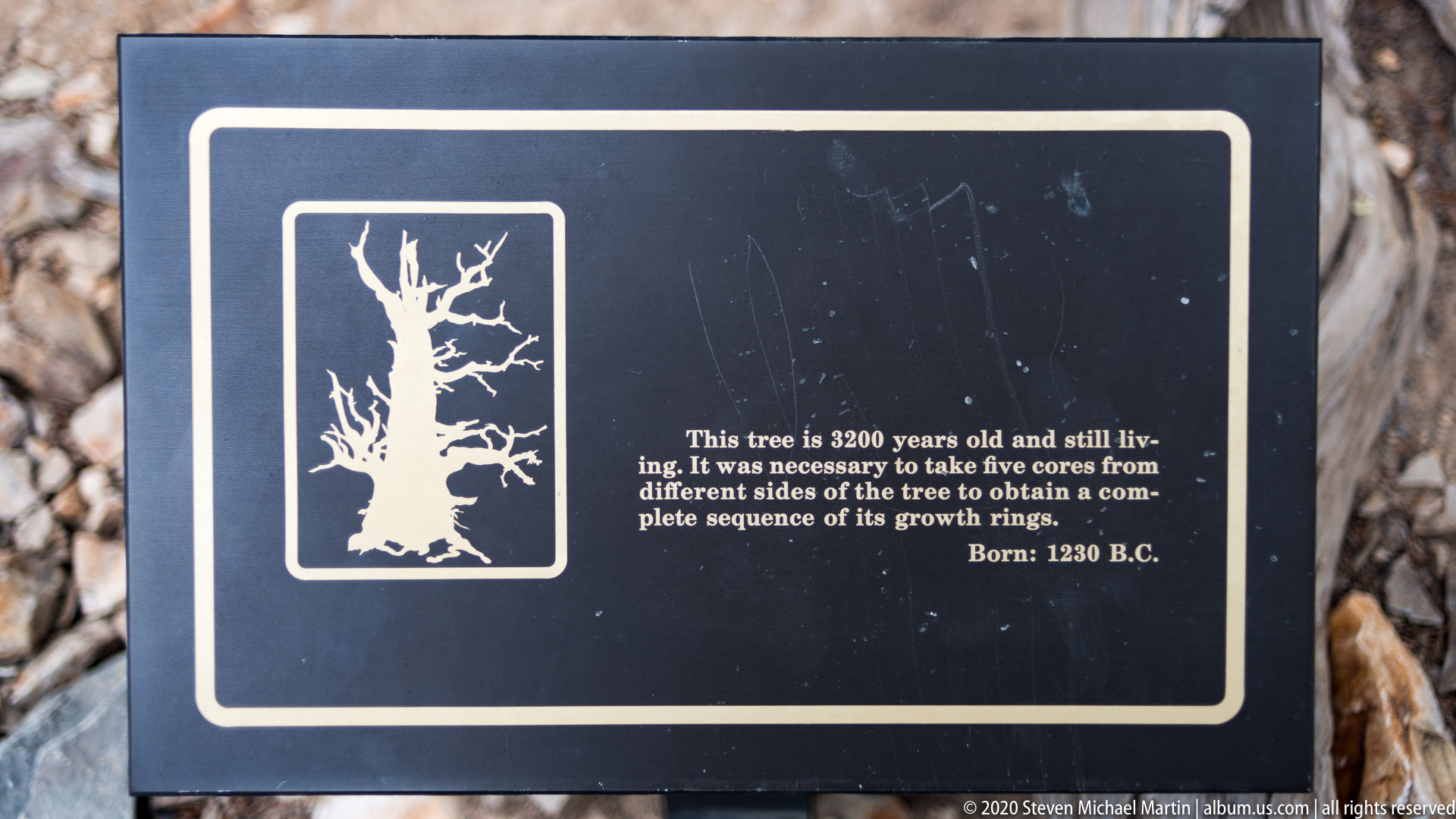
A dark interpretive panel states that the featured tree is about 3,200 years old and still living, with a tree silhouette and an estimated birth date. Pale stones frame the sign. Its close, frontal presentation turns a specific age claim into the subject, linking the grove’s ancient pines with the information provided along the trail.
Caption
A dark interpretive panel states that the featured tree is about 3,200 years old and still living, with a tree silhouette and an estimated birth date. Pale stones frame the sign. Its close, frontal presentation turns a specific age claim into the subject, linking the grove’s ancient pines with the information provided along the trail.

A massive pale trunk fills the frame, its flowing grain, black fissures, and broad roots spreading across rocky ground. A small interpretive plaque lies near the base, partly overshadowed by the tree. The close viewpoint makes the scale and texture of the old wood immediate, while the sign provides a modest trail context.
Caption
A massive pale trunk fills the frame, its flowing grain, black fissures, and broad roots spreading across rocky ground. A small interpretive plaque lies near the base, partly overshadowed by the tree. The close viewpoint makes the scale and texture of the old wood immediate, while the sign provides a modest trail context.

A close view of weathered pine wood fills the frame with narrow dark growth lines, pale exposed ridges, and deep grooves twisting around a contorted trunk. Amber and cream tones alternate with charcoal streaks, revealing how the wood has been sculpted by exposure. The tight crop removes the surrounding forest and makes the trunk’s grain the dominant subject.
Caption
A close view of weathered pine wood fills the frame with narrow dark growth lines, pale exposed ridges, and deep grooves twisting around a contorted trunk. Amber and cream tones alternate with charcoal streaks, revealing how the wood has been sculpted by exposure. The tight crop removes the surrounding forest and makes the trunk’s grain the dominant subject.

Curving bands of gray, black, and golden wood sweep across a close view of a gnarled trunk. A deep crevice opens near the center, where overlapping folds and rounded ridges create a sculptural surface. The framing concentrates on the tree’s weathered structure, while the absence of foliage or landscape leaves the species-level identification dependent on context.
Caption
Curving bands of gray, black, and golden wood sweep across a close view of a gnarled trunk. A deep crevice opens near the center, where overlapping folds and rounded ridges create a sculptural surface. The framing concentrates on the tree’s weathered structure, while the absence of foliage or landscape leaves the species-level identification dependent on context.

A weathered trunk divides into thick curving limbs around a deep black cavity. Gray and ochre surfaces show fine grain lines that follow the twisting wood, while green foliage and pale rock appear through gaps behind. The close composition emphasizes the tree’s contorted structure and the contrast between dark openings and sun-bleached bark.
Caption
A weathered trunk divides into thick curving limbs around a deep black cavity. Gray and ochre surfaces show fine grain lines that follow the twisting wood, while green foliage and pale rock appear through gaps behind. The close composition emphasizes the tree’s contorted structure and the contrast between dark openings and sun-bleached bark.

A brown woody cone hangs beneath a green pine branch, surrounded by short needles and small buds. Its overlapping scales are sharply defined against the softly blurred woodland. The diagonal branch leads into the focal cone, while the shallow depth of field isolates this reproductive detail from the larger tree and grove.
Caption
A brown woody cone hangs beneath a green pine branch, surrounded by short needles and small buds. Its overlapping scales are sharply defined against the softly blurred woodland. The diagonal branch leads into the focal cone, while the shallow depth of field isolates this reproductive detail from the larger tree and grove.
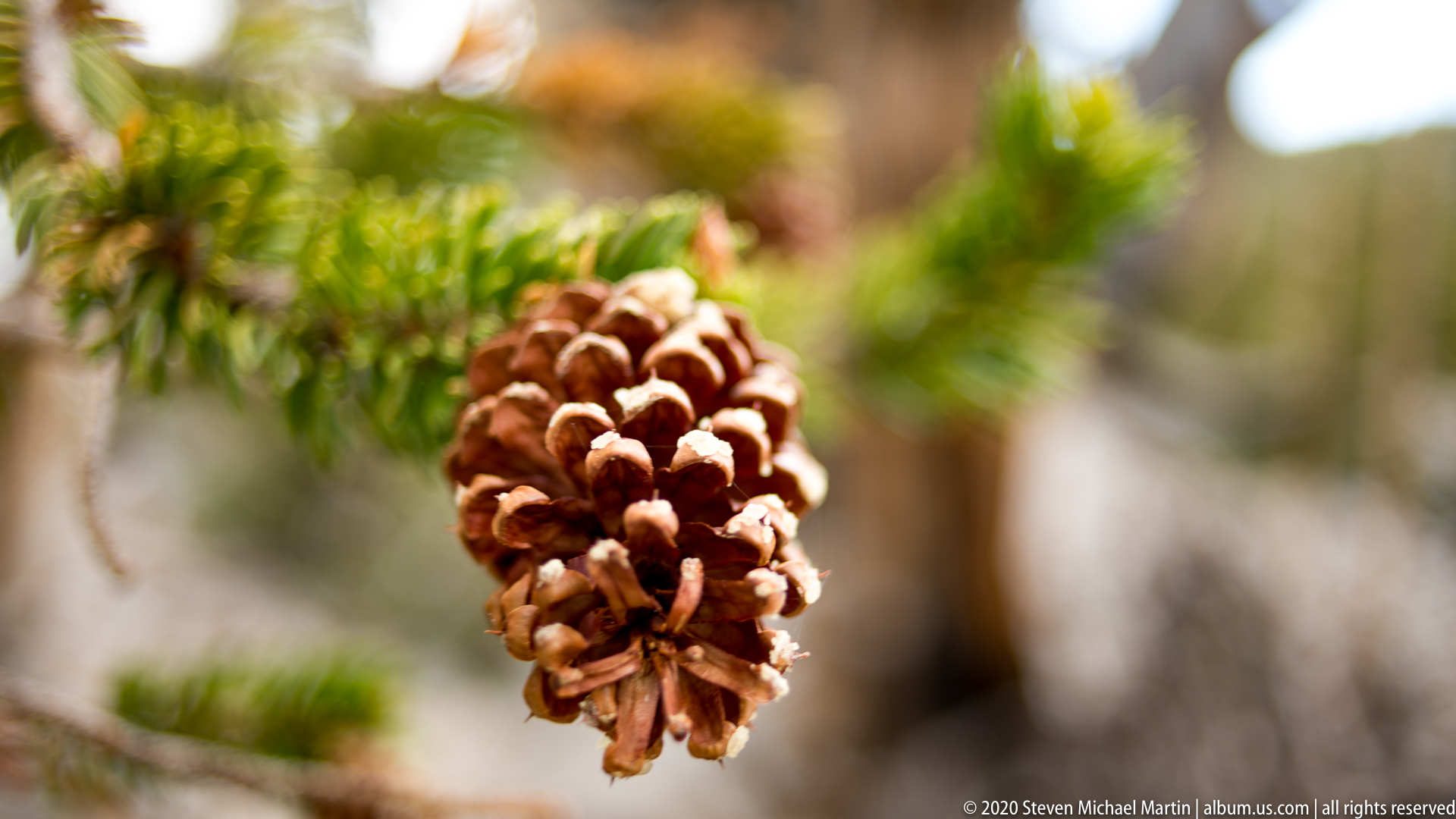
A single brown cone fills the center of the frame, its layered scales crisp against soft green and tan shapes behind it. A short needle-covered branch enters from the upper left. The tight crop and shallow focus reduce the woodland to color and texture, directing attention to the cone’s shape and overlapping scales.
Caption
A single brown cone fills the center of the frame, its layered scales crisp against soft green and tan shapes behind it. A short needle-covered branch enters from the upper left. The tight crop and shallow focus reduce the woodland to color and texture, directing attention to the cone’s shape and overlapping scales.

A needle-covered branch carries a prominent brown cone and a smaller one farther back. The nearer cone is sharply focused, revealing its layered scales, while green needles and the second cone soften into the woodland behind. The two cones create depth and distinguish this view from the single-cone close-ups nearby.
Caption
A needle-covered branch carries a prominent brown cone and a smaller one farther back. The nearer cone is sharply focused, revealing its layered scales, while green needles and the second cone soften into the woodland behind. The two cones create depth and distinguish this view from the single-cone close-ups nearby.

Parallel ridges and deep vertical fissures fill the frame in gray, tan, and warm brown bark. Dark streaks follow the grooves, while lighter bands reveal the trunk’s weathered surface. With no wider landscape visible, the close crop becomes a precise study of texture and the irregular vertical grain of an old pine.
Caption
Parallel ridges and deep vertical fissures fill the frame in gray, tan, and warm brown bark. Dark streaks follow the grooves, while lighter bands reveal the trunk’s weathered surface. With no wider landscape visible, the close crop becomes a precise study of texture and the irregular vertical grain of an old pine.
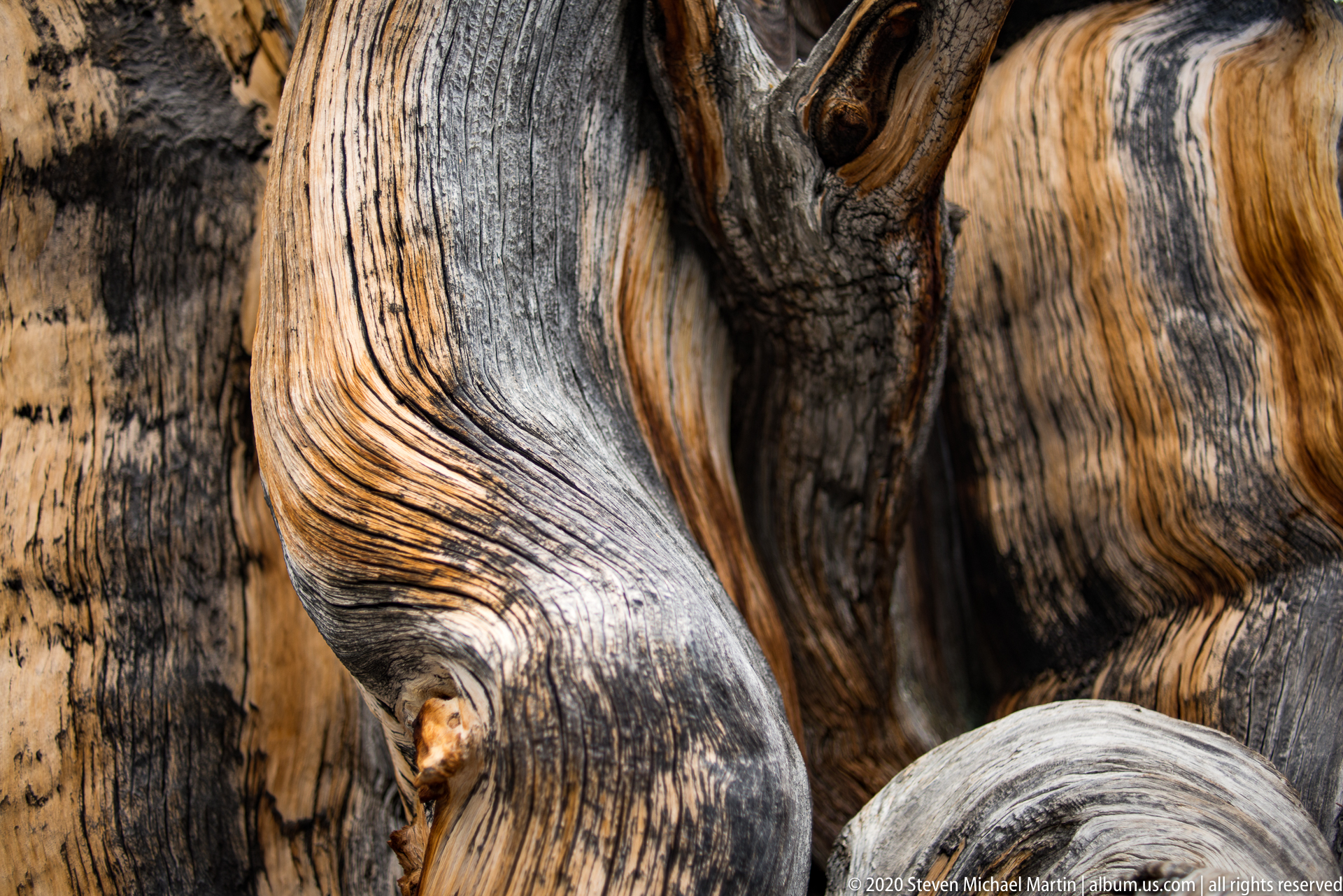
A rounded loop of pale wood curls across the lower center, bordered by dark fissures and closely spaced grain lines. The trunk’s surface shifts from smooth, sun-bleached ridges to cracked, shadowed bark, emphasizing its contorted growth. This detail differs from the broader flowing patterns in the neighboring views by centering a tight knot-like curl.
Caption
A rounded loop of pale wood curls across the lower center, bordered by dark fissures and closely spaced grain lines. The trunk’s surface shifts from smooth, sun-bleached ridges to cracked, shadowed bark, emphasizing its contorted growth. This detail differs from the broader flowing patterns in the neighboring views by centering a tight knot-like curl.
Great Basin National Park — Field Guide
National Park Field Guide
📍 Overview
Great Basin National Park preserves a high-elevation landscape defined by rugged mountain terrain, ancient bristlecone pine groves, and exposed geological formations shaped by long-term tectonic activity. Located within eastern Nevada, the park protects a portion of the Snake Range where Wheeler Peak rises prominently above surrounding desert basins. The dramatic elevation change creates a striking transition between arid lowlands and alpine environments.
Geological forces lifted the Snake Range through faulting that produced steep mountain slopes and broad basin landscapes characteristic of the Basin and Range Province. The park contains exposed limestone formations, glacial features, and high-elevation ridges that illustrate the interaction between tectonic uplift, erosion, and climatic variation. Bristlecone pine forests grow in thin soils near treeline, where harsh conditions allow these slow-growing trees to survive for thousands of years.
⭐ Highlights
- Ancient bristlecone pine groves near treeline
- Wheeler Peak alpine mountain landscape
- High elevation views across desert basins
- Limestone geology shaped by uplift and erosion
- Transition from desert environment to alpine terrain
🔎 Key Features
- Basin and Range fault-block mountain formation
- Ancient bristlecone pine ecosystems
- Glacially influenced high-elevation terrain
- Limestone formations exposed through uplift
- Elevation-driven ecological diversity
📷 Photography Notes
- Early and late light enhances texture in bristlecone pine bark
- Wide compositions capture contrast between mountain and basin landscapes
- Twisted tree forms create strong foreground subjects
- Cloud patterns add scale to alpine environments
- Look for compositions that combine rock, tree, and sky
- Side lighting emphasizes sculptural tree shapes

An open, richly illustrated park brochure fills the frame, headed “Great Basin” above a panoramic mountain image. Smaller panels combine maps, landscape and wildlife photographs, explanatory text, and a large cutaway-style illustration of an underground cave. The printed material presents multiple park themes on one spread, from mountain environments to caves; individual small text is not legible at this scale.
Caption
An open, richly illustrated park brochure fills the frame, headed “Great Basin” above a panoramic mountain image. Smaller panels combine maps, landscape and wildlife photographs, explanatory text, and a large cutaway-style illustration of an underground cave. The printed material presents multiple park themes on one spread, from mountain environments to caves; individual small text is not legible at this scale.

A folded visitor map titled “Exploring Great Basin” shows the park boundary in green against a pale regional map. Roads, trails, labels, and a legend surround the shaded park area, while columns of visitor information run down both sides. The creases and broad folds are visible across the sheet, making this a practical printed guide rather than a clean digital map.
Caption
A folded visitor map titled “Exploring Great Basin” shows the park boundary in green against a pale regional map. Roads, trails, labels, and a legend surround the shaded park area, while columns of visitor information run down both sides. The creases and broad folds are visible across the sheet, making this a practical printed guide rather than a clean digital map.