Rocky Mountain National Park
Rocky Mountain National Park preserves a high elevation landscape defined by rugged peaks, alpine lakes, and glacially shaped valleys. The park contains portions of the Continental Divide and illustrates geological processes associated with mountain uplift and glaciation. The dramatic terrain reflects millions of years of tectonic forces that raised the Rocky Mountains above surrounding plains.
Glacial activity carved cirques, moraines, and U-shaped valleys that define much of the park’s topography. The combination of elevation and climate contributes to ecological diversity ranging from montane forest to alpine tundra. The park illustrates the relationship between geological structure, elevation, and environmental variation across mountain landscapes.
Visitors encounter expansive mountain scenery characterized by sharp ridgelines and open alpine environments. The contrast between high peaks and lower forested valleys provides insight into the processes that shaped the Rocky Mountains and the ecological diversity supported by elevation changes.
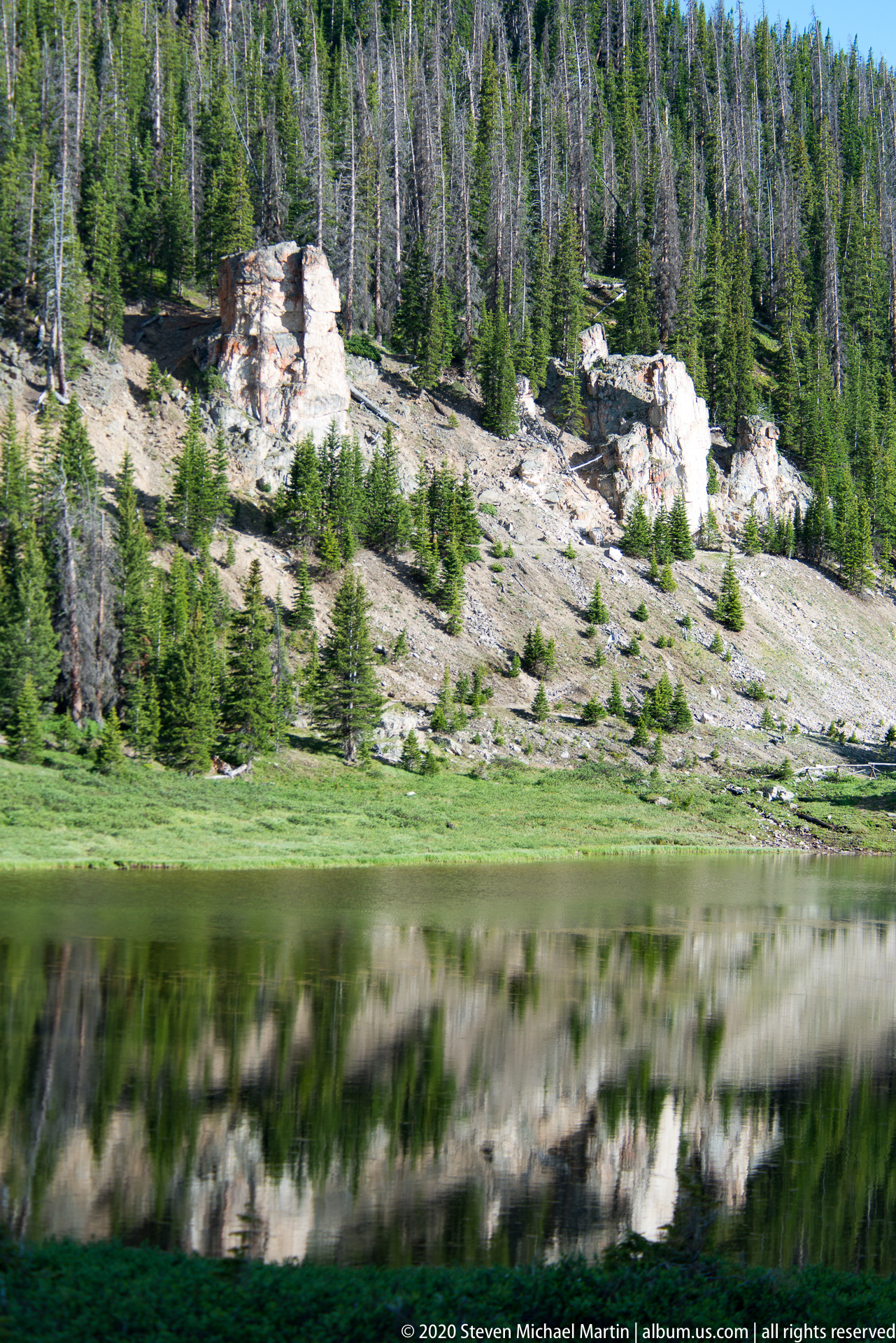
A small alpine lake reflects evergreen trees and pale granite outcrops on the slope beyond. The nearly level shoreline separates the mirrored forest from the real hillside, while a narrow green meadow borders the water. The quiet composition emphasizes the reflection and the transition from open shore to rocky, forested ground.
Caption
A small alpine lake reflects evergreen trees and pale granite outcrops on the slope beyond. The nearly level shoreline separates the mirrored forest from the real hillside, while a narrow green meadow borders the water. The quiet composition emphasizes the reflection and the transition from open shore to rocky, forested ground.
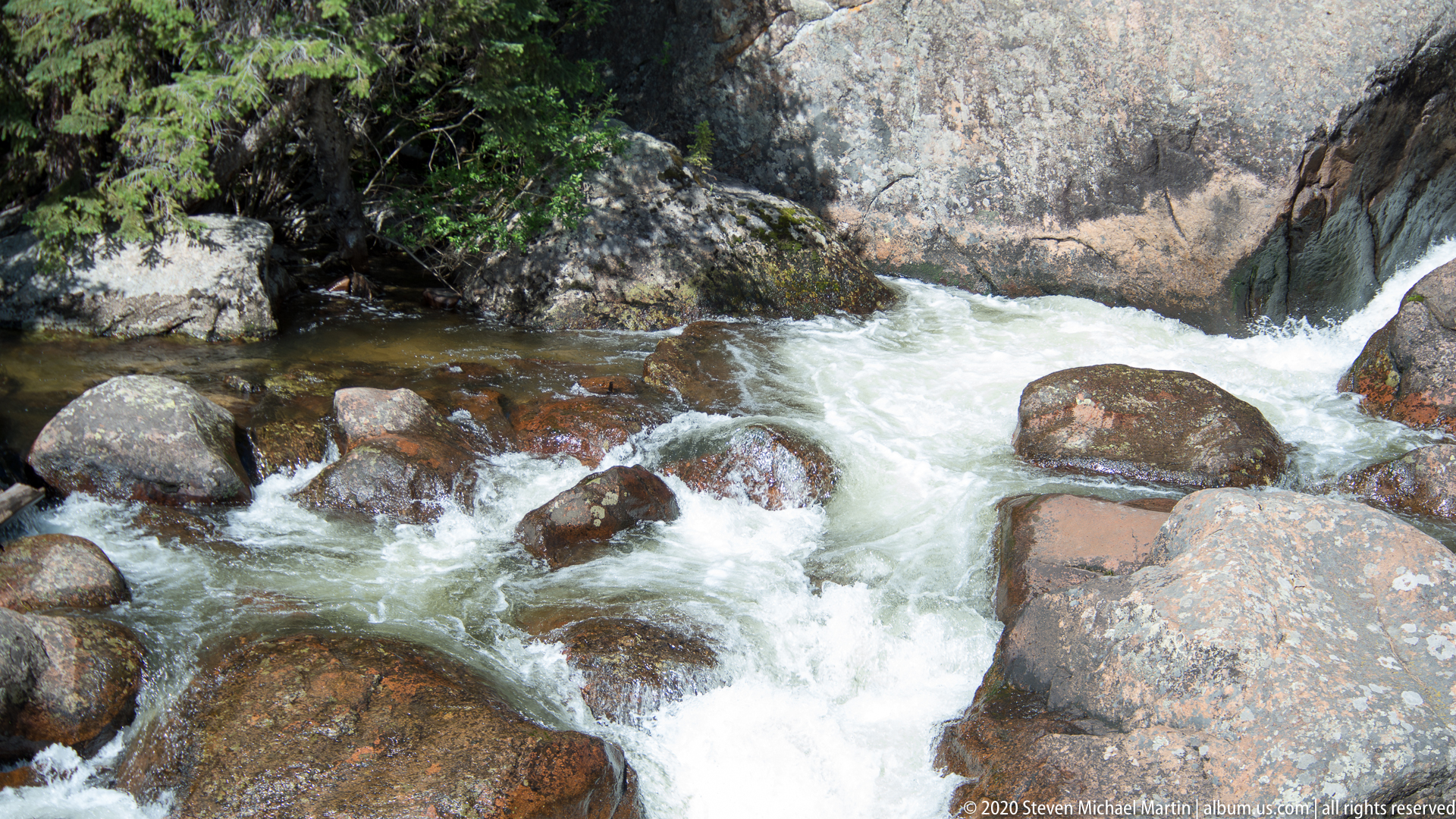
Whitewater funnels through a narrow gap between large granite boulders, then spreads into darker pools and smaller channels. The close crop makes the water’s movement and the rounded, weathered surfaces of the rocks the main subject; only a small fringe of vegetation appears at the edges. This is a tight study of rapids, distinct from the wider stream views nearby.
Caption
Whitewater funnels through a narrow gap between large granite boulders, then spreads into darker pools and smaller channels. The close crop makes the water’s movement and the rounded, weathered surfaces of the rocks the main subject; only a small fringe of vegetation appears at the edges. This is a tight study of rapids, distinct from the wider stream views nearby.

A small brown timber building sits beside a paved road, with a broad metal roof, stone-faced lower walls and a covered entry. Pine trunks rise behind the structure, while a narrow sidewalk follows its front. The practical, low-profile design fits the wooded roadside setting; no building name is legible in the view.
Caption
A small brown timber building sits beside a paved road, with a broad metal roof, stone-faced lower walls and a covered entry. Pine trunks rise behind the structure, while a narrow sidewalk follows its front. The practical, low-profile design fits the wooded roadside setting; no building name is legible in the view.
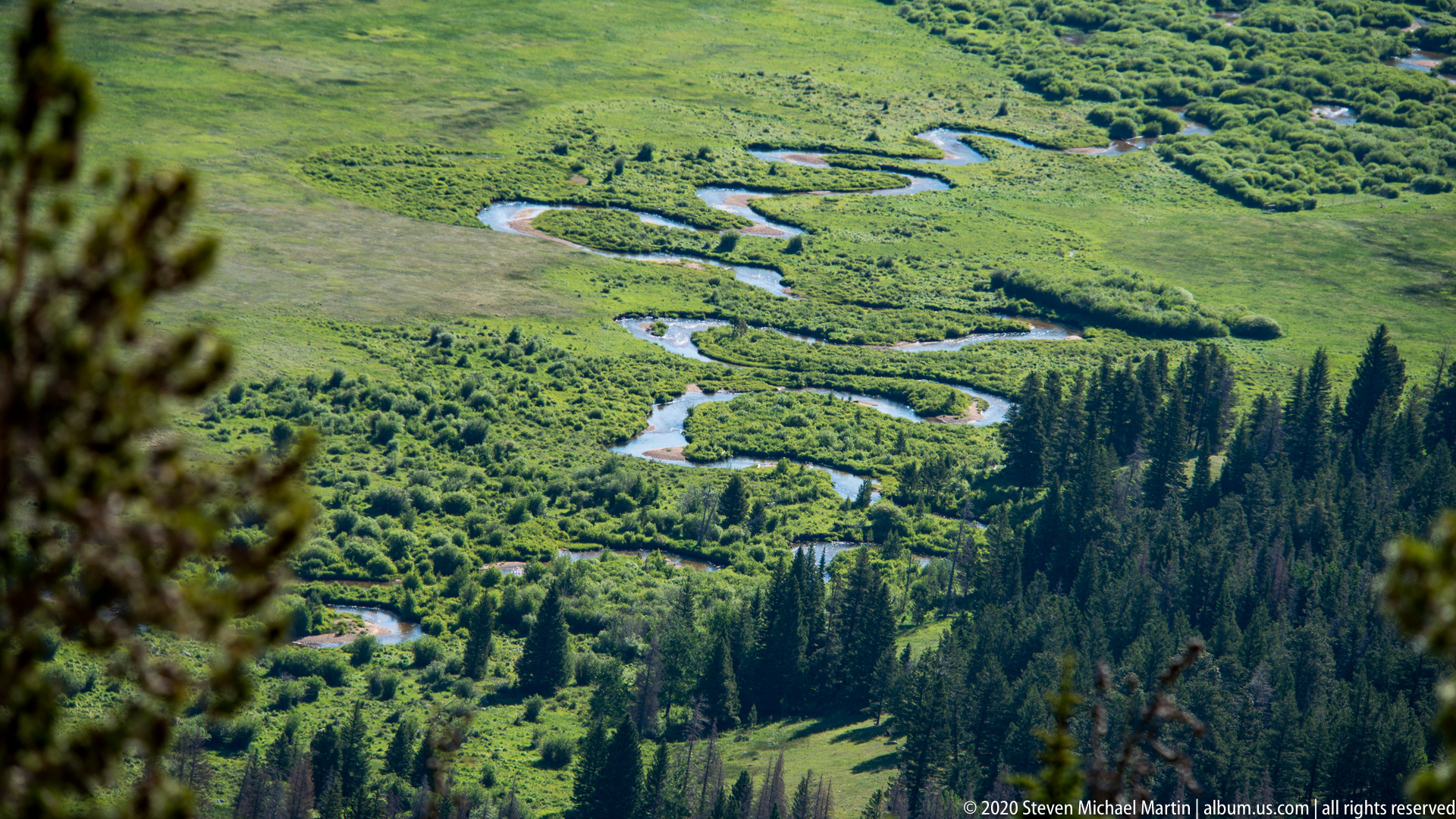
From an elevated overlook, a narrow river curves repeatedly through a broad green meadow before disappearing among dense shrubs. A stand of dark conifers anchors the right side, while blurred branches at left frame the distant wetland. The elevated perspective reveals the watercourse’s looping pattern and its relationship to the open meadow and forest edge.
Caption
From an elevated overlook, a narrow river curves repeatedly through a broad green meadow before disappearing among dense shrubs. A stand of dark conifers anchors the right side, while blurred branches at left frame the distant wetland. The elevated perspective reveals the watercourse’s looping pattern and its relationship to the open meadow and forest edge.
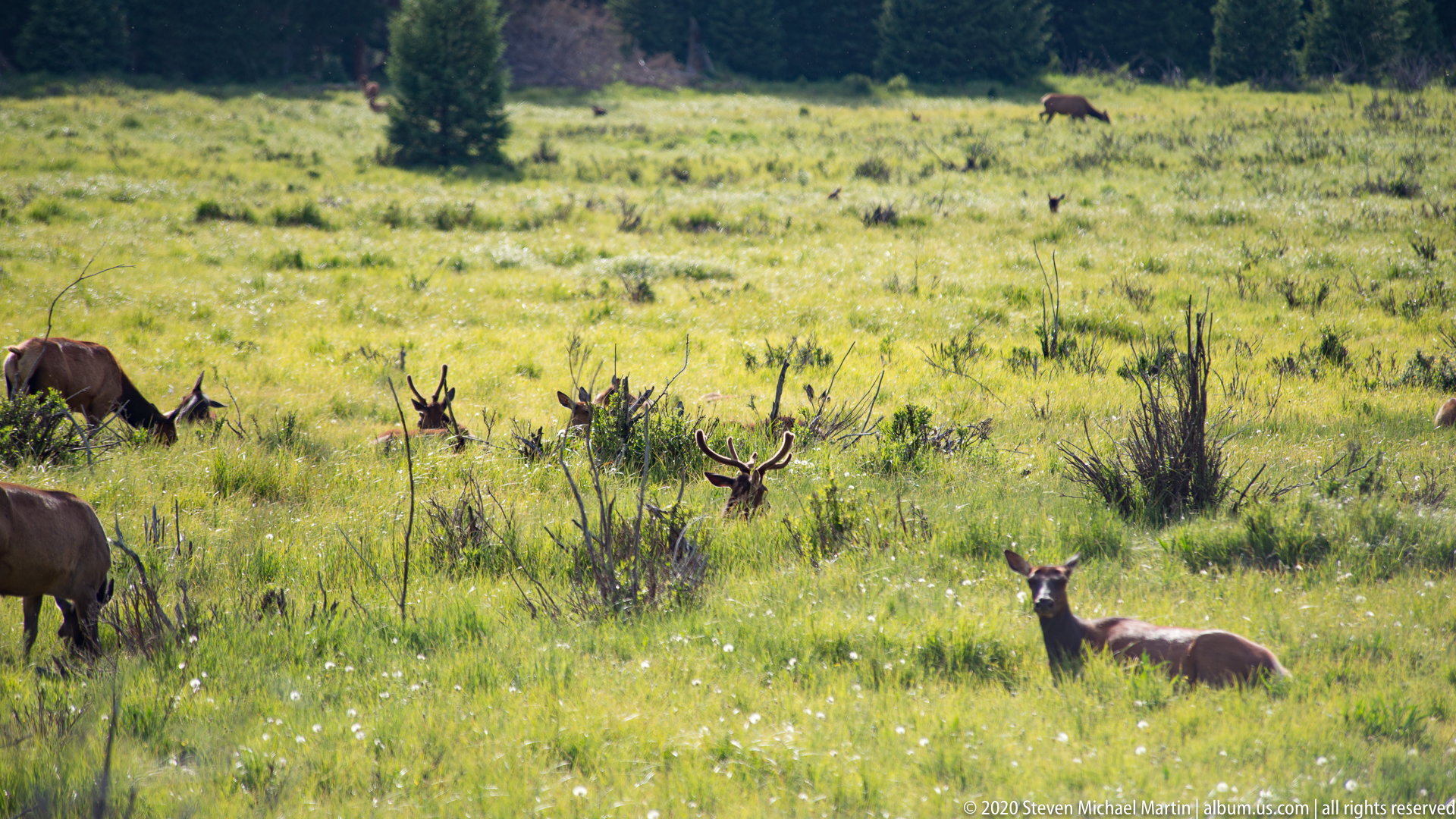
Several elk are scattered through a sunlit meadow, including antlered males and antlerless animals at different distances. Some graze with heads lowered while others stand alert among tall grass and sparse shrubs. The wide framing shows the herd’s spacing across the clearing and the forest edge that encloses the open habitat.
Caption
Several elk are scattered through a sunlit meadow, including antlered males and antlerless animals at different distances. Some graze with heads lowered while others stand alert among tall grass and sparse shrubs. The wide framing shows the herd’s spacing across the clearing and the forest edge that encloses the open habitat.
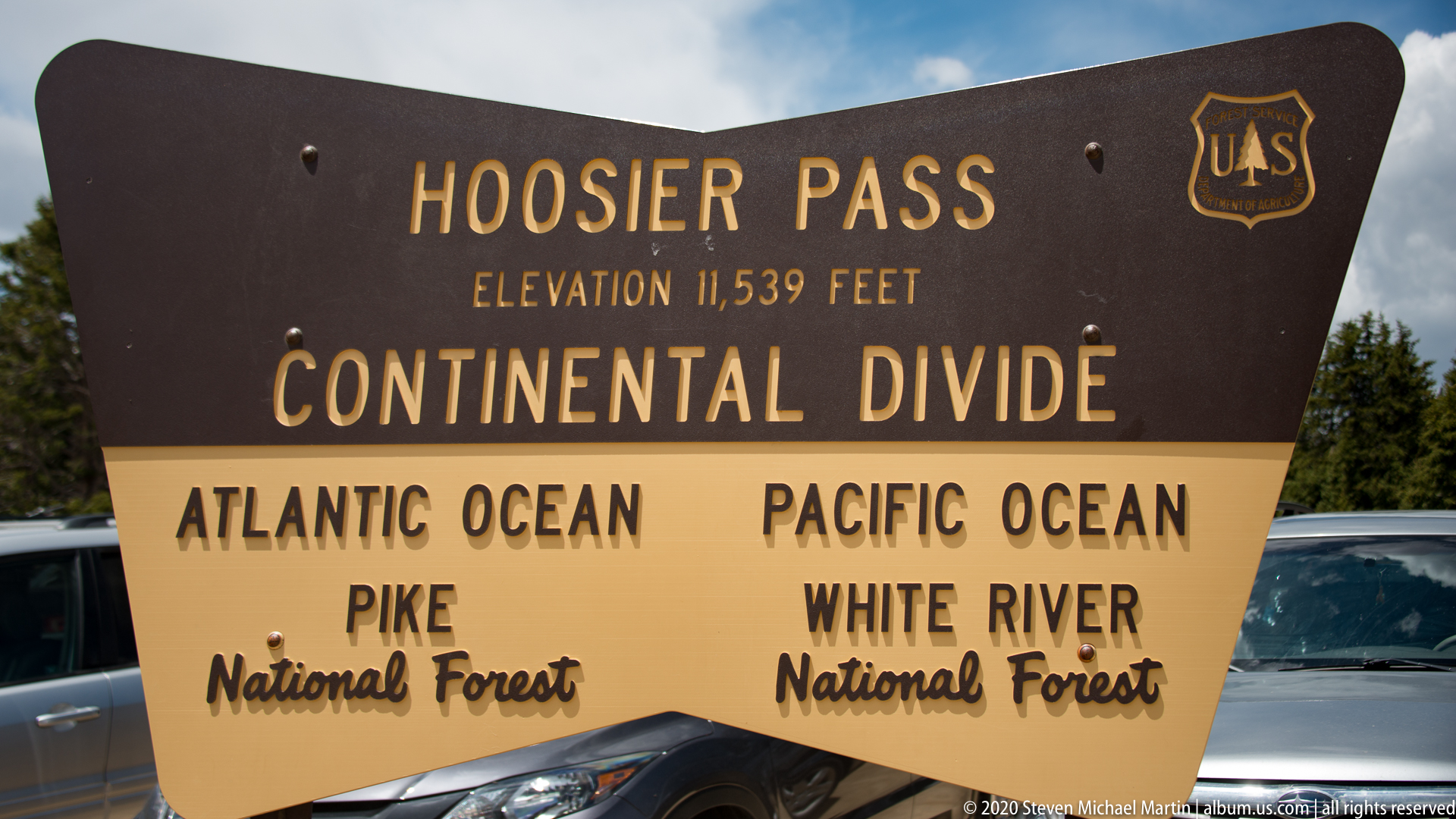
A brown and tan sign identifies Hoosier Pass at 11,539 feet and marks the Continental Divide between Atlantic and Pacific Ocean drainage. It also names Pike and White River National Forests. Parked vehicles are partly visible behind the sign, placing this geographic marker beside a road at the high mountain pass.
Caption
A brown and tan sign identifies Hoosier Pass at 11,539 feet and marks the Continental Divide between Atlantic and Pacific Ocean drainage. It also names Pike and White River National Forests. Parked vehicles are partly visible behind the sign, placing this geographic marker beside a road at the high mountain pass.
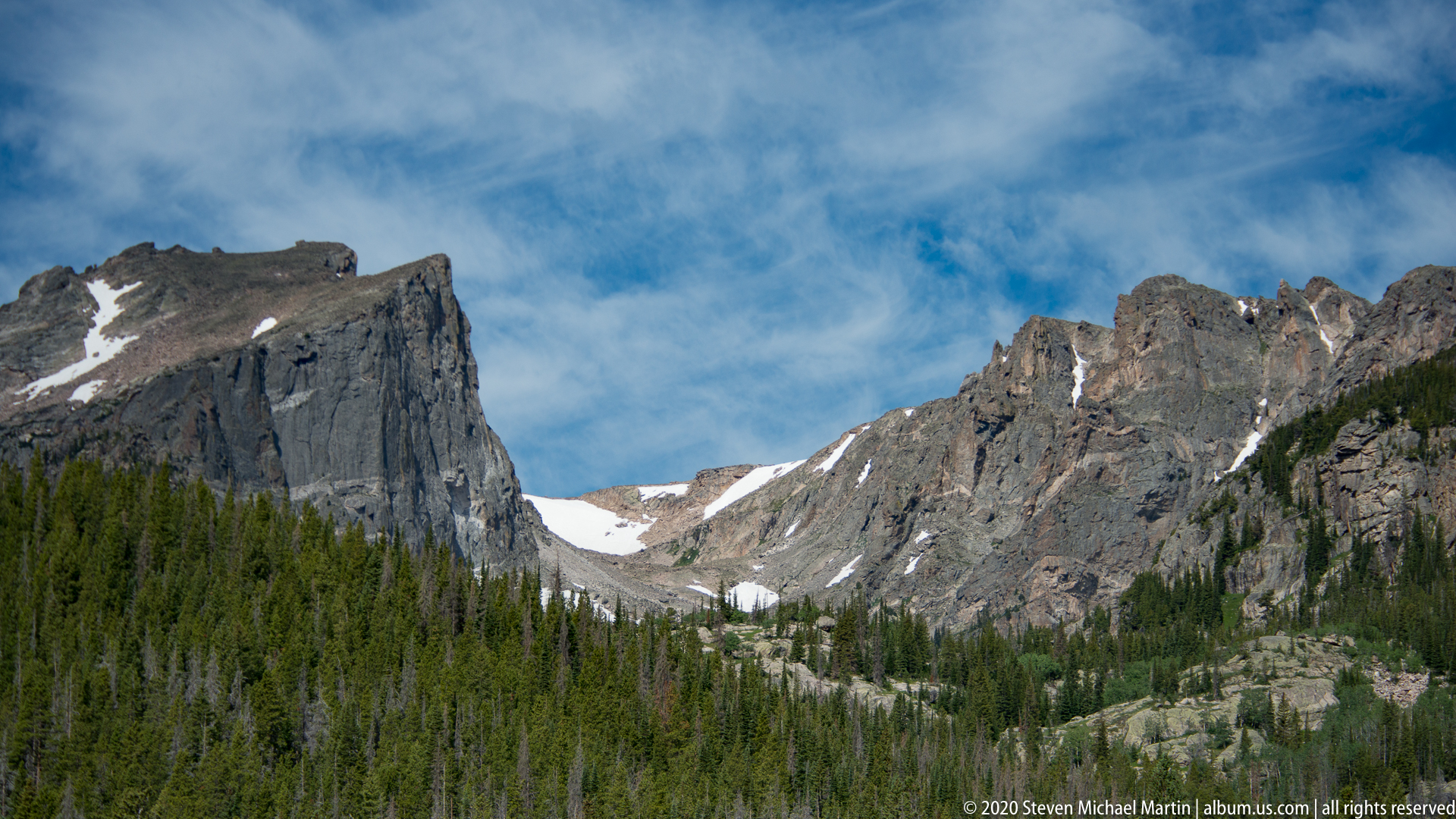
A high mountain basin opens between steep, sheer rock faces, with lingering snowfields gathered in the shaded central bowl. Conifer forest covers the lower slopes and frames the valley entrance, while patches of cloud drift through the blue sky. The view balances the scale of the rugged peaks with the wooded foreground, presenting a broad alpine landscape rather than a close geological detail.
Caption
A high mountain basin opens between steep, sheer rock faces, with lingering snowfields gathered in the shaded central bowl. Conifer forest covers the lower slopes and frames the valley entrance, while patches of cloud drift through the blue sky. The view balances the scale of the rugged peaks with the wooded foreground, presenting a broad alpine landscape rather than a close geological detail.
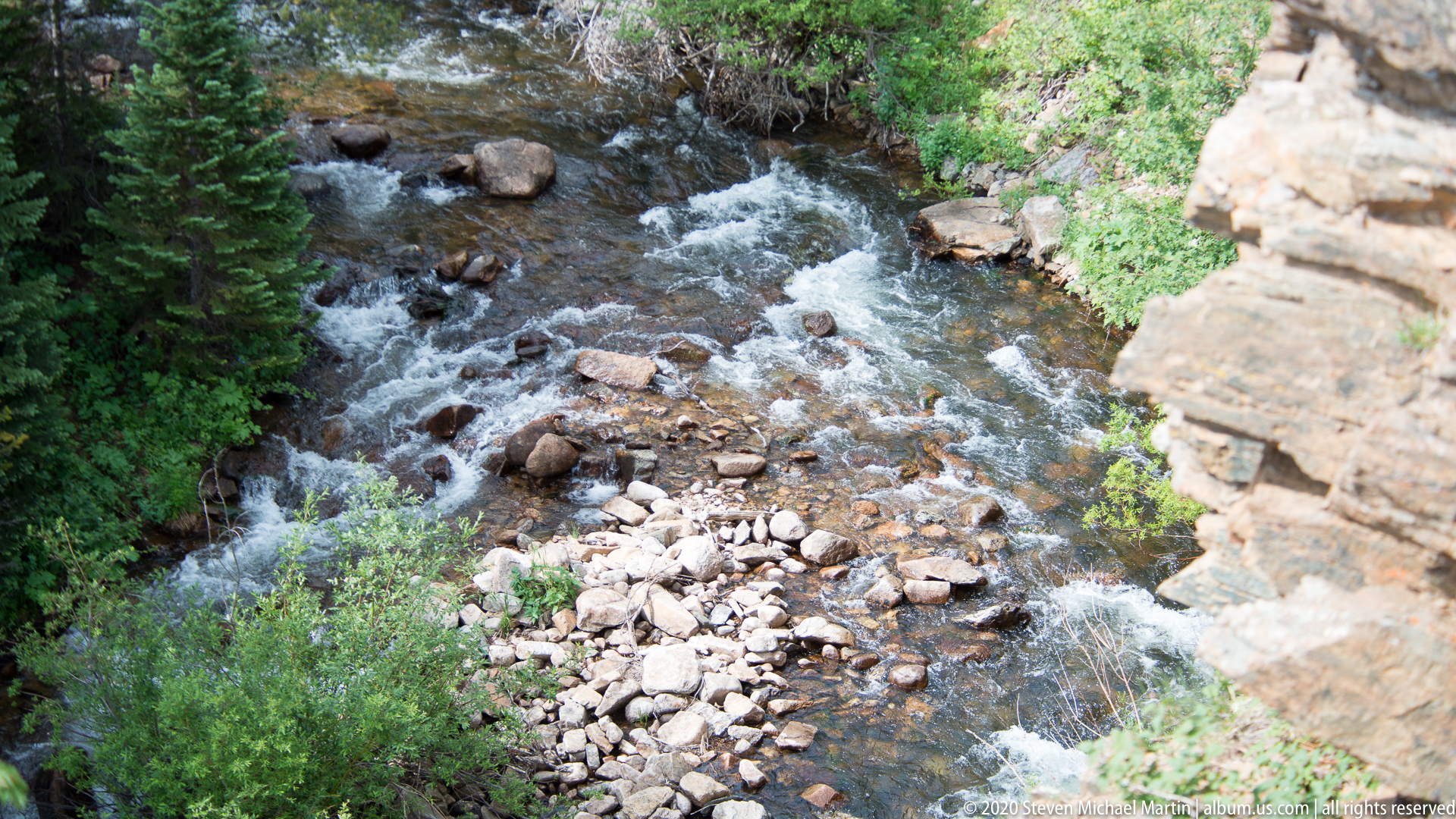
From above, a rocky creek runs diagonally through a narrow green corridor, with clear pools alternating with short whitewater drops. Large pale boulders crowd the right bank, while shrubs and trees fill the left side and upper channel. The elevated angle reveals the stream’s route through the rocks and vegetation, setting it apart from the ground-level cascade photographs.
Caption
From above, a rocky creek runs diagonally through a narrow green corridor, with clear pools alternating with short whitewater drops. Large pale boulders crowd the right bank, while shrubs and trees fill the left side and upper channel. The elevated angle reveals the stream’s route through the rocks and vegetation, setting it apart from the ground-level cascade photographs.
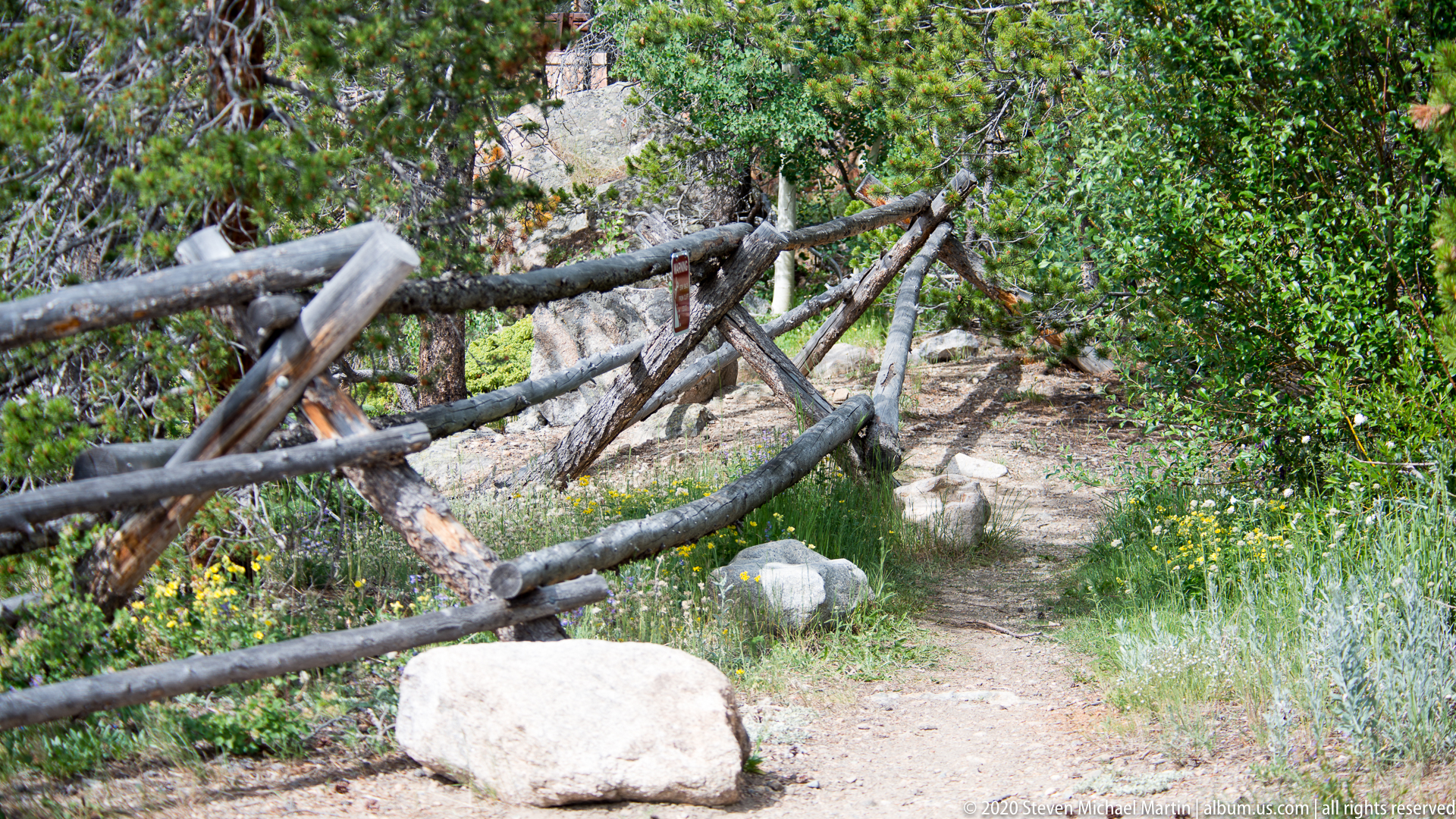
A weathered log fence runs diagonally beside a narrow dirt trail, with irregular horizontal rails and upright supports forming a rustic barrier. Pale rocks edge the path, while dense shrubs and small yellow flowers press close to the fence. The oblique view follows the trail as it curves out of sight, emphasizing the practical boundary between the walking route and surrounding vegetation.
Caption
A weathered log fence runs diagonally beside a narrow dirt trail, with irregular horizontal rails and upright supports forming a rustic barrier. Pale rocks edge the path, while dense shrubs and small yellow flowers press close to the fence. The oblique view follows the trail as it curves out of sight, emphasizing the practical boundary between the walking route and surrounding vegetation.
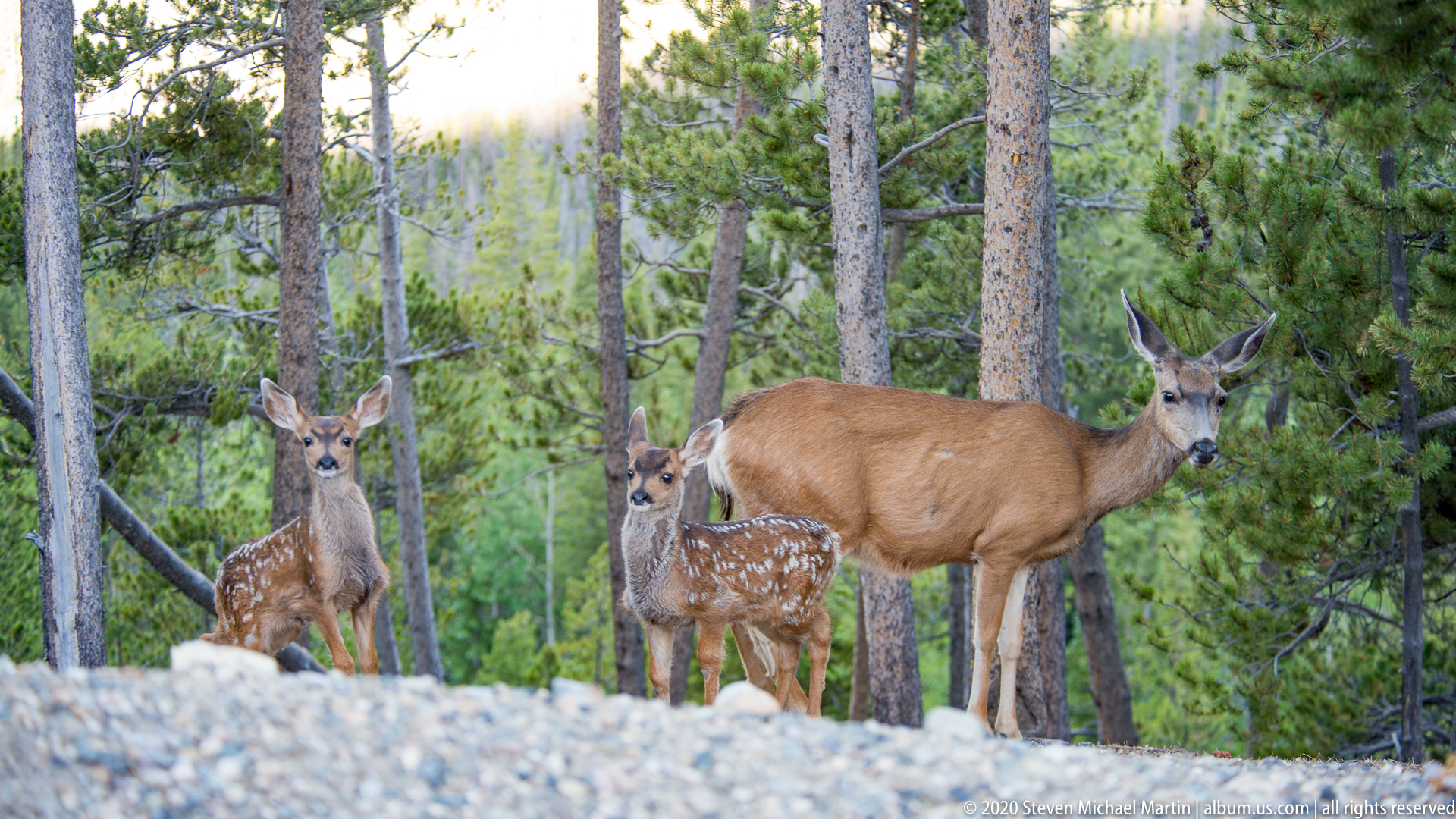
A doe stands to the right of two spotted fawns behind a low rocky bank. The wider framing reveals all three animals among upright pine trunks, with the fawns looking outward and the adult glancing to the side. Pale stones along the foreground create a low barrier that partly obscures their legs and distinguishes this family view from the closer portraits.
Caption
A doe stands to the right of two spotted fawns behind a low rocky bank. The wider framing reveals all three animals among upright pine trunks, with the fawns looking outward and the adult glancing to the side. Pale stones along the foreground create a low barrier that partly obscures their legs and distinguishes this family view from the closer portraits.

Blue-violet flower clusters rise on slender stems among low green leaves and dry, stony ground. The plants are scattered rather than forming a continuous carpet, and the upper background includes twigs, leaf litter, and exposed soil. This close view records flowers at the edge of a rocky slope, with the irregular spacing and subdued surroundings distinguishing it from the denser meadow images.
Caption
Blue-violet flower clusters rise on slender stems among low green leaves and dry, stony ground. The plants are scattered rather than forming a continuous carpet, and the upper background includes twigs, leaf litter, and exposed soil. This close view records flowers at the edge of a rocky slope, with the irregular spacing and subdued surroundings distinguishing it from the denser meadow images.
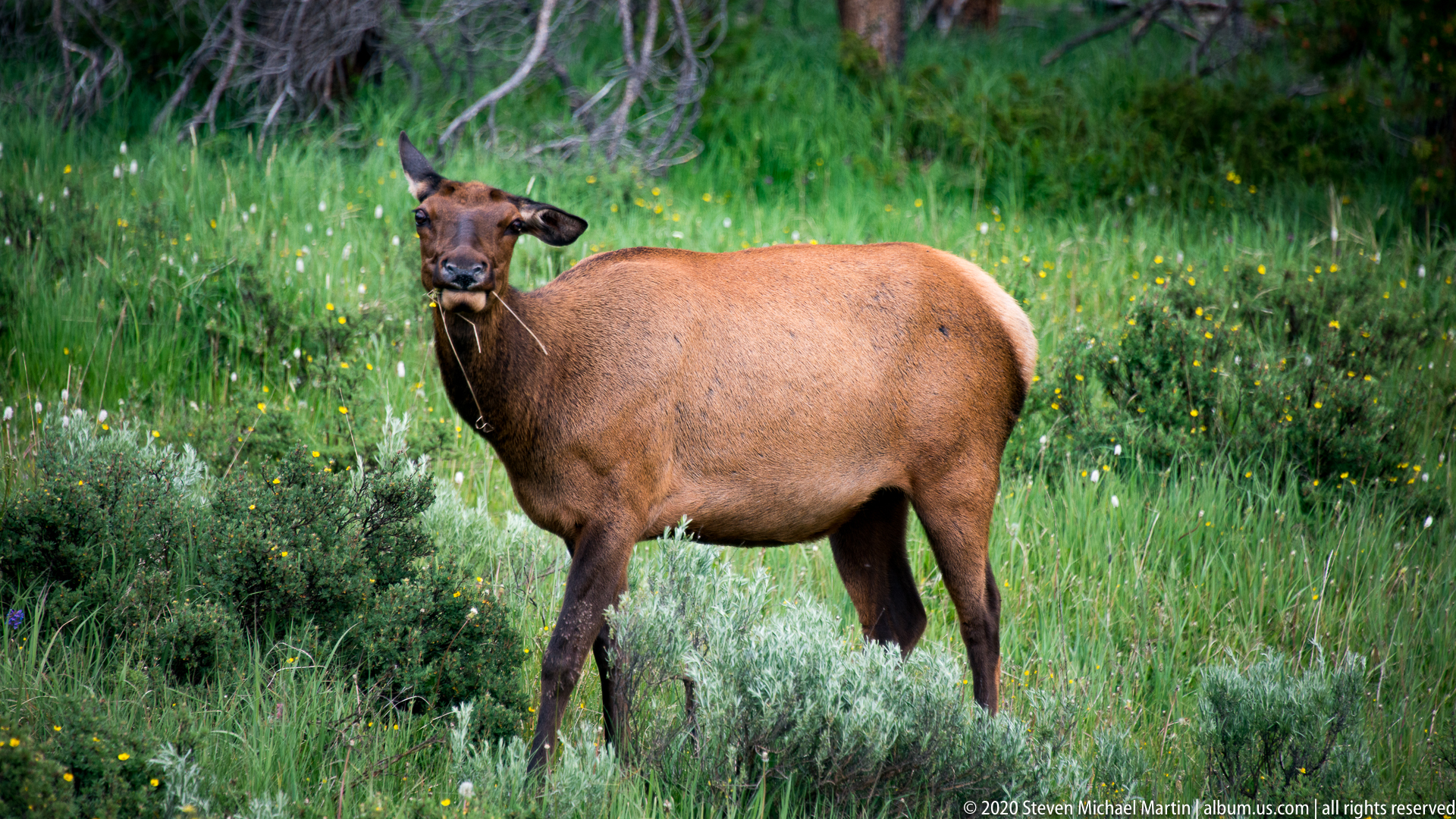
A cow elk stands in a lush meadow, her tawny body turned broadside while she looks toward the camera. Small yellow flowers punctuate the green grass, and a mixed line of shrubs and trees fills the background. The close view shows her alert ears, dark muzzle and the open woodland edge around her.
Caption
A cow elk stands in a lush meadow, her tawny body turned broadside while she looks toward the camera. Small yellow flowers punctuate the green grass, and a mixed line of shrubs and trees fills the background. The close view shows her alert ears, dark muzzle and the open woodland edge around her.
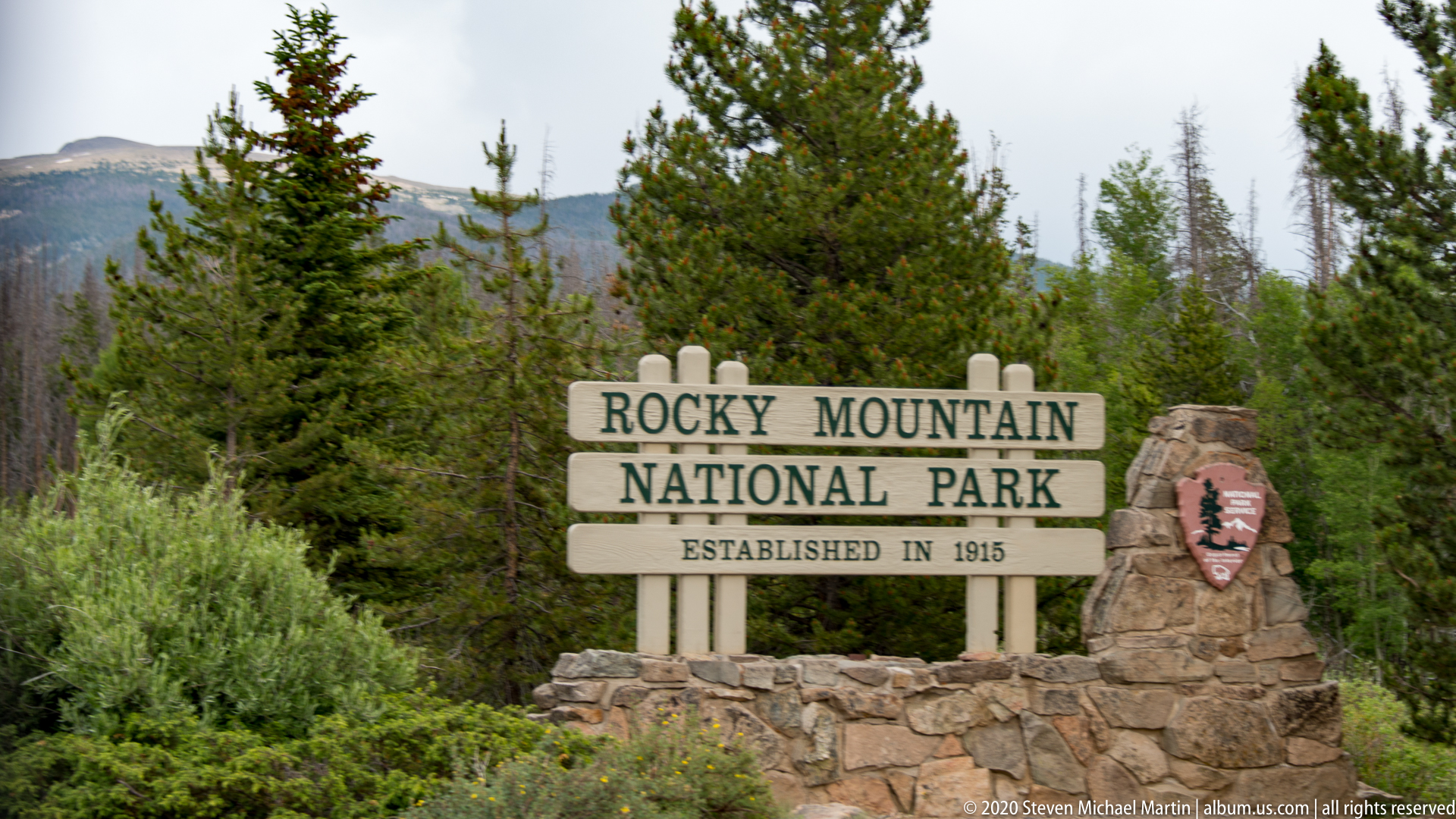
A pale wooden sign reads “Rocky Mountain National Park” and “Established in 1915,” set into a low stone wall beside the road. A National Park Service arrowhead marker stands to the right, with pine trees and mountain vegetation behind. The frontal view makes the park name and founding date clearly legible.
Caption
A pale wooden sign reads “Rocky Mountain National Park” and “Established in 1915,” set into a low stone wall beside the road. A National Park Service arrowhead marker stands to the right, with pine trees and mountain vegetation behind. The frontal view makes the park name and founding date clearly legible.
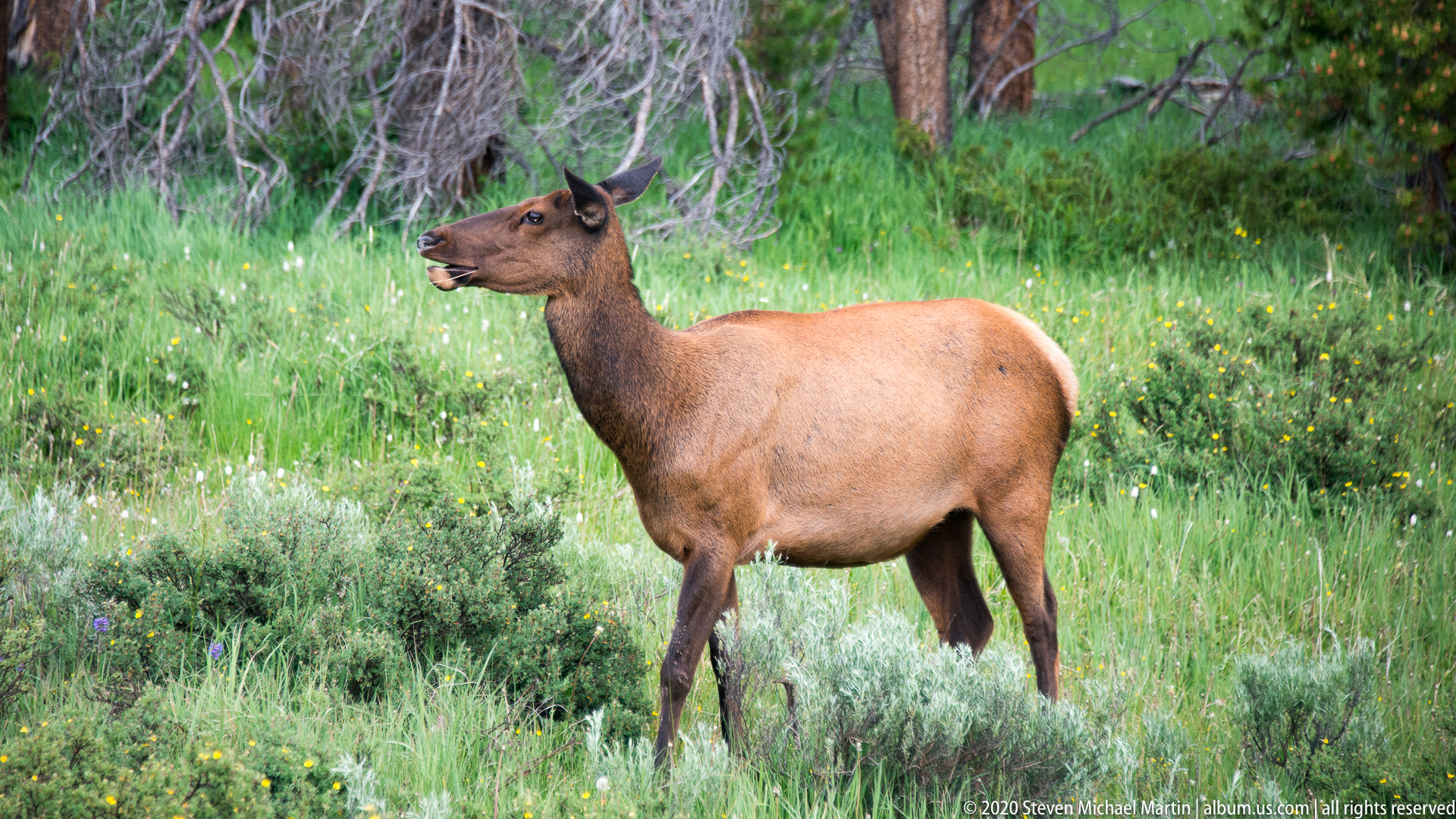
A cow elk stands in profile among green grasses and scattered yellow blooms, her head turned left and ears forward. Her warm brown coat stands out against the cool, leafy background of shrubs and slender tree trunks. The animal fills much of the frame, allowing the viewer to see her body shape and attentive stance.
Caption
A cow elk stands in profile among green grasses and scattered yellow blooms, her head turned left and ears forward. Her warm brown coat stands out against the cool, leafy background of shrubs and slender tree trunks. The animal fills much of the frame, allowing the viewer to see her body shape and attentive stance.
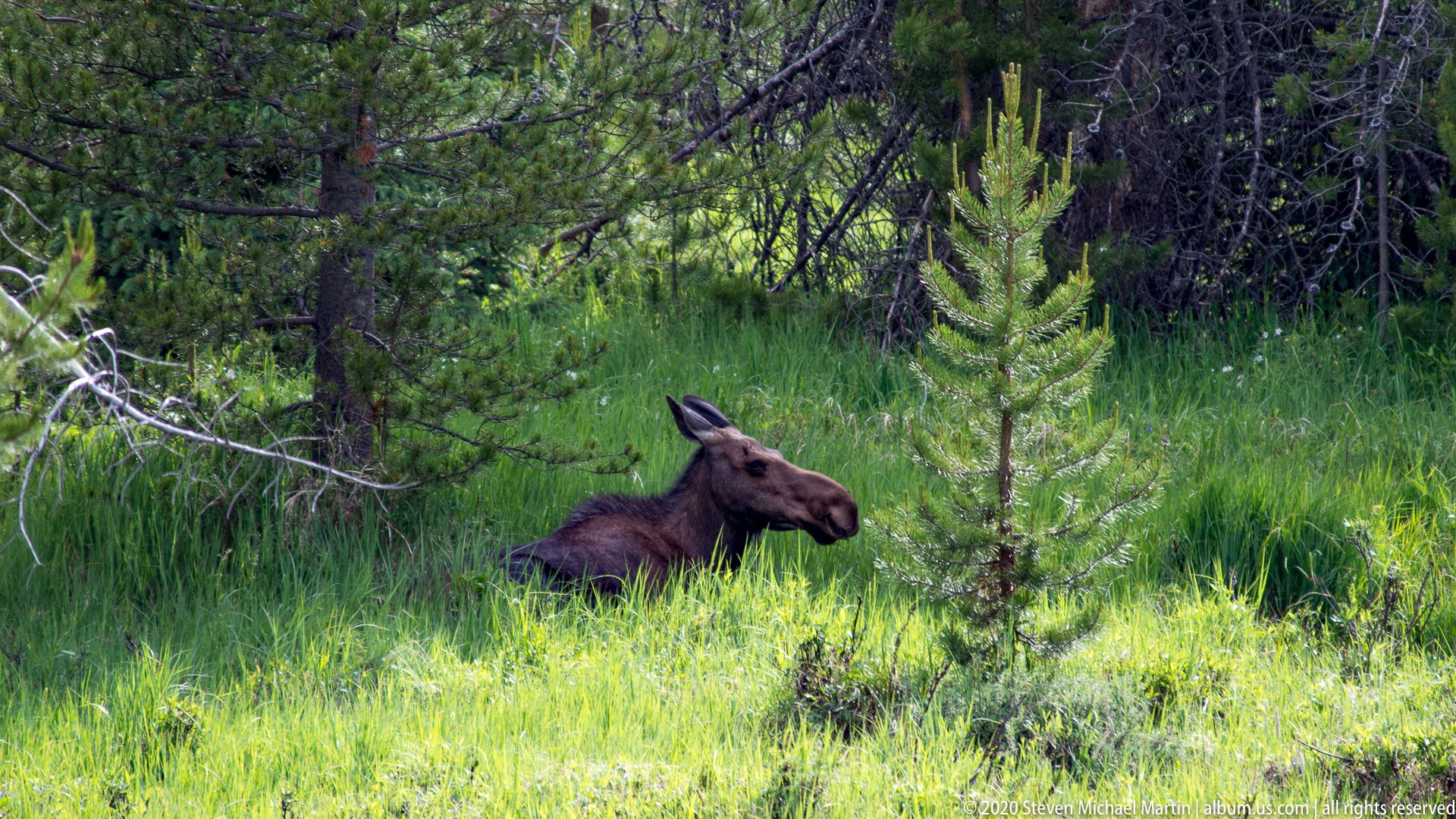
A dark moose lies low in a bright patch of meadow grass, with only its head and upper back visible above the vegetation. Young conifers and tangled branches surround the animal, partially concealing its body. The shaded forest edge contrasts with the luminous grass and gives this view a more enclosed setting than the open elk meadows.
Caption
A dark moose lies low in a bright patch of meadow grass, with only its head and upper back visible above the vegetation. Young conifers and tangled branches surround the animal, partially concealing its body. The shaded forest edge contrasts with the luminous grass and gives this view a more enclosed setting than the open elk meadows.

An antlerless elk lies in a bright meadow, her head raised while other elk are visible farther back in the grass. Small white flowers speckle the green slope, and a darker tree line borders the clearing. The layered view pairs a nearby resting animal with the more distant herd rather than isolating a single subject.
Caption
An antlerless elk lies in a bright meadow, her head raised while other elk are visible farther back in the grass. Small white flowers speckle the green slope, and a darker tree line borders the clearing. The layered view pairs a nearby resting animal with the more distant herd rather than isolating a single subject.
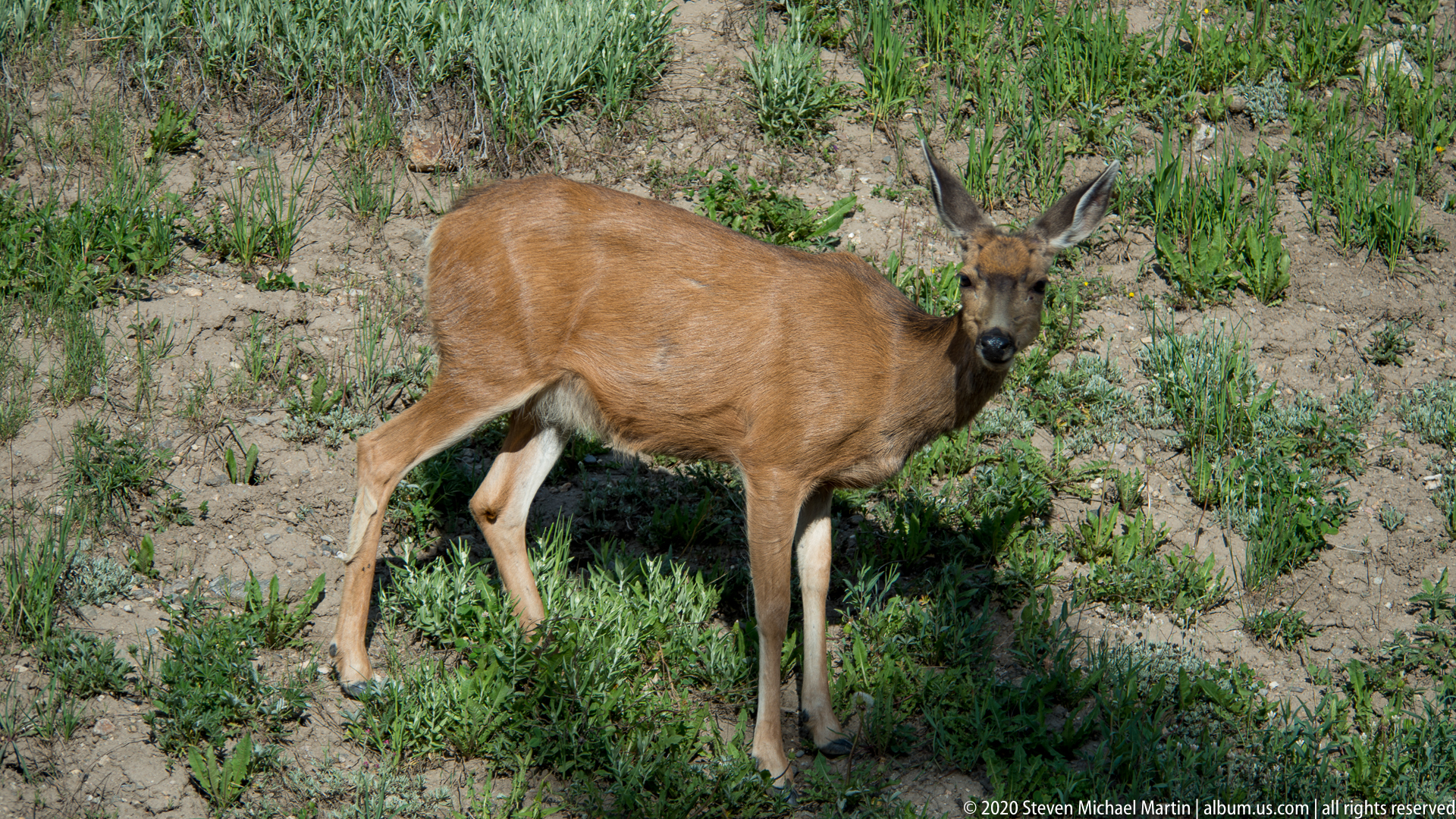
A slender mule deer stands on sandy ground dotted with sage-like shrubs, her oversized ears angled outward and her dark muzzle turned toward the camera. The coat is reddish brown with pale markings beneath the tail. Low vegetation and a rough, open patch of soil surround her, distinguishing this dry clearing from the green meadows nearby.
Caption
A slender mule deer stands on sandy ground dotted with sage-like shrubs, her oversized ears angled outward and her dark muzzle turned toward the camera. The coat is reddish brown with pale markings beneath the tail. Low vegetation and a rough, open patch of soil surround her, distinguishing this dry clearing from the green meadows nearby.
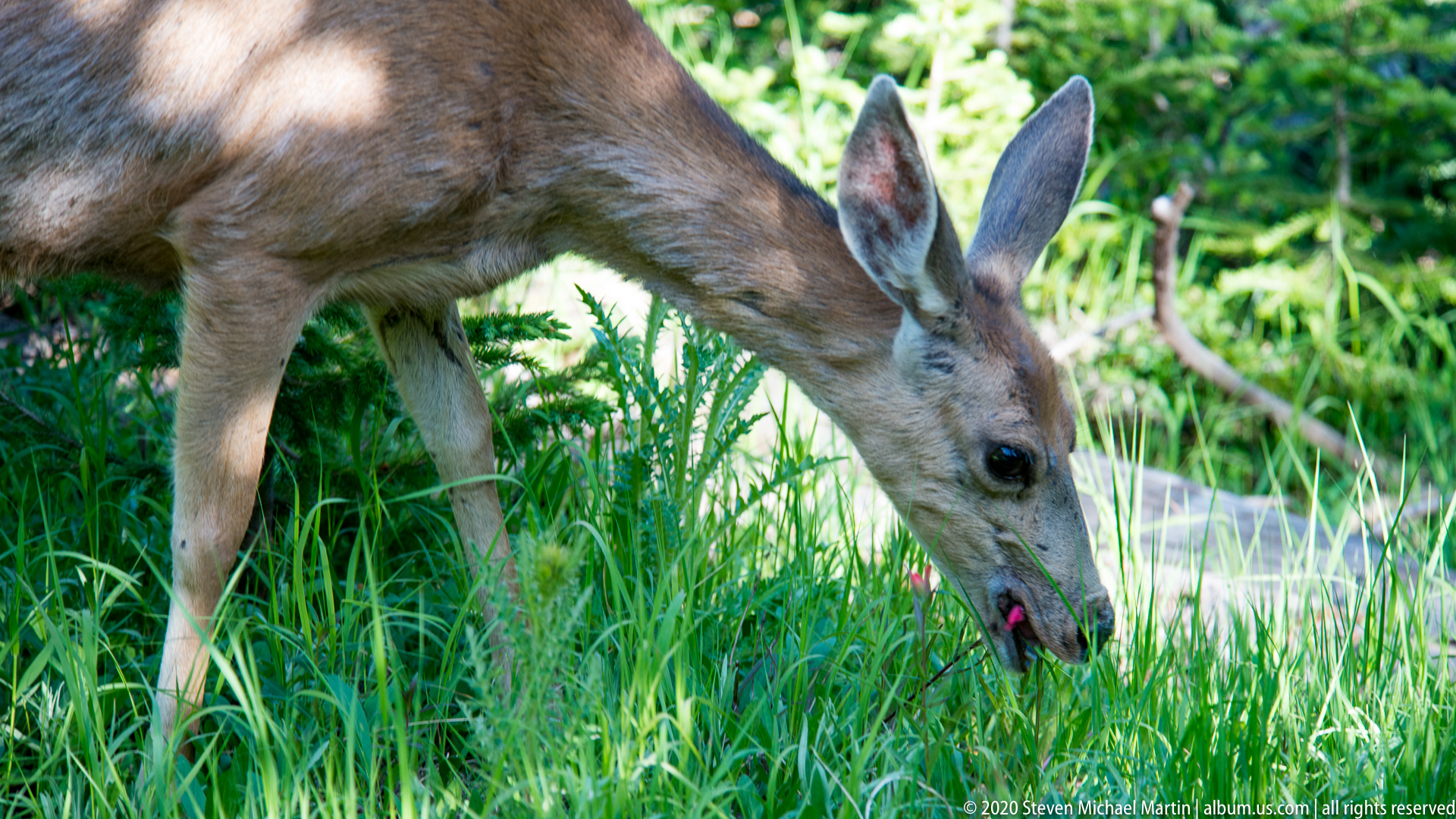
A mule deer lowers her head to graze, cropping green plants with her muzzle while her long ears remain upright. The tight framing includes the animal’s shoulder and forelegs and places the feeding action among dense grass and small leafy plants. Sunlight filters through the vegetation, leaving the background soft and indistinct.
Caption
A mule deer lowers her head to graze, cropping green plants with her muzzle while her long ears remain upright. The tight framing includes the animal’s shoulder and forelegs and places the feeding action among dense grass and small leafy plants. Sunlight filters through the vegetation, leaving the background soft and indistinct.
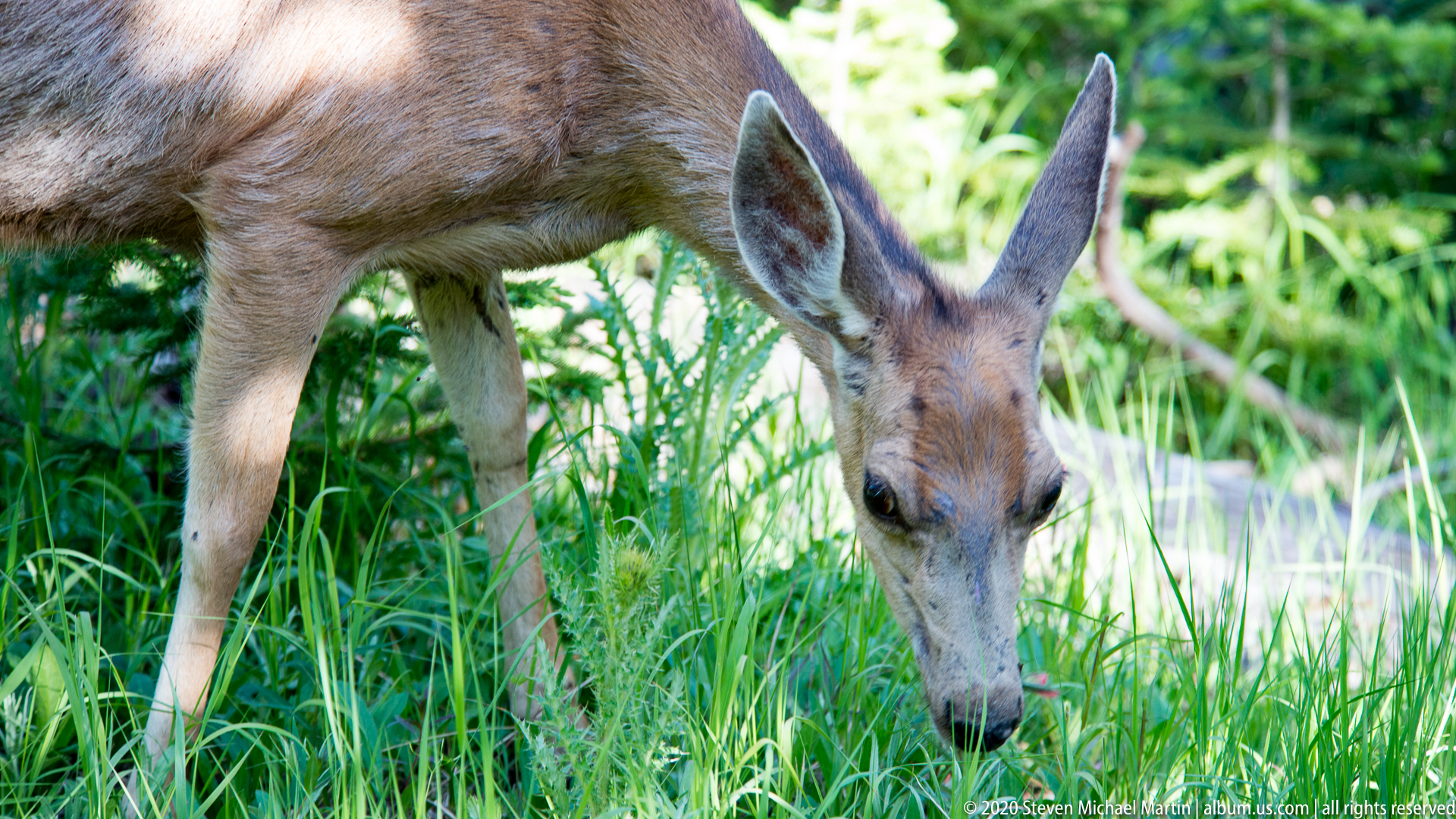
The deer’s head fills the frame as she browses, nose lowered into green grass and ears angled outward. Her reddish coat and pale inner ears contrast with the soft foliage behind. Only part of her body is visible, making the feeding behavior and facial details the focus rather than the surrounding meadow.
Caption
The deer’s head fills the frame as she browses, nose lowered into green grass and ears angled outward. Her reddish coat and pale inner ears contrast with the soft foliage behind. Only part of her body is visible, making the feeding behavior and facial details the focus rather than the surrounding meadow.
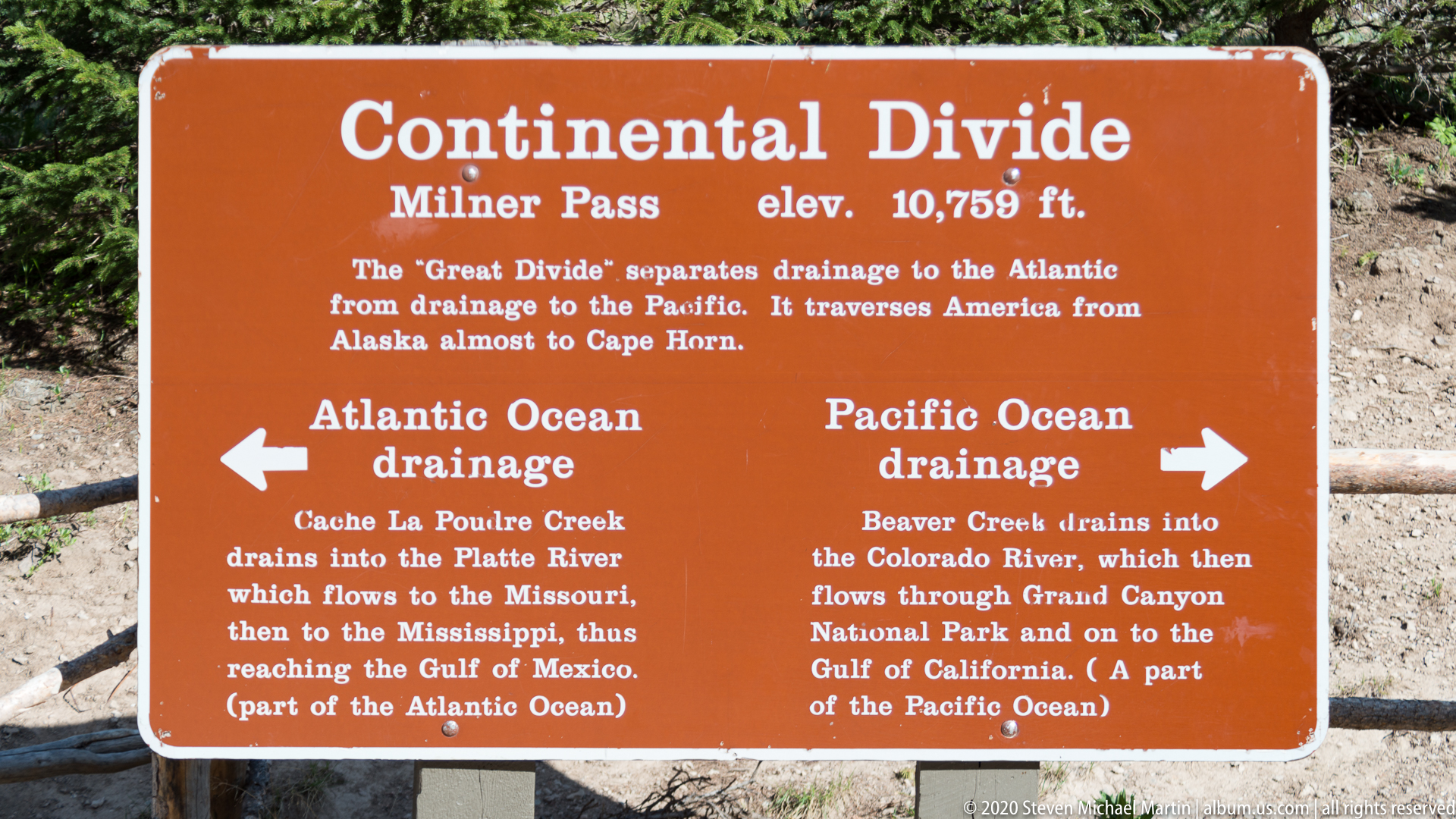
An orange-brown interpretive sign identifies the Continental Divide at Milner Pass, elevation 10,759 feet. Its text explains that the divide separates Atlantic and Pacific drainage, with arrows and paragraphs describing nearby watersheds. A low wooden rail and forest vegetation frame the panel, whose explanatory lettering occupies nearly the entire image.
Caption
An orange-brown interpretive sign identifies the Continental Divide at Milner Pass, elevation 10,759 feet. Its text explains that the divide separates Atlantic and Pacific drainage, with arrows and paragraphs describing nearby watersheds. A low wooden rail and forest vegetation frame the panel, whose explanatory lettering occupies nearly the entire image.
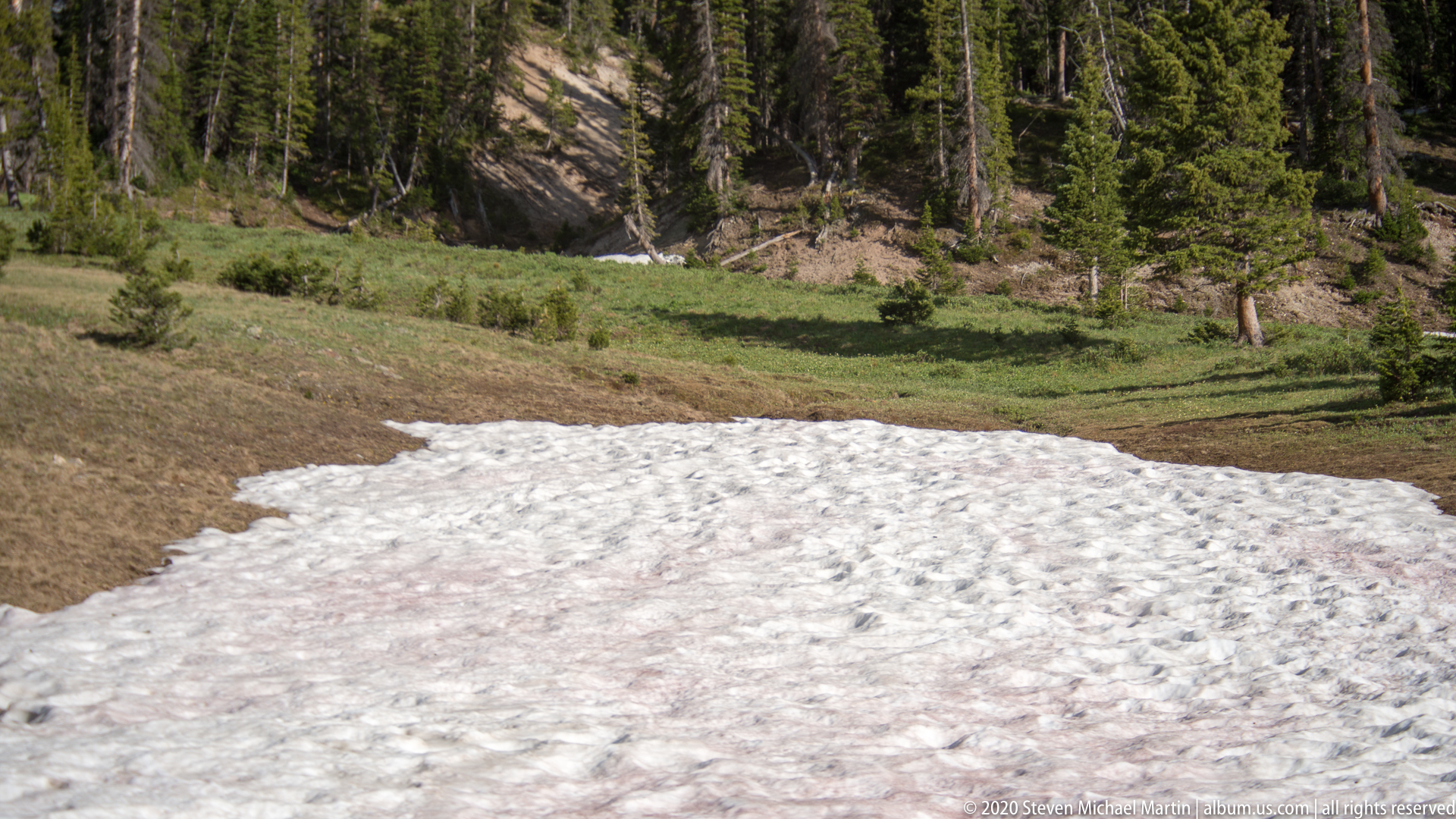
A broad, irregular snowbank remains across a shallow meadow basin, its uneven surface marked by small depressions and scattered debris. Green grass and shrubs edge the melting snow, with conifers rising beyond the open clearing. The close view shows the contrast between the late-season snow and the surrounding thawed ground.
Caption
A broad, irregular snowbank remains across a shallow meadow basin, its uneven surface marked by small depressions and scattered debris. Green grass and shrubs edge the melting snow, with conifers rising beyond the open clearing. The close view shows the contrast between the late-season snow and the surrounding thawed ground.
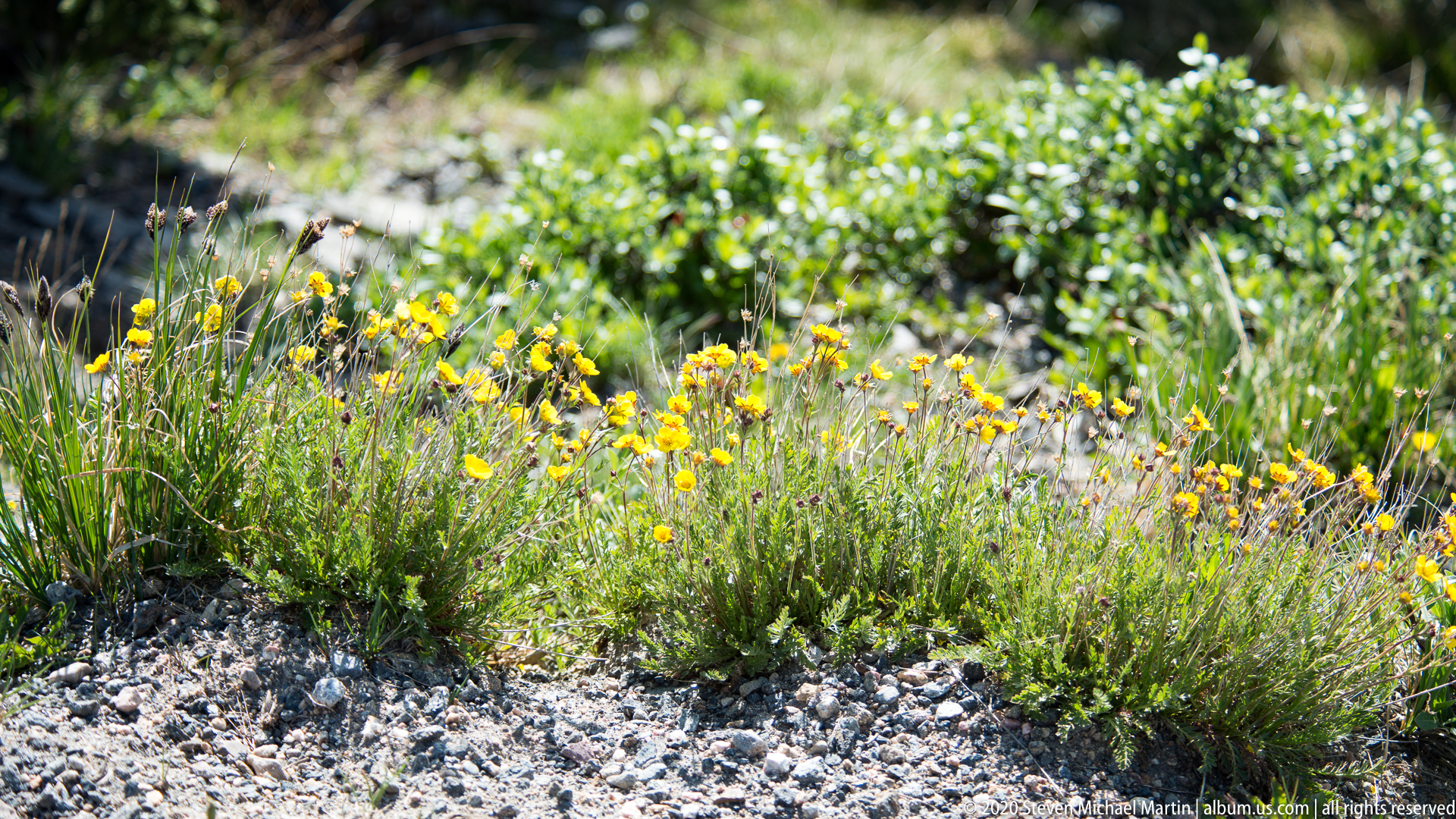
A dense patch of small yellow flowers grows among thin grass stems and low leafy plants on a pale, gravelly slope. Some blooms catch direct sunlight while the background falls softly out of focus. The composition isolates a ground-level flowering patch and its stony substrate without providing diagnostic details for naming the plant species.
Caption
A dense patch of small yellow flowers grows among thin grass stems and low leafy plants on a pale, gravelly slope. Some blooms catch direct sunlight while the background falls softly out of focus. The composition isolates a ground-level flowering patch and its stony substrate without providing diagnostic details for naming the plant species.
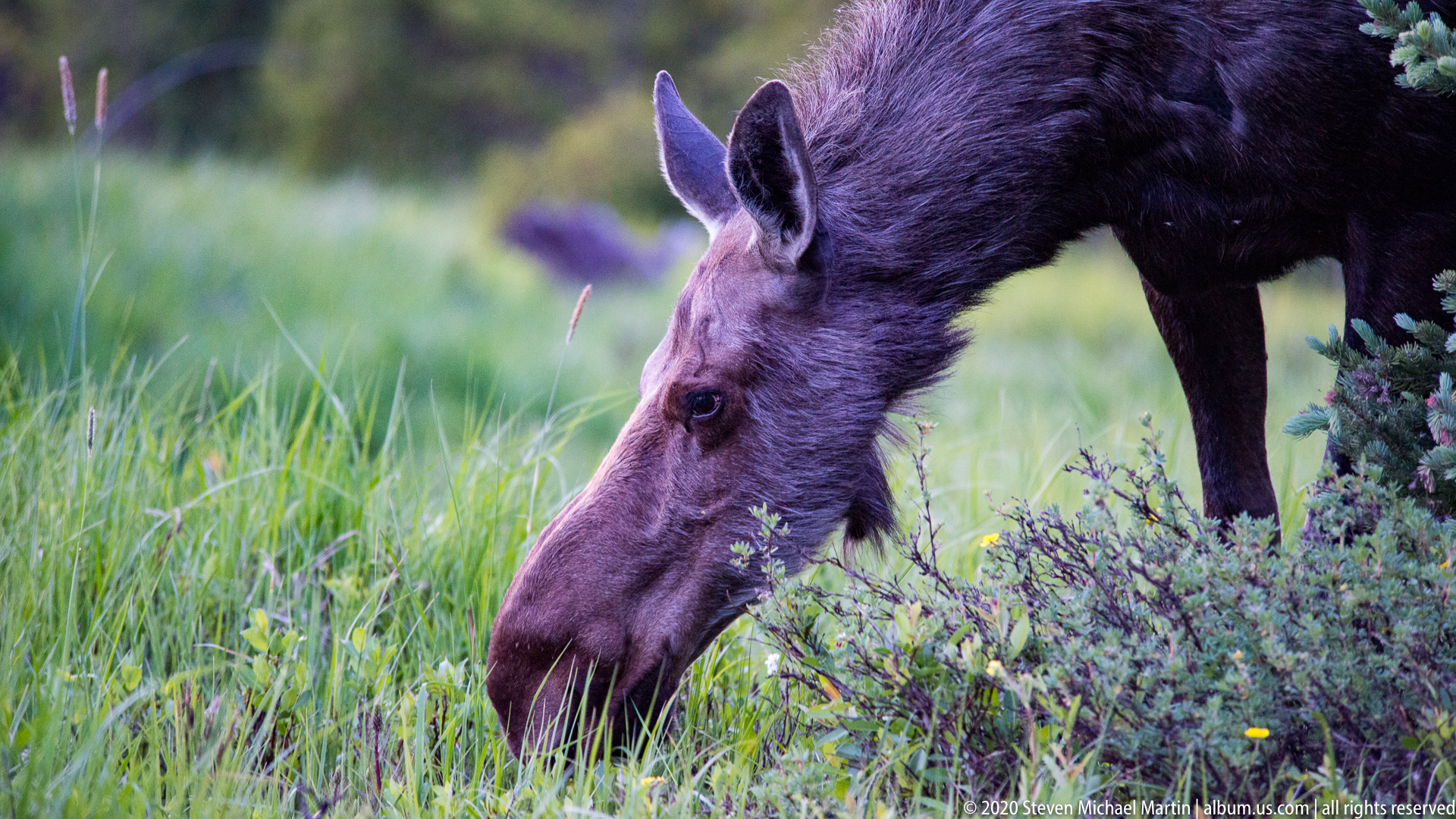
A cow moose bends her long muzzle into a patch of green grass and shrubs, feeding with her ears upright. Her dark brown shoulder fills the upper right of the frame, while delicate meadow plants surround her face. The shallow focus and close crop emphasize the animal’s elongated head and active browsing.
Caption
A cow moose bends her long muzzle into a patch of green grass and shrubs, feeding with her ears upright. Her dark brown shoulder fills the upper right of the frame, while delicate meadow plants surround her face. The shallow focus and close crop emphasize the animal’s elongated head and active browsing.

The moose’s head and neck enter from the right as she reaches down to browse, her long muzzle nearly touching the grass. Coarse dark fur, a large ear and the slope of her shoulder remain sharply visible against a blurred green background. This close profile emphasizes the anatomy and feeding motion more than the surrounding habitat.
Caption
The moose’s head and neck enter from the right as she reaches down to browse, her long muzzle nearly touching the grass. Coarse dark fur, a large ear and the slope of her shoulder remain sharply visible against a blurred green background. This close profile emphasizes the anatomy and feeding motion more than the surrounding habitat.
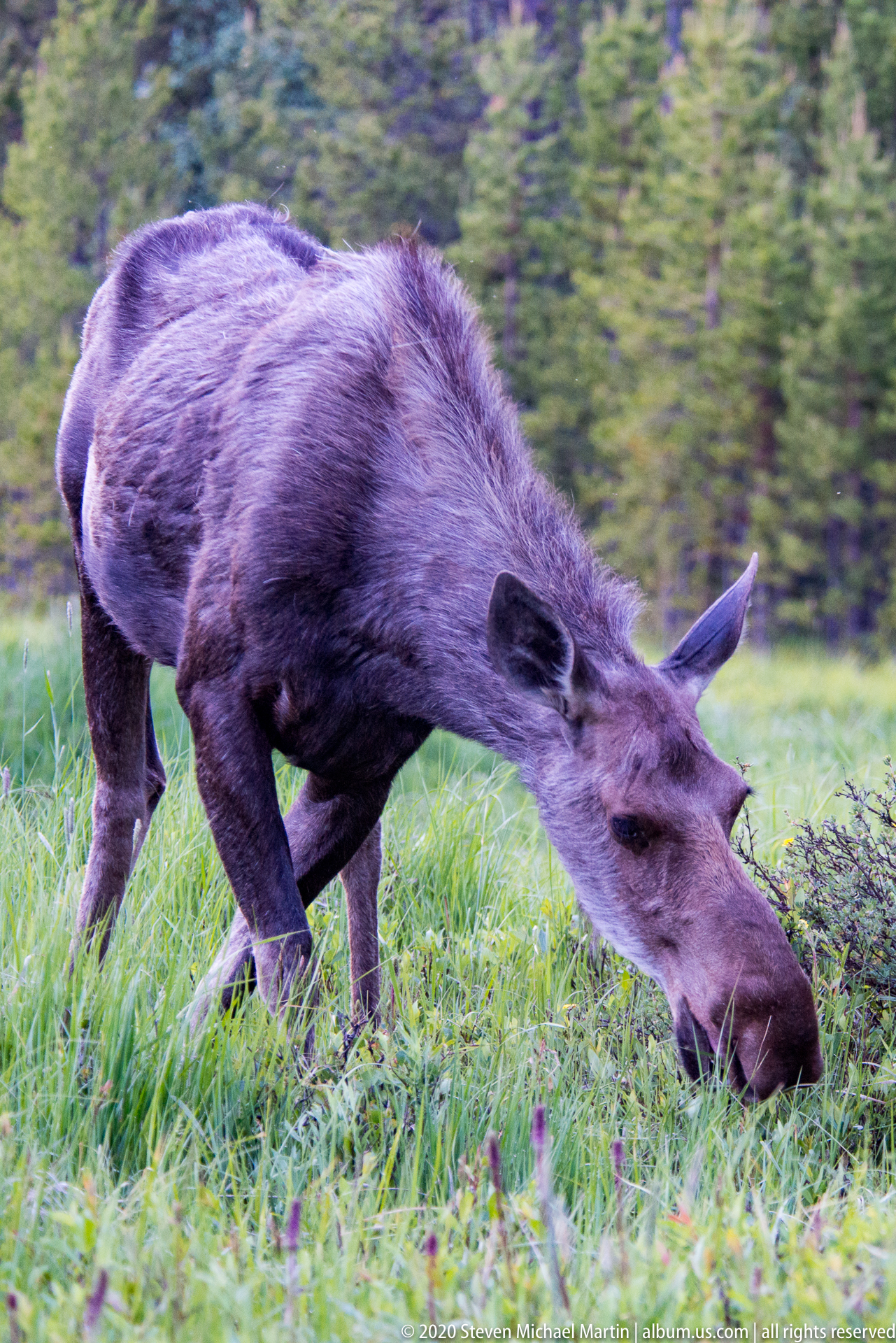
The moose stretches her neck forward and down as she browses through a patch of grass, one foreleg advanced mid-step. Her broad body and long muzzle fill the frame, while a blurred forest edge provides a soft green background. The lateral composition records both feeding and movement through the clearing.
Caption
The moose stretches her neck forward and down as she browses through a patch of grass, one foreleg advanced mid-step. Her broad body and long muzzle fill the frame, while a blurred forest edge provides a soft green background. The lateral composition records both feeding and movement through the clearing.
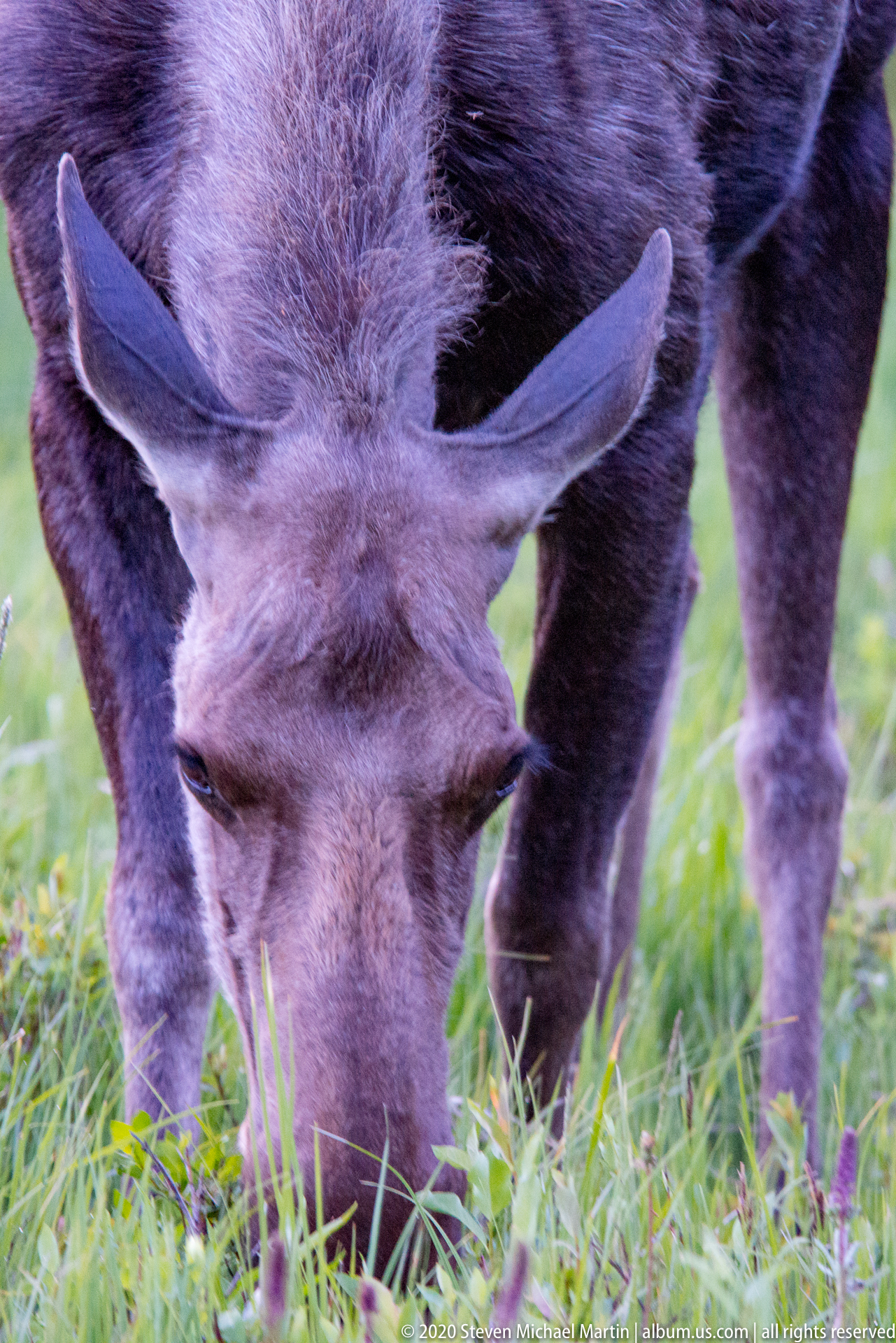
The moose lowers her broad muzzle into the grass, with her ears spread to either side and forelegs visible behind her head. Purple wildflower spikes blur near the bottom edge, adding color to the green meadow. The tight, downward angle focuses on the animal’s face and the plants she is cropping.
Caption
The moose lowers her broad muzzle into the grass, with her ears spread to either side and forelegs visible behind her head. Purple wildflower spikes blur near the bottom edge, adding color to the green meadow. The tight, downward angle focuses on the animal’s face and the plants she is cropping.
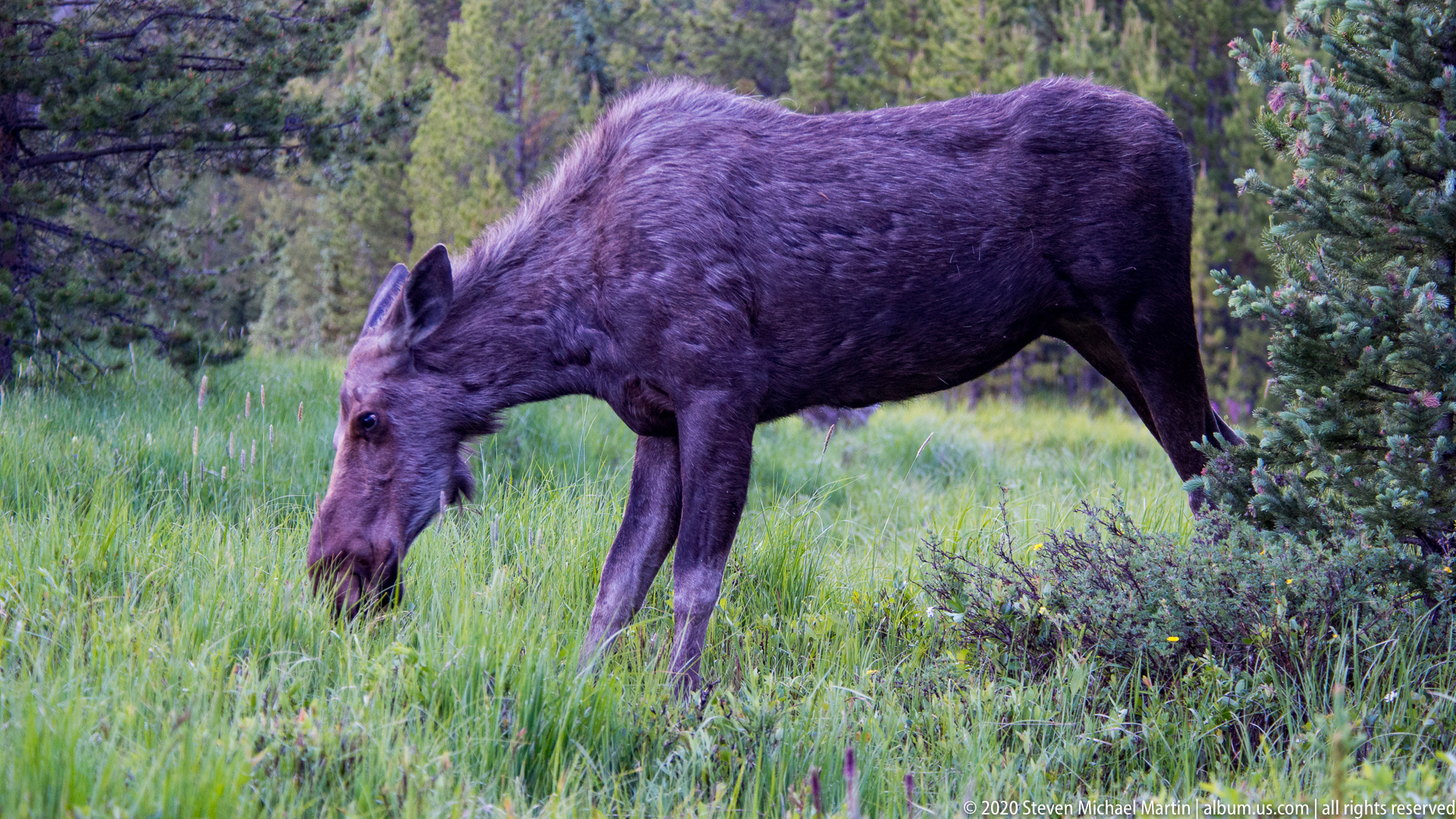
A cow moose stands broadside in a green clearing, head lowered to graze among grass and low shrubs. Her long legs and dark coat are fully visible, while young trees and conifers form a layered background. The wider frame shows the animal’s size and the meadow margin where open forage meets forest cover.
Caption
A cow moose stands broadside in a green clearing, head lowered to graze among grass and low shrubs. Her long legs and dark coat are fully visible, while young trees and conifers form a layered background. The wider frame shows the animal’s size and the meadow margin where open forage meets forest cover.
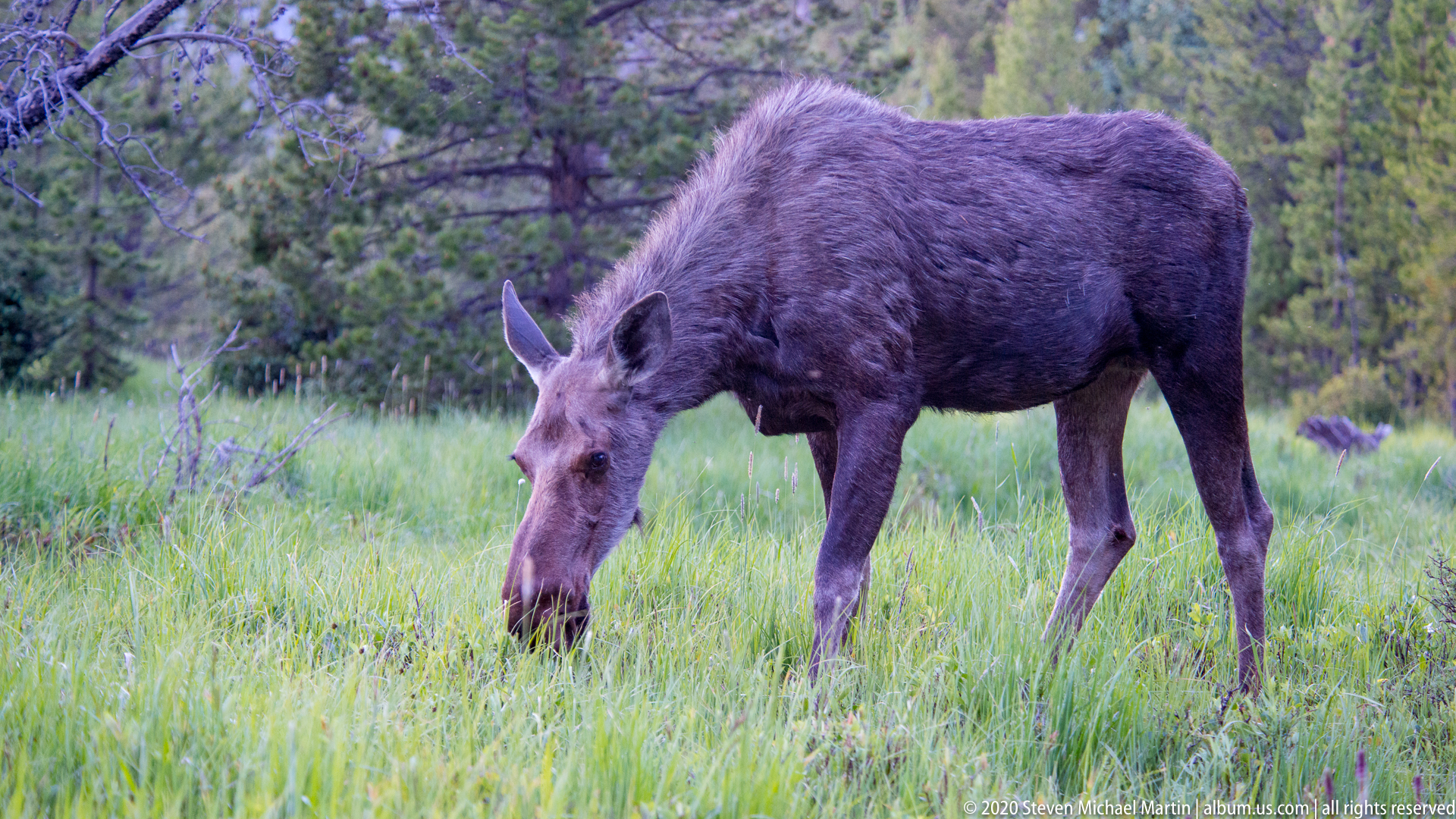
A cow moose grazes in a lush meadow, her long head lowered among tall grass while all four legs remain visible. The dark animal stands against soft green vegetation and a line of conifers, creating a clear contrast between coat and setting. This view shows the full body and steady feeding posture from a slight side angle.
Caption
A cow moose grazes in a lush meadow, her long head lowered among tall grass while all four legs remain visible. The dark animal stands against soft green vegetation and a line of conifers, creating a clear contrast between coat and setting. This view shows the full body and steady feeding posture from a slight side angle.
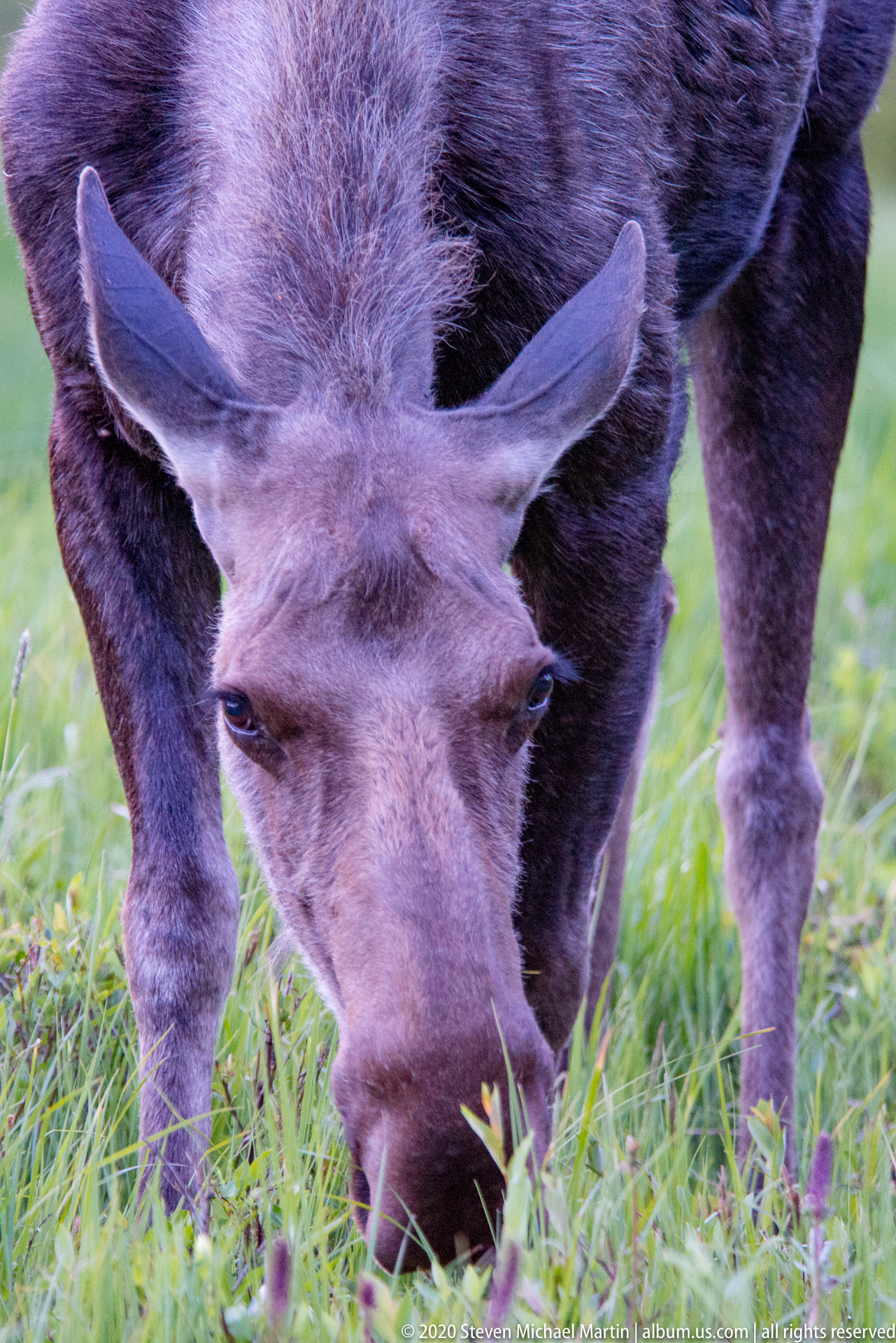
The moose’s face fills the foreground as she feeds, her dark muzzle pressed into leafy vegetation and her eyes visible beneath a heavy brow. Large ears extend outward, while the front legs and chest rise behind her head. The close perspective reveals facial detail and browsing posture against a softly blurred meadow.
Caption
The moose’s face fills the foreground as she feeds, her dark muzzle pressed into leafy vegetation and her eyes visible beneath a heavy brow. Large ears extend outward, while the front legs and chest rise behind her head. The close perspective reveals facial detail and browsing posture against a softly blurred meadow.
A young moose moves to the right through the grass as the adult’s head reaches across above it. The calf’s extended legs and slight motion blur give the frame a sense of movement that contrasts with the still portraits on the page. Their close spacing keeps the pair connected, though the image alone does not establish whether they are playing or simply changing position.
Caption
A young moose moves to the right through the grass as the adult’s head reaches across above it. The calf’s extended legs and slight motion blur give the frame a sense of movement that contrasts with the still portraits on the page. Their close spacing keeps the pair connected, though the image alone does not establish whether they are playing or simply changing position.
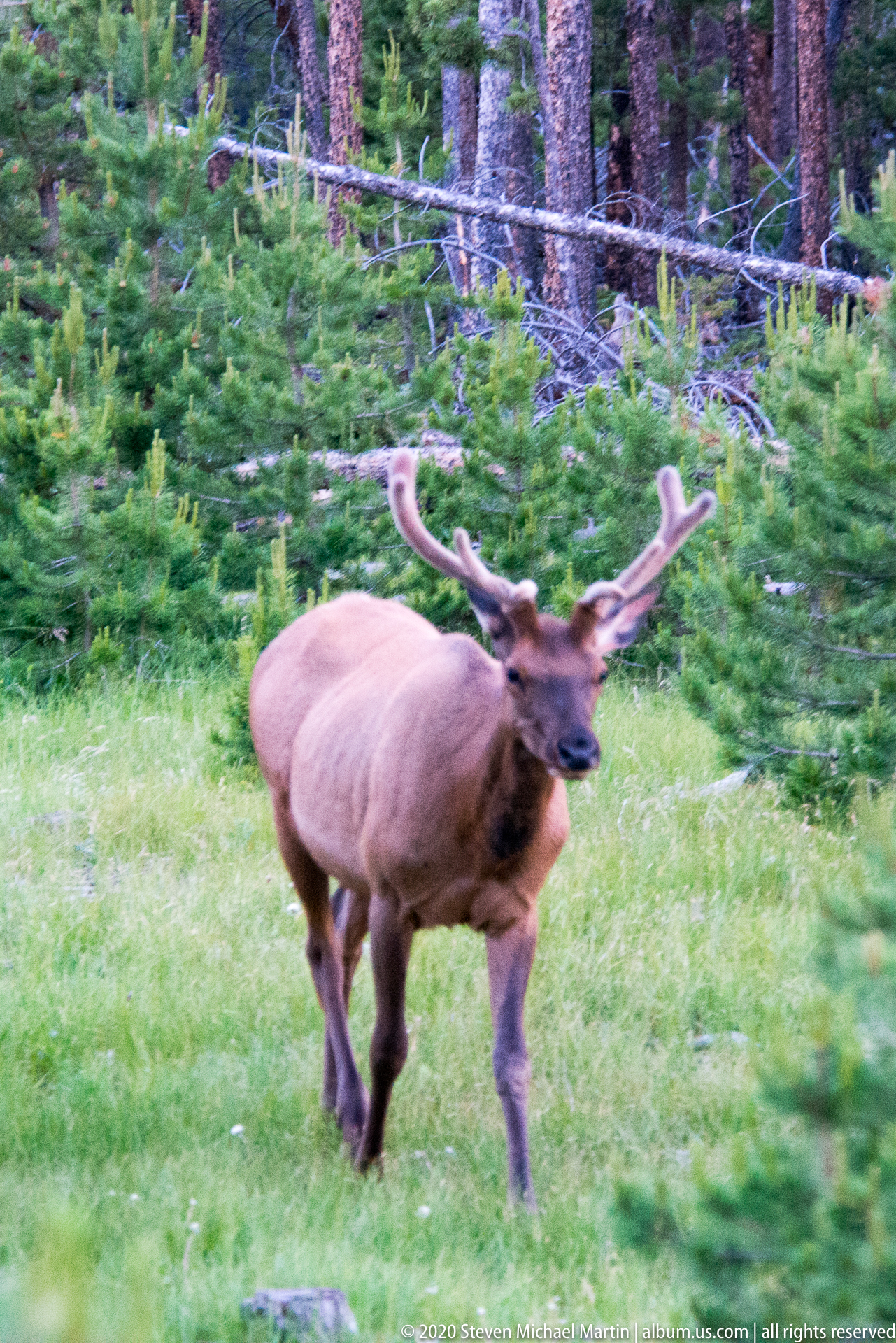
A bull elk strides across a green meadow, its body angled left and branching antlers sweeping outward above the head. Slight blur in the legs and background suggests movement, while the forest edge remains visible behind it. This dynamic frame differs from the still portraits on the page by showing the elk in motion across the clearing.
Caption
A bull elk strides across a green meadow, its body angled left and branching antlers sweeping outward above the head. Slight blur in the legs and background suggests movement, while the forest edge remains visible behind it. This dynamic frame differs from the still portraits on the page by showing the elk in motion across the clearing.
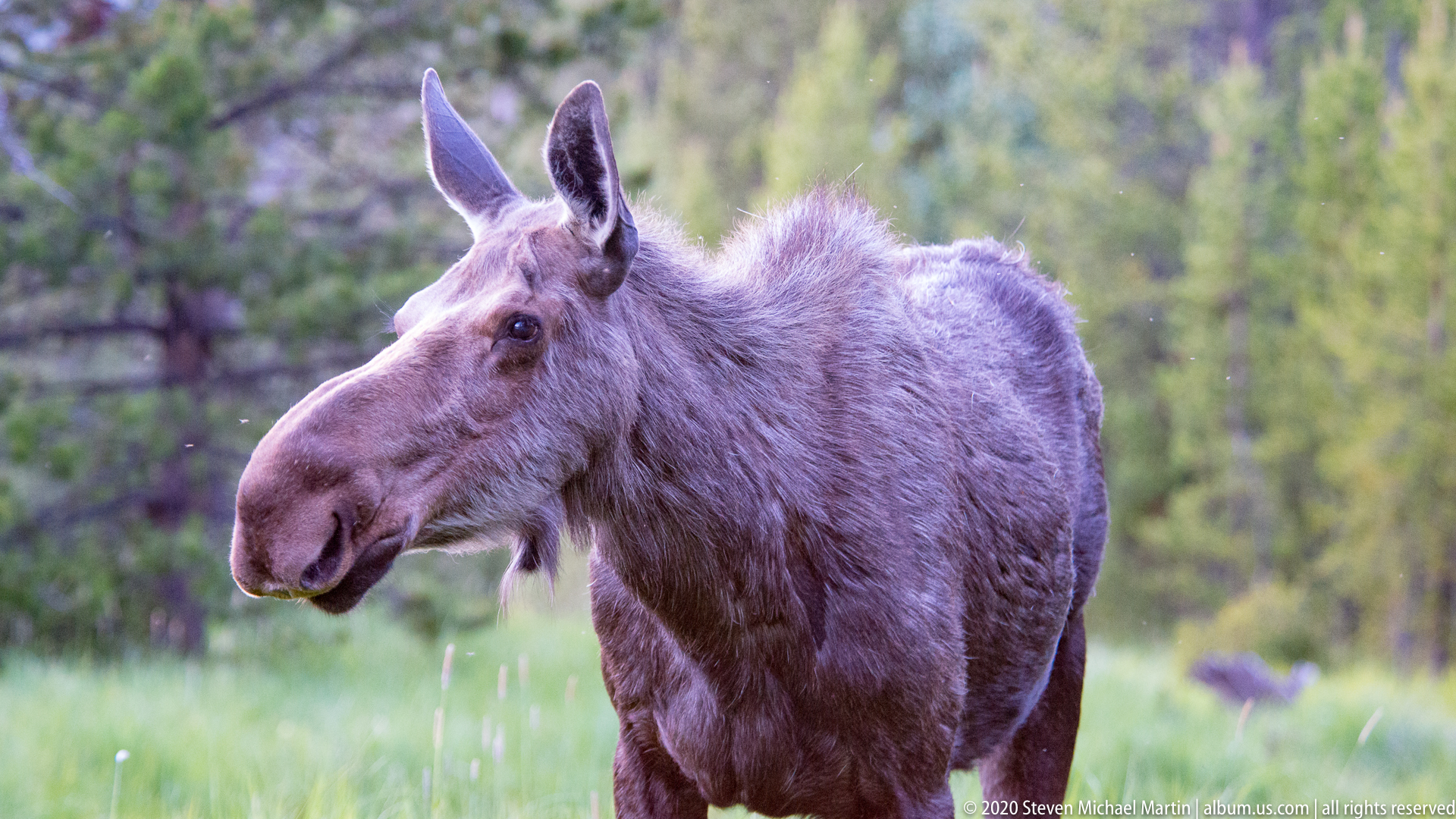
A cow moose pauses in a green clearing, her head turned slightly left and ears raised while her body faces forward. The close framing includes her dark shoulder and long face against softly blurred conifers and grass. She appears alert between bites, creating a distinct portrait rather than the feeding close-ups surrounding it.
Caption
A cow moose pauses in a green clearing, her head turned slightly left and ears raised while her body faces forward. The close framing includes her dark shoulder and long face against softly blurred conifers and grass. She appears alert between bites, creating a distinct portrait rather than the feeding close-ups surrounding it.
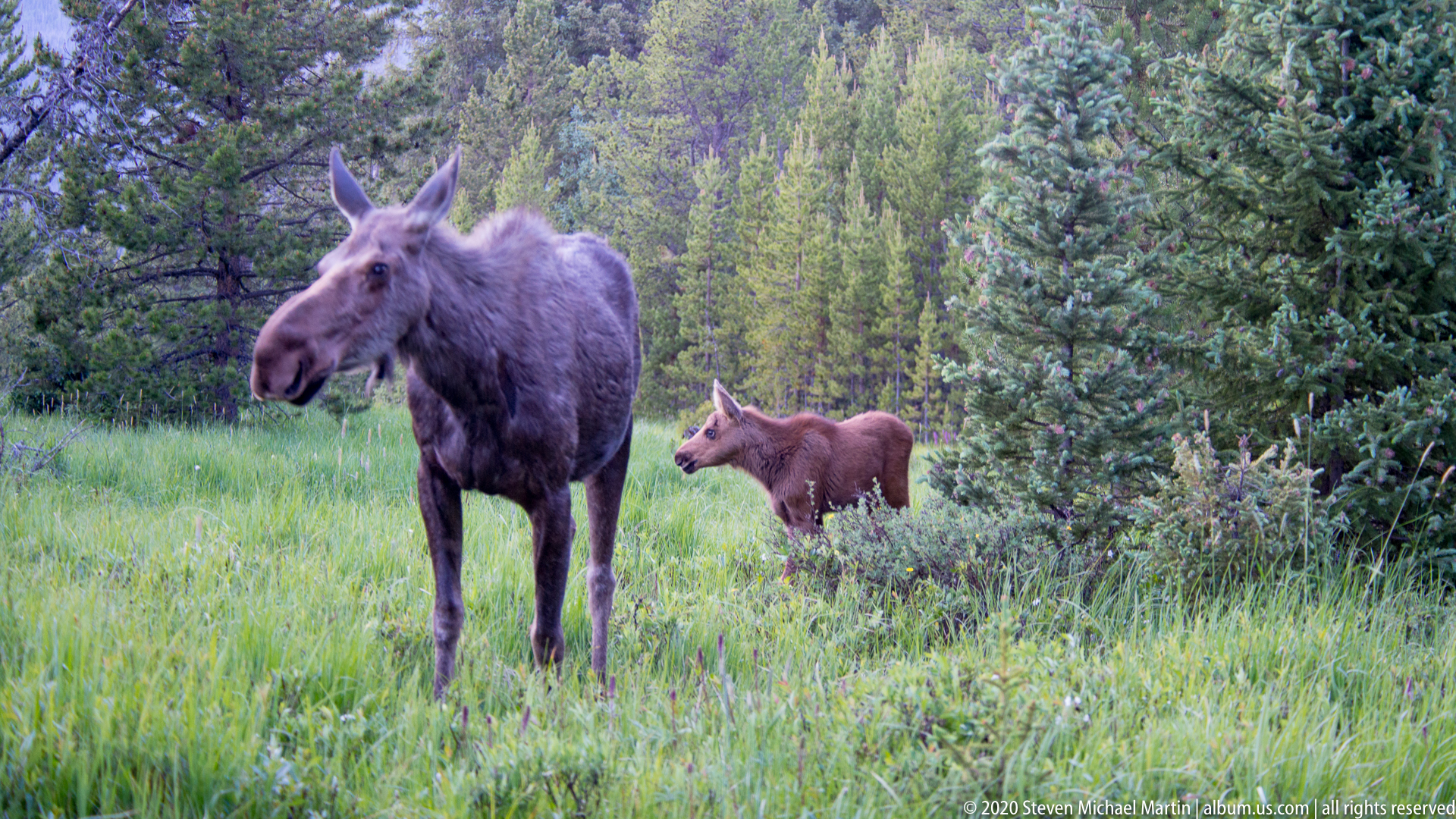
A large cow moose stands in tall grass beside a smaller reddish calf, both oriented toward the left. The adult’s dark coat contrasts with the calf’s lighter, compact body, while shrubs and conifers enclose the clearing. The pair’s different sizes and close spacing make the adult-young relationship visible in this wider view.
Caption
A large cow moose stands in tall grass beside a smaller reddish calf, both oriented toward the left. The adult’s dark coat contrasts with the calf’s lighter, compact body, while shrubs and conifers enclose the clearing. The pair’s different sizes and close spacing make the adult-young relationship visible in this wider view.

A cow moose stands in the foreground while her smaller calf lowers its head to feed behind her. Both animals occupy a green meadow bordered by dense conifers, and the adult’s dark coat contrasts with the calf’s reddish-brown fur. The staggered placement gives a clear view of their different sizes and shared feeding ground.
Caption
A cow moose stands in the foreground while her smaller calf lowers its head to feed behind her. Both animals occupy a green meadow bordered by dense conifers, and the adult’s dark coat contrasts with the calf’s reddish-brown fur. The staggered placement gives a clear view of their different sizes and shared feeding ground.
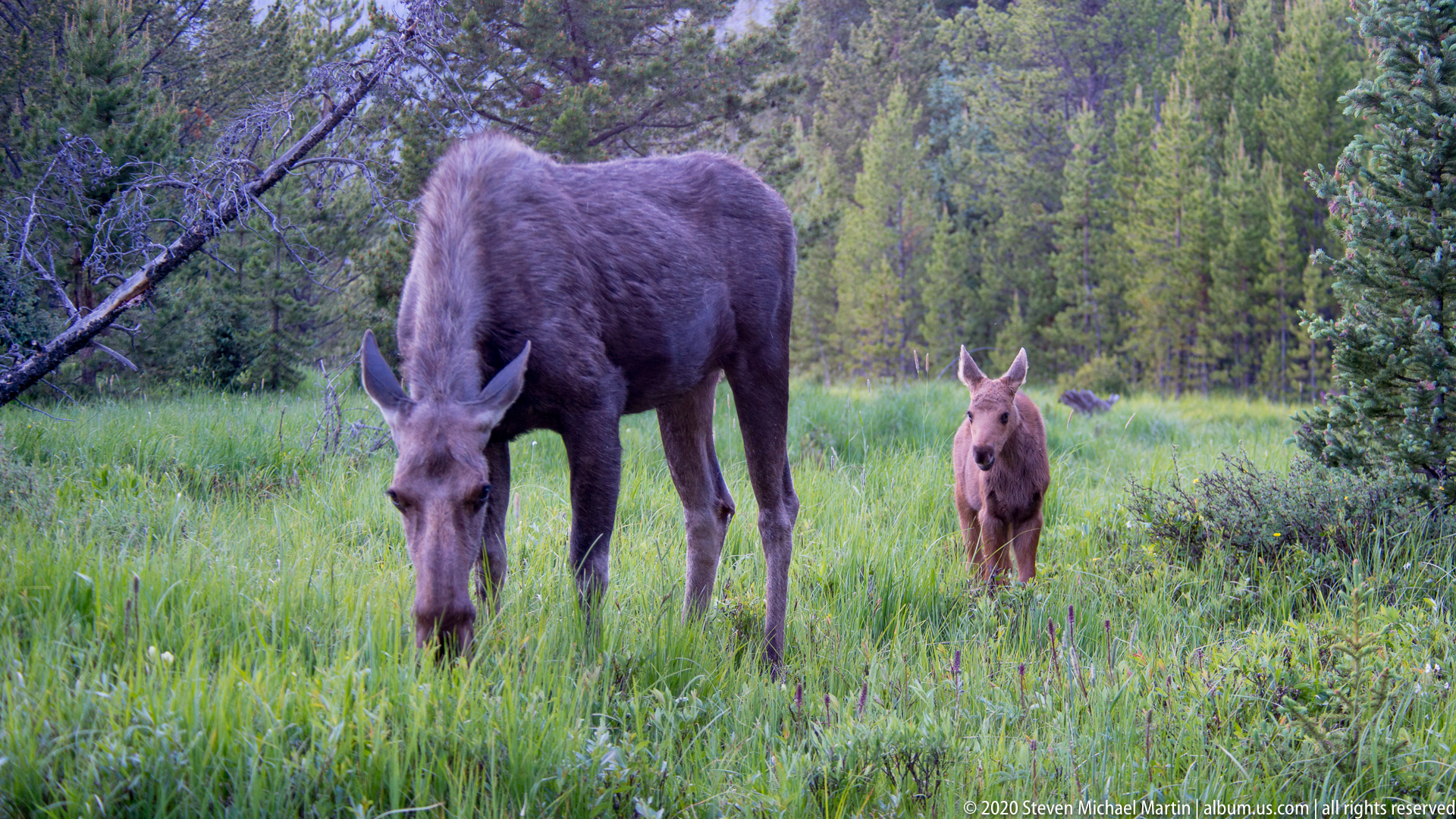
The adult moose feeds with her muzzle in the grass while a calf stands a short distance behind, facing the camera. Tall meadow plants partly conceal their legs, and conifers close in around the clearing. The two animals remain distinct by size and position, showing the calf staying close as the adult grazes.
Caption
The adult moose feeds with her muzzle in the grass while a calf stands a short distance behind, facing the camera. Tall meadow plants partly conceal their legs, and conifers close in around the clearing. The two animals remain distinct by size and position, showing the calf staying close as the adult grazes.
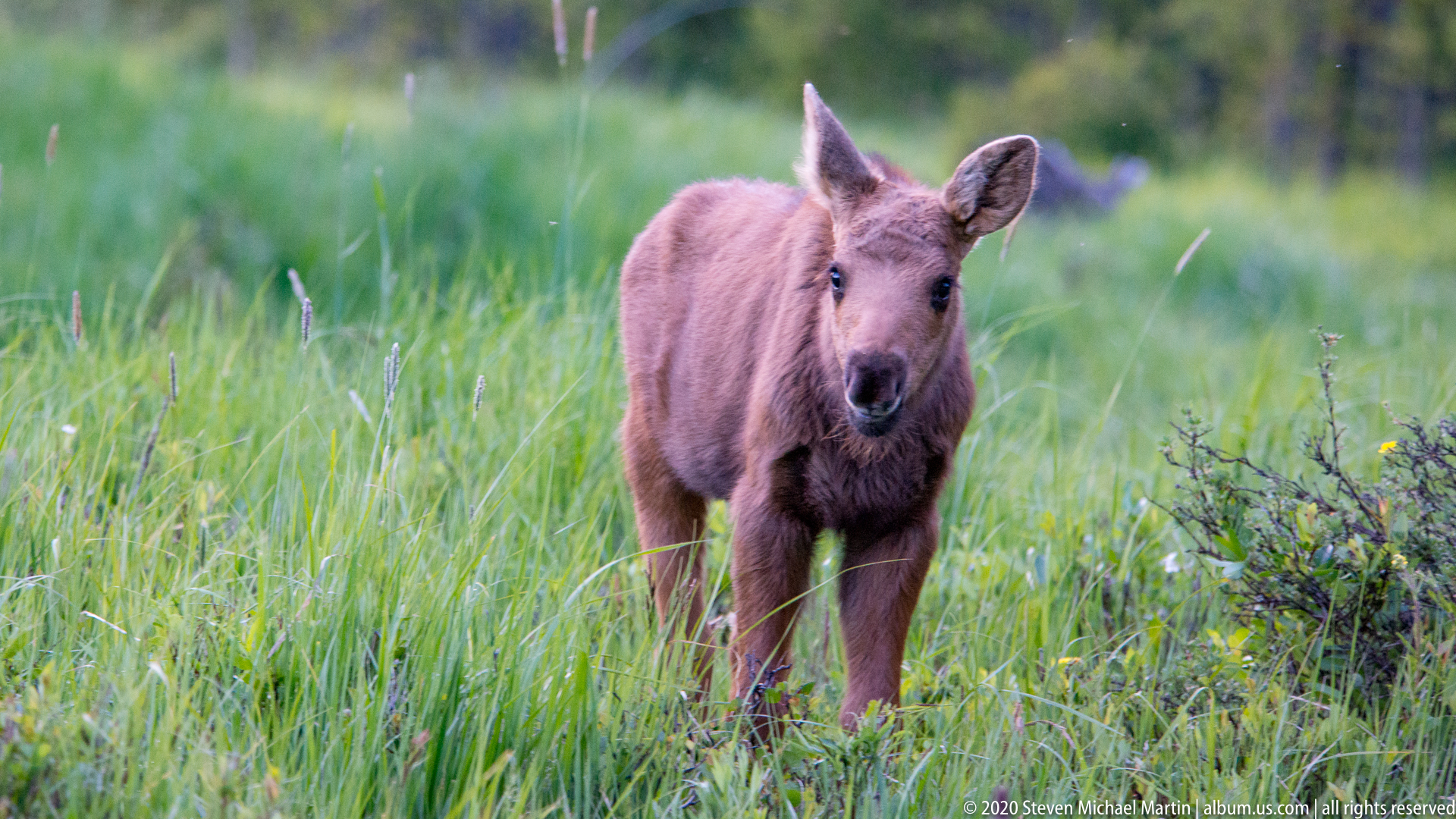
A reddish-brown moose calf stands alone in the foreground, ears upright and gaze directed toward the camera. Its long legs are partly hidden by tall green grass, and the soft background contains shrubs and forest tones. The close framing emphasizes the calf’s small build, pale face and attentive stance.
Caption
A reddish-brown moose calf stands alone in the foreground, ears upright and gaze directed toward the camera. Its long legs are partly hidden by tall green grass, and the soft background contains shrubs and forest tones. The close framing emphasizes the calf’s small build, pale face and attentive stance.
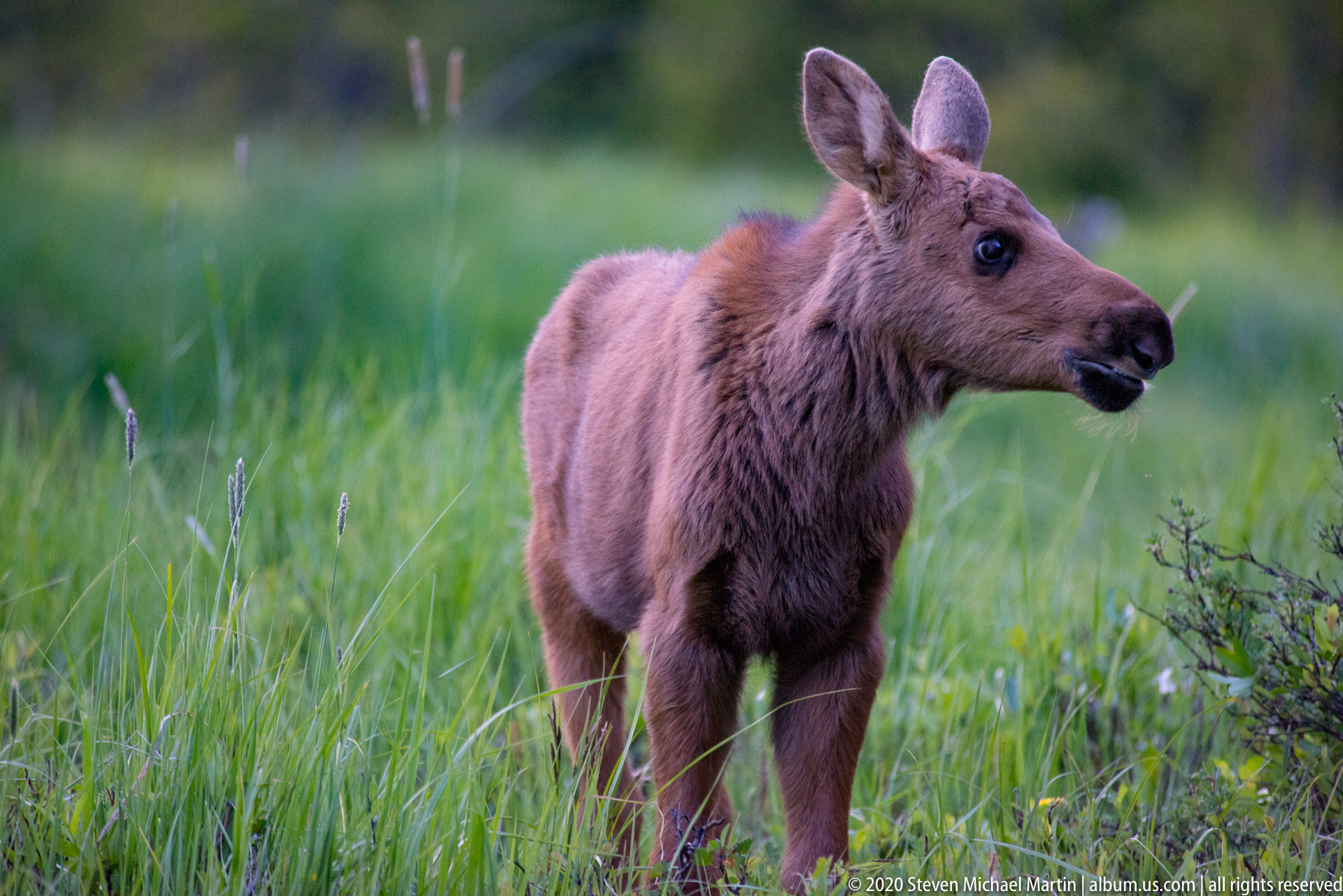
The young moose stands in profile, looking right with ears lifted and mouth slightly open. Its reddish coat and compact frame contrast with the soft green meadow behind. The close crop centers the calf’s head and upper body, making its facial expression and short, soft-looking coat more prominent than the surrounding habitat.
Caption
The young moose stands in profile, looking right with ears lifted and mouth slightly open. Its reddish coat and compact frame contrast with the soft green meadow behind. The close crop centers the calf’s head and upper body, making its facial expression and short, soft-looking coat more prominent than the surrounding habitat.

A young moose fills the frame, its large ears upright and dark eye sharply visible as it looks to the right. The reddish coat and fine fur around the muzzle are clear against the blurred green background. This tighter portrait isolates the calf’s face and shoulder, revealing details not apparent in the wider meadow views.
Caption
A young moose fills the frame, its large ears upright and dark eye sharply visible as it looks to the right. The reddish coat and fine fur around the muzzle are clear against the blurred green background. This tighter portrait isolates the calf’s face and shoulder, revealing details not apparent in the wider meadow views.
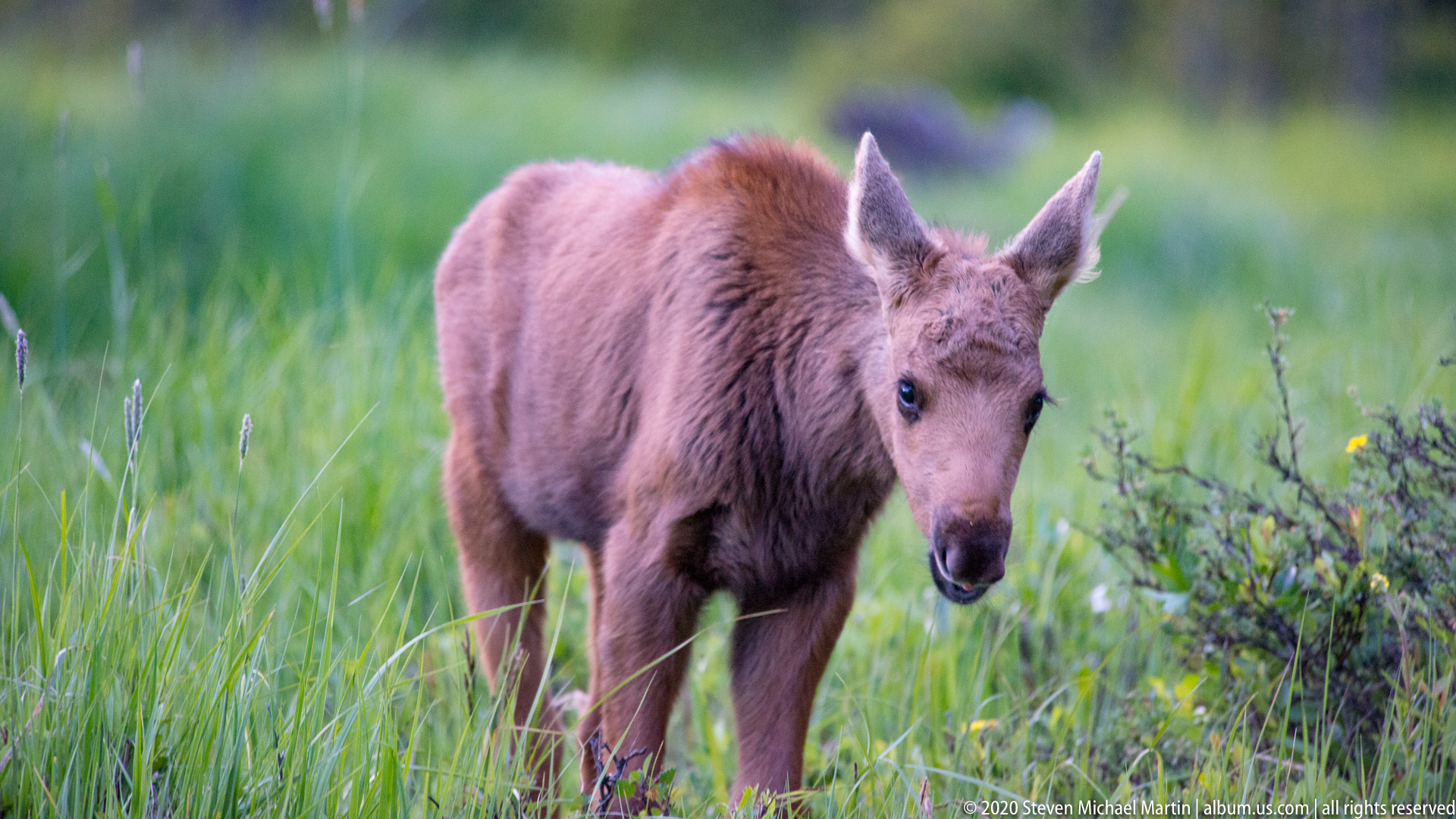
The calf bends its head toward the grass, ears angled outward as it begins to feed. Its reddish body is partly screened by tall plants, and a small shrub crosses the foreground. The soft green background keeps attention on the young animal’s lowered posture and the vegetation it explores.
Caption
The calf bends its head toward the grass, ears angled outward as it begins to feed. Its reddish body is partly screened by tall plants, and a small shrub crosses the foreground. The soft green background keeps attention on the young animal’s lowered posture and the vegetation it explores.

An adult moose and a smaller calf lower their heads to feed in lush meadow grass, their bodies set against dense conifers. The cow’s dark coat and long muzzle contrast with the calf’s warmer brown coloring and shorter legs. Their separate grazing poses make this a quiet family-group view of moose using a forest-edge opening.
Caption
An adult moose and a smaller calf lower their heads to feed in lush meadow grass, their bodies set against dense conifers. The cow’s dark coat and long muzzle contrast with the calf’s warmer brown coloring and shorter legs. Their separate grazing poses make this a quiet family-group view of moose using a forest-edge opening.
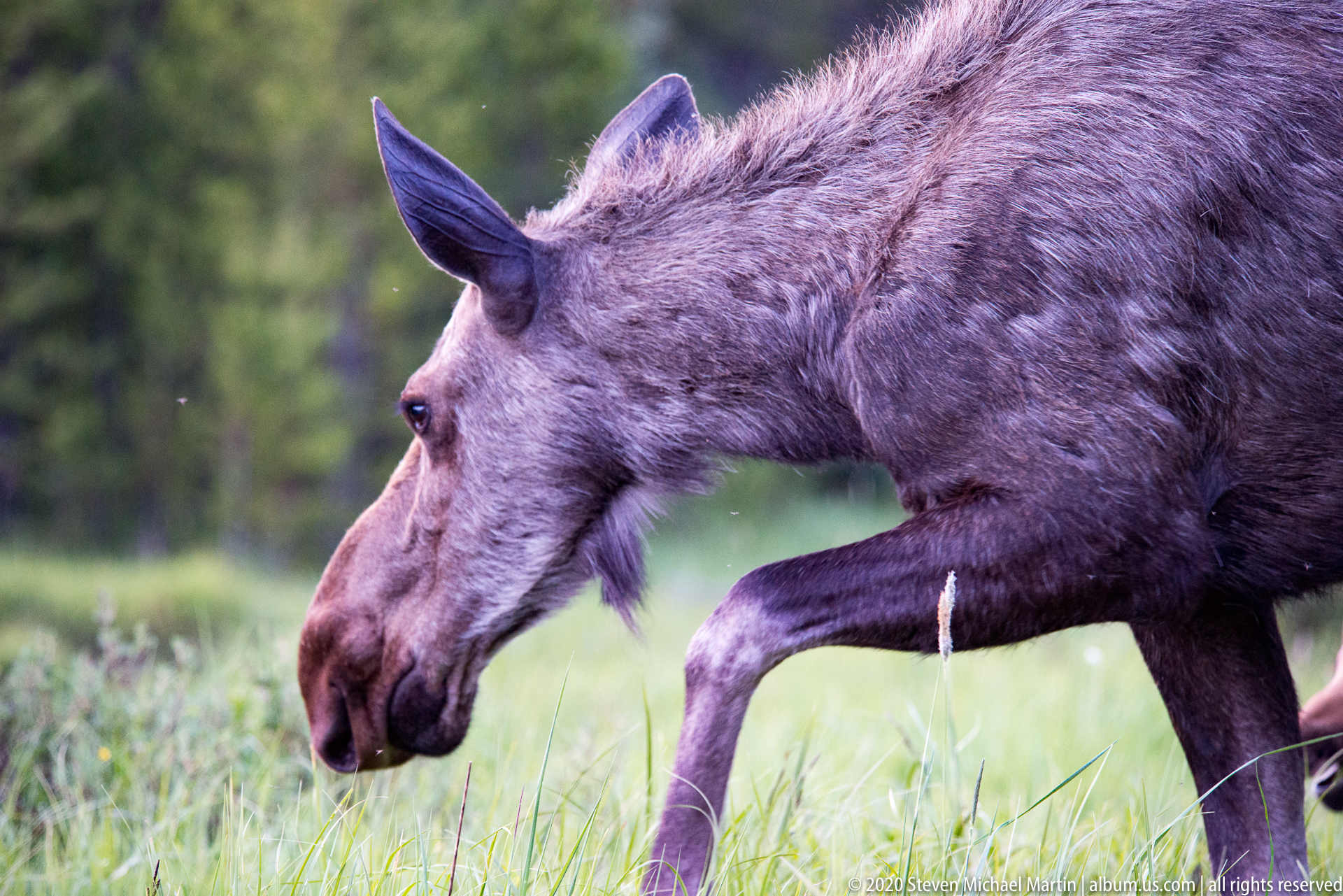
The adult moose fills the frame in a close side view, muzzle angled down as it moves through tall grass. Its long face, broad ears, shaggy shoulder, and extended foreleg are sharply visible, while the green woodland background falls softly out of focus. This crop concentrates on the animal’s distinctive profile and feeding movement rather than the surrounding habitat.
Caption
The adult moose fills the frame in a close side view, muzzle angled down as it moves through tall grass. Its long face, broad ears, shaggy shoulder, and extended foreleg are sharply visible, while the green woodland background falls softly out of focus. This crop concentrates on the animal’s distinctive profile and feeding movement rather than the surrounding habitat.
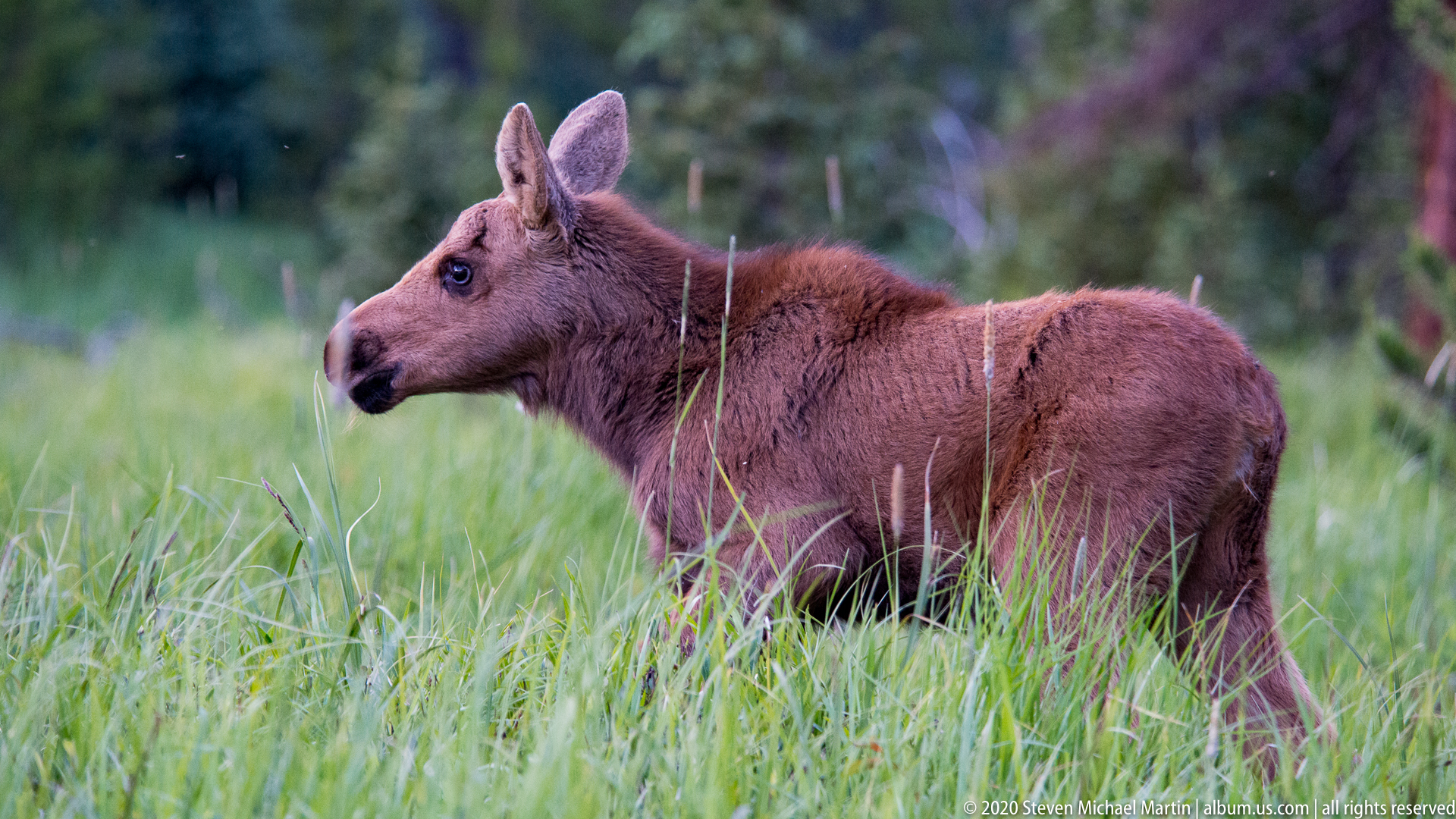
A young moose stands broadside in tall green grass, its reddish-brown coat and oversized ears distinct against a softly shaded woodland. The animal looks left, showing the long face and high shoulders characteristic of a moose while its smaller frame suggests a juvenile. The tight framing keeps attention on its alert stance and emerging adult proportions.
Caption
A young moose stands broadside in tall green grass, its reddish-brown coat and oversized ears distinct against a softly shaded woodland. The animal looks left, showing the long face and high shoulders characteristic of a moose while its smaller frame suggests a juvenile. The tight framing keeps attention on its alert stance and emerging adult proportions.
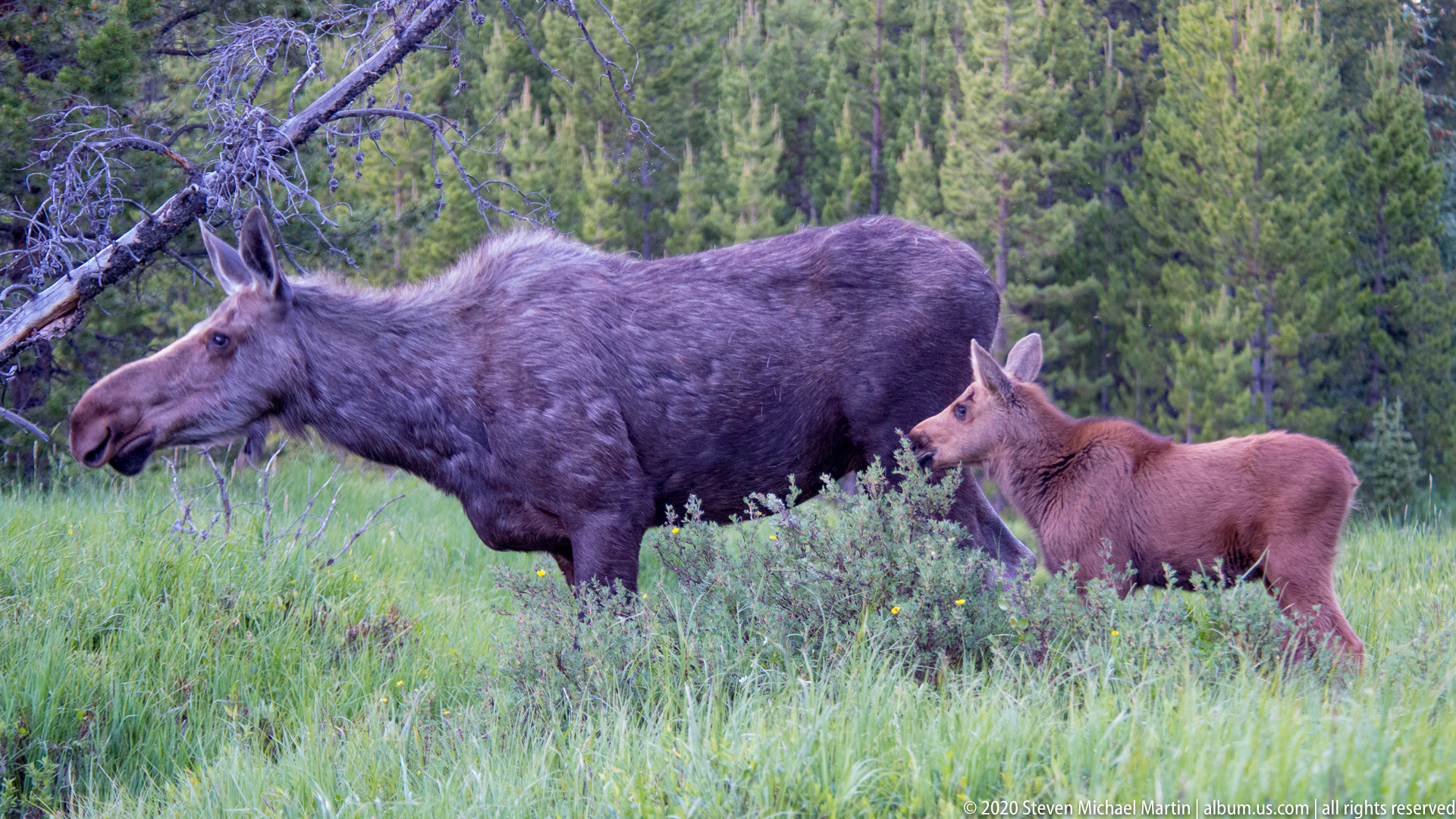
A large cow moose stands beside her calf among low shrubs and meadow grass, with the calf close to her shoulder. Their different sizes and coats are clear in the side-on composition, while pine trunks and dense greenery form a textured backdrop. The pair’s proximity, rather than a single animal’s portrait, defines this view of moose family life.
Caption
A large cow moose stands beside her calf among low shrubs and meadow grass, with the calf close to her shoulder. Their different sizes and coats are clear in the side-on composition, while pine trunks and dense greenery form a textured backdrop. The pair’s proximity, rather than a single animal’s portrait, defines this view of moose family life.
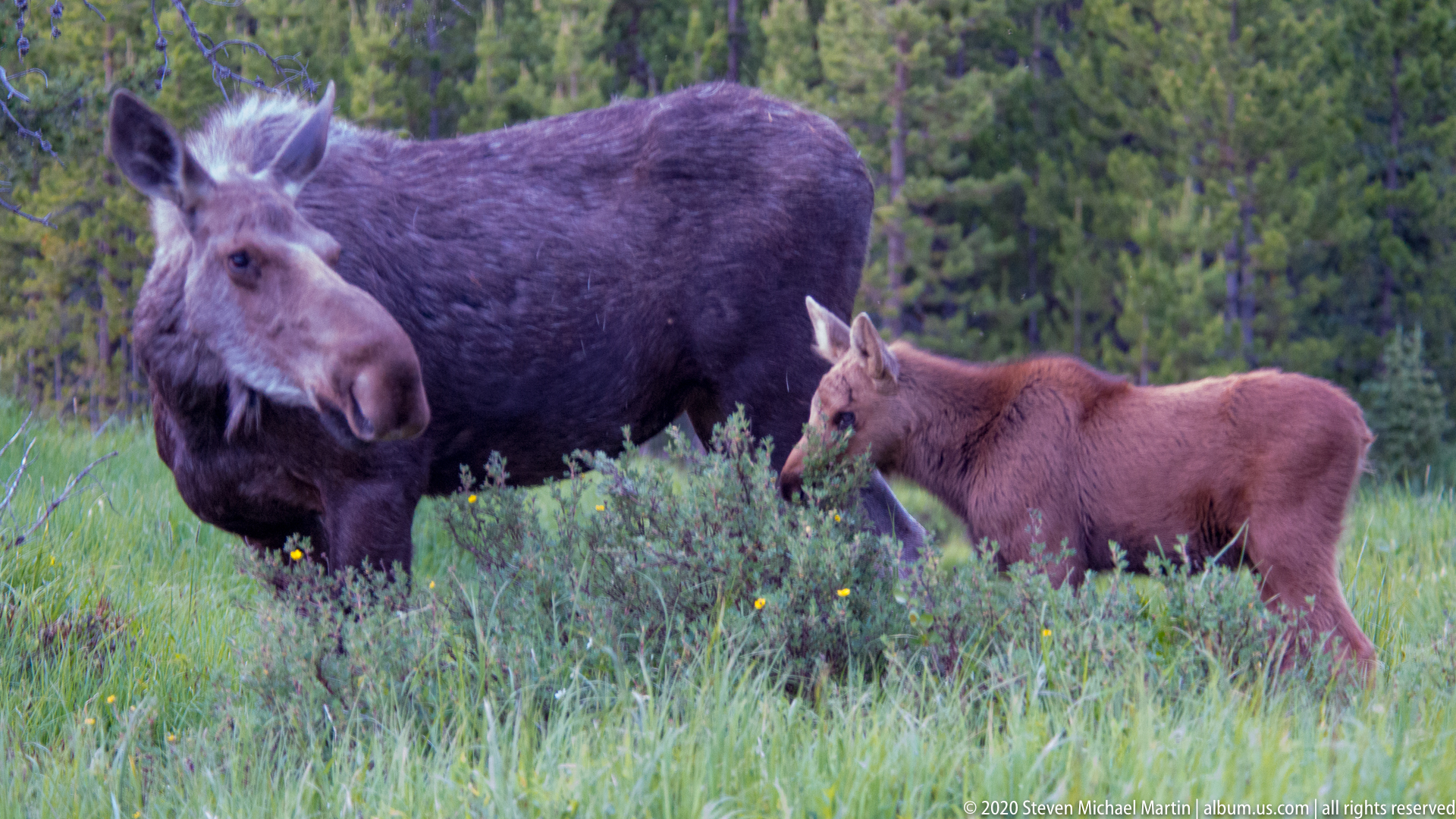
The cow turns partly toward the camera while her calf stands beside her, its head angled toward the adult. Their paired bodies fill the meadow foreground, with grasses and scattered yellow flowers below and dark conifers behind. The cow’s direct, watchful posture distinguishes this frame from the side-on pair nearby and makes the relationship between the two animals especially clear.
Caption
The cow turns partly toward the camera while her calf stands beside her, its head angled toward the adult. Their paired bodies fill the meadow foreground, with grasses and scattered yellow flowers below and dark conifers behind. The cow’s direct, watchful posture distinguishes this frame from the side-on pair nearby and makes the relationship between the two animals especially clear.
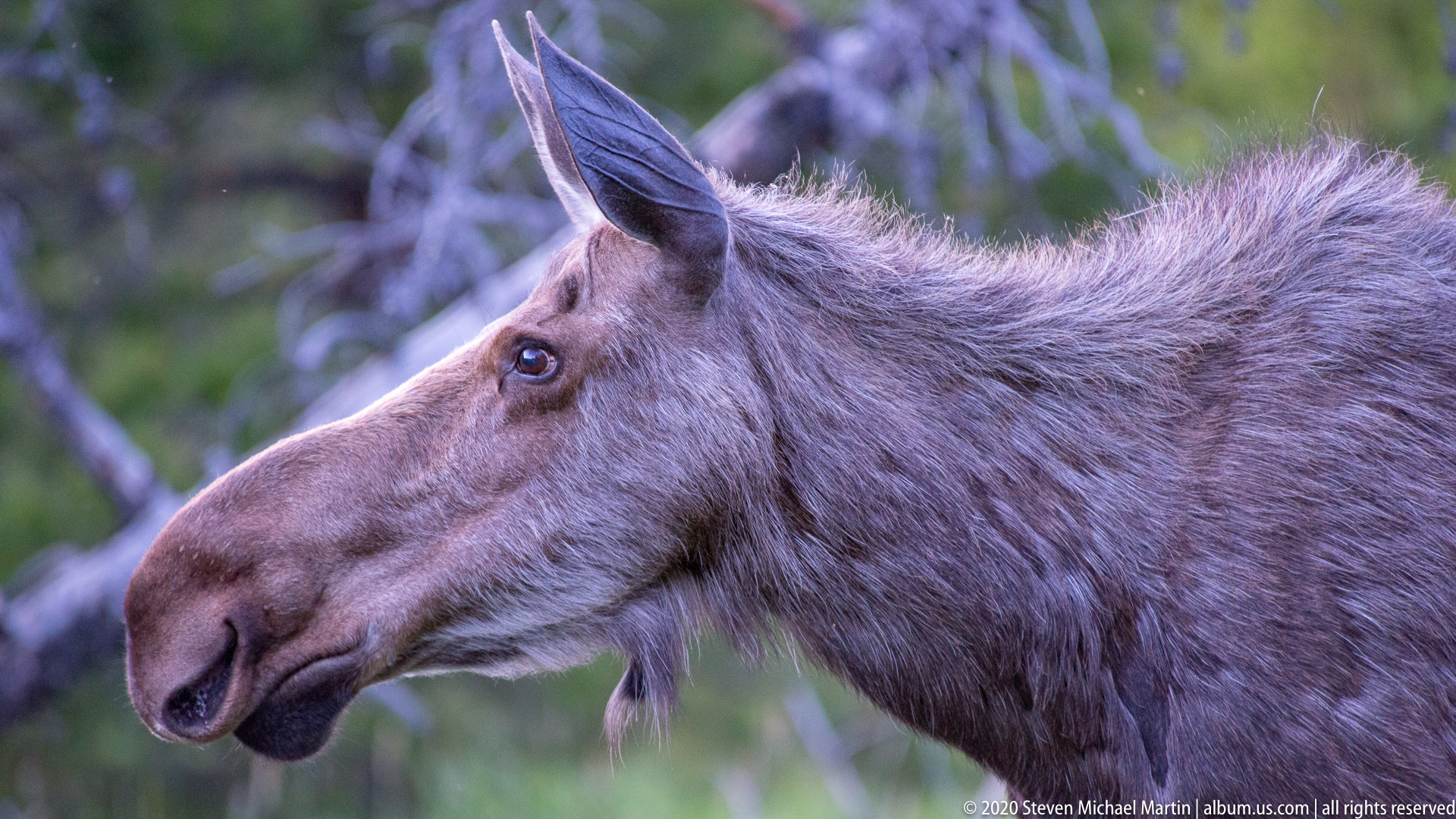
A close profile isolates the moose’s head and upper shoulder, revealing a long, pendulous muzzle, large ear, and coarse coat. The animal faces left against softly blurred branches and green vegetation, with the tight crop excluding most of the landscape. This intimate view emphasizes the head’s distinctive shape and the texture of the fur around the neck.
Caption
A close profile isolates the moose’s head and upper shoulder, revealing a long, pendulous muzzle, large ear, and coarse coat. The animal faces left against softly blurred branches and green vegetation, with the tight crop excluding most of the landscape. This intimate view emphasizes the head’s distinctive shape and the texture of the fur around the neck.
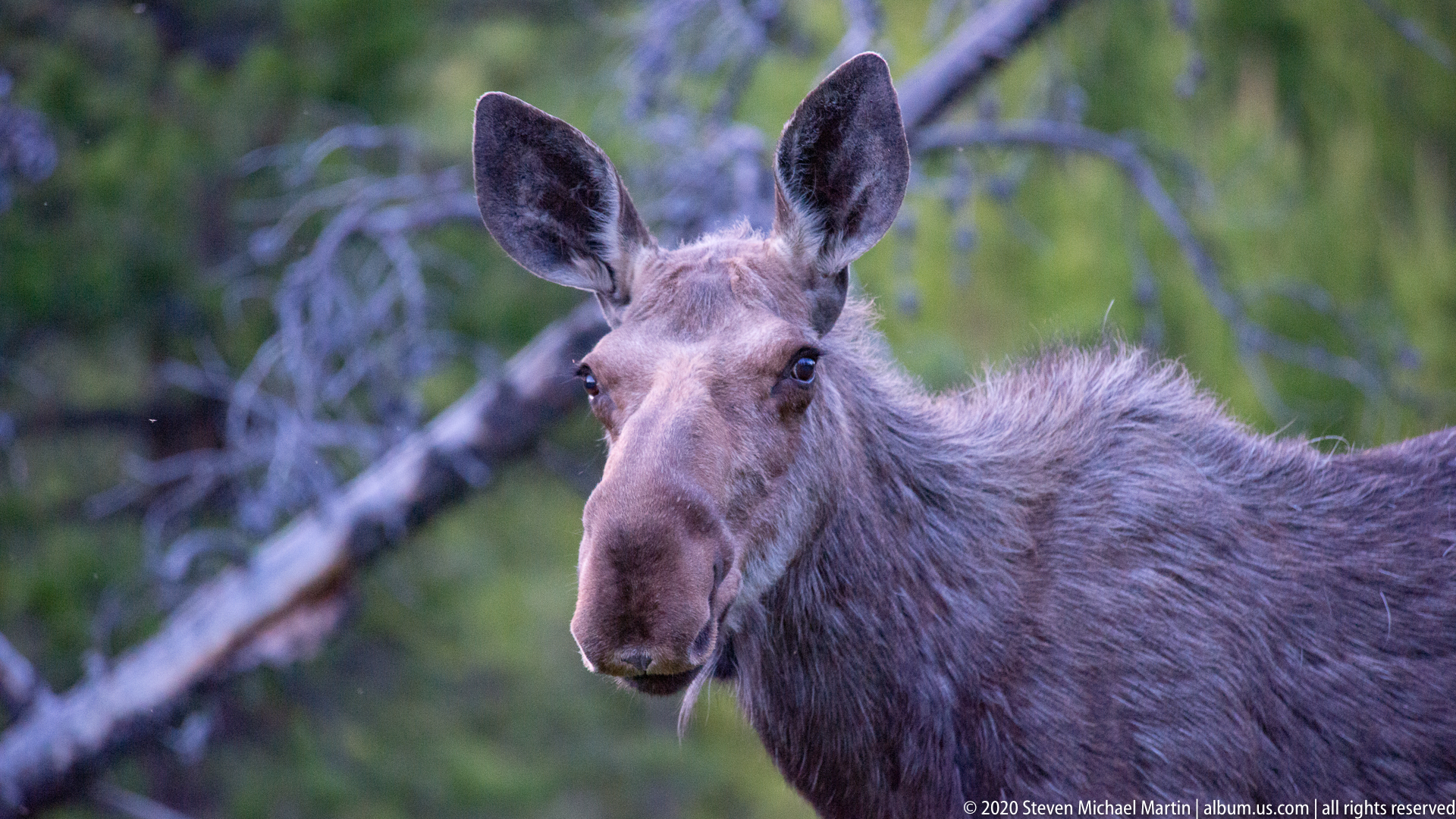
An adult cow moose looks directly toward the camera, ears upright and muzzle centered in a close portrait. Her gray-brown coat fills the right side of the frame, while blurred branches and forest greenery soften the background. The frontal angle brings out the animal’s broad face and alert expression, contrasting with the side profiles in the neighboring frames.
Caption
An adult cow moose looks directly toward the camera, ears upright and muzzle centered in a close portrait. Her gray-brown coat fills the right side of the frame, while blurred branches and forest greenery soften the background. The frontal angle brings out the animal’s broad face and alert expression, contrasting with the side profiles in the neighboring frames.
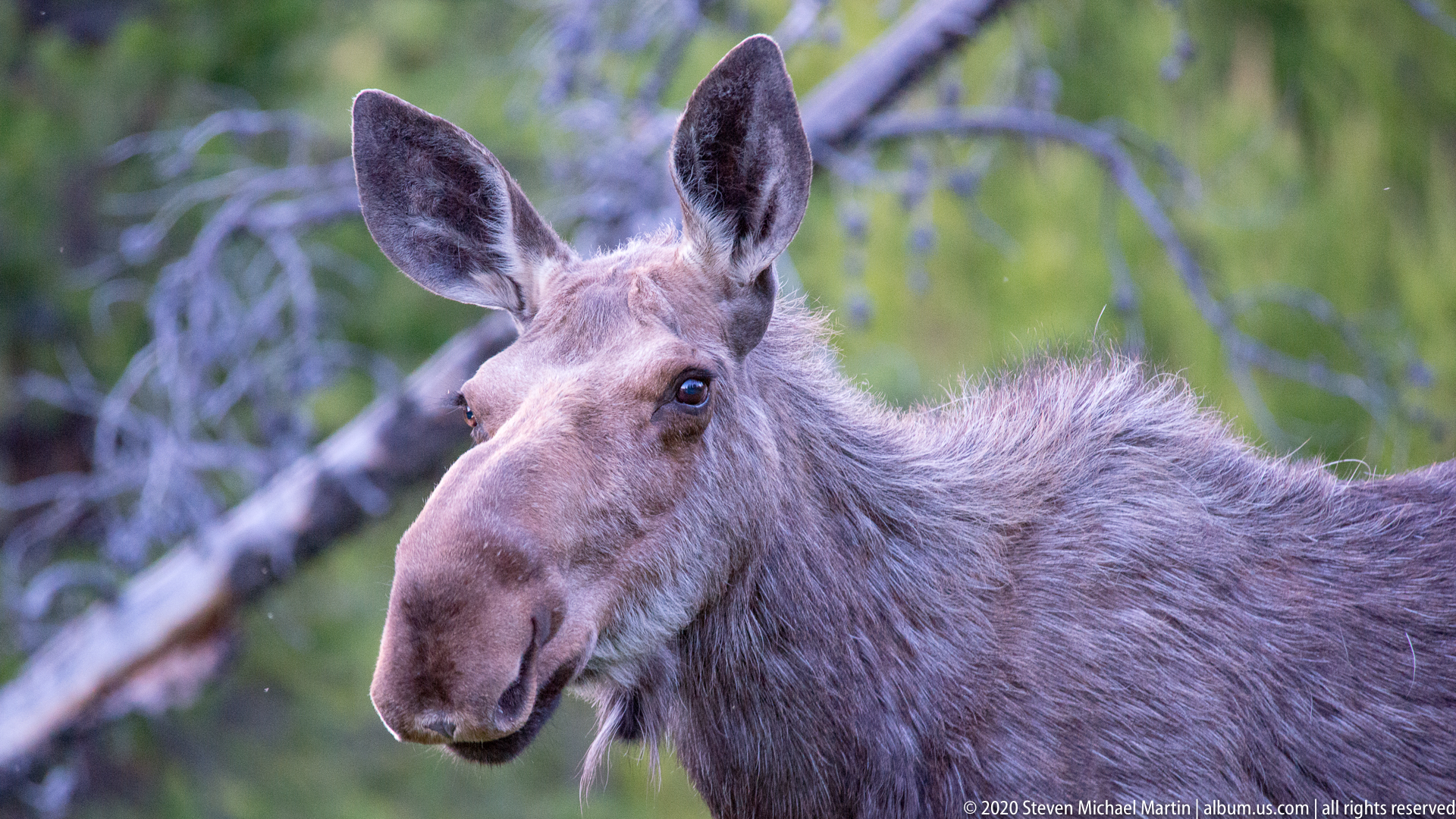
The moose’s body angles away while its head turns toward the viewer, creating a three-quarter portrait framed by soft-focus branches. Light catches the coarse gray-brown hair along the shoulder and face; both ears remain raised. This intermediate viewpoint reveals more body than the frontal close-up while preserving the animal’s watchful gaze as the visual center.
Caption
The moose’s body angles away while its head turns toward the viewer, creating a three-quarter portrait framed by soft-focus branches. Light catches the coarse gray-brown hair along the shoulder and face; both ears remain raised. This intermediate viewpoint reveals more body than the frontal close-up while preserving the animal’s watchful gaze as the visual center.
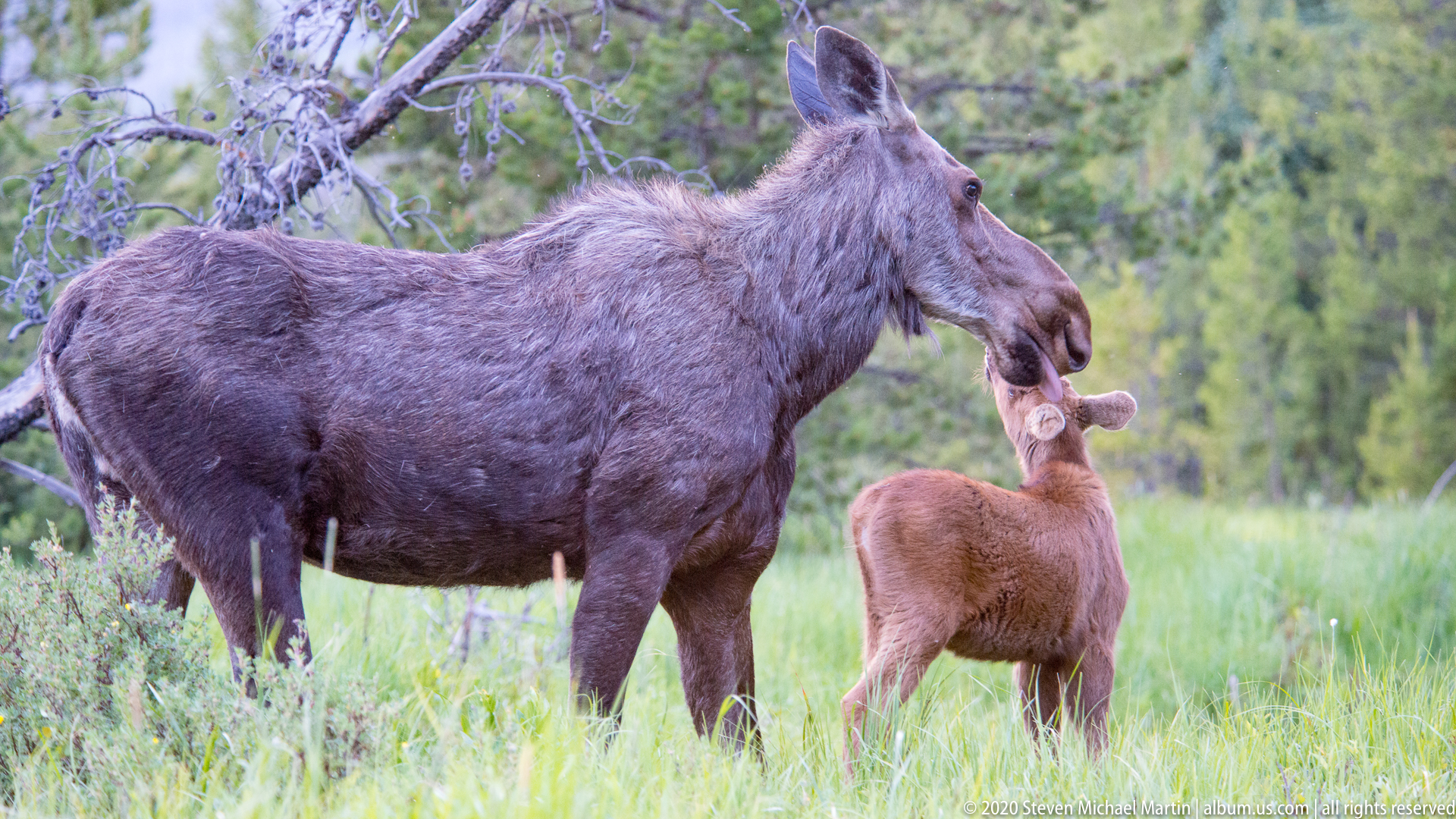
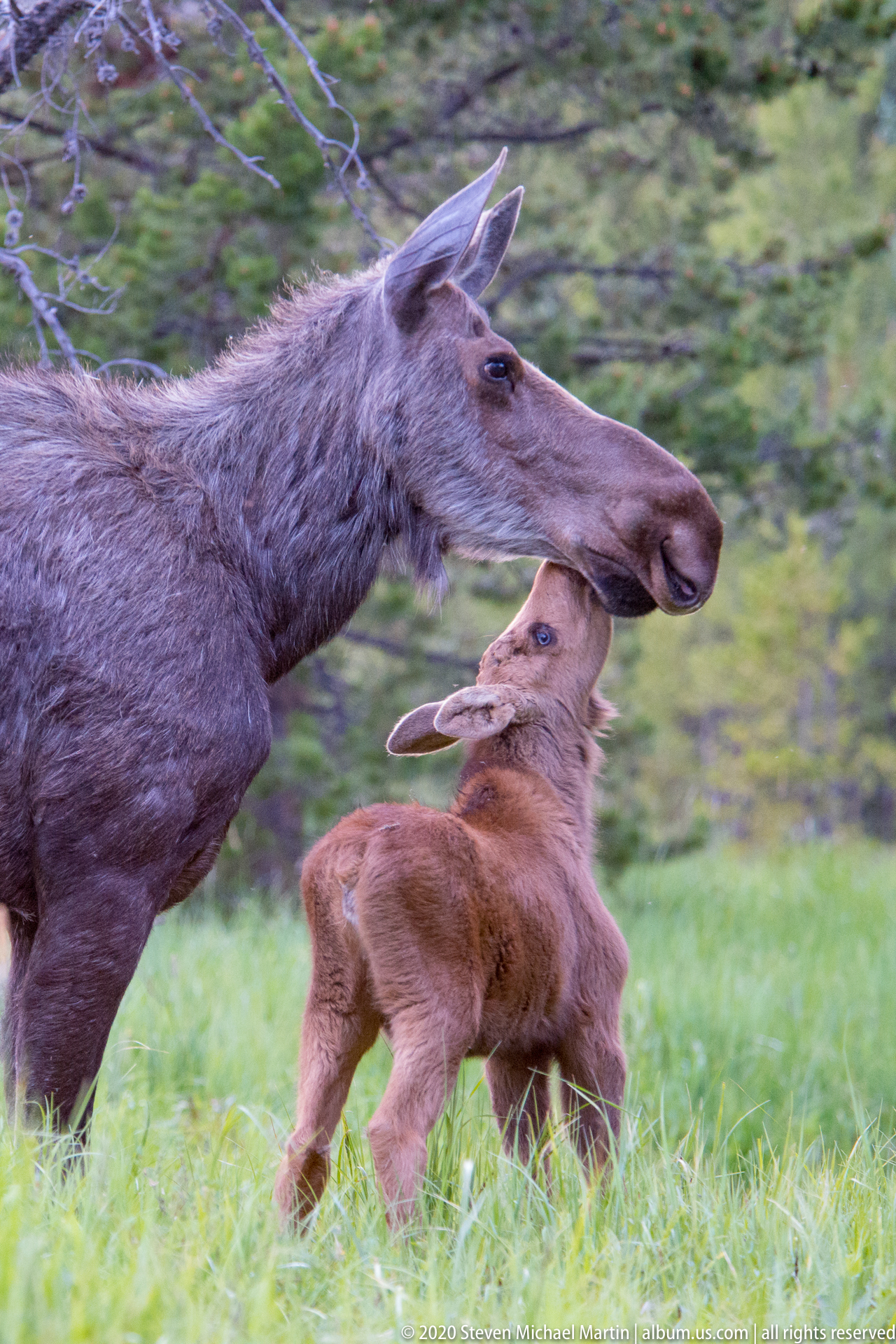
A cow moose bends her long muzzle toward the head of a smaller calf standing beneath her neck. Their close contact is framed by meadow shrubs and a softly lit forest, with the calf’s warm brown coat contrasting against the adult’s darker gray-brown body. The image records a brief interaction without asserting whether it is nursing, grooming, or another specific behavior.
Caption
A cow moose bends her long muzzle toward the head of a smaller calf standing beneath her neck. Their close contact is framed by meadow shrubs and a softly lit forest, with the calf’s warm brown coat contrasting against the adult’s darker gray-brown body. The image records a brief interaction without asserting whether it is nursing, grooming, or another specific behavior.
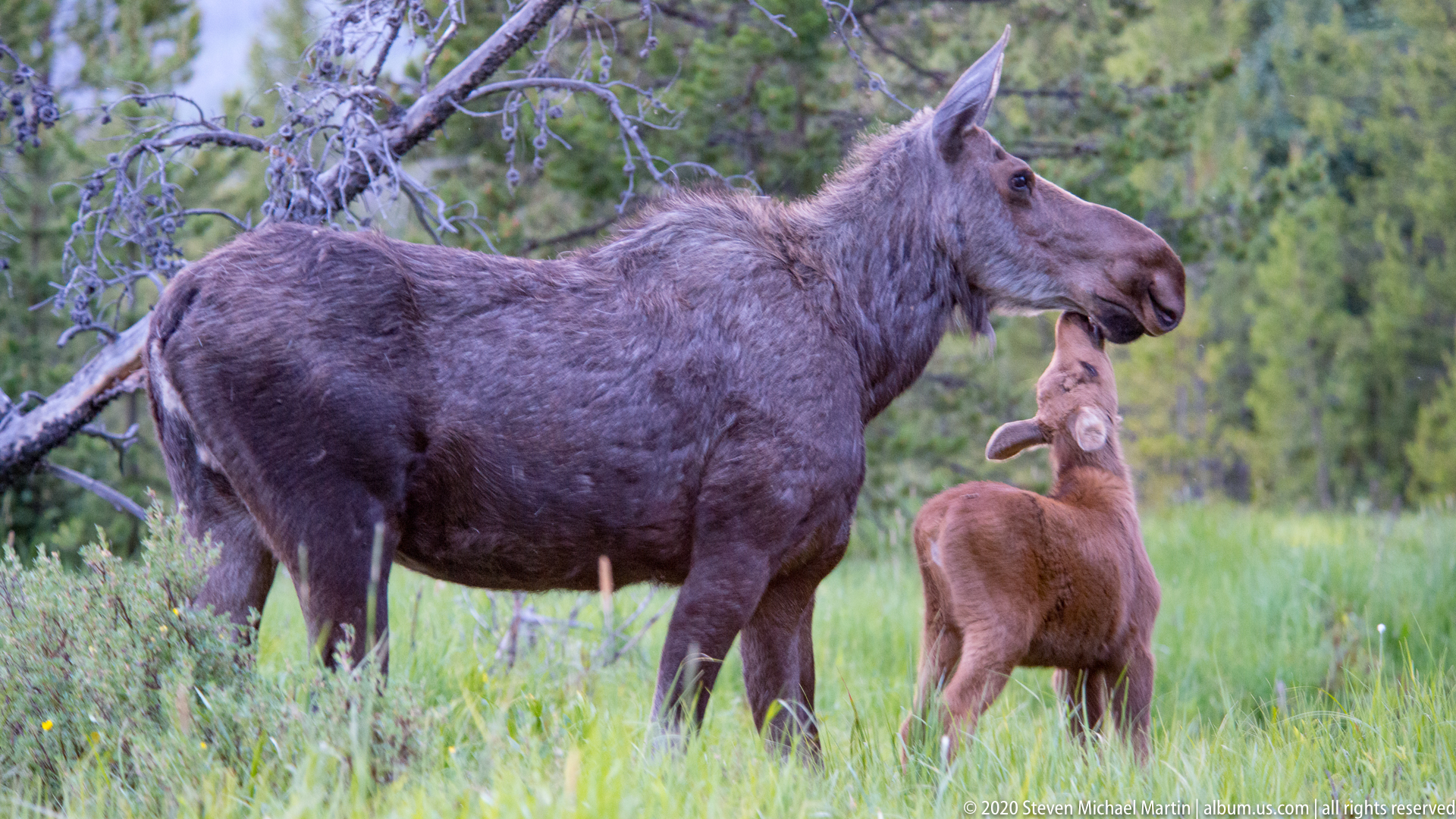
A cow moose stands broadside in a green clearing while her calf remains tucked close beneath her head. Their aligned bodies create a strong horizontal shape against the woodland, and the calf’s upturned face brings the pair into close visual contact. The wider view includes the adult’s full body and more of the surrounding meadow than the tighter interaction portrait.
Caption
A cow moose stands broadside in a green clearing while her calf remains tucked close beneath her head. Their aligned bodies create a strong horizontal shape against the woodland, and the calf’s upturned face brings the pair into close visual contact. The wider view includes the adult’s full body and more of the surrounding meadow than the tighter interaction portrait.

The cow faces nearly forward, her long muzzle angled down toward the calf at her side. The calf looks outward from the grass, creating two distinct sightlines within the same family portrait. A dark evergreen backdrop and bright meadow foreground frame the pair, while the cow’s heavy body anchors the left half of the composition.
Caption
The cow faces nearly forward, her long muzzle angled down toward the calf at her side. The calf looks outward from the grass, creating two distinct sightlines within the same family portrait. A dark evergreen backdrop and bright meadow foreground frame the pair, while the cow’s heavy body anchors the left half of the composition.
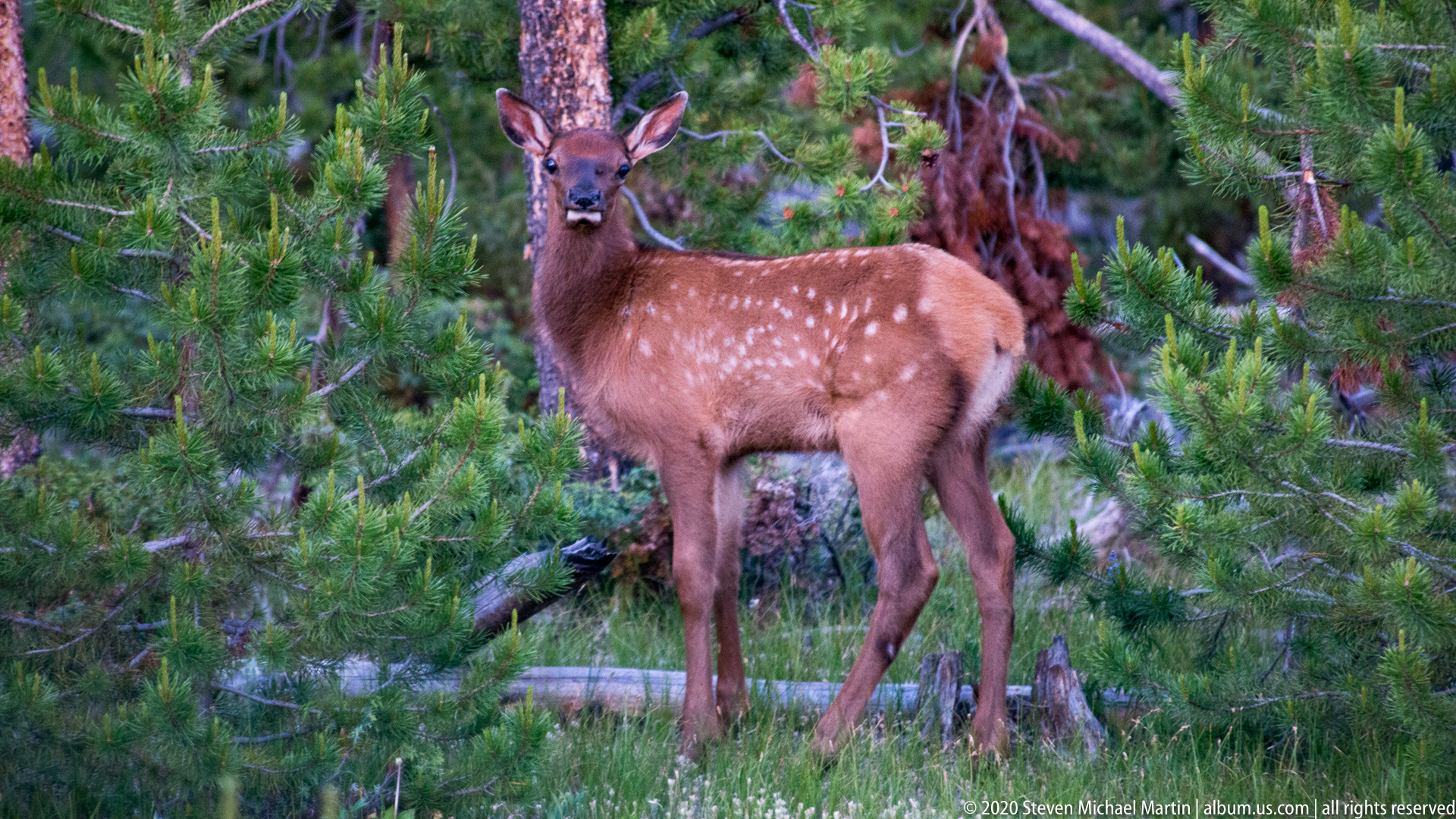
A spotted young deer stands alert in a forest opening, body turned slightly while its face looks toward the camera. Another spotted fawn and part of an adult deer appear behind it among dense evergreen branches. The foreground animal’s white markings and slender legs identify it as a fawn, while the layered arrangement reveals a small family group rather than a solitary portrait.
Caption
A spotted young deer stands alert in a forest opening, body turned slightly while its face looks toward the camera. Another spotted fawn and part of an adult deer appear behind it among dense evergreen branches. The foreground animal’s white markings and slender legs identify it as a fawn, while the layered arrangement reveals a small family group rather than a solitary portrait.
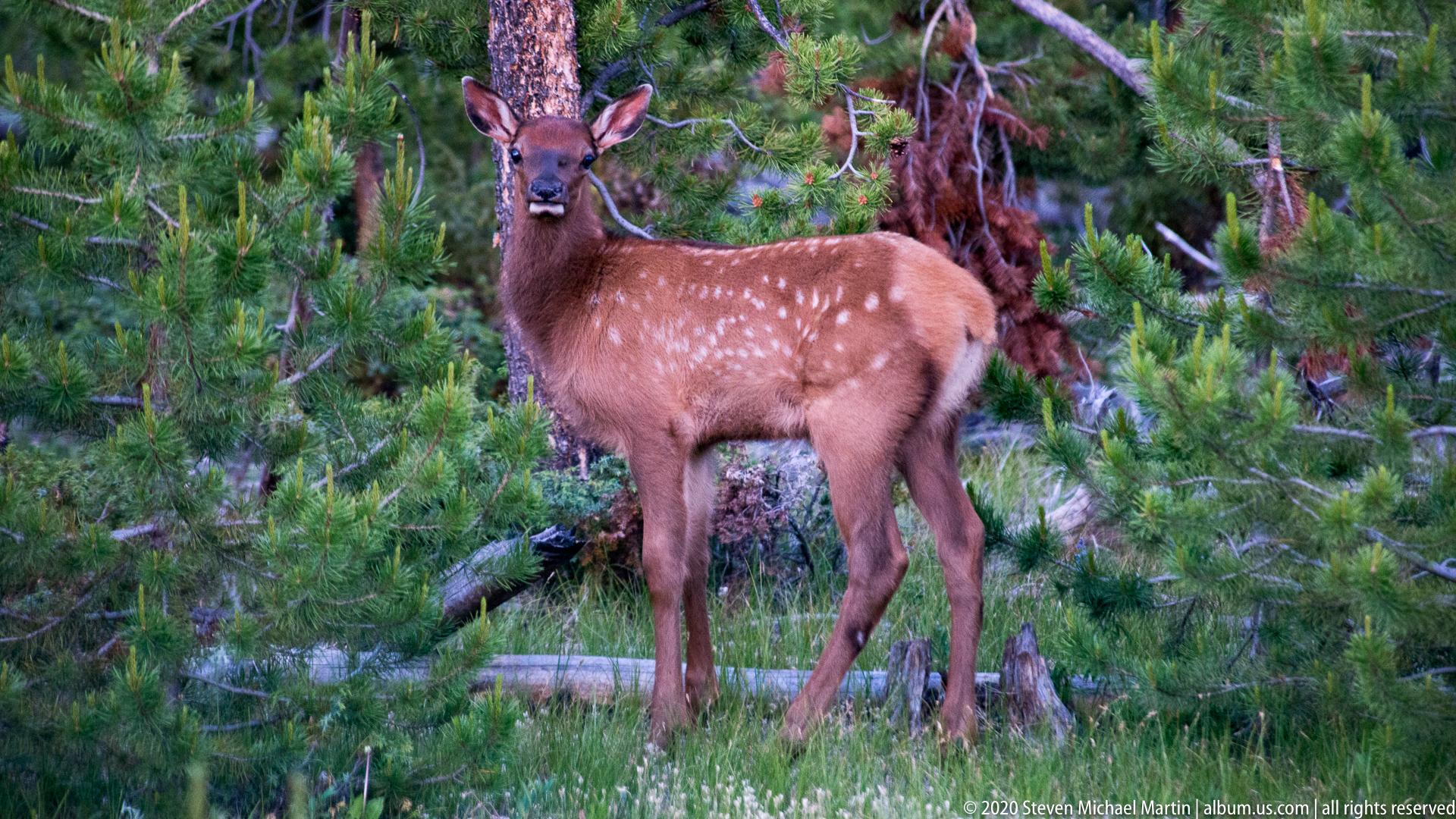
A doe stands among pine trunks with two spotted fawns gathered near her, one facing the camera and the other turned sideways. Their smaller bodies and white coats’ markings distinguish the young deer from the adult. The wider framing includes low branches, fallen wood, and forest floor, placing the group in a wooded opening without assigning an exact deer species.
Caption
A doe stands among pine trunks with two spotted fawns gathered near her, one facing the camera and the other turned sideways. Their smaller bodies and white coats’ markings distinguish the young deer from the adult. The wider framing includes low branches, fallen wood, and forest floor, placing the group in a wooded opening without assigning an exact deer species.
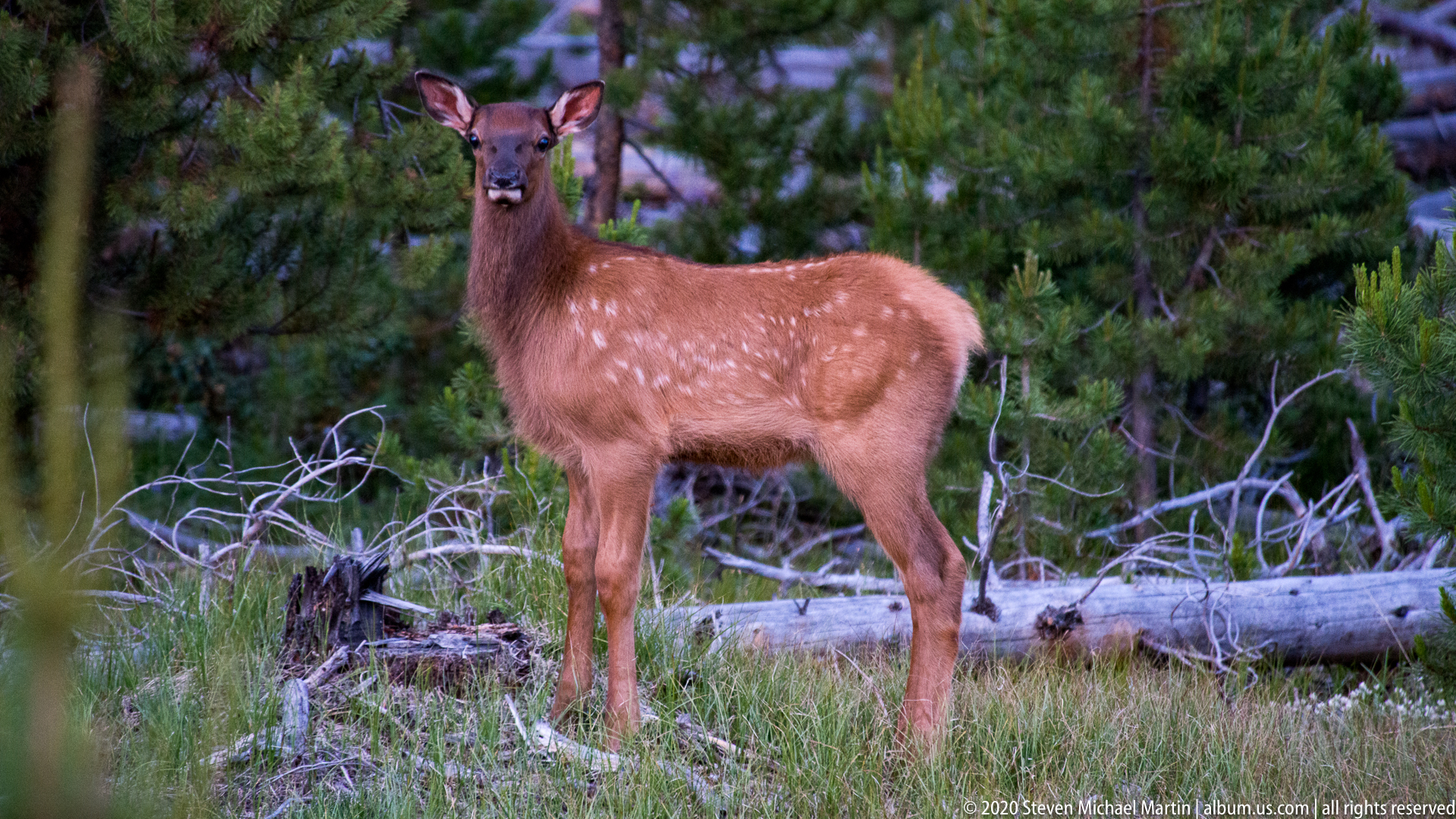
A spotted fawn stands alone in the foreground of a wooded clearing, its head lifted toward the viewer and its slender legs visible among grass and fallen branches. Darker trees and brush frame the small animal, separating its reddish coat from the shaded background. This quieter single-fawn composition differs from the family groupings nearby.
Caption
A spotted fawn stands alone in the foreground of a wooded clearing, its head lifted toward the viewer and its slender legs visible among grass and fallen branches. Darker trees and brush frame the small animal, separating its reddish coat from the shaded background. This quieter single-fawn composition differs from the family groupings nearby.
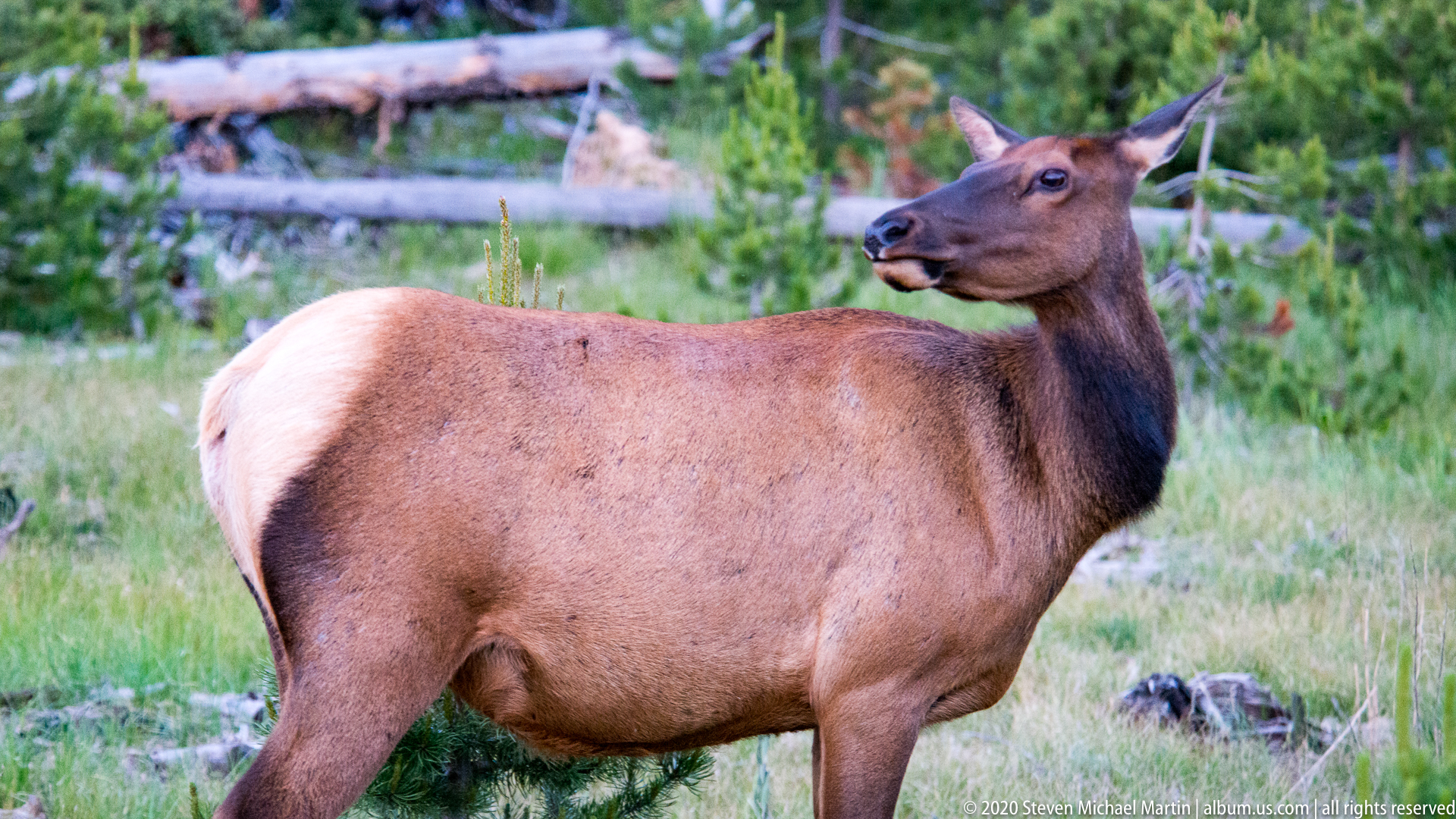
A cow elk looks back over her shoulder while standing in profile across a bright meadow. Her tawny body and pale rump contrast with the darker neck and head, while a fallen log lies behind her near the tree line. The close crop gives the animal more prominence than the forest, preserving the alert turn of her head as the defining detail.
Caption
A cow elk looks back over her shoulder while standing in profile across a bright meadow. Her tawny body and pale rump contrast with the darker neck and head, while a fallen log lies behind her near the tree line. The close crop gives the animal more prominence than the forest, preserving the alert turn of her head as the defining detail.
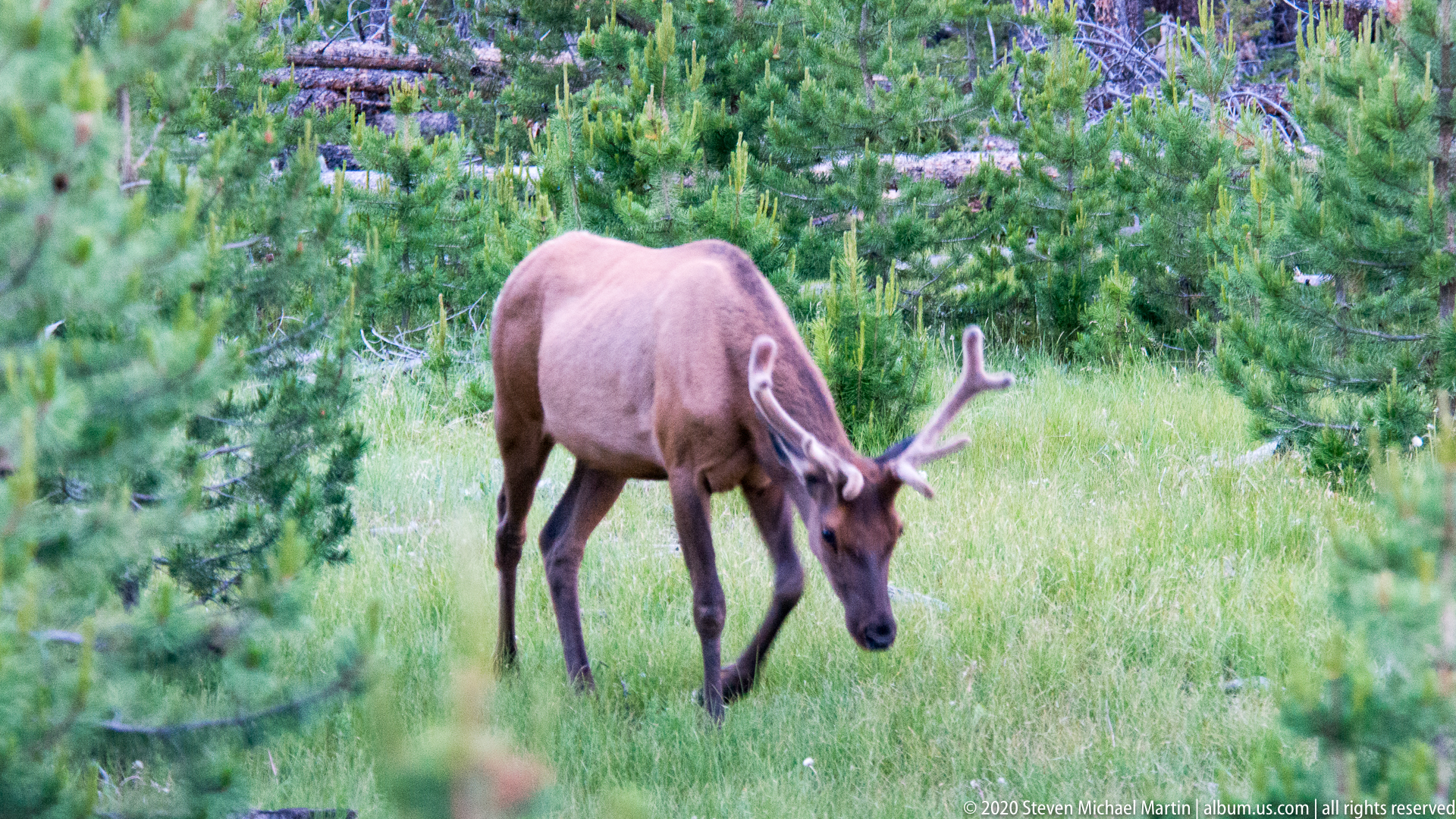
An antlered bull elk bends its head toward the grass, feeding in a bright clearing edged by young conifers. Its branching antlers rise above the lowered head, while the broad meadow leaves space around the animal. The feeding posture and visible rack distinguish this frame from the upright portrait that follows.
Caption
An antlered bull elk bends its head toward the grass, feeding in a bright clearing edged by young conifers. Its branching antlers rise above the lowered head, while the broad meadow leaves space around the animal. The feeding posture and visible rack distinguish this frame from the upright portrait that follows.
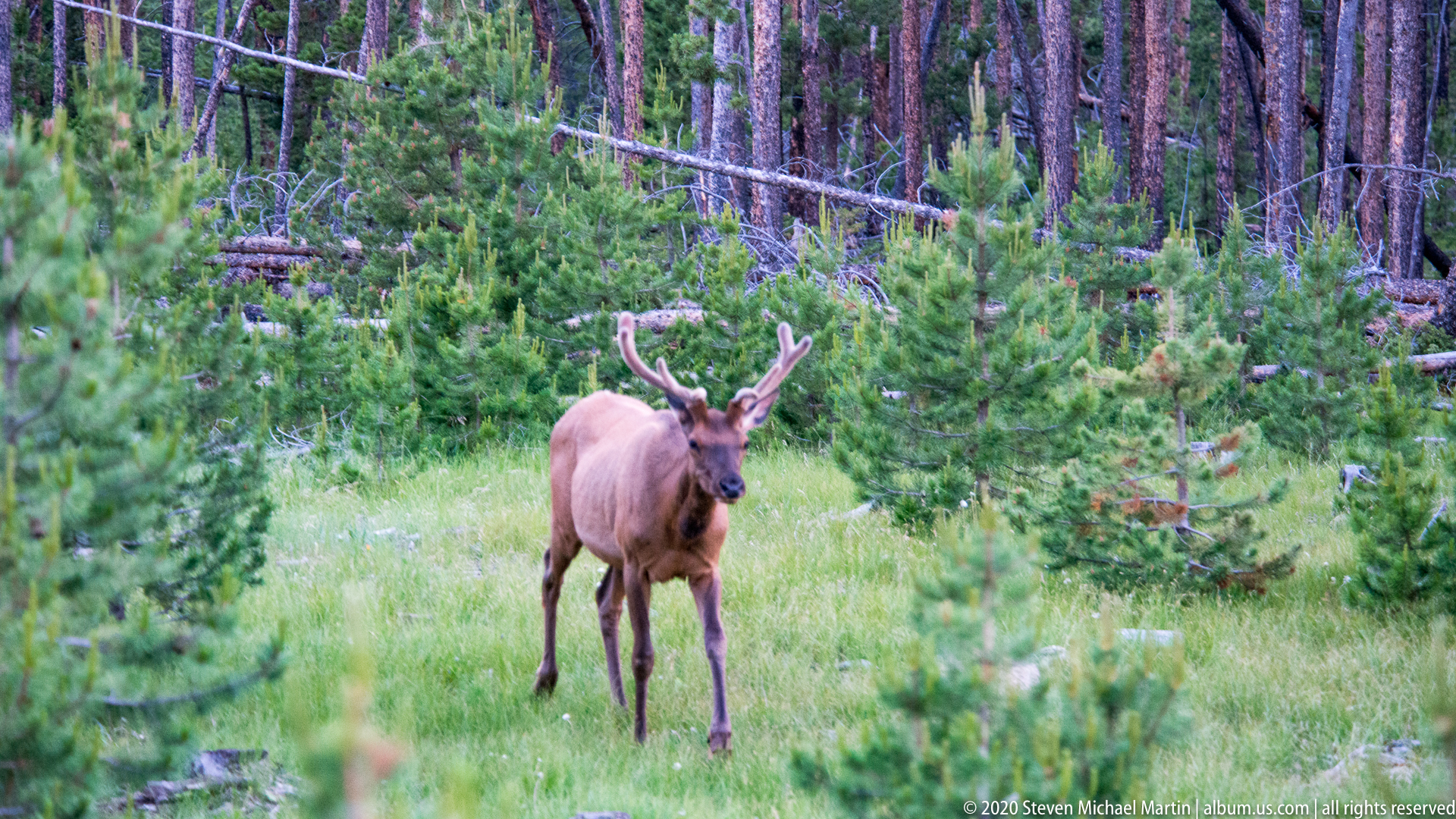
A bull elk stands facing the camera in an open patch of grass, its antlers branching above an alert head. Young evergreen trees frame the clearing, and the full-body view shows the animal’s sturdy legs and dark neck against lighter vegetation. Unlike the grazing image, this frame centers on a still, forward-facing stance.
Caption
A bull elk stands facing the camera in an open patch of grass, its antlers branching above an alert head. Young evergreen trees frame the clearing, and the full-body view shows the animal’s sturdy legs and dark neck against lighter vegetation. Unlike the grazing image, this frame centers on a still, forward-facing stance.
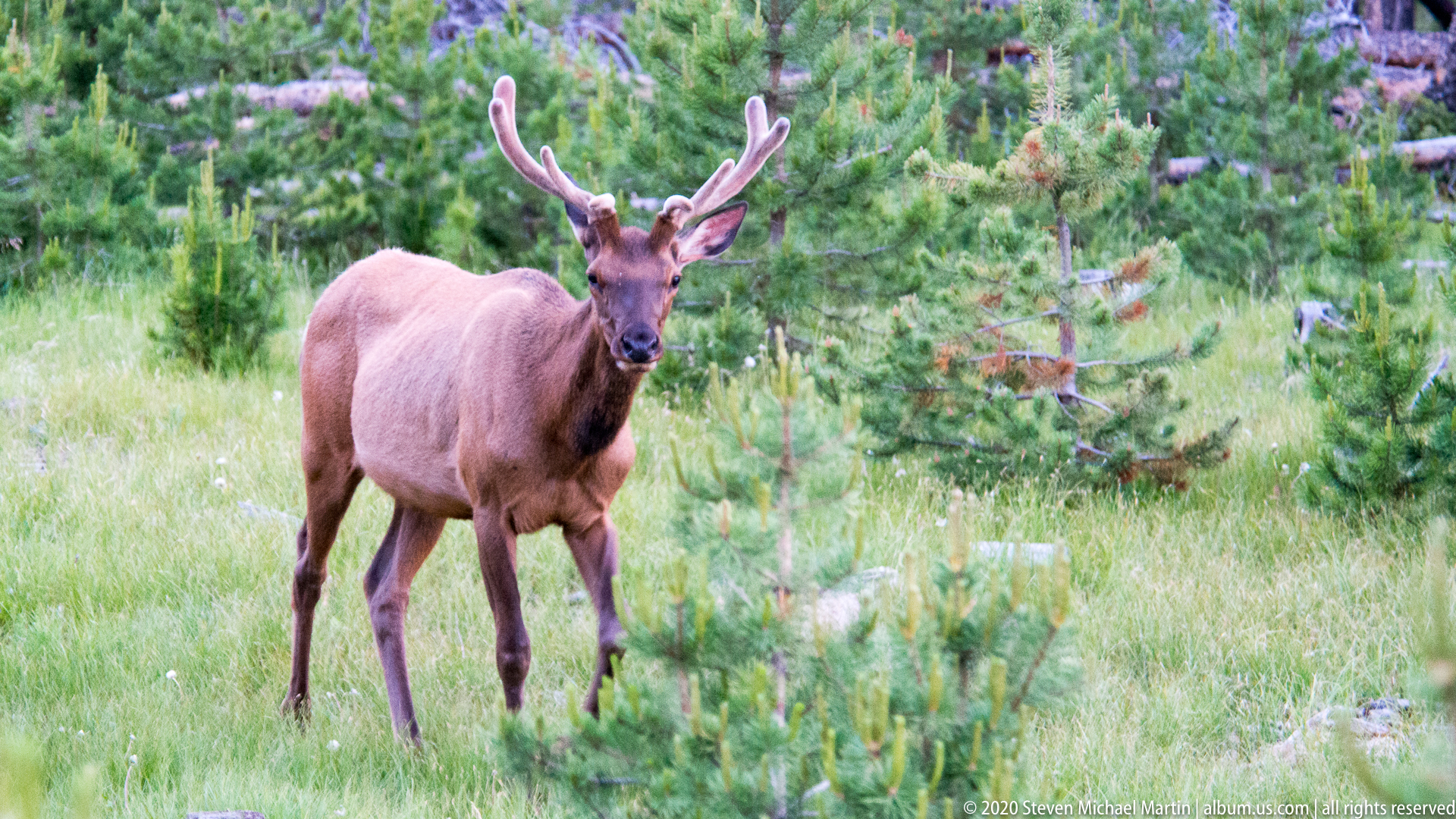
An elk stands nearly front-on in a grassy opening, its antlers held high and ears spread beneath the branching points. Young pines and taller forest growth fill the background, placing the animal in a woodland meadow. The direct orientation makes the symmetrical antler spread and the elk’s alert posture the strongest features of this portrait.
Caption
An elk stands nearly front-on in a grassy opening, its antlers held high and ears spread beneath the branching points. Young pines and taller forest growth fill the background, placing the animal in a woodland meadow. The direct orientation makes the symmetrical antler spread and the elk’s alert posture the strongest features of this portrait.
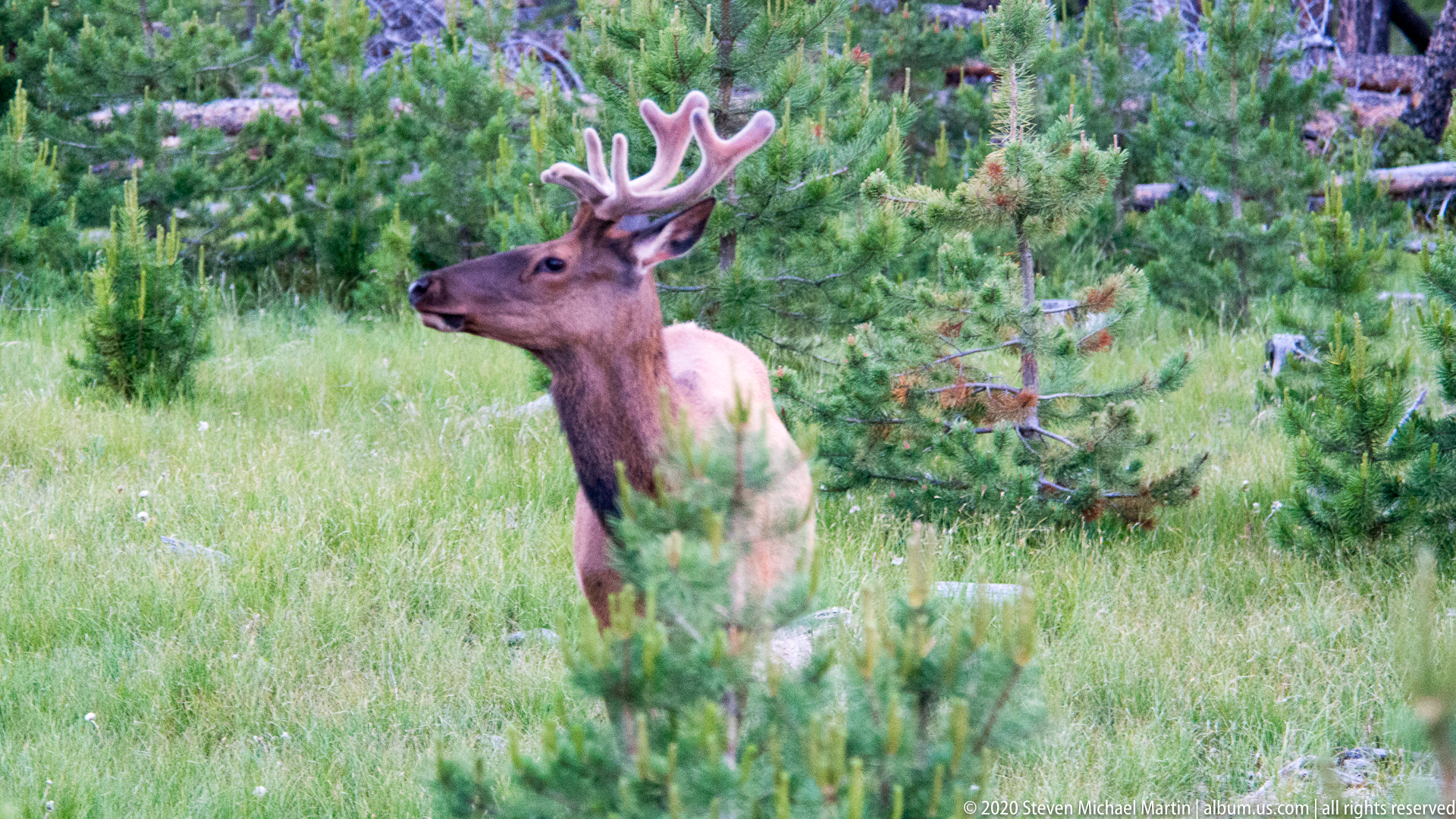
The bull turns its head left while its body remains angled toward the viewer, bringing the antlers into a three-quarter profile. Meadow grass fills the foreground and small conifers rise behind the animal. The lifted head and sideways gaze create a more watchful, directional portrait than the straight-on view nearby.
Caption
The bull turns its head left while its body remains angled toward the viewer, bringing the antlers into a three-quarter profile. Meadow grass fills the foreground and small conifers rise behind the animal. The lifted head and sideways gaze create a more watchful, directional portrait than the straight-on view nearby.
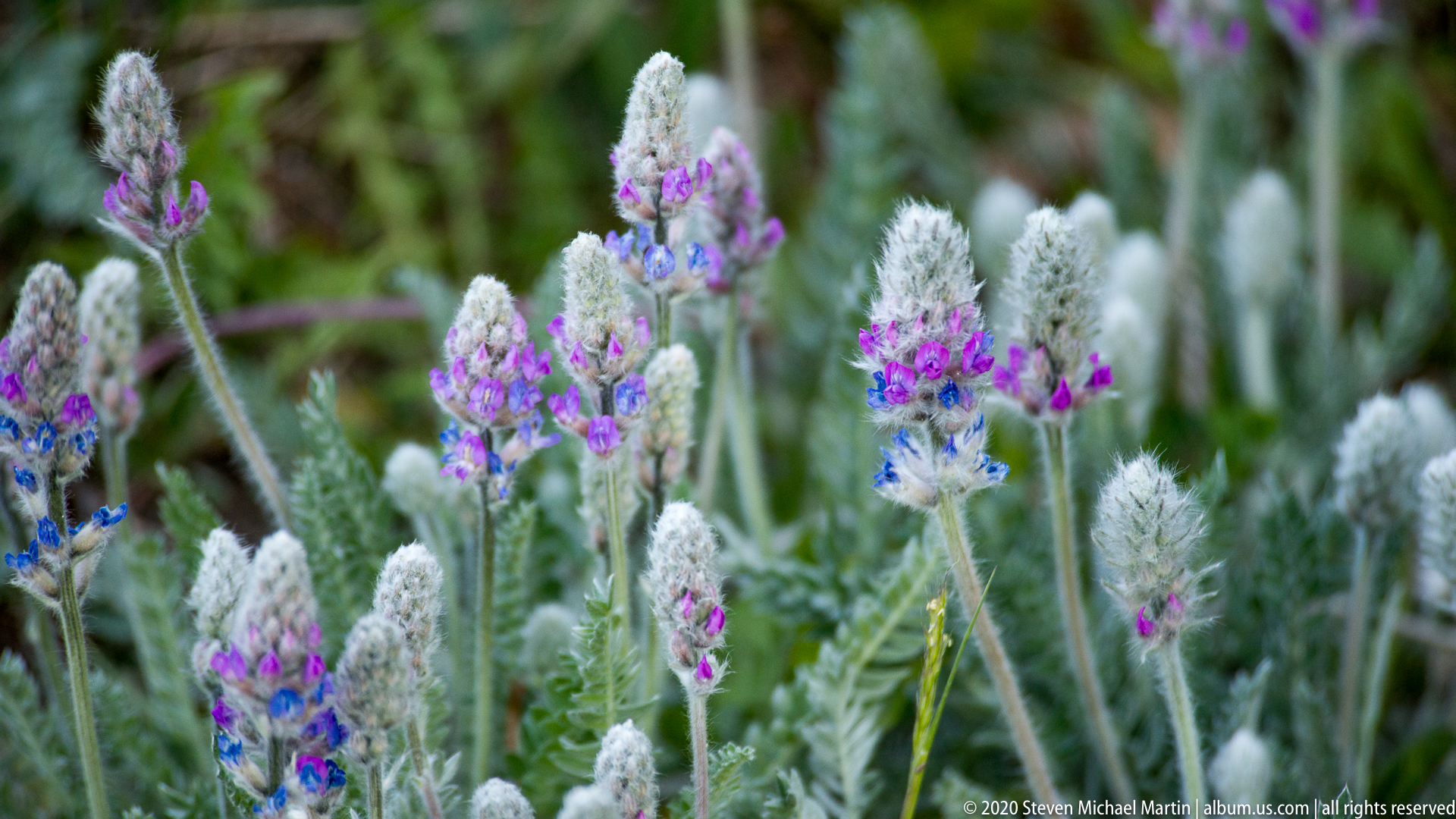
Silvery, fuzzy flower spikes rise among small purple and blue blossoms in a dense green patch. Several upright stems overlap at different depths, with the nearest blooms sharply defined and the background softened. The close view reveals contrasting textures and colors but does not provide enough detail to name the plant confidently.
Caption
Silvery, fuzzy flower spikes rise among small purple and blue blossoms in a dense green patch. Several upright stems overlap at different depths, with the nearest blooms sharply defined and the background softened. The close view reveals contrasting textures and colors but does not provide enough detail to name the plant confidently.
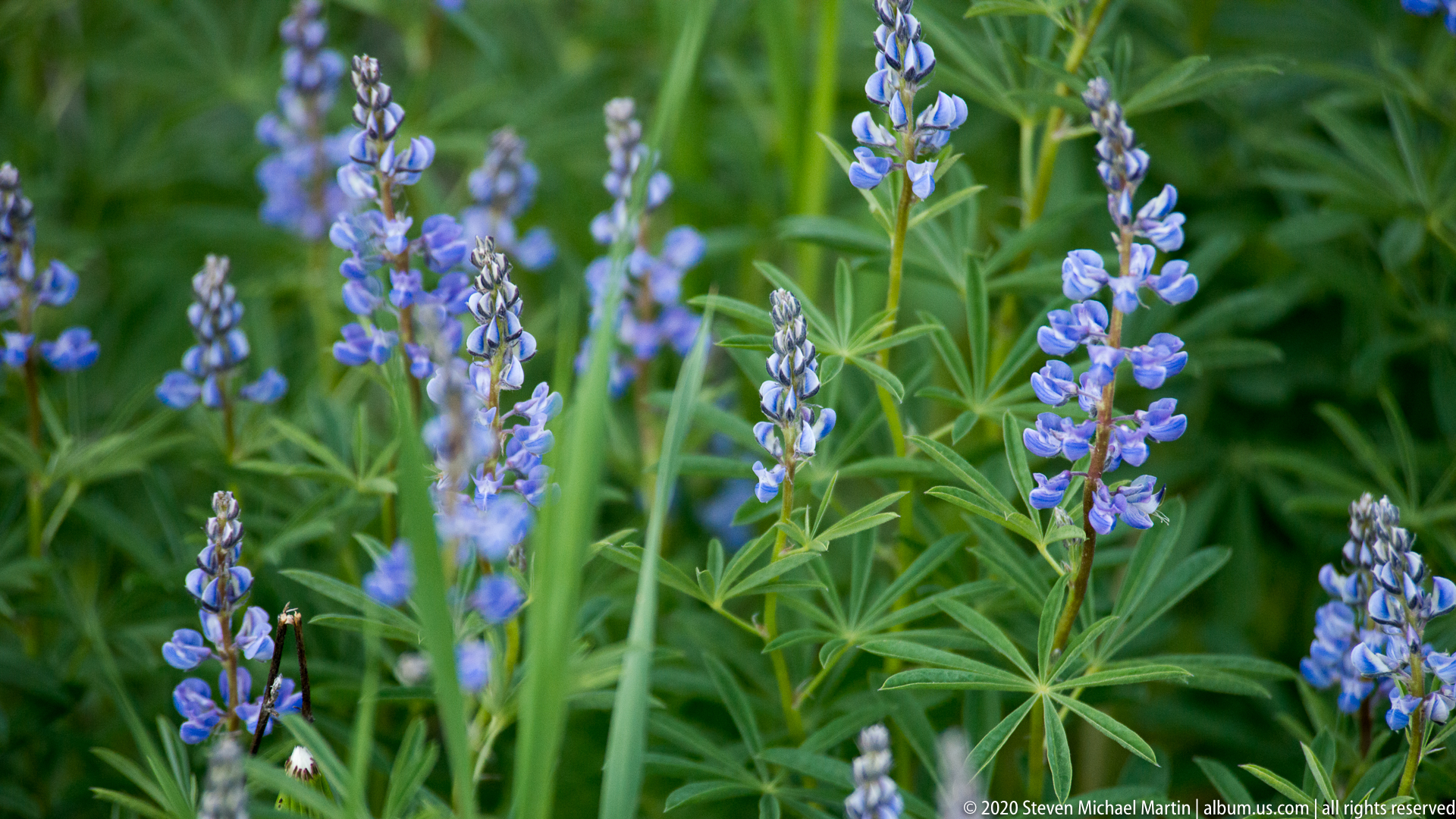
Blue-violet blossoms form upright clusters above distinctive palmate leaves in a close botanical view. The foliage spreads like a hand beneath the flower stalks, and several stems overlap against a dark green background. These features suggest a lupine, but the proof-sheet image does not support a more precise species name, so the caption retains a cautious identification.
Caption
Blue-violet blossoms form upright clusters above distinctive palmate leaves in a close botanical view. The foliage spreads like a hand beneath the flower stalks, and several stems overlap against a dark green background. These features suggest a lupine, but the proof-sheet image does not support a more precise species name, so the caption retains a cautious identification.
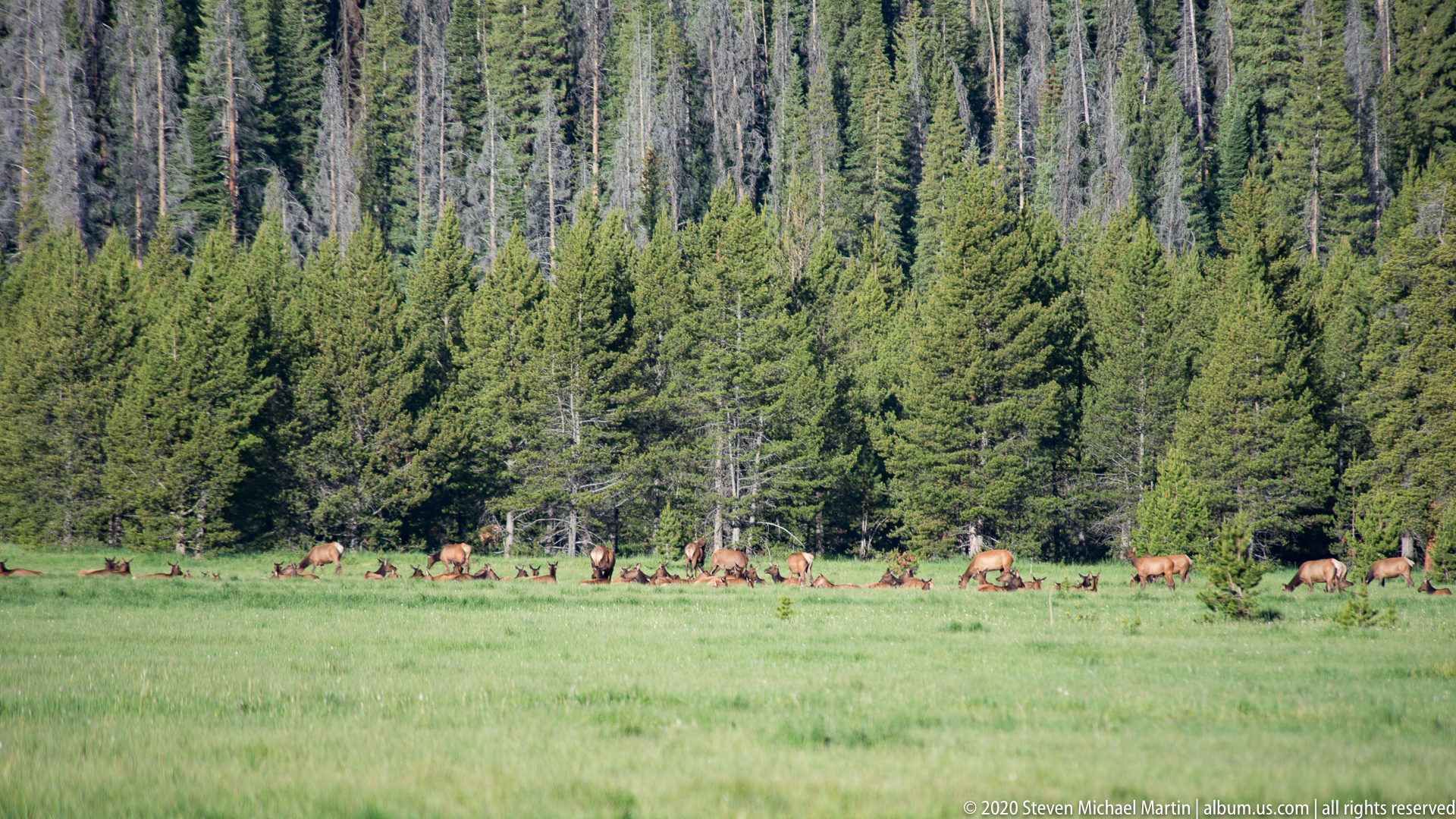
A dispersed herd of elk grazes across a broad green meadow at the base of a densely forested slope. Individual animals appear small against the vertical wall of conifers, making the open clearing and woodland edge central to the composition. Their warm coats form a broken line across the field, conveying the group’s scale and distribution rather than focusing on one animal.
Caption
A dispersed herd of elk grazes across a broad green meadow at the base of a densely forested slope. Individual animals appear small against the vertical wall of conifers, making the open clearing and woodland edge central to the composition. Their warm coats form a broken line across the field, conveying the group’s scale and distribution rather than focusing on one animal.
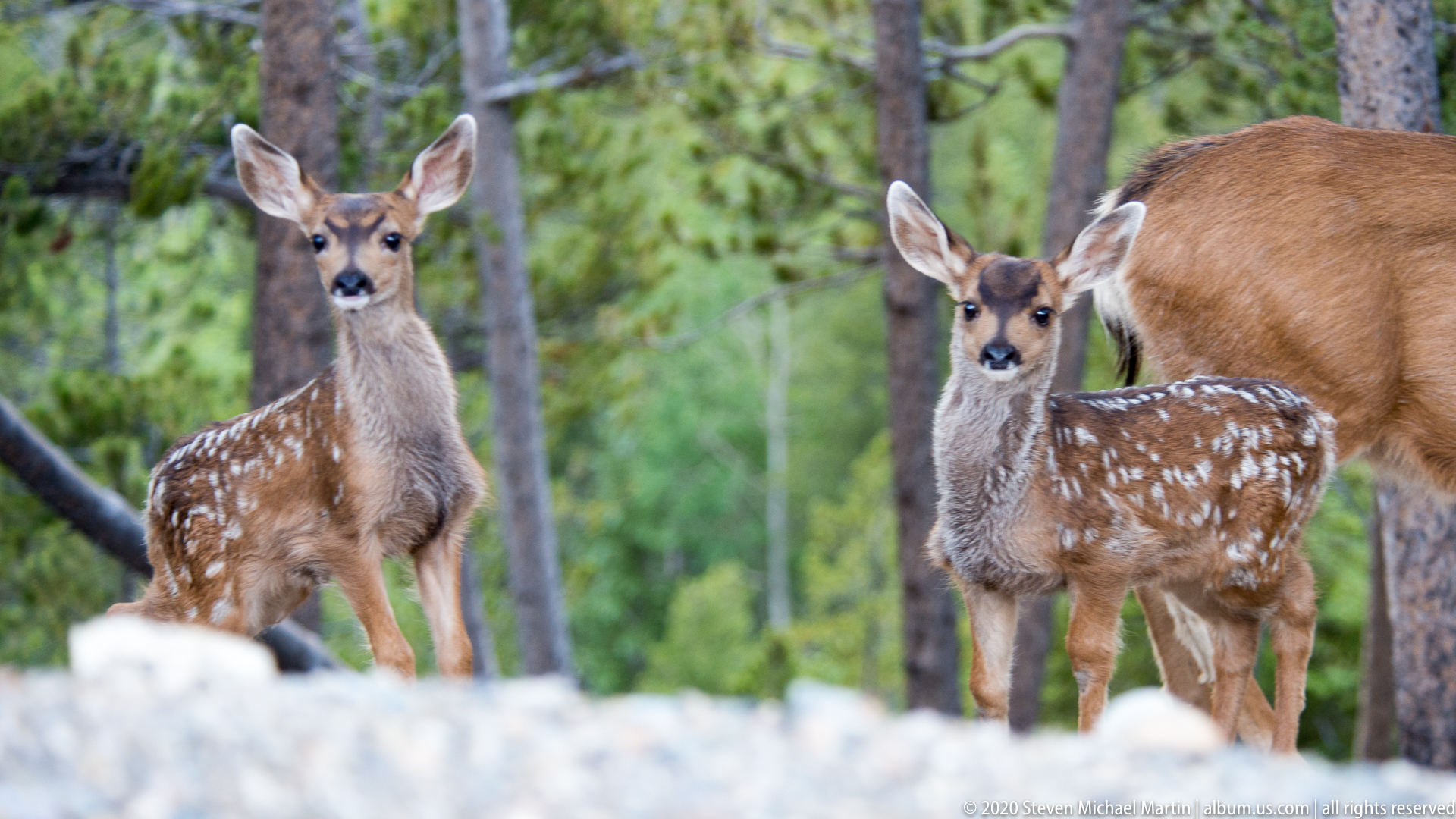
Two spotted fawns stand close together in front of an adult doe, whose body is partly cropped at the right edge. The nearer fawn faces the camera while the second turns slightly, their white markings bright against reddish coats. Pine trunks and soft green understory enclose the group, giving the family portrait a sheltered woodland setting.
Caption
Two spotted fawns stand close together in front of an adult doe, whose body is partly cropped at the right edge. The nearer fawn faces the camera while the second turns slightly, their white markings bright against reddish coats. Pine trunks and soft green understory enclose the group, giving the family portrait a sheltered woodland setting.
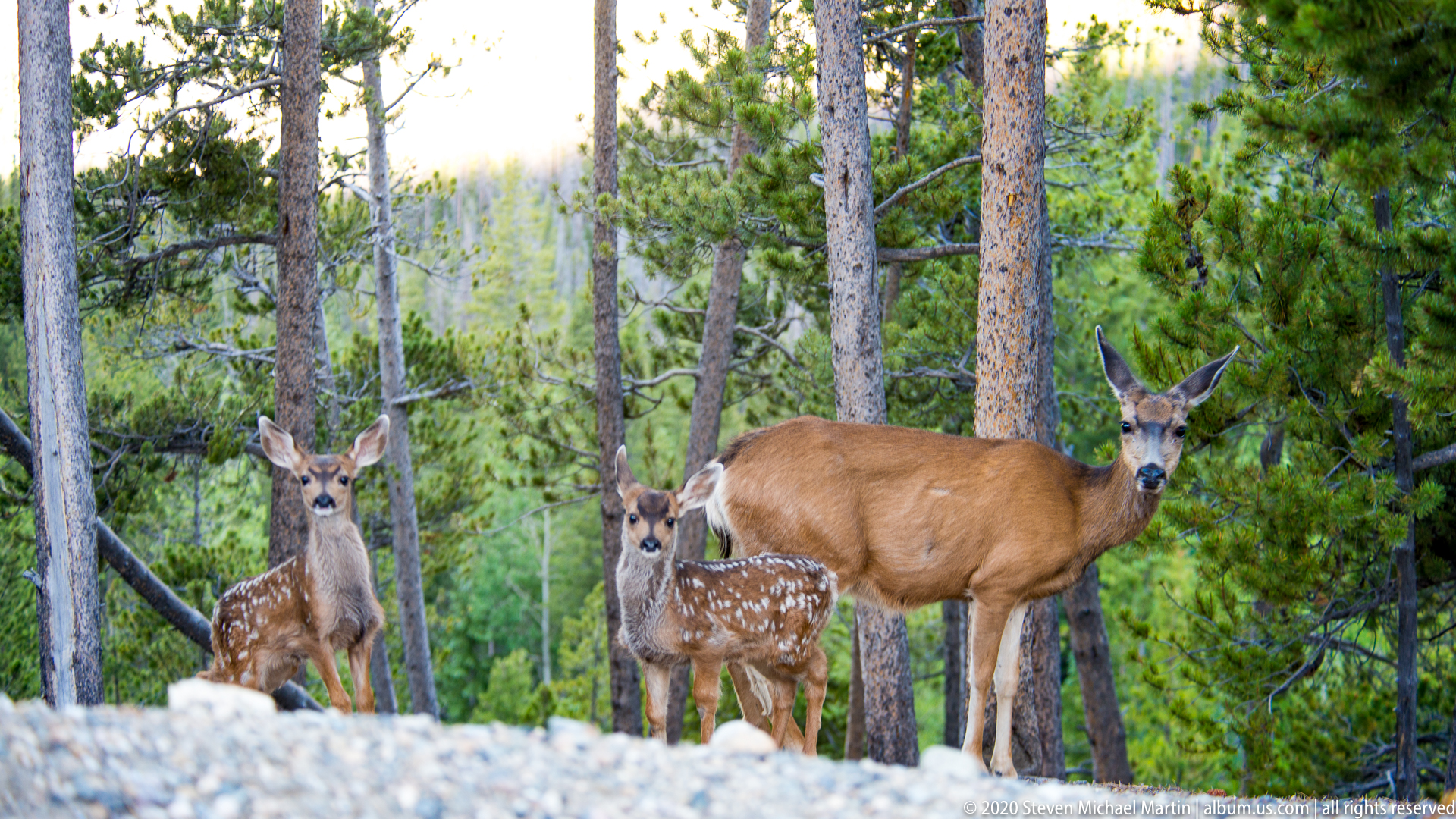
The adult doe stands behind two spotted fawns in a loose line, each animal facing a slightly different direction. A low band of pale stones crosses the bottom of the frame, while pine trunks and layered branches enclose the group. Their arrangement makes the family relationship legible without requiring a more specific species identification.
Caption
The adult doe stands behind two spotted fawns in a loose line, each animal facing a slightly different direction. A low band of pale stones crosses the bottom of the frame, while pine trunks and layered branches enclose the group. Their arrangement makes the family relationship legible without requiring a more specific species identification.
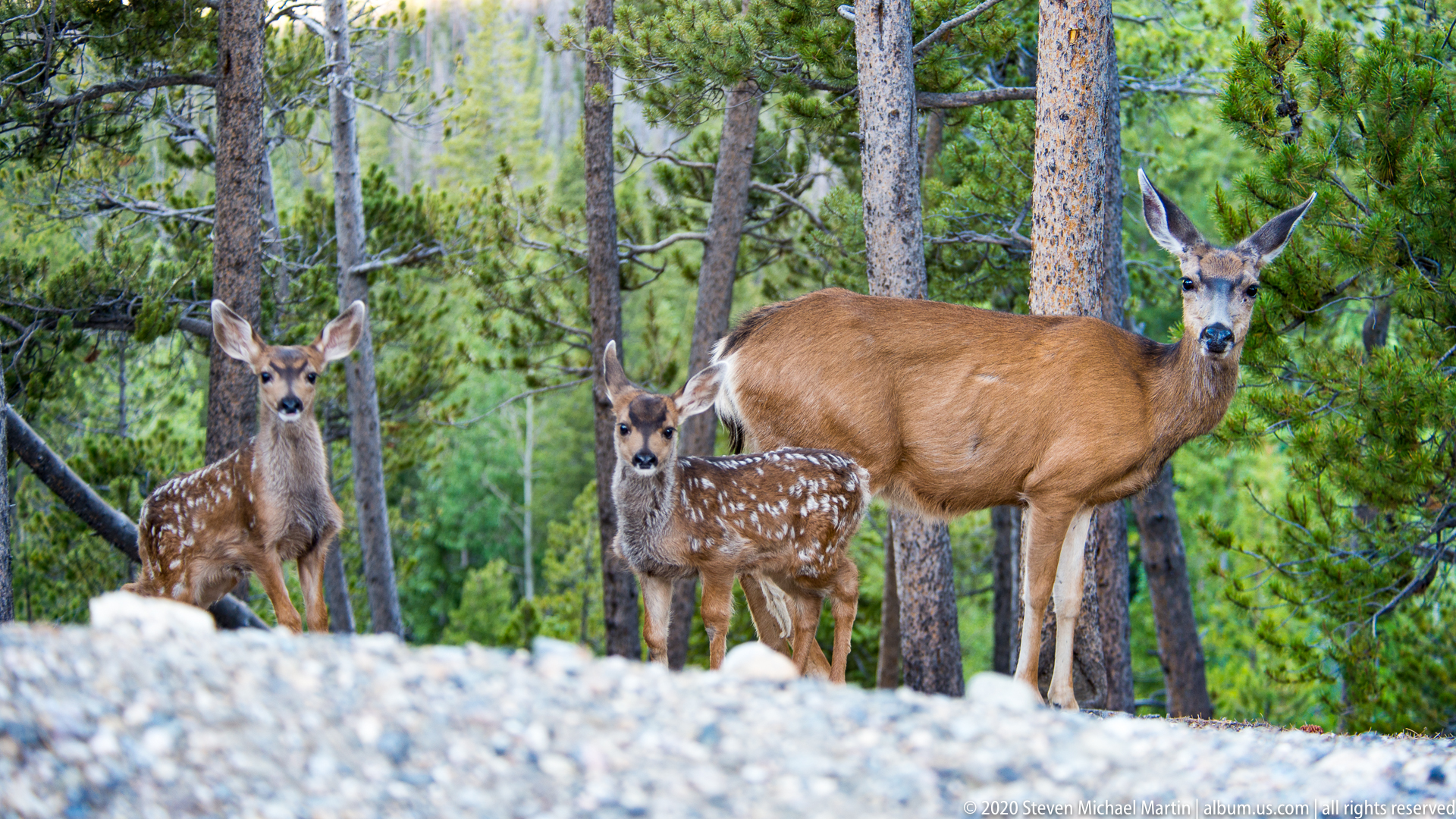
A doe stands behind two spotted fawns, all three facing generally toward the camera. The adult’s larger tan body rises above the smaller young deer, whose white spots remain distinct along their backs and flanks. Evergreen branches and straight trunks make a dense woodland backdrop, while the pale rocky foreground partially screens the animals’ legs.
Caption
A doe stands behind two spotted fawns, all three facing generally toward the camera. The adult’s larger tan body rises above the smaller young deer, whose white spots remain distinct along their backs and flanks. Evergreen branches and straight trunks make a dense woodland backdrop, while the pale rocky foreground partially screens the animals’ legs.
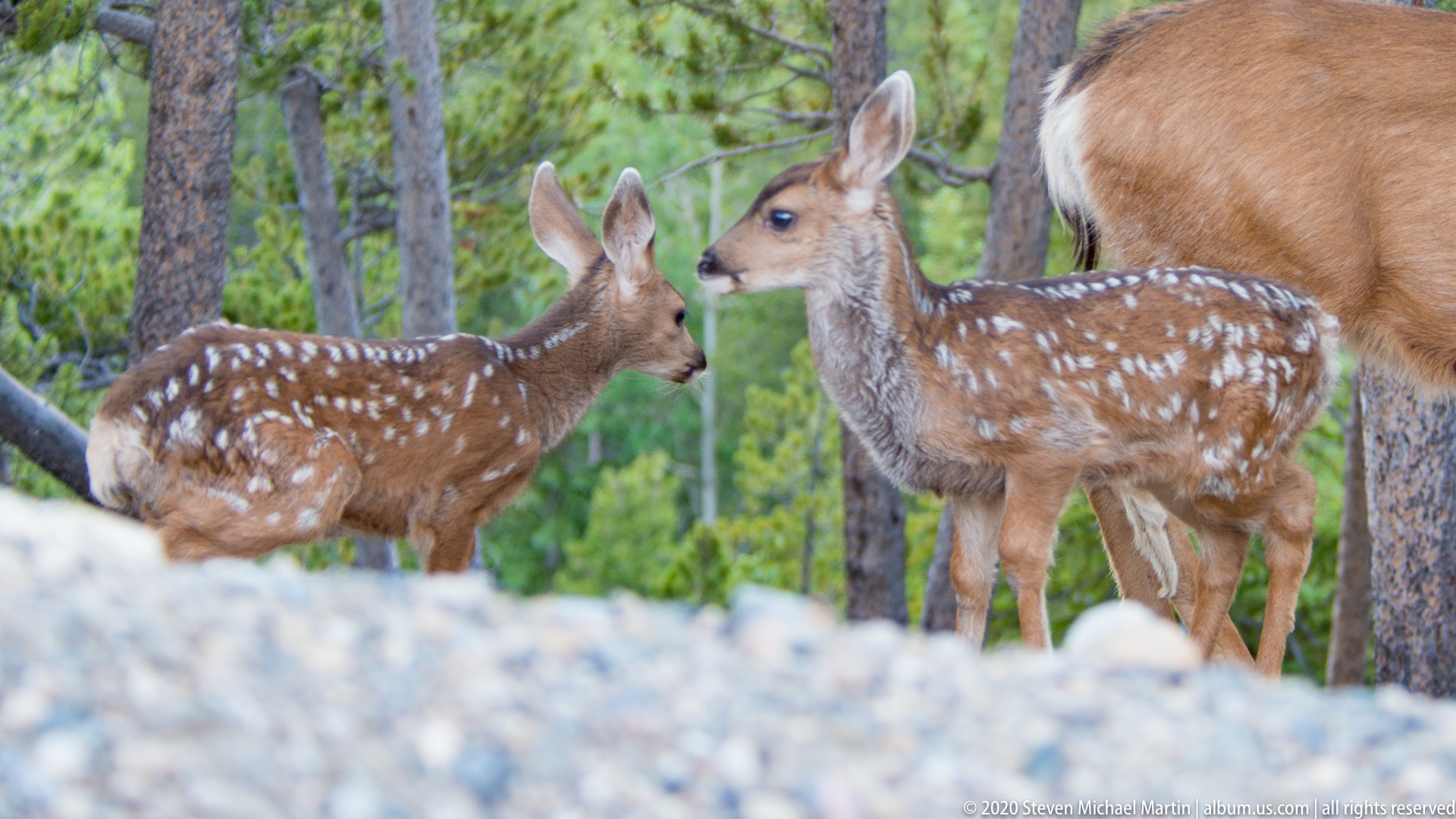
Two spotted fawns face each other at close range, their muzzles nearly touching, while part of the adult doe is visible behind them. Their interaction forms the central moment in this tighter crop; the white spots and small bodies remain prominent against the green woodland. The image records proximity without assigning a specific behavior such as play or greeting.
Caption
Two spotted fawns face each other at close range, their muzzles nearly touching, while part of the adult doe is visible behind them. Their interaction forms the central moment in this tighter crop; the white spots and small bodies remain prominent against the green woodland. The image records proximity without assigning a specific behavior such as play or greeting.
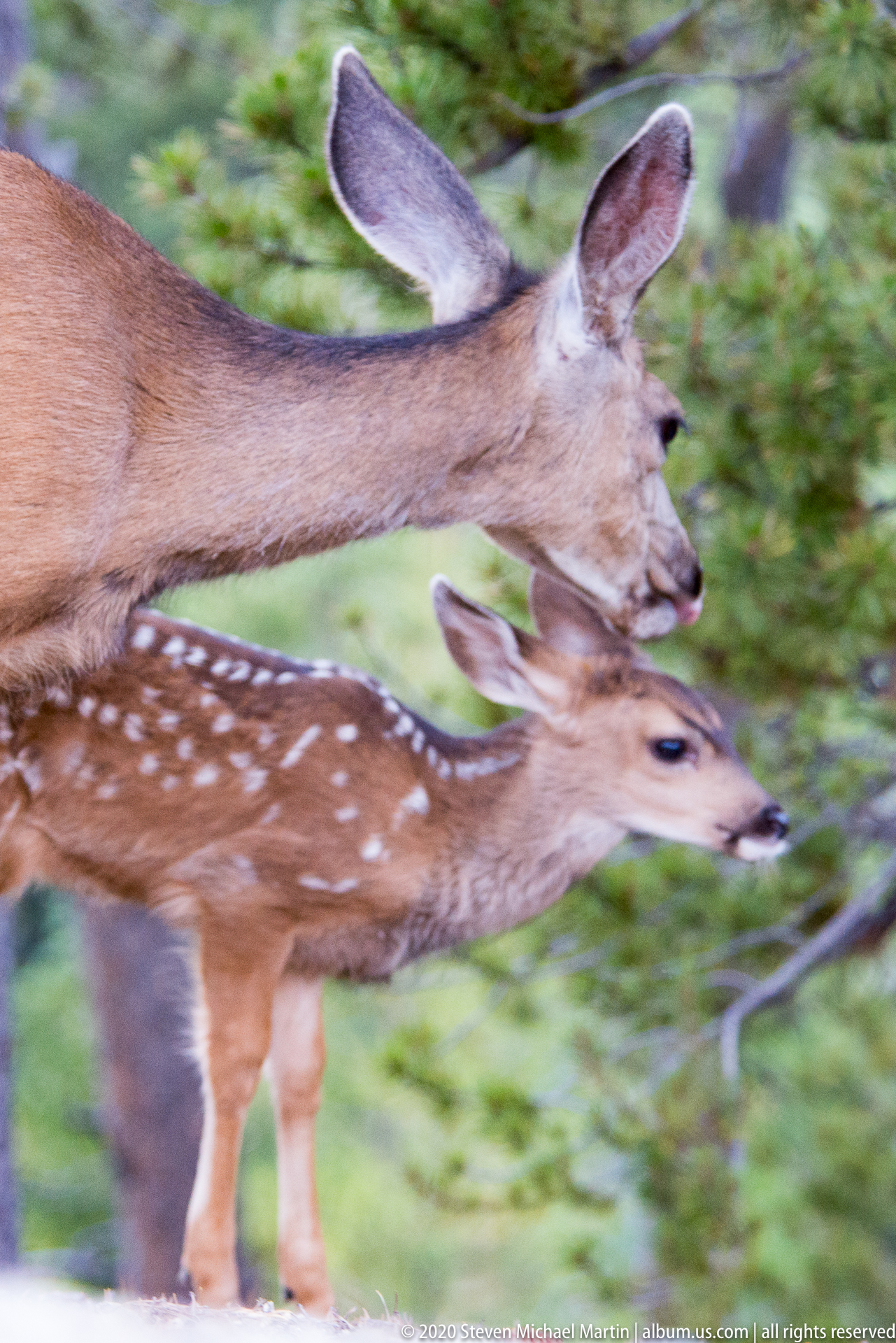
An adult doe and two spotted fawns move together toward the right, their overlapping bodies creating a layered family group. The adult’s head extends above the young deer as they pass through green woodland. Motion blur softens their legs and background, giving the image a sense of movement that contrasts with the still, watchful portraits earlier in the sequence.
Caption
An adult doe and two spotted fawns move together toward the right, their overlapping bodies creating a layered family group. The adult’s head extends above the young deer as they pass through green woodland. Motion blur softens their legs and background, giving the image a sense of movement that contrasts with the still, watchful portraits earlier in the sequence.
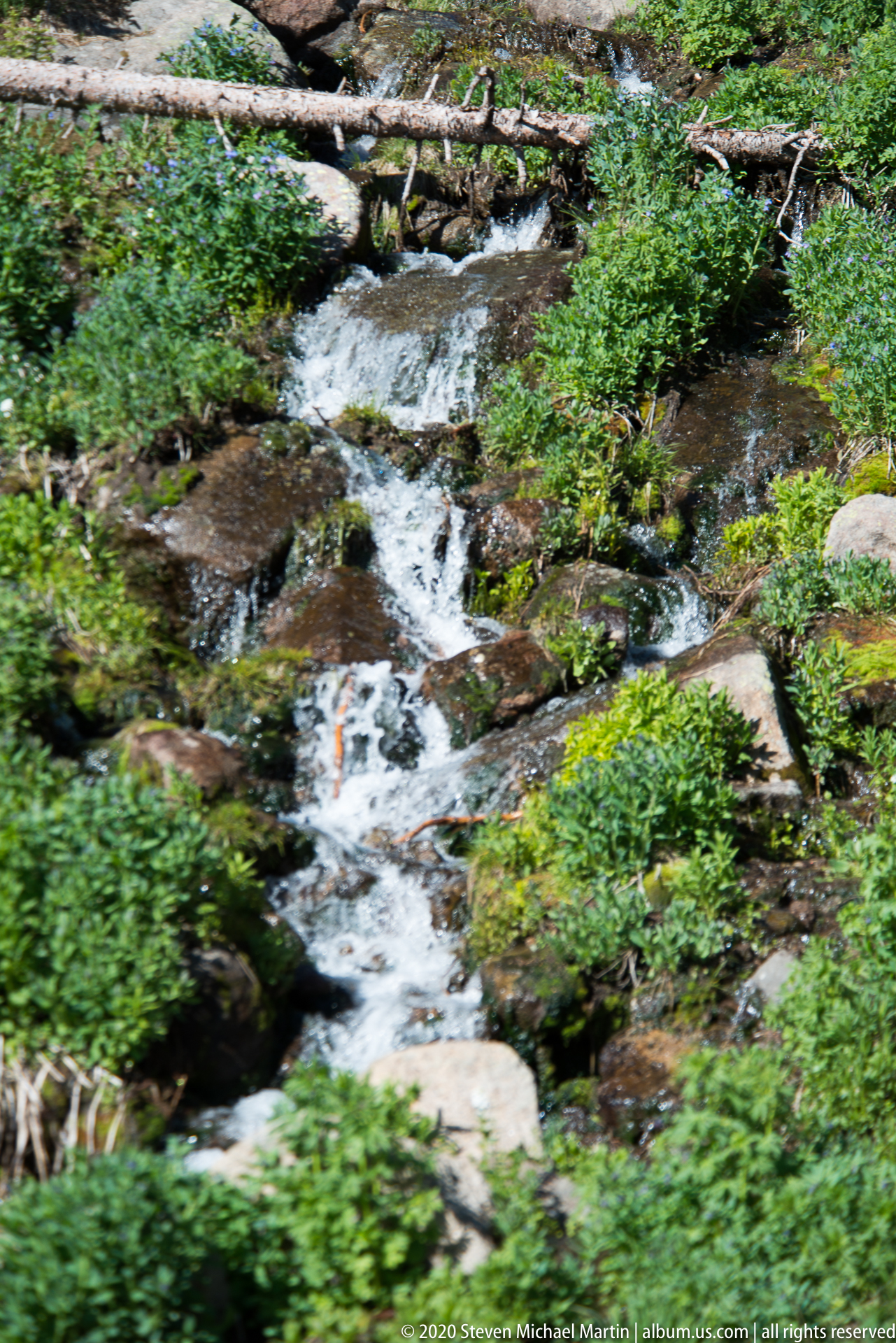
Clear water threads through a narrow woodland channel, breaking into small white cascades over dark, rounded rocks. Fallen branches cross the upper part of the stream, while dense green shrubs crowd both banks. The close viewpoint emphasizes the irregular rock steps and moving water, giving this view a more intimate scale than a broad river or valley landscape.
Caption
Clear water threads through a narrow woodland channel, breaking into small white cascades over dark, rounded rocks. Fallen branches cross the upper part of the stream, while dense green shrubs crowd both banks. The close viewpoint emphasizes the irregular rock steps and moving water, giving this view a more intimate scale than a broad river or valley landscape.
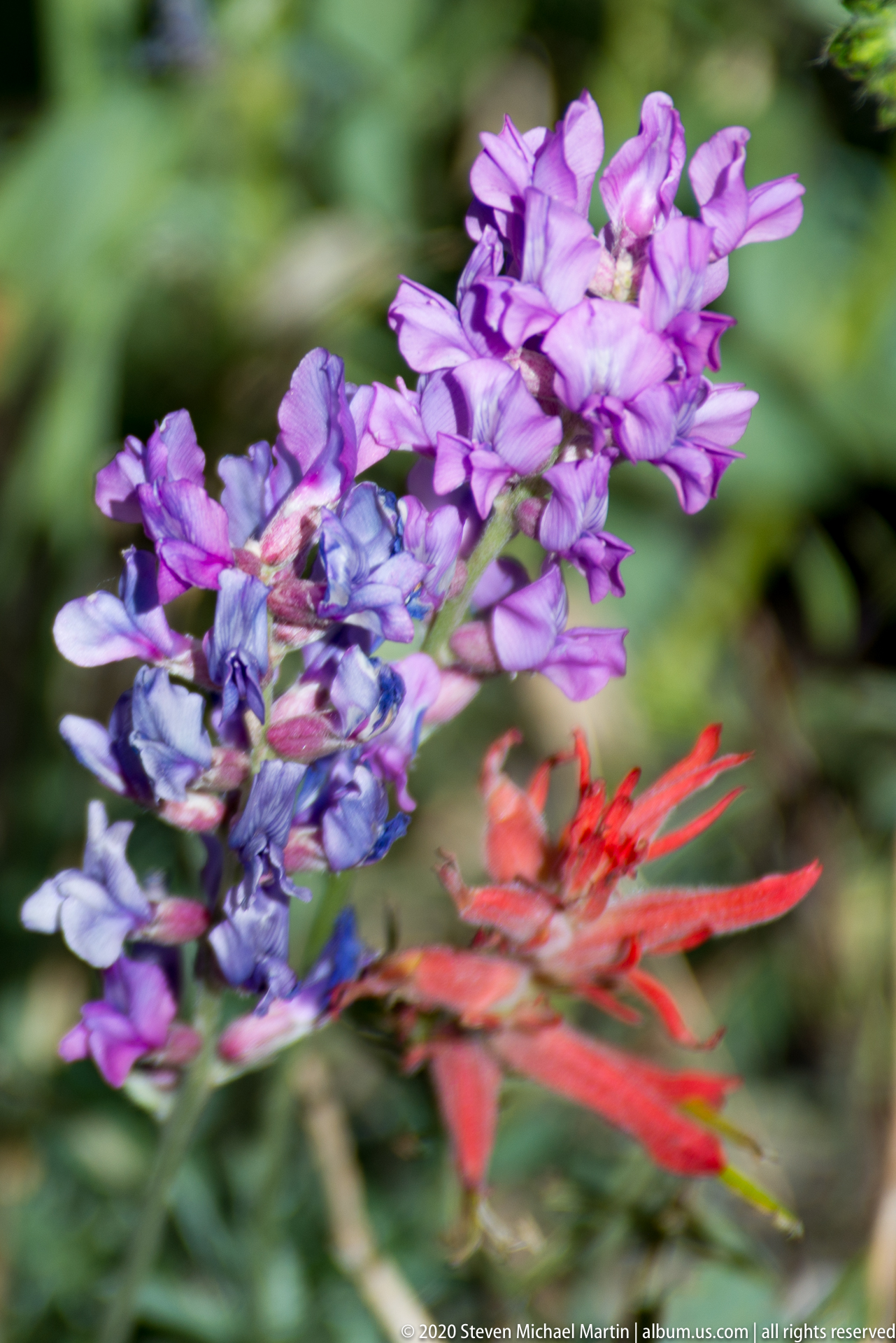
Purple-blue blossoms fill the upper portion of this close view, while a red-orange paintbrush-like cluster crosses the lower right. The overlapping flowers share a soft green background, and the close focus makes their contrasting shapes and colors more prominent than the surrounding habitat. This pairing distinguishes the frame from the broader mixed-flower patch on the preceding page.
Caption
Purple-blue blossoms fill the upper portion of this close view, while a red-orange paintbrush-like cluster crosses the lower right. The overlapping flowers share a soft green background, and the close focus makes their contrasting shapes and colors more prominent than the surrounding habitat. This pairing distinguishes the frame from the broader mixed-flower patch on the preceding page.

A spotted mule deer fawn turns its head toward the camera while standing among tree trunks in a shaded forest. Its large ears, dark muzzle, and white spots remain sharply legible against the softly blurred green understory. The side-on stance reveals the young animal’s narrow legs and pale underside, making this a wildlife portrait rather than a distant habitat view.
Caption
A spotted mule deer fawn turns its head toward the camera while standing among tree trunks in a shaded forest. Its large ears, dark muzzle, and white spots remain sharply legible against the softly blurred green understory. The side-on stance reveals the young animal’s narrow legs and pale underside, making this a wildlife portrait rather than a distant habitat view.

The same kind of spotted fawn appears in a tighter, more frontal composition, with a rough-barked trunk immediately beside its face. The animal looks directly outward while its spotted back extends across the lower frame. This close view foregrounds the alert expression and the contrast between soft juvenile fur and the tree’s textured bark.
Caption
The same kind of spotted fawn appears in a tighter, more frontal composition, with a rough-barked trunk immediately beside its face. The animal looks directly outward while its spotted back extends across the lower frame. This close view foregrounds the alert expression and the contrast between soft juvenile fur and the tree’s textured bark.
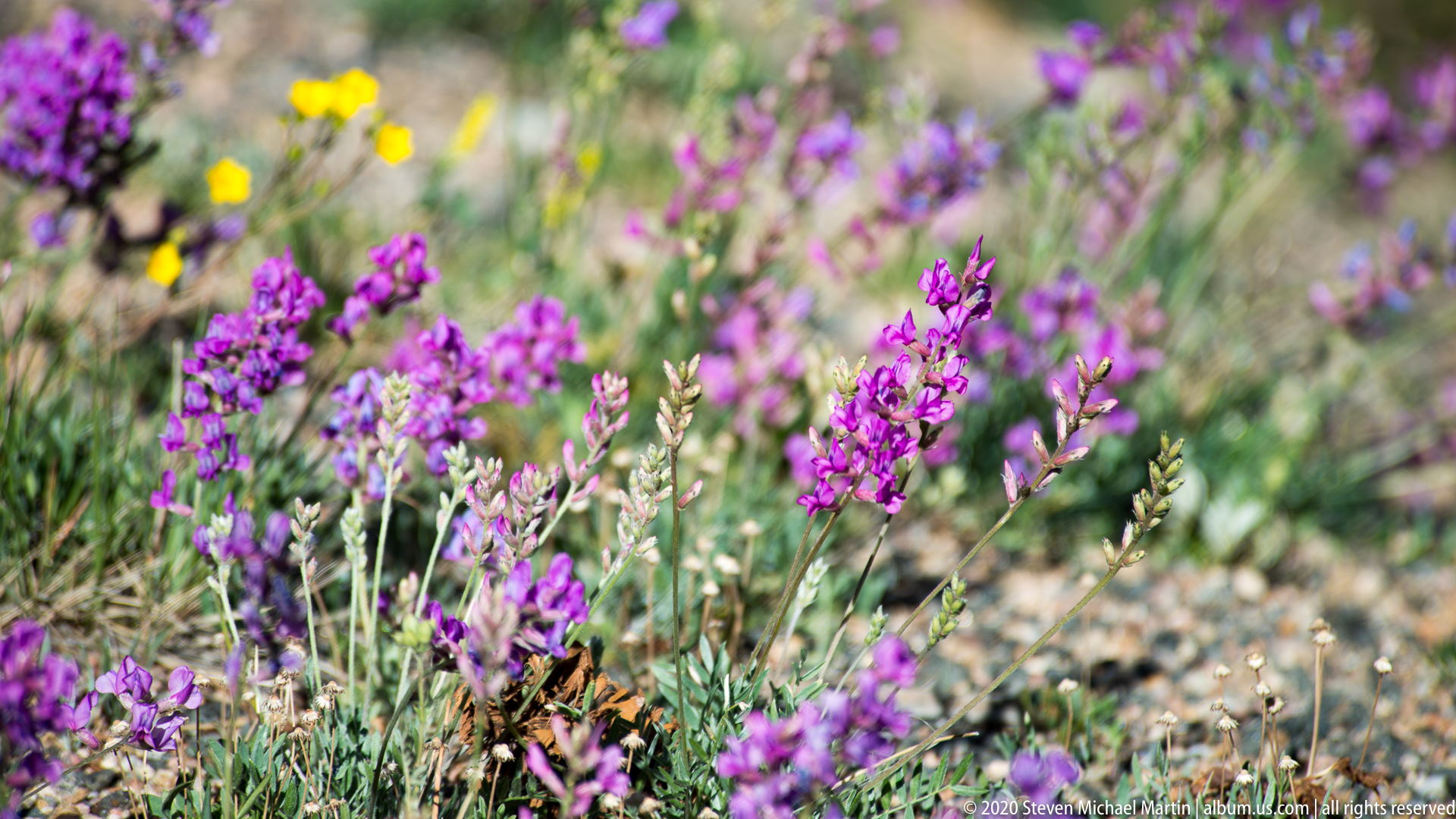
Slender purple flower spikes rise above a stony patch of alpine vegetation, with a few yellow blossoms and grasses scattered behind them. A shallow depth of field separates the central blooms from the blurred meadow, while the lower frame retains gravel and sparse leaves. The image concentrates on seasonal color and the small scale of flowering plants in open habitat.
Caption
Slender purple flower spikes rise above a stony patch of alpine vegetation, with a few yellow blossoms and grasses scattered behind them. A shallow depth of field separates the central blooms from the blurred meadow, while the lower frame retains gravel and sparse leaves. The image concentrates on seasonal color and the small scale of flowering plants in open habitat.
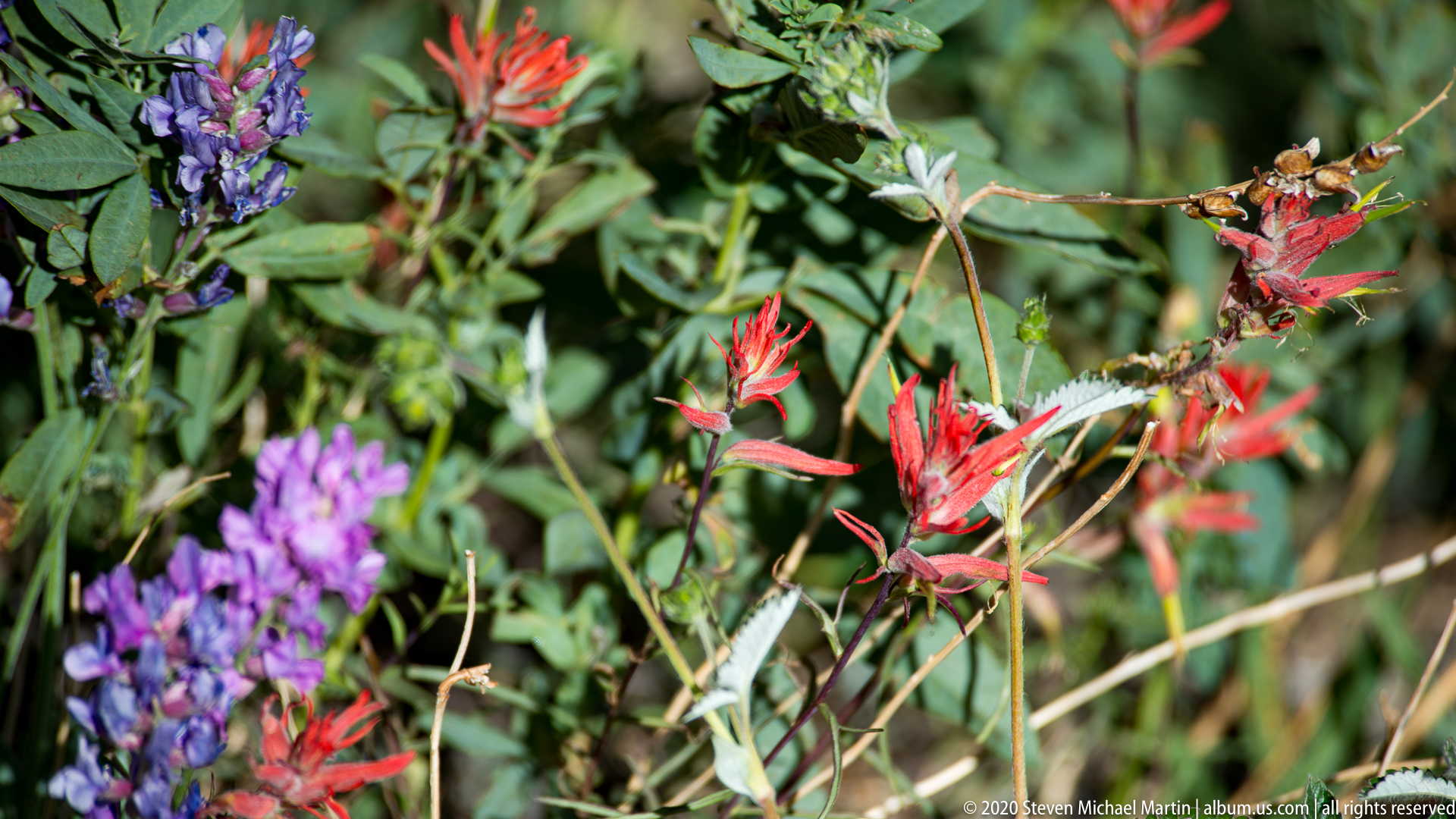
Red-orange flower bracts stand out among green leaves, with purple blossoms clustered lower in the frame. Rather than isolating one plant, this photograph places two conspicuous flower colors in a shared patch of vegetation. The layered stems and foliage create a close botanical view of mixed wildflowers, with the bright red spikes drawing the eye across the foreground.
Caption
Red-orange flower bracts stand out among green leaves, with purple blossoms clustered lower in the frame. Rather than isolating one plant, this photograph places two conspicuous flower colors in a shared patch of vegetation. The layered stems and foliage create a close botanical view of mixed wildflowers, with the bright red spikes drawing the eye across the foreground.
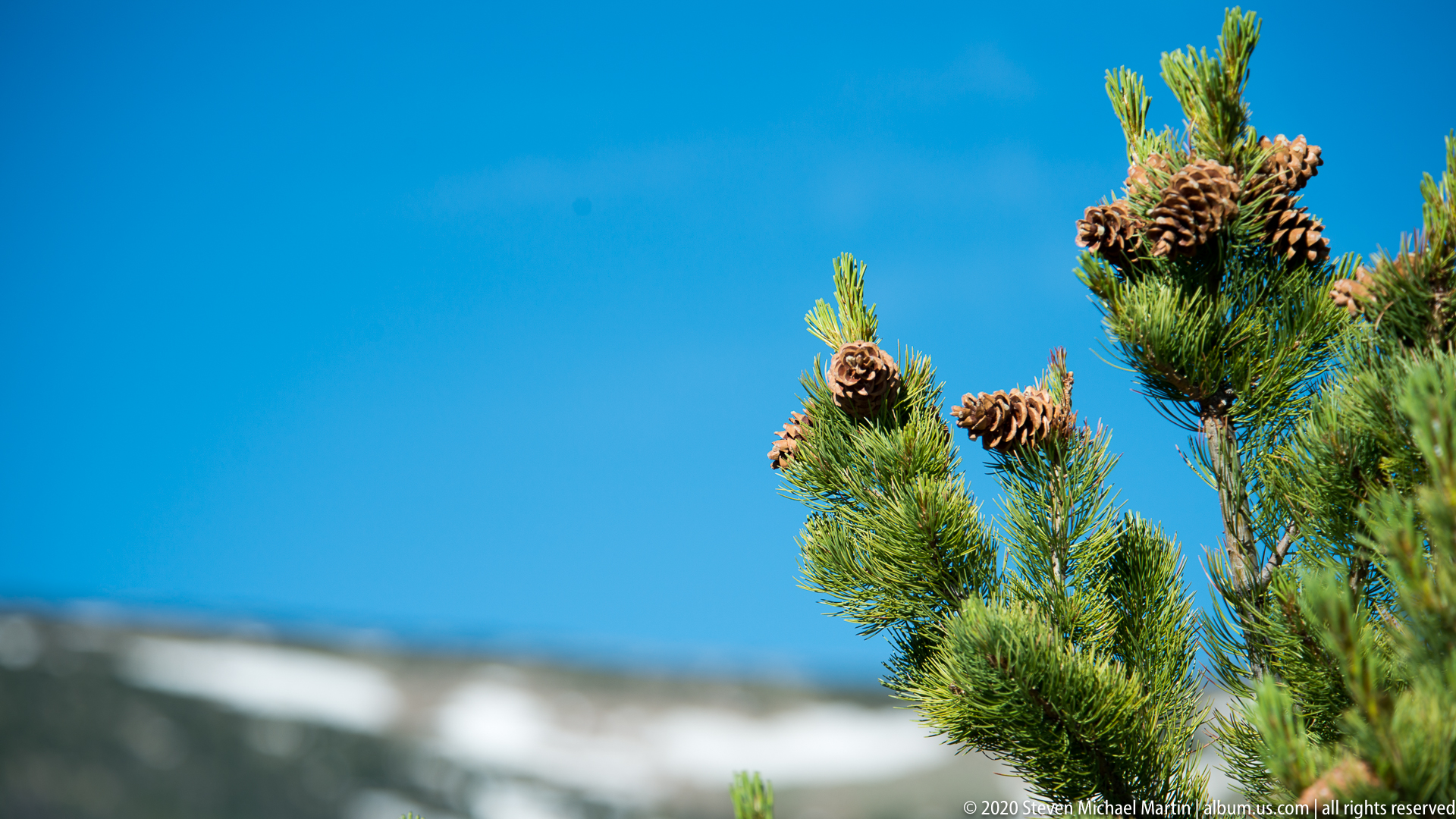
A conifer branch rises into a clear blue sky, its clusters of brown cones set among dense green needles and lighter new growth. Snow-bright slopes and a dark ridge blur across the lower background, placing the close botanical detail within a mountain setting. The upward composition isolates the cone-bearing branch against open sky rather than showing the whole tree.
Caption
A conifer branch rises into a clear blue sky, its clusters of brown cones set among dense green needles and lighter new growth. Snow-bright slopes and a dark ridge blur across the lower background, placing the close botanical detail within a mountain setting. The upward composition isolates the cone-bearing branch against open sky rather than showing the whole tree.
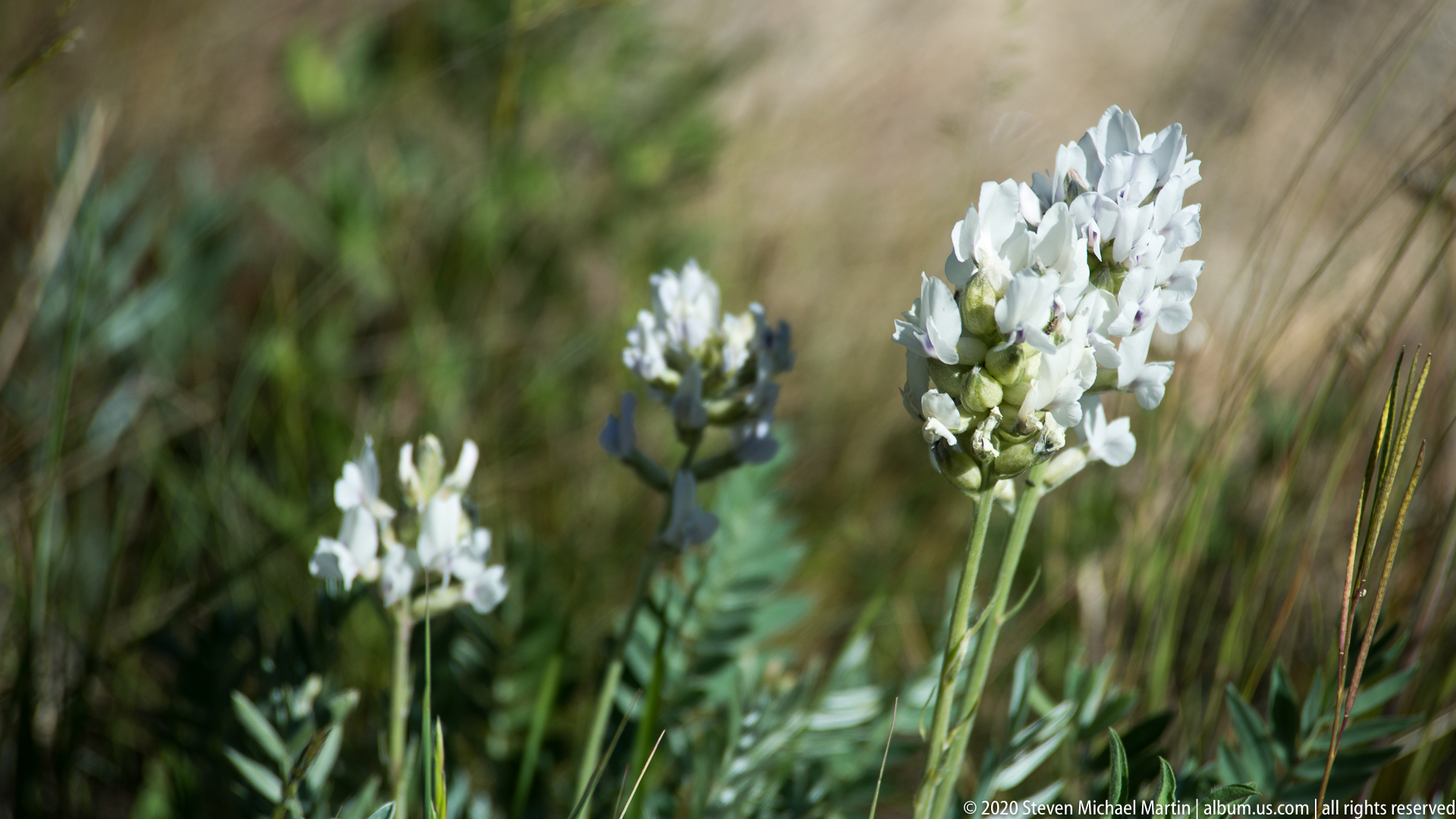
Several upright clusters of small white flowers rise above narrow green leaves in a grassy meadow. The blooms are lit from the side, giving their pale petals a bright edge against a softly blurred mix of tan grass and darker vegetation. The composition keeps the flower stems distinct while retaining enough habitat detail to show their low-growing, open-meadow setting.
Caption
Several upright clusters of small white flowers rise above narrow green leaves in a grassy meadow. The blooms are lit from the side, giving their pale petals a bright edge against a softly blurred mix of tan grass and darker vegetation. The composition keeps the flower stems distinct while retaining enough habitat detail to show their low-growing, open-meadow setting.
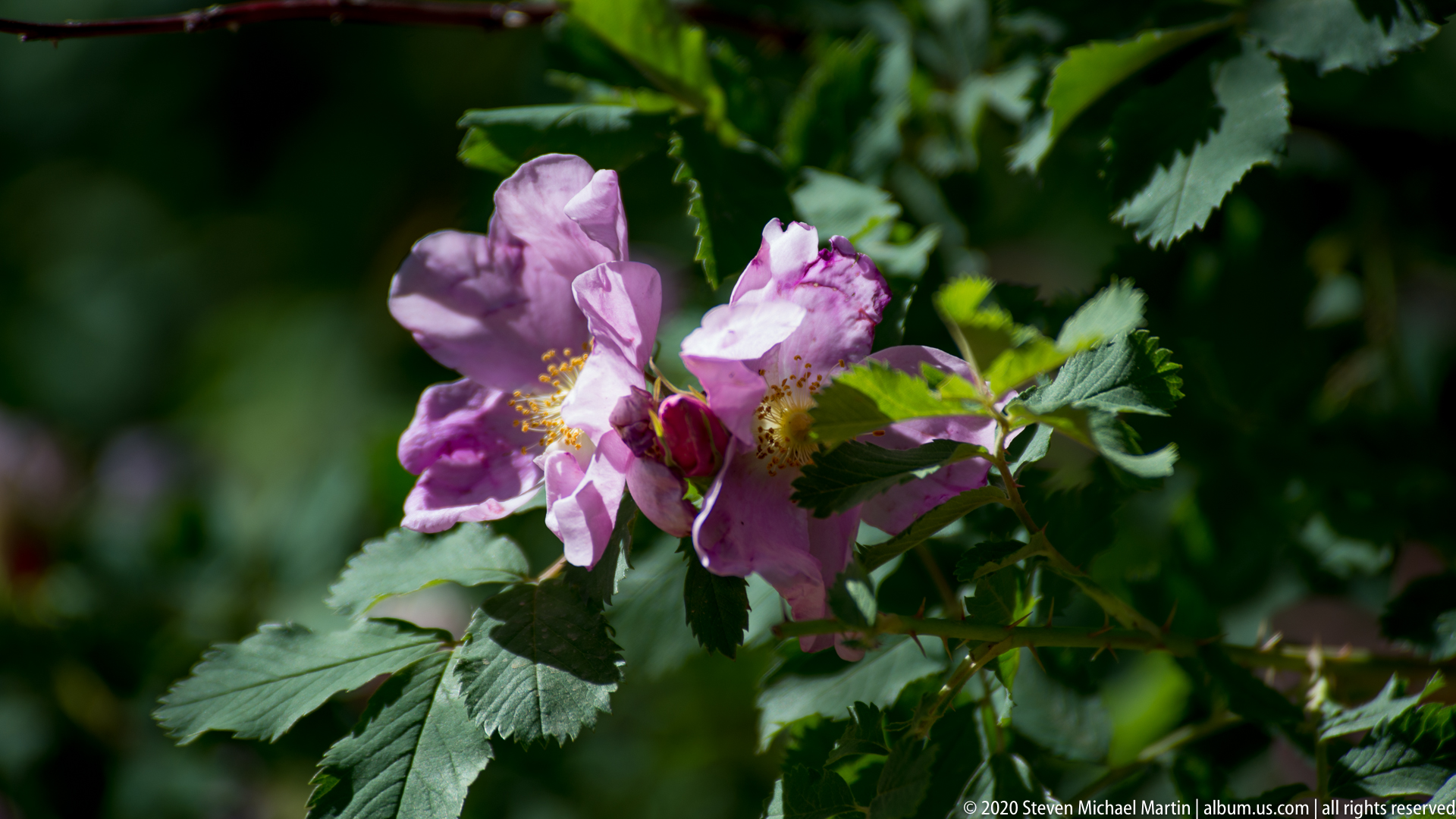
Open pink wild roses with yellow stamens are framed by broad, serrated leaves against deep green shade. The flowers occupy the center and right of the composition, and one blossom faces the viewer while another turns slightly away. Their delicate petals contrast with the sharply defined leaf edges, giving this photograph a close, sheltered understory perspective.
Caption
Open pink wild roses with yellow stamens are framed by broad, serrated leaves against deep green shade. The flowers occupy the center and right of the composition, and one blossom faces the viewer while another turns slightly away. Their delicate petals contrast with the sharply defined leaf edges, giving this photograph a close, sheltered understory perspective.
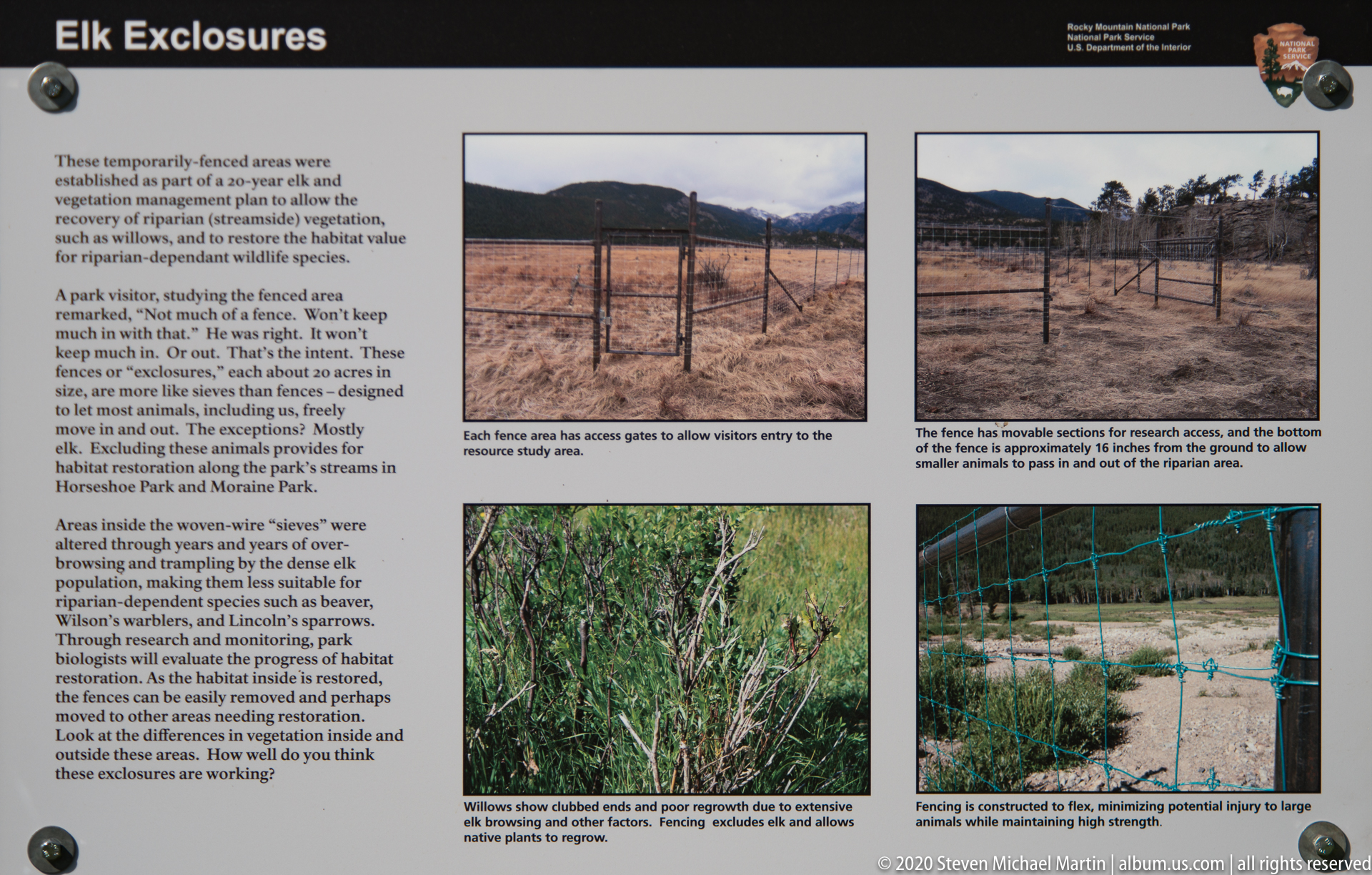
An interpretive display titled “Fenced Exclosures” combines explanatory text with photographs of fenced plots and recovering vegetation. The page describes how fencing can limit browsing and support plant regrowth, and includes paired examples of enclosure conditions. Seen straight on, the panel presents management information as part of the park landscape, linking small-scale restoration work with visible changes in vegetation.
Caption
An interpretive display titled “Fenced Exclosures” combines explanatory text with photographs of fenced plots and recovering vegetation. The page describes how fencing can limit browsing and support plant regrowth, and includes paired examples of enclosure conditions. Seen straight on, the panel presents management information as part of the park landscape, linking small-scale restoration work with visible changes in vegetation.
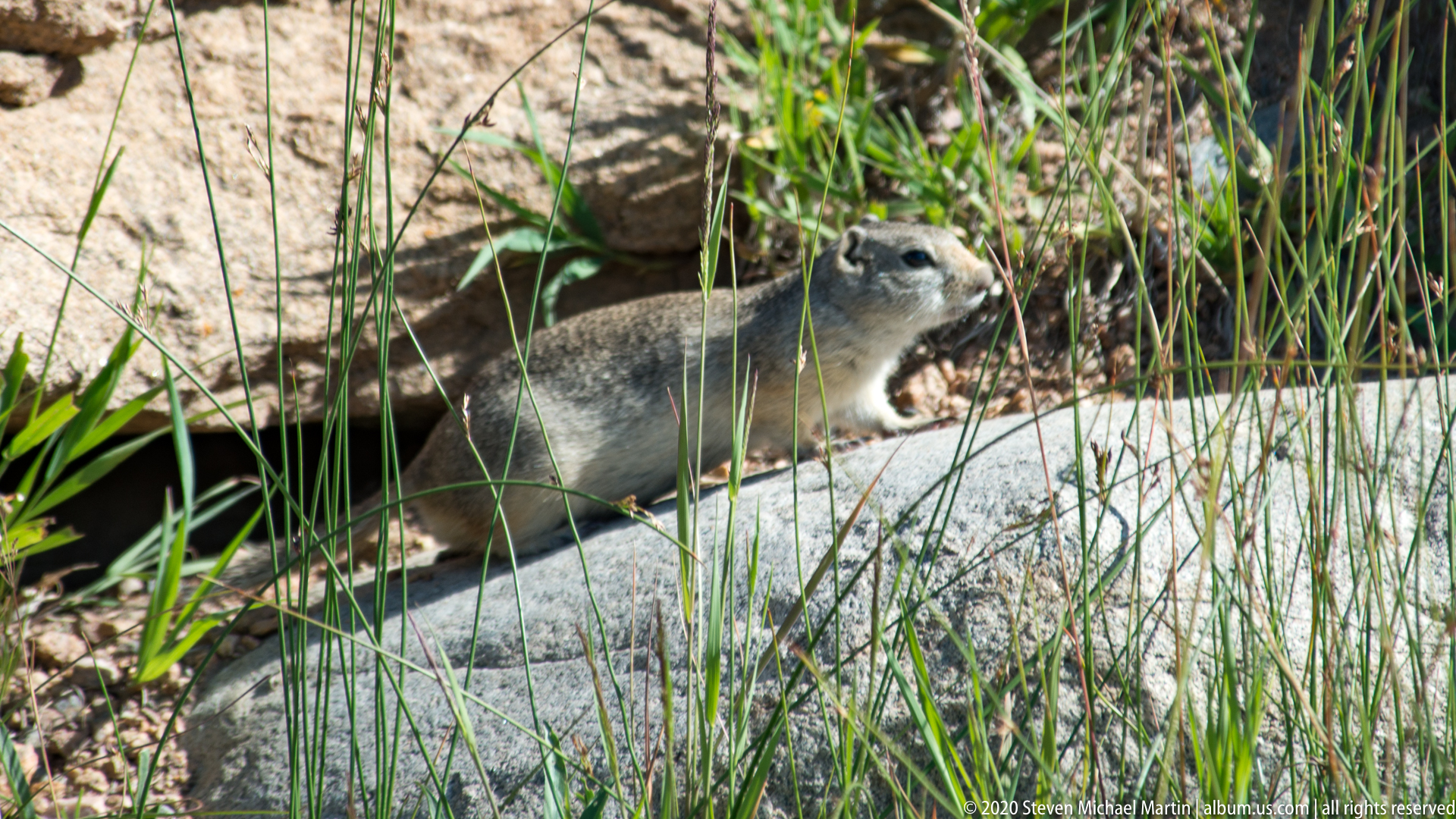
A gray-brown rodent rests lengthwise on a pale rock among upright grasses, with its head turned to the right. Its compact body and short rounded ears are visible, but the proof-sheet view does not clearly resolve species-level markings. The animal occupies a narrow strip through the middle of the frame, while grass blades and rocky ground establish its immediate habitat.
Caption
A gray-brown rodent rests lengthwise on a pale rock among upright grasses, with its head turned to the right. Its compact body and short rounded ears are visible, but the proof-sheet view does not clearly resolve species-level markings. The animal occupies a narrow strip through the middle of the frame, while grass blades and rocky ground establish its immediate habitat.
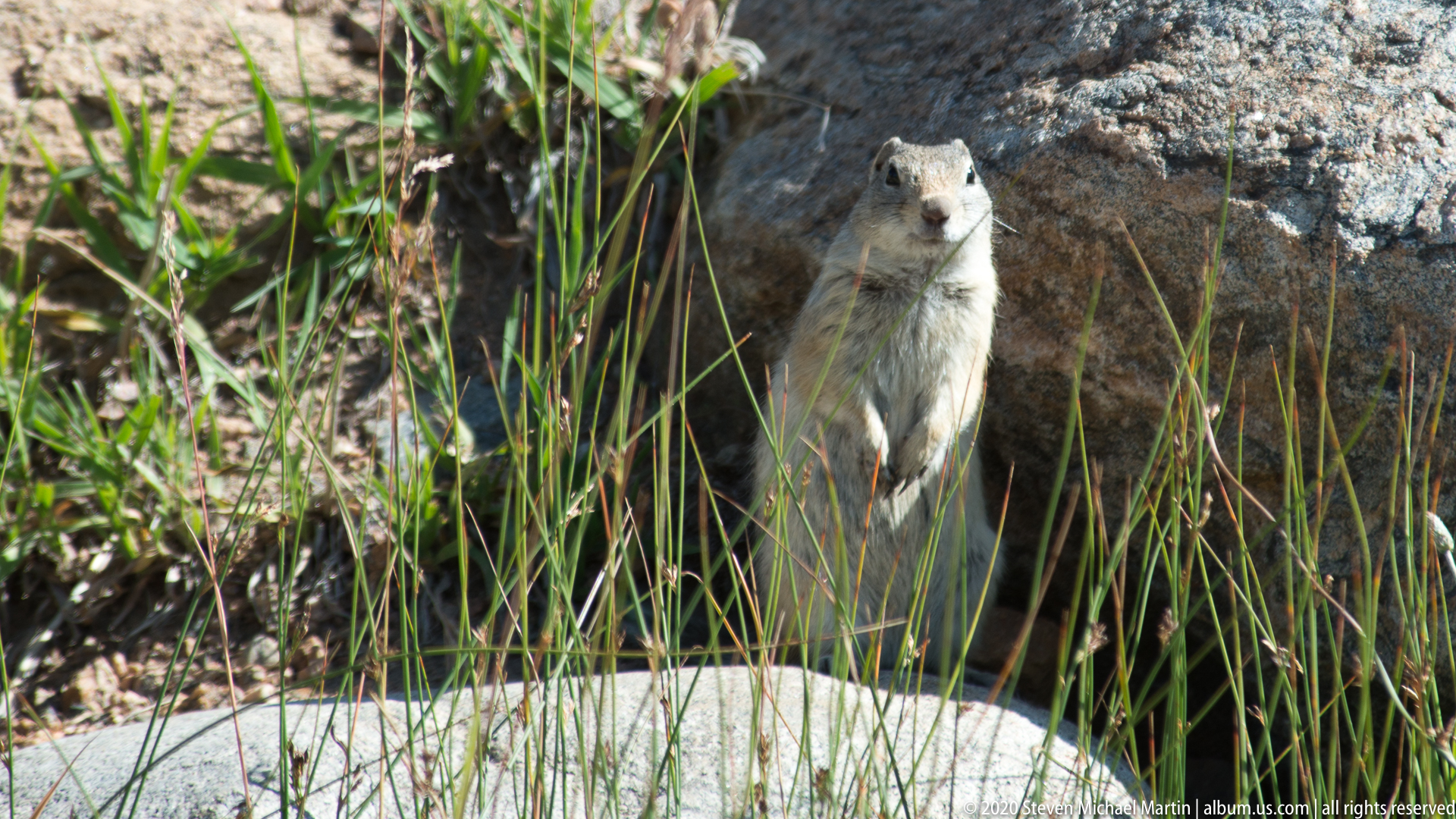
A small gray-brown rodent stands upright in a patch of tall grass, with a large pale boulder and rough rock behind it. Its elongated posture and alert gaze are clear, but the available view does not support a confident species identification. The grasses cut across the animal’s lower body, emphasizing how it blends into the rocky, vegetated edge of the habitat.
Caption
A small gray-brown rodent stands upright in a patch of tall grass, with a large pale boulder and rough rock behind it. Its elongated posture and alert gaze are clear, but the available view does not support a confident species identification. The grasses cut across the animal’s lower body, emphasizing how it blends into the rocky, vegetated edge of the habitat.
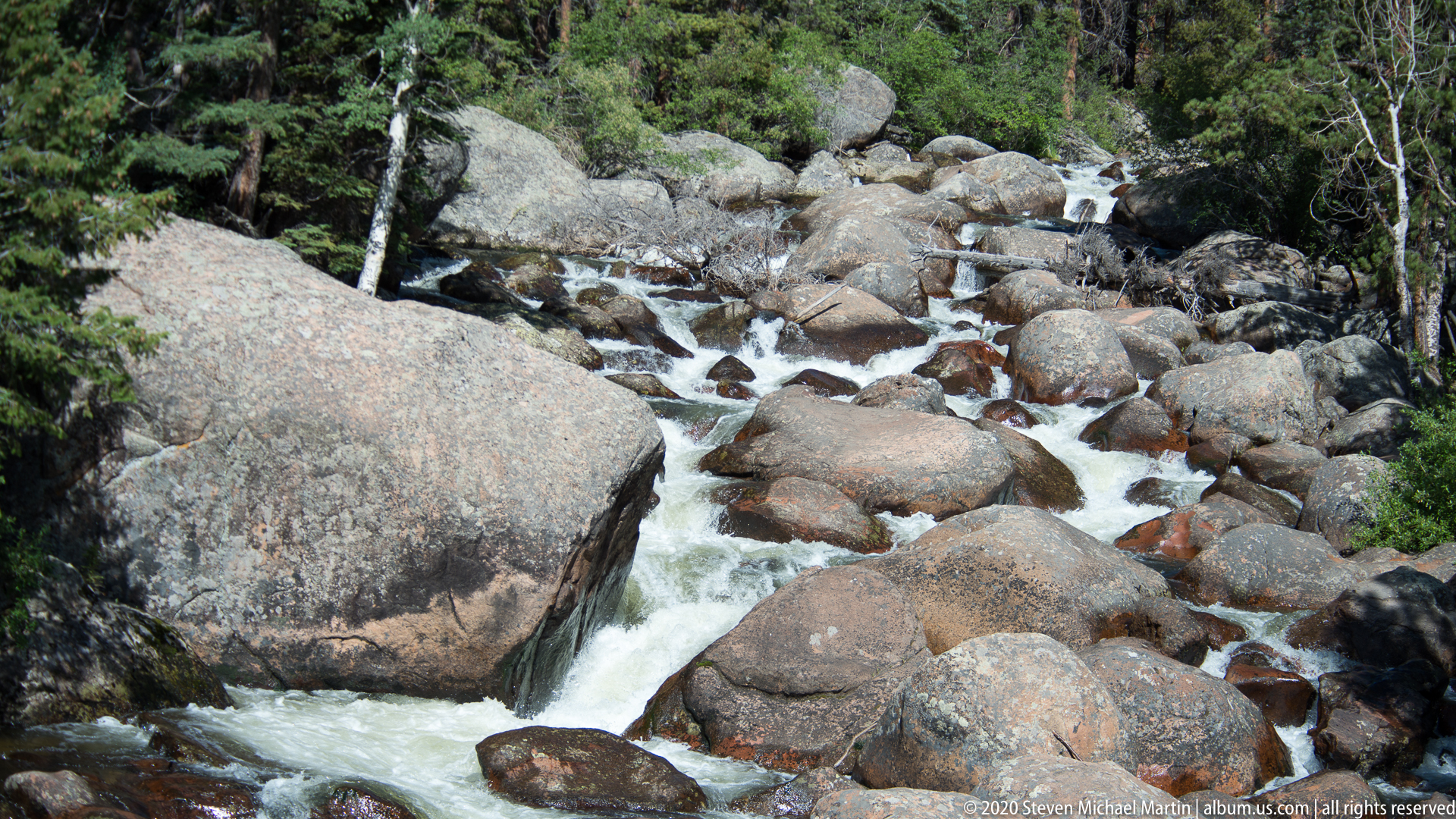
A broader section of creek descends over a succession of rounded boulders, with a large foreground rock leading into the churning channel. Evergreen trees and shrubs close the banks, creating a shaded corridor around the water. The wider framing reveals how the cascade continues upstream through the forest, in contrast to the previous image’s tightly cropped rapid.
Caption
A broader section of creek descends over a succession of rounded boulders, with a large foreground rock leading into the churning channel. Evergreen trees and shrubs close the banks, creating a shaded corridor around the water. The wider framing reveals how the cascade continues upstream through the forest, in contrast to the previous image’s tightly cropped rapid.

Yellow ray flowers with deep reddish-brown centers stand on slender stems against a softly blurred, stony background. Several blossoms face different directions, revealing both open flower heads and side profiles. Their warm color is isolated from the muted terrain, while a small unopened or fading head at the lower edge adds a sense of varied growth within the same patch.
Caption
Yellow ray flowers with deep reddish-brown centers stand on slender stems against a softly blurred, stony background. Several blossoms face different directions, revealing both open flower heads and side profiles. Their warm color is isolated from the muted terrain, while a small unopened or fading head at the lower edge adds a sense of varied growth within the same patch.

Pale flower clusters rise above long, narrow leaves in a small woodland opening. Their many compact blooms form bright points against the darker mix of grass, twigs, and low vegetation. The view includes more of the surrounding ground than the earlier white-flower close-up, showing the plants scattered among natural understory rather than isolated against a meadow backdrop.
Caption
Pale flower clusters rise above long, narrow leaves in a small woodland opening. Their many compact blooms form bright points against the darker mix of grass, twigs, and low vegetation. The view includes more of the surrounding ground than the earlier white-flower close-up, showing the plants scattered among natural understory rather than isolated against a meadow backdrop.
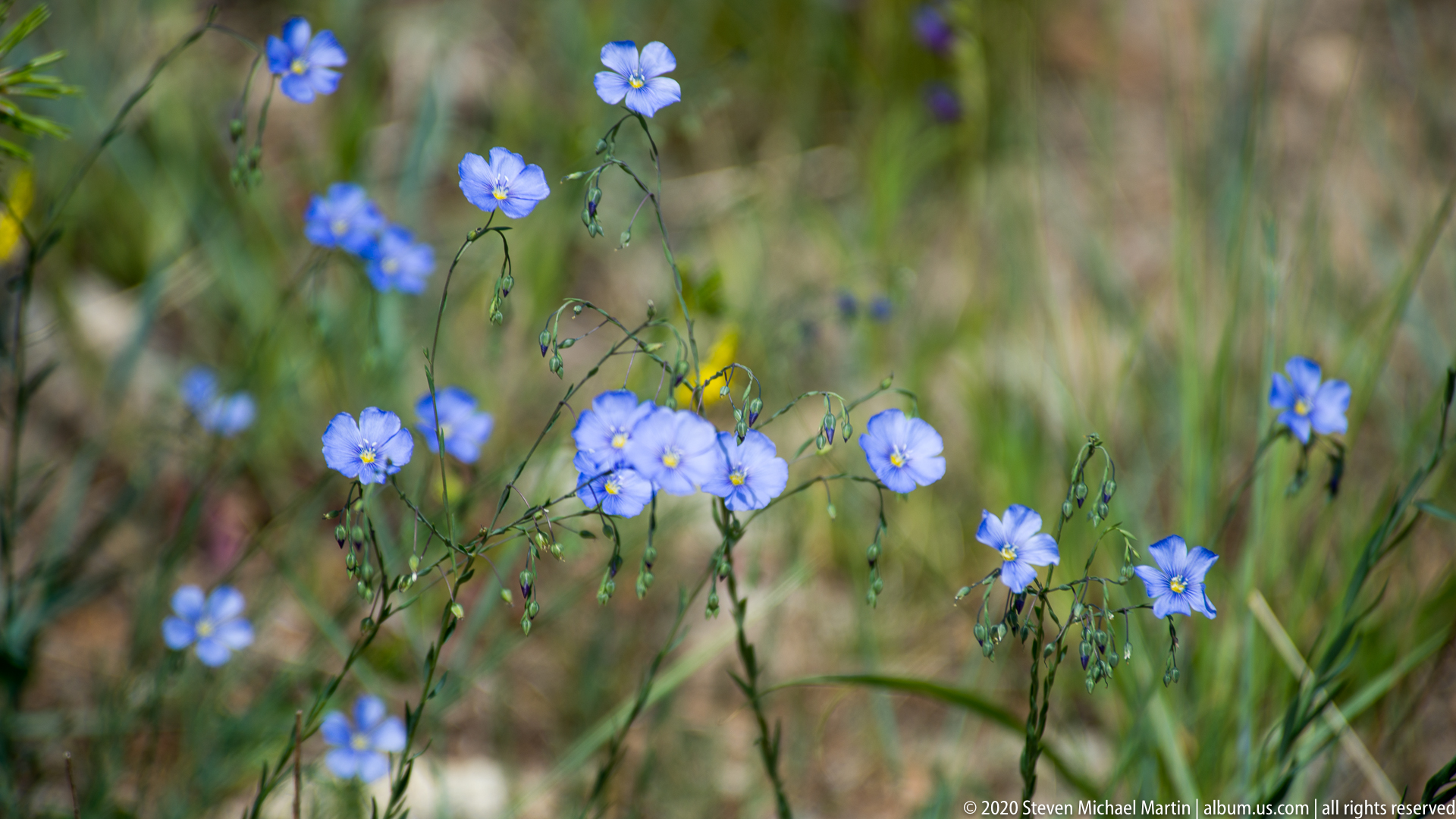
Small blue flowers with five rounded petals and pale centers are scattered across slender, branching stems. The open composition leaves generous space between blooms and keeps the tan-green meadow visible behind them. The flowers appear delicate and widely spaced, while the fine stems and tiny buds provide the main detail in this airy view of flowering groundcover.
Caption
Small blue flowers with five rounded petals and pale centers are scattered across slender, branching stems. The open composition leaves generous space between blooms and keeps the tan-green meadow visible behind them. The flowers appear delicate and widely spaced, while the fine stems and tiny buds provide the main detail in this airy view of flowering groundcover.
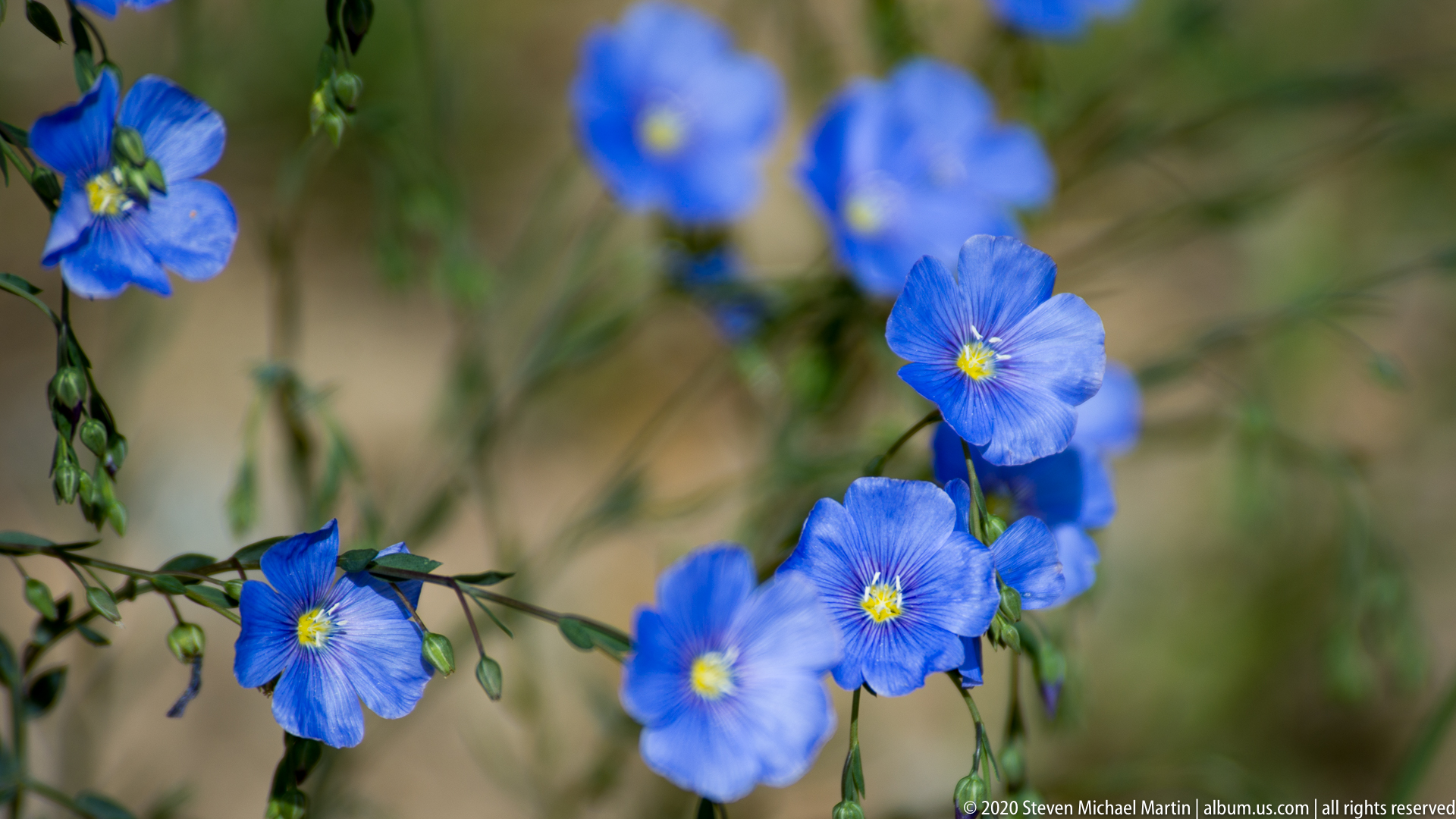
Vivid blue flowers fill the foreground, their five broad petals and small yellow centers sharply separated from a smooth, tan-green background. The close framing makes the individual blossoms and delicate branching stems easy to distinguish, unlike the dispersed arrangement in the preceding image. Several buds and partial blooms extend beyond the edges, suggesting a larger flowering cluster beyond the crop.
Caption
Vivid blue flowers fill the foreground, their five broad petals and small yellow centers sharply separated from a smooth, tan-green background. The close framing makes the individual blossoms and delicate branching stems easy to distinguish, unlike the dispersed arrangement in the preceding image. Several buds and partial blooms extend beyond the edges, suggesting a larger flowering cluster beyond the crop.

A dense group of magenta and violet flower spikes rises among thin grasses, with individual blossoms and branching stems crossing in different directions. The tighter cluster fills much of the frame, while a softly focused tan-green slope remains visible behind it. The composition records the abundance and overlapping structure of the patch, rather than isolating a single flower head.
Caption
A dense group of magenta and violet flower spikes rises among thin grasses, with individual blossoms and branching stems crossing in different directions. The tighter cluster fills much of the frame, while a softly focused tan-green slope remains visible behind it. The composition records the abundance and overlapping structure of the patch, rather than isolating a single flower head.

A single red-orange paintbrush-like flower is isolated near the center against a creamy, blurred field of green and tan. The shallow focus softens both the surrounding meadow and a second orange bloom near the upper left, leaving the central flower’s narrow bracts and branching green stem as the primary detail. This selective-focus study contrasts with the previous dense, sharply layered flower patch.
Caption
A single red-orange paintbrush-like flower is isolated near the center against a creamy, blurred field of green and tan. The shallow focus softens both the surrounding meadow and a second orange bloom near the upper left, leaving the central flower’s narrow bracts and branching green stem as the primary detail. This selective-focus study contrasts with the previous dense, sharply layered flower patch.
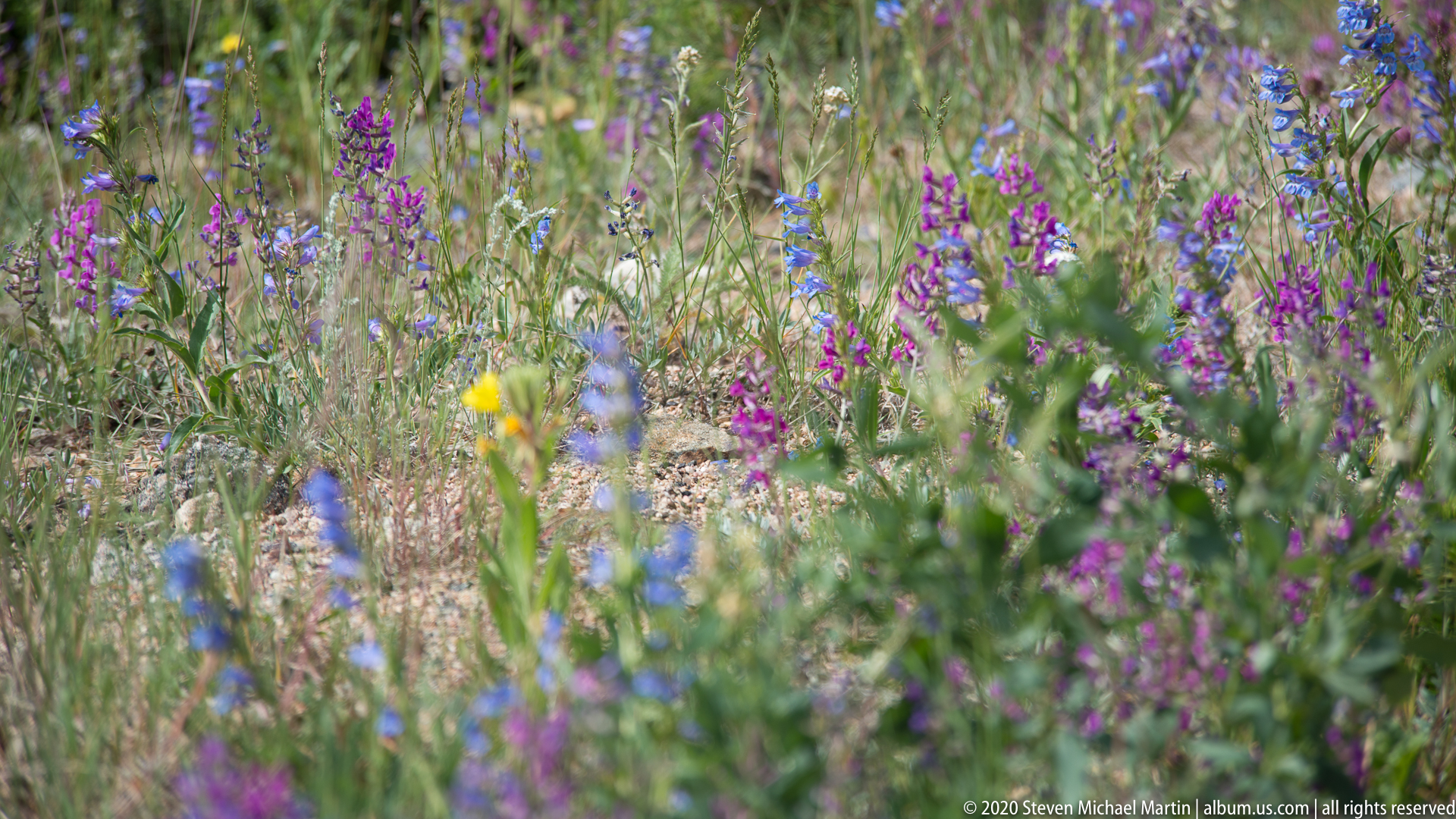
Purple, blue, and yellow wildflowers are scattered through a tall grassy meadow, with blossoms at varied distances from the lens. Foreground stems blur into soft color while a middle band of flowers remains more distinct, producing a layered view rather than a single-plant portrait. The broad spread of blooms suggests a diverse flowering patch, though individual species are not resolved here.
Caption
Purple, blue, and yellow wildflowers are scattered through a tall grassy meadow, with blossoms at varied distances from the lens. Foreground stems blur into soft color while a middle band of flowers remains more distinct, producing a layered view rather than a single-plant portrait. The broad spread of blooms suggests a diverse flowering patch, though individual species are not resolved here.
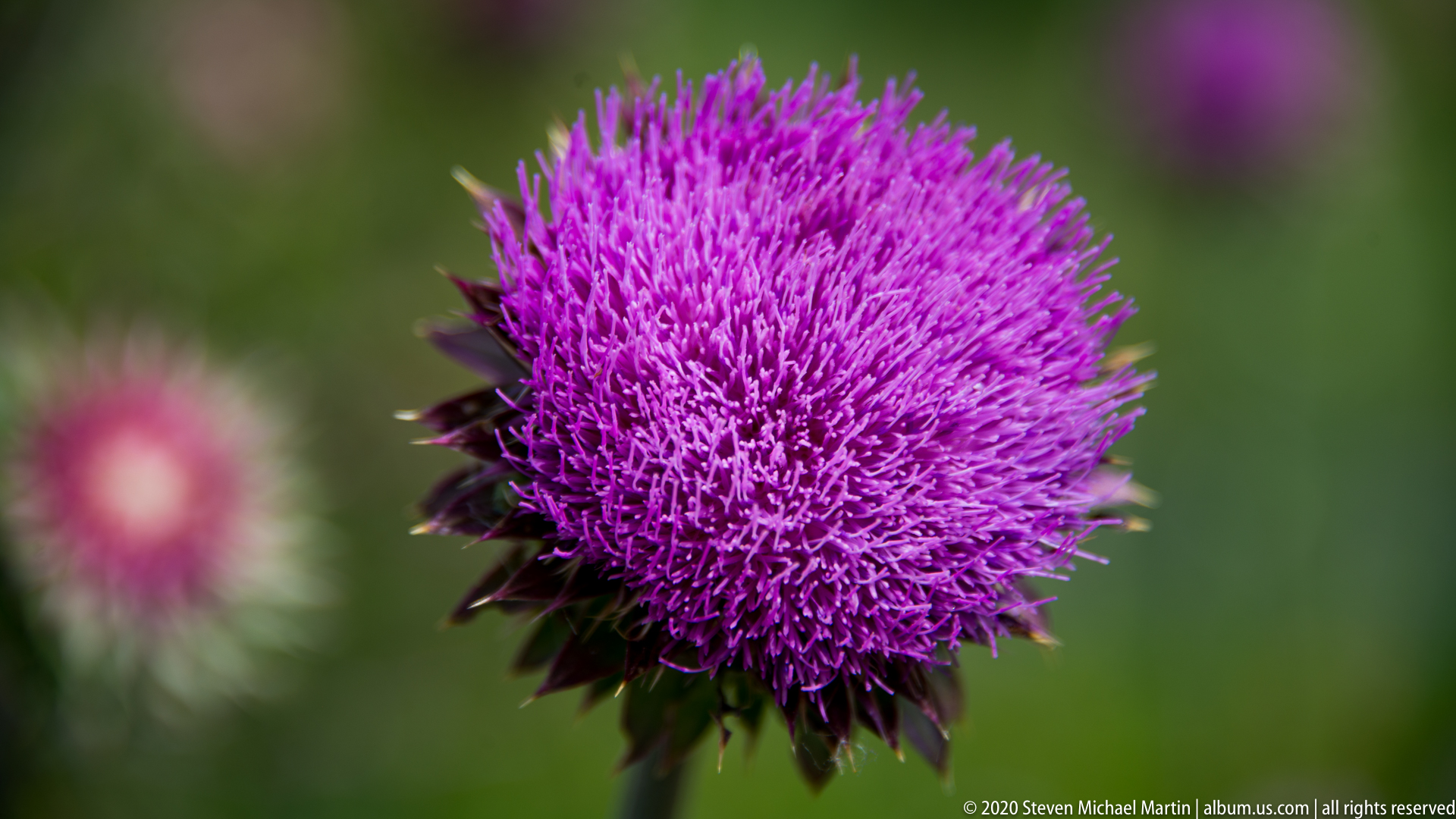
A rounded purple thistle head fills the frame, its dense fringe of fine florets sharply detailed above dark pointed bracts. A second flower head appears as a soft magenta blur behind it, setting the main bloom apart from the green background. The close view reveals the thistle’s spiny outline and tightly packed florets without enough detail to establish a particular species.
Caption
A rounded purple thistle head fills the frame, its dense fringe of fine florets sharply detailed above dark pointed bracts. A second flower head appears as a soft magenta blur behind it, setting the main bloom apart from the green background. The close view reveals the thistle’s spiny outline and tightly packed florets without enough detail to establish a particular species.
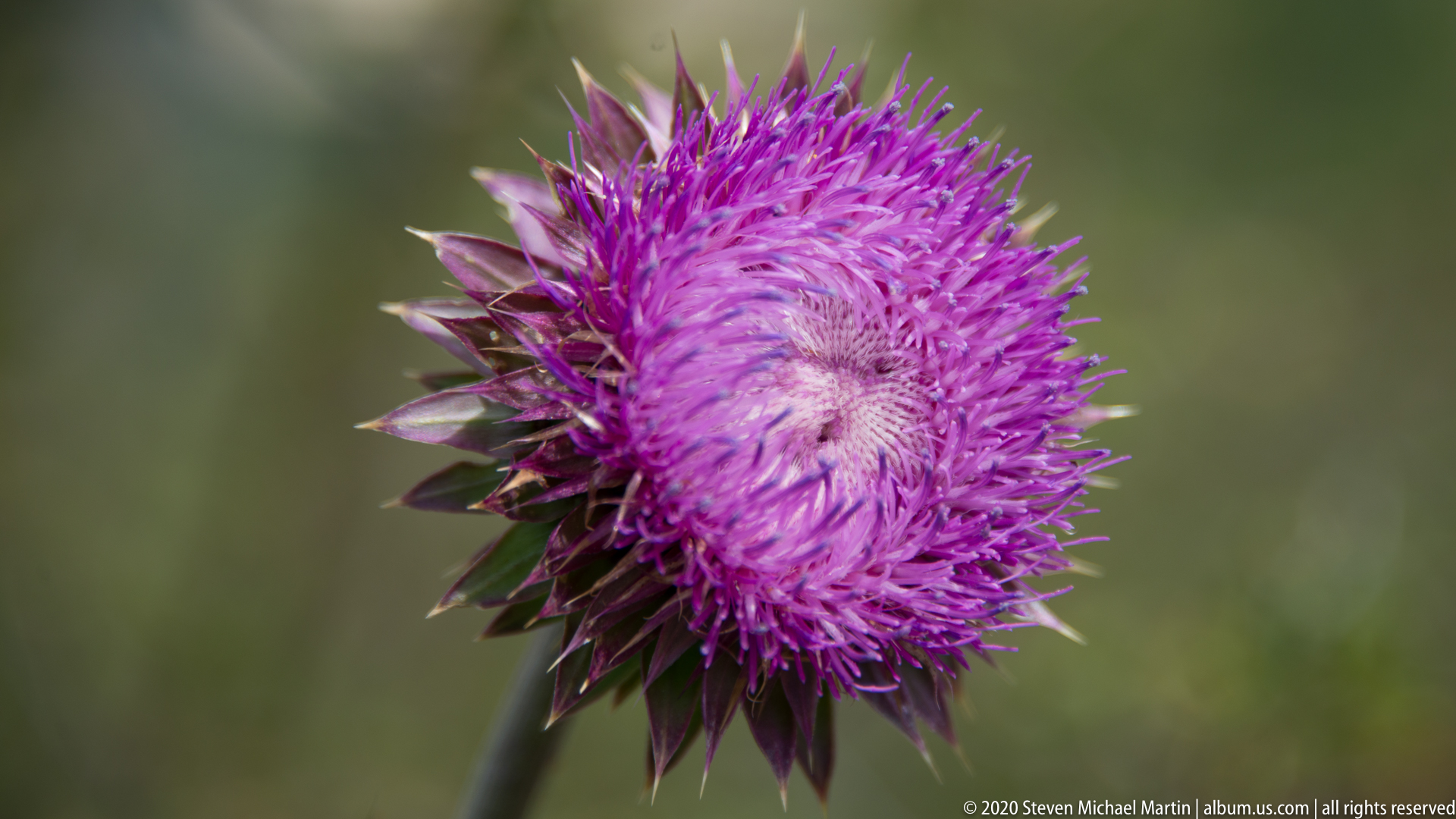
Seen from the side, a purple thistle head shows its layered pointed bracts and dense florets, with a pale patch of unopened or receding flowers visible near the center. The angled view reveals the flower’s structure more clearly than the frontal bloom nearby. A soft green background isolates the plant, while the single stem remains visible beneath the spiny head.
Caption
Seen from the side, a purple thistle head shows its layered pointed bracts and dense florets, with a pale patch of unopened or receding flowers visible near the center. The angled view reveals the flower’s structure more clearly than the frontal bloom nearby. A soft green background isolates the plant, while the single stem remains visible beneath the spiny head.
Rocky Mountain National Park — Field Guide
National Park Field Guide
📍 Overview
Rocky Mountain National Park preserves a high elevation mountain environment shaped by tectonic uplift and glacial erosion. The park includes rugged peaks, alpine tundra, and forested valleys that illustrate geological processes influencing the formation of the Rocky Mountains. The Continental Divide runs through the park, separating river systems that flow toward the Atlantic and Pacific Oceans.
Glaciers carved cirques, valleys, and basins that remain visible in the park’s present-day terrain. Differences in elevation produce varied ecological zones ranging from montane forest to alpine tundra environments above treeline. The landscape reflects the interaction between geological forces, climate, and biological adaptation across mountain ecosystems.
⭐ Highlights
- High elevation peaks along the Continental Divide
- Glacially shaped valleys and alpine lakes
- Alpine tundra environments above treeline
- Trail Ridge Road high mountain views
- Mountain landscapes shaped by tectonic uplift
🔎 Key Features
- Glacial landforms including cirques and moraines
- Alpine tundra adapted to extreme climate conditions
- Sharp mountain ridges created by uplift
- Elevational ecological diversity
- Continental Divide watershed separation
🦌 Wildlife Encountered
Wildlife observation is an important part of the Colorado Headwaters landscape, and several species were encountered during this visit. The photographs include bull elk resting in alpine meadows, elk cows and calves grazing in open grassland, and mule deer feeding along meadow edges and near forest habitat. These sightings add a strong wildlife dimension to the experience and reflect the ecological richness of Rocky Mountain National Park.
The mix of open meadows, alpine tundra, and forest-edge environments provides ideal habitat for grazing mammals during the summer season, when grasses and wildflowers are abundant. Observing both elk and mule deer across different settings helps illustrate the diversity of wildlife supported by the headwaters region and reinforces the sense of connection between landscape, season, and animal behavior.
📷 Photography Notes
- Early morning light often produces clear mountain visibility
- Wide compositions capture scale of peaks and valleys
- Cloud movement can add depth to alpine scenes
- Foreground rocks or vegetation provide visual perspective
- Changing weather conditions create varied lighting effects
- Look for compositions that show elevation transitions