Dayton Aviation Heritage National Historical Park
Dayton Aviation Heritage National Historical Park preserves sites associated with the pioneering work of Wilbur and Orville Wright, whose experiments in flight transformed transportation and technology in the twentieth century. Dayton served as the intellectual and mechanical center for the brothers’ research, design, and early engineering work. The park reflects the spirit of innovation and experimentation that characterized the early development of powered flight.
The preserved buildings and interpretive exhibits illustrate the Wright brothers’ systematic approach to solving the challenges of controlled flight. Their work combined practical engineering skills with theoretical experimentation, ultimately leading to the first sustained powered flights in 1903. The park also highlights the role of collaboration and community support in advancing technological progress.
Visitors encounter a series of historic locations that collectively illustrate the creative process behind early aviation achievements. The site provides context for understanding how experimentation, persistence, and problem-solving contributed to one of the most significant technological advancements in modern history.
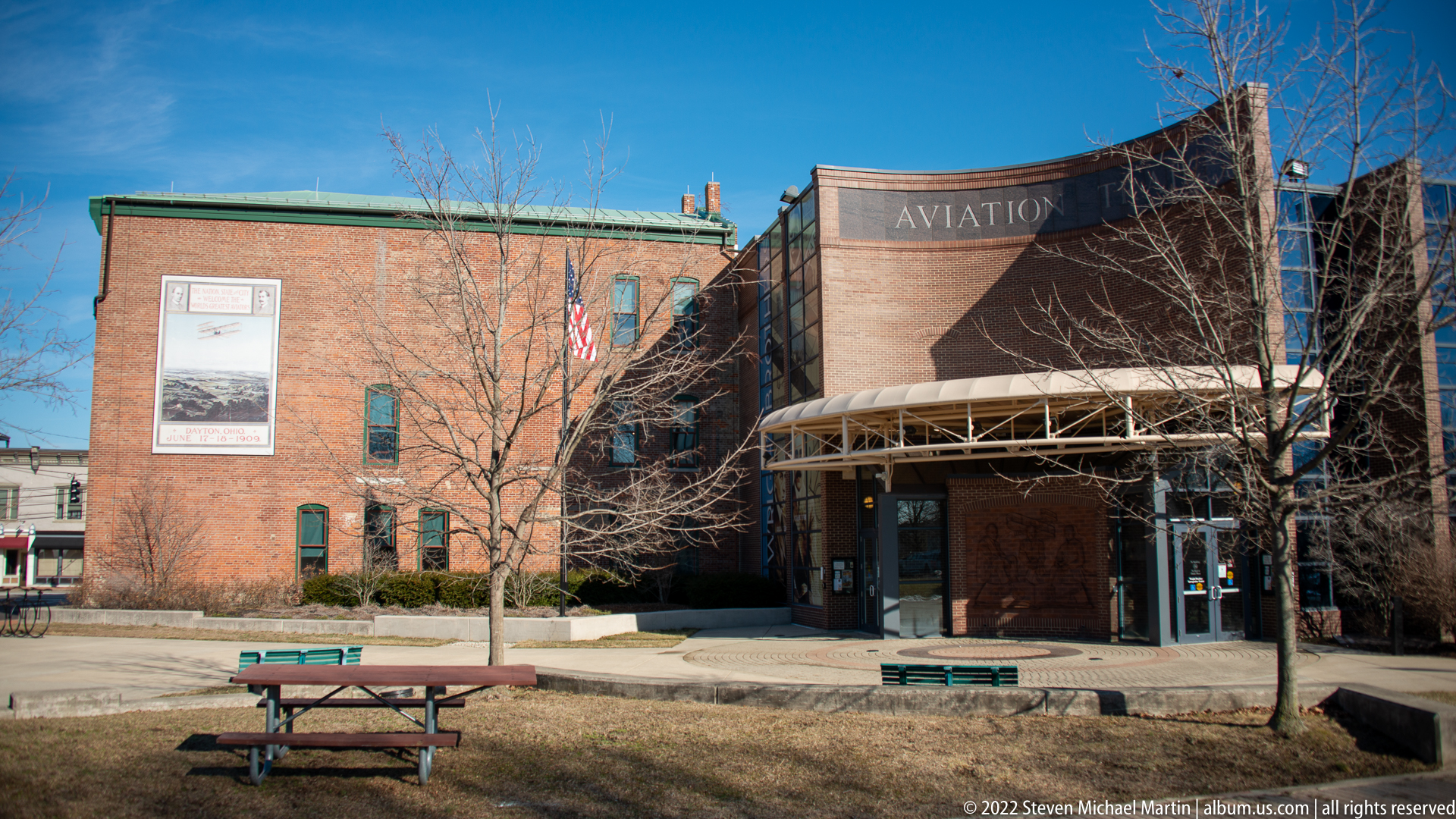
A red-brick building is photographed from across a small lawn, with the words “Aviation Trail” set high on its curved central façade. A glass entry and pale semicircular canopy mark the entrance, while benches and bare trees occupy the foreground. The wider angle shows how the curved brick volume connects with the adjoining rectangular wings.
Caption
A red-brick building is photographed from across a small lawn, with the words “Aviation Trail” set high on its curved central façade. A glass entry and pale semicircular canopy mark the entrance, while benches and bare trees occupy the foreground. The wider angle shows how the curved brick volume connects with the adjoining rectangular wings.

Four tall illustrated panels explain parachute operation through diagrams labeled “How a Parachute Works,” “Inflation,” “Stability,” and “Parachute Turns.” Bright orange parachute forms and directional arrows appear against blue sky backgrounds, with smaller explanatory text underneath. The grouped panels turn the mechanics of deployment and steering into a sequence visitors can follow.
Caption
Four tall illustrated panels explain parachute operation through diagrams labeled “How a Parachute Works,” “Inflation,” “Stability,” and “Parachute Turns.” Bright orange parachute forms and directional arrows appear against blue sky backgrounds, with smaller explanatory text underneath. The grouped panels turn the mechanics of deployment and steering into a sequence visitors can follow.
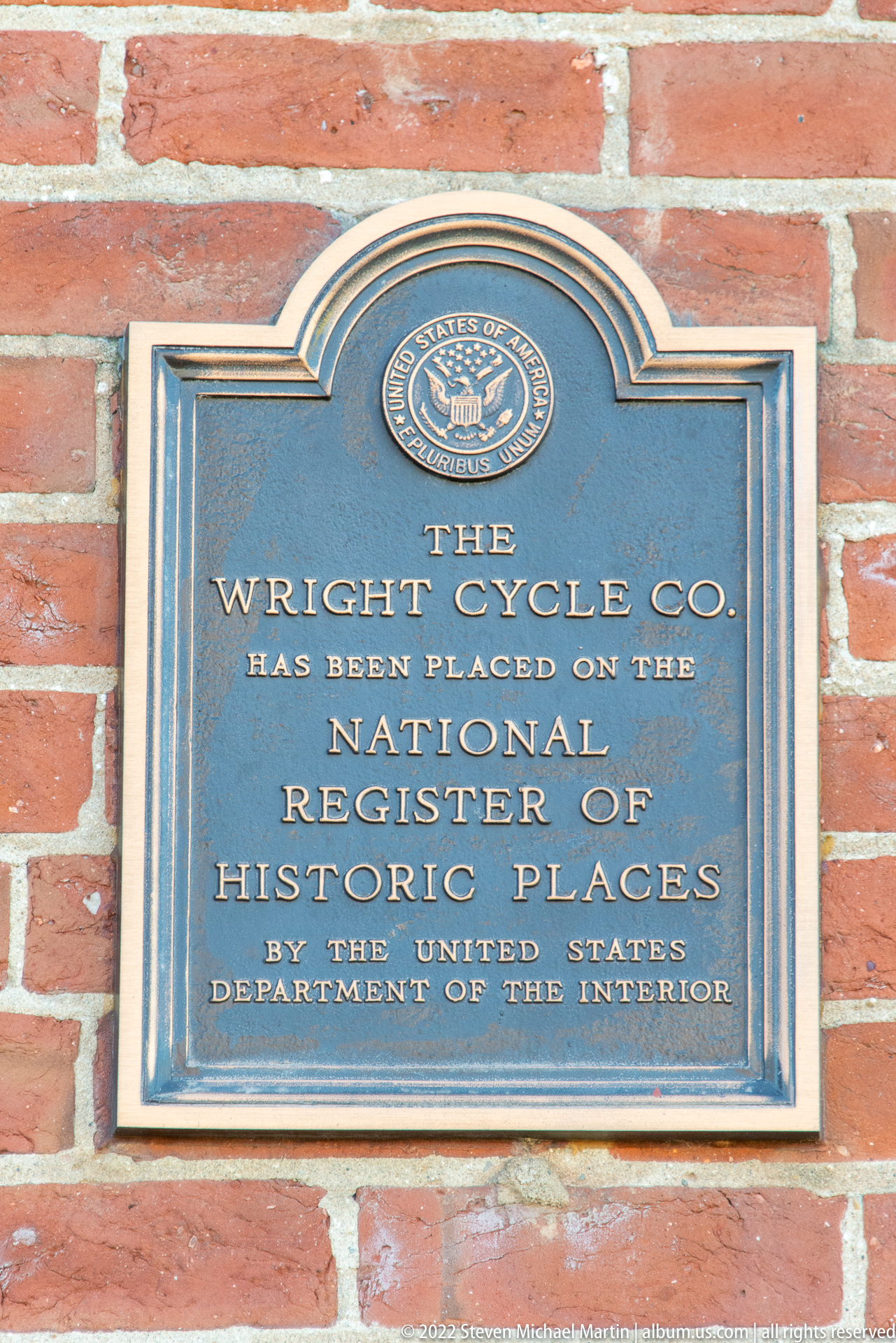
A blue-gray metal plaque mounted on red brick states that the Wright Cycle Co. is listed on the National Register of Historic Places. The United States Department of the Interior seal appears above the lettering, and a pale border frames the sign. The close view makes the building’s preservation designation—not the surrounding architecture—the subject.
Caption
A blue-gray metal plaque mounted on red brick states that the Wright Cycle Co. is listed on the National Register of Historic Places. The United States Department of the Interior seal appears above the lettering, and a pale border frames the sign. The close view makes the building’s preservation designation—not the surrounding architecture—the subject.
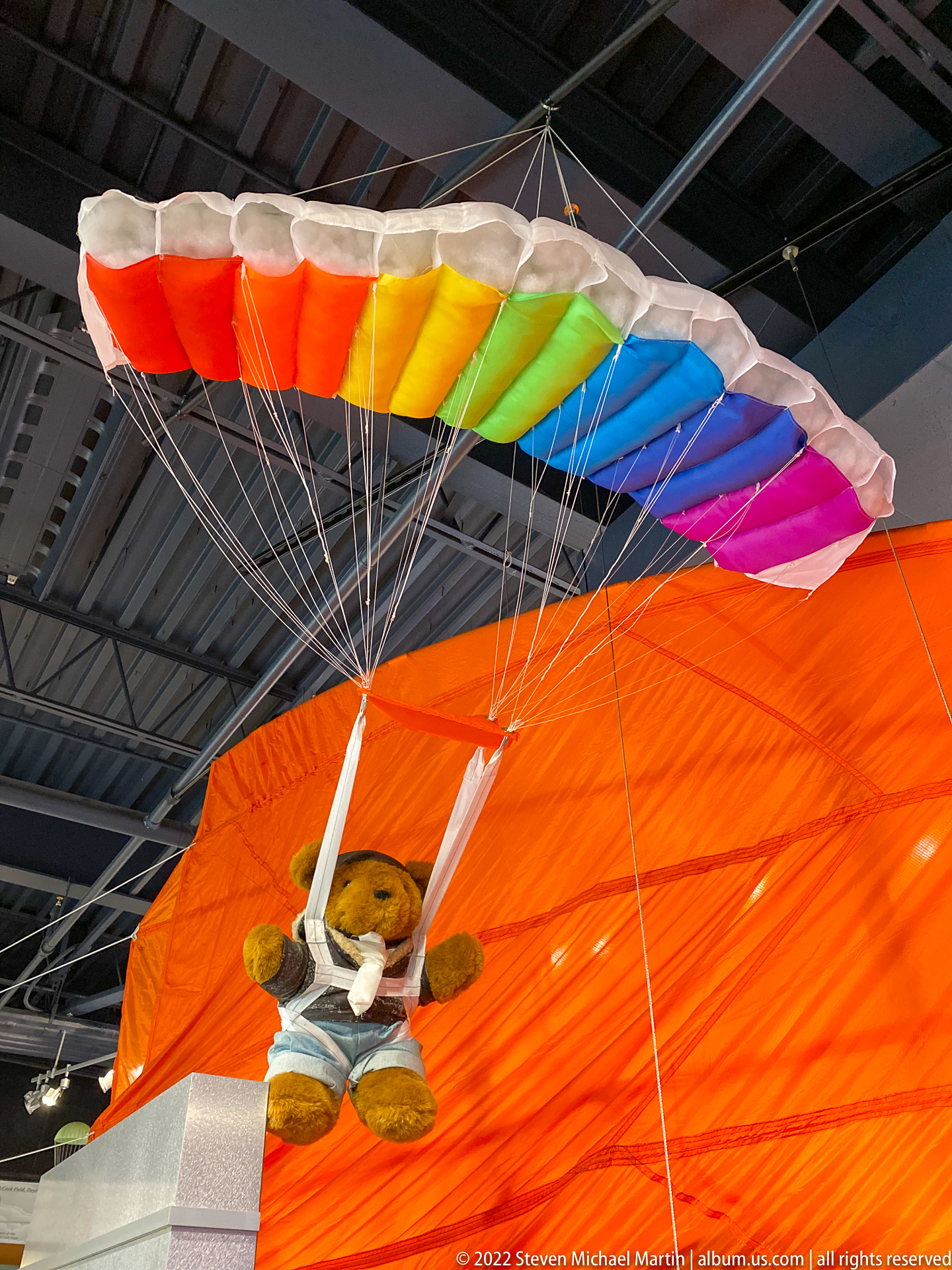
A rainbow-colored parachute spreads across the upper part of the frame, its lines descending to a small teddy bear in a white harness. A much larger orange canopy or fabric backdrop fills the space behind it, with the museum ceiling structure visible above. The playful scale contrast and suspended arrangement make this exhibit distinct from the surrounding historical displays.
Caption
A rainbow-colored parachute spreads across the upper part of the frame, its lines descending to a small teddy bear in a white harness. A much larger orange canopy or fabric backdrop fills the space behind it, with the museum ceiling structure visible above. The playful scale contrast and suspended arrangement make this exhibit distinct from the surrounding historical displays.
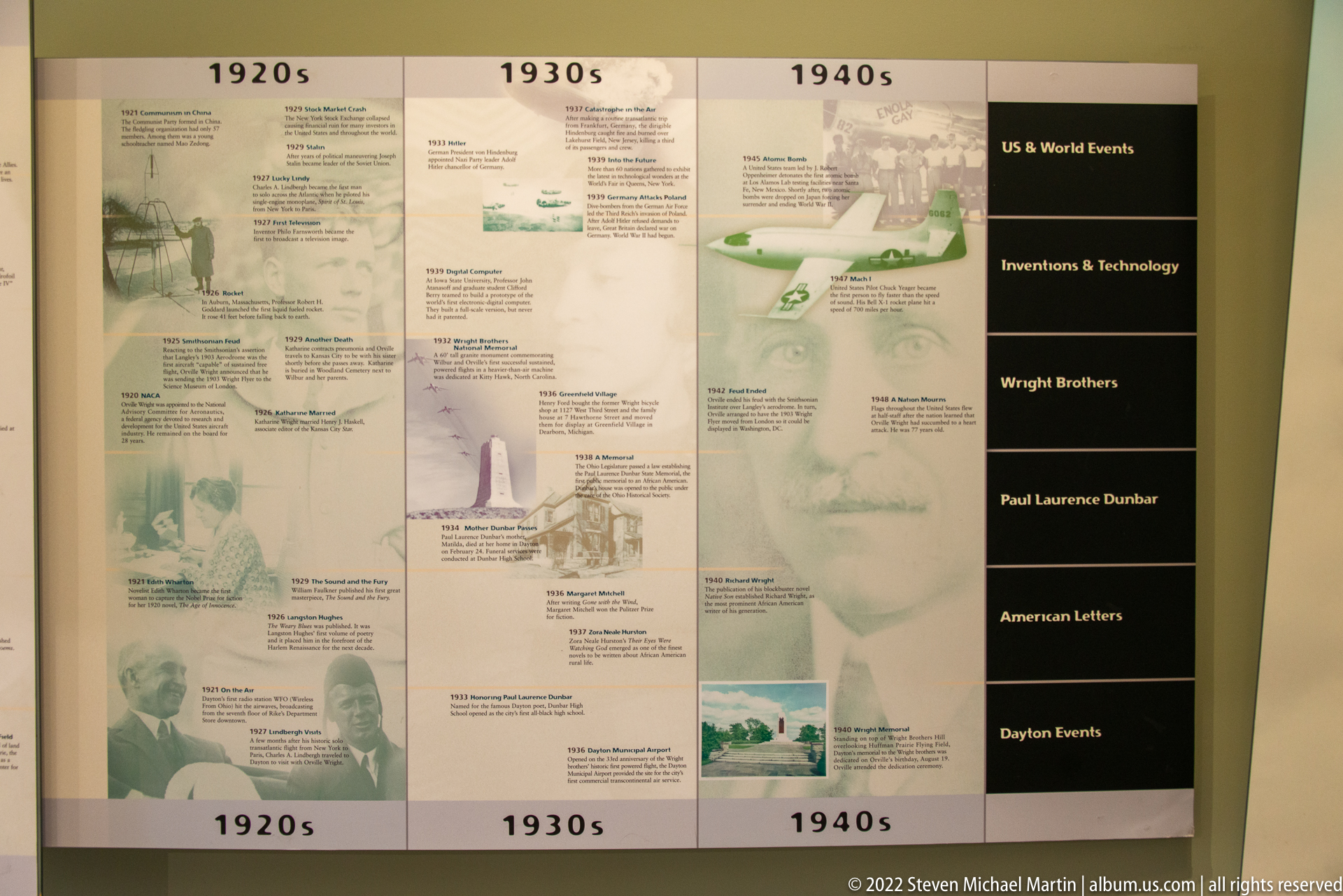
The final visible section of the chronology spans the 1920s through the 1940s. Dated text and small photographs fill the central columns, while a dark index at right repeats themes such as inventions, the Wright brothers, Paul Laurence Dunbar, and Dayton events. The panel’s endpoint places local history alongside wider world events, completing the sequence begun in earlier sections.
Caption
The final visible section of the chronology spans the 1920s through the 1940s. Dated text and small photographs fill the central columns, while a dark index at right repeats themes such as inventions, the Wright brothers, Paul Laurence Dunbar, and Dayton events. The panel’s endpoint places local history alongside wider world events, completing the sequence begun in earlier sections.
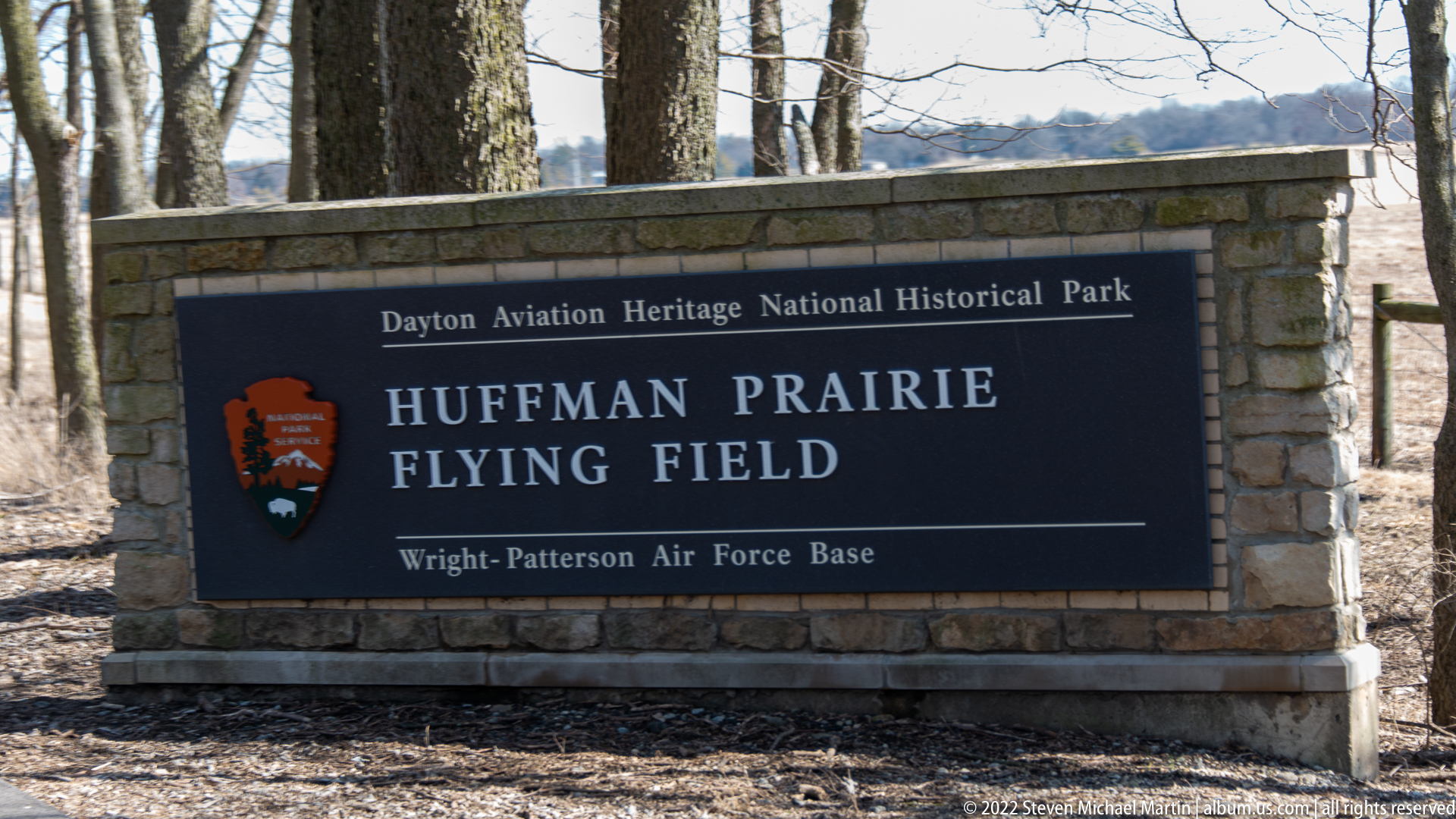
A dark sign set in a low stone wall identifies Huffman Prairie Flying Field as part of Dayton Aviation Heritage National Historical Park and notes its location near Wright-Patterson Air Force Base. The National Park Service arrowhead appears beside the lettering. Bare trees and a wooden fence surround the sign, placing this marker at the edge of an open field.
Caption
A dark sign set in a low stone wall identifies Huffman Prairie Flying Field as part of Dayton Aviation Heritage National Historical Park and notes its location near Wright-Patterson Air Force Base. The National Park Service arrowhead appears beside the lettering. Bare trees and a wooden fence surround the sign, placing this marker at the edge of an open field.
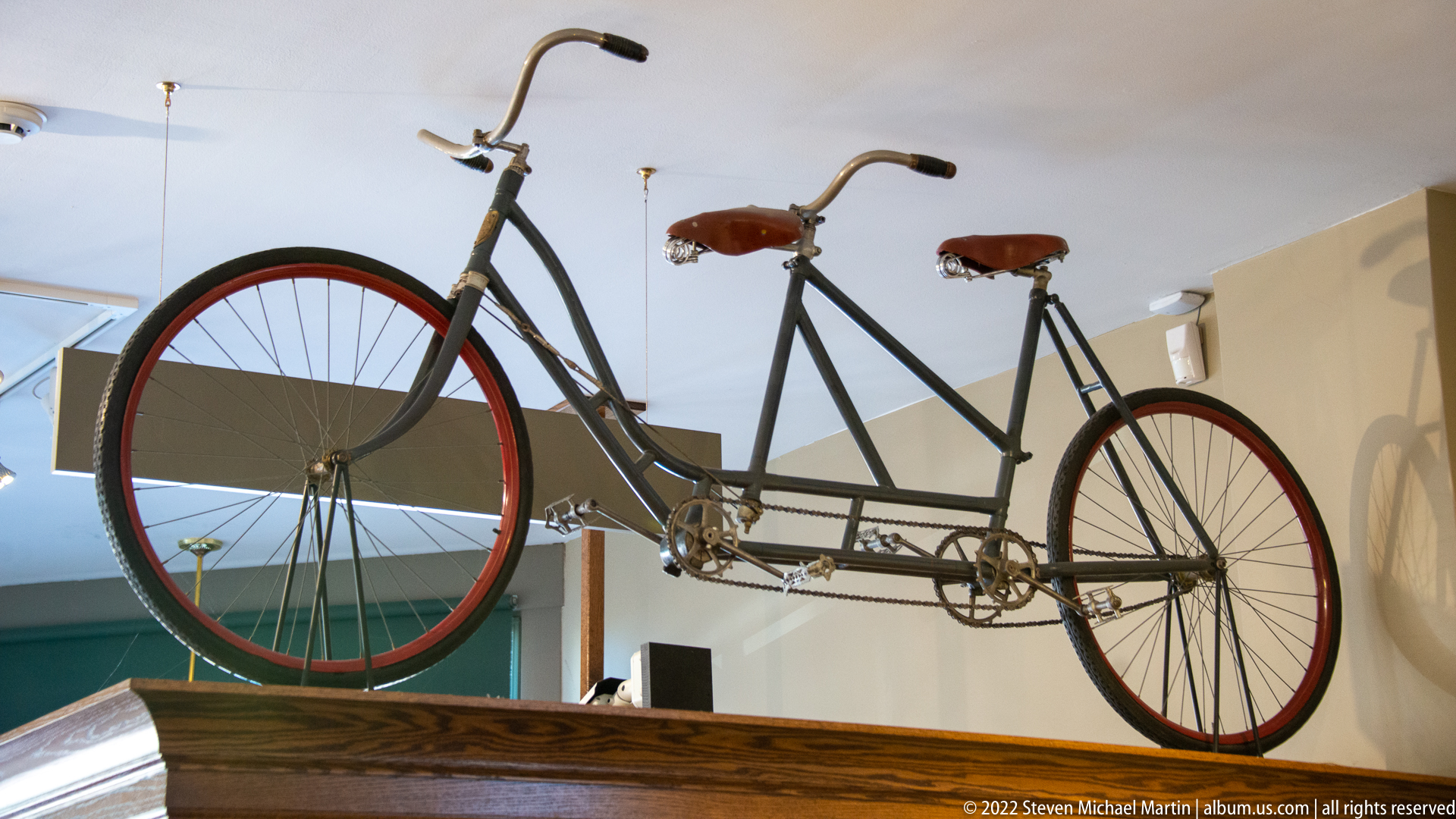
A long tandem bicycle hangs above a wooden platform, with two brown saddles, two sets of handlebars, and a chain drive connecting the riders’ positions. The front wheel has a red rim, while the rear wheel is partly outside the frame. This upward view highlights the bicycle’s extended frame and paired riding stations as an object in the aviation-history gallery.
Caption
A long tandem bicycle hangs above a wooden platform, with two brown saddles, two sets of handlebars, and a chain drive connecting the riders’ positions. The front wheel has a red rim, while the rear wheel is partly outside the frame. This upward view highlights the bicycle’s extended frame and paired riding stations as an object in the aviation-history gallery.
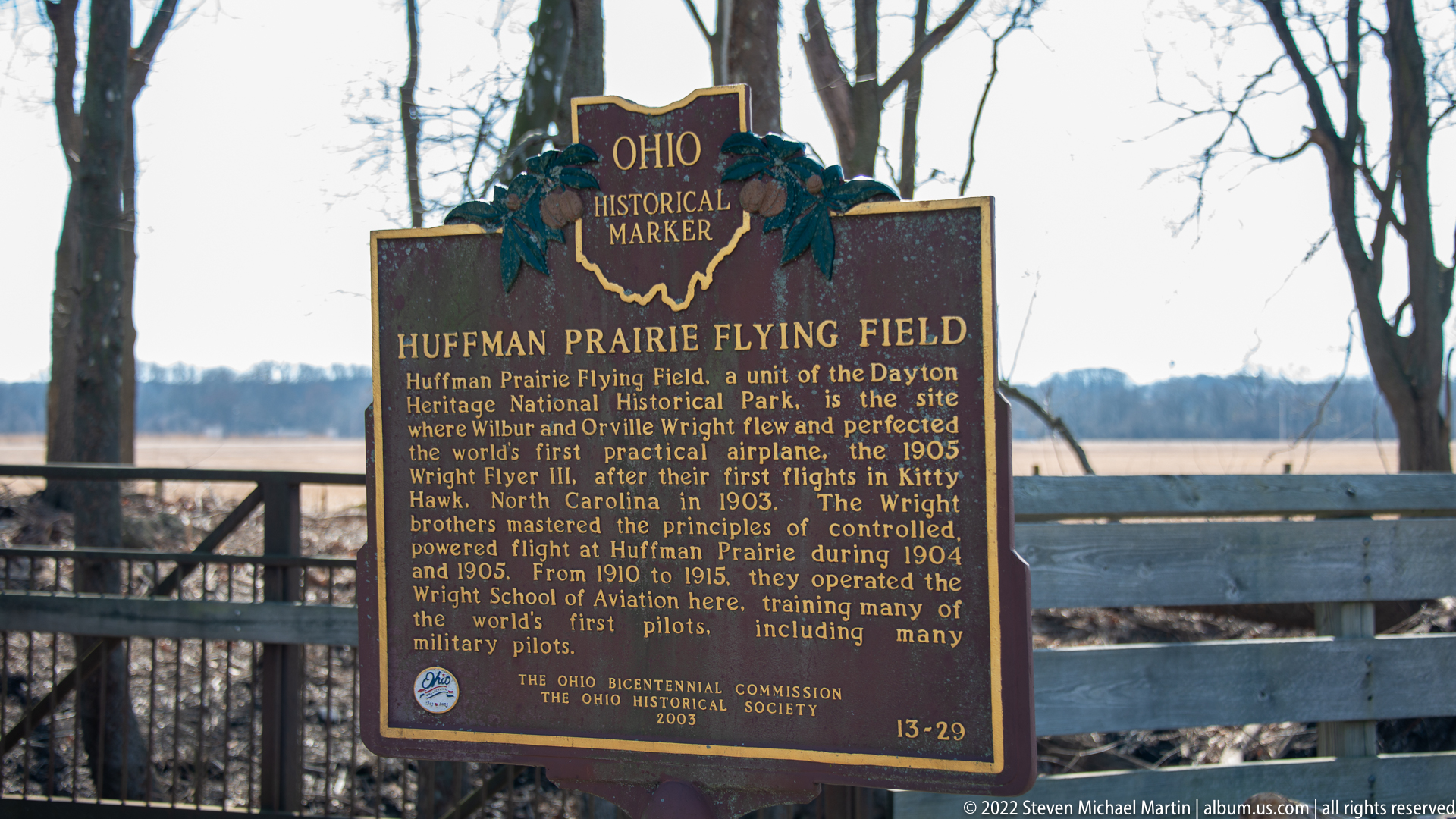
An Ohio Historical Marker stands before a wooden fence and leafless trees, its gold lettering identifying Huffman Prairie Flying Field. The text describes the site’s connection to Wilbur and Orville Wright and the development of the 1905 Wright Flyer III. The marker’s dark bronze surface and decorative border make the historical account readable against the open field beyond.
Caption
An Ohio Historical Marker stands before a wooden fence and leafless trees, its gold lettering identifying Huffman Prairie Flying Field. The text describes the site’s connection to Wilbur and Orville Wright and the development of the 1905 Wright Flyer III. The marker’s dark bronze surface and decorative border make the historical account readable against the open field beyond.
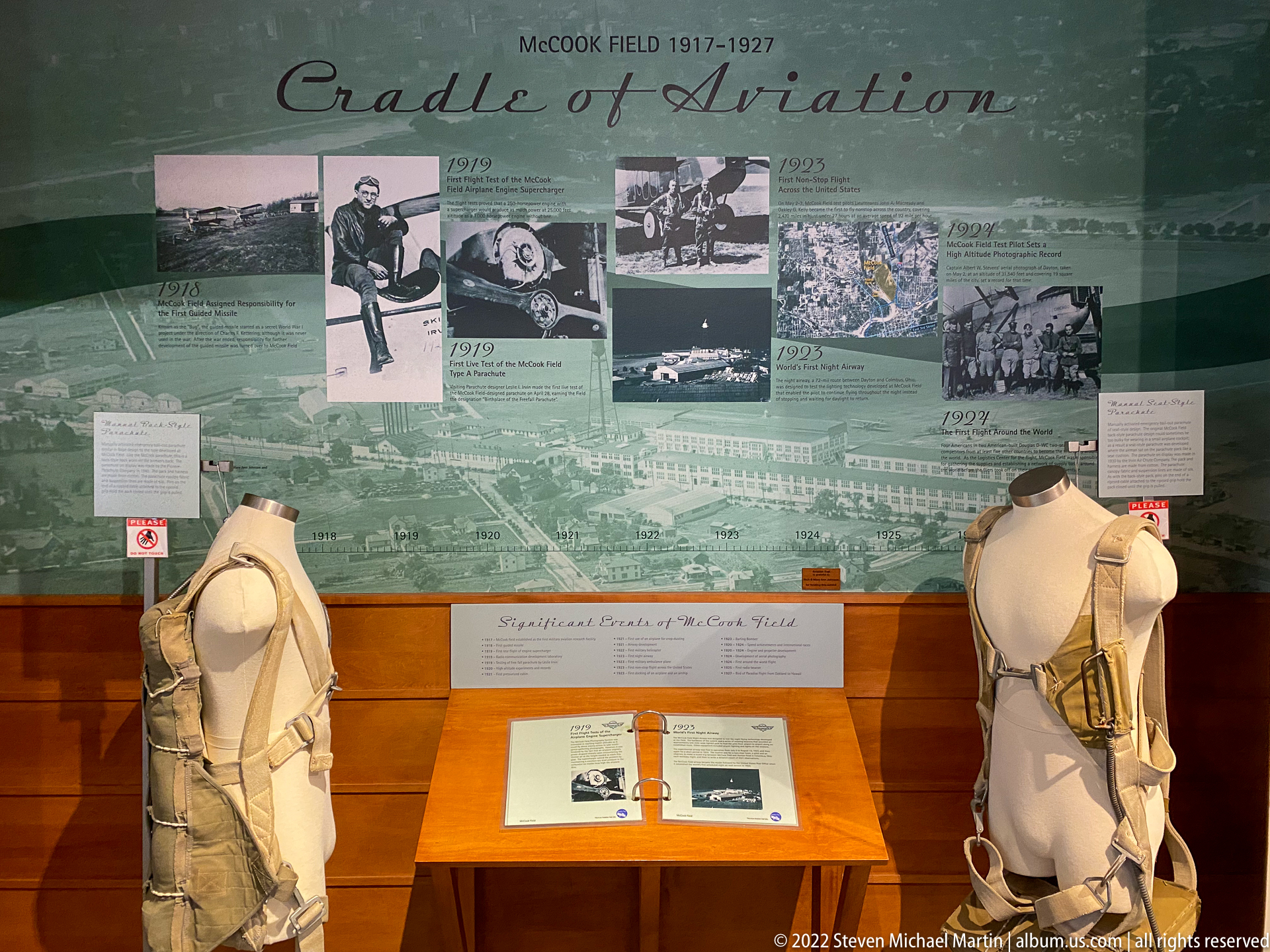
A green wall panel titled “McCook Field 1917–1927” presents a dated sequence of photographs and short text about aviation development. Two mannequins in light-colored flight garments stand in front of the timeline, with a table of printed material between them. Their equipment and the surrounding photographs give the display a human scale, while the panel anchors the decade-long story.
Caption
A green wall panel titled “McCook Field 1917–1927” presents a dated sequence of photographs and short text about aviation development. Two mannequins in light-colored flight garments stand in front of the timeline, with a table of printed material between them. Their equipment and the surrounding photographs give the display a human scale, while the panel anchors the decade-long story.
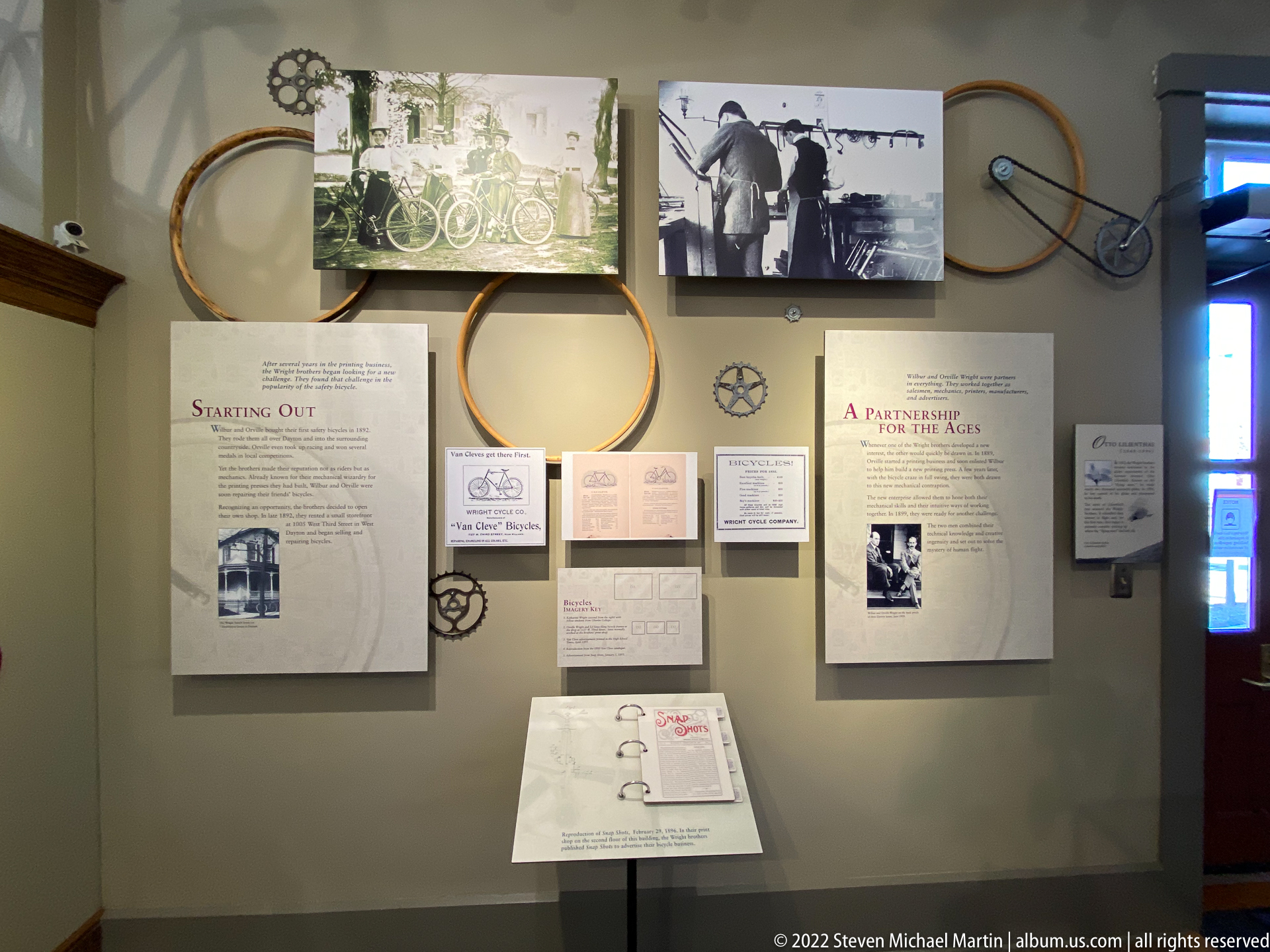
An introductory gallery display pairs bicycle components and circular wheels with archival photographs, documents, and panels titled “Starting Out” and “A Partnership for the Ages.” The objects are arranged at several heights across a muted wall, with an open binder on a stand below. Together, they present the transition from bicycle work toward aviation through a mix of tools, images, and interpretation.
Caption
An introductory gallery display pairs bicycle components and circular wheels with archival photographs, documents, and panels titled “Starting Out” and “A Partnership for the Ages.” The objects are arranged at several heights across a muted wall, with an open binder on a stand below. Together, they present the transition from bicycle work toward aviation through a mix of tools, images, and interpretation.

Two adjoining historic-looking buildings stand beneath a bright blue sky: a red-brick two-story block rises behind a lower clapboard structure with a dark shingled roof and storefront-style windows. A narrow walkway curves across the foreground, and a small interpretive sign sits near the entrance. The oblique view records the contrasting materials and connected forms without asserting a specific building history.
Caption
Two adjoining historic-looking buildings stand beneath a bright blue sky: a red-brick two-story block rises behind a lower clapboard structure with a dark shingled roof and storefront-style windows. A narrow walkway curves across the foreground, and a small interpretive sign sits near the entrance. The oblique view records the contrasting materials and connected forms without asserting a specific building history.
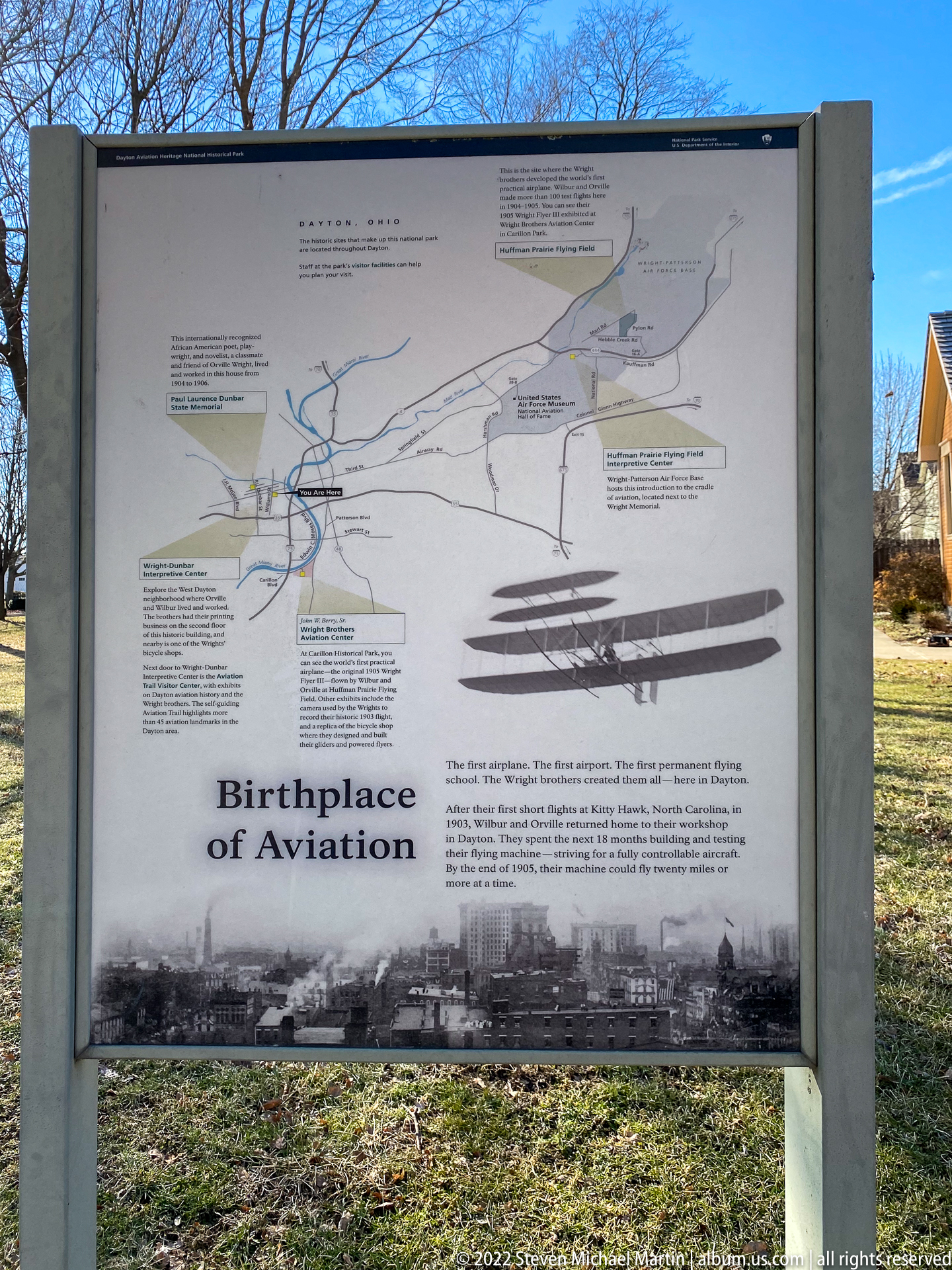
A large outdoor wayside panel titled “Birthplace of Aviation” combines a map of Dayton-area sites with explanatory text and silhouettes of early aircraft. A panoramic city image runs along the bottom edge. Bare branches and open grass surround the freestanding sign, whose map and heading connect the local landscape to the region’s aviation history.
Caption
A large outdoor wayside panel titled “Birthplace of Aviation” combines a map of Dayton-area sites with explanatory text and silhouettes of early aircraft. A panoramic city image runs along the bottom edge. Bare branches and open grass surround the freestanding sign, whose map and heading connect the local landscape to the region’s aviation history.

Shelves are tightly packed with metal cans, glass jars, and bottles, many bearing colorful period-style labels. Several pyramids of cans rise above the upper shelf, while orderly rows of goods fill the lower levels. The repeated packaging and carefully arranged stock create the appearance of a general-store display; the individual brands and dates are too small to establish from this view.
Caption
Shelves are tightly packed with metal cans, glass jars, and bottles, many bearing colorful period-style labels. Several pyramids of cans rise above the upper shelf, while orderly rows of goods fill the lower levels. The repeated packaging and carefully arranged stock create the appearance of a general-store display; the individual brands and dates are too small to establish from this view.

An ornate black cast-iron stove stands beside a simple wooden chair on dark plank flooring. Raised scrollwork, floral motifs, and curved handles cover the stove’s upper and lower sections, while the chair’s plain spindle back provides a sharp contrast. Soft daylight enters through a window at right, revealing patterned wallpaper and the domestic setting around the metal object.
Caption
An ornate black cast-iron stove stands beside a simple wooden chair on dark plank flooring. Raised scrollwork, floral motifs, and curved handles cover the stove’s upper and lower sections, while the chair’s plain spindle back provides a sharp contrast. Soft daylight enters through a window at right, revealing patterned wallpaper and the domestic setting around the metal object.

Brightly printed boxes and tins fill the upper shelves, including large packages marked “Frank B. Hale Teas” across the lower foreground. Smaller tins and bottles form dense rows above, with different label colors and decorative lettering creating a layered retail display. The close view emphasizes the typography and packaging as material evidence of everyday commerce rather than the contents of any one container.
Caption
Brightly printed boxes and tins fill the upper shelves, including large packages marked “Frank B. Hale Teas” across the lower foreground. Smaller tins and bottles form dense rows above, with different label colors and decorative lettering creating a layered retail display. The close view emphasizes the typography and packaging as material evidence of everyday commerce rather than the contents of any one container.
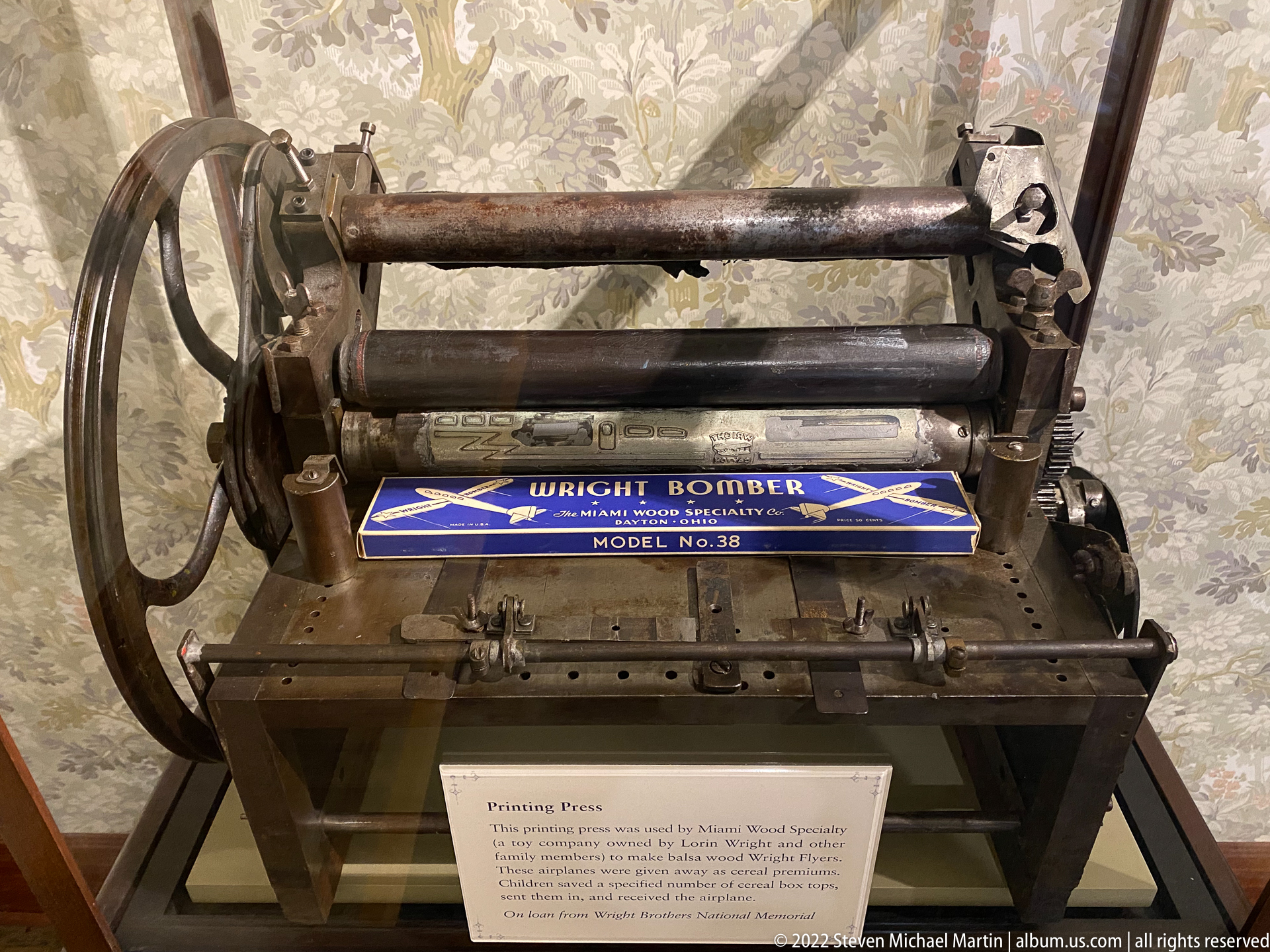
A heavy iron printing press fills the frame, its large flywheel, rollers, and mechanical linkage visible above a blue nameplate reading “Wright Bomber Printing Press, Model No. 38.” A small interpretive label sits below the machine. The close view draws attention to the press’s industrial construction and its association with the Wright brothers’ printing work, as described by the display.
Caption
A heavy iron printing press fills the frame, its large flywheel, rollers, and mechanical linkage visible above a blue nameplate reading “Wright Bomber Printing Press, Model No. 38.” A small interpretive label sits below the machine. The close view draws attention to the press’s industrial construction and its association with the Wright brothers’ printing work, as described by the display.

A broad view looks through a museum gallery lined with orange and green interpretive panels, glass cases, mannequins in aviation clothing, and small suspended aircraft forms. Benches sit beneath the displays, while overhead lighting and exposed ceiling structure remain visible. The room’s layout guides visitors through several related subjects, making the changing colors and exhibition sequence central to this overview.
Caption
A broad view looks through a museum gallery lined with orange and green interpretive panels, glass cases, mannequins in aviation clothing, and small suspended aircraft forms. Benches sit beneath the displays, while overhead lighting and exposed ceiling structure remain visible. The room’s layout guides visitors through several related subjects, making the changing colors and exhibition sequence central to this overview.
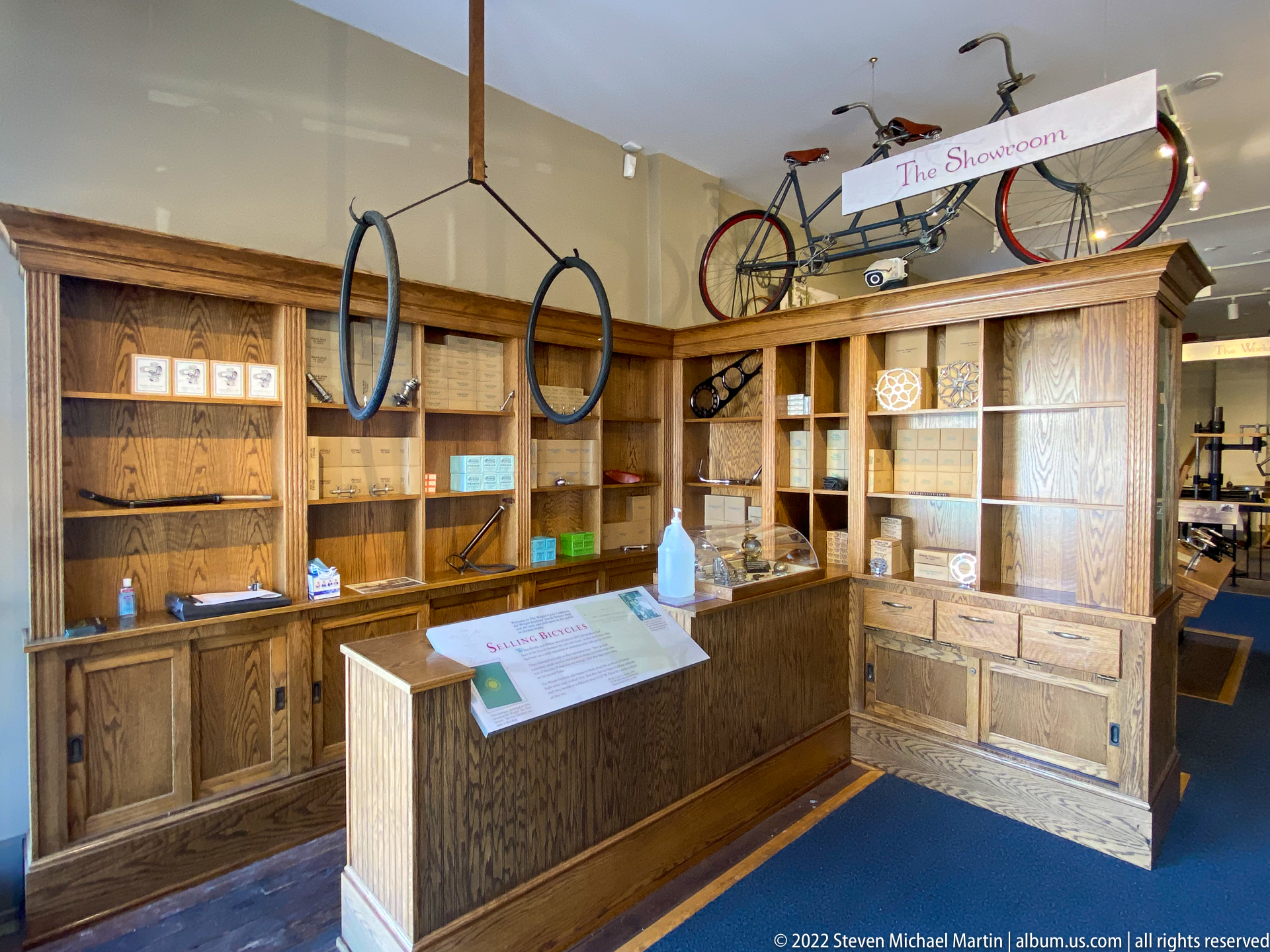
A reconstructed wooden sales counter and built-in shelves form a small shop interior beneath a suspended bicycle labeled “The Showroom.” Circular bicycle rims hang overhead, and boxed goods and small objects line the shelves. An angled interpretive panel rests on the counter. The display evokes a working bicycle shop through its furnishings and merchandise, while the mounted bicycle establishes the room’s subject.
Caption
A reconstructed wooden sales counter and built-in shelves form a small shop interior beneath a suspended bicycle labeled “The Showroom.” Circular bicycle rims hang overhead, and boxed goods and small objects line the shelves. An angled interpretive panel rests on the counter. The display evokes a working bicycle shop through its furnishings and merchandise, while the mounted bicycle establishes the room’s subject.
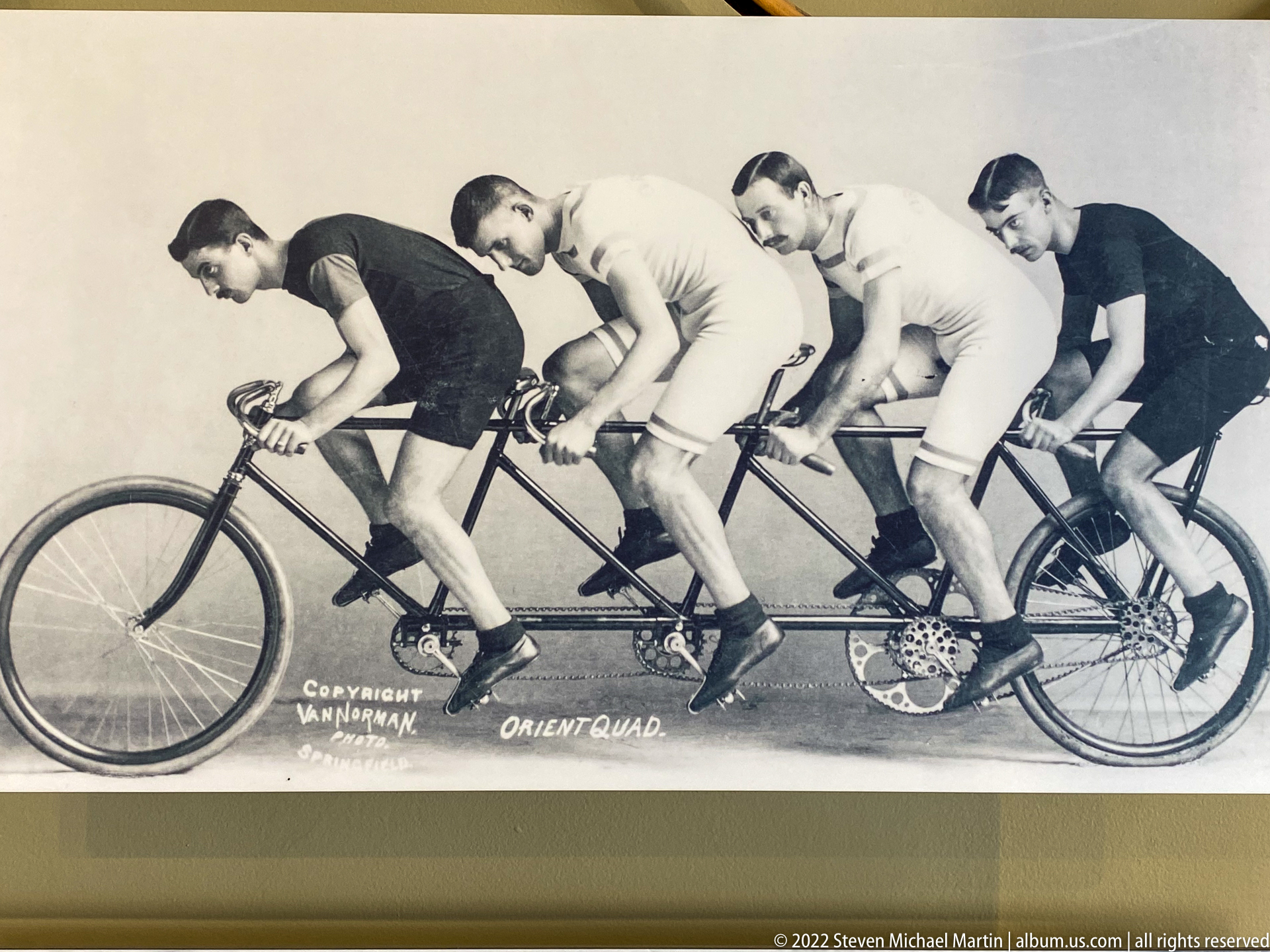
A black-and-white archival photograph shows four men seated in tandem on a long, multi-seat bicycle, leaning forward over the handlebars as they ride. The printed caption “Orient Quad” appears near the lower edge, with a copyright notice beneath the riders. The side-on composition emphasizes the unusual length of the machine and the coordinated posture of its occupants.
Caption
A black-and-white archival photograph shows four men seated in tandem on a long, multi-seat bicycle, leaning forward over the handlebars as they ride. The printed caption “Orient Quad” appears near the lower edge, with a copyright notice beneath the riders. The side-on composition emphasizes the unusual length of the machine and the coordinated posture of its occupants.
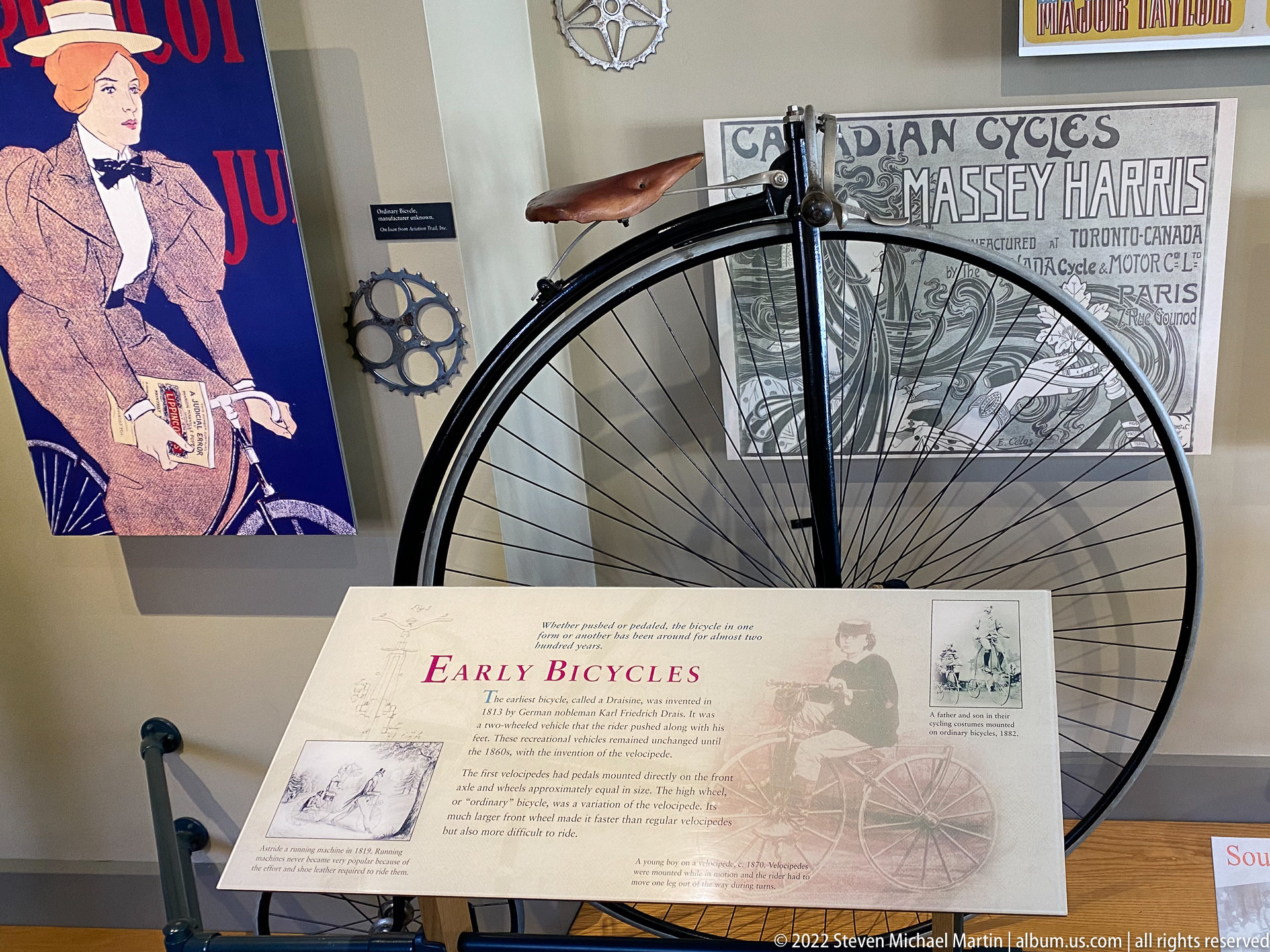
A tall-wheeled bicycle stands behind an interpretive panel titled “Early Bicycles,” with its large front wheel and narrow frame rising above the display. A poster for Canadian Cycles and Massey-Harris hangs on the wall, and a colorful cycling illustration enters at left. The arrangement places a physical bicycle beside printed advertising and interpretation, linking machine design with its visual culture.
Caption
A tall-wheeled bicycle stands behind an interpretive panel titled “Early Bicycles,” with its large front wheel and narrow frame rising above the display. A poster for Canadian Cycles and Massey-Harris hangs on the wall, and a colorful cycling illustration enters at left. The arrangement places a physical bicycle beside printed advertising and interpretation, linking machine design with its visual culture.
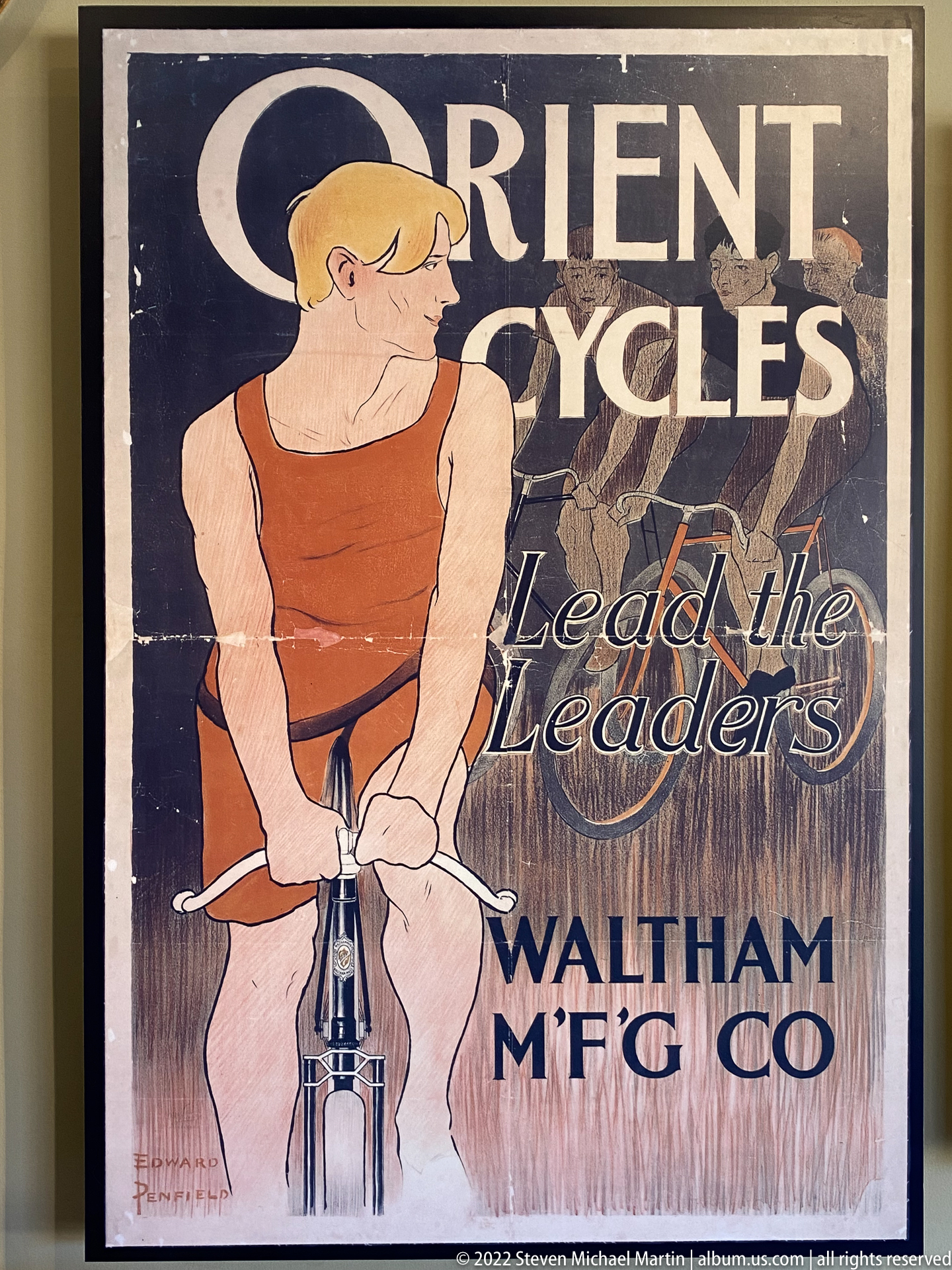
A large vintage-style advertisement promotes Orient Cycles with the slogan “Lead the Leaders” and the maker name Waltham Mfg. Co. An illustrated cyclist in a rust-colored sleeveless jersey leans over the handlebars, while a darker bicycle image fills the background. The poster’s bold lettering and stylized figure make it a graphic artifact of bicycle marketing rather than a scene of actual riding.
Caption
A large vintage-style advertisement promotes Orient Cycles with the slogan “Lead the Leaders” and the maker name Waltham Mfg. Co. An illustrated cyclist in a rust-colored sleeveless jersey leans over the handlebars, while a darker bicycle image fills the background. The poster’s bold lettering and stylized figure make it a graphic artifact of bicycle marketing rather than a scene of actual riding.
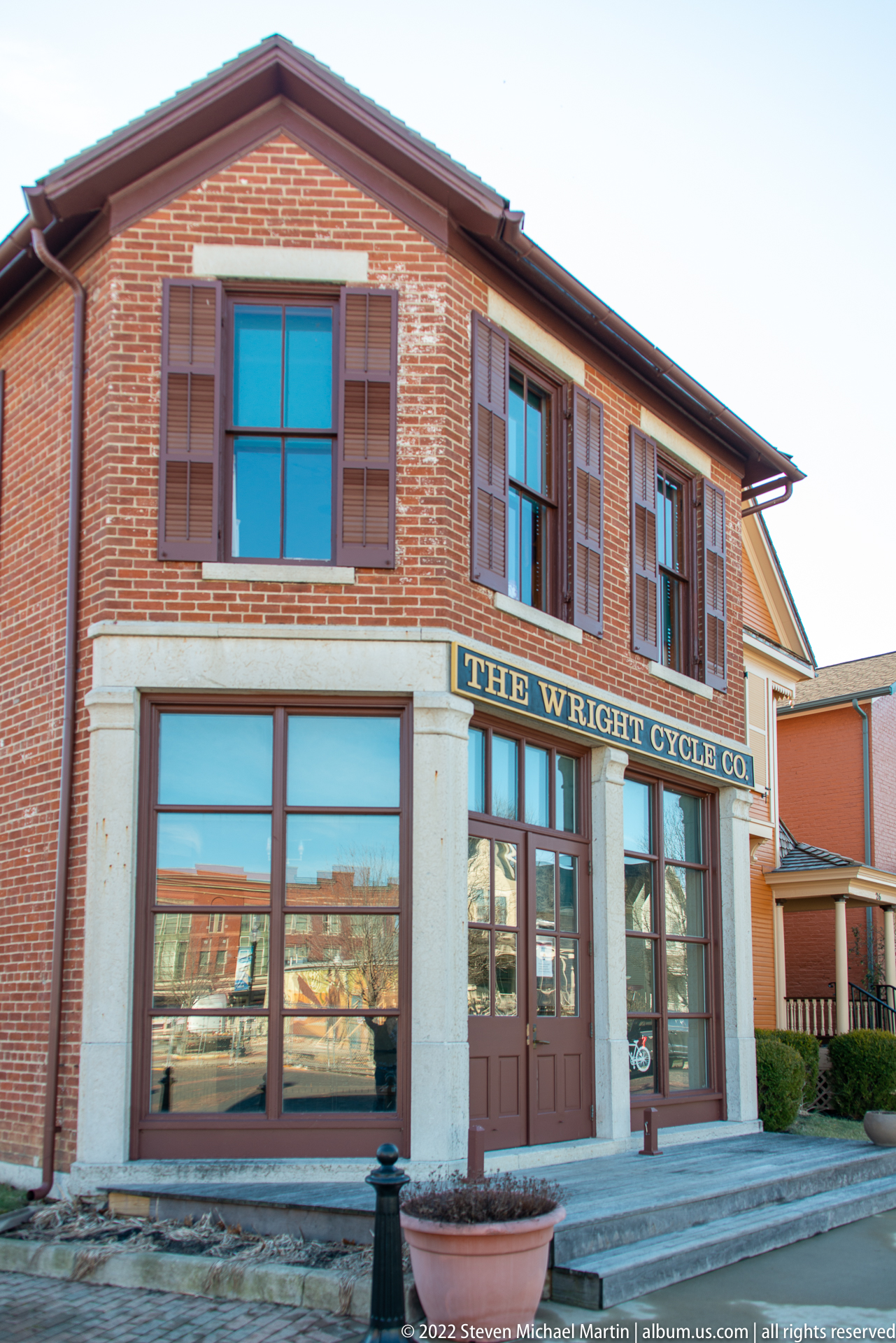
The brick storefront of “The Wright Cycle Co.” fills the frame, its painted sign spanning the first-floor façade above broad windows and a central doorway. Shutters frame the upper windows, while the building’s brick courses and projecting cornice remain visible. Reflections in the glass reveal the opposite street and neighboring structures, adding depth to this straight-on view of the historic commercial front.
Caption
The brick storefront of “The Wright Cycle Co.” fills the frame, its painted sign spanning the first-floor façade above broad windows and a central doorway. Shutters frame the upper windows, while the building’s brick courses and projecting cornice remain visible. Reflections in the glass reveal the opposite street and neighboring structures, adding depth to this straight-on view of the historic commercial front.
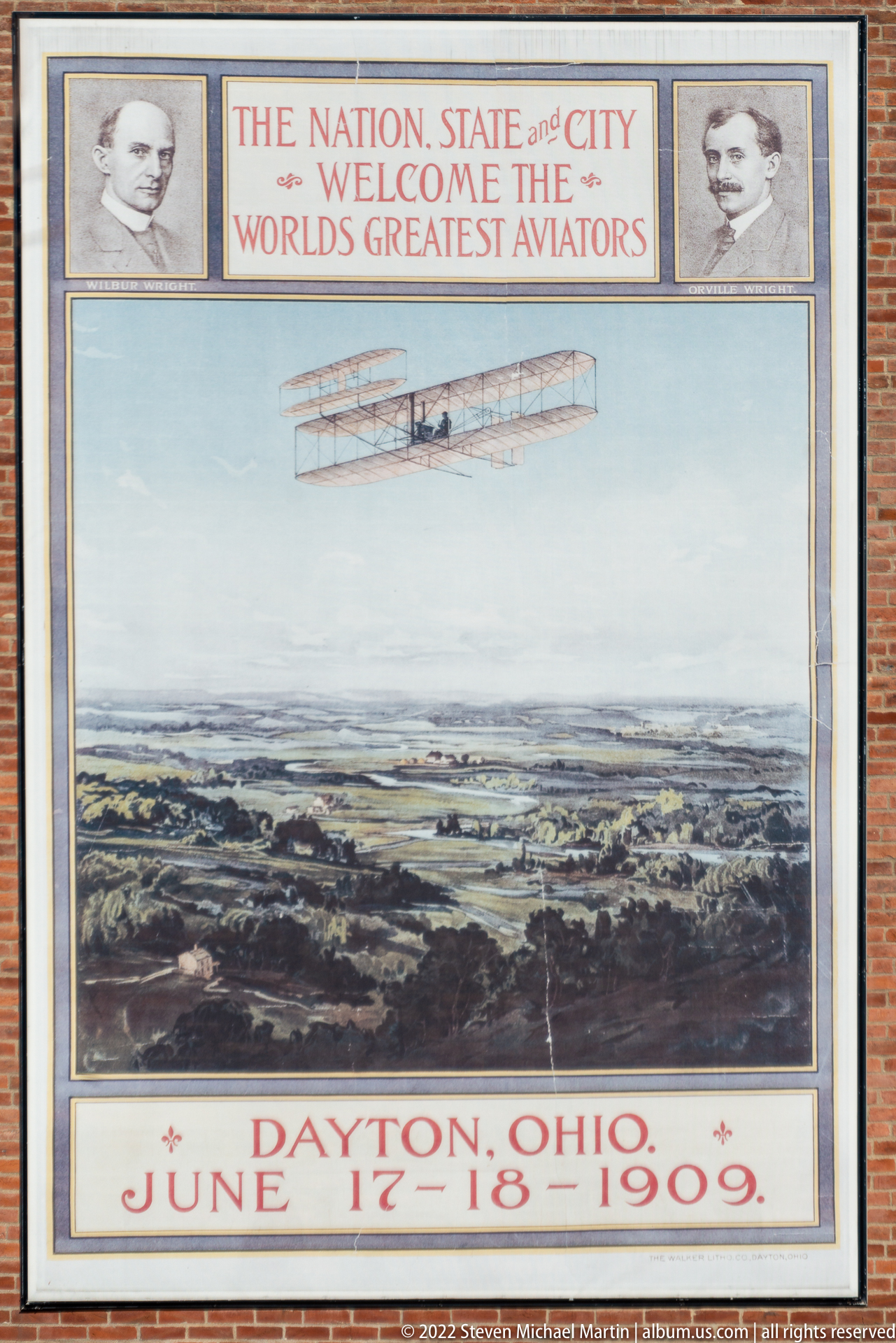
A framed commemorative print bears the heading “The Nation, State and City Welcome the World’s Greatest Aviators” and the date “Dayton, Ohio, June 18, 1909.” Its central image shows an early aircraft above a broad landscape, with a small portrait set into the upper right. The pale sky and expansive ground give the aircraft room within the design, while a narrow brick border surrounds the print.
Caption
A framed commemorative print bears the heading “The Nation, State and City Welcome the World’s Greatest Aviators” and the date “Dayton, Ohio, June 18, 1909.” Its central image shows an early aircraft above a broad landscape, with a small portrait set into the upper right. The pale sky and expansive ground give the aircraft room within the design, while a narrow brick border surrounds the print.
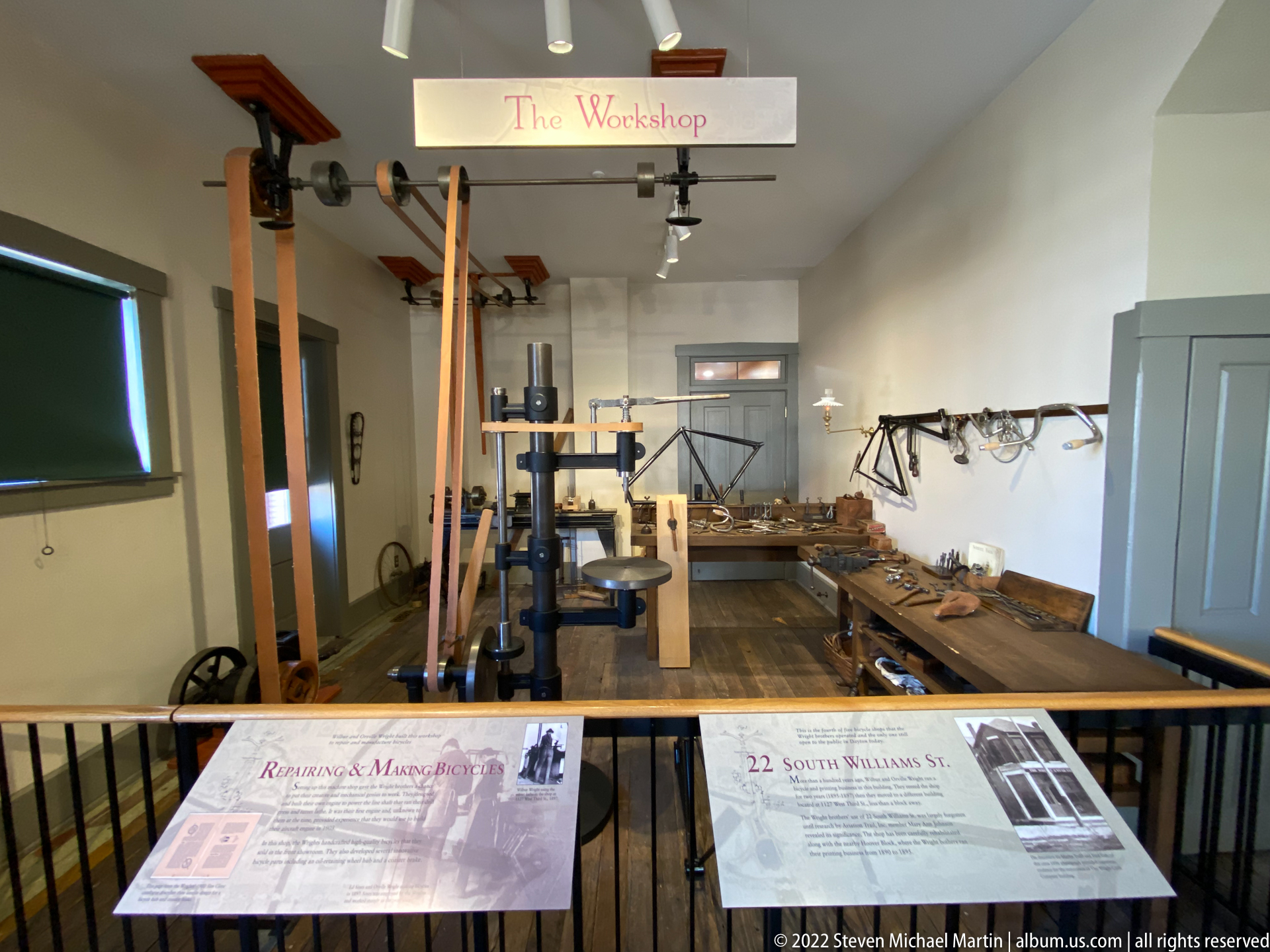
A reconstructed workshop contains wooden benches, hand tools, metal fixtures, and bicycle frames suspended along the rear wall. A sign overhead reads “The Workshop,” while angled panels in the foreground introduce the room. The open layout exposes the work surfaces and equipment instead of presenting a finished storefront, distinguishing this view from the showroom display nearby.
Caption
A reconstructed workshop contains wooden benches, hand tools, metal fixtures, and bicycle frames suspended along the rear wall. A sign overhead reads “The Workshop,” while angled panels in the foreground introduce the room. The open layout exposes the work surfaces and equipment instead of presenting a finished storefront, distinguishing this view from the showroom display nearby.
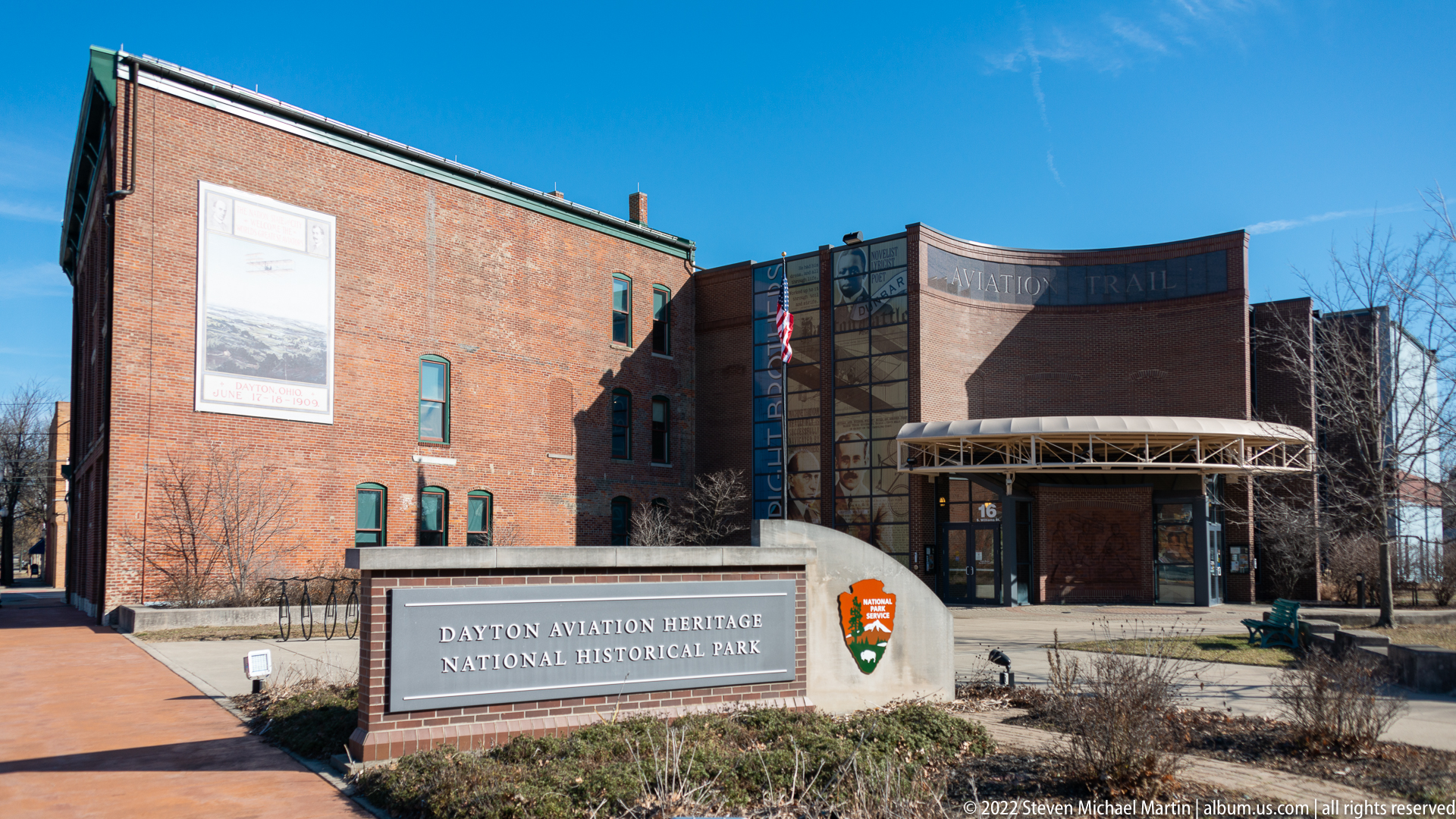
A red-brick visitor center stands behind a low stone sign reading “Dayton Aviation Heritage National Historical Park.” The building’s curved glass entry rises between brick wings, with a shallow canopy over the doors and a paved plaza in front. Bare trees cast shadows across the scene beneath a clear blue sky. The sign and modern entrance identify the site as a visitor destination.
Caption
A red-brick visitor center stands behind a low stone sign reading “Dayton Aviation Heritage National Historical Park.” The building’s curved glass entry rises between brick wings, with a shallow canopy over the doors and a paved plaza in front. Bare trees cast shadows across the scene beneath a clear blue sky. The sign and modern entrance identify the site as a visitor destination.
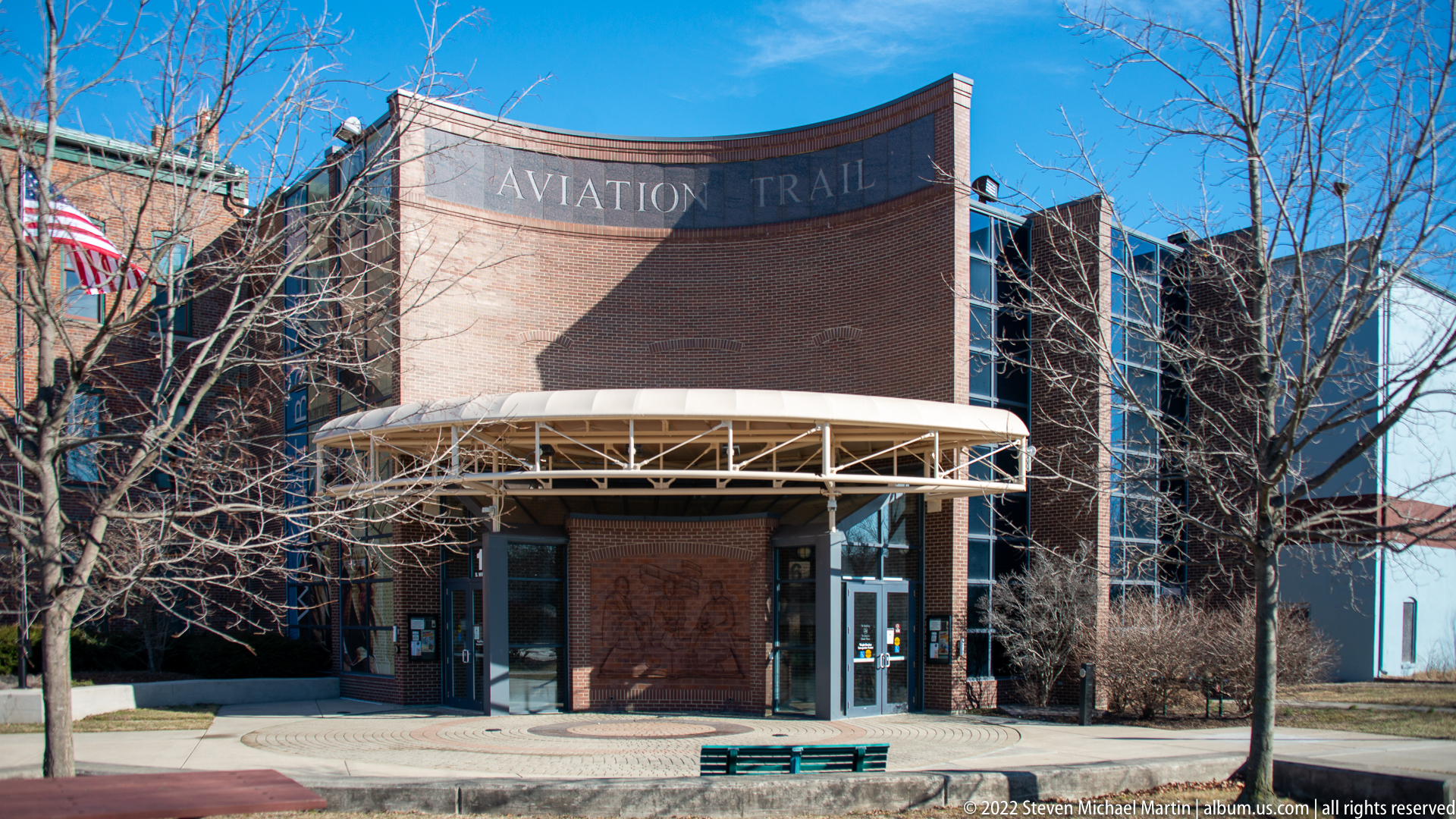
The curved central façade of a brick visitor center rises above a glass entrance and a broad white canopy. Large letters spelling “Aviation Trail” follow the upper curve, while leafless trees frame the building and a bench sits in the plaza. This closer, nearly frontal view makes the entry’s curved geometry and signage more prominent than in the wider exterior view.
Caption
The curved central façade of a brick visitor center rises above a glass entrance and a broad white canopy. Large letters spelling “Aviation Trail” follow the upper curve, while leafless trees frame the building and a bench sits in the plaza. This closer, nearly frontal view makes the entry’s curved geometry and signage more prominent than in the wider exterior view.
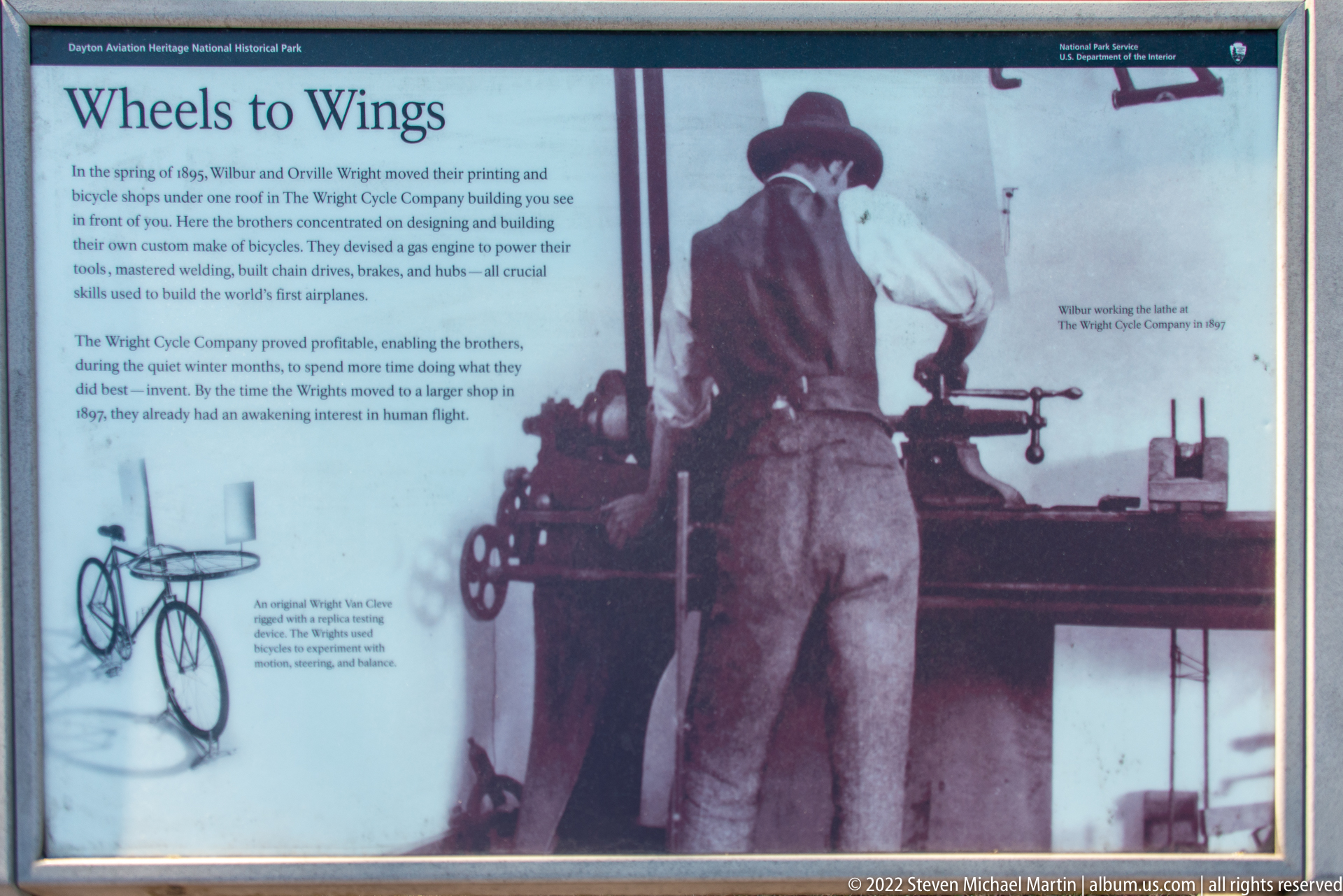
An interpretive panel combines a large sepia photograph of a man working at a machine with explanatory text and a small bicycle illustration. The heading references the Wright bicycle business, while the image shows workshop equipment and a figure in a brimmed hat. The flat panel presents the bicycle company as a place of skilled mechanical work and enterprise, linking the shop’s trade with later aviation interests.
Caption
An interpretive panel combines a large sepia photograph of a man working at a machine with explanatory text and a small bicycle illustration. The heading references the Wright bicycle business, while the image shows workshop equipment and a figure in a brimmed hat. The flat panel presents the bicycle company as a place of skilled mechanical work and enterprise, linking the shop’s trade with later aviation interests.

A warm-toned sculptural relief is set into a brick wall, depicting three seated men gathered around a table. A small aircraft form appears above them, with a bicycle-like shape and other workshop objects below. The shallow modeling and monochrome surface make the scene read as a single architectural panel; the figures are not individually identified by visible labels.
Caption
A warm-toned sculptural relief is set into a brick wall, depicting three seated men gathered around a table. A small aircraft form appears above them, with a bicycle-like shape and other workshop objects below. The shallow modeling and monochrome surface make the scene read as a single architectural panel; the figures are not individually identified by visible labels.
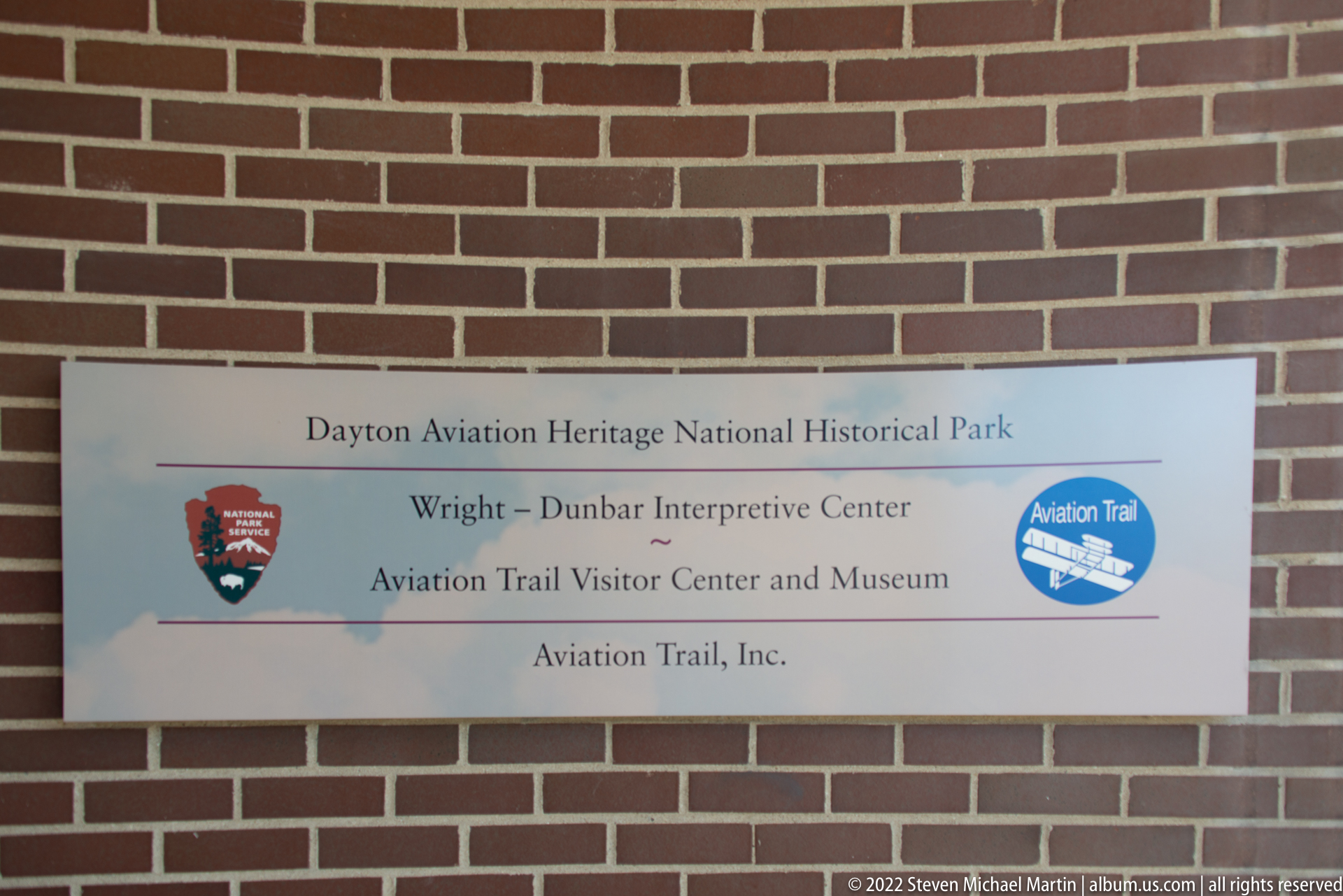
A rectangular plaque mounted on a red-brick wall identifies the “Wright–Dunbar Interpretive Center” and “Aviation Trail Visitor Center and Museum.” National Park Service and Aviation Trail emblems appear at opposite ends of the sign. The close framing isolates the official naming and institutional marks, with the brick coursing providing a simple architectural backdrop.
Caption
A rectangular plaque mounted on a red-brick wall identifies the “Wright–Dunbar Interpretive Center” and “Aviation Trail Visitor Center and Museum.” National Park Service and Aviation Trail emblems appear at opposite ends of the sign. The close framing isolates the official naming and institutional marks, with the brick coursing providing a simple architectural backdrop.
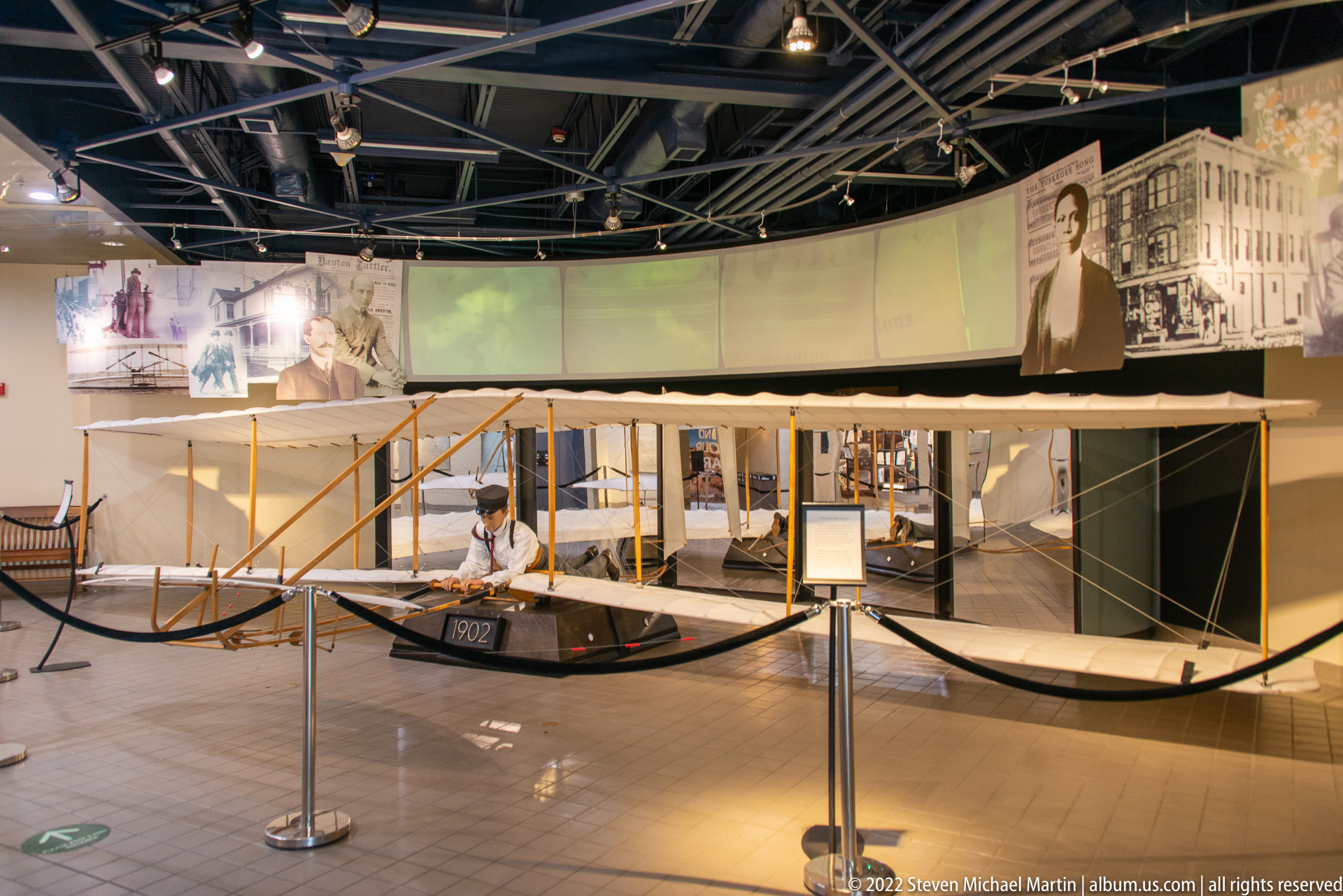
A full-size early biplane is displayed indoors, its pale wings and narrow truss-like frame spanning a roped-off gallery. A seated figure or mannequin appears near the aircraft’s central section, while a curved band of historic photographs and interpretive images follows the wall above. The broad interior view stresses the machine’s size and fragile open structure within the modern exhibition space.
Caption
A full-size early biplane is displayed indoors, its pale wings and narrow truss-like frame spanning a roped-off gallery. A seated figure or mannequin appears near the aircraft’s central section, while a curved band of historic photographs and interpretive images follows the wall above. The broad interior view stresses the machine’s size and fragile open structure within the modern exhibition space.
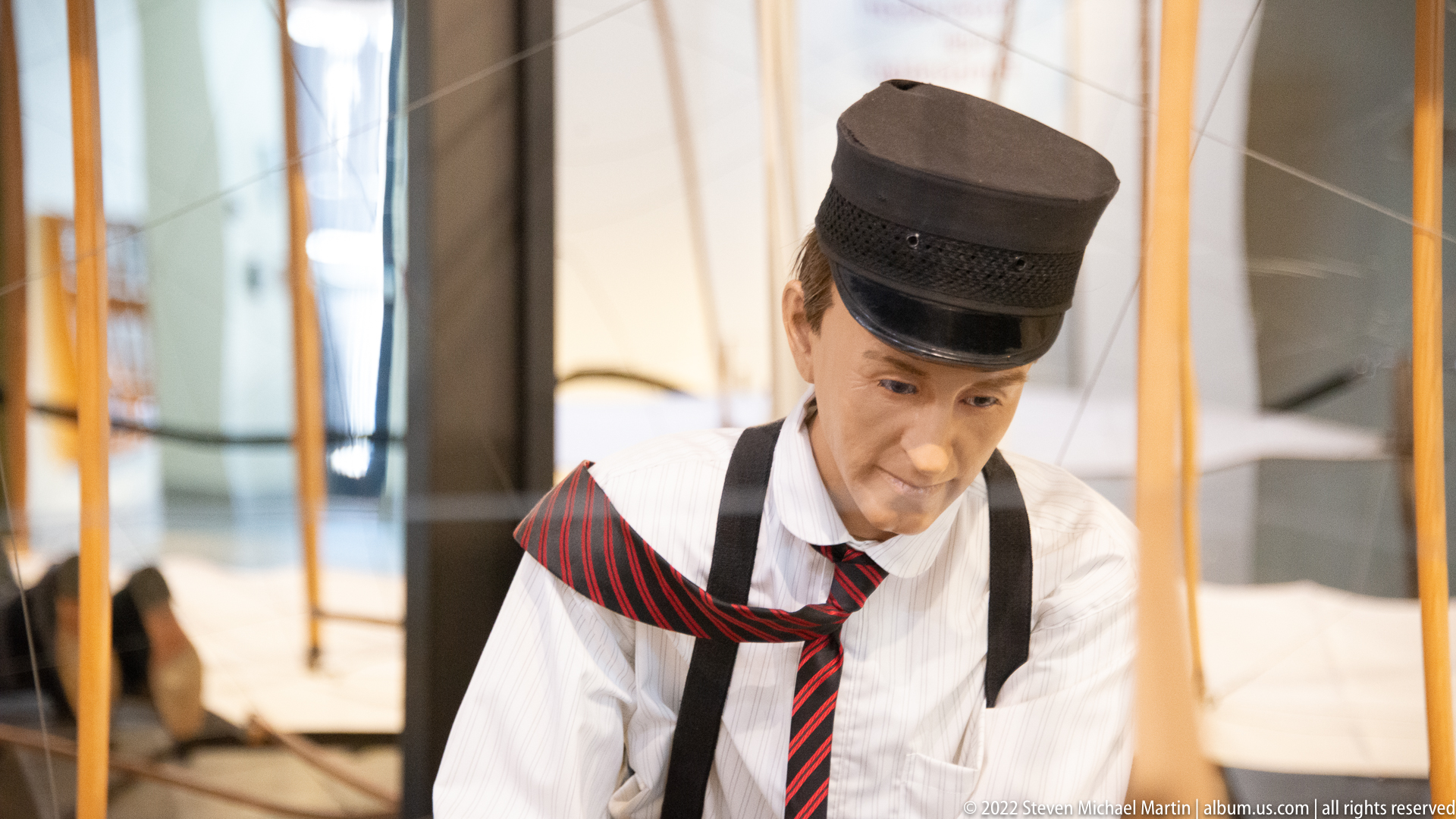
A male-presenting mannequin wears a dark perforated cap, white shirt, black suspenders, and a diagonally striped red-and-black tie. Its head is slightly bowed, giving the static figure a reflective posture. Aircraft framework and a light-colored gallery backdrop sit behind it. The close portrait emphasizes clothing and presentation rather than assigning the mannequin the identity of a particular historical person.
Caption
A male-presenting mannequin wears a dark perforated cap, white shirt, black suspenders, and a diagonally striped red-and-black tie. Its head is slightly bowed, giving the static figure a reflective posture. Aircraft framework and a light-colored gallery backdrop sit behind it. The close portrait emphasizes clothing and presentation rather than assigning the mannequin the identity of a particular historical person.

A tall wooden display cabinet groups bicycle-related objects, printed advertisements, small models, photographs, and mechanical parts across several shelves. A circular bicycle wheel overlaps the center, while text panels and portraits fill the background. The arrangement presents a collection rather than a single object, with contrasting materials and formats showing how products, images, and promotional material share the same exhibit.
Caption
A tall wooden display cabinet groups bicycle-related objects, printed advertisements, small models, photographs, and mechanical parts across several shelves. A circular bicycle wheel overlaps the center, while text panels and portraits fill the background. The arrangement presents a collection rather than a single object, with contrasting materials and formats showing how products, images, and promotional material share the same exhibit.
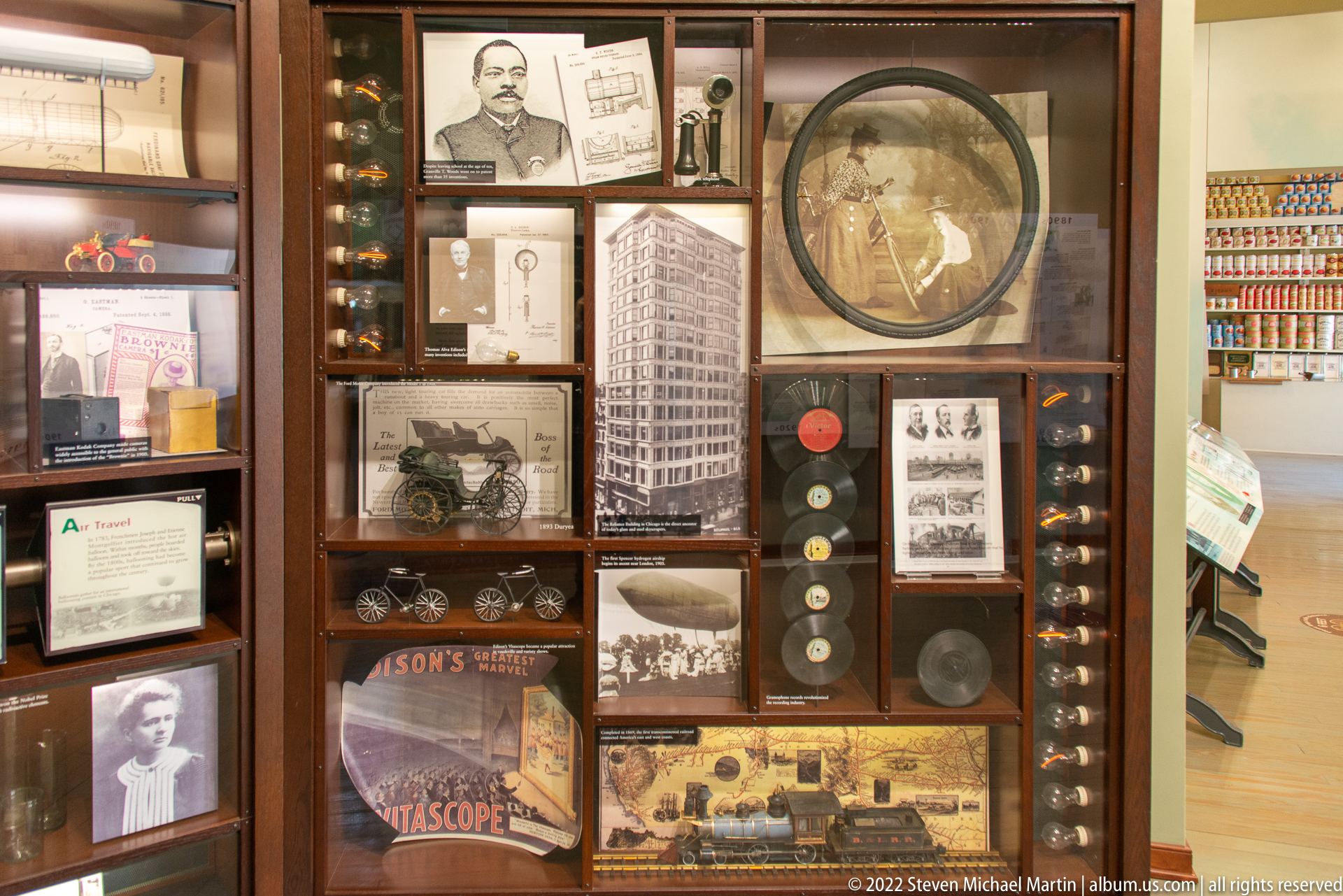
A second wooden cabinet presents an assortment of framed portraits, patent-like documents, small mechanical objects, circular components, and printed materials. A large circular frame dominates the upper-right section, while a small model and papers occupy the shelves below. The case’s dense arrangement rewards a broad reading of the collection; individual pieces and their dates are not all legible at proof-sheet scale.
Caption
A second wooden cabinet presents an assortment of framed portraits, patent-like documents, small mechanical objects, circular components, and printed materials. A large circular frame dominates the upper-right section, while a small model and papers occupy the shelves below. The case’s dense arrangement rewards a broad reading of the collection; individual pieces and their dates are not all legible at proof-sheet scale.
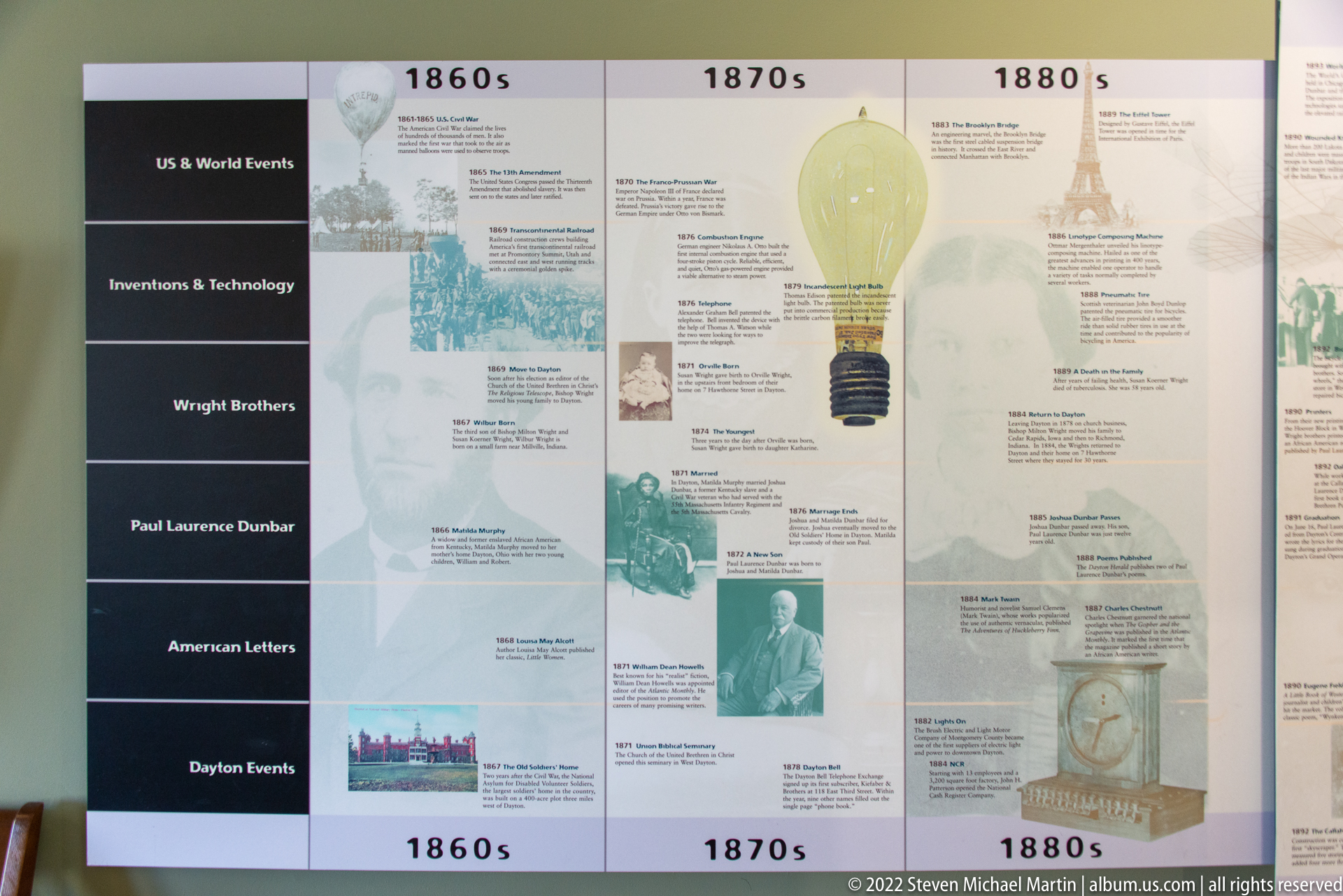
A wall chronology spans the 1860s through the 1880s, with decade headings across the top and a dark vertical index at left listing inventions and technology, the Wright brothers, Paul Laurence Dunbar, American letters, and Dayton events. Small photographs, drawings, and brief entries fill the pale panels; a large light-bulb illustration marks the later section. The design links local people and developments to a broader timeline.
Caption
A wall chronology spans the 1860s through the 1880s, with decade headings across the top and a dark vertical index at left listing inventions and technology, the Wright brothers, Paul Laurence Dunbar, American letters, and Dayton events. Small photographs, drawings, and brief entries fill the pale panels; a large light-bulb illustration marks the later section. The design links local people and developments to a broader timeline.
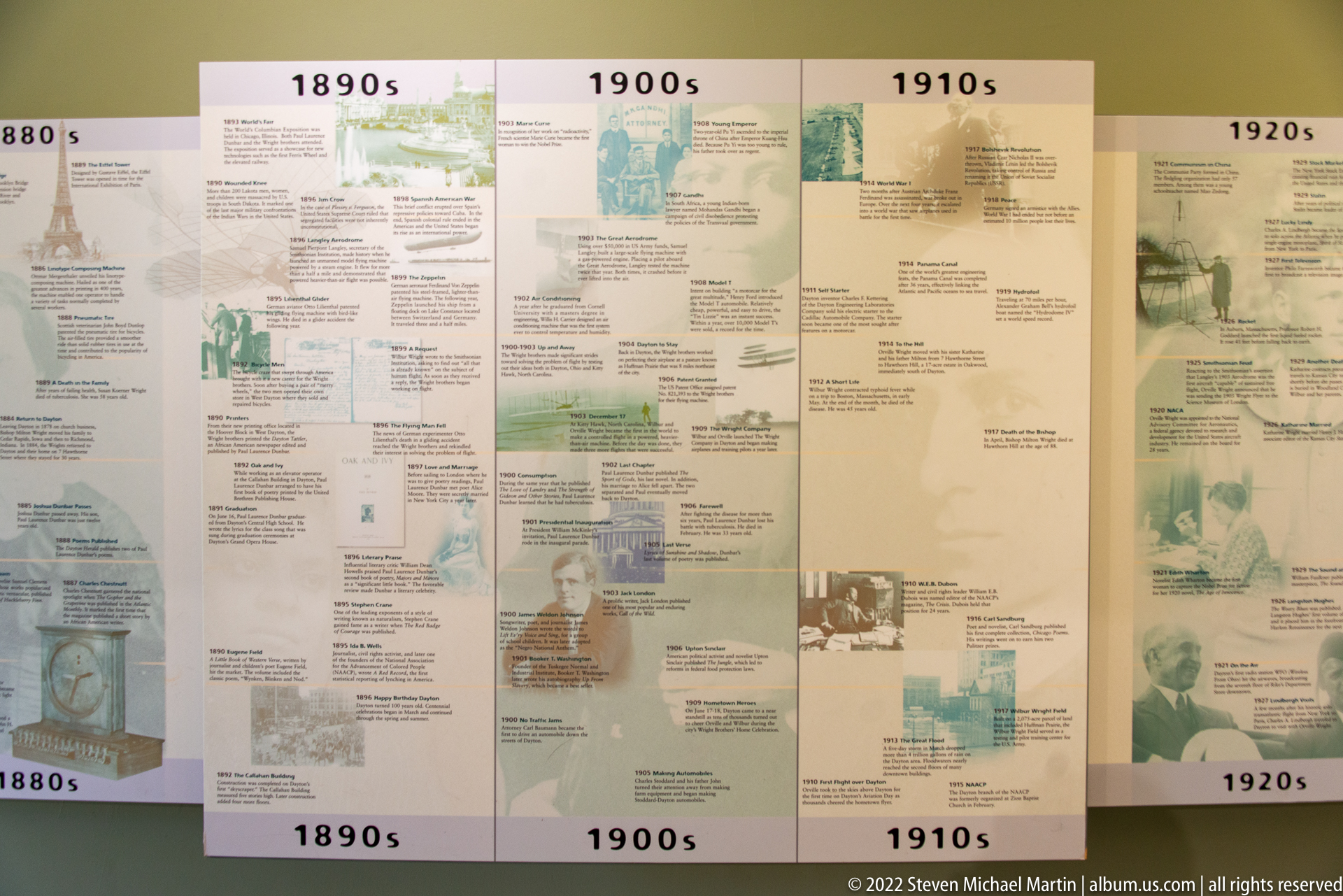
The chronology continues from the 1890s through the 1920s, using columns of dates and short entries beneath large decade labels. Small photographs and illustrations accompany the text, including portraits and images connected with Dayton’s civic and technological history. This middle section extends the preceding timeline, maintaining the same visual system while moving into the decades when the Wright brothers’ work gained prominence.
Caption
The chronology continues from the 1890s through the 1920s, using columns of dates and short entries beneath large decade labels. Small photographs and illustrations accompany the text, including portraits and images connected with Dayton’s civic and technological history. This middle section extends the preceding timeline, maintaining the same visual system while moving into the decades when the Wright brothers’ work gained prominence.

Rows of tins, boxes, jars, and stacked cans cover the shelves of a recreated neighborhood store. A mannequin in a white apron stands beside a wooden counter and an old-fashioned cash register, with a barrel nearby. The tightly arranged merchandise fills the wall, turning the shop interior into a study of retail display and everyday goods.
Caption
Rows of tins, boxes, jars, and stacked cans cover the shelves of a recreated neighborhood store. A mannequin in a white apron stands beside a wooden counter and an old-fashioned cash register, with a barrel nearby. The tightly arranged merchandise fills the wall, turning the shop interior into a study of retail display and everyday goods.
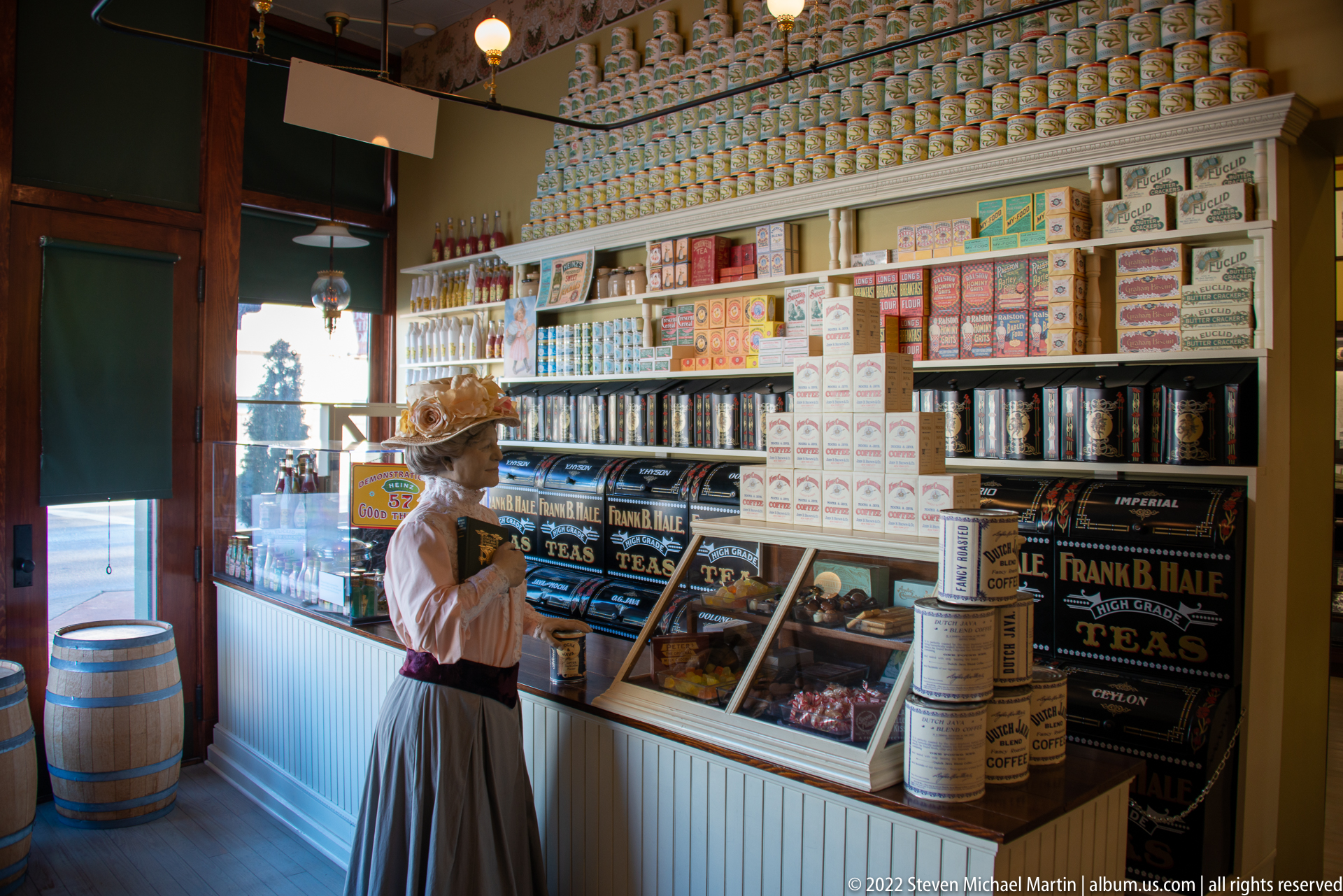
A female mannequin in a long skirt and brimmed hat stands at a glass-fronted counter inside a densely stocked shop. Boxes and tins rise across the shelves behind her, while tea advertisements and packaged goods line the case. Daylight enters through the open doorway at left, adding a cooler edge to the otherwise warm interior display.
Caption
A female mannequin in a long skirt and brimmed hat stands at a glass-fronted counter inside a densely stocked shop. Boxes and tins rise across the shelves behind her, while tea advertisements and packaged goods line the case. Daylight enters through the open doorway at left, adding a cooler edge to the otherwise warm interior display.
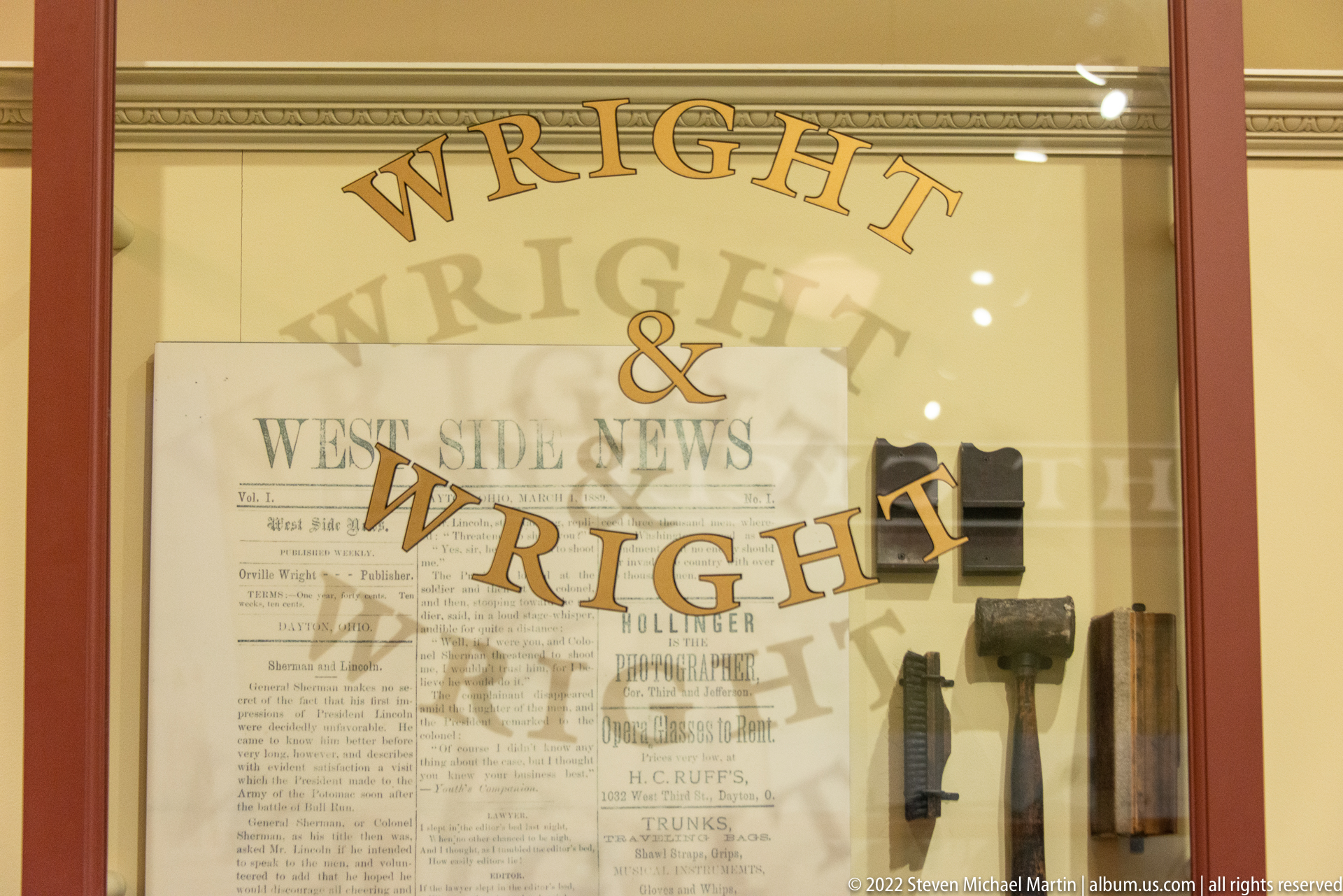
Large gold letters reading “Wright & Wright” overlay a historic newspaper page in a glass display. Printing tools and small objects are arranged to the right, while the paper’s masthead and columns remain visible behind the lettering. The layered view links the Wright name with newspaper printing and publishing without asserting that every displayed object belonged to a particular person.
Caption
Large gold letters reading “Wright & Wright” overlay a historic newspaper page in a glass display. Printing tools and small objects are arranged to the right, while the paper’s masthead and columns remain visible behind the lettering. The layered view links the Wright name with newspaper printing and publishing without asserting that every displayed object belonged to a particular person.
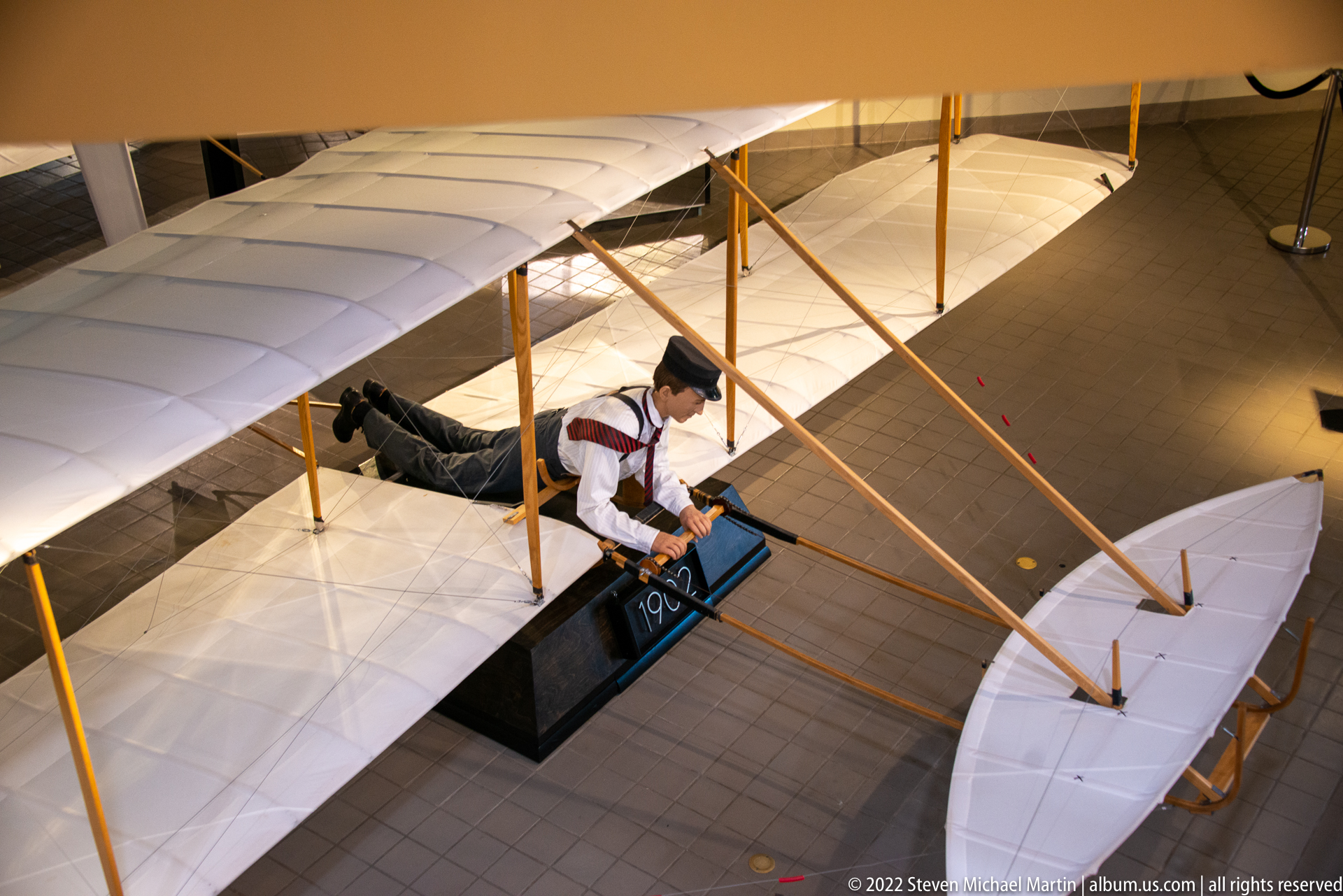
A broad fabric-covered glider is suspended above a museum floor, its long wings supported by a light framework. A clothed figure lies prone on a small central platform in the flying position, while ropes and stanchions keep visitors at a distance. The elevated oblique view reveals the glider’s span and the body posture used to control it.
Caption
A broad fabric-covered glider is suspended above a museum floor, its long wings supported by a light framework. A clothed figure lies prone on a small central platform in the flying position, while ropes and stanchions keep visitors at a distance. The elevated oblique view reveals the glider’s span and the body posture used to control it.
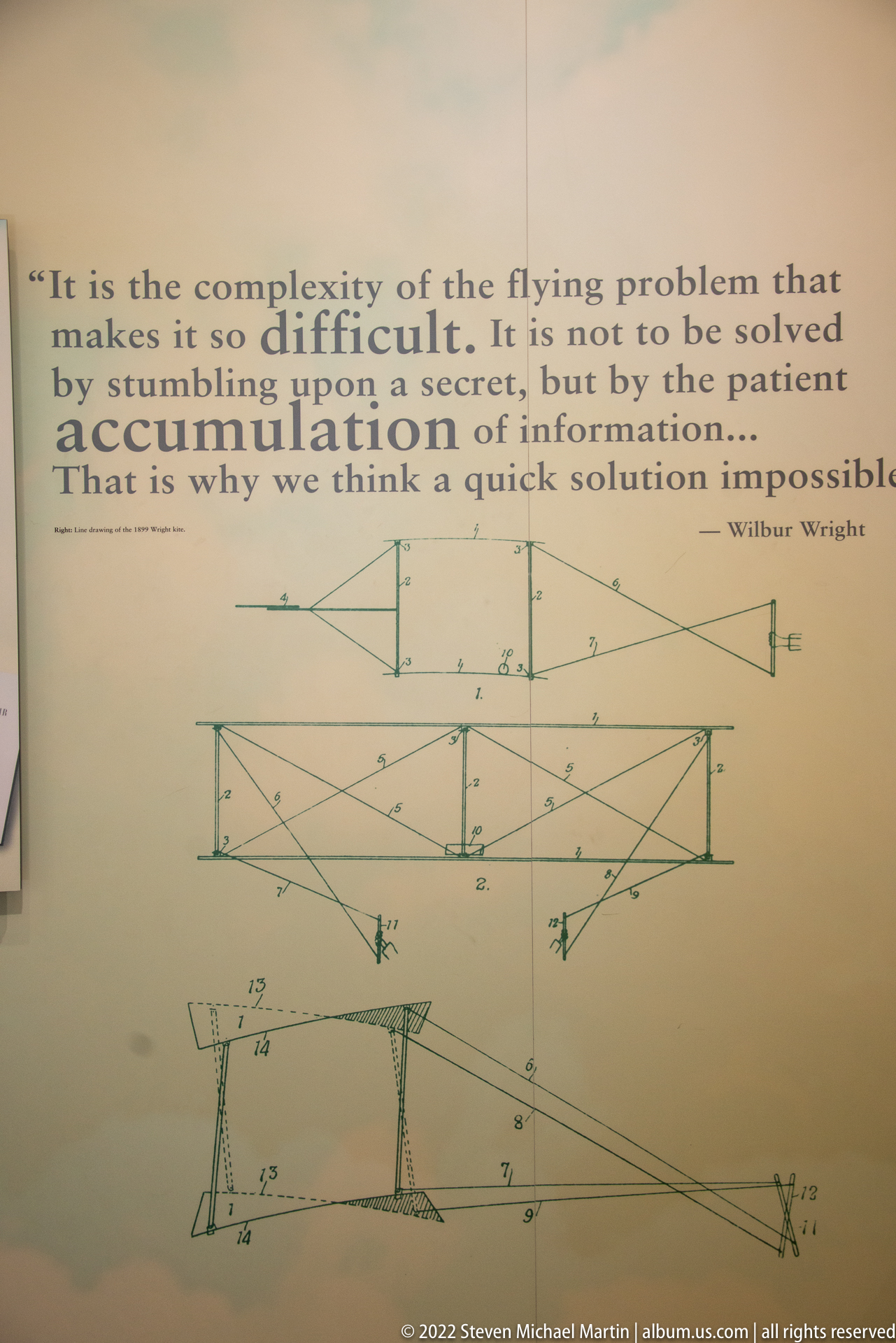
A wall display pairs a quotation attributed to Wilbur Wright about the complexity of flight with several technical drawings of wing and frame arrangements. Fine lines, numbered parts, and arrows make the diagrams appear instructional rather than decorative. The close crop directs attention to the relationship between Wright’s written reflection and the practical design studies beneath it.
Caption
A wall display pairs a quotation attributed to Wilbur Wright about the complexity of flight with several technical drawings of wing and frame arrangements. Fine lines, numbered parts, and arrows make the diagrams appear instructional rather than decorative. The close crop directs attention to the relationship between Wright’s written reflection and the practical design studies beneath it.

A wide gallery view shows the fabric-wing glider suspended over a dark central platform, with a prone figure beneath its broad span. Low ropes guide visitors around the installation, and projected images and historic photographs fill the wall behind it. The wider perspective situates the aircraft within the exhibit and reveals how much space its wings occupy.
Caption
A wide gallery view shows the fabric-wing glider suspended over a dark central platform, with a prone figure beneath its broad span. Low ropes guide visitors around the installation, and projected images and historic photographs fill the wall behind it. The wider perspective situates the aircraft within the exhibit and reveals how much space its wings occupy.

A row of brick commercial buildings fills the view, their upper stories marked by decorative masonry, tall windows, and contrasting cornices. The green-trimmed building at right carries a sign for Dayton Aviation Heritage National Historical Park, while a car and storefront awnings establish the street-level setting. The upward angle connects the park’s urban sites with the surrounding downtown block.
Caption
A row of brick commercial buildings fills the view, their upper stories marked by decorative masonry, tall windows, and contrasting cornices. The green-trimmed building at right carries a sign for Dayton Aviation Heritage National Historical Park, while a car and storefront awnings establish the street-level setting. The upward angle connects the park’s urban sites with the surrounding downtown block.
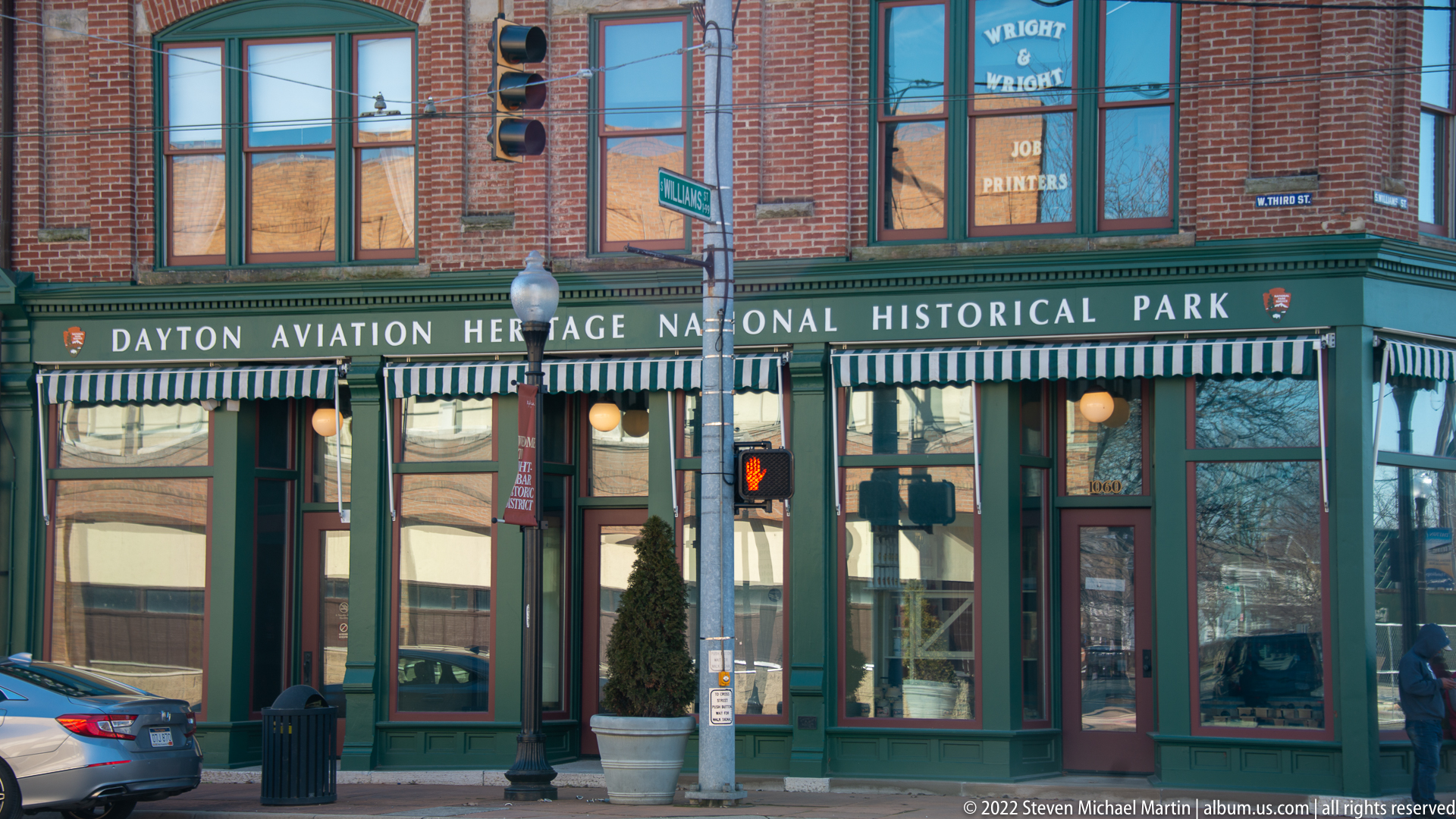
The green storefront band reads “Dayton Aviation Heritage National Historical Park,” spanning the façade above striped awnings and tall street-level windows. Upper windows display additional lettering, while a traffic signal and parked cars enter the lower edge. The closer framing makes the park identification legible and shows how it is integrated into a historic commercial building.
Caption
The green storefront band reads “Dayton Aviation Heritage National Historical Park,” spanning the façade above striped awnings and tall street-level windows. Upper windows display additional lettering, while a traffic signal and parked cars enter the lower edge. The closer framing makes the park identification legible and shows how it is integrated into a historic commercial building.
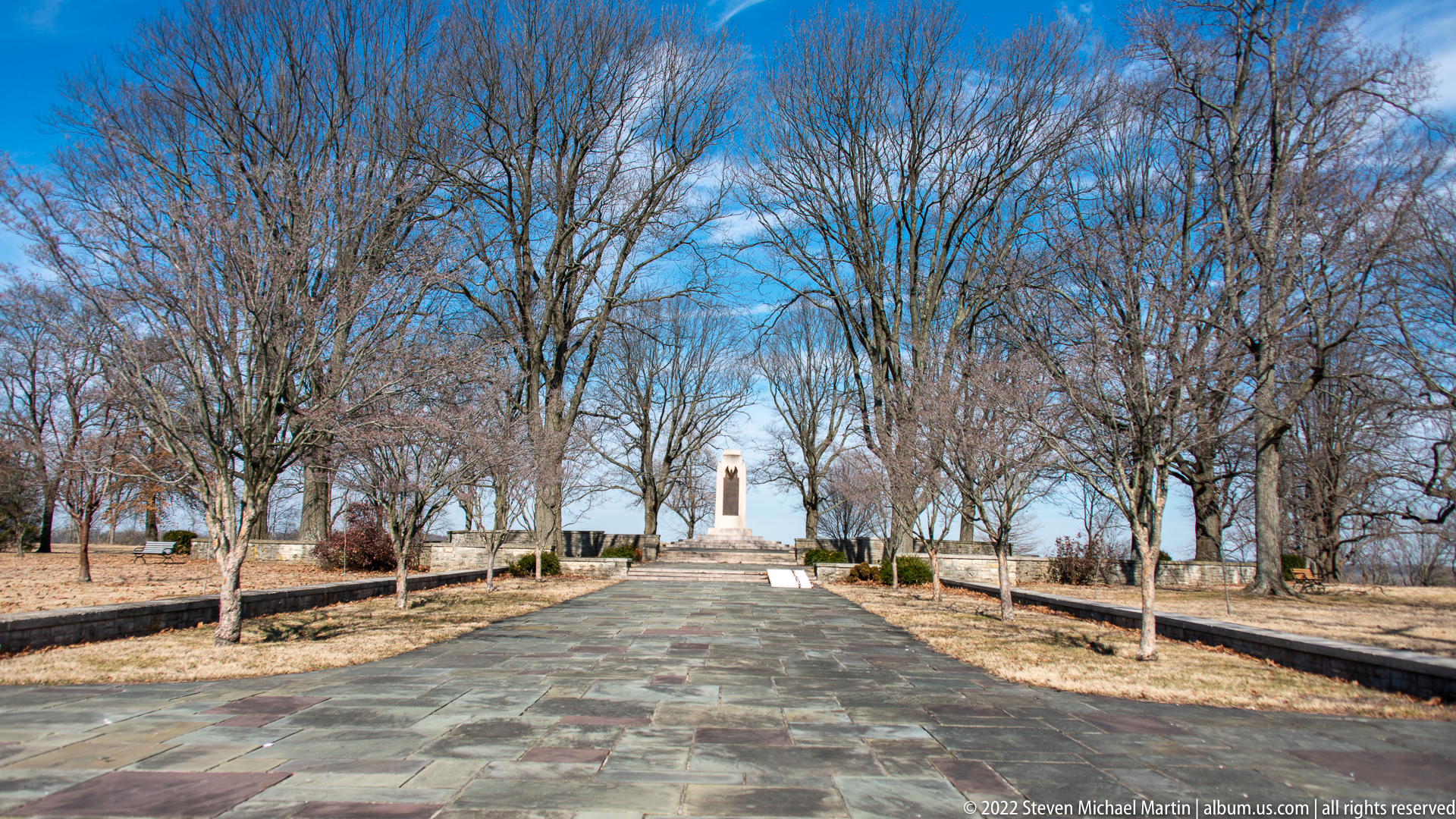
A long stone-paved walkway runs between low masonry borders and rows of leafless trees toward a slender pale monument at the far end. The centered perspective draws the eye along the path, while blue sky and dormant grass suggest a cool-season visit. The monument’s form is visible, but the image does not establish its name or commemorative subject.
Caption
A long stone-paved walkway runs between low masonry borders and rows of leafless trees toward a slender pale monument at the far end. The centered perspective draws the eye along the path, while blue sky and dormant grass suggest a cool-season visit. The monument’s form is visible, but the image does not establish its name or commemorative subject.
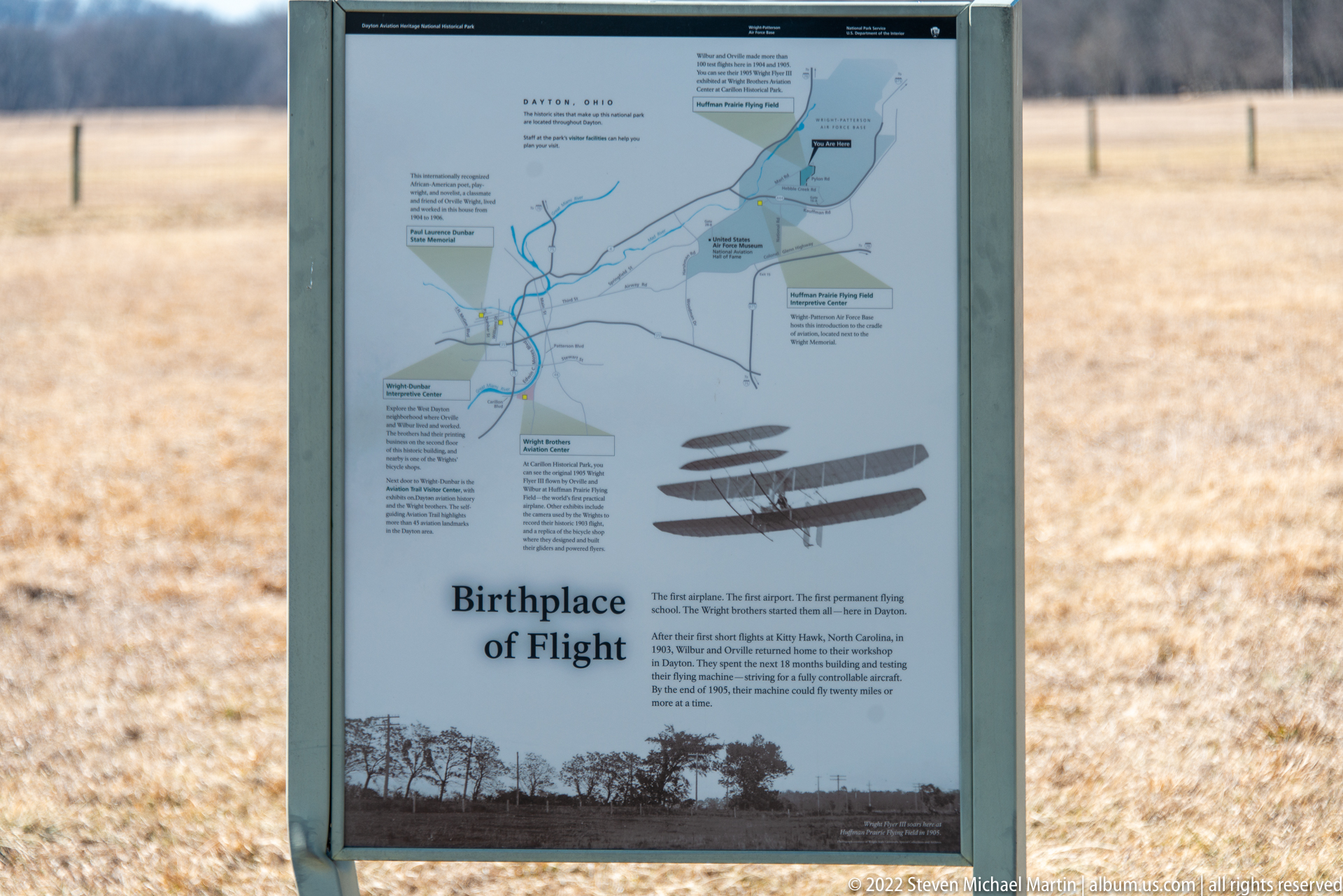
A freestanding wayside panel titled “Birthplace of Flight” combines a local map, diagrams of early aircraft, and explanatory text. The illustrated flying machines occupy the center-right, while the map traces locations across the surrounding area. Set against a dormant field, the panel connects the outdoor landscape with the Wright brothers’ aviation story.
Caption
A freestanding wayside panel titled “Birthplace of Flight” combines a local map, diagrams of early aircraft, and explanatory text. The illustrated flying machines occupy the center-right, while the map traces locations across the surrounding area. Set against a dormant field, the panel connects the outdoor landscape with the Wright brothers’ aviation story.
National Historical Park Field Guide
📍 Overview
Dayton Aviation Heritage National Historical Park preserves sites associated with Wilbur and Orville Wright, whose experiments in flight transformed modern transportation and engineering. The park highlights the intellectual curiosity and technical experimentation that led to the first successful powered flights. Dayton served as the foundation for research that would ultimately change global mobility and communication.
The preserved buildings and exhibits illustrate the Wright brothers’ methodical approach to solving aerodynamic challenges. Their work demonstrates the importance of persistence, collaboration, and experimentation in the advancement of technology. The park provides context for understanding how small-scale mechanical experimentation contributed to major global change.
⭐ Highlights
- Sites associated with the Wright brothers’ early experiments
- Interpretation of the development of powered flight
- Historic buildings illustrating early engineering work
- Connection to technological innovation in transportation
- Insight into the origins of modern aviation
🔎 Key Features
- Historic structures connected to early aviation research
- Interpretive exhibits explaining flight experimentation
- Context for understanding mechanical innovation
- Educational displays describing technological progress
- Locations associated with the Wright brothers’ work
📷 Photography Notes
- Architectural details provide simple composition opportunities
- Exterior views work well in soft natural light
- Interpretive exhibits can help tell the story visually
- Wide framing can help capture historic context
- Look for angles that emphasize historic character
- Details often communicate the experimental nature of the site