Bering Land Bridge National Preserve
Bering Land Bridge National Preserve protects a landscape associated with the ancient land connection that once linked Asia and North America. During periods of lower sea levels in the Ice Age, this land bridge allowed migration of both animals and early human populations between continents. The preserve represents an important geographic and archaeological setting that contributed to the settlement of the Americas.
The landscape includes tundra, volcanic features, and coastal environments shaped by geological processes over thousands of years. Evidence of volcanic activity can be found in the region’s hot springs and lava fields, illustrating the dynamic forces that continue to shape the environment. Archaeological sites provide insight into early human migration patterns and adaptation to Arctic conditions.
Visitors experience a remote and largely undeveloped environment where broad tundra vistas and coastal horizons emphasize the scale of the ancient land connection. The preserve highlights both geological history and the importance of migration routes in shaping global patterns of human settlement.
Musk Oxen
Musk oxen are among the most distinctive wildlife species found in the region and reflect adaptations to the demanding conditions of the Arctic environment. These large mammals are well suited to tundra landscapes, where thick insulating coats protect them from extreme winter temperatures and strong winds. Their presence provides insight into Ice Age ecosystems, as musk oxen are closely related to species that once roamed the ancient land bridge connecting Asia and North America. Observing musk oxen in the open tundra landscape offers a powerful reminder of the long ecological continuity that characterizes Arctic environments.
Light Colored Grizzly Bear
One of the most memorable wildlife sightings in Bering Land Bridge National Preserve was a very light-colored bear moving across the tundra with a cub nearby. At first glance, the pale fur suggested the possibility of a polar bear, but closer review of the photographs shows characteristics more consistent with a grizzly bear. The animal displays the distinctive shoulder hump typical of brown bears, along with a broader head shape and body proportions adapted to inland tundra environments rather than coastal sea ice habitat. Grizzly bears in Arctic Alaska can vary widely in color, with some individuals appearing blonde or cream in the bright northern light. Observing this unusually light-colored bear added an element of surprise and illustrates the diversity of wildlife adapted to the remote landscapes of Bering Land Bridge.
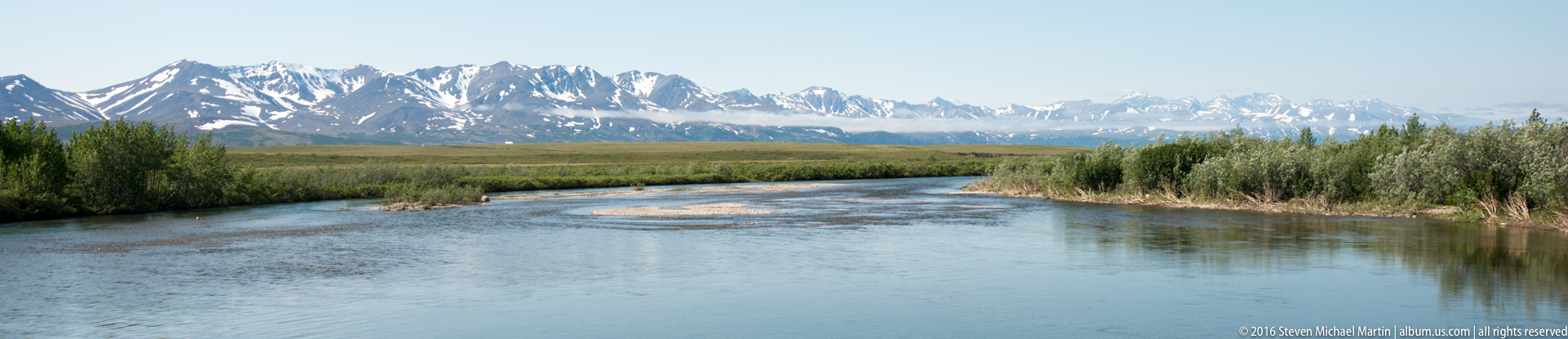
The river bends through a green valley below a long, snow-marked mountain range. Trees and shrubs frame the water in the foreground, and the distant peaks recede into a light haze. The elevated viewpoint gives the scene a layered depth, contrasting dark conifer cover near the river with open tundra and high alpine terrain beyond.
Caption
The river bends through a green valley below a long, snow-marked mountain range. Trees and shrubs frame the water in the foreground, and the distant peaks recede into a light haze. The elevated viewpoint gives the scene a layered depth, contrasting dark conifer cover near the river with open tundra and high alpine terrain beyond.
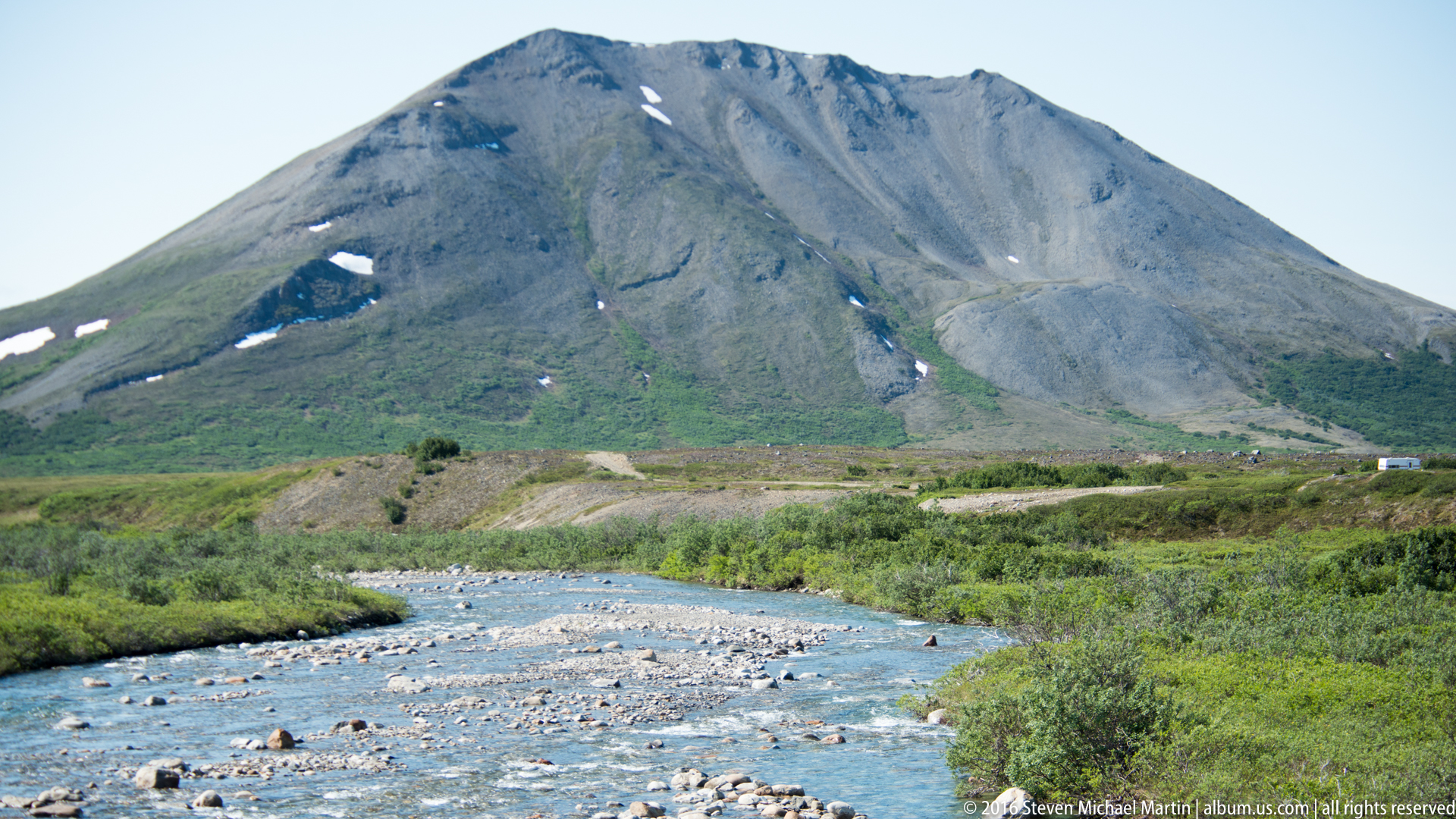
A rocky river winds across the foreground beneath a steep, gray mountain marked by scattered snowfields. The river's pale gravel bars and blue channels lead into dense green tundra, where a few small structures sit near the base of the slope. The wide view connects the mountain's exposed rock with the watercourse and vegetation below.
Caption
A rocky river winds across the foreground beneath a steep, gray mountain marked by scattered snowfields. The river's pale gravel bars and blue channels lead into dense green tundra, where a few small structures sit near the base of the slope. The wide view connects the mountain's exposed rock with the watercourse and vegetation below.
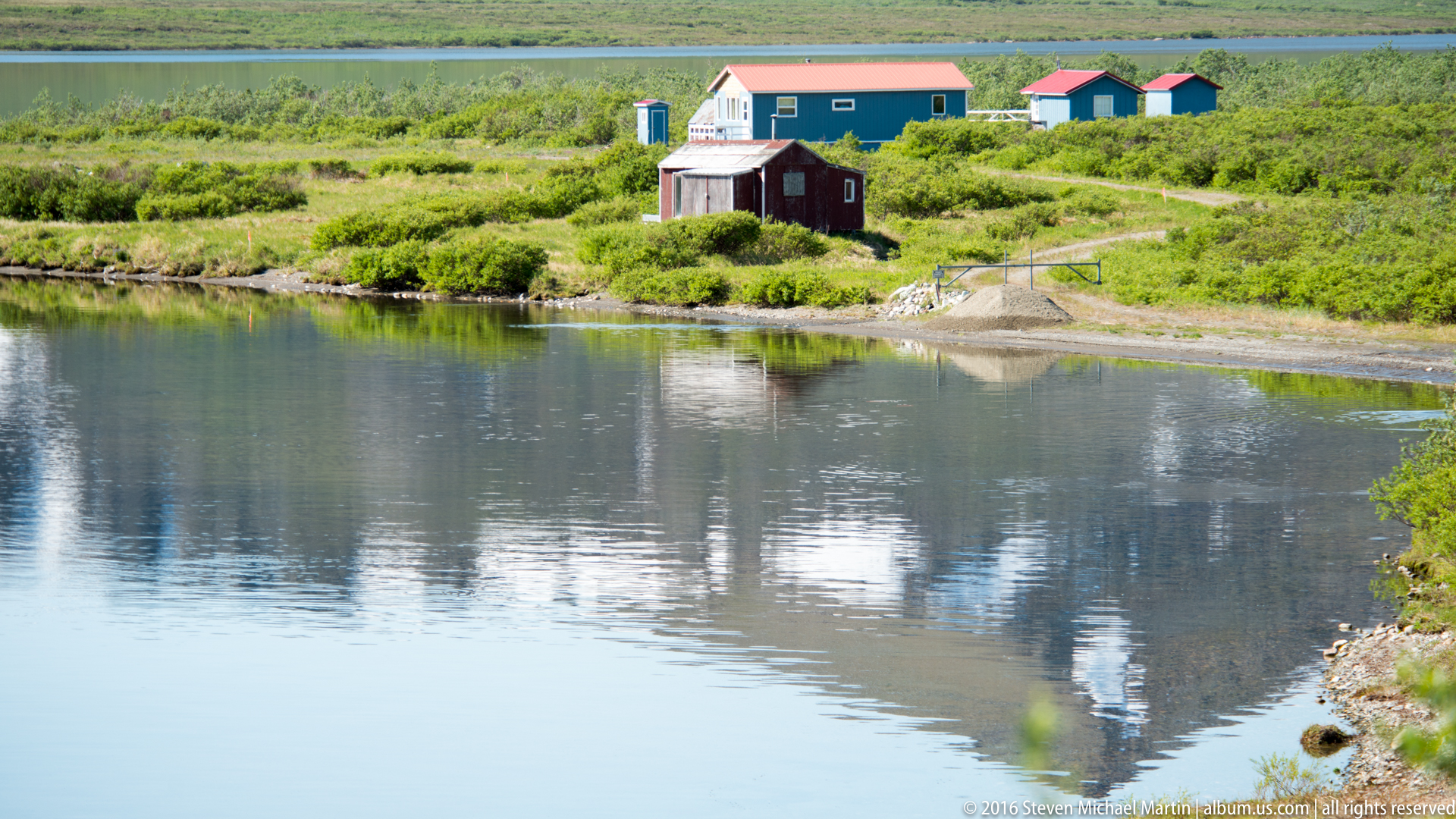
A closer view centers several small buildings along the far bank of a still lake. A blue-green structure with a red roof stands behind a darker cabin, while smaller sheds and a track line the shore. Their reflections extend into the foreground water, making this a settlement view rather than the mountain-centered panorama nearby.
Caption
A closer view centers several small buildings along the far bank of a still lake. A blue-green structure with a red roof stands behind a darker cabin, while smaller sheds and a track line the shore. Their reflections extend into the foreground water, making this a settlement view rather than the mountain-centered panorama nearby.
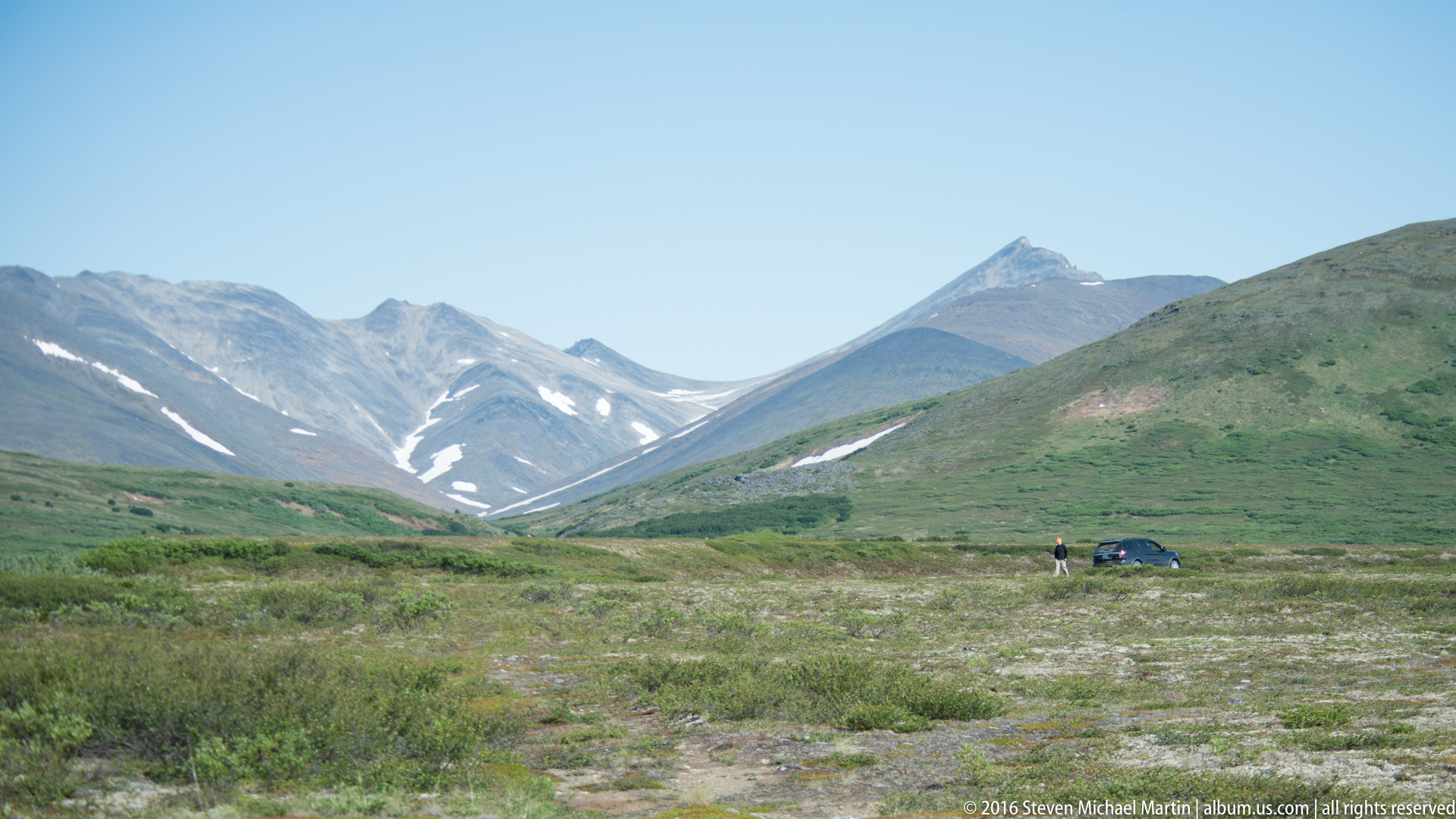
A broad mountain valley opens beneath a clear blue sky, with snow traces in the high cirques and low tundra covering the slopes. A vehicle and a standing person near the valley floor provide scale for the surrounding terrain. The small human presence also locates the view along a traveled route without obscuring its expansive landforms.
Caption
A broad mountain valley opens beneath a clear blue sky, with snow traces in the high cirques and low tundra covering the slopes. A vehicle and a standing person near the valley floor provide scale for the surrounding terrain. The small human presence also locates the view along a traveled route without obscuring its expansive landforms.
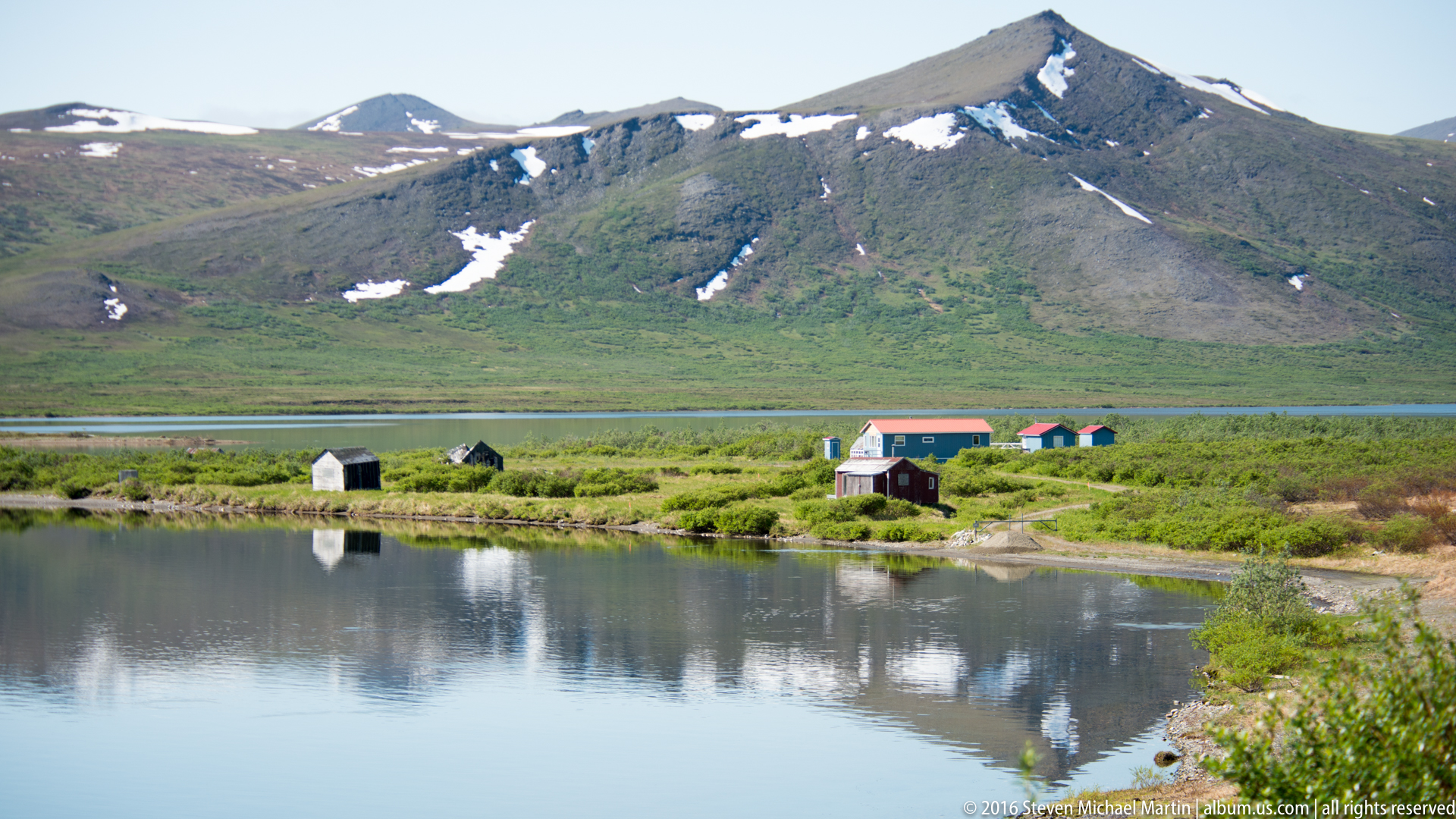
A steep, snow-marked mountain rises behind a cluster of small buildings set between two calm bodies of water. The red and blue roofs provide vivid points of color within a broad green valley, while reflections add a quiet foreground layer. The scene links a modest settlement to the surrounding mountain and lake landscape without identifying the structures' specific use.
Caption
A steep, snow-marked mountain rises behind a cluster of small buildings set between two calm bodies of water. The red and blue roofs provide vivid points of color within a broad green valley, while reflections add a quiet foreground layer. The scene links a modest settlement to the surrounding mountain and lake landscape without identifying the structures' specific use.
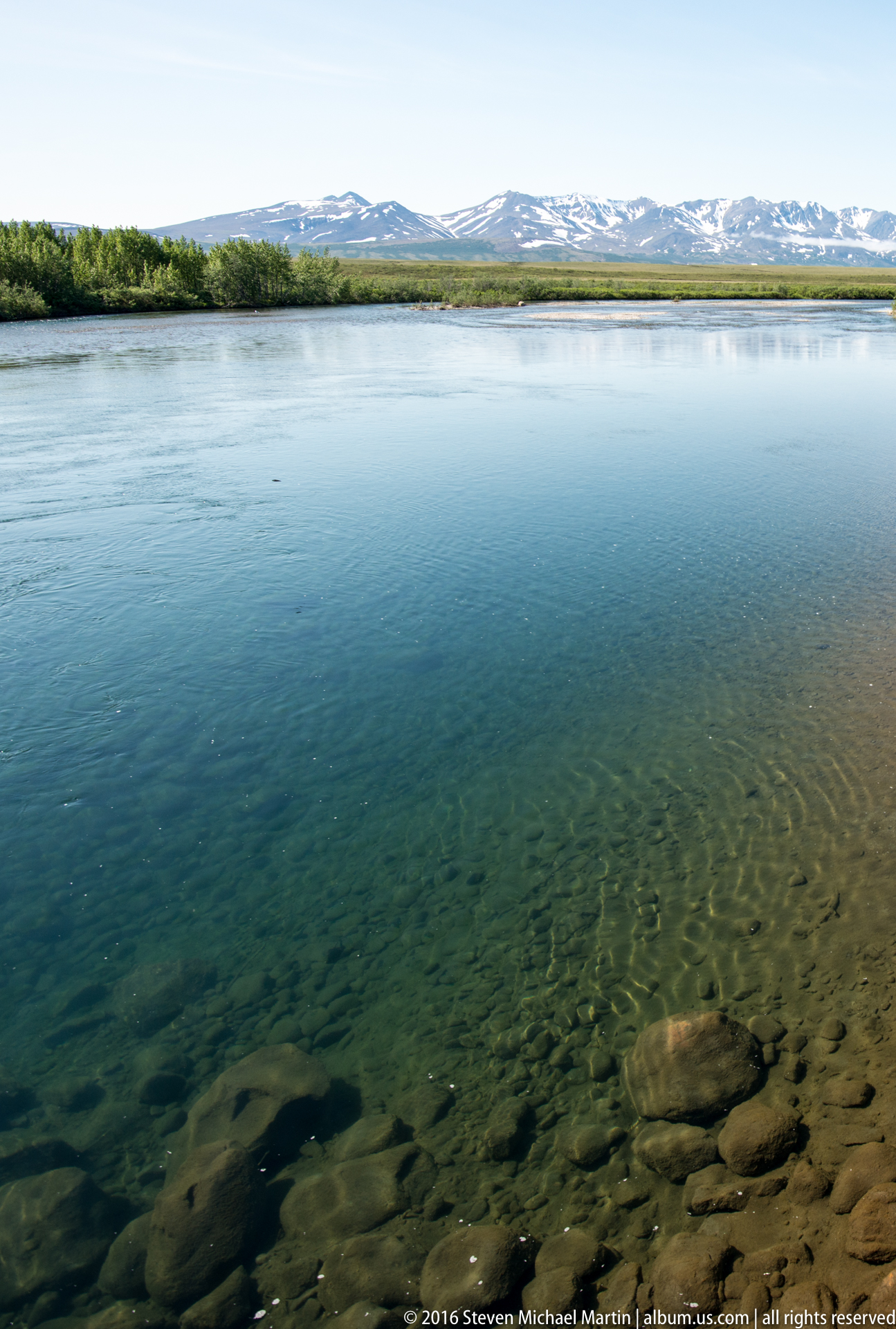
Clear blue-green water fills the foreground, revealing rounded stones beneath the surface near the bank. Beyond it, a narrow strip of shrubs separates the river from a broad lowland and a distant chain of snow-covered mountains. The unusually calm water and visible riverbed make this a study of transparency and layered northern landscape.
Caption
Clear blue-green water fills the foreground, revealing rounded stones beneath the surface near the bank. Beyond it, a narrow strip of shrubs separates the river from a broad lowland and a distant chain of snow-covered mountains. The unusually calm water and visible riverbed make this a study of transparency and layered northern landscape.
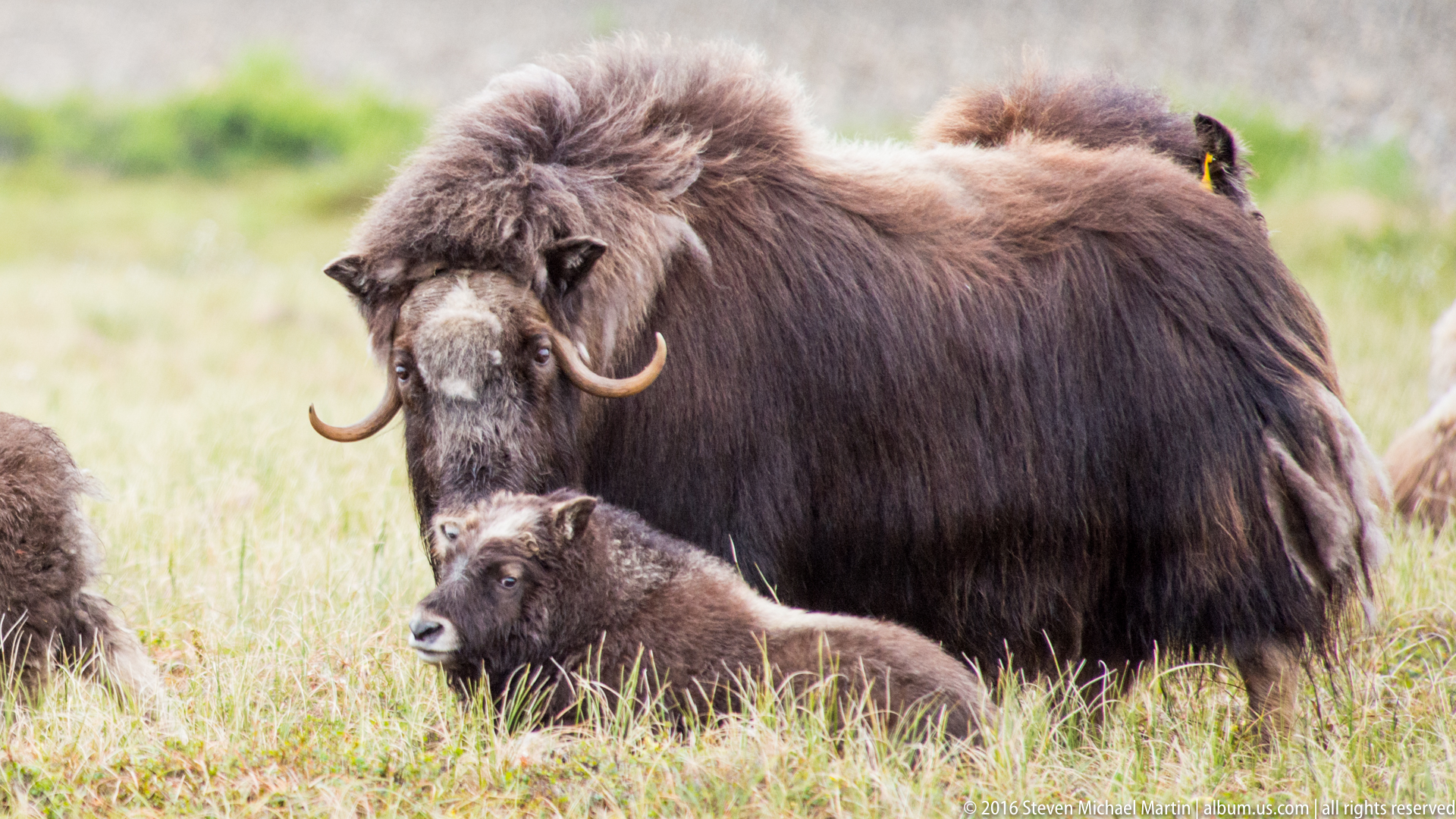
A cow and calf stand close in a grassy tundra meadow, the adult's long coat and sweeping horns framing the smaller animal in front. Their overlapping profiles make this an intimate family portrait rather than a herd overview; muted green grasses and a soft background keep attention on the pair.
Caption
A cow and calf stand close in a grassy tundra meadow, the adult's long coat and sweeping horns framing the smaller animal in front. Their overlapping profiles make this an intimate family portrait rather than a herd overview; muted green grasses and a soft background keep attention on the pair.

A weathered wooden trestle crosses a densely vegetated ravine, its elevated deck carried by a sequence of timber uprights and diagonal braces. Several boards appear uneven or missing, exposing the structure's open framework. Shrubs fill the steep cut beneath it, while the bridge's long, narrow deck spans the green ravine from side to side.
Caption
A weathered wooden trestle crosses a densely vegetated ravine, its elevated deck carried by a sequence of timber uprights and diagonal braces. Several boards appear uneven or missing, exposing the structure's open framework. Shrubs fill the steep cut beneath it, while the bridge's long, narrow deck spans the green ravine from side to side.

A scattered musk ox herd grazes across a broad, gently sloping meadow. Several animals lower their heads among the grasses while others stand upright, their dark silhouettes repeating across the middle distance. The wide framing emphasizes how the herd occupies the open tundra rather than isolating one individual.
Caption
A scattered musk ox herd grazes across a broad, gently sloping meadow. Several animals lower their heads among the grasses while others stand upright, their dark silhouettes repeating across the middle distance. The wide framing emphasizes how the herd occupies the open tundra rather than isolating one individual.

Several musk oxen bunch together in the meadow, their shaggy coats and overlapping horns forming a dense cluster. A calf stands low in the foreground while adults turn in different directions behind it. The close grouping reveals varied horn shapes and body sizes within the herd without suggesting a specific behavior beyond resting together.
Caption
Several musk oxen bunch together in the meadow, their shaggy coats and overlapping horns forming a dense cluster. A calf stands low in the foreground while adults turn in different directions behind it. The close grouping reveals varied horn shapes and body sizes within the herd without suggesting a specific behavior beyond resting together.
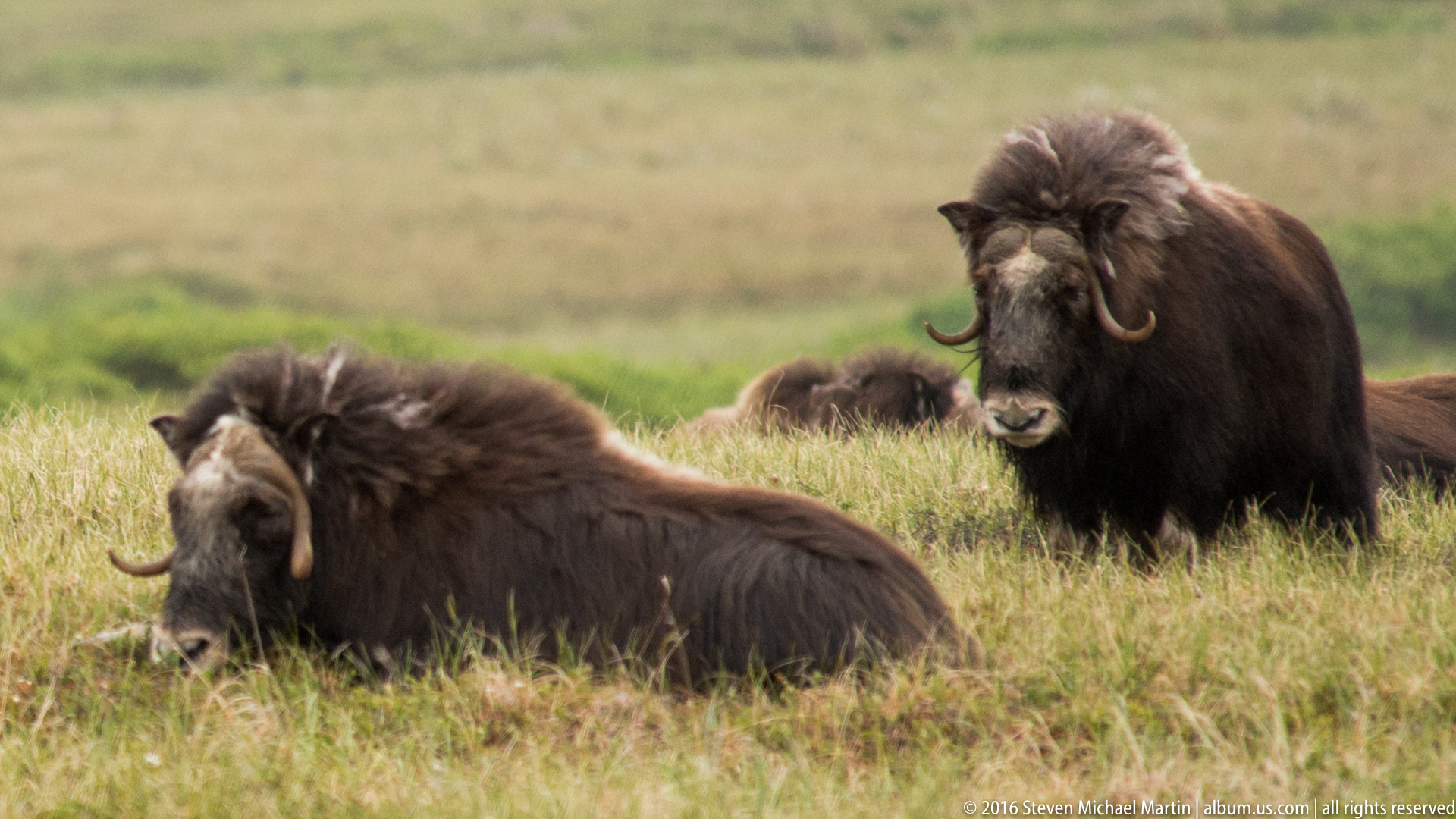
Two musk oxen share the frame at different depths: one lies across the foreground, while a larger adult stands facing the camera behind it. Their curved horns and heavy coats contrast with the smooth, open meadow. This layered arrangement gives the resting animal prominence while retaining the alert standing ox as a second focal point.
Caption
Two musk oxen share the frame at different depths: one lies across the foreground, while a larger adult stands facing the camera behind it. Their curved horns and heavy coats contrast with the smooth, open meadow. This layered arrangement gives the resting animal prominence while retaining the alert standing ox as a second focal point.
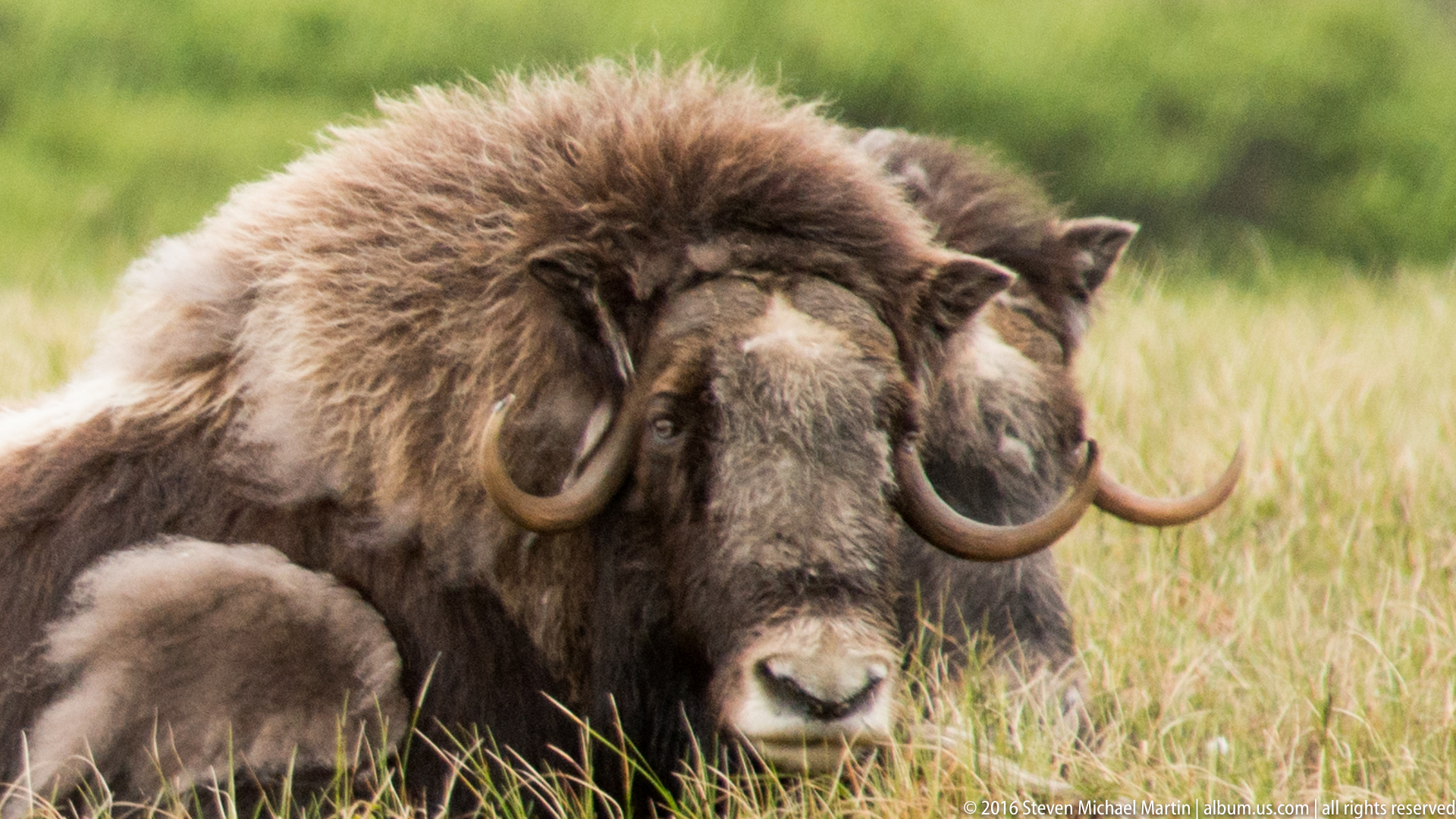
A tight view brings three musk ox faces and their sweeping horns into a compact arrangement. The nearest animal looks forward, with two more partly visible behind it; a calf's back enters at lower left. Dense overlap, rather than a single isolated portrait, conveys the close spacing of animals within this group.
Caption
A tight view brings three musk ox faces and their sweeping horns into a compact arrangement. The nearest animal looks forward, with two more partly visible behind it; a calf's back enters at lower left. Dense overlap, rather than a single isolated portrait, conveys the close spacing of animals within this group.
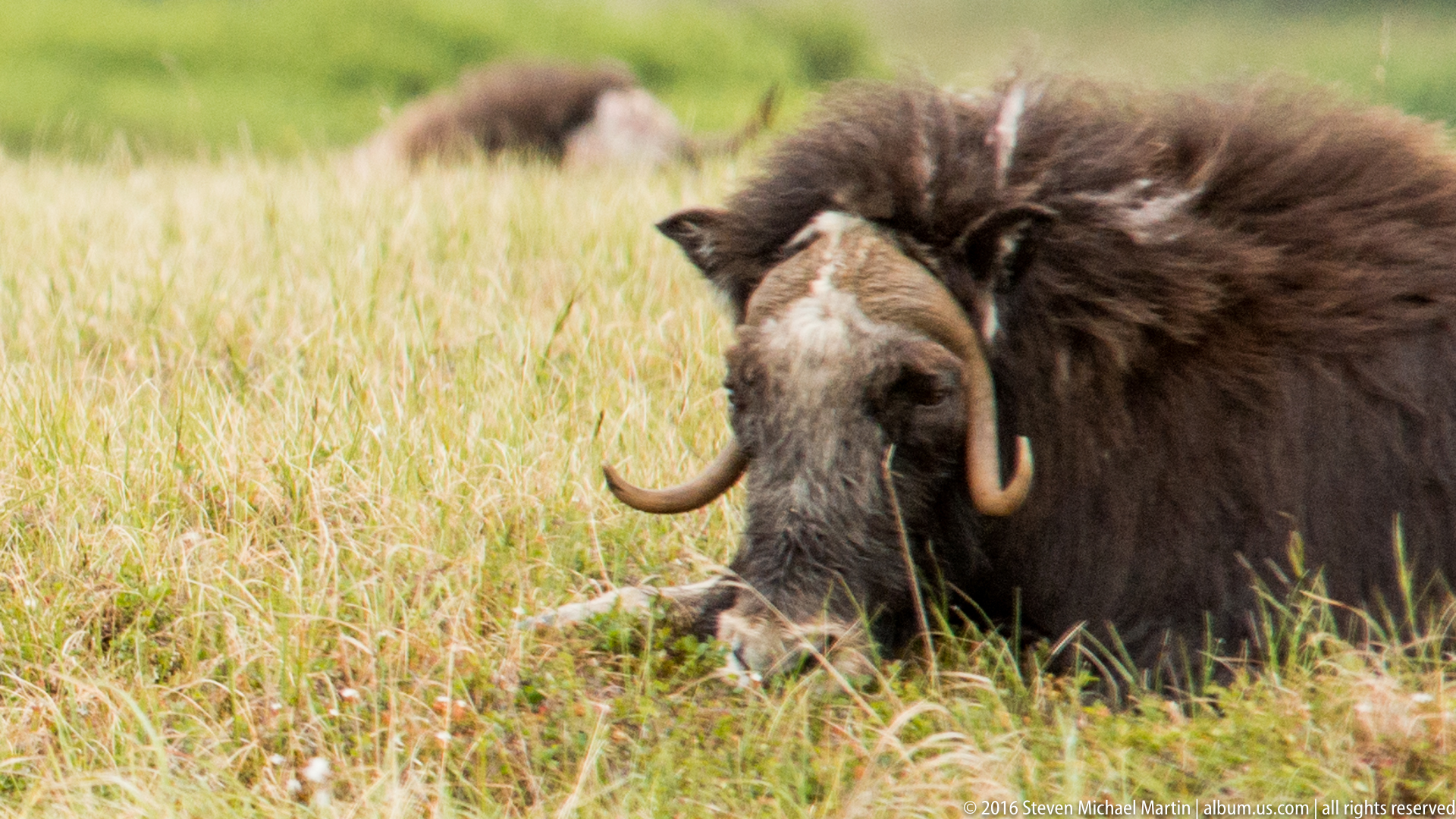
One musk ox lowers its head toward the grass while another stands close behind, its face directed toward the camera. The foreground animal's horns sweep outward and down, making their shape prominent against the pale meadow. A cropped third body at the edge hints at a larger group beyond this two-animal interaction.
Caption
One musk ox lowers its head toward the grass while another stands close behind, its face directed toward the camera. The foreground animal's horns sweep outward and down, making their shape prominent against the pale meadow. A cropped third body at the edge hints at a larger group beyond this two-animal interaction.
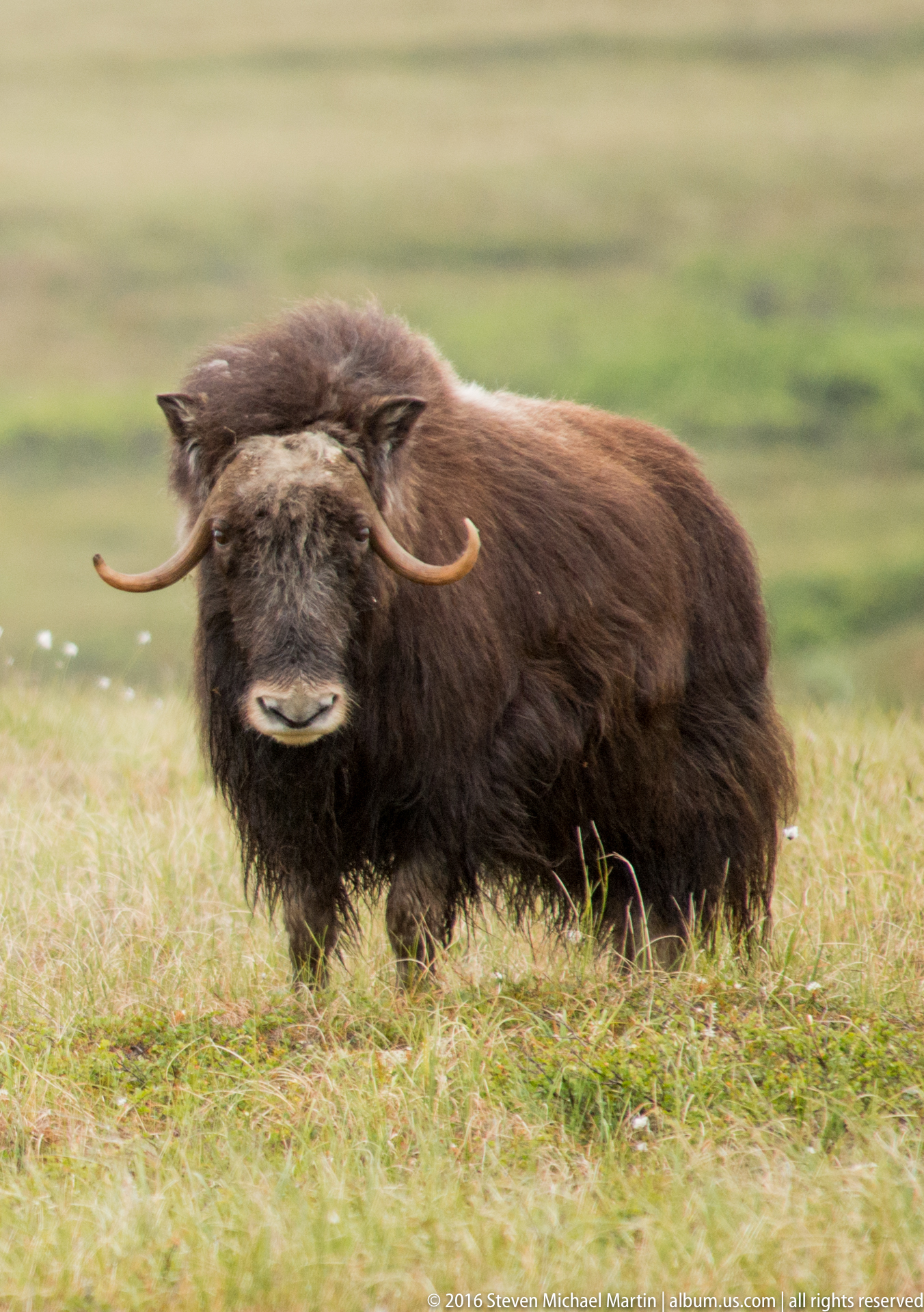
A single musk ox stands broadside in an open meadow, facing the viewer with its horns extending almost horizontally from either side of its forehead. Its long dark coat hangs near the grass, while the shallow background keeps the animal distinct from the softly banded tundra beyond. The balanced framing reads as a clear wildlife portrait.
Caption
A single musk ox stands broadside in an open meadow, facing the viewer with its horns extending almost horizontally from either side of its forehead. Its long dark coat hangs near the grass, while the shallow background keeps the animal distinct from the softly banded tundra beyond. The balanced framing reads as a clear wildlife portrait.
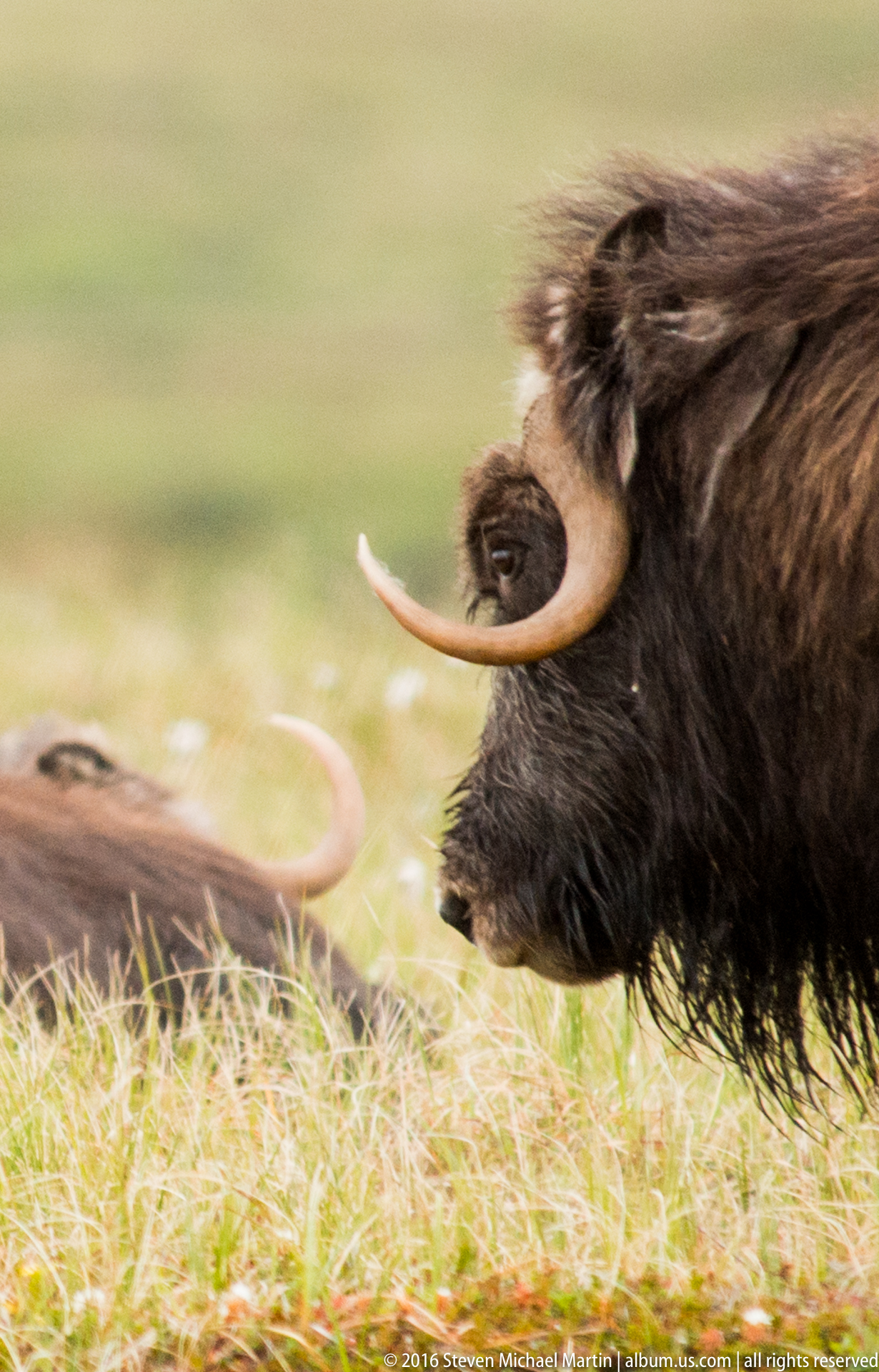
The close crop isolates a musk ox's head and forward-curving horn as it turns toward another animal partly visible at lower left. Coarse facial hair, a dark eye, and the horn's pale tip stand out against the blurred meadow. The tight viewpoint shifts attention from herd arrangement to the animal's distinctive head and coat.
Caption
The close crop isolates a musk ox's head and forward-curving horn as it turns toward another animal partly visible at lower left. Coarse facial hair, a dark eye, and the horn's pale tip stand out against the blurred meadow. The tight viewpoint shifts attention from herd arrangement to the animal's distinctive head and coat.

Two musk oxen stand far apart across the meadow, leaving a wide band of pale grass between them. The left animal is partly cropped, while the right one faces forward near the edge of the frame. The unusual open space distinguishes this view from the close herd portraits and makes the terrain an active part of the composition.
Caption
Two musk oxen stand far apart across the meadow, leaving a wide band of pale grass between them. The left animal is partly cropped, while the right one faces forward near the edge of the frame. The unusual open space distinguishes this view from the close herd portraits and makes the terrain an active part of the composition.
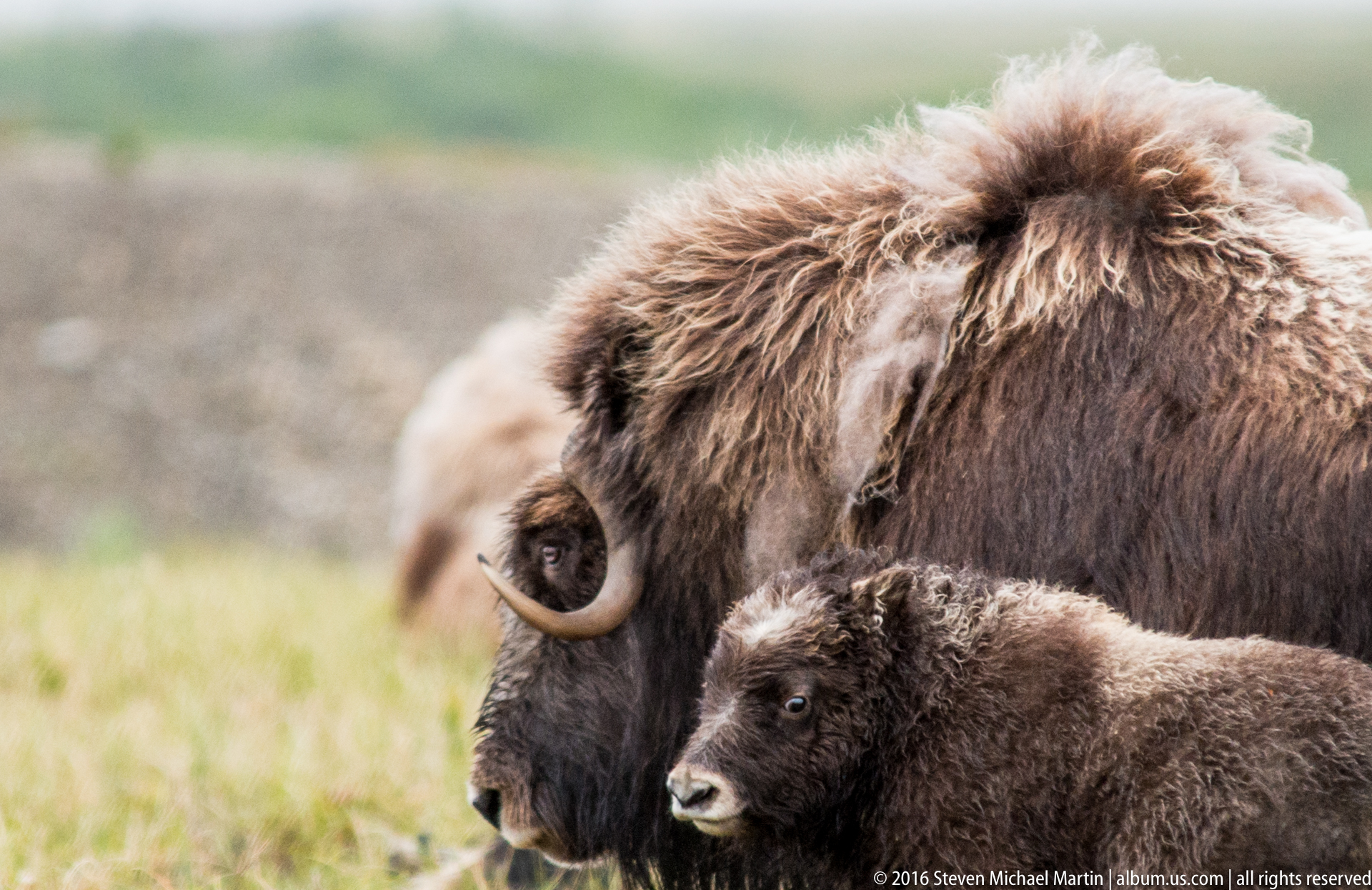
A musk ox cow bends over a calf nestled against her chest, her heavy coat forming a sheltering curve around the smaller animal. The calf looks outward from beneath the adult's face, creating a compact mother-and-young portrait. Soft grass and a blurred companion in the background keep the scene focused on their closeness.
Caption
A musk ox cow bends over a calf nestled against her chest, her heavy coat forming a sheltering curve around the smaller animal. The calf looks outward from beneath the adult's face, creating a compact mother-and-young portrait. Soft grass and a blurred companion in the background keep the scene focused on their closeness.
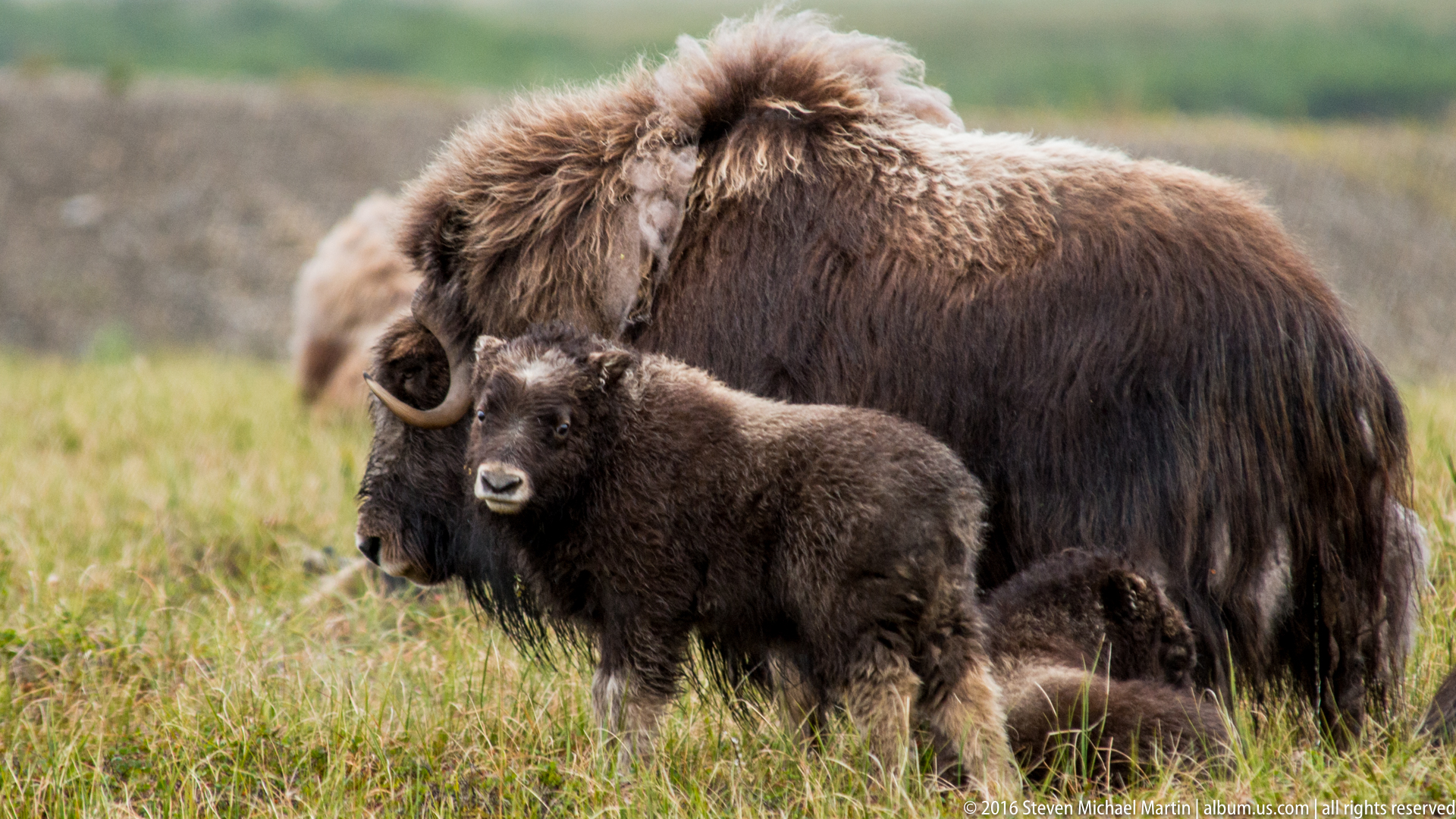
A calf stands at the front of a musk ox group, its smaller body and shorter horns set against the massive adult behind it. The nearest animals overlap along the left half of the frame, while a pale patch of meadow opens to the right. This composition makes the contrast in scale within the herd immediately legible.
Caption
A calf stands at the front of a musk ox group, its smaller body and shorter horns set against the massive adult behind it. The nearest animals overlap along the left half of the frame, while a pale patch of meadow opens to the right. This composition makes the contrast in scale within the herd immediately legible.
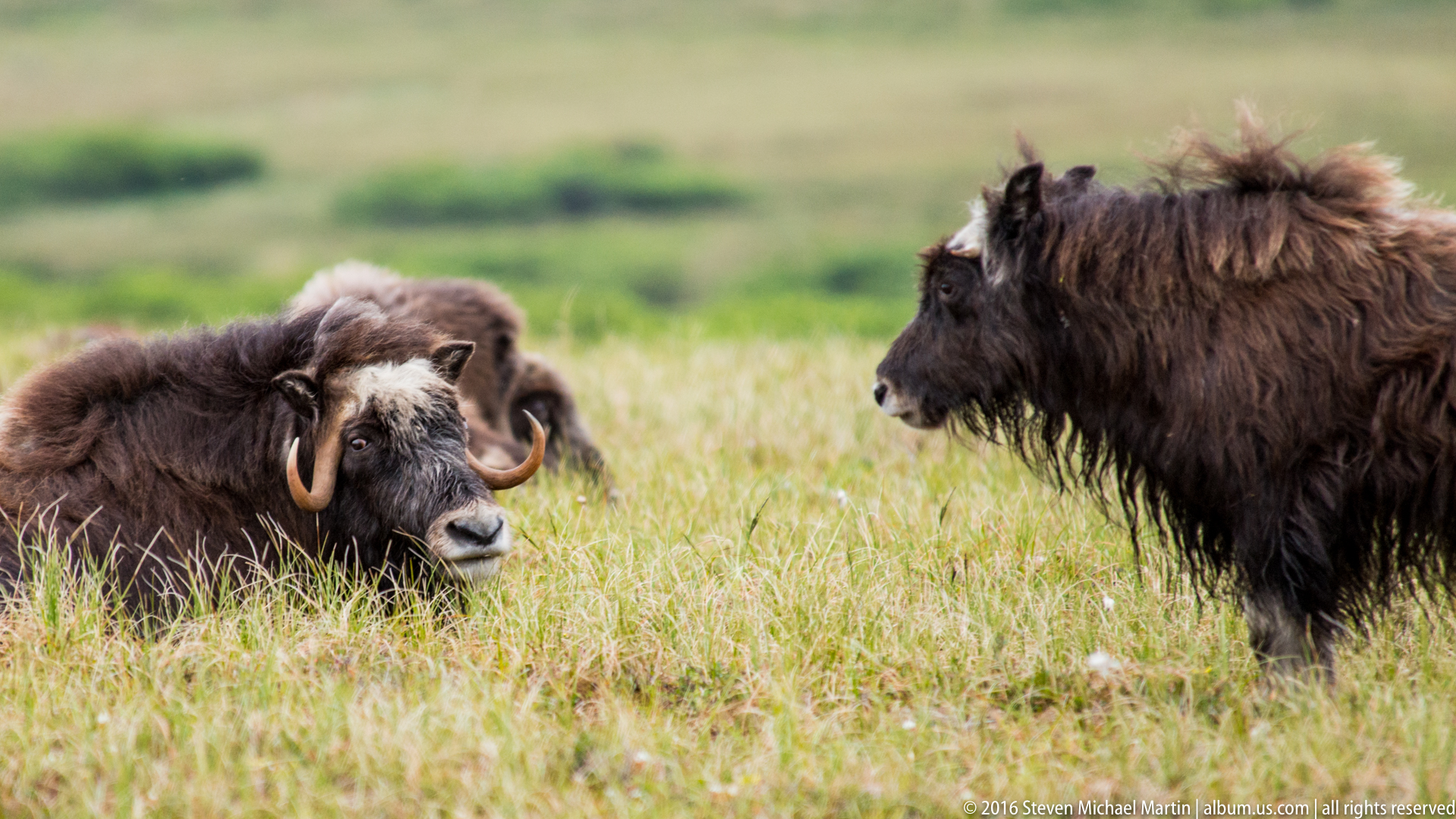
An adult musk ox stands at right facing a seated or reclining animal in the left foreground. Their opposing orientations create a quiet visual exchange across the grass, with additional herd members softened behind them. The standing ox's long fringe and the resting animal's visible horns distinguish the two forms within this broad, low viewpoint.
Caption
An adult musk ox stands at right facing a seated or reclining animal in the left foreground. Their opposing orientations create a quiet visual exchange across the grass, with additional herd members softened behind them. The standing ox's long fringe and the resting animal's visible horns distinguish the two forms within this broad, low viewpoint.
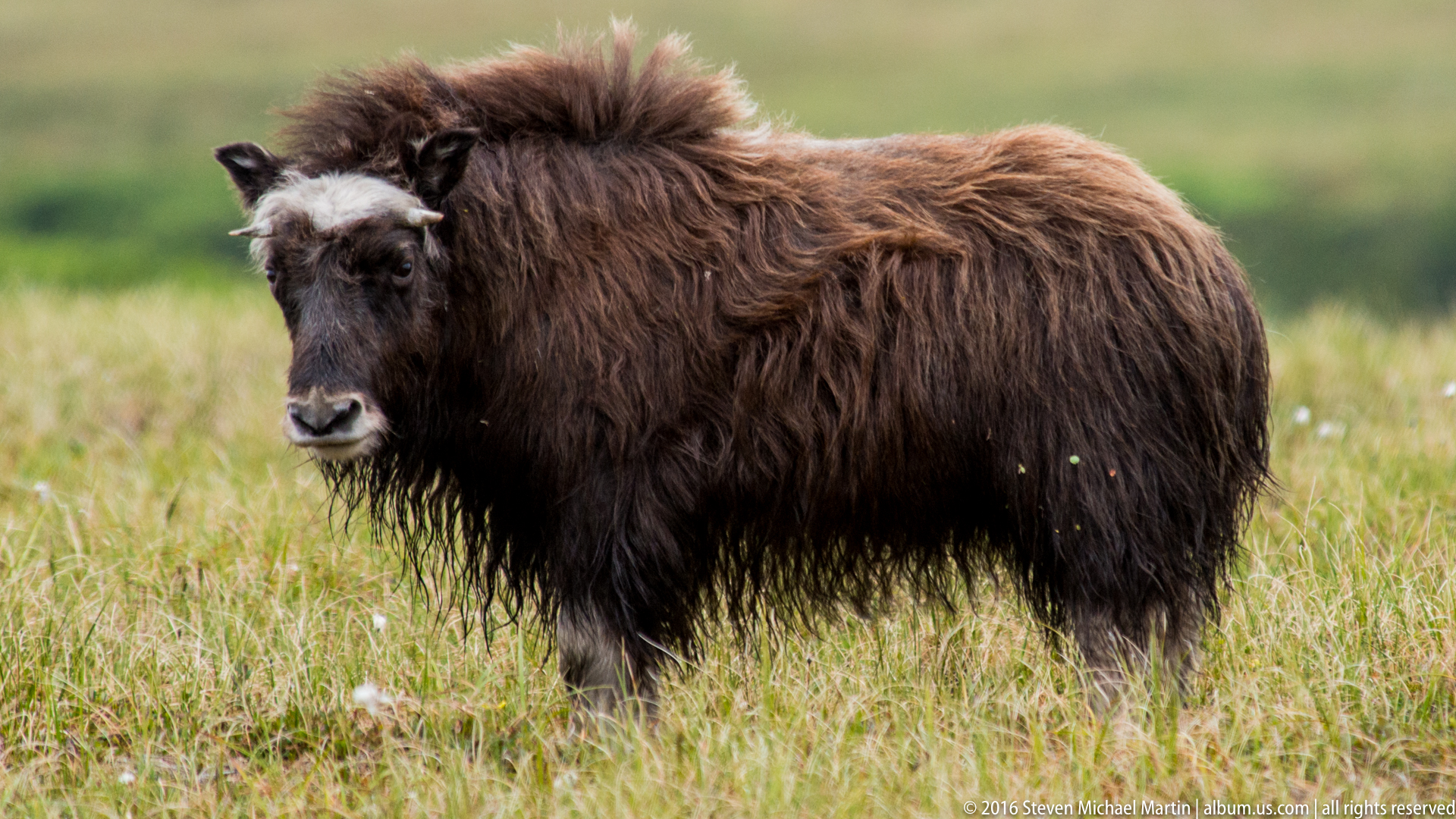
A solitary musk ox stands squarely in the meadow, its dark shaggy coat hanging in long strands below the body and its short horns emerging from a pale forehead cap. Small white flowers punctuate the grass near its legs. The unobstructed side-front view shows the animal's full shape and distinctive coat texture.
Caption
A solitary musk ox stands squarely in the meadow, its dark shaggy coat hanging in long strands below the body and its short horns emerging from a pale forehead cap. Small white flowers punctuate the grass near its legs. The unobstructed side-front view shows the animal's full shape and distinctive coat texture.
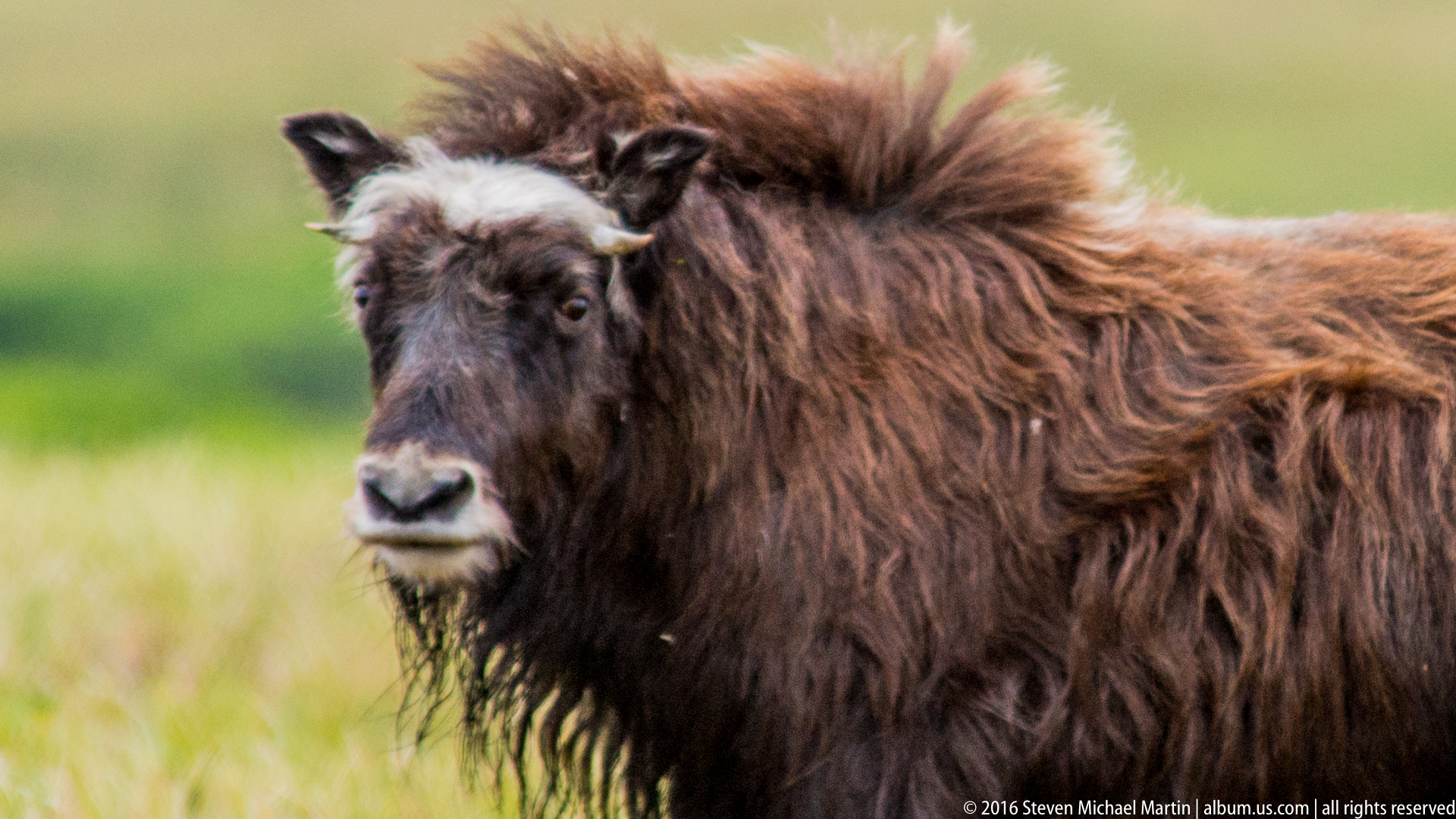
The frame moves close to a musk ox's face and shoulder, emphasizing the pale cap of hair, dark muzzle, and dense reddish-brown coat. One eye looks toward the camera while the horns remain mostly concealed by the frontal angle. The cropped portrait differs from wider herd views by concentrating on facial texture and expression.
Caption
The frame moves close to a musk ox's face and shoulder, emphasizing the pale cap of hair, dark muzzle, and dense reddish-brown coat. One eye looks toward the camera while the horns remain mostly concealed by the frontal angle. The cropped portrait differs from wider herd views by concentrating on facial texture and expression.
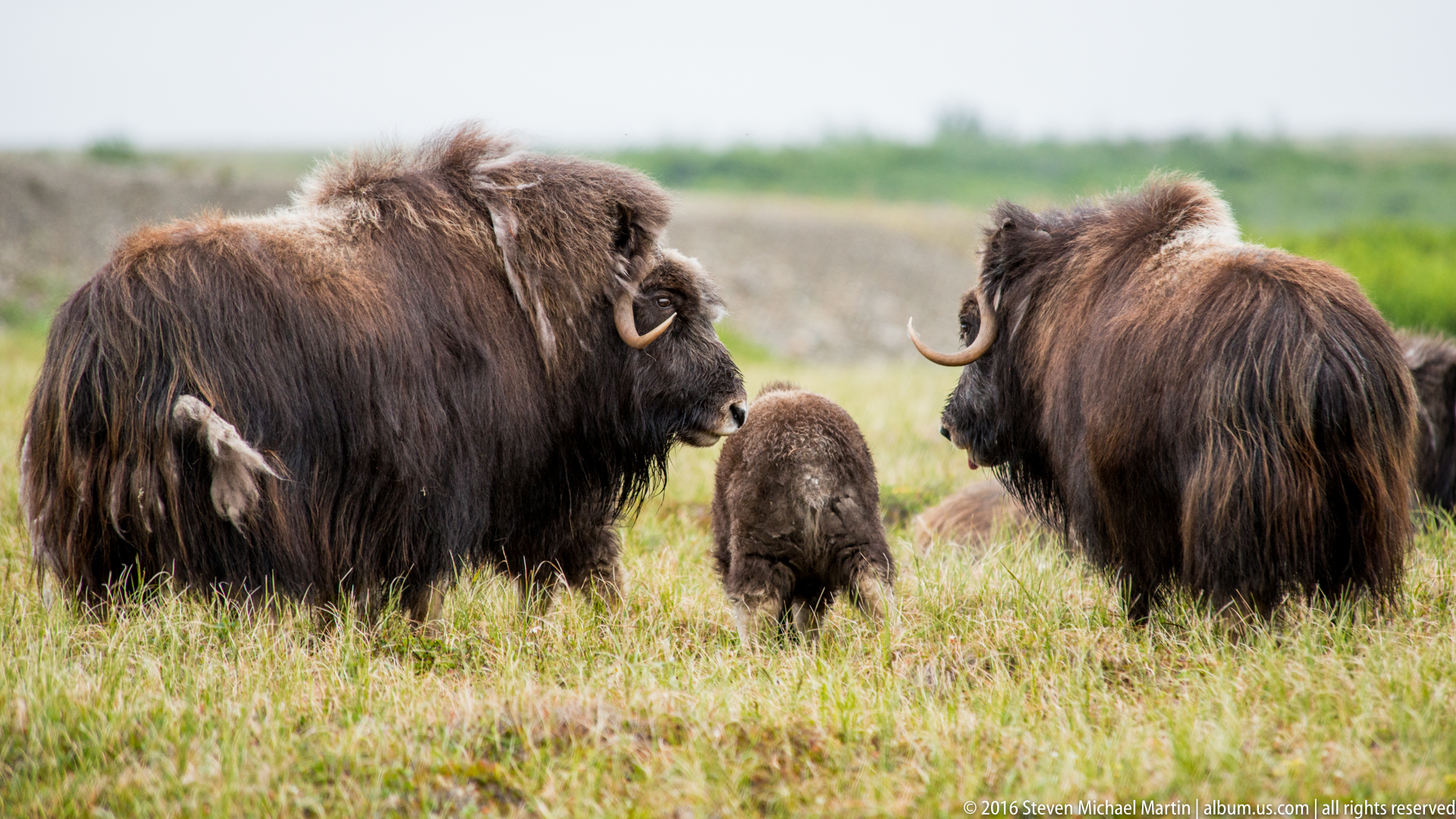
Two adult musk oxen stand with their backs partly turned, facing a smaller calf centered between them. The calf's compact shape is framed by the adults' broad shoulders and shaggy coats, suggesting a family group without relying on unseen behavior. A band of open sky and low tundra vegetation gives the gathering room around it.
Caption
Two adult musk oxen stand with their backs partly turned, facing a smaller calf centered between them. The calf's compact shape is framed by the adults' broad shoulders and shaggy coats, suggesting a family group without relying on unseen behavior. A band of open sky and low tundra vegetation gives the gathering room around it.
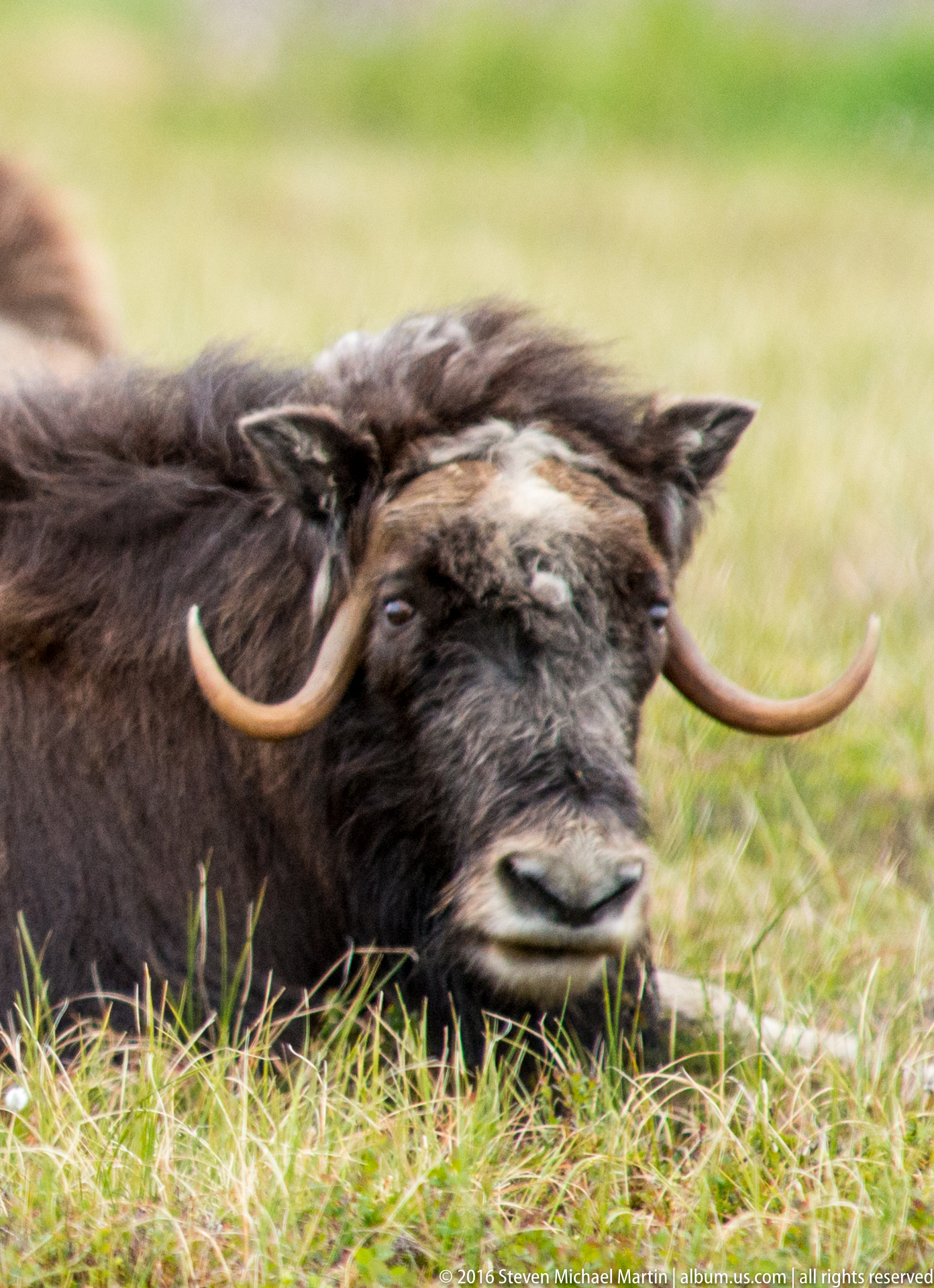
A musk ox lies low in the grass, its head turned toward the camera and its broad horns extending laterally across the frame. The close, low viewpoint brings the muzzle nearly level with the meadow, while a softly blurred green background separates the dark animal from its surroundings. Resting posture, rather than movement, defines the scene.
Caption
A musk ox lies low in the grass, its head turned toward the camera and its broad horns extending laterally across the frame. The close, low viewpoint brings the muzzle nearly level with the meadow, while a softly blurred green background separates the dark animal from its surroundings. Resting posture, rather than movement, defines the scene.
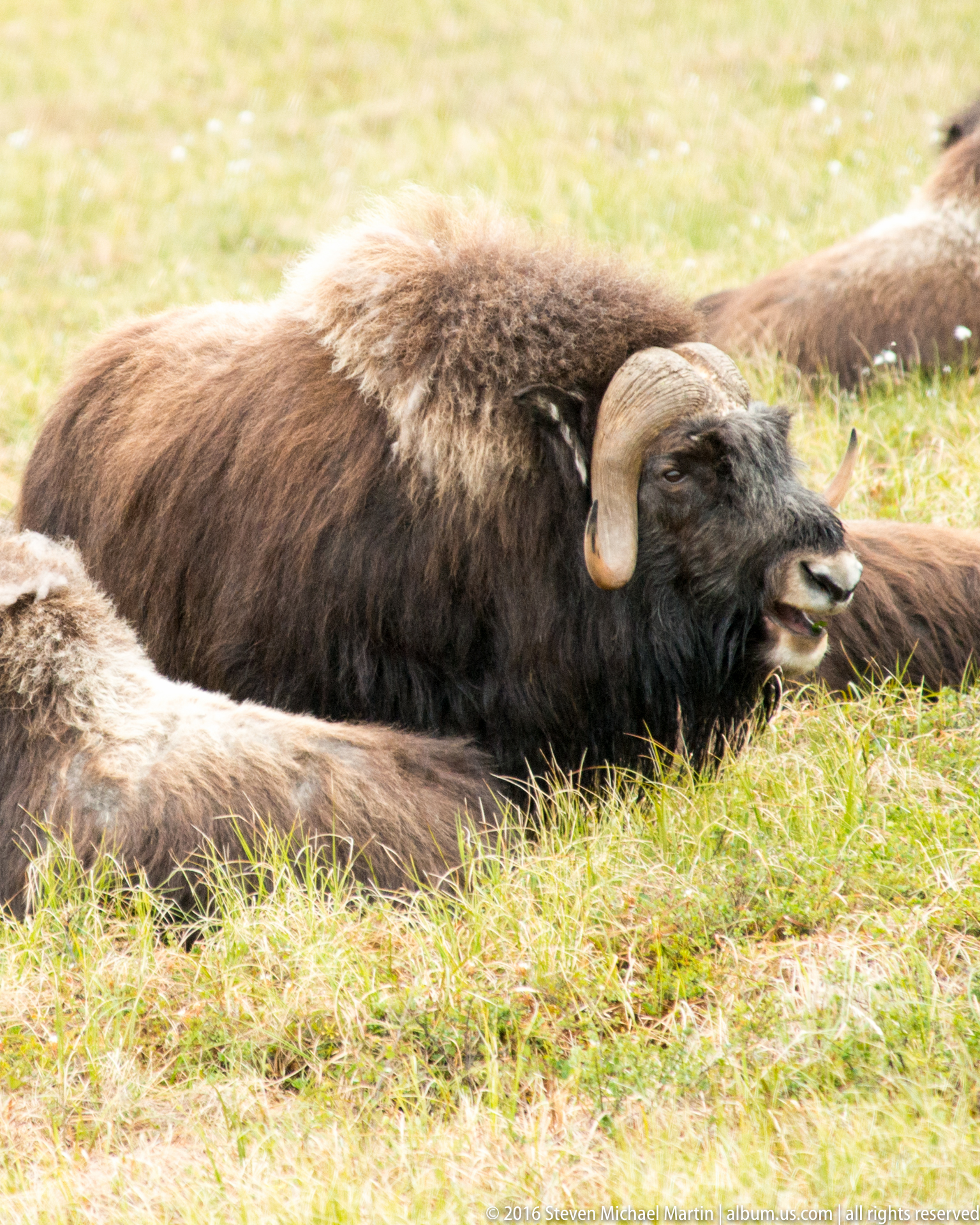
A musk ox lies on its side among other resting animals, its mouth slightly open and its long coat spread across the grass. A pale-backed animal crosses the foreground, partly obscuring the lower body, while another ox lies behind. The horizontal arrangement and layered bodies make rest, rather than interaction, the photograph's defining feature.
Caption
A musk ox lies on its side among other resting animals, its mouth slightly open and its long coat spread across the grass. A pale-backed animal crosses the foreground, partly obscuring the lower body, while another ox lies behind. The horizontal arrangement and layered bodies make rest, rather than interaction, the photograph's defining feature.
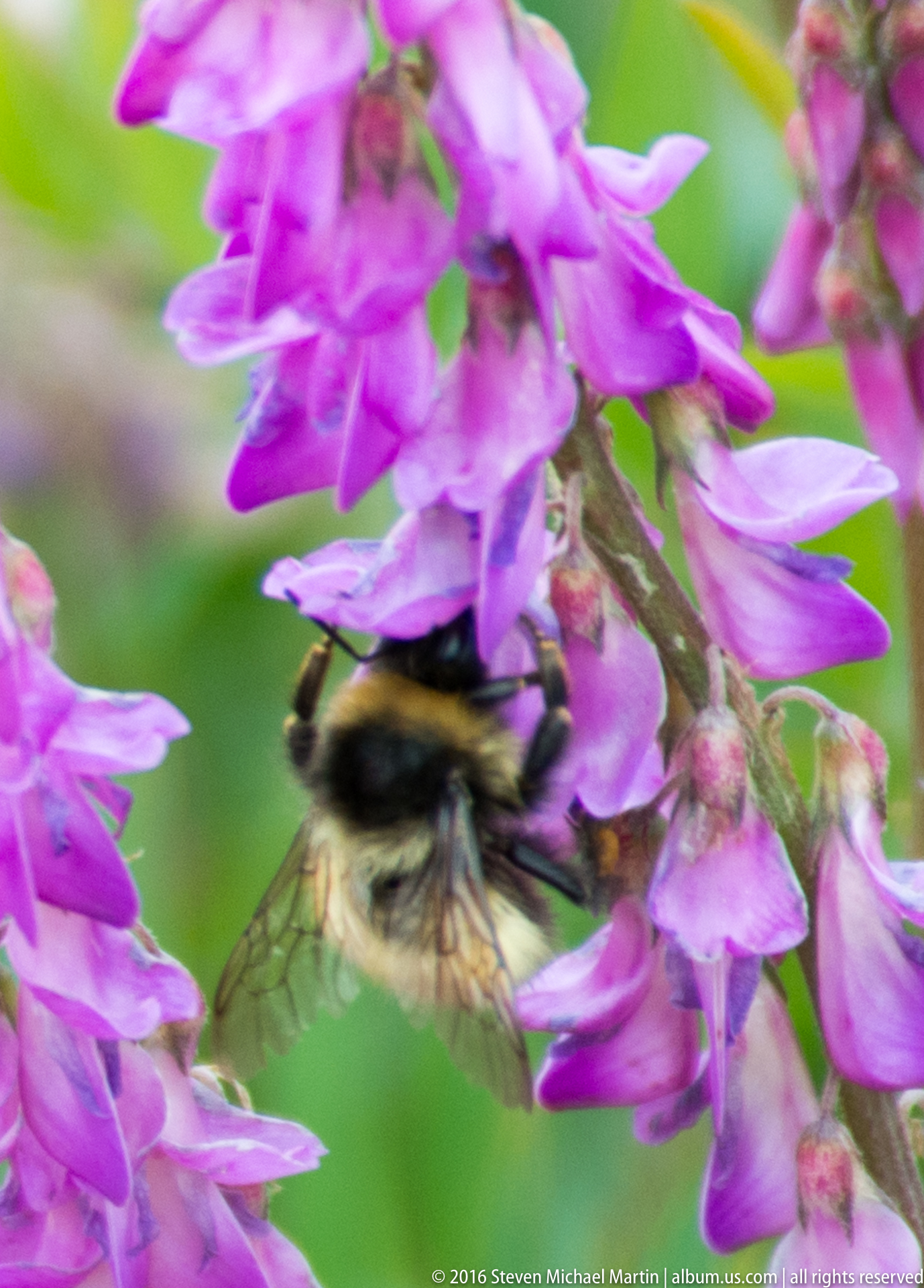
A bumblebee clings beneath a cluster of fireweed blossoms, its dark body and banded abdomen partly hidden by the overlapping magenta petals. The shallow focus keeps the insect and nearest flowers distinct while green foliage dissolves behind them. The close view records a pollinator at a flower without claiming a particular species of bee.
Caption
A bumblebee clings beneath a cluster of fireweed blossoms, its dark body and banded abdomen partly hidden by the overlapping magenta petals. The shallow focus keeps the insect and nearest flowers distinct while green foliage dissolves behind them. The close view records a pollinator at a flower without claiming a particular species of bee.
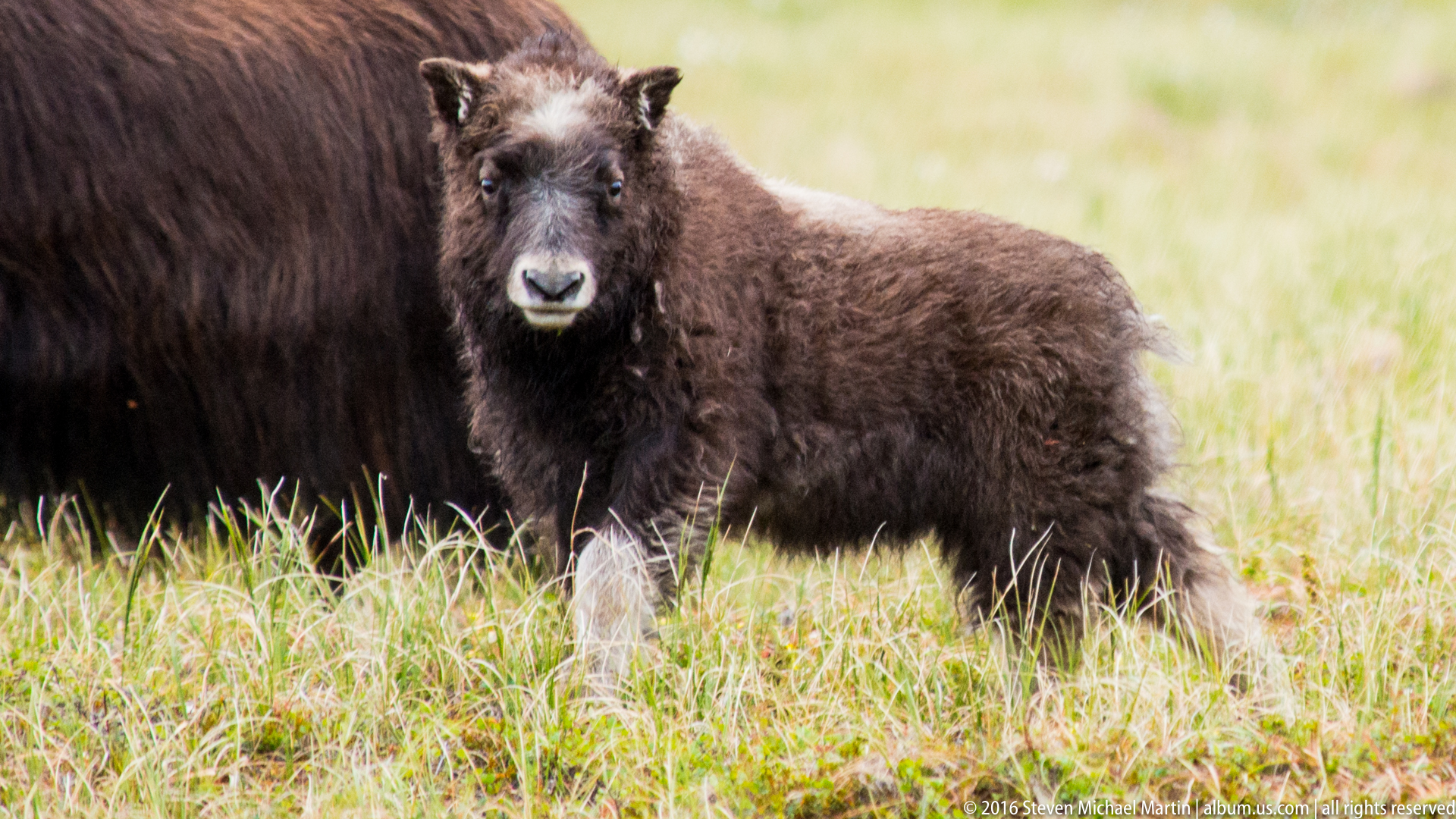
A young musk ox faces the camera beside the cropped flank of an adult. Its shorter horns and compact build distinguish it from the larger animal, while its alert gaze meets the viewer directly. Grass fills the foreground, and the tight crop turns a larger herd scene into a focused portrait of the juvenile.
Caption
A young musk ox faces the camera beside the cropped flank of an adult. Its shorter horns and compact build distinguish it from the larger animal, while its alert gaze meets the viewer directly. Grass fills the foreground, and the tight crop turns a larger herd scene into a focused portrait of the juvenile.

An adult musk ox stands beside a smaller calf, both facing forward through the grass. The adult's broad, pale-topped head and curved horns dominate the left side, while the calf peers out at right. Other animals are cut off at the frame edges, making this a close family grouping within a larger herd.
Caption
An adult musk ox stands beside a smaller calf, both facing forward through the grass. The adult's broad, pale-topped head and curved horns dominate the left side, while the calf peers out at right. Other animals are cut off at the frame edges, making this a close family grouping within a larger herd.
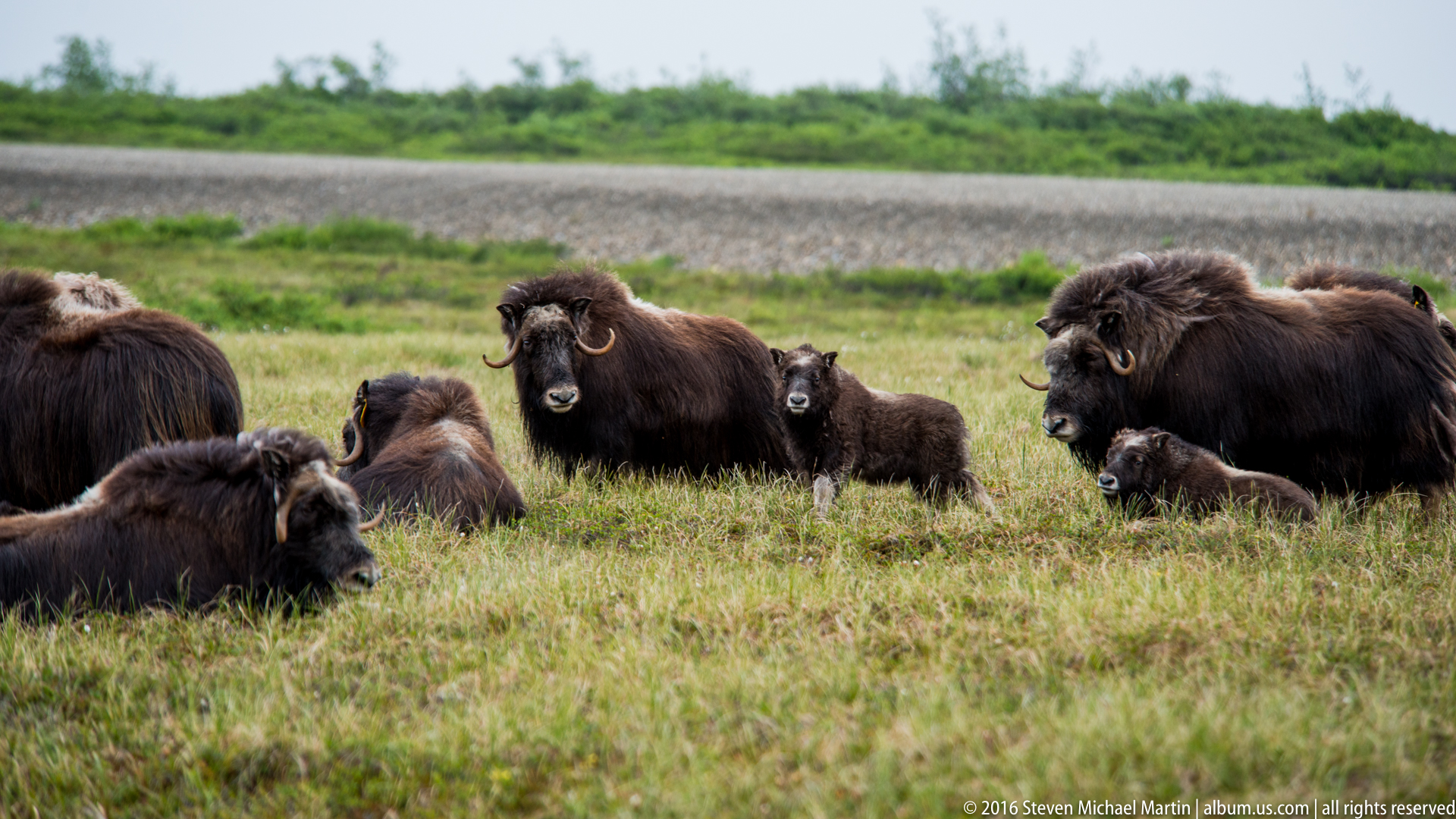
A broad herd portrait gathers adults and calves across the meadow, with animals at several depths from the cropped foreground to the standing figures in back. Their different orientations create a loose arc rather than a line. The generous foreground of grass establishes the open setting and keeps the herd's varied positions readable.
Caption
A broad herd portrait gathers adults and calves across the meadow, with animals at several depths from the cropped foreground to the standing figures in back. Their different orientations create a loose arc rather than a line. The generous foreground of grass establishes the open setting and keeps the herd's varied positions readable.
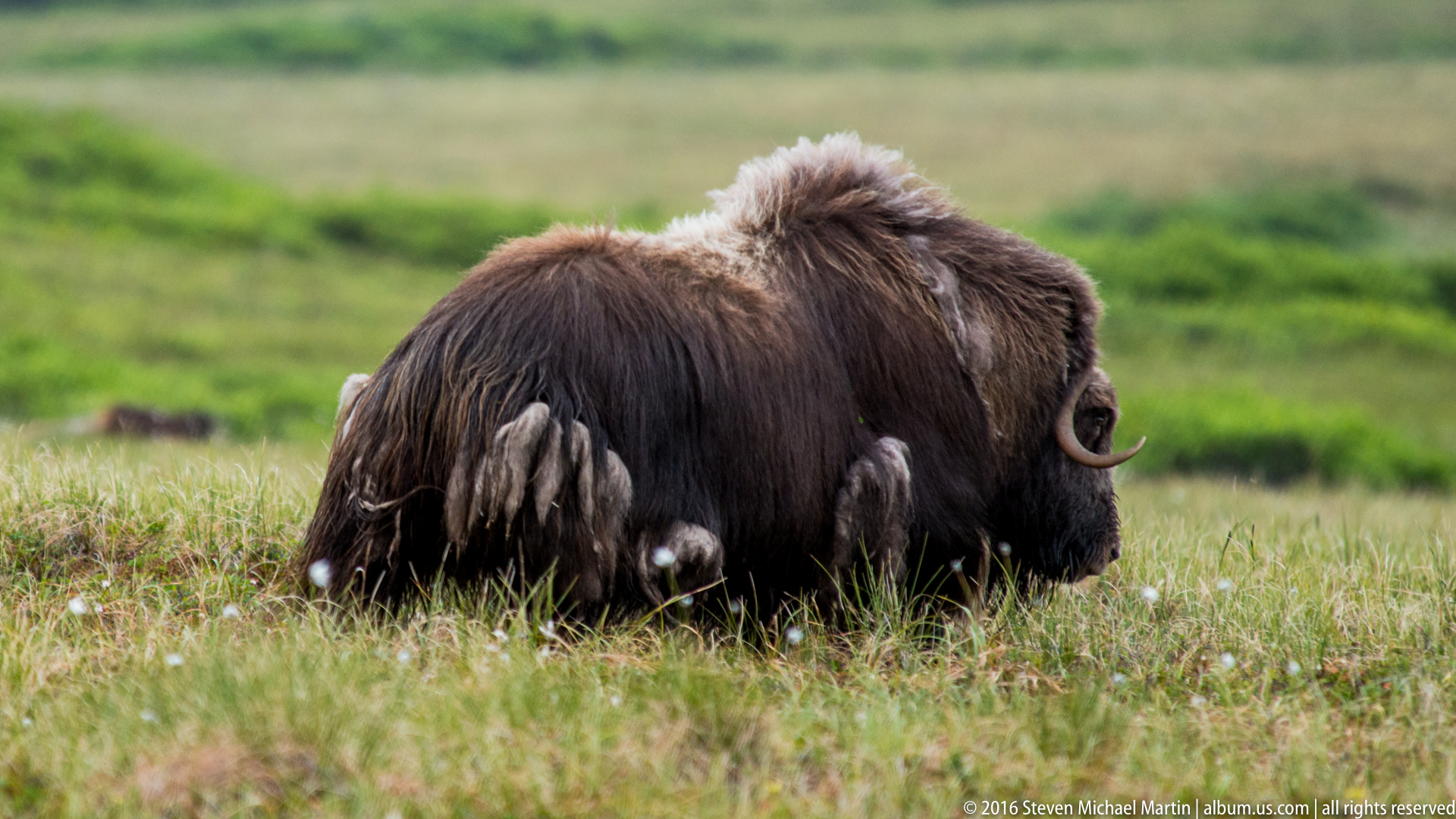
Seen from behind, an adult musk ox stands with its head turned slightly right while two calves press close beneath its belly. Their small bodies are visible between the adult's long fringe and legs. This rear view foregrounds the calves' sheltered position and the scale difference, with open green meadow beyond the group.
Caption
Seen from behind, an adult musk ox stands with its head turned slightly right while two calves press close beneath its belly. Their small bodies are visible between the adult's long fringe and legs. This rear view foregrounds the calves' sheltered position and the scale difference, with open green meadow beyond the group.
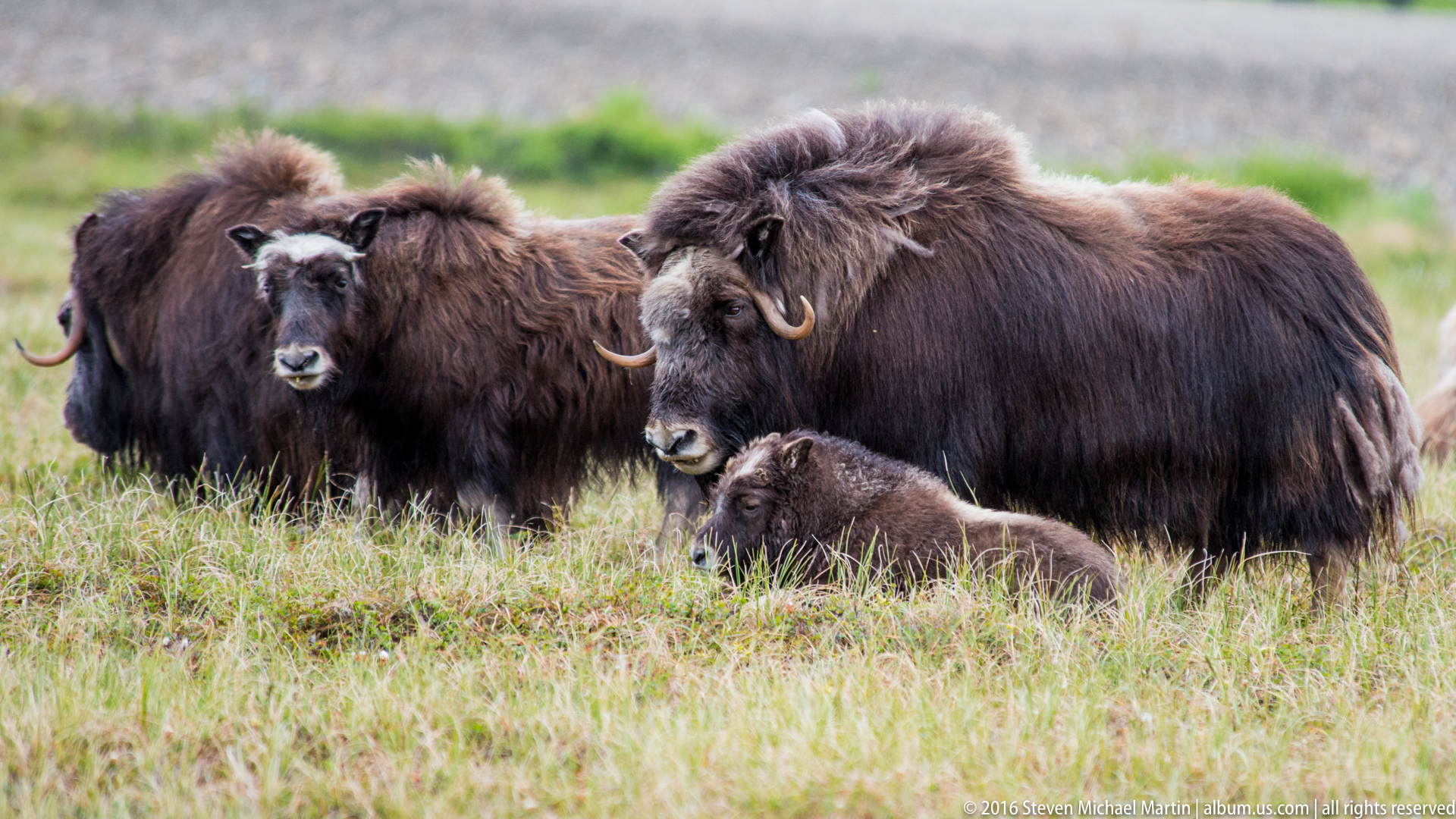
Three musk oxen and a calf occupy a close cluster, the foreground adult turned toward the viewer as another animal looks forward behind it. The calf lies low at right, partly screened by the adults. Their interlocking bodies and horns make this a denser, more intimate group portrait than the wider herd scene on the same page.
Caption
Three musk oxen and a calf occupy a close cluster, the foreground adult turned toward the viewer as another animal looks forward behind it. The calf lies low at right, partly screened by the adults. Their interlocking bodies and horns make this a denser, more intimate group portrait than the wider herd scene on the same page.
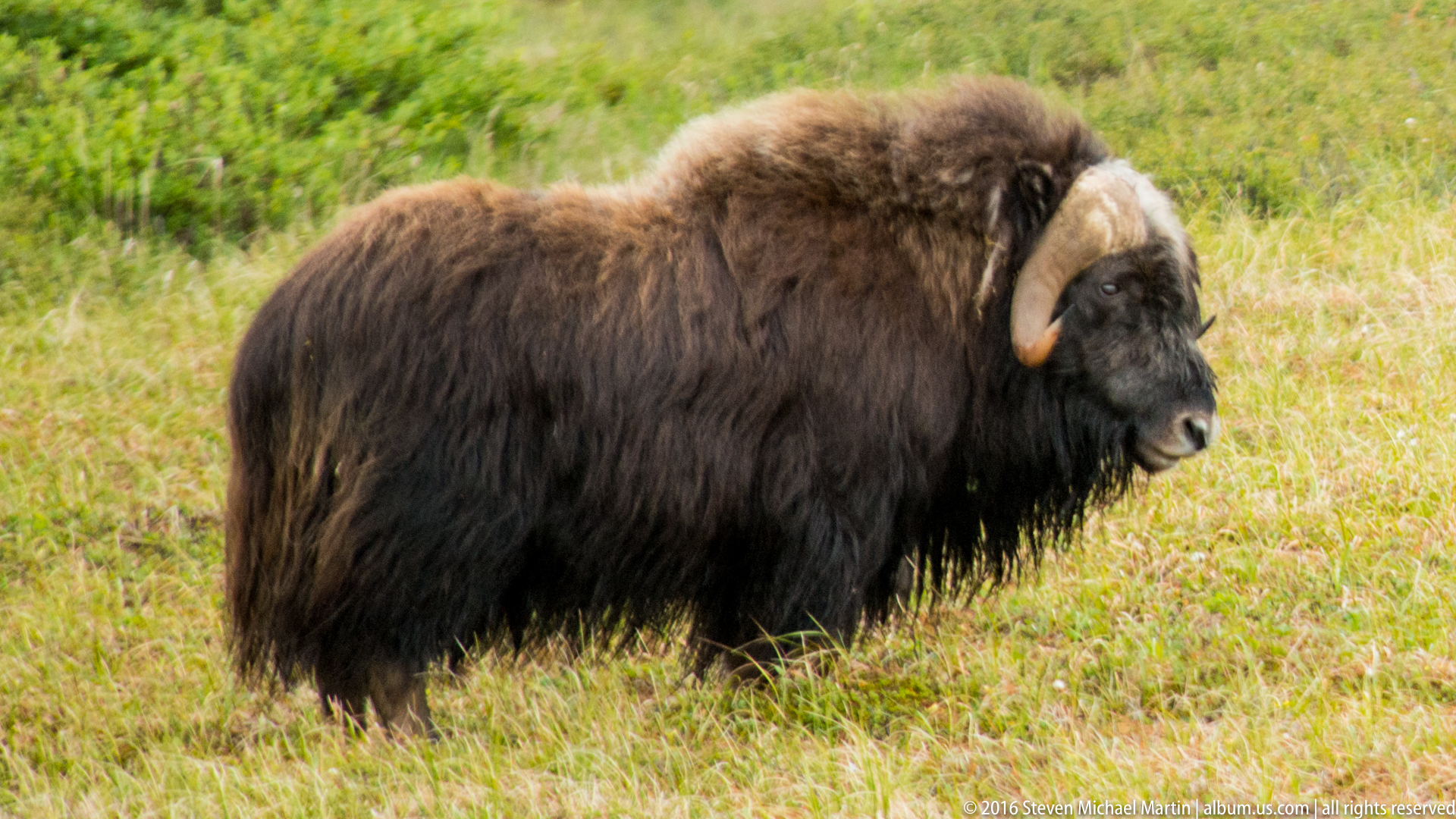
A single musk ox rests on its belly in the meadow, head lowered and one heavy horn curving down beside its dark face. The animal's long coat spreads close to the ground, while a soft green bank rises behind it. The quiet, side-on composition gives the resting posture and horn profile clear emphasis.
Caption
A single musk ox rests on its belly in the meadow, head lowered and one heavy horn curving down beside its dark face. The animal's long coat spreads close to the ground, while a soft green bank rises behind it. The quiet, side-on composition gives the resting posture and horn profile clear emphasis.
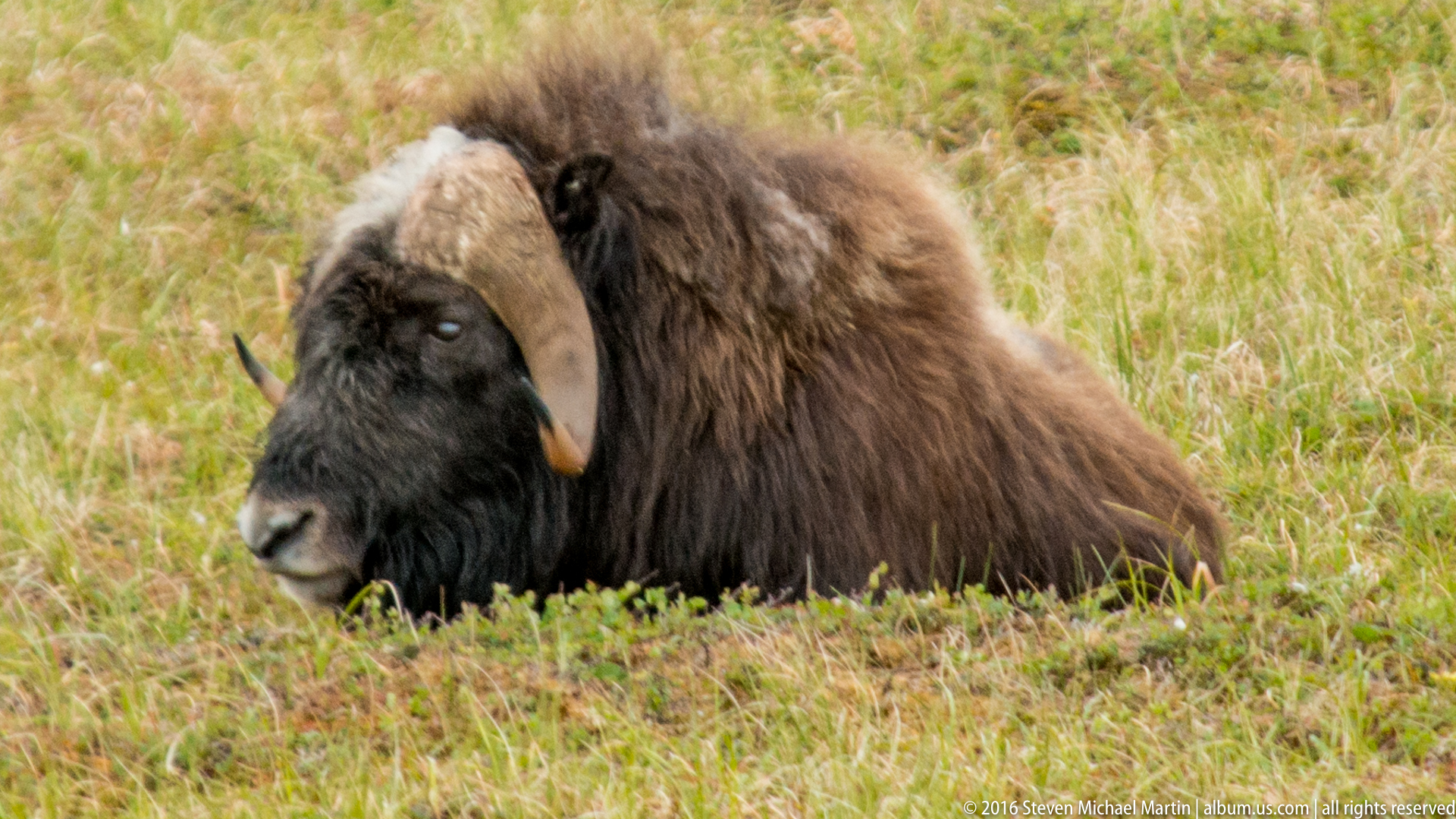
The frame isolates a seated musk ox in a low patch of tundra vegetation. Its broad horn curves close to the cheek, while the long, layered coat nearly merges with the grass around its body. The eye and muzzle remain visible at left, giving a compact portrait that emphasizes the animal's resting posture and heavy winter-like hair.
Caption
The frame isolates a seated musk ox in a low patch of tundra vegetation. Its broad horn curves close to the cheek, while the long, layered coat nearly merges with the grass around its body. The eye and muzzle remain visible at left, giving a compact portrait that emphasizes the animal's resting posture and heavy winter-like hair.

A musk ox stands in side profile facing right, its massive body outlined against pale grass. A cream-colored patch marks the rear of its coat, and the horn curves down beside the dark face. The side-on framing reveals the animal's full length and low-slung fringe, distinguishing it from the closer head portraits nearby.
Caption
A musk ox stands in side profile facing right, its massive body outlined against pale grass. A cream-colored patch marks the rear of its coat, and the horn curves down beside the dark face. The side-on framing reveals the animal's full length and low-slung fringe, distinguishing it from the closer head portraits nearby.
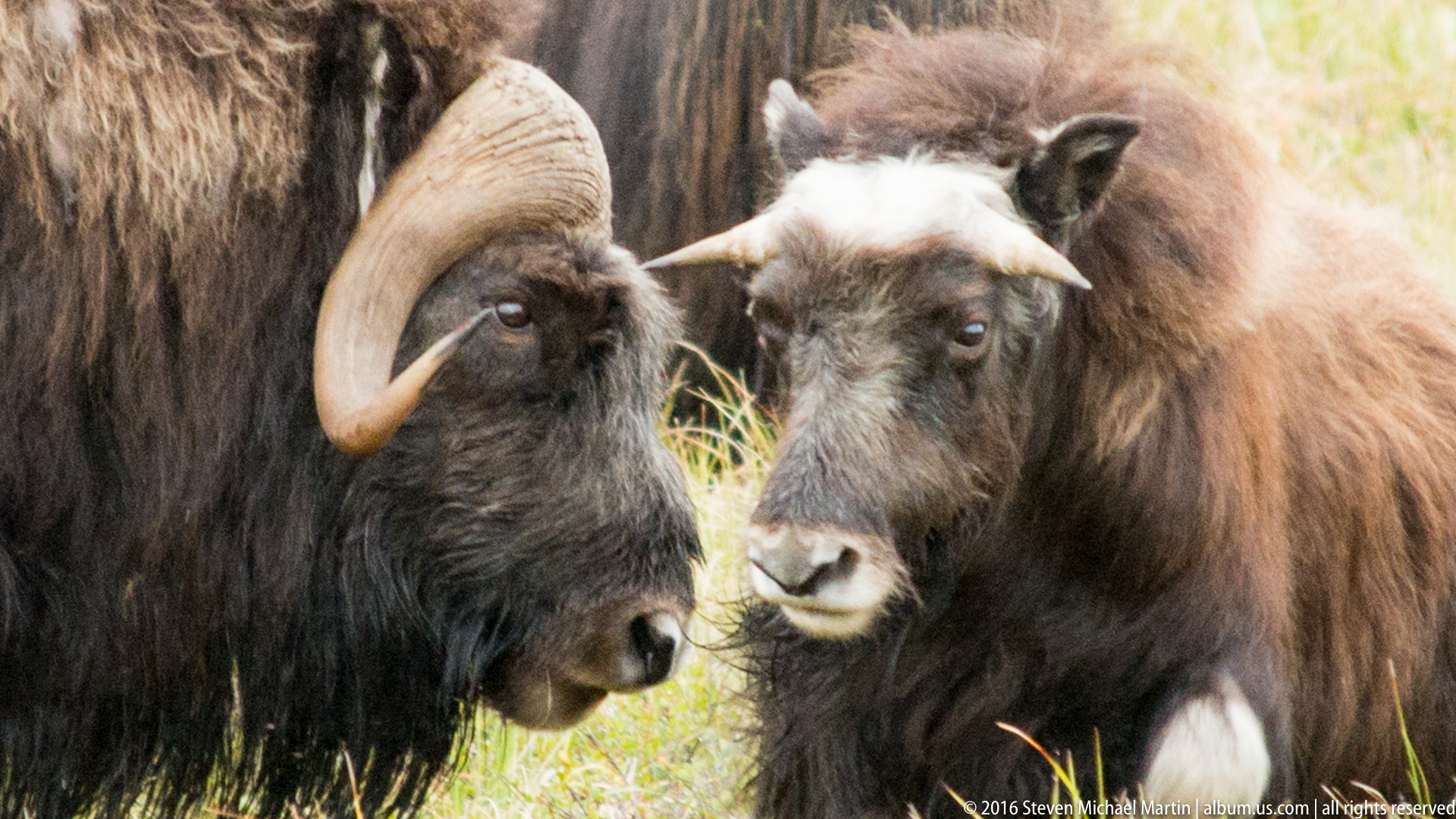
Two musk oxen meet nose to nose in a tight crop, their foreheads and horns nearly touching. The dark face of the left animal contrasts with the lighter, shaggy coat of the ox on the right, while another body fills the background. The close framing records a brief face-to-face moment without assigning a motive to it.
Caption
Two musk oxen meet nose to nose in a tight crop, their foreheads and horns nearly touching. The dark face of the left animal contrasts with the lighter, shaggy coat of the ox on the right, while another body fills the background. The close framing records a brief face-to-face moment without assigning a motive to it.
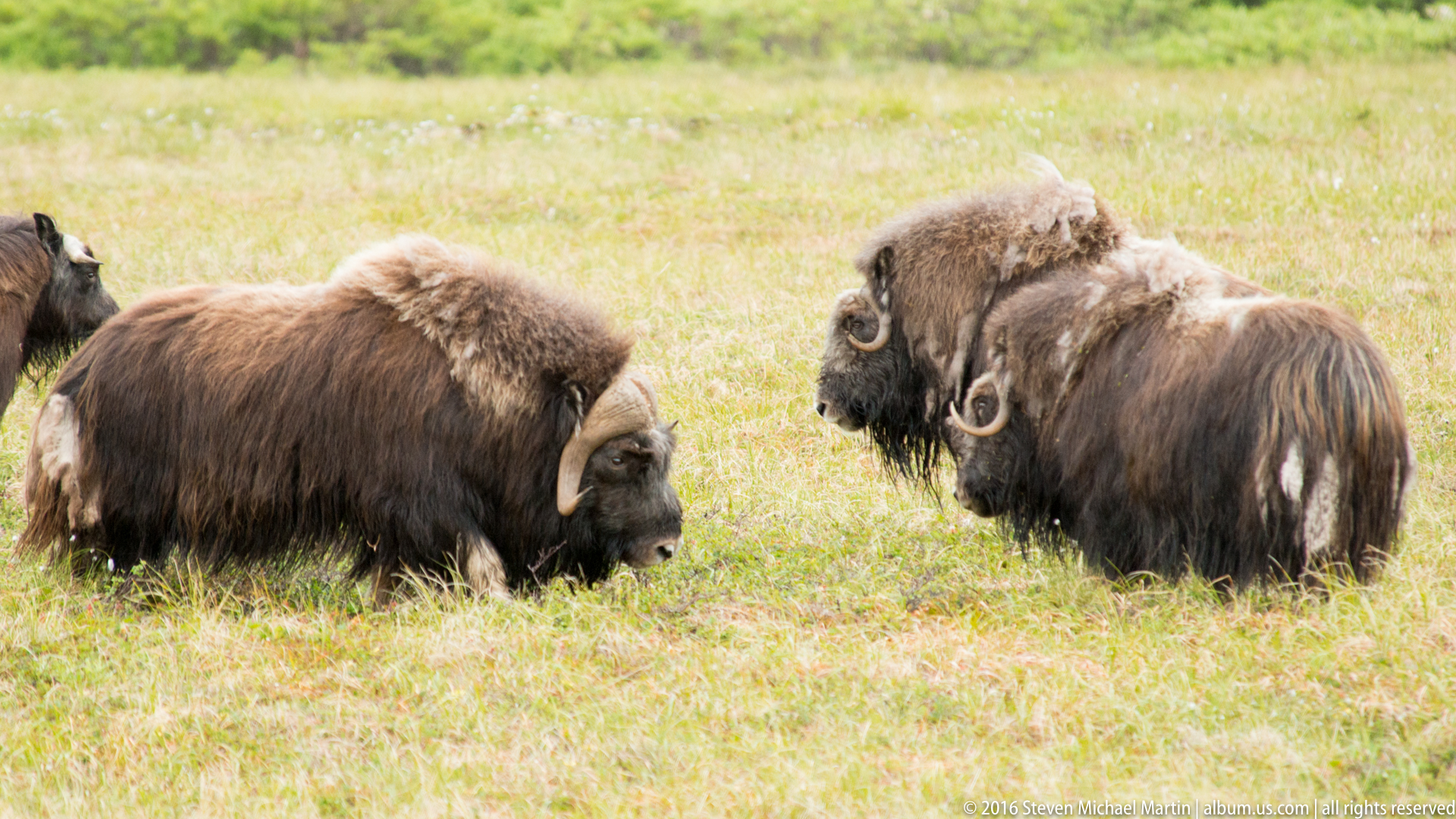
Two adult musk oxen face one another across a short span of meadow, their curved horns forming opposing arcs. A third animal is partly cropped at far left, linking the pair to a larger group. The space between the adults and their contrasting head angles give this wider view a clear encounter-like composition without implying a specific behavior.
Caption
Two adult musk oxen face one another across a short span of meadow, their curved horns forming opposing arcs. A third animal is partly cropped at far left, linking the pair to a larger group. The space between the adults and their contrasting head angles give this wider view a clear encounter-like composition without implying a specific behavior.
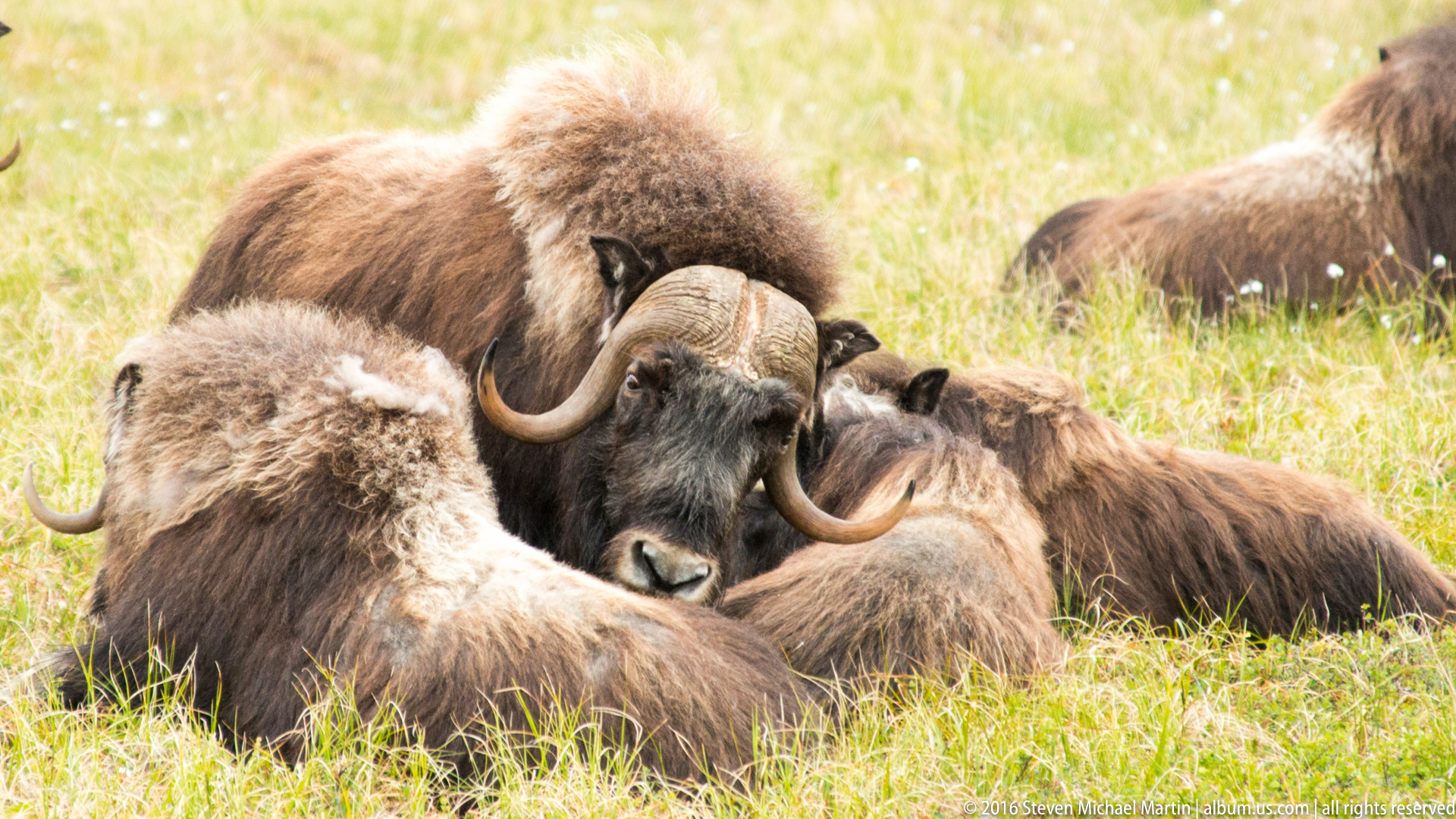
Several musk oxen rest close together, their coats forming a layered mass of dark brown, pale brown, and cream. A central adult's face appears between the bodies, while curved horns overlap around it. This crowded view emphasizes the herd's varied coat tones and close spacing rather than the open landscape visible in earlier frames.
Caption
Several musk oxen rest close together, their coats forming a layered mass of dark brown, pale brown, and cream. A central adult's face appears between the bodies, while curved horns overlap around it. This crowded view emphasizes the herd's varied coat tones and close spacing rather than the open landscape visible in earlier frames.
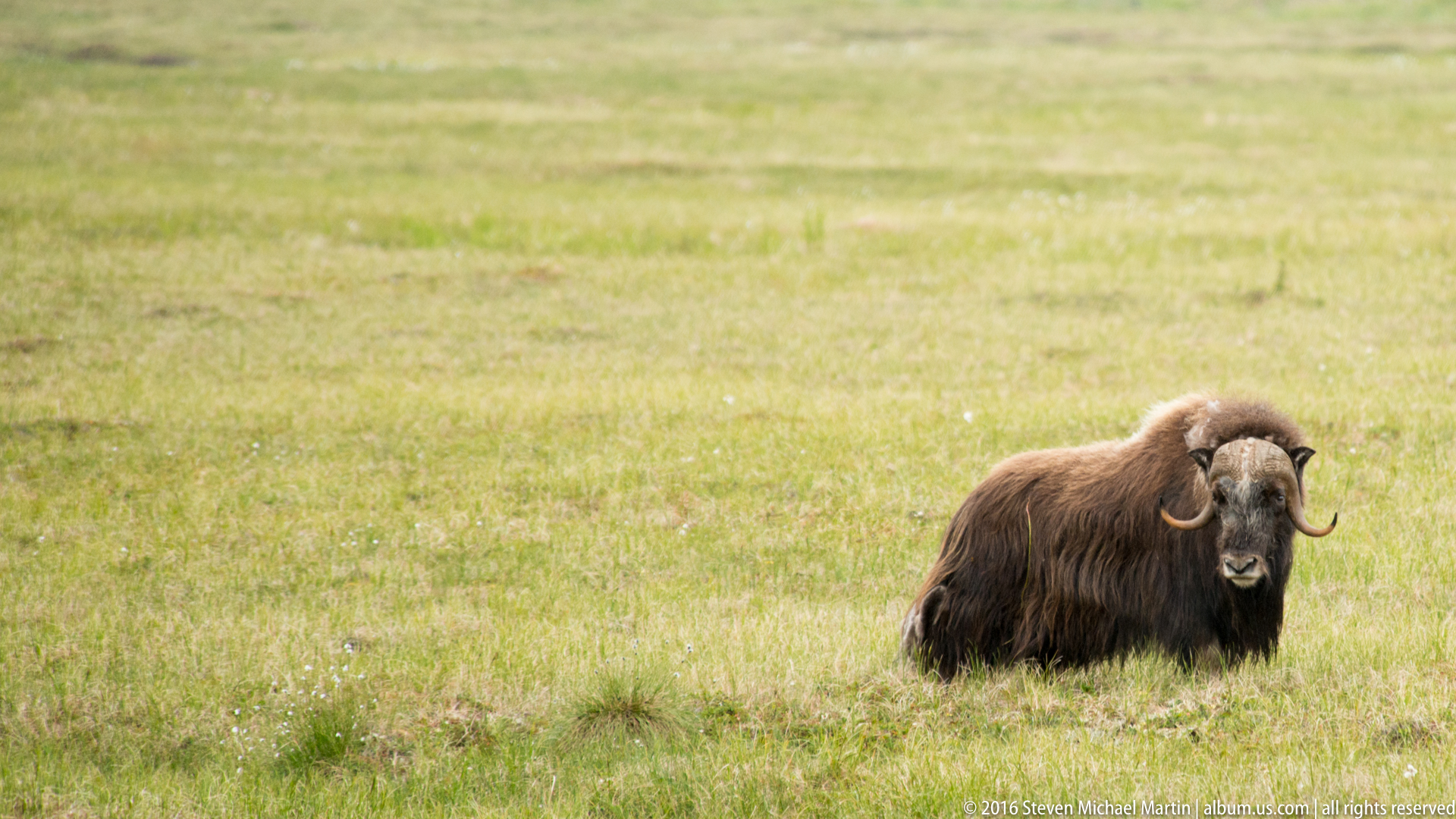
A lone musk ox sits low in an expansive meadow, placed near the lower-right corner beneath a large field of pale grass. Its compact silhouette and forward-facing horns appear small against the open landscape. The distant framing shifts emphasis from fur and facial detail to the animal's scale within the surrounding tundra.
Caption
A lone musk ox sits low in an expansive meadow, placed near the lower-right corner beneath a large field of pale grass. Its compact silhouette and forward-facing horns appear small against the open landscape. The distant framing shifts emphasis from fur and facial detail to the animal's scale within the surrounding tundra.

A very light-colored bear walks toward the camera through low tundra shrubs, its pale coat sharply contrasting with the green vegetation. The proof sheet does not show enough detail to distinguish a color-phase black bear from another bear species with confidence, so the identification remains general. Its direct approach and isolated placement make it the clear focal point.
Caption
A very light-colored bear walks toward the camera through low tundra shrubs, its pale coat sharply contrasting with the green vegetation. The proof sheet does not show enough detail to distinguish a color-phase black bear from another bear species with confidence, so the identification remains general. Its direct approach and isolated placement make it the clear focal point.
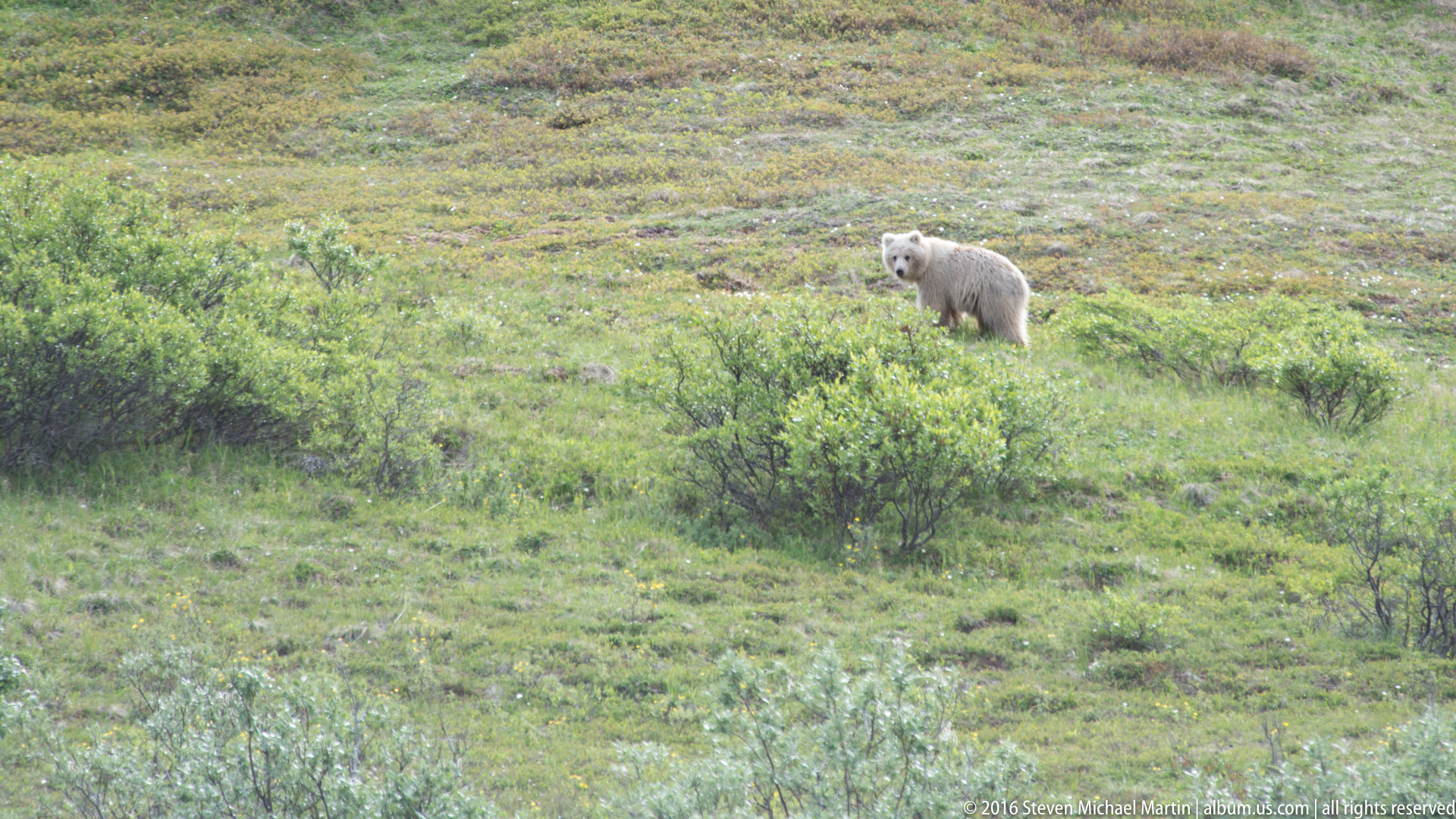
A pale bear stands alone among low tundra shrubs, its body turned slightly away while its head looks back toward the camera. The broad, open framing leaves ample space around the animal and reveals a patchwork of green groundcover. Its light coat stands out against the vegetation, making the solitary figure the clear focal point.
Caption
A pale bear stands alone among low tundra shrubs, its body turned slightly away while its head looks back toward the camera. The broad, open framing leaves ample space around the animal and reveals a patchwork of green groundcover. Its light coat stands out against the vegetation, making the solitary figure the clear focal point.
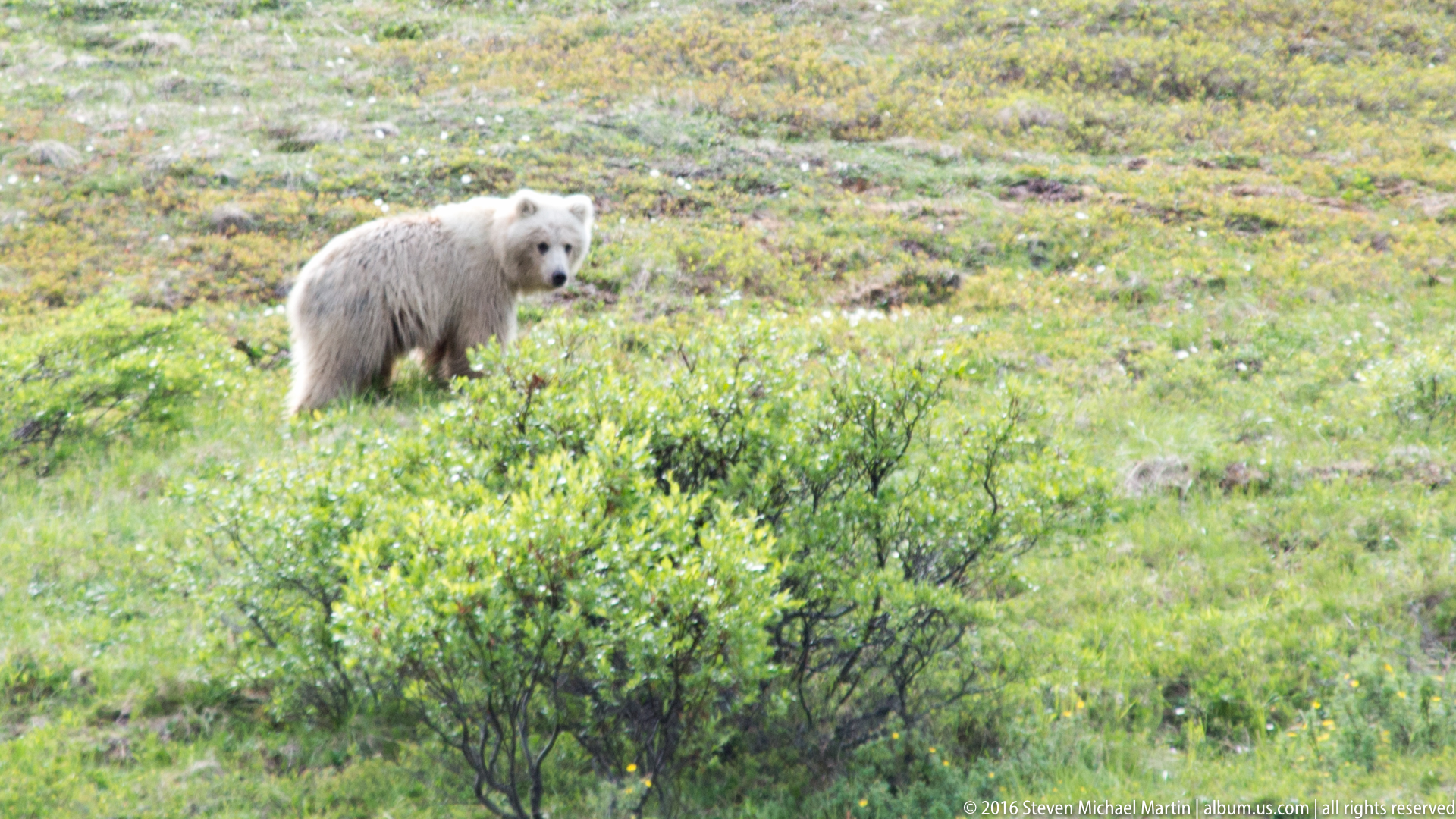
The light-colored bear pauses in a closer view, its face visible above a screen of leafy shrubs. Its rounded ears, dark nose, and cream fur stand out against the mottled green and gray tundra. The tighter composition brings the animal's facial features and coat texture forward while retaining leafy cover around its body.
Caption
The light-colored bear pauses in a closer view, its face visible above a screen of leafy shrubs. Its rounded ears, dark nose, and cream fur stand out against the mottled green and gray tundra. The tighter composition brings the animal's facial features and coat texture forward while retaining leafy cover around its body.
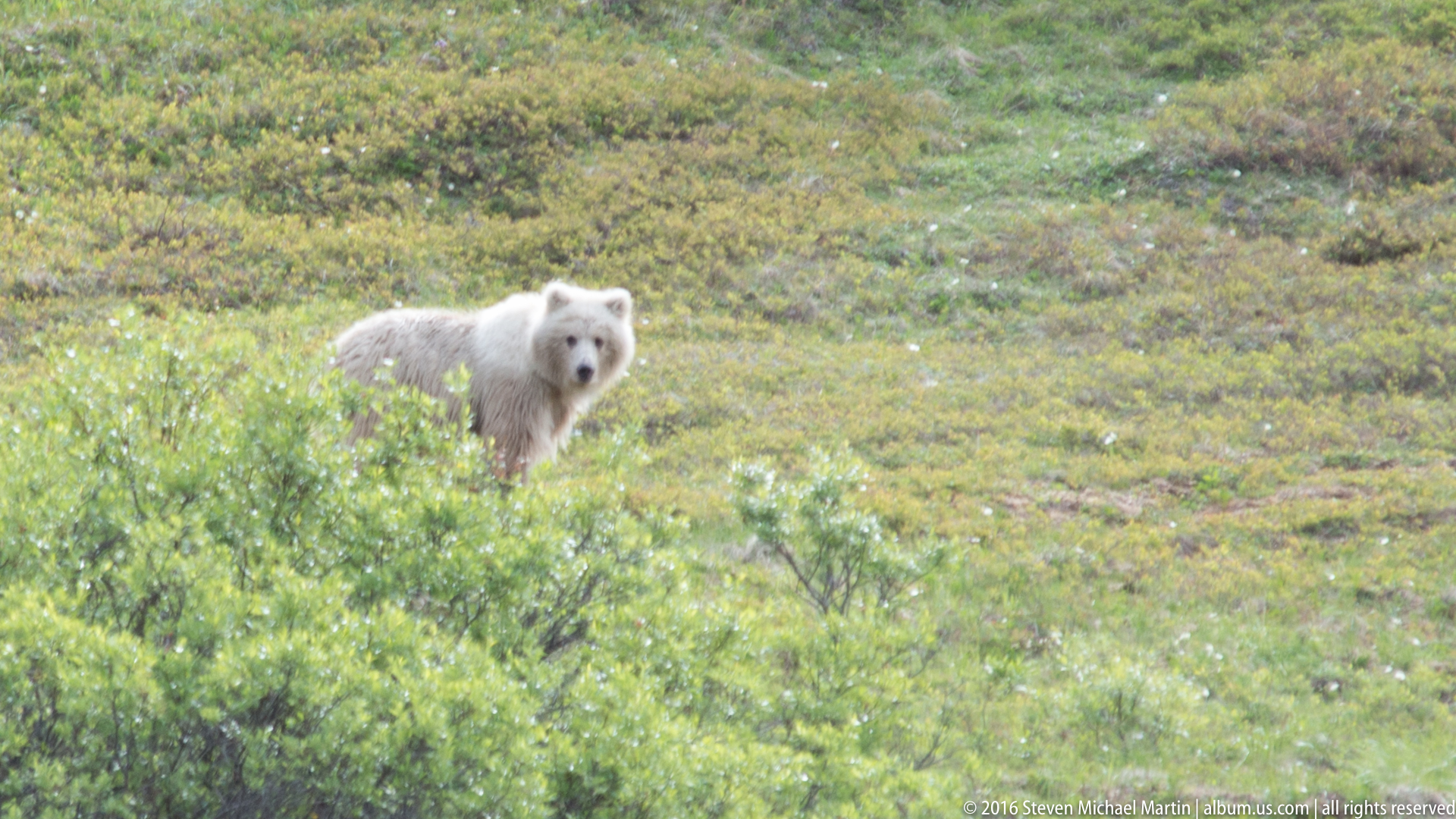
Seen from farther downslope, the pale bear moves through knee-high vegetation with its face turned toward the photographer. Green willow-like shrubs and small flowers partly interrupt its outline, while the hillside continues behind it without a visible horizon. This mid-distance portrait records the animal within its tundra cover rather than isolating it against open ground.
Caption
Seen from farther downslope, the pale bear moves through knee-high vegetation with its face turned toward the photographer. Green willow-like shrubs and small flowers partly interrupt its outline, while the hillside continues behind it without a visible horizon. This mid-distance portrait records the animal within its tundra cover rather than isolating it against open ground.

The bear appears small within a wide, rolling field of tundra shrubs, standing near the lower-right portion of the frame. Layered green slopes and scattered yellow flowers occupy most of the image, making scale and habitat the main subjects. Its pale silhouette remains distinct against the darker vegetation, while open space gives the animal room within the landscape.
Caption
The bear appears small within a wide, rolling field of tundra shrubs, standing near the lower-right portion of the frame. Layered green slopes and scattered yellow flowers occupy most of the image, making scale and habitat the main subjects. Its pale silhouette remains distinct against the darker vegetation, while open space gives the animal room within the landscape.
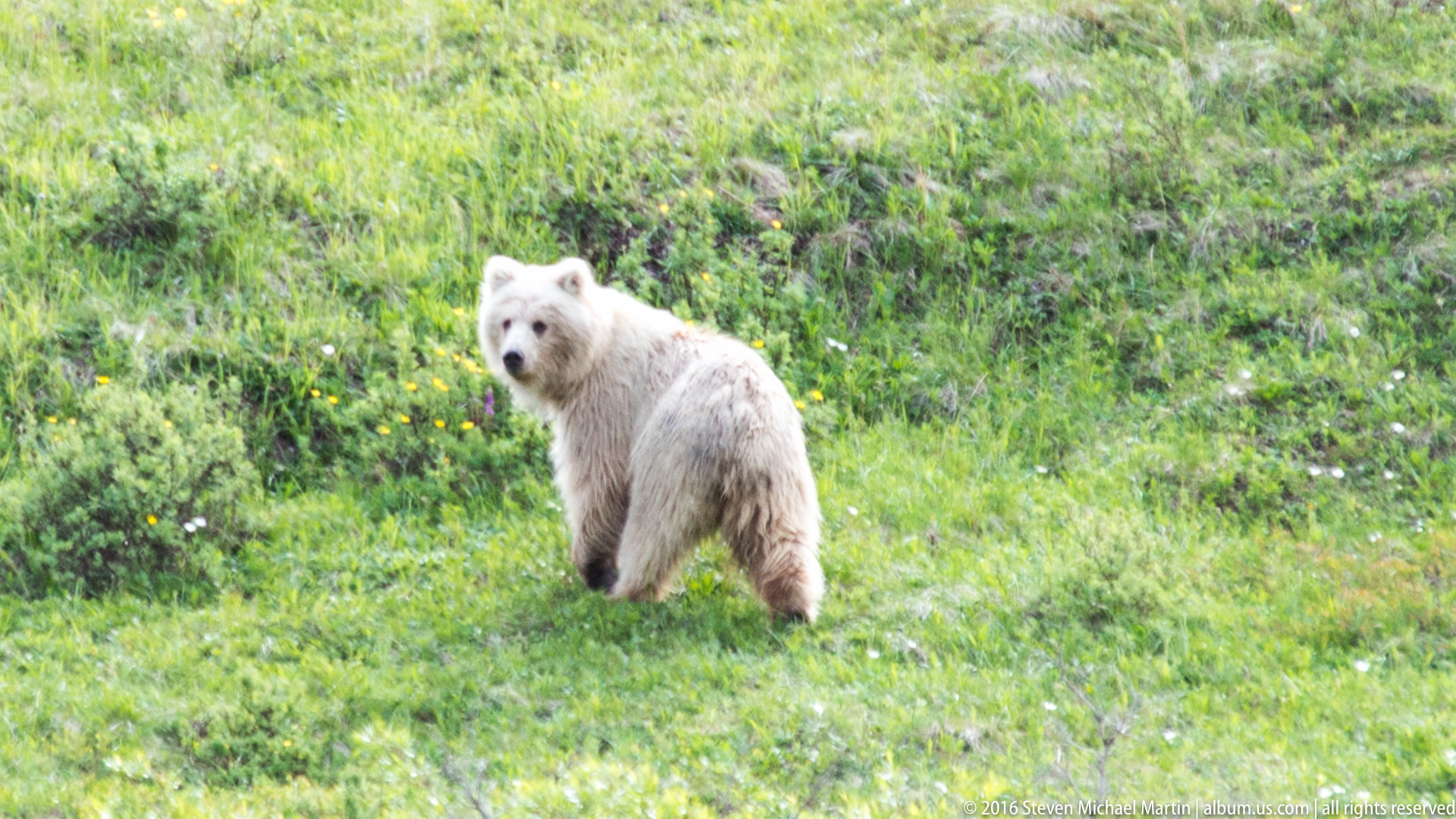
A pale bear stands more prominently in the foreground, turned three-quarters toward the camera amid dense green plants and small flowers. Its cream coat contrasts with the saturated vegetation, while a slope rises behind it. The closer scale reveals its compact ears and dark muzzle, and the surrounding blossoms add color across the lower frame.
Caption
A pale bear stands more prominently in the foreground, turned three-quarters toward the camera amid dense green plants and small flowers. Its cream coat contrasts with the saturated vegetation, while a slope rises behind it. The closer scale reveals its compact ears and dark muzzle, and the surrounding blossoms add color across the lower frame.
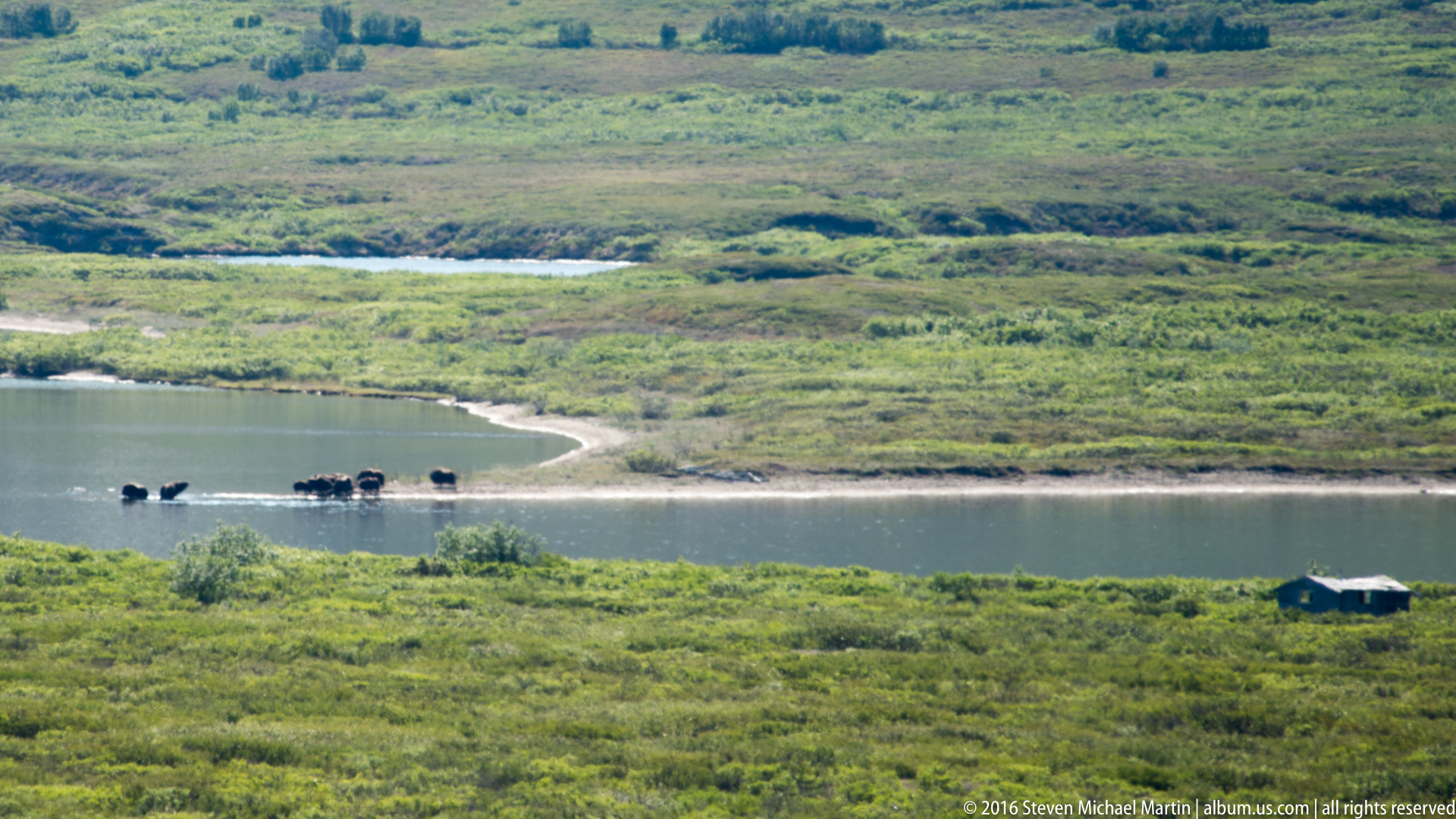
Several dark animals cross a pale gravel bar beside a broad tundra river, appearing as a small line against the water and green hills beyond. Their size and spacing suggest a group of large mammals, but the proof sheet is too distant to resolve horns or other diagnostic features. The expansive river valley dominates the composition.
Caption
Several dark animals cross a pale gravel bar beside a broad tundra river, appearing as a small line against the water and green hills beyond. Their size and spacing suggest a group of large mammals, but the proof sheet is too distant to resolve horns or other diagnostic features. The expansive river valley dominates the composition.
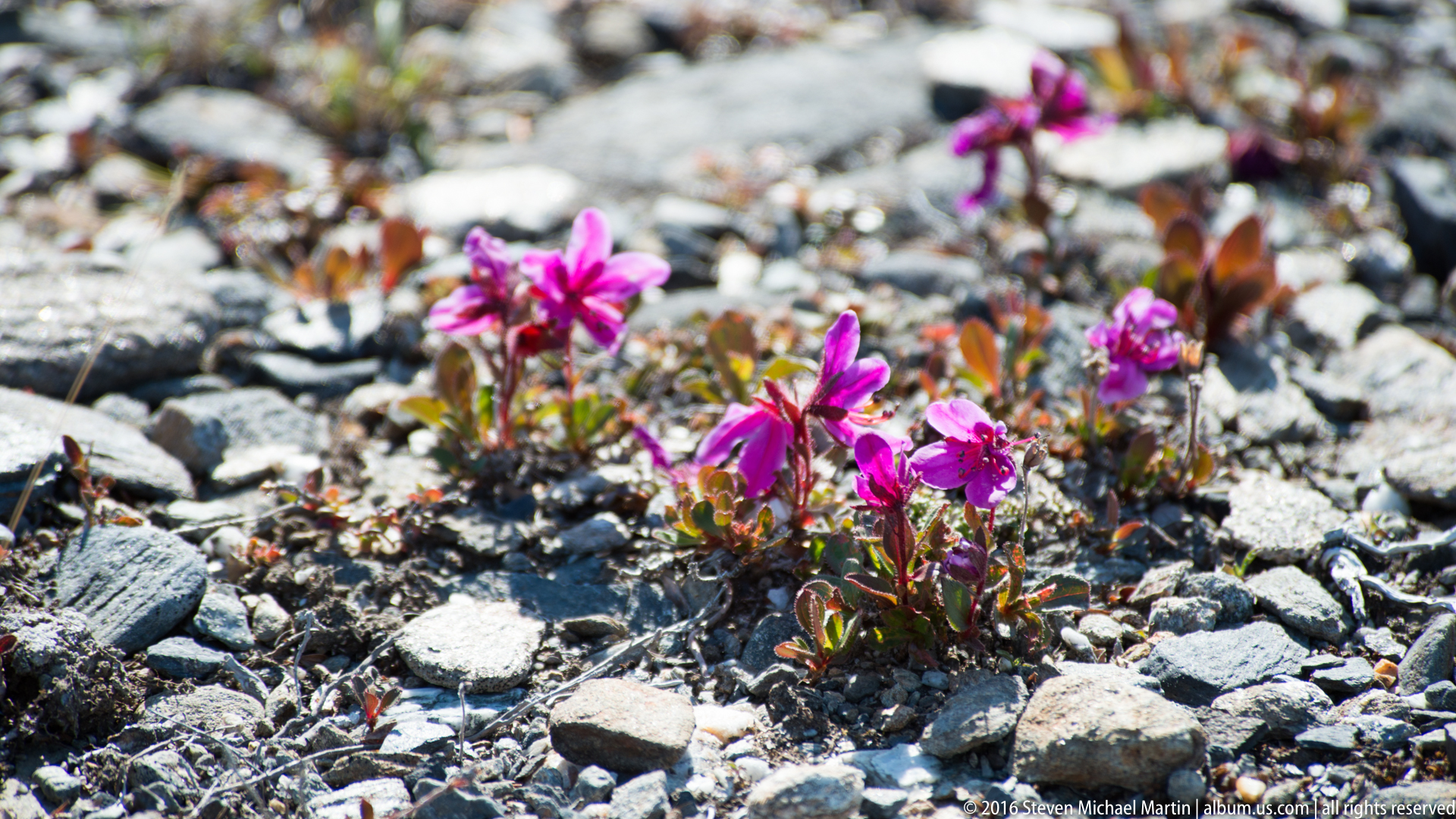
Magenta fireweed blossoms rise among angular gray stones and low reddish leaves, their slender stems creating bright vertical accents across the rocky ground. Several flower spikes are in focus at different distances, while the sparse alpine vegetation leaves much of the stone surface exposed. The close view records the plant's color and its harsh, gravelly growing surface.
Caption
Magenta fireweed blossoms rise among angular gray stones and low reddish leaves, their slender stems creating bright vertical accents across the rocky ground. Several flower spikes are in focus at different distances, while the sparse alpine vegetation leaves much of the stone surface exposed. The close view records the plant's color and its harsh, gravelly growing surface.
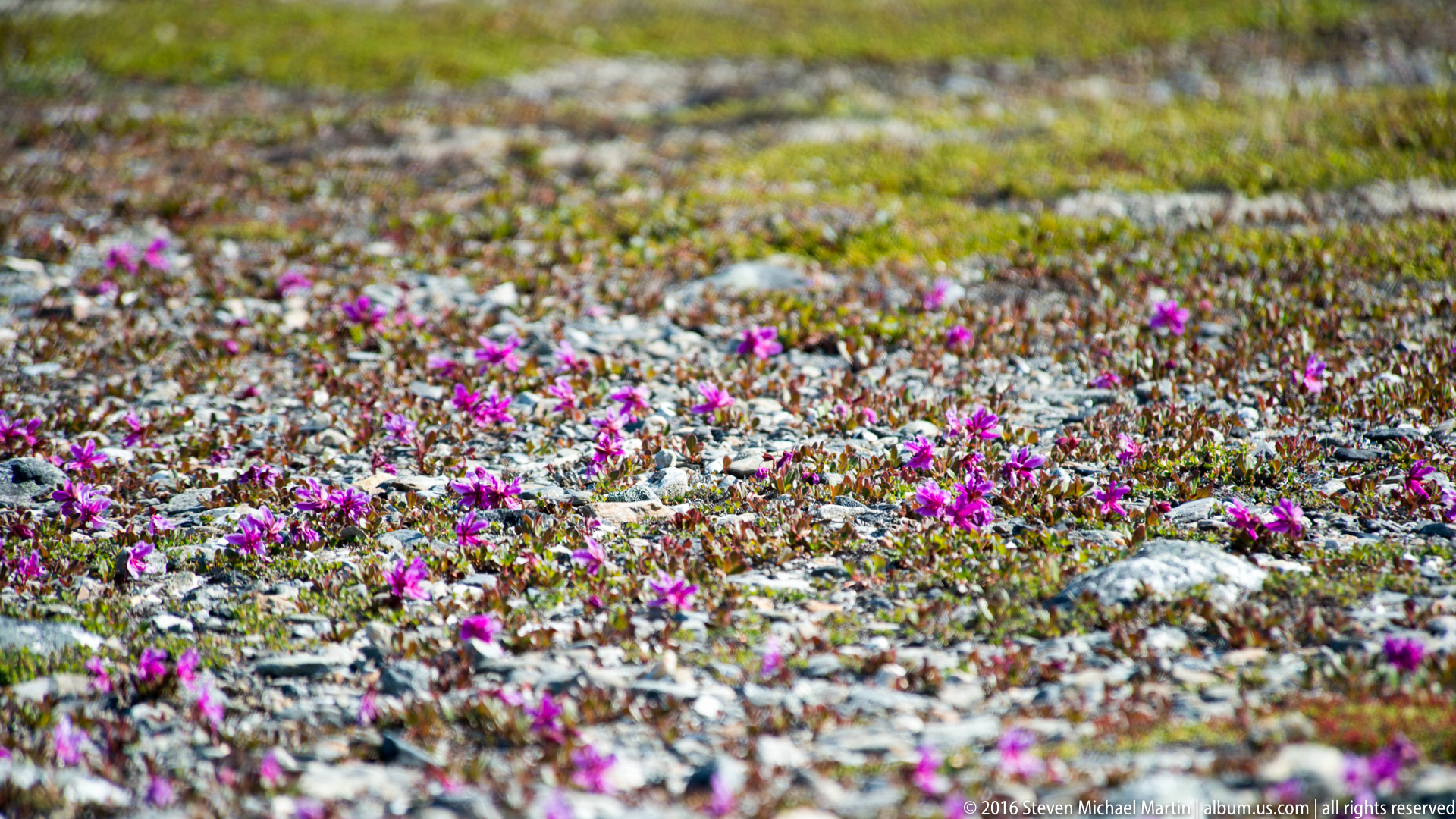
A low patch of fireweed spreads across a stony slope, with many magenta flower spikes scattered among small leaves and pale rock fragments. The shallow viewpoint gives equal weight to blossoms near the camera and the plant's wider distribution across the ground. Unlike a single-stem portrait, this frame shows how the flowers form a colorful patch in open tundra.
Caption
A low patch of fireweed spreads across a stony slope, with many magenta flower spikes scattered among small leaves and pale rock fragments. The shallow viewpoint gives equal weight to blossoms near the camera and the plant's wider distribution across the ground. Unlike a single-stem portrait, this frame shows how the flowers form a colorful patch in open tundra.
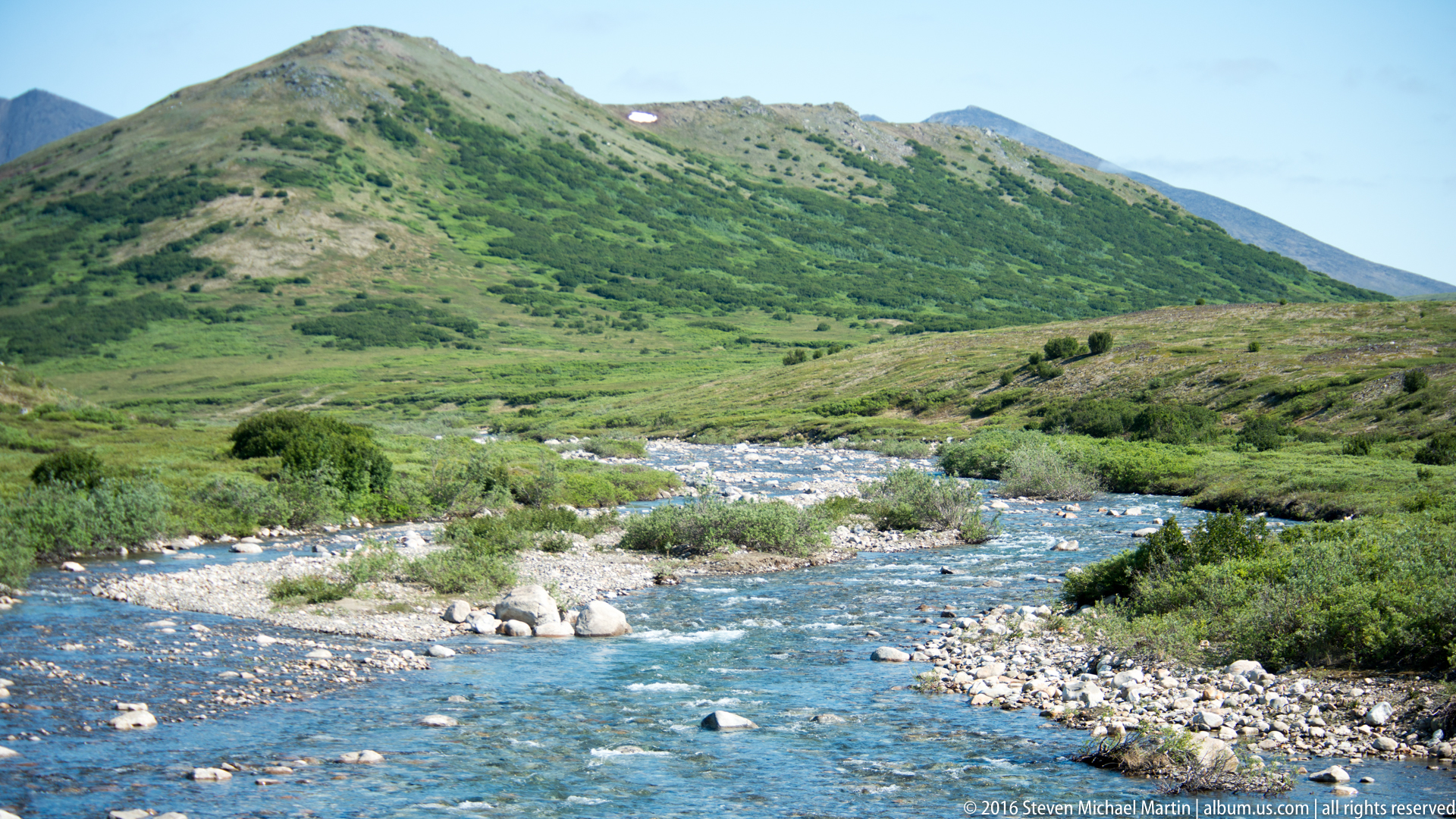
A shallow, rock-strewn stream curves through a green tundra valley beneath rounded mountains. Clear blue water breaks around pale stones in the foreground, while a narrow channel draws the eye toward the distant slope. The image emphasizes the stream's course through open vegetation and the broad, treeless terrain beyond it.
Caption
A shallow, rock-strewn stream curves through a green tundra valley beneath rounded mountains. Clear blue water breaks around pale stones in the foreground, while a narrow channel draws the eye toward the distant slope. The image emphasizes the stream's course through open vegetation and the broad, treeless terrain beyond it.
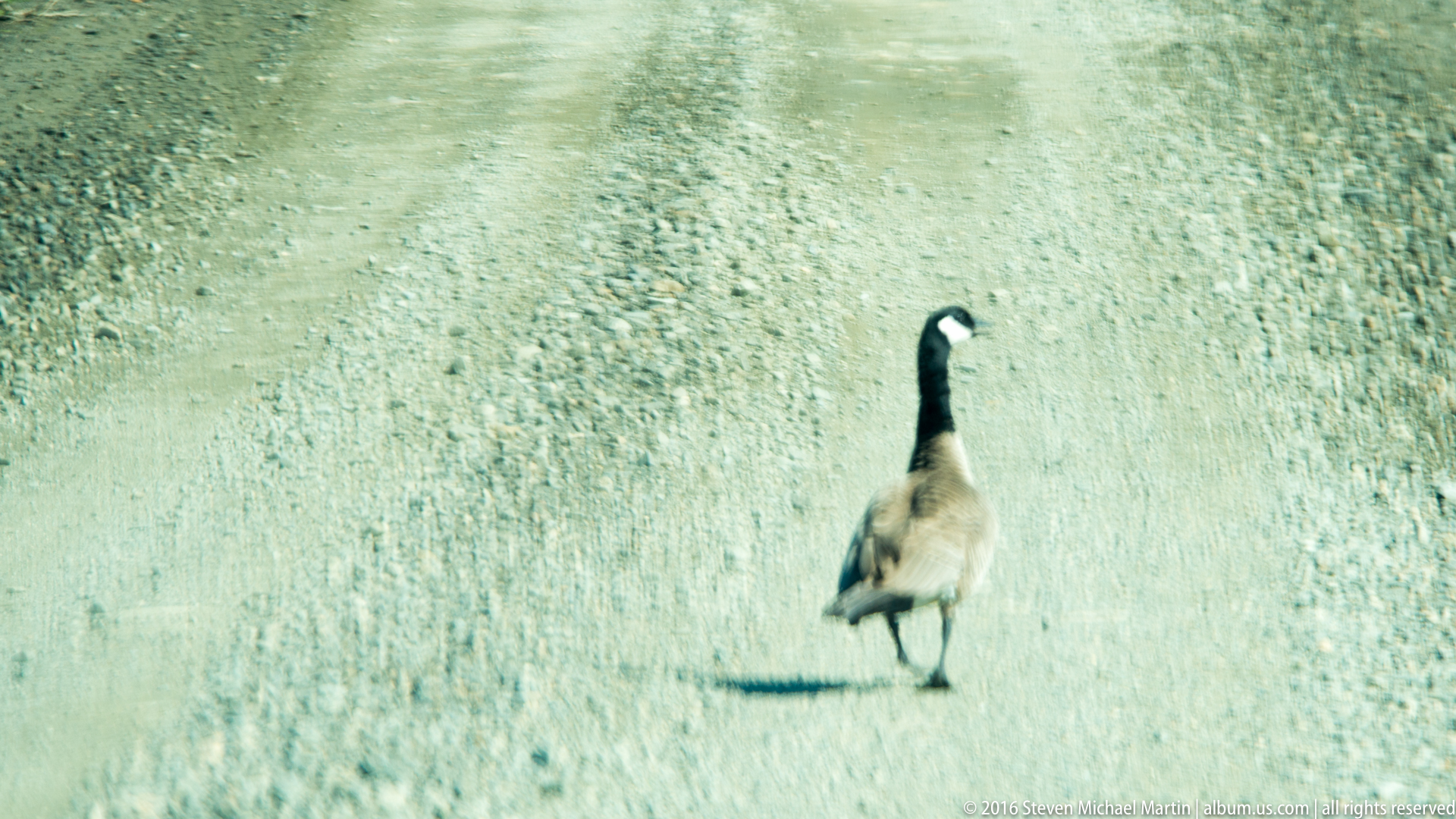
A goose walks alone across a pale gravel flat, its dark head and neck contrasting with a light cheek patch and gray-brown body. The bird is surrounded by open, nearly featureless ground, and its cast shadow falls to the left. The simple composition records a terrestrial moment rather than a swimming or flocking scene.
Caption
A goose walks alone across a pale gravel flat, its dark head and neck contrasting with a light cheek patch and gray-brown body. The bird is surrounded by open, nearly featureless ground, and its cast shadow falls to the left. The simple composition records a terrestrial moment rather than a swimming or flocking scene.
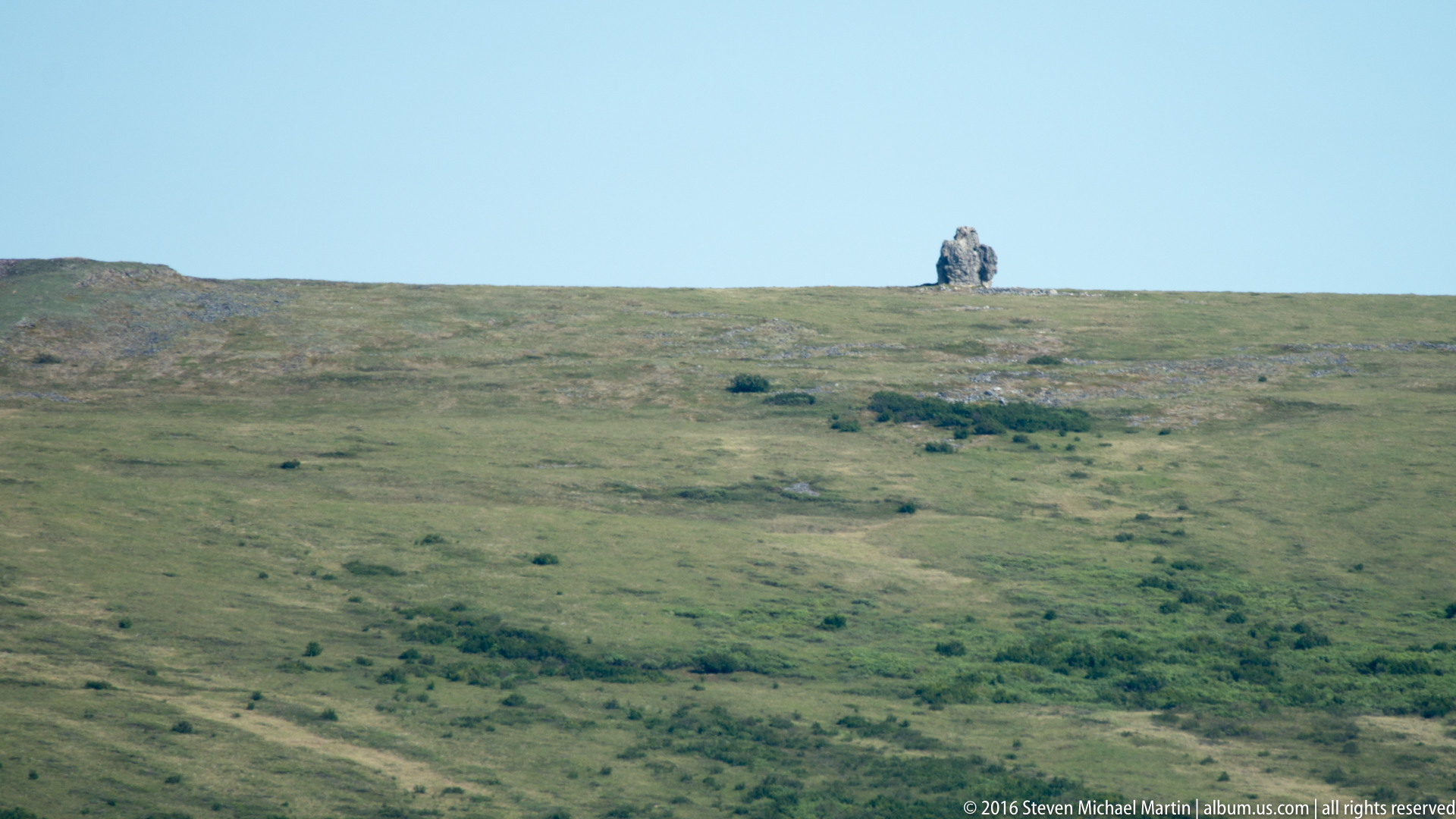
A solitary, irregular rock outcrop rises from a nearly level tundra ridge beneath a wide, pale-blue sky. Its dark, jagged silhouette is small within the frame, with low vegetation and a faint track-like line crossing the surrounding ground. The generous sky and empty ridge emphasize the feature's isolation and the subdued scale of the landscape.
Caption
A solitary, irregular rock outcrop rises from a nearly level tundra ridge beneath a wide, pale-blue sky. Its dark, jagged silhouette is small within the frame, with low vegetation and a faint track-like line crossing the surrounding ground. The generous sky and empty ridge emphasize the feature's isolation and the subdued scale of the landscape.
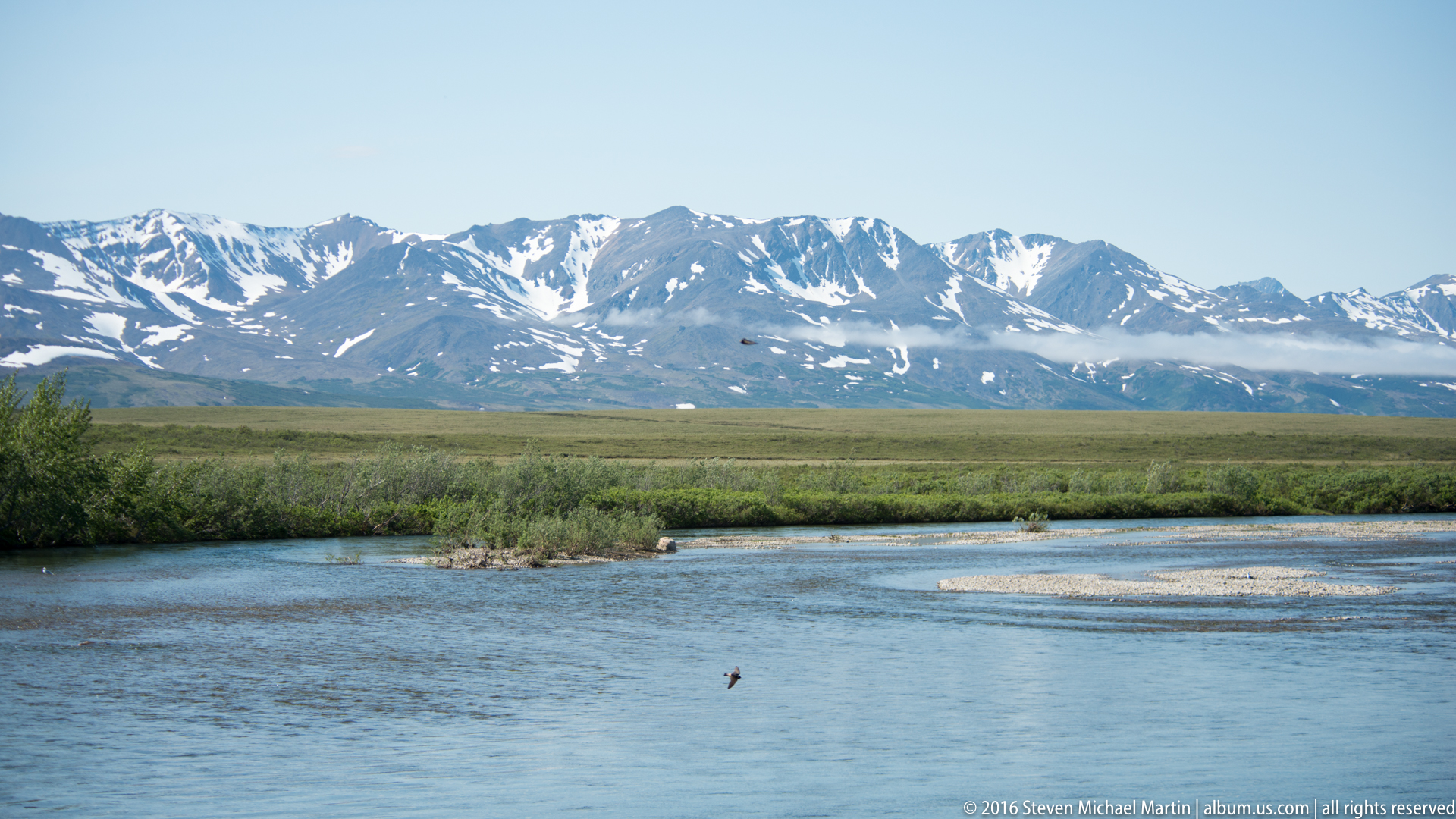
A long range of snow-streaked peaks stretches across the horizon above a wide river. Low green tundra forms a thin middle band, while blue water fills much of the foreground. A small dark bird floats near the lower center, providing a subtle point of scale. The composition layers water, plain, and mountains in broad horizontal zones.
Caption
A long range of snow-streaked peaks stretches across the horizon above a wide river. Low green tundra forms a thin middle band, while blue water fills much of the foreground. A small dark bird floats near the lower center, providing a subtle point of scale. The composition layers water, plain, and mountains in broad horizontal zones.
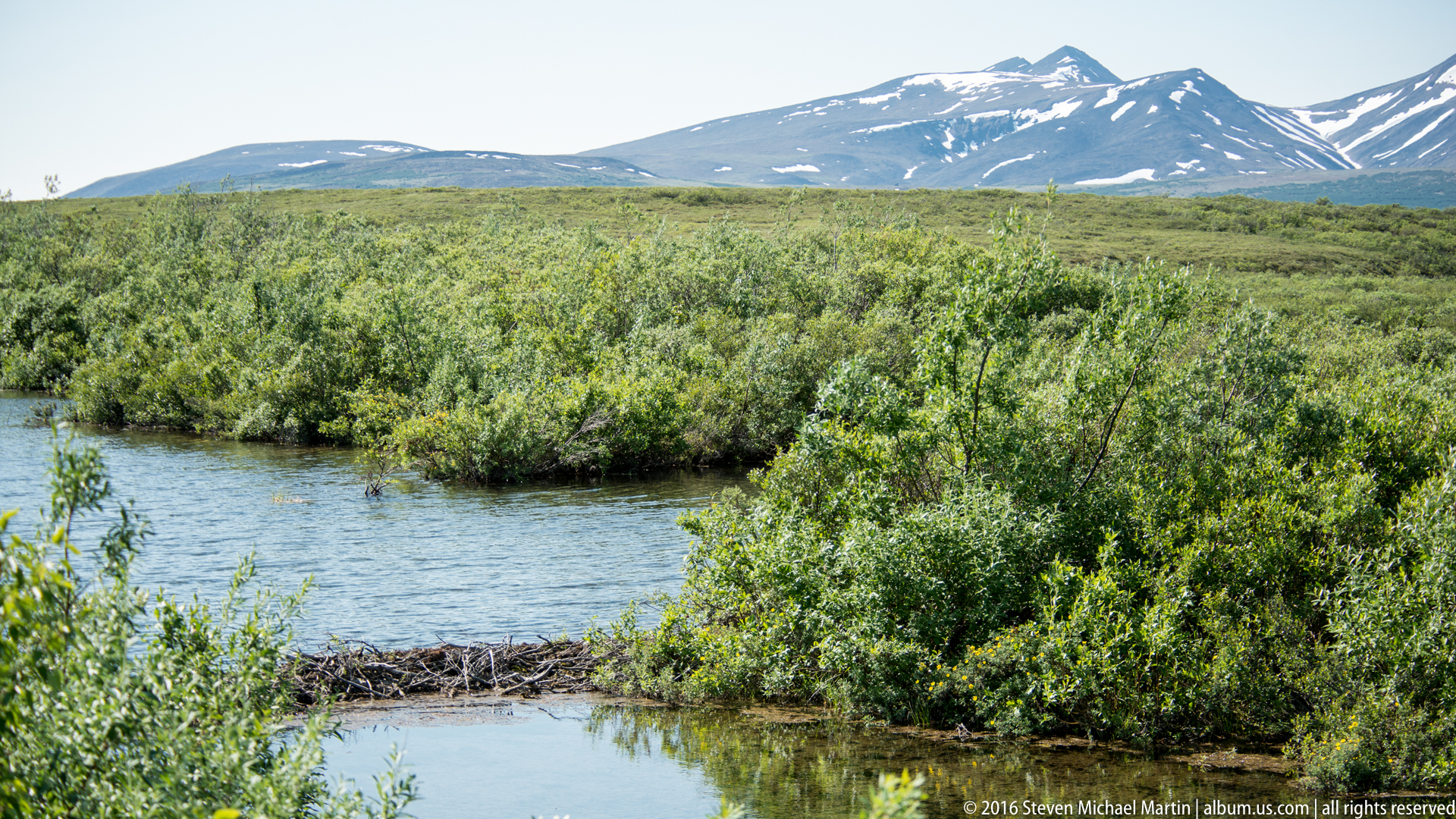
A low pile of interwoven branches rests at the edge of a small pond, partly surrounded by willow-like shrubs. Calm water fills the left foreground, while a green plain and snow-dotted mountains rise behind the shoreline. The branch mound occupies a sheltered inlet, its dark interlocking sticks distinct against the reflective water and bright vegetation.
Caption
A low pile of interwoven branches rests at the edge of a small pond, partly surrounded by willow-like shrubs. Calm water fills the left foreground, while a green plain and snow-dotted mountains rise behind the shoreline. The branch mound occupies a sheltered inlet, its dark interlocking sticks distinct against the reflective water and bright vegetation.
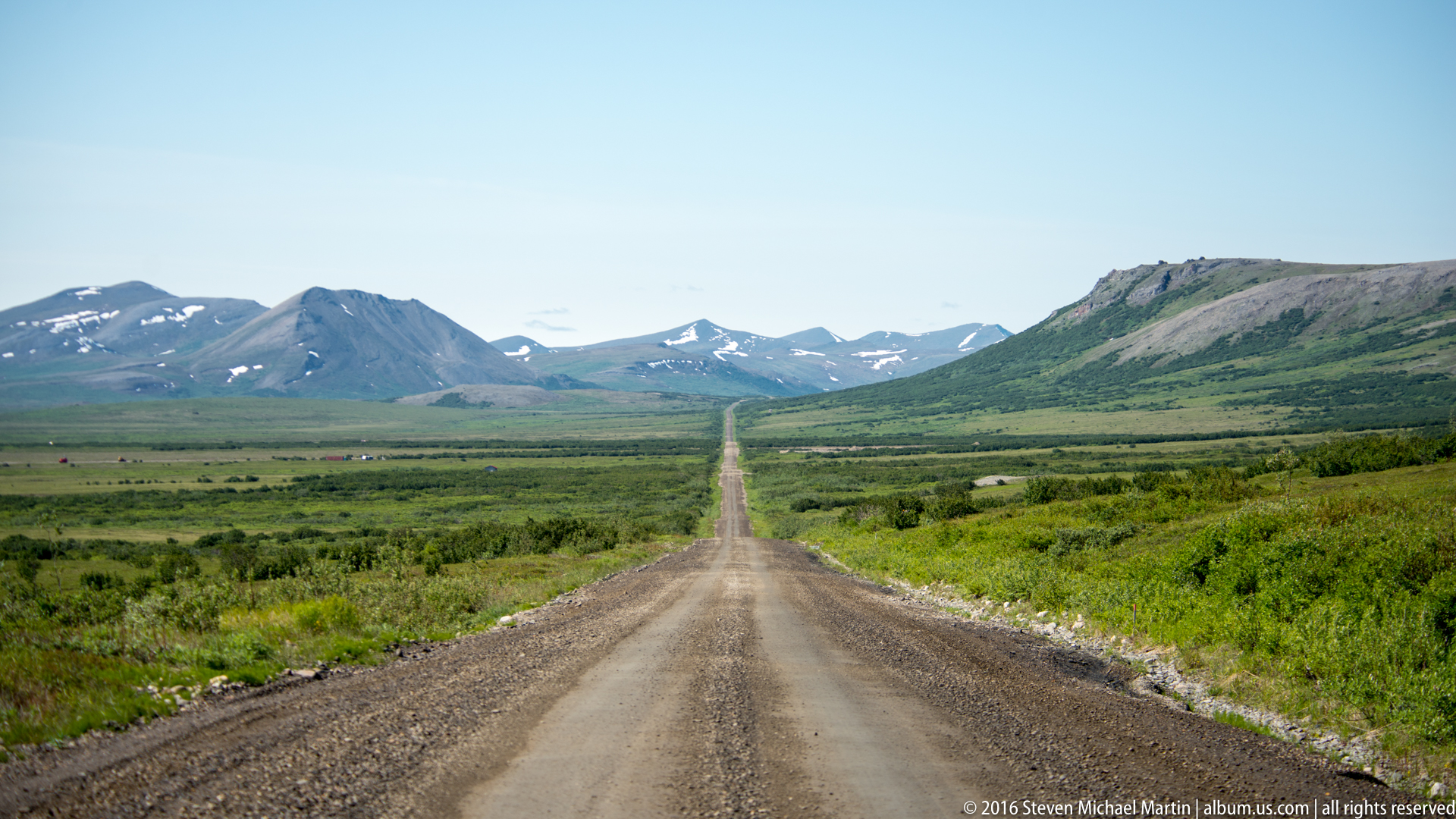
A straight gravel road runs from the foreground toward a distant mountain basin, dividing the broad green tundra into two converging sides. Low clouds or haze soften the far peaks, while small vehicles or structures are barely visible along the route. The strong central perspective turns the road into the organizing line of this open landscape.
Caption
A straight gravel road runs from the foreground toward a distant mountain basin, dividing the broad green tundra into two converging sides. Low clouds or haze soften the far peaks, while small vehicles or structures are barely visible along the route. The strong central perspective turns the road into the organizing line of this open landscape.
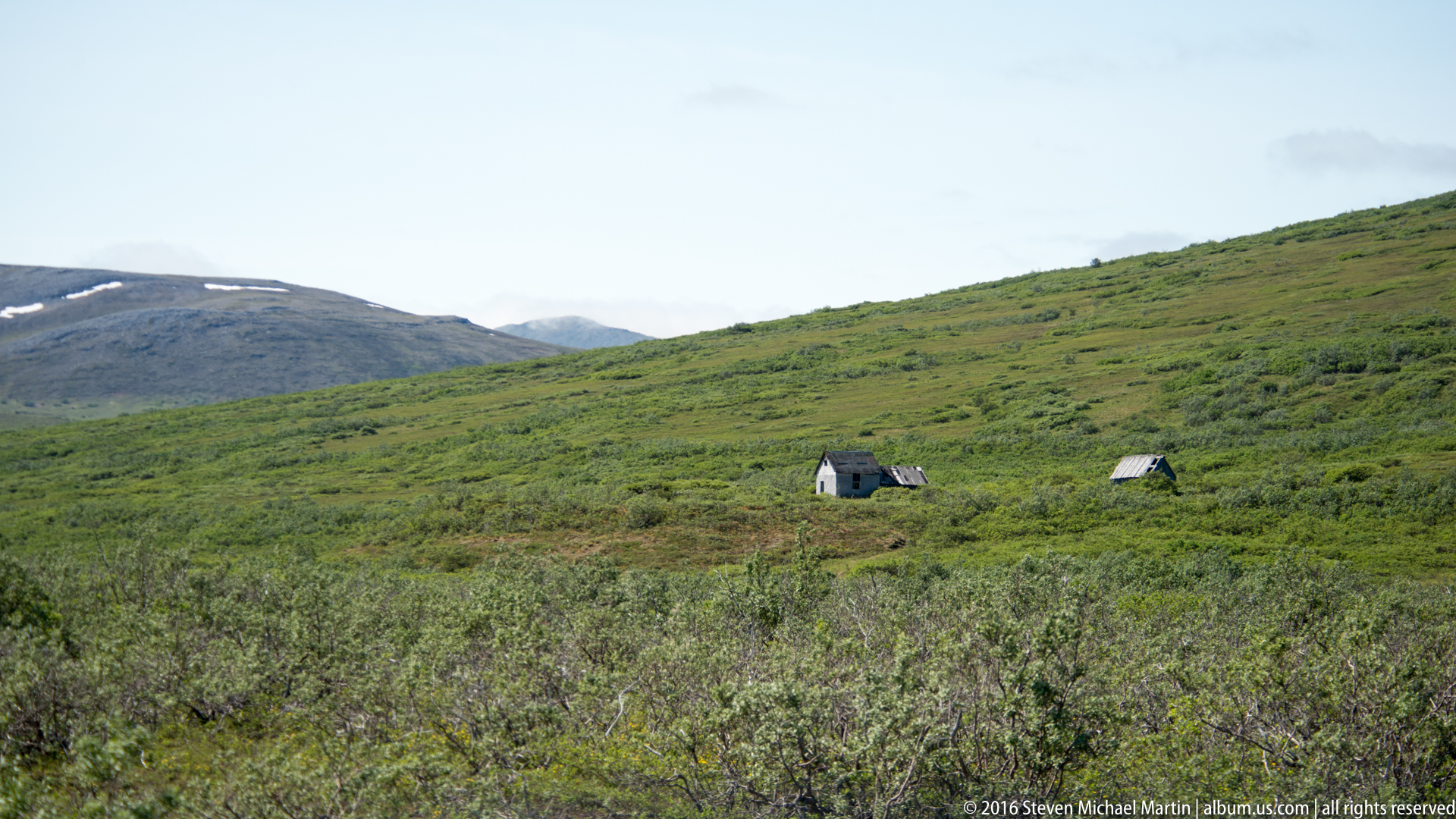
Two small weathered buildings stand far apart on a green hillside, dwarfed by the surrounding slope and pale sky. Their simple rooflines sit low against the broad incline, with shrubs and grasses extending across the foreground. The remote placement and generous open terrain establish a sparse human presence without interrupting the landscape's scale.
Caption
Two small weathered buildings stand far apart on a green hillside, dwarfed by the surrounding slope and pale sky. Their simple rooflines sit low against the broad incline, with shrubs and grasses extending across the foreground. The remote placement and generous open terrain establish a sparse human presence without interrupting the landscape's scale.
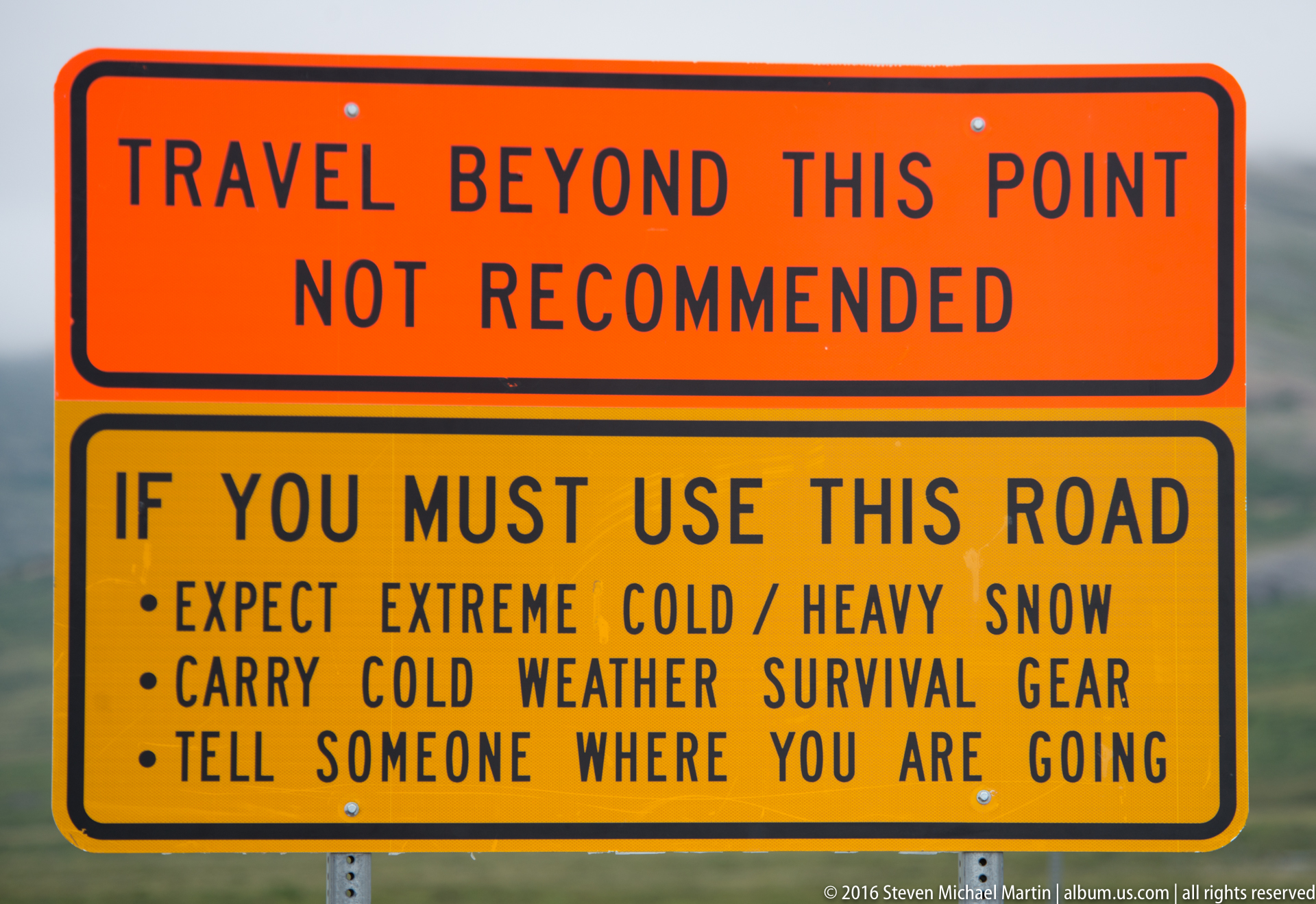
A large orange roadside warning sign fills nearly the entire frame, with black lettering stating that travel beyond the point is not recommended. A yellow panel below advises travelers to expect extreme cold or heavy snow, carry survival gear, and tell someone their destination. Cropping gives priority to the sign's direct safety message, leaving only a narrow strip of landscape behind it.
Caption
A large orange roadside warning sign fills nearly the entire frame, with black lettering stating that travel beyond the point is not recommended. A yellow panel below advises travelers to expect extreme cold or heavy snow, carry survival gear, and tell someone their destination. Cropping gives priority to the sign's direct safety message, leaving only a narrow strip of landscape behind it.

An orange and yellow warning sign stands beside a gravel road that curves into an open mountain valley. Its upper panel discourages travel beyond the point; the lower panel lists cold-weather precautions for anyone who must use the road. The wider framing connects the posted warning to the remote terrain and route it addresses.
Caption
An orange and yellow warning sign stands beside a gravel road that curves into an open mountain valley. Its upper panel discourages travel beyond the point; the lower panel lists cold-weather precautions for anyone who must use the road. The wider framing connects the posted warning to the remote terrain and route it addresses.
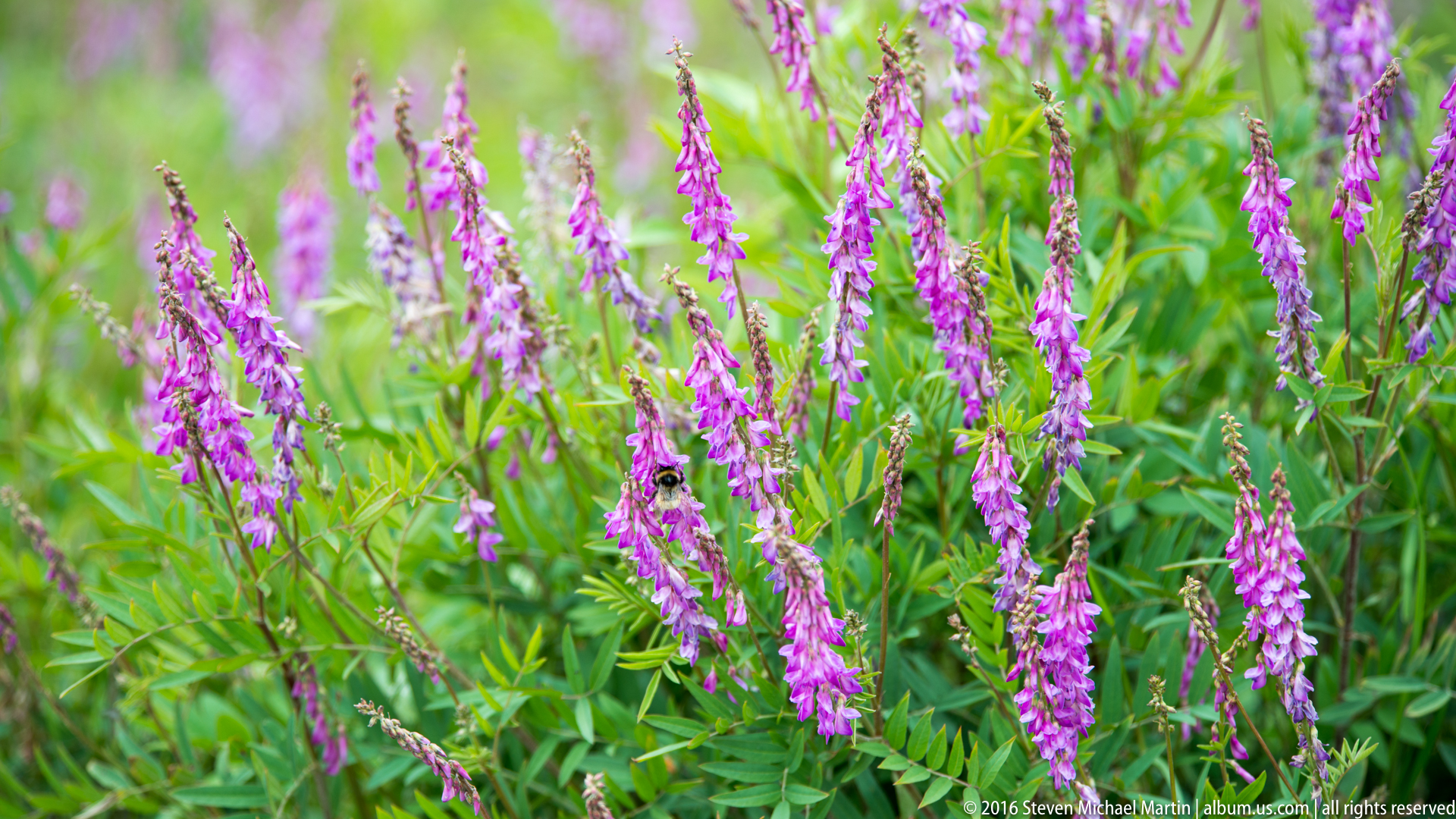
Tall fireweed stems carry many vivid magenta blossoms above long, narrow green leaves. The flowers form a dense vertical screen, with several spikes in sharp focus and others softening into the background. This close botanical view emphasizes the plant's upright growth and abundant bloom rather than its broader landscape setting.
Caption
Tall fireweed stems carry many vivid magenta blossoms above long, narrow green leaves. The flowers form a dense vertical screen, with several spikes in sharp focus and others softening into the background. This close botanical view emphasizes the plant's upright growth and abundant bloom rather than its broader landscape setting.
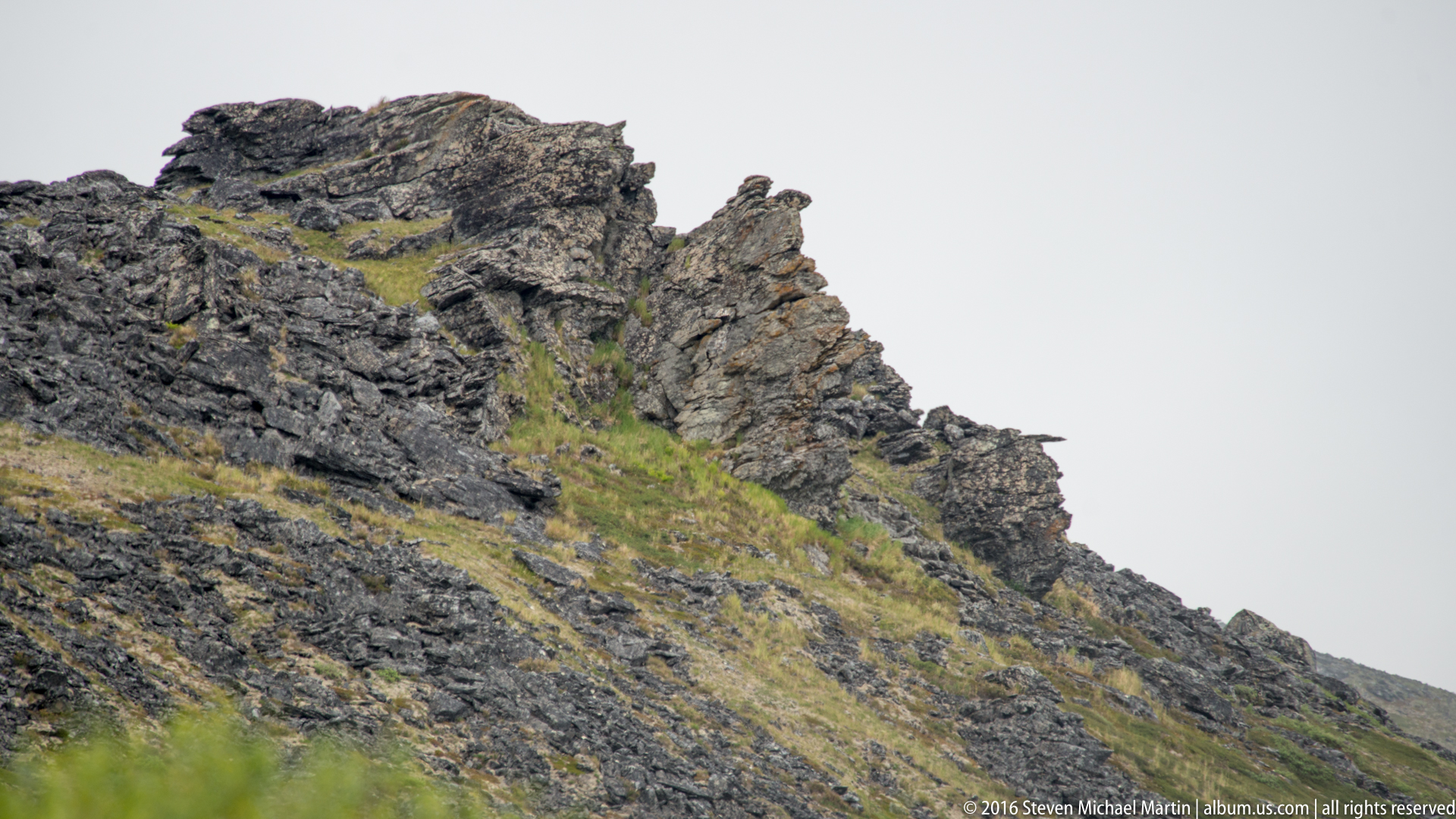
A rugged outcrop of dark, fractured rock rises diagonally against a pale sky, with small patches of grass and moss occupying its crevices. The irregular ledges and sharp breaks create a steep, broken profile. This close landscape view prioritizes exposed geology and surface texture, while the cropped edges leave the formation's overall extent uncertain.
Caption
A rugged outcrop of dark, fractured rock rises diagonally against a pale sky, with small patches of grass and moss occupying its crevices. The irregular ledges and sharp breaks create a steep, broken profile. This close landscape view prioritizes exposed geology and surface texture, while the cropped edges leave the formation's overall extent uncertain.
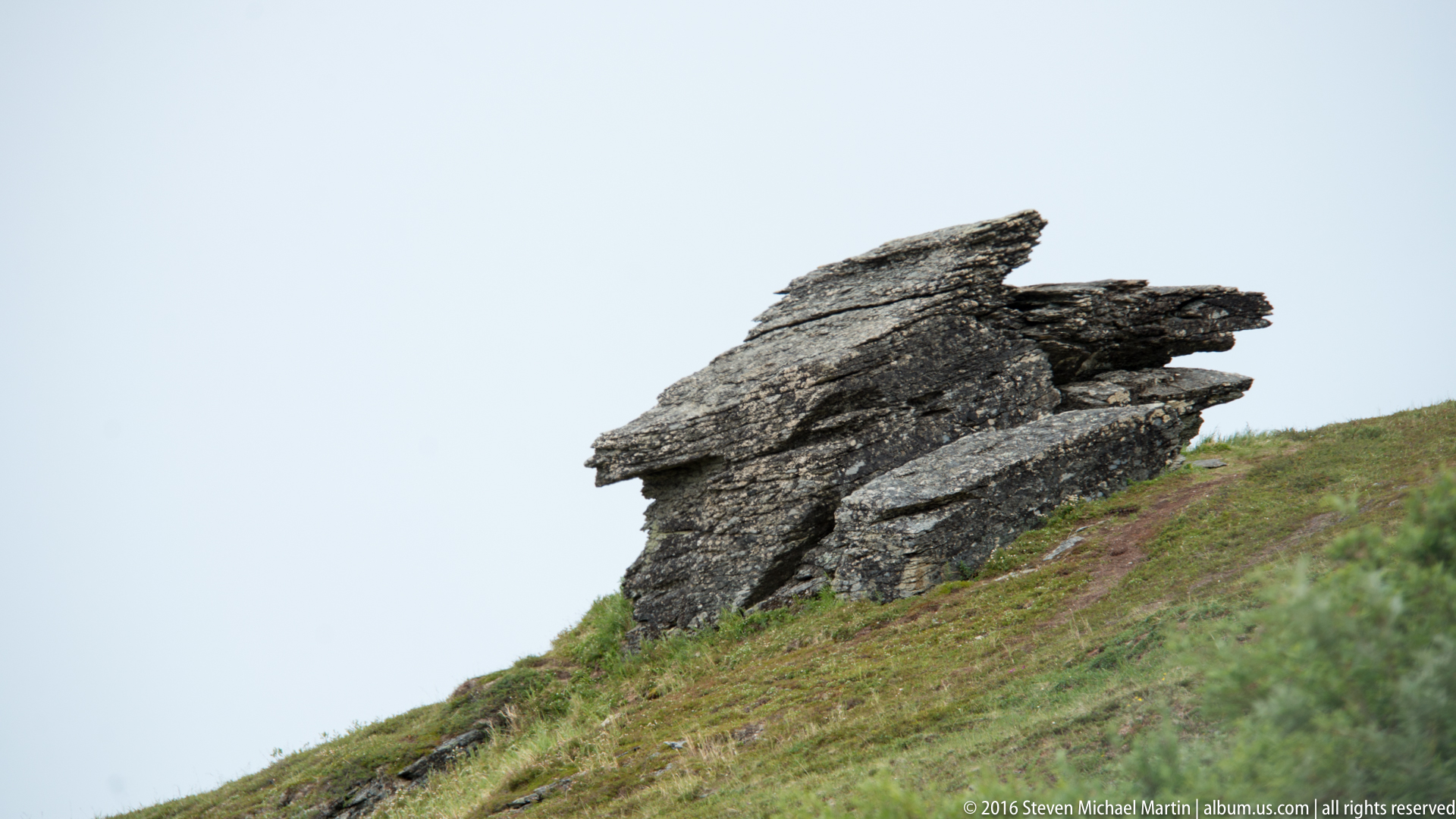
A slanted stack of thin rock layers projects from a grassy hillside, its sharp upper edge pointing across the open sky. The repeated bands and broken corners expose the formation's layered structure, while a smaller rock shelf continues behind it. The isolated profile offers a clear study of stratification without enough evidence to name a specific geologic formation.
Caption
A slanted stack of thin rock layers projects from a grassy hillside, its sharp upper edge pointing across the open sky. The repeated bands and broken corners expose the formation's layered structure, while a smaller rock shelf continues behind it. The isolated profile offers a clear study of stratification without enough evidence to name a specific geologic formation.
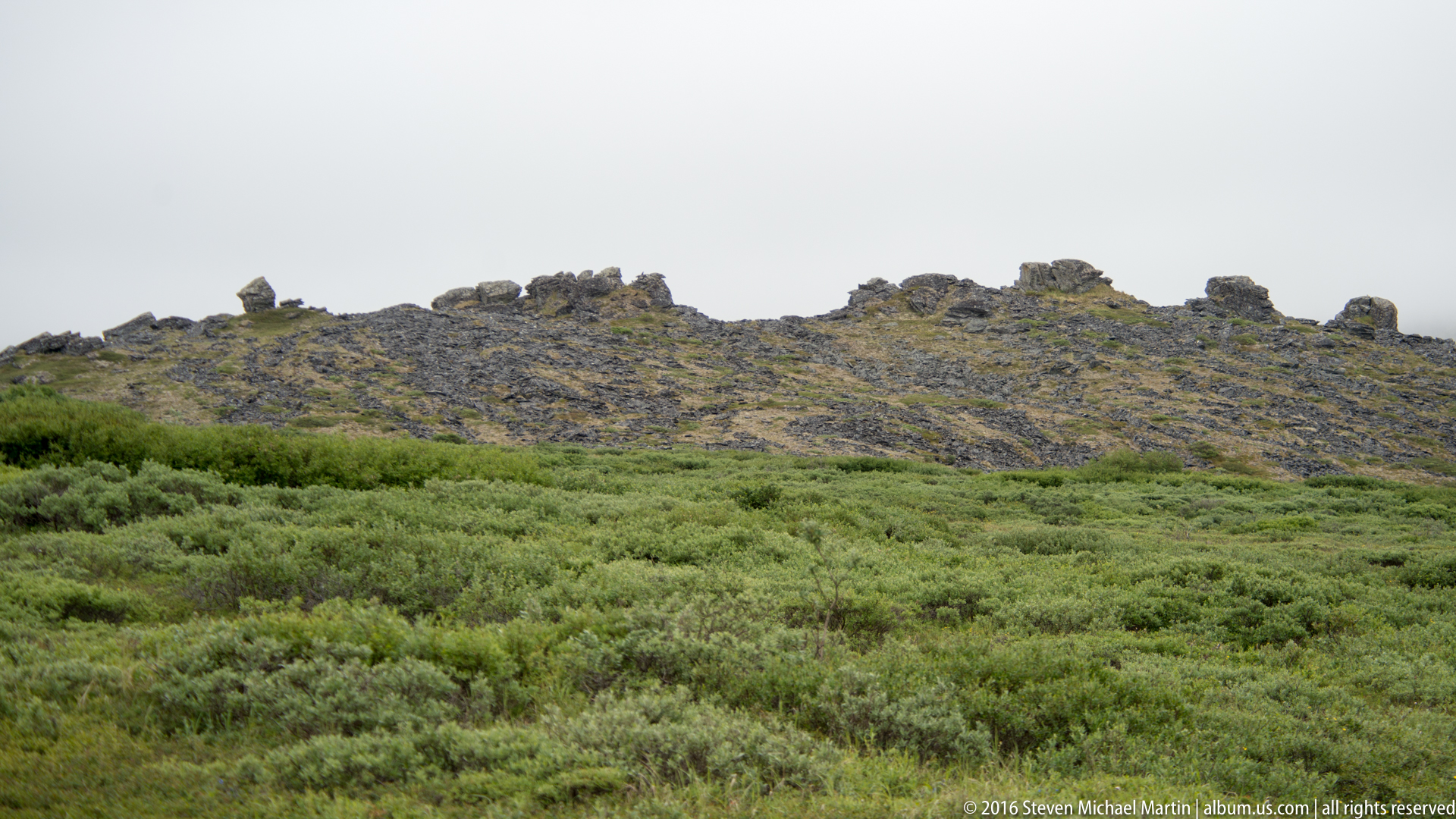
A low, uneven ridge of dark stones runs across the upper portion of a green tundra slope. The scattered rocks form a broken line beneath a pale, nearly featureless sky, while shrubs cover the foreground. The broad framing emphasizes the contrast between exposed stone and vegetated ground, with no single rock feature large enough to identify more precisely.
Caption
A low, uneven ridge of dark stones runs across the upper portion of a green tundra slope. The scattered rocks form a broken line beneath a pale, nearly featureless sky, while shrubs cover the foreground. The broad framing emphasizes the contrast between exposed stone and vegetated ground, with no single rock feature large enough to identify more precisely.
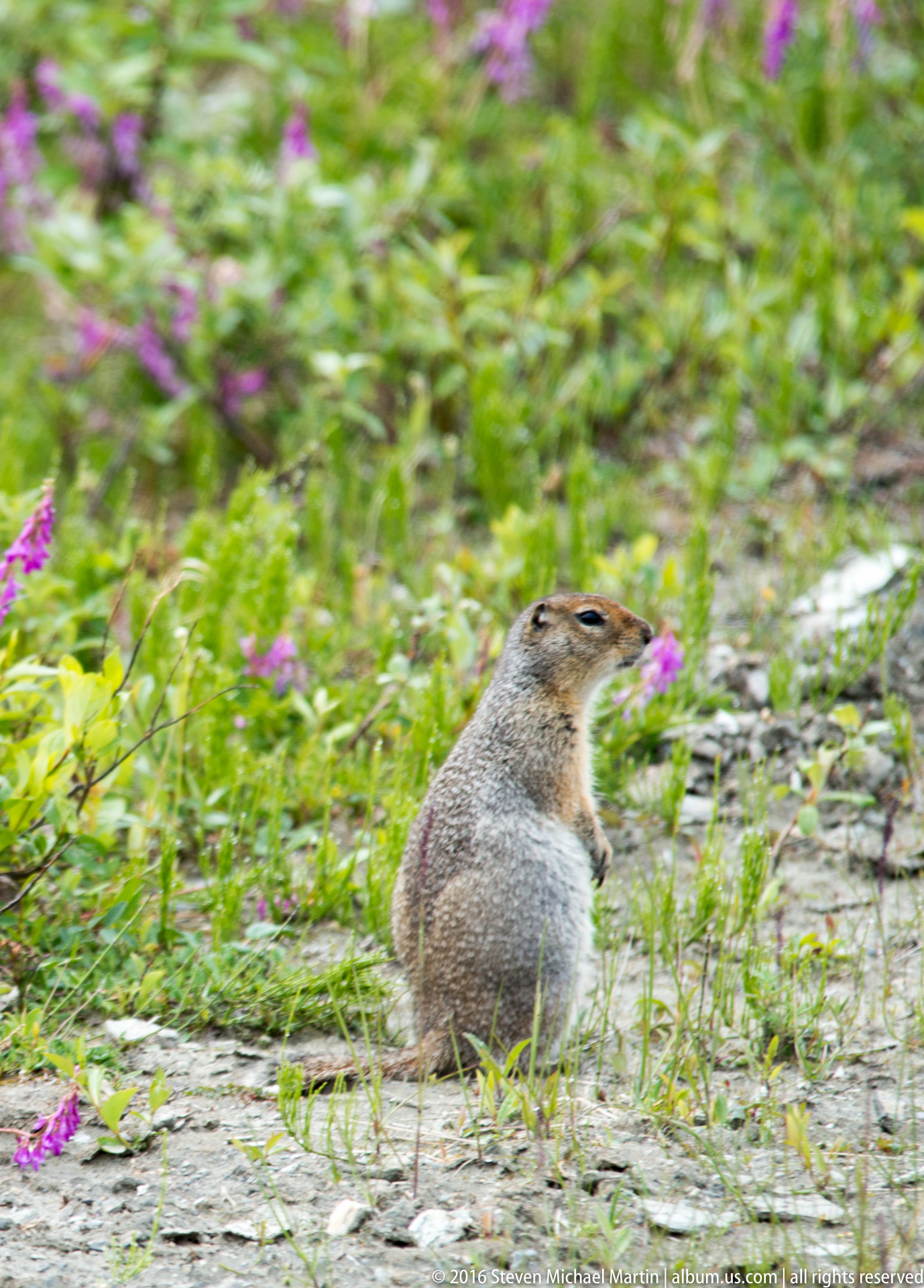
An Arctic ground squirrel sits upright among fireweed leaves and blossoms, its speckled gray-brown coat and pale eye ring visible in profile. The animal's forepaws rest close to its chest as it looks to the right. Softly blurred greenery and magenta flowers frame the small mammal without obscuring its rounded body and alert posture.
Caption
An Arctic ground squirrel sits upright among fireweed leaves and blossoms, its speckled gray-brown coat and pale eye ring visible in profile. The animal's forepaws rest close to its chest as it looks to the right. Softly blurred greenery and magenta flowers frame the small mammal without obscuring its rounded body and alert posture.
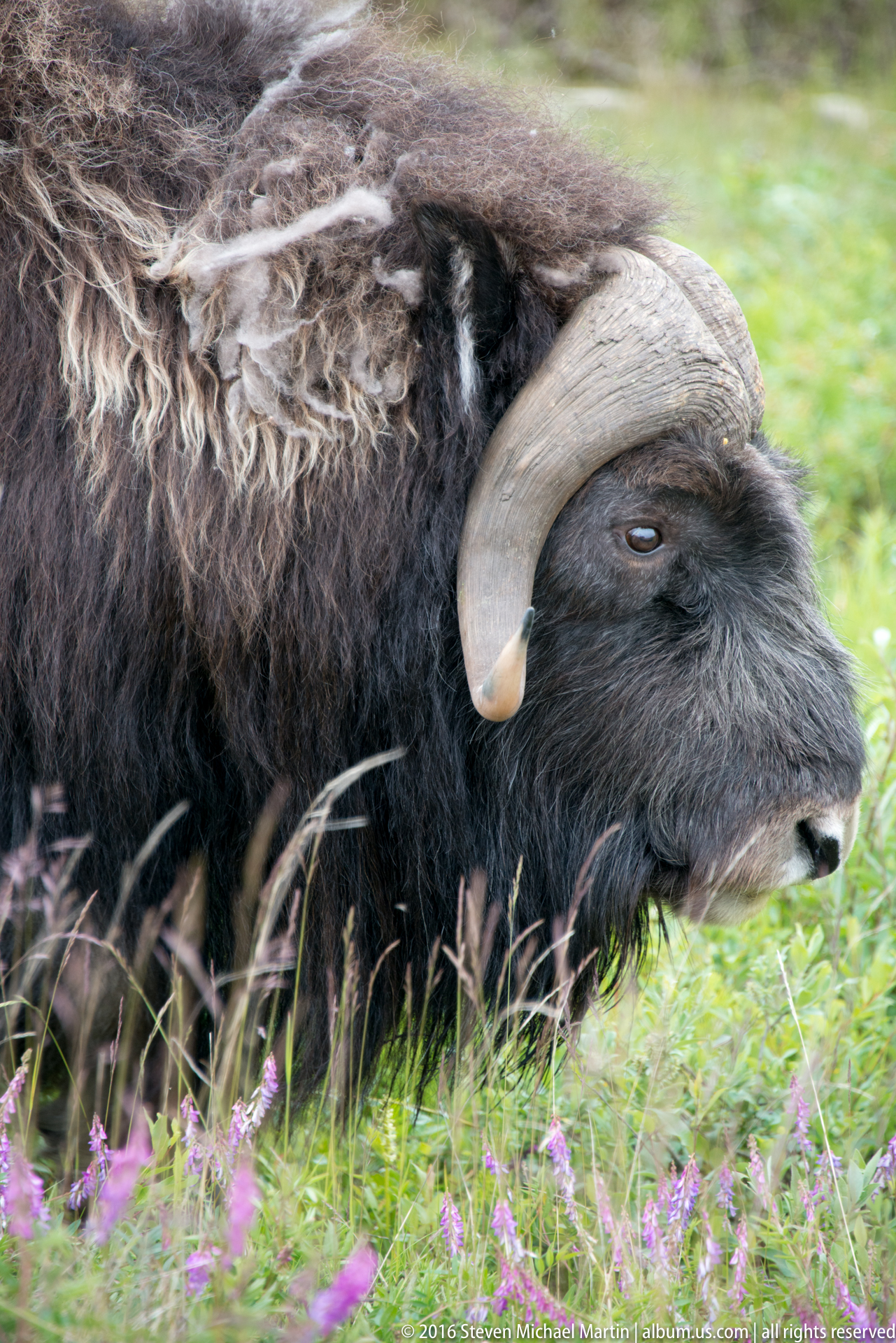
The close profile isolates a musk ox’s heavy brow, visible eye, broad muzzle, and massive horn sweeping down beside its face. Wind-tossed guard hairs and the pale, curly undercoat reveal the layered texture of the animal’s winter-adapted coat. A shallow depth of field softens the meadow behind it, directing attention to the anatomy and shaggy covering that distinguish this Arctic grazer.
Caption
The close profile isolates a musk ox’s heavy brow, visible eye, broad muzzle, and massive horn sweeping down beside its face. Wind-tossed guard hairs and the pale, curly undercoat reveal the layered texture of the animal’s winter-adapted coat. A shallow depth of field softens the meadow behind it, directing attention to the anatomy and shaggy covering that distinguish this Arctic grazer.
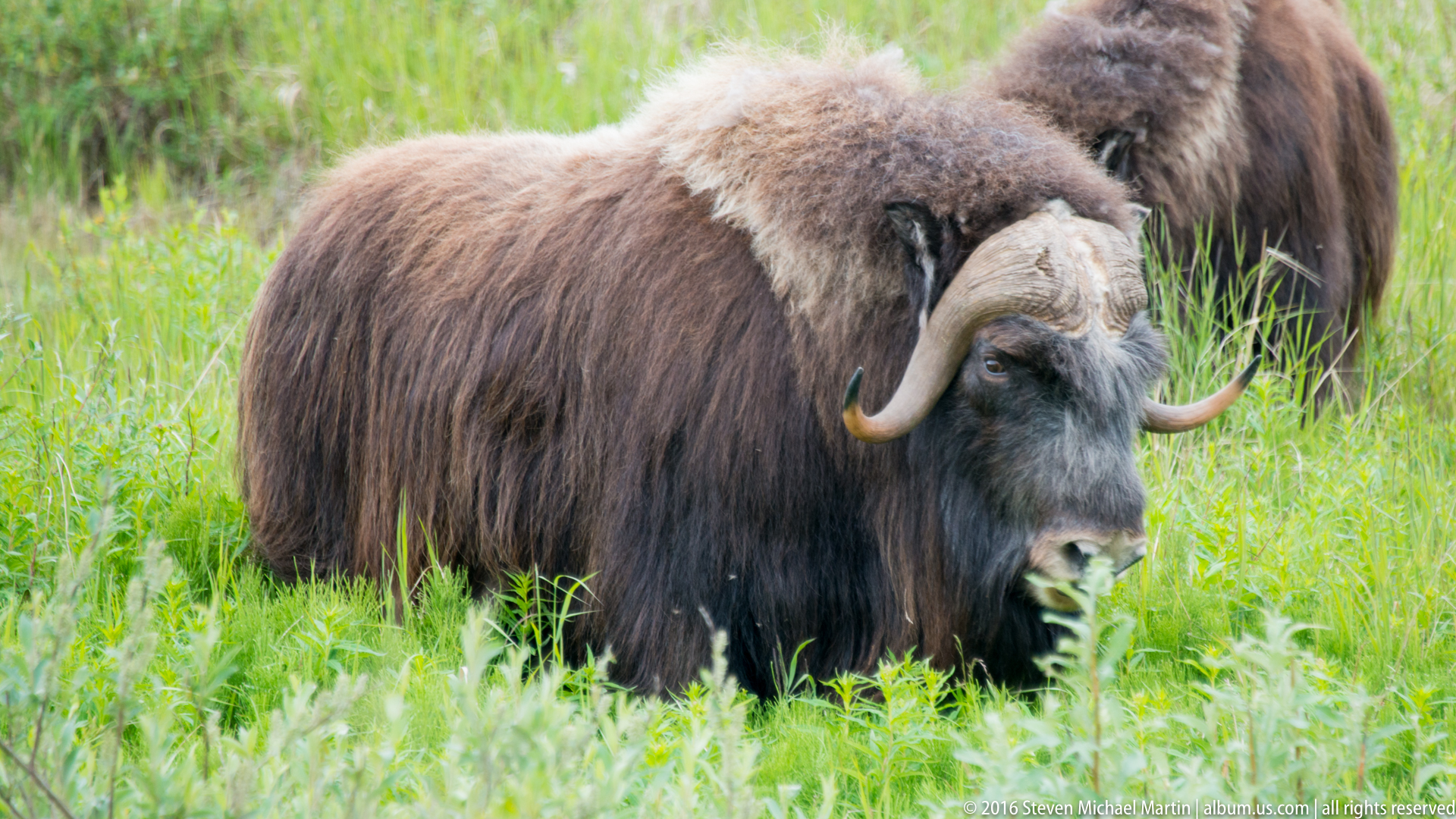
A musk ox lowers its head to graze in a lush meadow while a second animal stands close behind. The foreground bull’s pale, sweeping horns and thick brown coat dominate the frame; the companion’s partial silhouette gives the encounter depth without distracting from the feeding animal. Green grasses and scattered wildflowers place this herd in the summer vegetation of Bering Land Bridge National Preserve.
Caption
A musk ox lowers its head to graze in a lush meadow while a second animal stands close behind. The foreground bull’s pale, sweeping horns and thick brown coat dominate the frame; the companion’s partial silhouette gives the encounter depth without distracting from the feeding animal. Green grasses and scattered wildflowers place this herd in the summer vegetation of Bering Land Bridge National Preserve.

A musk ox feeds with its head lowered into a patch of meadow plants, its long dark coat nearly brushing the ground. Pink fireweed punctuates the foreground, while the animal’s pale horns curve down and outward from its broad forehead. The close, side-on view makes the dense woolly coat and compact, powerful build legible against the softer green background.
Caption
A musk ox feeds with its head lowered into a patch of meadow plants, its long dark coat nearly brushing the ground. Pink fireweed punctuates the foreground, while the animal’s pale horns curve down and outward from its broad forehead. The close, side-on view makes the dense woolly coat and compact, powerful build legible against the softer green background.

Two musk oxen face one another at close range, their pale horns nearly meeting above a narrow strip of green meadow. The left animal turns its broad, gray-fringed face toward the viewer, while the right one presents a darker profile. Their nearly mirrored head positions create a quiet visual exchange, and the tightly cropped bodies make the animals’ thick coats fill most of the frame.
Caption
Two musk oxen face one another at close range, their pale horns nearly meeting above a narrow strip of green meadow. The left animal turns its broad, gray-fringed face toward the viewer, while the right one presents a darker profile. Their nearly mirrored head positions create a quiet visual exchange, and the tightly cropped bodies make the animals’ thick coats fill most of the frame.

The two musk oxen hold a close, nearly frontal pose, their muzzles angled toward each other and their horns framing the space between them. This view brings both faces into sharper relation than the preceding side-on encounter, revealing their dark eyes, gray facial fringes, and pale horn surfaces. Meadow grasses rise around their shoulders, while the close crop emphasizes the animals’ size and dense coats.
Caption
The two musk oxen hold a close, nearly frontal pose, their muzzles angled toward each other and their horns framing the space between them. This view brings both faces into sharper relation than the preceding side-on encounter, revealing their dark eyes, gray facial fringes, and pale horn surfaces. Meadow grasses rise around their shoulders, while the close crop emphasizes the animals’ size and dense coats.
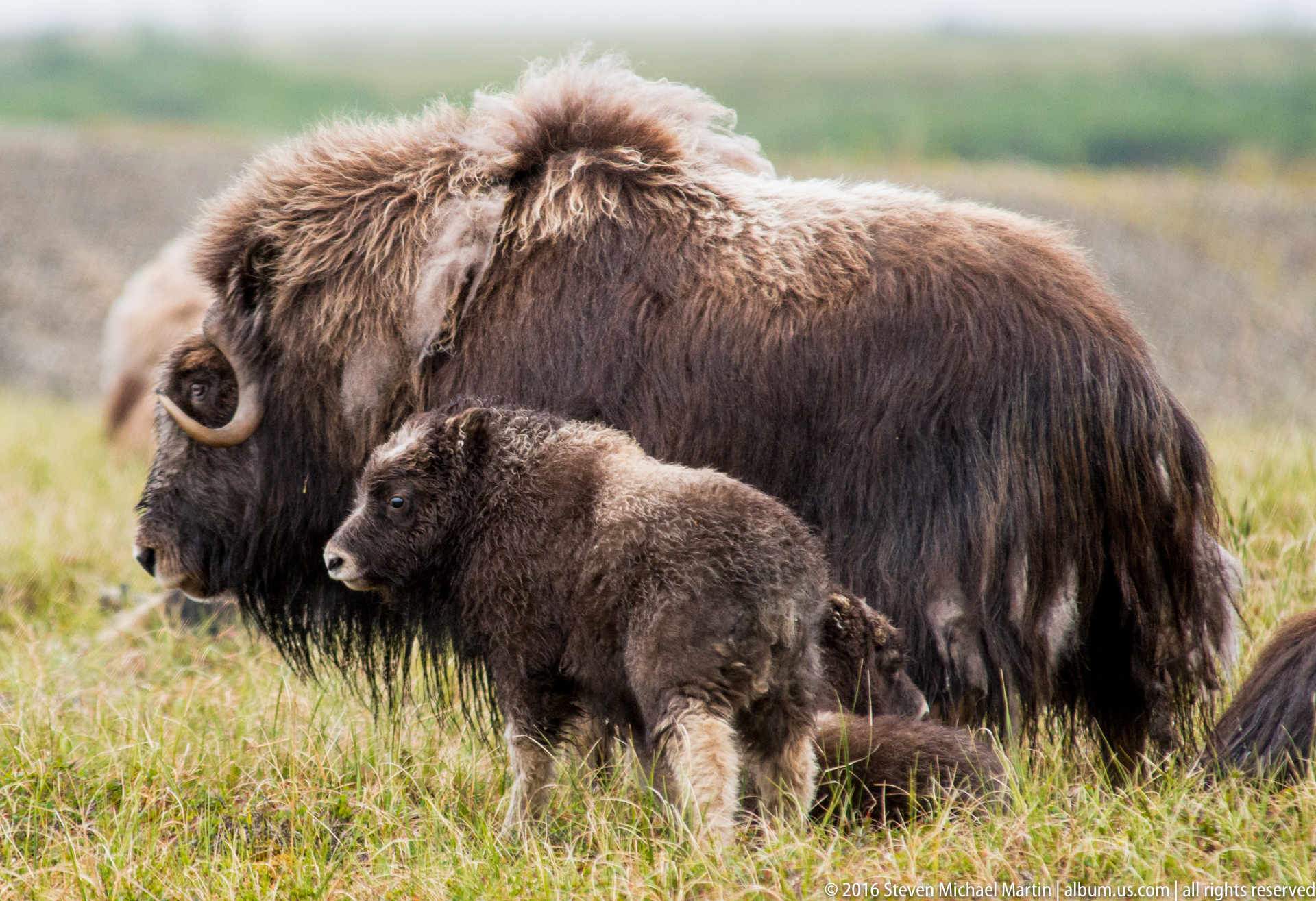
A small musk ox calf stands beside an adult whose long coat nearly forms a canopy over it. The calf’s shorter, lighter brown fur and compact body distinguish it from the mature animal, while both face left through the open grass. A softly blurred third musk ox appears behind them, suggesting a larger group without obscuring the close adult-and-young pairing.
Caption
A small musk ox calf stands beside an adult whose long coat nearly forms a canopy over it. The calf’s shorter, lighter brown fur and compact body distinguish it from the mature animal, while both face left through the open grass. A softly blurred third musk ox appears behind them, suggesting a larger group without obscuring the close adult-and-young pairing.
🦬 Wildlife Encountered
Wildlife encounters in Bering Land Bridge National Preserve included observation of muskox grazing and resting across open tundra landscapes. Muskox are well adapted to Arctic environments, using their thick insulating coats to withstand cold conditions and feeding on grasses, sedges, and low vegetation common throughout tundra ecosystems.
Additional sightings included a light-colored grizzly bear moving across tundra habitat with a cub nearby, as well as Arctic fox and Arctic ground squirrel observed among low vegetation. These species are well adapted to northern climates where short growing seasons and wide-open terrain shape wildlife behavior.
Together, these wildlife encounters highlight the ecological diversity of Bering Land Bridge, where expansive tundra landscapes continue to support species whose ancestors once crossed the ancient land connection between Asia and North America.

The Serpentine Hot Springs panel pairs a wide landscape photograph with sections on Iñupiat traditions, archaeological evidence, mining-era visitation, and the springs’ changing modern use. A lower geology section explains the rounded granite tors and volcanic history of the area, while the small buildings in the panorama establish the remote setting. The exhibit presents the springs as both a cultural place and a geological feature.
Caption
The Serpentine Hot Springs panel pairs a wide landscape photograph with sections on Iñupiat traditions, archaeological evidence, mining-era visitation, and the springs’ changing modern use. A lower geology section explains the rounded granite tors and volcanic history of the area, while the small buildings in the panorama establish the remote setting. The exhibit presents the springs as both a cultural place and a geological feature.
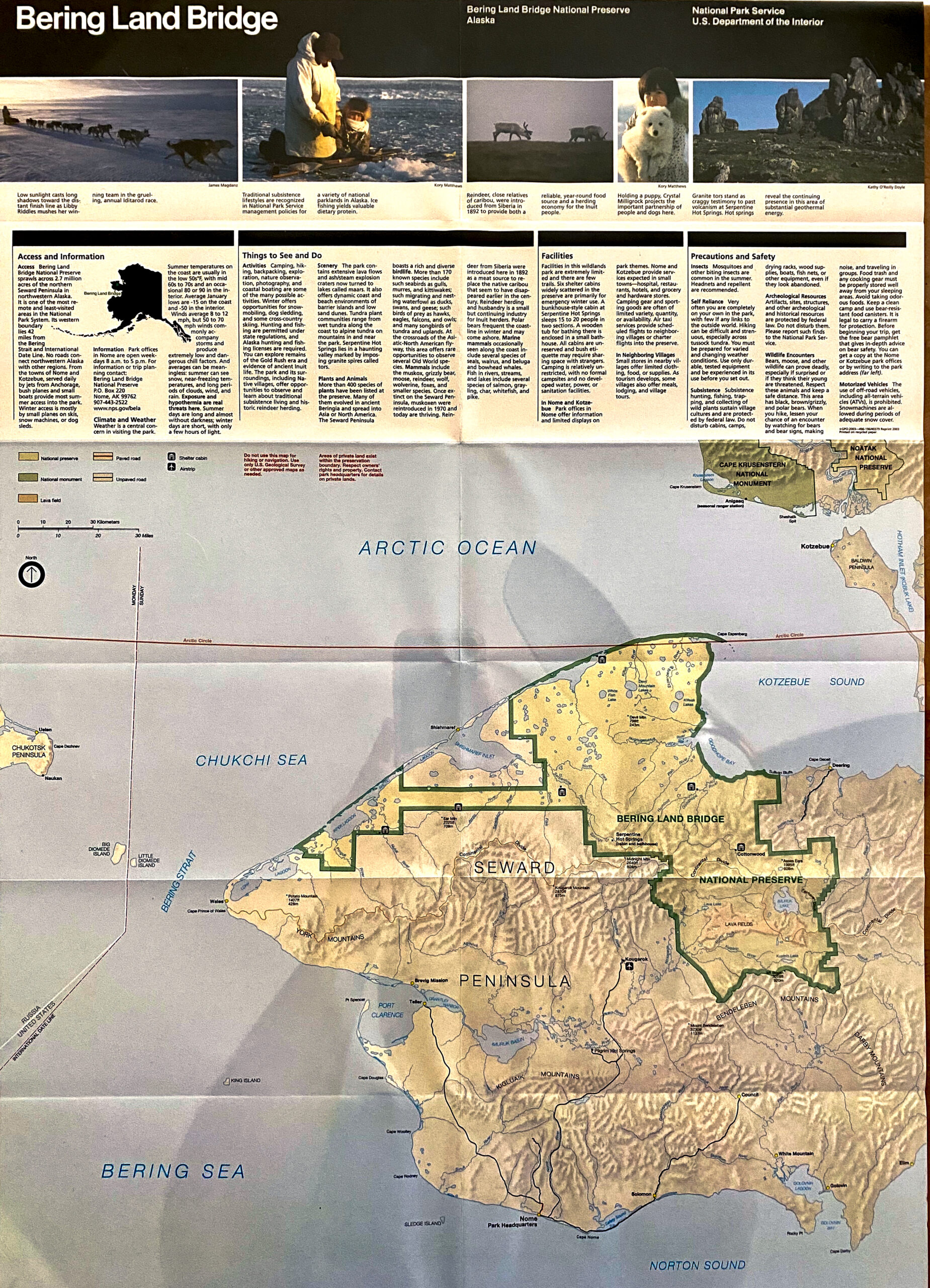
A regional map places Bering Land Bridge National Preserve across the Seward Peninsula, between the Bering and Chukchi seas. Green boundary lines mark the protected area against shaded relief, with nearby communities, roads, and coastal features providing geographic context. The broad view makes the preserve’s position at Alaska’s northwestern edge clear and emphasizes its relationship to the surrounding Arctic and Bering Sea coastlines.
Caption
A regional map places Bering Land Bridge National Preserve across the Seward Peninsula, between the Bering and Chukchi seas. Green boundary lines mark the protected area against shaded relief, with nearby communities, roads, and coastal features providing geographic context. The broad view makes the preserve’s position at Alaska’s northwestern edge clear and emphasizes its relationship to the surrounding Arctic and Bering Sea coastlines.

A broad Bering Land Bridge exhibit panel assembles maps, diagrams, wildlife illustrations, historical scenes, and photographs of cultural objects into a visual account of the region. The upper sections address glaciation and the land connection between Asia and North America; lower sections shift to migration, subsistence, and material culture. The arrangement links geological change with the human histories preserved across this Arctic landscape.
Caption
A broad Bering Land Bridge exhibit panel assembles maps, diagrams, wildlife illustrations, historical scenes, and photographs of cultural objects into a visual account of the region. The upper sections address glaciation and the land connection between Asia and North America; lower sections shift to migration, subsistence, and material culture. The arrangement links geological change with the human histories preserved across this Arctic landscape.

A companion Serpentine Hot Springs panel focuses on visiting the remote site, with sections on wildlife, trip planning, access, and safety. The text warns about bears and musk oxen, describes hiking through wet tundra, and includes a small photograph of visitors crossing the landscape. A compact airplane image and contact information at the bottom underline the preserve’s remote setting and the practical preparation required for a visit.
Caption
A companion Serpentine Hot Springs panel focuses on visiting the remote site, with sections on wildlife, trip planning, access, and safety. The text warns about bears and musk oxen, describes hiking through wet tundra, and includes a small photograph of visitors crossing the landscape. A compact airplane image and contact information at the bottom underline the preserve’s remote setting and the practical preparation required for a visit.

A large interpretive panel titled “Western Arctic National Parks” presents the region through landscape photographs, explanatory text, maps, and wildlife illustrations. The visible heading “Expansive Arctic and Subarctic Wildlands” organizes the display around the scale and variety of northern habitats. A prominent caribou illustration spans the lower section, linking the text and smaller images to wildlife as a defining subject.
Caption
A large interpretive panel titled “Western Arctic National Parks” presents the region through landscape photographs, explanatory text, maps, and wildlife illustrations. The visible heading “Expansive Arctic and Subarctic Wildlands” organizes the display around the scale and variety of northern habitats. A prominent caribou illustration spans the lower section, linking the text and smaller images to wildlife as a defining subject.
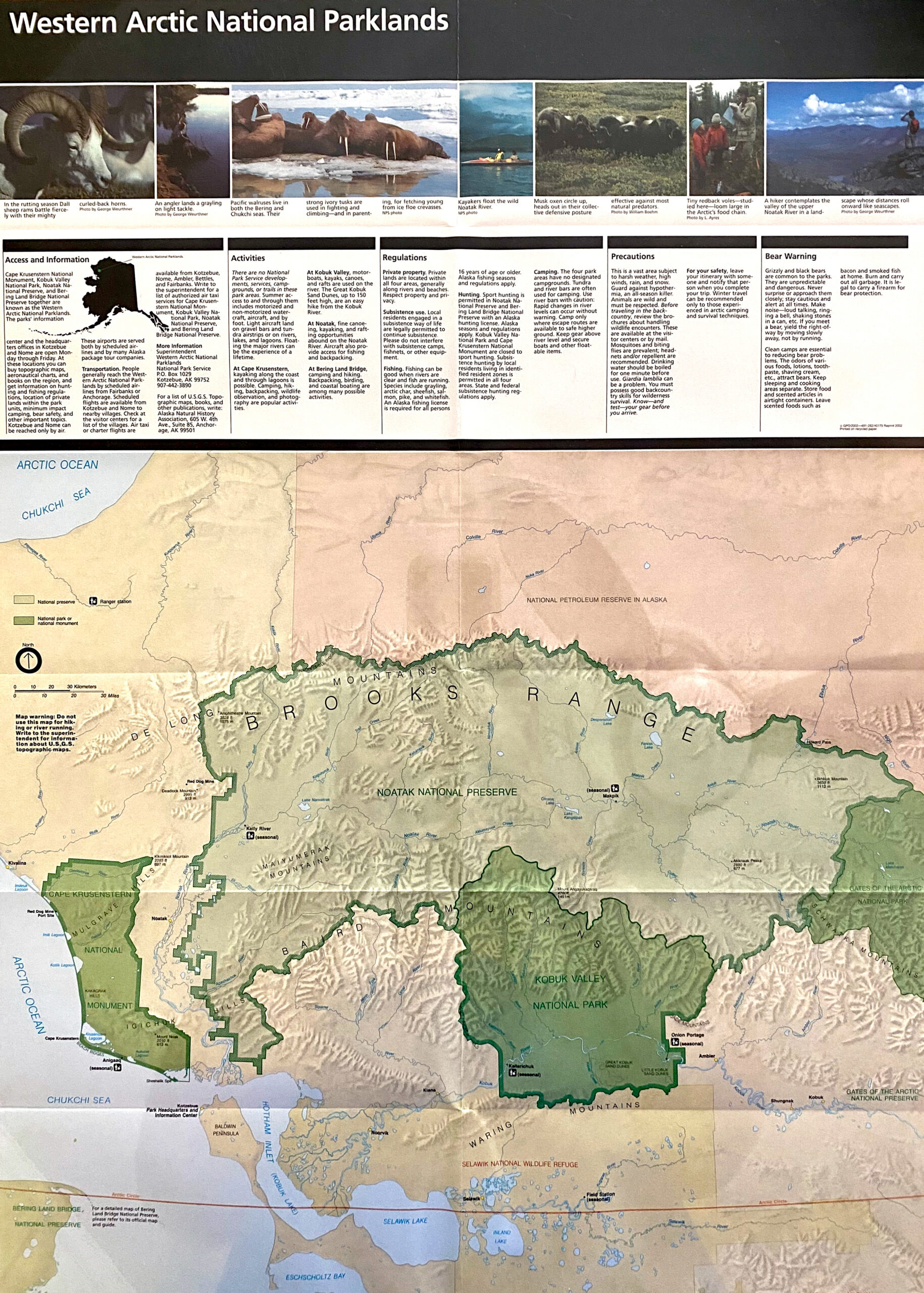
A large regional map fills the display, using outlined and shaded areas to distinguish protected lands across northwestern Alaska. The panel heading again identifies “Western Arctic National Parks,” while small labels and geographic features organize the region around the parks and surrounding landscape. This map-focused view complements the adjacent interpretive panel by foregrounding location and boundaries rather than wildlife imagery.
Caption
A large regional map fills the display, using outlined and shaded areas to distinguish protected lands across northwestern Alaska. The panel heading again identifies “Western Arctic National Parks,” while small labels and geographic features organize the region around the parks and surrounding landscape. This map-focused view complements the adjacent interpretive panel by foregrounding location and boundaries rather than wildlife imagery.