Rainbow Point Trail – Bryce Canyon National Park
Rainbow Point Trail provides access to high elevation viewpoints overlooking the amphitheater formations of Bryce Canyon National Park. The landscape is defined by densely clustered hoodoos formed through differential erosion of sedimentary rock layers. Freeze-thaw cycles contribute to the gradual shaping of these vertical rock forms, producing one of the most distinctive geological environments in the American Southwest.
The Pink Cliffs formation visible throughout the park reflects sediment deposition during prehistoric inland sea conditions followed by uplift of the Colorado Plateau. Variations in rock hardness influence the formation of fins and spires that gradually separate into individual hoodoos. The elevated viewpoint at Rainbow Point emphasizes the scale and density of these formations.
Visitors encounter broad views across amphitheaters filled with layered rock formations that illustrate the influence of erosion on uplifted terrain. The high elevation provides perspective on the geological structure of the plateau and the processes shaping Bryce Canyon’s distinctive landscape.

A low visitor-center building sits among sagebrush, small trees, and pines beneath a red rock ridge. A paved approach and bench occupy the foreground, while a visitor stands near the entrance. The building’s broad, sloped roof and stone accents blend with the dry, wooded setting around Red Canyon.
Caption
A low visitor-center building sits among sagebrush, small trees, and pines beneath a red rock ridge. A paved approach and bench occupy the foreground, while a visitor stands near the entrance. The building’s broad, sloped roof and stone accents blend with the dry, wooded setting around Red Canyon.

A high timber ceiling spans a rustic room lined with stone and wood. Rows of chairs face a central area near a tall window, while tables and display cases occupy the sides. Natural light enters through the multi-pane window and smaller side openings, revealing the exposed trusses and substantial stonework that shape the interior.
Caption
A high timber ceiling spans a rustic room lined with stone and wood. Rows of chairs face a central area near a tall window, while tables and display cases occupy the sides. Natural light enters through the multi-pane window and smaller side openings, revealing the exposed trusses and substantial stonework that shape the interior.
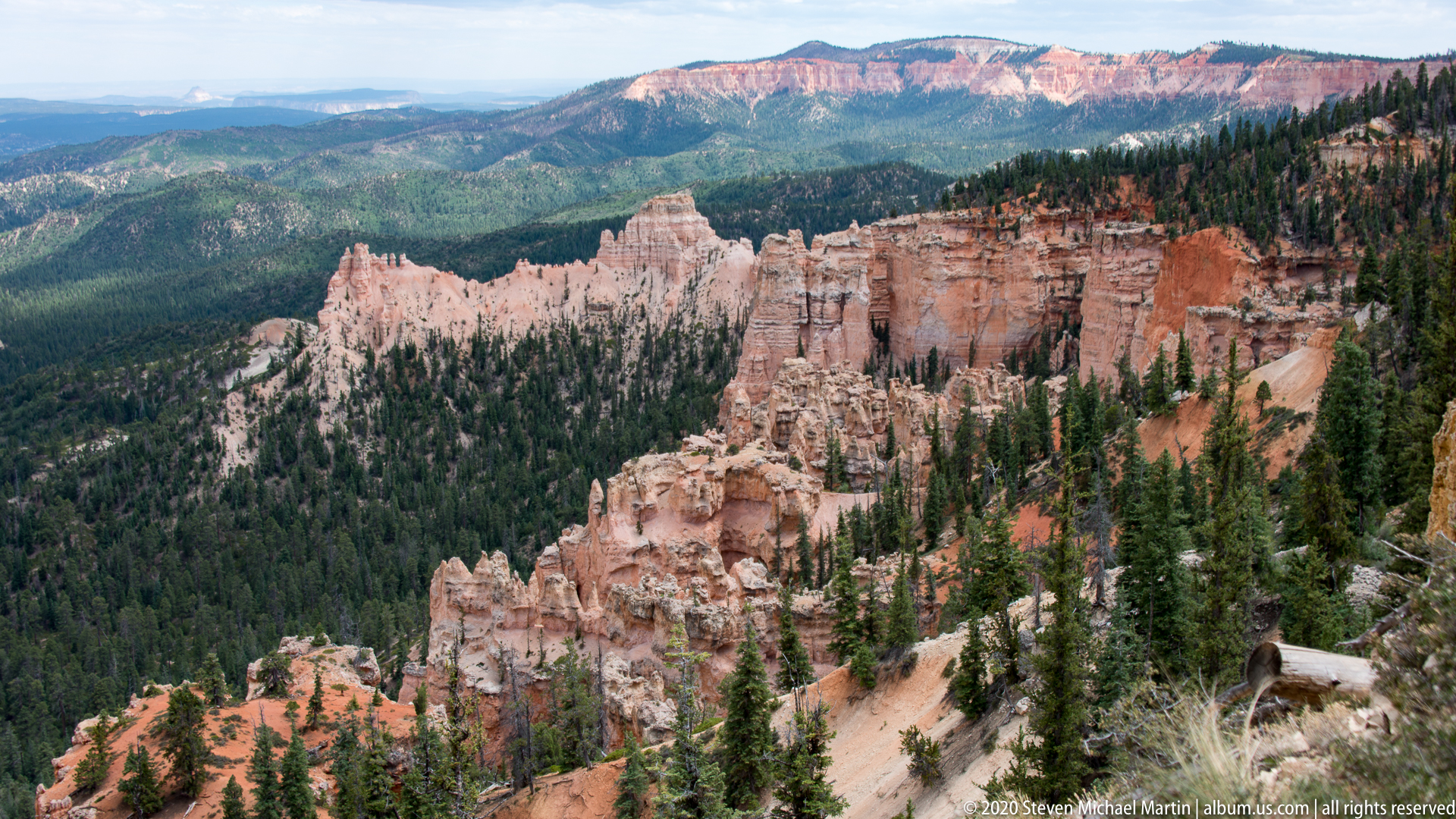
From the rim, pale orange and cream hoodoos descend into a deep, pine-covered basin, while a long band of cliffs traces the far horizon. The foreground slope falls steeply toward the central formations, giving the view a strong sense of depth. Scattered conifers interrupt the rock walls, showing how forest and exposed stone share the amphitheater.
Caption
From the rim, pale orange and cream hoodoos descend into a deep, pine-covered basin, while a long band of cliffs traces the far horizon. The foreground slope falls steeply toward the central formations, giving the view a strong sense of depth. Scattered conifers interrupt the rock walls, showing how forest and exposed stone share the amphitheater.

Rows of slender orange hoodoos descend into a deep, shaded section of canyon, their vertical forms marked by alternating pale and rust-colored bands. Dark openings and narrow gullies interrupt the cliff face, while small evergreen patches cling to ledges. This closer framing concentrates on the texture and repetition of the rock pinnacles rather than the full panorama.
Caption
Rows of slender orange hoodoos descend into a deep, shaded section of canyon, their vertical forms marked by alternating pale and rust-colored bands. Dark openings and narrow gullies interrupt the cliff face, while small evergreen patches cling to ledges. This closer framing concentrates on the texture and repetition of the rock pinnacles rather than the full panorama.

A black raven perches on a sandstone ledge with Bryce’s layered hoodoos and pine-filled basin behind it. The bird’s thick bill, shaggy throat feathers, and heavy body are visible in profile. This close foreground subject contrasts with the pale orange amphitheater and gives the expansive geological scene a clear point of scale.
Caption
A black raven perches on a sandstone ledge with Bryce’s layered hoodoos and pine-filled basin behind it. The bird’s thick bill, shaggy throat feathers, and heavy body are visible in profile. This close foreground subject contrasts with the pale orange amphitheater and gives the expansive geological scene a clear point of scale.
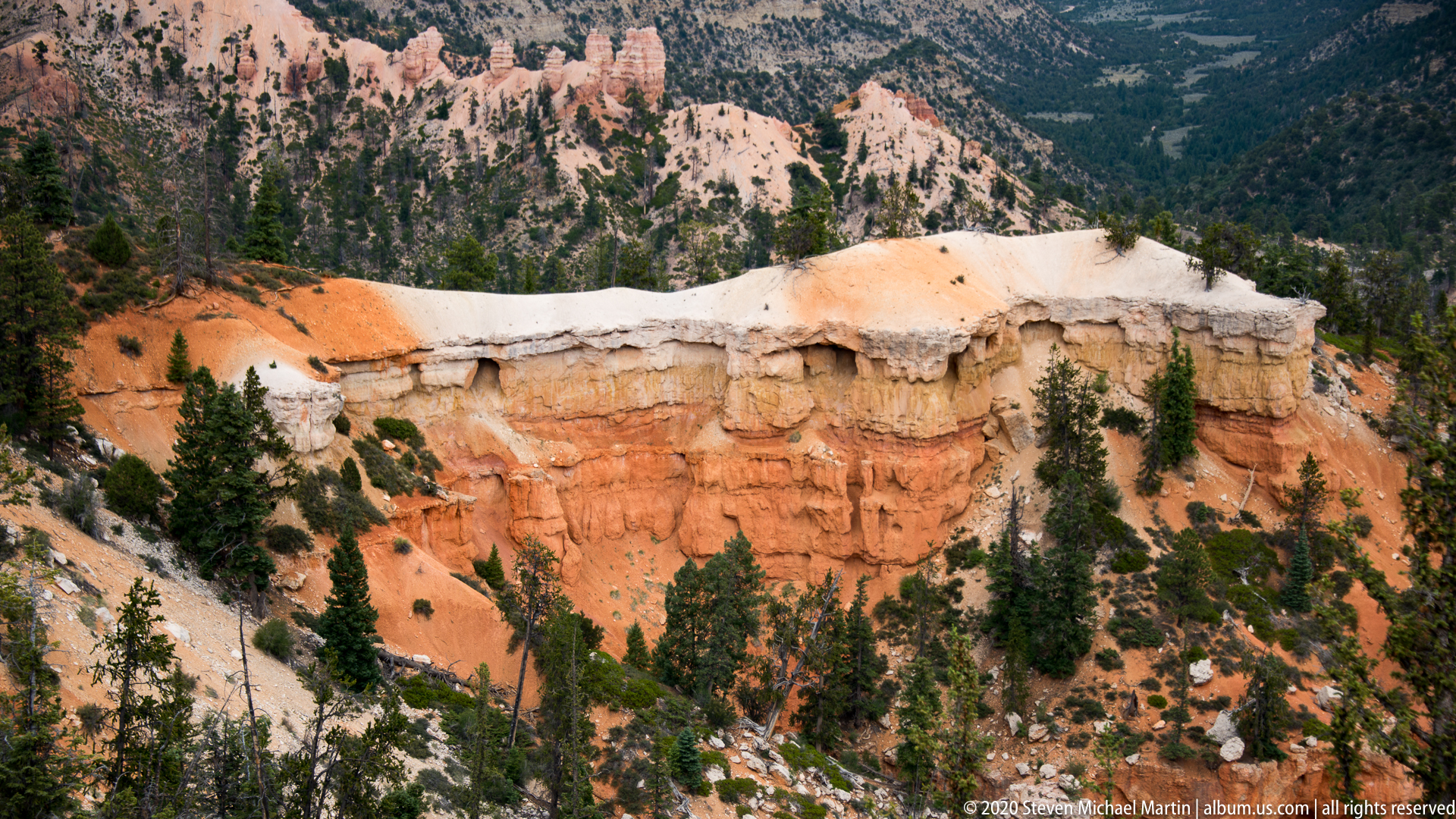
A nearly horizontal band of pale caprock crowns a broad orange cliff face. Dark pines rise across the lower slope and along the ridge, while the upper background recedes into a green, forested basin. The side-on view emphasizes the sharp color boundary between the light upper layer and the rust-colored rock beneath.
Caption
A nearly horizontal band of pale caprock crowns a broad orange cliff face. Dark pines rise across the lower slope and along the ridge, while the upper background recedes into a green, forested basin. The side-on view emphasizes the sharp color boundary between the light upper layer and the rust-colored rock beneath.
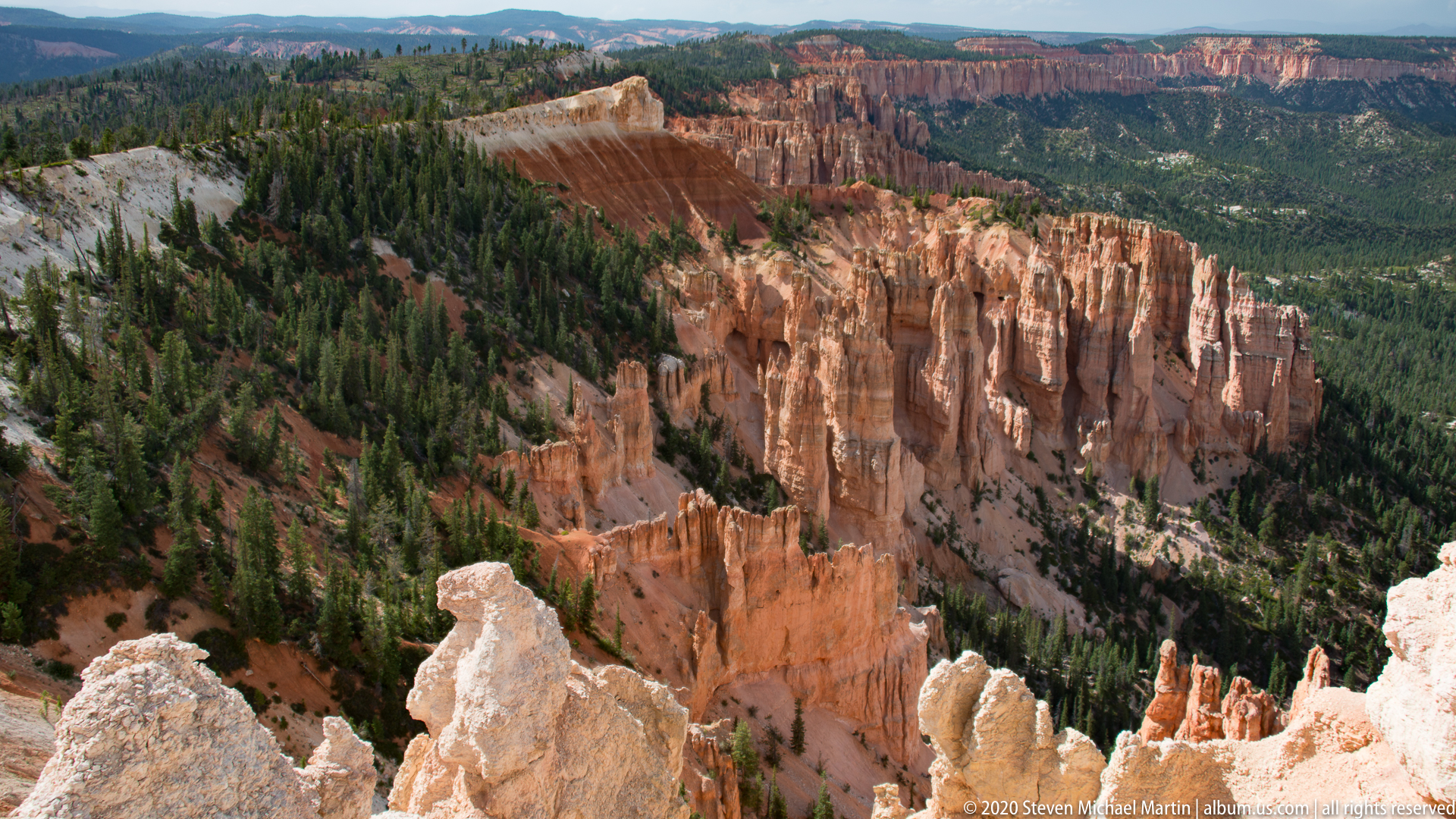
A broad sweep of orange pinnacles fills the canyon below, with dark green forest tracing the basin and distant rim. Pale stone spires in the foreground frame the amphitheater and reveal the depth of the drop from the overlook. The wide composition emphasizes the extent and density of the eroded formations rather than a single hoodoo.
Caption
A broad sweep of orange pinnacles fills the canyon below, with dark green forest tracing the basin and distant rim. Pale stone spires in the foreground frame the amphitheater and reveal the depth of the drop from the overlook. The wide composition emphasizes the extent and density of the eroded formations rather than a single hoodoo.

A rounded pale rock outcrop occupies the left foreground, overlooking a tall wall of cream and orange formations across the canyon. Vertical erosion channels and small caves mark the opposite cliff, while a line of pines follows the rim above. The composition contrasts the rough near ledge with the delicate, deeply sculpted face across the basin.
Caption
A rounded pale rock outcrop occupies the left foreground, overlooking a tall wall of cream and orange formations across the canyon. Vertical erosion channels and small caves mark the opposite cliff, while a line of pines follows the rim above. The composition contrasts the rough near ledge with the delicate, deeply sculpted face across the basin.
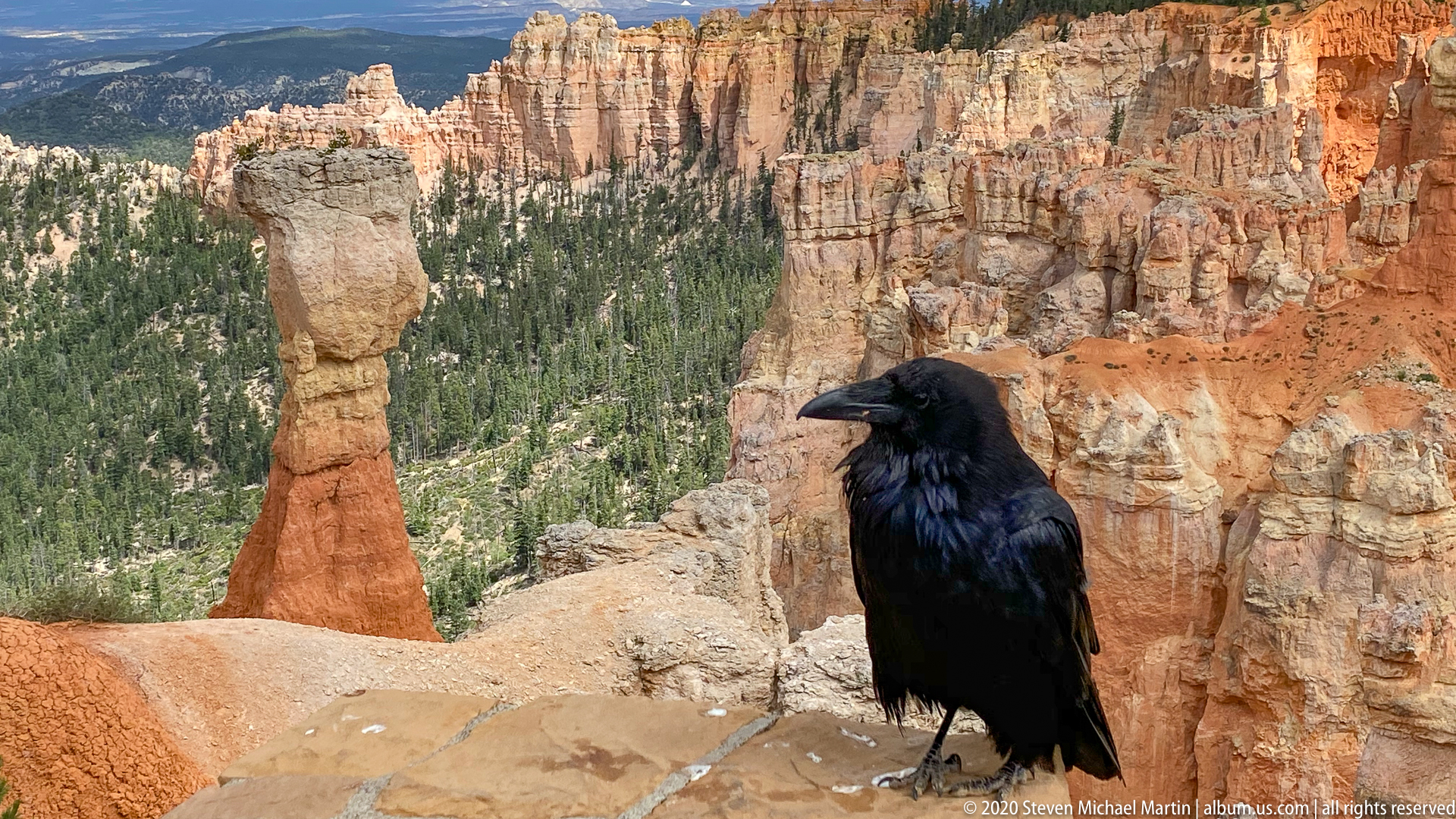
A raven perches on the overlook in the foreground while a slender hoodoo with a broad cap rises beyond it. The bird and rock column form two dark and pale vertical accents against the forested amphitheater. This composition links wildlife and geology through their contrasting forms and scales.
Caption
A raven perches on the overlook in the foreground while a slender hoodoo with a broad cap rises beyond it. The bird and rock column form two dark and pale vertical accents against the forested amphitheater. This composition links wildlife and geology through their contrasting forms and scales.

A bleached, weathered trunk lies diagonally across an exposed rim surrounded by low green shrubs and dry soil. Beyond it, orange hoodoos and forested ridges fall away into the canyon. The fallen wood anchors the foreground and suggests the harsh exposure of the high, rocky edge without specifying its cause.
Caption
A bleached, weathered trunk lies diagonally across an exposed rim surrounded by low green shrubs and dry soil. Beyond it, orange hoodoos and forested ridges fall away into the canyon. The fallen wood anchors the foreground and suggests the harsh exposure of the high, rocky edge without specifying its cause.
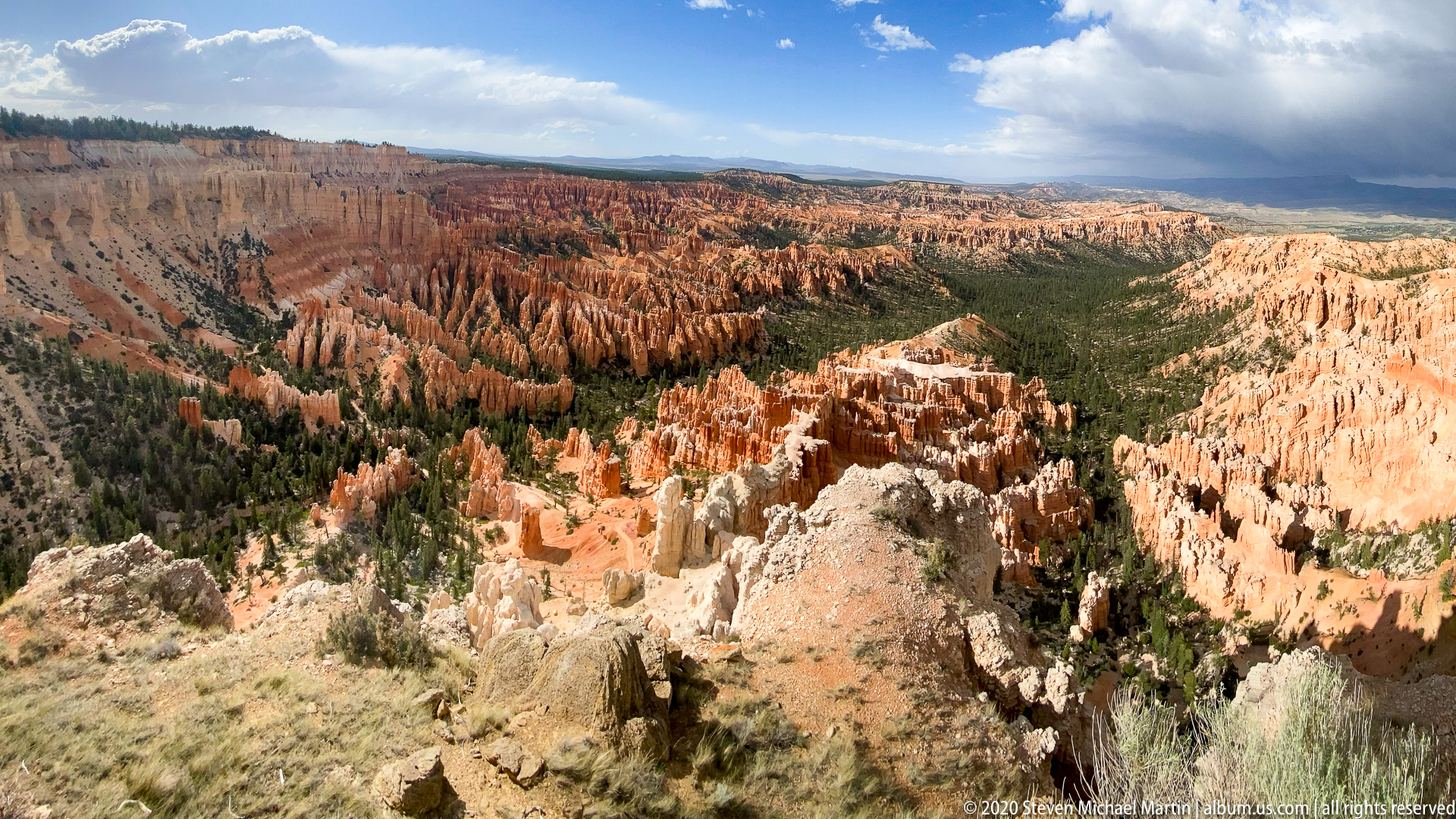
A wide panorama opens across a dense field of orange hoodoos descending through a forested basin. The nearest pale rock ledges frame the lower edge, while distant cliffs and a broad sky establish the scale of the amphitheater. Sunlight catches the formations unevenly, bringing out bands of orange, cream, and shadow across the eroded terrain.
Caption
A wide panorama opens across a dense field of orange hoodoos descending through a forested basin. The nearest pale rock ledges frame the lower edge, while distant cliffs and a broad sky establish the scale of the amphitheater. Sunlight catches the formations unevenly, bringing out bands of orange, cream, and shadow across the eroded terrain.
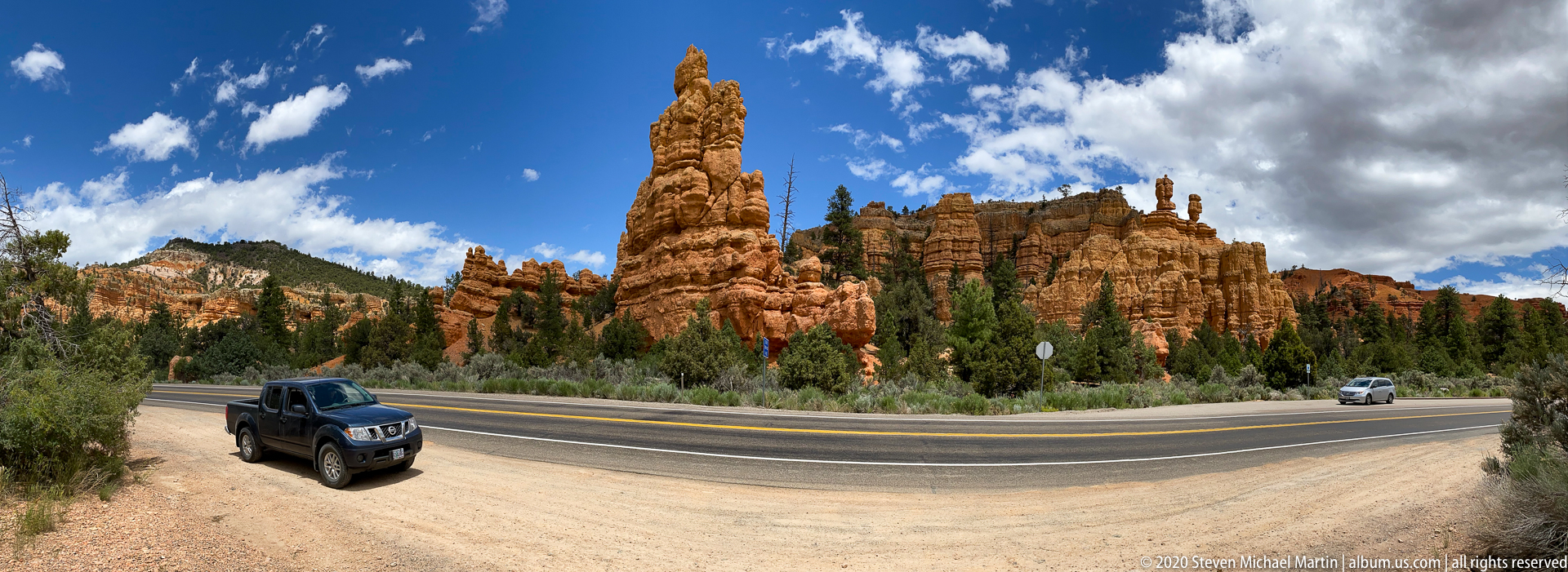
A paved road sweeps across the foreground beneath a row of red hoodoos and tall, narrow pinnacles. A dark pickup is parked on the sandy shoulder, while evergreen trees cluster at the formations’ base. Sunlit rock and a bank of white cloud give the view a strong contrast between developed roadway and eroded landscape.
Caption
A paved road sweeps across the foreground beneath a row of red hoodoos and tall, narrow pinnacles. A dark pickup is parked on the sandy shoulder, while evergreen trees cluster at the formations’ base. Sunlit rock and a bank of white cloud give the view a strong contrast between developed roadway and eroded landscape.
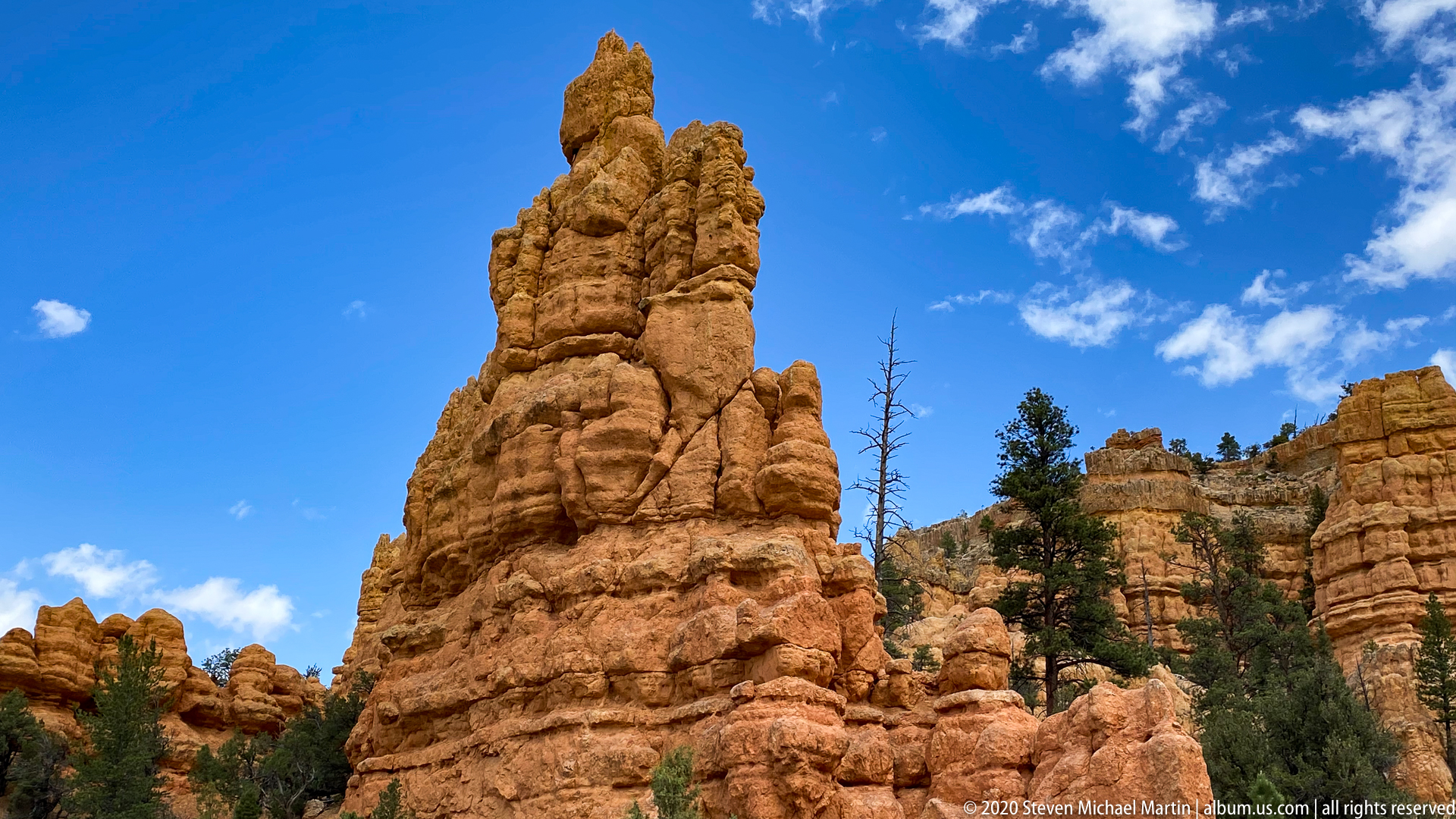
A tall, irregular hoodoo rises against a clear blue sky, its stacked sandstone layers forming a narrow summit above a wider eroded base. Smaller rock columns and pines crowd the lower slope, while a bare tree stands to the right. The close upward view emphasizes the tower’s height and banded, weathered surface.
Caption
A tall, irregular hoodoo rises against a clear blue sky, its stacked sandstone layers forming a narrow summit above a wider eroded base. Smaller rock columns and pines crowd the lower slope, while a bare tree stands to the right. The close upward view emphasizes the tower’s height and banded, weathered surface.
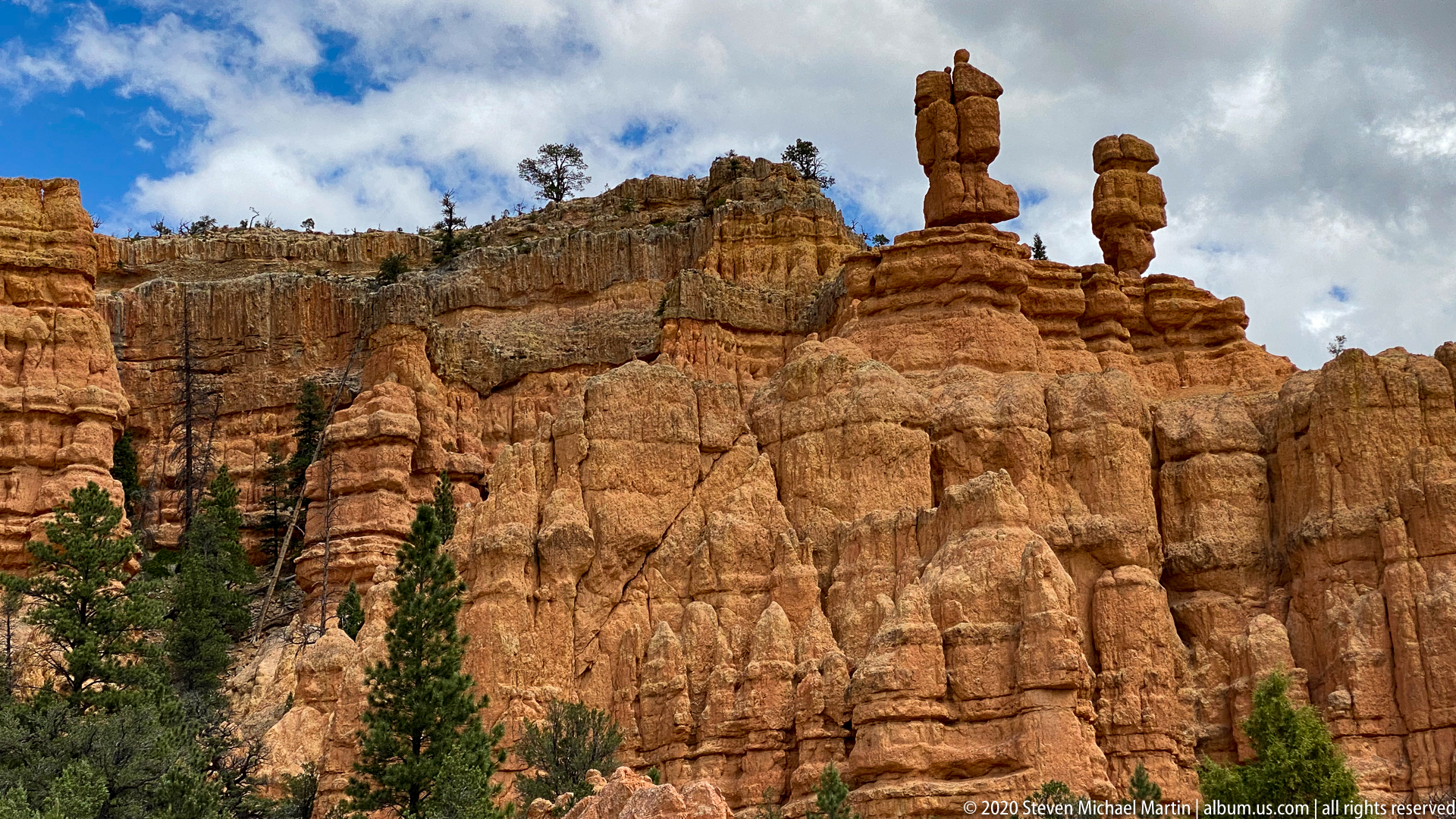
Two slender, balanced-looking hoodoo columns rise above a broad terraced wall of red sandstone. The closest column has a blocky cap and narrow pedestal; a second, shorter pillar stands to its right. Scattered pines break up the lower formations, while pale clouds frame the upper rock ledges.
Caption
Two slender, balanced-looking hoodoo columns rise above a broad terraced wall of red sandstone. The closest column has a blocky cap and narrow pedestal; a second, shorter pillar stands to its right. Scattered pines break up the lower formations, while pale clouds frame the upper rock ledges.
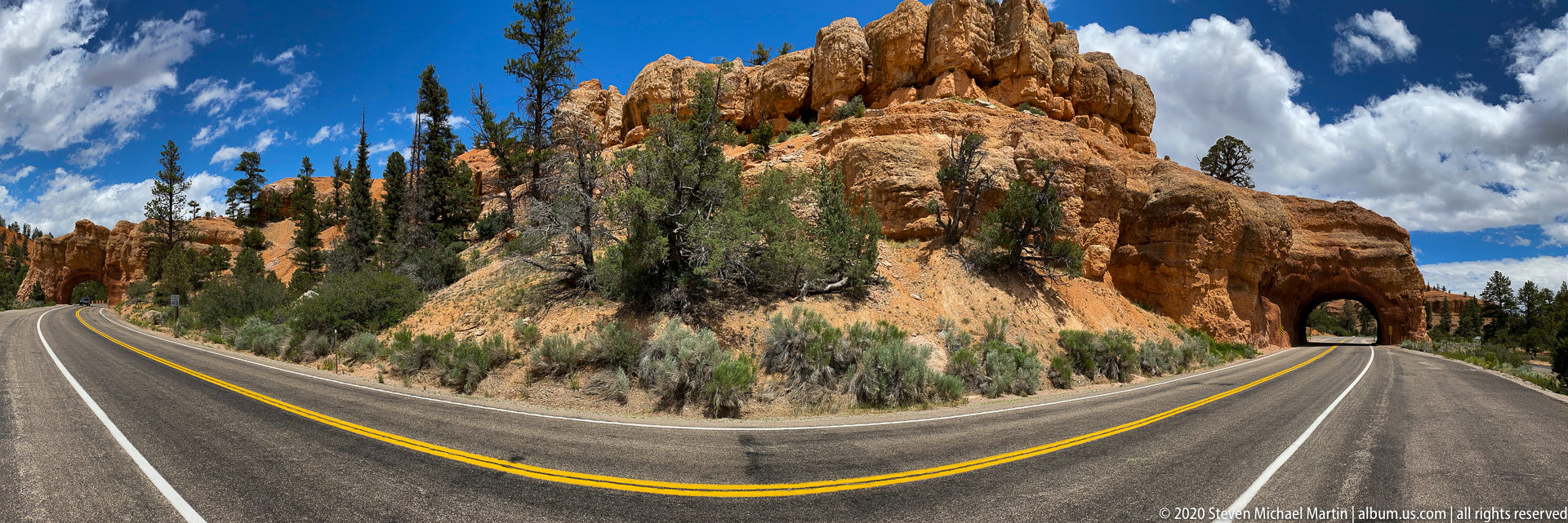
A two-lane road curves beneath a rugged sandstone slope and enters a dark tunnel cut directly through the red rock. Double yellow center lines lead the eye toward the opening, while pines and shrubs cling to the surrounding formations. The view centers on the passage through the rock and the road’s sweeping approach.
Caption
A two-lane road curves beneath a rugged sandstone slope and enters a dark tunnel cut directly through the red rock. Double yellow center lines lead the eye toward the opening, while pines and shrubs cling to the surrounding formations. The view centers on the passage through the rock and the road’s sweeping approach.
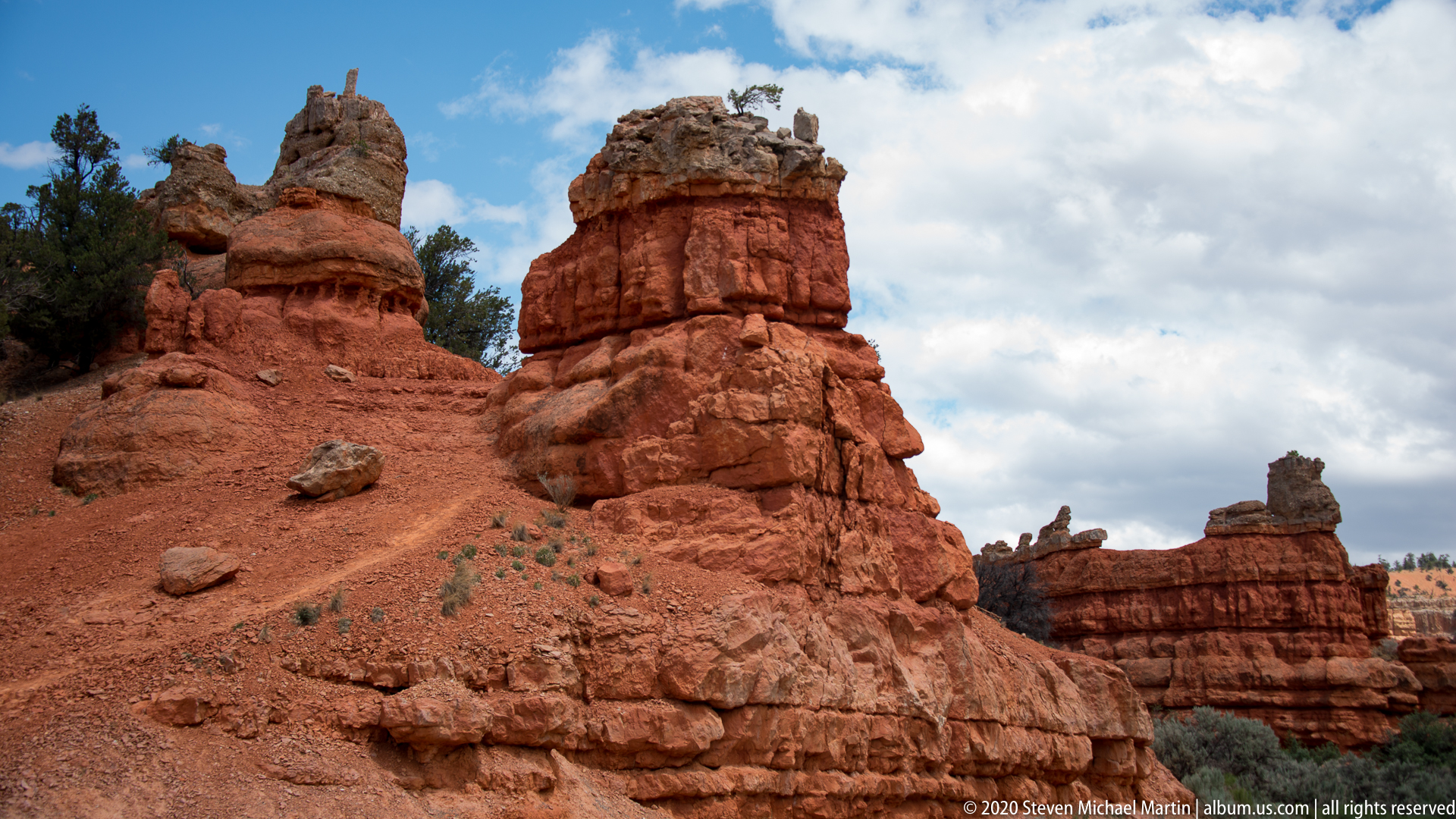
Several eroded sandstone pillars fill the frame, their rounded, stacked layers topped by irregular cap-like stones. A steep red slope with scattered shrubs rises behind the nearest column, while darker forest appears along the edge. The close composition highlights the contrasting textures of softer slopes and more resistant rock ledges.
Caption
Several eroded sandstone pillars fill the frame, their rounded, stacked layers topped by irregular cap-like stones. A steep red slope with scattered shrubs rises behind the nearest column, while darker forest appears along the edge. The close composition highlights the contrasting textures of softer slopes and more resistant rock ledges.
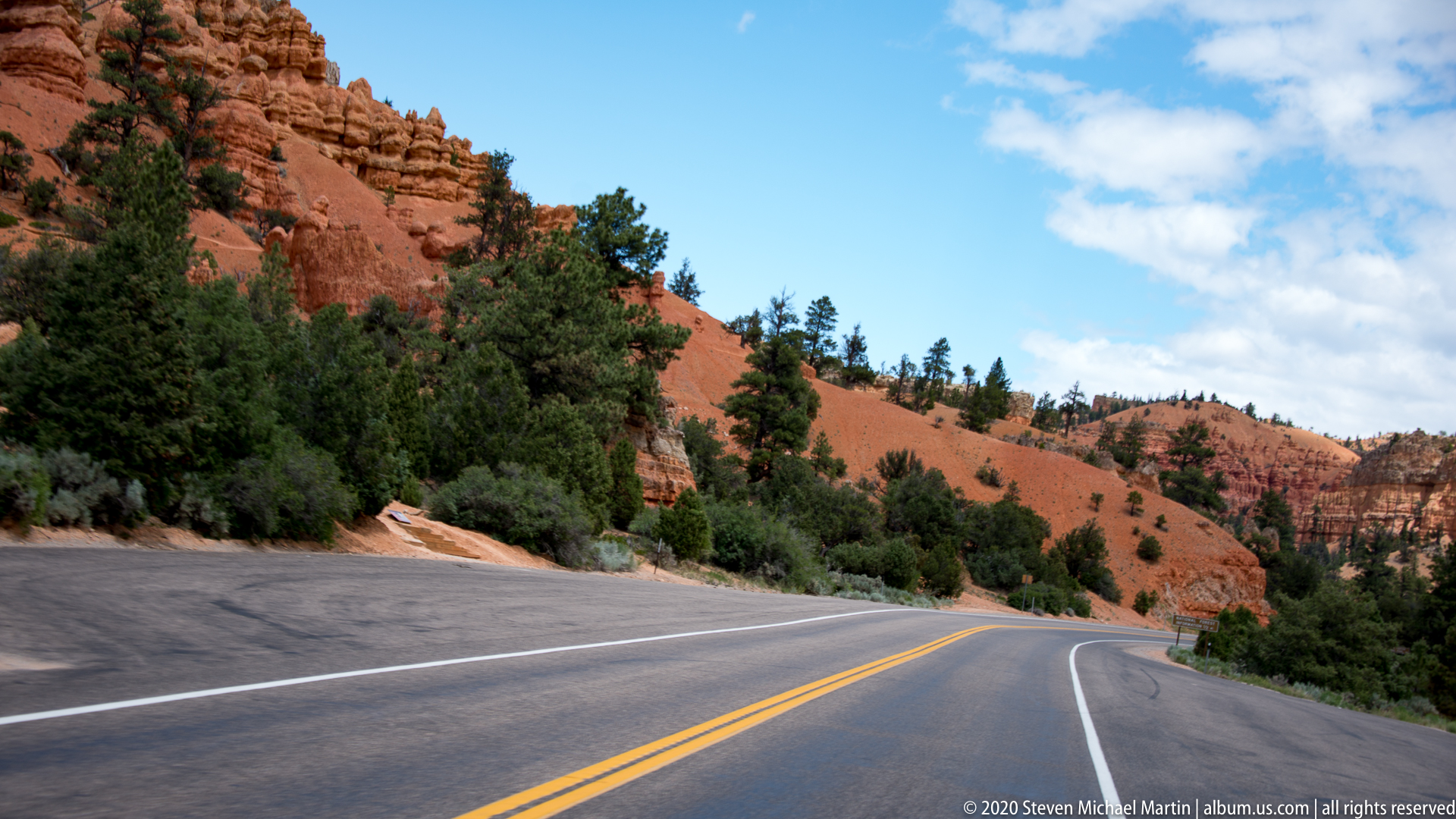
A smooth highway curves around a wooded red-rock hillside, with double yellow lines and white edge markings leading into the bend. Pine trees cover the slope beneath a high band of orange sandstone, and open blue sky occupies the upper right. The road’s curve is the main compositional line through the forested terrain.
Caption
A smooth highway curves around a wooded red-rock hillside, with double yellow lines and white edge markings leading into the bend. Pine trees cover the slope beneath a high band of orange sandstone, and open blue sky occupies the upper right. The road’s curve is the main compositional line through the forested terrain.
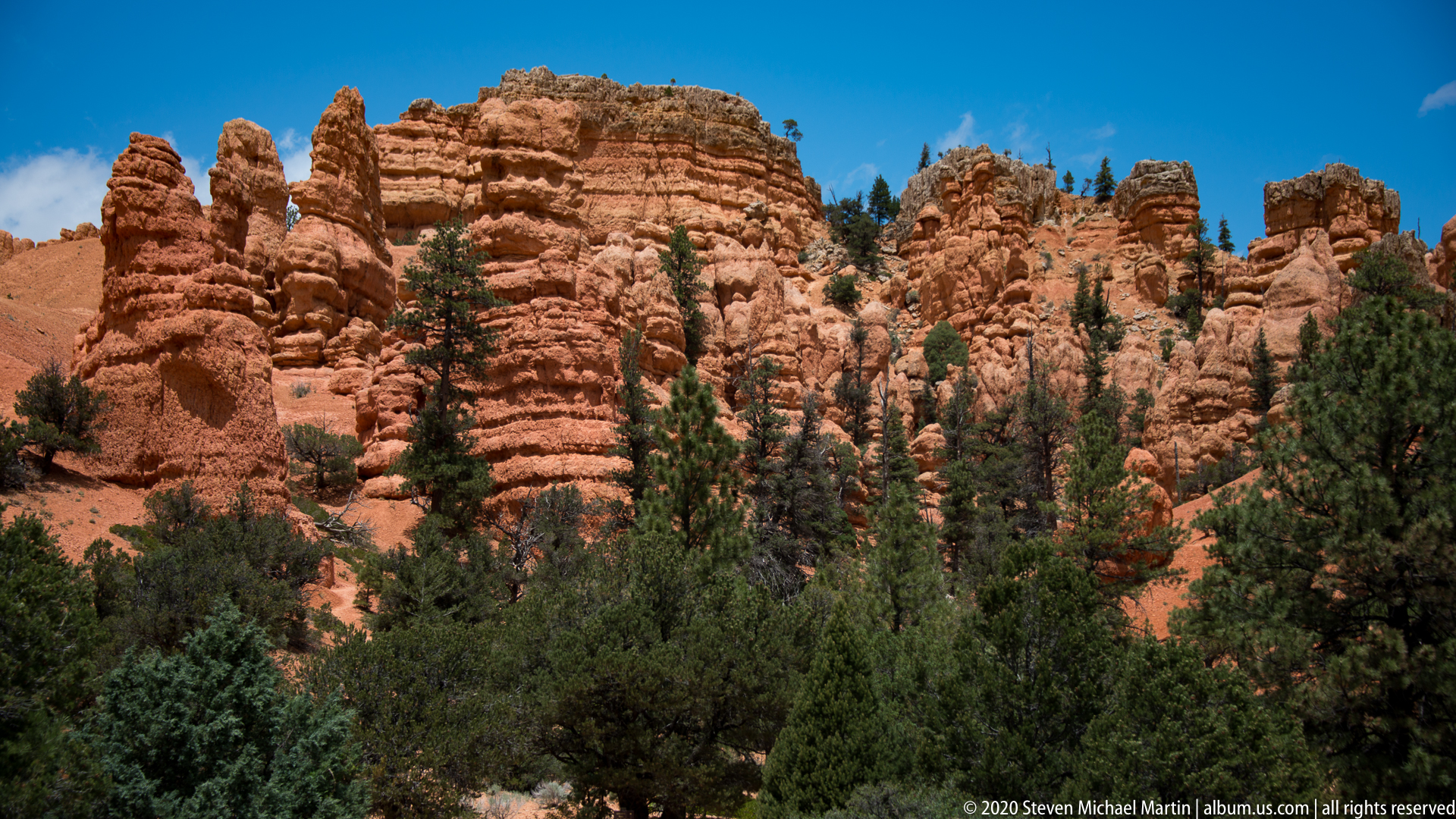
A dense wall of orange hoodoos rises above a dark band of pines, with rounded columns and narrow spires packed across the slope. Their repeated horizontal bands create a ribbed texture against the clear blue sky. The view is framed from below, emphasizing the steepness and density of the eroded formation.
Caption
A dense wall of orange hoodoos rises above a dark band of pines, with rounded columns and narrow spires packed across the slope. Their repeated horizontal bands create a ribbed texture against the clear blue sky. The view is framed from below, emphasizing the steepness and density of the eroded formation.

A short, narrow hoodoo with a broad gray cap stands in front of a larger orange cliff. Pine trees and shrubs fill the lower slope, while a taller, rounded rock mass anchors the background. The foreground column’s contrasting cap and pedestal make it distinct from the broad, layered formations behind it.
Caption
A short, narrow hoodoo with a broad gray cap stands in front of a larger orange cliff. Pine trees and shrubs fill the lower slope, while a taller, rounded rock mass anchors the background. The foreground column’s contrasting cap and pedestal make it distinct from the broad, layered formations behind it.
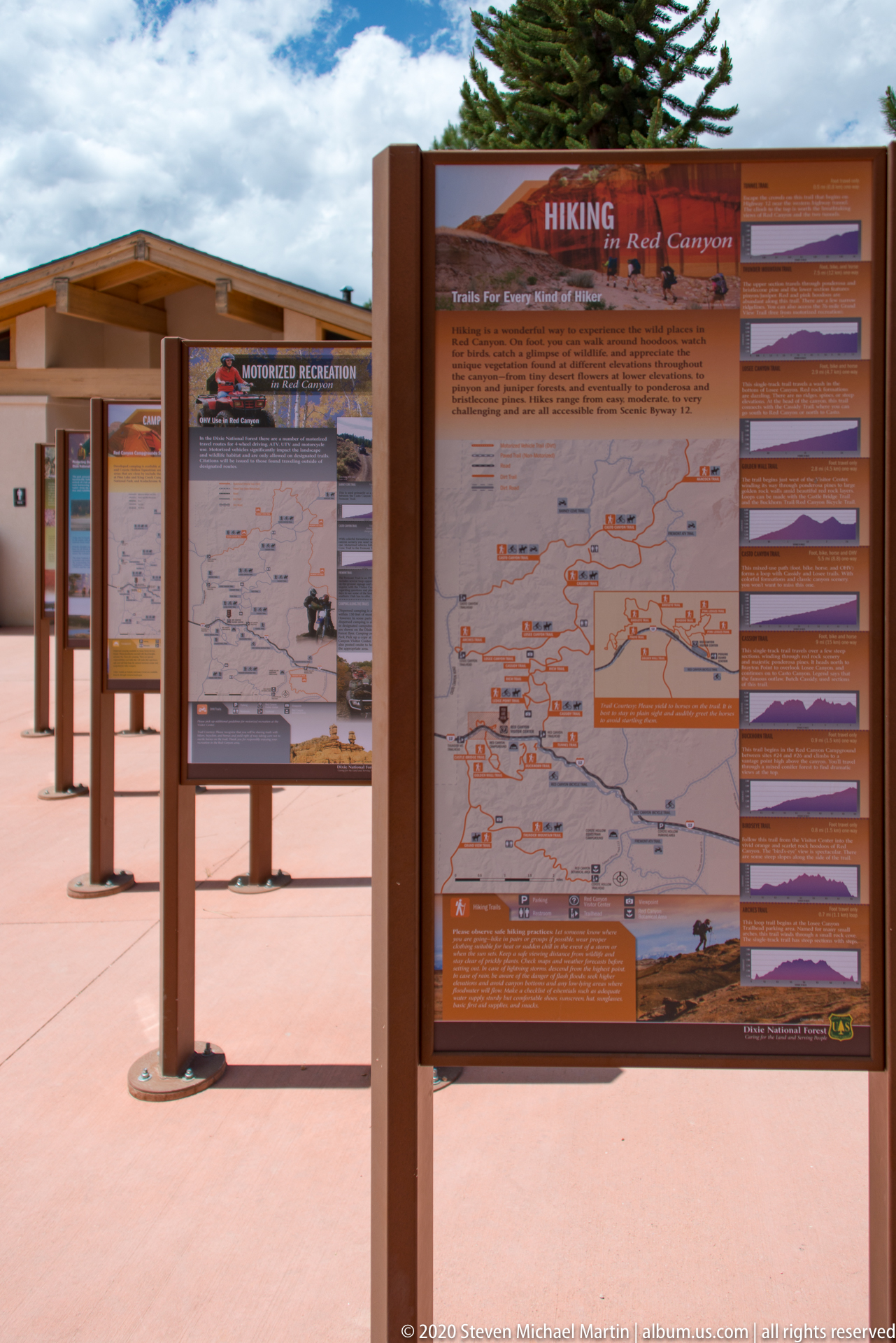
A row of outdoor interpretive panels presents maps and route information, with the nearest board titled “Hiking Red Canyon.” The large panel includes a trail map and a vertical sequence of elevation profiles, while a second map board stands behind it. Their placement in a paved plaza makes the display accessible to visitors planning a walk.
Caption
A row of outdoor interpretive panels presents maps and route information, with the nearest board titled “Hiking Red Canyon.” The large panel includes a trail map and a vertical sequence of elevation profiles, while a second map board stands behind it. Their placement in a paved plaza makes the display accessible to visitors planning a walk.
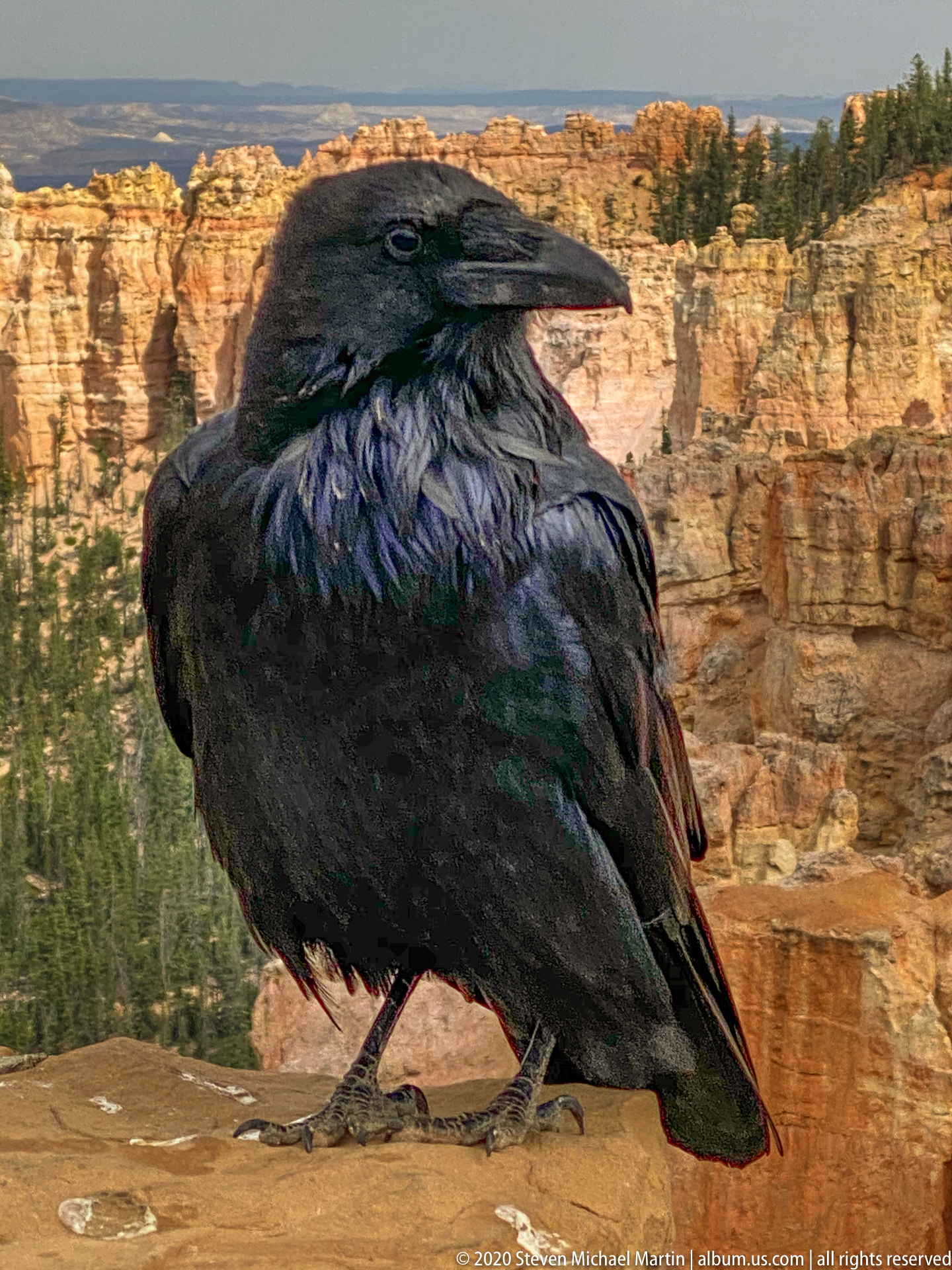
A raven stands in close profile on a flat sandstone surface, its heavy bill and glossy black plumage sharply outlined against a blurred amphitheater of orange rock. The shallow focus softens the distant hoodoos and trees, concentrating attention on the bird’s shape and feather texture at the canyon rim.
Caption
A raven stands in close profile on a flat sandstone surface, its heavy bill and glossy black plumage sharply outlined against a blurred amphitheater of orange rock. The shallow focus softens the distant hoodoos and trees, concentrating attention on the bird’s shape and feather texture at the canyon rim.

Several tall interpretive displays stand beside a visitor-center building. The nearest sign reads “Welcome to Red Canyon Visitor Center,” with maps and photographs arranged across its face; neighboring panels explain local wildlife and scenery. A paved walk and roadside remain visible behind the signs, situating the exhibit in the visitor area.
Caption
Several tall interpretive displays stand beside a visitor-center building. The nearest sign reads “Welcome to Red Canyon Visitor Center,” with maps and photographs arranged across its face; neighboring panels explain local wildlife and scenery. A paved walk and roadside remain visible behind the signs, situating the exhibit in the visitor area.
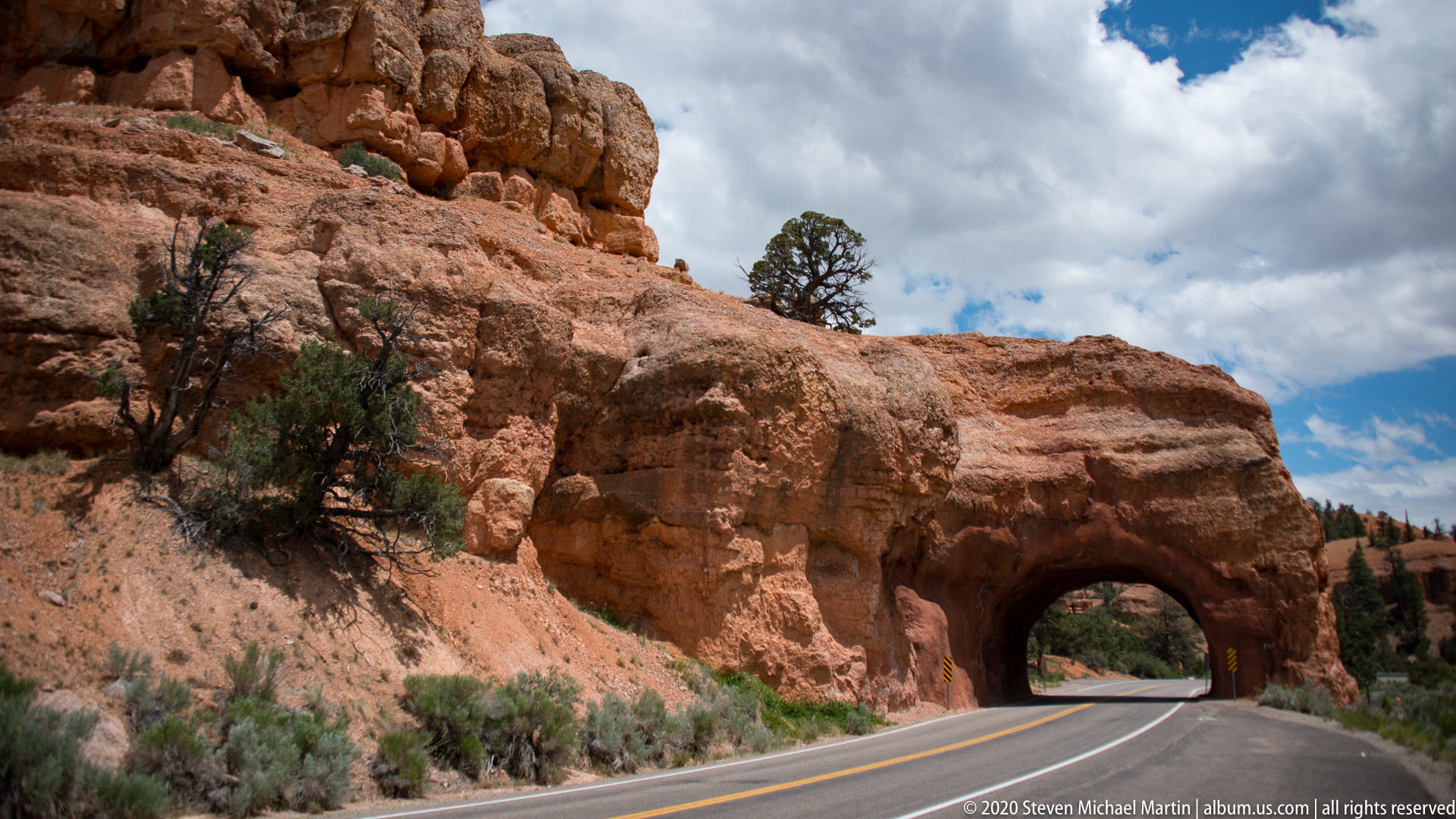
A dark tunnel opening cuts through a massive red sandstone outcrop beside a two-lane road. The highway bends toward the entrance, where its yellow center line disappears into shadow. Layered rock, shrubs, and a lone pine frame the passage, highlighting the contrast between the natural cliff and the engineered route.
Caption
A dark tunnel opening cuts through a massive red sandstone outcrop beside a two-lane road. The highway bends toward the entrance, where its yellow center line disappears into shadow. Layered rock, shrubs, and a lone pine frame the passage, highlighting the contrast between the natural cliff and the engineered route.

A large natural opening cuts through a pale sandstone wall, exposing dark trees through its center. Orange and cream rock layers surround the aperture, with sparse shrubs and pines clinging to the slopes. The closer viewpoint reveals the arch’s thick, irregular rim and the eroded basin below it.
Caption
A large natural opening cuts through a pale sandstone wall, exposing dark trees through its center. Orange and cream rock layers surround the aperture, with sparse shrubs and pines clinging to the slopes. The closer viewpoint reveals the arch’s thick, irregular rim and the eroded basin below it.
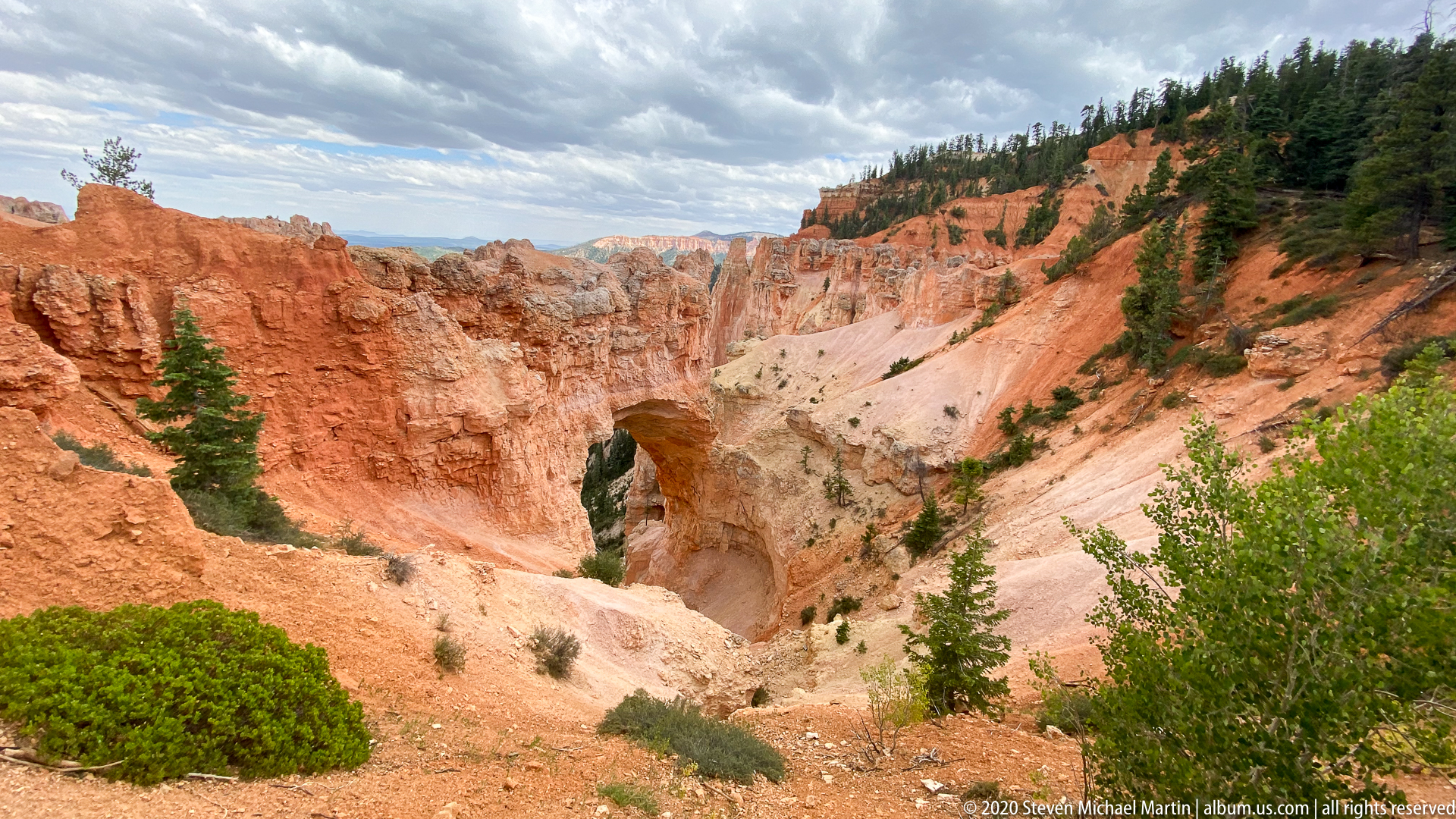
A natural opening in a pale sandstone wall sits near the center of a broad canyon basin. Orange cliffs rise to the left, while a pine-covered slope and leafy shrubs fill the right side. The wider perspective places the arch within a layered landscape of exposed rock, scattered trees, and a softly clouded sky.
Caption
A natural opening in a pale sandstone wall sits near the center of a broad canyon basin. Orange cliffs rise to the left, while a pine-covered slope and leafy shrubs fill the right side. The wider perspective places the arch within a layered landscape of exposed rock, scattered trees, and a softly clouded sky.
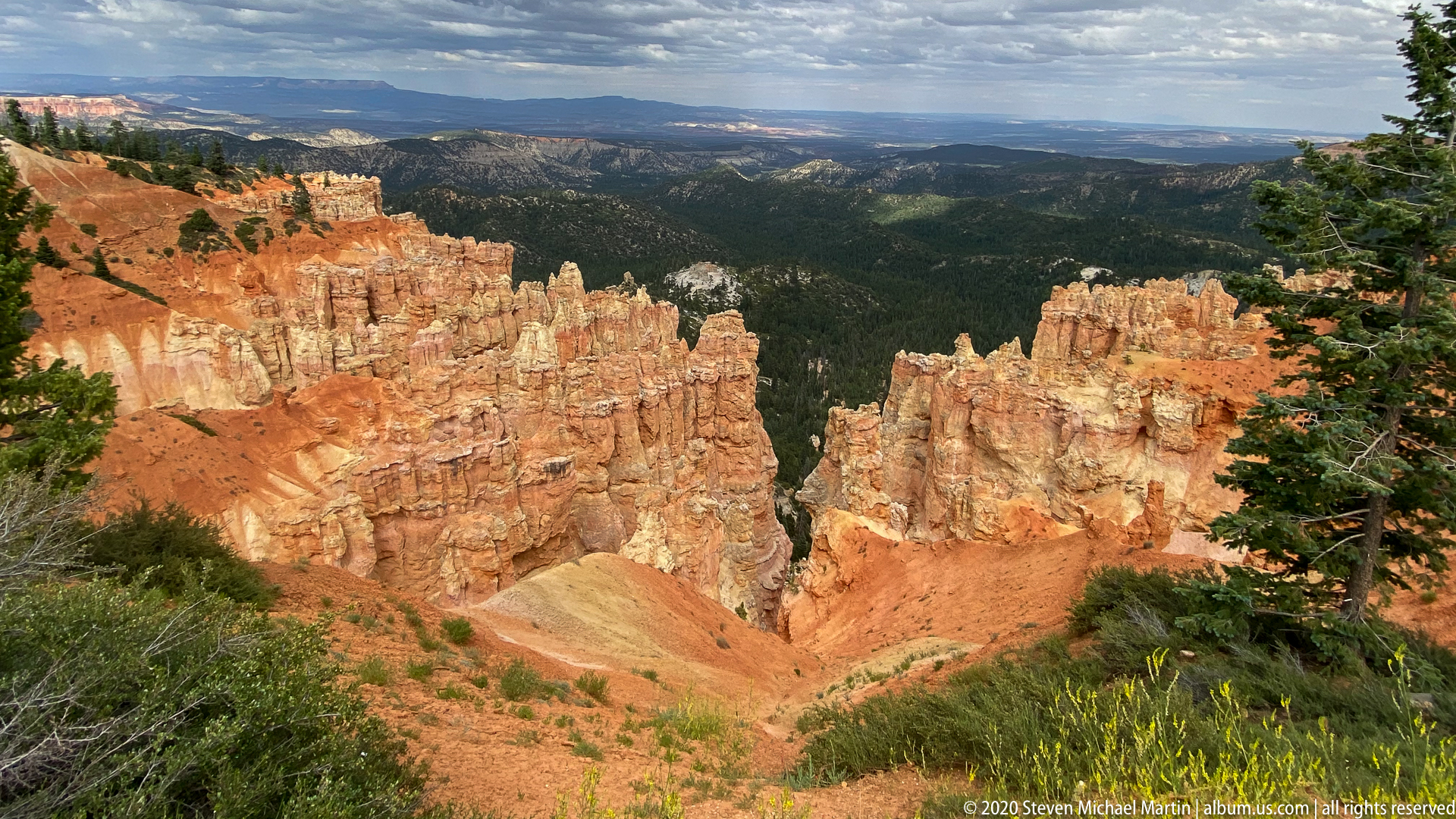
A broad panorama looks across rows of orange hoodoos into a deep, forested basin and distant plateau. The nearest rock spires fill the lower left, while evergreen slopes and a hazy horizon extend to the right. Cloud shadows soften the far landscape, making the canyon’s depth and transition to woodland especially clear.
Caption
A broad panorama looks across rows of orange hoodoos into a deep, forested basin and distant plateau. The nearest rock spires fill the lower left, while evergreen slopes and a hazy horizon extend to the right. Cloud shadows soften the far landscape, making the canyon’s depth and transition to woodland especially clear.

A dirt trail passes through a stand of trees marked by fire damage, with an interpretive sign titled “Fire Fuel” beside the path. Blackened trunks and scattered deadwood contrast with surviving green pines and shrubs. The panel introduces the role of forest fuels as visitors enter the trail corridor.
Caption
A dirt trail passes through a stand of trees marked by fire damage, with an interpretive sign titled “Fire Fuel” beside the path. Blackened trunks and scattered deadwood contrast with surviving green pines and shrubs. The panel introduces the role of forest fuels as visitors enter the trail corridor.
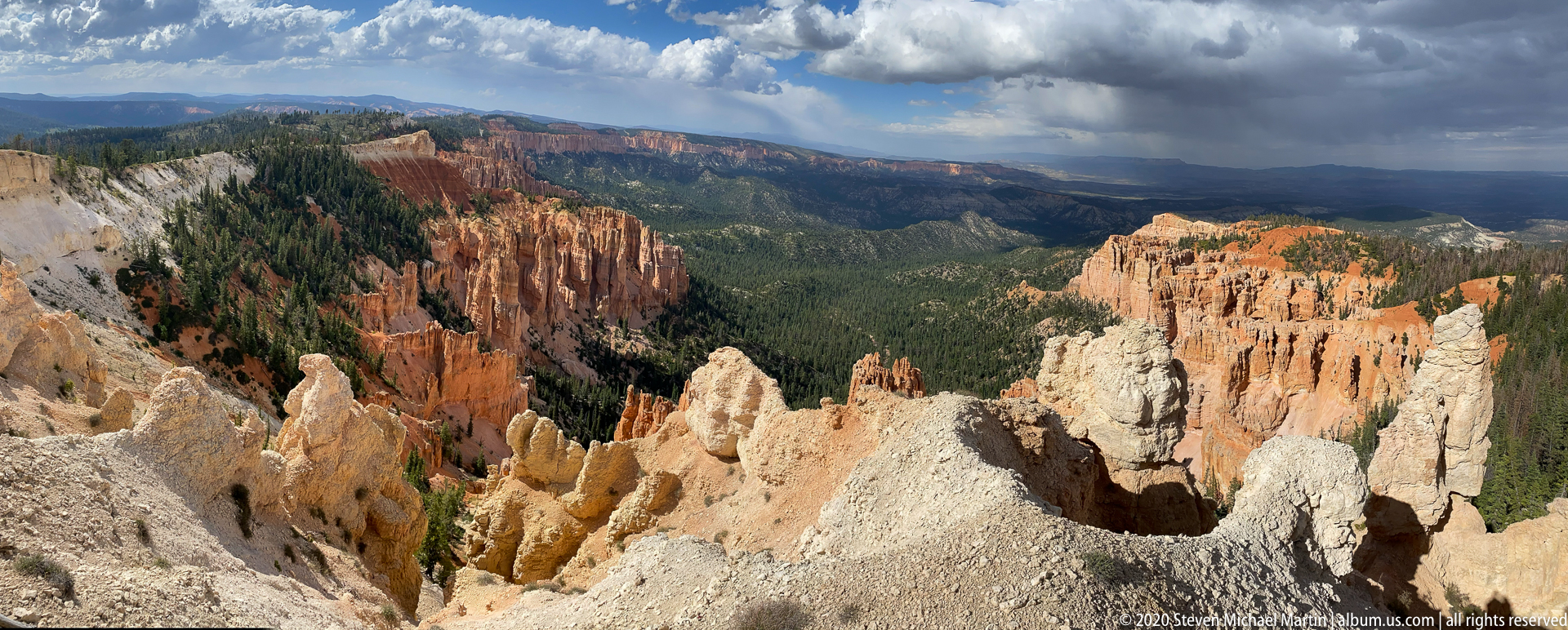
Pale hoodoos rise from the near rim above a broad amphitheater of orange cliffs and dark evergreen forest. A storm cloud hangs over the distant plateau, while sunlight strikes the nearer spires and far wall. The view layers the pale foreground formations against the darker basin and wooded horizon.
Caption
Pale hoodoos rise from the near rim above a broad amphitheater of orange cliffs and dark evergreen forest. A storm cloud hangs over the distant plateau, while sunlight strikes the nearer spires and far wall. The view layers the pale foreground formations against the darker basin and wooded horizon.

The rim curves across the frame as a long wall of orange and cream rock above a forested basin. Jagged hoodoos descend from the cliff edge into dark pines, while a distant plateau forms a low horizon. The oblique view emphasizes the continuity of the rock face and the depth of the amphitheater.
Caption
The rim curves across the frame as a long wall of orange and cream rock above a forested basin. Jagged hoodoos descend from the cliff edge into dark pines, while a distant plateau forms a low horizon. The oblique view emphasizes the continuity of the rock face and the depth of the amphitheater.
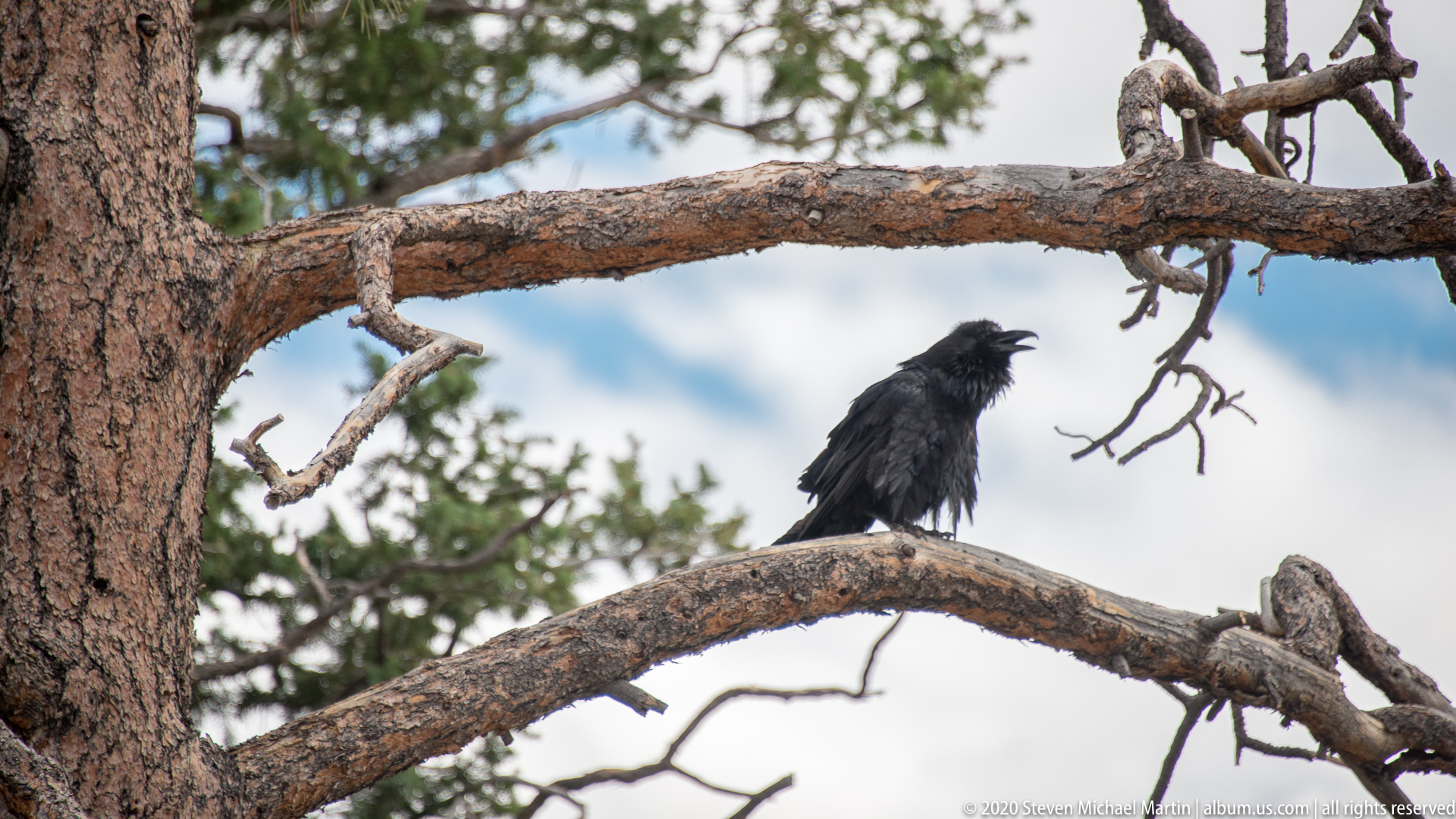
A black raven perches on a horizontal pine branch, framed by rough bark and smaller twigs. Its heavy bill and shaggy throat feathers stand out against a pale, clouded sky. The sparse composition isolates the bird from the canyon scenery, presenting a clear wildlife portrait in its wooded rim habitat.
Caption
A black raven perches on a horizontal pine branch, framed by rough bark and smaller twigs. Its heavy bill and shaggy throat feathers stand out against a pale, clouded sky. The sparse composition isolates the bird from the canyon scenery, presenting a clear wildlife portrait in its wooded rim habitat.
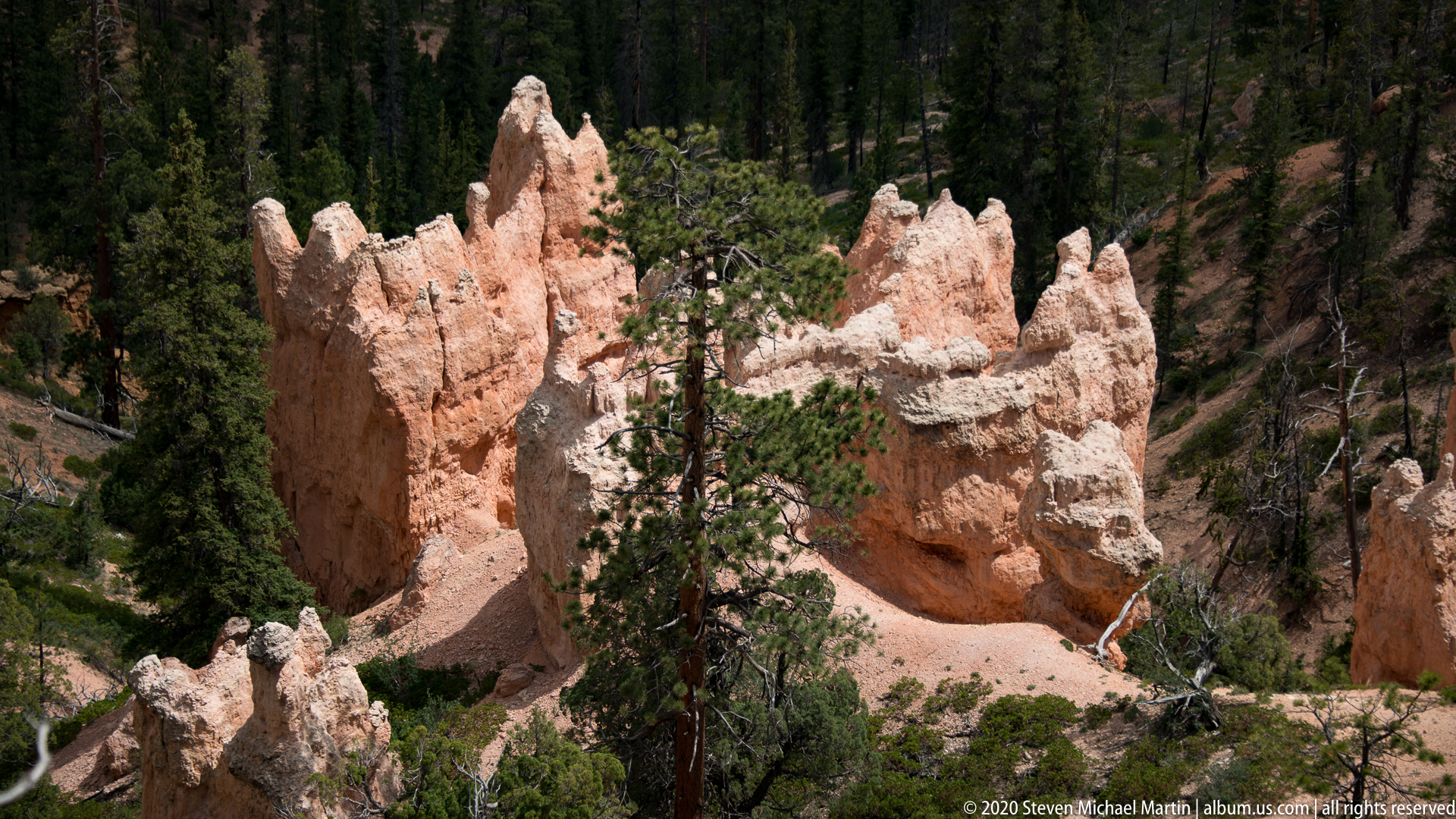
Several pale, irregular hoodoos rise from a steep orange slope surrounded by dark evergreen trees. Their narrow pinnacles and uneven caps contrast with the dense forest behind and below them. The elevated view looks into the formation, showing how isolated rock towers interrupt the wooded canyon wall.
Caption
Several pale, irregular hoodoos rise from a steep orange slope surrounded by dark evergreen trees. Their narrow pinnacles and uneven caps contrast with the dense forest behind and below them. The elevated view looks into the formation, showing how isolated rock towers interrupt the wooded canyon wall.
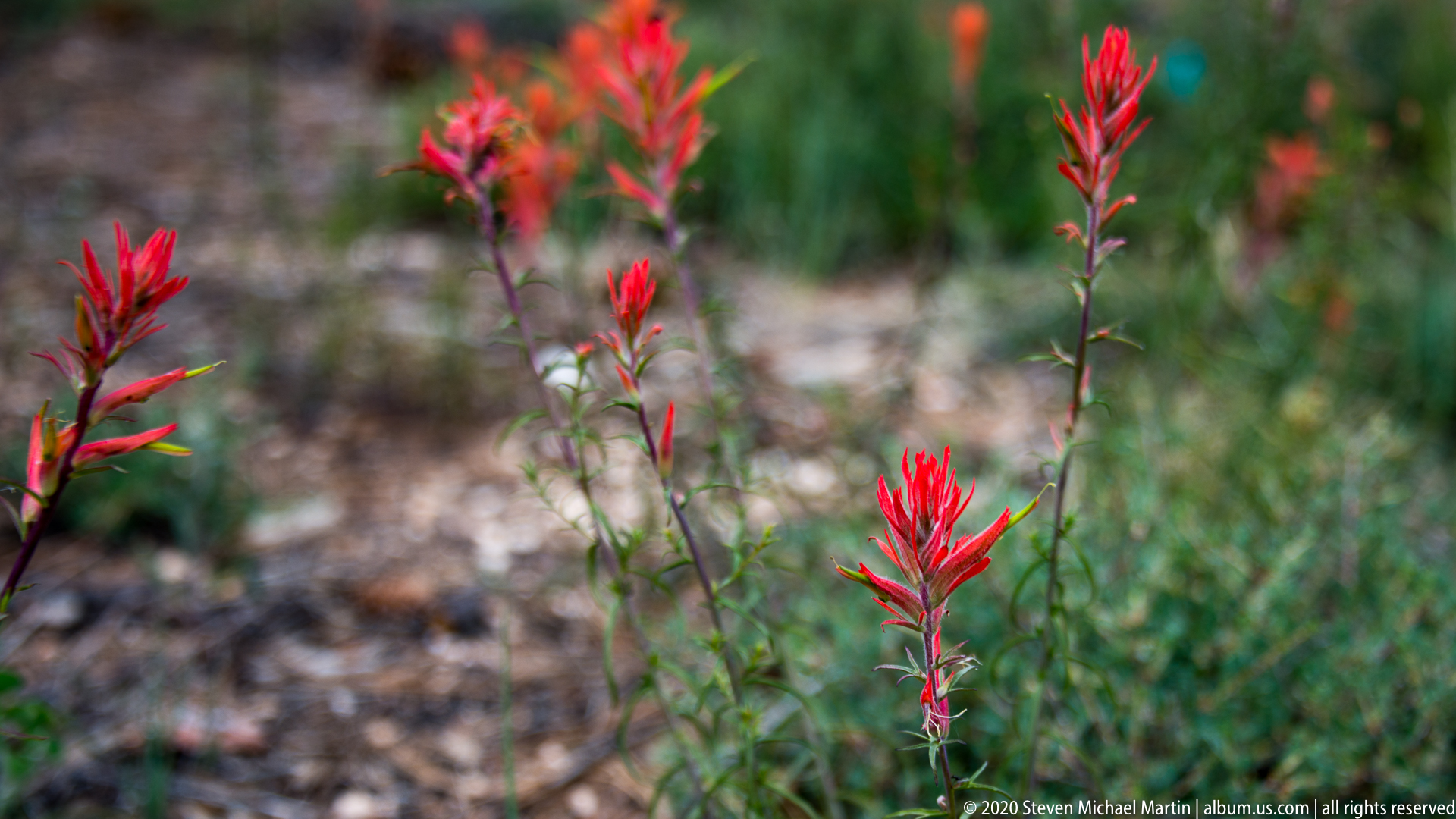
Slender green stems carry vivid red, brush-shaped flower clusters above a softly blurred woodland floor. Several blossoms stand at different heights, with fine pointed bracts extending outward from the central stems. The shallow focus isolates the plants, but the proof image does not show enough leaf detail for a precise species identification.
Caption
Slender green stems carry vivid red, brush-shaped flower clusters above a softly blurred woodland floor. Several blossoms stand at different heights, with fine pointed bracts extending outward from the central stems. The shallow focus isolates the plants, but the proof image does not show enough leaf detail for a precise species identification.

A broad opening cuts through a pale sandstone ledge above an orange slope dotted with pines. The arch-like gap sits left of center, while layered cliffs and forested ridges fill the upper background. The view captures an eroded wall within a steep canyon setting, though the particular formation name is not shown.
Caption
A broad opening cuts through a pale sandstone ledge above an orange slope dotted with pines. The arch-like gap sits left of center, while layered cliffs and forested ridges fill the upper background. The view captures an eroded wall within a steep canyon setting, though the particular formation name is not shown.
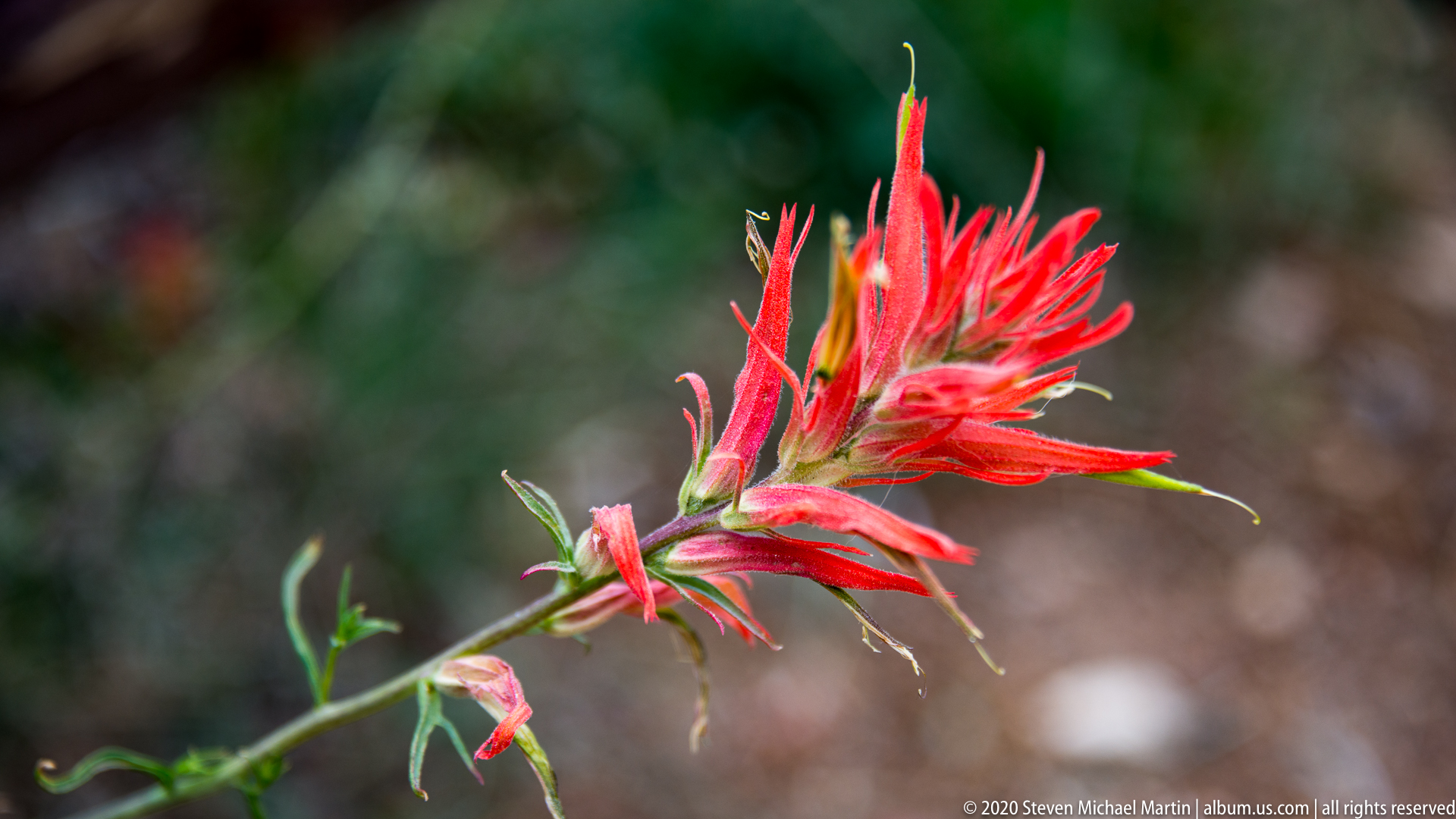
A single flowering stem bears vivid red, pointed bracts that flare outward like a brush. Narrow green leaves and unopened buds are visible along the stem, while a dark green background falls out of focus. The close view shows the flower’s form and color clearly, though the species is best described conservatively from the proof image.
Caption
A single flowering stem bears vivid red, pointed bracts that flare outward like a brush. Narrow green leaves and unopened buds are visible along the stem, while a dark green background falls out of focus. The close view shows the flower’s form and color clearly, though the species is best described conservatively from the proof image.
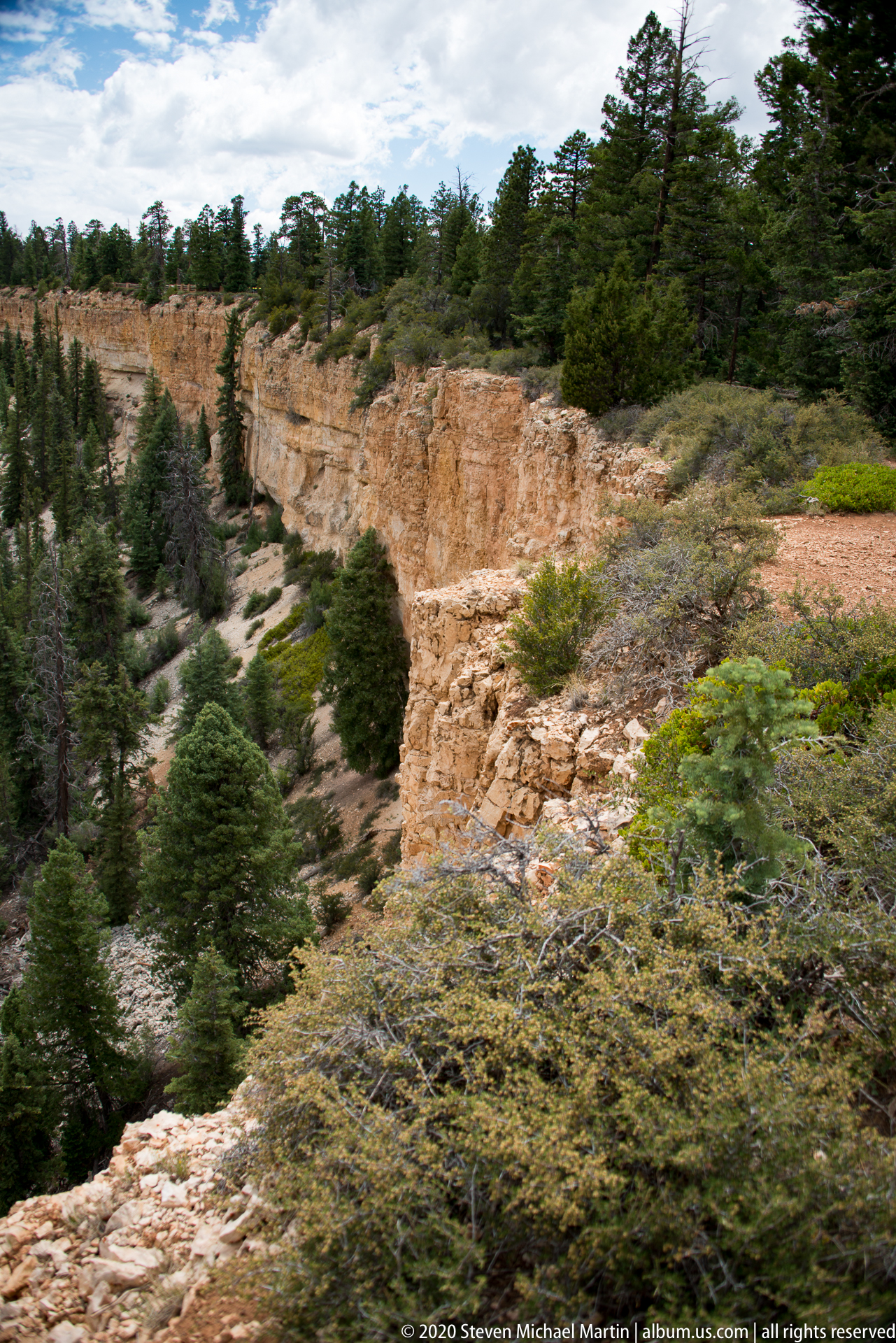
A narrow path crosses a rocky, pine-covered slope above a pale sandstone wall. The foreground is slightly blurred, suggesting movement or a quick handheld view, while shrubs and conifers line the route. The composition follows the trail across the hillside rather than looking directly into the canyon below.
Caption
A narrow path crosses a rocky, pine-covered slope above a pale sandstone wall. The foreground is slightly blurred, suggesting movement or a quick handheld view, while shrubs and conifers line the route. The composition follows the trail across the hillside rather than looking directly into the canyon below.
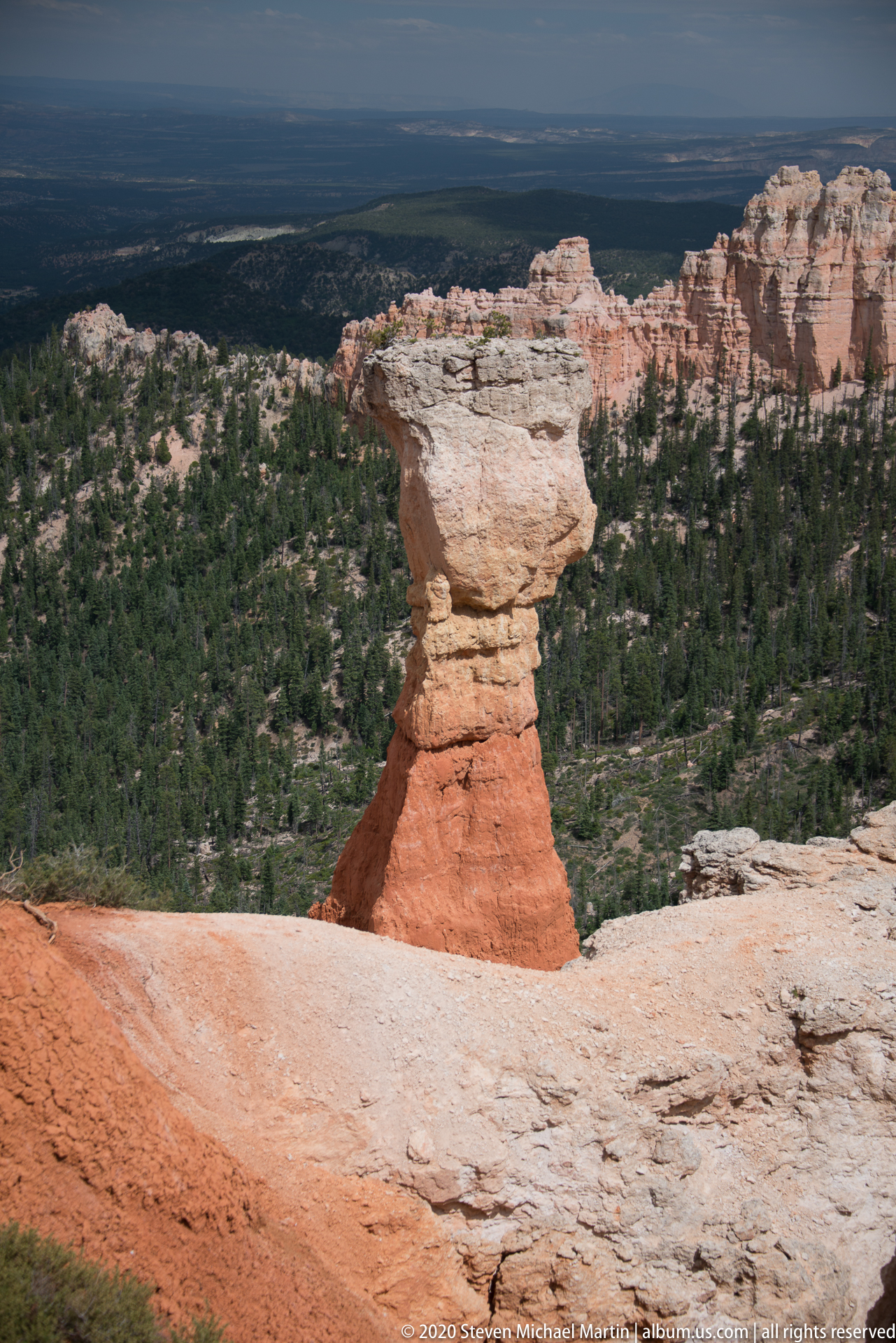
A broad pale capstone balances atop a narrower orange rock pedestal at the rim, with forest stretching across the plateau behind it. The layered structure is centered against a distant, nearly level horizon, making its precarious-looking proportions easy to read. Nearby pale ledges frame the foreground, while the abrupt drop toward the tree-covered basin reinforces the formation’s exposed position.
Caption
A broad pale capstone balances atop a narrower orange rock pedestal at the rim, with forest stretching across the plateau behind it. The layered structure is centered against a distant, nearly level horizon, making its precarious-looking proportions easy to read. Nearby pale ledges frame the foreground, while the abrupt drop toward the tree-covered basin reinforces the formation’s exposed position.
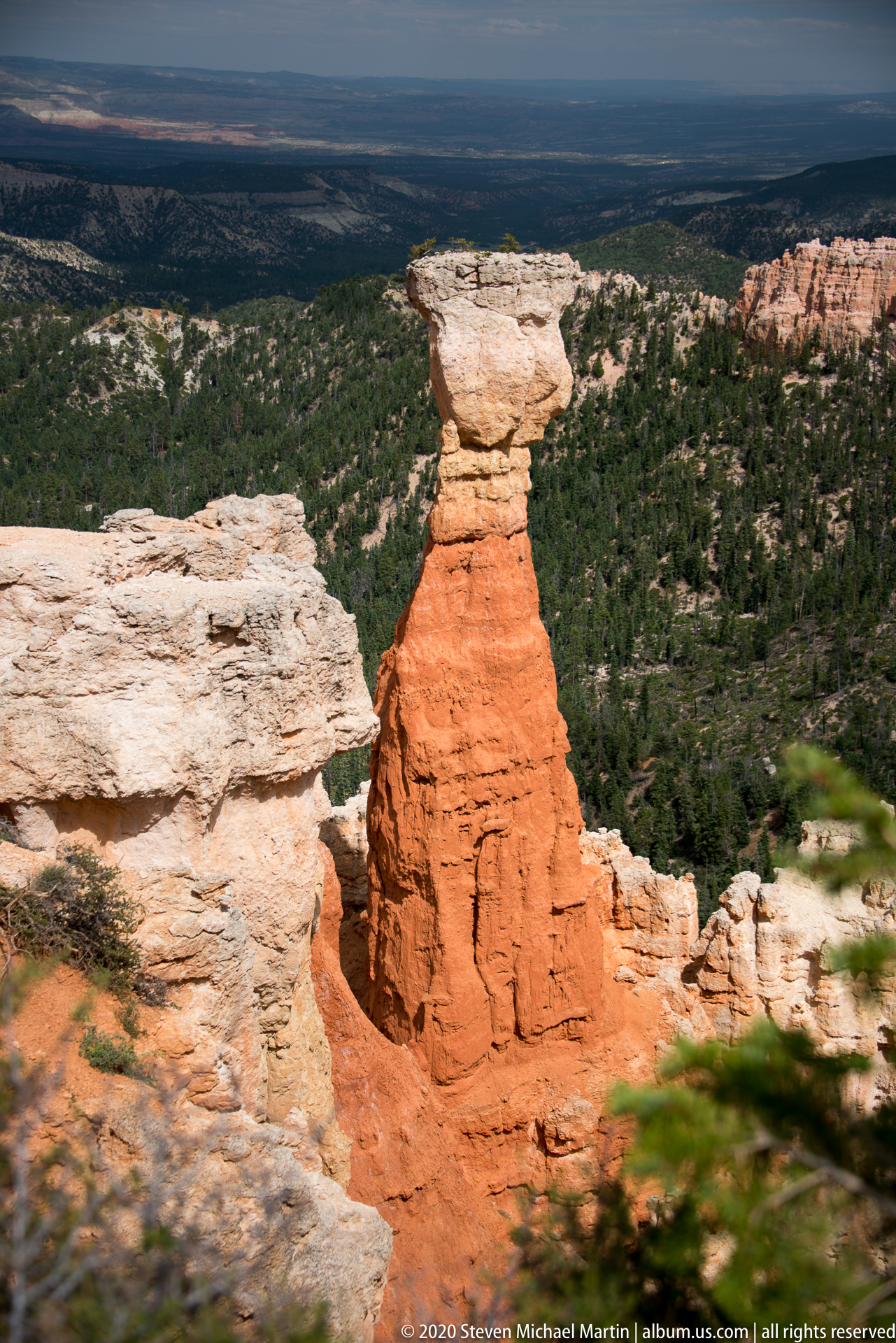
A squat orange pedestal supports a wide pale capstone at the canyon rim, its layered form set apart from the forested plateau beyond. The photograph frames the formation between pale limestone ledges in the foreground and a distant expanse of forest and flat horizon. This wider view makes the rock’s sculptural shape legible while showing its position within the rim landscape.
Caption
A squat orange pedestal supports a wide pale capstone at the canyon rim, its layered form set apart from the forested plateau beyond. The photograph frames the formation between pale limestone ledges in the foreground and a distant expanse of forest and flat horizon. This wider view makes the rock’s sculptural shape legible while showing its position within the rim landscape.
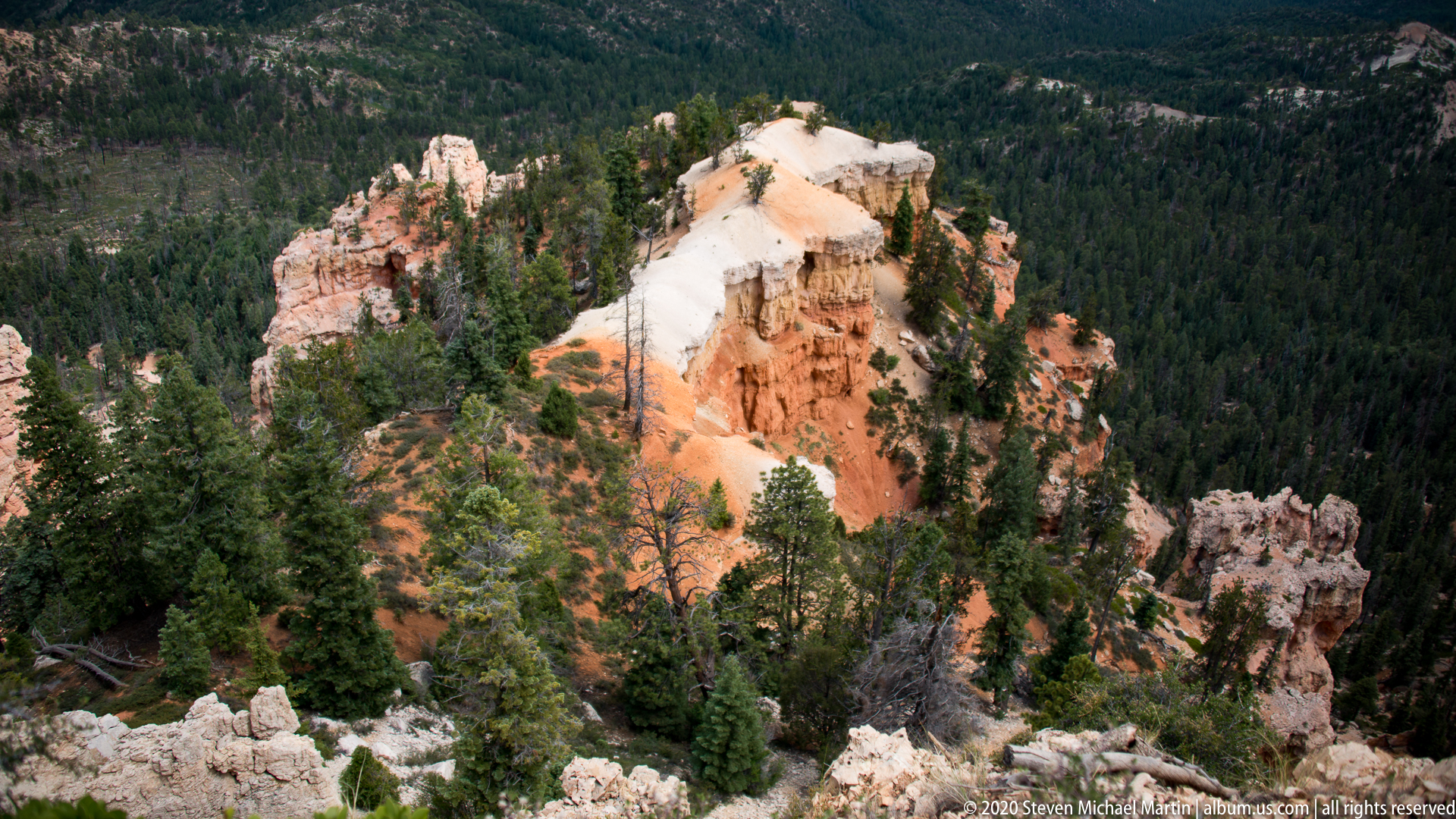
A broad promontory of orange sandstone, capped by a pale band, projects above a densely forested slope. The elevated viewpoint reveals its steep sides, scattered pines, and broken rock margins, with additional pale hoodoos visible at lower right. The formation’s projecting shape stands out within the surrounding green canopy.
Caption
A broad promontory of orange sandstone, capped by a pale band, projects above a densely forested slope. The elevated viewpoint reveals its steep sides, scattered pines, and broken rock margins, with additional pale hoodoos visible at lower right. The formation’s projecting shape stands out within the surrounding green canopy.

Rounded green leaves and small reddish blossoms crowd the frame, creating a close botanical study against a softly blurred woodland floor. The shallow focus keeps the foliage crisp while branches and ground recede into shadow. This intimate view shifts attention from Bryce Canyon’s expansive rock formations to the low-growing plants that occupy the forested trail margin.
Caption
Rounded green leaves and small reddish blossoms crowd the frame, creating a close botanical study against a softly blurred woodland floor. The shallow focus keeps the foliage crisp while branches and ground recede into shadow. This intimate view shifts attention from Bryce Canyon’s expansive rock formations to the low-growing plants that occupy the forested trail margin.
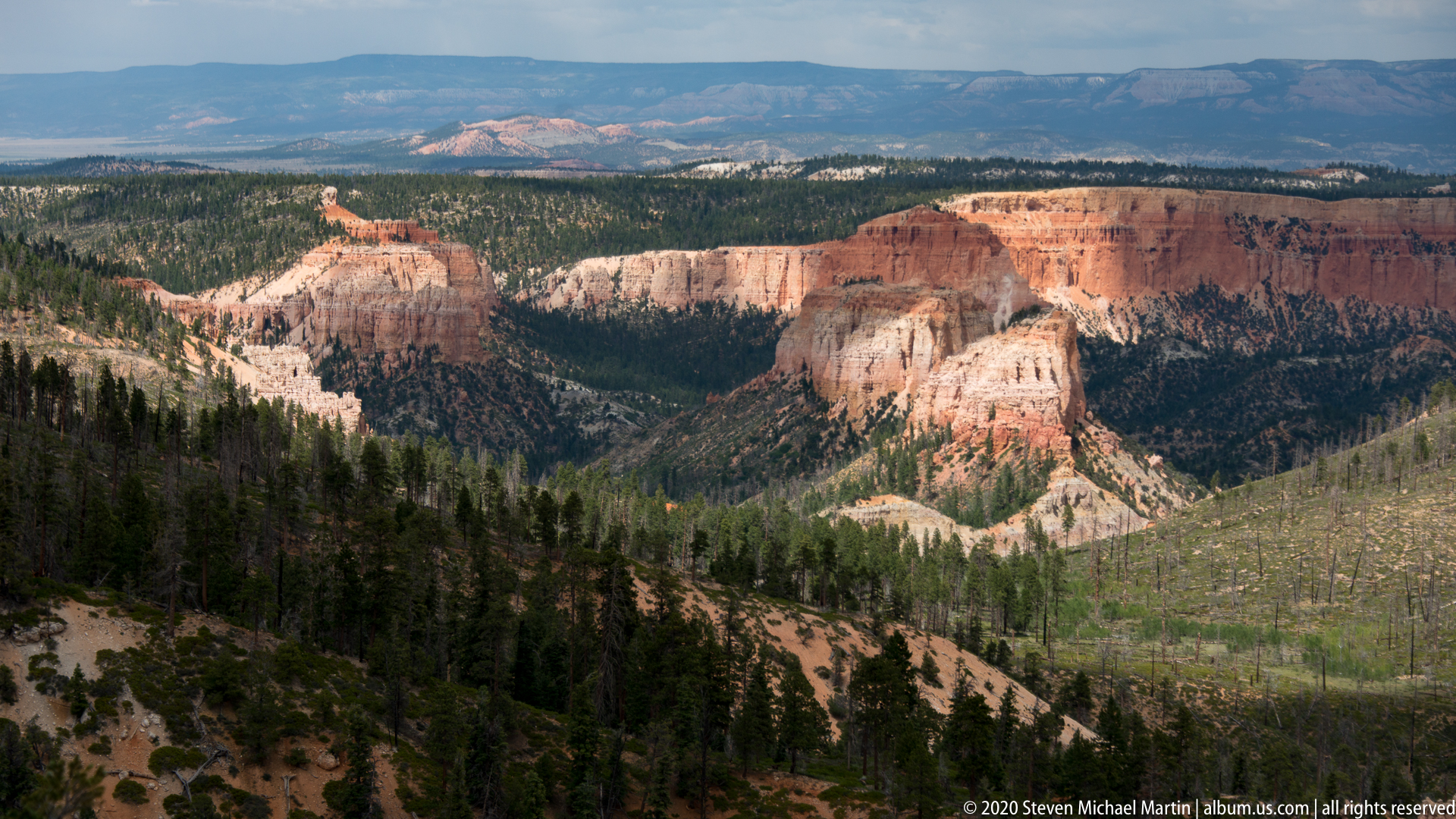
A broad amphitheater of orange and cream cliffs cuts through a dark conifer forest beneath a level, distant plateau. The layered escarpments and wooded basin create alternating bands of exposed sedimentary rock and vegetation. Seen from an elevated overlook, the composition emphasizes the scale of the eroded terrain and the contrast between sunlit walls and shaded slopes.
Caption
A broad amphitheater of orange and cream cliffs cuts through a dark conifer forest beneath a level, distant plateau. The layered escarpments and wooded basin create alternating bands of exposed sedimentary rock and vegetation. Seen from an elevated overlook, the composition emphasizes the scale of the eroded terrain and the contrast between sunlit walls and shaded slopes.
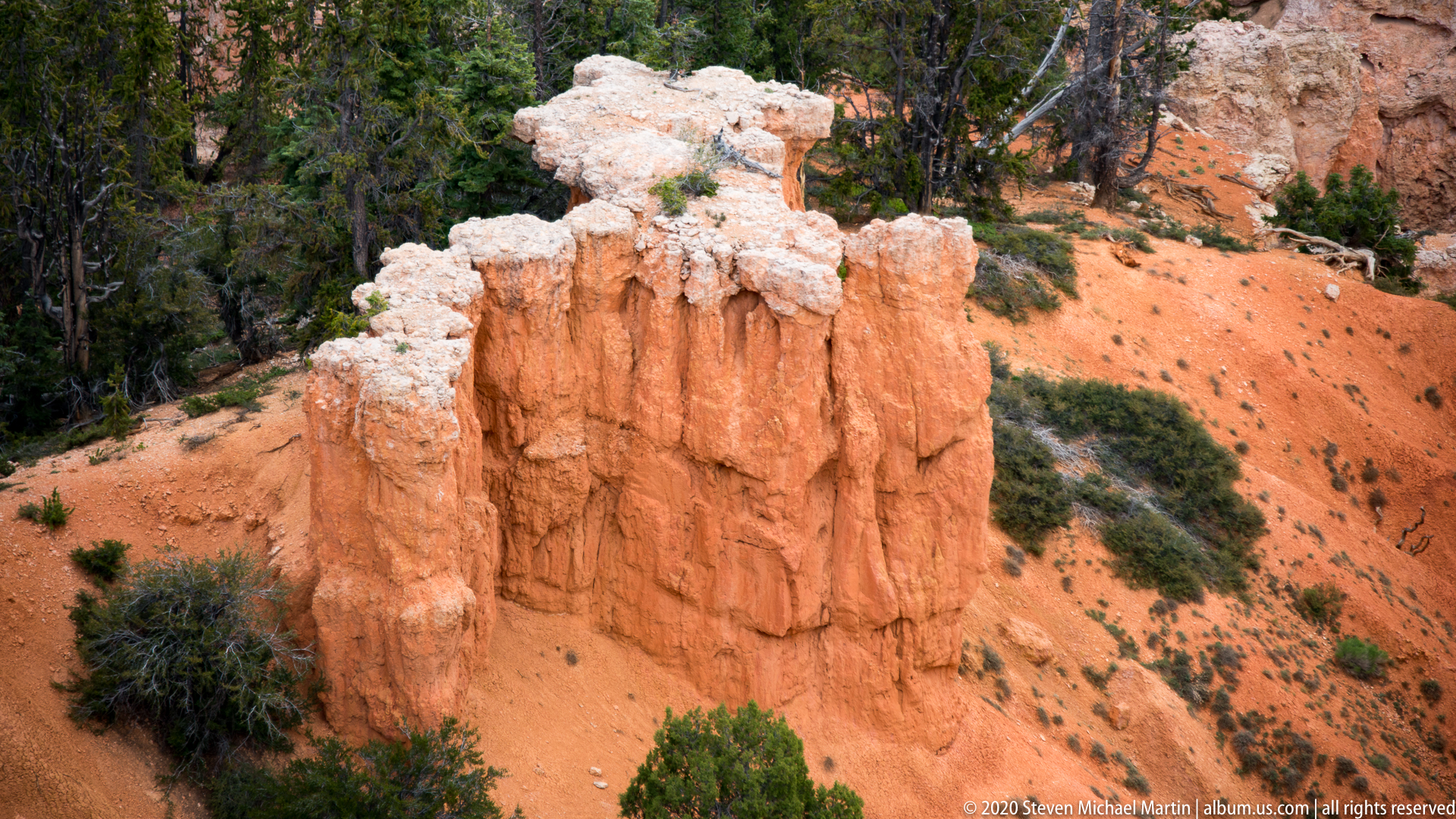
A cluster of orange hoodoos rises from a steep, sandy slope, with pale rock caps and narrow vertical grooves marking the eroded faces. Dark evergreens gather along the formation’s upper rim and in the surrounding basin. The elevated angle reveals how the irregular pinnacles stand above loose debris, making erosion and the changing edge between forest and bare rock especially clear.
Caption
A cluster of orange hoodoos rises from a steep, sandy slope, with pale rock caps and narrow vertical grooves marking the eroded faces. Dark evergreens gather along the formation’s upper rim and in the surrounding basin. The elevated angle reveals how the irregular pinnacles stand above loose debris, making erosion and the changing edge between forest and bare rock especially clear.
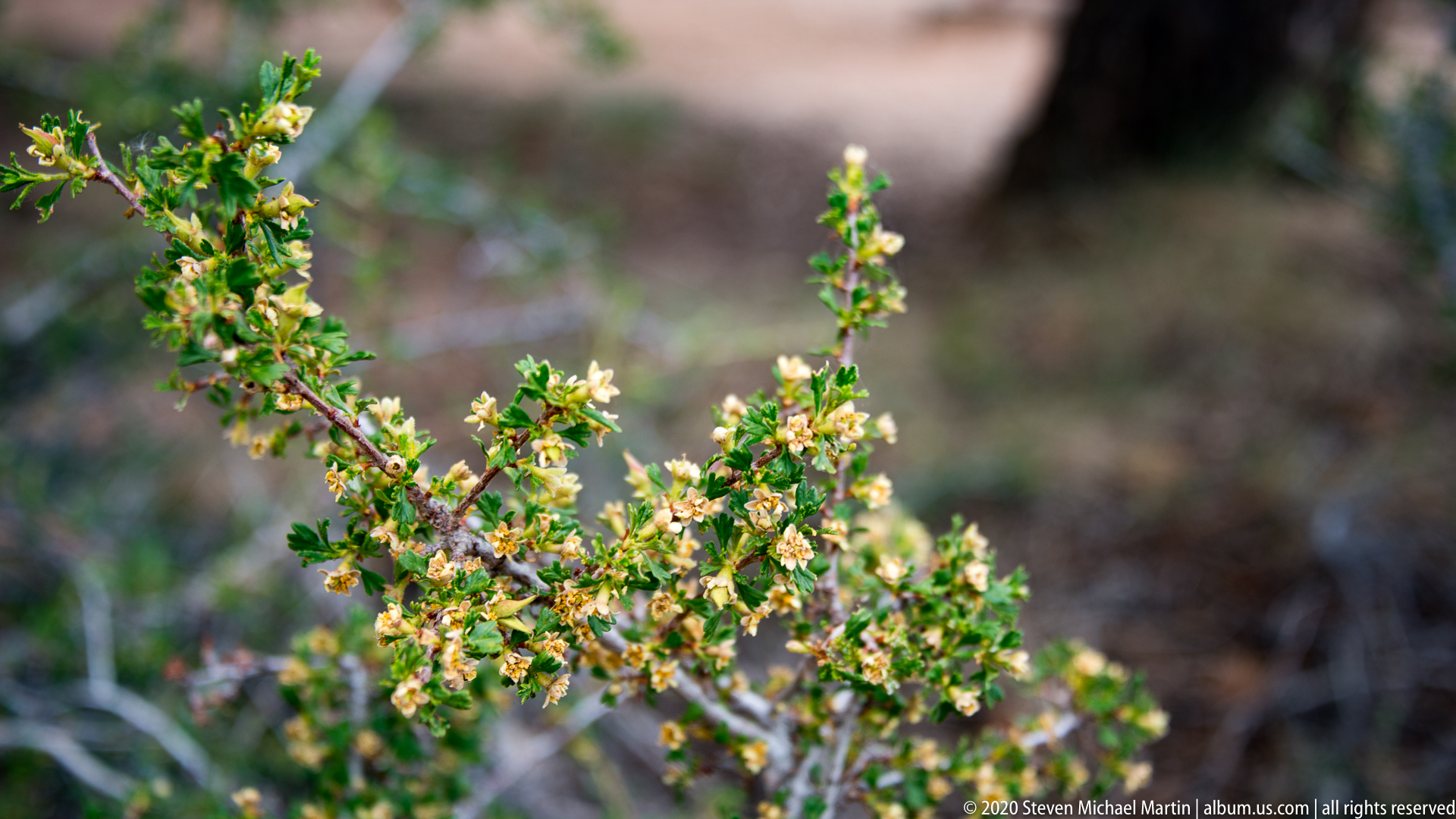
Small cream-colored blossoms dot a branching shrub with compact green leaves. The plant is sharply focused in the lower half of the frame, while orange and pale rock colors dissolve into a soft background. This selective focus connects the canyon’s exposed geology with the vegetation growing along its rim, isolating a seasonal botanical detail from the larger landscape.
Caption
Small cream-colored blossoms dot a branching shrub with compact green leaves. The plant is sharply focused in the lower half of the frame, while orange and pale rock colors dissolve into a soft background. This selective focus connects the canyon’s exposed geology with the vegetation growing along its rim, isolating a seasonal botanical detail from the larger landscape.
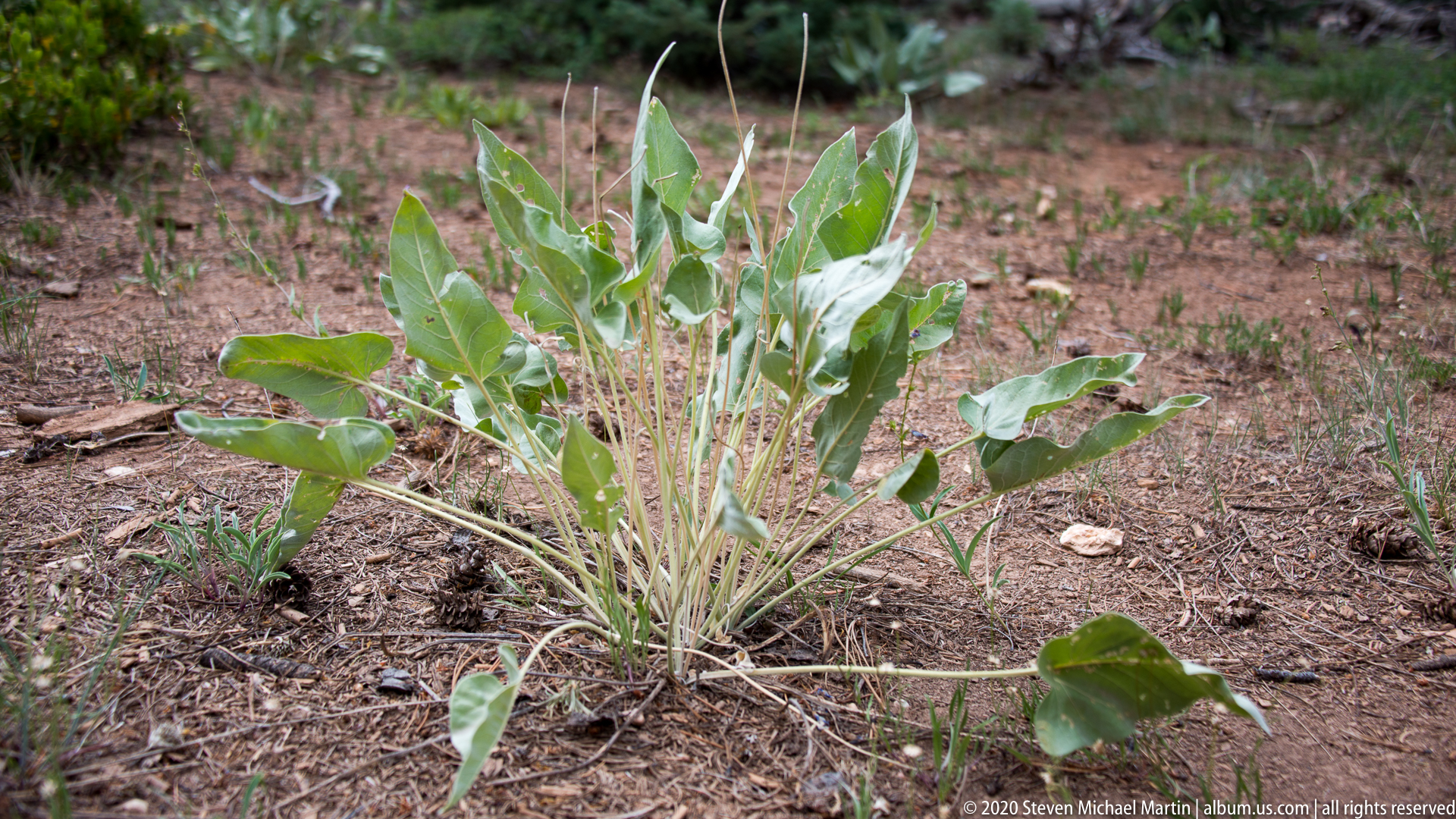
A low plant with broad, pale green leaves spreads across a dry forest floor of needles, twigs, and bare soil. The leaves rise on slender stems, their lighter surfaces standing apart from the muted brown ground. The close, low viewpoint records the understory at trail level, where small plants occupy open patches beneath the surrounding trees.
Caption
A low plant with broad, pale green leaves spreads across a dry forest floor of needles, twigs, and bare soil. The leaves rise on slender stems, their lighter surfaces standing apart from the muted brown ground. The close, low viewpoint records the understory at trail level, where small plants occupy open patches beneath the surrounding trees.

A weathered wooden marker identifies Farview Point and gives its elevation as 8,819 feet. It stands behind a rustic log barrier, with evergreen branches and a glimpse of distant country visible beyond the overlook. The straightforward composition records both the named viewpoint and its high elevation, anchoring the surrounding panorama to a specific stopping point along the park road.
Caption
A weathered wooden marker identifies Farview Point and gives its elevation as 8,819 feet. It stands behind a rustic log barrier, with evergreen branches and a glimpse of distant country visible beyond the overlook. The straightforward composition records both the named viewpoint and its high elevation, anchoring the surrounding panorama to a specific stopping point along the park road.
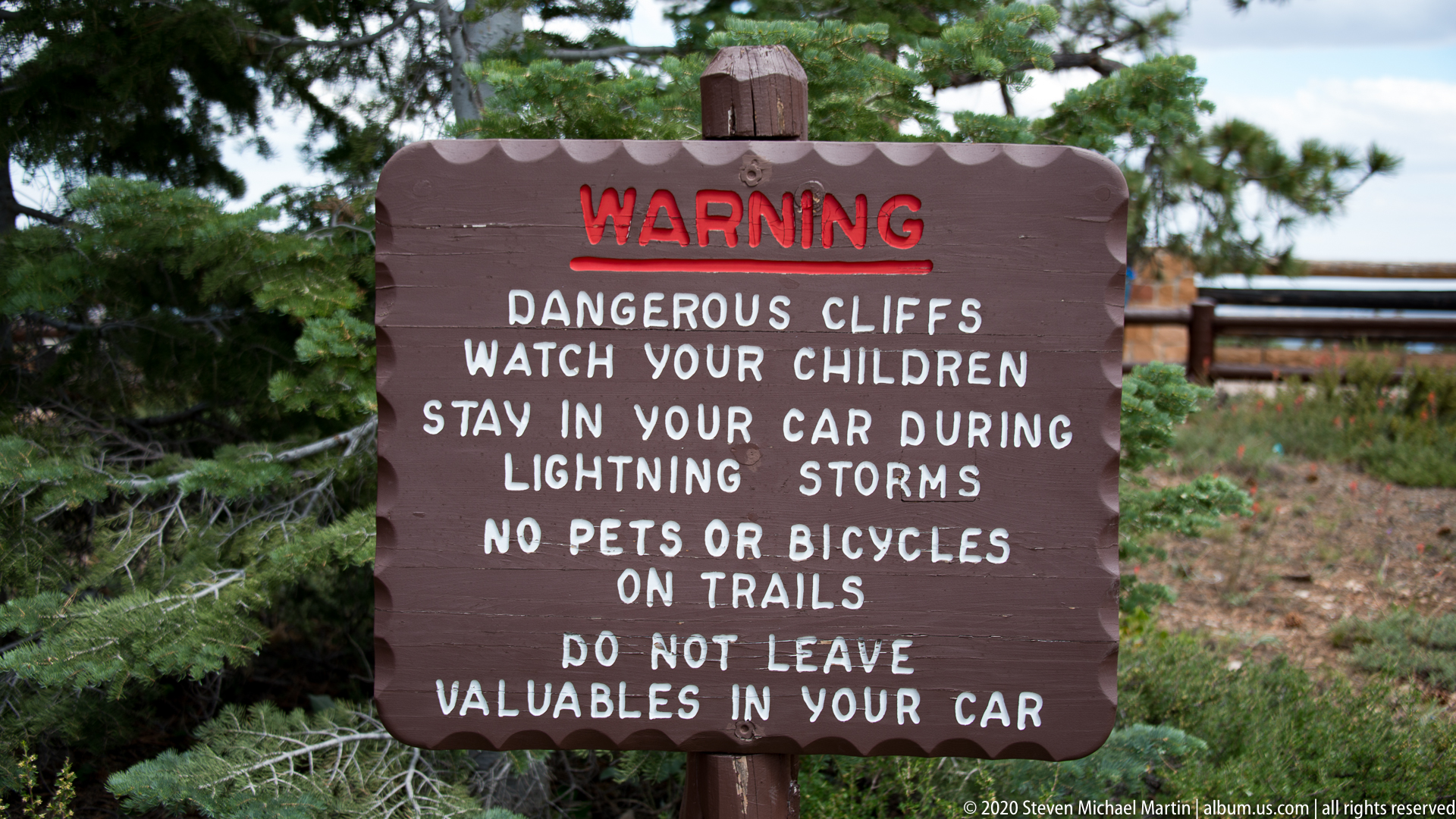
A brown wooden warning sign lists several visitor precautions: stay back from dangerous cliffs, watch children, remain in a car during lightning storms, keep pets and bicycles off trails, and avoid leaving valuables in a car. Evergreen branches frame the board, while a stone wall and overlook railing appear behind it. The close view makes park safety guidance the primary subject.
Caption
A brown wooden warning sign lists several visitor precautions: stay back from dangerous cliffs, watch children, remain in a car during lightning storms, keep pets and bicycles off trails, and avoid leaving valuables in a car. Evergreen branches frame the board, while a stone wall and overlook railing appear behind it. The close view makes park safety guidance the primary subject.
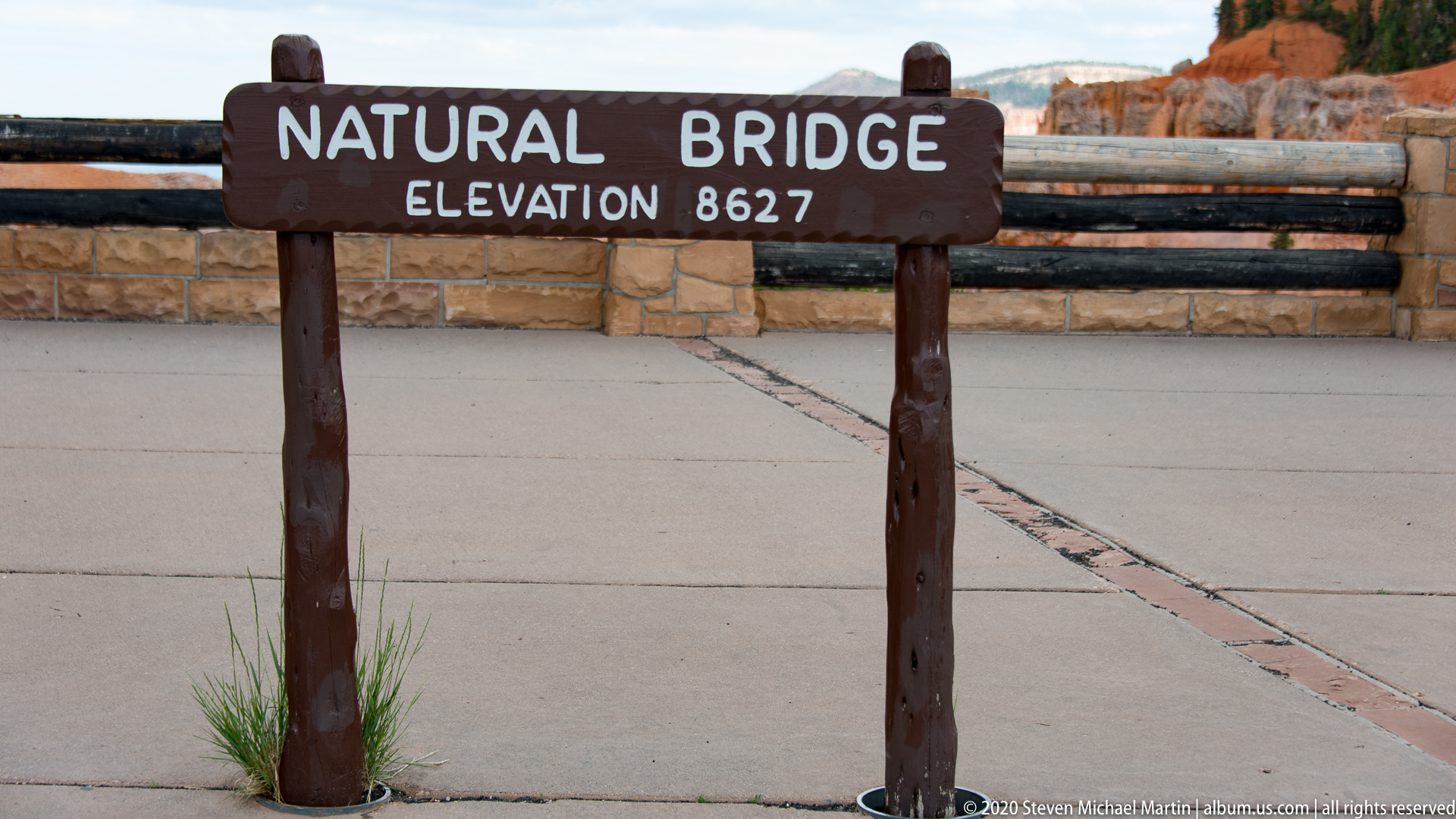
A dark wooden sign names Natural Bridge and lists an elevation of 8,627 feet. It stands on two posts in a paved overlook area, with log railings and a low stone wall behind it. A sliver of orange rock is visible beyond the barriers. The sign identifies the viewing stop, though the natural bridge itself is outside this frame.
Caption
A dark wooden sign names Natural Bridge and lists an elevation of 8,627 feet. It stands on two posts in a paved overlook area, with log railings and a low stone wall behind it. A sliver of orange rock is visible beyond the barriers. The sign identifies the viewing stop, though the natural bridge itself is outside this frame.
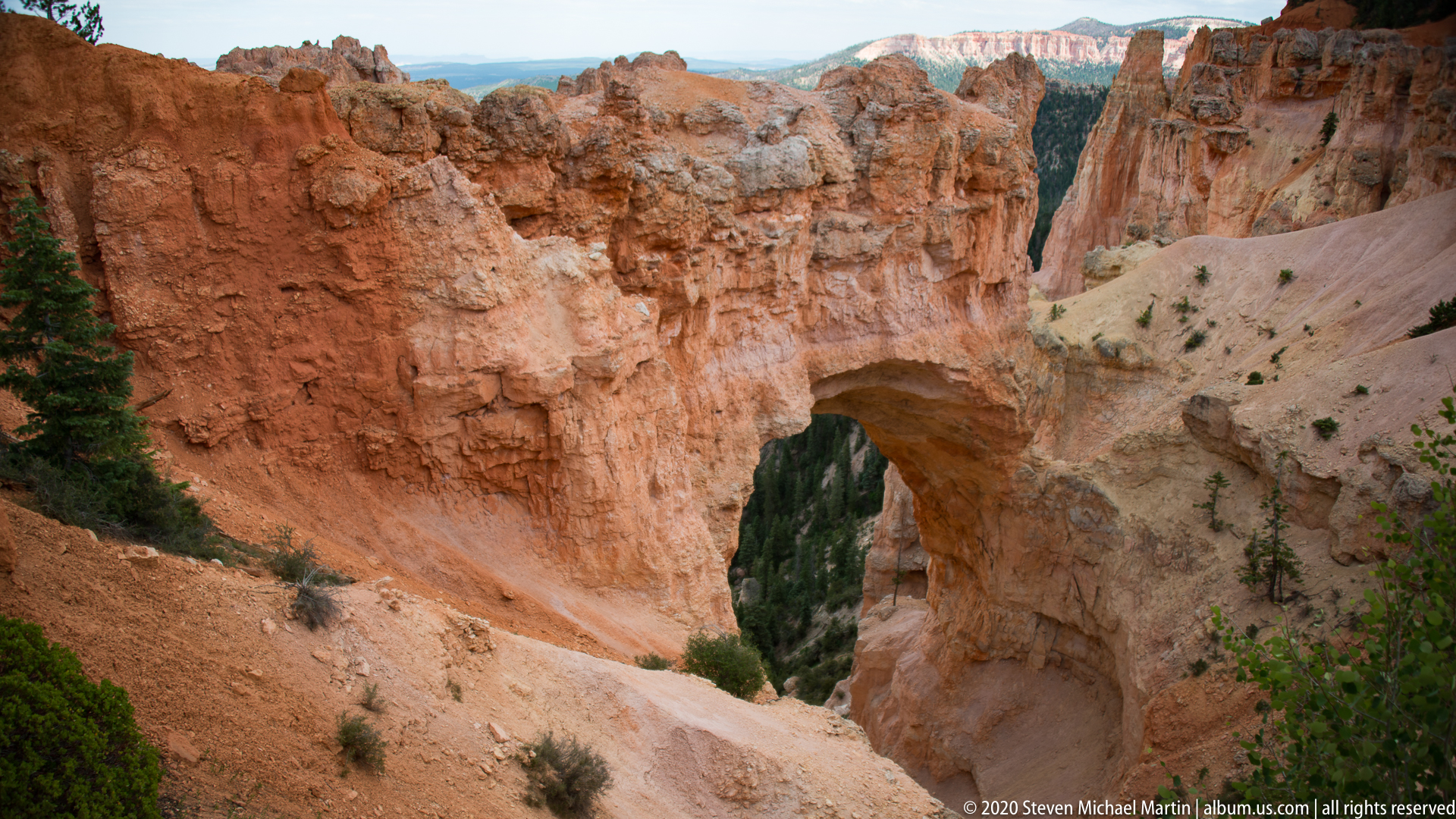
An orange sandstone arch opens through a massive cliff, framing a narrow, forested ravine beyond. The near rock wall fills much of the left side, while the bridge curves across the lower center and joins a taller formation on the right. The close viewpoint reveals layered stone and irregular erosion along the arch, with distant hoodoos peeking above the rim.
Caption
An orange sandstone arch opens through a massive cliff, framing a narrow, forested ravine beyond. The near rock wall fills much of the left side, while the bridge curves across the lower center and joins a taller formation on the right. The close viewpoint reveals layered stone and irregular erosion along the arch, with distant hoodoos peeking above the rim.

The natural sandstone bridge forms a broad window onto a green ravine and distant hoodoos. Orange and cream rock walls enclose the opening, while a pine tree rises through the center-right foreground and partly overlaps the view. Compared with a tighter study of the arch, this composition gives greater weight to the landscape framed within and beyond the natural opening.
Caption
The natural sandstone bridge forms a broad window onto a green ravine and distant hoodoos. Orange and cream rock walls enclose the opening, while a pine tree rises through the center-right foreground and partly overlaps the view. Compared with a tighter study of the arch, this composition gives greater weight to the landscape framed within and beyond the natural opening.

Viewed closer to its base, Natural Bridge spans a dark, tree-filled ravine between steep orange sandstone walls. The arch occupies the center of the frame, its underside in shadow and its upper surface blending into the surrounding cliff. Sparse shrubs cling to the bare slopes, while the forest visible through the opening gives the formation depth and scale.
Caption
Viewed closer to its base, Natural Bridge spans a dark, tree-filled ravine between steep orange sandstone walls. The arch occupies the center of the frame, its underside in shadow and its upper surface blending into the surrounding cliff. Sparse shrubs cling to the bare slopes, while the forest visible through the opening gives the formation depth and scale.
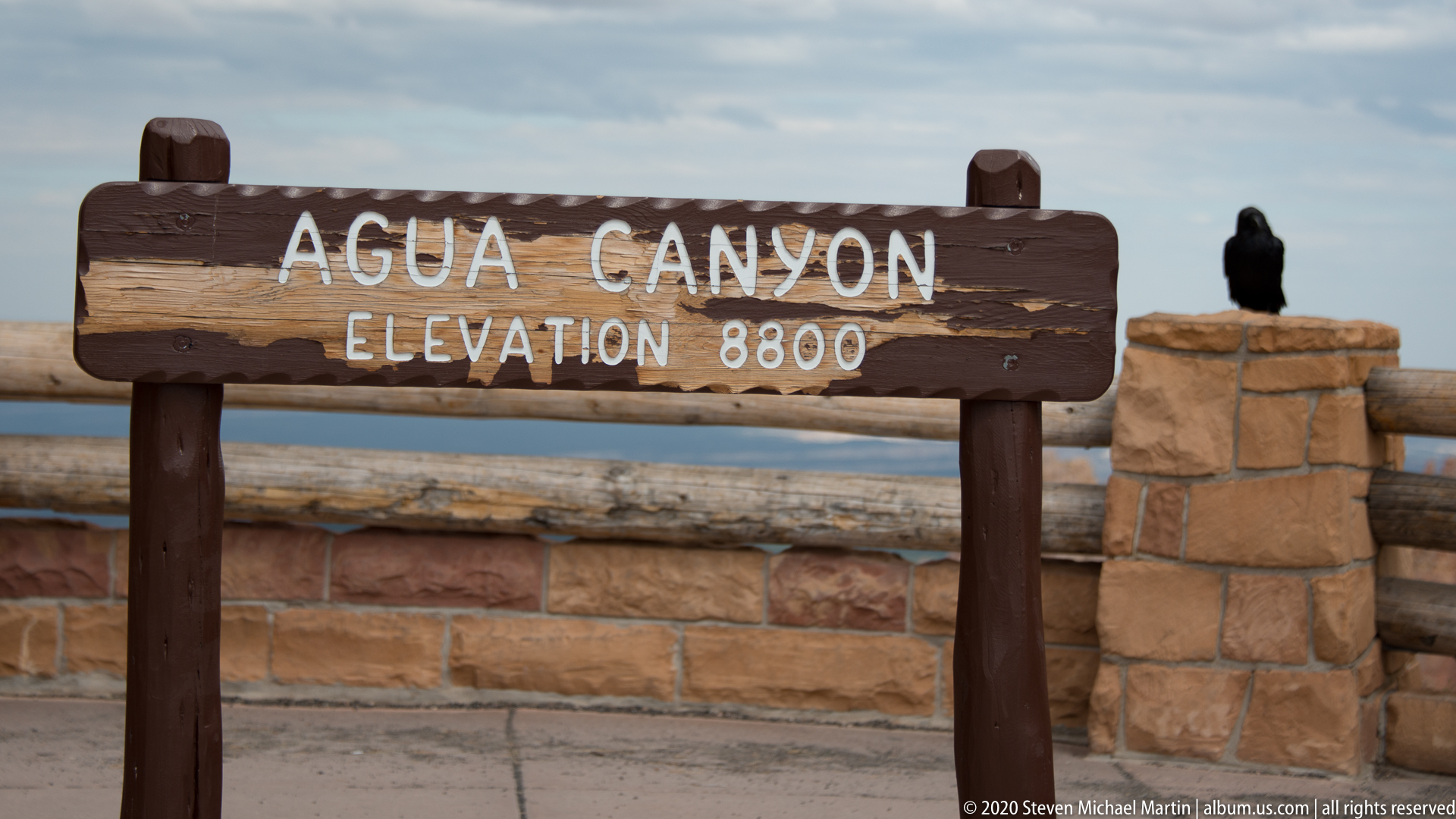
A wooden overlook marker reads “Agua Canyon” and “Elevation 8800.” A black raven perches on the stone pillar to the right, creating a small wildlife detail alongside the formal park marker. Horizontal log railings and a stone wall cross the background beneath a pale sky, situating the sign at a developed viewpoint above the canyon.
Caption
A wooden overlook marker reads “Agua Canyon” and “Elevation 8800.” A black raven perches on the stone pillar to the right, creating a small wildlife detail alongside the formal park marker. Horizontal log railings and a stone wall cross the background beneath a pale sky, situating the sign at a developed viewpoint above the canyon.

A common raven stands in profile on a pale stone overlook wall, its heavy bill and shaggy throat feathers distinct against the orange canyon blur. The shallow depth of field isolates the bird from the landscape behind it, turning a familiar overlook visitor into the clear subject. Its glossy black plumage contrasts with the warm masonry and rock.
Caption
A common raven stands in profile on a pale stone overlook wall, its heavy bill and shaggy throat feathers distinct against the orange canyon blur. The shallow depth of field isolates the bird from the landscape behind it, turning a familiar overlook visitor into the clear subject. Its glossy black plumage contrasts with the warm masonry and rock.
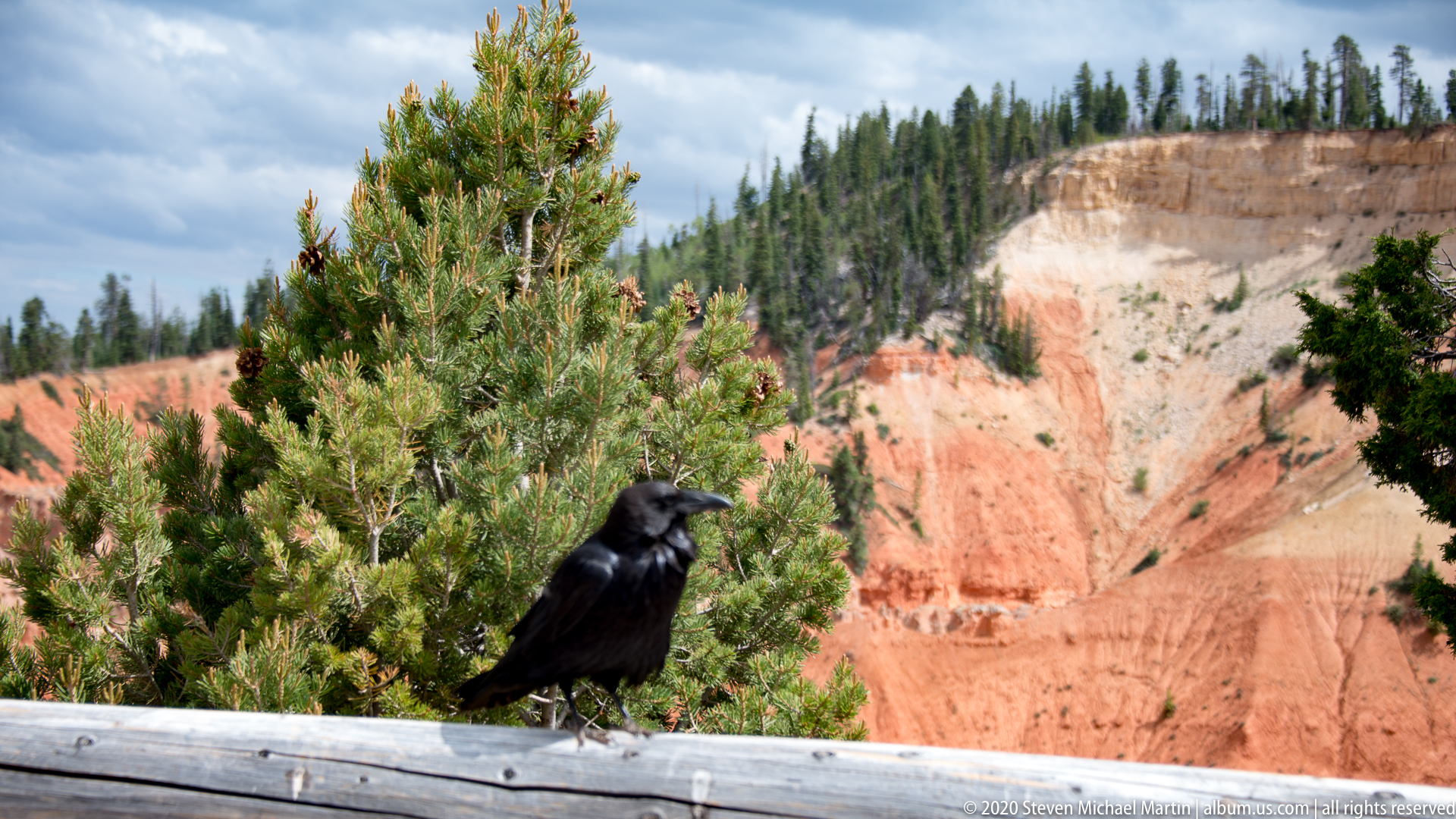
A black raven perches on a log railing in the foreground, with a small pine and orange canyon wall behind it. The wider framing retains enough of the setting to connect the bird with the developed rim overlook, while its dark silhouette remains distinct against the pale rock. The view pairs wildlife with the exposed geology of the canyon edge.
Caption
A black raven perches on a log railing in the foreground, with a small pine and orange canyon wall behind it. The wider framing retains enough of the setting to connect the bird with the developed rim overlook, while its dark silhouette remains distinct against the pale rock. The view pairs wildlife with the exposed geology of the canyon edge.

Pale pinnacles and broken hoodoos project from a steep foreground ledge, facing an extended orange escarpment across the canyon. Dark evergreen forest fills the intervening basin and traces the cliff tops. The oblique viewpoint emphasizes the depth between the near formations and far wall, revealing the repeating bands and vertical fractures shaped by erosion.
Caption
Pale pinnacles and broken hoodoos project from a steep foreground ledge, facing an extended orange escarpment across the canyon. Dark evergreen forest fills the intervening basin and traces the cliff tops. The oblique viewpoint emphasizes the depth between the near formations and far wall, revealing the repeating bands and vertical fractures shaped by erosion.

A common raven perches on a stone wall in a close profile, its thick bill, layered black feathers, and long tail sharply defined. Behind it, the orange canyon rim and scattered conifers blur into soft bands of color. The shallow focus centers the bird while retaining the distinctive geology as context, linking wildlife observation with the park’s busy overlooks.
Caption
A common raven perches on a stone wall in a close profile, its thick bill, layered black feathers, and long tail sharply defined. Behind it, the orange canyon rim and scattered conifers blur into soft bands of color. The shallow focus centers the bird while retaining the distinctive geology as context, linking wildlife observation with the park’s busy overlooks.
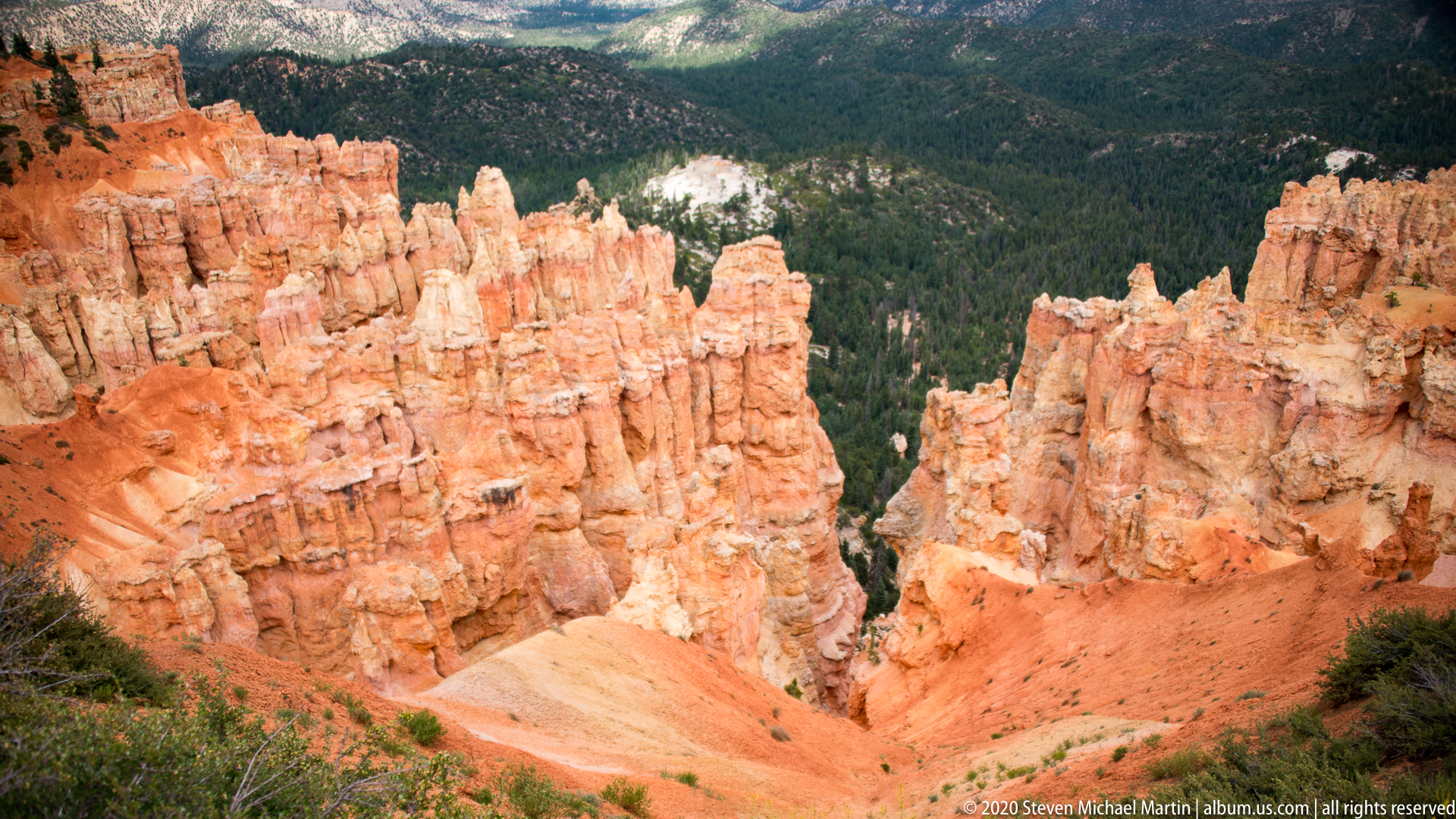
Orange hoodoos line a deep basin that narrows toward a distant, forested plateau. The near walls rise along both sides, guiding the eye down the center of the amphitheater to a pale rock outcrop in the distance. Dark conifers cover much of the basin floor, contrasting with the exposed sedimentary formations and emphasizing the canyon’s sharply divided terrain.
Caption
Orange hoodoos line a deep basin that narrows toward a distant, forested plateau. The near walls rise along both sides, guiding the eye down the center of the amphitheater to a pale rock outcrop in the distance. Dark conifers cover much of the basin floor, contrasting with the exposed sedimentary formations and emphasizing the canyon’s sharply divided terrain.
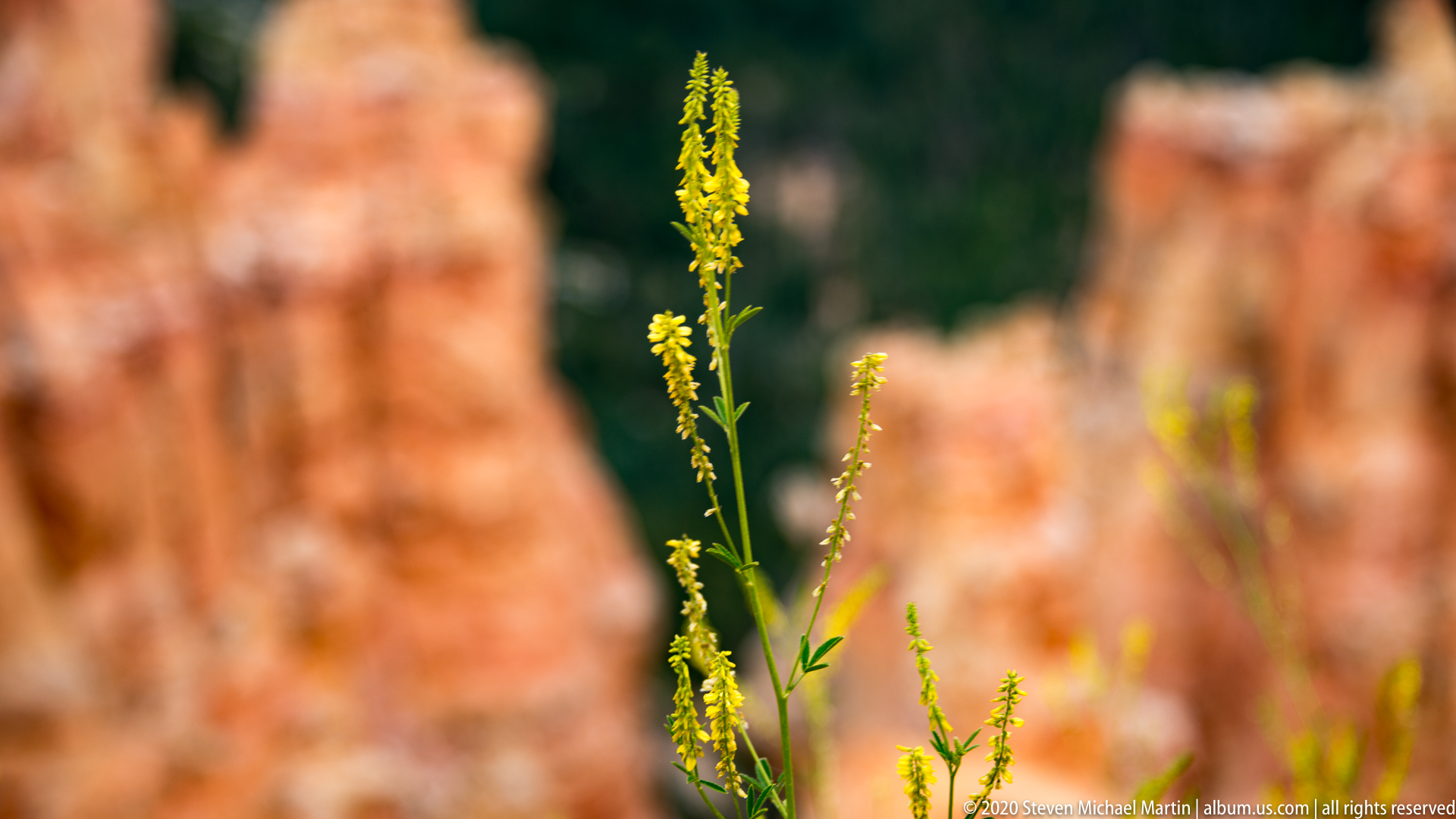
Slender green stems carry small yellow blossoms and buds, rising vertically against a soft, dark green and orange background. The most prominent flower spike reaches near the top of the frame, while shorter clusters branch below it. Shallow focus separates the delicate plant from the canyon setting and records the seasonal vegetation found along the rim.
Caption
Slender green stems carry small yellow blossoms and buds, rising vertically against a soft, dark green and orange background. The most prominent flower spike reaches near the top of the frame, while shorter clusters branch below it. Shallow focus separates the delicate plant from the canyon setting and records the seasonal vegetation found along the rim.
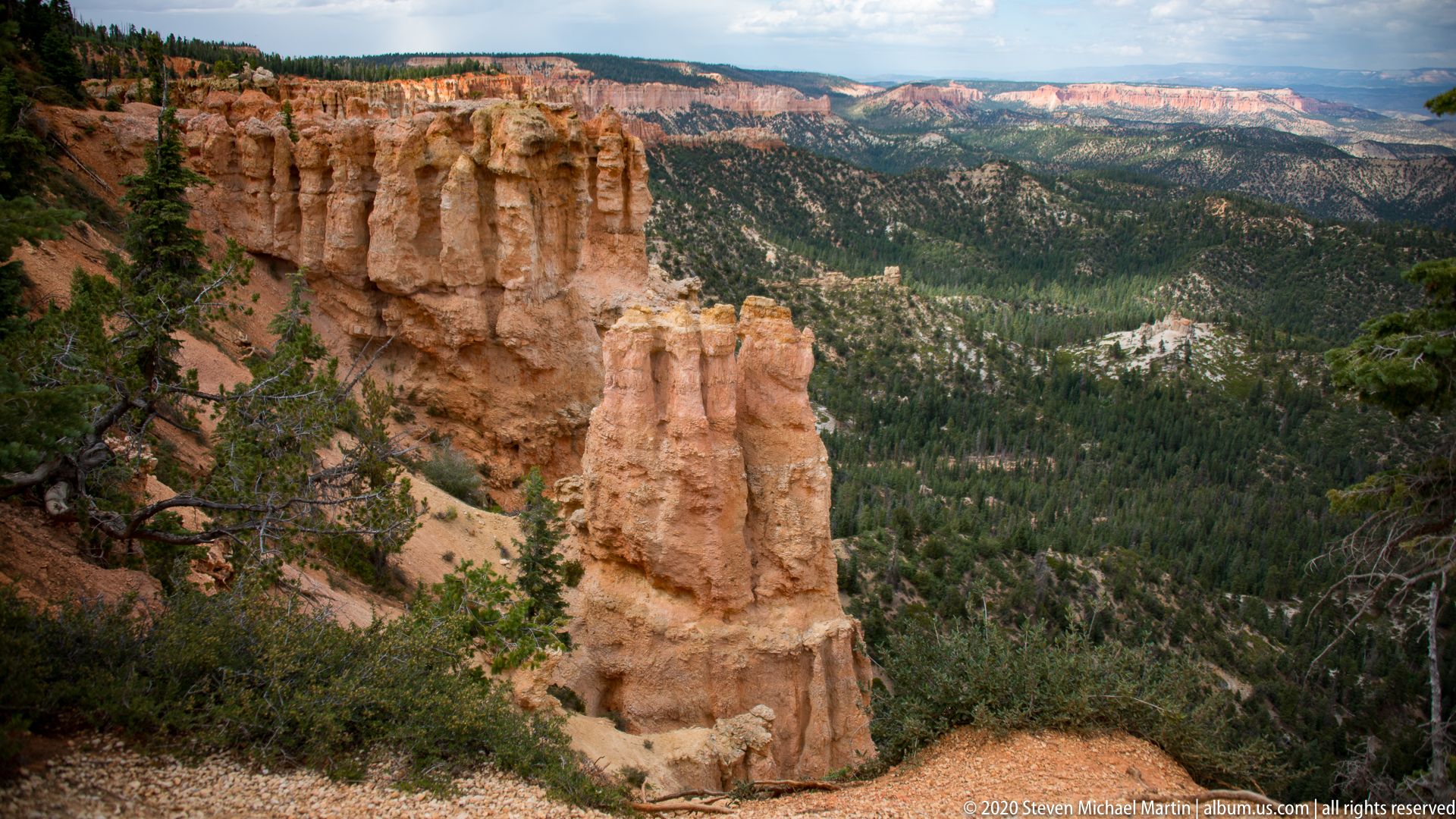
A tall orange hoodoo rises in the left foreground above a broad green valley, with distant cream and pink cliffs tracing the horizon. The near formation’s vertical grooves and broken ledges contrast with the softer, continuous forest canopy below. Branches at the left edge frame the overlook, giving the expansive view a clear foreground anchor.
Caption
A tall orange hoodoo rises in the left foreground above a broad green valley, with distant cream and pink cliffs tracing the horizon. The near formation’s vertical grooves and broken ledges contrast with the softer, continuous forest canopy below. Branches at the left edge frame the overlook, giving the expansive view a clear foreground anchor.

A compact cluster of pale and orange hoodoos stands on a light, sandy slope among scattered conifers and numerous bare, dark trunks. The open ground and skeletal trees form a stark setting around the rock spires, while dense forest rises behind them. The composition records both the eroded formations and the visibly burned or dead woodland surrounding them.
Caption
A compact cluster of pale and orange hoodoos stands on a light, sandy slope among scattered conifers and numerous bare, dark trunks. The open ground and skeletal trees form a stark setting around the rock spires, while dense forest rises behind them. The composition records both the eroded formations and the visibly burned or dead woodland surrounding them.
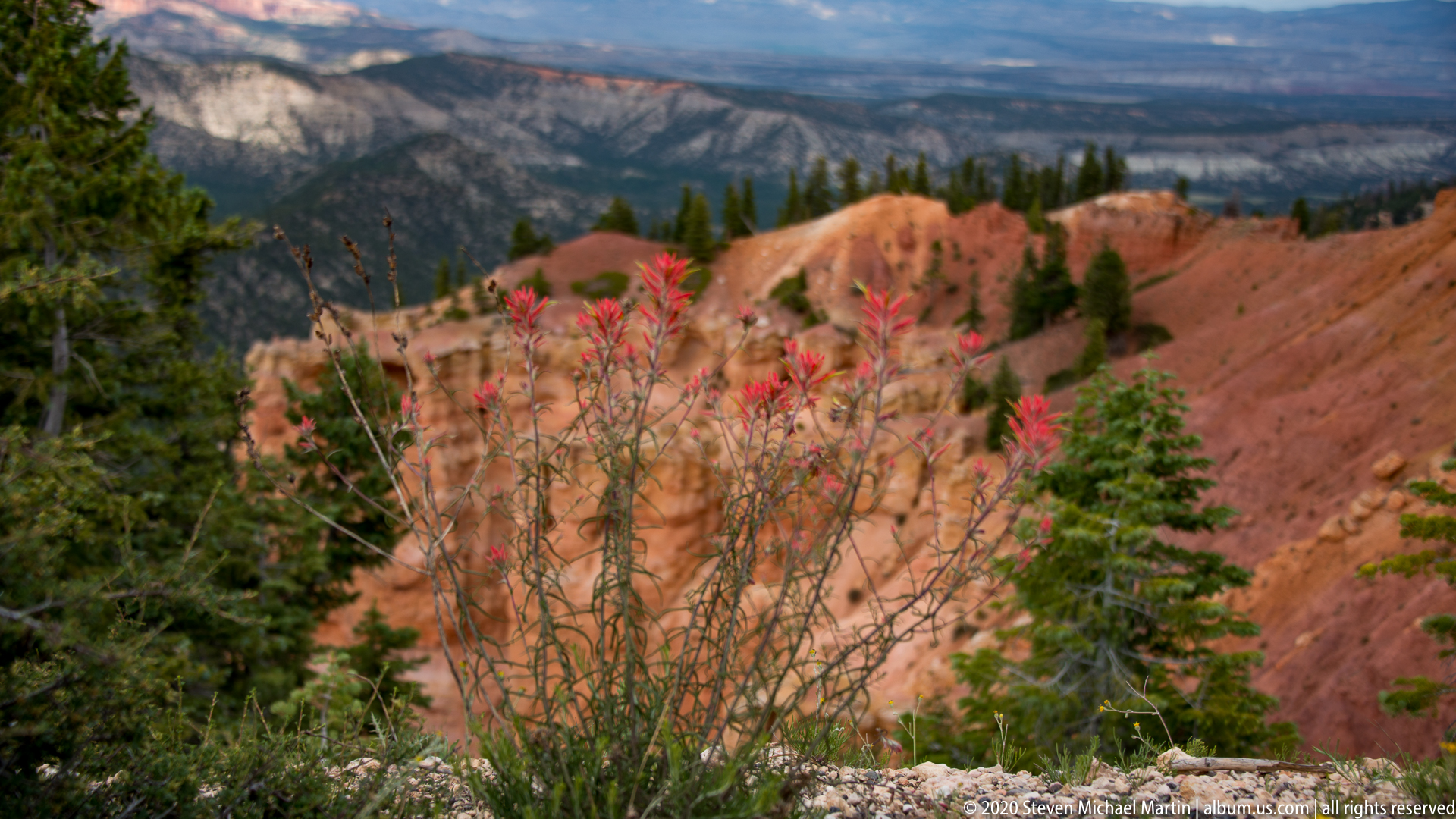
A branching plant with vivid red flower clusters rises above pale gravel at the rim. Behind it, the orange canyon wall drops toward forested slopes and a distant plateau, softened by atmospheric haze. The composition keeps the blossoms prominent while preserving the dramatic change in elevation, connecting a small seasonal detail with the expansive terrain beyond.
Caption
A branching plant with vivid red flower clusters rises above pale gravel at the rim. Behind it, the orange canyon wall drops toward forested slopes and a distant plateau, softened by atmospheric haze. The composition keeps the blossoms prominent while preserving the dramatic change in elevation, connecting a small seasonal detail with the expansive terrain beyond.
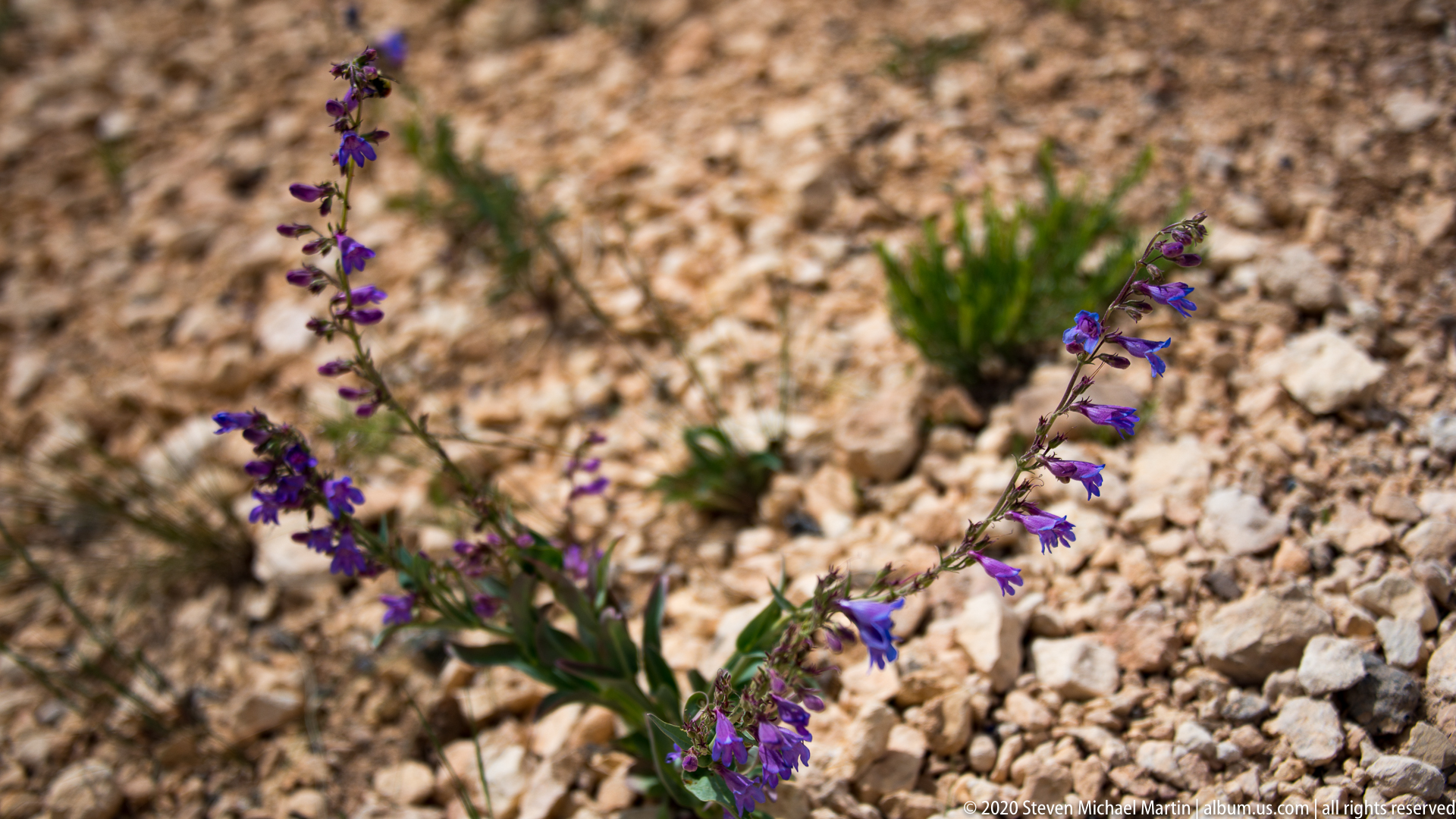
Blue-purple tubular flowers rise on slender stems from a patch of pale angular stones. Several blossoms face outward along branching stalks, while narrow leaves cluster near the base. The close view isolates the flowers from the rocky ground and shows how vegetation takes hold in the exposed, mineral-rich soil of the canyon rim.
Caption
Blue-purple tubular flowers rise on slender stems from a patch of pale angular stones. Several blossoms face outward along branching stalks, while narrow leaves cluster near the base. The close view isolates the flowers from the rocky ground and shows how vegetation takes hold in the exposed, mineral-rich soil of the canyon rim.

An orange slope sweeps down from a pale vertical cliff on the right toward a broad, hazy valley. Dark wooded ridges and lighter distant plateaus layer across the horizon beneath a sky of broken clouds. A few conifers stand on the near slope, adding scale to the exposed cliff and emphasizing the abrupt transition from rim to basin.
Caption
An orange slope sweeps down from a pale vertical cliff on the right toward a broad, hazy valley. Dark wooded ridges and lighter distant plateaus layer across the horizon beneath a sky of broken clouds. A few conifers stand on the near slope, adding scale to the exposed cliff and emphasizing the abrupt transition from rim to basin.

From a shaded rocky ledge, the view opens across a deep forested basin to bright orange cliffs on the far side. Pale broken stones and a weathered fallen trunk occupy the foreground, while sparse trees frame the canyon. The contrast between the shadowed rim and sunlit formations gives the landscape depth and emphasizes the steep descent into the basin.
Caption
From a shaded rocky ledge, the view opens across a deep forested basin to bright orange cliffs on the far side. Pale broken stones and a weathered fallen trunk occupy the foreground, while sparse trees frame the canyon. The contrast between the shadowed rim and sunlit formations gives the landscape depth and emphasizes the steep descent into the basin.

Clusters of small yellow flower heads branch above narrow green leaves in a close view of low vegetation. A dark, softly blurred woodland background separates the flowers from the surrounding forest floor, while the shallow focus highlights their varied stages of bloom. This botanical detail offers a brief pause from the canyon vistas and rock formations elsewhere in the sequence.
Caption
Clusters of small yellow flower heads branch above narrow green leaves in a close view of low vegetation. A dark, softly blurred woodland background separates the flowers from the surrounding forest floor, while the shallow focus highlights their varied stages of bloom. This botanical detail offers a brief pause from the canyon vistas and rock formations elsewhere in the sequence.
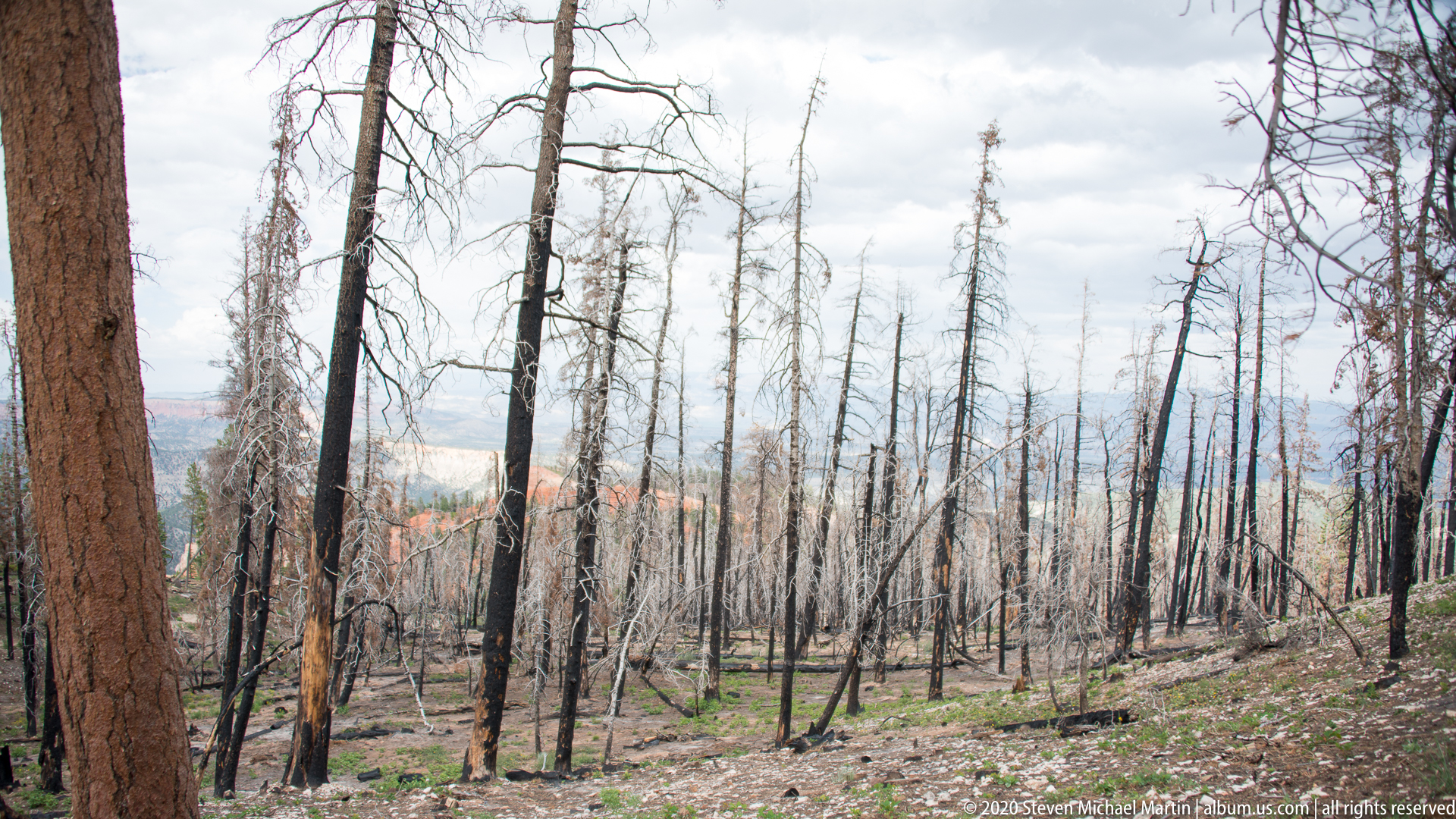
Numerous bare, gray trunks and blackened conifers stand across a sloping forest floor, with small patches of green regrowth near the ground. Through the open trunks, pale canyon formations and distant country are visible. The wide view documents a burned or severely disturbed stand, where the sparse canopy exposes the landscape beyond and the condition of the woodland.
Caption
Numerous bare, gray trunks and blackened conifers stand across a sloping forest floor, with small patches of green regrowth near the ground. Through the open trunks, pale canyon formations and distant country are visible. The wide view documents a burned or severely disturbed stand, where the sparse canopy exposes the landscape beyond and the condition of the woodland.
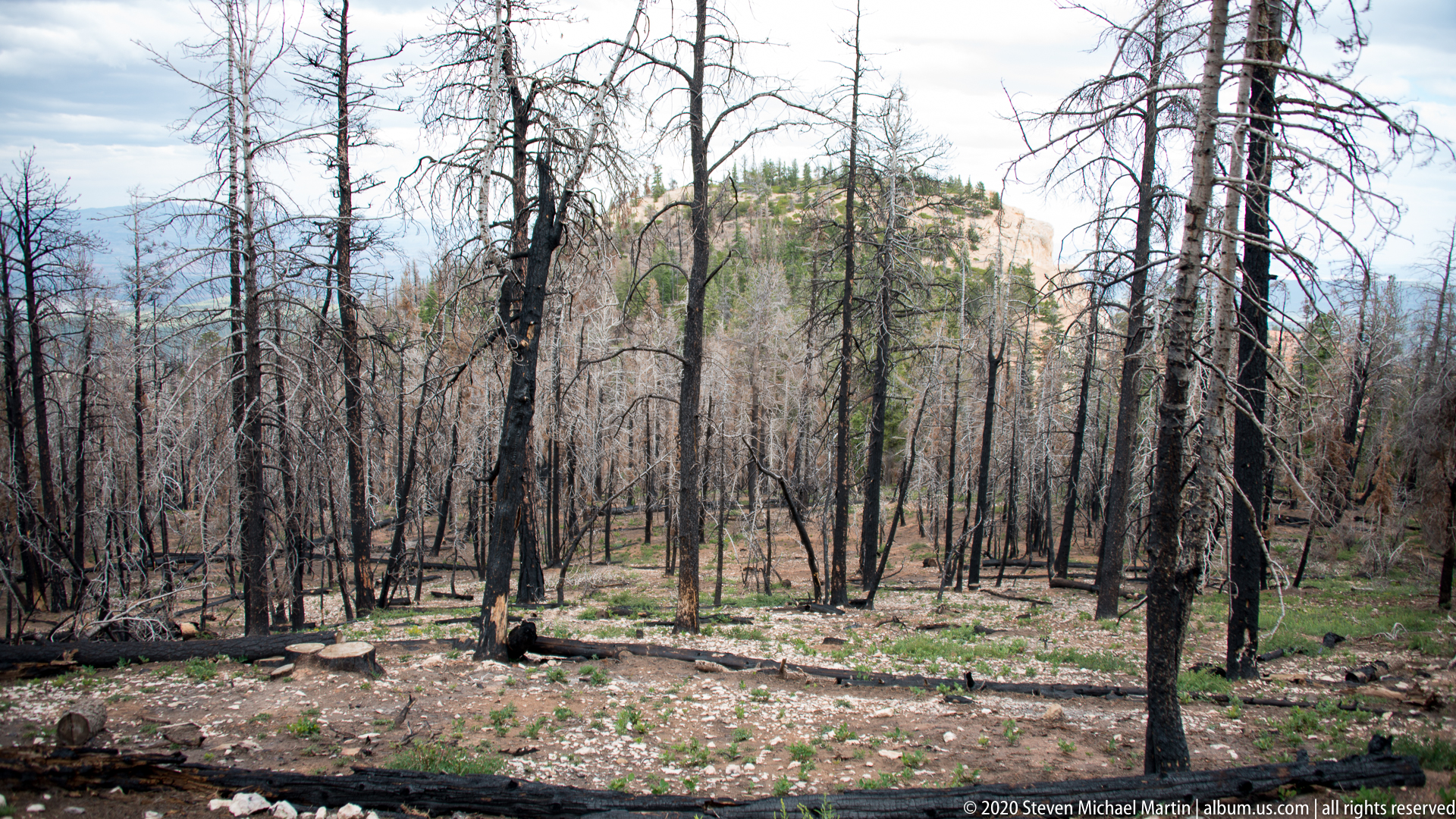
Blackened trunks and fallen logs stand across a sparse forest floor where low green plants are beginning to fill the gaps. The bare branches reveal an open canopy, and a low ridge shows through the trees in the distance. The scene records a forest shaped by fire, with deadwood and fresh understory growth sharing the same ground.
Caption
Blackened trunks and fallen logs stand across a sparse forest floor where low green plants are beginning to fill the gaps. The bare branches reveal an open canopy, and a low ridge shows through the trees in the distance. The scene records a forest shaped by fire, with deadwood and fresh understory growth sharing the same ground.
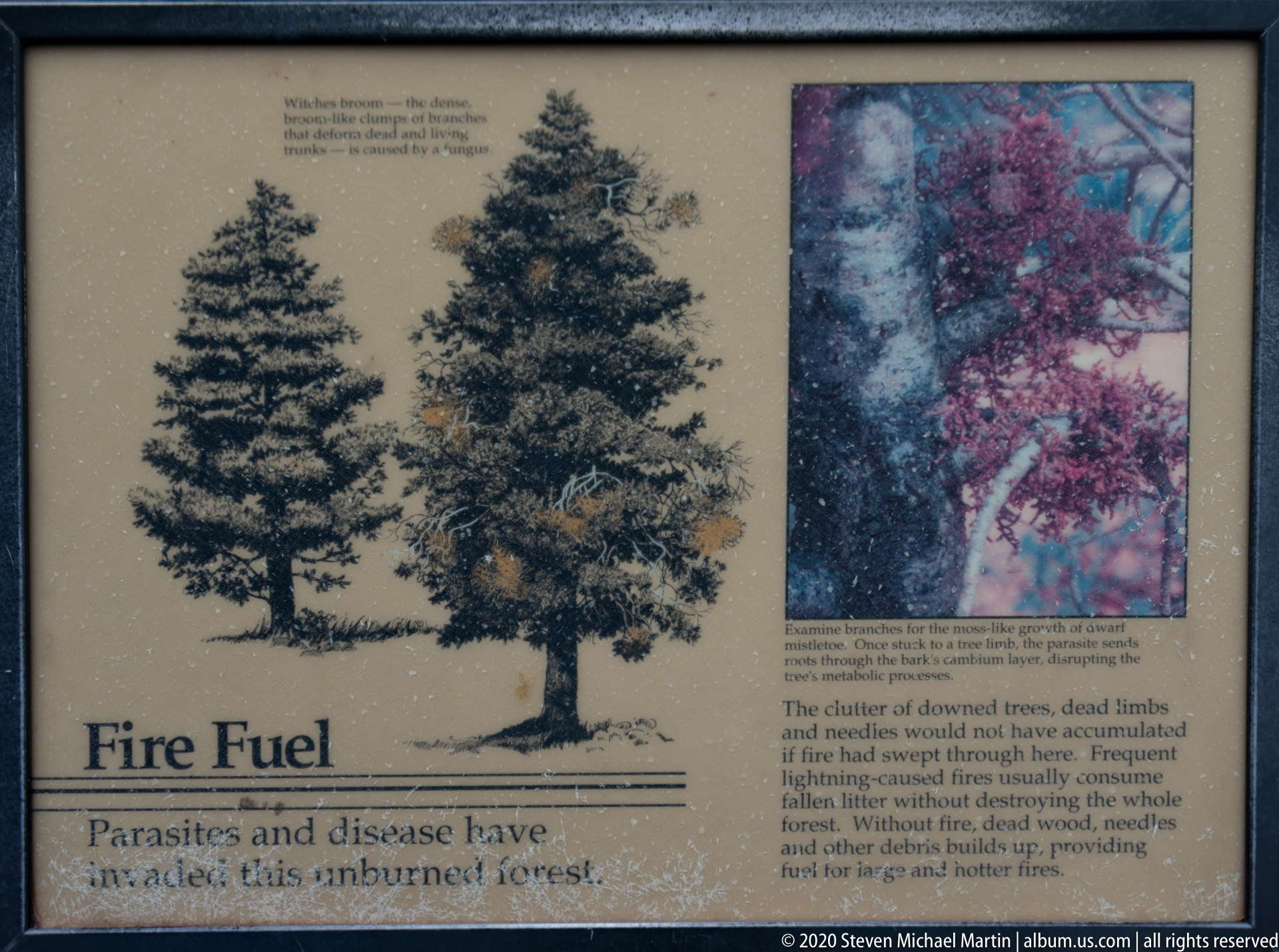
An interpretive panel headed “Fire Fuel” contrasts healthy conifers with a photograph of a forest affected by disease and accumulated debris. Its text explains how dead branches and needles can build up and contribute fuel for wildfire. The exhibit links forest condition to fire behavior, using images and a prominent title to make an ecological process legible to visitors.
Caption
An interpretive panel headed “Fire Fuel” contrasts healthy conifers with a photograph of a forest affected by disease and accumulated debris. Its text explains how dead branches and needles can build up and contribute fuel for wildfire. The exhibit links forest condition to fire behavior, using images and a prominent title to make an ecological process legible to visitors.
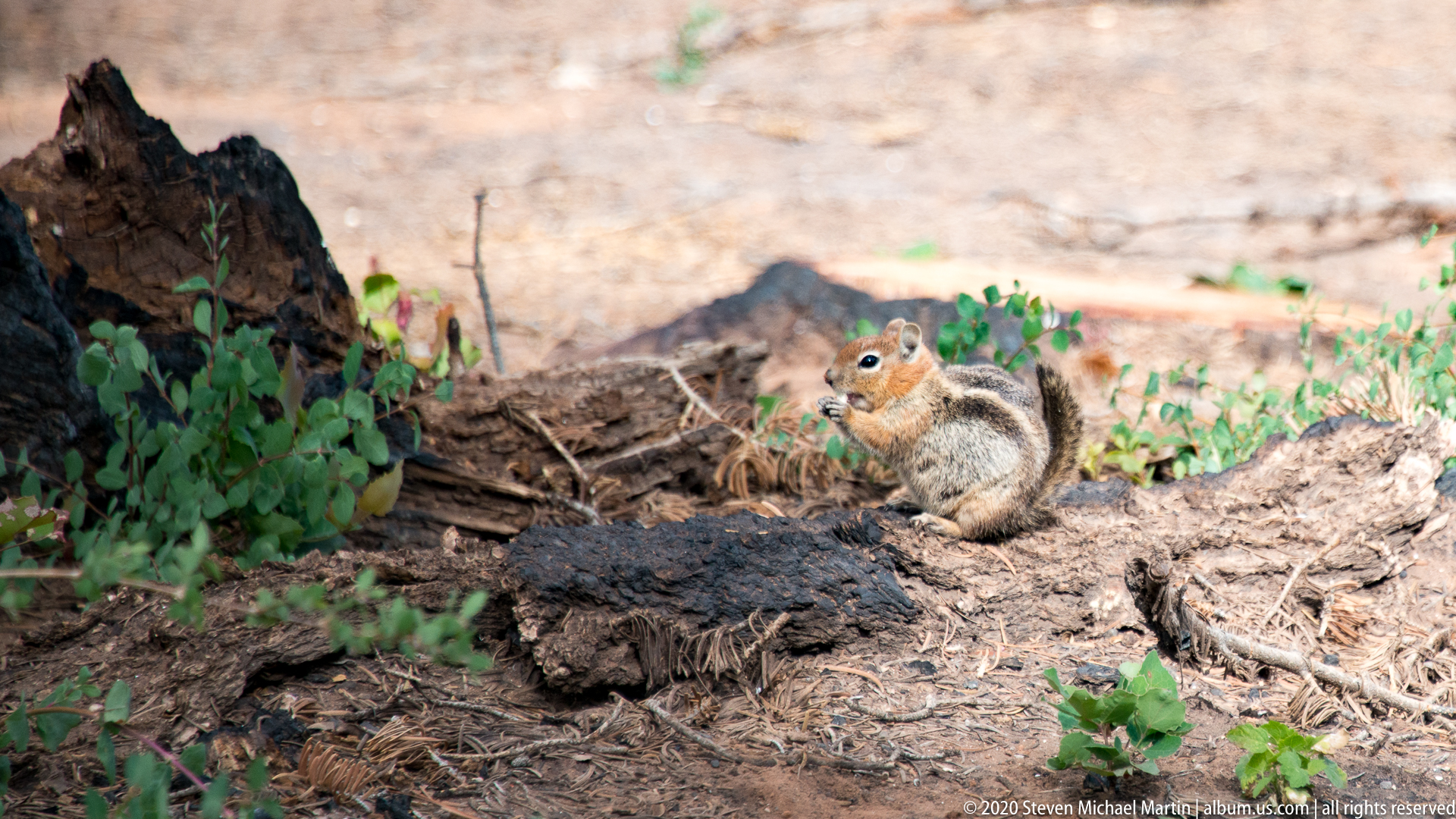
A small chipmunk sits on the forest floor beside a fallen log, its striped face turned toward the camera. Green leaves and tiny plants surround the animal, while the pale soil and wood fragments create a dry, open patch beneath the trees. The low viewpoint isolates the alert rodent within its woodland habitat and shows its compact body in profile.
Caption
A small chipmunk sits on the forest floor beside a fallen log, its striped face turned toward the camera. Green leaves and tiny plants surround the animal, while the pale soil and wood fragments create a dry, open patch beneath the trees. The low viewpoint isolates the alert rodent within its woodland habitat and shows its compact body in profile.

A chipmunk pauses on a carpet of pine needles, bark, and small branches. Its dark and pale facial stripes remain visible despite motion blur around the head and forepaws, suggesting a quick turn or movement. The close ground-level framing brings the animal forward while the textured forest litter fills the background without a clear horizon.
Caption
A chipmunk pauses on a carpet of pine needles, bark, and small branches. Its dark and pale facial stripes remain visible despite motion blur around the head and forepaws, suggesting a quick turn or movement. The close ground-level framing brings the animal forward while the textured forest litter fills the background without a clear horizon.

A bleached fallen tree lies among low pines and slickrock at the overlook, its broken trunk and bare limbs crossing the foreground. Beyond it, layered cream and orange cliffs extend beneath a dark bank of storm clouds. The weathered wood anchors the scene and contrasts with the distant, brightly lit canyon wall.
Caption
A bleached fallen tree lies among low pines and slickrock at the overlook, its broken trunk and bare limbs crossing the foreground. Beyond it, layered cream and orange cliffs extend beneath a dark bank of storm clouds. The weathered wood anchors the scene and contrasts with the distant, brightly lit canyon wall.

A pale, blocky rock ledge occupies the right foreground above a steep drop into orange canyon walls. A green shrub grows at the edge of the broken stone, while layered cliffs and a distant forested plateau extend across the background. The close viewpoint foregrounds the fragile rim and its abrupt transition to the canyon below.
Caption
A pale, blocky rock ledge occupies the right foreground above a steep drop into orange canyon walls. A green shrub grows at the edge of the broken stone, while layered cliffs and a distant forested plateau extend across the background. The close viewpoint foregrounds the fragile rim and its abrupt transition to the canyon below.
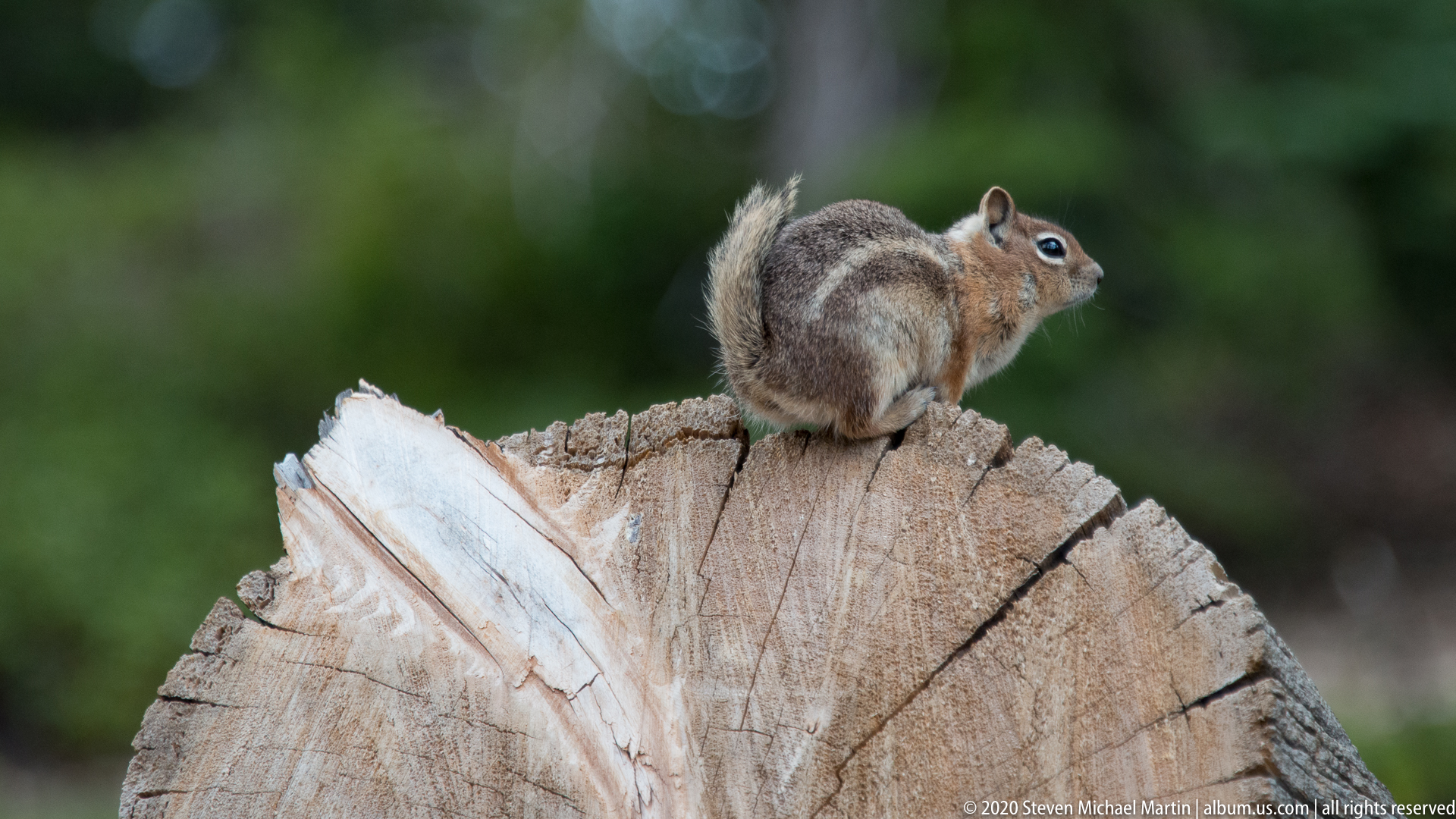
A chipmunk perches near the edge of a broad cut stump, shown in profile with its striped back and raised tail visible. The pale wood grain and radial cracks form a textured platform beneath it, while a dark green background falls out of focus. The elevated pose distinguishes this portrait from the animal’s ground-level appearances nearby.
Caption
A chipmunk perches near the edge of a broad cut stump, shown in profile with its striped back and raised tail visible. The pale wood grain and radial cracks form a textured platform beneath it, while a dark green background falls out of focus. The elevated pose distinguishes this portrait from the animal’s ground-level appearances nearby.

A chipmunk sits upright near the center of a cut tree trunk, facing the camera with its forepaws held close to its chest. The broad stump fills the lower frame, revealing pale growth rings and deep radial cracks. Soft circular highlights in the green background separate the small animal from the forest beyond and give the portrait a shallow depth of field.
Caption
A chipmunk sits upright near the center of a cut tree trunk, facing the camera with its forepaws held close to its chest. The broad stump fills the lower frame, revealing pale growth rings and deep radial cracks. Soft circular highlights in the green background separate the small animal from the forest beyond and give the portrait a shallow depth of field.
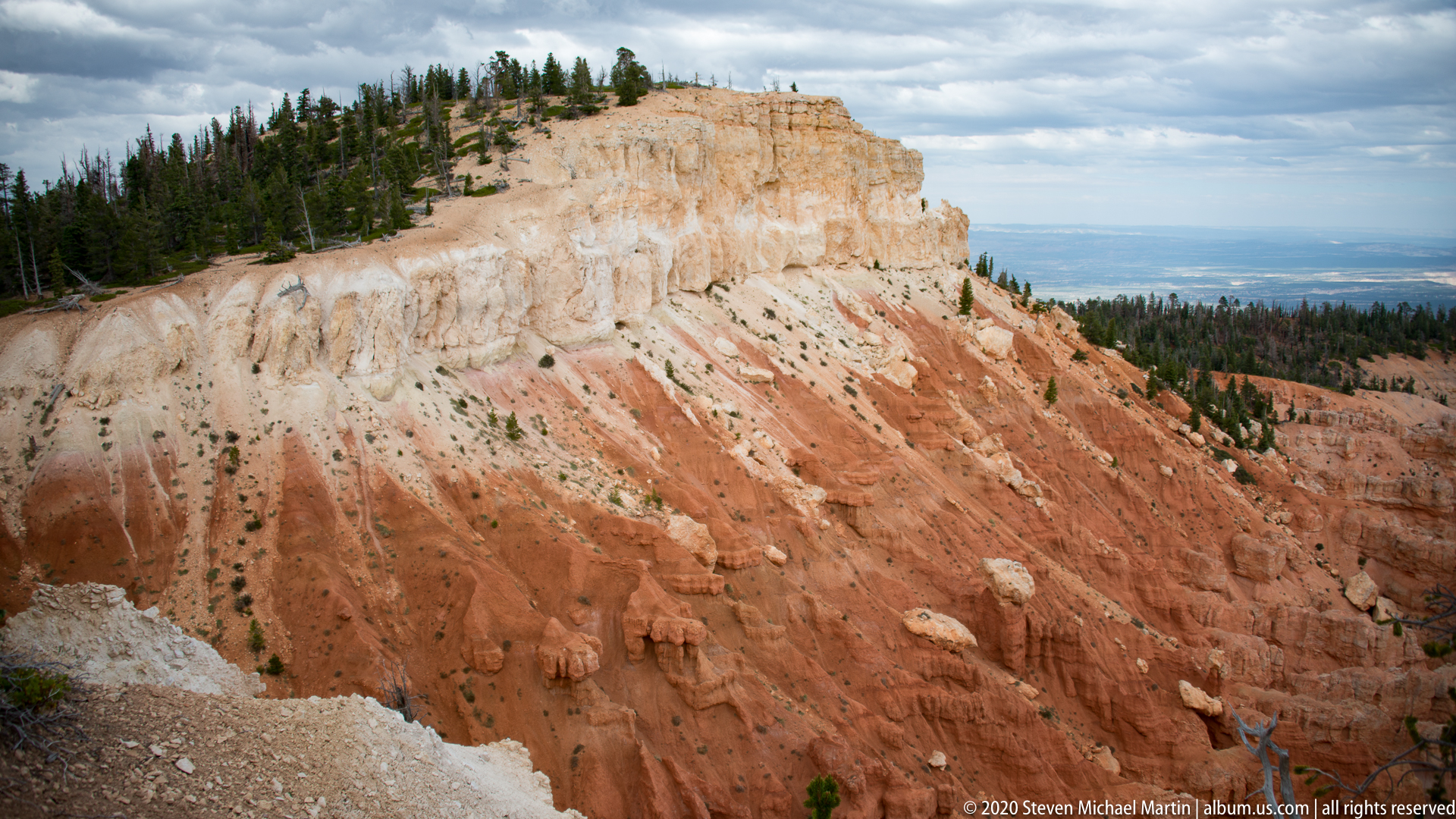
A steep cream-and-orange cliff descends from a tree-lined rim toward the canyon, its face cut by narrow gullies and scattered hoodoo-like projections. The nearest pale rock drops sharply from the left foreground, while a broad view opens to distant blue ridges on the right. This elevated perspective emphasizes the abrupt transition from forest to eroded slope.
Caption
A steep cream-and-orange cliff descends from a tree-lined rim toward the canyon, its face cut by narrow gullies and scattered hoodoo-like projections. The nearest pale rock drops sharply from the left foreground, while a broad view opens to distant blue ridges on the right. This elevated perspective emphasizes the abrupt transition from forest to eroded slope.
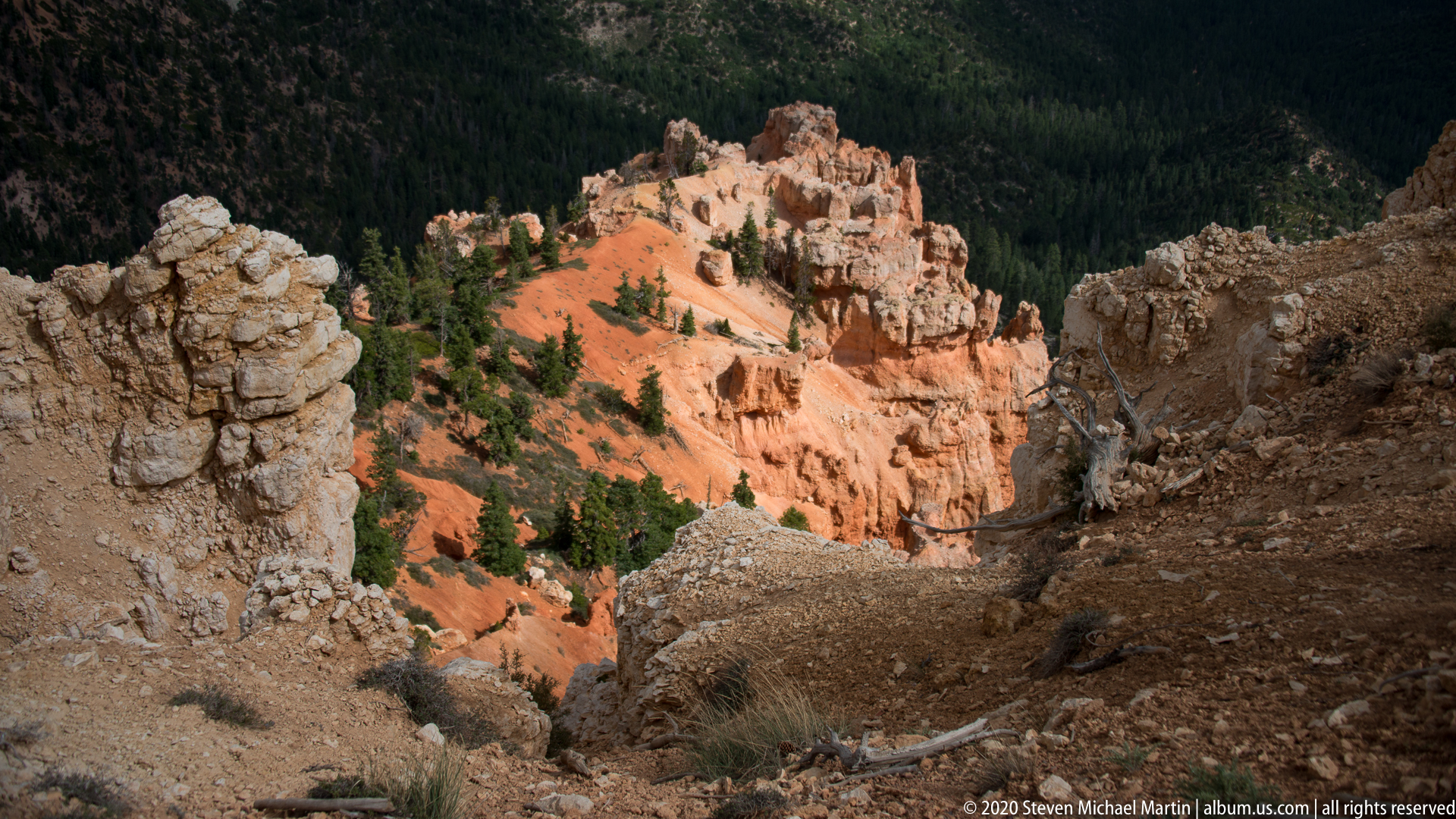
From the rim, the view drops into a deep amphitheater of orange hoodoos and pale rock fins. Conifer forest blankets the basin beyond the formations, while a pale stone ledge frames the foreground. The high vantage point reveals how narrow pinnacles cluster along the canyon wall and transition into wooded slopes farther below.
Caption
From the rim, the view drops into a deep amphitheater of orange hoodoos and pale rock fins. Conifer forest blankets the basin beyond the formations, while a pale stone ledge frames the foreground. The high vantage point reveals how narrow pinnacles cluster along the canyon wall and transition into wooded slopes farther below.

A weathered tree trunk stands leafless against a bright blue sky, its branching limbs reaching outward from a low pile of fallen timber. The skeletal form rises above low evergreen shrubs at the canyon rim. Clouds move across the background, and the stark silhouette makes the tree’s decay and exposure the central subject.
Caption
A weathered tree trunk stands leafless against a bright blue sky, its branching limbs reaching outward from a low pile of fallen timber. The skeletal form rises above low evergreen shrubs at the canyon rim. Clouds move across the background, and the stark silhouette makes the tree’s decay and exposure the central subject.
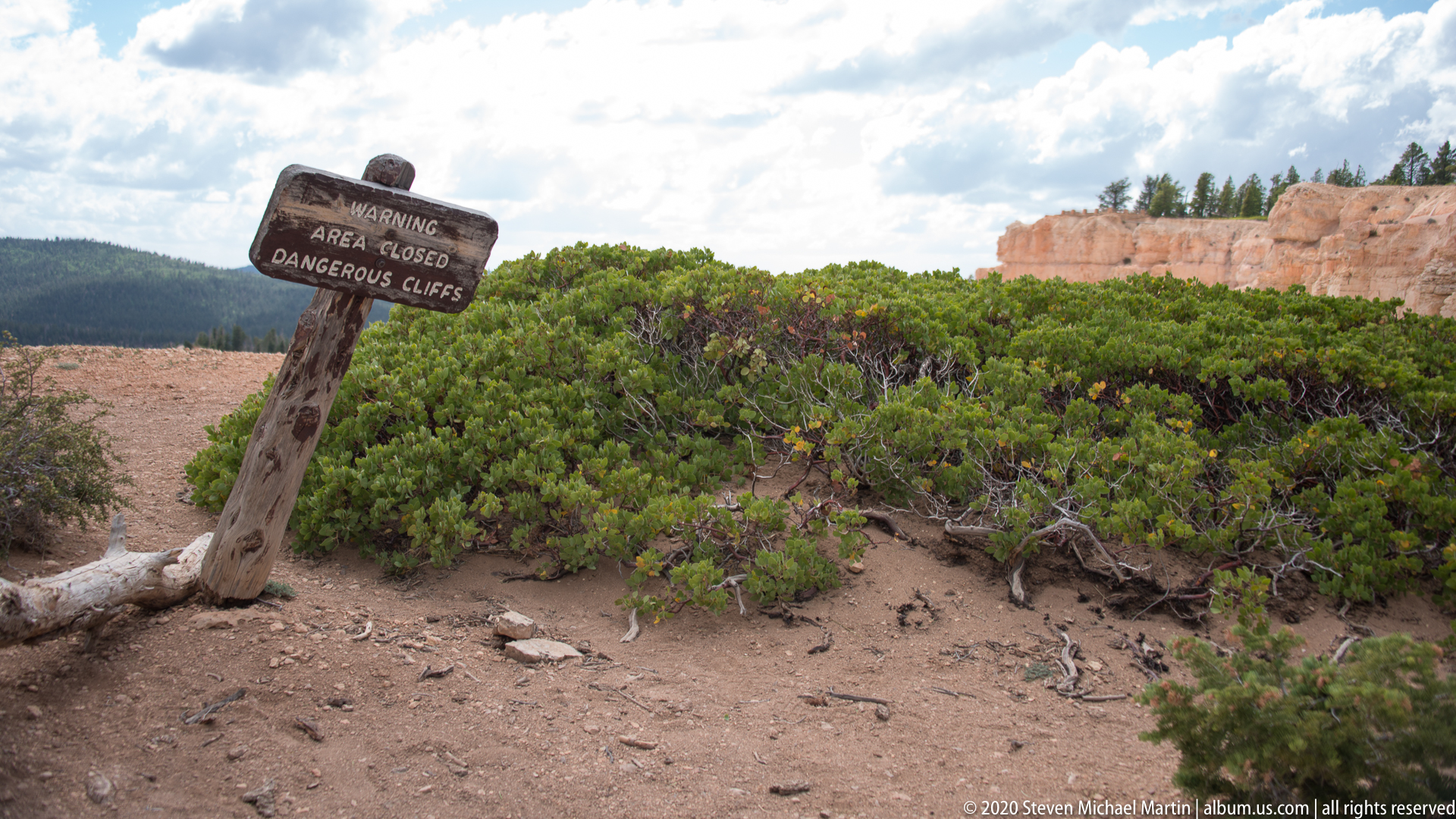
A weathered wooden sign reads “Warning Area Closed Dangerous Cliffs” beside a narrow path bordered by dense shrubs. Its dark post leans slightly, and a sandy trail curves toward an exposed orange rock edge behind it. The direct view gives the safety notice priority while retaining the cliffside vegetation and terrain that define the restricted area.
Caption
A weathered wooden sign reads “Warning Area Closed Dangerous Cliffs” beside a narrow path bordered by dense shrubs. Its dark post leans slightly, and a sandy trail curves toward an exposed orange rock edge behind it. The direct view gives the safety notice priority while retaining the cliffside vegetation and terrain that define the restricted area.
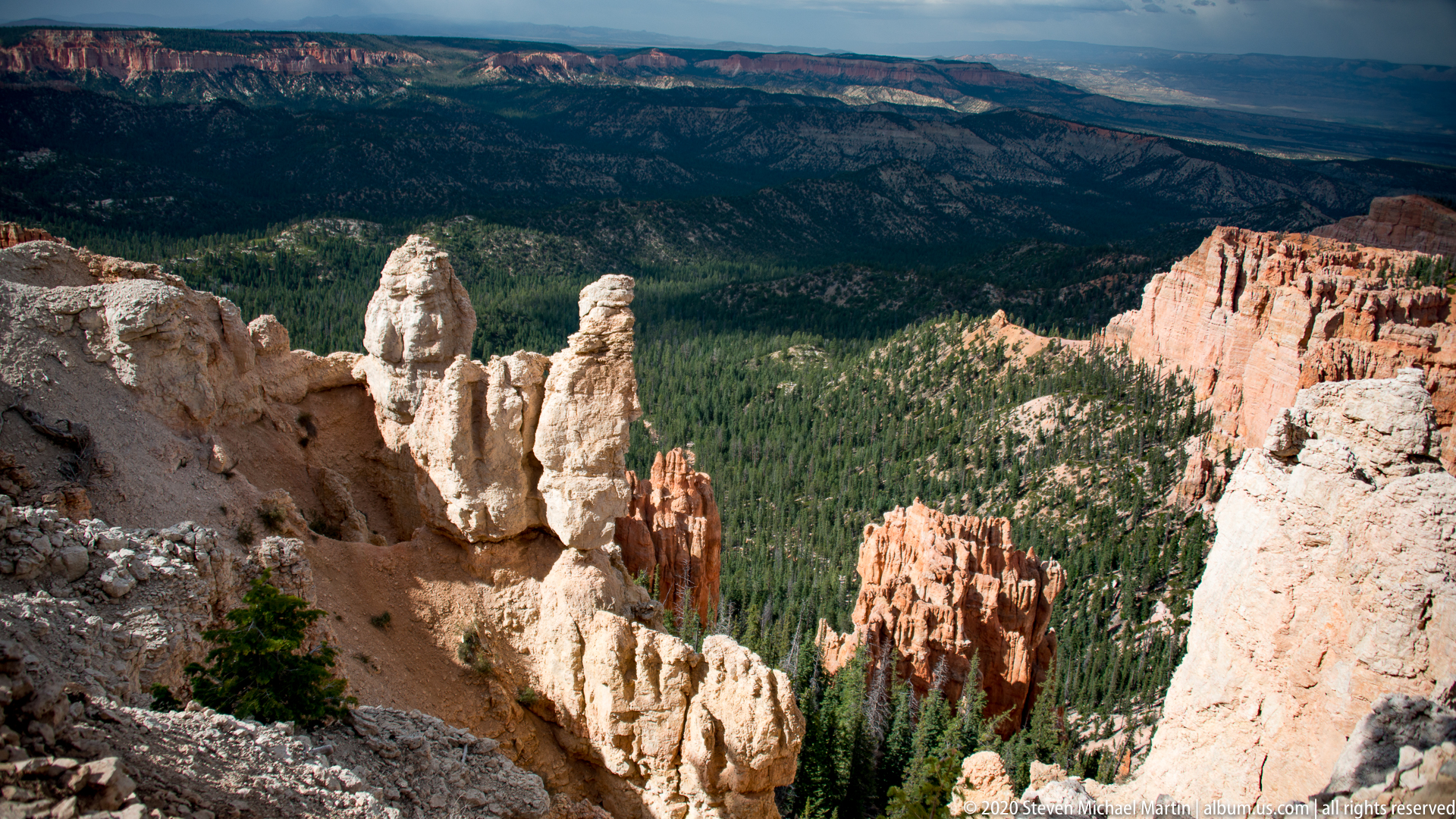
A high rim view looks across clusters of pale and orange hoodoos toward a broad, forested basin and distant plateaus. Several narrow spires rise in the foreground, while a denser band of pinnacles drops into the canyon on the right. The scene combines close rock detail with a long view across the changing elevations of Bryce Canyon.
Caption
A high rim view looks across clusters of pale and orange hoodoos toward a broad, forested basin and distant plateaus. Several narrow spires rise in the foreground, while a denser band of pinnacles drops into the canyon on the right. The scene combines close rock detail with a long view across the changing elevations of Bryce Canyon.
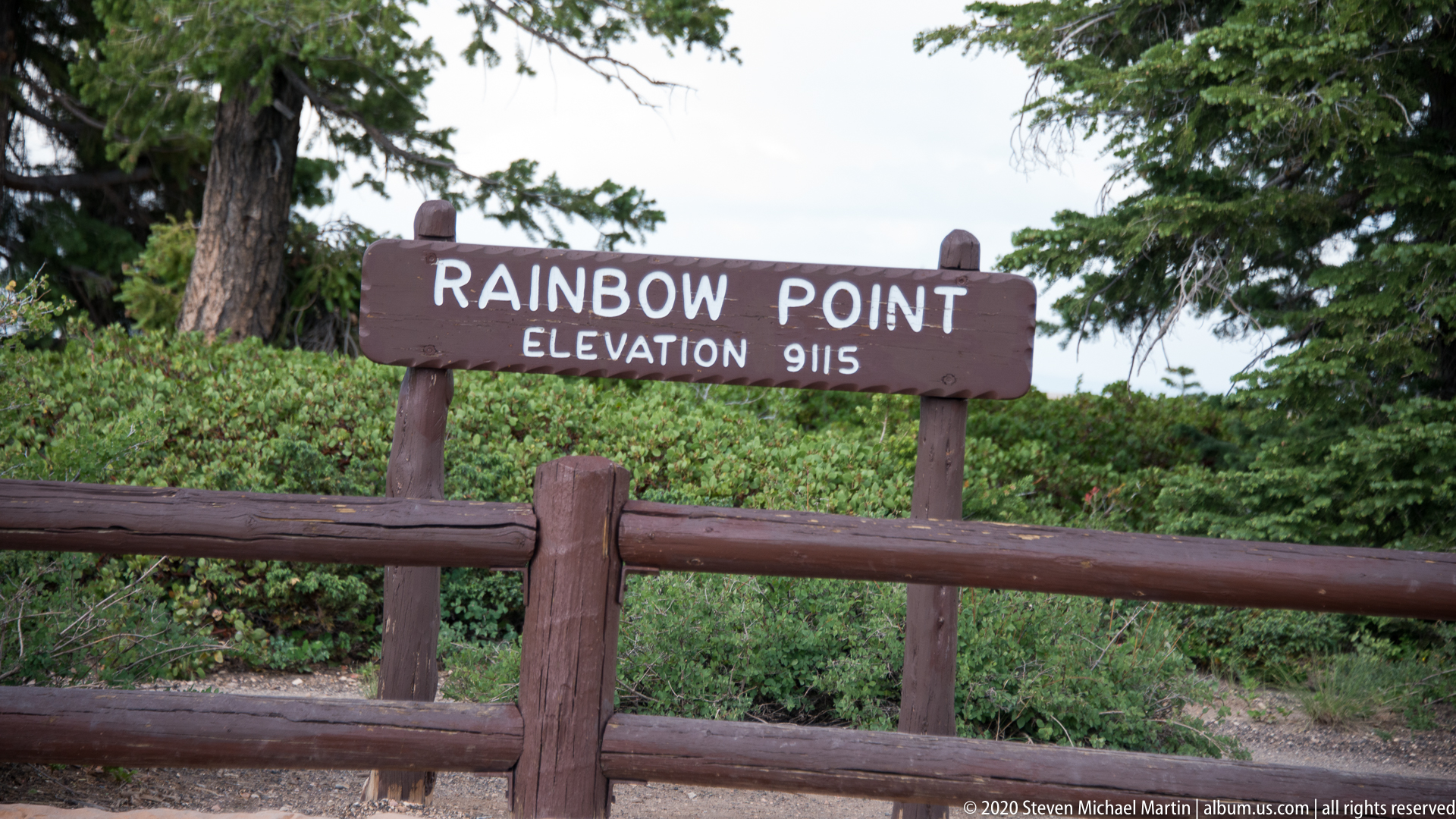
A brown wooden sign reads “Rainbow Point Elevation 9115” above a matching rail fence. Green shrubs and mature trees surround the viewpoint, while a strip of pale sky appears through the canopy. The close composition records both the named destination and its posted elevation, identifying a specific stop along the high rim road and trail network.
Caption
A brown wooden sign reads “Rainbow Point Elevation 9115” above a matching rail fence. Green shrubs and mature trees surround the viewpoint, while a strip of pale sky appears through the canopy. The close composition records both the named destination and its posted elevation, identifying a specific stop along the high rim road and trail network.

The brown wooden marker reads “Black Birch Canyon Elevation 8750” beside a fenced overlook. A weathered tree trunk and low vegetation frame the right side, while the paved or compacted path continues toward a viewing area behind the sign. The scene places the named canyon stop within its wooded rim setting and records the posted elevation clearly.
Caption
The brown wooden marker reads “Black Birch Canyon Elevation 8750” beside a fenced overlook. A weathered tree trunk and low vegetation frame the right side, while the paved or compacted path continues toward a viewing area behind the sign. The scene places the named canyon stop within its wooded rim setting and records the posted elevation clearly.
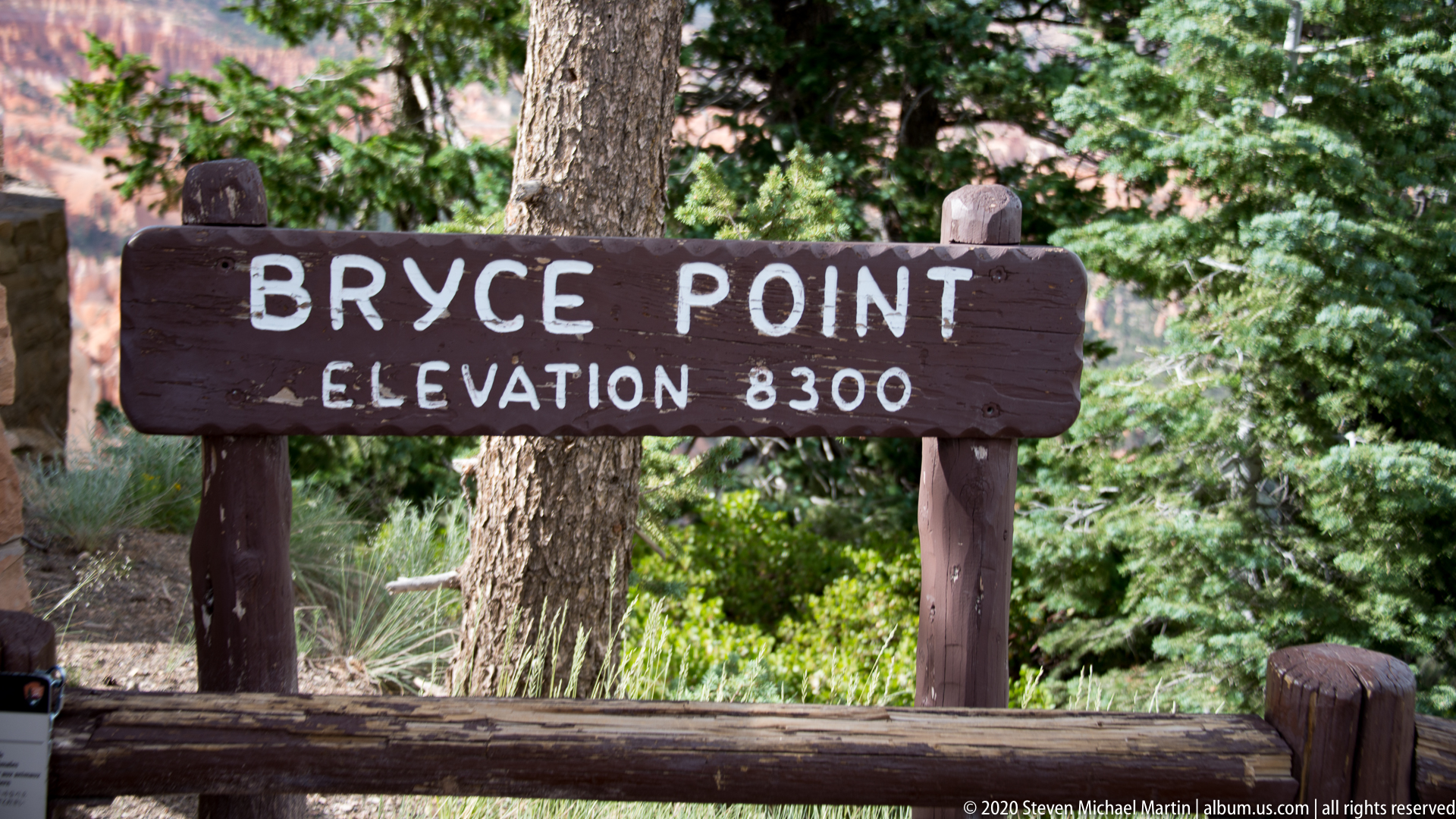
A dark wooden sign reads “Bryce Point Elevation 8300,” mounted above a horizontal fence rail. A tree trunk and green foliage stand immediately behind it, with a glimpse of pale orange rock at the edge. The tight framing prioritizes the place name and elevation, distinguishing this marker from the nearby signs for Rainbow Point and Black Birch Canyon.
Caption
A dark wooden sign reads “Bryce Point Elevation 8300,” mounted above a horizontal fence rail. A tree trunk and green foliage stand immediately behind it, with a glimpse of pale orange rock at the edge. The tight framing prioritizes the place name and elevation, distinguishing this marker from the nearby signs for Rainbow Point and Black Birch Canyon.
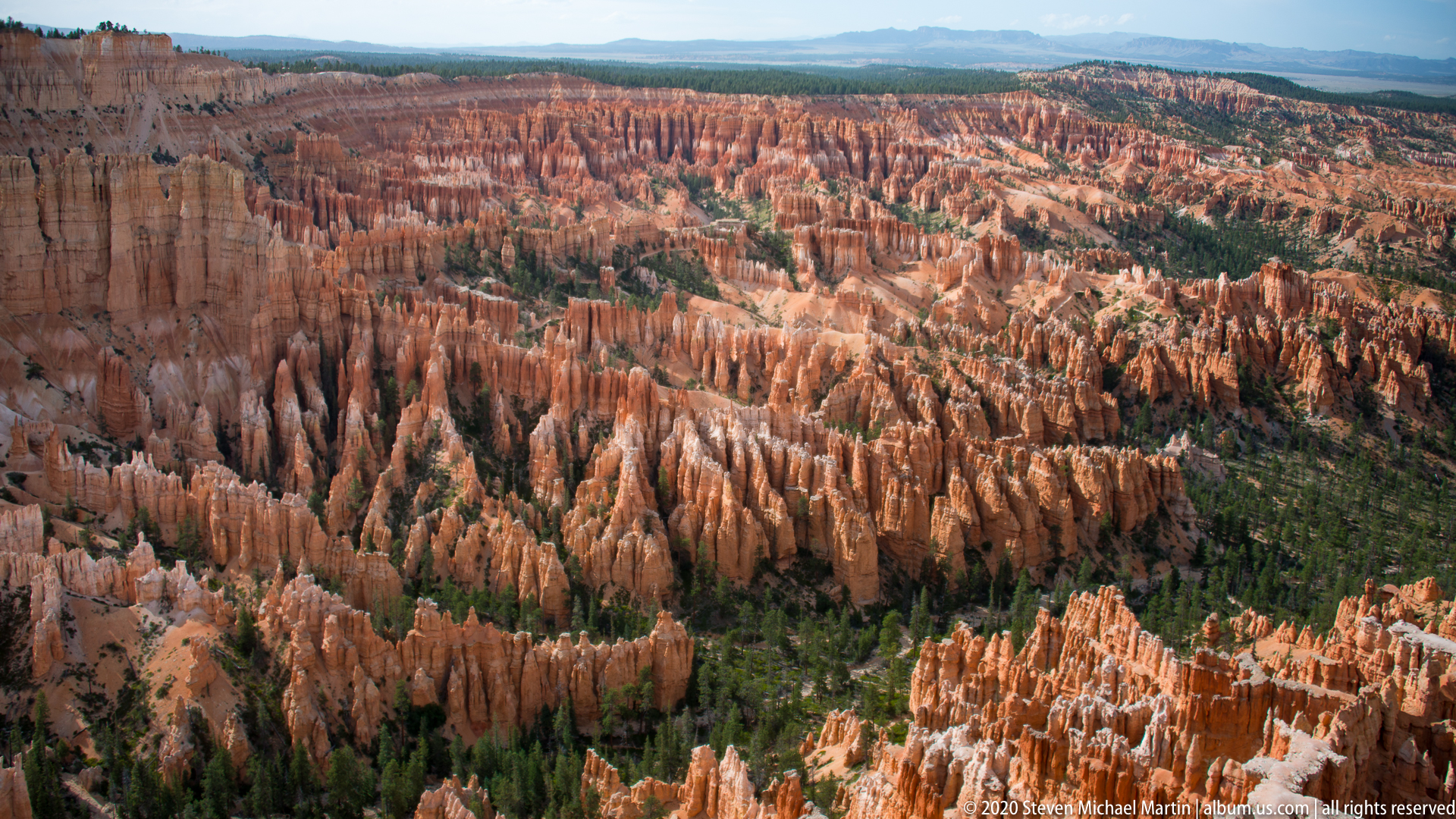
Countless orange hoodoos fill the basin, forming tightly spaced rows that sweep toward a distant forested plateau. Dark green pines divide the red formations into patches, while the high viewpoint reveals the amphitheater’s broad scale and repeated vertical forms. The even daylight brings out contrasts between the pale caprock and darker orange spires.
Caption
Countless orange hoodoos fill the basin, forming tightly spaced rows that sweep toward a distant forested plateau. Dark green pines divide the red formations into patches, while the high viewpoint reveals the amphitheater’s broad scale and repeated vertical forms. The even daylight brings out contrasts between the pale caprock and darker orange spires.
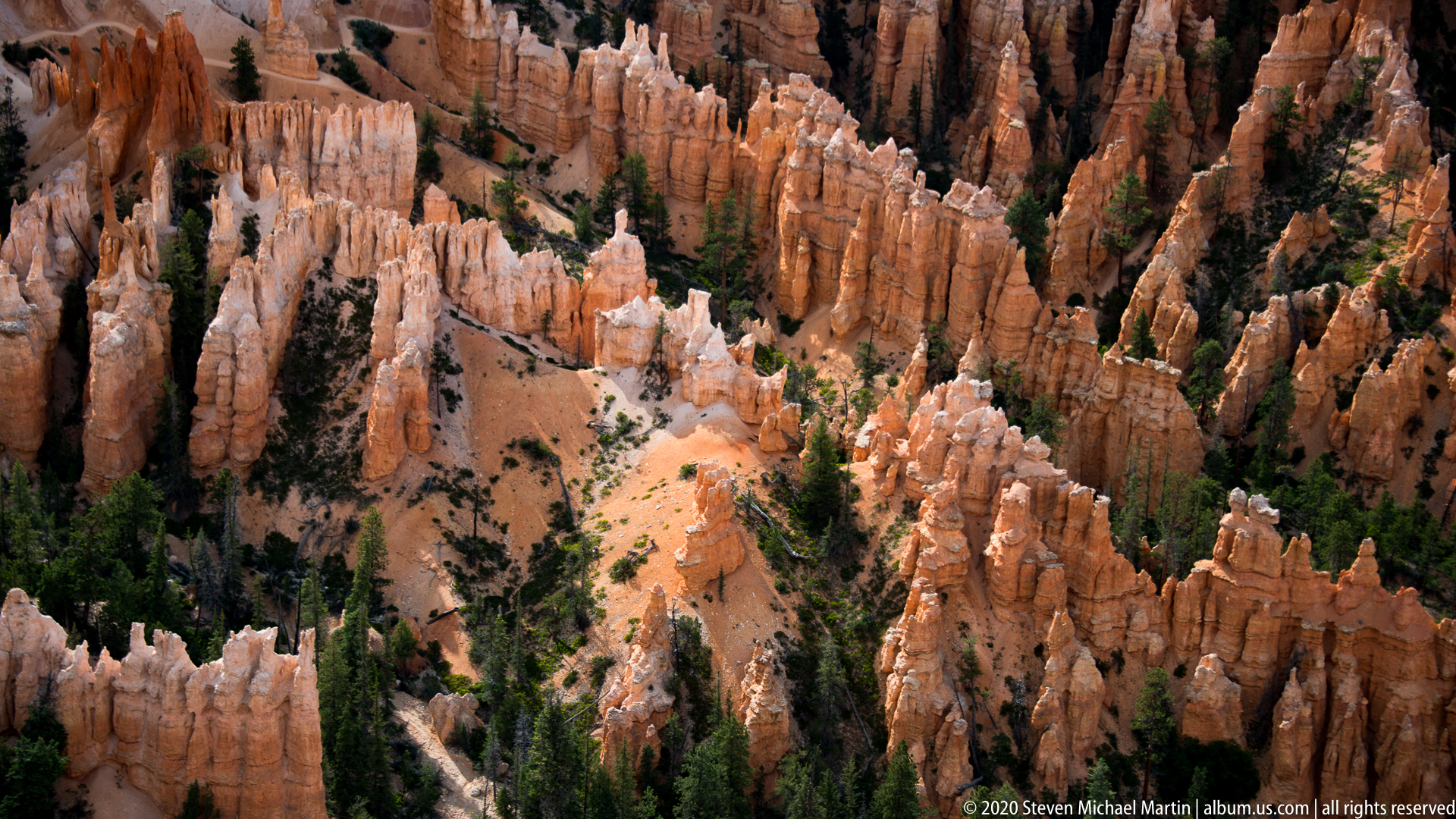
A narrow sandy passage winds between tall orange hoodoos and pale rock fins, descending into a shaded pocket of the amphitheater. The irregular spires crowd both sides of the route, while patches of evergreen growth appear on ledges and in the basin below. This elevated view reveals the intricate network of spaces between the formations.
Caption
A narrow sandy passage winds between tall orange hoodoos and pale rock fins, descending into a shaded pocket of the amphitheater. The irregular spires crowd both sides of the route, while patches of evergreen growth appear on ledges and in the basin below. This elevated view reveals the intricate network of spaces between the formations.
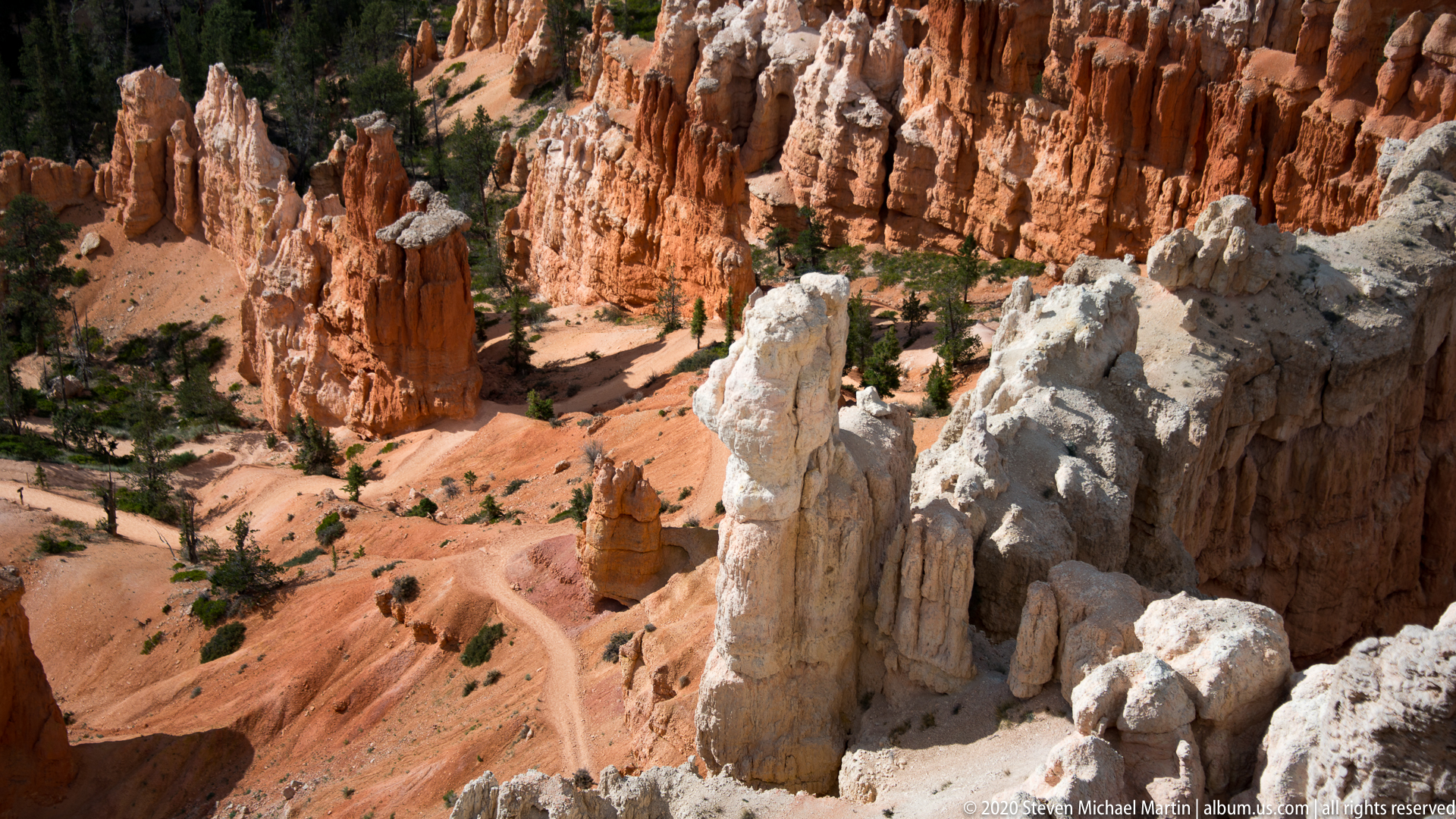
Pale, irregular spires rise in the foreground above an orange slope dotted with narrow hoodoos and dark green trees. The close rock towers show rounded caps and deeply eroded grooves, while the canyon floor drops away behind them. Warm sunlight separates the cream formations from the rust-colored wall and makes their varied heights easy to compare.
Caption
Pale, irregular spires rise in the foreground above an orange slope dotted with narrow hoodoos and dark green trees. The close rock towers show rounded caps and deeply eroded grooves, while the canyon floor drops away behind them. Warm sunlight separates the cream formations from the rust-colored wall and makes their varied heights easy to compare.
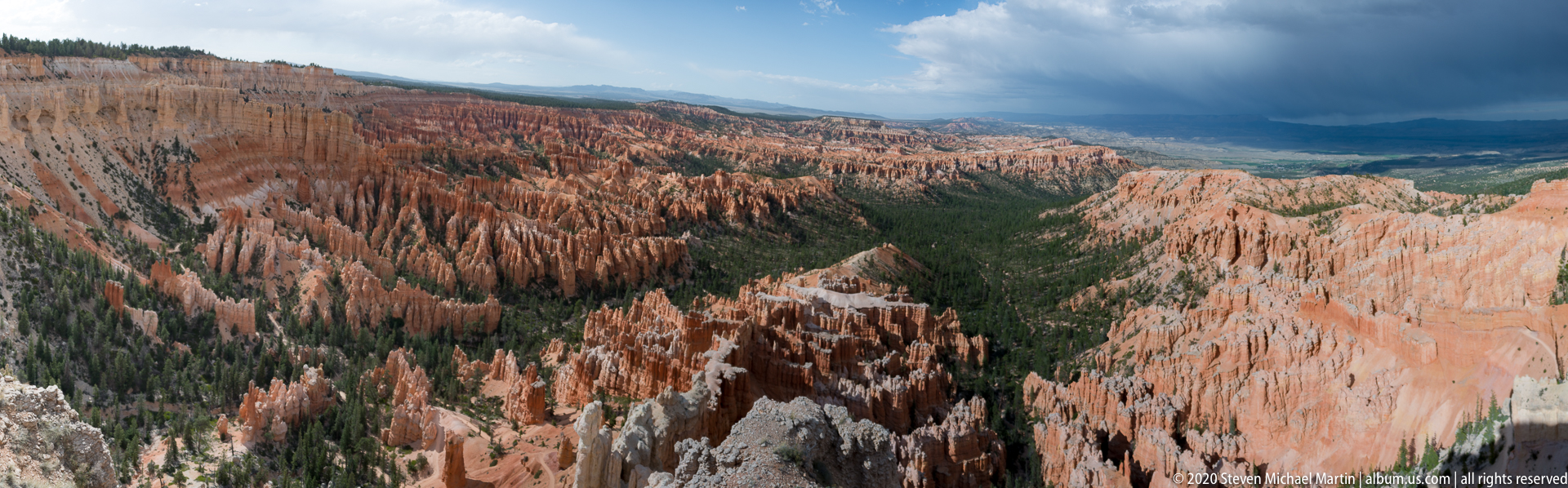
A wide view across the Bryce Canyon amphitheater shows orange hoodoos descending toward a distant valley and forested ridges. A dark storm cloud hangs over the right side of the basin, while sunlight brightens the formations to the left. The shifting light creates a strong division across the panorama and highlights the canyon’s depth.
Caption
A wide view across the Bryce Canyon amphitheater shows orange hoodoos descending toward a distant valley and forested ridges. A dark storm cloud hangs over the right side of the basin, while sunlight brightens the formations to the left. The shifting light creates a strong division across the panorama and highlights the canyon’s depth.
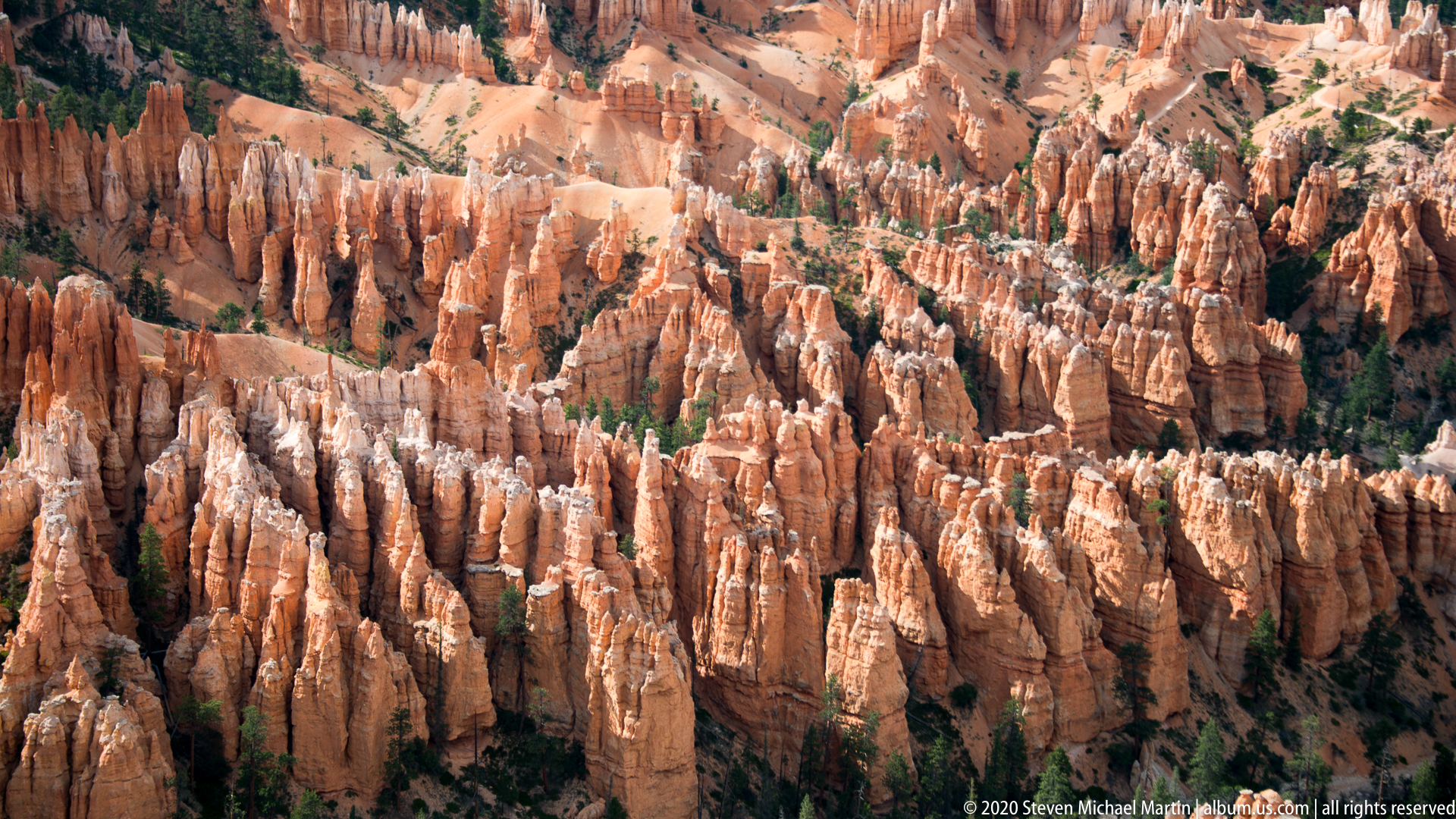
A dense field of orange and cream pinnacles fills the frame, their narrow spires separated by dark gullies and occasional patches of green. The close perspective compresses the formations into a repeating pattern of vertical rock, revealing subtle differences in color and height. With no horizon visible, attention stays on the eroded textures within the amphitheater.
Caption
A dense field of orange and cream pinnacles fills the frame, their narrow spires separated by dark gullies and occasional patches of green. The close perspective compresses the formations into a repeating pattern of vertical rock, revealing subtle differences in color and height. With no horizon visible, attention stays on the eroded textures within the amphitheater.

The canyon drops steeply through tightly packed hoodoos, with pale paths and narrow ledges threading among the orange spires. Dark evergreen trees gather in the lower pockets and along the distant rim, breaking the repeated vertical pattern. The elevated viewpoint captures a deep section of the amphitheater where the formations appear to rise in successive bands.
Caption
The canyon drops steeply through tightly packed hoodoos, with pale paths and narrow ledges threading among the orange spires. Dark evergreen trees gather in the lower pockets and along the distant rim, breaking the repeated vertical pattern. The elevated viewpoint captures a deep section of the amphitheater where the formations appear to rise in successive bands.
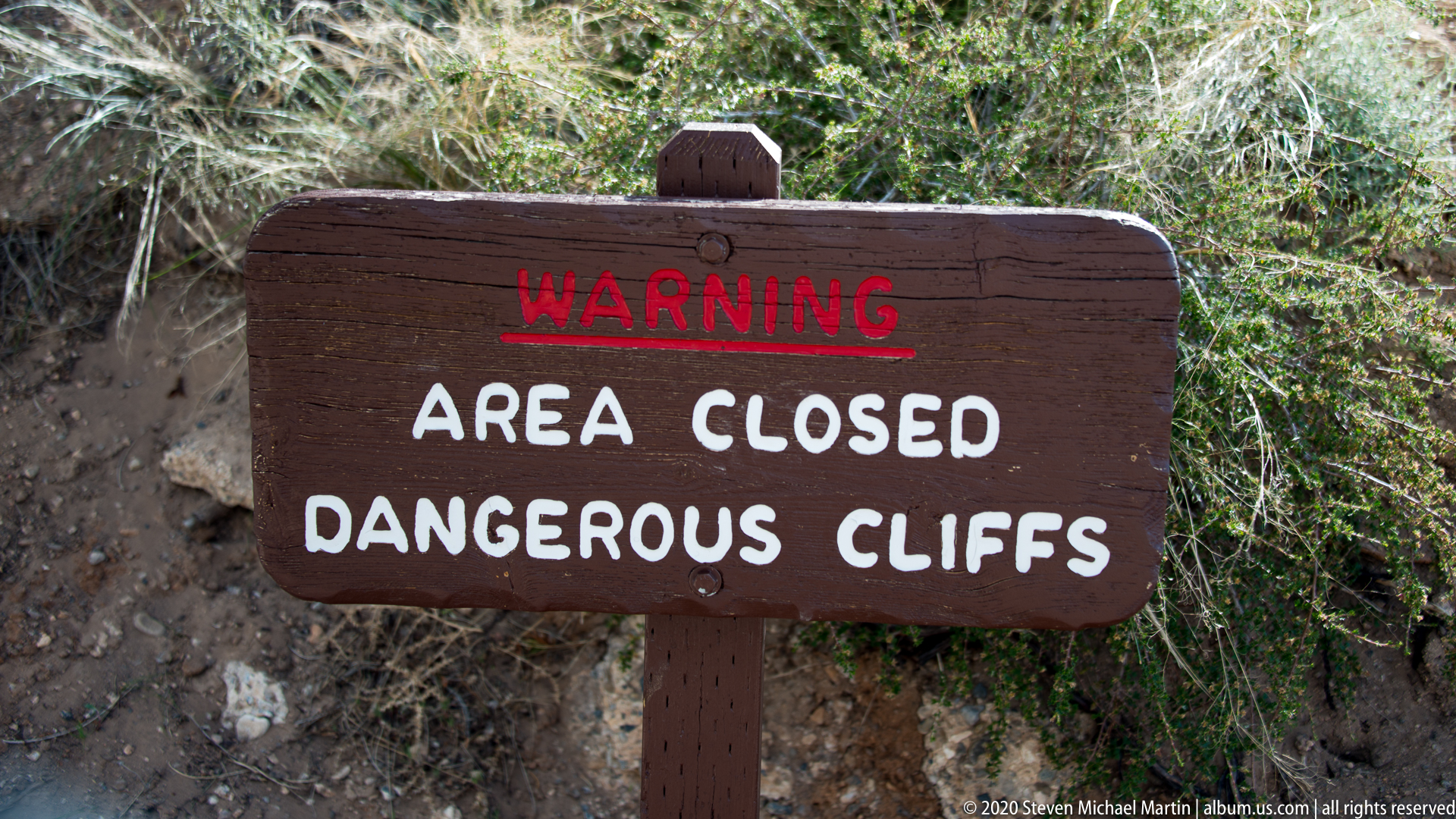
A dark wooden warning sign reads “Warning Area Closed Dangerous Cliffs,” its white lettering and red heading standing out against the weathered surface. Shrubs and pale rock surround the post, indicating a trail-side placement near exposed terrain. The sign’s direct message is the focus, while the natural setting explains why the edge is restricted.
Caption
A dark wooden warning sign reads “Warning Area Closed Dangerous Cliffs,” its white lettering and red heading standing out against the weathered surface. Shrubs and pale rock surround the post, indicating a trail-side placement near exposed terrain. The sign’s direct message is the focus, while the natural setting explains why the edge is restricted.
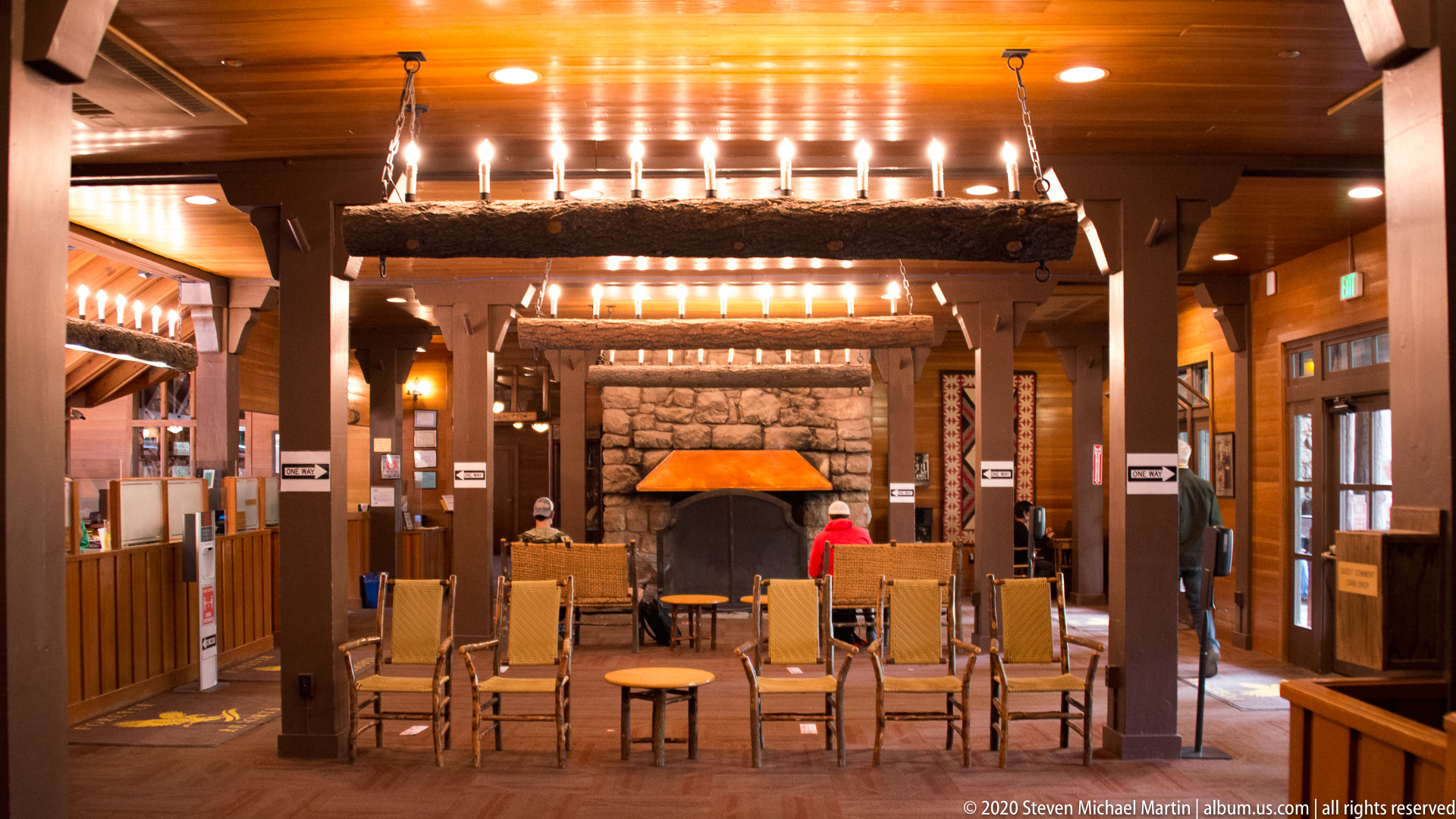
A large stone fireplace anchors a warmly lit common room, with armchairs and small tables arranged in front of it. Exposed beams and pendant lights repeat down the ceiling, while windows and wood-framed doors line the side walls. The symmetrical view emphasizes the fireplace as the room’s focal point and the comfortable seating arranged around it.
Caption
A large stone fireplace anchors a warmly lit common room, with armchairs and small tables arranged in front of it. Exposed beams and pendant lights repeat down the ceiling, while windows and wood-framed doors line the side walls. The symmetrical view emphasizes the fireplace as the room’s focal point and the comfortable seating arranged around it.
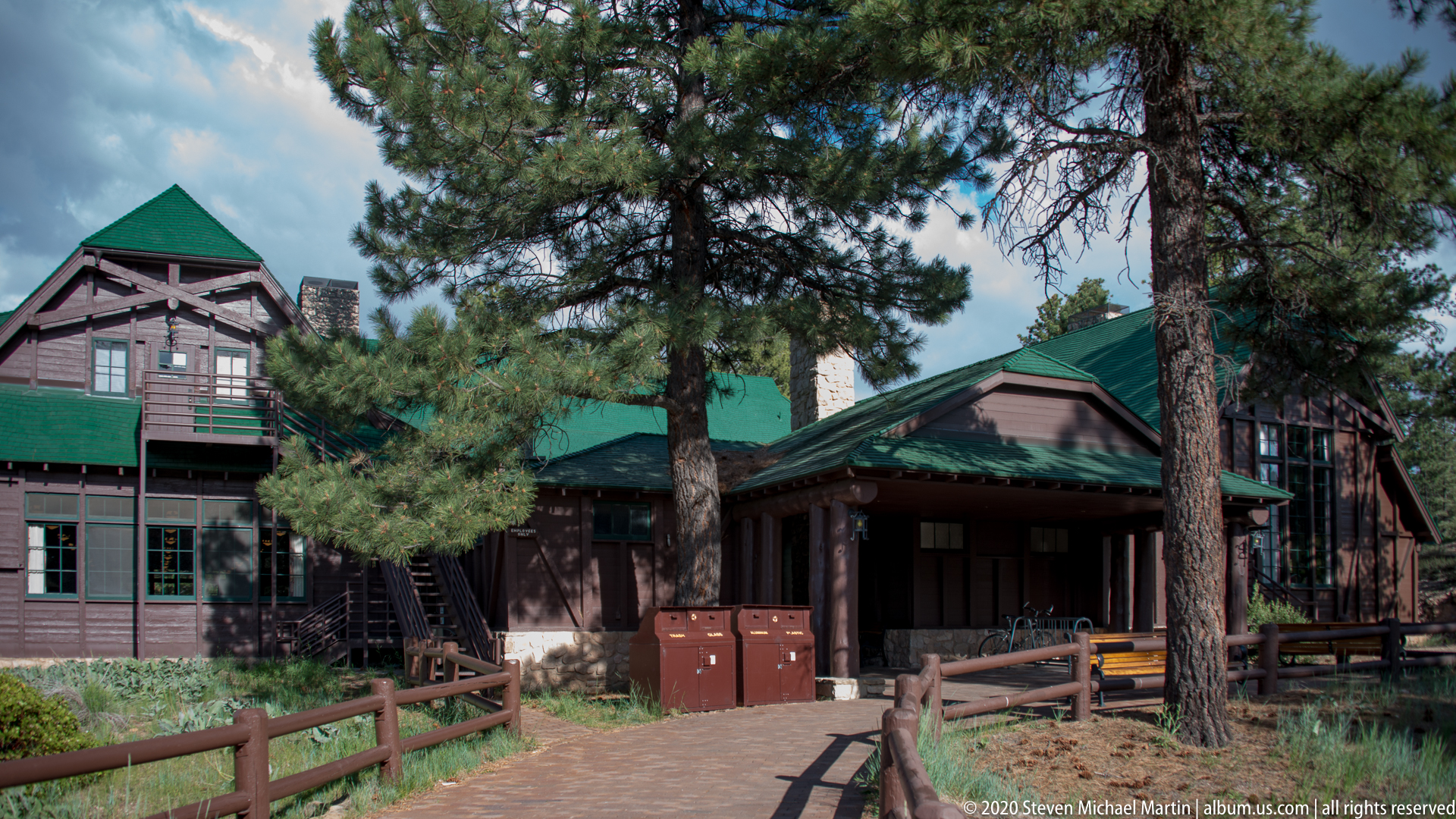
A low timber building with steep green metal roofs sits among mature pines beside a paved walkway and wooden railings. Broad windows and a covered porch break up the dark log-like exterior, while a small tower-like roof section rises at the left. The view records the park’s rustic architectural style within its forested setting without identifying a specific facility.
Caption
A low timber building with steep green metal roofs sits among mature pines beside a paved walkway and wooden railings. Broad windows and a covered porch break up the dark log-like exterior, while a small tower-like roof section rises at the left. The view records the park’s rustic architectural style within its forested setting without identifying a specific facility.
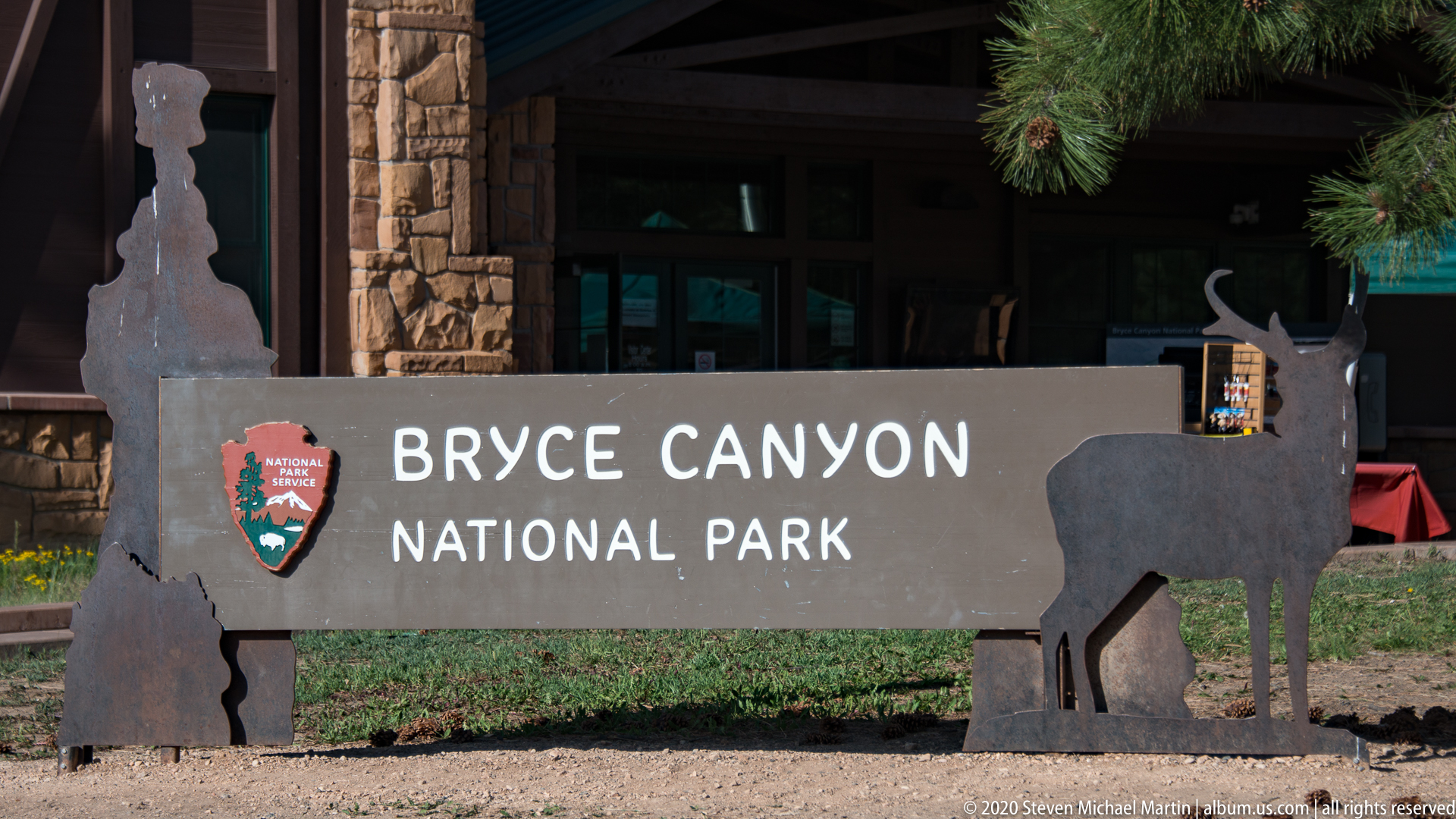
A carved brown sign reads “Bryce Canyon National Park,” with the National Park Service arrowhead emblem at the left and bison silhouettes at both ends. The sign stands before a stone-and-timber building entrance beneath a dark roof. The straightforward framing makes the park designation legible while retaining the rustic materials and setting.
Caption
A carved brown sign reads “Bryce Canyon National Park,” with the National Park Service arrowhead emblem at the left and bison silhouettes at both ends. The sign stands before a stone-and-timber building entrance beneath a dark roof. The straightforward framing makes the park designation legible while retaining the rustic materials and setting.
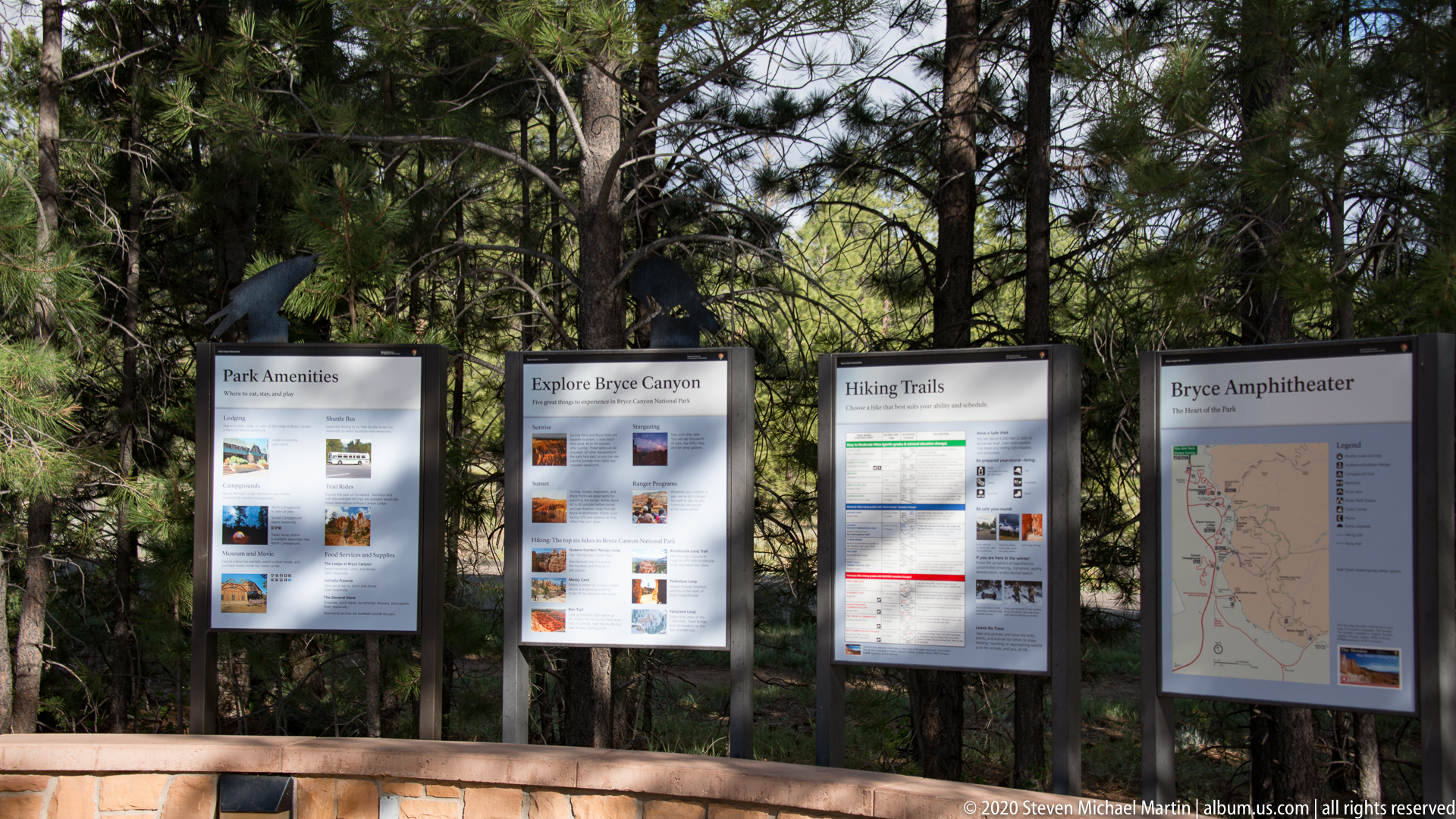
Four framed panels stand along a wooded path, covering park amenities, ways to explore Bryce Canyon, hiking trails, and a map of Bryce Amphitheater. Their uniform frames and close spacing create a compact orientation station beneath evergreen branches. The photograph records the park’s interpretive infrastructure, with practical visitor guidance grouped at a forested viewing area.
Caption
Four framed panels stand along a wooded path, covering park amenities, ways to explore Bryce Canyon, hiking trails, and a map of Bryce Amphitheater. Their uniform frames and close spacing create a compact orientation station beneath evergreen branches. The photograph records the park’s interpretive infrastructure, with practical visitor guidance grouped at a forested viewing area.

A large indoor exhibit diagrams the formation of the Grand Staircase through deposition, uplift, and erosion. A long cross-section uses colored bands to distinguish rock units, while dated labels and embedded photographs connect the layers with changing landscapes. Presented behind glass in a wood-framed case, the display translates deep geologic time into a readable visual sequence for park visitors.
Caption
A large indoor exhibit diagrams the formation of the Grand Staircase through deposition, uplift, and erosion. A long cross-section uses colored bands to distinguish rock units, while dated labels and embedded photographs connect the layers with changing landscapes. Presented behind glass in a wood-framed case, the display translates deep geologic time into a readable visual sequence for park visitors.

This section of the geology exhibit focuses on erosion of the Grand Staircase and the present landscape of Bryce Canyon. A simplified cross-section shows how retreating cliffs expose successive rock layers, while photographs and specimens add examples of the formations discussed. The display’s progression from ancient deposition to modern erosion links the canyon’s visible hoodoos with a much longer geologic history.
Caption
This section of the geology exhibit focuses on erosion of the Grand Staircase and the present landscape of Bryce Canyon. A simplified cross-section shows how retreating cliffs expose successive rock layers, while photographs and specimens add examples of the formations discussed. The display’s progression from ancient deposition to modern erosion links the canyon’s visible hoodoos with a much longer geologic history.

A close view isolates the exhibit’s horizontal color bands and their labels: Gray Cliffs, White Cliffs, Vermilion Cliffs, and Chocolate Cliffs. The red and brown strata stand out between paler layers, while the caption below identifies the sequence as sedimentary rock layers of the Grand Canyon. The graphic reduces a regional geologic staircase to a clear, color-coded diagram.
Caption
A close view isolates the exhibit’s horizontal color bands and their labels: Gray Cliffs, White Cliffs, Vermilion Cliffs, and Chocolate Cliffs. The red and brown strata stand out between paler layers, while the caption below identifies the sequence as sedimentary rock layers of the Grand Canyon. The graphic reduces a regional geologic staircase to a clear, color-coded diagram.
Cedar Breaks National Monument — Field Guide
National Monument Field Guide
📍 Overview
Cedar Breaks National Monument preserves a large natural amphitheater carved into the Markagunt Plateau through erosion acting upon uplifted sedimentary rock layers. The exposed limestone and sandstone formations display varied coloration resulting from differences in mineral composition. The monument illustrates the long-term influence of weathering processes across high elevation environments of the Colorado Plateau.
Freeze-thaw cycles contribute to the gradual shaping of hoodoos, fins, and cliff formations visible throughout the amphitheater. The high elevation creates seasonal contrasts in temperature that influence erosion patterns and vegetation growth. The landscape reflects geological processes similar to those shaping Bryce Canyon and other plateau environments.
⭐ Highlights
- Large natural amphitheater carved into plateau edge
- Colorful limestone and sandstone formations
- Hoodoos shaped by freeze-thaw erosion
- High elevation viewpoints across the plateau
- Geological continuity with Bryce Canyon formations
🔎 Key Features
- Layered sedimentary rock shaped by erosion
- Freeze-thaw cycles forming hoodoo structures
- Elevated plateau environment
- Exposed strata illustrating geological time
- Cliff formations influenced by differential weathering
📷 Photography Notes
- Early light enhances color variation in limestone formations
- Wide views emphasize scale of the amphitheater
- Cloud shadows can add dimension to cliff faces
- Foreground vegetation can provide compositional depth
- Side lighting highlights texture in hoodoos
- Look for viewpoints showing layered rock patterns