Cathedral Valley – Capitol Reef National Park
Cathedral Valley preserves a remote region of Capitol Reef National Park known for towering monoliths, expansive desert valleys, and distinctive sandstone formations shaped by erosion. The area contains large freestanding rock structures formed through long-term weathering of sedimentary layers deposited during prehistoric geological periods. The landscape illustrates the effects of uplift and erosion across the Colorado Plateau.
The valley’s formations include massive Entrada sandstone monoliths rising from relatively flat desert terrain. Differences in rock hardness influence erosion patterns, producing varied shapes that contribute to the visual character of the valley. The remote location reinforces the sense of scale associated with desert environments shaped by geological processes.
Visitors encounter broad open terrain with distant views of monolithic formations that create a strong visual impression of geological time. The relative isolation of Cathedral Valley emphasizes the influence of natural forces in shaping the landscape without significant modern development.

A tall red sandstone monolith dominates the right side of this wide view, with a smaller tower set farther left across the open valley floor. Low scrub spreads through the foreground and distant cliffs close the horizon. The generous space around the formations emphasizes their isolation and scale within Cathedral Valley’s broad, dry terrain.
Caption
A tall red sandstone monolith dominates the right side of this wide view, with a smaller tower set farther left across the open valley floor. Low scrub spreads through the foreground and distant cliffs close the horizon. The generous space around the formations emphasizes their isolation and scale within Cathedral Valley’s broad, dry terrain.
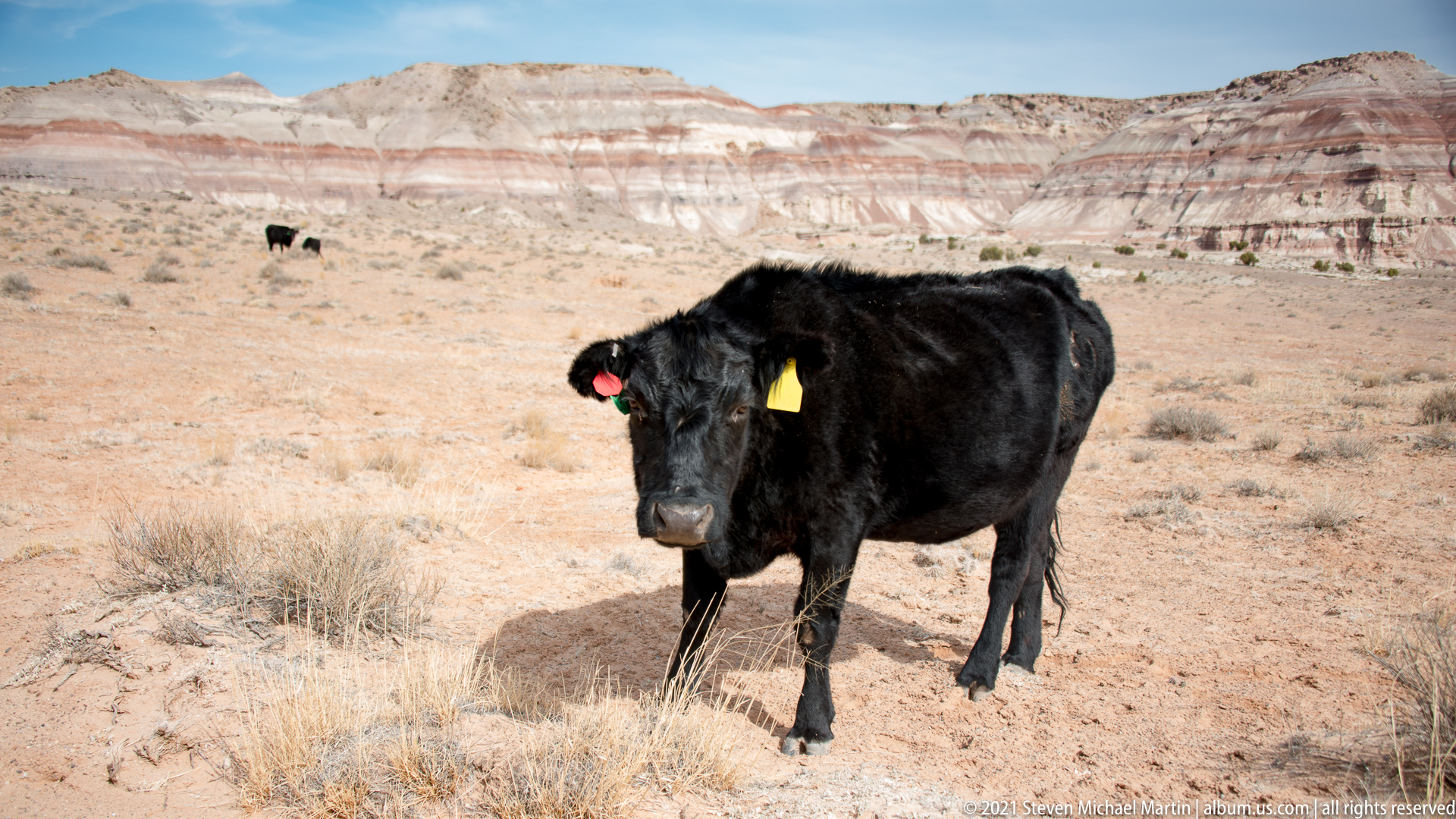
A black cow stands close to the camera, its head and ear tag sharply visible against a background of pale, rust, and gray striped hills. A second, smaller cow appears farther back on the slope. The contrast between livestock in the foreground and eroded badlands gives the scene a working-landscape character within the park’s open desert terrain.
Caption
A black cow stands close to the camera, its head and ear tag sharply visible against a background of pale, rust, and gray striped hills. A second, smaller cow appears farther back on the slope. The contrast between livestock in the foreground and eroded badlands gives the scene a working-landscape character within the park’s open desert terrain.
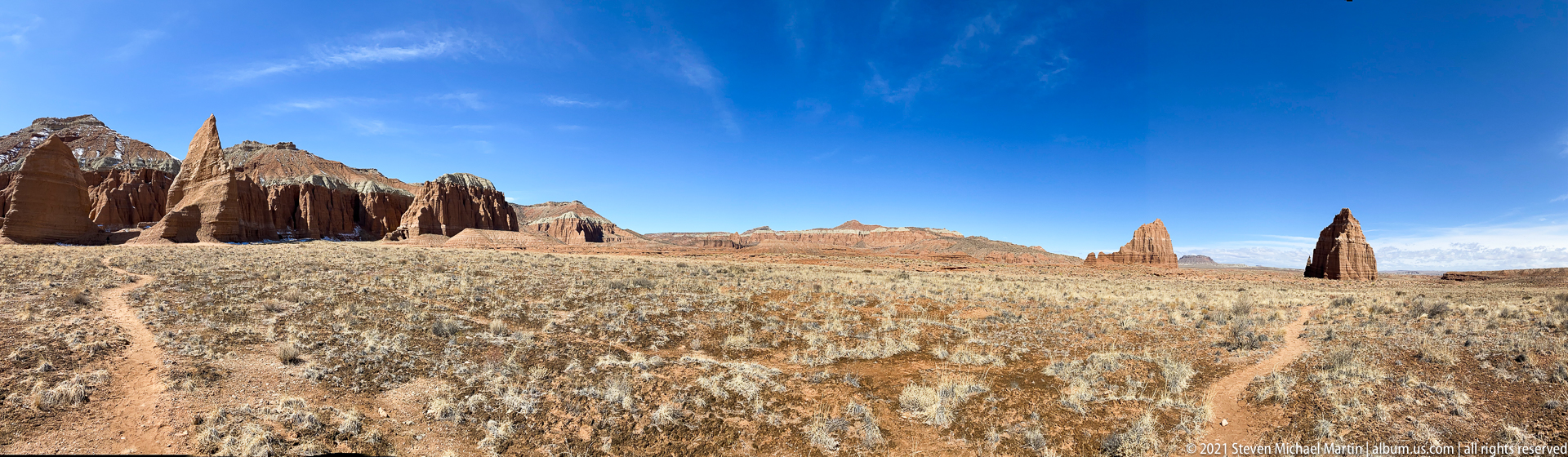
A broad row of narrow sandstone towers rises above a low, tawny valley floor. A faint footpath winds through the grass toward the formations, while more distant ridges soften into the horizon. The wide composition emphasizes the repeated vertical shapes and the open ground separating the viewer from them.
Caption
A broad row of narrow sandstone towers rises above a low, tawny valley floor. A faint footpath winds through the grass toward the formations, while more distant ridges soften into the horizon. The wide composition emphasizes the repeated vertical shapes and the open ground separating the viewer from them.
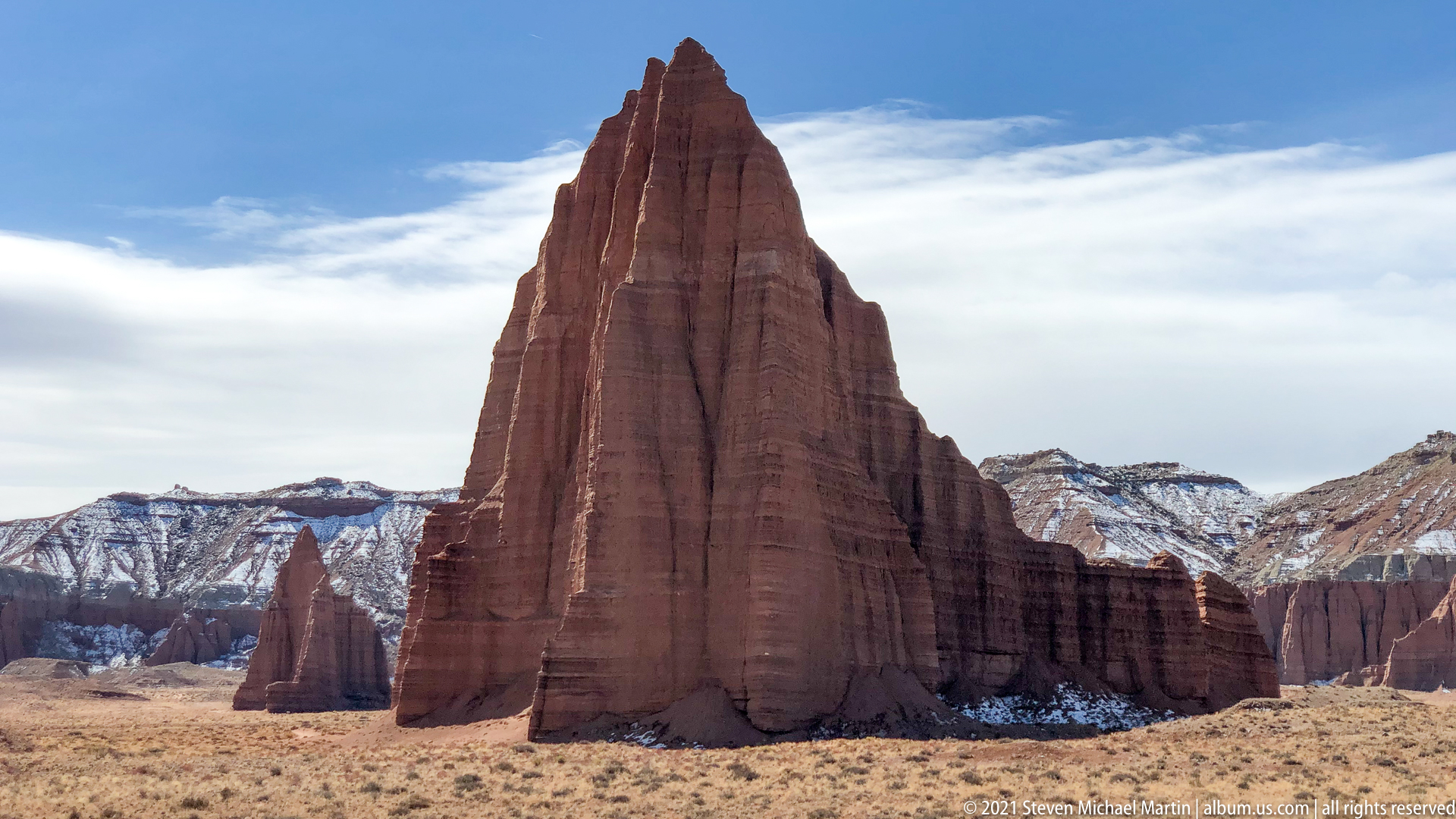
A tall, sharply tapered red monolith rises from a tawny valley floor, its vertical fluting emphasized by the clear light. Smaller spires and layered, snow-patched hills recede behind it. The wide base and narrow summit create a dramatic shift in scale between the foreground grassland and the distant rock walls.
Caption
A tall, sharply tapered red monolith rises from a tawny valley floor, its vertical fluting emphasized by the clear light. Smaller spires and layered, snow-patched hills recede behind it. The wide base and narrow summit create a dramatic shift in scale between the foreground grassland and the distant rock walls.
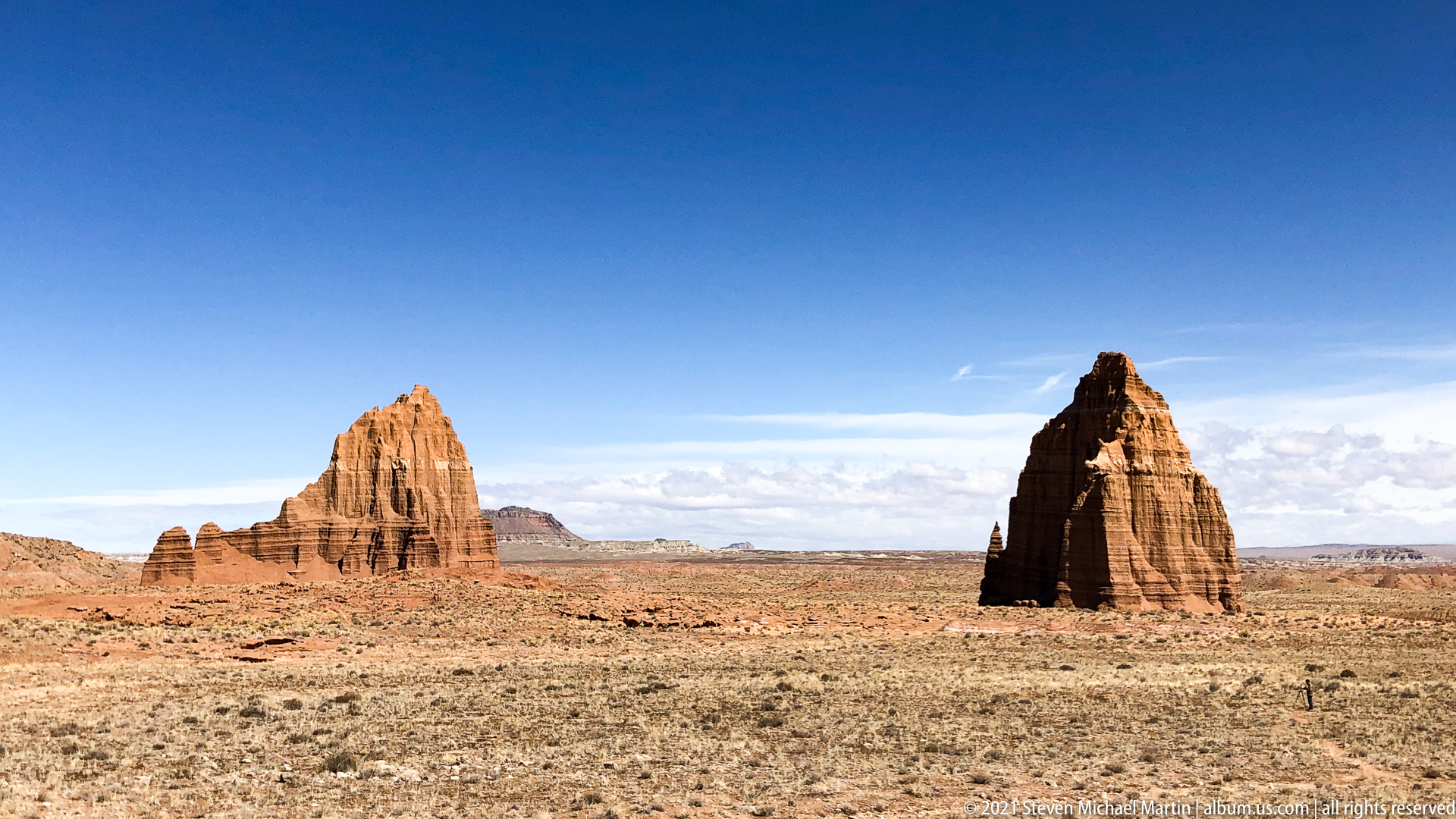
Two tall sandstone towers stand apart on an open plain, one wider and lighter, the other darker and more conical. A smaller formation sits between them, while low grass and scrub stretch across the foreground. Their different shapes and spacing distinguish this view from the denser cluster of towers elsewhere in the valley.
Caption
Two tall sandstone towers stand apart on an open plain, one wider and lighter, the other darker and more conical. A smaller formation sits between them, while low grass and scrub stretch across the foreground. Their different shapes and spacing distinguish this view from the denser cluster of towers elsewhere in the valley.
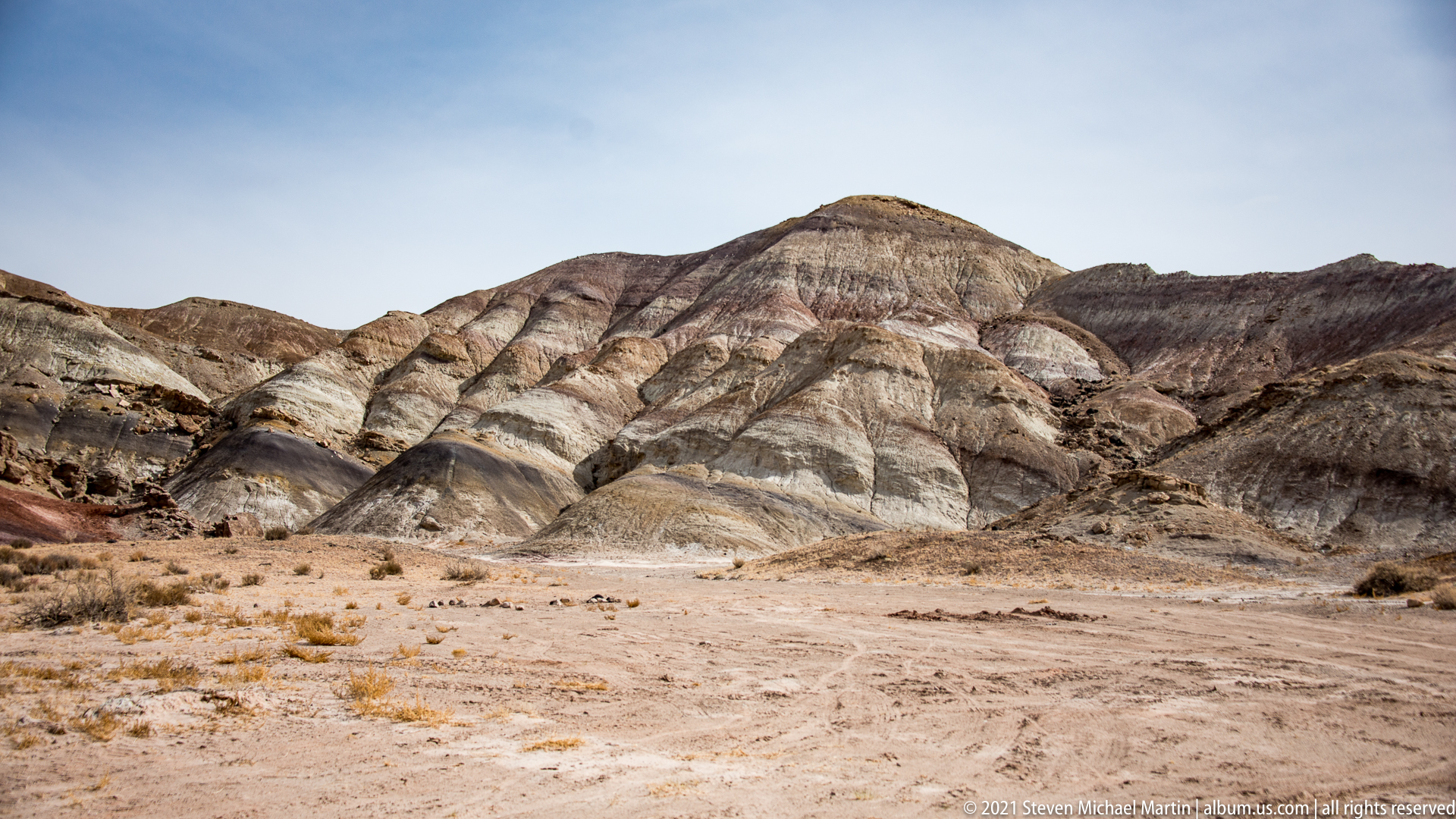
Pale gray and cream bands fold across a rounded summit, with darker red-brown hills rising behind it. The foreground is a broad, dry wash of tan soil and sparse grasses, while the layered slopes form a continuous ridge across the frame. The open panorama shows the gradual transitions between differently colored sedimentary beds.
Caption
Pale gray and cream bands fold across a rounded summit, with darker red-brown hills rising behind it. The foreground is a broad, dry wash of tan soil and sparse grasses, while the layered slopes form a continuous ridge across the frame. The open panorama shows the gradual transitions between differently colored sedimentary beds.
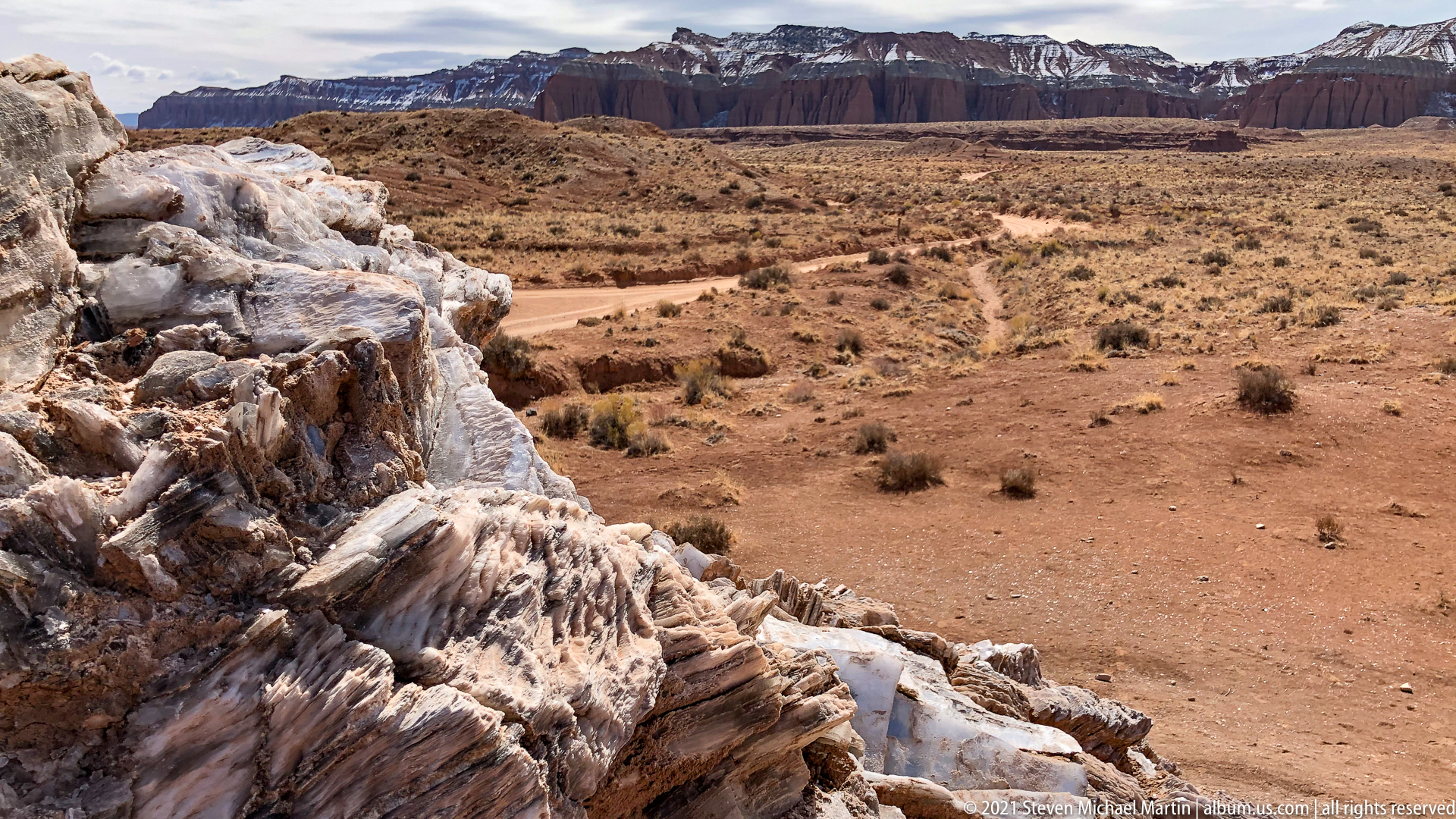
A pale, sharply banded outcrop descends along the left foreground, opening onto a broad basin of red earth and low brush. Across the valley, dark cliffs rise in long horizontal layers, with patches of snow along their upper rim. The juxtaposition of white veining and red terrain gives this overlook a distinct geological contrast.
Caption
A pale, sharply banded outcrop descends along the left foreground, opening onto a broad basin of red earth and low brush. Across the valley, dark cliffs rise in long horizontal layers, with patches of snow along their upper rim. The juxtaposition of white veining and red terrain gives this overlook a distinct geological contrast.
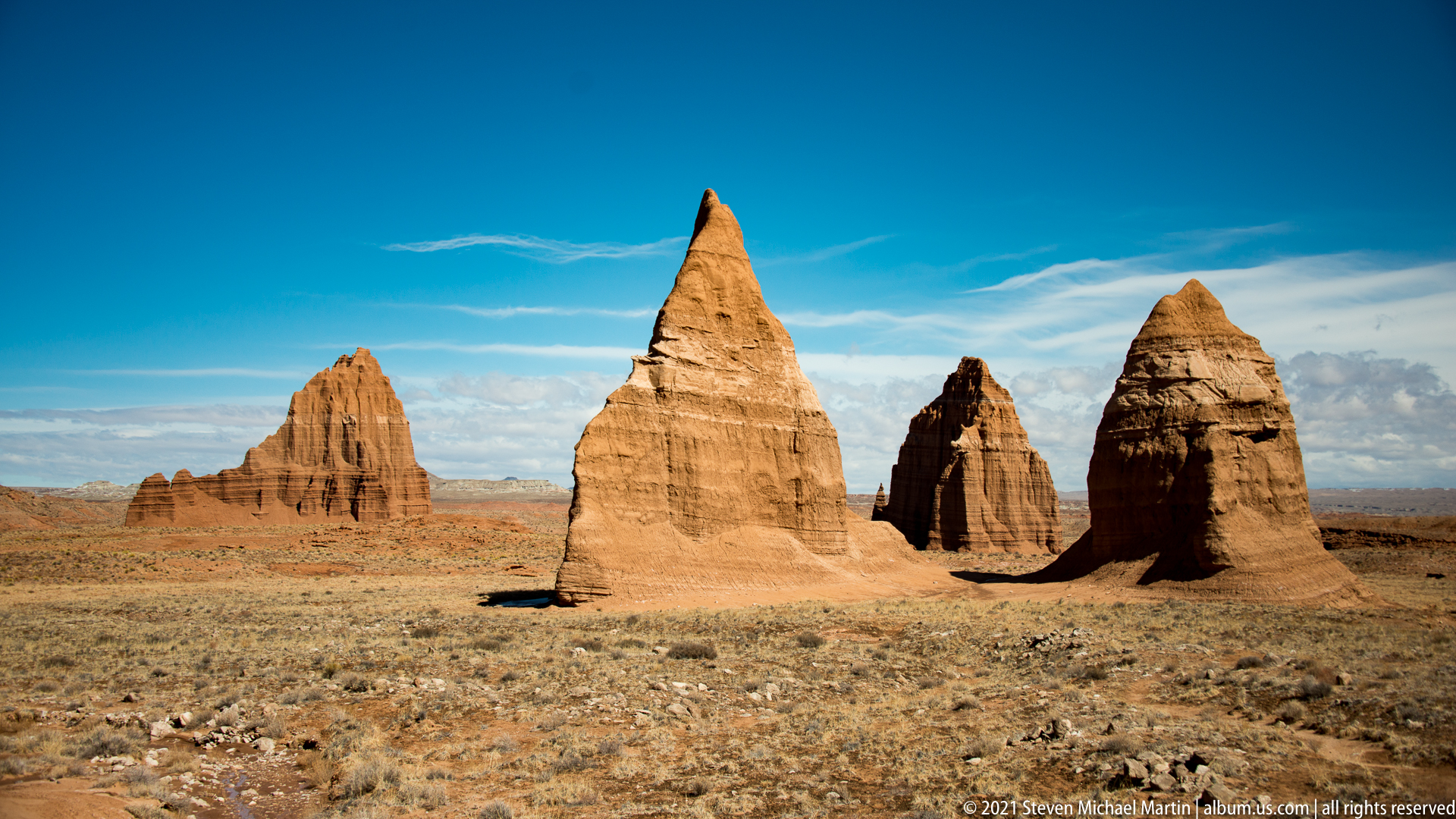
A wider view places several sandstone monoliths at intervals across an open valley floor. Blue sky and scattered clouds occupy much of the frame, while low scrub and grass spread across the foreground. The broad spacing between the towers conveys the scale of the valley and the distance separating its formations, rather than isolating one landmark.
Caption
A wider view places several sandstone monoliths at intervals across an open valley floor. Blue sky and scattered clouds occupy much of the frame, while low scrub and grass spread across the foreground. The broad spacing between the towers conveys the scale of the valley and the distance separating its formations, rather than isolating one landmark.
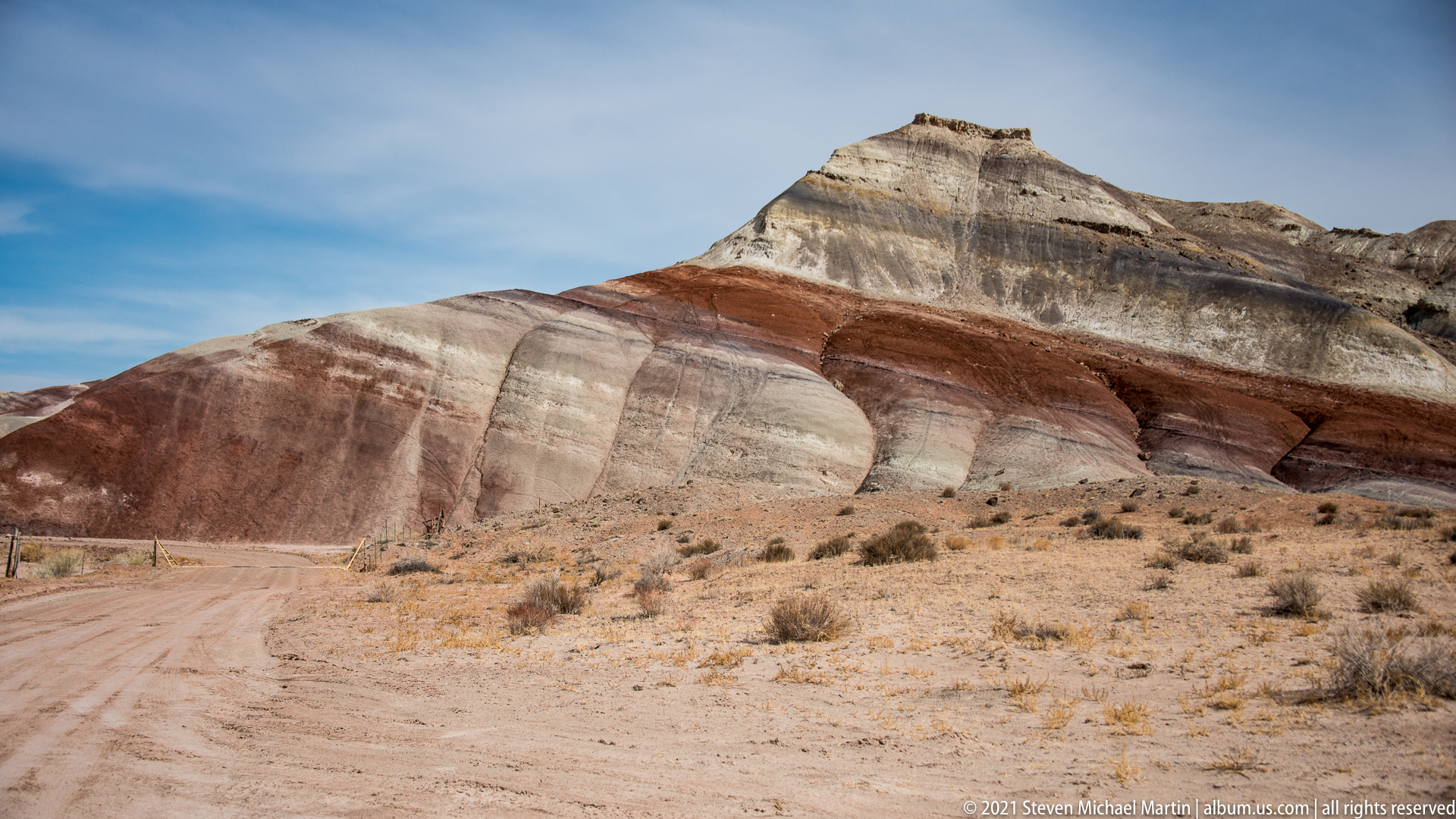
A layered hillside fills the scene, its pale cap and alternating red, cream, and gray bands running diagonally across the slope. A dirt road and a low fence cross the foreground, partly hidden by scrub. The broad face of the hill makes its color bands and gently eroded contours the principal subject.
Caption
A layered hillside fills the scene, its pale cap and alternating red, cream, and gray bands running diagonally across the slope. A dirt road and a low fence cross the foreground, partly hidden by scrub. The broad face of the hill makes its color bands and gently eroded contours the principal subject.
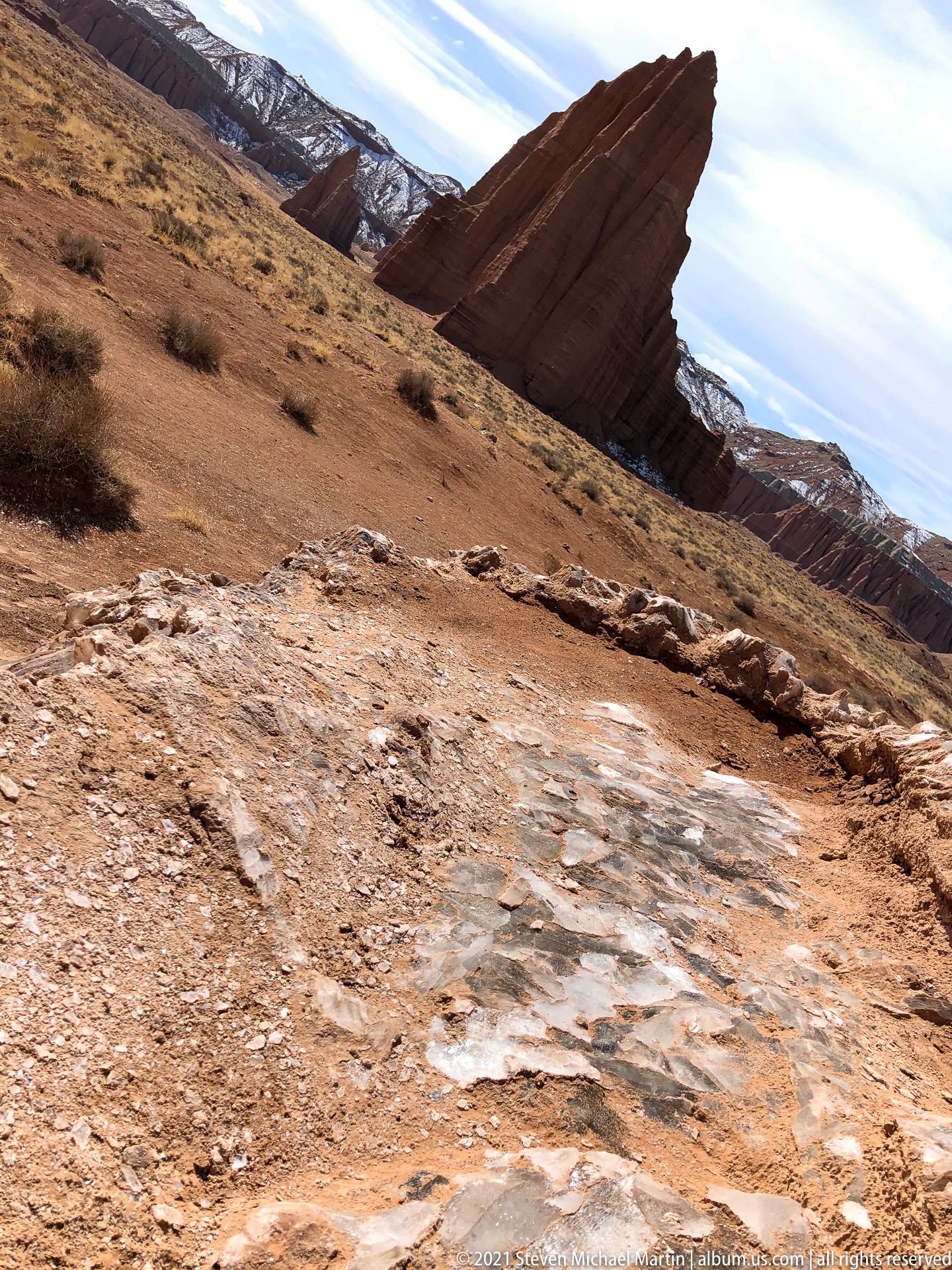
A long, dark red fin of sandstone leans across the upper slope, its layered face set against snow-dusted ridges in the distance. Loose gravel, pale stone, and sparse shrubs occupy the foreground. The diagonal viewpoint emphasizes the fin’s unusual inclination and the steep, open terrain around it.
Caption
A long, dark red fin of sandstone leans across the upper slope, its layered face set against snow-dusted ridges in the distance. Loose gravel, pale stone, and sparse shrubs occupy the foreground. The diagonal viewpoint emphasizes the fin’s unusual inclination and the steep, open terrain around it.

A lone visitor stands on the reddish slope beyond a broad pale outcrop, holding a camera and tripod. The figure’s shadow stretches across the open ground, making the scale of the fractured mineral band visible. Sparse shrubs and distant hills keep the setting exposed and quiet, with the person positioned as observer rather than principal subject.
Caption
A lone visitor stands on the reddish slope beyond a broad pale outcrop, holding a camera and tripod. The figure’s shadow stretches across the open ground, making the scale of the fractured mineral band visible. Sparse shrubs and distant hills keep the setting exposed and quiet, with the person positioned as observer rather than principal subject.

From a wider angle, the photographer leans toward the exposed mineral band, camera raised, with a tripod beside the outcrop. Pale and dark fragments form a rough ridge across the foreground and lead toward the person. The view records the act of photographing the formation while retaining the contrasting red soil around it.
Caption
From a wider angle, the photographer leans toward the exposed mineral band, camera raised, with a tripod beside the outcrop. Pale and dark fragments form a rough ridge across the foreground and lead toward the person. The view records the act of photographing the formation while retaining the contrasting red soil around it.

A narrow, steep-sided red monolith stands beyond a broken foreground of pale, purple-gray, and rust-colored rock. Snow lines the distant ridges, while open grassland separates the spire from the nearer outcrop. The contrast between the solitary vertical form and the fragmented slope gives the view its strong sense of scale.
Caption
A narrow, steep-sided red monolith stands beyond a broken foreground of pale, purple-gray, and rust-colored rock. Snow lines the distant ridges, while open grassland separates the spire from the nearer outcrop. The contrast between the solitary vertical form and the fragmented slope gives the view its strong sense of scale.
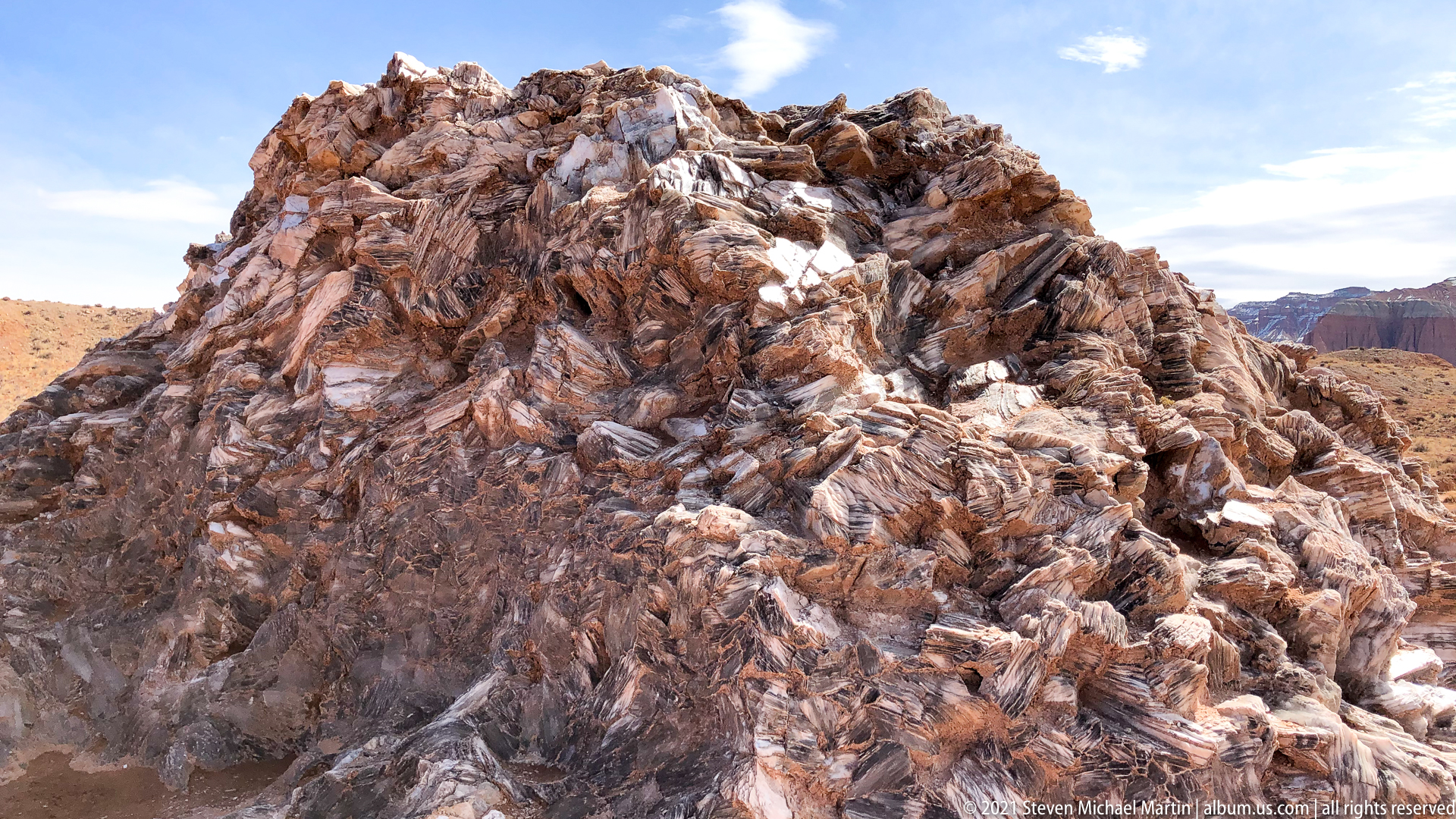
The frame fills with jagged, interlocking fragments in pale gray, white, mauve, and rust. Their sharp edges and irregular seams reveal a heavily fractured outcrop, while a small wedge of blue sky and distant ridgeline remains at the upper right. This close view shifts attention from Cathedral Valley’s spires to the texture of its exposed rock.
Caption
The frame fills with jagged, interlocking fragments in pale gray, white, mauve, and rust. Their sharp edges and irregular seams reveal a heavily fractured outcrop, while a small wedge of blue sky and distant ridgeline remains at the upper right. This close view shifts attention from Cathedral Valley’s spires to the texture of its exposed rock.
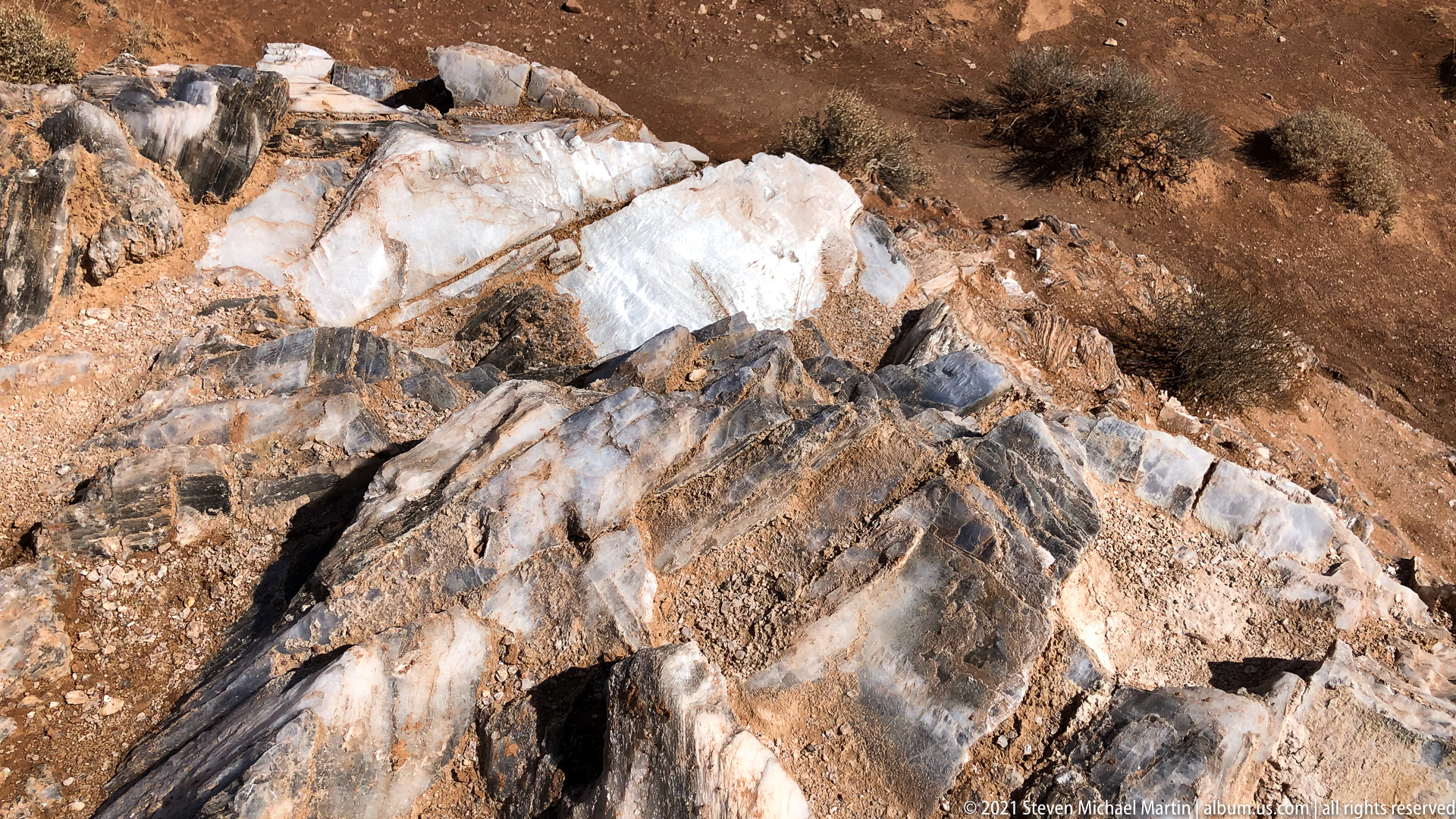
A broken pale outcrop shows broad white and gray bands cutting through darker, rust-colored fragments. The rough surface forms sharp ridges and narrow crevices, with granular soil visible between the blocks. The downward viewpoint isolates the exposed structure and its contrasting bands, leaving the larger landscape outside the frame.
Caption
A broken pale outcrop shows broad white and gray bands cutting through darker, rust-colored fragments. The rough surface forms sharp ridges and narrow crevices, with granular soil visible between the blocks. The downward viewpoint isolates the exposed structure and its contrasting bands, leaving the larger landscape outside the frame.
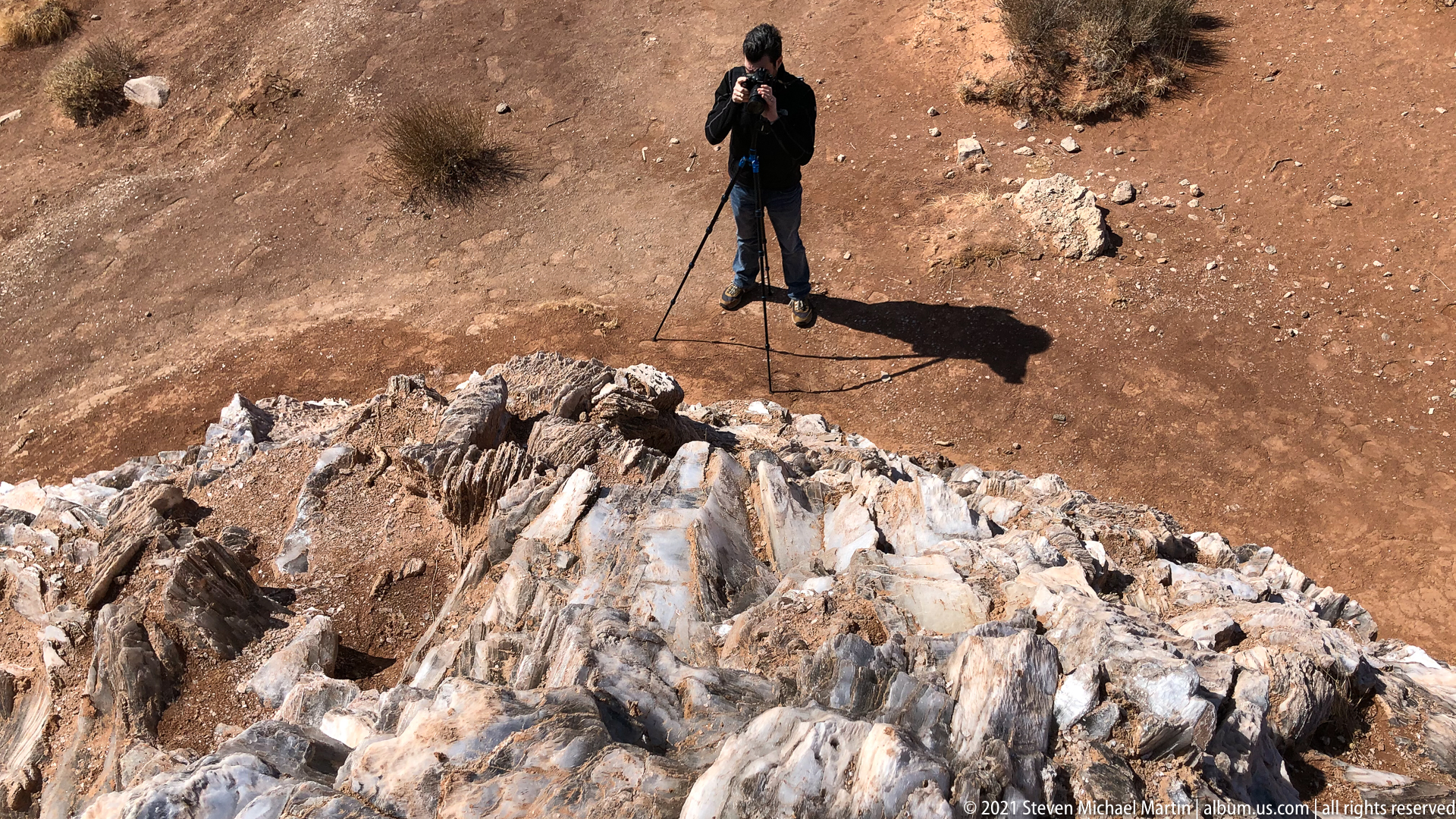
A photographer stands on reddish soil beyond the broken outcrop, looking down toward its pale, jagged surface. The tripod and the person’s shadow stretch across the open slope, while the mineral band cuts diagonally through the lower half of the view. The elevated viewpoint links the close rock detail to the surrounding terrain.
Caption
A photographer stands on reddish soil beyond the broken outcrop, looking down toward its pale, jagged surface. The tripod and the person’s shadow stretch across the open slope, while the mineral band cuts diagonally through the lower half of the view. The elevated viewpoint links the close rock detail to the surrounding terrain.
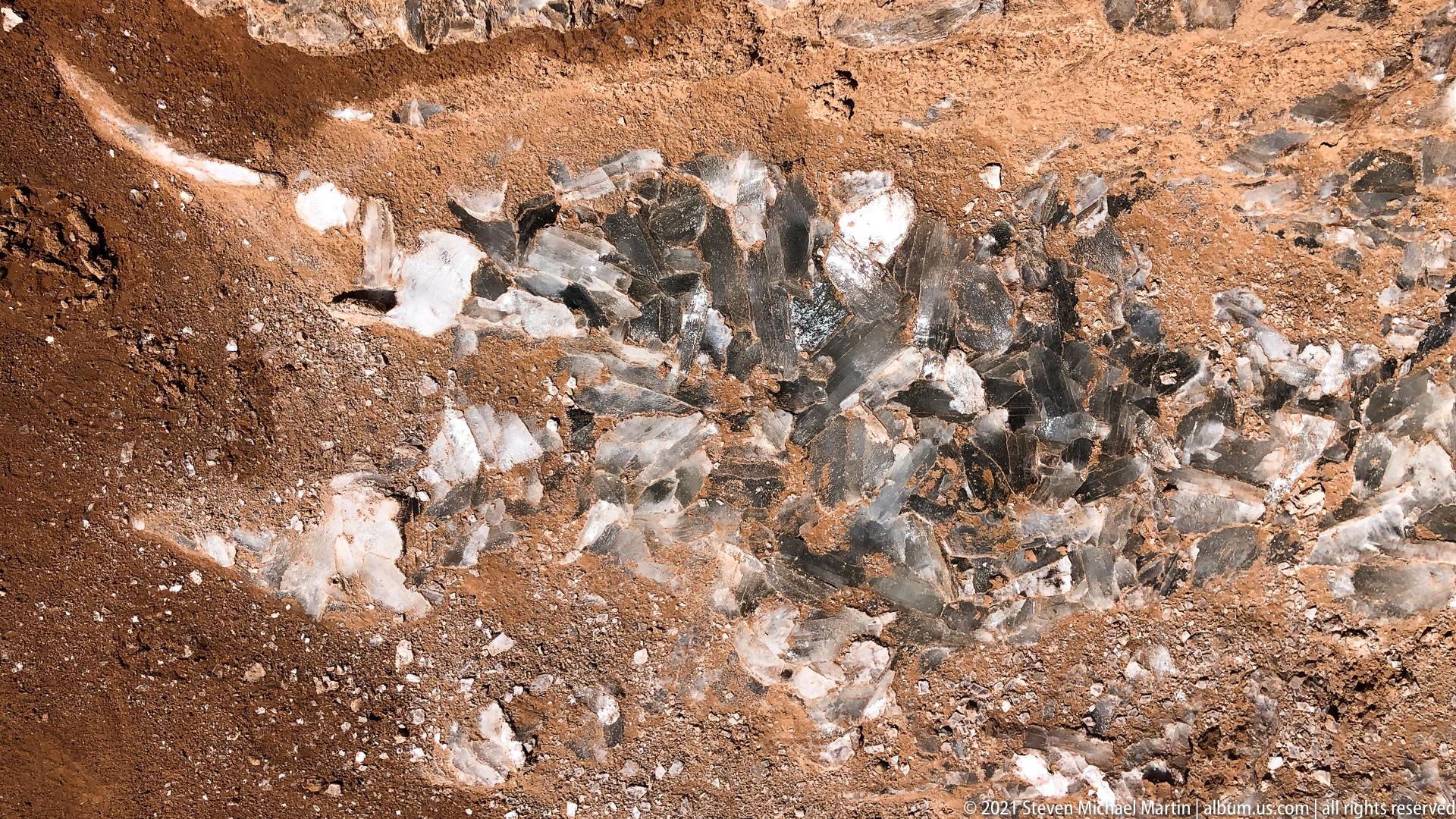
Pale gray and white material breaks through reddish soil in a dense, uneven network of angular seams. Dark cracks and scattered fragments interrupt the lighter band, exposing its rough, crystalline-looking texture. The close crop removes the horizon and concentrates on the boundary between the mineral-rich rock and the surrounding earth.
Caption
Pale gray and white material breaks through reddish soil in a dense, uneven network of angular seams. Dark cracks and scattered fragments interrupt the lighter band, exposing its rough, crystalline-looking texture. The close crop removes the horizon and concentrates on the boundary between the mineral-rich rock and the surrounding earth.
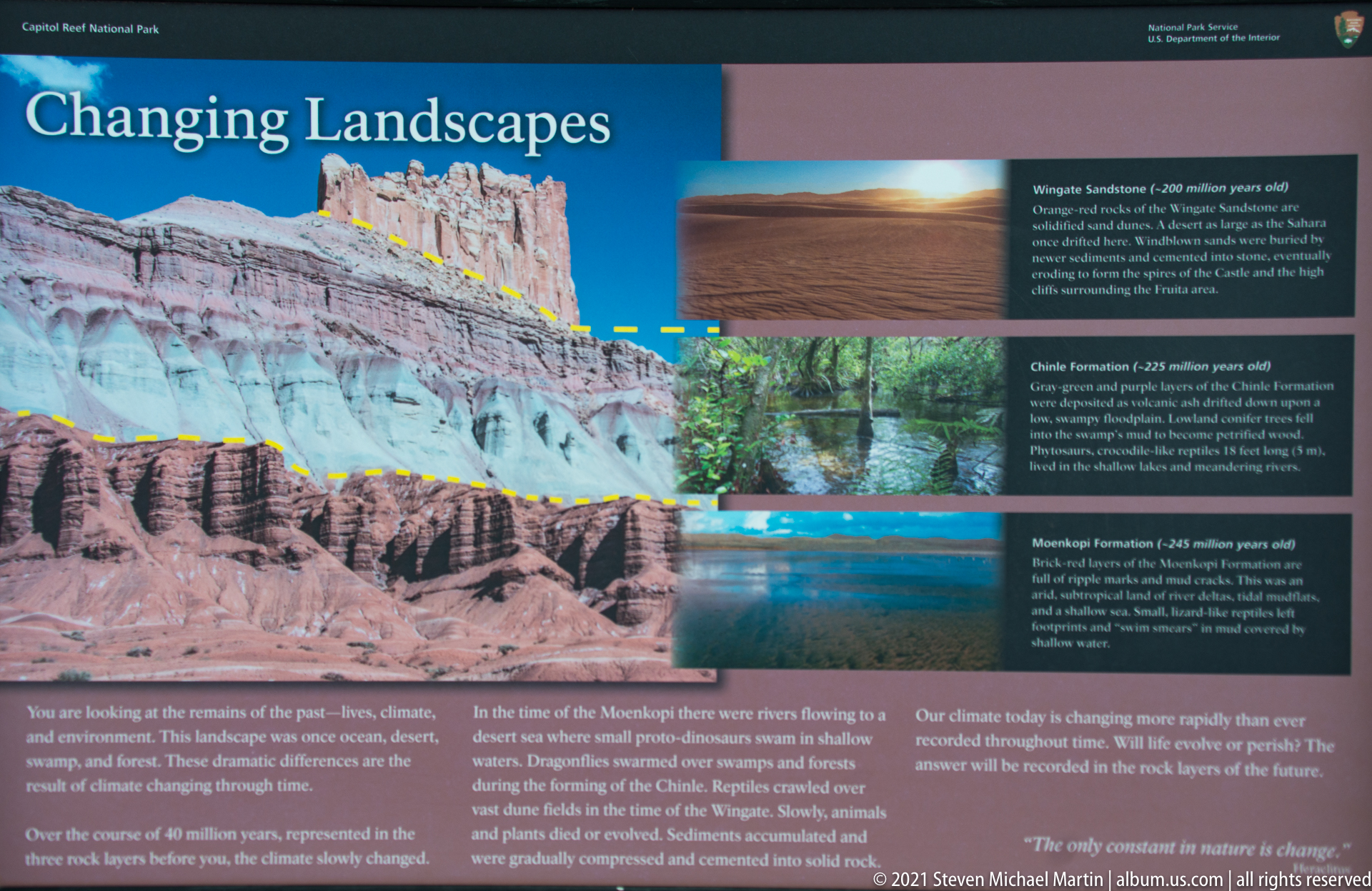
A large interpretive panel explains the area’s changing environments through an illustrated cross-section and photographs of colored rock layers. Labels identify the Wingate Sandstone, Chinle Formation, and Moenkopi Formation, with text describing their contrasting deposits. The display translates the landscape’s visible bands into a geological sequence for visitors.
Caption
A large interpretive panel explains the area’s changing environments through an illustrated cross-section and photographs of colored rock layers. Labels identify the Wingate Sandstone, Chinle Formation, and Moenkopi Formation, with text describing their contrasting deposits. The display translates the landscape’s visible bands into a geological sequence for visitors.
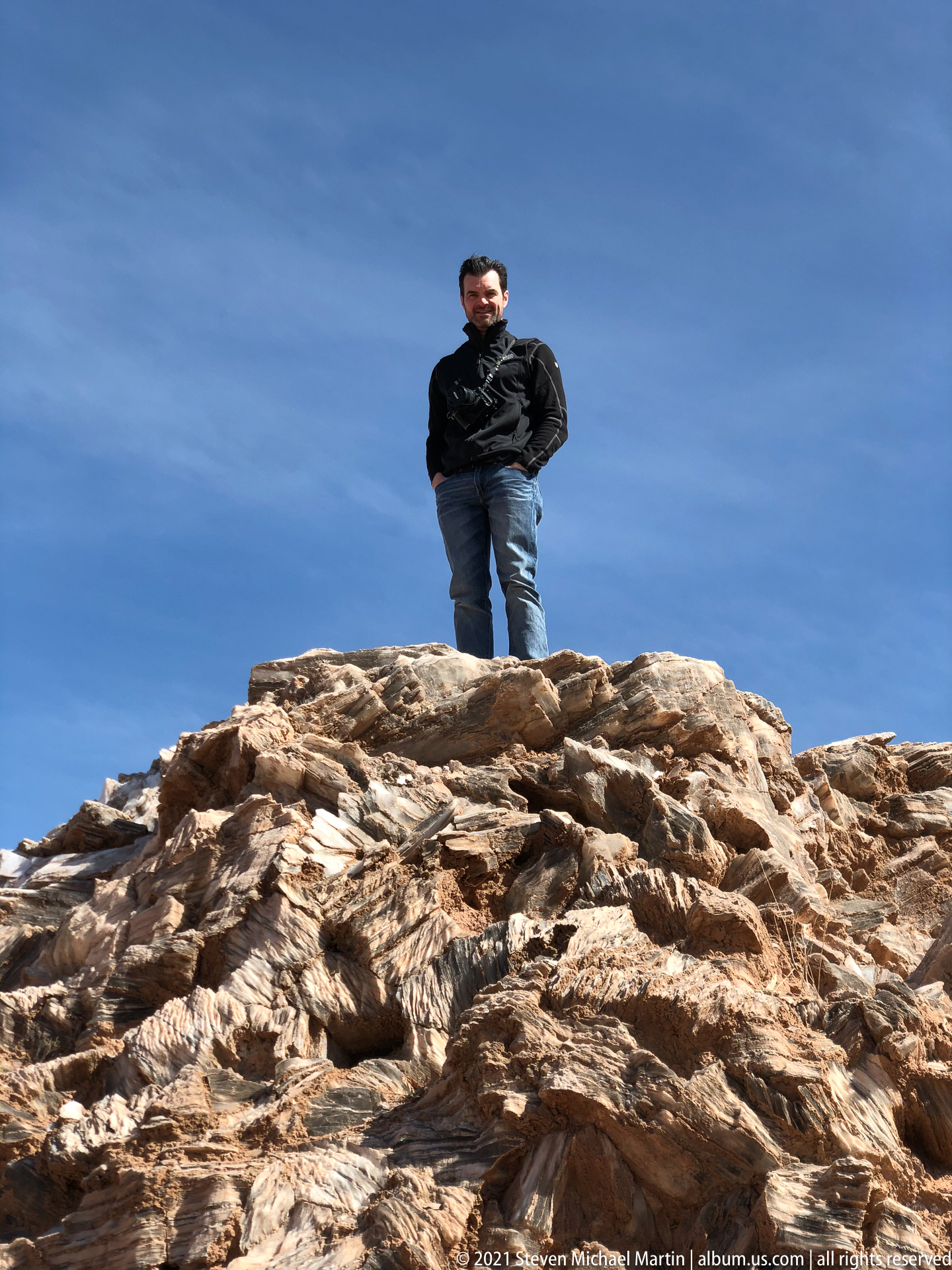
A visitor stands on the crest of a pale, fractured outcrop, looking toward the camera against a broad blue sky. The figure is placed near the upper center, while ridged white and brown stone fills the foreground. The low viewpoint makes the rocky crest appear elevated and gives the person a clear, readable silhouette.
Caption
A visitor stands on the crest of a pale, fractured outcrop, looking toward the camera against a broad blue sky. The figure is placed near the upper center, while ridged white and brown stone fills the foreground. The low viewpoint makes the rocky crest appear elevated and gives the person a clear, readable silhouette.
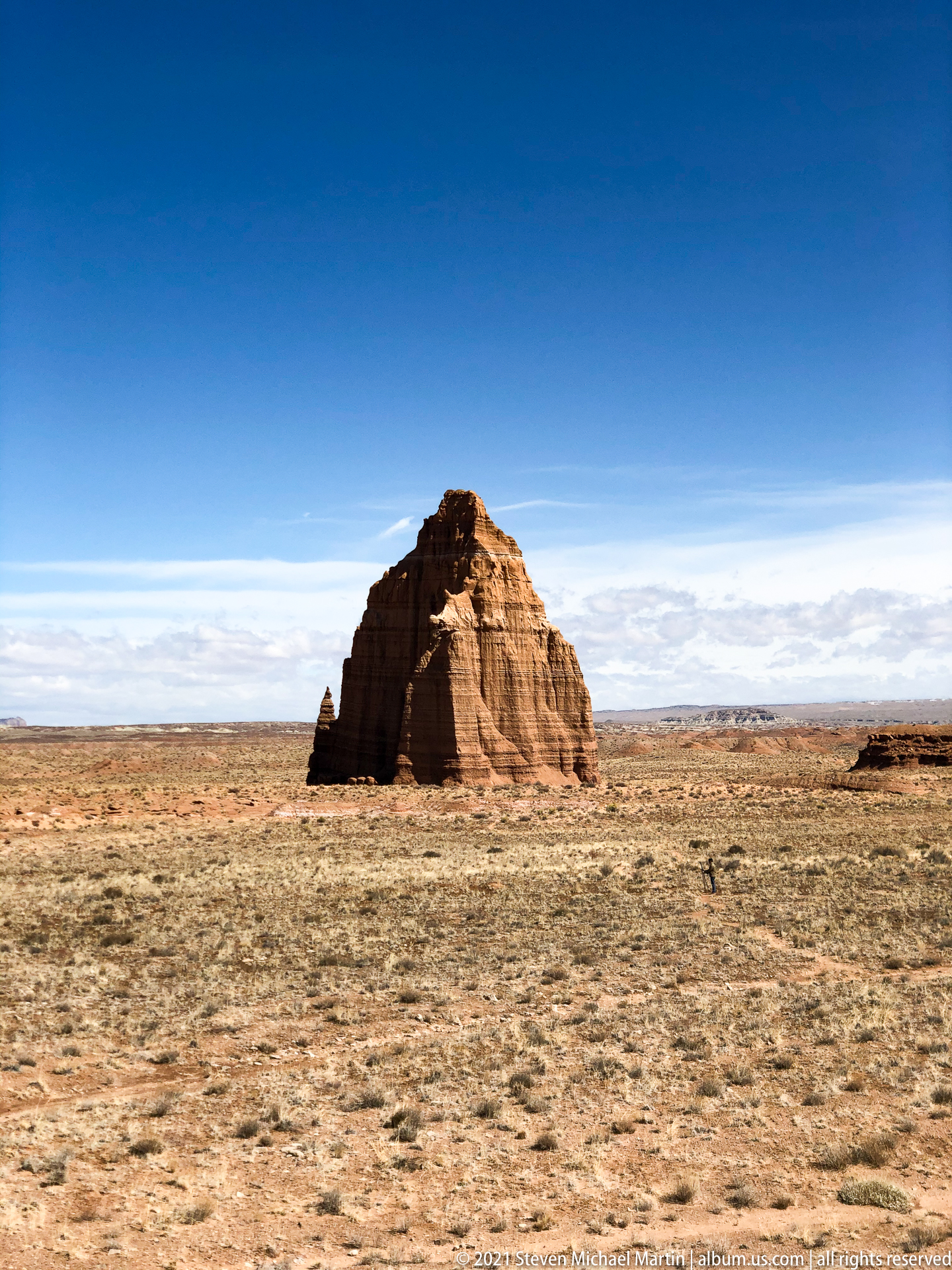
A single dark red butte rises from a nearly level plain, its steep sides broken by horizontal ledges and a stepped summit. The broad foreground is covered in sparse grasses and low shrubs, leaving ample space around the formation. Under a clear blue sky, the isolated tower becomes the landscape’s sole focal point.
Caption
A single dark red butte rises from a nearly level plain, its steep sides broken by horizontal ledges and a stepped summit. The broad foreground is covered in sparse grasses and low shrubs, leaving ample space around the formation. Under a clear blue sky, the isolated tower becomes the landscape’s sole focal point.
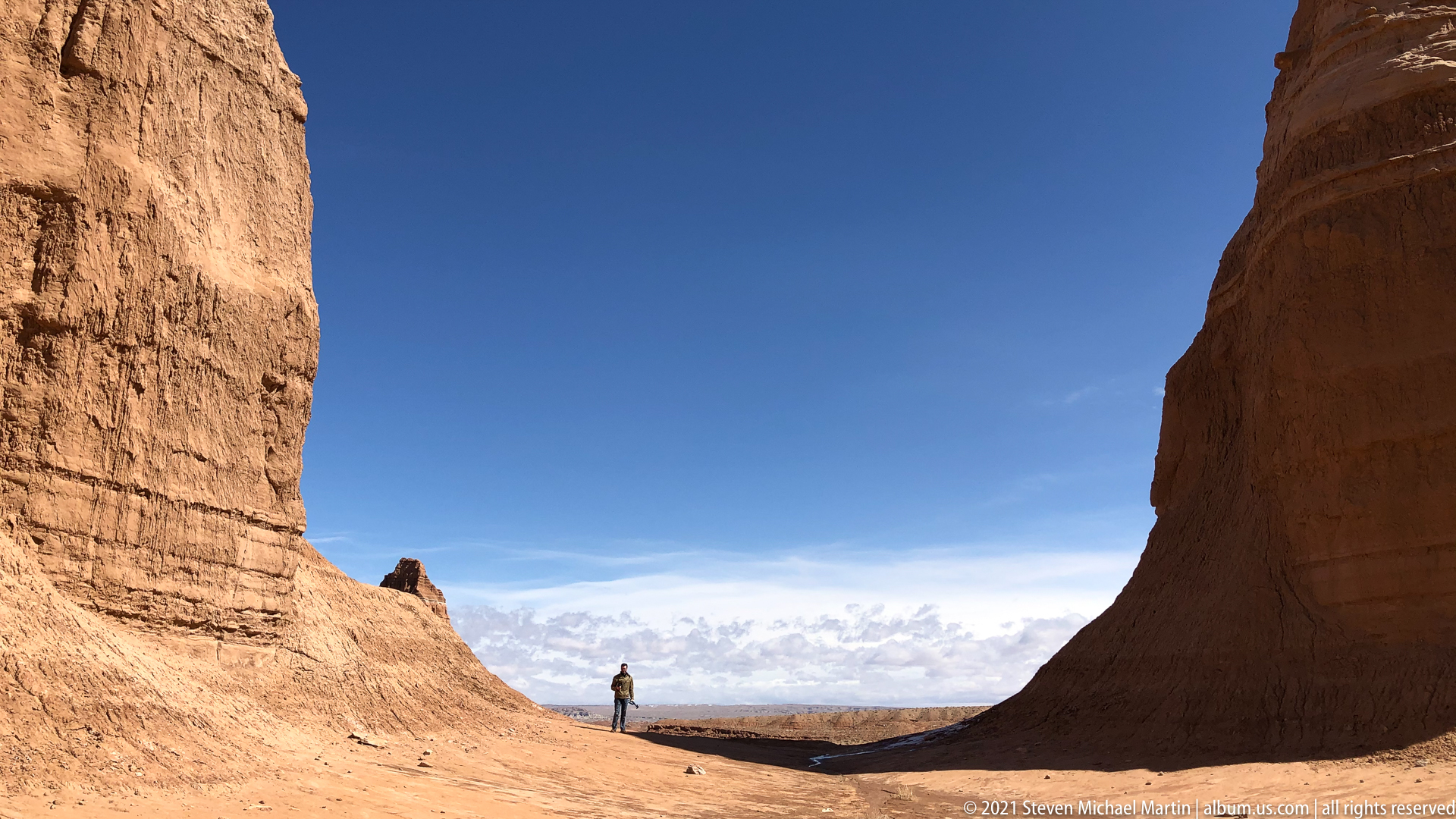
A small hiker stands near the center of a broad gap between two immense sandstone walls, with the open valley visible beyond. The person’s placement makes the rock faces’ height and enclosing scale immediately clear. Sunlit red surfaces contrast with darker shaded sections, adding depth to this human-scale view through the formations.
Caption
A small hiker stands near the center of a broad gap between two immense sandstone walls, with the open valley visible beyond. The person’s placement makes the rock faces’ height and enclosing scale immediately clear. Sunlit red surfaces contrast with darker shaded sections, adding depth to this human-scale view through the formations.
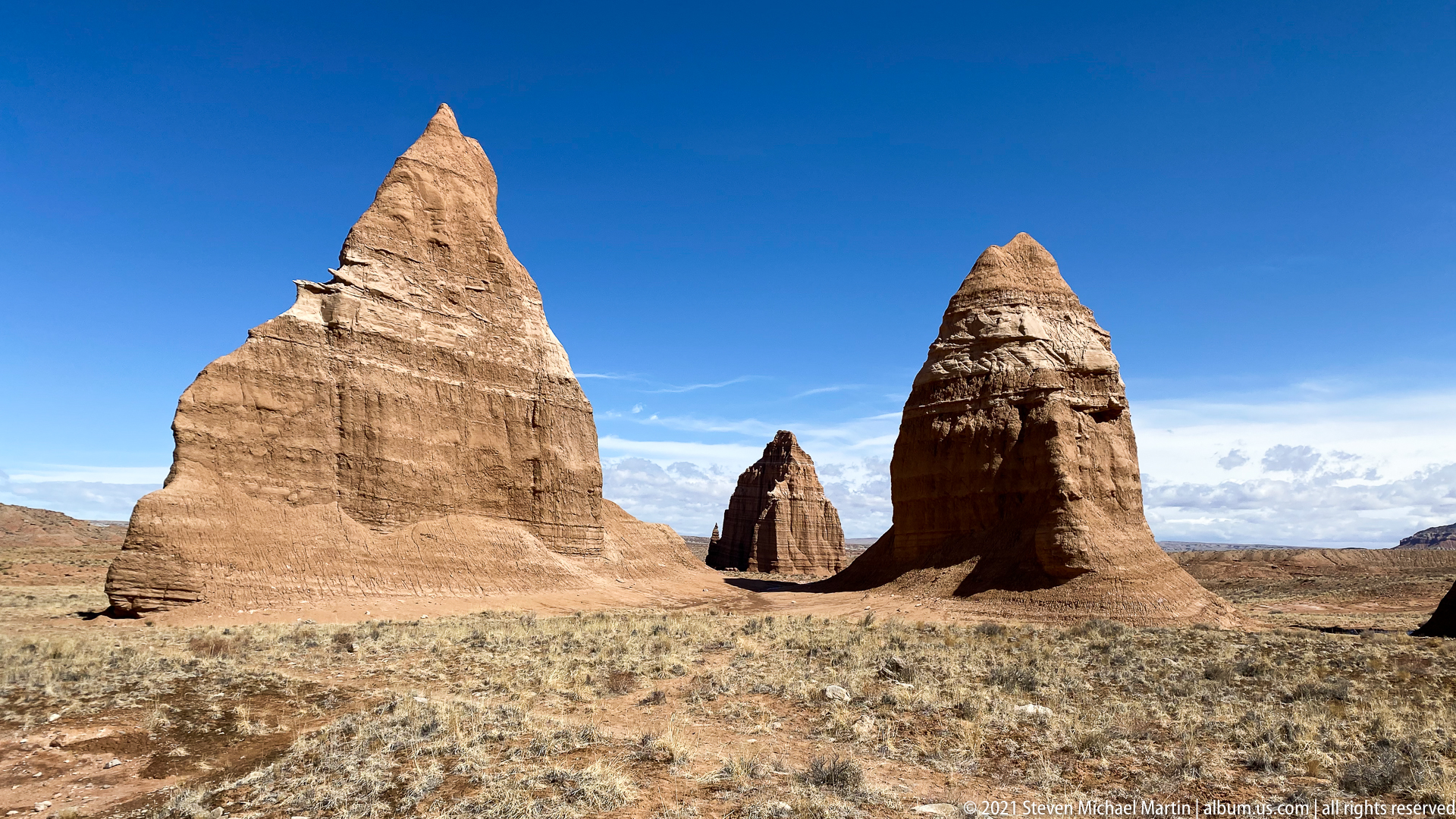
Three prominent monoliths punctuate a dry plain: a broad pale tower at left, a smaller red spire behind it, and a darker rounded pinnacle to the right. Their varied heights and colors create a staggered rhythm against the distant horizon. Short grass and bare soil keep the foreground open and unobstructed.
Caption
Three prominent monoliths punctuate a dry plain: a broad pale tower at left, a smaller red spire behind it, and a darker rounded pinnacle to the right. Their varied heights and colors create a staggered rhythm against the distant horizon. Short grass and bare soil keep the foreground open and unobstructed.

A row of sharply vertical sandstone forms fills the horizon, with a large dark red monolith near the center and thinner pinnacles on either side. The tawny grassland in front is lightly tracked and almost empty, giving the towers room to dominate the composition. Snow remains in small patches at the bases of some formations.
Caption
A row of sharply vertical sandstone forms fills the horizon, with a large dark red monolith near the center and thinner pinnacles on either side. The tawny grassland in front is lightly tracked and almost empty, giving the towers room to dominate the composition. Snow remains in small patches at the bases of some formations.
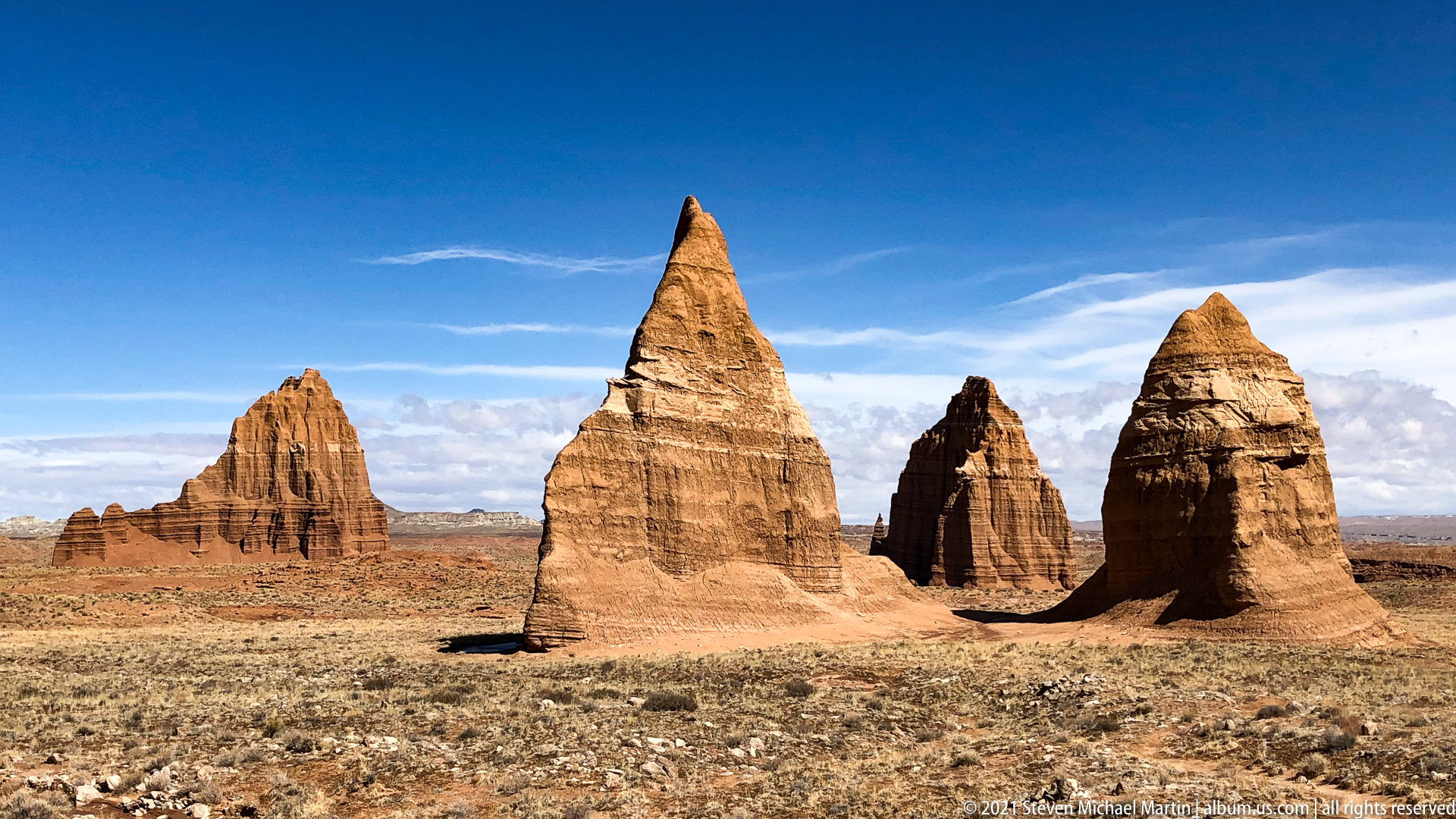
Several tall sandstone pinnacles rise across an open basin, their rounded and pointed profiles spaced along the horizon. Dry grasses fill the foreground, while a pale track curves near the foot of the formations. The wide framing conveys both the grouping of the towers and the substantial distance between them and the viewer.
Caption
Several tall sandstone pinnacles rise across an open basin, their rounded and pointed profiles spaced along the horizon. Dry grasses fill the foreground, while a pale track curves near the foot of the formations. The wide framing conveys both the grouping of the towers and the substantial distance between them and the viewer.

A broad monolith stands close to the camera, its face marked by deep vertical grooves and darker red bands. Snow-bright ridges rise behind its shoulders, contrasting with the warmer foreground rock and dry grass. This view emphasizes the tower’s height and fluted surface rather than the wider arrangement of Cathedral Valley’s formations.
Caption
A broad monolith stands close to the camera, its face marked by deep vertical grooves and darker red bands. Snow-bright ridges rise behind its shoulders, contrasting with the warmer foreground rock and dry grass. This view emphasizes the tower’s height and fluted surface rather than the wider arrangement of Cathedral Valley’s formations.
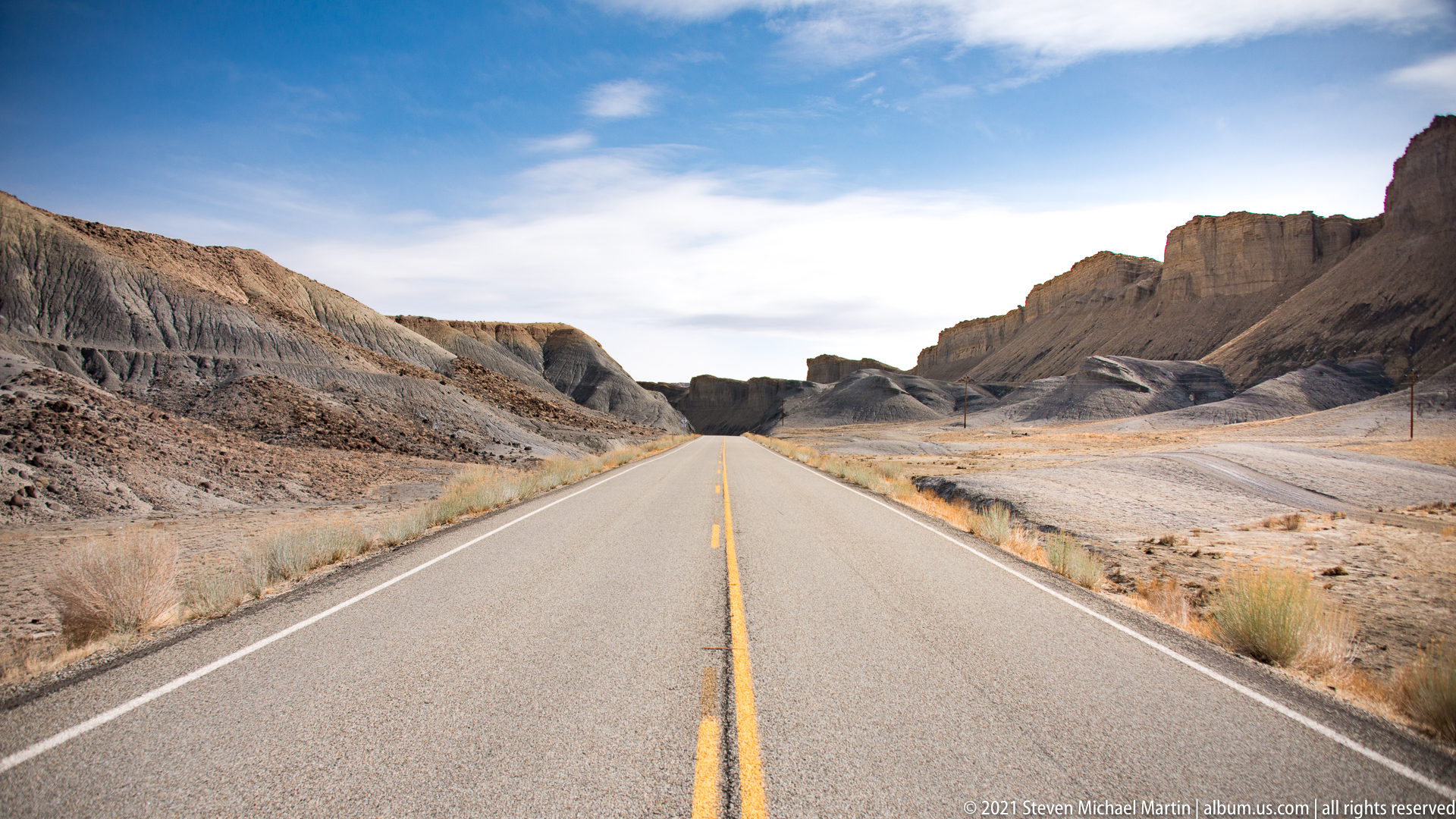
A straight paved road with double yellow center lines runs into a broad corridor of gray-brown eroded hills. The bare slopes are deeply gullied and rise on both sides, creating a dramatic passage beneath a clear, lightly clouded sky. The centered road gives the badlands a strong sense of depth and scale.
Caption
A straight paved road with double yellow center lines runs into a broad corridor of gray-brown eroded hills. The bare slopes are deeply gullied and rise on both sides, creating a dramatic passage beneath a clear, lightly clouded sky. The centered road gives the badlands a strong sense of depth and scale.
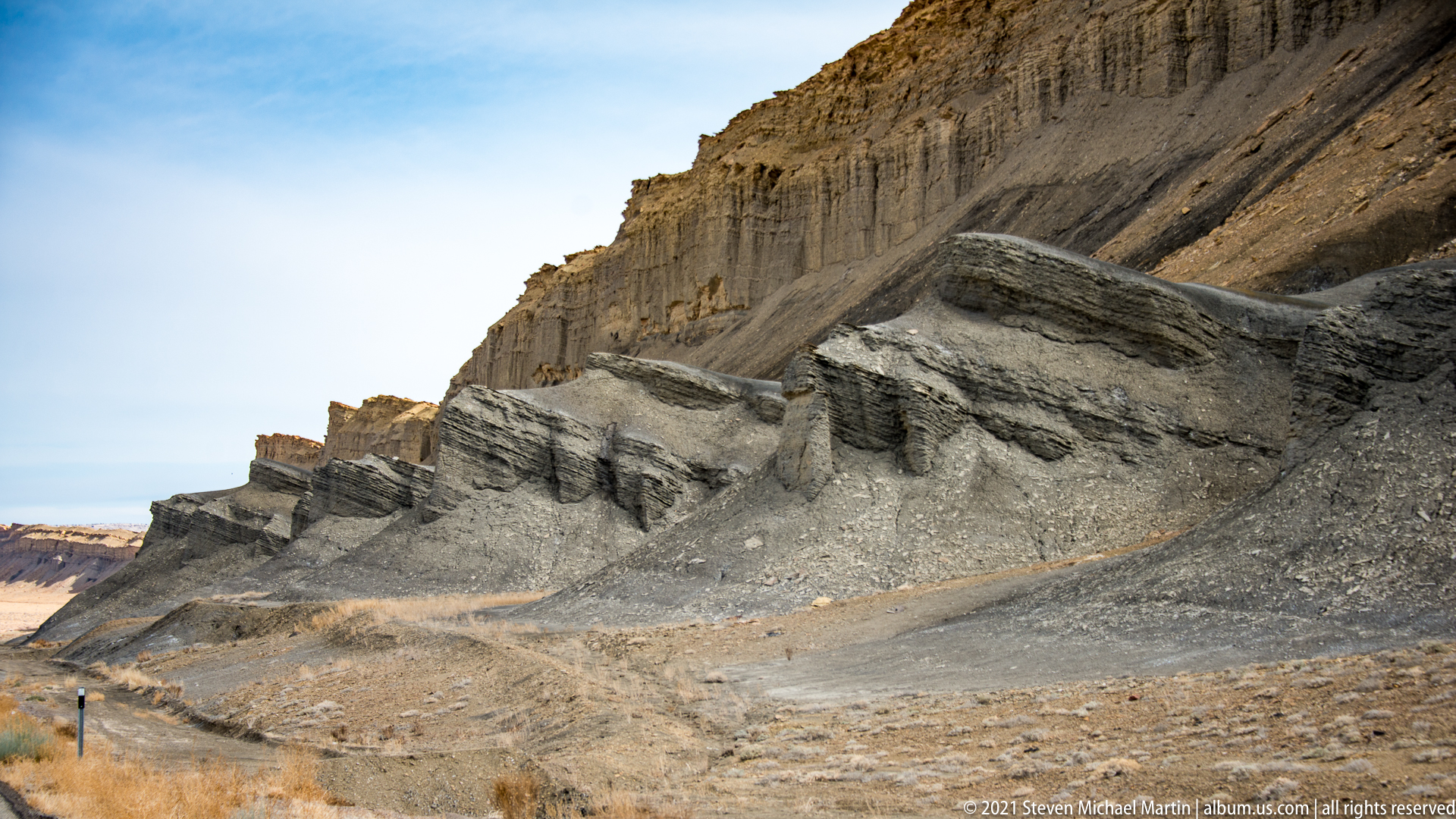
A steep hillside fills the frame with narrow, nearly parallel ridges and gullies cut into gray, tan, and brown sediment. Loose scree collects at the base, while the bare upper slope is striped by erosion channels. The close angle isolates the fine-scale relief of the badlands and the repeated lines carved into the face.
Caption
A steep hillside fills the frame with narrow, nearly parallel ridges and gullies cut into gray, tan, and brown sediment. Loose scree collects at the base, while the bare upper slope is striped by erosion channels. The close angle isolates the fine-scale relief of the badlands and the repeated lines carved into the face.
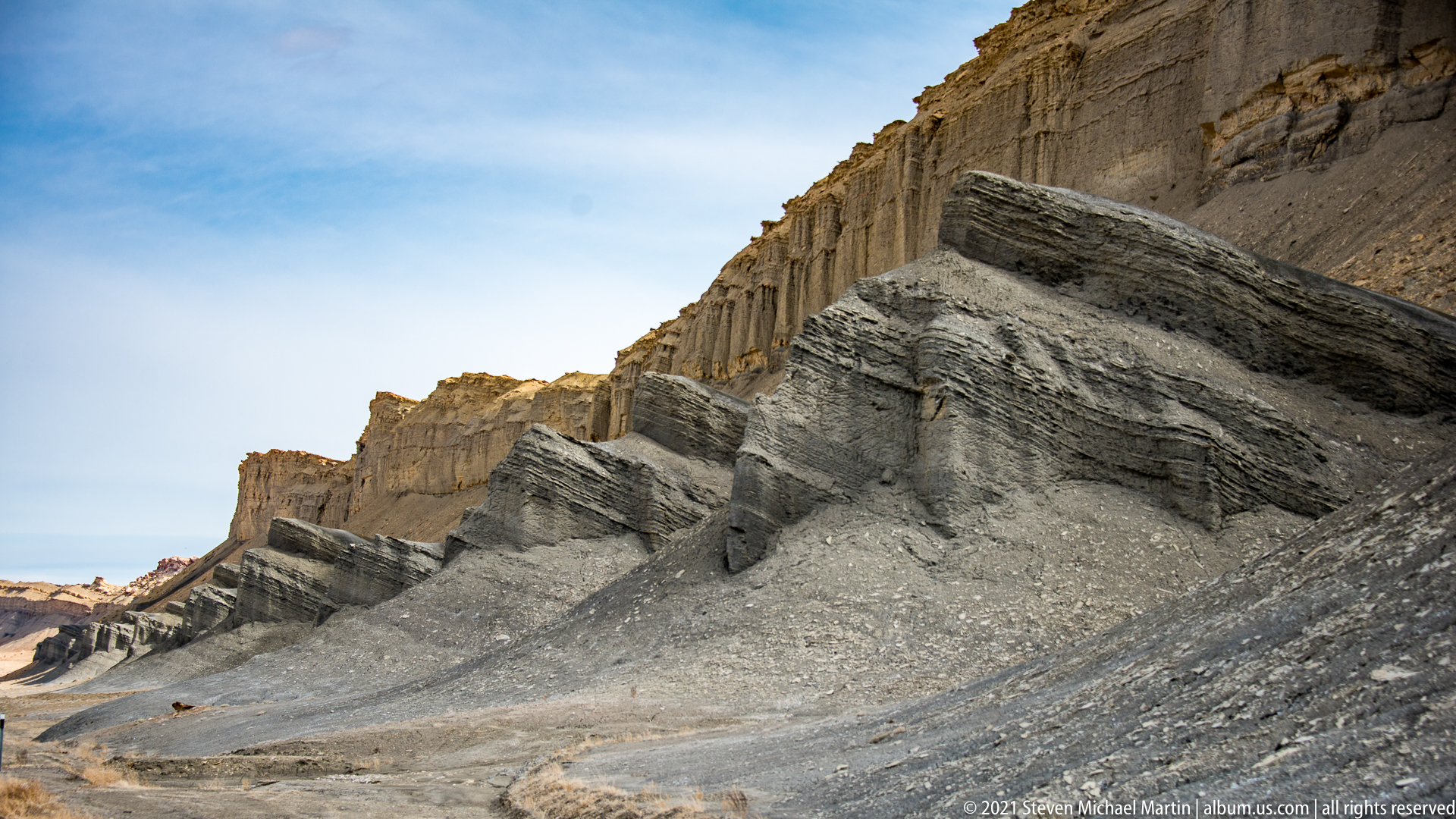
From a lower vantage, a stepped ridge of gray-brown sediment rises diagonally across the frame. Narrow drainage lines descend between harder bands, and loose fragments gather along the base. A small patch of blue sky remains above the crest. This oblique composition reveals the layered relief and the way erosion divides the slope into ribs.
Caption
From a lower vantage, a stepped ridge of gray-brown sediment rises diagonally across the frame. Narrow drainage lines descend between harder bands, and loose fragments gather along the base. A small patch of blue sky remains above the crest. This oblique composition reveals the layered relief and the way erosion divides the slope into ribs.
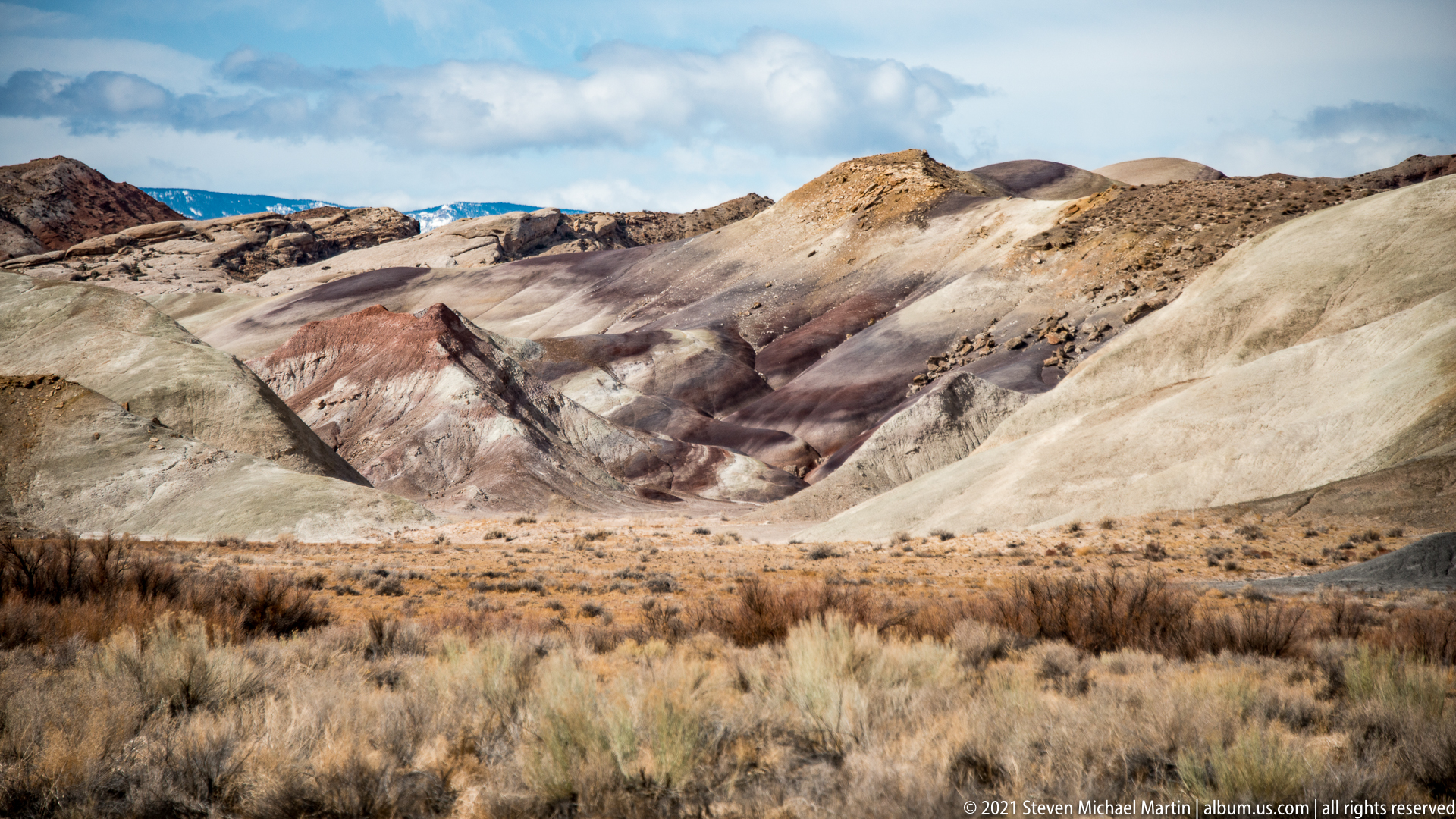
Rounded cream, mauve, and red hills rise beyond a band of tawny brush, their smooth slopes broken by darker seams and shallow gullies. The low viewpoint makes the clustered forms overlap across the middle distance. Bright clouds illuminate the pale layers and bring out the subtle color changes in the exposed sediment.
Caption
Rounded cream, mauve, and red hills rise beyond a band of tawny brush, their smooth slopes broken by darker seams and shallow gullies. The low viewpoint makes the clustered forms overlap across the middle distance. Bright clouds illuminate the pale layers and bring out the subtle color changes in the exposed sediment.
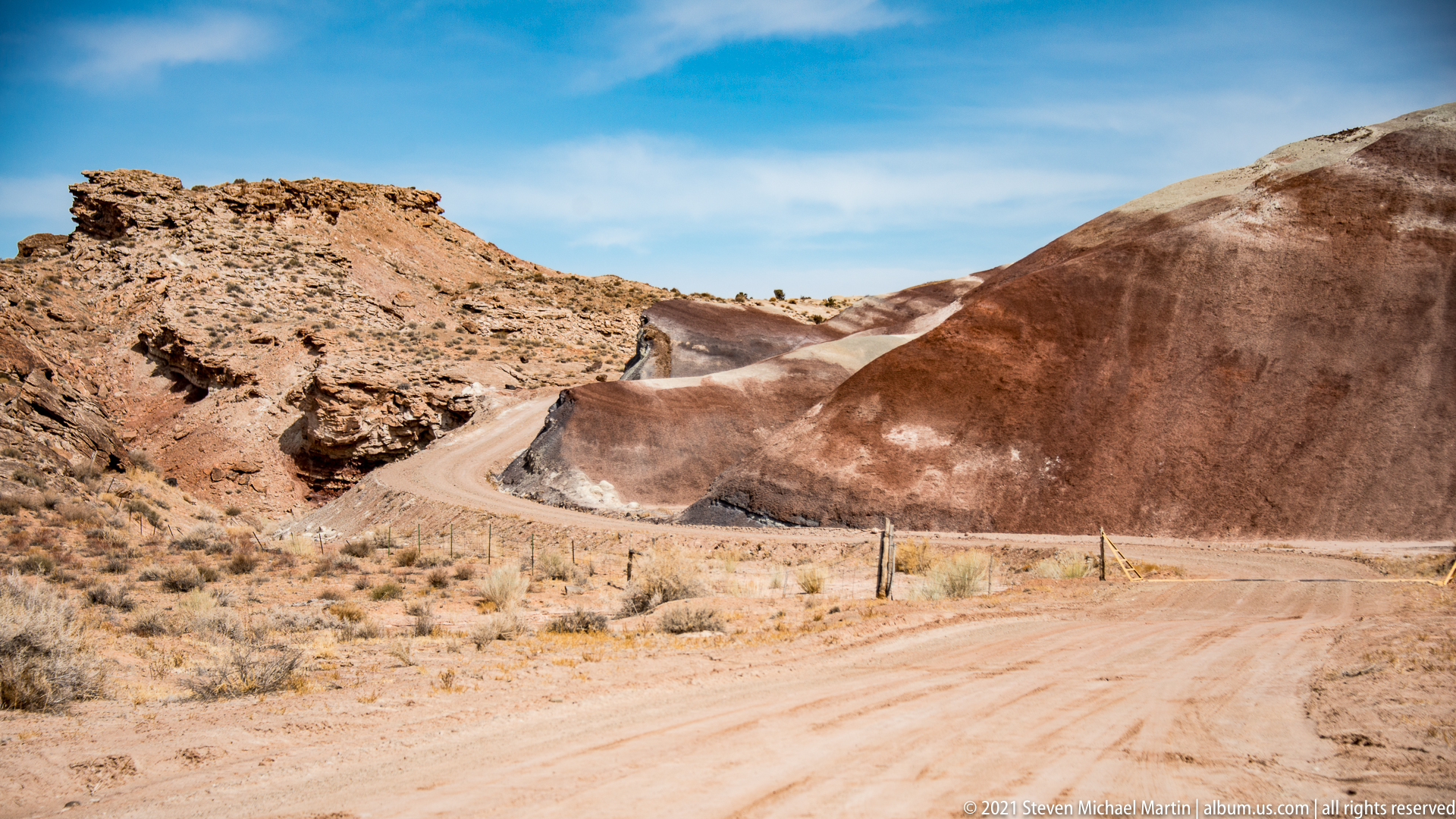
A pale dirt track curves around a broad reddish hill and disappears between layered badlands. A rough mesa rises at left, while the slopes display alternating cream, gray, and rust bands. Sparse grasses and a simple fence line border the route, giving the open terrain a human scale without obscuring its geological forms.
Caption
A pale dirt track curves around a broad reddish hill and disappears between layered badlands. A rough mesa rises at left, while the slopes display alternating cream, gray, and rust bands. Sparse grasses and a simple fence line border the route, giving the open terrain a human scale without obscuring its geological forms.

Smooth mauve, gray, and red slopes converge toward a narrow ravine at the center of the frame. The close viewpoint reveals subtle horizontal bands and dark seams across the hillsides, with a few loose stones at the foot of the gully. The compressed composition centers the drainage cut between rounded, color-striped slopes.
Caption
Smooth mauve, gray, and red slopes converge toward a narrow ravine at the center of the frame. The close viewpoint reveals subtle horizontal bands and dark seams across the hillsides, with a few loose stones at the foot of the gully. The compressed composition centers the drainage cut between rounded, color-striped slopes.
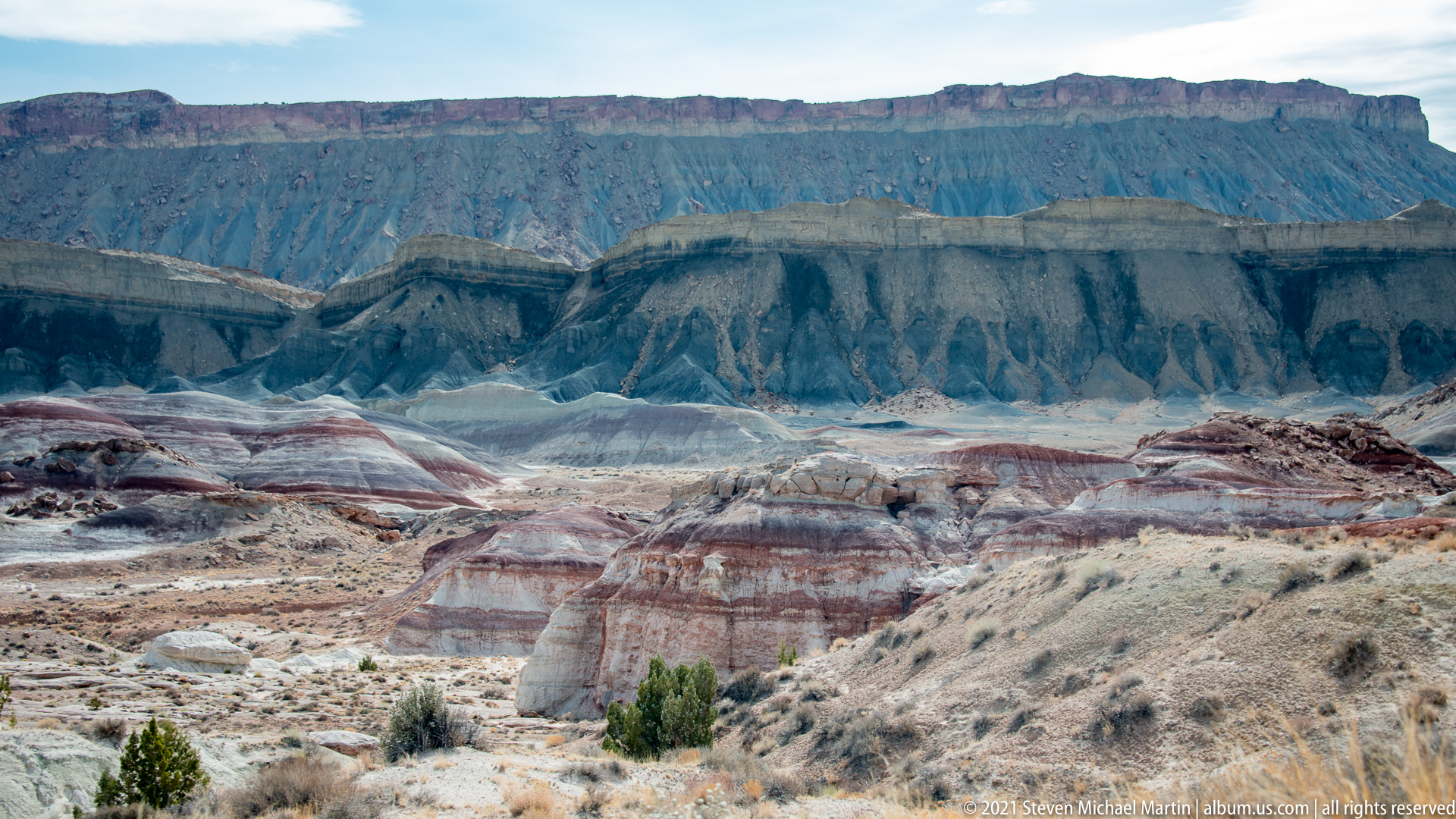
A broad sequence of pale, pink, and muted purple hills fills the foreground, while a dark, nearly continuous escarpment rises behind them. Fine sediment layers sweep across the lower slopes, contrasting with the sheer, banded cliff face above. The expansive view links the soft forms of the badlands to the harder wall beyond.
Caption
A broad sequence of pale, pink, and muted purple hills fills the foreground, while a dark, nearly continuous escarpment rises behind them. Fine sediment layers sweep across the lower slopes, contrasting with the sheer, banded cliff face above. The expansive view links the soft forms of the badlands to the harder wall beyond.
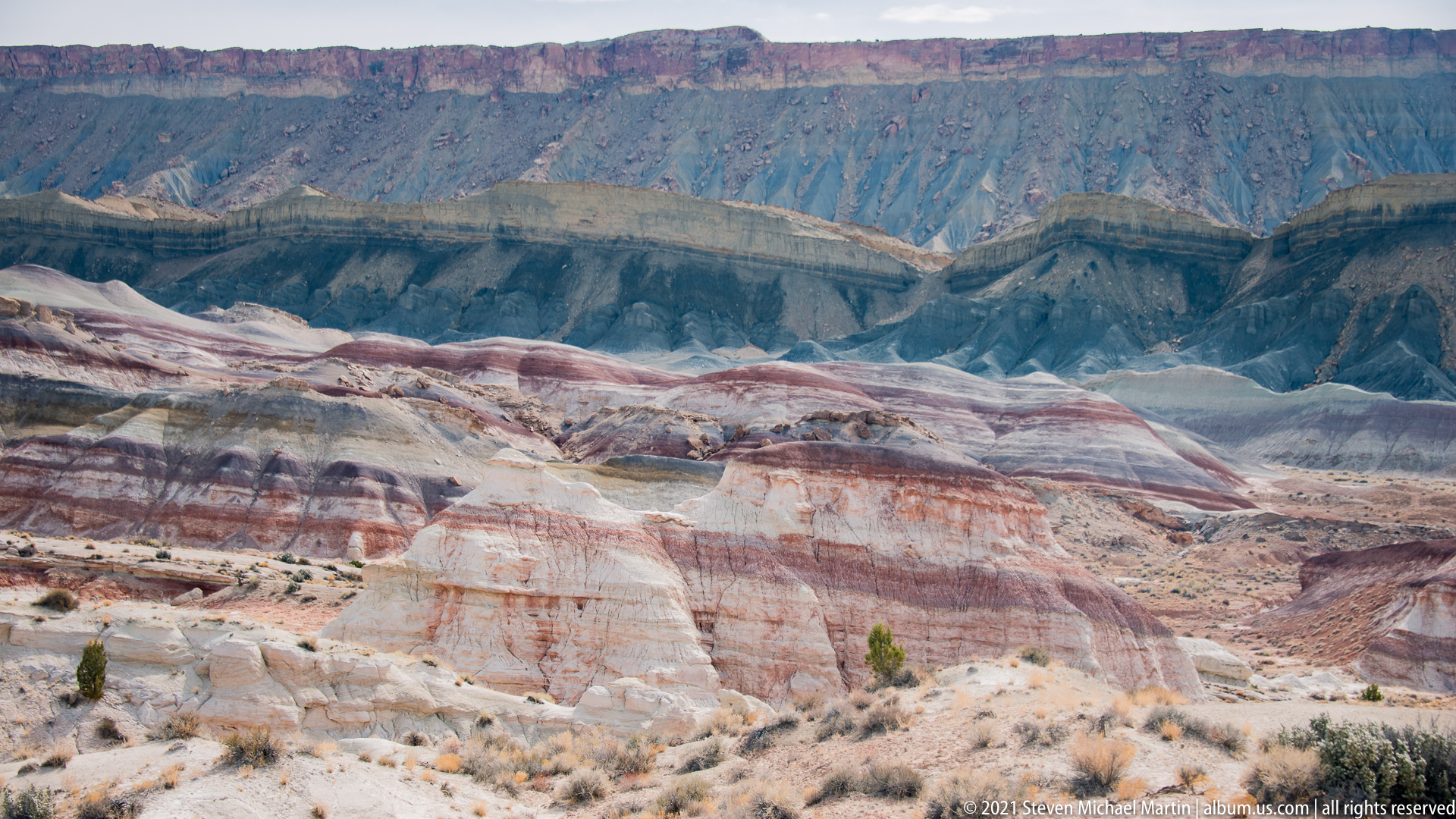
Red, cream, and gray hills spread across the foreground and middle distance, their horizontal bands bending over rounded ridges. A high dark cliff wall forms the backdrop from edge to edge, creating a clear contrast between the softer lower slopes and the steep escarpment. Scattered shrubs give scale to this expansive geological view.
Caption
Red, cream, and gray hills spread across the foreground and middle distance, their horizontal bands bending over rounded ridges. A high dark cliff wall forms the backdrop from edge to edge, creating a clear contrast between the softer lower slopes and the steep escarpment. Scattered shrubs give scale to this expansive geological view.
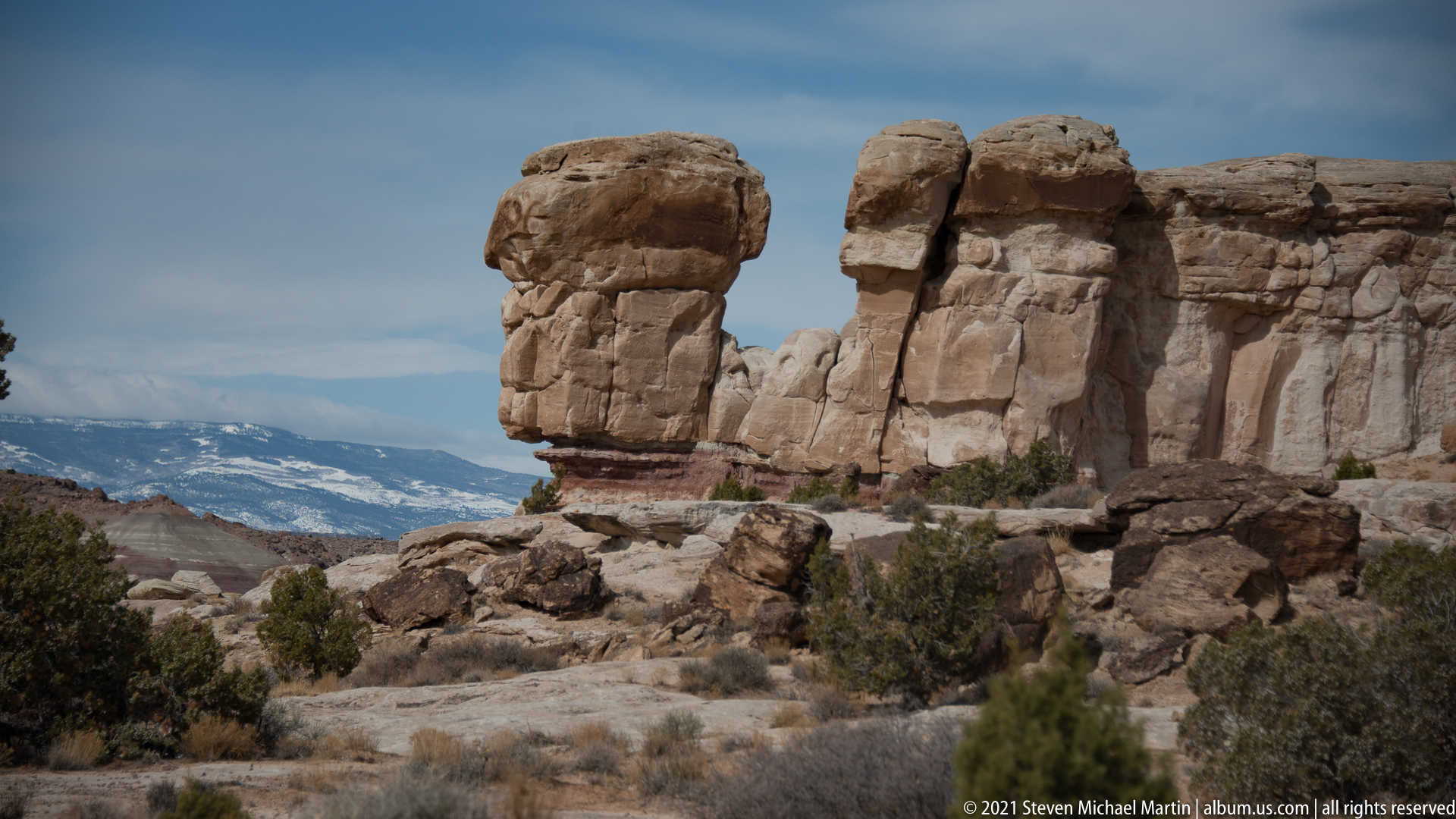
Cream-colored sandstone towers rise from the open Cathedral Valley plain, their fluted sides marked by horizontal bands and weathered grooves. A distant mountain range carries a thin cover of snow, while low scrub fills the foreground. The layered view places the park’s sculpted desert formations against a colder, higher landscape beyond.
Caption
Cream-colored sandstone towers rise from the open Cathedral Valley plain, their fluted sides marked by horizontal bands and weathered grooves. A distant mountain range carries a thin cover of snow, while low scrub fills the foreground. The layered view places the park’s sculpted desert formations against a colder, higher landscape beyond.
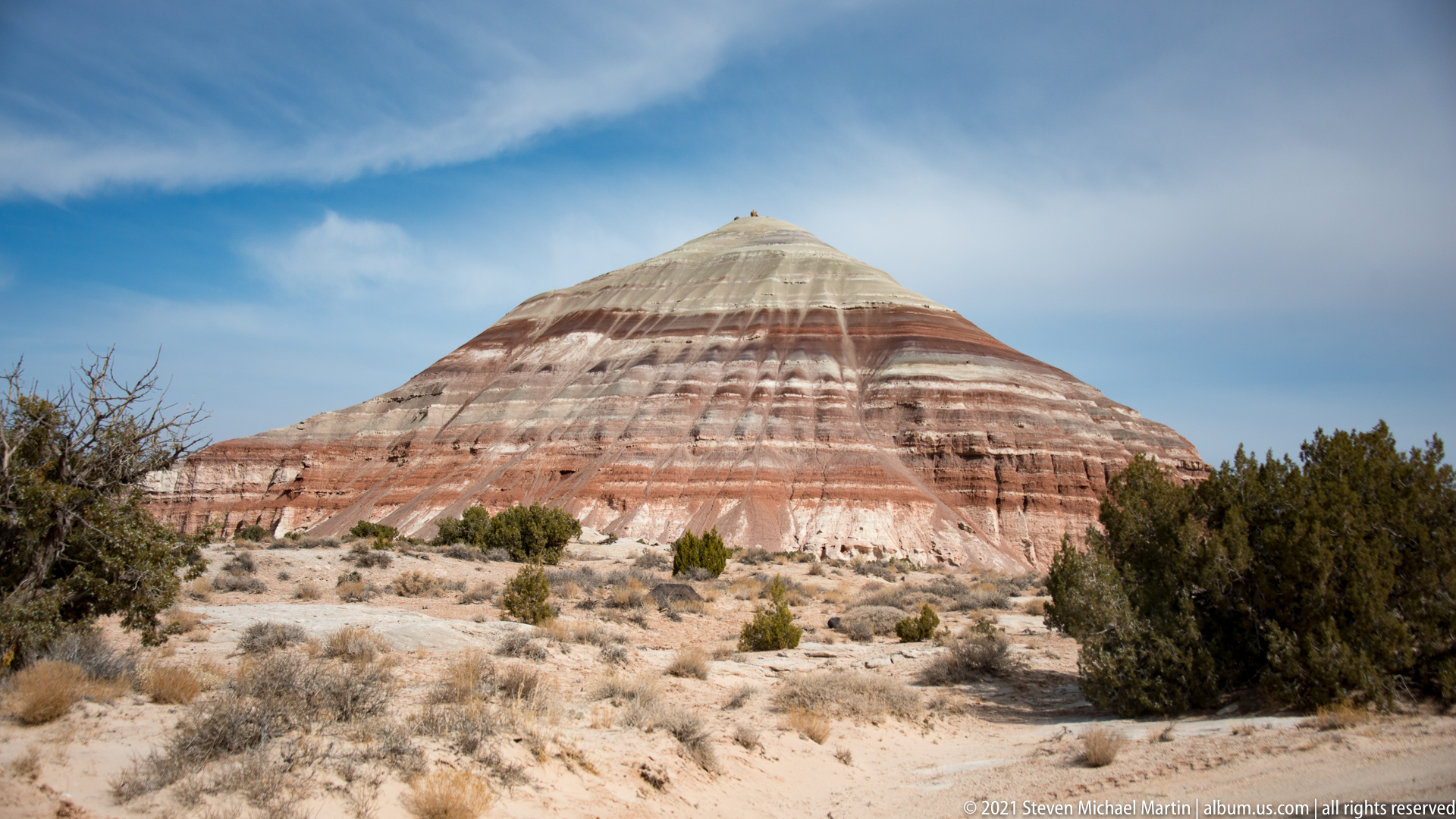
A steep, conical butte rises from a low desert plain, its sloping sides striped in alternating cream, rust, and darker brown bands. Sparse shrubs edge the foreground and open sky frames the summit. The compact composition draws attention to the change in color and texture across the exposed layers, showing how erosion has shaped the formation into a distinct isolated peak.
Caption
A steep, conical butte rises from a low desert plain, its sloping sides striped in alternating cream, rust, and darker brown bands. Sparse shrubs edge the foreground and open sky frames the summit. The compact composition draws attention to the change in color and texture across the exposed layers, showing how erosion has shaped the formation into a distinct isolated peak.
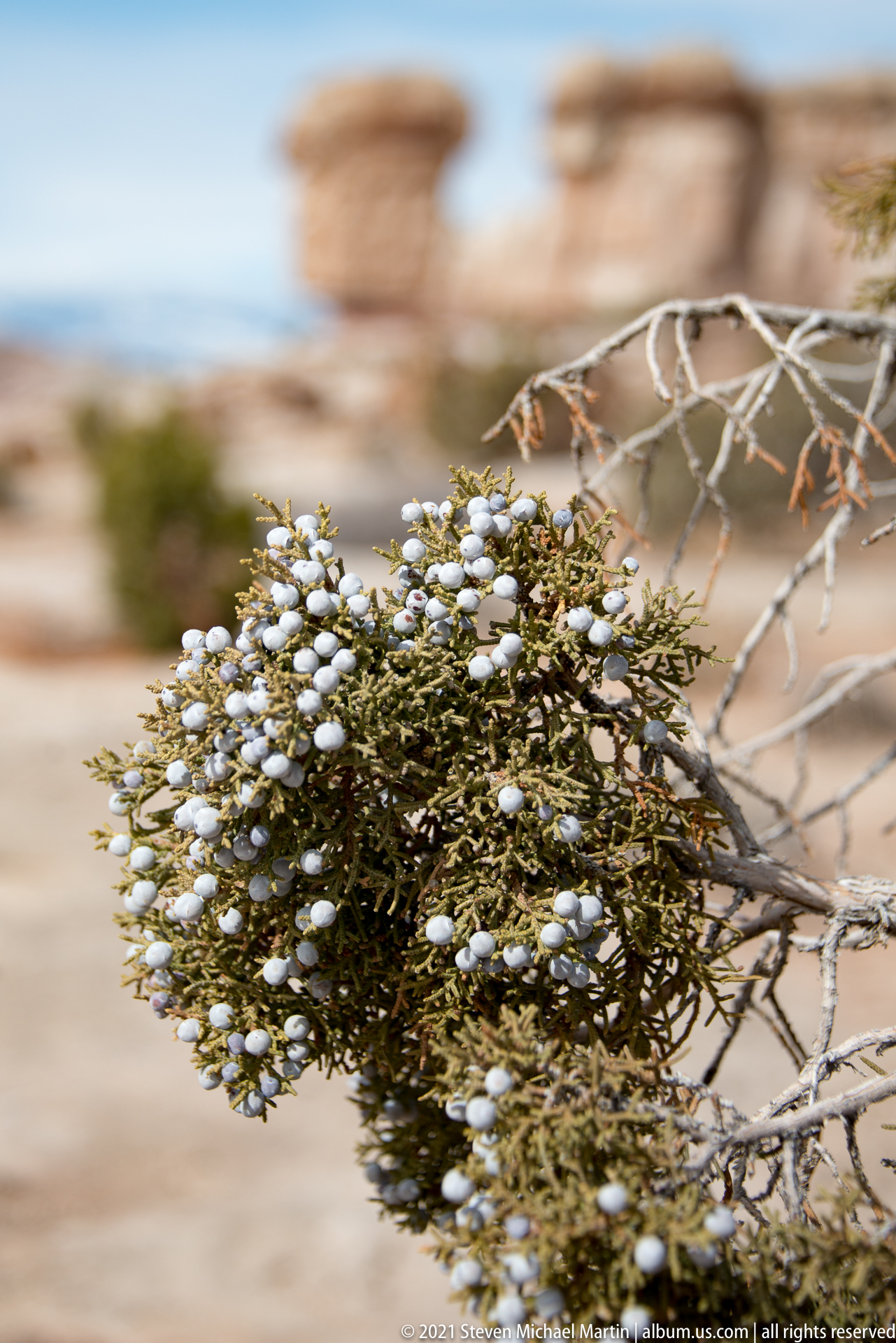
A juniper branch fills the foreground, its short green foliage carrying several dusty blue, berry-like cones. The shallow focus softens the pale rock and muted desert colors behind it, making the plant’s compact growth and fruit the subject rather than the surrounding terrain. The close view adds a botanical detail to a sequence otherwise dominated by broad sandstone forms.
Caption
A juniper branch fills the foreground, its short green foliage carrying several dusty blue, berry-like cones. The shallow focus softens the pale rock and muted desert colors behind it, making the plant’s compact growth and fruit the subject rather than the surrounding terrain. The close view adds a botanical detail to a sequence otherwise dominated by broad sandstone forms.
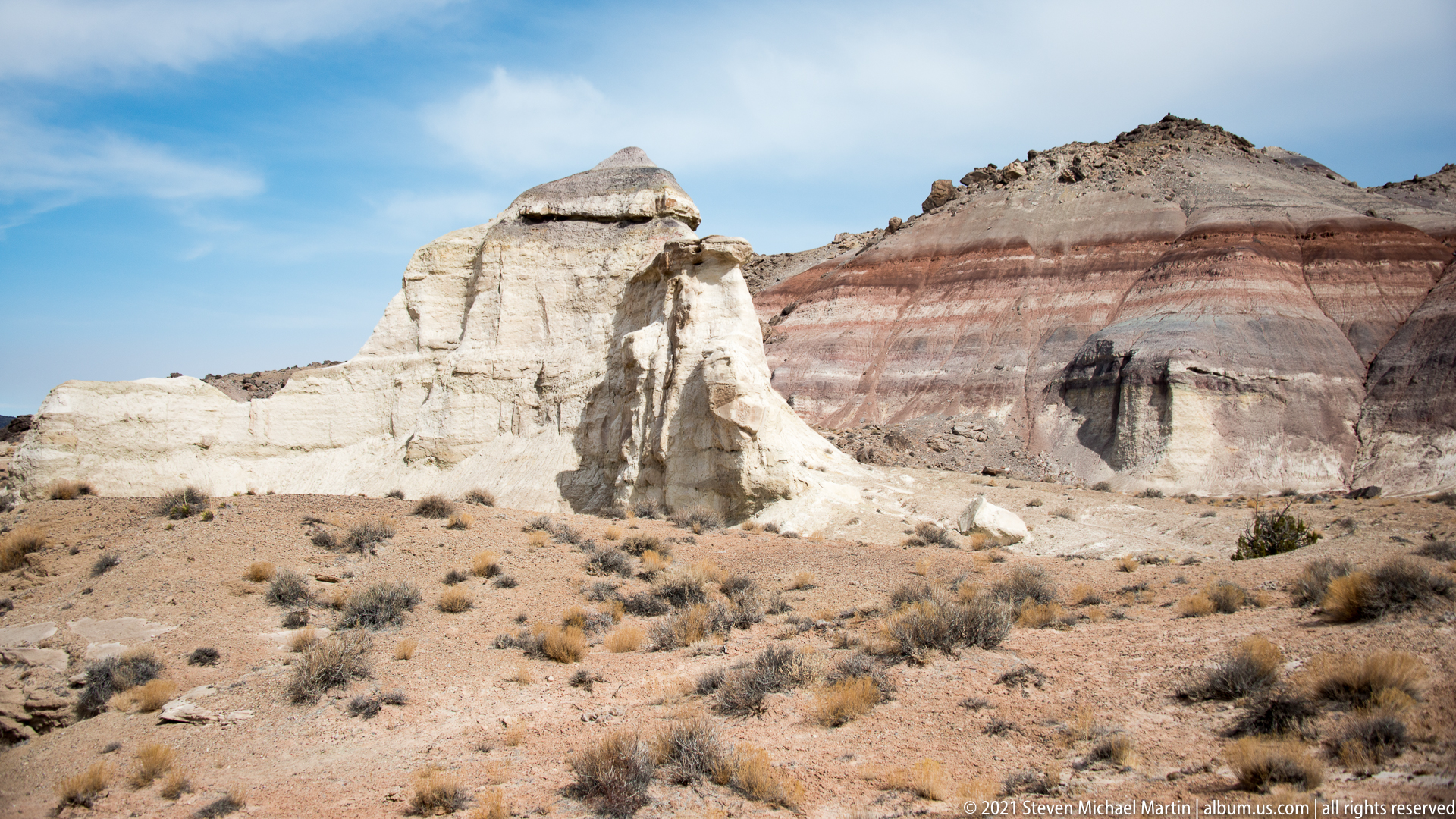
A pale, narrow rock pillar stands in front of a taller cliff whose face is striped with red, gray, and cream layers. The foreground formation has an irregular, weathered crown and a lighter surface than the wall behind it. Their overlapping profiles show two scales of erosion in one frame: a freestanding form close by and a broad, banded escarpment beyond.
Caption
A pale, narrow rock pillar stands in front of a taller cliff whose face is striped with red, gray, and cream layers. The foreground formation has an irregular, weathered crown and a lighter surface than the wall behind it. Their overlapping profiles show two scales of erosion in one frame: a freestanding form close by and a broad, banded escarpment beyond.
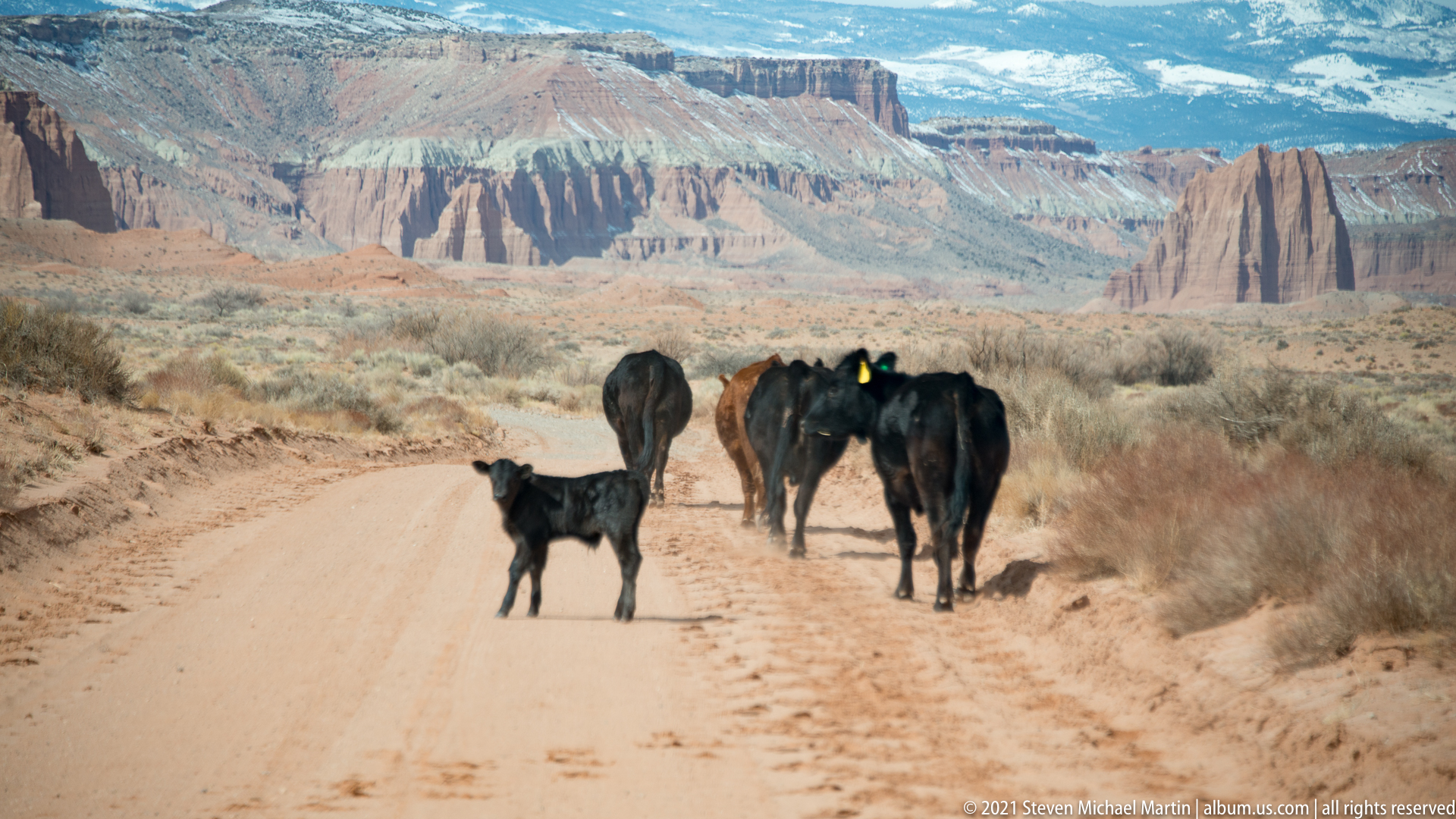
A group of black cattle, including a calf, gathers along a dirt road at the foot of sharply banded cliffs. Some animals face the camera while others stand across the track, their dark bodies distinct against pale ground and layered rock. The road leads into the scene and situates the herd within the open grazing landscape of Cathedral Valley.
Caption
A group of black cattle, including a calf, gathers along a dirt road at the foot of sharply banded cliffs. Some animals face the camera while others stand across the track, their dark bodies distinct against pale ground and layered rock. The road leads into the scene and situates the herd within the open grazing landscape of Cathedral Valley.
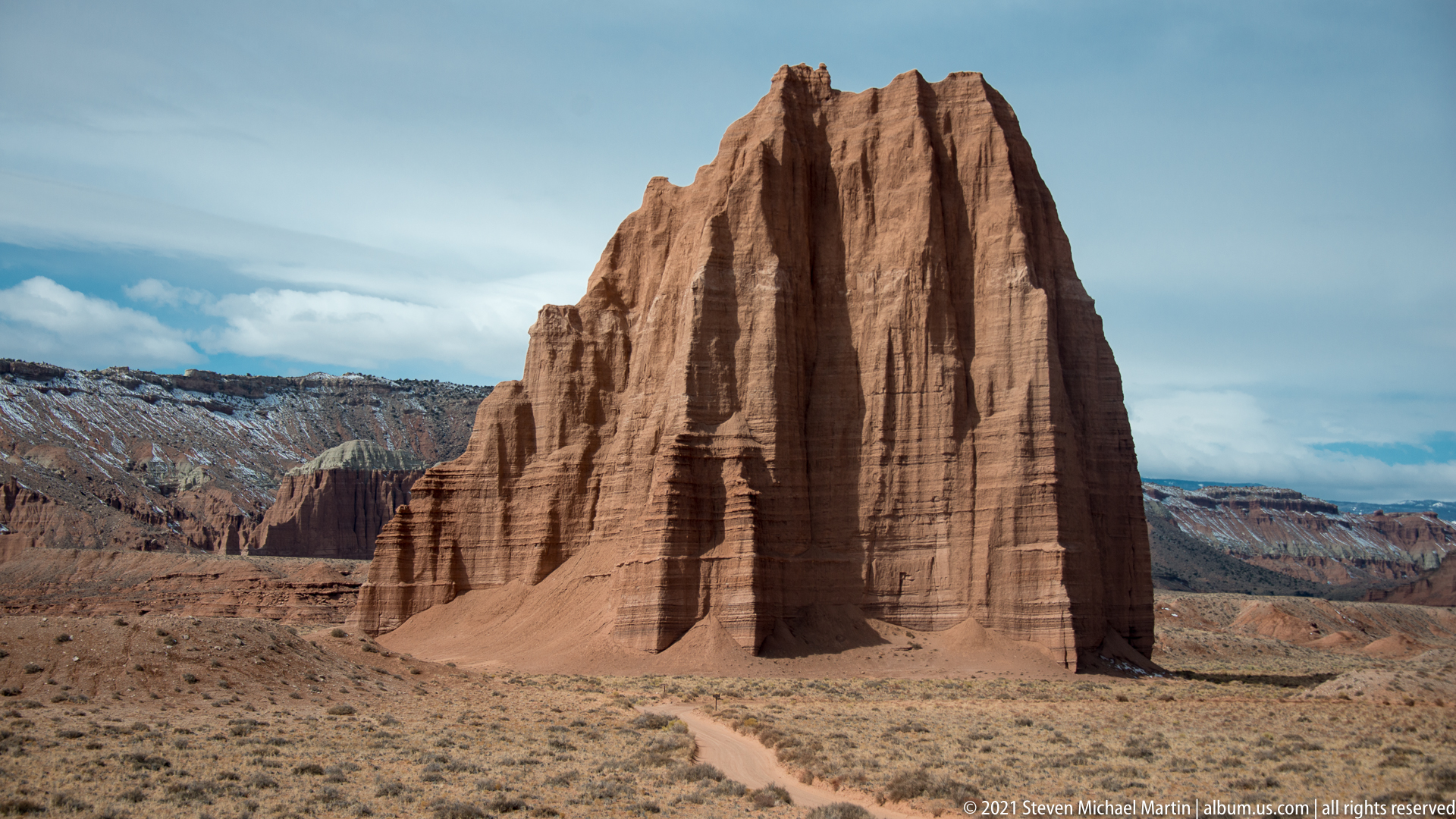
A single fluted sandstone tower rises beyond a pale track that points toward its base. From this closer viewpoint, the vertical grooves and warm red coloring define the monolith, while low vegetation breaks up the level ground. The route through the foreground gives the formation a clear approach and anchors its height against the open sky.
Caption
A single fluted sandstone tower rises beyond a pale track that points toward its base. From this closer viewpoint, the vertical grooves and warm red coloring define the monolith, while low vegetation breaks up the level ground. The route through the foreground gives the formation a clear approach and anchors its height against the open sky.
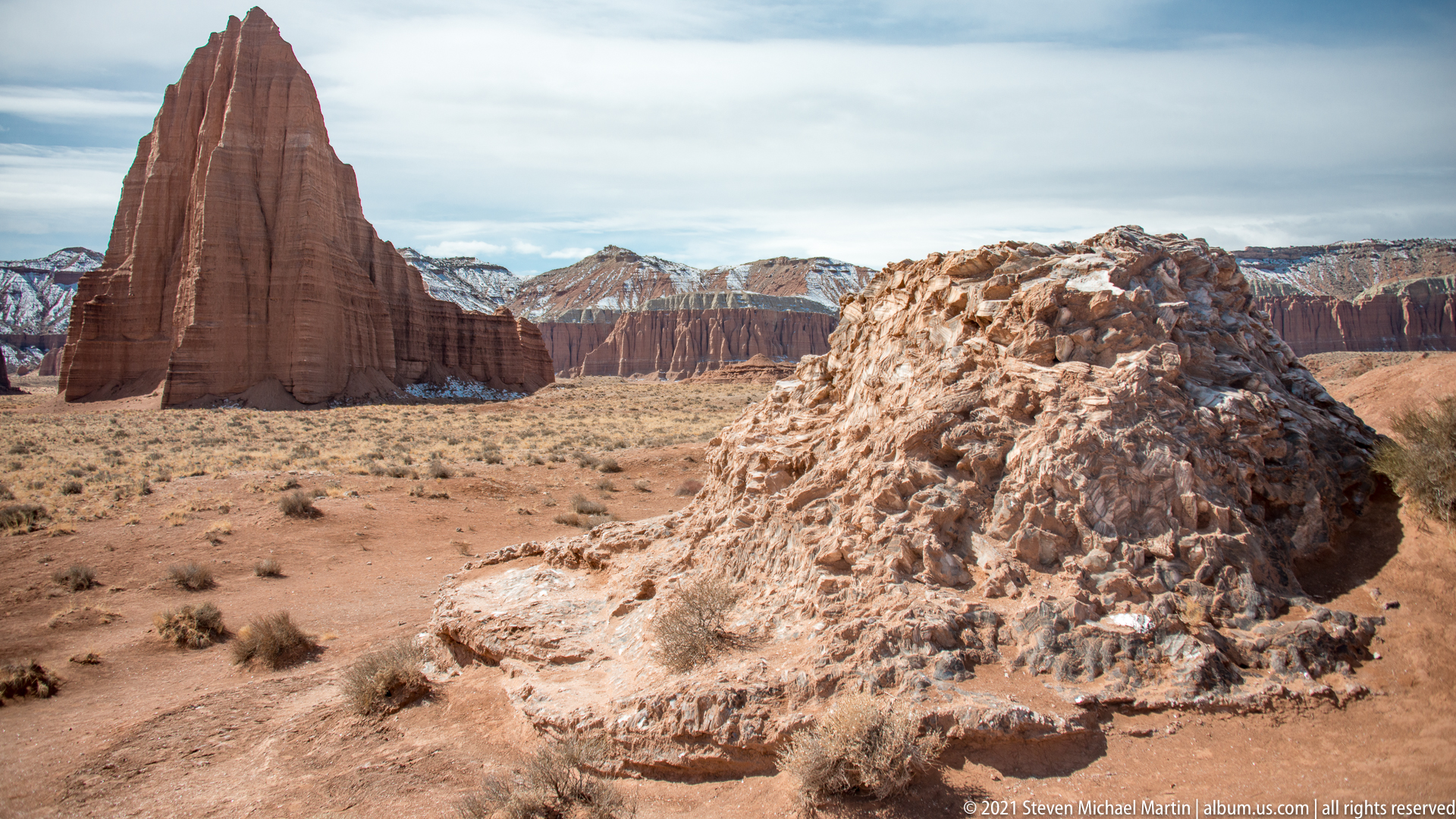
A broad pale boulder fills the foreground, its rough, broken surface set against a tall red sandstone tower at left. The contrast in scale and color connects a close geological detail with the larger formation beyond. Open sky and scattered scrub leave the two rocks clearly separated, making the foreground boulder an important part of the composition rather than a mere frame.
Caption
A broad pale boulder fills the foreground, its rough, broken surface set against a tall red sandstone tower at left. The contrast in scale and color connects a close geological detail with the larger formation beyond. Open sky and scattered scrub leave the two rocks clearly separated, making the foreground boulder an important part of the composition rather than a mere frame.
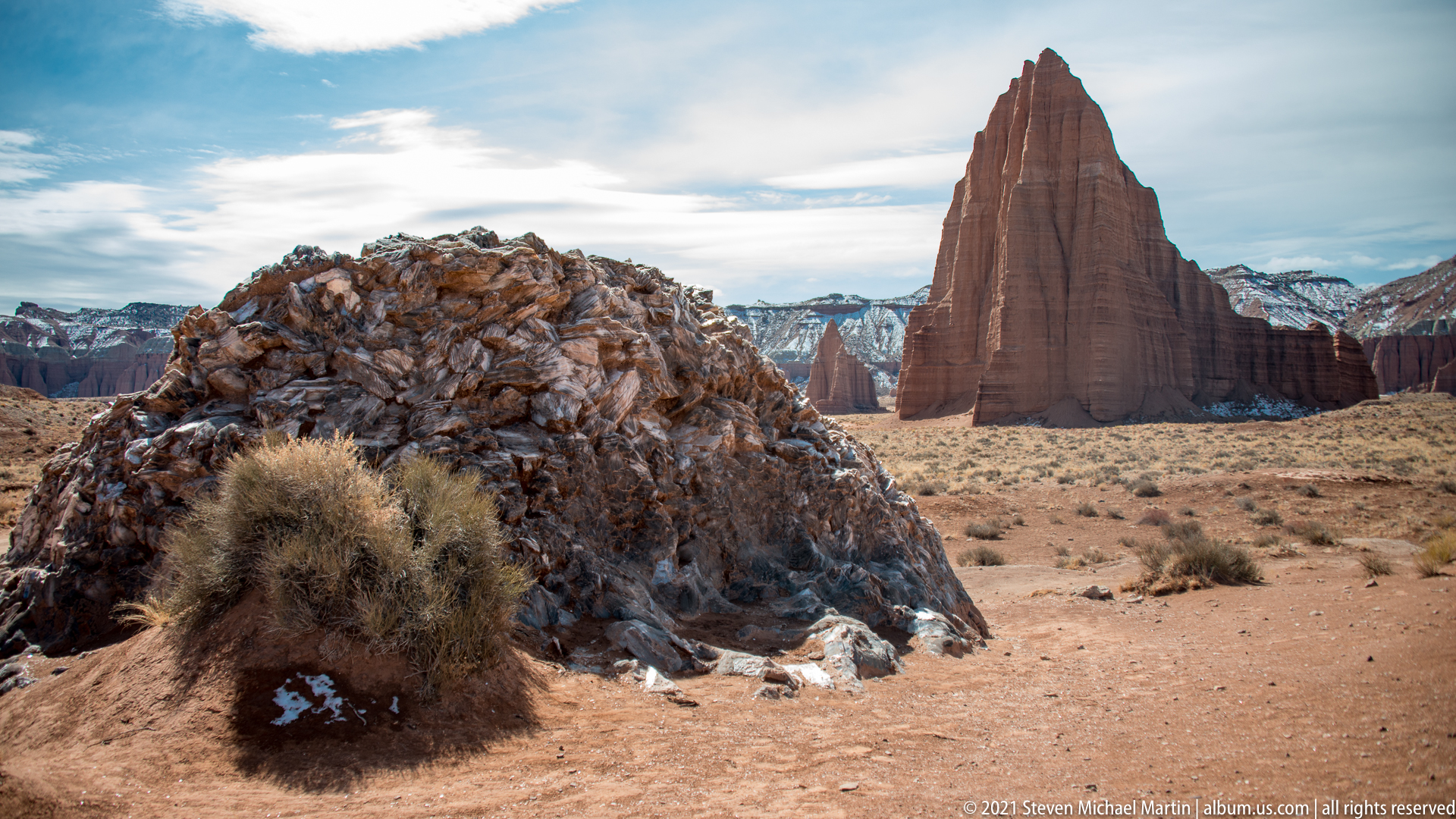
A gray-brown rocky mound and dry shrub occupy the foreground, while a red sandstone tower rises at right beyond them. A distant ridge carries a light dusting of snow under a pale sky. The layered view combines near-ground rock, the valley’s isolated monolith, and a far mountain backdrop, giving the formation a broader geographic setting.
Caption
A gray-brown rocky mound and dry shrub occupy the foreground, while a red sandstone tower rises at right beyond them. A distant ridge carries a light dusting of snow under a pale sky. The layered view combines near-ground rock, the valley’s isolated monolith, and a far mountain backdrop, giving the formation a broader geographic setting.
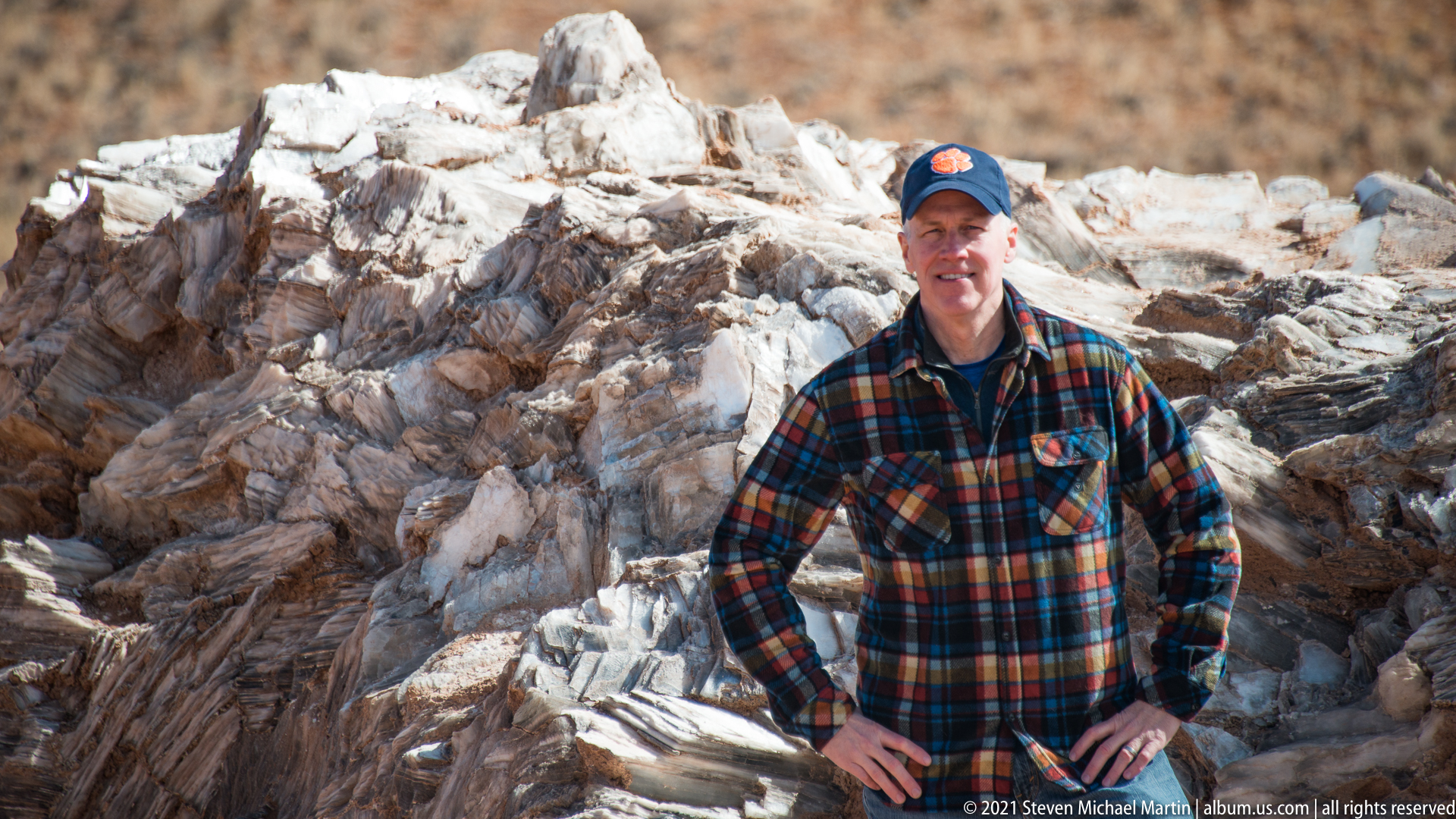
A man wearing a cap and plaid shirt stands close to layered boulders, looking toward the camera. White and rust-colored bands in the rock form a textured backdrop, with cracks and broken edges visible around his shoulders. The tight portrait places a person within the geological setting while preserving the scale and color of the surrounding stone.
Caption
A man wearing a cap and plaid shirt stands close to layered boulders, looking toward the camera. White and rust-colored bands in the rock form a textured backdrop, with cracks and broken edges visible around his shoulders. The tight portrait places a person within the geological setting while preserving the scale and color of the surrounding stone.
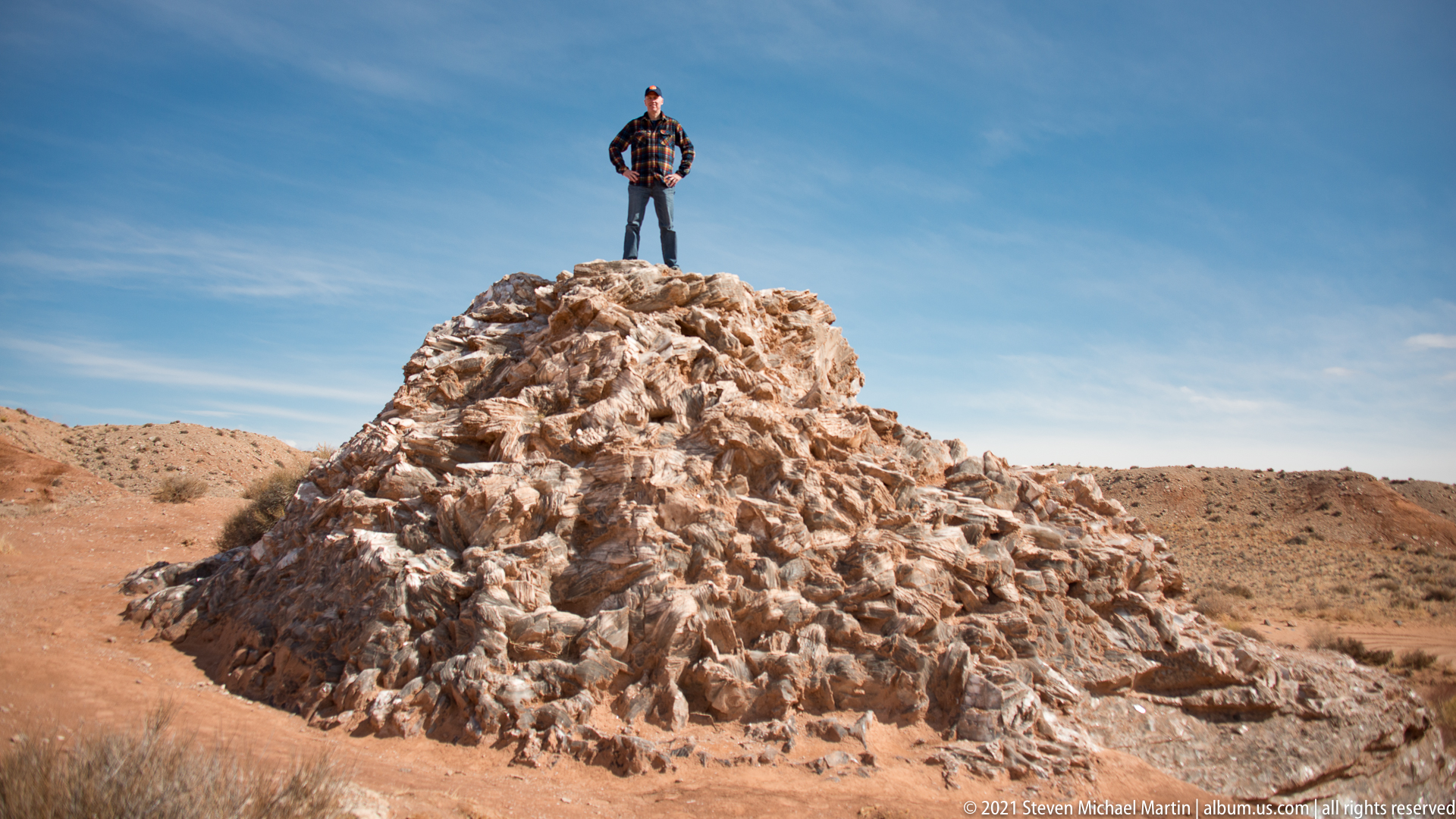
A small figure stands on the crest of a pale rocky mound, silhouetted against a broad, clear blue sky. The low viewpoint gives the person a prominent position on the skyline while exposing the rough, rounded surface of the mound below. With little else in the frame, the image emphasizes the relationship between a lone visitor and the open terrain.
Caption
A small figure stands on the crest of a pale rocky mound, silhouetted against a broad, clear blue sky. The low viewpoint gives the person a prominent position on the skyline while exposing the rough, rounded surface of the mound below. With little else in the frame, the image emphasizes the relationship between a lone visitor and the open terrain.
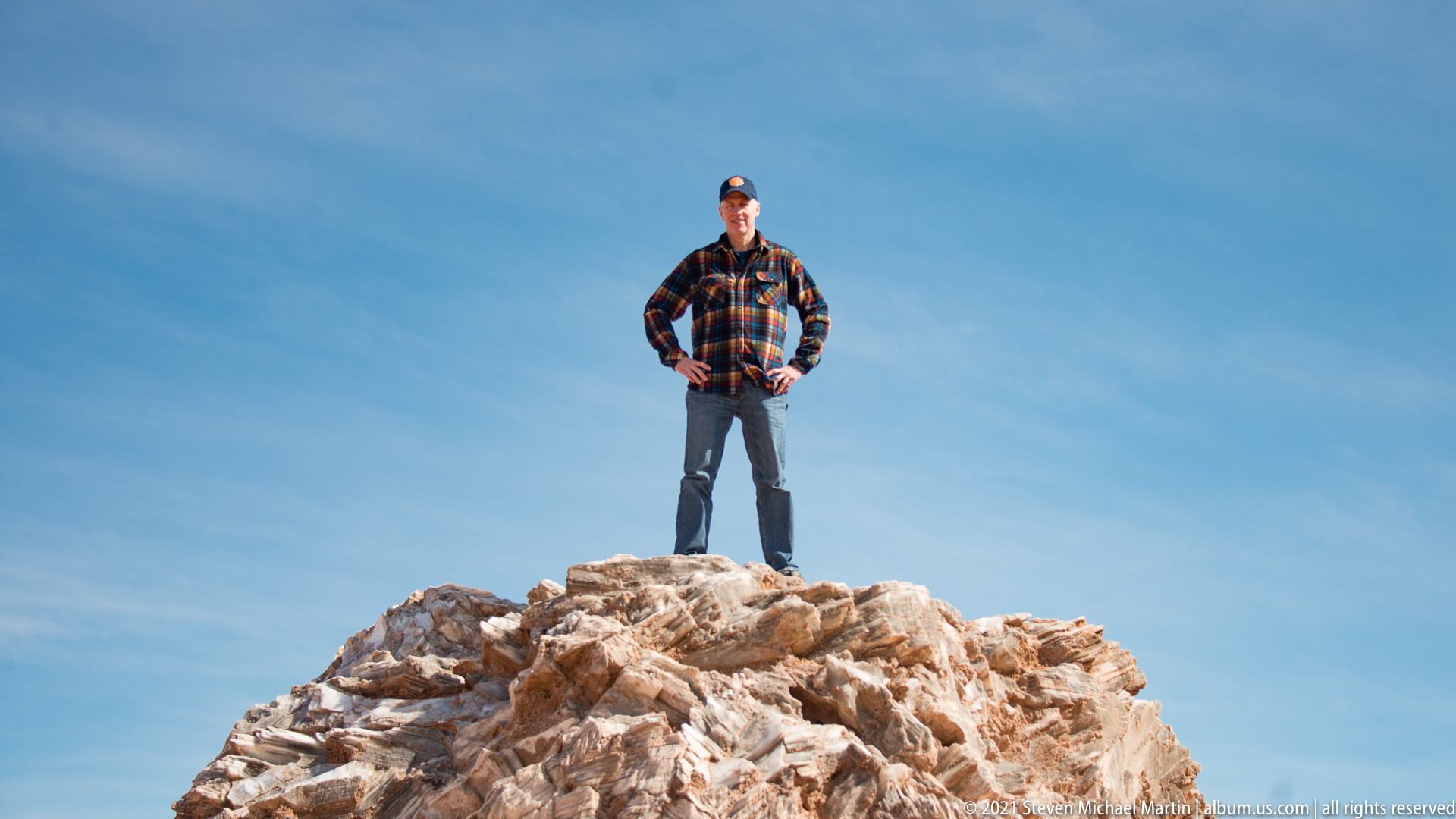
Seen from below, a man stands near the crown of a pale boulder beneath an expansive blue sky. The mound’s uneven, pitted surface rises across the lower portion of the frame, while the figure appears small against the open space. This viewpoint emphasizes the height of the rock and the visitor’s exposed position on its crest.
Caption
Seen from below, a man stands near the crown of a pale boulder beneath an expansive blue sky. The mound’s uneven, pitted surface rises across the lower portion of the frame, while the figure appears small against the open space. This viewpoint emphasizes the height of the rock and the visitor’s exposed position on its crest.
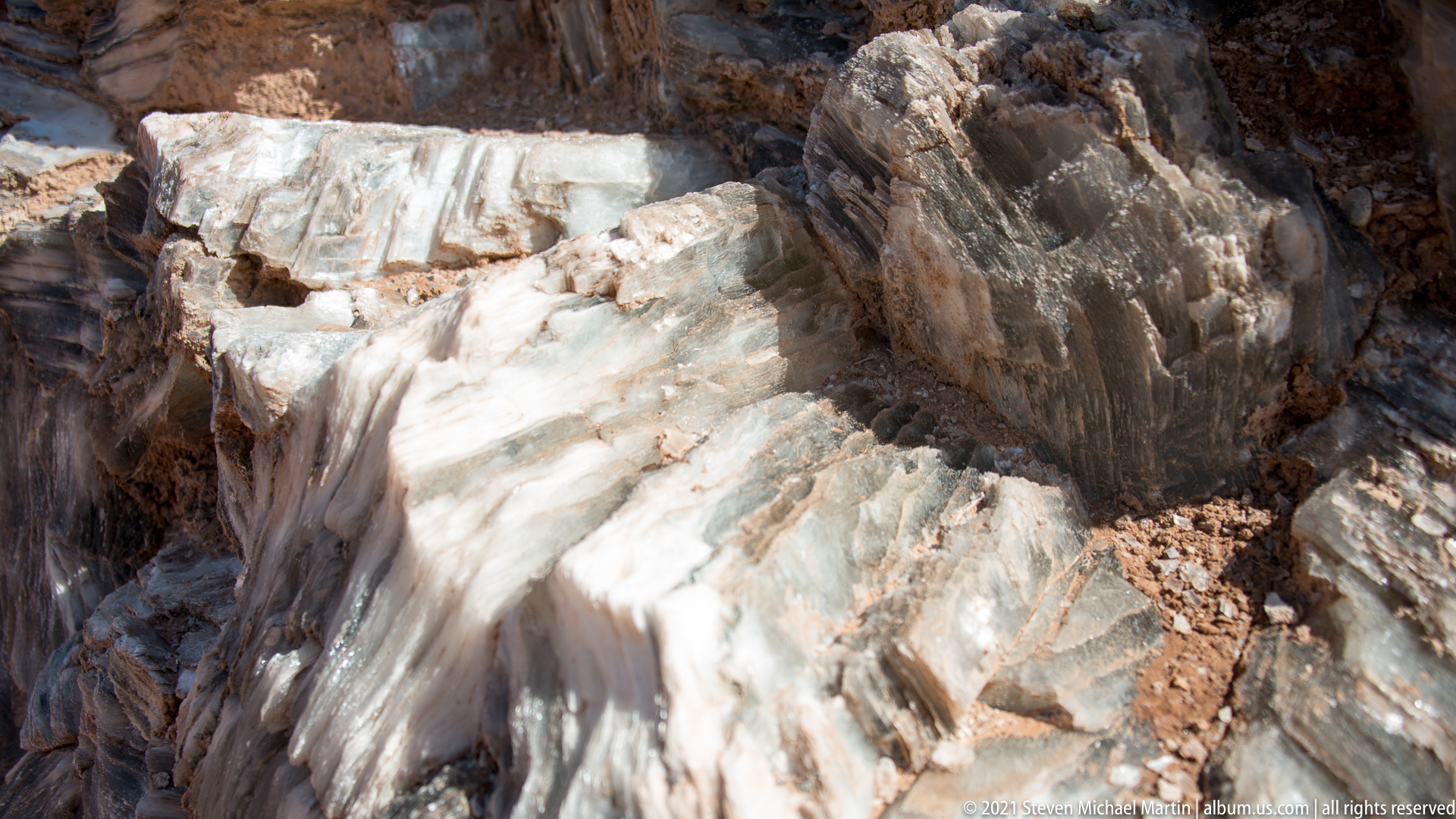
Pale gray and white mineral lines cross a brown rock surface broken into angular plates. The close framing reveals branching seams, fine cracks, and changes in the stone’s color and texture, with no wider landscape visible. The image reads as a geological detail, focusing on the relationships between veining and fracture rather than on a recognizable landform.
Caption
Pale gray and white mineral lines cross a brown rock surface broken into angular plates. The close framing reveals branching seams, fine cracks, and changes in the stone’s color and texture, with no wider landscape visible. The image reads as a geological detail, focusing on the relationships between veining and fracture rather than on a recognizable landform.
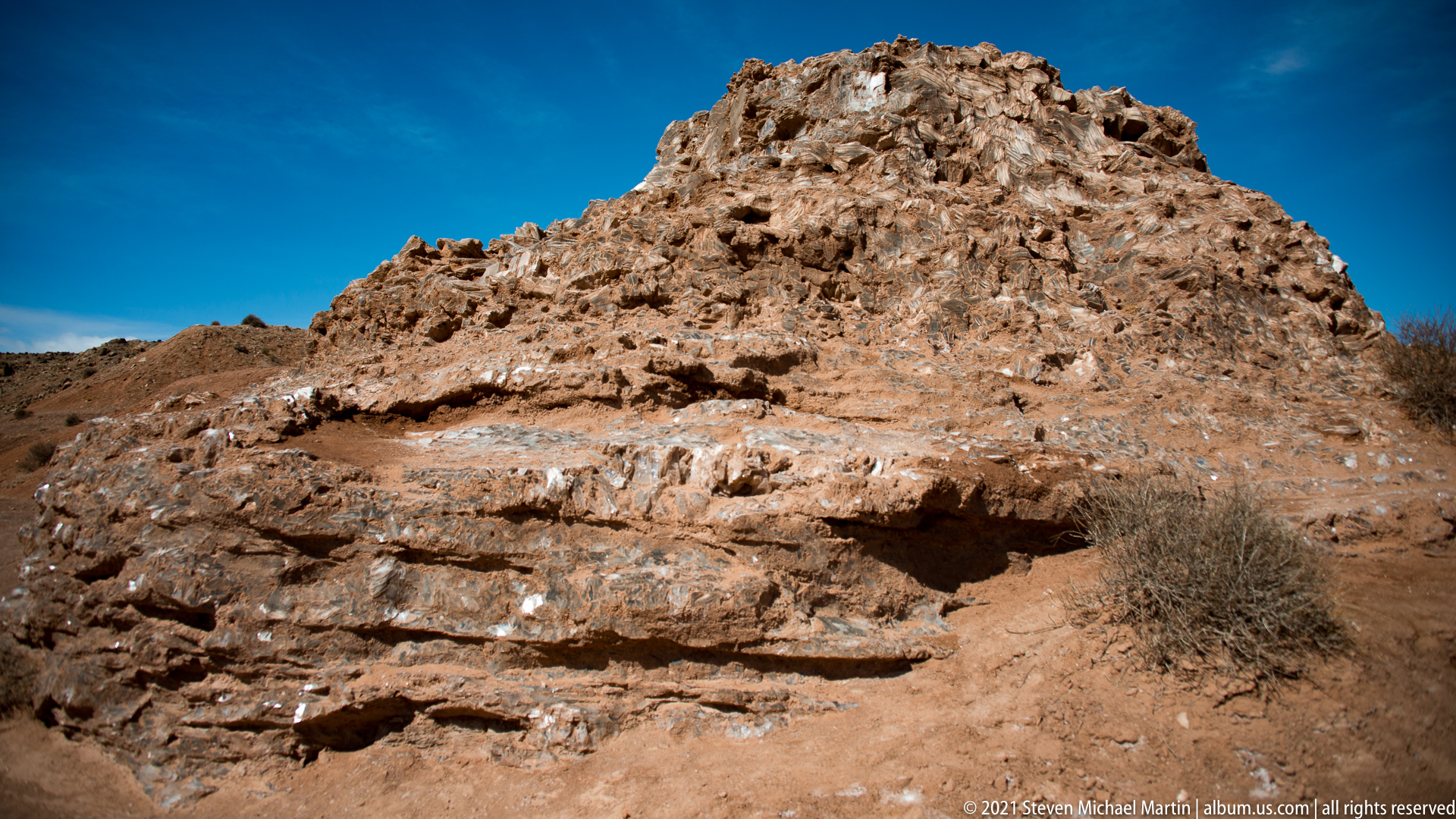
A pale, coarse rock mound fills the frame, its irregular face cut by a shallow recess or ledge. A dry shrub stands at the right edge, providing a small scale reference against the broken surface. The close view concentrates on weathering and texture, while the cropped surroundings keep the mound from resolving into a larger landscape.
Caption
A pale, coarse rock mound fills the frame, its irregular face cut by a shallow recess or ledge. A dry shrub stands at the right edge, providing a small scale reference against the broken surface. The close view concentrates on weathering and texture, while the cropped surroundings keep the mound from resolving into a larger landscape.

A tall red sandstone monolith rises above low desert vegetation, its fluted sides clearly visible against a blue sky. A small sign stands near the base beside the roadside, linking the formation to a visitor route. The sign is too small to read at this scale, so the image’s strongest information is the tower’s form and its relationship to the developed access point.
Caption
A tall red sandstone monolith rises above low desert vegetation, its fluted sides clearly visible against a blue sky. A small sign stands near the base beside the roadside, linking the formation to a visitor route. The sign is too small to read at this scale, so the image’s strongest information is the tower’s form and its relationship to the developed access point.
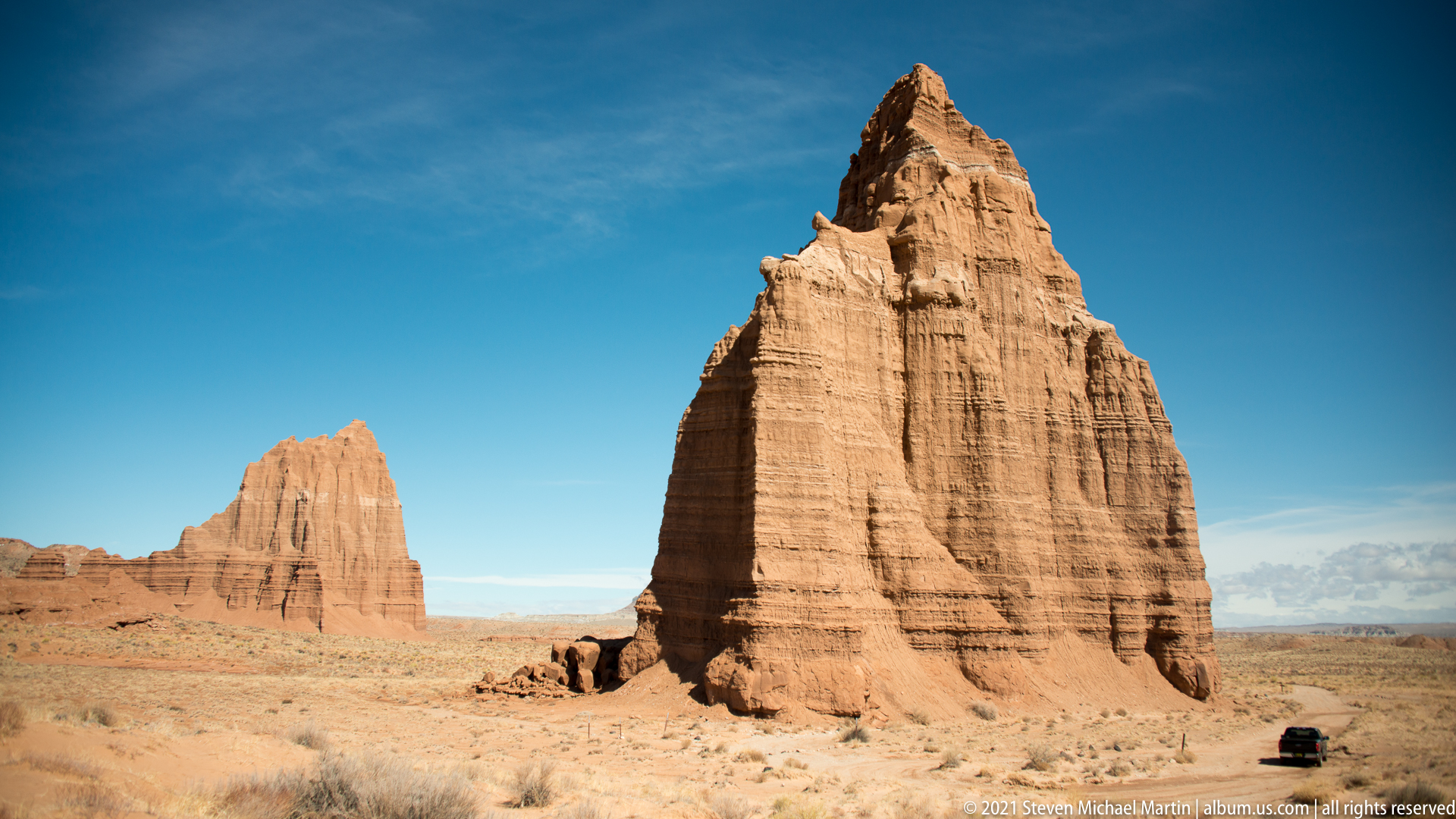
Two red sandstone towers rise across a dirt road, with a dark vehicle in the foreground providing a clear measure of scale. The larger formation stands at right and a second tower at left, both separated from the road by open ground. Bright sky and minimal vegetation keep attention on the paired monoliths and the human access route through the valley.
Caption
Two red sandstone towers rise across a dirt road, with a dark vehicle in the foreground providing a clear measure of scale. The larger formation stands at right and a second tower at left, both separated from the road by open ground. Bright sky and minimal vegetation keep attention on the paired monoliths and the human access route through the valley.
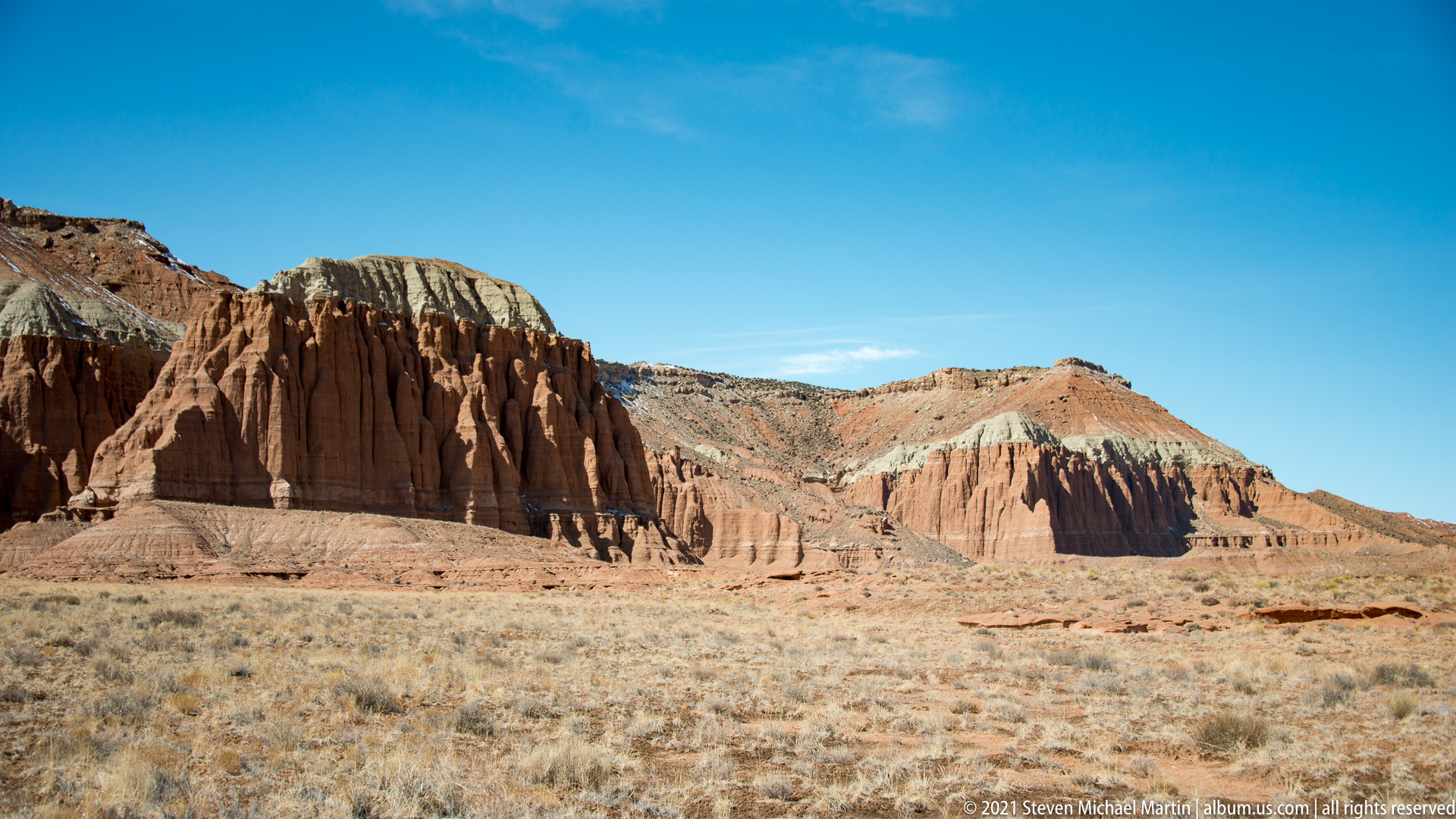
A broad mesa and adjoining cliffs stretch across the horizon, their faces marked by red, gray, and pale horizontal strata. The low viewpoint leaves a wide scrub-covered plain across the foreground, giving the rock wall a continuous, landscape-scale presence. No single tower dominates; instead, the image records the varied bands and long profile of the escarpment.
Caption
A broad mesa and adjoining cliffs stretch across the horizon, their faces marked by red, gray, and pale horizontal strata. The low viewpoint leaves a wide scrub-covered plain across the foreground, giving the rock wall a continuous, landscape-scale presence. No single tower dominates; instead, the image records the varied bands and long profile of the escarpment.

Three sandstone monoliths rise from an open plain, with two larger towers flanking a smaller formation between them. The pale and red-brown surfaces stand against a clear blue sky, while grasses and low plants cover the foreground. Their aligned arrangement makes this view distinct from isolated-tower portraits, presenting the formations as a grouped skyline.
Caption
Three sandstone monoliths rise from an open plain, with two larger towers flanking a smaller formation between them. The pale and red-brown surfaces stand against a clear blue sky, while grasses and low plants cover the foreground. Their aligned arrangement makes this view distinct from isolated-tower portraits, presenting the formations as a grouped skyline.
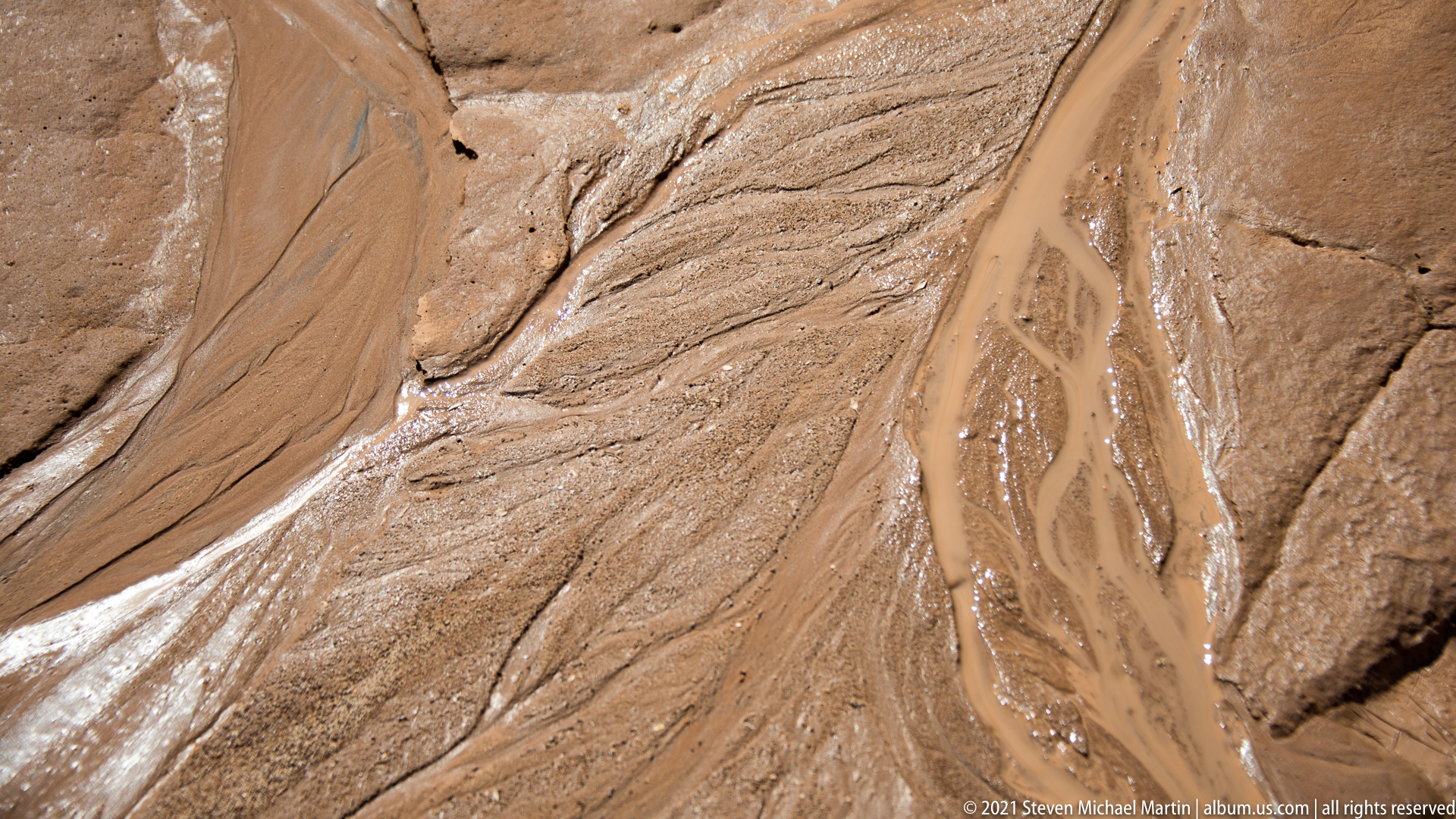
A close view of smooth, flowing rock shows fine parallel lines following its undulating surface. The curves and shallow grooves create a rippled pattern, with a small dark, possibly wet area near the lower edge. The tight crop excludes the surrounding landform and keeps attention on the stone’s surface texture and subtle changes in light.
Caption
A close view of smooth, flowing rock shows fine parallel lines following its undulating surface. The curves and shallow grooves create a rippled pattern, with a small dark, possibly wet area near the lower edge. The tight crop excludes the surrounding landform and keeps attention on the stone’s surface texture and subtle changes in light.
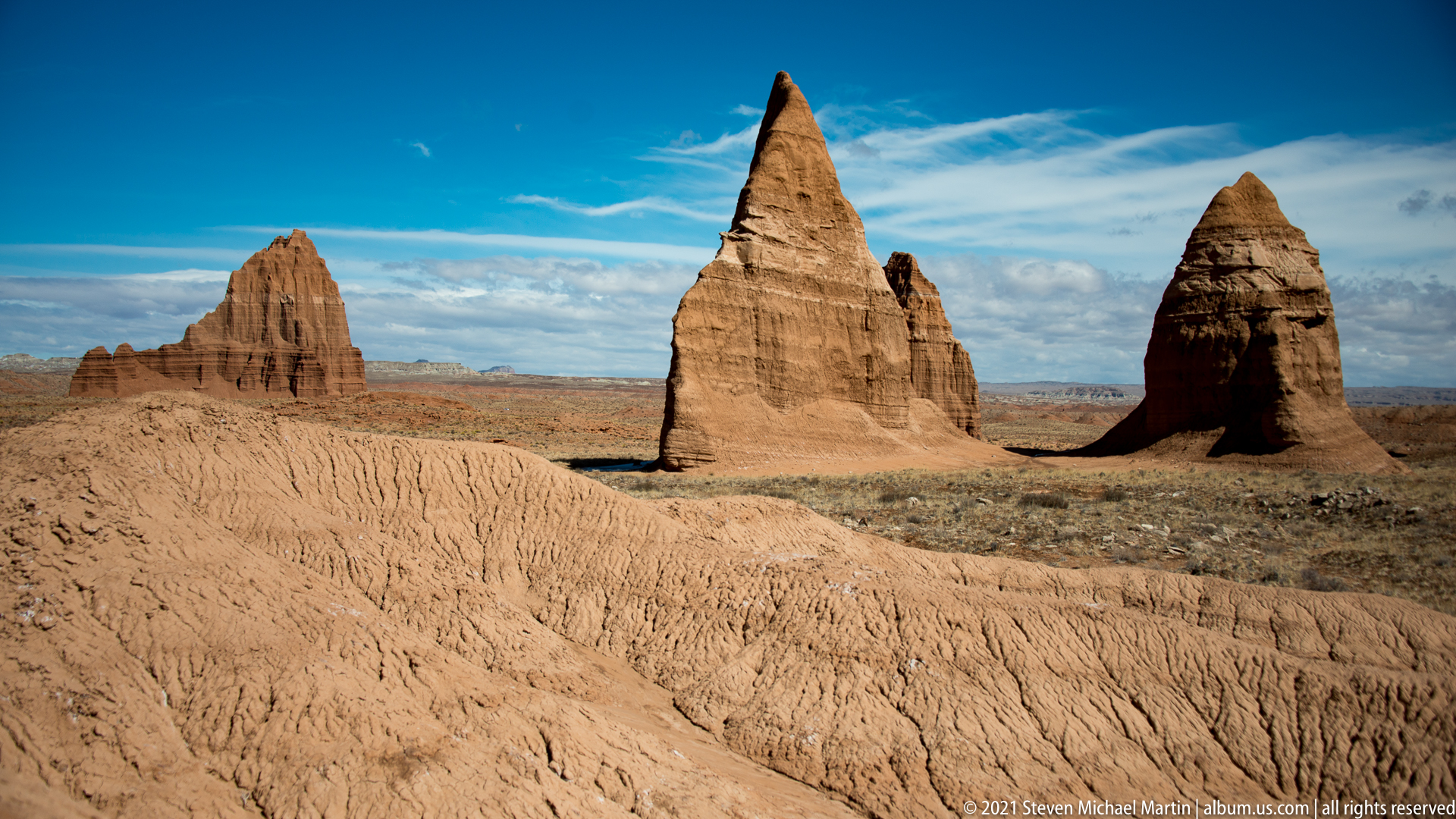
A low, eroded slope runs across the foreground, its pale surface cut by shallow channels and patches of darker soil. Three monoliths appear in the distance beneath an open sky, making the near terrain and far formations part of one receding view. The composition gives the valley floor as much weight as the recognizable towers on the horizon.
Caption
A low, eroded slope runs across the foreground, its pale surface cut by shallow channels and patches of darker soil. Three monoliths appear in the distance beneath an open sky, making the near terrain and far formations part of one receding view. The composition gives the valley floor as much weight as the recognizable towers on the horizon.
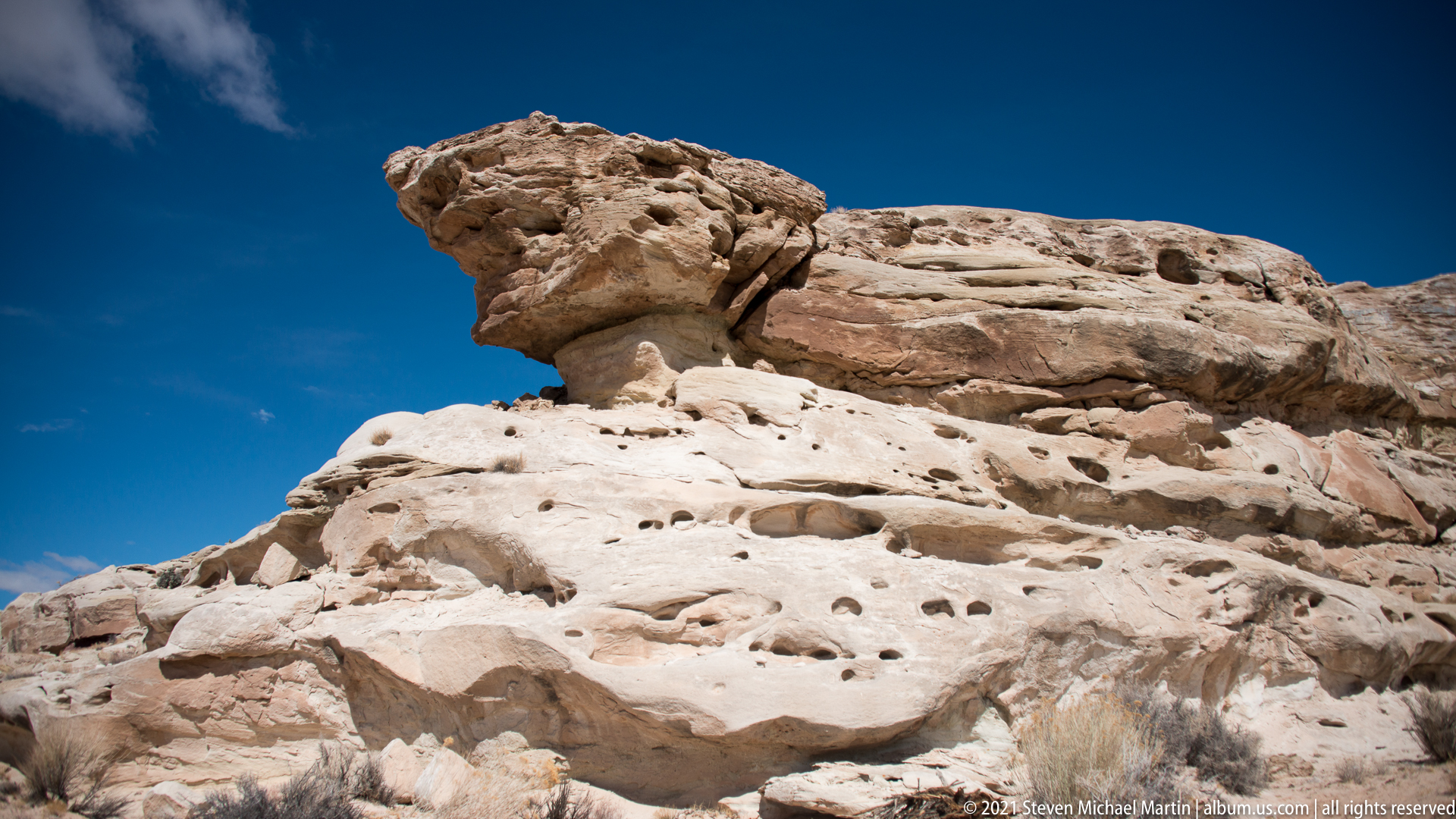
A small mushroom-shaped rock balances on the edge of a pale shelf marked by pits and irregular hollows. Its narrow base and broader cap stand out against the smooth sky, while the ledge extends across the foreground. The close framing isolates this delicate-looking form from the larger valley landscape and highlights the difference between its narrow support and wider top.
Caption
A small mushroom-shaped rock balances on the edge of a pale shelf marked by pits and irregular hollows. Its narrow base and broader cap stand out against the smooth sky, while the ledge extends across the foreground. The close framing isolates this delicate-looking form from the larger valley landscape and highlights the difference between its narrow support and wider top.
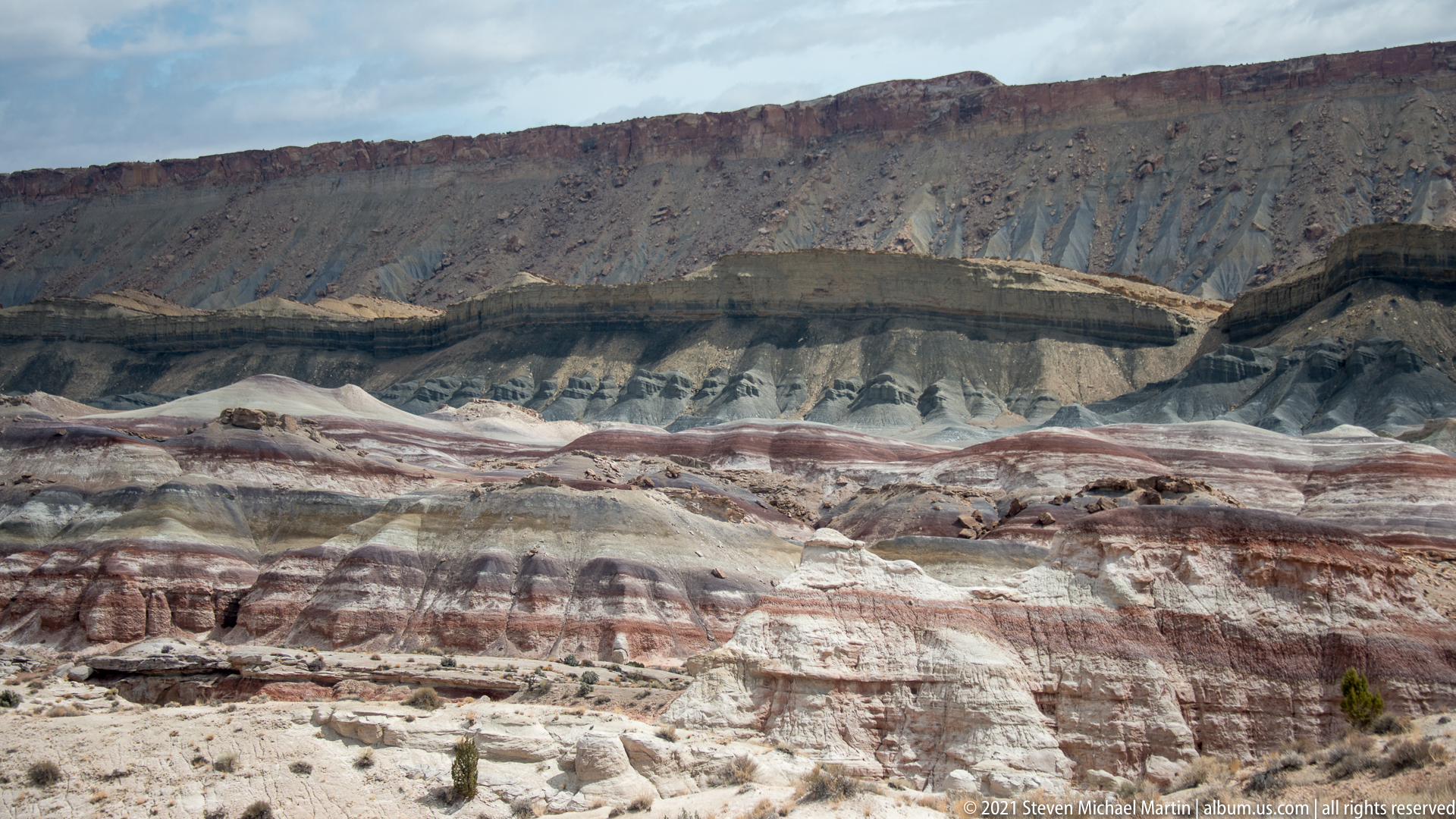
Steep gray slopes descend through a cliff face striped with pale and rust-red layers. Channels and gullies interrupt the bands, giving the exposed surface a sharply eroded texture. The cropped view concentrates on the color and structure of the badlands, showing the contrast between smoother horizontal beds and the deeply incised gray slopes.
Caption
Steep gray slopes descend through a cliff face striped with pale and rust-red layers. Channels and gullies interrupt the bands, giving the exposed surface a sharply eroded texture. The cropped view concentrates on the color and structure of the badlands, showing the contrast between smoother horizontal beds and the deeply incised gray slopes.
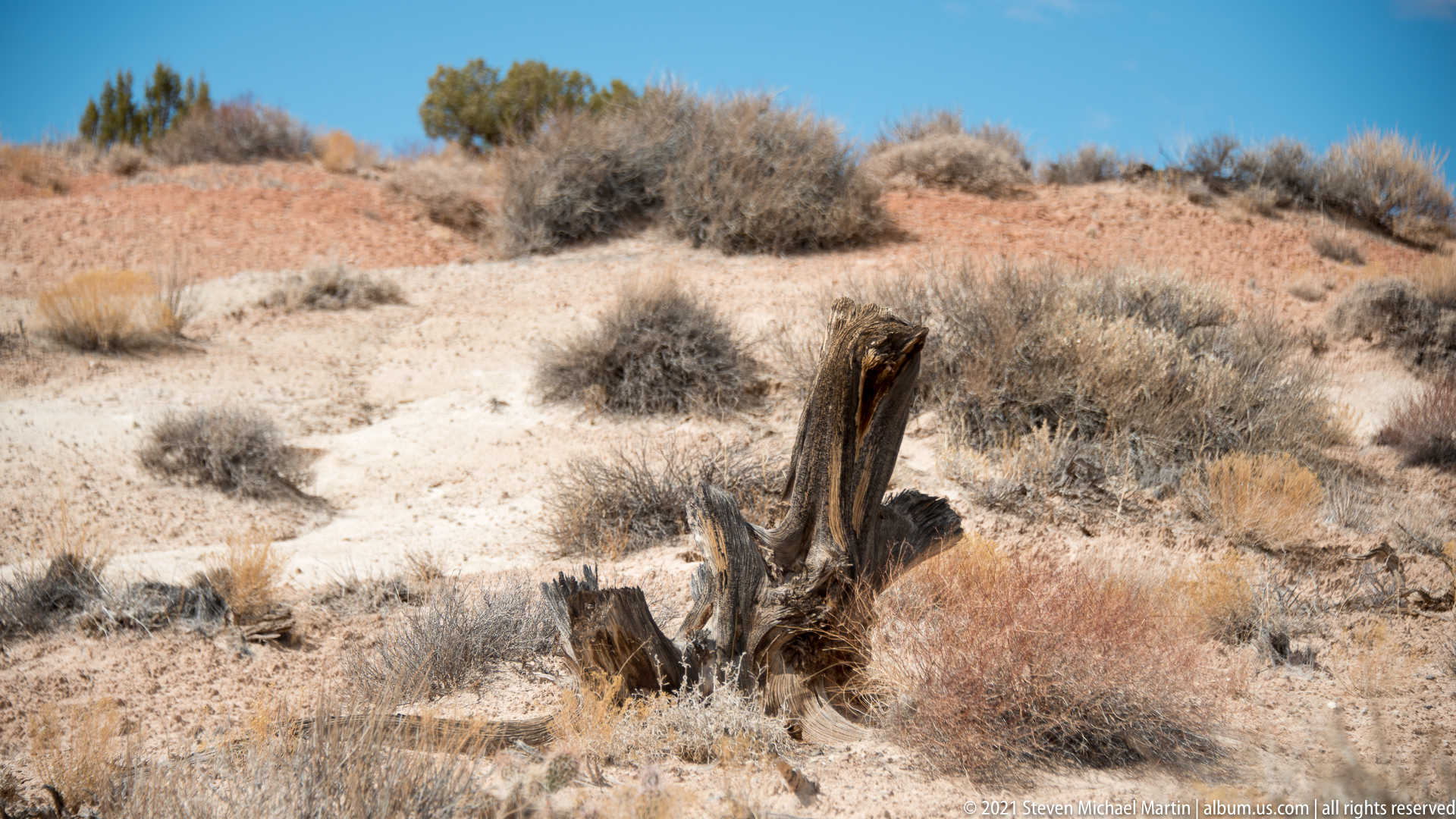
A weathered stump stands among pale sandy soil and sparse desert plants. Its broken, gray-brown wood rises from a low patch of vegetation, with no leaves or living canopy visible. The quiet close view records the remains of a small tree against the open Cathedral Valley ground, where scattered shrubs and grasses provide the only surrounding cover.
Caption
A weathered stump stands among pale sandy soil and sparse desert plants. Its broken, gray-brown wood rises from a low patch of vegetation, with no leaves or living canopy visible. The quiet close view records the remains of a small tree against the open Cathedral Valley ground, where scattered shrubs and grasses provide the only surrounding cover.
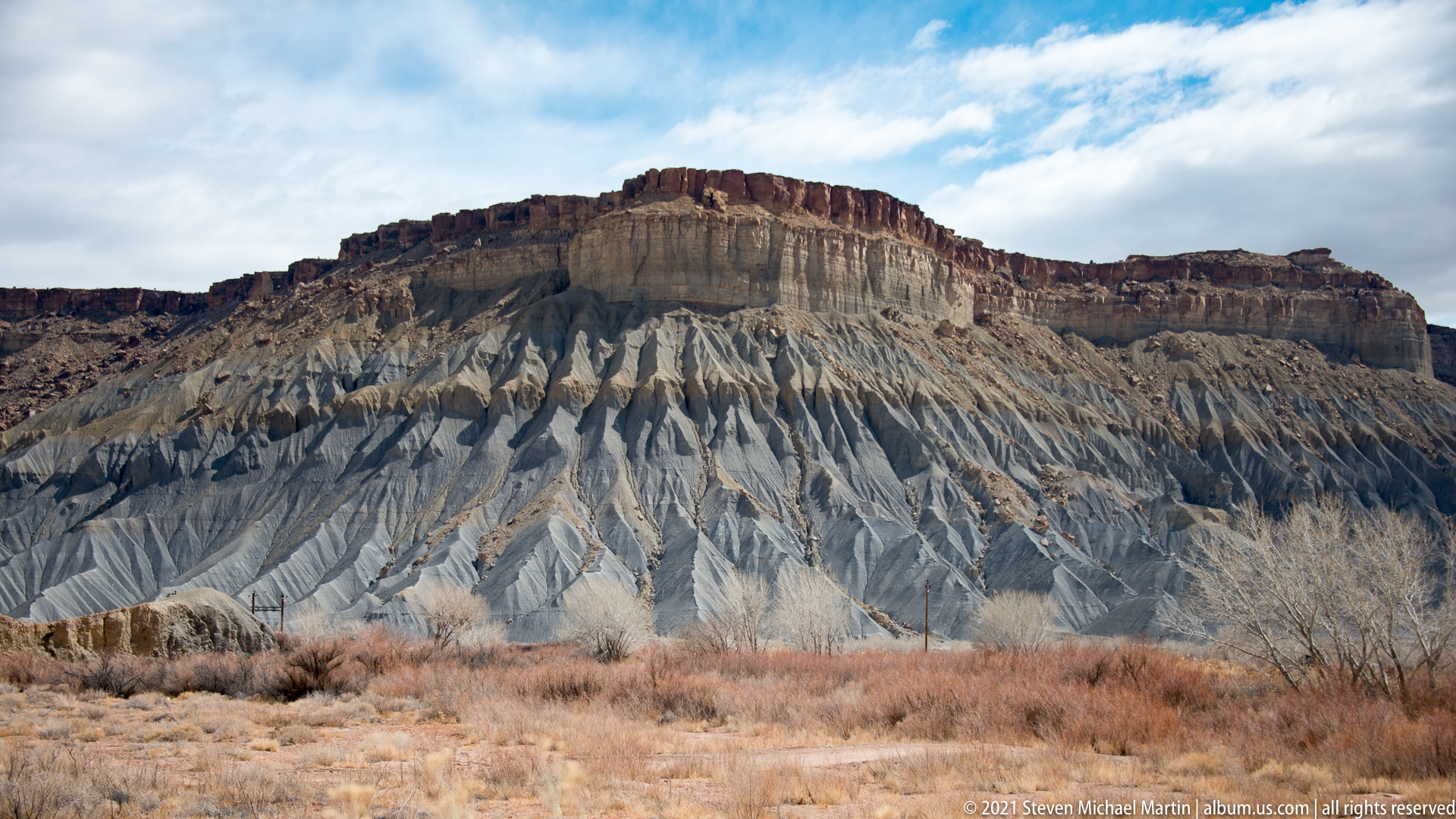
A dark, flat-topped mesa rises above a steep field of blue-gray gullies and narrow ridges. Grass and scattered shrubs occupy the lower foreground, contrasting with the bare, finely eroded slopes. The strong horizontal caprock and densely cut badlands create a layered profile, emphasizing the difference between the resistant top and the softer terrain below.
Caption
A dark, flat-topped mesa rises above a steep field of blue-gray gullies and narrow ridges. Grass and scattered shrubs occupy the lower foreground, contrasting with the bare, finely eroded slopes. The strong horizontal caprock and densely cut badlands create a layered profile, emphasizing the difference between the resistant top and the softer terrain below.
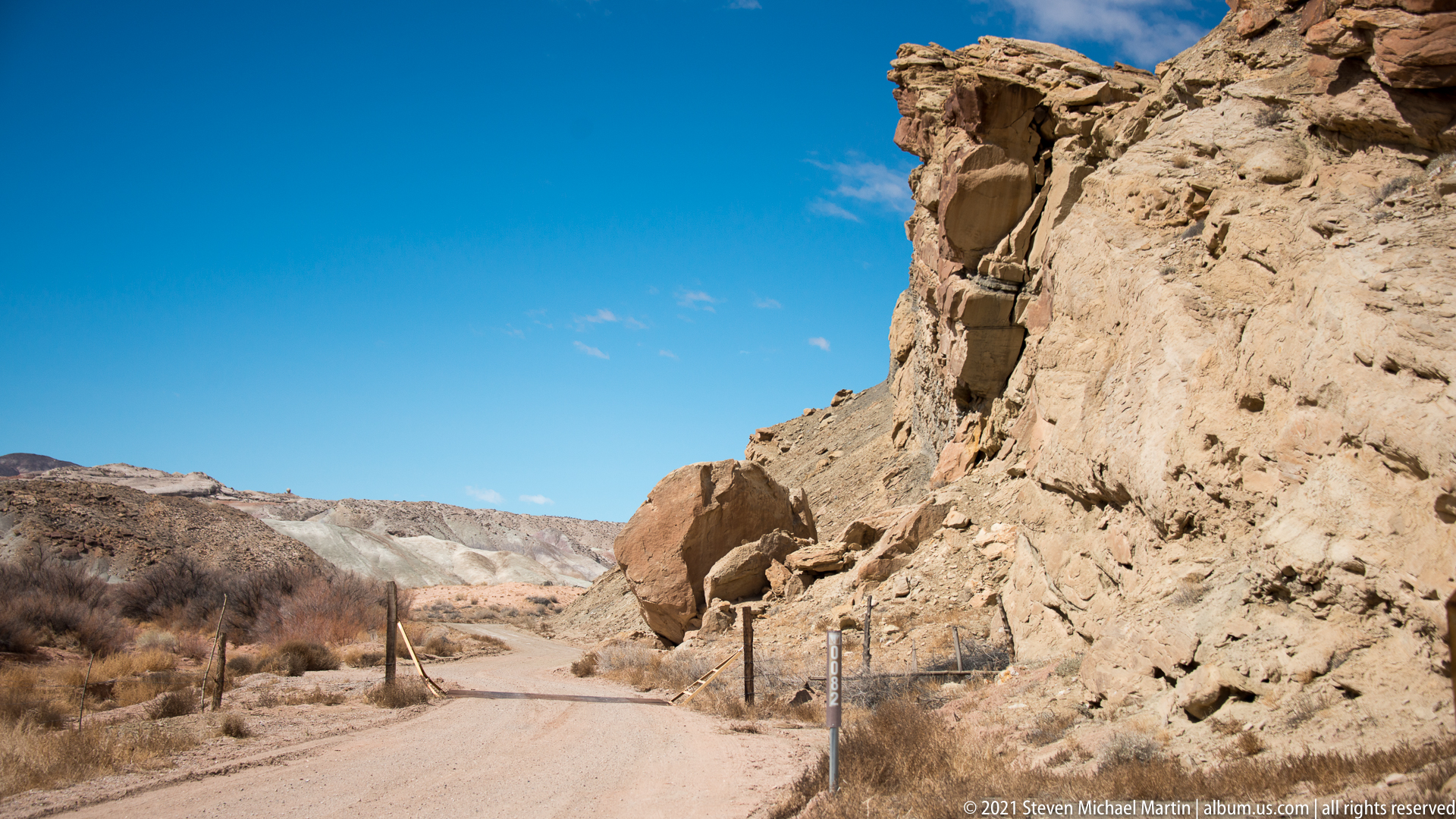
A dirt road follows the base of a high pale rock wall, with evenly spaced fence posts tracing the roadside. The wall’s gray and cream surface rises steeply above the track, while a narrow strip of scrub and open blue sky completes the scene. The road’s curve and fence line guide the eye along the base of the formation.
Caption
A dirt road follows the base of a high pale rock wall, with evenly spaced fence posts tracing the roadside. The wall’s gray and cream surface rises steeply above the track, while a narrow strip of scrub and open blue sky completes the scene. The road’s curve and fence line guide the eye along the base of the formation.
Capitol Reef National Park — Field Guide
National Park Field Guide
📍 Overview
Capitol Reef National Park preserves a geologic formation known as the Waterpocket Fold, a monocline created by tectonic forces that uplifted sedimentary rock layers. The park contains cliffs, domes, and canyon systems shaped by erosion acting upon uplifted strata. The resulting landscape illustrates the interaction between geological uplift and long-term weathering processes.
Layered sandstone formations reflect changes in environmental conditions across prehistoric eras. Differential erosion of rock layers produces cliffs, domes, and narrow canyon corridors. The Waterpocket Fold extends for nearly one hundred miles, creating a continuous geologic feature across the Colorado Plateau.
⭐ Highlights
- Waterpocket Fold monocline formation
- Sandstone domes and cliffs shaped by erosion
- Cathedral Valley monolith formations
- Layered sedimentary rock exposures
- Expansive desert plateau landscapes
🔎 Key Features
- Tectonic uplift shaping folded rock layers
- Erosion creating canyon and dome formations
- Exposed sedimentary strata illustrating geologic time
- Remote desert valley environments
- Large-scale landscape shaped by natural forces
📷 Photography Notes
- Early and late light enhances texture in sandstone
- Wide compositions capture scale of formations
- Cloud patterns add depth to desert skies
- Foreground rocks provide visual framing
- Side lighting emphasizes layered geology
- Look for angles that show contrast between formations