Cedar Breaks National Monument
Cedar Breaks National Monument preserves a natural amphitheater carved into the western edge of the Markagunt Plateau in southern Utah. The formation exposes layers of limestone and sandstone shaped by erosion acting upon uplifted sedimentary rock. The resulting amphitheater reveals a landscape filled with colorful rock formations that illustrate long-term geological change across the Colorado Plateau.
Weathering and freeze-thaw cycles continue to shape the amphitheater walls, producing hoodoos, fins, and eroded cliff faces. Variations in mineral content create bands of red, orange, and cream coloration visible across the exposed rock layers. The monument’s high elevation contributes to a cooler climate that contrasts with lower desert environments elsewhere on the plateau.
Visitors encounter sweeping views into the amphitheater that emphasize the scale of erosion acting over millions of years. The exposed rock formations demonstrate the diversity of geological processes responsible for shaping canyon and plateau landscapes throughout the region.

A marked highway descends into a wide, treeless basin before climbing toward hazy mountain ridges. The road’s centerline narrows to a fine point, drawing the eye through successive bands of grassland, foothills, and cloud-softened peaks. Compared with the preceding road view, this frame places more emphasis on the basin’s breadth and the dramatic drop toward the valley floor.
Caption
A marked highway descends into a wide, treeless basin before climbing toward hazy mountain ridges. The road’s centerline narrows to a fine point, drawing the eye through successive bands of grassland, foothills, and cloud-softened peaks. Compared with the preceding road view, this frame places more emphasis on the basin’s breadth and the dramatic drop toward the valley floor.

Two pronghorn cross an open, tawny grassland dotted with low shrubs. One stands nearer the center while the second enters at the right edge, both set against a wide plain and hazy mountain range. Their pale rumps, slim legs, and upright posture distinguish the animals from the low vegetation, while the distant ridges preserve the scale of the open basin.
Caption
Two pronghorn cross an open, tawny grassland dotted with low shrubs. One stands nearer the center while the second enters at the right edge, both set against a wide plain and hazy mountain range. Their pale rumps, slim legs, and upright posture distinguish the animals from the low vegetation, while the distant ridges preserve the scale of the open basin.

A lone pronghorn walks through a broad expanse of dry grass and scattered shrubs. The animal appears small against the plain, with layered blue-gray mountains spanning the far horizon. Pale horizontal bands of land and sky create a quiet, spacious composition that emphasizes habitat and distance rather than close wildlife detail.
Caption
A lone pronghorn walks through a broad expanse of dry grass and scattered shrubs. The animal appears small against the plain, with layered blue-gray mountains spanning the far horizon. Pale horizontal bands of land and sky create a quiet, spacious composition that emphasizes habitat and distance rather than close wildlife detail.

A green, brush-covered slope fills the foreground beneath high, pale rock walls striped with horizontal ledges. Conifers cling to the upper rim and darken the canyon’s sides, while a cloudy sky softens the contrast. The low viewpoint places vegetation between the viewer and cliffs, making this a study of the canyon’s wooded base rather than a road-centered vista.
Caption
A green, brush-covered slope fills the foreground beneath high, pale rock walls striped with horizontal ledges. Conifers cling to the upper rim and darken the canyon’s sides, while a cloudy sky softens the contrast. The low viewpoint places vegetation between the viewer and cliffs, making this a study of the canyon’s wooded base rather than a road-centered vista.

A shallow stream threads through a rocky channel beneath dense green trees. Large boulders crowd the foreground, while fallen trunks and branches lie across the water farther upstream. Steep, wooded banks enclose the scene, giving this image a close, ground-level perspective on the canyon’s drainage rather than a distant view of its cliffs.
Caption
A shallow stream threads through a rocky channel beneath dense green trees. Large boulders crowd the foreground, while fallen trunks and branches lie across the water farther upstream. Steep, wooded banks enclose the scene, giving this image a close, ground-level perspective on the canyon’s drainage rather than a distant view of its cliffs.

A wide view spans Cedar Breaks’ orange amphitheater, with dark conifer forest tracing the ridges and pale rock bands crossing the basin. Wisps of cloud drift across the upper slopes, alternately hiding and revealing the far rim. The broader composition connects the exposed cliffs to the surrounding forested plateau and captures the shifting weather across a large section of the monument.
Caption
A wide view spans Cedar Breaks’ orange amphitheater, with dark conifer forest tracing the ridges and pale rock bands crossing the basin. Wisps of cloud drift across the upper slopes, alternately hiding and revealing the far rim. The broader composition connects the exposed cliffs to the surrounding forested plateau and captures the shifting weather across a large section of the monument.

A straight two-lane highway runs toward the horizon across a broad, open basin. Low grasses and scrub stretch between the pavement and distant dark ridges, while a muted sky leaves the road as the strongest line in the composition. The near-symmetrical view records the transition into Utah’s high-desert country, with little development visible along the route.
Caption
A straight two-lane highway runs toward the horizon across a broad, open basin. Low grasses and scrub stretch between the pavement and distant dark ridges, while a muted sky leaves the road as the strongest line in the composition. The near-symmetrical view records the transition into Utah’s high-desert country, with little development visible along the route.

A brown sign mounted on a brick-and-stone base reads “Entering Dixie National Forest” beneath the U.S. Department of Agriculture name and Forest Service shield. Yellow wildflowers and green grass surround the base, with scrub-covered ground behind it. The sign clearly marks a boundary and identifies the public land agency.
Caption
A brown sign mounted on a brick-and-stone base reads “Entering Dixie National Forest” beneath the U.S. Department of Agriculture name and Forest Service shield. Yellow wildflowers and green grass surround the base, with scrub-covered ground behind it. The sign clearly marks a boundary and identifies the public land agency.

A wide view opens across the amphitheater, where orange hoodoos and pale slopes descend beneath a dark forested ridge. Large clouds gather above the skyline, casting soft shadow across parts of the canyon. The foreground rim frames a sequence of ridges that recede toward the far side of the basin.
Caption
A wide view opens across the amphitheater, where orange hoodoos and pale slopes descend beneath a dark forested ridge. Large clouds gather above the skyline, casting soft shadow across parts of the canyon. The foreground rim frames a sequence of ridges that recede toward the far side of the basin.

A pale cliff rises above low shrubs and a forested slope, with horizontal strata forming ledges across its face. Conifers cling to the crest and stand among the rock outcrops, while a gray sky softens the scene. The view isolates a steep canyon wall rather than the orange amphitheater, highlighting the lighter limestone and the vegetation that occupies its fractured surfaces.
Caption
A pale cliff rises above low shrubs and a forested slope, with horizontal strata forming ledges across its face. Conifers cling to the crest and stand among the rock outcrops, while a gray sky softens the scene. The view isolates a steep canyon wall rather than the orange amphitheater, highlighting the lighter limestone and the vegetation that occupies its fractured surfaces.

A black “Your Public Lands” sign identifies the Bureau of Land Management’s Cedar City Field Office. An illustrated strip along its top depicts varied public-land settings, including rock formations, a river, flowers, and a bird. Dry grassland and distant hills remain visible behind the sign, placing this agency message within an open western landscape.
Caption
A black “Your Public Lands” sign identifies the Bureau of Land Management’s Cedar City Field Office. An illustrated strip along its top depicts varied public-land settings, including rock formations, a river, flowers, and a bird. Dry grassland and distant hills remain visible behind the sign, placing this agency message within an open western landscape.

A narrow paved road curves along the base of a steep canyon, bordered by dense conifers and pale, layered cliffs. The walls rise on both sides and converge toward a distant bend, while cloud breaks brighten the upper rock faces. This enclosed mountain setting contrasts with the open basin roads and signals the route’s ascent into forested country near Cedar Breaks.
Caption
A narrow paved road curves along the base of a steep canyon, bordered by dense conifers and pale, layered cliffs. The walls rise on both sides and converge toward a distant bend, while cloud breaks brighten the upper rock faces. This enclosed mountain setting contrasts with the open basin roads and signals the route’s ascent into forested country near Cedar Breaks.

Two pronghorn walk across a field of golden grass, separated by a broad patch of open ground. Their bodies appear at similar scale, with heads turned toward the right and pale rump markings visible. The low camera position places blurred vegetation along the bottom edge, lending depth to this closer wildlife view and distinguishing it from the solitary distant animal.
Caption
Two pronghorn walk across a field of golden grass, separated by a broad patch of open ground. Their bodies appear at similar scale, with heads turned toward the right and pale rump markings visible. The low camera position places blurred vegetation along the bottom edge, lending depth to this closer wildlife view and distinguishing it from the solitary distant animal.

A pronghorn moves across the dry meadow in side profile, its long legs and pale rump sharply separated from the tawny grasses. The animal occupies the lower portion of the frame while the softly blurred plain fills the background. This tighter crop directs attention to its gait and markings, unlike the paired-animal scene immediately before it.
Caption
A pronghorn moves across the dry meadow in side profile, its long legs and pale rump sharply separated from the tawny grasses. The animal occupies the lower portion of the frame while the softly blurred plain fills the background. This tighter crop directs attention to its gait and markings, unlike the paired-animal scene immediately before it.

A metal Daughters of Utah Pioneers plaque is mounted on a wall of rough, pink-toned stone. Its inscription identifies Frisco and recounts the mining town’s silver, zinc, copper, lead, and gold production, rail and mule-train transport, and eventual decline. The close framing makes the interpretive text the subject, though the smallest lettering is not fully legible at this reproduction size.
Caption
A metal Daughters of Utah Pioneers plaque is mounted on a wall of rough, pink-toned stone. Its inscription identifies Frisco and recounts the mining town’s silver, zinc, copper, lead, and gold production, rail and mule-train transport, and eventual decline. The close framing makes the interpretive text the subject, though the smallest lettering is not fully legible at this reproduction size.

A low cloud bank spills over the rim of Cedar Breaks, veiling the upper amphitheater while orange pinnacles remain visible below. Pale broken rock frames the foreground, and darker forest patches interrupt the layered cliffs. The shifting cloud obscures much of the distant terrain, turning a familiar geological basin into a scene defined by changing visibility and warm rock tones.
Caption
A low cloud bank spills over the rim of Cedar Breaks, veiling the upper amphitheater while orange pinnacles remain visible below. Pale broken rock frames the foreground, and darker forest patches interrupt the layered cliffs. The shifting cloud obscures much of the distant terrain, turning a familiar geological basin into a scene defined by changing visibility and warm rock tones.

A broad amphitheater of orange and cream-colored rock descends beneath a band of cloud. Thin spires and stepped cliff layers show through openings in the mist, while pale limestone at the rim frames the near edge. The weather softens distant detail but leaves the basin’s scale and densely eroded slopes legible, making cloud and geology equal parts of the composition.
Caption
A broad amphitheater of orange and cream-colored rock descends beneath a band of cloud. Thin spires and stepped cliff layers show through openings in the mist, while pale limestone at the rim frames the near edge. The weather softens distant detail but leaves the basin’s scale and densely eroded slopes legible, making cloud and geology equal parts of the composition.

From the rim, orange cliffs break into columns, narrow pinnacles, and shadowed gullies. Horizontal rock bands cross the broad walls, while a dark cloud hangs above the upper forested rim. Pale rubble at the bottom edge supplies a near foreground and shows the viewer’s position at the overlook. The tighter frame brings the sculpted geology into sharper focus than the preceding mist-heavy scene.
Caption
From the rim, orange cliffs break into columns, narrow pinnacles, and shadowed gullies. Horizontal rock bands cross the broad walls, while a dark cloud hangs above the upper forested rim. Pale rubble at the bottom edge supplies a near foreground and shows the viewer’s position at the overlook. The tighter frame brings the sculpted geology into sharper focus than the preceding mist-heavy scene.

Mist fills much of the amphitheater, leaving portions of the orange cliff bands visible through a soft pink-gray veil. A forested rim rises above the cloud, while shadowed gullies and faint pinnacles appear intermittently below it. The weather reduces contrast across the scene, so the photograph records a changing view in which the canyon’s scale is suggested more than fully revealed.
Caption
Mist fills much of the amphitheater, leaving portions of the orange cliff bands visible through a soft pink-gray veil. A forested rim rises above the cloud, while shadowed gullies and faint pinnacles appear intermittently below it. The weather reduces contrast across the scene, so the photograph records a changing view in which the canyon’s scale is suggested more than fully revealed.

Clouds break above the canyon, revealing an expanse of rust-colored pinnacles and steep slopes divided by dark stands of conifers. From the overlook, the rock formations extend across the frame and descend toward a shadowed ravine. The partial cloud cover preserves detail across most of the basin while adding a shifting band of shade to the far rim.
Caption
Clouds break above the canyon, revealing an expanse of rust-colored pinnacles and steep slopes divided by dark stands of conifers. From the overlook, the rock formations extend across the frame and descend toward a shadowed ravine. The partial cloud cover preserves detail across most of the basin while adding a shifting band of shade to the far rim.

A broad panorama reveals rows of orange hoodoos and steep-sided ravines descending from a pale, forested rim. Sunlight reaches the central rock formations while the deeper clefts remain in shadow, bringing out the amphitheater’s relief. The view favors the densely sculpted basin over the distant horizon, showing how narrow spires cluster along the eroded slopes.
Caption
A broad panorama reveals rows of orange hoodoos and steep-sided ravines descending from a pale, forested rim. Sunlight reaches the central rock formations while the deeper clefts remain in shadow, bringing out the amphitheater’s relief. The view favors the densely sculpted basin over the distant horizon, showing how narrow spires cluster along the eroded slopes.

A stepped wall of pale and red rock borders the amphitheater, its horizontal bands interrupted by vertical grooves and projecting ledges. Below it, narrow orange pinnacles drop into the basin. The elevated viewpoint also includes a strip of sky and distant plateau, setting the near cliff against the larger geological structure of Cedar Breaks rather than isolating it as a detail.
Caption
A stepped wall of pale and red rock borders the amphitheater, its horizontal bands interrupted by vertical grooves and projecting ledges. Below it, narrow orange pinnacles drop into the basin. The elevated viewpoint also includes a strip of sky and distant plateau, setting the near cliff against the larger geological structure of Cedar Breaks rather than isolating it as a detail.

A clear overlook frames the amphitheater’s orange spires and gullies between pale, broken rock at the near rim. The far plateau forms a dark green band beneath scattered clouds, while the central basin remains open and fully visible. This view balances the sharp edge of the overlook with the depth of the eroded interior, giving the landform a strong foreground-to-distance scale.
Caption
A clear overlook frames the amphitheater’s orange spires and gullies between pale, broken rock at the near rim. The far plateau forms a dark green band beneath scattered clouds, while the central basin remains open and fully visible. This view balances the sharp edge of the overlook with the depth of the eroded interior, giving the landform a strong foreground-to-distance scale.
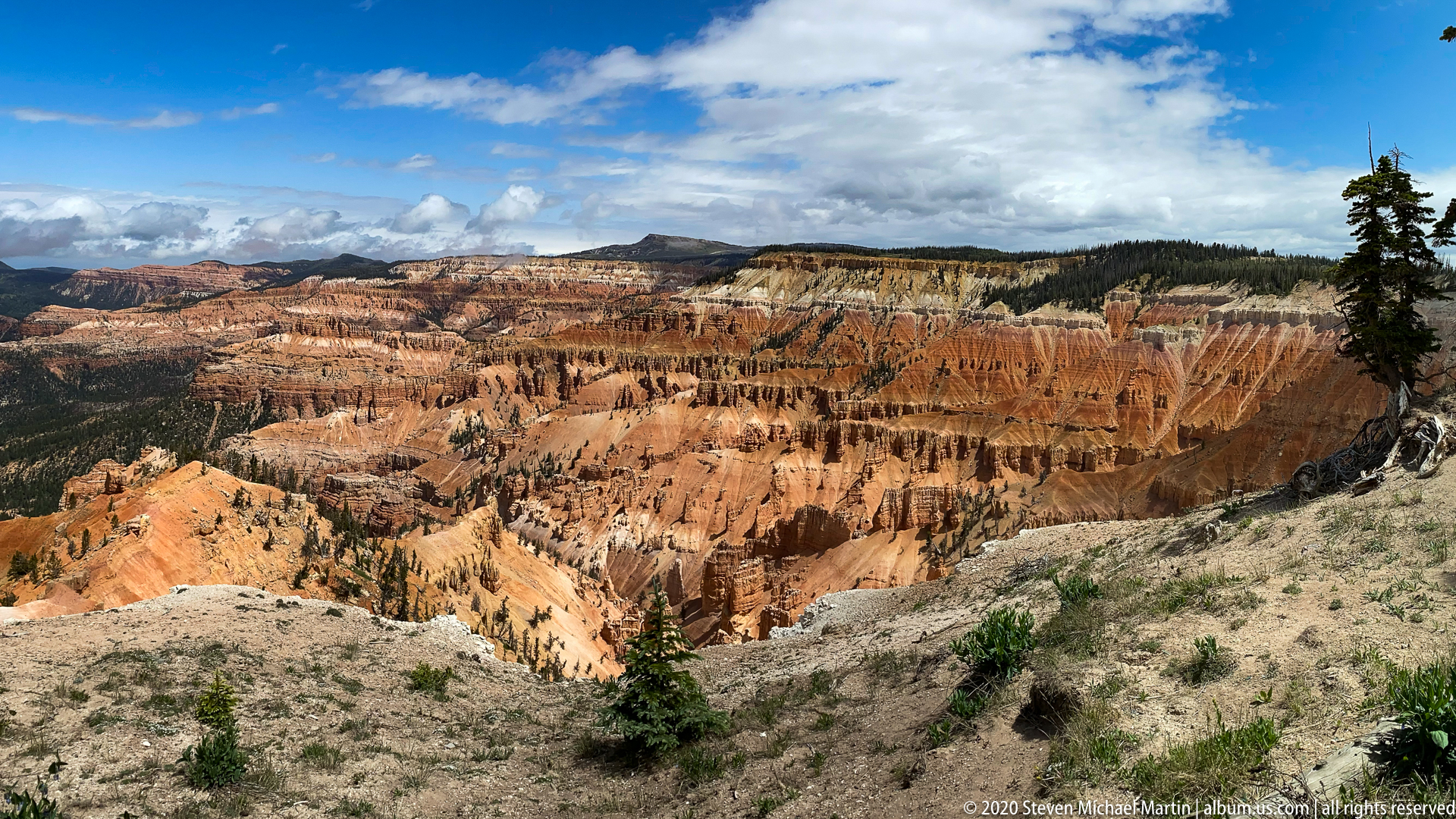
A tall evergreen stands near the right edge of the overlook, adding a vertical foreground element to the expanse of orange hoodoos. Beyond it, pale bands cap the plateau and broken clouds cast uneven light over the amphitheater. The tree’s position distinguishes this composition from the more unobstructed panorama, linking the exposed rim to the forest that borders the monument.
Caption
A tall evergreen stands near the right edge of the overlook, adding a vertical foreground element to the expanse of orange hoodoos. Beyond it, pale bands cap the plateau and broken clouds cast uneven light over the amphitheater. The tree’s position distinguishes this composition from the more unobstructed panorama, linking the exposed rim to the forest that borders the monument.

Conifers frame an overlook where fog has swallowed most of the canyon. Faint orange rock bands remain visible through an opening near the center, while a tall evergreen rises against the pale sky. The trees give the scene depth and indicate a forested rim even as cloud conceals the basin below.
Caption
Conifers frame an overlook where fog has swallowed most of the canyon. Faint orange rock bands remain visible through an opening near the center, while a tall evergreen rises against the pale sky. The trees give the scene depth and indicate a forested rim even as cloud conceals the basin below.

Dense fog blankets the canyon, leaving a few orange rock surfaces faintly visible behind a stand of conifers. A tall, irregular evergreen anchors the center foreground, with shorter trees and shrubs spreading across the lower frame. The obscured terrain makes atmosphere the dominant subject, while the remaining rock and forest preserve a clear connection to Cedar Breaks.
Caption
Dense fog blankets the canyon, leaving a few orange rock surfaces faintly visible behind a stand of conifers. A tall, irregular evergreen anchors the center foreground, with shorter trees and shrubs spreading across the lower frame. The obscured terrain makes atmosphere the dominant subject, while the remaining rock and forest preserve a clear connection to Cedar Breaks.

A broad cloud bank settles across the upper amphitheater, hiding the far rim while orange cliffs remain visible beneath it. Conifers and bare-limbed trees fill the foreground, creating a dark lower frame against the pale mist. The cloud’s low position compresses the scene into overlapping bands of forest, rock, and sky, emphasizing the monument’s changing alpine weather.
Caption
A broad cloud bank settles across the upper amphitheater, hiding the far rim while orange cliffs remain visible beneath it. Conifers and bare-limbed trees fill the foreground, creating a dark lower frame against the pale mist. The cloud’s low position compresses the scene into overlapping bands of forest, rock, and sky, emphasizing the monument’s changing alpine weather.

Mist hangs over a wooded slope and partially veils the orange cliffs beyond. The foreground is dense with conifers and broadleaf trees, while the exposed rock bands climb toward a cloud-wrapped ridge. This composition includes more forest than the previous frame and reveals the transition from tree-covered hillside to the open, eroded amphitheater.
Caption
Mist hangs over a wooded slope and partially veils the orange cliffs beyond. The foreground is dense with conifers and broadleaf trees, while the exposed rock bands climb toward a cloud-wrapped ridge. This composition includes more forest than the previous frame and reveals the transition from tree-covered hillside to the open, eroded amphitheater.

A brown entrance sign reading “Cedar Breaks National Monument” stands on a reddish stone base beside a wooden fence. Fog and conifers soften the background, while the sign’s National Park Service emblem confirms the site’s federal designation. The close framing makes the entrance marker the primary subject and records the monument’s threshold in cool, misty weather.
Caption
A brown entrance sign reading “Cedar Breaks National Monument” stands on a reddish stone base beside a wooden fence. Fog and conifers soften the background, while the sign’s National Park Service emblem confirms the site’s federal designation. The close framing makes the entrance marker the primary subject and records the monument’s threshold in cool, misty weather.

A stand of conifers fades into dense fog, their dark silhouettes dissolving into a nearly uniform gray-white sky. The forest floor is dim and uncluttered, with no visible trail or structure to interrupt the trees. Unlike nearby views where fog partly reveals the cliffs, this frame focuses on the woodland itself and the reduced visibility among the trees.
Caption
A stand of conifers fades into dense fog, their dark silhouettes dissolving into a nearly uniform gray-white sky. The forest floor is dim and uncluttered, with no visible trail or structure to interrupt the trees. Unlike nearby views where fog partly reveals the cliffs, this frame focuses on the woodland itself and the reduced visibility among the trees.

A brown National Park Service sign stands among dense green foliage, carrying a message that asks visitors to protect the park’s rocks, flowers, animals, and trees. The orange-and-green agency emblem occupies one side, while the white lettering fills the central panel. The close view presents a visitor stewardship message as a distinct element of the monument’s public landscape.
Caption
A brown National Park Service sign stands among dense green foliage, carrying a message that asks visitors to protect the park’s rocks, flowers, animals, and trees. The orange-and-green agency emblem occupies one side, while the white lettering fills the central panel. The close view presents a visitor stewardship message as a distinct element of the monument’s public landscape.

A small brown entrance booth bears the words “Cedar Breaks National Monument” and “Pay Park Entrance Fee Here.” A National Park Service stewardship sign stands beside it, linking visitor access with a request to protect the park. Stone facing, a wooden fence, and surrounding conifers complete the entrance scene, partly softened by lingering fog.
Caption
A small brown entrance booth bears the words “Cedar Breaks National Monument” and “Pay Park Entrance Fee Here.” A National Park Service stewardship sign stands beside it, linking visitor access with a request to protect the park. Stone facing, a wooden fence, and surrounding conifers complete the entrance scene, partly softened by lingering fog.

A hand-drawn animal with a large tail fills a white panel bordered in turquoise beneath the handwritten message “Keep Wildlife Wild.” Smaller lettering asks visitors not to feed the animals. The close view foregrounds the personal, informal artwork and its direct visitor guidance rather than the surrounding landscape, making the sign itself the photograph’s subject.
Caption
A hand-drawn animal with a large tail fills a white panel bordered in turquoise beneath the handwritten message “Keep Wildlife Wild.” Smaller lettering asks visitors not to feed the animals. The close view foregrounds the personal, informal artwork and its direct visitor guidance rather than the surrounding landscape, making the sign itself the photograph’s subject.

A wide interpretive panel organizes a panoramic image of red and orange cliffs above smaller landscape diagrams, maps, and rock illustrations. Dark wooden posts and the shelter frame the display. The front-facing composition emphasizes how the exhibit links the visible amphitheater to regional maps and geological explanations, rather than presenting the terrain directly.
Caption
A wide interpretive panel organizes a panoramic image of red and orange cliffs above smaller landscape diagrams, maps, and rock illustrations. Dark wooden posts and the shelter frame the display. The front-facing composition emphasizes how the exhibit links the visible amphitheater to regional maps and geological explanations, rather than presenting the terrain directly.

A printed map fills the frame, labeled “Cedar Breaks National Monument” and marked with roads, numbered stops, and colored routes. Small inset photographs show red cliffs, a meadow, and other park scenes. The close crop makes the map’s visitor-planning function legible while preserving the surrounding landscape imagery that situates the routes within the monument.
Caption
A printed map fills the frame, labeled “Cedar Breaks National Monument” and marked with roads, numbered stops, and colored routes. Small inset photographs show red cliffs, a meadow, and other park scenes. The close crop makes the map’s visitor-planning function legible while preserving the surrounding landscape imagery that situates the routes within the monument.

Three large interpretive panels stand beneath a broad, dark timber canopy, with spruce and fir trees visible behind the shelter. The center display contains a colorful landscape mural, while the side panels present maps and explanatory material. The straight-on view records the visitor information station as a whole and shows how its roof protects the exhibits outdoors.
Caption
Three large interpretive panels stand beneath a broad, dark timber canopy, with spruce and fir trees visible behind the shelter. The center display contains a colorful landscape mural, while the side panels present maps and explanatory material. The straight-on view records the visitor information station as a whole and shows how its roof protects the exhibits outdoors.

A broad painted mural combines cliffs, forest, meadow flowers, and several animals, including a large elk at right and smaller wildlife across the foreground. Narrow text columns flank the artwork. Seen close and nearly straight on, the panel’s vivid landscape illustration becomes the focus, presenting Cedar Breaks as a connected habitat rather than a single geological viewpoint.
Caption
A broad painted mural combines cliffs, forest, meadow flowers, and several animals, including a large elk at right and smaller wildlife across the foreground. Narrow text columns flank the artwork. Seen close and nearly straight on, the panel’s vivid landscape illustration becomes the focus, presenting Cedar Breaks as a connected habitat rather than a single geological viewpoint.

A low log building sits among tall conifers beneath an overcast sky. Its broad shingled roof slopes toward a prominent stone chimney, while a simple path and planted beds lead to the entrance. The distant, nearly frontal view records the visitor center in its forest setting and makes the contrast between heavy timber walls and the masonry chimney especially clear.
Caption
A low log building sits among tall conifers beneath an overcast sky. Its broad shingled roof slopes toward a prominent stone chimney, while a simple path and planted beds lead to the entrance. The distant, nearly frontal view records the visitor center in its forest setting and makes the contrast between heavy timber walls and the masonry chimney especially clear.

An orange, green, and white National Park Service arrowhead plaque is mounted on dark horizontal logs. The close framing crops away the building’s wider form, drawing attention to the emblem’s tree, mountain, and bison motifs and to the rough timber surface behind it. The badge identifies the agency through its familiar symbol without requiring a broader architectural view.
Caption
An orange, green, and white National Park Service arrowhead plaque is mounted on dark horizontal logs. The close framing crops away the building’s wider form, drawing attention to the emblem’s tree, mountain, and bison motifs and to the rough timber surface behind it. The badge identifies the agency through its familiar symbol without requiring a broader architectural view.

A black-framed history panel pairs an archival photograph of the log building with smaller scenes of its construction and early use. The heading reads “Stands Before You Today,” and a text column explains the building’s past as a combined museum and park administration office. The direct view centers the interpretive account and its historical images, not the cabin itself.
Caption
A black-framed history panel pairs an archival photograph of the log building with smaller scenes of its construction and early use. The heading reads “Stands Before You Today,” and a text column explains the building’s past as a combined museum and park administration office. The direct view centers the interpretive account and its historical images, not the cabin itself.

Several violet-blue, bell-shaped flowers rise on branching stems against a shallow-focus green background. A second, smaller flowering stem enters from the right, while blurred leaves and a pale bloom sit farther behind. The tight composition isolates the blossoms and their tubular forms; the proof sheet does not provide enough detail to identify the plant confidently to species.
Caption
Several violet-blue, bell-shaped flowers rise on branching stems against a shallow-focus green background. A second, smaller flowering stem enters from the right, while blurred leaves and a pale bloom sit farther behind. The tight composition isolates the blossoms and their tubular forms; the proof sheet does not provide enough detail to identify the plant confidently to species.

The building’s heavy log corner and green-edged roof occupy the left foreground, while a split-rail fence leads through low vegetation toward conifers. The side angle reduces the structure to a fragment and gives the fence and forest clearing greater prominence than the entrance. Mist softens the background, linking the visitor facility to its high-elevation woodland setting.
Caption
The building’s heavy log corner and green-edged roof occupy the left foreground, while a split-rail fence leads through low vegetation toward conifers. The side angle reduces the structure to a fragment and gives the fence and forest clearing greater prominence than the entrance. Mist softens the background, linking the visitor facility to its high-elevation woodland setting.

Yellow flower heads and unopened buds branch from a slender green stem against a softly blurred olive background. One open bloom near the upper left has a small pale insect-like form at its center, while the lower blossoms are less sharply focused. The shallow depth of field isolates the plant’s branching structure and warm color; the species is not certain from this view.
Caption
Yellow flower heads and unopened buds branch from a slender green stem against a softly blurred olive background. One open bloom near the upper left has a small pale insect-like form at its center, while the lower blossoms are less sharply focused. The shallow depth of field isolates the plant’s branching structure and warm color; the species is not certain from this view.

A gray-haired visitor in a dark jacket stands close to a large Ramparts Trail panel, partly blocking its map and regulations. The sign’s illustrated header and yellow flower graphic remain visible around the figure. Framed from behind, the person becomes a scale reference and an active reader, shifting the image from trail information alone to a moment of visitor orientation.
Caption
A gray-haired visitor in a dark jacket stands close to a large Ramparts Trail panel, partly blocking its map and regulations. The sign’s illustrated header and yellow flower graphic remain visible around the figure. Framed from behind, the person becomes a scale reference and an active reader, shifting the image from trail information alone to a moment of visitor orientation.

Weathered, round timber rails cross the frame in several horizontal layers, joined to a rough upright post at left. Dense shrubs and broad leaves fill the slope behind and below the fence, with a few violet flowers visible near the lower edge. The close perspective emphasizes the fence’s irregular construction and its partial concealment within the surrounding vegetation.
Caption
Weathered, round timber rails cross the frame in several horizontal layers, joined to a rough upright post at left. Dense shrubs and broad leaves fill the slope behind and below the fence, with a few violet flowers visible near the lower edge. The close perspective emphasizes the fence’s irregular construction and its partial concealment within the surrounding vegetation.

A group of small blue, bell-shaped flowers is scattered among narrow leaves and upright green stems. The blossoms are unevenly distributed, with a few in the foreground and others partly hidden deeper in the foliage. This wider botanical view contrasts with the previous close cluster by showing the flowers integrated into a dense patch of vegetation; the plant’s species remains uncertain.
Caption
A group of small blue, bell-shaped flowers is scattered among narrow leaves and upright green stems. The blossoms are unevenly distributed, with a few in the foreground and others partly hidden deeper in the foliage. This wider botanical view contrasts with the previous close cluster by showing the flowers integrated into a dense patch of vegetation; the plant’s species remains uncertain.

A small brown sign beside a paved roadside reads “Point Supreme” and “Elevation 10,350.” A timber guardrail recedes into fog behind it, with low alpine plants at the post’s base. The close roadside view turns the elevation marker into the main subject and records the limited visibility that obscures the overlook beyond.
Caption
A small brown sign beside a paved roadside reads “Point Supreme” and “Elevation 10,350.” A timber guardrail recedes into fog behind it, with low alpine plants at the post’s base. The close roadside view turns the elevation marker into the main subject and records the limited visibility that obscures the overlook beyond.

A low log building stands beyond a zigzagging timber fence, partly screened by spruce and fir trees. The broad roof and central gable remain visible through the fog, while a paved road passes along the right edge. The wider view gives the visitor center more context than the previous close building photograph, placing its rustic construction within the wooded Point Supreme area.
Caption
A low log building stands beyond a zigzagging timber fence, partly screened by spruce and fir trees. The broad roof and central gable remain visible through the fog, while a paved road passes along the right edge. The wider view gives the visitor center more context than the previous close building photograph, placing its rustic construction within the wooded Point Supreme area.

A dark-framed National Park Service panel asks “Why the Trees?” above photographs of dead and living spruce, beetle imagery, and close views of bark. The text discusses spruce bark beetles and forest renewal. In this close, front-facing view, the exhibit connects damaged trees to an ecological process, making the educational message more prominent than the surrounding forest.
Caption
A dark-framed National Park Service panel asks “Why the Trees?” above photographs of dead and living spruce, beetle imagery, and close views of bark. The text discusses spruce bark beetles and forest renewal. In this close, front-facing view, the exhibit connects damaged trees to an ecological process, making the educational message more prominent than the surrounding forest.

Two angular reddish boulders stand apart in a gently sloping meadow, one narrow and upright at left and the other larger and blockier at right. Yellow flowers speckle the grass, and dense fog erases the distant tree line. The open composition uses the stones as foreground anchors within a quiet high-elevation meadow rather than a close geological study.
Caption
Two angular reddish boulders stand apart in a gently sloping meadow, one narrow and upright at left and the other larger and blockier at right. Yellow flowers speckle the grass, and dense fog erases the distant tree line. The open composition uses the stones as foreground anchors within a quiet high-elevation meadow rather than a close geological study.

A long, low boulder stretches across the foreground, its reddish surface divided by horizontal layers and shallow fissures. Yellow flowers rise through the surrounding grass, and several smaller rocks recede into a fog-softened hillside. The camera’s low viewpoint makes the boulder’s elongated form dominant, distinguishing this close landscape study from the previous view of two upright stones.
Caption
A long, low boulder stretches across the foreground, its reddish surface divided by horizontal layers and shallow fissures. Yellow flowers rise through the surrounding grass, and several smaller rocks recede into a fog-softened hillside. The camera’s low viewpoint makes the boulder’s elongated form dominant, distinguishing this close landscape study from the previous view of two upright stones.

A slender stalk topped by several yellow flowers stands in the center of a patch of short meadow grass. Additional blooms appear near the lower left, but most of the background falls softly out of focus. The restrained composition emphasizes the isolated central cluster and the subdued, dry ground around it, rather than the broad floral display seen in nearby meadow views.
Caption
A slender stalk topped by several yellow flowers stands in the center of a patch of short meadow grass. Additional blooms appear near the lower left, but most of the background falls softly out of focus. The restrained composition emphasizes the isolated central cluster and the subdued, dry ground around it, rather than the broad floral display seen in nearby meadow views.

A low meadow densely dotted with blue-purple flowers spreads across the foreground. A paved road runs horizontally near the top of the frame, beyond which conifers and a few pale trunks rise on a gentle slope. The broad view sets the flowering groundcover within a maintained roadside clearing and provides landscape context that the close flower portraits omit.
Caption
A low meadow densely dotted with blue-purple flowers spreads across the foreground. A paved road runs horizontally near the top of the frame, beyond which conifers and a few pale trunks rise on a gentle slope. The broad view sets the flowering groundcover within a maintained roadside clearing and provides landscape context that the close flower portraits omit.

Several upright stems carry vivid blue, spurred flowers above a softly blurred patch of tan soil and green growth. The central cluster is sharp while the background dissolves into pale color, isolating the blossoms’ branching arrangement. The photograph offers more detail than the neighboring meadow views but does not support a certain species identification from the proof sheet alone.
Caption
Several upright stems carry vivid blue, spurred flowers above a softly blurred patch of tan soil and green growth. The central cluster is sharp while the background dissolves into pale color, isolating the blossoms’ branching arrangement. The photograph offers more detail than the neighboring meadow views but does not support a certain species identification from the proof sheet alone.

Numerous short blue flower spikes are scattered across dry grass and exposed soil, with the densest group near the center and right. The camera looks slightly downward, making the repeated blossoms read as a patch of groundcover instead of individual portraits. Thin blades and small plants remain visible between the flowers, giving the frame a textured, open-meadow character.
Caption
Numerous short blue flower spikes are scattered across dry grass and exposed soil, with the densest group near the center and right. The camera looks slightly downward, making the repeated blossoms read as a patch of groundcover instead of individual portraits. Thin blades and small plants remain visible between the flowers, giving the frame a textured, open-meadow character.

A band of bright yellow flowers fills the lower foreground, while a green slope with scattered conifers rises behind it. Fog drifts across the upper hillside and hides the ridge, leaving tree groups to appear and disappear through the mist. The wide landscape balances the meadow’s color against the muted forest and changing visibility, making weather central to the scene.
Caption
A band of bright yellow flowers fills the lower foreground, while a green slope with scattered conifers rises behind it. Fog drifts across the upper hillside and hides the ridge, leaving tree groups to appear and disappear through the mist. The wide landscape balances the meadow’s color against the muted forest and changing visibility, making weather central to the scene.

A dark sign hangs from a rough timber gateway in a sparse conifer clearing. Its lettering directs hikers to Spectra Point, one mile away, and Ramparts Overlook, two miles away. A smaller information board stands behind the frame, while fog softens the trees in the background. The photograph records the trail junction’s wayfinding information and its simple log construction.
Caption
A dark sign hangs from a rough timber gateway in a sparse conifer clearing. Its lettering directs hikers to Spectra Point, one mile away, and Ramparts Overlook, two miles away. A smaller information board stands behind the frame, while fog softens the trees in the background. The photograph records the trail junction’s wayfinding information and its simple log construction.

Seen from closer range, the visitor’s gray hair and dark jacket fill the right side of the frame as they look toward the Ramparts Trail display. The panel’s dotted route, title, and yellow flower illustration remain visible to the left. This tighter composition emphasizes the person’s engagement with the map and the scale of the information board.
Caption
Seen from closer range, the visitor’s gray hair and dark jacket fill the right side of the frame as they look toward the Ramparts Trail display. The panel’s dotted route, title, and yellow flower illustration remain visible to the left. This tighter composition emphasizes the person’s engagement with the map and the scale of the information board.

A large freestanding panel presents the Ramparts Trail route as a red dotted line across a shaded map. Regulations appear in rows of symbols along the bottom, and a separate canyon information section occupies the lower right. The direct, unobstructed view reveals the sign’s practical layout for route planning and safety, while surrounding conifers establish its trailhead setting.
Caption
A large freestanding panel presents the Ramparts Trail route as a red dotted line across a shaded map. Regulations appear in rows of symbols along the bottom, and a separate canyon information section occupies the lower right. The direct, unobstructed view reveals the sign’s practical layout for route planning and safety, while surrounding conifers establish its trailhead setting.

A pale rock ledge overlooks the Cedar Breaks amphitheater as low cloud drifts across its orange and red formations. The mist softens the distant rim and partly veils the basin, while horizontal bands of stone remain visible beneath it. The near white ledge anchors the view and contrasts with the warm, hazy canyon beyond.
Caption
A pale rock ledge overlooks the Cedar Breaks amphitheater as low cloud drifts across its orange and red formations. The mist softens the distant rim and partly veils the basin, while horizontal bands of stone remain visible beneath it. The near white ledge anchors the view and contrasts with the warm, hazy canyon beyond.

From a high rim, orange and cream rock spires descend into a broad amphitheater, with pale broken limestone along the near edge. Low cloud veils the upper formations and darkens the distant tree-covered rim. The wide framing holds both the foreground ledge and the depth of the eroded basin, showing how fog intermittently conceals the monument’s layered terrain.
Caption
From a high rim, orange and cream rock spires descend into a broad amphitheater, with pale broken limestone along the near edge. Low cloud veils the upper formations and darkens the distant tree-covered rim. The wide framing holds both the foreground ledge and the depth of the eroded basin, showing how fog intermittently conceals the monument’s layered terrain.

A closer framing gathers a dense array of orange pinnacles, narrow ridges, and pale rock shelves beneath the overlook. Fog softens the upper rim but leaves the central formations distinct, exposing alternating bands of color and erosion. Compared with the wider preceding view, this composition concentrates attention on the basin’s vertical forms and the intricate spacing of its hoodoos.
Caption
A closer framing gathers a dense array of orange pinnacles, narrow ridges, and pale rock shelves beneath the overlook. Fog softens the upper rim but leaves the central formations distinct, exposing alternating bands of color and erosion. Compared with the wider preceding view, this composition concentrates attention on the basin’s vertical forms and the intricate spacing of its hoodoos.

The amphitheater opens across the frame in a broad sweep of orange and cream hoodoos, with a pale broken ledge anchoring the lower edge. Low cloud gathers above the formations and partly masks the dark conifer rim at right. This view keeps more of the basin’s breadth than the tighter preceding image, balancing the near rock shelf against the distant eroded walls.
Caption
The amphitheater opens across the frame in a broad sweep of orange and cream hoodoos, with a pale broken ledge anchoring the lower edge. Low cloud gathers above the formations and partly masks the dark conifer rim at right. This view keeps more of the basin’s breadth than the tighter preceding image, balancing the near rock shelf against the distant eroded walls.

An elevated view looks down across tightly clustered orange pinnacles and pale eroded slopes toward a dark conifer forest. Mist gathers above the trees at the upper edge, leaving the central formations clear and sharply layered. The composition emphasizes the amphitheater’s depth, with densely packed hoodoos descending from the rim into the basin.
Caption
An elevated view looks down across tightly clustered orange pinnacles and pale eroded slopes toward a dark conifer forest. Mist gathers above the trees at the upper edge, leaving the central formations clear and sharply layered. The composition emphasizes the amphitheater’s depth, with densely packed hoodoos descending from the rim into the basin.

Rows of narrow orange and cream spires rise from the amphitheater floor, their faces marked by horizontal bands and deep vertical grooves. Dark conifers cling to ledges among the formations, adding scale to the steep, densely eroded slope. The close framing draws attention to the hoodoos’ varied shapes and the layered rock from which they emerge.
Caption
Rows of narrow orange and cream spires rise from the amphitheater floor, their faces marked by horizontal bands and deep vertical grooves. Dark conifers cling to ledges among the formations, adding scale to the steep, densely eroded slope. The close framing draws attention to the hoodoos’ varied shapes and the layered rock from which they emerge.

A pale rim shelf projects into a view of steep, banded canyon walls as a veil of cloud moves across the upper formations. Orange pinnacles appear and disappear through the mist, while darker ledges remain visible lower in the basin. The changing visibility creates depth between the near rock, the hoodoo slope, and the obscured rim.
Caption
A pale rim shelf projects into a view of steep, banded canyon walls as a veil of cloud moves across the upper formations. Orange pinnacles appear and disappear through the mist, while darker ledges remain visible lower in the basin. The changing visibility creates depth between the near rock, the hoodoo slope, and the obscured rim.

A pale, sloping rock fin descends beside a cluster of orange hoodoos, with dark evergreen forest rising behind them. The angular fin contrasts with the narrow, banded pinnacles and marks the transition from the rim toward the amphitheater. In this clear view, the formations’ colors and steep relationships stand out against the green wooded slope.
Caption
A pale, sloping rock fin descends beside a cluster of orange hoodoos, with dark evergreen forest rising behind them. The angular fin contrasts with the narrow, banded pinnacles and marks the transition from the rim toward the amphitheater. In this clear view, the formations’ colors and steep relationships stand out against the green wooded slope.

Tall, narrow hoodoos rise from the shadowed amphitheater, their orange faces fading into a soft veil of mist near the rim. Dark trees gather in pockets between the spires, while angled rock ledges guide the eye into the basin. The hazy light reduces contrast in the distance and highlights the depth of the canyon.
Caption
Tall, narrow hoodoos rise from the shadowed amphitheater, their orange faces fading into a soft veil of mist near the rim. Dark trees gather in pockets between the spires, while angled rock ledges guide the eye into the basin. The hazy light reduces contrast in the distance and highlights the depth of the canyon.

Clouds drift across the high rim above a broad sweep of orange hoodoos and dark forest. A pale stone edge enters at the lower left, while the amphitheater opens across the frame in layered bands of pinnacles and slopes. The partly obscured skyline gives the panorama a changing, atmospheric quality without hiding the scale of the basin.
Caption
Clouds drift across the high rim above a broad sweep of orange hoodoos and dark forest. A pale stone edge enters at the lower left, while the amphitheater opens across the frame in layered bands of pinnacles and slopes. The partly obscured skyline gives the panorama a changing, atmospheric quality without hiding the scale of the basin.

A steep slope of orange, cream, and rust-colored hoodoos fills the frame, with dark tree patches scattered between the vertical formations. Deep channels cut down the basin, separating rows of banded spires. The closer viewpoint shifts attention from the overall rim panorama to the intricate density and relief of the amphitheater wall.
Caption
A steep slope of orange, cream, and rust-colored hoodoos fills the frame, with dark tree patches scattered between the vertical formations. Deep channels cut down the basin, separating rows of banded spires. The closer viewpoint shifts attention from the overall rim panorama to the intricate density and relief of the amphitheater wall.

The amphitheater fills the lower half of the view, with orange hoodoos descending beneath a high rim lined by conifers. Dark forested slopes extend toward the left, while cloud and haze soften the distant ridge. The wider framing connects the exposed rock formations with the surrounding forest and the broad plateau above them.
Caption
The amphitheater fills the lower half of the view, with orange hoodoos descending beneath a high rim lined by conifers. Dark forested slopes extend toward the left, while cloud and haze soften the distant ridge. The wider framing connects the exposed rock formations with the surrounding forest and the broad plateau above them.

A narrow, banded hoodoo stands above a steep slope of pink and orange rock, its stacked ledges forming a column-like profile. Neighboring formations and dark crevices frame it on either side. The close composition isolates the pinnacle’s layered cap and vertical grooves against the surrounding amphitheater wall.
Caption
A narrow, banded hoodoo stands above a steep slope of pink and orange rock, its stacked ledges forming a column-like profile. Neighboring formations and dark crevices frame it on either side. The close composition isolates the pinnacle’s layered cap and vertical grooves against the surrounding amphitheater wall.

From the rim, the view extends across an immense basin of orange hoodoos, pale slopes, and dark forest patches. A rough white stone edge anchors the foreground, while the far plateau fades beneath broken cloud. The panorama balances the close rim with the repeated ridges and spires that fill the middle distance.
Caption
From the rim, the view extends across an immense basin of orange hoodoos, pale slopes, and dark forest patches. A rough white stone edge anchors the foreground, while the far plateau fades beneath broken cloud. The panorama balances the close rim with the repeated ridges and spires that fill the middle distance.

A dense stand of slender hoodoos rises from a pale, sloping shelf, with their orange and cream bands repeated across the canyon wall. A few dark conifers punctuate the formations and emphasize their scale. This tighter view concentrates on the repeating vertical rhythm of the pinnacles rather than the distant horizon.
Caption
A dense stand of slender hoodoos rises from a pale, sloping shelf, with their orange and cream bands repeated across the canyon wall. A few dark conifers punctuate the formations and emphasize their scale. This tighter view concentrates on the repeating vertical rhythm of the pinnacles rather than the distant horizon.

A broad banded wall rises behind a row of narrow columns, its horizontal strata interrupted by vertical cracks and eroded fins. Dark conifers and a few bare trunks cling to the slope at right, while the orange rock catches direct sunlight. This closer view makes the alternating layers and column-like erosion especially legible.
Caption
A broad banded wall rises behind a row of narrow columns, its horizontal strata interrupted by vertical cracks and eroded fins. Dark conifers and a few bare trunks cling to the slope at right, while the orange rock catches direct sunlight. This closer view makes the alternating layers and column-like erosion especially legible.

An orange slope cut by narrow gullies descends between layered rock ledges and upright hoodoo clusters. The irregular pinnacles vary in height, while small conifers occupy protected pockets among the formations. The downward angle reveals how erosion has divided the wall into fins, channels, and isolated columns.
Caption
An orange slope cut by narrow gullies descends between layered rock ledges and upright hoodoo clusters. The irregular pinnacles vary in height, while small conifers occupy protected pockets among the formations. The downward angle reveals how erosion has divided the wall into fins, channels, and isolated columns.

A large outdoor interpretive sign stands among low shrubs, combining a trail map, visitor regulations, and a panel titled “Sunset Trail.” The brown frame is set on two posts above a gravelly clearing, with evergreen branches visible behind it. The sign directs attention to trail access and safety information at the monument.
Caption
A large outdoor interpretive sign stands among low shrubs, combining a trail map, visitor regulations, and a panel titled “Sunset Trail.” The brown frame is set on two posts above a gravelly clearing, with evergreen branches visible behind it. The sign directs attention to trail access and safety information at the monument.

A pale sandstone fin cuts diagonally across a pink slope beneath a high rim of evergreen trees. Several dark trunks stand on the exposed incline, and a weathered white rock block rises near the center. The contrast between pale stone, red earth, and green forest makes this an unusually open section of the amphitheater wall.
Caption
A pale sandstone fin cuts diagonally across a pink slope beneath a high rim of evergreen trees. Several dark trunks stand on the exposed incline, and a weathered white rock block rises near the center. The contrast between pale stone, red earth, and green forest makes this an unusually open section of the amphitheater wall.

The camera looks down into a steep ravine where orange slopes are split by pale channels and scattered vertical rock columns. Dark conifers cling to the upper rim, while the center drops into a narrow, shadowed drainage. The elevated angle reveals the abrupt changes in elevation and the branching pattern of erosion.
Caption
The camera looks down into a steep ravine where orange slopes are split by pale channels and scattered vertical rock columns. Dark conifers cling to the upper rim, while the center drops into a narrow, shadowed drainage. The elevated angle reveals the abrupt changes in elevation and the branching pattern of erosion.

A bright white sandstone crest fills the foreground, its broken edge overlooking orange hoodoos and darker canyon walls. A small green shrub grows from the pale rock, adding scale and color to the otherwise exposed ledge. The close rim foreground contrasts strongly with the shadowed depth of the amphitheater behind it.
Caption
A bright white sandstone crest fills the foreground, its broken edge overlooking orange hoodoos and darker canyon walls. A small green shrub grows from the pale rock, adding scale and color to the otherwise exposed ledge. The close rim foreground contrasts strongly with the shadowed depth of the amphitheater behind it.

A broad amphitheater wall fills the frame, its orange and cream strata descending into clusters of hoodoos and dark conifers. White mineral bands trace the upper rim and pale slopes cut through the lower formations. The elevated viewpoint presents the canyon as a continuous landscape of ridges, columns, and forested pockets.
Caption
A broad amphitheater wall fills the frame, its orange and cream strata descending into clusters of hoodoos and dark conifers. White mineral bands trace the upper rim and pale slopes cut through the lower formations. The elevated viewpoint presents the canyon as a continuous landscape of ridges, columns, and forested pockets.

Tall, narrow columns rise from a pale slope, their horizontal bands stacked like ledges beneath an irregular rim. Dark evergreen trees trace the upper edge and occupy narrow crevices between the formations. The view centers on the height and density of the columns, with the basin falling away behind them.
Caption
Tall, narrow columns rise from a pale slope, their horizontal bands stacked like ledges beneath an irregular rim. Dark evergreen trees trace the upper edge and occupy narrow crevices between the formations. The view centers on the height and density of the columns, with the basin falling away behind them.

Pale and orange pinnacles crowd together in a steep section of the amphitheater, with narrow gullies separating their layered faces. Dark tree patches appear in recesses between the formations, while the elevated angle looks directly down over their uneven caps. This close view reveals the complex, interlocking pattern of eroded spires.
Caption
Pale and orange pinnacles crowd together in a steep section of the amphitheater, with narrow gullies separating their layered faces. Dark tree patches appear in recesses between the formations, while the elevated angle looks directly down over their uneven caps. This close view reveals the complex, interlocking pattern of eroded spires.

A row of orange, horizontally banded columns emerges from a pale sloping ridge, with dark conifers visible deeper in the amphitheater. The forms vary from narrow pinnacles to broader blocks, each cut by vertical grooves and ledges. The angled composition follows the ridge downward and highlights the transition from intact slope to isolated columns.
Caption
A row of orange, horizontally banded columns emerges from a pale sloping ridge, with dark conifers visible deeper in the amphitheater. The forms vary from narrow pinnacles to broader blocks, each cut by vertical grooves and ledges. The angled composition follows the ridge downward and highlights the transition from intact slope to isolated columns.

Numerous bare trunks rise above a forest floor, interspersed with surviving dark green conifers. Heavy gray clouds fill the sky and flatten the distant ridge. The open view shows a broad area of dead or leafless trees, but the photograph does not establish whether fire or another cause produced the damage.
Caption
Numerous bare trunks rise above a forest floor, interspersed with surviving dark green conifers. Heavy gray clouds fill the sky and flatten the distant ridge. The open view shows a broad area of dead or leafless trees, but the photograph does not establish whether fire or another cause produced the damage.

Banded rock columns crowd the frame, their pale caps and orange sides forming a tight vertical pattern. Narrow gullies cut between the spires, exposing lighter stone beneath the darker upper layers. The close viewpoint emphasizes the varied heights and textures of the formations within the amphitheater.
Caption
Banded rock columns crowd the frame, their pale caps and orange sides forming a tight vertical pattern. Narrow gullies cut between the spires, exposing lighter stone beneath the darker upper layers. The close viewpoint emphasizes the varied heights and textures of the formations within the amphitheater.

A broad pale slope cuts diagonally through the amphitheater between orange hoodoo ridges and darker forested walls. Small conifers dot the exposed incline, while the high viewpoint reveals successive tiers of rock and vegetation. This composition emphasizes the contrast between the light central slope and the red, deeply eroded formations around it.
Caption
A broad pale slope cuts diagonally through the amphitheater between orange hoodoo ridges and darker forested walls. Small conifers dot the exposed incline, while the high viewpoint reveals successive tiers of rock and vegetation. This composition emphasizes the contrast between the light central slope and the red, deeply eroded formations around it.

A shadowed cleft divides a close wall of orange and cream hoodoos, exposing horizontal layers and narrow vertical fins. The rock faces rise sharply on either side, and a small tree stands on a ledge near the center. The tight framing concentrates on the depth of the cleft and the finely banded surfaces around it.
Caption
A shadowed cleft divides a close wall of orange and cream hoodoos, exposing horizontal layers and narrow vertical fins. The rock faces rise sharply on either side, and a small tree stands on a ledge near the center. The tight framing concentrates on the depth of the cleft and the finely banded surfaces around it.

Orange lichen spreads across a fractured gray rock face, forming irregular patches among pale mineral seams and dark crevices. The surface breaks into angular blocks with fine cracks and rough edges. The close study shifts from the monument’s distant hoodoo views to the color and texture of living growth on exposed stone.
Caption
Orange lichen spreads across a fractured gray rock face, forming irregular patches among pale mineral seams and dark crevices. The surface breaks into angular blocks with fine cracks and rough edges. The close study shifts from the monument’s distant hoodoo views to the color and texture of living growth on exposed stone.

A narrow stream winds through a rocky ravine lined with green shrubs and small trees. Gray and reddish slopes rise on both sides, with loose stones and exposed bedrock above the watercourse. The high viewpoint follows the stream from the foreground into a shaded bend, showing a greener drainage within the surrounding dry terrain.
Caption
A narrow stream winds through a rocky ravine lined with green shrubs and small trees. Gray and reddish slopes rise on both sides, with loose stones and exposed bedrock above the watercourse. The high viewpoint follows the stream from the foreground into a shaded bend, showing a greener drainage within the surrounding dry terrain.
Cedar Breaks National Monument — Field Guide
National Monument Field Guide
📍 Overview
Cedar Breaks National Monument preserves a large natural amphitheater carved into the Markagunt Plateau through erosion acting upon uplifted sedimentary rock layers. The exposed limestone and sandstone formations display varied coloration resulting from differences in mineral composition. The monument illustrates the long-term influence of weathering processes across high elevation environments of the Colorado Plateau.
Freeze-thaw cycles contribute to the gradual shaping of hoodoos, fins, and cliff formations visible throughout the amphitheater. The high elevation creates seasonal contrasts in temperature that influence erosion patterns and vegetation growth. The landscape reflects geological processes similar to those shaping Bryce Canyon and other plateau environments.
⭐ Highlights
- Large natural amphitheater carved into plateau edge
- Colorful limestone and sandstone formations
- Hoodoos shaped by freeze-thaw erosion
- High elevation viewpoints across the plateau
- Geological continuity with Bryce Canyon formations
🔎 Key Features
- Layered sedimentary rock shaped by erosion
- Freeze-thaw cycles forming hoodoo structures
- Elevated plateau environment
- Exposed strata illustrating geological time
- Cliff formations influenced by differential weathering
📷 Photography Notes
- Early light enhances color variation in limestone formations
- Wide views emphasize scale of the amphitheater
- Cloud shadows can add dimension to cliff faces
- Foreground vegetation can provide compositional depth
- Side lighting highlights texture in hoodoos
- Look for viewpoints showing layered rock patterns

A sweeping panorama of Cedar Breaks Amphitheater anchors this National Park Service brochure page, with orange, red, and pale rock formations cut by narrow gullies beneath a wooded rim. Below the view, the layout pairs interpretive text with a meadow of colorful wildflowers and a row of labeled flower illustrations, connecting the monument’s high-country landscape with its plant life.
Caption
A sweeping panorama of Cedar Breaks Amphitheater anchors this National Park Service brochure page, with orange, red, and pale rock formations cut by narrow gullies beneath a wooded rim. Below the view, the layout pairs interpretive text with a meadow of colorful wildflowers and a row of labeled flower illustrations, connecting the monument’s high-country landscape with its plant life.
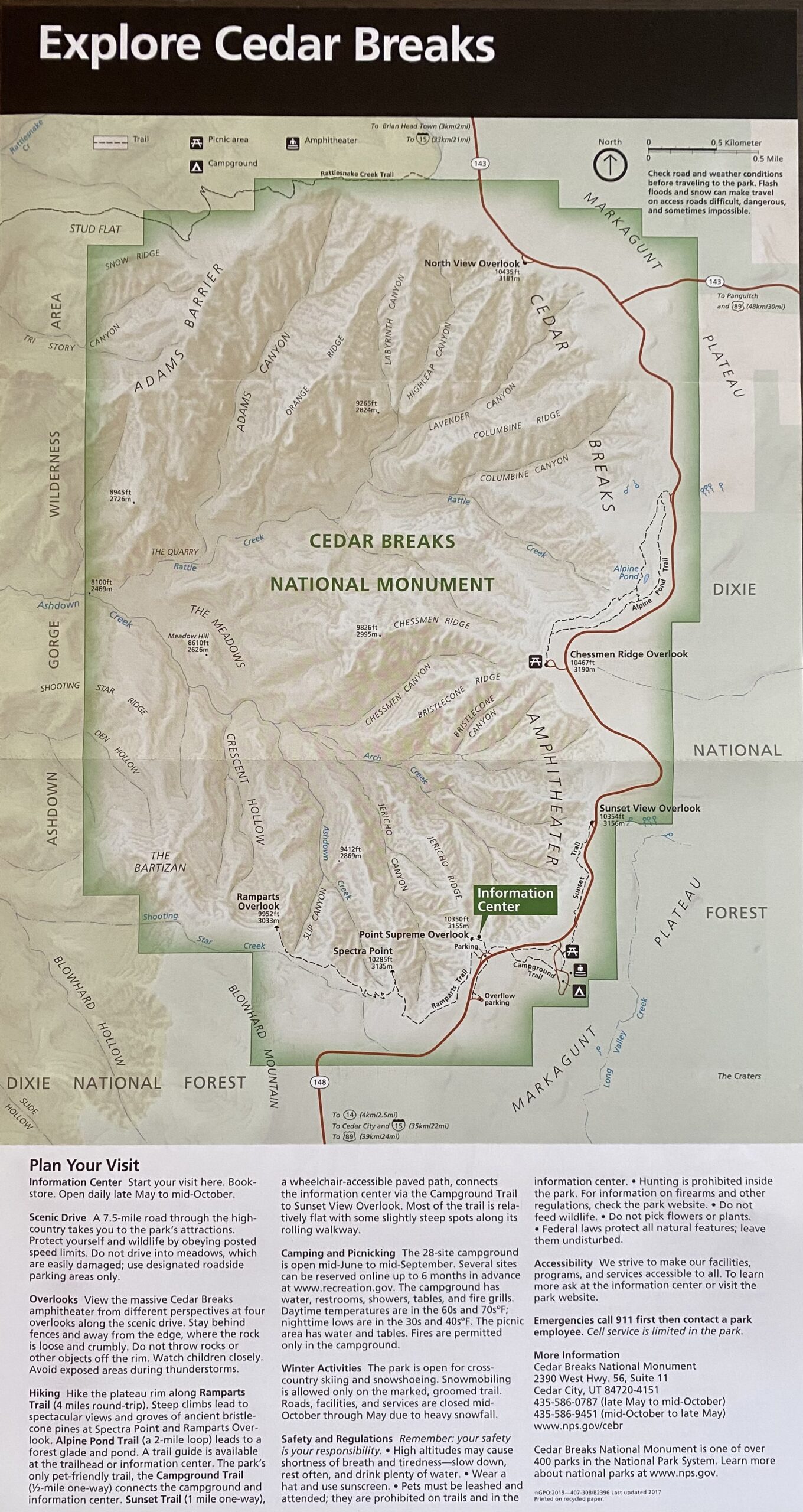
A detailed map fills the center of this Cedar Breaks National Monument brochure page. A green outline marks the monument amid the surrounding Dixie National Forest, while a red road line follows the rim and connects labeled overlooks and visitor facilities. The map is accompanied by compact planning text, making this page a practical guide to reaching viewpoints and navigating the monument.
Caption
A detailed map fills the center of this Cedar Breaks National Monument brochure page. A green outline marks the monument amid the surrounding Dixie National Forest, while a red road line follows the rim and connects labeled overlooks and visitor facilities. The map is accompanied by compact planning text, making this page a practical guide to reaching viewpoints and navigating the monument.