Jean Lafitte – Longfellow Evangeline
Henry Wadsworth Longfellow’s poem Evangeline, published in 1847, played an important role in preserving the historical memory of the Acadian deportation and the dispersal of Acadian families across North America. The poem tells the story of Evangeline Bellefontaine, a fictional Acadian woman separated from her family during the Great Deportation. Although literary in nature, the narrative reflects real historical experiences of displacement and migration that shaped Acadian identity.
The Evangeline story contributed to renewed awareness of Acadian history during the 19th century, helping preserve cultural memory among communities whose ancestors had been dispersed across multiple regions. The narrative helped link Louisiana Cajun communities to their Acadian origins in Nova Scotia and New Brunswick, reinforcing a shared historical identity across geographic distance.
Sites associated with Longfellow’s Evangeline provide insight into how literature can shape historical understanding. The story helped transform Acadian history into a widely recognized narrative of resilience, contributing to the preservation of cultural identity across generations and across regions of North America.

A narrow, calm waterway winds between low banks thick with grasses, shrubs, and mature trees. Reflections and floating vegetation soften the water’s surface, while a few yellow flowers brighten the near bank. The view shifts from the landscaped oak grounds to the wooded, water-rich environment that characterizes southern Louisiana.
Caption
A narrow, calm waterway winds between low banks thick with grasses, shrubs, and mature trees. Reflections and floating vegetation soften the water’s surface, while a few yellow flowers brighten the near bank. The view shifts from the landscaped oak grounds to the wooded, water-rich environment that characterizes southern Louisiana.

The broad trunk and twisting limbs of the Evangeline Oak dominate the right side of the grounds, with a small open-sided gazebo, white benches, and lampposts arranged along the path below. A nearby interpretive marker identifies the tree in an adjacent view. The composition connects the landmark oak with the landscaped public setting around it.
Caption
The broad trunk and twisting limbs of the Evangeline Oak dominate the right side of the grounds, with a small open-sided gazebo, white benches, and lampposts arranged along the path below. A nearby interpretive marker identifies the tree in an adjacent view. The composition connects the landmark oak with the landscaped public setting around it.

A low-branched live oak stretches across a neatly kept lawn, its limbs extending toward the right above a white picket fence. A second fence and clipped hedges divide the garden into smaller spaces, while Spanish moss hangs from branches at the left edge. The wide view emphasizes the oak’s horizontal reach across the manicured grounds.
Caption
A low-branched live oak stretches across a neatly kept lawn, its limbs extending toward the right above a white picket fence. A second fence and clipped hedges divide the garden into smaller spaces, while Spanish moss hangs from branches at the left edge. The wide view emphasizes the oak’s horizontal reach across the manicured grounds.

A pale two-story house with red shutters stands beneath spreading live-oak branches, behind an open white picket gate. A wraparound gallery and balcony run along the façade, while gravel and a clipped lawn lead up from the entrance. The view foregrounds the building’s domestic scale and its relationship to the shaded grounds.
Caption
A pale two-story house with red shutters stands beneath spreading live-oak branches, behind an open white picket gate. A wraparound gallery and balcony run along the façade, while gravel and a clipped lawn lead up from the entrance. The view foregrounds the building’s domestic scale and its relationship to the shaded grounds.

Two men pose on a raised wooden platform above shallow water, leaning against the horizontal railing beneath a spreading leafless tree. The wet ground and reflective water behind them place the small portrait within the site’s low, water-adjacent landscape. Their casual clothing and direct stance make this a personal visit scene rather than an architectural view.
Caption
Two men pose on a raised wooden platform above shallow water, leaning against the horizontal railing beneath a spreading leafless tree. The wet ground and reflective water behind them place the small portrait within the site’s low, water-adjacent landscape. Their casual clothing and direct stance make this a personal visit scene rather than an architectural view.

A carved wooden bed with a high headboard and footboard fills the right side of a modest bedroom. A straight-backed chair, small washstand with china, and wooden furnishings occupy the narrow space beside it; yellow walls and blue-gray trim frame the room. The arrangement presents domestic furnishings as an interior view rather than an isolated object display.
Caption
A carved wooden bed with a high headboard and footboard fills the right side of a modest bedroom. A straight-backed chair, small washstand with china, and wooden furnishings occupy the narrow space beside it; yellow walls and blue-gray trim frame the room. The arrangement presents domestic furnishings as an interior view rather than an isolated object display.

An interpretive panel headed “Evangeline Oak” stands in the foreground, with the large tree and a small gazebo visible behind it. The text connects Longfellow’s poem with the Acadian exile and names the legendary meeting place associated with Evangeline. The sign provides the site’s own identification, while the spreading oak and landscaped grounds remain visible around it.
Caption
An interpretive panel headed “Evangeline Oak” stands in the foreground, with the large tree and a small gazebo visible behind it. The text connects Longfellow’s poem with the Acadian exile and names the legendary meeting place associated with Evangeline. The sign provides the site’s own identification, while the spreading oak and landscaped grounds remain visible around it.

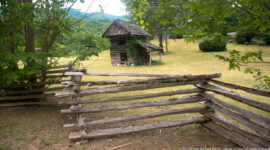
A gravel path curves through a broad green lawn toward a small white outbuilding with a dark roof. A low split-rail fence crosses the middle ground, and a larger tree-shaded structure sits farther back among the trees. The quiet overview conveys the spacing of the buildings and open grounds without assigning an unsupported historic identity to each structure.
Caption
A gravel path curves through a broad green lawn toward a small white outbuilding with a dark roof. A low split-rail fence crosses the middle ground, and a larger tree-shaded structure sits farther back among the trees. The quiet overview conveys the spacing of the buildings and open grounds without assigning an unsupported historic identity to each structure.

Through an open doorway, a dark four-poster bed sits against the far wall beneath blue ceiling beams. Red-trimmed windows admit a band of daylight, while a trunk and folded fabric rest near the bed. The heavy posts and simple floorboards make this a deeper, more sparsely furnished bedroom view than the adjacent close room portrait.
Caption
Through an open doorway, a dark four-poster bed sits against the far wall beneath blue ceiling beams. Red-trimmed windows admit a band of daylight, while a trunk and folded fabric rest near the bed. The heavy posts and simple floorboards make this a deeper, more sparsely furnished bedroom view than the adjacent close room portrait.

A green-felt table covered with playing cards and small game pieces anchors a furnished parlor. Upholstered wooden chairs, a patterned rug, and a tall cabinet or mantel fill the yellow-and-gray room, with daylight entering through narrow windows. The arrangement suggests a lived-in domestic setting, while the specific game and furnishings’ date remain unverified.
Caption
A green-felt table covered with playing cards and small game pieces anchors a furnished parlor. Upholstered wooden chairs, a patterned rug, and a tall cabinet or mantel fill the yellow-and-gray room, with daylight entering through narrow windows. The arrangement suggests a lived-in domestic setting, while the specific game and furnishings’ date remain unverified.

A mature live oak fills the center of the grounds, its heavy trunk dividing into low, broad limbs that shade a bench and surrounding lawn. Other oaks recede across the open park, creating a layered canopy beneath the overcast sky. The wide framing gives the tree’s scale and branching structure more attention than the nearby buildings.
Caption
A mature live oak fills the center of the grounds, its heavy trunk dividing into low, broad limbs that shade a bench and surrounding lawn. Other oaks recede across the open park, creating a layered canopy beneath the overcast sky. The wide framing gives the tree’s scale and branching structure more attention than the nearby buildings.

A large interpretive panel combines a map of Acadian migration routes with columns of English and French text and archival-style illustrations. The heading “Le Grand Dérangement” appears above the exhibit, which situates the Acadian displacement through place names, directional lines, and small historical images. The close view foregrounds the graphic explanation rather than the surrounding gallery.
Caption
A large interpretive panel combines a map of Acadian migration routes with columns of English and French text and archival-style illustrations. The heading “Le Grand Dérangement” appears above the exhibit, which situates the Acadian displacement through place names, directional lines, and small historical images. The close view foregrounds the graphic explanation rather than the surrounding gallery.

This panel pairs a small regional visitor map at the top with dense interpretive text and a larger battlefield diagram below. Colored arrows trace troop movements across the ground beside the Mississippi River, with marked roads and site features organizing the plan. The close view foregrounds the map’s explanatory design and the geography of the battlefield.
Caption
This panel pairs a small regional visitor map at the top with dense interpretive text and a larger battlefield diagram below. Colored arrows trace troop movements across the ground beside the Mississippi River, with marked roads and site features organizing the plan. The close view foregrounds the map’s explanatory design and the geography of the battlefield.

The upper section presents a large map of southeastern Louisiana and the Mississippi River delta, while a row of smaller maps and text panels runs along the bottom. Place labels, waterways, and colored areas distinguish park units and nearby communities. This overview pairs geographic orientation with practical visitor information, including illustrated activities and a food photograph.
Caption
The upper section presents a large map of southeastern Louisiana and the Mississippi River delta, while a row of smaller maps and text panels runs along the bottom. Place labels, waterways, and colored areas distinguish park units and nearby communities. This overview pairs geographic orientation with practical visitor information, including illustrated activities and a food photograph.
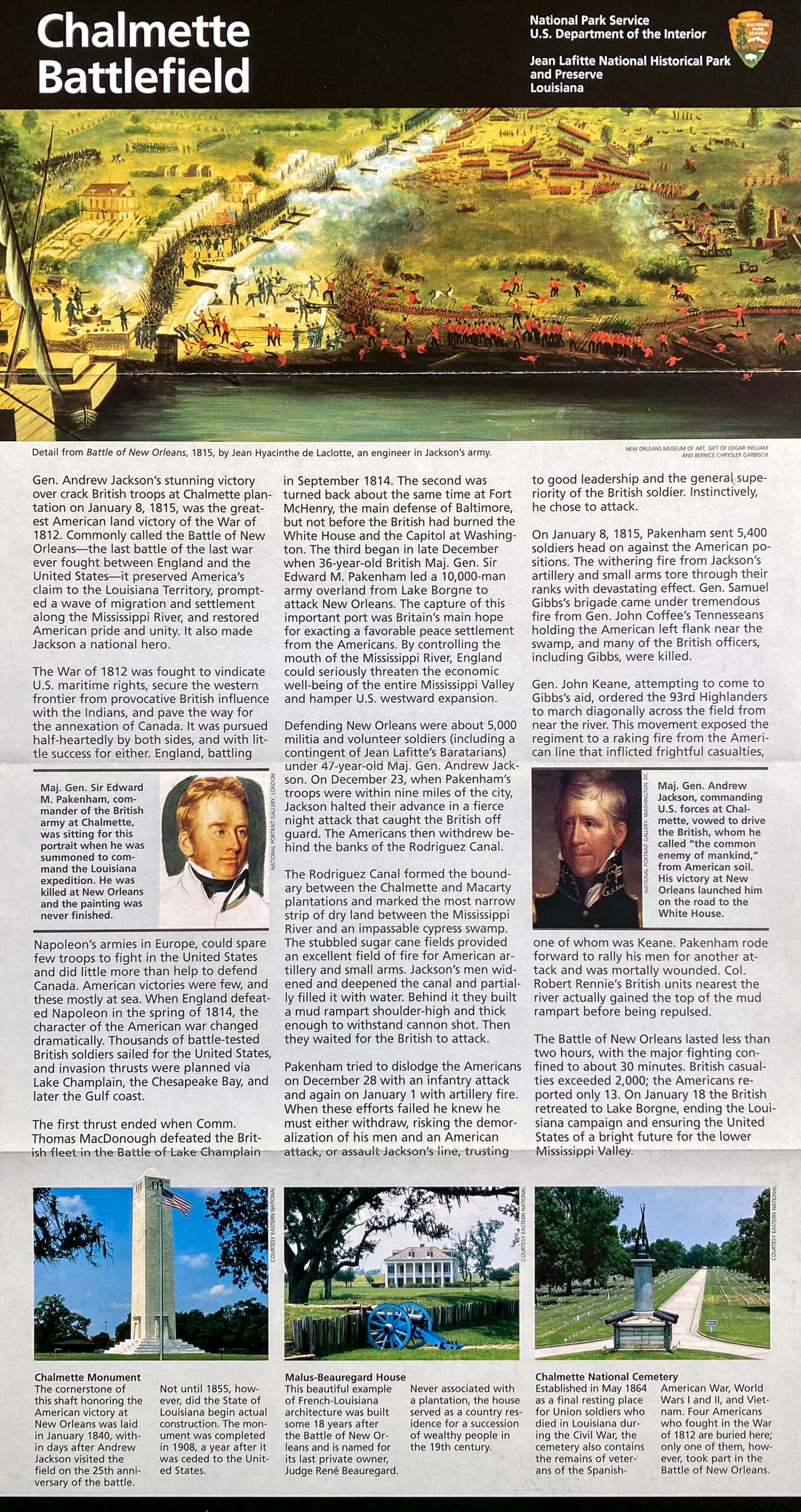
A wide visitor-information panel combines a panoramic battlefield illustration across the top with blocks of explanatory text and small photographs along the bottom. The heading identifies Chalmette Battlefield, while portraits and monument views supplement the written account. Its dense layout makes this an interpretive display rather than a direct view of the landscape it describes.
Caption
A wide visitor-information panel combines a panoramic battlefield illustration across the top with blocks of explanatory text and small photographs along the bottom. The heading identifies Chalmette Battlefield, while portraits and monument views supplement the written account. Its dense layout makes this an interpretive display rather than a direct view of the landscape it describes.

A broad exhibit panel titled “Jean Lafitte” combines a banner of cultural scenes with maps, photographs, historical text, and images of New Orleans landmarks. A central heading refers to Louisiana’s Mississippi River Delta and its cultural traditions. The dense display links landscape, food, music, and history through a collage-like arrangement of images and explanatory text.
Caption
A broad exhibit panel titled “Jean Lafitte” combines a banner of cultural scenes with maps, photographs, historical text, and images of New Orleans landmarks. A central heading refers to Louisiana’s Mississippi River Delta and its cultural traditions. The dense display links landscape, food, music, and history through a collage-like arrangement of images and explanatory text.