Black Canyon of the Gunnison National Park
Black Canyon of the Gunnison National Park preserves one of the steepest and most dramatic canyon landscapes in the American West. The Gunnison River carved this narrow canyon through hard Precambrian rock and younger igneous intrusions, creating sheer walls and remarkable depth within a relatively tight corridor. The canyon illustrates how persistent river erosion can exploit structural weaknesses in extremely resistant rock over long periods of time.
Unlike the broader sandstone canyon systems found elsewhere on the Colorado Plateau, Black Canyon presents a darker and more vertical landscape defined by gneiss, schist, and pegmatite. The canyon’s shadowed walls and narrow opening contribute to its name and create a strong visual contrast between light and stone. The geology reveals an older foundation of continental rock that differs significantly from the layered sedimentary landscapes common farther south and west.
Visitors encounter dramatic overlooks where the depth and steepness of the canyon are immediately apparent. The combination of dark rock, rapid river descent, and narrow canyon profile creates a distinctive sense of scale and intensity, making the park an especially memorable stop within a broader landscape itinerary.
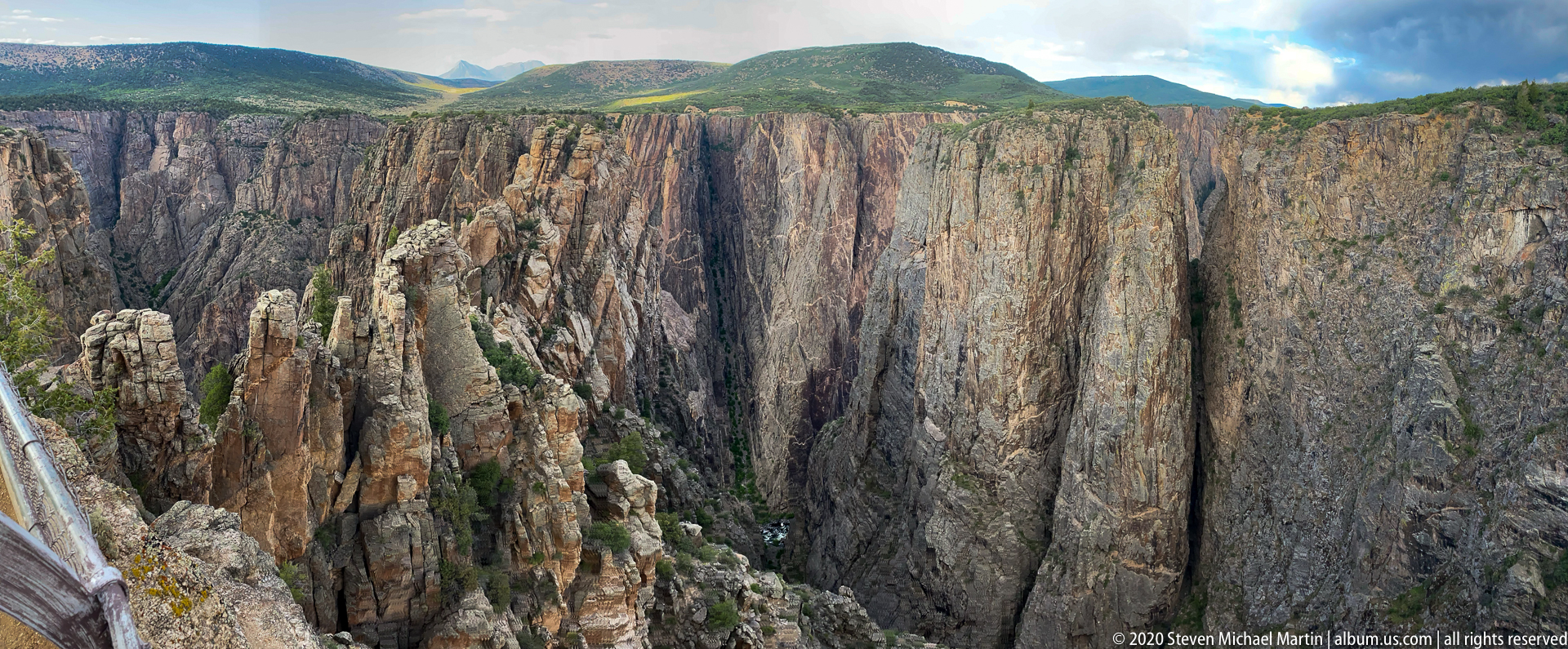
A wide panorama traces the canyon from a high rim, where a grassy plateau meets a succession of sheer, vertically fractured walls. The Gunnison River appears in the depths, partly screened by intervening cliffs. Bright patches of sunlight cross the far side, setting pale stone against darker, forested slopes.
Caption
A wide panorama traces the canyon from a high rim, where a grassy plateau meets a succession of sheer, vertically fractured walls. The Gunnison River appears in the depths, partly screened by intervening cliffs. Bright patches of sunlight cross the far side, setting pale stone against darker, forested slopes.
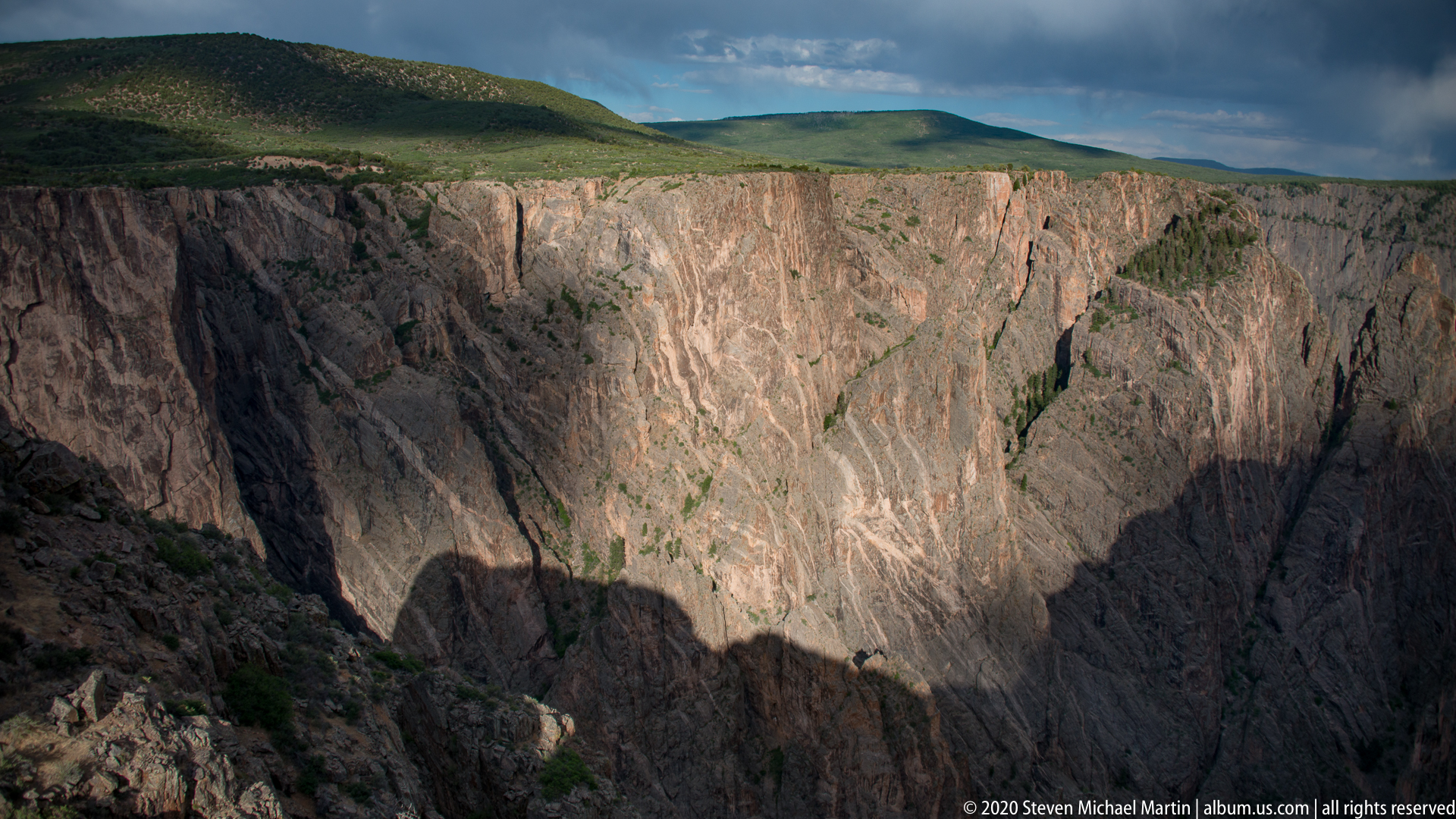
A broad, nearly level canyon rim stretches across the upper frame while steep walls plunge into a deep, shadowed gorge. Sunlight warms the pale rock near the opposite edge, contrasting with the dark lower canyon and a strip of green plateau beyond. The view emphasizes the abrupt depth and sheer scale of the landscape.
Caption
A broad, nearly level canyon rim stretches across the upper frame while steep walls plunge into a deep, shadowed gorge. Sunlight warms the pale rock near the opposite edge, contrasting with the dark lower canyon and a strip of green plateau beyond. The view emphasizes the abrupt depth and sheer scale of the landscape.

From a broad, rocky overlook, the Gunnison River curves through the center of a deep canyon basin. Layered cliffs descend toward a greener river corridor, while broken stone slabs and lichen-covered rocks spread across the foreground. The wide composition reveals several ridgelines and emphasizes the scale of the gorge beyond the immediate rim.
Caption
From a broad, rocky overlook, the Gunnison River curves through the center of a deep canyon basin. Layered cliffs descend toward a greener river corridor, while broken stone slabs and lichen-covered rocks spread across the foreground. The wide composition reveals several ridgelines and emphasizes the scale of the gorge beyond the immediate rim.
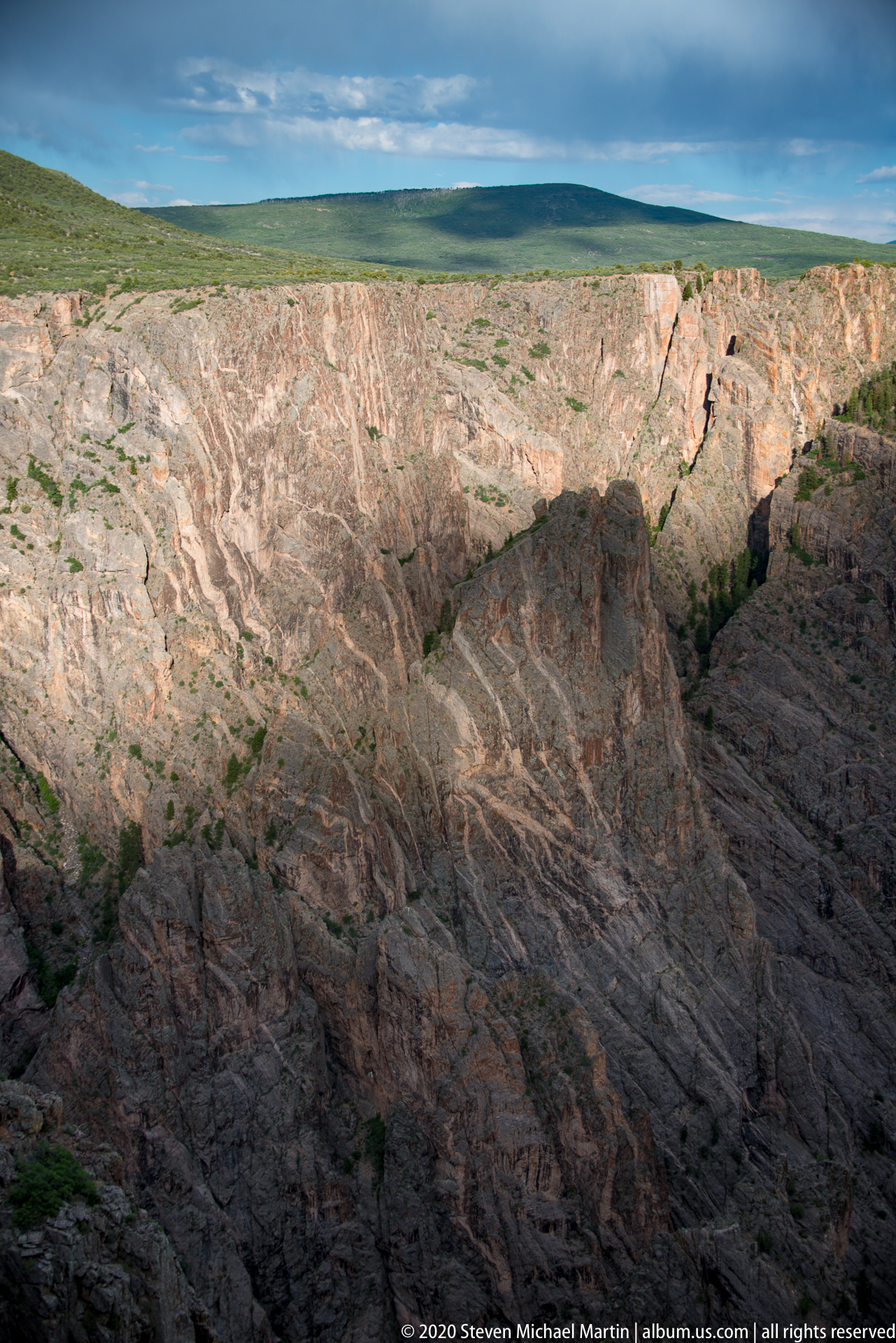
From a high overlook, the canyon opens into a broad V-shaped chasm with pale cliffs on the far side and darker, broken rock in the foreground. A band of green plateau and low clouded sky runs along the horizon. The wide composition captures the contrast between the open rim and the narrow depths below.
Caption
From a high overlook, the canyon opens into a broad V-shaped chasm with pale cliffs on the far side and darker, broken rock in the foreground. A band of green plateau and low clouded sky runs along the horizon. The wide composition captures the contrast between the open rim and the narrow depths below.
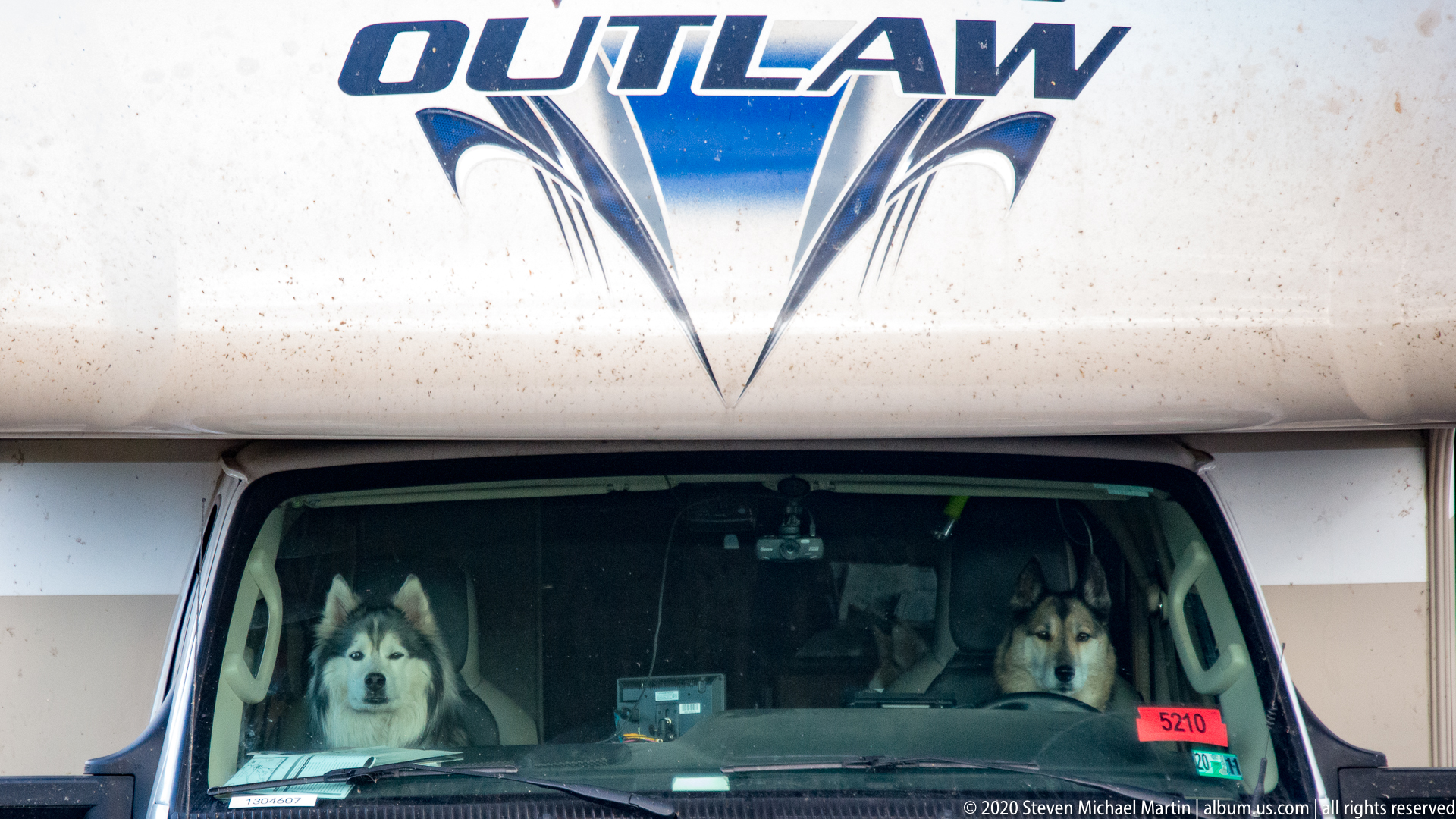
Two dogs peer through the lower windshield of a white motorhome, their faces visible behind reflections in the glass. The close crop includes the large blue “Outlaw” logo above the cab and a small red windshield sticker. Unlike the wider roadside view, this composition concentrates on the animals and the lettering overhead.
Caption
Two dogs peer through the lower windshield of a white motorhome, their faces visible behind reflections in the glass. The close crop includes the large blue “Outlaw” logo above the cab and a small red windshield sticker. Unlike the wider roadside view, this composition concentrates on the animals and the lettering overhead.
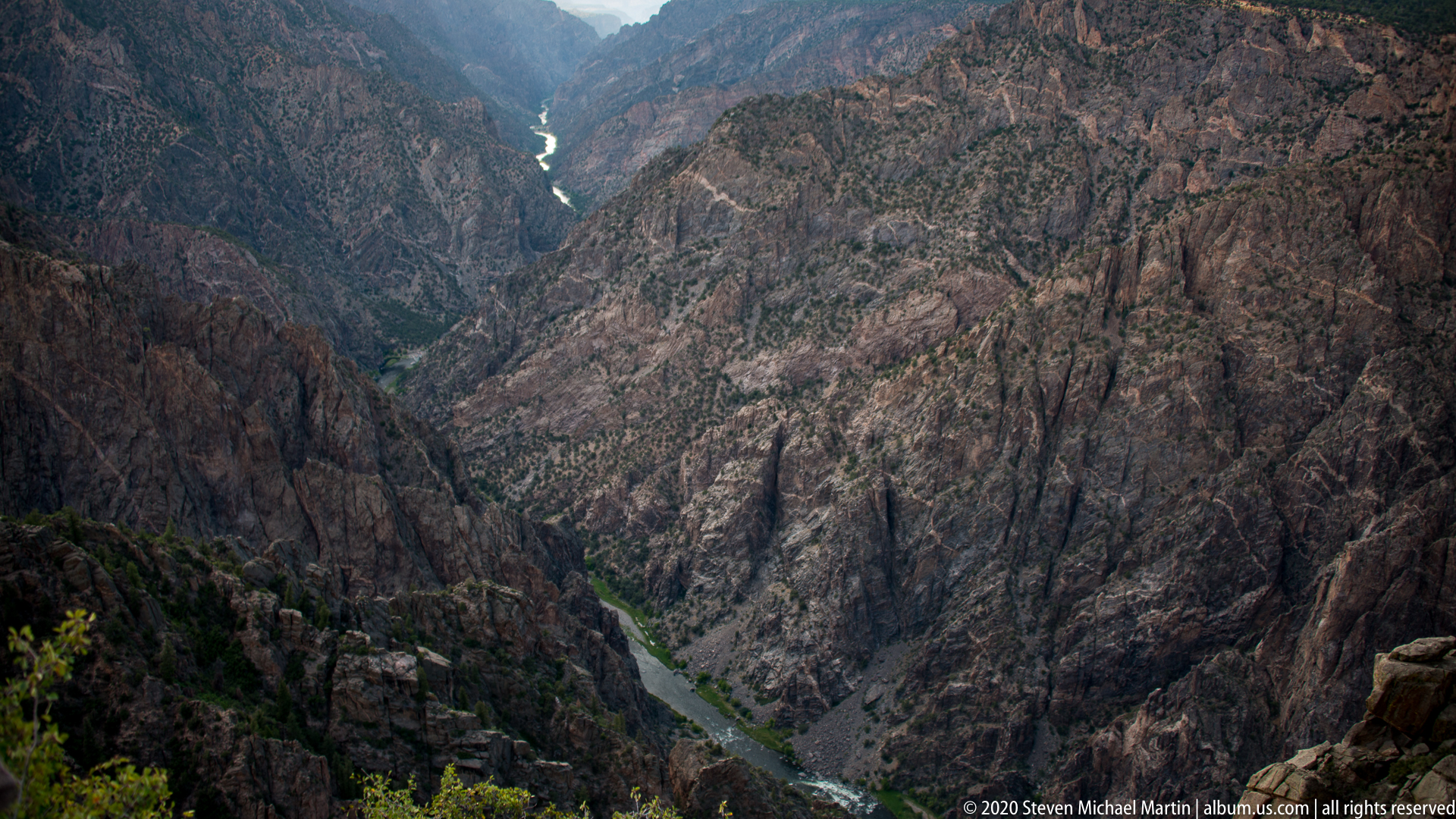
From above, the Gunnison River forms a bright, narrow line at the base of a broad, deeply incised canyon. Dark, rugged slopes dominate both sides, with scattered trees and shrubs adding texture along the rims and ledges. The elevated viewpoint reduces the river to a small feature, underscoring the canyon’s width and depth.
Caption
From above, the Gunnison River forms a bright, narrow line at the base of a broad, deeply incised canyon. Dark, rugged slopes dominate both sides, with scattered trees and shrubs adding texture along the rims and ledges. The elevated viewpoint reduces the river to a small feature, underscoring the canyon’s width and depth.
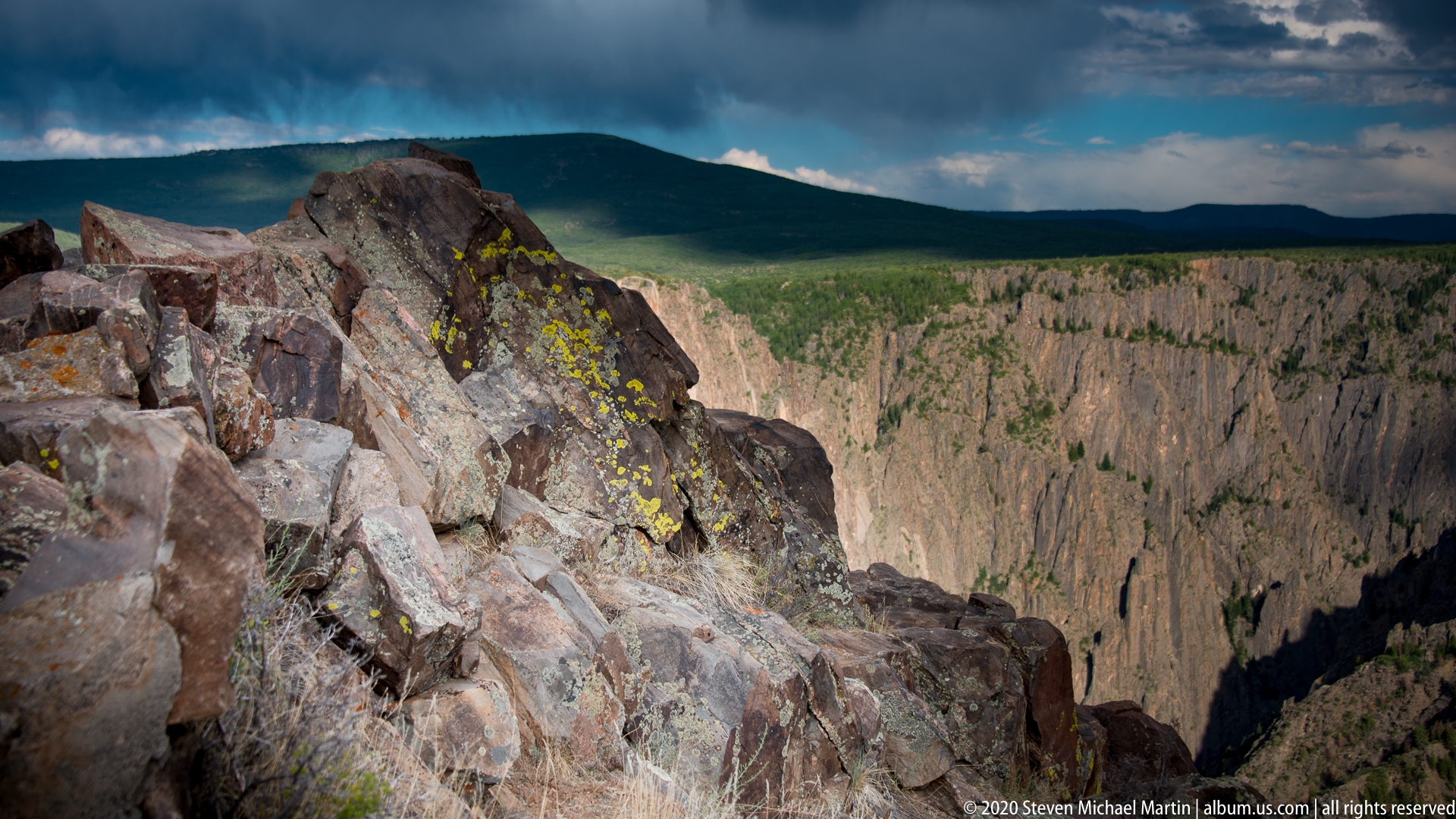
Large angular boulders, speckled with bright yellow lichen, occupy the foreground at the rim of the canyon. Beyond them, a sheer wall drops toward a dark ravine, while green uplands run along the horizon. The shallow foreground focus adds texture and scale to the overlook above the immense gorge.
Caption
Large angular boulders, speckled with bright yellow lichen, occupy the foreground at the rim of the canyon. Beyond them, a sheer wall drops toward a dark ravine, while green uplands run along the horizon. The shallow foreground focus adds texture and scale to the overlook above the immense gorge.

A vehicle’s instrument cluster fills the frame, centering a speedometer marked in miles and kilometers per hour. The red needle rests at zero, while the adjacent tachometer and orange digital display are partially visible. Reflections and small surface marks cross the clear gauge cover, turning a travel detail into a close mechanical study.
Caption
A vehicle’s instrument cluster fills the frame, centering a speedometer marked in miles and kilometers per hour. The red needle rests at zero, while the adjacent tachometer and orange digital display are partially visible. Reflections and small surface marks cross the clear gauge cover, turning a travel detail into a close mechanical study.

Steep canyon walls drop toward the narrow Gunnison River, visible as a dark ribbon near the gorge floor. Sunlight illuminates the opposite rim and patches of evergreen forest while storm clouds gather overhead. Jagged rocks in the foreground establish the overlook’s exposed edge and frame the immense vertical depth of the canyon.
Caption
Steep canyon walls drop toward the narrow Gunnison River, visible as a dark ribbon near the gorge floor. Sunlight illuminates the opposite rim and patches of evergreen forest while storm clouds gather overhead. Jagged rocks in the foreground establish the overlook’s exposed edge and frame the immense vertical depth of the canyon.
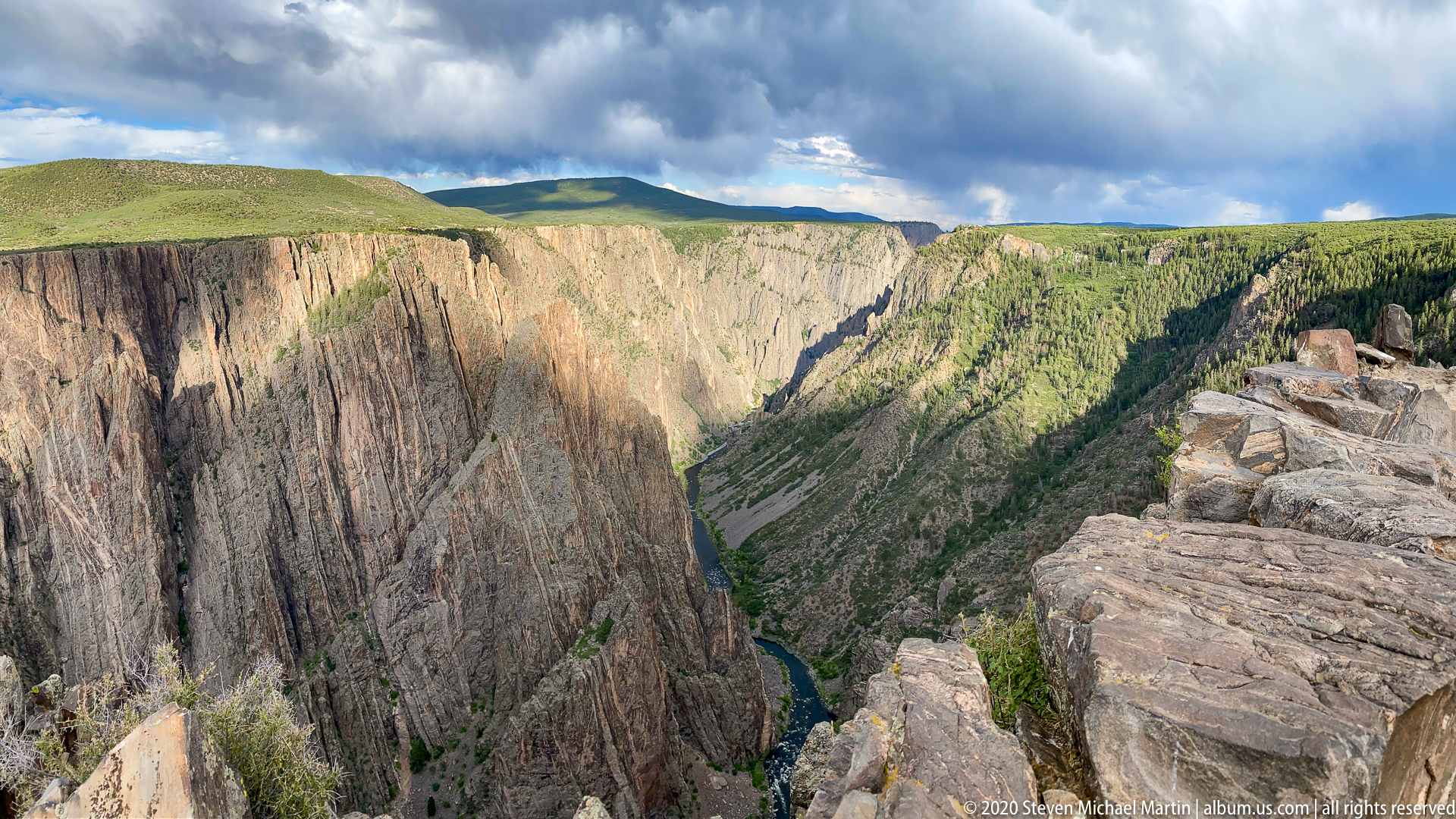
A broad section of the canyon opens below a grassy rim, with the Gunnison River bending through the dark lower gorge. Light catches pale streaks and vertical fractures on the opposite wall, while the near rim’s angular rock fills the foreground. The view balances the immense cliff face with the small, winding watercourse.
Caption
A broad section of the canyon opens below a grassy rim, with the Gunnison River bending through the dark lower gorge. Light catches pale streaks and vertical fractures on the opposite wall, while the near rim’s angular rock fills the foreground. The view balances the immense cliff face with the small, winding watercourse.
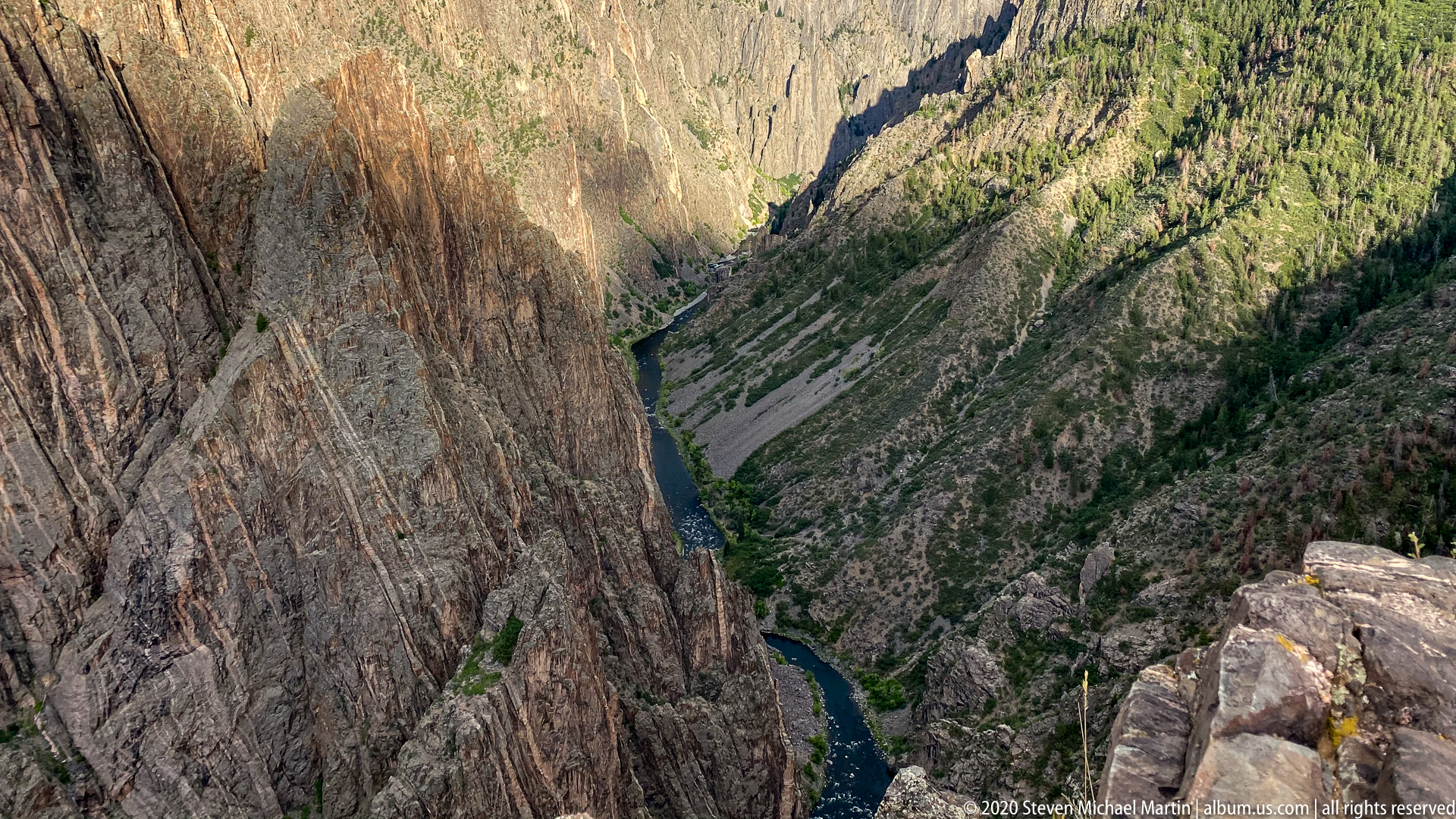
The viewpoint looks almost straight down between towering rock walls to a small bend in the Gunnison River. Fine vertical seams and pale mineral streaks mark the cliff face at left, while the opposite slope is greener and more broken. This tighter angle concentrates on the river’s depth within the dark, constricted gorge.
Caption
The viewpoint looks almost straight down between towering rock walls to a small bend in the Gunnison River. Fine vertical seams and pale mineral streaks mark the cliff face at left, while the opposite slope is greener and more broken. This tighter angle concentrates on the river’s depth within the dark, constricted gorge.
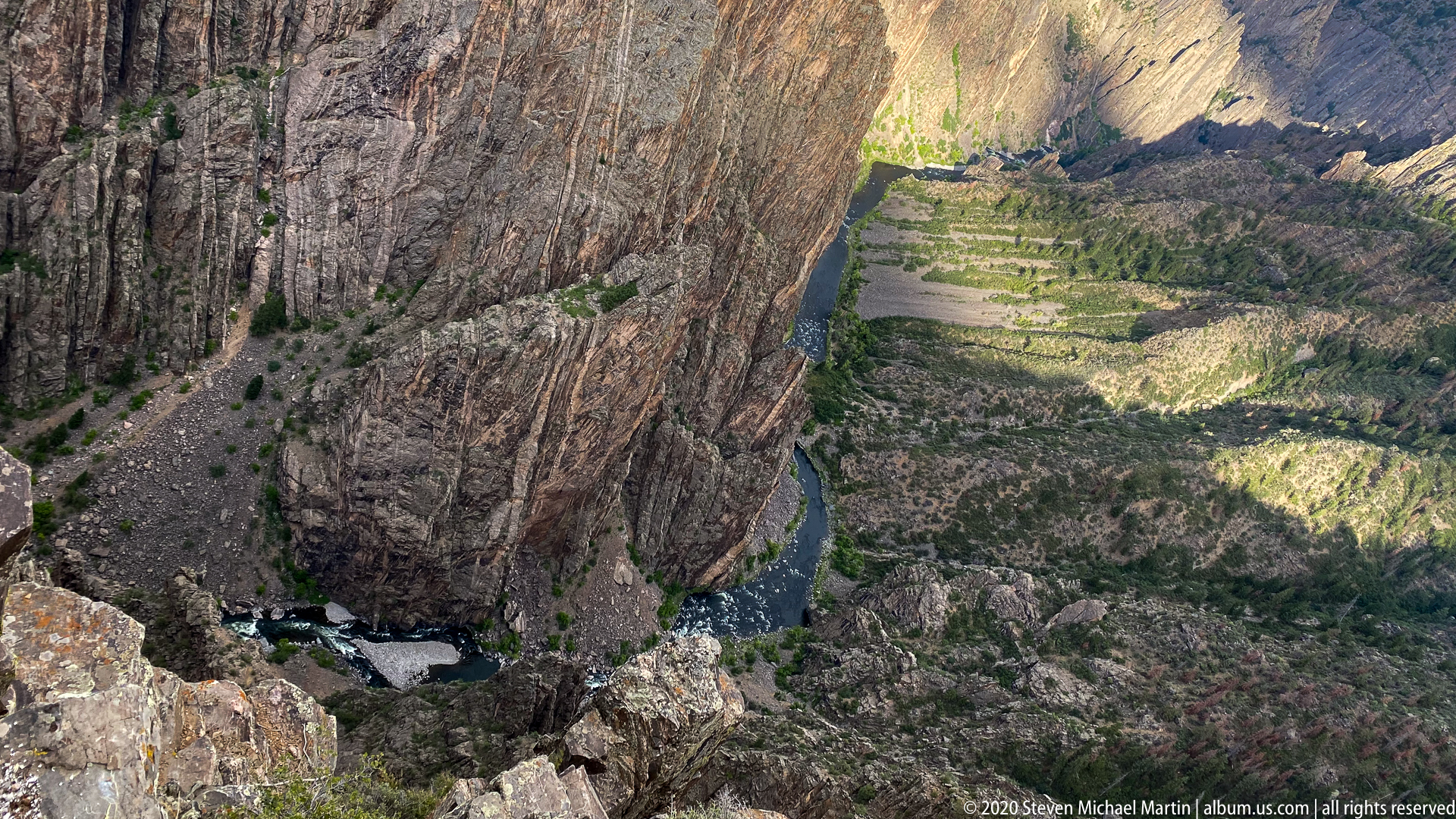
The Gunnison River bends around pale gravel bars far below the rim, enclosed by steep, dark rock walls. The high angle exposes the contrast between the river’s narrow, winding course and the nearly vertical canyon sides. Angular boulders at the viewpoint edge lead the eye downward into the shadowed inner gorge.
Caption
The Gunnison River bends around pale gravel bars far below the rim, enclosed by steep, dark rock walls. The high angle exposes the contrast between the river’s narrow, winding course and the nearly vertical canyon sides. Angular boulders at the viewpoint edge lead the eye downward into the shadowed inner gorge.
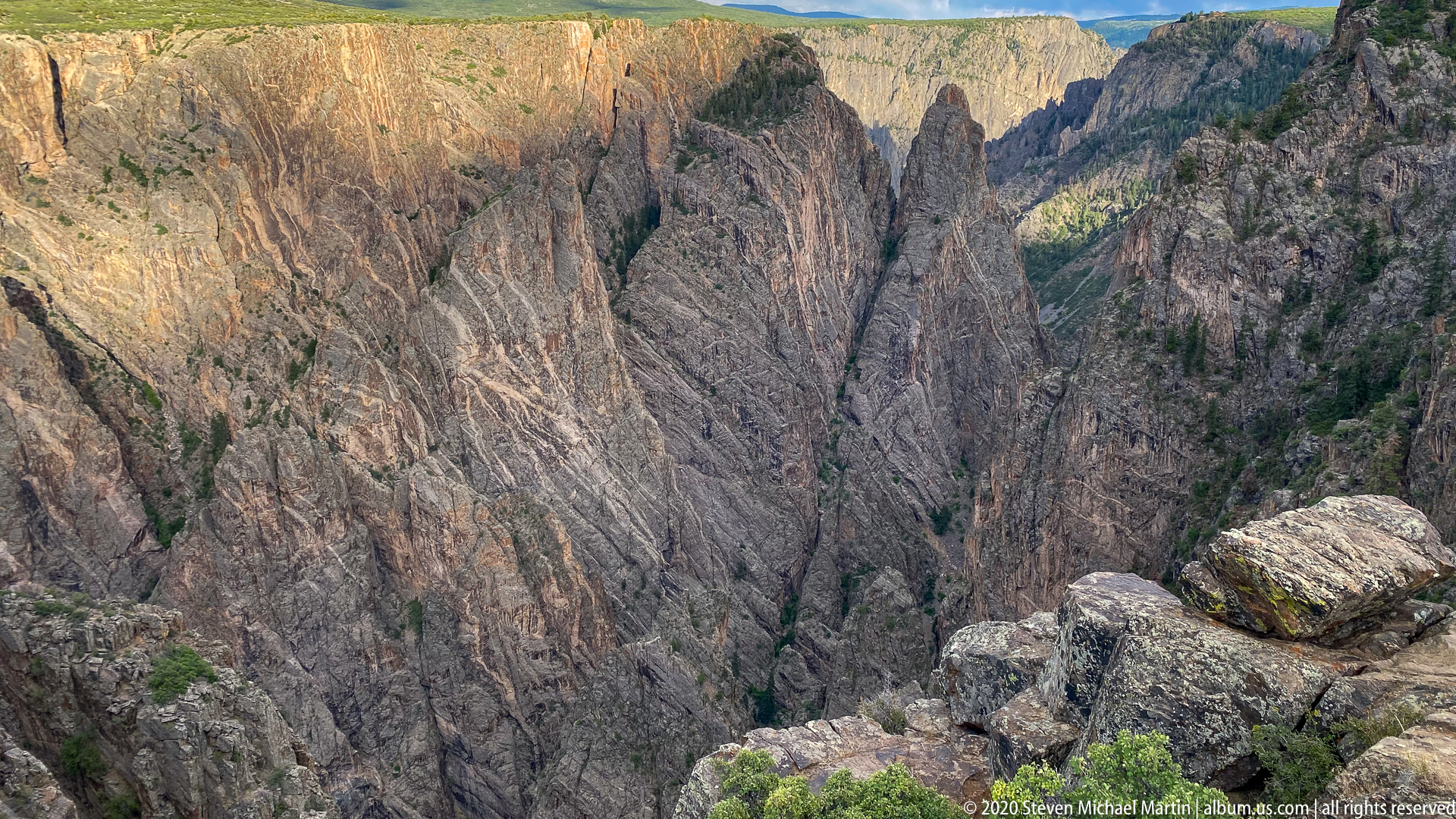
A massive wall of banded rock occupies the center of the view, with the canyon’s opposite slope and river corridor visible beyond it. Light and shadow reveal narrow vertical grooves across the cliff face, while scattered shrubs and pale boulders cling to the rim in front. The composition emphasizes the layered depth of opposing canyon walls.
Caption
A massive wall of banded rock occupies the center of the view, with the canyon’s opposite slope and river corridor visible beyond it. Light and shadow reveal narrow vertical grooves across the cliff face, while scattered shrubs and pale boulders cling to the rim in front. The composition emphasizes the layered depth of opposing canyon walls.
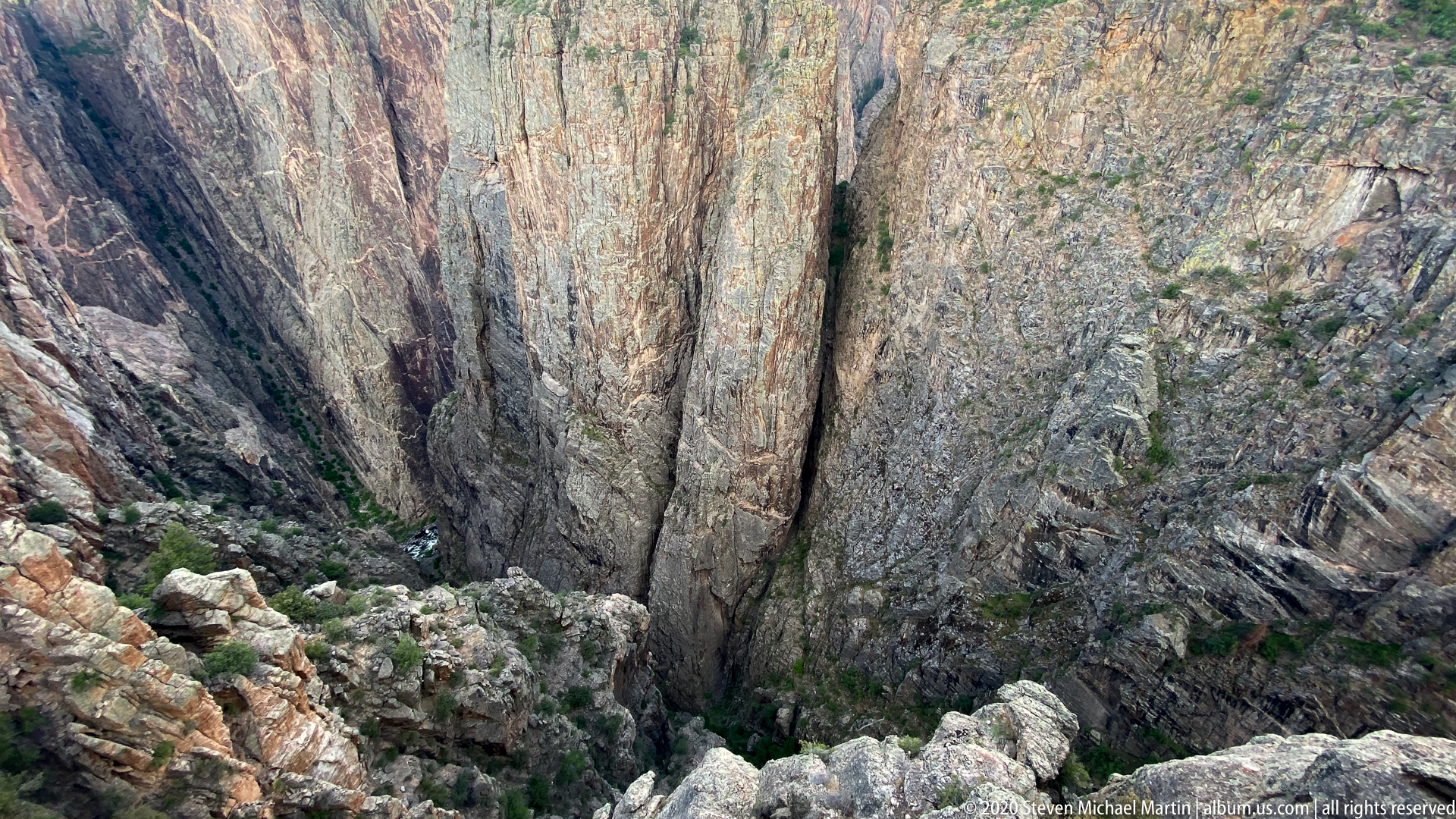
A steep downward view follows narrow clefts and broken ledges into the dark inner canyon. Jagged outcrops crowd the foreground, while massive, banded walls close in around a small patch of vegetation below. The compressed perspective conveys the depth and rugged texture of the gorge without showing a broad horizon.
Caption
A steep downward view follows narrow clefts and broken ledges into the dark inner canyon. Jagged outcrops crowd the foreground, while massive, banded walls close in around a small patch of vegetation below. The compressed perspective conveys the depth and rugged texture of the gorge without showing a broad horizon.
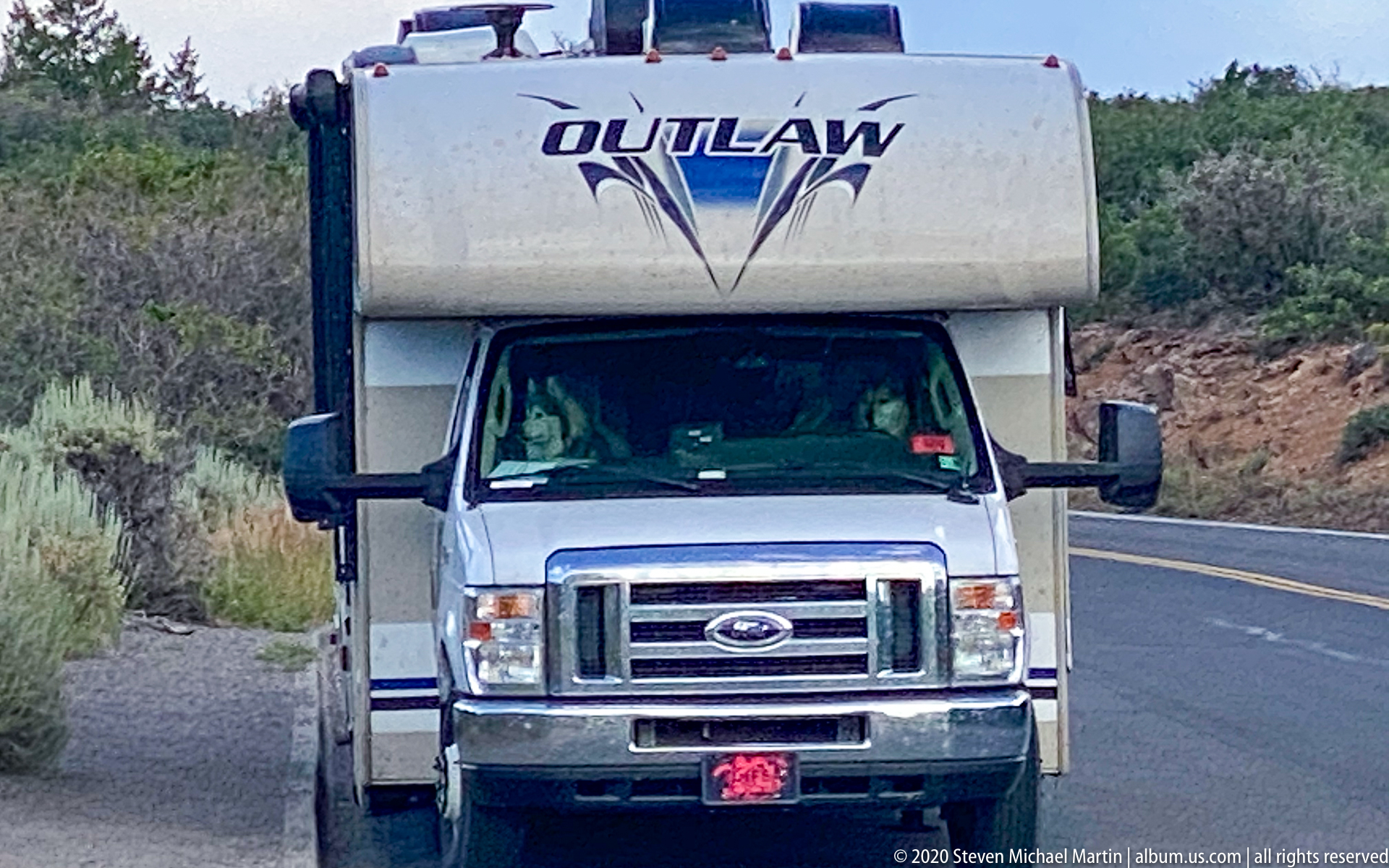
A white motorhome approaches along a paved road bordered by sagebrush and low trees. The vehicle fills most of the frame, with its windshield, grille, roof-mounted equipment, and “Outlaw” lettering visible. The road curves behind it, placing the close vehicle portrait within the park’s driving landscape.
Caption
A white motorhome approaches along a paved road bordered by sagebrush and low trees. The vehicle fills most of the frame, with its windshield, grille, roof-mounted equipment, and “Outlaw” lettering visible. The road curves behind it, placing the close vehicle portrait within the park’s driving landscape.
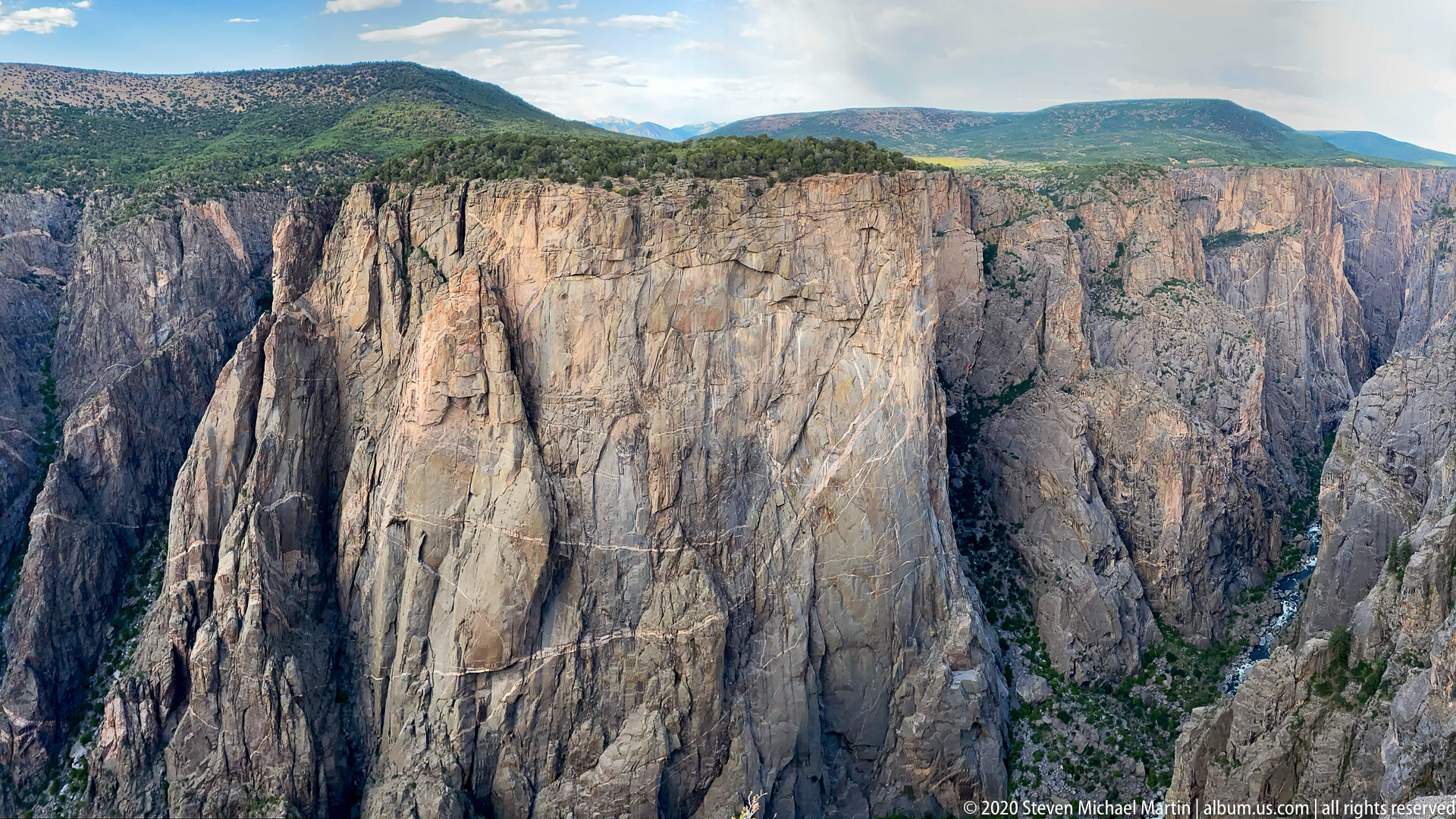
Pale and dark rock bands descend almost vertically toward the inner gorge, where a thin strip of green vegetation marks the bottom. The viewpoint faces the opposite wall, revealing tall parallel fractures and a narrow cleft near the center. A forested rim forms a thin upper border above the exposed stone.
Caption
Pale and dark rock bands descend almost vertically toward the inner gorge, where a thin strip of green vegetation marks the bottom. The viewpoint faces the opposite wall, revealing tall parallel fractures and a narrow cleft near the center. A forested rim forms a thin upper border above the exposed stone.
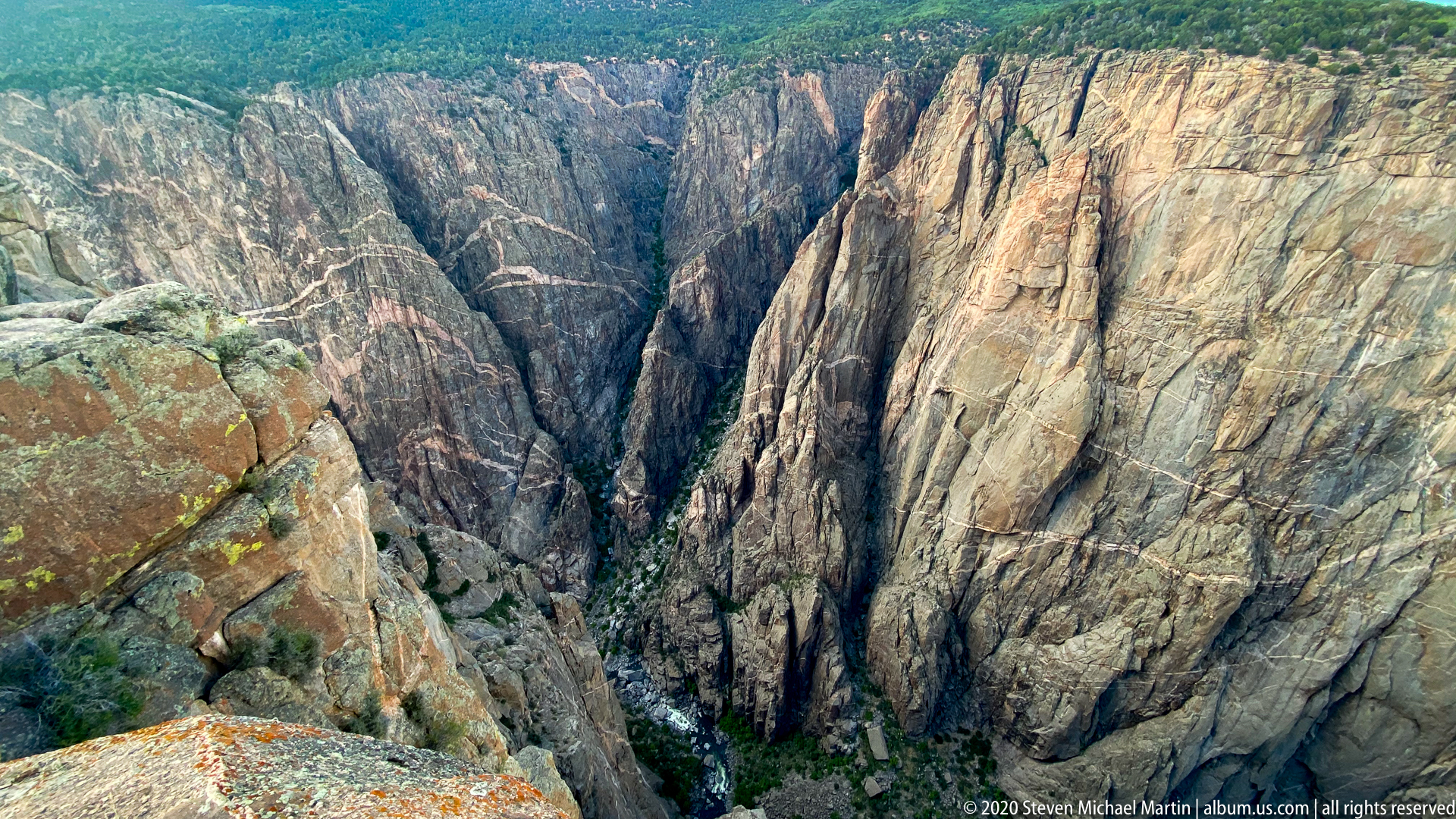
Angular rocks on the near rim frame a steep drop into a narrow, shadowed ravine. Beyond the foreground outcrop, sheer walls descend toward the river corridor, with alternating pale and dark stone bands visible across their faces. The elevated angle highlights the abrupt transition from stable rim to the confined canyon floor.
Caption
Angular rocks on the near rim frame a steep drop into a narrow, shadowed ravine. Beyond the foreground outcrop, sheer walls descend toward the river corridor, with alternating pale and dark stone bands visible across their faces. The elevated angle highlights the abrupt transition from stable rim to the confined canyon floor.
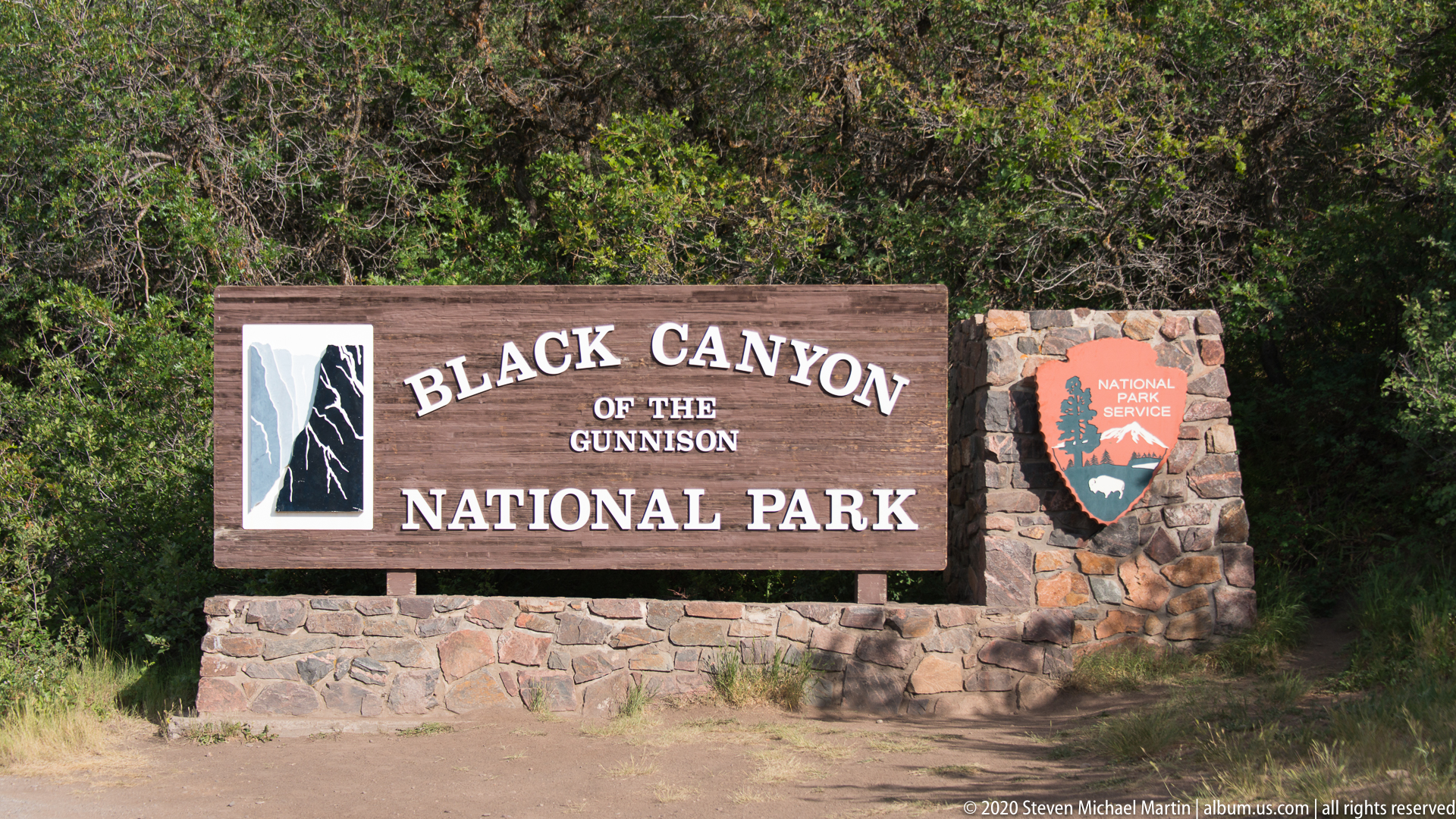
A broad wooden sign reads “Black Canyon of the Gunnison National Park,” mounted on a low stone wall beside a National Park Service shield. Green shrubs and trees surround the entrance marker, and a gravel shoulder runs along its base. The direct, frontal view makes the park name and official emblem the focus.
Caption
A broad wooden sign reads “Black Canyon of the Gunnison National Park,” mounted on a low stone wall beside a National Park Service shield. Green shrubs and trees surround the entrance marker, and a gravel shoulder runs along its base. The direct, frontal view makes the park name and official emblem the focus.
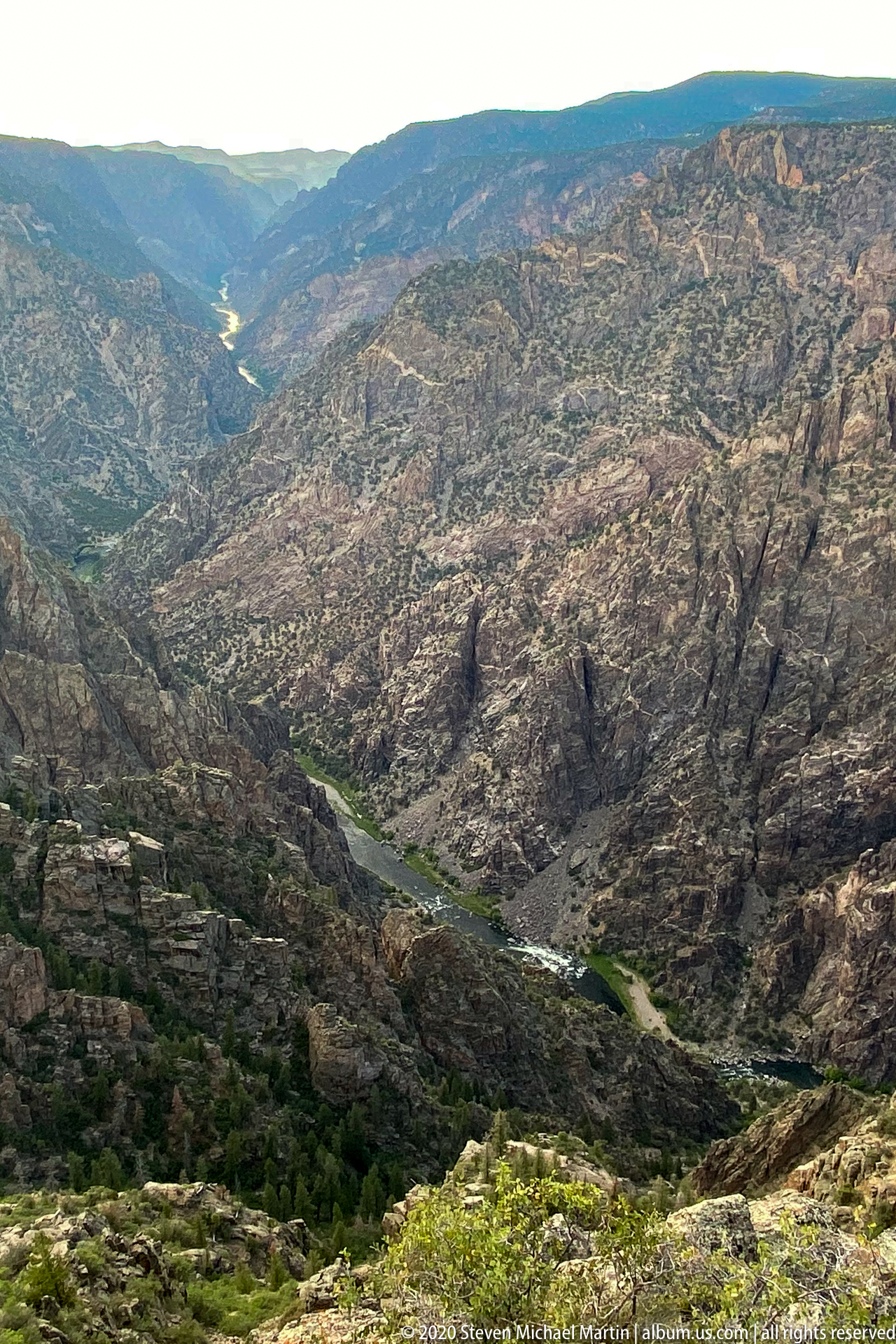
A long view follows a green river corridor through a broad, rugged valley, with the dark channel curving from the foreground toward distant hills. The surrounding slopes are cut by smaller ravines and scattered scrub, while a brighter bend catches the light near the horizon. This panorama shifts from sheer canyon walls to the wider regional landscape.
Caption
A long view follows a green river corridor through a broad, rugged valley, with the dark channel curving from the foreground toward distant hills. The surrounding slopes are cut by smaller ravines and scattered scrub, while a brighter bend catches the light near the horizon. This panorama shifts from sheer canyon walls to the wider regional landscape.
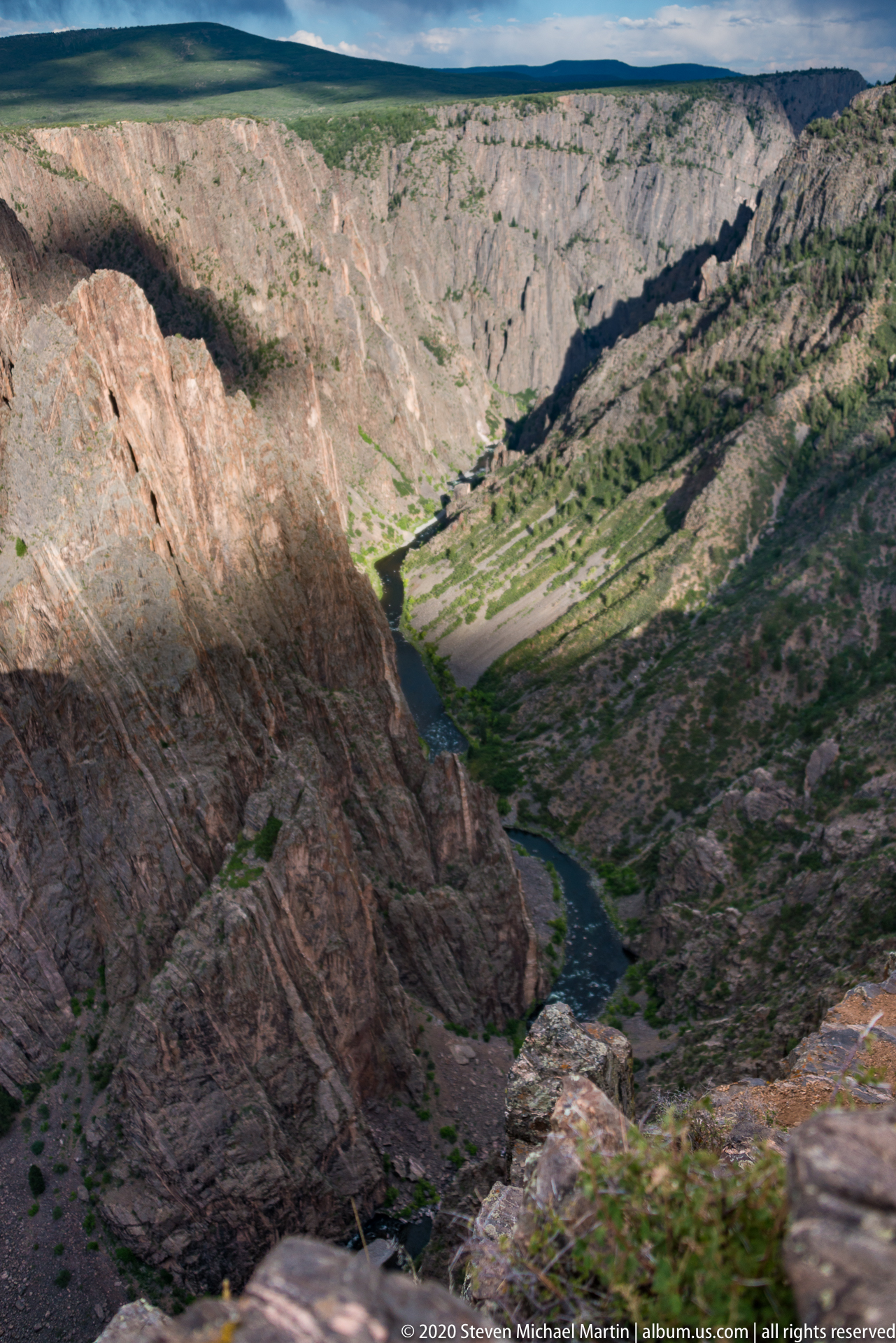
The Gunnison River curves through a narrow valley far below, its dark surface bordered by pale gravel bars and green vegetation. A tall, shadowed wall dominates the left foreground, while lower ridges step down toward the river on the right. The angled perspective follows the watercourse through successive layers of the canyon.
Caption
The Gunnison River curves through a narrow valley far below, its dark surface bordered by pale gravel bars and green vegetation. A tall, shadowed wall dominates the left foreground, while lower ridges step down toward the river on the right. The angled perspective follows the watercourse through successive layers of the canyon.
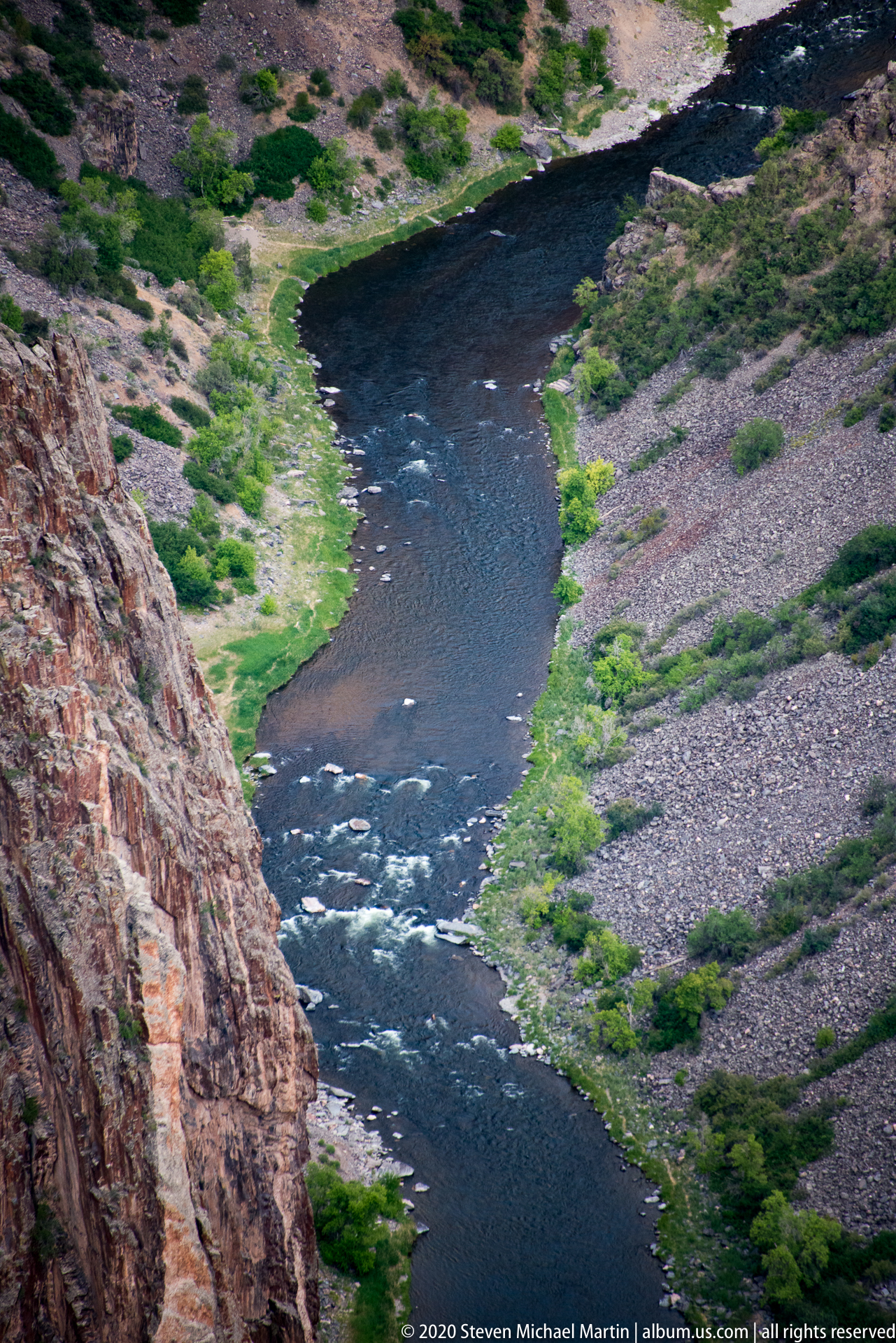
The Gunnison River fills the center of the view, flowing around broad gray gravel bars and patches of green vegetation. A steep rock slope enters from the left, while the opposite bank opens into a wide, stony floodplain. From above, the river’s dark water and bright riffles define a winding channel at the bottom of the canyon.
Caption
The Gunnison River fills the center of the view, flowing around broad gray gravel bars and patches of green vegetation. A steep rock slope enters from the left, while the opposite bank opens into a wide, stony floodplain. From above, the river’s dark water and bright riffles define a winding channel at the bottom of the canyon.

A close view of a printed park map shows a network of roads and trails, marked overlooks, visitor facilities, and a prominent “You Are Here” indicator. Colored route lines distinguish paved roads from other access routes, while a north arrow and legend sit along the lower margin. The map organizes the canyon’s rim destinations for visitors.
Caption
A close view of a printed park map shows a network of roads and trails, marked overlooks, visitor facilities, and a prominent “You Are Here” indicator. Colored route lines distinguish paved roads from other access routes, while a north arrow and legend sit along the lower margin. The map organizes the canyon’s rim destinations for visitors.

A deep, narrow gorge cuts between tall, jagged walls, with a pale stripe of sunlight reaching one section of the far cliff. Scrubby plants and a bleached branch occupy the near rim, creating a natural frame against the exposed stone. The elevated view centers on the contrast between shaded depths and illuminated rock.
Caption
A deep, narrow gorge cuts between tall, jagged walls, with a pale stripe of sunlight reaching one section of the far cliff. Scrubby plants and a bleached branch occupy the near rim, creating a natural frame against the exposed stone. The elevated view centers on the contrast between shaded depths and illuminated rock.
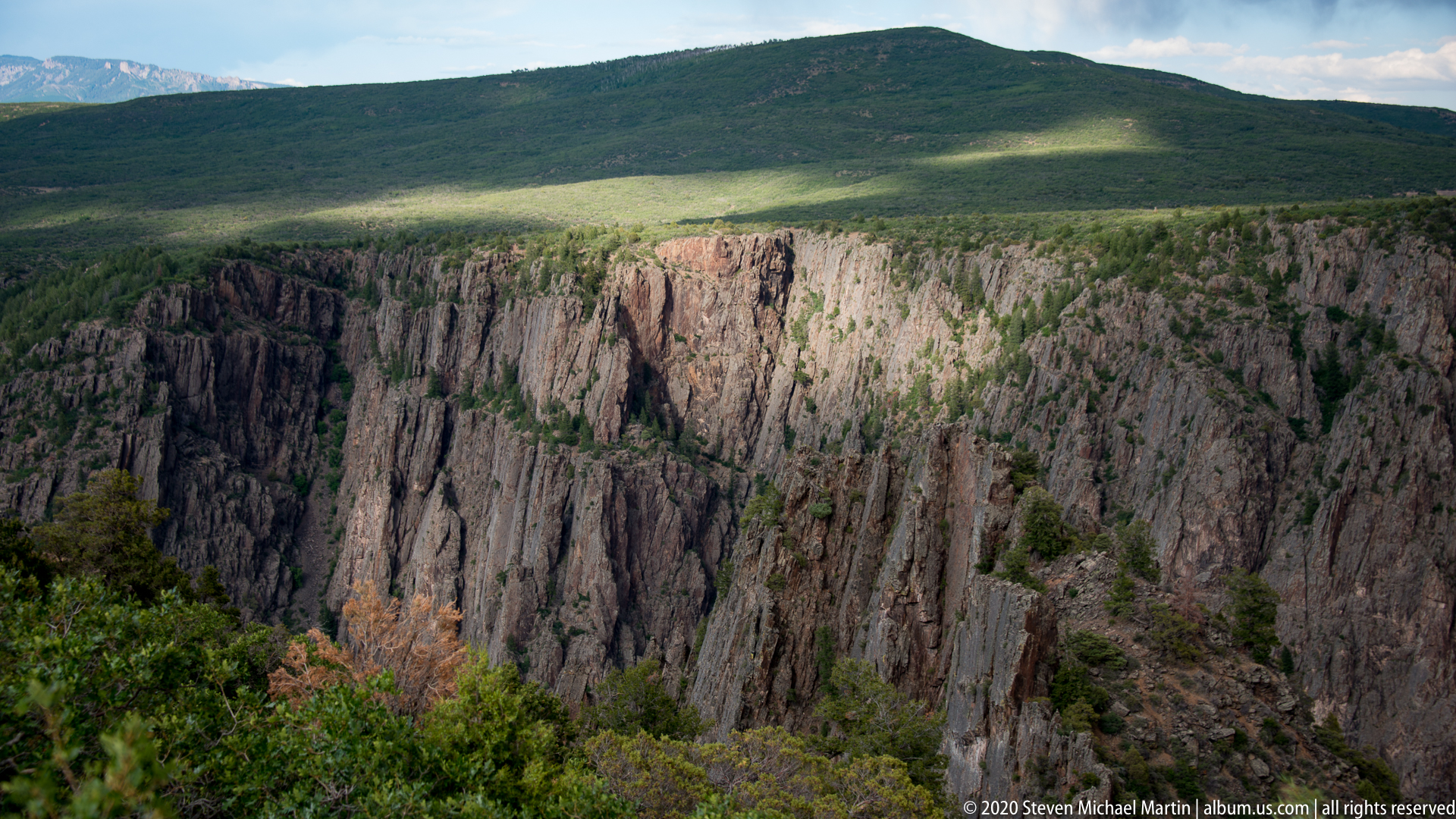
A sheer cliff drops from a rolling, forested plateau into the canyon, its face divided by narrow vertical ribs and pale mineral streaks. Dark green trees trace the upper edge, while shrubs at the overlook appear at the lower right. This side-on composition shows how the level upland terminates abruptly at the canyon rim.
Caption
A sheer cliff drops from a rolling, forested plateau into the canyon, its face divided by narrow vertical ribs and pale mineral streaks. Dark green trees trace the upper edge, while shrubs at the overlook appear at the lower right. This side-on composition shows how the level upland terminates abruptly at the canyon rim.

A bright patch of sunlight spreads across the opposite canyon wall, surrounded by darker cliffs and a deep green ravine. The Gunnison River appears far below at the base of the slope, while the near rock face fills the left foreground. This oblique composition layers a close cliff, the canyon’s depths, and the distant illuminated rim.
Caption
A bright patch of sunlight spreads across the opposite canyon wall, surrounded by darker cliffs and a deep green ravine. The Gunnison River appears far below at the base of the slope, while the near rock face fills the left foreground. This oblique composition layers a close cliff, the canyon’s depths, and the distant illuminated rim.
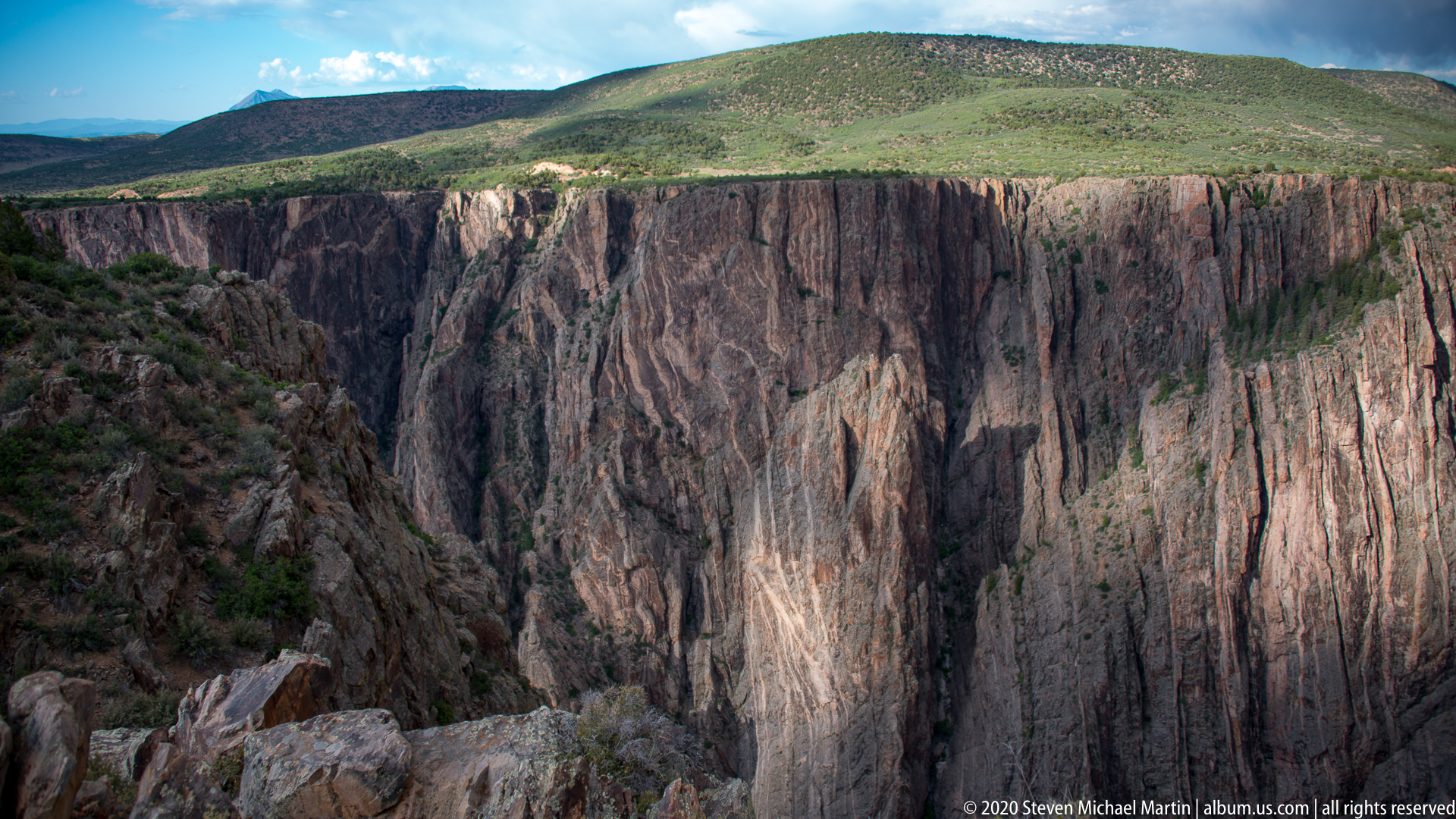
A towering cliff face rises directly across the gorge, its dark stone crossed by long vertical fractures and bands of lighter rock. A rounded grassy plateau crowns the upper edge, while boulders at the near rim provide a foreground counterpoint. The close framing stresses the wall’s height and fractured surface rather than the river below.
Caption
A towering cliff face rises directly across the gorge, its dark stone crossed by long vertical fractures and bands of lighter rock. A rounded grassy plateau crowns the upper edge, while boulders at the near rim provide a foreground counterpoint. The close framing stresses the wall’s height and fractured surface rather than the river below.
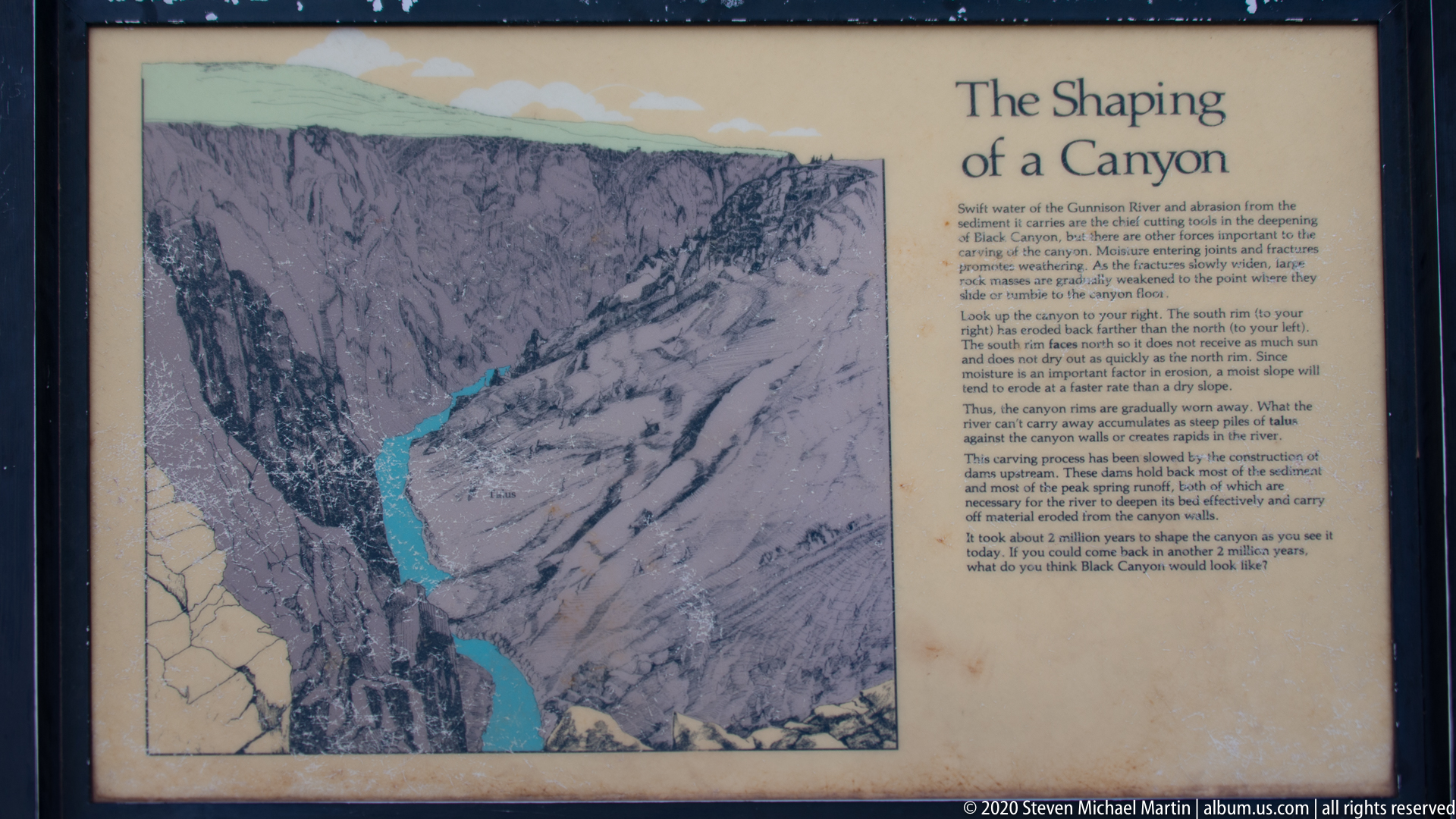
An interpretive panel titled “The Shaping of a Canyon” pairs an aerial-style map with explanatory text about the formation and course of the gorge. A blue line traces the river through the canyon on the shaded relief illustration. The close view foregrounds the park’s geological interpretation and the map’s relationship to the landscape.
Caption
An interpretive panel titled “The Shaping of a Canyon” pairs an aerial-style map with explanatory text about the formation and course of the gorge. A blue line traces the river through the canyon on the shaded relief illustration. The close view foregrounds the park’s geological interpretation and the map’s relationship to the landscape.

A freestanding interpretive panel stands at the overlook, its map and title visible against the canyon wall beyond. The sign occupies the lower foreground, while the opposite cliff spans the background and the river is hidden from this angle. This contextual view shows how park interpretation is encountered beside the landscape it explains.
Caption
A freestanding interpretive panel stands at the overlook, its map and title visible against the canyon wall beyond. The sign occupies the lower foreground, while the opposite cliff spans the background and the river is hidden from this angle. This contextual view shows how park interpretation is encountered beside the landscape it explains.
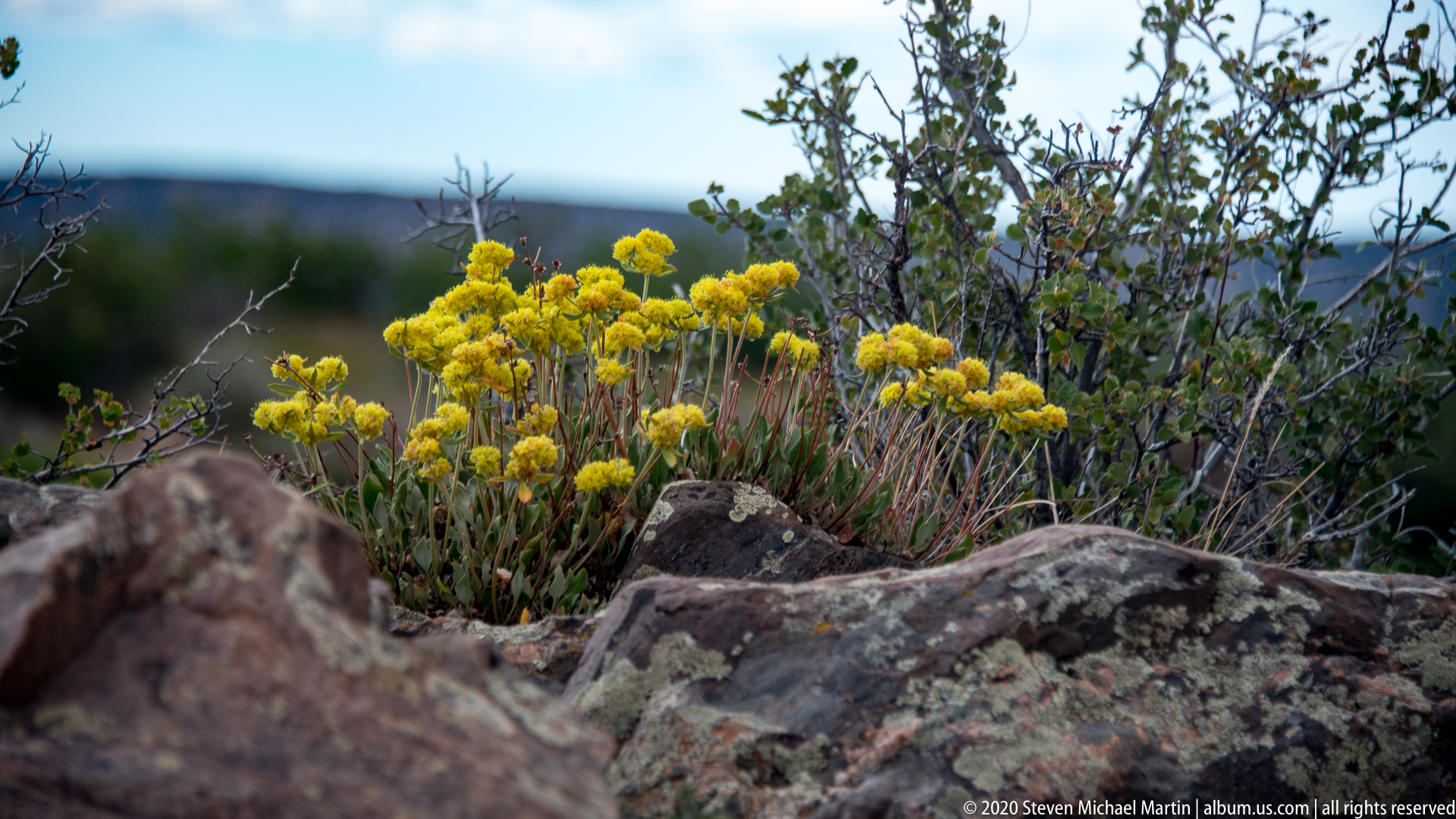
Clusters of small yellow flower heads rise on slender stems among gray-green shrubs and angular rim rocks. The shallow depth of field keeps the blossoms crisp while the distant landscape softens into green and blue bands. The close botanical view contrasts delicate stems with the rough stone of the canyon edge.
Caption
Clusters of small yellow flower heads rise on slender stems among gray-green shrubs and angular rim rocks. The shallow depth of field keeps the blossoms crisp while the distant landscape softens into green and blue bands. The close botanical view contrasts delicate stems with the rough stone of the canyon edge.
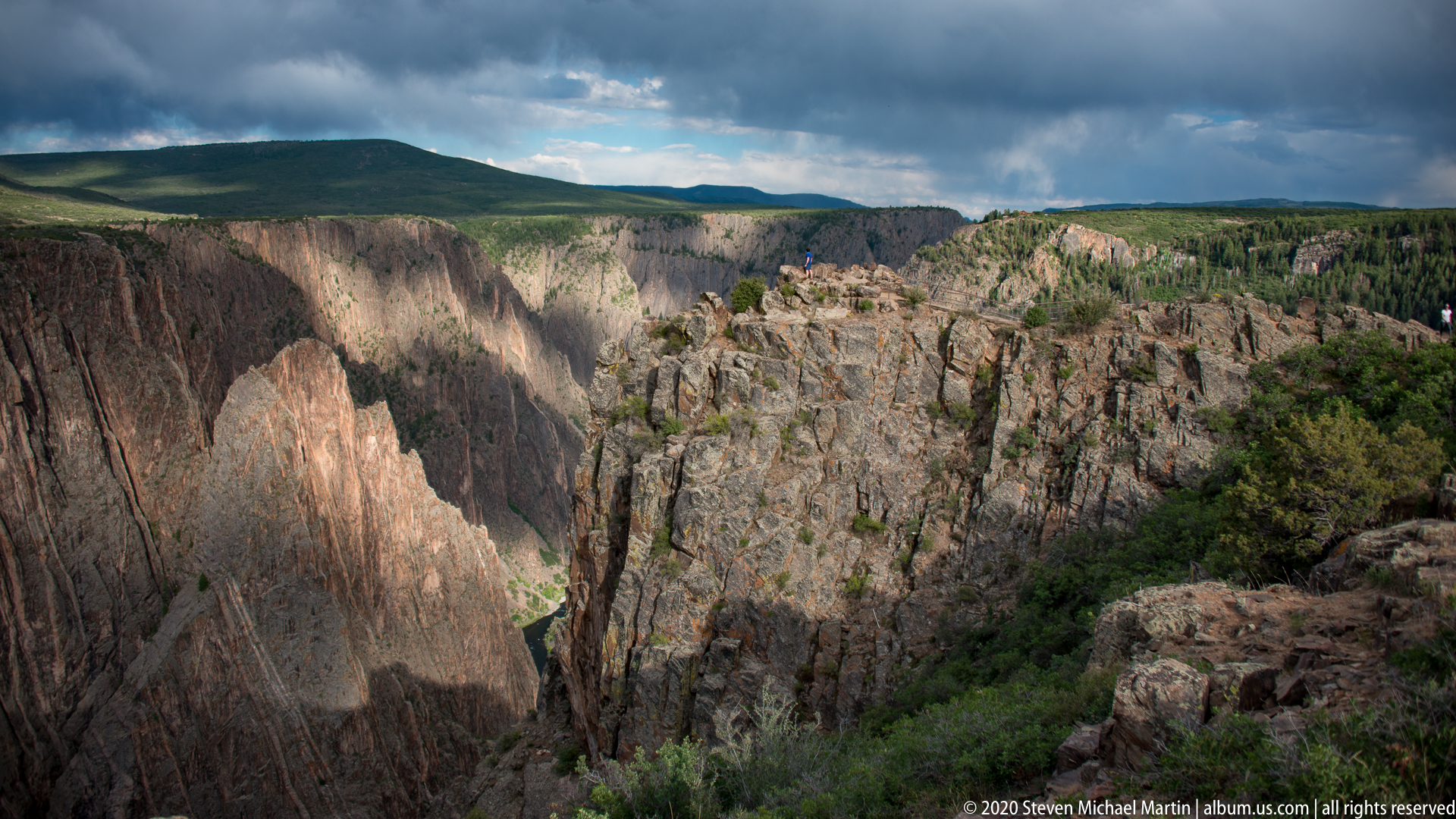
A wide section of the canyon opens beneath a darkening sky, with sharply cut rock walls descending toward a narrow, shadowed river corridor. Sunlight reaches portions of the far cliff while the foreground rim remains dark. The composition gives equal weight to the opposite wall and the cloud movement above the plateau.
Caption
A wide section of the canyon opens beneath a darkening sky, with sharply cut rock walls descending toward a narrow, shadowed river corridor. Sunlight reaches portions of the far cliff while the foreground rim remains dark. The composition gives equal weight to the opposite wall and the cloud movement above the plateau.
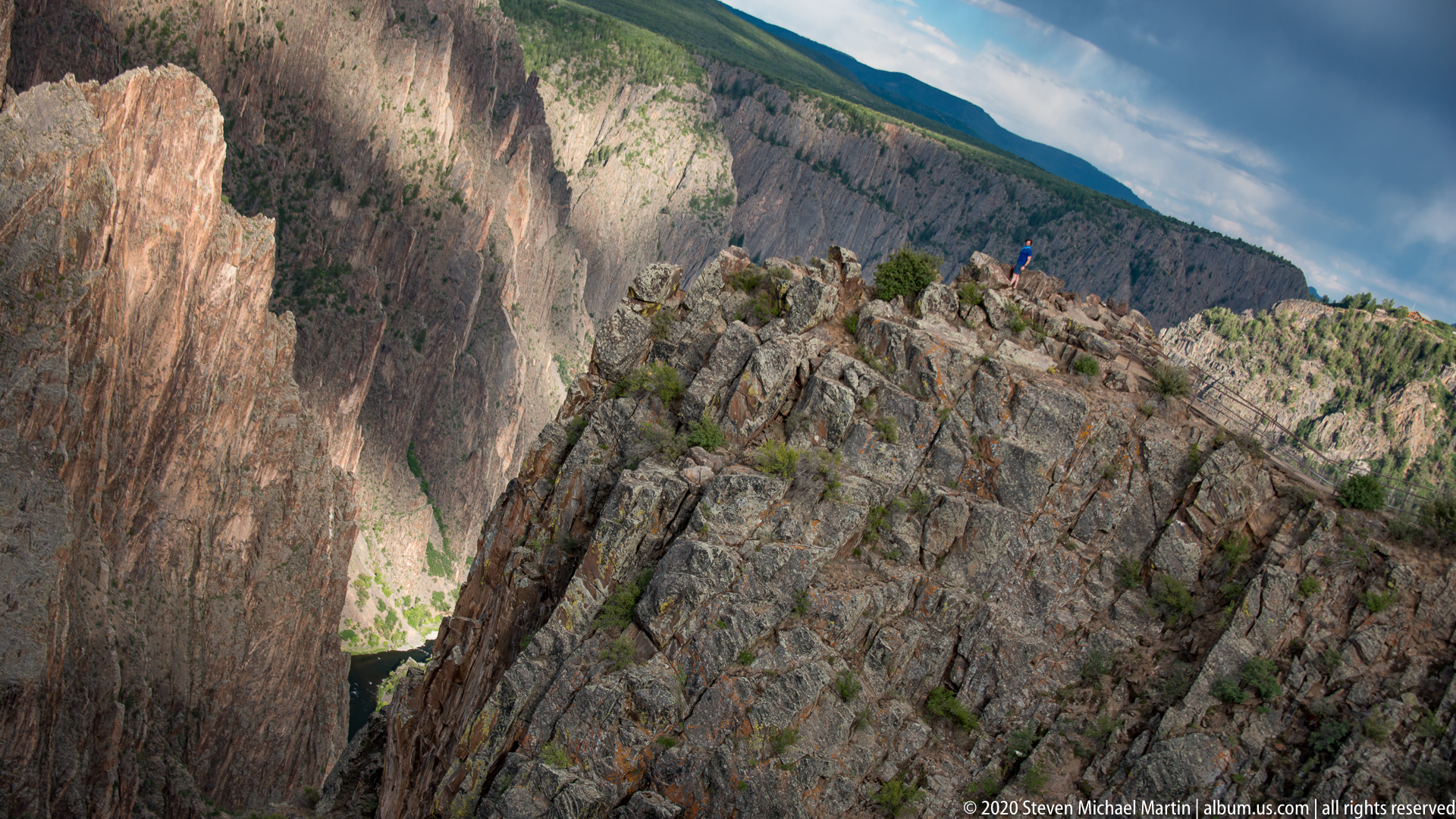
A visitor in a bright blue top stands on a narrow rocky point above the canyon, providing scale against the sheer walls behind. The frame tilts diagonally across the rim, heightening the sense of exposure and depth. Sparse plants cling to the rock, while the river is barely visible in the shadowed gorge below.
Caption
A visitor in a bright blue top stands on a narrow rocky point above the canyon, providing scale against the sheer walls behind. The frame tilts diagonally across the rim, heightening the sense of exposure and depth. Sparse plants cling to the rock, while the river is barely visible in the shadowed gorge below.
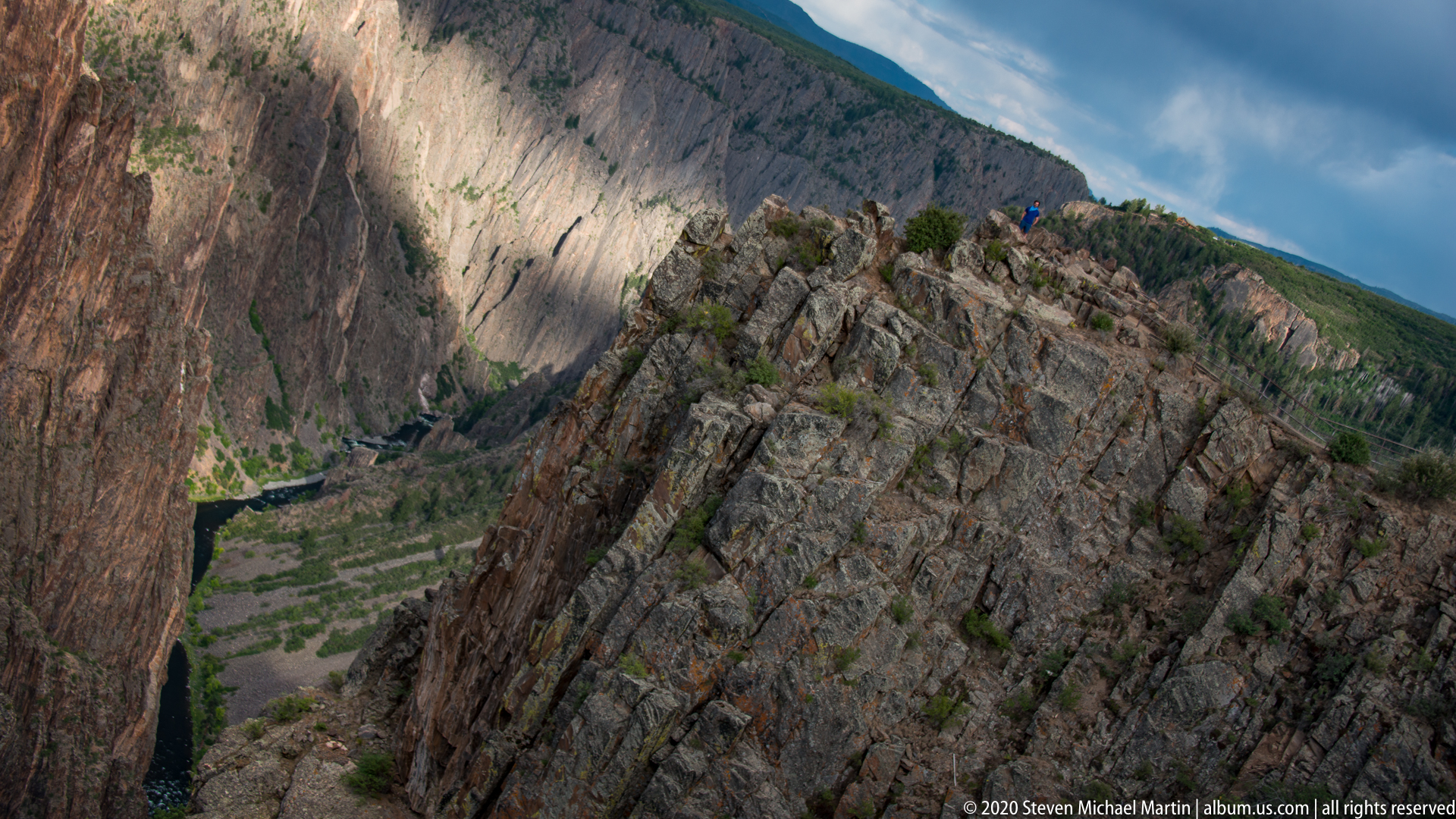
A jagged rock promontory projects into the canyon, separating the near wall from a narrow view of the Gunnison River below. The camera’s tilted angle makes the cliff edge cut diagonally across the frame, while pale stone and green vegetation mark the opposite slope. This viewpoint emphasizes the irregular rim topography.
Caption
A jagged rock promontory projects into the canyon, separating the near wall from a narrow view of the Gunnison River below. The camera’s tilted angle makes the cliff edge cut diagonally across the frame, while pale stone and green vegetation mark the opposite slope. This viewpoint emphasizes the irregular rim topography.
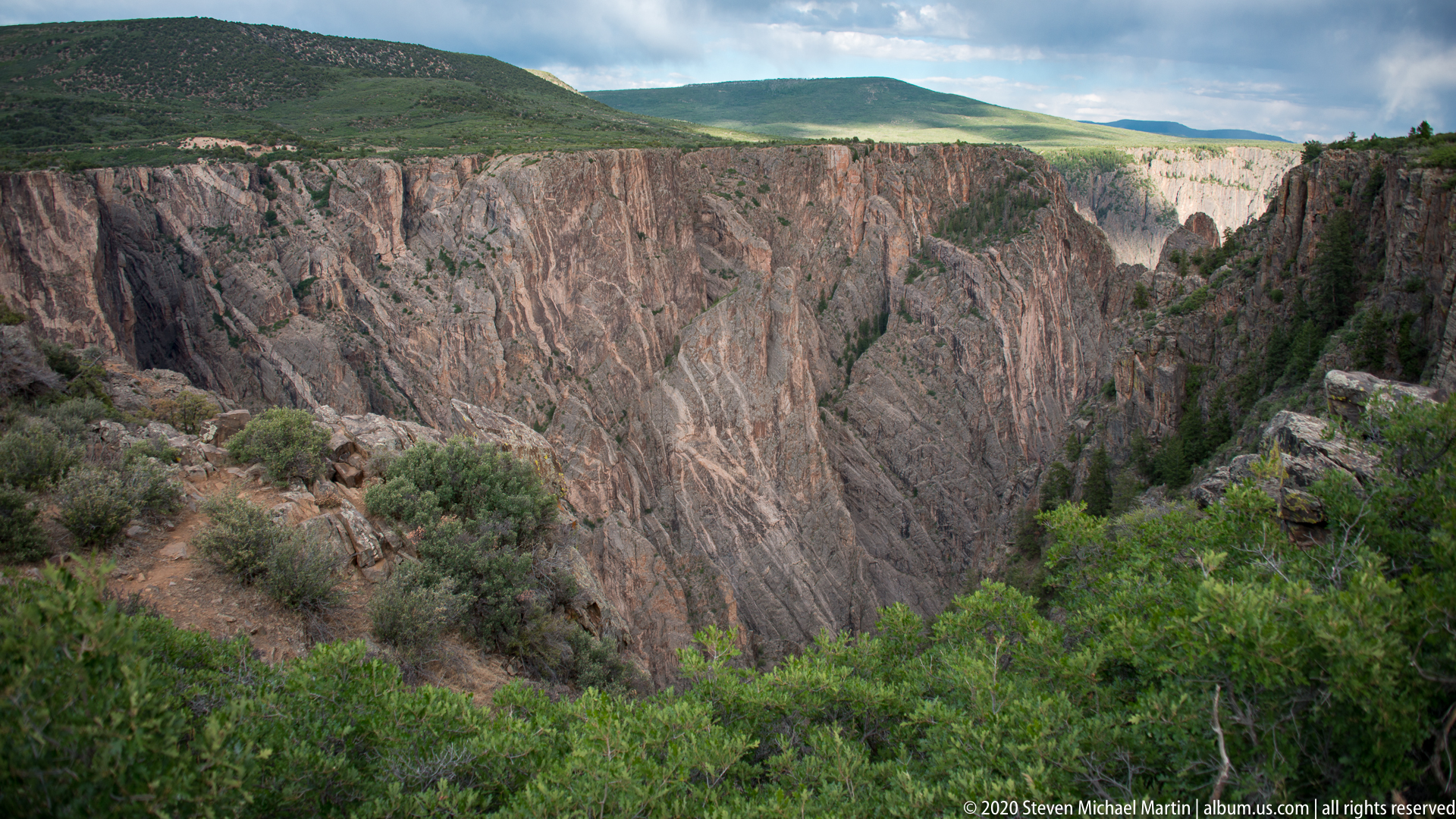
A broad cliff wall drops from a green plateau into the canyon, its pale and dark bands interrupted by long vertical fractures. Shrubs and small trees frame the lower foreground, while a line of riverbank vegetation appears far below. The expansive view connects the forested upland to the sharply incised gorge.
Caption
A broad cliff wall drops from a green plateau into the canyon, its pale and dark bands interrupted by long vertical fractures. Shrubs and small trees frame the lower foreground, while a line of riverbank vegetation appears far below. The expansive view connects the forested upland to the sharply incised gorge.
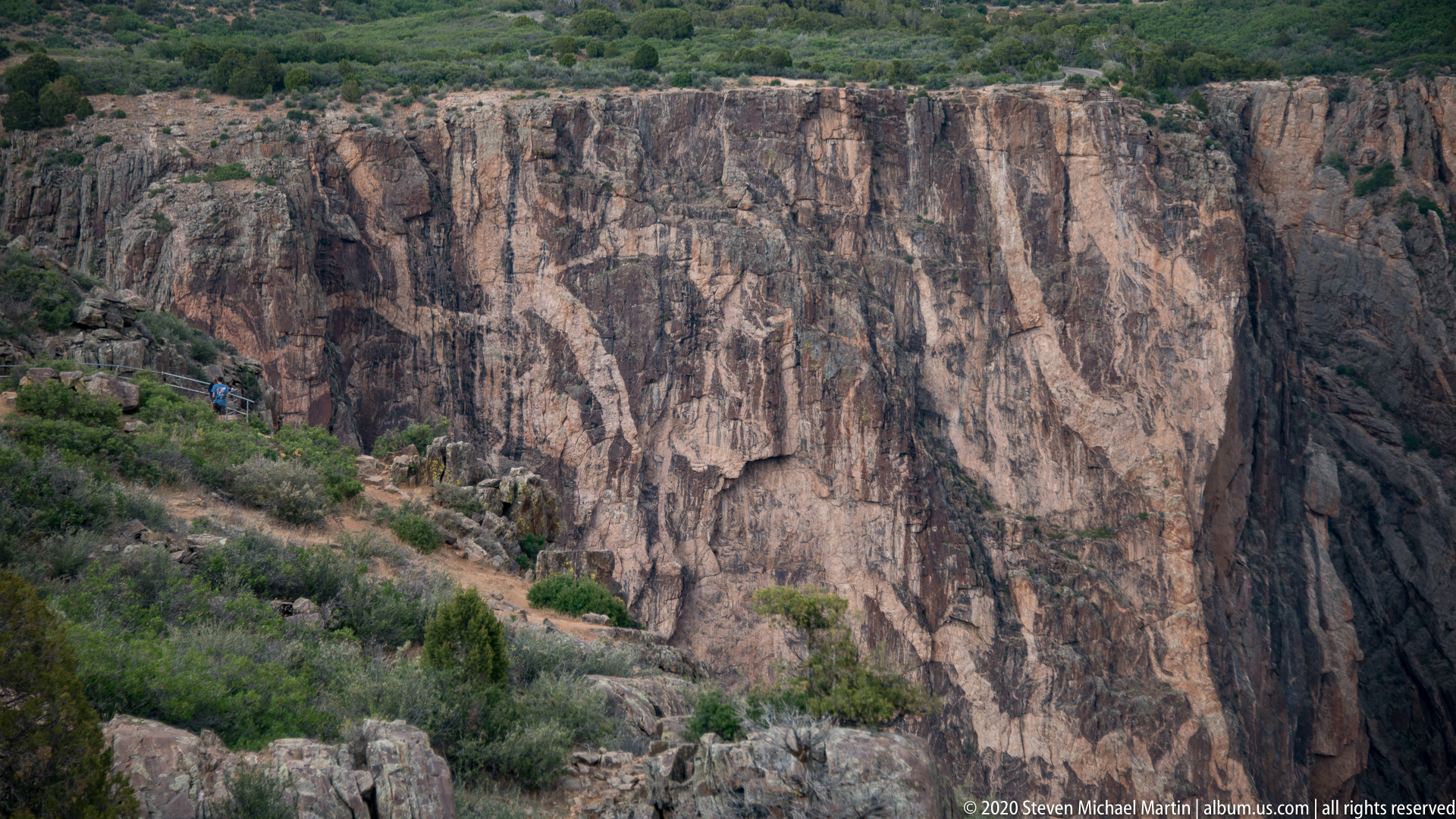
Two small visitors in bright clothing move along a narrow trail at the foot of a towering canyon wall. Their scale contrasts with the sheer, fractured rock face, which fills most of the frame. Shrubs and boulders line the near slope, while the opposite edge of the gorge is largely outside the composition.
Caption
Two small visitors in bright clothing move along a narrow trail at the foot of a towering canyon wall. Their scale contrasts with the sheer, fractured rock face, which fills most of the frame. Shrubs and boulders line the near slope, while the opposite edge of the gorge is largely outside the composition.
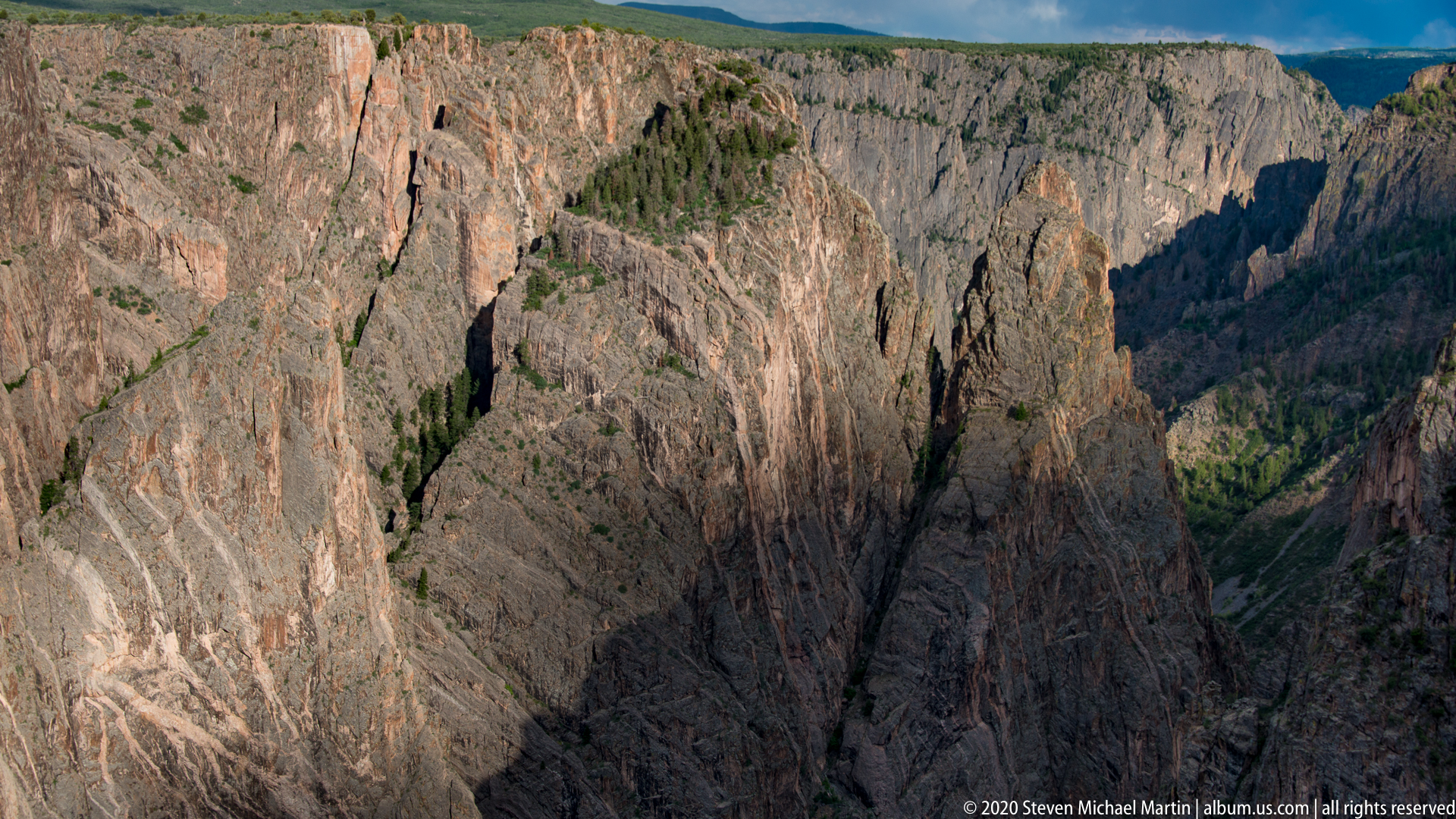
The viewpoint looks across fractured canyon walls to a narrow, shadowed gorge at right. Pale streaks and vertical seams cut through the dark gray and rose-colored rock, while evergreen trees cling to ledges and the rim. A strip of sky and plateau at the top provides scale for the steep, deeply incised terrain.
Caption
The viewpoint looks across fractured canyon walls to a narrow, shadowed gorge at right. Pale streaks and vertical seams cut through the dark gray and rose-colored rock, while evergreen trees cling to ledges and the rim. A strip of sky and plateau at the top provides scale for the steep, deeply incised terrain.
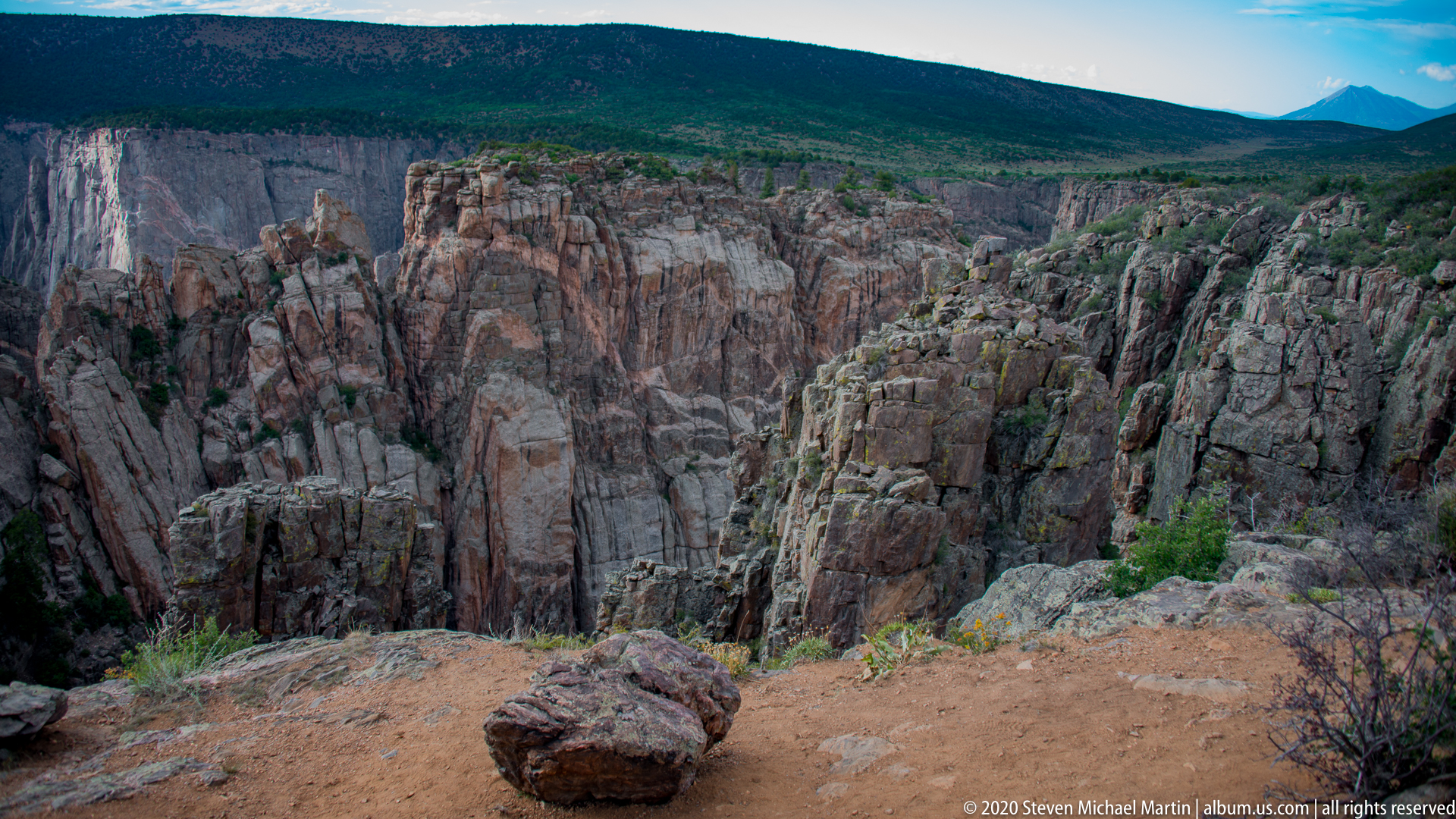
A rounded boulder rests on bare ground at the overlook’s edge, leading the eye toward the canyon’s steep, densely fractured walls. A narrow river is faintly visible far below among scattered trees. The foreground rock provides a human-scale reference against the immense vertical cliffs, while the view angles down into a constricted section of the gorge.
Caption
A rounded boulder rests on bare ground at the overlook’s edge, leading the eye toward the canyon’s steep, densely fractured walls. A narrow river is faintly visible far below among scattered trees. The foreground rock provides a human-scale reference against the immense vertical cliffs, while the view angles down into a constricted section of the gorge.

The canyon narrows sharply between tall, rough-textured walls, with the river hidden in shadow near the bottom. Shrubs and small trees line the near rim and a few ledges, but most of the view is stone. The elevated perspective reveals the immense vertical drop and the close confinement of the gorge.
Caption
The canyon narrows sharply between tall, rough-textured walls, with the river hidden in shadow near the bottom. Shrubs and small trees line the near rim and a few ledges, but most of the view is stone. The elevated perspective reveals the immense vertical drop and the close confinement of the gorge.
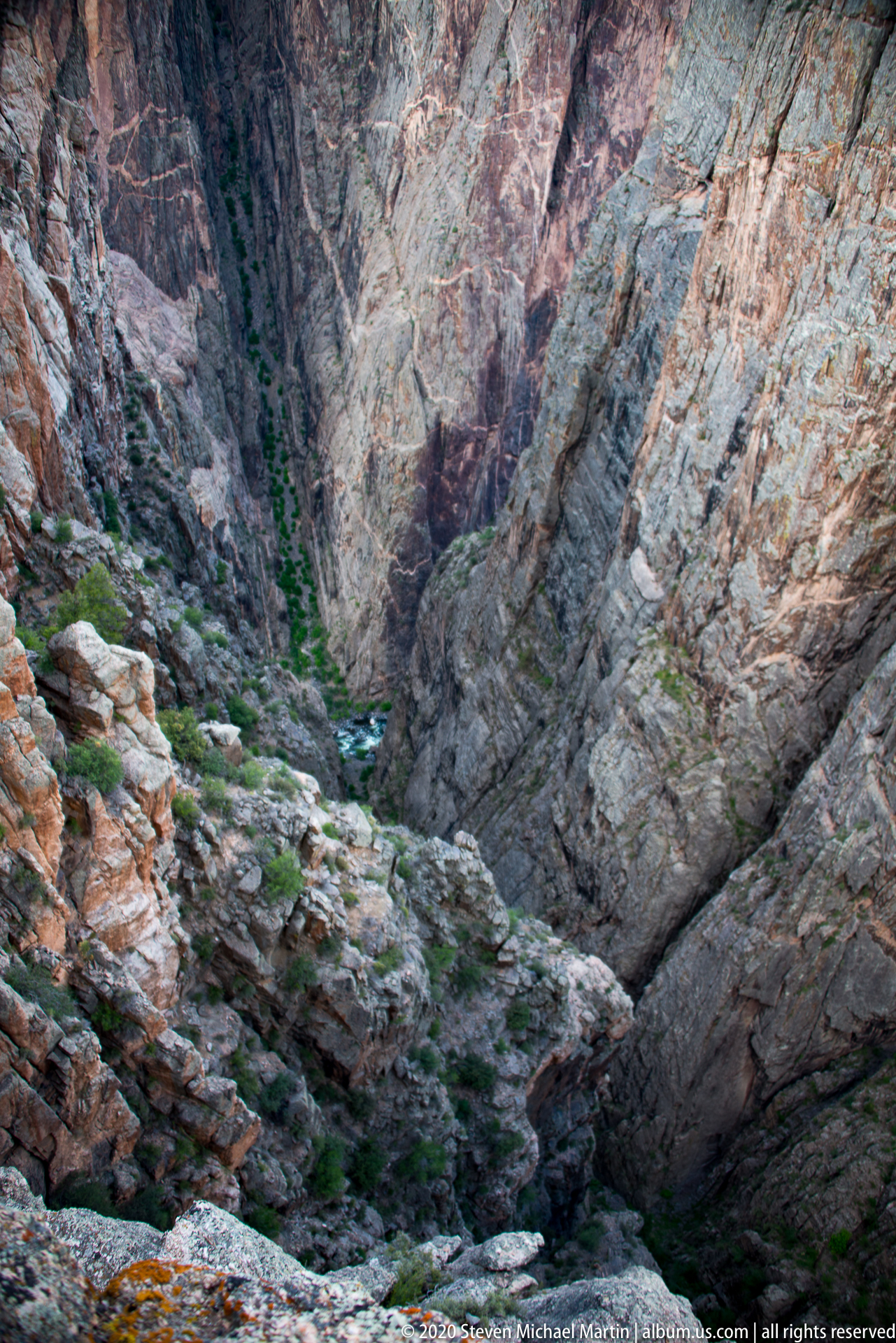
The camera looks down a steep drainage where a thin stream threads between angular boulders and pale slabs. Gray and rust-stained walls rise tightly on both sides, with small patches of greenery in the deepest crevice. This close downward view shifts attention from the canyon’s broad scale to the rugged channel carved within it.
Caption
The camera looks down a steep drainage where a thin stream threads between angular boulders and pale slabs. Gray and rust-stained walls rise tightly on both sides, with small patches of greenery in the deepest crevice. This close downward view shifts attention from the canyon’s broad scale to the rugged channel carved within it.
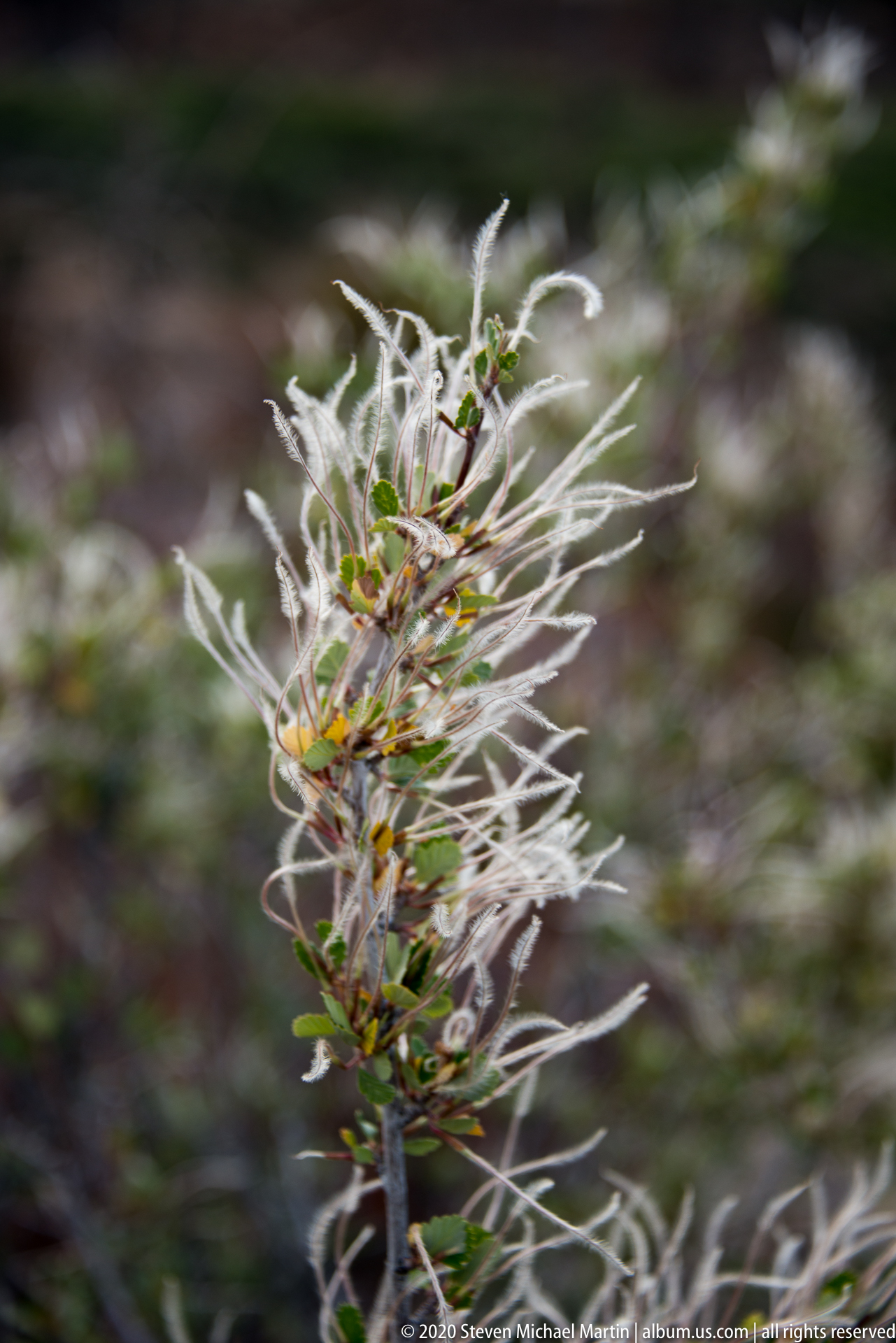
A single slender plant stands in sharp focus against a softly blurred canyon-floor background. Its narrow leaves and feathery pale seed heads spread from the central stem, with a small yellow bloom or seed structure near the top. The close view isolates a modest piece of vegetation among the park’s larger rock formations without asserting a species.
Caption
A single slender plant stands in sharp focus against a softly blurred canyon-floor background. Its narrow leaves and feathery pale seed heads spread from the central stem, with a small yellow bloom or seed structure near the top. The close view isolates a modest piece of vegetation among the park’s larger rock formations without asserting a species.
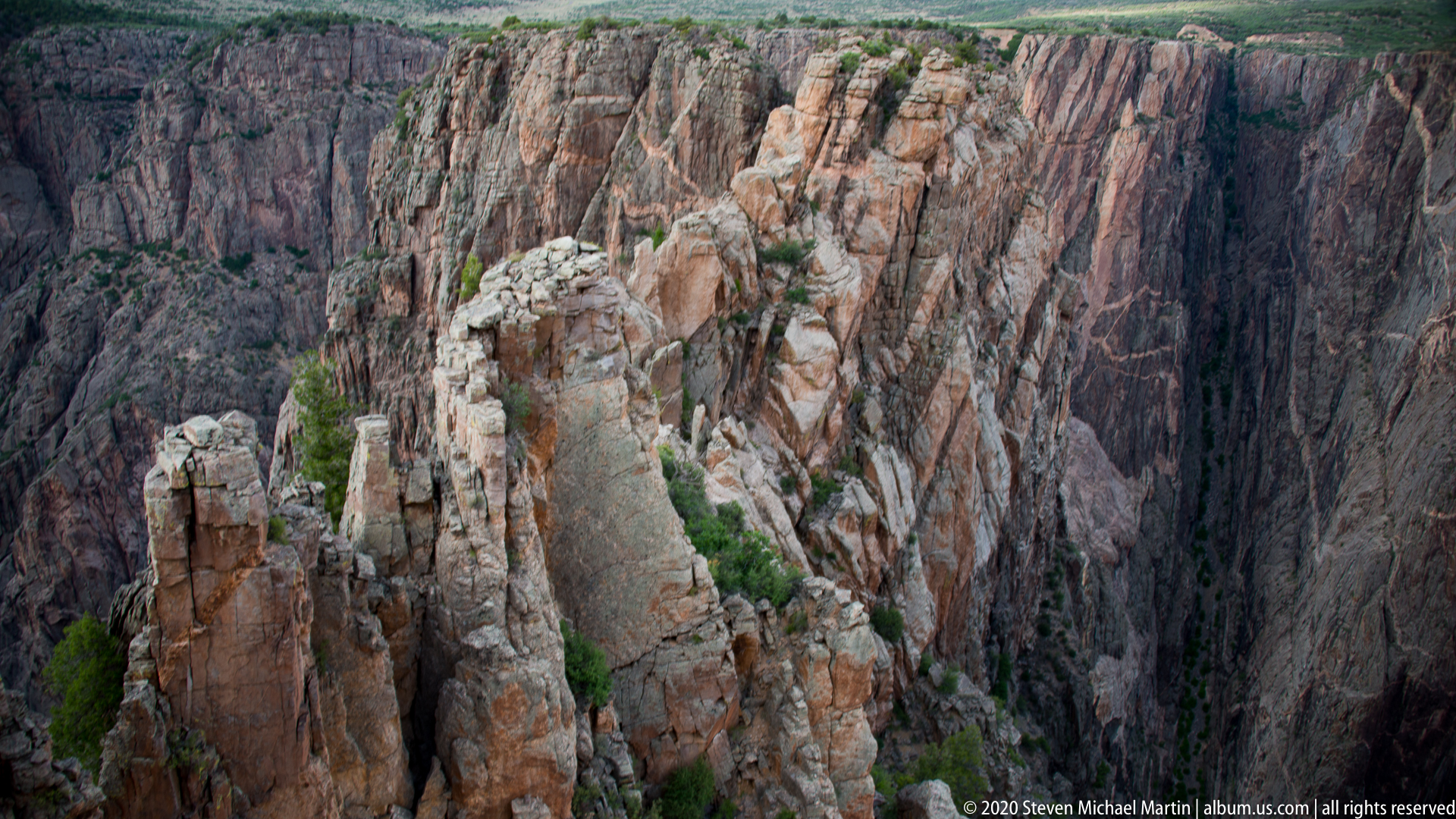
Tall, fractured canyon walls fill the frame, with pale mineral bands and dark vertical seams running through reddish and gray stone. Small evergreen trees grow from ledges and crevices, emphasizing the scale of the rock face. The steep angle looks across the inner gorge rather than out toward a distant horizon.
Caption
Tall, fractured canyon walls fill the frame, with pale mineral bands and dark vertical seams running through reddish and gray stone. Small evergreen trees grow from ledges and crevices, emphasizing the scale of the rock face. The steep angle looks across the inner gorge rather than out toward a distant horizon.
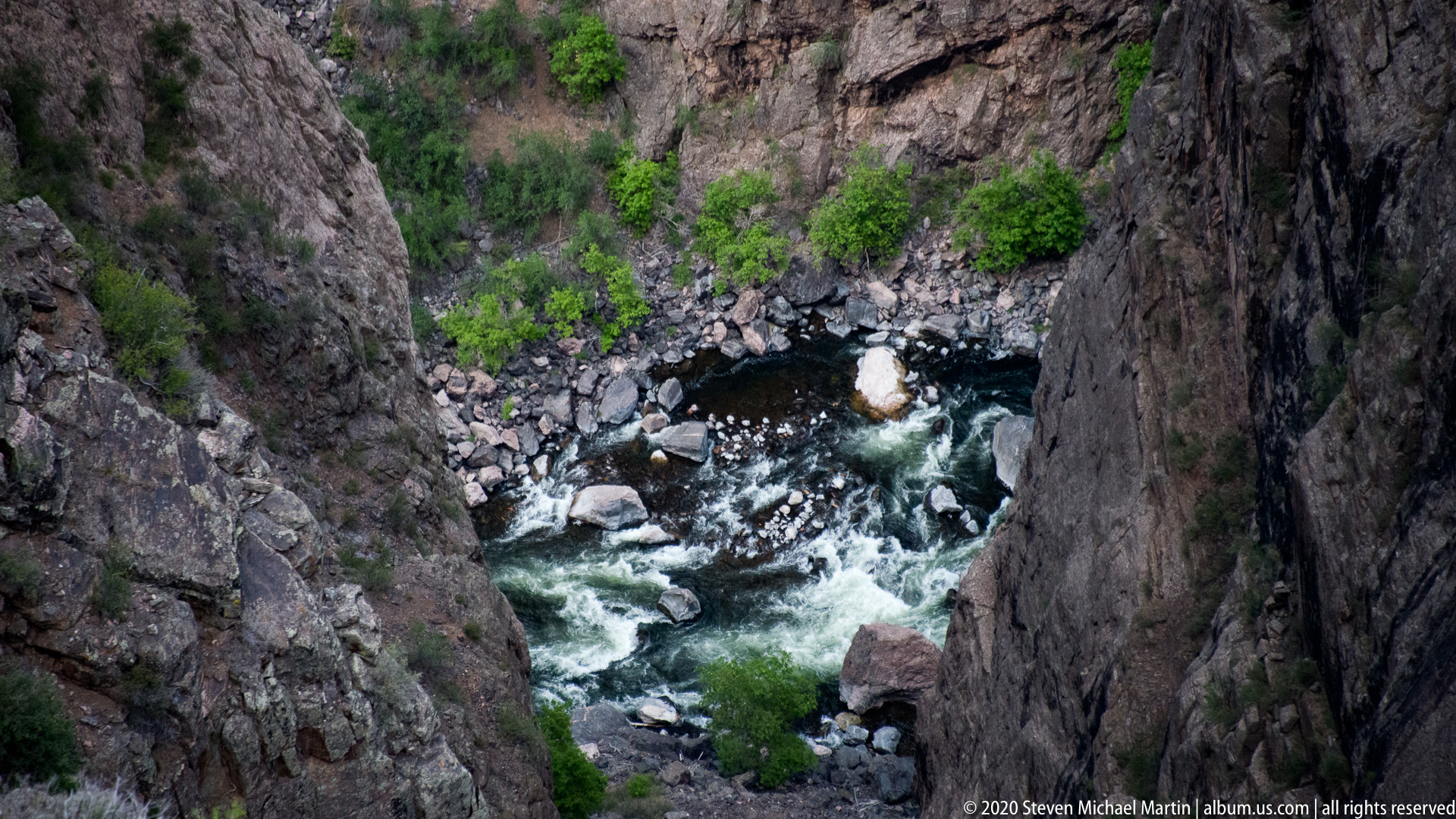
A turbulent section of the Gunnison River churns around large boulders at the bottom of the canyon. White foam breaks across dark water, while green shrubs cling to narrow shelves above the channel. The steep, enclosing walls limit the view to a small pocket of river, conveying how little open ground remains at the gorge floor.
Caption
A turbulent section of the Gunnison River churns around large boulders at the bottom of the canyon. White foam breaks across dark water, while green shrubs cling to narrow shelves above the channel. The steep, enclosing walls limit the view to a small pocket of river, conveying how little open ground remains at the gorge floor.
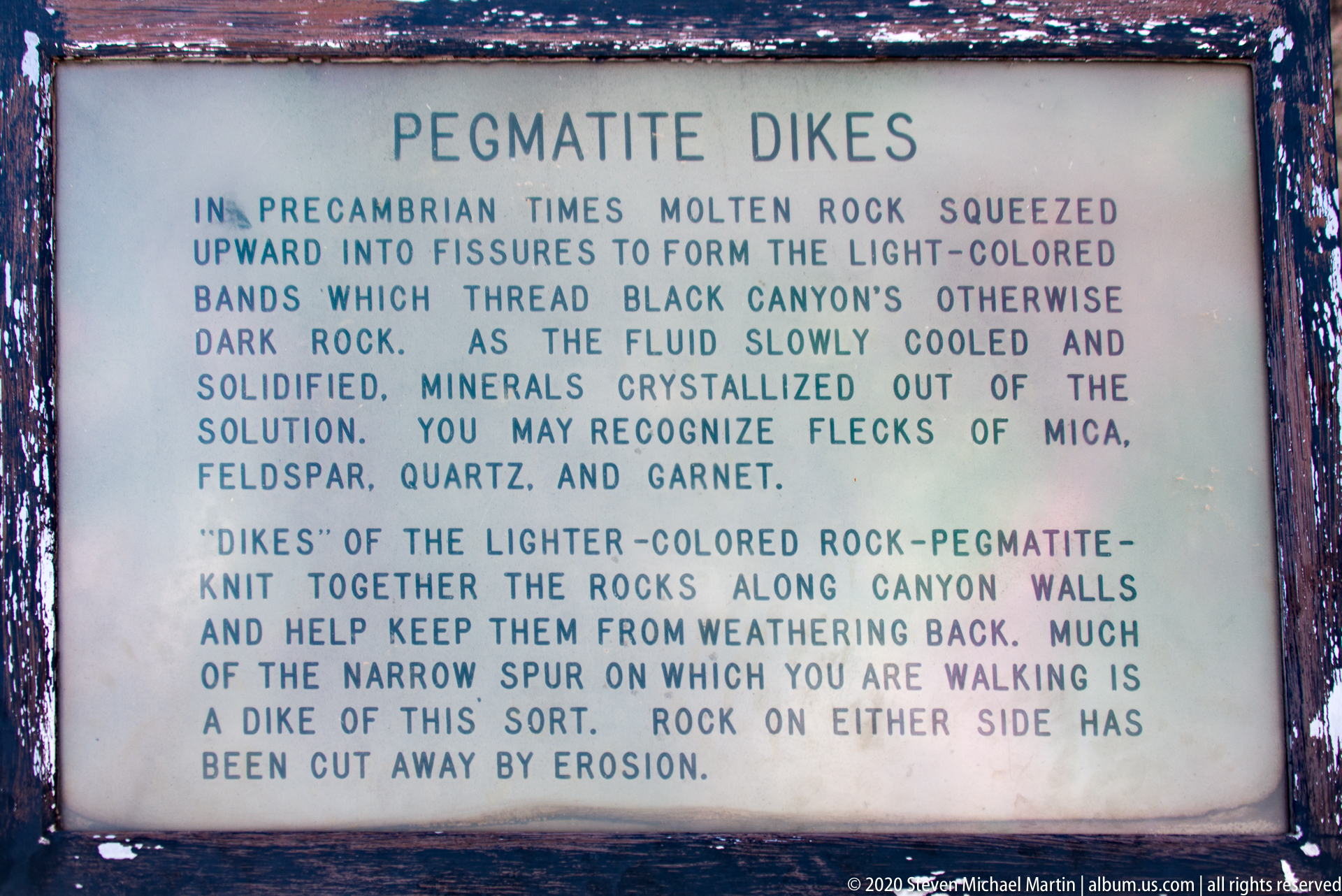
The close view centers an interpretive sign headed “Pegmatite Dikes.” Its text explains that molten rock entered fissures in older dark rock, cooled, and crystallized into light-colored bands containing minerals such as mica, feldspar, quartz, and garnet. The sign also notes that erosion has exposed the dikes along the canyon walls, linking geology to the visible landscape.
Caption
The close view centers an interpretive sign headed “Pegmatite Dikes.” Its text explains that molten rock entered fissures in older dark rock, cooled, and crystallized into light-colored bands containing minerals such as mica, feldspar, quartz, and garnet. The sign also notes that erosion has exposed the dikes along the canyon walls, linking geology to the visible landscape.
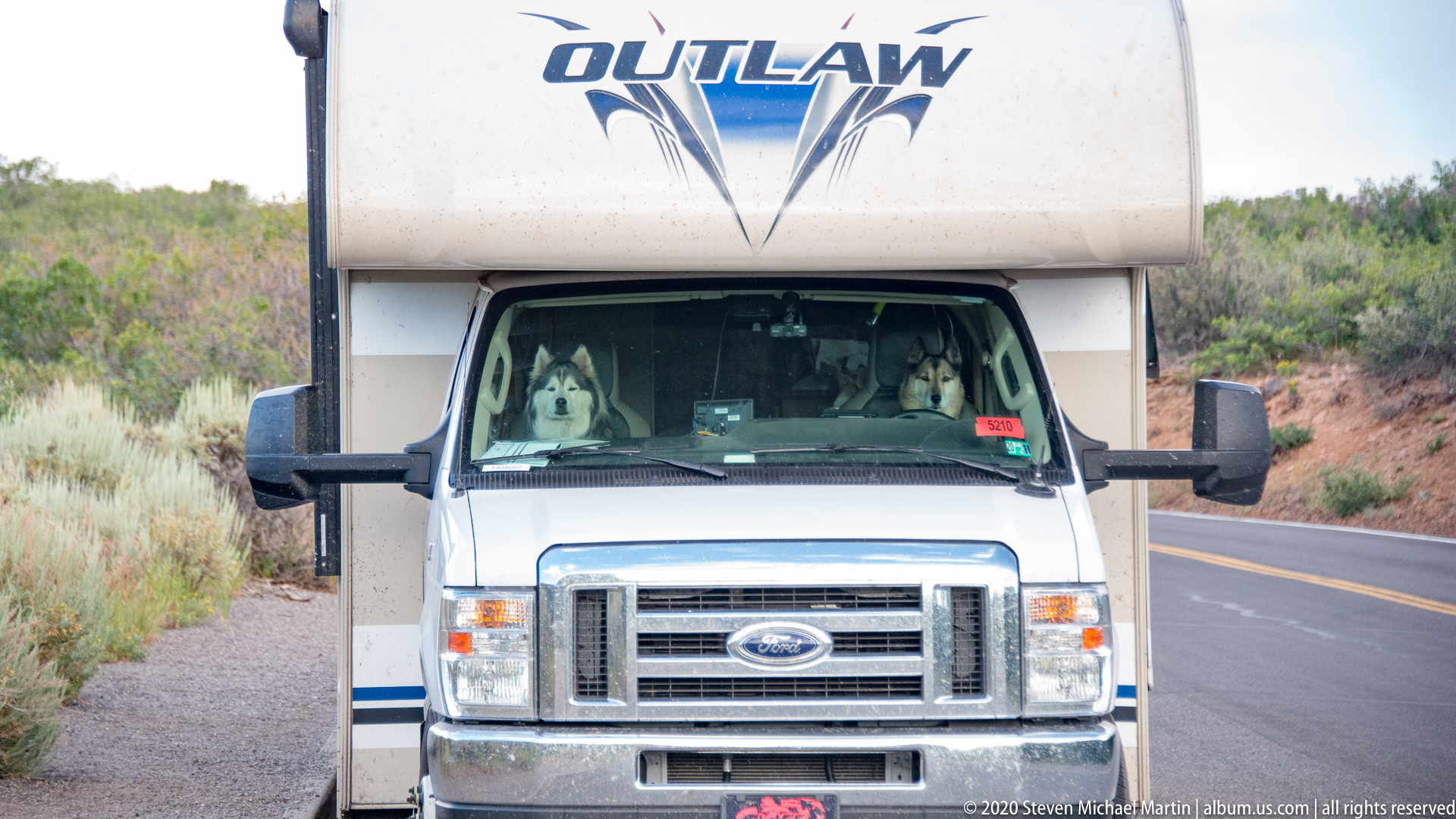
A white motorhome is parked beside the road, with two dogs sitting behind its wide windshield and looking outward. The vehicle’s front grille, side mirrors, and bold “Outlaw” lettering are visible, while scrub-covered terrain and the paved road frame the scene. The dogs’ placement turns a roadside vehicle portrait into a view of visitors traveling with pets.
Caption
A white motorhome is parked beside the road, with two dogs sitting behind its wide windshield and looking outward. The vehicle’s front grille, side mirrors, and bold “Outlaw” lettering are visible, while scrub-covered terrain and the paved road frame the scene. The dogs’ placement turns a roadside vehicle portrait into a view of visitors traveling with pets.
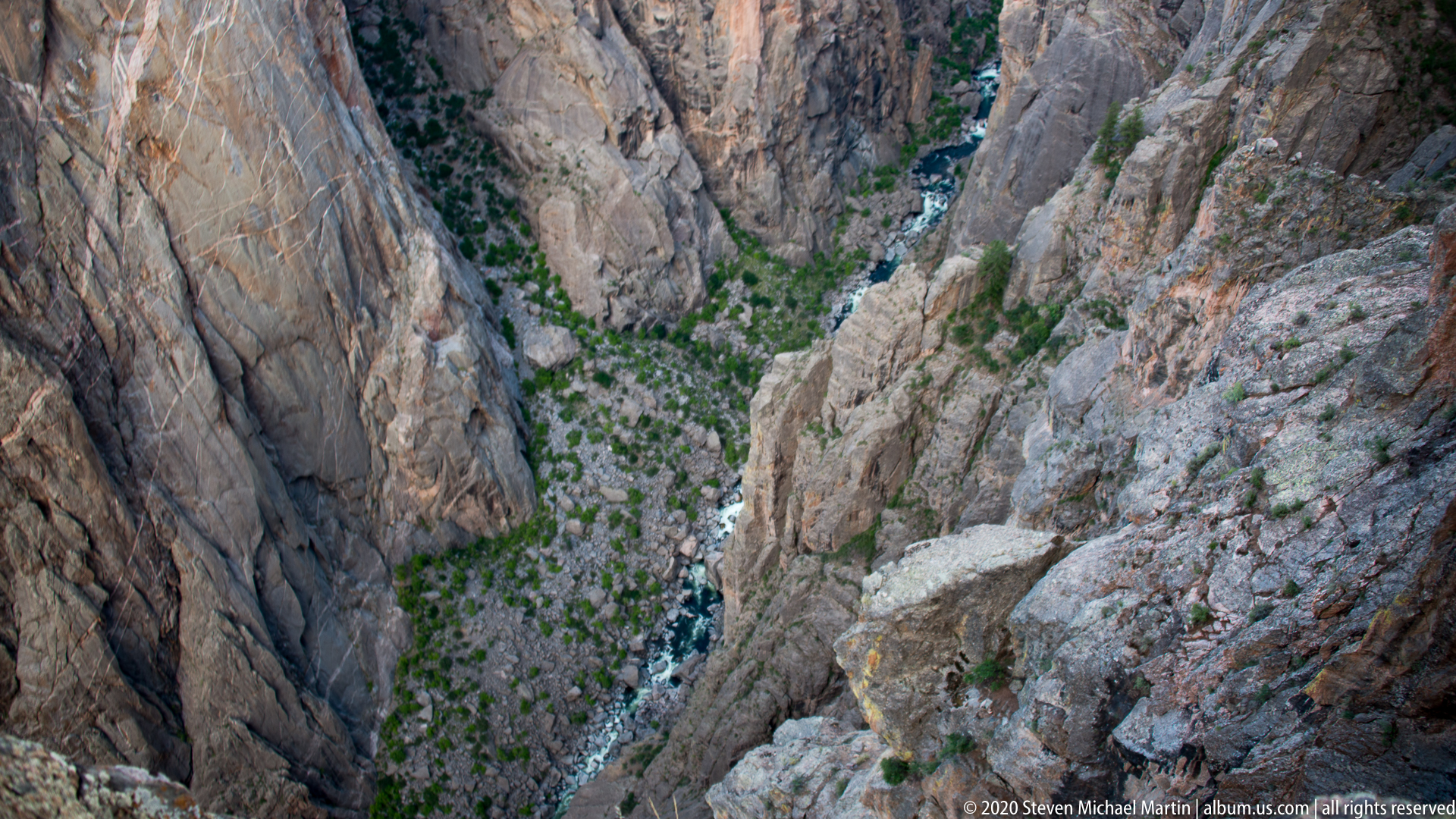
The camera looks almost straight down into a narrow section of canyon where a small river winds between towering, broken walls. Pale rock shelves and sparse trees interrupt the steep slopes, while the water appears as a thin dark line near the center. This high-angle view conveys the depth and confinement of the inner gorge.
Caption
The camera looks almost straight down into a narrow section of canyon where a small river winds between towering, broken walls. Pale rock shelves and sparse trees interrupt the steep slopes, while the water appears as a thin dark line near the center. This high-angle view conveys the depth and confinement of the inner gorge.
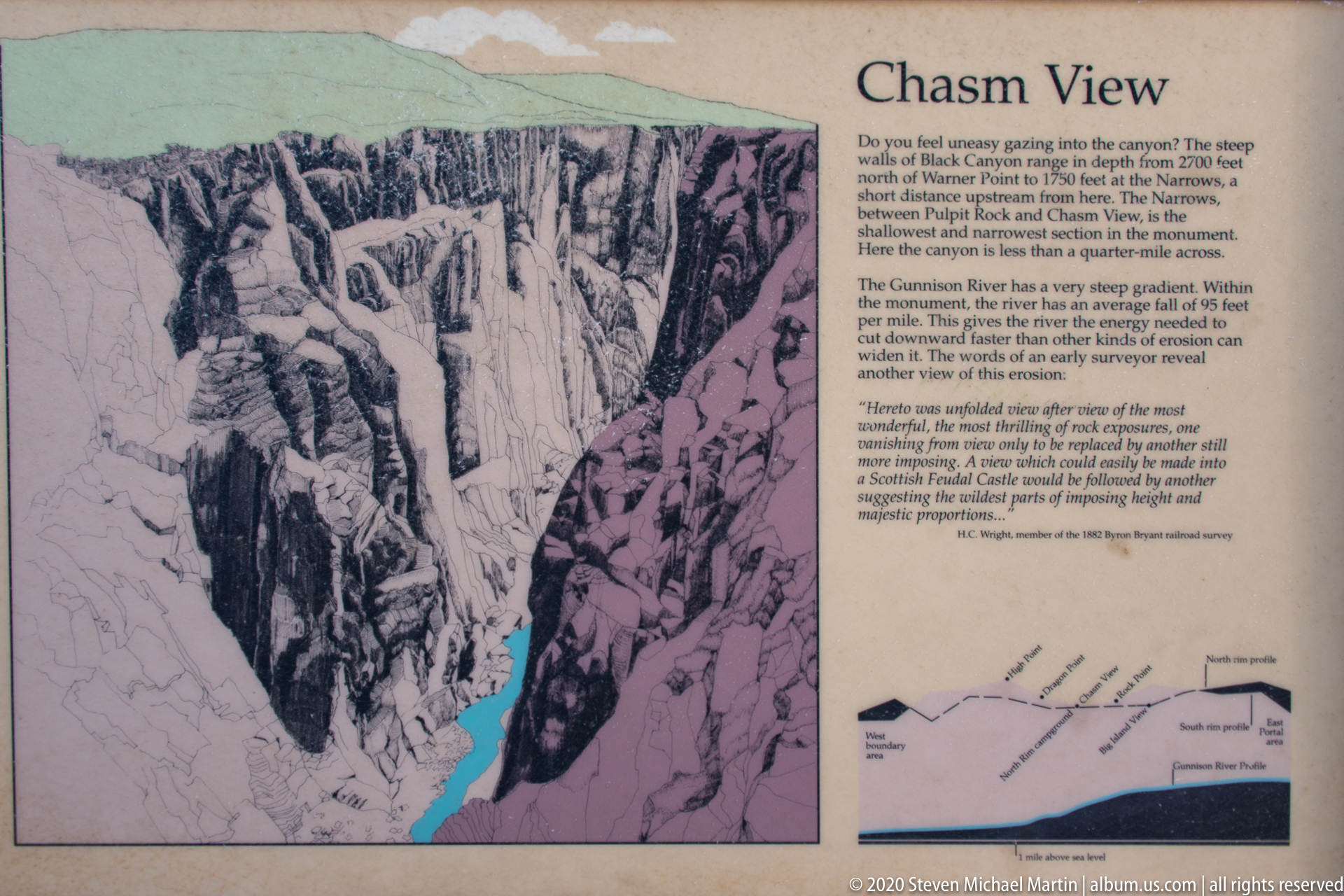
The panel titled “Chasm View” pairs a shaded canyon illustration with text about the steep walls and rapid descent of the Gunnison River. A simple cross-section diagram along the bottom compares the canyon’s depth with the surrounding rim. The photograph records the park’s interpretation of the overlook and the immense vertical relief visitors see from this point.
Caption
The panel titled “Chasm View” pairs a shaded canyon illustration with text about the steep walls and rapid descent of the Gunnison River. A simple cross-section diagram along the bottom compares the canyon’s depth with the surrounding rim. The photograph records the park’s interpretation of the overlook and the immense vertical relief visitors see from this point.
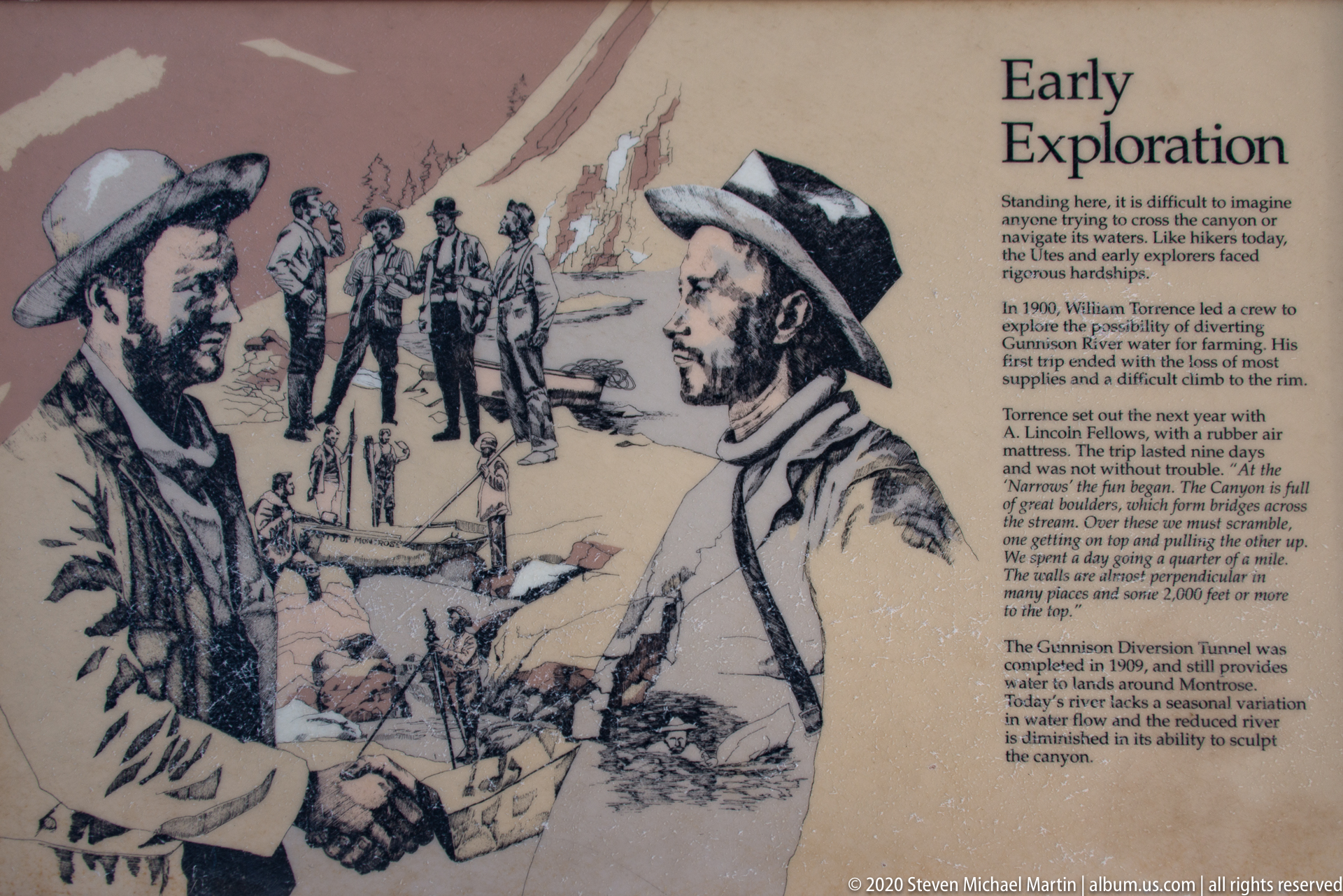
An interpretive panel titled “Early Exploration” combines an illustrated scene of men in the canyon with text about early expeditions. The drawing shows figures in period clothing and broad-brimmed hats examining the rugged terrain, while the text describes the challenges of travel and exploration. The image presents a park history topic rather than a direct landscape view.
Caption
An interpretive panel titled “Early Exploration” combines an illustrated scene of men in the canyon with text about early expeditions. The drawing shows figures in period clothing and broad-brimmed hats examining the rugged terrain, while the text describes the challenges of travel and exploration. The image presents a park history topic rather than a direct landscape view.
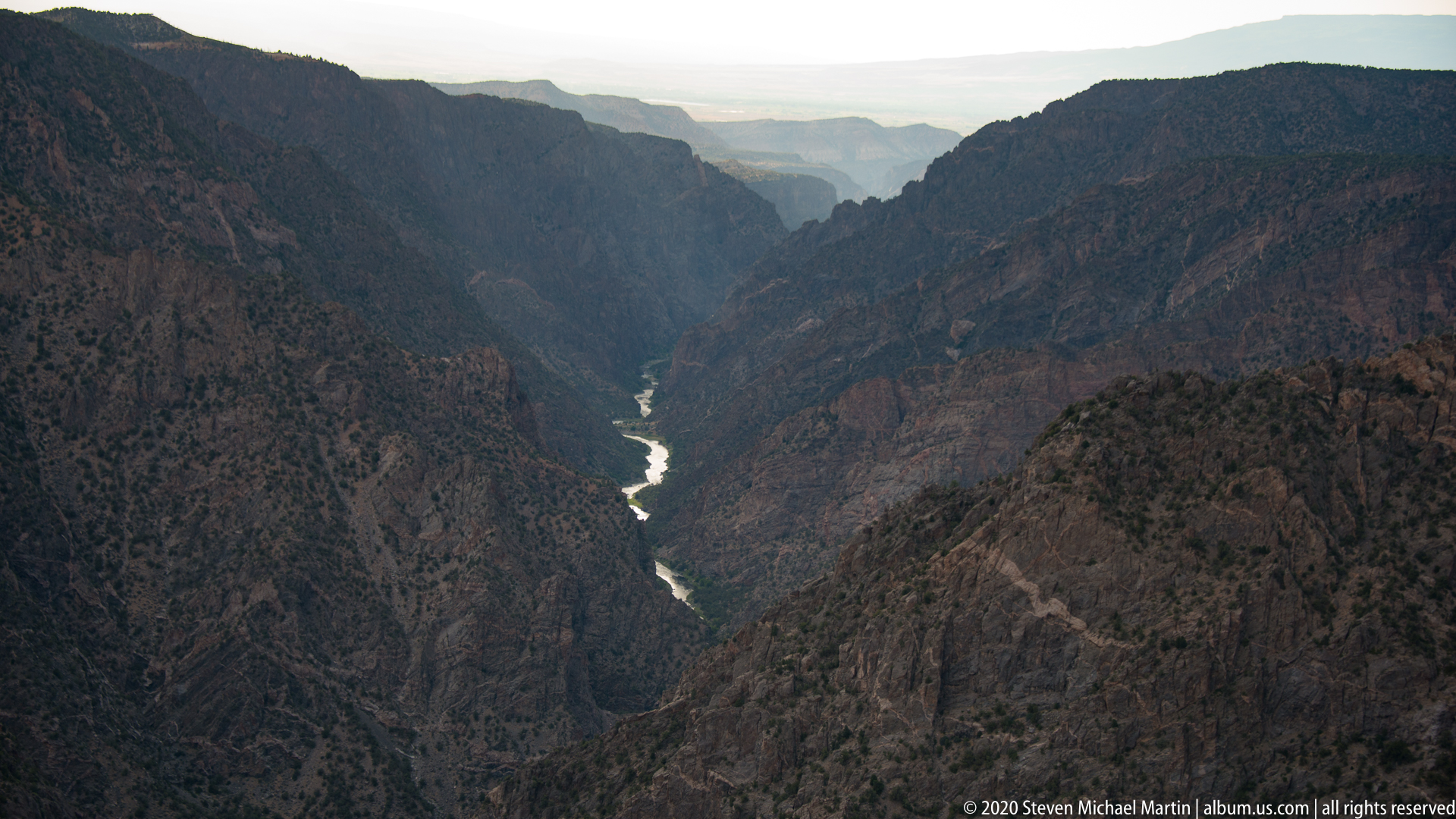
The view follows a winding river through a long canyon corridor, with dark slopes filling both sides and successive ridges fading into haze. The river catches light near the center before disappearing into the distance. Atmospheric softness reduces detail along the far walls, distinguishing this expansive panorama from the tighter canyon views on the preceding sheet.
Caption
The view follows a winding river through a long canyon corridor, with dark slopes filling both sides and successive ridges fading into haze. The river catches light near the center before disappearing into the distance. Atmospheric softness reduces detail along the far walls, distinguishing this expansive panorama from the tighter canyon views on the preceding sheet.
Black Canyon of the Gunnison National Park — Field Guide
National Park Field Guide
📍 Overview
Black Canyon of the Gunnison National Park preserves a steep and deeply incised canyon carved by the Gunnison River through hard metamorphic and igneous rock. The canyon differs from many Colorado Plateau landscapes in that its walls are formed not from layered sandstone, but from much older crystalline rock shaped by river erosion and structural weakness. The result is a narrow and shadowed canyon with striking vertical relief.
The dark appearance of the canyon comes from both the rock itself and the limited sunlight that reaches portions of the inner gorge. Gneiss, schist, and pegmatite exposures reveal an older geological foundation that contrasts with the sedimentary formations more commonly associated with canyon country. The park illustrates how river systems can create dramatic landforms even in extremely resistant bedrock.
⭐ Highlights
- Steep inner gorge carved by the Gunnison River
- Dark metamorphic canyon walls with dramatic vertical relief
- Overlooks revealing one of the narrowest canyon profiles in the West
- Precambrian rock exposures contrasting with plateau sandstone landscapes
- Powerful visual relationship between river erosion and hard bedrock
🔎 Key Features
- Metamorphic and igneous canyon walls
- Narrow gorge shaped by river incision
- Dark rock surfaces and shadowed canyon depths
- Geological contrast with surrounding sedimentary regions
- High overlooks emphasizing depth and steepness
📷 Photography Notes
- Early and late light can bring out texture on the dark canyon walls
- Wide compositions help convey depth and steepness
- Foreground rock or trees can provide useful scale
- Changing light creates strong contrast between sunlit rims and shadowed gorge
- Overlook compositions work well for showing the canyon’s narrow profile
- Simple framing often best emphasizes the power of the landscape
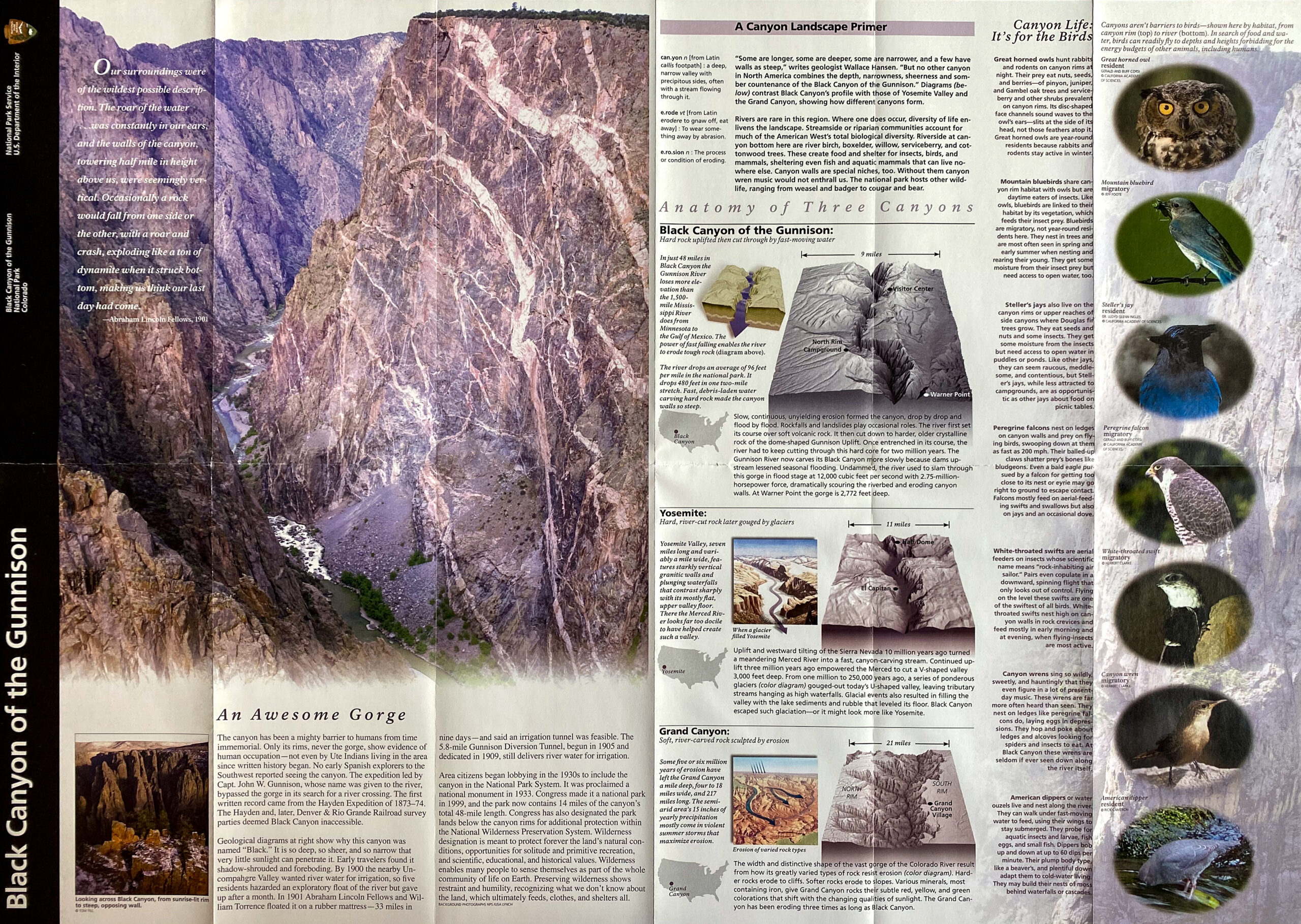
An open National Park Service interpretive spread titled “Black Canyon of the Gunnison” presents the gorge through photographs, explanatory text, diagrams, and maps. The visible heading “An Awesome Gorge” introduces material about the canyon’s landscape and formation, while a column of wildlife images runs along the right side. The printed layout brings geology and natural history together.
Caption
An open National Park Service interpretive spread titled “Black Canyon of the Gunnison” presents the gorge through photographs, explanatory text, diagrams, and maps. The visible heading “An Awesome Gorge” introduces material about the canyon’s landscape and formation, while a column of wildlife images runs along the right side. The printed layout brings geology and natural history together.

A folded park map displays shaded relief around Black Canyon of the Gunnison National Park, with a green boundary, roads, watercourses, and labeled visitor areas. Insets and a legend occupy parts of the map, while the main panel situates the protected area within the surrounding terrain. The view documents the park’s printed visitor map.
Caption
A folded park map displays shaded relief around Black Canyon of the Gunnison National Park, with a green boundary, roads, watercourses, and labeled visitor areas. Insets and a legend occupy parts of the map, while the main panel situates the protected area within the surrounding terrain. The view documents the park’s printed visitor map.