Goosenecks Overlook – Capitol Reef National Park
Goosenecks Overlook provides views of deeply incised canyon bends carved by the Sulphur Creek drainage system within Capitol Reef National Park. The winding curves of the canyon illustrate the long-term effects of water erosion acting upon uplifted rock layers of the Colorado Plateau. The resulting formations demonstrate the interaction between tectonic uplift and river incision.
Layered sedimentary rock reveals variations in geological deposition over millions of years. The canyon’s sinuous path reflects gradual shifts in water flow that produced distinctive bends and narrow channels. The overlook highlights the relationship between geological structure and erosional processes that continue to shape the landscape.
Visitors encounter dramatic views into canyon depths that emphasize both scale and geological complexity. The exposed rock layers and winding formations illustrate the visual impact of long-term natural forces operating across the plateau environment.

The stone facade bears the large inscription “Capitol Reef National Park” and “Visitor Center,” while the Castle’s red spires rise behind the roofline. Snow covers the ground at the base of the wall and along the nearby slope. This closer architectural view makes the park identification legible and places the visitor center directly beneath the formation.
Caption
The stone facade bears the large inscription “Capitol Reef National Park” and “Visitor Center,” while the Castle’s red spires rise behind the roofline. Snow covers the ground at the base of the wall and along the nearby slope. This closer architectural view makes the park identification legible and places the visitor center directly beneath the formation.

A broad winter view opens across low, deeply eroded red-rock benches beneath a sky filled with broken clouds. Snow traces the ridges and drainage lines, while scattered desert shrubs mark the foreground; the layered plateau continues across the horizon, giving this photograph a wide, open scale.
Caption
A broad winter view opens across low, deeply eroded red-rock benches beneath a sky filled with broken clouds. Snow traces the ridges and drainage lines, while scattered desert shrubs mark the foreground; the layered plateau continues across the horizon, giving this photograph a wide, open scale.

An interpretive panel pairs a photograph of the canyon with labels for the Moenkopi Formation, Kaibab Limestone, and White Rim Sandstone; Sulphur Creek is marked along the lower edge. A dashed line and inset image help relate the named units to the landscape. The panel presents a layered geological explanation, though its smaller paragraph text is not readable at this proof-sheet scale.
Caption
An interpretive panel pairs a photograph of the canyon with labels for the Moenkopi Formation, Kaibab Limestone, and White Rim Sandstone; Sulphur Creek is marked along the lower edge. A dashed line and inset image help relate the named units to the landscape. The panel presents a layered geological explanation, though its smaller paragraph text is not readable at this proof-sheet scale.

An expansive winter vista opens over snow-covered benches toward a long line of red cliffs and mesas. Dark junipers form a broken band across the foreground, while pale sedimentary layers catch light across the distance. The broad horizontal framing emphasizes the scale and continuity of the reef landscape.
Caption
An expansive winter vista opens over snow-covered benches toward a long line of red cliffs and mesas. Dark junipers form a broken band across the foreground, while pale sedimentary layers catch light across the distance. The broad horizontal framing emphasizes the scale and continuity of the reef landscape.

A printed park map fills the frame, tracing roads, trails, boundaries, and named districts across Capitol Reef and neighboring public lands. The “You are here” marker points toward the western park area, while a north arrow and scale help orient the dense network. This is a geographic reference view rather than a landscape photograph.
Caption
A printed park map fills the frame, tracing roads, trails, boundaries, and named districts across Capitol Reef and neighboring public lands. The “You are here” marker points toward the western park area, while a north arrow and scale help orient the dense network. This is a geographic reference view rather than a landscape photograph.

A shallow stream runs through the foreground between snowy banks and a low, undercut edge. Leafless trees and dry grasses line the water, with rounded pale cliffs rising behind them in warm light. The moving water introduces a narrow riparian scene among the portfolio’s canyon views.
Caption
A shallow stream runs through the foreground between snowy banks and a low, undercut edge. Leafless trees and dry grasses line the water, with rounded pale cliffs rising behind them in warm light. The moving water introduces a narrow riparian scene among the portfolio’s canyon views.

Low park buildings sit beneath the towering red rock formation known as The Castle, with a United States flag flying at the right. Snow covers the ground around the stone-faced visitor center and the surrounding cliffs. The foreground structures establish a developed visitor area against the dramatic natural wall rising immediately behind them.
Caption
Low park buildings sit beneath the towering red rock formation known as The Castle, with a United States flag flying at the right. Snow covers the ground around the stone-faced visitor center and the surrounding cliffs. The foreground structures establish a developed visitor area against the dramatic natural wall rising immediately behind them.

A wide sweep of snow-covered ridges and cliffs stretches from left to right beneath a dramatic cloud bank. Low junipers punctuate the foreground, while alternating pale and red rock bands reveal the layered terrain. The panoramic framing makes the long, broken skyline the photograph’s defining feature.
Caption
A wide sweep of snow-covered ridges and cliffs stretches from left to right beneath a dramatic cloud bank. Low junipers punctuate the foreground, while alternating pale and red rock bands reveal the layered terrain. The panoramic framing makes the long, broken skyline the photograph’s defining feature.

A sunlit red butte rises above a snow-dusted basin, its steep face cut by vertical fissures and horizontal ledges. Pale strata wrap around its base and extend into the surrounding cliffs. The contrast between warm sandstone and fresh snow gives this closer view a sculptural emphasis.
Caption
A sunlit red butte rises above a snow-dusted basin, its steep face cut by vertical fissures and horizontal ledges. Pale strata wrap around its base and extend into the surrounding cliffs. The contrast between warm sandstone and fresh snow gives this closer view a sculptural emphasis.

A massive, flat-topped sandstone butte dominates this closer composition, with snow collected along its summit and ledges. Lower cream and red bands step across the foreground, while darker vegetation anchors the bottom edge. The framing isolates the butte against a muted winter sky.
Caption
A massive, flat-topped sandstone butte dominates this closer composition, with snow collected along its summit and ledges. Lower cream and red bands step across the foreground, while darker vegetation anchors the bottom edge. The framing isolates the butte against a muted winter sky.

A wayside panel titled “Welcome to Capitol Reef” combines a park map with landscape photographs and visitor guidance. Snow on the ground and the surrounding outdoor setting place the sign at a winter viewpoint. The photograph records how orientation, natural history, and park rules are presented together to visitors.
Caption
A wayside panel titled “Welcome to Capitol Reef” combines a park map with landscape photographs and visitor guidance. Snow on the ground and the surrounding outdoor setting place the sign at a winter viewpoint. The photograph records how orientation, natural history, and park rules are presented together to visitors.

Tall, narrow sandstone pinnacles rise from a pale, snow-covered slope, their horizontal bedding emphasized by alternating bands of rock and snow. A larger cliff wall frames the right side, while open blue sky gives the towers room above. The low viewpoint accentuates their height and clustered forms.
Caption
Tall, narrow sandstone pinnacles rise from a pale, snow-covered slope, their horizontal bedding emphasized by alternating bands of rock and snow. A larger cliff wall frames the right side, while open blue sky gives the towers room above. The low viewpoint accentuates their height and clustered forms.

A visitor in a winter jacket stands on a snow-covered sandstone ledge, holding a camera at chest height. Behind him, the broad canyon rim and layered red cliffs recede across the frame. His figure provides scale for the overlook and makes this image a human-centered counterpart to the surrounding empty vistas.
Caption
A visitor in a winter jacket stands on a snow-covered sandstone ledge, holding a camera at chest height. Behind him, the broad canyon rim and layered red cliffs recede across the frame. His figure provides scale for the overlook and makes this image a human-centered counterpart to the surrounding empty vistas.

From a high rim, the view looks down into a deep canyon of curving, banded cliffs. Snow fills shelves and drainage slopes, separating dark red walls from pale strata. The steep downward angle reveals the canyon’s nested contours and gives this photograph a stronger sense of depth than the distant panoramas.
Caption
From a high rim, the view looks down into a deep canyon of curving, banded cliffs. Snow fills shelves and drainage slopes, separating dark red walls from pale strata. The steep downward angle reveals the canyon’s nested contours and gives this photograph a stronger sense of depth than the distant panoramas.

A sweeping bend in the canyon occupies the center of this high-angle view, its red and pale rock bands curling around a snow-filled basin. Junipers dot the slopes, and a sunlit wall rises at the right edge. The stronger diagonal sweep distinguishes this composition from the tighter canyon view nearby.
Caption
A sweeping bend in the canyon occupies the center of this high-angle view, its red and pale rock bands curling around a snow-filled basin. Junipers dot the slopes, and a sunlit wall rises at the right edge. The stronger diagonal sweep distinguishes this composition from the tighter canyon view nearby.

Snow-covered slabs and broken red rock form a rough foreground ledge above a deep, layered canyon. Beyond it, pale ridges and darker cliffs descend toward a narrow drainage. The near rocks create a strong frame, placing the viewer at the rim rather than above an uninterrupted panorama.
Caption
Snow-covered slabs and broken red rock form a rough foreground ledge above a deep, layered canyon. Beyond it, pale ridges and darker cliffs descend toward a narrow drainage. The near rocks create a strong frame, placing the viewer at the rim rather than above an uninterrupted panorama.

Several long, tapered icicles hang from a dark overhang, their ridged surfaces catching soft daylight. The shallow focus leaves the snowy ground and pale blue sky blurred behind them, isolating the ice as a small-scale winter detail amid the larger landscape sequence.
Caption
Several long, tapered icicles hang from a dark overhang, their ridged surfaces catching soft daylight. The shallow focus leaves the snowy ground and pale blue sky blurred behind them, isolating the ice as a small-scale winter detail amid the larger landscape sequence.

A row of pale sandstone spires rises above a snow-dusted roadside, with leafless trees and low brush at their base. The tallest narrow towers interrupt a longer stratified ridge, while the road edge appears at far left. Bright blue sky emphasizes the light-colored rock against the winter ground.
Caption
A row of pale sandstone spires rises above a snow-dusted roadside, with leafless trees and low brush at their base. The tallest narrow towers interrupt a longer stratified ridge, while the road edge appears at far left. Bright blue sky emphasizes the light-colored rock against the winter ground.

The “Capitol Reef National Park” entrance sign stands on a low masonry base against a winter landscape. Snow blankets the foreground, while red cliffs and a small roadside marker remain visible behind the structure. The centered sign makes the park designation explicit and anchors the view in place.
Caption
The “Capitol Reef National Park” entrance sign stands on a low masonry base against a winter landscape. Snow blankets the foreground, while red cliffs and a small roadside marker remain visible behind the structure. The centered sign makes the park designation explicit and anchors the view in place.

Two large caprocks sit atop narrower red sandstone pedestals, forming the paired shapes identified by a small “Twin Rocks” marker in the foreground. Snow patches cover the surrounding slope, and smaller boulders scatter across the base. The marker supports the formation’s name while the photograph emphasizes its balanced silhouette.
Caption
Two large caprocks sit atop narrower red sandstone pedestals, forming the paired shapes identified by a small “Twin Rocks” marker in the foreground. Snow patches cover the surrounding slope, and smaller boulders scatter across the base. The marker supports the formation’s name while the photograph emphasizes its balanced silhouette.

A paved two-lane road curves away through a snow-covered valley, drawing the eye toward red cliffs and a line of distant mesas. The clear yellow centerline and roadside delineators contrast with the white ground. Its low road-level perspective emphasizes travel through the park rather than a stationary overlook.
Caption
A paved two-lane road curves away through a snow-covered valley, drawing the eye toward red cliffs and a line of distant mesas. The clear yellow centerline and roadside delineators contrast with the white ground. Its low road-level perspective emphasizes travel through the park rather than a stationary overlook.

A mature evergreen juniper stands alone in a snowy clearing, its trunk twisting and splitting into exposed, contorted limbs. Smaller shrubs recede across the open ground, while the tree’s dense crown fills much of the upper frame. The close foreground placement highlights the tree’s sculptural form and rugged growth.
Caption
A mature evergreen juniper stands alone in a snowy clearing, its trunk twisting and splitting into exposed, contorted limbs. Smaller shrubs recede across the open ground, while the tree’s dense crown fills much of the upper frame. The close foreground placement highlights the tree’s sculptural form and rugged growth.

A broad mesa rises above a snow-dusted foreground, its nearly level summit and long horizontal strata set against a gray-blue sky. Dark red bands alternate with pale slopes, while broken slabs lie near the camera. This view emphasizes the park’s stepped relief and expansive, level-topped landforms.
Caption
A broad mesa rises above a snow-dusted foreground, its nearly level summit and long horizontal strata set against a gray-blue sky. Dark red bands alternate with pale slopes, while broken slabs lie near the camera. This view emphasizes the park’s stepped relief and expansive, level-topped landforms.

An interpretive panel diagrams the Waterpocket Fold, labeling formations and illustrating how rock layers bend and break along a fault. A landscape photograph and geologic cross-section connect the written explanation to the nearby terrain. The text makes the fold’s name and the panel’s educational purpose explicit.
Caption
An interpretive panel diagrams the Waterpocket Fold, labeling formations and illustrating how rock layers bend and break along a fault. A landscape photograph and geologic cross-section connect the written explanation to the nearby terrain. The text makes the fold’s name and the panel’s educational purpose explicit.

A pale caprock crowns a long red cliff, whose lower bands form closely spaced vertical ribs. Snow gathers in alcoves and ledges, accentuating the contrast between the softer-looking upper layer and darker base. The side-on view follows the cliff’s horizontal profile across most of the frame.
Caption
A pale caprock crowns a long red cliff, whose lower bands form closely spaced vertical ribs. Snow gathers in alcoves and ledges, accentuating the contrast between the softer-looking upper layer and darker base. The side-on view follows the cliff’s horizontal profile across most of the frame.

Closely spaced red sandstone ribs rise in a repeated sequence, their rounded vertical faces divided by horizontal bedding. Narrow streaks of snow cling to the ledges and gullies between them. The close crop removes most of the surrounding landscape, turning the cliff’s rhythm and texture into the central subject.
Caption
Closely spaced red sandstone ribs rise in a repeated sequence, their rounded vertical faces divided by horizontal bedding. Narrow streaks of snow cling to the ledges and gullies between them. The close crop removes most of the surrounding landscape, turning the cliff’s rhythm and texture into the central subject.

Clumps of fine, straw-colored grasses emerge through a deep blanket of snow, their thin stems fanning upward across the foreground. Scattered shrubs dot the gently rising slope behind them. The tight composition shifts attention from the park’s cliffs to the texture and persistence of winter vegetation.
Caption
Clumps of fine, straw-colored grasses emerge through a deep blanket of snow, their thin stems fanning upward across the foreground. Scattered shrubs dot the gently rising slope behind them. The tight composition shifts attention from the park’s cliffs to the texture and persistence of winter vegetation.

A steep ravine cuts through the snow-covered slope, exposing broken red ledges and blocky outcrops. Junipers and pale grasses cling to the edges, while the channel narrows toward the upper center. The oblique view shows erosion at close range, contrasting with the wider cliff panoramas on adjacent pages.
Caption
A steep ravine cuts through the snow-covered slope, exposing broken red ledges and blocky outcrops. Junipers and pale grasses cling to the edges, while the channel narrows toward the upper center. The oblique view shows erosion at close range, contrasting with the wider cliff panoramas on adjacent pages.

A wide view crosses a series of snowy plateaus and ridges beneath a heavy, dark cloud bank. Bands of orange, cream, and deep red rock run through the middle distance, while shadow covers the foreground. The changing light and layered horizon give this panorama a more atmospheric character than the sunlit views nearby.
Caption
A wide view crosses a series of snowy plateaus and ridges beneath a heavy, dark cloud bank. Bands of orange, cream, and deep red rock run through the middle distance, while shadow covers the foreground. The changing light and layered horizon give this panorama a more atmospheric character than the sunlit views nearby.

A long row of rounded red-rock ribs spans the middle of the frame, each separated by pale, snow-filled gullies. Above them, a smoother light-colored slope rises to a horizontal rim. The nearly frontal viewpoint compresses the forms into repeating bands and makes the regular erosion pattern especially clear.
Caption
A long row of rounded red-rock ribs spans the middle of the frame, each separated by pale, snow-filled gullies. Above them, a smoother light-colored slope rises to a horizontal rim. The nearly frontal viewpoint compresses the forms into repeating bands and makes the regular erosion pattern especially clear.

A narrow paved road bends around the lower-right foreground beneath a broad wall of snow-striped red cliffs. Junipers and rounded boulders punctuate the open slope, while distant mesas fade into a cloudy background. The road’s curve links the near terrain to the larger cliff-lined valley.
Caption
A narrow paved road bends around the lower-right foreground beneath a broad wall of snow-striped red cliffs. Junipers and rounded boulders punctuate the open slope, while distant mesas fade into a cloudy background. The road’s curve links the near terrain to the larger cliff-lined valley.

Warm sunlight strikes an extensive orange-red escarpment, revealing steep faces, horizontal ledges, and pale bands along its base. The snow-covered foreground remains in cooler shadow, creating a sharp tonal division between near and distant terrain. This broad, bright wall is the strongest feature in the composition.
Caption
Warm sunlight strikes an extensive orange-red escarpment, revealing steep faces, horizontal ledges, and pale bands along its base. The snow-covered foreground remains in cooler shadow, creating a sharp tonal division between near and distant terrain. This broad, bright wall is the strongest feature in the composition.

A tall, isolated sandstone tower rises in the foreground, its narrow upper section stacked above a broader, banded base. High canyon walls enclose it on both sides, with late light catching the distant orange cliffs and snow remaining on shaded slopes. The tower’s strong vertical silhouette anchors the enclosed view.
Caption
A tall, isolated sandstone tower rises in the foreground, its narrow upper section stacked above a broader, banded base. High canyon walls enclose it on both sides, with late light catching the distant orange cliffs and snow remaining on shaded slopes. The tower’s strong vertical silhouette anchors the enclosed view.

Snow covers the open valley and low vegetation beneath a long wall of red sandstone. A narrow road curves through the middle ground toward a darker, shadowed section of the canyon, while layered cliffs rise across the horizon. The winter conditions soften the foreground and pick out the rock formations in contrasting bands of red, white, and gray.
Caption
Snow covers the open valley and low vegetation beneath a long wall of red sandstone. A narrow road curves through the middle ground toward a darker, shadowed section of the canyon, while layered cliffs rise across the horizon. The winter conditions soften the foreground and pick out the rock formations in contrasting bands of red, white, and gray.

A row of rounded sandstone ribs rises from a snowy slope, each narrow column banded by horizontal layers and capped with snow. The closely cropped view compresses the formations into a repeating line, with a pale snow-covered ridge stretching behind them. The alternating red stone and white snow make the rounded profiles and bedding unusually distinct.
Caption
A row of rounded sandstone ribs rises from a snowy slope, each narrow column banded by horizontal layers and capped with snow. The closely cropped view compresses the formations into a repeating line, with a pale snow-covered ridge stretching behind them. The alternating red stone and white snow make the rounded profiles and bedding unusually distinct.

A paved road bends through a snow-covered canyon, leading the eye toward a gap between red cliffs. Snow blankets the shoulders and nearby shrubs, while dark tire tracks mark the curve in the foreground. The road’s sweeping line connects the close winter terrain with the distant rock walls and gives this view a clear route into the canyon.
Caption
A paved road bends through a snow-covered canyon, leading the eye toward a gap between red cliffs. Snow blankets the shoulders and nearby shrubs, while dark tire tracks mark the curve in the foreground. The road’s sweeping line connects the close winter terrain with the distant rock walls and gives this view a clear route into the canyon.

A low brown stone marker stands in deep snow beside a narrow trail through juniper and scattered red rocks. Its face reads “Goosenecks Point” and “Trail 600 Feet,” identifying the nearby route and destination. The winter setting nearly covers the ground, but the sign remains clear and anchors the view to a specific point along the park trail.
Caption
A low brown stone marker stands in deep snow beside a narrow trail through juniper and scattered red rocks. Its face reads “Goosenecks Point” and “Trail 600 Feet,” identifying the nearby route and destination. The winter setting nearly covers the ground, but the sign remains clear and anchors the view to a specific point along the park trail.

A close view of pale snow records several compressed marks and shallow tracks crossing the otherwise smooth surface. The largest impressions form a loose line, while smaller indentations and a few exposed traces of reddish ground interrupt the white field. With no wider landscape included, the image focuses on the patterns left in the snow rather than identifying who or what made them.
Caption
A close view of pale snow records several compressed marks and shallow tracks crossing the otherwise smooth surface. The largest impressions form a loose line, while smaller indentations and a few exposed traces of reddish ground interrupt the white field. With no wider landscape included, the image focuses on the patterns left in the snow rather than identifying who or what made them.

Snow-covered ground and dark juniper fill the foreground beneath a broad band of rounded red sandstone columns. Above them, a higher cliff and ridge carry a thin, uneven layer of snow. The wide composition shows how the formations sit within the larger canyon wall, from the clustered lower ribs to the elevated, horizontally layered rock above.
Caption
Snow-covered ground and dark juniper fill the foreground beneath a broad band of rounded red sandstone columns. Above them, a higher cliff and ridge carry a thin, uneven layer of snow. The wide composition shows how the formations sit within the larger canyon wall, from the clustered lower ribs to the elevated, horizontally layered rock above.

A visitor stands among snow-covered red rock ledges and juniper, with a broad canyon and distant plateaus behind. The figure provides scale for the uneven sandstone foreground and occupies a narrow path between shrubs. The open view makes the snowy terrain and far-reaching canyon the setting for a brief stop along the overlook trail.
Caption
A visitor stands among snow-covered red rock ledges and juniper, with a broad canyon and distant plateaus behind. The figure provides scale for the uneven sandstone foreground and occupies a narrow path between shrubs. The open view makes the snowy terrain and far-reaching canyon the setting for a brief stop along the overlook trail.
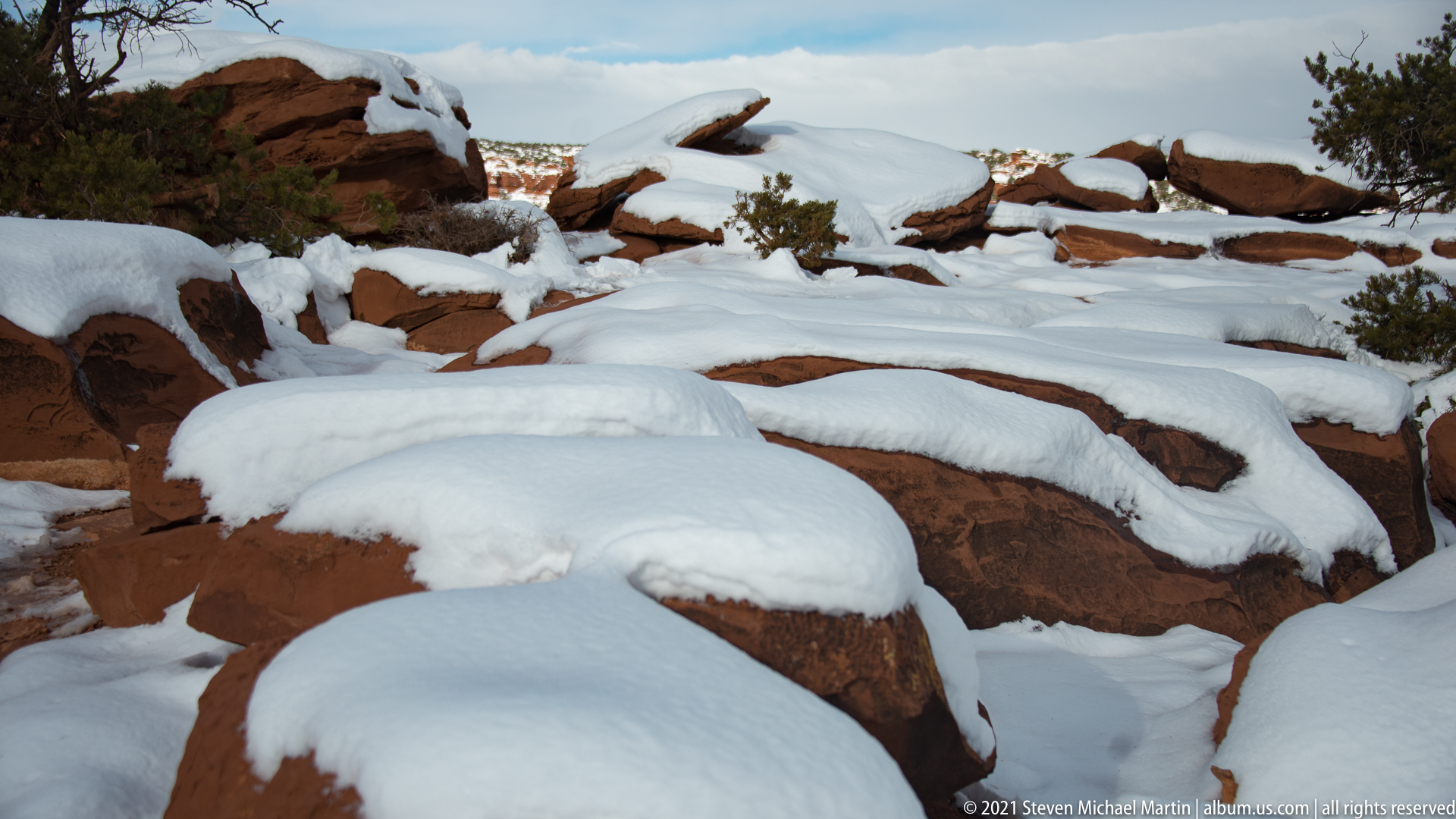
Broad red sandstone slabs form a stepped surface, their horizontal edges softened by thick pillows of snow. The close viewpoint excludes the skyline and concentrates on the contrast between smooth white snow and angular, layered rock. Small evergreen branches appear near the edges, showing that the ledges are part of an open, shrub-dotted landscape rather than a bare rock face.
Caption
Broad red sandstone slabs form a stepped surface, their horizontal edges softened by thick pillows of snow. The close viewpoint excludes the skyline and concentrates on the contrast between smooth white snow and angular, layered rock. Small evergreen branches appear near the edges, showing that the ledges are part of an open, shrub-dotted landscape rather than a bare rock face.

Snow fills the gaps between broad red sandstone ledges in this closer landscape view. A juniper rises above the rocks near the center, while smaller shrubs and a glimpse of the distant canyon appear beyond the snowy foreground. The image shifts from the tight stone detail of the previous view to a wider arrangement of ledges, vegetation, and winter sky.
Caption
Snow fills the gaps between broad red sandstone ledges in this closer landscape view. A juniper rises above the rocks near the center, while smaller shrubs and a glimpse of the distant canyon appear beyond the snowy foreground. The image shifts from the tight stone detail of the previous view to a wider arrangement of ledges, vegetation, and winter sky.

From an elevated rim, the view looks across a broad canyon whose red walls descend to a winding drainage far below. Snow highlights ledges and slopes, while the opposing plateau stretches across the distance under a pale sky. The high vantage point reveals the canyon’s depth and branching contours, with no foreground figure or built structure interrupting the panorama.
Caption
From an elevated rim, the view looks across a broad canyon whose red walls descend to a winding drainage far below. Snow highlights ledges and slopes, while the opposing plateau stretches across the distance under a pale sky. The high vantage point reveals the canyon’s depth and branching contours, with no foreground figure or built structure interrupting the panorama.

A broad, high-angle view surveys the canyon from a snowy rim, revealing successive bends and branching gullies cut into the red and pale rock. Dark juniper dots the slopes and traces the rim, while distant mesas fade into the background. The elevated perspective conveys the scale of the landform and the complexity of its winding drainage more clearly than a ground-level view.
Caption
A broad, high-angle view surveys the canyon from a snowy rim, revealing successive bends and branching gullies cut into the red and pale rock. Dark juniper dots the slopes and traces the rim, while distant mesas fade into the background. The elevated perspective conveys the scale of the landform and the complexity of its winding drainage more clearly than a ground-level view.

A blocky red sandstone pinnacle rises above a long cliff band, its upper ledges dusted with snow. The outcrop’s stepped profile stands against a pale sky, while juniper and snow-covered slopes occupy the ridge behind it. The composition isolates the prominent high point while preserving the horizontal rock layers that connect it to the surrounding canyon wall.
Caption
A blocky red sandstone pinnacle rises above a long cliff band, its upper ledges dusted with snow. The outcrop’s stepped profile stands against a pale sky, while juniper and snow-covered slopes occupy the ridge behind it. The composition isolates the prominent high point while preserving the horizontal rock layers that connect it to the surrounding canyon wall.

Seen from above, a broad curve of red sandstone encloses a snow-covered basin below. Dark rock edges trace the canyon walls, and scattered shrubs punctuate the pale floor and slopes. The elevated viewpoint reveals the curved shape of the landform and the steep descent from the rim, while the close foreground edge gives a sense of looking directly into the canyon.
Caption
Seen from above, a broad curve of red sandstone encloses a snow-covered basin below. Dark rock edges trace the canyon walls, and scattered shrubs punctuate the pale floor and slopes. The elevated viewpoint reveals the curved shape of the landform and the steep descent from the rim, while the close foreground edge gives a sense of looking directly into the canyon.

A steep canyon wall fills the left side of the composition, its red and pale horizontal layers descending toward a snow-filled ravine. Opposite slopes rise beyond the narrow valley, with small evergreen shrubs scattered over the snow. The oblique view follows the wall downward and emphasizes the canyon’s depth through the close rock face and receding terrain.
Caption
A steep canyon wall fills the left side of the composition, its red and pale horizontal layers descending toward a snow-filled ravine. Opposite slopes rise beyond the narrow valley, with small evergreen shrubs scattered over the snow. The oblique view follows the wall downward and emphasizes the canyon’s depth through the close rock face and receding terrain.

A dark vertical cliff occupies the left foreground while a narrow, snow-covered channel winds between broken red rock slopes to the right. Sparse evergreen shrubs punctuate the pale ground, and the canyon narrows toward the center of the frame. The framing puts the near wall beside the distant channel, making the steep drop and confined shape of the ravine the main subject.
Caption
A dark vertical cliff occupies the left foreground while a narrow, snow-covered channel winds between broken red rock slopes to the right. Sparse evergreen shrubs punctuate the pale ground, and the canyon narrows toward the center of the frame. The framing puts the near wall beside the distant channel, making the steep drop and confined shape of the ravine the main subject.

Rounded red sandstone ledges carry a thick cover of snow in the foreground, where several junipers frame a distant canyon and low plateau. The sky is muted and the far landscape softened by haze, while the near snow retains distinct contours over the rock. This view balances foreground vegetation and ledges with the broad valley beyond.
Caption
Rounded red sandstone ledges carry a thick cover of snow in the foreground, where several junipers frame a distant canyon and low plateau. The sky is muted and the far landscape softened by haze, while the near snow retains distinct contours over the rock. This view balances foreground vegetation and ledges with the broad valley beyond.

A long red sandstone ledge crosses the foreground, its upper surface buried beneath snow. Beyond it, a wide canyon wall stretches across the horizon, with dark junipers and broken red rocks between the ledge and the distant cliff. The low viewpoint makes the snow-covered slab a strong foreground element and sets it against the layered canyon backdrop.
Caption
A long red sandstone ledge crosses the foreground, its upper surface buried beneath snow. Beyond it, a wide canyon wall stretches across the horizon, with dark junipers and broken red rocks between the ledge and the distant cliff. The low viewpoint makes the snow-covered slab a strong foreground element and sets it against the layered canyon backdrop.

A man in a brown jacket stands on a snow-covered sandstone ledge, one foot braced on a higher rock. A juniper frames the right side, and layered canyon walls extend behind him under a blue sky. The full-body view records a visitor at the overlook while showing the snowy footing and broad setting that surround him.
Caption
A man in a brown jacket stands on a snow-covered sandstone ledge, one foot braced on a higher rock. A juniper frames the right side, and layered canyon walls extend behind him under a blue sky. The full-body view records a visitor at the overlook while showing the snowy footing and broad setting that surround him.

A man in a dark jacket and cap stands beside a broad red sandstone slab topped with snow. The slab angles across the foreground, while juniper and a banded canyon wall stretch behind him. The figure’s position next to the rock gives scale to the ledge and distinguishes this portrait from the previous image, where the visitor stands above the drop.
Caption
A man in a dark jacket and cap stands beside a broad red sandstone slab topped with snow. The slab angles across the foreground, while juniper and a banded canyon wall stretch behind him. The figure’s position next to the rock gives scale to the ledge and distinguishes this portrait from the previous image, where the visitor stands above the drop.

A closer portrait shows a smiling man in a dark fleece and blue cap, framed from the waist upward. Snow-covered sandstone ledges cross behind him, with the red canyon wall and pale ridge softened in the distance. The tighter crop gives more attention to the visitor’s face and clothing while retaining the distinctive winter landscape as context.
Caption
A closer portrait shows a smiling man in a dark fleece and blue cap, framed from the waist upward. Snow-covered sandstone ledges cross behind him, with the red canyon wall and pale ridge softened in the distance. The tighter crop gives more attention to the visitor’s face and clothing while retaining the distinctive winter landscape as context.

A cluster of rounded red sandstone columns rises from a white slope, their horizontal bands visible beneath scattered snow. A higher ridge forms a broad, layered backdrop, while small junipers punctuate the foreground. The composition presents the formations as a grouped wall rather than a single tower, with the snow outlining the base and ledges of each column.
Caption
A cluster of rounded red sandstone columns rises from a white slope, their horizontal bands visible beneath scattered snow. A higher ridge forms a broad, layered backdrop, while small junipers punctuate the foreground. The composition presents the formations as a grouped wall rather than a single tower, with the snow outlining the base and ledges of each column.

Tall red sandstone ribs fill the frame, their rounded fronts marked by closely spaced horizontal bands. Snow remains in the deep clefts between columns and along their bases, sharpening the separation between the forms. The close viewpoint removes most of the surrounding terrain and concentrates on the sculpted wall’s repeating vertical relief and fine color changes.
Caption
Tall red sandstone ribs fill the frame, their rounded fronts marked by closely spaced horizontal bands. Snow remains in the deep clefts between columns and along their bases, sharpening the separation between the forms. The close viewpoint removes most of the surrounding terrain and concentrates on the sculpted wall’s repeating vertical relief and fine color changes.

Rounded sandstone columns extend across the lower half of the image beneath a high, horizontally layered cliff. Snow traces the upper ledges, fills pale slopes, and collects between the red formations. The wider view shows the full relationship between the columned foreground wall and the broad escarpment above, including the juniper-dotted margins.
Caption
Rounded sandstone columns extend across the lower half of the image beneath a high, horizontally layered cliff. Snow traces the upper ledges, fills pale slopes, and collects between the red formations. The wider view shows the full relationship between the columned foreground wall and the broad escarpment above, including the juniper-dotted margins.

A brown stone marker reading “The Castle” stands beside a paved road, with the tall red formation rising across the snowy slope behind it. Layered cliffs and rounded lower columns extend across the background, while the road gives the scene a clear park-side viewpoint. The sign identifies the rock formation without requiring a more specific geological name.
Caption
A brown stone marker reading “The Castle” stands beside a paved road, with the tall red formation rising across the snowy slope behind it. Layered cliffs and rounded lower columns extend across the background, while the road gives the scene a clear park-side viewpoint. The sign identifies the rock formation without requiring a more specific geological name.

A cluster of narrow red sandstone spires rises above pale, steeply eroded slopes and a lower band of rounded formations. Snow traces the ridge and gathers on the lighter rock, emphasizing the contrast between the vertical pinnacles and the broad horizontal strata beneath them. The clear sky isolates the jagged skyline and gives the spires a distinct silhouette.
Caption
A cluster of narrow red sandstone spires rises above pale, steeply eroded slopes and a lower band of rounded formations. Snow traces the ridge and gathers on the lighter rock, emphasizing the contrast between the vertical pinnacles and the broad horizontal strata beneath them. The clear sky isolates the jagged skyline and gives the spires a distinct silhouette.

The Castle’s jagged upper towers rise above a broad pale slope striped with red and gray layers. Rounded sandstone columns fill the lower foreground, partly covered in snow, while the close crop excludes roads and buildings. The image emphasizes the formation’s vertical crown and the abrupt change from narrow spires to eroded, horizontally banded ground.
Caption
The Castle’s jagged upper towers rise above a broad pale slope striped with red and gray layers. Rounded sandstone columns fill the lower foreground, partly covered in snow, while the close crop excludes roads and buildings. The image emphasizes the formation’s vertical crown and the abrupt change from narrow spires to eroded, horizontally banded ground.

The Castle’s tall red spires rise above a series of pale, snow-dusted ledges, with leafless shrubs spreading across the foreground. The low viewpoint places the winter vegetation in front of the stratified rock and reveals the formation’s jagged crown against a clear sky. Without signs or buildings in the frame, the composition centers on the contrast between bare branches and the layered cliff.
Caption
The Castle’s tall red spires rise above a series of pale, snow-dusted ledges, with leafless shrubs spreading across the foreground. The low viewpoint places the winter vegetation in front of the stratified rock and reveals the formation’s jagged crown against a clear sky. Without signs or buildings in the frame, the composition centers on the contrast between bare branches and the layered cliff.
Capitol Reef National Park — Field Guide
National Park Field Guide
📍 Overview
Capitol Reef National Park preserves a geologic formation known as the Waterpocket Fold, a monocline created by tectonic forces that uplifted sedimentary rock layers. The park contains cliffs, domes, and canyon systems shaped by erosion acting upon uplifted strata. The resulting landscape illustrates the interaction between geological uplift and long-term weathering processes.
Layered sandstone formations reflect changes in environmental conditions across prehistoric eras. Differential erosion of rock layers produces cliffs, domes, and narrow canyon corridors. The Waterpocket Fold extends for nearly one hundred miles, creating a continuous geologic feature across the Colorado Plateau.
⭐ Highlights
- Waterpocket Fold monocline formation
- Sandstone domes and cliffs shaped by erosion
- Cathedral Valley monolith formations
- Layered sedimentary rock exposures
- Expansive desert plateau landscapes
🔎 Key Features
- Tectonic uplift shaping folded rock layers
- Erosion creating canyon and dome formations
- Exposed sedimentary strata illustrating geologic time
- Remote desert valley environments
- Large-scale landscape shaped by natural forces
📷 Photography Notes
- Early and late light enhances texture in sandstone
- Wide compositions capture scale of formations
- Cloud patterns add depth to desert skies
- Foreground rocks provide visual framing
- Side lighting emphasizes layered geology
- Look for angles that show contrast between formations

The brochure page headed “Exploring Capitol Reef” places several columns of introductory text above a large map with colored routes and a legend. The map occupies most of the sheet and presents park geography as a broad overview. Small place names are not legible enough to verify from the proof sheet, so the caption describes the visible title and page structure without guessing at labels.
Caption
The brochure page headed “Exploring Capitol Reef” places several columns of introductory text above a large map with colored routes and a legend. The map occupies most of the sheet and presents park geography as a broad overview. Small place names are not legible enough to verify from the proof sheet, so the caption describes the visible title and page structure without guessing at labels.
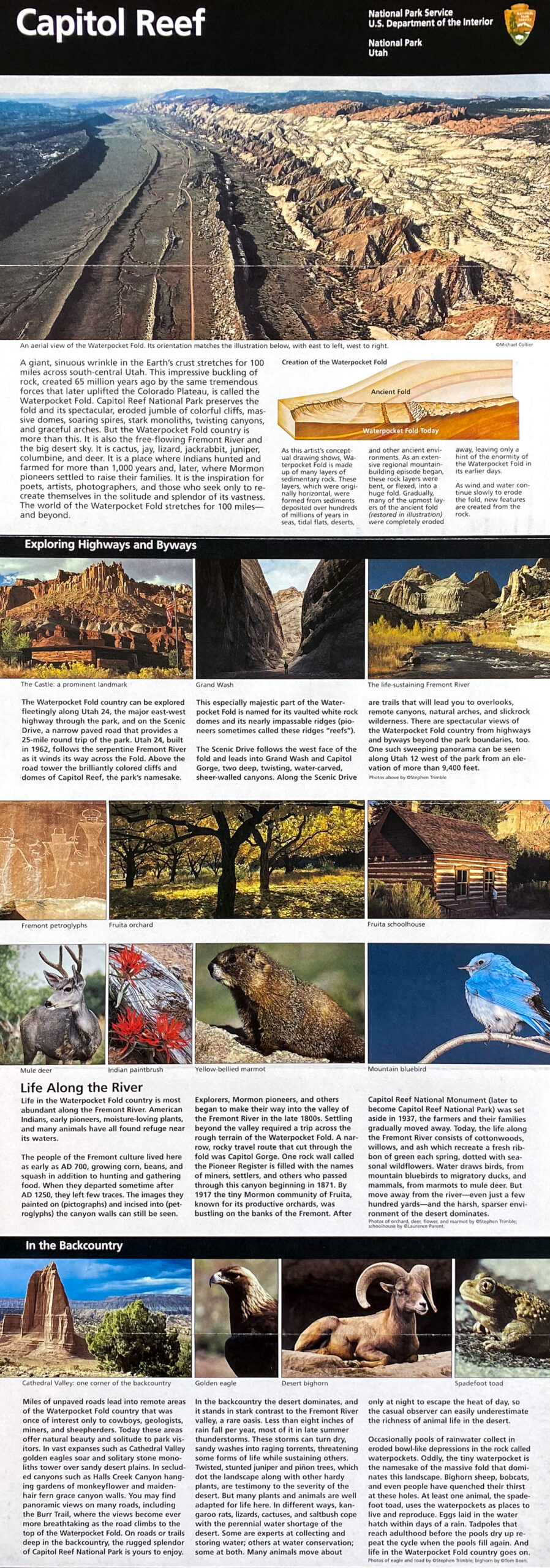
The brochure page headed “Exploring Capitol Reef” places several columns of introductory text above a large map with colored routes and a legend. The map occupies most of the sheet and presents park geography as a broad overview. Small place names are not legible enough to verify from the proof sheet, so the caption describes the visible title and page structure without guessing at labels.
Caption
The brochure page headed “Exploring Capitol Reef” places several columns of introductory text above a large map with colored routes and a legend. The map occupies most of the sheet and presents park geography as a broad overview. Small place names are not legible enough to verify from the proof sheet, so the caption describes the visible title and page structure without guessing at labels.