Hopewell Culture National Historical Park
Hopewell Culture National Historical Park preserves earthworks constructed by Indigenous peoples more than two thousand years ago. These geometric mounds and ceremonial landscapes reflect sophisticated engineering knowledge and complex social organization associated with the Hopewell cultural tradition. The site provides insight into pre-contact history and the development of ceremonial practices in the Ohio River valley.
The earthworks include precisely shaped geometric enclosures that demonstrate advanced understanding of spatial planning and landscape modification. Archaeological research indicates that the sites served ceremonial, social, and possibly astronomical purposes. The scale of construction suggests cooperation among communities across a broad region.
Visitors experience open landscapes where subtle topographic changes reveal the outlines of ancient earthworks. Interpretive materials provide context for understanding the cultural significance of the sites and emphasize the importance of preserving archaeological resources connected to early North American history.
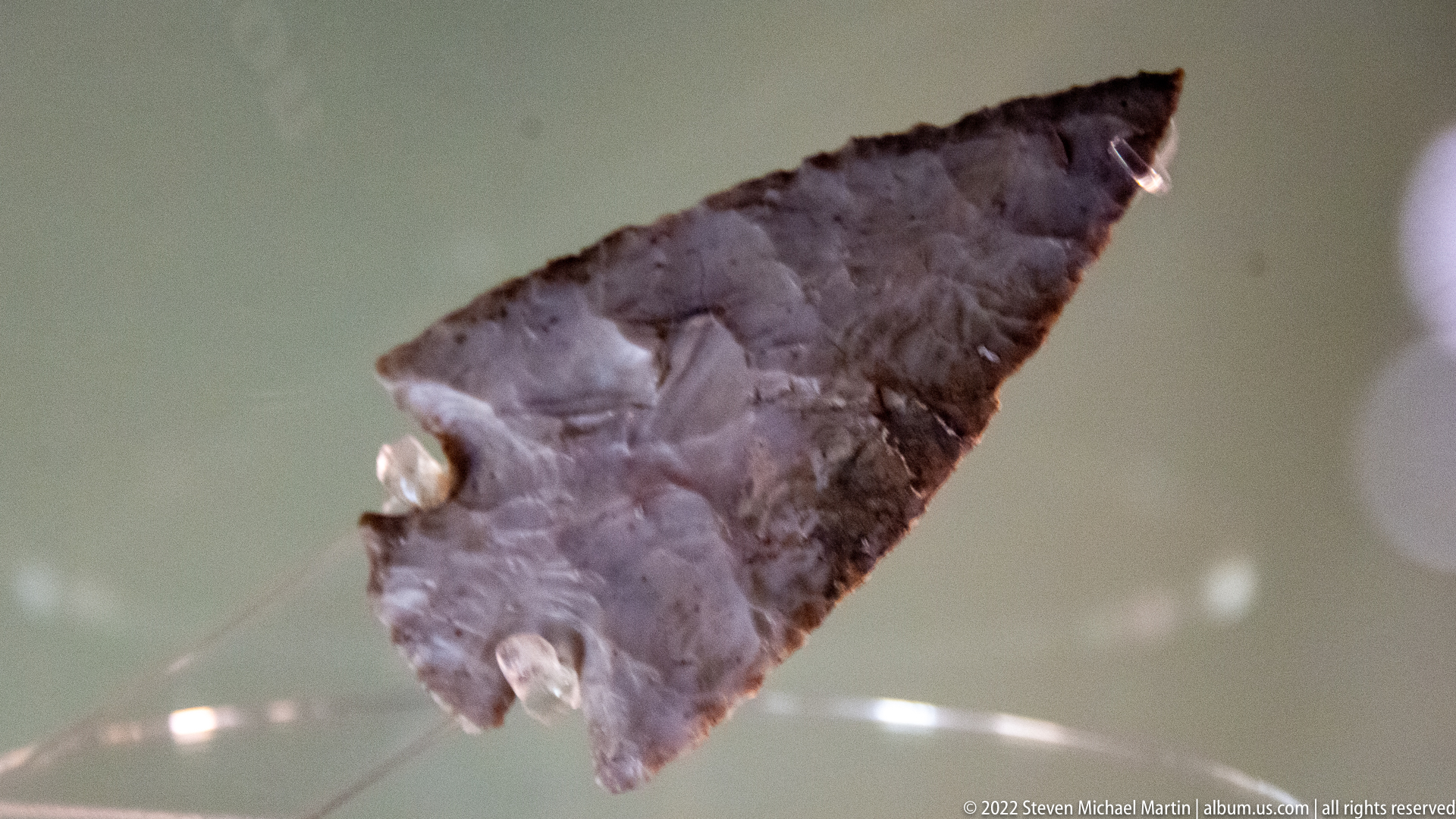
A dark triangular stone point is displayed upright on a clear stand, its broad face marked by flake scars and an unevenly chipped edge. A small pale inclusion or attached tag appears near the base. The close view emphasizes the point’s shape and worked surface without implying a particular weapon, date or archaeological context beyond its museum display.
Caption
A dark triangular stone point is displayed upright on a clear stand, its broad face marked by flake scars and an unevenly chipped edge. A small pale inclusion or attached tag appears near the base. The close view emphasizes the point’s shape and worked surface without implying a particular weapon, date or archaeological context beyond its museum display.

A green and blue-gray carved object with a long, tapering profile rests above an orange exhibit label reading “Eagle mountain goat horn.” The display presents the form as an effigy pipe; its rough, banded surface and angled projection are visible in close detail. A pale case background separates the object from surrounding artifacts.
Caption
A green and blue-gray carved object with a long, tapering profile rests above an orange exhibit label reading “Eagle mountain goat horn.” The display presents the form as an effigy pipe; its rough, banded surface and angled projection are visible in close detail. A pale case background separates the object from surrounding artifacts.

A large outdoor panel titled “A Flourishing Culture” combines a map of Hopewell sites, a photograph of a sculpted face, small landscape images, and explanatory text. The display links archaeological locations across Ohio and nearby regions while showing examples of cultural material. Reflections and surrounding trees appear on its glass, placing the interpretation directly along the park path.
Caption
A large outdoor panel titled “A Flourishing Culture” combines a map of Hopewell sites, a photograph of a sculpted face, small landscape images, and explanatory text. The display links archaeological locations across Ohio and nearby regions while showing examples of cultural material. Reflections and surrounding trees appear on its glass, placing the interpretation directly along the park path.
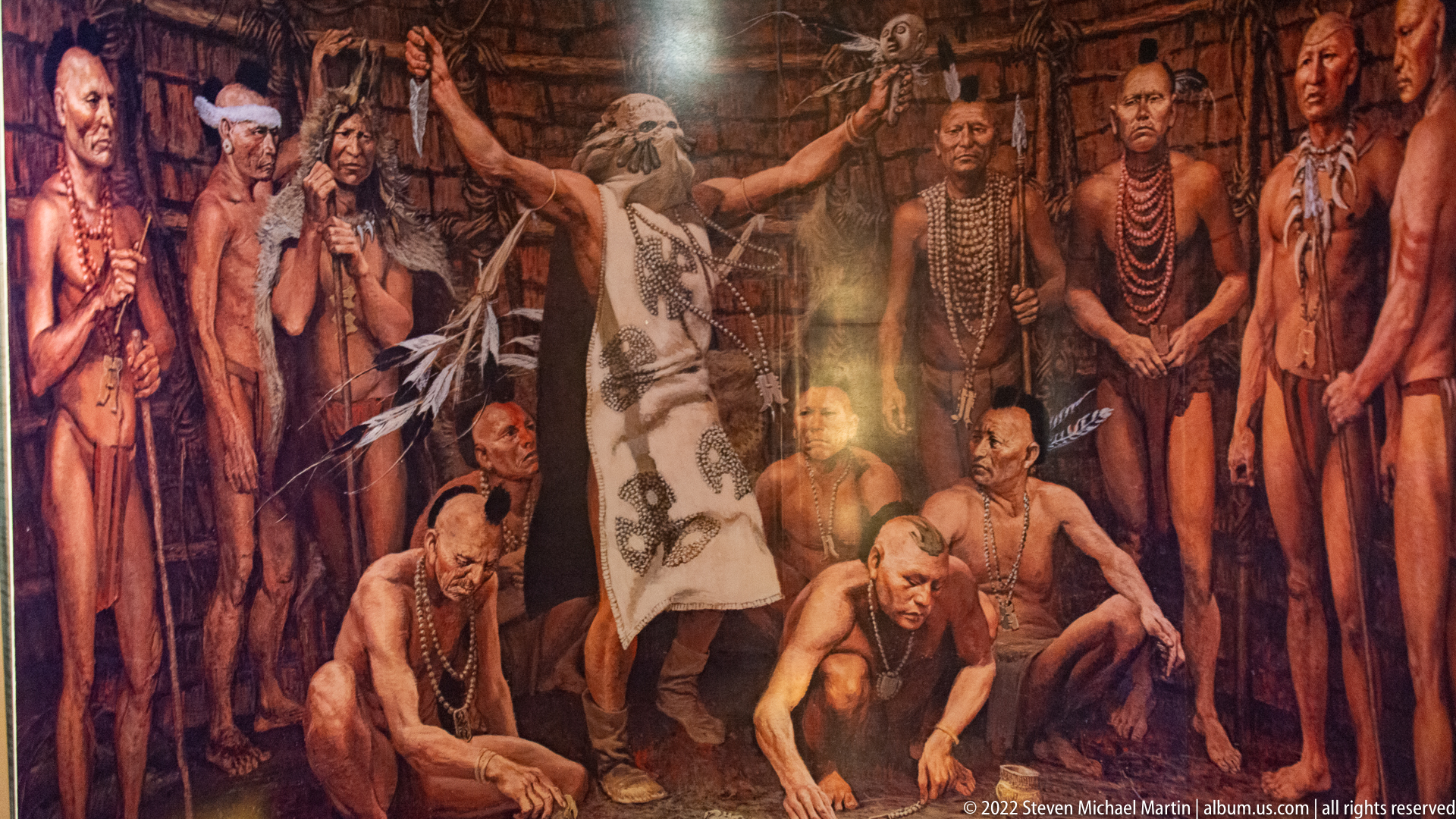
A large, warm-toned mural shows a group gathered in a wooded setting around a central standing figure holding or wearing a patterned object. Several people kneel in the foreground while others stand in a semicircle behind them. The theatrical composition uses a shaft of light and rich reds and browns to draw attention toward the gathering.
Caption
A large, warm-toned mural shows a group gathered in a wooded setting around a central standing figure holding or wearing a patterned object. Several people kneel in the foreground while others stand in a semicircle behind them. The theatrical composition uses a shaft of light and rich reds and browns to draw attention toward the gathering.

A dark reddish-brown pipe replica is carved into a long-necked bird shape, the curved neck dipping toward the flat base. The orange label below identifies it as “Great blue heron (replica).” A cylindrical opening rises from the base behind the bird’s neck, revealing how the sculptural form is integrated with the pipe.
Caption
A dark reddish-brown pipe replica is carved into a long-necked bird shape, the curved neck dipping toward the flat base. The orange label below identifies it as “Great blue heron (replica).” A cylindrical opening rises from the base behind the bird’s neck, revealing how the sculptural form is integrated with the pipe.
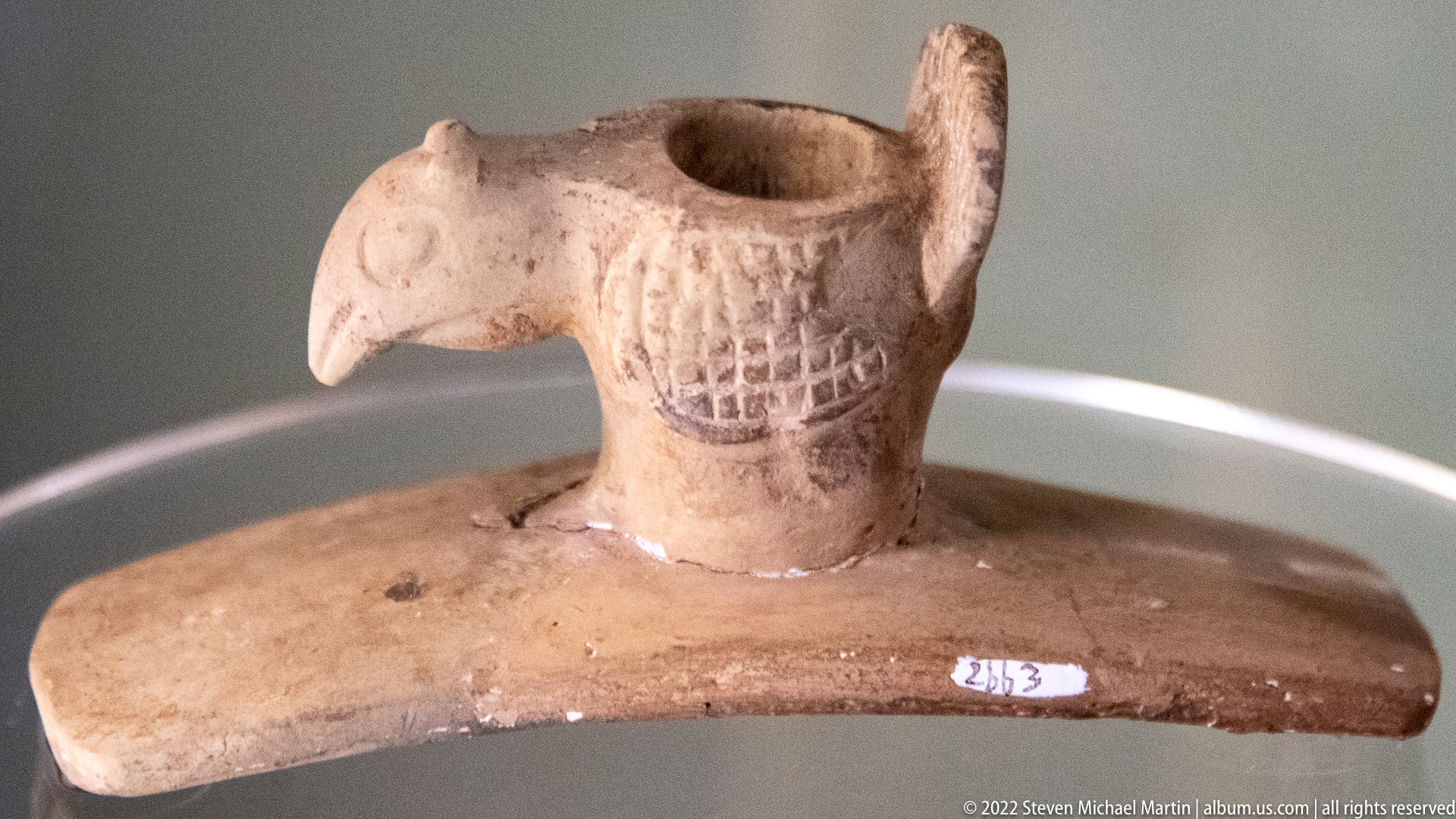
A pale stone pipe is carved as a bird, with a hooked beak projecting left and a raised circular opening behind the head. A gridlike pattern decorates the bird’s chest, and the figure rises from a broad flat base. The side view reveals how the animal effigy and functional opening are joined in one carved form.
Caption
A pale stone pipe is carved as a bird, with a hooked beak projecting left and a raised circular opening behind the head. A gridlike pattern decorates the bird’s chest, and the figure rises from a broad flat base. The side view reveals how the animal effigy and functional opening are joined in one carved form.

A wall display titled “Remarkably Similar Dimensions in Hopewell Earthworks” compares plans of circular and square enclosures, with labels for sites including Liberty Works, Seip, and Baum. A box at left explains geometric forms and another summarizes precise measurement. The diagrams present the measured shapes and alignments that distinguish Hopewell earthworks across different locations.
Caption
A wall display titled “Remarkably Similar Dimensions in Hopewell Earthworks” compares plans of circular and square enclosures, with labels for sites including Liberty Works, Seip, and Baum. A box at left explains geometric forms and another summarizes precise measurement. The diagrams present the measured shapes and alignments that distinguish Hopewell earthworks across different locations.

A panel titled “Elliptical Mound” pairs a plan view with a long cross-section of a low earthen structure. Small illustrations of a stone tool and pottery appear below the text, linking the mound’s form to excavated materials. The diagrams explain the earthwork’s elongated shape and internal arrangement more clearly than a ground-level photograph can.
Caption
A panel titled “Elliptical Mound” pairs a plan view with a long cross-section of a low earthen structure. Small illustrations of a stone tool and pottery appear below the text, linking the mound’s form to excavated materials. The diagrams explain the earthwork’s elongated shape and internal arrangement more clearly than a ground-level photograph can.

A broad earthen rise occupies the center of this open field, with a lower mound extending to the left and a line of leafless trees at the horizon. The overcast light softens the grass and contours, making the earthwork’s rounded profile the dominant feature. This ground-level view shows the mounds as large landforms within a maintained landscape.
Caption
A broad earthen rise occupies the center of this open field, with a lower mound extending to the left and a line of leafless trees at the horizon. The overcast light softens the grass and contours, making the earthwork’s rounded profile the dominant feature. This ground-level view shows the mounds as large landforms within a maintained landscape.
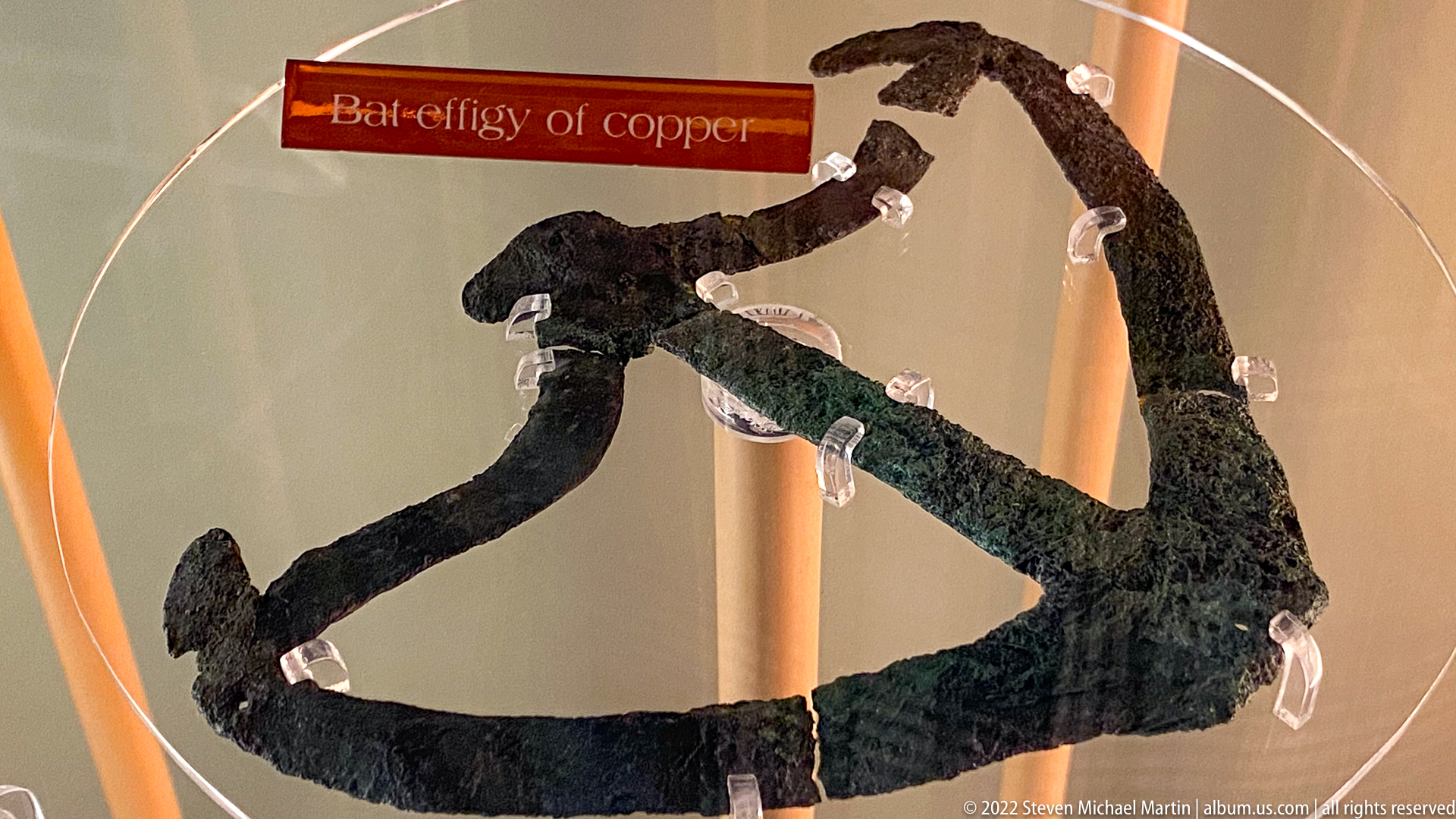
A dark, openwork copper object is suspended by clear supports inside a curved display case. Its narrow branches bend into a loose angular outline, with small holes or attachment points visible at several ends. The fragile, irregular silhouette contrasts with the solid copper pieces nearby; its specific design and original purpose remain unclear from the proof sheet.
Caption
A dark, openwork copper object is suspended by clear supports inside a curved display case. Its narrow branches bend into a loose angular outline, with small holes or attachment points visible at several ends. The fragile, irregular silhouette contrasts with the solid copper pieces nearby; its specific design and original purpose remain unclear from the proof sheet.
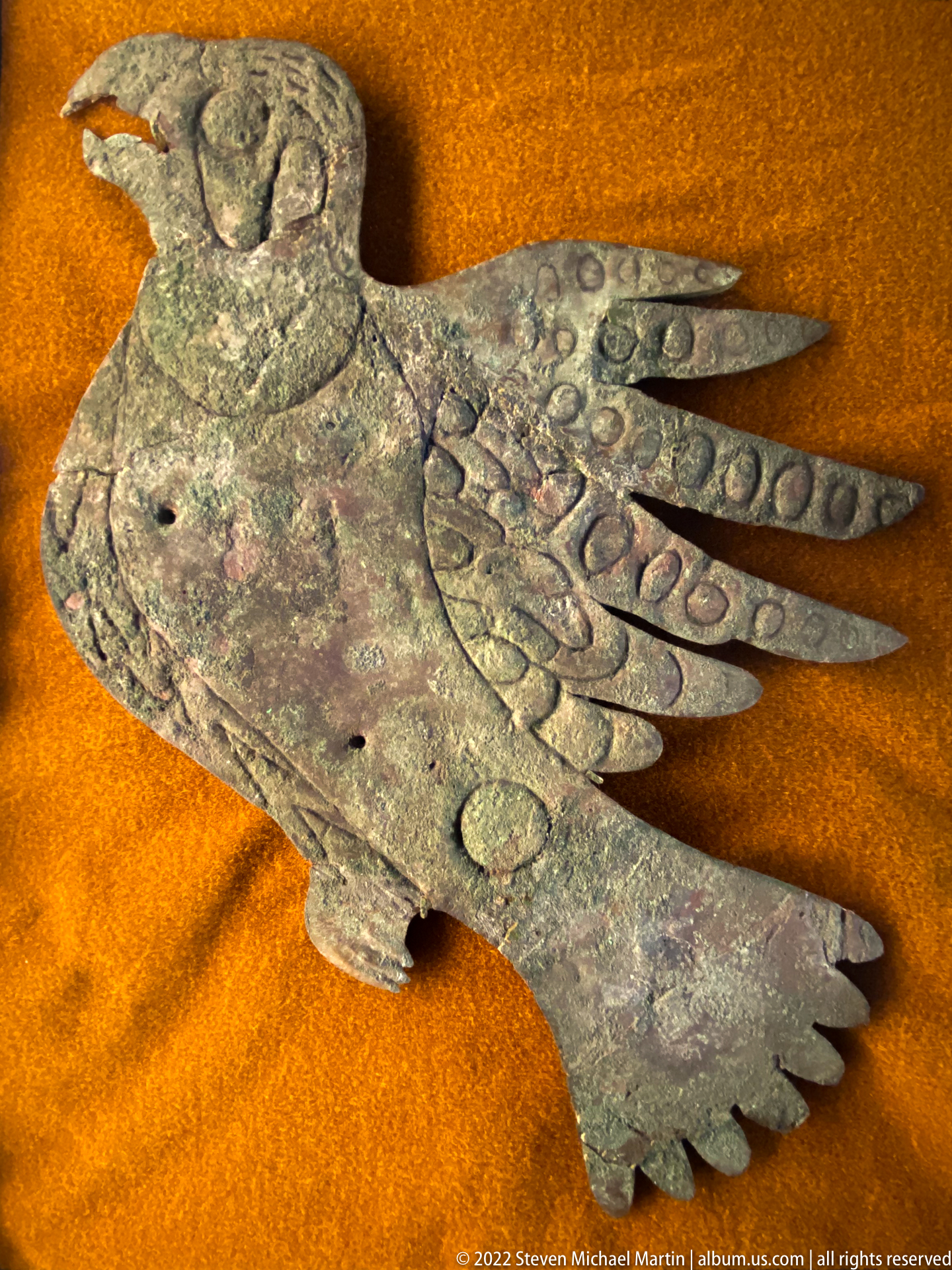
A large, flat copper object rests on orange museum fabric, its broad body ending in several long feather-like projections. Circular and oval marks decorate the surface, while holes and irregular edges remain visible in the aged metal. The form suggests a bird effigy, though the thumbnail cannot establish its original use or exact archaeological context.
Caption
A large, flat copper object rests on orange museum fabric, its broad body ending in several long feather-like projections. Circular and oval marks decorate the surface, while holes and irregular edges remain visible in the aged metal. The form suggests a bird effigy, though the thumbnail cannot establish its original use or exact archaeological context.
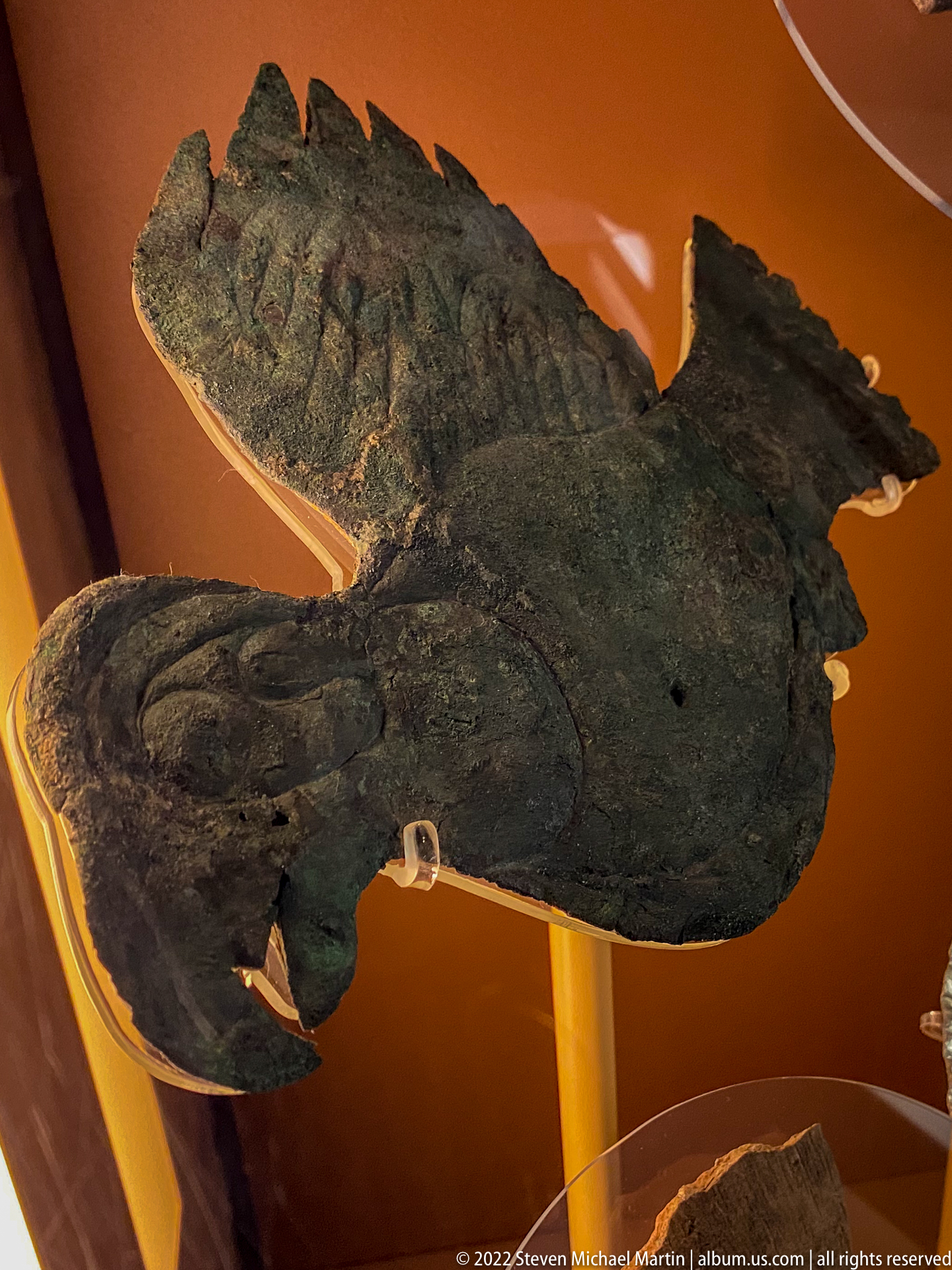
A dark, irregular copper form lies on an orange display surface, with a rounded central area and extended projections that resemble wings or limbs. The worn surface catches little light, leaving its outline clearer than its details. It appears related to the copper effigy nearby, but the thumbnail alone does not support a precise object name or function.
Caption
A dark, irregular copper form lies on an orange display surface, with a rounded central area and extended projections that resemble wings or limbs. The worn surface catches little light, leaving its outline clearer than its details. It appears related to the copper effigy nearby, but the thumbnail alone does not support a precise object name or function.
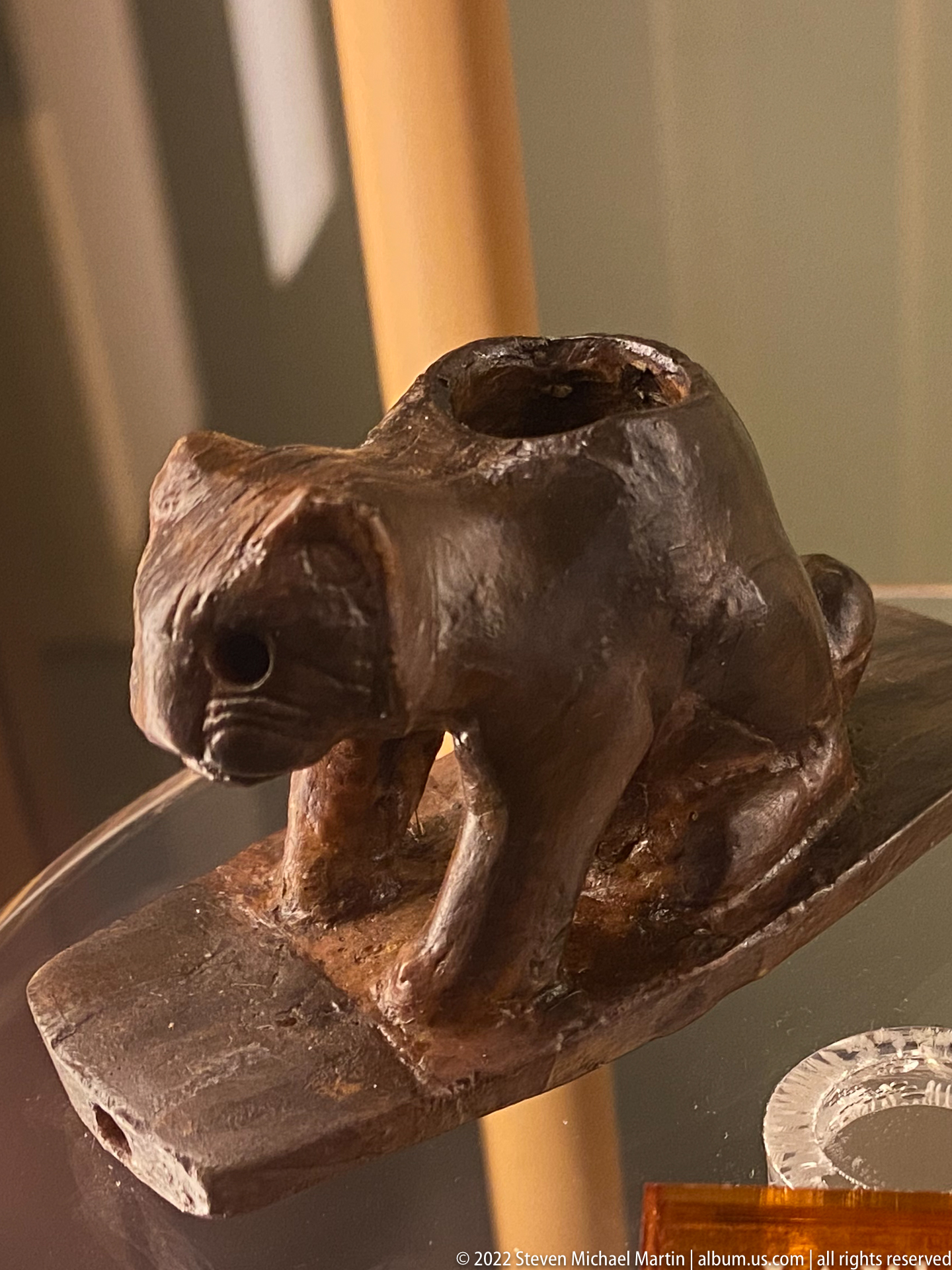
A brown stone object shaped as a crouching animal rests on a flat base, its large head and rounded back clearly modeled. A circular opening at the top and a small side projection indicate a pipe-like form. The animal’s exact species is not certain from the thumbnail, so the record describes its visible effigy shape without assigning one.
Caption
A brown stone object shaped as a crouching animal rests on a flat base, its large head and rounded back clearly modeled. A circular opening at the top and a small side projection indicate a pipe-like form. The animal’s exact species is not certain from the thumbnail, so the record describes its visible effigy shape without assigning one.
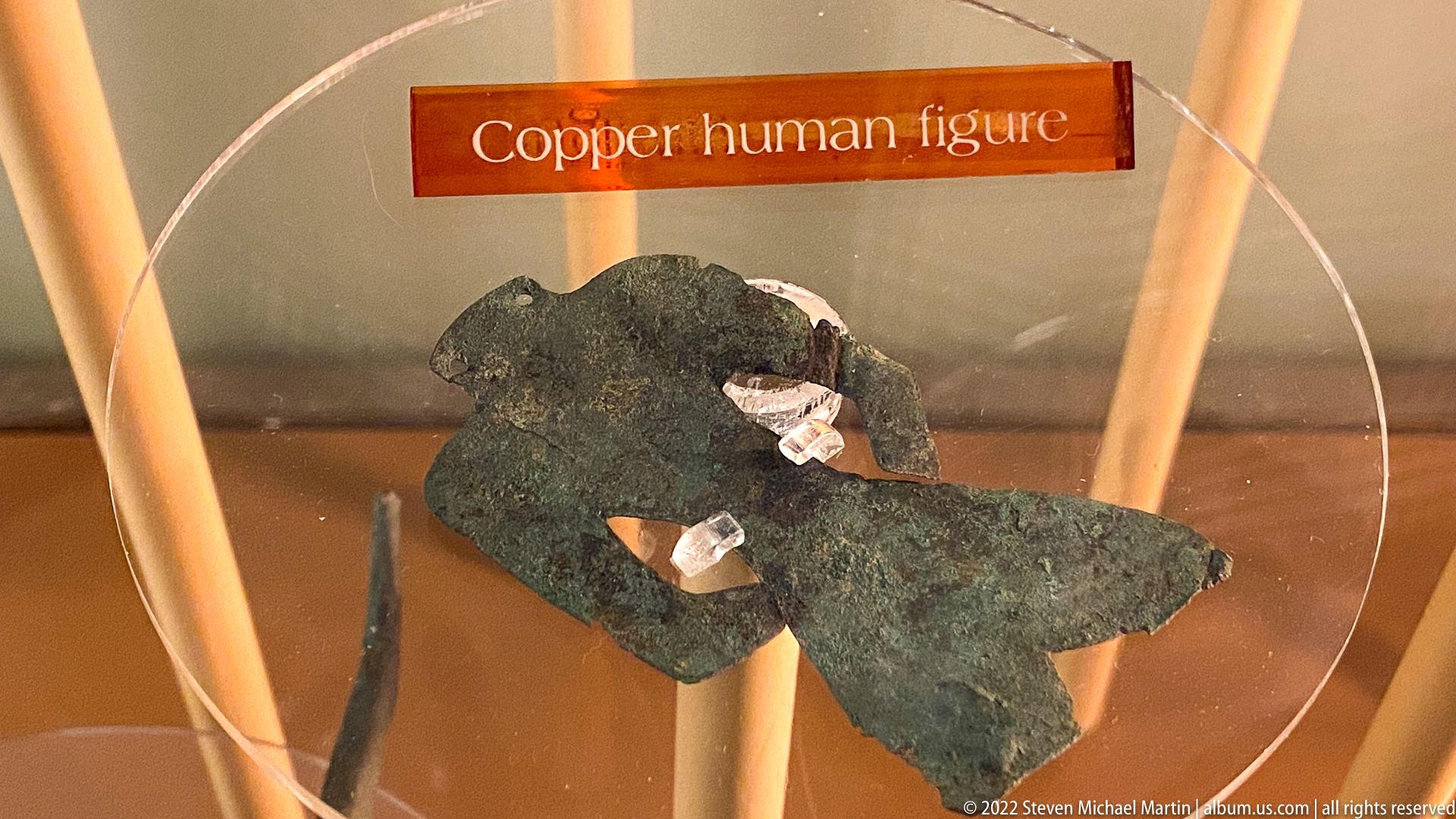
A small, flattened copper figure is displayed on a clear mount beneath a label reading “Copper human figure.” Its green-brown surface is uneven and broken along the outline, with several clear supports holding it upright. The case lighting and label make this one of the more specifically identified objects in the group, though fine details remain difficult to see.
Caption
A small, flattened copper figure is displayed on a clear mount beneath a label reading “Copper human figure.” Its green-brown surface is uneven and broken along the outline, with several clear supports holding it upright. The case lighting and label make this one of the more specifically identified objects in the group, though fine details remain difficult to see.

A curved museum scene places several figures around a central fire, with a painted woodland setting continuing behind them. People appear to prepare food or work with objects while others sit or stand nearby. The immersive arrangement interprets communal activity rather than a specific documented event, bringing the exhibit’s account of daily life into a three-dimensional setting.
Caption
A curved museum scene places several figures around a central fire, with a painted woodland setting continuing behind them. People appear to prepare food or work with objects while others sit or stand nearby. The immersive arrangement interprets communal activity rather than a specific documented event, bringing the exhibit’s account of daily life into a three-dimensional setting.
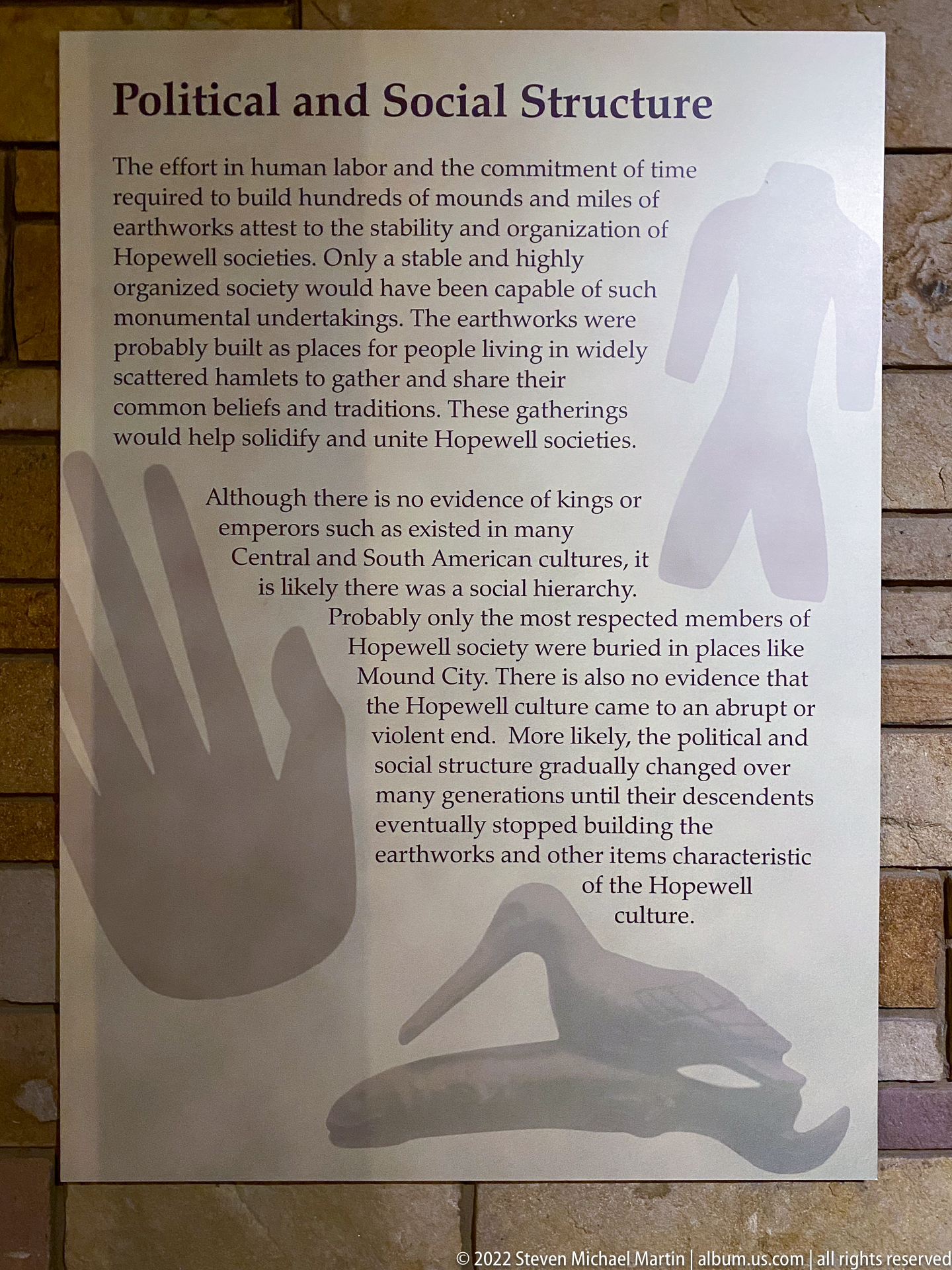
A museum panel titled “Political and Social Structure” presents explanatory text over large silhouettes of a hand and a bird-like form. The text discusses mound building, community organization, and the absence of evidence for kings or emperors. Seen straight on, the display pairs written interpretation with graphic shadows to introduce how archaeologists infer social life from material remains.
Caption
A museum panel titled “Political and Social Structure” presents explanatory text over large silhouettes of a hand and a bird-like form. The text discusses mound building, community organization, and the absence of evidence for kings or emperors. Seen straight on, the display pairs written interpretation with graphic shadows to introduce how archaeologists infer social life from material remains.
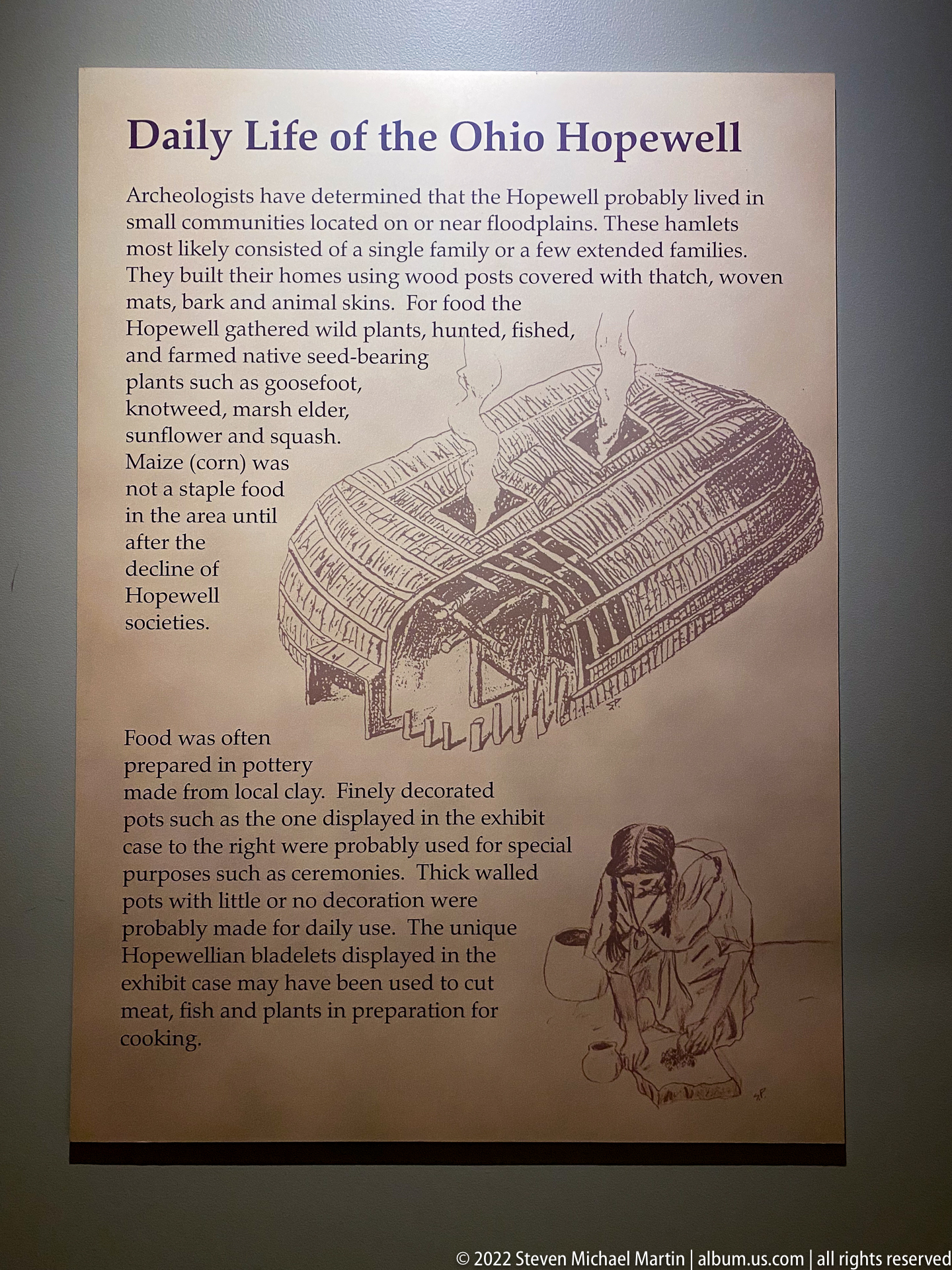
An interpretive panel titled “Life of the Ohio Hopewell” pairs text with a drawing of a large timber-framed dwelling and a smaller figure preparing food. The illustration suggests woven wall covering and a substantial roof structure. The display describes housing and subsistence, offering a reconstruction that helps visitors imagine daily life beyond the surviving earthworks.
Caption
An interpretive panel titled “Life of the Ohio Hopewell” pairs text with a drawing of a large timber-framed dwelling and a smaller figure preparing food. The illustration suggests woven wall covering and a substantial roof structure. The display describes housing and subsistence, offering a reconstruction that helps visitors imagine daily life beyond the surviving earthworks.
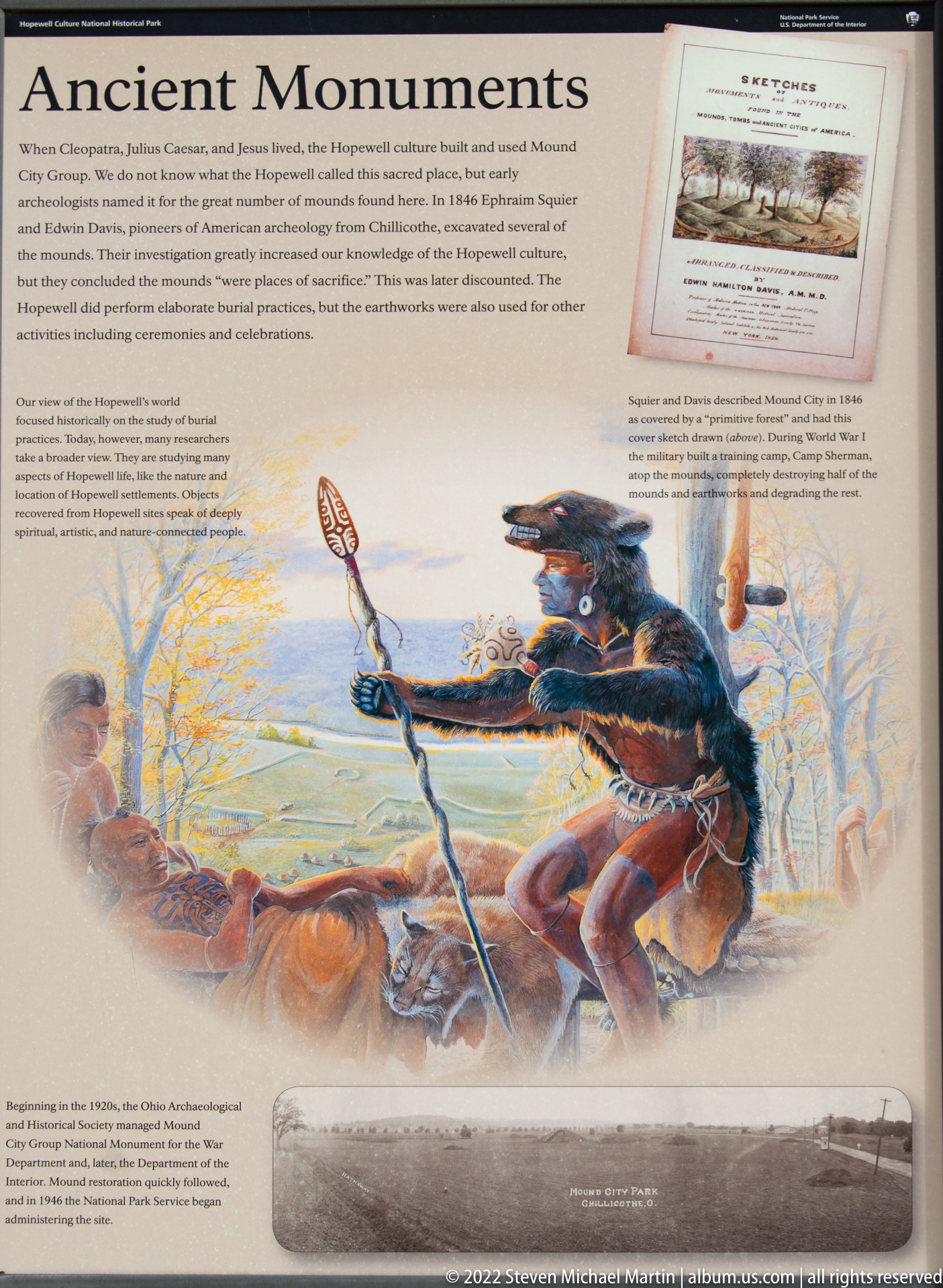
A panel headed “Monuments” pairs a colorful reconstruction of people working near a large earthwork with a historic black-and-white photograph of an excavation or field scene. Text and smaller illustrations explain the structures and their archaeological study. The composition presents both a modern interpretation of the past and documentary evidence from later research.
Caption
A panel headed “Monuments” pairs a colorful reconstruction of people working near a large earthwork with a historic black-and-white photograph of an excavation or field scene. Text and smaller illustrations explain the structures and their archaeological study. The composition presents both a modern interpretation of the past and documentary evidence from later research.
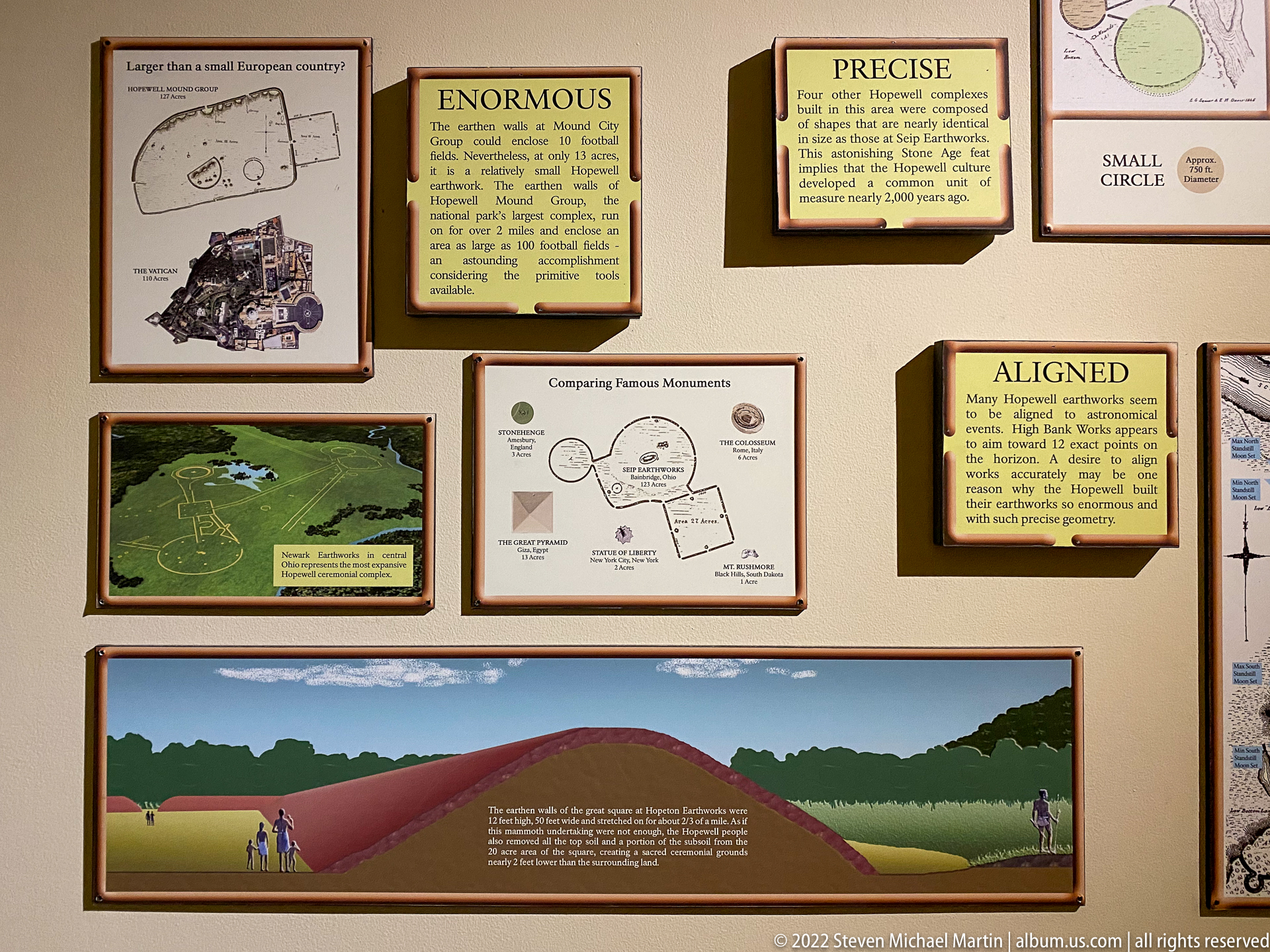
Several framed exhibit panels use words such as “ENORMOUS,” “PRECISE,” and “ALIGNED” to explain the scale and geometry of Hopewell earthworks. Diagrams, a site plan, and a long landscape illustration connect measured enclosures with the broader cultural landscape. The arrangement emphasizes how size, accuracy, and orientation are used to interpret the earthworks.
Caption
Several framed exhibit panels use words such as “ENORMOUS,” “PRECISE,” and “ALIGNED” to explain the scale and geometry of Hopewell earthworks. Diagrams, a site plan, and a long landscape illustration connect measured enclosures with the broader cultural landscape. The arrangement emphasizes how size, accuracy, and orientation are used to interpret the earthworks.

A large museum panel combines a regional map, artifact illustrations, historical scenes, treaty timelines, and text under headings including “What Tribes Lived Here?” and “Broken Treaties.” The display traces Indigenous histories and displacement while distinguishing Hopewell archaeological traditions from later Native communities. Its layered format connects archaeological interpretation to continuing tribal presence and historical consequences.
Caption
A large museum panel combines a regional map, artifact illustrations, historical scenes, treaty timelines, and text under headings including “What Tribes Lived Here?” and “Broken Treaties.” The display traces Indigenous histories and displacement while distinguishing Hopewell archaeological traditions from later Native communities. Its layered format connects archaeological interpretation to continuing tribal presence and historical consequences.
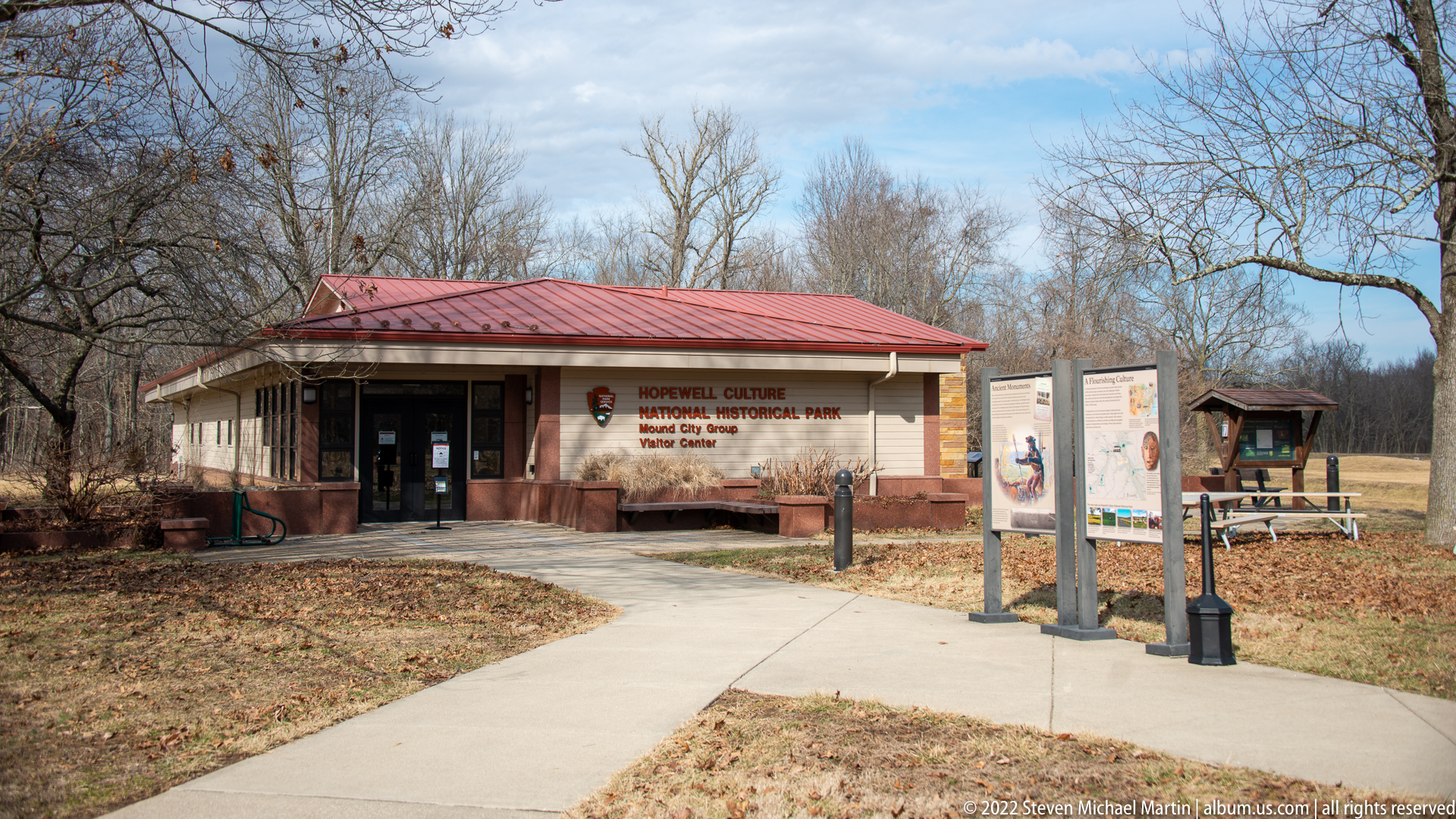
A low visitor-center building with a red metal roof stands at the end of a curving concrete path. Its entrance and park identification sign face the approach, while freestanding interpretive panels and a small covered structure occupy the lawn to the right. Bare trees and dormant grass frame the building in a quiet winter-season view.
Caption
A low visitor-center building with a red metal roof stands at the end of a curving concrete path. Its entrance and park identification sign face the approach, while freestanding interpretive panels and a small covered structure occupy the lawn to the right. Bare trees and dormant grass frame the building in a quiet winter-season view.
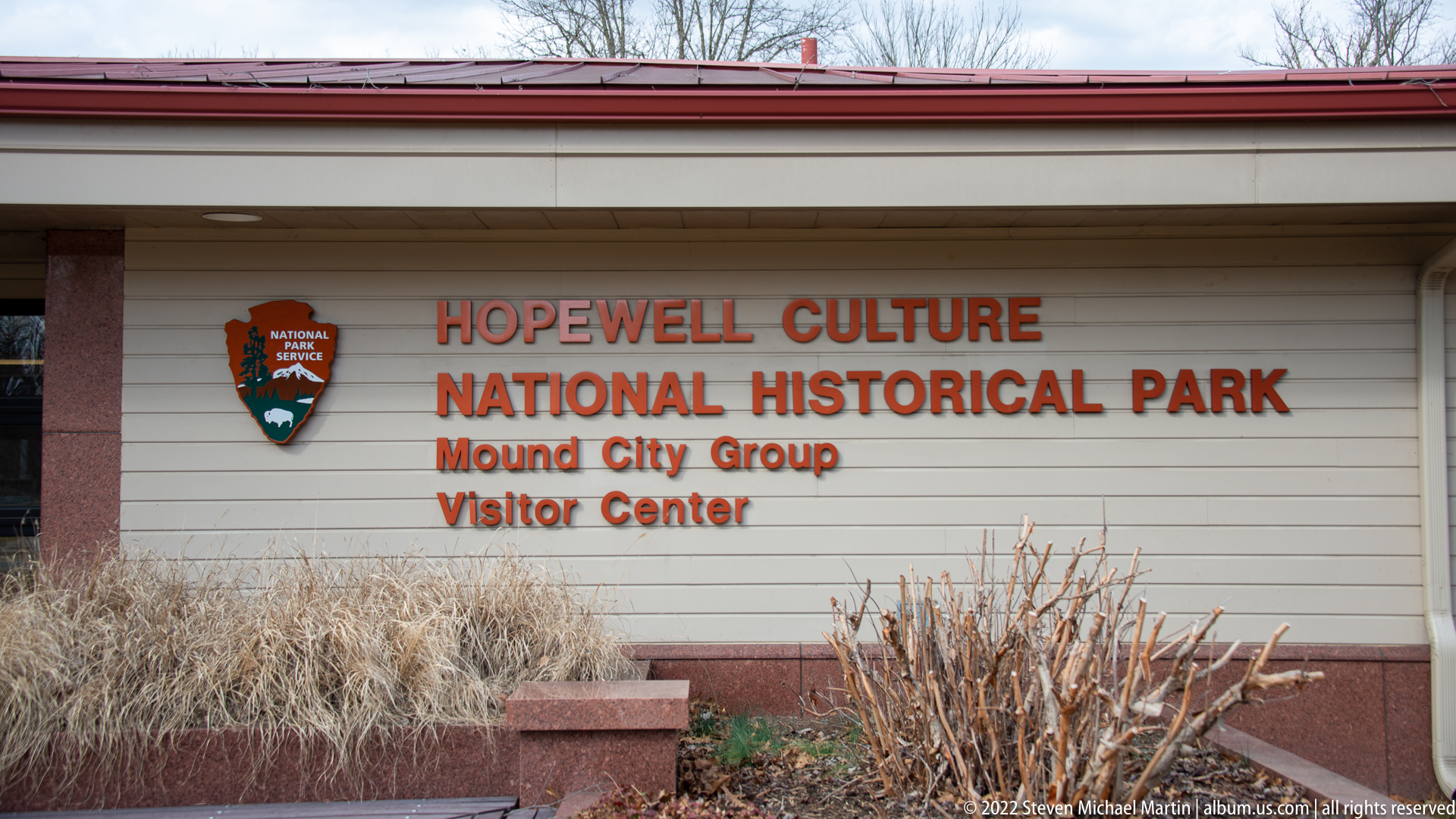
Orange letters on pale siding identify the “Hopewell Culture National Historical Park” and “Mound City Group Visitor Center.” The National Park Service arrowhead emblem appears to the left, while dried ornamental grasses cross the base of the wall. This close exterior view records the official site name and the building’s simple horizontal cladding.
Caption
Orange letters on pale siding identify the “Hopewell Culture National Historical Park” and “Mound City Group Visitor Center.” The National Park Service arrowhead emblem appears to the left, while dried ornamental grasses cross the base of the wall. This close exterior view records the official site name and the building’s simple horizontal cladding.
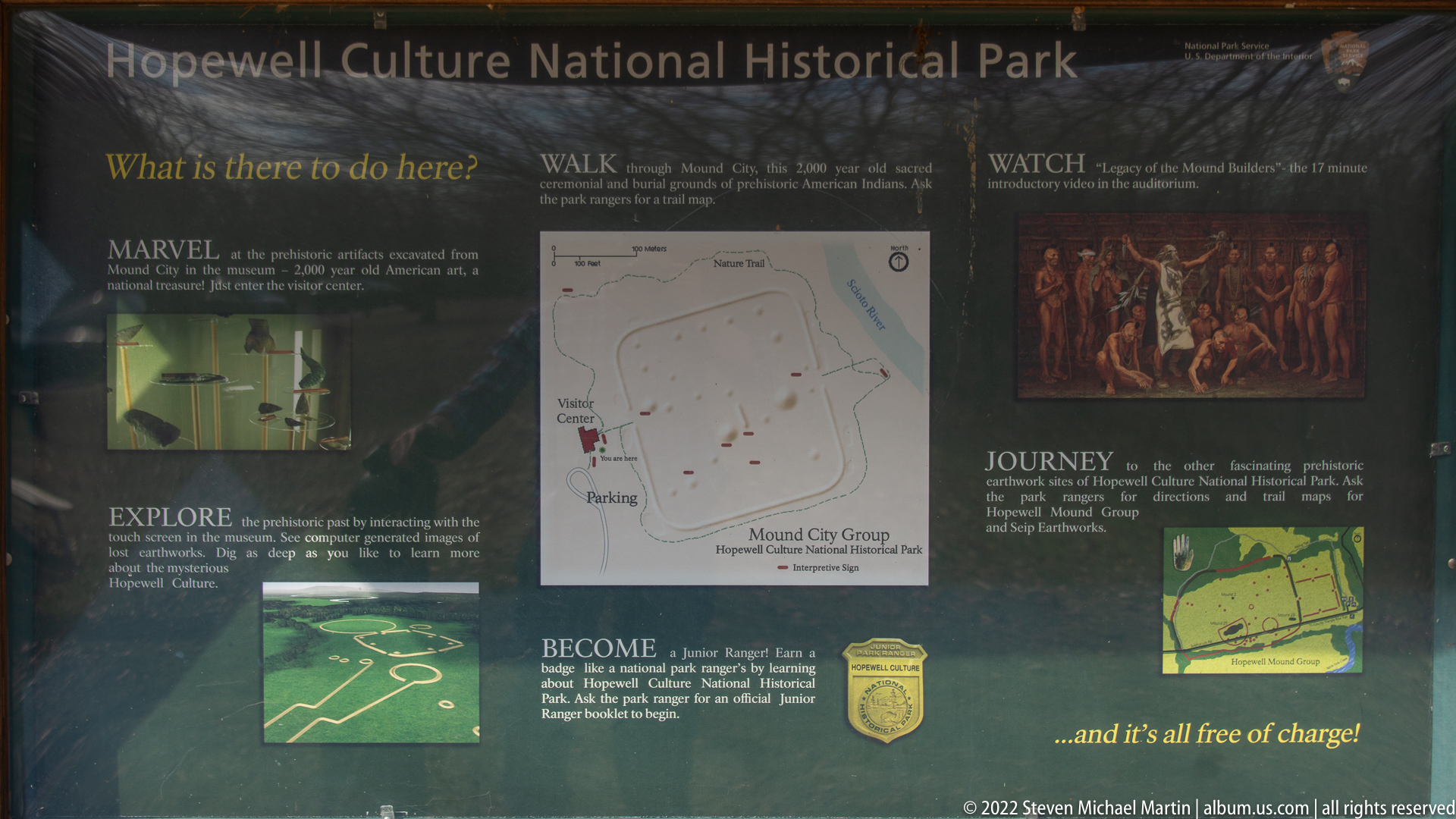
A broad dark panel introduces activities with headings such as “WALK,” “WATCH,” “MARVEL,” and “EXPLORE,” alongside a site map, photographs, and a small diagram. The text invites visitors to explore the mounds and interpretive resources across the park. Its reflective surface and faint tree reflections blend the visitor information with the outdoor setting.
Caption
A broad dark panel introduces activities with headings such as “WALK,” “WATCH,” “MARVEL,” and “EXPLORE,” alongside a site map, photographs, and a small diagram. The text invites visitors to explore the mounds and interpretive resources across the park. Its reflective surface and faint tree reflections blend the visitor information with the outdoor setting.
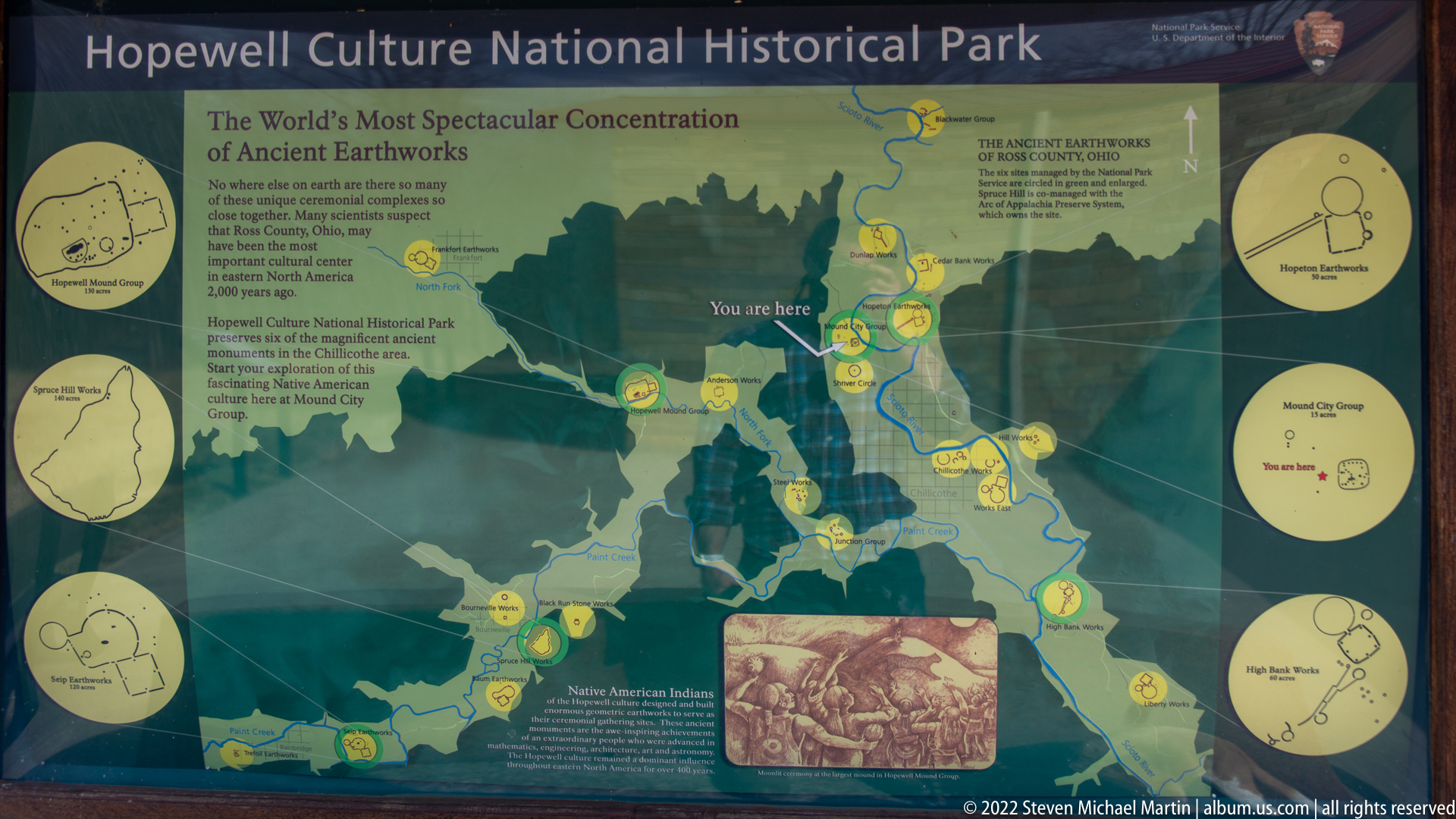
A green map fills the display, marking multiple Hopewell earthwork locations along a winding blue route or waterway. Circular diagrams around the edges compare site forms, and a small “You are here” marker locates the visitor within the network. The panel presents the scale and distribution of archaeological sites across a broader regional landscape.
Caption
A green map fills the display, marking multiple Hopewell earthwork locations along a winding blue route or waterway. Circular diagrams around the edges compare site forms, and a small “You are here” marker locates the visitor within the network. The panel presents the scale and distribution of archaeological sites across a broader regional landscape.
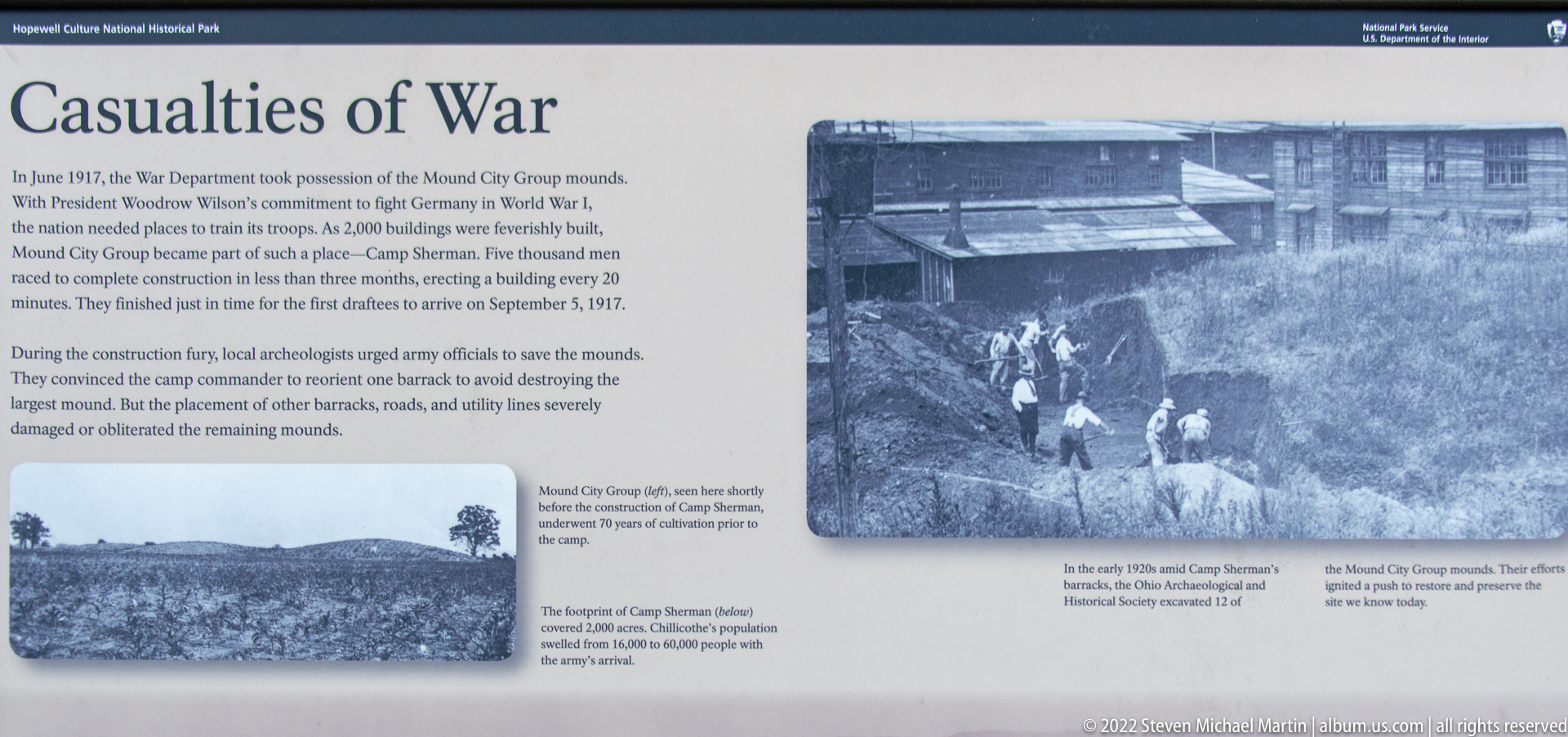
A museum panel titled “War” explains that the War Department took possession of the Mound City Group grounds in 1917 and describes construction of Camp Sherman. Archival photographs show buildings and workers near the mounds, while the text recounts efforts to protect the earthworks. The display documents a twentieth-century interruption in the site’s history.
Caption
A museum panel titled “War” explains that the War Department took possession of the Mound City Group grounds in 1917 and describes construction of Camp Sherman. Archival photographs show buildings and workers near the mounds, while the text recounts efforts to protect the earthworks. The display documents a twentieth-century interruption in the site’s history.

A narrow concrete path runs straight across dormant grass toward a small interpretive sign and a series of rounded mounds. Bare trees form a continuous background, while the low earthworks rise gently above the open field. The centered route gives the landscape a measured, quiet quality and shows how visitors approach the protected archaeological ground.
Caption
A narrow concrete path runs straight across dormant grass toward a small interpretive sign and a series of rounded mounds. Bare trees form a continuous background, while the low earthworks rise gently above the open field. The centered route gives the landscape a measured, quiet quality and shows how visitors approach the protected archaeological ground.
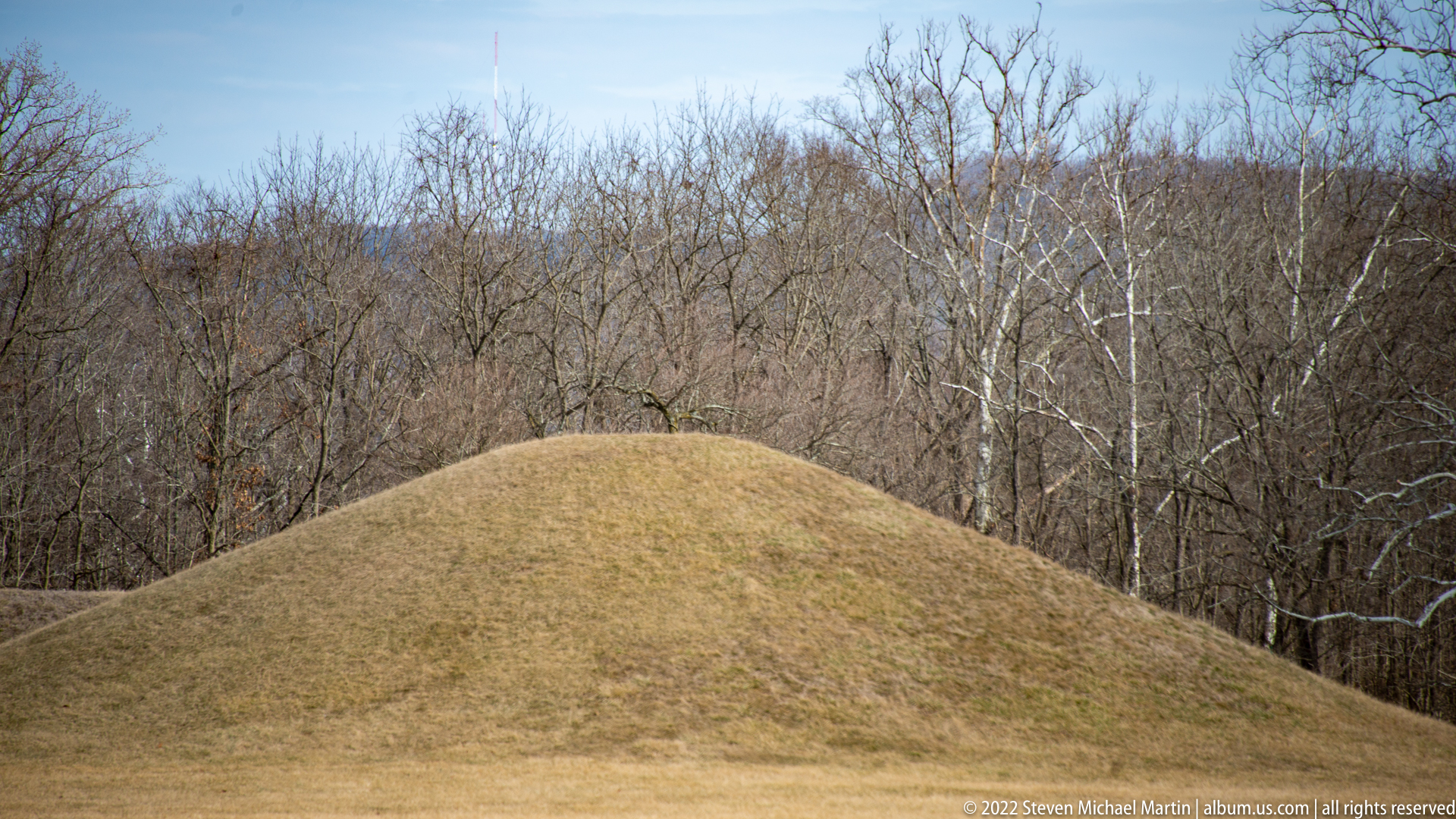
A rounded mound rises from the dormant field, its smooth profile set against dense leafless trees. The closer viewpoint reveals a subtle crest and gently sloping sides but excludes paths and most interpretive features. This isolated view makes the mound’s low, carefully maintained form easier to read against the irregular woodland edge.
Caption
A rounded mound rises from the dormant field, its smooth profile set against dense leafless trees. The closer viewpoint reveals a subtle crest and gently sloping sides but excludes paths and most interpretive features. This isolated view makes the mound’s low, carefully maintained form easier to read against the irregular woodland edge.

Two grassy rises break the broad open field, one larger mound at right and a lower mound extending left. A line of bare trees forms the horizon beneath thin clouds. This distant horizontal view preserves the relationship between the earthworks and surrounding open space, distinguishing their scale from a closer isolated mound portrait.
Caption
Two grassy rises break the broad open field, one larger mound at right and a lower mound extending left. A line of bare trees forms the horizon beneath thin clouds. This distant horizontal view preserves the relationship between the earthworks and surrounding open space, distinguishing their scale from a closer isolated mound portrait.
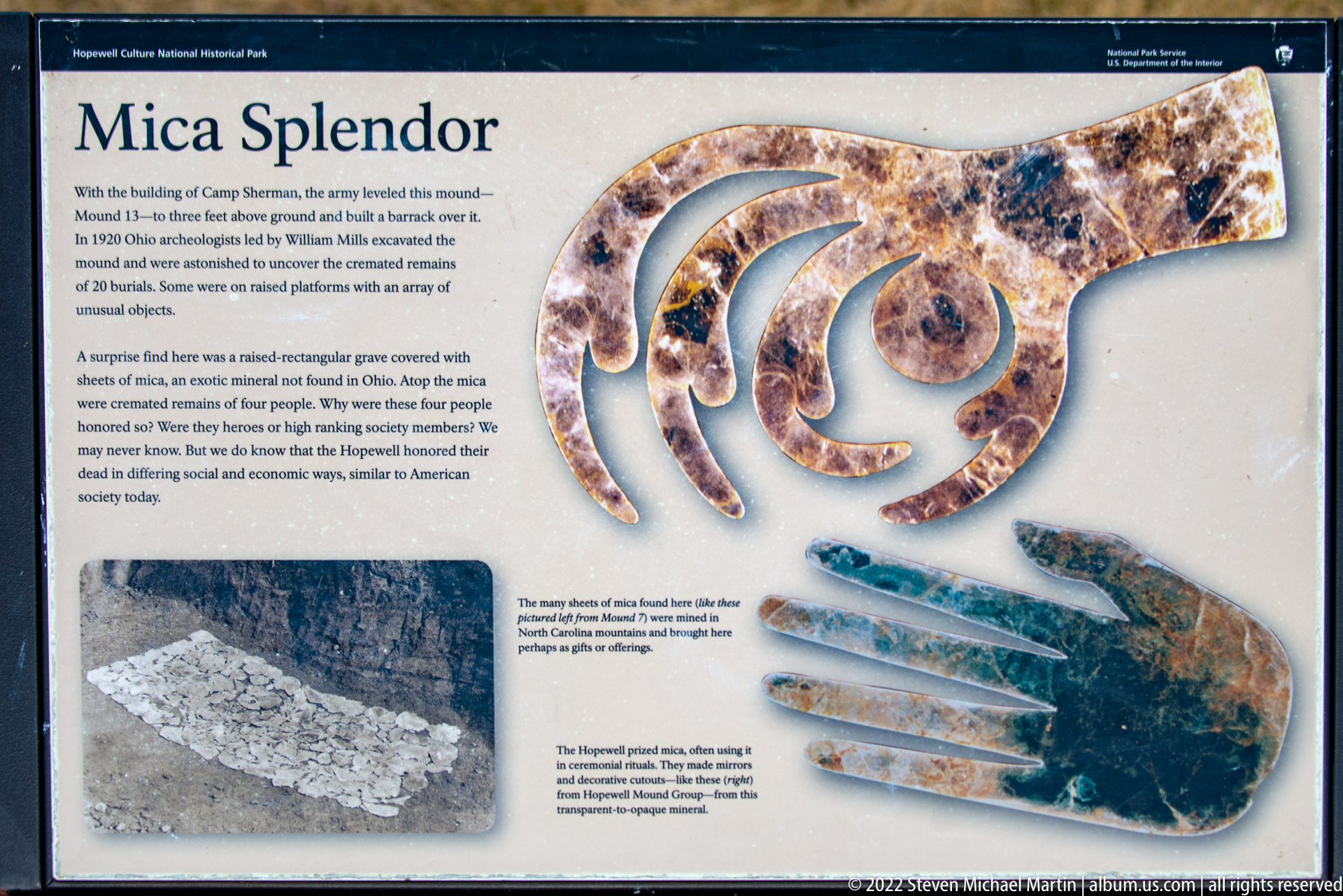
A panel about Mound 13 displays several copper cutout forms, a photograph of a stone feature, and text describing excavations and ceremonial objects. The artifacts include crescent-like and elongated shapes, some with worn or mottled surfaces. The arrangement connects recovered materials to archaeological contexts while explaining the significance of the mound group.
Caption
A panel about Mound 13 displays several copper cutout forms, a photograph of a stone feature, and text describing excavations and ceremonial objects. The artifacts include crescent-like and elongated shapes, some with worn or mottled surfaces. The arrangement connects recovered materials to archaeological contexts while explaining the significance of the mound group.
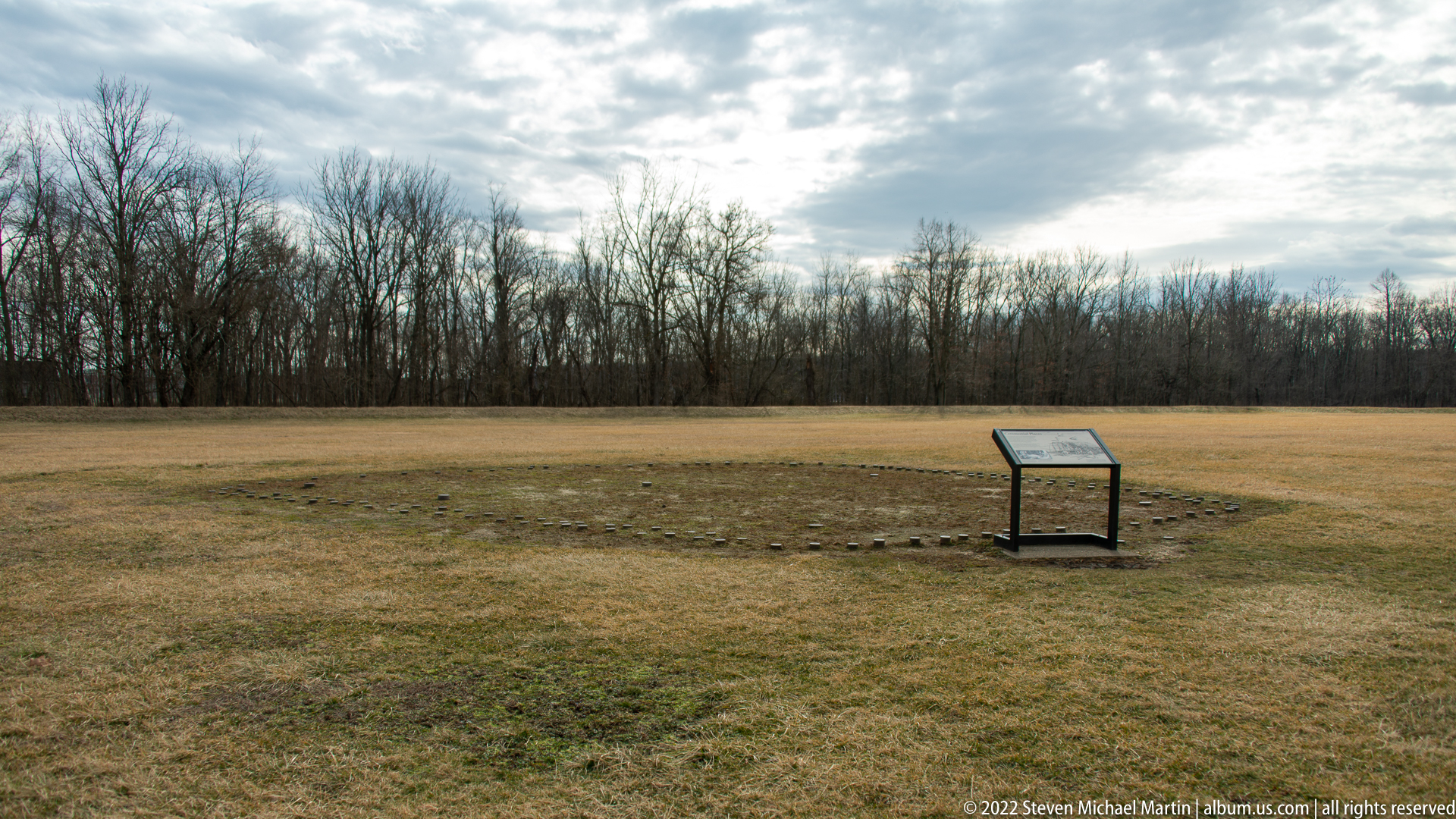
A low interpretive sign stands alone near the center of a wide field, with a band of leafless trees stretching across the background. The cloudy sky occupies nearly half the composition, and the dormant grass creates a muted foreground. The small scale of the sign emphasizes the openness of the landscape and the distance between visitor information and the earthworks.
Caption
A low interpretive sign stands alone near the center of a wide field, with a band of leafless trees stretching across the background. The cloudy sky occupies nearly half the composition, and the dormant grass creates a muted foreground. The small scale of the sign emphasizes the openness of the landscape and the distance between visitor information and the earthworks.
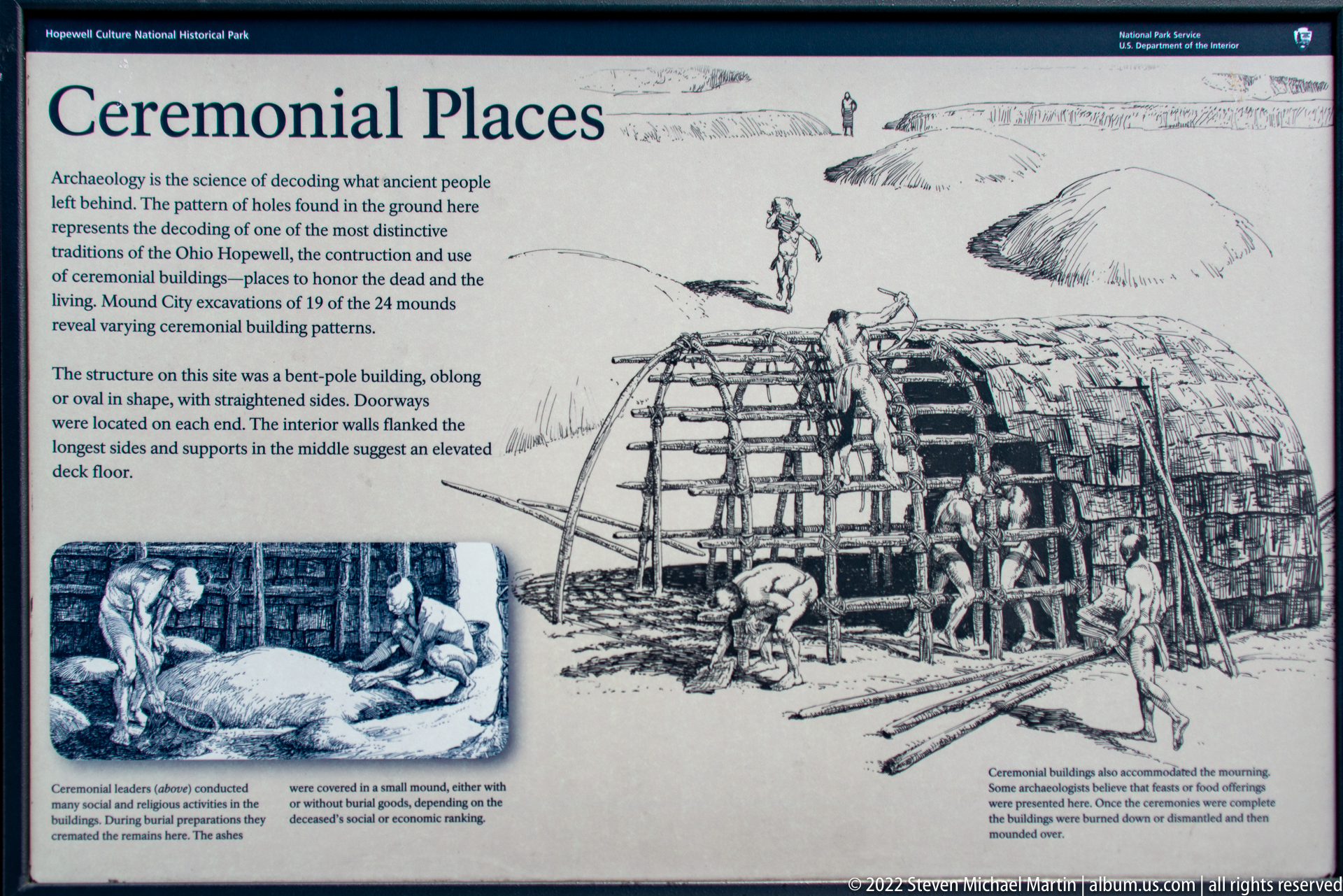
An interpretive panel presents a detailed drawing of a large timber framework under construction, with people assembling posts, beams, and a curved roof. Smaller images and text describe archaeological evidence for built structures associated with Hopewell ceremonial practices. The reconstruction clarifies how researchers infer architecture from traces preserved in the ground.
Caption
An interpretive panel presents a detailed drawing of a large timber framework under construction, with people assembling posts, beams, and a curved roof. Smaller images and text describe archaeological evidence for built structures associated with Hopewell ceremonial practices. The reconstruction clarifies how researchers infer architecture from traces preserved in the ground.

A sequence of small, pale circular markers crosses the grass diagonally from the foreground toward the distant lawn. Their regular spacing creates a clear line, while a dark tree border and a narrow strip of open ground fill the background. The markers may indicate a subsurface feature or site layout, but their purpose is not stated in the thumbnail.
Caption
A sequence of small, pale circular markers crosses the grass diagonally from the foreground toward the distant lawn. Their regular spacing creates a clear line, while a dark tree border and a narrow strip of open ground fill the background. The markers may indicate a subsurface feature or site layout, but their purpose is not stated in the thumbnail.
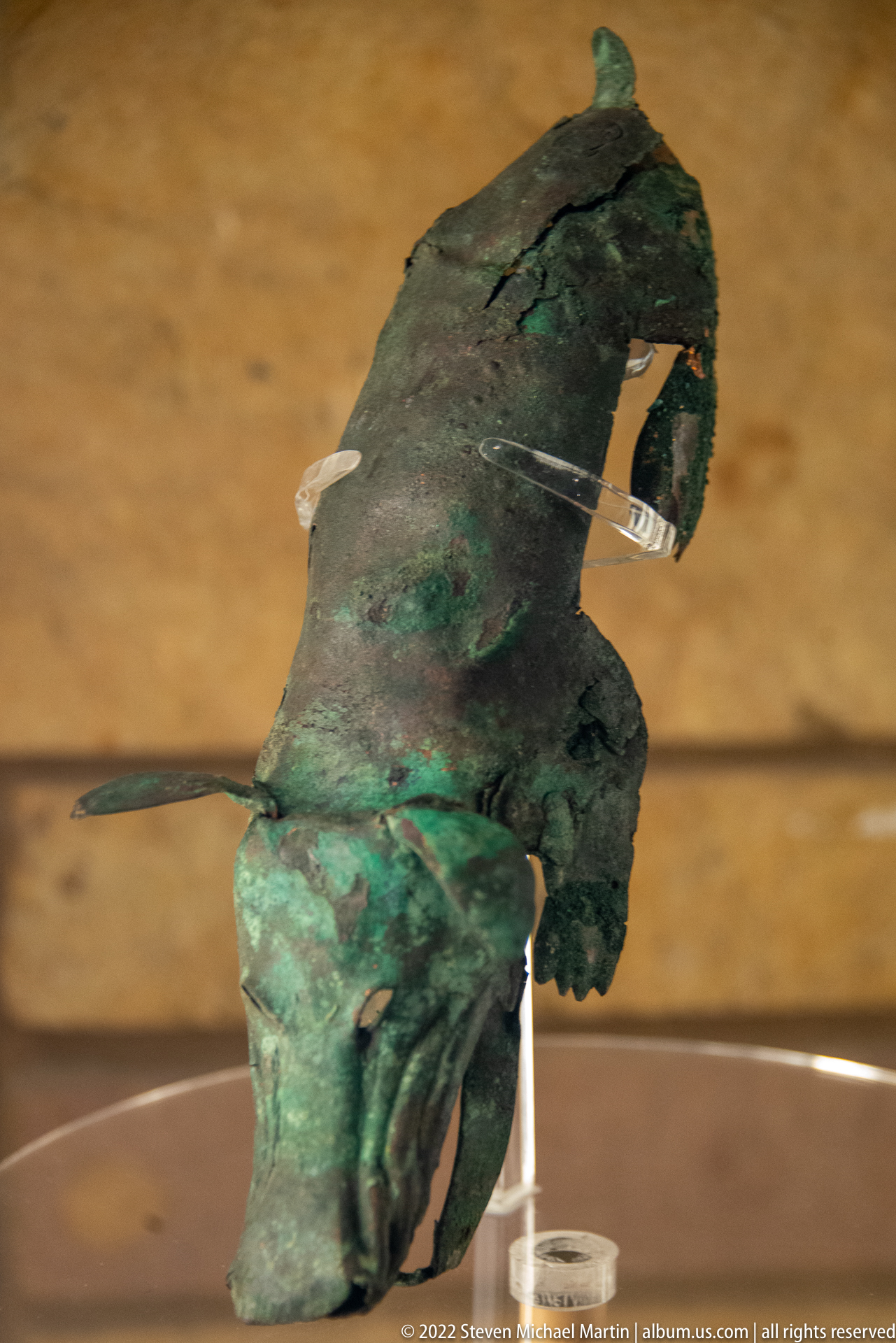
A heavily patinated copper object rests on a clear support inside a museum case. Its broad, irregular body bends upward into a hooked silhouette, with a narrow projection extending to the left. The close view reveals a dark green surface mottled with brown and black areas, but the form alone does not establish the object’s original use.
Caption
A heavily patinated copper object rests on a clear support inside a museum case. Its broad, irregular body bends upward into a hooked silhouette, with a narrow projection extending to the left. The close view reveals a dark green surface mottled with brown and black areas, but the form alone does not establish the object’s original use.
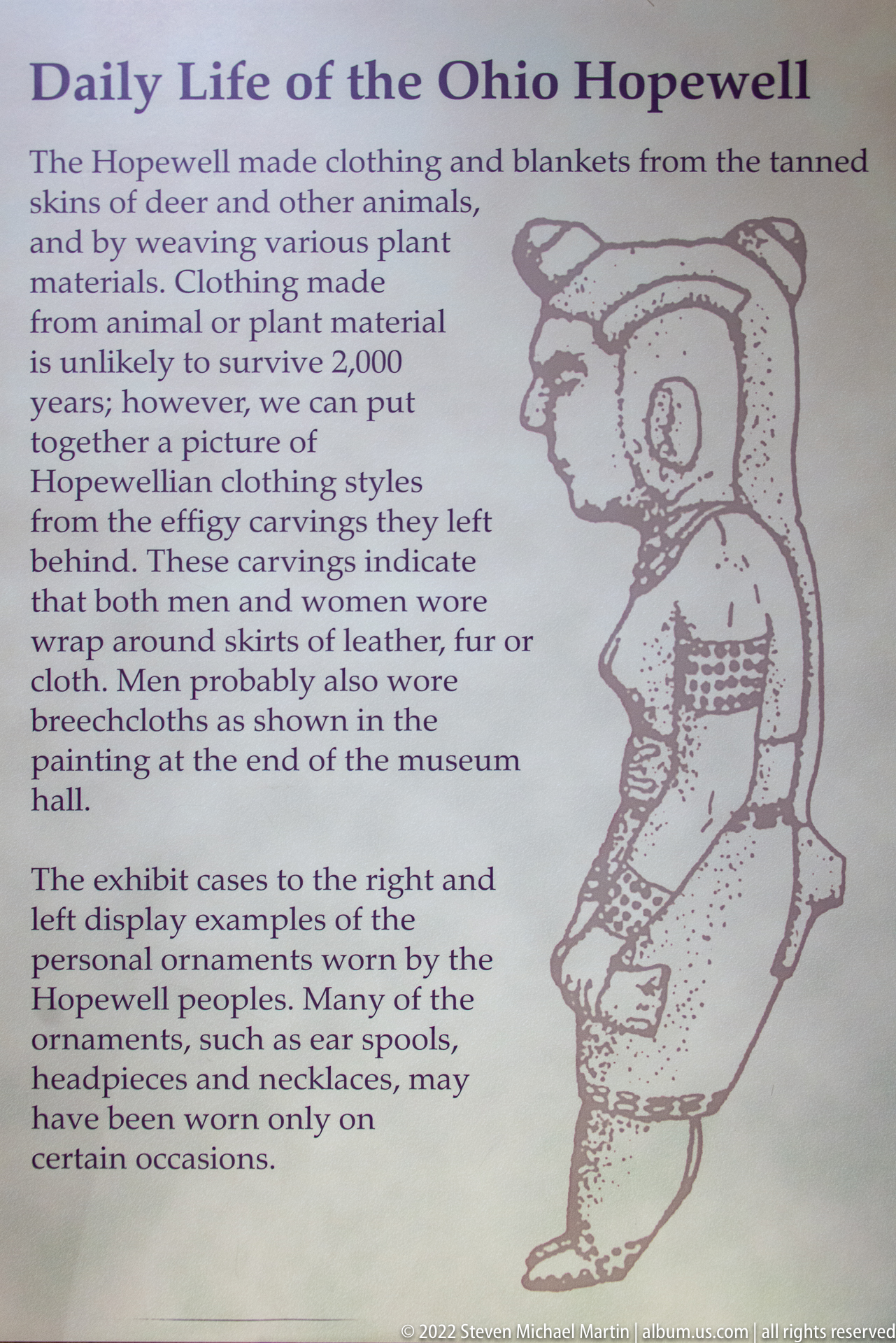
A museum panel titled “Life of the Ohio Hopewell” discusses clothing made from animal and plant materials, including the limits of preservation in the archaeological record. A line drawing of a clothed figure fills the right side, while the text describes garments and personal ornaments. The panel links surviving objects in nearby cases to evidence about everyday dress.
Caption
A museum panel titled “Life of the Ohio Hopewell” discusses clothing made from animal and plant materials, including the limits of preservation in the archaeological record. A line drawing of a clothed figure fills the right side, while the text describes garments and personal ornaments. The panel links surviving objects in nearby cases to evidence about everyday dress.
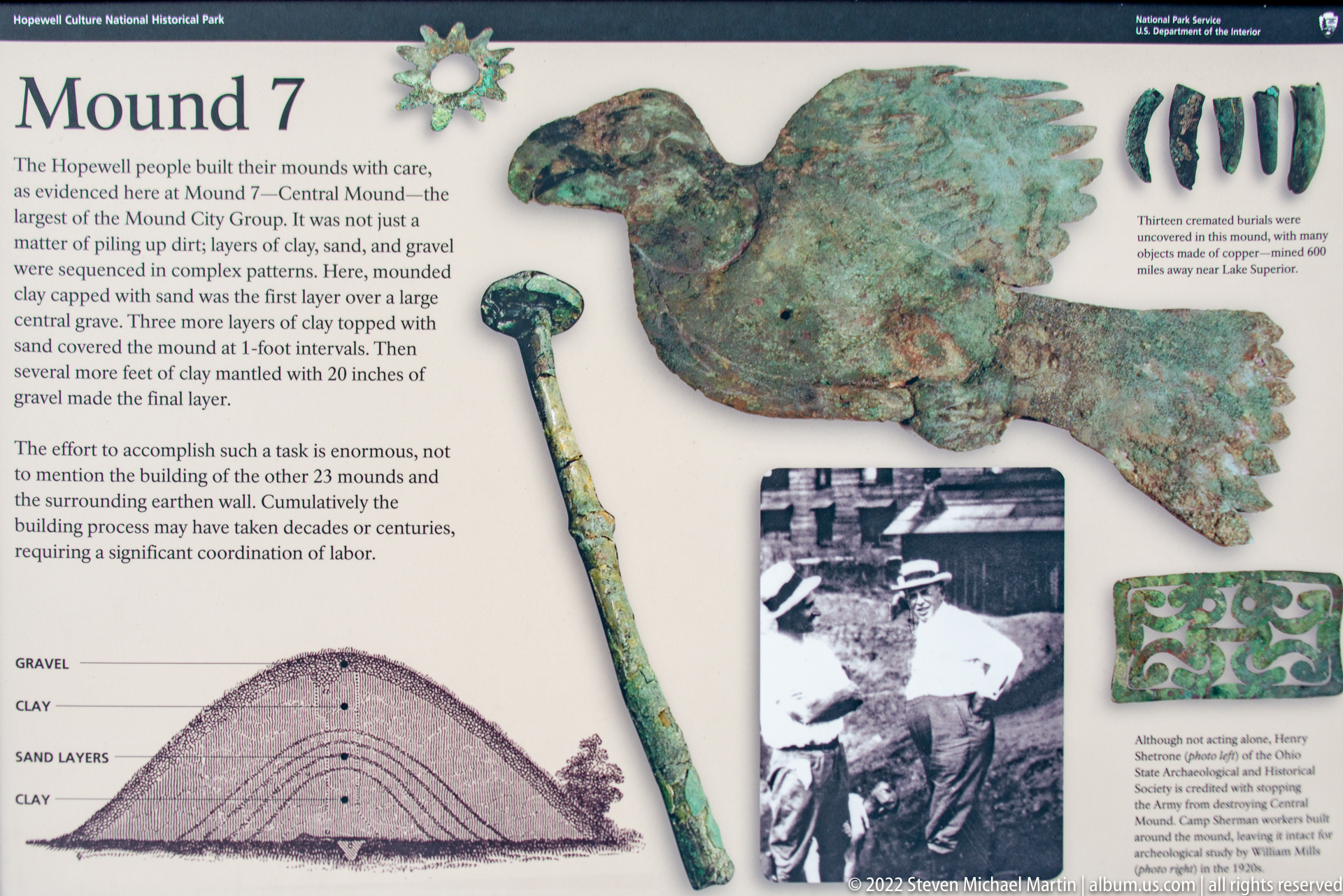
A panel about Mound 7 combines a large copper cutout, several elongated copper objects, a layered mound cross-section, and a historical photograph. Text describes mound construction through successive layers of clay, sand, and gravel. The display brings the physical objects and the engineering of the earthwork together, showing how excavation helps reconstruct building sequence.
Caption
A panel about Mound 7 combines a large copper cutout, several elongated copper objects, a layered mound cross-section, and a historical photograph. Text describes mound construction through successive layers of clay, sand, and gravel. The display brings the physical objects and the engineering of the earthwork together, showing how excavation helps reconstruct building sequence.
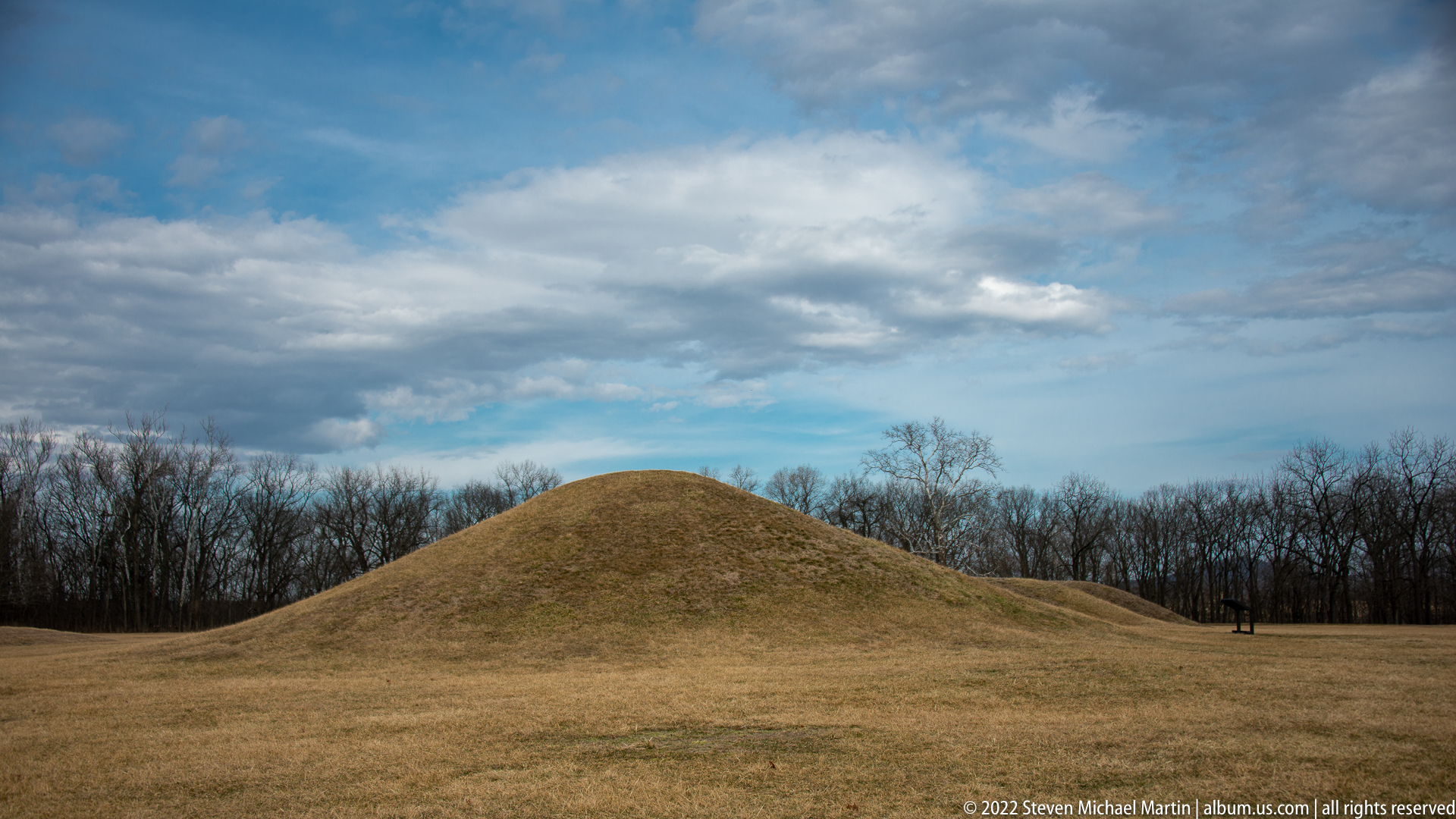
A single rounded mound rises above a line of bare trees, with a wide, cloud-filled sky occupying most of the frame. Its grassy surface appears smooth and maintained, while the surrounding woodland provides a darker horizontal boundary. The distant viewpoint stresses the mound’s silhouette and its low profile within an expansive, quiet landscape.
Caption
A single rounded mound rises above a line of bare trees, with a wide, cloud-filled sky occupying most of the frame. Its grassy surface appears smooth and maintained, while the surrounding woodland provides a darker horizontal boundary. The distant viewpoint stresses the mound’s silhouette and its low profile within an expansive, quiet landscape.
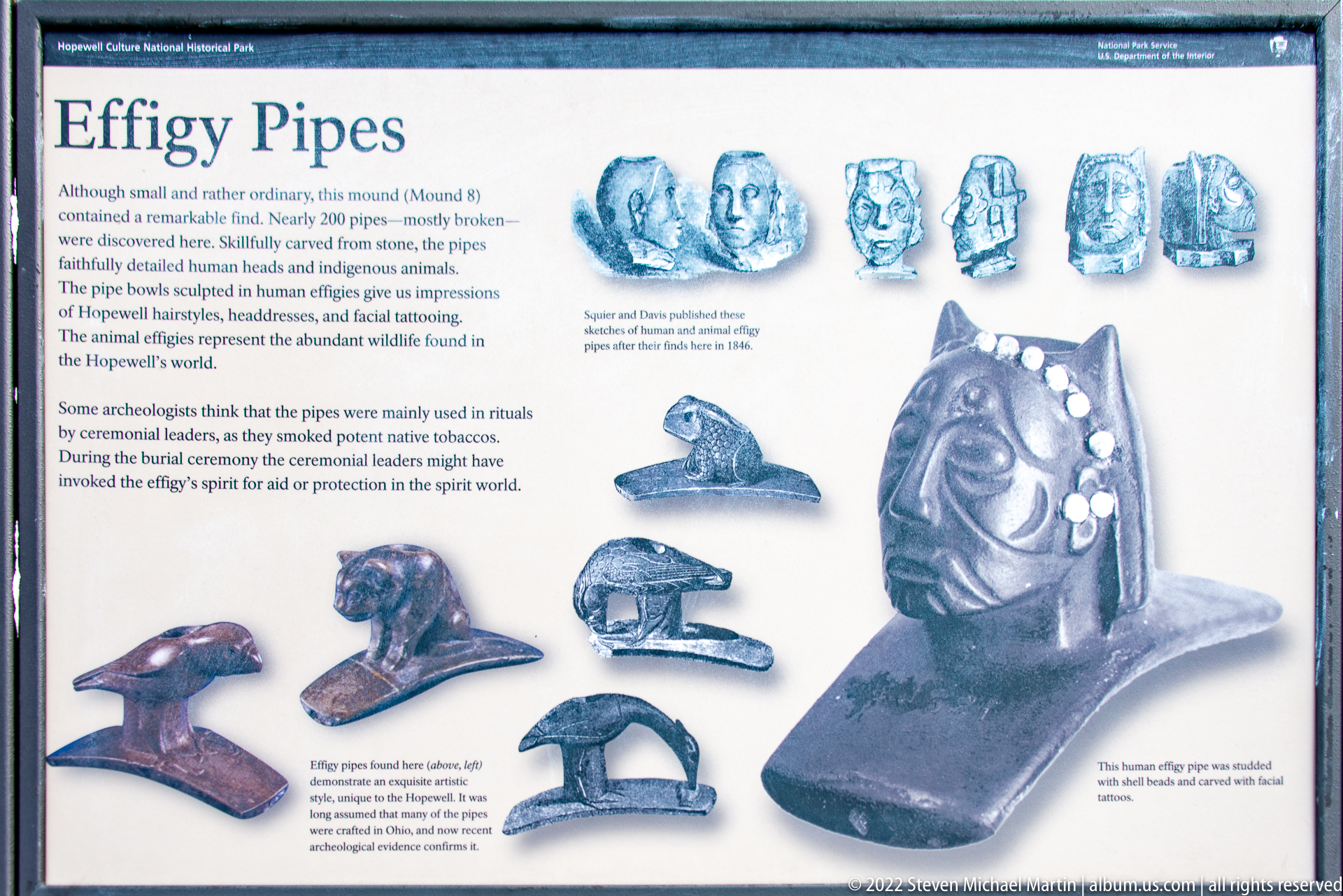
A light-colored panel displays multiple carved stone forms, including small animal-like pipes and several sculpted faces. The accompanying text describes pipe forms and animal imagery, while the varied profiles show openings and raised details used in their design. Rather than one artifact, the composition presents a comparative group from Hopewell material culture.
Caption
A light-colored panel displays multiple carved stone forms, including small animal-like pipes and several sculpted faces. The accompanying text describes pipe forms and animal imagery, while the varied profiles show openings and raised details used in their design. Rather than one artifact, the composition presents a comparative group from Hopewell material culture.
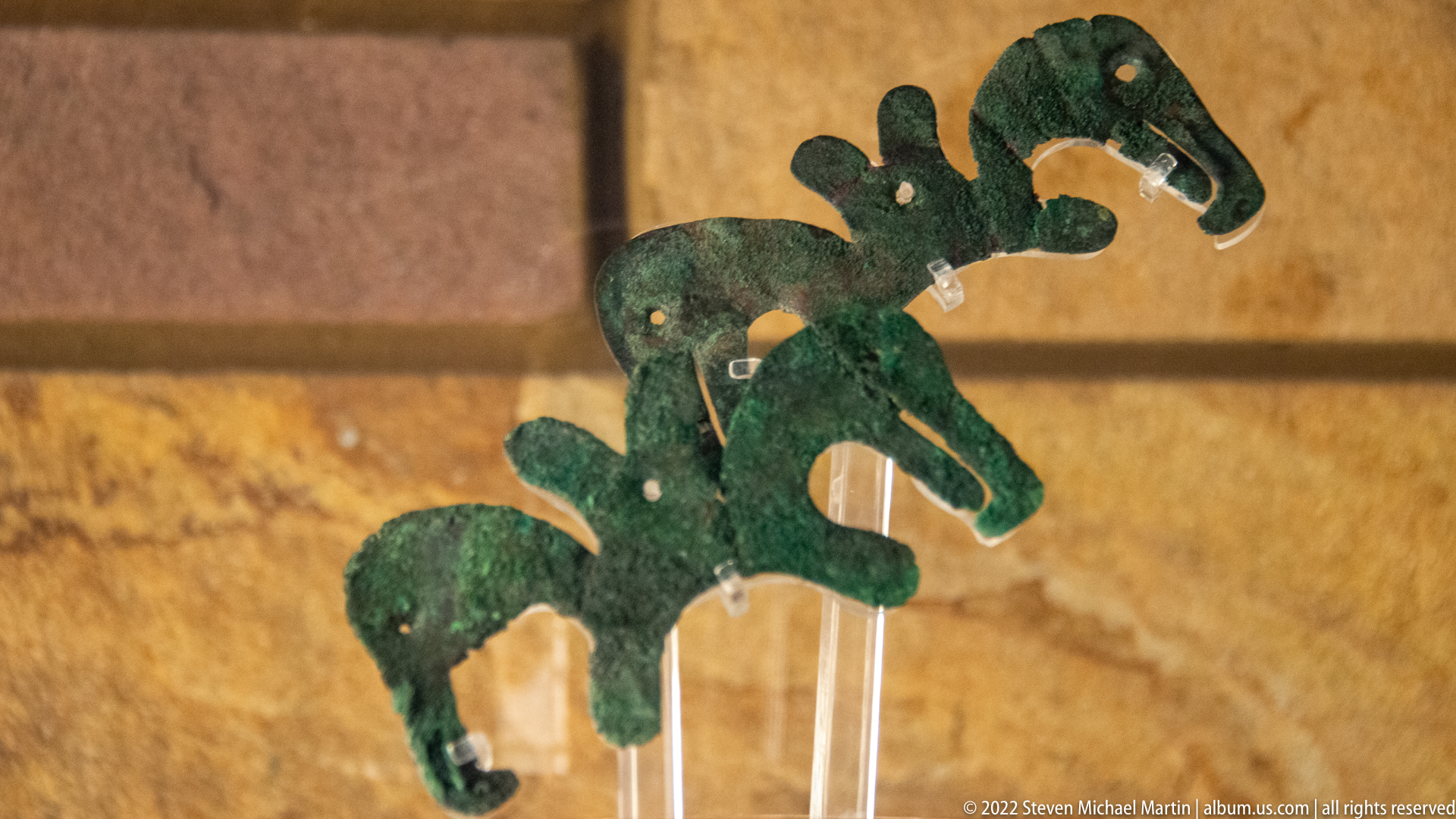
Several thin, green-patinated copper cutouts are displayed upright on a transparent stand. Their repeated curved outlines include hooked projections and small circular openings, producing a linked, rhythmic silhouette. The close framing isolates the ornament forms against the warm-toned case interior; no readable label identifies their original use.
Caption
Several thin, green-patinated copper cutouts are displayed upright on a transparent stand. Their repeated curved outlines include hooked projections and small circular openings, producing a linked, rhythmic silhouette. The close framing isolates the ornament forms against the warm-toned case interior; no readable label identifies their original use.
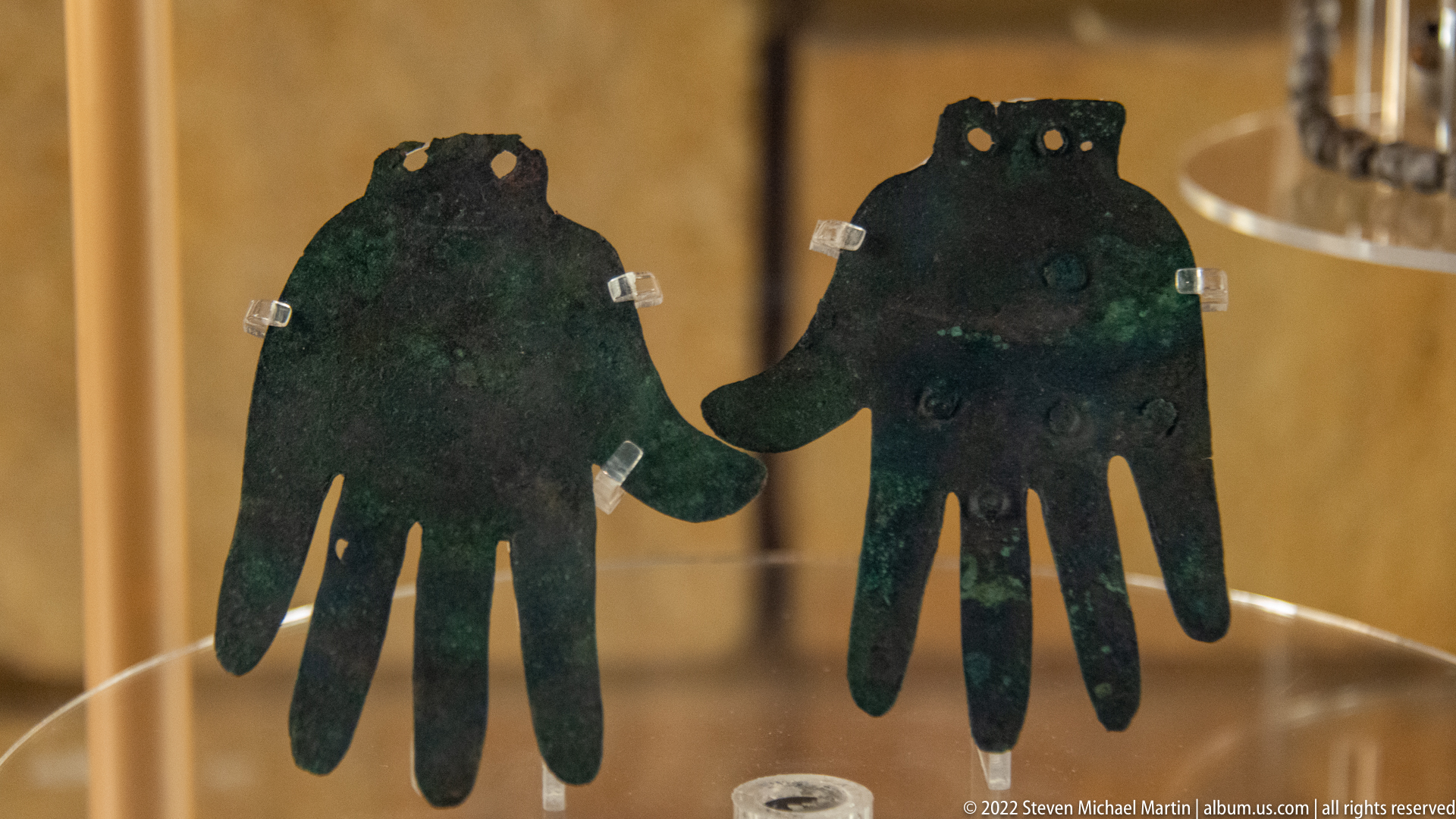
Two dark green copper pieces shaped like open hands face one another on clear supports. Each has a small circular opening near its upper edge and long separated finger forms below. Their matching silhouettes and close side-by-side placement make the paired arrangement central, while the display lighting reveals an uneven, aged surface.
Caption
Two dark green copper pieces shaped like open hands face one another on clear supports. Each has a small circular opening near its upper edge and long separated finger forms below. Their matching silhouettes and close side-by-side placement make the paired arrangement central, while the display lighting reveals an uneven, aged surface.
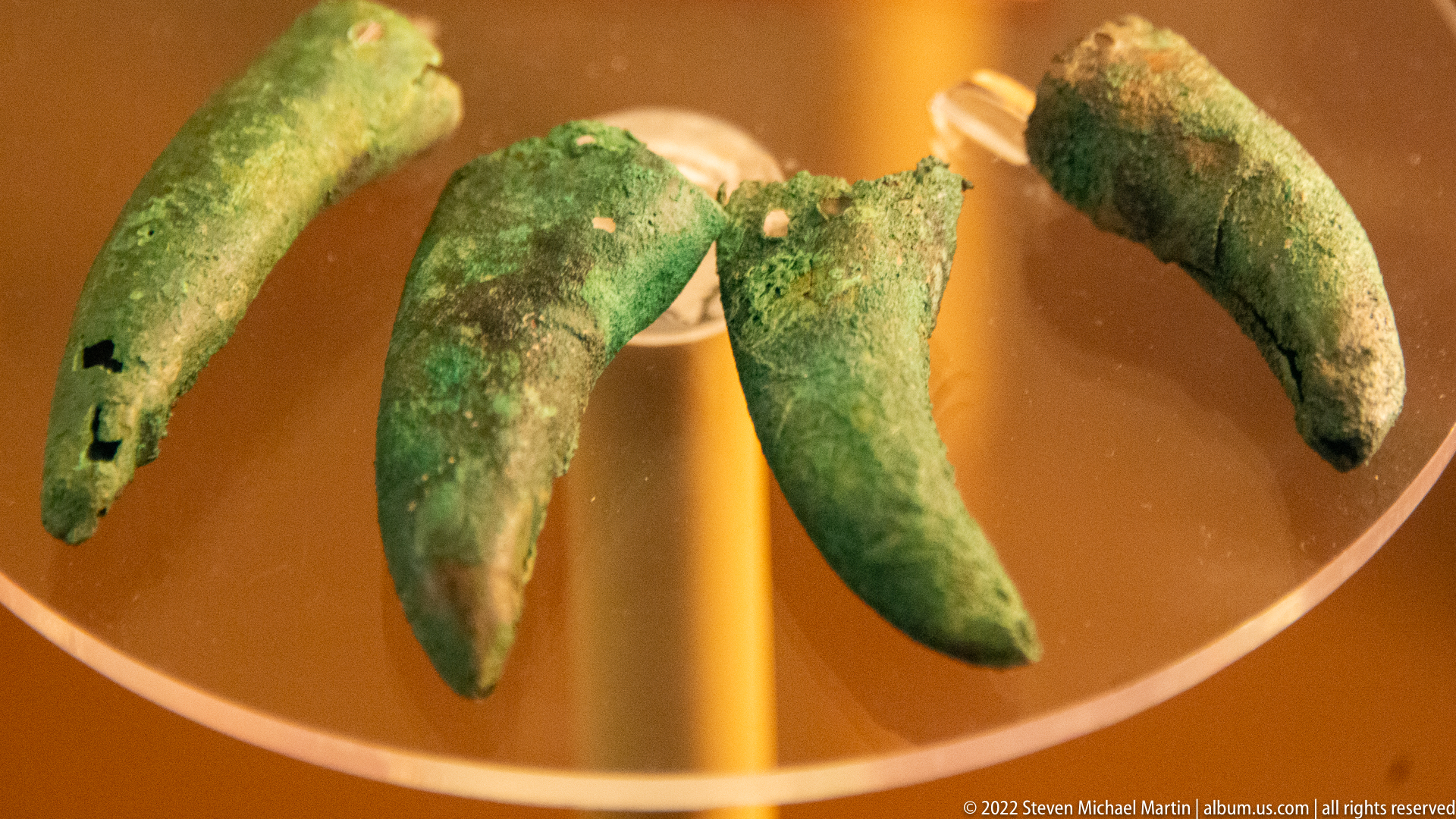
Four short, curved copper pieces appear in a row on a warm orange display surface. Their tapered, irregular ends bend in different directions, and their green surfaces show brown discoloration and small dark openings. The tightly cropped composition compares the objects’ repeated curved form while leaving their exact function unspecified.
Caption
Four short, curved copper pieces appear in a row on a warm orange display surface. Their tapered, irregular ends bend in different directions, and their green surfaces show brown discoloration and small dark openings. The tightly cropped composition compares the objects’ repeated curved form while leaving their exact function unspecified.

A small dark gray pipe rests on a clear stand, its upper surface carved as a crouching frog with rounded eyes and folded limbs. The long flat stem extends beneath the animal figure, and an orange label in front reads “Frog.” The side view makes the sculpted animal and pipe form legible together.
Caption
A small dark gray pipe rests on a clear stand, its upper surface carved as a crouching frog with rounded eyes and folded limbs. The long flat stem extends beneath the animal figure, and an orange label in front reads “Frog.” The side view makes the sculpted animal and pipe form legible together.
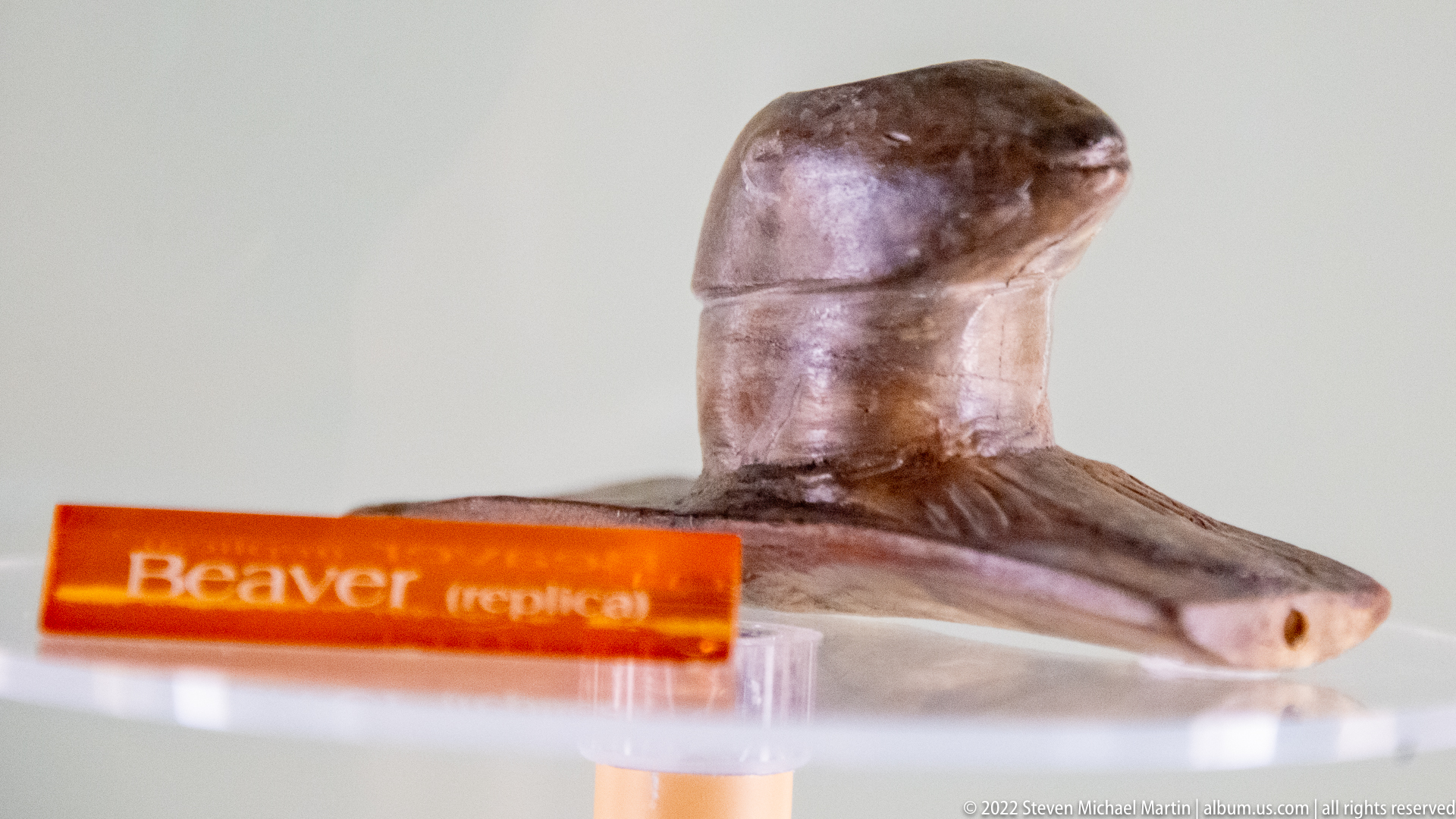
A light brown pipe form rests horizontally on a transparent support, with a rounded upright element and a flattened extension to either side. An orange exhibit label explicitly reads “Beaver (replica).” The close side view shows the simple animal-like shape and surface wear, distinguishing this object from the more fully carved bird and frog forms nearby.
Caption
A light brown pipe form rests horizontally on a transparent support, with a rounded upright element and a flattened extension to either side. An orange exhibit label explicitly reads “Beaver (replica).” The close side view shows the simple animal-like shape and surface wear, distinguishing this object from the more fully carved bird and frog forms nearby.
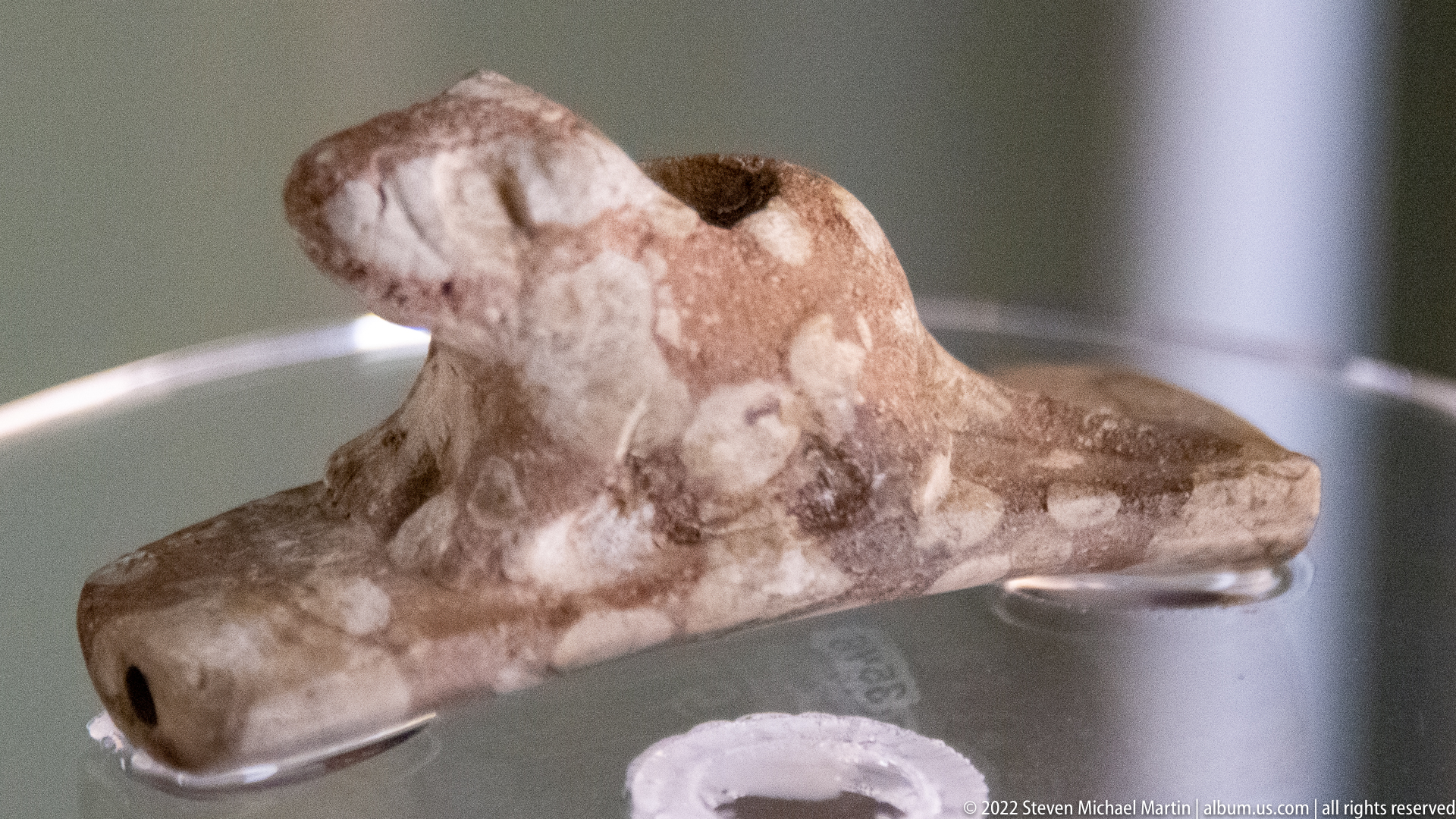
A pale, mottled stone pipe has a compact animal form carved above its broad, flattened base. A circular opening rises behind the figure, and small holes punctuate the base at either end. The animal’s worn contours remain visible despite the mottled surface; no label is legible in this view, so its species and exact identification remain uncertain.
Caption
A pale, mottled stone pipe has a compact animal form carved above its broad, flattened base. A circular opening rises behind the figure, and small holes punctuate the base at either end. The animal’s worn contours remain visible despite the mottled surface; no label is legible in this view, so its species and exact identification remain uncertain.
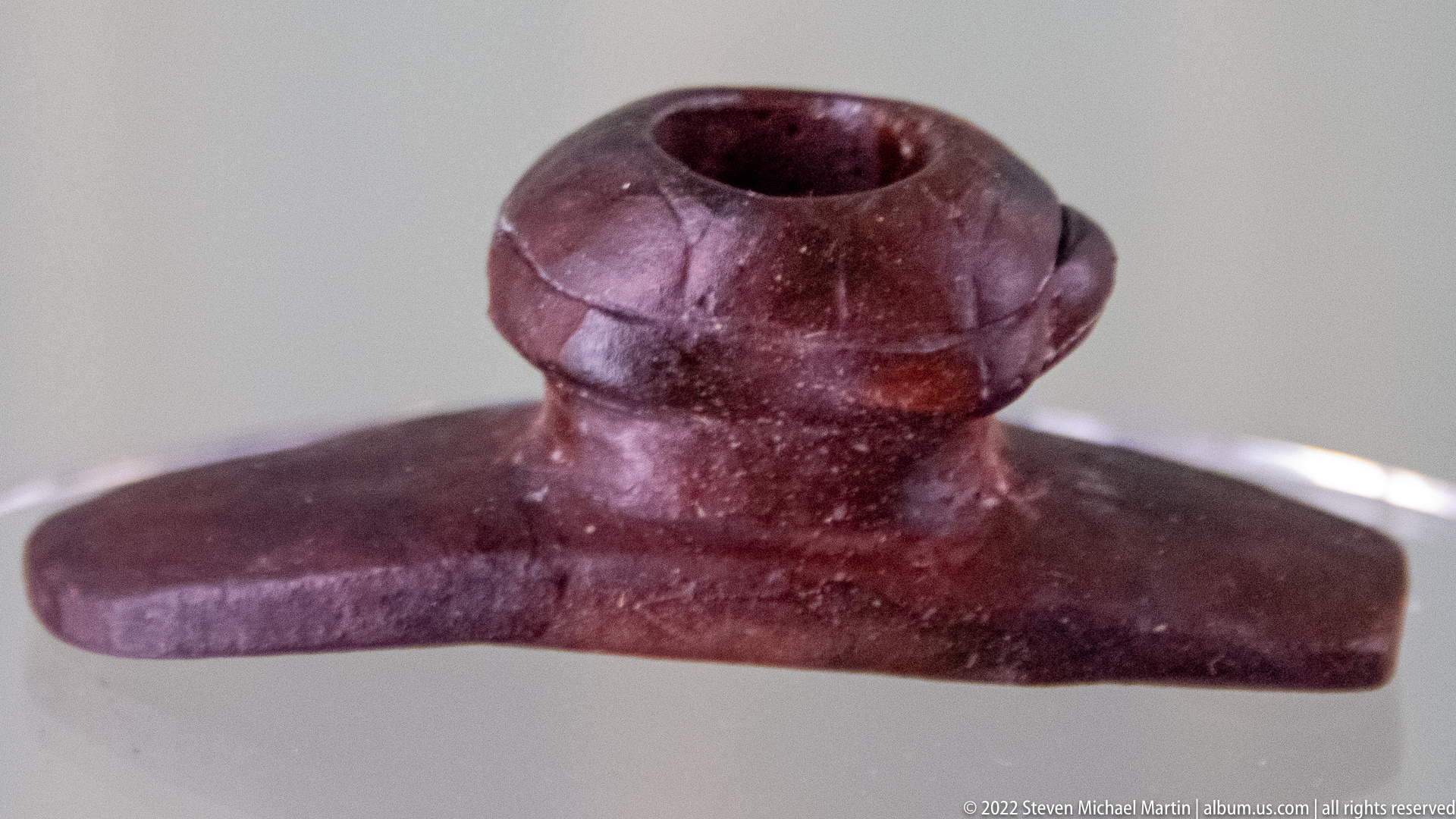
A dark purple-brown stone pipe is shown from the front, its broad flat base extending horizontally beneath a rounded upright bowl or socket. The polished surface catches soft highlights around the circular opening and low side projections. With no visible label or distinctive animal carving, the photograph supports a general identification as a stone pipe.
Caption
A dark purple-brown stone pipe is shown from the front, its broad flat base extending horizontally beneath a rounded upright bowl or socket. The polished surface catches soft highlights around the circular opening and low side projections. With no visible label or distinctive animal carving, the photograph supports a general identification as a stone pipe.
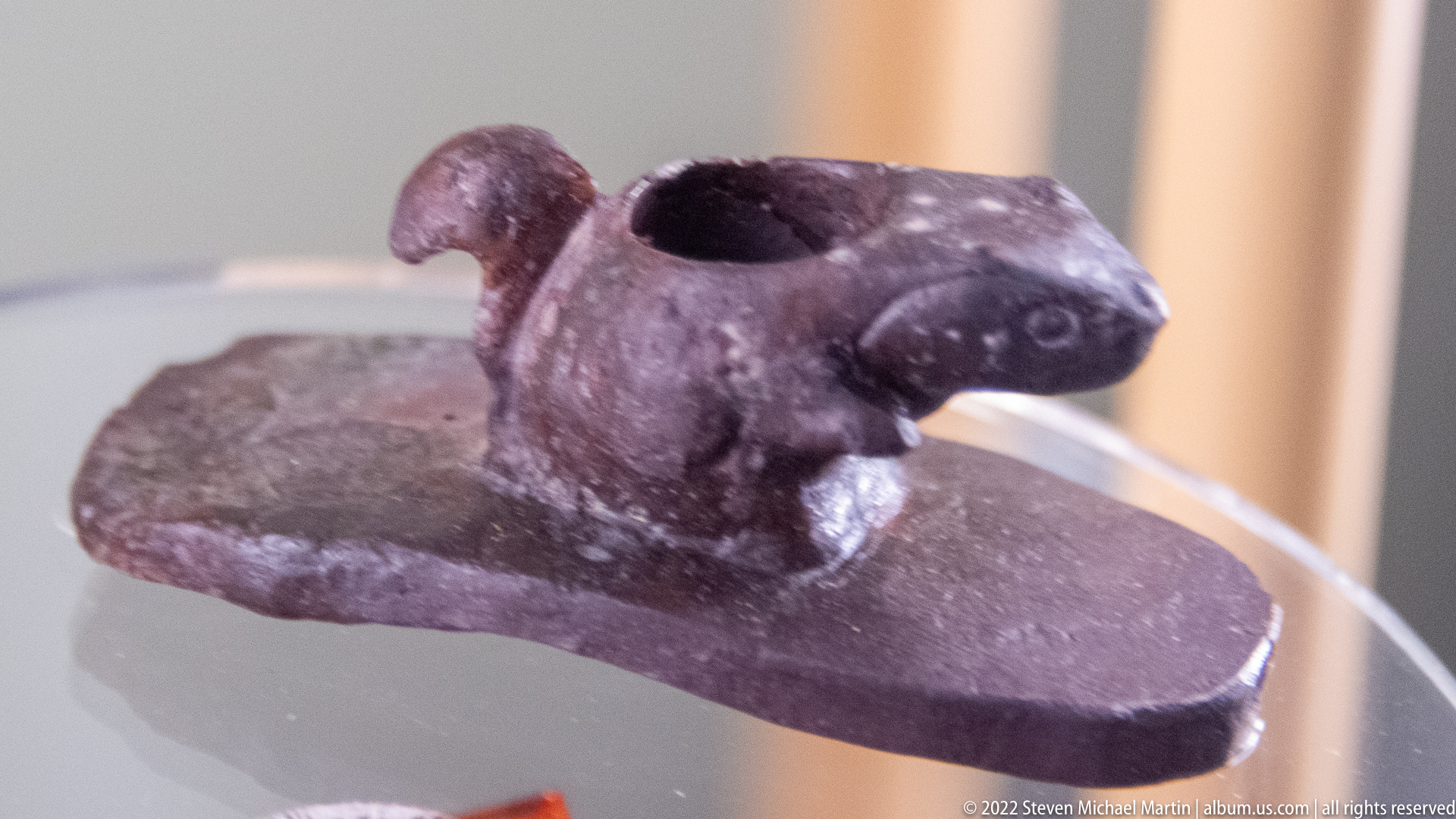
A dark purple-gray pipe combines a small animal figure with a broad, flat base and a circular opening behind the carved form. The creature’s head and raised tail are visible in profile, though the species is not certain from the image. A clear support lifts the object above the case surface for a side view of its sculptural silhouette.
Caption
A dark purple-gray pipe combines a small animal figure with a broad, flat base and a circular opening behind the carved form. The creature’s head and raised tail are visible in profile, though the species is not certain from the image. A clear support lifts the object above the case surface for a side view of its sculptural silhouette.

A dark stone pipe carved as a raven is shown in three-quarter profile, with a sharply projecting beak, incised feather pattern and round eye. The long flat base extends beneath the bird, and an orange label identifies the object as a “Raven effigy pipe.” The close angle shows both the bird’s sculptural head and the pipe’s form.
Caption
A dark stone pipe carved as a raven is shown in three-quarter profile, with a sharply projecting beak, incised feather pattern and round eye. The long flat base extends beneath the bird, and an orange label identifies the object as a “Raven effigy pipe.” The close angle shows both the bird’s sculptural head and the pipe’s form.
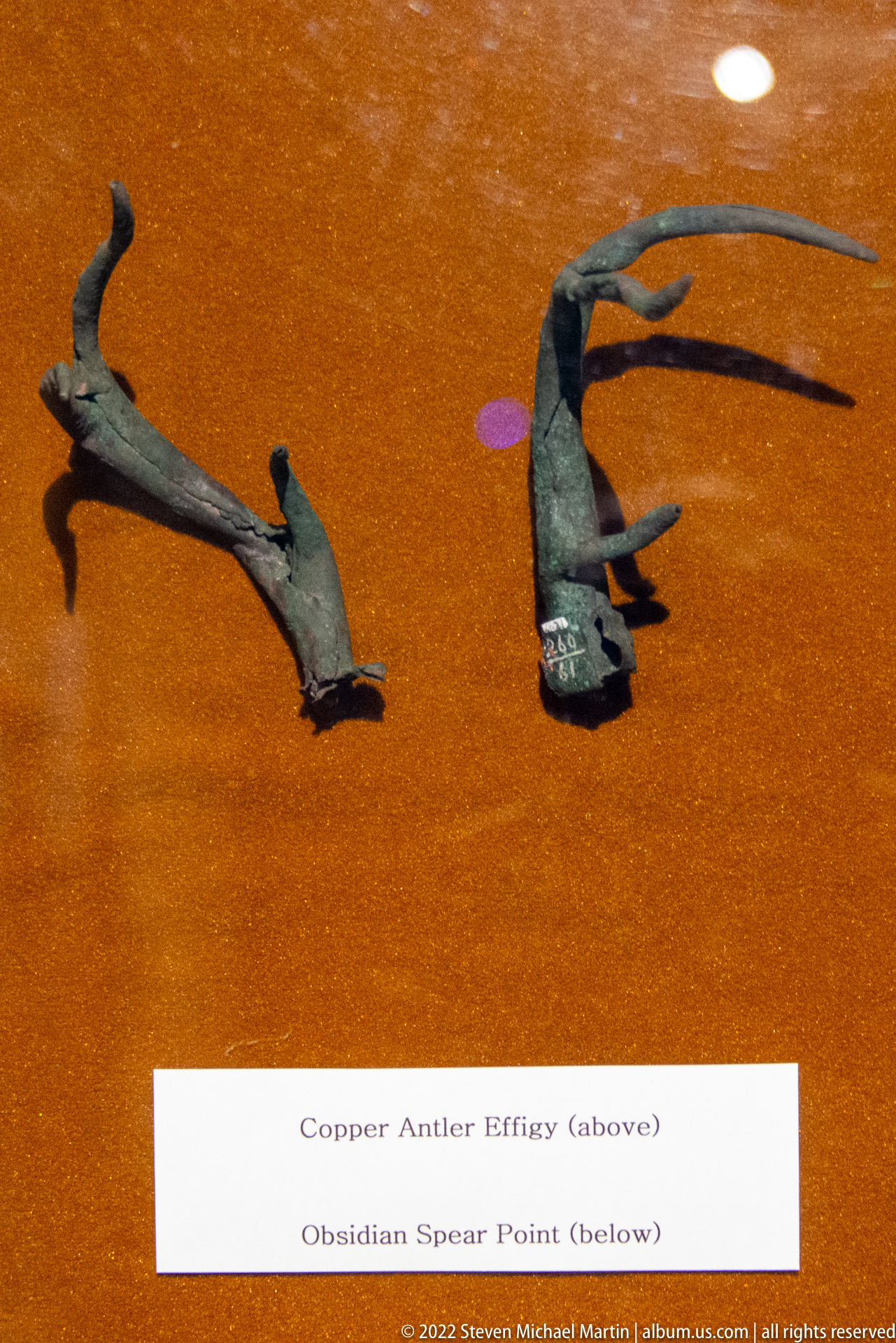
Two dark artifacts lie separately on an orange case surface. The label beneath them identifies the upper object as a copper antler effigy and the lower object as an obsidian spear point. Their elongated, irregular profiles contrast with the bright display ground, while the label provides the clearest evidence for the material and object names.
Caption
Two dark artifacts lie separately on an orange case surface. The label beneath them identifies the upper object as a copper antler effigy and the lower object as an obsidian spear point. Their elongated, irregular profiles contrast with the bright display ground, while the label provides the clearest evidence for the material and object names.
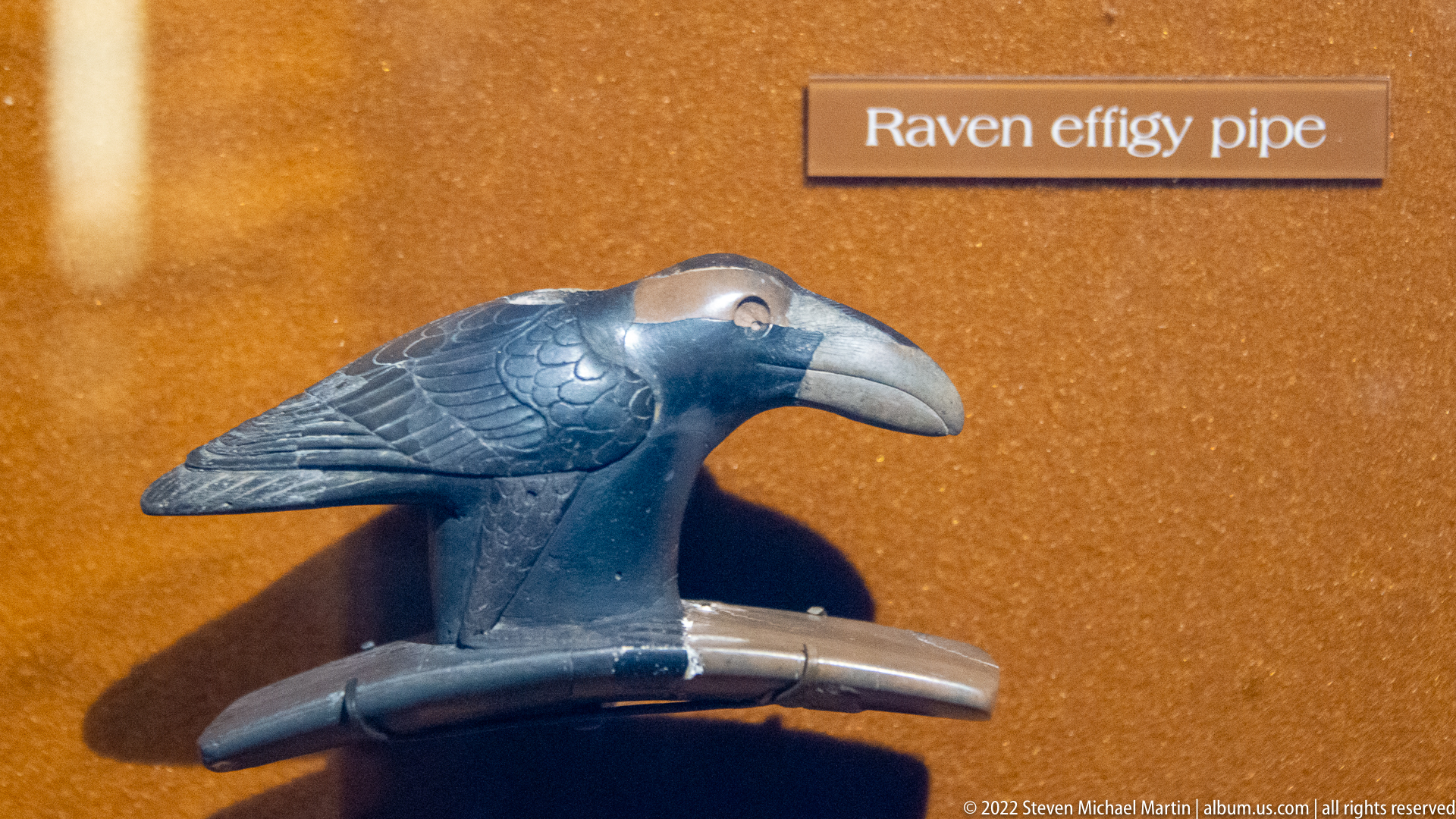
The raven effigy pipe fills the frame, its dark blue-black bird head rising above a curved pipe base. Incised lines describe layered feathers, while a pale highlight marks the eye and the hooked beak points right. The nearby case label repeats the object’s name. This tighter view reveals the carving detail more clearly than the previous broader artifact view.
Caption
The raven effigy pipe fills the frame, its dark blue-black bird head rising above a curved pipe base. Incised lines describe layered feathers, while a pale highlight marks the eye and the hooked beak points right. The nearby case label repeats the object’s name. This tighter view reveals the carving detail more clearly than the previous broader artifact view.
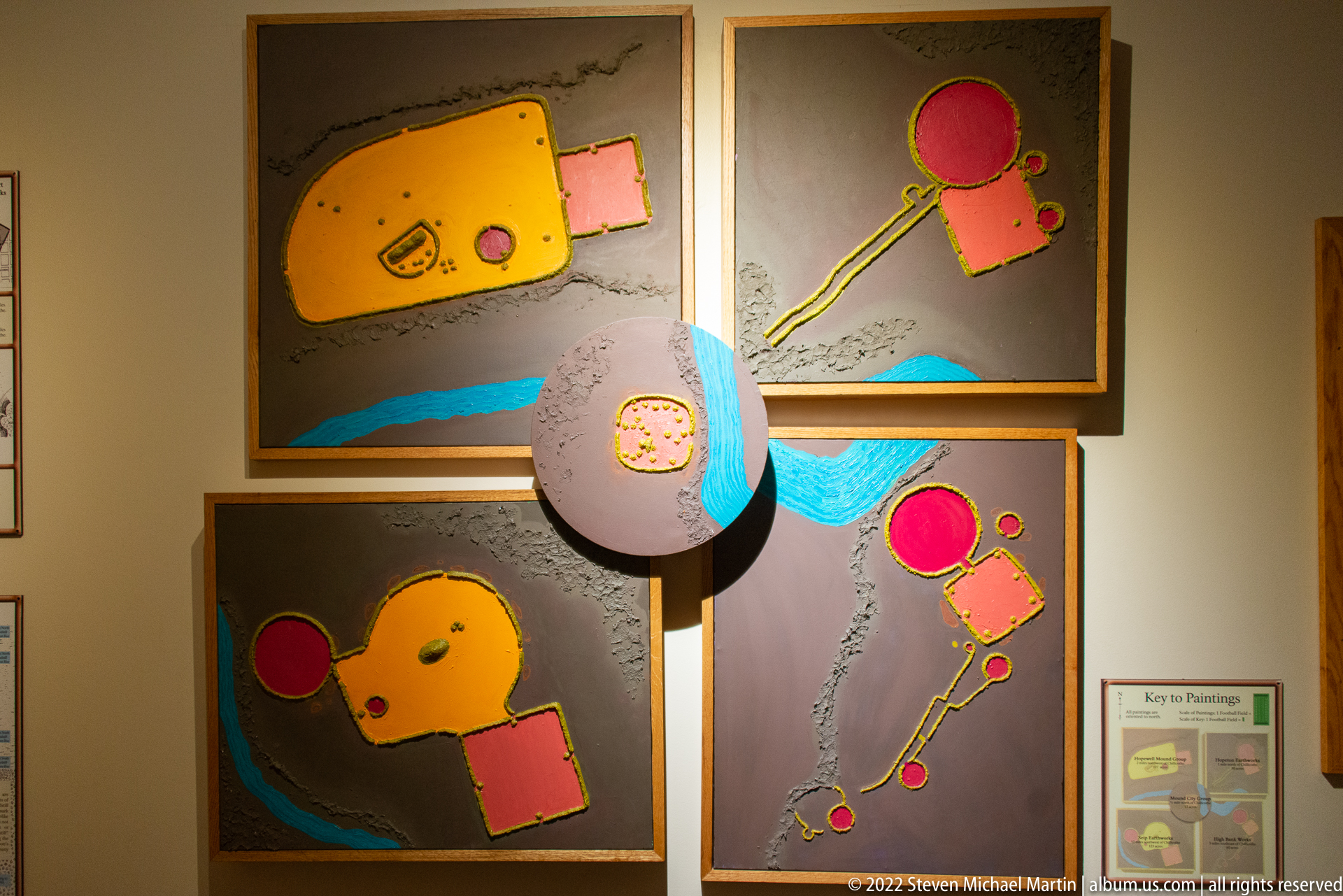
Several framed diagrams show geometric earthwork shapes in bright colors, with circular, rectangular and irregular enclosures arranged around a central raised model. A small information panel stands at the right edge. The installation presents the earthworks as mapped forms and spatial relationships, rather than as a landscape photograph of the surviving sites.
Caption
Several framed diagrams show geometric earthwork shapes in bright colors, with circular, rectangular and irregular enclosures arranged around a central raised model. A small information panel stands at the right edge. The installation presents the earthworks as mapped forms and spatial relationships, rather than as a landscape photograph of the surviving sites.
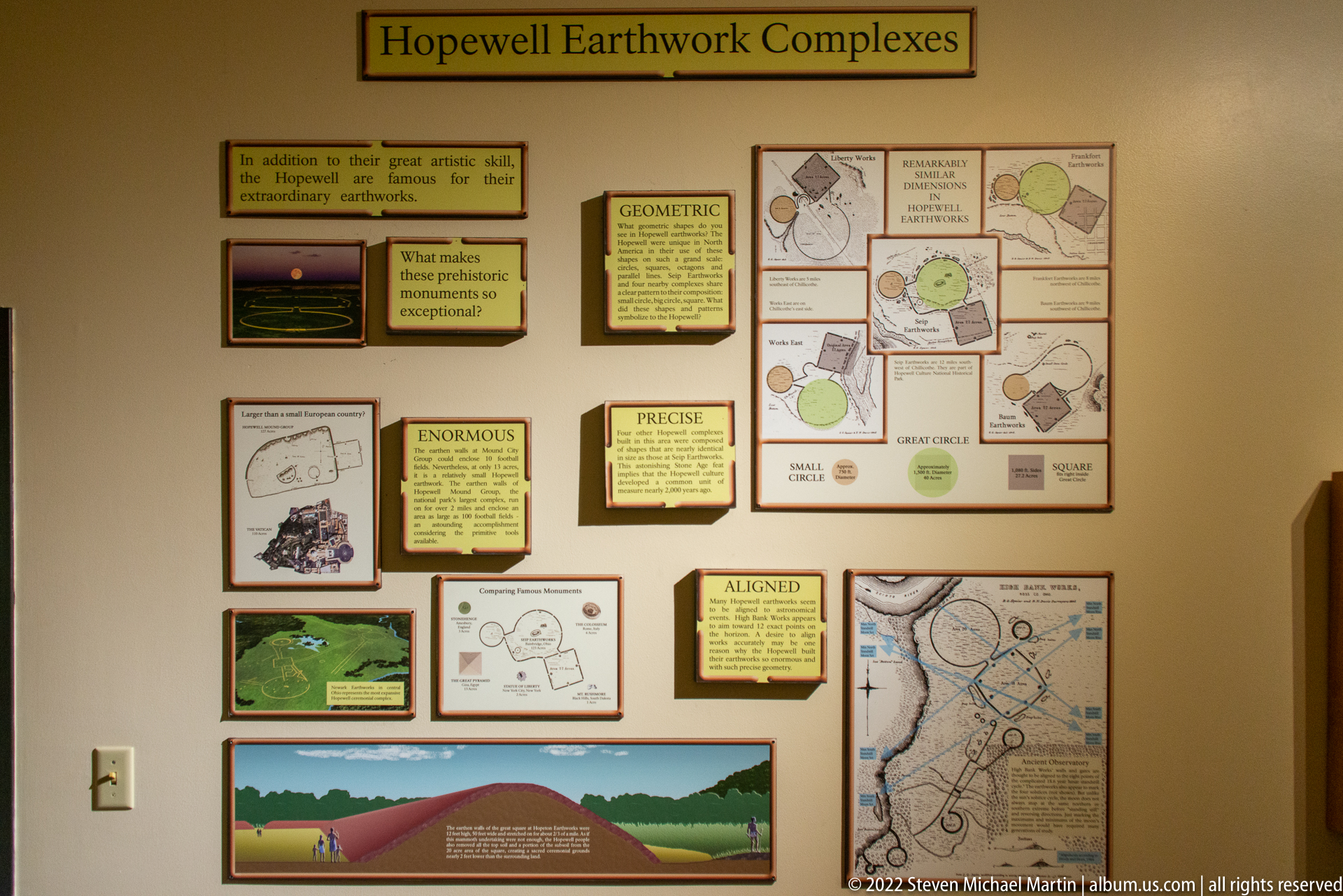
A wall-mounted exhibit titled “Hopewell Earthwork Complexes” organizes diagrams, maps and short text panels around geometric enclosures and mound forms. A long landscape illustration along the bottom shows a raised earthwork in profile. The broad view reveals how the exhibit moves from individual shapes to the scale and setting of the earthwork complexes.
Caption
A wall-mounted exhibit titled “Hopewell Earthwork Complexes” organizes diagrams, maps and short text panels around geometric enclosures and mound forms. A long landscape illustration along the bottom shows a raised earthwork in profile. The broad view reveals how the exhibit moves from individual shapes to the scale and setting of the earthwork complexes.

A green-patinated copper bird form lies flat on orange backing beside a short cylindrical artifact. The bird’s broad wings, tail and small circular perforations are visible, along with incised or raised surface details. The neighboring cylinder provides a contrasting upright shape; neither object’s label is legible in the photograph.
Caption
A green-patinated copper bird form lies flat on orange backing beside a short cylindrical artifact. The bird’s broad wings, tail and small circular perforations are visible, along with incised or raised surface details. The neighboring cylinder provides a contrasting upright shape; neither object’s label is legible in the photograph.
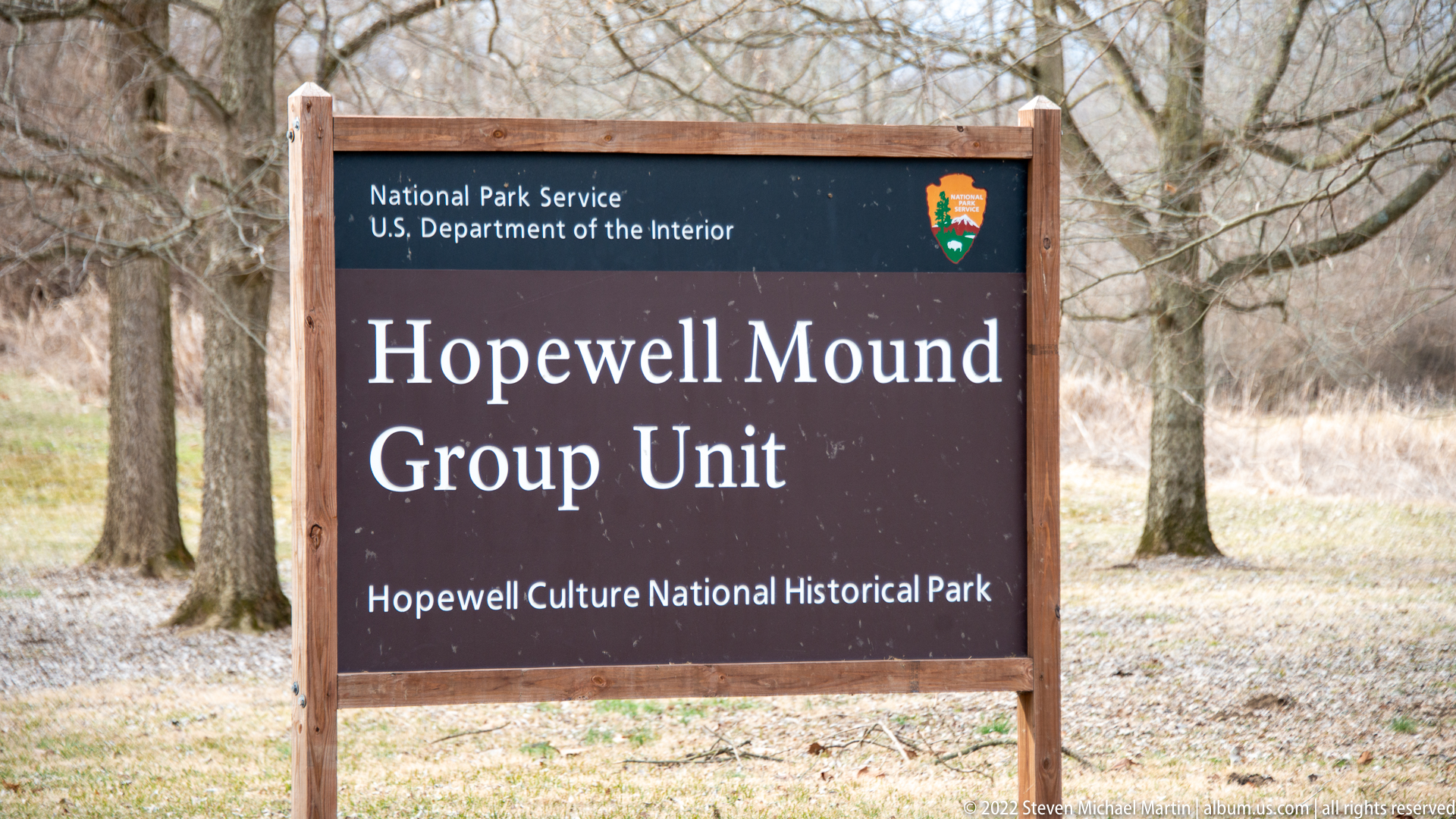
A dark brown National Park Service sign stands on two timber posts beside a leaf-covered path. Large lettering reads “Hopewell Mound Group Unit,” with “Hopewell Culture National Historical Park” below. Bare trees and woodland surround the sign, situating the named park unit in a quiet outdoor setting.
Caption
A dark brown National Park Service sign stands on two timber posts beside a leaf-covered path. Large lettering reads “Hopewell Mound Group Unit,” with “Hopewell Culture National Historical Park” below. Bare trees and woodland surround the sign, situating the named park unit in a quiet outdoor setting.
Hopewell Culture National Historical Park — Field Guide
National Historical Park Field Guide
📍 Overview
Hopewell Culture National Historical Park preserves earthworks constructed by Indigenous peoples more than two thousand years ago. The geometric mounds and ceremonial landscapes demonstrate advanced understanding of engineering, spatial organization, and social cooperation. The site provides insight into the cultural traditions of communities that shaped the Ohio River valley long before European settlement.
The preserved earthworks reflect ceremonial and social activities that connected communities across a wide geographic region. Archaeological evidence suggests the exchange of materials and ideas across considerable distances. The landscape illustrates the importance of ritual space and environmental awareness in the Hopewell cultural tradition.
⭐ Highlights
- Ancient geometric earthworks constructed over 2,000 years ago
- Evidence of complex social organization and cooperation
- Archaeological landscape illustrating ceremonial traditions
- Interpretation of pre-contact Indigenous history
- Preserved mounds demonstrating sophisticated spatial planning
🔎 Key Features
- Geometric earthworks reflecting ceremonial activity
- Archaeological features illustrating early engineering
- Interpretive exhibits explaining Hopewell culture
- Landscape demonstrating cultural continuity
- Context for understanding early North American societies
📷 Photography Notes
- Low-angle light helps reveal subtle earthwork contours
- Wide compositions capture the scale of the landscape
- Seasonal color can help define the shapes of mounds
- Cloud shadows can add depth to open terrain
- Simple compositions emphasize geometric forms
- Look for elevated viewpoints where available
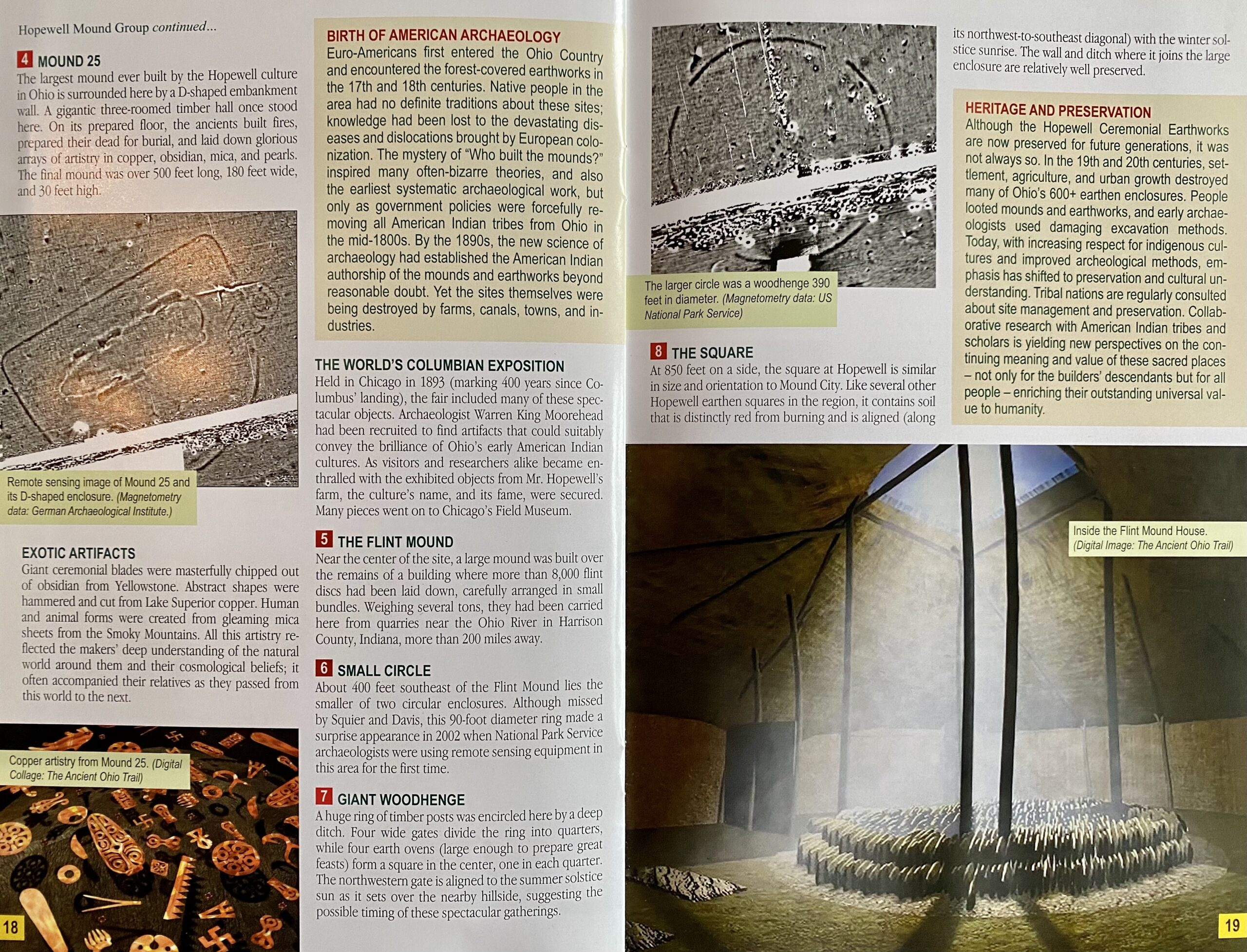
A long archaeology panel presents aerial and ground-level images of Hopewell earthworks, a plan of a large circular enclosure, and photographs of excavated artifacts. A reconstruction at lower right shows a timber-walled circular space surrounded by a broad ring of posts. The display relates material finds to the scale and formal geometry of ceremonial landscapes.
Caption
A long archaeology panel presents aerial and ground-level images of Hopewell earthworks, a plan of a large circular enclosure, and photographs of excavated artifacts. A reconstruction at lower right shows a timber-walled circular space surrounded by a broad ring of posts. The display relates material finds to the scale and formal geometry of ceremonial landscapes.
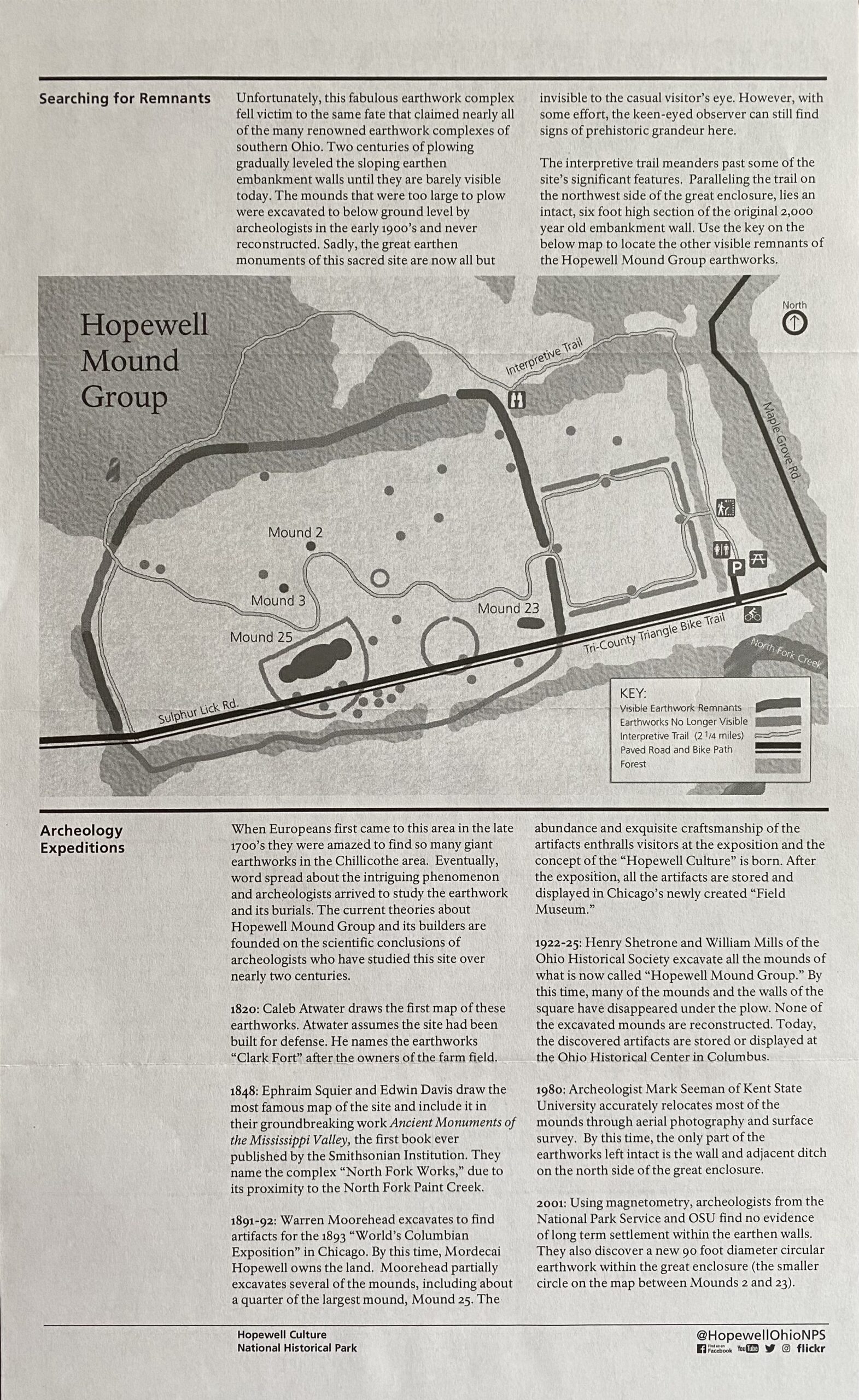
A grayscale site map fills the upper half of a National Park Service panel, tracing the Hopewell Mound Group enclosure and marking mounds, paths and nearby features. Explanatory text is arranged below in several columns. The map’s long boundary and labeled internal shapes give the panel a spatial focus, distinct from the broader overview nearby.
Caption
A grayscale site map fills the upper half of a National Park Service panel, tracing the Hopewell Mound Group enclosure and marking mounds, paths and nearby features. Explanatory text is arranged below in several columns. The map’s long boundary and labeled internal shapes give the panel a spatial focus, distinct from the broader overview nearby.
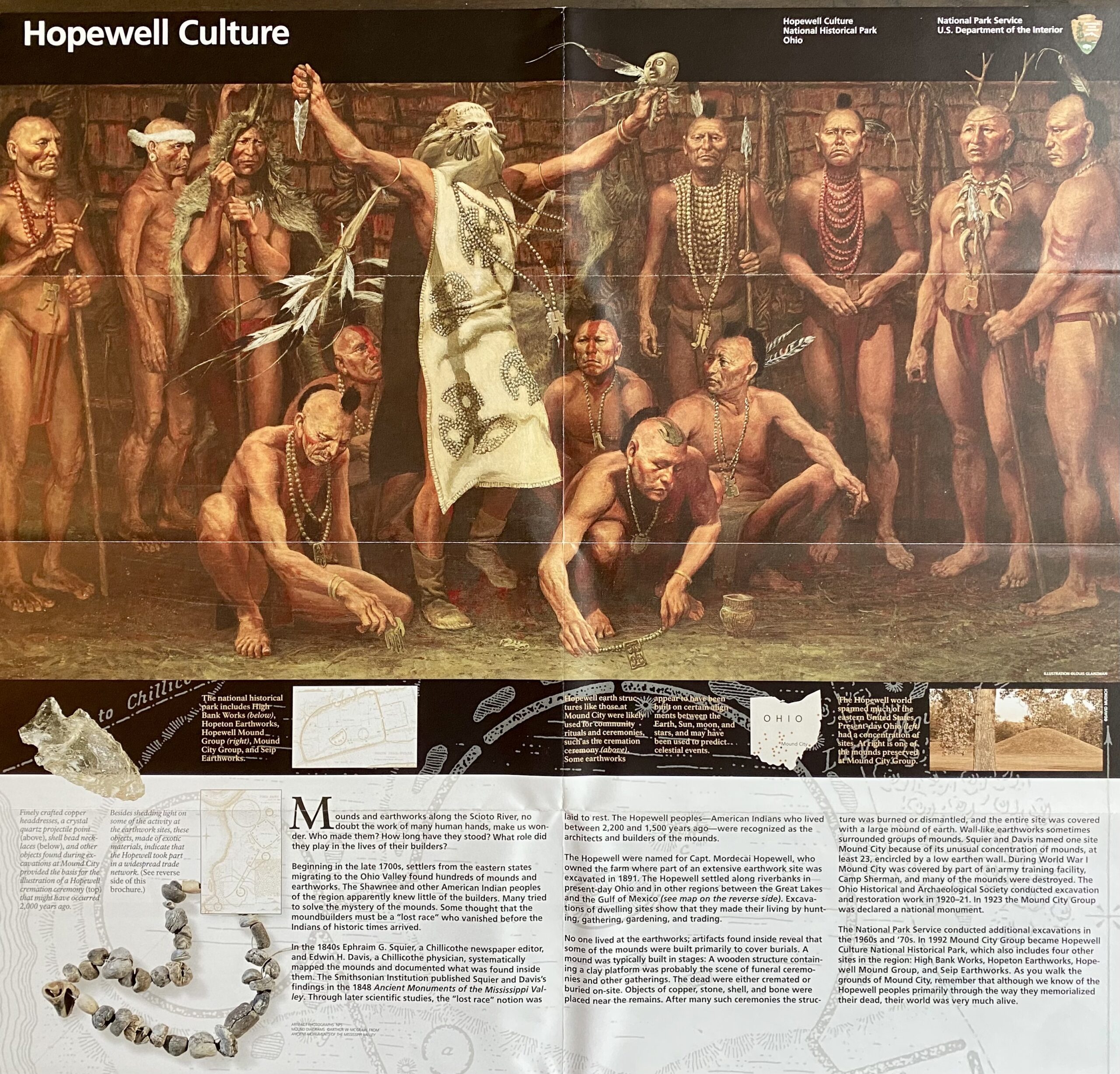
A wide National Park Service exhibit panel pairs a painted scene of people in ceremonial gathering with rows of artifact images and explanatory text below. A map, stone objects and a strand of beads appear in the lower section. The panoramic layout introduces Hopewell culture through a combination of interpreted scene, material objects and written context.
Caption
A wide National Park Service exhibit panel pairs a painted scene of people in ceremonial gathering with rows of artifact images and explanatory text below. A map, stone objects and a strand of beads appear in the lower section. The panoramic layout introduces Hopewell culture through a combination of interpreted scene, material objects and written context.
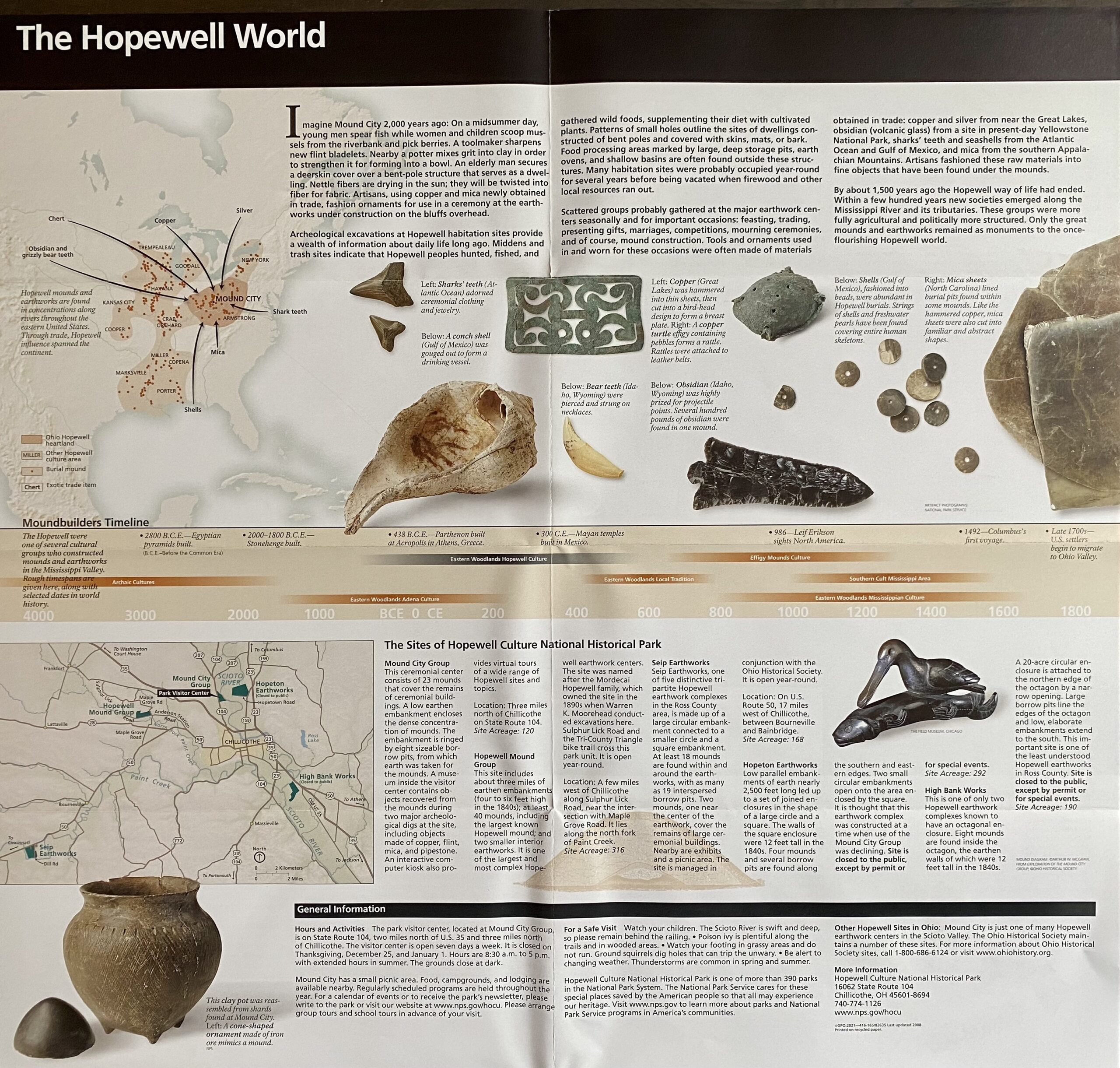
A large horizontal panel titled “The Hopewell World” combines a regional map, written interpretation and photographs or drawings of objects including pottery, stone tools and ornaments. A second map and additional text fill the lower portion. Its broad layout presents both the geographic reach of Hopewell communities and examples of the material record.
Caption
A large horizontal panel titled “The Hopewell World” combines a regional map, written interpretation and photographs or drawings of objects including pottery, stone tools and ornaments. A second map and additional text fill the lower portion. Its broad layout presents both the geographic reach of Hopewell communities and examples of the material record.
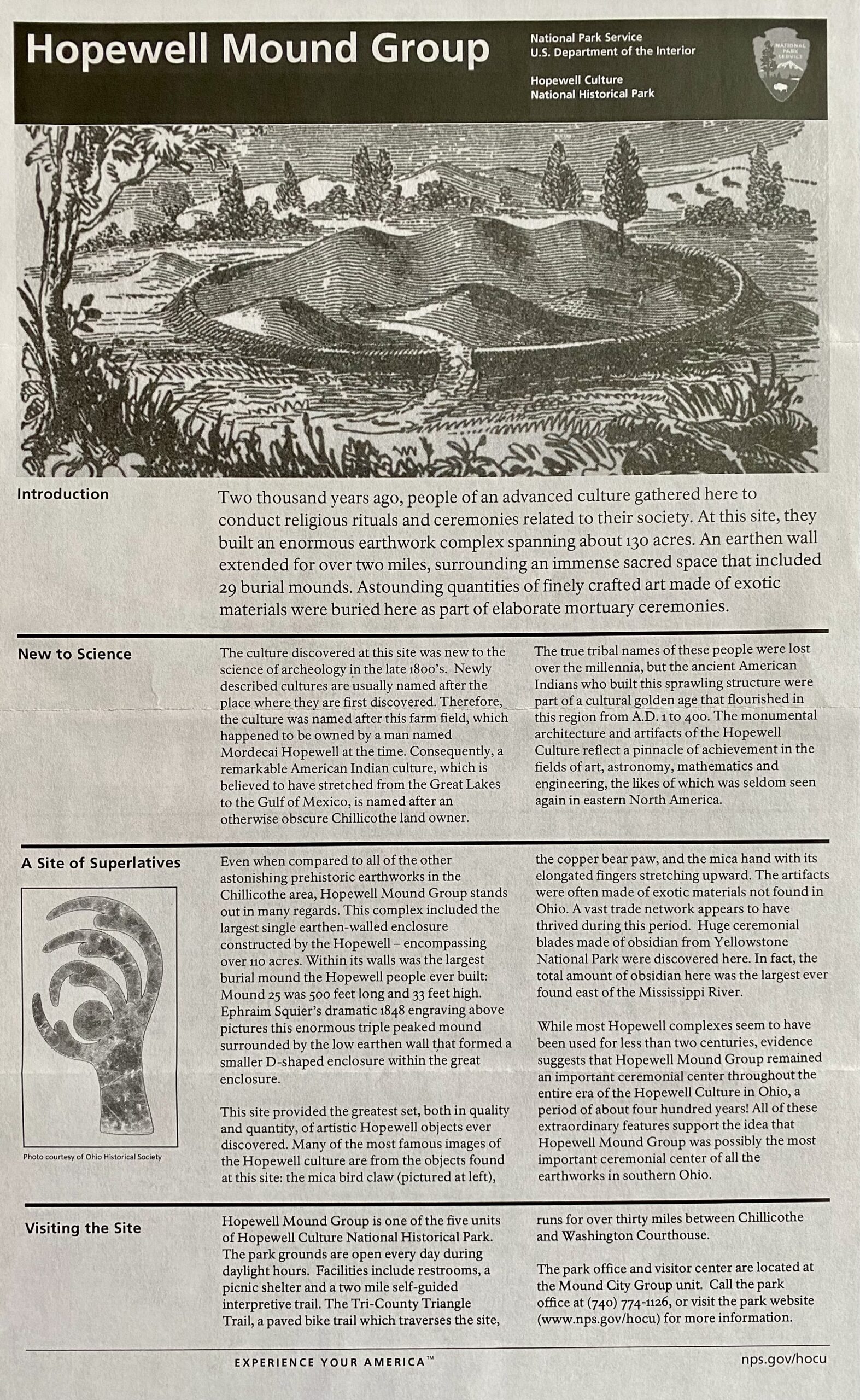
A black-and-white National Park Service panel titled “Hopewell Mound Group” places a panoramic landscape illustration across its upper portion. Sections below discuss the site’s introduction, research and significance, with a small mound diagram at left. The straight-on view shows a compact interpretive overview connecting the earthwork landscape to archaeological study.
Caption
A black-and-white National Park Service panel titled “Hopewell Mound Group” places a panoramic landscape illustration across its upper portion. Sections below discuss the site’s introduction, research and significance, with a small mound diagram at left. The straight-on view shows a compact interpretive overview connecting the earthwork landscape to archaeological study.
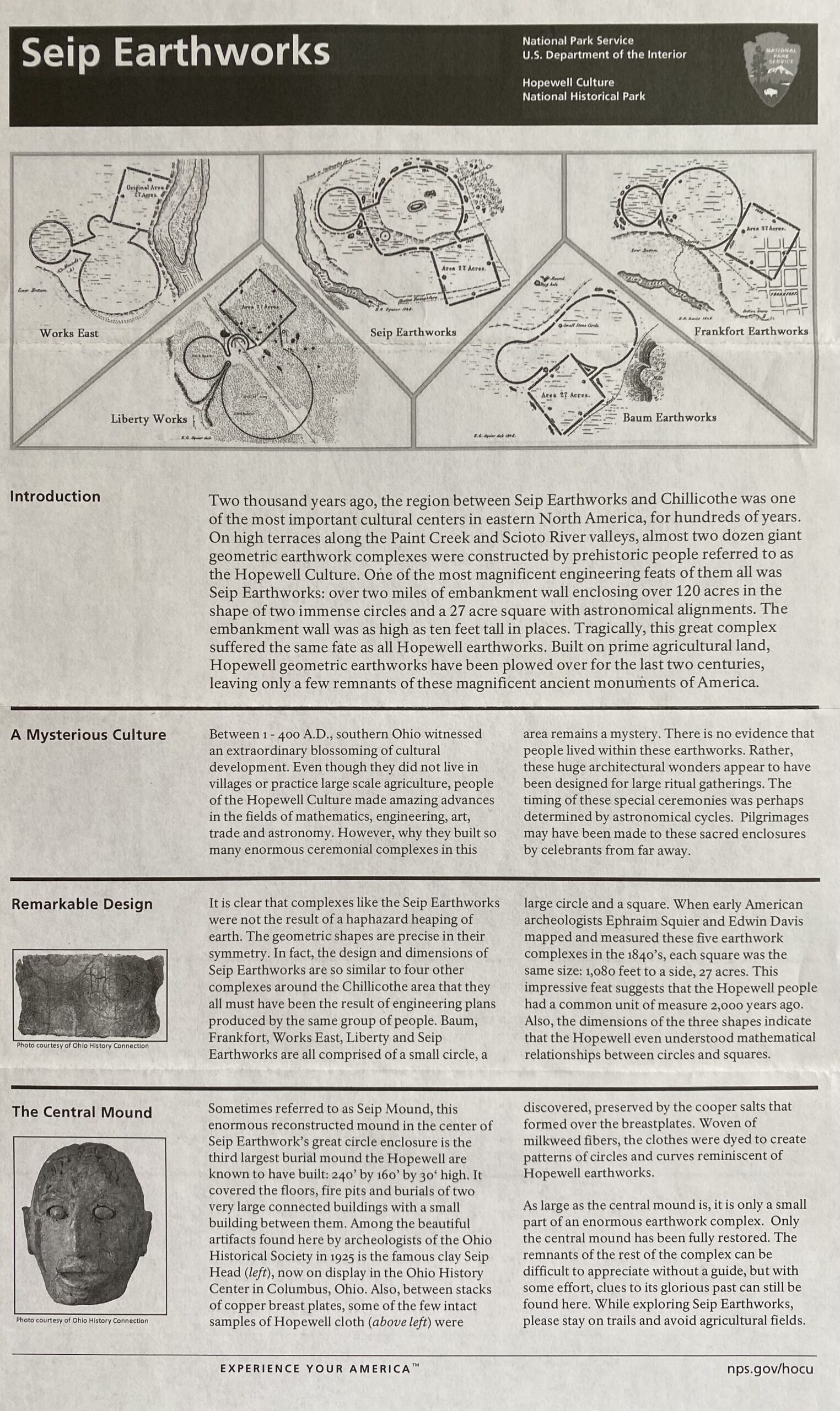
A black-and-white panel titled “Hopewell Earthworks” presents several plan drawings across its upper band, comparing circular and polygonal enclosures. Below, text sections discuss the sites and their design, with small artifact images at left. The display’s repeated diagrams make the engineered geometry of the earthworks the strongest visual feature.
Caption
A black-and-white panel titled “Hopewell Earthworks” presents several plan drawings across its upper band, comparing circular and polygonal enclosures. Below, text sections discuss the sites and their design, with small artifact images at left. The display’s repeated diagrams make the engineered geometry of the earthworks the strongest visual feature.
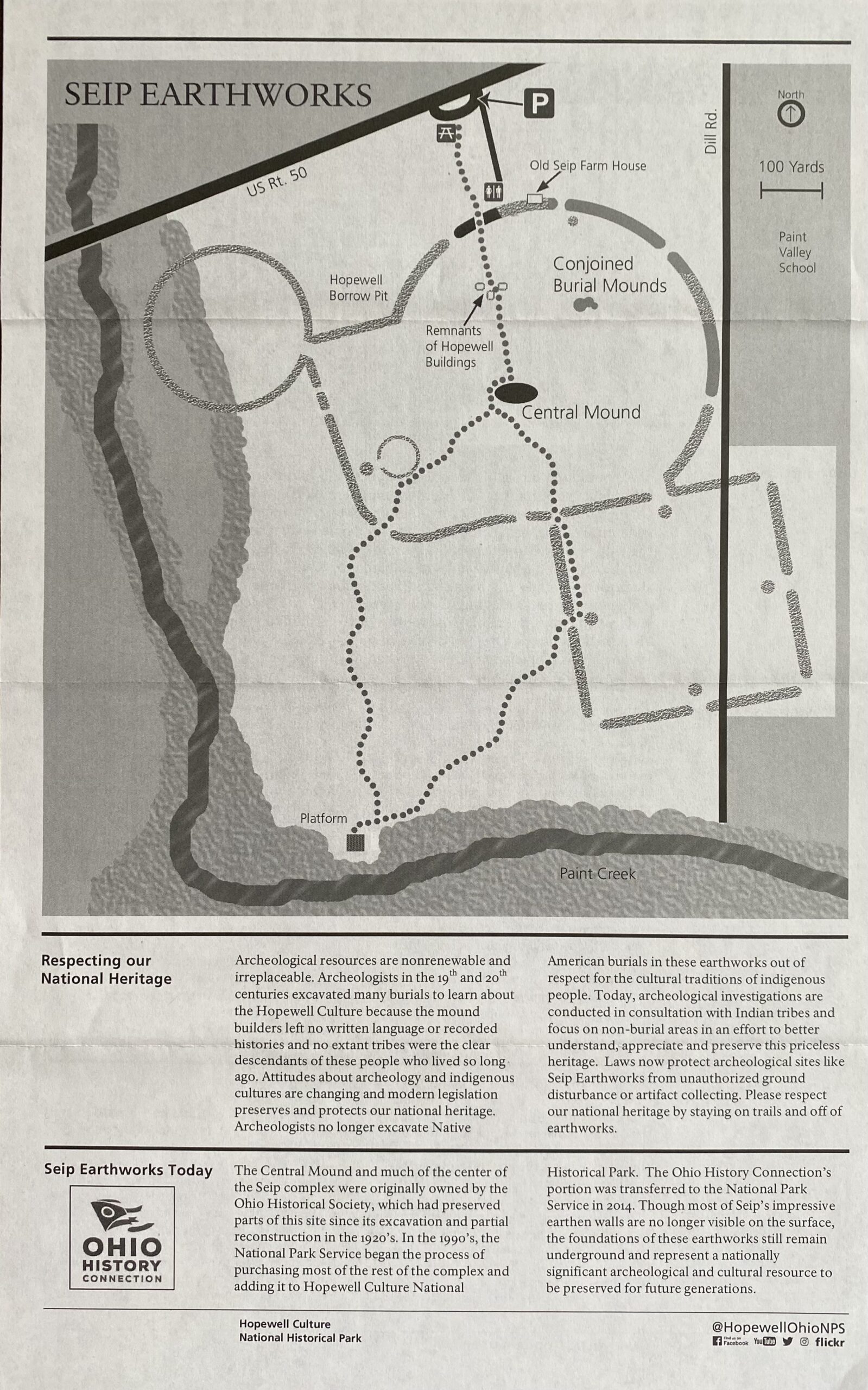
A detailed grayscale map shows a large curved enclosure with labeled features including “Conjoined Burial Enclosures” and “Central Mound.” Dotted routes and smaller circles connect the features, while a scale bar and north arrow orient the plan. The map is photographed close enough to emphasize the relationship among the earthworks rather than the full surrounding panel.
Caption
A detailed grayscale map shows a large curved enclosure with labeled features including “Conjoined Burial Enclosures” and “Central Mound.” Dotted routes and smaller circles connect the features, while a scale bar and north arrow orient the plan. The map is photographed close enough to emphasize the relationship among the earthworks rather than the full surrounding panel.
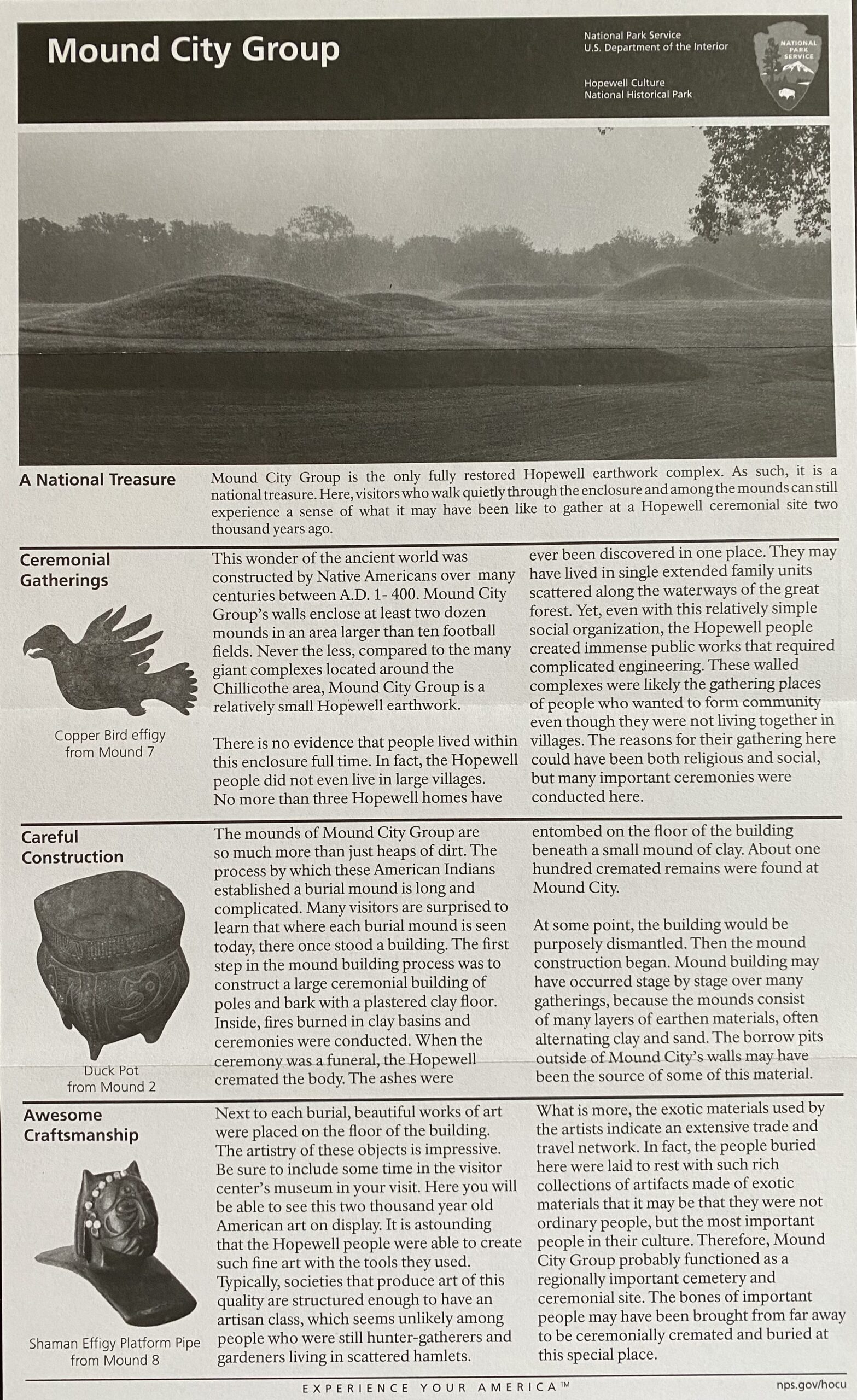
A National Park Service panel titled “Mound City Group” combines a long landscape image across the top with sections on the site, ceremonial gatherings and artifact finds. Small illustrations of a bird effigy pipe and carved object accompany the text. The panel’s layout links the earthwork landscape to objects recovered or interpreted within the site.
Caption
A National Park Service panel titled “Mound City Group” combines a long landscape image across the top with sections on the site, ceremonial gatherings and artifact finds. Small illustrations of a bird effigy pipe and carved object accompany the text. The panel’s layout links the earthwork landscape to objects recovered or interpreted within the site.
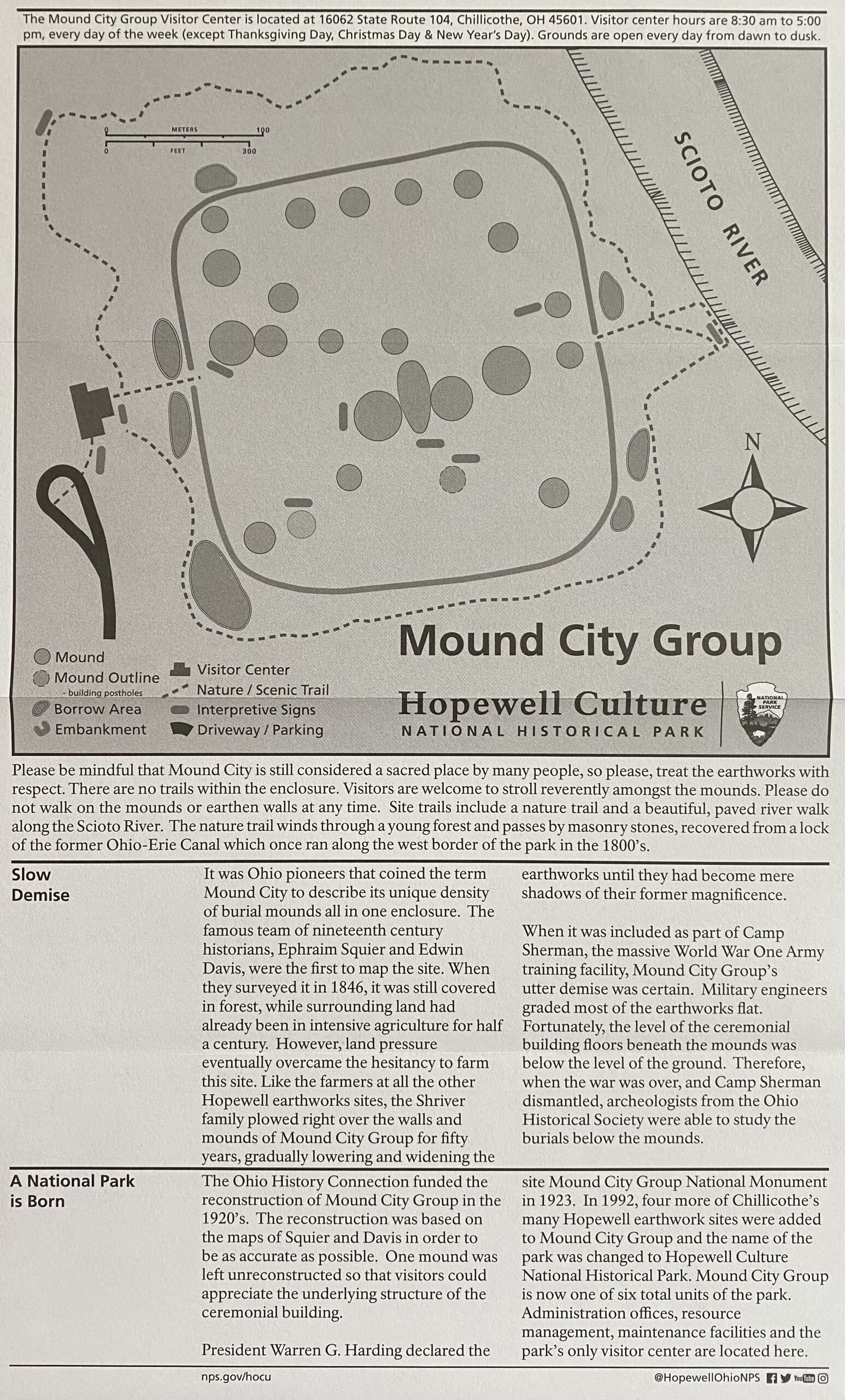
A grayscale plan labels the “Mound City Group” and locates numerous oval and circular mounds inside a rounded enclosure. The Scioto River runs along the map’s right edge, while a north arrow and key distinguish mound locations, visitor facilities and paths. The site map makes the arrangement of the earthworks and their relation to the river clear.
Caption
A grayscale plan labels the “Mound City Group” and locates numerous oval and circular mounds inside a rounded enclosure. The Scioto River runs along the map’s right edge, while a north arrow and key distinguish mound locations, visitor facilities and paths. The site map makes the arrangement of the earthworks and their relation to the river clear.
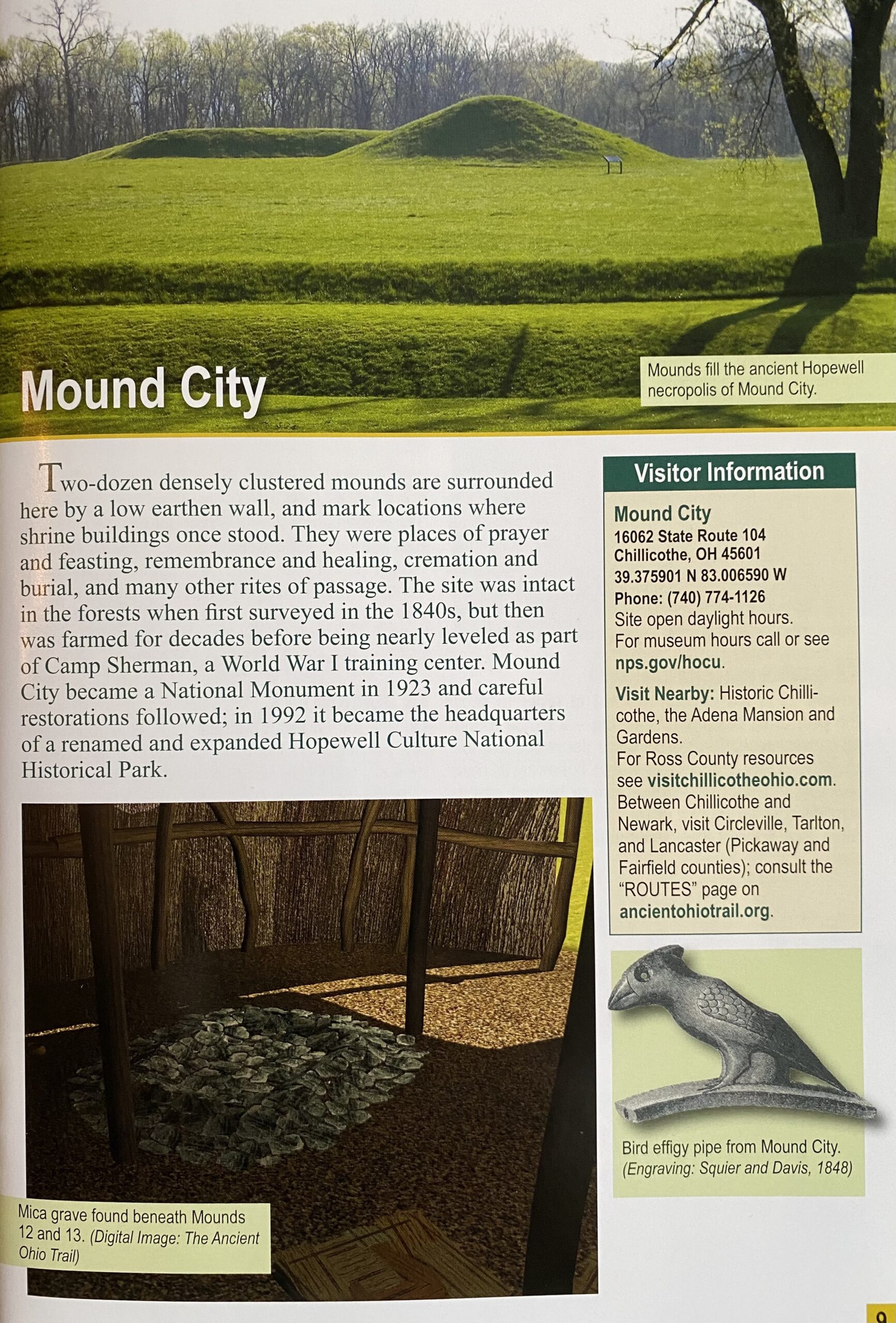
A visitor panel titled “Mound City” pairs a photograph of the grassy earthwork landscape with explanatory text and visitor information. Smaller images show an interior view of a mound and a bird effigy pipe, while the main text describes the Hopewell ceremonial center and its later history. The panel presents the site as both a preserved landscape and an archaeological place.
Caption
A visitor panel titled “Mound City” pairs a photograph of the grassy earthwork landscape with explanatory text and visitor information. Smaller images show an interior view of a mound and a bird effigy pipe, while the main text describes the Hopewell ceremonial center and its later history. The panel presents the site as both a preserved landscape and an archaeological place.
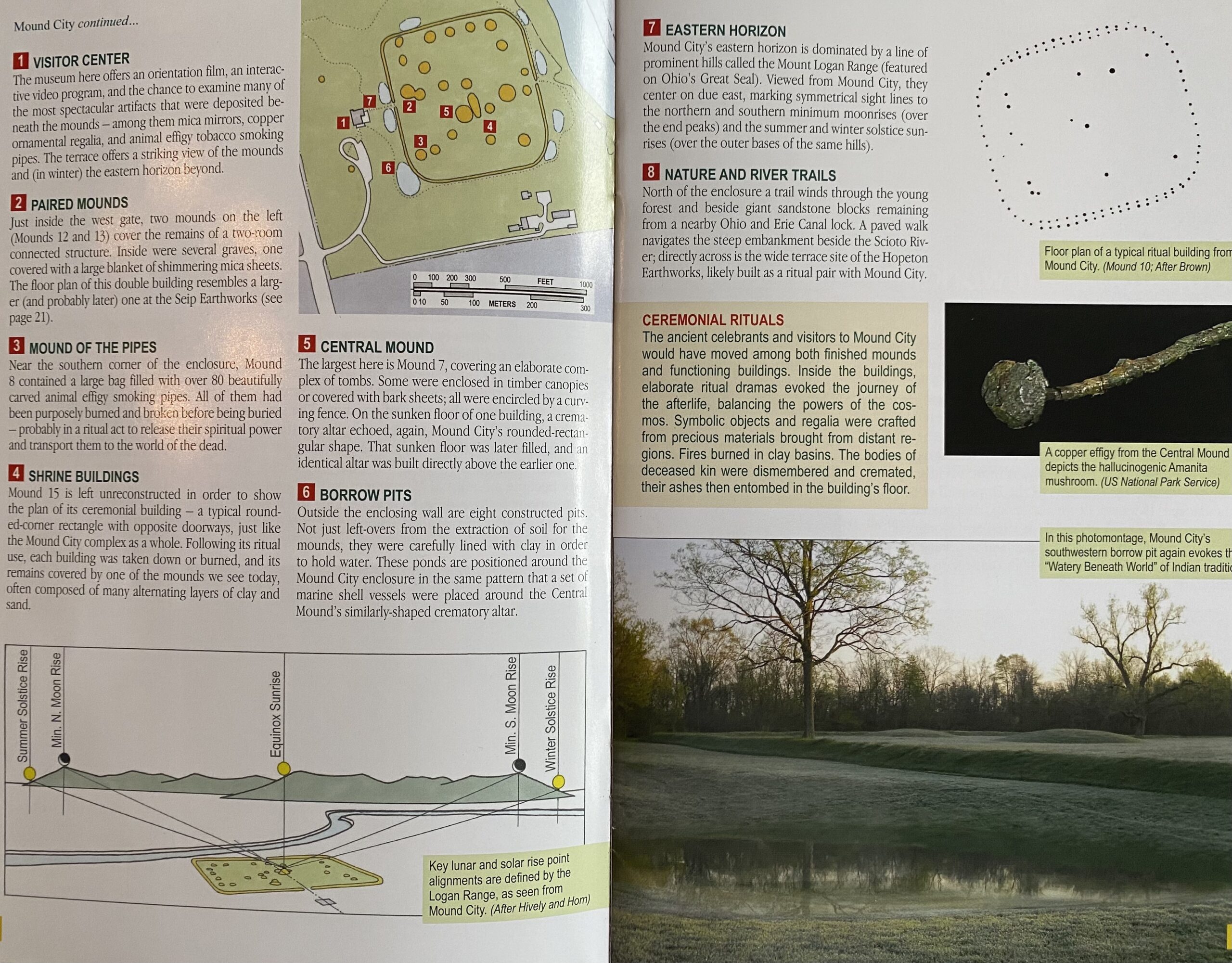
A detailed Mound City interpretive display maps individual earthworks and explains features including paired mounds, the mound of the pipes, a central mound, and ceremonial spaces. A landscape photograph of a still pond and tree-lined bank occupies the lower right, giving the diagram a present-day setting. The panel connects mapped remains with the terrain visitors encounter.
Caption
A detailed Mound City interpretive display maps individual earthworks and explains features including paired mounds, the mound of the pipes, a central mound, and ceremonial spaces. A landscape photograph of a still pond and tree-lined bank occupies the lower right, giving the diagram a present-day setting. The panel connects mapped remains with the terrain visitors encounter.
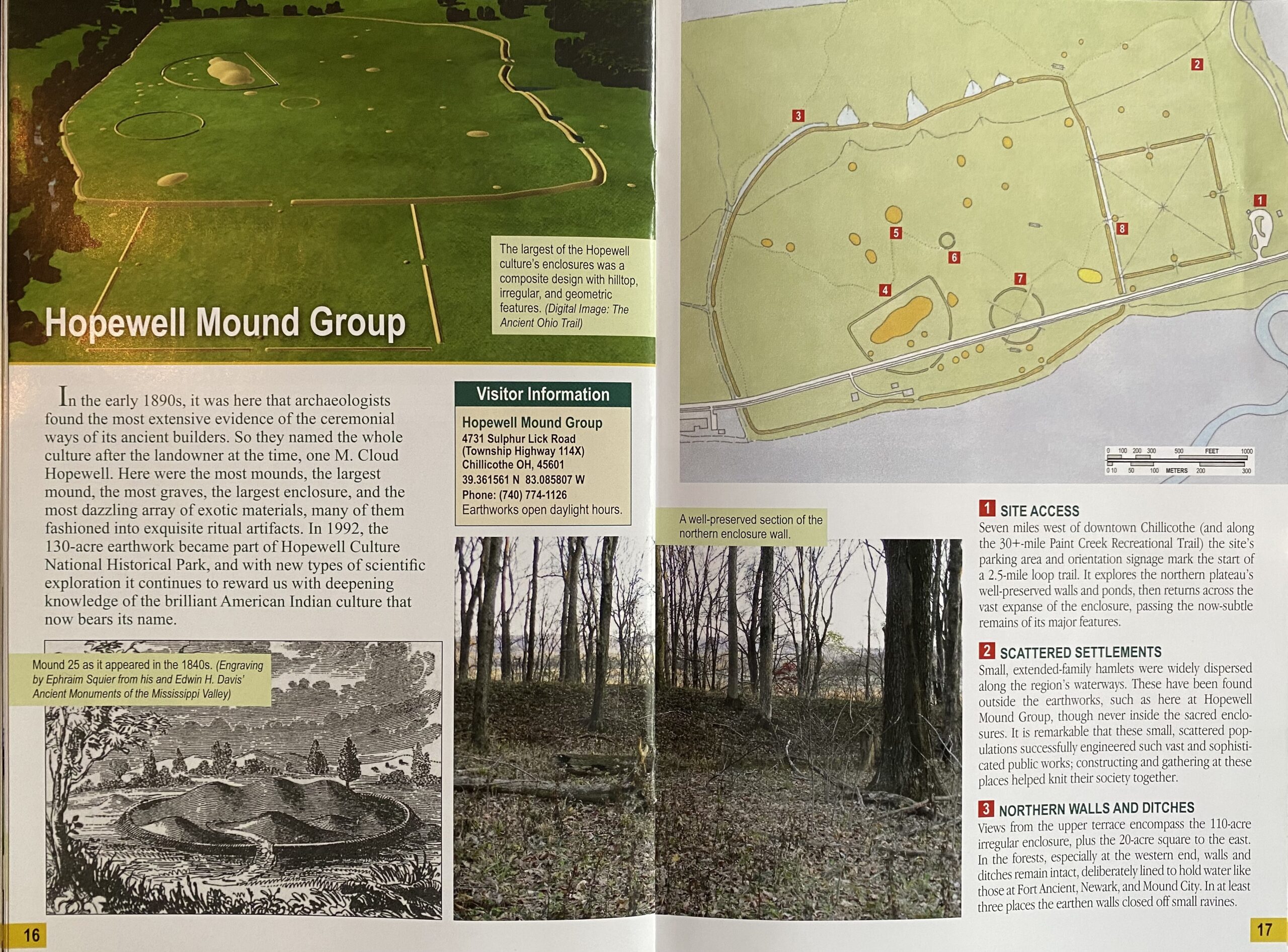
A panel titled “Hopewell Mound Group” combines an aerial site plan, visitor information, historical illustration, and photographs of wooded earthworks. Numbered labels mark site access, earthwork settings, and related features; the landscape images at the bottom show a path and low mounds among trees. The design links the larger site plan to on-the-ground views.
Caption
A panel titled “Hopewell Mound Group” combines an aerial site plan, visitor information, historical illustration, and photographs of wooded earthworks. Numbered labels mark site access, earthwork settings, and related features; the landscape images at the bottom show a path and low mounds among trees. The design links the larger site plan to on-the-ground views.