Yellowstone National Park
Yellowstone National Park contains one of the most geologically dynamic landscapes in the world, shaped by volcanic activity beneath the Yellowstone Plateau. The park sits above a large volcanic caldera that produces geothermal features including geysers, hot springs, and fumaroles. These features illustrate ongoing geological processes driven by heat within the earth’s crust.
The park forms part of the Greater Yellowstone Ecosystem, one of the largest intact temperate ecosystems in the Northern Hemisphere. Forests, grasslands, rivers, and wetlands support wildlife populations including bison, elk, wolves, bears, and numerous bird species. These ecological relationships demonstrate how protected landscapes sustain biodiversity across large geographic areas.
Yellowstone’s geothermal features and wildlife populations illustrate the interaction between geological processes and ecological systems. The park demonstrates how volcanic activity, climate, and topography influence environmental conditions across long periods of time.
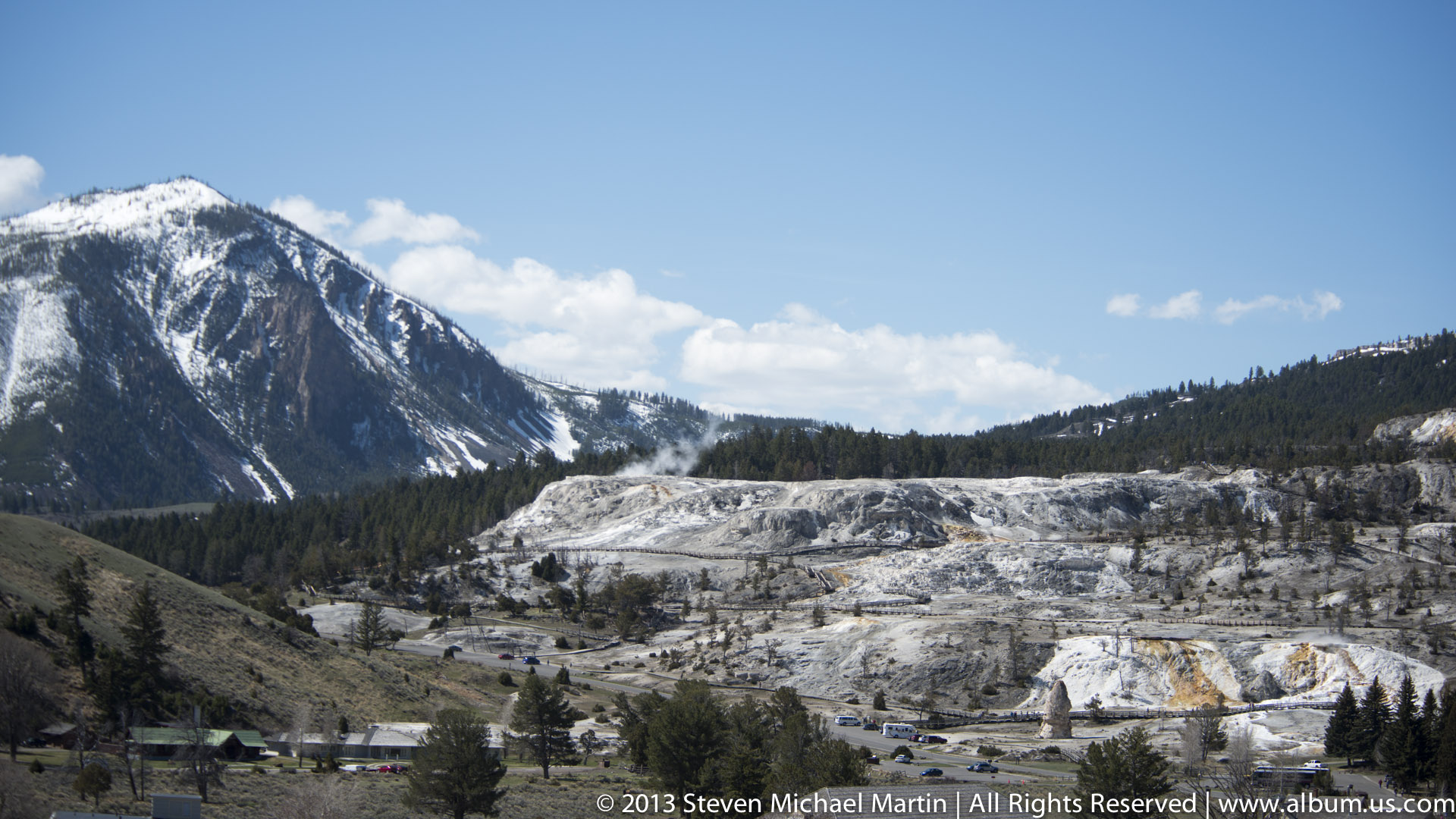
A broad view looks across pale travertine terraces and evergreen forest toward a snow-streaked mountain ridge. Small visitor structures and roads sit near the foot of the slope, giving scale to the expansive thermal landscape. The image brings together the developed approach, wooded valley, and mineral formations in one distant view.
Caption
A broad view looks across pale travertine terraces and evergreen forest toward a snow-streaked mountain ridge. Small visitor structures and roads sit near the foot of the slope, giving scale to the expansive thermal landscape. The image brings together the developed approach, wooded valley, and mineral formations in one distant view.
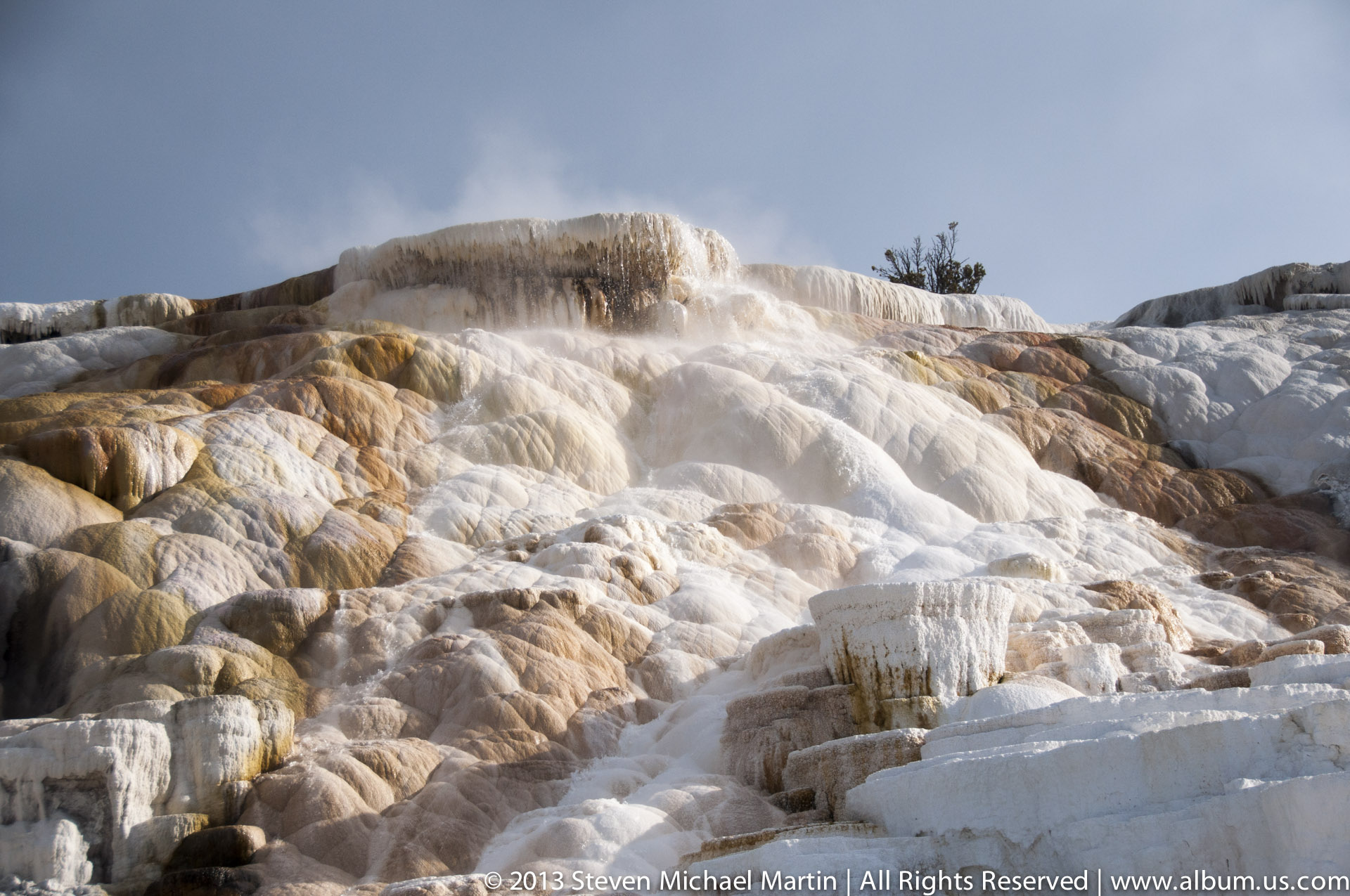
Pale travertine shelves step down the hillside in broad, irregular bands, their cream and ochre surfaces broken by narrow channels of flowing water. Wisps of steam rise near the upper terraces, while a clear blue sky and sparse shrubs mark the edge of the thermal ground. The wide view emphasizes the scale and layered pattern of the formation.
Caption
Pale travertine shelves step down the hillside in broad, irregular bands, their cream and ochre surfaces broken by narrow channels of flowing water. Wisps of steam rise near the upper terraces, while a clear blue sky and sparse shrubs mark the edge of the thermal ground. The wide view emphasizes the scale and layered pattern of the formation.
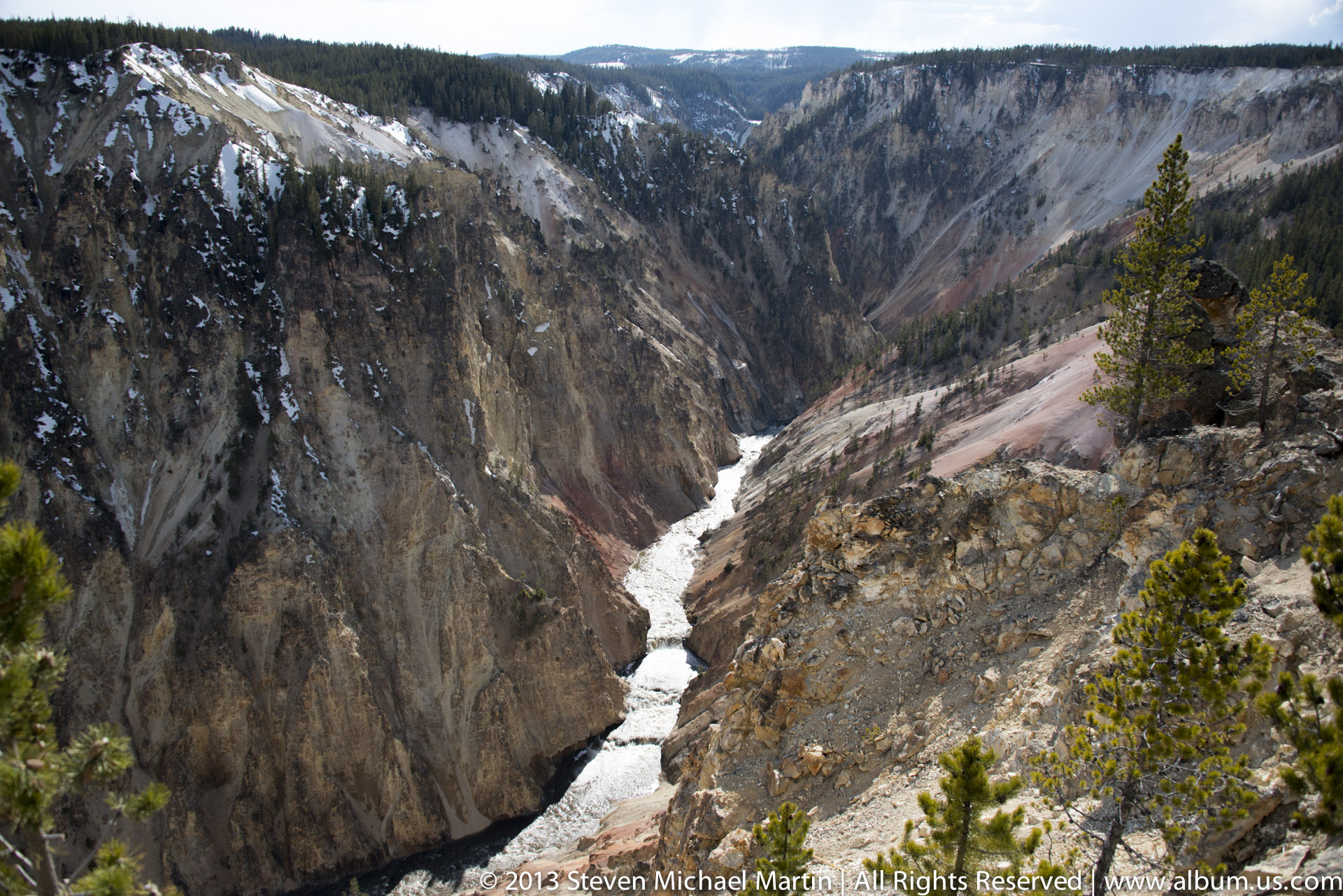
A river and waterfall run through a deep canyon enclosed by steep, layered rock walls. Snow clings to ledges and shaded slopes, while sparse conifers cling to the nearer rim. The compressed viewpoint follows the white water into the narrow gorge and conveys the canyon’s depth through overlapping ridges; individual falls remain distant within the broad geological setting.
Caption
A river and waterfall run through a deep canyon enclosed by steep, layered rock walls. Snow clings to ledges and shaded slopes, while sparse conifers cling to the nearer rim. The compressed viewpoint follows the white water into the narrow gorge and conveys the canyon’s depth through overlapping ridges; individual falls remain distant within the broad geological setting.
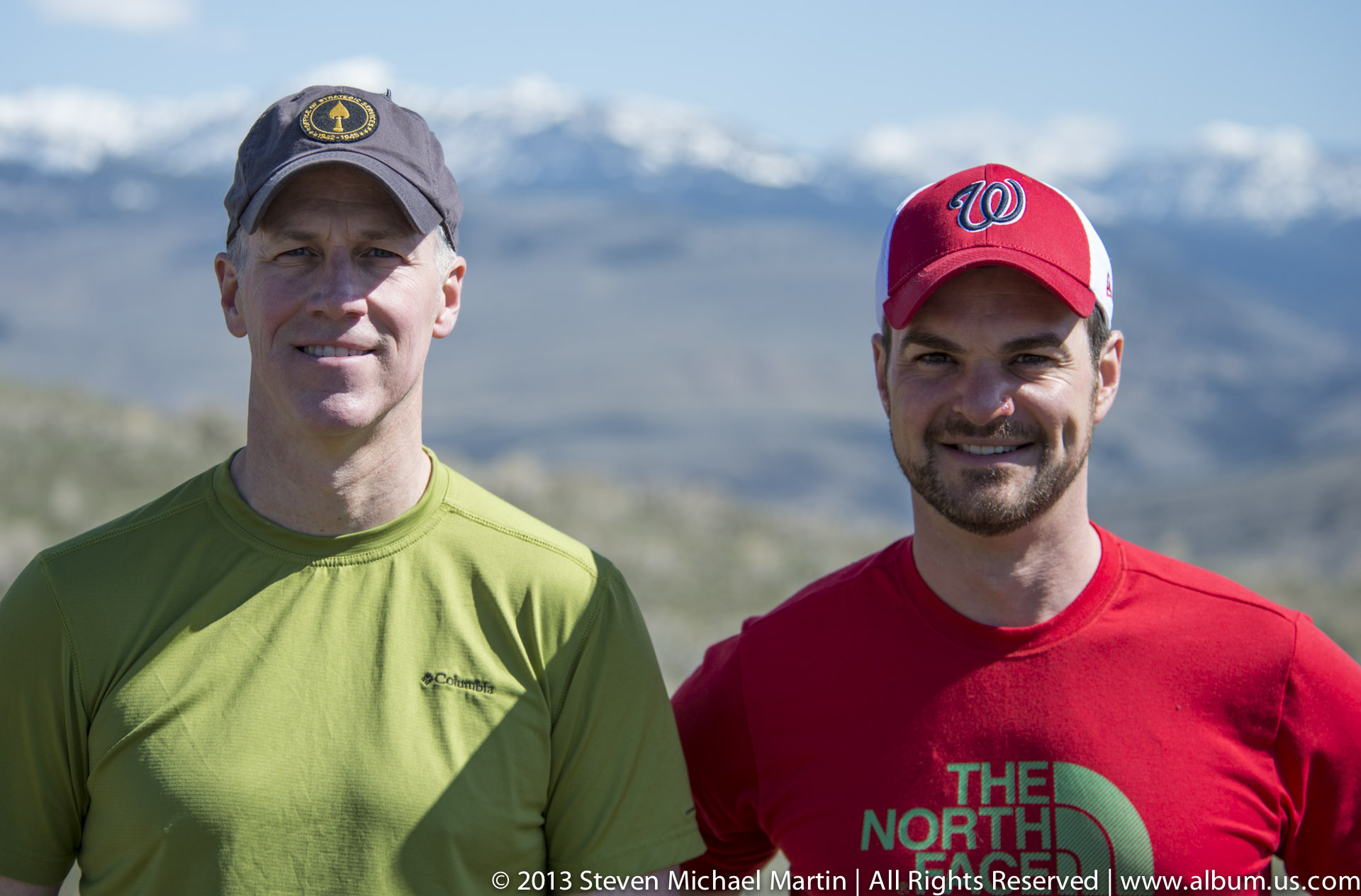
Two men stand shoulder to shoulder and smile at the camera, one in a green shirt and dark cap and the other in a red shirt and bright cap. A broad mountain slope and pale sky form the background. The portrait emphasizes the visitors’ contrasting clothing and expressions, with the distant landscape providing context rather than a named location.
Caption
Two men stand shoulder to shoulder and smile at the camera, one in a green shirt and dark cap and the other in a red shirt and bright cap. A broad mountain slope and pale sky form the background. The portrait emphasizes the visitors’ contrasting clothing and expressions, with the distant landscape providing context rather than a named location.
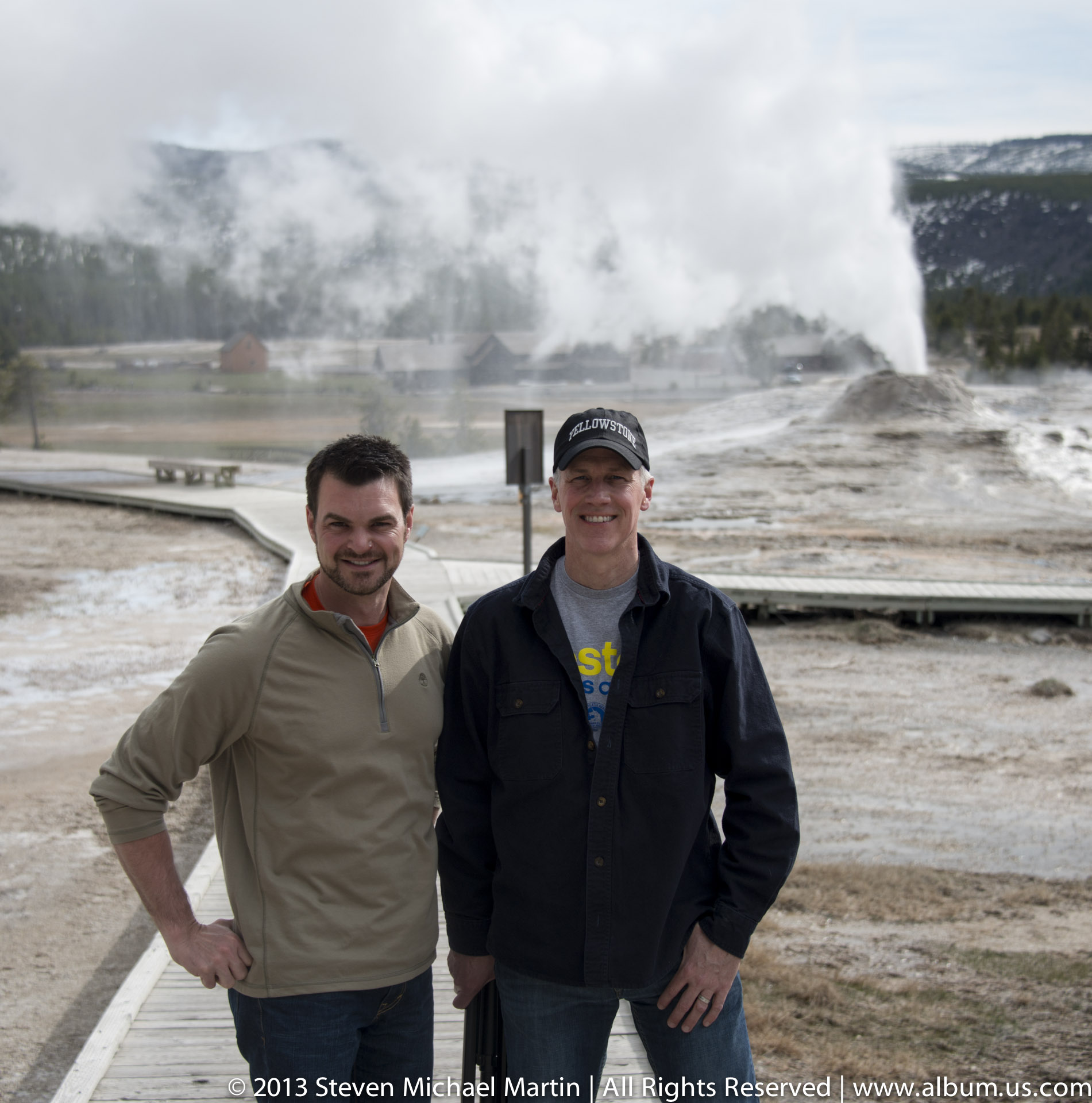
Two visitors pose together beside a raised wooden boardwalk, with a plume of steam and orange-stained mineral ground behind them. The men stand on a pale path at the edge of the active basin; a small structure and distant trees are partly obscured by vapor. The paired portrait records a stop along the visitor route and places the people within the scale of the geothermal landscape.
Caption
Two visitors pose together beside a raised wooden boardwalk, with a plume of steam and orange-stained mineral ground behind them. The men stand on a pale path at the edge of the active basin; a small structure and distant trees are partly obscured by vapor. The paired portrait records a stop along the visitor route and places the people within the scale of the geothermal landscape.
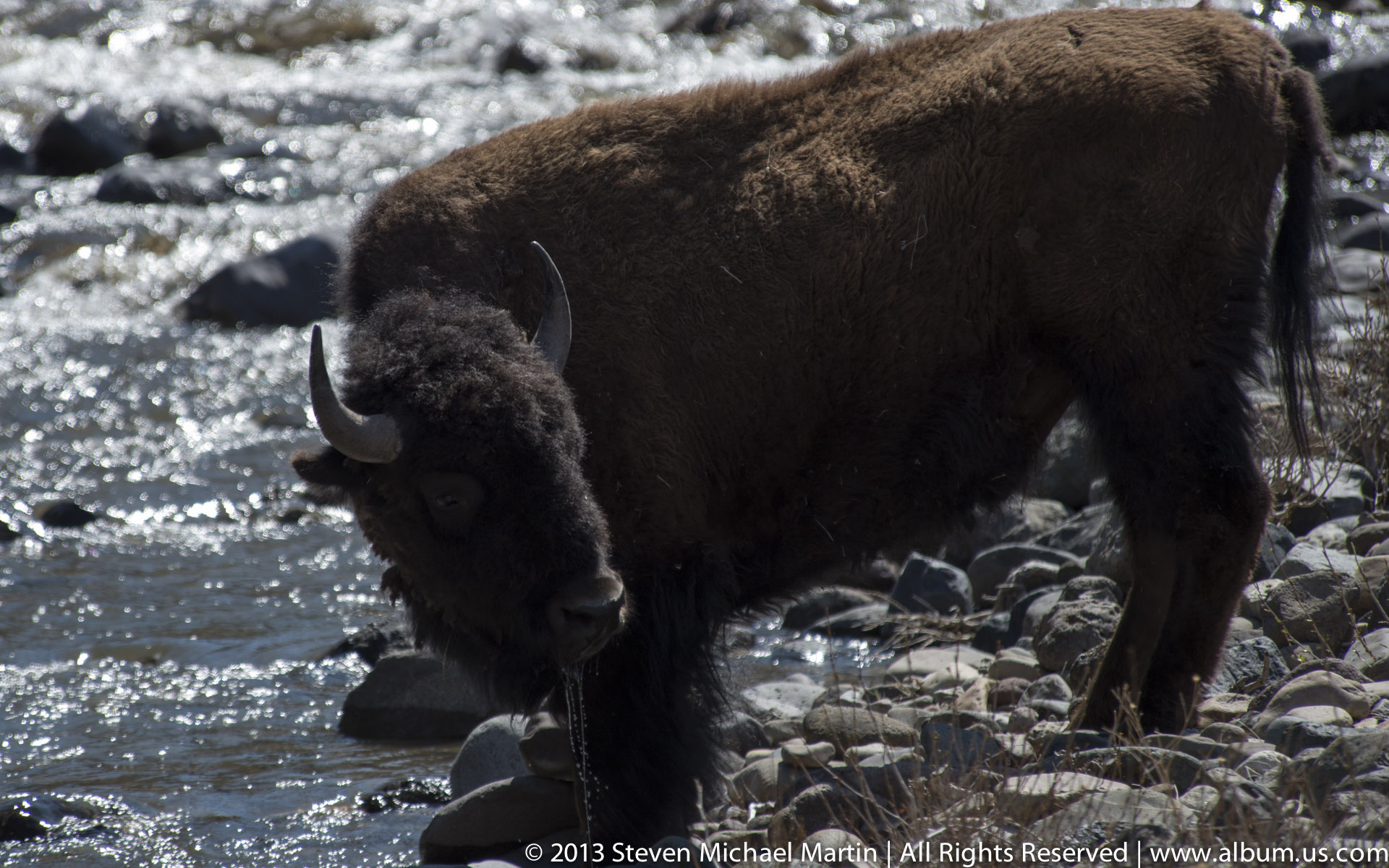
A large bison stands among rounded river rocks with its head lowered toward the water. Sunlight glints from the moving stream behind its dark body, outlining the curved horns and shaggy forequarters while leaving much of the face in shadow. The close composition concentrates on the animal’s size and its footing in the shallow channel, rather than the surrounding landscape.
Caption
A large bison stands among rounded river rocks with its head lowered toward the water. Sunlight glints from the moving stream behind its dark body, outlining the curved horns and shaggy forequarters while leaving much of the face in shadow. The close composition concentrates on the animal’s size and its footing in the shallow channel, rather than the surrounding landscape.
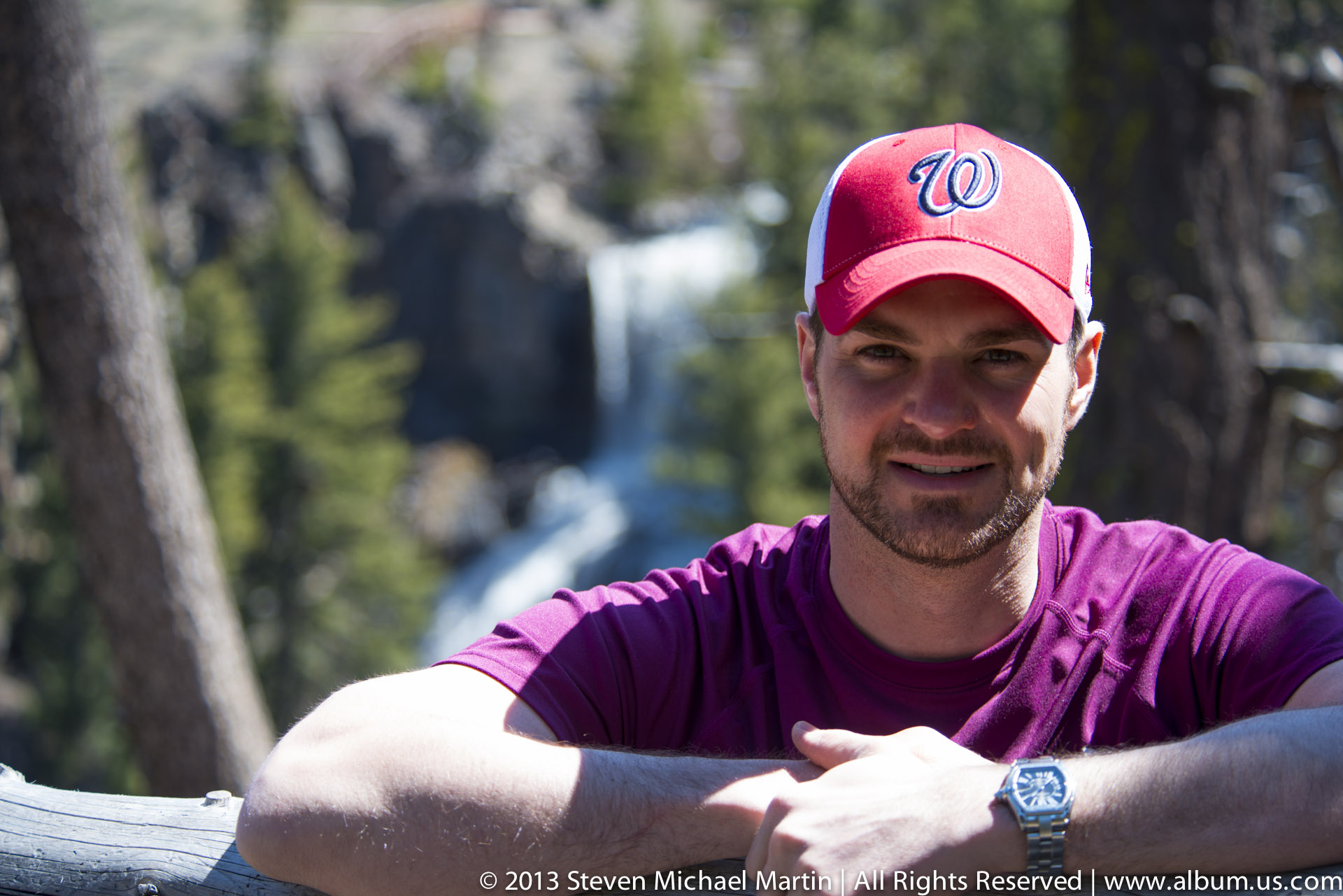
A man in a bright red baseball cap and magenta shirt leans on a wooden rail, smiling toward the camera. A narrow waterfall and green foliage appear behind him, softened by shallow focus. The close portrait draws attention to the visitor and his clothing, while the falling water supplies a clear but secondary setting.
Caption
A man in a bright red baseball cap and magenta shirt leans on a wooden rail, smiling toward the camera. A narrow waterfall and green foliage appear behind him, softened by shallow focus. The close portrait draws attention to the visitor and his clothing, while the falling water supplies a clear but secondary setting.
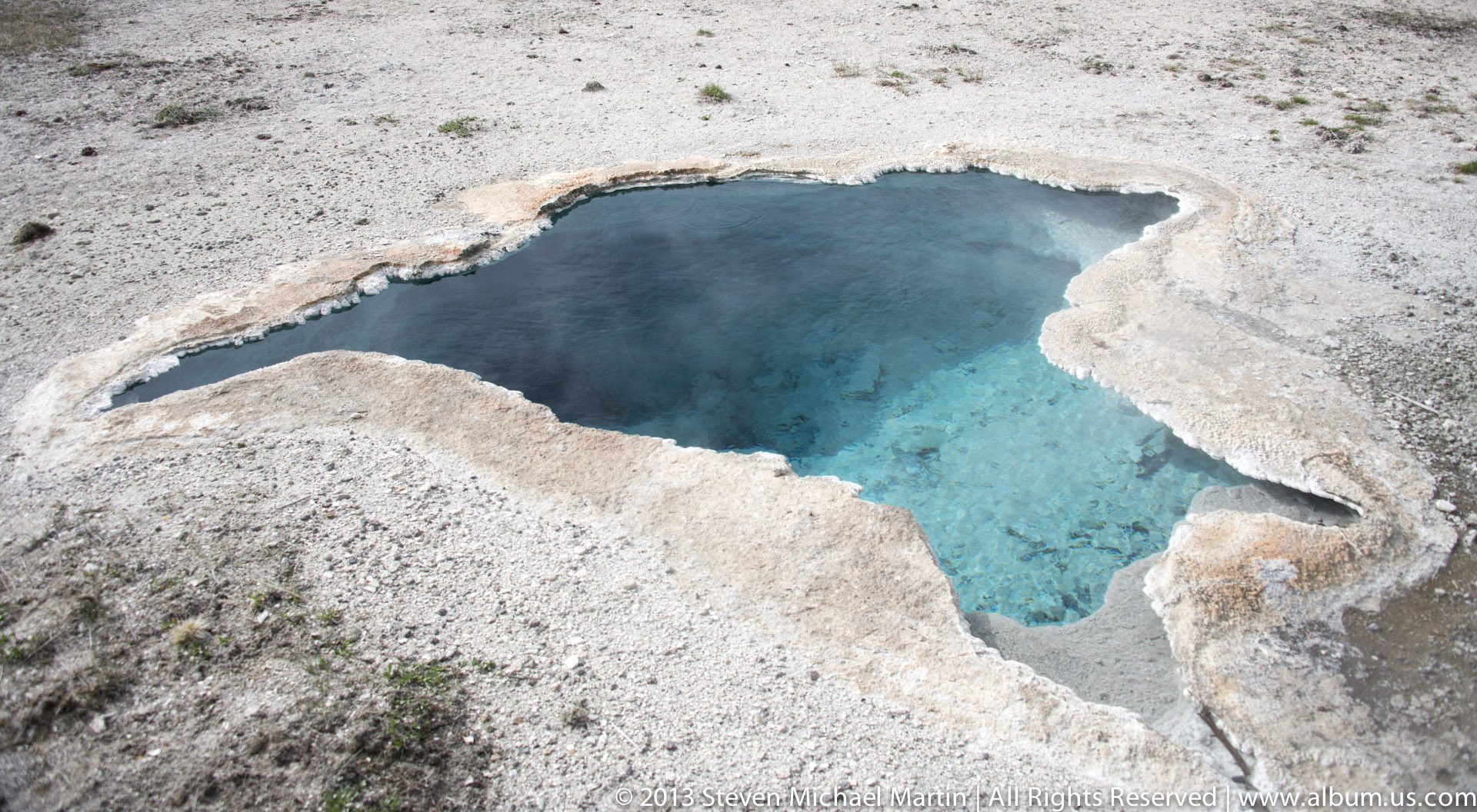
A compact oval of deep turquoise water sits inside a rough, chalk-white mineral rim. Subtle bands of blue and green follow the irregular edge, while the surrounding ground is almost entirely pale and granular. The elevated close view reduces the basin to a pool, rim, and textured apron, making the contrast between clear water and mineral deposits the defining feature.
Caption
A compact oval of deep turquoise water sits inside a rough, chalk-white mineral rim. Subtle bands of blue and green follow the irregular edge, while the surrounding ground is almost entirely pale and granular. The elevated close view reduces the basin to a pool, rim, and textured apron, making the contrast between clear water and mineral deposits the defining feature.
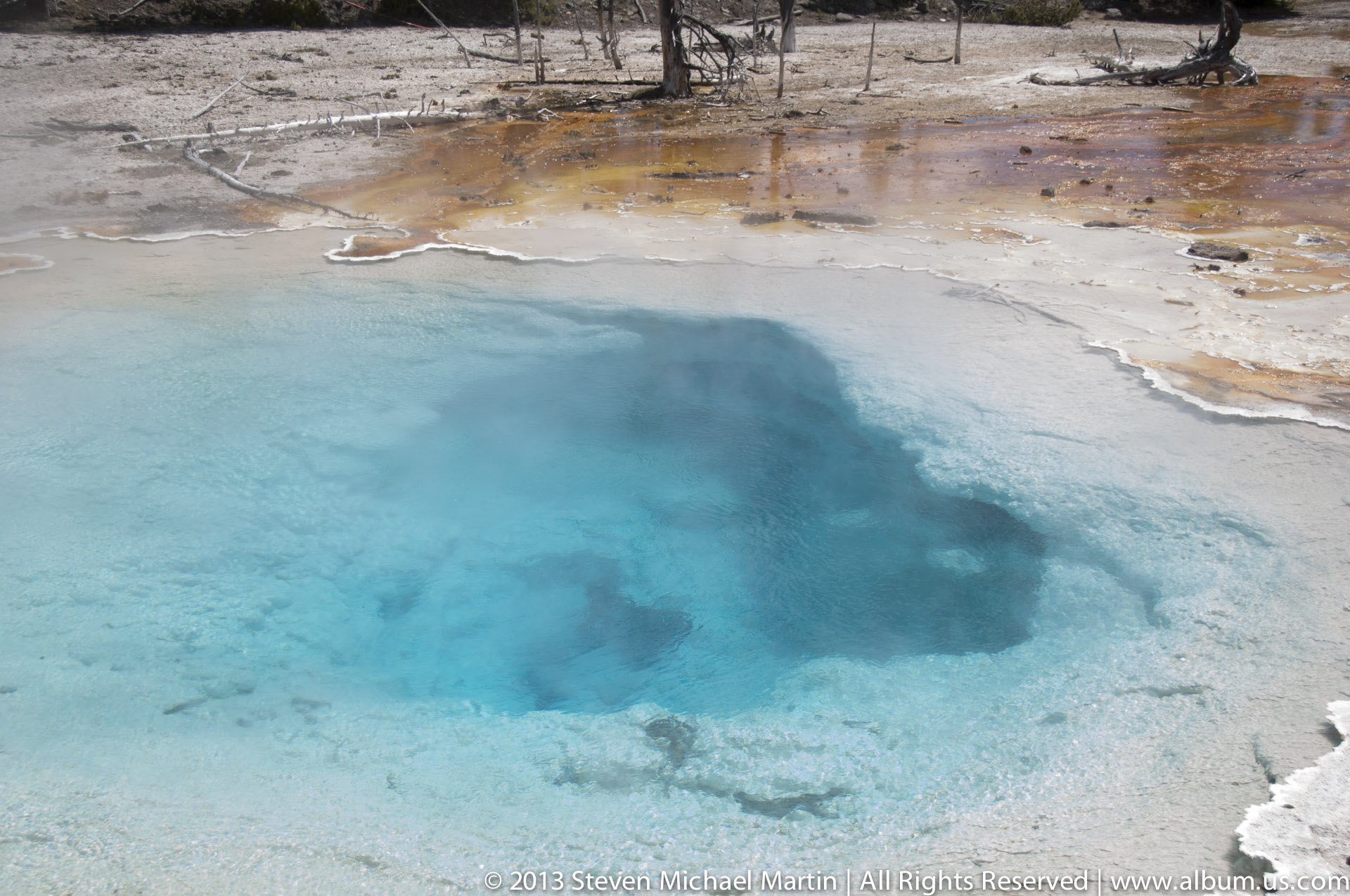
A saturated turquoise pool fills the foreground, its dark blue center fading through bands of pale cyan toward a white mineral rim. Orange and rust-colored microbial mats trace the far shoreline beneath sparse trees. The elevated viewpoint makes the spring’s color gradients and the contrast between water, silica, and thermophilic growth the subject.
Caption
A saturated turquoise pool fills the foreground, its dark blue center fading through bands of pale cyan toward a white mineral rim. Orange and rust-colored microbial mats trace the far shoreline beneath sparse trees. The elevated viewpoint makes the spring’s color gradients and the contrast between water, silica, and thermophilic growth the subject.
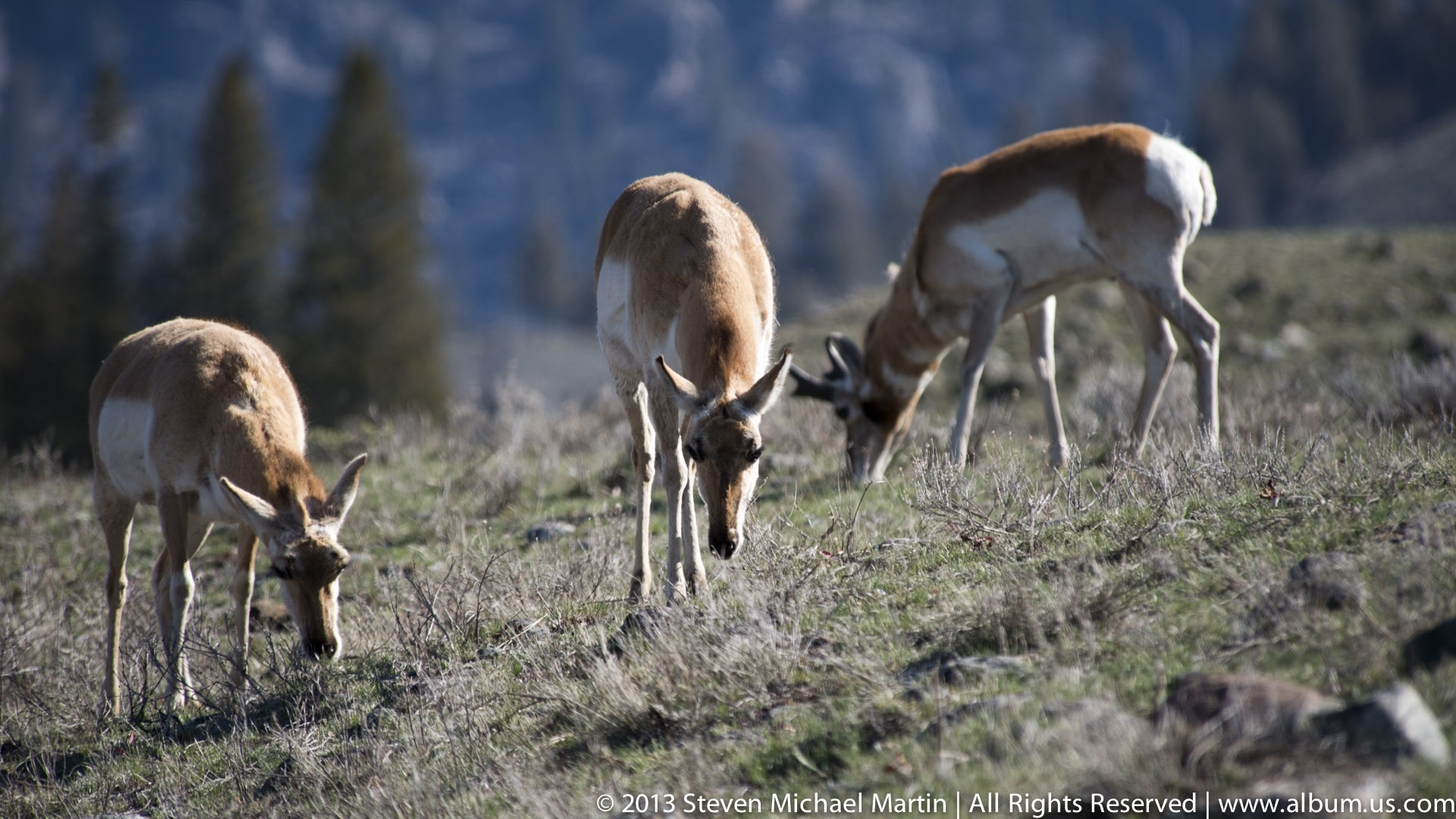
Three pronghorn graze among low grass and scattered stones. Their lowered heads and slender legs form a repeating rhythm across the gently sloping foreground, while dark trees soften into the background. The view concentrates on feeding behavior and the animals’ spacing rather than an alert portrait or interaction with people.
Caption
Three pronghorn graze among low grass and scattered stones. Their lowered heads and slender legs form a repeating rhythm across the gently sloping foreground, while dark trees soften into the background. The view concentrates on feeding behavior and the animals’ spacing rather than an alert portrait or interaction with people.
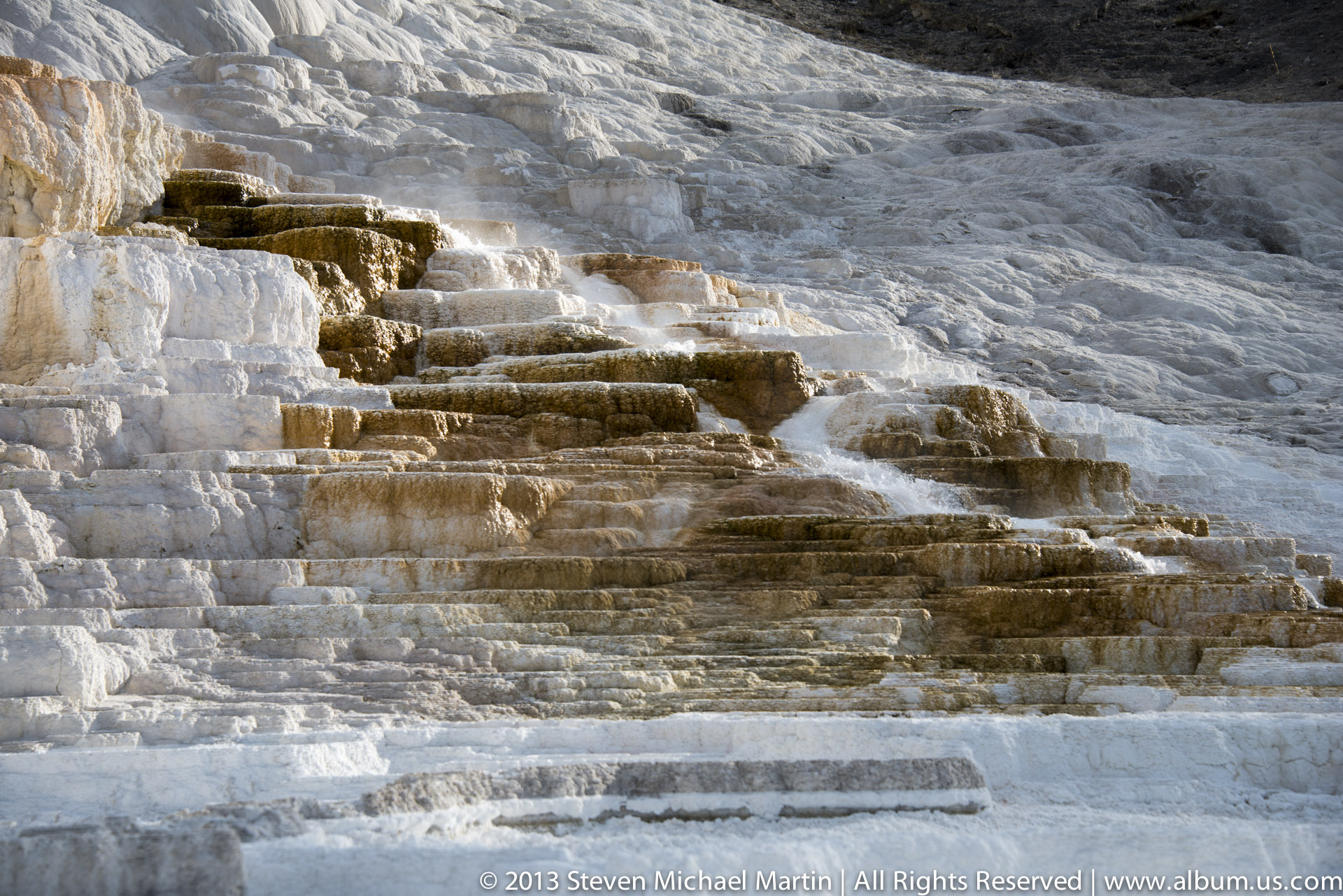
Stepped white and tan terraces descend across a broad slope, their rounded rims and shallow channels shaped by flowing thermal water. Darker mineral staining follows some edges, while the upper surface rises into a pale ridge. The composition isolates the terrace geometry and layered deposits, with no people or buildings to compete with the formations.
Caption
Stepped white and tan terraces descend across a broad slope, their rounded rims and shallow channels shaped by flowing thermal water. Darker mineral staining follows some edges, while the upper surface rises into a pale ridge. The composition isolates the terrace geometry and layered deposits, with no people or buildings to compete with the formations.
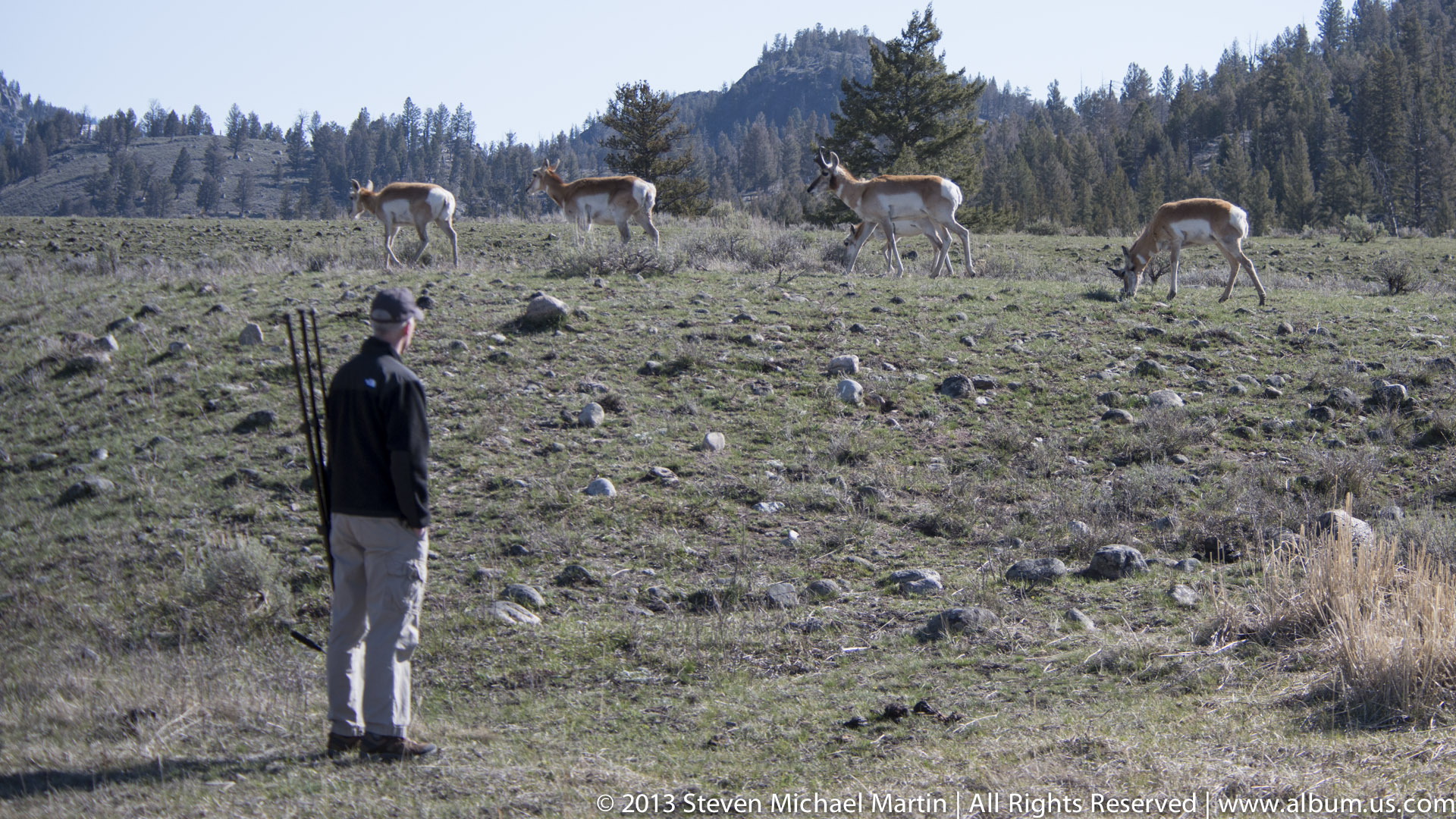
A visitor stands in the foreground as several pronghorn move across a rocky meadow below a forested ridge. The human figure provides scale without dominating the scene, while the animals are spaced across the slope, some walking and one lowering its head. The open view connects wildlife observation with Yellowstone’s broad, lightly wooded habitat.
Caption
A visitor stands in the foreground as several pronghorn move across a rocky meadow below a forested ridge. The human figure provides scale without dominating the scene, while the animals are spaced across the slope, some walking and one lowering its head. The open view connects wildlife observation with Yellowstone’s broad, lightly wooded habitat.
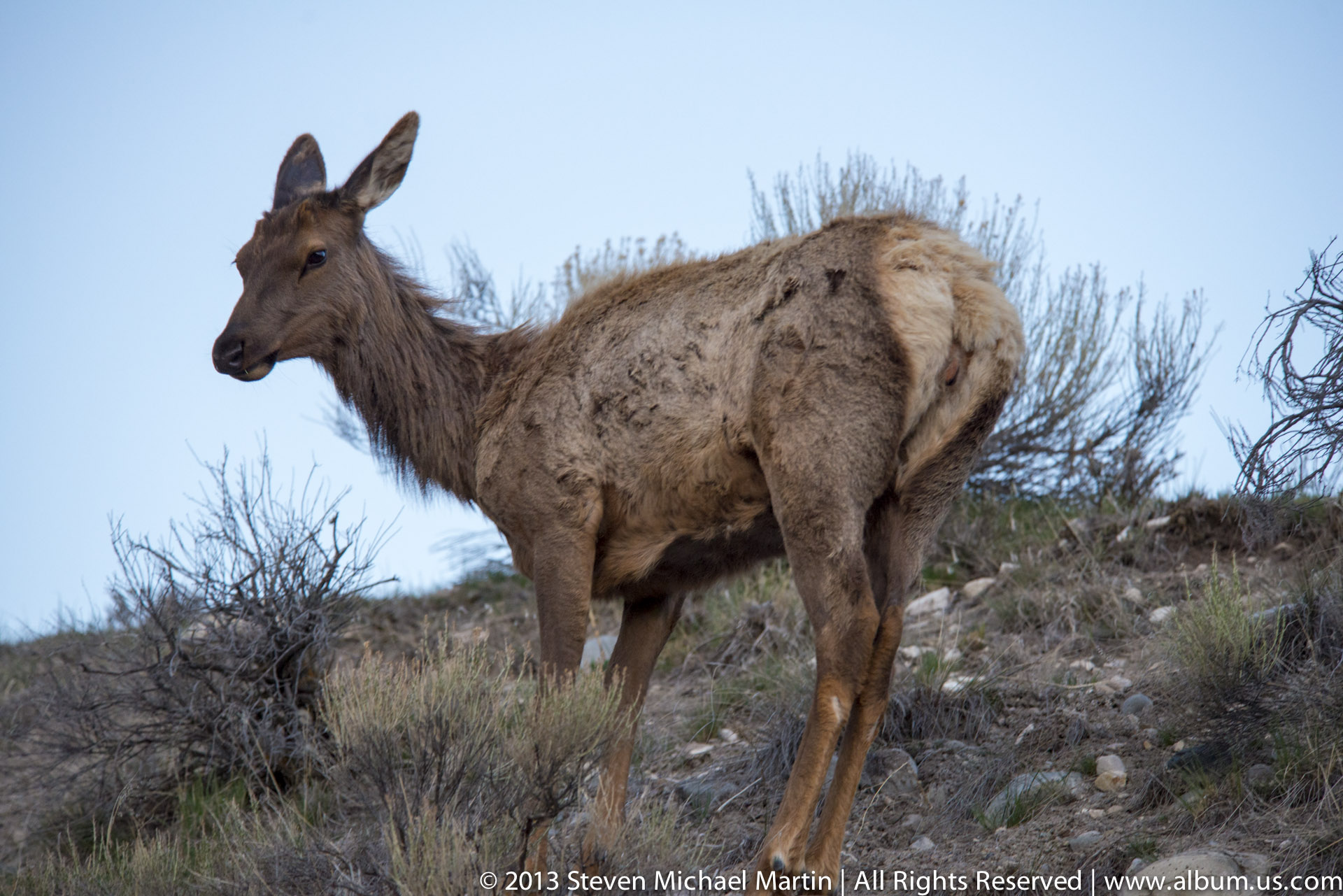
A large brown ungulate stands among low brush and dry grass, shown in profile against a pale blue sky. Its heavy coat appears shaggy and uneven, and the head is partly obscured by the proof-sheet label, limiting a reliable species identification. The close framing emphasizes the animal’s coat, sturdy legs, and the scrubby hillside habitat.
Caption
A large brown ungulate stands among low brush and dry grass, shown in profile against a pale blue sky. Its heavy coat appears shaggy and uneven, and the head is partly obscured by the proof-sheet label, limiting a reliable species identification. The close framing emphasizes the animal’s coat, sturdy legs, and the scrubby hillside habitat.
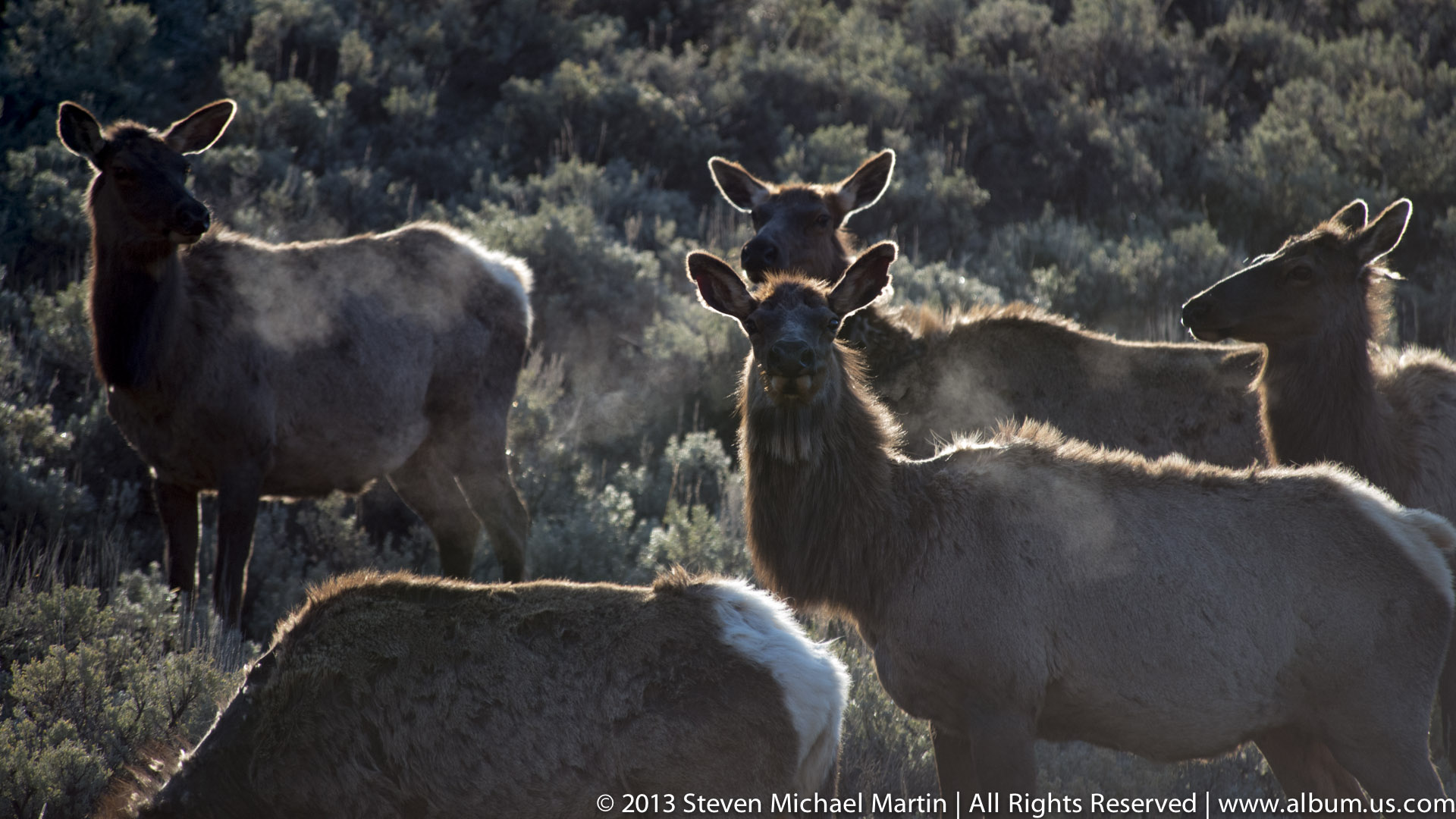
Several pronghorn stand close together in sagebrush, their pale backs and rumps outlined by strong backlighting. One animal faces the camera while others look in different directions, creating a compact group portrait. The dark brush behind them reduces background detail and draws attention to their contrasting coats and upright ears.
Caption
Several pronghorn stand close together in sagebrush, their pale backs and rumps outlined by strong backlighting. One animal faces the camera while others look in different directions, creating a compact group portrait. The dark brush behind them reduces background detail and draws attention to their contrasting coats and upright ears.
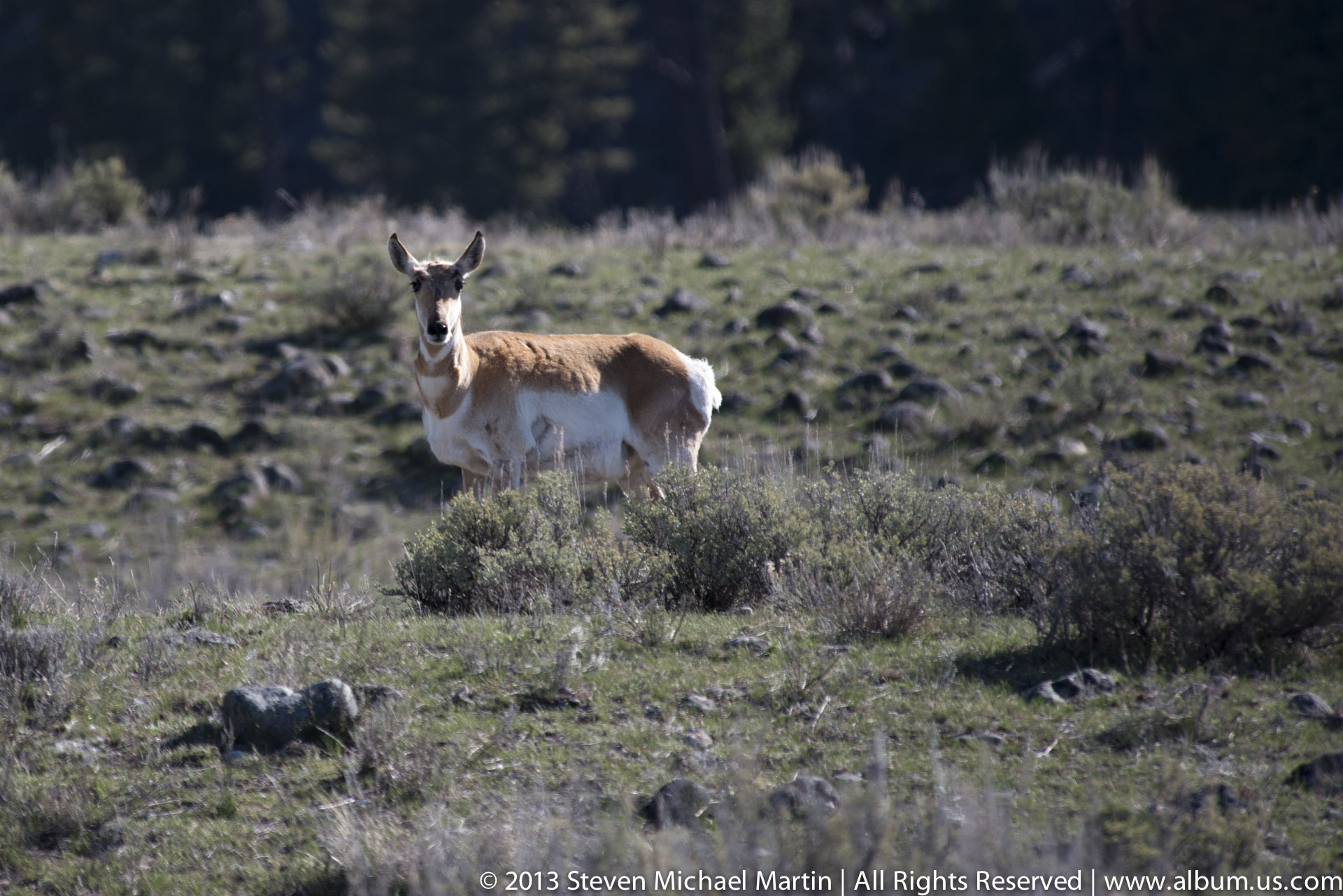
A lone pronghorn stands alert in a broad meadow, facing the camera with its ears raised. The animal occupies a small part of the composition, surrounded by low sagebrush, scattered rocks, and a distant dark treeline. This wider portrait preserves the relationship between the animal and its open habitat instead of isolating coat detail.
Caption
A lone pronghorn stands alert in a broad meadow, facing the camera with its ears raised. The animal occupies a small part of the composition, surrounded by low sagebrush, scattered rocks, and a distant dark treeline. This wider portrait preserves the relationship between the animal and its open habitat instead of isolating coat detail.
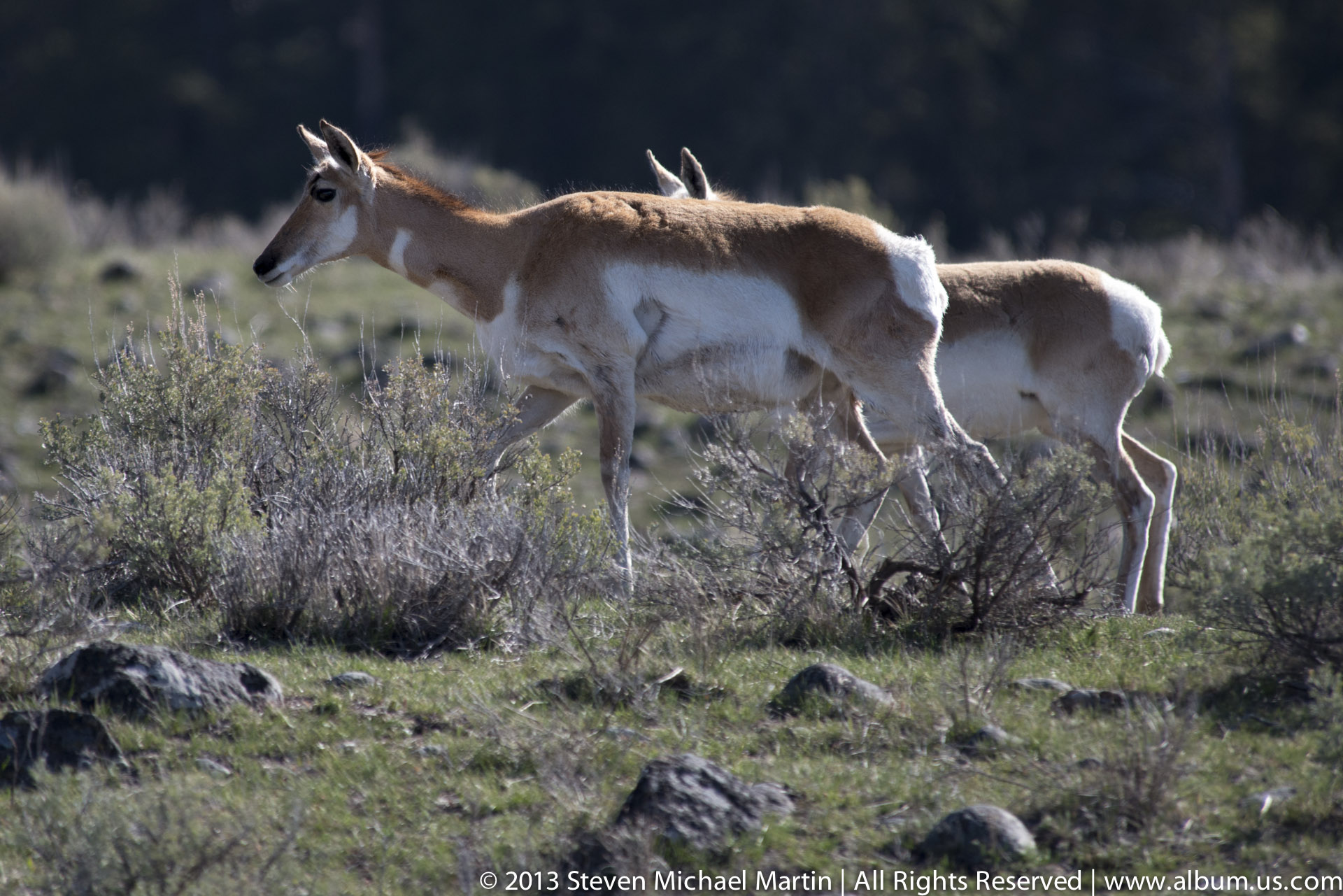
Two pronghorn walk through a low, rocky meadow, the nearer animal leading with its head turned left. The second follows close behind and is partly hidden by the first. Sunlight catches their white flanks and rump patches while the shaded treeline creates a dark backdrop. The composition emphasizes movement and the close spacing of the pair.
Caption
Two pronghorn walk through a low, rocky meadow, the nearer animal leading with its head turned left. The second follows close behind and is partly hidden by the first. Sunlight catches their white flanks and rump patches while the shaded treeline creates a dark backdrop. The composition emphasizes movement and the close spacing of the pair.
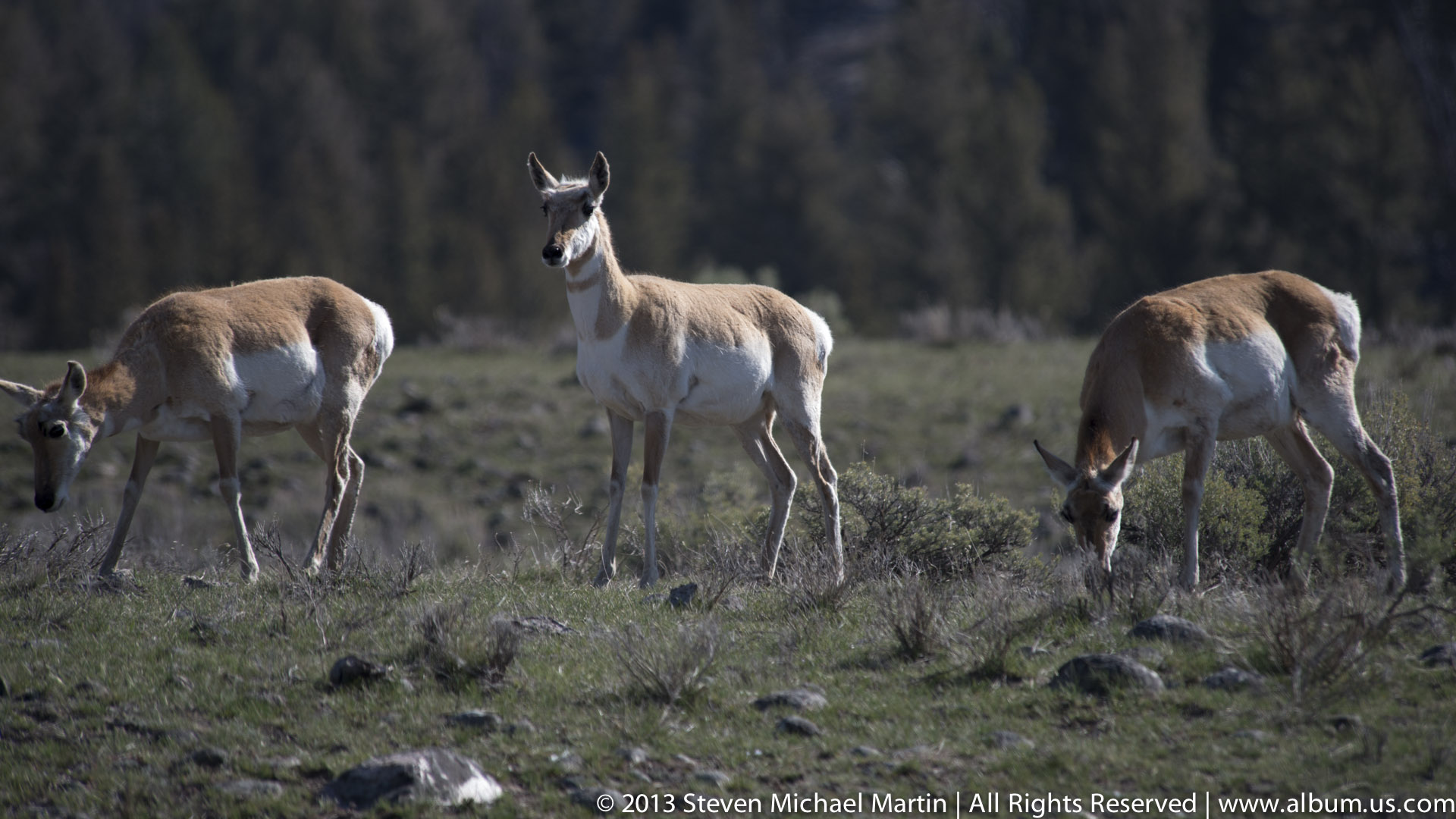
A small group of pronghorn spreads across a sunlit meadow, with one animal standing upright while others lower their heads to feed. Their pale rumps and brown backs contrast with the dark, wooded background. The uneven spacing and varied postures make this a behavioral group view, distinct from the closer portraits elsewhere on the sheet.
Caption
A small group of pronghorn spreads across a sunlit meadow, with one animal standing upright while others lower their heads to feed. Their pale rumps and brown backs contrast with the dark, wooded background. The uneven spacing and varied postures make this a behavioral group view, distinct from the closer portraits elsewhere on the sheet.
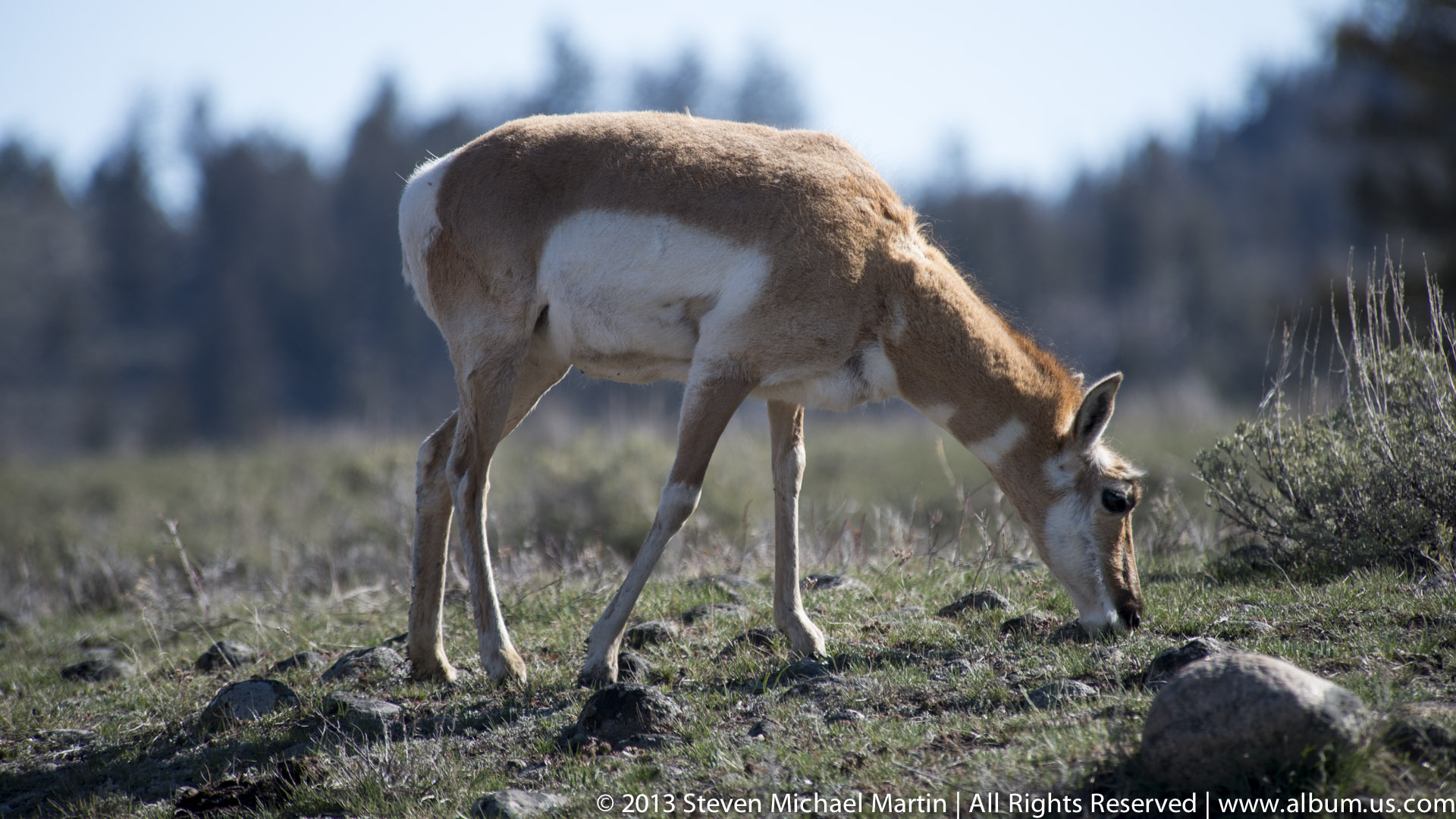
A single pronghorn bends low to feed, its legs braced on uneven ground and its white rump sharply contrasted against a brown coat. The shallow depth of field separates the animal from a dark, softly blurred treeline. This close view makes the feeding posture and coat pattern the central details.
Caption
A single pronghorn bends low to feed, its legs braced on uneven ground and its white rump sharply contrasted against a brown coat. The shallow depth of field separates the animal from a dark, softly blurred treeline. This close view makes the feeding posture and coat pattern the central details.
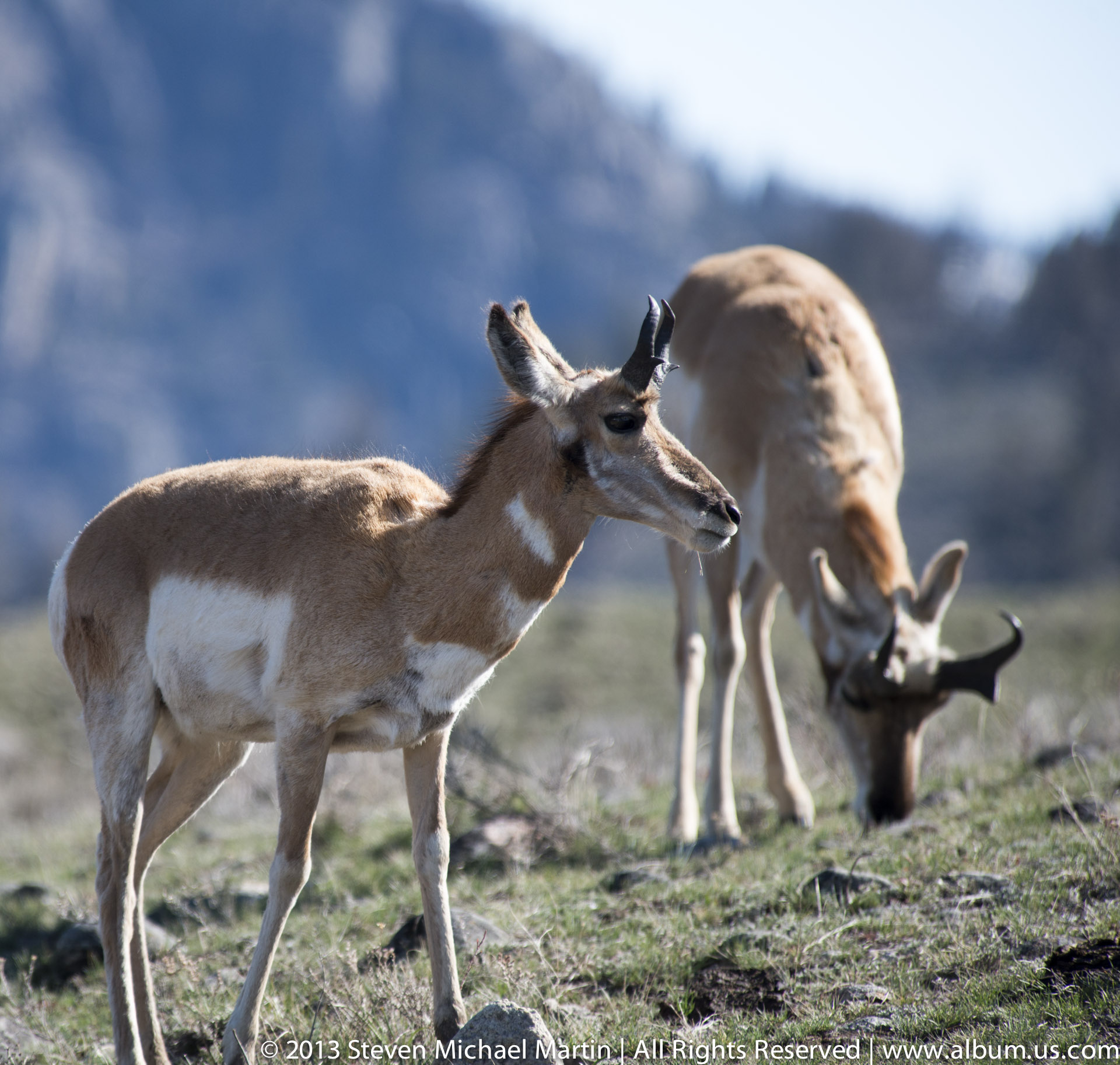
Two pronghorn feed in an open meadow, both with their heads lowered among short grasses and scattered rocks. Their bodies overlap slightly, while the blue-gray forested slope beyond remains out of focus. The paired composition emphasizes quiet foraging and the contrast between warm coats and cool background tones.
Caption
Two pronghorn feed in an open meadow, both with their heads lowered among short grasses and scattered rocks. Their bodies overlap slightly, while the blue-gray forested slope beyond remains out of focus. The paired composition emphasizes quiet foraging and the contrast between warm coats and cool background tones.
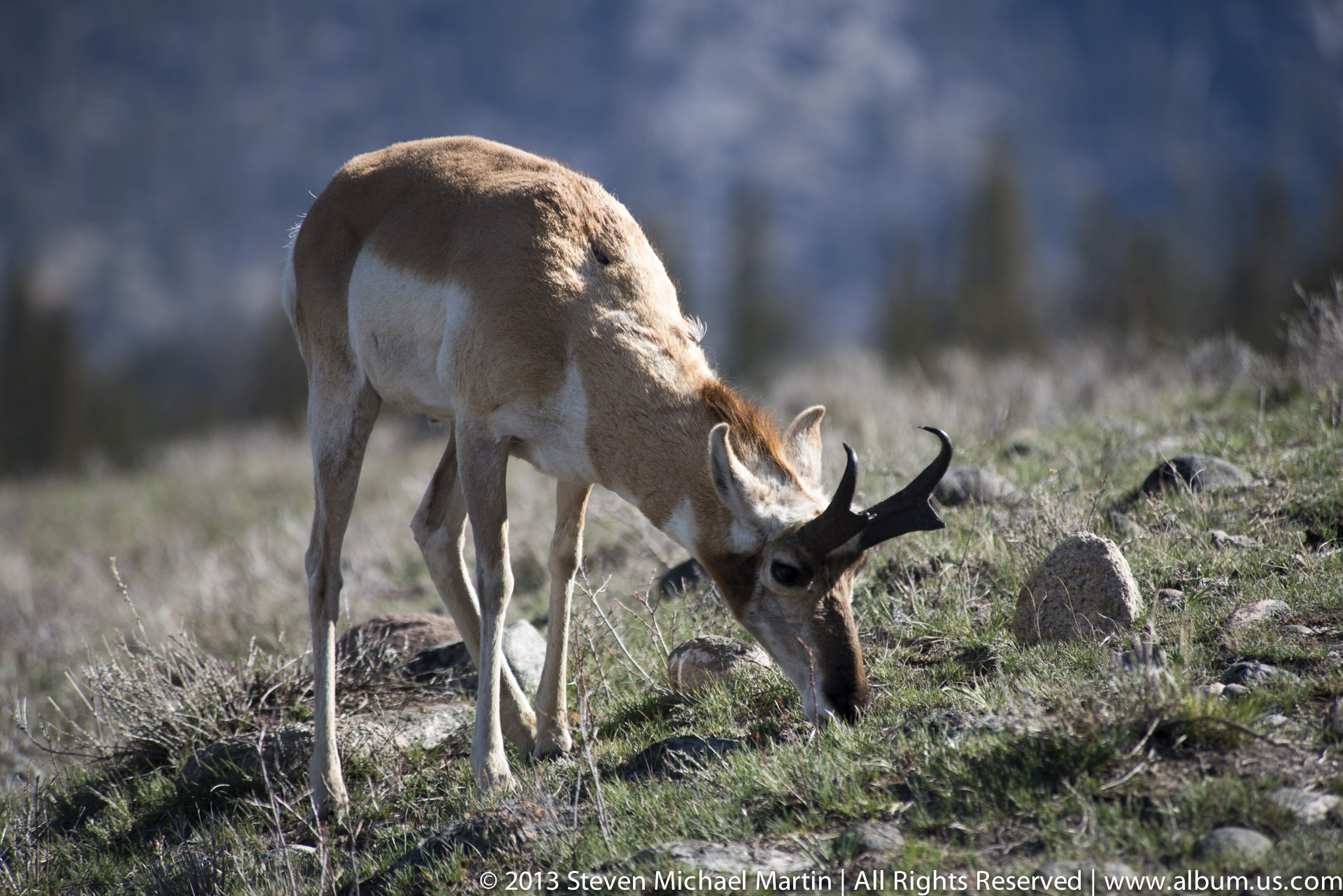
A pronghorn lowers its head between scattered stones, its long legs and pale underside visible beneath a reddish-brown back. Another animal’s dark head and branching horns enter the lower right edge, showing that the foreground subject is part of a larger feeding group. The close crop records a specific moment of foraging rather than a full herd view.
Caption
A pronghorn lowers its head between scattered stones, its long legs and pale underside visible beneath a reddish-brown back. Another animal’s dark head and branching horns enter the lower right edge, showing that the foreground subject is part of a larger feeding group. The close crop records a specific moment of foraging rather than a full herd view.
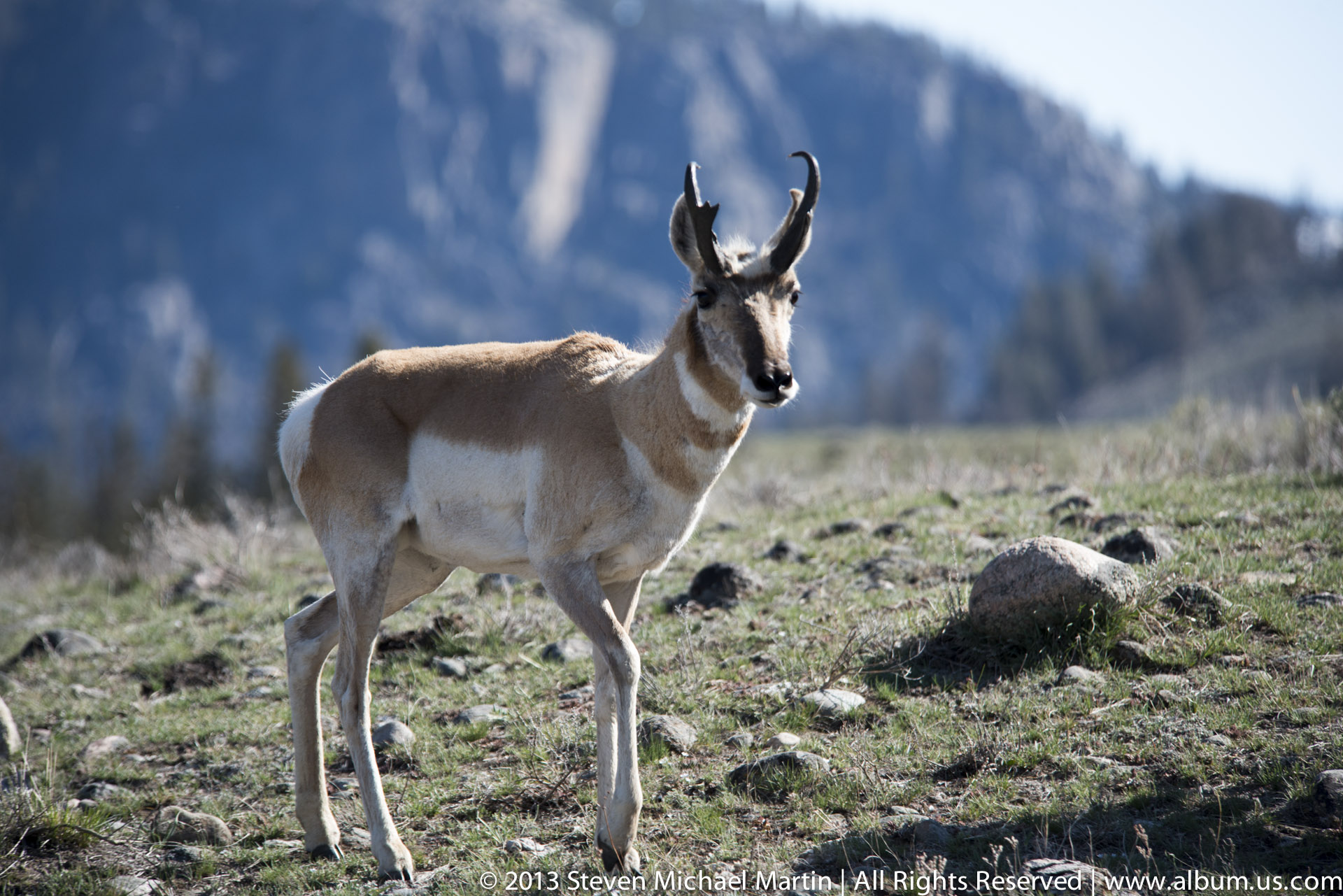
A pronghorn with short, dark horns stands facing the camera in open grassland. The animal’s white throat and flank contrast with its warm brown coat, while a mountain slope and another grazing pronghorn blur behind it. The frontal angle clearly shows the horns and alert stance, distinguishing this portrait from the grazing views nearby.
Caption
A pronghorn with short, dark horns stands facing the camera in open grassland. The animal’s white throat and flank contrast with its warm brown coat, while a mountain slope and another grazing pronghorn blur behind it. The frontal angle clearly shows the horns and alert stance, distinguishing this portrait from the grazing views nearby.
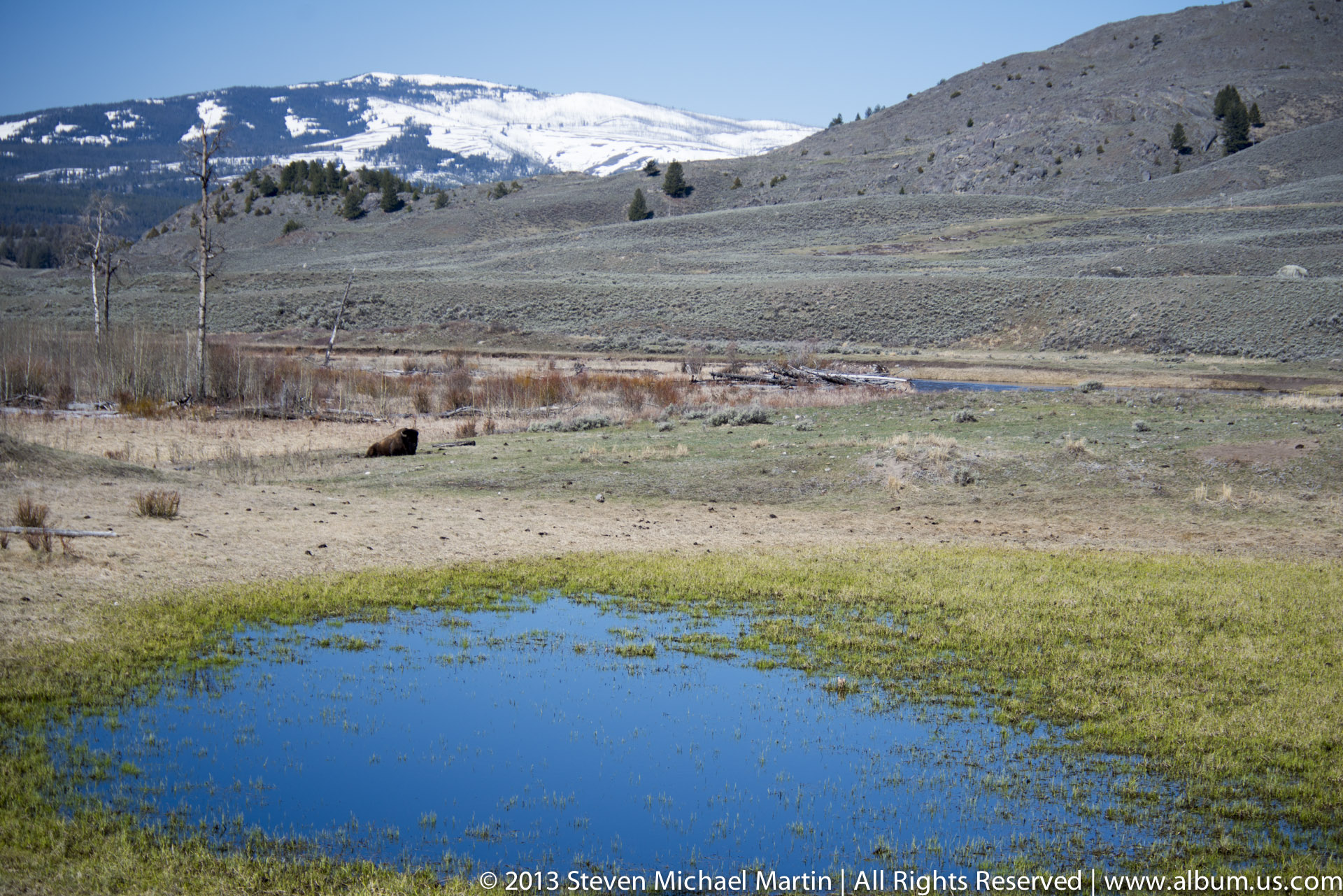
A small dark bison rests near the far bank of a vivid blue thermal pond, surrounded by green marsh vegetation and pale mineral ground. Beyond it, a broad hillside rises toward snow patches and dark evergreen forest. The wide composition places wildlife within a geothermal landscape without assigning a specific named spring or basin.
Caption
A small dark bison rests near the far bank of a vivid blue thermal pond, surrounded by green marsh vegetation and pale mineral ground. Beyond it, a broad hillside rises toward snow patches and dark evergreen forest. The wide composition places wildlife within a geothermal landscape without assigning a specific named spring or basin.
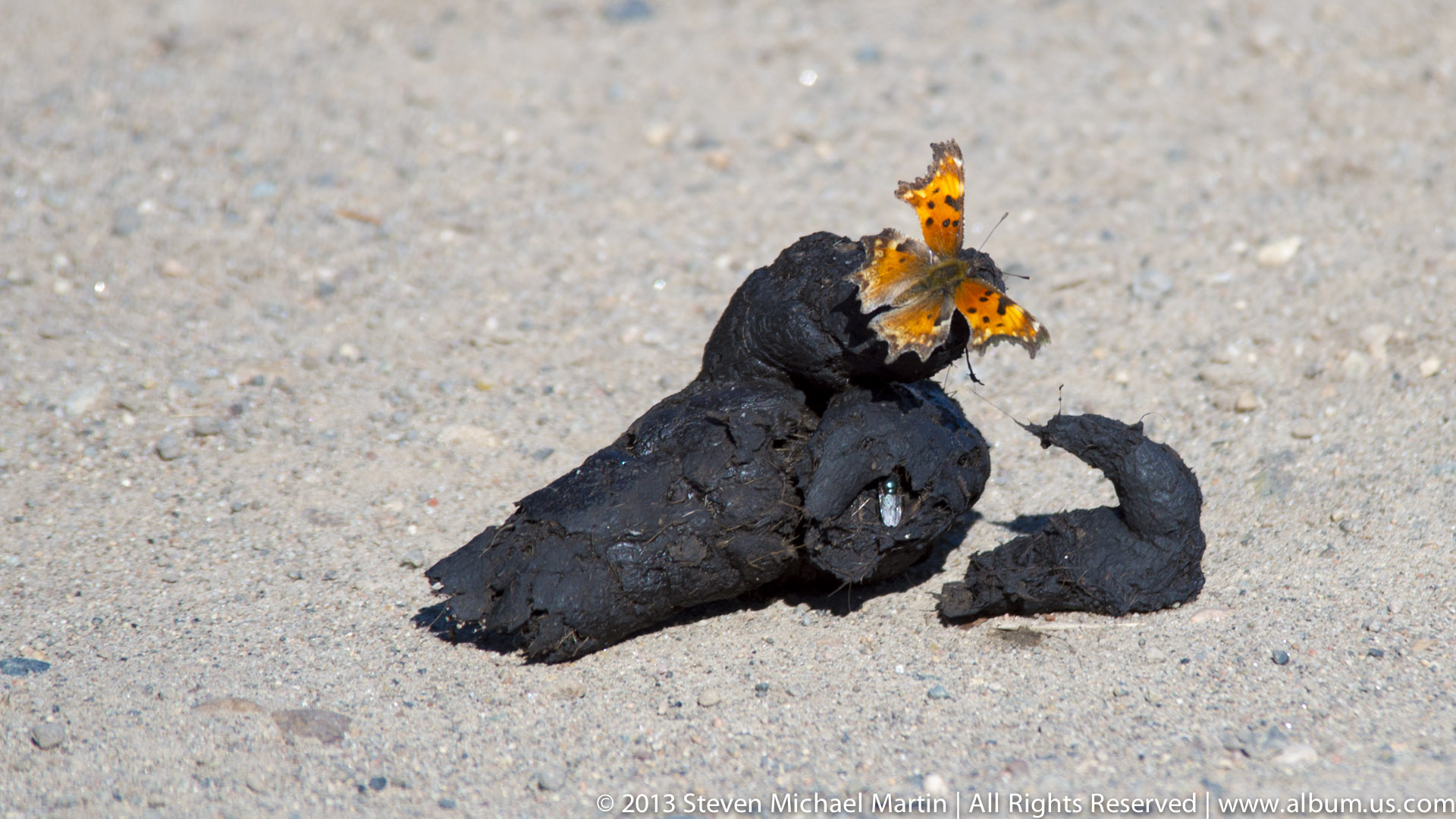
An orange-and-black butterfly rests with its wings open on a dark, irregular rock in a pale gravelly area. The isolated subject is sharply defined against the simple ground, making the spotted wing pattern and resting posture easy to see. The image supports identification as a butterfly but not a more specific species from this view.
Caption
An orange-and-black butterfly rests with its wings open on a dark, irregular rock in a pale gravelly area. The isolated subject is sharply defined against the simple ground, making the spotted wing pattern and resting posture easy to see. The image supports identification as a butterfly but not a more specific species from this view.
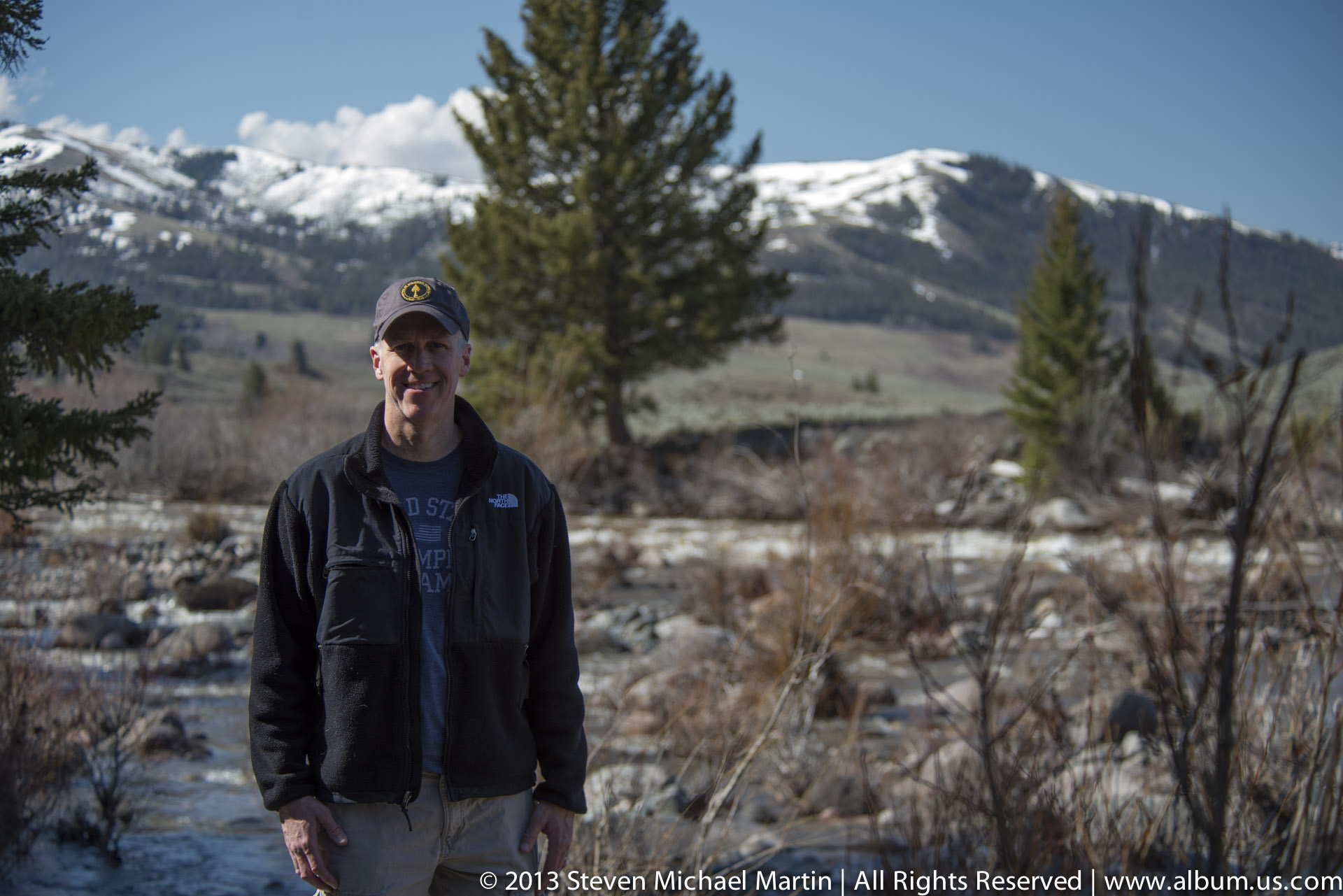
A man in a dark jacket and baseball cap stands on a snowy path with evergreen trees and pale geothermal features behind him. Steam rises faintly near the lower slope, while snow remains on the distant ridgeline. The portrait records a visitor in the park’s cold-season landscape; the person and precise thermal feature are not identified.
Caption
A man in a dark jacket and baseball cap stands on a snowy path with evergreen trees and pale geothermal features behind him. Steam rises faintly near the lower slope, while snow remains on the distant ridgeline. The portrait records a visitor in the park’s cold-season landscape; the person and precise thermal feature are not identified.
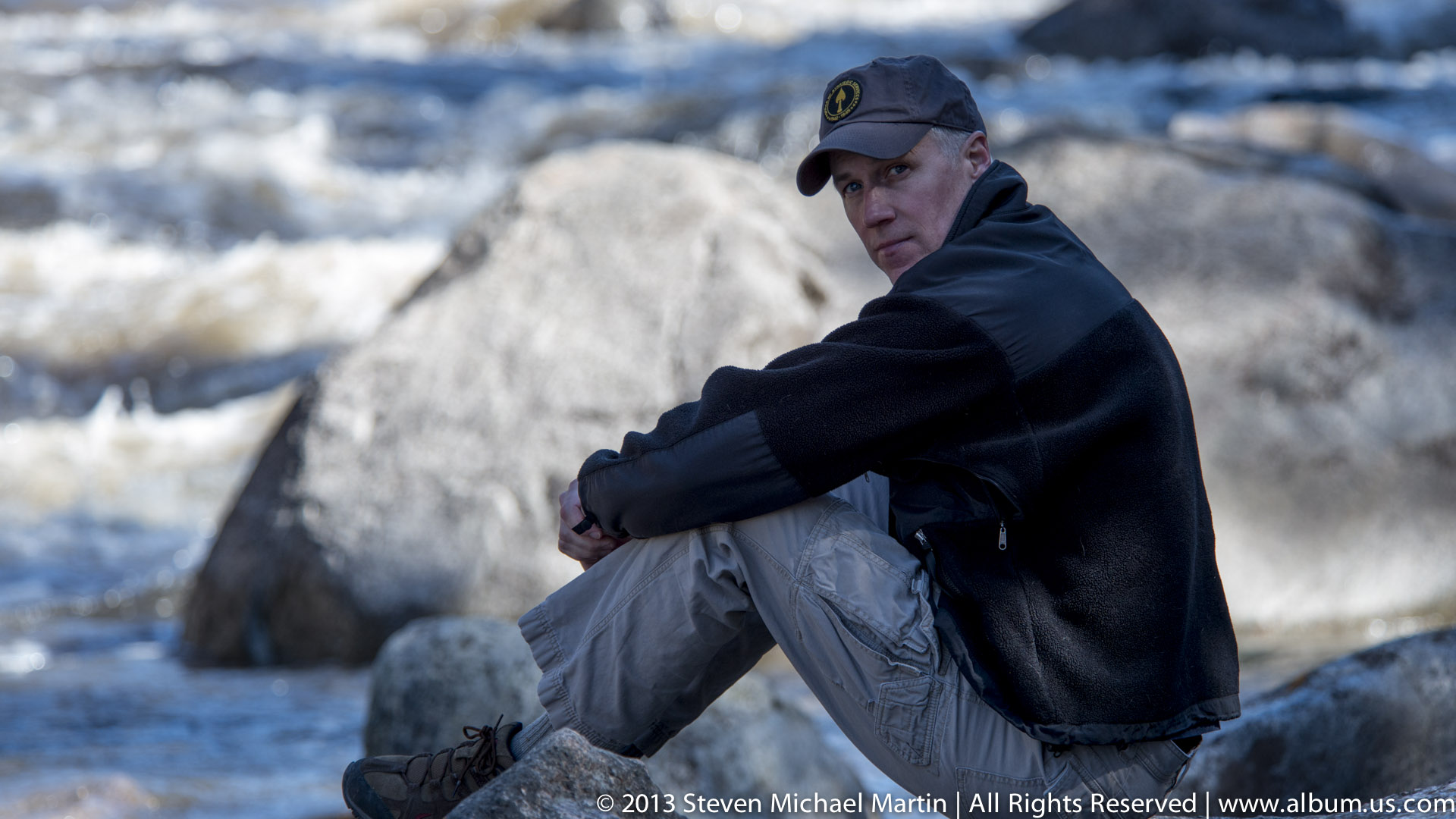
A man in a dark cap and jacket sits on a rock beside a blue-white thermal feature, turning to look back toward the camera. Pale mineral deposits and a narrow stream or pool fill the background, with snow and trees farther away. The seated pose places the visitor within the landscape while keeping the geological setting prominent.
Caption
A man in a dark cap and jacket sits on a rock beside a blue-white thermal feature, turning to look back toward the camera. Pale mineral deposits and a narrow stream or pool fill the background, with snow and trees farther away. The seated pose places the visitor within the landscape while keeping the geological setting prominent.
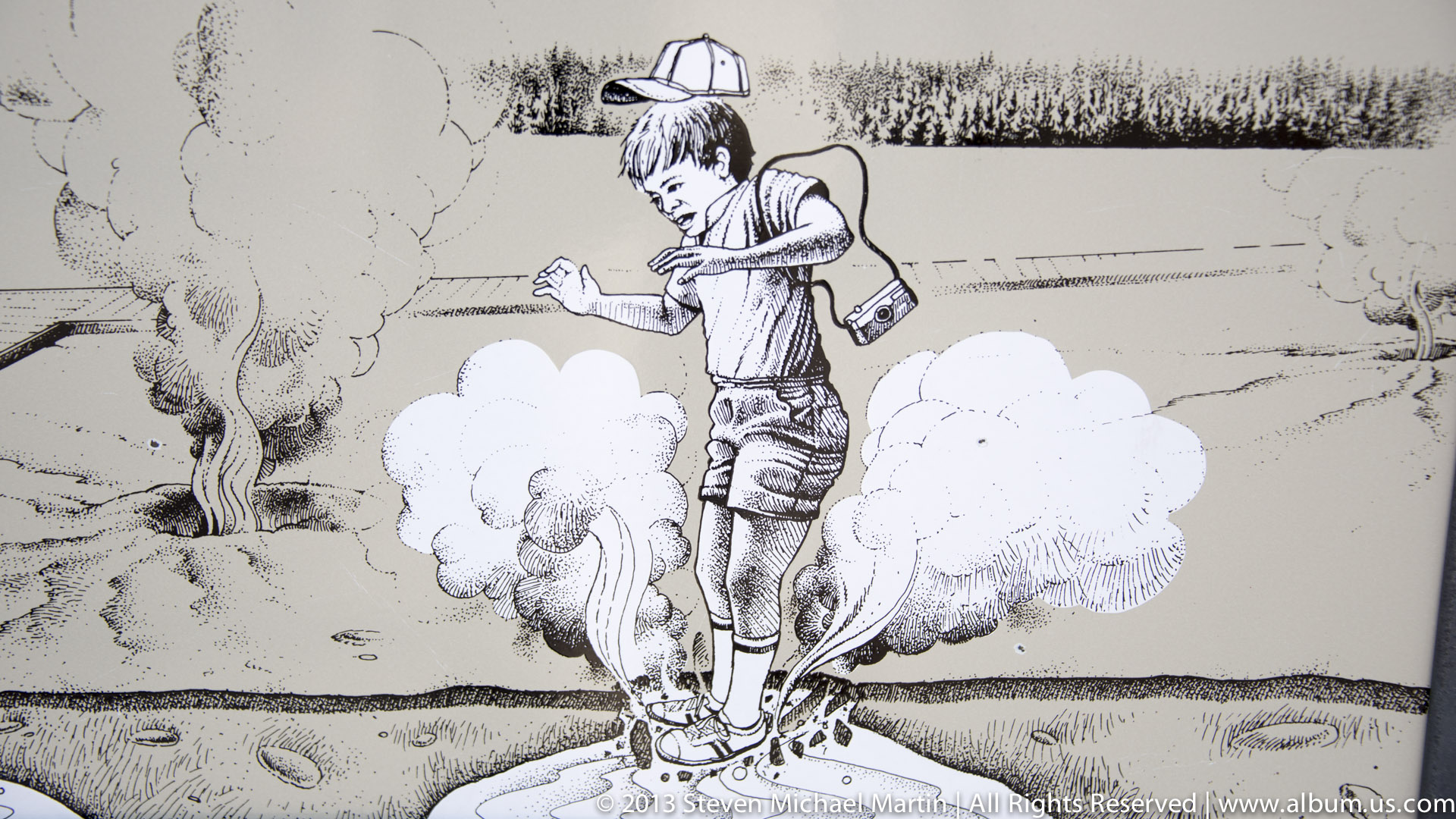
A printed black-and-white illustration shows a child in a brimmed hat stepping among stylized clouds or steam, with a line of trees across the top and a geyser-like plume at left. The image appears on an interpretive panel or printed page, but its accompanying text is not legible in the proof sheet. The caption describes the visible illustration without assigning its publication or story.
Caption
A printed black-and-white illustration shows a child in a brimmed hat stepping among stylized clouds or steam, with a line of trees across the top and a geyser-like plume at left. The image appears on an interpretive panel or printed page, but its accompanying text is not legible in the proof sheet. The caption describes the visible illustration without assigning its publication or story.
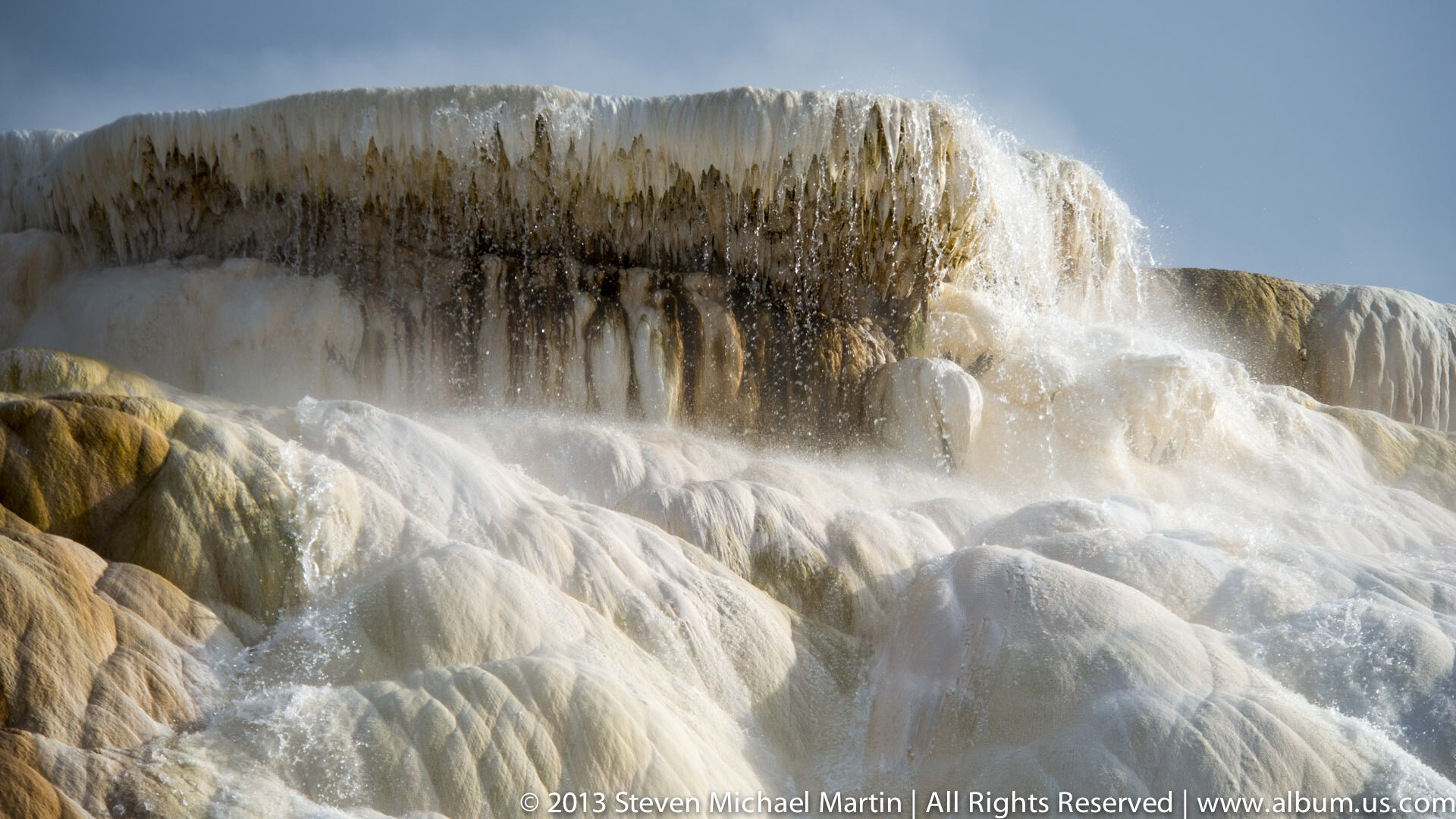
Thermal water spills over the edge of a broad, pale terrace, breaking into fine streams that trace the rounded mineral surface below. Warm brown and green staining marks the rim, while sunlight catches the moving water and white deposits. This close landscape view emphasizes flow and surface texture rather than the full extent of the spring system.
Caption
Thermal water spills over the edge of a broad, pale terrace, breaking into fine streams that trace the rounded mineral surface below. Warm brown and green staining marks the rim, while sunlight catches the moving water and white deposits. This close landscape view emphasizes flow and surface texture rather than the full extent of the spring system.
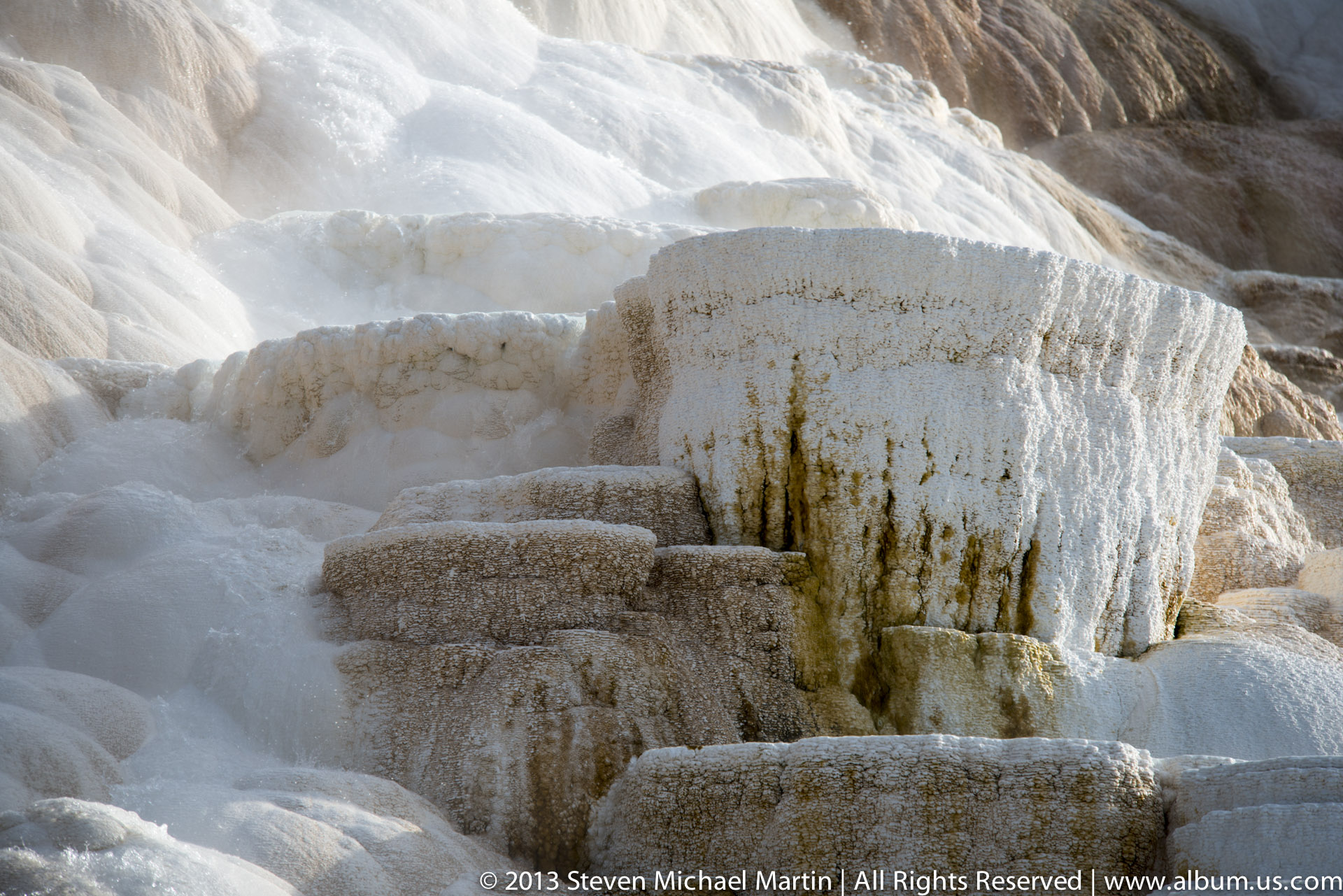
Pale travertine forms rounded ledges and shallow basins across a close view of the thermal slope. A broad, squared rim stands near the center, with smaller rippled deposits stepping down in front of it. Subtle brown staining follows the water paths and highlights the porous, layered surface formed by mineral-rich spring flow.
Caption
Pale travertine forms rounded ledges and shallow basins across a close view of the thermal slope. A broad, squared rim stands near the center, with smaller rippled deposits stepping down in front of it. Subtle brown staining follows the water paths and highlights the porous, layered surface formed by mineral-rich spring flow.
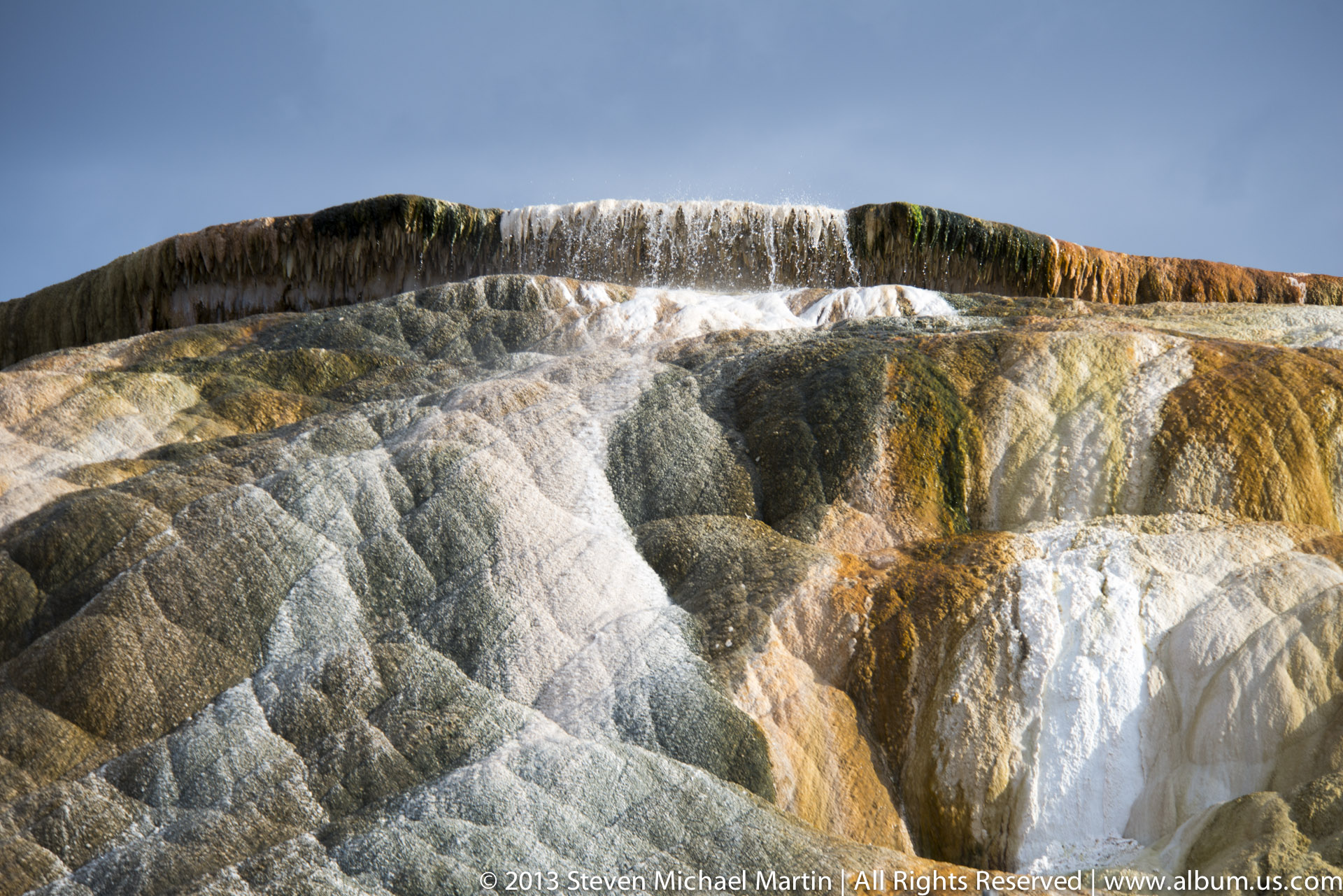
A low, rounded terrace displays alternating white, gray, ochre, and green mineral bands beneath a clear sky. The broad framing follows the curved rim from left to right and shows the stepped deposits descending toward the foreground. Color differences trace water paths across the surface, making the spring’s layered geometry the defining feature.
Caption
A low, rounded terrace displays alternating white, gray, ochre, and green mineral bands beneath a clear sky. The broad framing follows the curved rim from left to right and shows the stepped deposits descending toward the foreground. Color differences trace water paths across the surface, making the spring’s layered geometry the defining feature.
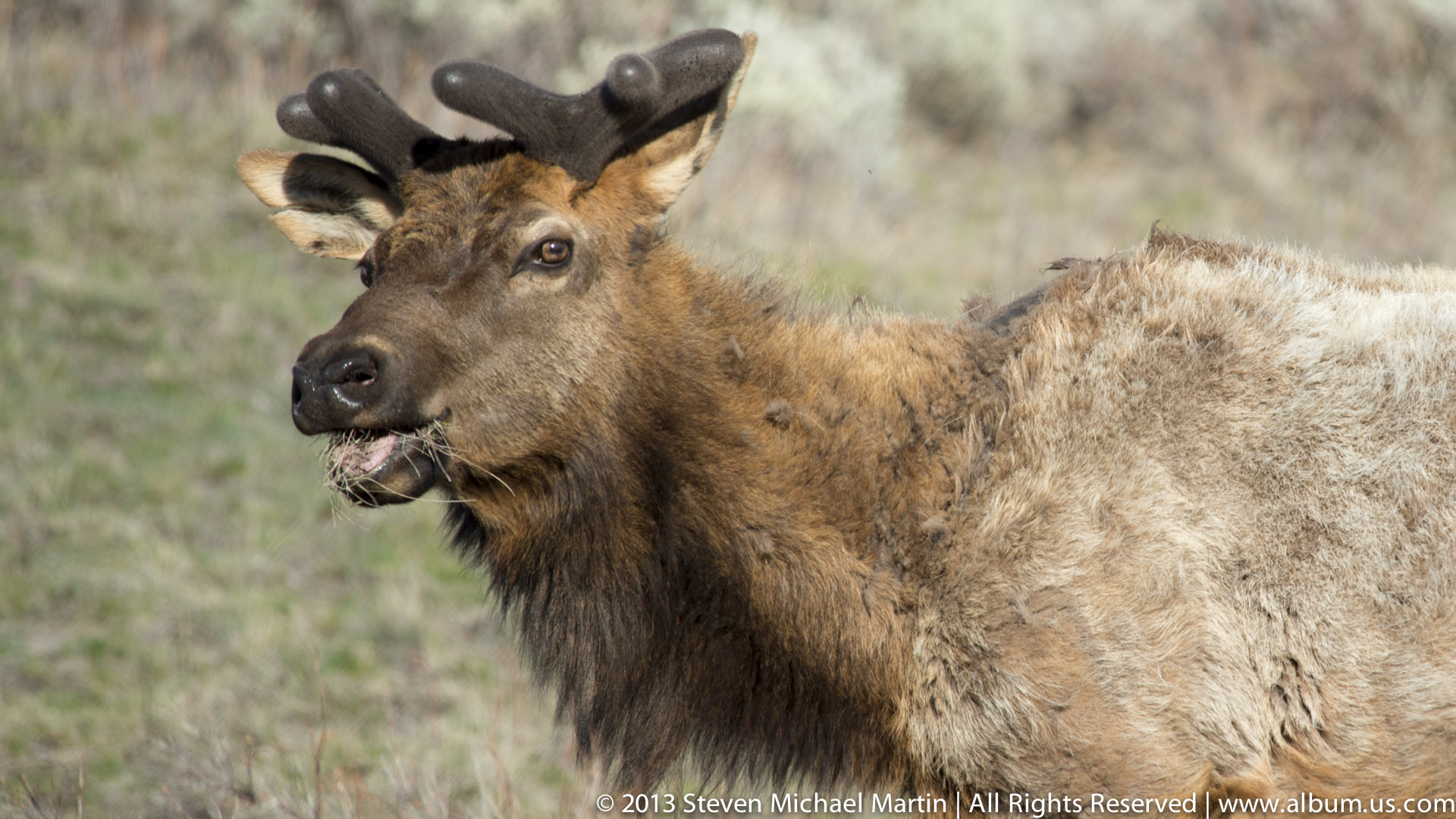
A brown elk fills the frame in a close wildlife portrait, its large ears raised and mouth open. A dark mane contrasts with the lighter coat across its neck and shoulders, while the shallow-focus meadow behind it remains softly blurred. No antlers are visible, so the image is identified as an elk without specifying sex or age.
Caption
A brown elk fills the frame in a close wildlife portrait, its large ears raised and mouth open. A dark mane contrasts with the lighter coat across its neck and shoulders, while the shallow-focus meadow behind it remains softly blurred. No antlers are visible, so the image is identified as an elk without specifying sex or age.
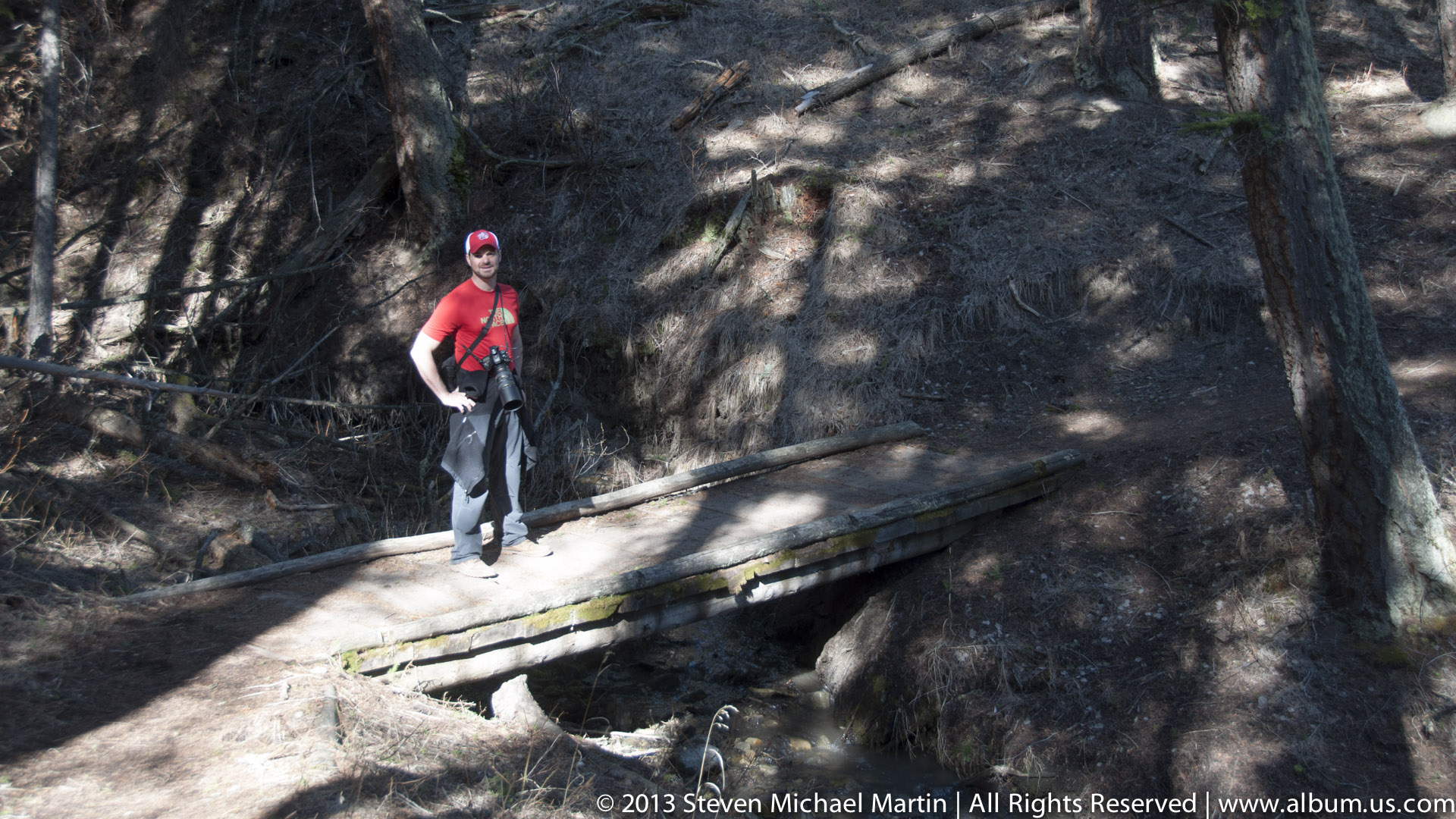
A visitor in a red shirt and cap stands on a narrow wooden boardwalk crossing a shaded forested slope. Fallen branches and logs lie beside the walkway, while tall trunks and dappled light create a dense woodland setting. The full-body figure offers scale for the path and surrounding trees; no landmark or trail name is visible.
Caption
A visitor in a red shirt and cap stands on a narrow wooden boardwalk crossing a shaded forested slope. Fallen branches and logs lie beside the walkway, while tall trunks and dappled light create a dense woodland setting. The full-body figure offers scale for the path and surrounding trees; no landmark or trail name is visible.
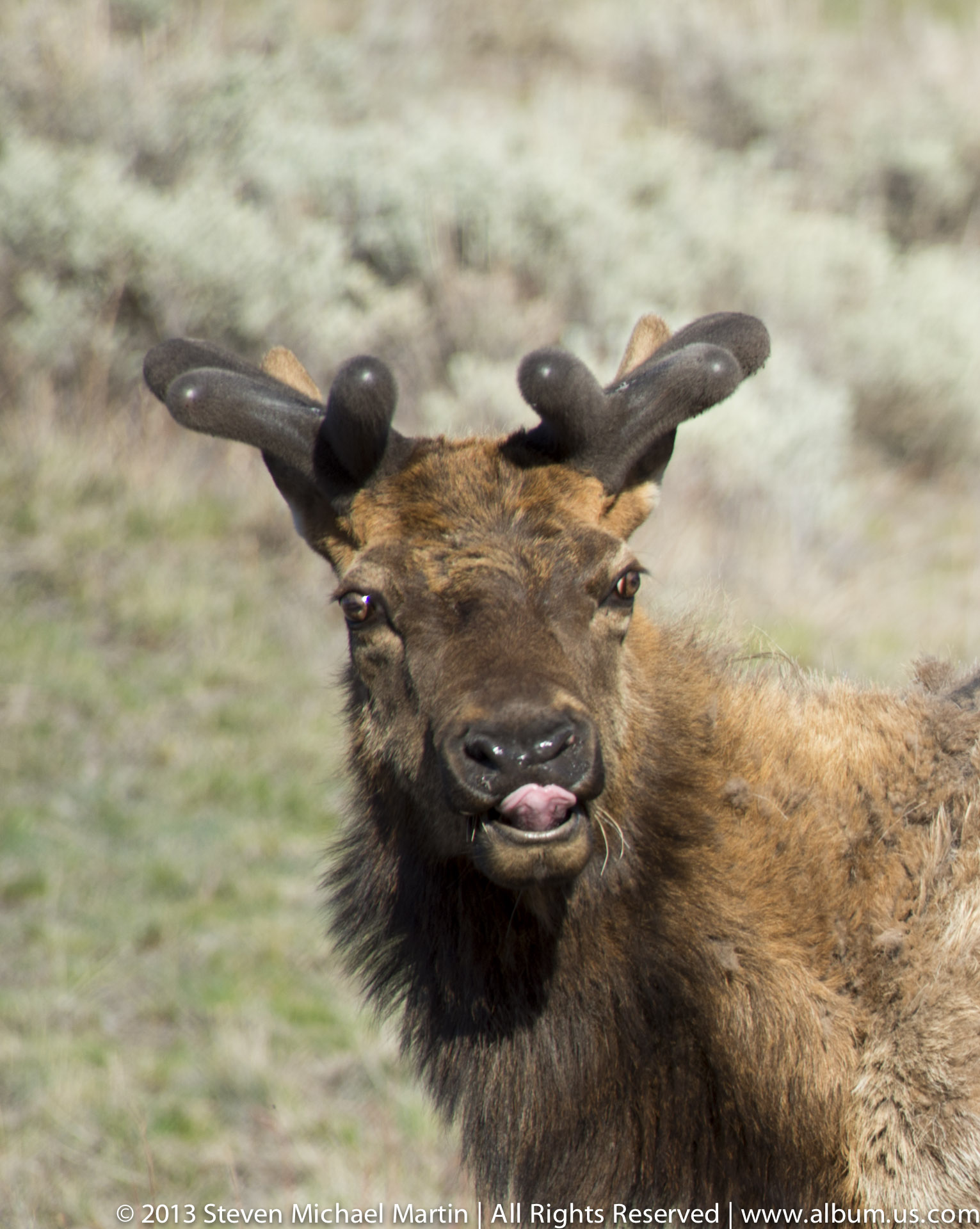
A close view shows a moose facing the camera with broad, palmated antlers and its tongue extended over the nose. The animal’s dark muzzle and shaggy brown coat are sharply defined against a pale, softly blurred meadow. The distinctive antler shape separates this portrait from the elk images elsewhere in the sequence.
Caption
A close view shows a moose facing the camera with broad, palmated antlers and its tongue extended over the nose. The animal’s dark muzzle and shaggy brown coat are sharply defined against a pale, softly blurred meadow. The distinctive antler shape separates this portrait from the elk images elsewhere in the sequence.
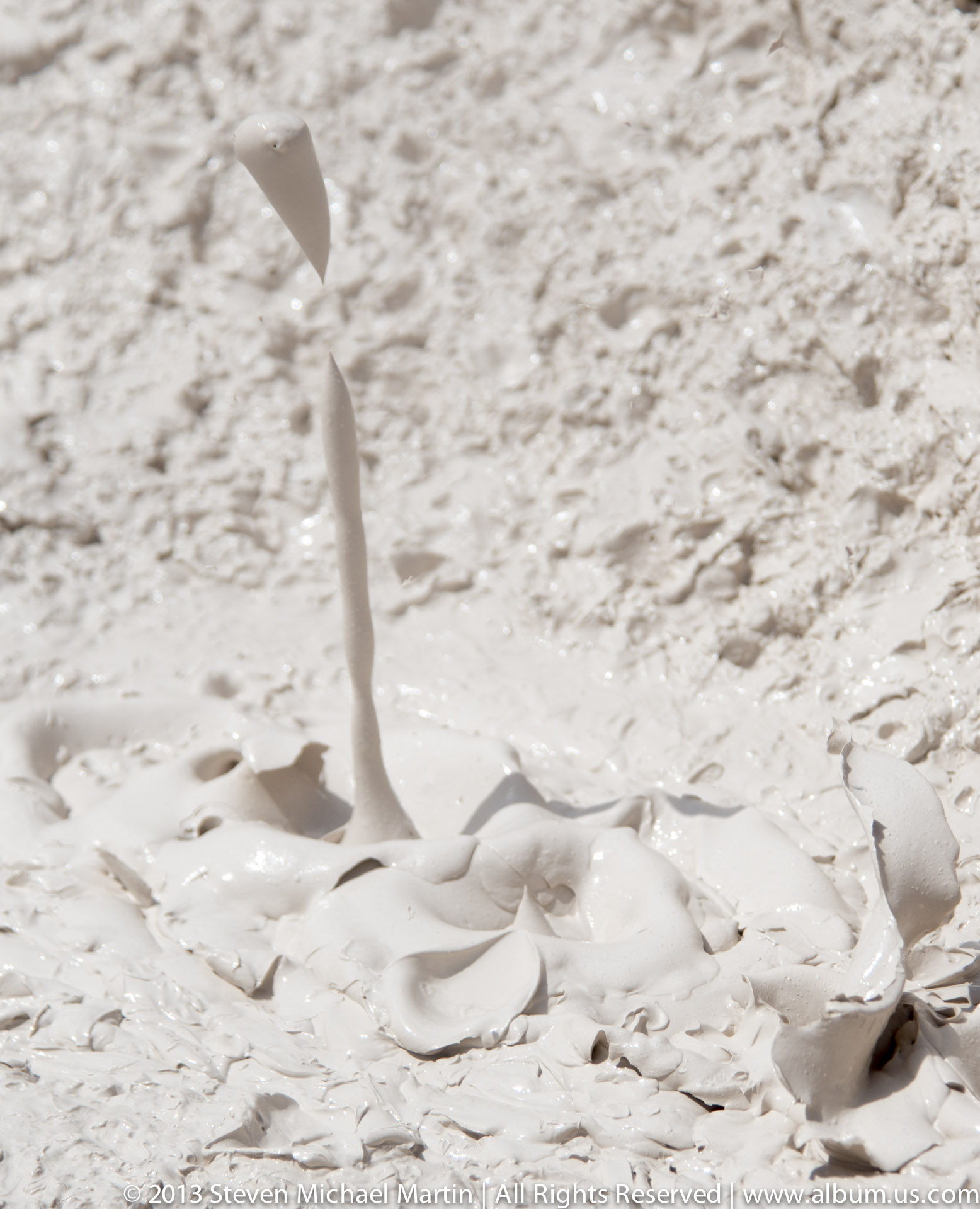
A narrow, pale column rises from a small opening in a broad cream-colored geothermal surface. Low mounds and shallow depressions surround the vent, and the uniform mineral ground fills the frame. The source and temperature of the plume cannot be confirmed from the thumbnail, so the description stays with the visible vent-like feature and pale terrain.
Caption
A narrow, pale column rises from a small opening in a broad cream-colored geothermal surface. Low mounds and shallow depressions surround the vent, and the uniform mineral ground fills the frame. The source and temperature of the plume cannot be confirmed from the thumbnail, so the description stays with the visible vent-like feature and pale terrain.
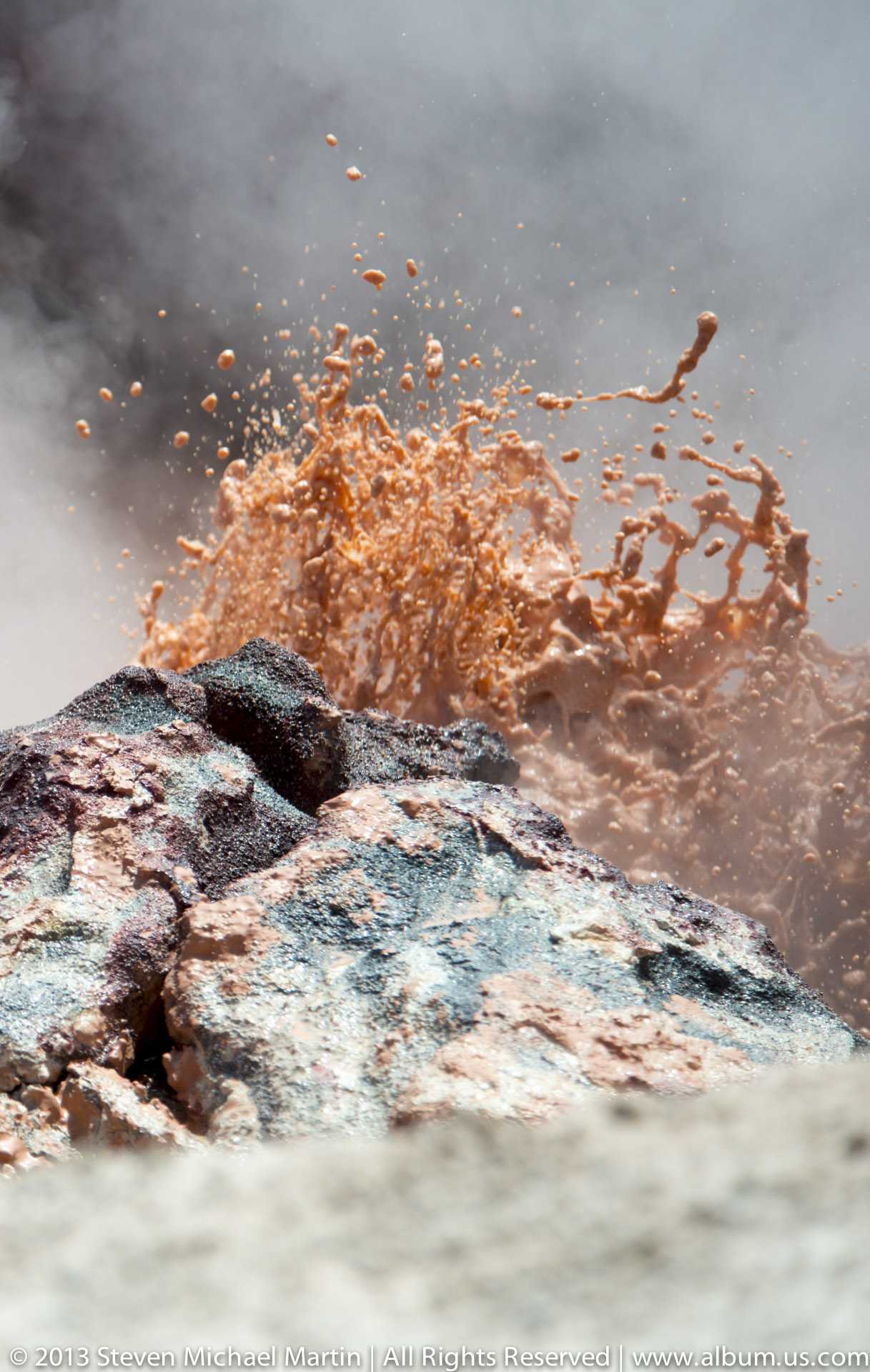
A burst of orange-brown water arcs upward behind a dark, mineral-coated rock ledge, with droplets suspended against the pale pool. The near rock divides the frame into a sharply textured foreground and an active splash beyond it. The image records a moment of motion rather than a named geyser; no landmark or vent can be identified from this close view alone.
Caption
A burst of orange-brown water arcs upward behind a dark, mineral-coated rock ledge, with droplets suspended against the pale pool. The near rock divides the frame into a sharply textured foreground and an active splash beyond it. The image records a moment of motion rather than a named geyser; no landmark or vent can be identified from this close view alone.
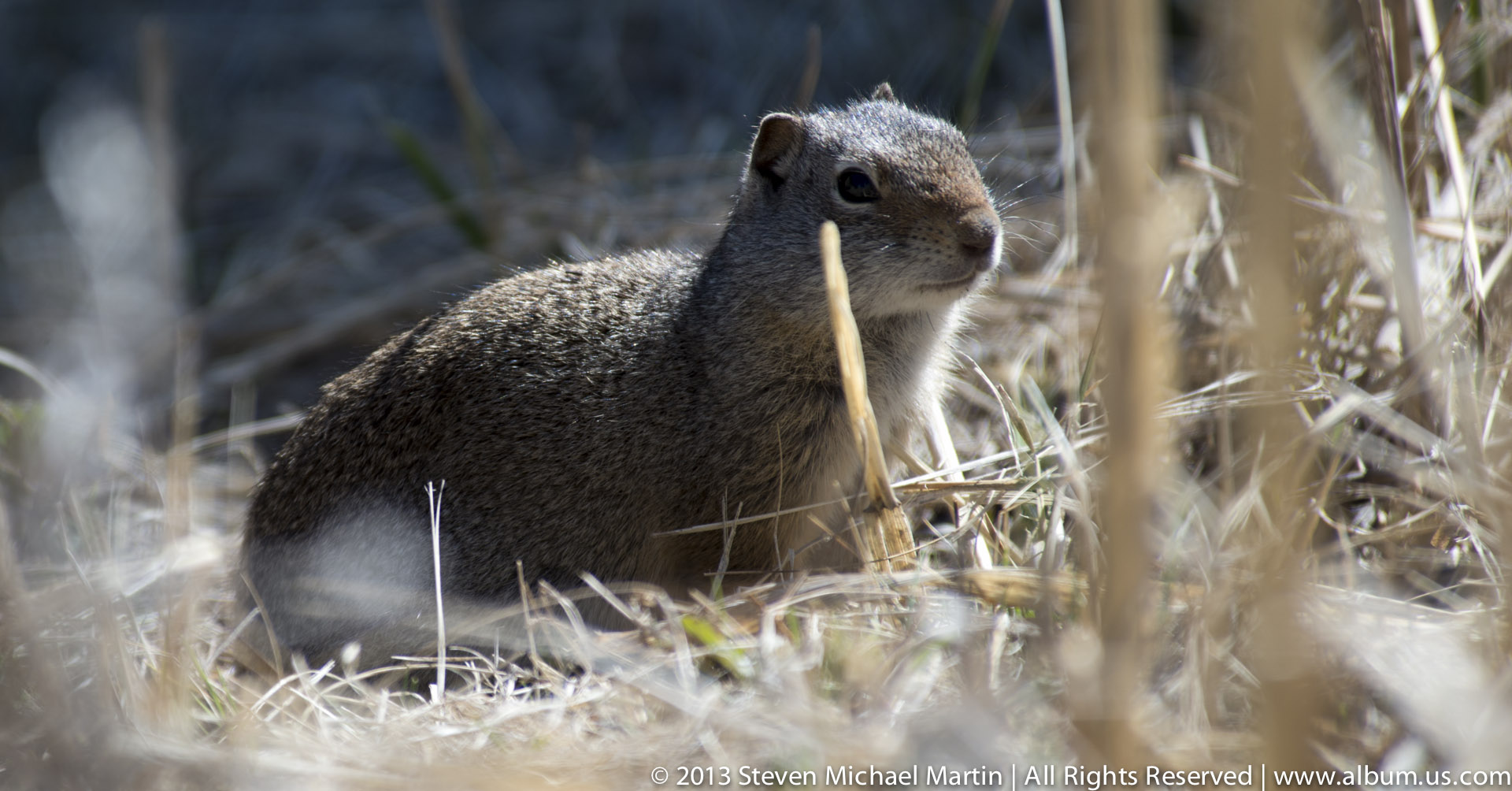
A small gray-brown ground squirrel sits upright among pale dry grasses and thin stems, looking toward the camera. Its rounded ears, dark eyes, and compact body are visible through the foreground vegetation. The shallow focus separates the animal from the shadowed background; the proof-sheet view supports a ground squirrel identification but not a species-level label.
Caption
A small gray-brown ground squirrel sits upright among pale dry grasses and thin stems, looking toward the camera. Its rounded ears, dark eyes, and compact body are visible through the foreground vegetation. The shallow focus separates the animal from the shadowed background; the proof-sheet view supports a ground squirrel identification but not a species-level label.
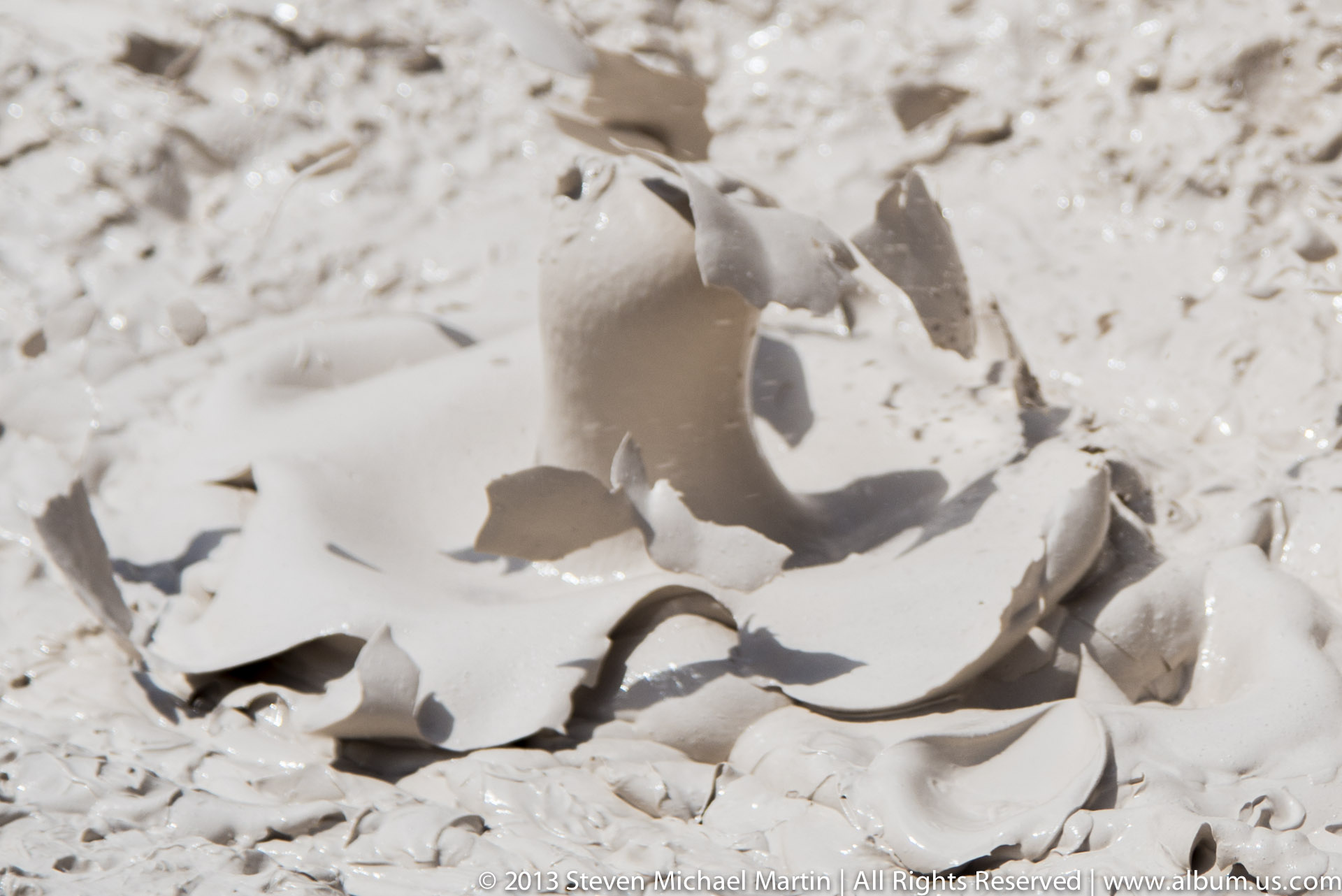
A close view of pale mud shows several rounded bubbles swelling through a smooth, light-colored pool. The soft edges and shallow hollows create a fluid pattern across the frame, with no surrounding landscape visible. The photograph isolates the changing surface of a geothermal mud feature rather than identifying a named spring or basin.
Caption
A close view of pale mud shows several rounded bubbles swelling through a smooth, light-colored pool. The soft edges and shallow hollows create a fluid pattern across the frame, with no surrounding landscape visible. The photograph isolates the changing surface of a geothermal mud feature rather than identifying a named spring or basin.
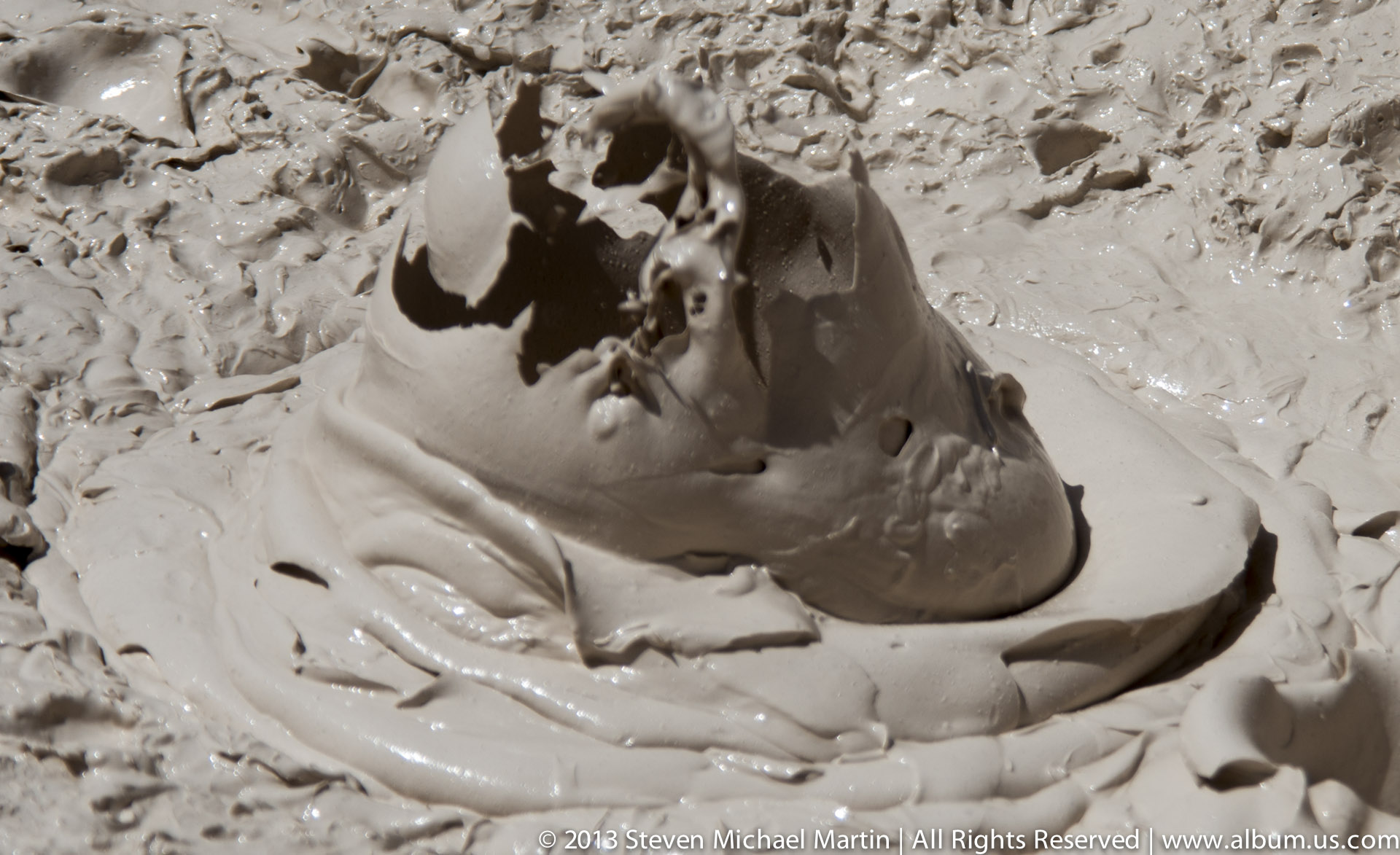
Large pale bubbles push through a gray-white mud pool, one opening ruptured to expose a dark cavity at the center. Smaller blisters and smooth folds radiate around it, recording the movement beneath the surface. The tight crop highlights the mud’s changing forms and tonal contrast without adding unsupported claims about the feature’s location.
Caption
Large pale bubbles push through a gray-white mud pool, one opening ruptured to expose a dark cavity at the center. Smaller blisters and smooth folds radiate around it, recording the movement beneath the surface. The tight crop highlights the mud’s changing forms and tonal contrast without adding unsupported claims about the feature’s location.
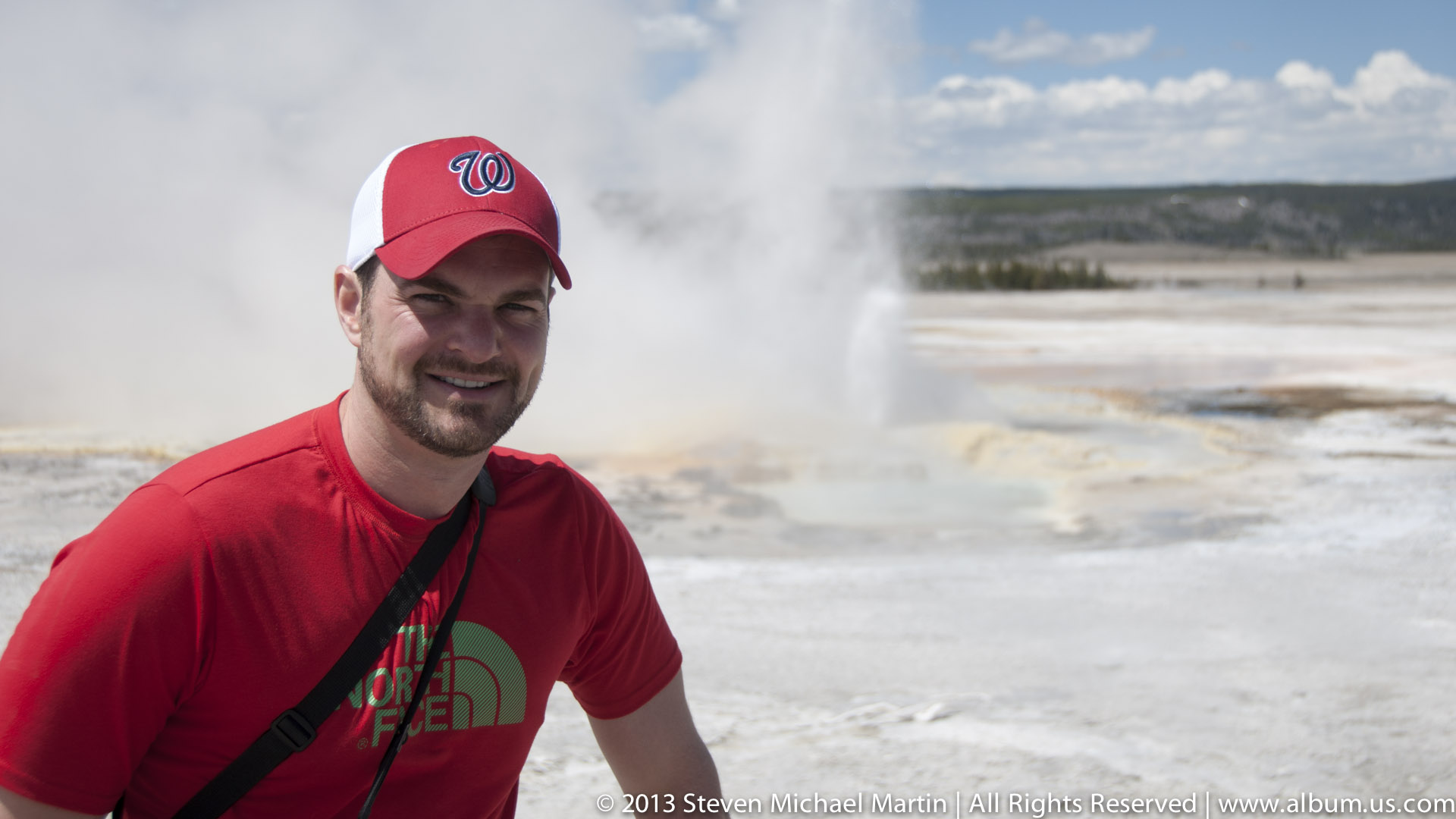
A visitor in a red Washington Nationals cap and red shirt poses at the edge of a geothermal basin, with a dense plume of steam rising behind him. The pale mineral ground and low forested horizon place the portrait within an open thermal area. His relaxed stance gives the landscape a human scale without obscuring the active feature.
Caption
A visitor in a red Washington Nationals cap and red shirt poses at the edge of a geothermal basin, with a dense plume of steam rising behind him. The pale mineral ground and low forested horizon place the portrait within an open thermal area. His relaxed stance gives the landscape a human scale without obscuring the active feature.
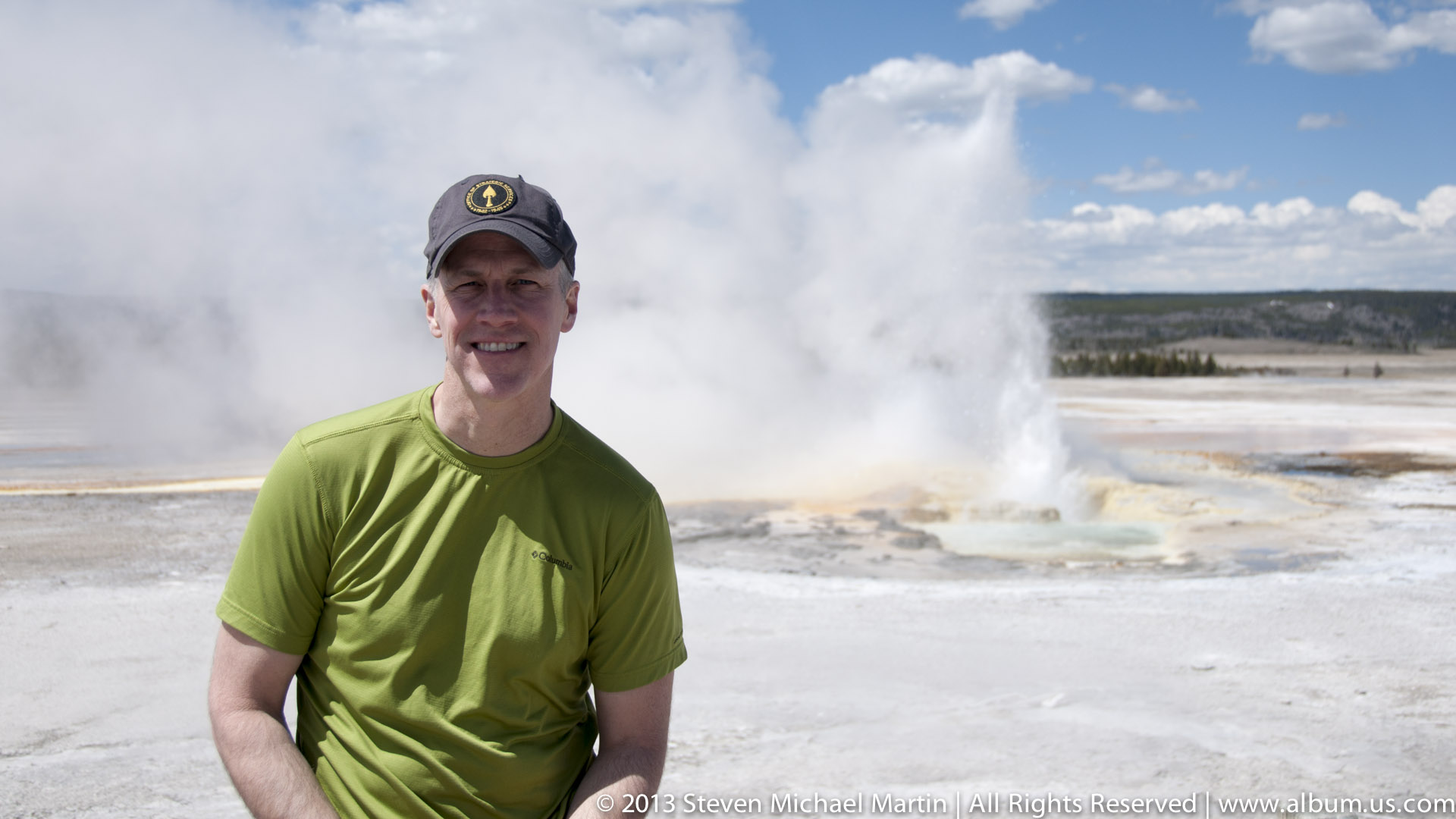
A visitor wearing a green shirt and dark cap stands in front of a tall white steam plume. The cloud partially veils the distant tree line and spreads across a pale geothermal flat, while the subject remains sharply separated from the vapor. This companion portrait records a different pose and color contrast within the same open thermal setting.
Caption
A visitor wearing a green shirt and dark cap stands in front of a tall white steam plume. The cloud partially veils the distant tree line and spreads across a pale geothermal flat, while the subject remains sharply separated from the vapor. This companion portrait records a different pose and color contrast within the same open thermal setting.
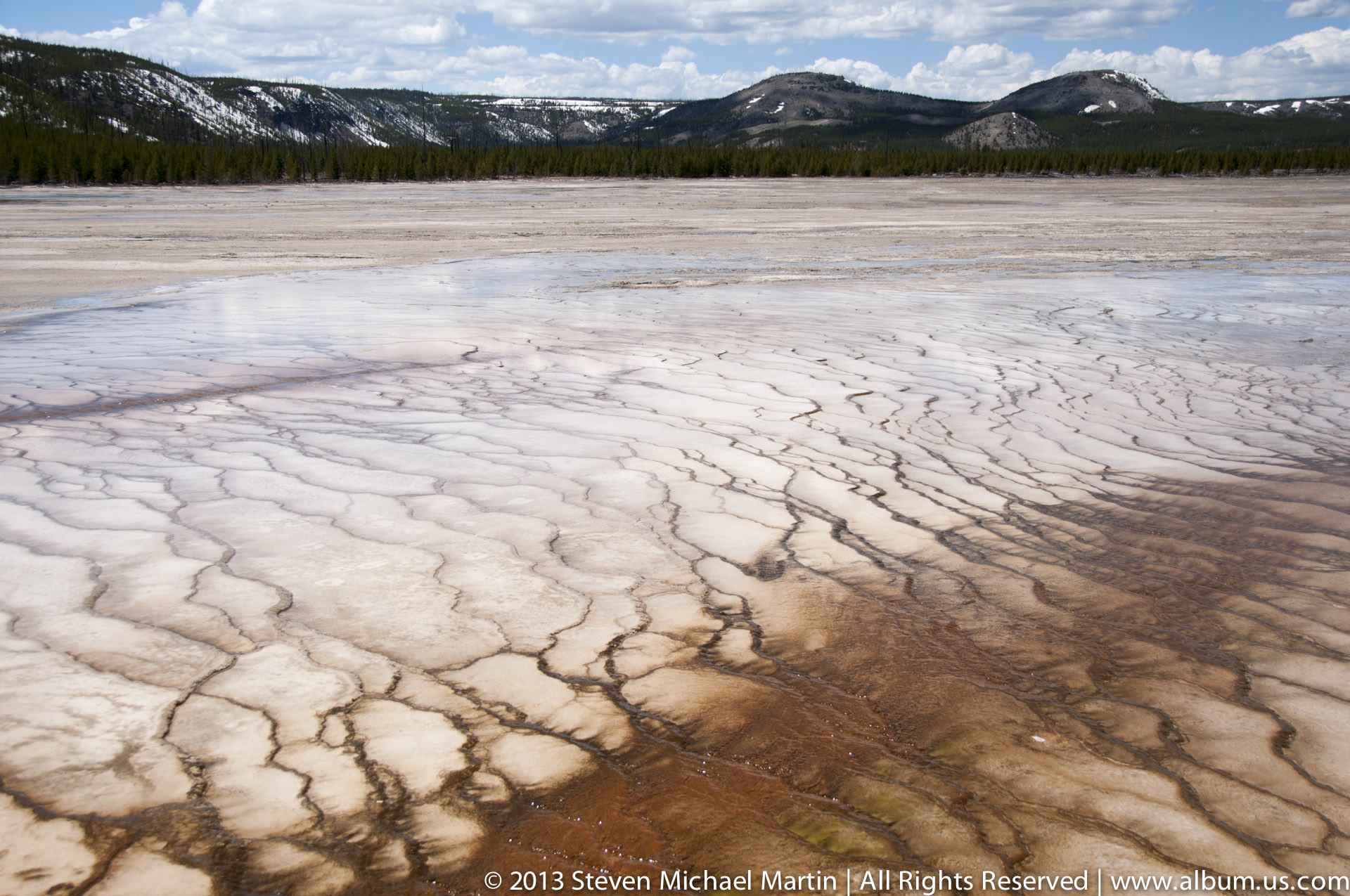
A broad sheet of pale mineral crust is divided into irregular polygonal plates, with fine dark fissures branching across the surface. Rust-colored runoff stains the edges and gathers in shallow seams. A distant line of conifers and low hills sets the close ground pattern within a larger basin, while the empty foreground emphasizes the crust’s texture.
Caption
A broad sheet of pale mineral crust is divided into irregular polygonal plates, with fine dark fissures branching across the surface. Rust-colored runoff stains the edges and gathers in shallow seams. A distant line of conifers and low hills sets the close ground pattern within a larger basin, while the empty foreground emphasizes the crust’s texture.
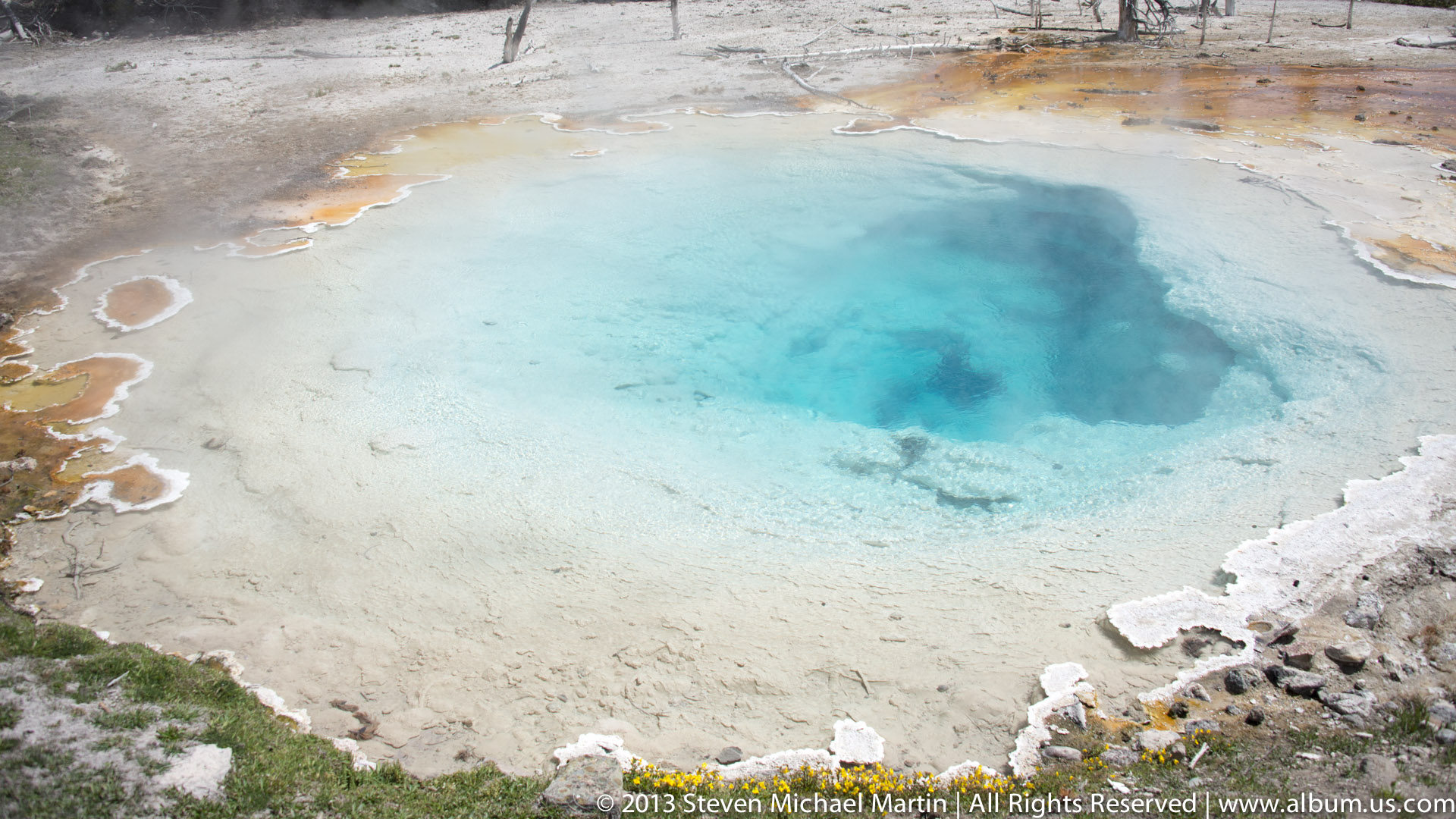
Seen from above, a bright cyan pool sits within a broad pale silica apron. The irregular waterline curves around a deeper blue center, while thin orange deposits and low plants mark sections of the outer rim. The tight composition isolates the spring’s color and shape from the surrounding basin, offering a more intimate view than the wider landscape photographs nearby.
Caption
Seen from above, a bright cyan pool sits within a broad pale silica apron. The irregular waterline curves around a deeper blue center, while thin orange deposits and low plants mark sections of the outer rim. The tight composition isolates the spring’s color and shape from the surrounding basin, offering a more intimate view than the wider landscape photographs nearby.
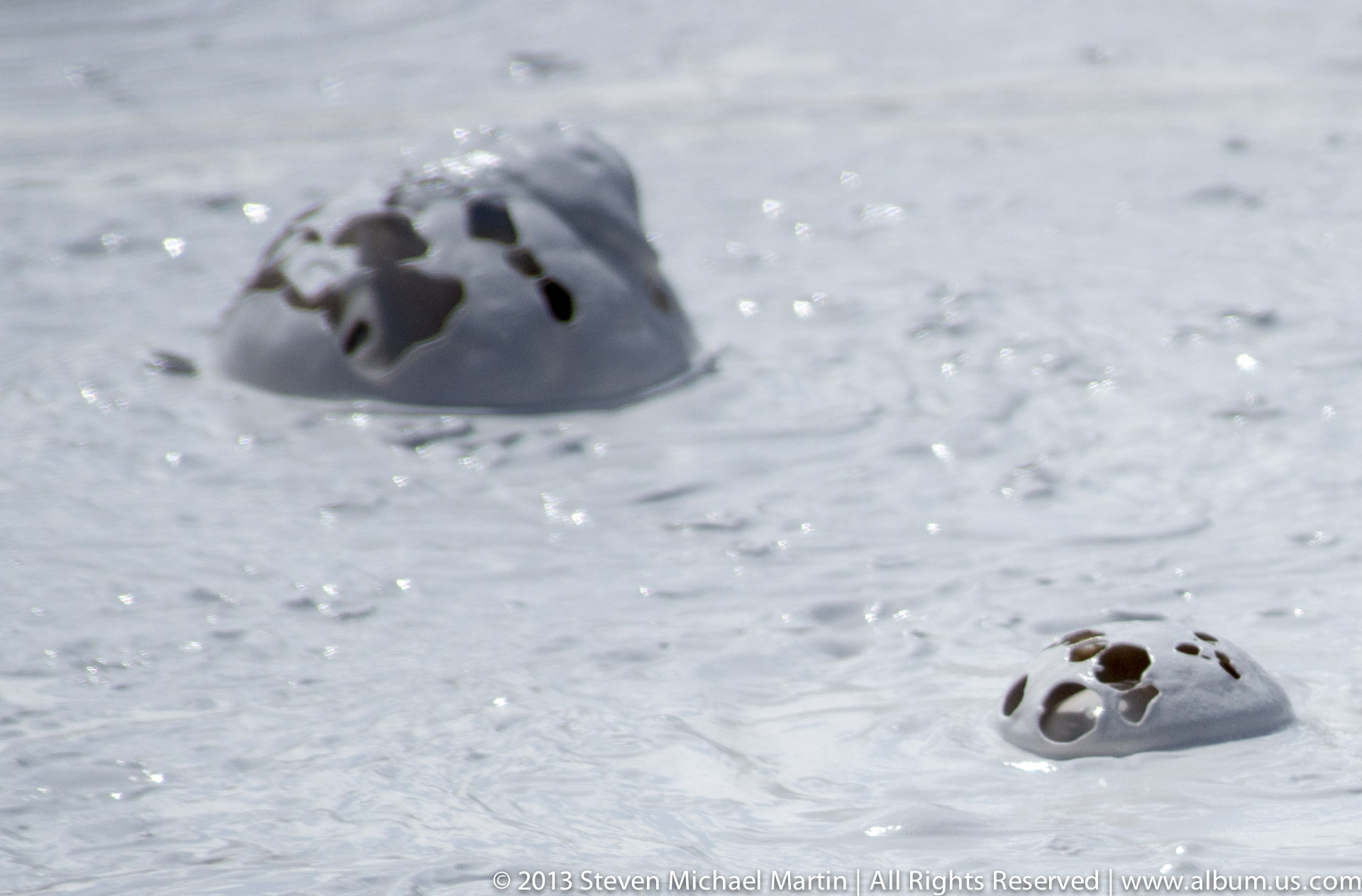
Two low, rounded mineral mounds protrude from a pale, gently rippling pool. Dark openings and brown deposits mark their tops, and small bubbles break the water nearby. The larger vent sits farther back while a smaller one occupies the lower right, creating a diagonal pair against the otherwise smooth surface. Their form suggests active geothermal discharge, though the individual feature names are not visible.
Caption
Two low, rounded mineral mounds protrude from a pale, gently rippling pool. Dark openings and brown deposits mark their tops, and small bubbles break the water nearby. The larger vent sits farther back while a smaller one occupies the lower right, creating a diagonal pair against the otherwise smooth surface. Their form suggests active geothermal discharge, though the individual feature names are not visible.
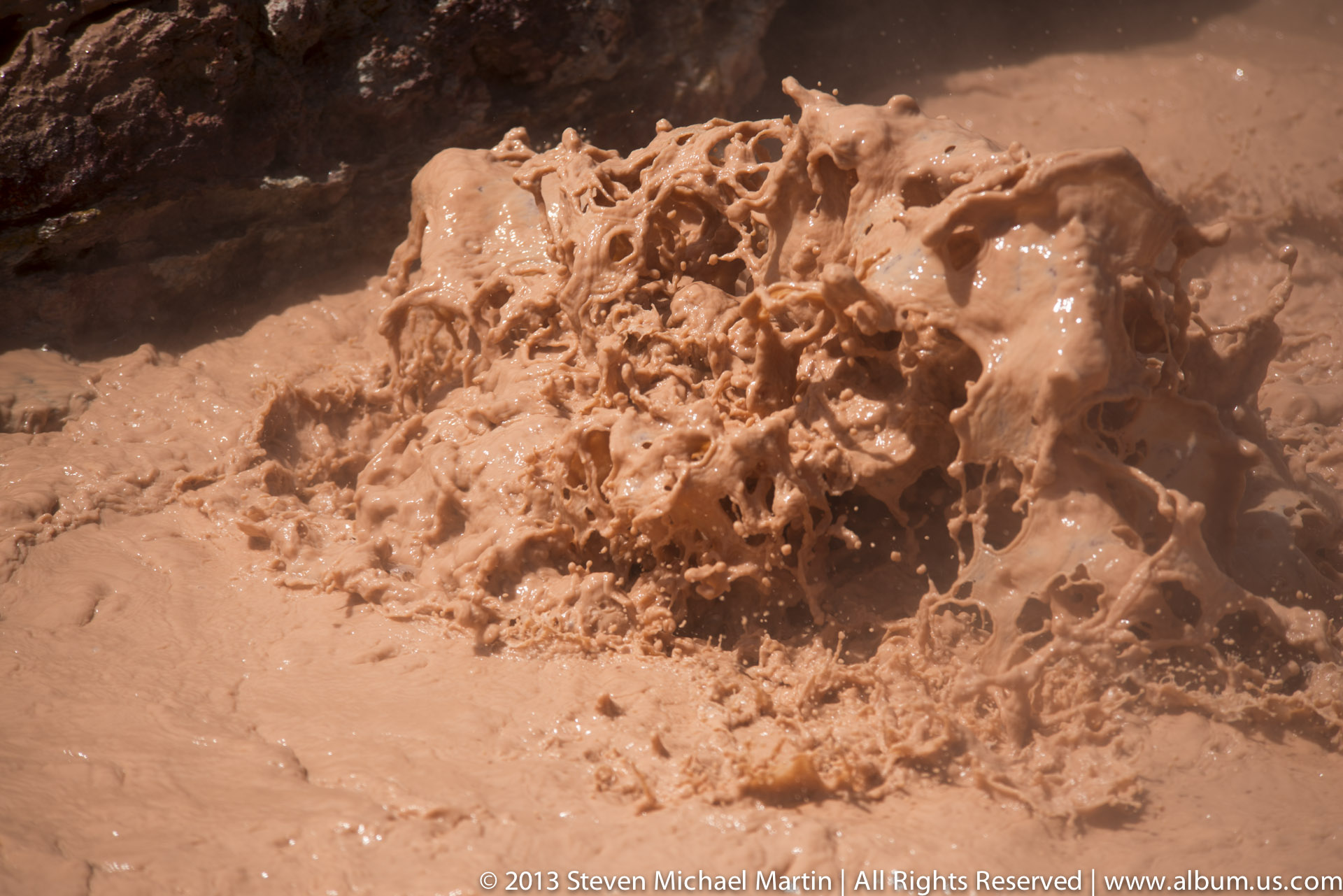
A thick brown slurry heaves and folds around a low vent, its glossy surface forming ridges, lobes, and small erupting bubbles. The tight crop excludes the basin’s wider setting and concentrates on the mud’s changing texture and warm mineral color. The active, viscous surface distinguishes this feature from the clear pools and silica terraces elsewhere in the batch.
Caption
A thick brown slurry heaves and folds around a low vent, its glossy surface forming ridges, lobes, and small erupting bubbles. The tight crop excludes the basin’s wider setting and concentrates on the mud’s changing texture and warm mineral color. The active, viscous surface distinguishes this feature from the clear pools and silica terraces elsewhere in the batch.
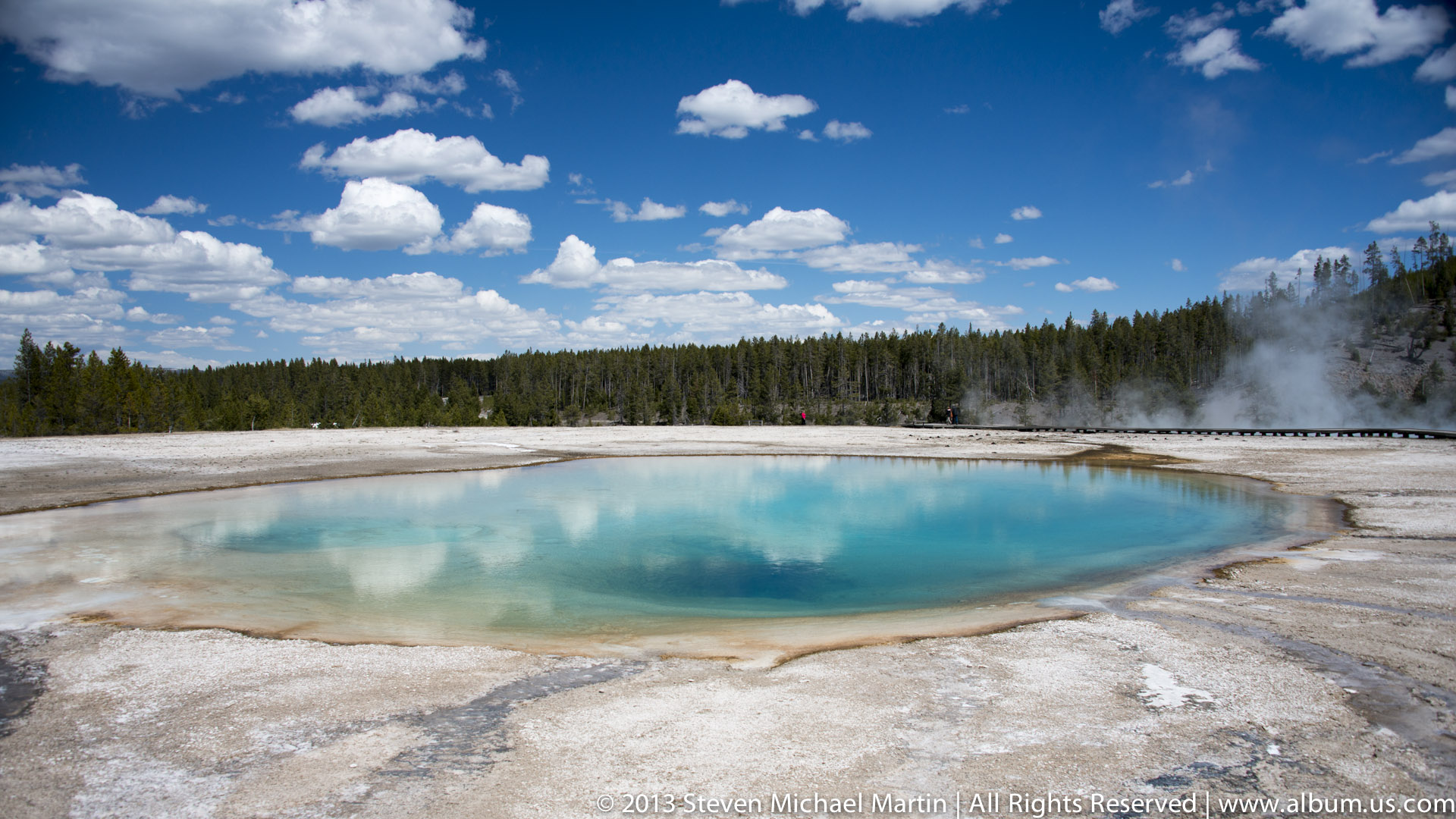
A clear blue pool lies within a pale mineral shelf, while a low boardwalk crosses the far side of the basin. Conifers and a broken line of clouds fill the background, and a steam plume rises near the right edge. The broad view relates the vivid water to the open landscape and visitor route, in contrast to the close-up thermal textures on this page.
Caption
A clear blue pool lies within a pale mineral shelf, while a low boardwalk crosses the far side of the basin. Conifers and a broken line of clouds fill the background, and a steam plume rises near the right edge. The broad view relates the vivid water to the open landscape and visitor route, in contrast to the close-up thermal textures on this page.
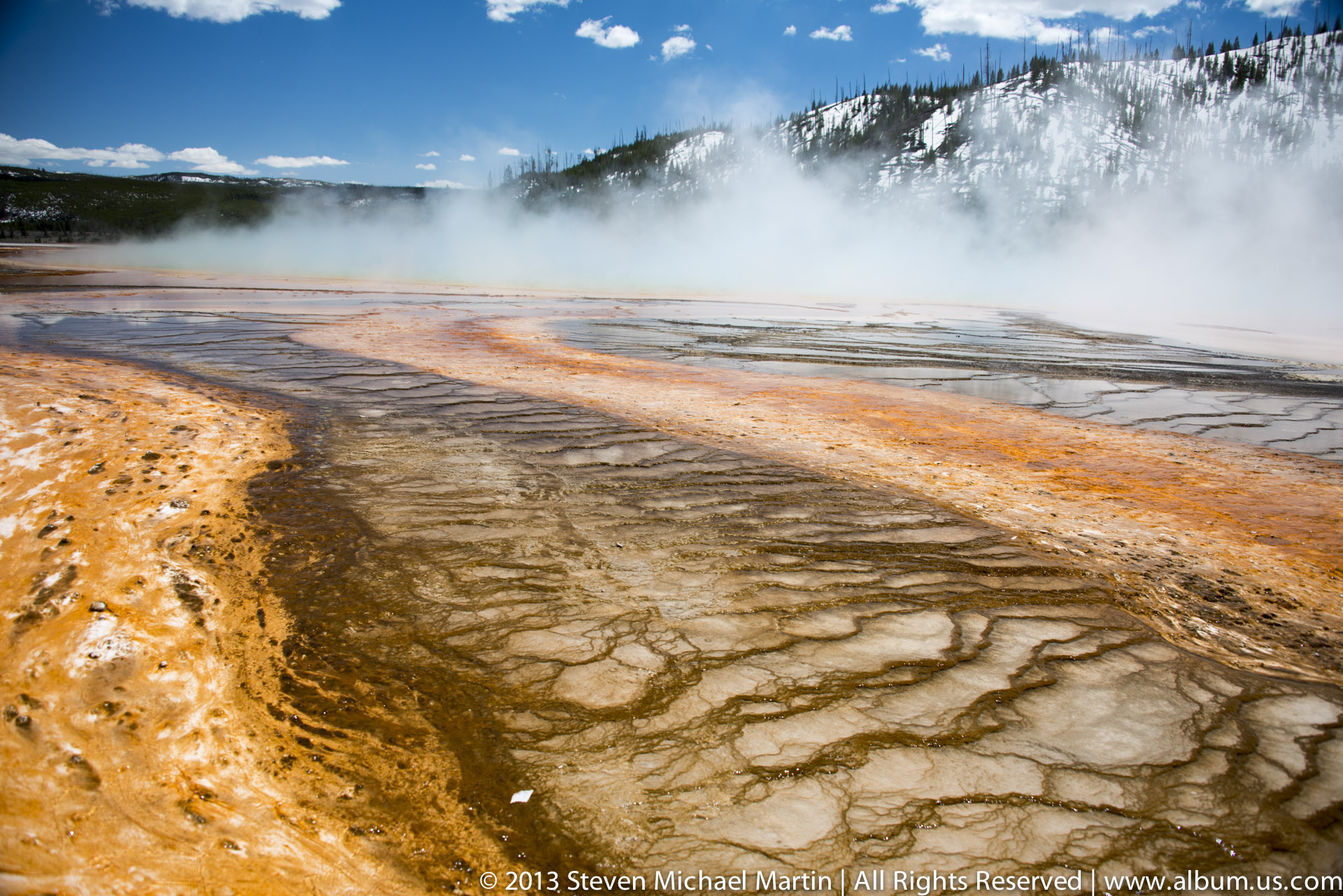
Rust-orange and brown bands spread across a shallow geothermal flat, following channels through pale mineral crust. A broad veil of steam hangs over the center, softening the trees on the far slope while the foreground channels remain sharply defined. The photograph emphasizes the basin’s layered flow patterns and color transitions rather than a single pool or eruption.
Caption
Rust-orange and brown bands spread across a shallow geothermal flat, following channels through pale mineral crust. A broad veil of steam hangs over the center, softening the trees on the far slope while the foreground channels remain sharply defined. The photograph emphasizes the basin’s layered flow patterns and color transitions rather than a single pool or eruption.
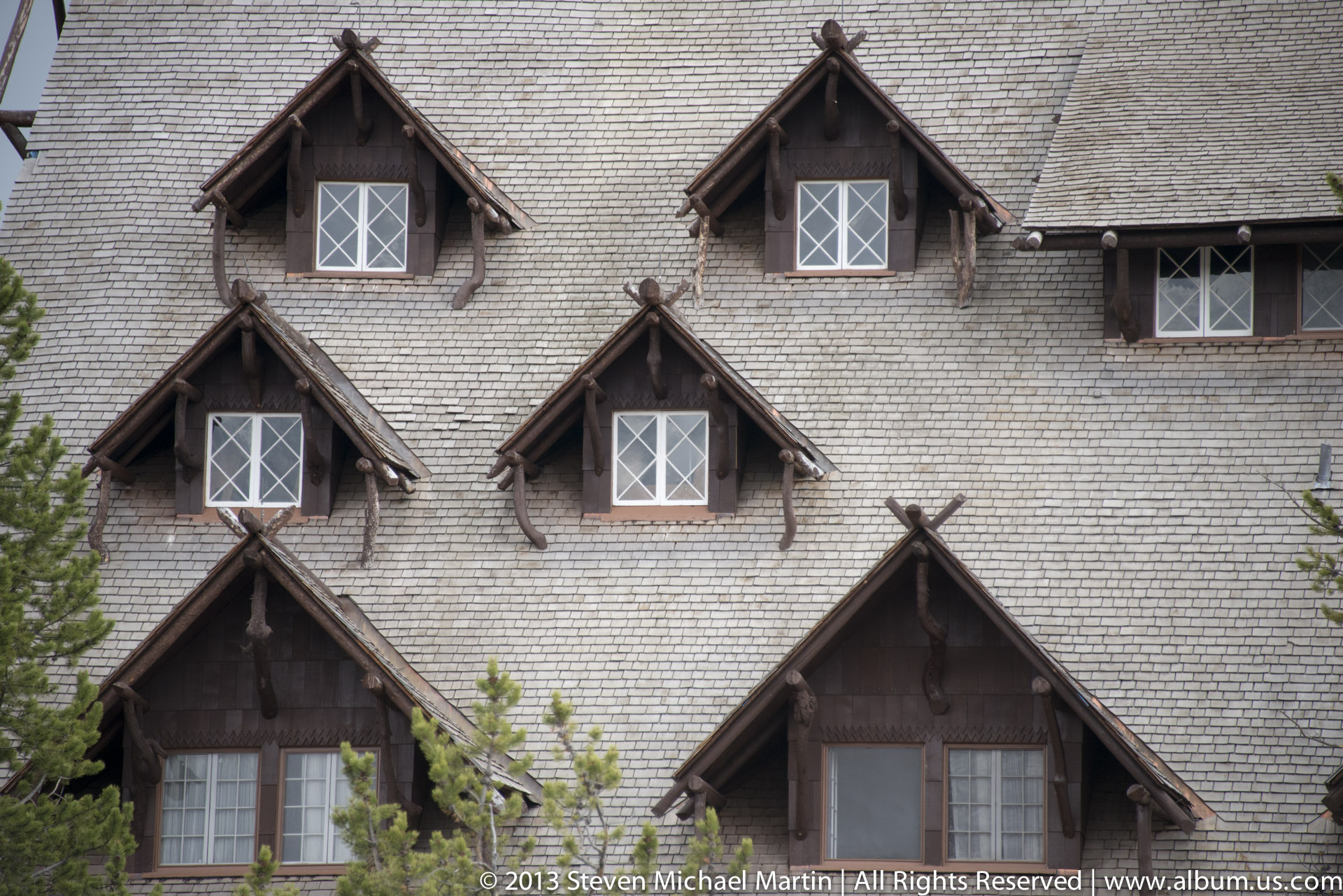
A steep roof covered in small gray shingles fills the frame, punctuated by a sequence of projecting dormers with cross-braced windows and dark timber supports. The repeated gables create a layered pattern across the slope, while the close crop hides most of the building’s entrance and surroundings. The view focuses on the lodge’s roofline and hand-built timber details without assigning a specific building name.
Caption
A steep roof covered in small gray shingles fills the frame, punctuated by a sequence of projecting dormers with cross-braced windows and dark timber supports. The repeated gables create a layered pattern across the slope, while the close crop hides most of the building’s entrance and surroundings. The view focuses on the lodge’s roofline and hand-built timber details without assigning a specific building name.
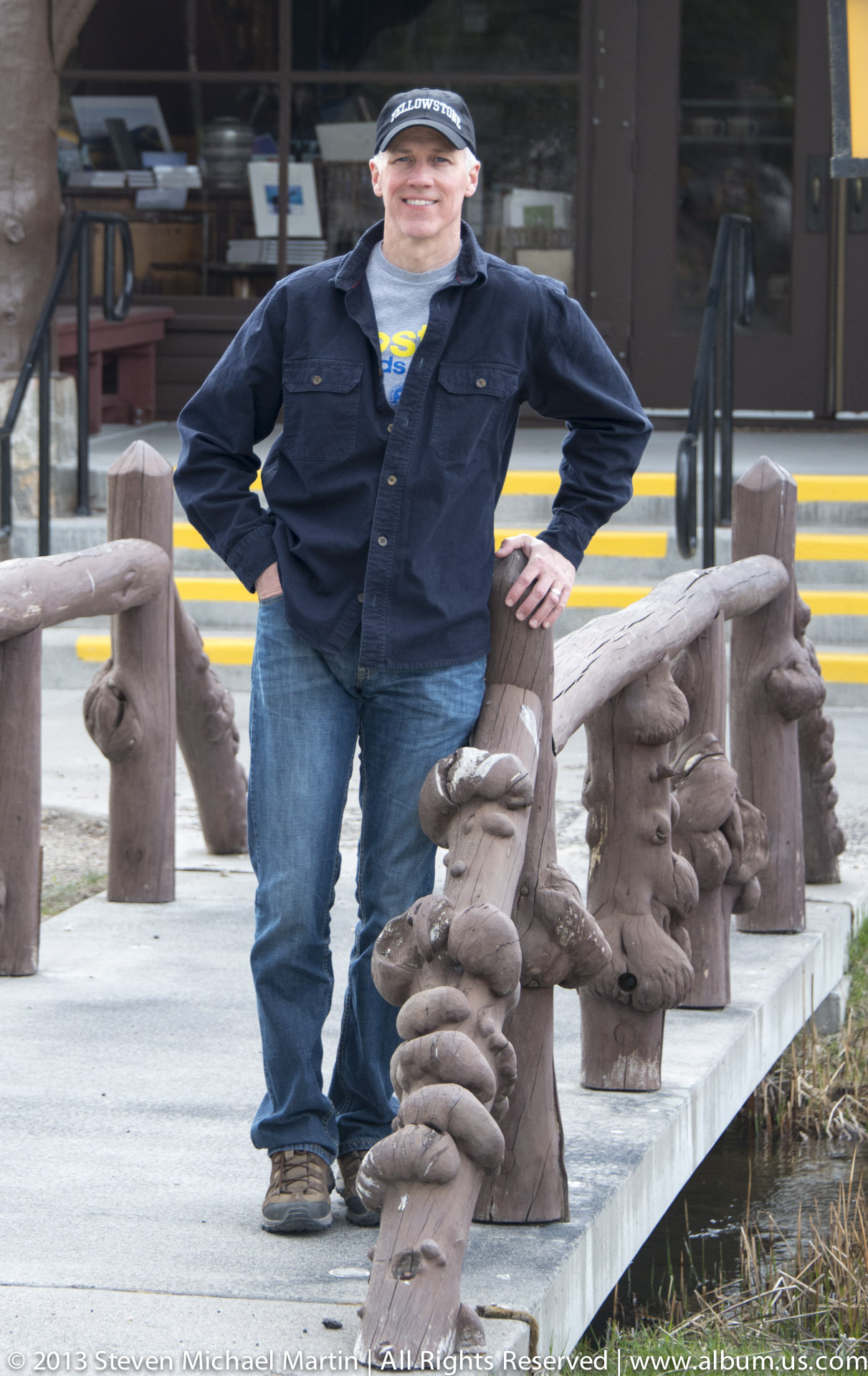
A visitor in a dark jacket and cap stands with one hand on a rustic log railing outside a timber-fronted building. The railing’s irregular branch-like posts and carved forms fill the lower half of the scene, while a dark doorway and yellow-edged steps frame the background. The portrait connects the lodge’s handcrafted exterior details with the people moving through the site.
Caption
A visitor in a dark jacket and cap stands with one hand on a rustic log railing outside a timber-fronted building. The railing’s irregular branch-like posts and carved forms fill the lower half of the scene, while a dark doorway and yellow-edged steps frame the background. The portrait connects the lodge’s handcrafted exterior details with the people moving through the site.
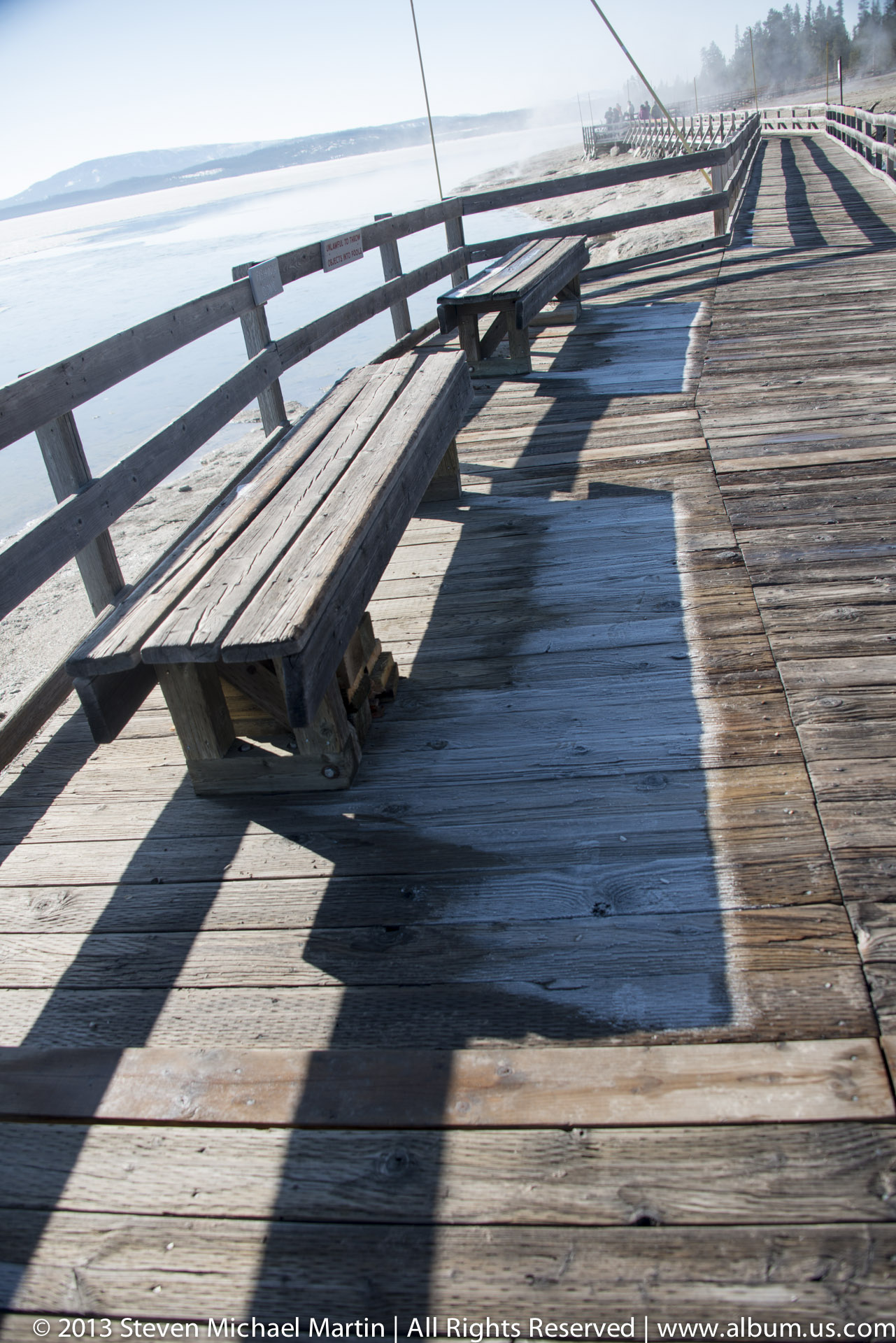
A weathered wooden boardwalk cuts diagonally across the frame, its parallel planks and railings casting long, sharply defined shadows. Pale steam and a light mineral surface lie beyond the left railing, while the near end of the walkway fills the foreground. With no visitors present, the image emphasizes the built route that carries people safely through a thermal area.
Caption
A weathered wooden boardwalk cuts diagonally across the frame, its parallel planks and railings casting long, sharply defined shadows. Pale steam and a light mineral surface lie beyond the left railing, while the near end of the walkway fills the foreground. With no visitors present, the image emphasizes the built route that carries people safely through a thermal area.
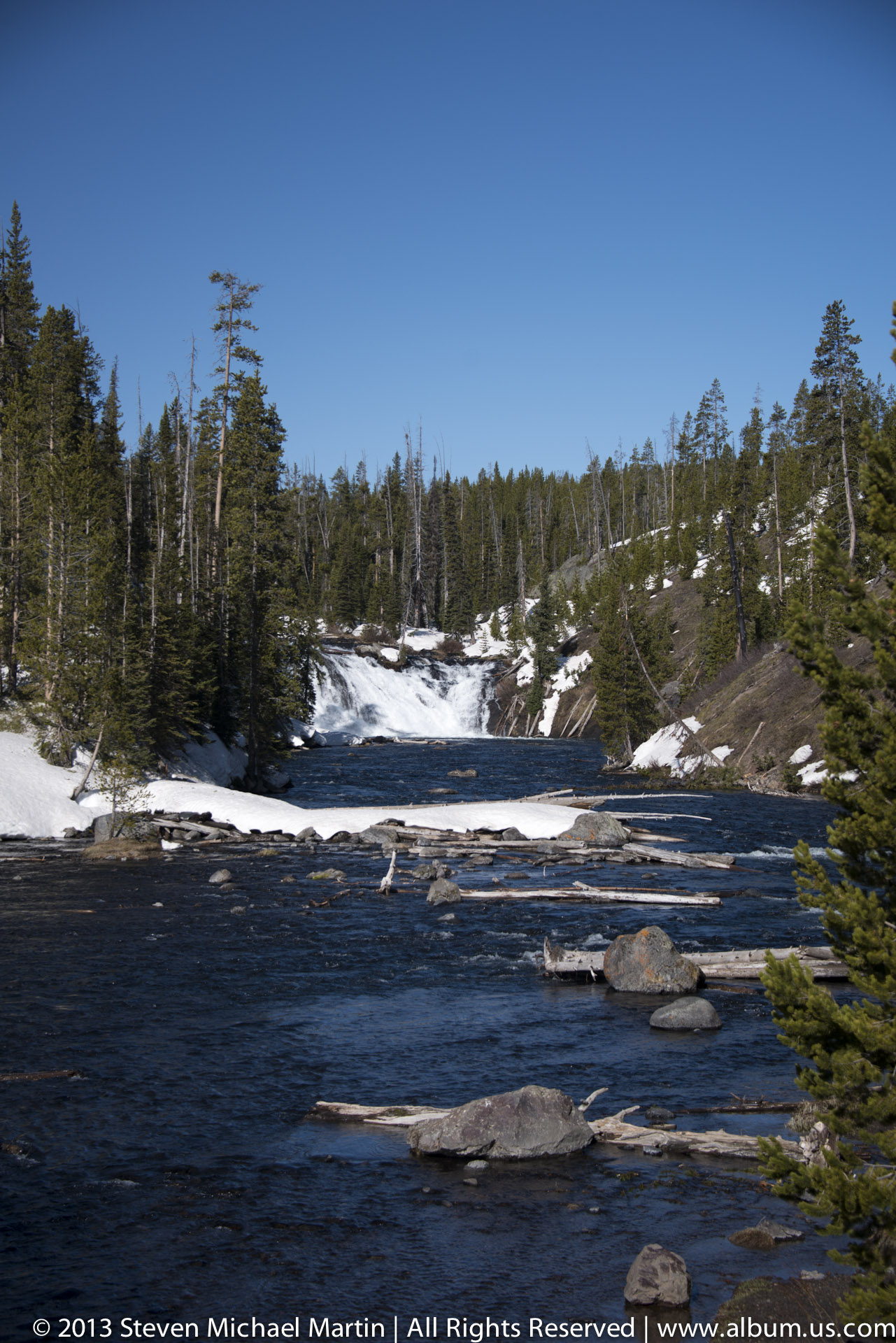
Dark water runs across the foreground between low rocks, with a narrow shelf of lingering snow along the opposite bank. Tall conifers crowd the far side, and bare branches lean over the channel from the left. The view records a river corridor at the transition between winter and spring, contrasting with the geothermal pools that dominate the adjacent photographs.
Caption
Dark water runs across the foreground between low rocks, with a narrow shelf of lingering snow along the opposite bank. Tall conifers crowd the far side, and bare branches lean over the channel from the left. The view records a river corridor at the transition between winter and spring, contrasting with the geothermal pools that dominate the adjacent photographs.
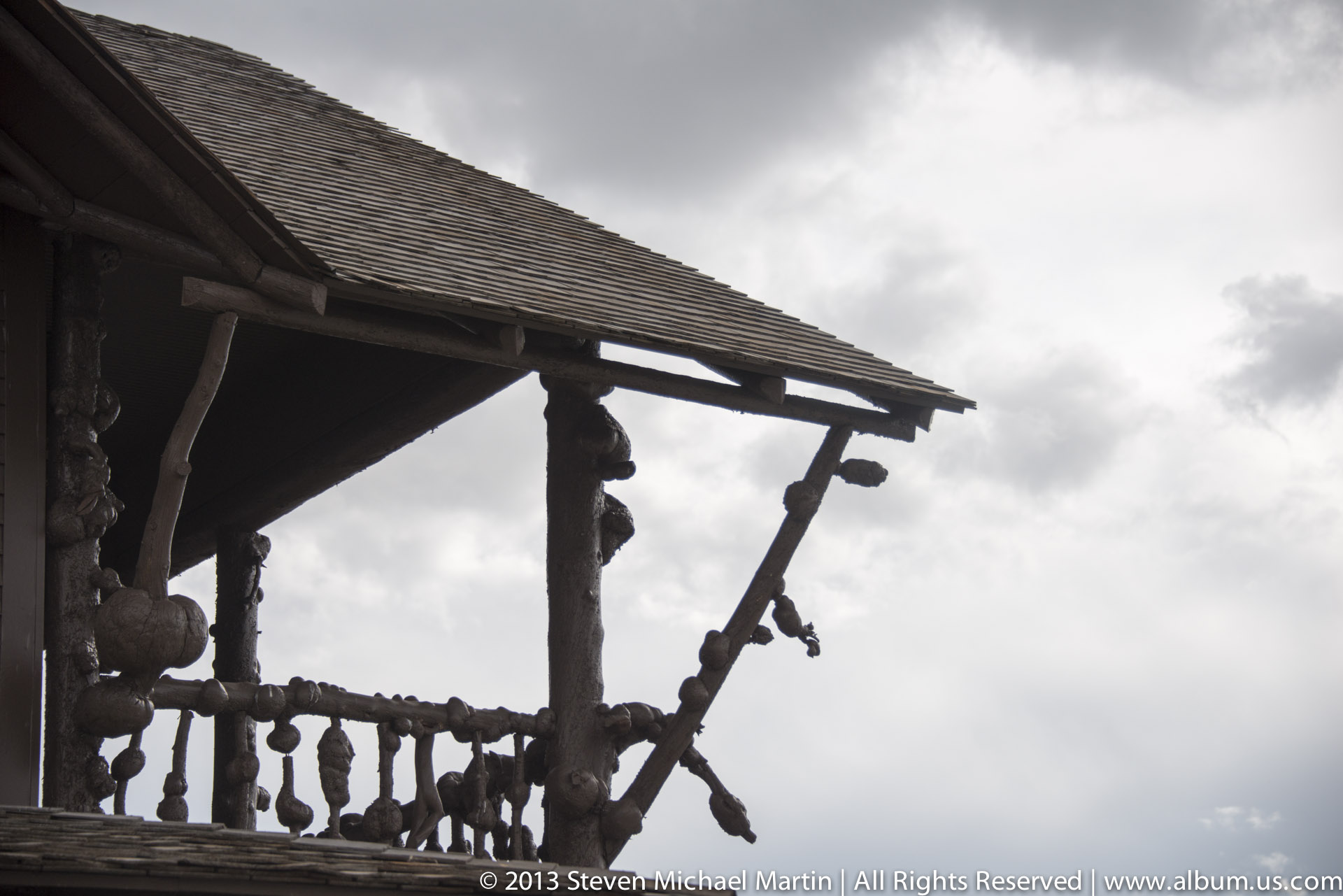
The underside of a broad shingled eave rests on heavy, irregular timber brackets. Below it, a dark log railing with turned and forked elements recedes toward the left, while open sky and steam occupy the opposite side. The low angle isolates the contrast between the roof’s geometric plane and the roughly shaped wood supports, providing a structural detail distinct from the wider lodge views.
Caption
The underside of a broad shingled eave rests on heavy, irregular timber brackets. Below it, a dark log railing with turned and forked elements recedes toward the left, while open sky and steam occupy the opposite side. The low angle isolates the contrast between the roof’s geometric plane and the roughly shaped wood supports, providing a structural detail distinct from the wider lodge views.

A tall column of water and steam rises above a low geothermal basin as the sky turns pink and gold near the horizon. Dark conifers form a level band behind the eruption, and small visitors along the boardwalk provide scale. The plume catches the remaining light while the foreground is already dim, giving this eruption a distinct evening atmosphere.
Caption
A tall column of water and steam rises above a low geothermal basin as the sky turns pink and gold near the horizon. Dark conifers form a level band behind the eruption, and small visitors along the boardwalk provide scale. The plume catches the remaining light while the foreground is already dim, giving this eruption a distinct evening atmosphere.
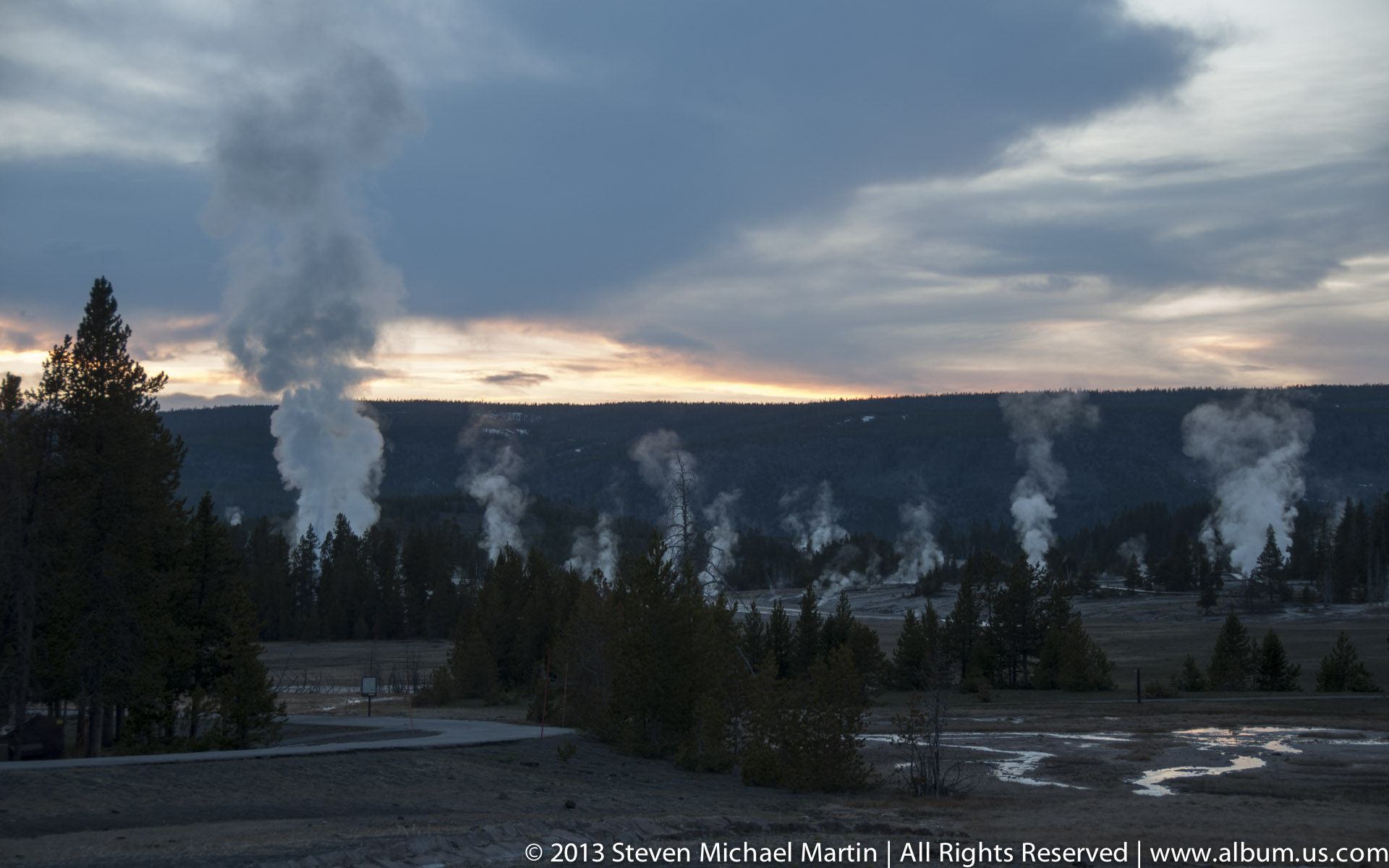
Several columns of steam rise from a broad basin, with a taller plume near the left and smaller vents scattered across the darker valley. A band of trees separates the geothermal ground from a blue-gray sky streaked with sunset color. The distant viewpoint and subdued light turn separate vents into a layered landscape, different from the single dominant eruption nearby.
Caption
Several columns of steam rise from a broad basin, with a taller plume near the left and smaller vents scattered across the darker valley. A band of trees separates the geothermal ground from a blue-gray sky streaked with sunset color. The distant viewpoint and subdued light turn separate vents into a layered landscape, different from the single dominant eruption nearby.
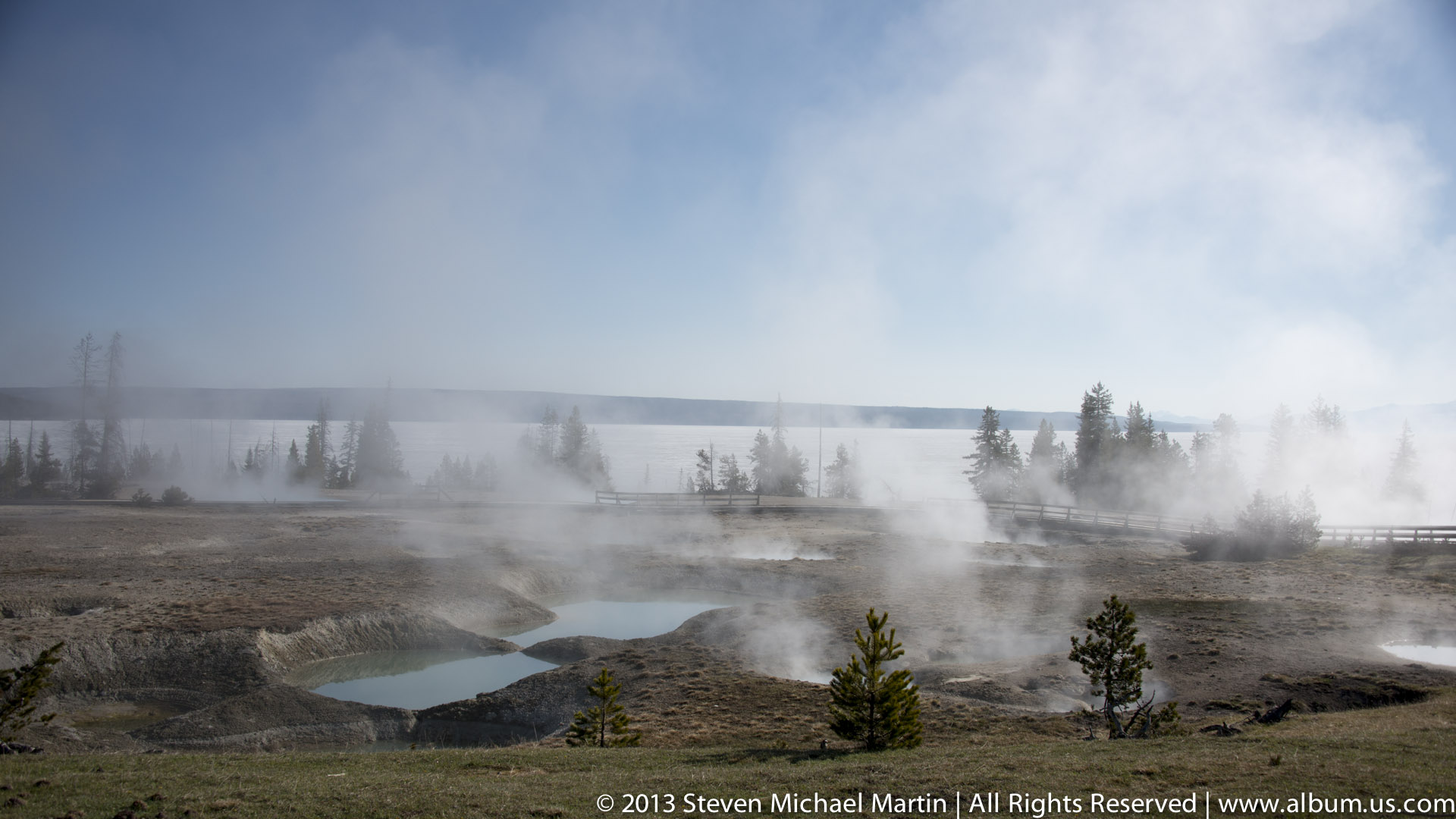
Low pools and pale mineral ground appear through drifting steam, with a wooden boardwalk crossing the middle distance. Small conifers punctuate the foreground and right edge, while a flat ridge forms the distant horizon. The steam softens the scene and partly conceals the water, making this a broad environmental view of active thermal ground rather than a portrait of one spring.
Caption
Low pools and pale mineral ground appear through drifting steam, with a wooden boardwalk crossing the middle distance. Small conifers punctuate the foreground and right edge, while a flat ridge forms the distant horizon. The steam softens the scene and partly conceals the water, making this a broad environmental view of active thermal ground rather than a portrait of one spring.
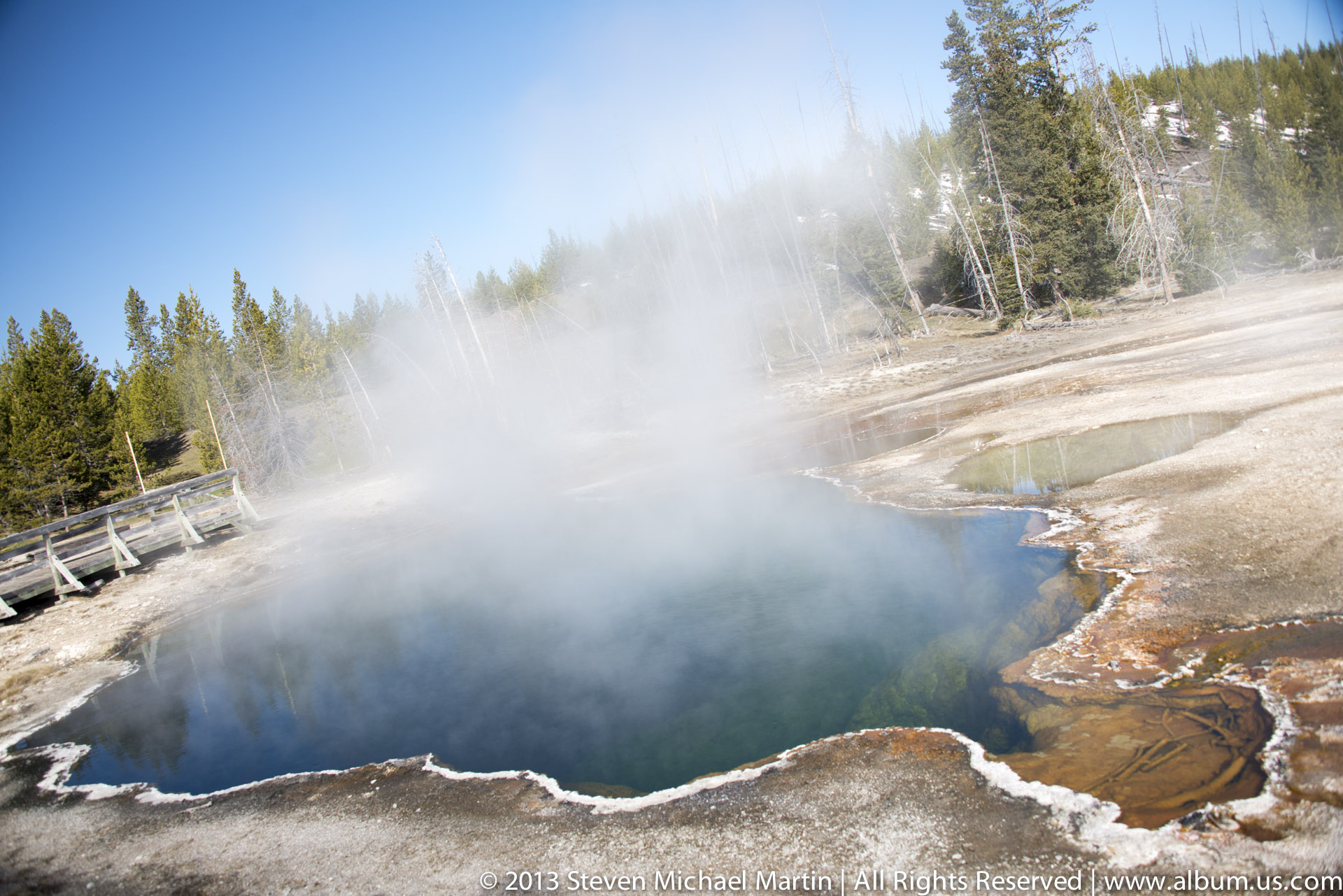
A dark blue pool occupies the center of a pale thermal shelf, with steam drifting across its surface and partially veiling the far bank. Rust-orange deposits trace the waterline on the right, while a boardwalk and lodge-like structures recede along the left edge toward trees. The oblique view links the spring to the visitor infrastructure surrounding it.
Caption
A dark blue pool occupies the center of a pale thermal shelf, with steam drifting across its surface and partially veiling the far bank. Rust-orange deposits trace the waterline on the right, while a boardwalk and lodge-like structures recede along the left edge toward trees. The oblique view links the spring to the visitor infrastructure surrounding it.

An elk faces the camera while chewing a strand of grass, its upright ears framing a dark muzzle and soft brown coat. The shallow focus removes the surrounding meadow into muted green and gray, keeping attention on the animal’s face and feeding behavior. The close viewpoint reveals the lighter markings around the eyes and nose without making a claim about age or sex.
Caption
An elk faces the camera while chewing a strand of grass, its upright ears framing a dark muzzle and soft brown coat. The shallow focus removes the surrounding meadow into muted green and gray, keeping attention on the animal’s face and feeding behavior. The close viewpoint reveals the lighter markings around the eyes and nose without making a claim about age or sex.
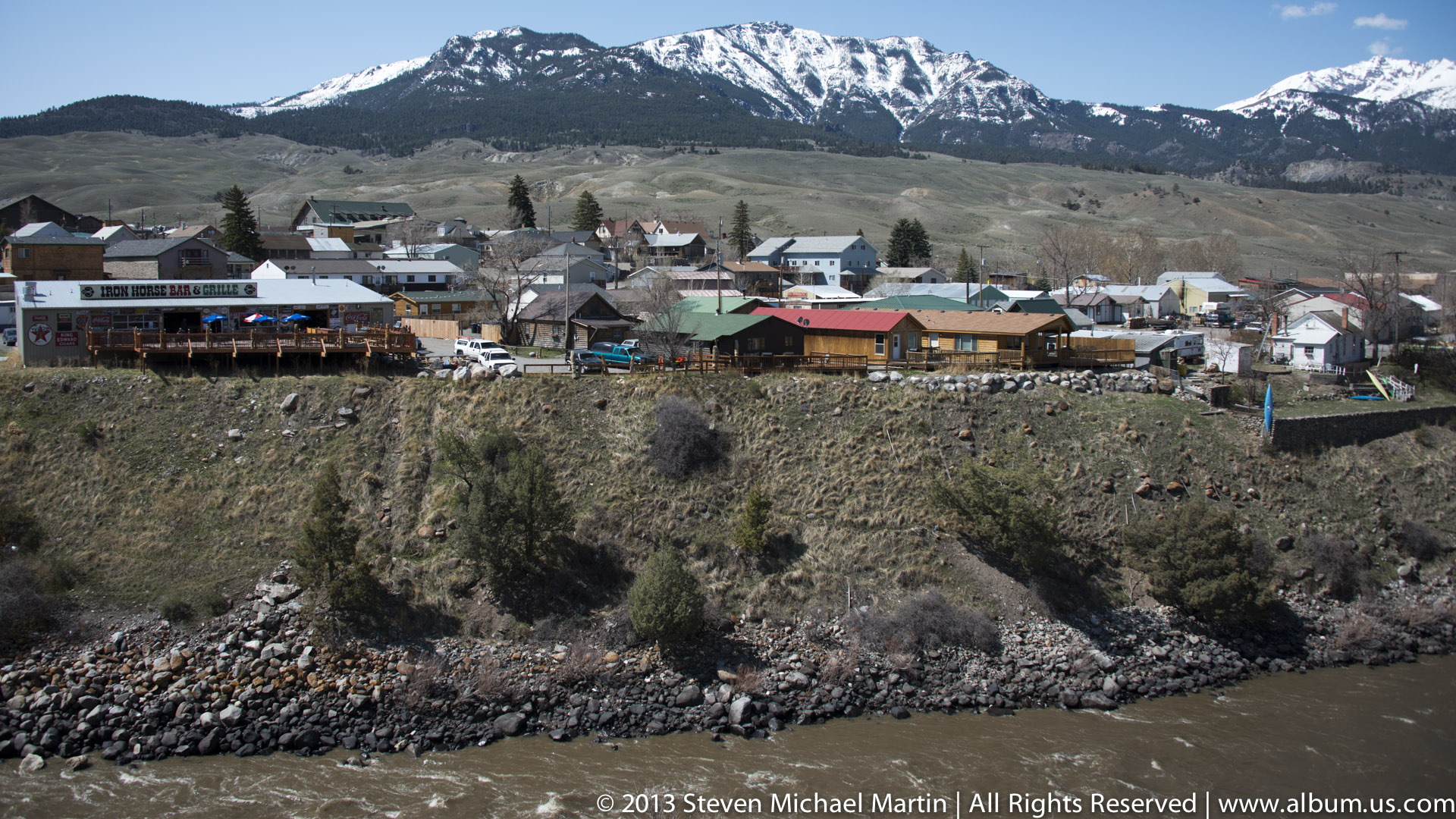
A compact town of low buildings follows a river at the foot of a steep slope. Snow-covered peaks extend across the background beneath a clear blue sky, while the riverbank and scattered rocks occupy the foreground. The elevated viewpoint shows how the settlement is confined between water and mountains; no readable sign or distinctive landmark confirms its name.
Caption
A compact town of low buildings follows a river at the foot of a steep slope. Snow-covered peaks extend across the background beneath a clear blue sky, while the riverbank and scattered rocks occupy the foreground. The elevated viewpoint shows how the settlement is confined between water and mountains; no readable sign or distinctive landmark confirms its name.
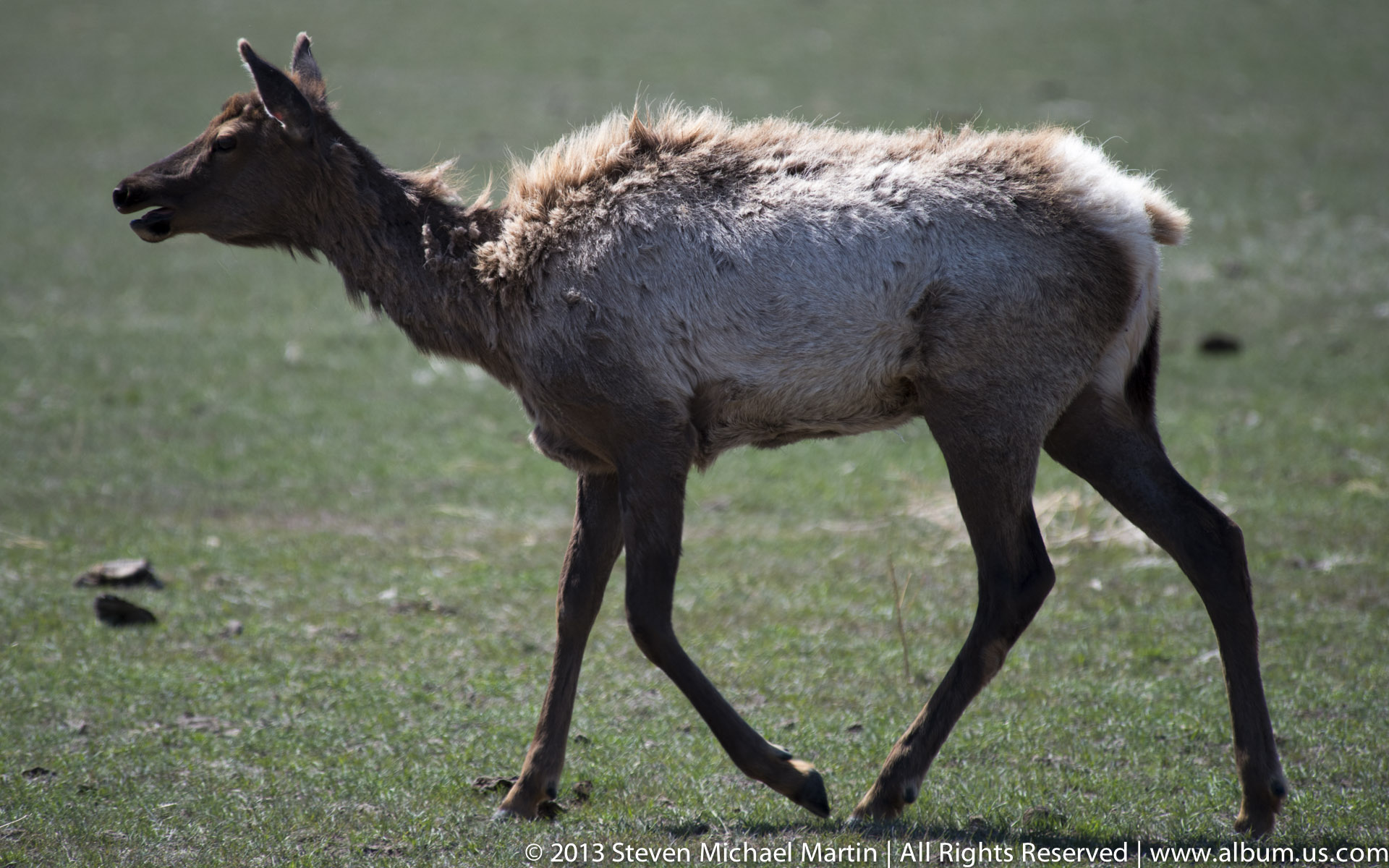
An elk moves across a green meadow in profile, one foreleg lifted mid-step and its head lowered toward the grass. Its gray-brown coat contrasts with the soft green background, while the tight crop excludes the animal’s surroundings beyond the open field. The photograph records movement and body shape, complementing the preceding close view of an elk feeding.
Caption
An elk moves across a green meadow in profile, one foreleg lifted mid-step and its head lowered toward the grass. Its gray-brown coat contrasts with the soft green background, while the tight crop excludes the animal’s surroundings beyond the open field. The photograph records movement and body shape, complementing the preceding close view of an elk feeding.

Pale cream and orange mineral bands ripple across the frame in tightly stacked, scalloped ridges. Small darker channels follow the contours and emphasize the repeated flow lines. The close crop removes the horizon and water source, turning the terrace surface into an abstract pattern while retaining the layered forms associated with geothermal mineral deposition.
Caption
Pale cream and orange mineral bands ripple across the frame in tightly stacked, scalloped ridges. Small darker channels follow the contours and emphasize the repeated flow lines. The close crop removes the horizon and water source, turning the terrace surface into an abstract pattern while retaining the layered forms associated with geothermal mineral deposition.
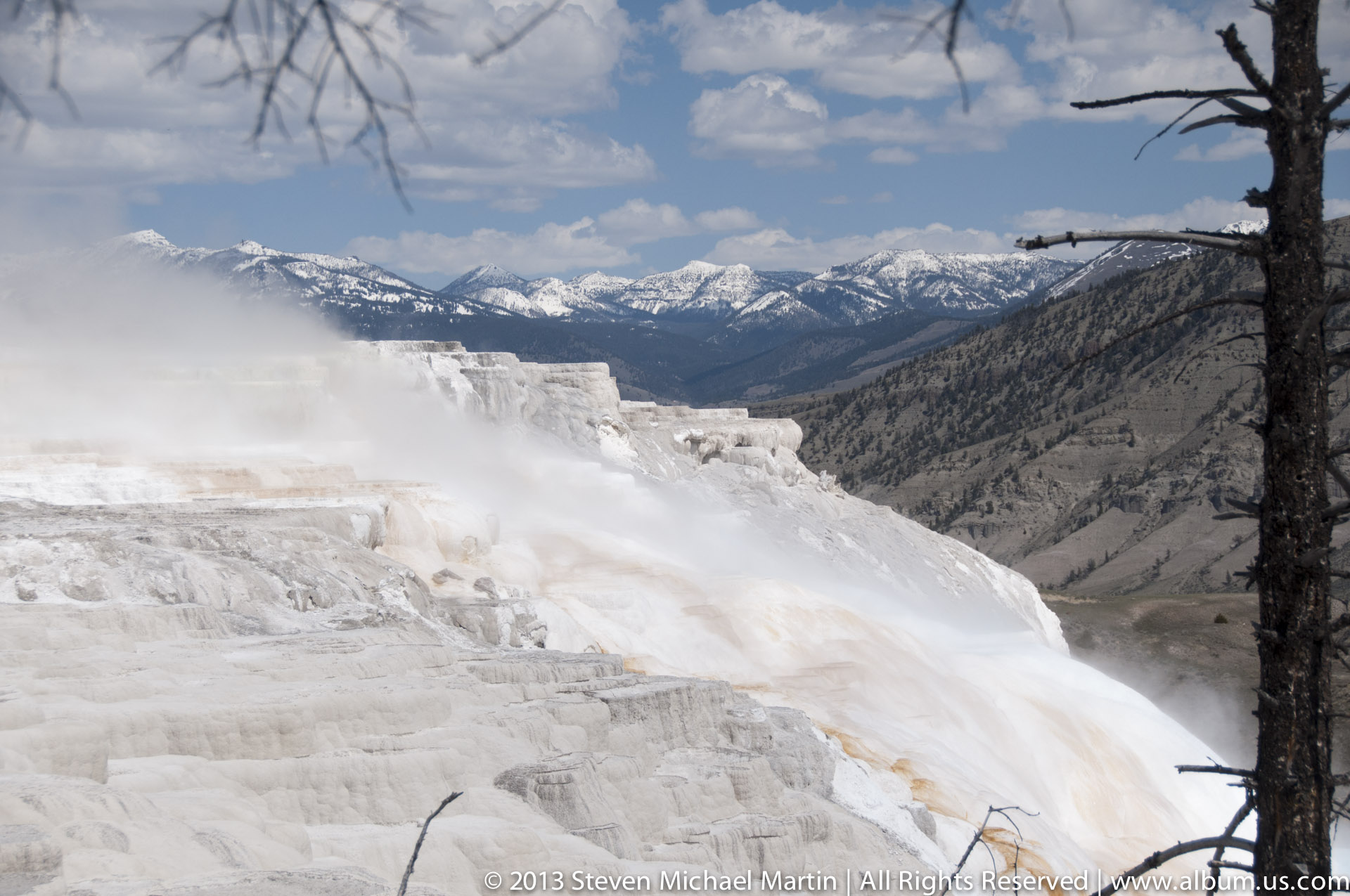
Pale travertine cascades over a broad slope in a series of shelves, with steam drifting across the lower left. Beyond the mineral edge, a deep valley and snow-covered mountains open into the distance. A dark tree trunk frames the right side, emphasizing the drop from the terrace to the landscape below. The view connects geothermal deposition with Yellowstone’s high-elevation terrain.
Caption
Pale travertine cascades over a broad slope in a series of shelves, with steam drifting across the lower left. Beyond the mineral edge, a deep valley and snow-covered mountains open into the distance. A dark tree trunk frames the right side, emphasizing the drop from the terrace to the landscape below. The view connects geothermal deposition with Yellowstone’s high-elevation terrain.
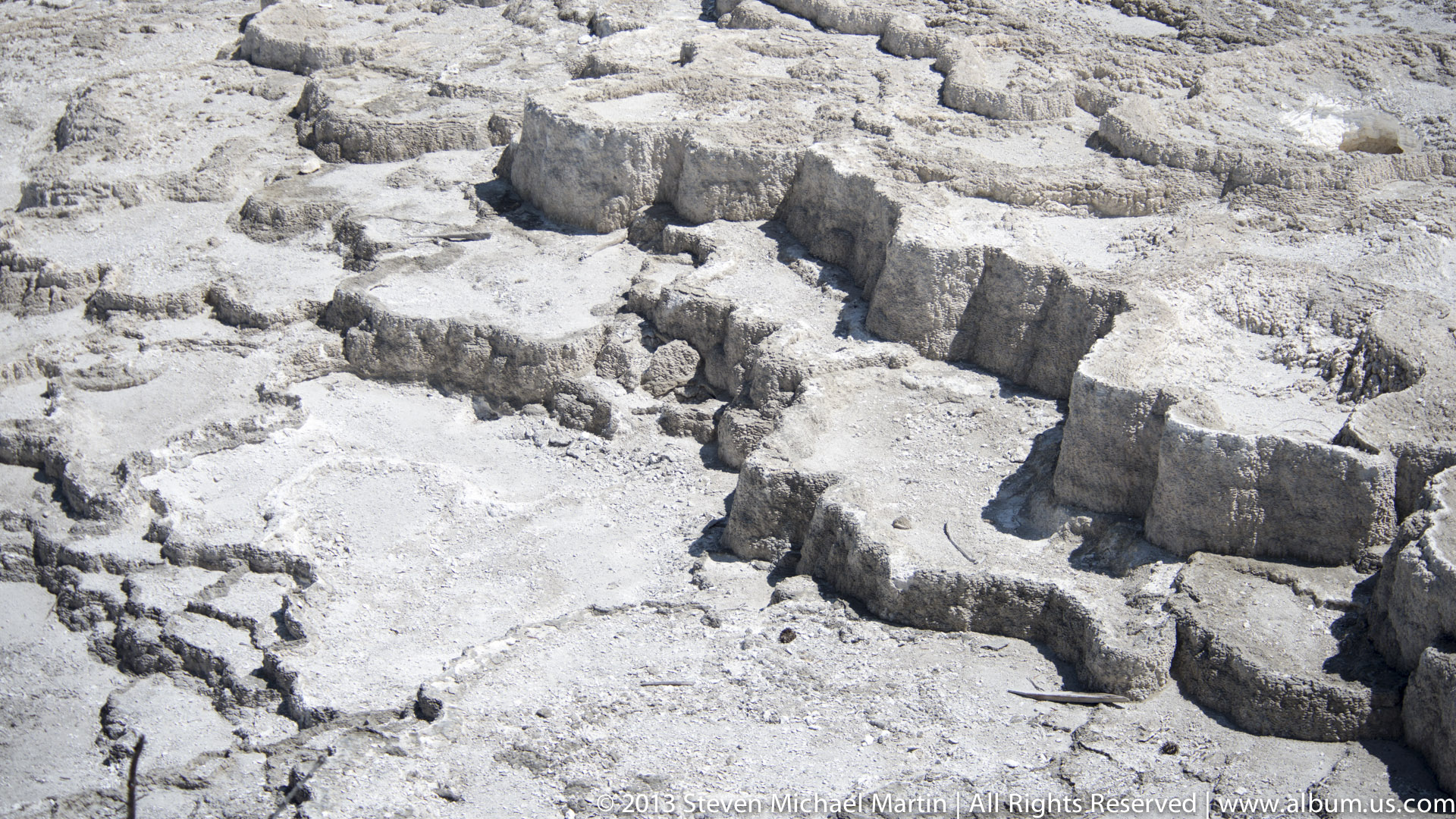
A network of blocky white and cream terraces fills the frame, divided by narrow channels of clear water. The stepped edges form irregular ledges and shallow basins, while sunlight brings out the porous mineral texture. With no horizon or visitors included, this close architectural pattern of deposited stone distinguishes the scene from the wider terrace and valley views on the page.
Caption
A network of blocky white and cream terraces fills the frame, divided by narrow channels of clear water. The stepped edges form irregular ledges and shallow basins, while sunlight brings out the porous mineral texture. With no horizon or visitors included, this close architectural pattern of deposited stone distinguishes the scene from the wider terrace and valley views on the page.

Golden-brown water spills over a sequence of broad travertine steps, collecting in shallow basins before continuing downward. Steam rises behind the upper ledges and softens the dark background, while pale mineral rims define each pool. The low viewpoint compresses the terraces into horizontal layers, drawing attention to the warm color and the repeated path of flowing water.
Caption
Golden-brown water spills over a sequence of broad travertine steps, collecting in shallow basins before continuing downward. Steam rises behind the upper ledges and softens the dark background, while pale mineral rims define each pool. The low viewpoint compresses the terraces into horizontal layers, drawing attention to the warm color and the repeated path of flowing water.
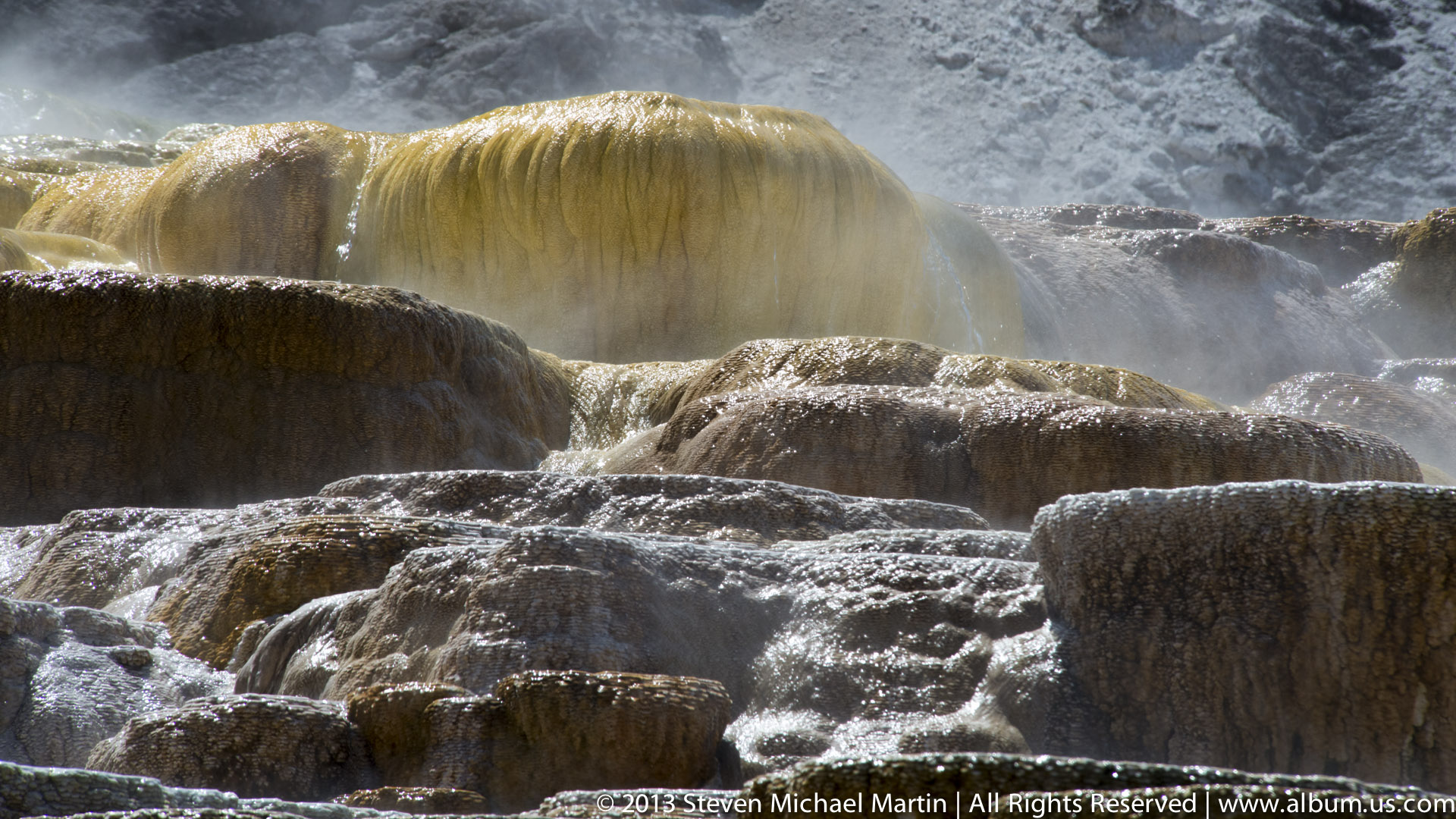
A rounded golden lip of water pours over a dark-edged travertine shelf, with steam lifting from the pool behind it. The foreground ledge crosses the frame in a strong horizontal band, and the rising vapor partly veils the upper basin. This tighter view isolates one cascade and its mineral rim, contrasting with the broader tiered composition immediately before it.
Caption
A rounded golden lip of water pours over a dark-edged travertine shelf, with steam lifting from the pool behind it. The foreground ledge crosses the frame in a strong horizontal band, and the rising vapor partly veils the upper basin. This tighter view isolates one cascade and its mineral rim, contrasting with the broader tiered composition immediately before it.
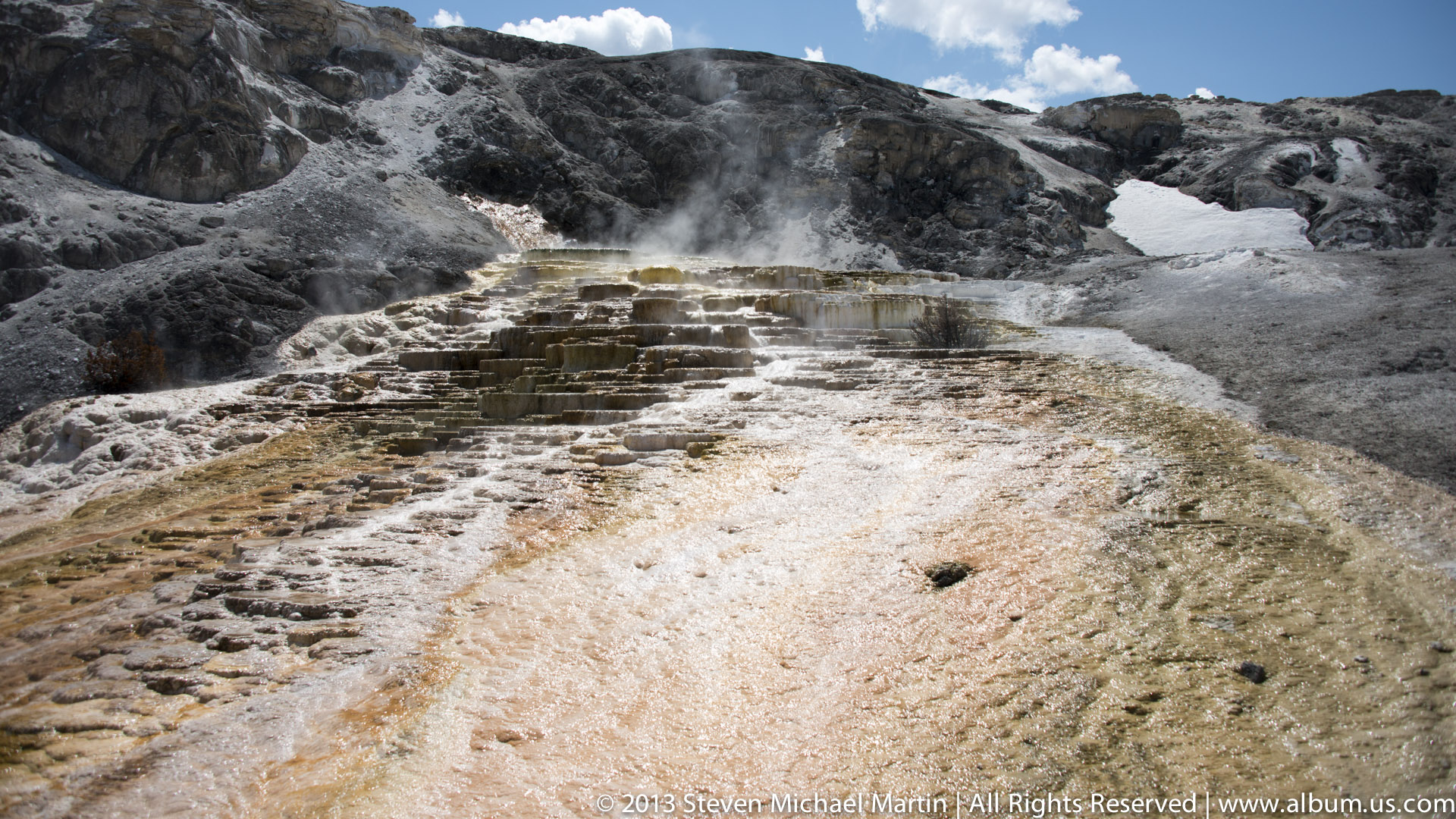
Broad pale terraces descend across a dark, barren slope, their horizontal ledges marked by cream, tan, and rusty mineral bands. A small patch of snow remains near the upper right, while the lower foreground shows the uneven, chalky surface of the formation. The wide view presents Mammoth Hot Springs as a layered terrain shaped by mineral deposits and flowing thermal water.
Caption
Broad pale terraces descend across a dark, barren slope, their horizontal ledges marked by cream, tan, and rusty mineral bands. A small patch of snow remains near the upper right, while the lower foreground shows the uneven, chalky surface of the formation. The wide view presents Mammoth Hot Springs as a layered terrain shaped by mineral deposits and flowing thermal water.
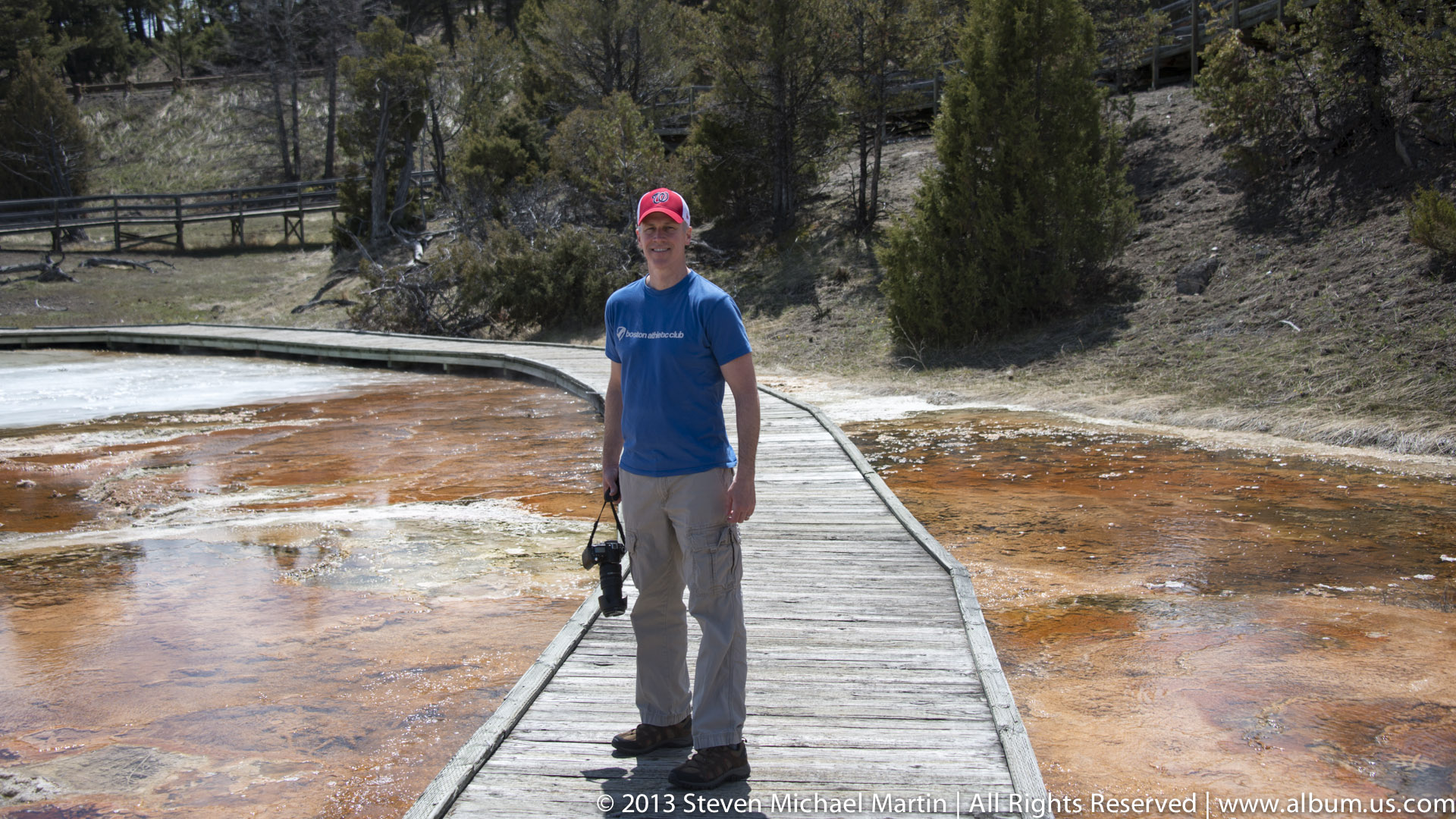
A visitor pauses on a curving wooden boardwalk that crosses a broad, orange-stained thermal terrace. The person’s blue shirt and red cap contrast with the pale mineral ground and rust-colored runoff, while scattered conifers rise on the slope behind. The human scale clarifies the width of the formation and the raised route that keeps visitors above the delicate thermal surface.
Caption
A visitor pauses on a curving wooden boardwalk that crosses a broad, orange-stained thermal terrace. The person’s blue shirt and red cap contrast with the pale mineral ground and rust-colored runoff, while scattered conifers rise on the slope behind. The human scale clarifies the width of the formation and the raised route that keeps visitors above the delicate thermal surface.
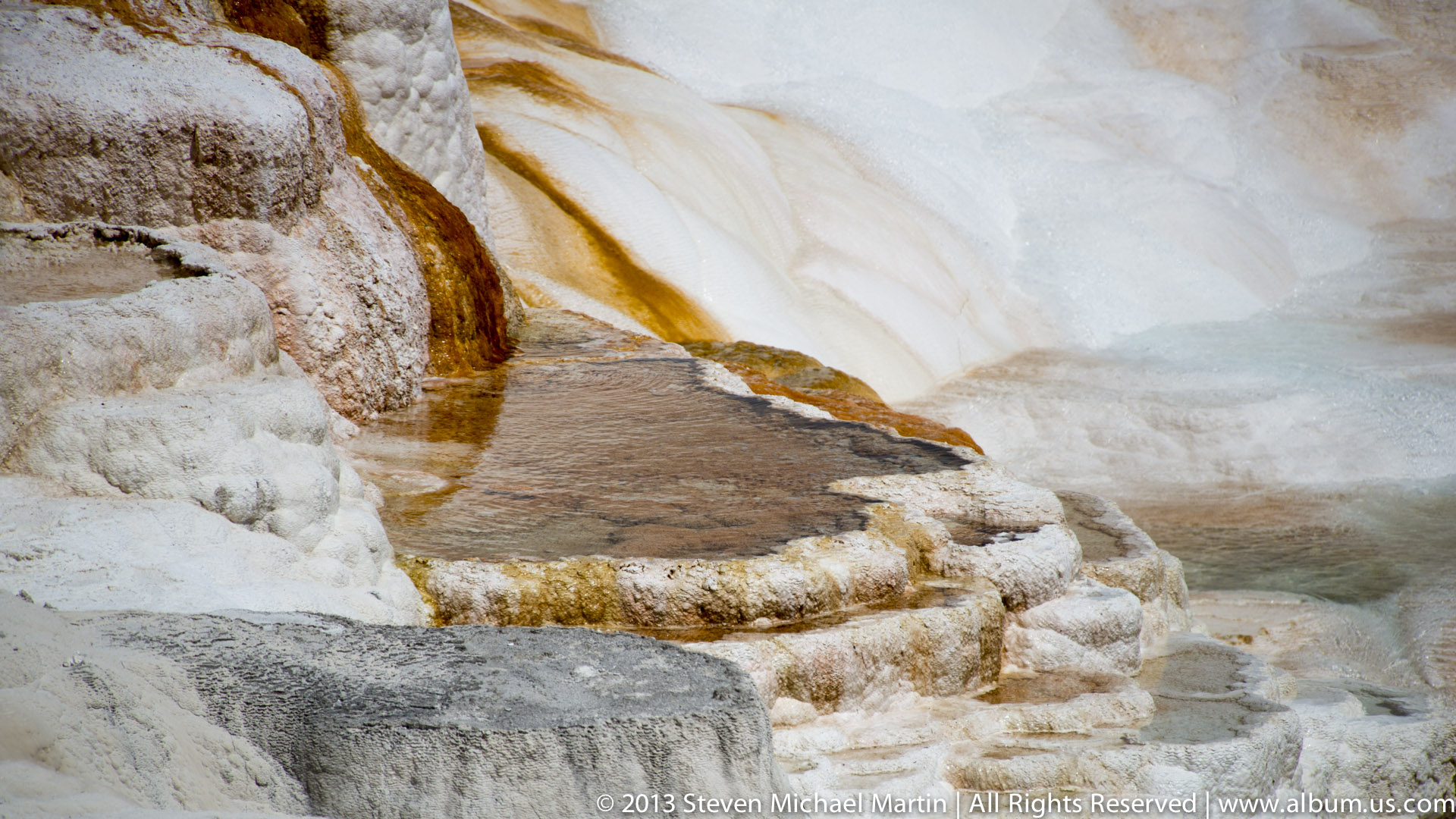
Rust-colored water runs in narrow channels over white and cream travertine, tracing shallow steps down a gently sloping surface. The close viewpoint makes the contrast between the orange deposits and pale mineral crust the central feature, with small pools collecting in lower depressions. This detail records the branching patterns of thermal runoff rather than the full scale of the spring terrace.
Caption
Rust-colored water runs in narrow channels over white and cream travertine, tracing shallow steps down a gently sloping surface. The close viewpoint makes the contrast between the orange deposits and pale mineral crust the central feature, with small pools collecting in lower depressions. This detail records the branching patterns of thermal runoff rather than the full scale of the spring terrace.
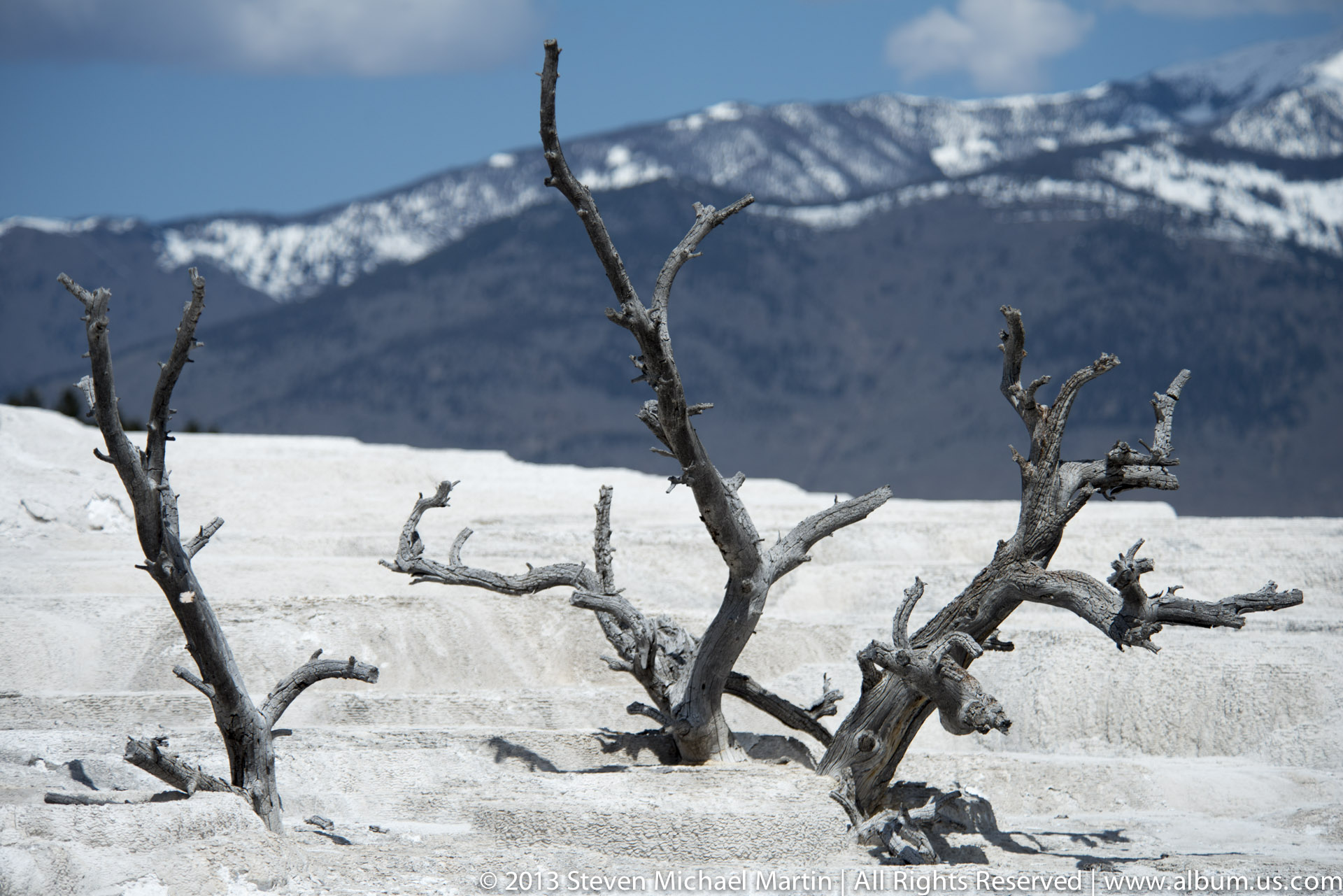
Several bare, weathered trunks project from a white mineral flat, their dark branches stark against the snow and pale travertine. A forested mountain ridge fills the distance beneath a clear blue sky. The low viewpoint places the dead wood in the foreground and emphasizes the contrast between exposed geothermal ground and the winter landscape beyond.
Caption
Several bare, weathered trunks project from a white mineral flat, their dark branches stark against the snow and pale travertine. A forested mountain ridge fills the distance beneath a clear blue sky. The low viewpoint places the dead wood in the foreground and emphasizes the contrast between exposed geothermal ground and the winter landscape beyond.

Thin sheets of water spill over rounded travertine steps, leaving dark brown and ochre streaks across the pale stone. The tight framing follows the descending flow from the upper ledges to a prominent rounded mound in the foreground. Bright sunlight picks out the mineral texture while deeper shadow at left reveals the uneven relief of this active thermal formation.
Caption
Thin sheets of water spill over rounded travertine steps, leaving dark brown and ochre streaks across the pale stone. The tight framing follows the descending flow from the upper ledges to a prominent rounded mound in the foreground. Bright sunlight picks out the mineral texture while deeper shadow at left reveals the uneven relief of this active thermal formation.
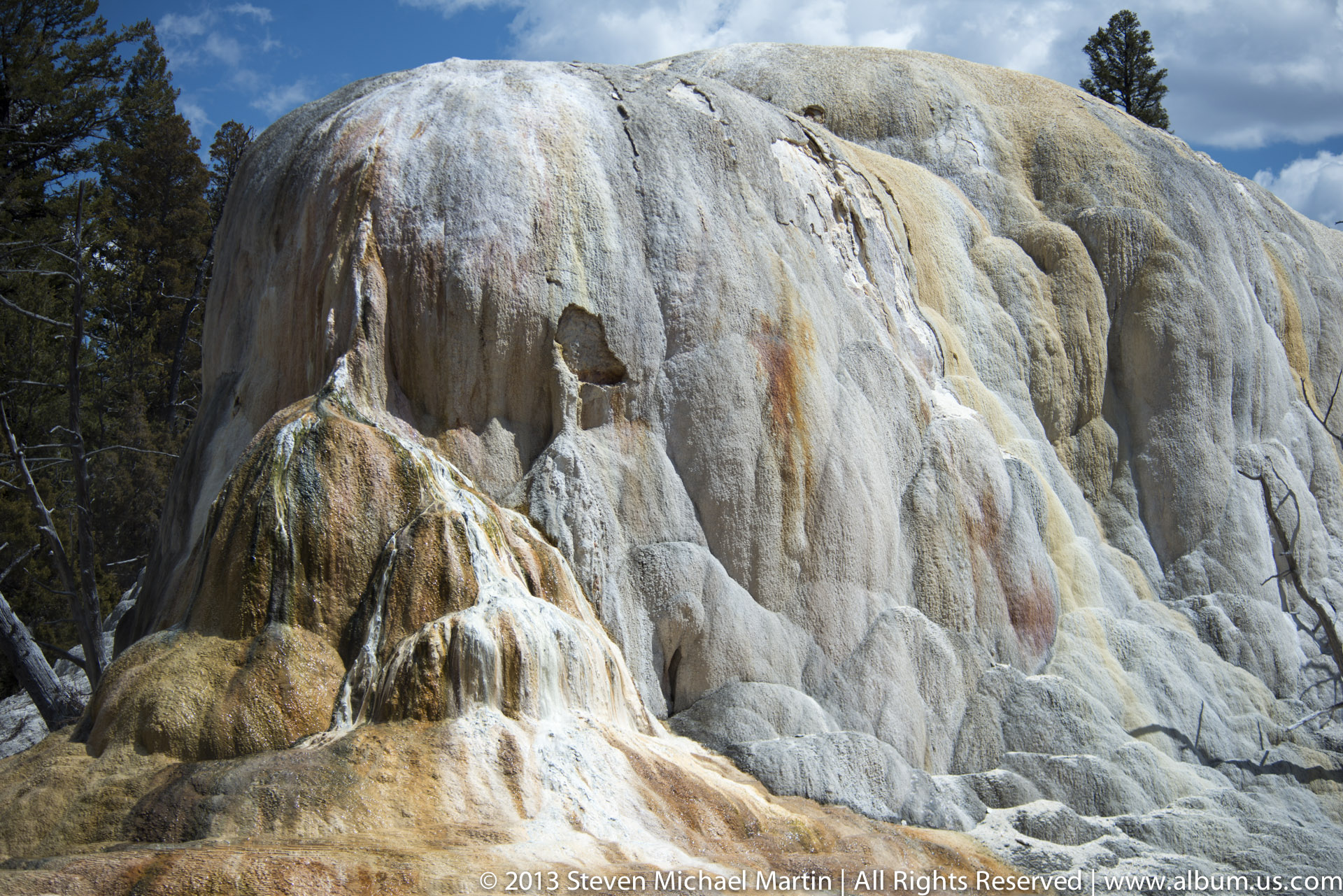
A large pale travertine mound rises in the foreground, its rounded face crossed by orange-brown runoff and shallow ledges. Conifers frame the formation at either edge, while blue sky and scattered clouds open above it. The wider composition shows the mound’s height and irregular outline, setting its mineral surface within the surrounding forest rather than isolating a single water channel.
Caption
A large pale travertine mound rises in the foreground, its rounded face crossed by orange-brown runoff and shallow ledges. Conifers frame the formation at either edge, while blue sky and scattered clouds open above it. The wider composition shows the mound’s height and irregular outline, setting its mineral surface within the surrounding forest rather than isolating a single water channel.

A turquoise pool lies in a pale mineral basin, its surface partly veiled by drifting steam. Conifers stand behind the spring beneath a cloudy sky, while small branches and mineral crust trace the near edge. The low viewpoint brings the water color forward and lets the rising vapor soften the forest beyond, conveying the contrast between a vivid pool and its cool, wintry surroundings.
Caption
A turquoise pool lies in a pale mineral basin, its surface partly veiled by drifting steam. Conifers stand behind the spring beneath a cloudy sky, while small branches and mineral crust trace the near edge. The low viewpoint brings the water color forward and lets the rising vapor soften the forest beyond, conveying the contrast between a vivid pool and its cool, wintry surroundings.
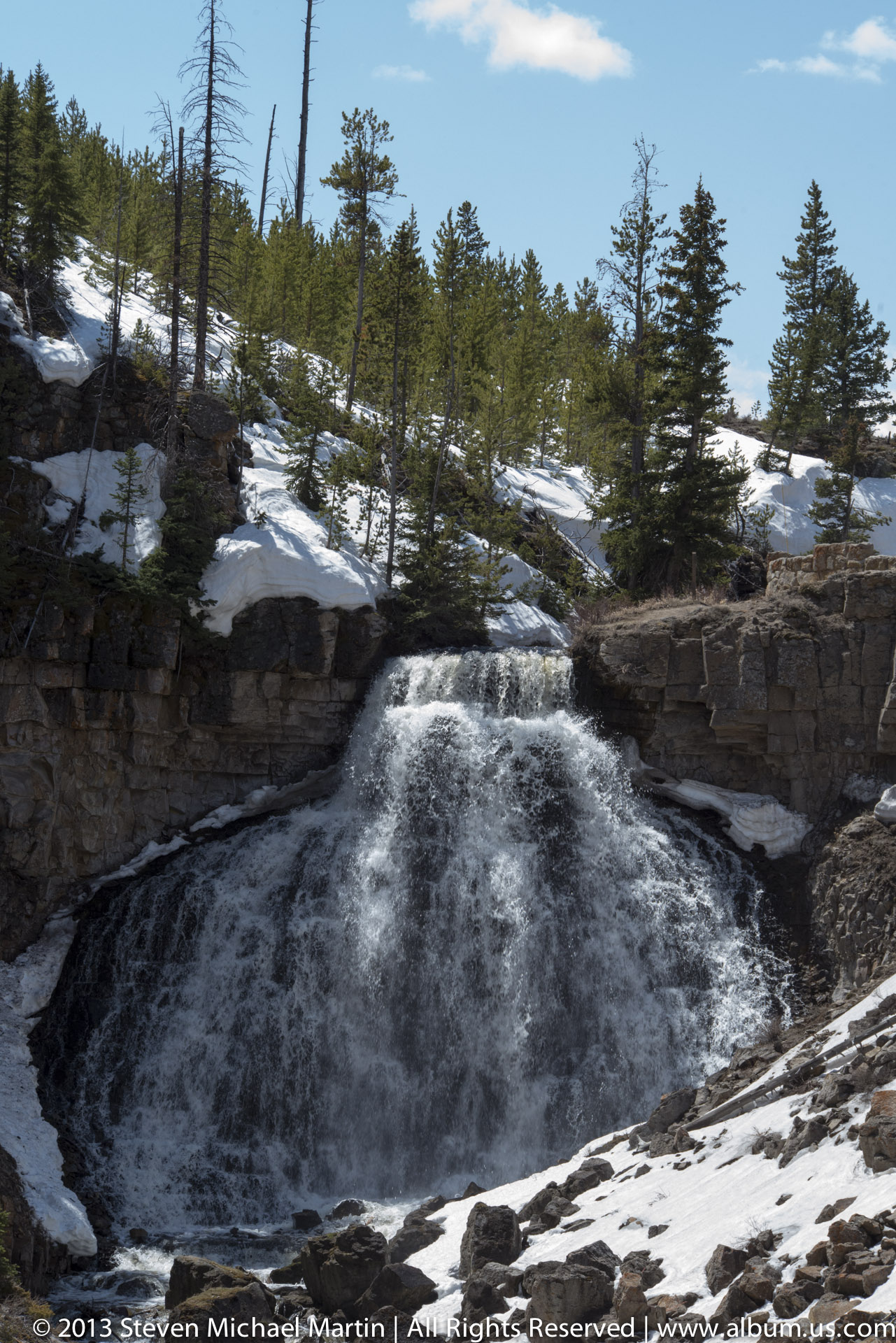
A short waterfall drops over a dark rock ledge into a shadowed basin, with snow covering the banks and patches of ground among the surrounding conifers. The broad sheet of water is brightest at its center, where it breaks into spray before reaching the pool below. This winter-season view contrasts moving water with snow and bare, cold-toned rock.
Caption
A short waterfall drops over a dark rock ledge into a shadowed basin, with snow covering the banks and patches of ground among the surrounding conifers. The broad sheet of water is brightest at its center, where it breaks into spray before reaching the pool below. This winter-season view contrasts moving water with snow and bare, cold-toned rock.
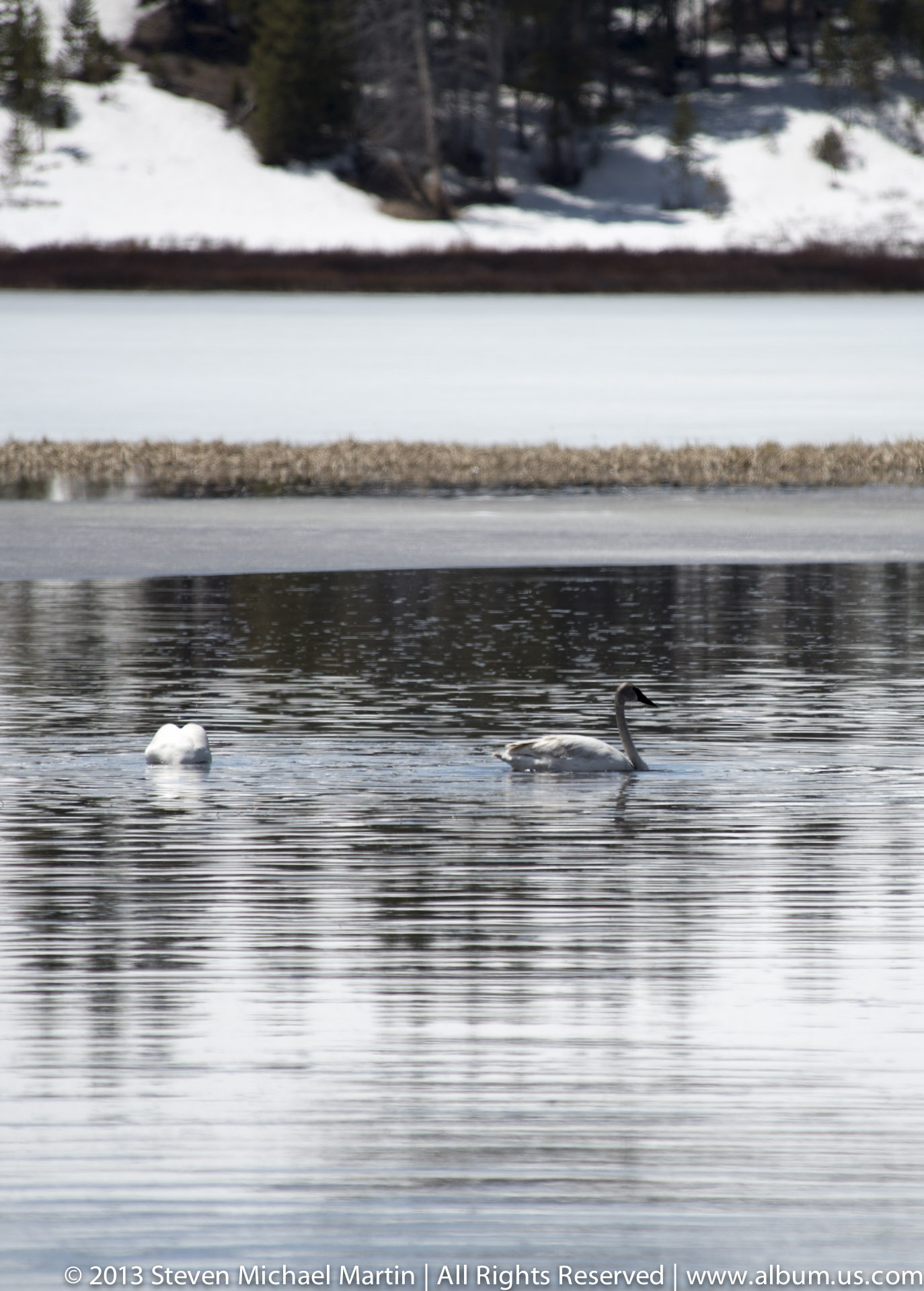
Two waterbirds cross a calm stretch of dark water, one bright white and the other darker with a raised neck. A narrow snowy bank and blurred woodland form horizontal bands behind them, while fine ripples spread across the foreground. The long-lens view compresses the scene into a quiet study of birds on open water amid the surrounding winter landscape.
Caption
Two waterbirds cross a calm stretch of dark water, one bright white and the other darker with a raised neck. A narrow snowy bank and blurred woodland form horizontal bands behind them, while fine ripples spread across the foreground. The long-lens view compresses the scene into a quiet study of birds on open water amid the surrounding winter landscape.
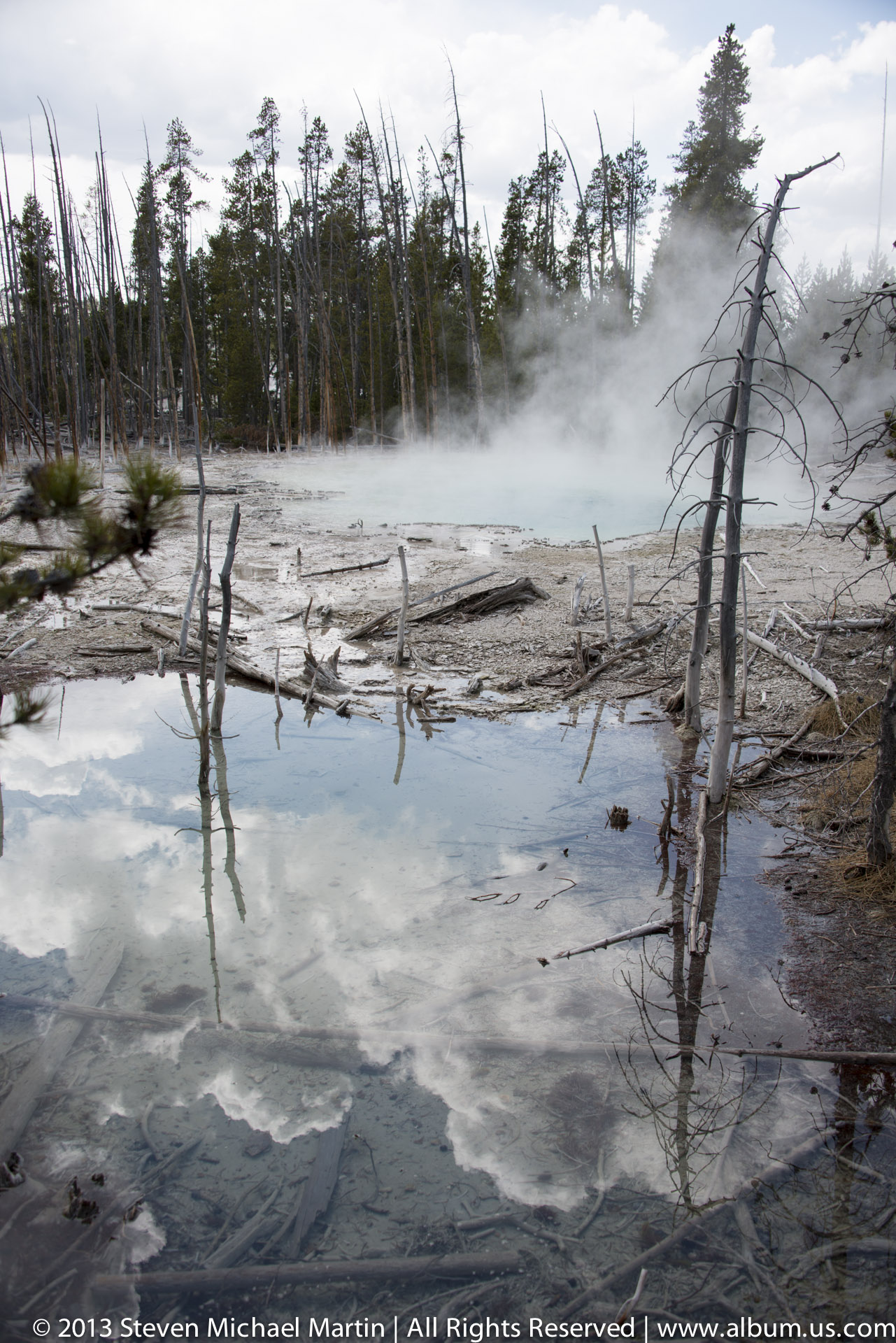
Steam drifts across a shallow thermal pool bordered by pale mineral ground and a tangle of weathered logs. Several bare trunks stand or lie among the water, while a fringe of conifers lines the far side of the basin. Reflections of clouds and trees break across the pool, giving this view a layered surface and showing how geothermal activity sits within a wooded setting.
Caption
Steam drifts across a shallow thermal pool bordered by pale mineral ground and a tangle of weathered logs. Several bare trunks stand or lie among the water, while a fringe of conifers lines the far side of the basin. Reflections of clouds and trees break across the pool, giving this view a layered surface and showing how geothermal activity sits within a wooded setting.
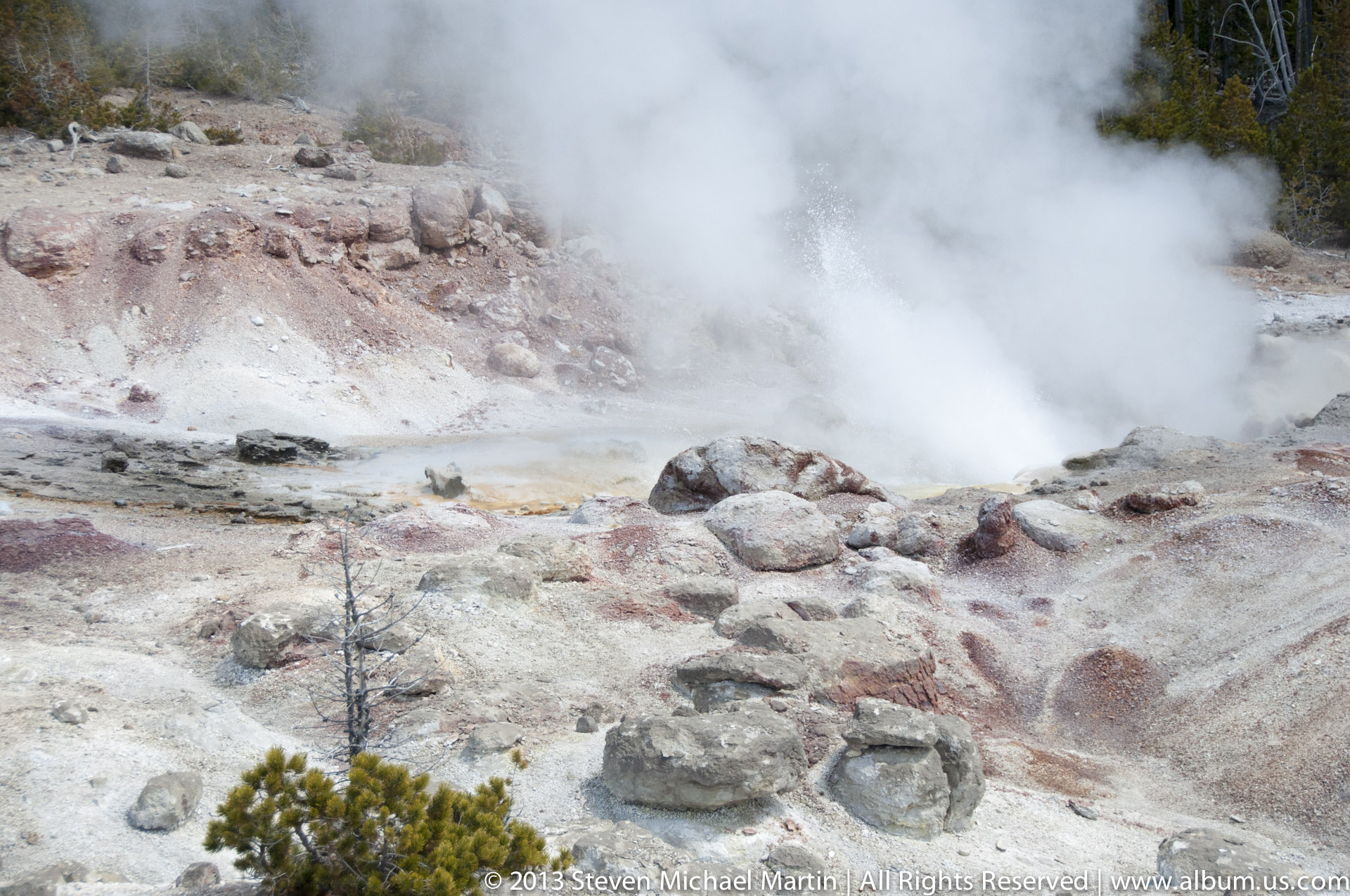
A dense plume of steam rises from a low opening in a broad, mineral-stained basin. Pale gray and pink ground is broken by darker rocks, with yellow-orange staining tracing portions of the surface. The vapor obscures the upper right and leaves the source partly hidden, making the contrast between visible mineral deposits and the moving steam the defining feature of this geothermal view.
Caption
A dense plume of steam rises from a low opening in a broad, mineral-stained basin. Pale gray and pink ground is broken by darker rocks, with yellow-orange staining tracing portions of the surface. The vapor obscures the upper right and leaves the source partly hidden, making the contrast between visible mineral deposits and the moving steam the defining feature of this geothermal view.

A broad snowy valley stretches toward a rugged mountain range beneath large cumulus clouds. A dark ribbon of open water crosses the middle ground, reflecting part of the pale sky, while scattered conifers and snow-covered meadow frame its banks. The expansive composition balances the distant peaks with the nearer river corridor and conveys the scale of the winter landscape.
Caption
A broad snowy valley stretches toward a rugged mountain range beneath large cumulus clouds. A dark ribbon of open water crosses the middle ground, reflecting part of the pale sky, while scattered conifers and snow-covered meadow frame its banks. The expansive composition balances the distant peaks with the nearer river corridor and conveys the scale of the winter landscape.
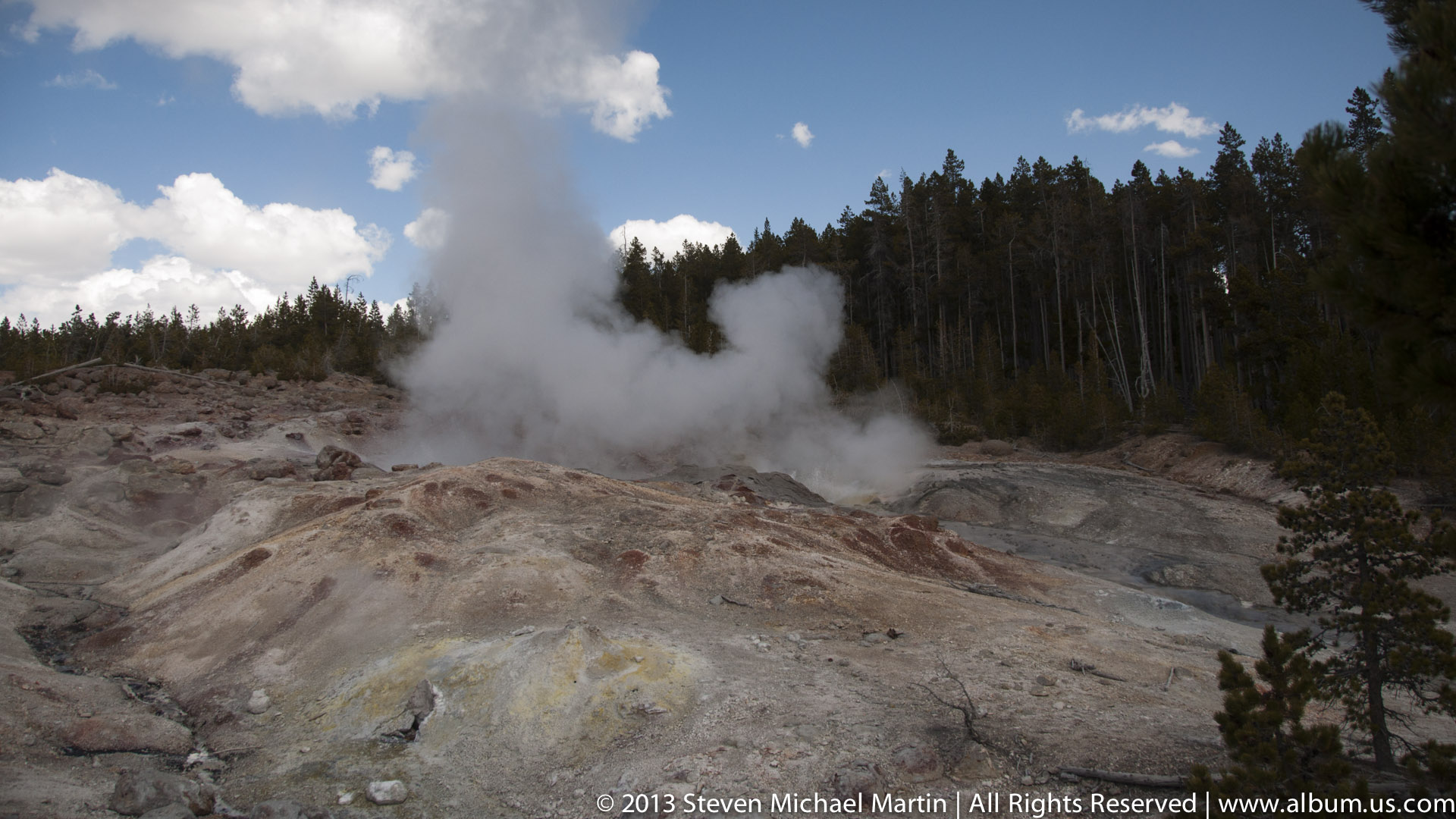
A broad gray-white steam column rises from an exposed geothermal mound, with a dark conifer forest forming a continuous backdrop. The foreground shows bare mineral ground and low ridges, while a smaller plume escapes farther left. Blue sky and bright clouds make the vapor plume distinct, but the opening itself remains hidden in the steaming basin.
Caption
A broad gray-white steam column rises from an exposed geothermal mound, with a dark conifer forest forming a continuous backdrop. The foreground shows bare mineral ground and low ridges, while a smaller plume escapes farther left. Blue sky and bright clouds make the vapor plume distinct, but the opening itself remains hidden in the steaming basin.
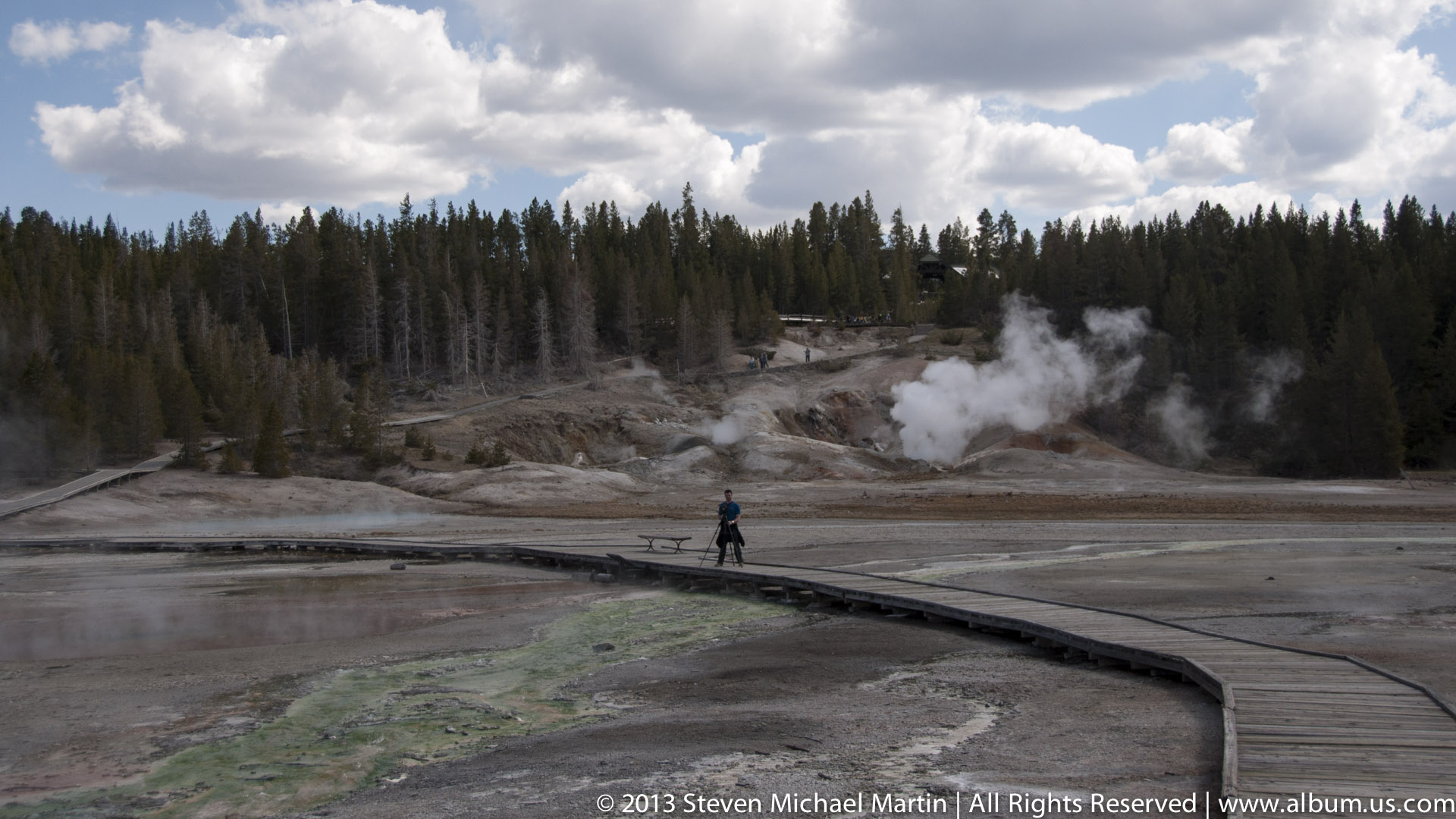
A lone visitor walks along a narrow boardwalk that curves through a broad, pale geothermal basin. Several steam plumes rise beyond the path, and dark forest borders the upper edge of the scene. The distant figure appears small against the open mineral ground, giving a clear sense of scale and showing how the raised walkway directs movement through the fragile thermal area.
Caption
A lone visitor walks along a narrow boardwalk that curves through a broad, pale geothermal basin. Several steam plumes rise beyond the path, and dark forest borders the upper edge of the scene. The distant figure appears small against the open mineral ground, giving a clear sense of scale and showing how the raised walkway directs movement through the fragile thermal area.
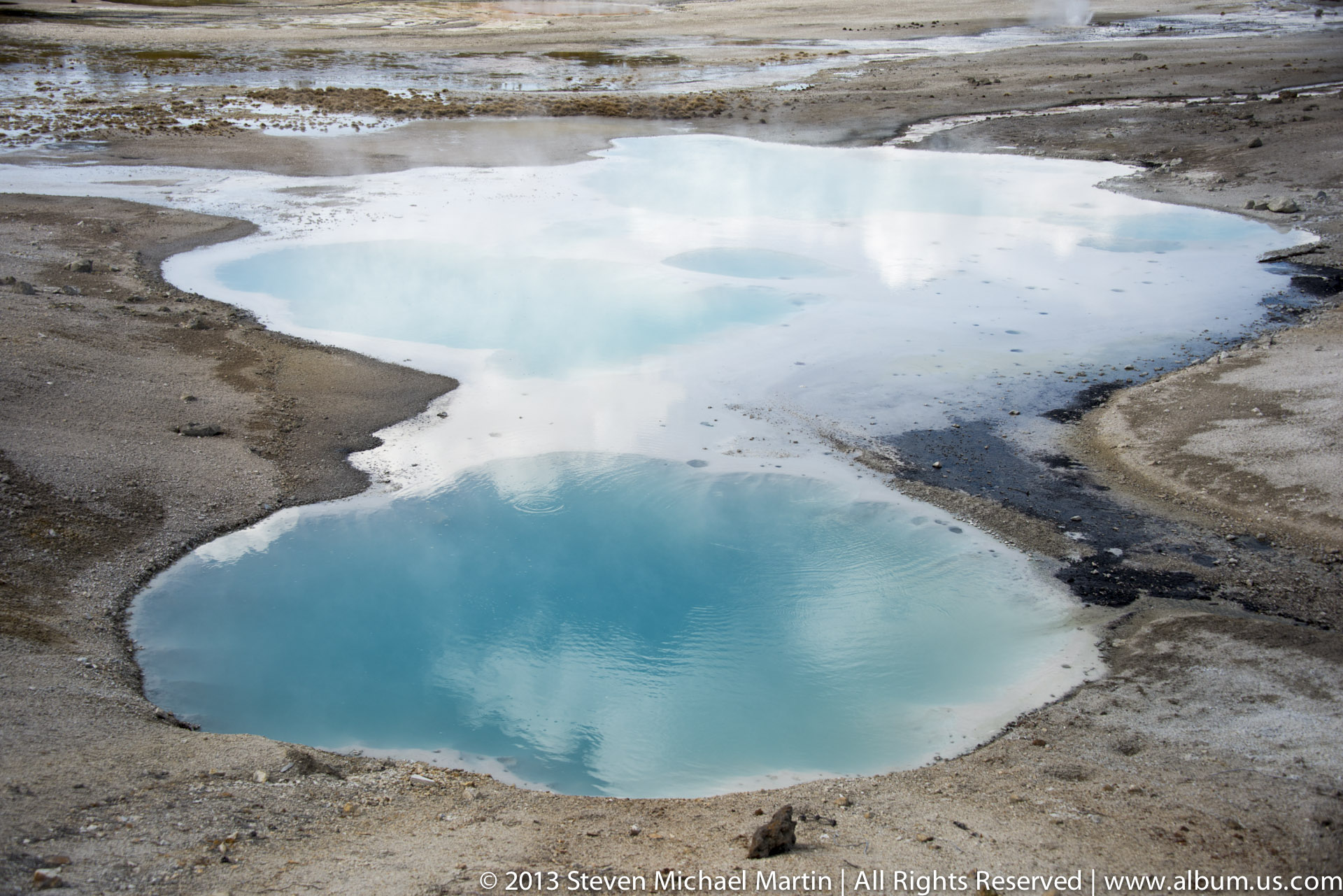
Two intensely blue pools occupy a pale, bare thermal basin, one circular and one elongated, with narrow mineral rims separating them. Fine ripples and variations in color are visible across the water, while the surrounding ground is marked by gray and tan deposits. The elevated viewpoint makes the pools’ connected shapes and the sparse, almost treeless setting easy to read.
Caption
Two intensely blue pools occupy a pale, bare thermal basin, one circular and one elongated, with narrow mineral rims separating them. Fine ripples and variations in color are visible across the water, while the surrounding ground is marked by gray and tan deposits. The elevated viewpoint makes the pools’ connected shapes and the sparse, almost treeless setting easy to read.
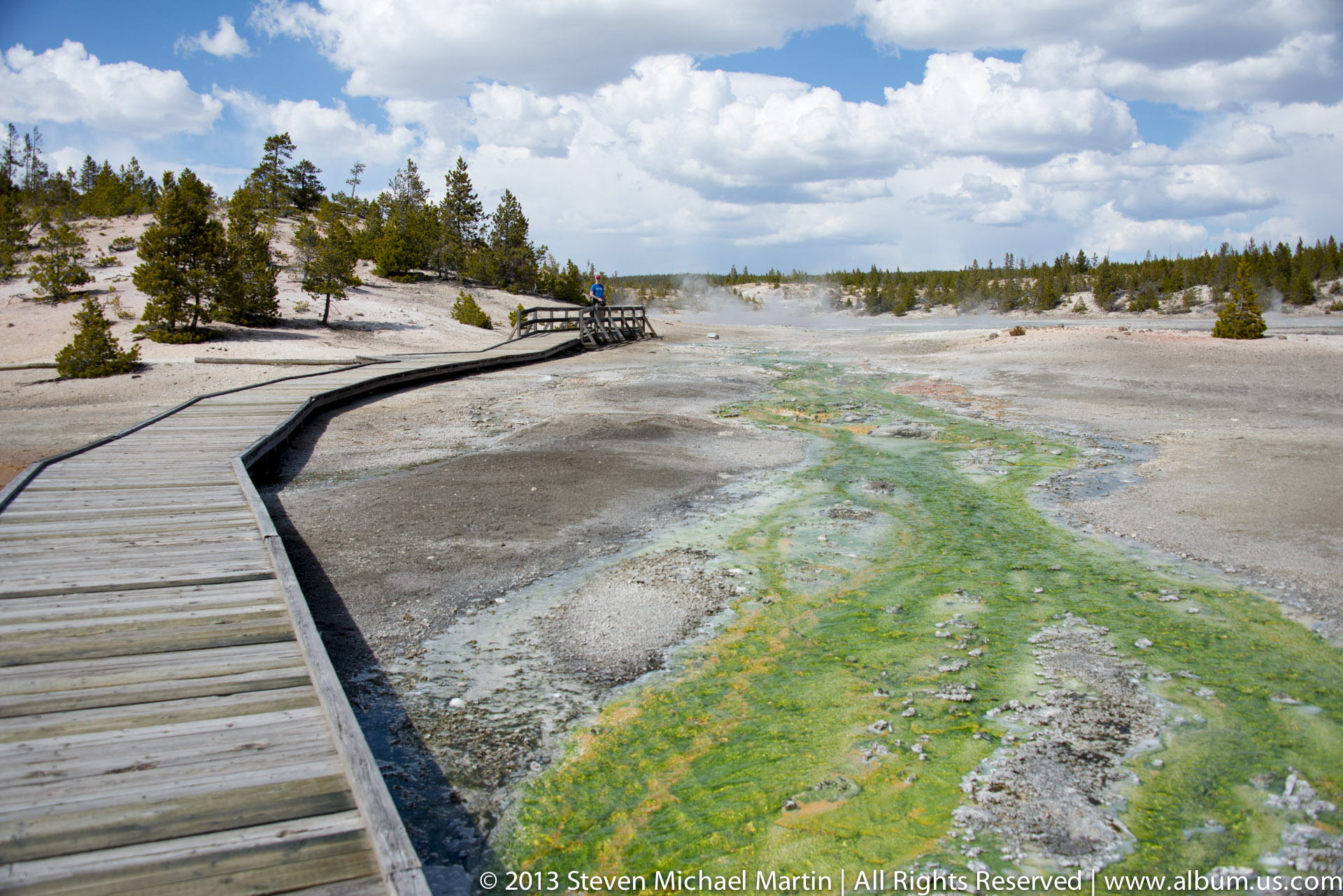
A wooden boardwalk bends from the lower left toward the center of a wide thermal basin, passing beside vivid green and orange mats. A few visitors appear as small figures near the distant rail, with conifers and cloud-filled sky along the horizon. The low, broad view emphasizes the contrast between the constructed path and the colorful, waterlogged ground it skirts.
Caption
A wooden boardwalk bends from the lower left toward the center of a wide thermal basin, passing beside vivid green and orange mats. A few visitors appear as small figures near the distant rail, with conifers and cloud-filled sky along the horizon. The low, broad view emphasizes the contrast between the constructed path and the colorful, waterlogged ground it skirts.
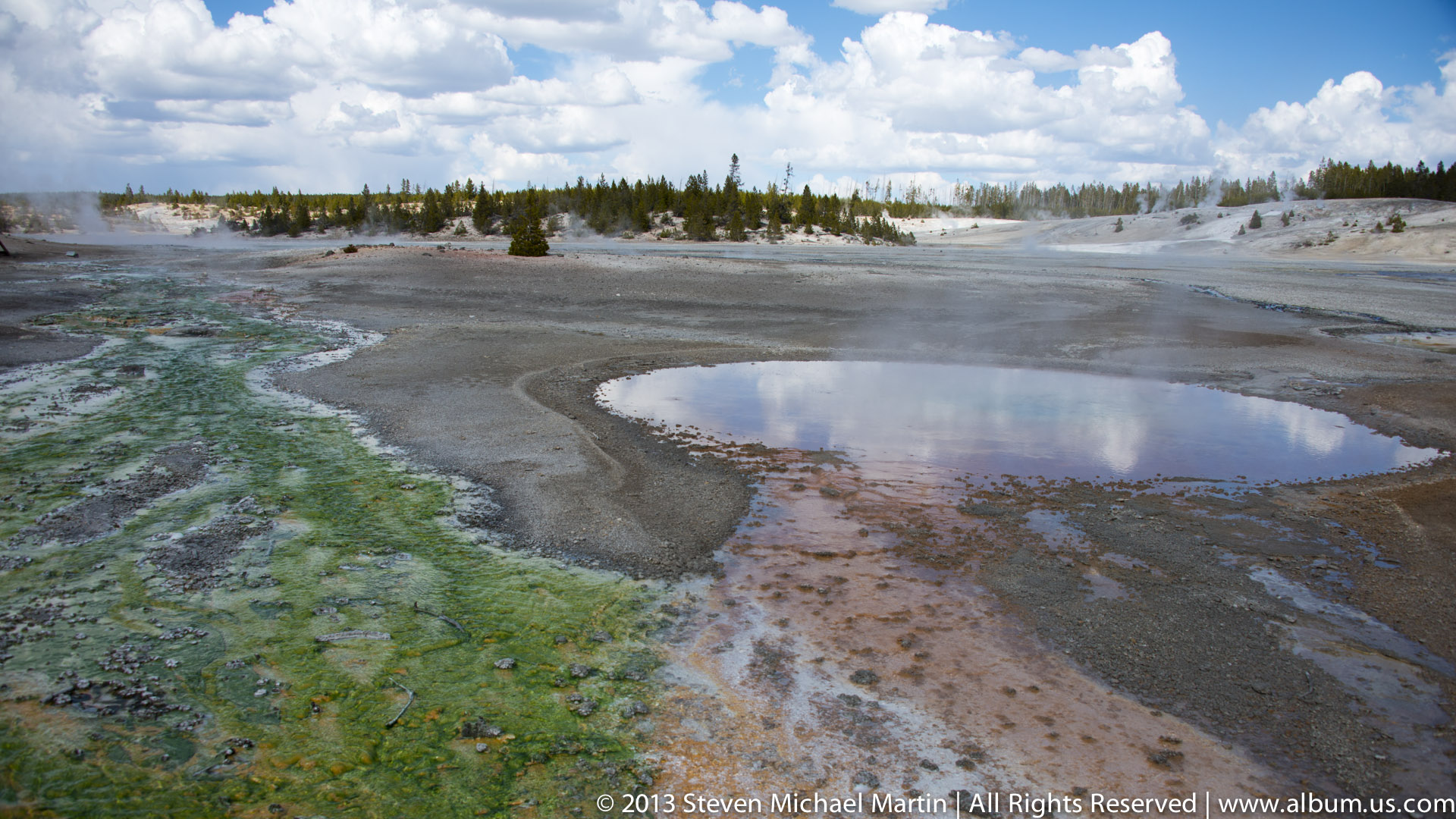
The thermal basin opens into a broad mineral flat, where shallow reflective pools punctuate gray-brown ground and green-orange runoff traces the foreground. A low line of conifers and a bright, cloud-dotted sky frame the horizon. The panoramic composition records the basin’s open scale and scattered pools, distinct from the closer view of a boardwalk and colorful mats beside it.
Caption
The thermal basin opens into a broad mineral flat, where shallow reflective pools punctuate gray-brown ground and green-orange runoff traces the foreground. A low line of conifers and a bright, cloud-dotted sky frame the horizon. The panoramic composition records the basin’s open scale and scattered pools, distinct from the closer view of a boardwalk and colorful mats beside it.
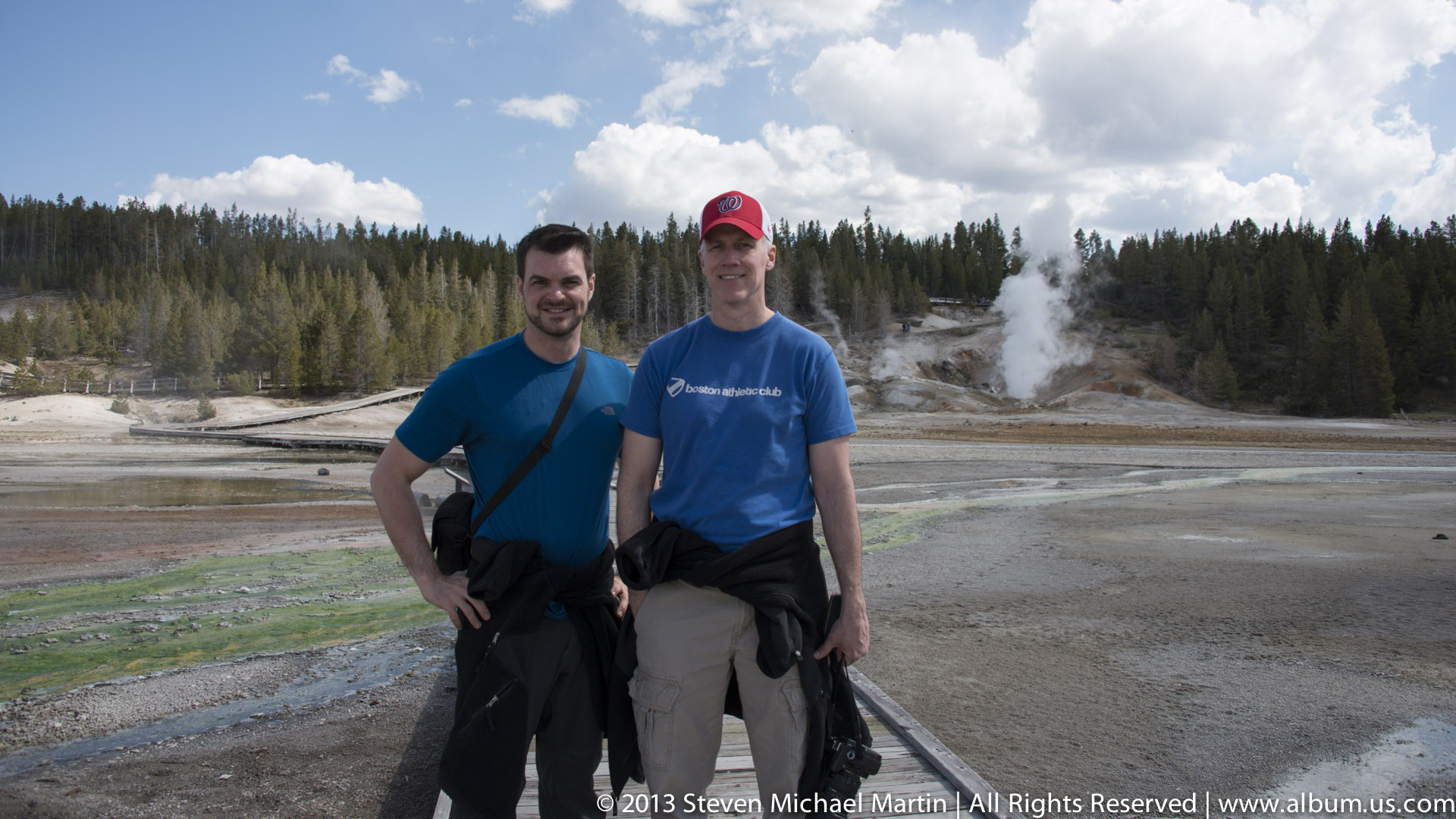
Two men stand side by side on a wooden walkway, facing the camera, with a broad thermal basin and a rising steam plume behind them. Their blue shirts and dark jackets stand out against the pale mineral ground and distant trees. The portrait foregrounds the visitors while preserving enough of the geothermal setting to identify the place as a thermal area.
Caption
Two men stand side by side on a wooden walkway, facing the camera, with a broad thermal basin and a rising steam plume behind them. Their blue shirts and dark jackets stand out against the pale mineral ground and distant trees. The portrait foregrounds the visitors while preserving enough of the geothermal setting to identify the place as a thermal area.

Two visitors sit on a wooden railing in the foreground, looking across a wide thermal basin with shallow pools and pale mineral crust. A curving boardwalk extends from the right edge toward the basin, and a conifer forest borders the far side. The elevated composition brings the people and railing into the foreground while retaining the broad geothermal landscape beyond.
Caption
Two visitors sit on a wooden railing in the foreground, looking across a wide thermal basin with shallow pools and pale mineral crust. A curving boardwalk extends from the right edge toward the basin, and a conifer forest borders the far side. The elevated composition brings the people and railing into the foreground while retaining the broad geothermal landscape beyond.
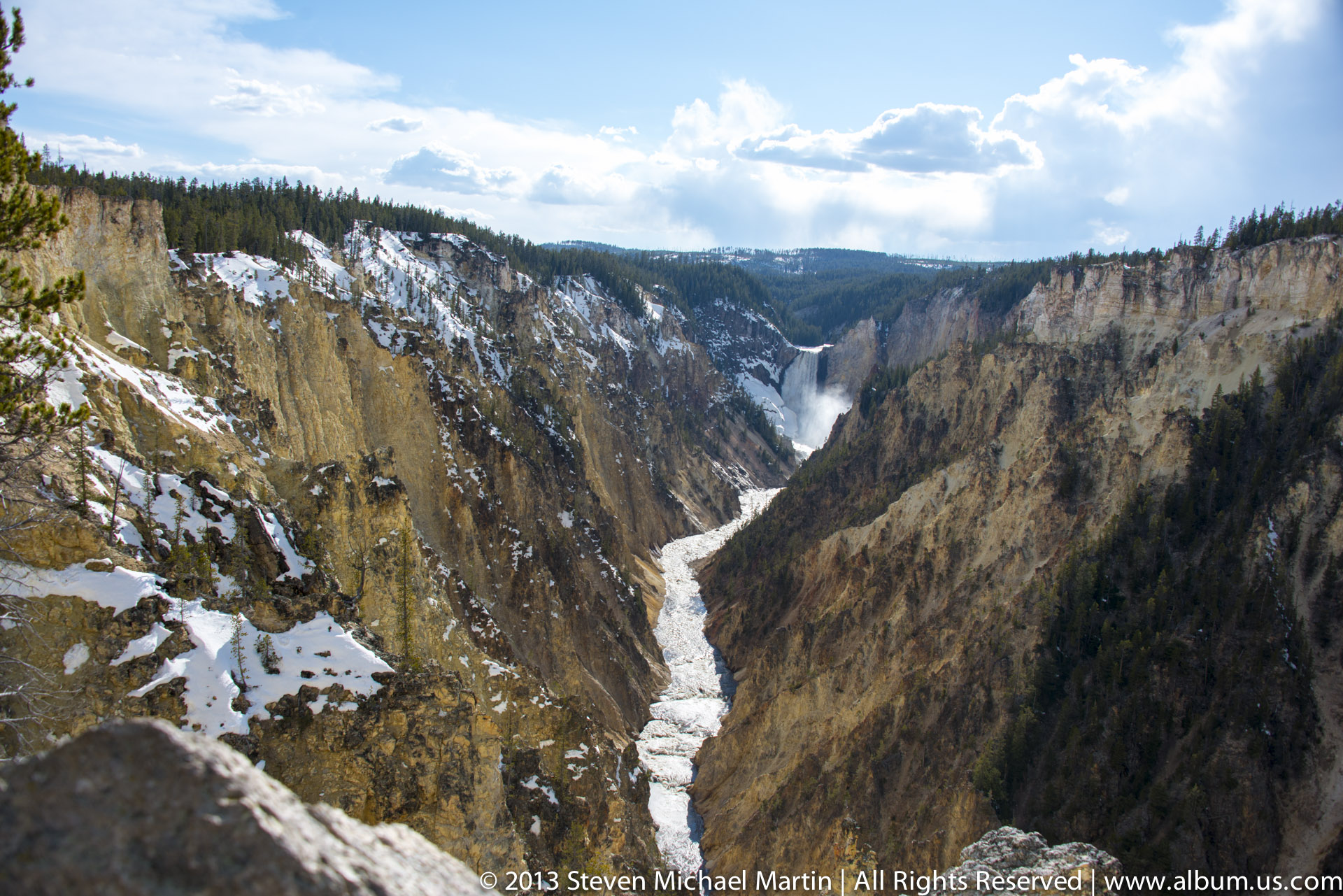
From a canyon rim, the river forms a bright winding line between steep slopes and leads toward a distant waterfall. Snow patches remain on the upper walls and shaded ledges, while scattered trees mark the canyon’s edge. This wider view reveals the river’s course and the relationship between the falls and the immense gorge, rather than isolating either feature.
Caption
From a canyon rim, the river forms a bright winding line between steep slopes and leads toward a distant waterfall. Snow patches remain on the upper walls and shaded ledges, while scattered trees mark the canyon’s edge. This wider view reveals the river’s course and the relationship between the falls and the immense gorge, rather than isolating either feature.
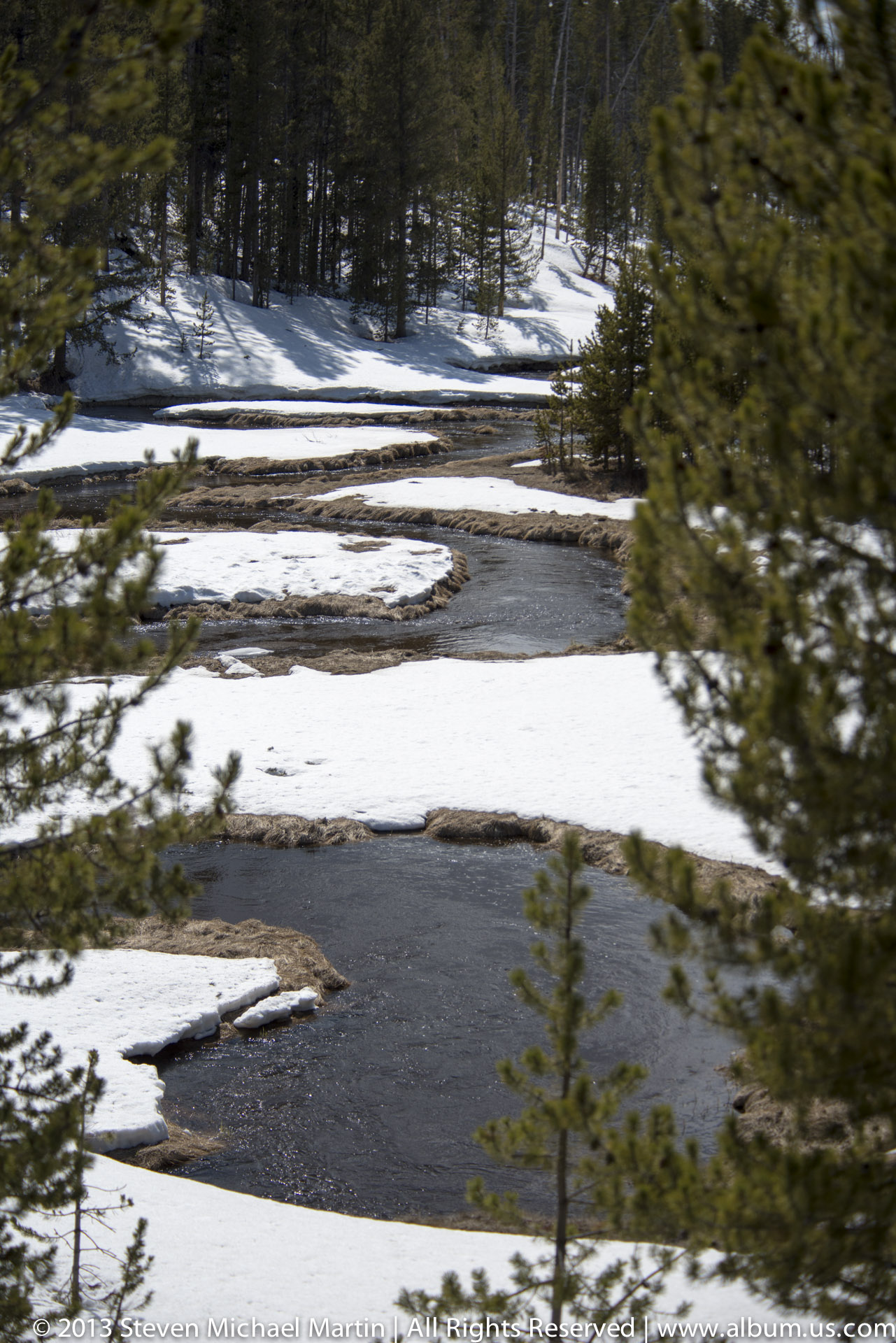
A dark stream winds between broad patches of snow and exposed brown banks, with conifers framing both sides of the channel. The water forms a series of bends through the center, reflecting the pale sky in places. Branches at the edges create a natural frame, while the snowy ground and shaded trees give the scene a distinctly cold, early-season character.
Caption
A dark stream winds between broad patches of snow and exposed brown banks, with conifers framing both sides of the channel. The water forms a series of bends through the center, reflecting the pale sky in places. Branches at the edges create a natural frame, while the snowy ground and shaded trees give the scene a distinctly cold, early-season character.
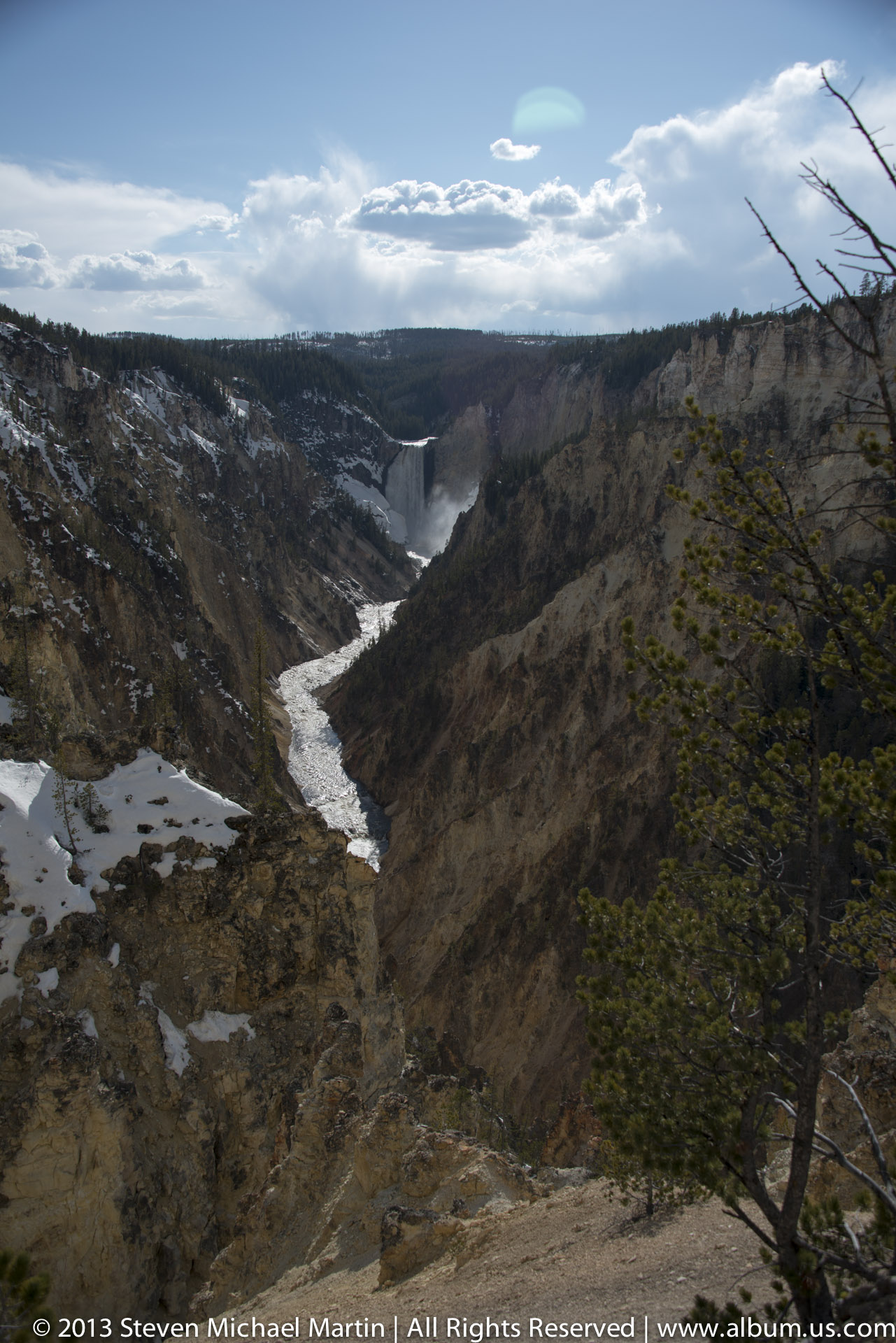
The canyon stretches into the distance, with a pale river threading along its floor toward a small waterfall near the center. Darker slopes fill the foreground, while patchy snow and sparse trees trace the upper walls. A partly shaded exposure gives the near canyon a subdued tone and leaves the far falls as a bright focal point in the long view.
Caption
The canyon stretches into the distance, with a pale river threading along its floor toward a small waterfall near the center. Darker slopes fill the foreground, while patchy snow and sparse trees trace the upper walls. A partly shaded exposure gives the near canyon a subdued tone and leaves the far falls as a bright focal point in the long view.
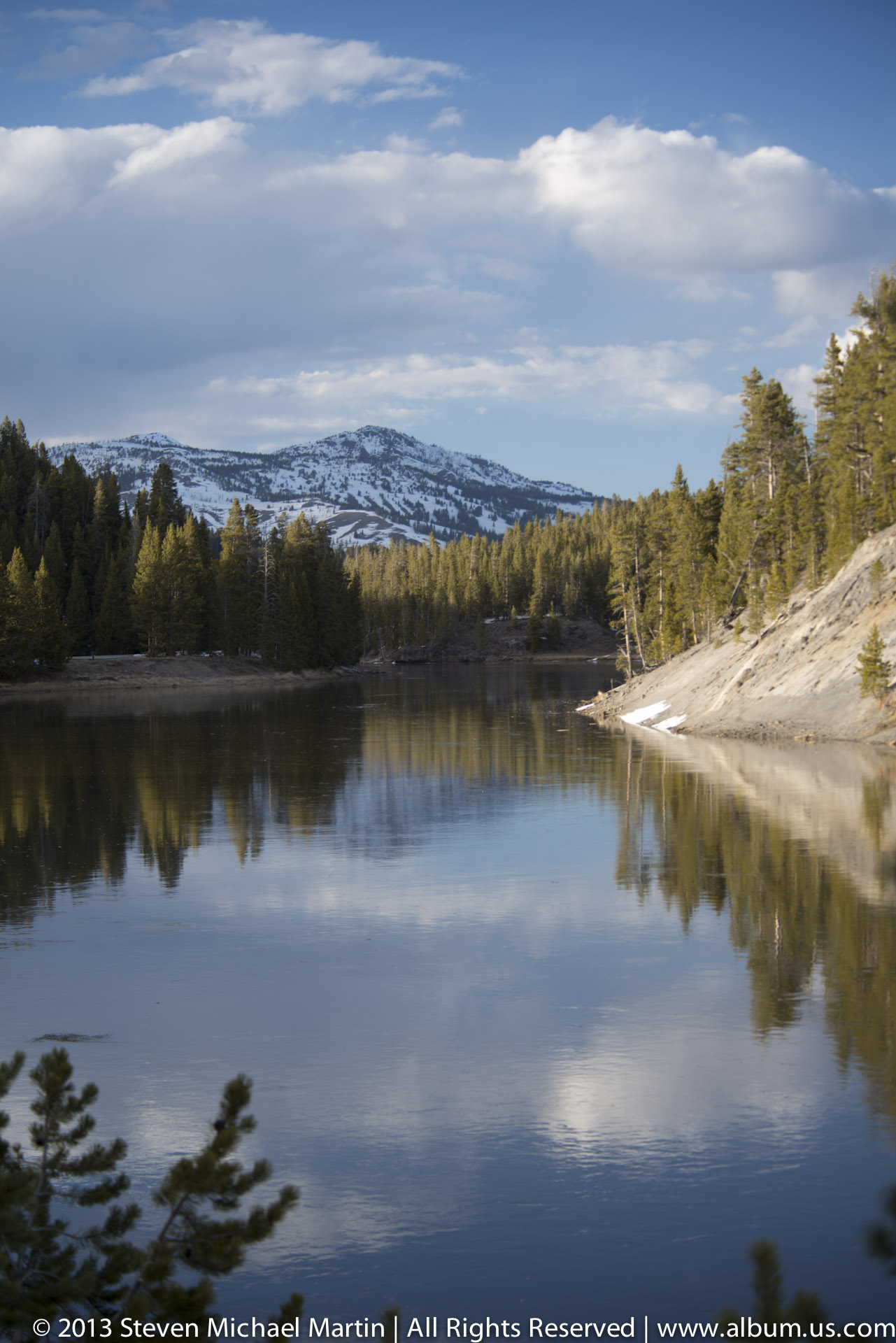
A still lake mirrors the evergreen shoreline and low, snow-dusted ridge beyond it. The water and land meet near the center of the frame, creating a nearly balanced reflection beneath a pale blue sky. Sunlight warms the trees along the right bank while the left shore remains darker, giving this quiet landscape a gentle tonal contrast without visible human activity.
Caption
A still lake mirrors the evergreen shoreline and low, snow-dusted ridge beyond it. The water and land meet near the center of the frame, creating a nearly balanced reflection beneath a pale blue sky. Sunlight warms the trees along the right bank while the left shore remains darker, giving this quiet landscape a gentle tonal contrast without visible human activity.
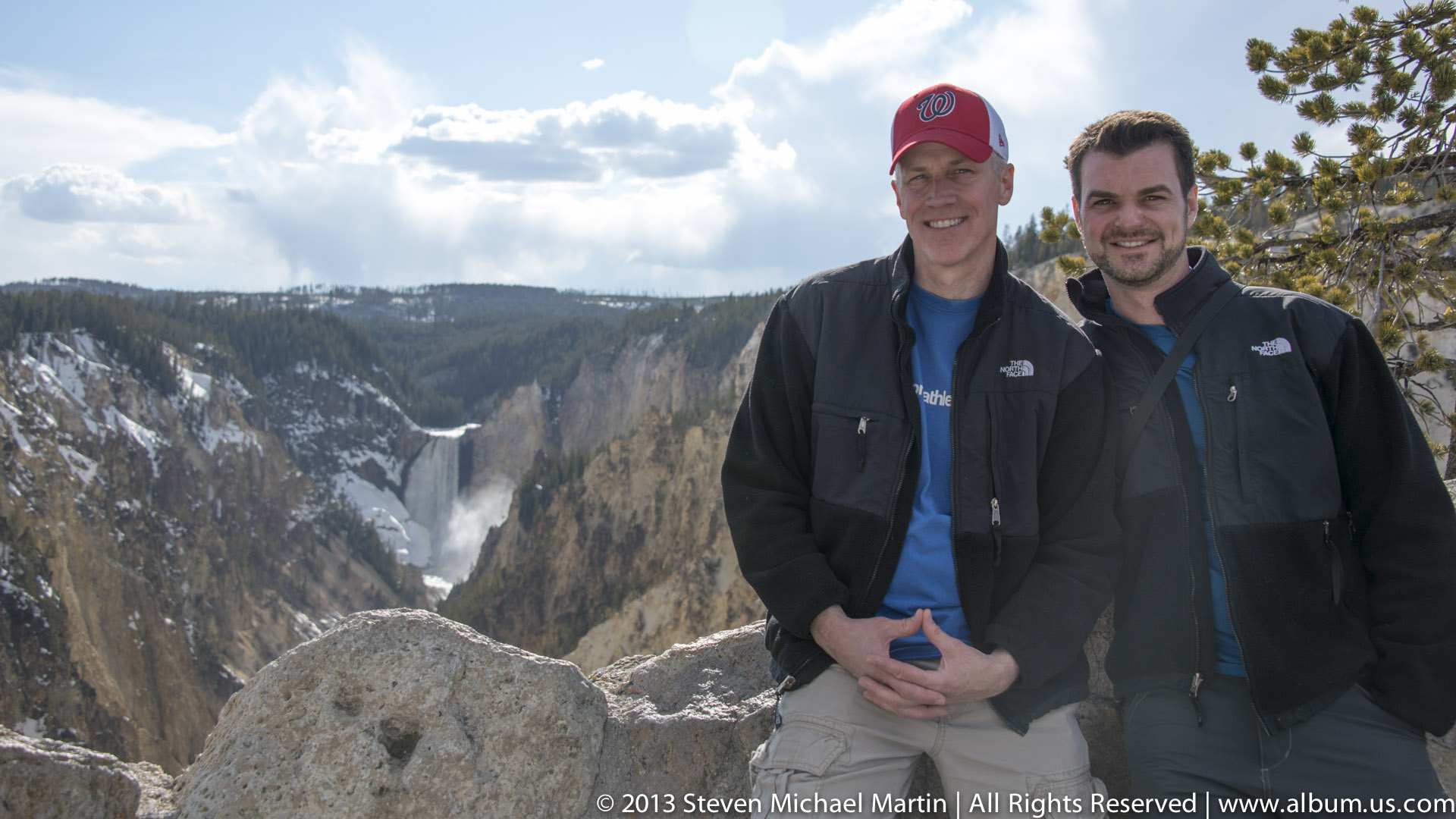
Two men pose beside a rocky overlook, with a steep canyon and the winding river visible behind them. The nearer man wears a red cap and dark jacket; the other stands close at his side. Snow patches remain on the distant canyon walls. The portrait records the visitors’ presence while retaining the scale and depth of the landscape as a clear backdrop.
Caption
Two men pose beside a rocky overlook, with a steep canyon and the winding river visible behind them. The nearer man wears a red cap and dark jacket; the other stands close at his side. Snow patches remain on the distant canyon walls. The portrait records the visitors’ presence while retaining the scale and depth of the landscape as a clear backdrop.
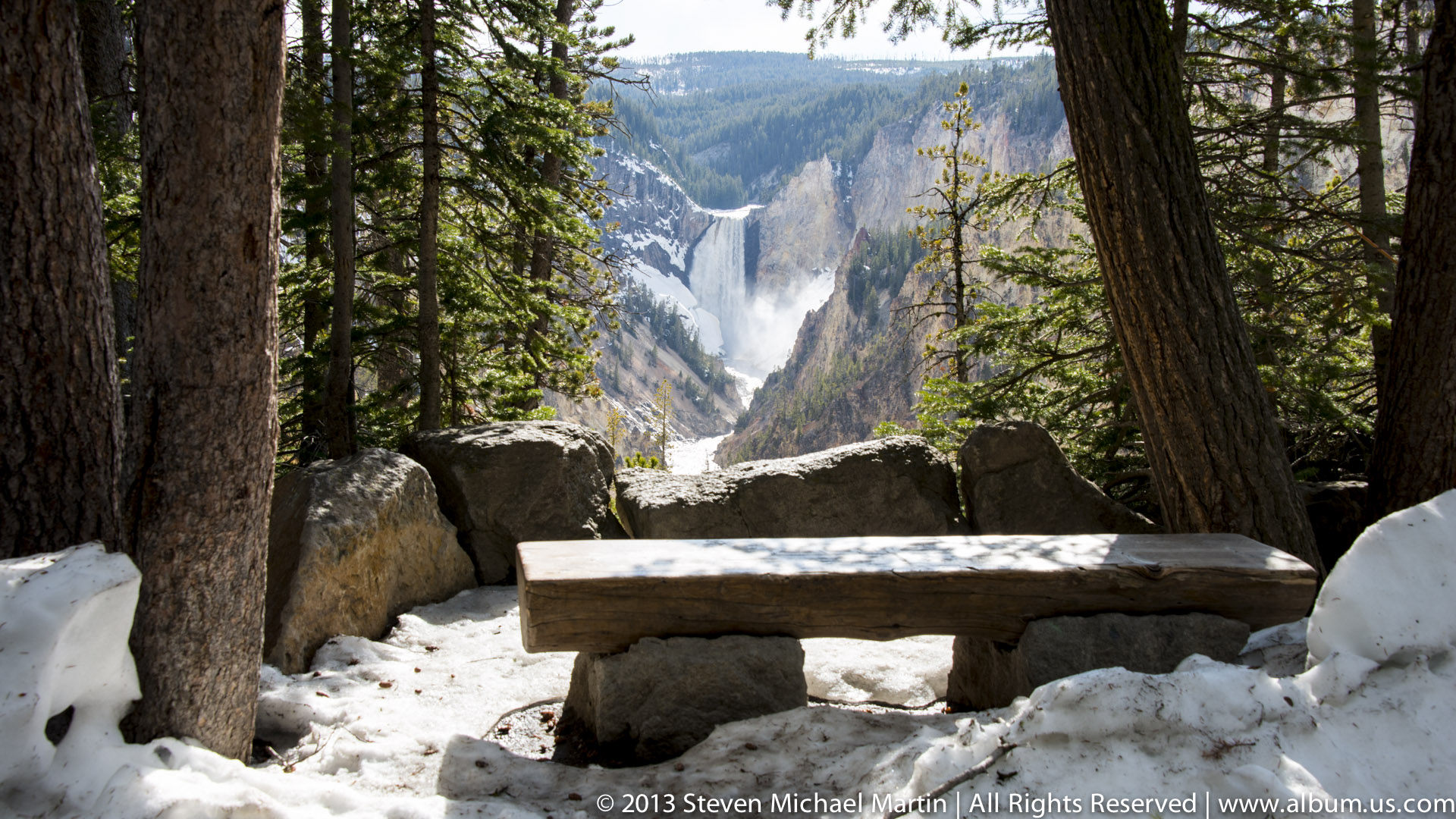
A rough wooden bench sits in a shaded overlook between tall conifers, facing a deep canyon and a distant waterfall. Snow lies around the bench and along the rocky ground, while the gorge opens through a gap in the trees. The composition uses the bench as a foreground invitation and frames the dramatic drop beyond, connecting visitor rest space with the canyon view.
Caption
A rough wooden bench sits in a shaded overlook between tall conifers, facing a deep canyon and a distant waterfall. Snow lies around the bench and along the rocky ground, while the gorge opens through a gap in the trees. The composition uses the bench as a foreground invitation and frames the dramatic drop beyond, connecting visitor rest space with the canyon view.
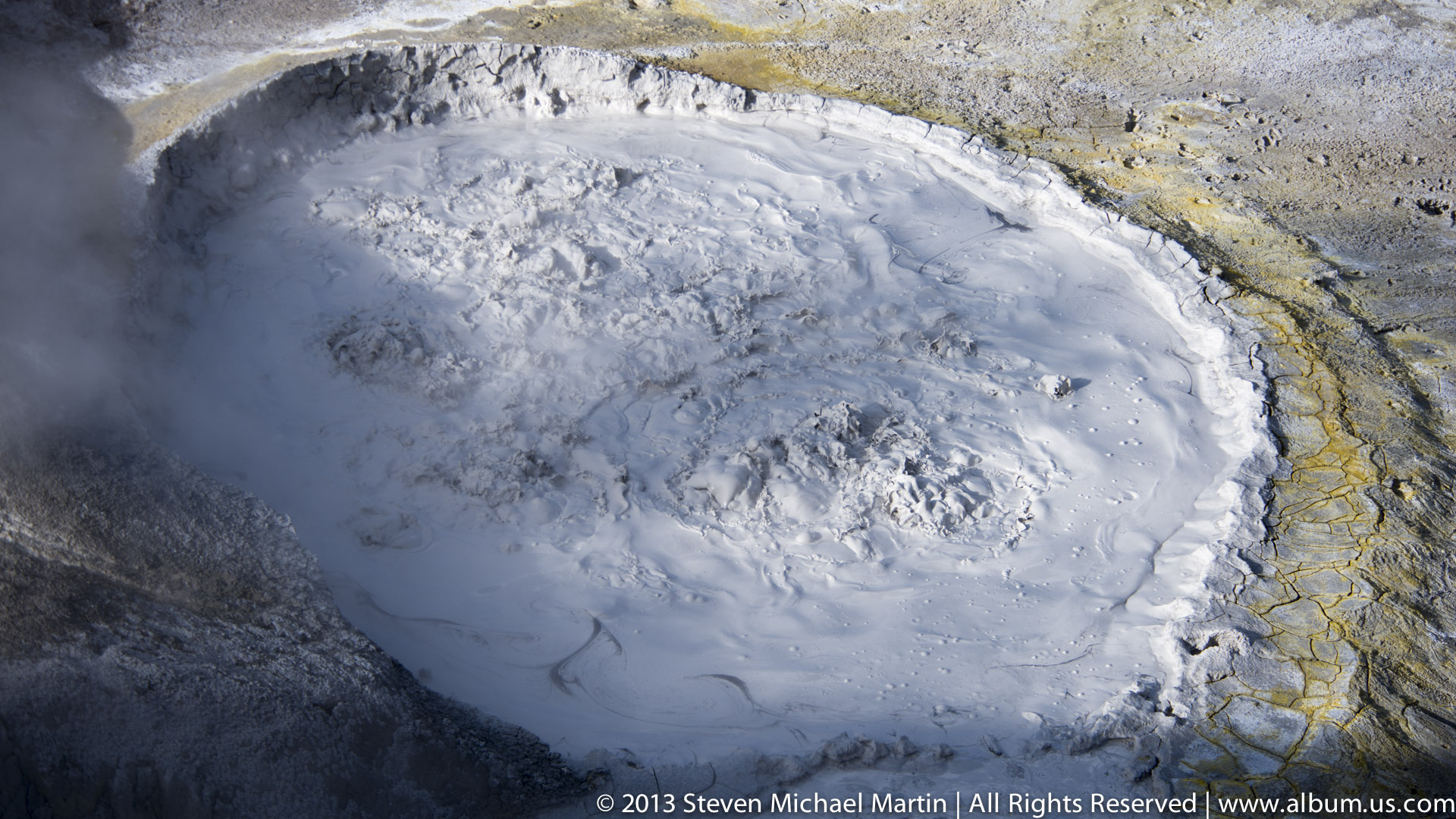
A nearly circular pool churns with pale, cloudy water inside a narrow yellow-brown mineral rim. Thick steam drifts across the left edge, softening the pool’s outline, while small ripples and low bubbles texture the surface. The close, elevated view shows the thermal water itself and its crusted border without revealing the full basin or the spring’s exact name.
Caption
A nearly circular pool churns with pale, cloudy water inside a narrow yellow-brown mineral rim. Thick steam drifts across the left edge, softening the pool’s outline, while small ripples and low bubbles texture the surface. The close, elevated view shows the thermal water itself and its crusted border without revealing the full basin or the spring’s exact name.
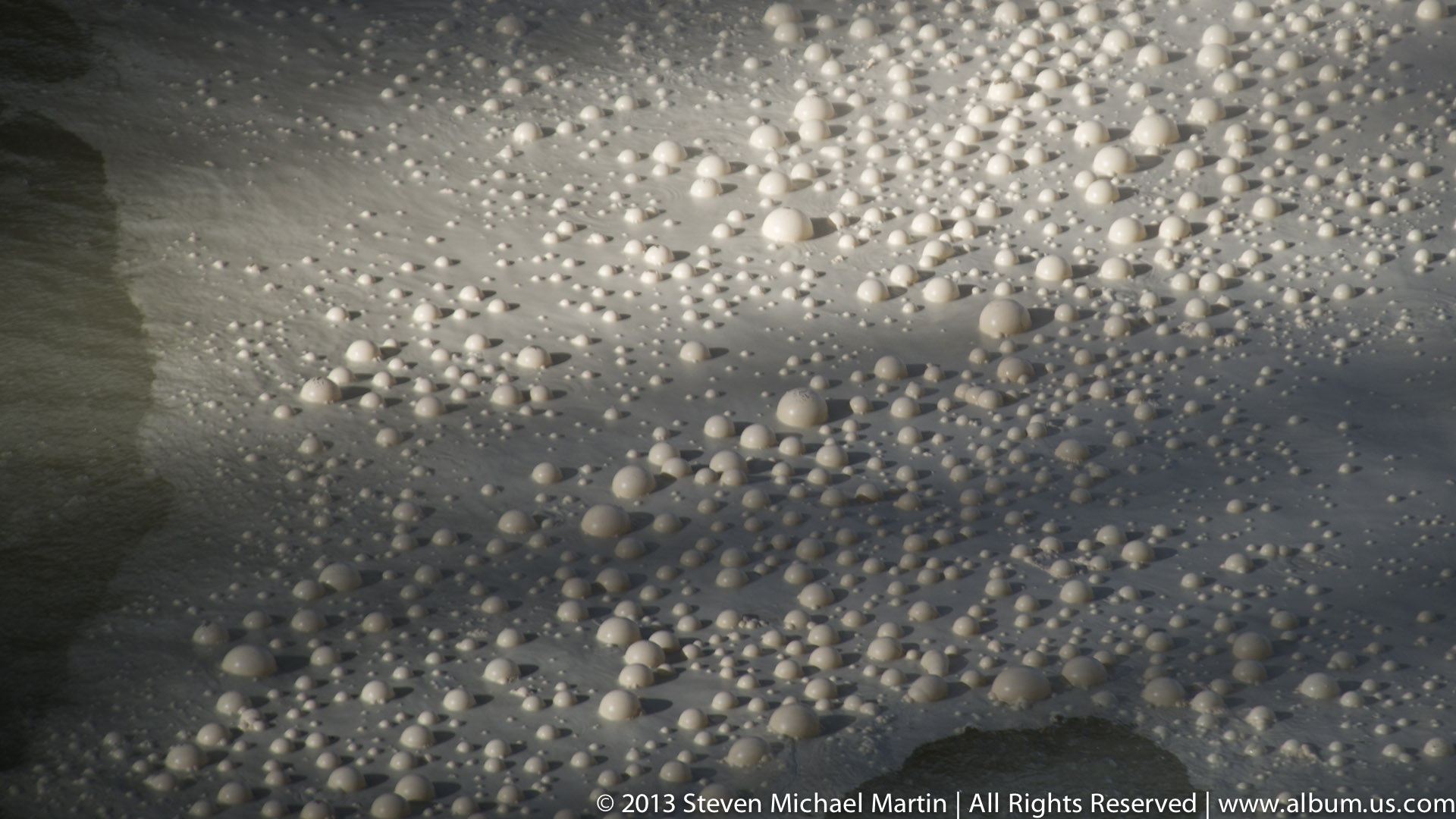
Hundreds of small rounded mineral bubbles pattern a shallow, reflective surface, with a few larger domes rising above the finer texture. The close crop turns the geothermal feature into an abstract field of repeating forms; faint reflections and darker water at the margins show that the bumps sit within a wet basin. No wider landmark is visible to identify a specific spring.
Caption
Hundreds of small rounded mineral bubbles pattern a shallow, reflective surface, with a few larger domes rising above the finer texture. The close crop turns the geothermal feature into an abstract field of repeating forms; faint reflections and darker water at the margins show that the bumps sit within a wet basin. No wider landmark is visible to identify a specific spring.

Four waterfowl float across a still lake, spaced in a loose line beneath a snow-covered shoreline. The central bird lifts its wings while the others paddle nearby, leaving small ripples on the reflective surface. Pale, mineral-colored slopes and snow occupy the background, making the birds’ dark bodies distinct against the quiet water and bright shore.
Caption
Four waterfowl float across a still lake, spaced in a loose line beneath a snow-covered shoreline. The central bird lifts its wings while the others paddle nearby, leaving small ripples on the reflective surface. Pale, mineral-colored slopes and snow occupy the background, making the birds’ dark bodies distinct against the quiet water and bright shore.
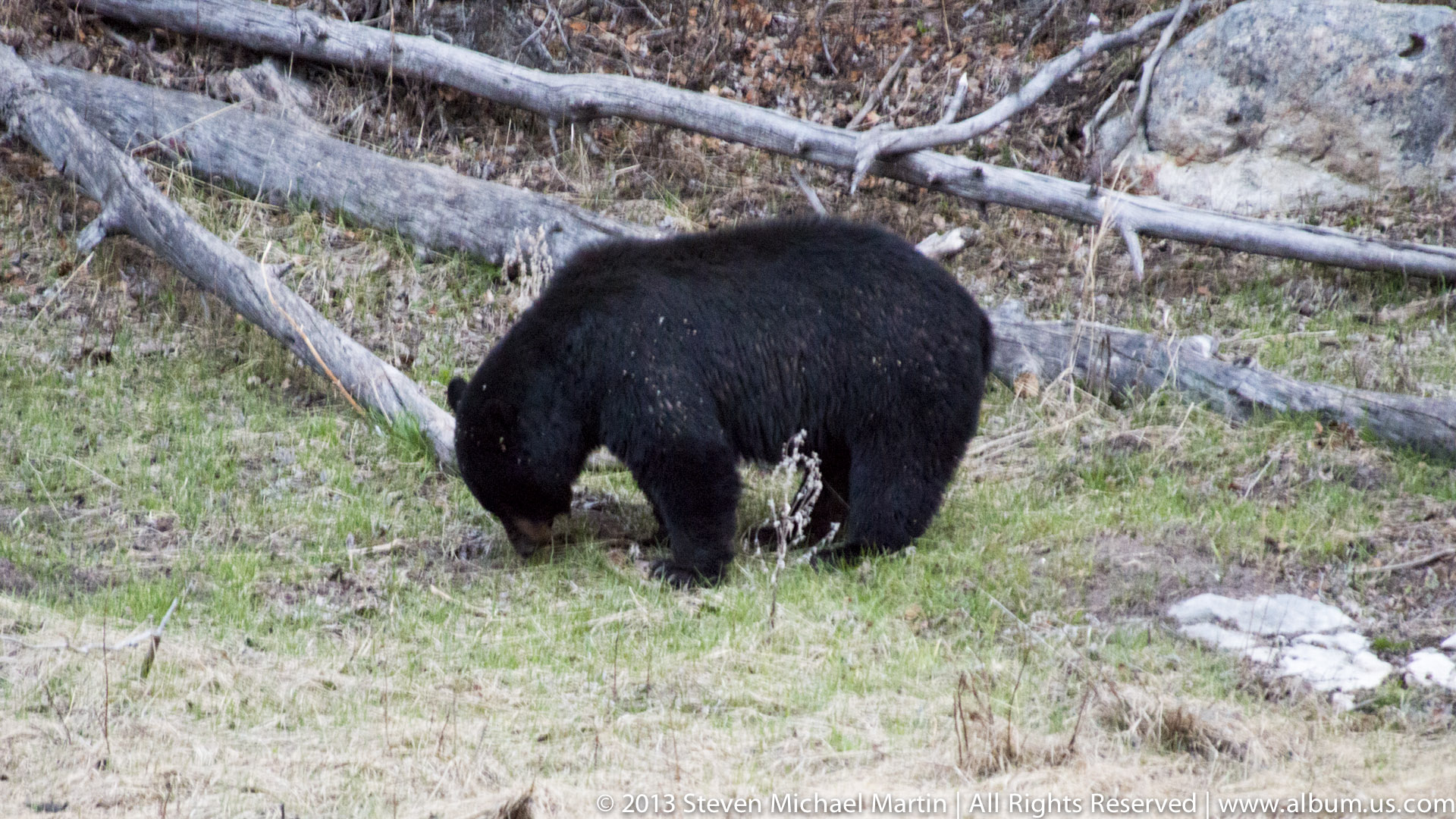
A dark-coated bear lowers its head to forage in a grassy clearing scattered with pale fallen branches and stones. The animal’s rounded back and sturdy legs are visible in profile, while bare ground and low shrubs fill the foreground. The close view records a natural feeding posture and the bear’s immediate woodland habitat without showing people or other wildlife.
Caption
A dark-coated bear lowers its head to forage in a grassy clearing scattered with pale fallen branches and stones. The animal’s rounded back and sturdy legs are visible in profile, while bare ground and low shrubs fill the foreground. The close view records a natural feeding posture and the bear’s immediate woodland habitat without showing people or other wildlife.
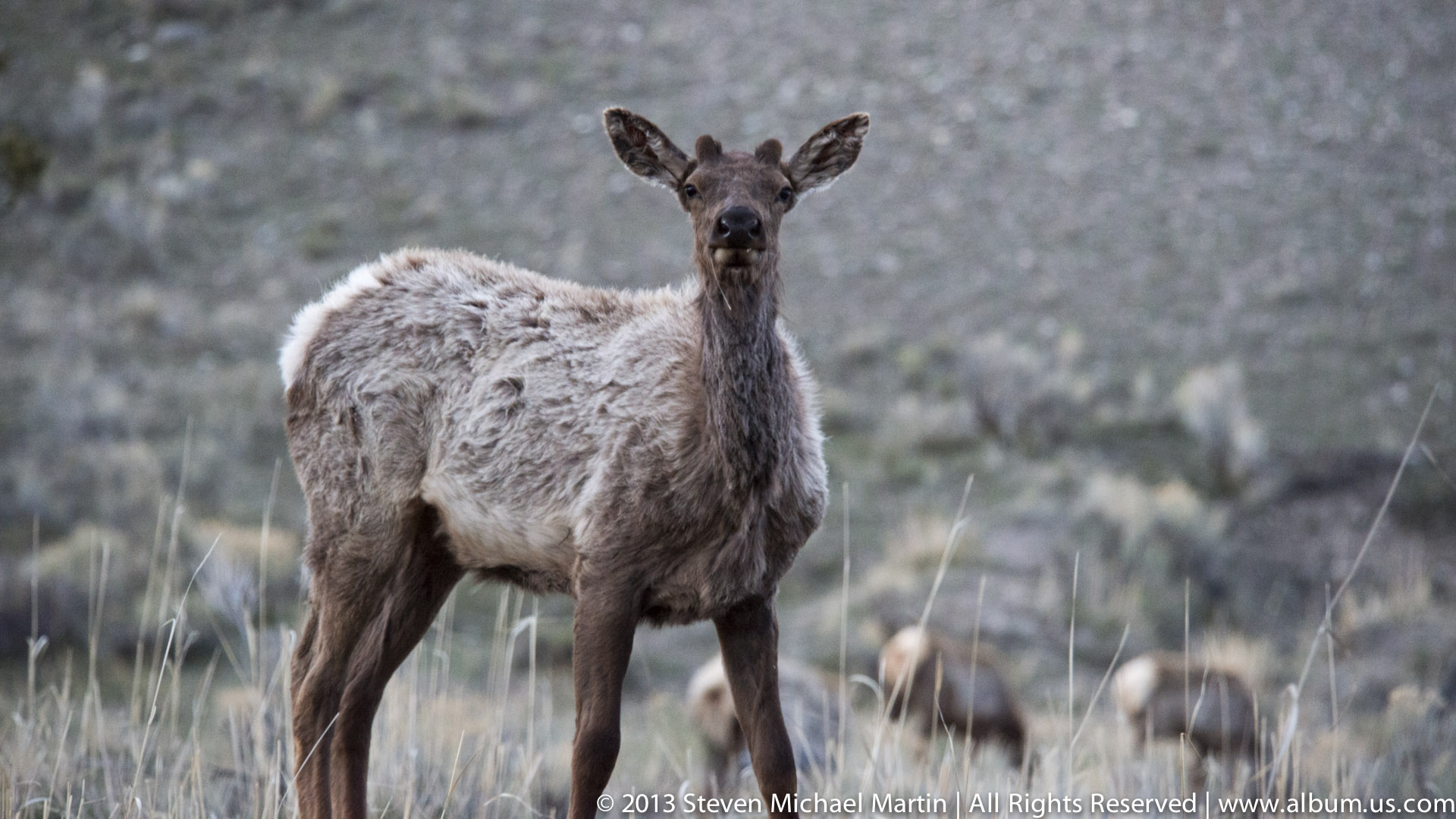
An elk stands alert in a muted meadow, its pale winter coat still visible as several grazing animals blur into the background. The animal faces the camera with ears raised, while the shallow focus isolates its long neck and dark muzzle from the open grassland. The exact age and sex are not certain from this view.
Caption
An elk stands alert in a muted meadow, its pale winter coat still visible as several grazing animals blur into the background. The animal faces the camera with ears raised, while the shallow focus isolates its long neck and dark muzzle from the open grassland. The exact age and sex are not certain from this view.
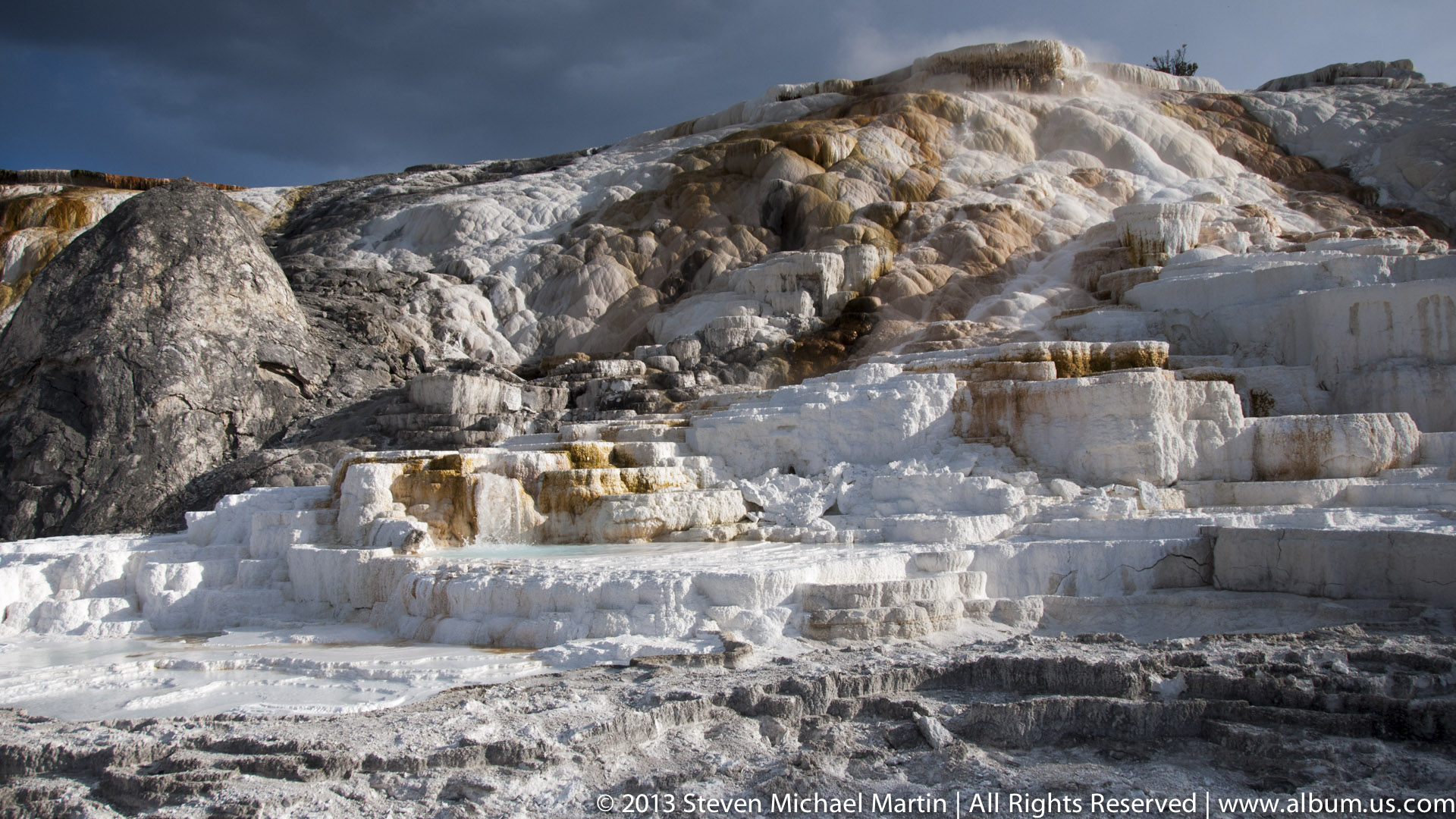
A dark boulder anchors the left foreground as white travertine shelves climb behind it in broken horizontal steps. Small pools and channels catch the light between mineral ledges, while orange-brown staining traces the upper slope. This angle sets the pale thermal deposits against darker rock and gives the terraces a more rugged, uneven profile.
Caption
A dark boulder anchors the left foreground as white travertine shelves climb behind it in broken horizontal steps. Small pools and channels catch the light between mineral ledges, while orange-brown staining traces the upper slope. This angle sets the pale thermal deposits against darker rock and gives the terraces a more rugged, uneven profile.
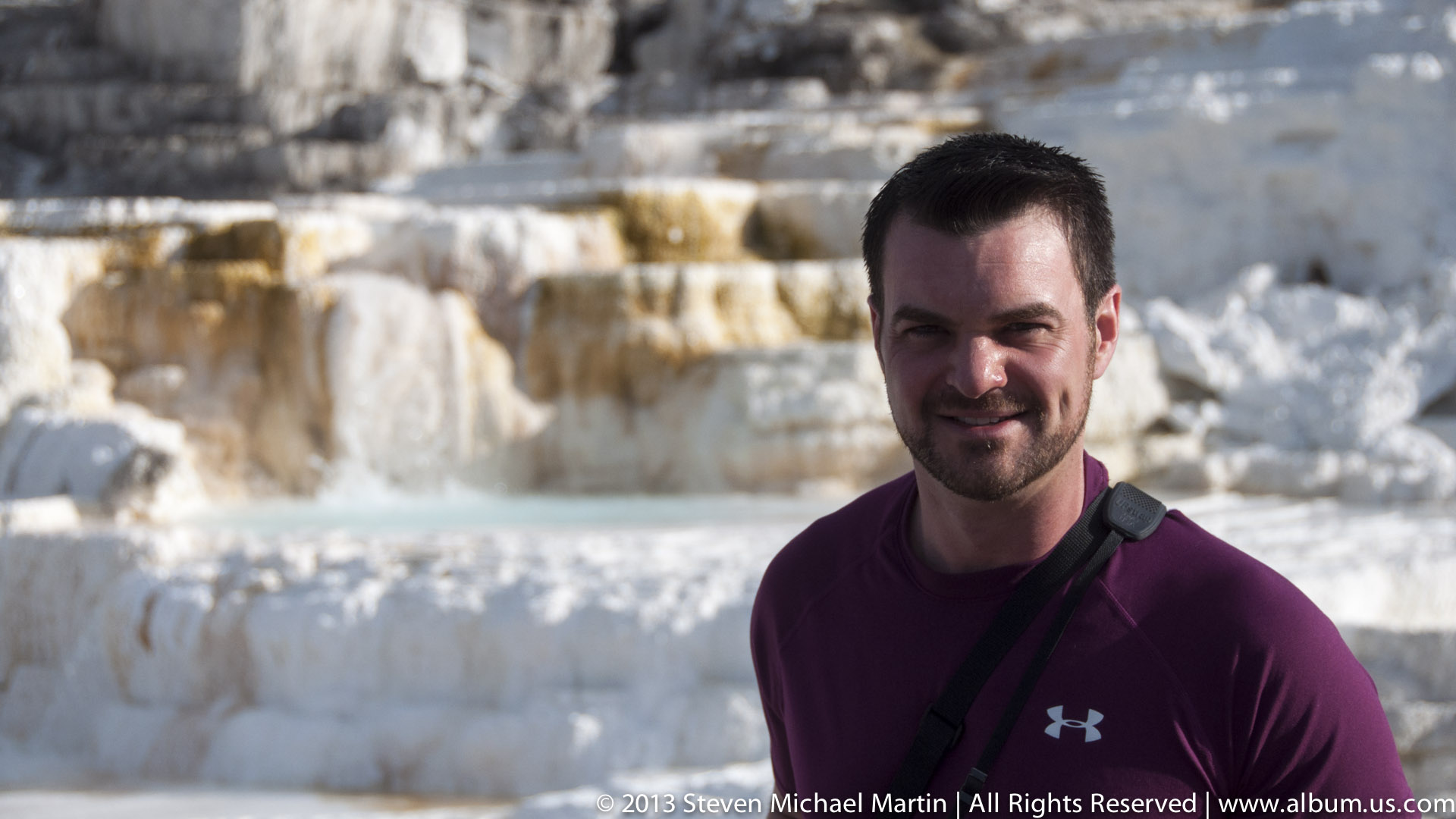
A man in a maroon shirt pauses for a portrait before Yellowstone's pale travertine terraces. The shallow depth of field keeps his face and shoulder strap sharp while the mineral ledges and thermal pools soften into the background. His identity is not established by the photograph, so the portrait remains focused on his presence within the geothermal landscape.
Caption
A man in a maroon shirt pauses for a portrait before Yellowstone's pale travertine terraces. The shallow depth of field keeps his face and shoulder strap sharp while the mineral ledges and thermal pools soften into the background. His identity is not established by the photograph, so the portrait remains focused on his presence within the geothermal landscape.
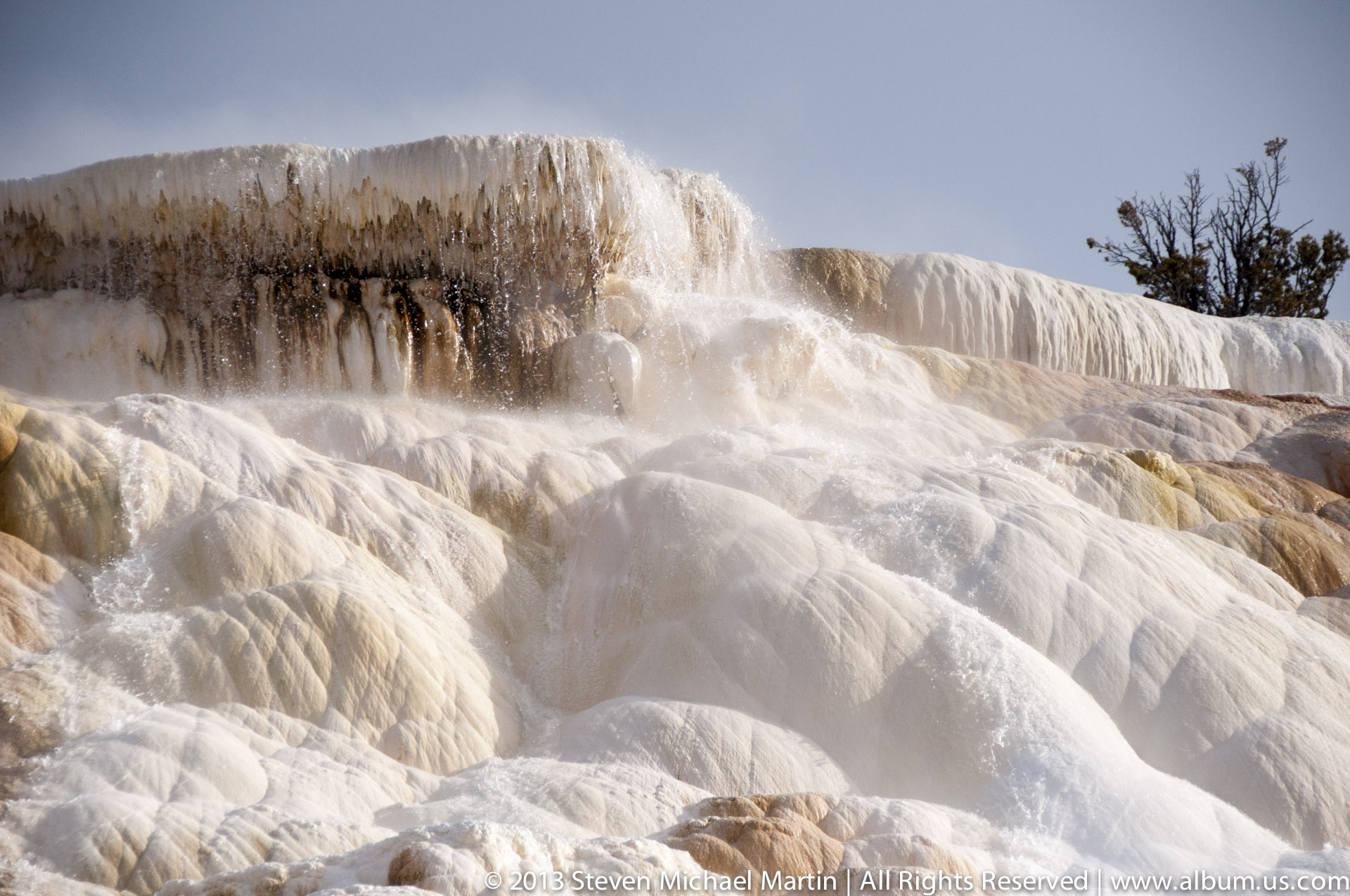
Steam drifts across rounded travertine mounds, softening their cream, tan, and rust-colored bands. Water spills over shallow lips and gathers in narrow channels, revealing how the surface is continually reshaped by mineral-rich flow. The closer framing emphasizes texture and warm color, with a few bare shrubs appearing along the distant rim.
Caption
Steam drifts across rounded travertine mounds, softening their cream, tan, and rust-colored bands. Water spills over shallow lips and gathers in narrow channels, revealing how the surface is continually reshaped by mineral-rich flow. The closer framing emphasizes texture and warm color, with a few bare shrubs appearing along the distant rim.
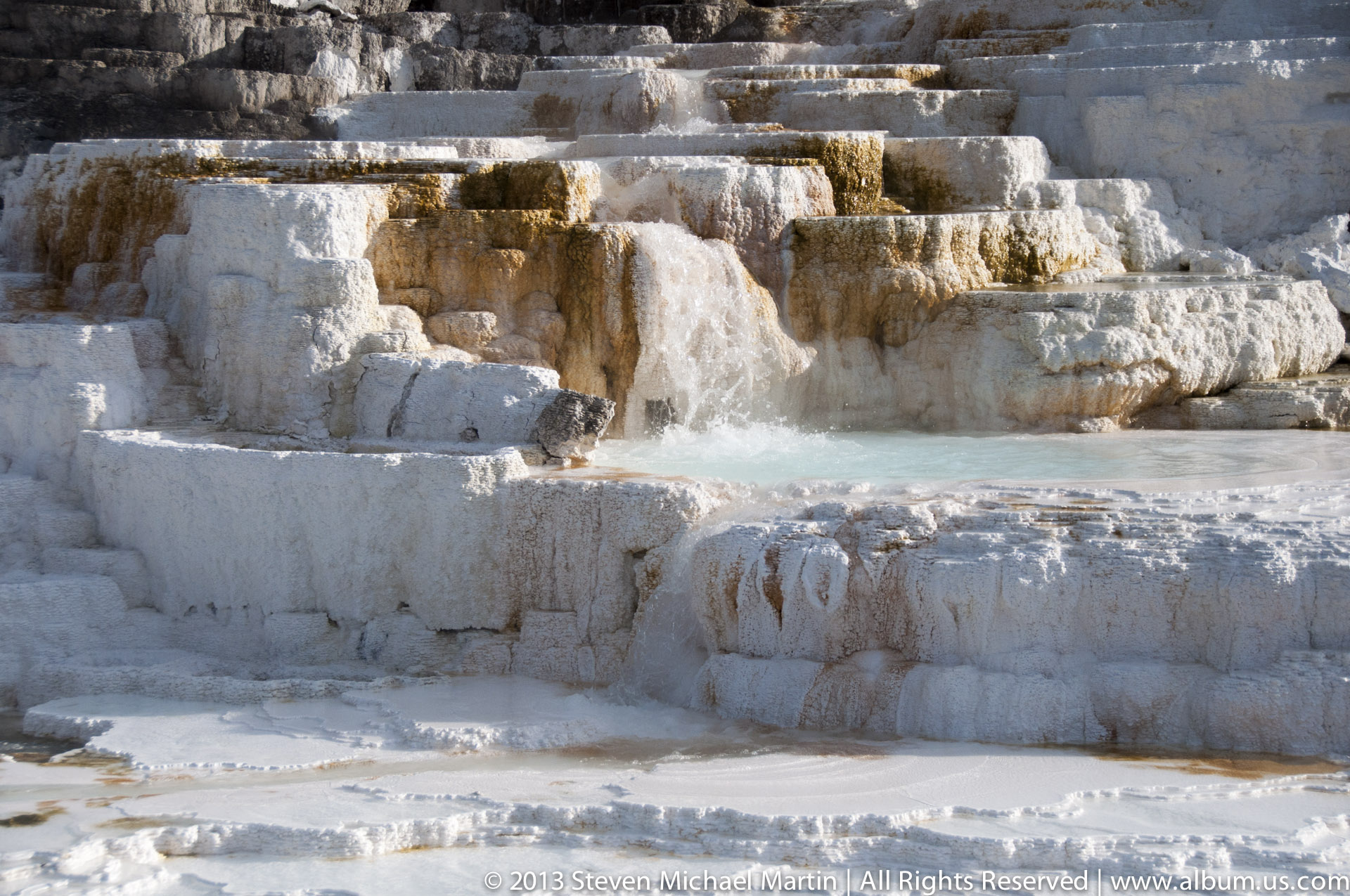
A pale blue pool gathers beneath a tier of white travertine ledges, where mineral crusts form scalloped edges and short cascades. The tighter composition follows the waterline and stacked shelves rather than the broader hillside, revealing subtle changes from chalk white to warm beige. No people or signs interrupt the view of the geothermal feature.
Caption
A pale blue pool gathers beneath a tier of white travertine ledges, where mineral crusts form scalloped edges and short cascades. The tighter composition follows the waterline and stacked shelves rather than the broader hillside, revealing subtle changes from chalk white to warm beige. No people or signs interrupt the view of the geothermal feature.
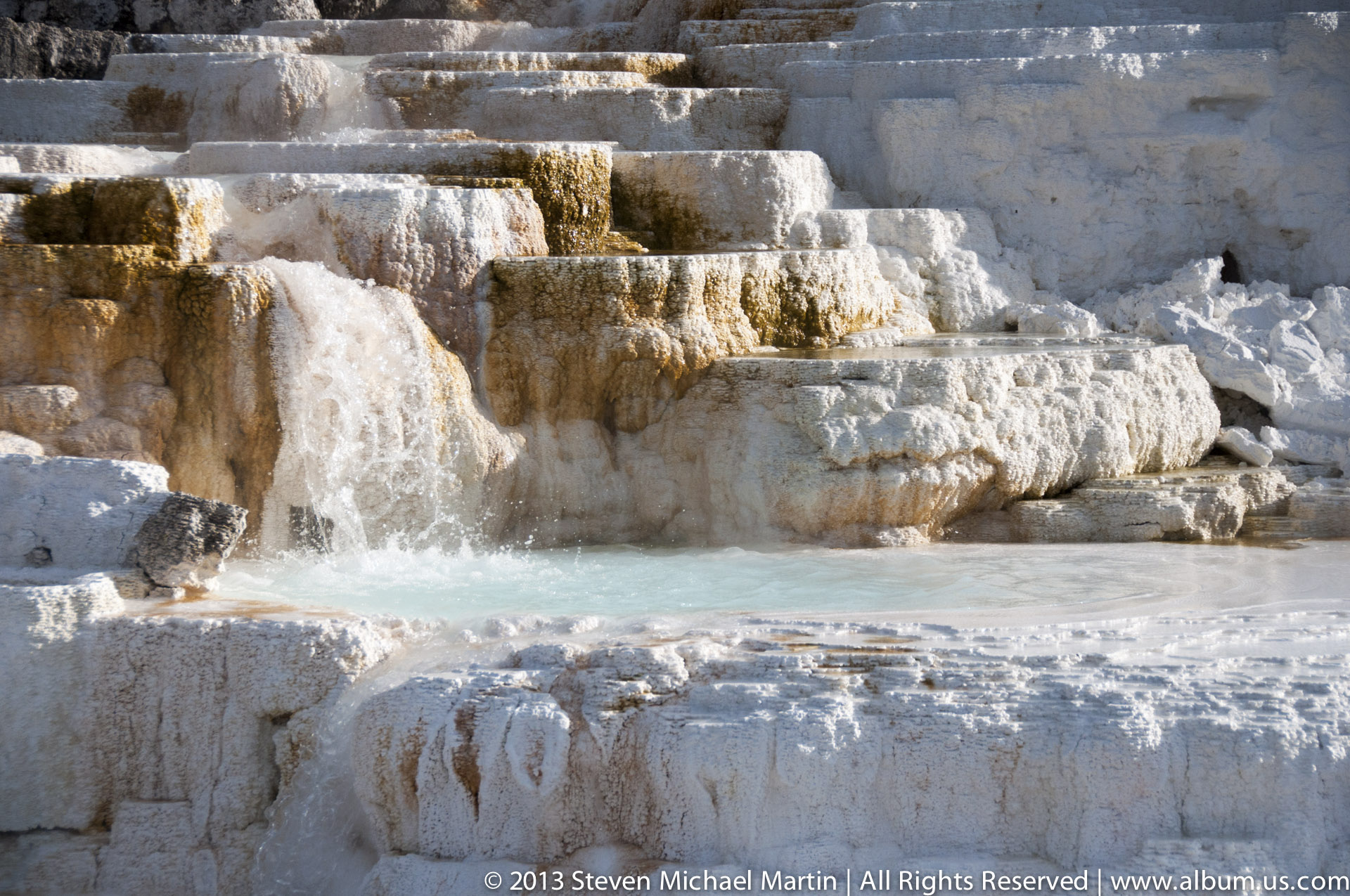
A short cascade drops over pale travertine steps into a milky turquoise pool. The mineral shelves frame the water in layers, while a dark outcrop at left provides contrast against the bright deposits. This close view concentrates on the movement and color of water within the stepped formation rather than the surrounding landscape.
Caption
A short cascade drops over pale travertine steps into a milky turquoise pool. The mineral shelves frame the water in layers, while a dark outcrop at left provides contrast against the bright deposits. This close view concentrates on the movement and color of water within the stepped formation rather than the surrounding landscape.
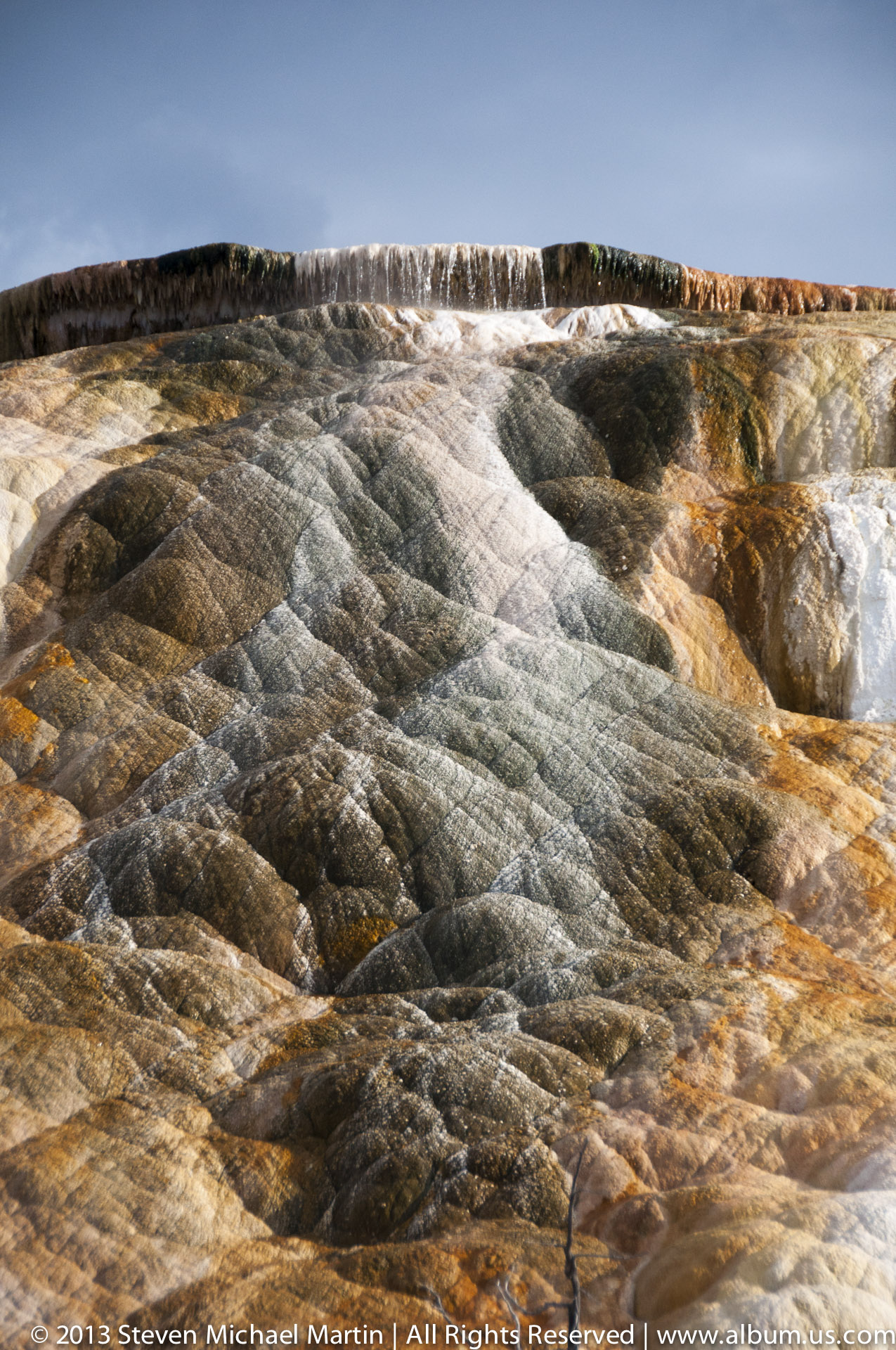
Ridges and shallow channels ripple across a mineral surface mottled with white, gray, ochre, and rust. The close viewpoint removes most surrounding context, turning the travertine terrace into a study of color, texture, and flowing contours. A narrow strip of darker ground at the top edge hints at the broader setting without identifying a particular basin.
Caption
Ridges and shallow channels ripple across a mineral surface mottled with white, gray, ochre, and rust. The close viewpoint removes most surrounding context, turning the travertine terrace into a study of color, texture, and flowing contours. A narrow strip of darker ground at the top edge hints at the broader setting without identifying a particular basin.
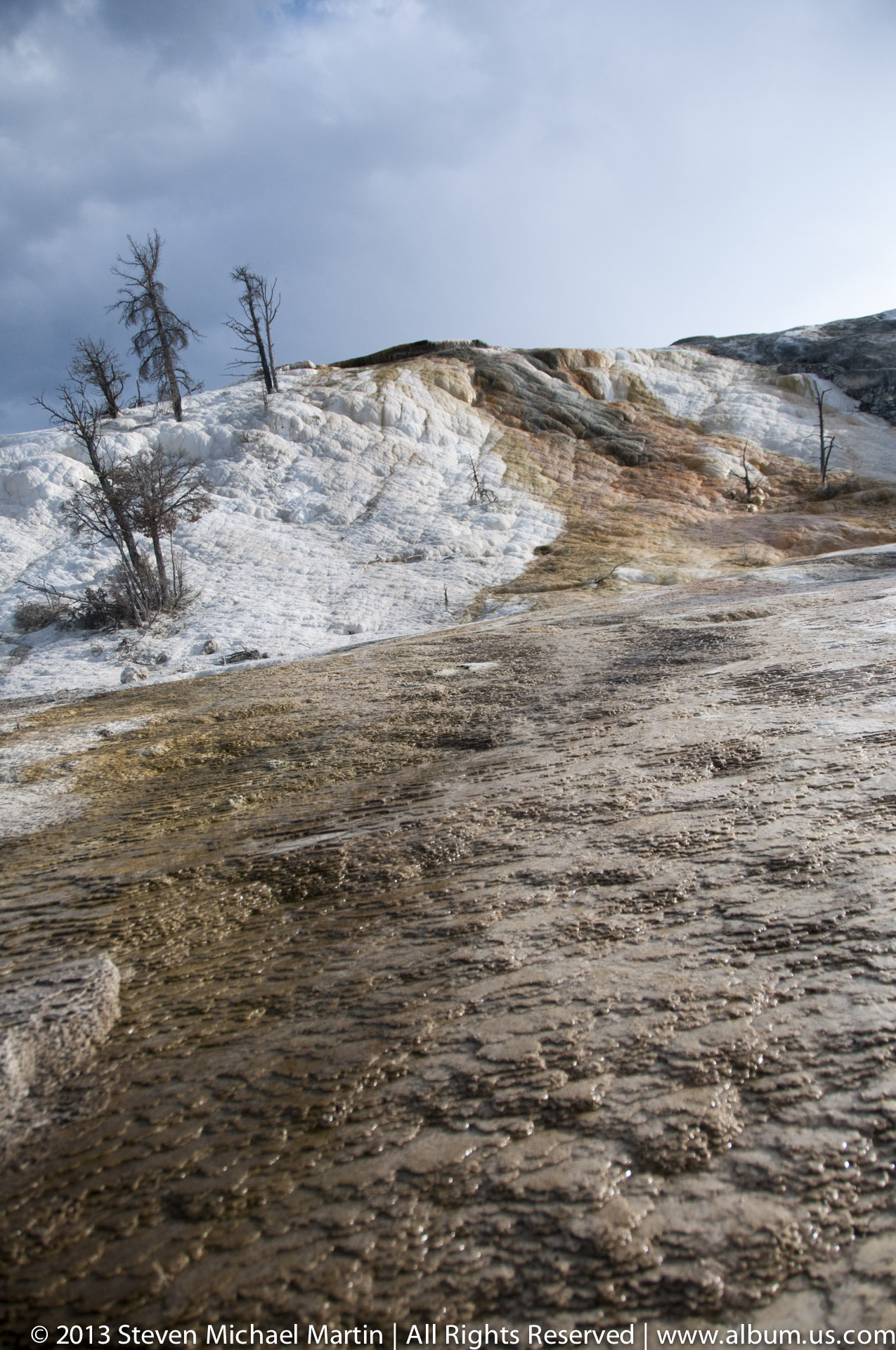
A broad, pale thermal terrace stretches beneath a flat gray sky. Thin water channels cross the mineral ground, while several bare trees stand along the low ridge and emphasize the openness of the site. The subdued light brings out the contrast between chalky deposits and darker wet patches, giving this view a quieter, more expansive feel than the close terrace studies nearby.
Caption
A broad, pale thermal terrace stretches beneath a flat gray sky. Thin water channels cross the mineral ground, while several bare trees stand along the low ridge and emphasize the openness of the site. The subdued light brings out the contrast between chalky deposits and darker wet patches, giving this view a quieter, more expansive feel than the close terrace studies nearby.
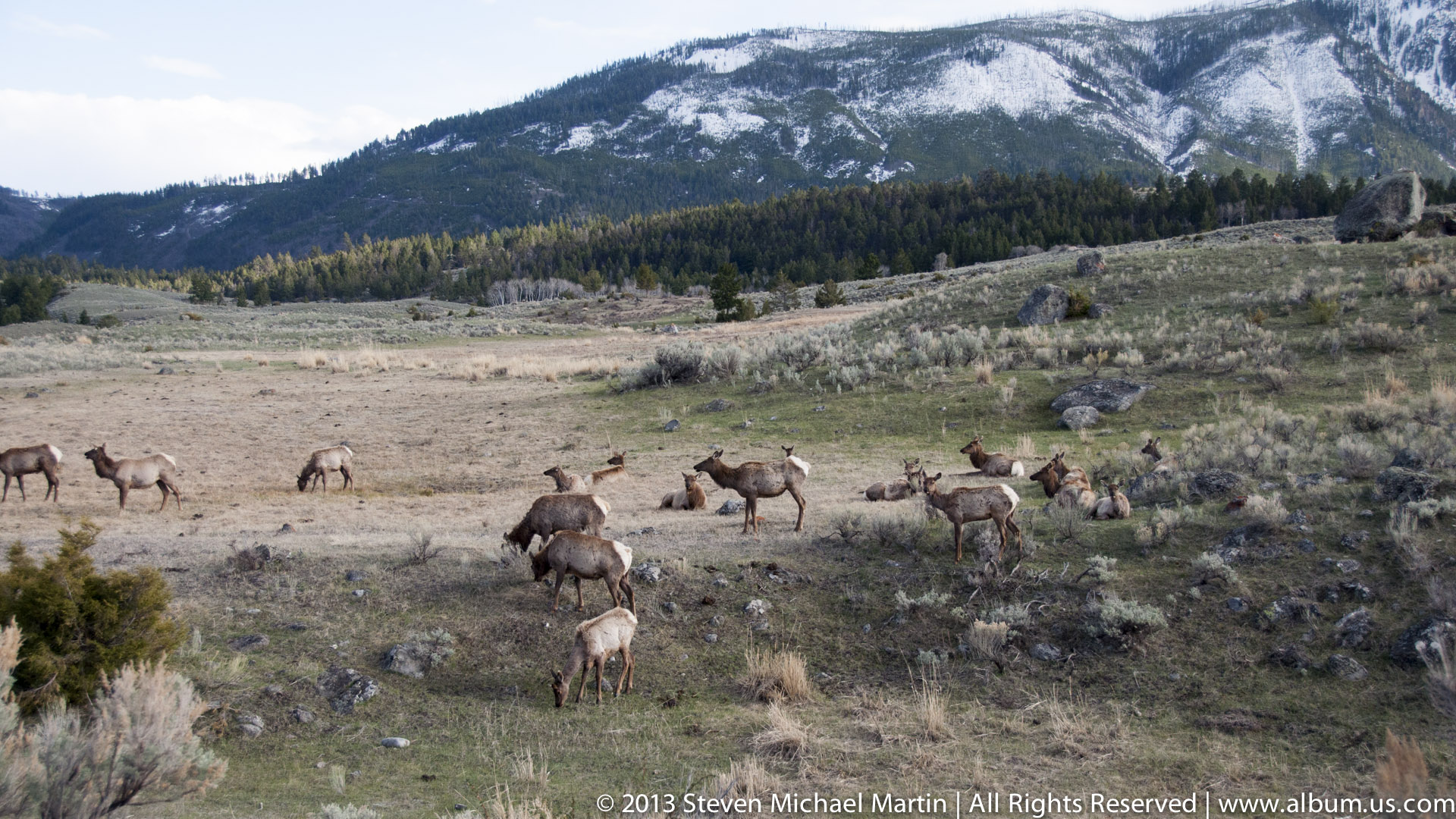
A scattered group of elk grazes across an open meadow, with a dark conifer forest and snow-streaked mountain rising behind them. The animals occupy different parts of the field, from the near slope to the distant tree line, giving the scene a broad sense of scale. This view places wildlife within a varied mountain habitat rather than isolating a single animal.
Caption
A scattered group of elk grazes across an open meadow, with a dark conifer forest and snow-streaked mountain rising behind them. The animals occupy different parts of the field, from the near slope to the distant tree line, giving the scene a broad sense of scale. This view places wildlife within a varied mountain habitat rather than isolating a single animal.
National Park Field Guide
Yellowstone National Park preserves geothermal landscapes created by volcanic activity beneath the Yellowstone Plateau. Heat from a large underground magma system produces geysers, hot springs, mud pots, and fumaroles that illustrate ongoing geological processes. These environments demonstrate how volcanic forces continue to shape terrain and influence ecosystems across the region.
🧭 Key Features
- Largest concentration of geysers in the world
- Yellowstone Caldera supervolcanic system
- Hydrothermal features including hot springs and mud pots
- Large intact temperate ecosystem supporting megafauna
- River canyons and waterfalls shaped by volcanic rock
🌄 Landscape Highlights
Geothermal basins display vivid colors created by thermophilic microorganisms adapted to extreme temperatures. Volcanic rock formations form cliffs and canyons shaped by erosion over time. Geysers illustrate periodic release of underground pressure created by heated groundwater.
🌎 Natural Systems
Yellowstone’s geothermal activity results from heat rising through fractures in the earth’s crust above a volcanic hotspot. Hydrothermal systems influence soil chemistry and create habitats supporting specialized microorganisms. The park’s forests and grasslands sustain diverse wildlife populations adapted to seasonal climate variation.
🦌 Wildlife Encountered
Wildlife sightings added an important dimension to this Yellowstone visit. Elk were observed in multiple locations, including calves resting quietly in meadow environments and small herds grazing near geothermal terrain. Pronghorn appeared in grassland areas of the park, demonstrating their remarkable speed and alert behavior. A marmot was seen among rocky slopes, while a bison moved steadily across rugged ground, illustrating the enduring presence of one of Yellowstone’s most iconic species. Waterfowl were observed on calm lake waters, and a black bear was encountered foraging near the forest edge, providing a memorable highlight that reflects the remarkable biodiversity of Yellowstone National Park.
📷 Photography Notes
- Steam enhances atmosphere in cool morning air
- Boardwalk perspectives help frame geothermal pools
- Wildlife photography opportunities in Lamar Valley
- Colorful hot springs benefit from overhead light
- Include scale references such as people or trees
- Weather changes produce varied visual conditions
🌱 Conservation Context
Yellowstone was the first national park established in the world, protecting geothermal features and wildlife habitat of global significance. Preservation helps maintain ecological processes and geological features that illustrate the interaction between volcanic forces and environmental systems.