Muley Twist Canyon – Capitol Reef National Park
Muley Twist Canyon preserves a remote desert landscape characterized by deeply eroded sandstone formations and winding canyon corridors shaped by long-term geological processes. The canyon’s distinctive name reflects the twisting route of the drainage system that gradually carved through layered sedimentary rock. The surrounding terrain illustrates the effects of tectonic uplift and erosion associated with the Waterpocket Fold.
The canyon contains narrow passages, exposed rock layers, and elevated viewpoints that reveal variations in sandstone composition. Differences in rock hardness contribute to the formation of cliffs, fins, and sculpted surfaces shaped by wind and water erosion. The relatively undeveloped setting reinforces the sense of isolation characteristic of more remote sections of Capitol Reef National Park.
Visitors encounter broad views of desert terrain and winding canyon routes that emphasize the scale of the Colorado Plateau. The landscape highlights the gradual influence of natural forces acting over extended geological time and demonstrates the diversity of canyon environments within the park.

A snow-covered mountain dominates the distant horizon, rising above a long red canyon rim and a snowy foreground slope. Low cloud partly veils the peak, while the warm rock band below remains sunlit. The composition layers the near ridge, canyon wall, and mountain into a winter panorama without requiring a more specific identification of the distant summit.
Caption
A snow-covered mountain dominates the distant horizon, rising above a long red canyon rim and a snowy foreground slope. Low cloud partly veils the peak, while the warm rock band below remains sunlit. The composition layers the near ridge, canyon wall, and mountain into a winter panorama without requiring a more specific identification of the distant summit.

A white vehicle rounds a bend on the Burr Trail, a narrow dirt road cut across colorful sandstone slopes. The tight curves and exposed setting make the route itself the subject, while the adjacent sign identifies its historic use by stockmen moving cattle to seasonal grazing lands. The image links present-day travel with a route shaped by rugged terrain.
Caption
A white vehicle rounds a bend on the Burr Trail, a narrow dirt road cut across colorful sandstone slopes. The tight curves and exposed setting make the route itself the subject, while the adjacent sign identifies its historic use by stockmen moving cattle to seasonal grazing lands. The image links present-day travel with a route shaped by rugged terrain.
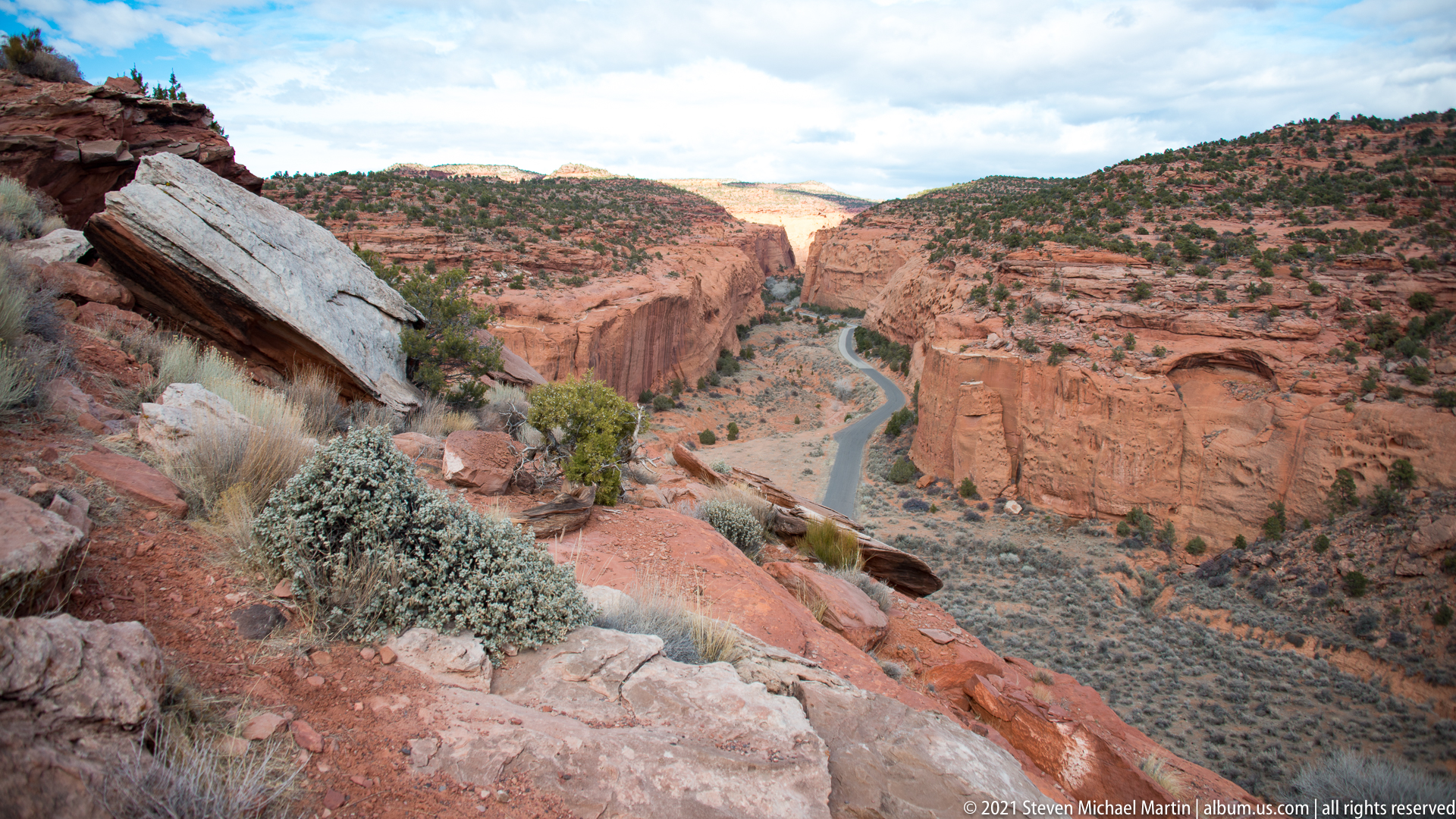
From a rocky overlook, the canyon bends away between steep red walls, with a narrow greenish channel tracing the floor. Pale boulders and scrub occupy the foreground, and the opposite rim recedes beneath a clouded sky. The elevated viewpoint reveals the canyon’s sinuous course and the contrast between its sheer walls and vegetated drainage.
Caption
From a rocky overlook, the canyon bends away between steep red walls, with a narrow greenish channel tracing the floor. Pale boulders and scrub occupy the foreground, and the opposite rim recedes beneath a clouded sky. The elevated viewpoint reveals the canyon’s sinuous course and the contrast between its sheer walls and vegetated drainage.
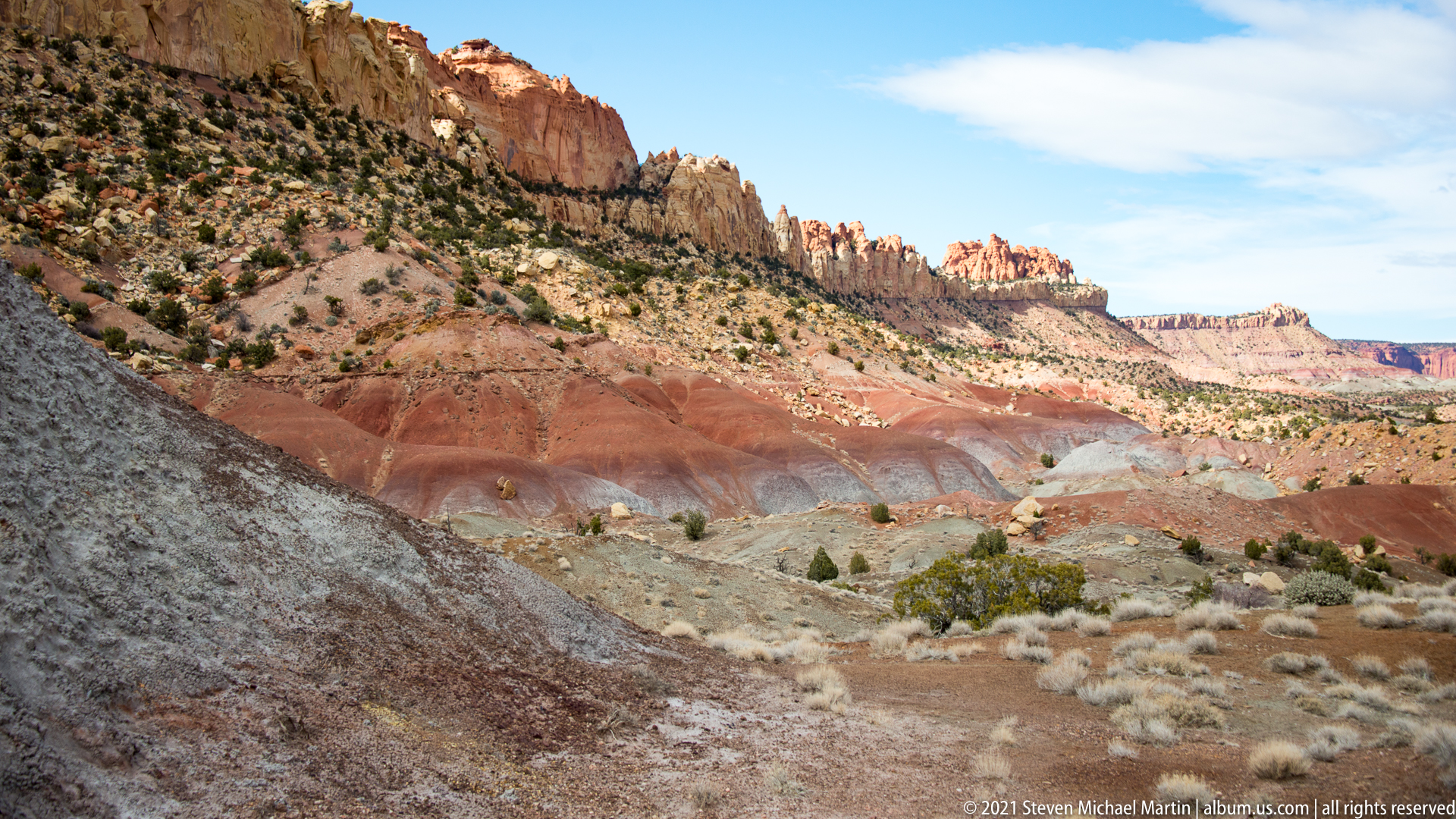
A long sandstone wall sweeps diagonally toward the distance, with red ledges above pale gray and cream slopes. Low shrubs dot the open foreground, while successive ridges recede toward the right edge. The wide framing emphasizes the canyon’s layered structure and the way vegetation follows the gentler shelves between exposed rock bands.
Caption
A long sandstone wall sweeps diagonally toward the distance, with red ledges above pale gray and cream slopes. Low shrubs dot the open foreground, while successive ridges recede toward the right edge. The wide framing emphasizes the canyon’s layered structure and the way vegetation follows the gentler shelves between exposed rock bands.
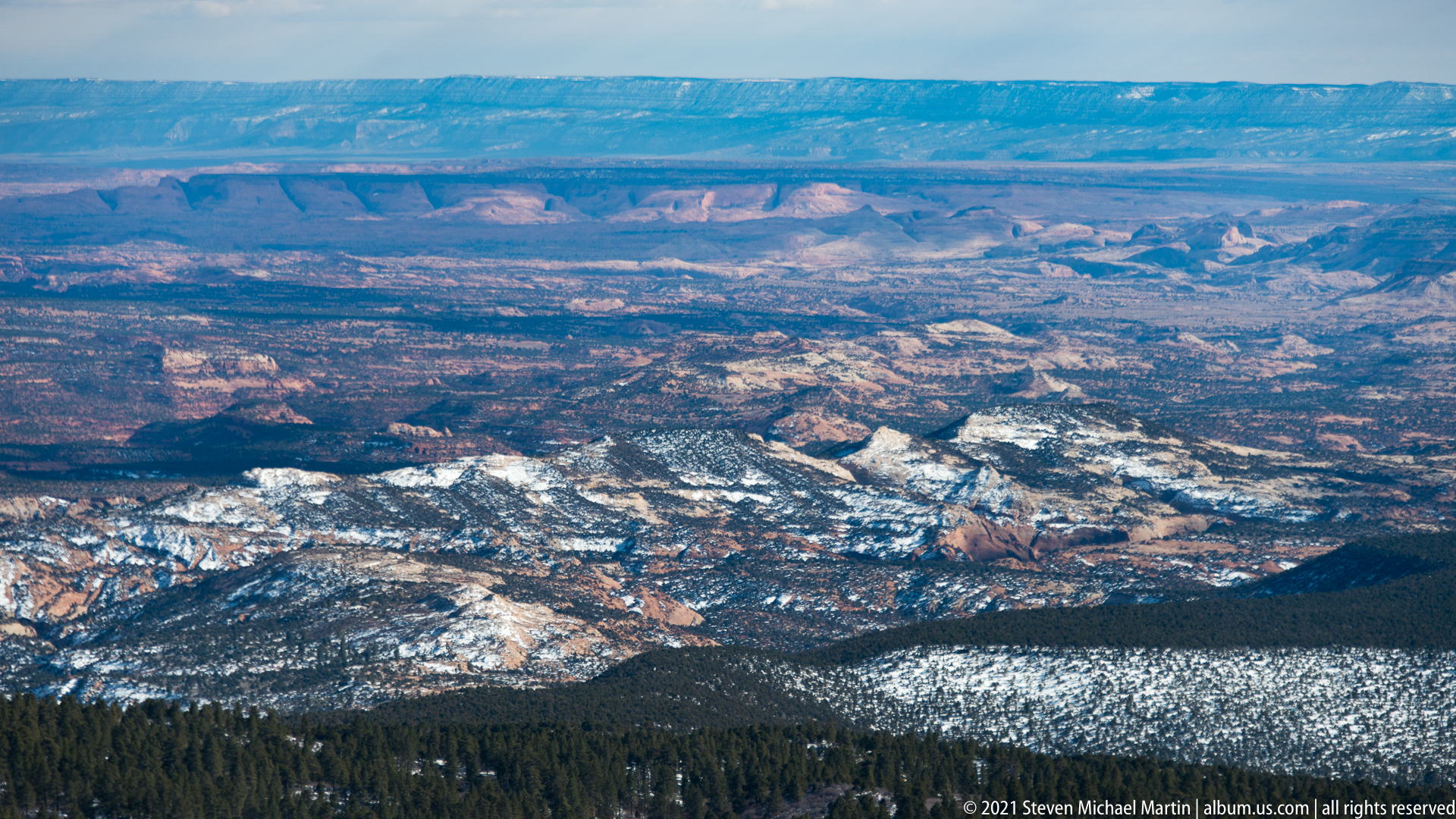
From a high overlook, snow-covered ridges descend toward an expanse of red and cream canyon walls. Dark evergreen forest bands the lower slopes, while a broad plateau forms the distant horizon. Winter snow picks out the contours of the nearer terrain and contrasts with the warmer exposed rock across the canyon.
Caption
From a high overlook, snow-covered ridges descend toward an expanse of red and cream canyon walls. Dark evergreen forest bands the lower slopes, while a broad plateau forms the distant horizon. Winter snow picks out the contours of the nearer terrain and contrasts with the warmer exposed rock across the canyon.
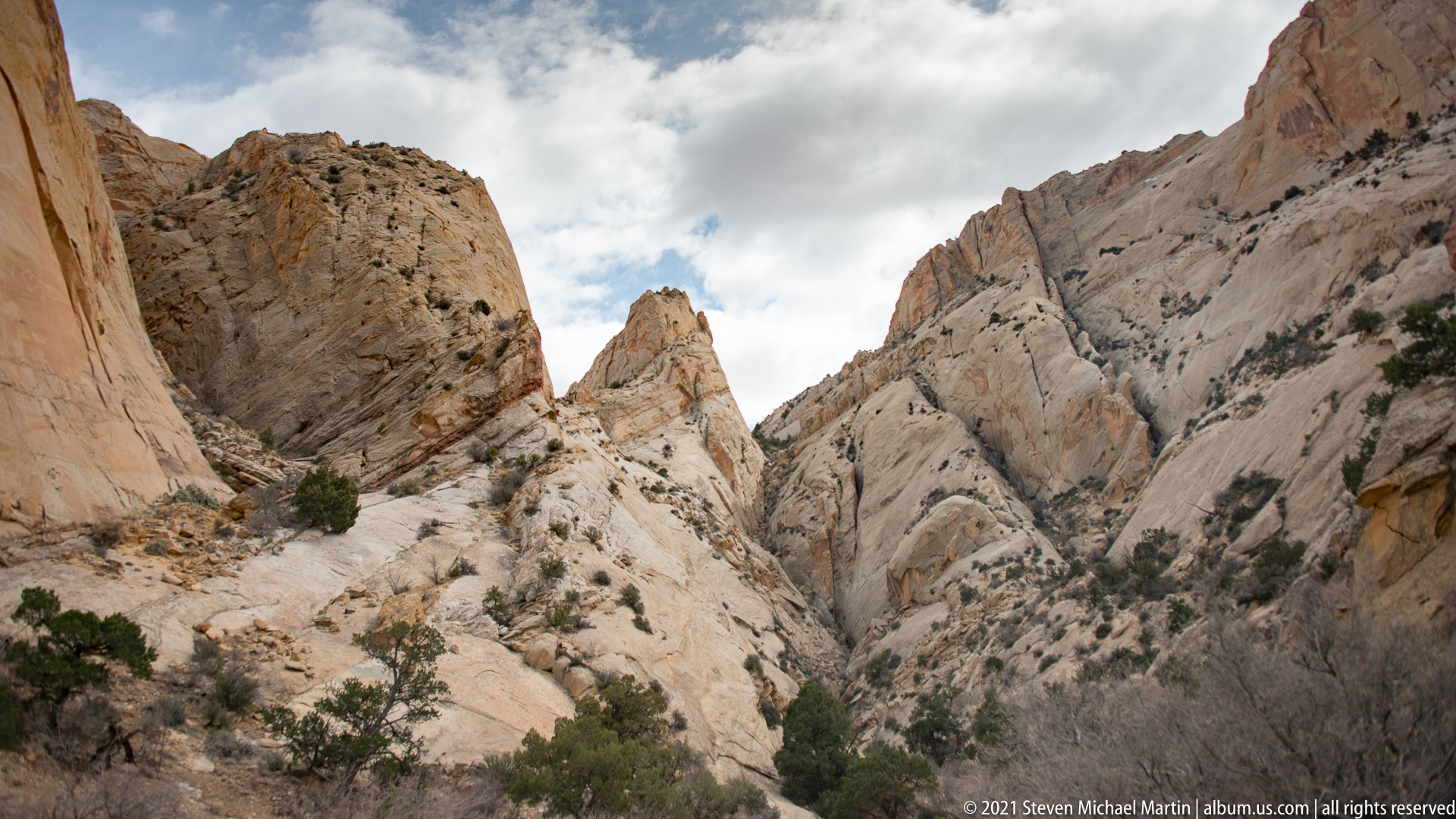
A narrow pale pinnacle rises from a tight gap between steep canyon walls, with a deep notch separating it from the surrounding slopes. Clouds gather above the opening, while dark shrubs mark the lower ledges. The central spire gives the canyon a distinct focal point and reveals how erosion has left a slender remnant between larger rock masses.
Caption
A narrow pale pinnacle rises from a tight gap between steep canyon walls, with a deep notch separating it from the surrounding slopes. Clouds gather above the opening, while dark shrubs mark the lower ledges. The central spire gives the canyon a distinct focal point and reveals how erosion has left a slender remnant between larger rock masses.
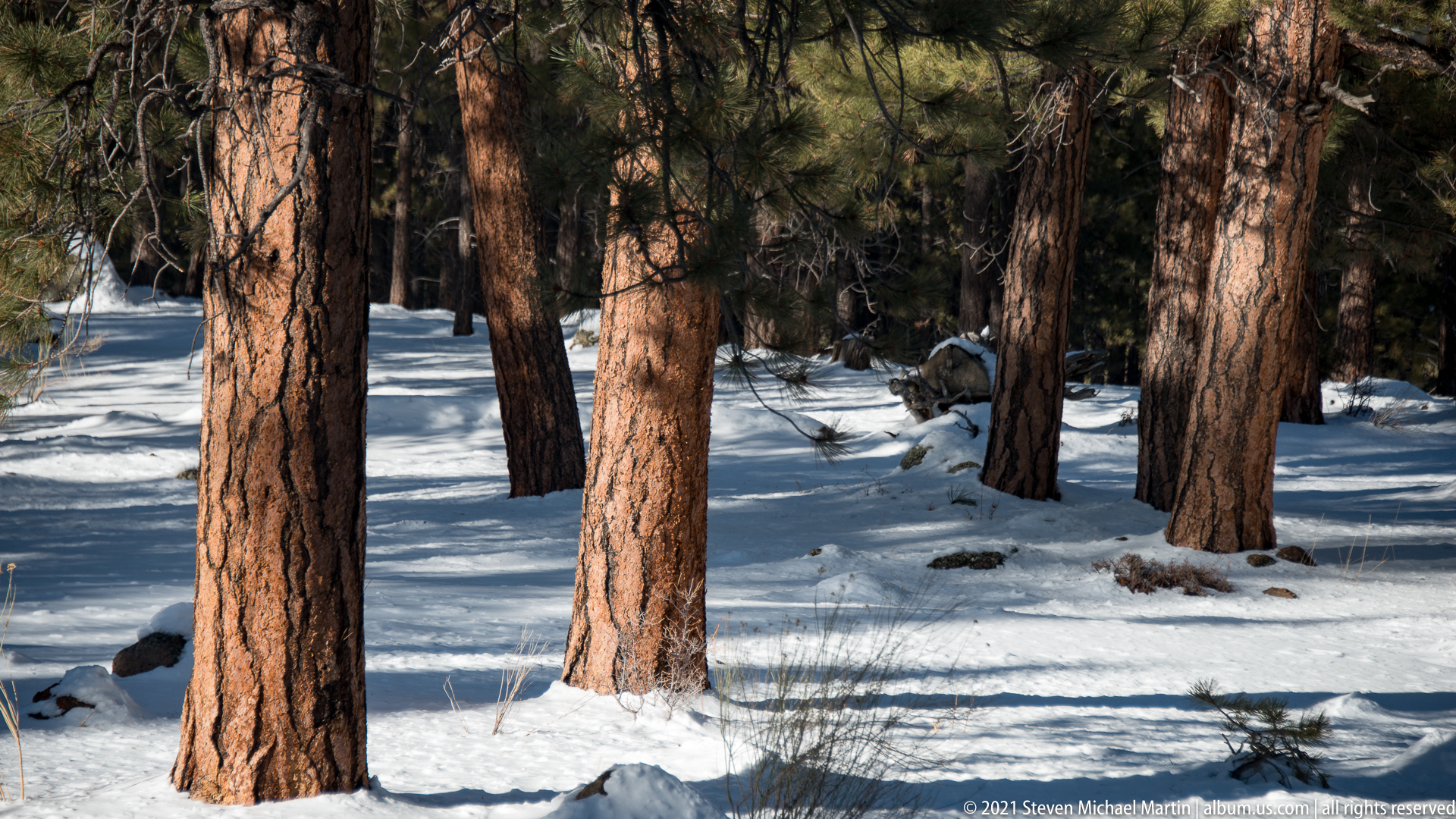
Straight, reddish-brown tree trunks rise through a snow-covered woodland, with dark evergreen branches overhead and long blue-gray shadows crossing the ground. The close framing keeps attention on bark texture, spacing and the contrast between warm trunks and bright snow. No trail or people are visible; the image presents a quiet stand of conifers under direct winter sunlight.
Caption
Straight, reddish-brown tree trunks rise through a snow-covered woodland, with dark evergreen branches overhead and long blue-gray shadows crossing the ground. The close framing keeps attention on bark texture, spacing and the contrast between warm trunks and bright snow. No trail or people are visible; the image presents a quiet stand of conifers under direct winter sunlight.
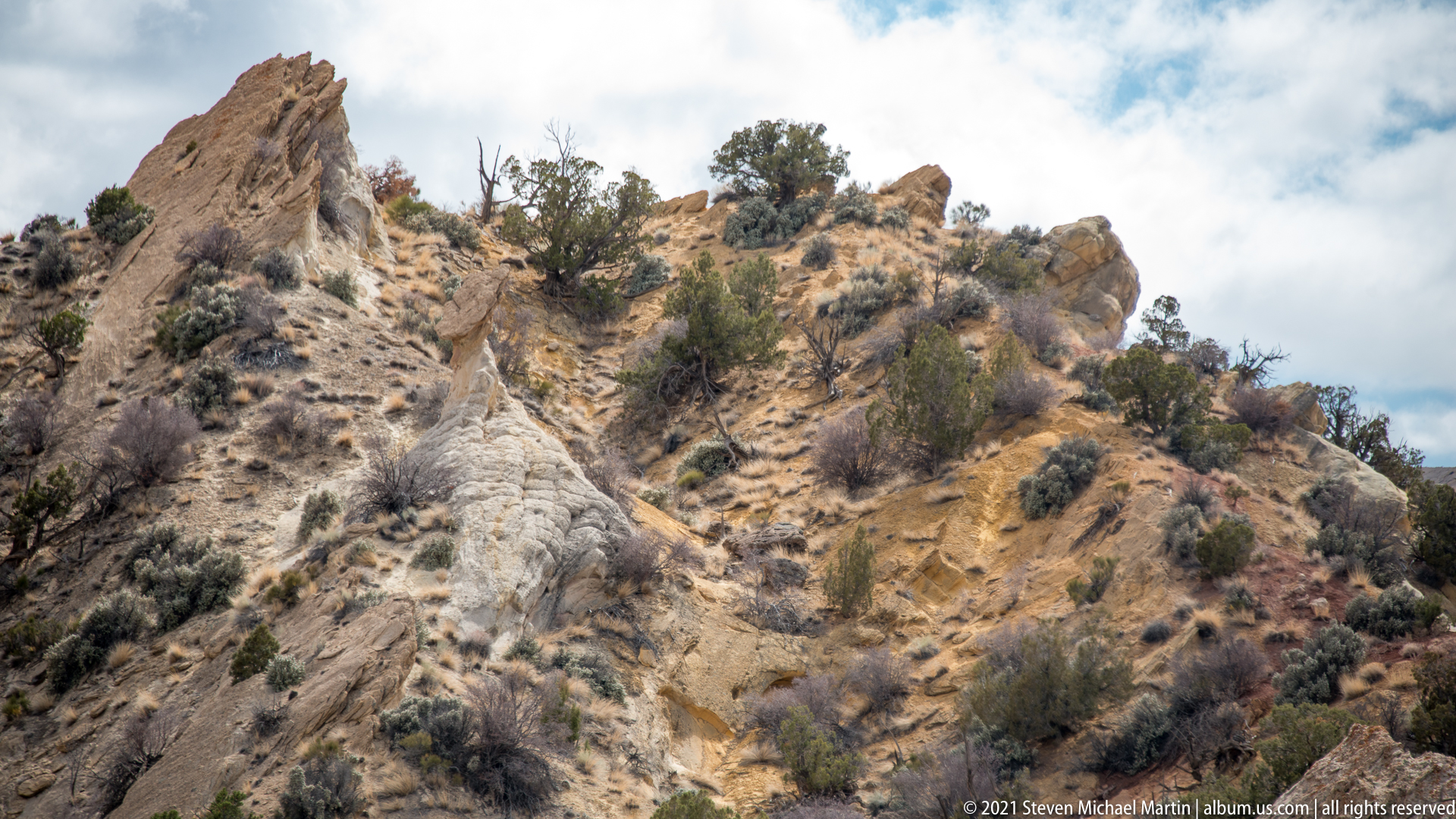
A steep slope of pale sandstone is cut by narrow ribs and shallow gullies, with scattered junipers and scrub rooted among fractured rock. Diagonal ridges lead upward toward larger blocks near the crest, while patches of dark vegetation accent the cream and ochre stone. The close framing emphasizes the slope’s texture and drainage lines rather than a distant panorama.
Caption
A steep slope of pale sandstone is cut by narrow ribs and shallow gullies, with scattered junipers and scrub rooted among fractured rock. Diagonal ridges lead upward toward larger blocks near the crest, while patches of dark vegetation accent the cream and ochre stone. The close framing emphasizes the slope’s texture and drainage lines rather than a distant panorama.
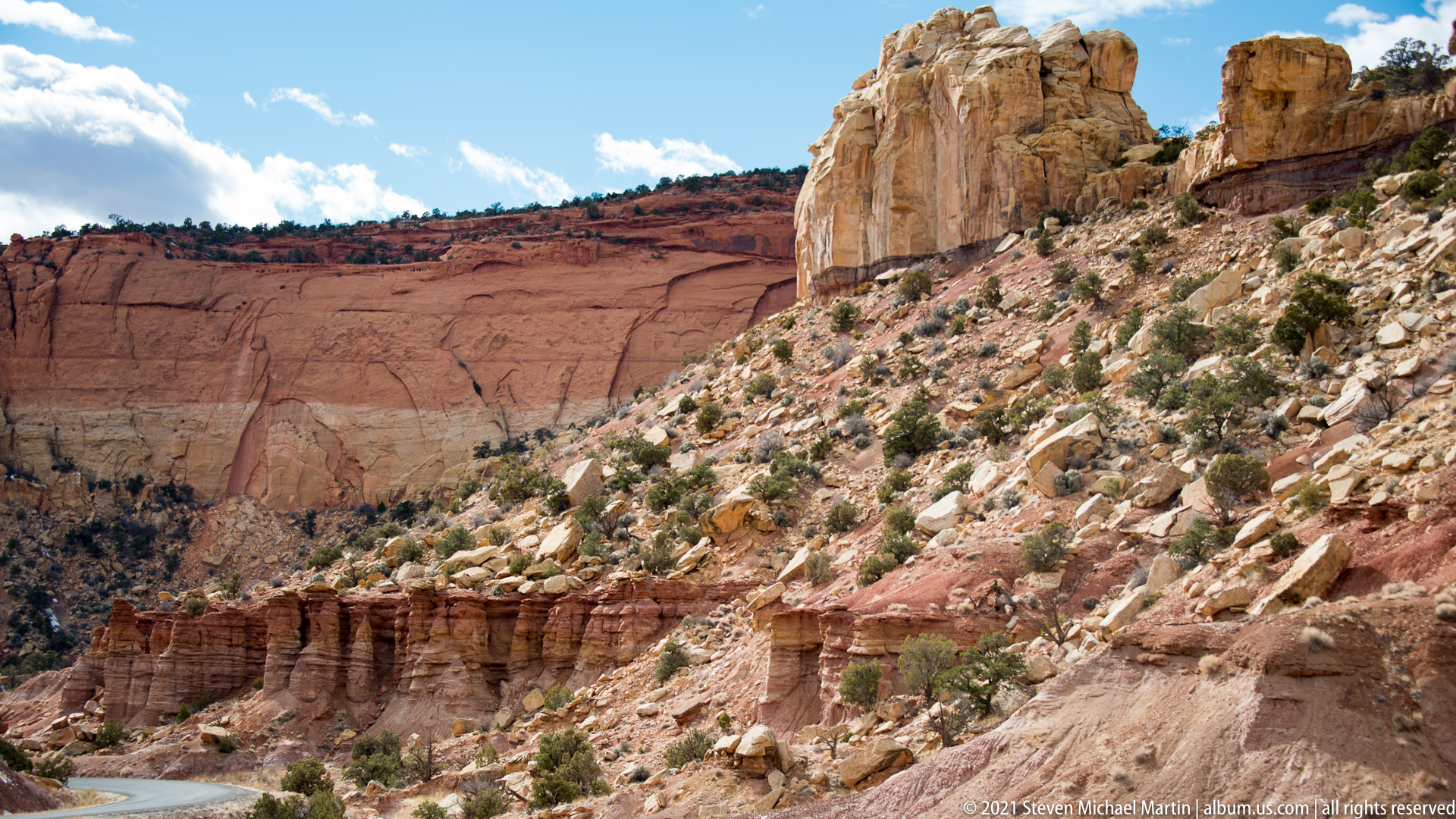
A high red cliff rises above a lower, horizontally banded rock shelf, while a narrow blue-green waterway curves through the bottom left. A pale sandstone tower stands on the slope to the right, separating the close formations from the open valley beyond. The composition links the canyon’s layered walls with the river corridor at their base.
Caption
A high red cliff rises above a lower, horizontally banded rock shelf, while a narrow blue-green waterway curves through the bottom left. A pale sandstone tower stands on the slope to the right, separating the close formations from the open valley beyond. The composition links the canyon’s layered walls with the river corridor at their base.
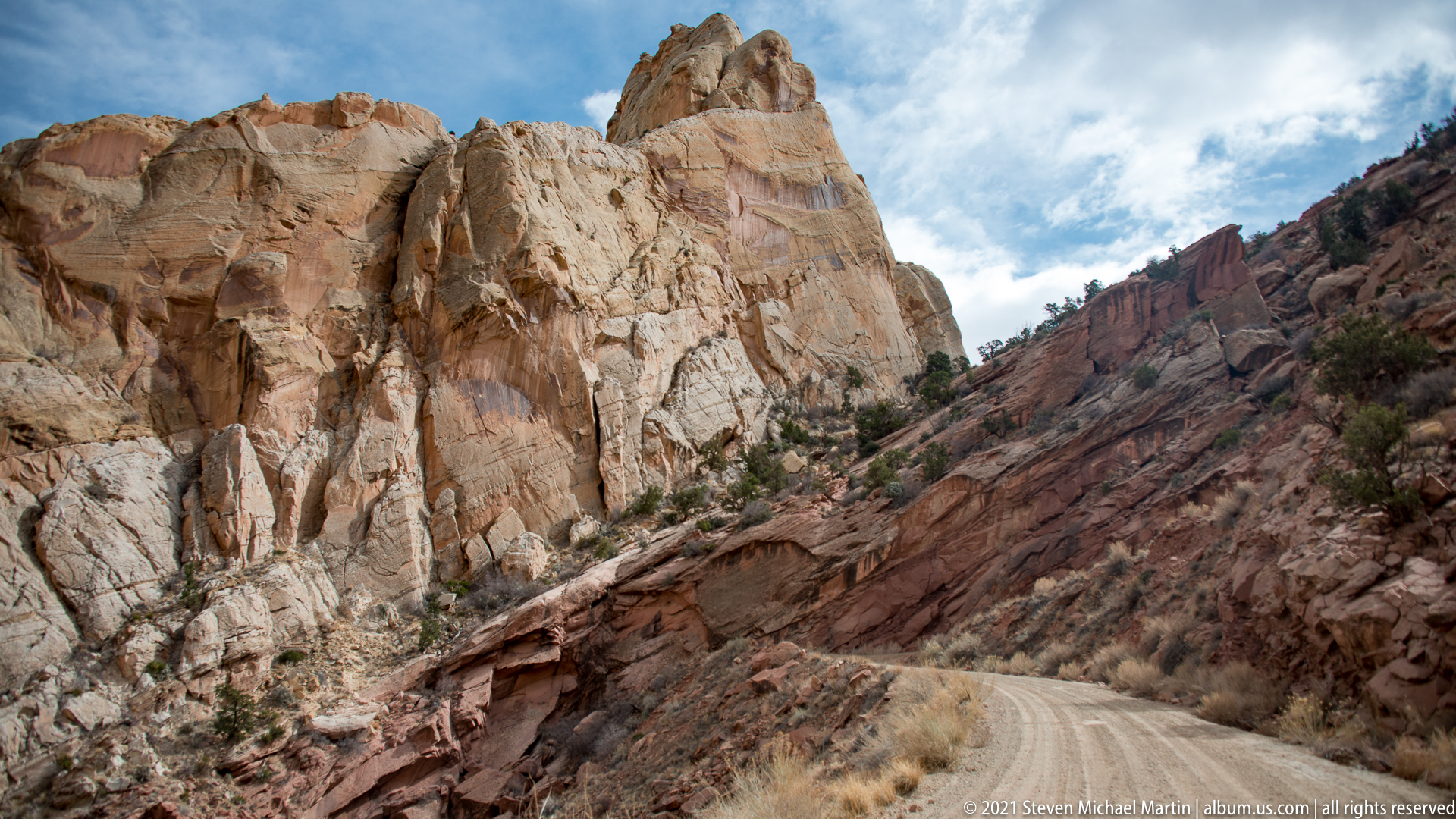
A narrow unpaved road follows the base of a tall, sloping sandstone wall. The rock face rises steeply on the left, with red and gray outcrops visible beyond the curve; grasses and low shrubs edge the track. The road’s bend disappears behind the wall, giving the scene a close, enclosed perspective through the open canyon terrain.
Caption
A narrow unpaved road follows the base of a tall, sloping sandstone wall. The rock face rises steeply on the left, with red and gray outcrops visible beyond the curve; grasses and low shrubs edge the track. The road’s bend disappears behind the wall, giving the scene a close, enclosed perspective through the open canyon terrain.
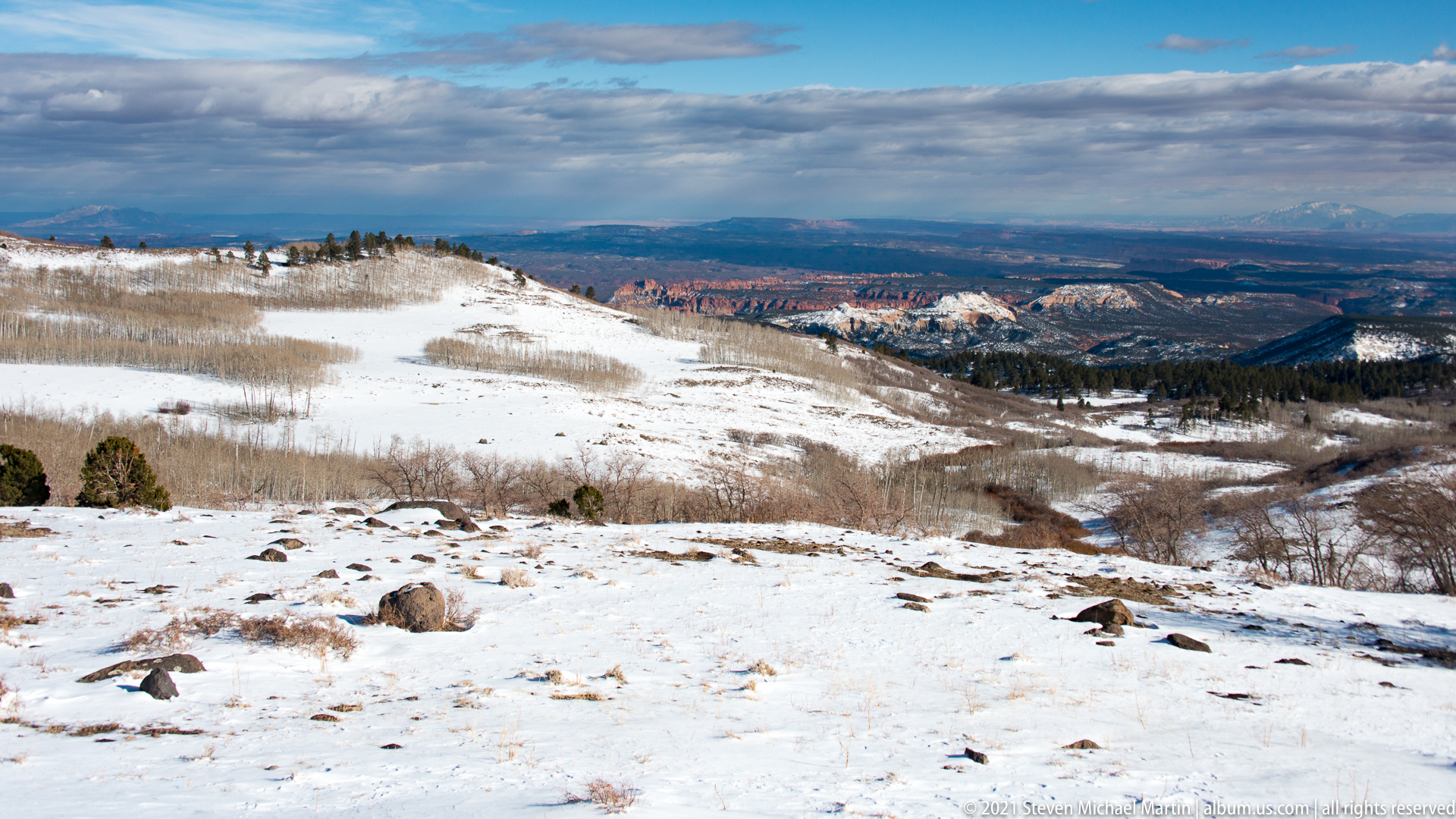
An open snowy slope descends toward a forested valley and distant red canyon walls. Scattered rocks and shrubs break the white foreground, while a long band of cloud stretches above the horizon. The wide view gives more weight to the immediate high-country terrain than the canyon itself, showing the transition from snow-covered ground to the warmer colored basin beyond.
Caption
An open snowy slope descends toward a forested valley and distant red canyon walls. Scattered rocks and shrubs break the white foreground, while a long band of cloud stretches above the horizon. The wide view gives more weight to the immediate high-country terrain than the canyon itself, showing the transition from snow-covered ground to the warmer colored basin beyond.

A close view of the park map locates the viewer near the route between Halls Creek and the Burr Trail switchbacks. Red dashed roads, mileage labels, creek lines and a “You are here” pointer clarify the relationship between canyon access and nearby features. The map functions as a practical orientation aid for travel through this remote part of Capitol Reef National Park.
Caption
A close view of the park map locates the viewer near the route between Halls Creek and the Burr Trail switchbacks. Red dashed roads, mileage labels, creek lines and a “You are here” pointer clarify the relationship between canyon access and nearby features. The map functions as a practical orientation aid for travel through this remote part of Capitol Reef National Park.
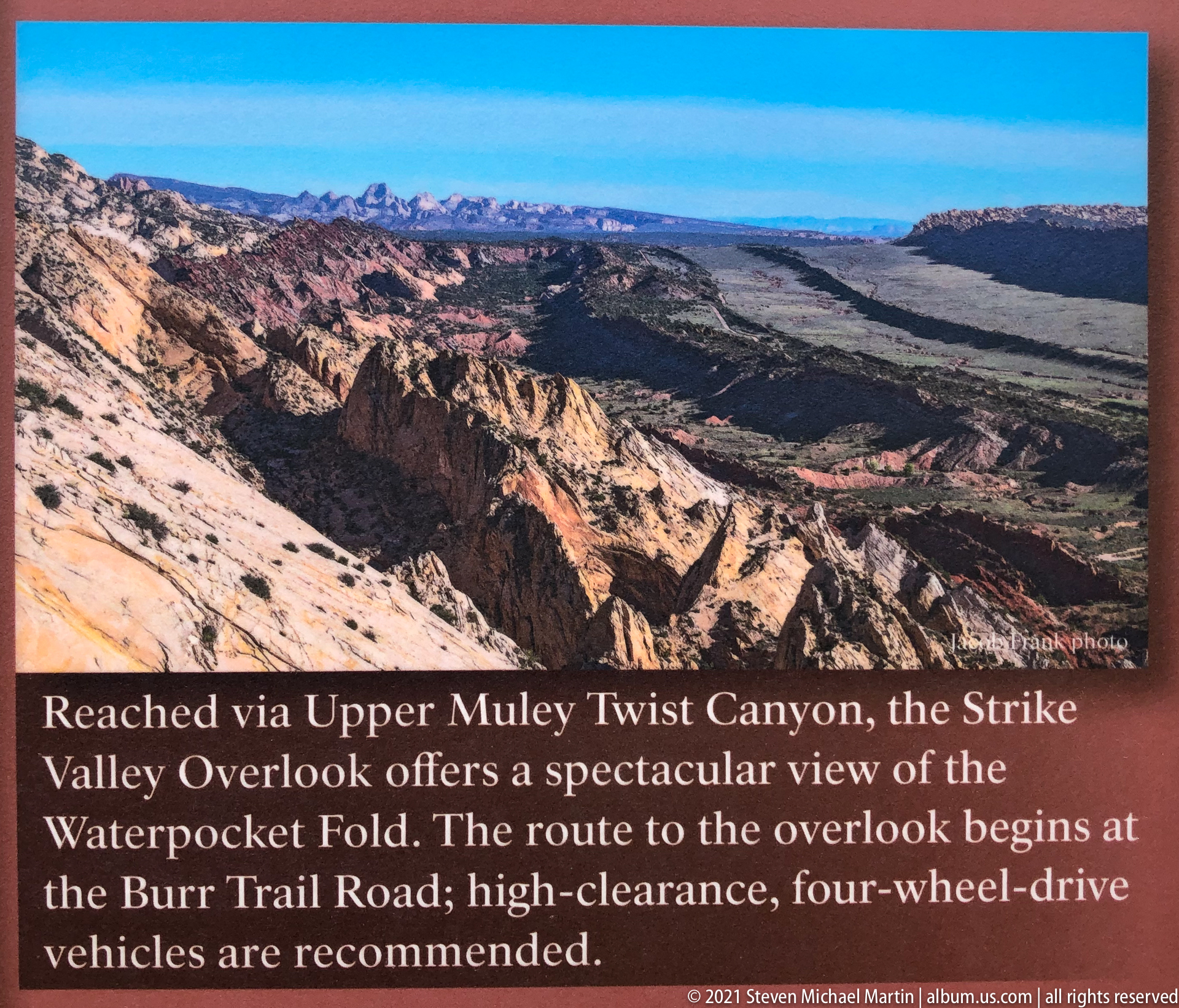
From Strike Valley Overlook, the view opens across a broad, dark valley toward the long ridges and folded strata of the Waterpocket Fold. Pale sandstone descends from the foreground into sculpted orange and red formations, emphasizing the scale of the terrain. The sign panel identifies this viewpoint and notes its access by Upper Muley Twist Canyon and the Burr Trail.
Caption
From Strike Valley Overlook, the view opens across a broad, dark valley toward the long ridges and folded strata of the Waterpocket Fold. Pale sandstone descends from the foreground into sculpted orange and red formations, emphasizing the scale of the terrain. The sign panel identifies this viewpoint and notes its access by Upper Muley Twist Canyon and the Burr Trail.

The viewpoint looks down across a broad, sparsely vegetated drainage, where a pale winding track crosses the valley floor beneath variegated ridges. The scale of the view makes the open southern landscape the central subject rather than an individual formation. Text printed below identifies Halls Creek Overlook and describes the park’s remote southern wilderness.
Caption
The viewpoint looks down across a broad, sparsely vegetated drainage, where a pale winding track crosses the valley floor beneath variegated ridges. The scale of the view makes the open southern landscape the central subject rather than an individual formation. Text printed below identifies Halls Creek Overlook and describes the park’s remote southern wilderness.
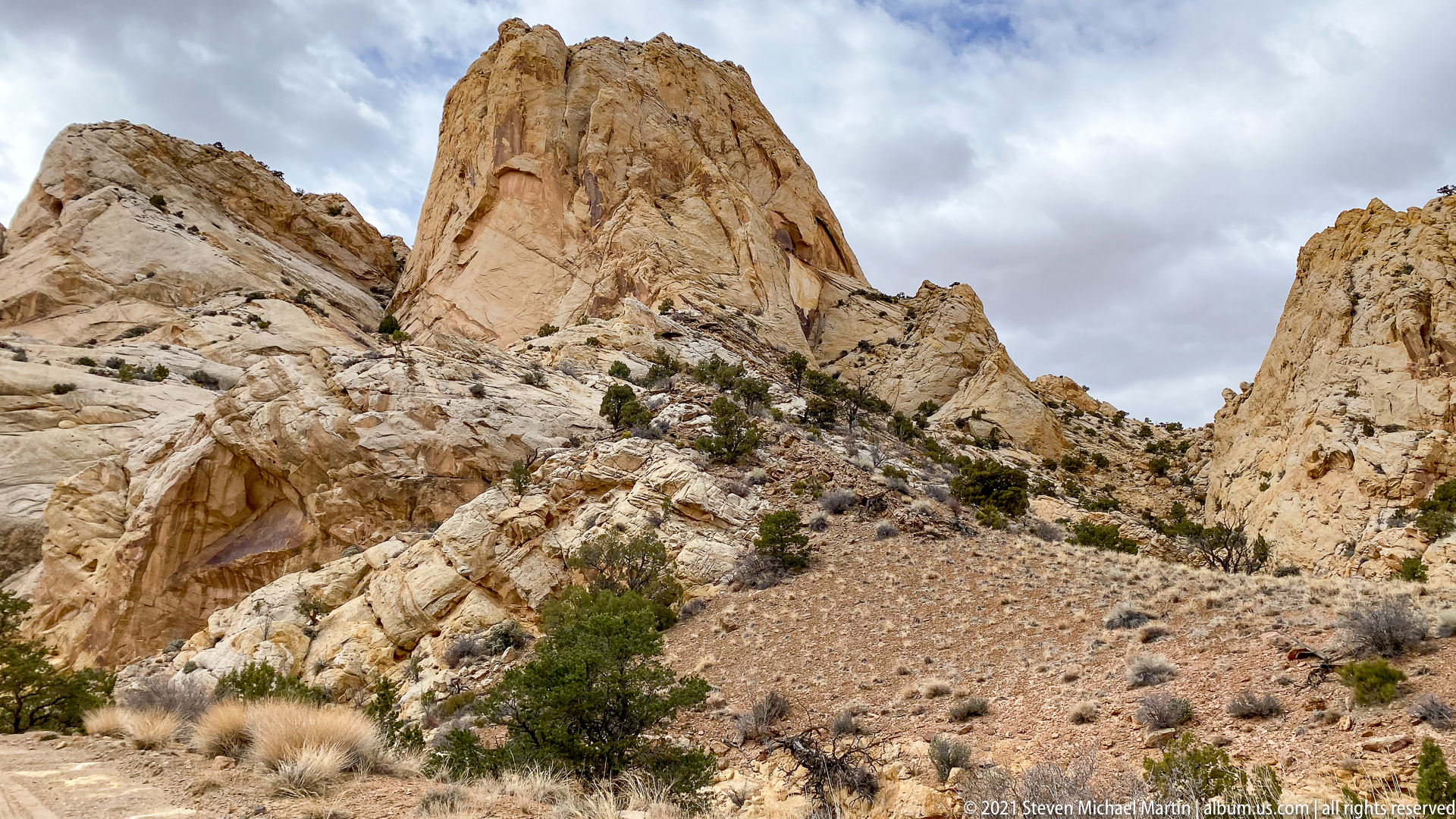
A cluster of massive cream-colored sandstone pinnacles rises from a sloping, shrub-dotted foreground. Their rounded crowns, vertical fissures and weathered surfaces create a close, upward-looking composition, with cloud cover softening the light on the pale rock. Low desert plants and loose stones establish the formations’ scale without obscuring their sculptural outlines.
Caption
A cluster of massive cream-colored sandstone pinnacles rises from a sloping, shrub-dotted foreground. Their rounded crowns, vertical fissures and weathered surfaces create a close, upward-looking composition, with cloud cover softening the light on the pale rock. Low desert plants and loose stones establish the formations’ scale without obscuring their sculptural outlines.

Seen from farther back, sandstone towers form a broken crest above a gently rising slope of dry grass, shrubs and scattered juniper-like trees. This wider composition places the pale rock in its scrubland setting and includes more foreground than the preceding close view. A small glimpse of surrounding red-rock country appears beyond the formations.
Caption
Seen from farther back, sandstone towers form a broken crest above a gently rising slope of dry grass, shrubs and scattered juniper-like trees. This wider composition places the pale rock in its scrubland setting and includes more foreground than the preceding close view. A small glimpse of surrounding red-rock country appears beyond the formations.

Rounded pale sandstone cliffs fill the middle distance, their fractured faces and sloping ledges broken by small trees and brush. A broad gravelly wash occupies the foreground, leading the eye toward the higher formations beneath a partly cloudy sky. The view records varied surfaces of exposed rock, from smooth slopes to angular breaks and darker seams.
Caption
Rounded pale sandstone cliffs fill the middle distance, their fractured faces and sloping ledges broken by small trees and brush. A broad gravelly wash occupies the foreground, leading the eye toward the higher formations beneath a partly cloudy sky. The view records varied surfaces of exposed rock, from smooth slopes to angular breaks and darker seams.
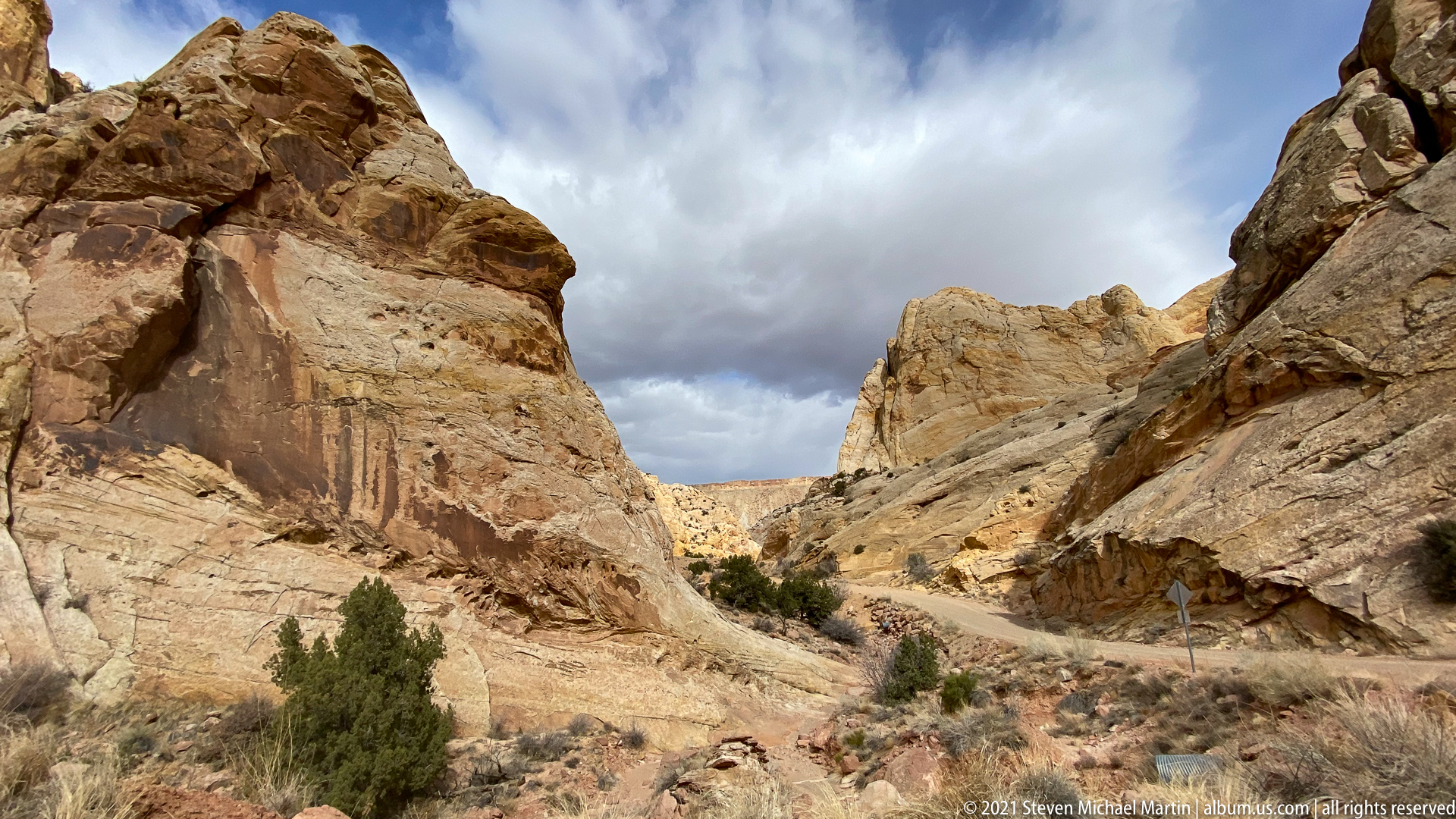
A pale dirt road bends through a narrow passage between high sandstone walls, with a large shadowed face dominating the left side and lighter formations closing the view ahead. A small roadside sign provides a human-scale marker beside the track. The road’s placement between the rock masses conveys the confined character of this stretch of canyon route.
Caption
A pale dirt road bends through a narrow passage between high sandstone walls, with a large shadowed face dominating the left side and lighter formations closing the view ahead. A small roadside sign provides a human-scale marker beside the track. The road’s placement between the rock masses conveys the confined character of this stretch of canyon route.
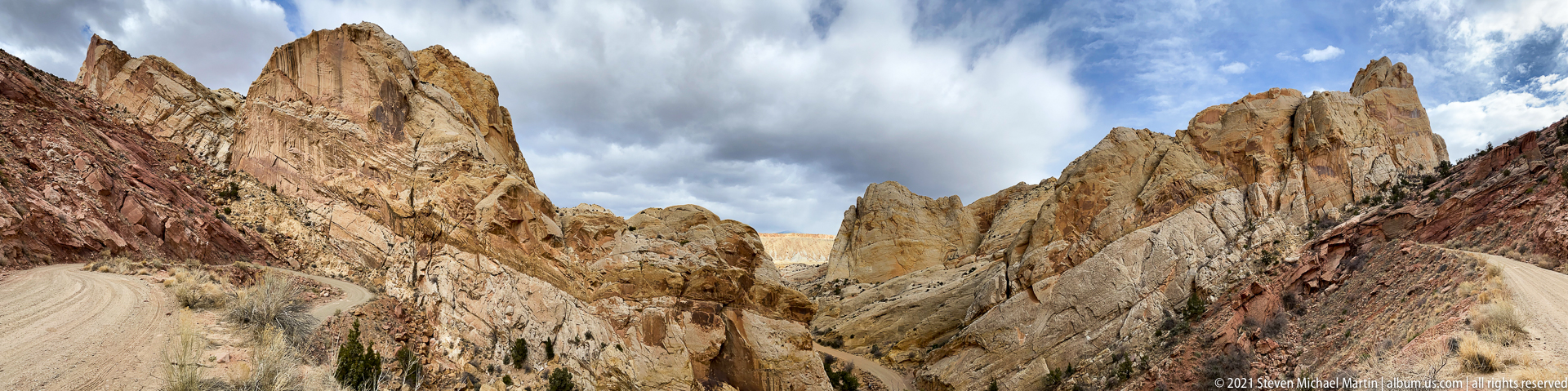
The road doubles back sharply through a deep cleft, its pale surface tracing a compact series of bends beneath towering cream and rust-colored walls. The compressed perspective emphasizes the steep enclosure and the engineering of the route across rough terrain. Broken rock and sparse vegetation cling to the slopes, while the cloudy sky opens above the canyon corridor.
Caption
The road doubles back sharply through a deep cleft, its pale surface tracing a compact series of bends beneath towering cream and rust-colored walls. The compressed perspective emphasizes the steep enclosure and the engineering of the route across rough terrain. Broken rock and sparse vegetation cling to the slopes, while the cloudy sky opens above the canyon corridor.
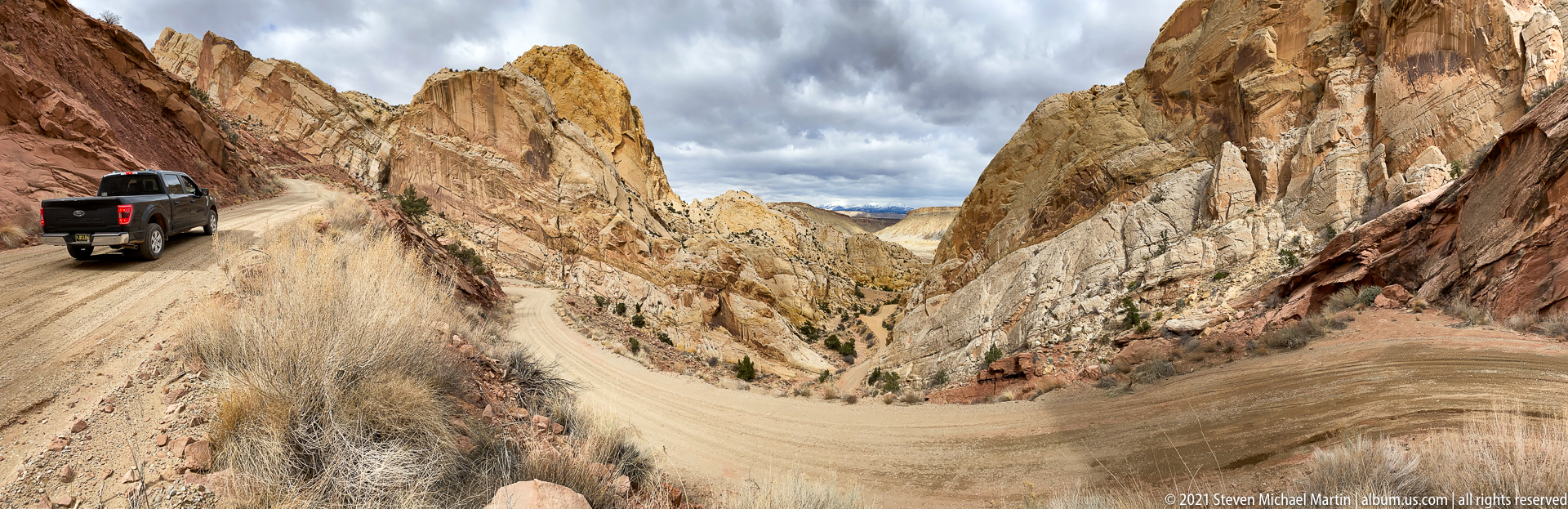
A dark pickup climbs or descends a narrow shelf road, seen from behind as it rounds a sharp bend between layered sandstone walls. The vehicle gives scale to the tight road and steep drop beside it; the pale track occupies much of the lower frame before disappearing around the rock. This is a road-level view of travel through the canyon.
Caption
A dark pickup climbs or descends a narrow shelf road, seen from behind as it rounds a sharp bend between layered sandstone walls. The vehicle gives scale to the tight road and steep drop beside it; the pale track occupies much of the lower frame before disappearing around the rock. This is a road-level view of travel through the canyon.
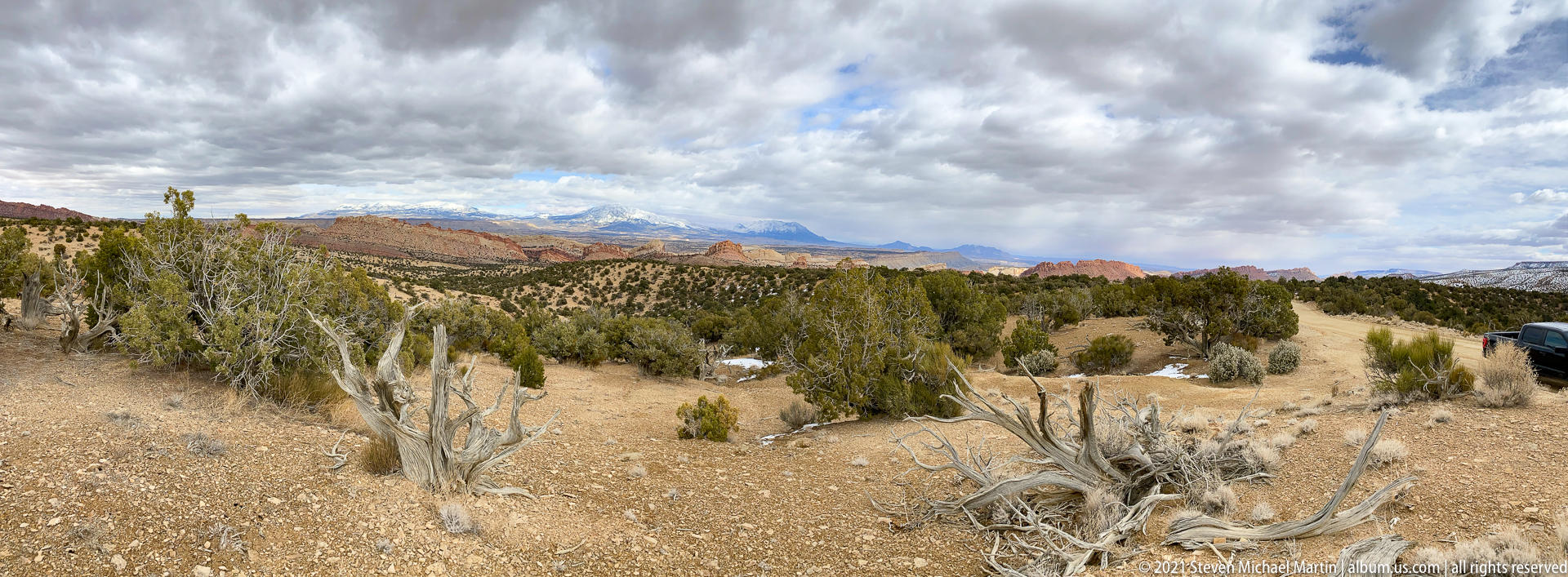
A wide plateau opens toward distant red and cream cliffs, with low junipers and dry grasses spread across the foreground. A vehicle is partly visible at the far right, suggesting a roadside viewpoint without dominating the landscape. Patches of lingering snow and a cloud-heavy sky add seasonal detail to the otherwise open, muted terrain.
Caption
A wide plateau opens toward distant red and cream cliffs, with low junipers and dry grasses spread across the foreground. A vehicle is partly visible at the far right, suggesting a roadside viewpoint without dominating the landscape. Patches of lingering snow and a cloud-heavy sky add seasonal detail to the otherwise open, muted terrain.
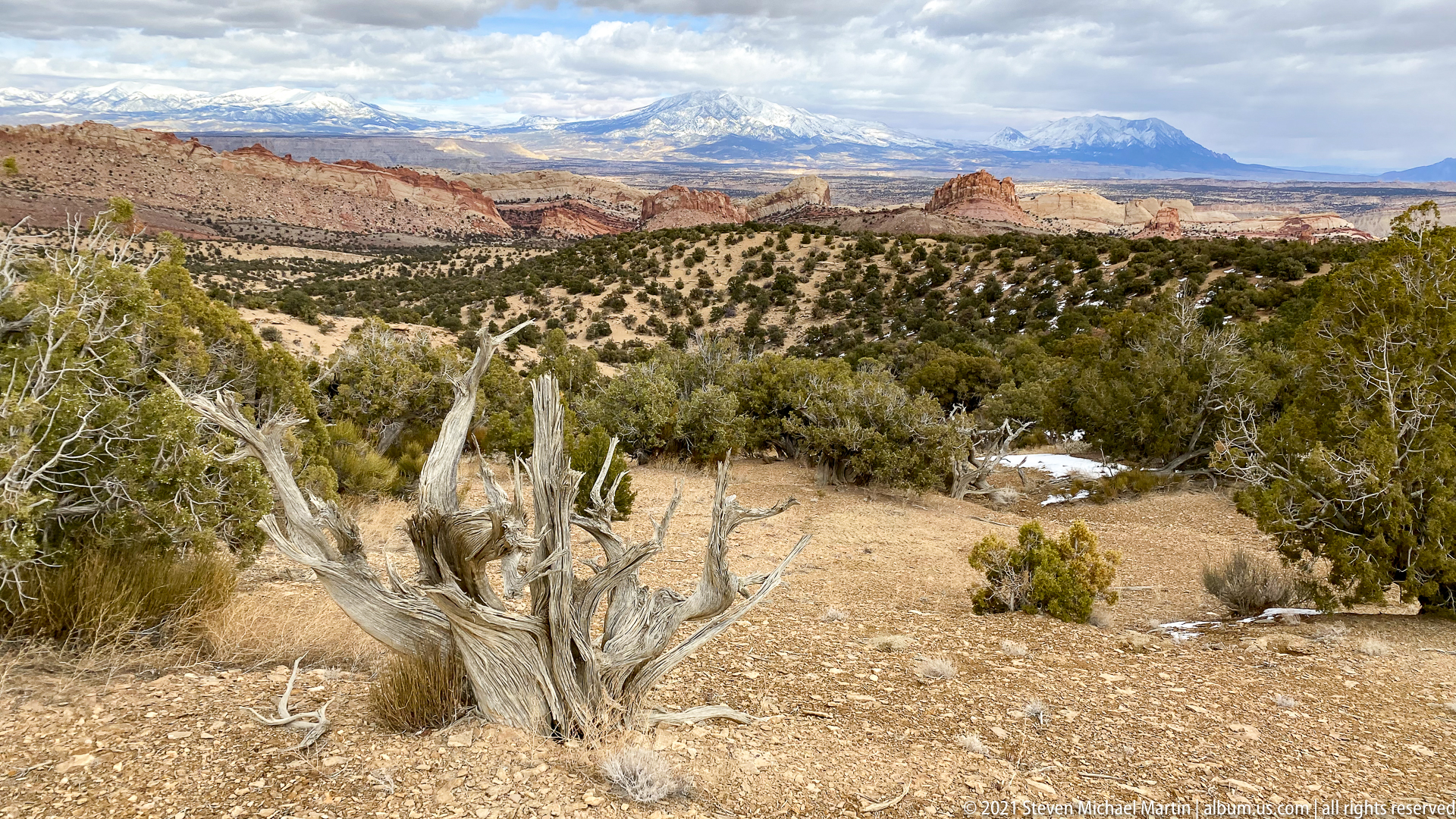
A bleached juniper trunk twists into several angular branches across the foreground, its weathered wood sharply contrasting with the tawny ground. Behind it, scattered evergreen shrubs lead toward red-rock ridges and a distant snow-bright mountain under low clouds. The tree’s intricate form gives this broad landscape a strong foreground anchor.
Caption
A bleached juniper trunk twists into several angular branches across the foreground, its weathered wood sharply contrasting with the tawny ground. Behind it, scattered evergreen shrubs lead toward red-rock ridges and a distant snow-bright mountain under low clouds. The tree’s intricate form gives this broad landscape a strong foreground anchor.
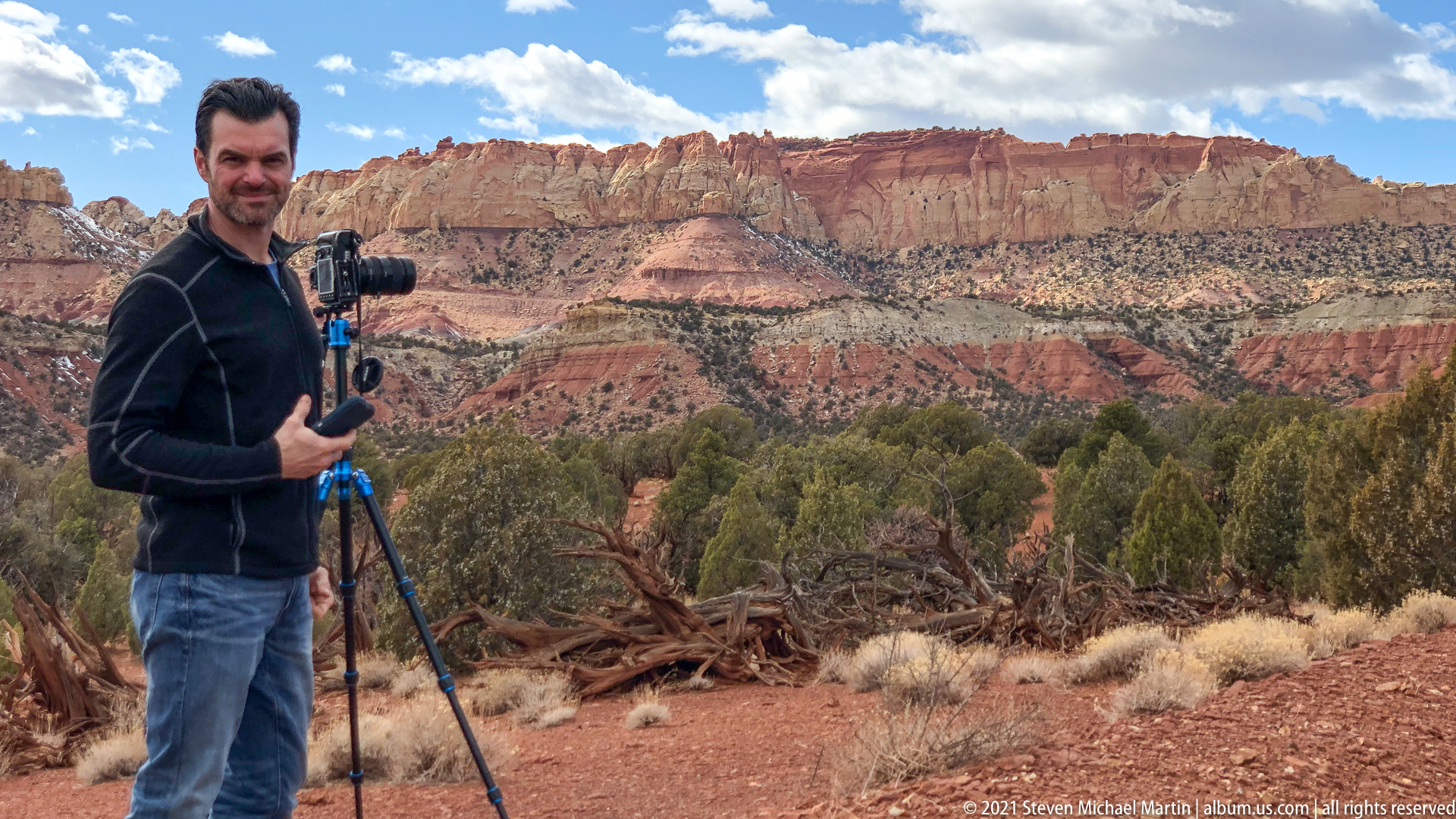
A man in a dark jacket stands beside a tripod-mounted camera at the edge of a red-soil overlook. Behind him, a layered escarpment and shrub-covered slopes recede across the frame, placing landscape photography within the terrain being observed. His relaxed stance and visible equipment distinguish this image from the surrounding scenic views.
Caption
A man in a dark jacket stands beside a tripod-mounted camera at the edge of a red-soil overlook. Behind him, a layered escarpment and shrub-covered slopes recede across the frame, placing landscape photography within the terrain being observed. His relaxed stance and visible equipment distinguish this image from the surrounding scenic views.
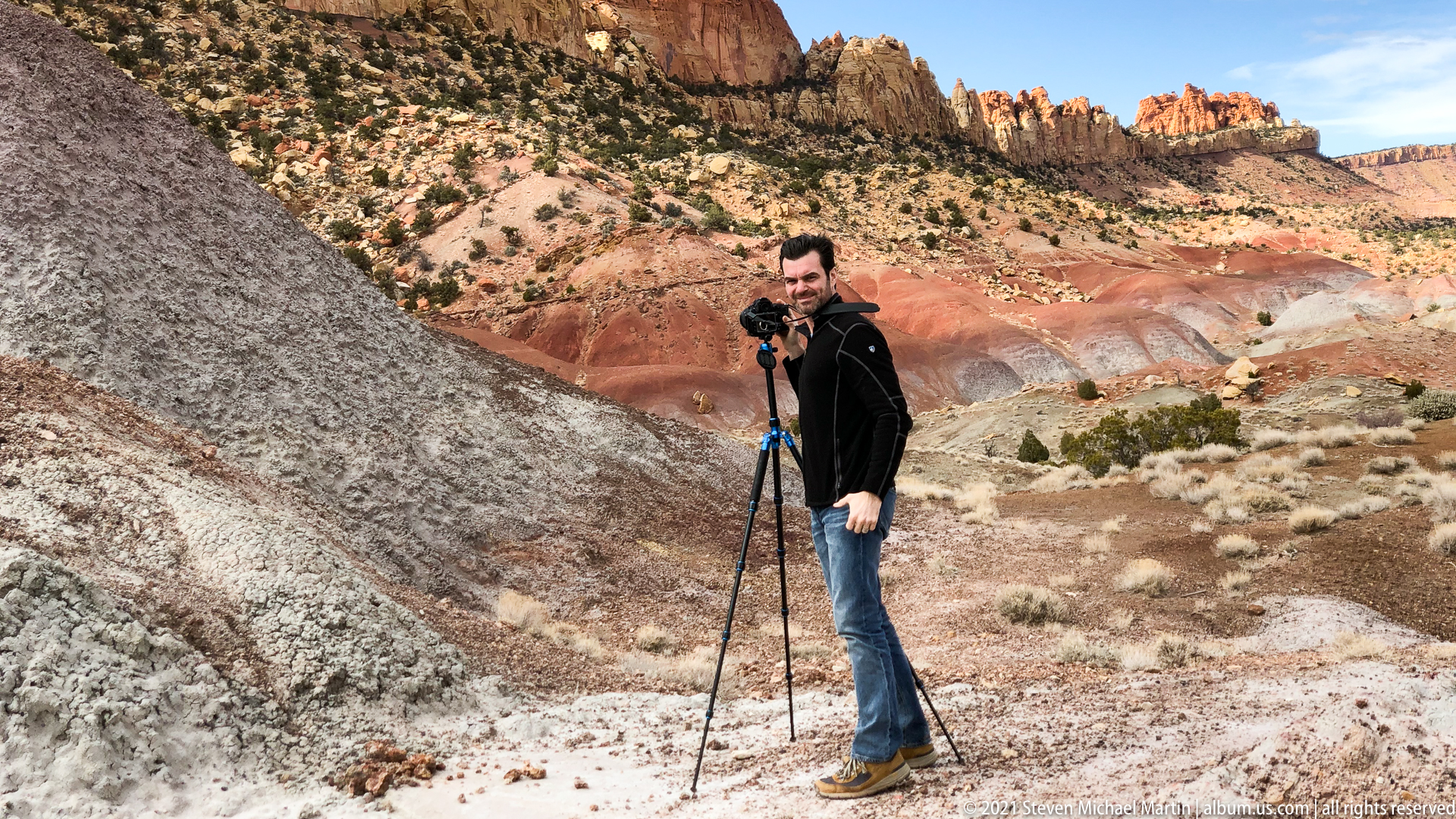
A man stands beside a tripod on a pale sloping rock surface, with red, cream and gray formations rising behind him. The broad foreground of slickrock and the photographer’s position make this a human-scale view of the terrain, showing how exposed stone forms a natural vantage point. His camera is mounted at working height, ready to frame the surrounding landscape.
Caption
A man stands beside a tripod on a pale sloping rock surface, with red, cream and gray formations rising behind him. The broad foreground of slickrock and the photographer’s position make this a human-scale view of the terrain, showing how exposed stone forms a natural vantage point. His camera is mounted at working height, ready to frame the surrounding landscape.
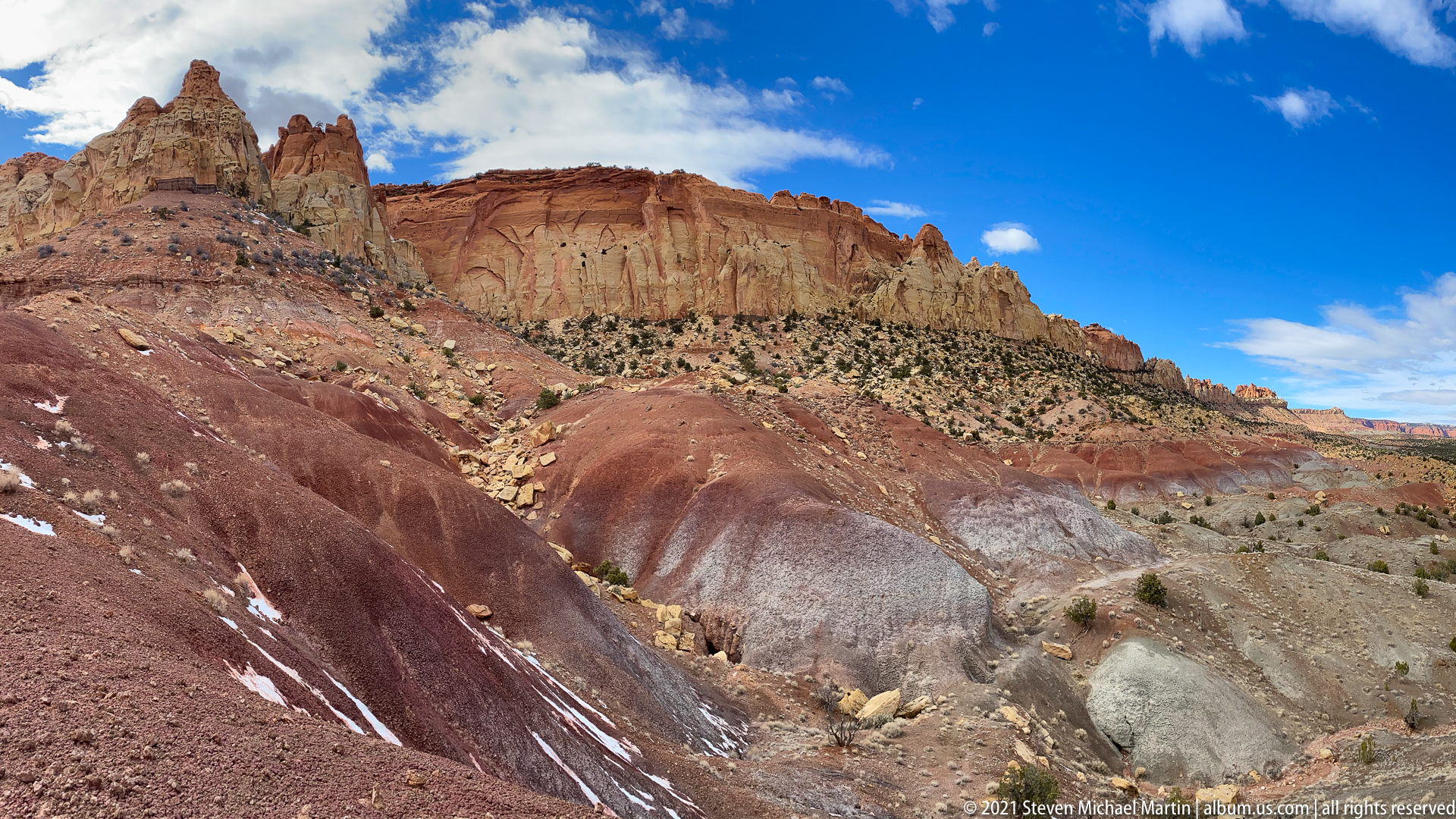
Rounded red and gray slopes rise toward a long, nearly horizontal cliff band, whose pale upper layers contrast with darker hills below. Small patches of snow remain in shaded gullies, adding seasonal contrast to exposed sedimentary forms. The composition follows the strata across the frame, emphasizing changes in color and texture between the lower slopes and high rim.
Caption
Rounded red and gray slopes rise toward a long, nearly horizontal cliff band, whose pale upper layers contrast with darker hills below. Small patches of snow remain in shaded gullies, adding seasonal contrast to exposed sedimentary forms. The composition follows the strata across the frame, emphasizing changes in color and texture between the lower slopes and high rim.
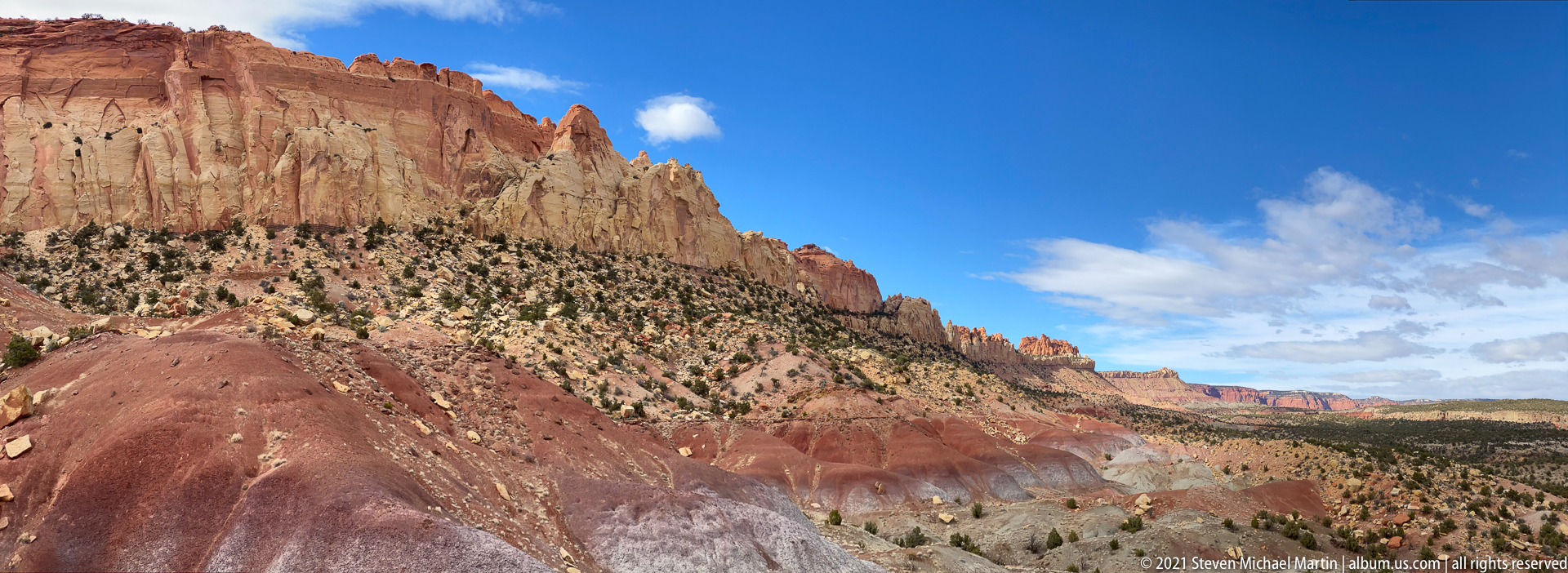
A high sandstone wall runs diagonally from the near left toward distant orange pinnacles, while a broad valley and darker ridges open to the right. Rounded red and gray hills in the foreground add depth and reveal the abrupt transition from low terrain to the steep escarpment. Bright sun catches the cliff face against a deep blue sky.
Caption
A high sandstone wall runs diagonally from the near left toward distant orange pinnacles, while a broad valley and darker ridges open to the right. Rounded red and gray hills in the foreground add depth and reveal the abrupt transition from low terrain to the steep escarpment. Bright sun catches the cliff face against a deep blue sky.
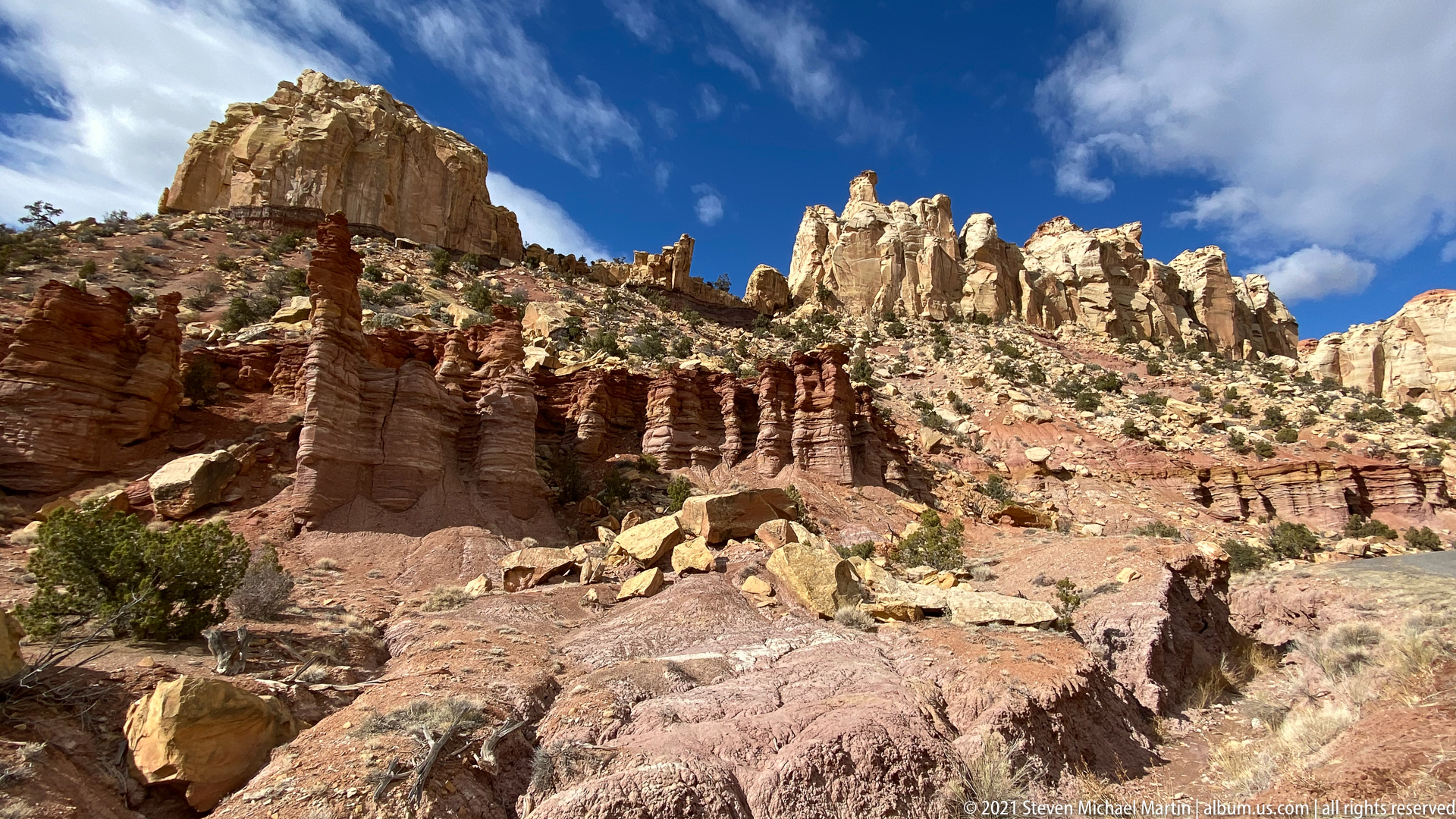
A line of pale, irregular towers crowns the slope above dark red horizontal ledges. The lower foreground is rough and broken, with fallen blocks and exposed layers, while brighter pinnacles rise against a clear sky. This view brings together contrasting erosional forms: narrow vertical towers on the ridge and stepped, banded rock at its base.
Caption
A line of pale, irregular towers crowns the slope above dark red horizontal ledges. The lower foreground is rough and broken, with fallen blocks and exposed layers, while brighter pinnacles rise against a clear sky. This view brings together contrasting erosional forms: narrow vertical towers on the ridge and stepped, banded rock at its base.
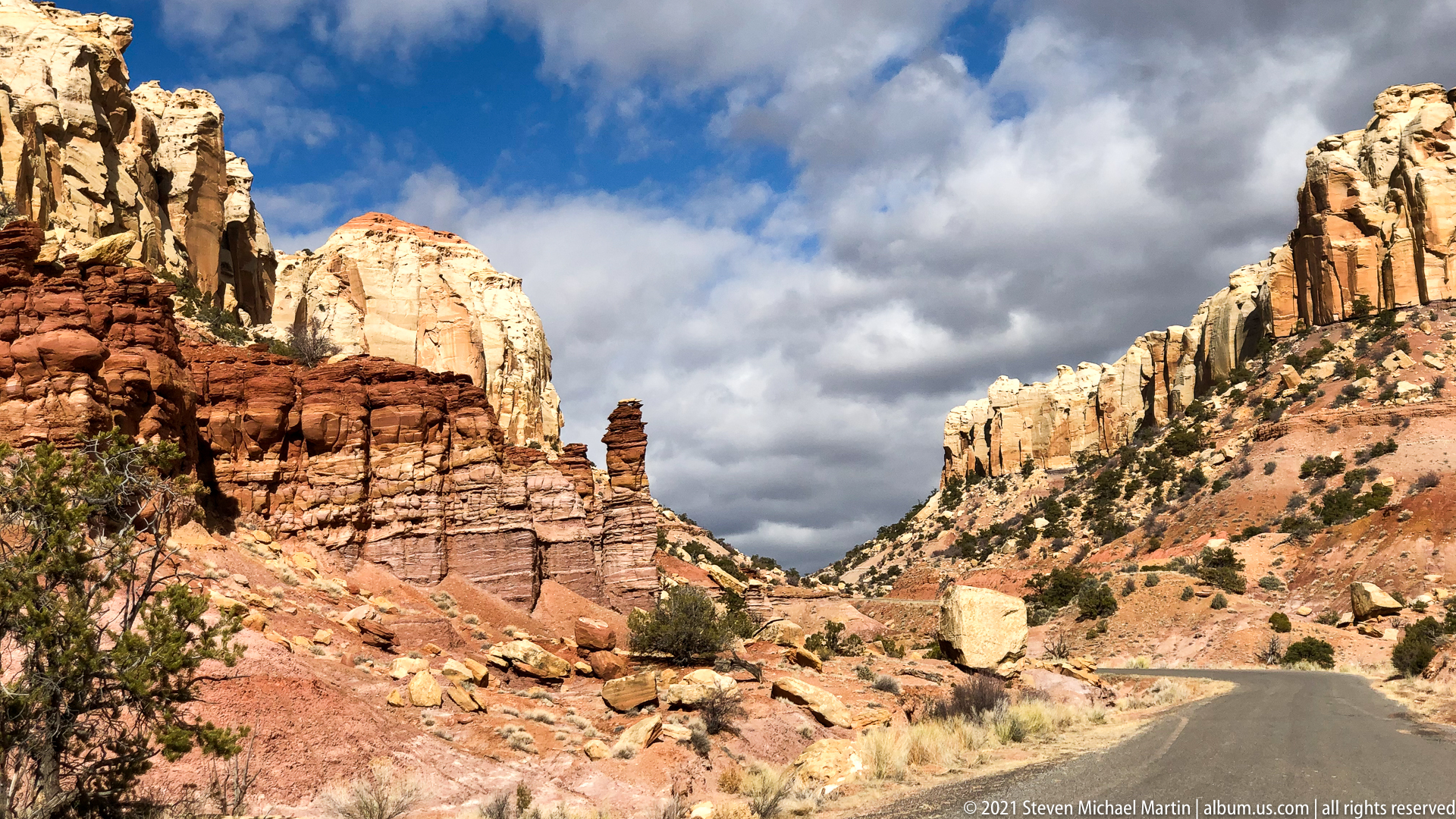
A paved road curves through the lower right of a narrow valley beneath high sandstone towers. Dark red ledges frame the left side, while pale vertical formations rise above the road on both sides, creating a natural corridor. The roadway’s smooth surface contrasts with broken slopes and scattered blocks, showing a developed route threading through rugged terrain.
Caption
A paved road curves through the lower right of a narrow valley beneath high sandstone towers. Dark red ledges frame the left side, while pale vertical formations rise above the road on both sides, creating a natural corridor. The roadway’s smooth surface contrasts with broken slopes and scattered blocks, showing a developed route threading through rugged terrain.
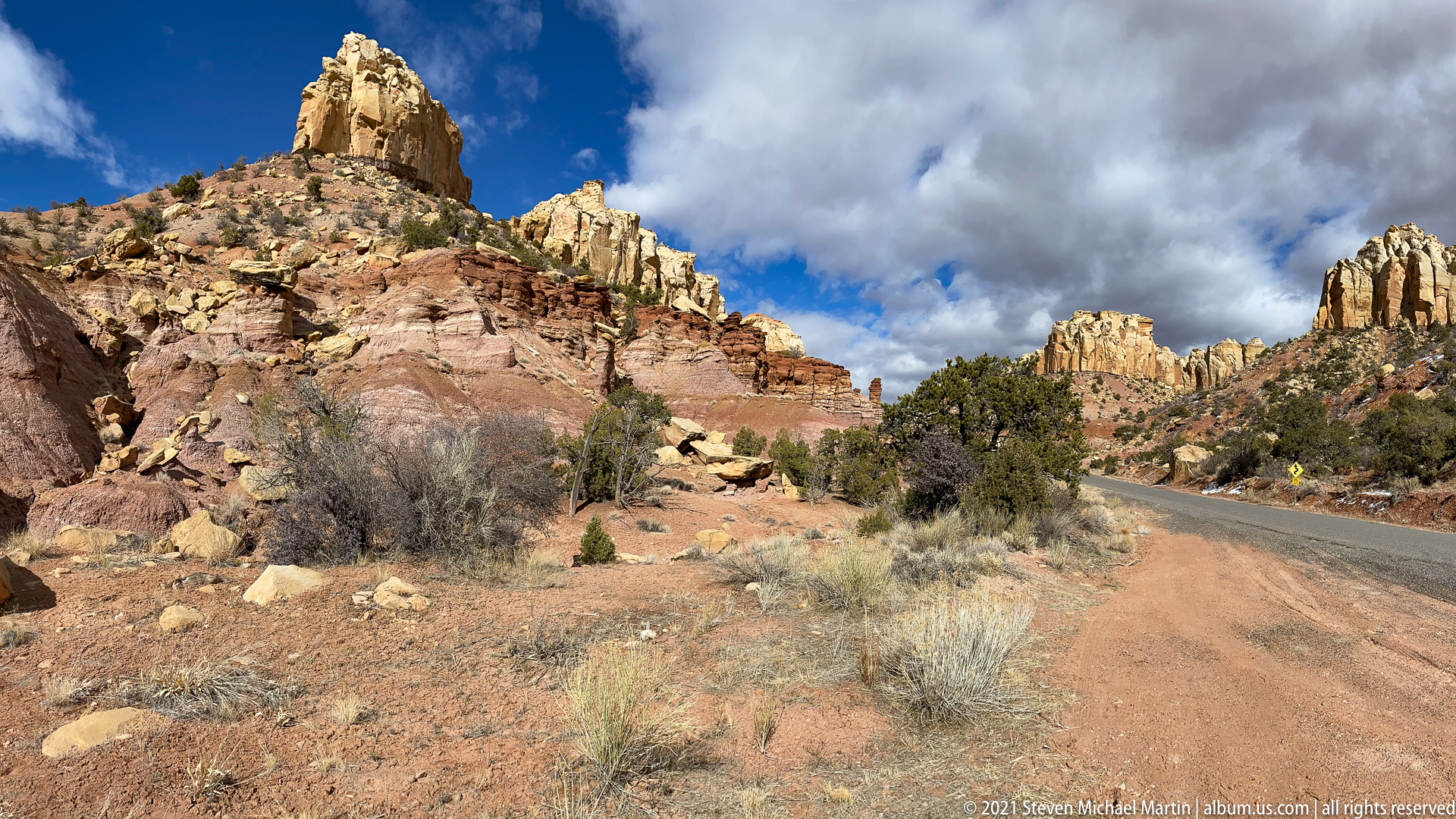
A paved road skirts the base of a steep slope where maroon, cream and ochre layers rise to a jagged line of pale pinnacles. Low shrubs and dry grasses occupy the roadside foreground, and a small warning sign stands beside the bend. The road gives the rugged scene a clear human scale and traces the edge between open ground and the canyon wall.
Caption
A paved road skirts the base of a steep slope where maroon, cream and ochre layers rise to a jagged line of pale pinnacles. Low shrubs and dry grasses occupy the roadside foreground, and a small warning sign stands beside the bend. The road gives the rugged scene a clear human scale and traces the edge between open ground and the canyon wall.
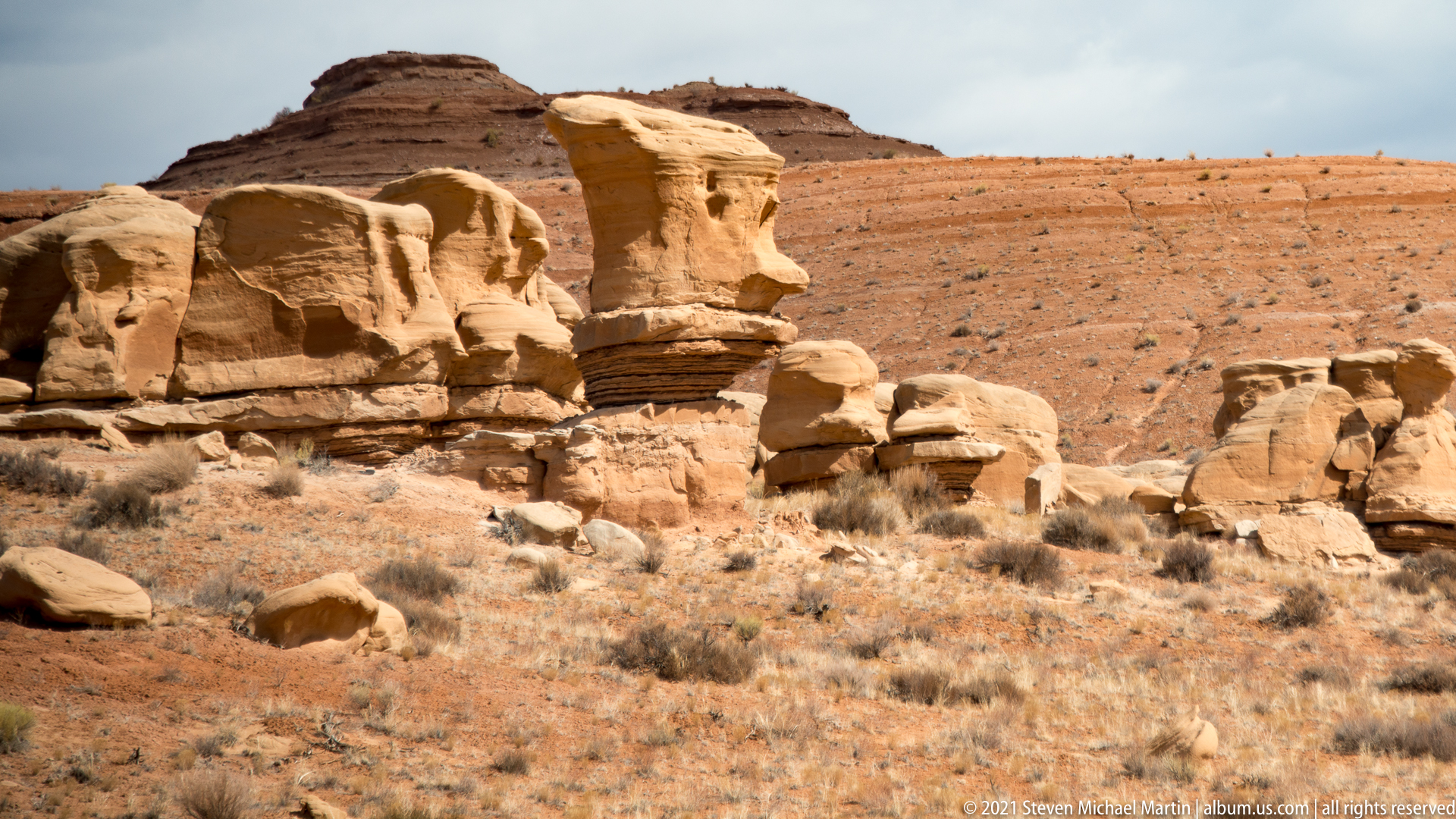
Rounded sandstone forms stand in a row across a sandy, shrub-dotted slope. Their stacked ledges and narrow bases create pedestal-like shapes, while a flat orange mesa rises behind them. The varied heights and softened edges suggest prolonged weathering, but the photograph supports a description of the forms rather than a more specific geological origin.
Caption
Rounded sandstone forms stand in a row across a sandy, shrub-dotted slope. Their stacked ledges and narrow bases create pedestal-like shapes, while a flat orange mesa rises behind them. The varied heights and softened edges suggest prolonged weathering, but the photograph supports a description of the forms rather than a more specific geological origin.
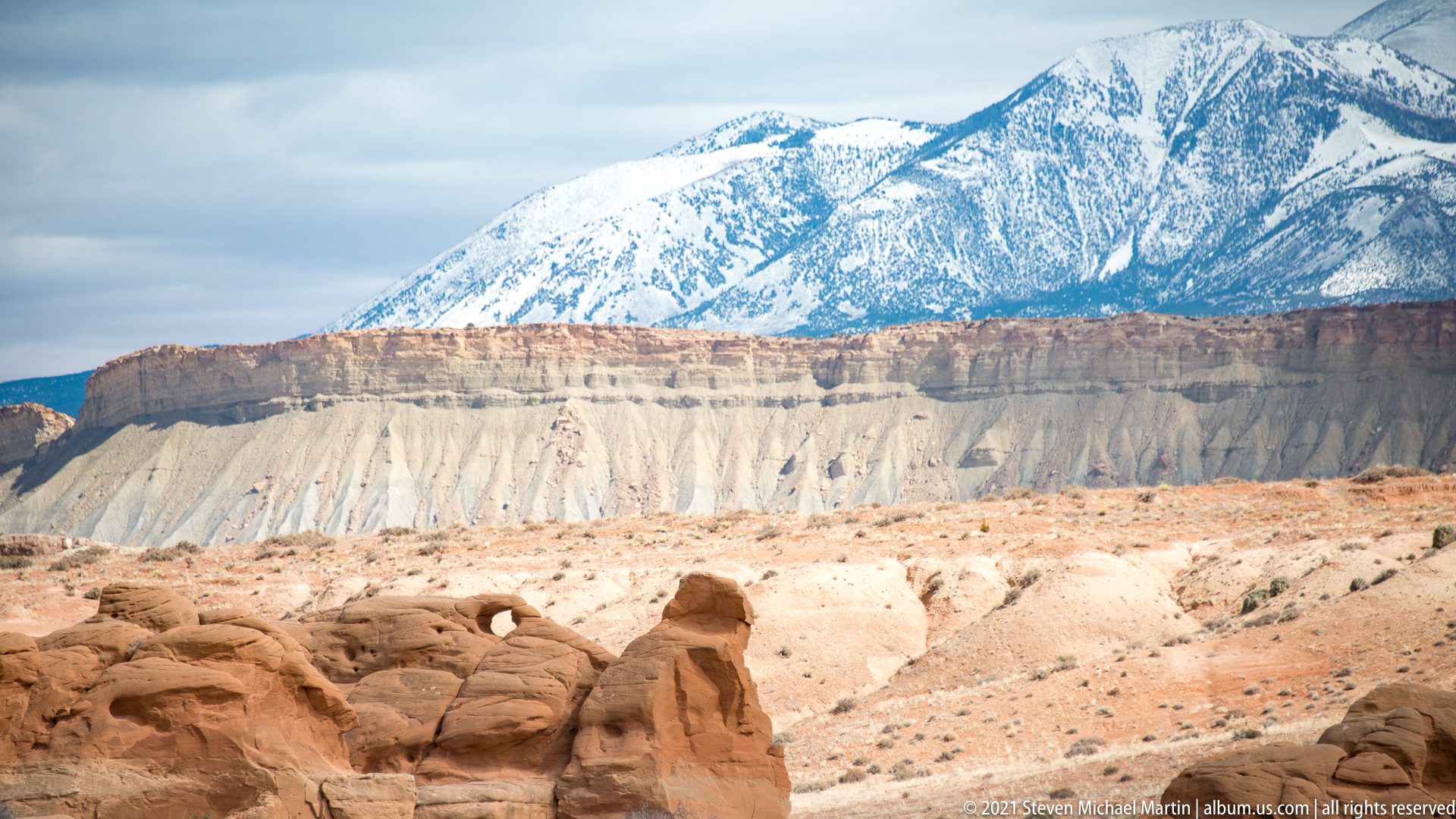
A snow-covered mountain dominates the distant horizon, its dark ridges and white gullies contrasting with pale sandstone cliffs below. Rounded tan rock forms sit in the foreground, linking close desert terrain to the higher, wintry range beyond. The layered view shows a dramatic change in elevation and climate across the region.
Caption
A snow-covered mountain dominates the distant horizon, its dark ridges and white gullies contrasting with pale sandstone cliffs below. Rounded tan rock forms sit in the foreground, linking close desert terrain to the higher, wintry range beyond. The layered view shows a dramatic change in elevation and climate across the region.
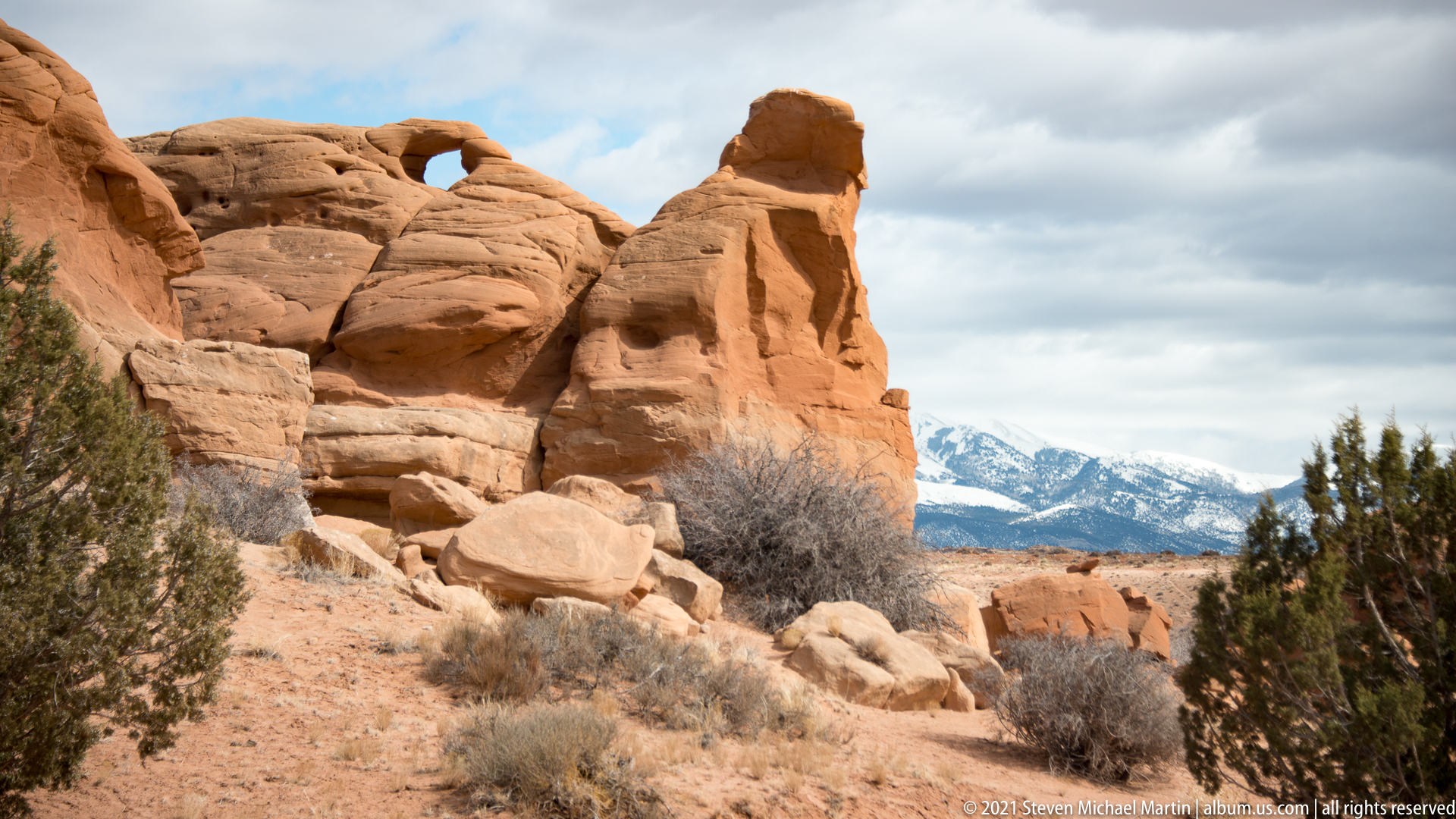
A sculpted orange sandstone outcrop fills the left foreground, its stacked rounded ledges forming a vertical frame around a distant snow-covered mountain. Dry shrubs and scattered boulders occupy the middle ground, while pale mountain slopes appear through the opening at right. The composition uses near and far rock to connect the desert plateau with the high winter range.
Caption
A sculpted orange sandstone outcrop fills the left foreground, its stacked rounded ledges forming a vertical frame around a distant snow-covered mountain. Dry shrubs and scattered boulders occupy the middle ground, while pale mountain slopes appear through the opening at right. The composition uses near and far rock to connect the desert plateau with the high winter range.
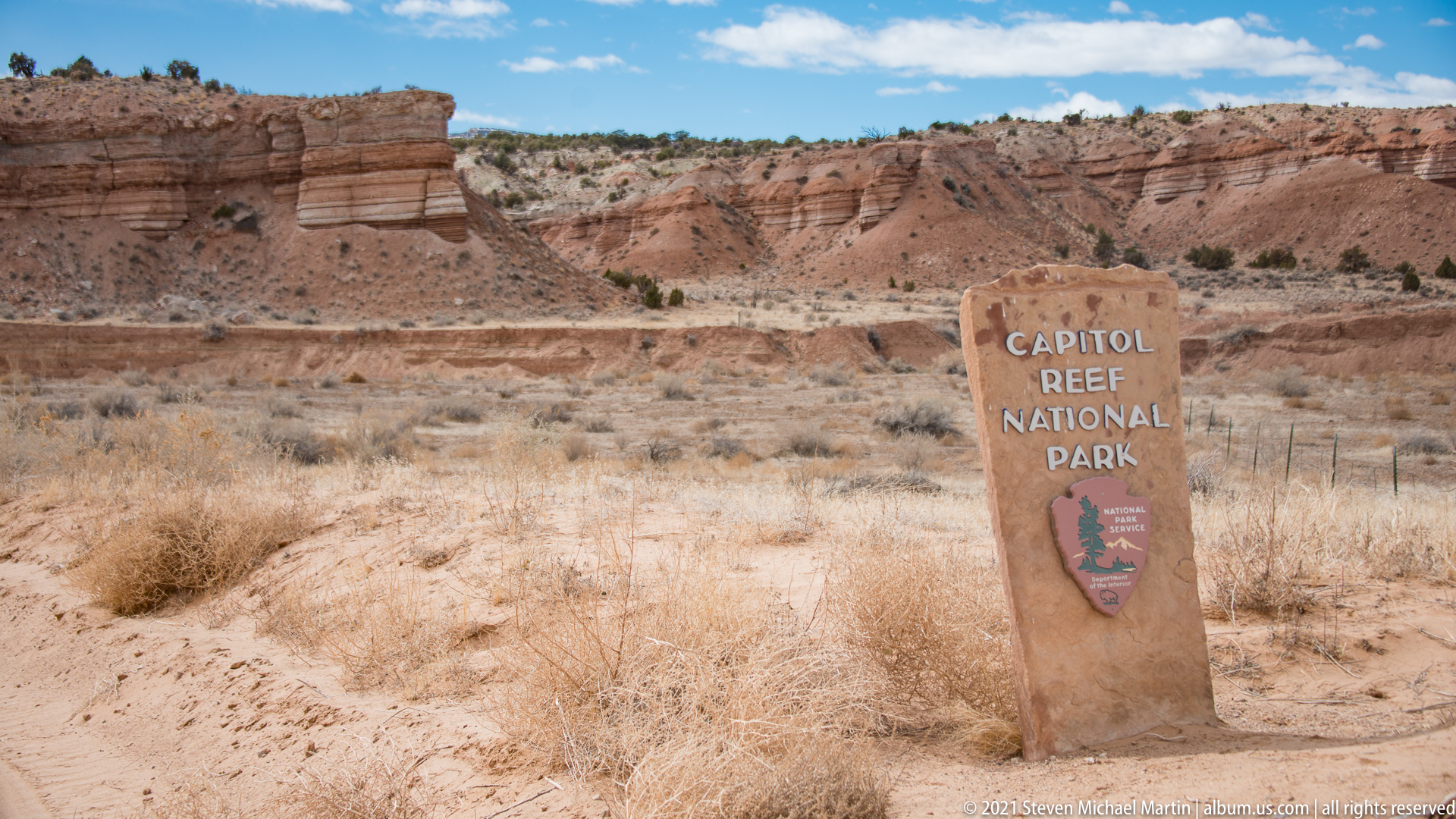
A stone marker reading “Capitol Reef National Park” stands beside a sandy roadside, with low grasses and layered red cliffs behind it. The sign’s carved lettering and National Park Service emblem identify the protected area directly. By placing the marker in its open desert setting, the photograph records both the park boundary cue and the geological landscape that surrounds it.
Caption
A stone marker reading “Capitol Reef National Park” stands beside a sandy roadside, with low grasses and layered red cliffs behind it. The sign’s carved lettering and National Park Service emblem identify the protected area directly. By placing the marker in its open desert setting, the photograph records both the park boundary cue and the geological landscape that surrounds it.
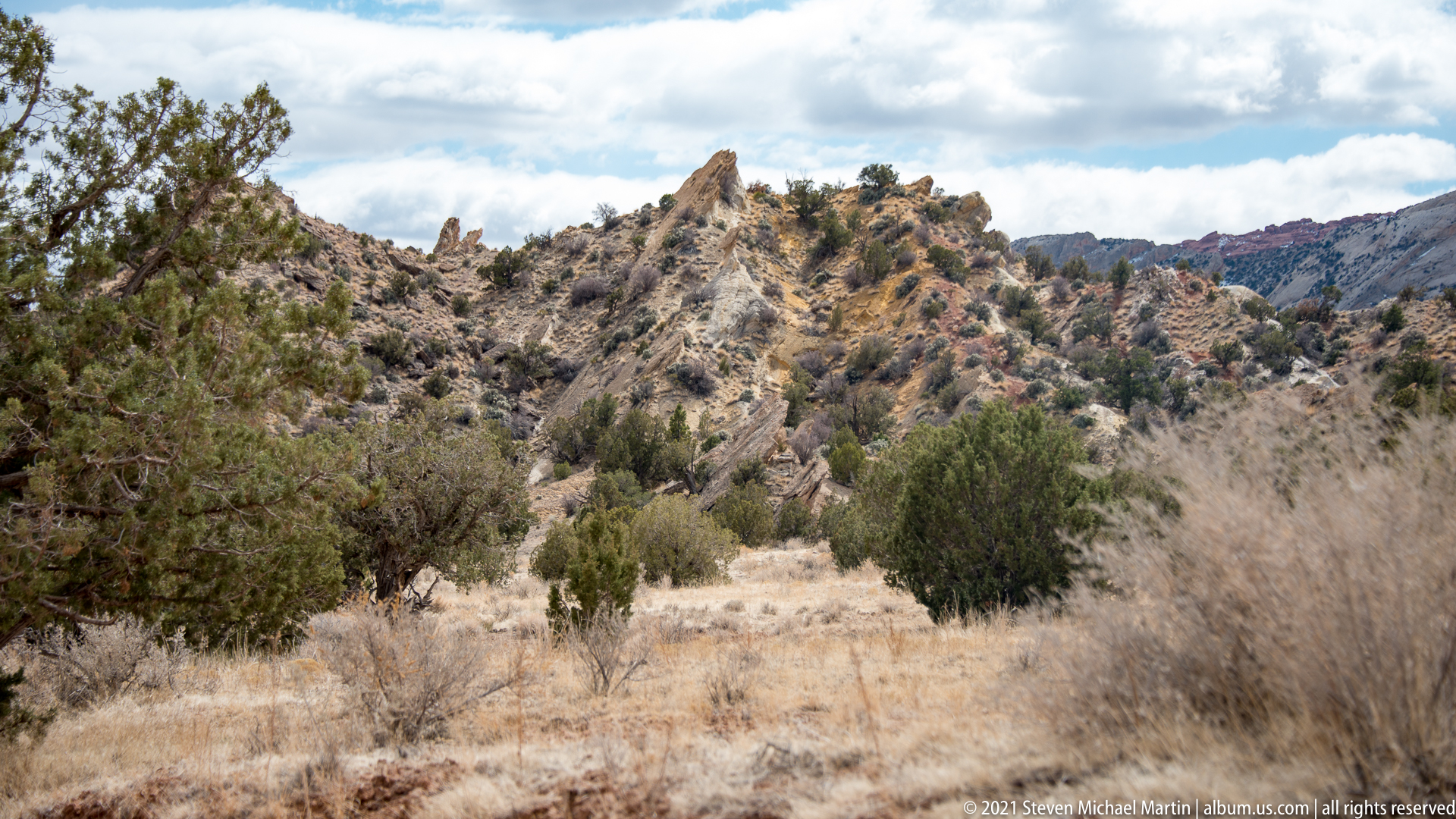
A narrow, broken ridge rises from a broad foreground of dry grasses and scattered junipers. Pale and ochre rock shows through the vegetation along the crest, while distant darker cliffs mark the horizon beneath a cloud-streaked sky. The scene is a quiet view of the park’s scrubland terrain, with the ridge’s uneven outline providing the main point of focus.
Caption
A narrow, broken ridge rises from a broad foreground of dry grasses and scattered junipers. Pale and ochre rock shows through the vegetation along the crest, while distant darker cliffs mark the horizon beneath a cloud-streaked sky. The scene is a quiet view of the park’s scrubland terrain, with the ridge’s uneven outline providing the main point of focus.
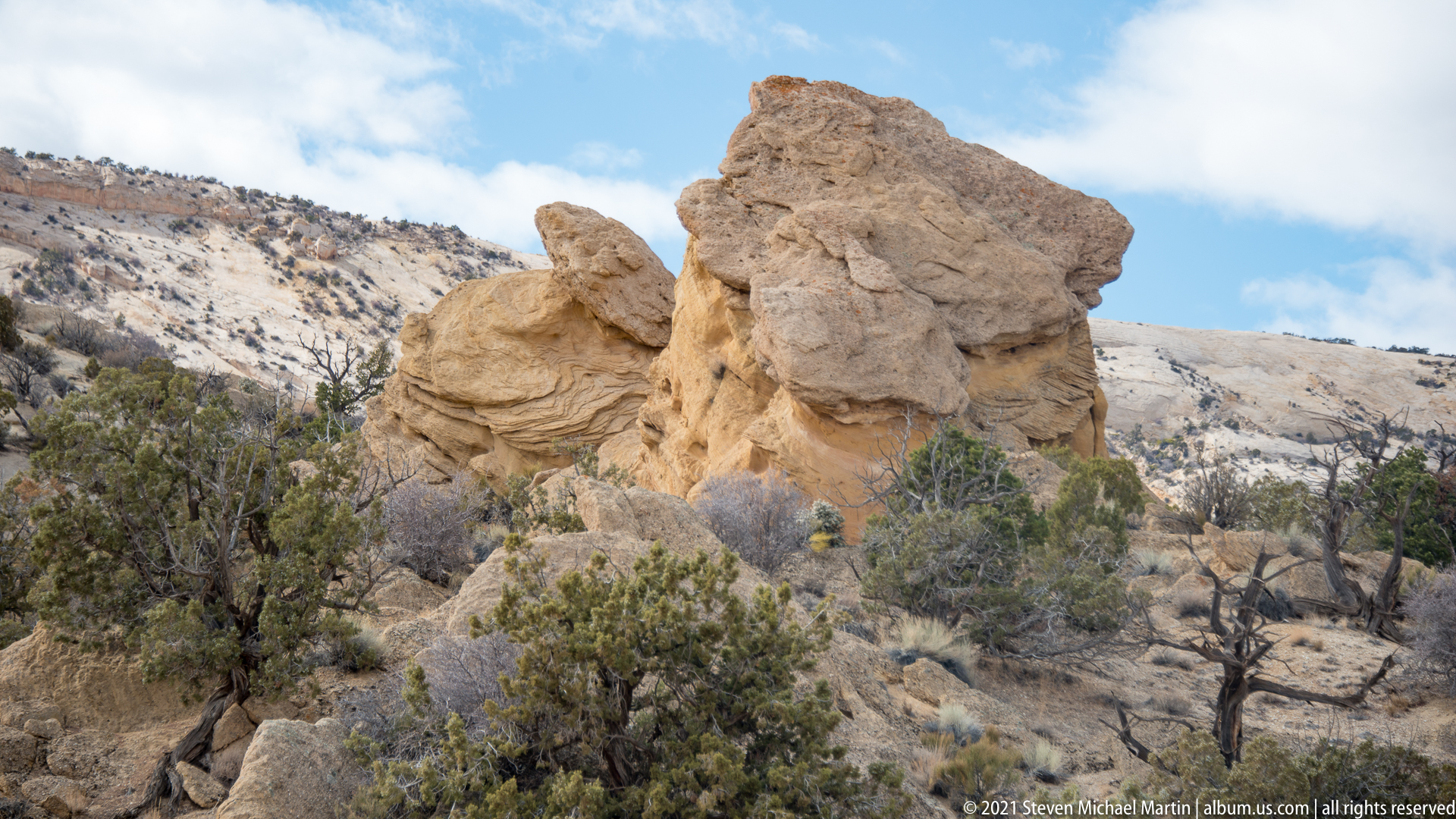
A cluster of bulky, rounded sandstone blocks occupies the upper slope, their layered edges and weathered surfaces softened into irregular domes. Junipers and bare shrubs fill the ground beneath them, while pale exposed rock continues across the background hillside. The composition isolates the boulder group against the sky and open slope, making its scale and sculpted contours easy to read.
Caption
A cluster of bulky, rounded sandstone blocks occupies the upper slope, their layered edges and weathered surfaces softened into irregular domes. Junipers and bare shrubs fill the ground beneath them, while pale exposed rock continues across the background hillside. The composition isolates the boulder group against the sky and open slope, making its scale and sculpted contours easy to read.
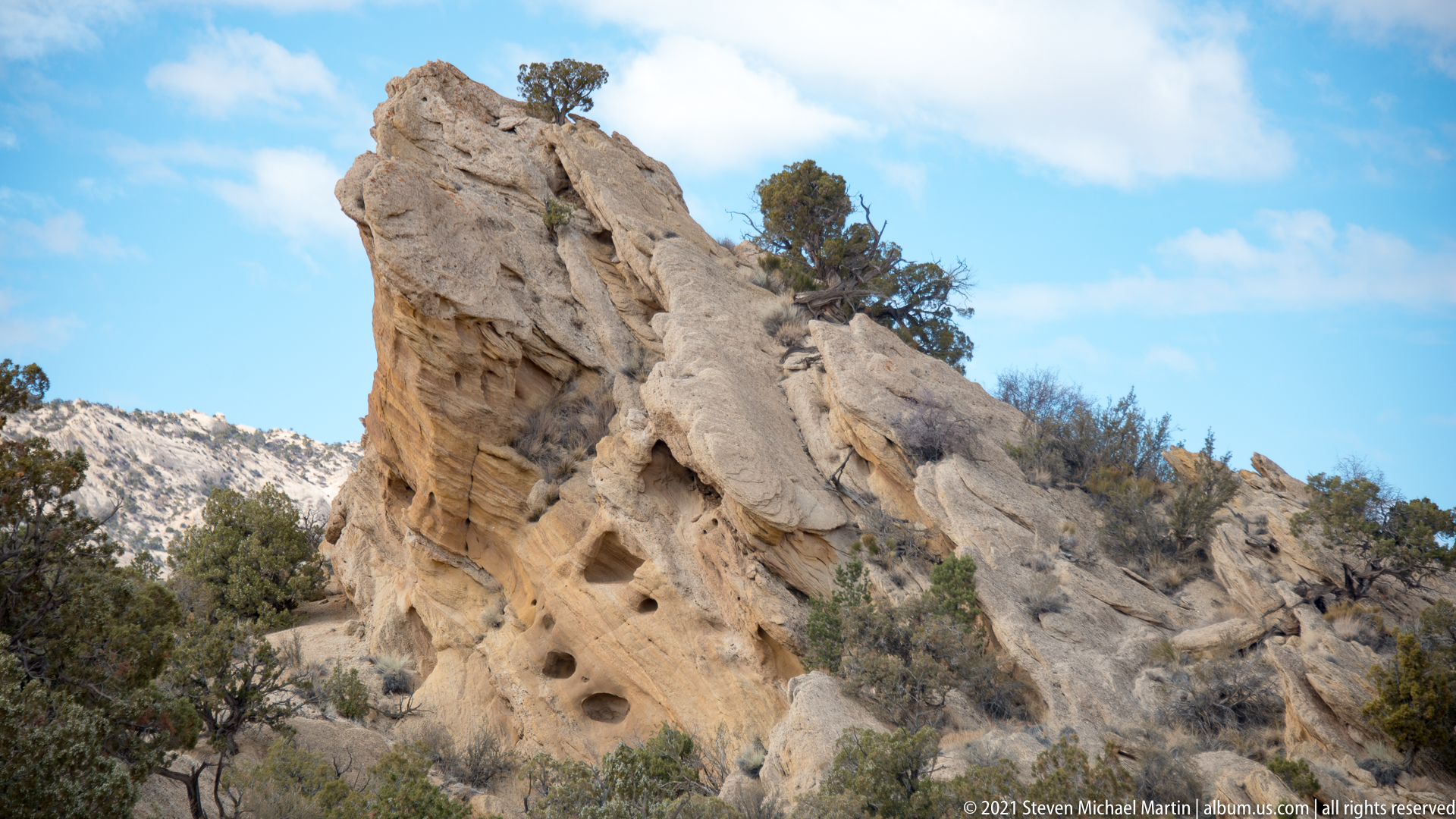
A pale sandstone fin rises sharply from surrounding scrub, its surface punctuated by rounded cavities and shallow hollows. The irregular openings, ledges and narrow crest show the rock’s strongly weathered texture at close range. Small junipers grow around the base and along the ridge, providing scale and contrasting the stone’s warm cream tones with dark green foliage.
Caption
A pale sandstone fin rises sharply from surrounding scrub, its surface punctuated by rounded cavities and shallow hollows. The irregular openings, ledges and narrow crest show the rock’s strongly weathered texture at close range. Small junipers grow around the base and along the ridge, providing scale and contrasting the stone’s warm cream tones with dark green foliage.
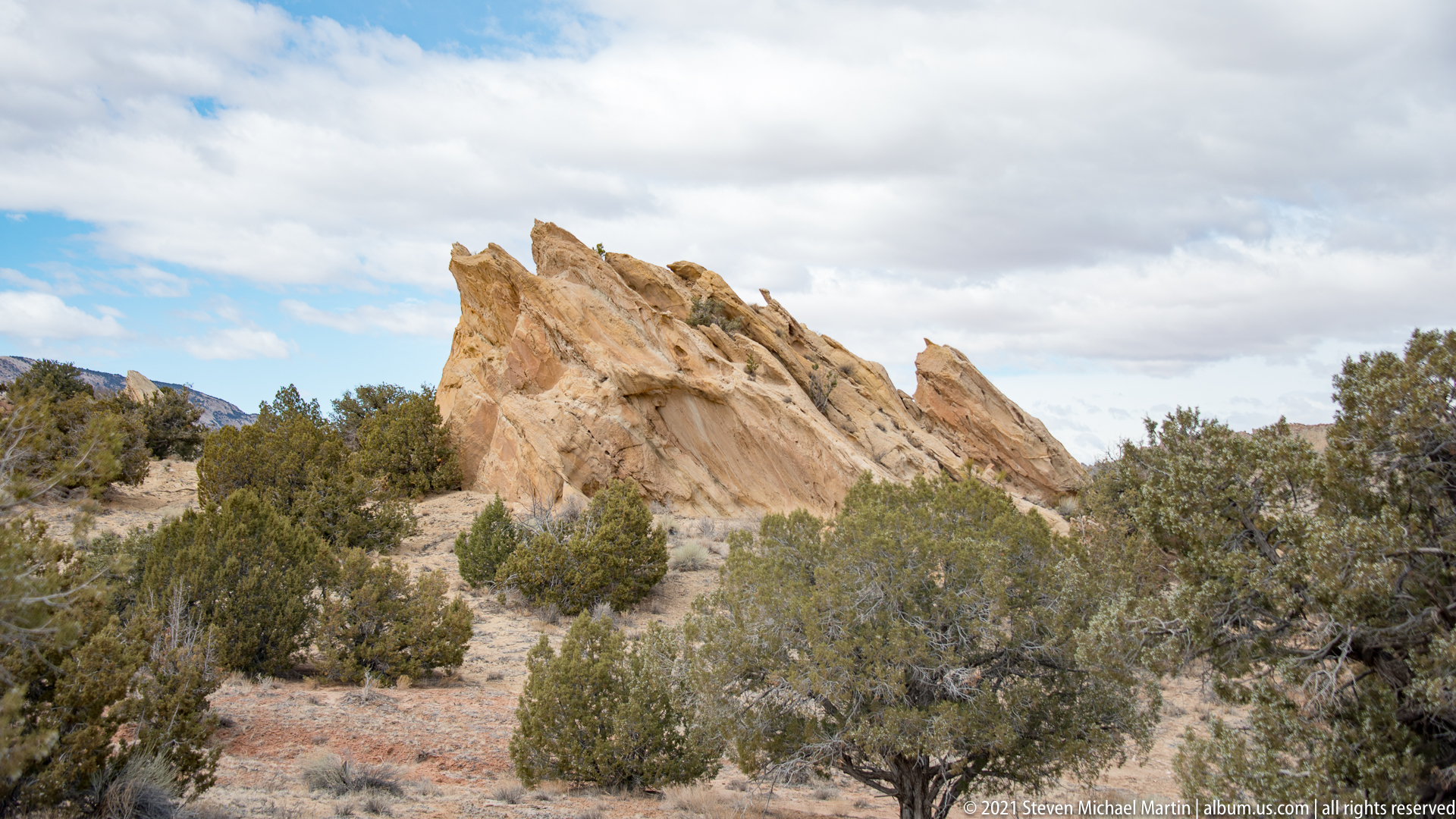
A jagged ridge of pale sandstone slabs tilts upward through dense juniper scrub, with sharp edges and layered faces breaking the skyline. Darker vegetation forms a continuous base around the exposed rock, while a cloudy sky softens the contrast. This wider view shows the formation as part of a vegetated hillside rather than as an isolated rock detail.
Caption
A jagged ridge of pale sandstone slabs tilts upward through dense juniper scrub, with sharp edges and layered faces breaking the skyline. Darker vegetation forms a continuous base around the exposed rock, while a cloudy sky softens the contrast. This wider view shows the formation as part of a vegetated hillside rather than as an isolated rock detail.
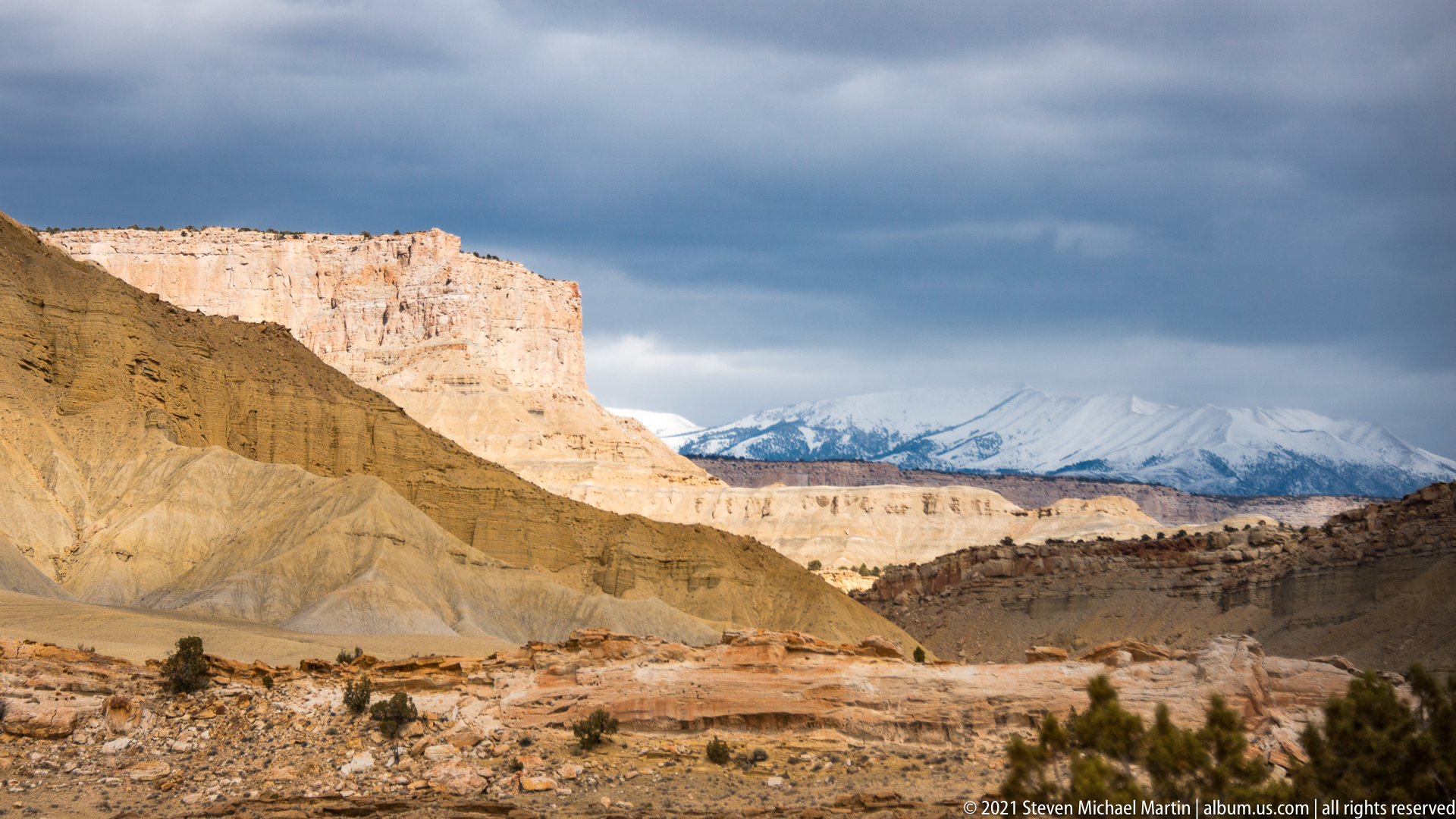
Cream-colored cliffs and ochre slopes descend in horizontal bands toward a darker canyon floor. Beyond the formations, a snow-covered mountain range sits beneath broad dark clouds, creating contrast between pale rock, winter snow and shadowed sky. The view places the park’s sedimentary layers in the same frame as the distant high country.
Caption
Cream-colored cliffs and ochre slopes descend in horizontal bands toward a darker canyon floor. Beyond the formations, a snow-covered mountain range sits beneath broad dark clouds, creating contrast between pale rock, winter snow and shadowed sky. The view places the park’s sedimentary layers in the same frame as the distant high country.
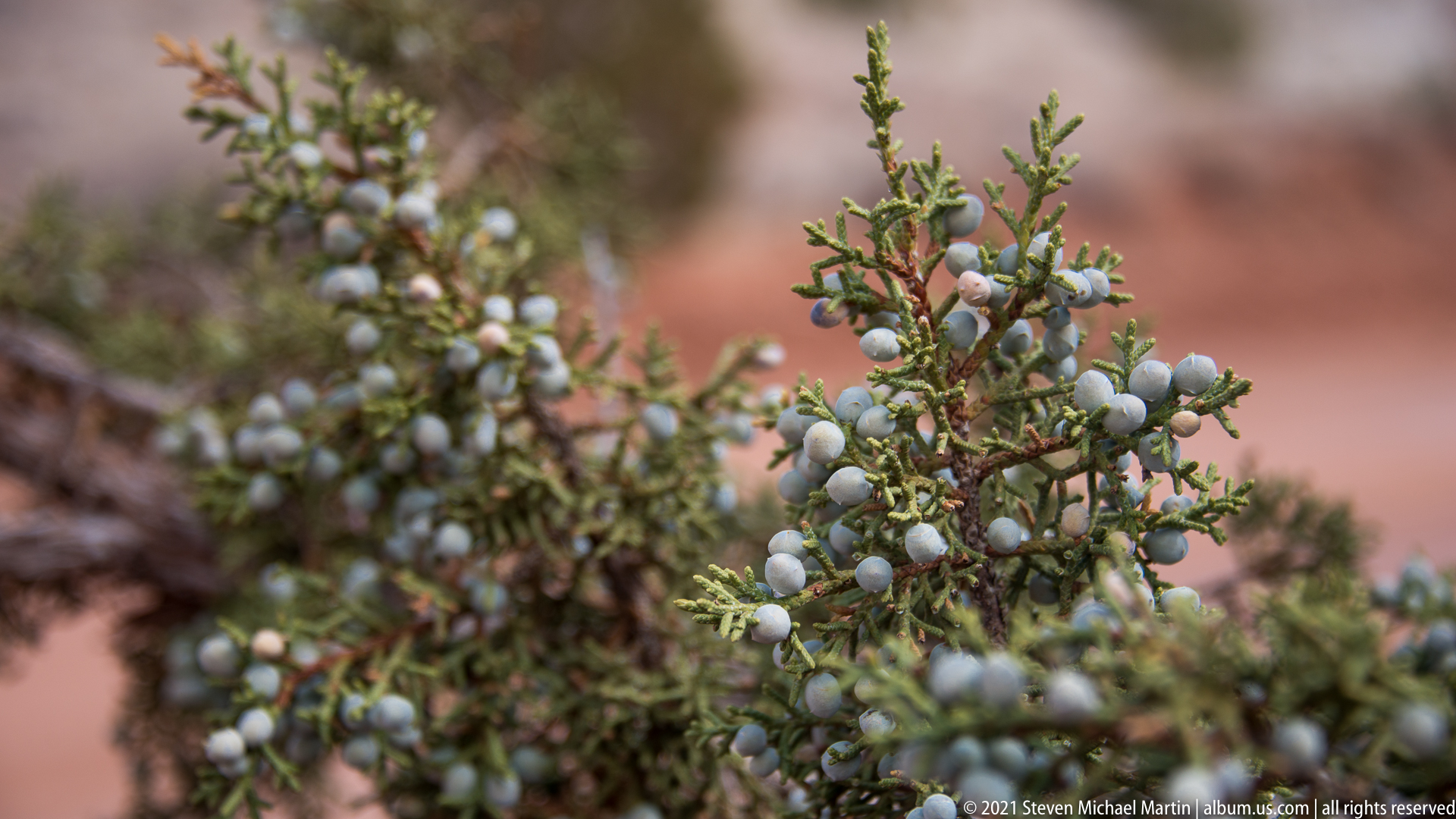
A sharply focused juniper branch carries clusters of round blue-gray seed cones among small scale-like green leaves. Shallow depth of field softens additional branches and the reddish landscape into a warm background, isolating the plant’s fine texture and fruit. The image shifts attention from the canyon’s broad geology to native evergreen vegetation growing across the high desert.
Caption
A sharply focused juniper branch carries clusters of round blue-gray seed cones among small scale-like green leaves. Shallow depth of field softens additional branches and the reddish landscape into a warm background, isolating the plant’s fine texture and fruit. The image shifts attention from the canyon’s broad geology to native evergreen vegetation growing across the high desert.
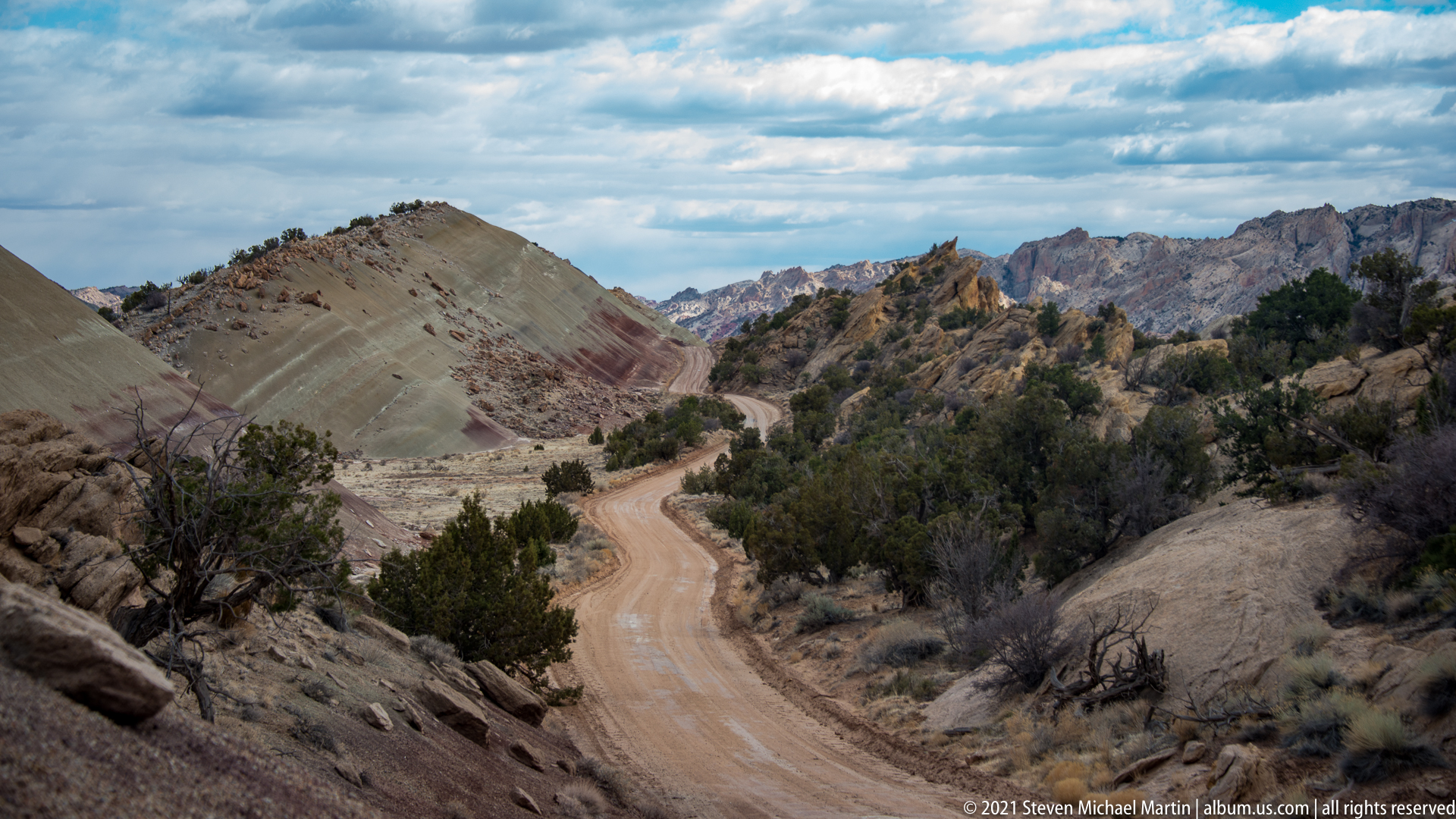
An unpaved road curves through a narrow valley between rounded, muted gray and rust-colored hills. Juniper and other low shrubs cover the slopes, while distant jagged ridges rise beneath broken clouds. The road’s pale line carries the eye into the landscape and gives this broad view a clear sense of depth and scale.
Caption
An unpaved road curves through a narrow valley between rounded, muted gray and rust-colored hills. Juniper and other low shrubs cover the slopes, while distant jagged ridges rise beneath broken clouds. The road’s pale line carries the eye into the landscape and gives this broad view a clear sense of depth and scale.
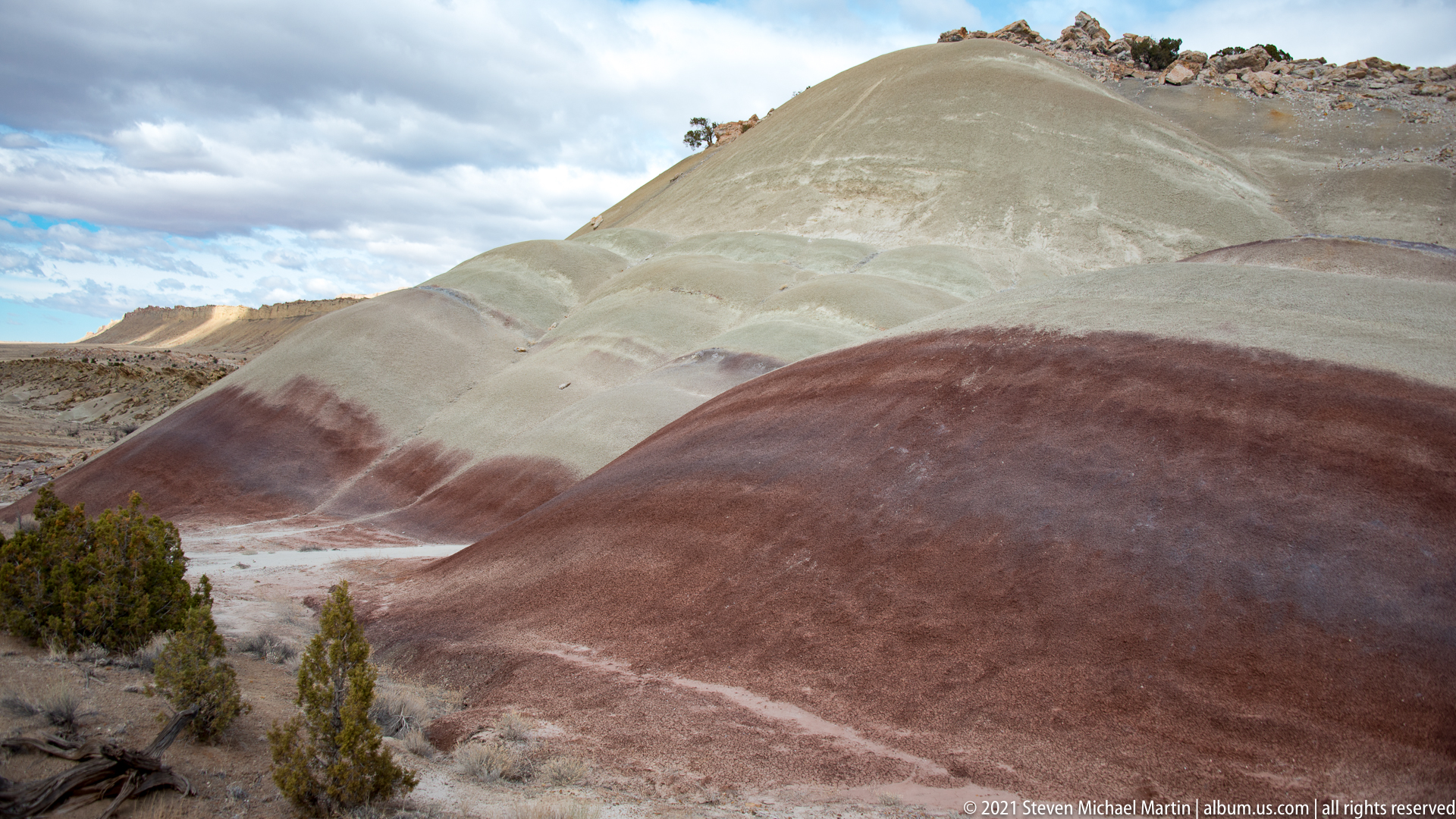
Smooth slopes rise in overlapping bands of pale gray, muted mauve, and deep rust, with sparse juniper at their base. The close viewpoint removes most foreground terrain and concentrates on the color transitions and rounded profiles of the hills. A cloudy sky and distant ridge remain at the upper edge, placing the mineral-colored slopes within a larger desert landscape.
Caption
Smooth slopes rise in overlapping bands of pale gray, muted mauve, and deep rust, with sparse juniper at their base. The close viewpoint removes most foreground terrain and concentrates on the color transitions and rounded profiles of the hills. A cloudy sky and distant ridge remain at the upper edge, placing the mineral-colored slopes within a larger desert landscape.

A narrow path climbs through dry, reddish soil toward a jagged ridge of pale orange sandstone. Juniper trees stand among the broken rock on both sides, and low grasses cover the slope. The ridge’s angular crest contrasts with the rounded hills nearby, while drifting clouds open patches of blue sky overhead.
Caption
A narrow path climbs through dry, reddish soil toward a jagged ridge of pale orange sandstone. Juniper trees stand among the broken rock on both sides, and low grasses cover the slope. The ridge’s angular crest contrasts with the rounded hills nearby, while drifting clouds open patches of blue sky overhead.
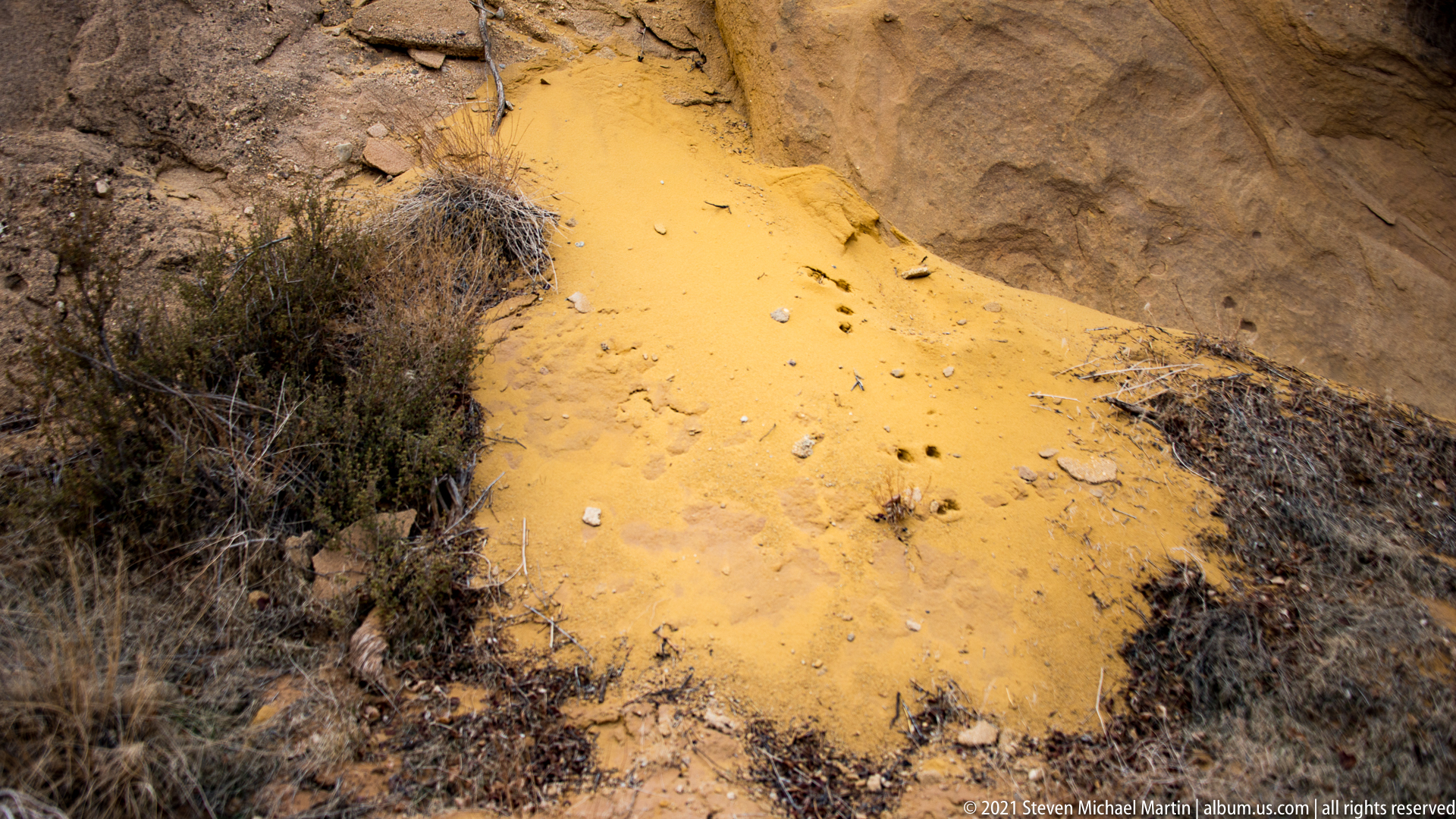
A vivid yellow-orange patch spreads across pale rock and dry soil, bordered by rough stone, small shrubs, and scattered fragments. The strong color makes this ground-level geological detail stand apart from the canyon’s muted gray and red slopes. The proof-sheet view does not establish the material’s composition, so the scene is described by its visible color and placement.
Caption
A vivid yellow-orange patch spreads across pale rock and dry soil, bordered by rough stone, small shrubs, and scattered fragments. The strong color makes this ground-level geological detail stand apart from the canyon’s muted gray and red slopes. The proof-sheet view does not establish the material’s composition, so the scene is described by its visible color and placement.
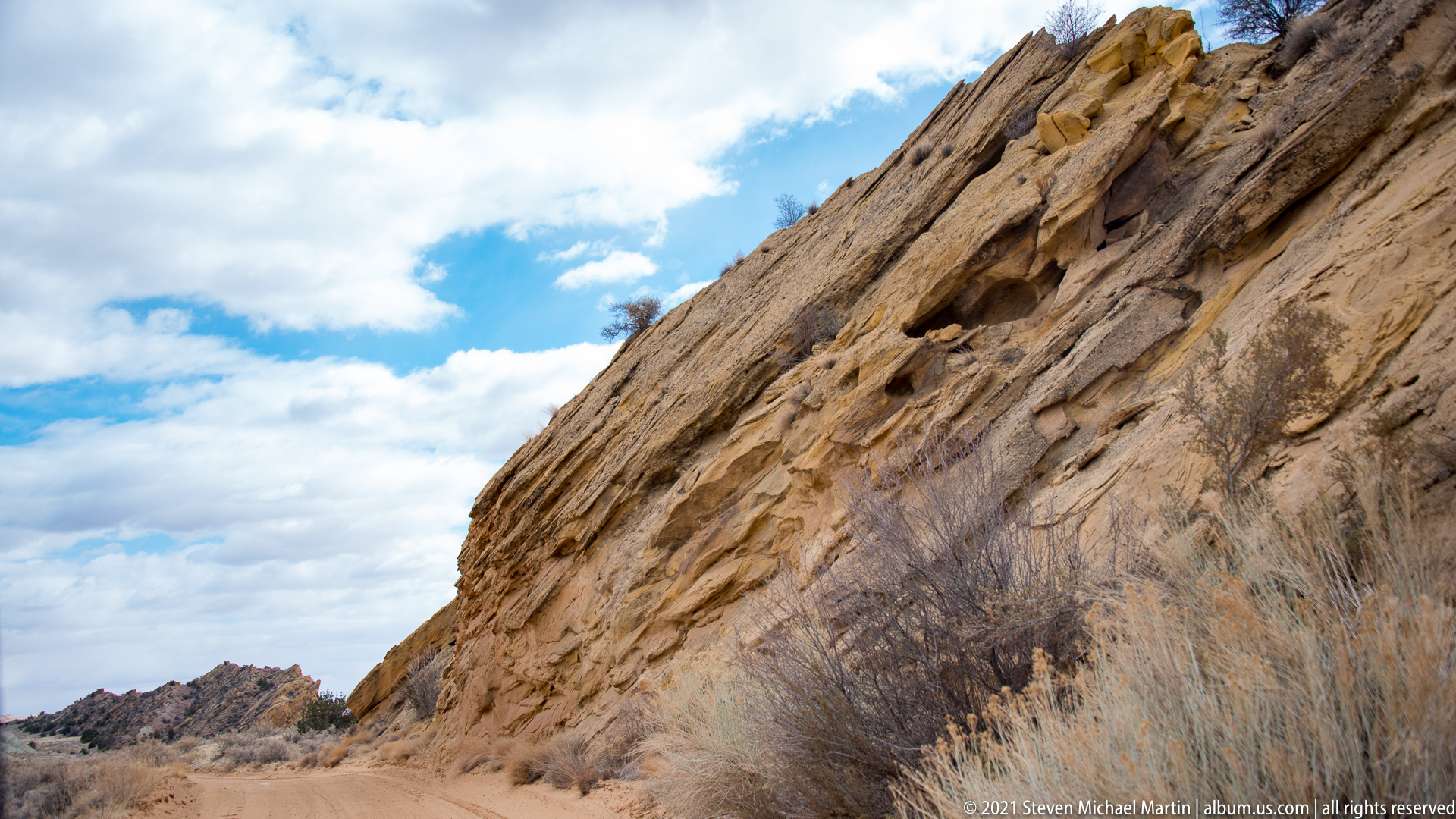
A steep sandstone wall tilts diagonally across the right side of the frame above a narrow dirt track. Its pale tan and rust layers break into angular slabs, while dry grasses and shrubs occupy the roadside. The low viewpoint makes the wall appear to lean over the route and emphasizes the close relationship between the rock face and the pass below.
Caption
A steep sandstone wall tilts diagonally across the right side of the frame above a narrow dirt track. Its pale tan and rust layers break into angular slabs, while dry grasses and shrubs occupy the roadside. The low viewpoint makes the wall appear to lean over the route and emphasizes the close relationship between the rock face and the pass below.
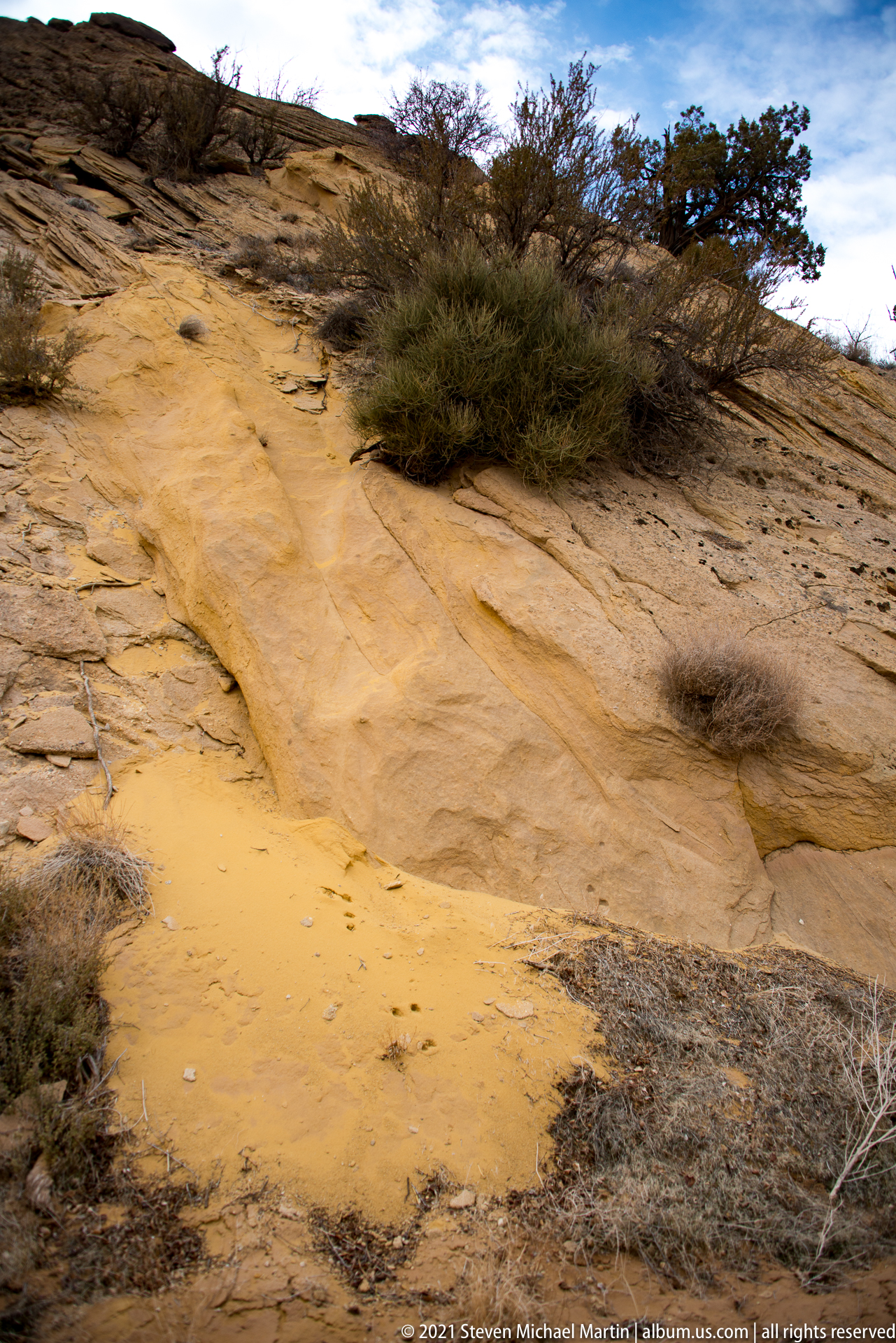
Ochre-yellow sediment follows a shallow channel across a sloping sandstone surface, with a dense shrub rooted near the upper edge. The low angle reveals smooth pale bedrock, narrow cracks, and scattered debris around the colored band. This closer frame records a small change in surface color and texture rather than a broad view of the surrounding canyon.
Caption
Ochre-yellow sediment follows a shallow channel across a sloping sandstone surface, with a dense shrub rooted near the upper edge. The low angle reveals smooth pale bedrock, narrow cracks, and scattered debris around the colored band. This closer frame records a small change in surface color and texture rather than a broad view of the surrounding canyon.
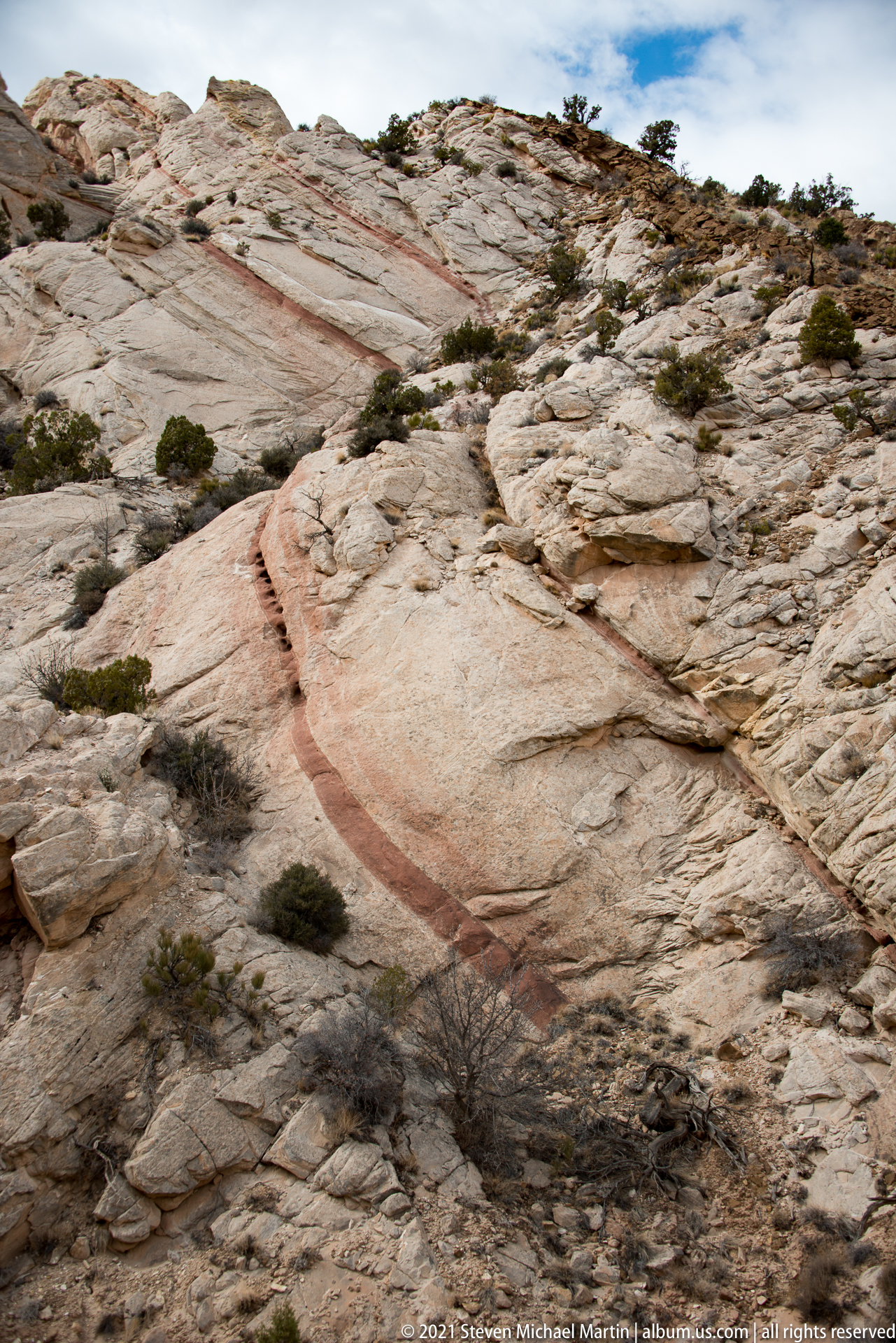
A pale sandstone slope fills the view, crossed by a narrow rust-colored seam that curves down from the upper left. Low shrubs grow along the crest and in cracks across the slab, while broken stone occupies the lower edge. The wide rock surface gives this frame a quieter, more open quality than the steep canyon walls nearby.
Caption
A pale sandstone slope fills the view, crossed by a narrow rust-colored seam that curves down from the upper left. Low shrubs grow along the crest and in cracks across the slab, while broken stone occupies the lower edge. The wide rock surface gives this frame a quieter, more open quality than the steep canyon walls nearby.
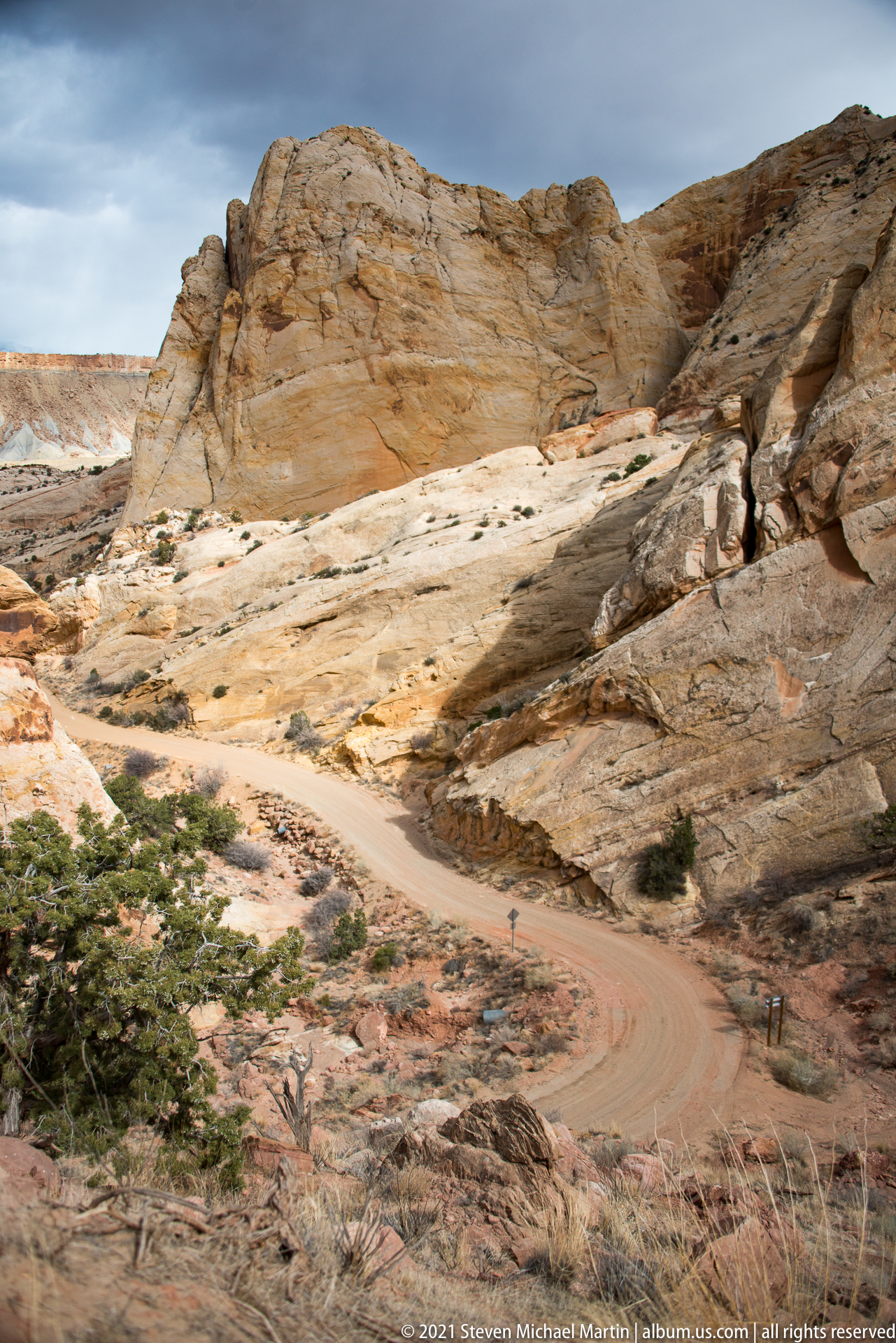
A dirt road curves across a broad pale sandstone basin, passing between low juniper and smooth rock slopes. The track bends toward a low ridge at left, while a broad cream-colored wall stretches across the upper background. Its route provides a human-scale line through otherwise open terrain and distinguishes this view from the steeper canyon passages.
Caption
A dirt road curves across a broad pale sandstone basin, passing between low juniper and smooth rock slopes. The track bends toward a low ridge at left, while a broad cream-colored wall stretches across the upper background. Its route provides a human-scale line through otherwise open terrain and distinguishes this view from the steeper canyon passages.
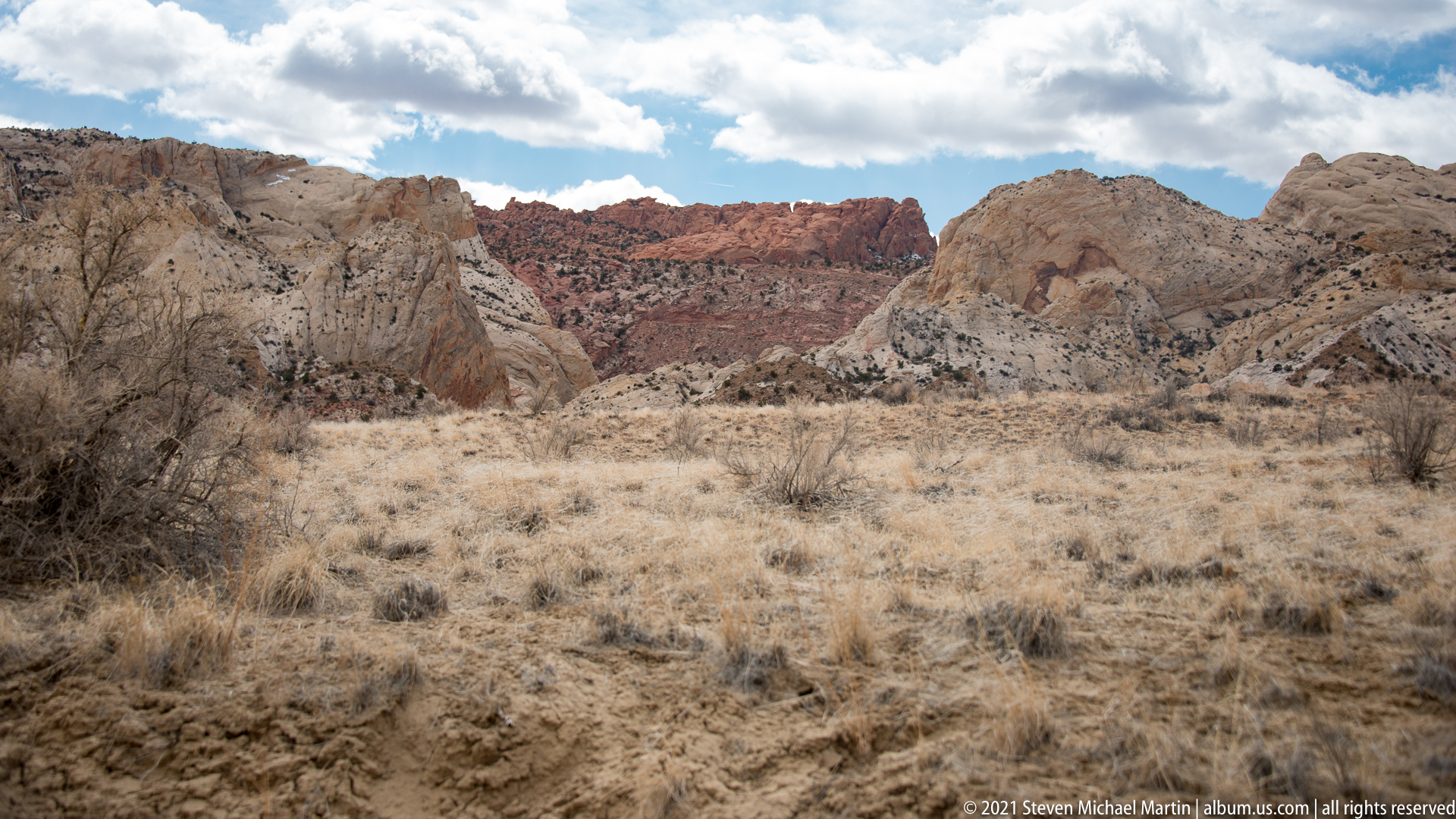
Dry grasses spread across an open wash between pale rounded rock walls, with a darker red cliff band visible in the distance. The foreground terrain is low and gently sloped, drawing attention toward a narrow gap in the canyon. Cloud shadows soften the light across the rock, while sparse plants show the scale of the valley floor.
Caption
Dry grasses spread across an open wash between pale rounded rock walls, with a darker red cliff band visible in the distance. The foreground terrain is low and gently sloped, drawing attention toward a narrow gap in the canyon. Cloud shadows soften the light across the rock, while sparse plants show the scale of the valley floor.
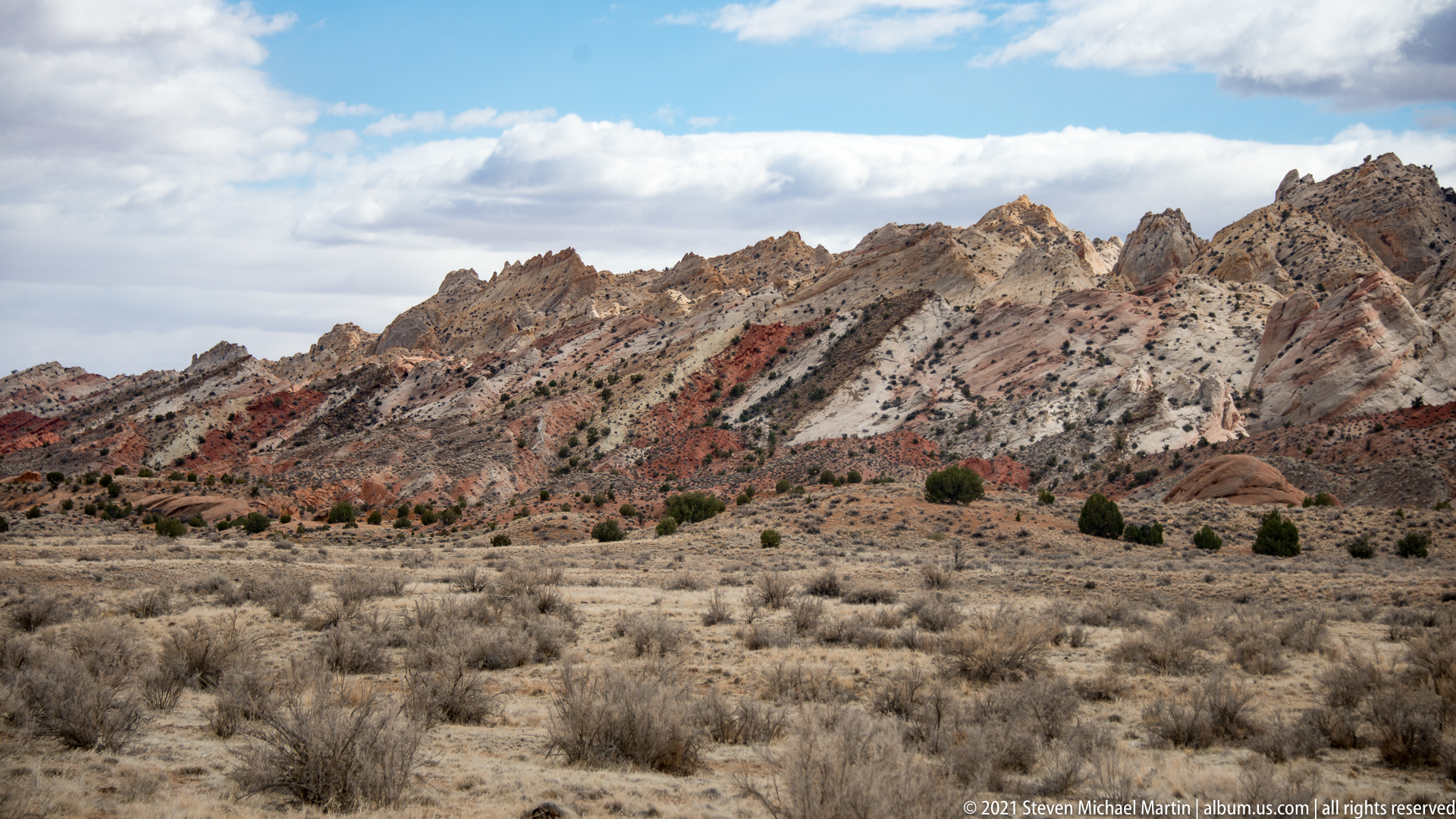
A long ridge of red, cream, and gray rock rises beyond a broad plain of dry shrubs. Diagonal bands and jagged outcrops break the ridge into contrasting sections, while rounded red formations sit at its base. The wide view shows this pattern extending across the landscape rather than focusing on one outcrop, beneath a sky filled with layered clouds.
Caption
A long ridge of red, cream, and gray rock rises beyond a broad plain of dry shrubs. Diagonal bands and jagged outcrops break the ridge into contrasting sections, while rounded red formations sit at its base. The wide view shows this pattern extending across the landscape rather than focusing on one outcrop, beneath a sky filled with layered clouds.
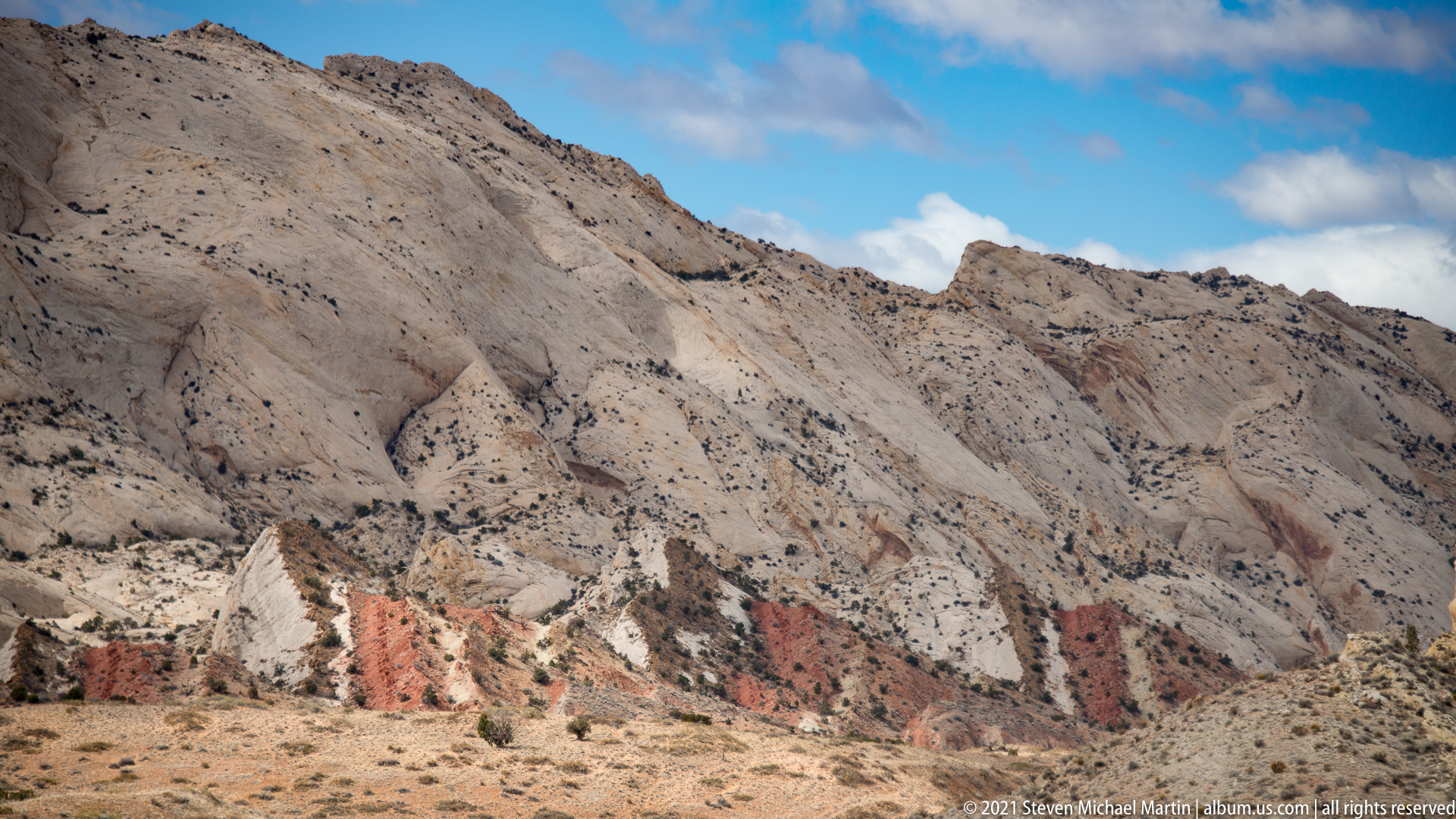
A broad gray slope descends toward a narrow strip of red and cream bands at its base. Shallow channels cut the pale face, and dark speckles of scattered vegetation punctuate the otherwise bare surface. The low horizon leaves most of the frame to the eroded hillside, making its gullies and subtle shifts in color the main subject.
Caption
A broad gray slope descends toward a narrow strip of red and cream bands at its base. Shallow channels cut the pale face, and dark speckles of scattered vegetation punctuate the otherwise bare surface. The low horizon leaves most of the frame to the eroded hillside, making its gullies and subtle shifts in color the main subject.
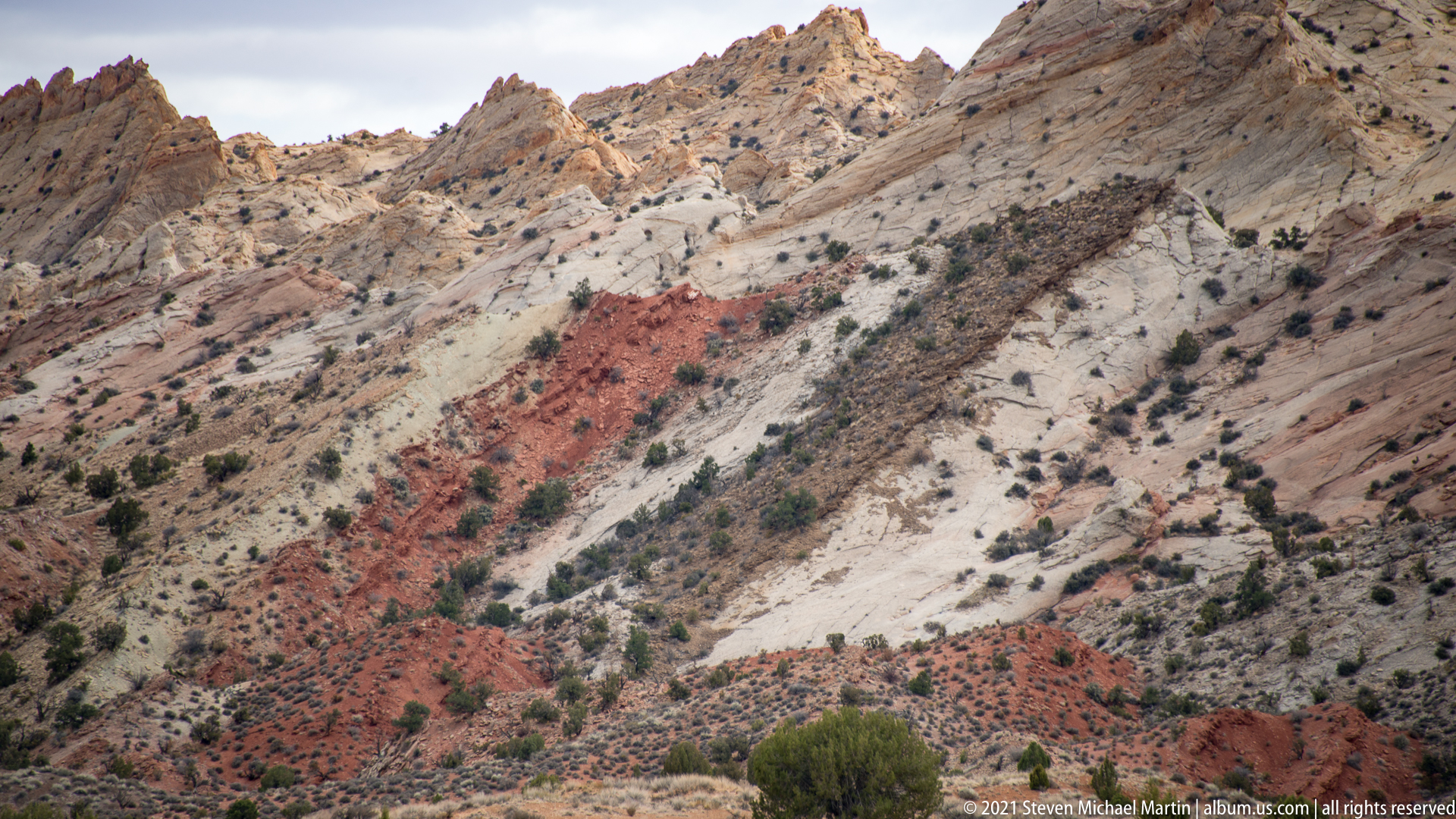
Diagonal pale and rust-colored beds sweep across a steep hillside, with small shrubs scattered over its broken surface. The closer angle reveals bands that vary in thickness and direction, creating a layered pattern from lower red outcrops to light upper rock. A dark juniper at the bottom edge anchors the slope in the foreground.
Caption
Diagonal pale and rust-colored beds sweep across a steep hillside, with small shrubs scattered over its broken surface. The closer angle reveals bands that vary in thickness and direction, creating a layered pattern from lower red outcrops to light upper rock. A dark juniper at the bottom edge anchors the slope in the foreground.
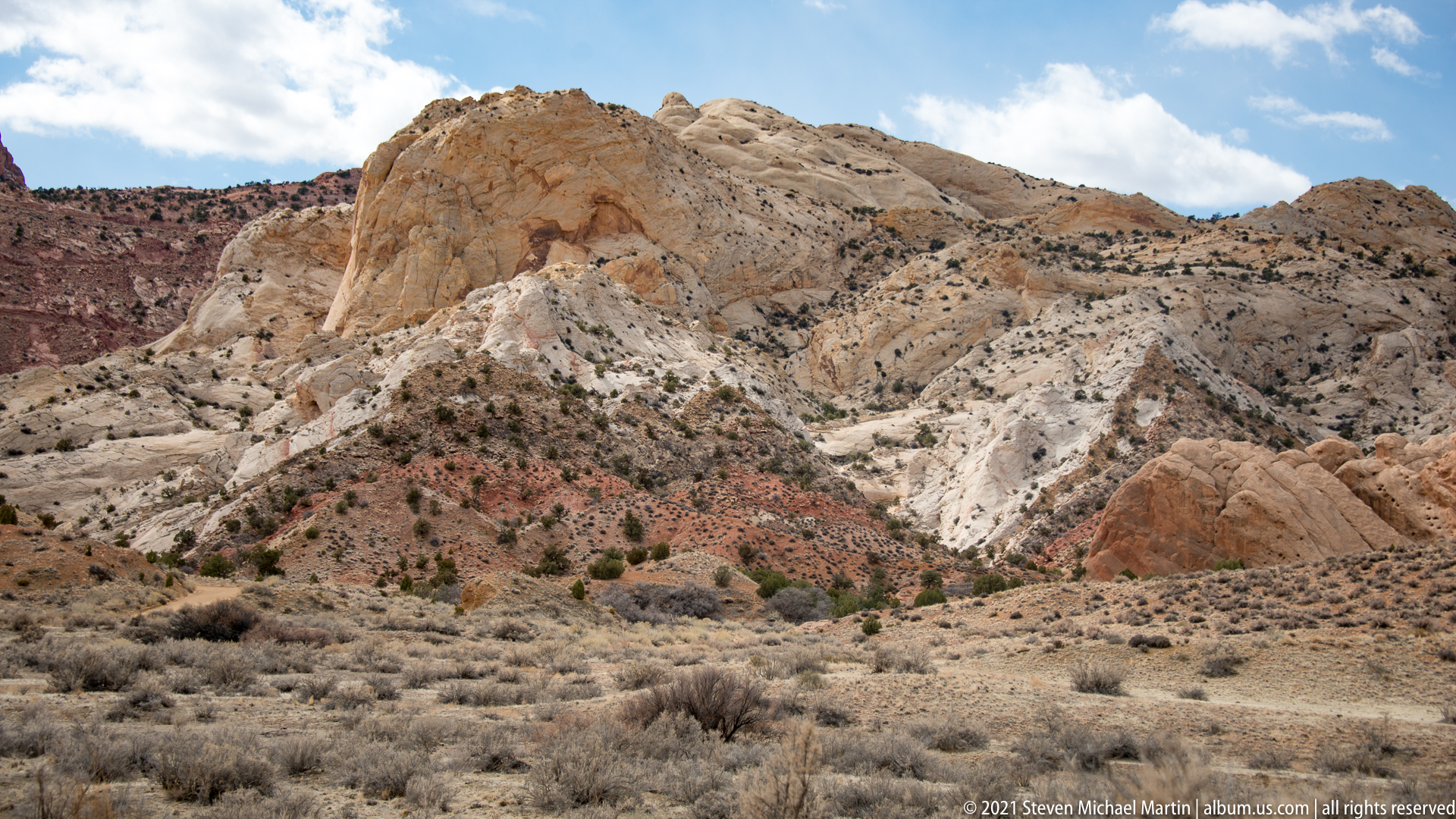
Pale sandstone hills with a red band near their base rise above a wide, sparsely vegetated valley. A rounded pale outcrop occupies the right foreground, while more distant slopes overlap behind it beneath a clouded sky. The composition links a close rock mass to layered terrain beyond, showing the varied relief of this dry canyon country.
Caption
Pale sandstone hills with a red band near their base rise above a wide, sparsely vegetated valley. A rounded pale outcrop occupies the right foreground, while more distant slopes overlap behind it beneath a clouded sky. The composition links a close rock mass to layered terrain beyond, showing the varied relief of this dry canyon country.
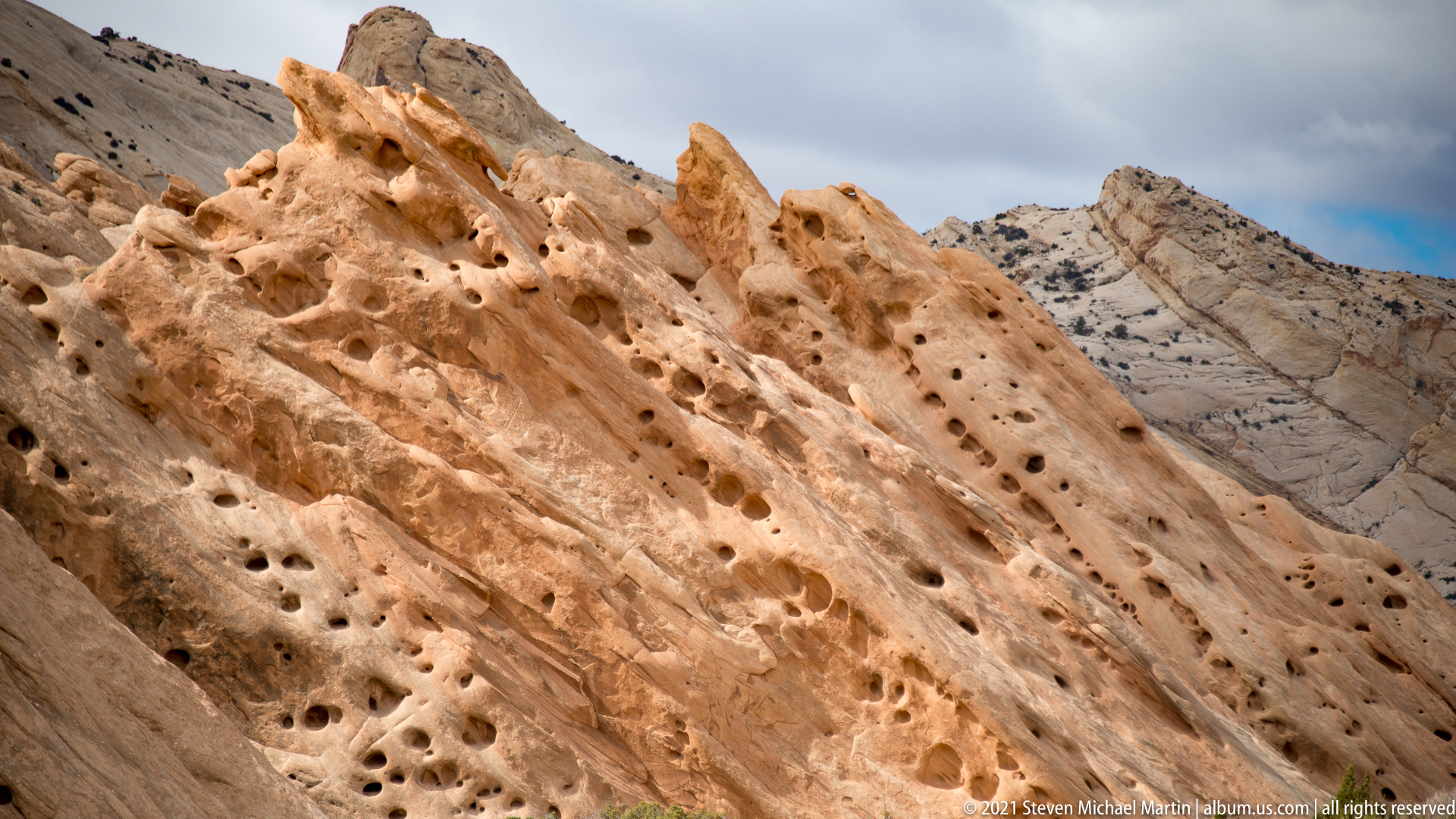
Orange sandstone fills the foreground, its sloping face marked by numerous rounded pits and small cavities. The honeycomb-like texture becomes denser toward the lower left, while smoother pale rock and gray ridges remain visible behind it. The close viewpoint emphasizes surface weathering and varied hole sizes without assigning a particular process to each cavity.
Caption
Orange sandstone fills the foreground, its sloping face marked by numerous rounded pits and small cavities. The honeycomb-like texture becomes denser toward the lower left, while smoother pale rock and gray ridges remain visible behind it. The close viewpoint emphasizes surface weathering and varied hole sizes without assigning a particular process to each cavity.
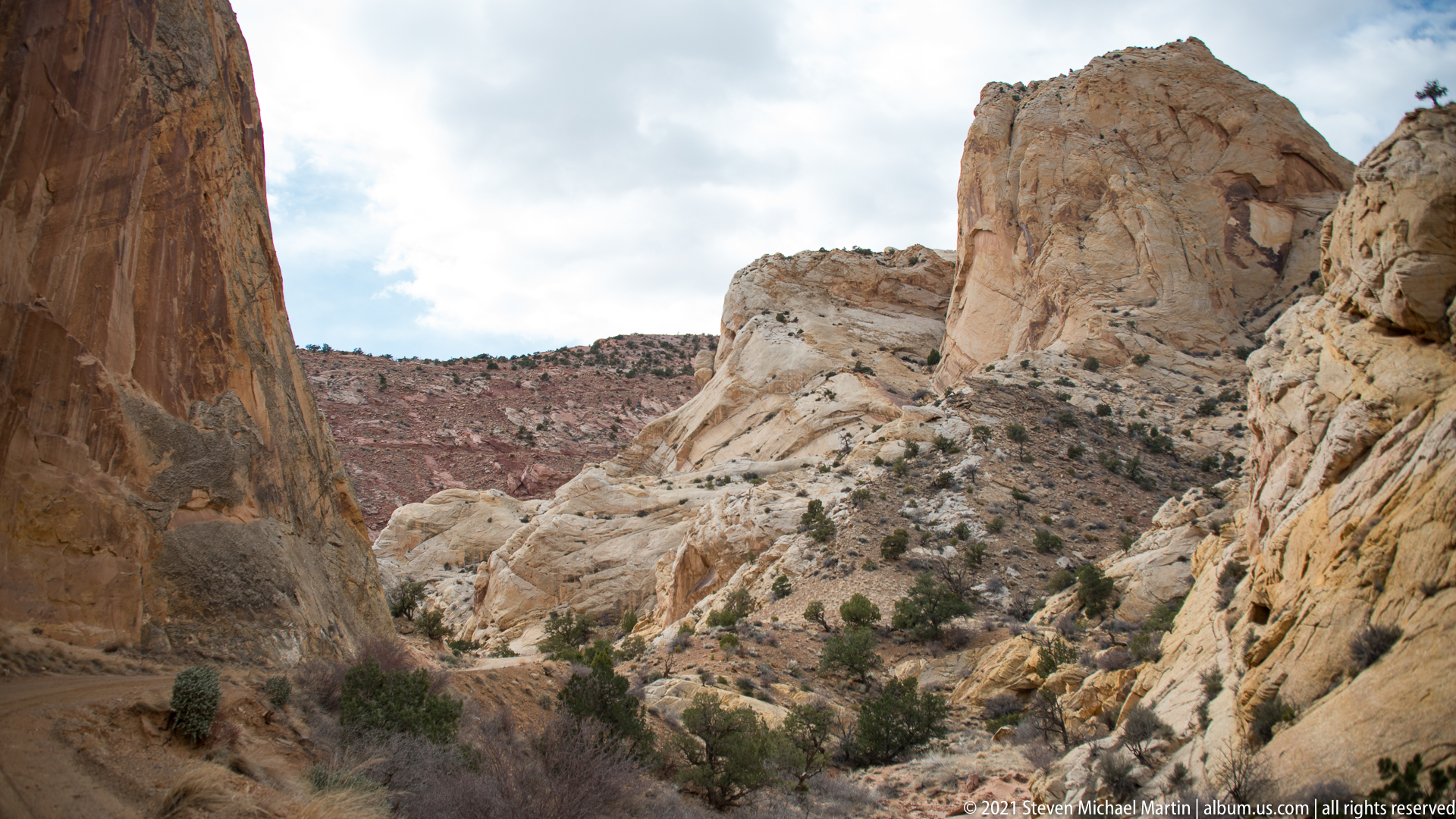
A narrow passage opens between steep pale sandstone walls, with a red ridge visible through the gap in the distance. The foreground drops into a shrub-lined drainage, while one dark vertical face frames the left and a rounded sunlit wall rises at right. This view emphasizes the enclosed shape of the canyon and the contrast between near rock and distant terrain.
Caption
A narrow passage opens between steep pale sandstone walls, with a red ridge visible through the gap in the distance. The foreground drops into a shrub-lined drainage, while one dark vertical face frames the left and a rounded sunlit wall rises at right. This view emphasizes the enclosed shape of the canyon and the contrast between near rock and distant terrain.
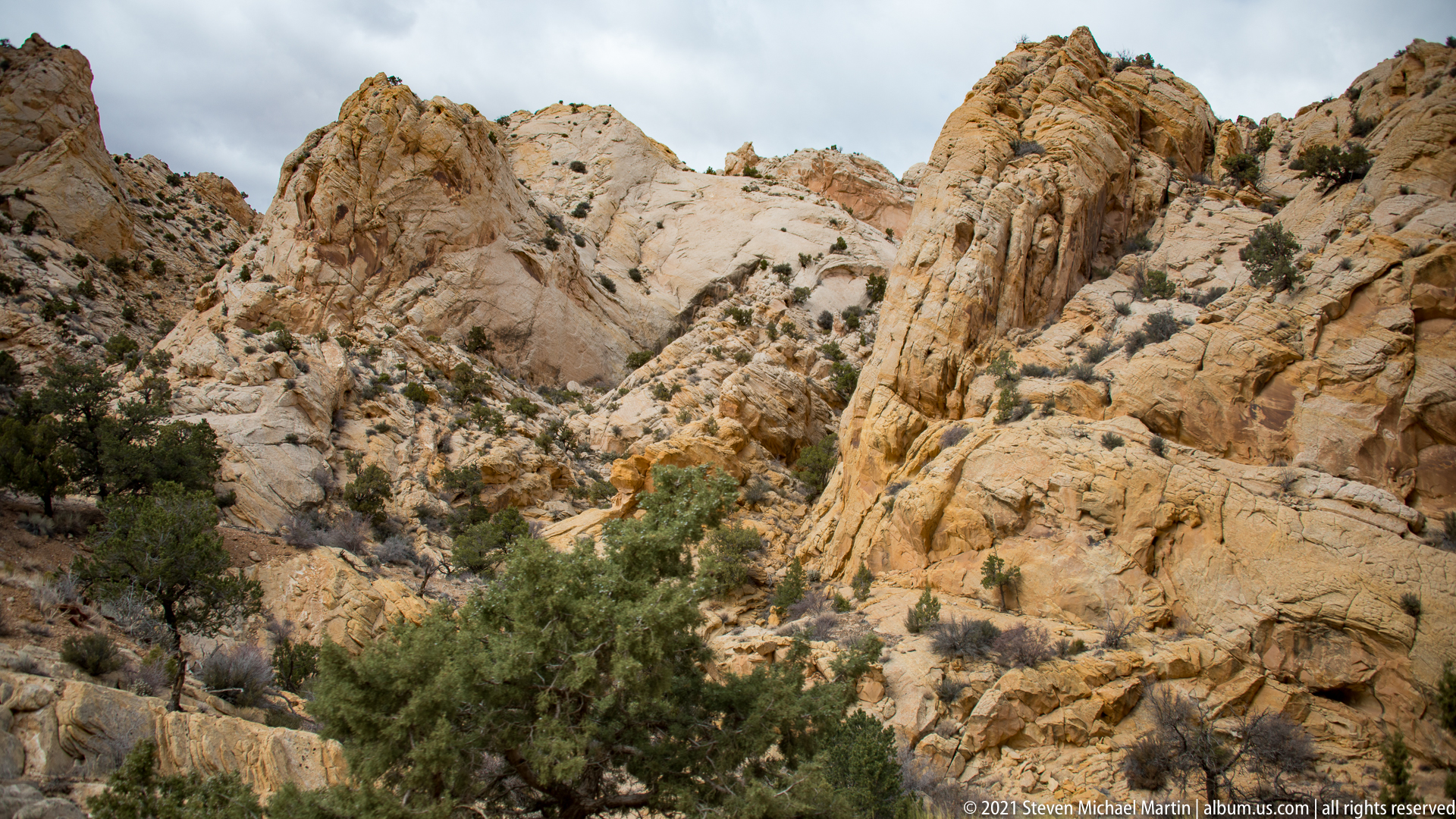
Pale sandstone outcrops crowd together, with a tall, narrow rib of vertically streaked rock rising near the center. Lower slabs and scattered juniper fill the foreground, and overlapping faces create a compact, irregular canyon scene. The central rib draws attention away from broad slopes and toward the difference between smoother ledges and deeply fractured faces.
Caption
Pale sandstone outcrops crowd together, with a tall, narrow rib of vertically streaked rock rising near the center. Lower slabs and scattered juniper fill the foreground, and overlapping faces create a compact, irregular canyon scene. The central rib draws attention away from broad slopes and toward the difference between smoother ledges and deeply fractured faces.

A dirt track winds down between pale sandstone walls toward a lower valley, where the route curves out of sight. The canyon walls rise close on both sides, with broken ledges and sparse shrubs marking their slopes. Cloud cover softens the light across the pale rock and makes the road’s warm color stand out against the surrounding stone.
Caption
A dirt track winds down between pale sandstone walls toward a lower valley, where the route curves out of sight. The canyon walls rise close on both sides, with broken ledges and sparse shrubs marking their slopes. Cloud cover softens the light across the pale rock and makes the road’s warm color stand out against the surrounding stone.
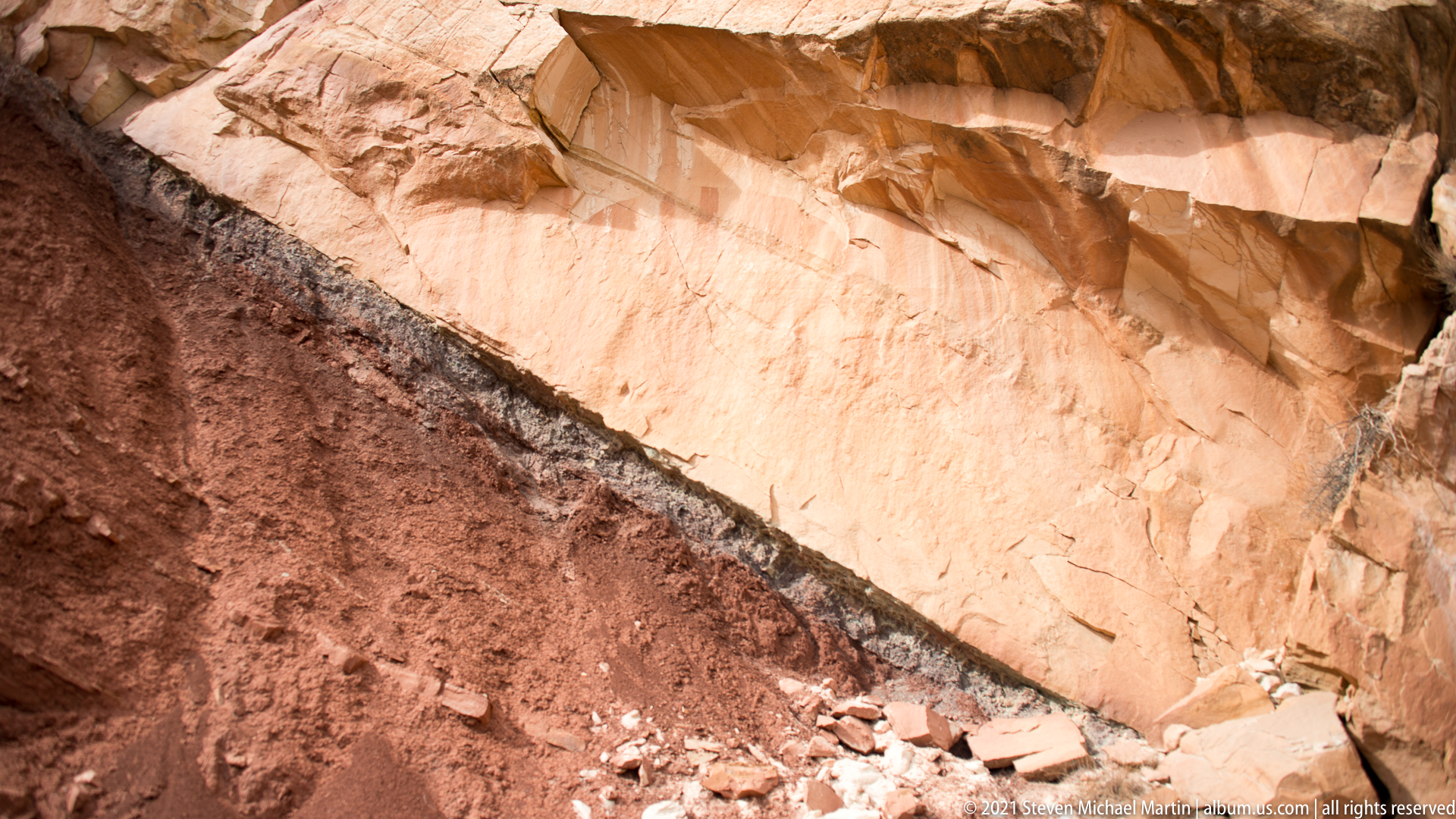
A diagonal boundary divides dark red rock from a broad pale sandstone layer, with loose fragments gathered along the contact. The close framing reveals a sharp change in color and texture across the face, while a broken ledge enters from the upper right. The image isolates the meeting of two visibly different beds without assigning an unverified formation name.
Caption
A diagonal boundary divides dark red rock from a broad pale sandstone layer, with loose fragments gathered along the contact. The close framing reveals a sharp change in color and texture across the face, while a broken ledge enters from the upper right. The image isolates the meeting of two visibly different beds without assigning an unverified formation name.

From an elevated slope, a curving dirt road winds through pale sandstone walls and red-brown ledges. The route makes a broad bend in the lower valley before passing between light-colored rock masses, while a flat-topped pale ridge stretches across the distance. The high viewpoint reveals the road’s path through the terrain and the layered structure of the basin.
Caption
From an elevated slope, a curving dirt road winds through pale sandstone walls and red-brown ledges. The route makes a broad bend in the lower valley before passing between light-colored rock masses, while a flat-topped pale ridge stretches across the distance. The high viewpoint reveals the road’s path through the terrain and the layered structure of the basin.
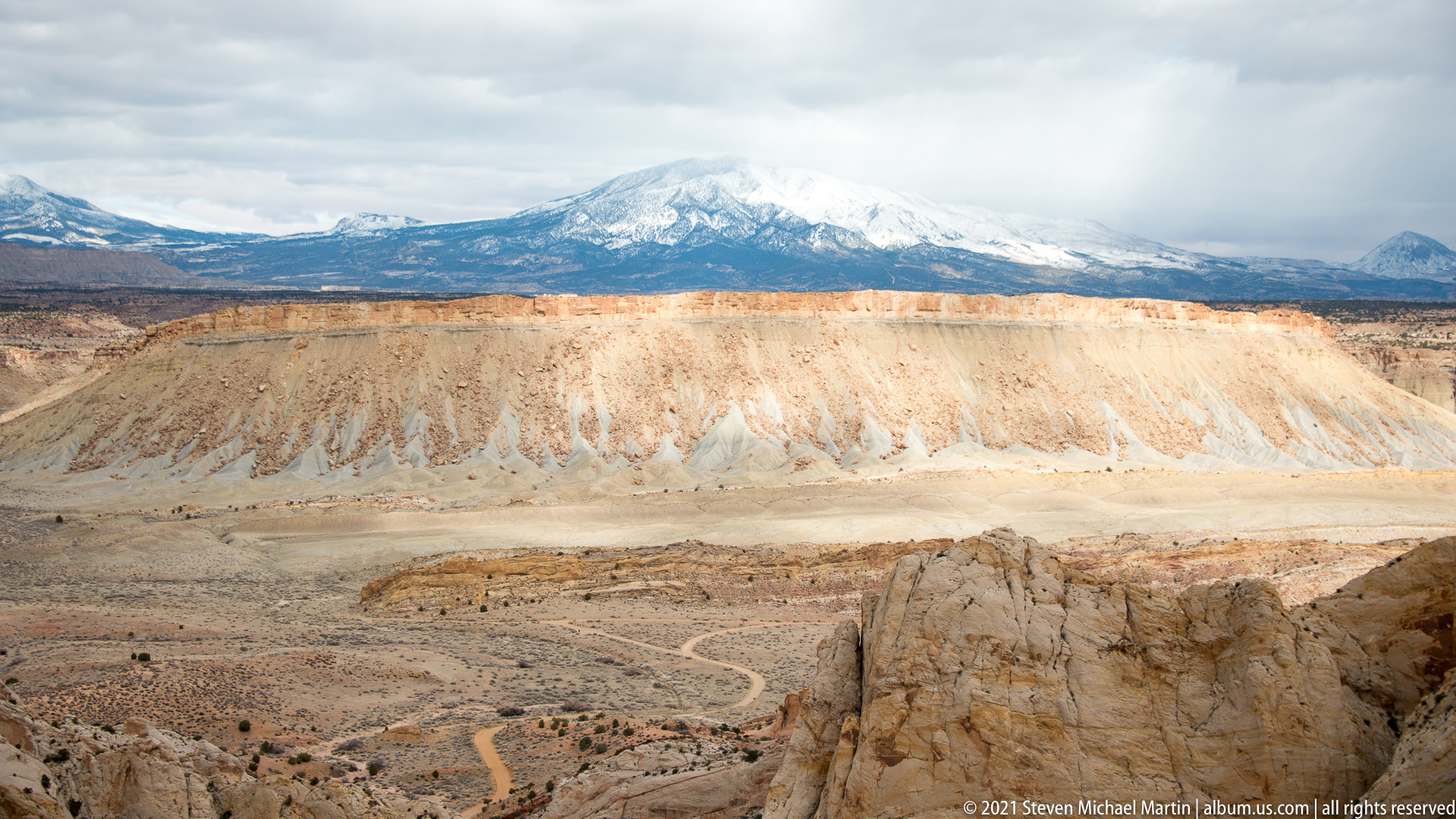
A pale, steep-sided ridge with narrow vertical gullies spans the middle distance, backed by a snow-covered mountain range. The dry valley floor and a thin road occupy the foreground, while clouds partly veil the peaks. The composition juxtaposes eroded desert strata with a much higher, colder landscape on the horizon.
Caption
A pale, steep-sided ridge with narrow vertical gullies spans the middle distance, backed by a snow-covered mountain range. The dry valley floor and a thin road occupy the foreground, while clouds partly veil the peaks. The composition juxtaposes eroded desert strata with a much higher, colder landscape on the horizon.
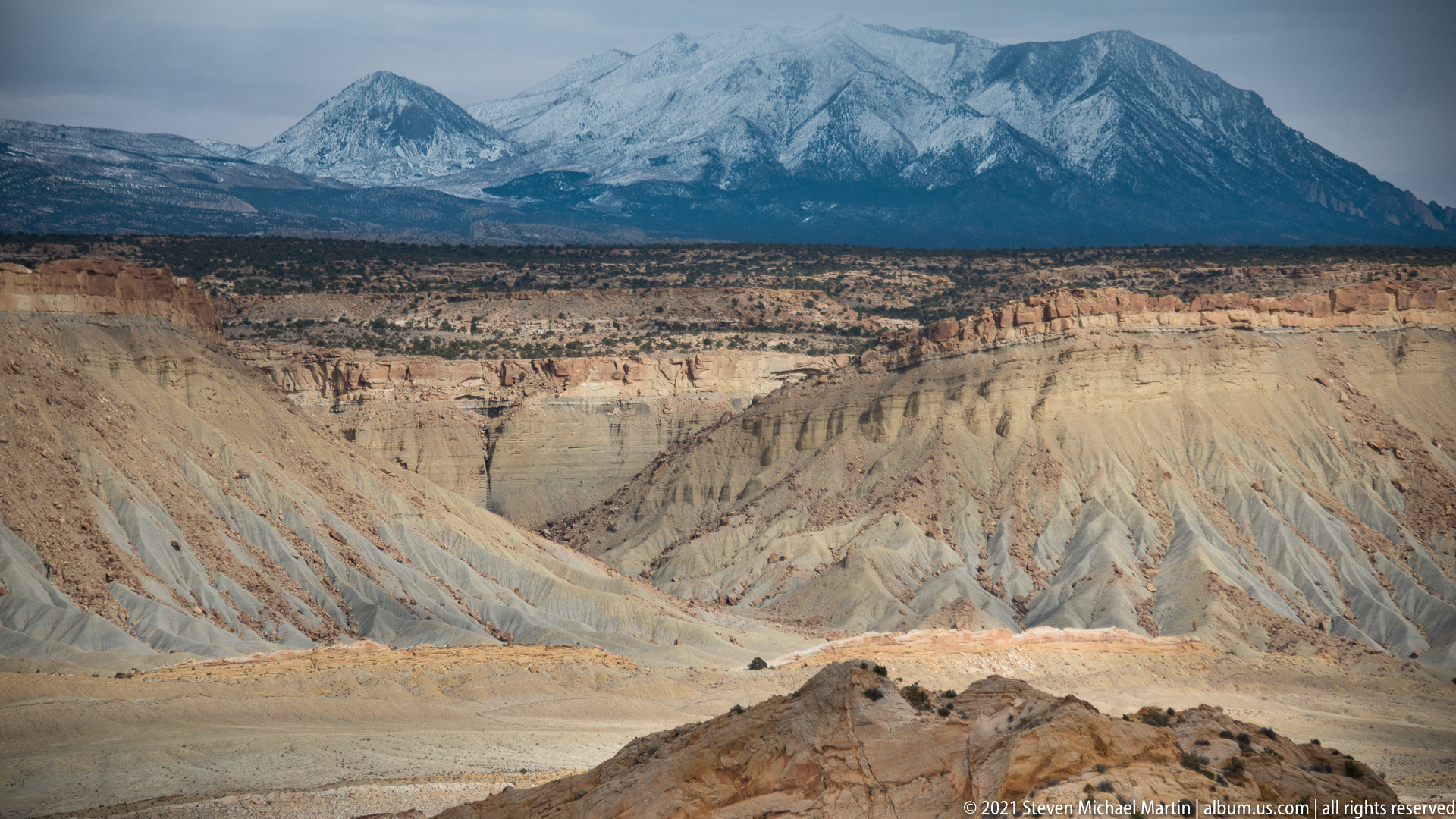
Pale badland slopes with narrow erosion channels fill the foreground, while a dark, snow-covered mountain rises across the horizon. The mountain’s ridgeline contrasts with the soft, rounded forms of the lower terrain, and a band of darker vegetation separates the two elevations. The layered view emphasizes the transition from dry canyon country to the distant high country.
Caption
Pale badland slopes with narrow erosion channels fill the foreground, while a dark, snow-covered mountain rises across the horizon. The mountain’s ridgeline contrasts with the soft, rounded forms of the lower terrain, and a band of darker vegetation separates the two elevations. The layered view emphasizes the transition from dry canyon country to the distant high country.
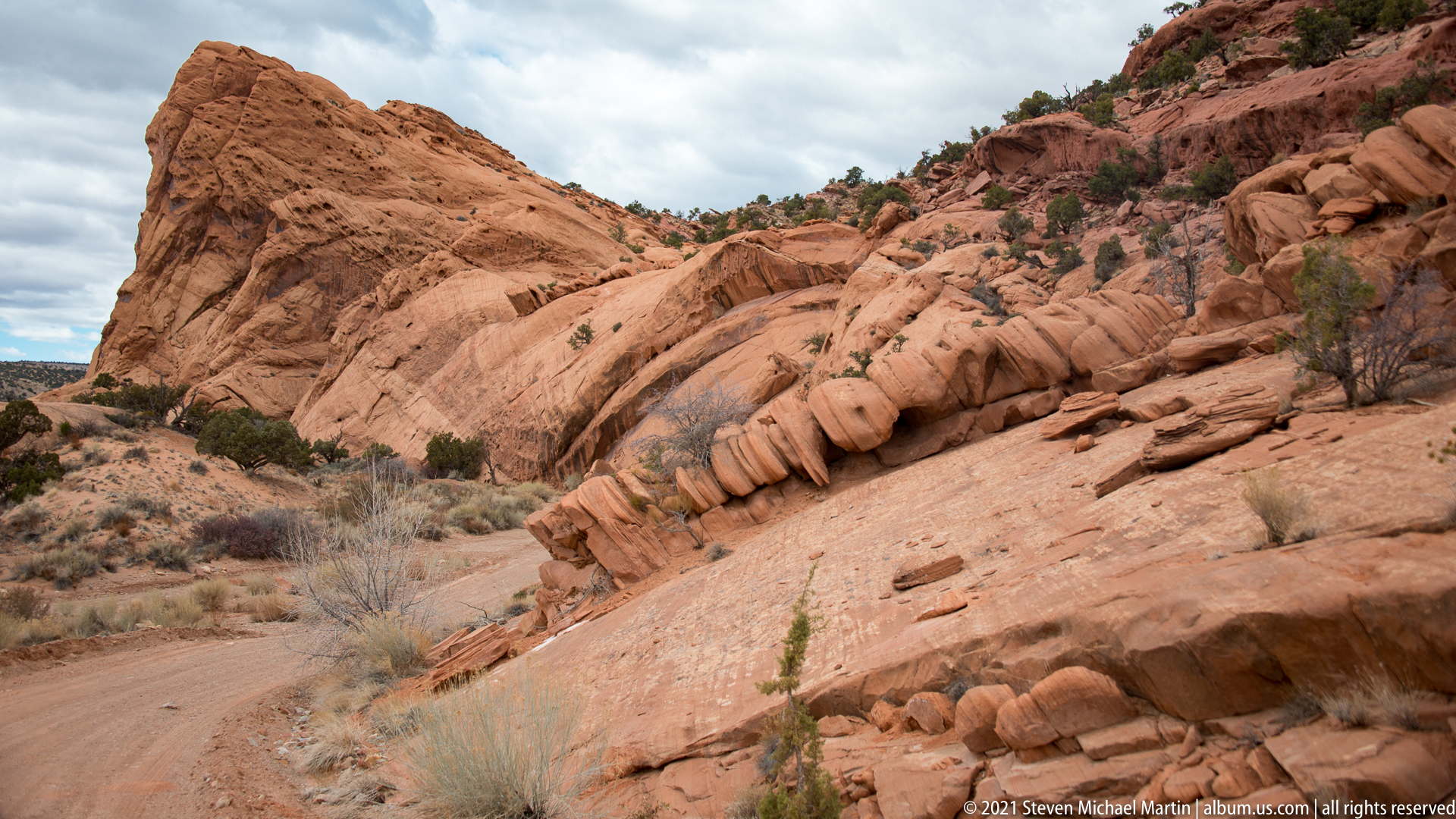
Rounded red sandstone ledges descend toward a pale dirt track that curves through the lower left. Dry shrubs grow among the fractured slabs, whose horizontal bands and smooth, folded surfaces create a layered foreground. A low ridge extends beyond the road, keeping the scene focused on the near rock formations and their relation to the route.
Caption
Rounded red sandstone ledges descend toward a pale dirt track that curves through the lower left. Dry shrubs grow among the fractured slabs, whose horizontal bands and smooth, folded surfaces create a layered foreground. A low ridge extends beyond the road, keeping the scene focused on the near rock formations and their relation to the route.
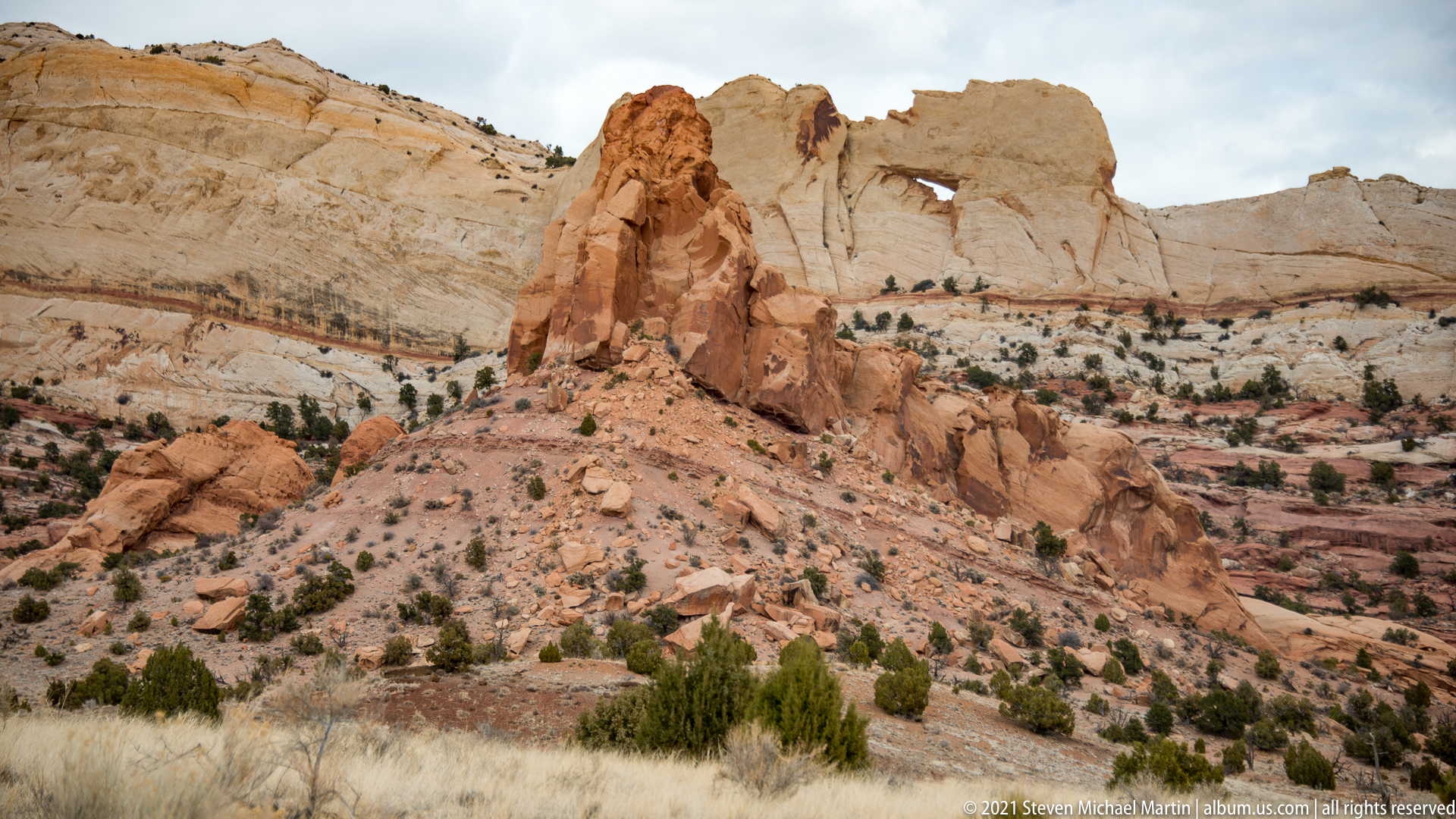
A red sandstone tower rises from a pale ridge, its broken crown standing above rounded ledges and low shrubs. A small opening is visible in the pale rock wall behind it, while cream, gray, and rust bands extend across the broader slope. The composition centers the tower but retains surrounding geology to show its position within a larger layered landscape.
Caption
A red sandstone tower rises from a pale ridge, its broken crown standing above rounded ledges and low shrubs. A small opening is visible in the pale rock wall behind it, while cream, gray, and rust bands extend across the broader slope. The composition centers the tower but retains surrounding geology to show its position within a larger layered landscape.
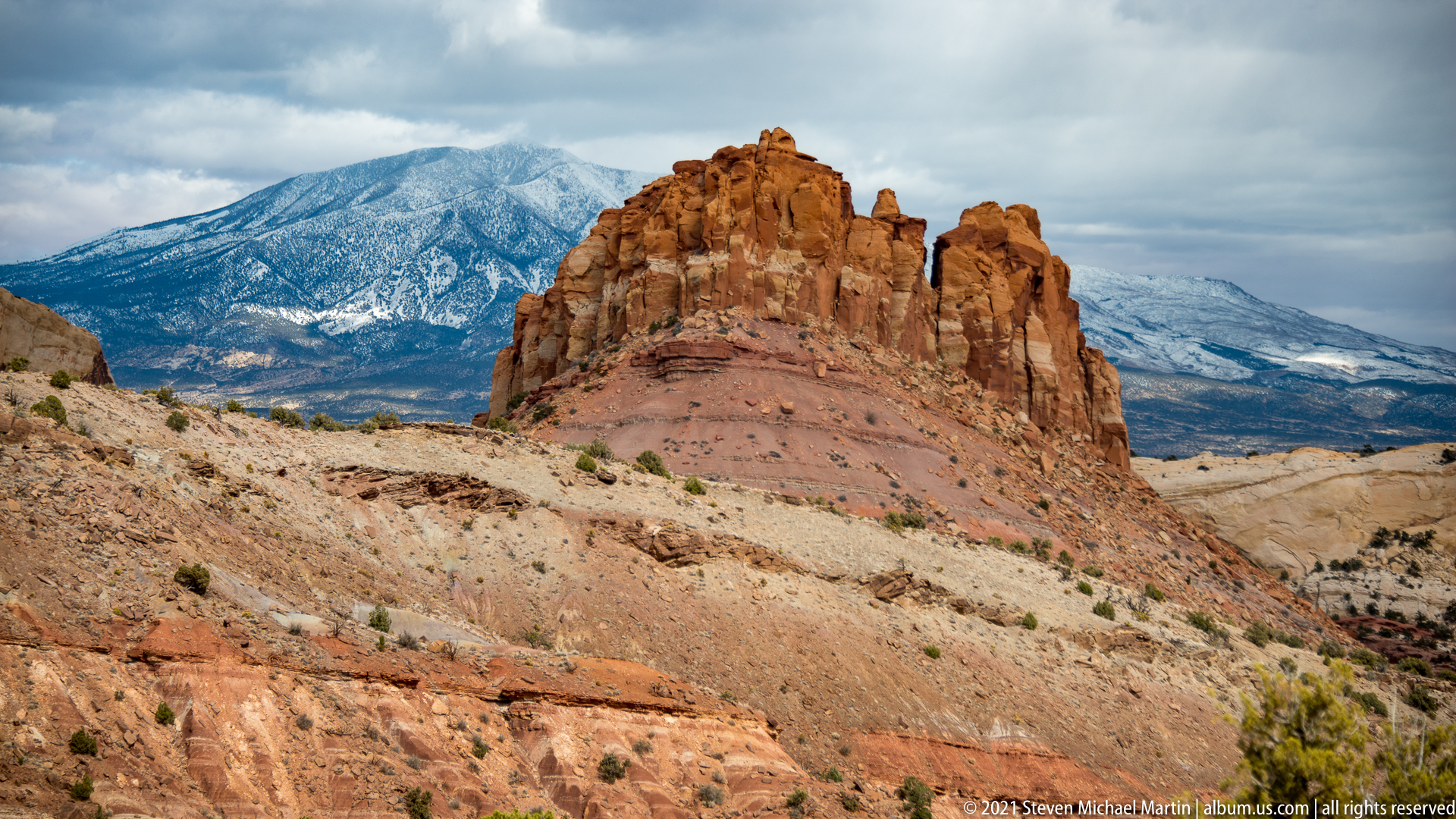
A compact red sandstone butte rises from a pale rocky bench, with a broad snow-covered mountain range behind it. Foreground ledges and low shrubs create a gradual approach to the central formation, whose jagged top stands against dark blue slopes. The wide view links the local red rock outcrop with the higher landscape beyond.
Caption
A compact red sandstone butte rises from a pale rocky bench, with a broad snow-covered mountain range behind it. Foreground ledges and low shrubs create a gradual approach to the central formation, whose jagged top stands against dark blue slopes. The wide view links the local red rock outcrop with the higher landscape beyond.
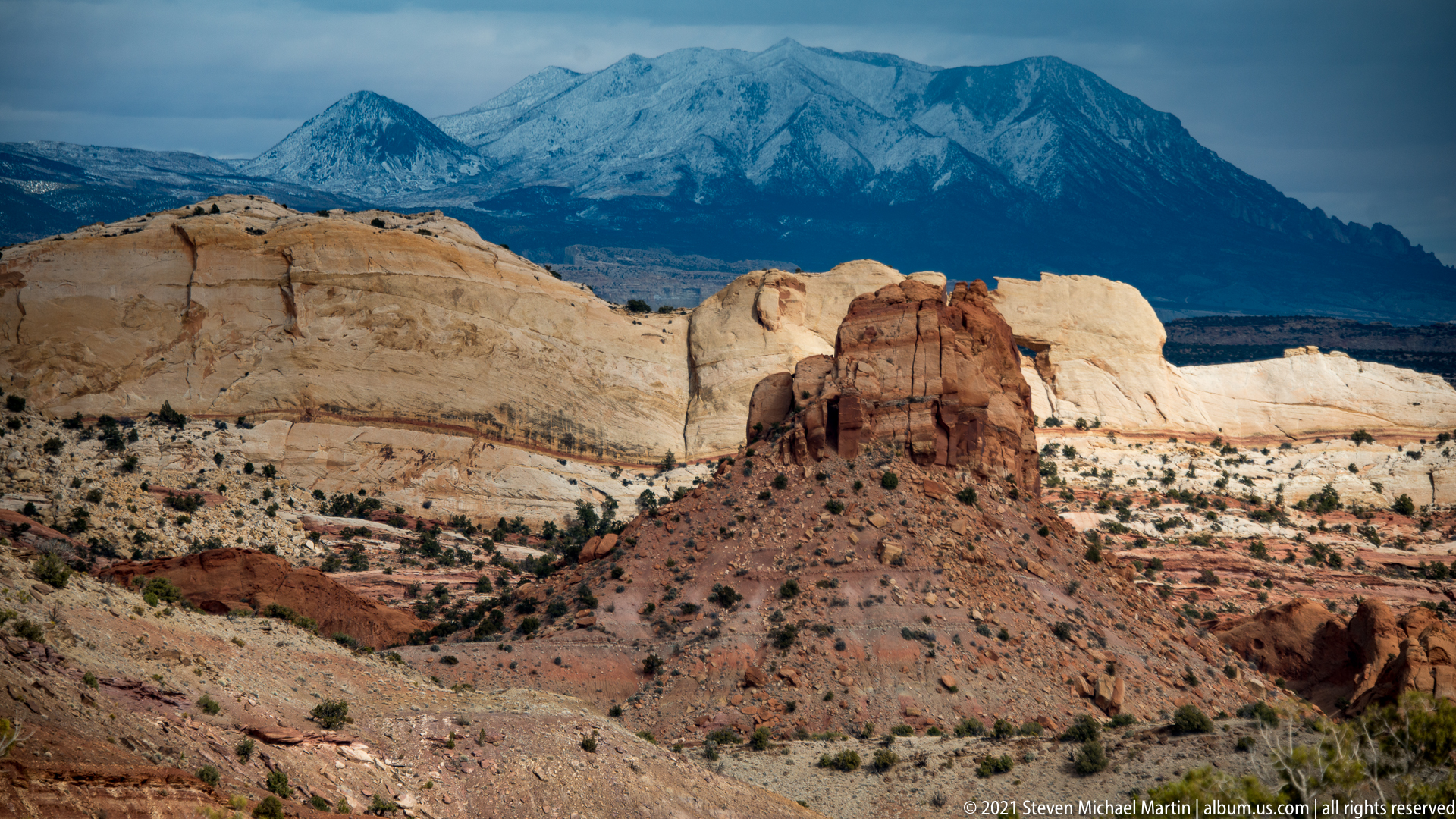
A red sandstone formation sits on a pale shelf below a dark, snow-dusted mountain. The nearer rock contains rounded ledges and light horizontal bands, while low desert shrubs dot the open ground between the outcrop and camera. This tighter composition shifts attention from the distant mountain range to the contrast between the red formation and its pale base.
Caption
A red sandstone formation sits on a pale shelf below a dark, snow-dusted mountain. The nearer rock contains rounded ledges and light horizontal bands, while low desert shrubs dot the open ground between the outcrop and camera. This tighter composition shifts attention from the distant mountain range to the contrast between the red formation and its pale base.
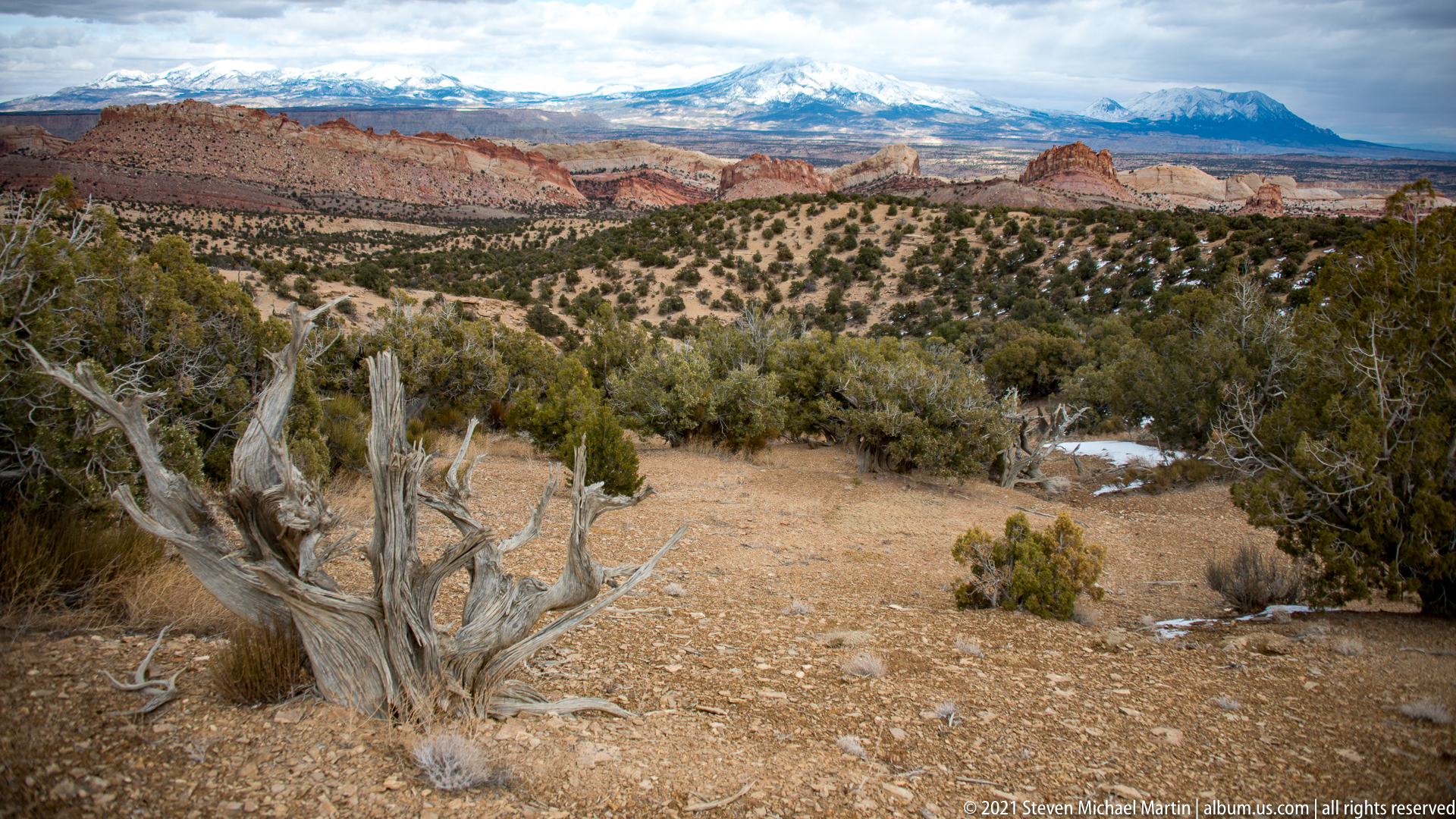
A bleached, weathered tree trunk stands in the foreground among juniper and dry grasses. Beyond it, red and pale ridges extend across a broad valley beneath a distant snow-dusted mountain range. The dead wood provides a strong near-ground form against the layered horizon, while a few small snow patches remain among the shrubs.
Caption
A bleached, weathered tree trunk stands in the foreground among juniper and dry grasses. Beyond it, red and pale ridges extend across a broad valley beneath a distant snow-dusted mountain range. The dead wood provides a strong near-ground form against the layered horizon, while a few small snow patches remain among the shrubs.

A large roadside sign reads “Grand Staircase-Escalante National Monument,” with the U.S. Department of the Interior and Bureau of Land Management named below. A graphic of desert mesas and a tree decorates the top, while juniper and pale rock frame the sign. The close view makes the monument name legible and records its agency attribution.
Caption
A large roadside sign reads “Grand Staircase-Escalante National Monument,” with the U.S. Department of the Interior and Bureau of Land Management named below. A graphic of desert mesas and a tree decorates the top, while juniper and pale rock frame the sign. The close view makes the monument name legible and records its agency attribution.

The Grand Staircase-Escalante National Monument sign stands on a low rocky rise amid juniper and dry shrubs. Its dark panel is legible against a pale sky, while the wider framing includes the natural roadside setting and a weathered tree to the right. This view places the monument marker within open scrubland rather than isolating its lettering in a close crop.
Caption
The Grand Staircase-Escalante National Monument sign stands on a low rocky rise amid juniper and dry shrubs. Its dark panel is legible against a pale sky, while the wider framing includes the natural roadside setting and a weathered tree to the right. This view places the monument marker within open scrubland rather than isolating its lettering in a close crop.

A broad snow-covered mountain rises behind a sequence of red and cream canyon walls, with dark woodland filling the lower foreground. The distant summit and nearer cliffs create distinct bands of elevation and color across the view. Clear blue sky and bright winter light sharpen the contrast between the snowy high country and the comparatively dry, exposed terrain below.
Caption
A broad snow-covered mountain rises behind a sequence of red and cream canyon walls, with dark woodland filling the lower foreground. The distant summit and nearer cliffs create distinct bands of elevation and color across the view. Clear blue sky and bright winter light sharpen the contrast between the snowy high country and the comparatively dry, exposed terrain below.
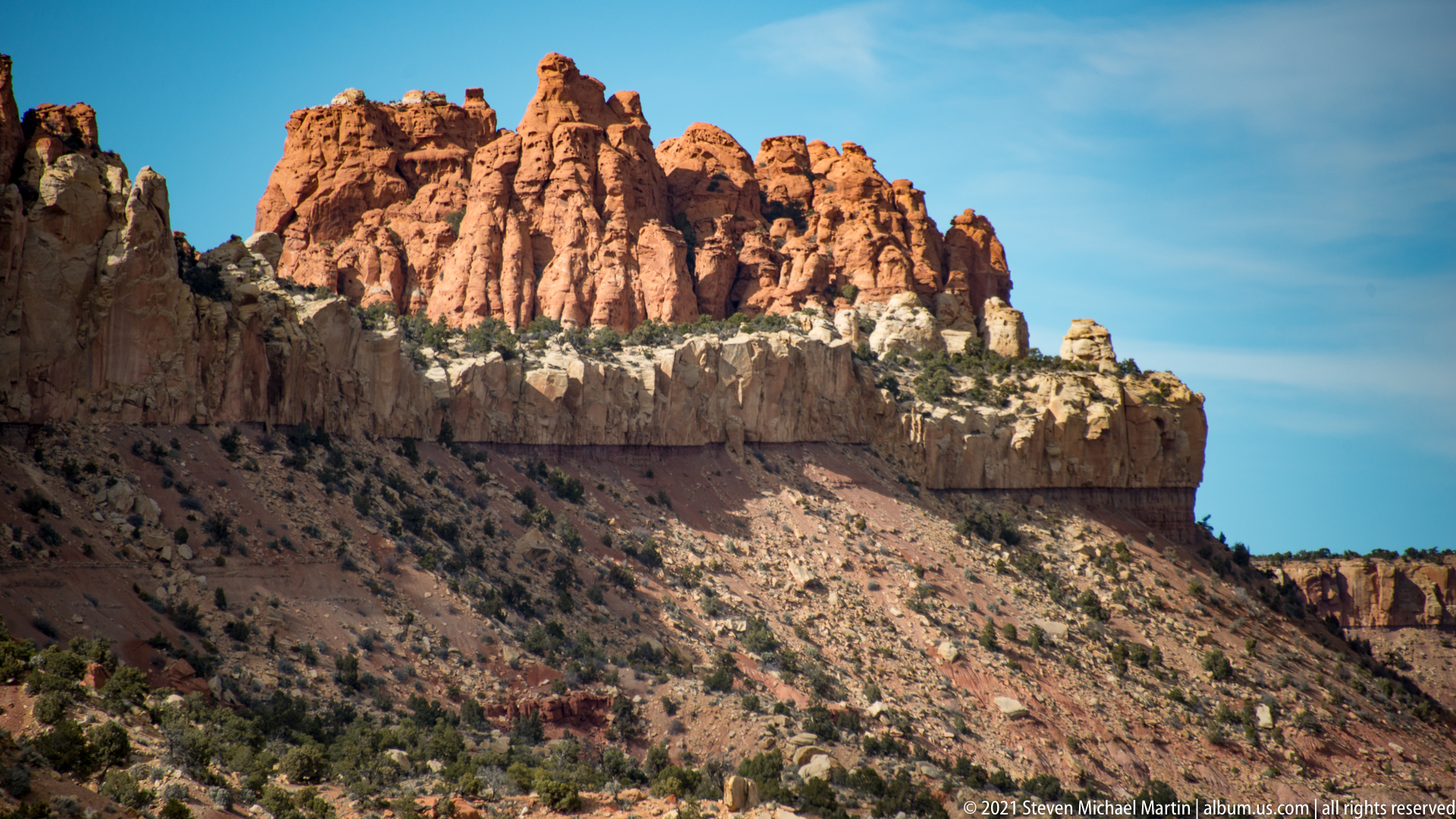
Sunlit red pinnacles crown a steep sandstone escarpment, their narrow towers and broken tops standing against an open blue sky. A broad shadow covers the lower slope, accentuating the division between the pale caprock, warm upper formations, and darker talus below. The close landscape view centers on the sculpted skyline rather than the canyon beyond.
Caption
Sunlit red pinnacles crown a steep sandstone escarpment, their narrow towers and broken tops standing against an open blue sky. A broad shadow covers the lower slope, accentuating the division between the pale caprock, warm upper formations, and darker talus below. The close landscape view centers on the sculpted skyline rather than the canyon beyond.
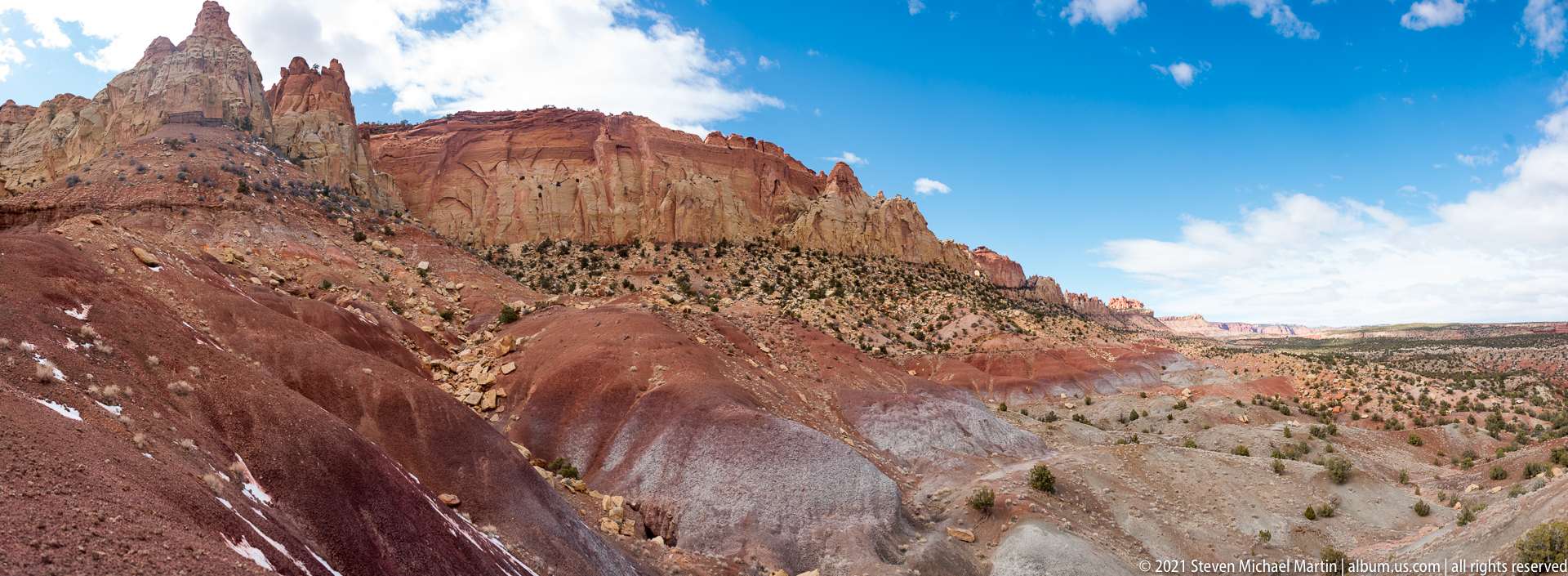
An elevated viewpoint looks along a red sandstone escarpment, where darker bands and pale mineral streaks descend toward a broad valley. Sparse shrubs cling to the slopes, and distant mesas fade along the horizon. The foreground rock creates a strong diagonal into the open landscape, while the bright sky and scattered clouds provide scale and depth.
Caption
An elevated viewpoint looks along a red sandstone escarpment, where darker bands and pale mineral streaks descend toward a broad valley. Sparse shrubs cling to the slopes, and distant mesas fade along the horizon. The foreground rock creates a strong diagonal into the open landscape, while the bright sky and scattered clouds provide scale and depth.
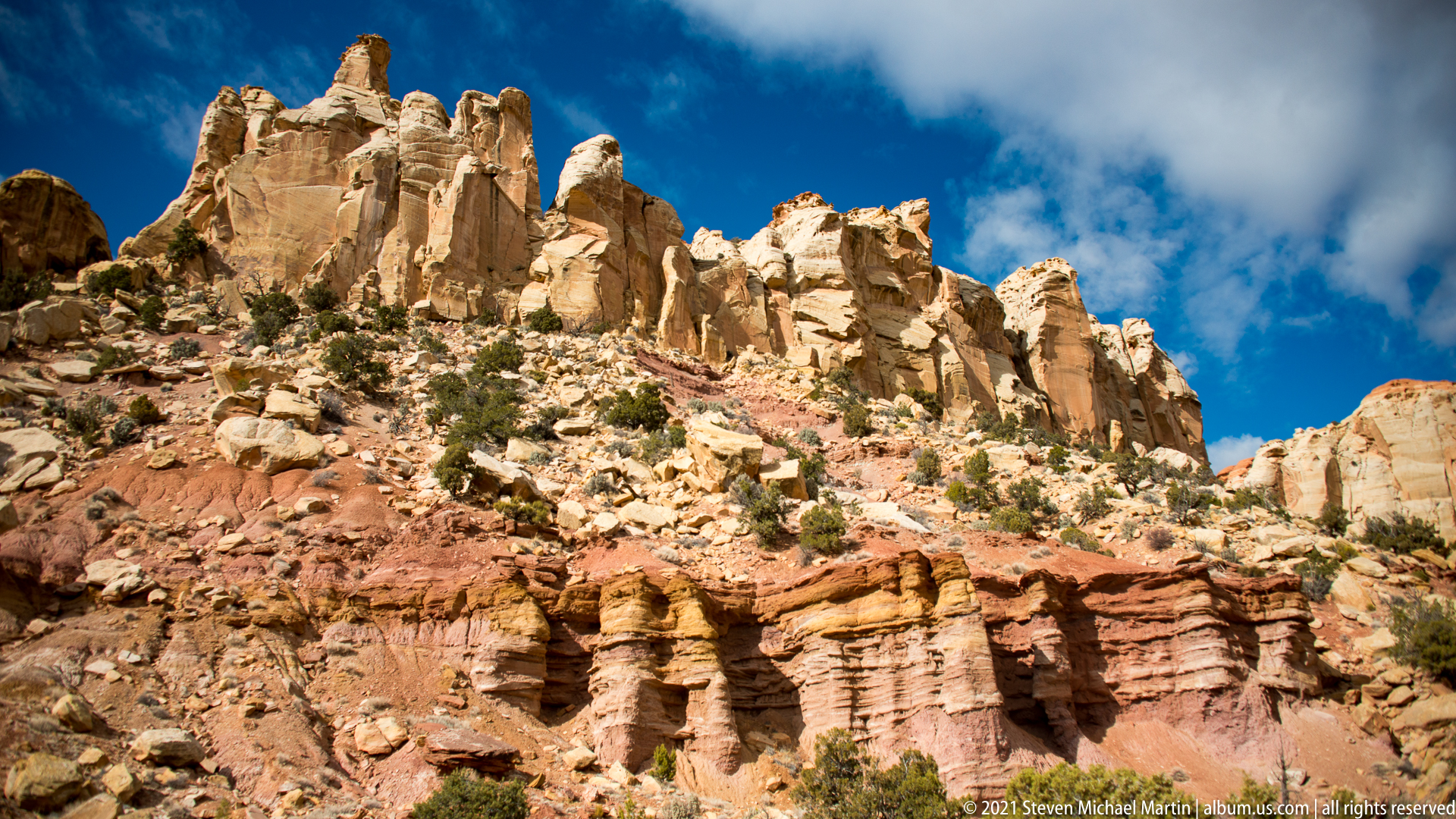
Pale sandstone towers rise above a lower wall cut into narrow vertical fins and shallow recesses. Red and cream layers alternate across the face, while a few shrubs cling to ledges near the base. Strong sunlight reveals the uneven relief and contrasts with the blue sky, making the cliff’s transition from solid caprock to eroded lower bands especially clear.
Caption
Pale sandstone towers rise above a lower wall cut into narrow vertical fins and shallow recesses. Red and cream layers alternate across the face, while a few shrubs cling to ledges near the base. Strong sunlight reveals the uneven relief and contrasts with the blue sky, making the cliff’s transition from solid caprock to eroded lower bands especially clear.

A row of red sandstone columns forms a ribbed foreground beneath taller cream-colored towers. Fallen blocks and rubble collect at the base, while the bright sky opens above the ridge. Differences in color and texture divide the formation into a lower, closely fluted band and a paler upper skyline, giving the view a clear sense of geological layering.
Caption
A row of red sandstone columns forms a ribbed foreground beneath taller cream-colored towers. Fallen blocks and rubble collect at the base, while the bright sky opens above the ridge. Differences in color and texture divide the formation into a lower, closely fluted band and a paler upper skyline, giving the view a clear sense of geological layering.
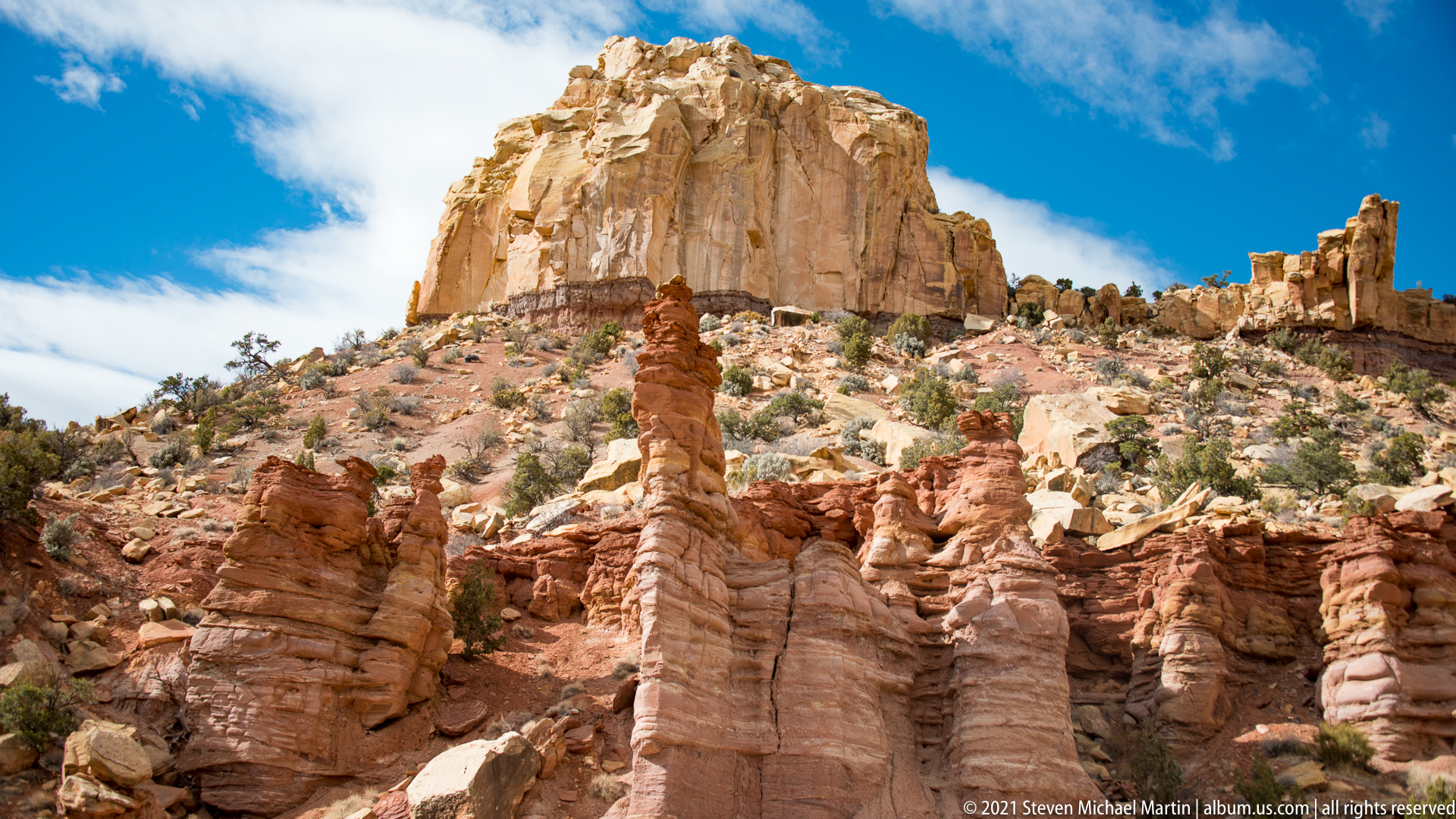
A single narrow red pillar rises from a line of fluted sandstone columns, set below a massive pale crown of rock. The foreground towers show horizontal bands and rounded edges, while scrub spreads across the slope between the lower and upper formations. This closer angle makes the contrast between the isolated pillar and the broad cliff above it the defining feature.
Caption
A single narrow red pillar rises from a line of fluted sandstone columns, set below a massive pale crown of rock. The foreground towers show horizontal bands and rounded edges, while scrub spreads across the slope between the lower and upper formations. This closer angle makes the contrast between the isolated pillar and the broad cliff above it the defining feature.
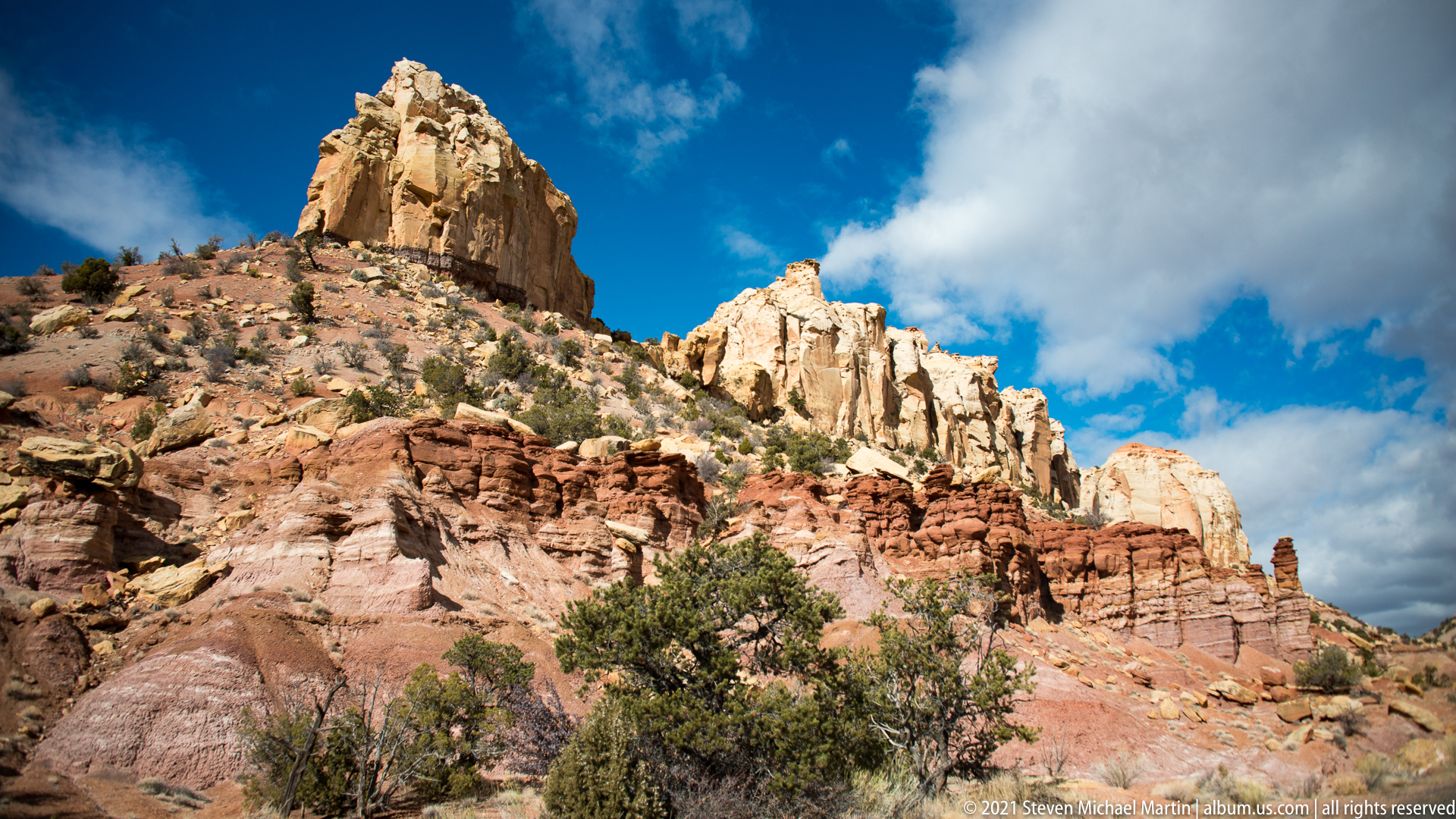
Pale sandstone towers climb above red, ribbed formations and a scrub-covered slope. A tall block of cream-colored rock anchors the left side, while smaller fins continue toward the right beneath a sky filled with bright clouds. The layered composition shows how the exposed upper cliffs give way to softer, more deeply eroded rock below.
Caption
Pale sandstone towers climb above red, ribbed formations and a scrub-covered slope. A tall block of cream-colored rock anchors the left side, while smaller fins continue toward the right beneath a sky filled with bright clouds. The layered composition shows how the exposed upper cliffs give way to softer, more deeply eroded rock below.

Rounded cavities pepper the face of a warm orange sandstone cliff, forming a dense pattern above smoother vertical bands. A small ledge cuts across the lower portion, and darker hollows punctuate the upper rock. The close perspective concentrates on the pitted surface and its irregular openings rather than the broader canyon setting.
Caption
Rounded cavities pepper the face of a warm orange sandstone cliff, forming a dense pattern above smoother vertical bands. A small ledge cuts across the lower portion, and darker hollows punctuate the upper rock. The close perspective concentrates on the pitted surface and its irregular openings rather than the broader canyon setting.

A high red sandstone wall fills the frame, its surface crossed by long dark streaks that descend from the upper ledges. A narrow strip of pale sky and a small green tree at the base establish the cliff’s scale. The upward viewpoint emphasizes the wall’s height and the contrast between smooth rock panels and stained channels.
Caption
A high red sandstone wall fills the frame, its surface crossed by long dark streaks that descend from the upper ledges. A narrow strip of pale sky and a small green tree at the base establish the cliff’s scale. The upward viewpoint emphasizes the wall’s height and the contrast between smooth rock panels and stained channels.

Parallel dark and pale bands stretch down a broad sandstone face, with subtle pink and gray tones crossing the surface. The low angle makes the wall appear almost vertical, while sparse shrubs sit along the upper rim. This close landscape view records the cliff’s long linear markings and the scale of the exposed rock.
Caption
Parallel dark and pale bands stretch down a broad sandstone face, with subtle pink and gray tones crossing the surface. The low angle makes the wall appear almost vertical, while sparse shrubs sit along the upper rim. This close landscape view records the cliff’s long linear markings and the scale of the exposed rock.
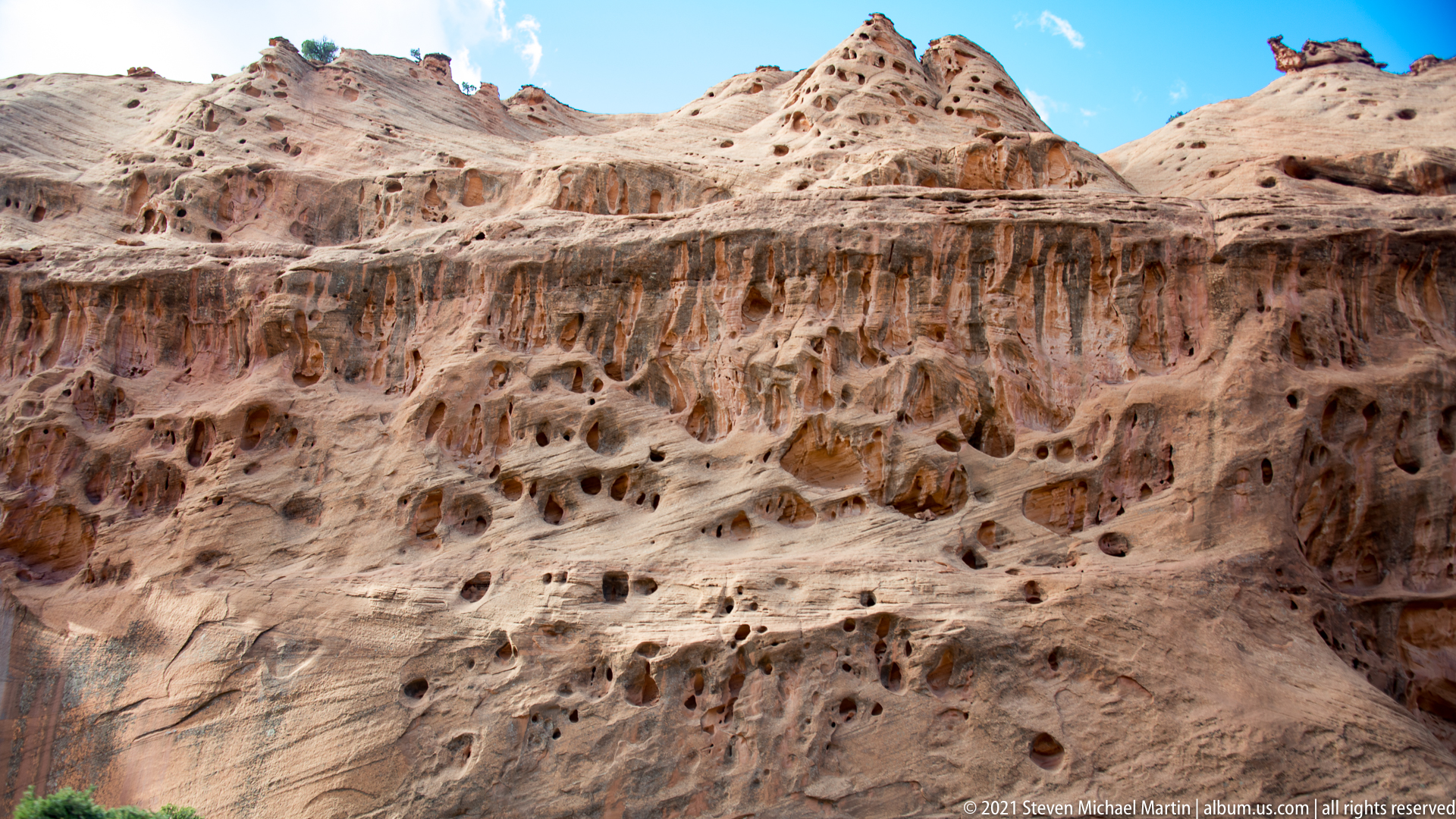
Rows of shallow rounded cavities cover a pale sandstone wall, creating a honeycomb-like surface beneath a sculpted ridge. Darker streaks run down the lower rock, and small holes cluster along horizontal bands. The close view isolates the cliff’s texture and irregular openings, showing how uneven weathering has shaped the exposed face.
Caption
Rows of shallow rounded cavities cover a pale sandstone wall, creating a honeycomb-like surface beneath a sculpted ridge. Darker streaks run down the lower rock, and small holes cluster along horizontal bands. The close view isolates the cliff’s texture and irregular openings, showing how uneven weathering has shaped the exposed face.
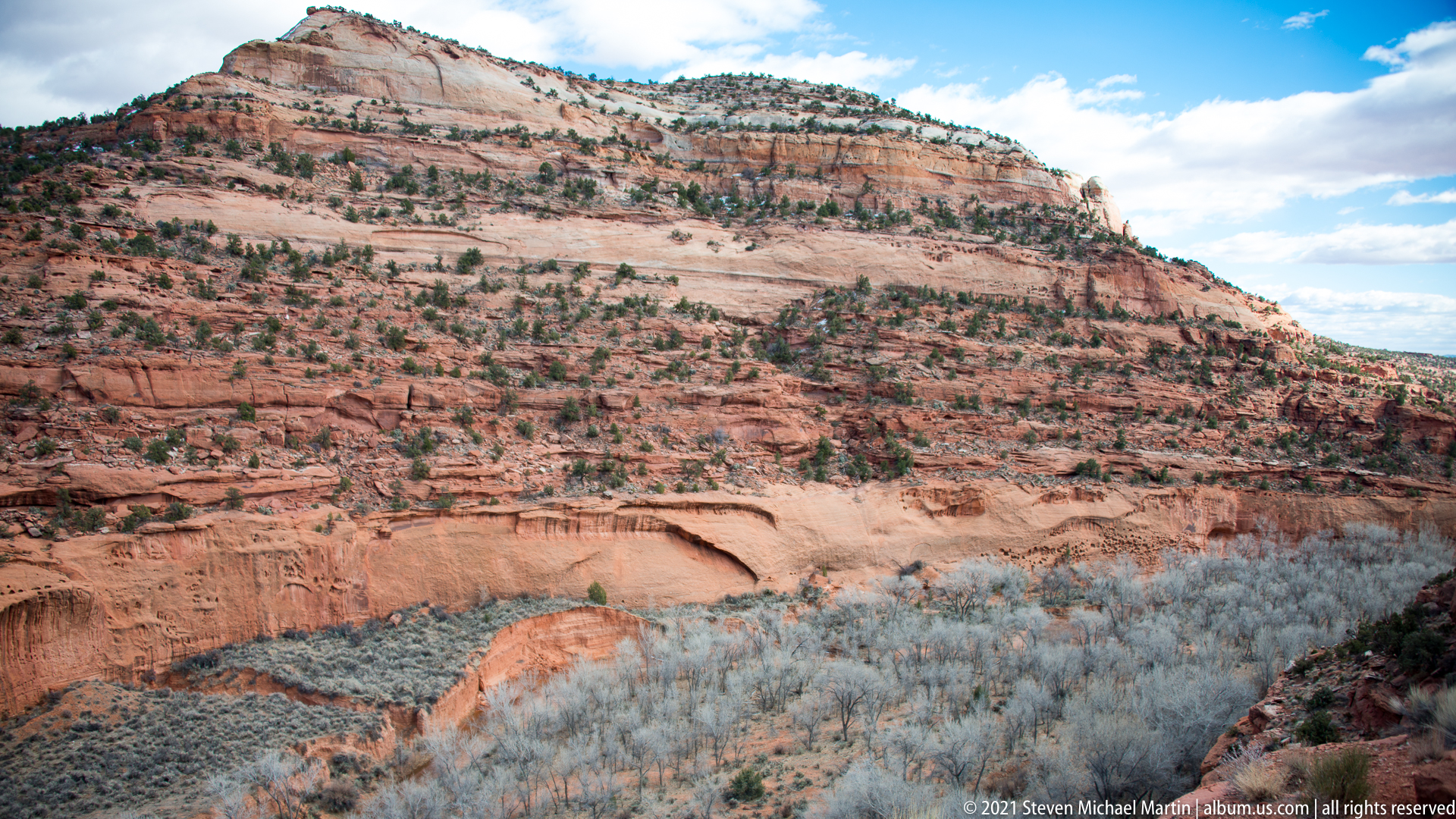
A broad, scrub-covered slope descends toward a deep canyon cut through red and cream rock. Layered benches extend across the opposite wall, and the shallow drainage curves along the base before disappearing beyond the frame. The wide perspective emphasizes the canyon’s scale and the dry vegetation covering its gentler upper slopes.
Caption
A broad, scrub-covered slope descends toward a deep canyon cut through red and cream rock. Layered benches extend across the opposite wall, and the shallow drainage curves along the base before disappearing beyond the frame. The wide perspective emphasizes the canyon’s scale and the dry vegetation covering its gentler upper slopes.

A broad red sandstone face is densely pitted with rounded openings, especially along a horizontal band near its upper edge. Leafless shrubs fill the foreground, partly obscuring the cliff’s base, while darker streaks descend from the cavities. The composition juxtaposes the rough, porous wall with the fine branching pattern of winter vegetation below.
Caption
A broad red sandstone face is densely pitted with rounded openings, especially along a horizontal band near its upper edge. Leafless shrubs fill the foreground, partly obscuring the cliff’s base, while darker streaks descend from the cavities. The composition juxtaposes the rough, porous wall with the fine branching pattern of winter vegetation below.
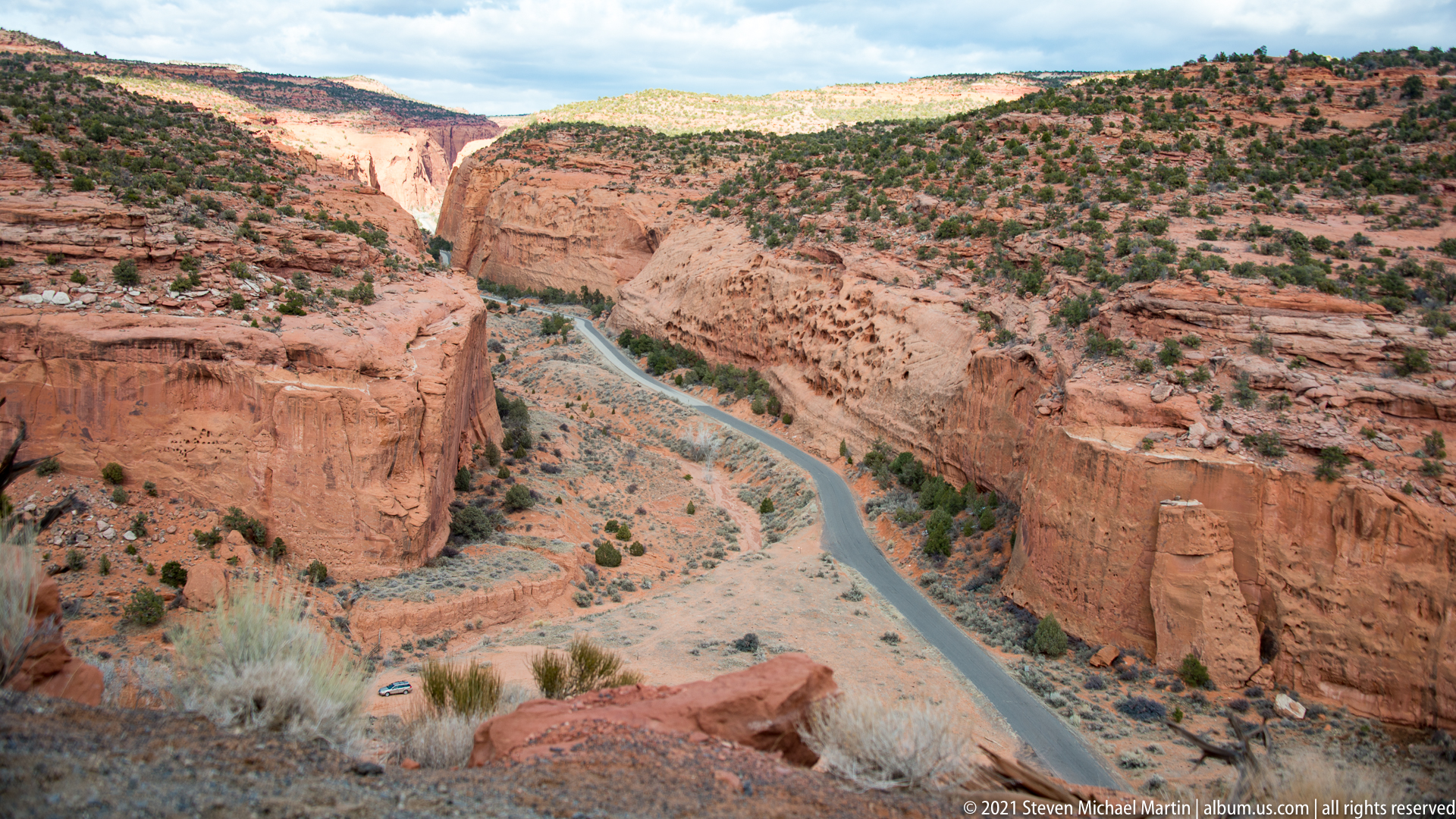
A narrow paved road snakes through the canyon floor between steep red walls, visible from a high overlook. The road’s gray line contrasts with the pale wash and scrub below, while broad cliffs rise on both sides and distant mesas appear beyond. The elevated composition makes the route’s curves and the canyon’s depth the central features.
Caption
A narrow paved road snakes through the canyon floor between steep red walls, visible from a high overlook. The road’s gray line contrasts with the pale wash and scrub below, while broad cliffs rise on both sides and distant mesas appear beyond. The elevated composition makes the route’s curves and the canyon’s depth the central features.
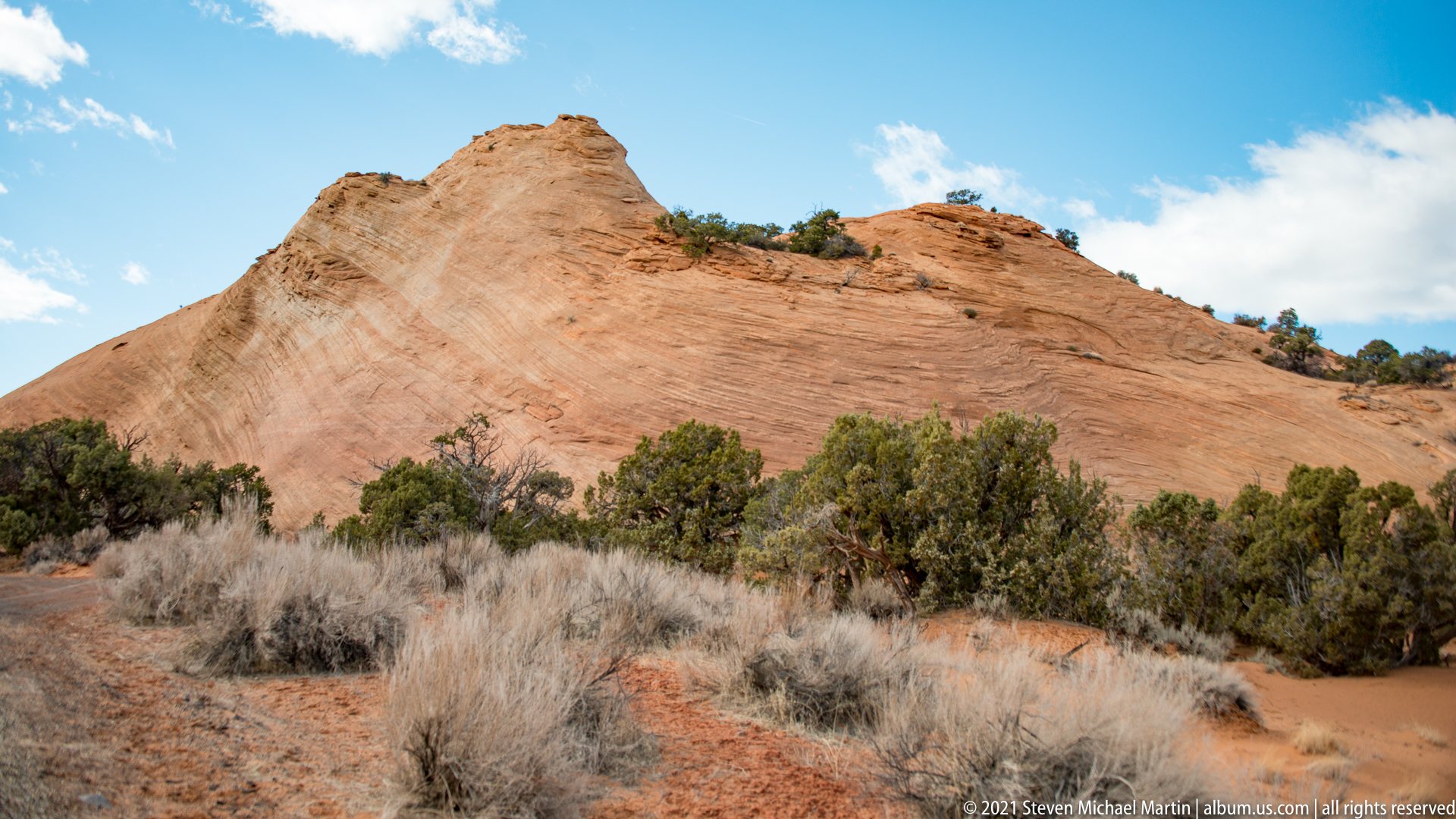
A broad pale sandstone dome rises behind a belt of low shrubs and reddish soil. The rock surface is smooth and lightly streaked, with a few darker patches and sparse vegetation near its crest. Seen from below, the dome forms a clean arc against the blue sky and contrasts with the rougher, darker ground in front.
Caption
A broad pale sandstone dome rises behind a belt of low shrubs and reddish soil. The rock surface is smooth and lightly streaked, with a few darker patches and sparse vegetation near its crest. Seen from below, the dome forms a clean arc against the blue sky and contrasts with the rougher, darker ground in front.
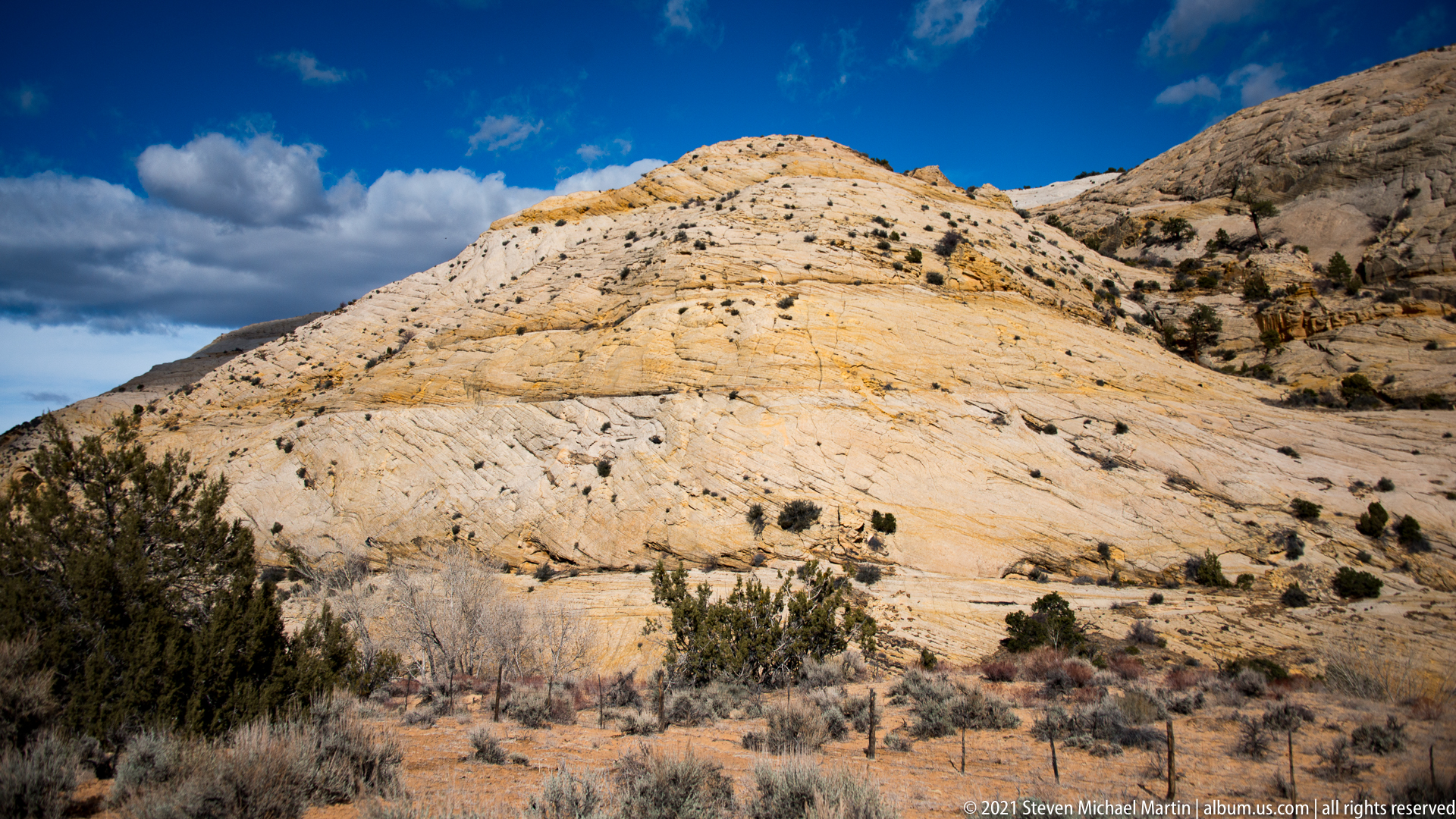
A broad cream-colored rock slope rises above winter brush, with scattered patches of snow tracing shallow channels and ledges. Dark juniper-like shrubs punctuate the foreground, while clouds cast a cooler tone across the upper ridge. The scene captures the meeting of bare sandstone and lingering snow at a high elevation.
Caption
A broad cream-colored rock slope rises above winter brush, with scattered patches of snow tracing shallow channels and ledges. Dark juniper-like shrubs punctuate the foreground, while clouds cast a cooler tone across the upper ridge. The scene captures the meeting of bare sandstone and lingering snow at a high elevation.
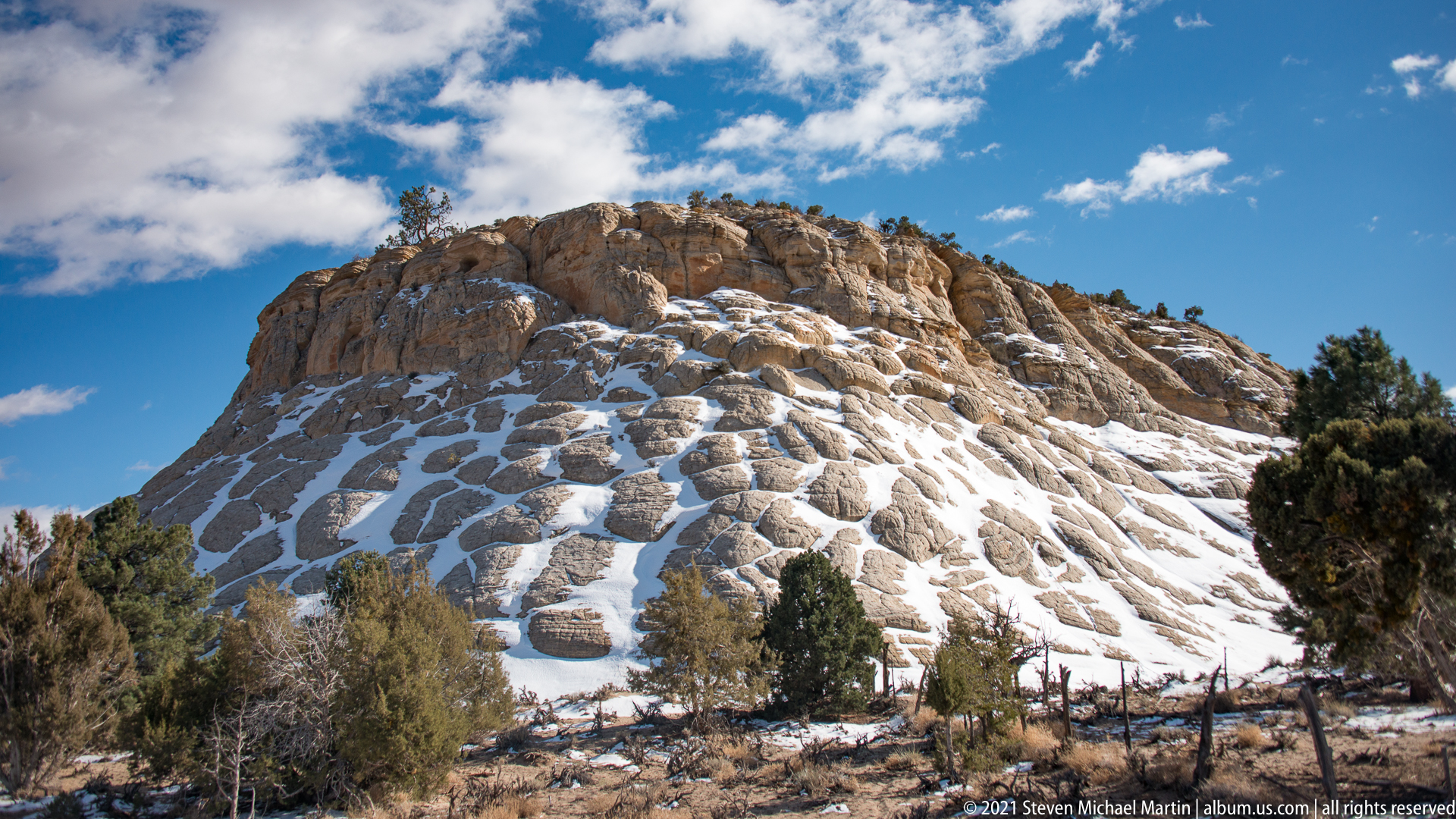
Snow follows the grooves and hollows of a rounded sandstone formation, outlining its lobed surface in bright white against warmer cream and tan rock. Evergreen shrubs frame the lower edge and sides, while blue sky and scattered clouds open above. The viewpoint focuses on the dome’s textured shape and the pattern made by the melting snow.
Caption
Snow follows the grooves and hollows of a rounded sandstone formation, outlining its lobed surface in bright white against warmer cream and tan rock. Evergreen shrubs frame the lower edge and sides, while blue sky and scattered clouds open above. The viewpoint focuses on the dome’s textured shape and the pattern made by the melting snow.
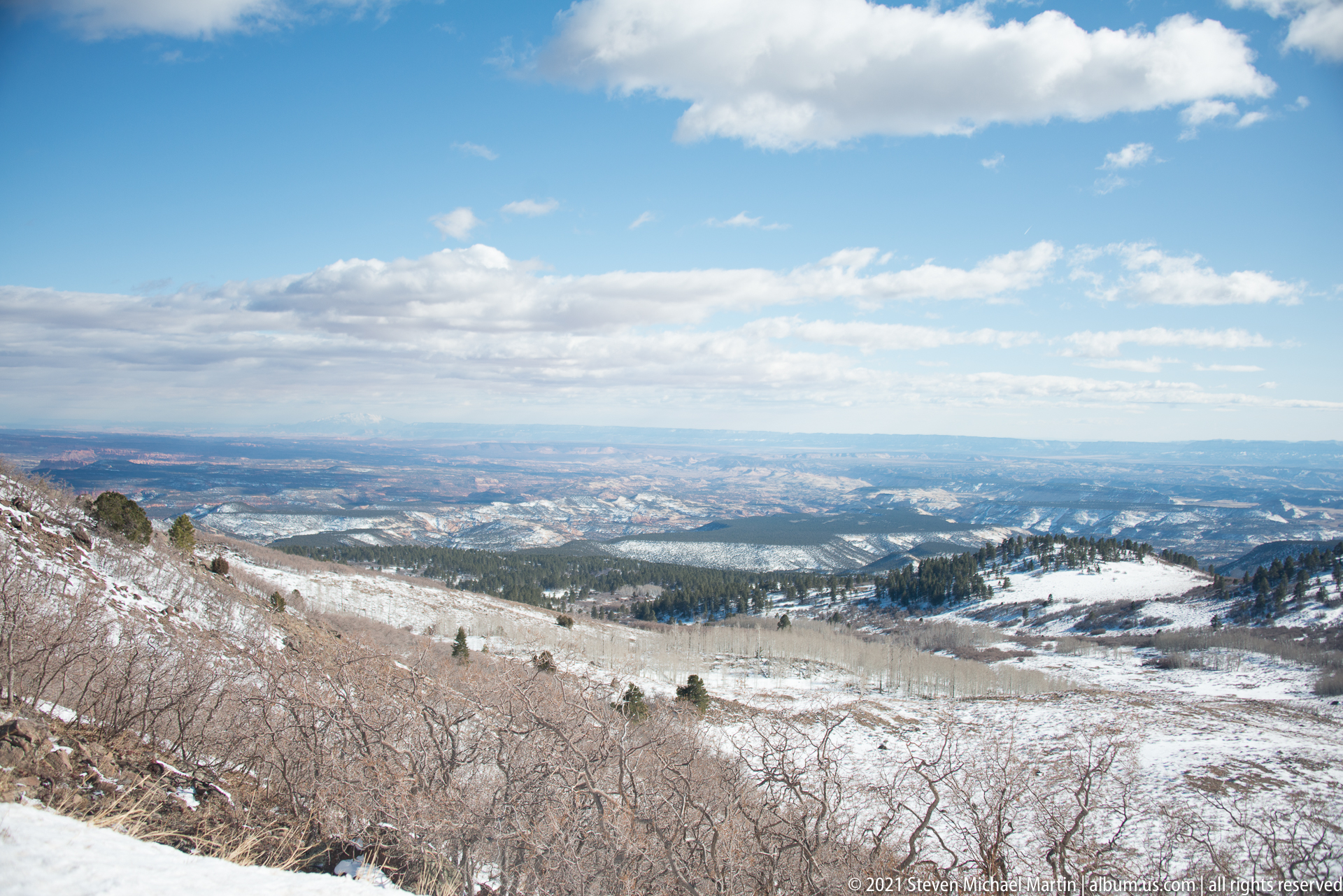
A snow-covered ridge slopes toward a broad valley, where scattered settlements and roads form a faint pattern across the distant floor. Bare shrubs line the foreground, and a low horizon of pale land sits beneath layered clouds. The elevated winter view shifts attention from red canyon formations to the open basin beyond the high country.
Caption
A snow-covered ridge slopes toward a broad valley, where scattered settlements and roads form a faint pattern across the distant floor. Bare shrubs line the foreground, and a low horizon of pale land sits beneath layered clouds. The elevated winter view shifts attention from red canyon formations to the open basin beyond the high country.
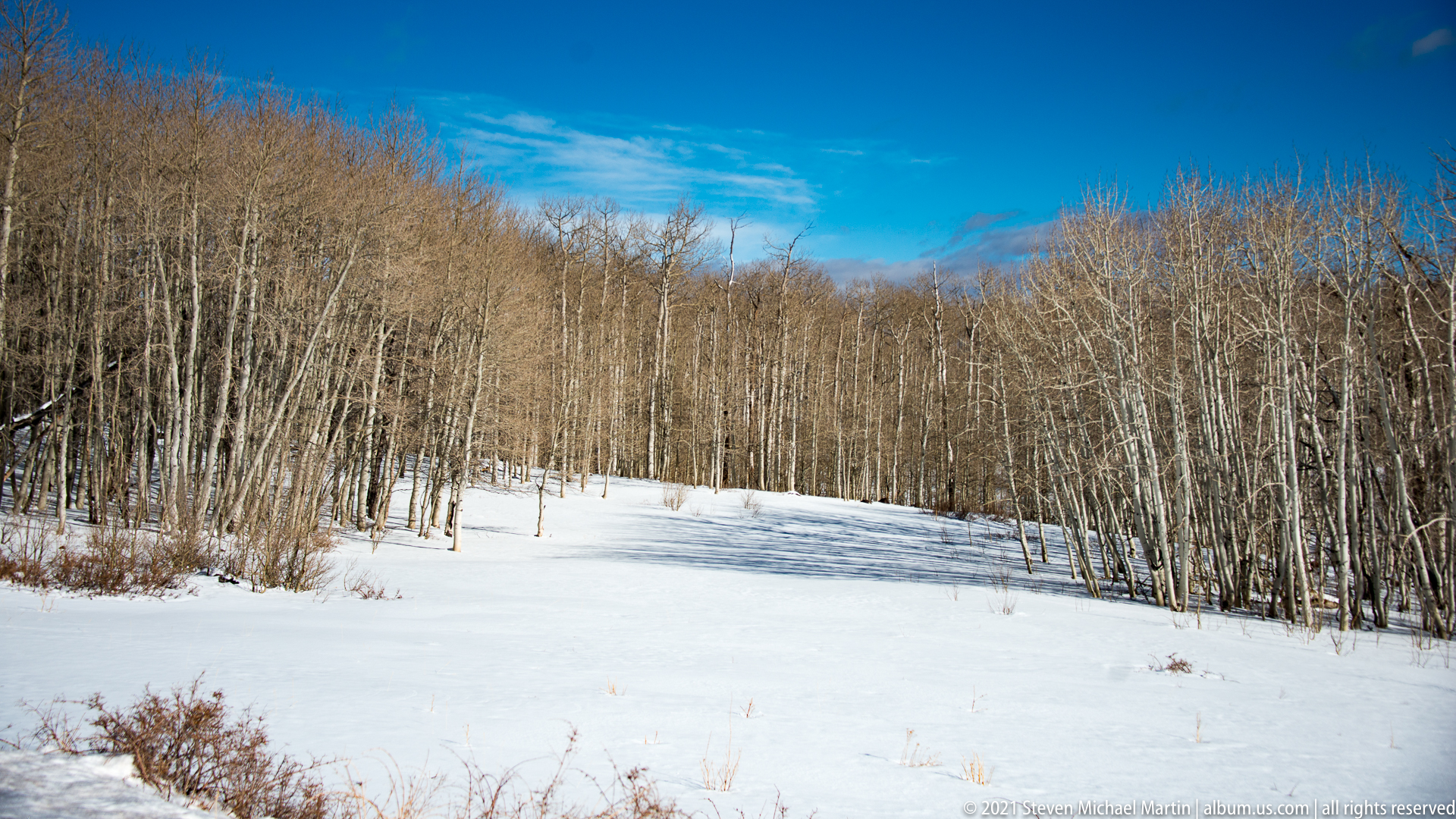
Slender pale trunks stand close together along the edge of a snow-covered clearing, their bare branches reaching into a vivid blue sky. Brown grasses and small shrubs protrude through the snow near the foreground. The simple woodland composition records the high-country winter setting and the repeated vertical rhythm of the trees.
Caption
Slender pale trunks stand close together along the edge of a snow-covered clearing, their bare branches reaching into a vivid blue sky. Brown grasses and small shrubs protrude through the snow near the foreground. The simple woodland composition records the high-country winter setting and the repeated vertical rhythm of the trees.
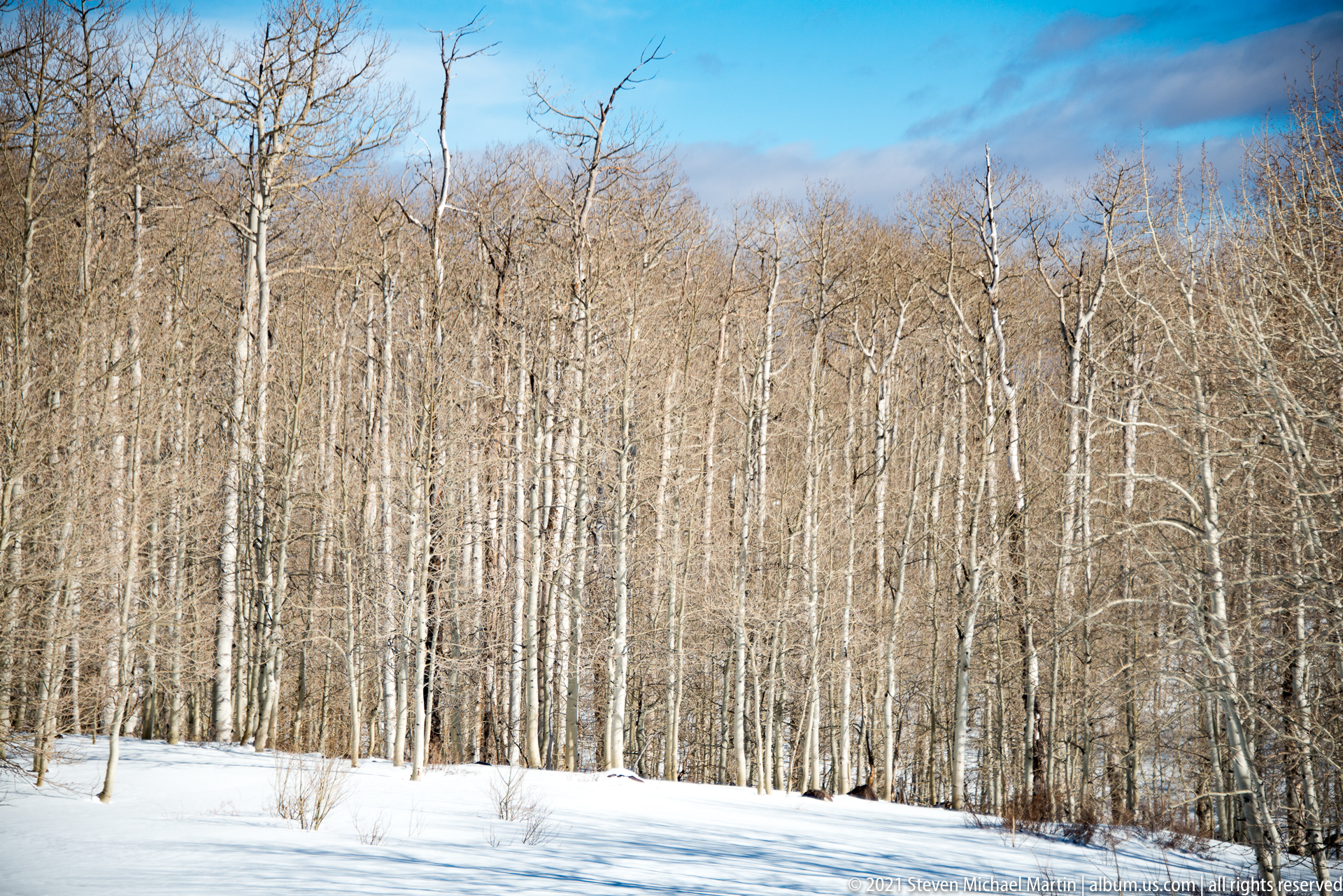
A dense stand of slender, leafless trees fills the background beyond an unbroken snowfield. Their pale trunks form a fine vertical pattern, with darker branches and patches of shadow adding depth. The foreground remains open and nearly featureless, creating a quiet contrast between the smooth winter ground and the closely spaced woodland.
Caption
A dense stand of slender, leafless trees fills the background beyond an unbroken snowfield. Their pale trunks form a fine vertical pattern, with darker branches and patches of shadow adding depth. The foreground remains open and nearly featureless, creating a quiet contrast between the smooth winter ground and the closely spaced woodland.
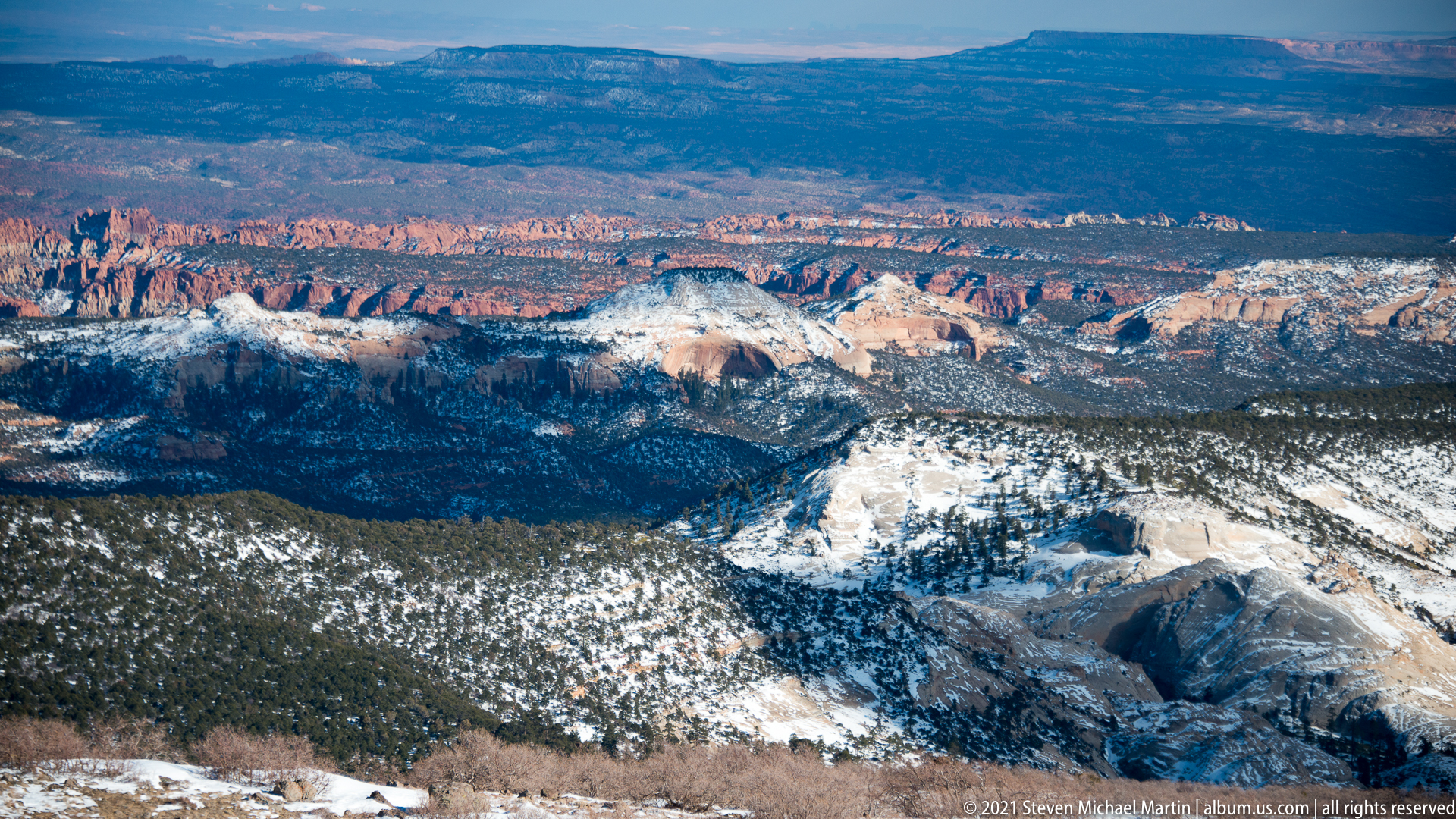
A snowy ridge in the foreground falls away to a broad basin of forest, red cliffs, and distant plateaus. Patches of sunlight pick out the canyon walls while clouds leave other sections in shade, creating alternating bands across the view. The elevated perspective links the winter high country with the drier terrain stretching beyond it.
Caption
A snowy ridge in the foreground falls away to a broad basin of forest, red cliffs, and distant plateaus. Patches of sunlight pick out the canyon walls while clouds leave other sections in shade, creating alternating bands across the view. The elevated perspective links the winter high country with the drier terrain stretching beyond it.
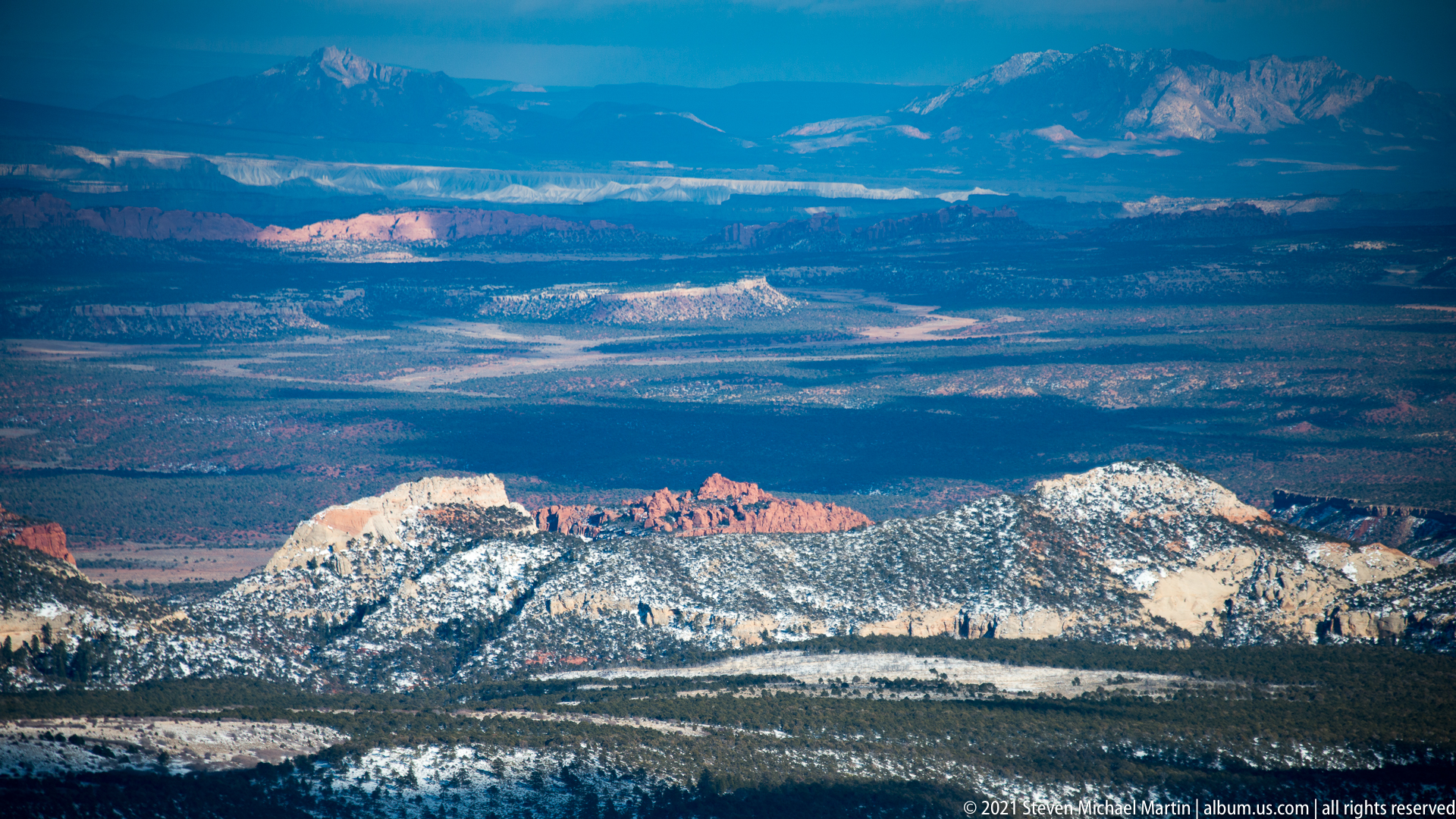
A band of snow-covered forest crosses the foreground beneath a red sandstone ridge, with broad blue-gray plateaus receding behind it. The compressed viewpoint stacks the terrain into horizontal layers, from the dark trees to distant highlands and a clouded mountain skyline. It highlights the changing elevation and winter conditions across the region.
Caption
A band of snow-covered forest crosses the foreground beneath a red sandstone ridge, with broad blue-gray plateaus receding behind it. The compressed viewpoint stacks the terrain into horizontal layers, from the dark trees to distant highlands and a clouded mountain skyline. It highlights the changing elevation and winter conditions across the region.
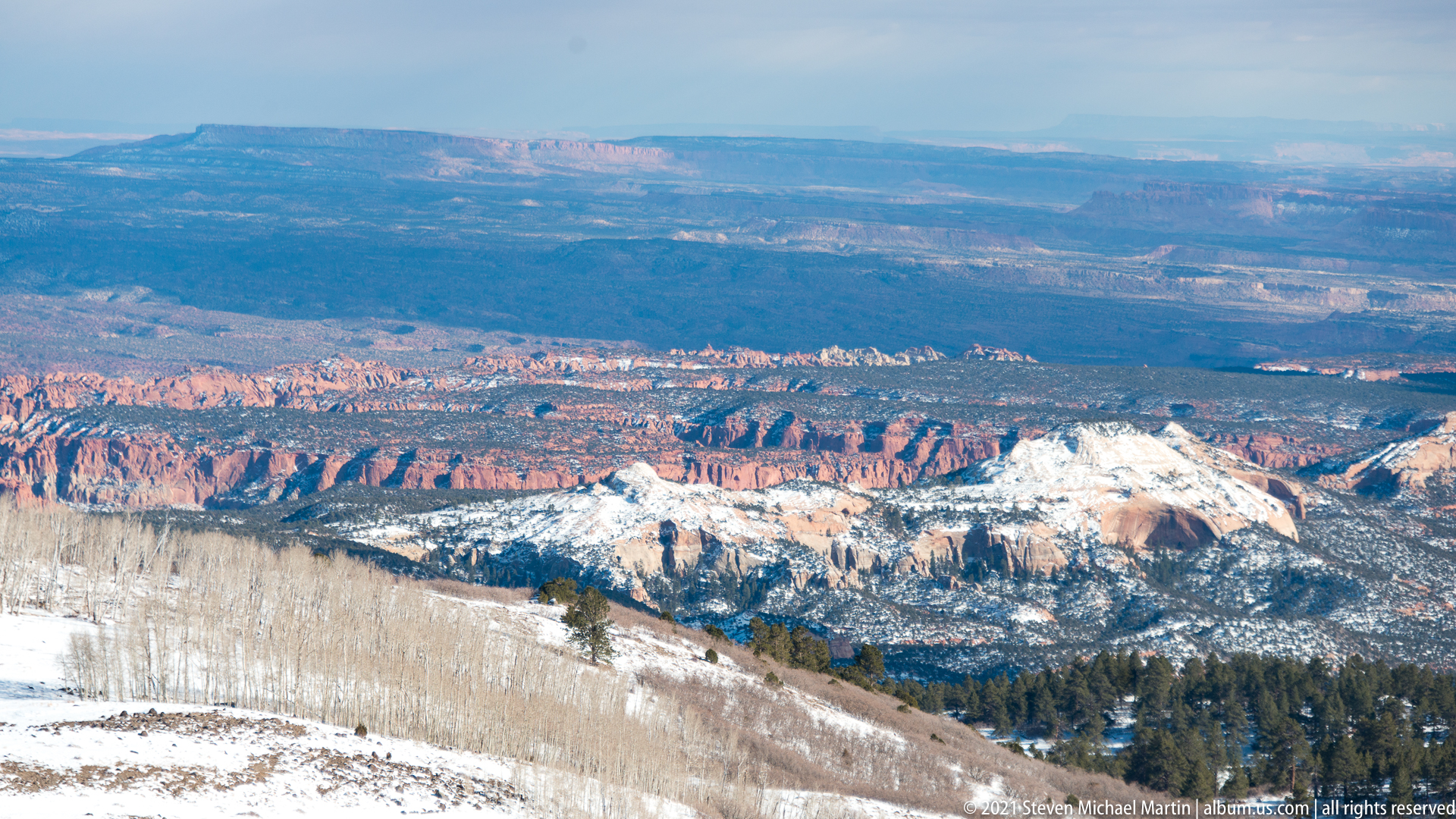
Snow-dusted ridges and dark forest occupy the foreground, giving way to a broad basin marked by red cliffs and pale plateaus. The distant horizon fades into blue haze beneath a thin cloud layer. From this elevated vantage, the landscape reads as a sequence of winter terrain, wooded slopes, and exposed canyon walls stretching across the frame.
Caption
Snow-dusted ridges and dark forest occupy the foreground, giving way to a broad basin marked by red cliffs and pale plateaus. The distant horizon fades into blue haze beneath a thin cloud layer. From this elevated vantage, the landscape reads as a sequence of winter terrain, wooded slopes, and exposed canyon walls stretching across the frame.
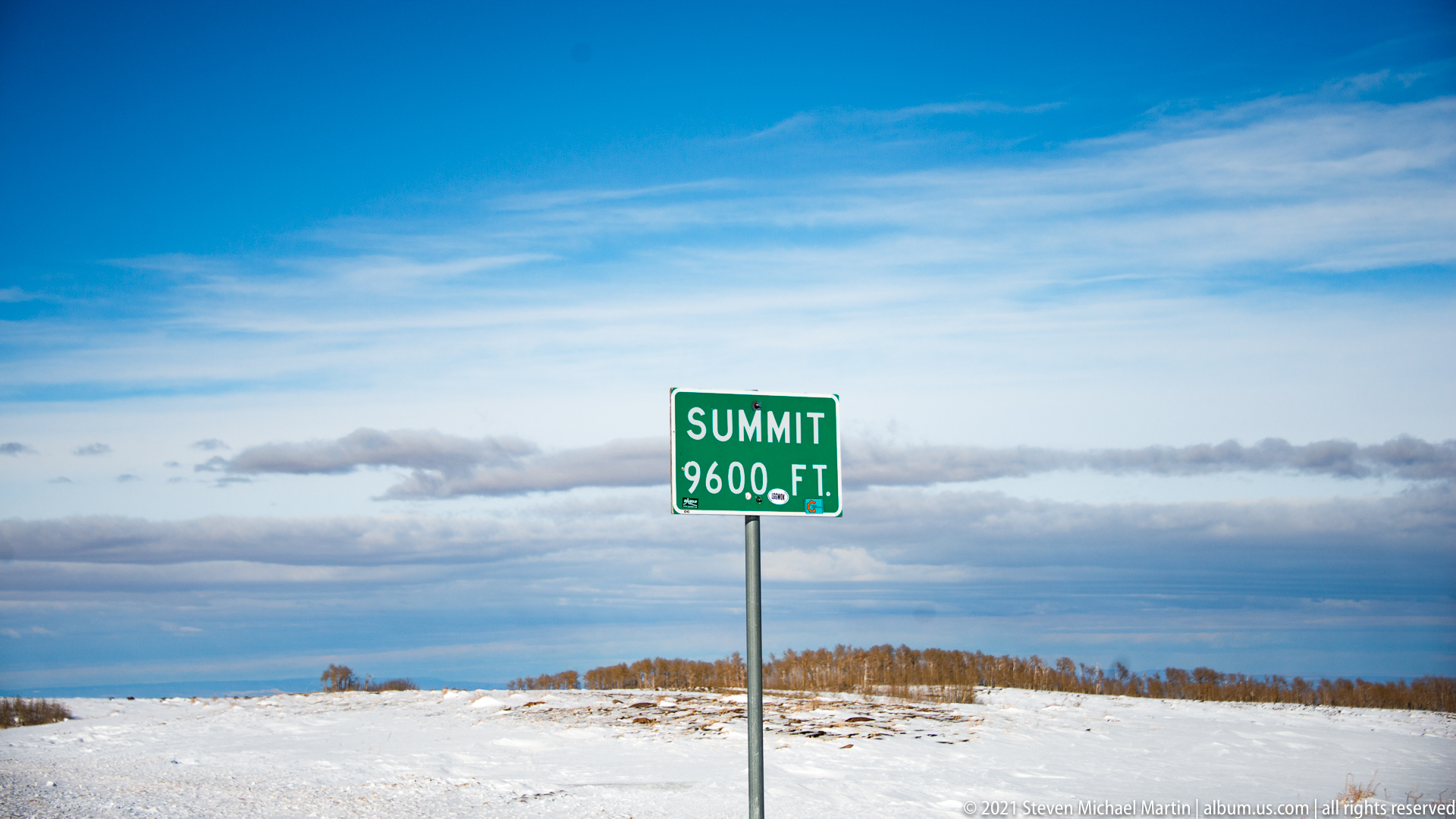
A green roadside sign marked “SUMMIT 9600 FT” stands alone in a snow-covered clearing beneath a wide blue sky. Low clouds form a horizontal band along the distant horizon, while small shrubs punctuate the otherwise open ground. The legible elevation marker gives the winter landscape a precise sense of height and identifies the scene as a high mountain pass or summit area.
Caption
A green roadside sign marked “SUMMIT 9600 FT” stands alone in a snow-covered clearing beneath a wide blue sky. Low clouds form a horizontal band along the distant horizon, while small shrubs punctuate the otherwise open ground. The legible elevation marker gives the winter landscape a precise sense of height and identifies the scene as a high mountain pass or summit area.
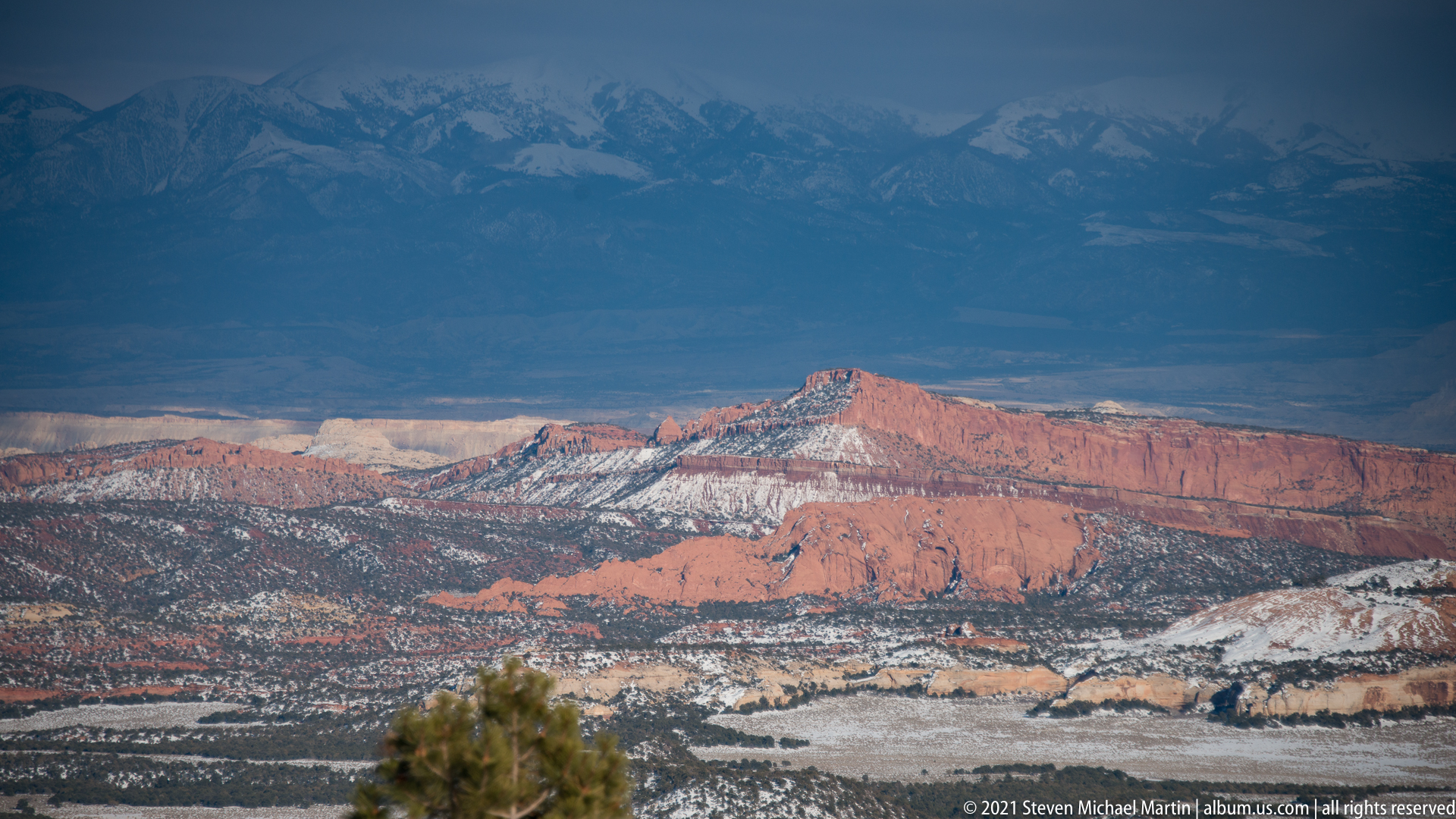
Snow highlights the folds and ledges of a red-rock landscape, while a hazy mountain range fills the far background. A darker band of cloud or shade spans the upper distance, contrasting with the sunlit sandstone below. The broad composition layers the park’s near ridges against the high country, showing how winter weather traces pale lines across the exposed terrain.
Caption
Snow highlights the folds and ledges of a red-rock landscape, while a hazy mountain range fills the far background. A darker band of cloud or shade spans the upper distance, contrasting with the sunlit sandstone below. The broad composition layers the park’s near ridges against the high country, showing how winter weather traces pale lines across the exposed terrain.
Capitol Reef National Park — Field Guide
National Park Field Guide
📍 Overview
Capitol Reef National Park preserves a geologic formation known as the Waterpocket Fold, a monocline created by tectonic forces that uplifted sedimentary rock layers. The park contains cliffs, domes, and canyon systems shaped by erosion acting upon uplifted strata. The resulting landscape illustrates the interaction between geological uplift and long-term weathering processes.
Layered sandstone formations reflect changes in environmental conditions across prehistoric eras. Differential erosion of rock layers produces cliffs, domes, and narrow canyon corridors. The Waterpocket Fold extends for nearly one hundred miles, creating a continuous geologic feature across the Colorado Plateau.
⭐ Highlights
- Waterpocket Fold monocline formation
- Sandstone domes and cliffs shaped by erosion
- Cathedral Valley monolith formations
- Layered sedimentary rock exposures
- Expansive desert plateau landscapes
🔎 Key Features
- Tectonic uplift shaping folded rock layers
- Erosion creating canyon and dome formations
- Exposed sedimentary strata illustrating geologic time
- Remote desert valley environments
- Large-scale landscape shaped by natural forces
📷 Photography Notes
- Early and late light enhances texture in sandstone
- Wide compositions capture scale of formations
- Cloud patterns add depth to desert skies
- Foreground rocks provide visual framing
- Side lighting emphasizes layered geology
- Look for angles that show contrast between formations