Alpine Meadows – Rocky Mountain National Park
Alpine meadows within Rocky Mountain National Park preserve high elevation tundra environments shaped by cold temperatures, strong winds, and short growing seasons. Vegetation in these areas adapts to harsh climatic conditions, producing low-growing plants that can survive exposure to snow and wind. The meadows illustrate the ecological influence of elevation on plant communities.
Glacial activity contributed to the formation of relatively level areas between peaks where seasonal snowmelt provides moisture for alpine vegetation. The open landscape allows unobstructed views of surrounding mountain ridges and valleys shaped by erosion and glaciation. These environments demonstrate how climate influences both geological and biological systems.
Visitors encounter a quiet landscape where expansive views emphasize the scale of the surrounding mountain terrain. The alpine meadows provide insight into the relationship between elevation, climate, and ecological adaptation across the Rocky Mountains.
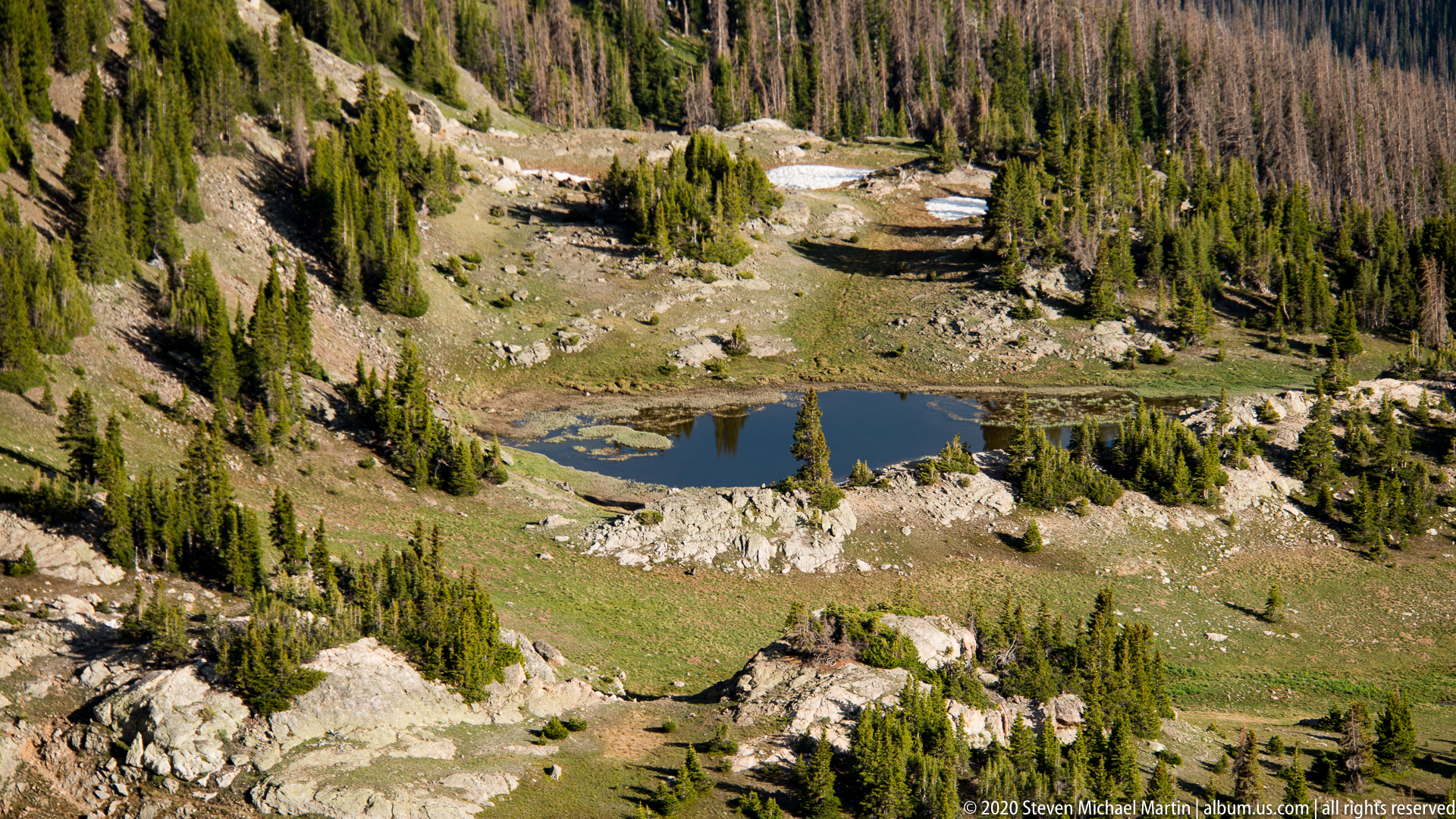
A small still pond reflects the dark conifers and open meadow around its edge. Pale granite boulders and low grasses form a broken foreground, while a rocky slope rises behind the water. The elevated viewpoint shows the pond nestled within a forest clearing, with a narrow wetland margin and scattered snow remnants upslope.
Caption
A small still pond reflects the dark conifers and open meadow around its edge. Pale granite boulders and low grasses form a broken foreground, while a rocky slope rises behind the water. The elevated viewpoint shows the pond nestled within a forest clearing, with a narrow wetland margin and scattered snow remnants upslope.
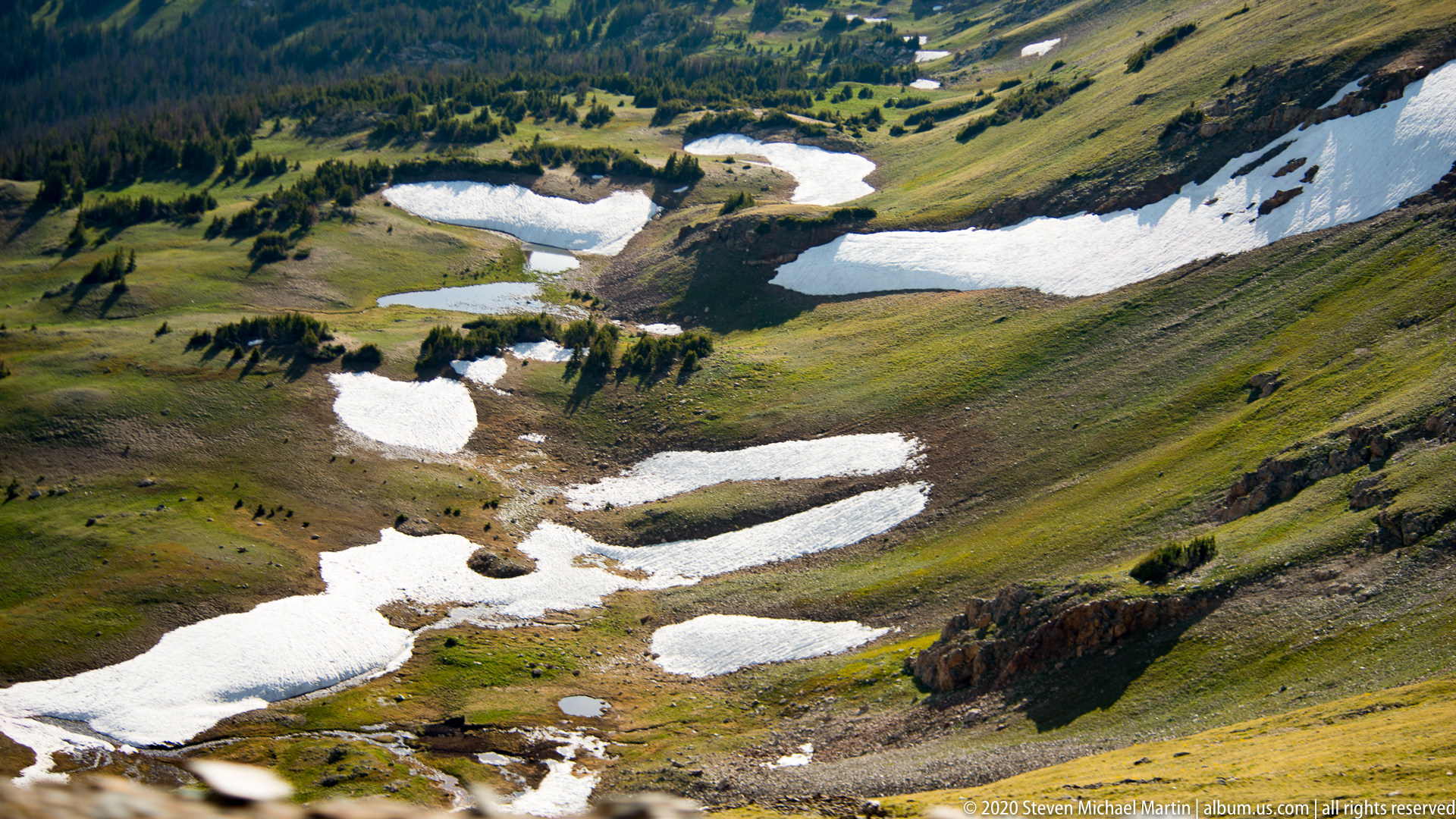
Several irregular snowfields lie in shallow folds of a green and brown alpine basin. Their white edges follow drainage channels and depressions between low ridges, with scattered conifers dotting the upper slope. The closer, downward view concentrates on the pattern of remaining snow against thawed tundra rather than the distant mountain skyline.
Caption
Several irregular snowfields lie in shallow folds of a green and brown alpine basin. Their white edges follow drainage channels and depressions between low ridges, with scattered conifers dotting the upper slope. The closer, downward view concentrates on the pattern of remaining snow against thawed tundra rather than the distant mountain skyline.
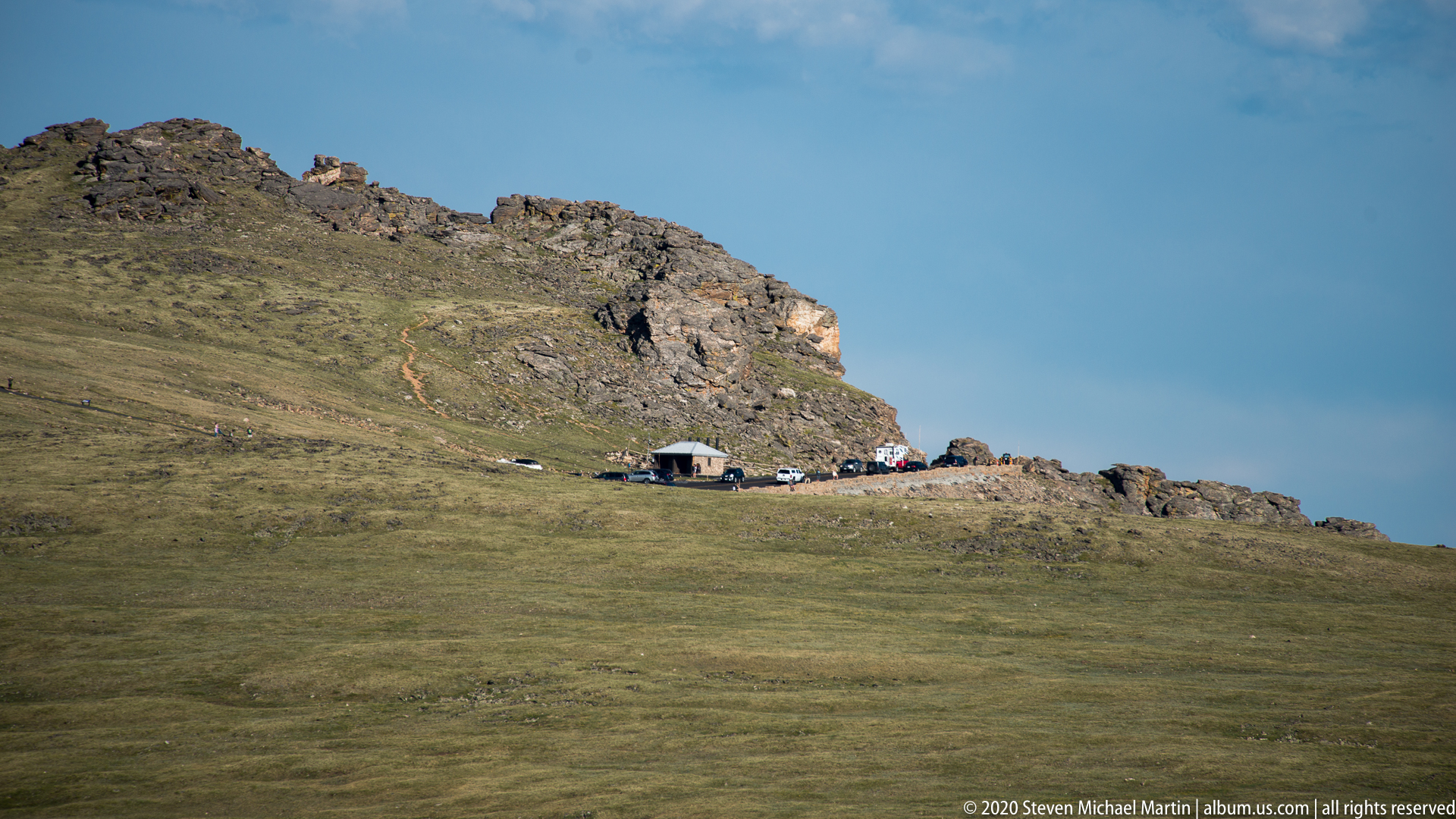
A small low building and several parked vehicles sit beside a rough track beneath a rocky alpine ridge. The open grassy slope occupies most of the frame, while the outcrop forms a broken crest above the roadside stop. The distant framing sets the modest human-made structures against the broad, treeless mountain terrain.
Caption
A small low building and several parked vehicles sit beside a rough track beneath a rocky alpine ridge. The open grassy slope occupies most of the frame, while the outcrop forms a broken crest above the roadside stop. The distant framing sets the modest human-made structures against the broad, treeless mountain terrain.

Several elk graze on a steep grassy slope below a curving paved road, with conifers and small snow patches nearby. Their bodies are spaced across the lower meadow, and the road’s stone-lined edge cuts across the upper right. The elevated view shows wildlife feeding near a park roadway and gives scale to the hillside.
Caption
Several elk graze on a steep grassy slope below a curving paved road, with conifers and small snow patches nearby. Their bodies are spaced across the lower meadow, and the road’s stone-lined edge cuts across the upper right. The elevated view shows wildlife feeding near a park roadway and gives scale to the hillside.
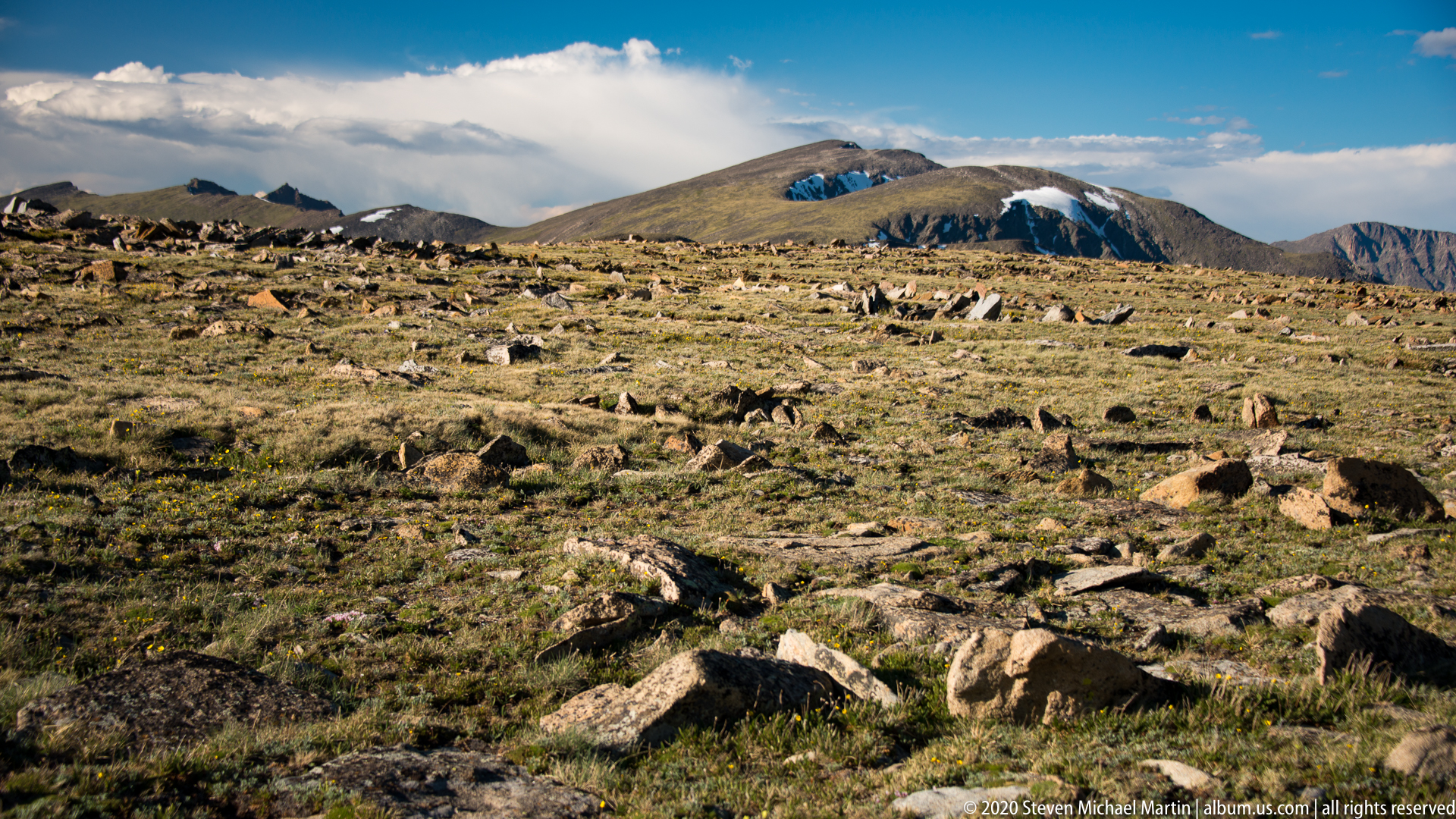
A broad sweep of alpine tundra spreads across a stony foreground, where short grasses and low plants grow between exposed rocks. Mountain slopes rise beyond the open meadow, with small snow patches visible in the distance. The view emphasizes the sparse, low vegetation and expansive terrain; it does not identify a particular trail or summit.
Caption
A broad sweep of alpine tundra spreads across a stony foreground, where short grasses and low plants grow between exposed rocks. Mountain slopes rise beyond the open meadow, with small snow patches visible in the distance. The view emphasizes the sparse, low vegetation and expansive terrain; it does not identify a particular trail or summit.
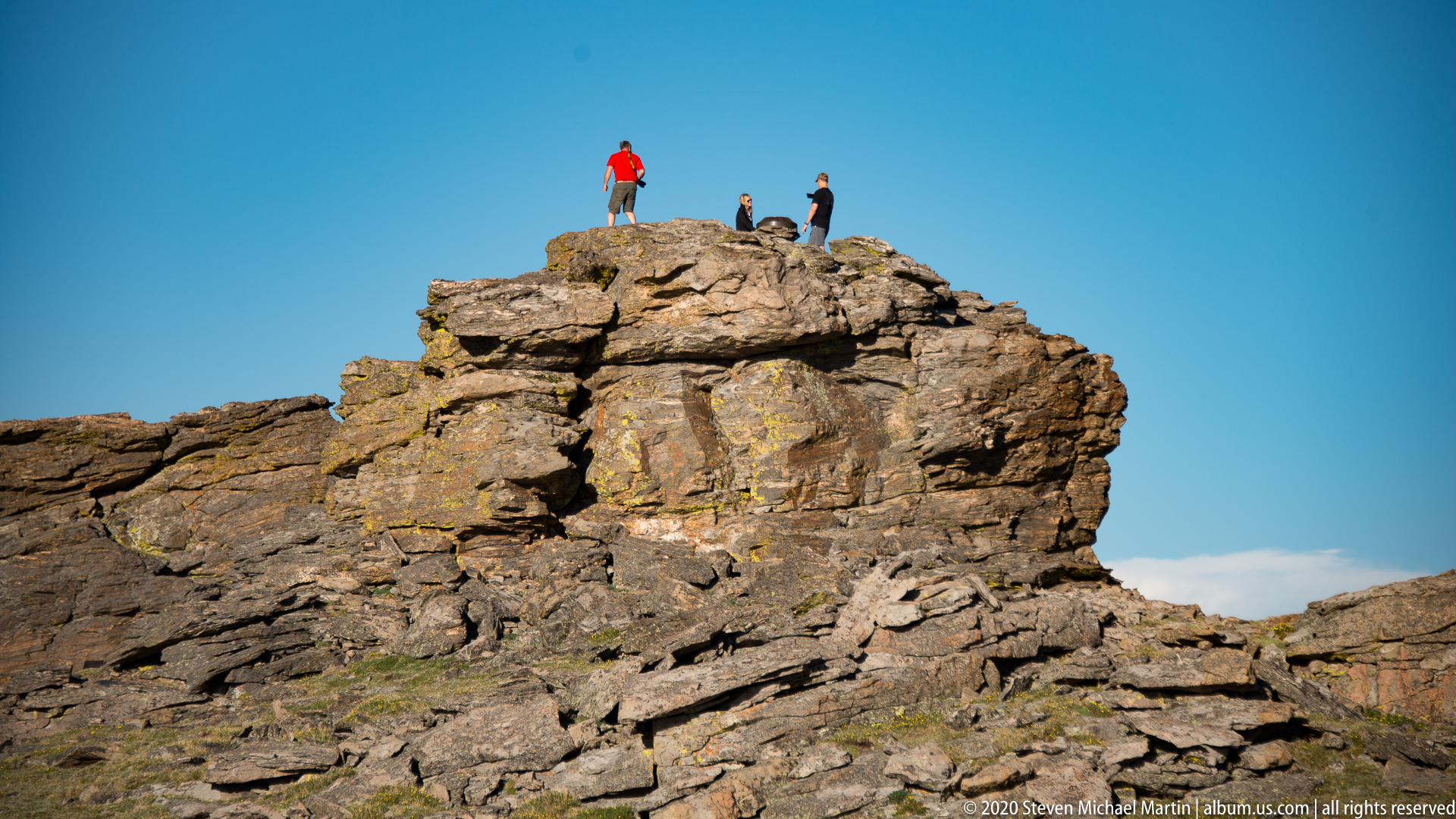
Three people stand together on a granite outcrop beneath a broad blue sky. One wears a bright red-orange top, while the others are dressed in darker clothing. Their small scale against the open sky and rock emphasizes the exposed setting and shared pause on the summit-like ledge; no activity beyond standing is evident.
Caption
Three people stand together on a granite outcrop beneath a broad blue sky. One wears a bright red-orange top, while the others are dressed in darker clothing. Their small scale against the open sky and rock emphasizes the exposed setting and shared pause on the summit-like ledge; no activity beyond standing is evident.
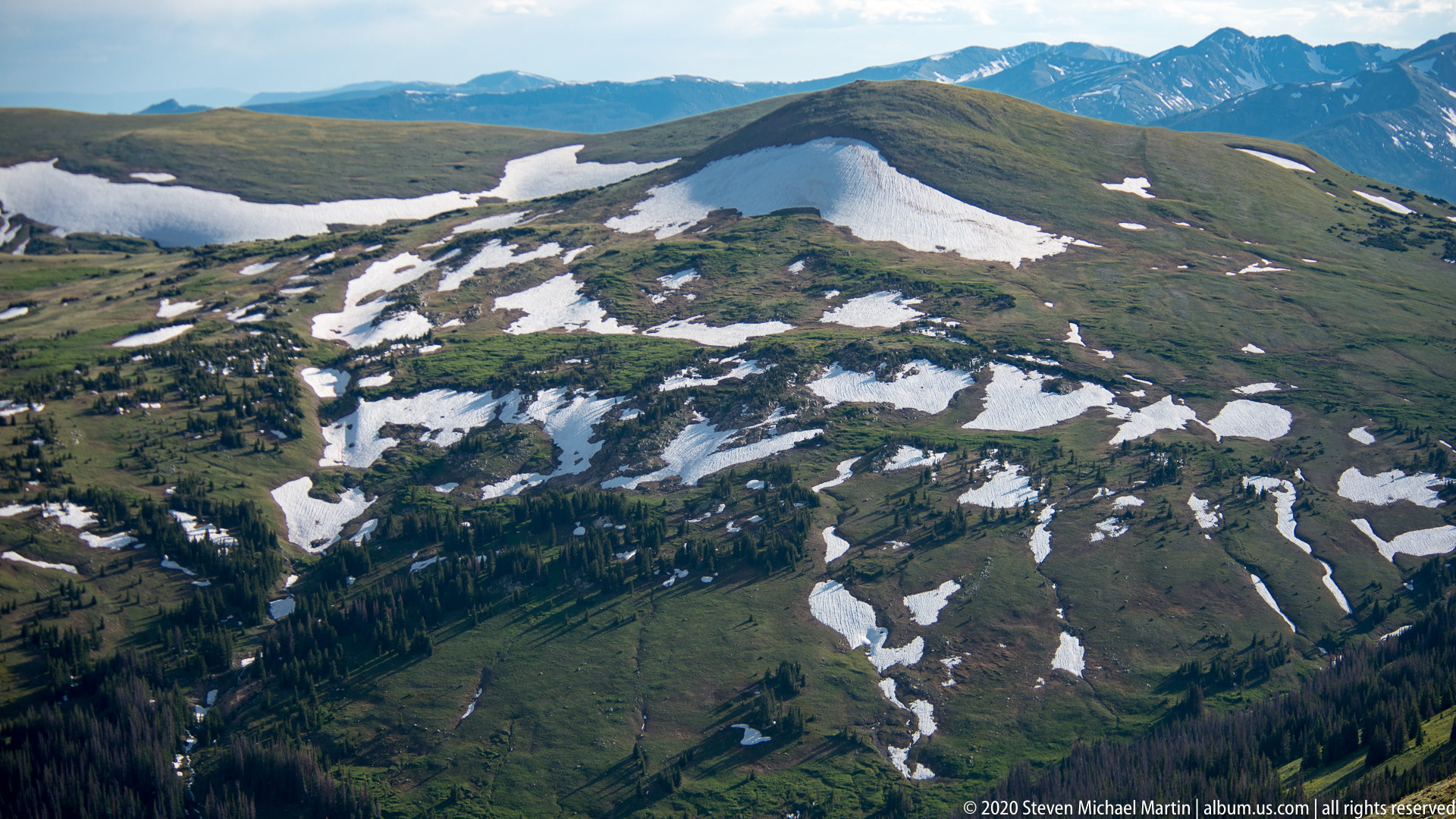
From above, irregular snowfields trace shallow basins and drainage lines across a broad alpine plateau. Dark conifer stands border the open green slopes, while distant mountain summits form a layered blue horizon. The aerial perspective reveals how snow persists in depressions and shaded folds after surrounding ground has thawed.
Caption
From above, irregular snowfields trace shallow basins and drainage lines across a broad alpine plateau. Dark conifer stands border the open green slopes, while distant mountain summits form a layered blue horizon. The aerial perspective reveals how snow persists in depressions and shaded folds after surrounding ground has thawed.
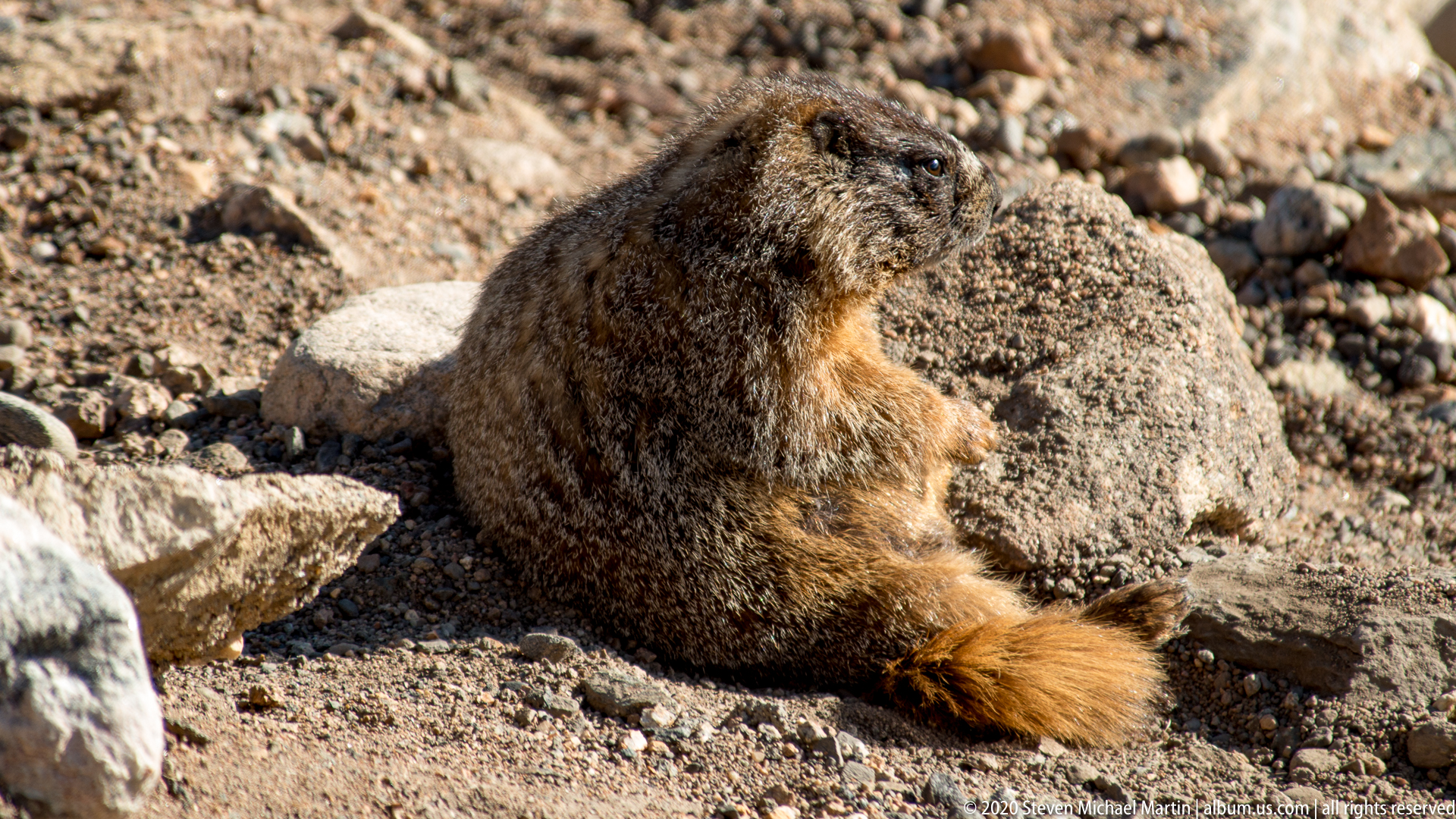
A brown marmot sits upright among gravel and rounded stones, its body angled right and its head turned toward the camera. The fluffy tail curls along the ground beside it, while strong sunlight brings out pale guard hairs in the coat. This portrait centers the animal’s resting posture and the open, rock-strewn setting.
Caption
A brown marmot sits upright among gravel and rounded stones, its body angled right and its head turned toward the camera. The fluffy tail curls along the ground beside it, while strong sunlight brings out pale guard hairs in the coat. This portrait centers the animal’s resting posture and the open, rock-strewn setting.

A rugged mountain ridge fills the horizon, its gray rock faces broken by lingering snowfields and narrow gullies. Dense evergreen forest covers the lower slopes, creating a dark band beneath the exposed peaks. The wide view connects the high, treeless crest to the wooded valley and scattered snow that remains in shaded basins.
Caption
A rugged mountain ridge fills the horizon, its gray rock faces broken by lingering snowfields and narrow gullies. Dense evergreen forest covers the lower slopes, creating a dark band beneath the exposed peaks. The wide view connects the high, treeless crest to the wooded valley and scattered snow that remains in shaded basins.

A stocky brown marmot sits among pale, angular stones, its rounded ears and dark muzzle visible as it looks slightly left. Sunlight picks out the dense fur along its back, while gravel and scattered boulders fill the background. The close portrait shows the animal’s compact shape and the rocky high-country habitat surrounding it.
Caption
A stocky brown marmot sits among pale, angular stones, its rounded ears and dark muzzle visible as it looks slightly left. Sunlight picks out the dense fur along its back, while gravel and scattered boulders fill the background. The close portrait shows the animal’s compact shape and the rocky high-country habitat surrounding it.

An elk rests low in a sunlit alpine meadow, its head raised above the pale grasses and ears turned toward the camera. Evergreen trees and a dark, forested mountainside soften into the background. The close framing draws attention to the animal’s alert posture and the contrast between its tawny coat and cool blue-green setting.
Caption
An elk rests low in a sunlit alpine meadow, its head raised above the pale grasses and ears turned toward the camera. Evergreen trees and a dark, forested mountainside soften into the background. The close framing draws attention to the animal’s alert posture and the contrast between its tawny coat and cool blue-green setting.
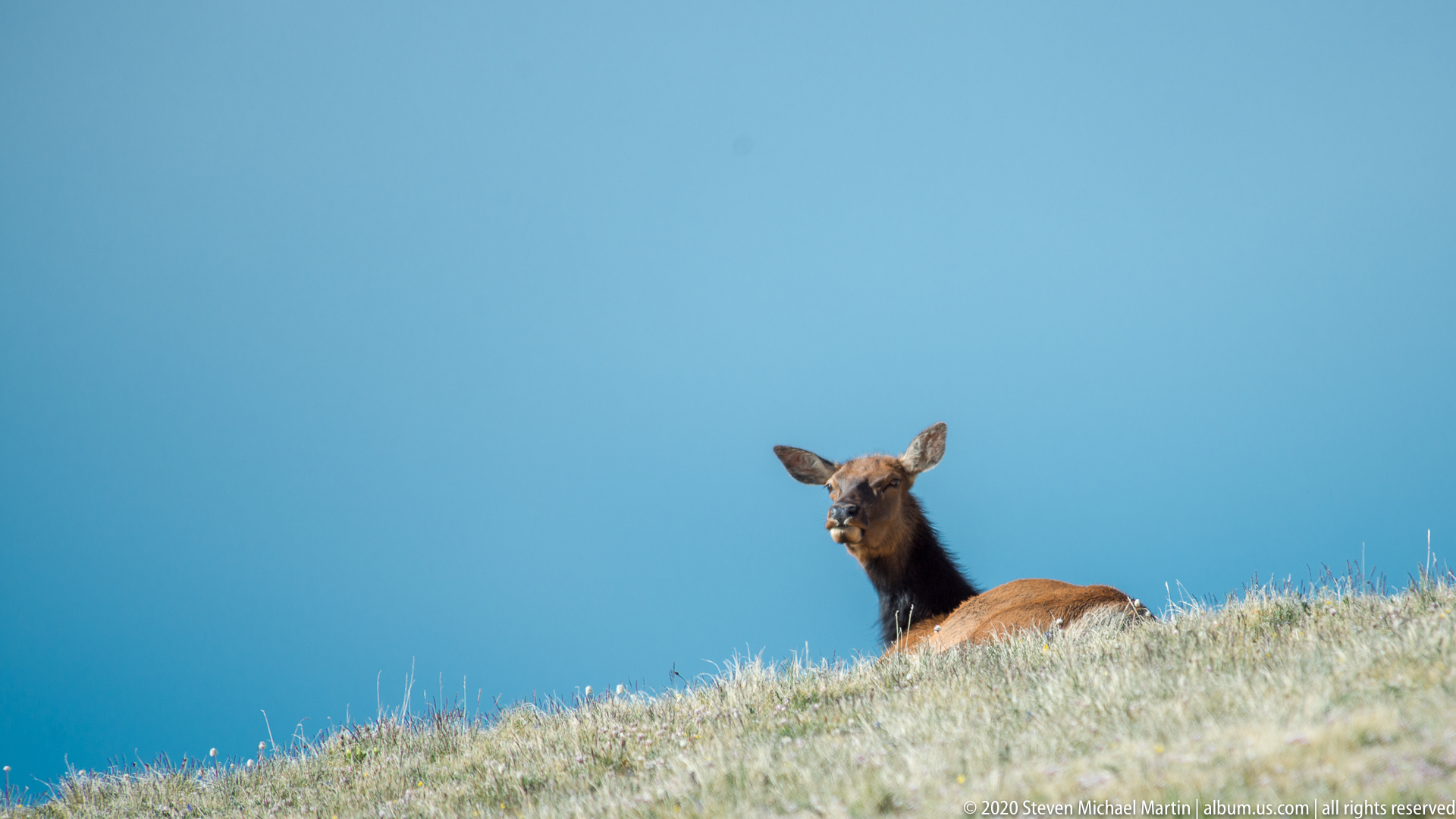
A lone elk reclines just beyond a sloping band of alpine grass, leaving most of the frame open to a clear blue sky. Its head is turned toward the viewer while the body remains partly hidden by the ridge. The sparse composition emphasizes the animal’s silhouette, the meadow’s incline and its high, exposed setting.
Caption
A lone elk reclines just beyond a sloping band of alpine grass, leaving most of the frame open to a clear blue sky. Its head is turned toward the viewer while the body remains partly hidden by the ridge. The sparse composition emphasizes the animal’s silhouette, the meadow’s incline and its high, exposed setting.
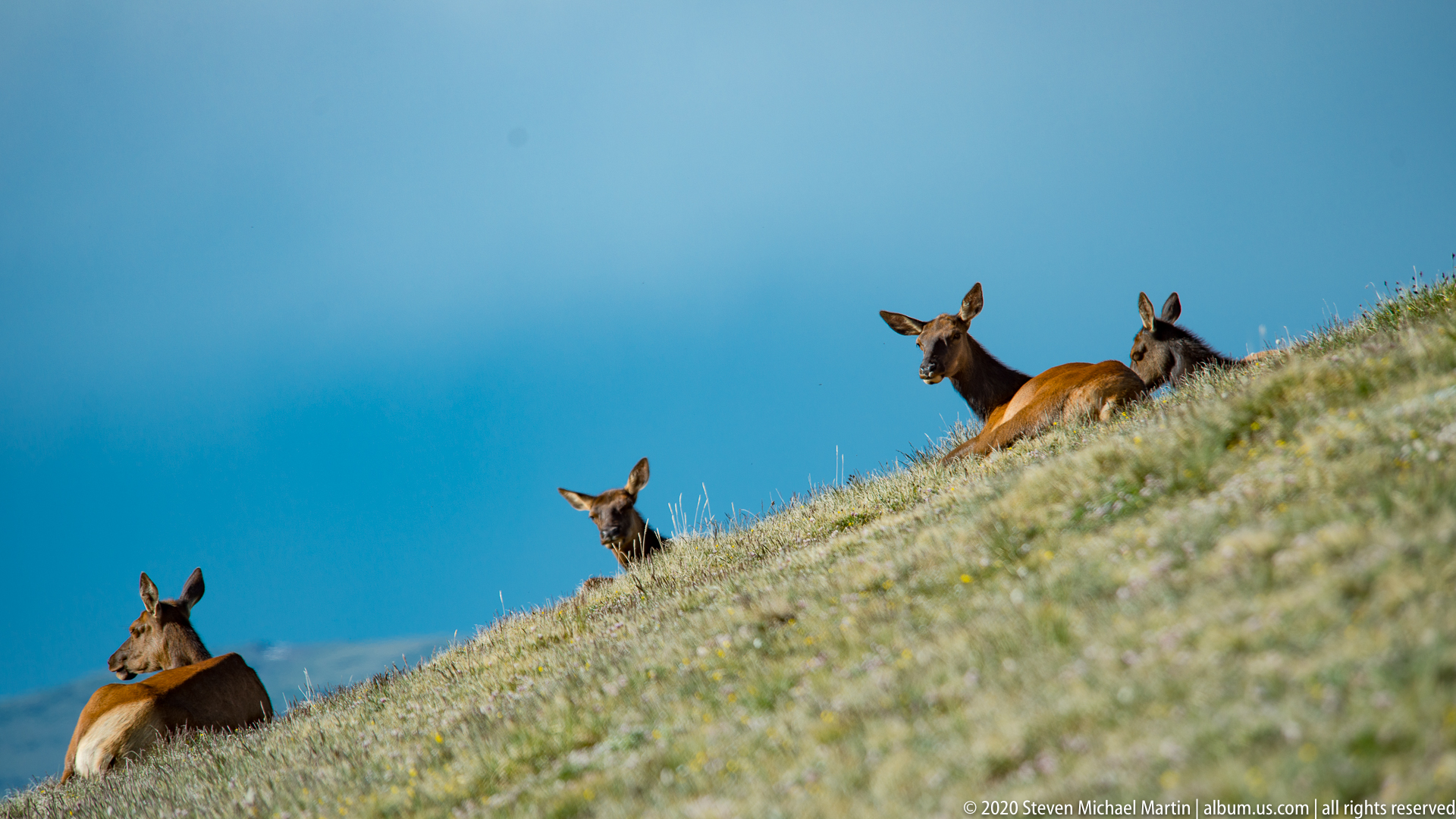
Four elk occupy a steep, grassy hillside, with two animals higher on the slope and two lower down. Their tawny bodies blend with the dry-green meadow, while the clear blue sky creates a clean backdrop. The staggered positions show the group’s spacing and the slope’s diagonal rise rather than a single close portrait.
Caption
Four elk occupy a steep, grassy hillside, with two animals higher on the slope and two lower down. Their tawny bodies blend with the dry-green meadow, while the clear blue sky creates a clean backdrop. The staggered positions show the group’s spacing and the slope’s diagonal rise rather than a single close portrait.

A narrow paved road cuts across a broad alpine hillside, following the contour of a treeless slope. Short grasses and exposed earth cover the foreground, while the upper ridge rolls beneath a clear blue sky. A small vehicle on the road gives scale to the open terrain and shows the route’s exposed position above tree line.
Caption
A narrow paved road cuts across a broad alpine hillside, following the contour of a treeless slope. Short grasses and exposed earth cover the foreground, while the upper ridge rolls beneath a clear blue sky. A small vehicle on the road gives scale to the open terrain and shows the route’s exposed position above tree line.

A dark paved road sweeps in a broad curve across a treeless alpine ridge, with a sharp mountain peak rising beyond it. Rolling grassland fills the foreground and pale snow remains in cracks on distant rock faces. The sweeping bend gives the landscape a clear sense of scale and traces the route along exposed high ground.
Caption
A dark paved road sweeps in a broad curve across a treeless alpine ridge, with a sharp mountain peak rising beyond it. Rolling grassland fills the foreground and pale snow remains in cracks on distant rock faces. The sweeping bend gives the landscape a clear sense of scale and traces the route along exposed high ground.

A paved road makes a long series of sweeping bends across a broad, treeless mountainside. Its dark line contrasts with pale green tundra, while jagged peaks and patches of snow rise in the distance. The wide composition shows the road’s route across the slope and the exposed terrain travelers cross above tree line.
Caption
A paved road makes a long series of sweeping bends across a broad, treeless mountainside. Its dark line contrasts with pale green tundra, while jagged peaks and patches of snow rise in the distance. The wide composition shows the road’s route across the slope and the exposed terrain travelers cross above tree line.
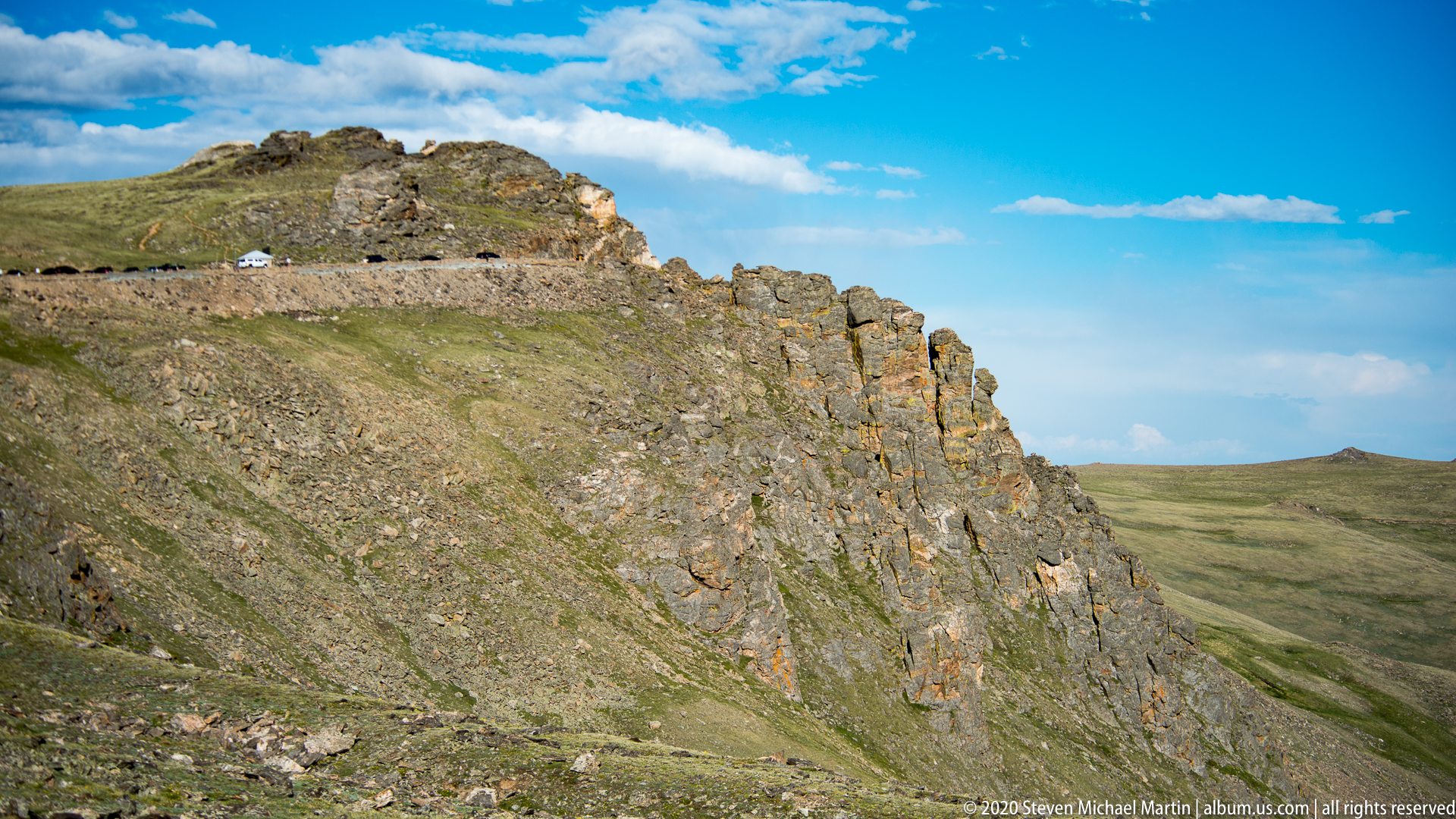
A fractured rock outcrop projects from a grassy alpine hillside, its gray and rust-colored face broken into angular blocks. Low tundra vegetation reaches the foot of the cliff, and the ridge falls away toward the right. This closer geological view isolates the exposed rock from the broader roads and snowfields in nearby scenes.
Caption
A fractured rock outcrop projects from a grassy alpine hillside, its gray and rust-colored face broken into angular blocks. Low tundra vegetation reaches the foot of the cliff, and the ridge falls away toward the right. This closer geological view isolates the exposed rock from the broader roads and snowfields in nearby scenes.
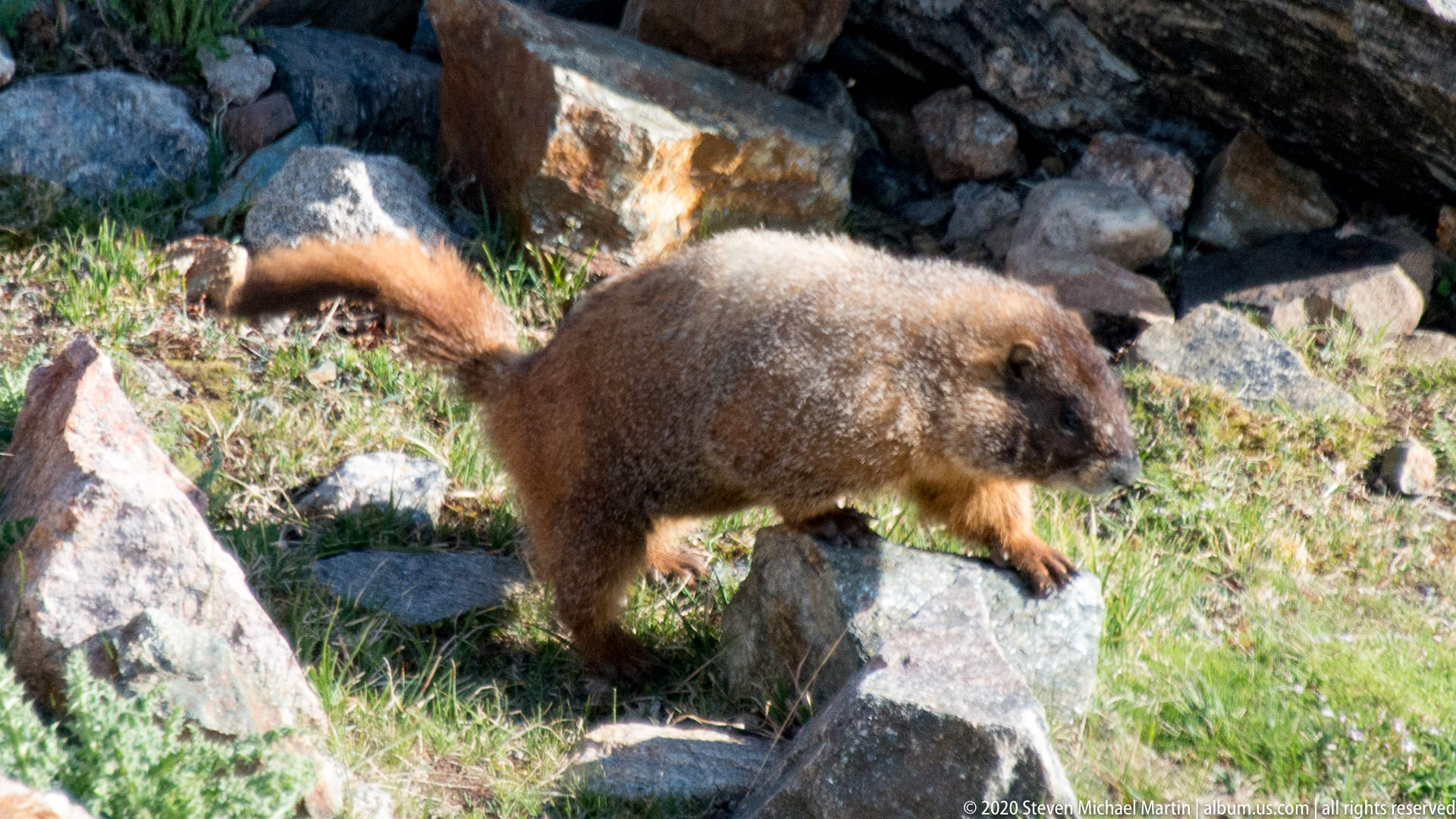
A brown marmot moves across a jumble of boulders, one forepaw placed on a pale stone and its bushy tail extending behind. Green grass grows in cracks between the rocks, contrasting with the animal’s warm coat and gray stone. The side view records a purposeful step through the broken terrain rather than a stationary portrait.
Caption
A brown marmot moves across a jumble of boulders, one forepaw placed on a pale stone and its bushy tail extending behind. Green grass grows in cracks between the rocks, contrasting with the animal’s warm coat and gray stone. The side view records a purposeful step through the broken terrain rather than a stationary portrait.
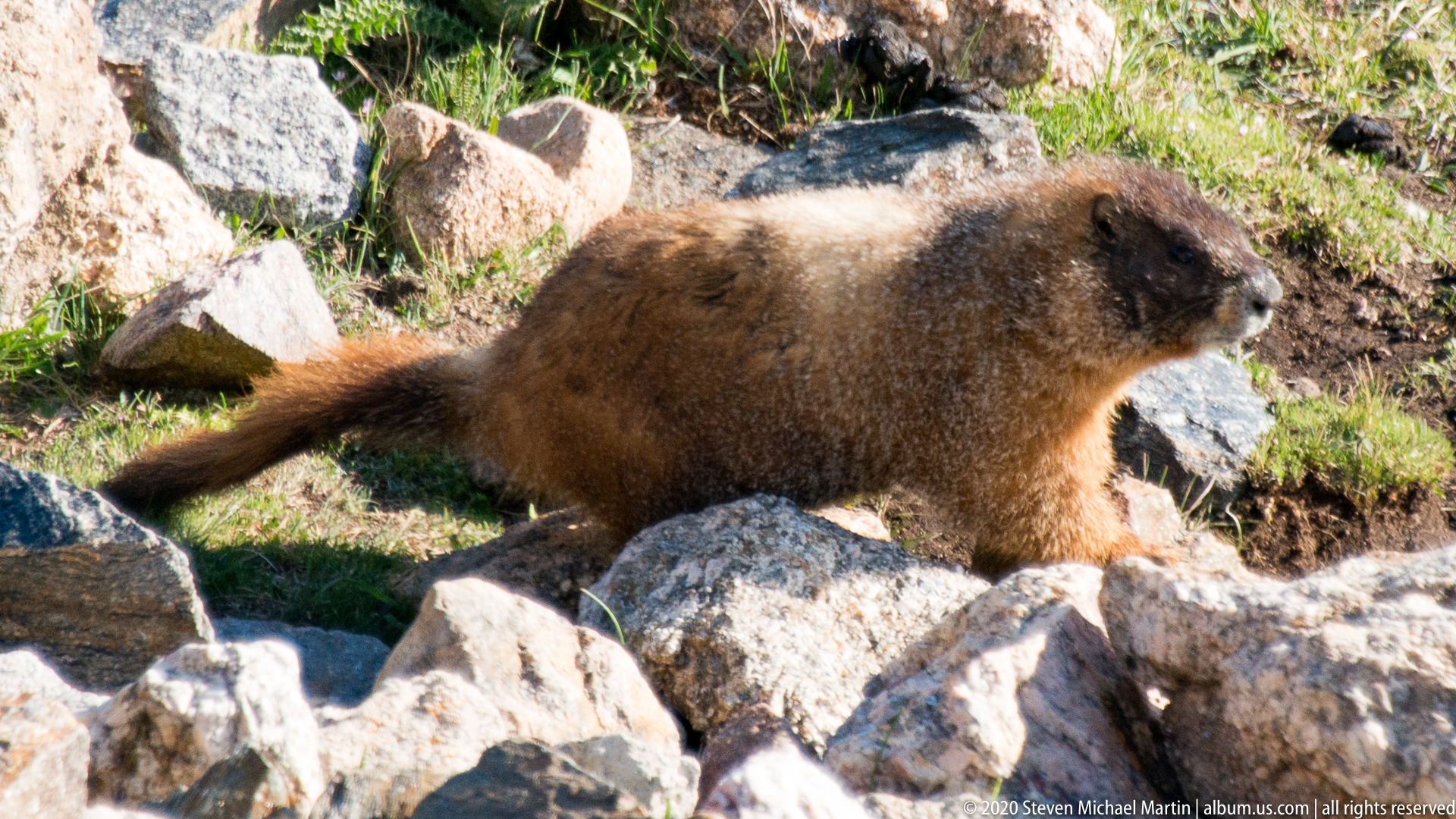
A brown marmot walks between scattered granite rocks, its body held low and its bushy tail stretched behind. Green grass and small plants fill the spaces between stones, while sunlight highlights the animal’s tawny flanks. The lateral view emphasizes movement across the uneven meadow floor and the mix of rock and vegetation.
Caption
A brown marmot walks between scattered granite rocks, its body held low and its bushy tail stretched behind. Green grass and small plants fill the spaces between stones, while sunlight highlights the animal’s tawny flanks. The lateral view emphasizes movement across the uneven meadow floor and the mix of rock and vegetation.
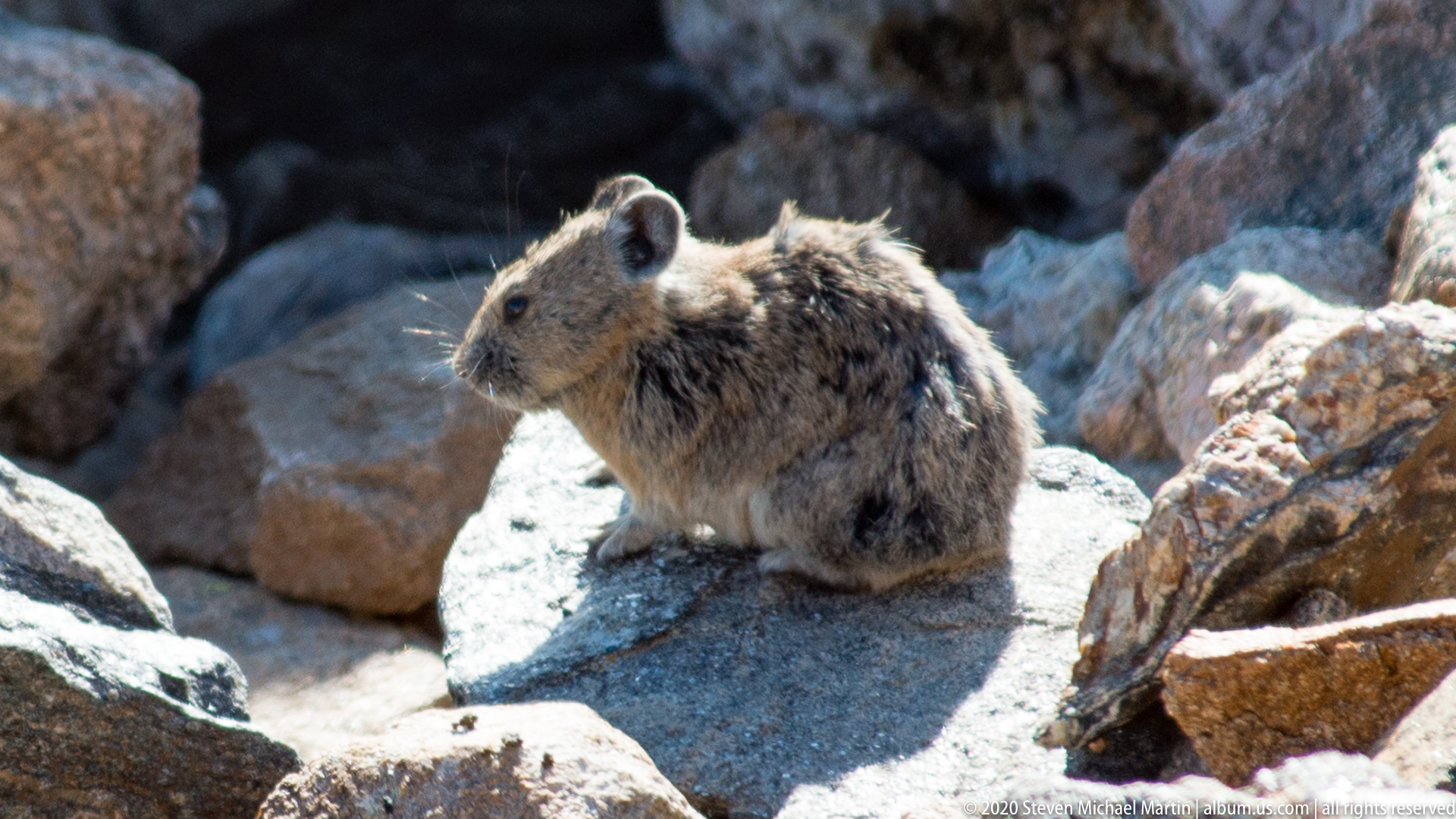
A small compact mammal sits on a pale boulder among larger angular stones, its rounded ears, short muzzle and gray-brown fur visible in profile. The animal’s rounded body and rocky surroundings are consistent with a pika, but the proof-sheet view does not show enough detail for a certain species identification. Bright sunlight separates it from the shadowed rocks behind.
Caption
A small compact mammal sits on a pale boulder among larger angular stones, its rounded ears, short muzzle and gray-brown fur visible in profile. The animal’s rounded body and rocky surroundings are consistent with a pika, but the proof-sheet view does not show enough detail for a certain species identification. Bright sunlight separates it from the shadowed rocks behind.
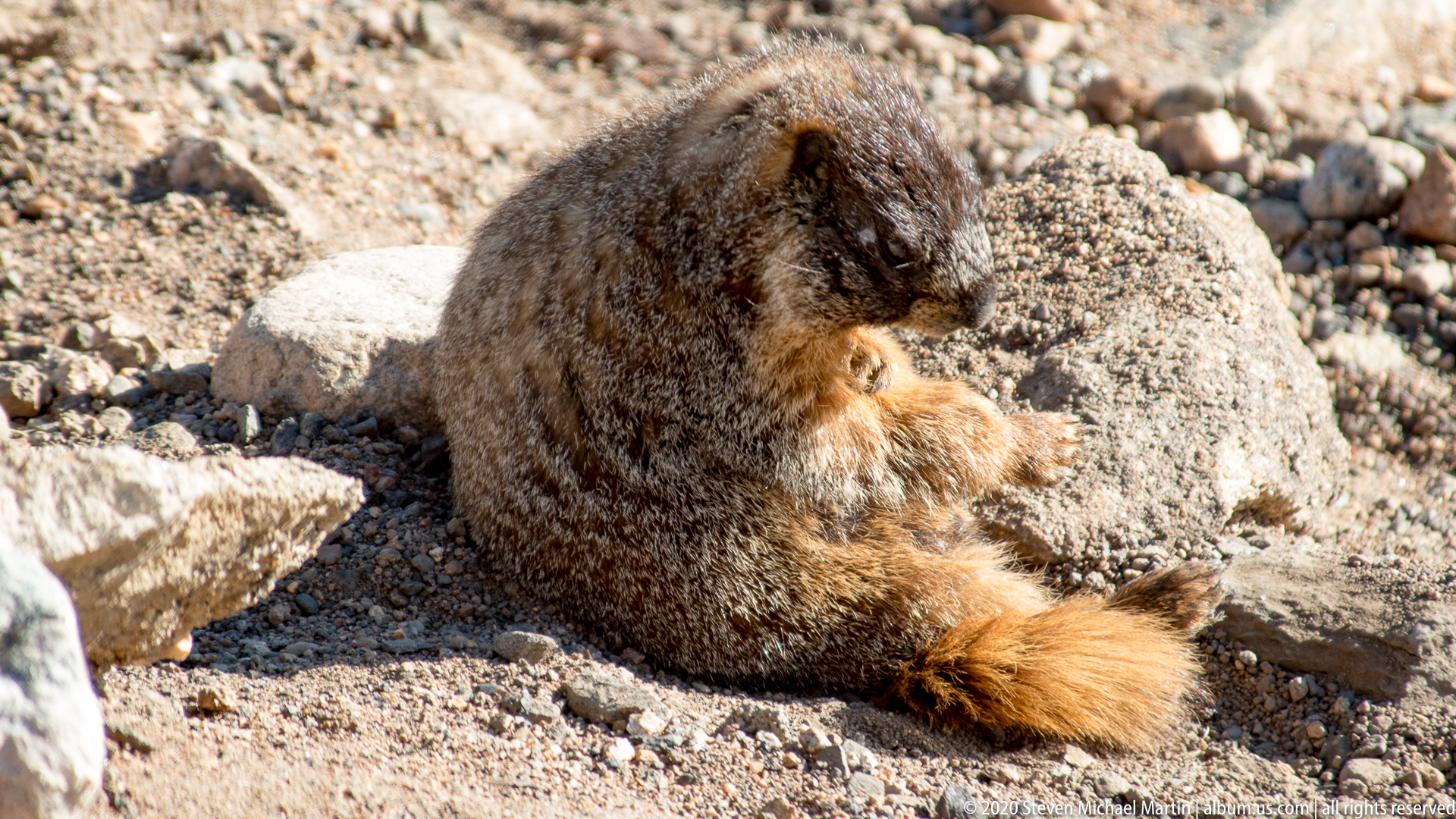
A marmot sits on pale gravel with its body turned away and its head bent toward its flank, apparently grooming. Its thick brown coat and broad, furred tail are sharply visible against small stones and a larger boulder. The close view records a quiet behavior and the rocky substrate of this alpine habitat.
Caption
A marmot sits on pale gravel with its body turned away and its head bent toward its flank, apparently grooming. Its thick brown coat and broad, furred tail are sharply visible against small stones and a larger boulder. The close view records a quiet behavior and the rocky substrate of this alpine habitat.
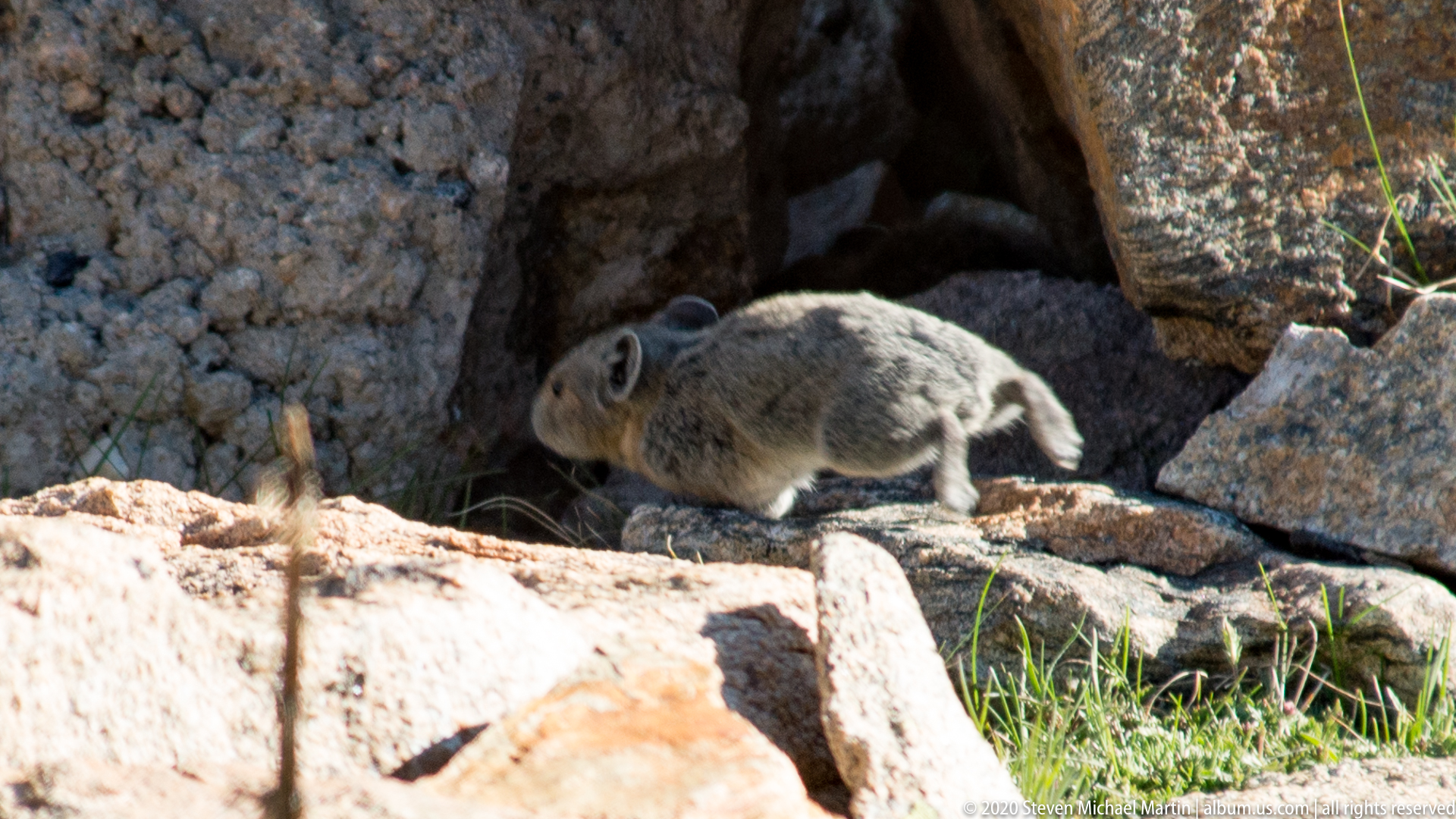
A small gray-brown mammal steps across a narrow ledge between large boulders, its rounded ears and compact body silhouetted against the shaded crevice. The rocky passage occupies most of the frame, with sunlight catching the animal and pale stones in front. Its shape suggests a pika, though species confirmation requires a closer view.
Caption
A small gray-brown mammal steps across a narrow ledge between large boulders, its rounded ears and compact body silhouetted against the shaded crevice. The rocky passage occupies most of the frame, with sunlight catching the animal and pale stones in front. Its shape suggests a pika, though species confirmation requires a closer view.
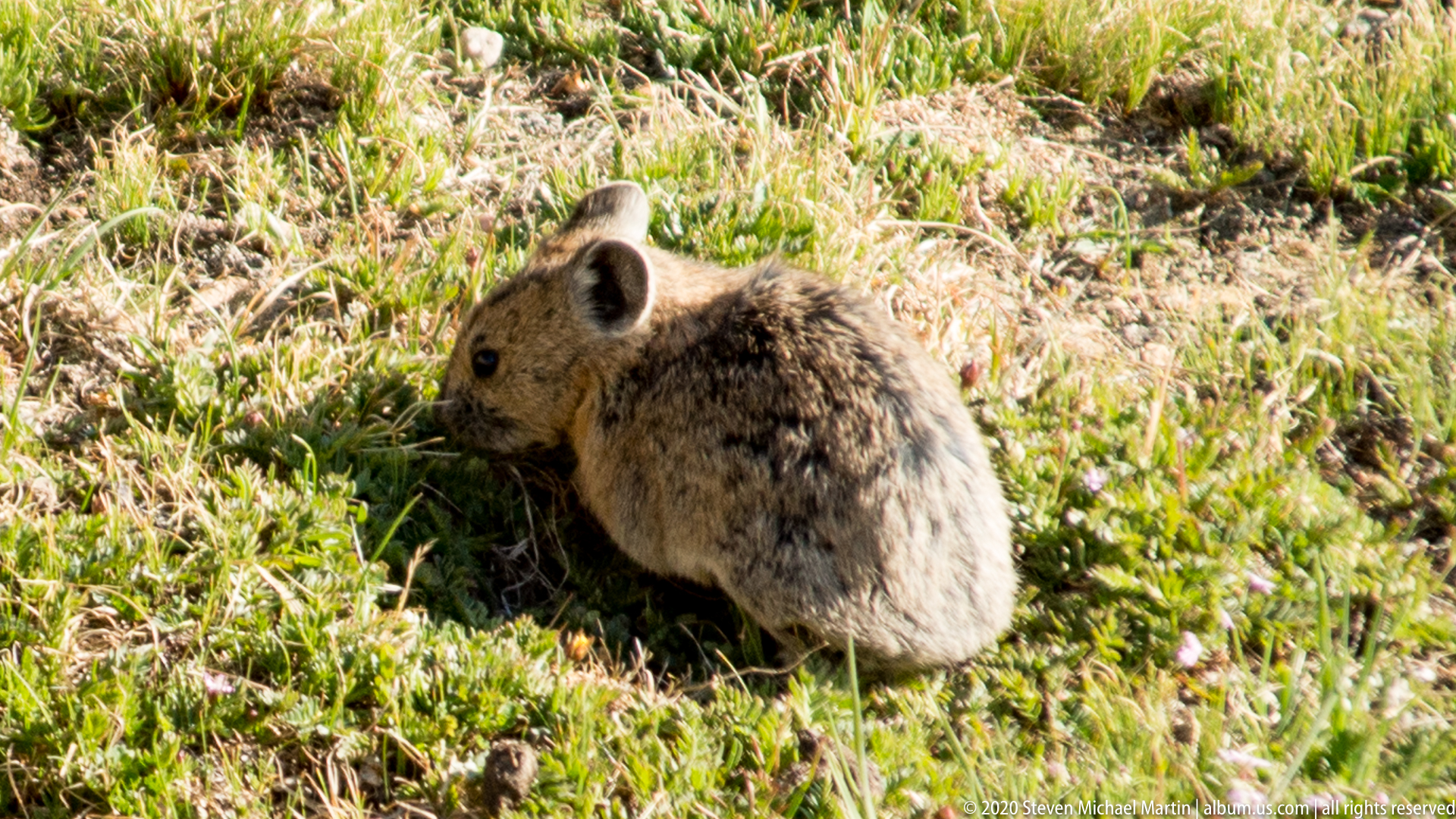
A round-bodied, gray-brown mammal sits in short alpine grass, its nose lowered toward the vegetation and ears upright. Sunlit plants fill the foreground, while darker grass and stone blur behind. The close composition distinguishes this animal from the larger marmots nearby; its compact form is consistent with a pika, but the species should be verified.
Caption
A round-bodied, gray-brown mammal sits in short alpine grass, its nose lowered toward the vegetation and ears upright. Sunlit plants fill the foreground, while darker grass and stone blur behind. The close composition distinguishes this animal from the larger marmots nearby; its compact form is consistent with a pika, but the species should be verified.
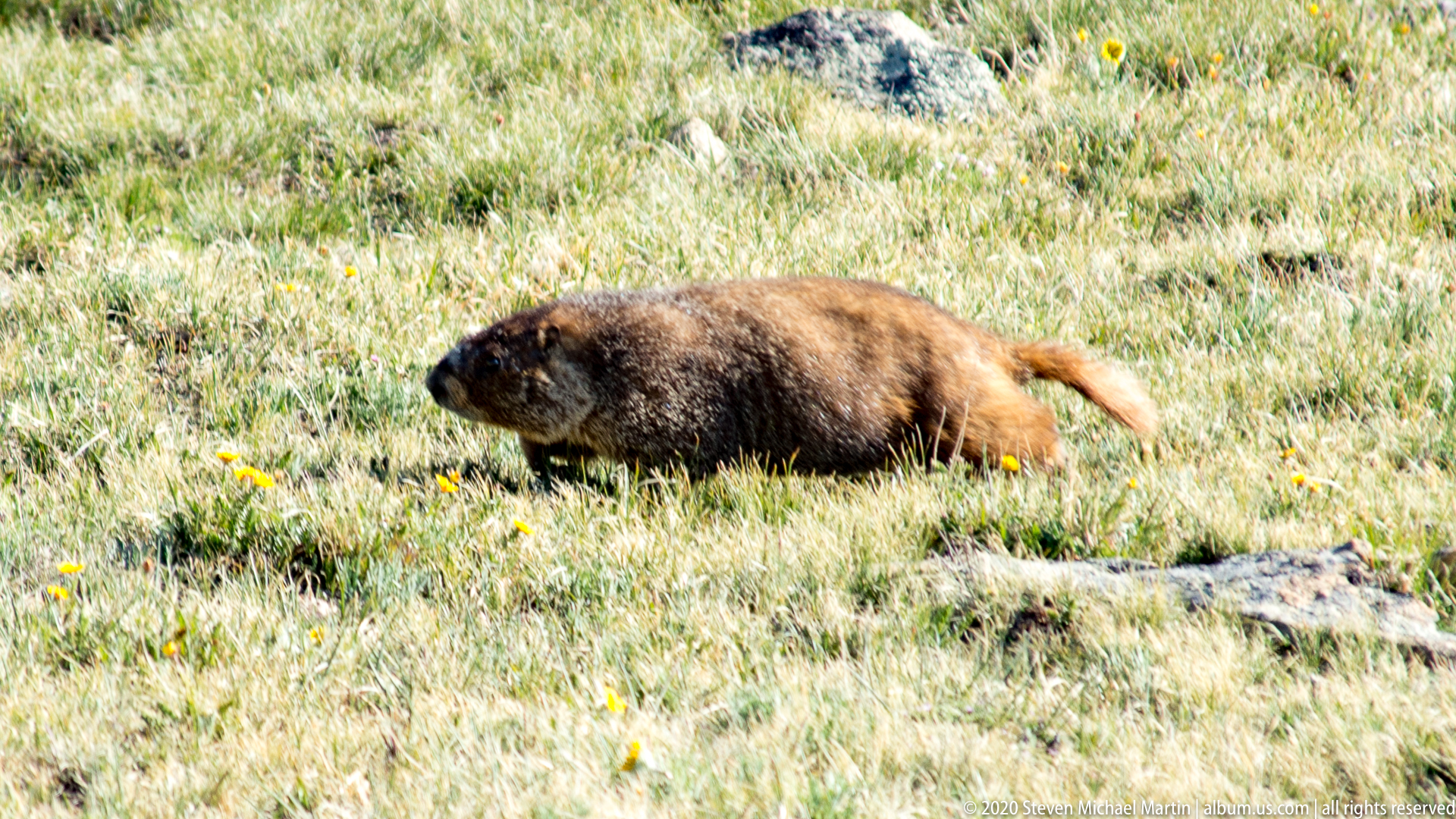
A brown marmot moves low through sunlit alpine grass dotted with small yellow flowers. Its body is elongated in profile, with the tail raised slightly as it crosses the meadow. A few stones interrupt the green groundcover, while shallow focus keeps attention on the animal’s movement and the flower-speckled habitat.
Caption
A brown marmot moves low through sunlit alpine grass dotted with small yellow flowers. Its body is elongated in profile, with the tail raised slightly as it crosses the meadow. A few stones interrupt the green groundcover, while shallow focus keeps attention on the animal’s movement and the flower-speckled habitat.
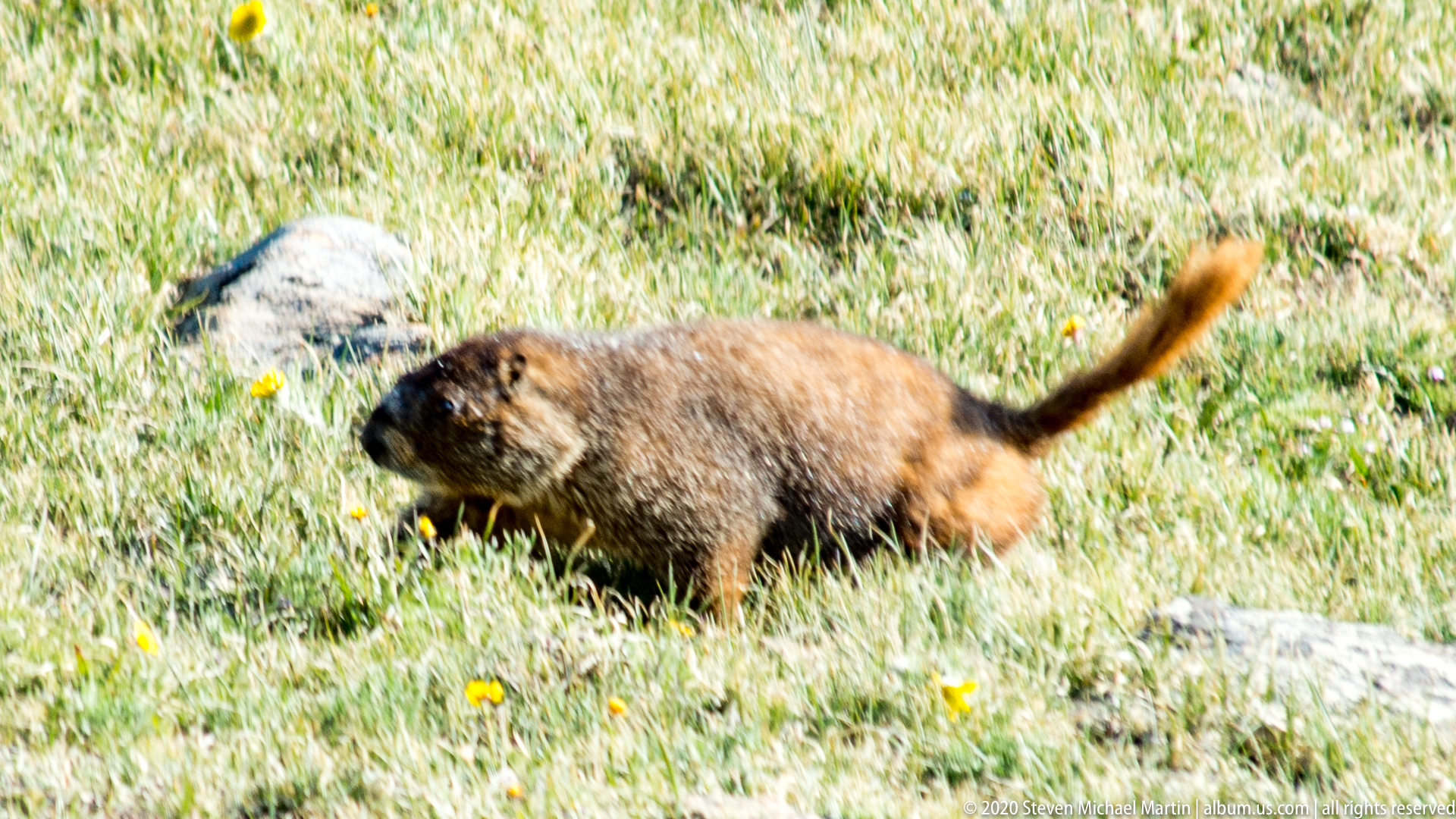
A brown marmot strides through a bright patch of alpine grass, its tail lifted and body angled left. Small yellow flowers and a pale rock punctuate the meadow, while the soft background separates the animal from the slope. The side-on frame makes its movement and thick coat easy to distinguish.
Caption
A brown marmot strides through a bright patch of alpine grass, its tail lifted and body angled left. Small yellow flowers and a pale rock punctuate the meadow, while the soft background separates the animal from the slope. The side-on frame makes its movement and thick coat easy to distinguish.
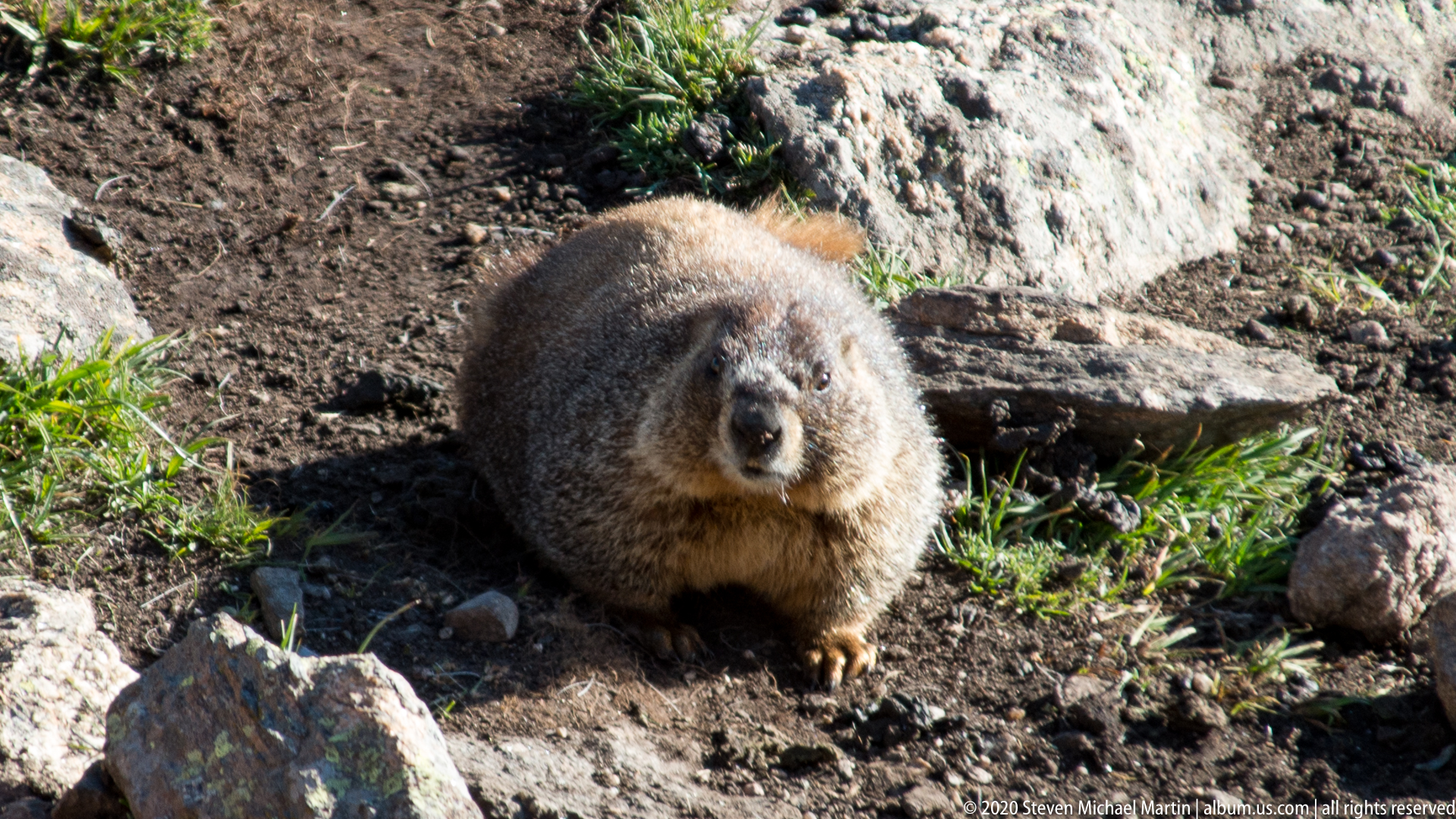
A round-bodied brown marmot stands on a patch of dark soil framed by angular stones and green plants. It faces the camera directly, with small ears lifted and forepaws close together. Bright sunlight illuminates the head and shoulders, making the animal’s compact form stand out from the shaded rock crevice behind.
Caption
A round-bodied brown marmot stands on a patch of dark soil framed by angular stones and green plants. It faces the camera directly, with small ears lifted and forepaws close together. Bright sunlight illuminates the head and shoulders, making the animal’s compact form stand out from the shaded rock crevice behind.
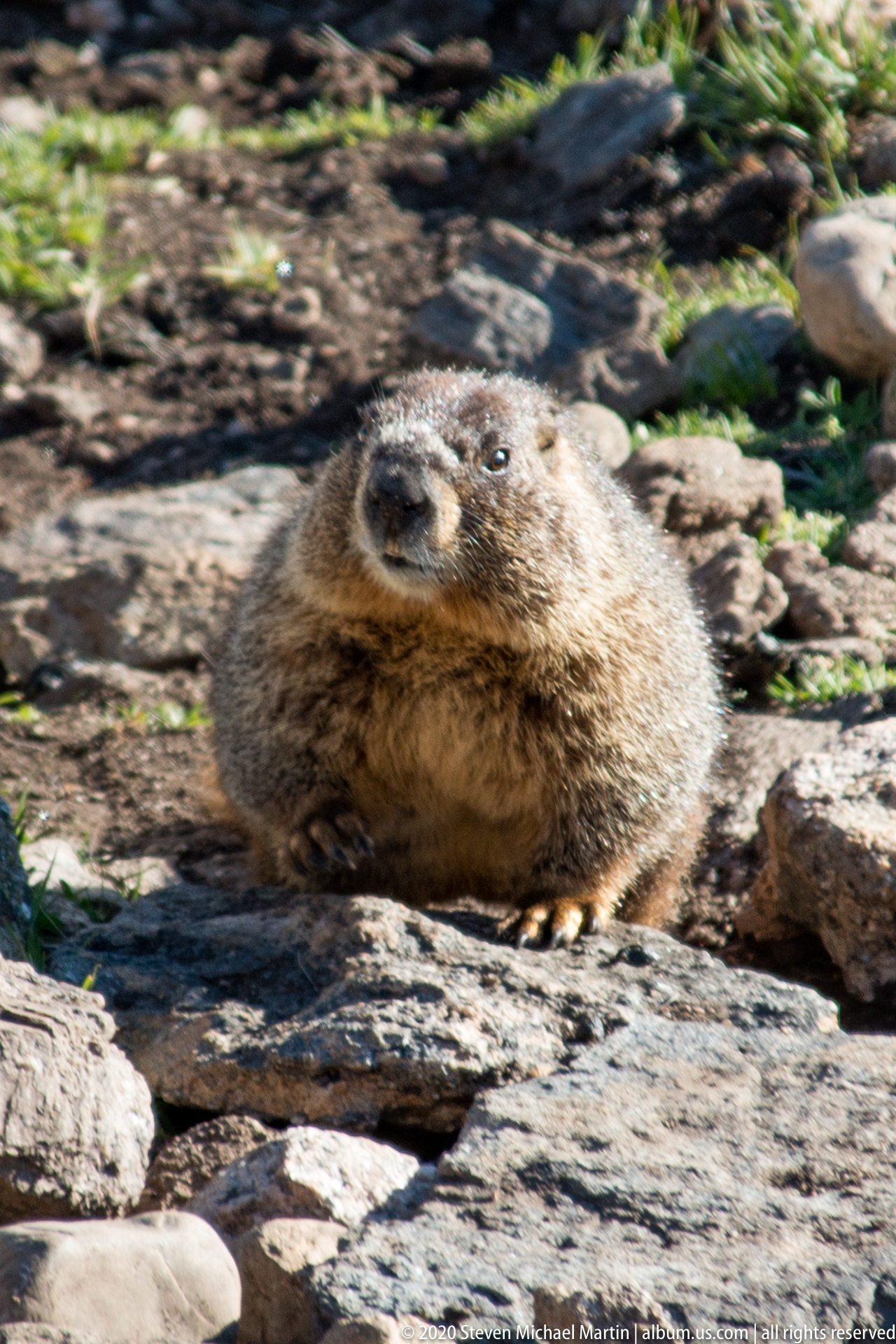
A plump brown marmot sits low on a flat slab of rock, facing the camera with its forepaws tucked beneath its body. The animal’s dense fur and rounded silhouette fill the center, while stones and dappled shade soften the background. The tight framing creates an intimate portrait of a resting mammal in rocky terrain.
Caption
A plump brown marmot sits low on a flat slab of rock, facing the camera with its forepaws tucked beneath its body. The animal’s dense fur and rounded silhouette fill the center, while stones and dappled shade soften the background. The tight framing creates an intimate portrait of a resting mammal in rocky terrain.
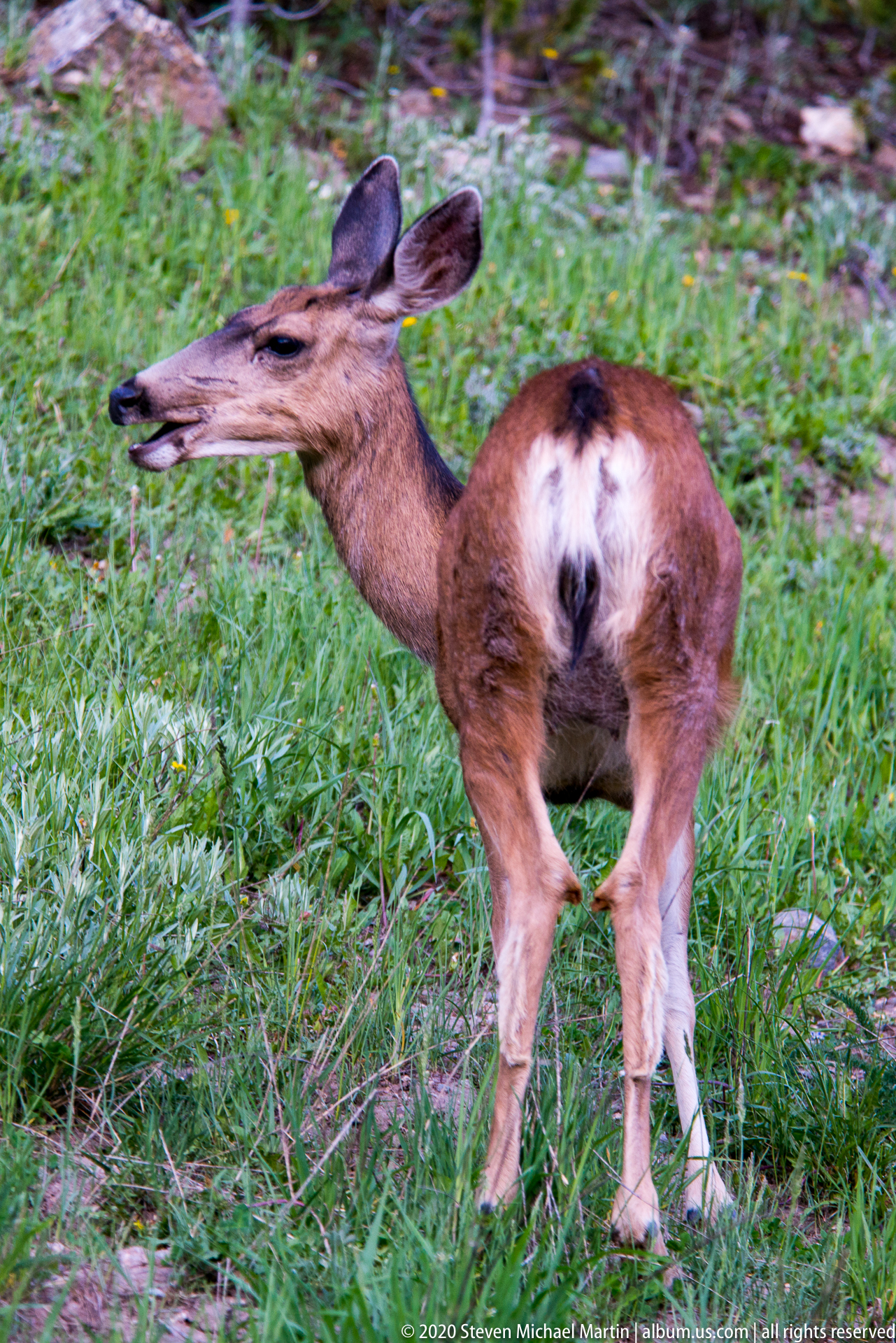
A cow elk stands in dense green meadow grass, turning her head to the left while her body faces across the frame. The pale rump patch and slender legs contrast with the dark, softly focused vegetation behind her. With no antlers visible, this view presents a female elk at close range in a summer feeding area.
Caption
A cow elk stands in dense green meadow grass, turning her head to the left while her body faces across the frame. The pale rump patch and slender legs contrast with the dark, softly focused vegetation behind her. With no antlers visible, this view presents a female elk at close range in a summer feeding area.

The elk’s muzzle reaches into short green grass as the animal feeds, filling most of the frame with its head and shoulder. One dark eye and broad ears remain visible above the vegetation, while another leg stands behind. This intimate view records the mechanics of grazing rather than the animal’s full form or surroundings.
Caption
The elk’s muzzle reaches into short green grass as the animal feeds, filling most of the frame with its head and shoulder. One dark eye and broad ears remain visible above the vegetation, while another leg stands behind. This intimate view records the mechanics of grazing rather than the animal’s full form or surroundings.
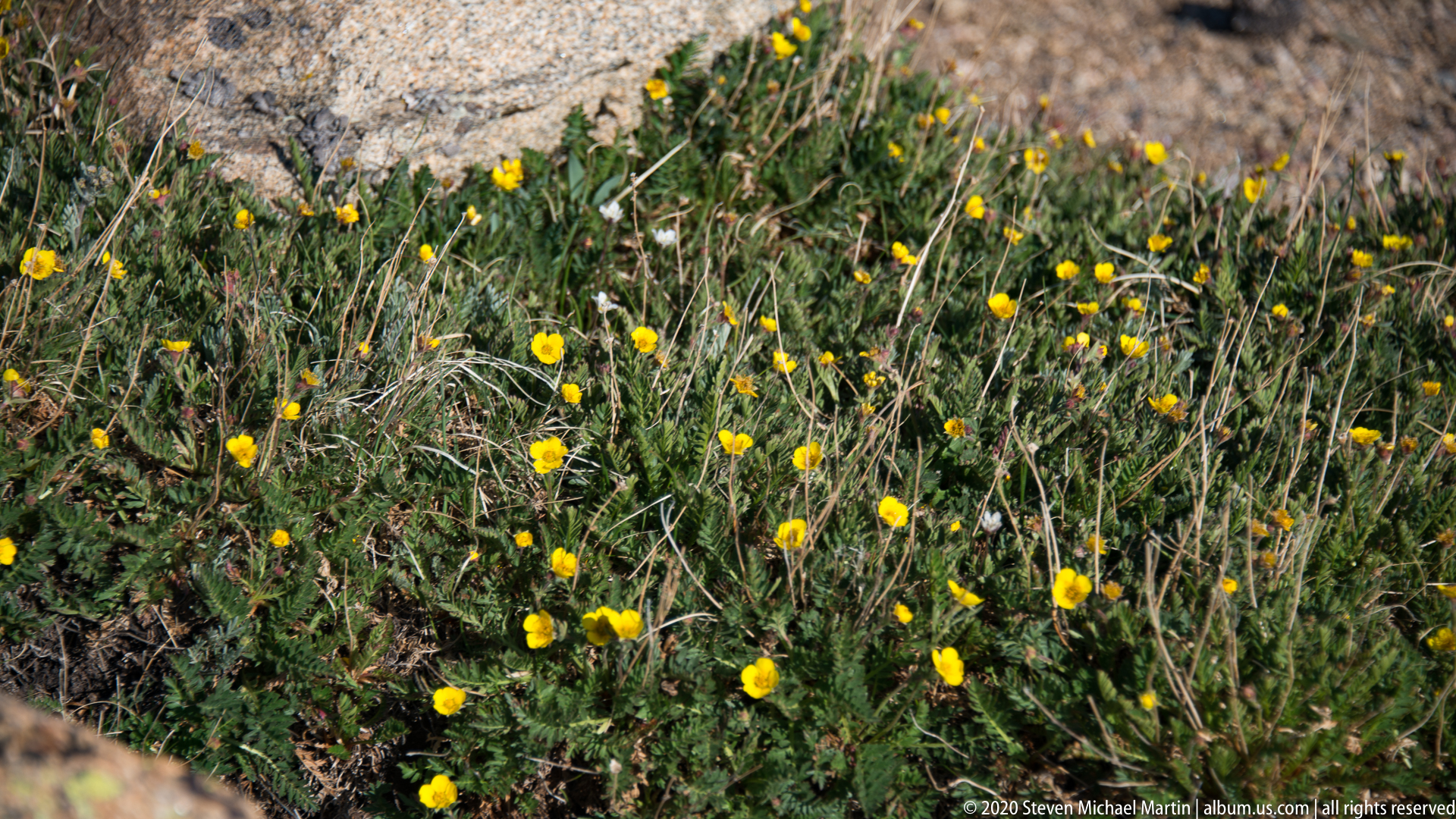
Dozens of small yellow flowers rise on fine stems above low, gray-green alpine foliage. The blooms are scattered across the frame, with dark soil, stones and other plants visible between them. This wider view shows the flowers as part of a low meadow community rather than a single specimen; the species is not clear from the proof sheet.
Caption
Dozens of small yellow flowers rise on fine stems above low, gray-green alpine foliage. The blooms are scattered across the frame, with dark soil, stones and other plants visible between them. This wider view shows the flowers as part of a low meadow community rather than a single specimen; the species is not clear from the proof sheet.

A single yellow flower fills the frame, its narrow rays surrounding a dense golden-brown center. Fine hairs and narrow leaves are visible on the stem below, while the alpine ground behind falls into soft shadow. The detailed view reveals the bloom’s radial structure but not enough diagnostic features to confirm its species.
Caption
A single yellow flower fills the frame, its narrow rays surrounding a dense golden-brown center. Fine hairs and narrow leaves are visible on the stem below, while the alpine ground behind falls into soft shadow. The detailed view reveals the bloom’s radial structure but not enough diagnostic features to confirm its species.
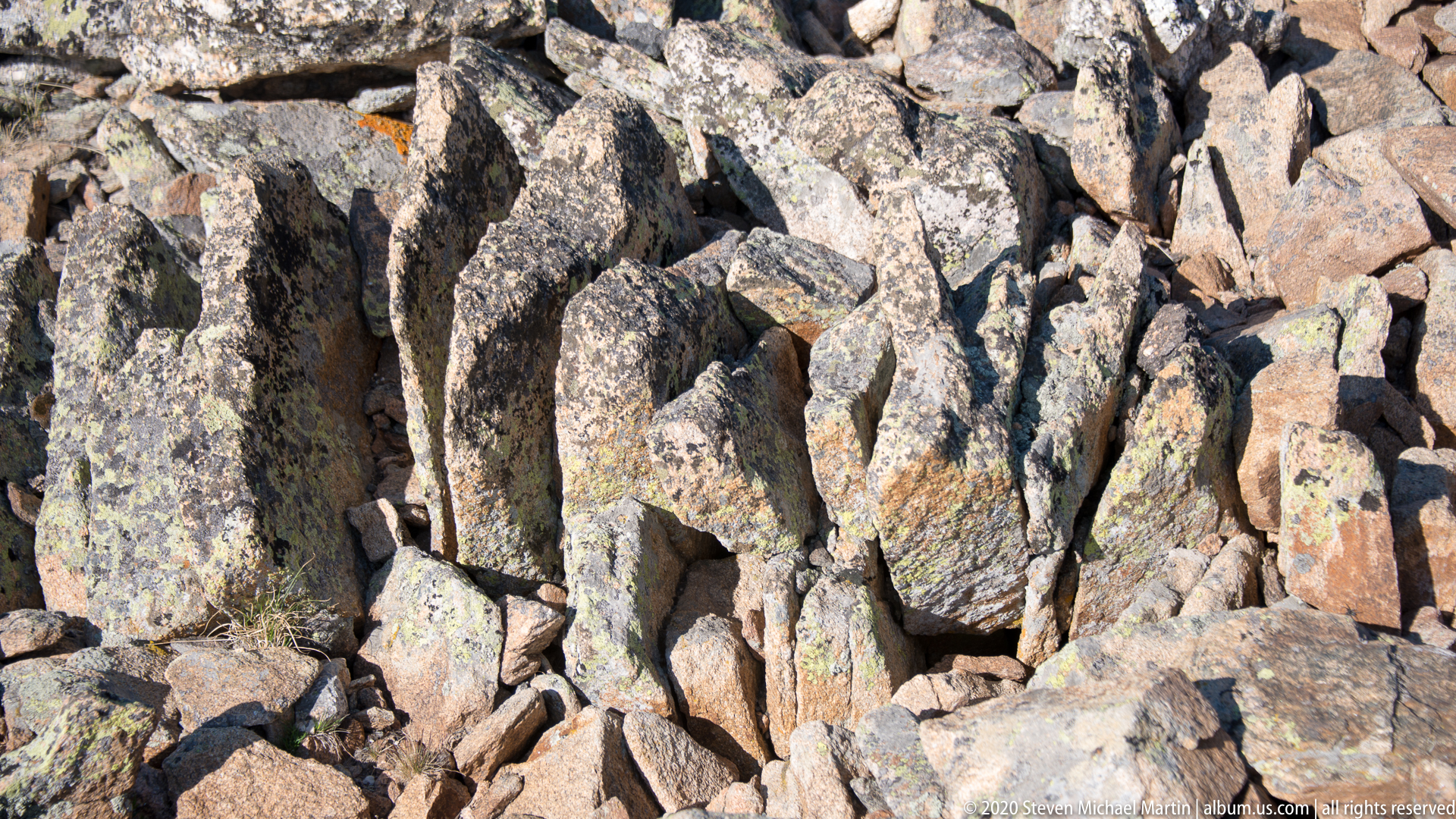
Angular gray and tan stones fill the frame, their rough surfaces mottled with pale green and yellow lichen. Narrow crevices divide the blocks, while small fragments collect between them. The close view records the weathered texture and varied mineral tones of a high-elevation rock field without a visible horizon or larger landscape context.
Caption
Angular gray and tan stones fill the frame, their rough surfaces mottled with pale green and yellow lichen. Narrow crevices divide the blocks, while small fragments collect between them. The close view records the weathered texture and varied mineral tones of a high-elevation rock field without a visible horizon or larger landscape context.
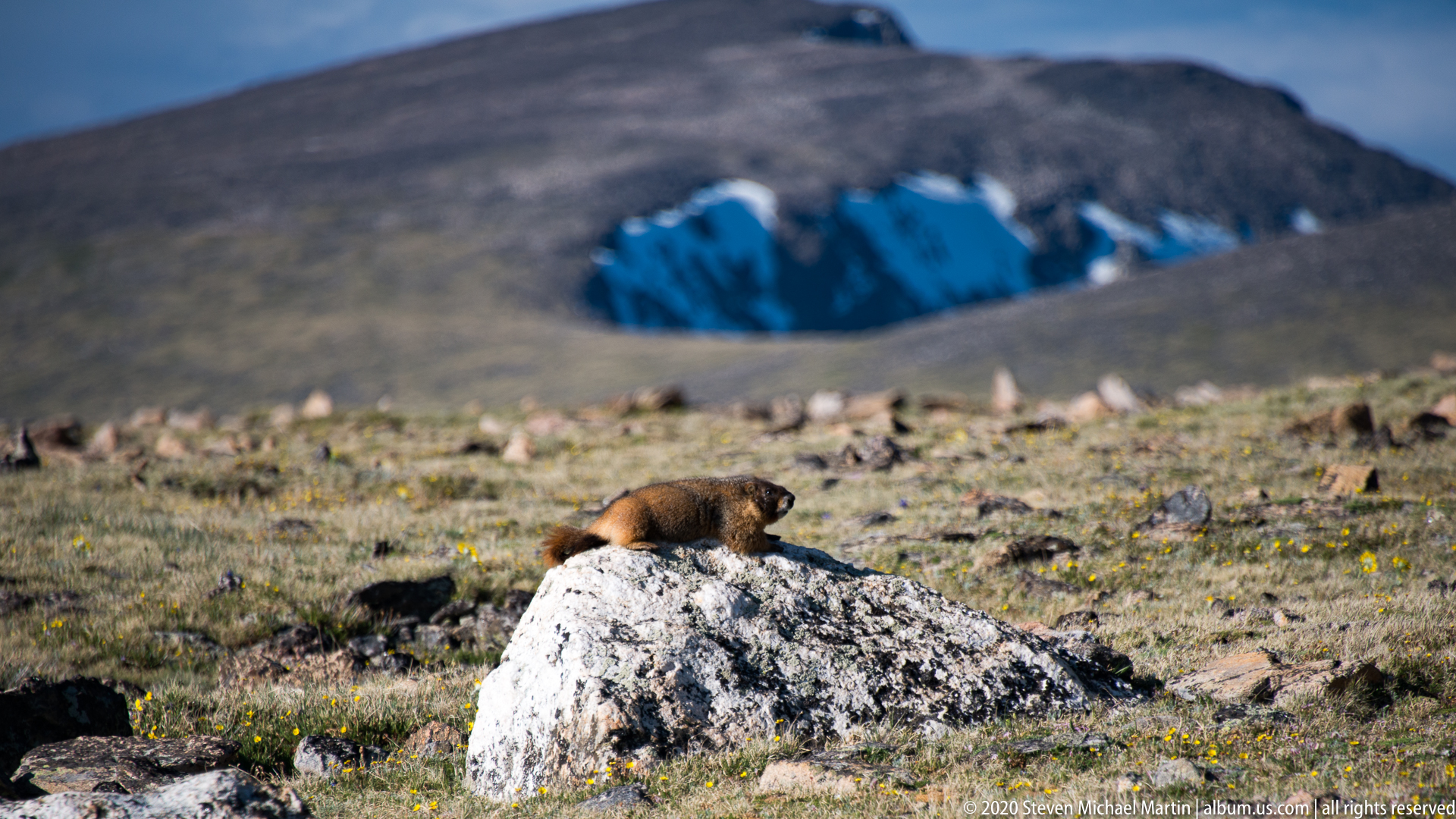
A brown marmot stands on a pale foreground boulder in a broad alpine meadow. A shallow-focus band of green tundra and blue-white snow patches crosses the mountain slope behind it, creating distinct layers of foreground animal and distant high country. The animal appears small within the landscape, emphasizing the open habitat.
Caption
A brown marmot stands on a pale foreground boulder in a broad alpine meadow. A shallow-focus band of green tundra and blue-white snow patches crosses the mountain slope behind it, creating distinct layers of foreground animal and distant high country. The animal appears small within the landscape, emphasizing the open habitat.
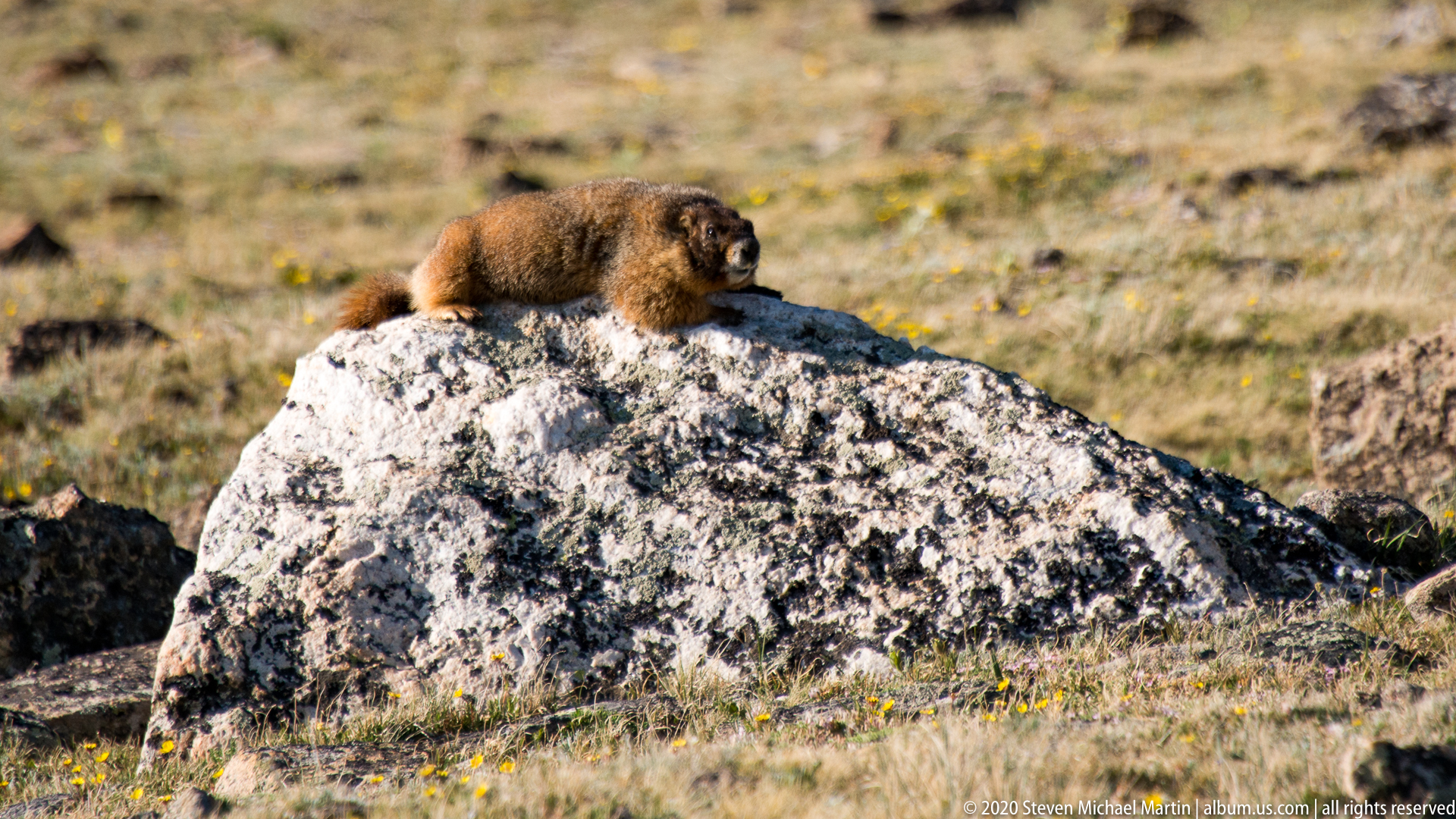
A brown marmot lies along the crest of a pale granite boulder, facing right with its forelegs tucked beneath its chest. Yellow-green meadow plants and a softly focused mountain slope extend behind it. The low angle places the animal against open terrain and makes the boulder’s broad, weathered surface part of the composition.
Caption
A brown marmot lies along the crest of a pale granite boulder, facing right with its forelegs tucked beneath its chest. Yellow-green meadow plants and a softly focused mountain slope extend behind it. The low angle places the animal against open terrain and makes the boulder’s broad, weathered surface part of the composition.
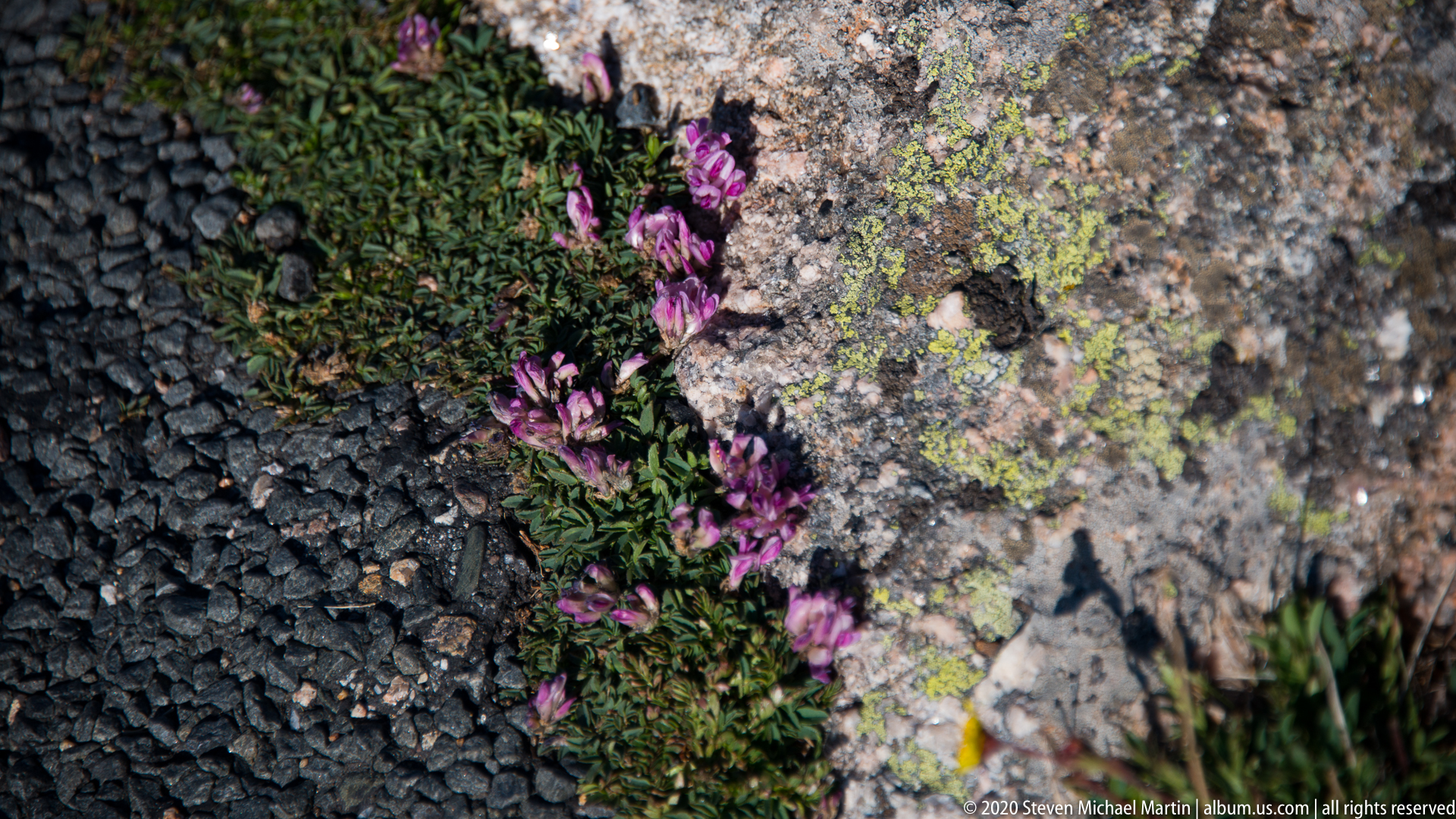
A cluster of magenta-purple flowers grows from a narrow crack between dark, broken rocks. The stems and small leaves emerge directly from the crevice, with pale lichen and gravel nearby. Viewed from above, the composition contrasts the saturated blooms with gray stone and shows how the plant occupies a sheltered pocket in the rocky ground.
Caption
A cluster of magenta-purple flowers grows from a narrow crack between dark, broken rocks. The stems and small leaves emerge directly from the crevice, with pale lichen and gravel nearby. Viewed from above, the composition contrasts the saturated blooms with gray stone and shows how the plant occupies a sheltered pocket in the rocky ground.
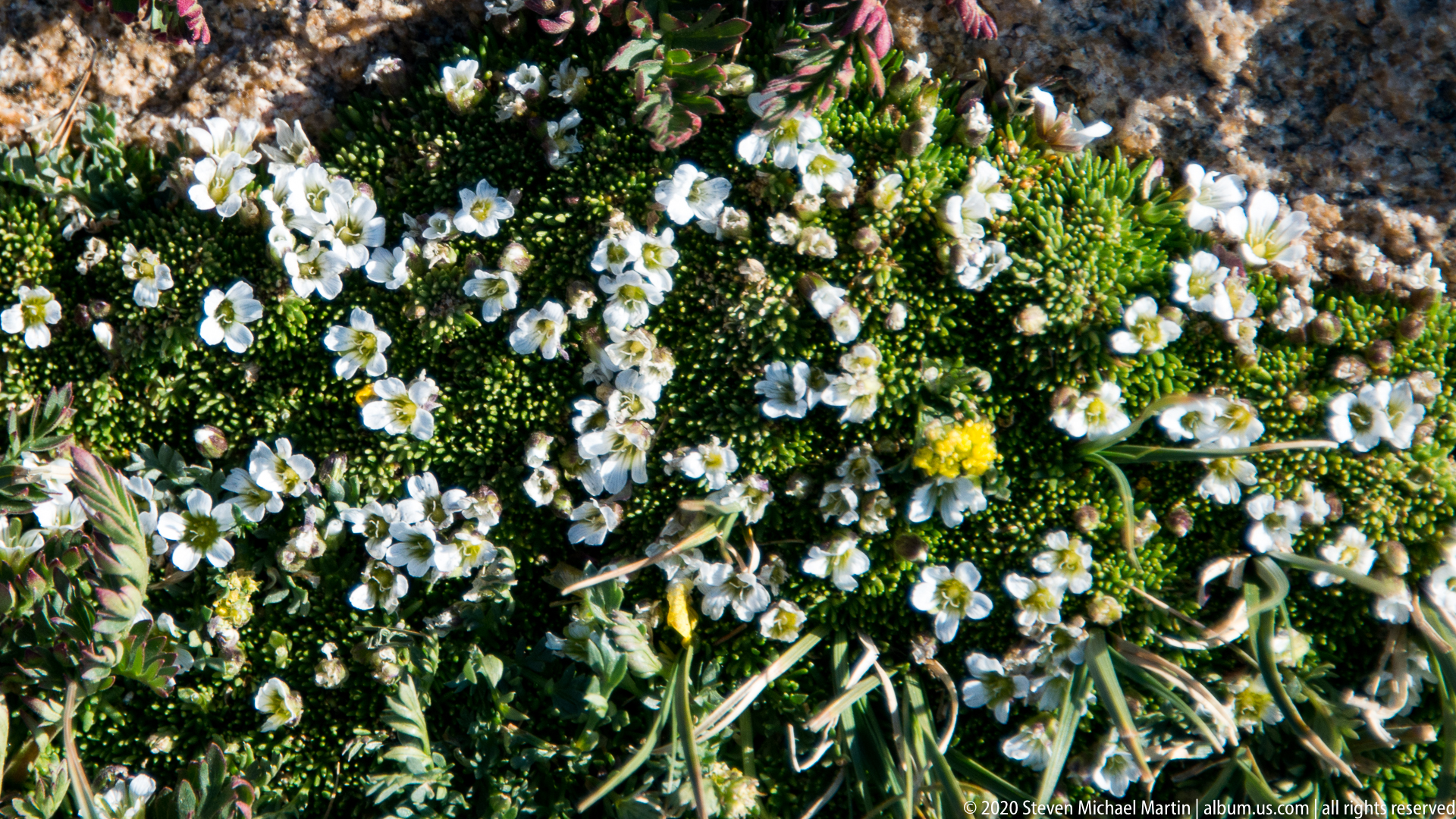
Tiny white blossoms and pink buds emerge from a compact mat of alpine vegetation, with mossy green cushions filling the foreground and a weathered rock entering at upper right. The close view brings attention to the low, tightly packed growth that persists among exposed stone; individual flowers remain unidentified.
Caption
Tiny white blossoms and pink buds emerge from a compact mat of alpine vegetation, with mossy green cushions filling the foreground and a weathered rock entering at upper right. The close view brings attention to the low, tightly packed growth that persists among exposed stone; individual flowers remain unidentified.
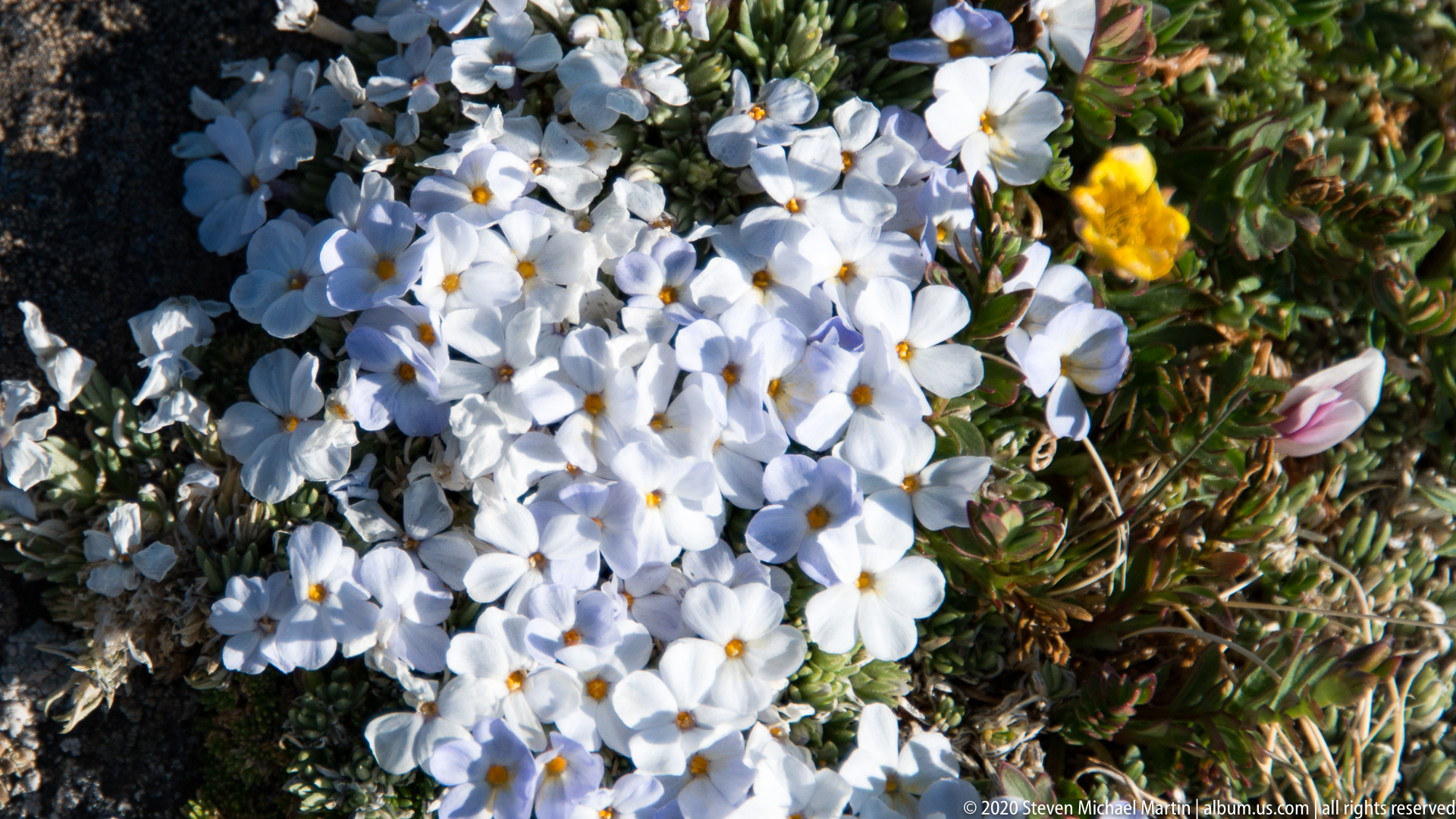
A cluster of larger white flowers fills the frame, their five rounded petals and yellow centers distinct against green leaves. One unopened pink bud appears among the blossoms. The close composition isolates the flowers from the wider alpine landscape and makes their overlapping forms and fresh growth the principal subject, without requiring a more specific botanical name.
Caption
A cluster of larger white flowers fills the frame, their five rounded petals and yellow centers distinct against green leaves. One unopened pink bud appears among the blossoms. The close composition isolates the flowers from the wider alpine landscape and makes their overlapping forms and fresh growth the principal subject, without requiring a more specific botanical name.
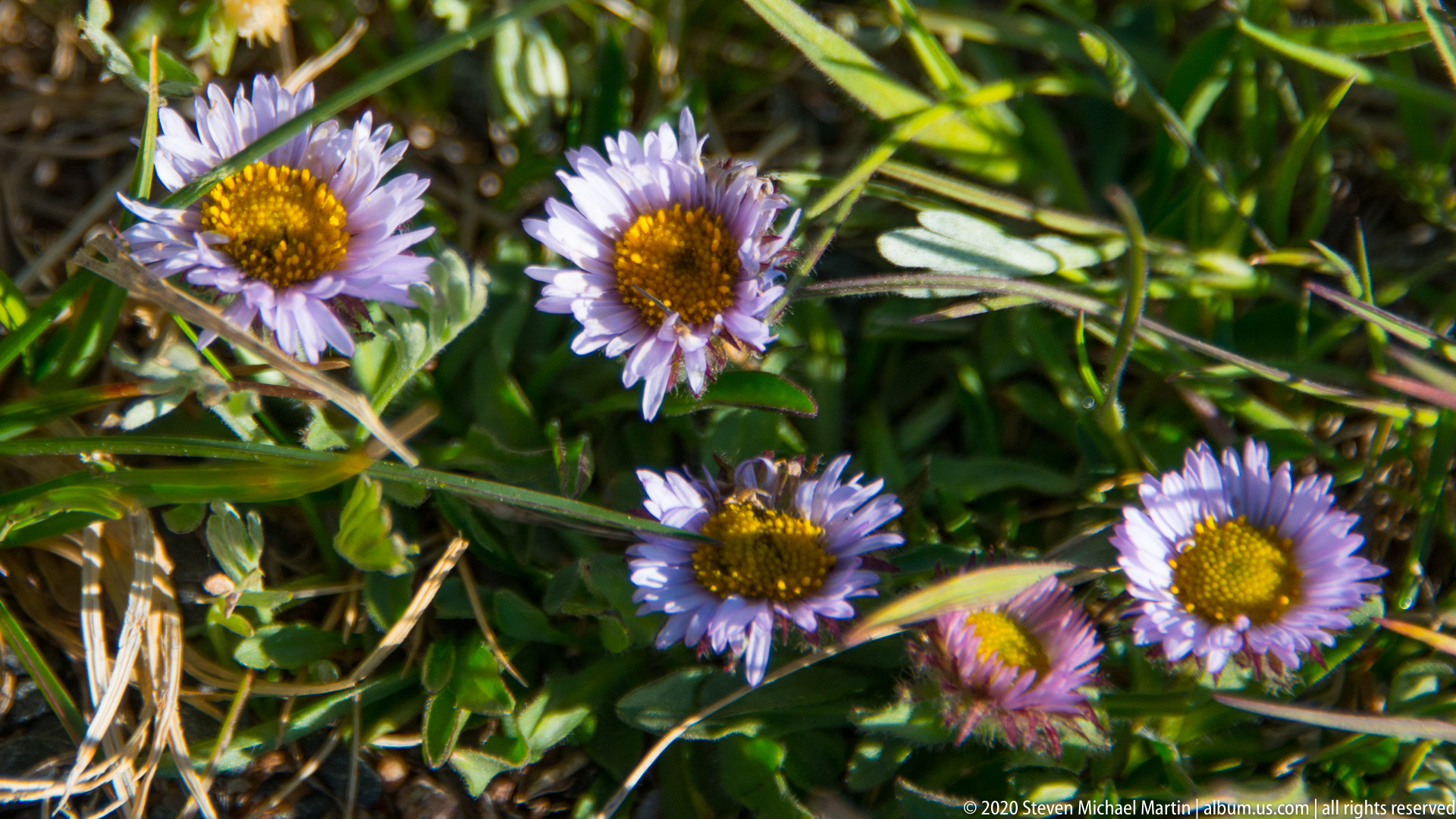
Lavender flowers with yellow centers rise on slender stems from a bed of narrow green leaves. Their daisy-like heads overlap at different heights, creating a compact botanical portrait rather than a broad meadow view. The restrained palette and close framing reveal the flowers’ delicate structure while leaving the exact species unnamed.
Caption
Lavender flowers with yellow centers rise on slender stems from a bed of narrow green leaves. Their daisy-like heads overlap at different heights, creating a compact botanical portrait rather than a broad meadow view. The restrained palette and close framing reveal the flowers’ delicate structure while leaving the exact species unnamed.
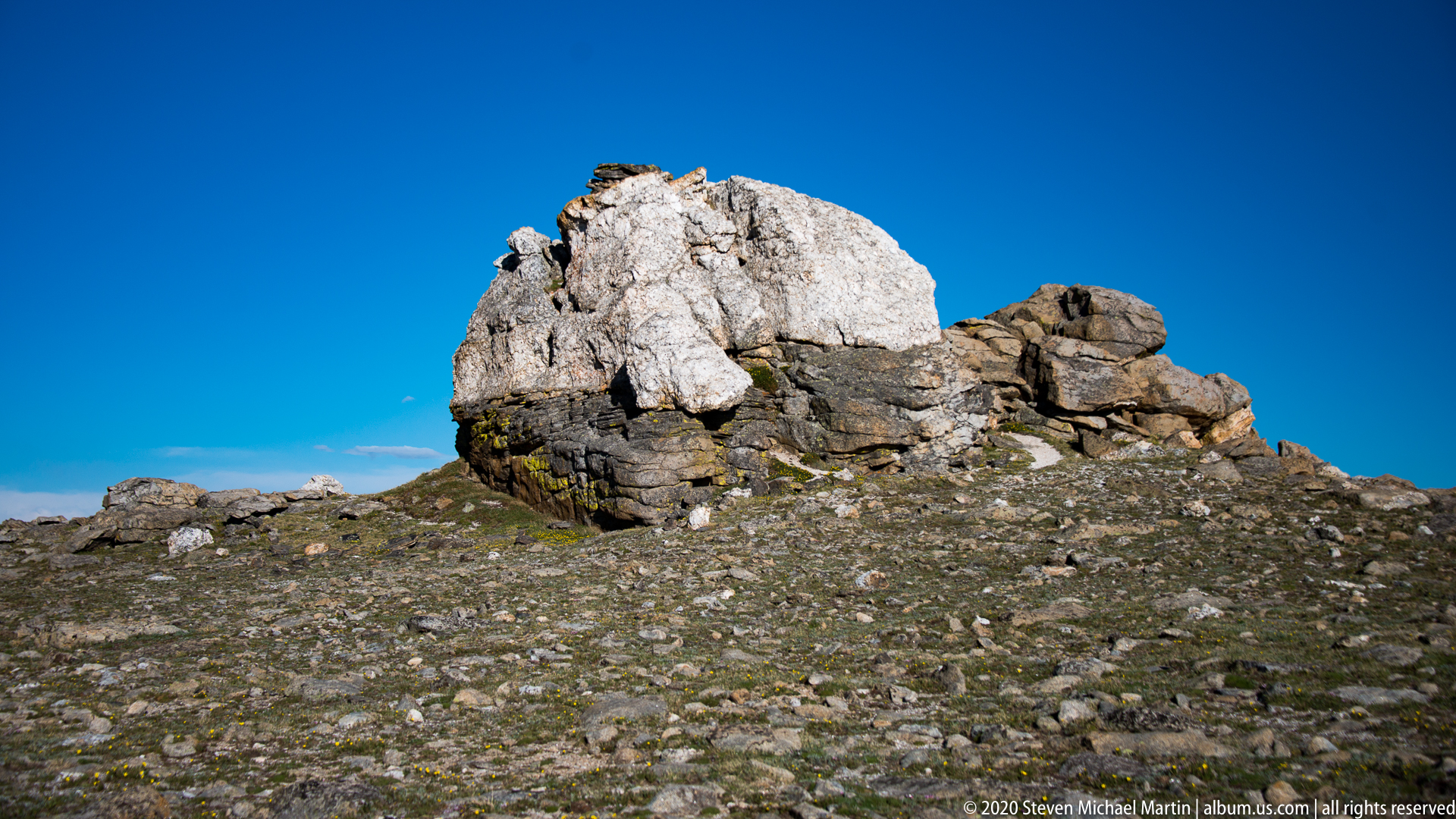
A pale cap of granite crowns darker, blocky layers in an exposed high-elevation rock formation. The broad view sets the outcrop against a deep blue sky and shows how little vegetation occupies the stony summit. Differences in color and weathering give the boulders a stacked appearance, though the image does not identify a named peak or formation.
Caption
A pale cap of granite crowns darker, blocky layers in an exposed high-elevation rock formation. The broad view sets the outcrop against a deep blue sky and shows how little vegetation occupies the stony summit. Differences in color and weathering give the boulders a stacked appearance, though the image does not identify a named peak or formation.
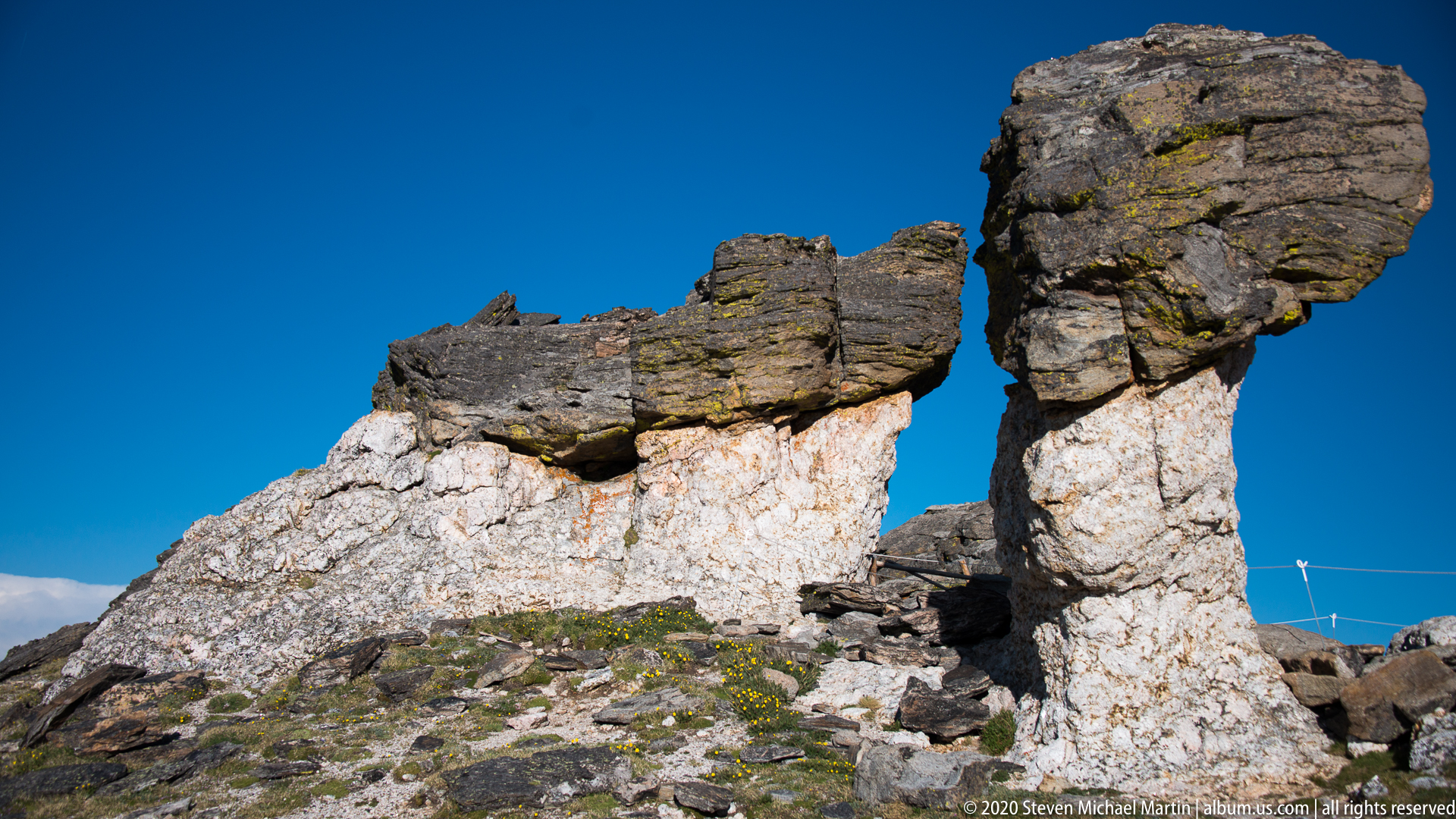
Two pale, column-like rock bases rise beneath broad dark capstones in a close view of a weathered granite formation. Their uneven outlines and contrasting tones make the natural balancing shapes legible against the clear sky. The caption describes the visible structure without assigning the formation a local name or implying a human-built arrangement.
Caption
Two pale, column-like rock bases rise beneath broad dark capstones in a close view of a weathered granite formation. Their uneven outlines and contrasting tones make the natural balancing shapes legible against the clear sky. The caption describes the visible structure without assigning the formation a local name or implying a human-built arrangement.
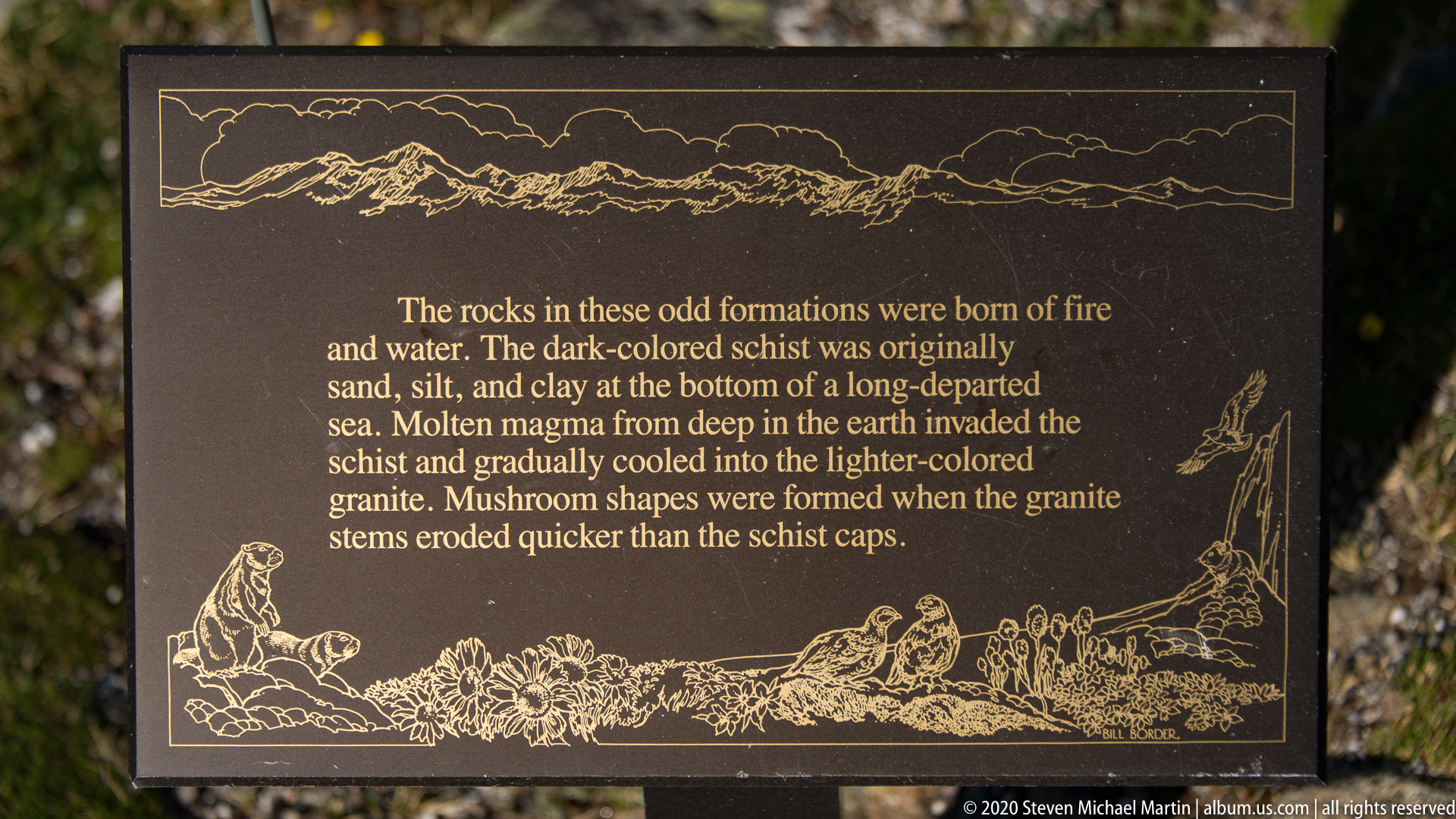
An interpretive panel explains how dark schist formed from ancient seabed sediments and how molten magma cooled into lighter granite. Its text also describes mushroom-shaped forms produced as granite stems eroded faster than schist caps. Line drawings of mountain scenery, plants, and wildlife frame the explanation, making the sign itself the subject rather than the nearby rock formations.
Caption
An interpretive panel explains how dark schist formed from ancient seabed sediments and how molten magma cooled into lighter granite. Its text also describes mushroom-shaped forms produced as granite stems eroded faster than schist caps. Line drawings of mountain scenery, plants, and wildlife frame the explanation, making the sign itself the subject rather than the nearby rock formations.
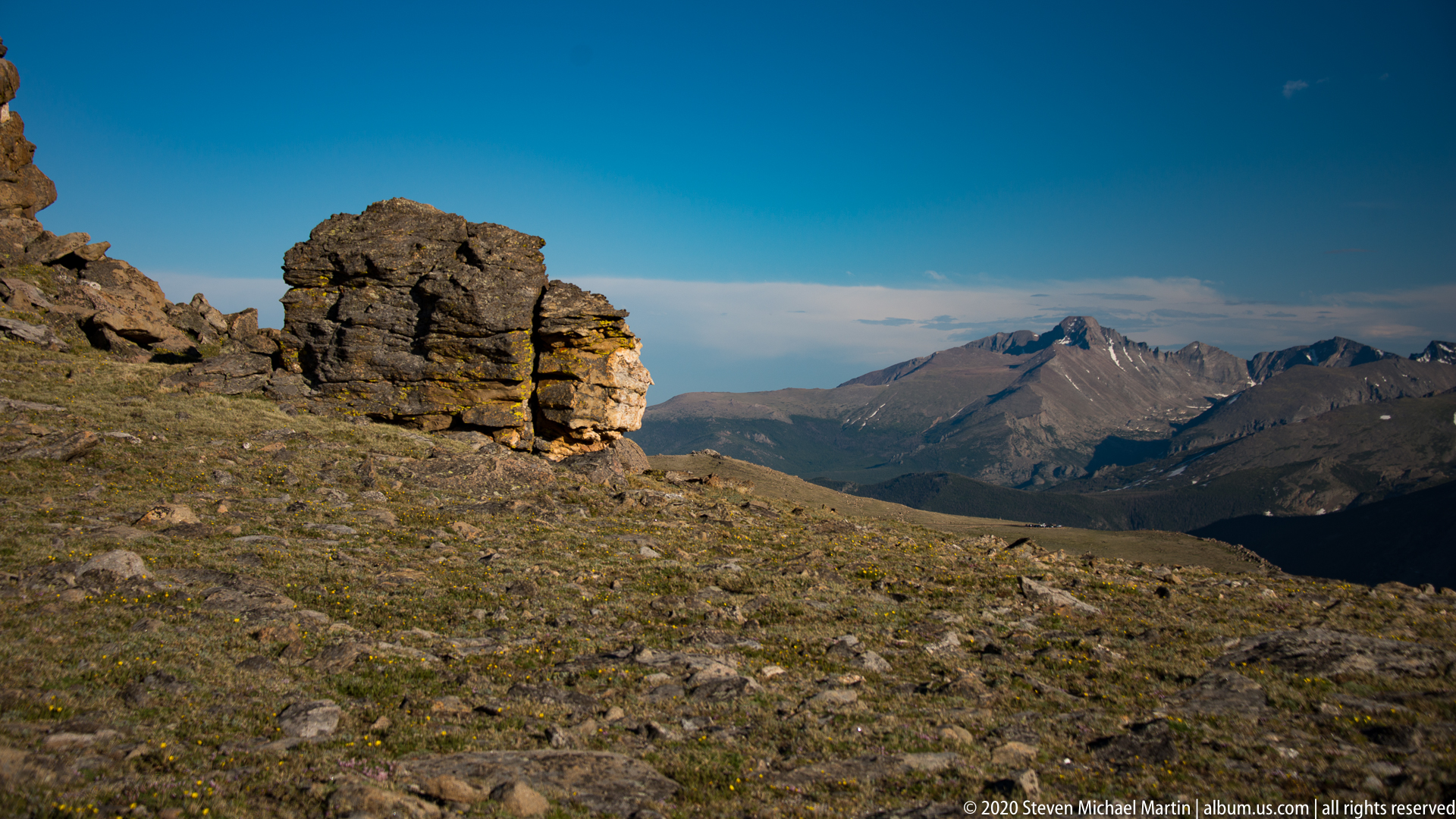
A rough granite outcrop anchors the left foreground while an open meadow slope leads toward a dramatic mountain range at right. This off-center arrangement joins near rock texture to distant peaks, giving the landscape a strong sense of depth. The photograph offers a broad alpine view without revealing a sign or other feature that would support naming the range.
Caption
A rough granite outcrop anchors the left foreground while an open meadow slope leads toward a dramatic mountain range at right. This off-center arrangement joins near rock texture to distant peaks, giving the landscape a strong sense of depth. The photograph offers a broad alpine view without revealing a sign or other feature that would support naming the range.
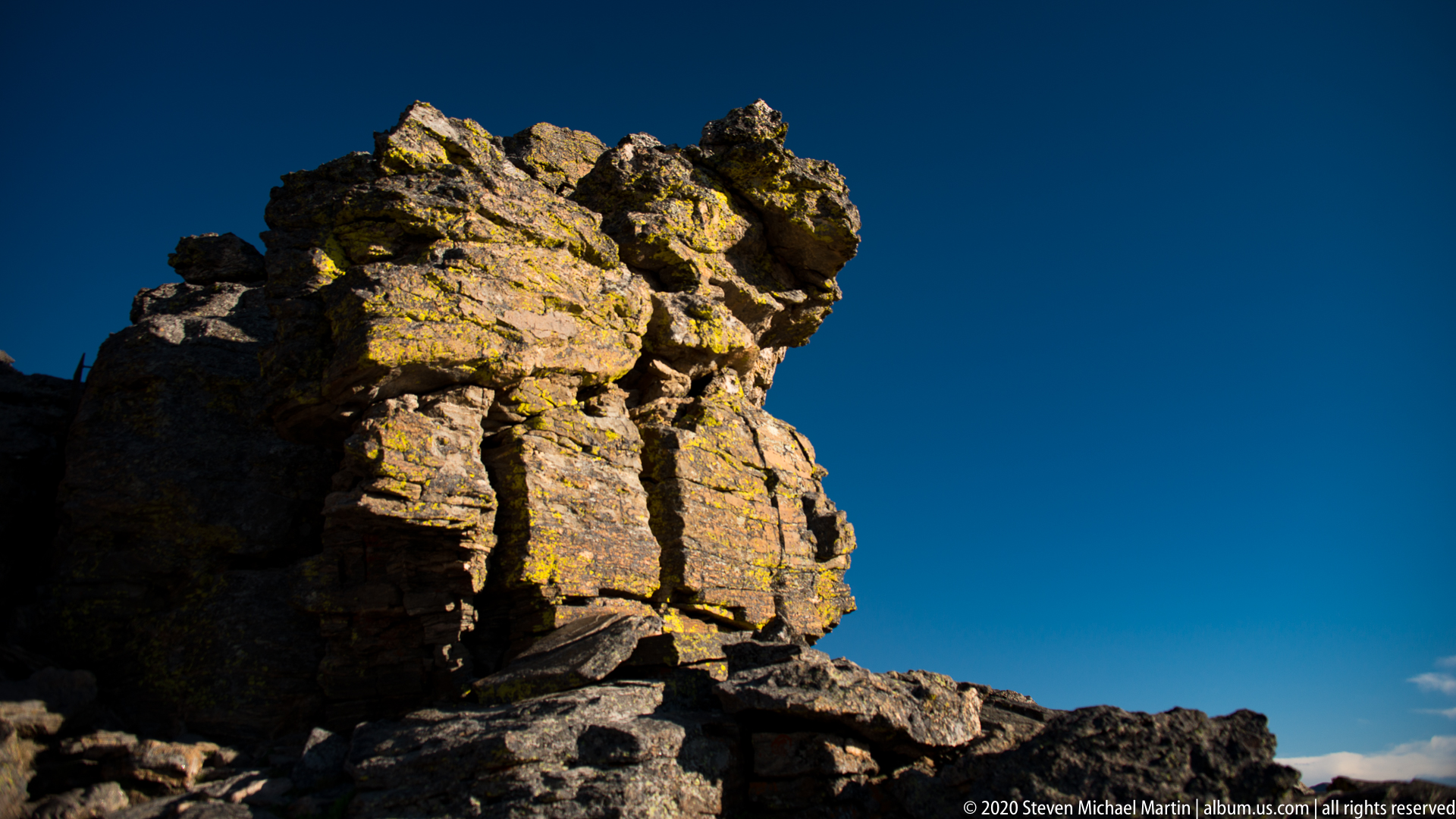
A tall, irregular rock spire rises against a clear blue sky, its surface mottled with pale stone and yellow-green lichen. The close viewpoint makes the rough texture and vertical silhouette more prominent than the surrounding terrain. No landmark name is visible, so the image is best read as a geological detail within the alpine landscape.
Caption
A tall, irregular rock spire rises against a clear blue sky, its surface mottled with pale stone and yellow-green lichen. The close viewpoint makes the rough texture and vertical silhouette more prominent than the surrounding terrain. No landmark name is visible, so the image is best read as a geological detail within the alpine landscape.

A low patch of pink flowers spreads across gravel and between rough stones, with several blossoms grouped close to the ground. The view conveys how the plants occupy small pockets among exposed rock rather than a continuous field. Their color and growth habit are clear, but the photograph does not provide enough detail for a precise species name.
Caption
A low patch of pink flowers spreads across gravel and between rough stones, with several blossoms grouped close to the ground. The view conveys how the plants occupy small pockets among exposed rock rather than a continuous field. Their color and growth habit are clear, but the photograph does not provide enough detail for a precise species name.
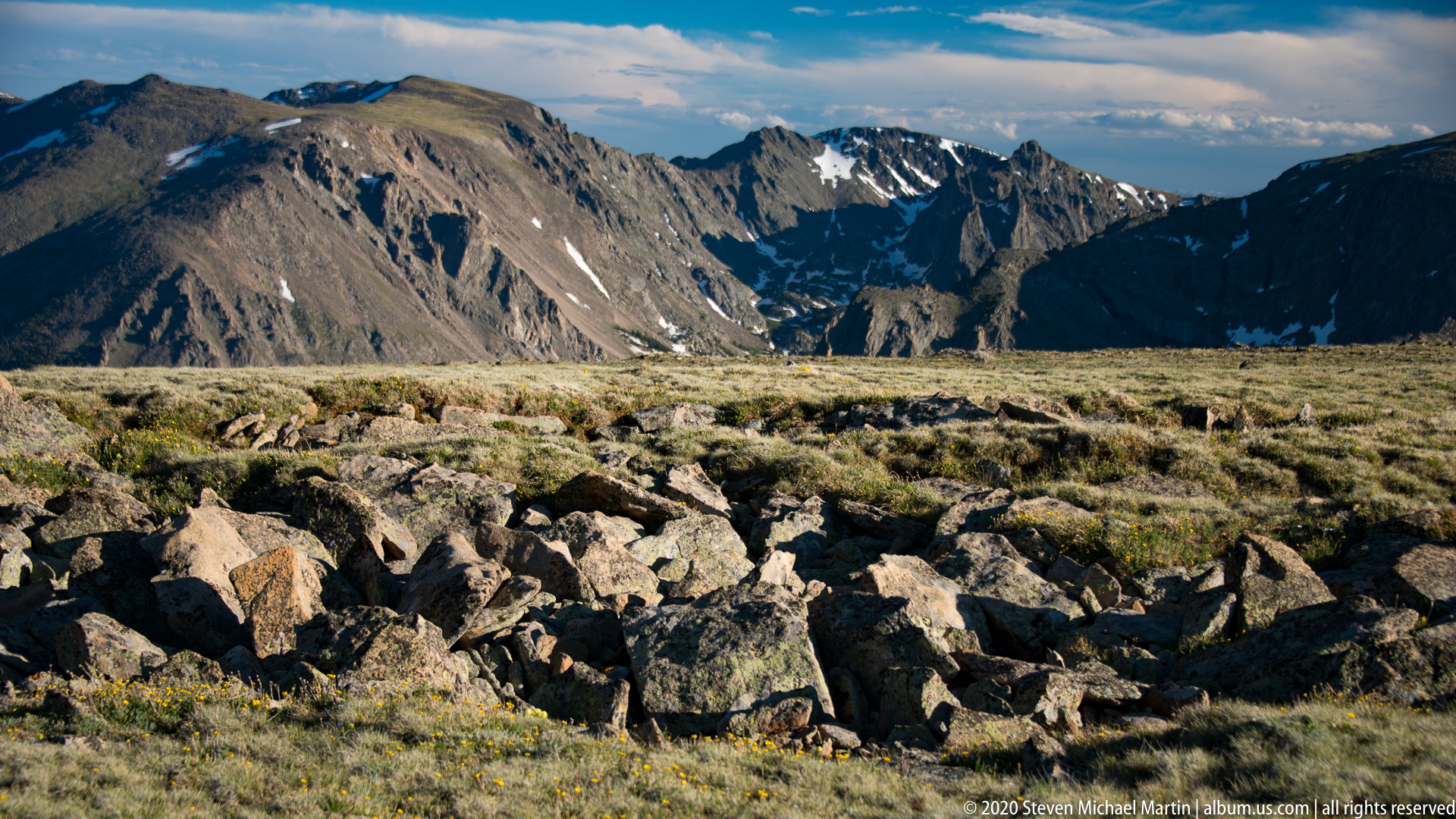
Scattered boulders and low flowering plants cross the foreground of a high alpine meadow, while steep dark mountains rise behind it. Patches of snow remain in the rugged upper terrain. The composition links small-scale meadow growth to the imposing rock wall, distinguishing this view through its close foreground stones and sharply rising backdrop.
Caption
Scattered boulders and low flowering plants cross the foreground of a high alpine meadow, while steep dark mountains rise behind it. Patches of snow remain in the rugged upper terrain. The composition links small-scale meadow growth to the imposing rock wall, distinguishing this view through its close foreground stones and sharply rising backdrop.
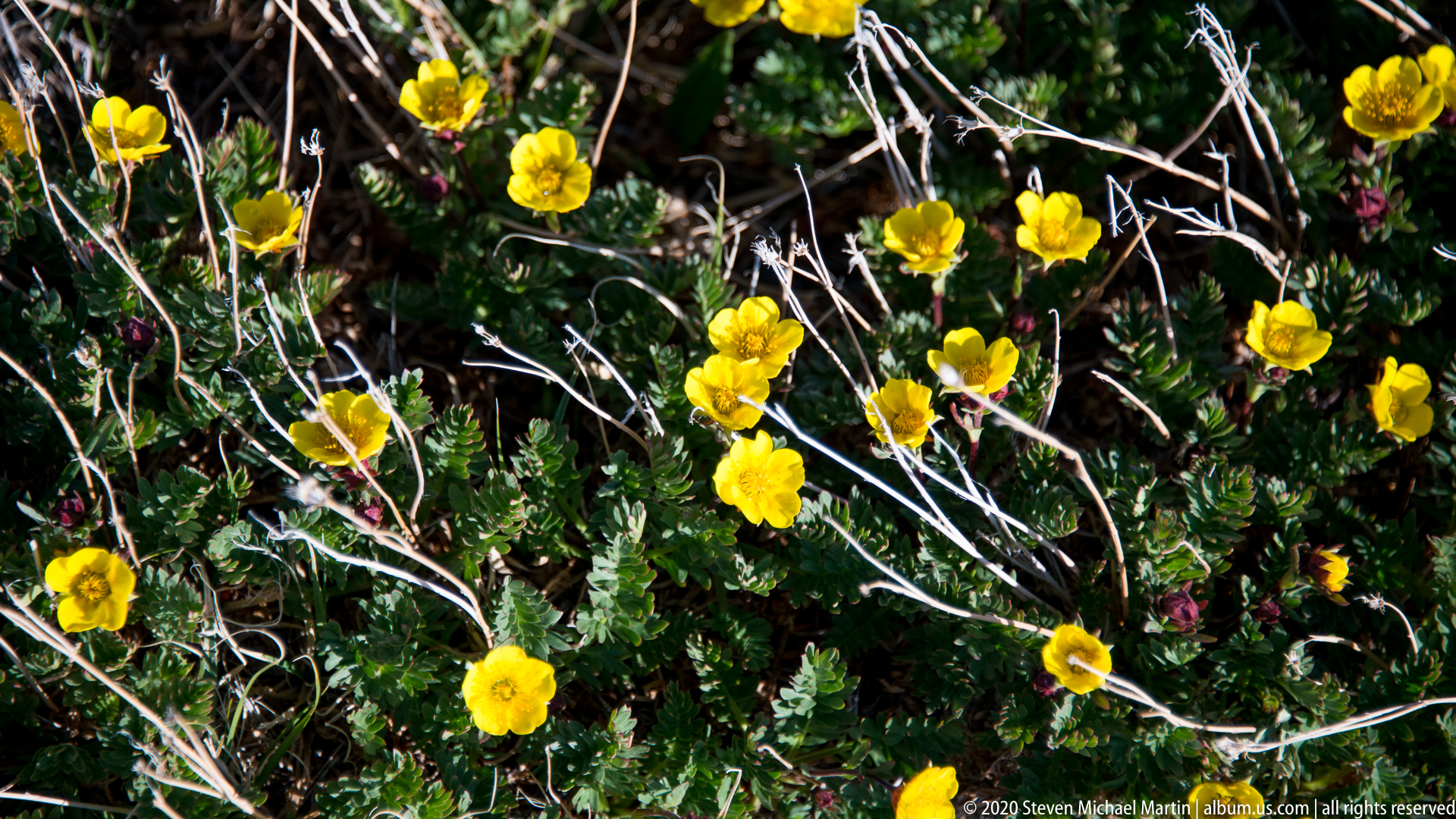
Several vivid yellow blossoms rise from compact green plants in a close view of the alpine ground layer. The flowers appear above overlapping leaves, with their open faces turned at slightly different angles. This intimate composition concentrates on color and plant form; the generic description avoids assigning a species from a small proof-sheet image.
Caption
Several vivid yellow blossoms rise from compact green plants in a close view of the alpine ground layer. The flowers appear above overlapping leaves, with their open faces turned at slightly different angles. This intimate composition concentrates on color and plant form; the generic description avoids assigning a species from a small proof-sheet image.
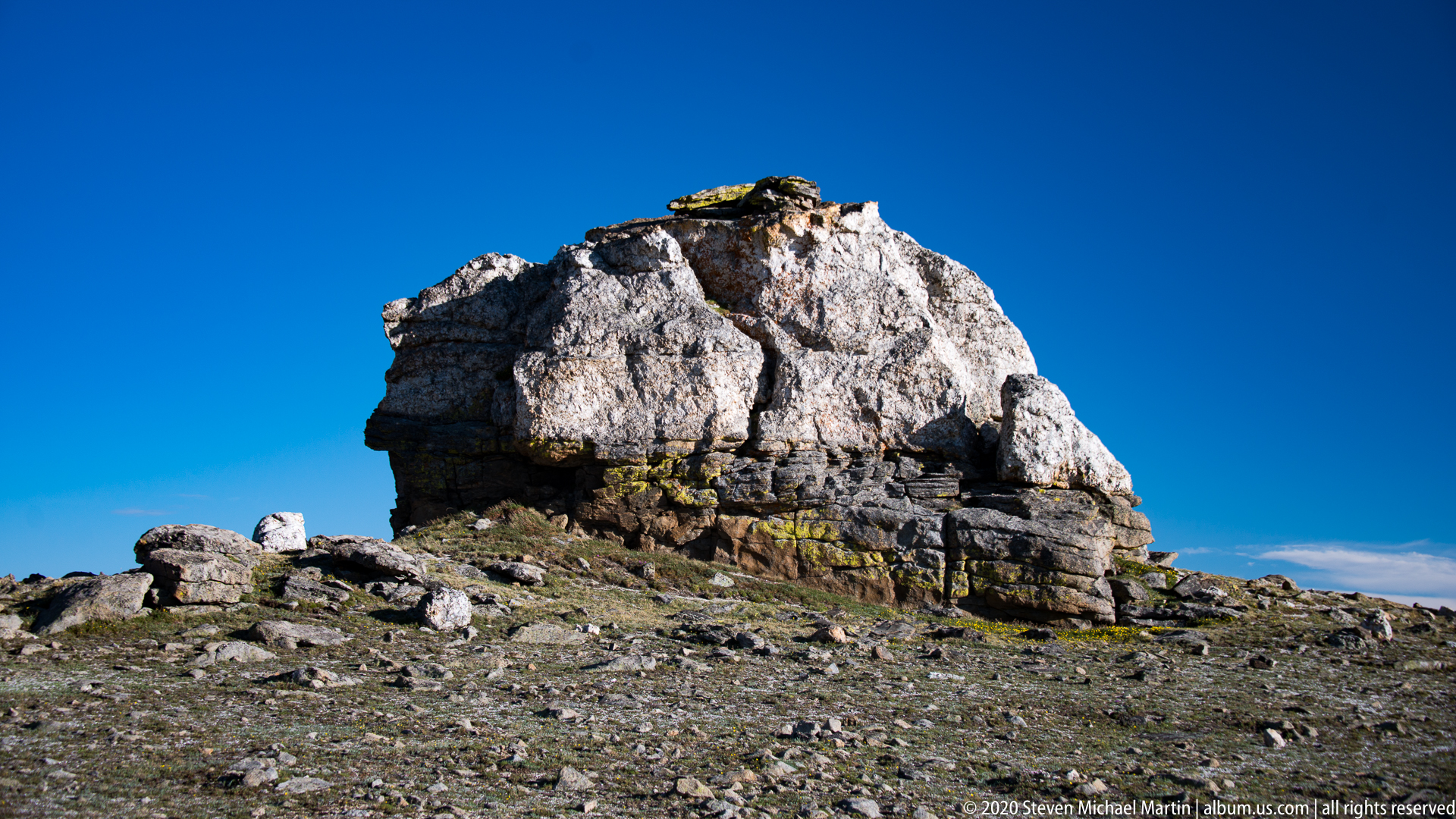
A small dark bird perches near the top of a pale granite block, sharply separated from the open sky behind it. The isolated pose and broad expanse of stone make the bird easy to locate while keeping its size and shape in context. No distinctive markings are visible at this scale to support a species identification.
Caption
A small dark bird perches near the top of a pale granite block, sharply separated from the open sky behind it. The isolated pose and broad expanse of stone make the bird easy to locate while keeping its size and shape in context. No distinctive markings are visible at this scale to support a species identification.
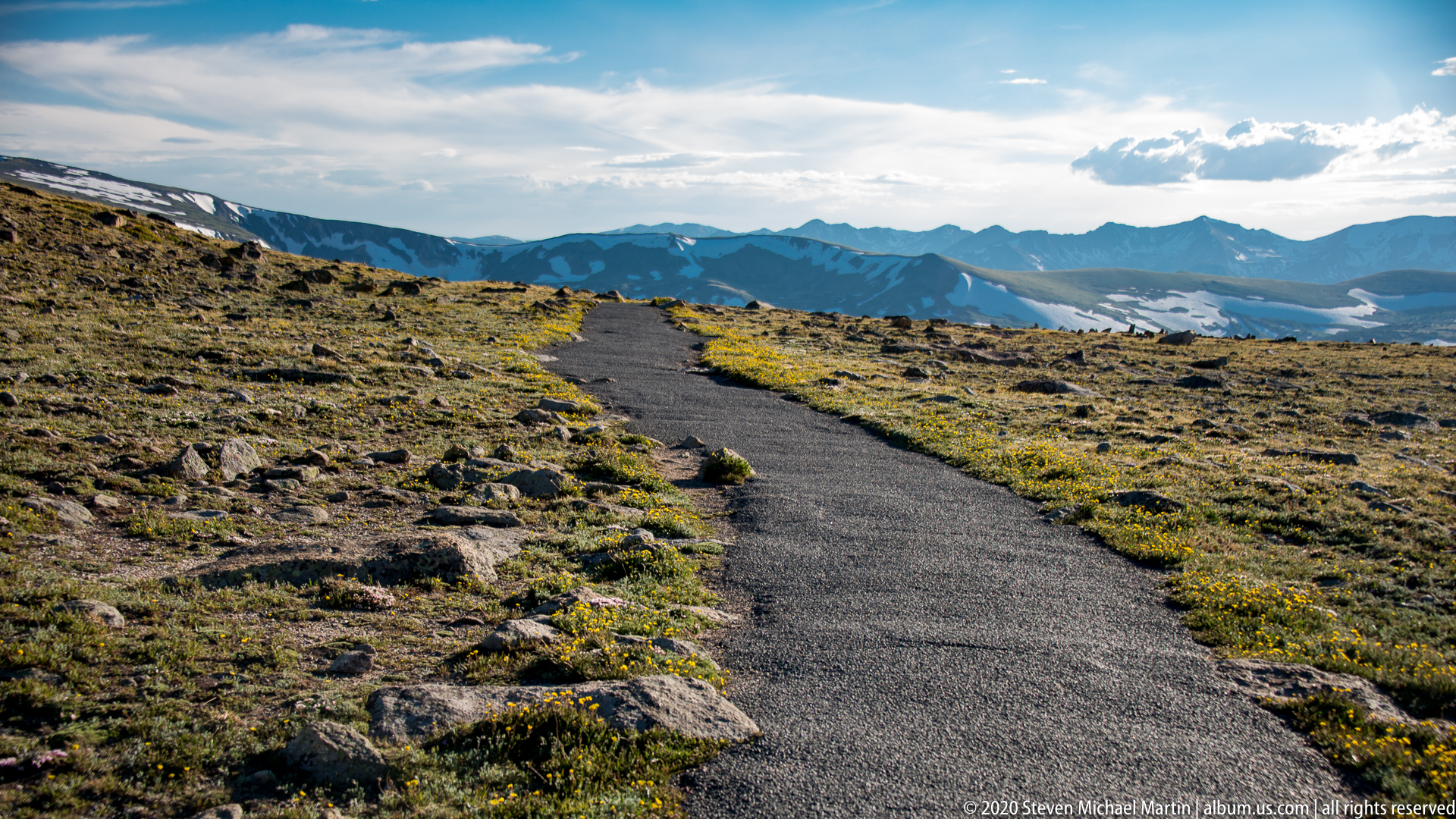
A narrow paved or compacted trail curves across an open alpine hillside, tracing a route through low vegetation. Rugged blue-toned mountains fill the distance, some with pale snow remaining near their upper slopes. The curved path gives the landscape a human scale and direction without identifying the route or its destination.
Caption
A narrow paved or compacted trail curves across an open alpine hillside, tracing a route through low vegetation. Rugged blue-toned mountains fill the distance, some with pale snow remaining near their upper slopes. The curved path gives the landscape a human scale and direction without identifying the route or its destination.
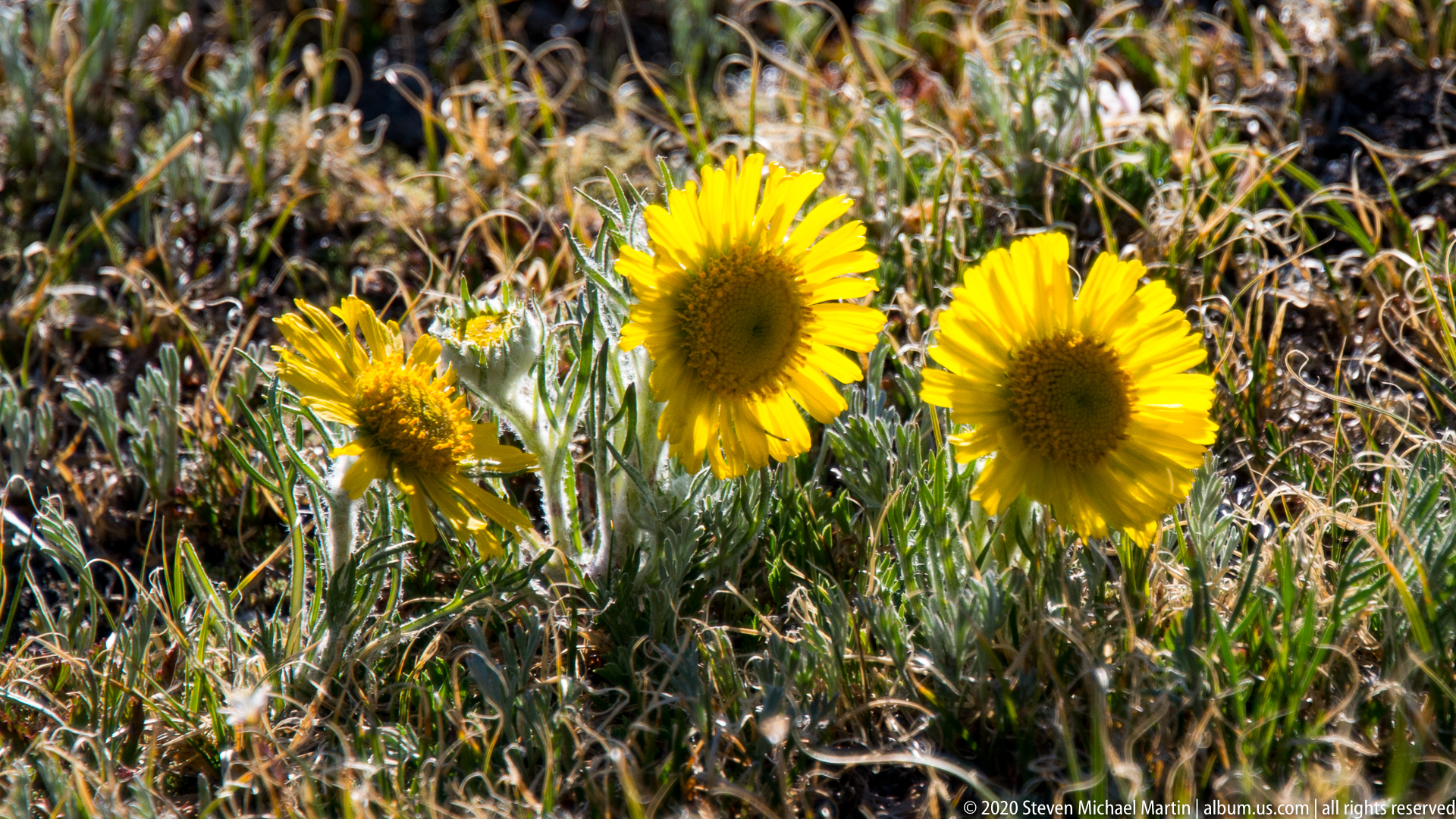
Yellow daisy-like flower heads with darker central disks rise above mixed green grasses. Several blooms face the camera while others angle to the side, creating variation within the close plant study. The image supports a general description of alpine wildflowers but not a precise species identification.
Caption
Yellow daisy-like flower heads with darker central disks rise above mixed green grasses. Several blooms face the camera while others angle to the side, creating variation within the close plant study. The image supports a general description of alpine wildflowers but not a precise species identification.
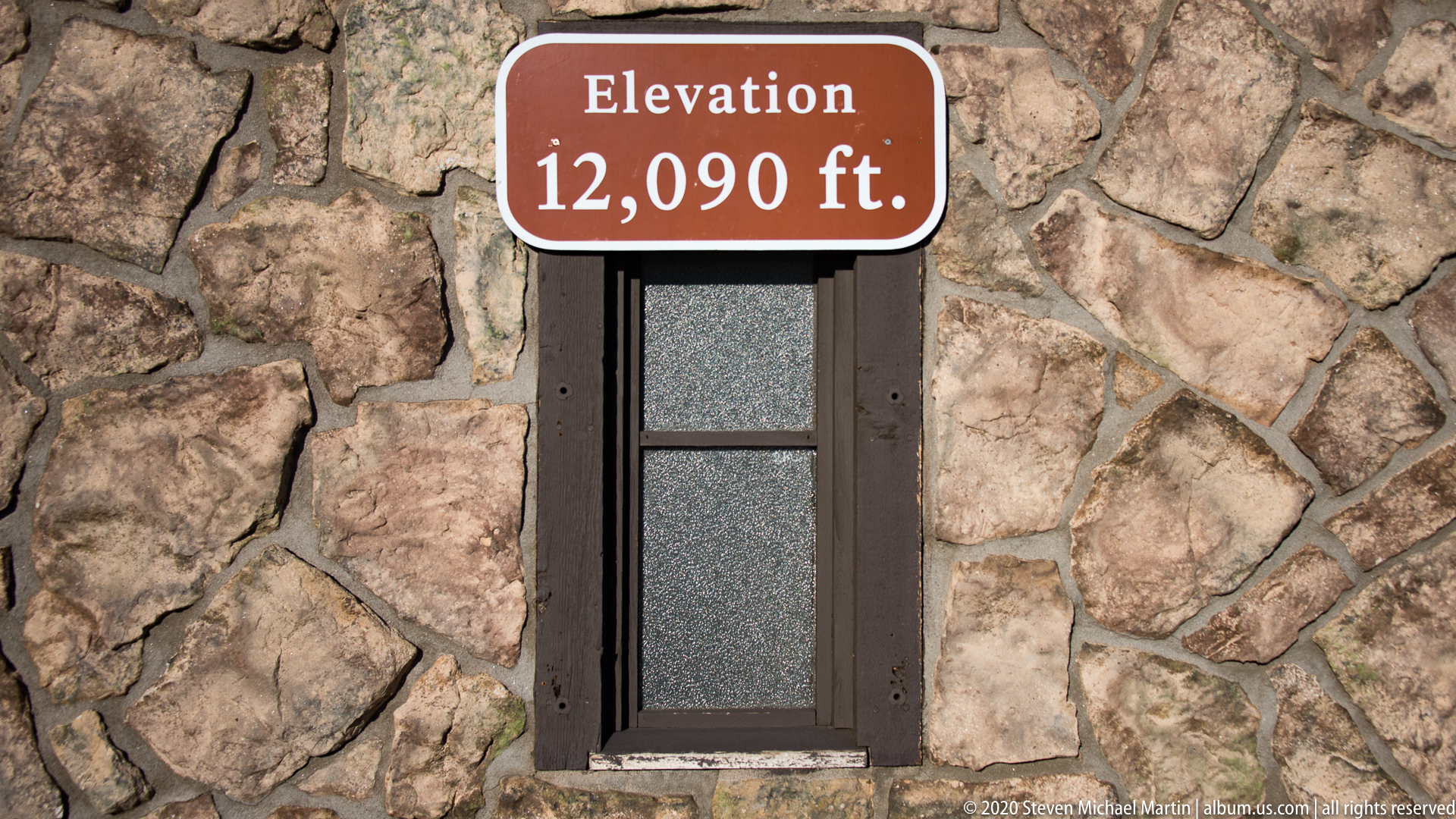
A red-brown rectangular marker reads “Elevation 12,090 ft.” and is fixed to a rough masonry wall. The concise inscription is the photograph’s defining information, while the stone backing places the marker in a rugged high-country setting. No additional location name is legible, so the caption preserves the elevation exactly as displayed.
Caption
A red-brown rectangular marker reads “Elevation 12,090 ft.” and is fixed to a rough masonry wall. The concise inscription is the photograph’s defining information, while the stone backing places the marker in a rugged high-country setting. No additional location name is legible, so the caption preserves the elevation exactly as displayed.
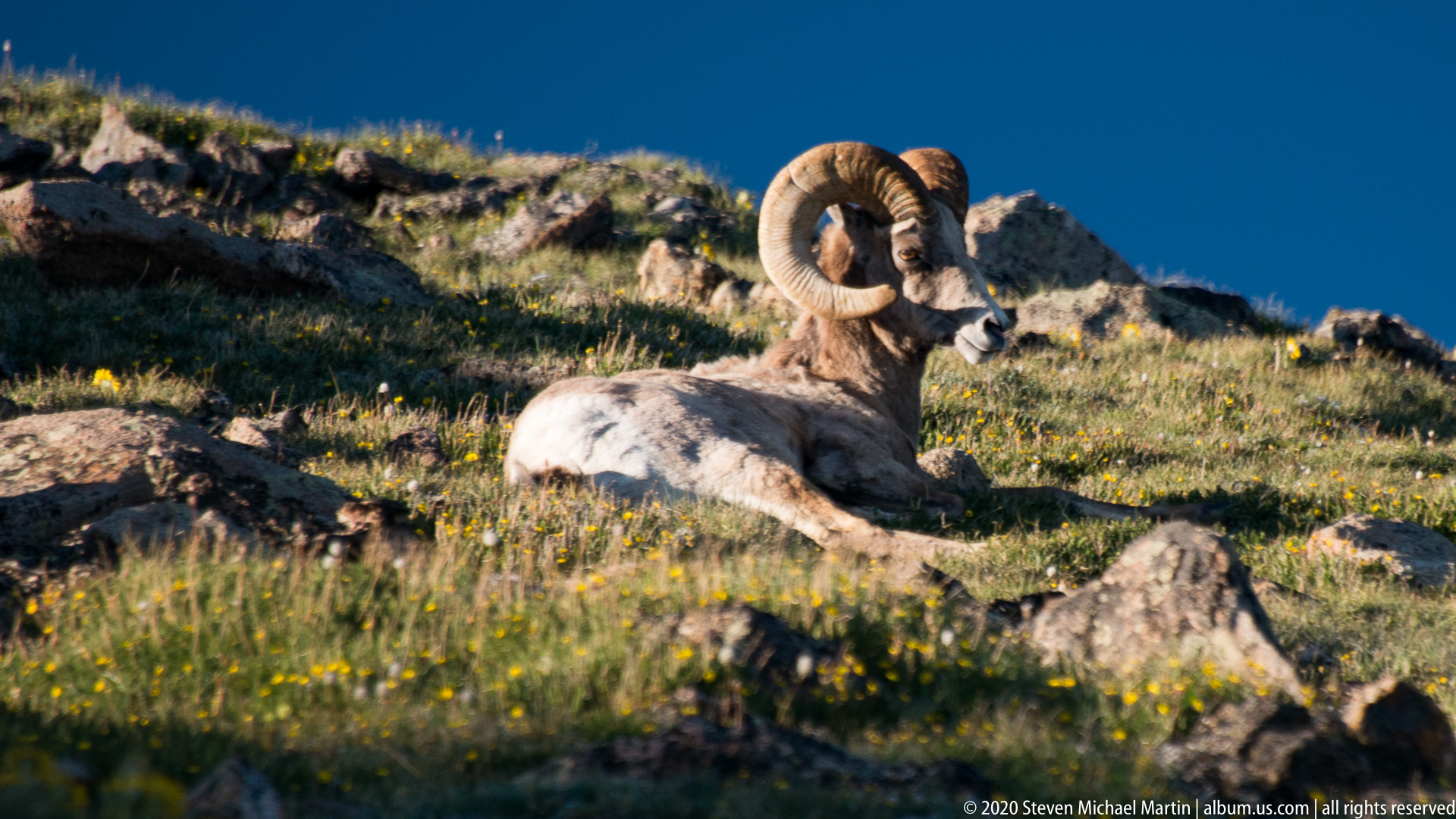
A bighorn sheep ram rests low in an alpine meadow, its large curled horns rising above the head as yellow flowers and scattered rocks surround it. The animal’s relaxed posture and the close, ground-level viewpoint make the horns and face the main points of attention. The scene retains the meadow habitat rather than isolating the ram against a neutral background.
Caption
A bighorn sheep ram rests low in an alpine meadow, its large curled horns rising above the head as yellow flowers and scattered rocks surround it. The animal’s relaxed posture and the close, ground-level viewpoint make the horns and face the main points of attention. The scene retains the meadow habitat rather than isolating the ram against a neutral background.
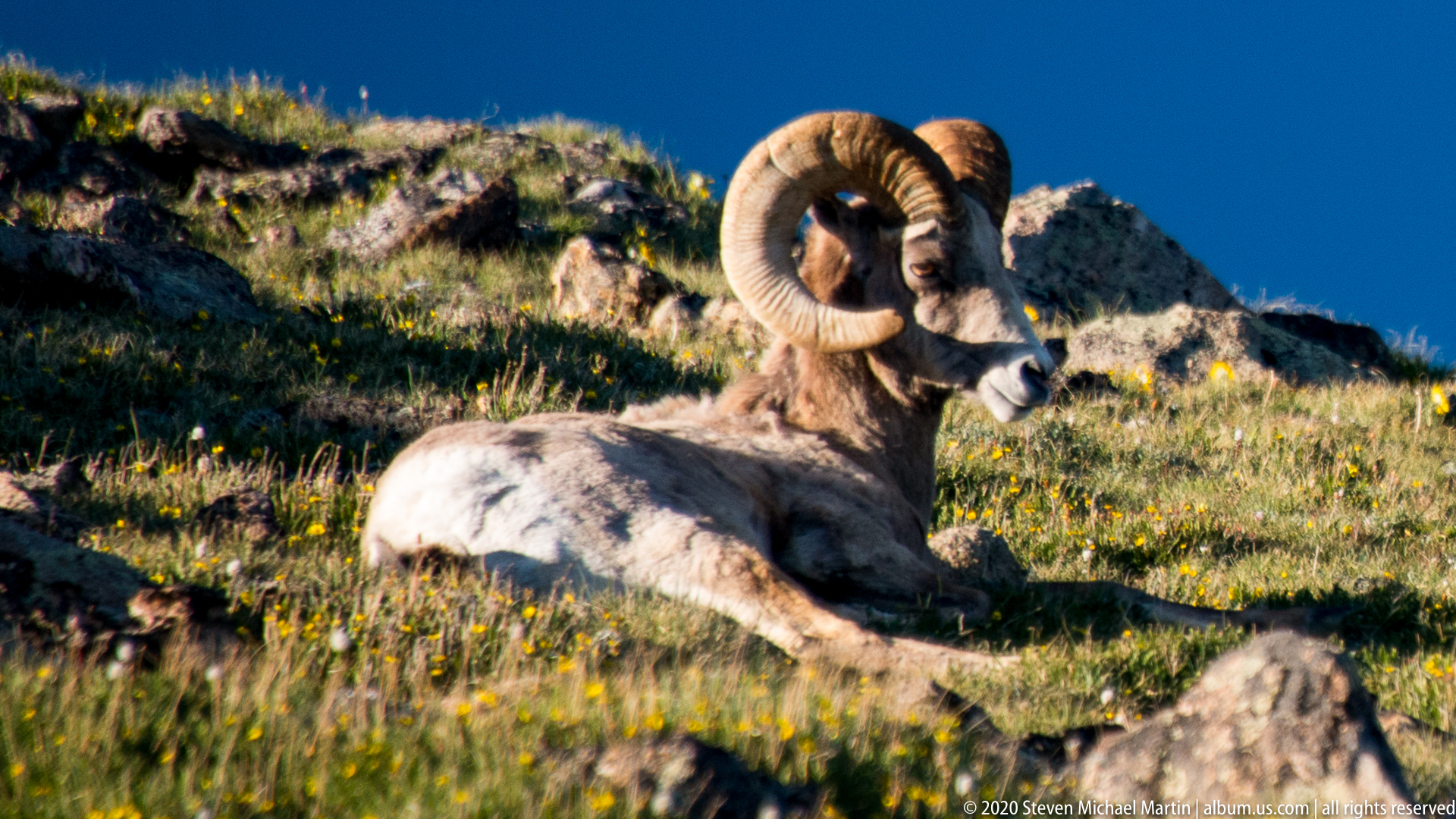
A broad three-quarter view shows a bighorn ram resting among alpine grasses, with its curled horns and heavy body visible against a rocky, flower-dotted meadow. The wider framing leaves more habitat around the animal than a head portrait, connecting the wildlife subject to the high-elevation ground. Its relaxed pose distinguishes this view from the tighter studies that follow.
Caption
A broad three-quarter view shows a bighorn ram resting among alpine grasses, with its curled horns and heavy body visible against a rocky, flower-dotted meadow. The wider framing leaves more habitat around the animal than a head portrait, connecting the wildlife subject to the high-elevation ground. Its relaxed pose distinguishes this view from the tighter studies that follow.
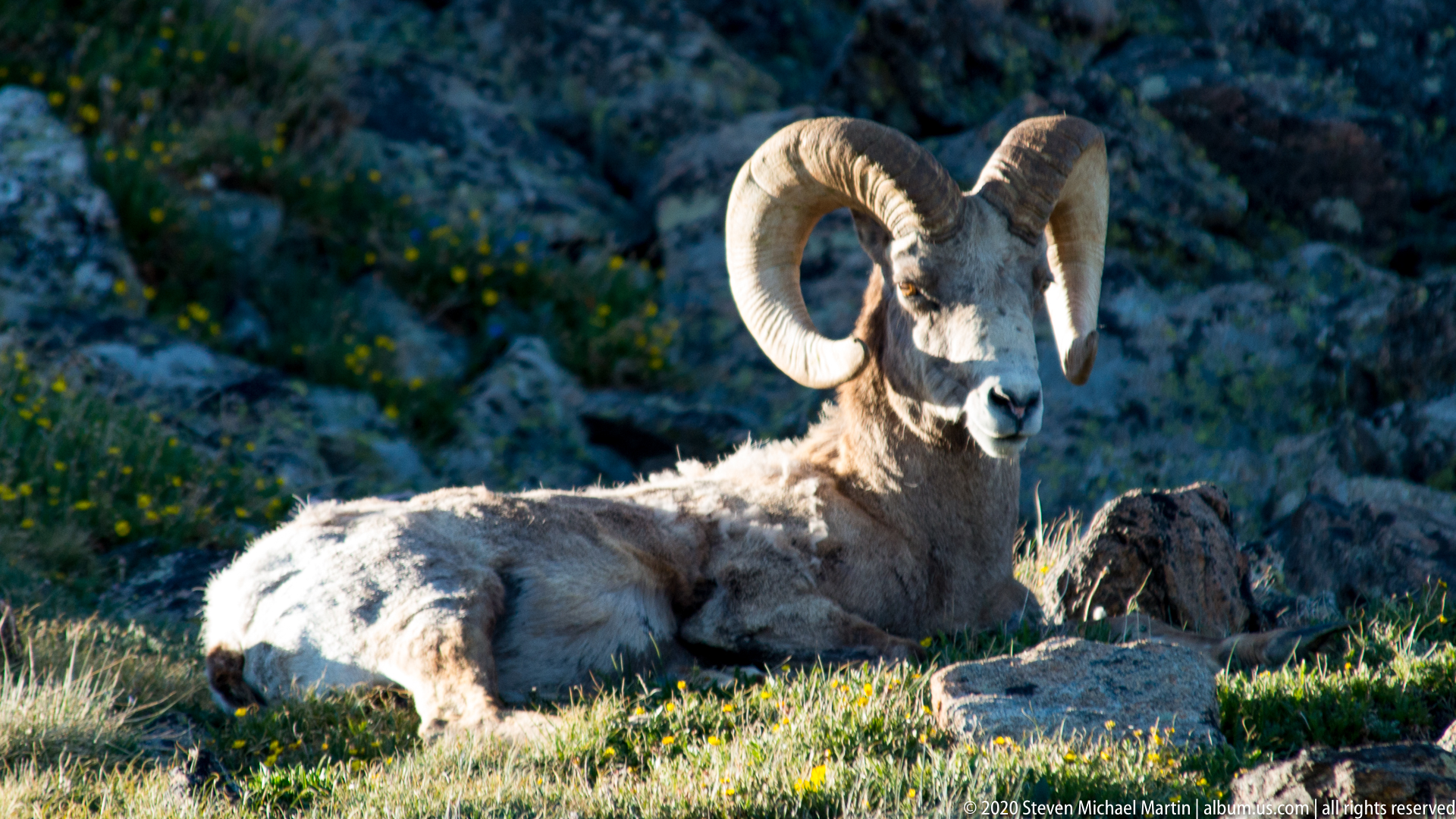
The ram’s face and curved horns occupy the center of this closer portrait, while a shaded, softly textured meadow recedes behind it. Its gaze turns nearly toward the camera, making the muzzle and horn curvature especially prominent. The shallow visual separation from the background distinguishes this frame from the wider habitat views nearby.
Caption
The ram’s face and curved horns occupy the center of this closer portrait, while a shaded, softly textured meadow recedes behind it. Its gaze turns nearly toward the camera, making the muzzle and horn curvature especially prominent. The shallow visual separation from the background distinguishes this frame from the wider habitat views nearby.

Seen from a closer three-quarter angle, the ram turns slightly toward the viewer while its heavy horns frame the head. Sunlit grasses and small yellow flowers surround the resting animal, lending texture to the lower part of the composition. This tighter perspective gives the face greater weight than the broader side view and keeps the animal’s posture legible.
Caption
Seen from a closer three-quarter angle, the ram turns slightly toward the viewer while its heavy horns frame the head. Sunlit grasses and small yellow flowers surround the resting animal, lending texture to the lower part of the composition. This tighter perspective gives the face greater weight than the broader side view and keeps the animal’s posture legible.

In profile, the resting ram faces right, its horn sweeping back in a strong curve above the shoulder. Brighter light falls across the animal and surrounding grass, separating this view from the shaded portraits on the same page. Yellow flowers and scattered rock remain visible around the body, preserving the alpine meadow context.
Caption
In profile, the resting ram faces right, its horn sweeping back in a strong curve above the shoulder. Brighter light falls across the animal and surrounding grass, separating this view from the shaded portraits on the same page. Yellow flowers and scattered rock remain visible around the body, preserving the alpine meadow context.
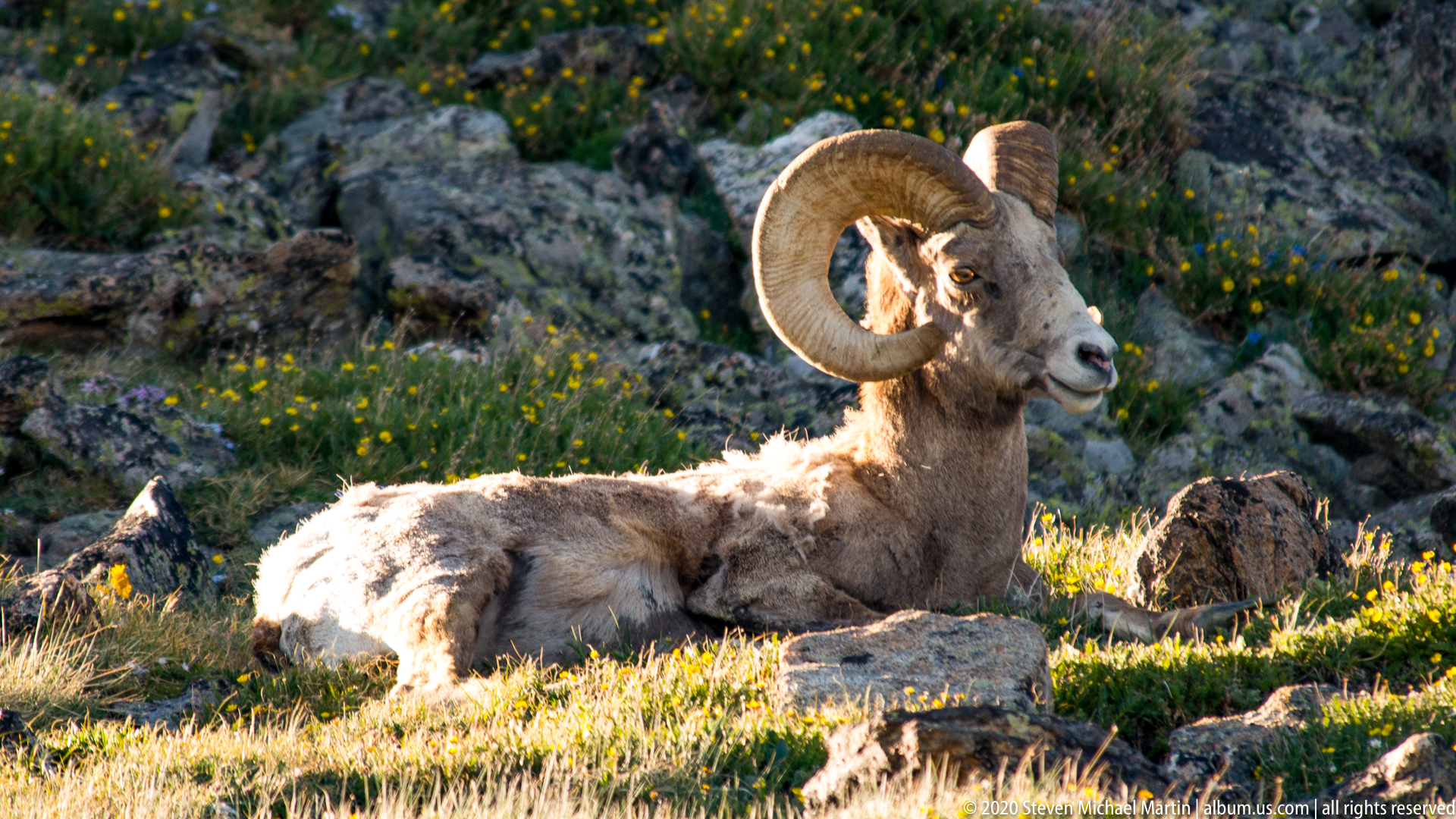
A bighorn ram turns its face toward the camera from a resting position, with a rough boulder occupying the foreground and alpine plants around its body. The near rock adds depth and partly frames the animal, while the face and heavy horns remain readable. This composition differs from the uncluttered portraits through its prominent foreground stone.
Caption
A bighorn ram turns its face toward the camera from a resting position, with a rough boulder occupying the foreground and alpine plants around its body. The near rock adds depth and partly frames the animal, while the face and heavy horns remain readable. This composition differs from the uncluttered portraits through its prominent foreground stone.
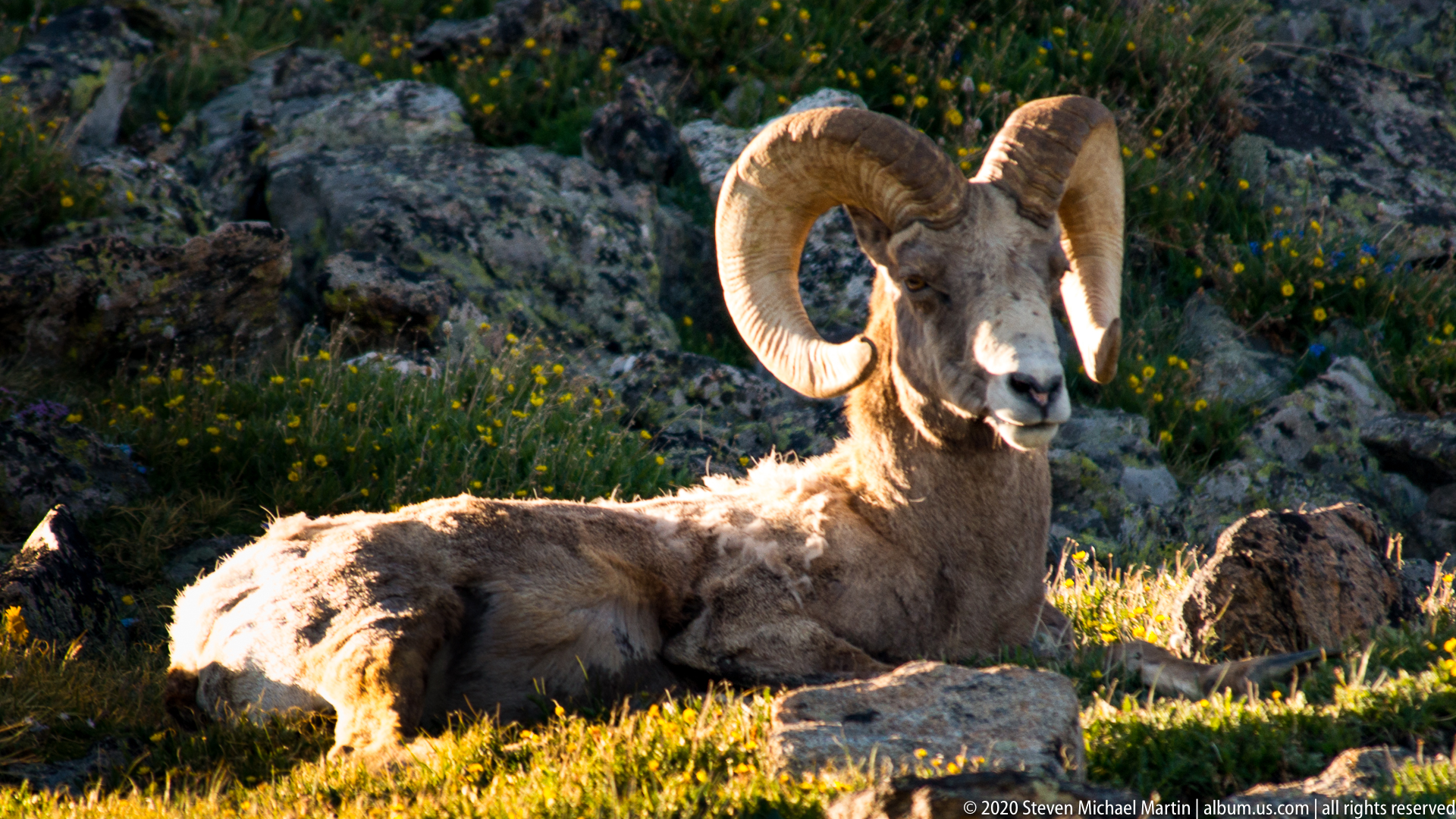
A tight profile isolates the ram’s head and massive horn, whose pale ridged surface curls back in a prominent spiral. The animal faces right, revealing the eye, muzzle, and horn texture against a subdued alpine background. By excluding most of the body, the photograph turns a wildlife portrait into a detailed study of the ram’s defining feature.
Caption
A tight profile isolates the ram’s head and massive horn, whose pale ridged surface curls back in a prominent spiral. The animal faces right, revealing the eye, muzzle, and horn texture against a subdued alpine background. By excluding most of the body, the photograph turns a wildlife portrait into a detailed study of the ram’s defining feature.
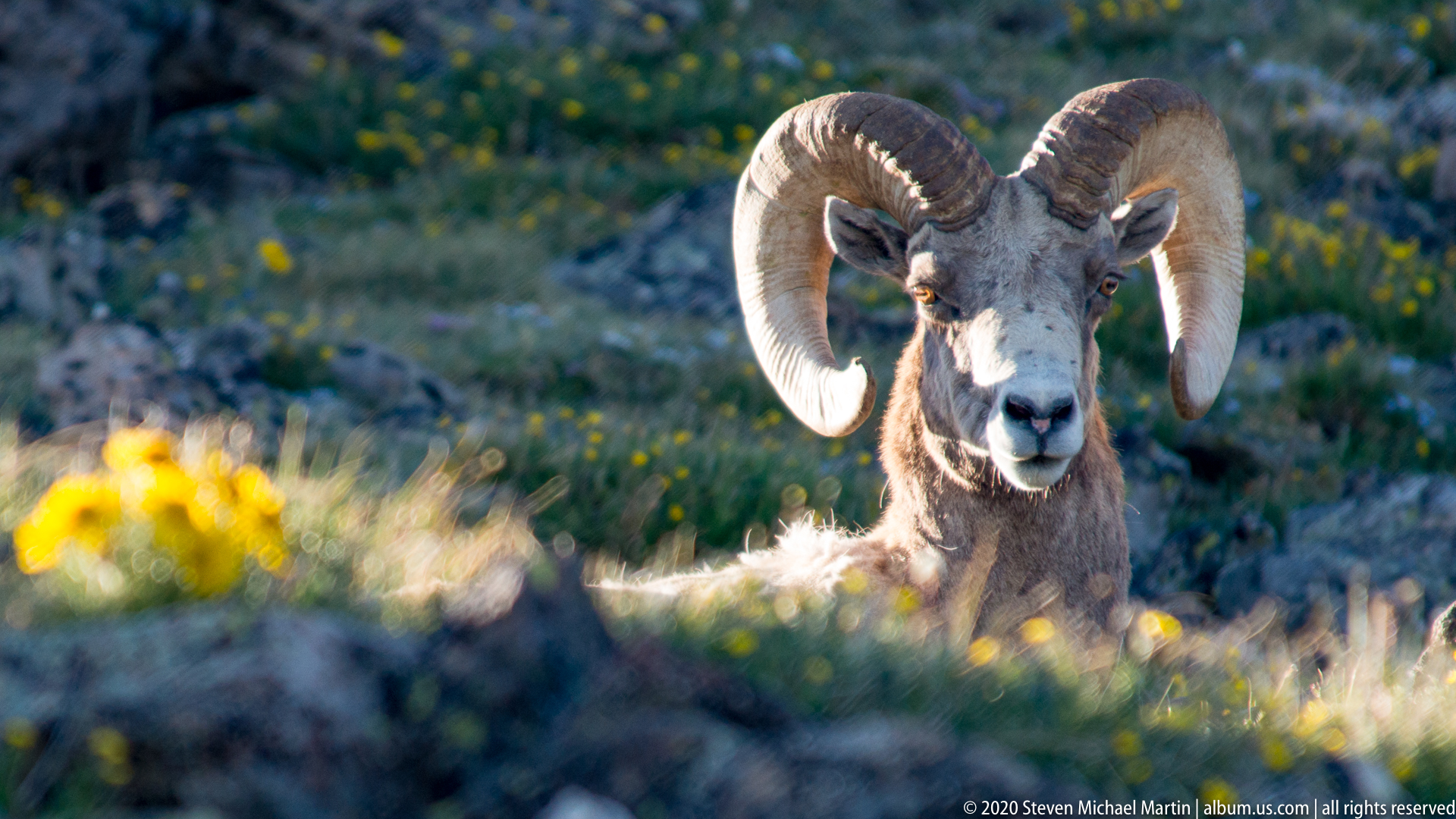
A bighorn ram faces the camera, its paired horns curving outward and back in a nearly balanced frame around the head. Part of the body remains visible below, while flowers brighten the left edge of the composition. The direct gaze and symmetrical horn arrangement distinguish this close portrait from the resting side views on the preceding page.
Caption
A bighorn ram faces the camera, its paired horns curving outward and back in a nearly balanced frame around the head. Part of the body remains visible below, while flowers brighten the left edge of the composition. The direct gaze and symmetrical horn arrangement distinguish this close portrait from the resting side views on the preceding page.
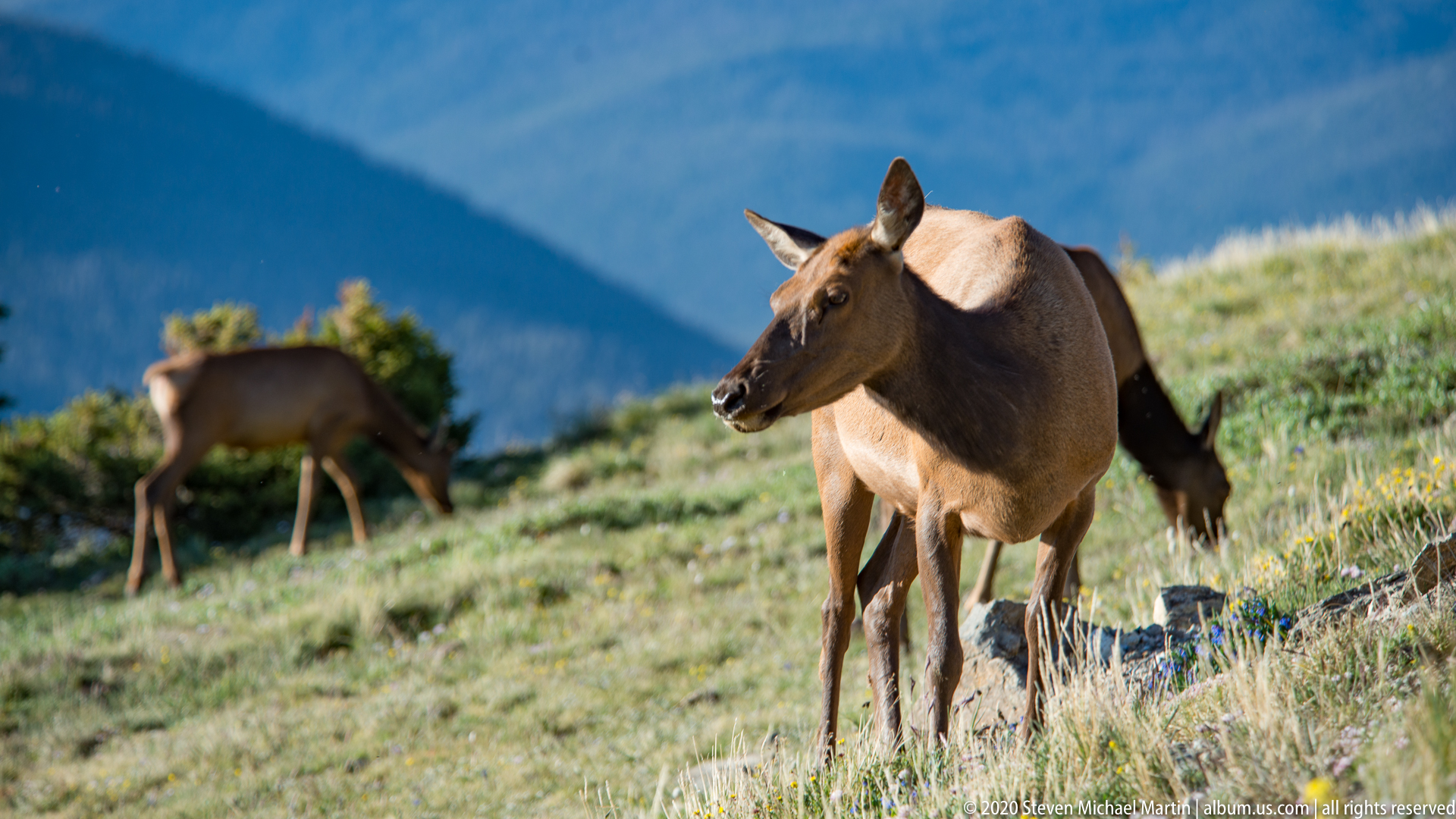
Several elk occupy a green alpine slope, where a prominent adult stands in the right foreground and others graze or browse behind. The arrangement shows the group at different distances and stages of feeding rather than as a single-animal portrait. Short vegetation and open terrain remain visible around them, while no exact herd count beyond the visible individuals is asserted.
Caption
Several elk occupy a green alpine slope, where a prominent adult stands in the right foreground and others graze or browse behind. The arrangement shows the group at different distances and stages of feeding rather than as a single-animal portrait. Short vegetation and open terrain remain visible around them, while no exact herd count beyond the visible individuals is asserted.
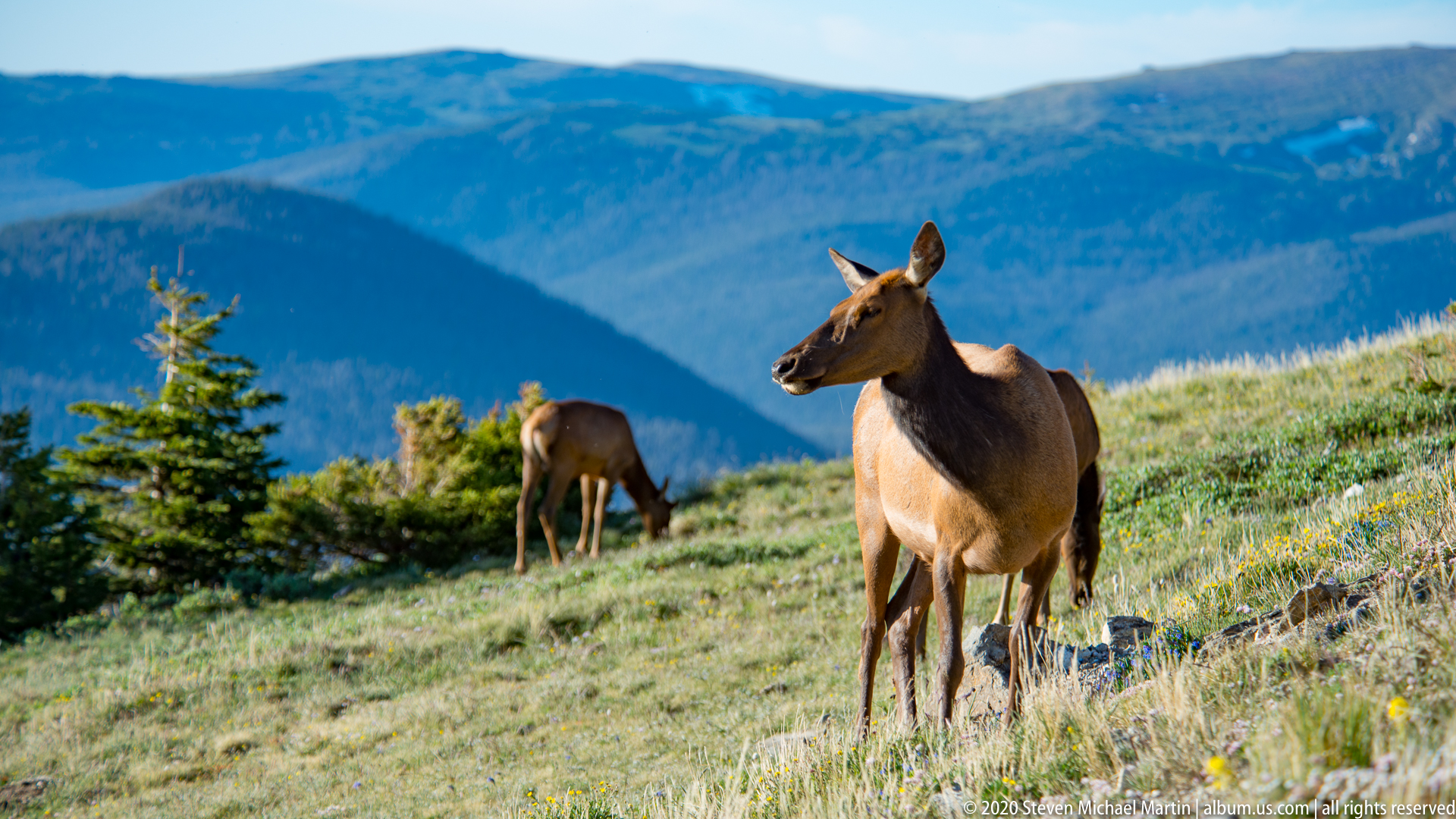
Two elk share an open alpine slope beneath a series of blue mountain ridges. The nearer animal stands in the foreground looking left, while a second lowers its head to graze behind it. The broad composition links wildlife and distant terrain, using the layered horizon to give the animals a clear setting rather than isolating them.
Caption
Two elk share an open alpine slope beneath a series of blue mountain ridges. The nearer animal stands in the foreground looking left, while a second lowers its head to graze behind it. The broad composition links wildlife and distant terrain, using the layered horizon to give the animals a clear setting rather than isolating them.
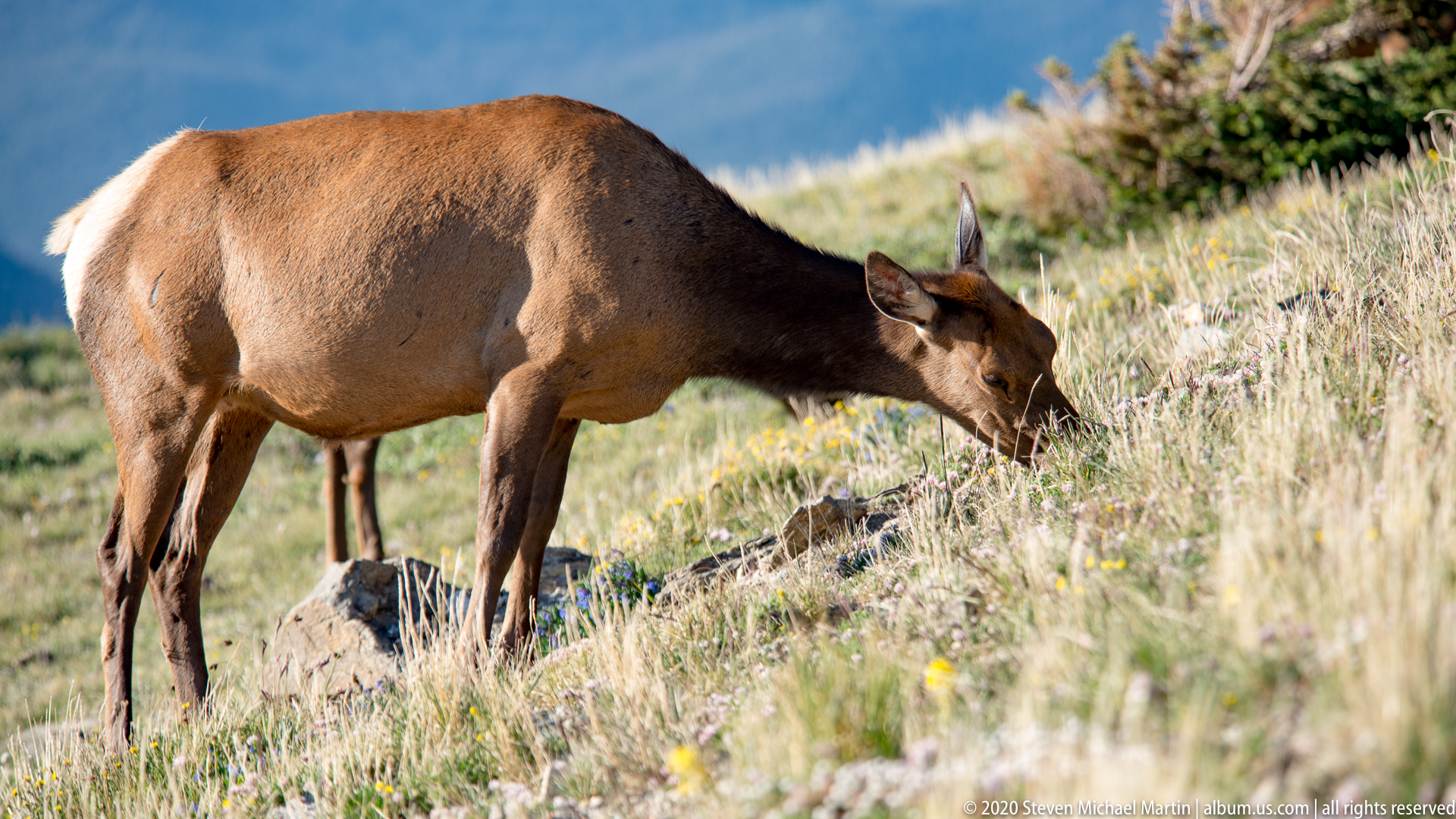
An adult elk bends its head into the grass, feeding among low plants and yellow flowers. The lowered posture directs attention to the animal’s muzzle and neck while keeping the body visible against the meadow. A second animal may be partly obscured behind it, but the principal subject is the foreground elk and its grazing action.
Caption
An adult elk bends its head into the grass, feeding among low plants and yellow flowers. The lowered posture directs attention to the animal’s muzzle and neck while keeping the body visible against the meadow. A second animal may be partly obscured behind it, but the principal subject is the foreground elk and its grazing action.
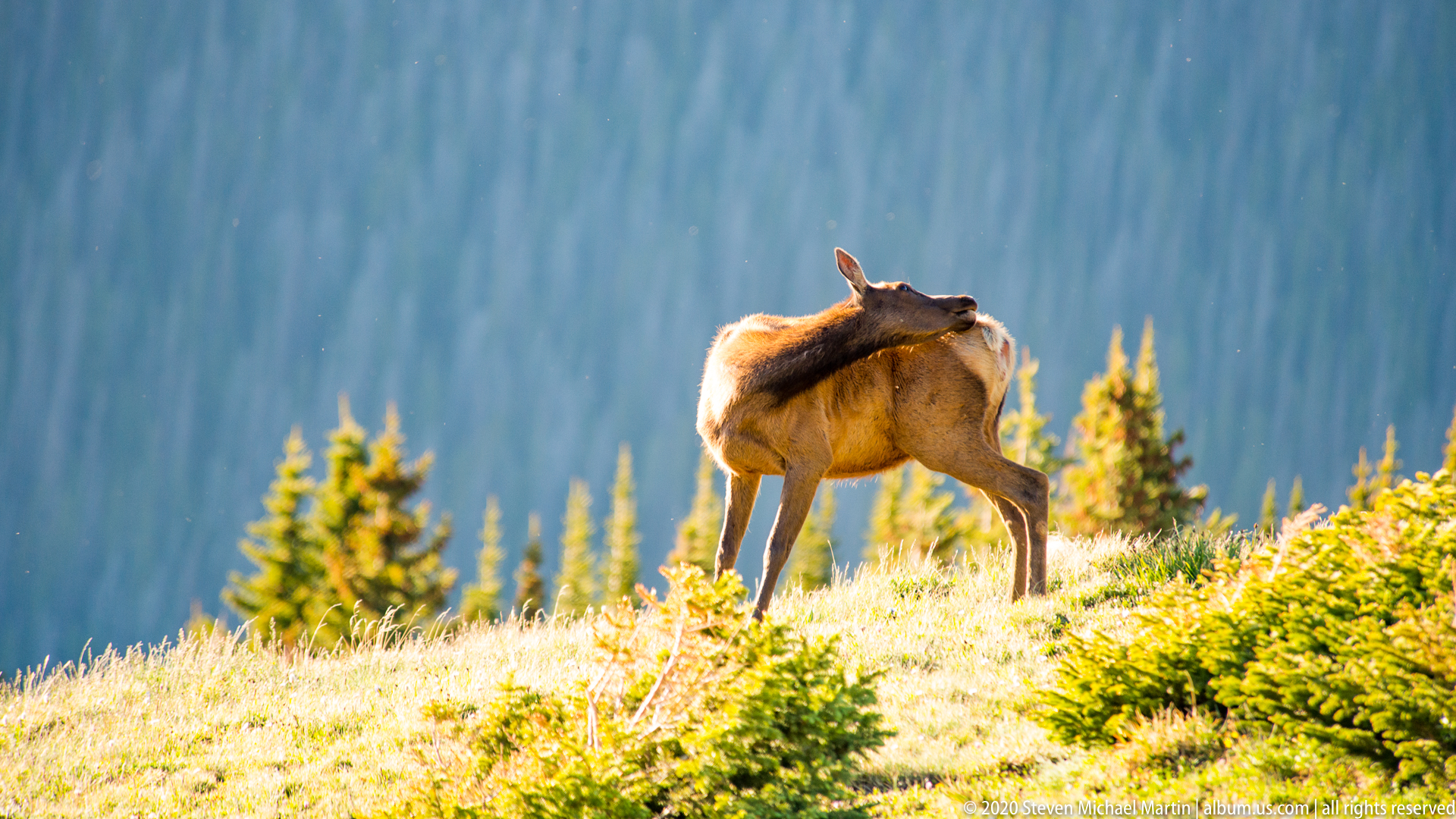
An elk stands along a bright ridge in side view, turning its head back over its shoulder toward the camera. Small evergreen saplings edge the slope below, with a blue, forested mountain filling the background. The twisted neck and alert backward glance make this frame more distinctive than a straightforward side-on wildlife view.
Caption
An elk stands along a bright ridge in side view, turning its head back over its shoulder toward the camera. Small evergreen saplings edge the slope below, with a blue, forested mountain filling the background. The twisted neck and alert backward glance make this frame more distinctive than a straightforward side-on wildlife view.
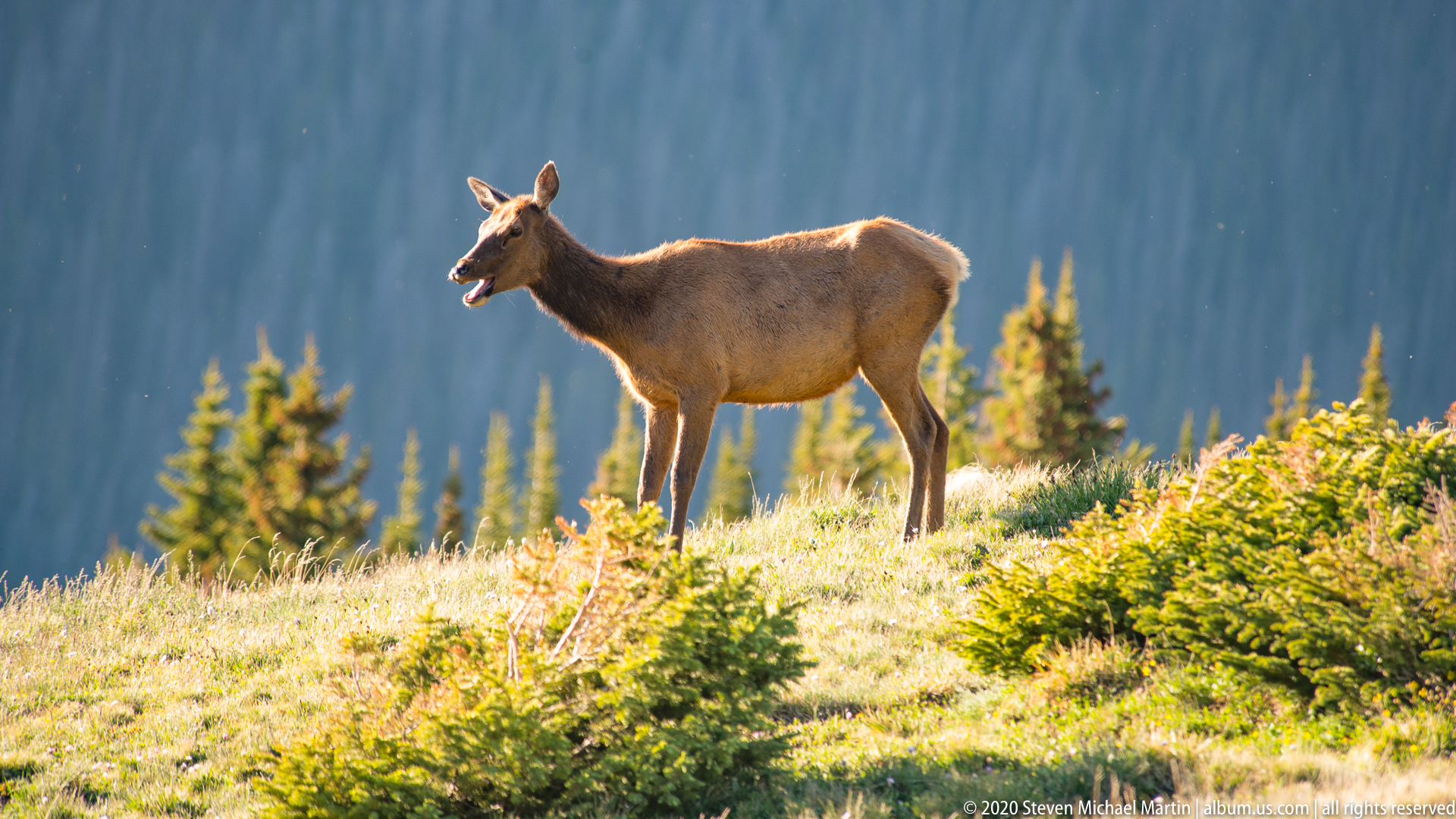
A solitary elk stands side-on on a sunlit ridge, its body outlined against blue wooded slopes. Young conifers rise below the animal, marking the transition between open high ground and forest. Its mouth appears slightly open, though the image does not establish a call or other behavior; the caption focuses on stance and setting.
Caption
A solitary elk stands side-on on a sunlit ridge, its body outlined against blue wooded slopes. Young conifers rise below the animal, marking the transition between open high ground and forest. Its mouth appears slightly open, though the image does not establish a call or other behavior; the caption focuses on stance and setting.
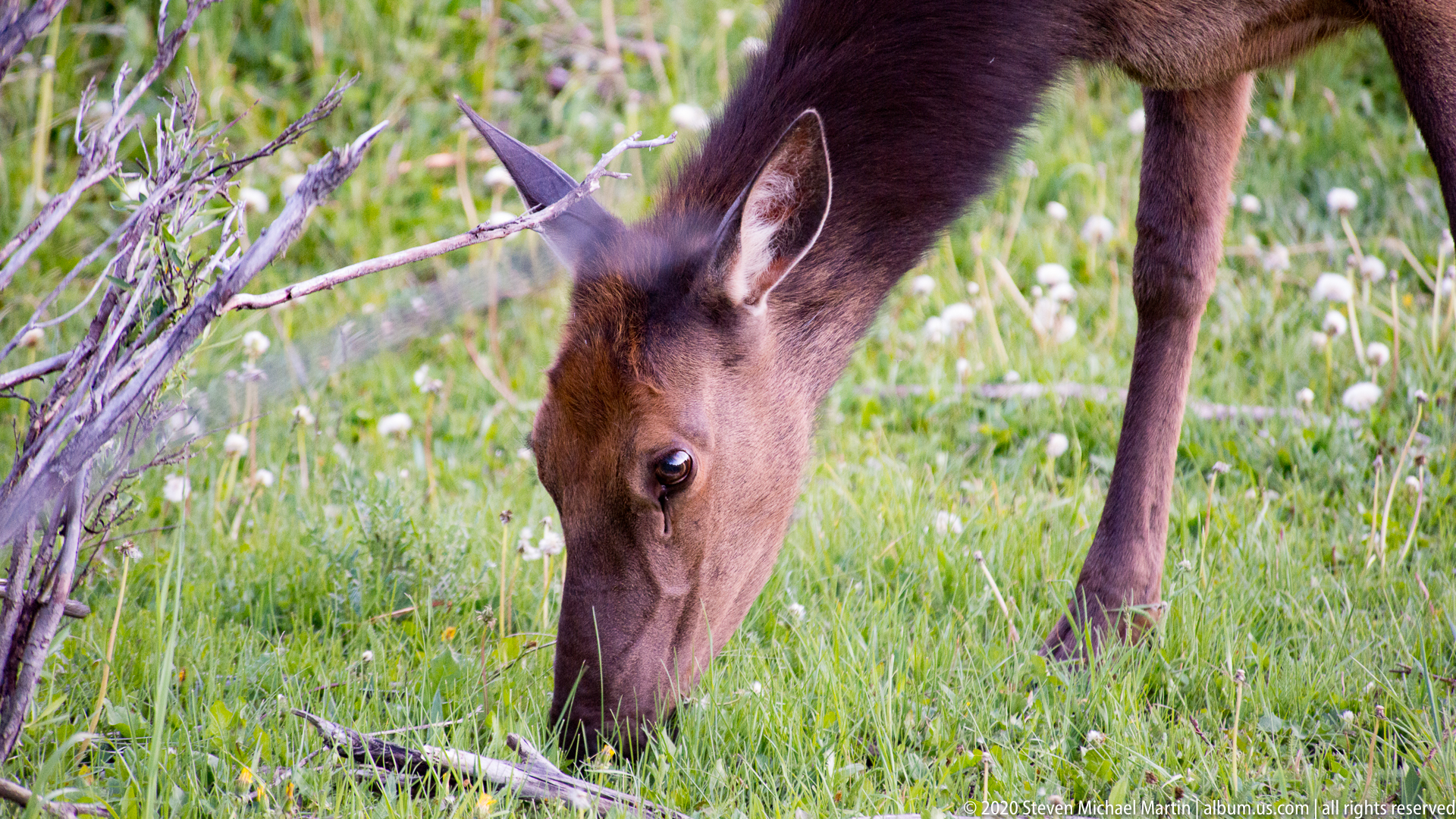
An elk lowers its muzzle into tall meadow grass, feeding among small white and yellow flowers. The close crop includes the animal’s head, shoulder, and front legs, while the rest of its body extends beyond the top edge. Sunlit stems overlap the brown coat, placing the grazing behavior at the center of the photograph.
Caption
An elk lowers its muzzle into tall meadow grass, feeding among small white and yellow flowers. The close crop includes the animal’s head, shoulder, and front legs, while the rest of its body extends beyond the top edge. Sunlit stems overlap the brown coat, placing the grazing behavior at the center of the photograph.
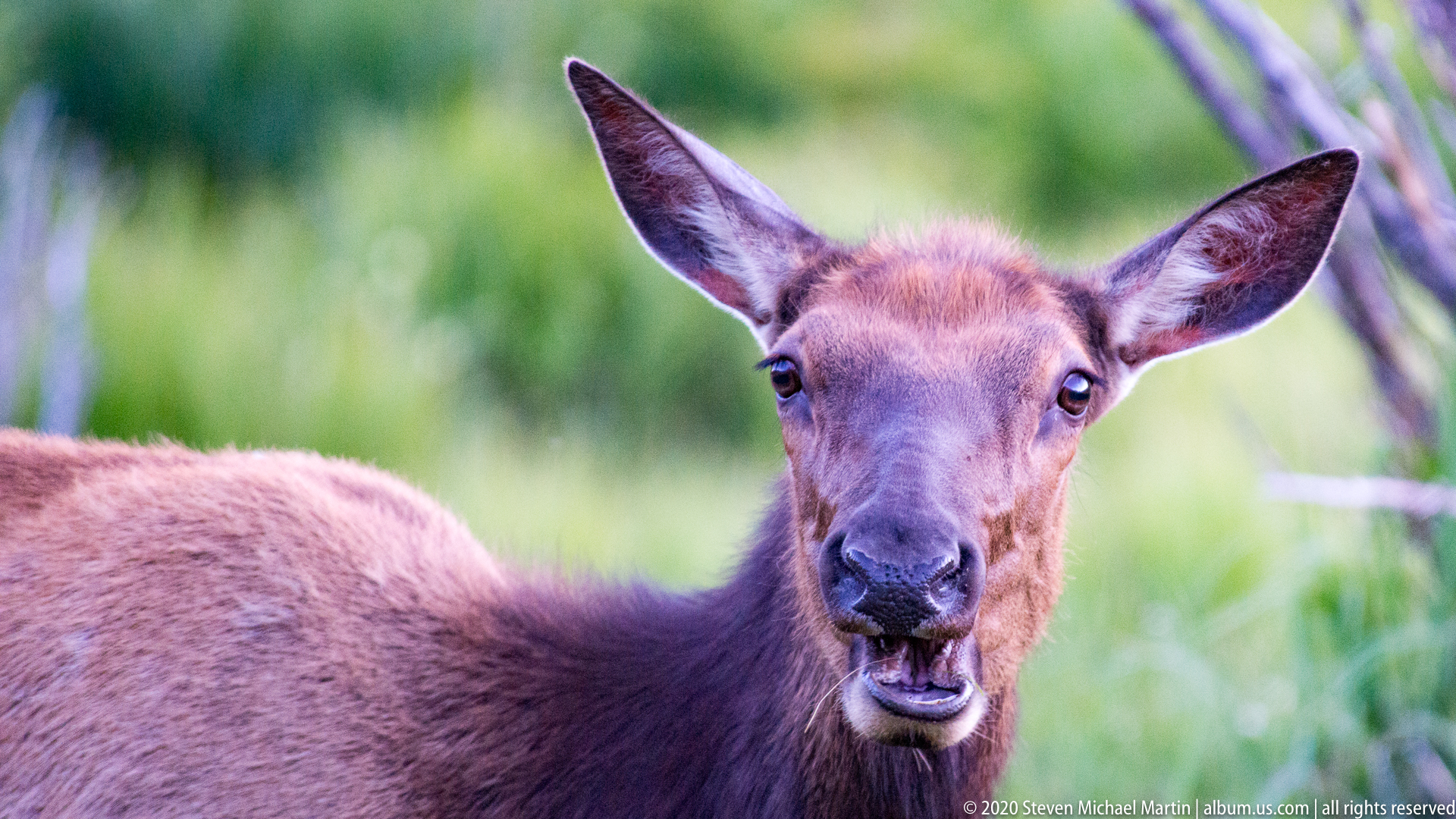
A young elk looks directly toward the camera, its large ears spread wide and dark muzzle centered in the frame. The soft brown coat and lack of antlers distinguish this portrait from the mature male elk shown nearby. Green meadow vegetation and blurred branches form a shallow-focus backdrop around the animal’s alert face.
Caption
A young elk looks directly toward the camera, its large ears spread wide and dark muzzle centered in the frame. The soft brown coat and lack of antlers distinguish this portrait from the mature male elk shown nearby. Green meadow vegetation and blurred branches form a shallow-focus backdrop around the animal’s alert face.
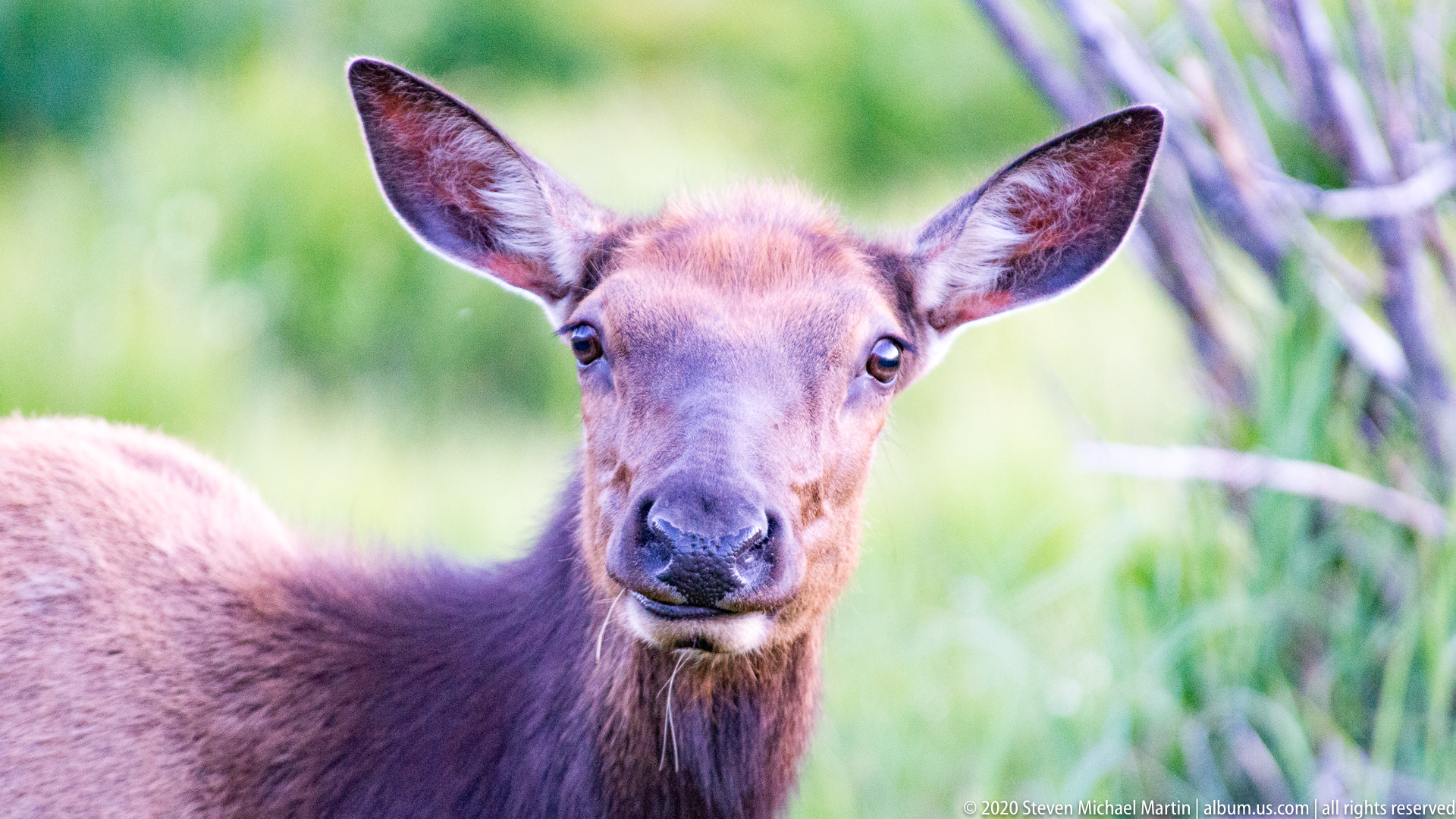
The elk calf faces forward at close range, its wide ears, pale muzzle, and short coat sharply visible against a bright green background. Its smaller head and lack of antlers suggest a juvenile, though age cannot be established precisely from the proof sheet. The tight framing makes the animal’s direct gaze the dominant feature.
Caption
The elk calf faces forward at close range, its wide ears, pale muzzle, and short coat sharply visible against a bright green background. Its smaller head and lack of antlers suggest a juvenile, though age cannot be established precisely from the proof sheet. The tight framing makes the animal’s direct gaze the dominant feature.
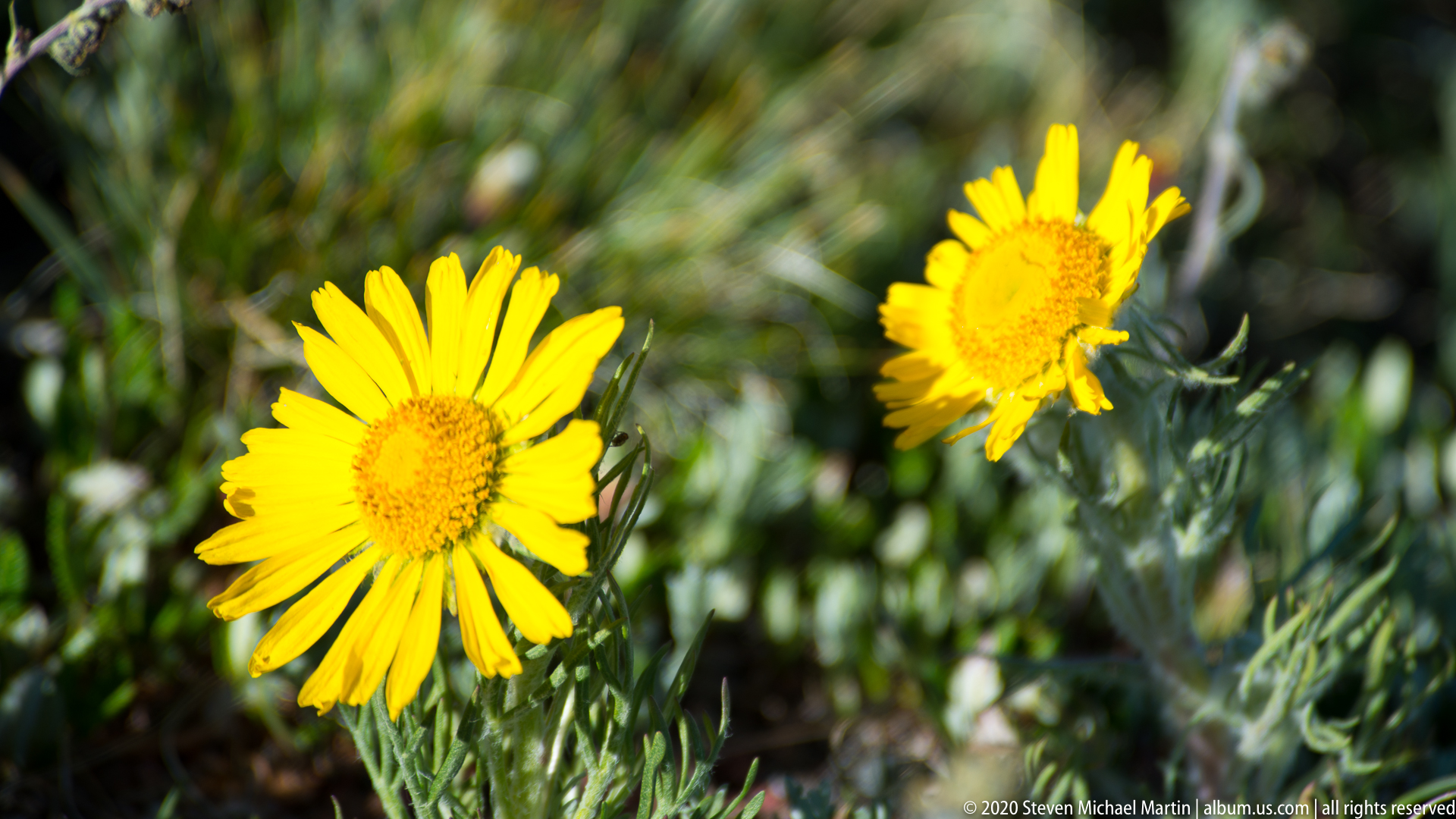
Two yellow daisy-like flowers rise on slender stems among narrow green leaves, with the nearer bloom sharply focused and the second slightly farther back. Their golden centers and radiating petals stand out against dark, softly blurred foliage. The close composition isolates the blossoms but does not provide enough detail to confirm a species.
Caption
Two yellow daisy-like flowers rise on slender stems among narrow green leaves, with the nearer bloom sharply focused and the second slightly farther back. Their golden centers and radiating petals stand out against dark, softly blurred foliage. The close composition isolates the blossoms but does not provide enough detail to confirm a species.
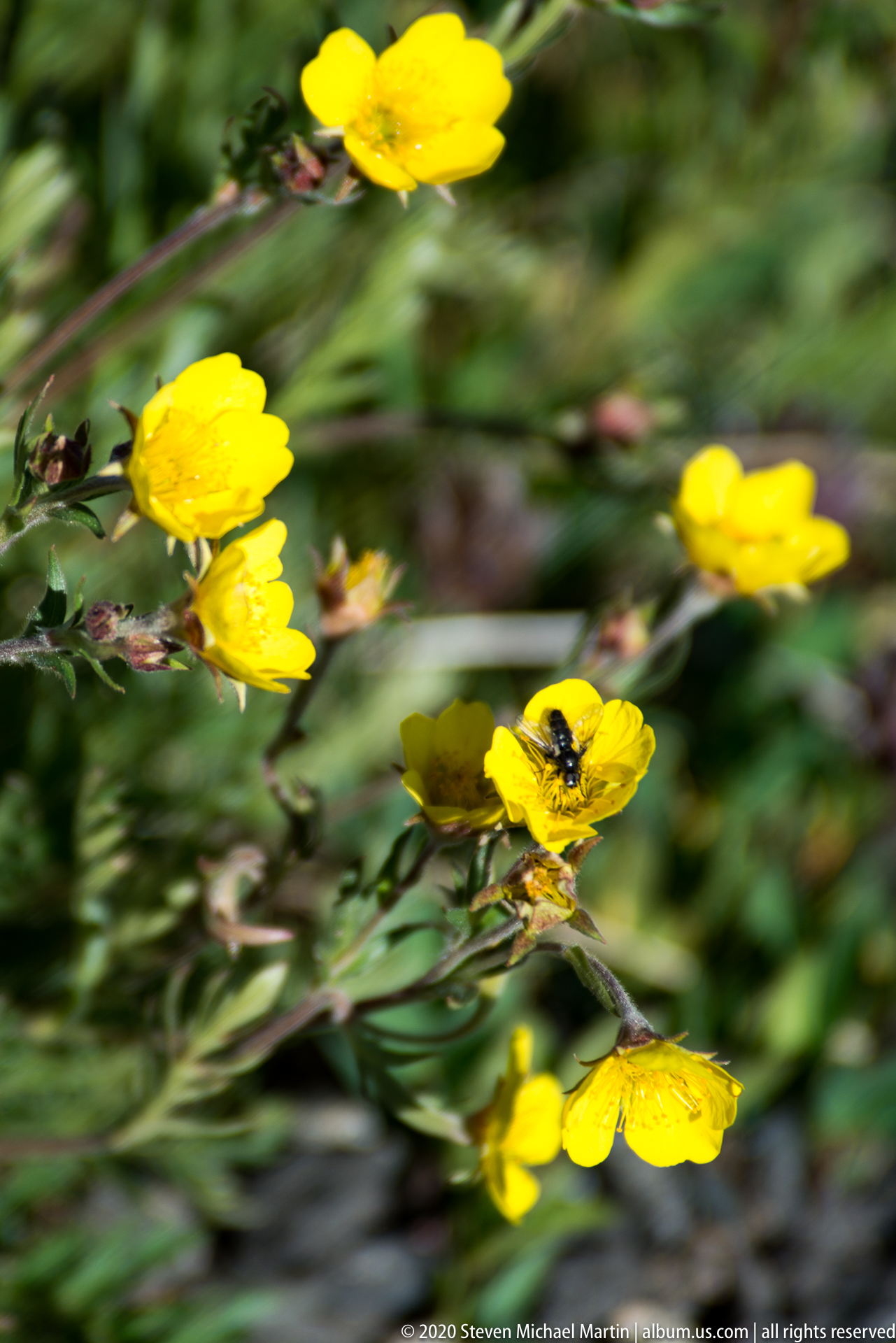
Several small yellow flowers bloom among green leaves and stems, while a dark insect rests on the central blossom. The shallow focus softens the surrounding foliage and brings the flower cluster forward. The insect adds a moment of pollinator activity, though the proof-sheet view is not detailed enough for a precise identification.
Caption
Several small yellow flowers bloom among green leaves and stems, while a dark insect rests on the central blossom. The shallow focus softens the surrounding foliage and brings the flower cluster forward. The insect adds a moment of pollinator activity, though the proof-sheet view is not detailed enough for a precise identification.
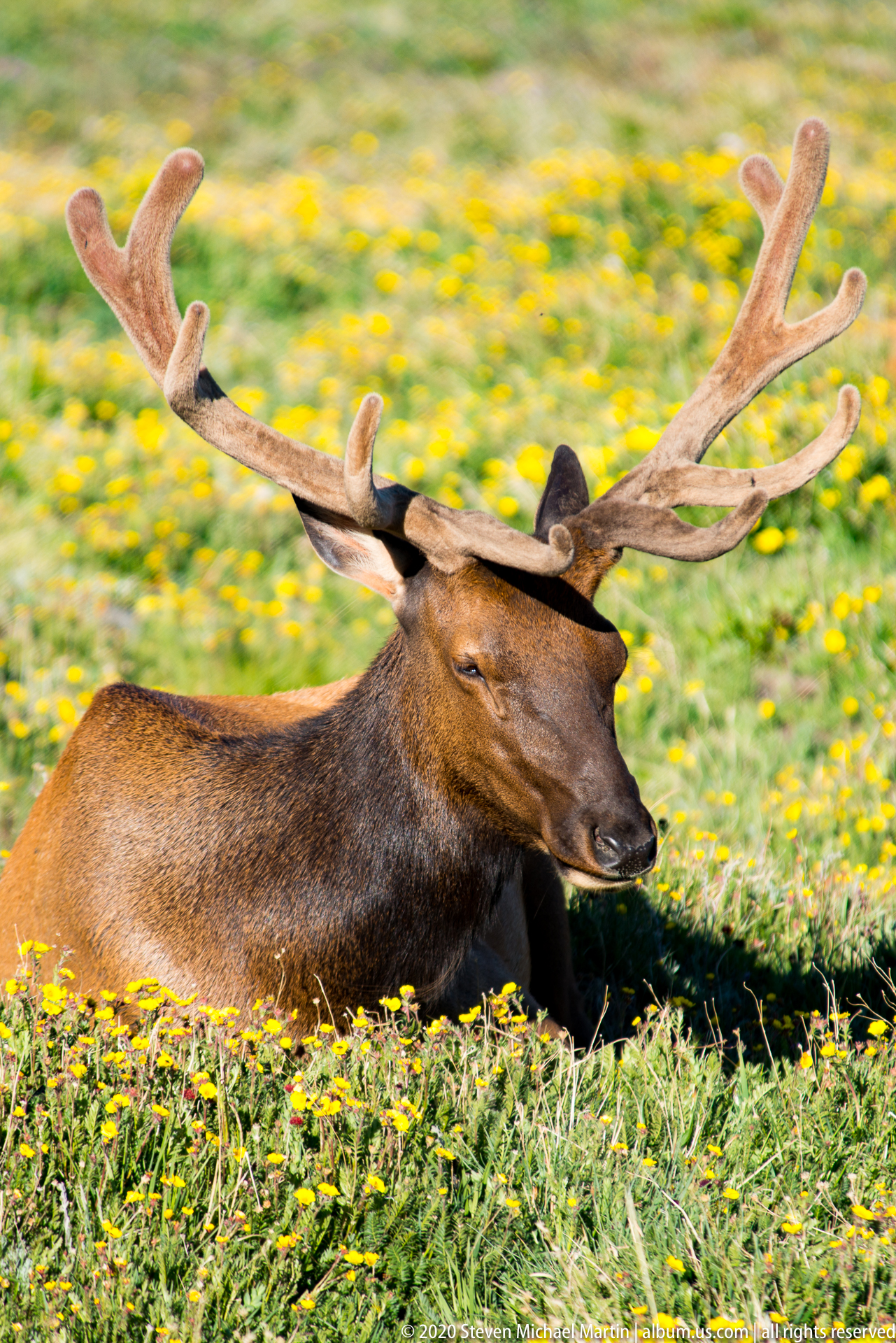
A bull elk reclines in a meadow carpeted with yellow blooms, its large antlers extending beyond the top edges of the frame. The animal’s head turns to the right while its body lies low in the grass. Bright flowers and the tight crop make the antlered profile the focus of this close wildlife view.
Caption
A bull elk reclines in a meadow carpeted with yellow blooms, its large antlers extending beyond the top edges of the frame. The animal’s head turns to the right while its body lies low in the grass. Bright flowers and the tight crop make the antlered profile the focus of this close wildlife view.
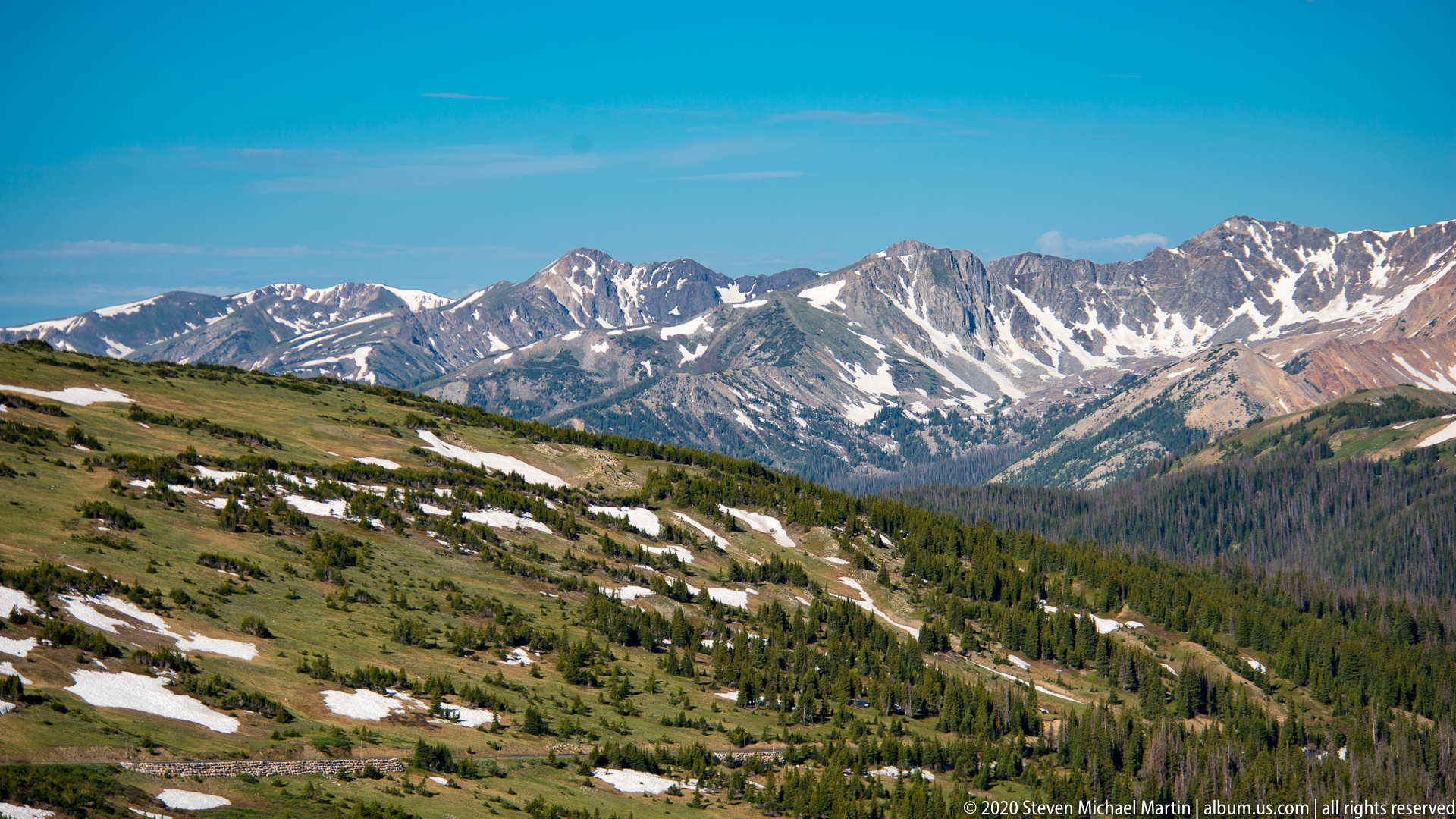
A high alpine ridge spans the horizon, its steep gray peaks streaked with lingering snow beneath a clear blue sky. Green slopes and bands of conifers descend into the foreground, with patches of snow scattered across the upper meadow. The broad landscape contrasts the rugged summit line with softer, vegetated terrain below.
Caption
A high alpine ridge spans the horizon, its steep gray peaks streaked with lingering snow beneath a clear blue sky. Green slopes and bands of conifers descend into the foreground, with patches of snow scattered across the upper meadow. The broad landscape contrasts the rugged summit line with softer, vegetated terrain below.
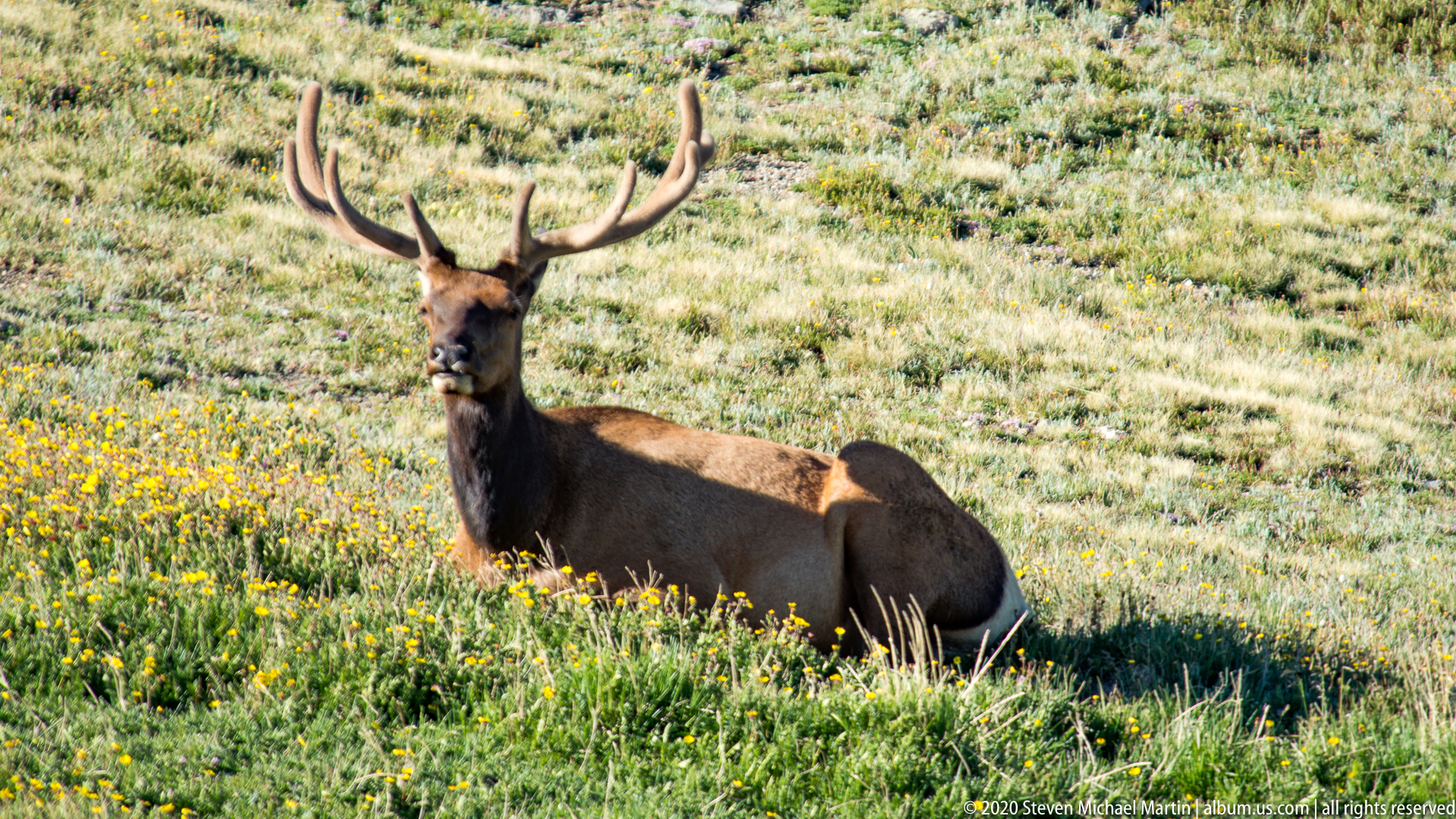
A mature bull elk lies in a meadow of yellow flowers, its dark neck and branching antlers clearly visible above the grass. The animal turns its head toward the camera while sunlight falls across its brown flank. Its relaxed posture and bright meadow setting make this a wildlife portrait rather than a grazing scene.
Caption
A mature bull elk lies in a meadow of yellow flowers, its dark neck and branching antlers clearly visible above the grass. The animal turns its head toward the camera while sunlight falls across its brown flank. Its relaxed posture and bright meadow setting make this a wildlife portrait rather than a grazing scene.
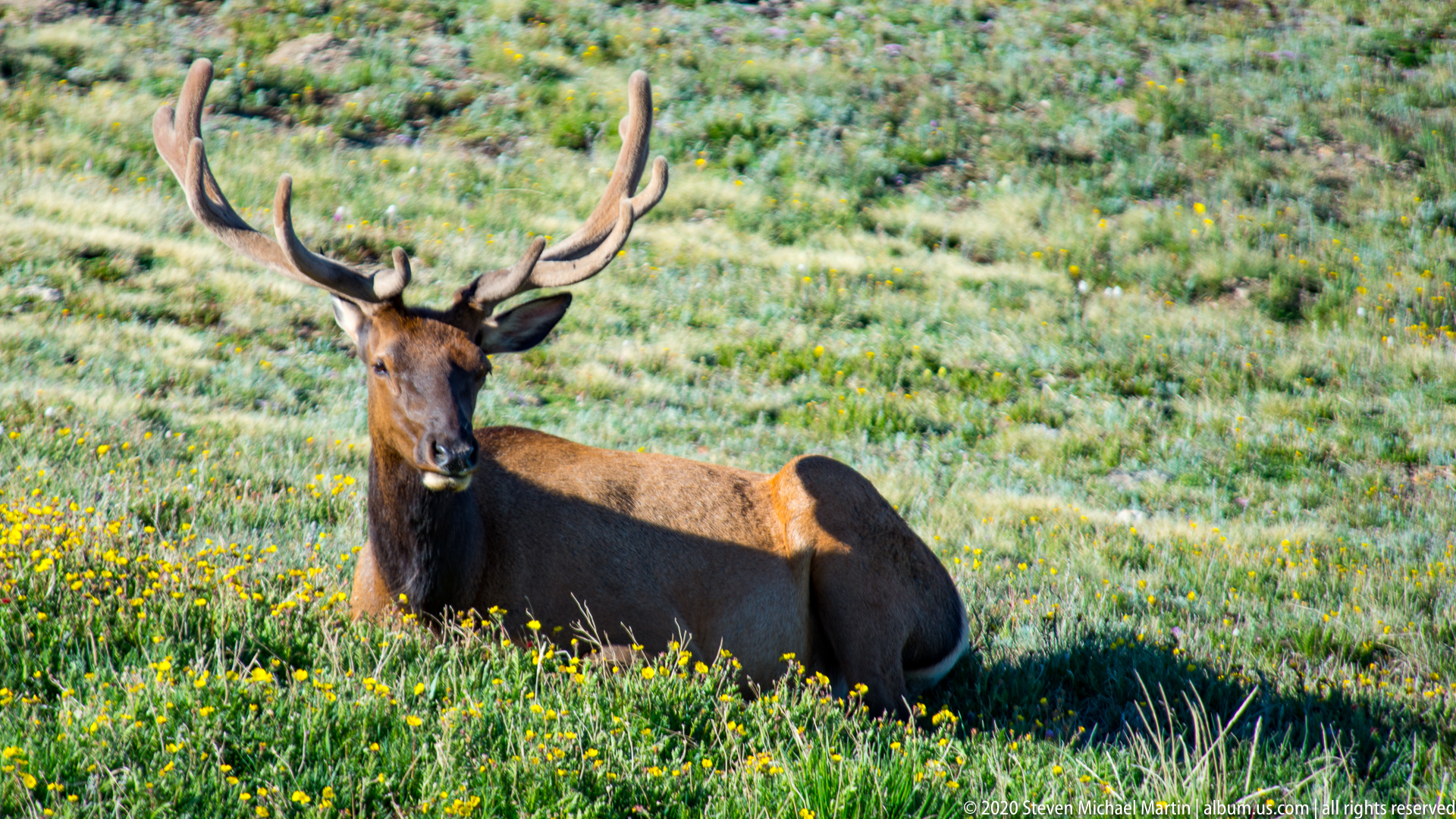
The bull remains seated among short grasses and flowers, its antlers branching against the patterned meadow. Its head turns slightly, revealing a dark face and lighter muzzle, while a broad shadow crosses its body. This closer composition gives more prominence to the animal’s antler shape and facial markings.
Caption
The bull remains seated among short grasses and flowers, its antlers branching against the patterned meadow. Its head turns slightly, revealing a dark face and lighter muzzle, while a broad shadow crosses its body. This closer composition gives more prominence to the animal’s antler shape and facial markings.
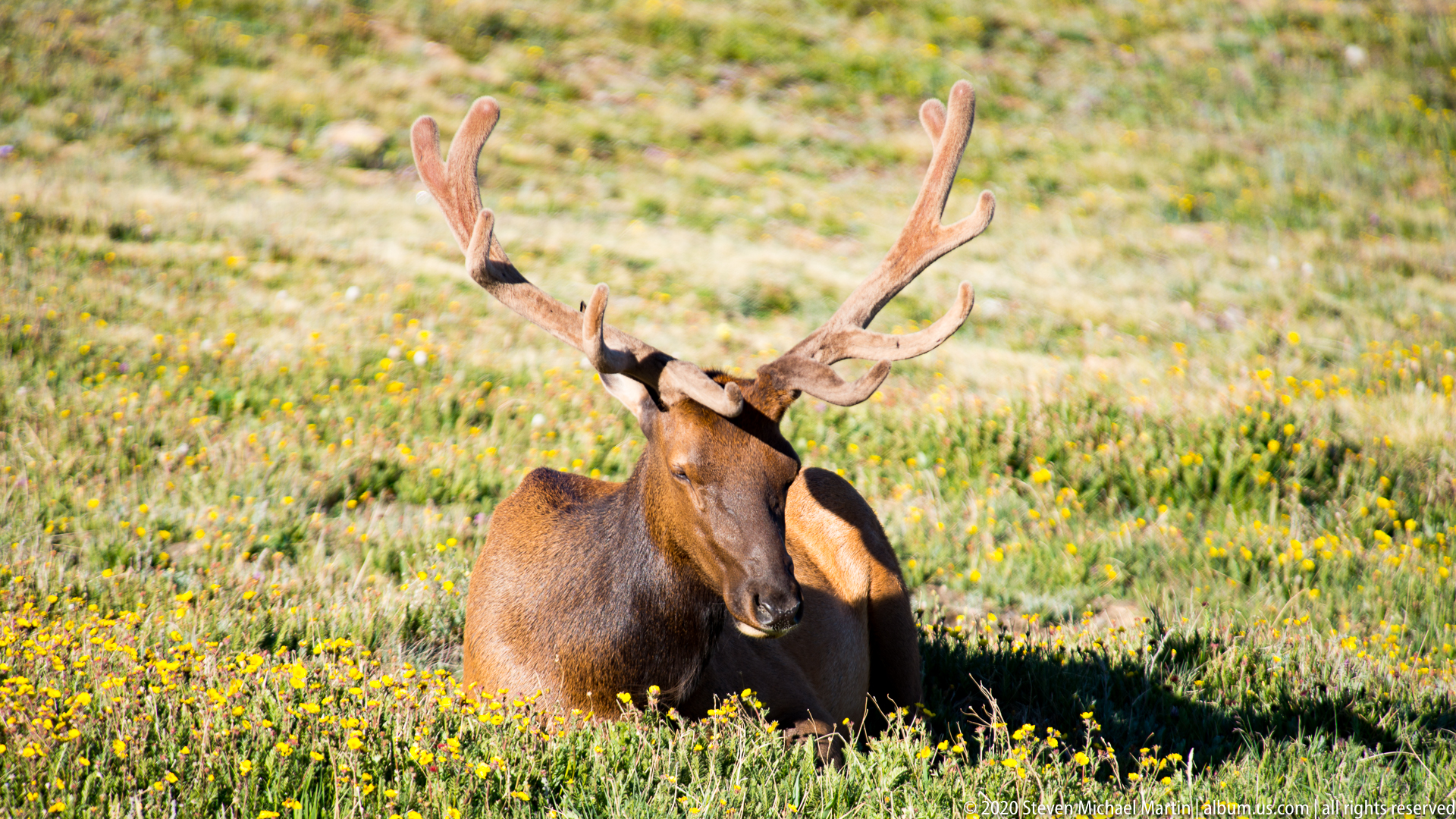
A mature bull elk lies in a patch of yellow wildflowers, its broad antlers extending across the upper frame. The animal looks down toward its shoulder, with sunlight highlighting its russet coat and darker neck. Meadow flowers surround the resting elk and add a bright foreground texture.
Caption
A mature bull elk lies in a patch of yellow wildflowers, its broad antlers extending across the upper frame. The animal looks down toward its shoulder, with sunlight highlighting its russet coat and darker neck. Meadow flowers surround the resting elk and add a bright foreground texture.
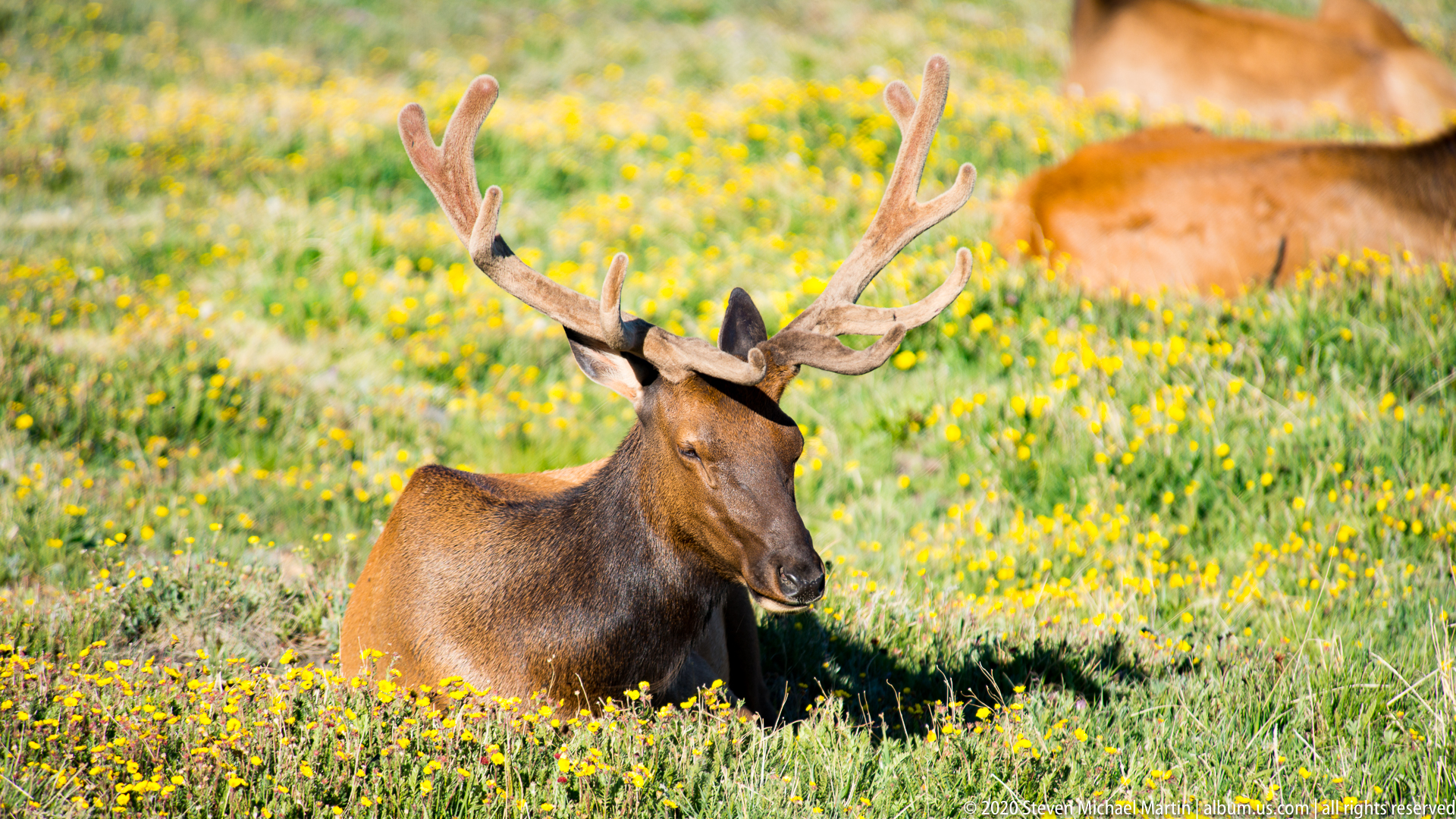
A seated bull elk rests among yellow flowers, its head angled to the right and antlers silhouetted against the meadow. A second elk is partly visible at the upper edge, suggesting nearby animals without shifting focus from the foreground male. Sunlit grass and blooms surround the pair on the open slope.
Caption
A seated bull elk rests among yellow flowers, its head angled to the right and antlers silhouetted against the meadow. A second elk is partly visible at the upper edge, suggesting nearby animals without shifting focus from the foreground male. Sunlit grass and blooms surround the pair on the open slope.

Three elk lie among dense yellow wildflowers on a gently sloping meadow, their bodies oriented in slightly different directions. The nearest animal is partly cropped, while two others rest behind it and look across the slope. The layered arrangement shows a small group at rest rather than a single isolated portrait.
Caption
Three elk lie among dense yellow wildflowers on a gently sloping meadow, their bodies oriented in slightly different directions. The nearest animal is partly cropped, while two others rest behind it and look across the slope. The layered arrangement shows a small group at rest rather than a single isolated portrait.

A bull elk rests in profile with its body stretched across the meadow and tall antlers rising above its head. Its dark neck contrasts with the tawny flank and yellow flowers around it. Shallow depth of field softens the distant forest, keeping attention on the animal’s silhouette and antlers.
Caption
A bull elk rests in profile with its body stretched across the meadow and tall antlers rising above its head. Its dark neck contrasts with the tawny flank and yellow flowers around it. Shallow depth of field softens the distant forest, keeping attention on the animal’s silhouette and antlers.
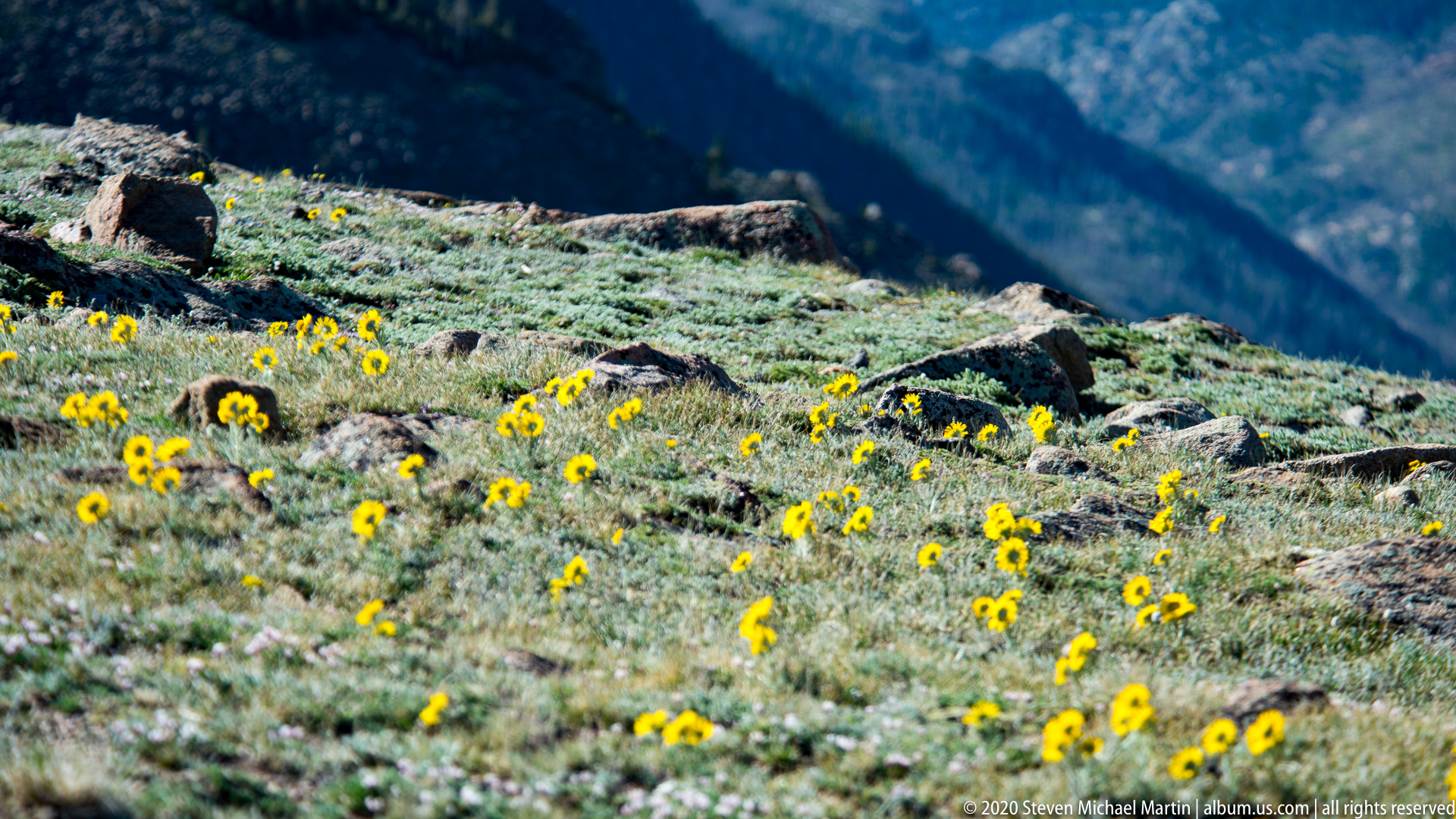
Yellow wildflowers dot a frosty-looking alpine meadow, while dark rocks and a distant mountain slope frame the upper background. The low viewpoint places blossoms across the foreground and leaves the mountain softly blurred. Cool light on the grass contrasts with saturated flower heads, suggesting a high, exposed setting.
Caption
Yellow wildflowers dot a frosty-looking alpine meadow, while dark rocks and a distant mountain slope frame the upper background. The low viewpoint places blossoms across the foreground and leaves the mountain softly blurred. Cool light on the grass contrasts with saturated flower heads, suggesting a high, exposed setting.

A thick, uneven snowbank clings to a rocky slope, its scalloped lower edge melting above exposed stones. Dark conifers and a small patch of blue sky rise beyond the snow. The close view reveals the snow’s layered, overhanging form and its persistence among rocks at high elevation.
Caption
A thick, uneven snowbank clings to a rocky slope, its scalloped lower edge melting above exposed stones. Dark conifers and a small patch of blue sky rise beyond the snow. The close view reveals the snow’s layered, overhanging form and its persistence among rocks at high elevation.
Rocky Mountain National Park — Field Guide
National Park Field Guide
📍 Overview
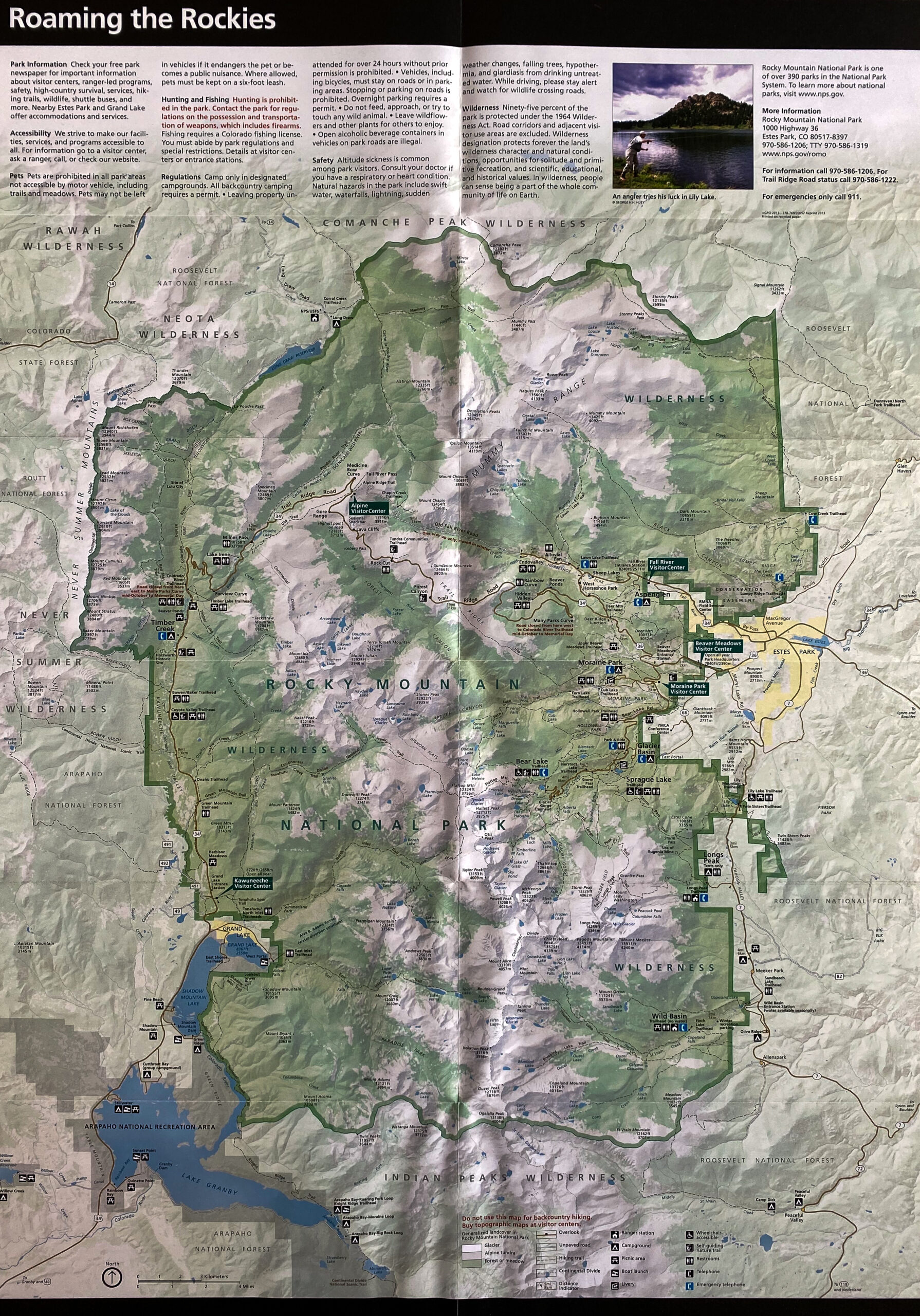
Rocky Mountain National Park preserves a high elevation mountain environment shaped by tectonic uplift and glacial erosion. The park includes rugged peaks, alpine tundra, and forested valleys that illustrate geological processes influencing the formation of the Rocky Mountains. The Continental Divide runs through the park, separating river systems that flow toward the Atlantic and Pacific Oceans.
Glaciers carved cirques, valleys, and basins that remain visible in the park’s present-day terrain. Differences in elevation produce varied ecological zones ranging from montane forest to alpine tundra environments above treeline. The landscape reflects the interaction between geological forces, climate, and biological adaptation across mountain ecosystems.
⭐ Highlights
- High elevation peaks along the Continental Divide
- Glacially shaped valleys and alpine lakes
- Alpine tundra environments above treeline
- Trail Ridge Road high mountain views
- Mountain landscapes shaped by tectonic uplift
🔎 Key Features
- Glacial landforms including cirques and moraines
- Alpine tundra adapted to extreme climate conditions
- Sharp mountain ridges created by uplift
- Elevational ecological diversity
- Continental Divide watershed separation
🦌 Wildlife Encountered
Rocky Mountain National Park offers exceptional opportunities to observe large mammals and alpine species adapted to high elevation environments. Elk are among the most commonly seen animals in the park, frequently grazing in alpine meadows and tundra landscapes during the summer months. Mule deer and moose are also regularly encountered along forest edges and open grasslands, particularly during early morning and evening hours.
Higher elevation habitats support specialized wildlife such as yellow-bellied marmots and pikas, both well adapted to rocky tundra environments. Bighorn sheep are another iconic species of the park, often found resting on exposed slopes or navigating rugged alpine terrain. These species illustrate the diversity of ecosystems found within Rocky Mountain National Park, ranging from montane forests to alpine tundra.
📷 Photography Notes
- Early morning light often produces clear mountain visibility
- Wide compositions capture scale of peaks and valleys
- Cloud movement can add depth to alpine scenes
- Foreground rocks or vegetation provide visual perspective
- Changing weather conditions create varied lighting effects
- Look for compositions that show elevation transitions