Elephant Hill – Canyonlands National Park
Elephant Hill marks an important access point within the Needles District of Canyonlands National Park and illustrates the rugged terrain characteristic of the Colorado Plateau. The area is defined by sandstone formations shaped through erosion acting upon uplifted sedimentary rock layers. The landscape demonstrates the influence of geological forces that created mesas, fins, and narrow canyon passages across the region.
Exposed rock surfaces reveal variations in mineral composition that contribute to the warm tones associated with desert environments of southeastern Utah. The Needles District is known for tall sandstone spires formed by erosion along natural fractures in the rock. Elephant Hill reflects the interaction between tectonic uplift and long-term weathering processes that continue to shape the terrain.
Visitors encounter expansive desert views and distinctive rock formations that highlight the scale of geological time represented across the plateau. The surrounding environment illustrates the diversity of landforms preserved within Canyonlands National Park and the gradual transformation of sedimentary rock layers.
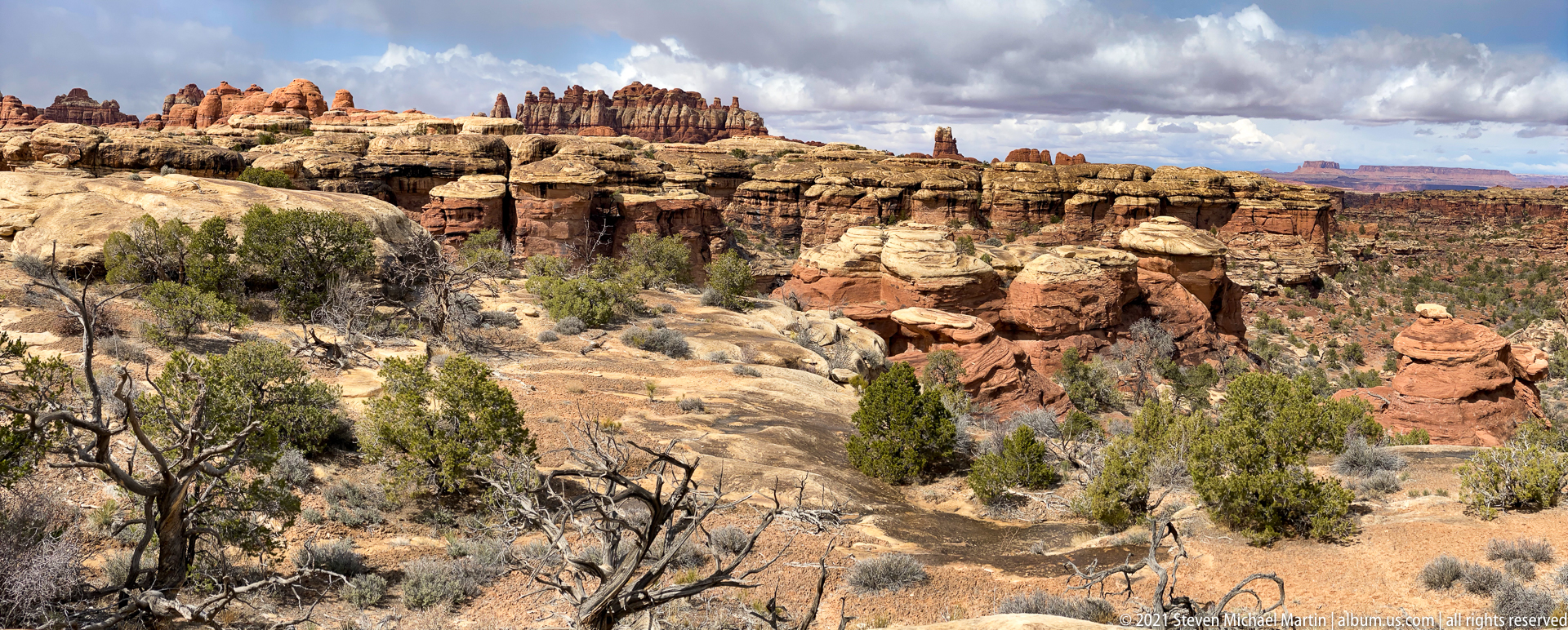
From an elevated sheet of pale bedrock, the view opens across shallow canyon ledges toward a far horizon of sandstone pinnacles. Low shrubs punctuate the foreground and middle distance, while broken clouds soften the sky. The layered terrain fills the frame without a human figure, emphasizing the broad, open reach of the Needles landscape.
Caption
From an elevated sheet of pale bedrock, the view opens across shallow canyon ledges toward a far horizon of sandstone pinnacles. Low shrubs punctuate the foreground and middle distance, while broken clouds soften the sky. The layered terrain fills the frame without a human figure, emphasizing the broad, open reach of the Needles landscape.
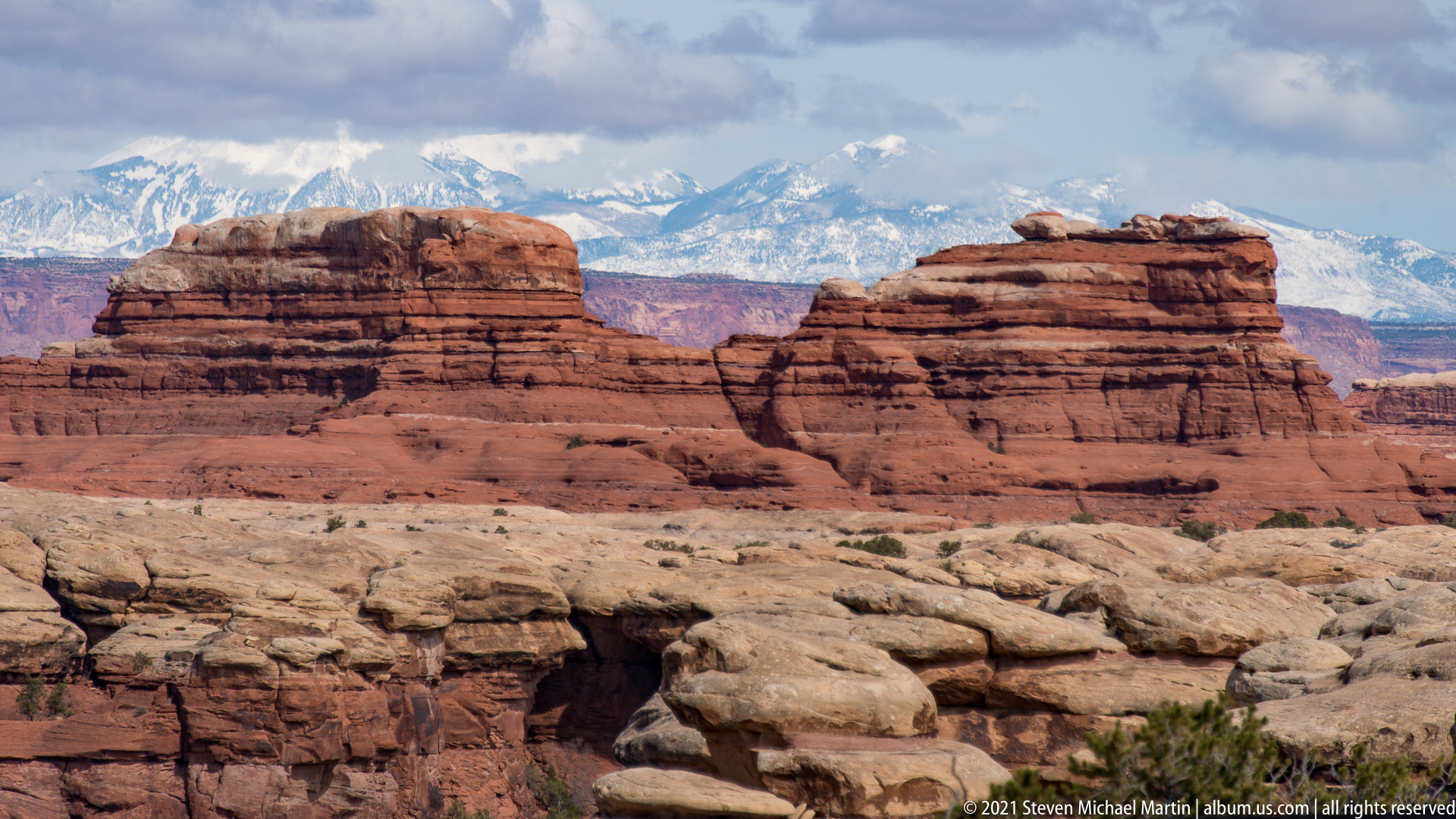
A pair of broad red mesas spans the middle of the frame, their horizontal strata dark against the lighter sandstone foreground. Snow-covered mountain peaks appear behind them beneath a cloudy sky, creating a distant cool-toned backdrop to the warm canyon rock. The layered view links the near plateau to a high mountain horizon.
Caption
A pair of broad red mesas spans the middle of the frame, their horizontal strata dark against the lighter sandstone foreground. Snow-covered mountain peaks appear behind them beneath a cloudy sky, creating a distant cool-toned backdrop to the warm canyon rock. The layered view links the near plateau to a high mountain horizon.
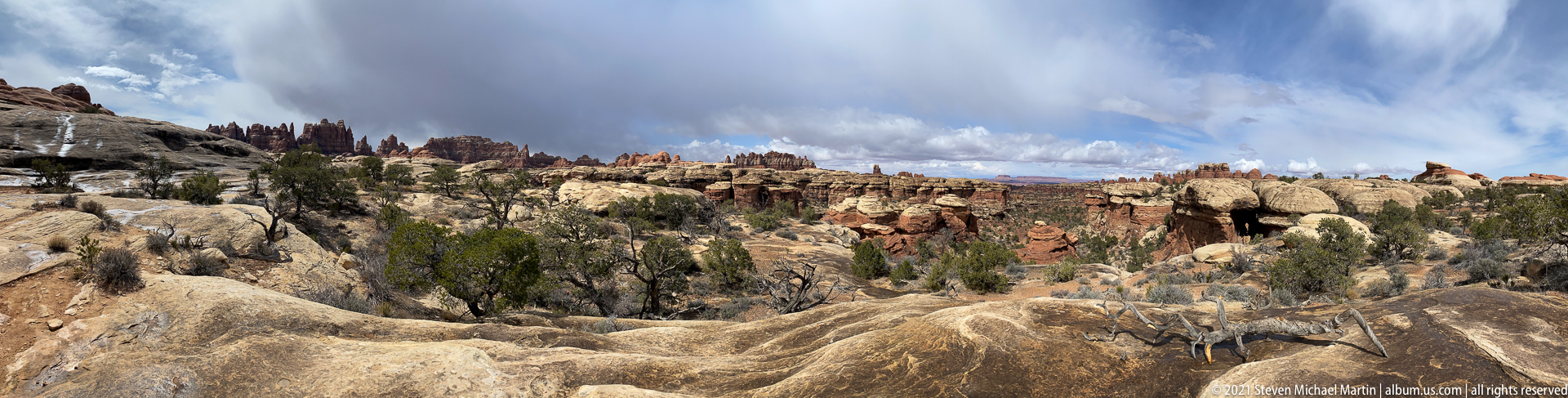
A broad slickrock overlook opens onto a layered expanse of red and cream sandstone, sparse juniper, and distant mesas beneath broken clouds. The foreground rock slopes gently toward the canyon country, while a line of narrow pinnacles marks the horizon. This elevated view conveys the wide scale of the landscape beyond the immediate trail.
Caption
A broad slickrock overlook opens onto a layered expanse of red and cream sandstone, sparse juniper, and distant mesas beneath broken clouds. The foreground rock slopes gently toward the canyon country, while a line of narrow pinnacles marks the horizon. This elevated view conveys the wide scale of the landscape beyond the immediate trail.
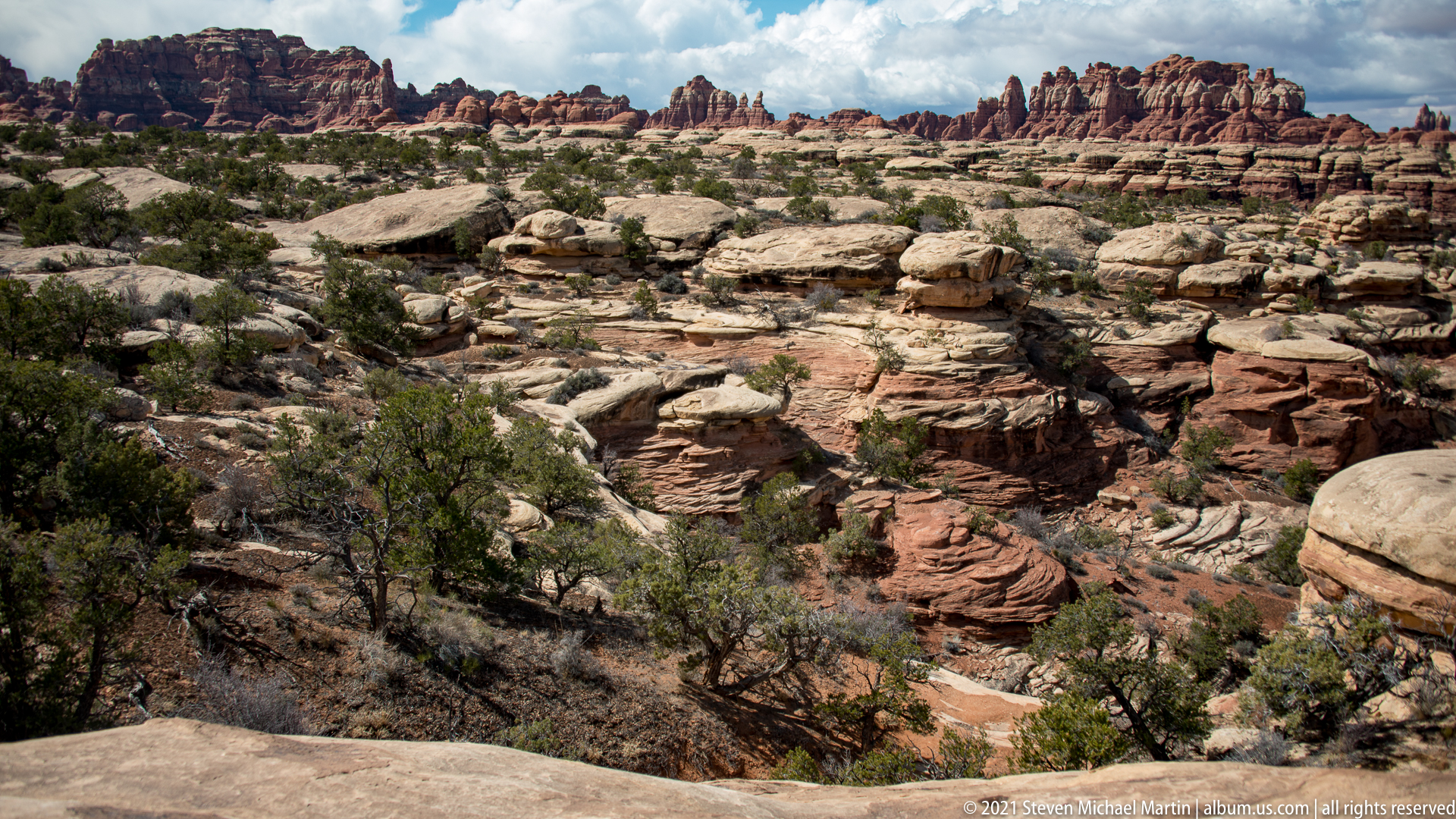
A broad plateau of pale sandstone shelves and shallow gullies stretches toward a dense line of red formations on the horizon. Juniper patches occupy the broken slopes below the viewpoint, and a bank of clouds hangs above the distant towers. The elevated composition reveals the complex terrain between the foreground ledge and the far skyline.
Caption
A broad plateau of pale sandstone shelves and shallow gullies stretches toward a dense line of red formations on the horizon. Juniper patches occupy the broken slopes below the viewpoint, and a bank of clouds hangs above the distant towers. The elevated composition reveals the complex terrain between the foreground ledge and the far skyline.
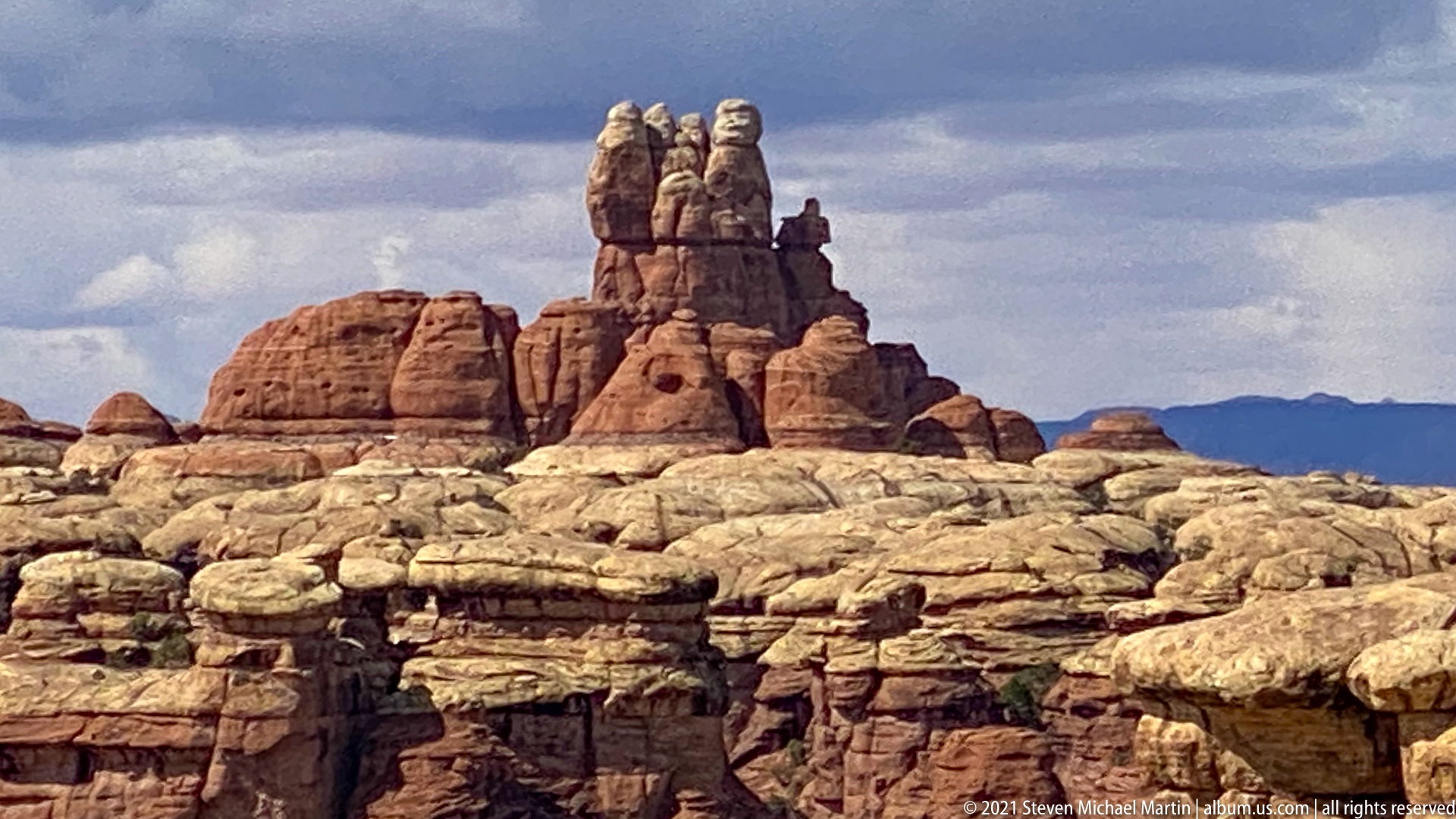
A dense cluster of sandstone towers rises beyond a pale, horizontal rim, with small rounded forms and taller pinnacles packed across the skyline. Foreground ledges fall away into shadow, while a distant blue ridge sits beneath layered clouds. The compressed framing brings the irregular profile of the Needles into sharper focus than the surrounding terrain.
Caption
A dense cluster of sandstone towers rises beyond a pale, horizontal rim, with small rounded forms and taller pinnacles packed across the skyline. Foreground ledges fall away into shadow, while a distant blue ridge sits beneath layered clouds. The compressed framing brings the irregular profile of the Needles into sharper focus than the surrounding terrain.
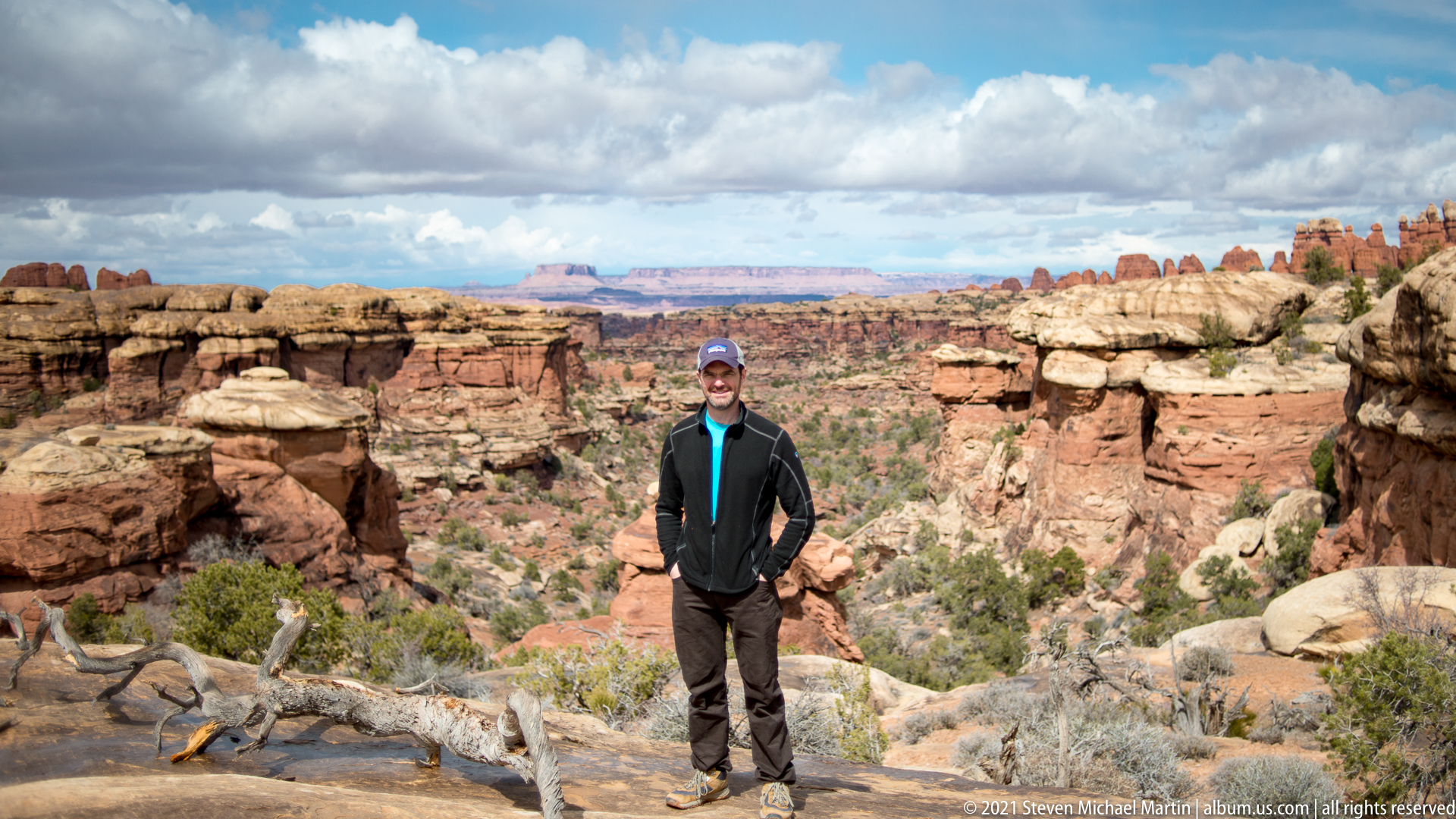
A visitor stands on the slickrock near the center of a broad overlook, facing the camera with red canyon walls and distant mesas behind. A weathered branch lies across the foreground, and clouds open to blue sky above the horizon. The person’s placement gives scale to the sweeping view without obscuring the layered terrain.
Caption
A visitor stands on the slickrock near the center of a broad overlook, facing the camera with red canyon walls and distant mesas behind. A weathered branch lies across the foreground, and clouds open to blue sky above the horizon. The person’s placement gives scale to the sweeping view without obscuring the layered terrain.
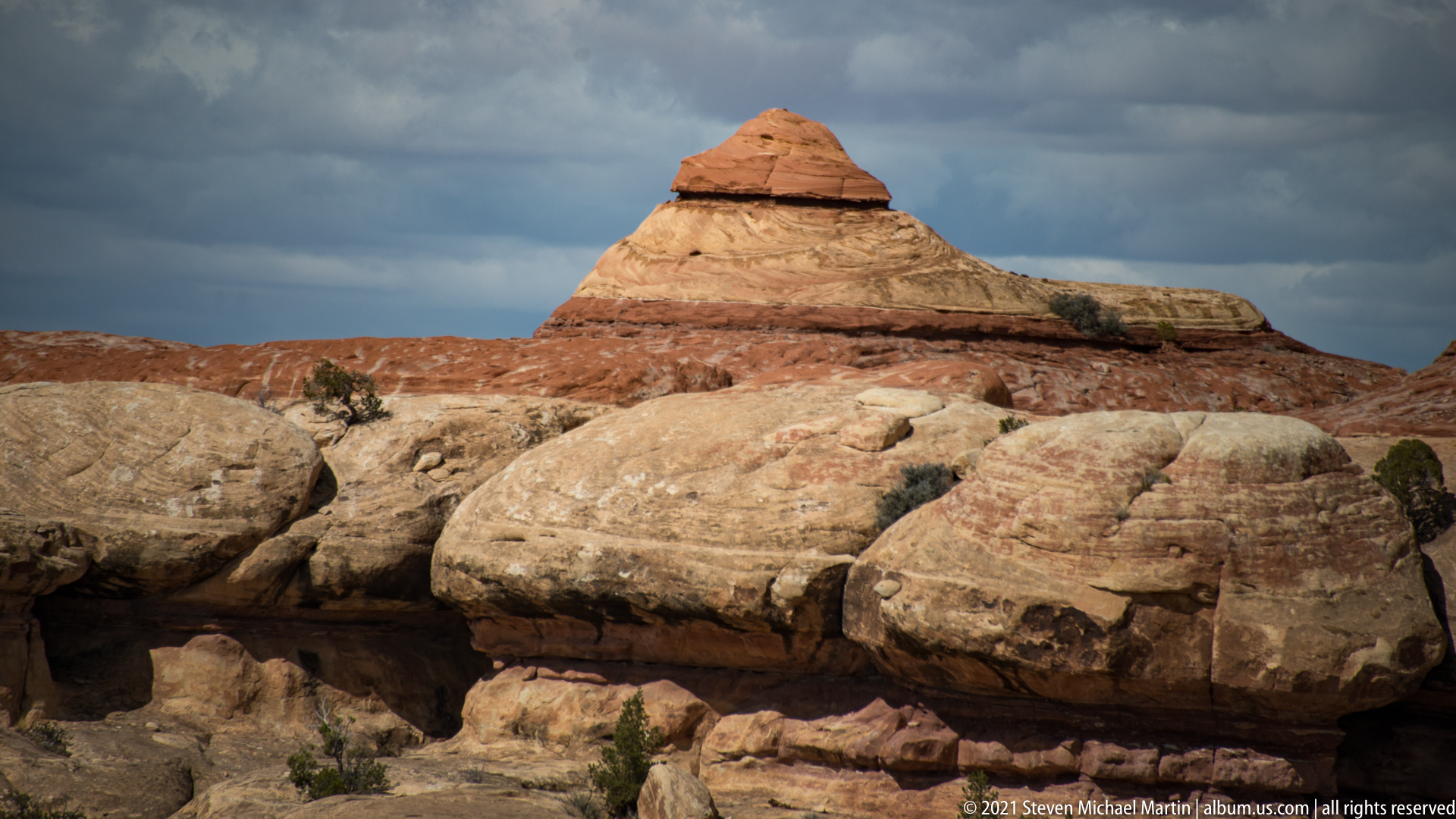
A broad, cap-shaped sandstone summit rises beyond a pale horizontal bench, its orange upper layer set above a lighter, banded base. A dark cloud bank gathers behind the formation, while rounded foreground slabs form a broken terrace. The centered profile isolates the mesa-like landform and emphasizes its stacked color bands.
Caption
A broad, cap-shaped sandstone summit rises beyond a pale horizontal bench, its orange upper layer set above a lighter, banded base. A dark cloud bank gathers behind the formation, while rounded foreground slabs form a broken terrace. The centered profile isolates the mesa-like landform and emphasizes its stacked color bands.
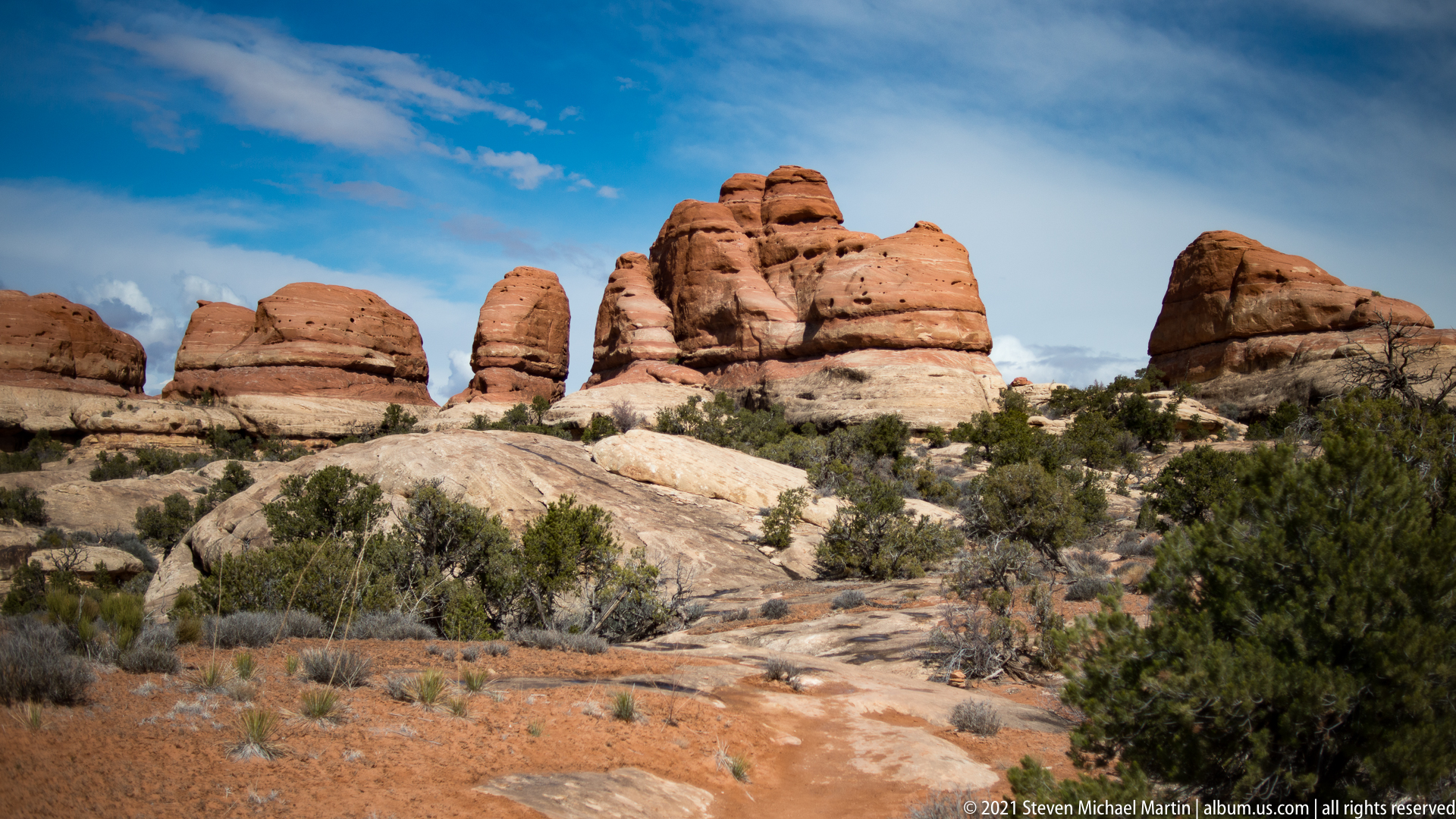
A cluster of rounded sandstone towers stands above a sloping pale ledge, with low shrubs and red soil in the foreground. Their horizontal bands and varied heights create a broken skyline against blue sky. Compared with the more distant panorama, this view brings the formations closer and shows how they rise directly from the slickrock slope.
Caption
A cluster of rounded sandstone towers stands above a sloping pale ledge, with low shrubs and red soil in the foreground. Their horizontal bands and varied heights create a broken skyline against blue sky. Compared with the more distant panorama, this view brings the formations closer and shows how they rise directly from the slickrock slope.

A trail map fills the frame, with a “You Are Here” marker near Elephant Hill and a dense network of routes crossing The Needles district. Labels for Chesler Park, Druid Arch, Squaw Flat, and other destinations situate the map within Canyonlands National Park. Its close crop makes the route information, rather than the surrounding landscape, the photograph’s subject.
Caption
A trail map fills the frame, with a “You Are Here” marker near Elephant Hill and a dense network of routes crossing The Needles district. Labels for Chesler Park, Druid Arch, Squaw Flat, and other destinations situate the map within Canyonlands National Park. Its close crop makes the route information, rather than the surrounding landscape, the photograph’s subject.

From deeper inside the fissure, the hiker pauses with one hand against a wall, silhouetted by a vertical strip of golden light. Cool, shadowed rock fills most of the frame, while the figure’s stance shows how narrow the passage is. This view emphasizes the human scale of the cleft and the contrast between its dark interior and sunlit exit.
Caption
From deeper inside the fissure, the hiker pauses with one hand against a wall, silhouetted by a vertical strip of golden light. Cool, shadowed rock fills most of the frame, while the figure’s stance shows how narrow the passage is. This view emphasizes the human scale of the cleft and the contrast between its dark interior and sunlit exit.
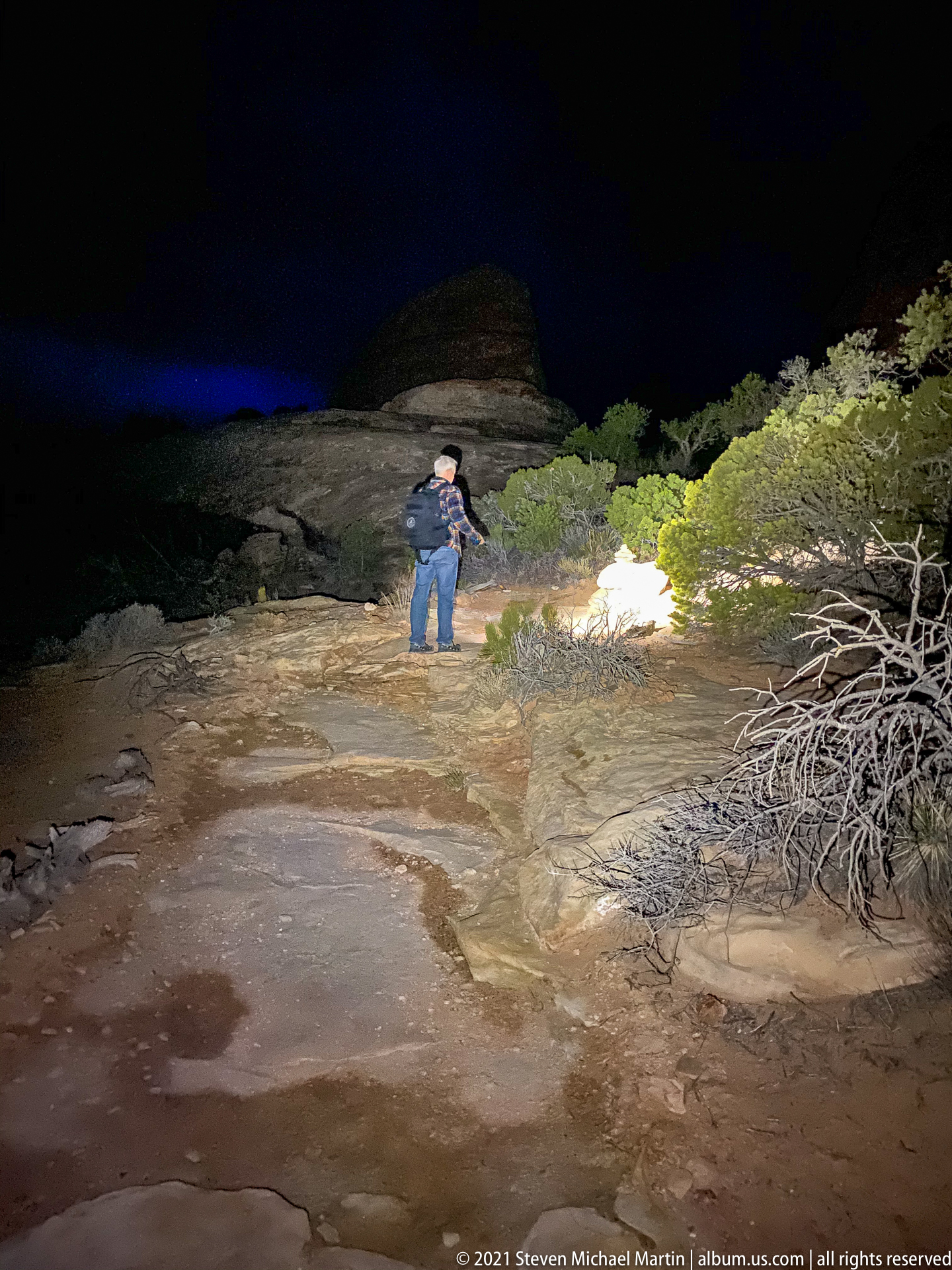
A lone hiker stands on a broad slickrock shelf after dark, turned toward the low sandstone rise ahead. A strong light catches the pale stone and nearby shrubs while the sky and surrounding terrain remain nearly black. The small figure gives scale to the open rock surface and marks this as a nighttime stop along a rugged route.
Caption
A lone hiker stands on a broad slickrock shelf after dark, turned toward the low sandstone rise ahead. A strong light catches the pale stone and nearby shrubs while the sky and surrounding terrain remain nearly black. The small figure gives scale to the open rock surface and marks this as a nighttime stop along a rugged route.

Seen from closer range, the hiker turns toward the camera on the same open sandstone shelf, one arm extended toward the brush at the edge. The direct light reveals a plaid shirt, backpack, and uneven rock underfoot, while a blue band of twilight remains along the horizon. This frame centers the traveler and the scale of the exposed ledge.
Caption
Seen from closer range, the hiker turns toward the camera on the same open sandstone shelf, one arm extended toward the brush at the edge. The direct light reveals a plaid shirt, backpack, and uneven rock underfoot, while a blue band of twilight remains along the horizon. This frame centers the traveler and the scale of the exposed ledge.
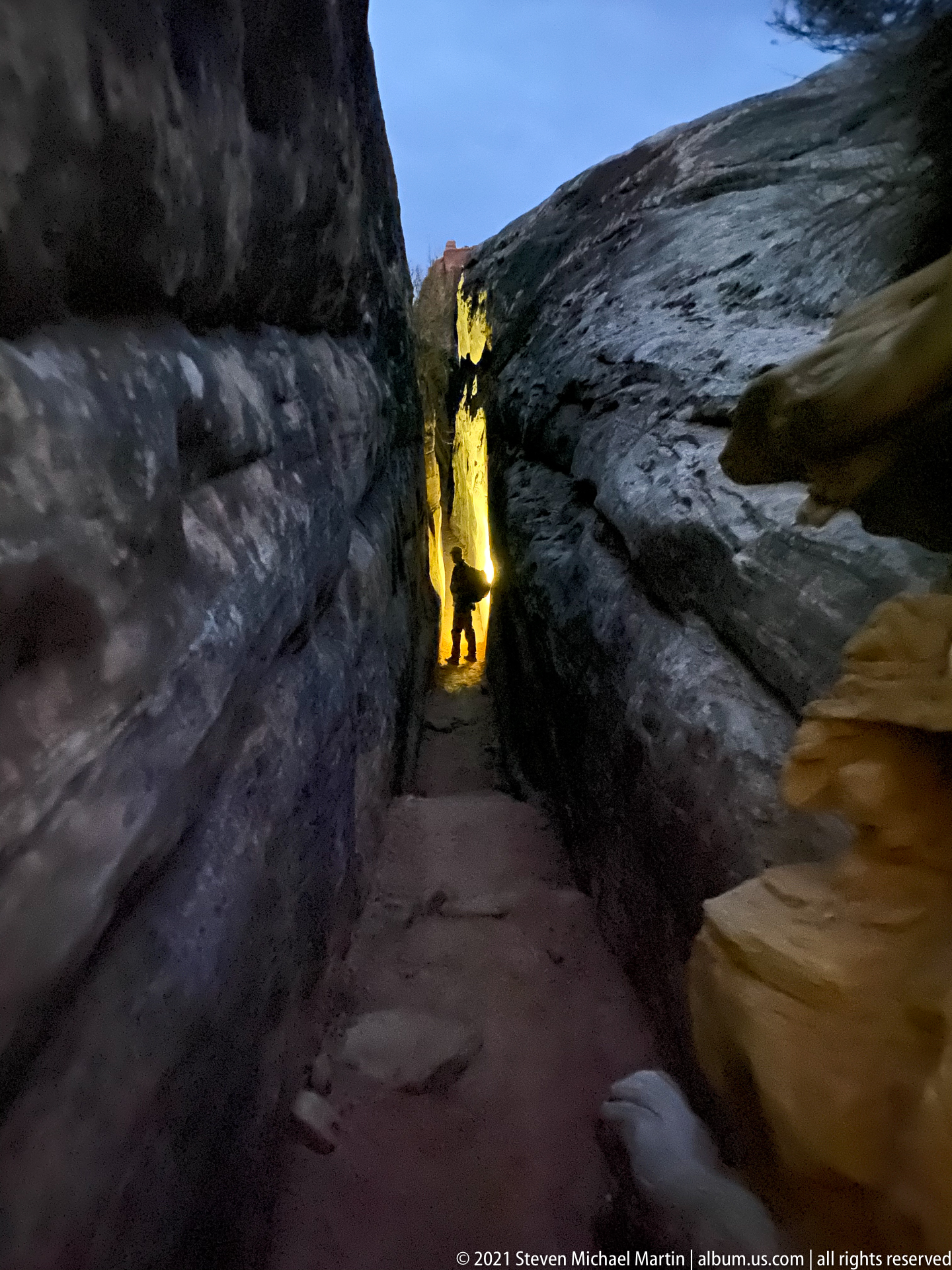
A narrow corridor cuts between massive, smooth sandstone walls, compressing the view toward a bright opening beyond. A small hiker is silhouetted in the gap, where warm light catches the rock edges and the path beneath. The steep, close walls make the passage itself the dominant feature and show the confined scale of travel through the rock.
Caption
A narrow corridor cuts between massive, smooth sandstone walls, compressing the view toward a bright opening beyond. A small hiker is silhouetted in the gap, where warm light catches the rock edges and the path beneath. The steep, close walls make the passage itself the dominant feature and show the confined scale of travel through the rock.
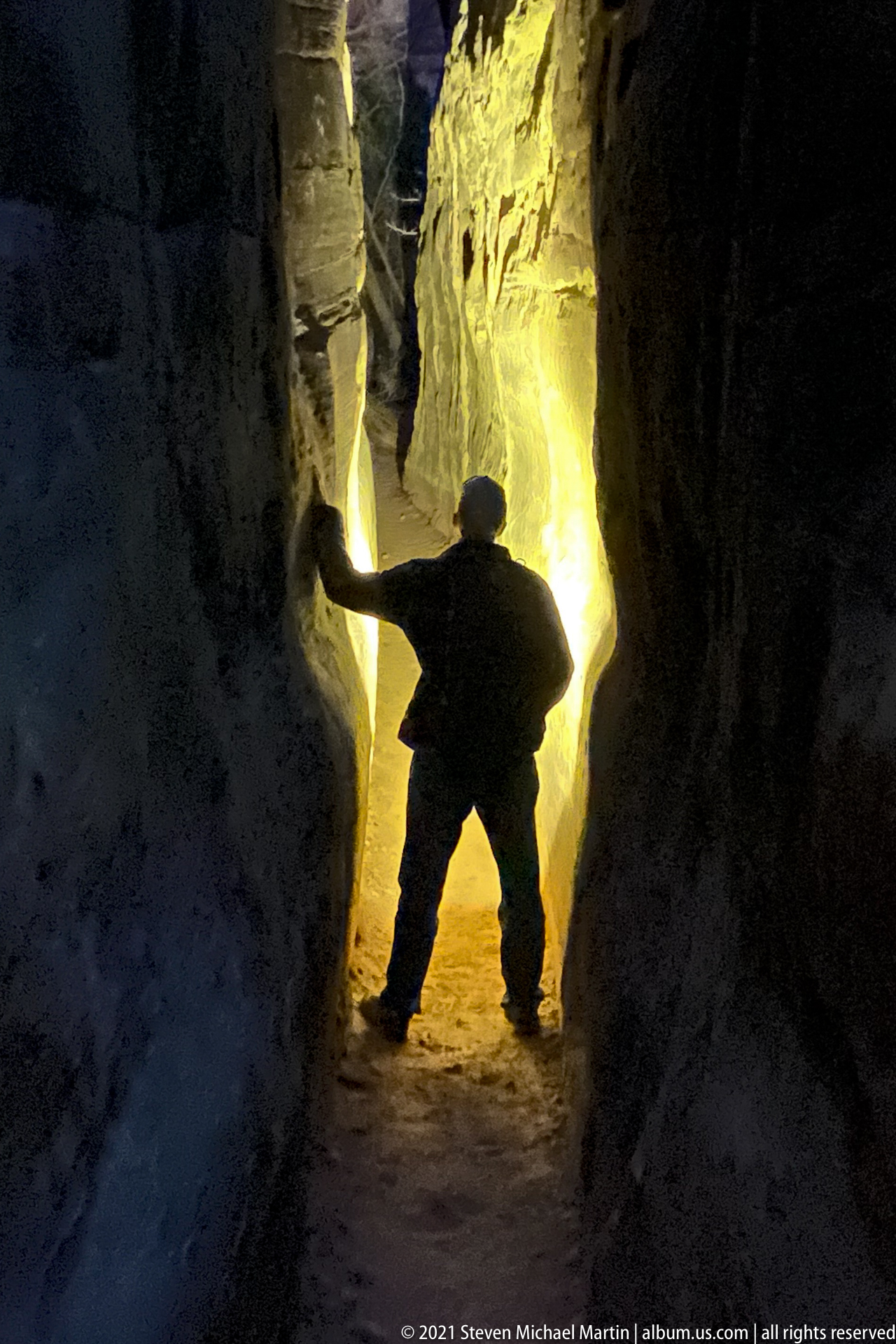
The hiker stands wide-legged in a narrow opening, arms extended toward both sides as warm light illuminates the irregular sandstone behind. Dark foreground walls frame the figure and make the bright passage appear almost stage-like. The pose and close viewpoint turn this into a study of bodily scale and the sculpted, constricted rock corridor.
Caption
The hiker stands wide-legged in a narrow opening, arms extended toward both sides as warm light illuminates the irregular sandstone behind. Dark foreground walls frame the figure and make the bright passage appear almost stage-like. The pose and close viewpoint turn this into a study of bodily scale and the sculpted, constricted rock corridor.

A straight, empty passage recedes between high, close-set sandstone walls, its packed floor disappearing into darkness. Diffuse light reveals the rough, weathered surfaces at the near end, while a small opening of blue evening sky appears above the distant notch. Without a person in the frame, the photograph isolates the corridor’s depth and enclosure.
Caption
A straight, empty passage recedes between high, close-set sandstone walls, its packed floor disappearing into darkness. Diffuse light reveals the rough, weathered surfaces at the near end, while a small opening of blue evening sky appears above the distant notch. Without a person in the frame, the photograph isolates the corridor’s depth and enclosure.
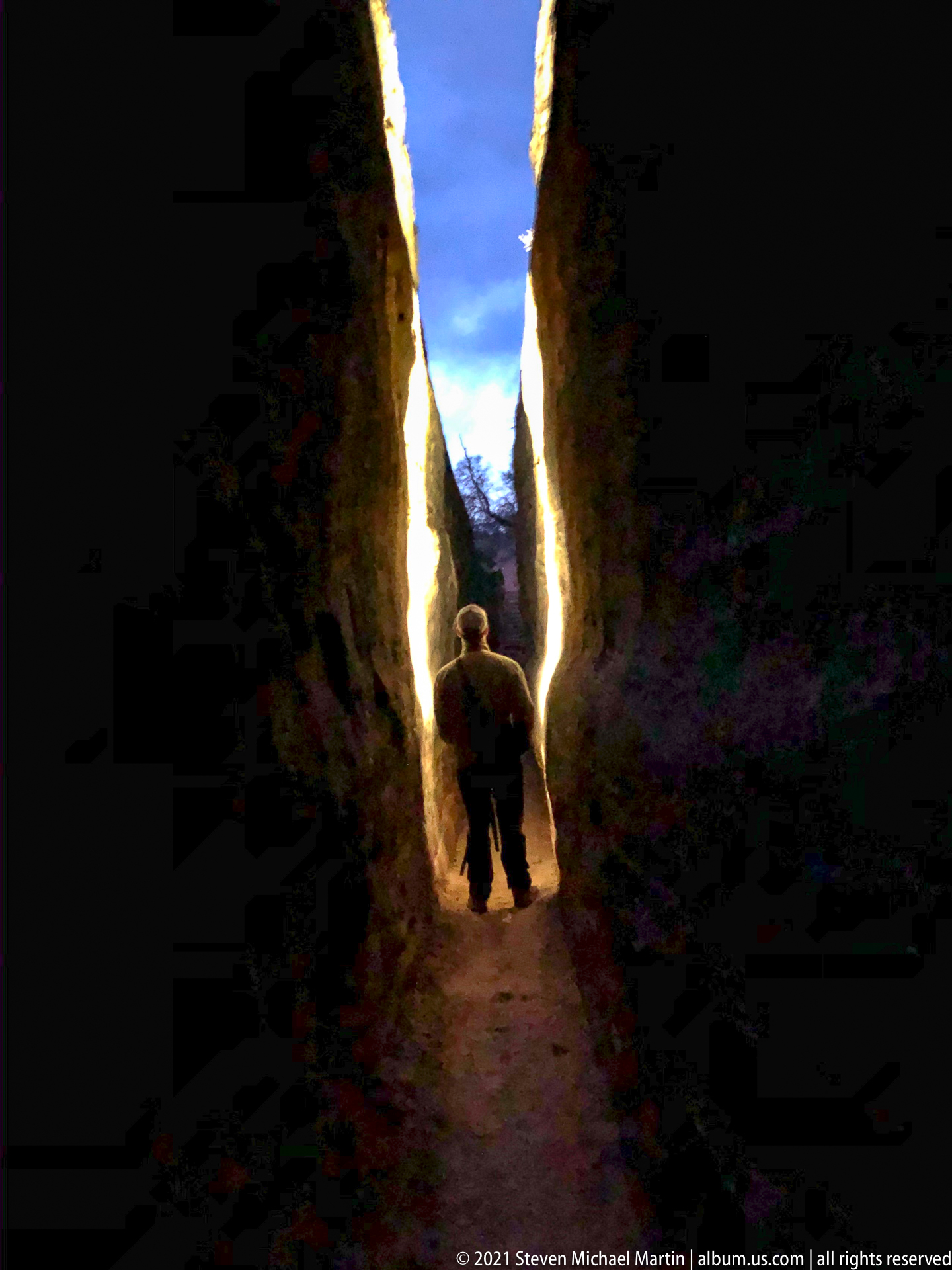
A solitary figure walks away from the camera through a narrow, shadowed cleft, heading toward a wedge of blue sky and a bright opening. Warm light traces both rock edges, separating the hiker from the dark corridor. The centered figure and converging walls draw attention to the passage’s vertical height and its abrupt transition from shade to daylight.
Caption
A solitary figure walks away from the camera through a narrow, shadowed cleft, heading toward a wedge of blue sky and a bright opening. Warm light traces both rock edges, separating the hiker from the dark corridor. The centered figure and converging walls draw attention to the passage’s vertical height and its abrupt transition from shade to daylight.
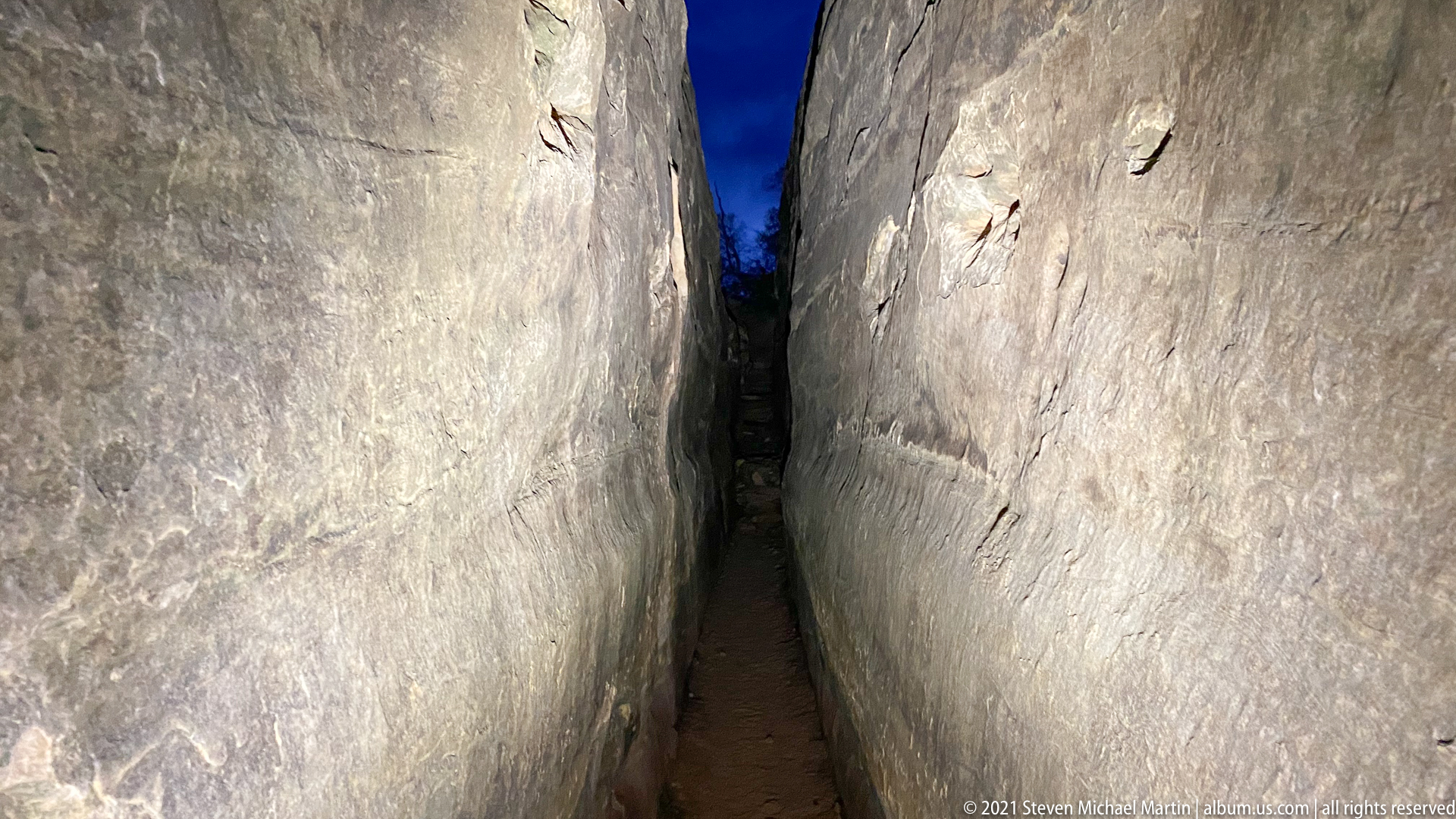
A close view looks down a tight cleft where pale, nearly parallel sandstone walls rise above a narrow dirt floor. The bright flash reveals small ledges and weathering marks, while deep blue sky appears only as a slim strip overhead. With no figure to interrupt the passage, the repeated vertical planes and compressed walkway define the image.
Caption
A close view looks down a tight cleft where pale, nearly parallel sandstone walls rise above a narrow dirt floor. The bright flash reveals small ledges and weathering marks, while deep blue sky appears only as a slim strip overhead. With no figure to interrupt the passage, the repeated vertical planes and compressed walkway define the image.
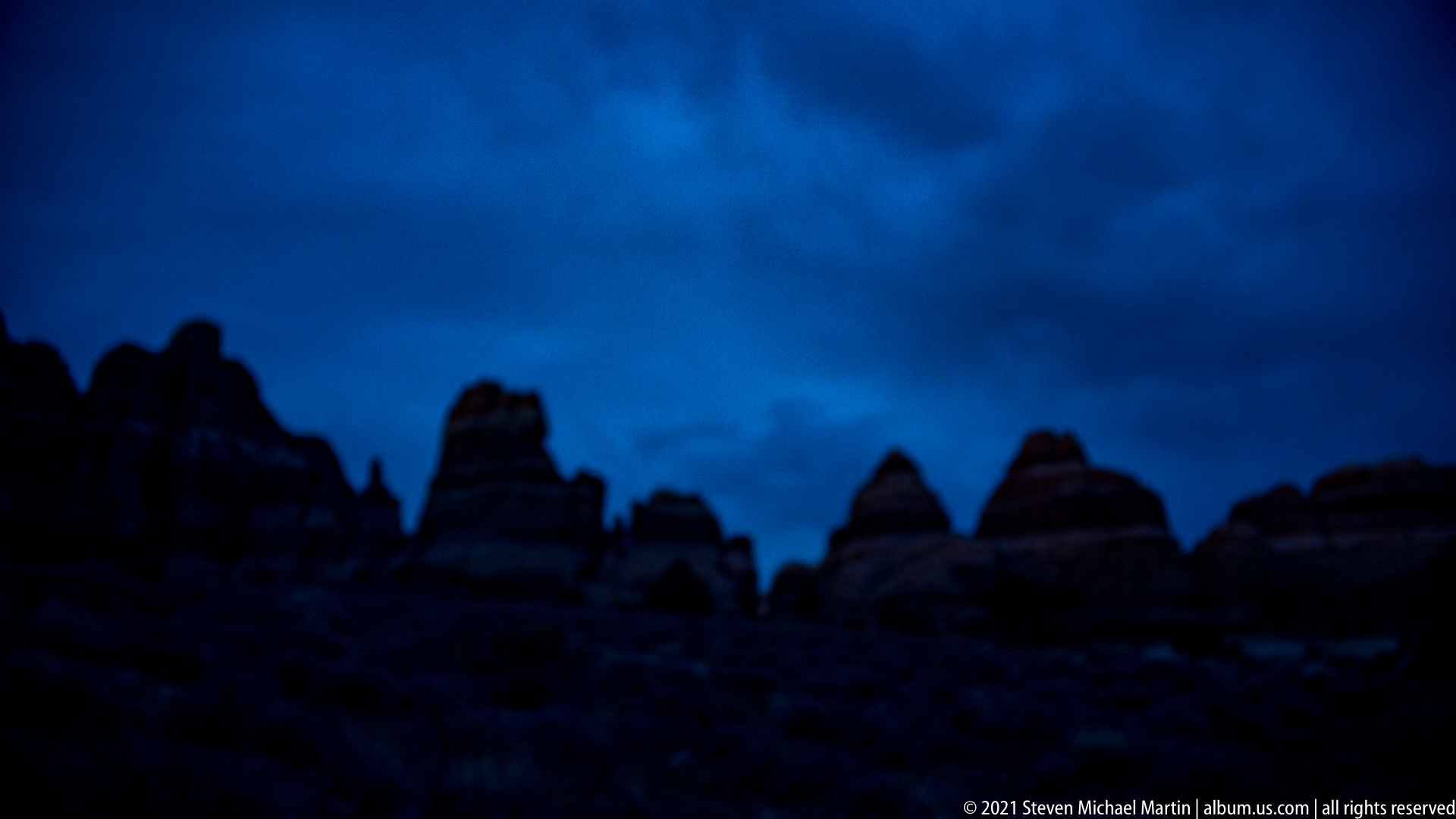
The Needles rise as a dark, uneven skyline against a saturated blue twilight sky. Their clustered towers and pinnacles vary in height, creating a jagged profile across the lower half of the frame. With little foreground detail visible, the photograph concentrates on the distinctive silhouette of the sandstone formations at the end of day.
Caption
The Needles rise as a dark, uneven skyline against a saturated blue twilight sky. Their clustered towers and pinnacles vary in height, creating a jagged profile across the lower half of the frame. With little foreground detail visible, the photograph concentrates on the distinctive silhouette of the sandstone formations at the end of day.
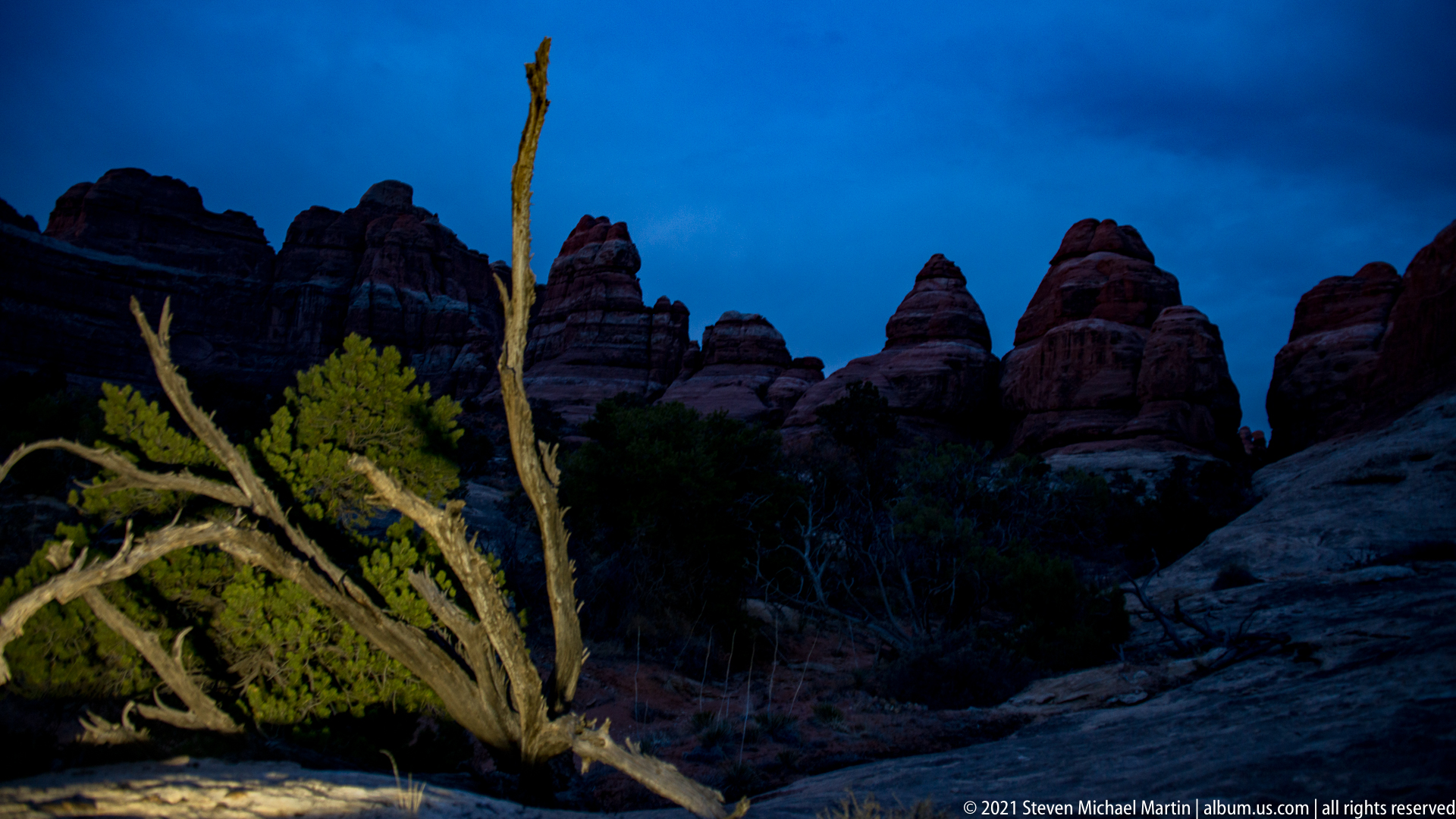
A bare, upright branch cuts through the foreground while the Needles form a low band of dark towers against a cobalt evening sky. A small juniper and sloping slickrock add depth below the skyline. The deadwood provides a vertical counterpoint to the rounded rock forms and gives this dusk view a distinct foreground frame.
Caption
A bare, upright branch cuts through the foreground while the Needles form a low band of dark towers against a cobalt evening sky. A small juniper and sloping slickrock add depth below the skyline. The deadwood provides a vertical counterpoint to the rounded rock forms and gives this dusk view a distinct foreground frame.
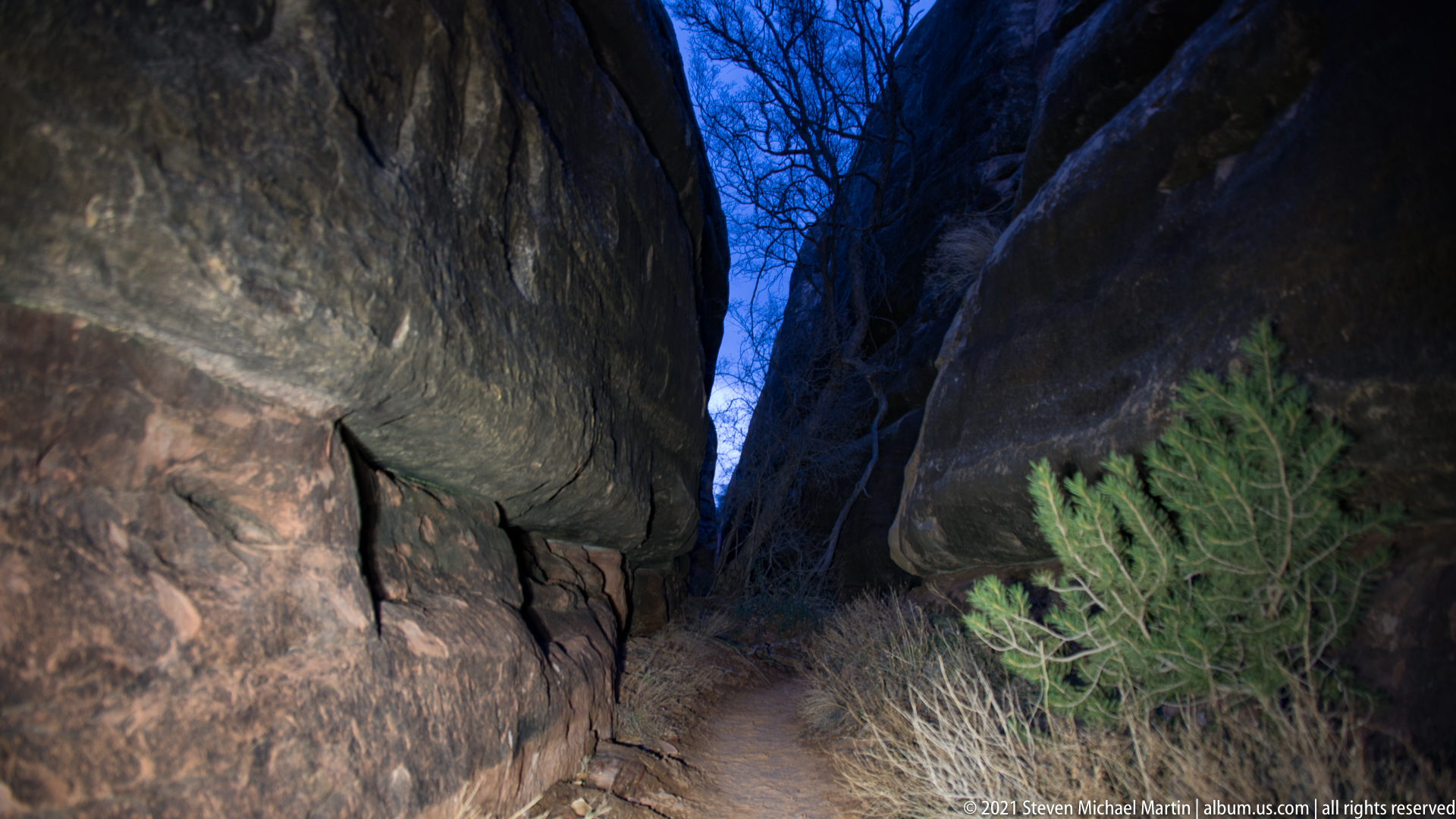
A massive rounded boulder projects over the footpath, creating a low natural ceiling between dark sandstone walls. The trail narrows into a shadowed cleft, where bare branches and a thin band of blue sky are visible above. This view focuses on the overhang’s scale and the tight route threading beneath it.
Caption
A massive rounded boulder projects over the footpath, creating a low natural ceiling between dark sandstone walls. The trail narrows into a shadowed cleft, where bare branches and a thin band of blue sky are visible above. This view focuses on the overhang’s scale and the tight route threading beneath it.
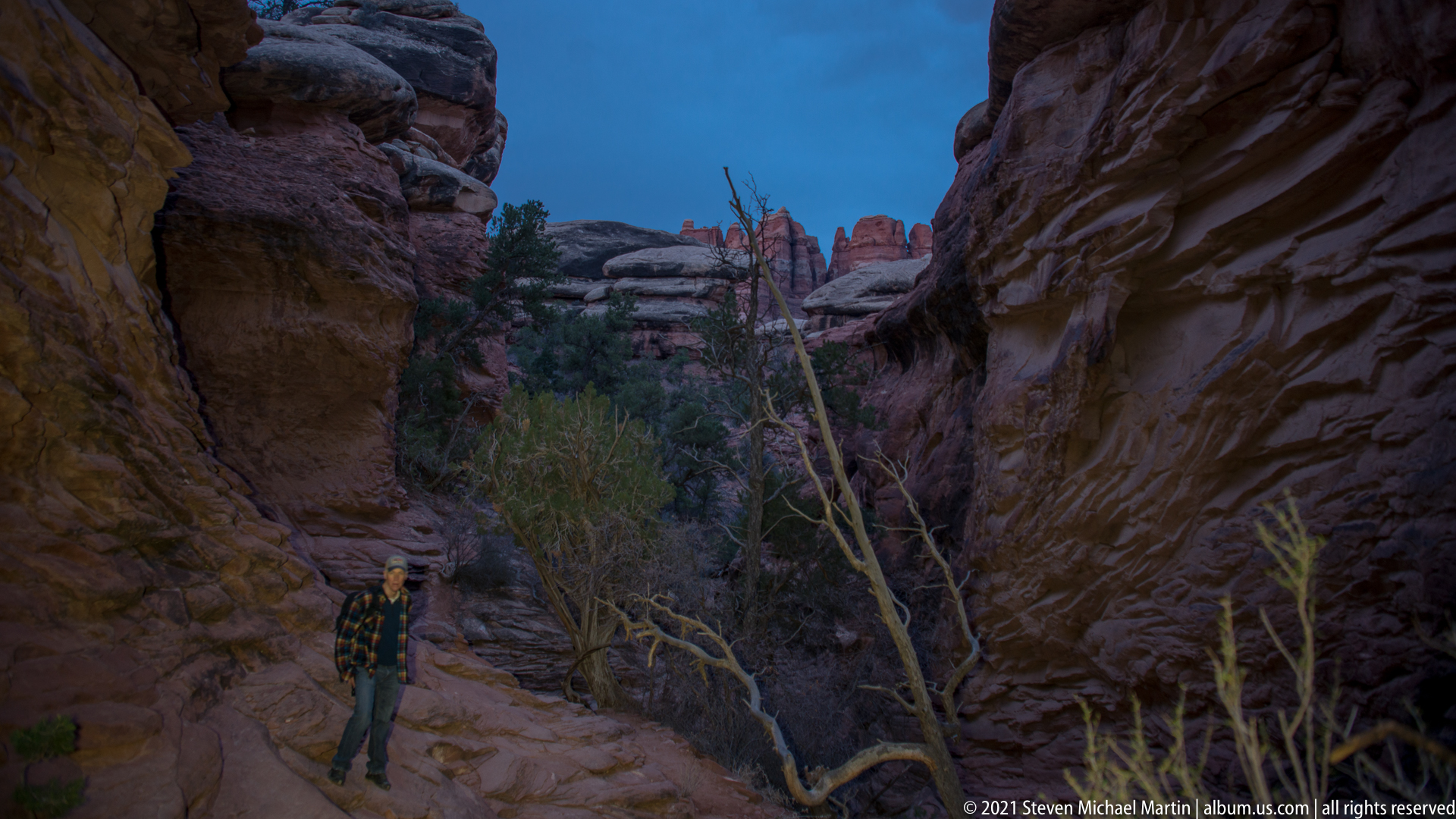
A hiker stands at the left edge of a rocky corridor, with a narrow route continuing past brush and sandstone toward distant formations. The dim blue light and deep shadows suggest late evening, while the person’s jacket and stance provide scale against the enclosing walls. The composition places the traveler within, rather than beyond, the rugged passage.
Caption
A hiker stands at the left edge of a rocky corridor, with a narrow route continuing past brush and sandstone toward distant formations. The dim blue light and deep shadows suggest late evening, while the person’s jacket and stance provide scale against the enclosing walls. The composition places the traveler within, rather than beyond, the rugged passage.
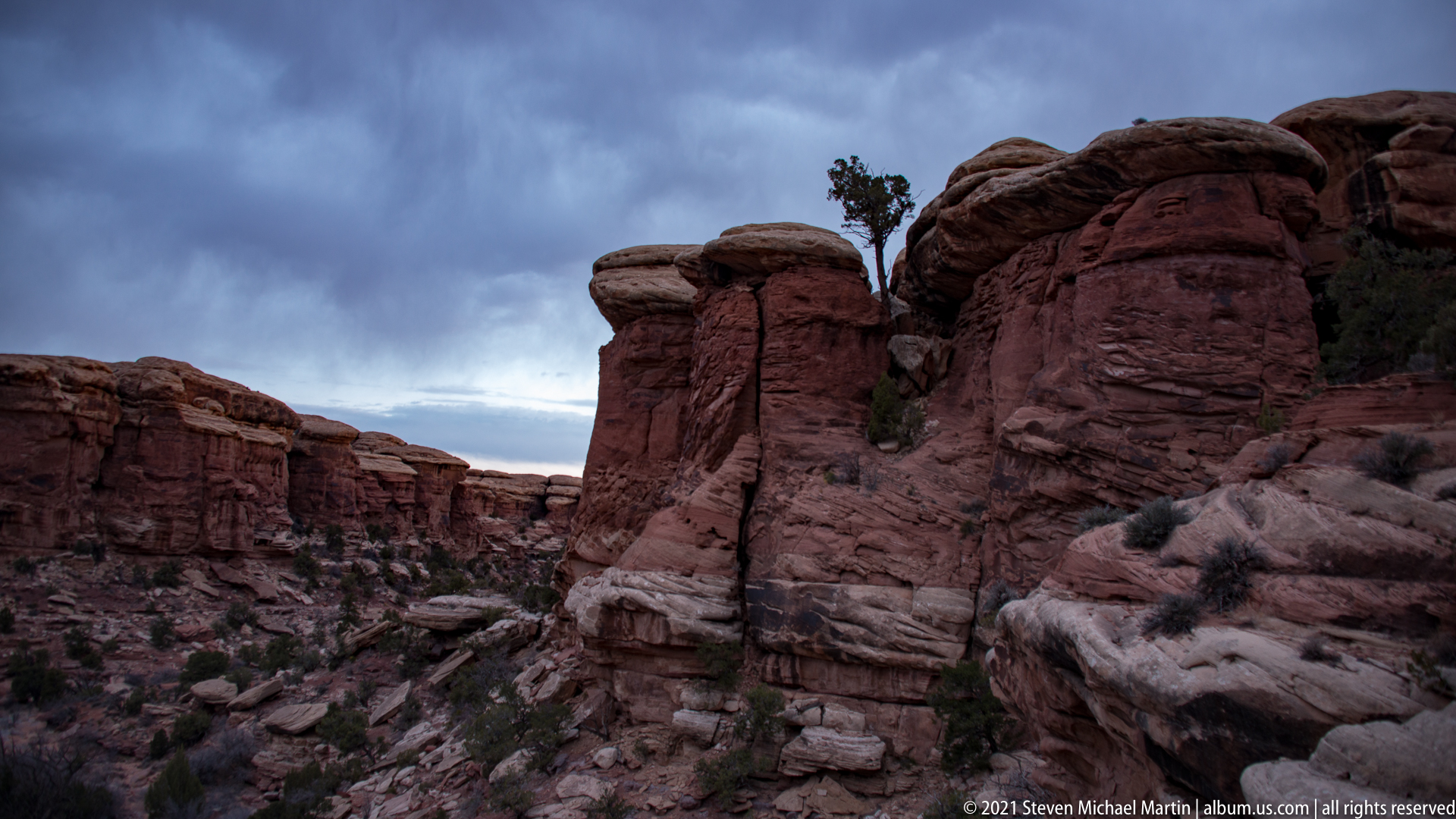
A cluster of red sandstone towers rises above a broken slope of ledges and scrub. Horizontal strata and rounded caps give the formations a stacked appearance, while a lone tree stands on a high point near the center. Cloud-filtered daylight softens the red and brown tones and makes the relief of the rock faces legible.
Caption
A cluster of red sandstone towers rises above a broken slope of ledges and scrub. Horizontal strata and rounded caps give the formations a stacked appearance, while a lone tree stands on a high point near the center. Cloud-filtered daylight softens the red and brown tones and makes the relief of the rock faces legible.
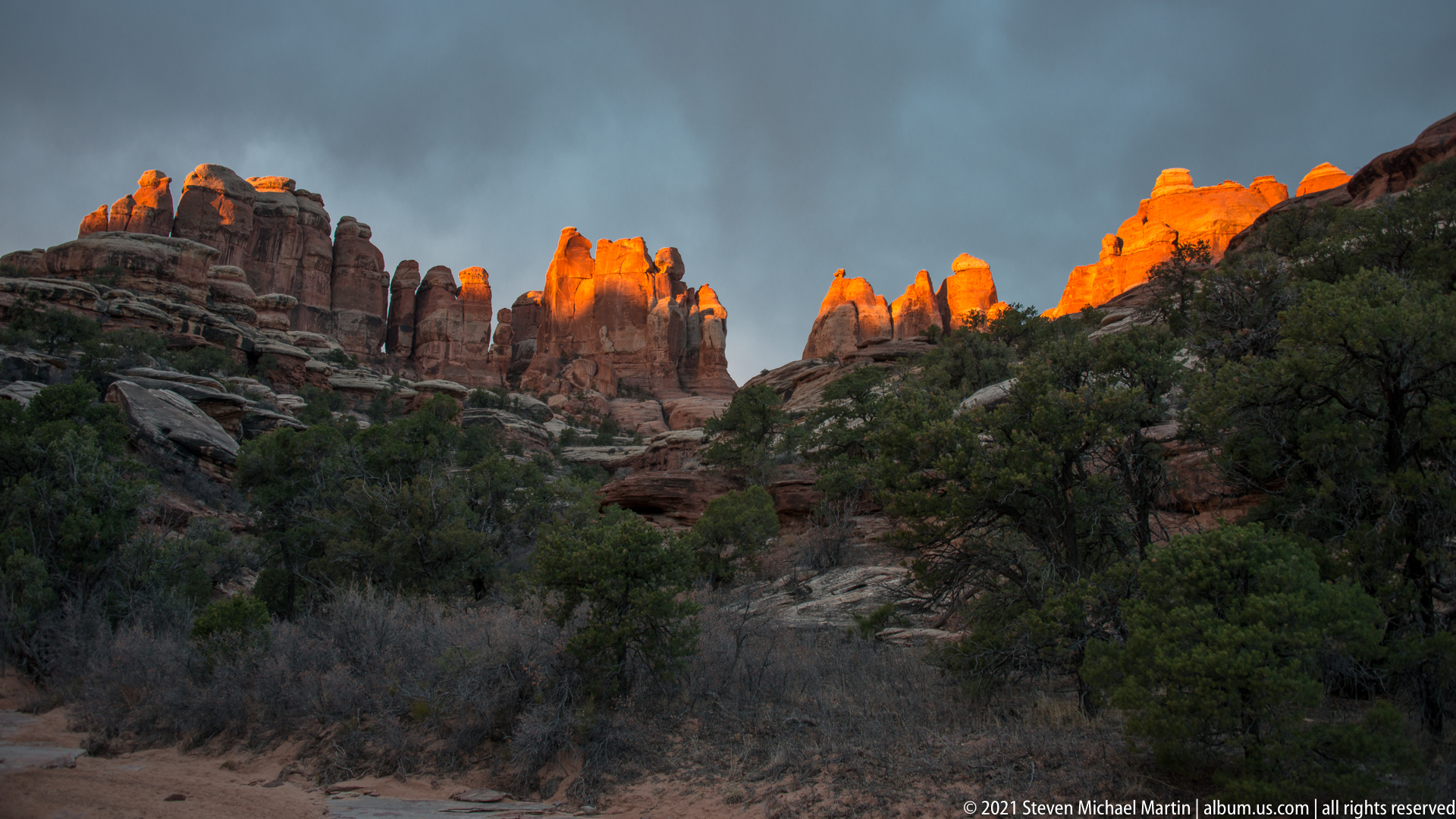
Low-angle sunlight catches the tops of a row of sandstone spires, turning them vivid orange against a gray-blue clouded sky. The shaded slope and scattered shrubs remain subdued below, so the illuminated pinnacles carry the composition. Their varied heights and narrow forms show the eroded skyline characteristic of The Needles district.
Caption
Low-angle sunlight catches the tops of a row of sandstone spires, turning them vivid orange against a gray-blue clouded sky. The shaded slope and scattered shrubs remain subdued below, so the illuminated pinnacles carry the composition. Their varied heights and narrow forms show the eroded skyline characteristic of The Needles district.
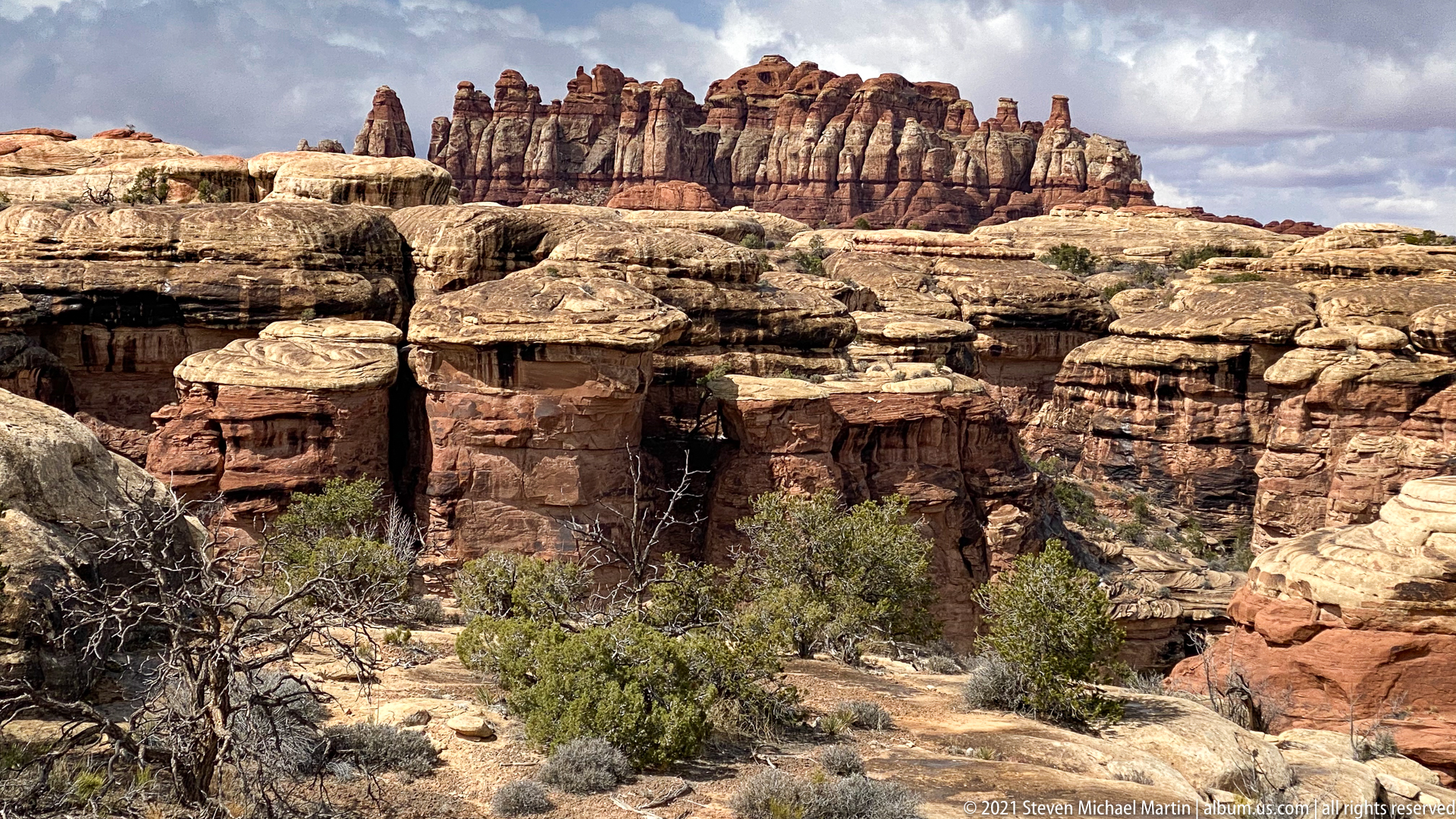
Cream and red sandstone ledges step across the middle distance, their horizontal bands interrupted by shrubs and narrow gullies. A dense line of reddish towers rises behind the broken foreground, with distant mesas visible beneath the clouded sky. The photograph draws attention to the transition from low, rounded ledges to the taller Needles skyline.
Caption
Cream and red sandstone ledges step across the middle distance, their horizontal bands interrupted by shrubs and narrow gullies. A dense line of reddish towers rises behind the broken foreground, with distant mesas visible beneath the clouded sky. The photograph draws attention to the transition from low, rounded ledges to the taller Needles skyline.
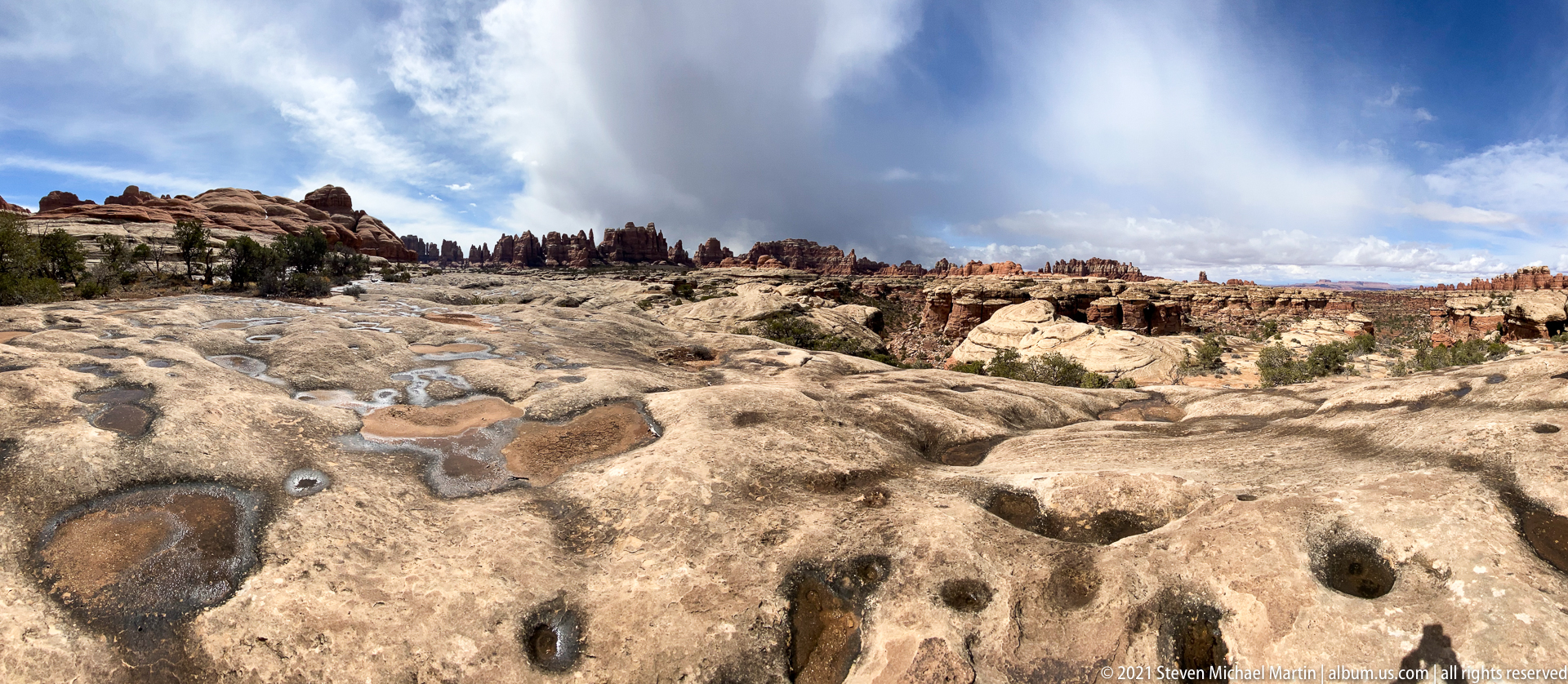
From a low, broad viewpoint, dark shallow basins spread across a pale slickrock surface, their irregular edges contrasting with the smoother bedrock. Red towers line the distance beneath towering clouds, and a narrow trail of rock crosses the foreground. The repeated hollows turn the exposed surface into a textured foreground for the larger landscape.
Caption
From a low, broad viewpoint, dark shallow basins spread across a pale slickrock surface, their irregular edges contrasting with the smoother bedrock. Red towers line the distance beneath towering clouds, and a narrow trail of rock crosses the foreground. The repeated hollows turn the exposed surface into a textured foreground for the larger landscape.
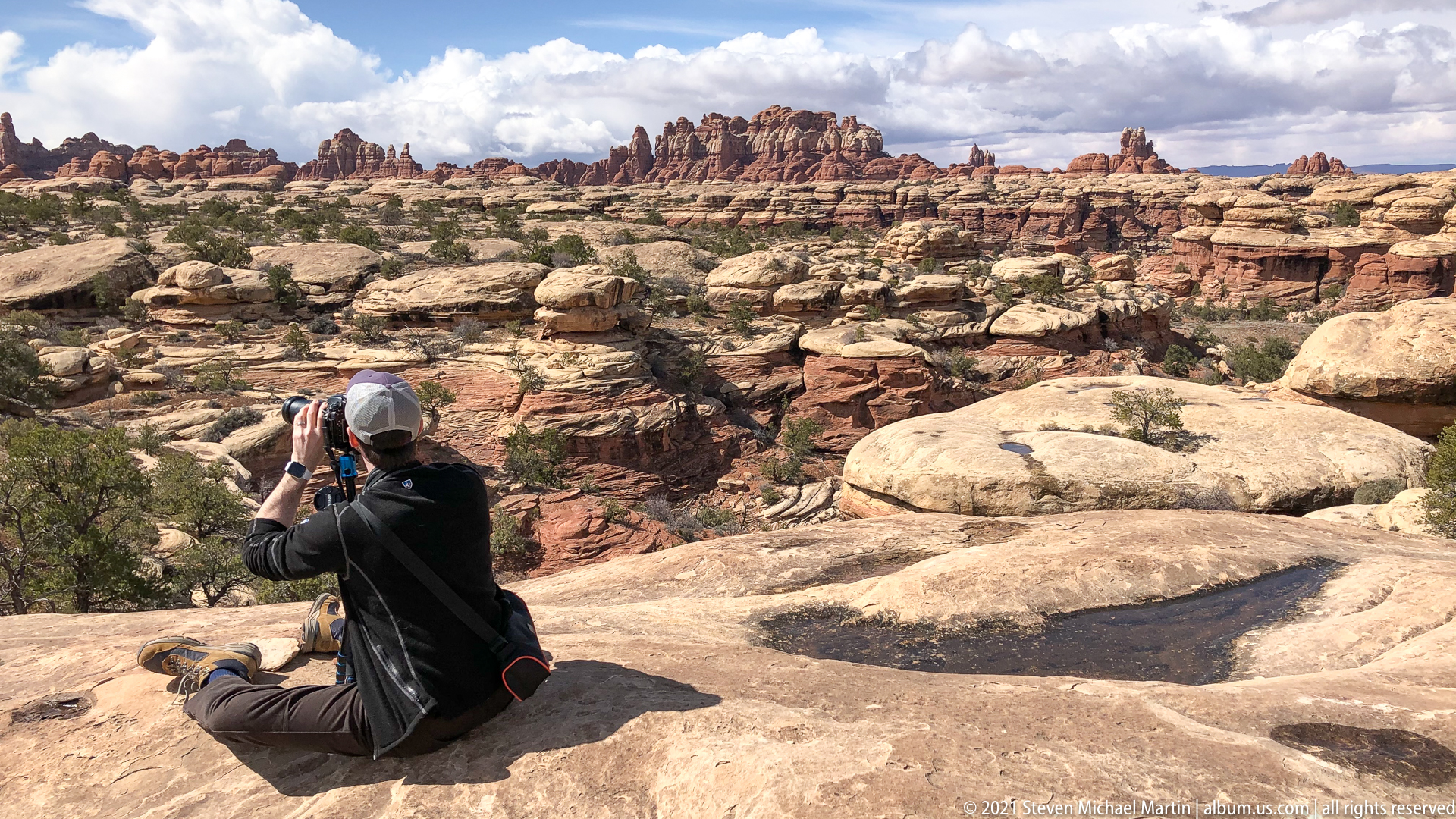
A photographer sits on a smooth rock slab with a camera raised toward the panorama. The broad view behind him contains pale slickrock, red ledges, scattered shrubs, and a distant skyline of sandstone pinnacles. His posture makes the act of looking part of the scene, while the landscape remains the principal subject.
Caption
A photographer sits on a smooth rock slab with a camera raised toward the panorama. The broad view behind him contains pale slickrock, red ledges, scattered shrubs, and a distant skyline of sandstone pinnacles. His posture makes the act of looking part of the scene, while the landscape remains the principal subject.
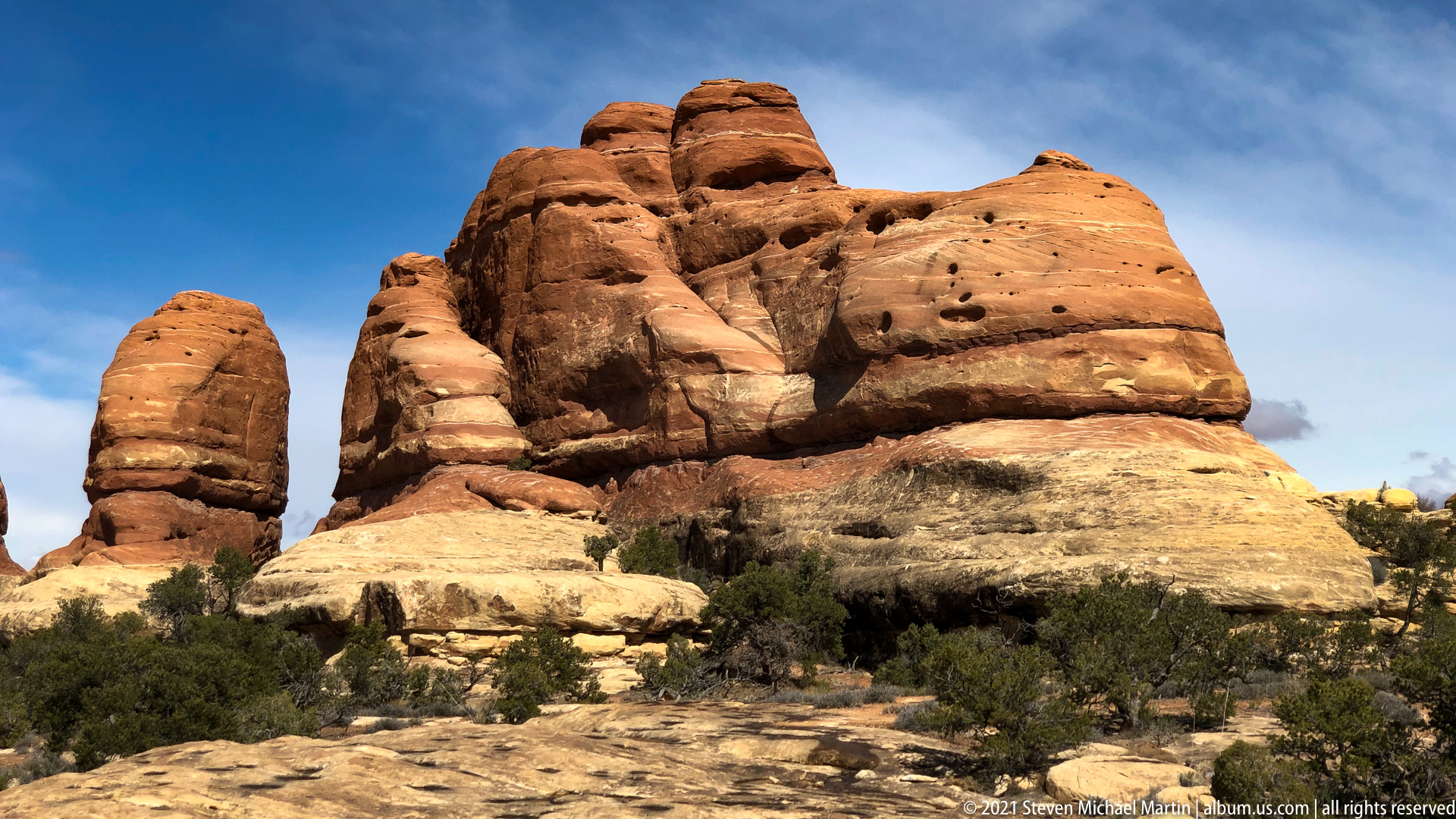
A rounded sandstone mass fills the frame, its stacked horizontal beds broken by shallow hollows, dark seams, and weathered ledges. The close viewpoint removes most of the wider landscape, directing attention to the rock’s layered structure and uneven surface. Strong daylight sharpens the contrast between warm red faces and pale bands.
Caption
A rounded sandstone mass fills the frame, its stacked horizontal beds broken by shallow hollows, dark seams, and weathered ledges. The close viewpoint removes most of the wider landscape, directing attention to the rock’s layered structure and uneven surface. Strong daylight sharpens the contrast between warm red faces and pale bands.
A hiker walks across pale bedrock punctuated by shallow dark depressions, heading toward a long skyline of red pinnacles. The figure’s back faces the camera and casts a distinct shadow across the foreground. The combination of potholes, open rock, and distant Needles makes the route’s exposed character especially clear.
Caption
A hiker walks across pale bedrock punctuated by shallow dark depressions, heading toward a long skyline of red pinnacles. The figure’s back faces the camera and casts a distinct shadow across the foreground. The combination of potholes, open rock, and distant Needles makes the route’s exposed character especially clear.
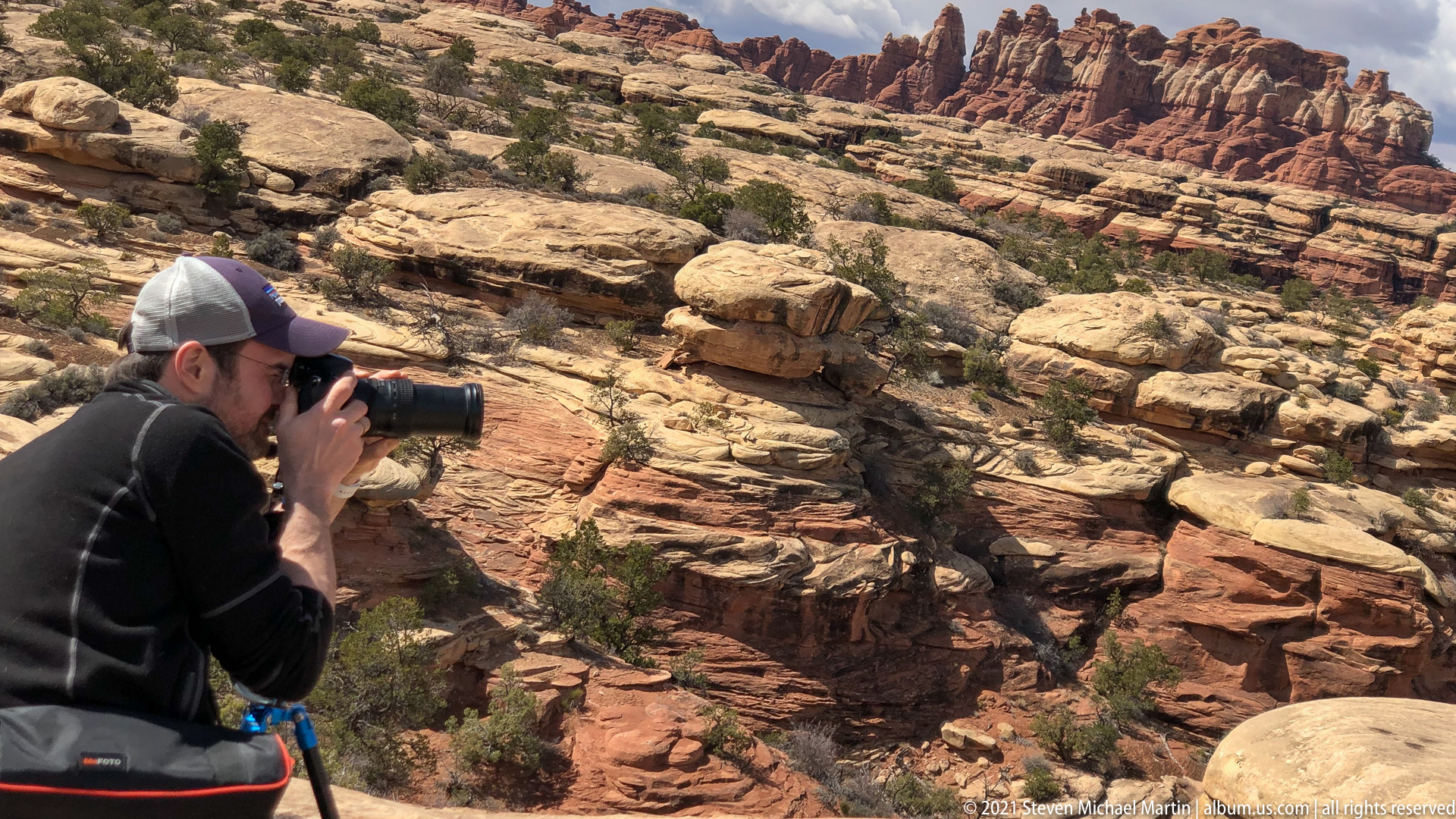
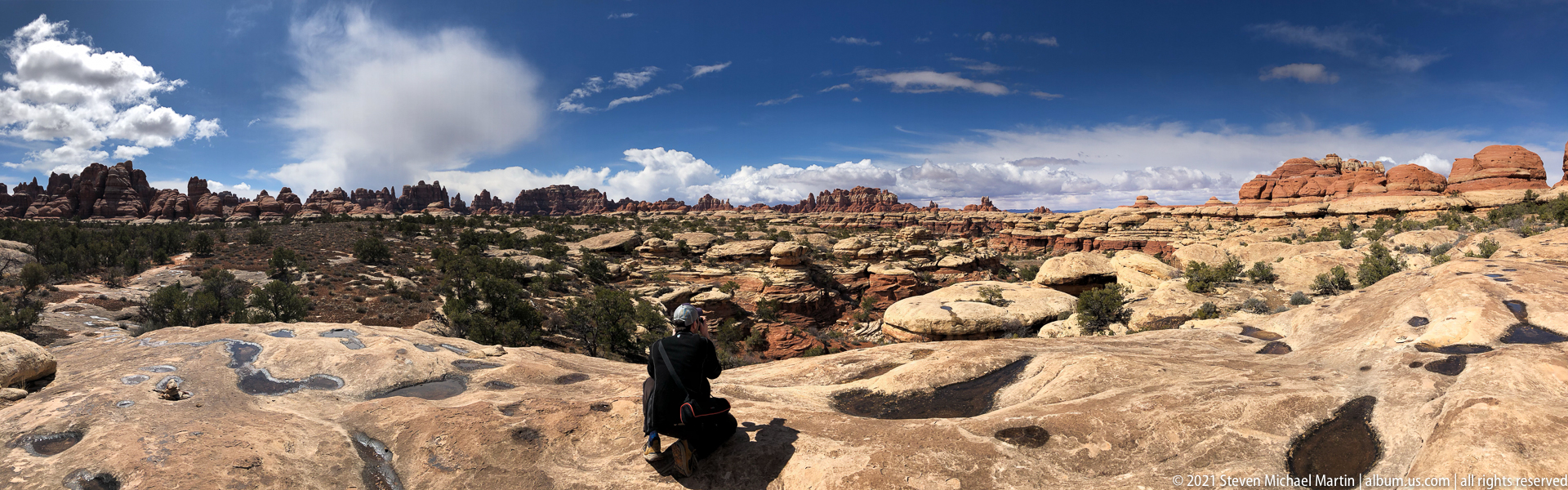
At the left foreground, a photographer crouches behind a camera and aims across a sandstone ravine. Layered red and cream ledges step down toward scrub-filled ground, with a long line of pinnacles beyond. The photographer’s low stance and equipment make the act of composing a landscape image visible within the broader view.
Caption
At the left foreground, a photographer crouches behind a camera and aims across a sandstone ravine. Layered red and cream ledges step down toward scrub-filled ground, with a long line of pinnacles beyond. The photographer’s low stance and equipment make the act of composing a landscape image visible within the broader view.
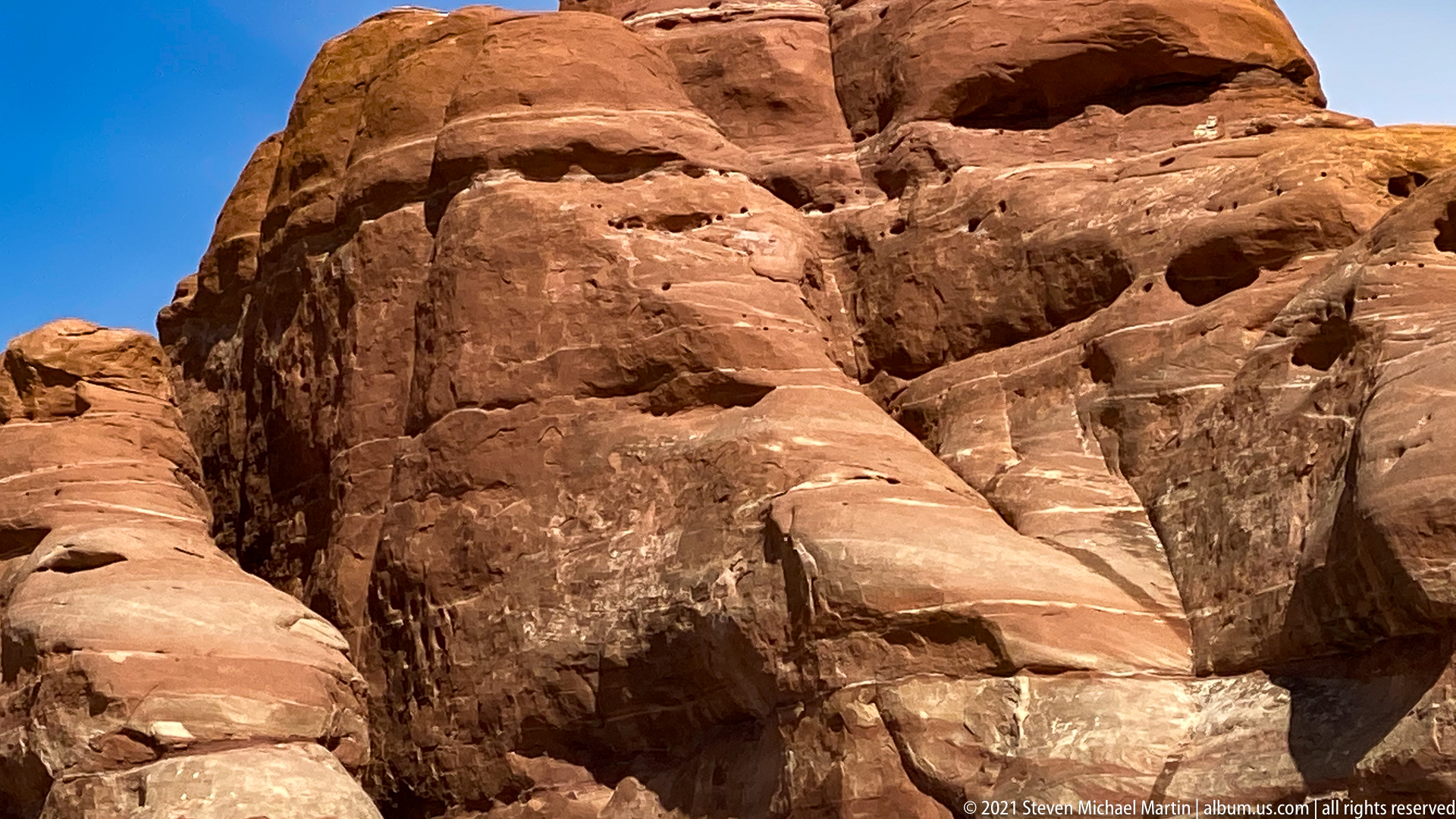
A close rock face displays broad bedding planes, shallow cavities, and irregular ledges in warm red and brown sandstone. A darker vertical seam runs down the center, while pale worn surfaces catch the sun along the lower edge. The tight crop turns the formation into a geological study of texture and erosion rather than a distant landmark view.
Caption
A close rock face displays broad bedding planes, shallow cavities, and irregular ledges in warm red and brown sandstone. A darker vertical seam runs down the center, while pale worn surfaces catch the sun along the lower edge. The tight crop turns the formation into a geological study of texture and erosion rather than a distant landmark view.

A wide sheet of pale sandstone extends toward low, flat-topped formations on the horizon. Dark shallow basins and sinuous seams pattern the foreground, while scattered shrubs interrupt the otherwise open rock. The low, level viewpoint stresses the continuity of the slickrock and its subtle surface relief.
Caption
A wide sheet of pale sandstone extends toward low, flat-topped formations on the horizon. Dark shallow basins and sinuous seams pattern the foreground, while scattered shrubs interrupt the otherwise open rock. The low, level viewpoint stresses the continuity of the slickrock and its subtle surface relief.
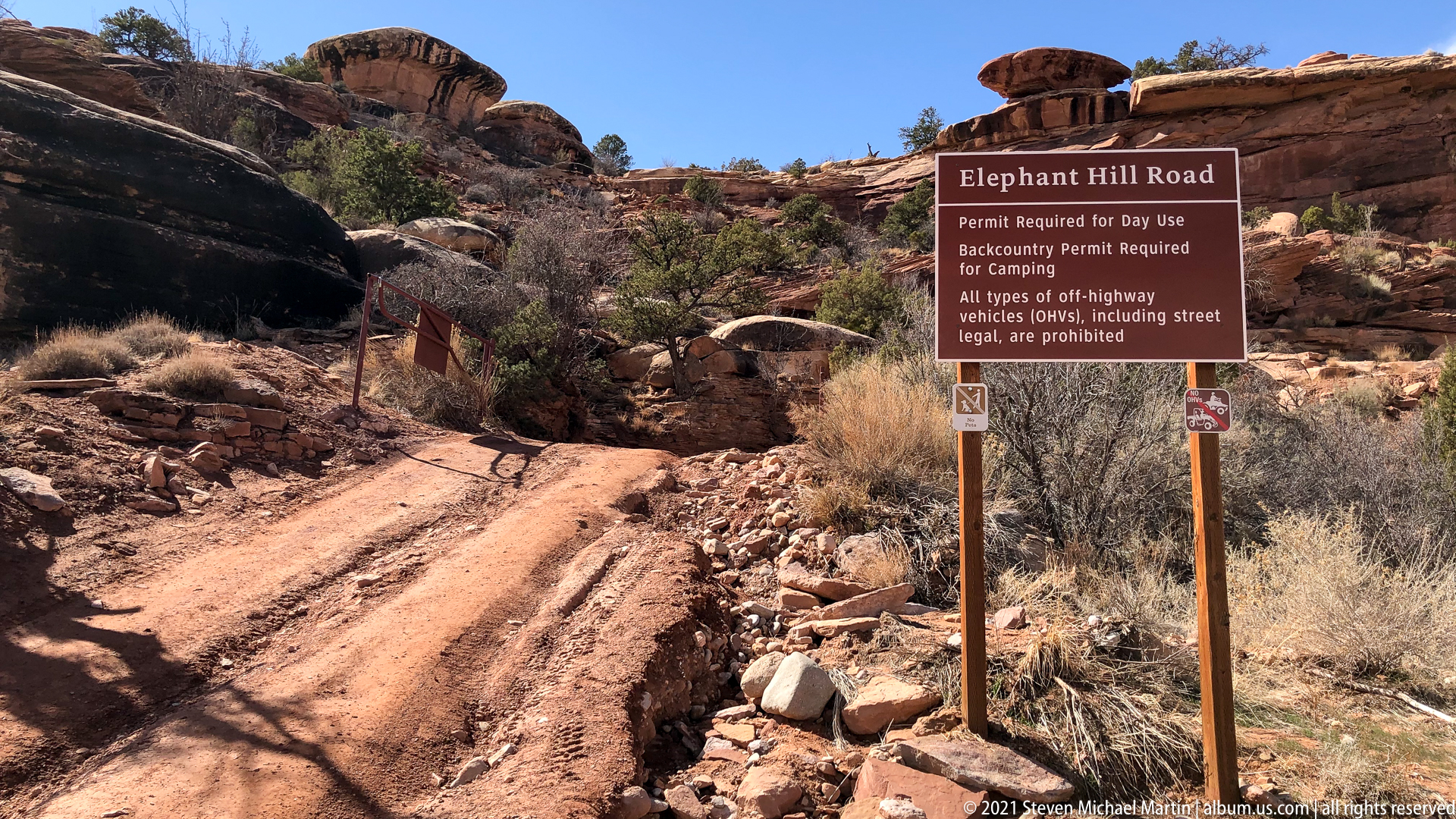
A brown sign beside a rough dirt track identifies Elephant Hill Road and lists permit requirements and restrictions on off-highway vehicles. The road climbs between sandstone outcrops and dry grasses, placing the notice directly within its backcountry setting. Smaller regulatory signs below reinforce that access here is managed and limited.
Caption
A brown sign beside a rough dirt track identifies Elephant Hill Road and lists permit requirements and restrictions on off-highway vehicles. The road climbs between sandstone outcrops and dry grasses, placing the notice directly within its backcountry setting. Smaller regulatory signs below reinforce that access here is managed and limited.
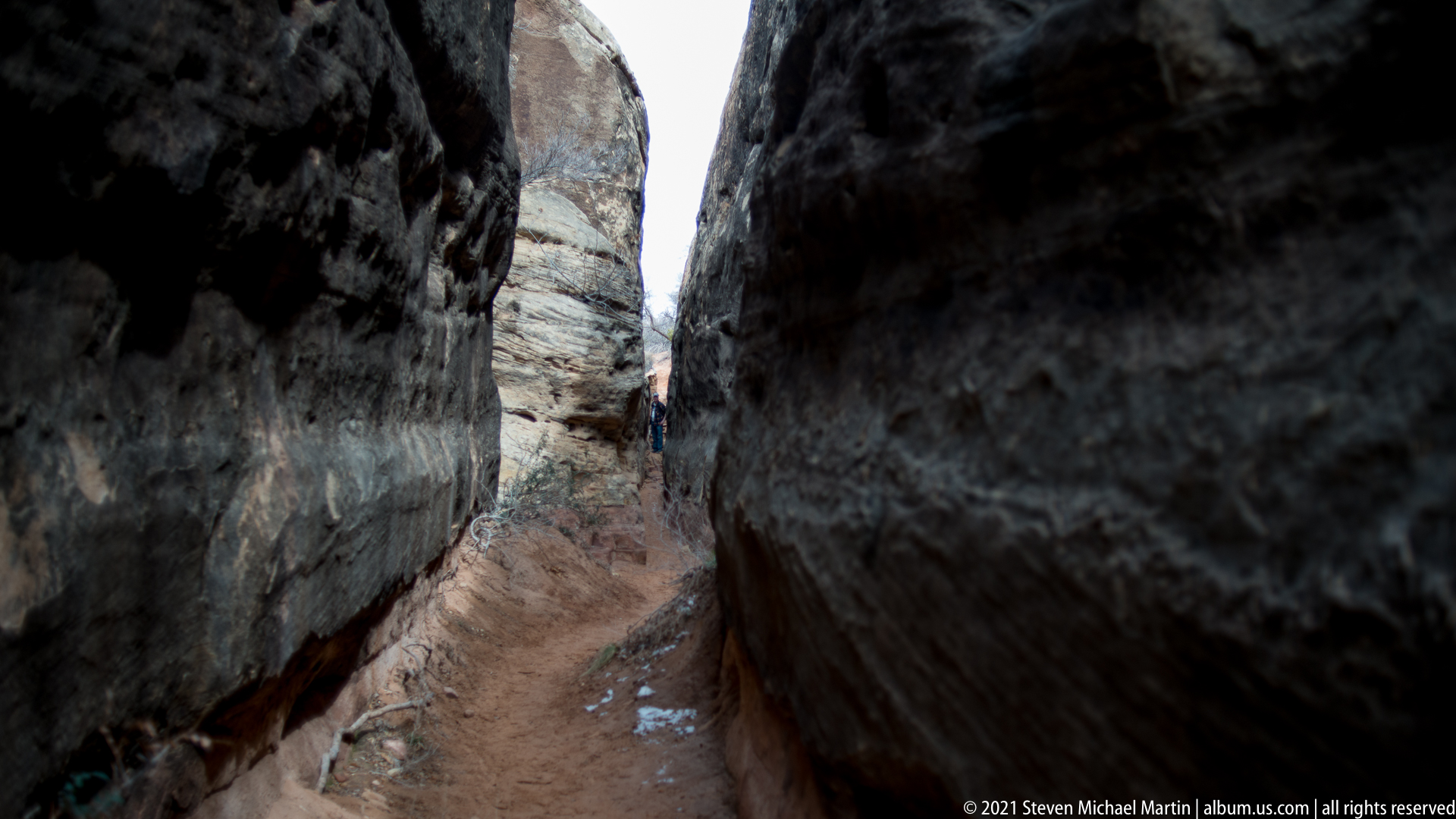
The view looks down a winding, narrow corridor between high dark sandstone walls. A small person stands near a brighter opening at the far end, giving the passage an immediate sense of depth and scale. The trail’s reddish floor bends through shadow, while pale sky and rock beyond mark the route’s exit.
Caption
The view looks down a winding, narrow corridor between high dark sandstone walls. A small person stands near a brighter opening at the far end, giving the passage an immediate sense of depth and scale. The trail’s reddish floor bends through shadow, while pale sky and rock beyond mark the route’s exit.
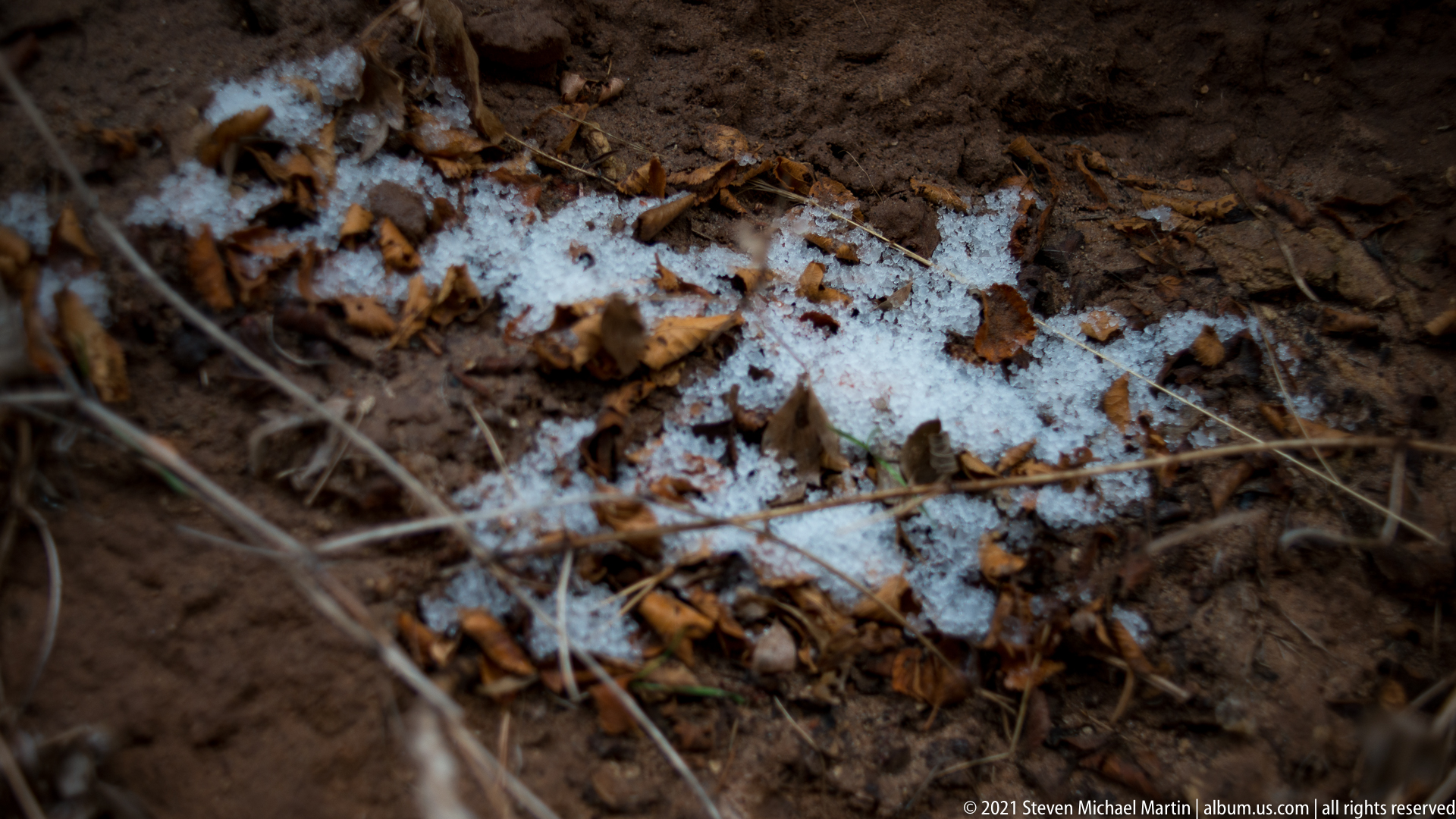
A thin patch of granular snow lies among brown leaves, twigs, and dark soil at close range. The irregular white edge contrasts with the damp forest floor, suggesting lingering cold in a sheltered spot. No larger landscape is visible, so the photograph reads as a seasonal detail along the trail rather than a broad canyon view.
Caption
A thin patch of granular snow lies among brown leaves, twigs, and dark soil at close range. The irregular white edge contrasts with the damp forest floor, suggesting lingering cold in a sheltered spot. No larger landscape is visible, so the photograph reads as a seasonal detail along the trail rather than a broad canyon view.
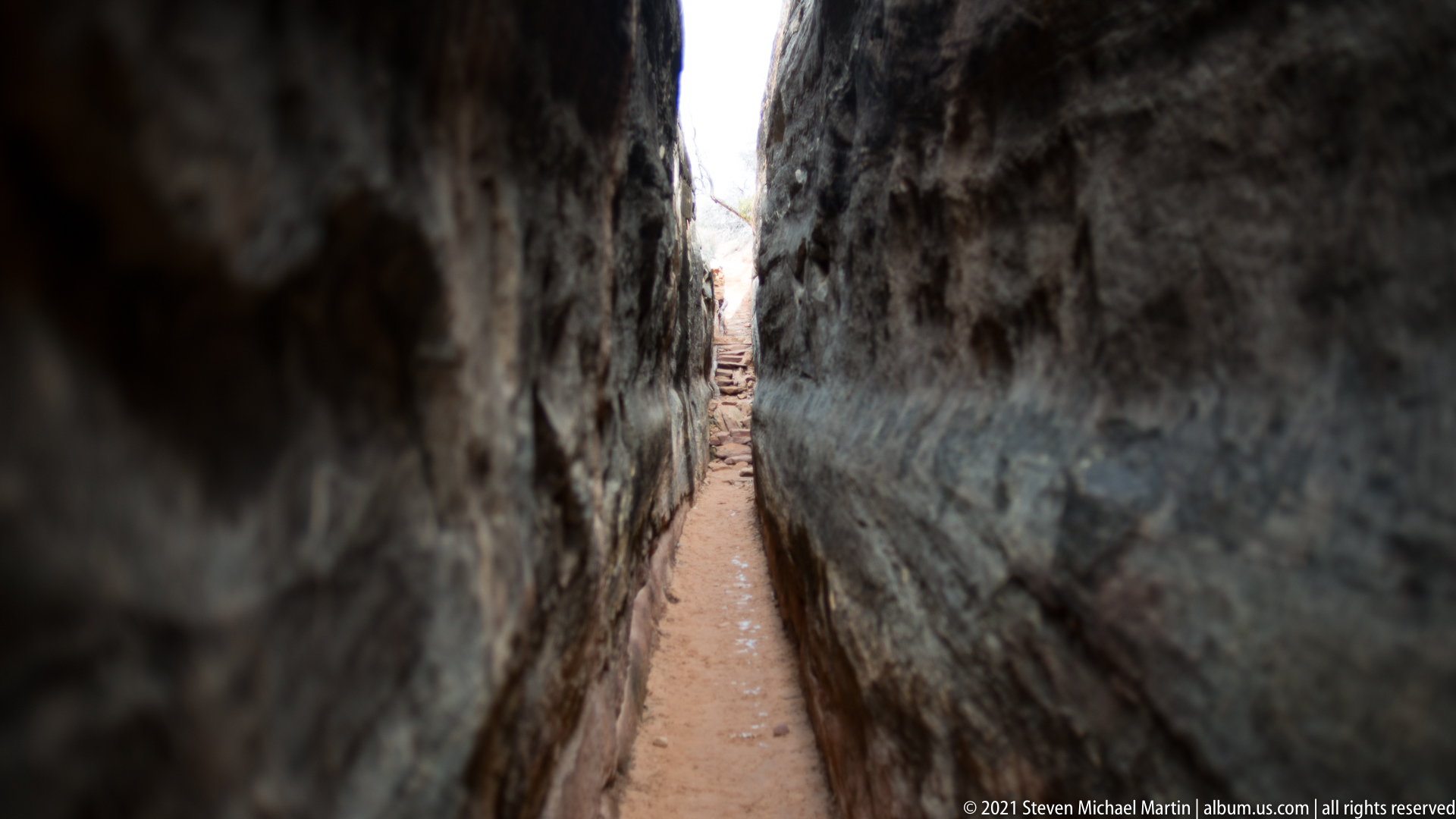
A straight, narrow path runs between close, shadowed sandstone walls toward a pale opening at the top of the frame. The walls fill nearly the entire view, creating strong parallel lines and a tunnel-like perspective. The reddish trail floor remains visible as a thin strip, emphasizing how little room the passage leaves for movement.
Caption
A straight, narrow path runs between close, shadowed sandstone walls toward a pale opening at the top of the frame. The walls fill nearly the entire view, creating strong parallel lines and a tunnel-like perspective. The reddish trail floor remains visible as a thin strip, emphasizing how little room the passage leaves for movement.
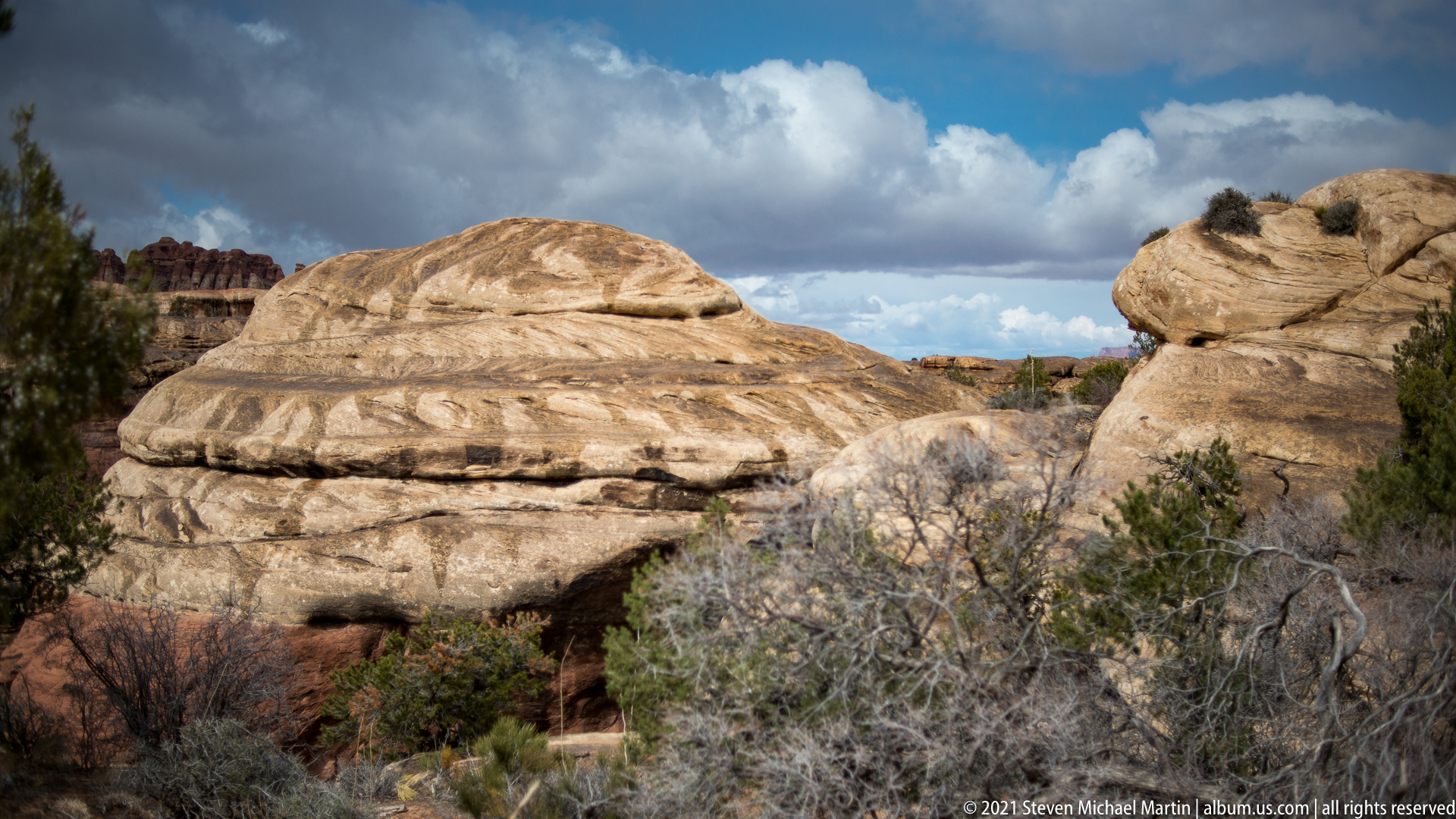
A broad, rounded sandstone outcrop rises above brush and low juniper, its pale layers exposed beneath a weathered cap. Darker rock shelves extend behind it and a cluster of taller red formations appears at the far edge. Cloud shadows deepen the foreground while sun reaches the upper stone, creating a shifting contrast across this quiet canyon view.
Caption
A broad, rounded sandstone outcrop rises above brush and low juniper, its pale layers exposed beneath a weathered cap. Darker rock shelves extend behind it and a cluster of taller red formations appears at the far edge. Cloud shadows deepen the foreground while sun reaches the upper stone, creating a shifting contrast across this quiet canyon view.
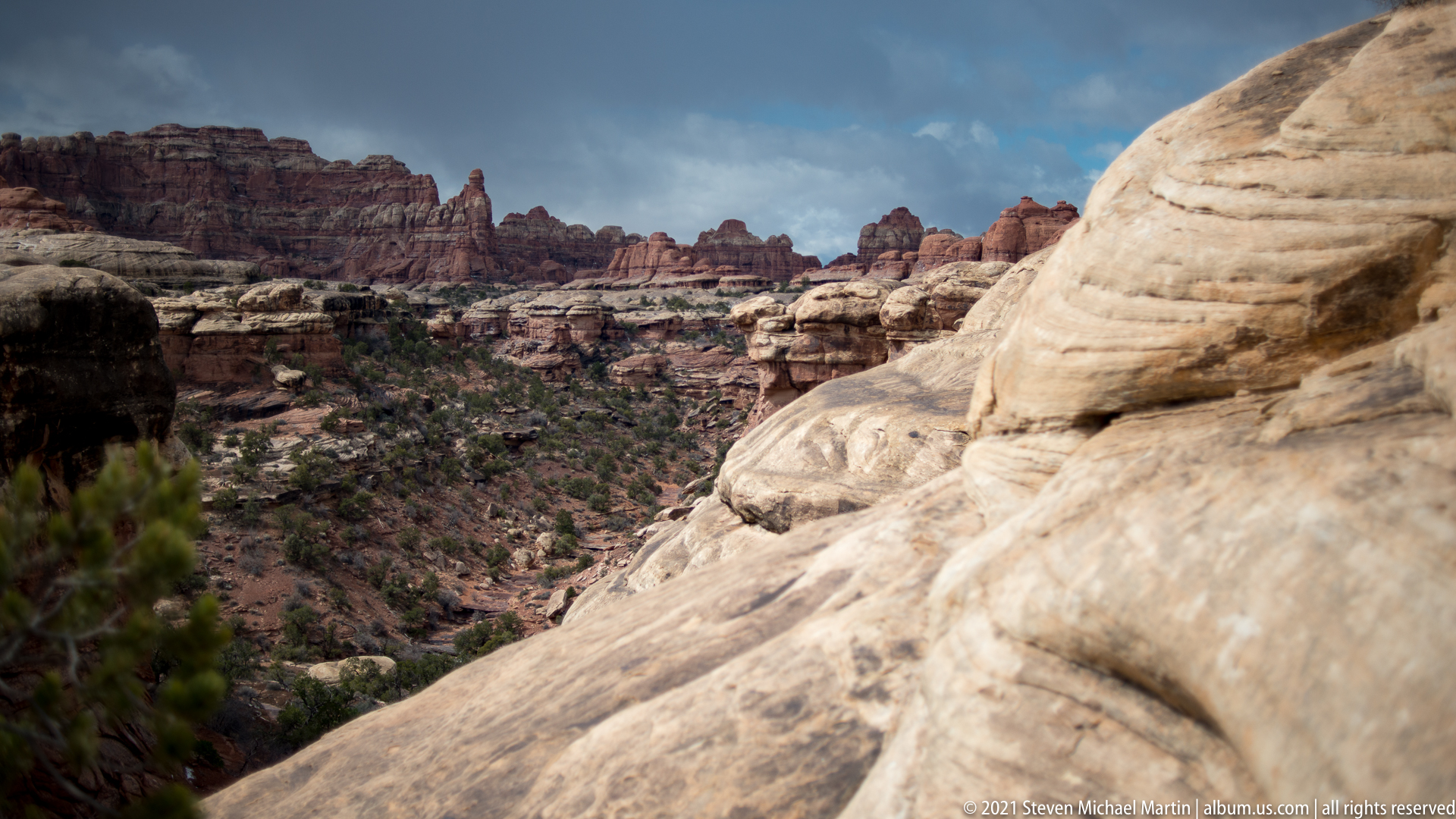
Pale slickrock fills the right foreground and slopes toward a broad canyon of red mesas and broken towers. A low juniper-covered slope descends through the center, while a darker cliff band runs across the distant horizon. The elevated viewpoint connects the smooth, close rock with the deeper canyon beyond.
Caption
Pale slickrock fills the right foreground and slopes toward a broad canyon of red mesas and broken towers. A low juniper-covered slope descends through the center, while a darker cliff band runs across the distant horizon. The elevated viewpoint connects the smooth, close rock with the deeper canyon beyond.
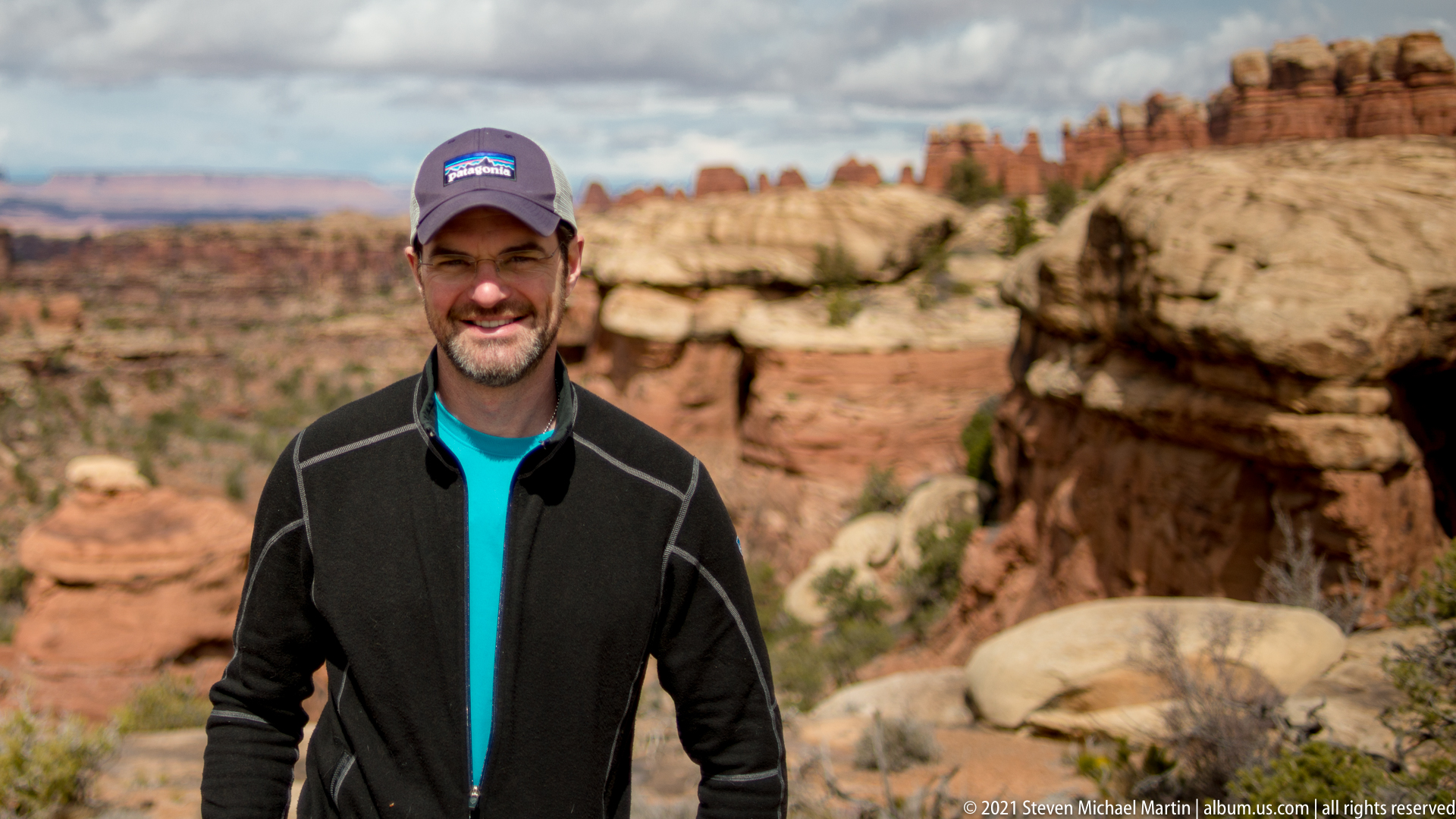
A smiling visitor in a baseball cap and dark jacket fills the foreground, with a bright blue shirt visible beneath. The canyon’s red shelves and pale sandstone formations blur behind him, keeping the portrait in focus while retaining its setting. This closer frame shifts from the overlook’s panorama to a personal moment on the trail.
Caption
A smiling visitor in a baseball cap and dark jacket fills the foreground, with a bright blue shirt visible beneath. The canyon’s red shelves and pale sandstone formations blur behind him, keeping the portrait in focus while retaining its setting. This closer frame shifts from the overlook’s panorama to a personal moment on the trail.

A twisted dead branch lies diagonally across a broad slickrock surface, its gray bark sharply detailed against the smooth brown stone. The background falls softly out of focus, revealing a low line of red formations and sparse vegetation. The close composition turns a small piece of trail-side deadwood into the foreground subject.
Caption
A twisted dead branch lies diagonally across a broad slickrock surface, its gray bark sharply detailed against the smooth brown stone. The background falls softly out of focus, revealing a low line of red formations and sparse vegetation. The close composition turns a small piece of trail-side deadwood into the foreground subject.
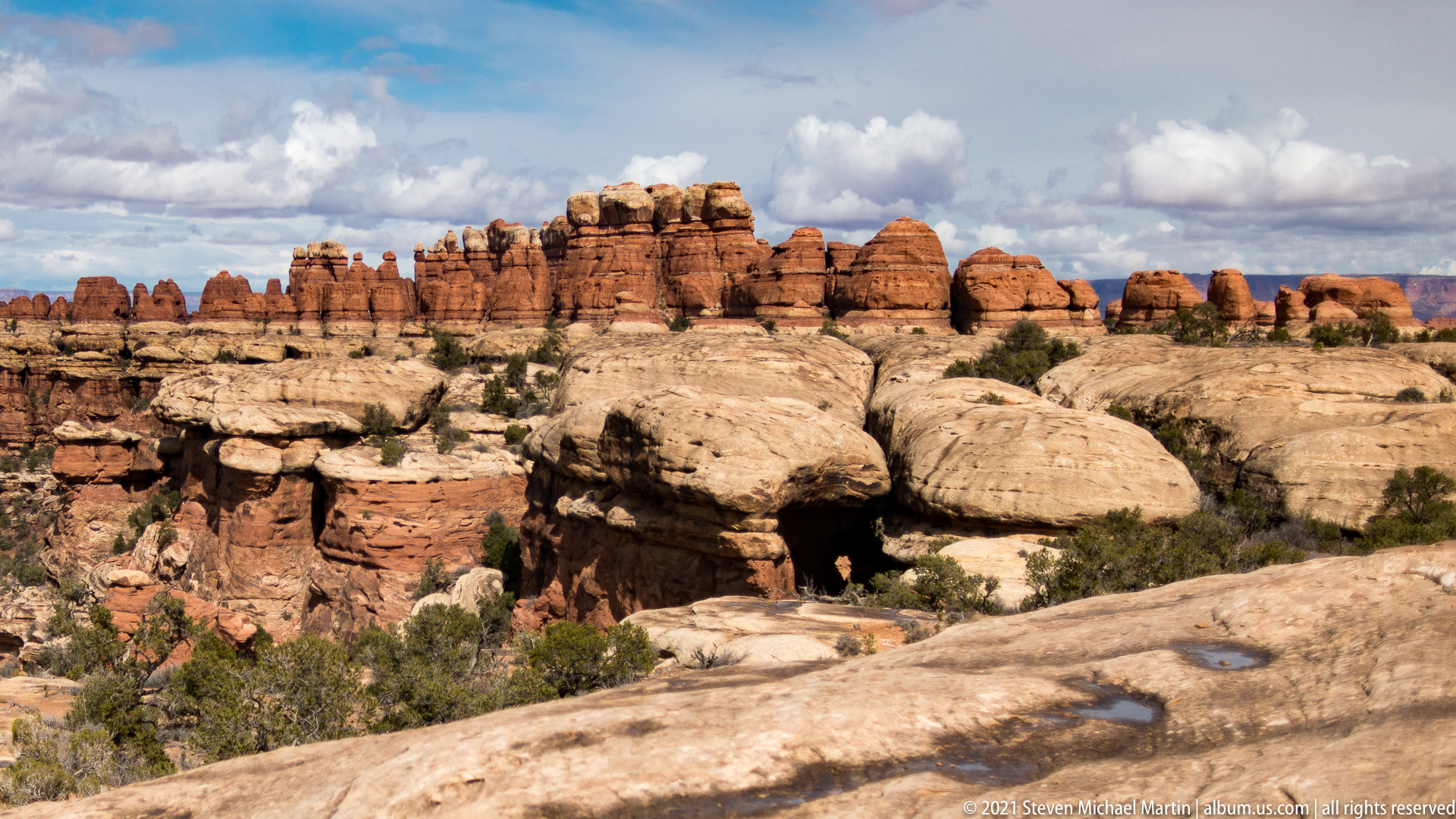
A line of rounded sandstone towers rises above darker canyon walls, each cap marked by red and pale horizontal bands. In front, pale slickrock shelves descend toward a shadowed opening and a small water-filled depression at right. The view layers the open plateau edge with the sculpted formations beyond.
Caption
A line of rounded sandstone towers rises above darker canyon walls, each cap marked by red and pale horizontal bands. In front, pale slickrock shelves descend toward a shadowed opening and a small water-filled depression at right. The view layers the open plateau edge with the sculpted formations beyond.
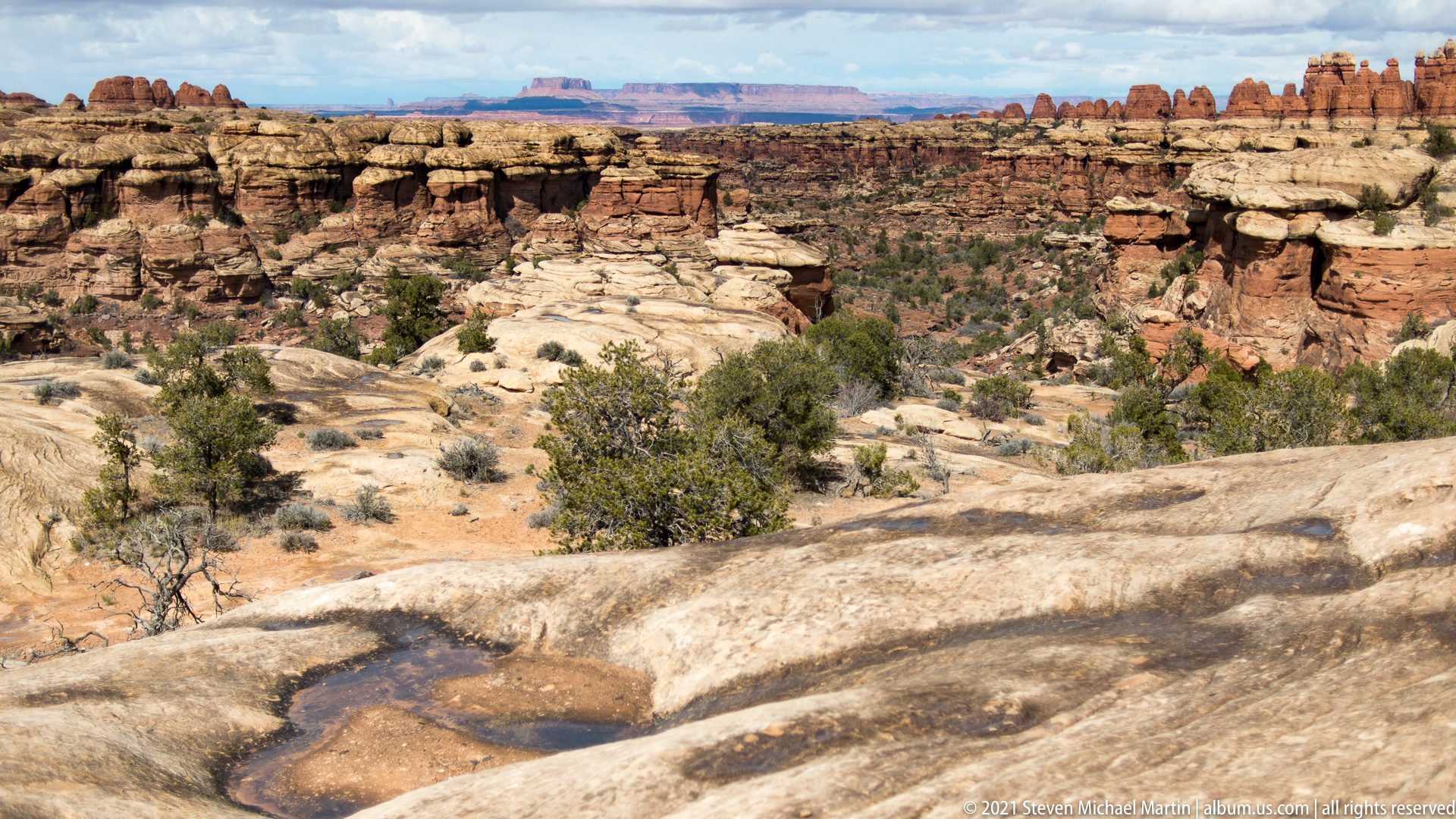
A shallow pool occupies a depression in the foreground slickrock, reflecting the open sky. Beyond it, the terrain drops into a maze of red mesas and pale sandstone benches, with juniper scattered along the slopes. The wide viewpoint shows the varied relief of the canyon country and places the small water pocket against the expansive terrain.
Caption
A shallow pool occupies a depression in the foreground slickrock, reflecting the open sky. Beyond it, the terrain drops into a maze of red mesas and pale sandstone benches, with juniper scattered along the slopes. The wide viewpoint shows the varied relief of the canyon country and places the small water pocket against the expansive terrain.
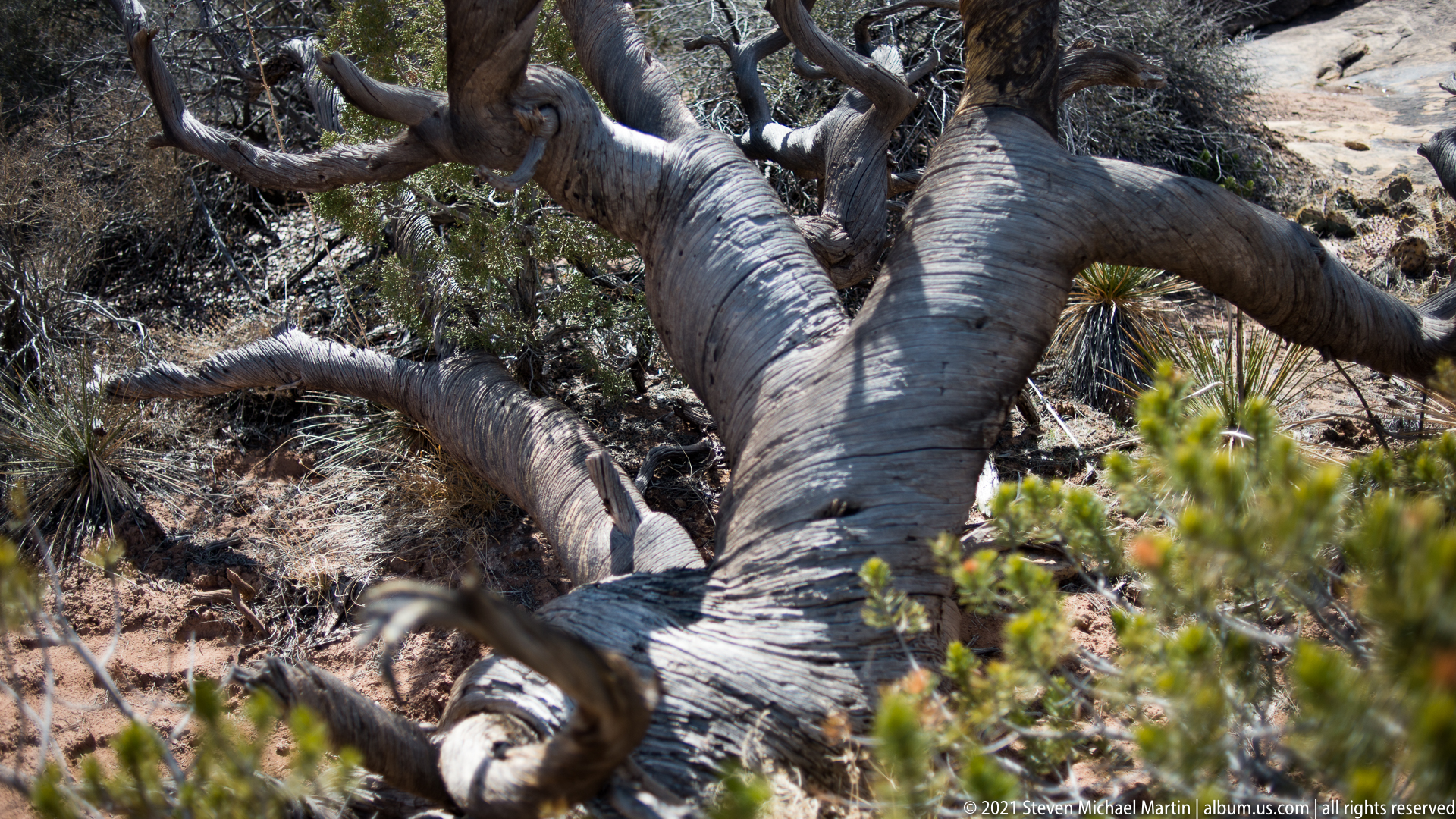
A mature juniper trunk forks into thick, twisted limbs that spread across the rocky slope. Its pale gray bark shows shallow ridges and weathering, while green needles and dry brush fill the background. The close viewpoint makes the tree’s contorted structure the focus, with surrounding stone and vegetation providing its dry canyon habitat.
Caption
A mature juniper trunk forks into thick, twisted limbs that spread across the rocky slope. Its pale gray bark shows shallow ridges and weathering, while green needles and dry brush fill the background. The close viewpoint makes the tree’s contorted structure the focus, with surrounding stone and vegetation providing its dry canyon habitat.
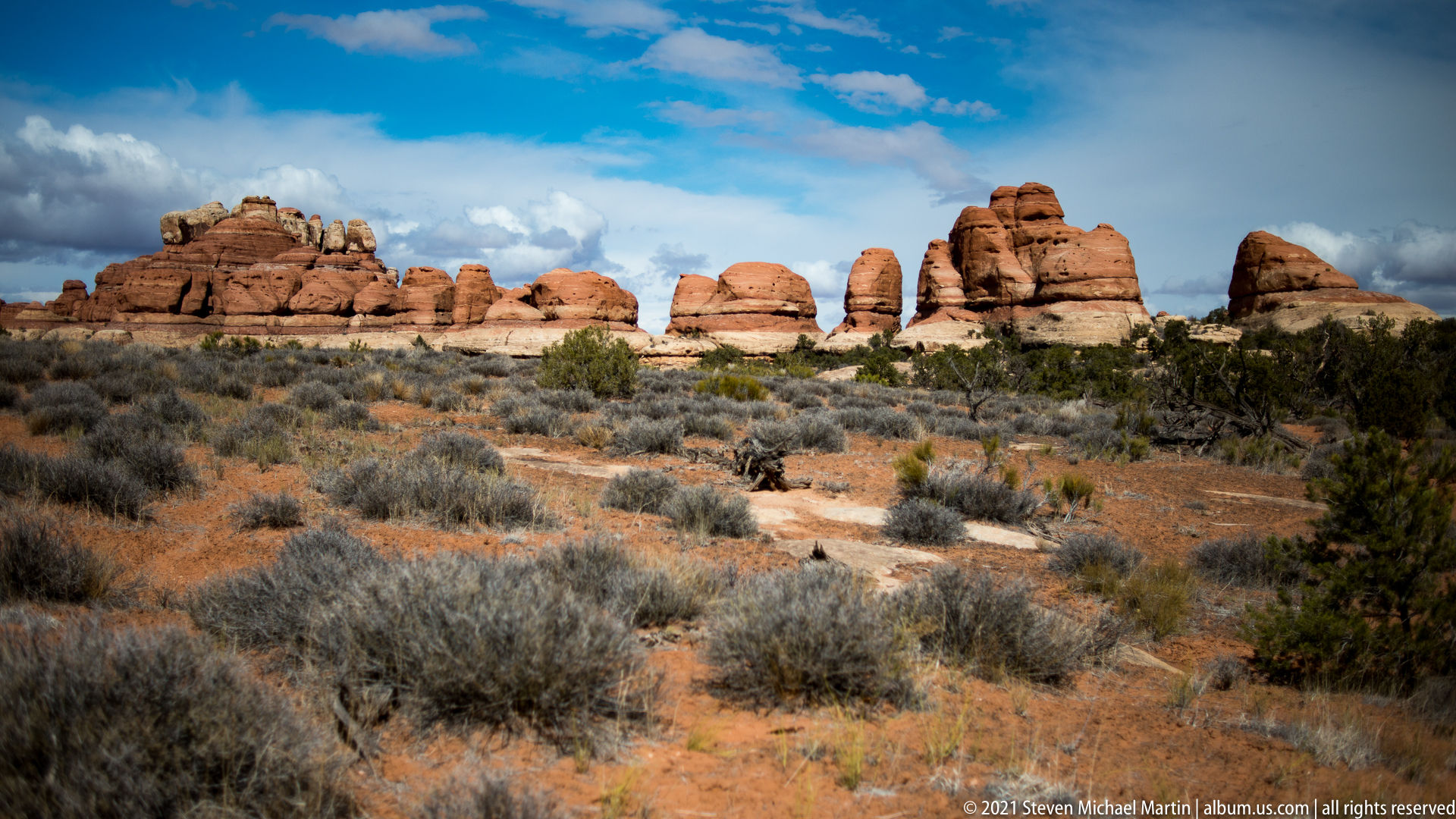
Rounded red and cream sandstone towers line the horizon beyond an open flat of gray-green shrubs and rusty soil. Cloud bands cross the blue sky, while the low viewpoint keeps the scrub plain broad across the foreground. This landscape emphasizes the transition from open vegetation to the clustered formations at the canyon rim.
Caption
Rounded red and cream sandstone towers line the horizon beyond an open flat of gray-green shrubs and rusty soil. Cloud bands cross the blue sky, while the low viewpoint keeps the scrub plain broad across the foreground. This landscape emphasizes the transition from open vegetation to the clustered formations at the canyon rim.
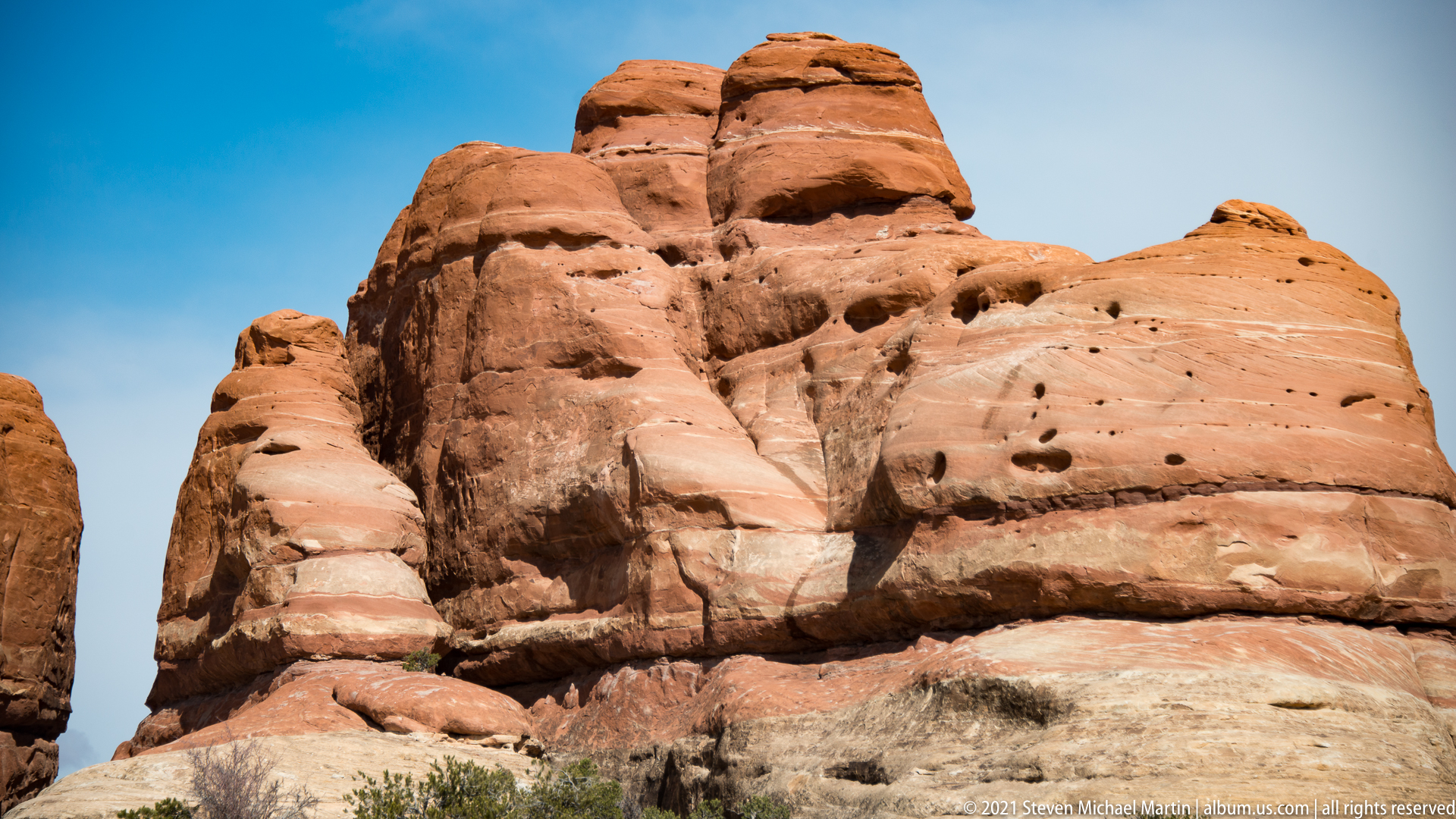
A close view fills the frame with rounded red sandstone towers, their broad cap layers separated by narrow darker seams. Small pits and streaks mark the weathered faces, while a blue sky strip appears above. The compressed composition foregrounds the surface texture and stacked forms rather than the surrounding canyon.
Caption
A close view fills the frame with rounded red sandstone towers, their broad cap layers separated by narrow darker seams. Small pits and streaks mark the weathered faces, while a blue sky strip appears above. The compressed composition foregrounds the surface texture and stacked forms rather than the surrounding canyon.
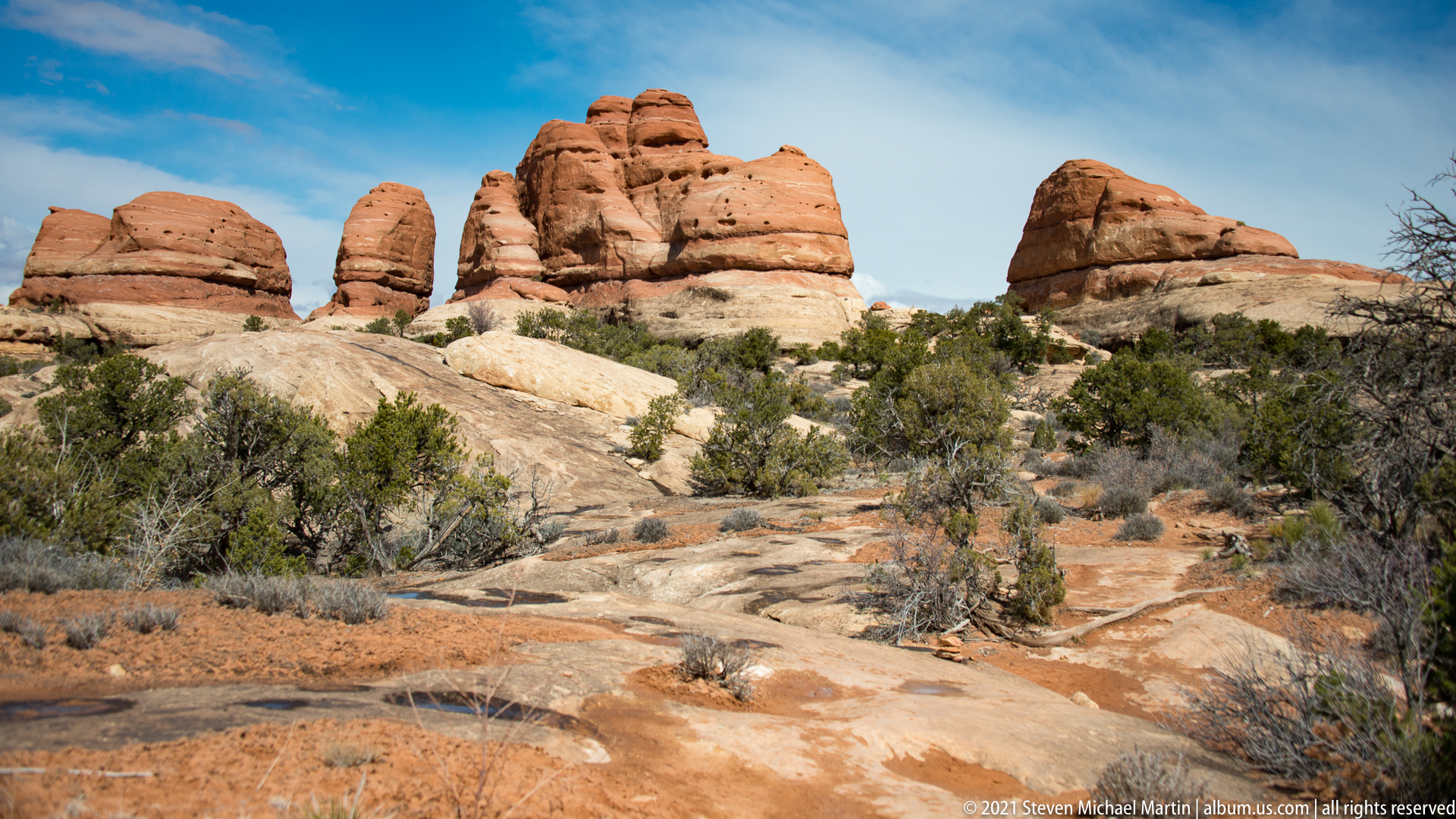
A series of rounded sandstone formations rises across the middle distance, with a larger banded tower at center and a lower cap-shaped rock at right. Pale slickrock shelves and scattered juniper fill the foreground. The arrangement draws the eye from the vegetation and exposed ledges toward the tallest formation without reducing the scene to a single rock.
Caption
A series of rounded sandstone formations rises across the middle distance, with a larger banded tower at center and a lower cap-shaped rock at right. Pale slickrock shelves and scattered juniper fill the foreground. The arrangement draws the eye from the vegetation and exposed ledges toward the tallest formation without reducing the scene to a single rock.
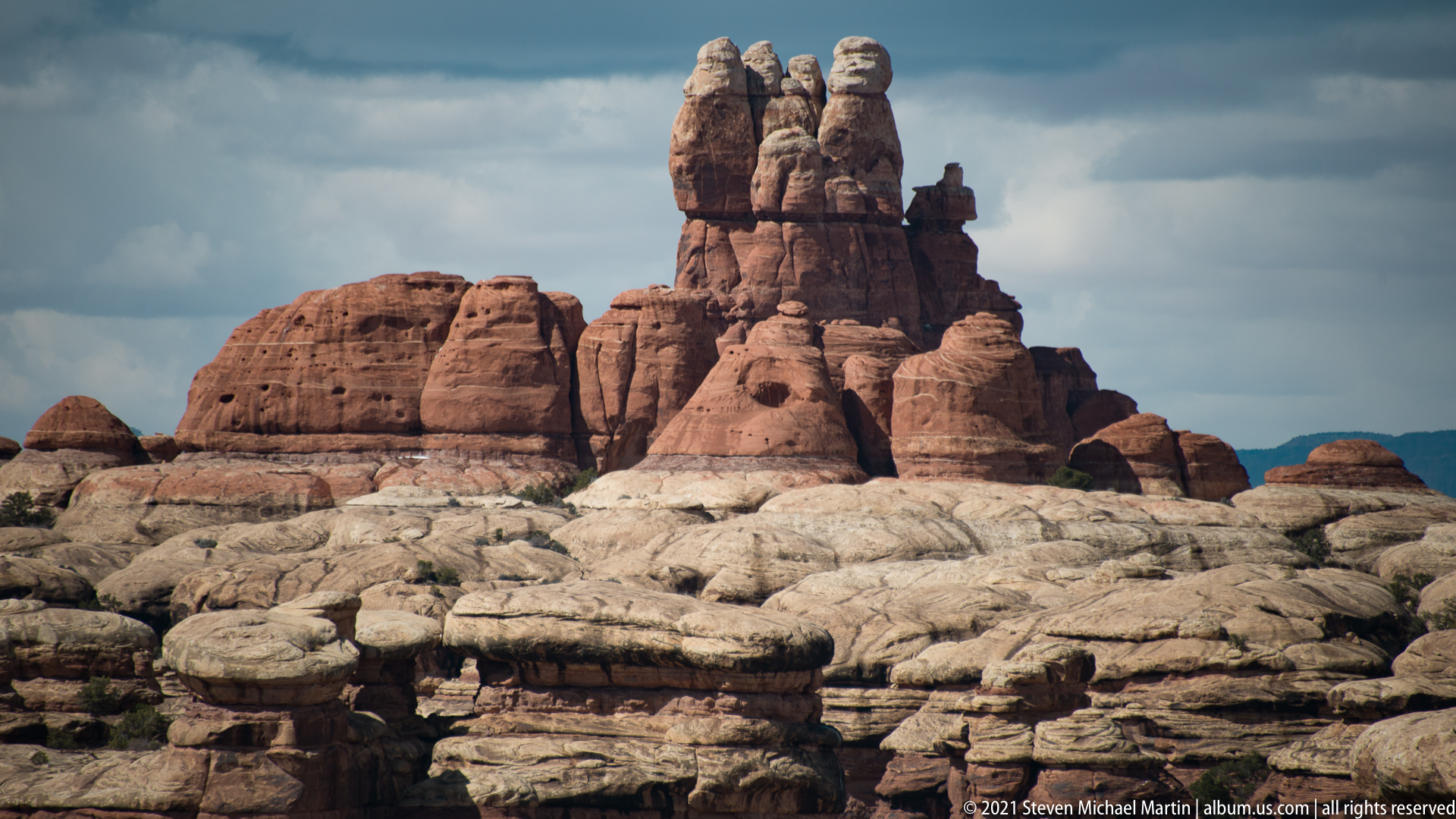
A tall cluster of narrow pinnacles rises from a broad mass of rounded red sandstone domes. Pale slickrock bands cross the lower foreground, creating a layered base beneath the vertical formation. Cloud-filtered light softens the scene, while the central spire remains the tallest feature in this view of the Needles landscape.
Caption
A tall cluster of narrow pinnacles rises from a broad mass of rounded red sandstone domes. Pale slickrock bands cross the lower foreground, creating a layered base beneath the vertical formation. Cloud-filtered light softens the scene, while the central spire remains the tallest feature in this view of the Needles landscape.
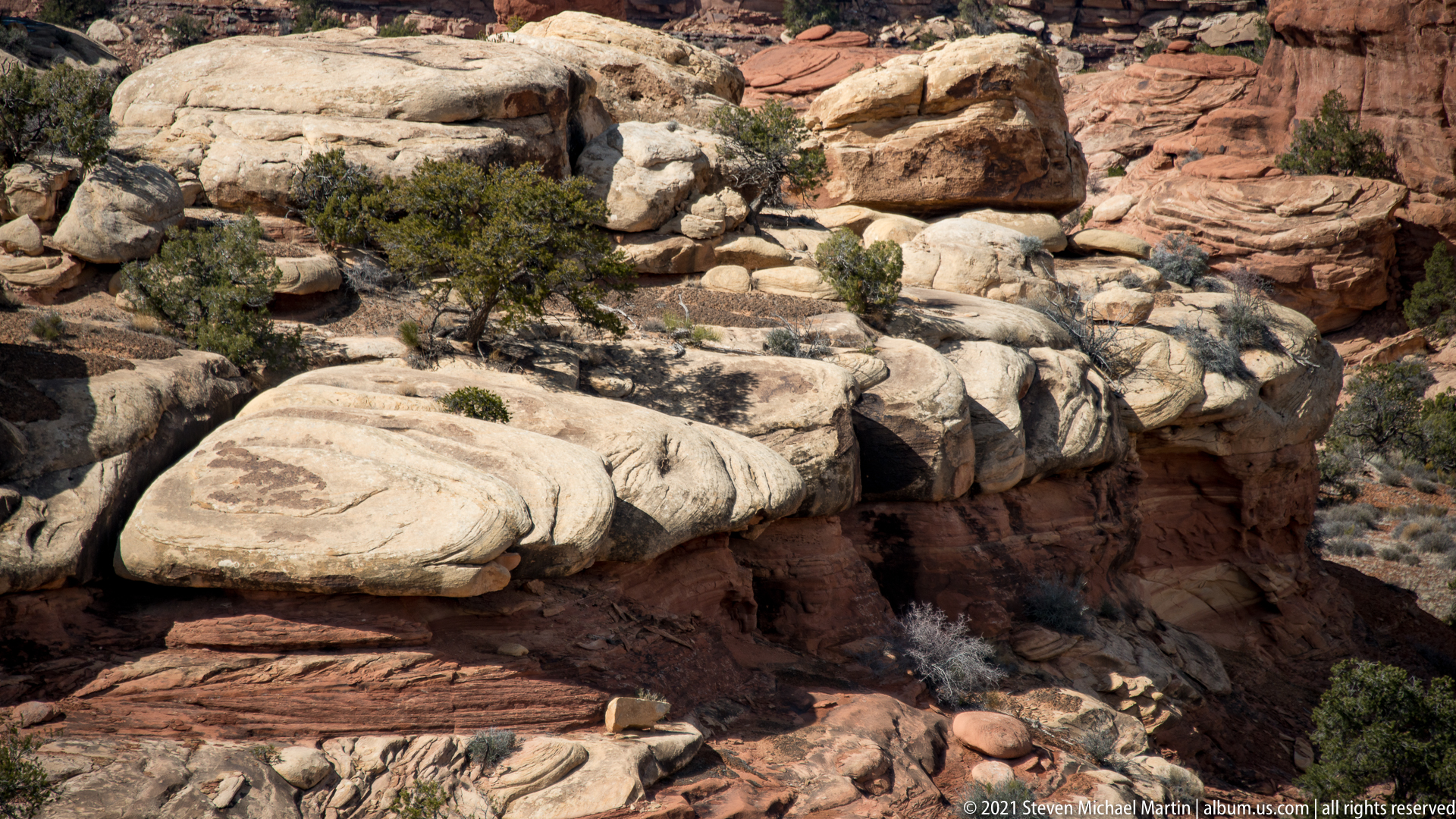
Broad pale sandstone slabs project outward above a dark, shadowed drop, their rounded edges undercut by erosion. Small junipers grow from fissures between the layers, and red rock is visible below the ledges. The close downward angle reveals the stacked structure and abrupt change from sunlit shelf to shaded canyon wall.
Caption
Broad pale sandstone slabs project outward above a dark, shadowed drop, their rounded edges undercut by erosion. Small junipers grow from fissures between the layers, and red rock is visible below the ledges. The close downward angle reveals the stacked structure and abrupt change from sunlit shelf to shaded canyon wall.
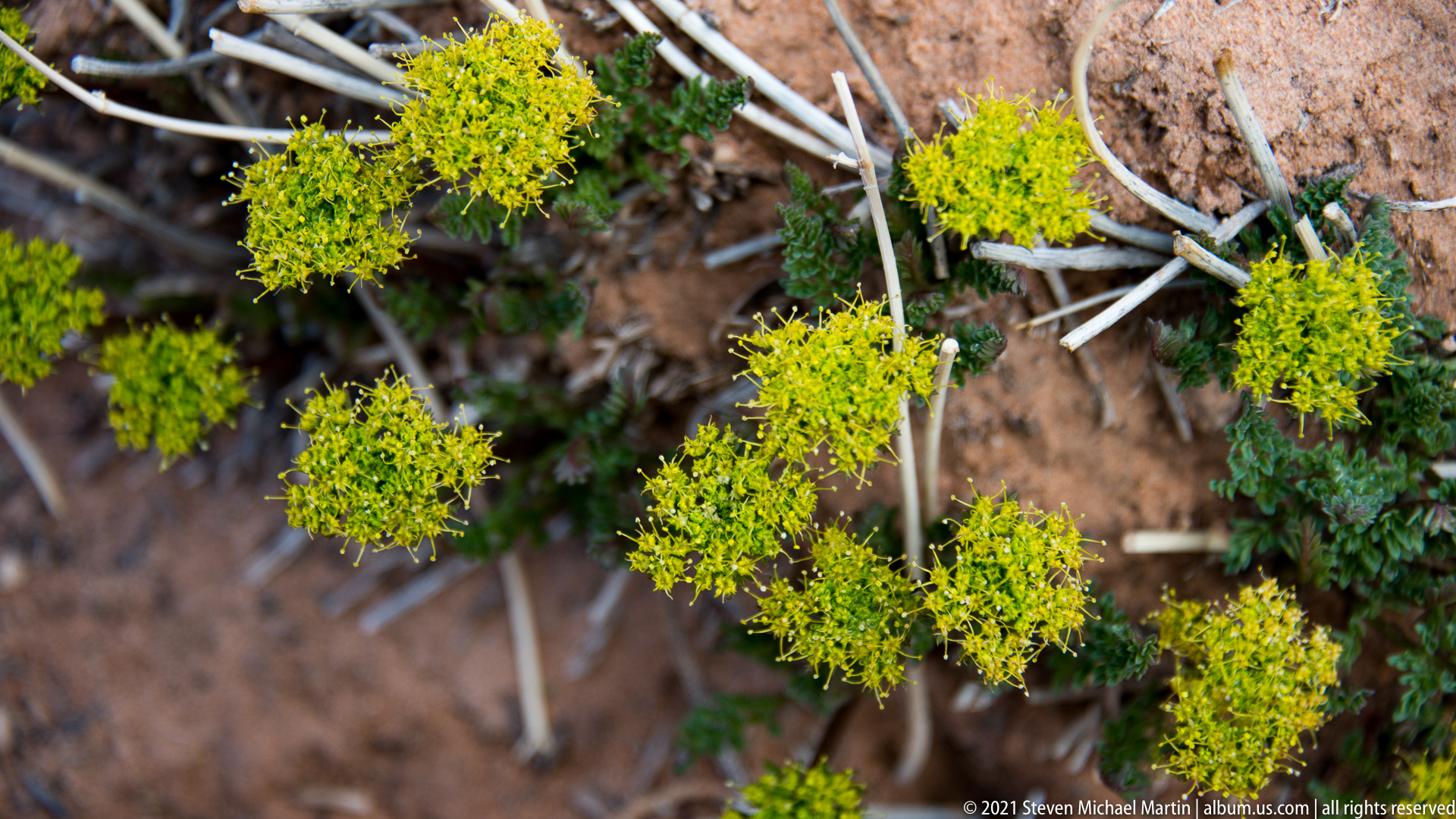
Clusters of small yellow blossoms appear among narrow green leaves and pale, spiny branches. The shallow depth of field softens the rocky ground behind, isolating the plant’s bright flowers against muted desert colors. The proof-sheet view does not resolve the species, so the caption stays with the visible floral and foliage details.
Caption
Clusters of small yellow blossoms appear among narrow green leaves and pale, spiny branches. The shallow depth of field softens the rocky ground behind, isolating the plant’s bright flowers against muted desert colors. The proof-sheet view does not resolve the species, so the caption stays with the visible floral and foliage details.
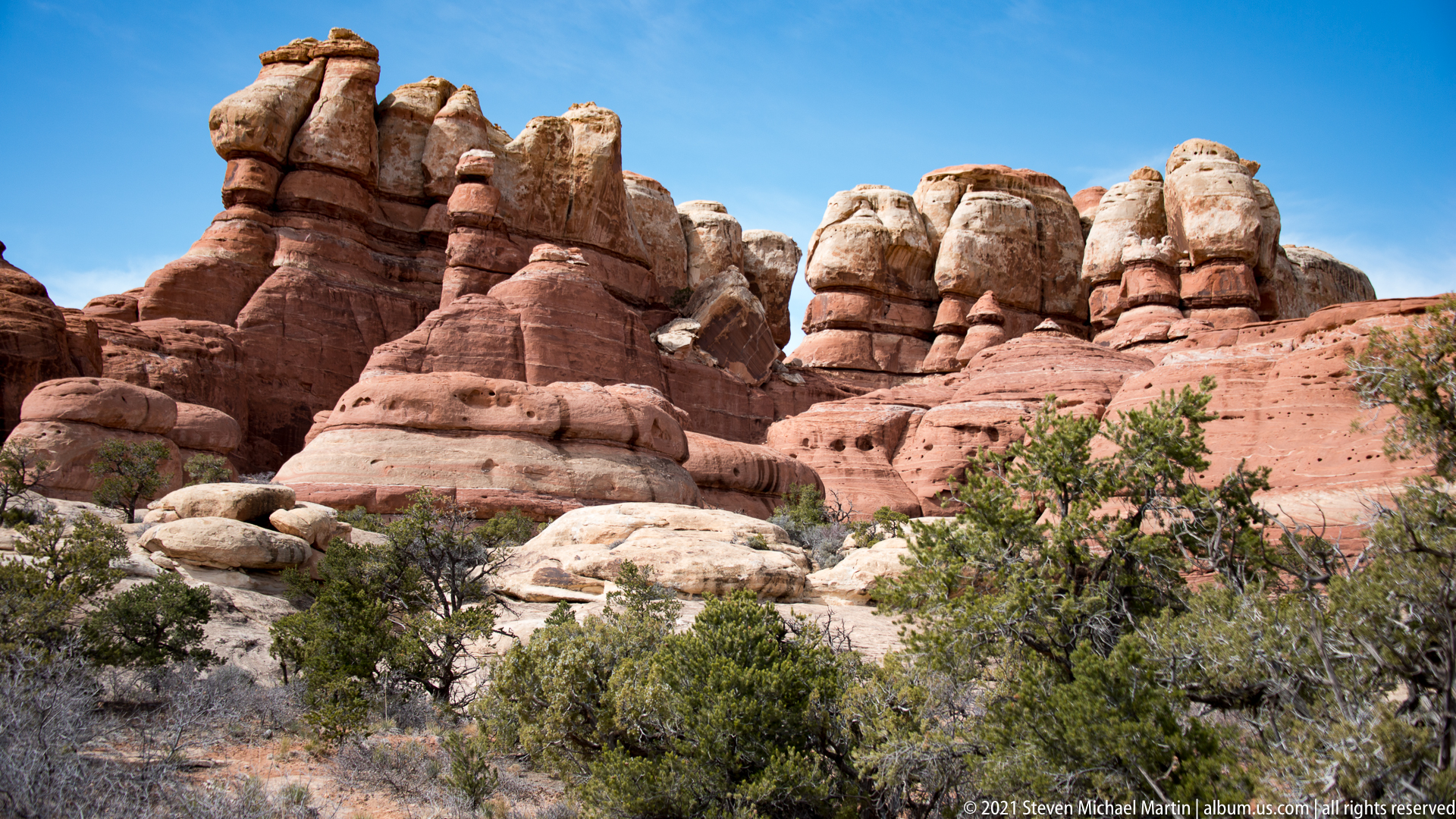
Rounded red and cream sandstone towers rise above a slope dotted with juniper and other low shrubs. The closest formations have horizontal bands and weathered caps, while smaller towers recede toward the right. Clear blue sky separates the sculpted skyline from the landscape and gives this composition a crisp outline.
Caption
Rounded red and cream sandstone towers rise above a slope dotted with juniper and other low shrubs. The closest formations have horizontal bands and weathered caps, while smaller towers recede toward the right. Clear blue sky separates the sculpted skyline from the landscape and gives this composition a crisp outline.
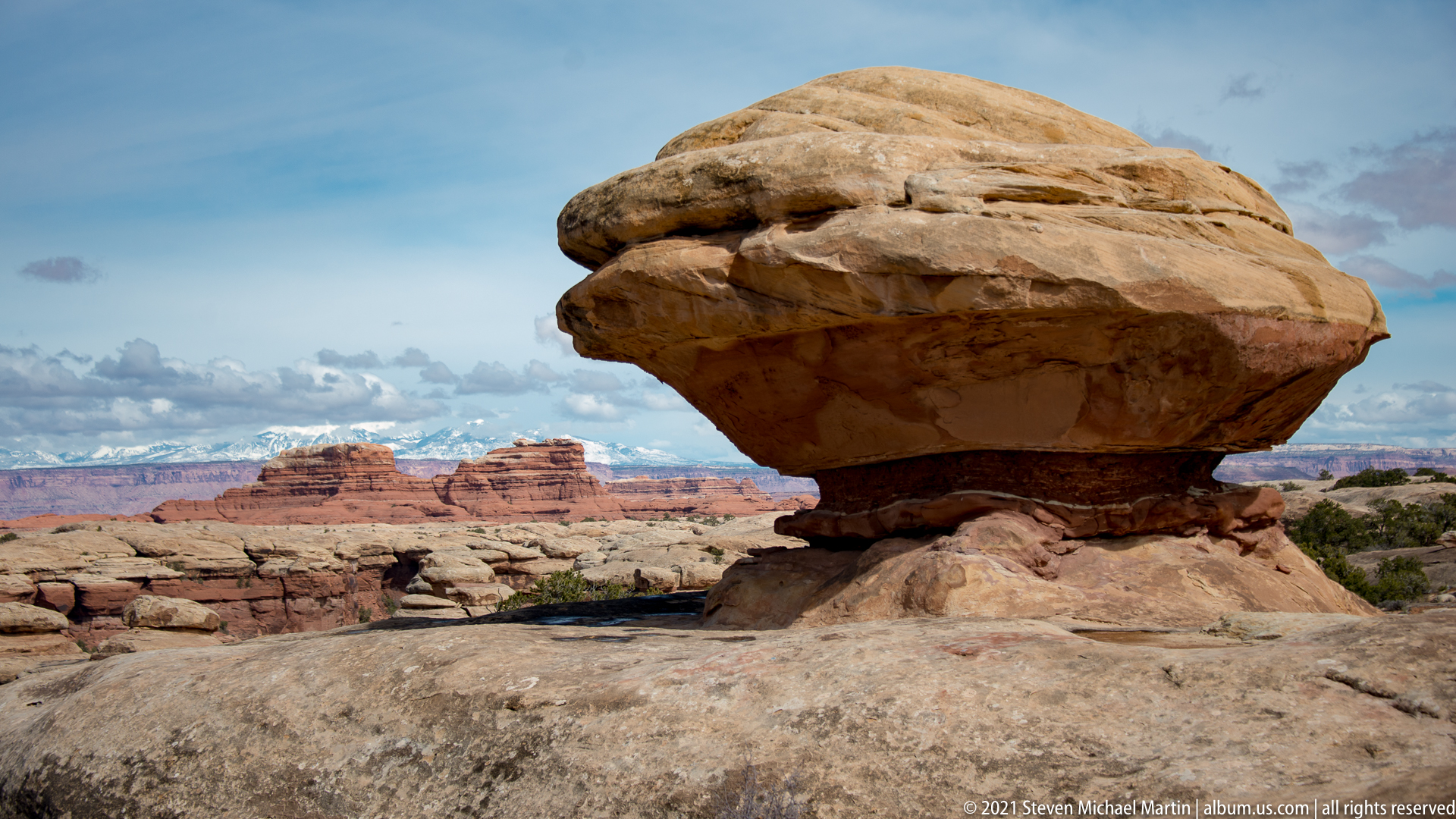
A massive rounded boulder balances on a much narrower base above a smooth sandstone platform. Its pale capstone projects beyond the support on both sides, while distant mesas and cloud-streaked sky remain visible behind it. The striking difference in width between top and base gives the formation its distinctive perched profile.
Caption
A massive rounded boulder balances on a much narrower base above a smooth sandstone platform. Its pale capstone projects beyond the support on both sides, while distant mesas and cloud-streaked sky remain visible behind it. The striking difference in width between top and base gives the formation its distinctive perched profile.
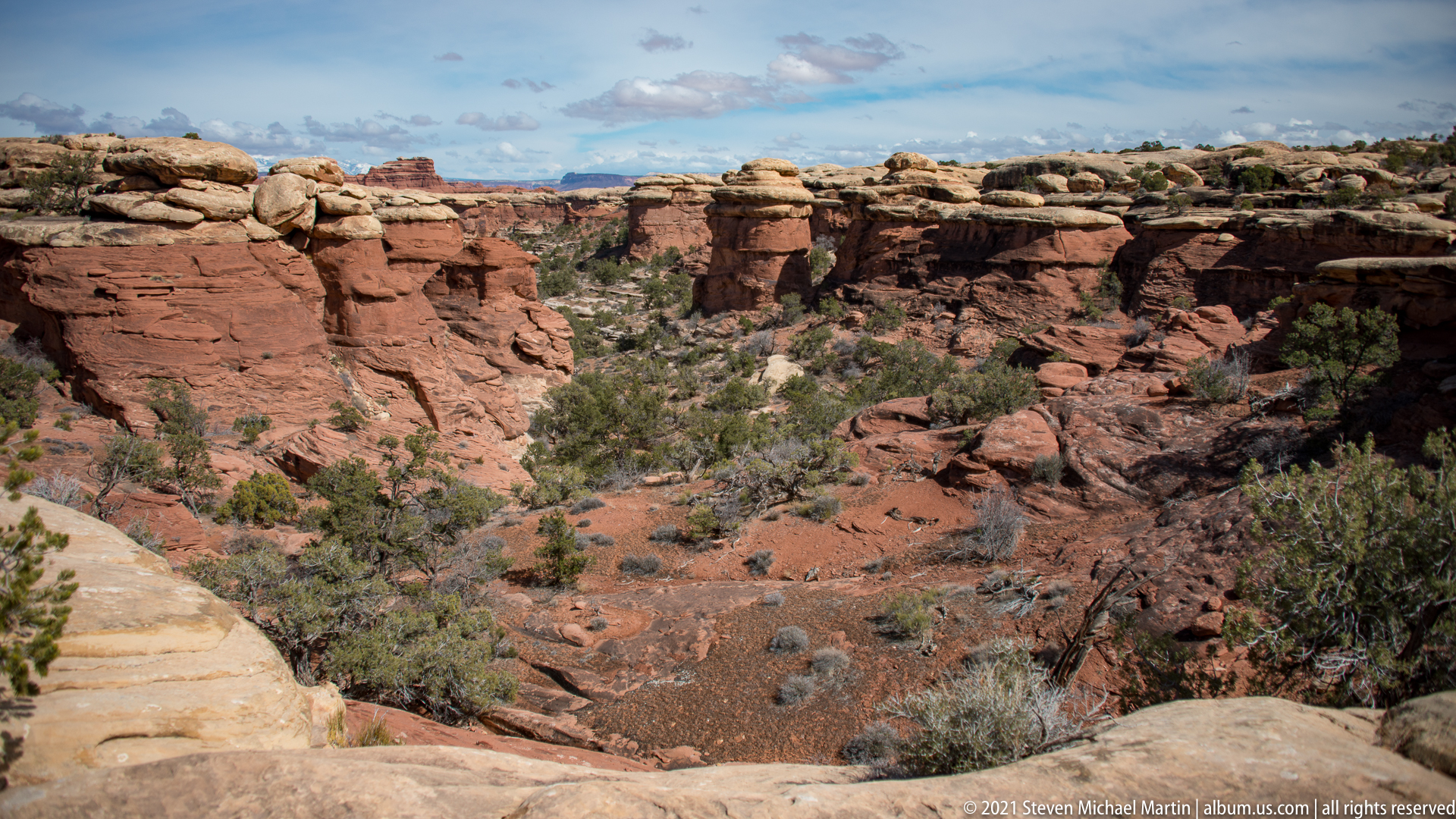
A broad ravine cuts through layered red rock, with pale ledges bordering a dry, shrub-dotted drainage. The channel narrows toward the middle distance and opens beneath a horizon of rounded mesas. Clouds and patches of blue sky add depth above the canyon. The viewpoint looks down into the broken terrain rather than across a flat plateau.
Caption
A broad ravine cuts through layered red rock, with pale ledges bordering a dry, shrub-dotted drainage. The channel narrows toward the middle distance and opens beneath a horizon of rounded mesas. Clouds and patches of blue sky add depth above the canyon. The viewpoint looks down into the broken terrain rather than across a flat plateau.
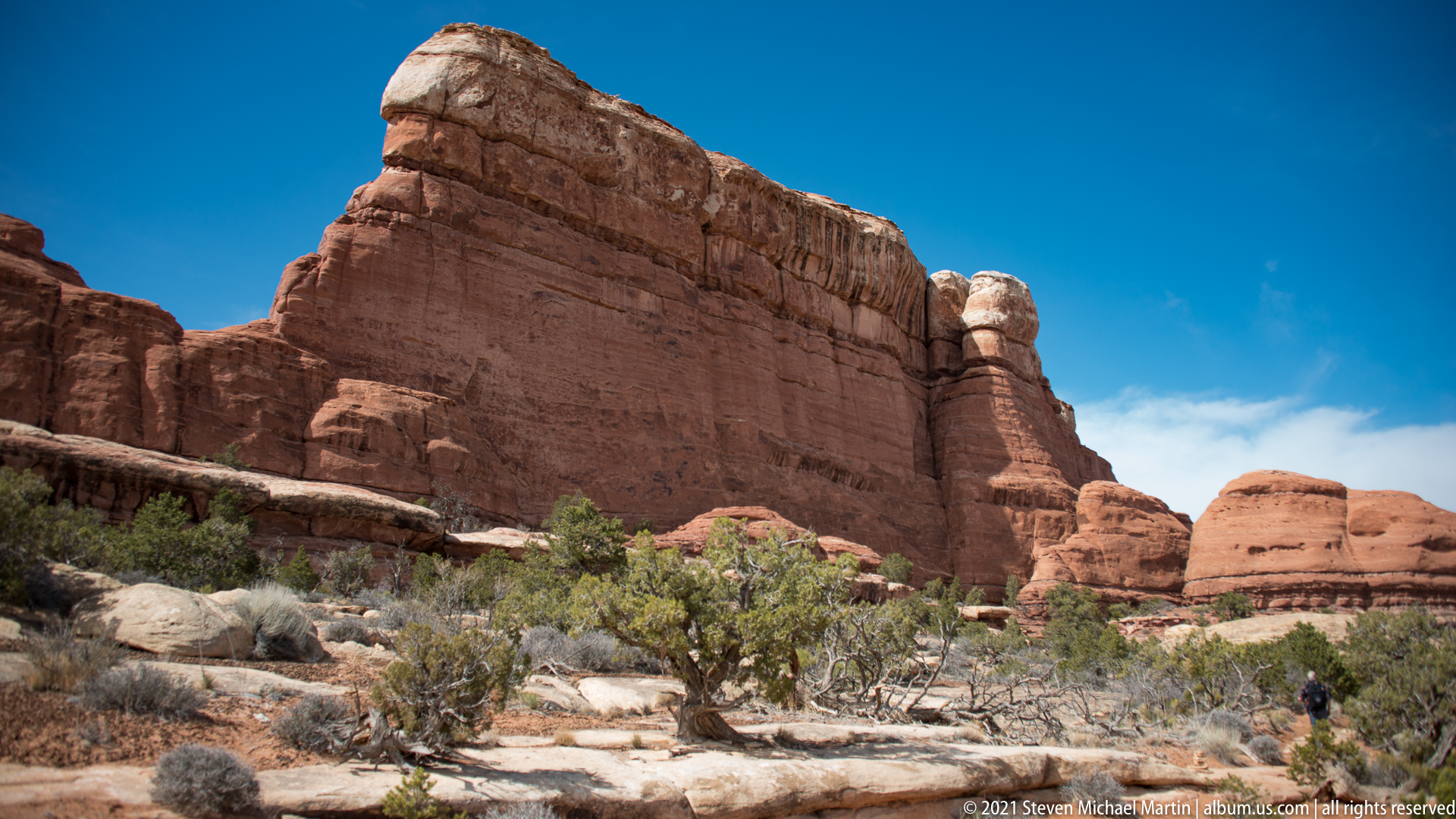
A small hiker appears at the far right of a broad rocky ledge beneath a tall red sandstone wall. Low juniper and scrub cover the intervening slope, while the cliff’s dark horizontal bands run across the upper frame. The visitor’s position gives scale to the wall and marks the open route through the canyon.
Caption
A small hiker appears at the far right of a broad rocky ledge beneath a tall red sandstone wall. Low juniper and scrub cover the intervening slope, while the cliff’s dark horizontal bands run across the upper frame. The visitor’s position gives scale to the wall and marks the open route through the canyon.
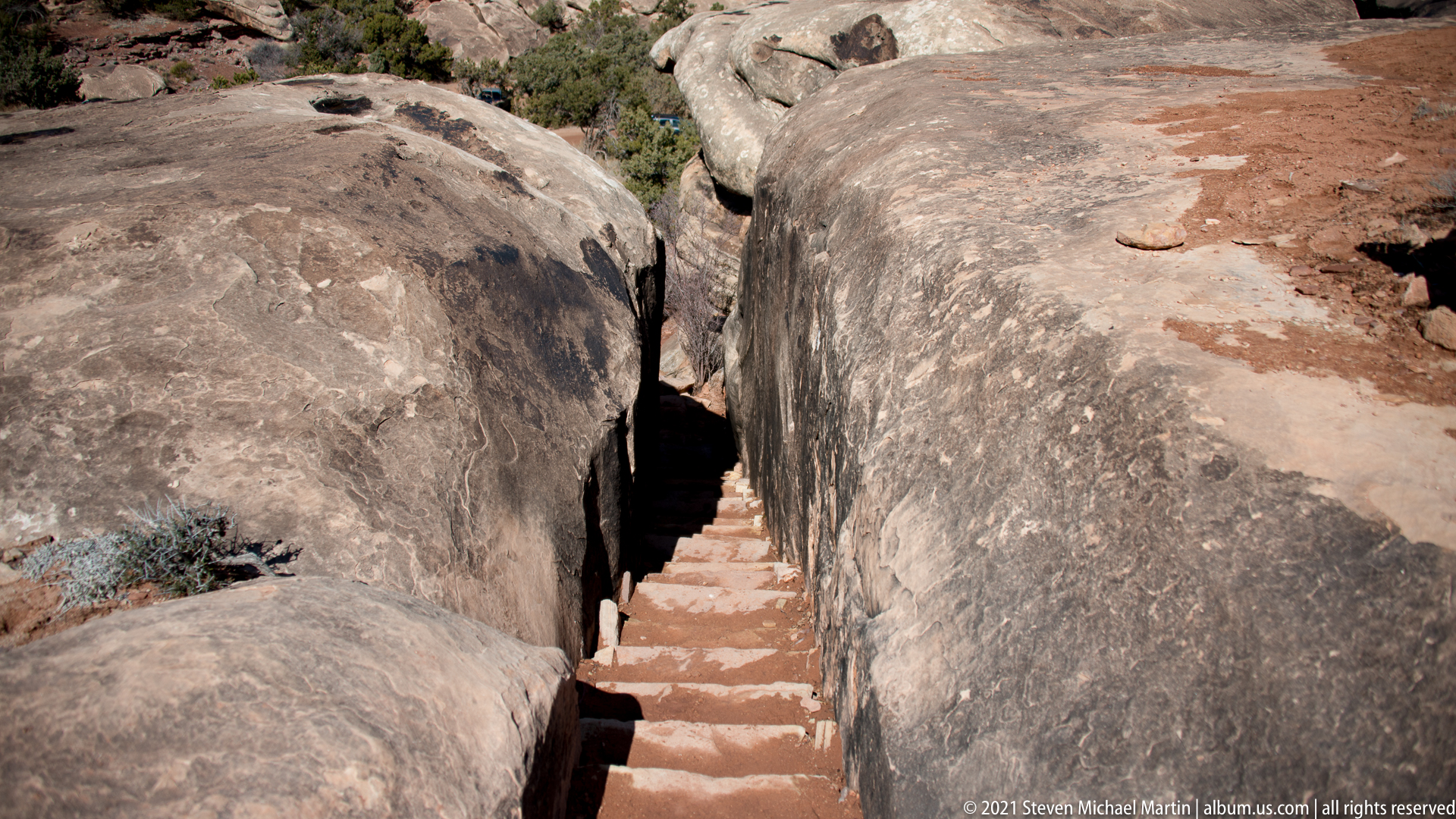
A narrow stairway drops between massive rounded sandstone walls, with closely spaced steps leading into a dark slot below. The stone surfaces nearly meet above the passage, confining the view to the descent. This constructed trail section carries visitors through a natural cleft and contrasts the regular stair edges with irregular rock faces.
Caption
A narrow stairway drops between massive rounded sandstone walls, with closely spaced steps leading into a dark slot below. The stone surfaces nearly meet above the passage, confining the view to the descent. This constructed trail section carries visitors through a natural cleft and contrasts the regular stair edges with irregular rock faces.
Canyonlands National Park — Field Guide
National Park Field Guide
📍 Overview
Canyonlands National Park preserves an extensive landscape of deeply eroded canyons, mesas, and buttes shaped by the Colorado and Green Rivers. Located within the Colorado Plateau, the park illustrates the long-term effects of tectonic uplift followed by gradual erosion that carved complex canyon systems through layered sedimentary rock. The scale of the landscape reflects geological processes operating over millions of years.
The park is divided into several districts, including Island in the Sky, The Needles, and The Maze, each presenting distinctive geological features formed through variations in erosion and rock composition. Exposed strata reveal changes in environmental conditions across prehistoric eras, while river systems continue to shape canyon depth and form. The landscape provides insight into the interaction between uplift, weathering, and water erosion.
⭐ Highlights
- Colorado and Green River canyon systems
- Island in the Sky mesa landscapes
- The Needles sandstone formations
- Layered sedimentary rock exposures
- Expansive Colorado Plateau desert scenery
🔎 Key Features
- Deeply incised canyon networks shaped by river erosion
- Sandstone formations formed through sediment deposition
- Mesas and buttes created by differential erosion
- Rock layers illustrating geological time sequences
- Large-scale desert landscape with minimal development
📷 Photography Notes
- Early and late light enhances canyon depth and texture
- Wide compositions help convey the scale of mesas and canyons
- Cloud shadows can add visual dimension to the landscape
- Layered rock patterns create natural compositional lines
- Foreground rock formations help provide depth
- Look for viewpoints that show river-carved canyon systems
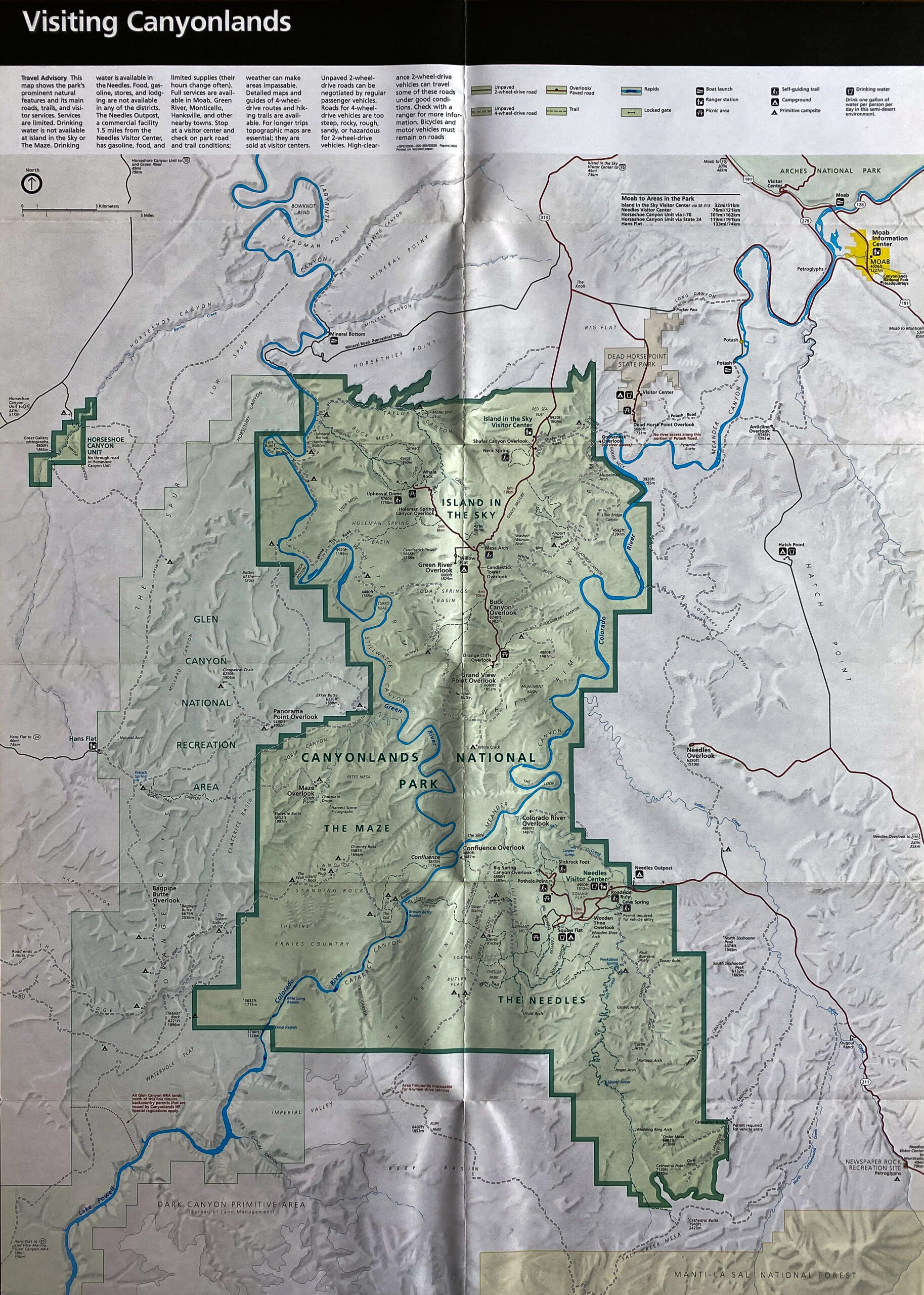
A printed visitor map fills the open brochure, with a large green-outlined park area, winding blue waterways, and a network of roads and labels. The map is surrounded by gray shaded terrain and folds down the center. This view emphasizes the park’s mapped extent and its relationship to nearby routes rather than a single scenic feature.
Caption
A printed visitor map fills the open brochure, with a large green-outlined park area, winding blue waterways, and a network of roads and labels. The map is surrounded by gray shaded terrain and folds down the center. This view emphasizes the park’s mapped extent and its relationship to nearby routes rather than a single scenic feature.

An open National Park Service brochure presents a panoramic photograph across its upper half and a grid of smaller landscape images and text below. The spread is arranged as a visitor overview, pairing scenic views with explanatory panels. Fine print is too small to transcribe from this reproduction, but the layout clearly identifies it as interpretive park material.
Caption
An open National Park Service brochure presents a panoramic photograph across its upper half and a grid of smaller landscape images and text below. The spread is arranged as a visitor overview, pairing scenic views with explanatory panels. Fine print is too small to transcribe from this reproduction, but the layout clearly identifies it as interpretive park material.
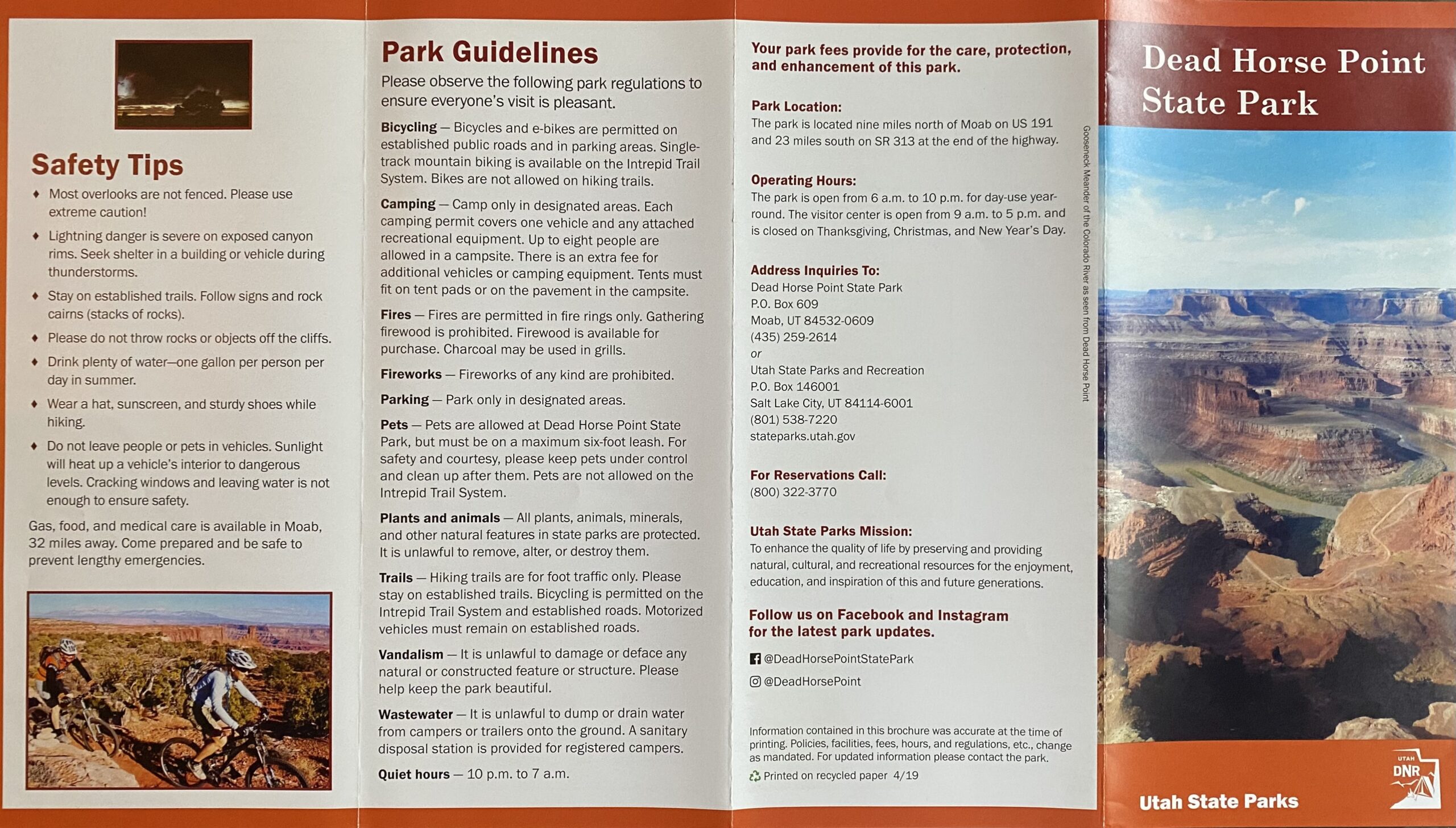
An open visitor guide places safety tips and park regulations across its central panels, with contact details and a tall canyon photograph on the right headed “Dead Horse Point State Park.” The close view shows how practical guidance and scenic imagery share the printed spread. Small body text is not legible enough here to quote reliably.
Caption
An open visitor guide places safety tips and park regulations across its central panels, with contact details and a tall canyon photograph on the right headed “Dead Horse Point State Park.” The close view shows how practical guidance and scenic imagery share the printed spread. Small body text is not legible enough here to quote reliably.
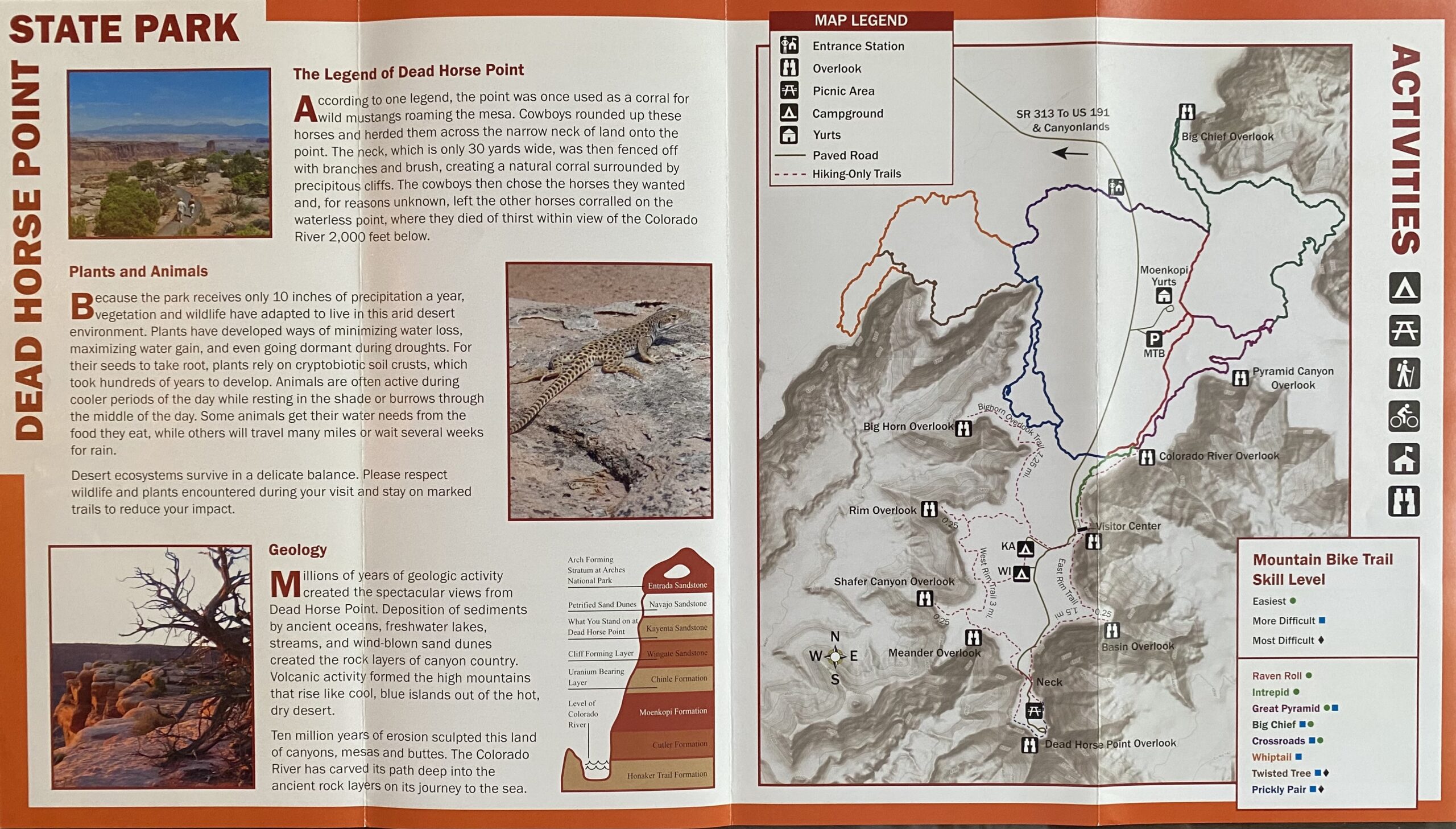
An open Dead Horse Point State Park guide combines a regional map with interpretive text and activity information. The map occupies the right half, marked with routes, facilities, and a legend; the left panel contains sections on plants and animals and geology, accompanied by small landscape photographs. Orange borders and vertical headings organize the brochure, presenting navigation and natural-history information in one printed spread.
Caption
An open Dead Horse Point State Park guide combines a regional map with interpretive text and activity information. The map occupies the right half, marked with routes, facilities, and a legend; the left panel contains sections on plants and animals and geology, accompanied by small landscape photographs. Orange borders and vertical headings organize the brochure, presenting navigation and natural-history information in one printed spread.