Hot Springs
Hot Springs is known for geothermal waters that emerge naturally from the ground after being heated deep within the earth’s crust. As groundwater travels through fractures in underlying rock formations, it is warmed by geothermal energy before returning to the surface enriched with dissolved minerals. These natural springs have attracted human visitors for thousands of years due to their reliable water source and perceived therapeutic properties.
Indigenous communities regarded many hot springs as significant places associated with healing and renewal. The presence of dependable fresh water sources influenced patterns of seasonal travel and settlement long before modern development occurred. Later, European settlers developed bathhouses and spa facilities that transformed the springs into destinations associated with health and recreation.
The landscape surrounding Hot Springs illustrates how geological forces influence human activity across long periods of time. Natural thermal waters demonstrate the interaction between underground geological processes and surface environments, providing insight into how physical geography shaped travel routes and settlement patterns across North America.

A plume of steam rises from a low stone fountain in front of a monumental masonry building. The damp pavement, clipped planting beds, and adjacent bathhouses establish a streetscape shaped by the visible thermal water. A domed roof appears through the vapor at the far end, while the close view foregrounds the steam and the fountain basin.
Caption
A plume of steam rises from a low stone fountain in front of a monumental masonry building. The damp pavement, clipped planting beds, and adjacent bathhouses establish a streetscape shaped by the visible thermal water. A domed roof appears through the vapor at the far end, while the close view foregrounds the steam and the fountain basin.

The white Ozark Bathhouse fills the frame with a long colonnaded entrance, twin square towers, and a domed roof rising behind it. The building’s name is legible above the entry, while trees partly screen the ends of the façade. This oblique view links the low portico to the taller roofline behind it.
Caption
The white Ozark Bathhouse fills the frame with a long colonnaded entrance, twin square towers, and a domed roof rising behind it. The building’s name is legible above the entry, while trees partly screen the ends of the façade. This oblique view links the low portico to the taller roofline behind it.
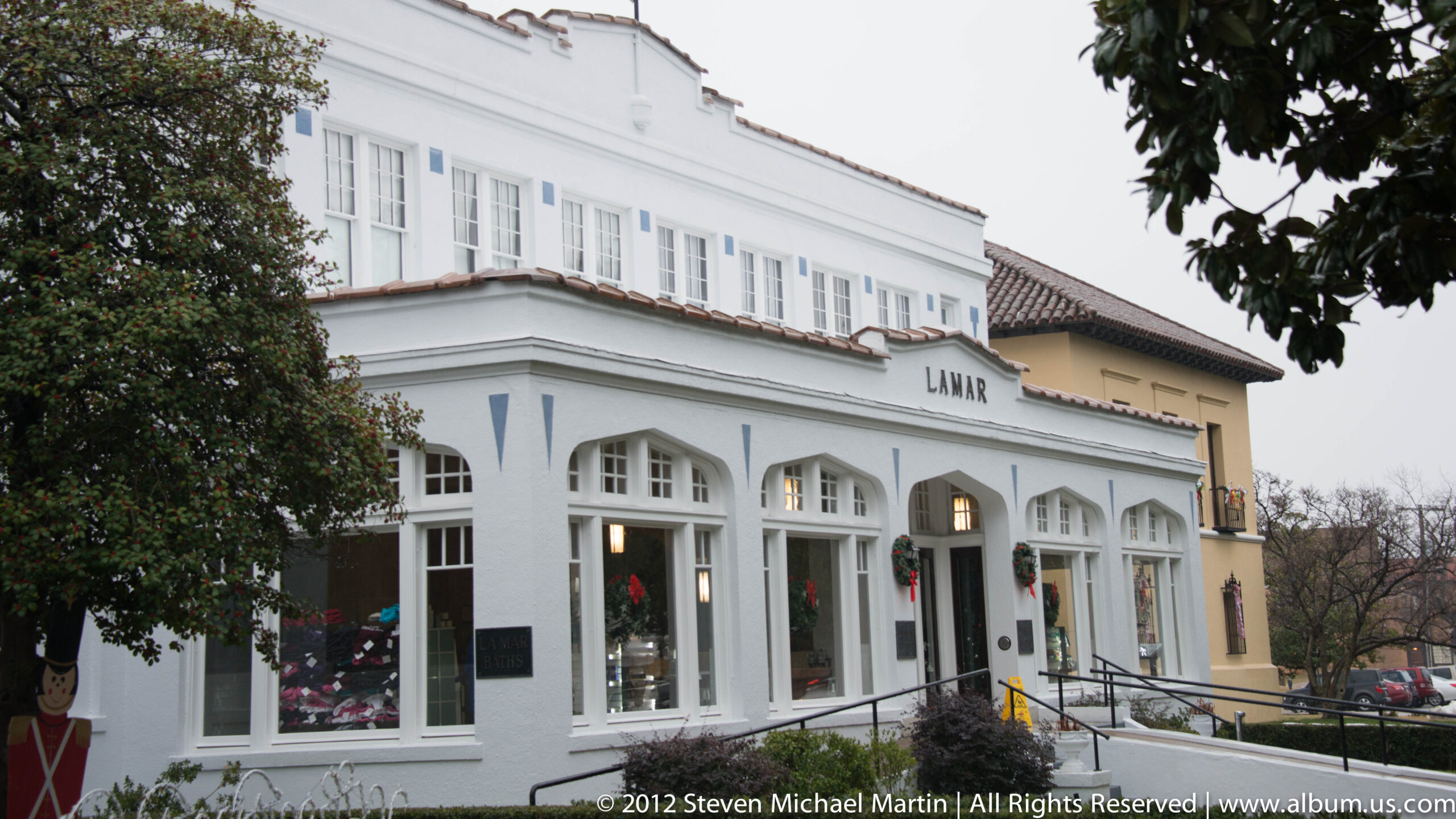
The white Lamar Bathhouse stands at an angle, its name set above a row of arched ground-floor windows and a central entrance. A ramp follows the building’s front edge, and small holiday decorations appear in several windows. The oblique composition shows the façade extending toward trees and neighboring structures.
Caption
The white Lamar Bathhouse stands at an angle, its name set above a row of arched ground-floor windows and a central entrance. A ramp follows the building’s front edge, and small holiday decorations appear in several windows. The oblique composition shows the façade extending toward trees and neighboring structures.

Clear glass bottles stand in close rows, each bearing a turquoise label with a bathhouse illustration and the words “Hot Springs National Park” and “Health Through Water.” Their repeated shapes and labels identify the product as bottled thermal water associated with the park. Reflections in the glass add depth to the display.
Caption
Clear glass bottles stand in close rows, each bearing a turquoise label with a bathhouse illustration and the words “Hot Springs National Park” and “Health Through Water.” Their repeated shapes and labels identify the product as bottled thermal water associated with the park. Reflections in the glass add depth to the display.

A close view of an aged metal cabinet shows a grid of small compartments, each fitted with a keyhole, round knob, and numbered nameplate. The visible numbers include 114, 124, and 134 across the top row, with lower numbers continuing beneath. Worn paint and tarnished surfaces record extensive use, though the cabinet’s original function is not established by the photograph.
Caption
A close view of an aged metal cabinet shows a grid of small compartments, each fitted with a keyhole, round knob, and numbered nameplate. The visible numbers include 114, 124, and 134 across the top row, with lower numbers continuing beneath. Worn paint and tarnished surfaces record extensive use, though the cabinet’s original function is not established by the photograph.
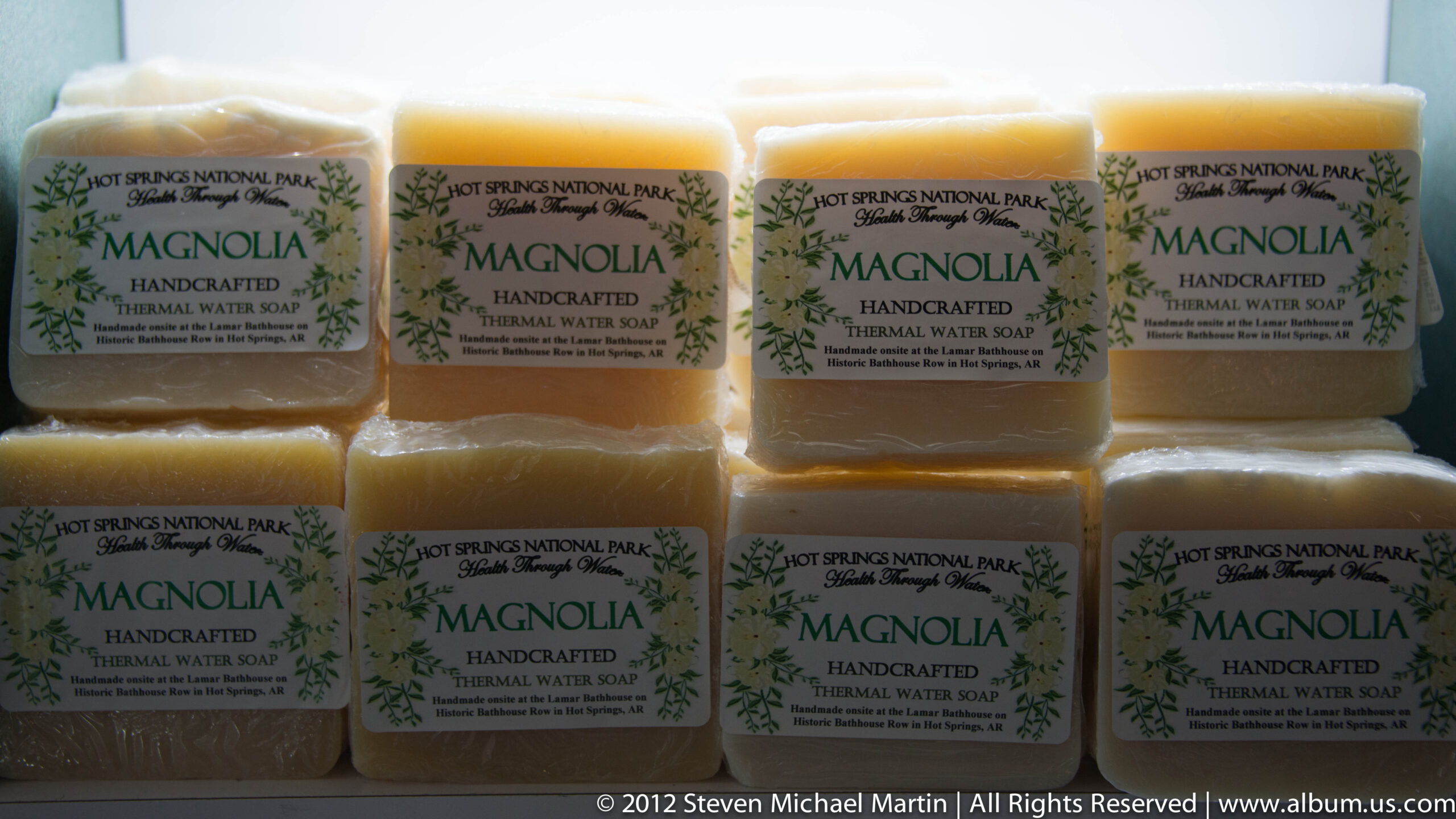
Rows of rectangular soap bars are wrapped in labels reading “Magnolia,” “Handcrafted,” and “Thermal Water Soap,” with Hot Springs National Park printed above. The close product display emphasizes repeated green lettering and a botanical motif against warm amber soap. The packaging explicitly ties the item to the park’s thermal-water identity.
Caption
Rows of rectangular soap bars are wrapped in labels reading “Magnolia,” “Handcrafted,” and “Thermal Water Soap,” with Hot Springs National Park printed above. The close product display emphasizes repeated green lettering and a botanical motif against warm amber soap. The packaging explicitly ties the item to the park’s thermal-water identity.

The turquoise “FORDYCE BATHHOUSE” lettering crowns a symmetrical entrance framed by a decorative metal canopy. Broad stone steps rise between paired handrails to glass doors, with lamps and tall windows completing the façade. The straight-on view makes the building’s name and formal public entrance the main features.
Caption
The turquoise “FORDYCE BATHHOUSE” lettering crowns a symmetrical entrance framed by a decorative metal canopy. Broad stone steps rise between paired handrails to glass doors, with lamps and tall windows completing the façade. The straight-on view makes the building’s name and formal public entrance the main features.

Several printed tickets lie beneath glass, including cards labeled Fordyce Bath House, Lamar Bath House, and Maurice Baths. Large type lists massage or bath services and prices, while smaller details and serial numbers remain visible on the paper. The arrangement preserves examples of bathhouse service ephemera from multiple named establishments.
Caption
Several printed tickets lie beneath glass, including cards labeled Fordyce Bath House, Lamar Bath House, and Maurice Baths. Large type lists massage or bath services and prices, while smaller details and serial numbers remain visible on the paper. The arrangement preserves examples of bathhouse service ephemera from multiple named establishments.
National Park Field Guide
Hot Springs National Park protects geothermal waters that emerge naturally from the earth after being heated deep underground. As groundwater travels through fractures in rock layers, it is warmed by geothermal energy before returning to the surface enriched with dissolved minerals. These springs have attracted human visitors for thousands of years due to their reliability and perceived therapeutic properties.
🧭 Key Features
- Geothermal springs heated by underground geological processes
- Mineral-rich waters emerging along fault lines
- Historic bathhouse architecture reflecting early spa culture
- Forest landscapes of the Ouachita Mountains
- Hydrological systems connecting rainfall to thermal spring flow
🌄 Landscape Highlights
Thermal waters emerge along the base of the Ouachita Mountains where fractured rock allows heated groundwater to reach the surface. The surrounding forested landscape reflects environmental conditions shaped by geology and climate. Steam rising from springs demonstrates the continuing movement of water through underground rock formations.
🌎 Natural Systems
Rainwater slowly percolates through rock layers, descending deep below the surface where geothermal heat raises water temperature before returning it upward through fractures. Mineral content reflects interaction between water and underground rock formations. The park illustrates how hydrological and geological processes operate together across long periods of time.
📷 Photography Notes
- Steam effects are most visible in cool weather
- Architectural elements contrast with natural surroundings
- Morning light highlights atmospheric moisture
- Look for texture in stone and mineral deposits
- Include surrounding forest landscapes for context
- Capture interaction between water and built environment
🌱 Conservation Context
Hot Springs National Park protects geothermal features that demonstrate the interaction between groundwater and geological heat sources. Preservation allows continued observation of natural thermal systems and illustrates the relationship between geology and human use of mineral springs throughout history.

An open visitor brochure combines a panoramic historic streetscape across the top with explanatory text, photographs, and illustrations below. The spread includes images of bathhouse interiors and thermal-water features, arranged in columns beneath the heading “Hot Springs.” Fine print is too small to read at this scale, but the brochure’s interpretive layout is clear.
Caption
An open visitor brochure combines a panoramic historic streetscape across the top with explanatory text, photographs, and illustrations below. The spread includes images of bathhouse interiors and thermal-water features, arranged in columns beneath the heading “Hot Springs.” Fine print is too small to read at this scale, but the brochure’s interpretive layout is clear.
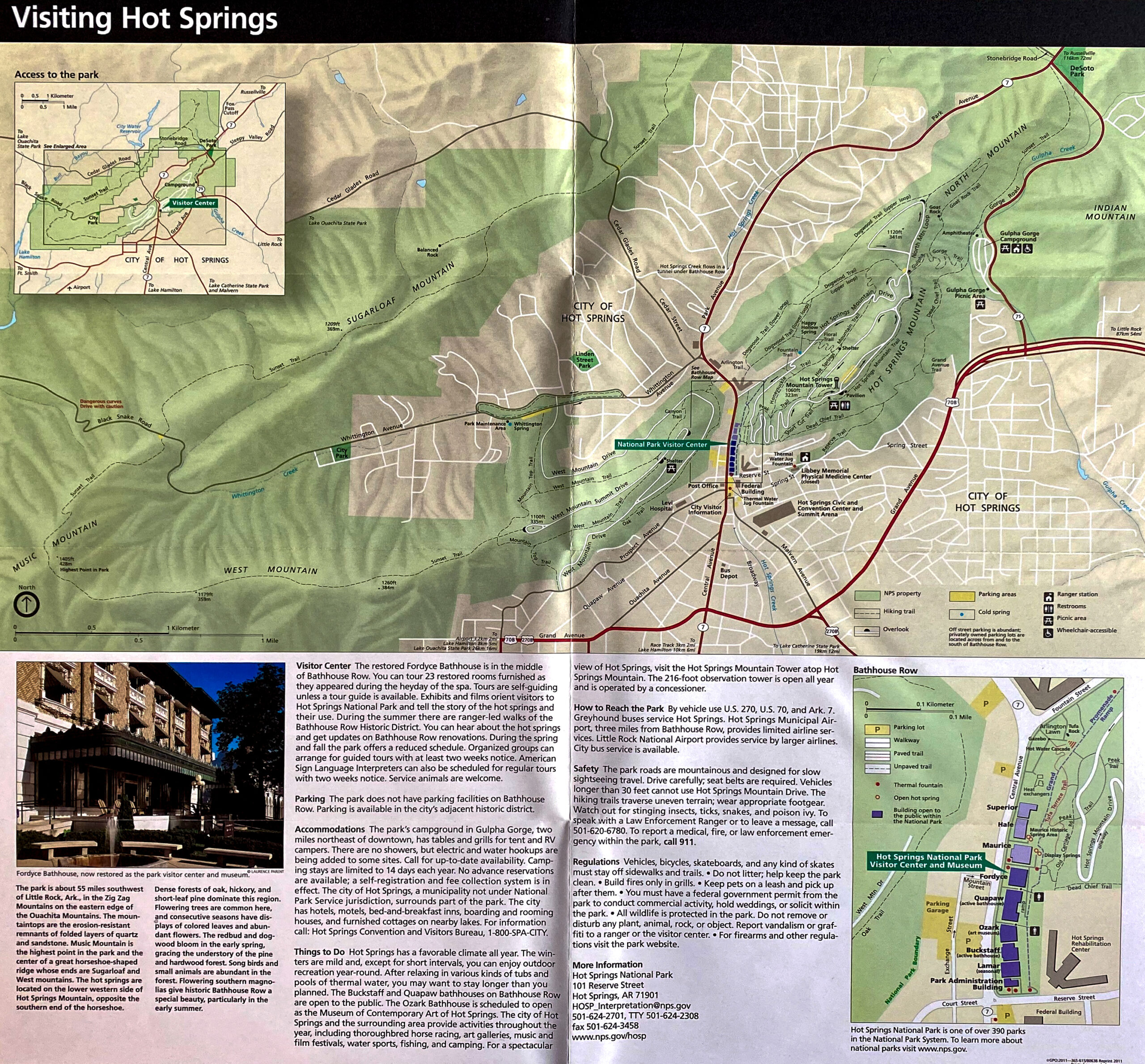
A visitor guide is open to a large street map of Hot Springs, with colored routes and shaded terrain surrounding the town grid. Smaller inset maps, photographs, and explanatory text fill the lower portion of the spread. The map connects the urban center with the surrounding hills and park area, though the smallest labels are not legible here.
Caption
A visitor guide is open to a large street map of Hot Springs, with colored routes and shaded terrain surrounding the town grid. Smaller inset maps, photographs, and explanatory text fill the lower portion of the spread. The map connects the urban center with the surrounding hills and park area, though the smallest labels are not legible here.