Elephant Canyon – Canyonlands National Park
Elephant Canyon preserves a remote desert landscape within Canyonlands National Park characterized by eroded sandstone formations and narrow canyon corridors shaped by long-term geological processes. The canyon lies within the Needles District, an area known for colorful rock formations and complex erosional features. The surrounding terrain reflects the influence of tectonic uplift and water erosion across the Colorado Plateau.
Layered sedimentary rock surfaces display variations in color resulting from mineral composition and weathering patterns. The canyon’s name reflects rock formations whose shapes resemble the forms of large animals, illustrating how erosion creates distinctive natural sculptures. The relatively undeveloped setting emphasizes the natural forces that shaped the landscape over extended geological time.
Visitors encounter winding canyon passages and open desert terrain that illustrate the diversity of landforms preserved within Canyonlands National Park. The environment highlights the interaction between rock structure, erosion, and climate conditions that continue to influence the evolving landscape.

A lone hiker walks along the lower left of a narrow path toward a cluster of sandstone towers whose upper faces glow orange. A large dark cloud spreads across the sky, making the lit rock appear especially bright above the shadowed brush and canyon floor. The person’s placement establishes the route and scale beneath the formations.
Caption
A lone hiker walks along the lower left of a narrow path toward a cluster of sandstone towers whose upper faces glow orange. A large dark cloud spreads across the sky, making the lit rock appear especially bright above the shadowed brush and canyon floor. The person’s placement establishes the route and scale beneath the formations.

A broad band of towers and rounded sandstone blocks stretches across the upper half, with orange light touching selected faces. Dark foreground ledges and scattered shrubs create depth below the skyline, while a gray-pink cloud bank softens the background. The panorama shows the formations as a continuous ridge rather than isolated spires.
Caption
A broad band of towers and rounded sandstone blocks stretches across the upper half, with orange light touching selected faces. Dark foreground ledges and scattered shrubs create depth below the skyline, while a gray-pink cloud bank softens the background. The panorama shows the formations as a continuous ridge rather than isolated spires.
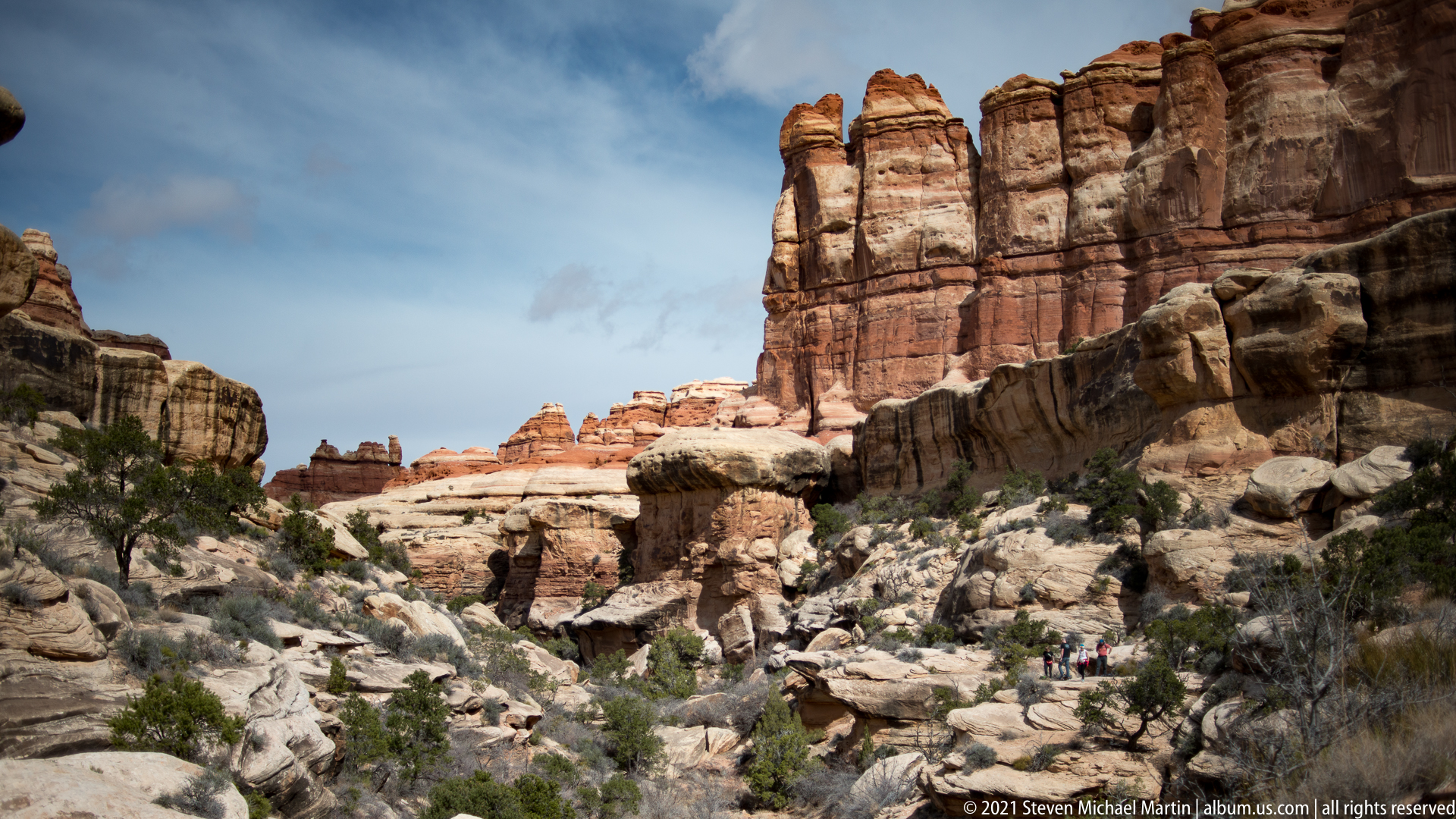
A broad rocky drainage leads into a cluster of red and cream sandstone towers, with a high blocky wall rising at right. Sparse shrubs and boulders line the route, and patches of blue sky open above the formations. The image conveys the scale and layered depth of the canyon, with the winding floor guiding the eye toward the distant pinnacles.
Caption
A broad rocky drainage leads into a cluster of red and cream sandstone towers, with a high blocky wall rising at right. Sparse shrubs and boulders line the route, and patches of blue sky open above the formations. The image conveys the scale and layered depth of the canyon, with the winding floor guiding the eye toward the distant pinnacles.
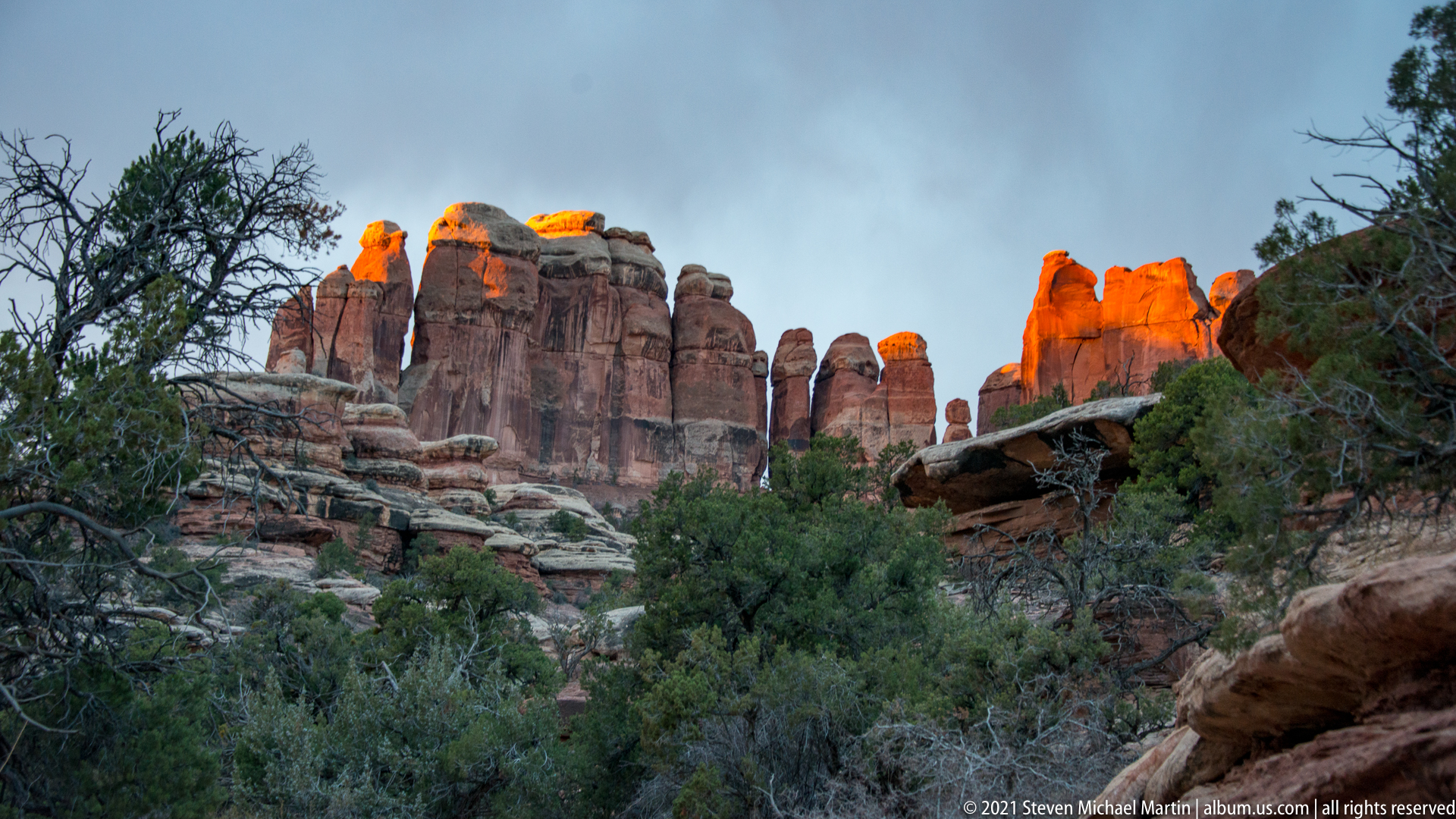
Several tall towers catch intense orange light along their upper faces, while the juniper-covered slope and lower rock remain in shadow. The central cluster is punctuated by narrow columns, and a projecting ledge enters from the right. This view isolates the glowing tops against a pale sky, emphasizing the short-lived light across the rock skyline.
Caption
Several tall towers catch intense orange light along their upper faces, while the juniper-covered slope and lower rock remain in shadow. The central cluster is punctuated by narrow columns, and a projecting ledge enters from the right. This view isolates the glowing tops against a pale sky, emphasizing the short-lived light across the rock skyline.
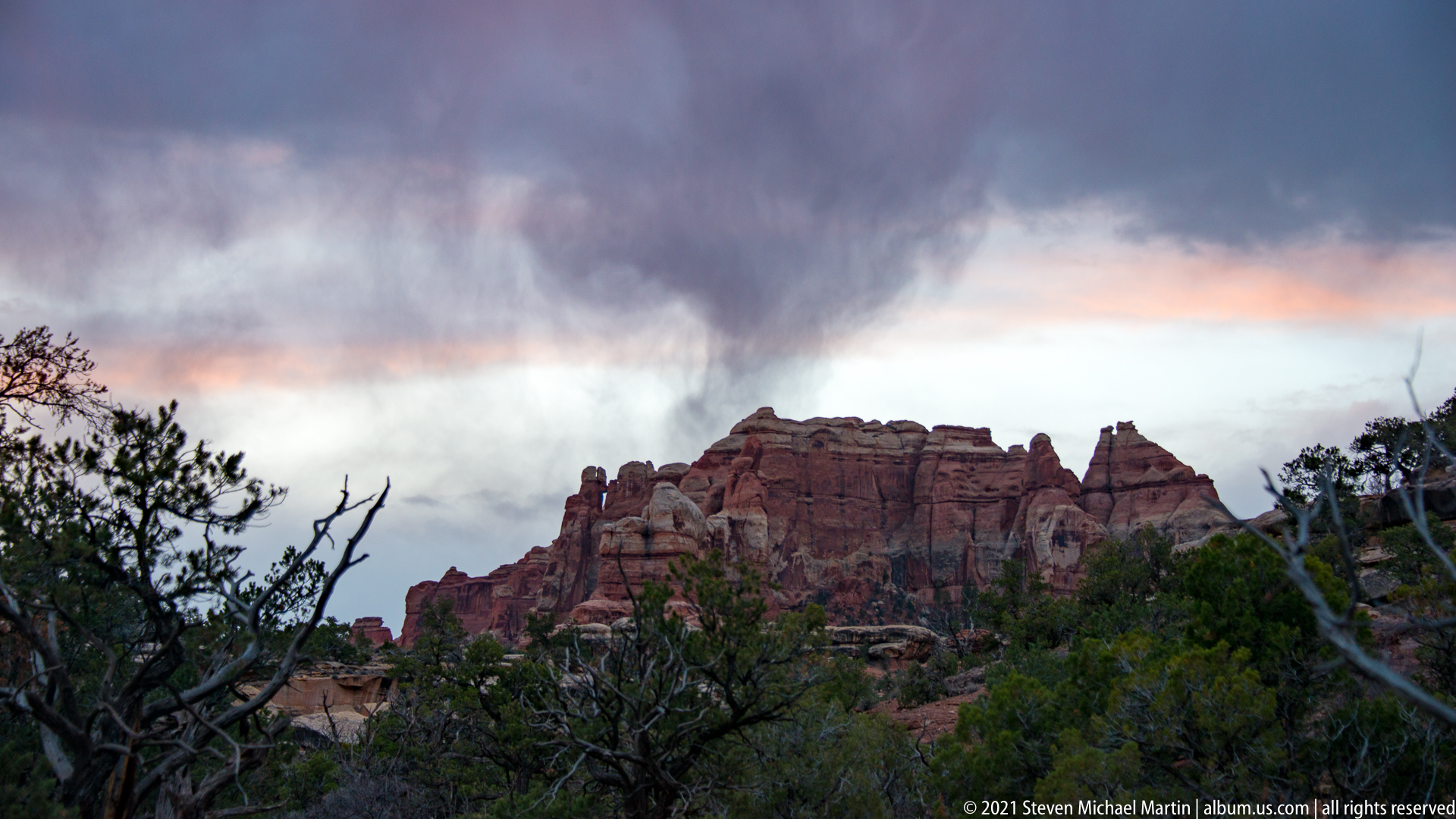
A dark cloud mass fills the upper sky, while a thin peach-colored strip of light separates it from the jagged sandstone ridge below. Bare tree branches and juniper silhouettes frame the scene at left. The composition preserves the narrow transition between storm, sunset glow, and dark rock that gives this view its layered atmosphere.
Caption
A dark cloud mass fills the upper sky, while a thin peach-colored strip of light separates it from the jagged sandstone ridge below. Bare tree branches and juniper silhouettes frame the scene at left. The composition preserves the narrow transition between storm, sunset glow, and dark rock that gives this view its layered atmosphere.
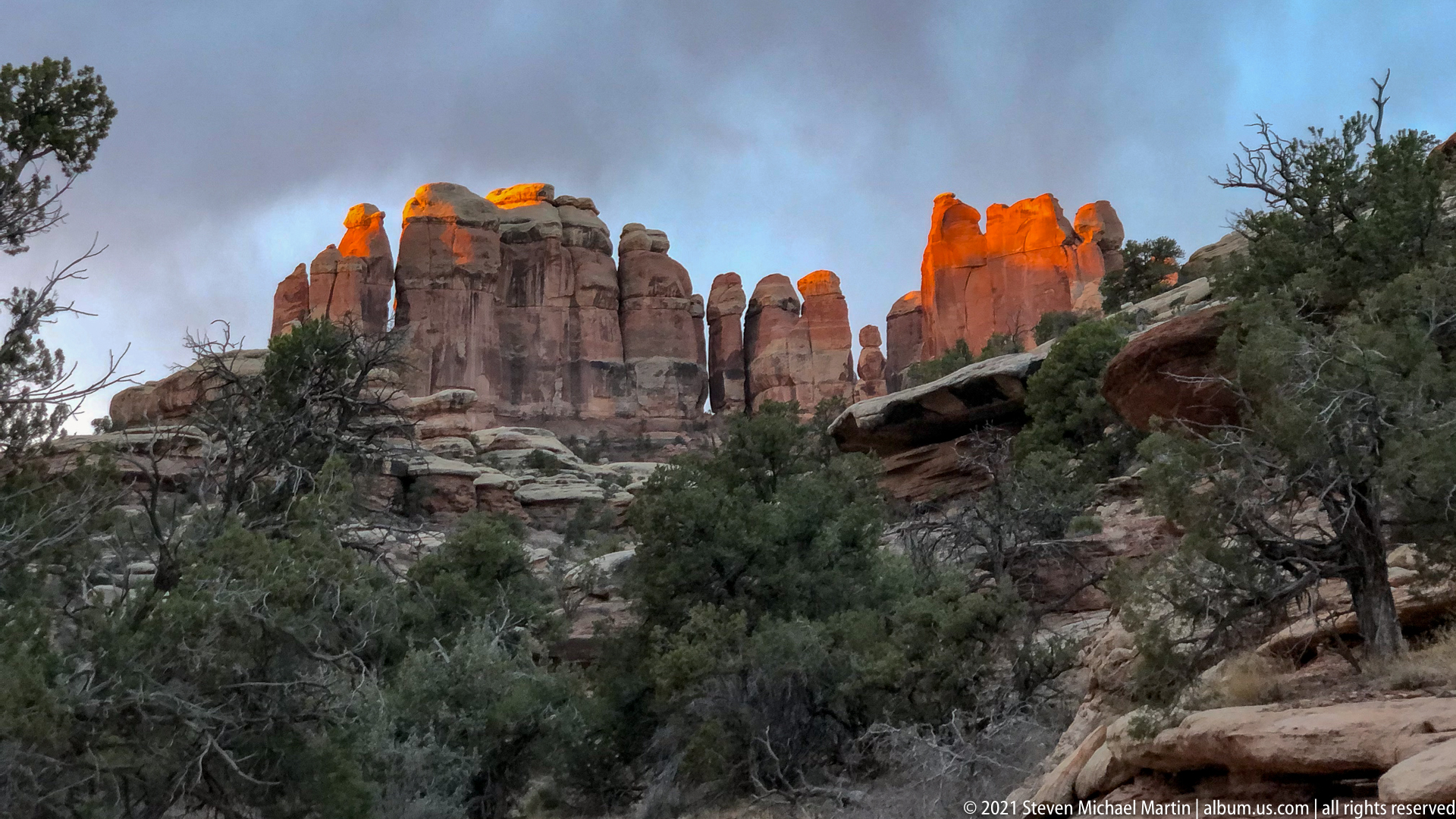
Warm light catches the tops of a row of red sandstone towers, leaving their lower faces and the juniper-covered slope in shadow. A pale blue-gray sky sits behind the formations, while shrubs frame the view from both sides. The thin band of orange illumination outlines the uneven skyline and draws attention to the towers’ varied heights.
Caption
Warm light catches the tops of a row of red sandstone towers, leaving their lower faces and the juniper-covered slope in shadow. A pale blue-gray sky sits behind the formations, while shrubs frame the view from both sides. The thin band of orange illumination outlines the uneven skyline and draws attention to the towers’ varied heights.
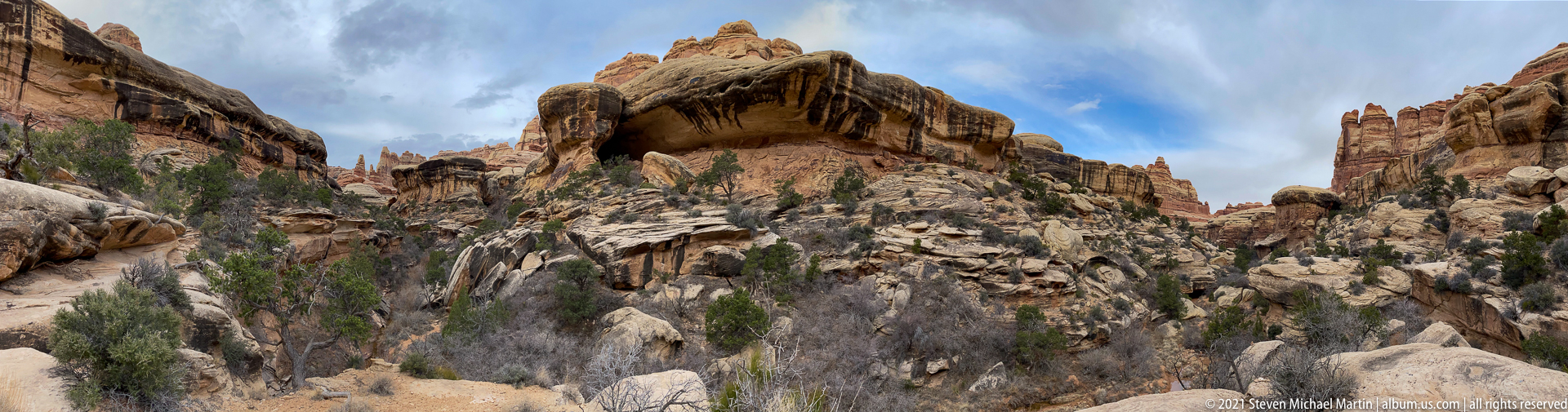
A shallow, arch-like opening appears beneath a broad sandstone overhang near the upper center. Pale boulders and fractured slabs fill the wash below, while darker cliffs frame both sides. The opening is integrated into a layered rock face rather than standing alone, and the wide view shows its relationship to the narrow route through the canyon.
Caption
A shallow, arch-like opening appears beneath a broad sandstone overhang near the upper center. Pale boulders and fractured slabs fill the wash below, while darker cliffs frame both sides. The opening is integrated into a layered rock face rather than standing alone, and the wide view shows its relationship to the narrow route through the canyon.
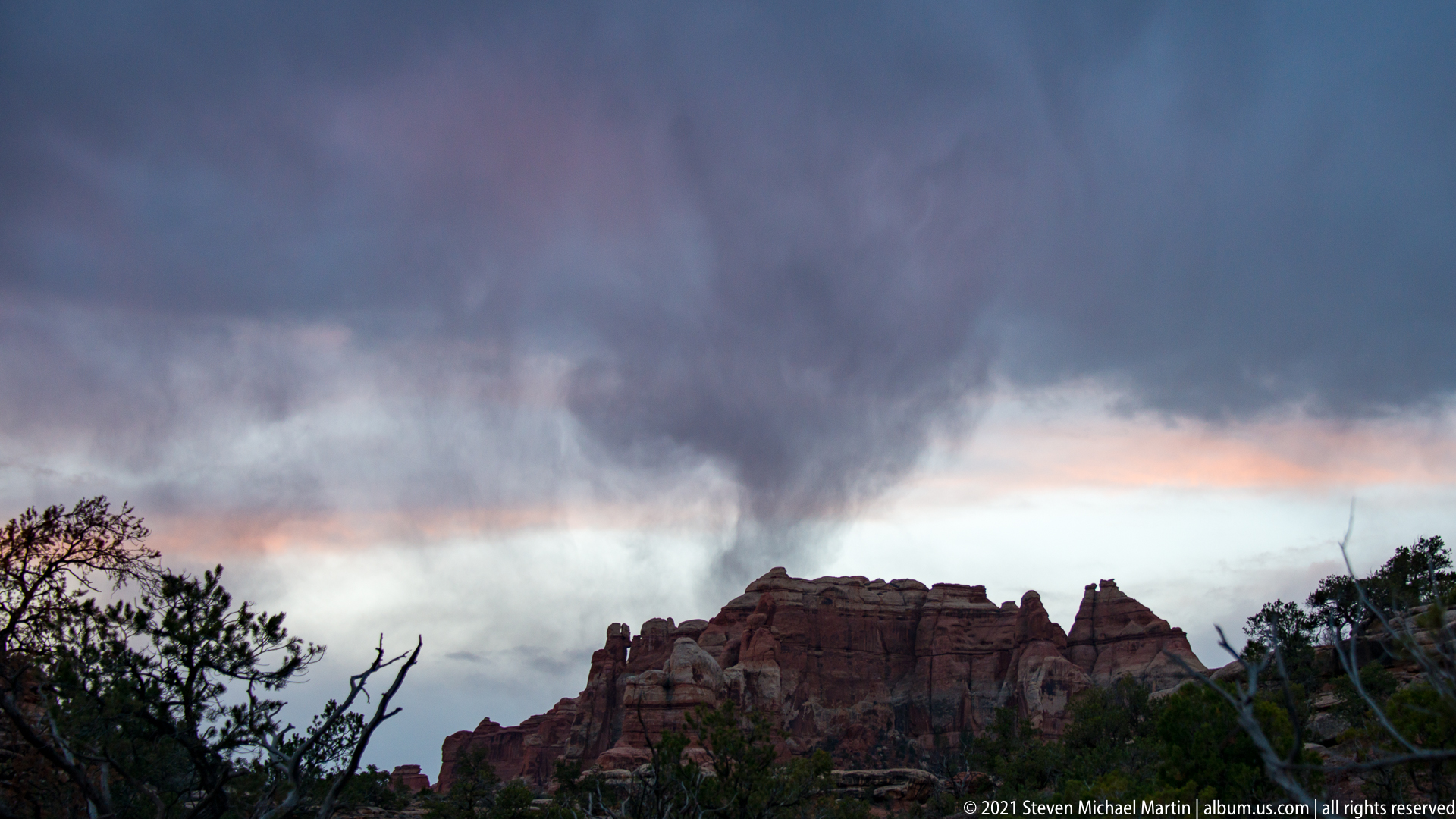
A heavy dark cloud hangs above a low line of sandstone towers, with a pale opening and a faint band of warm light along the horizon. The foreground cliffs and trees are nearly silhouetted, reducing the rock formations to a dark red edge beneath the weather. This distant view centers the changing sky rather than a single landform.
Caption
A heavy dark cloud hangs above a low line of sandstone towers, with a pale opening and a faint band of warm light along the horizon. The foreground cliffs and trees are nearly silhouetted, reducing the rock formations to a dark red edge beneath the weather. This distant view centers the changing sky rather than a single landform.
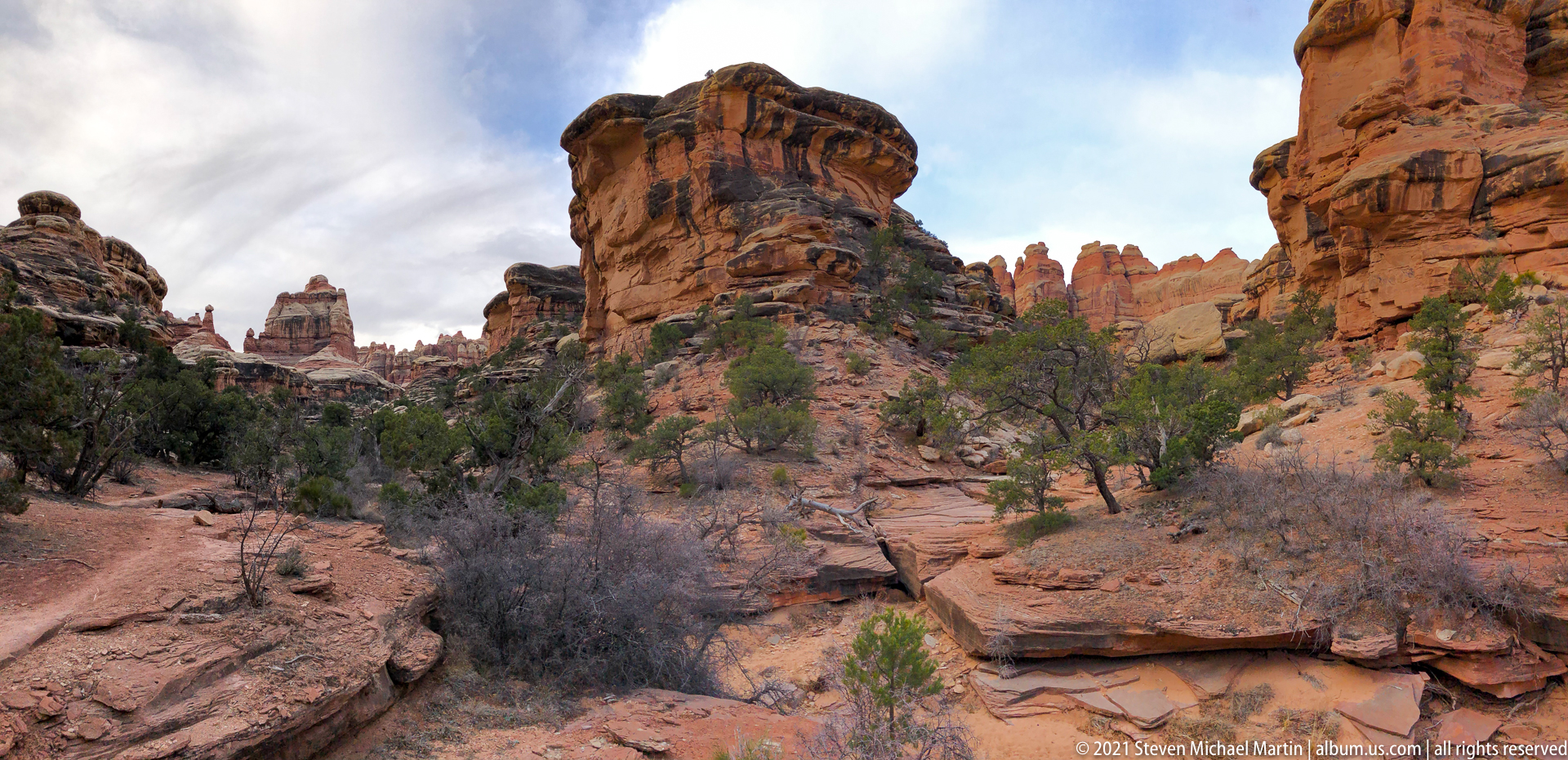
A broad sandstone tower rises in the center, separated from neighboring walls by narrow gaps and lower ledges. Its dark horizontal bands and irregular cap contrast with the lighter sky, while shrubs and broken slabs fill the foreground. This closer view shifts from the glowing skyline to the substantial mass and stratified surface of one prominent formation.
Caption
A broad sandstone tower rises in the center, separated from neighboring walls by narrow gaps and lower ledges. Its dark horizontal bands and irregular cap contrast with the lighter sky, while shrubs and broken slabs fill the foreground. This closer view shifts from the glowing skyline to the substantial mass and stratified surface of one prominent formation.
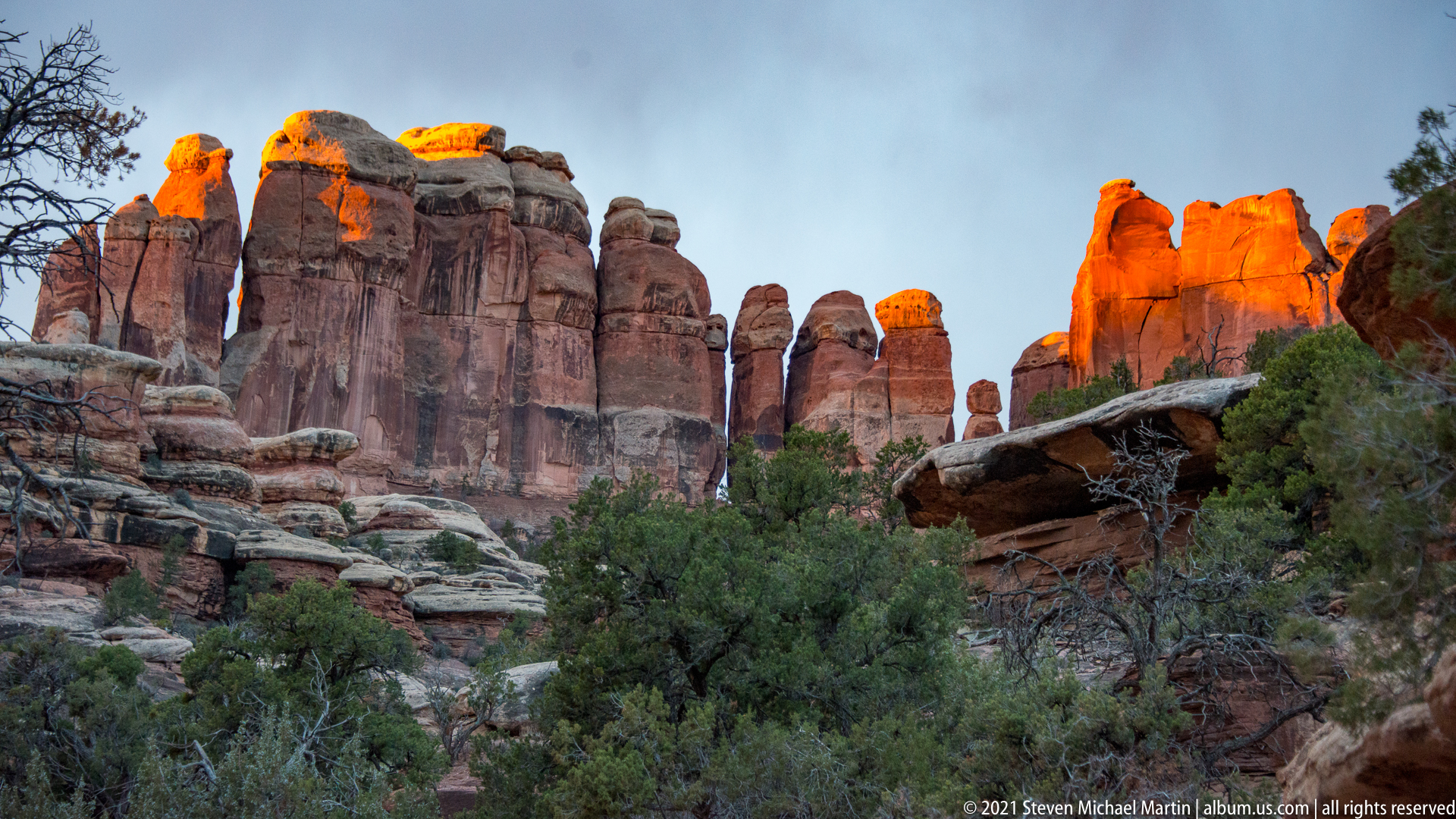
The towers fill more of the frame, revealing slim vertical columns between broader rounded masses. Warm light falls across their upper edges and faces, while the foreground juniper remains dark. A pale clouded sky forms a soft backdrop, separating the uneven pinnacles from the brushy slope below.
Caption
The towers fill more of the frame, revealing slim vertical columns between broader rounded masses. Warm light falls across their upper edges and faces, while the foreground juniper remains dark. A pale clouded sky forms a soft backdrop, separating the uneven pinnacles from the brushy slope below.
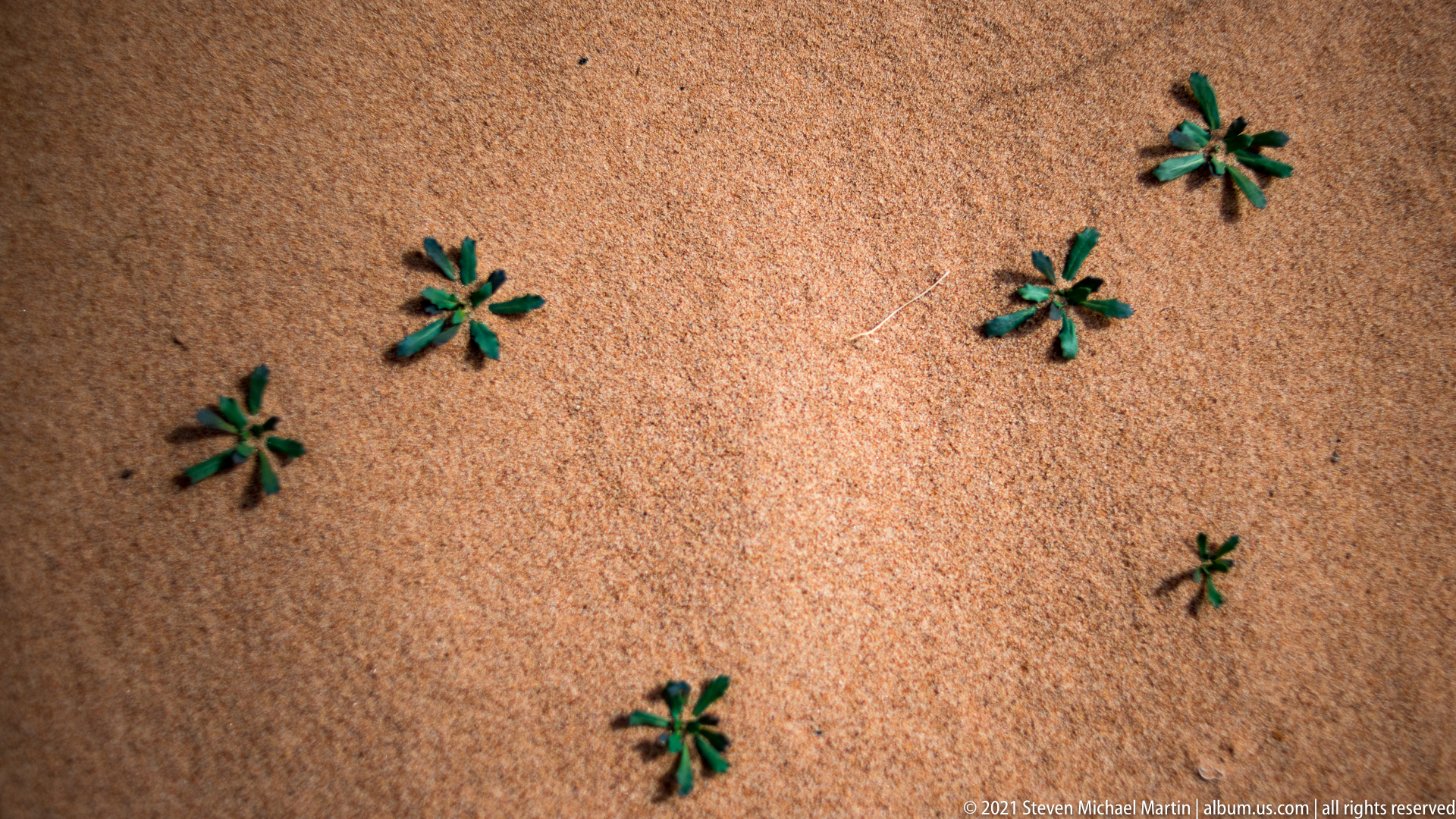
Five small green rosette-shaped plants are spaced across an expanse of fine orange sand. Their dark leaves form compact starbursts against the nearly uniform ground, with no stems or flowers visible at this scale. The close composition turns a subtle patch of desert vegetation into a study of pattern, spacing, and color within the dry canyon environment.
Caption
Five small green rosette-shaped plants are spaced across an expanse of fine orange sand. Their dark leaves form compact starbursts against the nearly uniform ground, with no stems or flowers visible at this scale. The close composition turns a subtle patch of desert vegetation into a study of pattern, spacing, and color within the dry canyon environment.
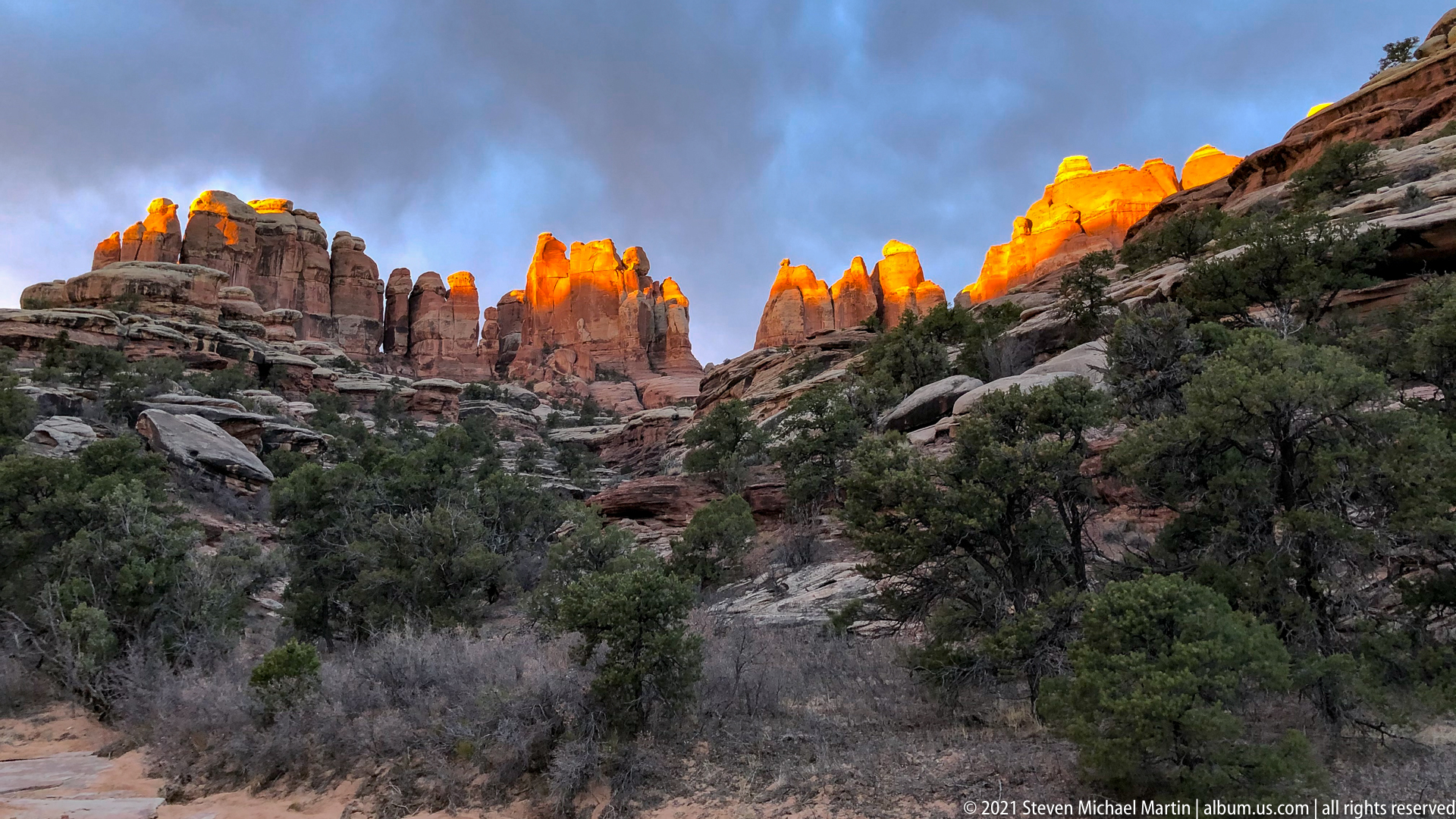
A wider sweep of sandstone pinnacles stretches across the upper half of the scene, their crowns glowing orange against a clouded sky. The canyon floor and foreground shrubs remain dim, creating a strong contrast between lit rock and shadow. The line of towers extends farther to the right than in the preceding view, revealing more of the rugged skyline.
Caption
A wider sweep of sandstone pinnacles stretches across the upper half of the scene, their crowns glowing orange against a clouded sky. The canyon floor and foreground shrubs remain dim, creating a strong contrast between lit rock and shadow. The line of towers extends farther to the right than in the preceding view, revealing more of the rugged skyline.
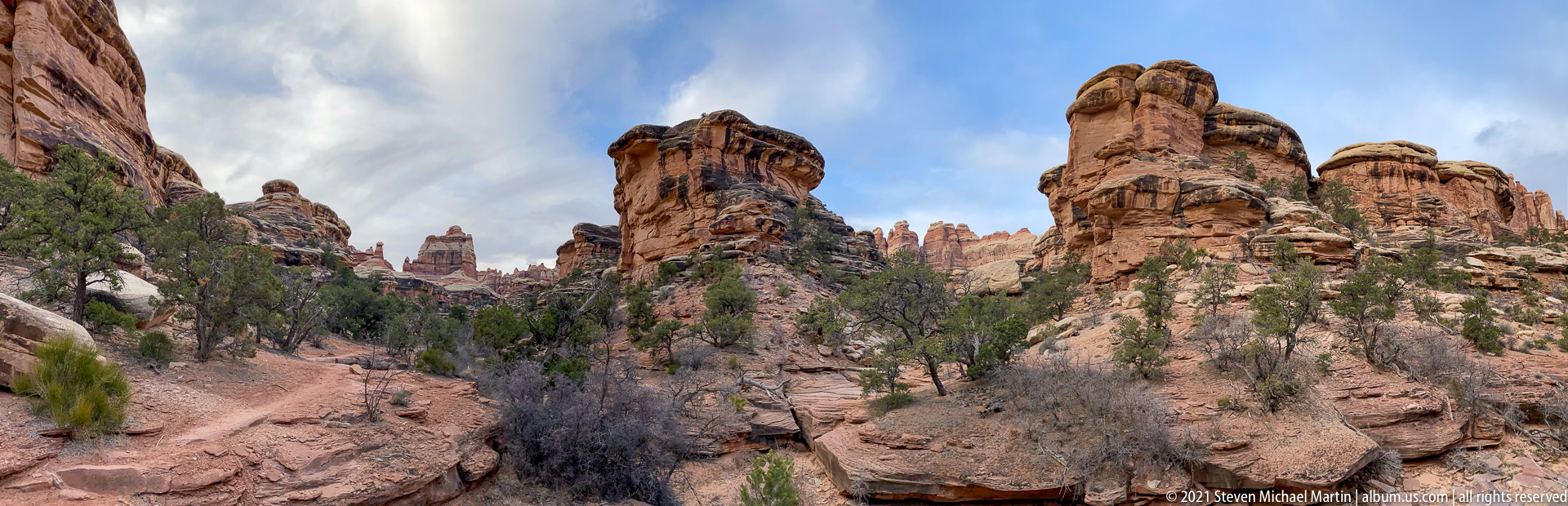
Several rounded sandstone towers rise at different distances, with the tallest near the right and a smaller dark-banded tower near center. A pale, uneven route passes through shrubs and fractured ledges in the foreground. The upward view sets the path beneath the formations and makes the height differences among the towers easy to compare.
Caption
Several rounded sandstone towers rise at different distances, with the tallest near the right and a smaller dark-banded tower near center. A pale, uneven route passes through shrubs and fractured ledges in the foreground. The upward view sets the path beneath the formations and makes the height differences among the towers easy to compare.
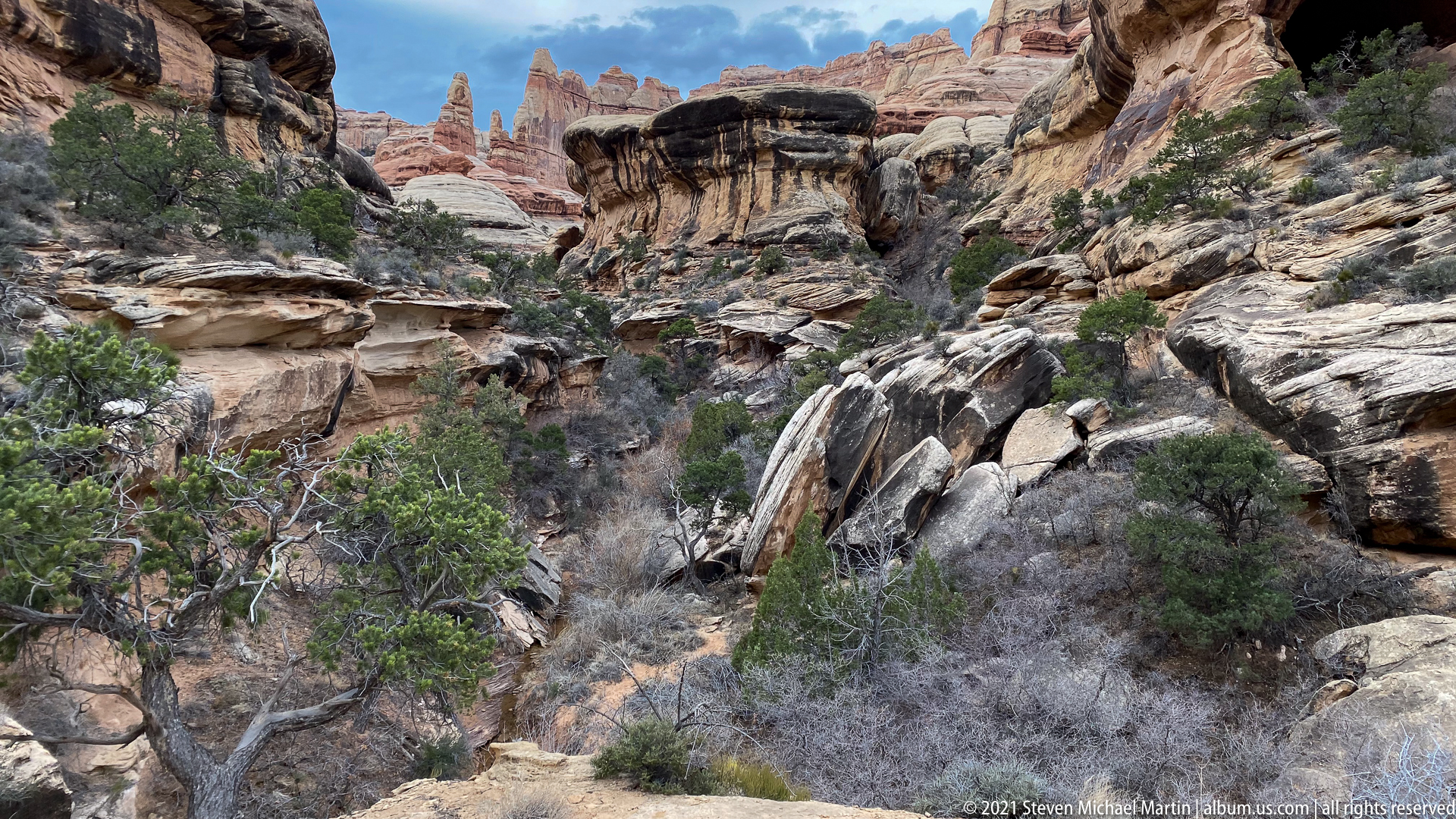
A stony wash leads into the center of a narrow canyon basin, bordered by tilted sandstone shelves and thick juniper and scrub. A striped overhang spans the upper middle distance, while reddish towers rise beyond it. The winding route is visible between boulders and shrubs, giving the view a clear sense of movement into the formations.
Caption
A stony wash leads into the center of a narrow canyon basin, bordered by tilted sandstone shelves and thick juniper and scrub. A striped overhang spans the upper middle distance, while reddish towers rise beyond it. The winding route is visible between boulders and shrubs, giving the view a clear sense of movement into the formations.

A dark metal trail sign points in opposite directions from the junction. The visible destinations include Chesler Park, Elephant Hill Trailhead, Squaw Flat Campground, and Druid Arch, each accompanied by mile and kilometer distances. Shallow background focus keeps the lettering dominant while blurred brown vegetation places the marker in a dry woodland setting.
Caption
A dark metal trail sign points in opposite directions from the junction. The visible destinations include Chesler Park, Elephant Hill Trailhead, Squaw Flat Campground, and Druid Arch, each accompanied by mile and kilometer distances. Shallow background focus keeps the lettering dominant while blurred brown vegetation places the marker in a dry woodland setting.
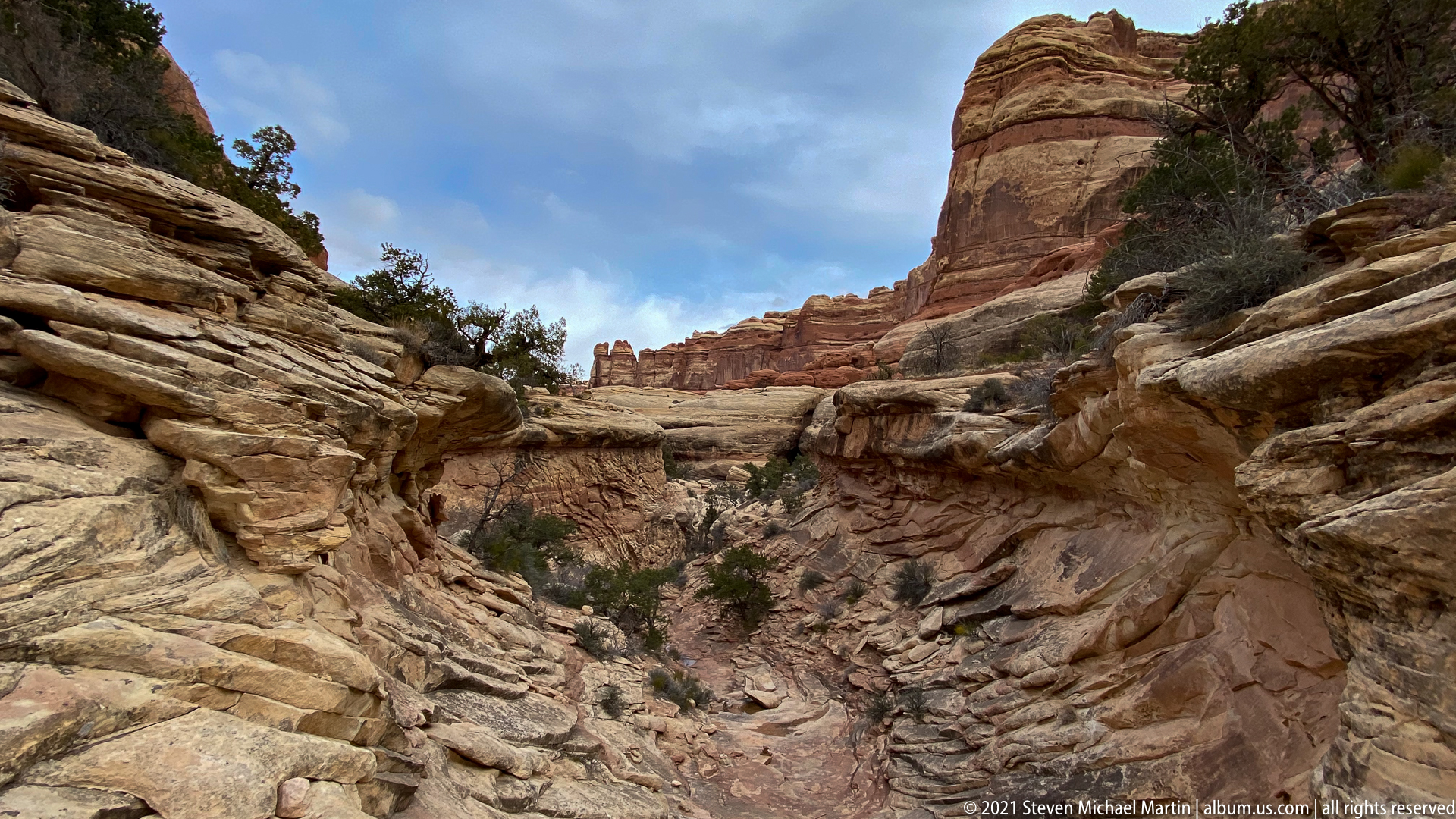
The route follows a shallow rocky channel between low, sloping sandstone shelves. Juniper and leafless brush fill the edges, and a banded tower rises at upper right beyond the wash. Pale ledges on the left and darker red walls on the right create a tight passage that gradually opens toward the distant formations.
Caption
The route follows a shallow rocky channel between low, sloping sandstone shelves. Juniper and leafless brush fill the edges, and a banded tower rises at upper right beyond the wash. Pale ledges on the left and darker red walls on the right create a tight passage that gradually opens toward the distant formations.
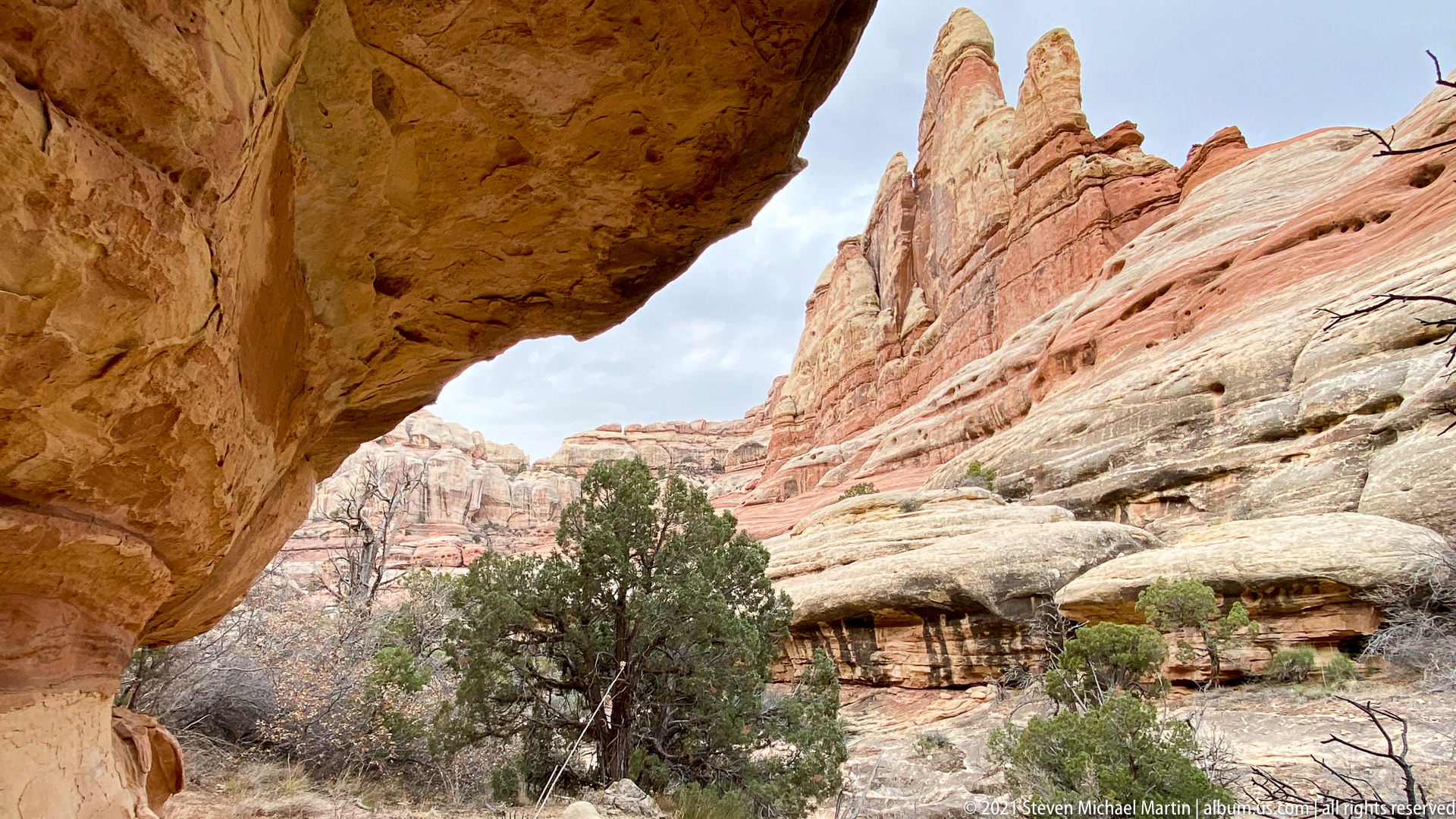
A broad sandstone ledge projects from the upper left, creating a dark ceiling over a sunlit canyon scene. Beyond it, pale and rose-colored walls rise in narrow bands above a central juniper. The overhang sets a strong diagonal across the frame, drawing attention to the contrast between shaded foreground rock and the open landscape beyond.
Caption
A broad sandstone ledge projects from the upper left, creating a dark ceiling over a sunlit canyon scene. Beyond it, pale and rose-colored walls rise in narrow bands above a central juniper. The overhang sets a strong diagonal across the frame, drawing attention to the contrast between shaded foreground rock and the open landscape beyond.
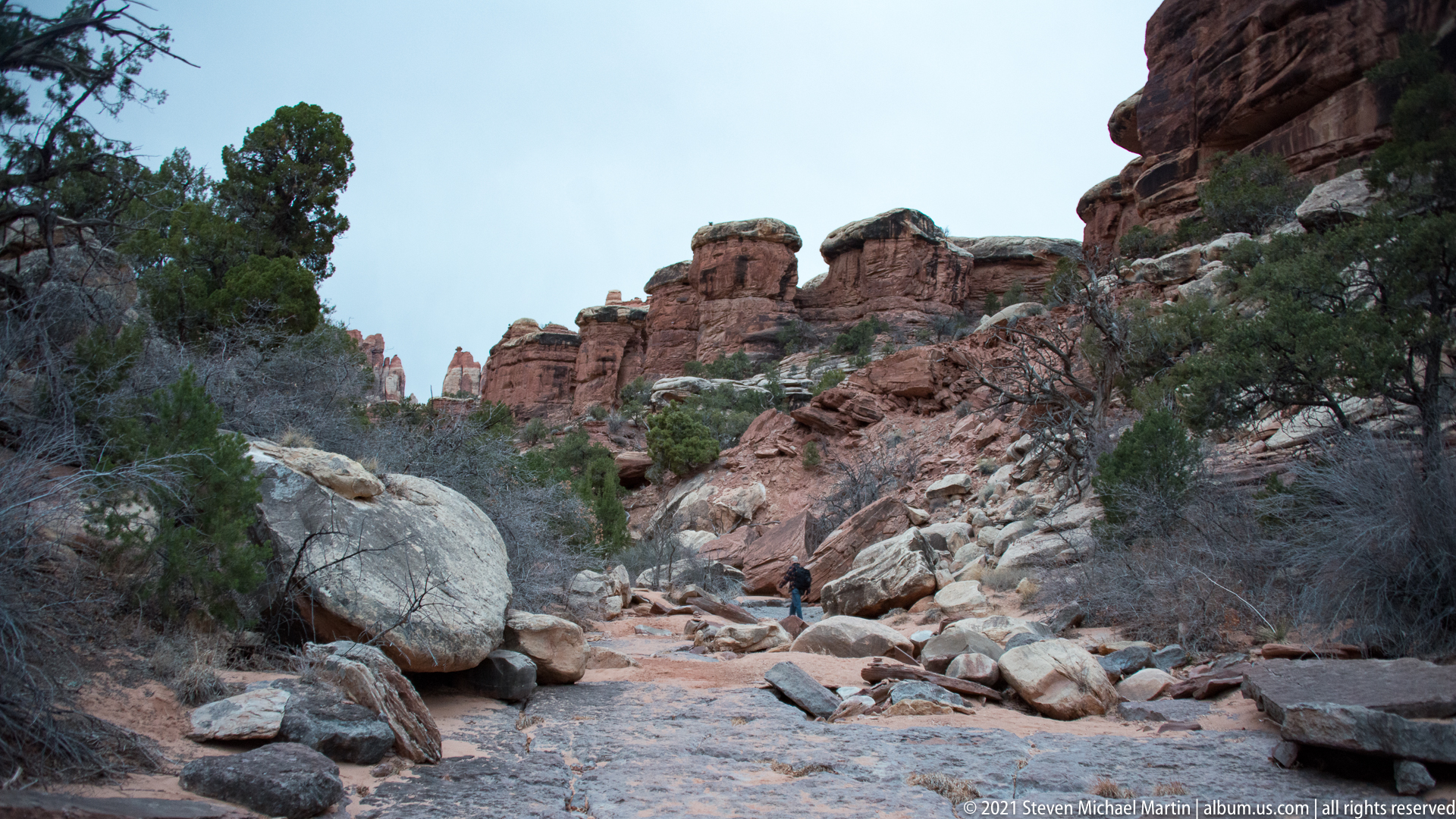
A hiker in a blue top walks away through the center of a pale, boulder-filled wash. Juniper and brush crowd both sides, with red rounded towers rising beyond the vegetation. The person’s small scale and placement on the open channel make the route legible through otherwise dense, uneven terrain.
Caption
A hiker in a blue top walks away through the center of a pale, boulder-filled wash. Juniper and brush crowd both sides, with red rounded towers rising beyond the vegetation. The person’s small scale and placement on the open channel make the route legible through otherwise dense, uneven terrain.
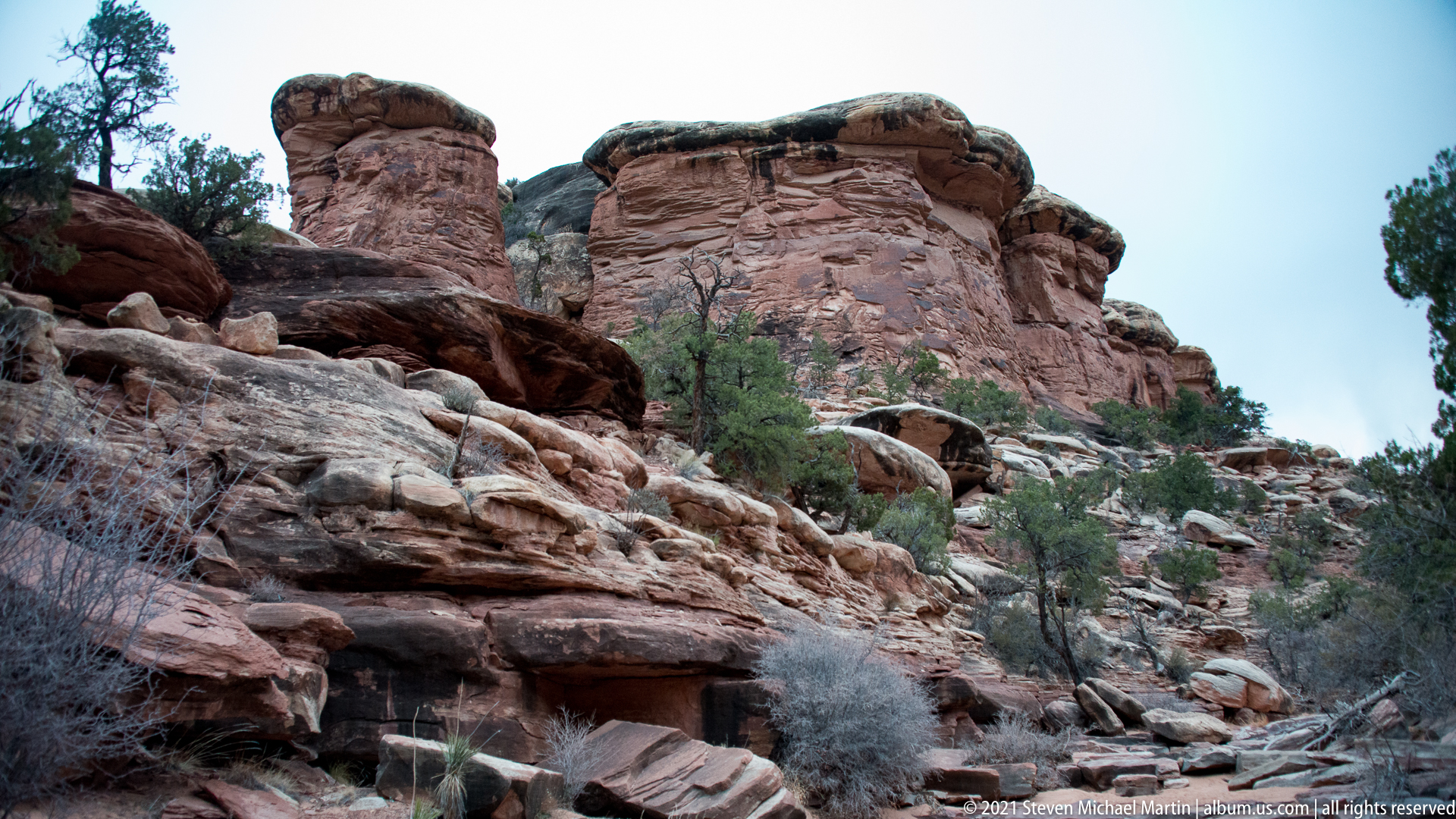
Several squat, rounded towers rise above a stack of sloping sandstone shelves. Their horizontal bands shift from pale tan to muted red, while a darker wall closes the right side and leafless brush fills the lower foreground. The higher viewpoint isolates the blocky skyline against a pale sky and shows how the ledges step down toward the canyon.
Caption
Several squat, rounded towers rise above a stack of sloping sandstone shelves. Their horizontal bands shift from pale tan to muted red, while a darker wall closes the right side and leafless brush fills the lower foreground. The higher viewpoint isolates the blocky skyline against a pale sky and shows how the ledges step down toward the canyon.
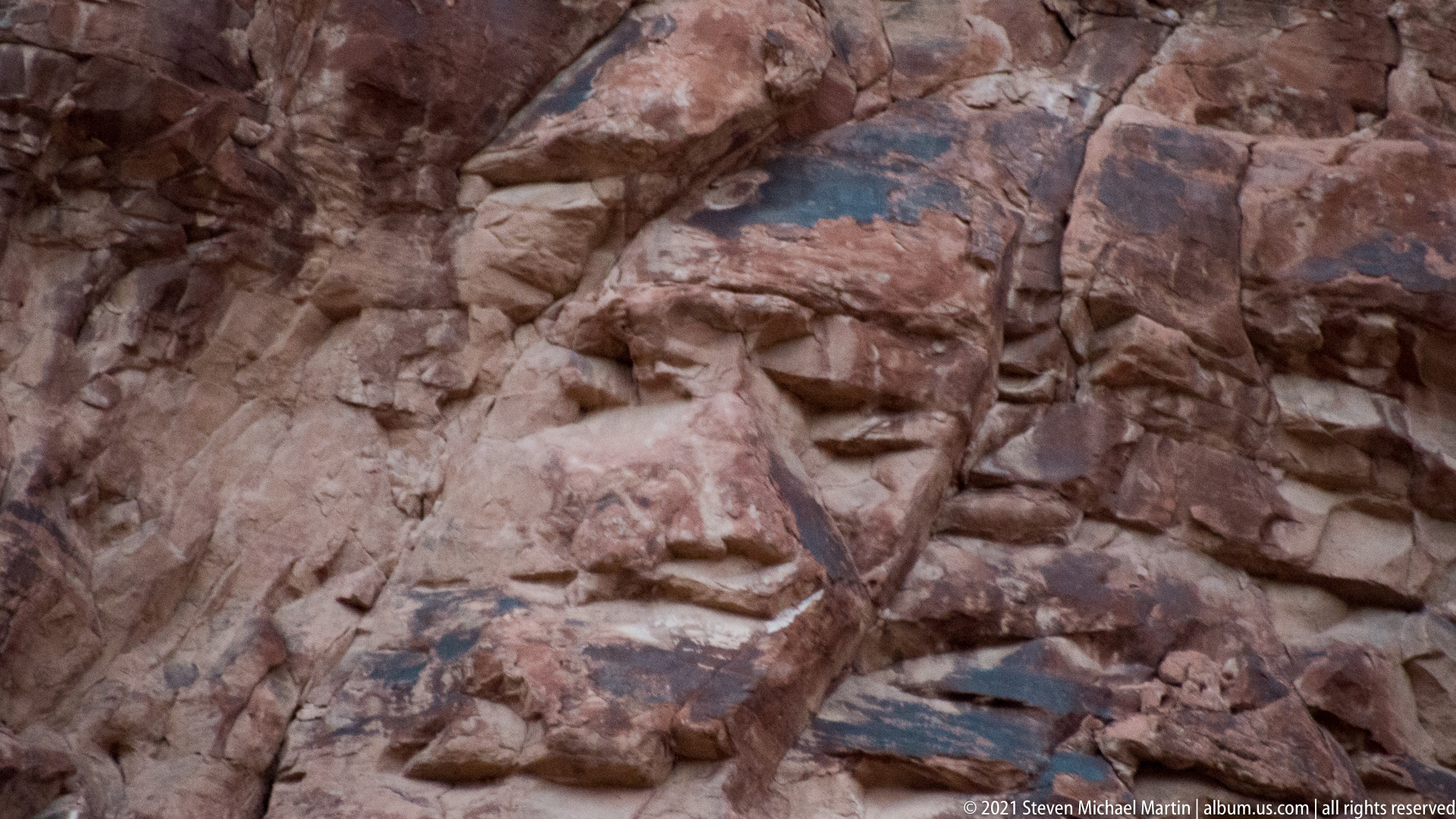
A close view of broken sandstone slabs shows shallow dark pockets and narrow fissures between irregular, layered surfaces. Muted red and tan tones shift across the fractured rock, with small patches of darker staining along the ledges. The tight crop focuses on weathering and texture rather than the larger canyon formations beyond the frame.
Caption
A close view of broken sandstone slabs shows shallow dark pockets and narrow fissures between irregular, layered surfaces. Muted red and tan tones shift across the fractured rock, with small patches of darker staining along the ledges. The tight crop focuses on weathering and texture rather than the larger canyon formations beyond the frame.
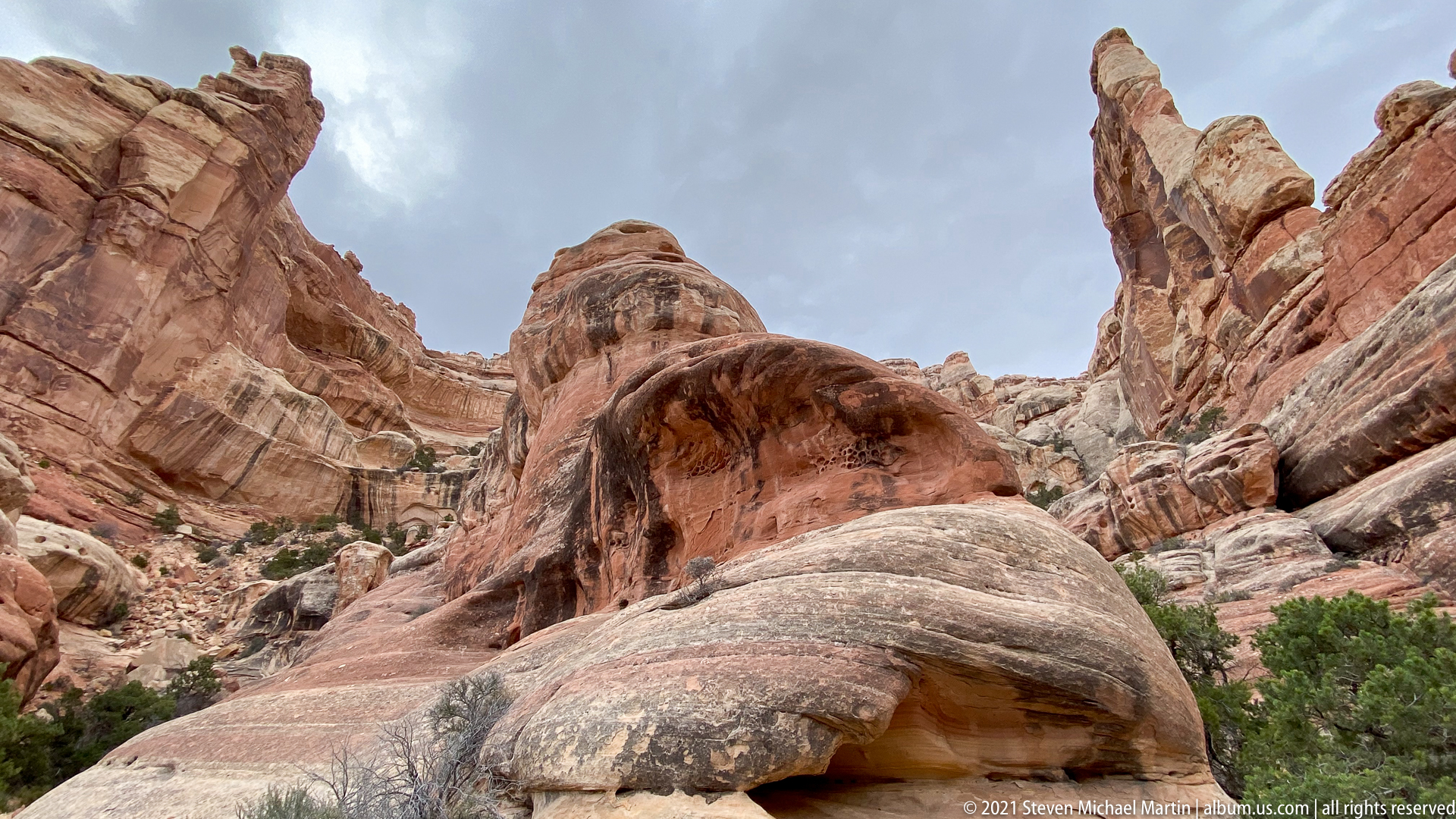
A broad, smooth sandstone dome fills the lower foreground, rising toward a small dark opening at its right edge. Behind it, a rounded rock tower and a narrow spire project into a cloudy sky, enclosed by higher canyon walls. The low viewpoint layers the smooth foreground curve against more sharply broken forms above.
Caption
A broad, smooth sandstone dome fills the lower foreground, rising toward a small dark opening at its right edge. Behind it, a rounded rock tower and a narrow spire project into a cloudy sky, enclosed by higher canyon walls. The low viewpoint layers the smooth foreground curve against more sharply broken forms above.
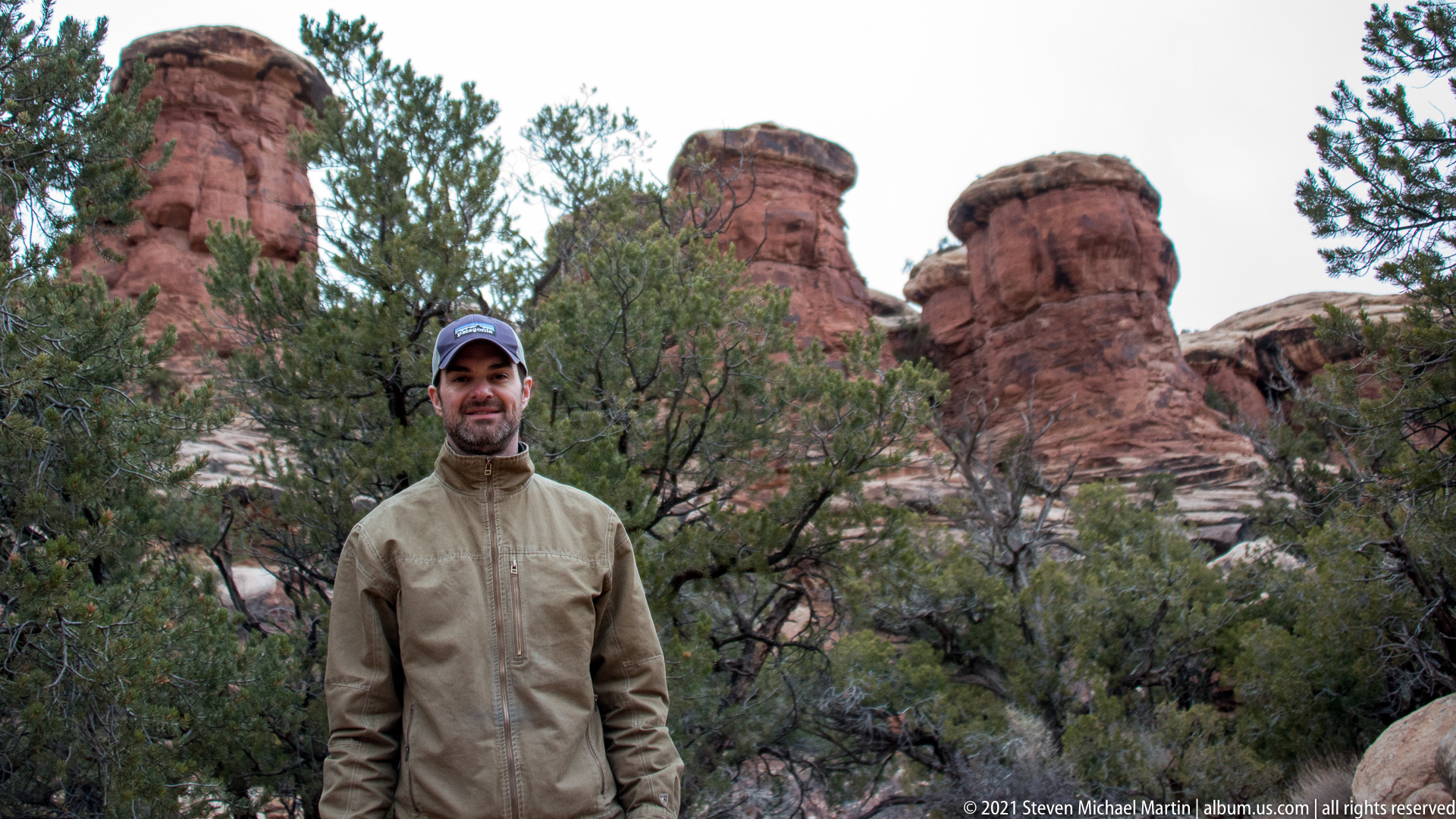
A man in a tan jacket and blue cap stands among low juniper branches, facing the camera. Rounded red towers and pale ledges rise behind him, partly screened by the vegetation. The waist-up framing gives the visitor prominence while retaining enough of the layered canyon setting to show the rugged location.
Caption
A man in a tan jacket and blue cap stands among low juniper branches, facing the camera. Rounded red towers and pale ledges rise behind him, partly screened by the vegetation. The waist-up framing gives the visitor prominence while retaining enough of the layered canyon setting to show the rugged location.
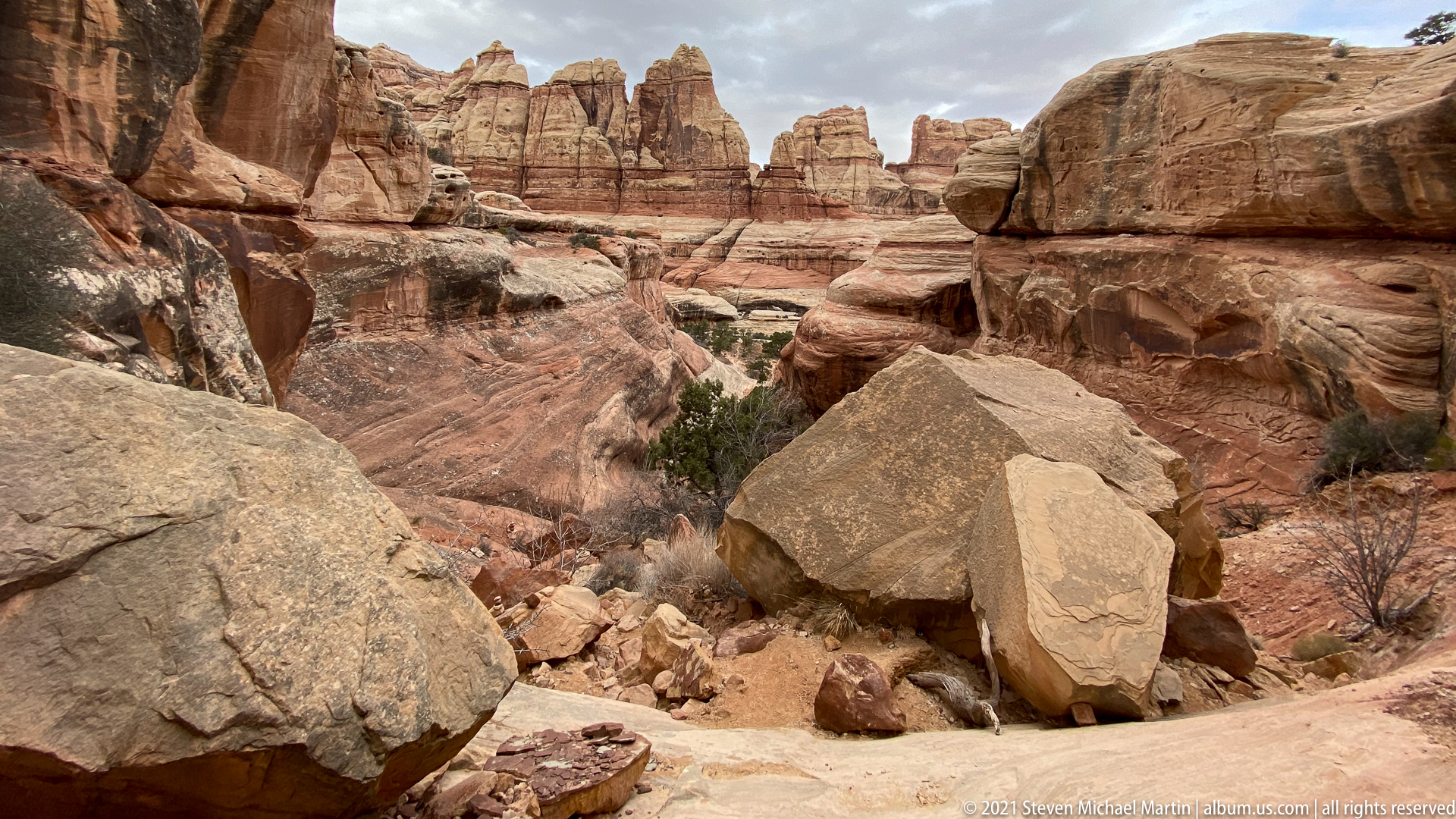
Large pale boulders crowd the foreground of a dry wash, while red and cream sandstone towers stand across the middle distance. A high sloping wall borders the right, and the channel threads between the blocks toward a bright strip of sky. The near boulders emphasize the rough footing along the canyon route.
Caption
Large pale boulders crowd the foreground of a dry wash, while red and cream sandstone towers stand across the middle distance. A high sloping wall borders the right, and the channel threads between the blocks toward a bright strip of sky. The near boulders emphasize the rough footing along the canyon route.
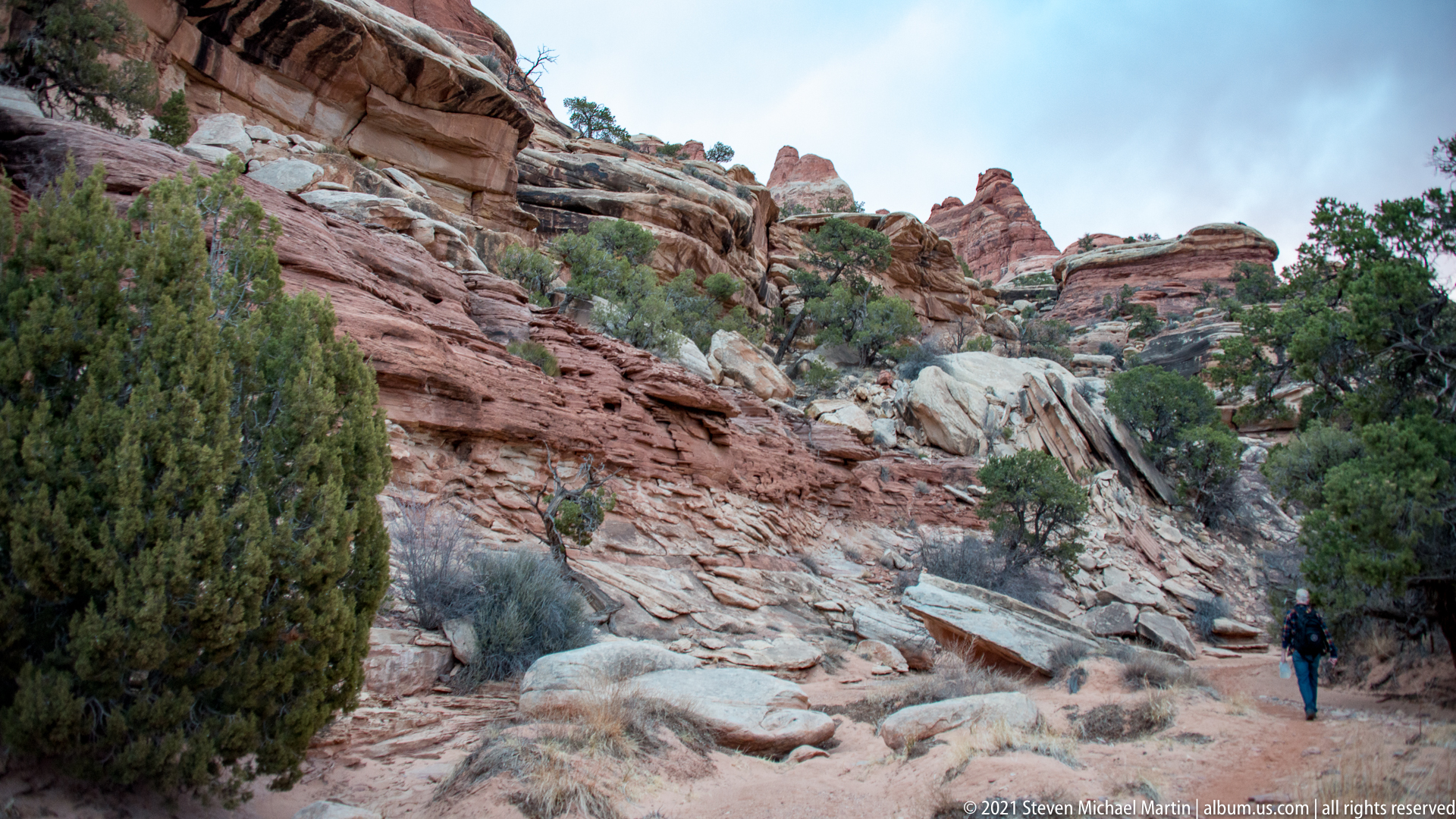
A hiker in dark clothing moves away along a pale, sloping path at the right side of the frame. Layered red sandstone rises on the left, while juniper and brush border the route. The open foreground rock and the person’s position show the trail’s uneven grade as it climbs toward a bend in the canyon.
Caption
A hiker in dark clothing moves away along a pale, sloping path at the right side of the frame. Layered red sandstone rises on the left, while juniper and brush border the route. The open foreground rock and the person’s position show the trail’s uneven grade as it climbs toward a bend in the canyon.
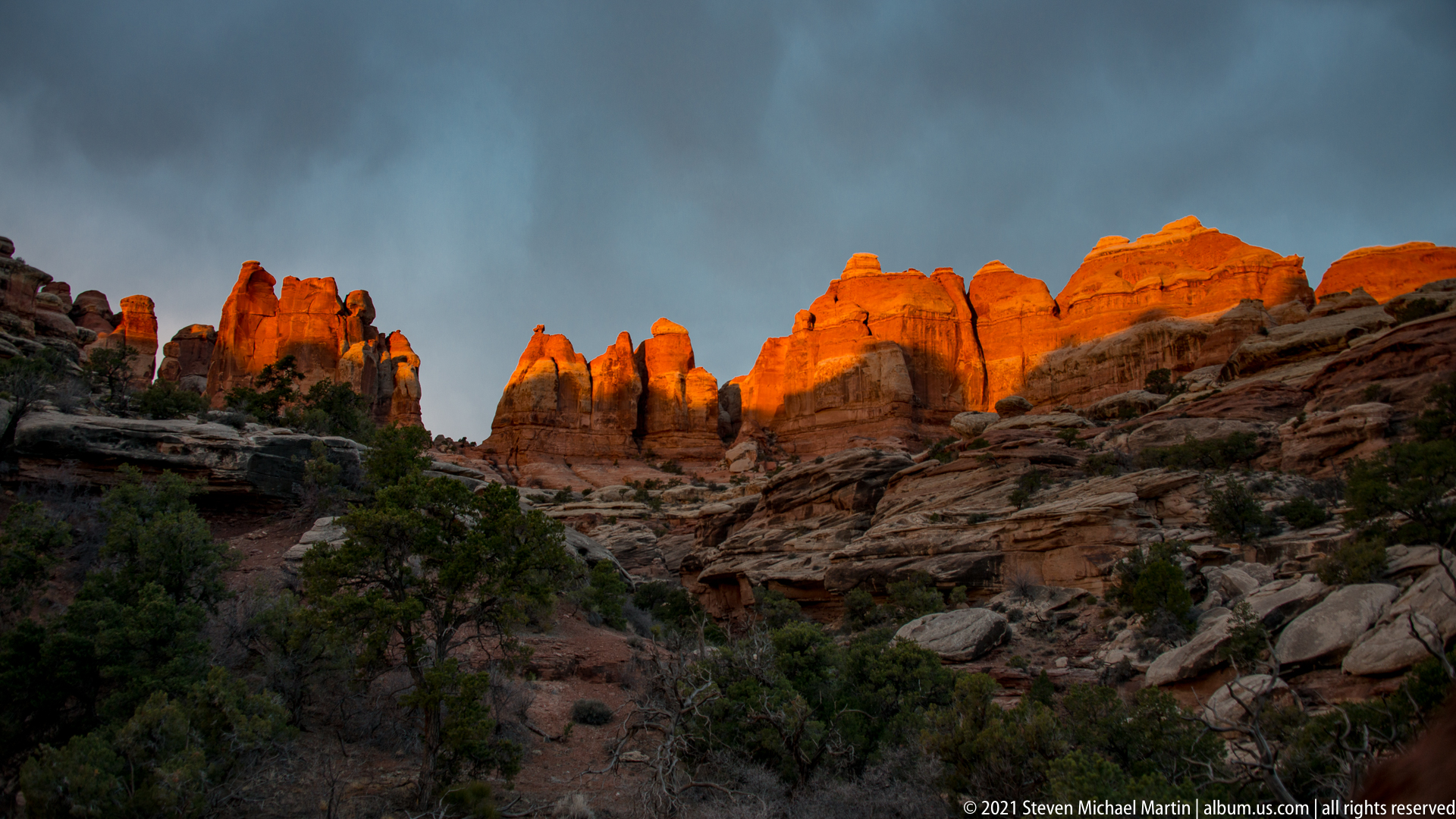
Warm light reaches a line of tall red towers from left to right, while the foreground remains nearly black. The lower ledges slope toward the illuminated formations, giving the scene a strong diagonal transition from shadow to light. A narrow blue-gray sky surrounds the towers and keeps their warm color distinct.
Caption
Warm light reaches a line of tall red towers from left to right, while the foreground remains nearly black. The lower ledges slope toward the illuminated formations, giving the scene a strong diagonal transition from shadow to light. A narrow blue-gray sky surrounds the towers and keeps their warm color distinct.

Several towers stand close together, their upper faces lit orange while lower walls and foreground shelves fall into shadow. A broad central gap separates the largest clusters, revealing a patch of blue-gray sky. The tighter framing turns the canyon skyline into a study of alternating vertical masses and narrow openings.
Caption
Several towers stand close together, their upper faces lit orange while lower walls and foreground shelves fall into shadow. A broad central gap separates the largest clusters, revealing a patch of blue-gray sky. The tighter framing turns the canyon skyline into a study of alternating vertical masses and narrow openings.
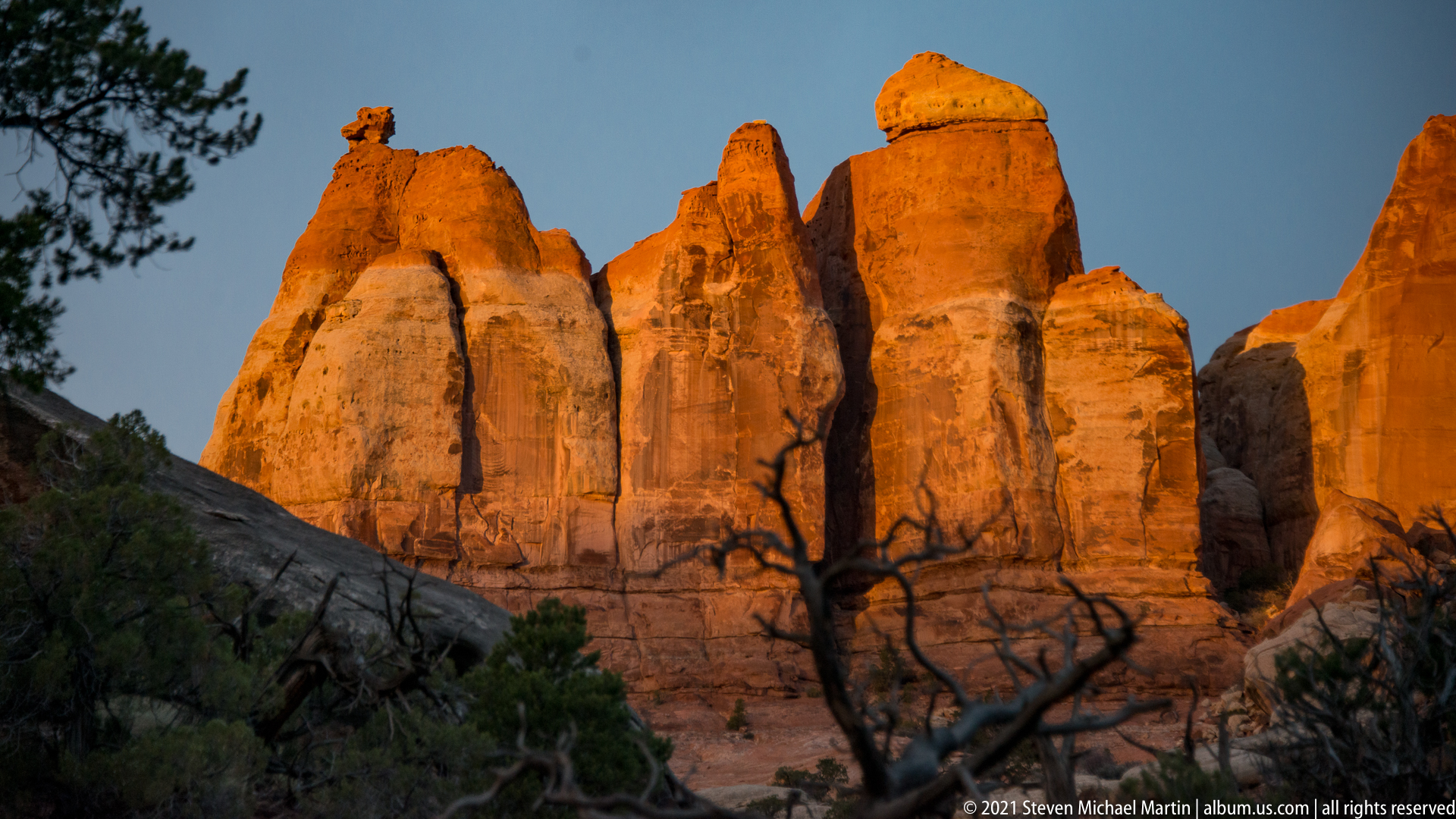
The sandstone columns fill the frame, their rounded tops and vertical fissures illuminated in intense orange light. Dark joints separate the masses, and a few branches cross the lower right against the rock. With little foreground visible, the close viewpoint stresses the formations’ height, warm color, and rough, banded surfaces.
Caption
The sandstone columns fill the frame, their rounded tops and vertical fissures illuminated in intense orange light. Dark joints separate the masses, and a few branches cross the lower right against the rock. With little foreground visible, the close viewpoint stresses the formations’ height, warm color, and rough, banded surfaces.
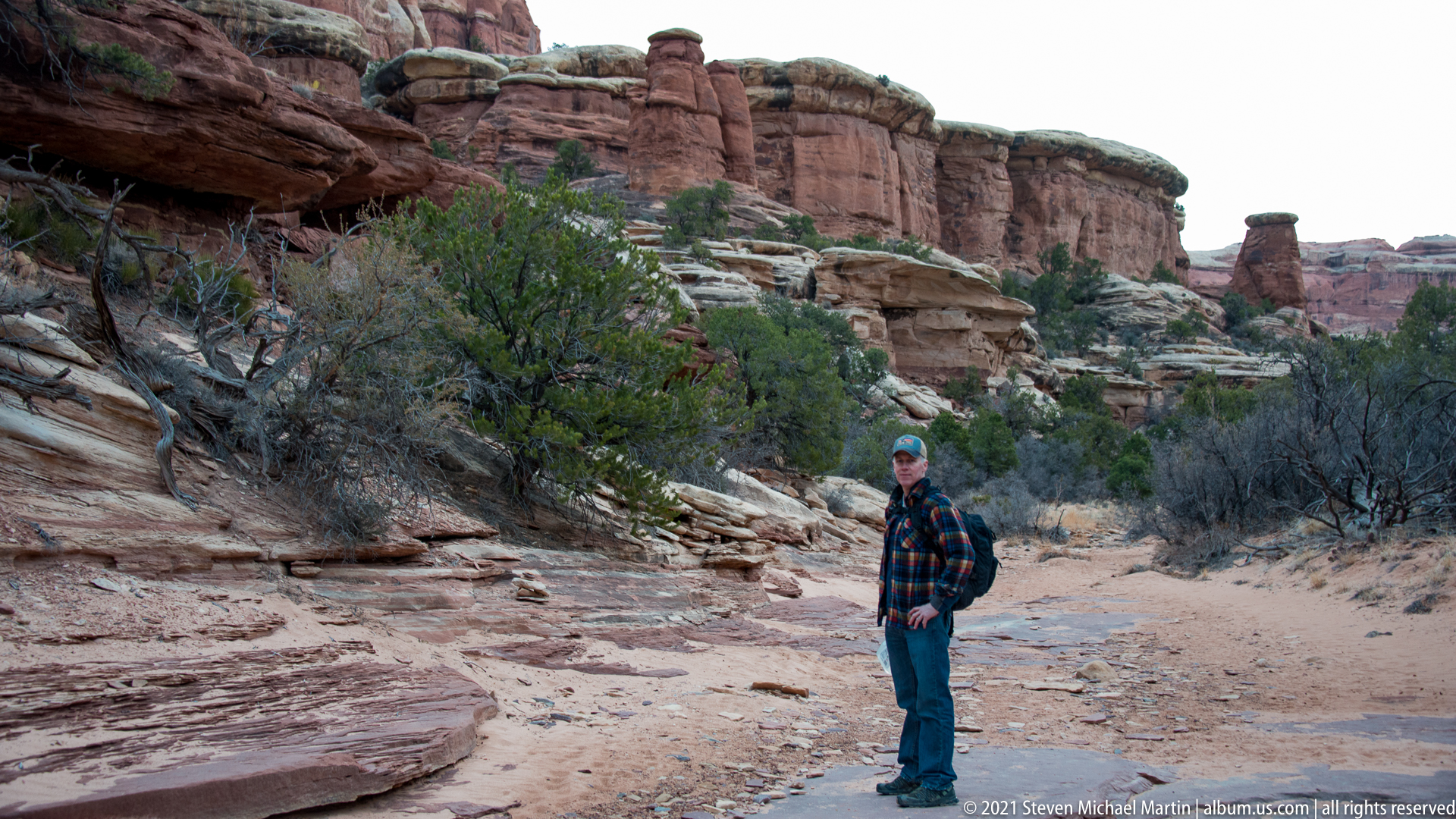
A visitor in a blue cap and plaid shirt stands on a pale sandy wash, facing the camera. Low shrubs and juniper line the route, and horizontal red rock shelves rise along the left and upper background. The figure is shown full length and small within the canyon, making the trail setting as important as the portrait.
Caption
A visitor in a blue cap and plaid shirt stands on a pale sandy wash, facing the camera. Low shrubs and juniper line the route, and horizontal red rock shelves rise along the left and upper background. The figure is shown full length and small within the canyon, making the trail setting as important as the portrait.
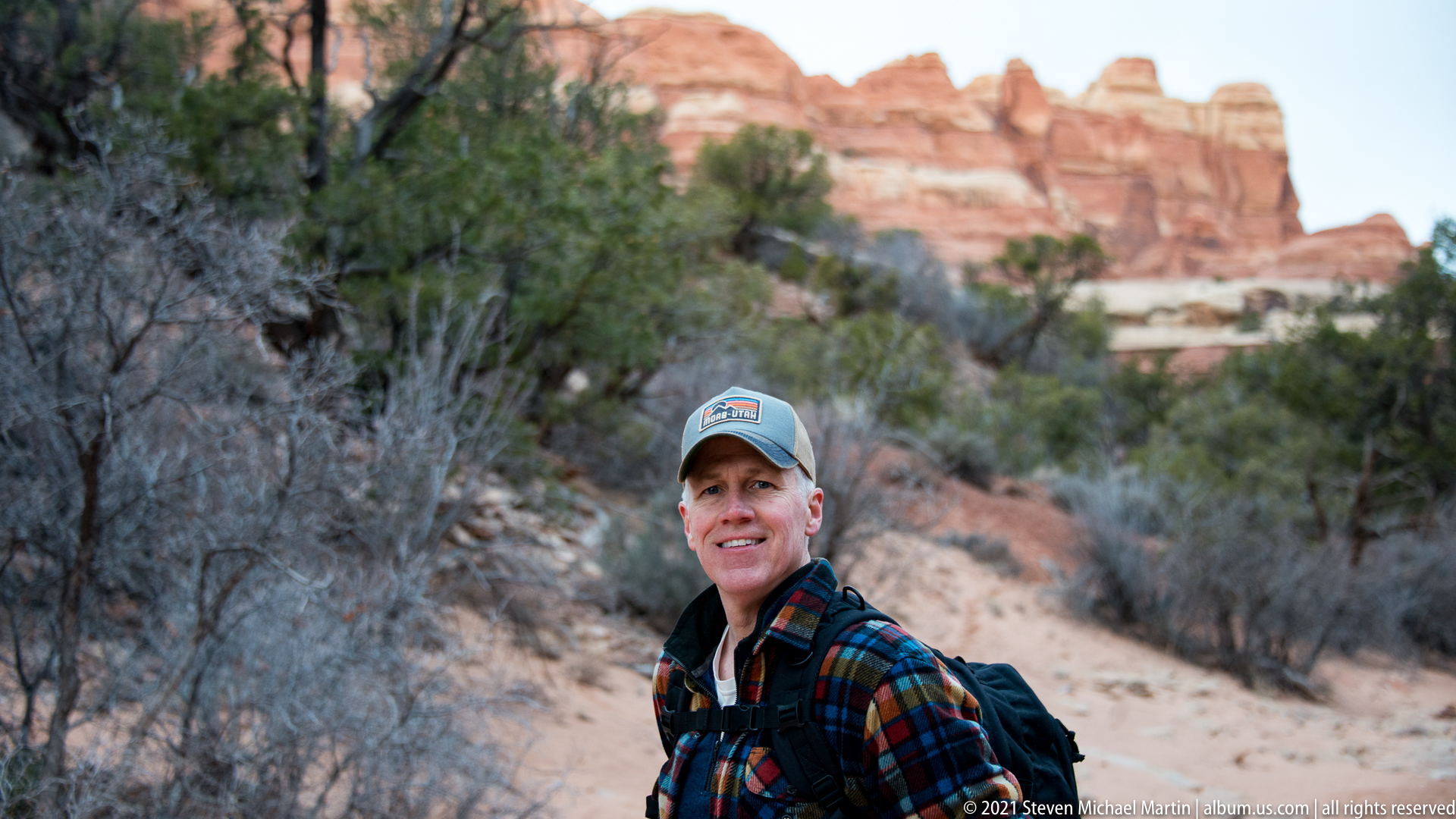
A hiker wearing a blue cap, plaid shirt, and dark backpack looks toward the camera from the right foreground. Juniper and pale sand soften the middle ground, while red sandstone blocks rise out of focus behind. The closer crop highlights the person’s face and gear and keeps the canyon recognizable as a blurred setting.
Caption
A hiker wearing a blue cap, plaid shirt, and dark backpack looks toward the camera from the right foreground. Juniper and pale sand soften the middle ground, while red sandstone blocks rise out of focus behind. The closer crop highlights the person’s face and gear and keeps the canyon recognizable as a blurred setting.
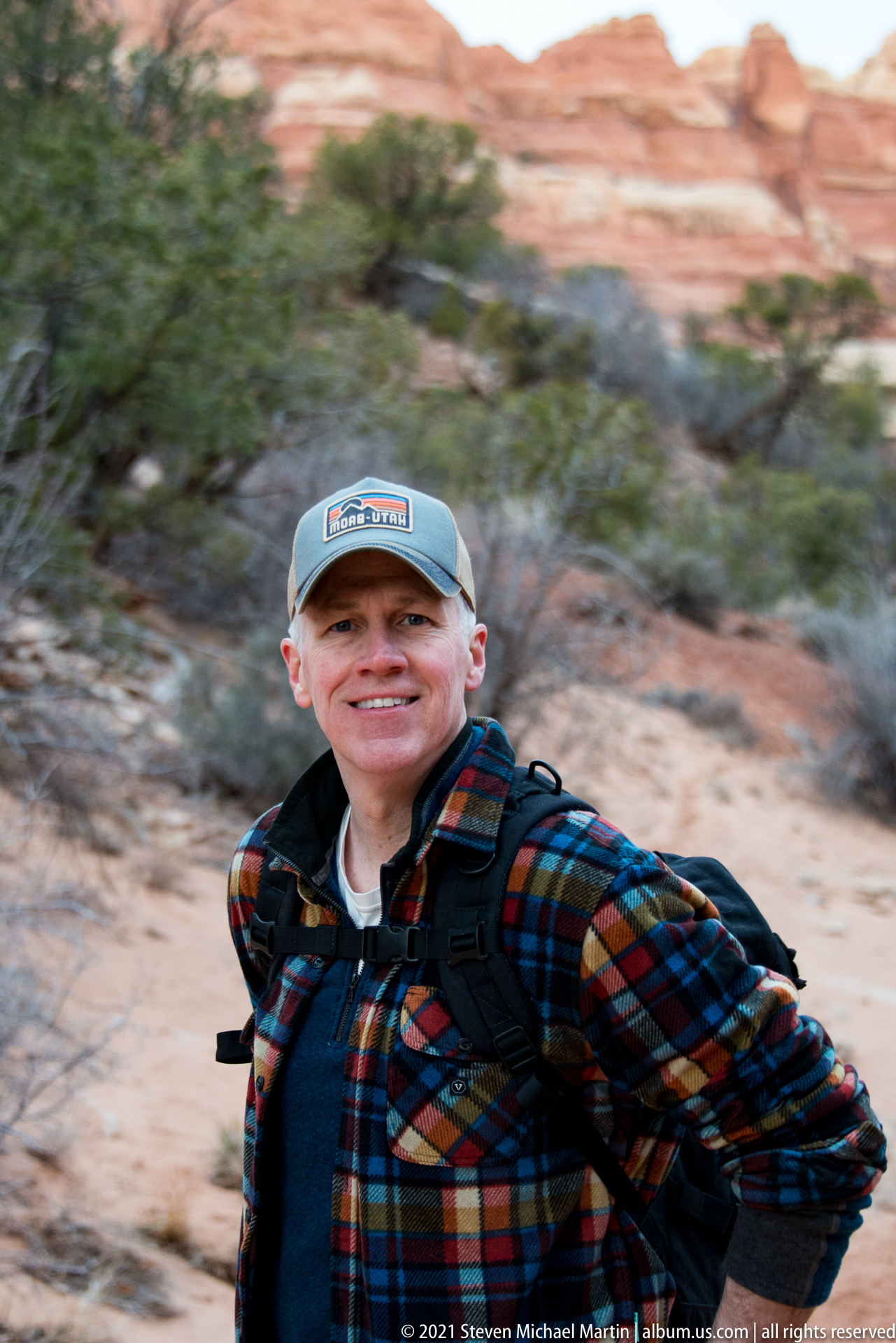
The hiker fills the foreground, smiling in a blue cap and dark plaid shirt with a backpack strap visible at the shoulder. The surrounding shrubs and red rock are blurred by shallow focus, leaving only a soft impression of the canyon behind. This portrait emphasizes expression and clothing rather than the broader landscape.
Caption
The hiker fills the foreground, smiling in a blue cap and dark plaid shirt with a backpack strap visible at the shoulder. The surrounding shrubs and red rock are blurred by shallow focus, leaving only a soft impression of the canyon behind. This portrait emphasizes expression and clothing rather than the broader landscape.

A visitor stands on a sandy trail that passes between low juniper and dry brush. Behind the figure, broad bands of red, cream, and gray sandstone form a low wall across the horizon. The open foreground gives the person room within the landscape, while the layered cliffs and scattered vegetation show the route’s exposed, arid setting.
Caption
A visitor stands on a sandy trail that passes between low juniper and dry brush. Behind the figure, broad bands of red, cream, and gray sandstone form a low wall across the horizon. The open foreground gives the person room within the landscape, while the layered cliffs and scattered vegetation show the route’s exposed, arid setting.
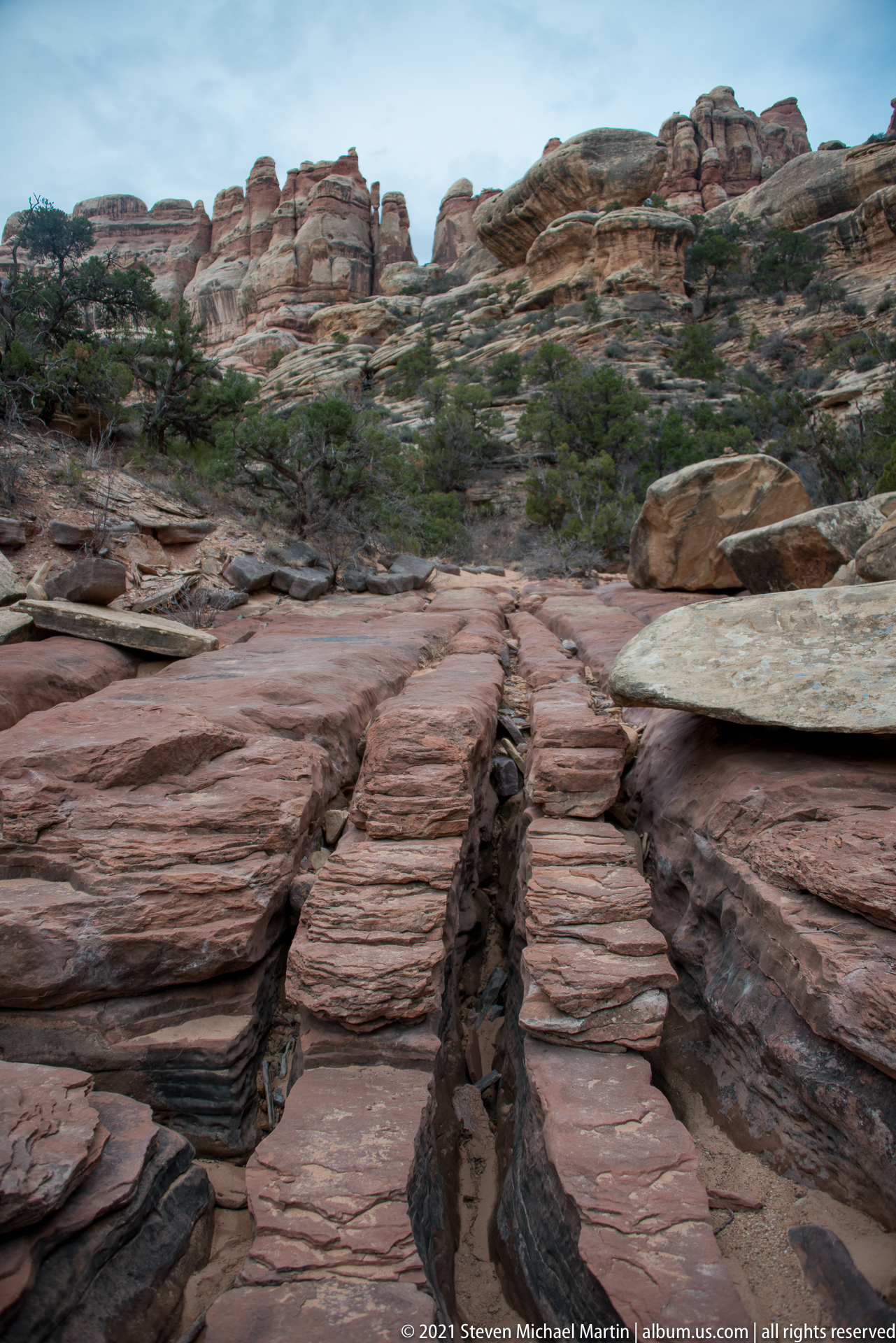
Parallel bands of red sandstone run toward the camera, divided by a deep narrow groove that channels through the foreground. A pale rounded slab and low juniper sit above the grooved surface, with layered cliffs beyond. The low viewpoint emphasizes the repeated lines in the exposed rock and the way erosion has opened a route between them.
Caption
Parallel bands of red sandstone run toward the camera, divided by a deep narrow groove that channels through the foreground. A pale rounded slab and low juniper sit above the grooved surface, with layered cliffs beyond. The low viewpoint emphasizes the repeated lines in the exposed rock and the way erosion has opened a route between them.
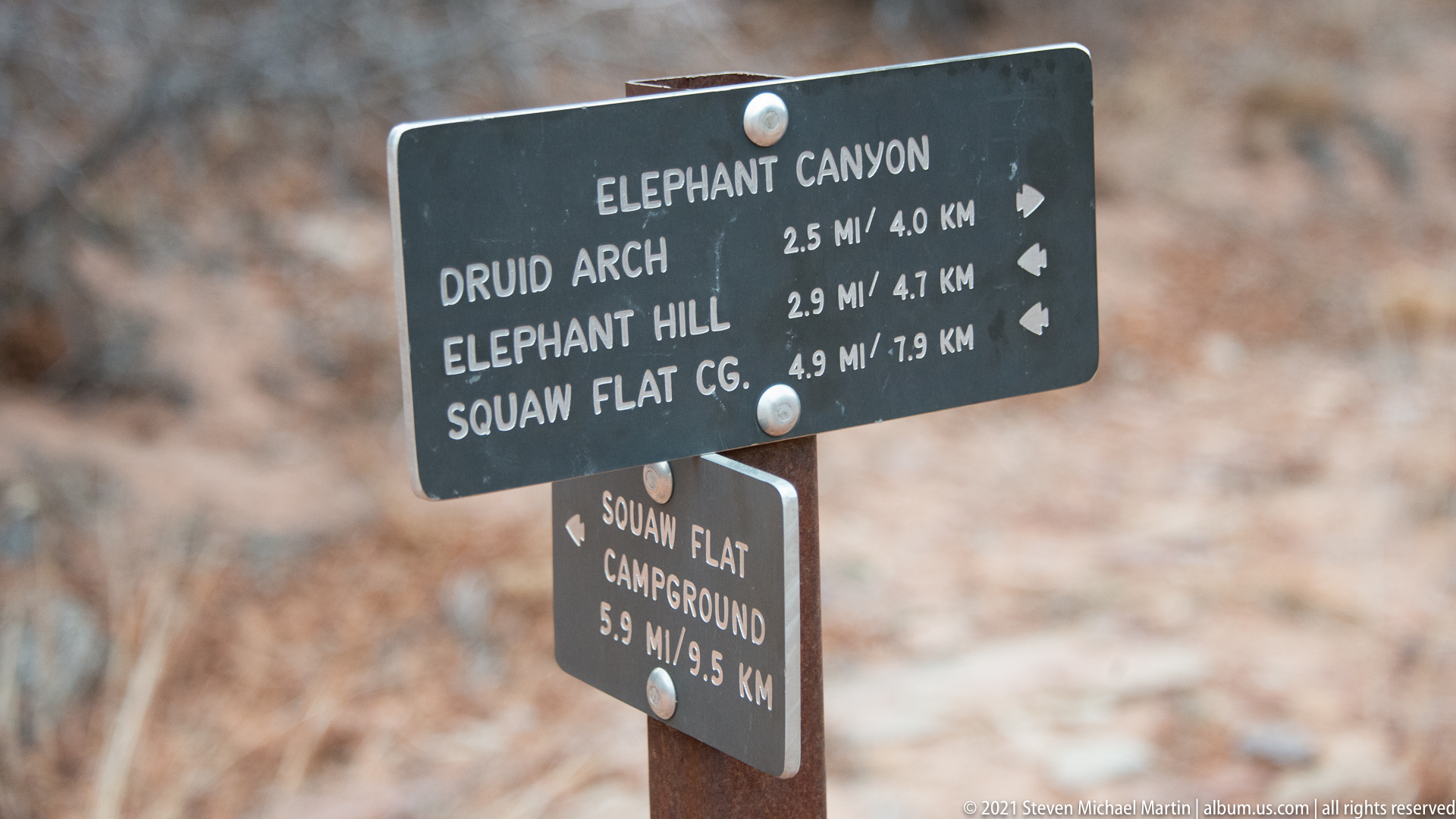
A close trail marker lists Elephant Canyon, Druid Arch, Elephant Hill, and Squaw Flat Campground with distances and directional arrows. A lower sign points toward Squaw Flat Campground, adding another route reference beneath the main panel. The dark signs stand out against blurred dry brush, making the lettering and trail choices the clear subject.
Caption
A close trail marker lists Elephant Canyon, Druid Arch, Elephant Hill, and Squaw Flat Campground with distances and directional arrows. A lower sign points toward Squaw Flat Campground, adding another route reference beneath the main panel. The dark signs stand out against blurred dry brush, making the lettering and trail choices the clear subject.

Low evening light catches the upper faces of several banded sandstone towers while the foreground canyon remains in deep shade. A narrow dark cleft separates the formations, and sparse junipers grow among the layered shelves below. The contrast between warm illuminated rock and the dim approach gives this view of Elephant Canyon a strong sense of depth.
Caption
Low evening light catches the upper faces of several banded sandstone towers while the foreground canyon remains in deep shade. A narrow dark cleft separates the formations, and sparse junipers grow among the layered shelves below. The contrast between warm illuminated rock and the dim approach gives this view of Elephant Canyon a strong sense of depth.
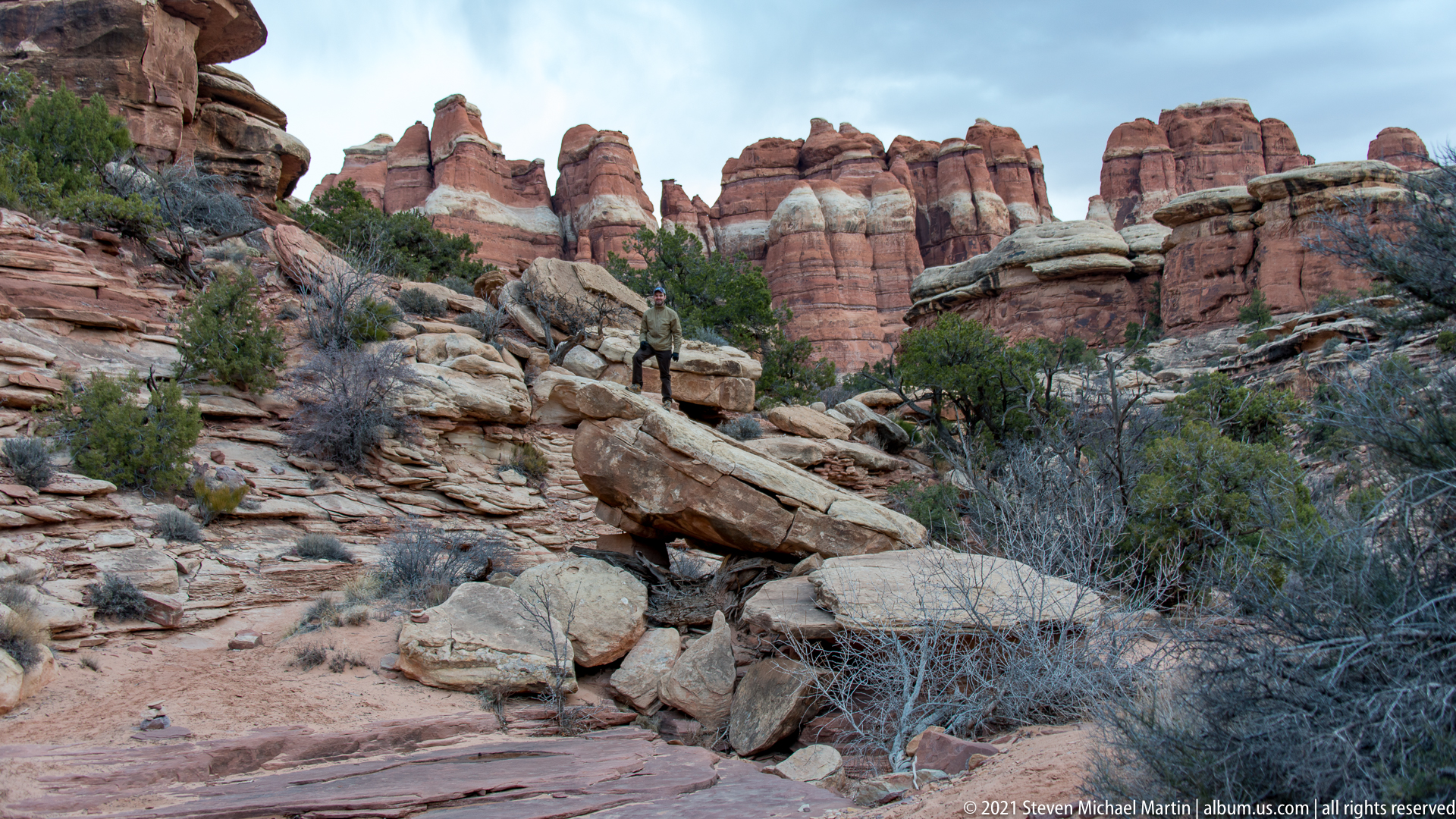
A lone visitor stands on a pale boulder near the center of the canyon, dwarfed by a wall of rounded red sandstone towers. Juniper and leafless brush fill the broken slope around the person, and broad rock layers lead the eye upward to the cliffs. The small human figure gives scale to the height and density of the formations.
Caption
A lone visitor stands on a pale boulder near the center of the canyon, dwarfed by a wall of rounded red sandstone towers. Juniper and leafless brush fill the broken slope around the person, and broad rock layers lead the eye upward to the cliffs. The small human figure gives scale to the height and density of the formations.

A visitor sits on a pale boulder in the foreground, one leg bent as he faces the camera. Behind him, juniper branches and bands of cream, rose, and red sandstone layer across the canyon wall. The near portrait makes the person the focal point while retaining enough of the surrounding rock to place the moment within the rugged Elephant Canyon landscape.
Caption
A visitor sits on a pale boulder in the foreground, one leg bent as he faces the camera. Behind him, juniper branches and bands of cream, rose, and red sandstone layer across the canyon wall. The near portrait makes the person the focal point while retaining enough of the surrounding rock to place the moment within the rugged Elephant Canyon landscape.

Shadowed sandstone walls frame a narrow corridor that opens toward a cluster of red and cream towers in the distance. A pale boulder sits low at right, while sparse shrubs soften the broken slopes. The contrast between the dark near walls and the brighter inner canyon emphasizes the winding passage through Elephant Canyon.
Caption
Shadowed sandstone walls frame a narrow corridor that opens toward a cluster of red and cream towers in the distance. A pale boulder sits low at right, while sparse shrubs soften the broken slopes. The contrast between the dark near walls and the brighter inner canyon emphasizes the winding passage through Elephant Canyon.
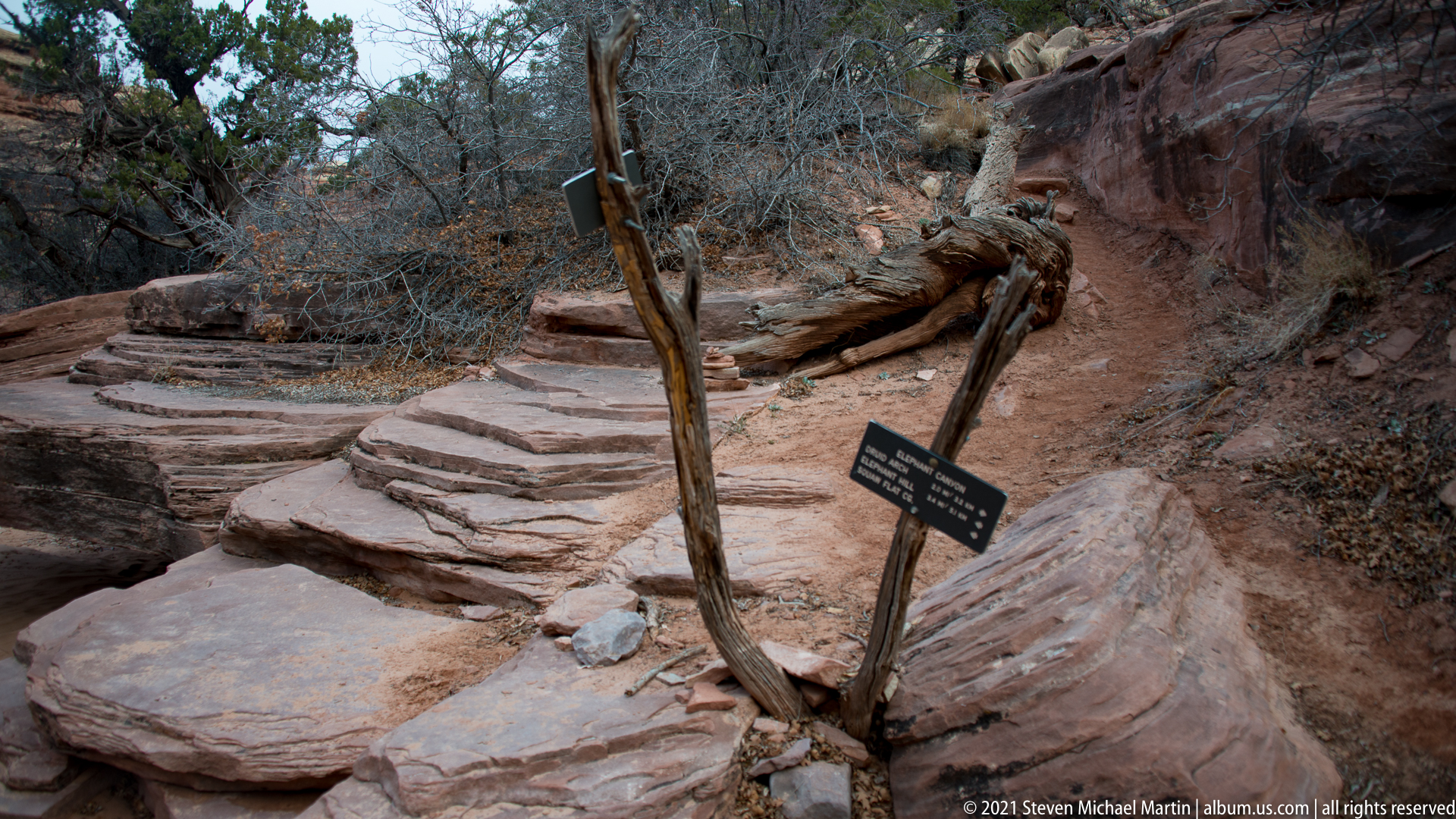
A small interpretive or trail sign stands beside a sandy footpath among flat rock shelves, leafless branches, and scattered juniper. Its lettering is too small to read in the proof-sheet view, so the sign’s specific message is not identified. The scene records a human-made marker within a quiet, rocky section of the canyon route.
Caption
A small interpretive or trail sign stands beside a sandy footpath among flat rock shelves, leafless branches, and scattered juniper. Its lettering is too small to read in the proof-sheet view, so the sign’s specific message is not identified. The scene records a human-made marker within a quiet, rocky section of the canyon route.
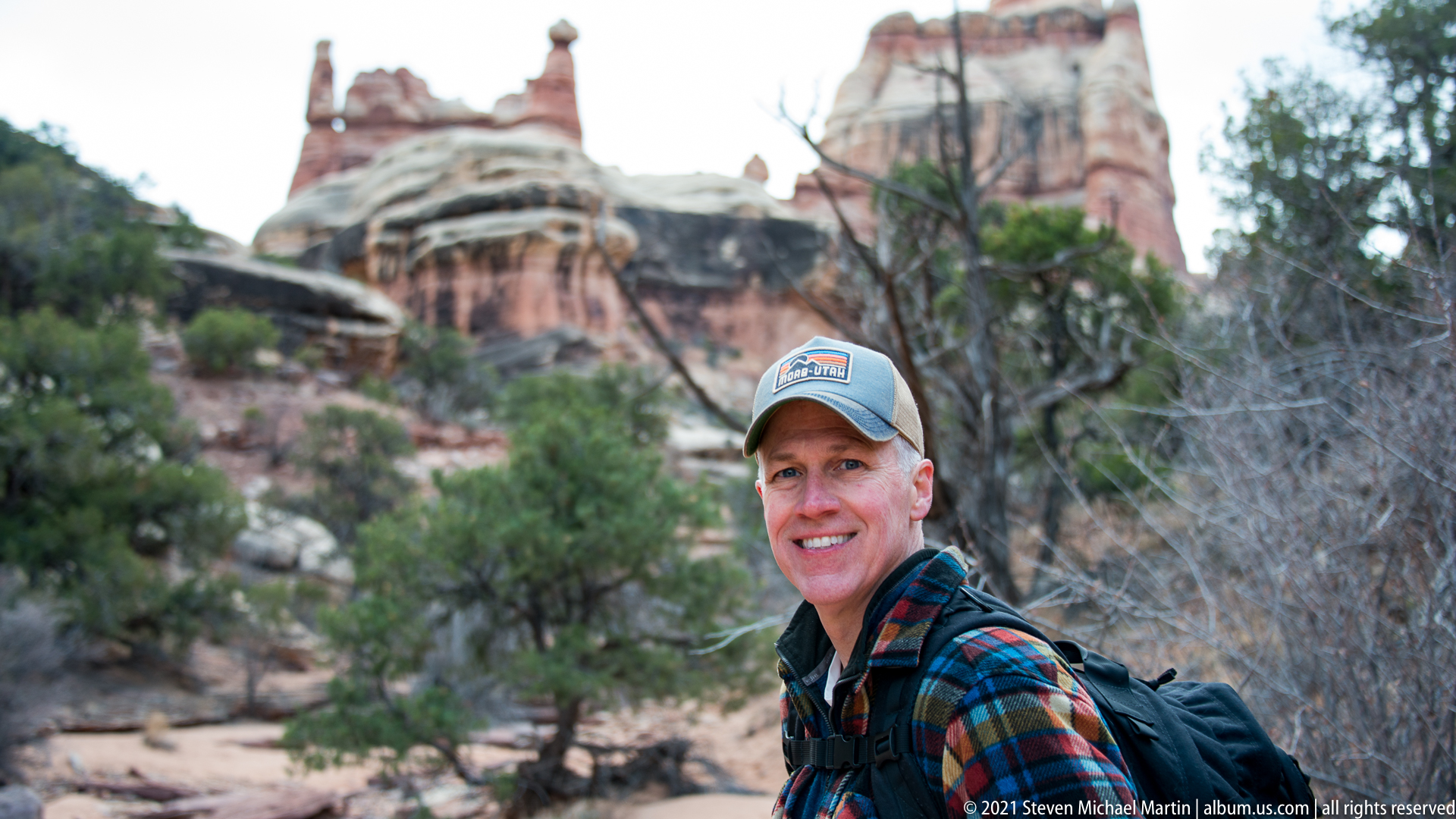
A smiling hiker wearing a cap and backpack fills the foreground, turned slightly toward the camera. The sandstone towers and green juniper behind him fall softly out of focus, placing the portrait within the canyon without competing with its subject. This close view brings attention to the person and the gear used on the rugged trail.
Caption
A smiling hiker wearing a cap and backpack fills the foreground, turned slightly toward the camera. The sandstone towers and green juniper behind him fall softly out of focus, placing the portrait within the canyon without competing with its subject. This close view brings attention to the person and the gear used on the rugged trail.
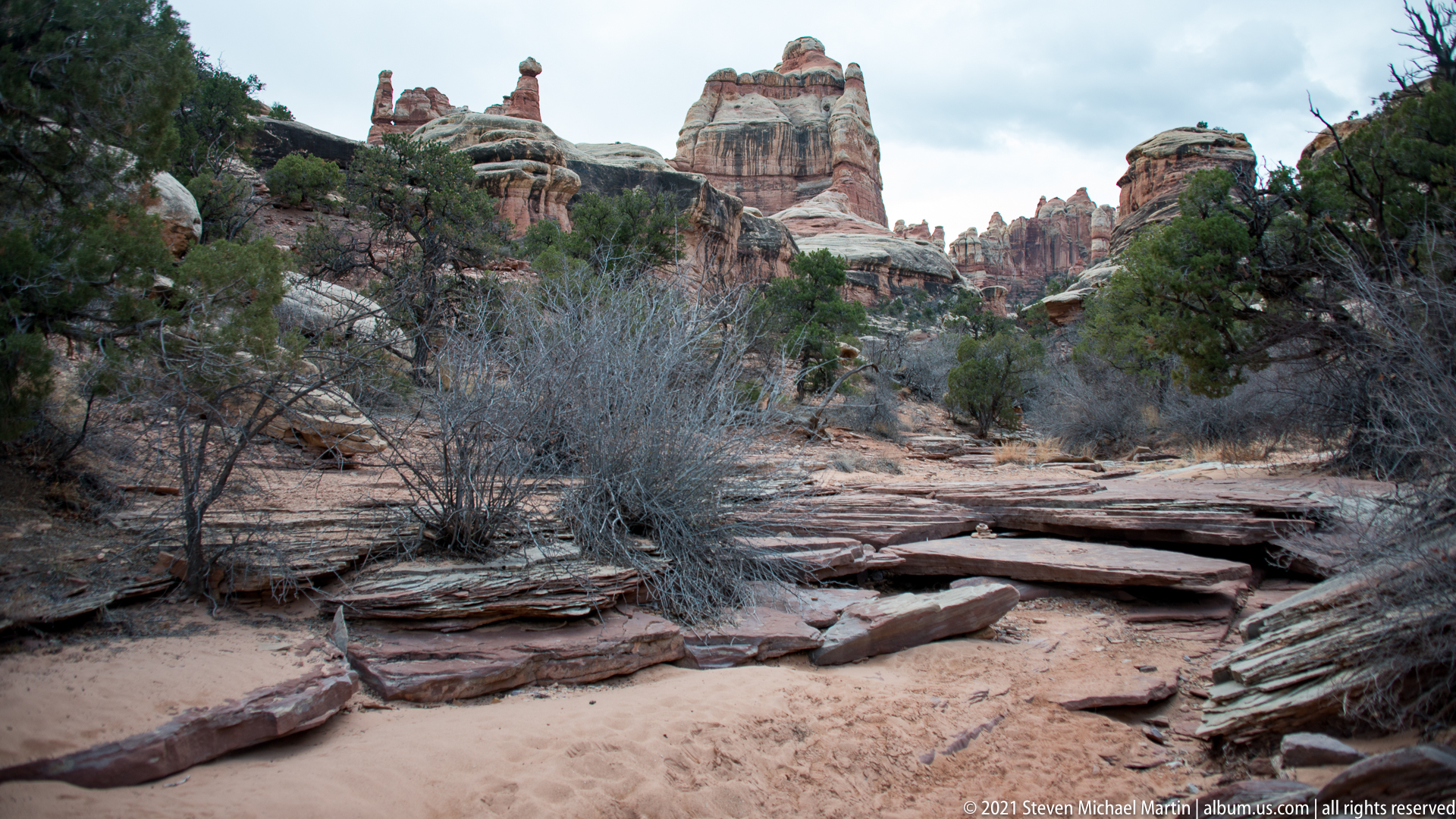
A sandy wash winds between flat sandstone slabs, dry brush, and small junipers toward a corridor of red rock towers. Several thin rock layers form natural steps across the midground, while the path narrows as it recedes. The view focuses on the rough route and its vegetation rather than on a single formation.
Caption
A sandy wash winds between flat sandstone slabs, dry brush, and small junipers toward a corridor of red rock towers. Several thin rock layers form natural steps across the midground, while the path narrows as it recedes. The view focuses on the rough route and its vegetation rather than on a single formation.
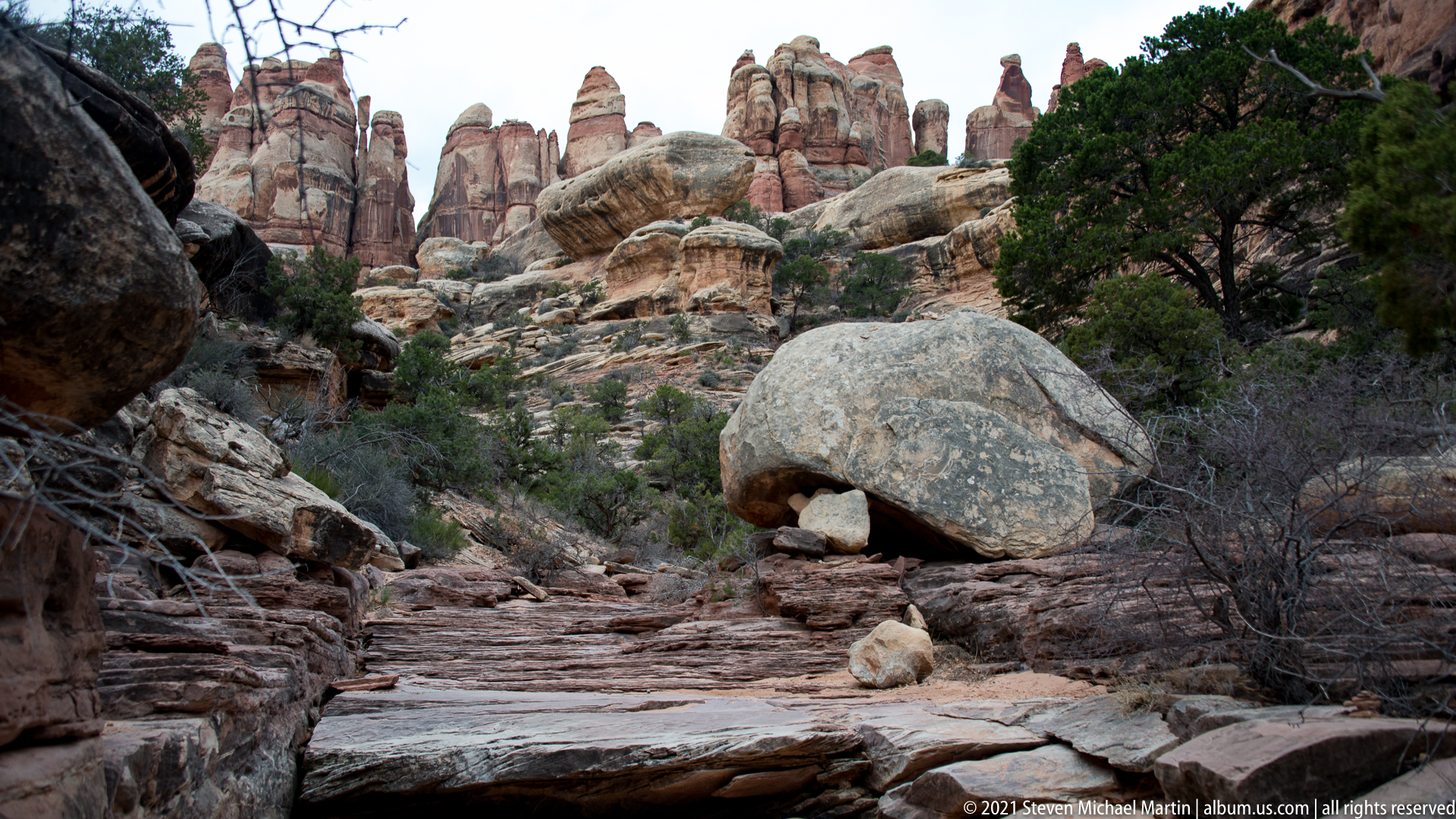
A large rounded boulder rests on a smaller stone near the center of a stepped sandstone trail. Juniper and dry brush crowd the edges, while red rock spires rise beyond the slope. The precarious-looking balance of the boulder draws the eye, and the trail’s natural stone steps show how the route climbs through the broken canyon terrain.
Caption
A large rounded boulder rests on a smaller stone near the center of a stepped sandstone trail. Juniper and dry brush crowd the edges, while red rock spires rise beyond the slope. The precarious-looking balance of the boulder draws the eye, and the trail’s natural stone steps show how the route climbs through the broken canyon terrain.
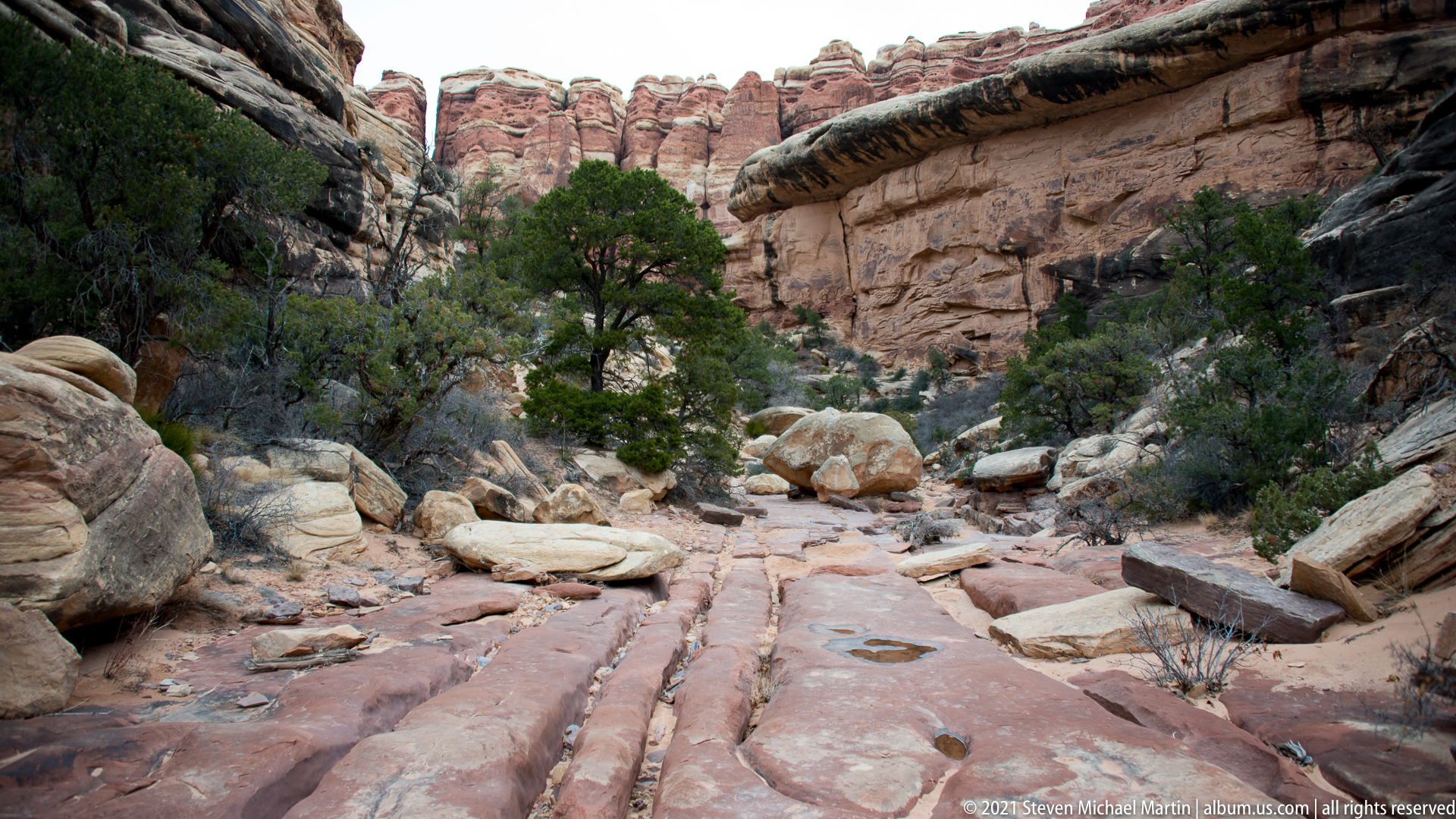
A rough sandy wash passes below a slanted rock ledge, with a juniper tree rising at center-left and a layered sandstone wall closing the right side. Rounded boulders and shallow channels interrupt the route. The view follows the uneven canyon floor through a tight section where vegetation, rock ledges, and the overhanging wall define the passage.
Caption
A rough sandy wash passes below a slanted rock ledge, with a juniper tree rising at center-left and a layered sandstone wall closing the right side. Rounded boulders and shallow channels interrupt the route. The view follows the uneven canyon floor through a tight section where vegetation, rock ledges, and the overhanging wall define the passage.
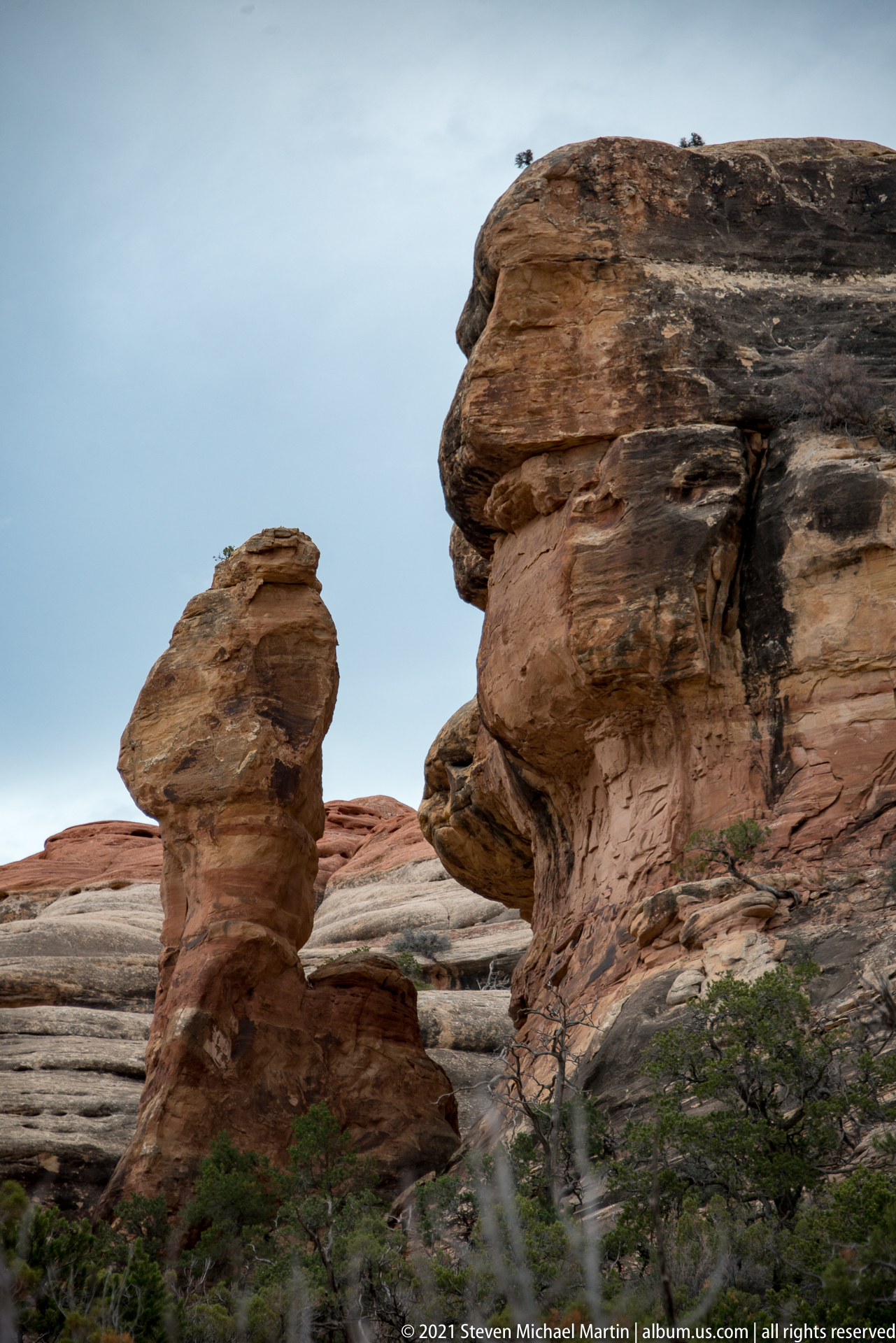
Two prominent sandstone pillars stand at different heights, their rounded caps and narrow necks shaped by erosion. Horizontal rock bands form a stepped base, and small shrubs grow among the ledges below. The isolated pair offers a close study of the area’s varied sandstone forms against a pale sky.
Caption
Two prominent sandstone pillars stand at different heights, their rounded caps and narrow necks shaped by erosion. Horizontal rock bands form a stepped base, and small shrubs grow among the ledges below. The isolated pair offers a close study of the area’s varied sandstone forms against a pale sky.
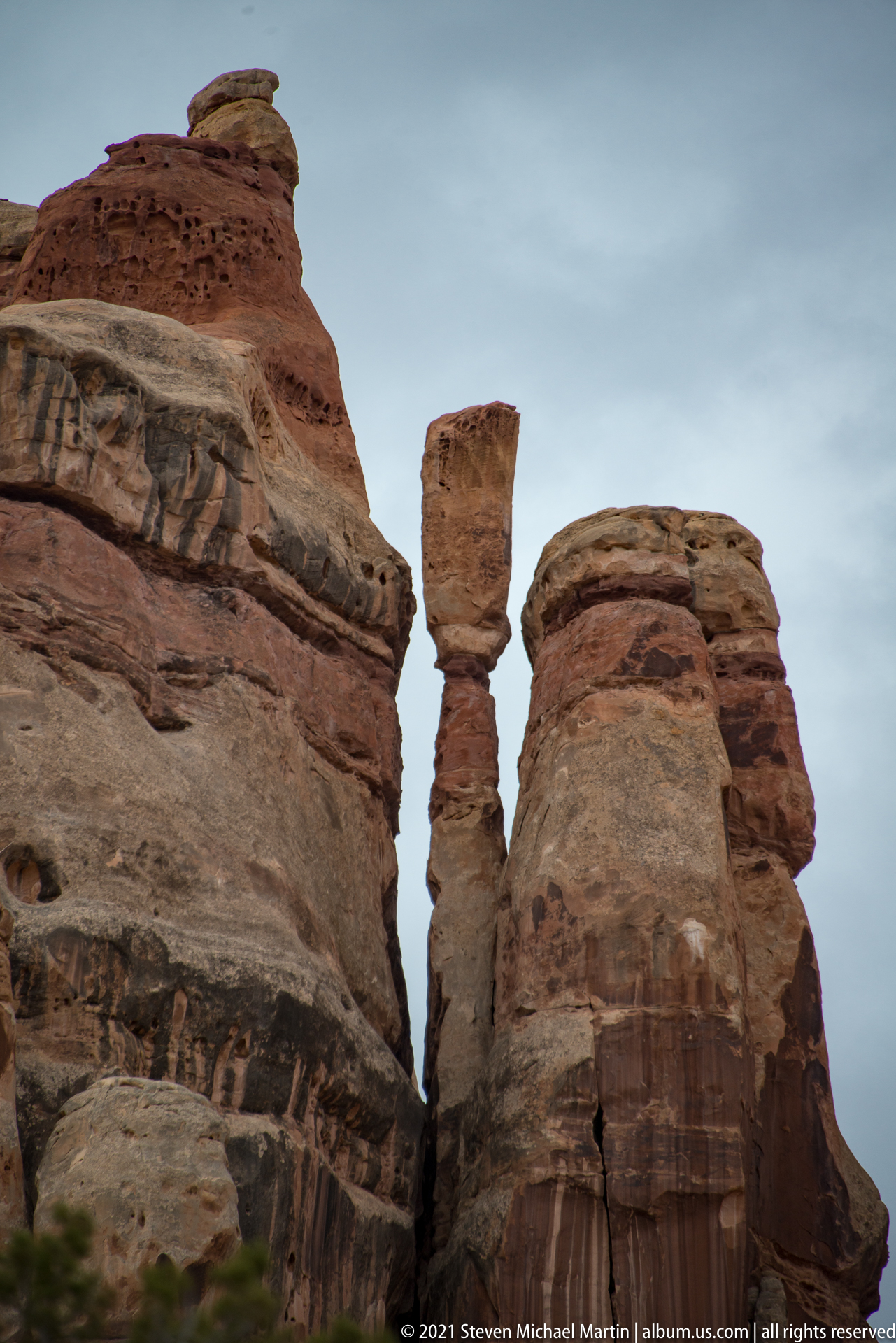
A narrow sandstone spire rises between two broader rounded towers, each marked by horizontal color bands and dark weathering streaks. The tightly grouped formations fill most of the frame beneath a pale sky, their varied widths and stacked caps giving the wall a sculptural profile. The composition isolates a distinctive cluster of eroded pinnacles.
Caption
A narrow sandstone spire rises between two broader rounded towers, each marked by horizontal color bands and dark weathering streaks. The tightly grouped formations fill most of the frame beneath a pale sky, their varied widths and stacked caps giving the wall a sculptural profile. The composition isolates a distinctive cluster of eroded pinnacles.
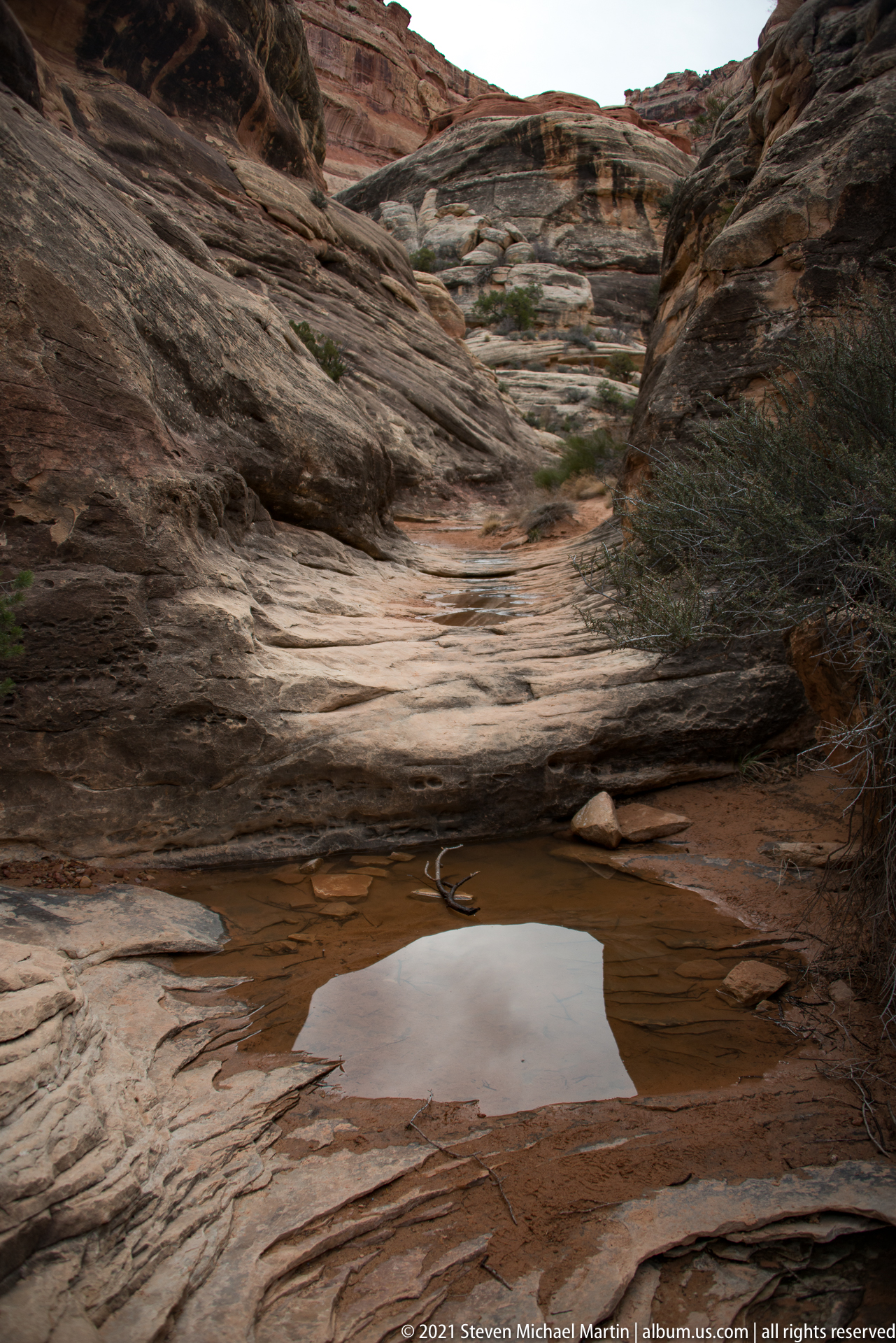
A shallow pool fills a smooth pothole in the slickrock, reflecting the pale overcast sky. Darker water and wet rock surround the basin, while layered sandstone rises behind it in a gentle slope. The quiet detail shows how water collects in a natural depression along the canyon route, contrasting the reflective surface with the dry, striated stone.
Caption
A shallow pool fills a smooth pothole in the slickrock, reflecting the pale overcast sky. Darker water and wet rock surround the basin, while layered sandstone rises behind it in a gentle slope. The quiet detail shows how water collects in a natural depression along the canyon route, contrasting the reflective surface with the dry, striated stone.
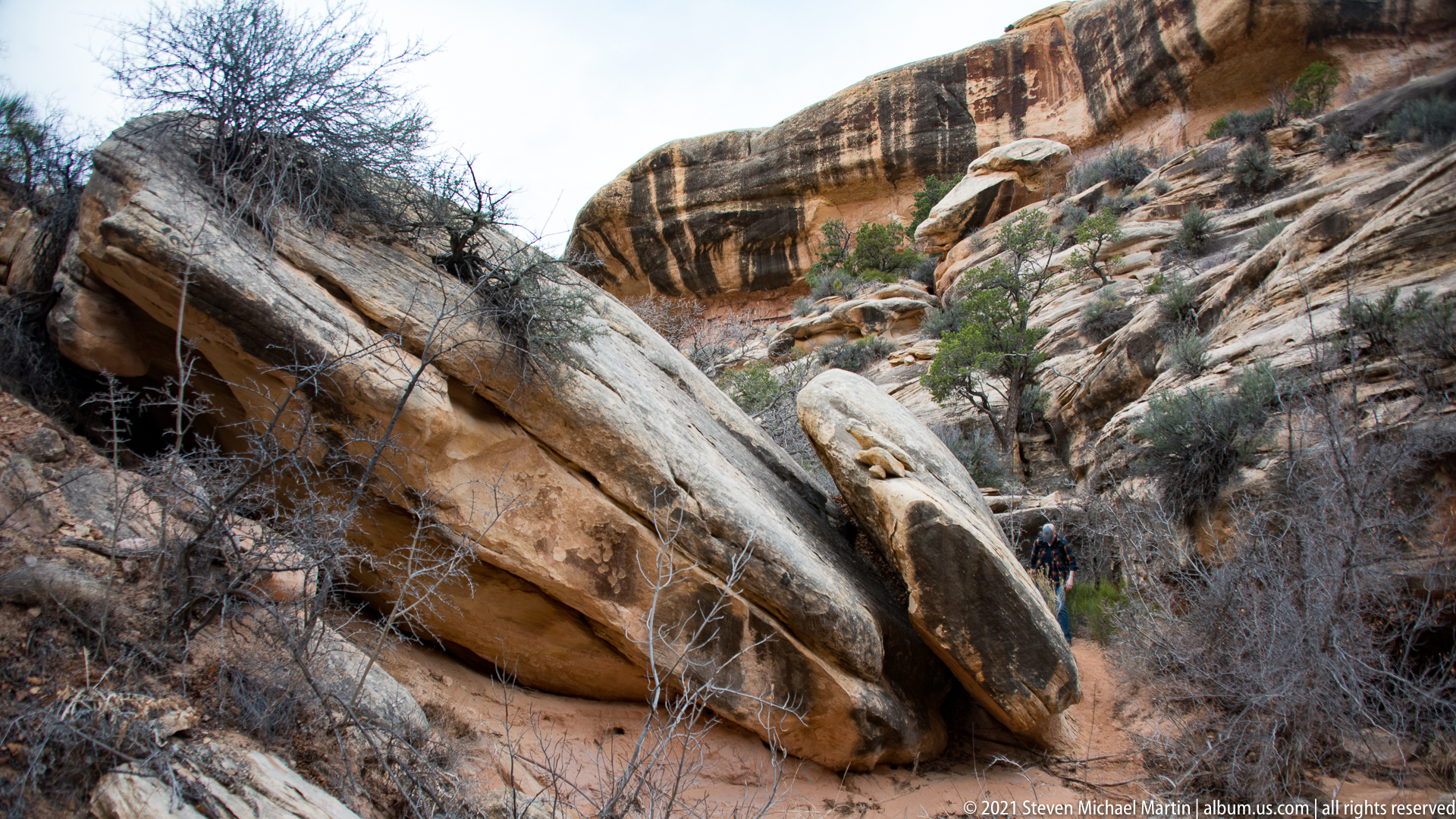
A massive slab leans diagonally across the narrow wash, its weathered face creating a low barrier between the foreground and the route beyond. A visitor appears in the gap at right, partly hidden by brush and stone. The tilted rock, steep canyon walls, and sandy floor make this passage feel confined and emphasize the scale of the fallen block.
Caption
A massive slab leans diagonally across the narrow wash, its weathered face creating a low barrier between the foreground and the route beyond. A visitor appears in the gap at right, partly hidden by brush and stone. The tilted rock, steep canyon walls, and sandy floor make this passage feel confined and emphasize the scale of the fallen block.
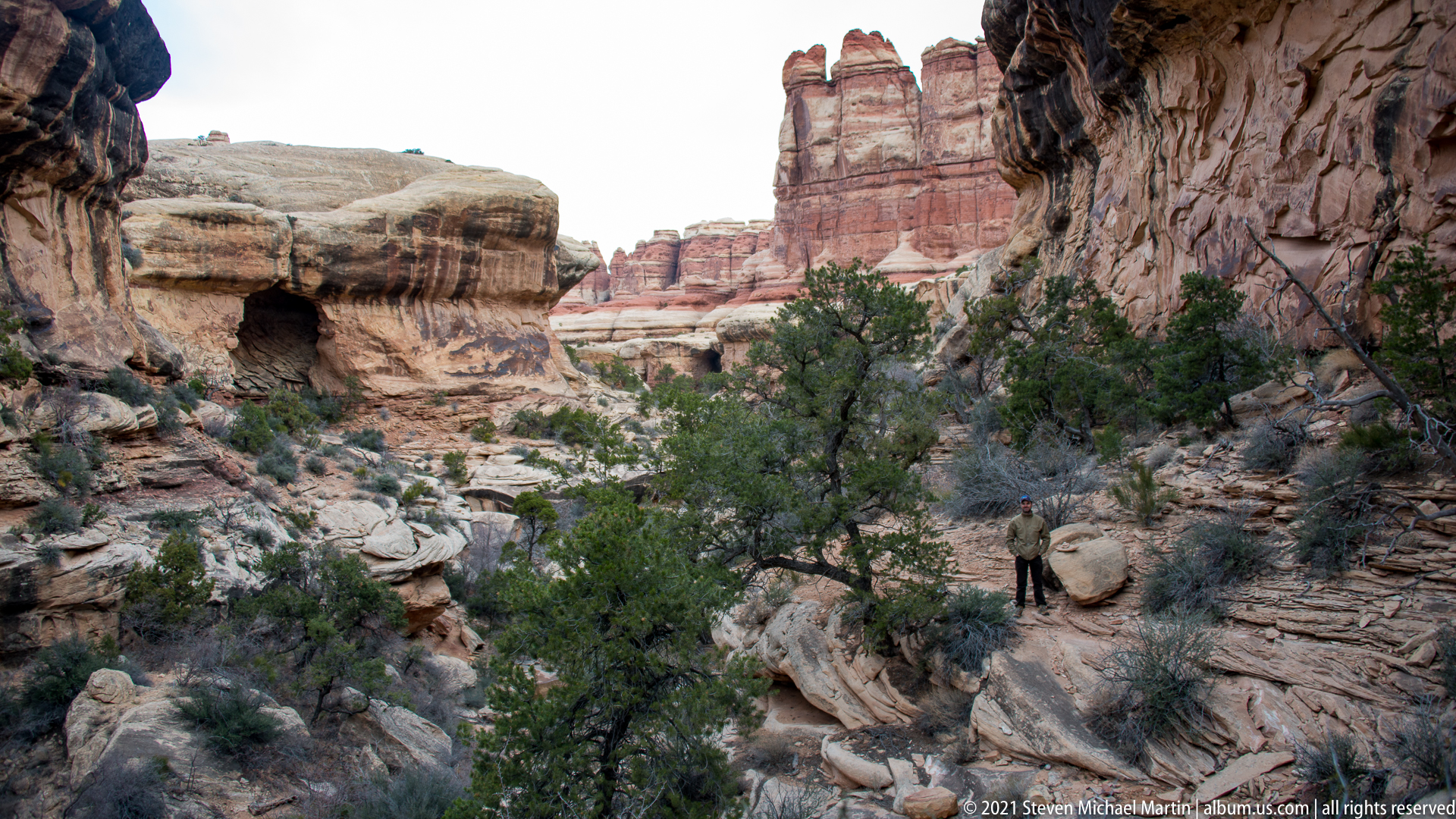
A lone hiker stands near the center-right of a broad rocky passage, surrounded by uneven slabs and low juniper. A dark alcove opens beneath a ledge at left, while red towers rise beyond the canyon walls. The wide framing places the person within the varied terrain and contrasts the shaded recess with the brighter rock in the distance.
Caption
A lone hiker stands near the center-right of a broad rocky passage, surrounded by uneven slabs and low juniper. A dark alcove opens beneath a ledge at left, while red towers rise beyond the canyon walls. The wide framing places the person within the varied terrain and contrasts the shaded recess with the brighter rock in the distance.
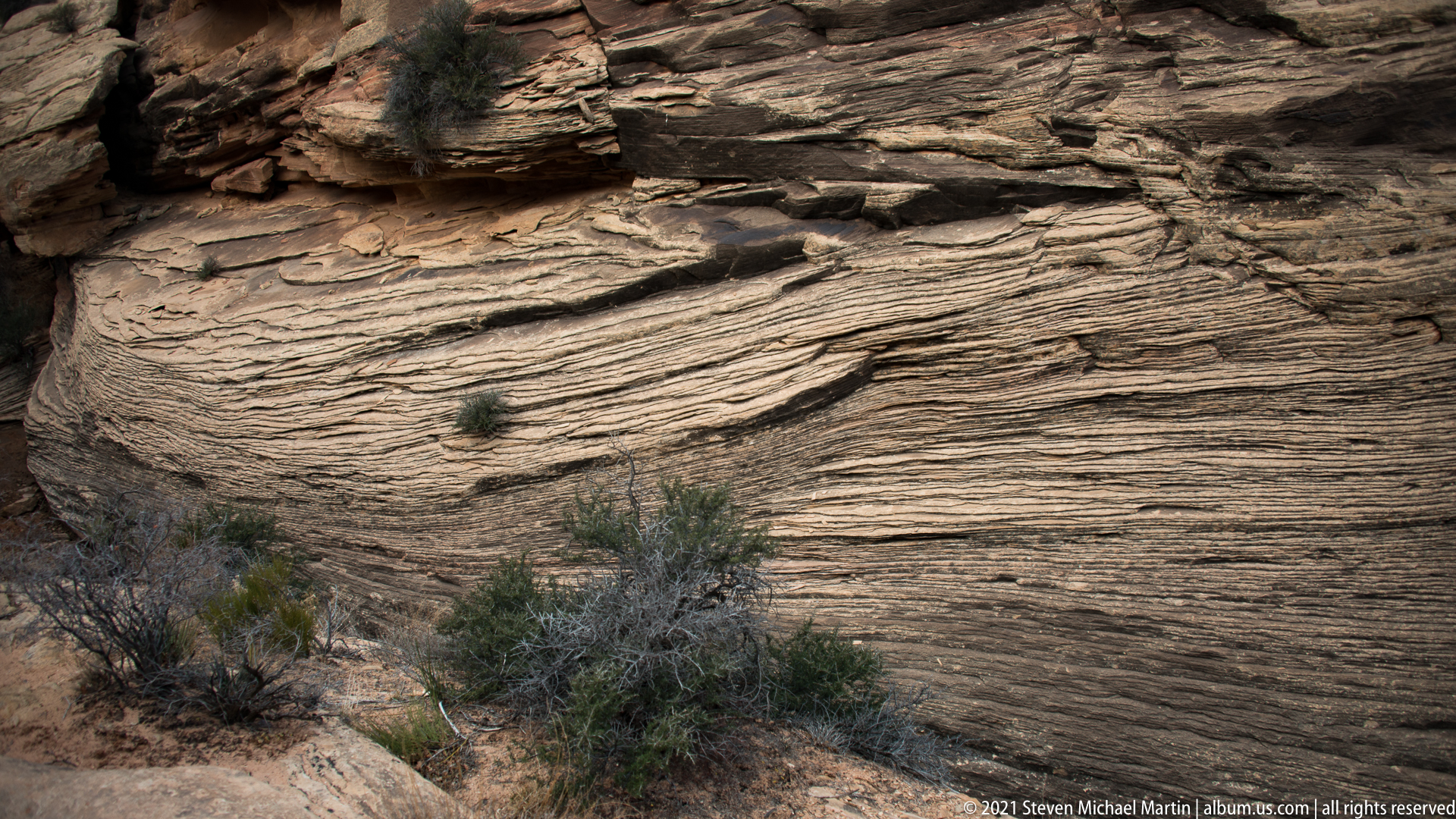
Thin sandstone layers sweep diagonally across a steep rock face, bending into tight waves and shallow shelves. A small green shrub grows from a fissure near the lower middle, giving scale to the fine striations. The close composition concentrates on the stone’s repeated lines and erosion patterns rather than the surrounding canyon.
Caption
Thin sandstone layers sweep diagonally across a steep rock face, bending into tight waves and shallow shelves. A small green shrub grows from a fissure near the lower middle, giving scale to the fine striations. The close composition concentrates on the stone’s repeated lines and erosion patterns rather than the surrounding canyon.
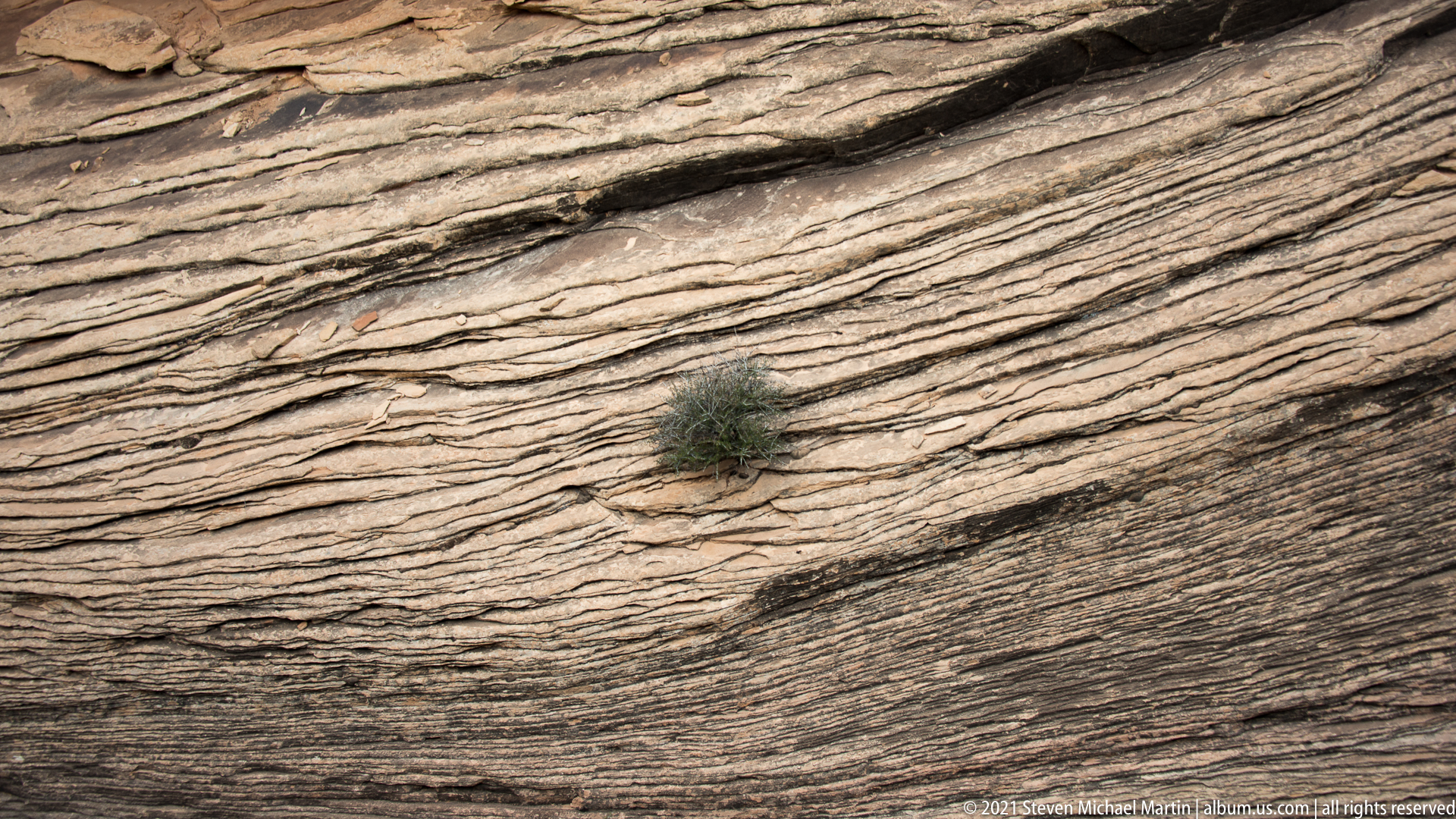
A compact shrub grows from a narrow crack in a sloping sandstone surface. Fine diagonal bands sweep across the frame, alternating between pale and darker lines, while the tight crop removes any distant landscape context. The plant’s isolated position highlights how small pockets of soil and fissures support vegetation on the exposed canyon rock.
Caption
A compact shrub grows from a narrow crack in a sloping sandstone surface. Fine diagonal bands sweep across the frame, alternating between pale and darker lines, while the tight crop removes any distant landscape context. The plant’s isolated position highlights how small pockets of soil and fissures support vegetation on the exposed canyon rock.

A narrow route winds between a pale, striated wall on the left and a darker, juniper-covered slope on the right. The canyon opens toward red towers in the distance, while boulders and fractured shelves break up the foreground. The view’s strong left-right framing leads the eye along the passage and into the deeper canyon.
Caption
A narrow route winds between a pale, striated wall on the left and a darker, juniper-covered slope on the right. The canyon opens toward red towers in the distance, while boulders and fractured shelves break up the foreground. The view’s strong left-right framing leads the eye along the passage and into the deeper canyon.
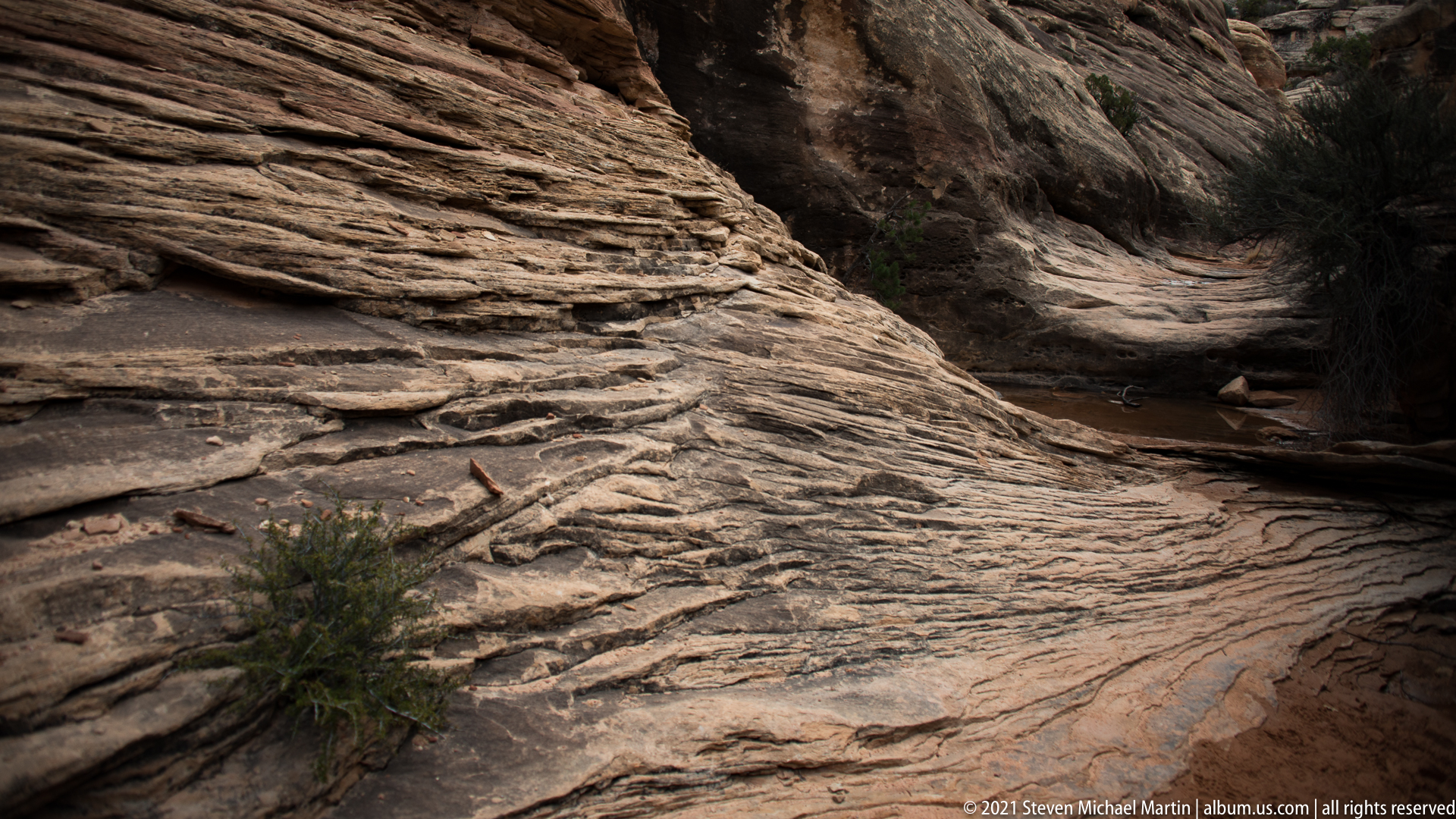
A textured sandstone channel sweeps from the lower left toward a dark bend between high rock walls. Parallel grooves and shallow ledges run along the pale surface, with a small juniper at the edge of the route. The contrast between the open foreground and shaded recess gives the narrow passage a clear sense of depth.
Caption
A textured sandstone channel sweeps from the lower left toward a dark bend between high rock walls. Parallel grooves and shallow ledges run along the pale surface, with a small juniper at the edge of the route. The contrast between the open foreground and shaded recess gives the narrow passage a clear sense of depth.
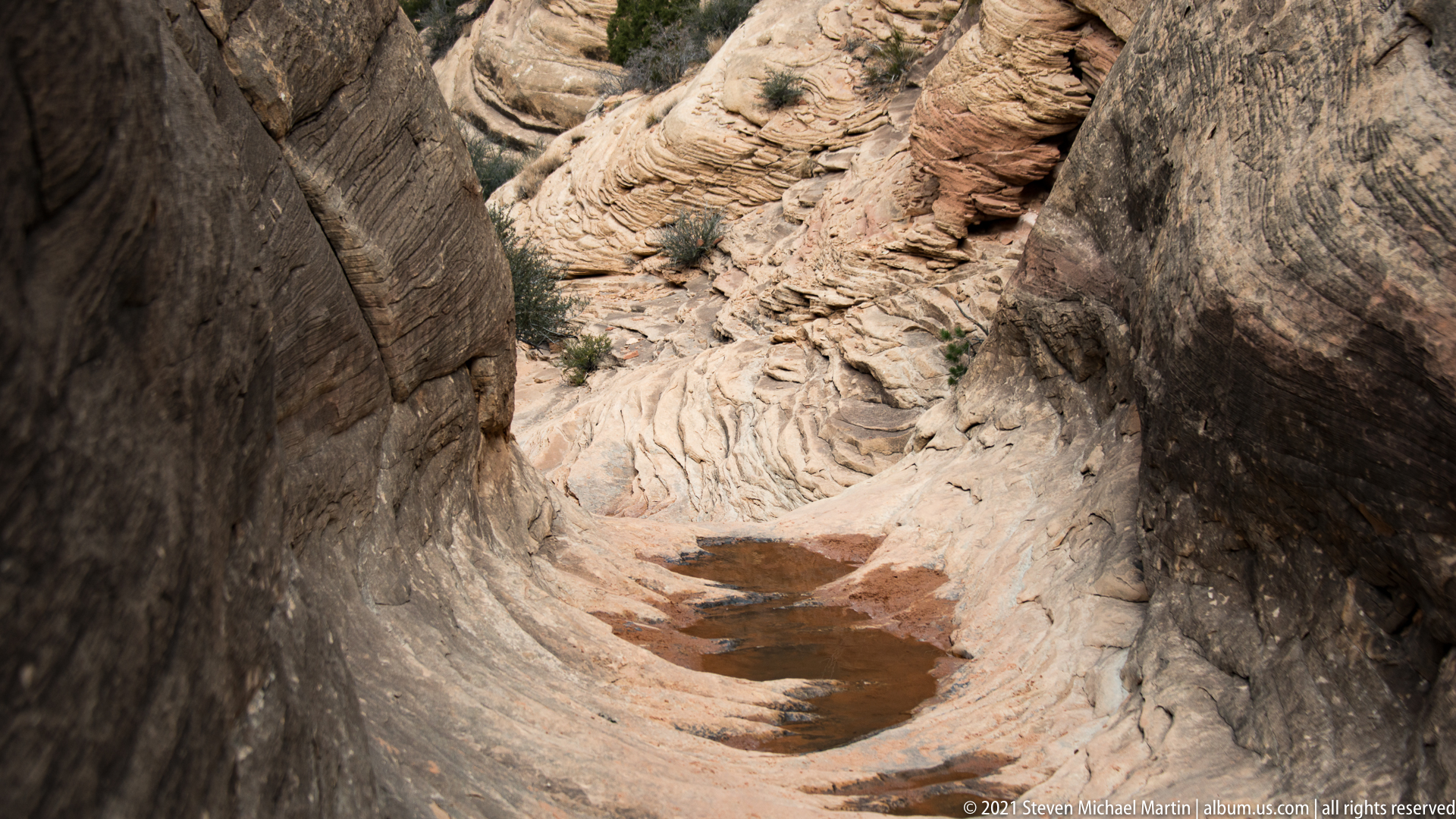
A narrow chute descends between high, curving sandstone walls, its smooth floor marked by shallow grooves and a small rust-colored pool. Dark rock at both sides encloses the pale central channel, while the walls narrow toward the upper end. The close viewpoint follows the water-worn passage and its sculpted contours.
Caption
A narrow chute descends between high, curving sandstone walls, its smooth floor marked by shallow grooves and a small rust-colored pool. Dark rock at both sides encloses the pale central channel, while the walls narrow toward the upper end. The close viewpoint follows the water-worn passage and its sculpted contours.
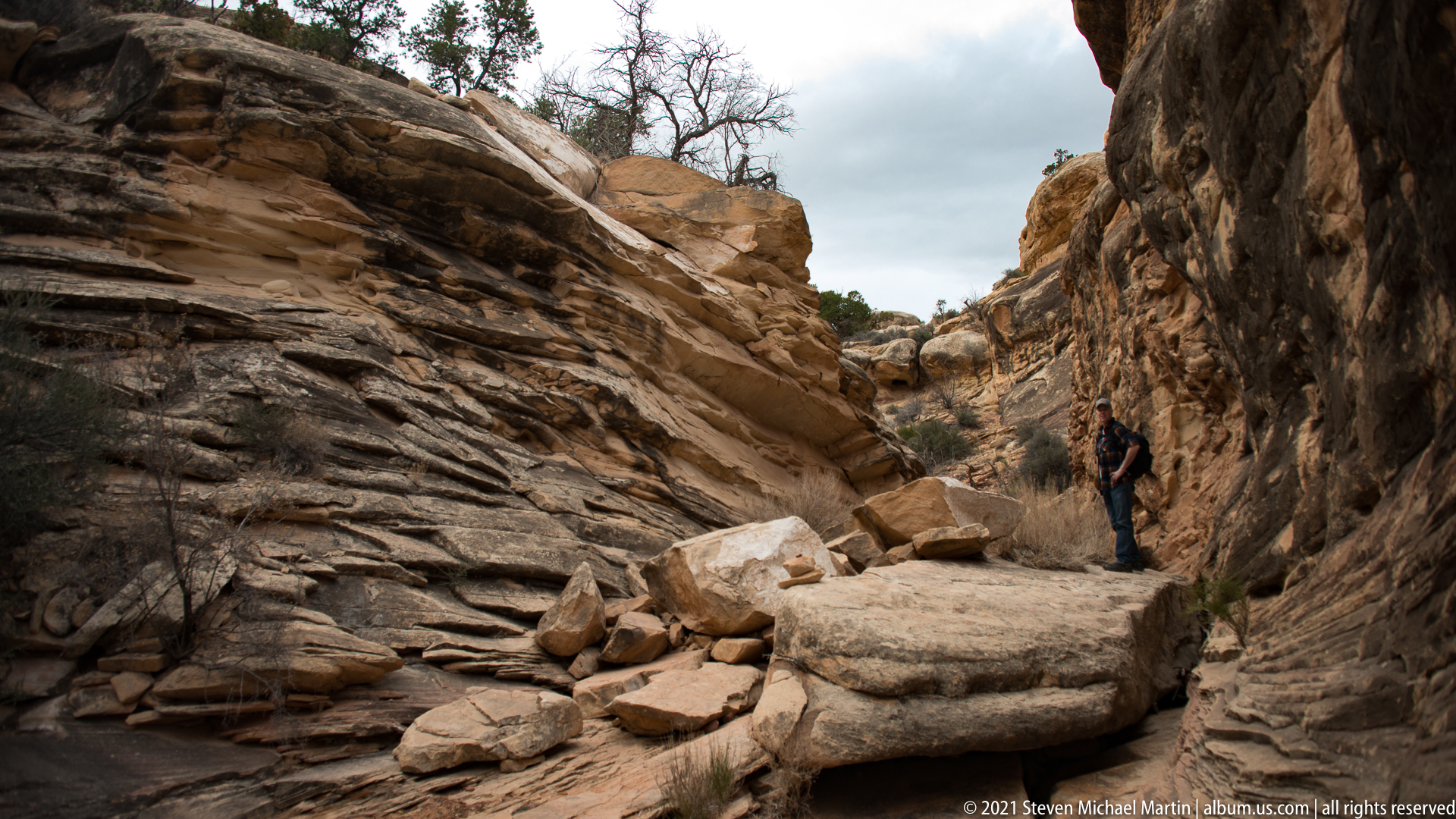
A visitor stands on a narrow ledge at right, beside a steep wall of dark, horizontally layered sandstone. Broken steps and boulders fill the lower passage, while a small patch of cloudy sky opens above the canyon. The person’s position reveals the scale of the confined route and the irregular footing through the ravine.
Caption
A visitor stands on a narrow ledge at right, beside a steep wall of dark, horizontally layered sandstone. Broken steps and boulders fill the lower passage, while a small patch of cloudy sky opens above the canyon. The person’s position reveals the scale of the confined route and the irregular footing through the ravine.
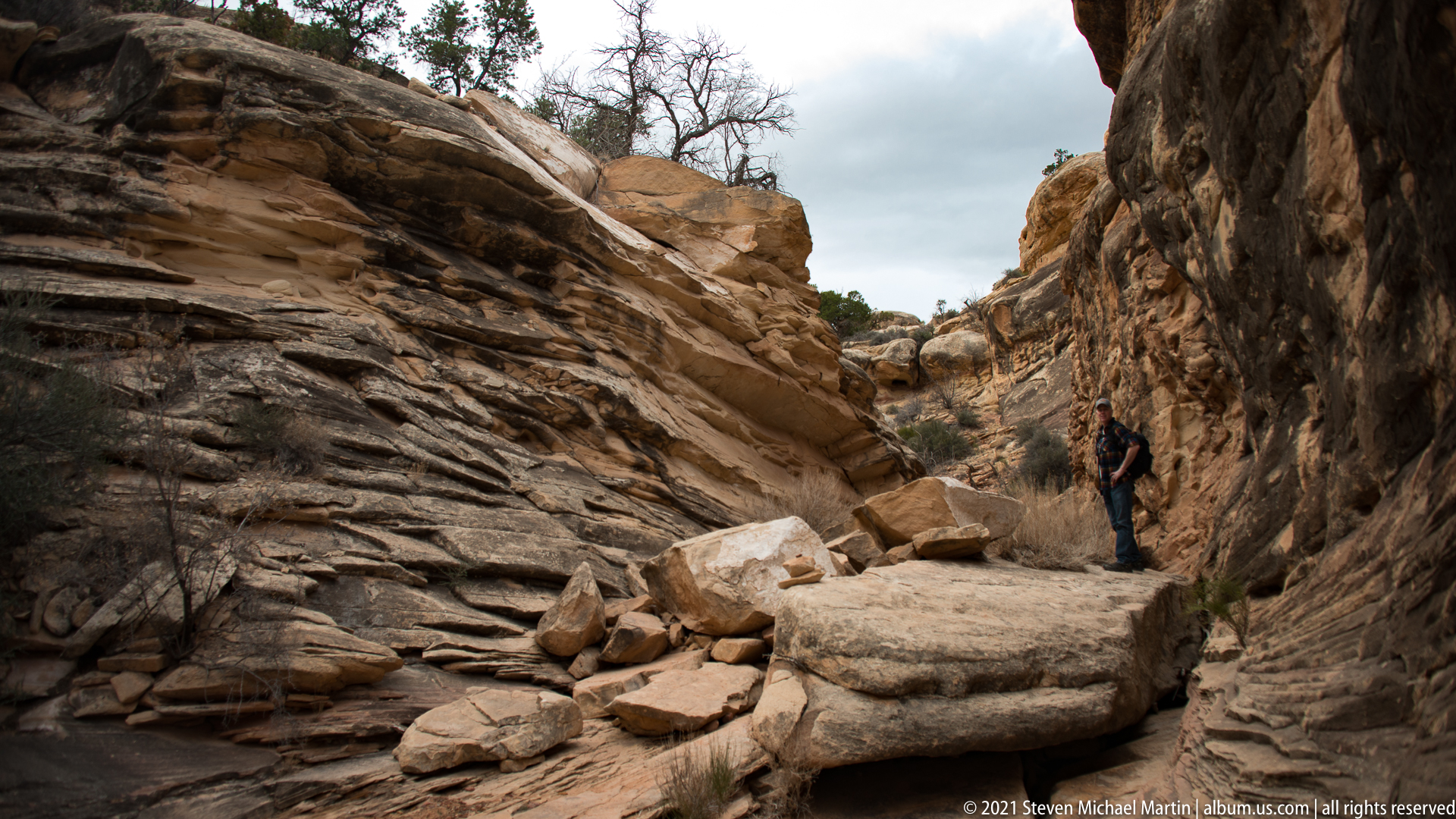
A hiker pauses on a broad rock shelf in the narrow ravine, framed by a dark sloping wall at left and a higher vertical face at right. Pale boulders break up the lower path, and sparse branches reach into the cloudy sky. This viewpoint places the visitor close to the canyon wall, emphasizing the scale of the surrounding stone.
Caption
A hiker pauses on a broad rock shelf in the narrow ravine, framed by a dark sloping wall at left and a higher vertical face at right. Pale boulders break up the lower path, and sparse branches reach into the cloudy sky. This viewpoint places the visitor close to the canyon wall, emphasizing the scale of the surrounding stone.
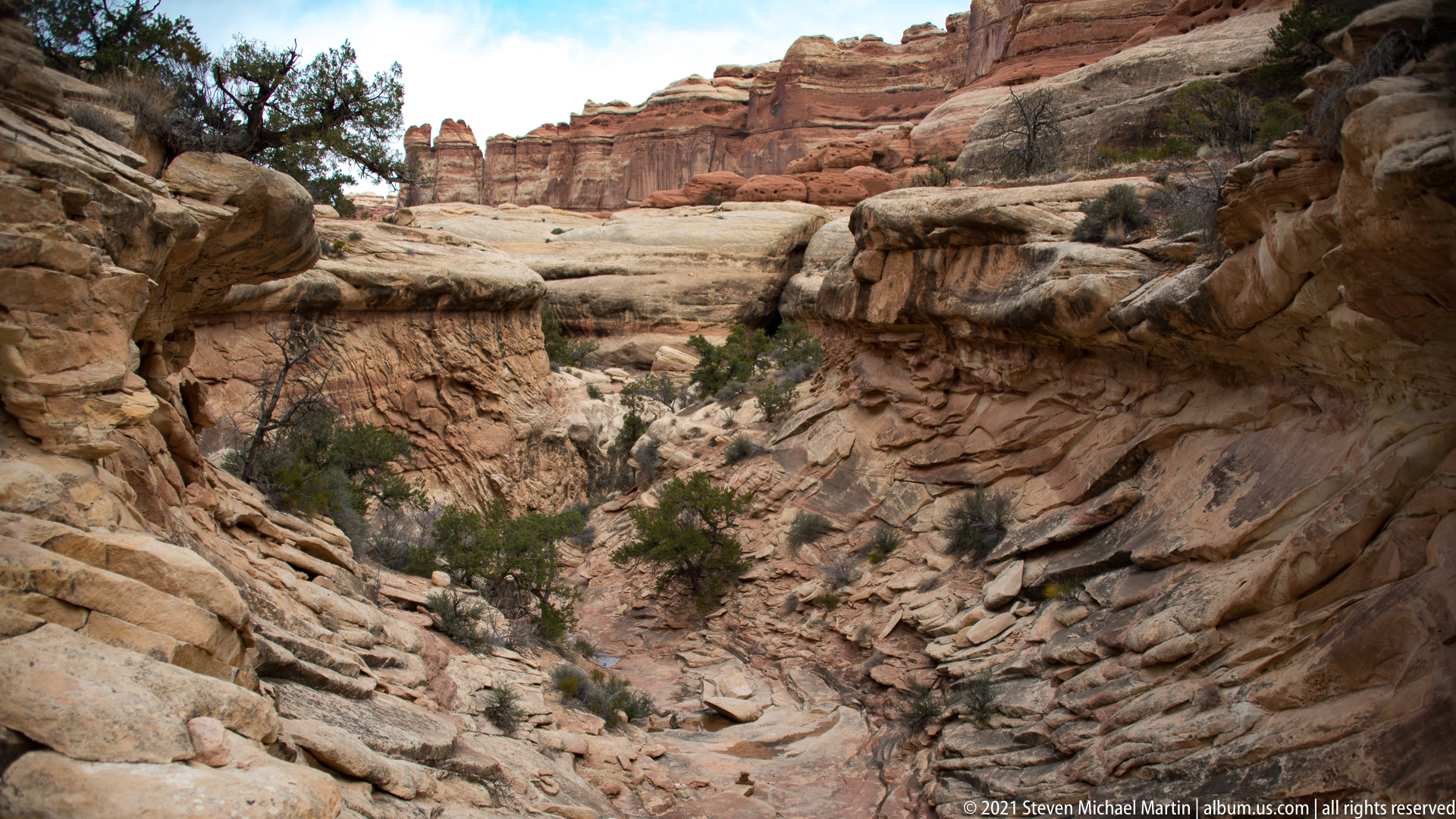
The canyon wash descends through a broken corridor of pale sandstone shelves and darker red walls. Junipers and scrub cluster in the lower channel, while horizontal bands and eroded alcoves line the upper slopes. The viewpoint looks down into the drainage rather than along a level trail, revealing the steep, irregular terrain that shapes the route through Elephant Canyon.
Caption
The canyon wash descends through a broken corridor of pale sandstone shelves and darker red walls. Junipers and scrub cluster in the lower channel, while horizontal bands and eroded alcoves line the upper slopes. The viewpoint looks down into the drainage rather than along a level trail, revealing the steep, irregular terrain that shapes the route through Elephant Canyon.
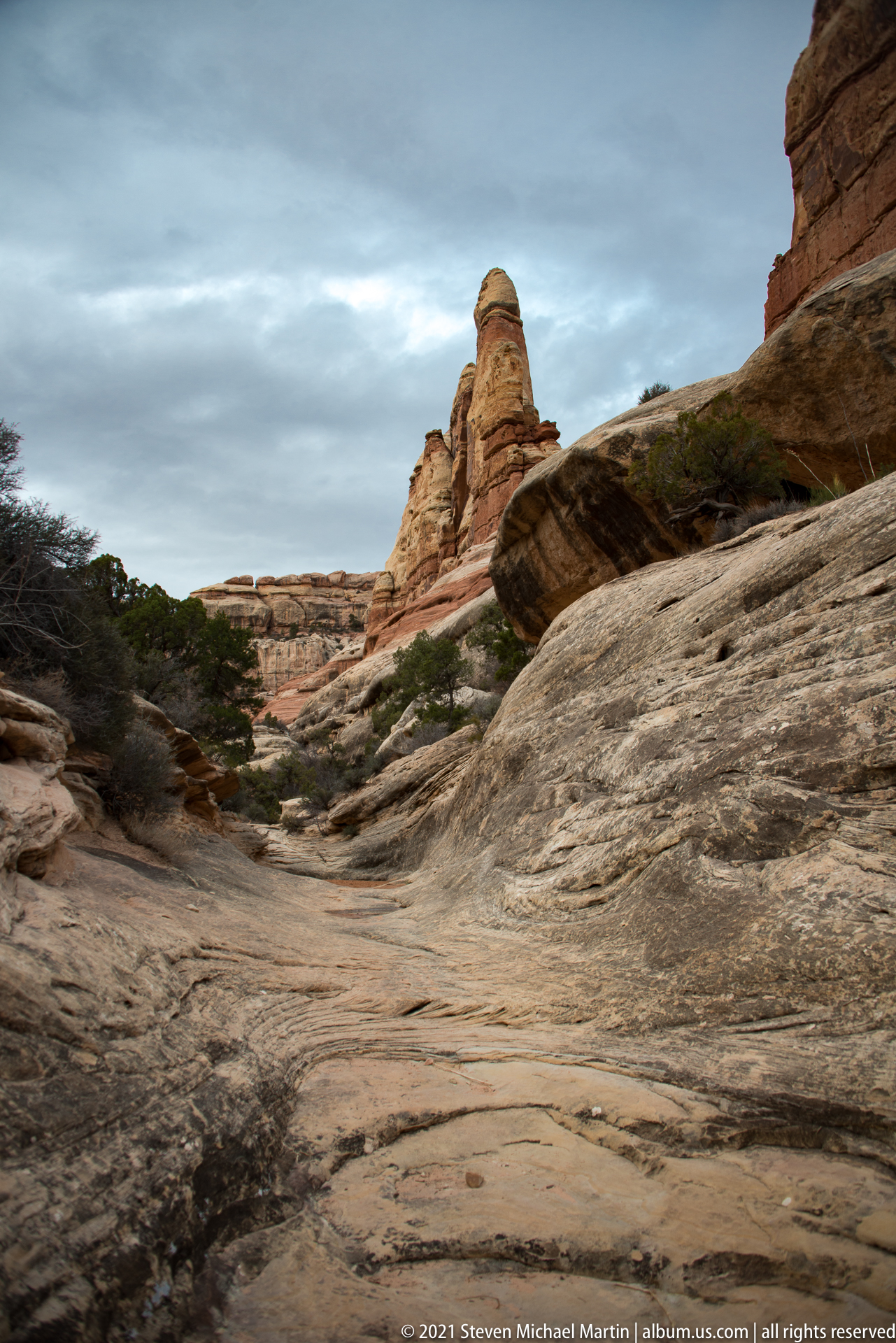
A broad, gently sloping slickrock surface fills the foreground, leading toward a rounded sandstone tower and a dark overhanging wall at right. Low shrubs line the passage and distant layers cross the horizon beneath a cloudy sky. The low camera angle makes the smooth rock approach the main subject, with the tower marking the route ahead.
Caption
A broad, gently sloping slickrock surface fills the foreground, leading toward a rounded sandstone tower and a dark overhanging wall at right. Low shrubs line the passage and distant layers cross the horizon beneath a cloudy sky. The low camera angle makes the smooth rock approach the main subject, with the tower marking the route ahead.
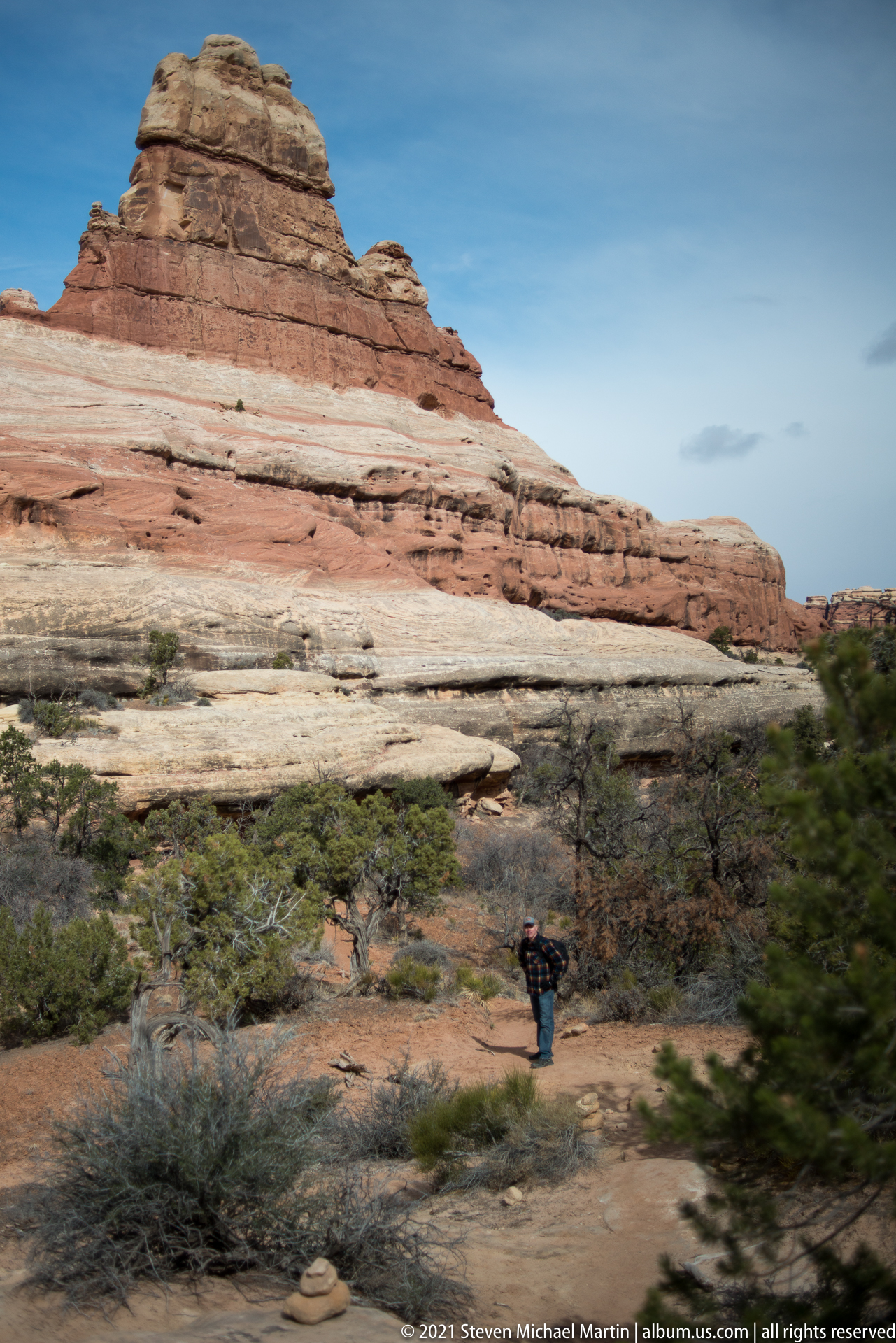
A visitor crosses a low, scrub-covered basin beneath broad horizontal sandstone slopes. The figure stands near the lower right of center, small against the pale and rose-colored layers that rise across the background. Open sky and scattered junipers leave the scene spacious, making the contrast between the moving person and the long rock escarpment especially apparent.
Caption
A visitor crosses a low, scrub-covered basin beneath broad horizontal sandstone slopes. The figure stands near the lower right of center, small against the pale and rose-colored layers that rise across the background. Open sky and scattered junipers leave the scene spacious, making the contrast between the moving person and the long rock escarpment especially apparent.
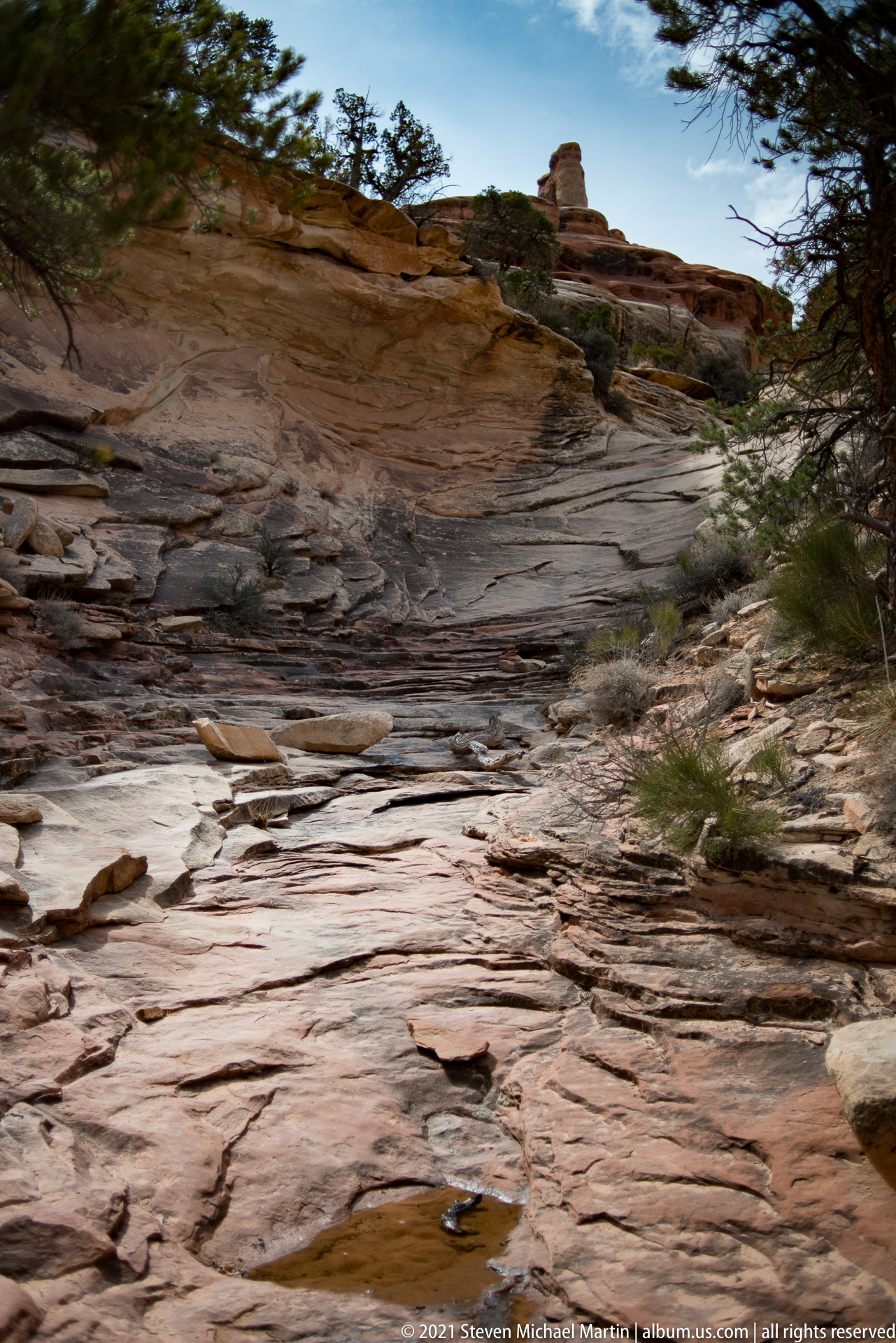
A shallow drainage runs over smooth, pale sandstone, its gently sloping bed marked by narrow grooves and small dark pools. Scrub and low trees frame the channel, while a rounded rock ledge rises across the upper half of the view. The composition follows the water-worn route through the terrain and shows how runoff shapes an otherwise dry canyon floor.
Caption
A shallow drainage runs over smooth, pale sandstone, its gently sloping bed marked by narrow grooves and small dark pools. Scrub and low trees frame the channel, while a rounded rock ledge rises across the upper half of the view. The composition follows the water-worn route through the terrain and shows how runoff shapes an otherwise dry canyon floor.
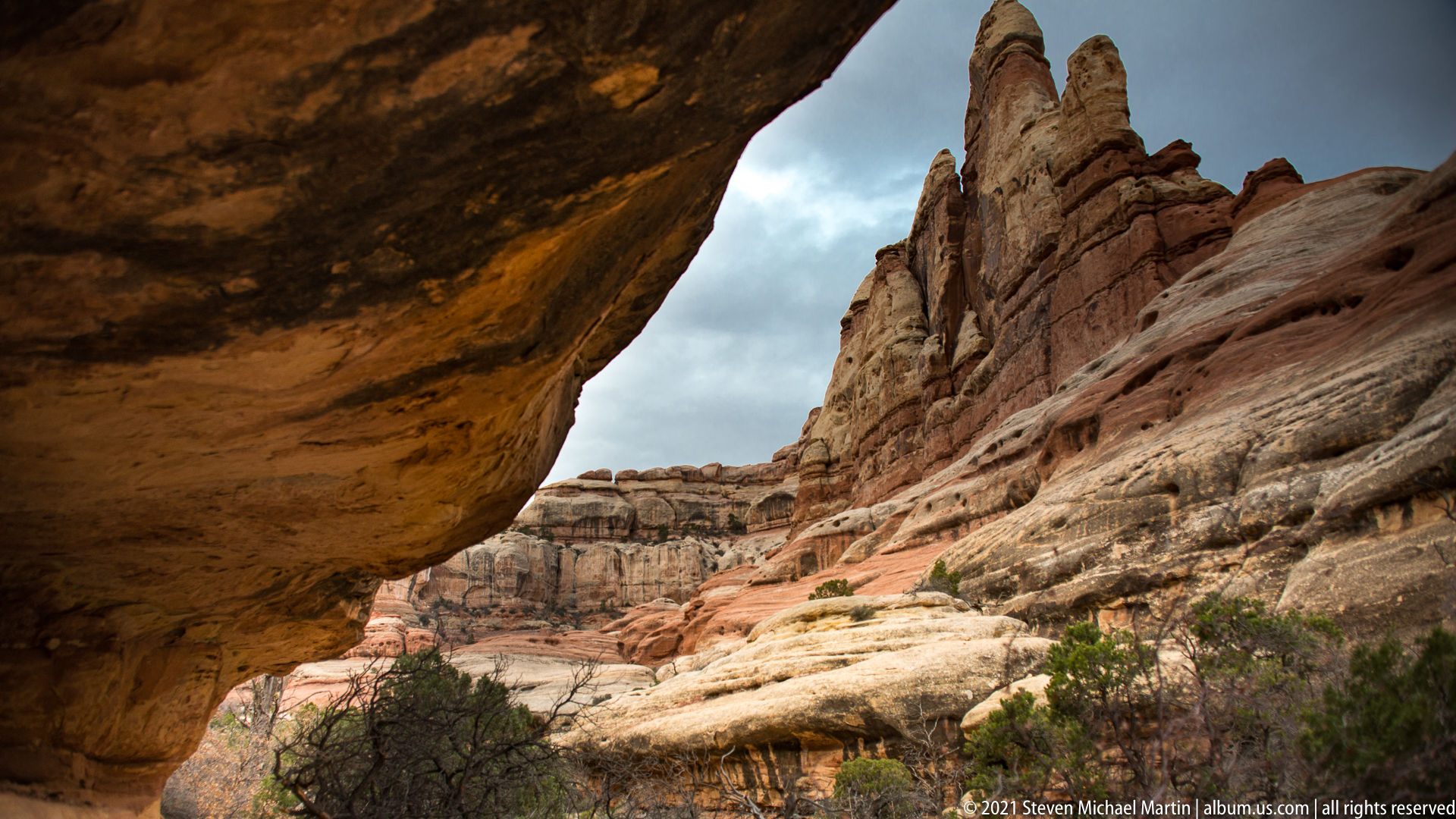
A massive overhang cuts across the upper left, creating a dark frame around tall sandstone pinnacles at right and the brighter canyon beyond. Pale sloping shelves descend through the center, while juniper grows at the lower edge. The viewpoint from beneath the overhang layers foreground, towers, and distant walls into a deep canyon composition.
Caption
A massive overhang cuts across the upper left, creating a dark frame around tall sandstone pinnacles at right and the brighter canyon beyond. Pale sloping shelves descend through the center, while juniper grows at the lower edge. The viewpoint from beneath the overhang layers foreground, towers, and distant walls into a deep canyon composition.
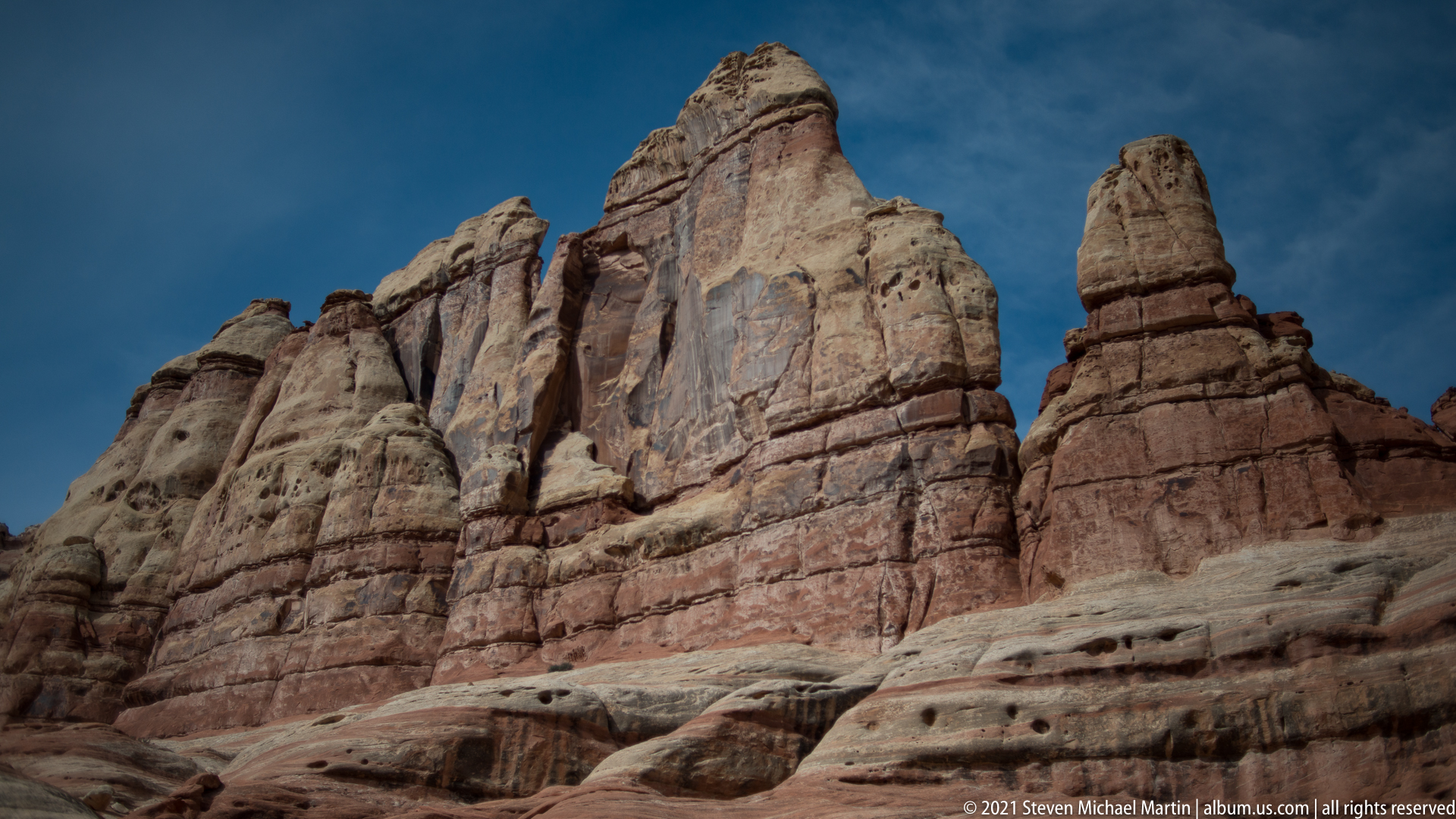
A row of tall sandstone spires fills the frame, their rounded summits and vertical faces striped in cream, gray, and red. A narrower pillar stands apart at right, while a vivid blue sky separates the pinnacles from the background. The close composition emphasizes the sharp vertical rhythm and layered color of the eroded formations.
Caption
A row of tall sandstone spires fills the frame, their rounded summits and vertical faces striped in cream, gray, and red. A narrower pillar stands apart at right, while a vivid blue sky separates the pinnacles from the background. The close composition emphasizes the sharp vertical rhythm and layered color of the eroded formations.
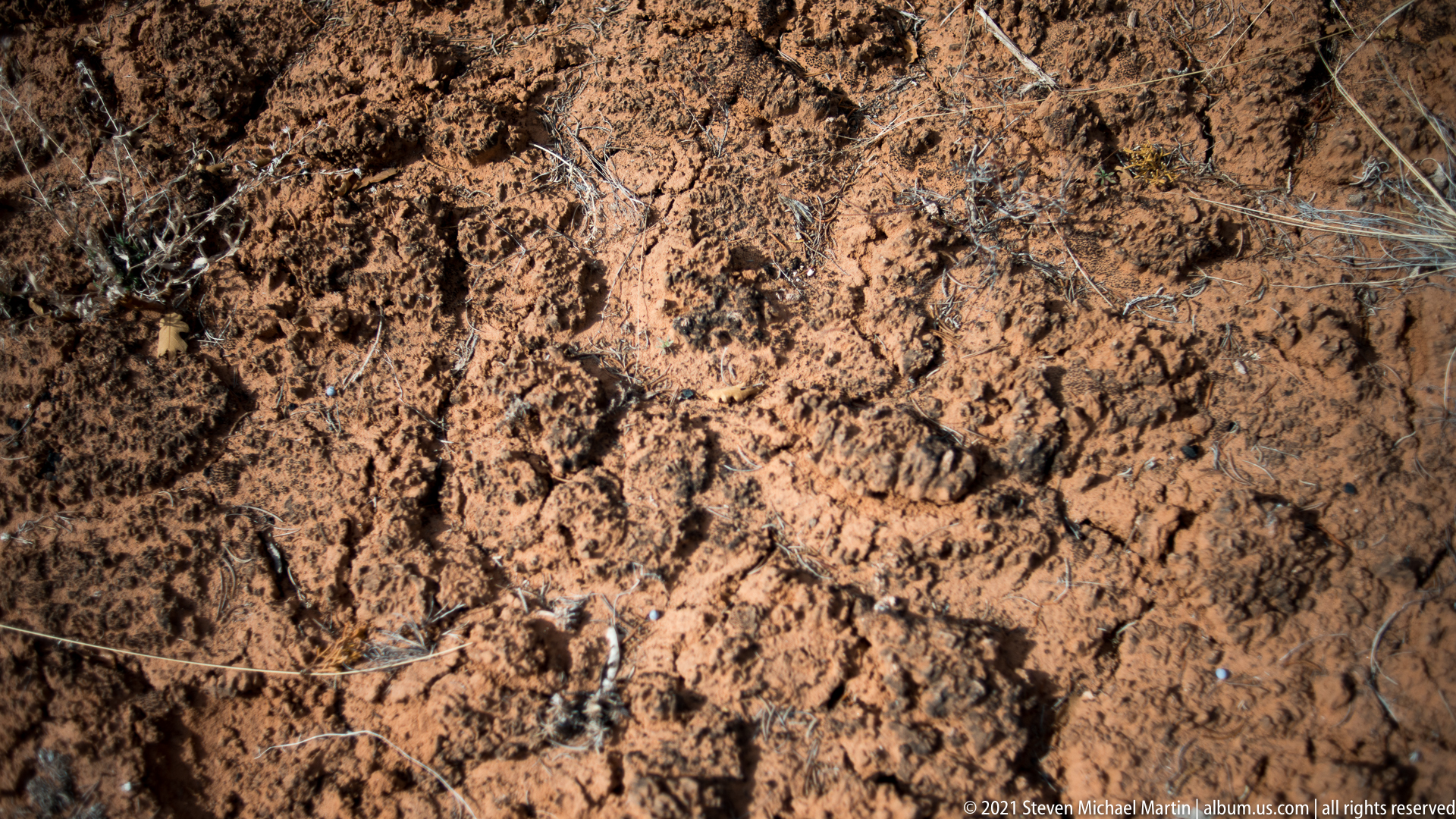
A close view of orange-brown sandstone reveals a rough, pitted surface with shallow cavities, small ridges, and irregular cracks. Fine lines cross the rock near the lower edge, while brittle plant stems enter at the margins. The tight framing removes the broader canyon context and draws attention to the stone’s weathering and granular texture.
Caption
A close view of orange-brown sandstone reveals a rough, pitted surface with shallow cavities, small ridges, and irregular cracks. Fine lines cross the rock near the lower edge, while brittle plant stems enter at the margins. The tight framing removes the broader canyon context and draws attention to the stone’s weathering and granular texture.
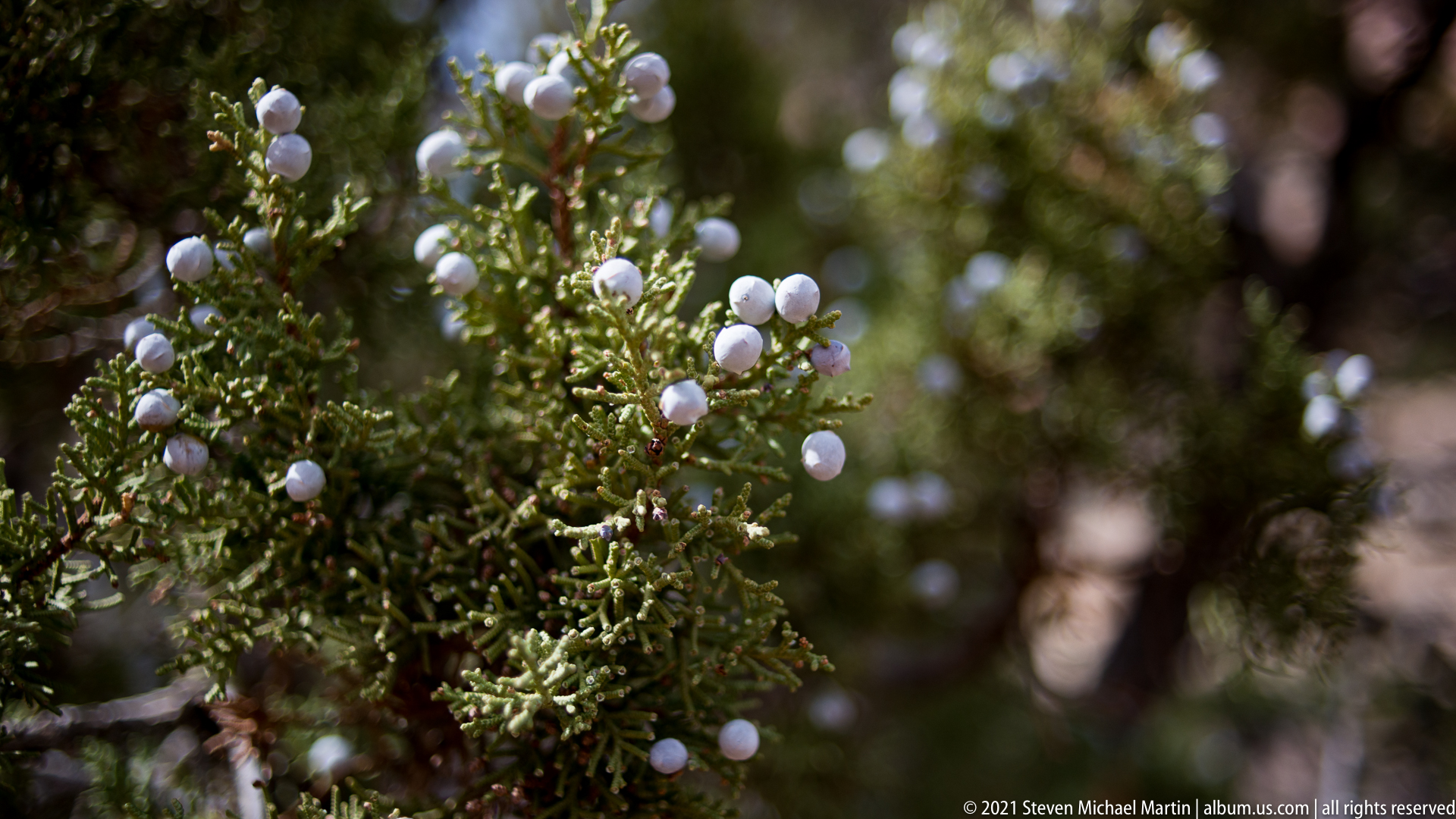
A juniper branch fills the foreground with clusters of round, pale blue-gray berries among small scale-like leaves. The shallow focus keeps the nearest cones sharp while the background dissolves into green and brown patches of canyon vegetation. This botanical detail shifts from the surrounding rock formations to one of the sparse evergreen plants growing through the dry landscape.
Caption
A juniper branch fills the foreground with clusters of round, pale blue-gray berries among small scale-like leaves. The shallow focus keeps the nearest cones sharp while the background dissolves into green and brown patches of canyon vegetation. This botanical detail shifts from the surrounding rock formations to one of the sparse evergreen plants growing through the dry landscape.
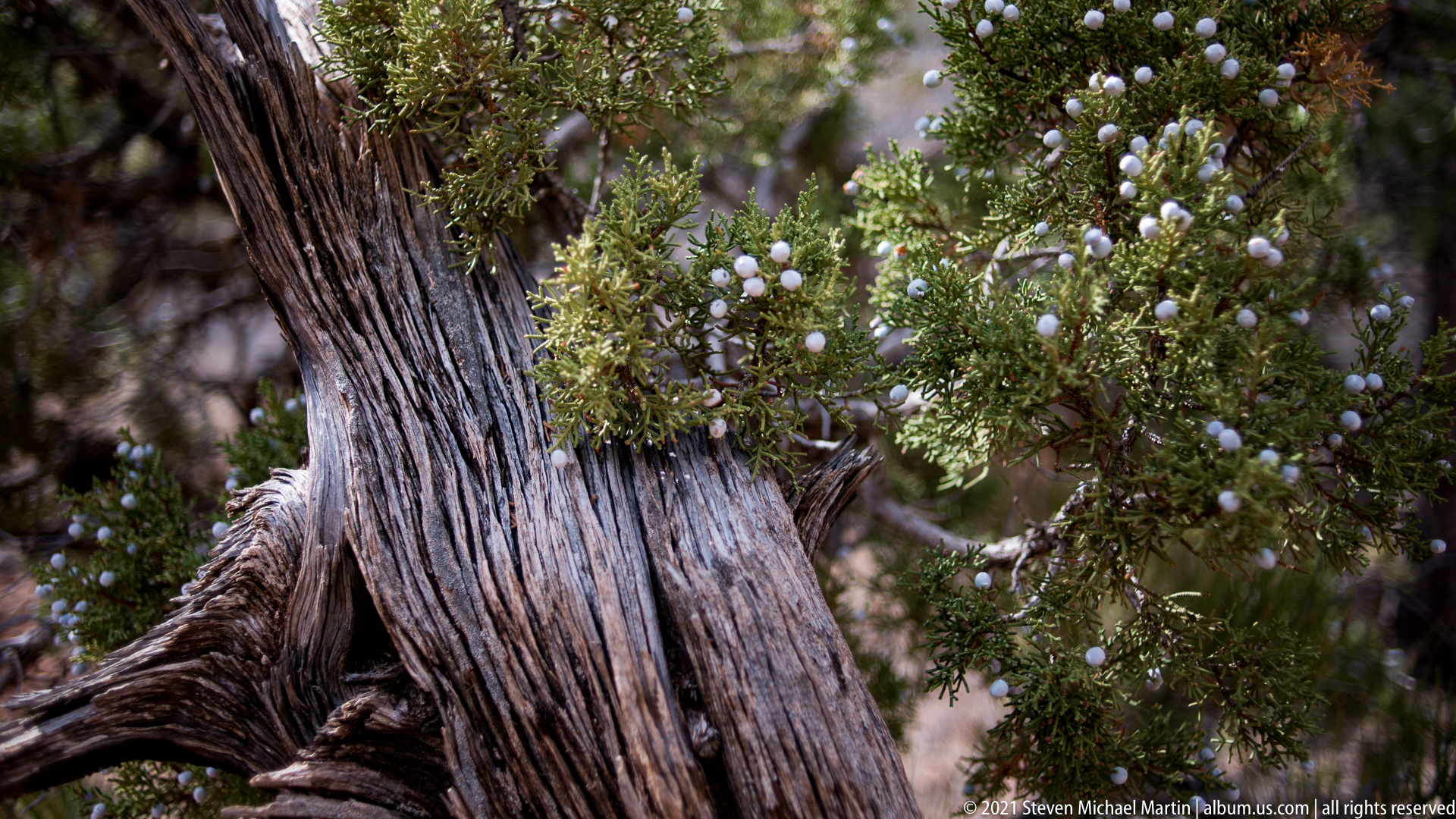
A deeply furrowed juniper trunk fills the left foreground, its fibrous bark splitting into long vertical strips. Dense sprays of scaly foliage and round blue-gray cones occupy the right side, set against softly blurred woodland. The close framing draws attention to the tree’s weathered trunk and fruiting branches within the dry canyon habitat.
Caption
A deeply furrowed juniper trunk fills the left foreground, its fibrous bark splitting into long vertical strips. Dense sprays of scaly foliage and round blue-gray cones occupy the right side, set against softly blurred woodland. The close framing draws attention to the tree’s weathered trunk and fruiting branches within the dry canyon habitat.
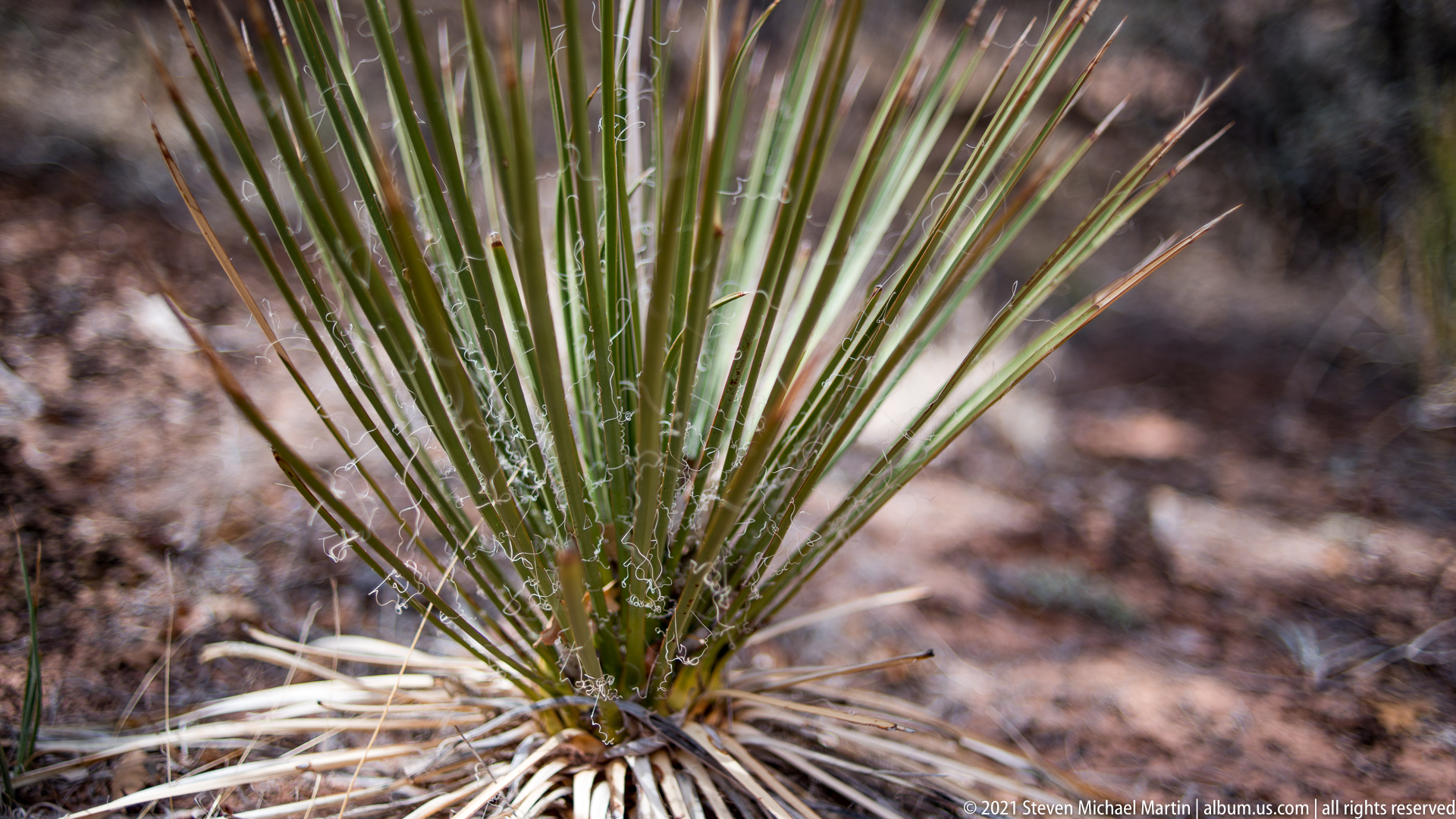
Long, narrow leaves radiate from a dense central base, forming a spiky rosette above dry ground. Several blades are straw-colored at their tips while others remain green, and a fine web stretches between the leaves. The shallow focus isolates the plant’s radial structure and the contrast between its rigid foliage and the softly rendered canyon floor.
Caption
Long, narrow leaves radiate from a dense central base, forming a spiky rosette above dry ground. Several blades are straw-colored at their tips while others remain green, and a fine web stretches between the leaves. The shallow focus isolates the plant’s radial structure and the contrast between its rigid foliage and the softly rendered canyon floor.
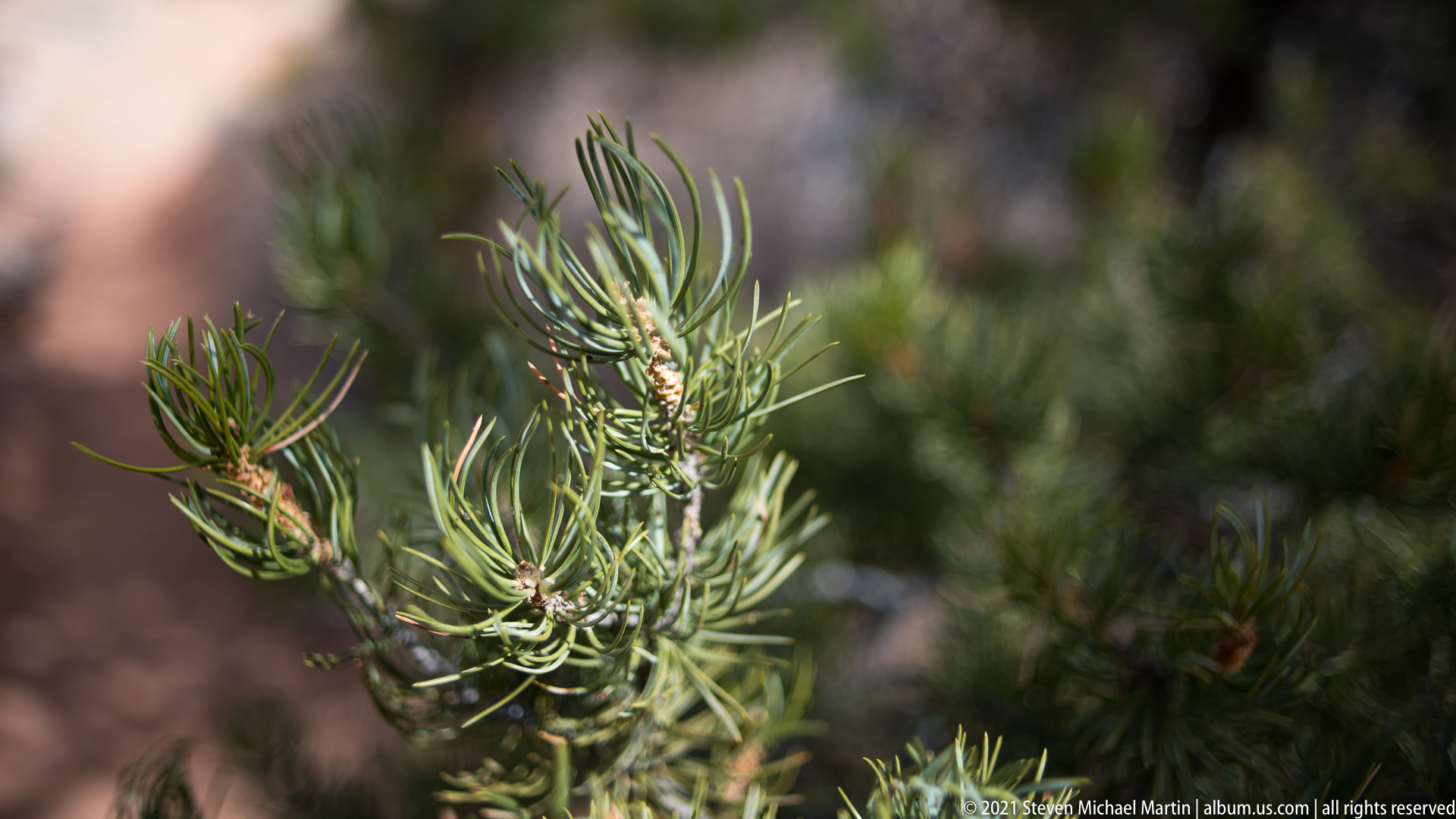
A small evergreen branch carries clusters of long, slender needles, sharply focused against a soft brown-and-green background. New growth appears near the tips, while the older needles spread outward in loose tufts. The close view isolates the plant from the wider canyon landscape and records the fine structure of its foliage without implying a species that the thumbnail cannot securely establish.
Caption
A small evergreen branch carries clusters of long, slender needles, sharply focused against a soft brown-and-green background. New growth appears near the tips, while the older needles spread outward in loose tufts. The close view isolates the plant from the wider canyon landscape and records the fine structure of its foliage without implying a species that the thumbnail cannot securely establish.
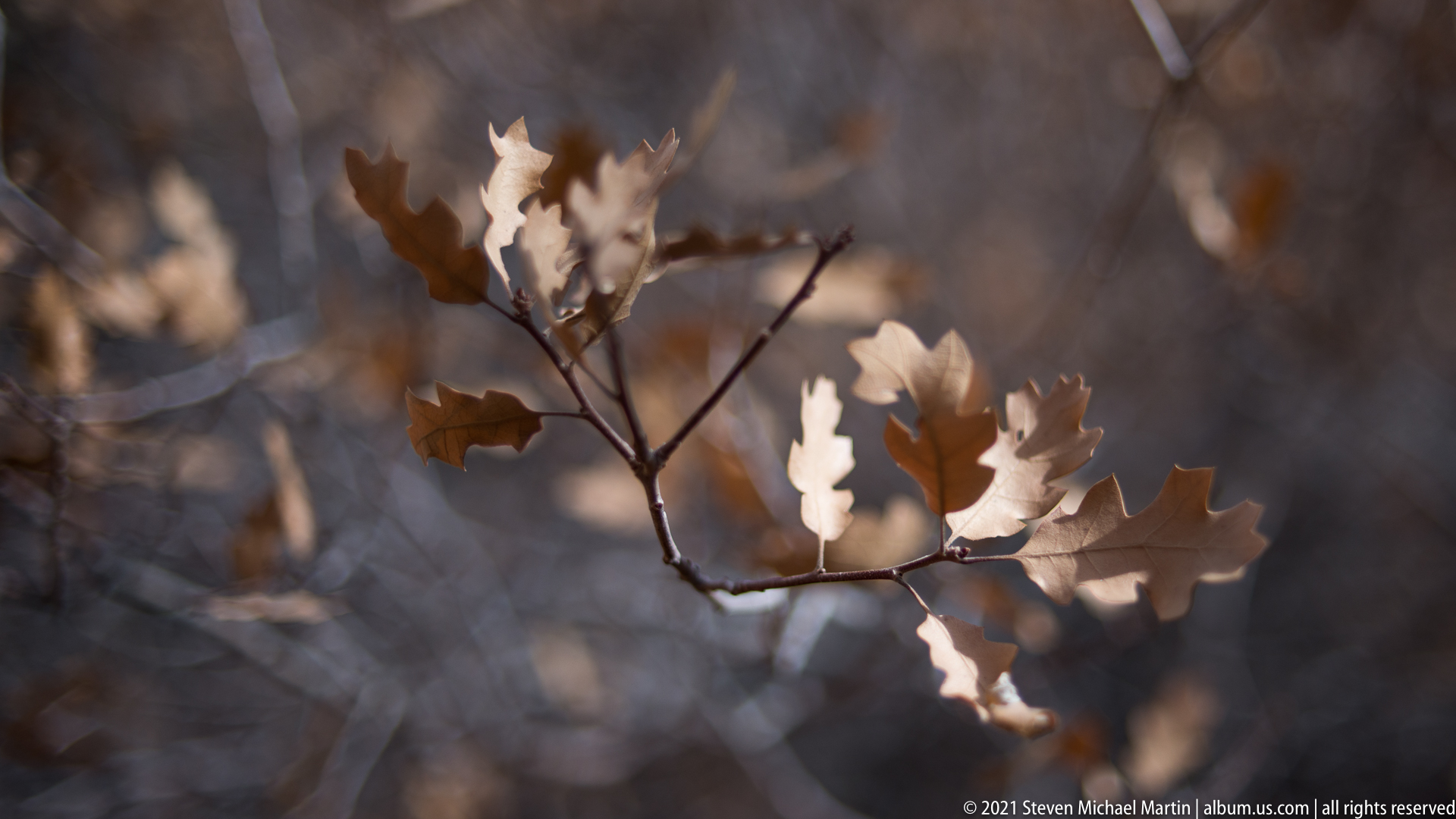
A slender branch holds several dry, deeply lobed leaves, their pale tan surfaces catching a patch of warm light. The leaves remain attached while the surrounding vegetation falls into shadow and blur, giving the image a quiet seasonal detail. The composition isolates the shape and brittle texture of the foliage rather than the canyon scenery.
Caption
A slender branch holds several dry, deeply lobed leaves, their pale tan surfaces catching a patch of warm light. The leaves remain attached while the surrounding vegetation falls into shadow and blur, giving the image a quiet seasonal detail. The composition isolates the shape and brittle texture of the foliage rather than the canyon scenery.
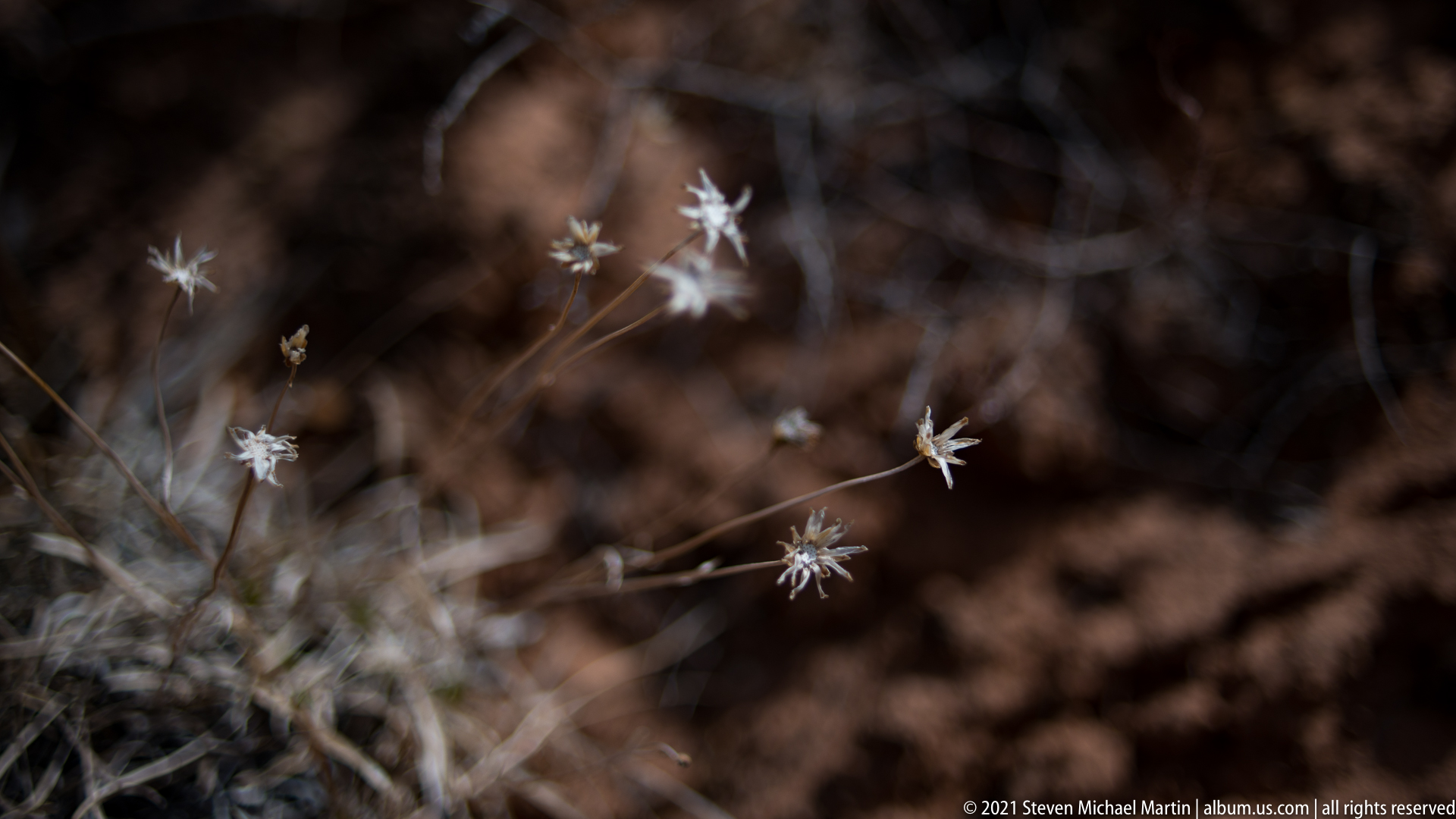
Several tiny pale star-shaped seed heads rise on delicate stems from a darker mat of dry vegetation. The nearest heads are softly focused, while the background dissolves into brown shadow, emphasizing their fine silhouettes and sparse arrangement. This intimate view records a late-season plant detail among the rocks rather than a flowering display or a confidently identifiable species.
Caption
Several tiny pale star-shaped seed heads rise on delicate stems from a darker mat of dry vegetation. The nearest heads are softly focused, while the background dissolves into brown shadow, emphasizing their fine silhouettes and sparse arrangement. This intimate view records a late-season plant detail among the rocks rather than a flowering display or a confidently identifiable species.
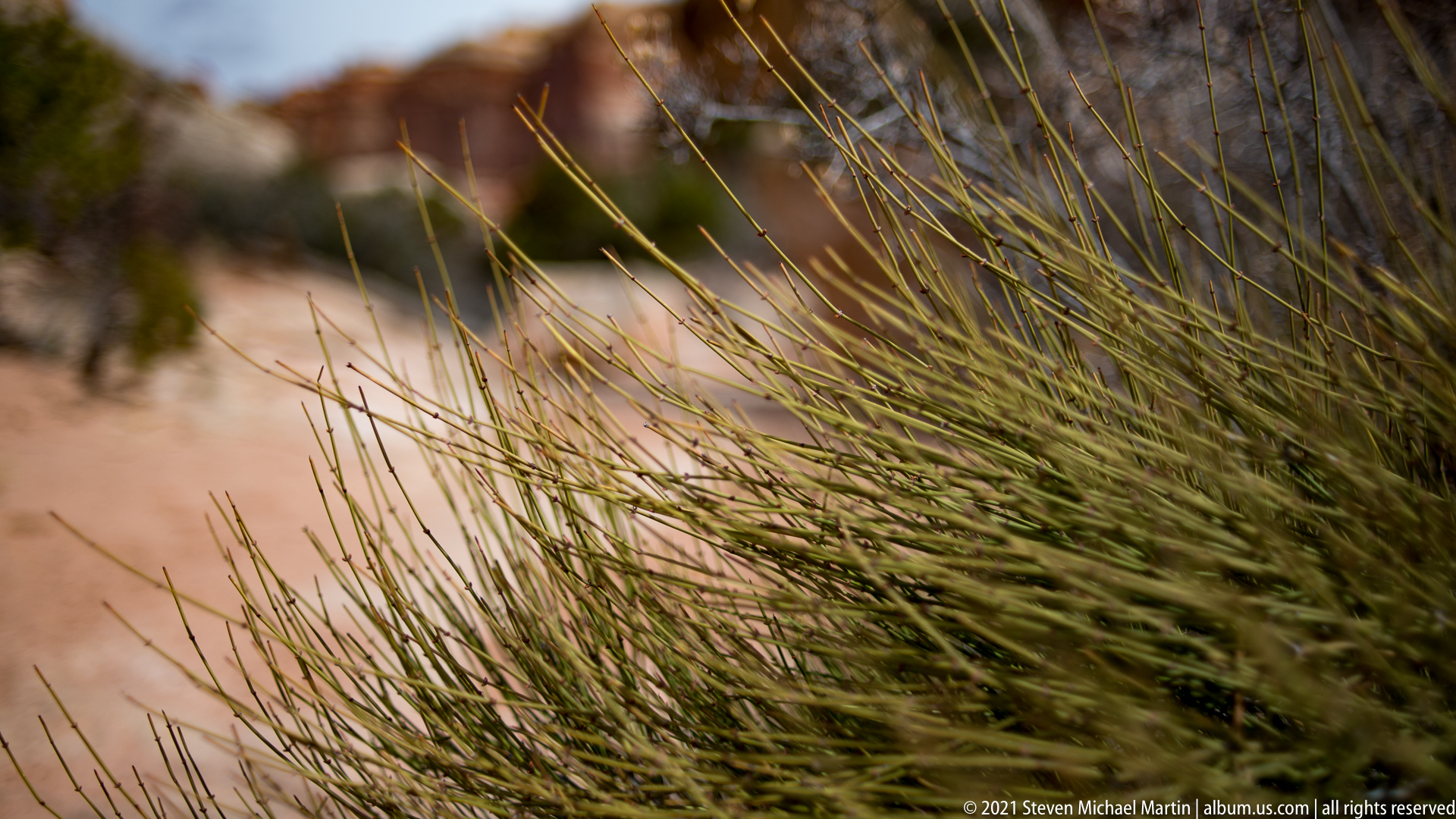
A dense spray of slender green and yellow stems angles across the foreground, their fine tips catching the light. A pale sandy trail and scattered rocks blur behind the plant, setting the close detail within a dry, open environment. The image emphasizes the shrub’s wiry growth and the soft contrast between the living stems and the sunlit ground.
Caption
A dense spray of slender green and yellow stems angles across the foreground, their fine tips catching the light. A pale sandy trail and scattered rocks blur behind the plant, setting the close detail within a dry, open environment. The image emphasizes the shrub’s wiry growth and the soft contrast between the living stems and the sunlit ground.
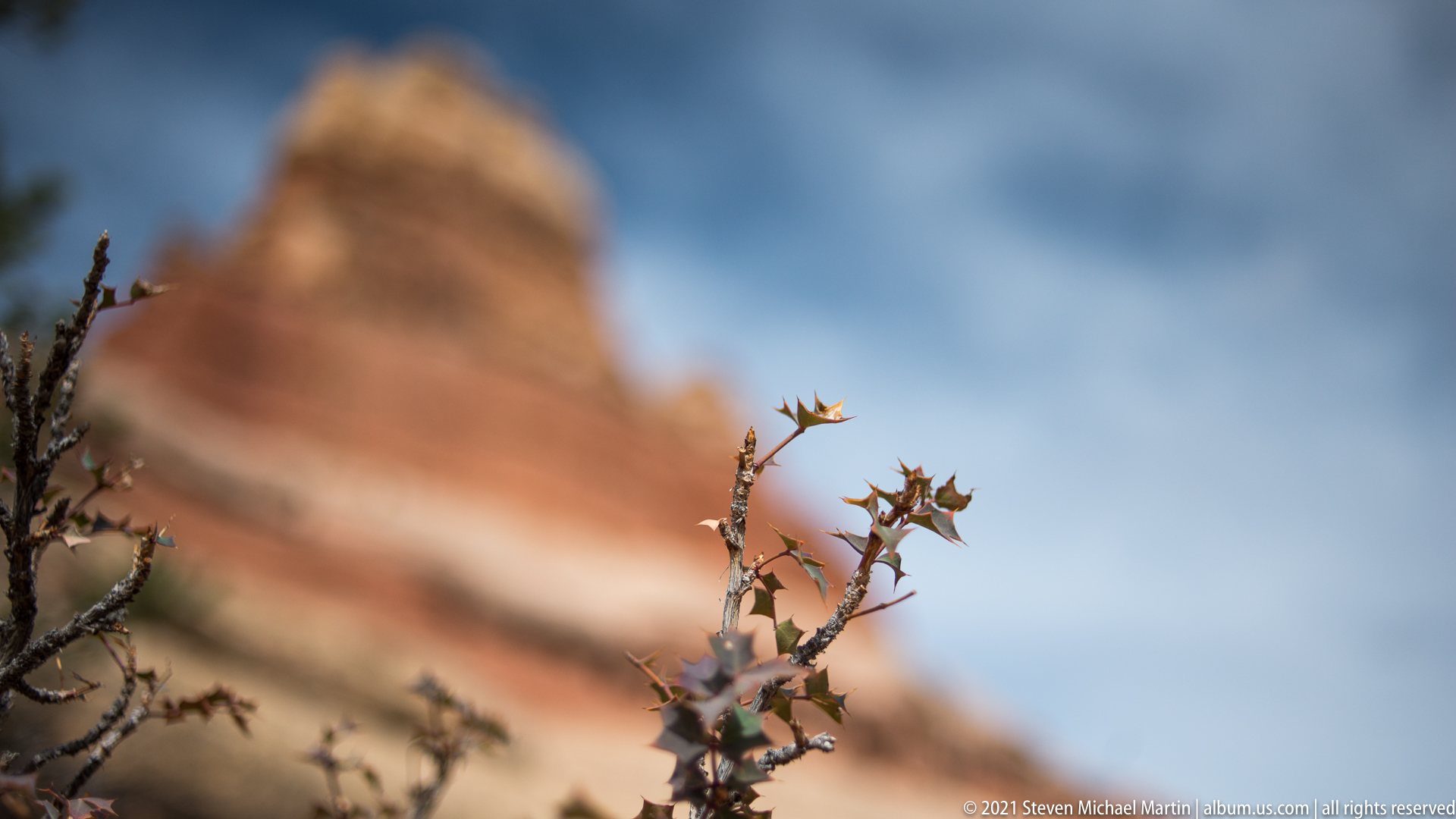
A thorny branch rises in the foreground, its small leaves and sharp points crisply outlined against a defocused red sandstone formation and blue sky. The shallow depth of field links plant and geology without allowing the distant rock to dominate. The view records how resilient shrubs occupy the canyon’s exposed, dry slopes.
Caption
A thorny branch rises in the foreground, its small leaves and sharp points crisply outlined against a defocused red sandstone formation and blue sky. The shallow depth of field links plant and geology without allowing the distant rock to dominate. The view records how resilient shrubs occupy the canyon’s exposed, dry slopes.
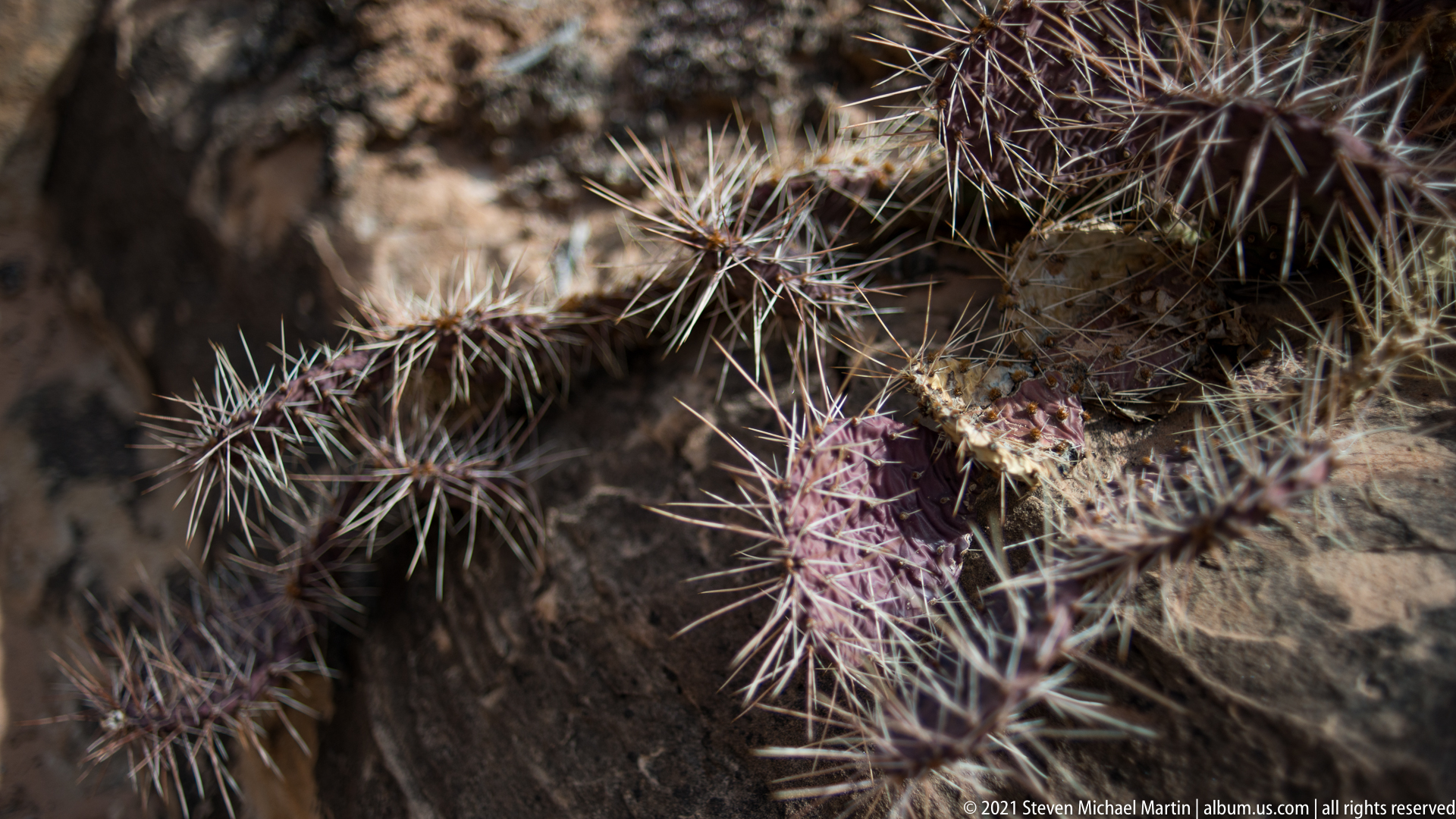
A cluster of rounded cactus stems nestles among dry grass and stones, each surface ringed with long pale spines. The stems show muted green and purple tones, while the shallow angle brings the sharp armature into focus. The close view makes the cactus’s protective structure and compact growth form more prominent than its surrounding habitat.
Caption
A cluster of rounded cactus stems nestles among dry grass and stones, each surface ringed with long pale spines. The stems show muted green and purple tones, while the shallow angle brings the sharp armature into focus. The close view makes the cactus’s protective structure and compact growth form more prominent than its surrounding habitat.
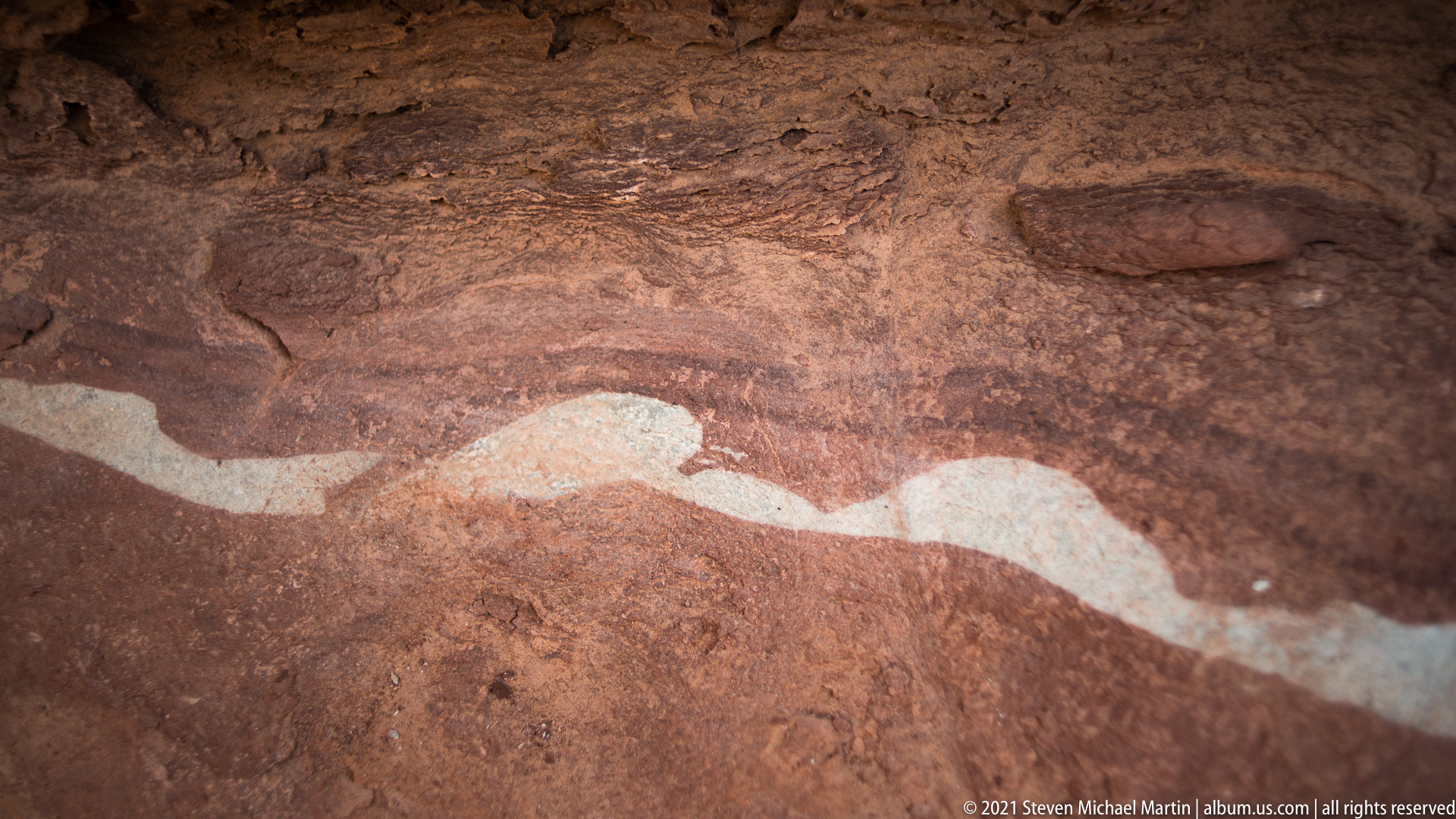
A pale, sinuous band crosses the red sandstone, widening and narrowing as it follows an irregular path through the rock. Fine granular texture and darker reddish patches remain visible around it, with no broader landscape included. The close crop focuses on the contrast between the lighter material and the surrounding stone; its precise mineral composition is not established by appearance alone.
Caption
A pale, sinuous band crosses the red sandstone, widening and narrowing as it follows an irregular path through the rock. Fine granular texture and darker reddish patches remain visible around it, with no broader landscape included. The close crop focuses on the contrast between the lighter material and the surrounding stone; its precise mineral composition is not established by appearance alone.
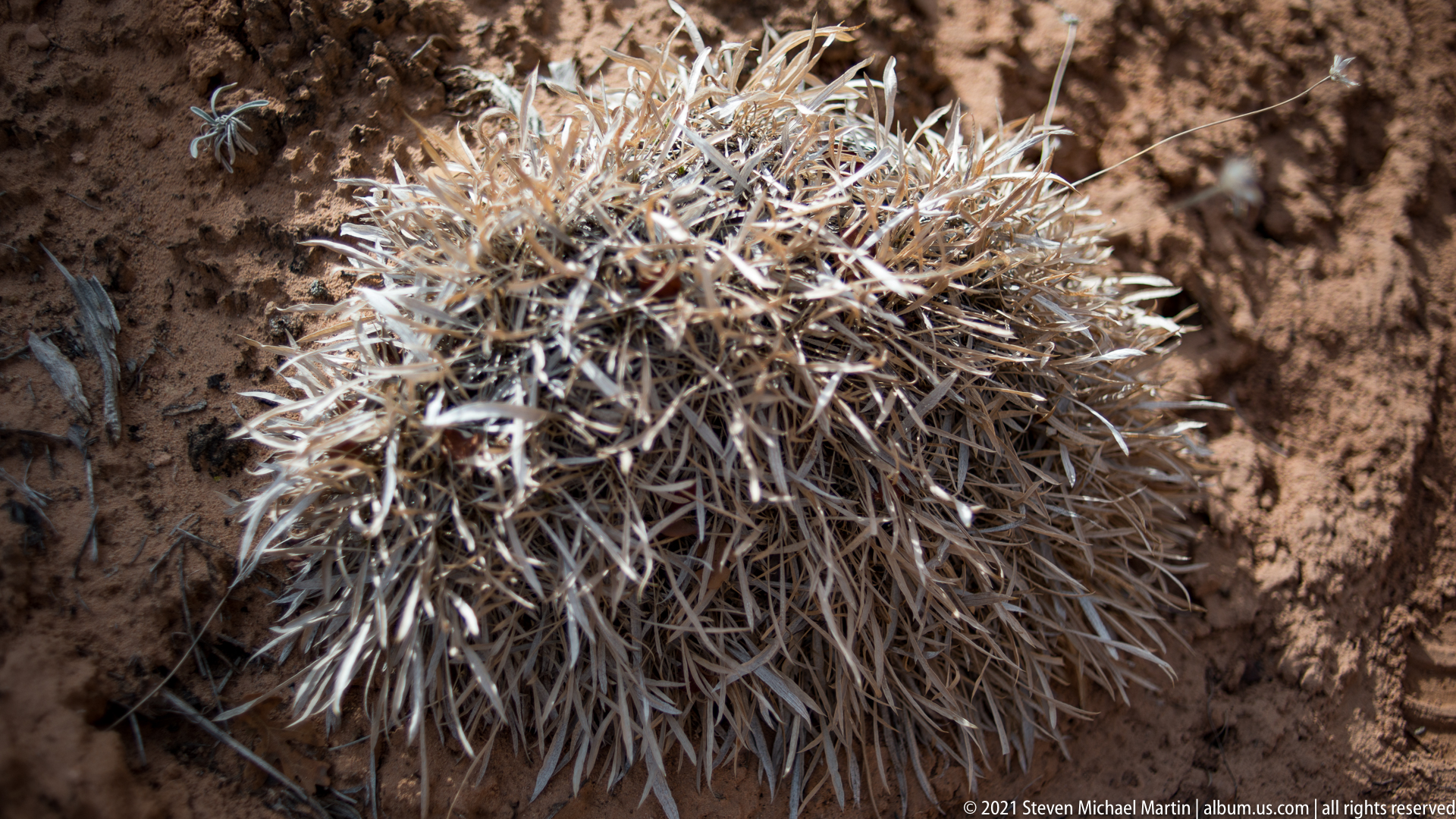
A rounded, pale plant structure fills the frame, its branching stems and sharp points forming a dense, brittle-looking sphere. The dry reddish soil behind it reinforces the arid setting, while the close perspective reveals the many fine projections that make the plant distinctive. The species and whether the structure is a seed head or dried plant body remain uncertain.
Caption
A rounded, pale plant structure fills the frame, its branching stems and sharp points forming a dense, brittle-looking sphere. The dry reddish soil behind it reinforces the arid setting, while the close perspective reveals the many fine projections that make the plant distinctive. The species and whether the structure is a seed head or dried plant body remain uncertain.
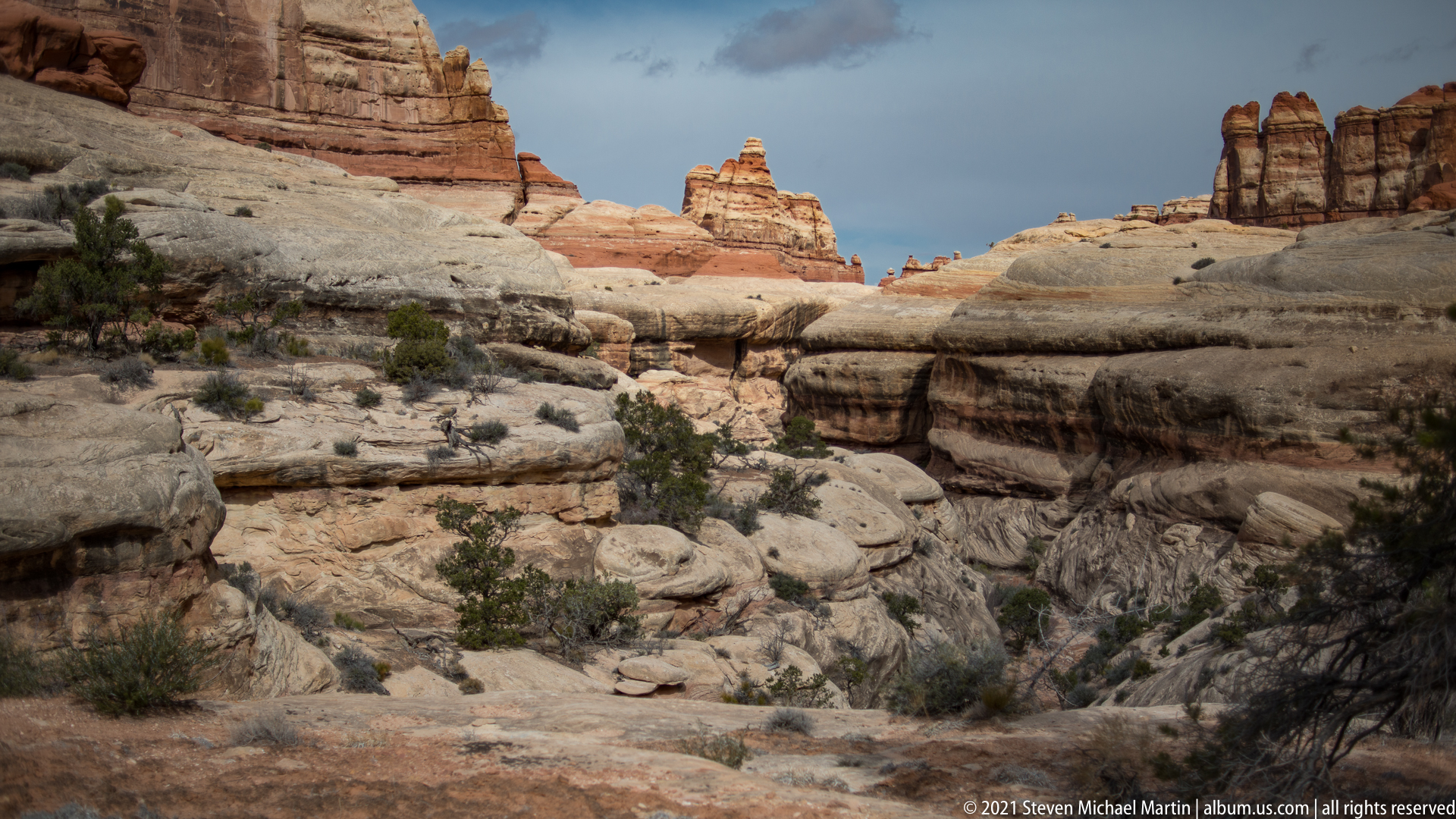
Pale sandstone ledges descend into a shallow drainage, with red towers rising along the horizon beneath a partly clouded sky. Low shrubs punctuate the open slopes, and an eroded channel cuts through the foreground. The broad composition brings the canyon’s changing rock colors and the transition from exposed shelves to vegetated terrain into view.
Caption
Pale sandstone ledges descend into a shallow drainage, with red towers rising along the horizon beneath a partly clouded sky. Low shrubs punctuate the open slopes, and an eroded channel cuts through the foreground. The broad composition brings the canyon’s changing rock colors and the transition from exposed shelves to vegetated terrain into view.
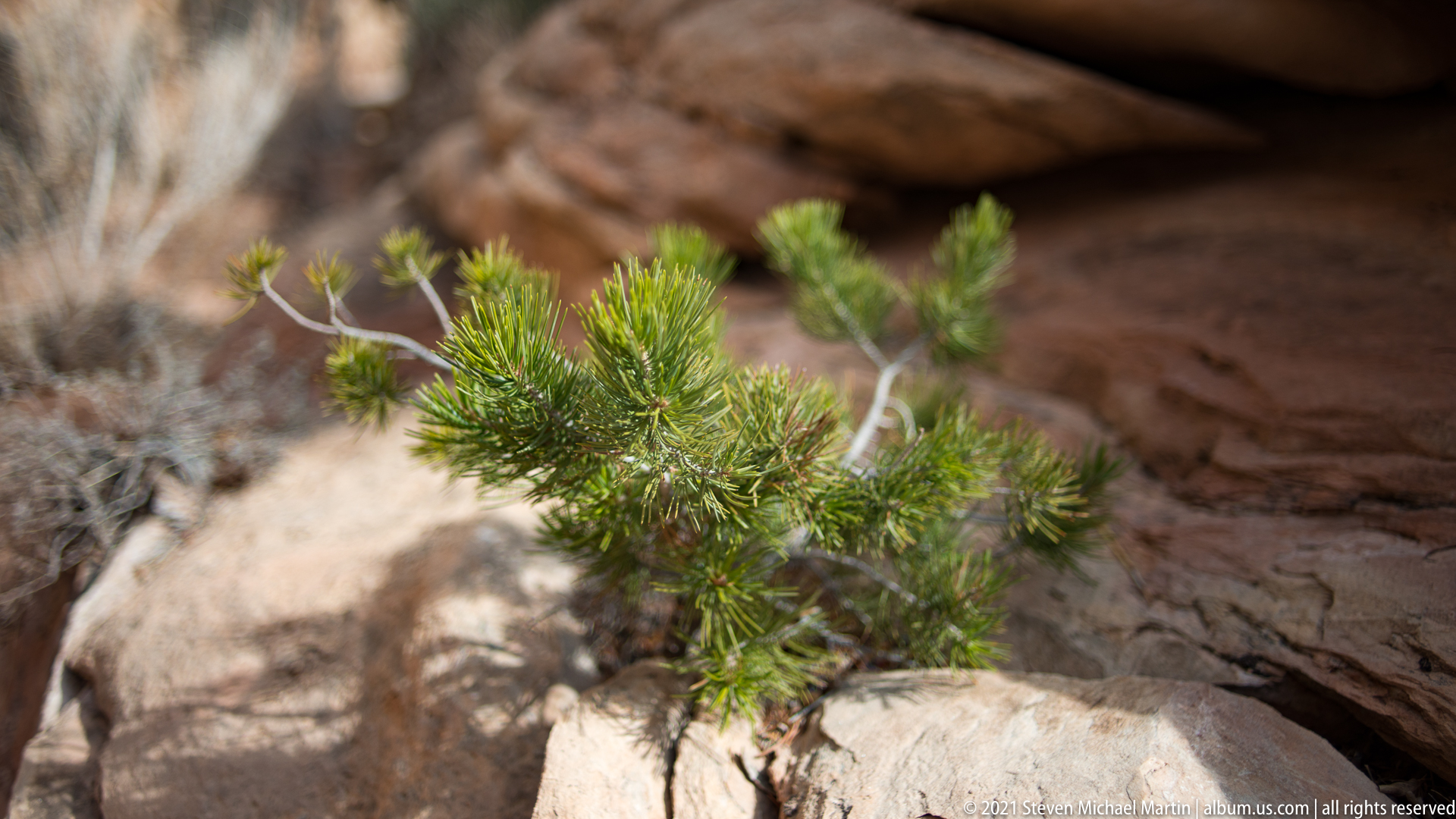
A young evergreen shrub grows from a narrow pocket between pale boulders, its fresh green sprays sharply focused against the reddish rock behind it. The shallow depth of field separates the plant from the surrounding stone and draws attention to how vegetation takes root in small, protected spaces. The species is not certain from this view, so the caption stays with its visible form.
Caption
A young evergreen shrub grows from a narrow pocket between pale boulders, its fresh green sprays sharply focused against the reddish rock behind it. The shallow depth of field separates the plant from the surrounding stone and draws attention to how vegetation takes root in small, protected spaces. The species is not certain from this view, so the caption stays with its visible form.
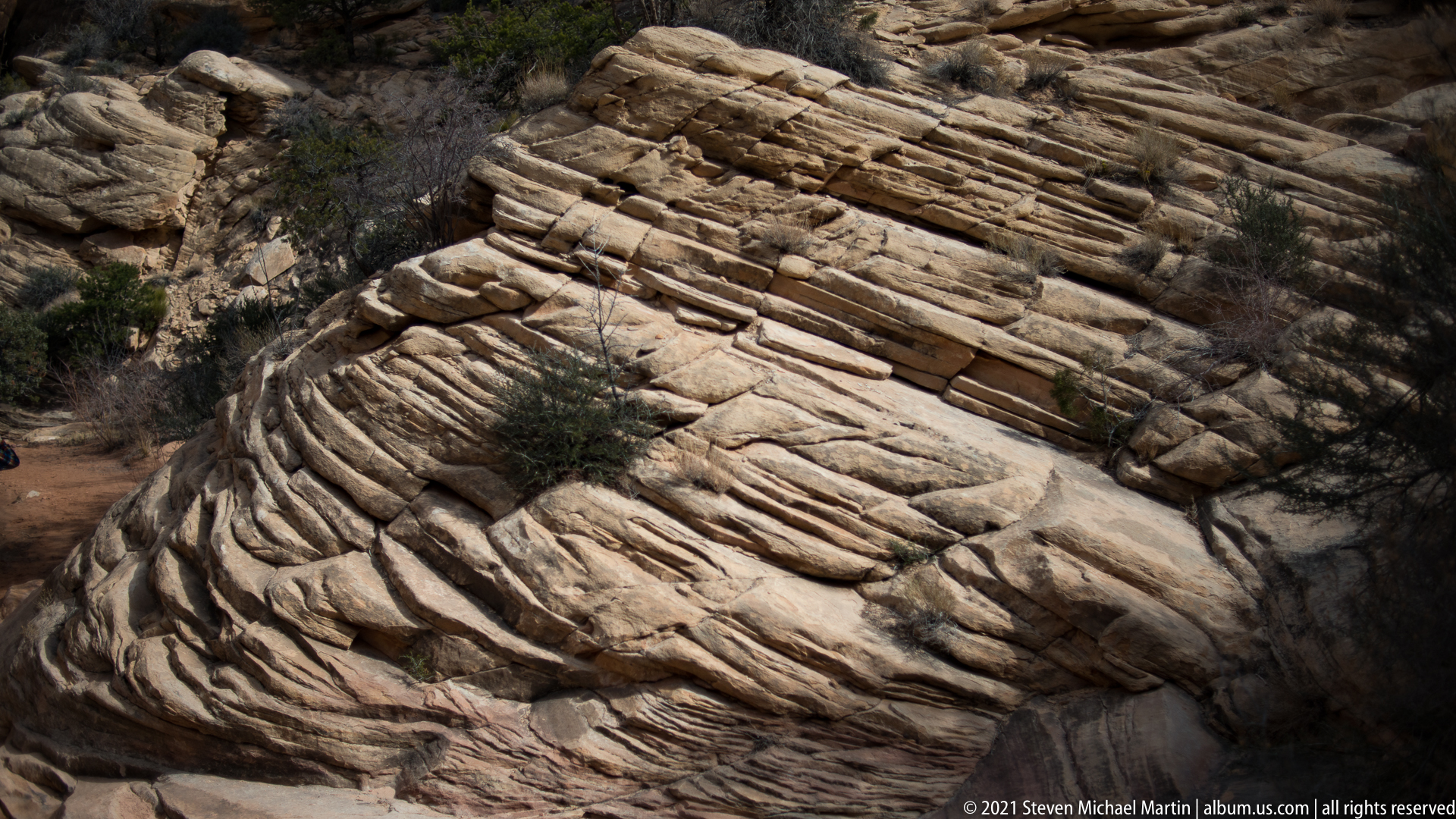
Parallel sandstone beds curve and tilt across the outcrop, forming a ribbed surface that bends downward toward the foreground. Thin ledges and darker seams trace the layers, while sparse shrubs mark the margins. The view gives a clear sense of the rock’s folded geometry and erosion, without assigning a specific structural process beyond what the exposed strata show.
Caption
Parallel sandstone beds curve and tilt across the outcrop, forming a ribbed surface that bends downward toward the foreground. Thin ledges and darker seams trace the layers, while sparse shrubs mark the margins. The view gives a clear sense of the rock’s folded geometry and erosion, without assigning a specific structural process beyond what the exposed strata show.
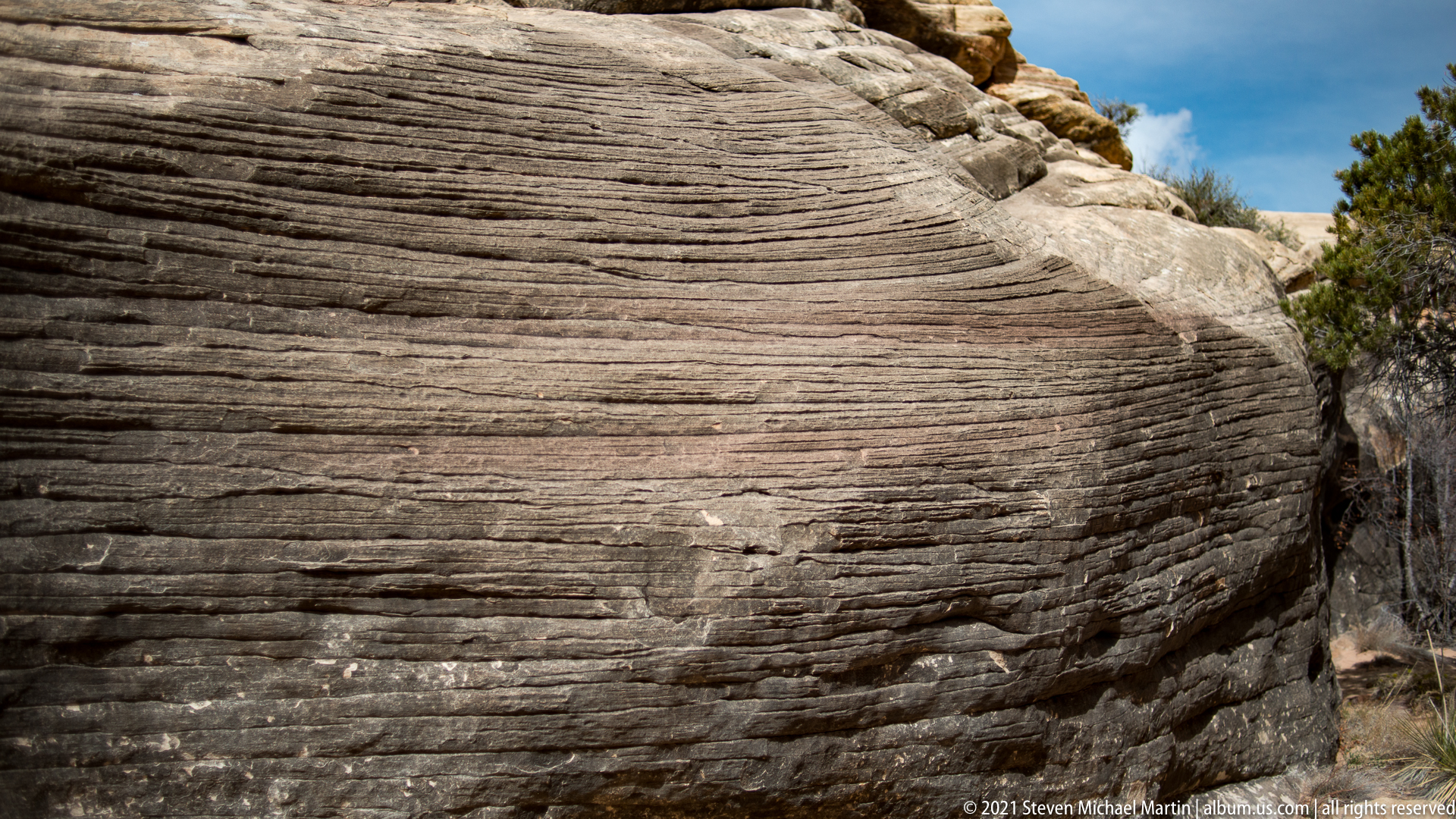
Fine parallel bands sweep across a rounded sandstone face, their repeated lines bending gently with the rock’s contour. The close framing excludes most vegetation and sky, turning the surface into a study of sedimentary layering and weathered texture. Subtle shifts from gray-brown to cream distinguish individual beds across the broad, striated exposure.
Caption
Fine parallel bands sweep across a rounded sandstone face, their repeated lines bending gently with the rock’s contour. The close framing excludes most vegetation and sky, turning the surface into a study of sedimentary layering and weathered texture. Subtle shifts from gray-brown to cream distinguish individual beds across the broad, striated exposure.
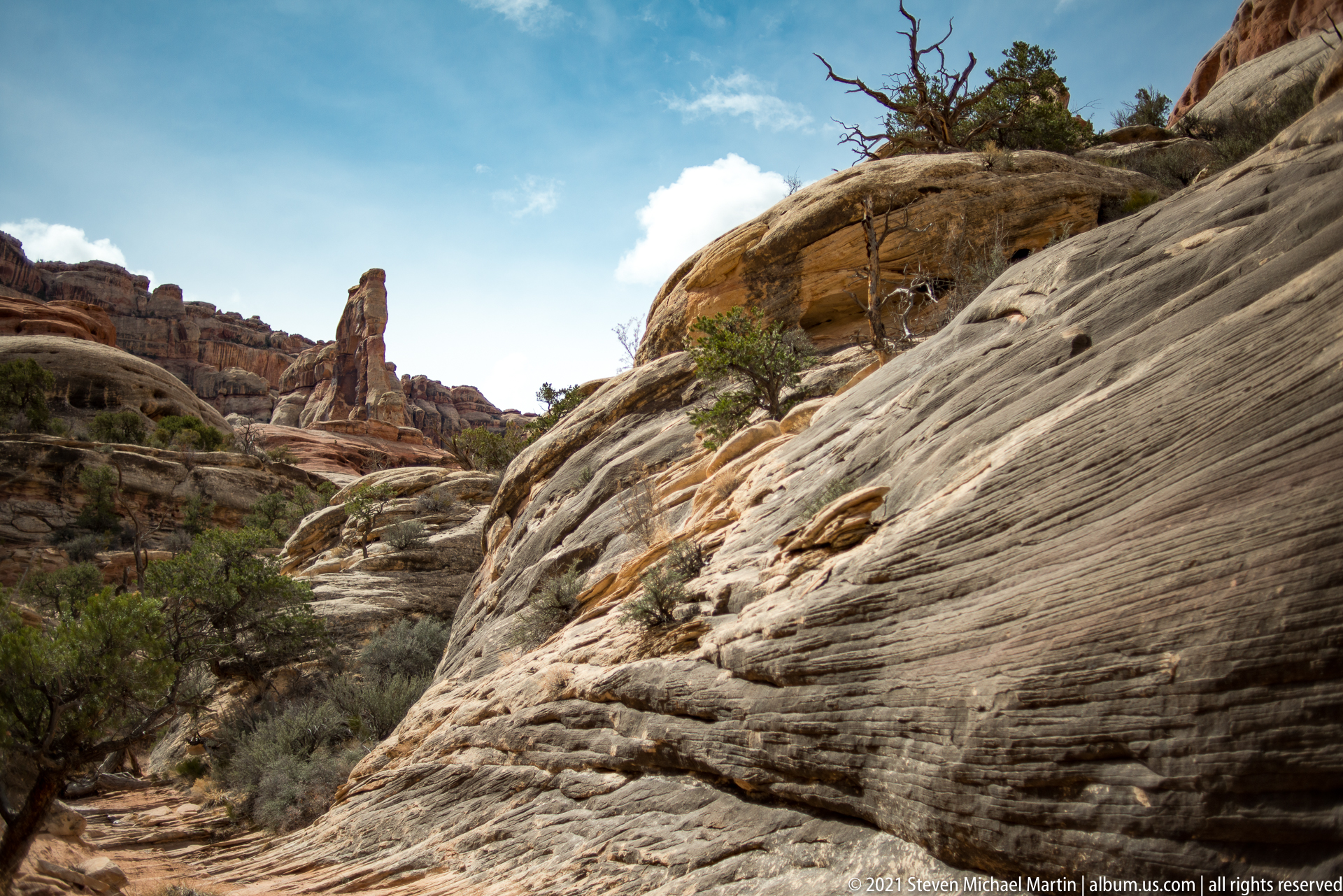
A smooth, sloping sandstone surface fills the right foreground, leading toward a narrow spire in the distance. A weathered tree leans across the upper edge, and low shrubs occupy pockets between the rock shelves. The composition uses the exposed slickrock as a visual path into the canyon and connects the close terrain with the larger formations beyond.
Caption
A smooth, sloping sandstone surface fills the right foreground, leading toward a narrow spire in the distance. A weathered tree leans across the upper edge, and low shrubs occupy pockets between the rock shelves. The composition uses the exposed slickrock as a visual path into the canyon and connects the close terrain with the larger formations beyond.
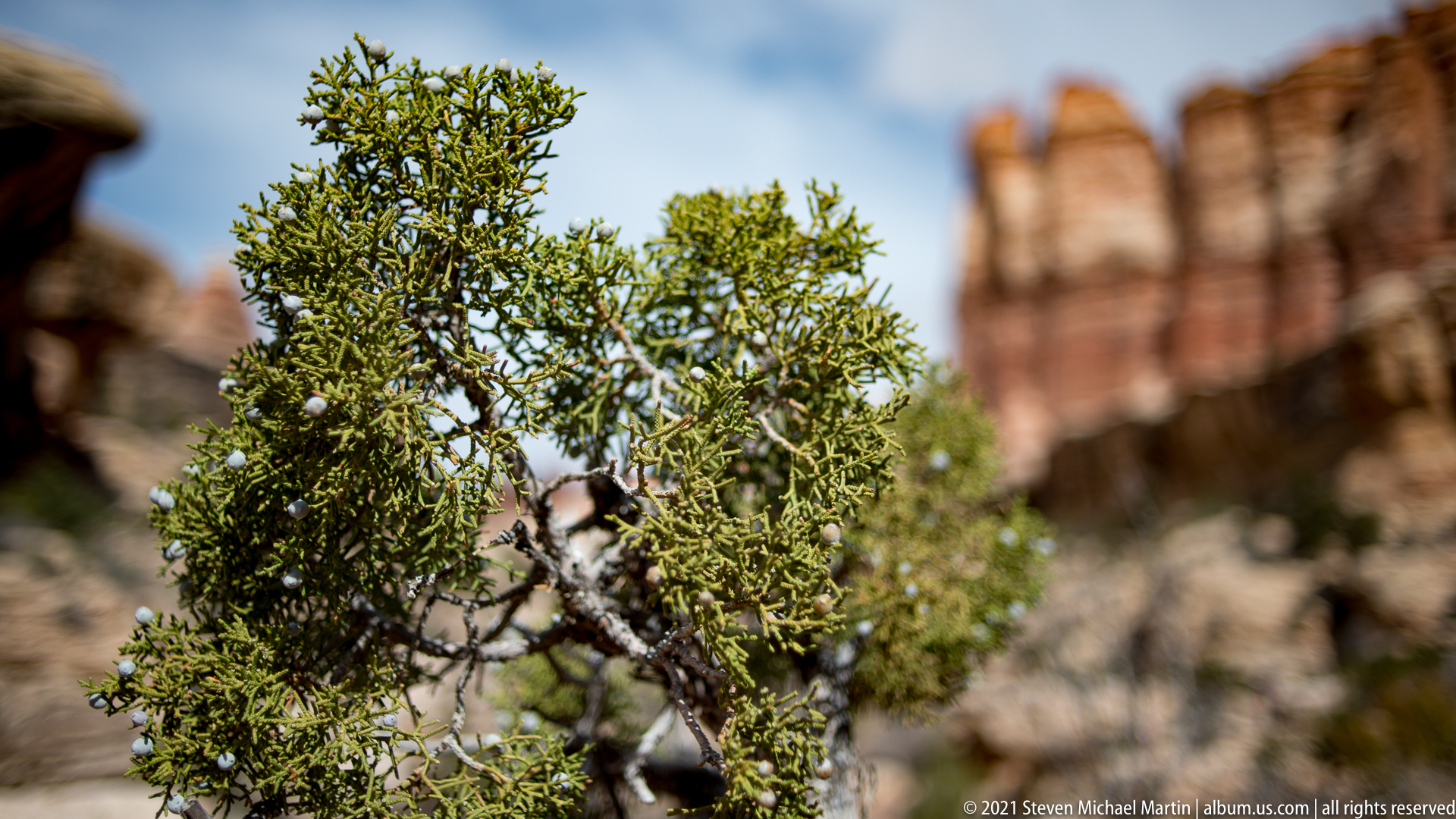
A juniper branch carries several round blue-gray cones among dense sprays of scaly green foliage. The nearest cones and leaves stand in sharp focus, while sandstone towers blur into warm vertical shapes behind them. This close botanical view links the canyon’s evergreen vegetation with its distinctive rock backdrop without relying on an uncertain species-level label.
Caption
A juniper branch carries several round blue-gray cones among dense sprays of scaly green foliage. The nearest cones and leaves stand in sharp focus, while sandstone towers blur into warm vertical shapes behind them. This close botanical view links the canyon’s evergreen vegetation with its distinctive rock backdrop without relying on an uncertain species-level label.
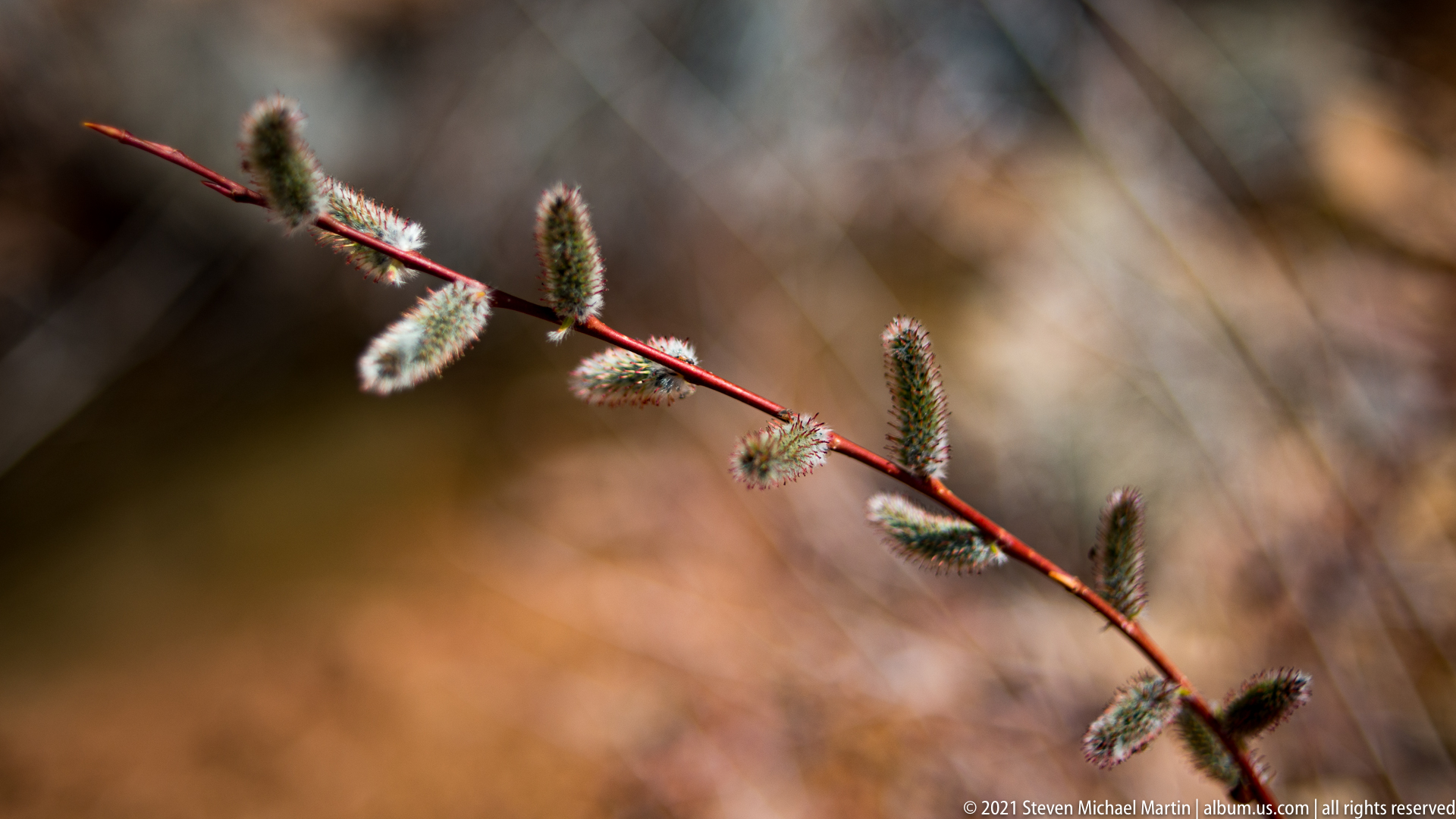
A slender red-brown branch crosses the frame diagonally, carrying several fuzzy catkins along its length. The pale clusters catch the light against a softly blurred background of ochre and brown, making their fine hairs and compact shape visible. The close view records a seasonal plant detail within the canyon’s riparian or drainage vegetation without identifying the willow species.
Caption
A slender red-brown branch crosses the frame diagonally, carrying several fuzzy catkins along its length. The pale clusters catch the light against a softly blurred background of ochre and brown, making their fine hairs and compact shape visible. The close view records a seasonal plant detail within the canyon’s riparian or drainage vegetation without identifying the willow species.

A brittle, spiny plant structure occupies the left foreground, its pale radiating points sharply defined against a warm, blurred background. Other dried stems recede behind it, reinforcing the close focus on one seed-bearing or thorny form. The species and exact function of the structure cannot be determined from this photograph, but its texture and shape are distinct.
Caption
A brittle, spiny plant structure occupies the left foreground, its pale radiating points sharply defined against a warm, blurred background. Other dried stems recede behind it, reinforcing the close focus on one seed-bearing or thorny form. The species and exact function of the structure cannot be determined from this photograph, but its texture and shape are distinct.
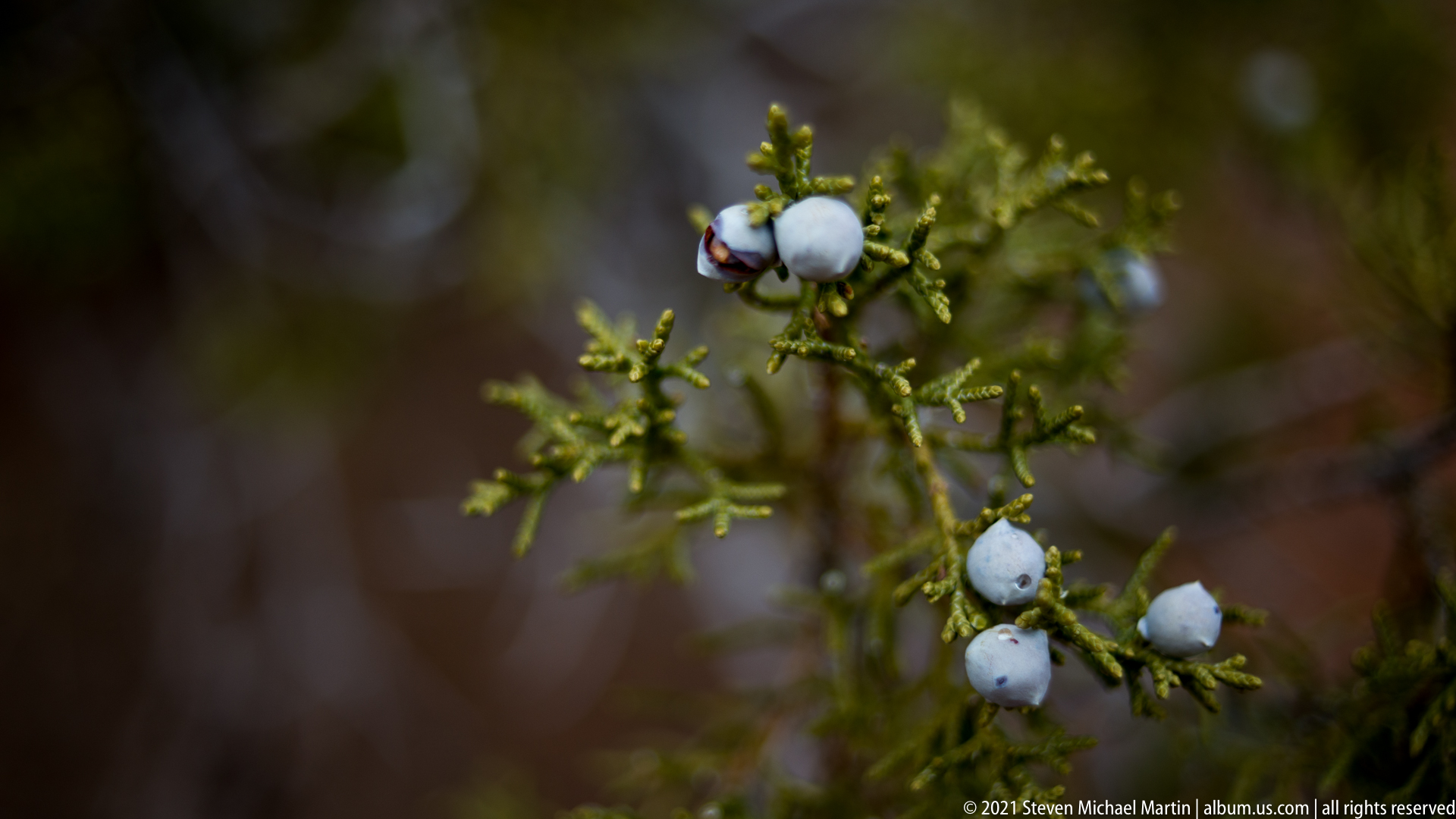
Several blue-gray juniper cones sit among fine green foliage, with the nearest cluster sharply focused against a dark, softly blurred background. Their powdery surfaces and rounded shape contrast with the small scaly leaves along the branch. The close framing isolates fruiting detail from the wider canyon landscape and keeps the image centered on the evergreen’s texture and color.
Caption
Several blue-gray juniper cones sit among fine green foliage, with the nearest cluster sharply focused against a dark, softly blurred background. Their powdery surfaces and rounded shape contrast with the small scaly leaves along the branch. The close framing isolates fruiting detail from the wider canyon landscape and keeps the image centered on the evergreen’s texture and color.
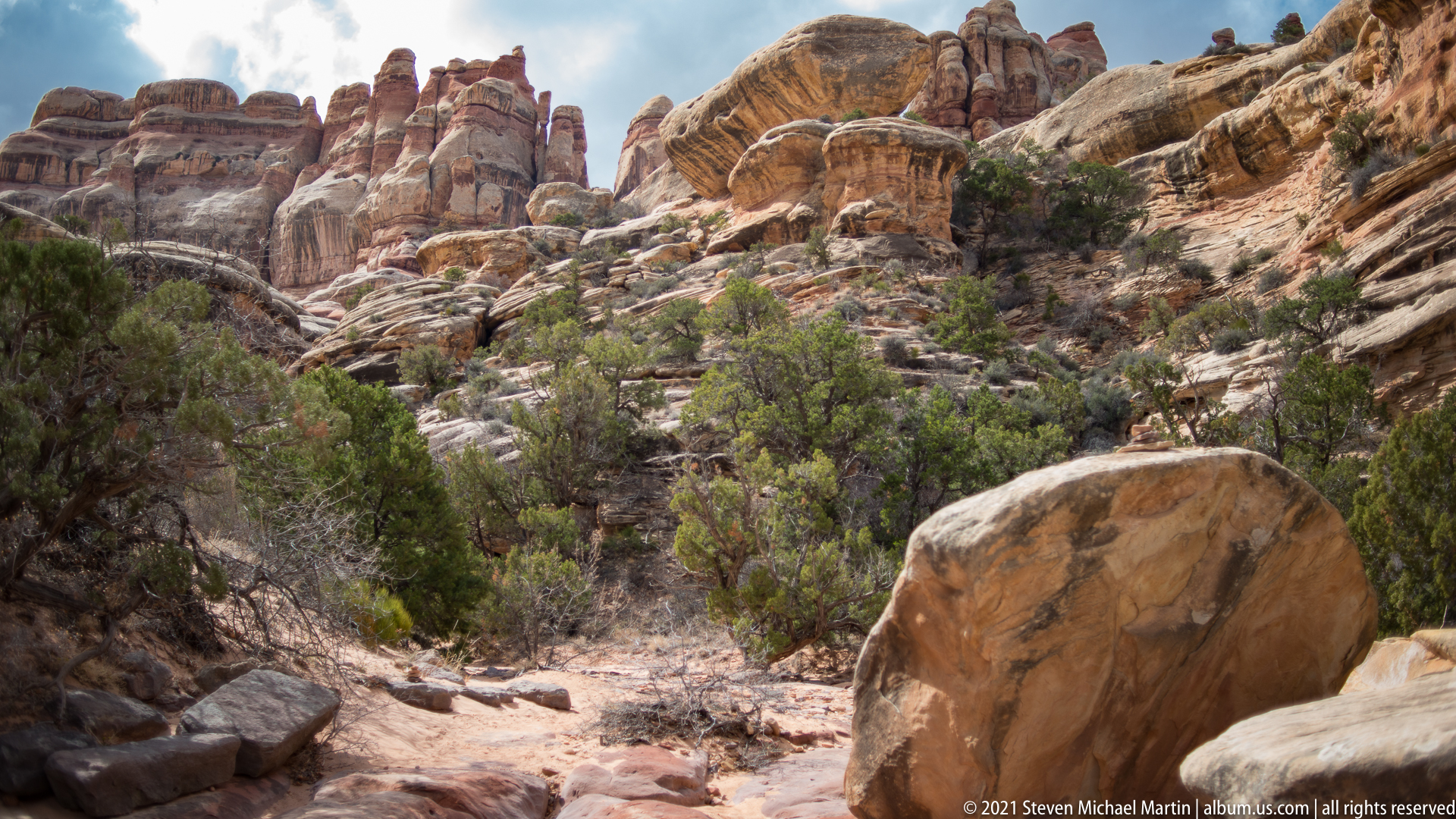
A large rounded boulder fills the right foreground beside a rough route descending through scrub and fractured sandstone. A twisted tree stretches across the middle distance, and layered cliffs rise behind it. The view follows the canyon floor through irregular rock and vegetation, showing the mix of obstacles and open passage encountered along the trail.
Caption
A large rounded boulder fills the right foreground beside a rough route descending through scrub and fractured sandstone. A twisted tree stretches across the middle distance, and layered cliffs rise behind it. The view follows the canyon floor through irregular rock and vegetation, showing the mix of obstacles and open passage encountered along the trail.
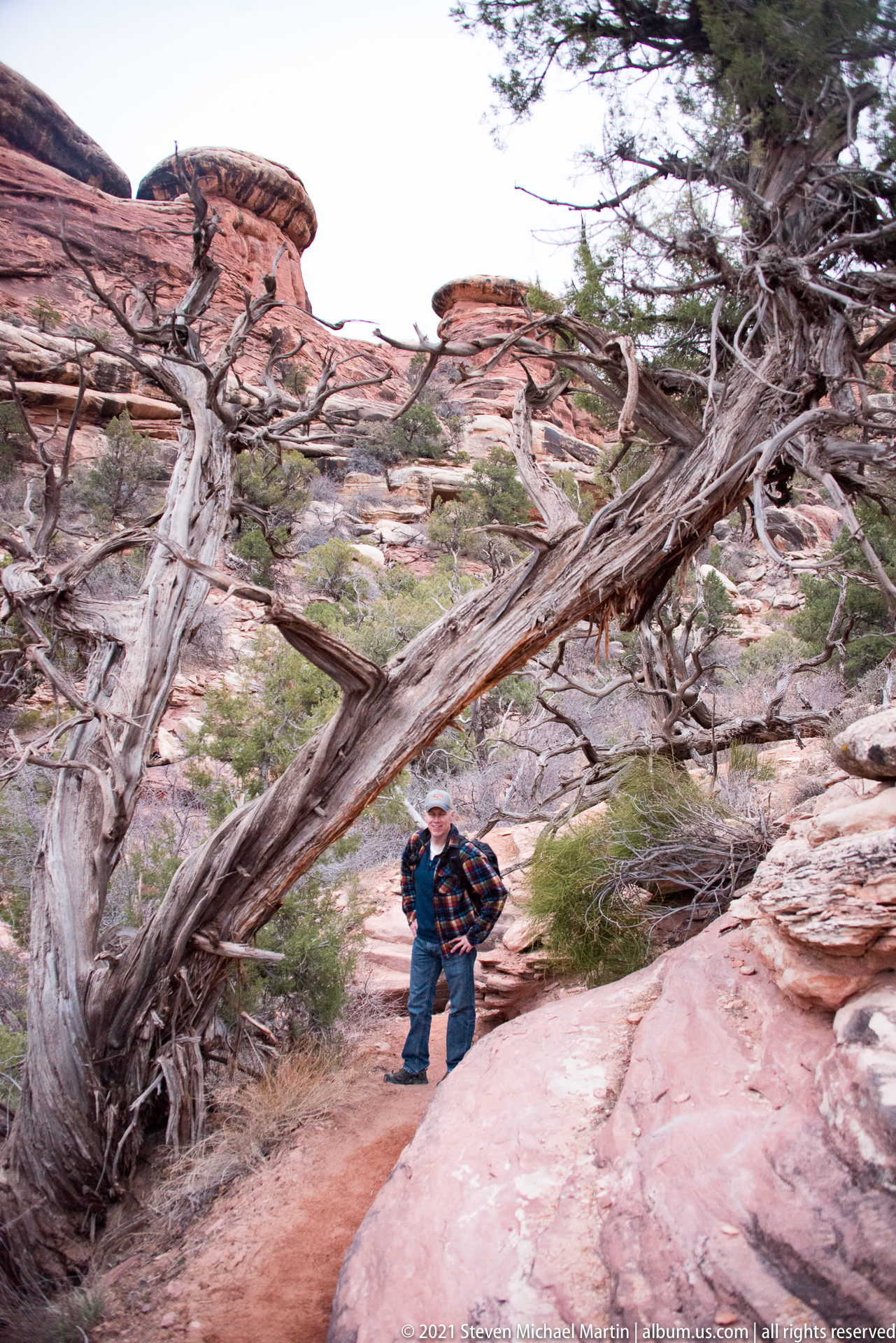
A hiker pauses beneath a large twisted tree that leans across a rocky trail. The person stands near the center of the frame, surrounded by pale sandstone ledges and low shrubs, while the weathered trunk creates a natural arch overhead. This view combines human scale with the rugged route and the sculptural form of the canyon’s junipers.
Caption
A hiker pauses beneath a large twisted tree that leans across a rocky trail. The person stands near the center of the frame, surrounded by pale sandstone ledges and low shrubs, while the weathered trunk creates a natural arch overhead. This view combines human scale with the rugged route and the sculptural form of the canyon’s junipers.
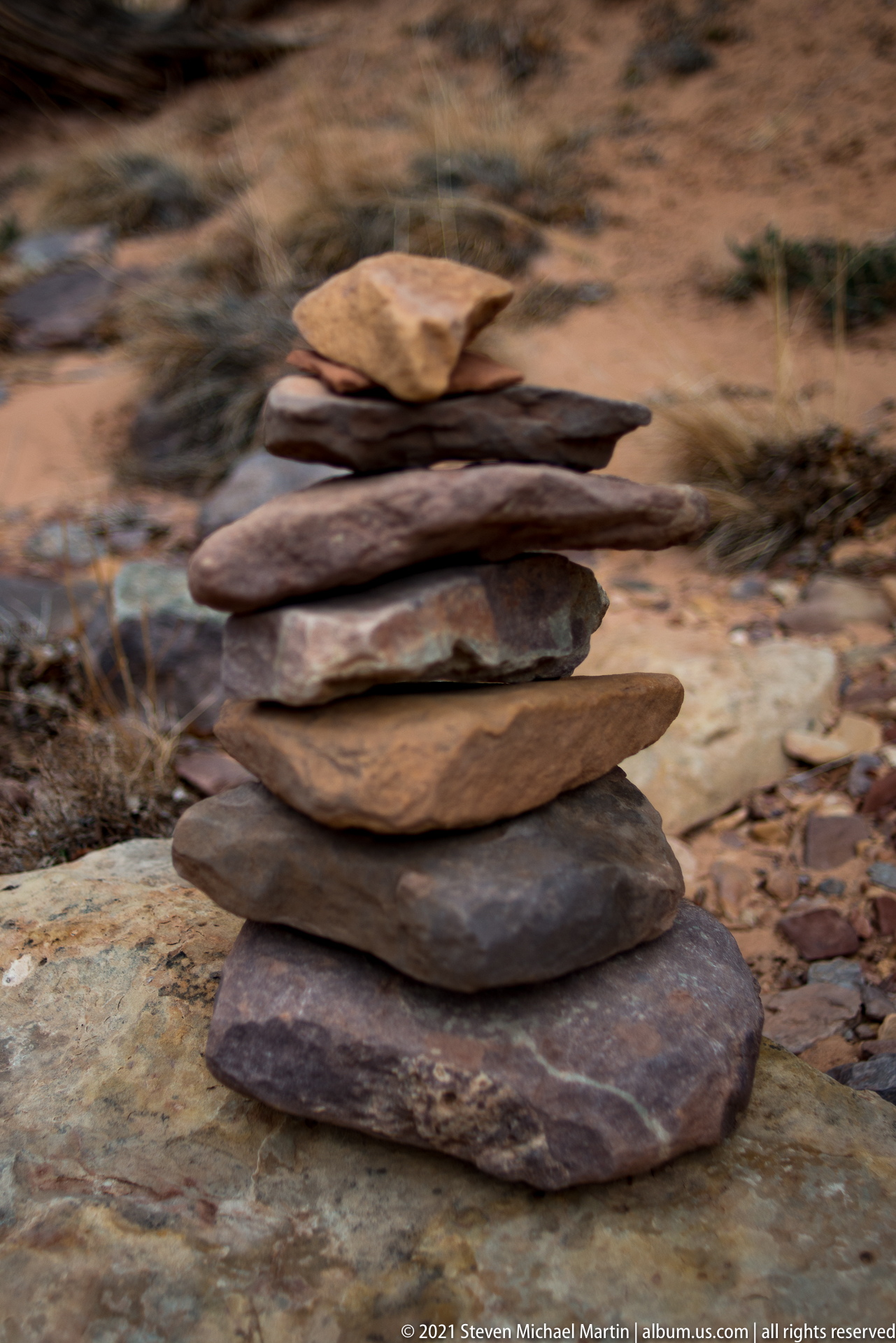
A short column of flat stones is stacked on a low boulder, with a small pale piece balanced at the top. The layers alternate among red, brown, and tan rock, and each slab projects slightly beyond the one beneath it. The softly blurred canyon floor behind keeps attention on the cairn’s construction and the irregular edges of the stones.
Caption
A short column of flat stones is stacked on a low boulder, with a small pale piece balanced at the top. The layers alternate among red, brown, and tan rock, and each slab projects slightly beyond the one beneath it. The softly blurred canyon floor behind keeps attention on the cairn’s construction and the irregular edges of the stones.
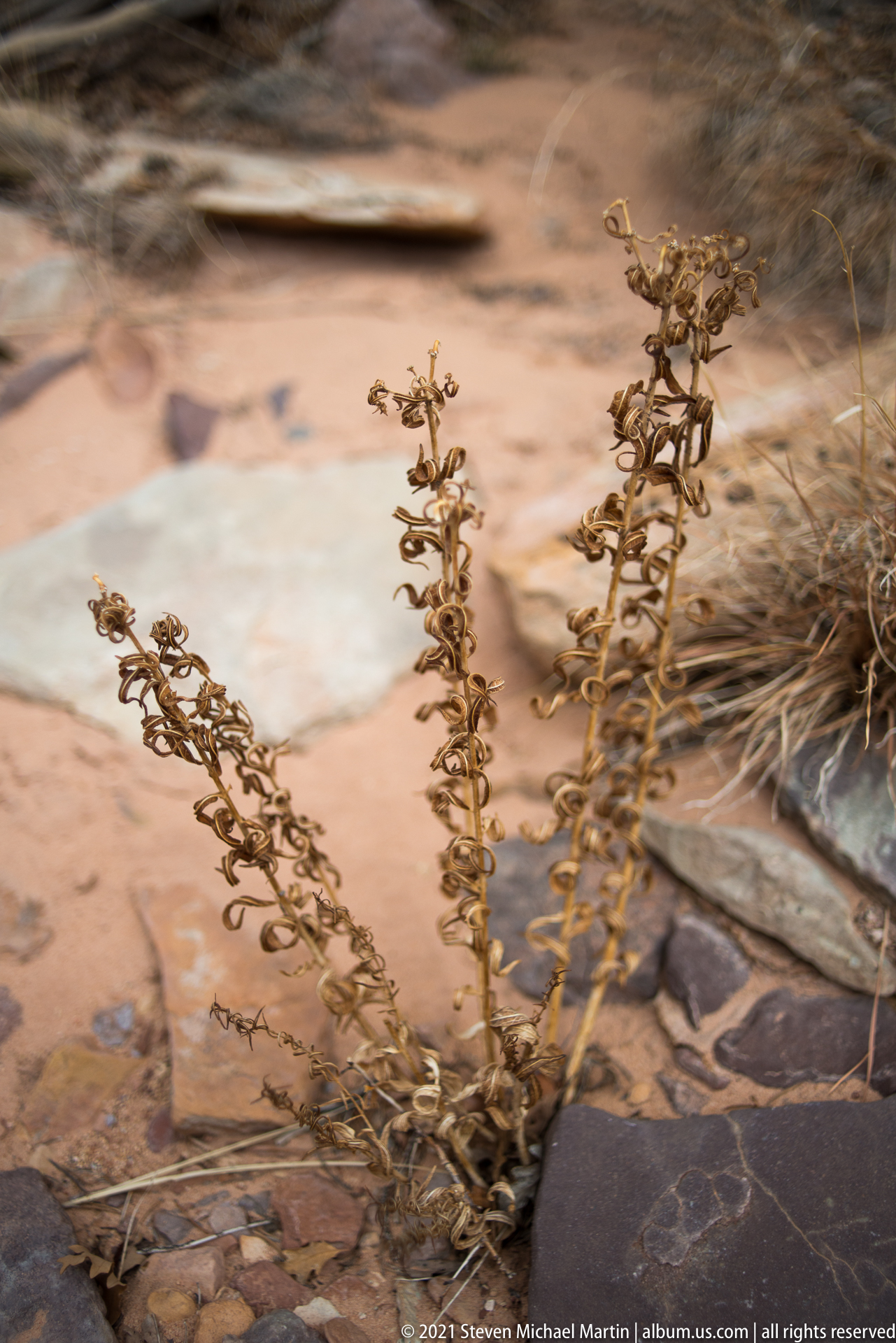
Several slender dried stalks branch upward from a low plant, carrying tightly curled seed clusters near their tips. They stand against pale sandstone and scattered dark stones, with dry grass at the edge of the frame. The close composition emphasizes the plant’s delicate branching pattern and late-season condition within the rocky desert setting.
Caption
Several slender dried stalks branch upward from a low plant, carrying tightly curled seed clusters near their tips. They stand against pale sandstone and scattered dark stones, with dry grass at the edge of the frame. The close composition emphasizes the plant’s delicate branching pattern and late-season condition within the rocky desert setting.
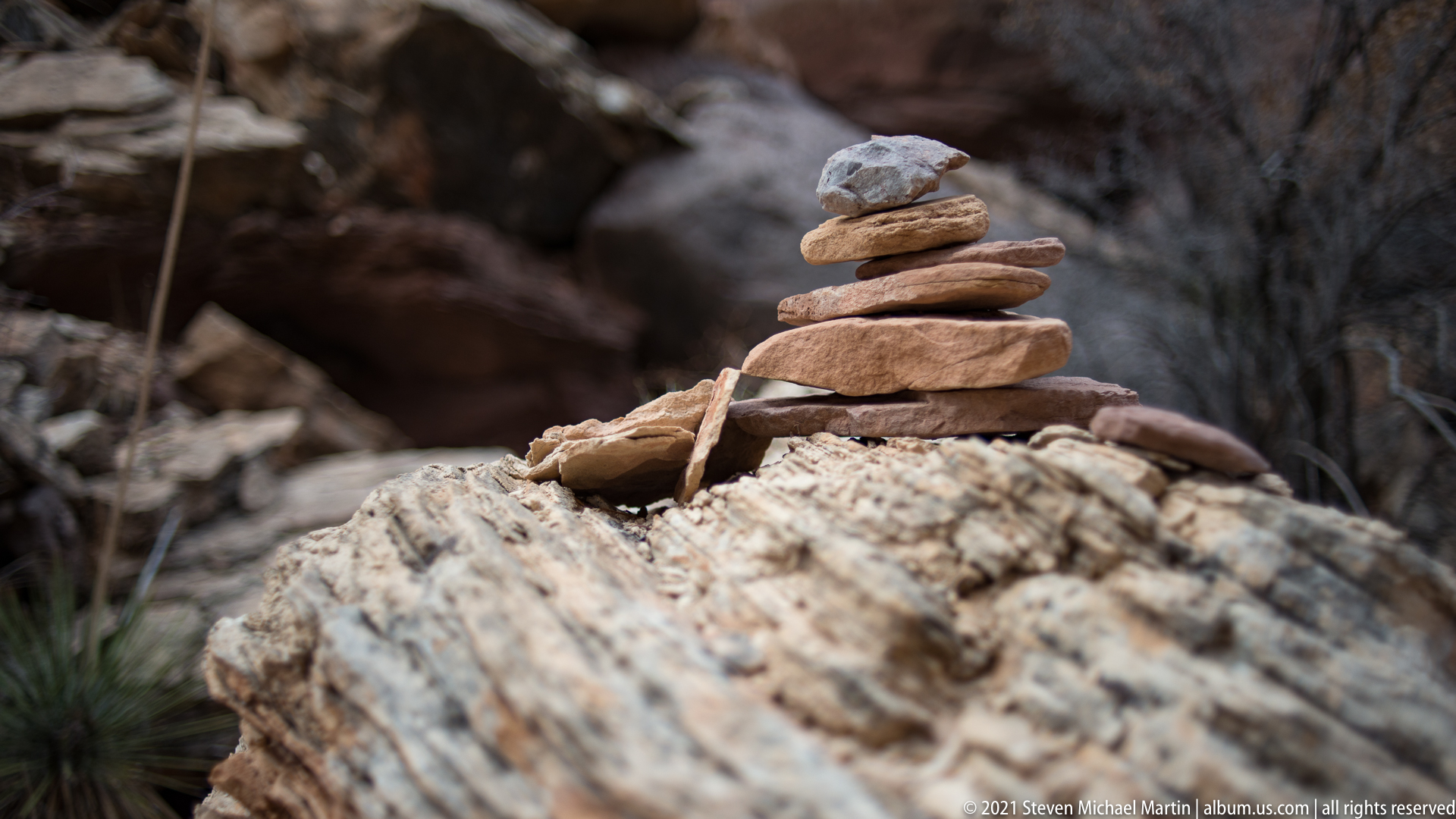
A compact cairn of flat stones balances on a pale rock in the foreground, with larger dark boulders fading into a shallow depth of field behind it. The varied tan, red, and gray pieces create a stepped silhouette, each stone slightly offset from the one below. The close composition isolates the stack from the surrounding canyon route.
Caption
A compact cairn of flat stones balances on a pale rock in the foreground, with larger dark boulders fading into a shallow depth of field behind it. The varied tan, red, and gray pieces create a stepped silhouette, each stone slightly offset from the one below. The close composition isolates the stack from the surrounding canyon route.
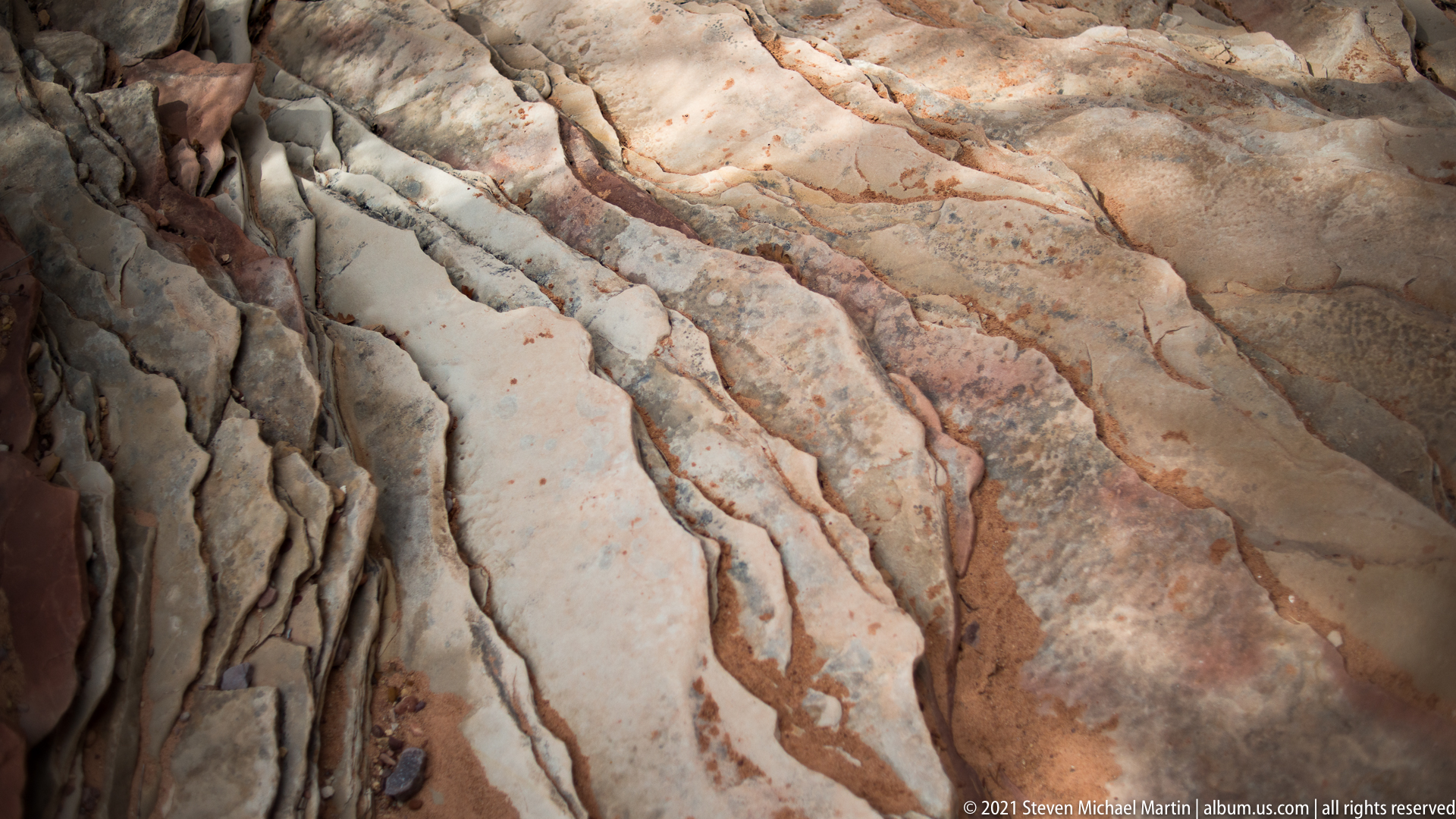
Pale sandstone fills the frame, crossed by branching grooves and thin reddish mineral lines. The grooves divide the surface into long, uneven channels, with small shadowed recesses emphasizing their depth. This close study removes the landscape context to show the rock’s weathered texture and the fine patterns that water and erosion have traced across it.
Caption
Pale sandstone fills the frame, crossed by branching grooves and thin reddish mineral lines. The grooves divide the surface into long, uneven channels, with small shadowed recesses emphasizing their depth. This close study removes the landscape context to show the rock’s weathered texture and the fine patterns that water and erosion have traced across it.
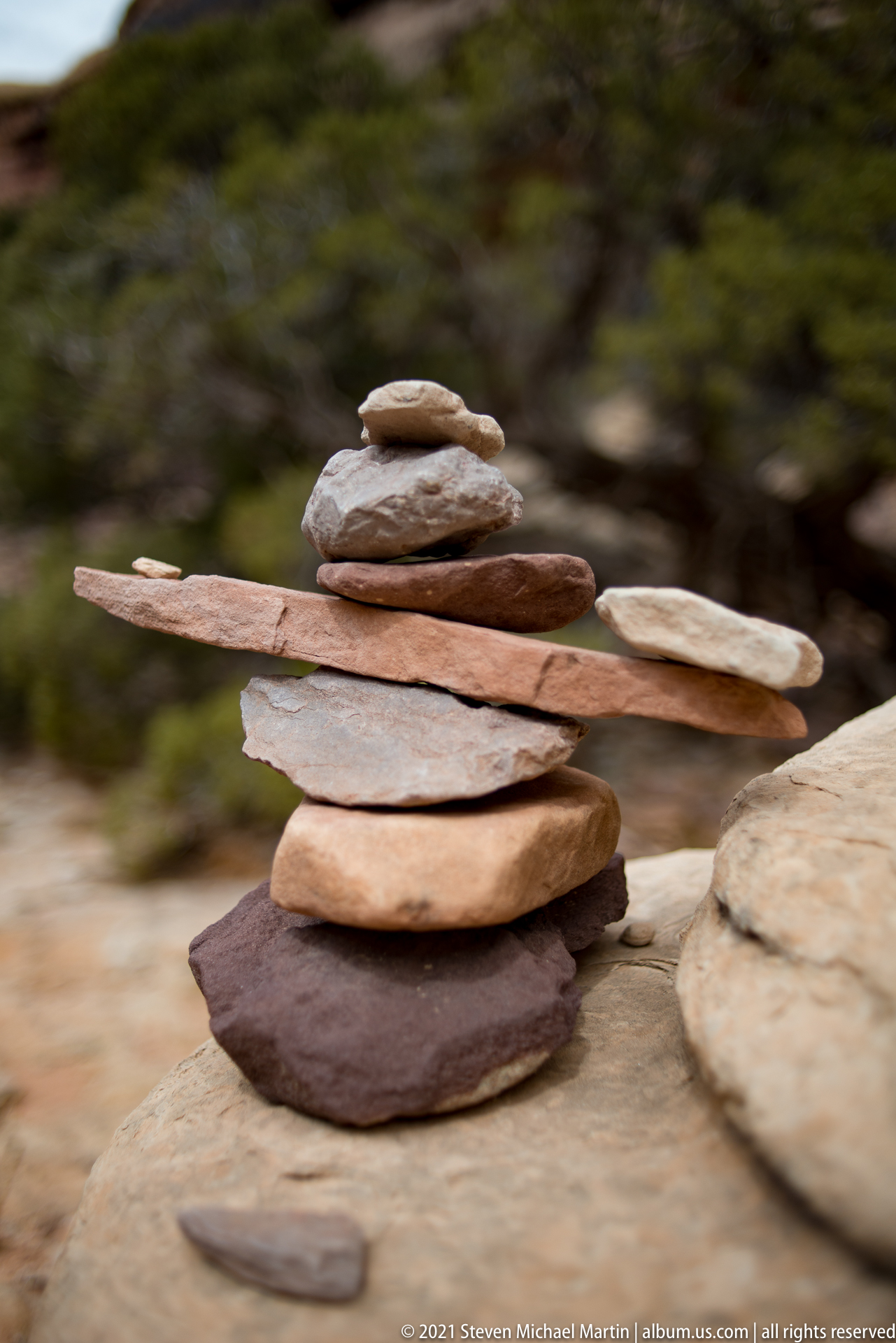
A tall stack of flat stones rises from a broad slab, its alternating layers projecting unevenly to either side. Two smaller stones cap the arrangement, while the background dissolves into dark green and brown blur. The isolated composition highlights the cairn’s balance and color sequence, from pale tan at the base to reddish and gray stones above.
Caption
A tall stack of flat stones rises from a broad slab, its alternating layers projecting unevenly to either side. Two smaller stones cap the arrangement, while the background dissolves into dark green and brown blur. The isolated composition highlights the cairn’s balance and color sequence, from pale tan at the base to reddish and gray stones above.
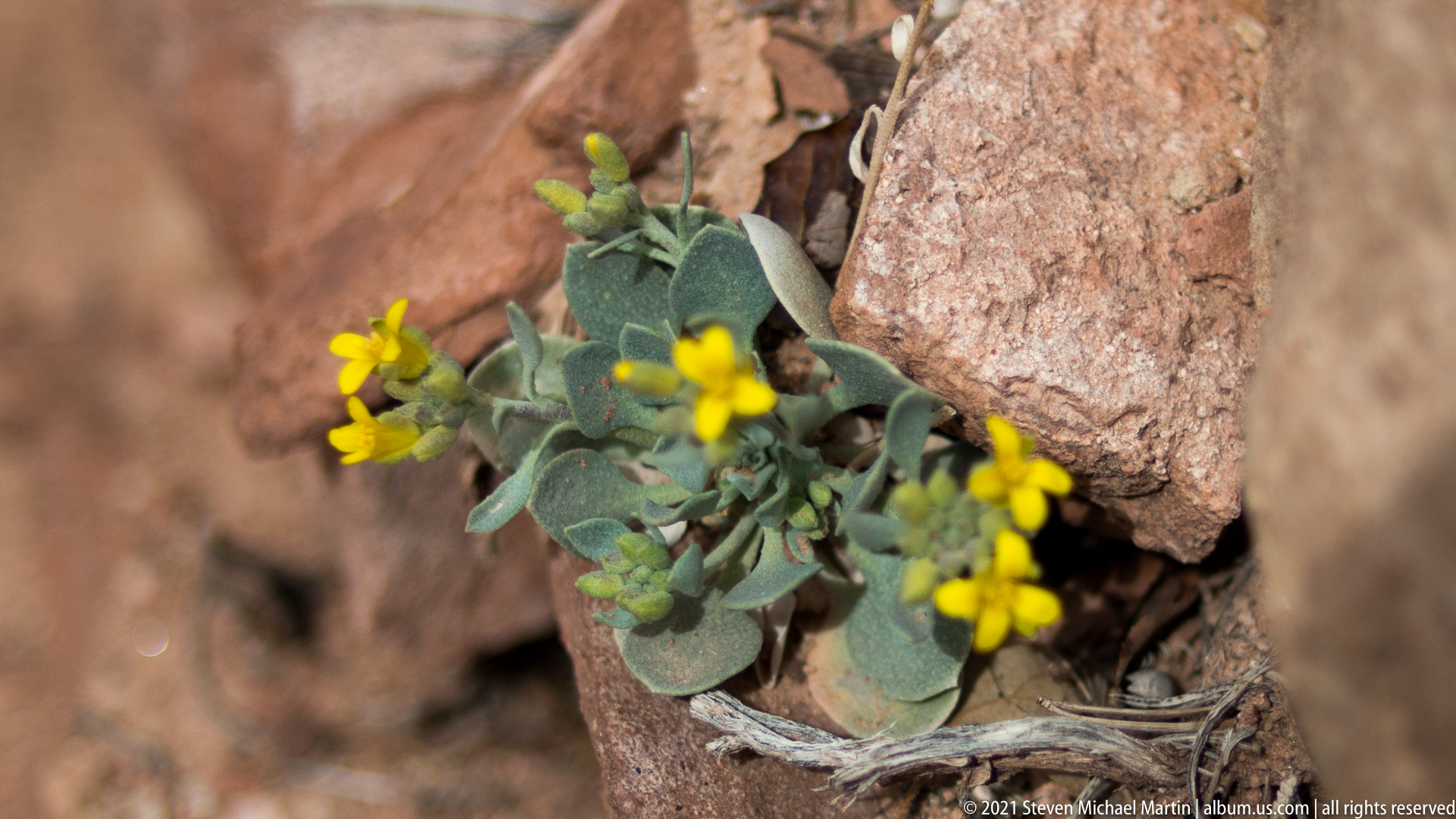
A compact plant with several bright yellow flowers grows in a narrow space beside a sandstone block. Gray-green leaves and rounded buds cluster around the blossoms, which stand out against the warm, blurred rock behind them. The shallow focus draws attention to the flowers’ color and the plant’s ability to establish itself in a small crevice.
Caption
A compact plant with several bright yellow flowers grows in a narrow space beside a sandstone block. Gray-green leaves and rounded buds cluster around the blossoms, which stand out against the warm, blurred rock behind them. The shallow focus draws attention to the flowers’ color and the plant’s ability to establish itself in a small crevice.
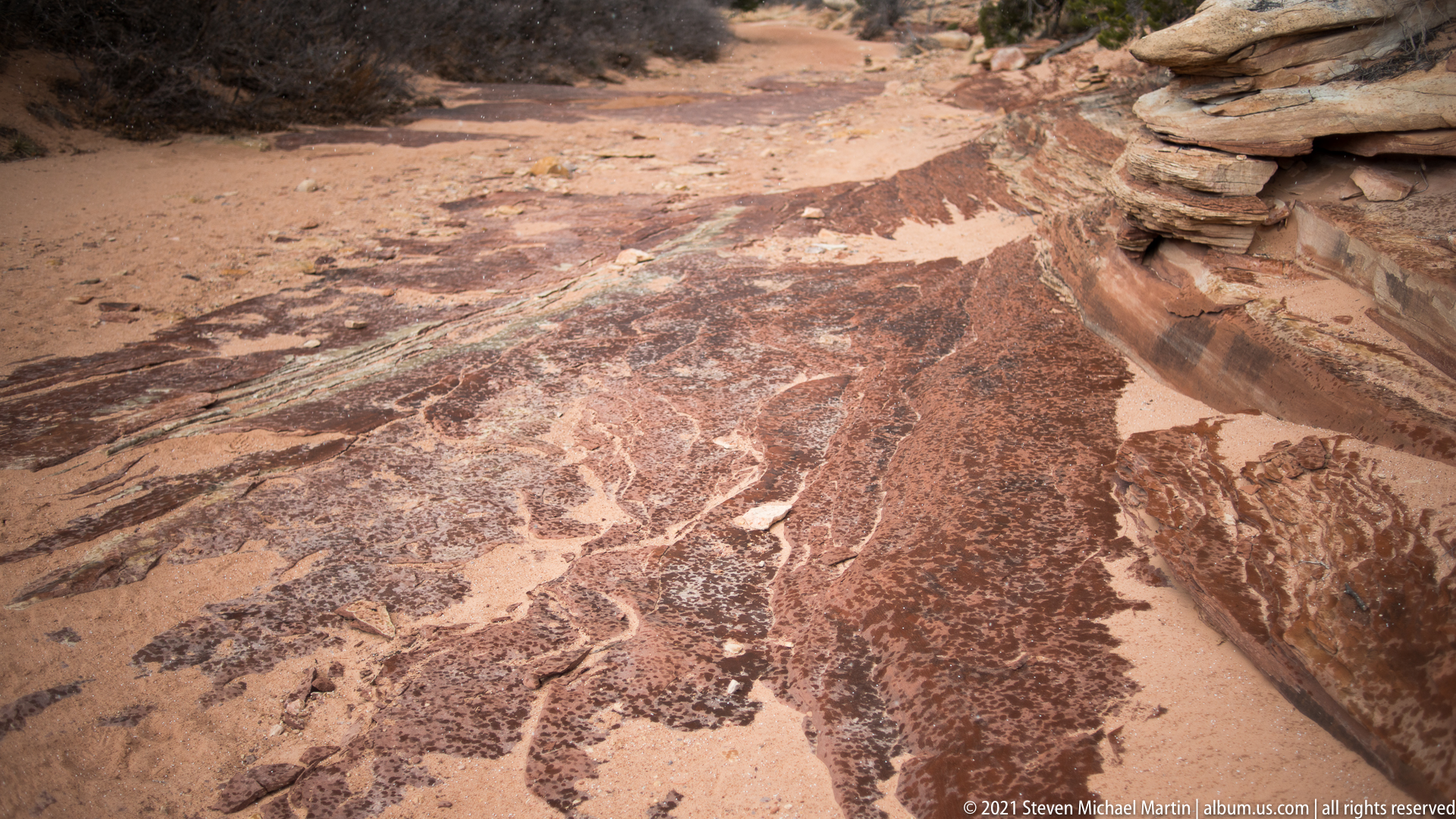
A broad sloping sandstone surface carries irregular reddish-brown staining and lighter winding channels. A small stack of stones sits at the upper right beside the edge of the rock, while the canyon floor recedes into the background. The oblique view emphasizes the color pattern and shallow contours of the bedrock rather than a distant landmark.
Caption
A broad sloping sandstone surface carries irregular reddish-brown staining and lighter winding channels. A small stack of stones sits at the upper right beside the edge of the rock, while the canyon floor recedes into the background. The oblique view emphasizes the color pattern and shallow contours of the bedrock rather than a distant landmark.

Water droplets speckle the rounded black fabric of a hiking backpack, with curved seams and overlapping compartments filling most of the frame. The wearer’s blue, red, and yellow plaid shirt appears behind it, but the face and surrounding landscape are cropped out. The close view focuses on the pack’s surface and its damp, reflective texture.
Caption
Water droplets speckle the rounded black fabric of a hiking backpack, with curved seams and overlapping compartments filling most of the frame. The wearer’s blue, red, and yellow plaid shirt appears behind it, but the face and surrounding landscape are cropped out. The close view focuses on the pack’s surface and its damp, reflective texture.
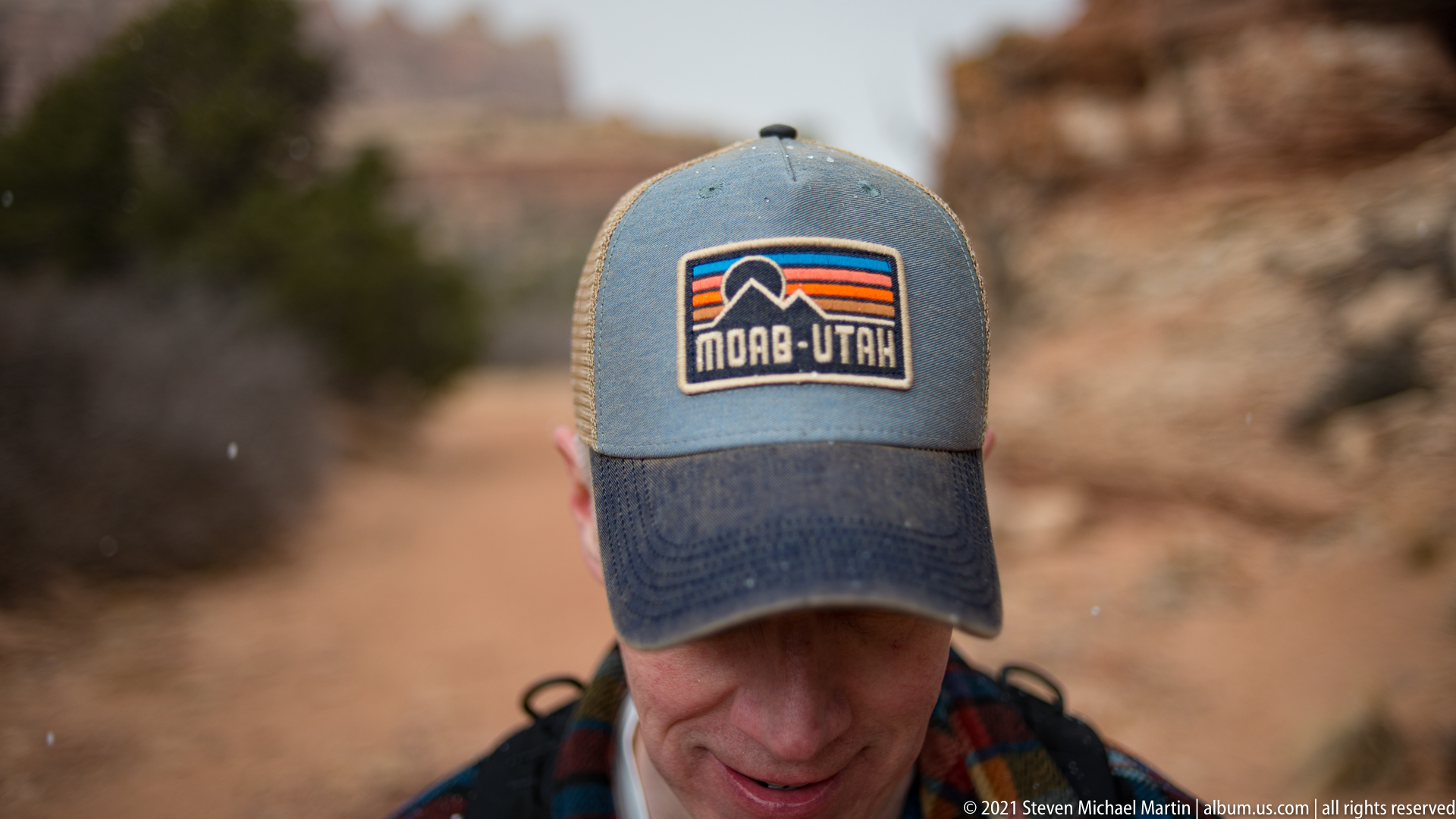
A blue-gray cap with a colorful “Moab–Utah” patch dominates the upper part of this close portrait. The hiker’s face is partly hidden by the brim as he looks downward, while a red sandstone path and brush blur into the background. The shallow focus draws attention to the cap’s stitched emblem and the visitor’s relaxed expression.
Caption
A blue-gray cap with a colorful “Moab–Utah” patch dominates the upper part of this close portrait. The hiker’s face is partly hidden by the brim as he looks downward, while a red sandstone path and brush blur into the background. The shallow focus draws attention to the cap’s stitched emblem and the visitor’s relaxed expression.

Pale, angular twigs cross the center of the frame, carrying several small rust-orange seed clusters. The background dissolves into dark gray and brown blur, isolating the dried plant’s branching structure and delicate pods. No leaves or flowers are visible, so the subject is described by its form and seasonally dry appearance rather than by species.
Caption
Pale, angular twigs cross the center of the frame, carrying several small rust-orange seed clusters. The background dissolves into dark gray and brown blur, isolating the dried plant’s branching structure and delicate pods. No leaves or flowers are visible, so the subject is described by its form and seasonally dry appearance rather than by species.
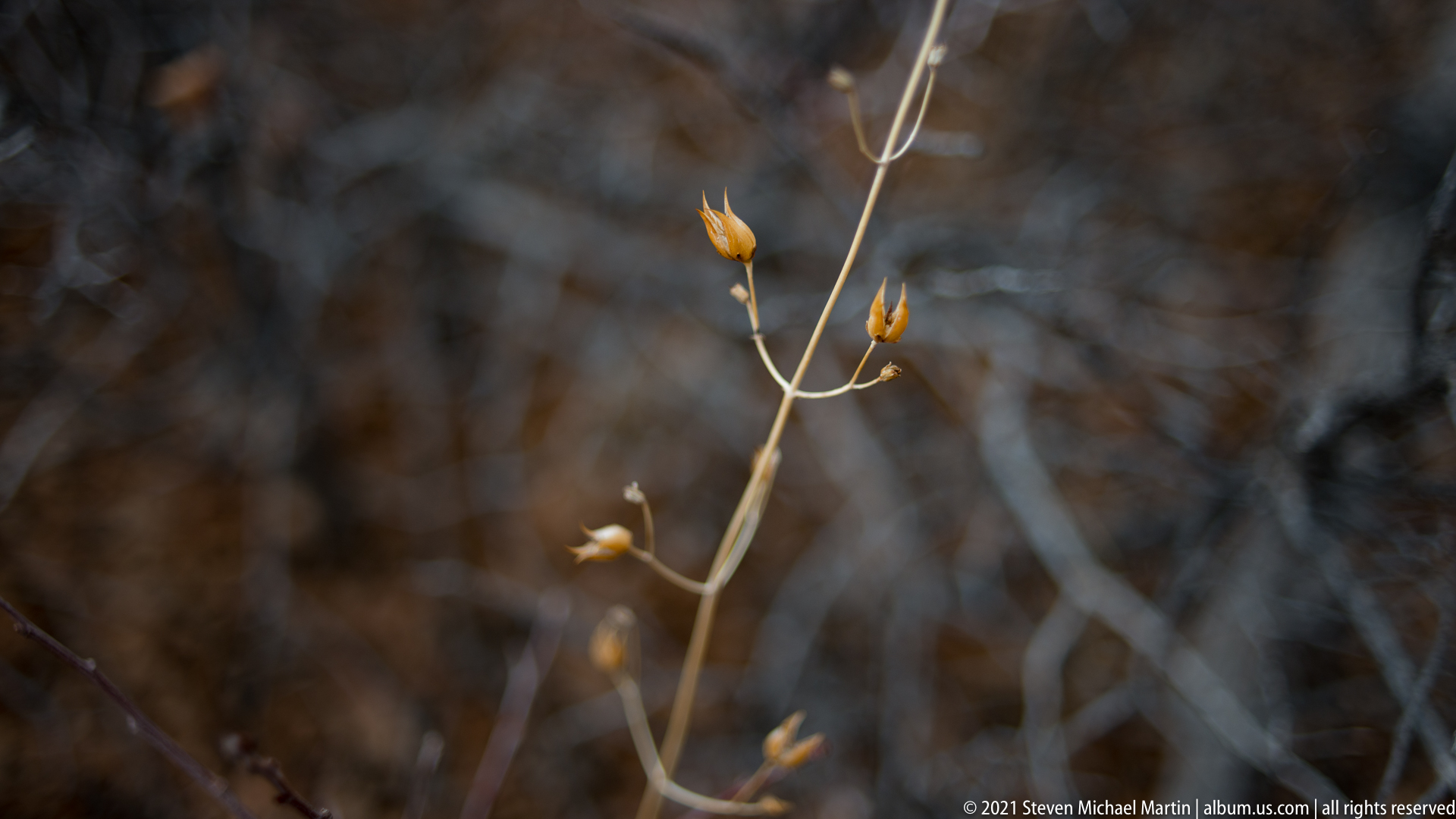
A thin pale stalk rises diagonally through the right half of the image, branching into several short stems tipped with orange-brown pods. Dark, softly blurred brush surrounds it, leaving the plant sharply separated from its setting. The sparse arrangement and fine line of the stem distinguish this study from the denser branching shrub shown immediately before.
Caption
A thin pale stalk rises diagonally through the right half of the image, branching into several short stems tipped with orange-brown pods. Dark, softly blurred brush surrounds it, leaving the plant sharply separated from its setting. The sparse arrangement and fine line of the stem distinguish this study from the denser branching shrub shown immediately before.
Canyonlands National Park — Field Guide
National Park Field Guide
📍 Overview
Canyonlands National Park preserves an extensive landscape of deeply eroded canyons, mesas, and buttes shaped by the Colorado and Green Rivers. Located within the Colorado Plateau, the park illustrates the long-term effects of tectonic uplift followed by gradual erosion that carved complex canyon systems through layered sedimentary rock. The scale of the landscape reflects geological processes operating over millions of years.
The park is divided into several districts, including Island in the Sky, The Needles, and The Maze, each presenting distinctive geological features formed through variations in erosion and rock composition. Exposed strata reveal changes in environmental conditions across prehistoric eras, while river systems continue to shape canyon depth and form. The landscape provides insight into the interaction between uplift, weathering, and water erosion.
⭐ Highlights
- Colorado and Green River canyon systems
- Island in the Sky mesa landscapes
- The Needles sandstone formations
- Layered sedimentary rock exposures
- Expansive Colorado Plateau desert scenery
🔎 Key Features
- Deeply incised canyon networks shaped by river erosion
- Sandstone formations formed through sediment deposition
- Mesas and buttes created by differential erosion
- Rock layers illustrating geological time sequences
- Large-scale desert landscape with minimal development
📷 Photography Notes
- Early and late light enhances canyon depth and texture
- Wide compositions help convey the scale of mesas and canyons
- Cloud shadows can add visual dimension to the landscape
- Layered rock patterns create natural compositional lines
- Foreground rock formations help provide depth
- Look for viewpoints that show river-carved canyon systems
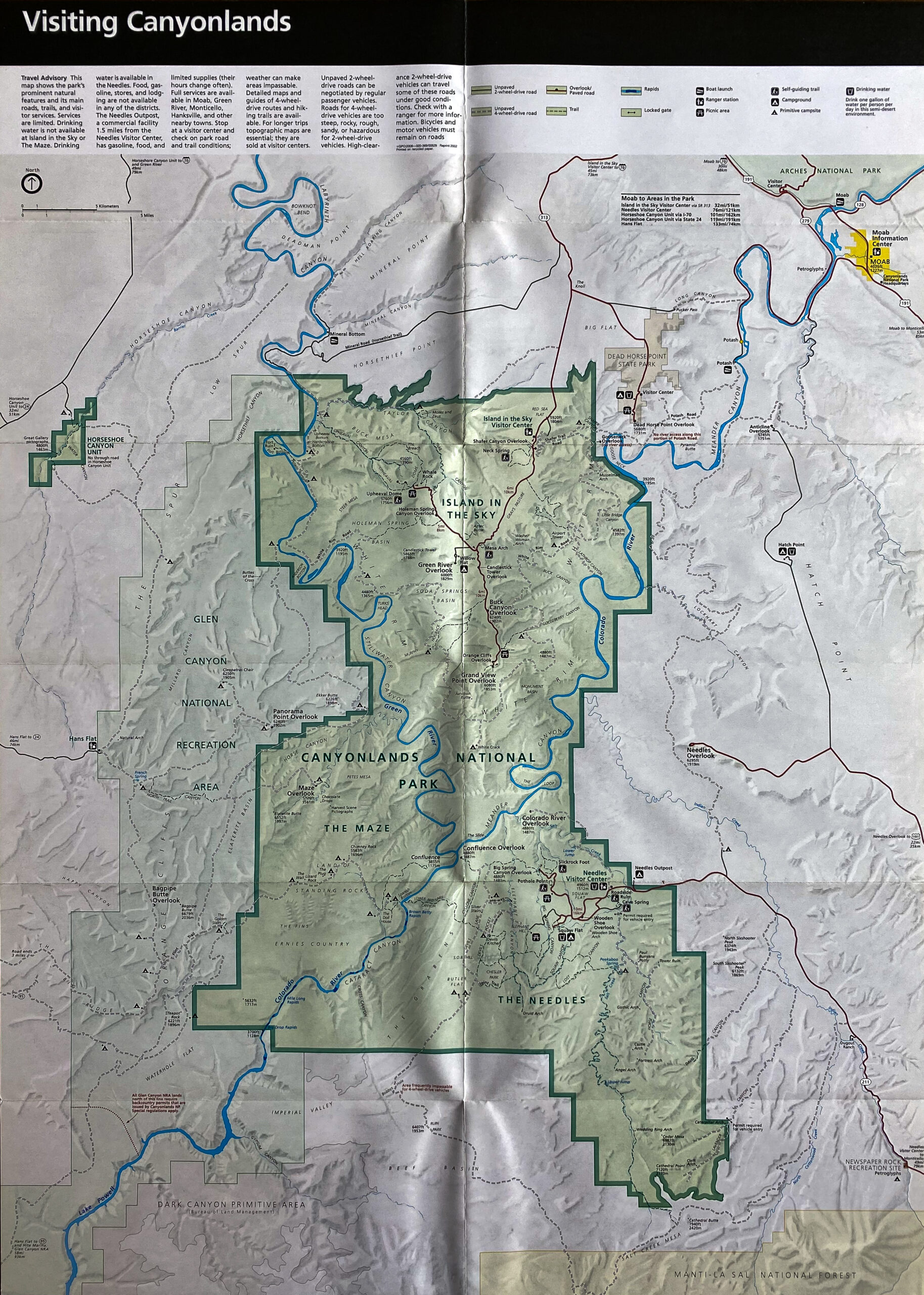
A printed visitor map fills the open brochure, with a large green-outlined park area, winding blue waterways, and a network of roads and labels. The map is surrounded by gray shaded terrain and folds down the center. This view emphasizes the park’s mapped extent and its relationship to nearby routes rather than a single scenic feature.
Caption
A printed visitor map fills the open brochure, with a large green-outlined park area, winding blue waterways, and a network of roads and labels. The map is surrounded by gray shaded terrain and folds down the center. This view emphasizes the park’s mapped extent and its relationship to nearby routes rather than a single scenic feature.

An open National Park Service brochure presents a panoramic photograph across its upper half and a grid of smaller landscape images and text below. The spread is arranged as a visitor overview, pairing scenic views with explanatory panels. Fine print is too small to transcribe from this reproduction, but the layout clearly identifies it as interpretive park material.
Caption
An open National Park Service brochure presents a panoramic photograph across its upper half and a grid of smaller landscape images and text below. The spread is arranged as a visitor overview, pairing scenic views with explanatory panels. Fine print is too small to transcribe from this reproduction, but the layout clearly identifies it as interpretive park material.
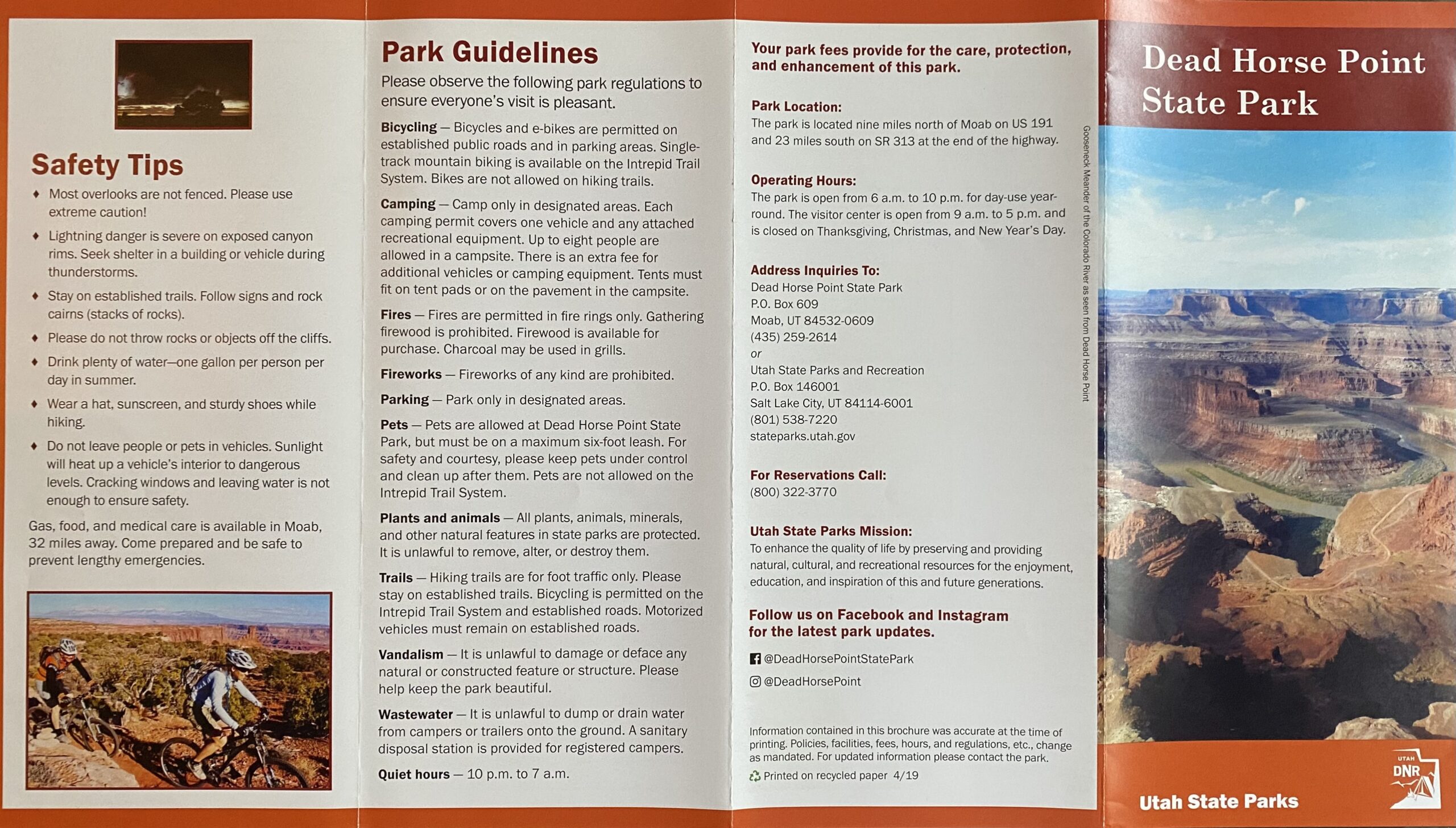
An open visitor guide places safety tips and park regulations across its central panels, with contact details and a tall canyon photograph on the right headed “Dead Horse Point State Park.” The close view shows how practical guidance and scenic imagery share the printed spread. Small body text is not legible enough here to quote reliably.
Caption
An open visitor guide places safety tips and park regulations across its central panels, with contact details and a tall canyon photograph on the right headed “Dead Horse Point State Park.” The close view shows how practical guidance and scenic imagery share the printed spread. Small body text is not legible enough here to quote reliably.
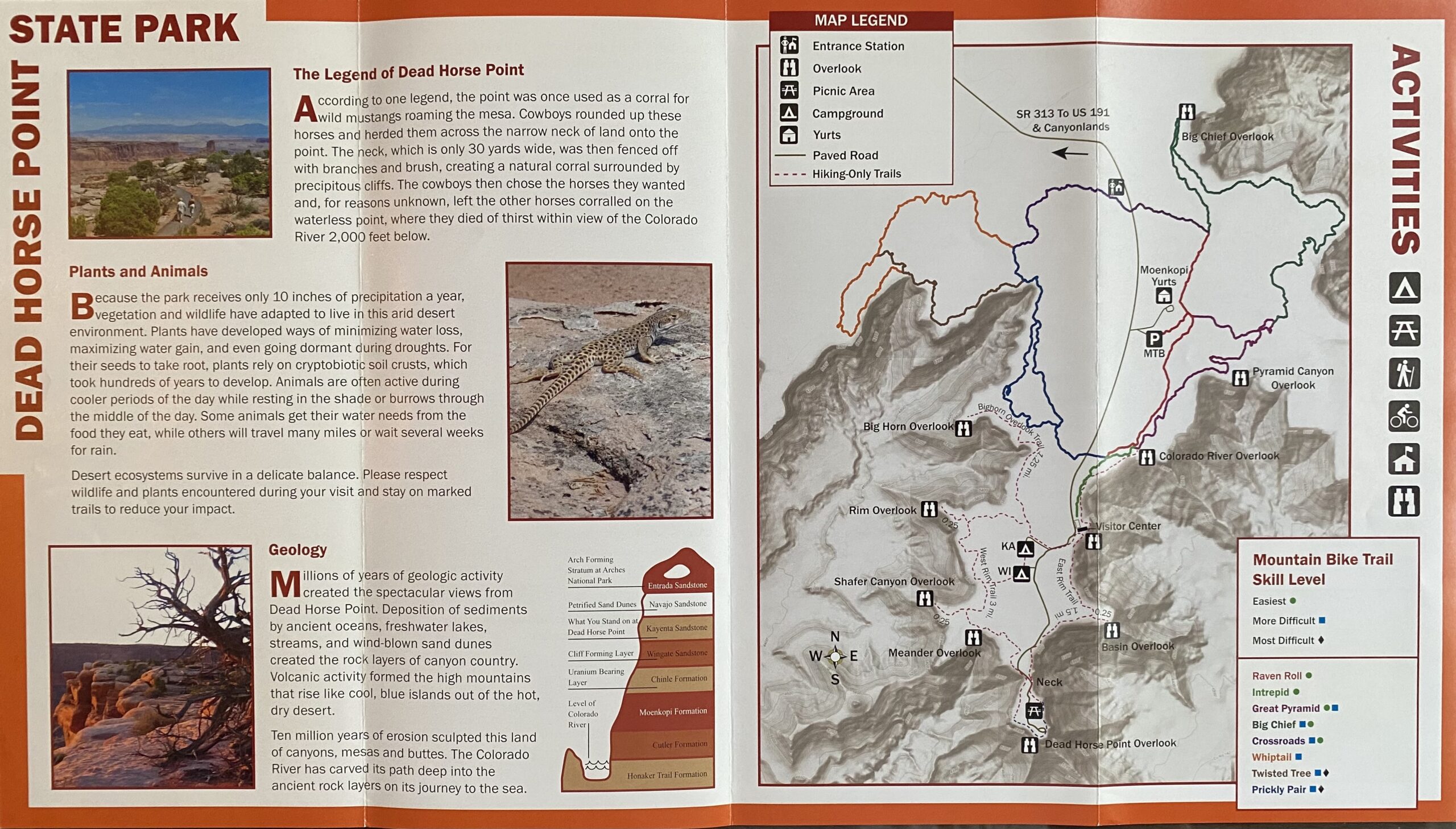
An open Dead Horse Point State Park guide combines a regional map with interpretive text and activity information. The map occupies the right half, marked with routes, facilities, and a legend; the left panel contains sections on plants and animals and geology, accompanied by small landscape photographs. Orange borders and vertical headings organize the brochure, presenting navigation and natural-history information in one printed spread.
Caption
An open Dead Horse Point State Park guide combines a regional map with interpretive text and activity information. The map occupies the right half, marked with routes, facilities, and a legend; the left panel contains sections on plants and animals and geology, accompanied by small landscape photographs. Orange borders and vertical headings organize the brochure, presenting navigation and natural-history information in one printed spread.