Rio Grande del Norte National Monument
Rio Grande del Norte National Monument preserves a dramatic high desert landscape shaped by volcanic activity and long-term erosion along the Rio Grande River. The river has carved a deep gorge through layers of basalt and sedimentary rock, creating a striking visual contrast between elevated plateau surfaces and the canyon below. The monument illustrates the interaction between volcanic deposits and river incision across the northern New Mexico landscape.
Volcanic flows associated with the Taos Plateau volcanic field produced extensive basalt formations that were later cut by the Rio Grande as the river established its present course. The resulting canyon environment reflects the gradual influence of erosion acting upon uplifted terrain. The monument also preserves wildlife habitat and open grassland ecosystems typical of the high desert region.
Visitors encounter expansive views of the gorge and surrounding plateau that emphasize the geological forces shaping the region. The combination of volcanic rock and river-carved canyon walls demonstrates the diversity of landforms found within the northern Rio Grande corridor.

The bridge’s white guardrail and roadway extend from the left foreground across the canyon toward a distant mountain range. Its supports descend against the steep gorge wall, while open plateau stretches beyond the far end. This angled view emphasizes the narrow road deck and the abrupt drop beside it, distinct from the full side-on span.
Caption
The bridge’s white guardrail and roadway extend from the left foreground across the canyon toward a distant mountain range. Its supports descend against the steep gorge wall, while open plateau stretches beyond the far end. This angled view emphasizes the narrow road deck and the abrupt drop beside it, distinct from the full side-on span.

A rectangular metal plaque mounted in a rounded-stone wall bears the title “Rio Grande Gorge Bridge” above a central seal. Smaller engraved text records the bridge’s construction and lists officials and engineers. The close view makes the dedication tablet’s lettering, frame, and masonry setting the subject, linking the bridge’s engineering to its commemorative marker.
Caption
A rectangular metal plaque mounted in a rounded-stone wall bears the title “Rio Grande Gorge Bridge” above a central seal. Smaller engraved text records the bridge’s construction and lists officials and engineers. The close view makes the dedication tablet’s lettering, frame, and masonry setting the subject, linking the bridge’s engineering to its commemorative marker.

A woman walks a leashed, curly-coated brown dog toward the camera along a paved path. A low dark stone wall borders the route, with sagebrush and a blue mountain range behind it. The visitor and dog occupy the center of the composition, making recreation and companionship the focus within the open high-desert setting.
Caption
A woman walks a leashed, curly-coated brown dog toward the camera along a paved path. A low dark stone wall borders the route, with sagebrush and a blue mountain range behind it. The visitor and dog occupy the center of the composition, making recreation and companionship the focus within the open high-desert setting.

From above, the Rio Grande runs as a dark blue ribbon through a narrow, deeply incised gorge. Rocky slopes drop steeply toward the channel, with sparse shrubs and scattered trees clinging to the walls. The elevated angle looks lengthwise along the river, emphasizing the canyon’s depth and the long, shadowed corridor.
Caption
From above, the Rio Grande runs as a dark blue ribbon through a narrow, deeply incised gorge. Rocky slopes drop steeply toward the channel, with sparse shrubs and scattered trees clinging to the walls. The elevated angle looks lengthwise along the river, emphasizing the canyon’s depth and the long, shadowed corridor.

A golden Zia symbol sits at the center of a white geometric frame on the bridge. Its radiating lines and circular center stand out against the shadowed canyon and steel members behind it. The close crop isolates this decorative emblem from the roadway, showing how the bridge incorporates a recognizable New Mexico symbol into its structure.
Caption
A golden Zia symbol sits at the center of a white geometric frame on the bridge. Its radiating lines and circular center stand out against the shadowed canyon and steel members behind it. The close crop isolates this decorative emblem from the roadway, showing how the bridge incorporates a recognizable New Mexico symbol into its structure.

A dense web of shadows covers the water and rounded stones below, forming a repeating pattern of diagonal and curved lines. The dark shapes contrast with sunlit patches on the riverbed and suggest the bridge structure overhead, though the steel span itself is outside the frame. This abstracted view turns the structure’s shadow into the main visual subject.
Caption
A dense web of shadows covers the water and rounded stones below, forming a repeating pattern of diagonal and curved lines. The dark shapes contrast with sunlit patches on the riverbed and suggest the bridge structure overhead, though the steel span itself is outside the frame. This abstracted view turns the structure’s shadow into the main visual subject.

The river bends through the gorge far below, its pale water catching light between dark, near-vertical walls. Sun illuminates the upper canyon rim and scattered shrubs while the lower channel remains in deep shadow. With no bridge in view, this frame focuses on the narrow watercourse and the scale of the surrounding rock.
Caption
The river bends through the gorge far below, its pale water catching light between dark, near-vertical walls. Sun illuminates the upper canyon rim and scattered shrubs while the lower channel remains in deep shadow. With no bridge in view, this frame focuses on the narrow watercourse and the scale of the surrounding rock.

The black trailhead panel identifies the West Rim Trail as part of the Rio Grande Trail and displays a route map. A column of icons lists permitted and prohibited uses, including hiking, biking, dogs, and motorized travel. Set among low sagebrush, the sign provides practical access information as well as a visual orientation to the trail corridor.
Caption
The black trailhead panel identifies the West Rim Trail as part of the Rio Grande Trail and displays a route map. A column of icons lists permitted and prohibited uses, including hiking, biking, dogs, and motorized travel. Set among low sagebrush, the sign provides practical access information as well as a visual orientation to the trail corridor.

From a high rim, the Rio Grande appears as a thin ribbon at the bottom of a deeply cut gorge. Layered, dark rock walls descend steeply toward the water, while sunlit scrub-covered slopes and distant mountains frame the upper edge. The elevated angle stresses the river’s depth below the broad plateau.
Caption
From a high rim, the Rio Grande appears as a thin ribbon at the bottom of a deeply cut gorge. Layered, dark rock walls descend steeply toward the water, while sunlit scrub-covered slopes and distant mountains frame the upper edge. The elevated angle stresses the river’s depth below the broad plateau.
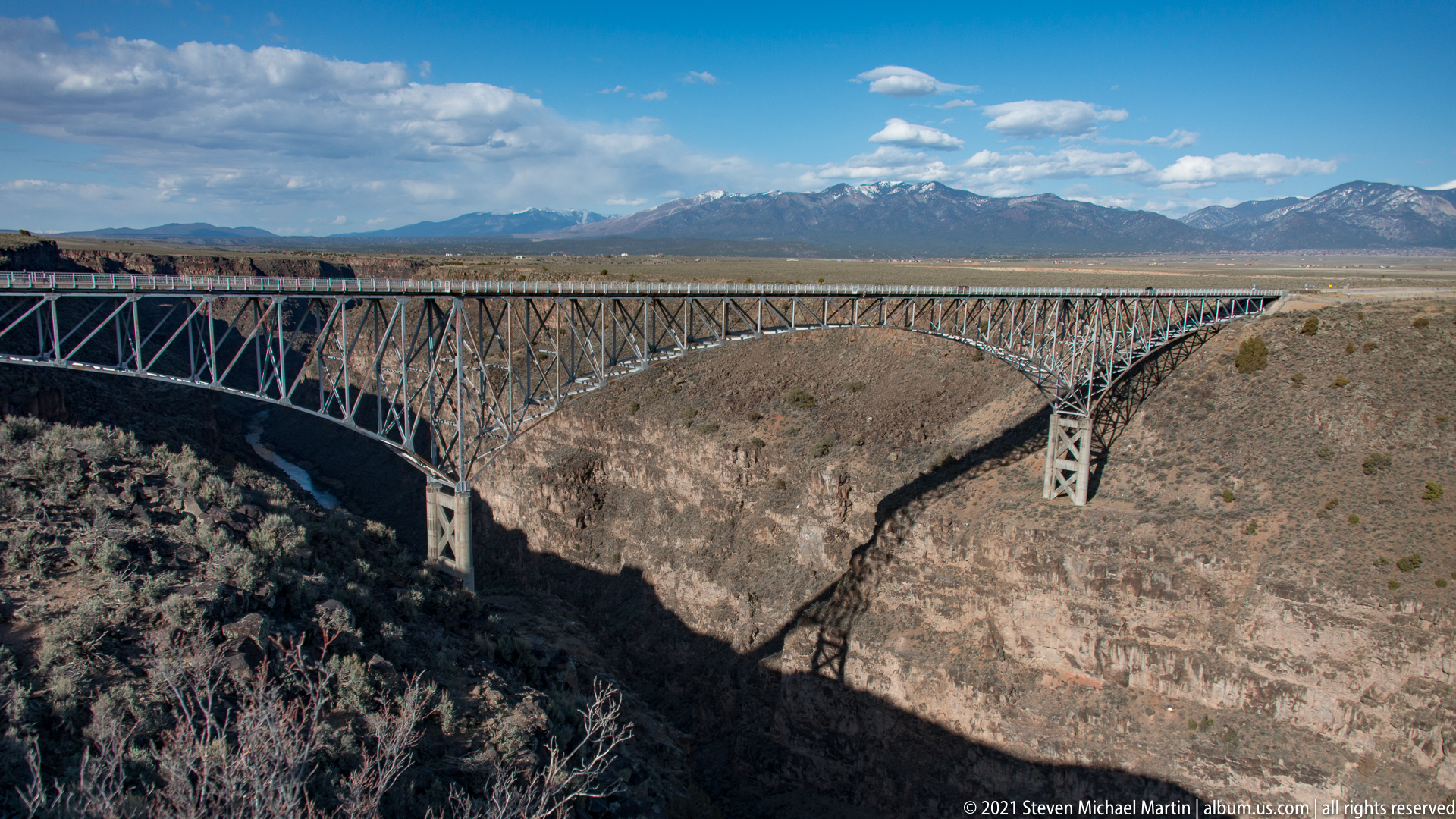
The bridge crosses the gorge in a long horizontal span, its open steel trusses and tall piers visible against the rugged canyon. A snow-dusted mountain range rises beyond the plateau under scattered clouds. The broad side view links the engineering structure to the immense drop below, while the clear sky separates the bridge from the distant landscape.
Caption
The bridge crosses the gorge in a long horizontal span, its open steel trusses and tall piers visible against the rugged canyon. A snow-dusted mountain range rises beyond the plateau under scattered clouds. The broad side view links the engineering structure to the immense drop below, while the clear sky separates the bridge from the distant landscape.

A closer side angle follows the bridge deck across the gorge, with its lattice girders and two tall supports clearly separated against the canyon walls. The shadow of the structure falls across the lower rock face, emphasizing the height of the crossing. Beyond the span, a broad mountain ridge stretches beneath small white clouds.
Caption
A closer side angle follows the bridge deck across the gorge, with its lattice girders and two tall supports clearly separated against the canyon walls. The shadow of the structure falls across the lower rock face, emphasizing the height of the crossing. Beyond the span, a broad mountain ridge stretches beneath small white clouds.

The bridge’s pale railings and steel understructure run diagonally across the view, drawing attention to a small handwritten “Last Kiss” inscription on the near concrete end. The gorge and mountain range remain visible beyond the crossing. This detail combines an informal mark left by a visitor with the engineered deck and vast landscape.
Caption
The bridge’s pale railings and steel understructure run diagonally across the view, drawing attention to a small handwritten “Last Kiss” inscription on the near concrete end. The gorge and mountain range remain visible beyond the crossing. This detail combines an informal mark left by a visitor with the engineered deck and vast landscape.

The bridge roadway leads straight toward a distant mountain range, with double yellow lines forming a strong central axis. White pedestrian railings and dark parapets frame the pavement, while the canyon itself falls out of view beyond the sides. The centered viewpoint turns the bridge into a corridor between the viewer and the broad New Mexico horizon.
Caption
The bridge roadway leads straight toward a distant mountain range, with double yellow lines forming a strong central axis. White pedestrian railings and dark parapets frame the pavement, while the canyon itself falls out of view beyond the sides. The centered viewpoint turns the bridge into a corridor between the viewer and the broad New Mexico horizon.

The river traces a narrow blue-green line through the center of the gorge, enclosed by steep, shadowed walls. From the rim, low shrubs and open plateau occupy the foreground and far side, while the distant mountains form a thin horizon. The view makes the river’s winding course and the canyon’s depth the dominant features.
Caption
The river traces a narrow blue-green line through the center of the gorge, enclosed by steep, shadowed walls. From the rim, low shrubs and open plateau occupy the foreground and far side, while the distant mountains form a thin horizon. The view makes the river’s winding course and the canyon’s depth the dominant features.

A metal emergency call box is fixed to the bridge railing, its large lettering reading “Crisis Hotline” and “There is Hope—Make the Call.” Stickers and handwritten marks cover the lower panel, contrasting with the clean white steel rails behind it. The close view documents a safety feature installed along the exposed pedestrian crossing.
Caption
A metal emergency call box is fixed to the bridge railing, its large lettering reading “Crisis Hotline” and “There is Hope—Make the Call.” Stickers and handwritten marks cover the lower panel, contrasting with the clean white steel rails behind it. The close view documents a safety feature installed along the exposed pedestrian crossing.

The river churns around exposed dark rocks, producing short bands of whitewater across a gray-green surface. A narrow strip of rocky bank appears along the lower edge, while the close viewpoint excludes the canyon rim and bridge. The frame isolates the river’s movement and texture, showing a more intimate view of the water below the overlook.
Caption
The river churns around exposed dark rocks, producing short bands of whitewater across a gray-green surface. A narrow strip of rocky bank appears along the lower edge, while the close viewpoint excludes the canyon rim and bridge. The frame isolates the river’s movement and texture, showing a more intimate view of the water below the overlook.

The visitor and dog are shown closer on the paved path, with the woman raising one hand as the dog walks at her side. The low stone wall and scrub-covered plateau continue behind them, while the mountains stretch across the horizon. This frame places greater emphasis on the pair’s movement and the dog’s position than the preceding view.
Caption
The visitor and dog are shown closer on the paved path, with the woman raising one hand as the dog walks at her side. The low stone wall and scrub-covered plateau continue behind them, while the mountains stretch across the horizon. This frame places greater emphasis on the pair’s movement and the dog’s position than the preceding view.

A wide section of the gorge opens beneath the viewer, with the river threading through the shadowed channel and a sunlit opposing rim stretching across the frame. Low scrub covers the plateau, and distant mountains rise beyond it. This broader composition places the river within the full breadth of the canyon rather than isolating a bend.
Caption
A wide section of the gorge opens beneath the viewer, with the river threading through the shadowed channel and a sunlit opposing rim stretching across the frame. Low scrub covers the plateau, and distant mountains rise beyond it. This broader composition places the river within the full breadth of the canyon rather than isolating a bend.

A one-story stucco building with red trim and a shaded porch sits beneath evergreen and leafless trees. Chairs and other furnishings are visible under the porch roof, and a bare paved area separates the building from the camera. The mountain backdrop and modest roadside scale make the structure feel integrated into a small community setting.
Caption
A one-story stucco building with red trim and a shaded porch sits beneath evergreen and leafless trees. Chairs and other furnishings are visible under the porch roof, and a bare paved area separates the building from the camera. The mountain backdrop and modest roadside scale make the structure feel integrated into a small community setting.

A squat pillar built from rounded fieldstones stands beside an open roadside area. Two metal plaques are set into its front face, with a circular emblem on the upper plaque and smaller text below. The surrounding scrub and low horizon make the marker conspicuous, but the inscriptions are too small in this view to establish its dedication.
Caption
A squat pillar built from rounded fieldstones stands beside an open roadside area. Two metal plaques are set into its front face, with a circular emblem on the upper plaque and smaller text below. The surrounding scrub and low horizon make the marker conspicuous, but the inscriptions are too small in this view to establish its dedication.

The large brown roadside sign fills most of the frame, with tall white lettering spelling “Rio Grande Gorge Bridge.” Its simple, high-contrast design is set against a narrow strip of blue sky and terrain. The close crop makes the sign’s message the only subject, providing an explicit name for the crossing shown throughout the portfolio.
Caption
The large brown roadside sign fills most of the frame, with tall white lettering spelling “Rio Grande Gorge Bridge.” Its simple, high-contrast design is set against a narrow strip of blue sky and terrain. The close crop makes the sign’s message the only subject, providing an explicit name for the crossing shown throughout the portfolio.
Rio Grande del Norte National Monument — Field Guide
National Monument Field Guide
📍 Overview
Rio Grande del Norte National Monument preserves a high desert landscape shaped by volcanic activity and river erosion along the Rio Grande corridor. Basalt flows from the Taos Plateau volcanic field created a broad elevated surface later cut by the river, forming a deep gorge through dark volcanic rock. The monument illustrates the interaction between volcanic processes and long-term erosion across northern New Mexico.
The canyon landscape provides habitat for wildlife adapted to arid environments and reflects the influence of geological forces operating over extended periods of time. The monument demonstrates how volcanic deposits and tectonic uplift contribute to the formation of distinctive canyon systems within the Southwest.
⭐ Highlights
- Deep Rio Grande gorge carved through volcanic rock
- Basalt formations of the Taos Plateau volcanic field
- Expansive high desert plateau views
- River corridor shaping canyon landscape
- Volcanic geology of northern New Mexico
🔎 Key Features
- Basalt lava flows forming plateau surfaces
- River erosion creating deep canyon walls
- High desert vegetation adapted to arid climate
- Geological evidence of volcanic activity
- Landscape shaped by tectonic uplift and erosion
📷 Photography Notes
- Wide views emphasize depth of the gorge
- Morning and evening light enhances contrast in basalt rock
- Cloud shadows can add dimension to plateau surfaces
- Foreground vegetation can provide visual scale
- Look for angles showing both river and canyon walls
- Simple compositions emphasize geological structure