Camp Nelson National Monument
Camp Nelson National Monument preserves one of the most significant recruitment and training centers for African American soldiers during the Civil War. Established by the Union Army in 1863, the site played an essential role in the enlistment of formerly enslaved men seeking freedom and citizenship through military service. Camp Nelson represents both a military installation and a powerful symbol of the struggle for equality.
Thousands of United States Colored Troops trained at Camp Nelson, contributing to the Union war effort and advancing the cause of emancipation. The camp also became a refuge for families seeking protection from slavery, creating a community shaped by determination and hope. Archaeological remains and reconstructed features help illustrate the scale and complexity of the site during the Civil War.
Today, visitors encounter a landscape that reflects both hardship and transformation. Interpretive exhibits, walking trails, and preserved earthworks provide insight into the experiences of soldiers and civilians who sought freedom and opportunity at Camp Nelson. The site offers a meaningful perspective on the broader themes of sacrifice, resilience, and the continuing pursuit of civil rights.
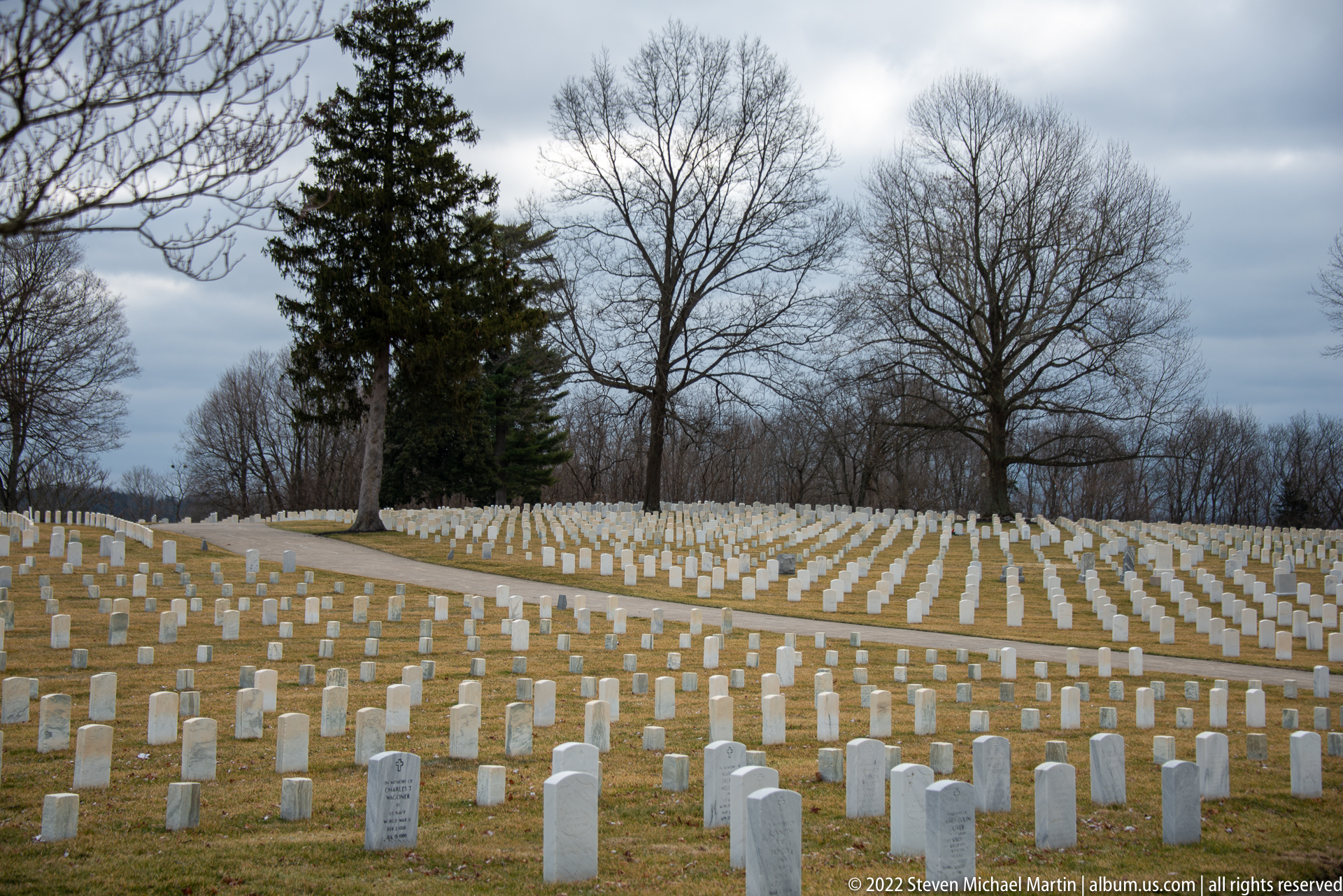
White headstones cover a broad hillside beneath tall leafless trees, with a paved path rising diagonally through the cemetery. The view looks across the rows toward a wooded edge, emphasizing the grounds’ scale and the pattern of markers on the slope rather than any single grave.
Caption
White headstones cover a broad hillside beneath tall leafless trees, with a paved path rising diagonally through the cemetery. The view looks across the rows toward a wooded edge, emphasizing the grounds’ scale and the pattern of markers on the slope rather than any single grave.
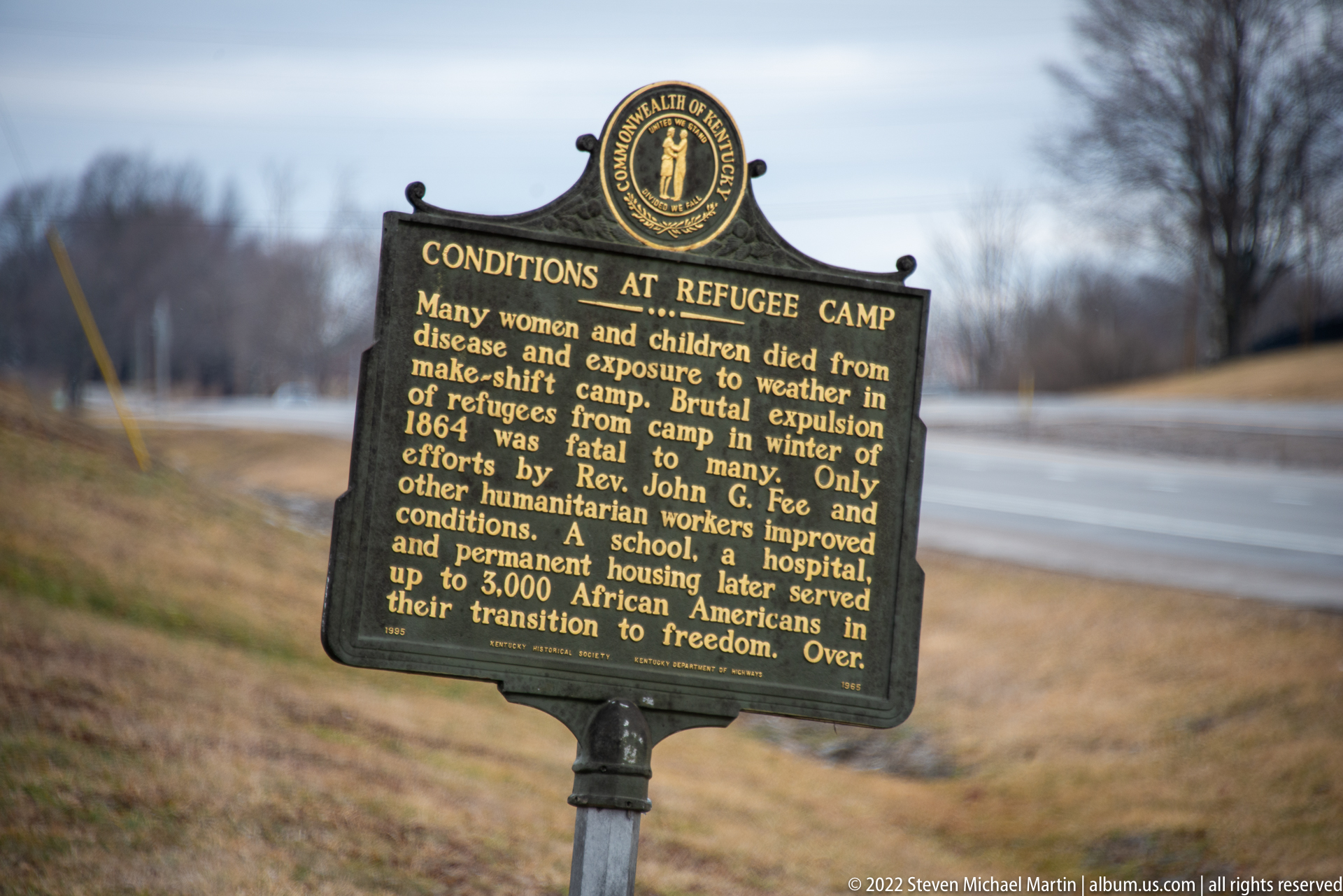
A dark historical marker titled “Conditions at Refugee Camp” fills the foreground, its gold lettering describing hardship among women and children. The cemetery road and winter landscape blur behind it, keeping the inscription readable while placing the marker within the broader Camp Nelson grounds.
Caption
A dark historical marker titled “Conditions at Refugee Camp” fills the foreground, its gold lettering describing hardship among women and children. The cemetery road and winter landscape blur behind it, keeping the inscription readable while placing the marker within the broader Camp Nelson grounds.
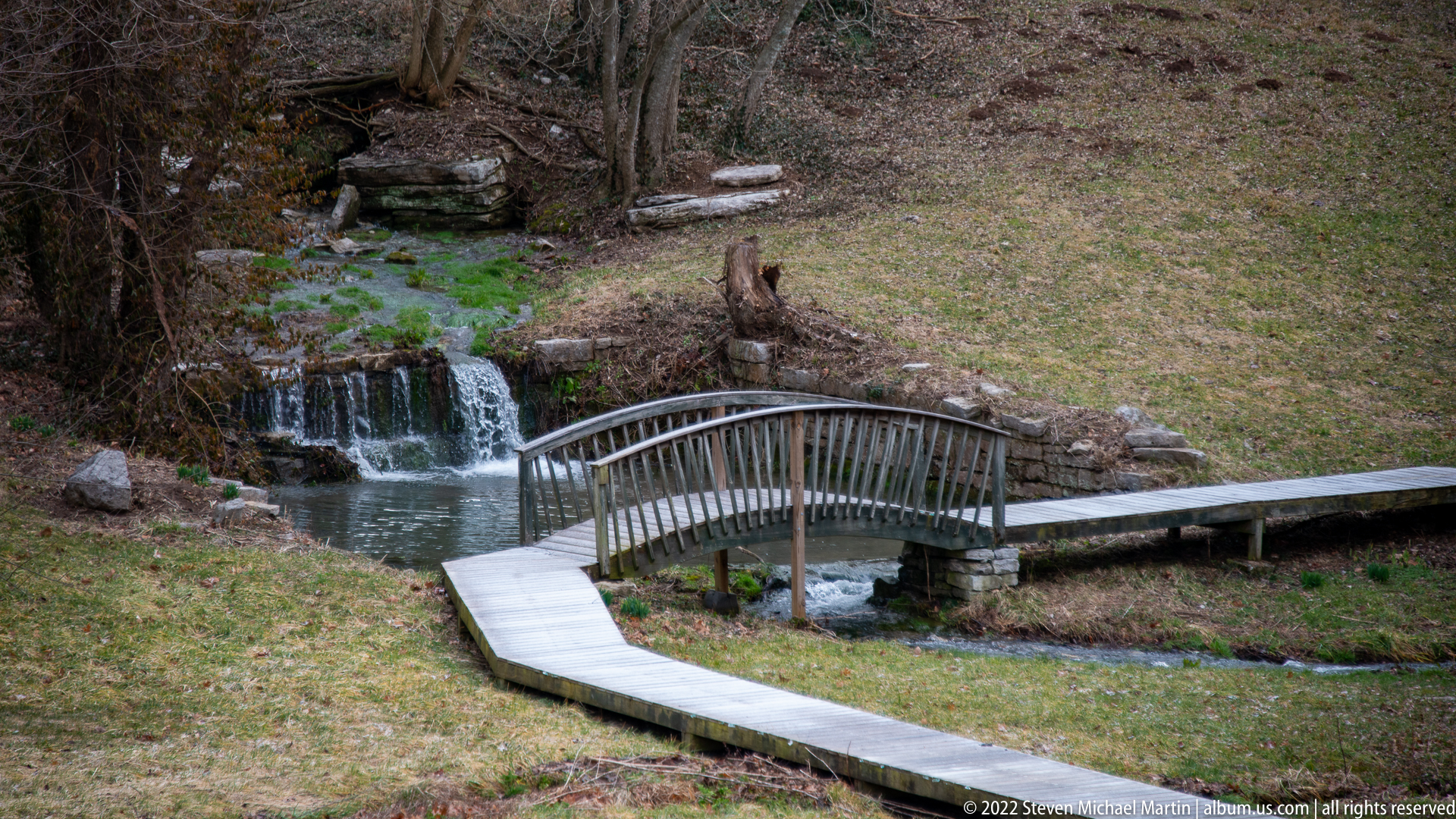
A narrow stream drops over a low stone ledge into a pool beneath a small arched footbridge. A timber walkway curves across the foreground and continues to the right, while bare branches and patches of green groundcover frame the shaded watercourse.
Caption
A narrow stream drops over a low stone ledge into a pool beneath a small arched footbridge. A timber walkway curves across the foreground and continues to the right, while bare branches and patches of green groundcover frame the shaded watercourse.
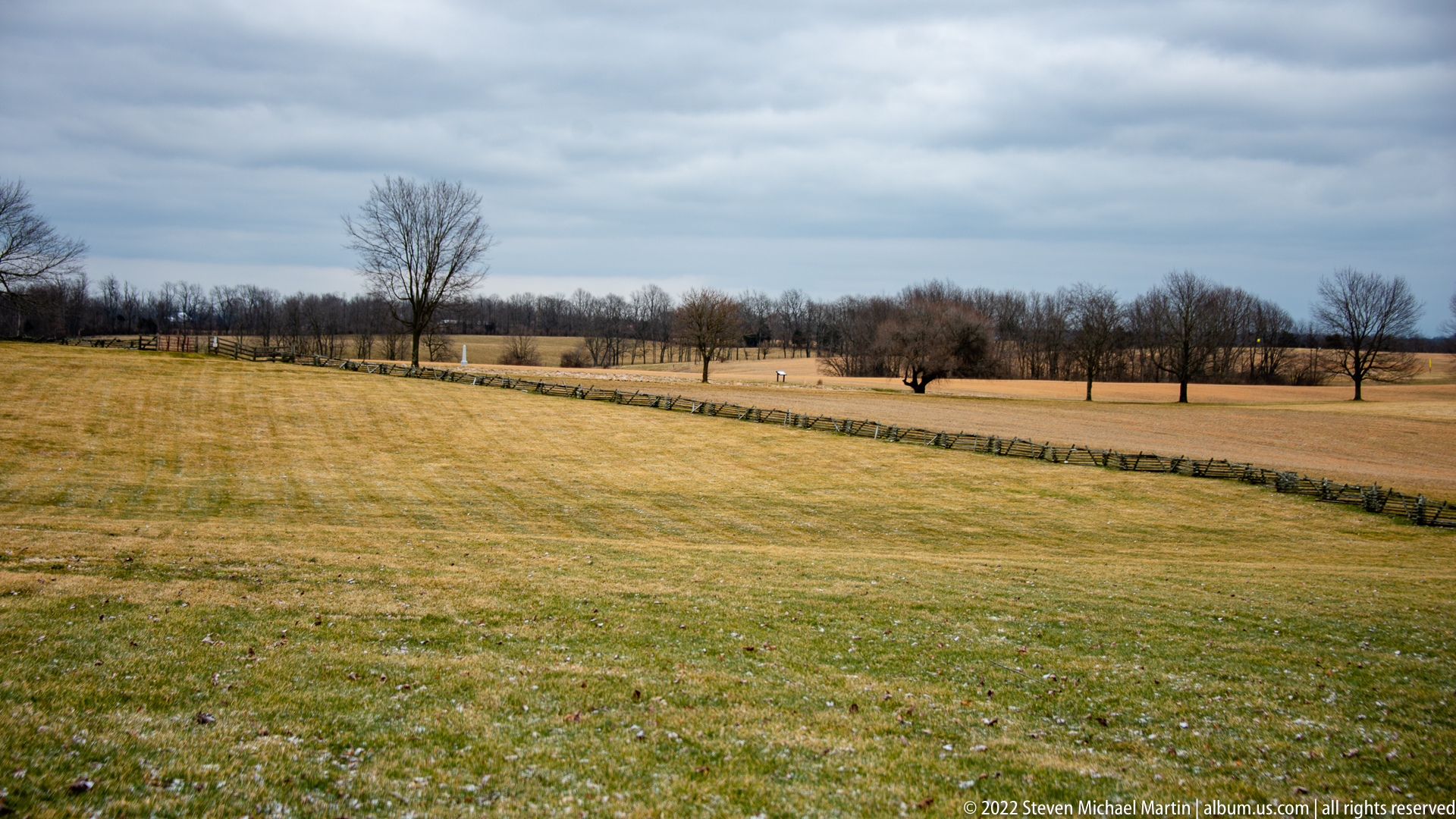
A broad winter field stretches toward a low stone wall that runs diagonally from the foreground into the middle distance. Scattered bare trees and a line of woods define the horizon beneath a heavy gray sky, making the wall’s course the principal feature in this open landscape.
Caption
A broad winter field stretches toward a low stone wall that runs diagonally from the foreground into the middle distance. Scattered bare trees and a line of woods define the horizon beneath a heavy gray sky, making the wall’s course the principal feature in this open landscape.
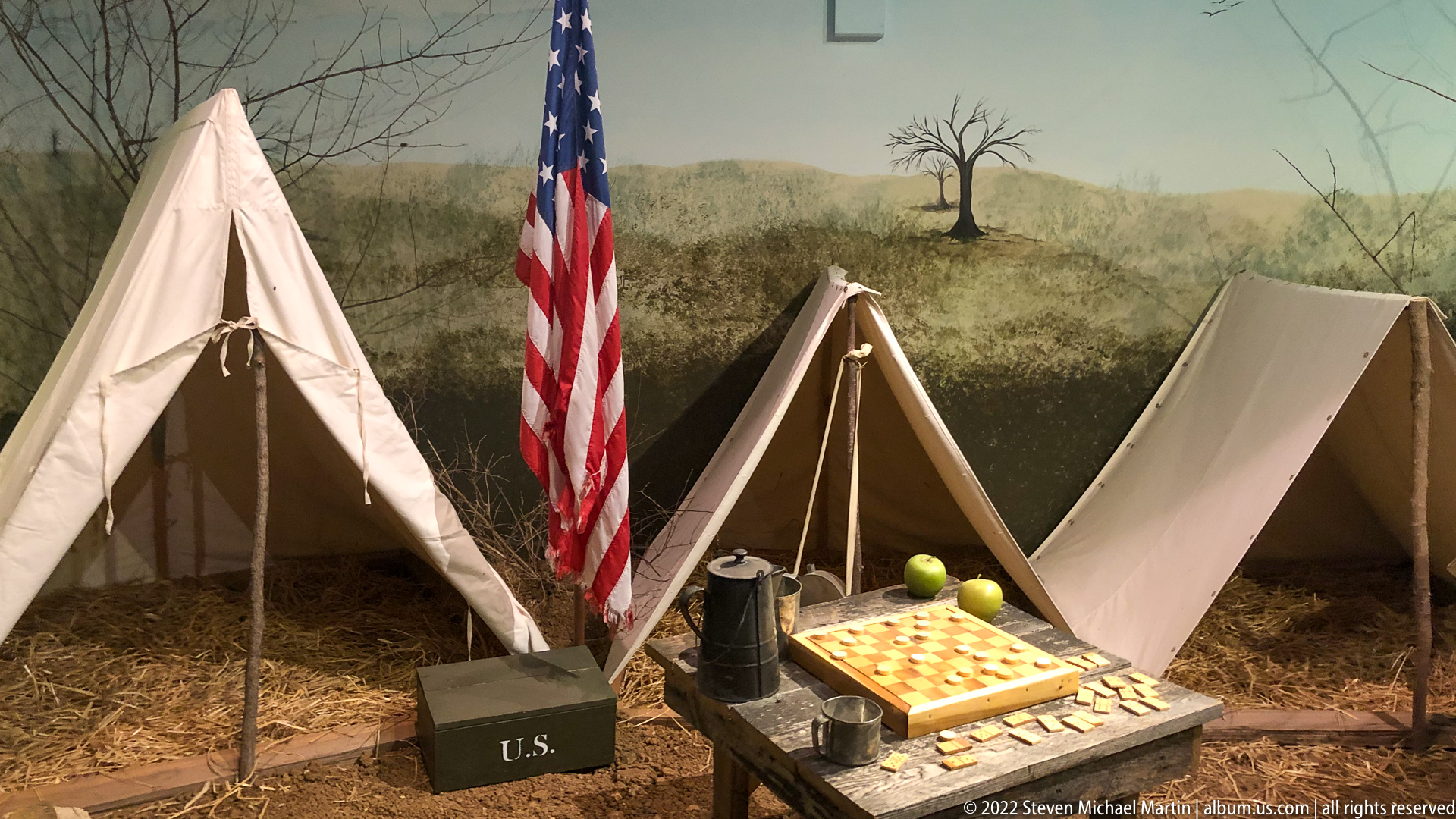
A trio of canvas tents stands against a painted landscape backdrop, with a U.S. flag rising between them. A rough table in front holds a checkerboard, tin vessels, and several small objects, suggesting a staged camp scene. The wide view shows how the exhibit combines shelter, flag, and tabletop props to create an interior-outdoor setting; it does not identify a particular historical moment.
Caption
A trio of canvas tents stands against a painted landscape backdrop, with a U.S. flag rising between them. A rough table in front holds a checkerboard, tin vessels, and several small objects, suggesting a staged camp scene. The wide view shows how the exhibit combines shelter, flag, and tabletop props to create an interior-outdoor setting; it does not identify a particular historical moment.
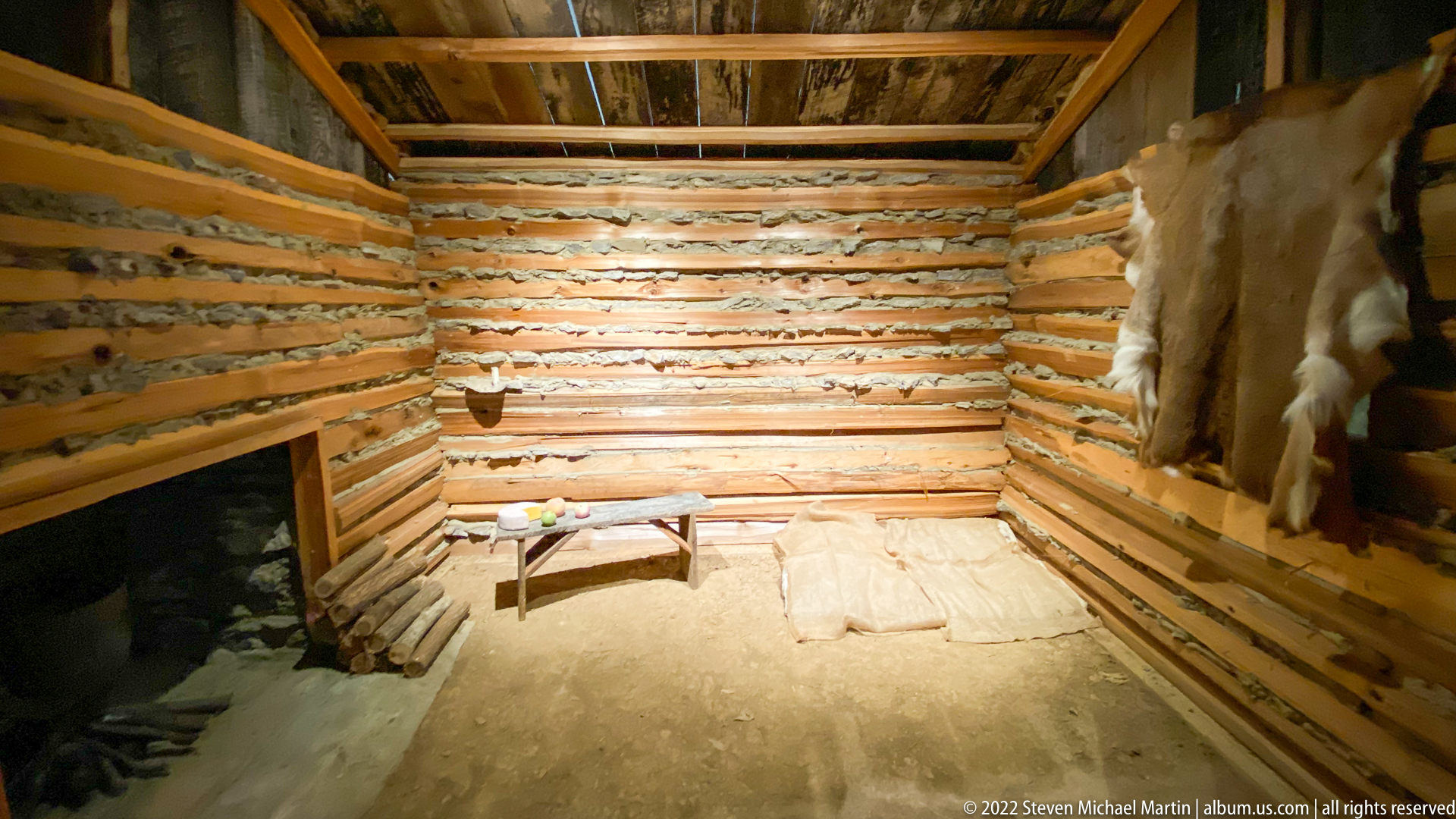
The interior of a compact log-built room is formed by horizontal timbers with pale chinking between them. A low table and simple furnishings sit at the far end, while an animal hide hangs along the right wall and a dark opening is visible to the left. The wide-angle view conveys the room’s rough construction and enclosed scale; its original function is not apparent from the photograph.
Caption
The interior of a compact log-built room is formed by horizontal timbers with pale chinking between them. A low table and simple furnishings sit at the far end, while an animal hide hangs along the right wall and a dark opening is visible to the left. The wide-angle view conveys the room’s rough construction and enclosed scale; its original function is not apparent from the photograph.

Water spills over several low rock ledges into a churning pool in a closer view of the stream. Layered stone, exposed roots, leaf litter, and vivid green groundcover frame the cascade; the footbridge and surrounding path from the wider view are outside this tighter composition.
Caption
Water spills over several low rock ledges into a churning pool in a closer view of the stream. Layered stone, exposed roots, leaf litter, and vivid green groundcover frame the cascade; the footbridge and surrounding path from the wider view are outside this tighter composition.
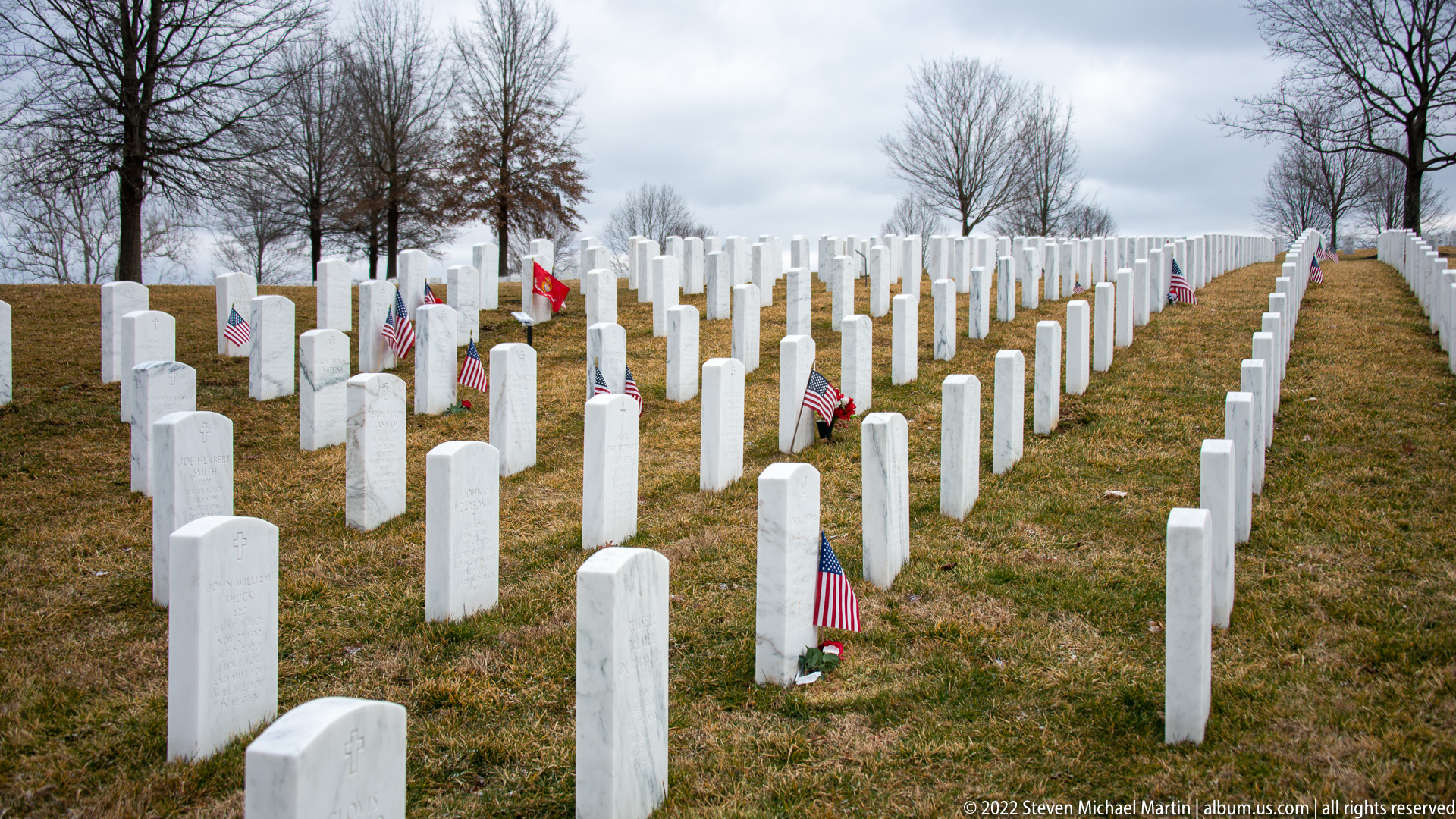
Rows of white headstones recede across a gently sloping lawn, with small American flags marking selected graves. A low stone border curves through the foreground, while bare trees and a cloudy sky frame the cemetery; the diagonal rows create depth across the quiet winter scene.
Caption
Rows of white headstones recede across a gently sloping lawn, with small American flags marking selected graves. A low stone border curves through the foreground, while bare trees and a cloudy sky frame the cemetery; the diagonal rows create depth across the quiet winter scene.

A framed military display presents a brass bugle-shaped insignia marked “69,” three eagle buttons, and a large oval plate stamped “U.S.” The label beneath identifies the objects as infantry hat insignia, eagle buttons, and a U.S. belt plate. Warm wood surrounds the dark backing, while the arrangement makes each metal emblem easy to compare.
Caption
A framed military display presents a brass bugle-shaped insignia marked “69,” three eagle buttons, and a large oval plate stamped “U.S.” The label beneath identifies the objects as infantry hat insignia, eagle buttons, and a U.S. belt plate. Warm wood surrounds the dark backing, while the arrangement makes each metal emblem easy to compare.
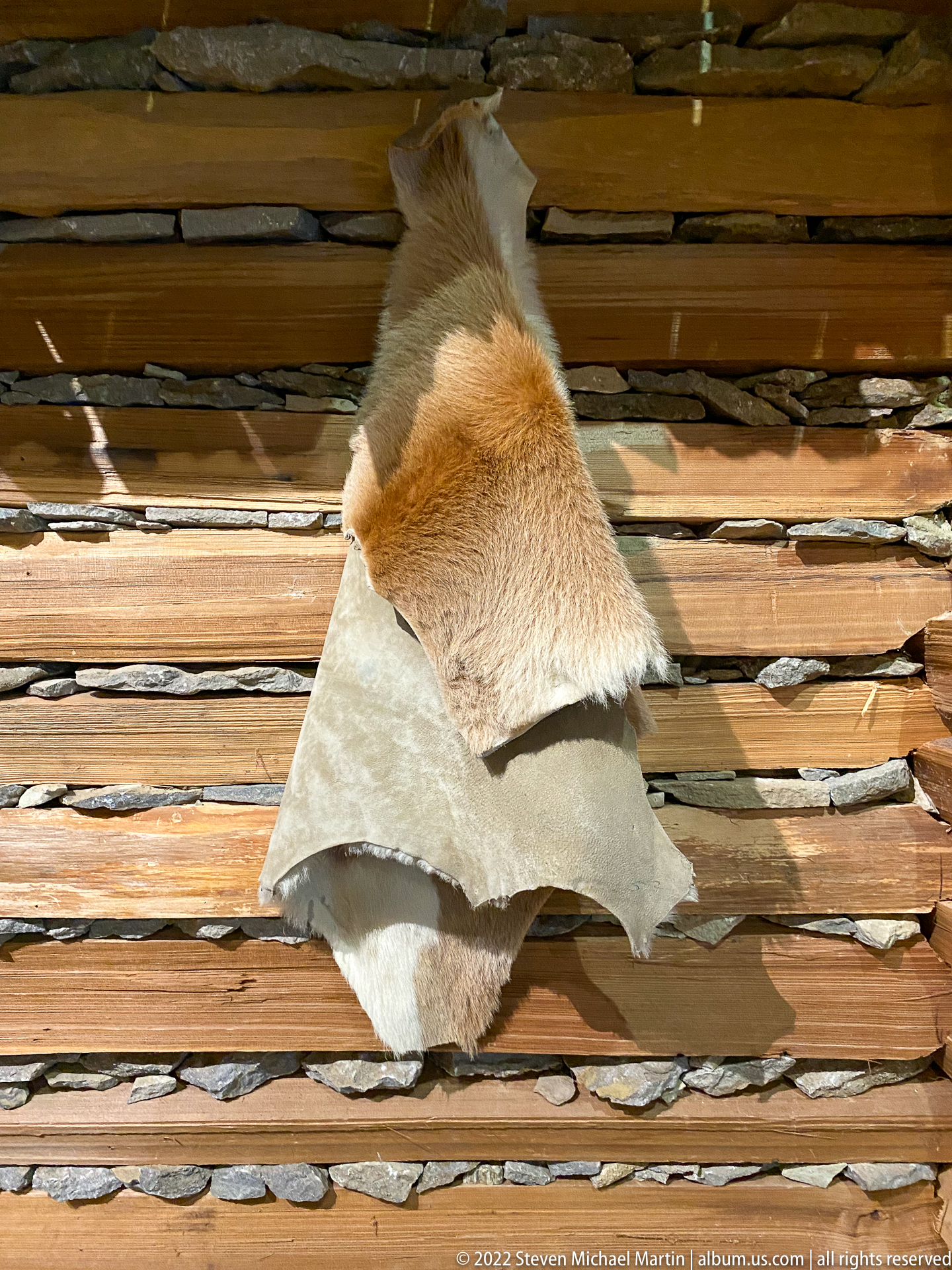
Two animal hides are laid across a wooden slat wall, one tawny pelt resting over a larger pale hide. Their fur and irregular edges contrast with the orderly horizontal timbers behind them. The close view isolates the materials and layered arrangement as objects in a museum display, while leaving the animals that supplied the hides unidentified.
Caption
Two animal hides are laid across a wooden slat wall, one tawny pelt resting over a larger pale hide. Their fur and irregular edges contrast with the orderly horizontal timbers behind them. The close view isolates the materials and layered arrangement as objects in a museum display, while leaving the animals that supplied the hides unidentified.
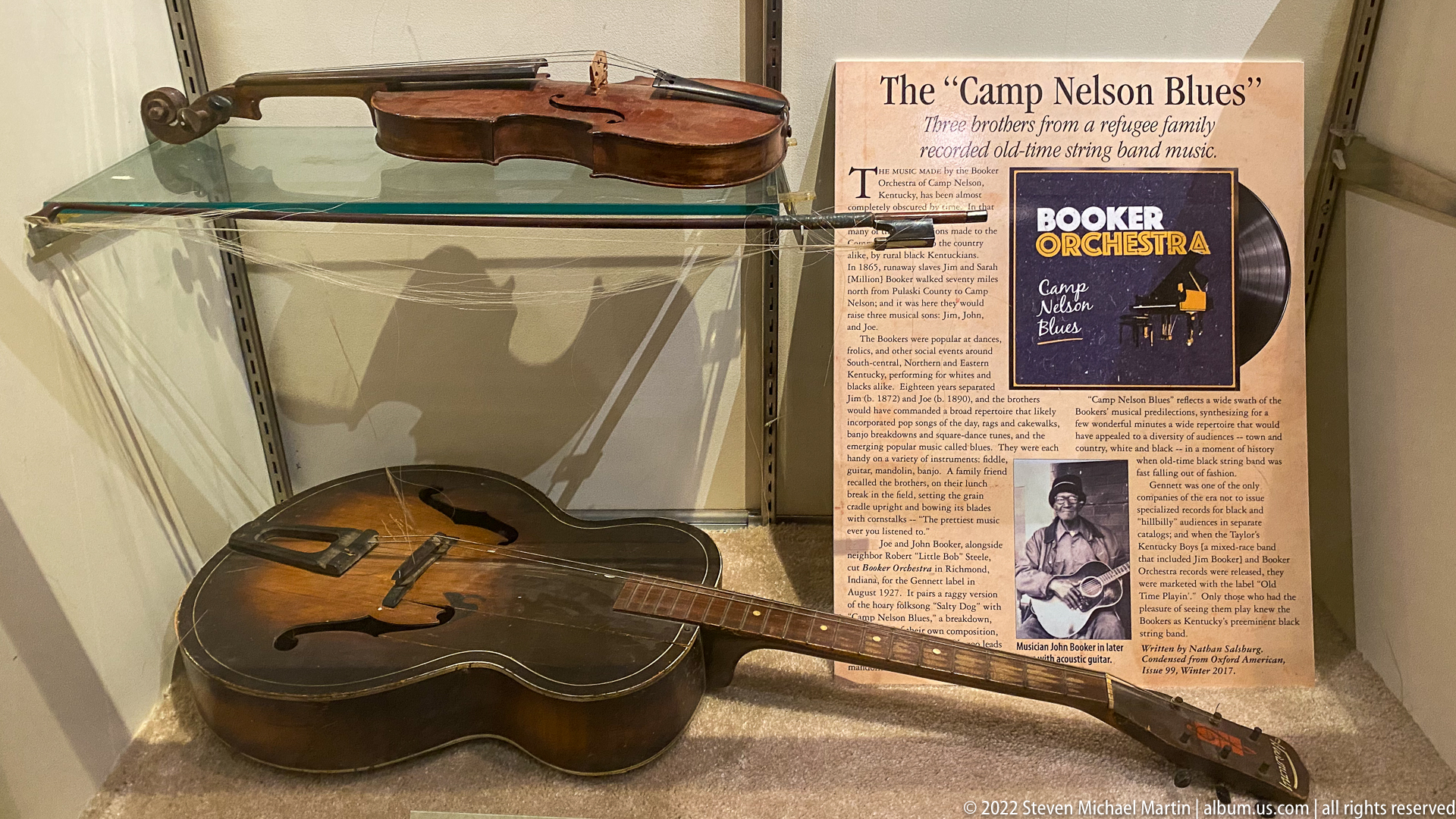
Two dark-bodied acoustic guitars rest on separate shelves inside a glass-fronted case, positioned beside an interpretive panel headed “The Camp Nelson Blues.” A smaller image and text describe a musical group, while the display brings instruments and interpretation together in one gallery view. The photograph records the arrangement of the exhibit rather than identifying the guitars’ makers or provenance.
Caption
Two dark-bodied acoustic guitars rest on separate shelves inside a glass-fronted case, positioned beside an interpretive panel headed “The Camp Nelson Blues.” A smaller image and text describe a musical group, while the display brings instruments and interpretation together in one gallery view. The photograph records the arrangement of the exhibit rather than identifying the guitars’ makers or provenance.
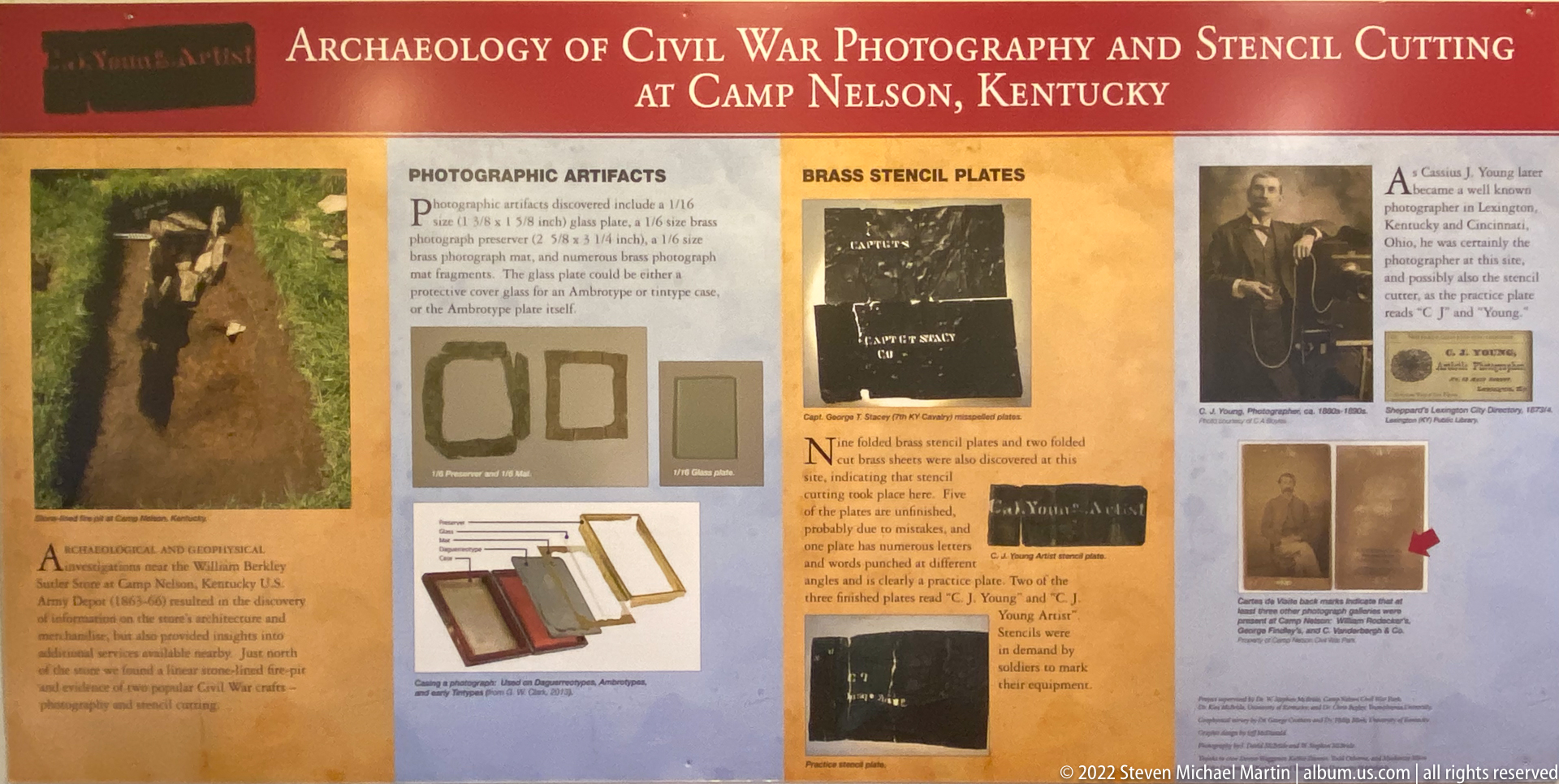
A broad wall panel titled “Archaeology of Civil War Photography and Stencil Cutting at Camp Nelson, Kentucky” combines text, historical photographs, stencil plates, and small artifacts. The layout moves between photographic evidence and material objects, with a red title band spanning the top. This frontal view makes the panel’s varied evidence and its arrangement the subject; individual artifacts are too small to identify here.
Caption
A broad wall panel titled “Archaeology of Civil War Photography and Stencil Cutting at Camp Nelson, Kentucky” combines text, historical photographs, stencil plates, and small artifacts. The layout moves between photographic evidence and material objects, with a red title band spanning the top. This frontal view makes the panel’s varied evidence and its arrangement the subject; individual artifacts are too small to identify here.

Three enlarged historic photographs are mounted on a pale gallery wall: a narrow view labeled “Hicksman Creek Bridge” above two wider scenes labeled “Refugee Cottages” and “Ambulance Yard and Warehouses.” Their black-and-white tones and differing formats contrast with the contemporary exhibition setting. The grouping presents structures and activity associated with Camp Nelson, while preserving the distinct views and captions visible in the display.
Caption
Three enlarged historic photographs are mounted on a pale gallery wall: a narrow view labeled “Hicksman Creek Bridge” above two wider scenes labeled “Refugee Cottages” and “Ambulance Yard and Warehouses.” Their black-and-white tones and differing formats contrast with the contemporary exhibition setting. The grouping presents structures and activity associated with Camp Nelson, while preserving the distinct views and captions visible in the display.
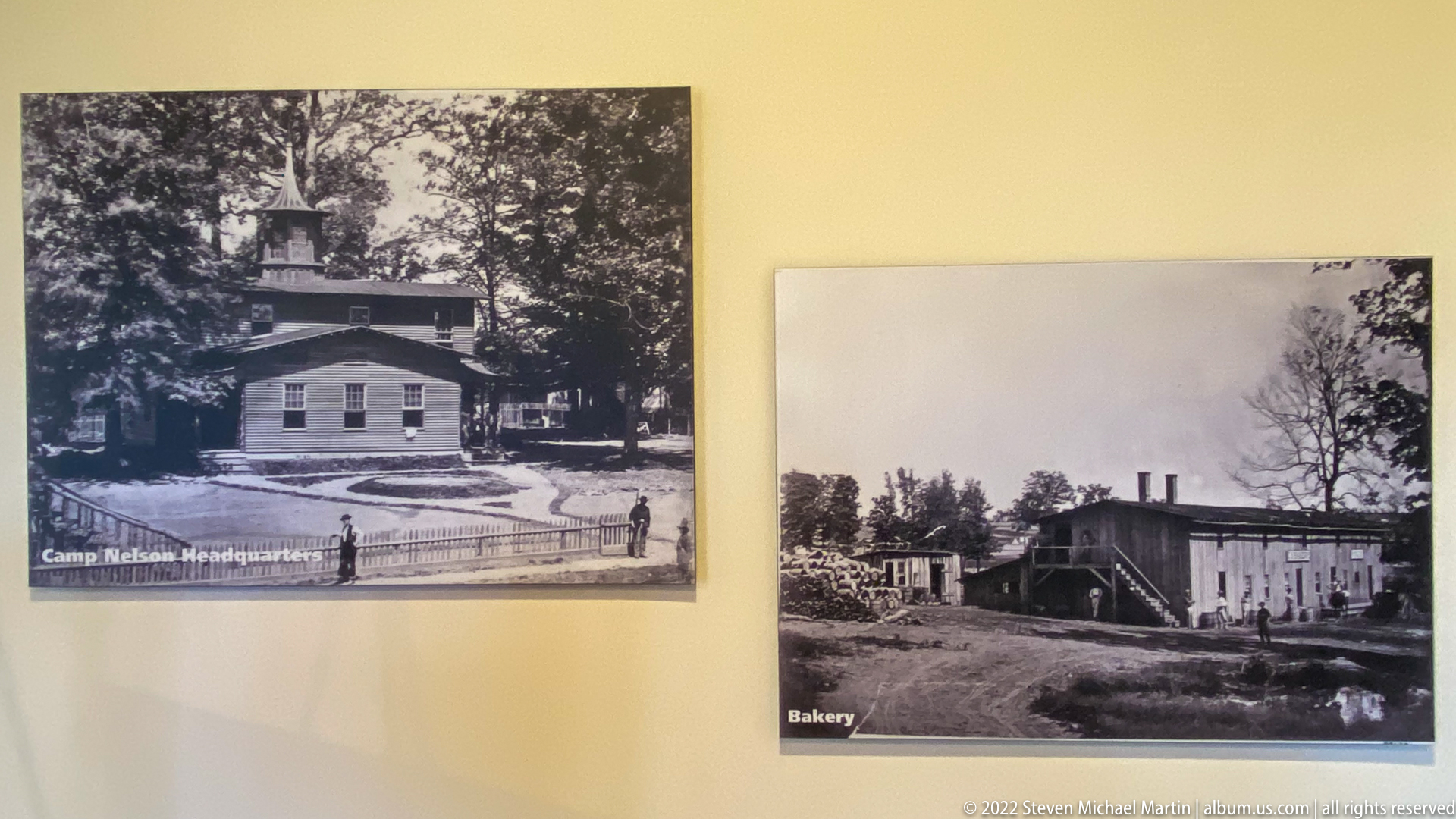
Two historic photographs hang side by side: the left print, labeled “Camp Nelson Headquarters,” shows a small building behind a fenced yard, while the right, labeled “Bakery,” depicts a longer industrial-looking structure and its grounds. Their separate captions establish different functions within the historic camp. The museum-wall view preserves both images together while allowing their contrasting building forms to remain legible.
Caption
Two historic photographs hang side by side: the left print, labeled “Camp Nelson Headquarters,” shows a small building behind a fenced yard, while the right, labeled “Bakery,” depicts a longer industrial-looking structure and its grounds. Their separate captions establish different functions within the historic camp. The museum-wall view preserves both images together while allowing their contrasting building forms to remain legible.
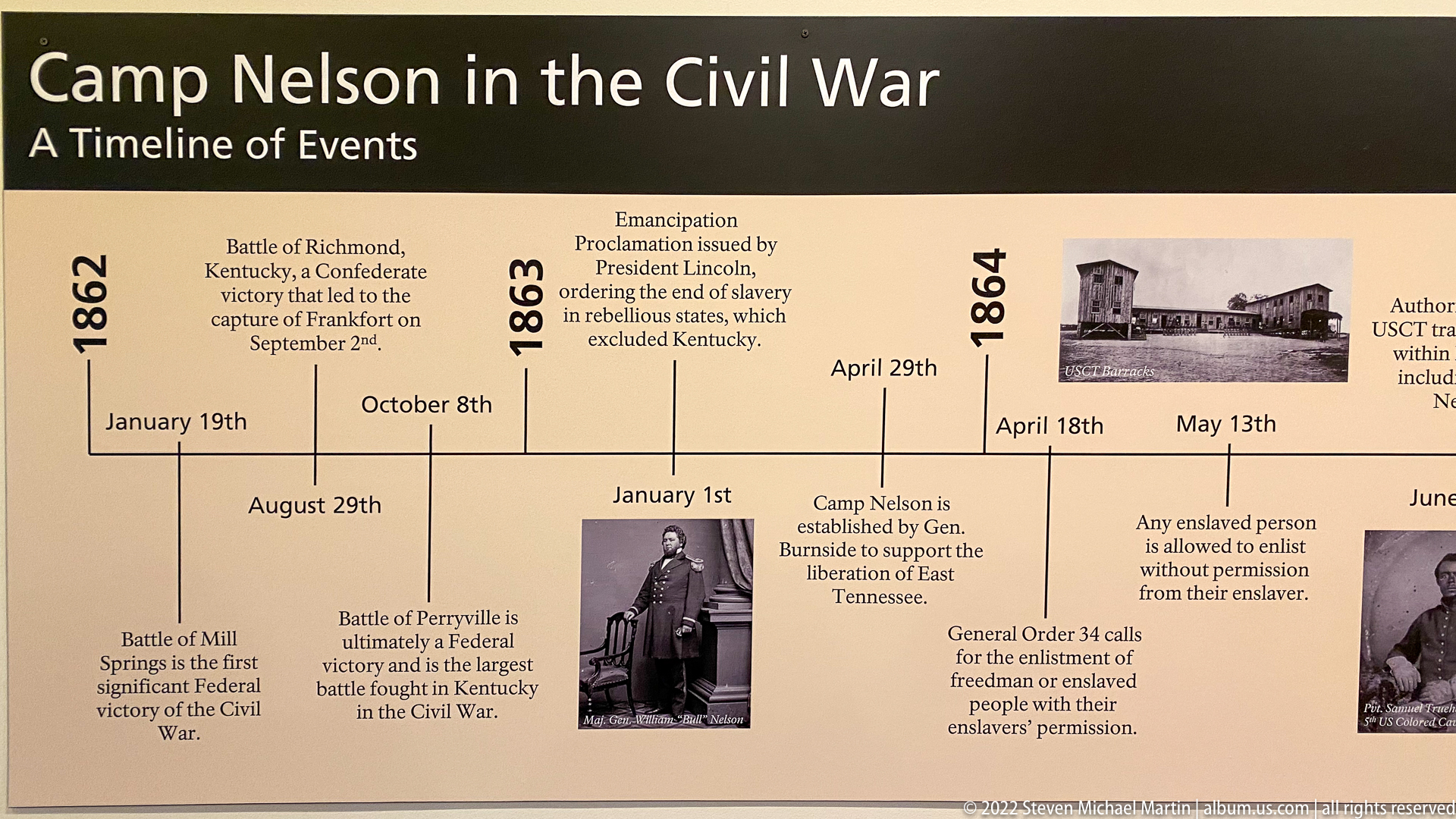
A wall timeline traces events from 1862 through 1864, using large vertical year markers, short text entries, dates, and small historic portraits and building photographs. The sequence includes Camp Nelson’s establishment and other Civil War milestones, presented across a long horizontal panel. This left-hand section emphasizes the opening years of the chronology and the graphic relationship between dates, images, and explanatory text.
Caption
A wall timeline traces events from 1862 through 1864, using large vertical year markers, short text entries, dates, and small historic portraits and building photographs. The sequence includes Camp Nelson’s establishment and other Civil War milestones, presented across a long horizontal panel. This left-hand section emphasizes the opening years of the chronology and the graphic relationship between dates, images, and explanatory text.
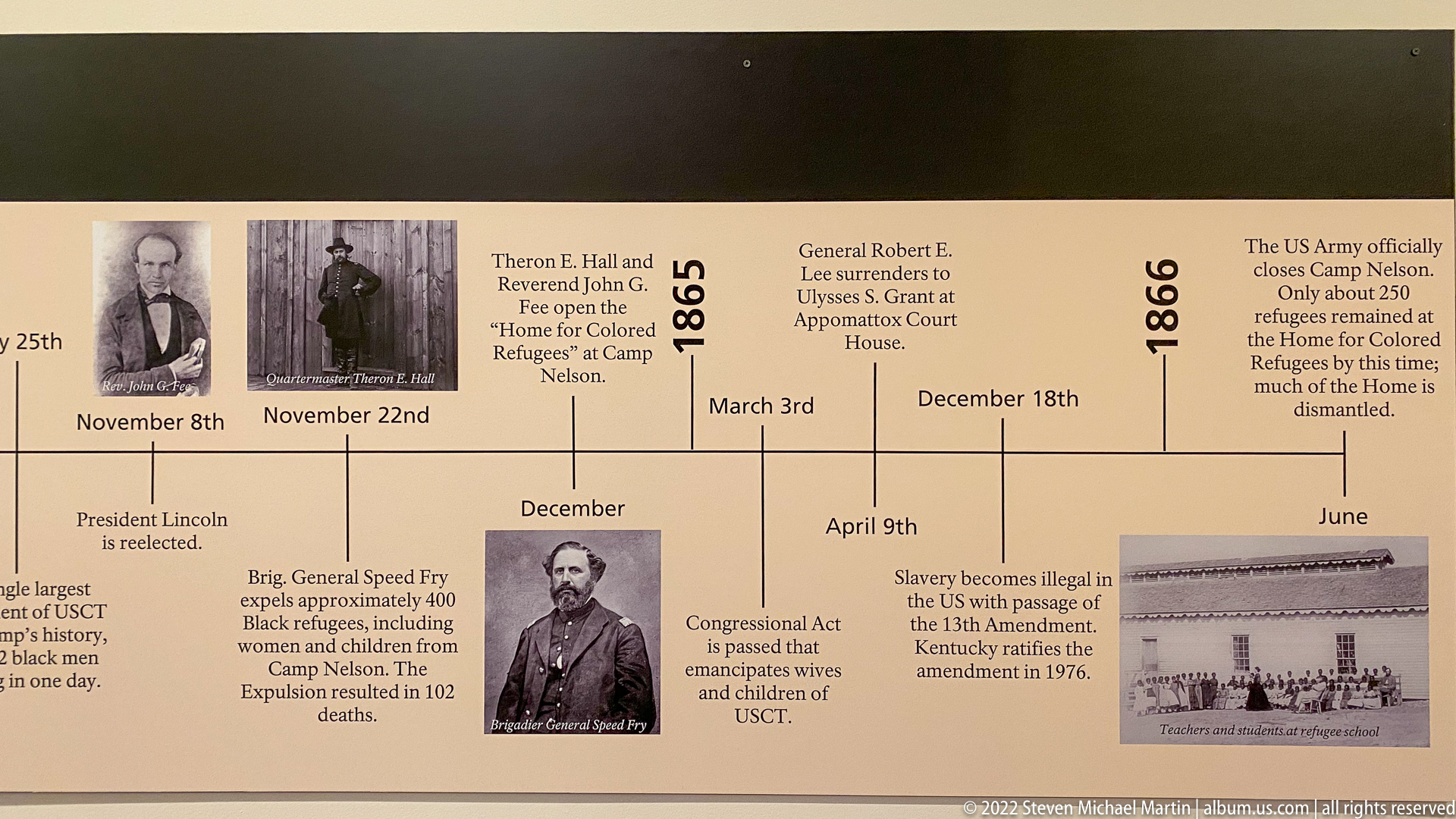
The timeline continues through 1865 and 1866, with year markers linked to dated events, brief explanatory text, portraits, and a photograph of a long building. The panel includes references to Camp Nelson and emancipation-era developments. Its right-hand position completes the chronology begun in the preceding display, while this view focuses on the final years and the visual sequence leading to 1866.
Caption
The timeline continues through 1865 and 1866, with year markers linked to dated events, brief explanatory text, portraits, and a photograph of a long building. The panel includes references to Camp Nelson and emancipation-era developments. Its right-hand position completes the chronology begun in the preceding display, while this view focuses on the final years and the visual sequence leading to 1866.
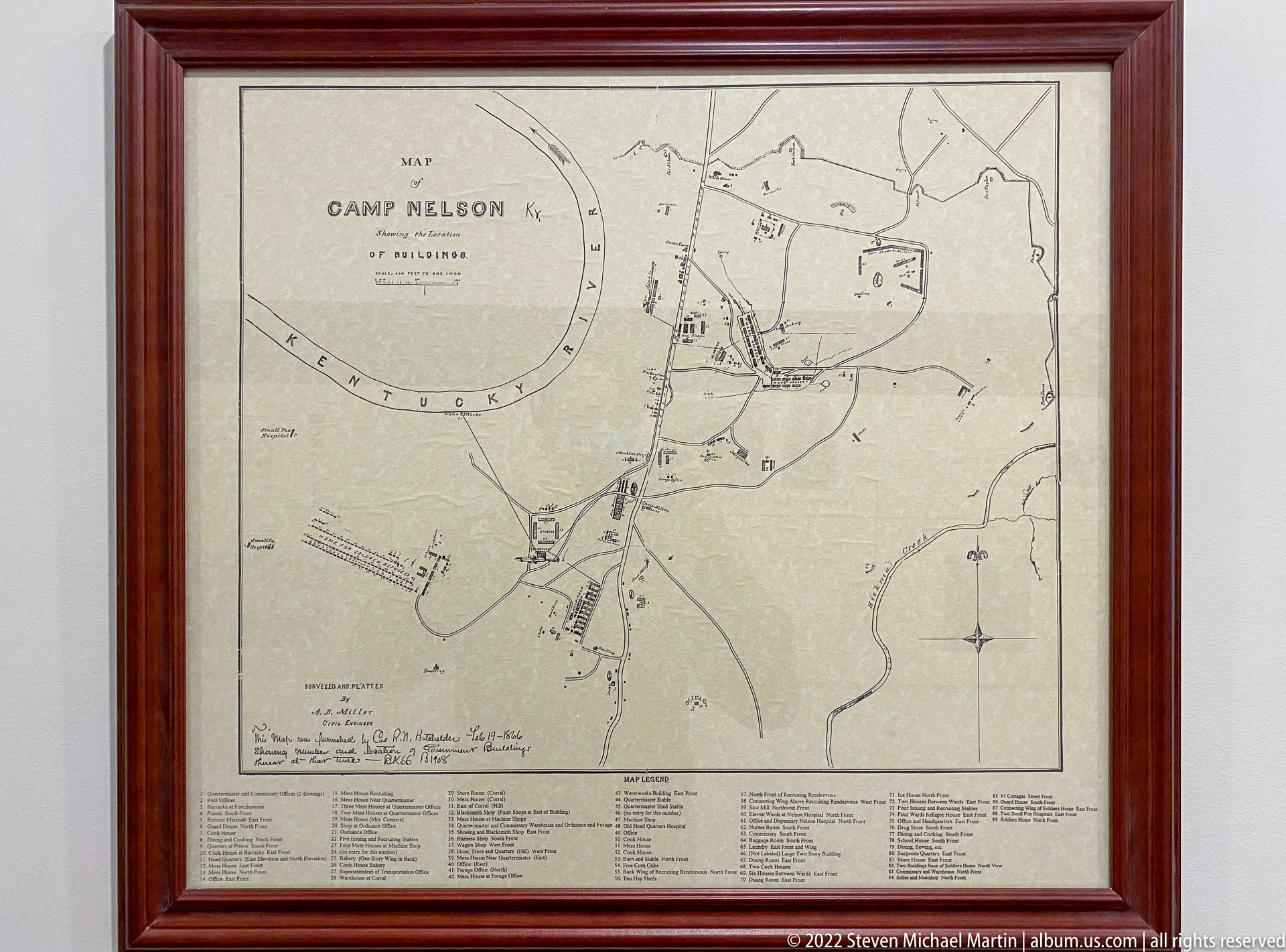
A large printed map labeled “Camp Nelson, Ky.” hangs within a dark reddish wood frame. Fine lines trace roads, boundaries, and clustered structures across the site, with a compass rose and a dense key or legend along the lower edge. The full-frame view records the map as a museum object and gives a sense of the camp’s spatial plan without attempting to resolve every small label.
Caption
A large printed map labeled “Camp Nelson, Ky.” hangs within a dark reddish wood frame. Fine lines trace roads, boundaries, and clustered structures across the site, with a compass rose and a dense key or legend along the lower edge. The full-frame view records the map as a museum object and gives a sense of the camp’s spatial plan without attempting to resolve every small label.
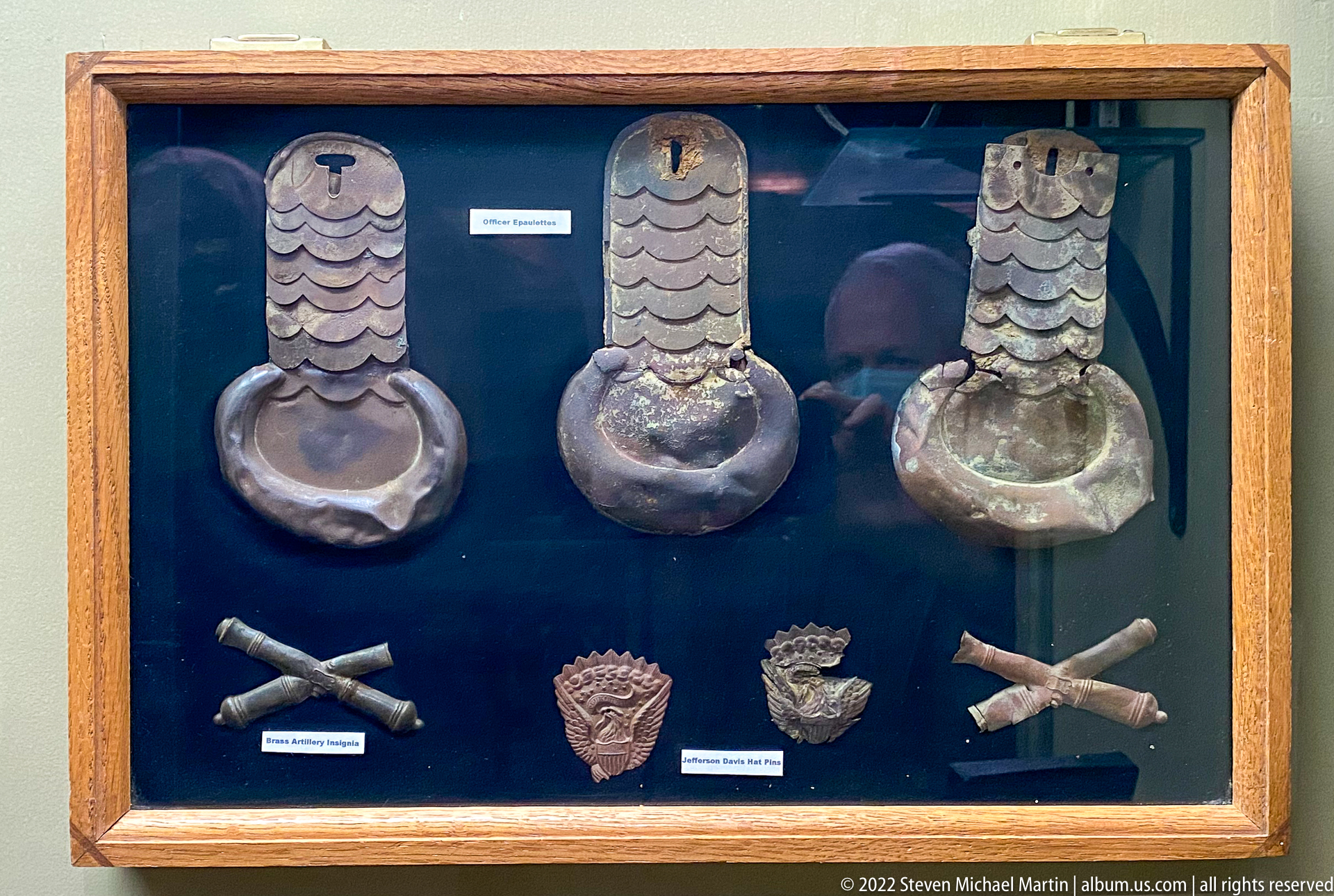
A glass-fronted, wood-framed case presents three large matching metal fittings in a row above several smaller objects, including crossed cylindrical pieces and compact patterned forms. The objects are arranged against a dark blue backing with small labels beneath them. Their precise function is not legible in the proof sheet, so the display can be described as a group of historic metal artifacts without naming a specific object type.
Caption
A glass-fronted, wood-framed case presents three large matching metal fittings in a row above several smaller objects, including crossed cylindrical pieces and compact patterned forms. The objects are arranged against a dark blue backing with small labels beneath them. Their precise function is not legible in the proof sheet, so the display can be described as a group of historic metal artifacts without naming a specific object type.
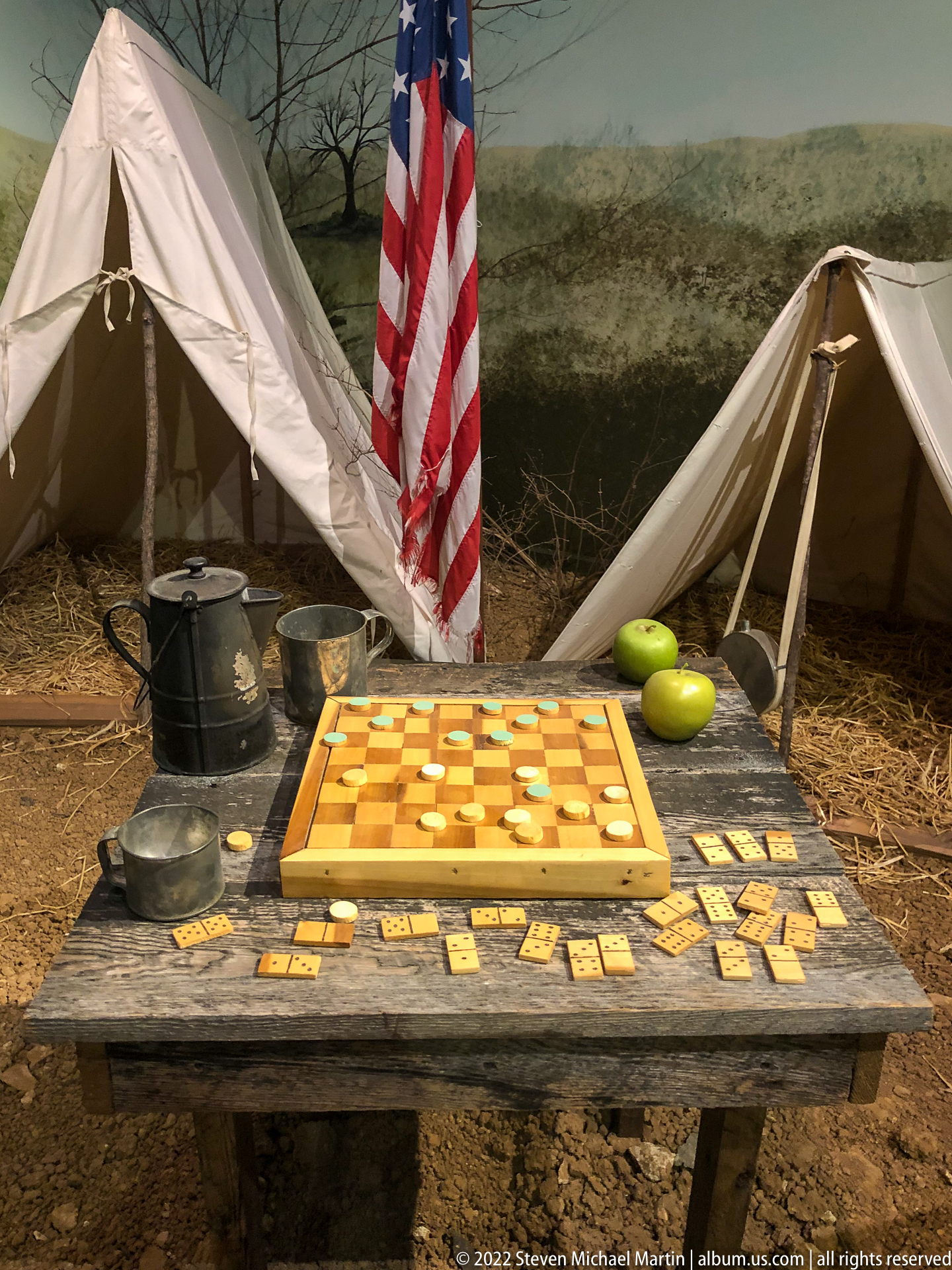
A wooden camp table fills the foreground, crowded with a checkerboard and scattered light and dark pieces, tin pots, cups, and several small labeled objects. The tent canvas and a hanging U.S. flag remain visible behind the arrangement. This closer view shifts attention from the overall camp tableau to the objects set out for daily use and recreation; the small labels are not legible at this scale.
Caption
A wooden camp table fills the foreground, crowded with a checkerboard and scattered light and dark pieces, tin pots, cups, and several small labeled objects. The tent canvas and a hanging U.S. flag remain visible behind the arrangement. This closer view shifts attention from the overall camp tableau to the objects set out for daily use and recreation; the small labels are not legible at this scale.
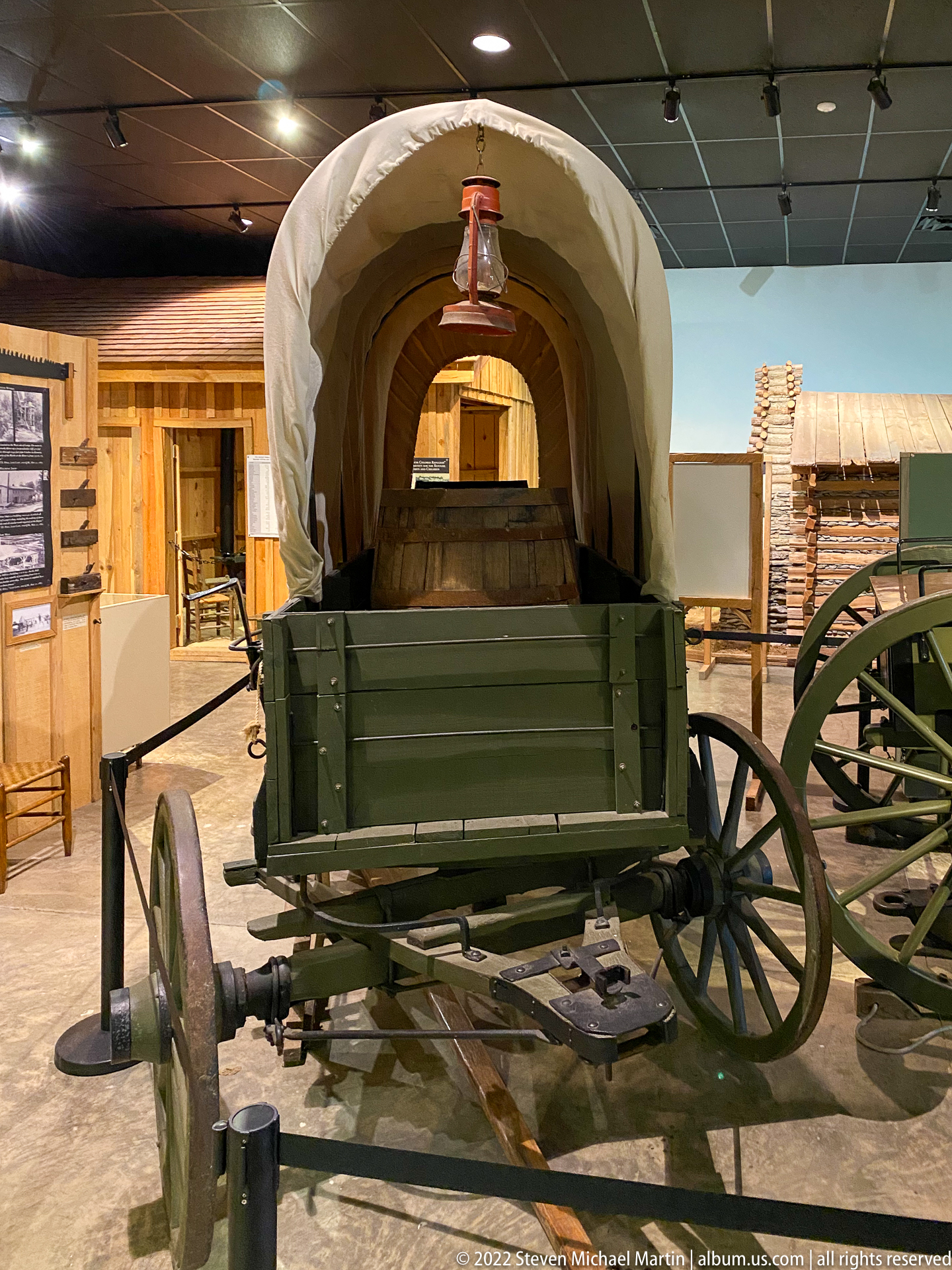
A green, four-wheeled wagon stands in the center of a gallery, its canvas cover arched over the bed and its rear opening facing the camera. Large spoked wheels, a dark undercarriage, and the curved canvas profile are clearly visible. Interpretive exhibits and timber construction appear around it, but the proof sheet does not establish the wagon’s exact historical use or provenance.
Caption
A green, four-wheeled wagon stands in the center of a gallery, its canvas cover arched over the bed and its rear opening facing the camera. Large spoked wheels, a dark undercarriage, and the curved canvas profile are clearly visible. Interpretive exhibits and timber construction appear around it, but the proof sheet does not establish the wagon’s exact historical use or provenance.
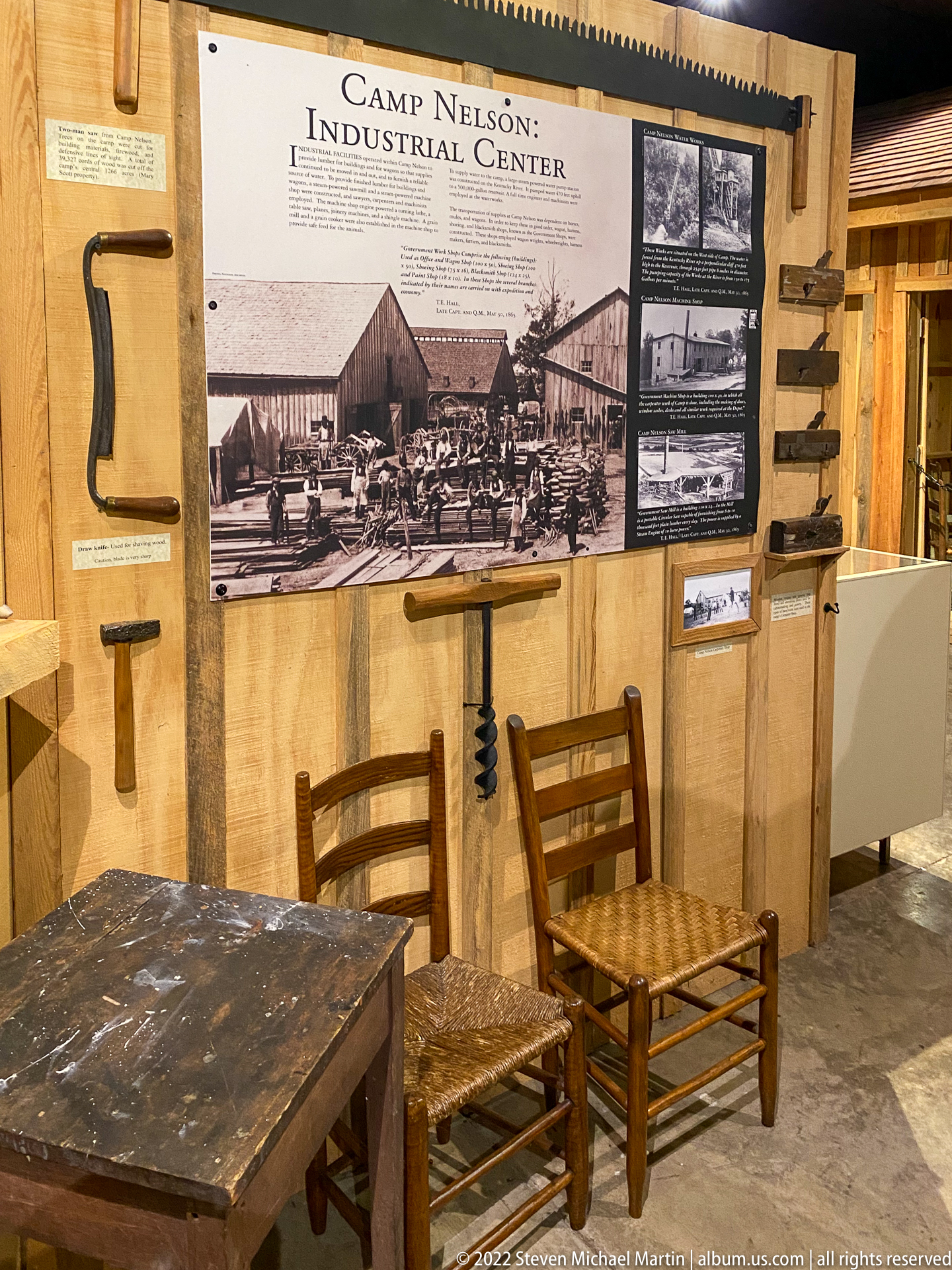
A gallery wall titled “Camp Nelson: Industrial Center” combines a historic photograph of workers and buildings with explanatory text and mounted tools. Two wooden chairs sit below the panel, beside a scarred worktable and additional implements. The composition links the interpretive material to workshop furnishings, while keeping the exhibit’s combination of archival image, hand tools, and seating in view.
Caption
A gallery wall titled “Camp Nelson: Industrial Center” combines a historic photograph of workers and buildings with explanatory text and mounted tools. Two wooden chairs sit below the panel, beside a scarred worktable and additional implements. The composition links the interpretive material to workshop furnishings, while keeping the exhibit’s combination of archival image, hand tools, and seating in view.
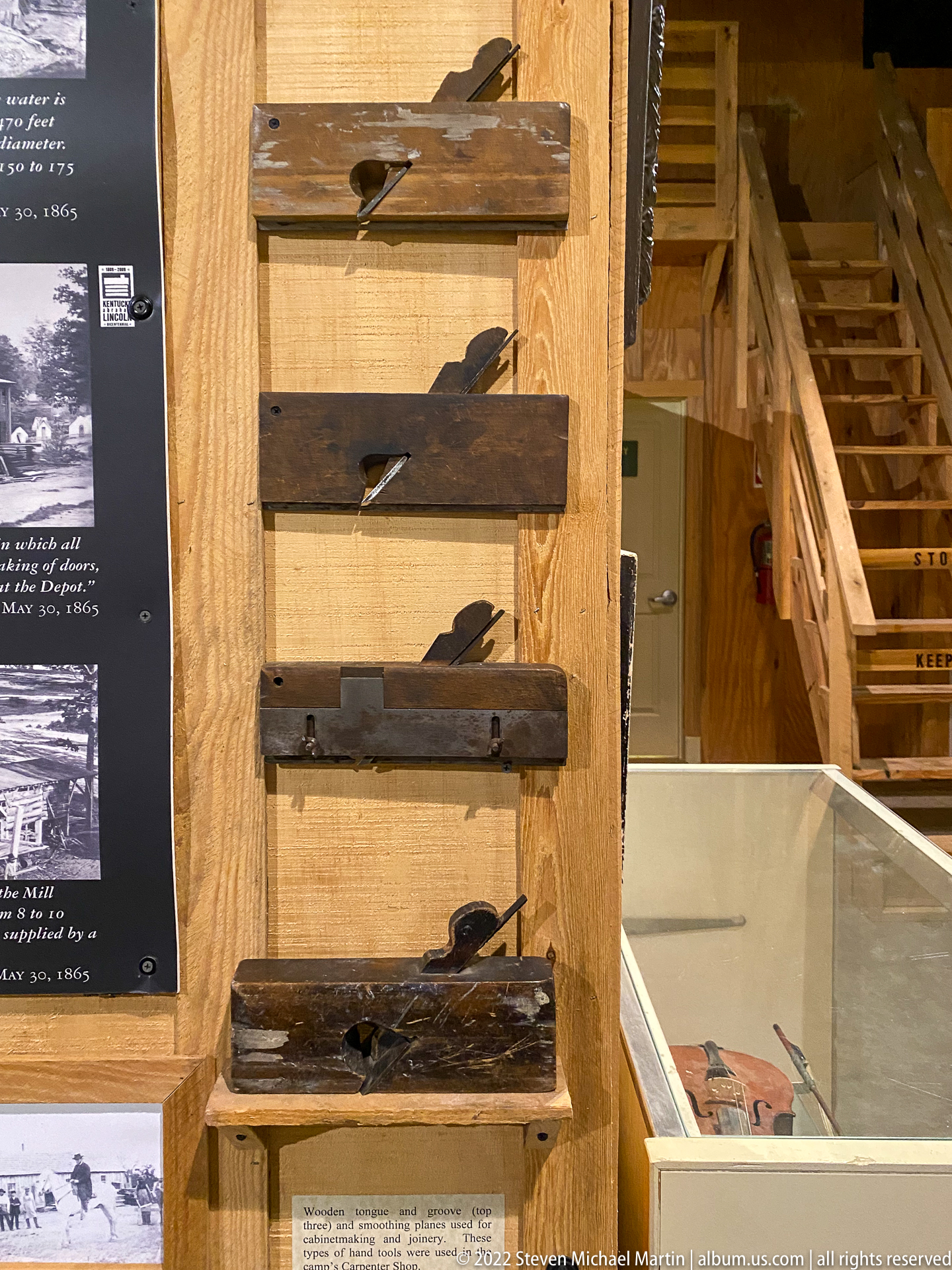
Several wooden hand planes of different lengths are mounted vertically on a timber wall, their dark bodies and exposed metal blades visible in profile. A staircase and part of an interpretive display recede along the right side, situating the tools within a reconstructed workshop-style exhibit. The close composition highlights the variations in size and form rather than assigning a specific maker or date.
Caption
Several wooden hand planes of different lengths are mounted vertically on a timber wall, their dark bodies and exposed metal blades visible in profile. A staircase and part of an interpretive display recede along the right side, situating the tools within a reconstructed workshop-style exhibit. The close composition highlights the variations in size and form rather than assigning a specific maker or date.
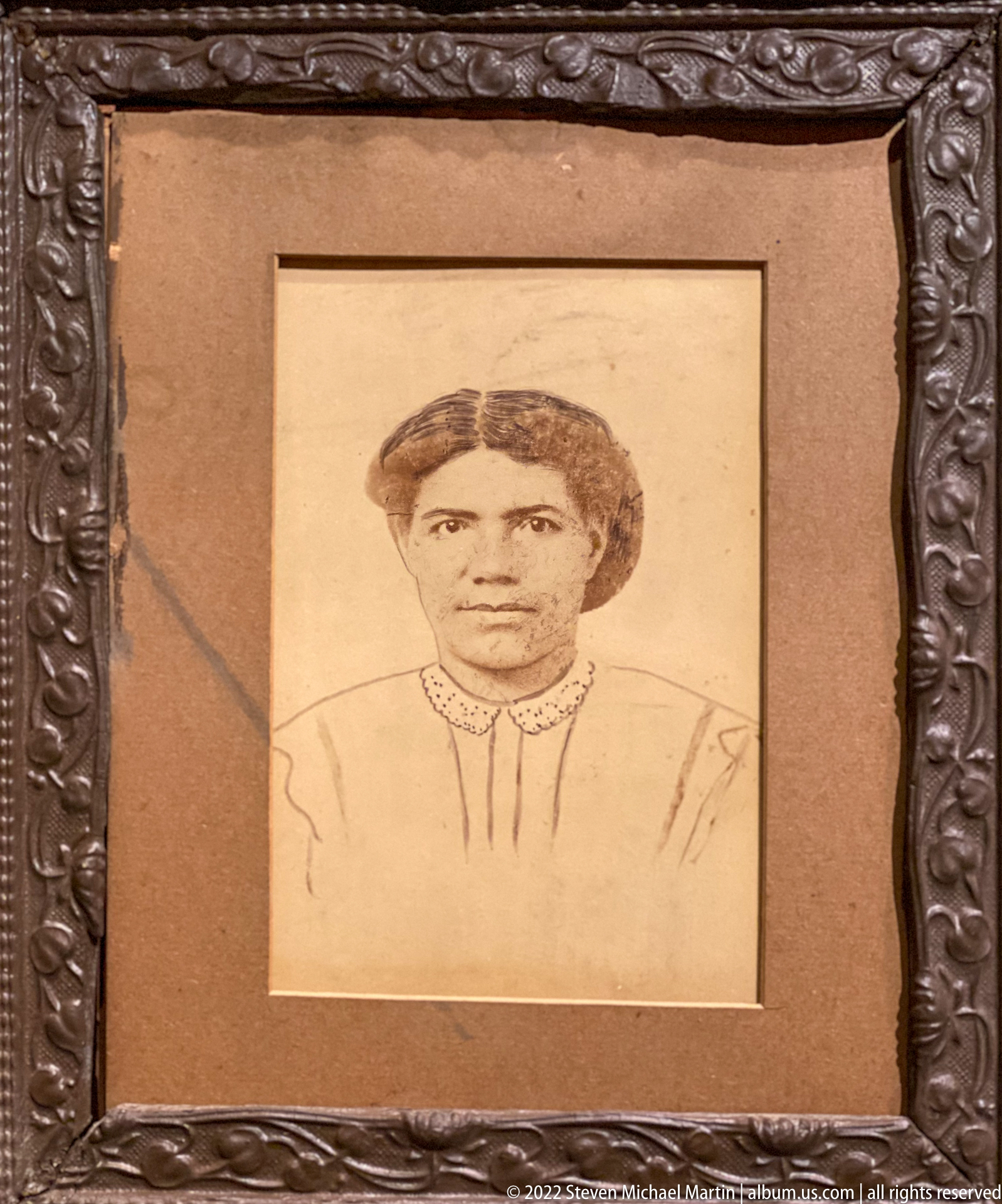
A small pencil or charcoal portrait of a young person is centered within a broad tan mat and an ornate dark frame. The sitter faces forward, wearing a light garment with a narrow collar; fine shading defines the hair, face, and shoulders. The drawing’s maker and subject are not identified in the proof-sheet view, so the caption describes the visible portrait without assigning a name or historical role.
Caption
A small pencil or charcoal portrait of a young person is centered within a broad tan mat and an ornate dark frame. The sitter faces forward, wearing a light garment with a narrow collar; fine shading defines the hair, face, and shoulders. The drawing’s maker and subject are not identified in the proof-sheet view, so the caption describes the visible portrait without assigning a name or historical role.
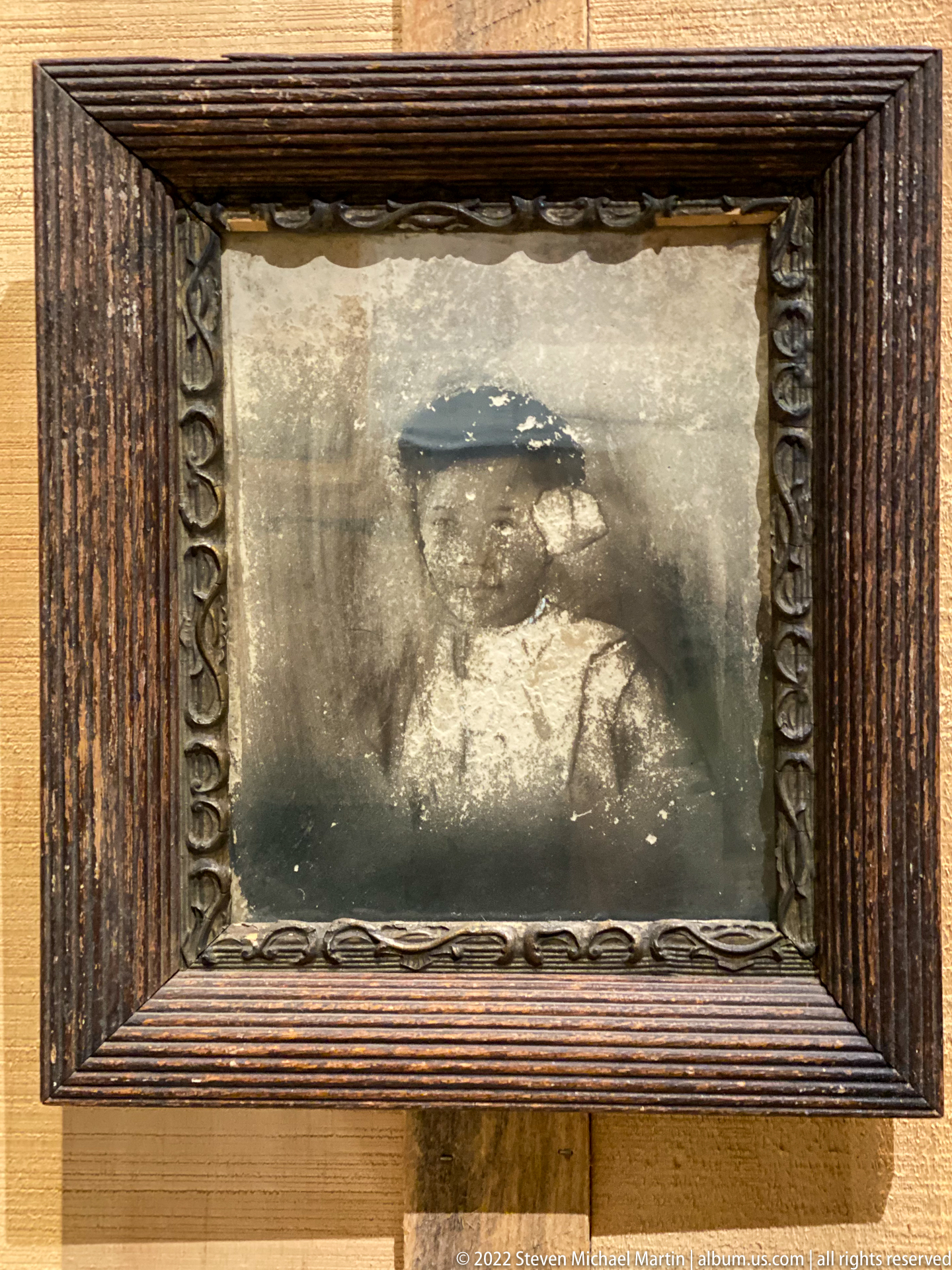
A small, heavily faded portrait is mounted in a deeply carved dark wooden frame. The low-contrast image appears to show a seated person in light clothing, but age, glare, and the proof-sheet scale obscure facial details and other identifying features. The photograph’s worn surface and elaborate frame are the most legible elements, making a cautious description more reliable than a specific identification.
Caption
A small, heavily faded portrait is mounted in a deeply carved dark wooden frame. The low-contrast image appears to show a seated person in light clothing, but age, glare, and the proof-sheet scale obscure facial details and other identifying features. The photograph’s worn surface and elaborate frame are the most legible elements, making a cautious description more reliable than a specific identification.
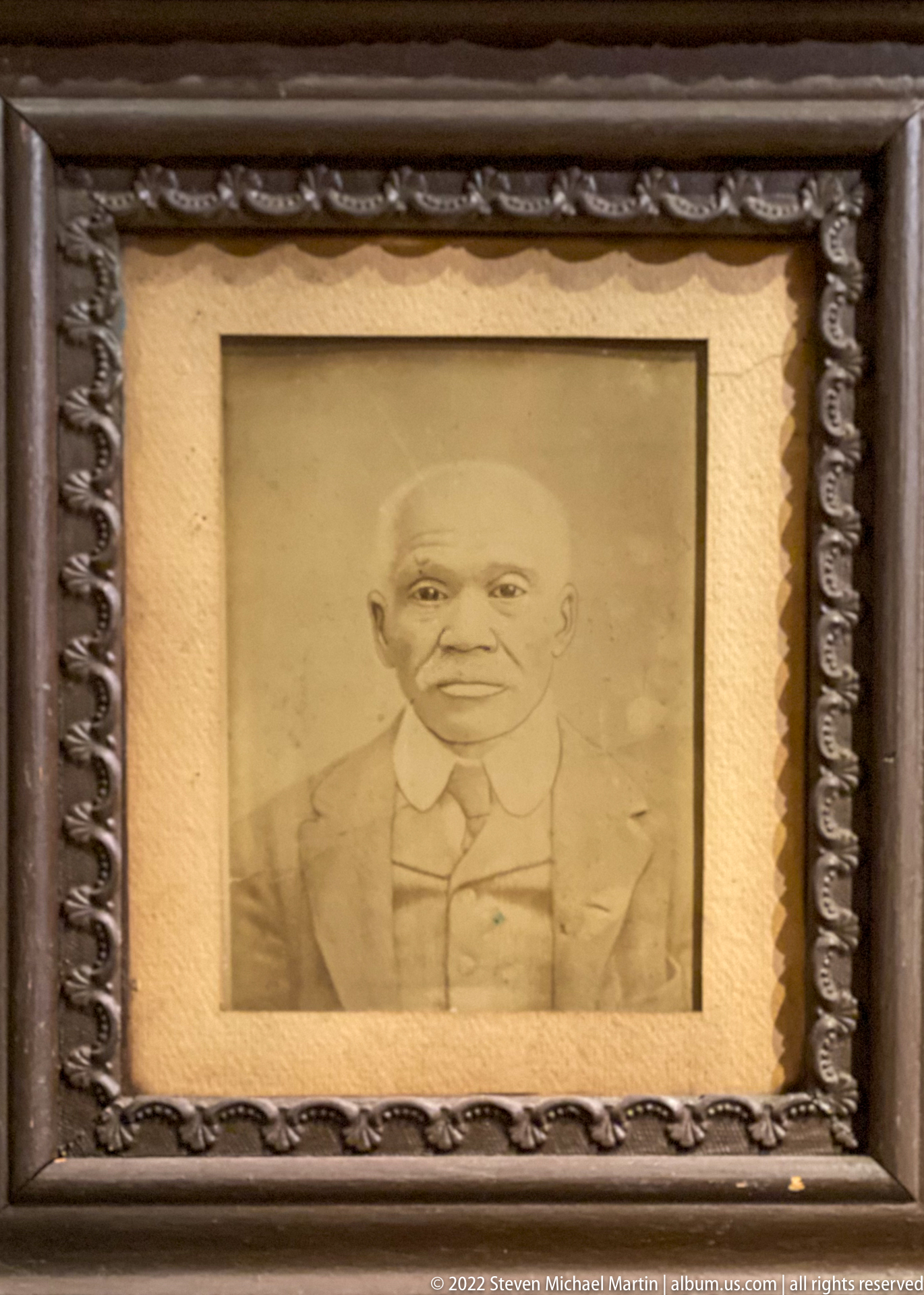
A sepia-toned portrait shows a man facing the camera in a dark suit, light shirt, and tie. The image is set within a broad cream mat and a carved dark frame, with wear and tonal fading visible across the print. No name is readable in the photograph, so the sitter remains unidentified; the composition centers on his formal clothing and direct gaze.
Caption
A sepia-toned portrait shows a man facing the camera in a dark suit, light shirt, and tie. The image is set within a broad cream mat and a carved dark frame, with wear and tonal fading visible across the print. No name is readable in the photograph, so the sitter remains unidentified; the composition centers on his formal clothing and direct gaze.
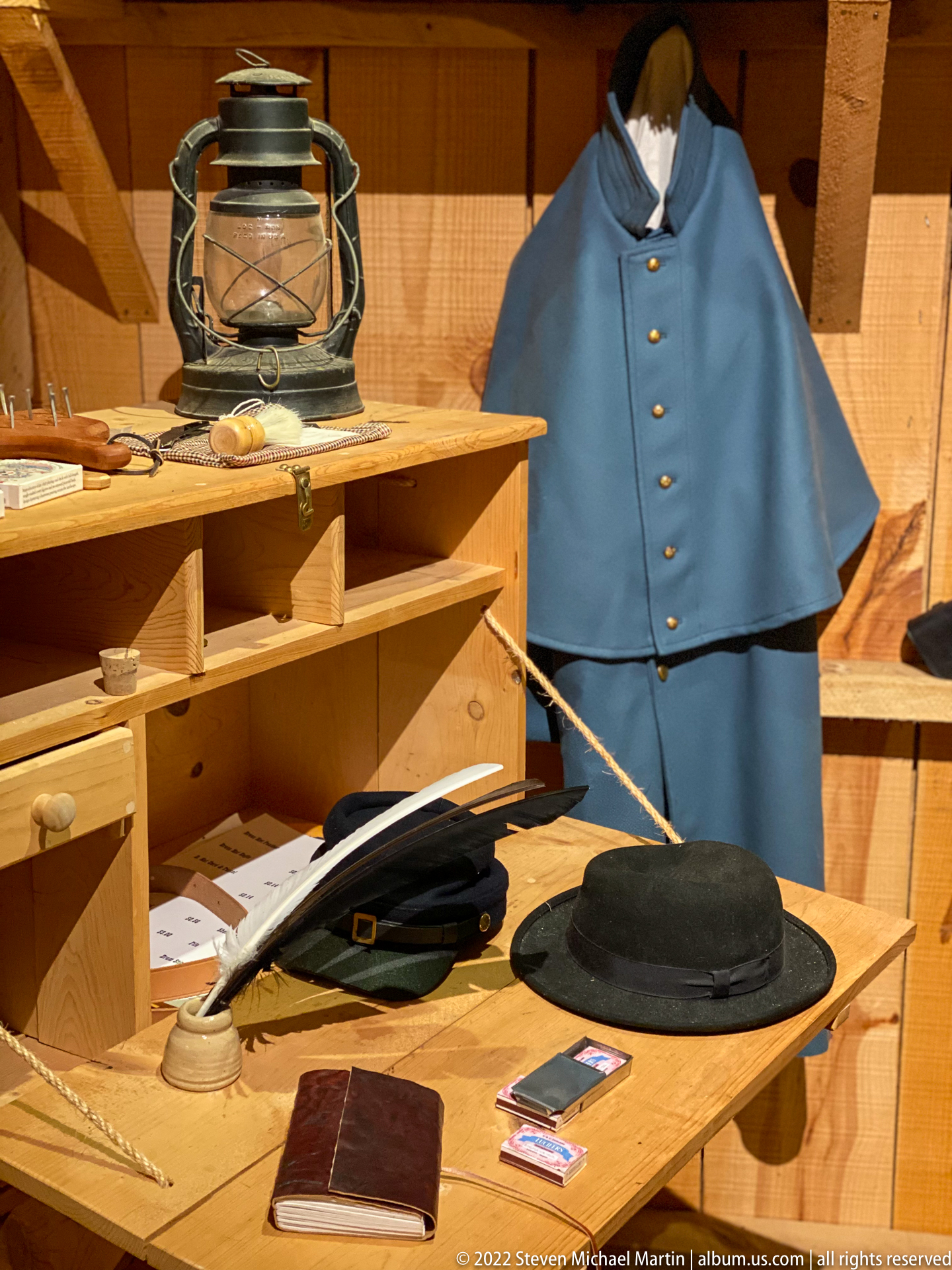
A blue buttoned garment hangs behind a wooden table holding a dark cap, a second brimmed hat, folded papers or a booklet, and small personal objects. A lantern and additional items occupy the shelf to the left. The carefully staged arrangement presents clothing alongside possible everyday belongings, but the garment’s exact type and wearer are not identified by the visible details alone.
Caption
A blue buttoned garment hangs behind a wooden table holding a dark cap, a second brimmed hat, folded papers or a booklet, and small personal objects. A lantern and additional items occupy the shelf to the left. The carefully staged arrangement presents clothing alongside possible everyday belongings, but the garment’s exact type and wearer are not identified by the visible details alone.
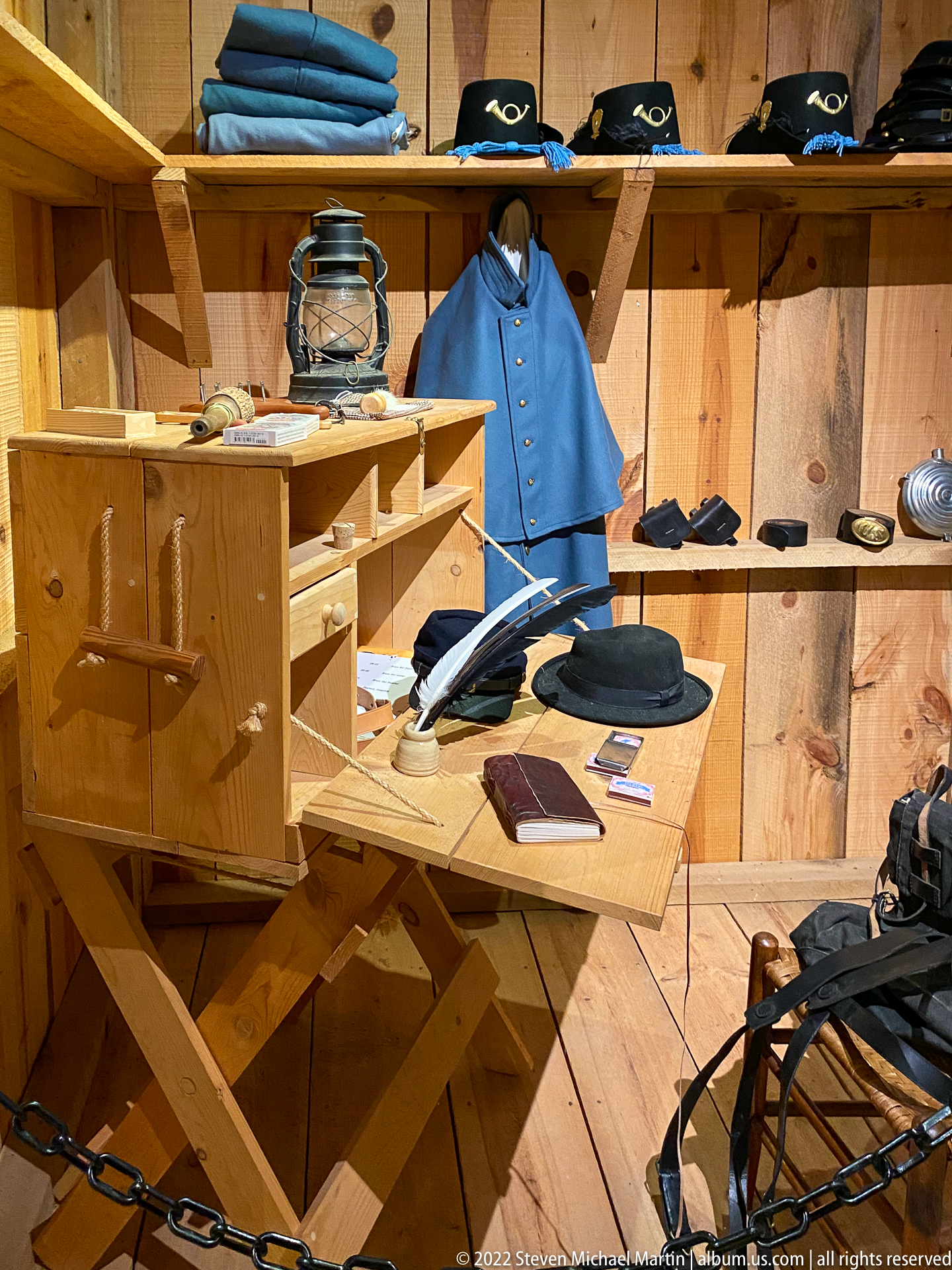
A wider gallery view brings together a blue buttoned garment, stacked hats, folded blue fabric, a lantern, and small objects arranged across wooden shelves and a worktable. A chain barrier crosses the foreground, marking the exhibit boundary. The additional furnishings and textiles provide context for the close clothing view on the preceding image, while the exact identity of individual pieces remains uncertain.
Caption
A wider gallery view brings together a blue buttoned garment, stacked hats, folded blue fabric, a lantern, and small objects arranged across wooden shelves and a worktable. A chain barrier crosses the foreground, marking the exhibit boundary. The additional furnishings and textiles provide context for the close clothing view on the preceding image, while the exact identity of individual pieces remains uncertain.

A group of polished metal tableware is arranged along a wooden shelf: several cups and pitchers stand beside two upright plates, with flatware and shallow serving pieces gathered in front. Reflections from the gallery lights brighten the otherwise muted display. The arrangement emphasizes the variety and quantity of dining vessels, although their exact material and historical ownership are not confirmed by the proof sheet.
Caption
A group of polished metal tableware is arranged along a wooden shelf: several cups and pitchers stand beside two upright plates, with flatware and shallow serving pieces gathered in front. Reflections from the gallery lights brighten the otherwise muted display. The arrangement emphasizes the variety and quantity of dining vessels, although their exact material and historical ownership are not confirmed by the proof sheet.
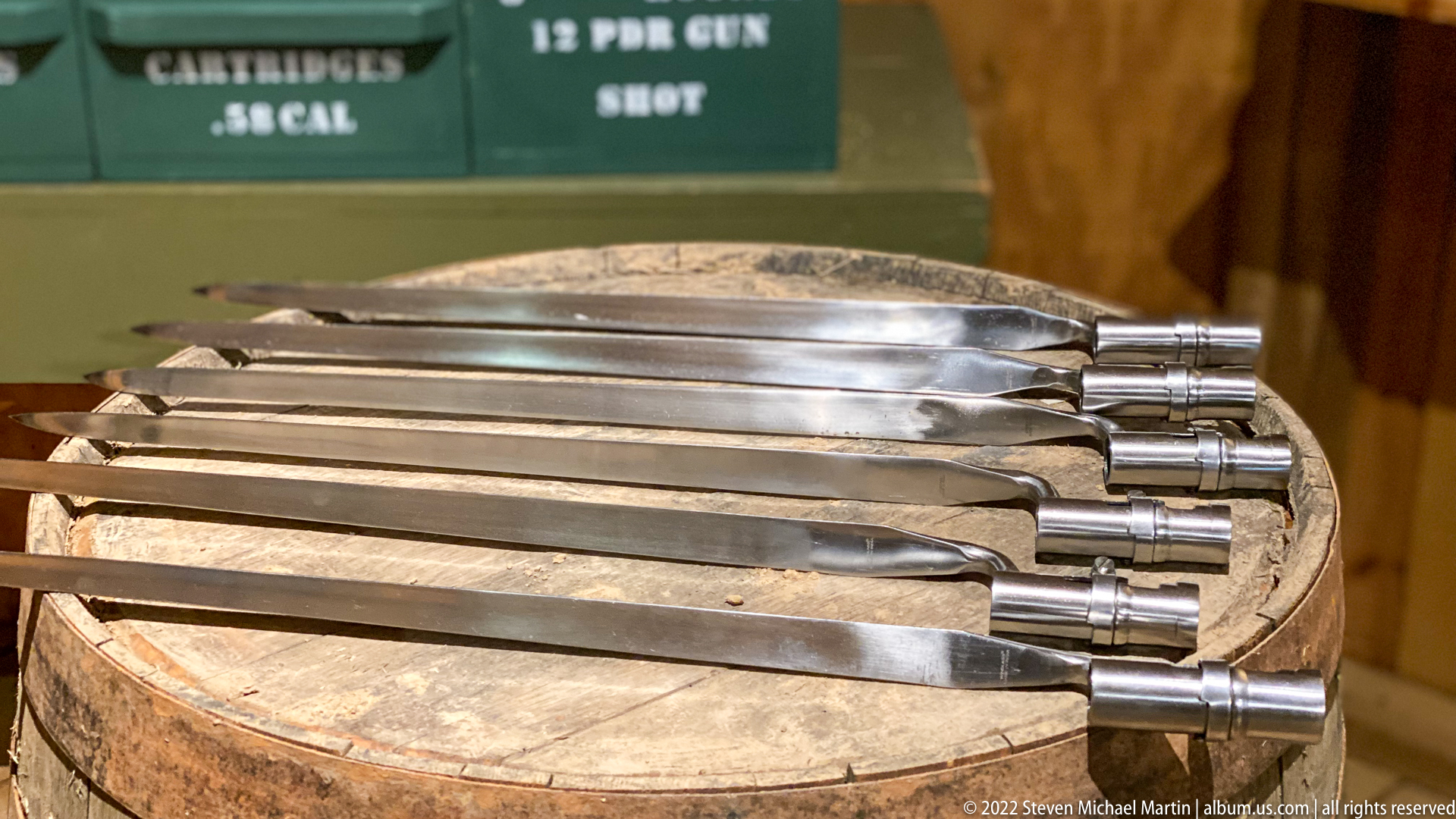
Several long, flat metal implements with thick cylindrical handles lie parallel across a round wooden tub. Their repeated shape and polished surfaces create a strong horizontal pattern, while a green sign and other wooden exhibit materials blur in the background. The proof-sheet view does not clearly establish their intended function, so the caption avoids labeling them as a particular weapon or tool.
Caption
Several long, flat metal implements with thick cylindrical handles lie parallel across a round wooden tub. Their repeated shape and polished surfaces create a strong horizontal pattern, while a green sign and other wooden exhibit materials blur in the background. The proof-sheet view does not clearly establish their intended function, so the caption avoids labeling them as a particular weapon or tool.
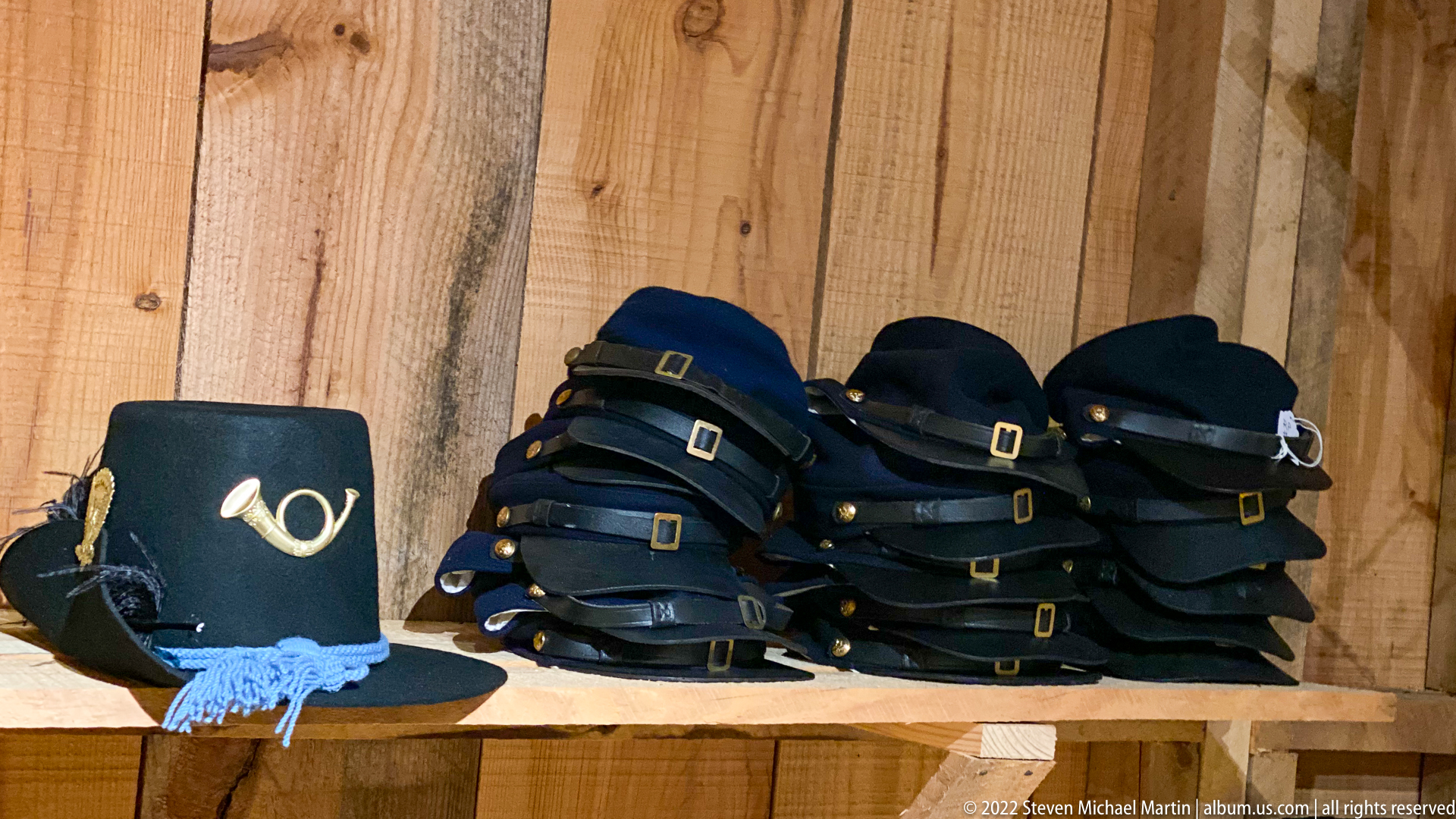
Several dark military-style caps are stacked in rows on a wooden shelf, with a blue hat bearing a bright insignia set apart at the left. The caps show variations in crown shape, brim, and small brass-colored fittings. The display suggests military headwear, but uniforms, exact service branches, and dates are not established by the visible view.
Caption
Several dark military-style caps are stacked in rows on a wooden shelf, with a blue hat bearing a bright insignia set apart at the left. The caps show variations in crown shape, brim, and small brass-colored fittings. The display suggests military headwear, but uniforms, exact service branches, and dates are not established by the visible view.
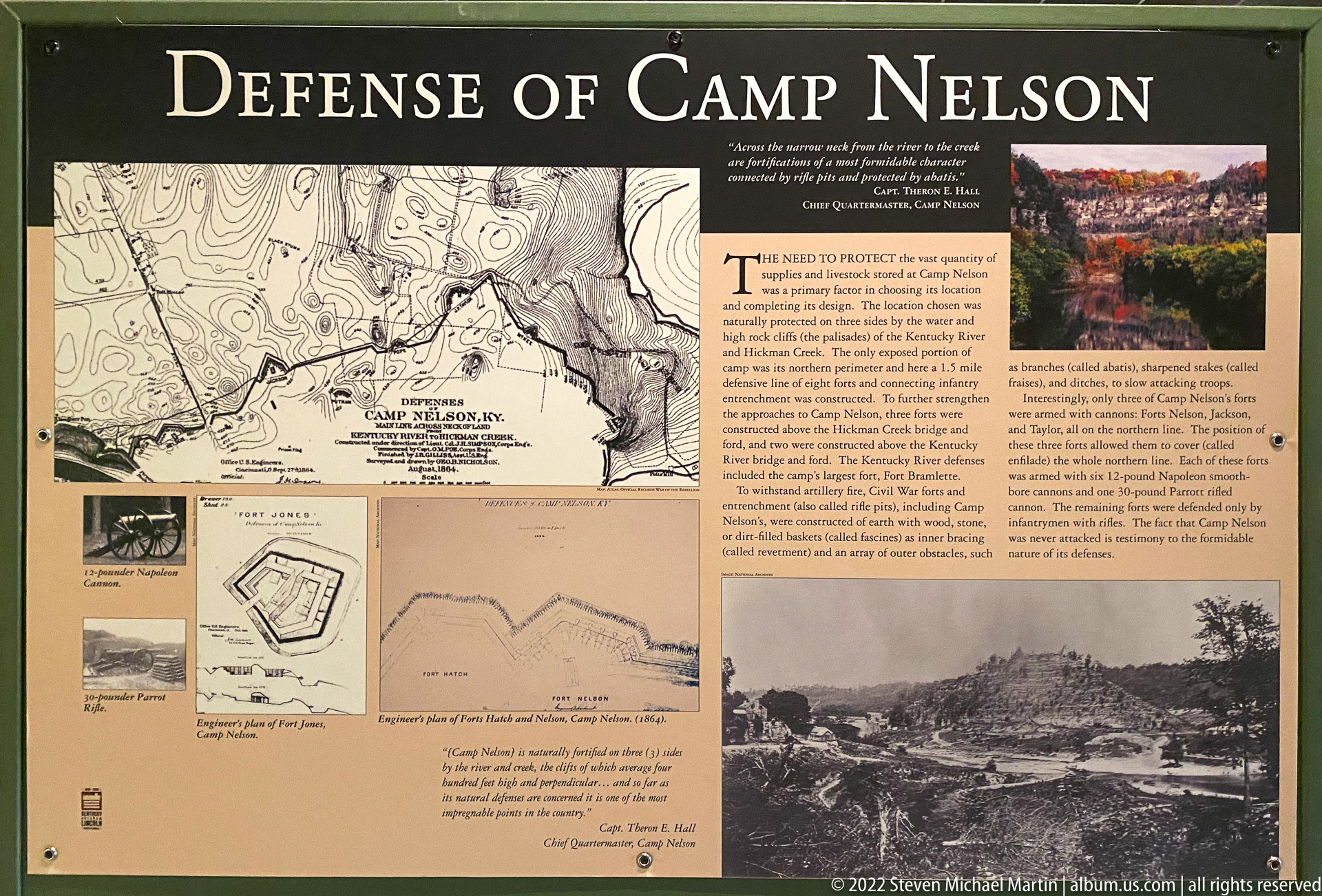
A large panel titled “Defense of Camp Nelson” combines a topographic map, smaller fortification plans, historic photographs, and columns of explanatory text. A small color landscape image appears near the upper right, contrasting with the archival material. The view makes the panel’s layered visual evidence clear, though its fine print and the names of individual defensive works cannot be read reliably from the proof sheet.
Caption
A large panel titled “Defense of Camp Nelson” combines a topographic map, smaller fortification plans, historic photographs, and columns of explanatory text. A small color landscape image appears near the upper right, contrasting with the archival material. The view makes the panel’s layered visual evidence clear, though its fine print and the names of individual defensive works cannot be read reliably from the proof sheet.
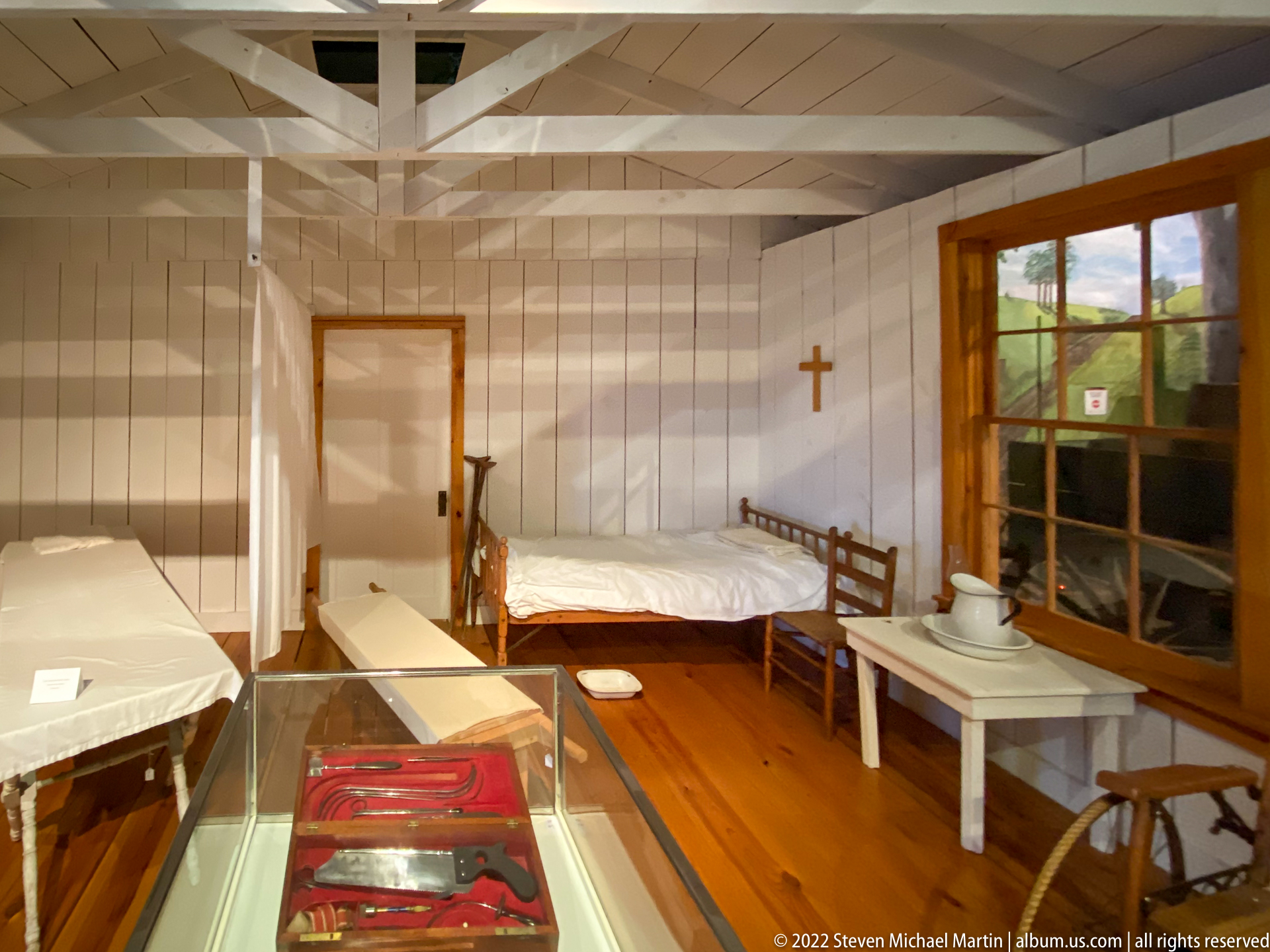
A reconstructed room has white vertical-board walls, two narrow beds, a simple privacy screen, and a small table holding a basin and pitcher. A wooden cross hangs above the nearer bed, while a glass case containing instruments occupies the foreground. The sparse furnishings and orderly layout evoke an institutional room; the photograph does not identify a specific patient or date for the reconstruction.
Caption
A reconstructed room has white vertical-board walls, two narrow beds, a simple privacy screen, and a small table holding a basin and pitcher. A wooden cross hangs above the nearer bed, while a glass case containing instruments occupies the foreground. The sparse furnishings and orderly layout evoke an institutional room; the photograph does not identify a specific patient or date for the reconstruction.
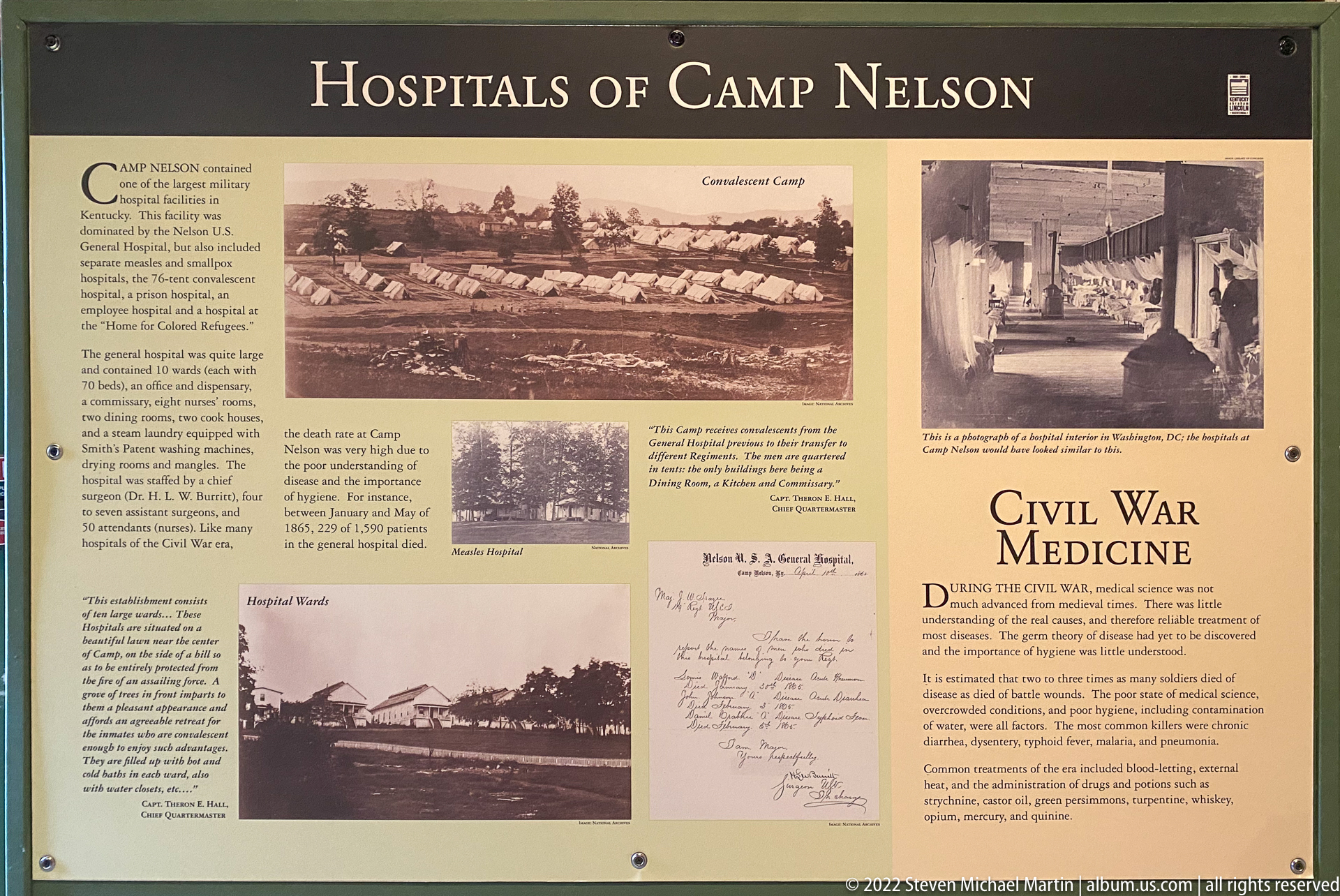
A large panel titled “Hospitals of Camp Nelson” combines explanatory text with several historic photographs of hospital buildings, wards, and grounds. A small handwritten document appears near the lower right, while the words “Civil War Medicine” mark the section below. The museum view foregrounds the range of visual evidence assembled to explain medical care at the camp; fine text is not legible at this scale.
Caption
A large panel titled “Hospitals of Camp Nelson” combines explanatory text with several historic photographs of hospital buildings, wards, and grounds. A small handwritten document appears near the lower right, while the words “Civil War Medicine” mark the section below. The museum view foregrounds the range of visual evidence assembled to explain medical care at the camp; fine text is not legible at this scale.
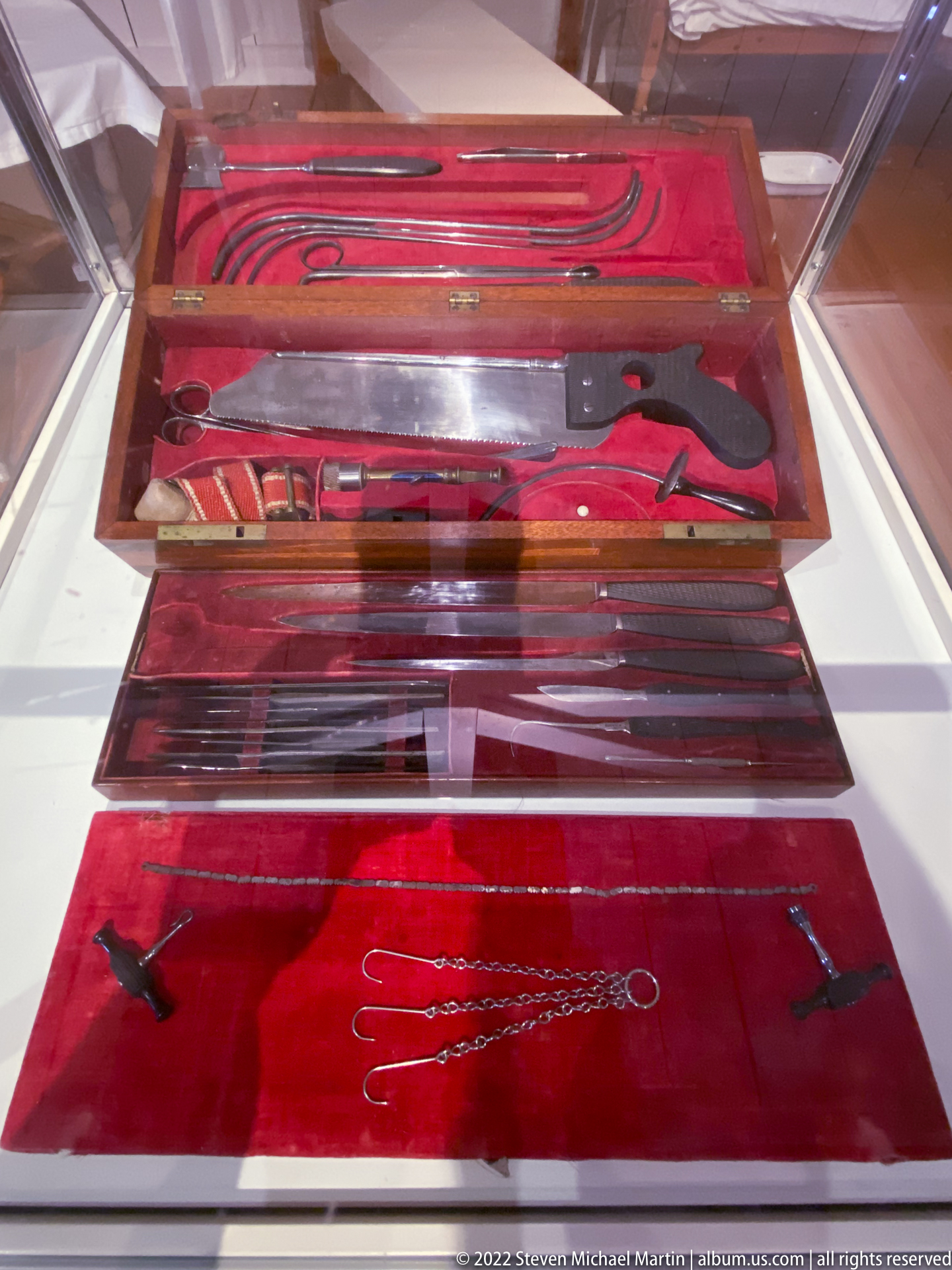
A glass case contains several long metal instruments set into red-lined, fitted trays, with dark handles and slender shafts arranged in parallel. The strong red backing separates the tools from the surrounding pale gallery surfaces and emphasizes their varied shapes. The adjacent reconstructed room suggests a medical context, but the precise instrument types and their historical use require confirmation from the display label.
Caption
A glass case contains several long metal instruments set into red-lined, fitted trays, with dark handles and slender shafts arranged in parallel. The strong red backing separates the tools from the surrounding pale gallery surfaces and emphasizes their varied shapes. The adjacent reconstructed room suggests a medical context, but the precise instrument types and their historical use require confirmation from the display label.
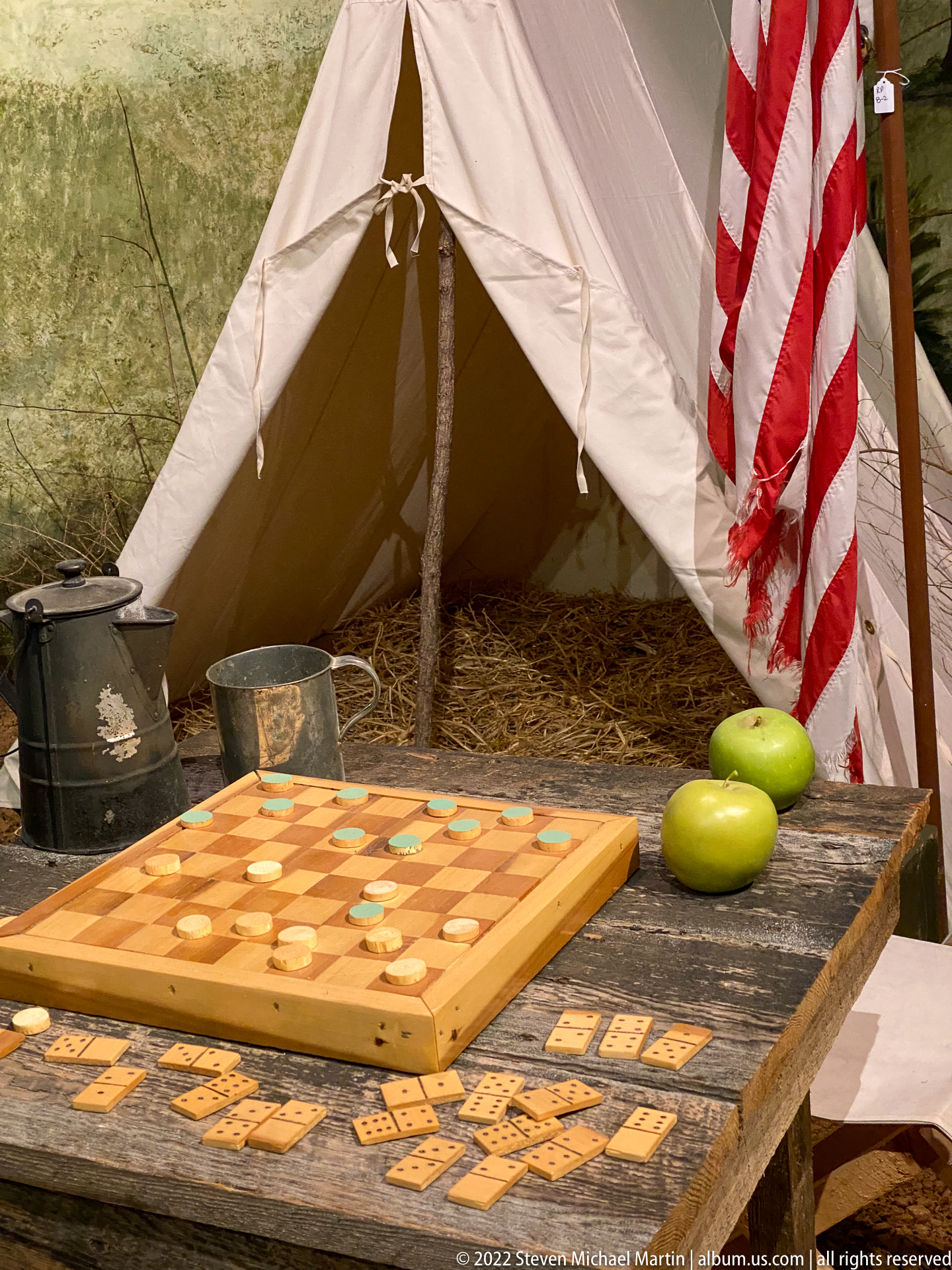
A checkerboard with light and dark pieces sits on a rough table beside tin pots and cups, with additional small labeled pieces scattered along the front edge. A canvas tent and a U.S. flag occupy the background, and two green round objects rest near the board. This view concentrates on the tabletop arrangement within the recreated camp scene; the props are visible, though their specific historical associations are not stated.
Caption
A checkerboard with light and dark pieces sits on a rough table beside tin pots and cups, with additional small labeled pieces scattered along the front edge. A canvas tent and a U.S. flag occupy the background, and two green round objects rest near the board. This view concentrates on the tabletop arrangement within the recreated camp scene; the props are visible, though their specific historical associations are not stated.
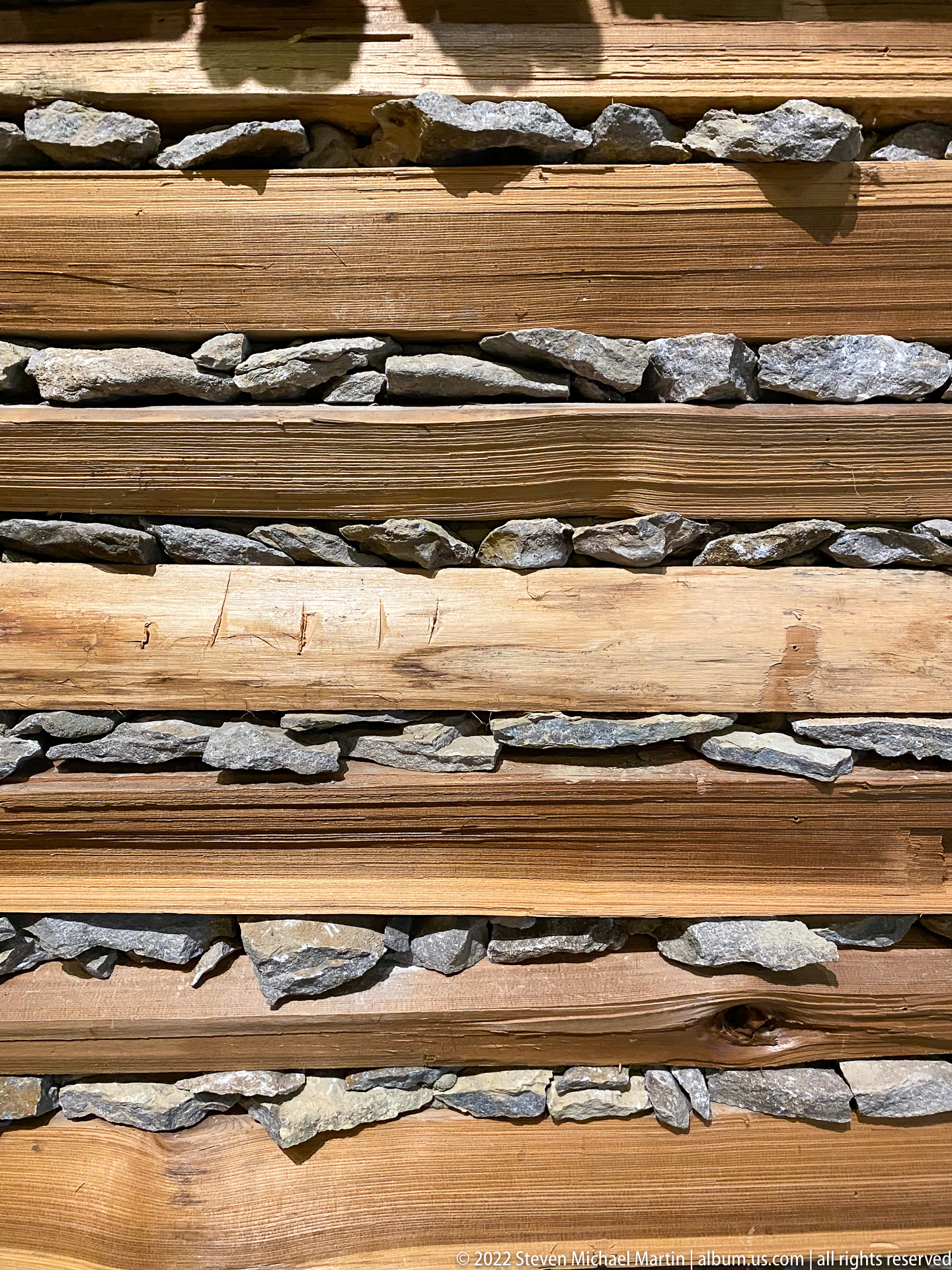
Alternating horizontal logs and narrow bands of flat gray stone fill the frame, showing the wall’s construction at close range. The timber surfaces vary in color and finish, from pale cut faces to darker weathered sections, while the irregular stones pack the gaps between courses. This detail isolates the building technique and material contrast, complementing the preceding interior view without identifying the structure’s original date.
Caption
Alternating horizontal logs and narrow bands of flat gray stone fill the frame, showing the wall’s construction at close range. The timber surfaces vary in color and finish, from pale cut faces to darker weathered sections, while the irregular stones pack the gaps between courses. This detail isolates the building technique and material contrast, complementing the preceding interior view without identifying the structure’s original date.
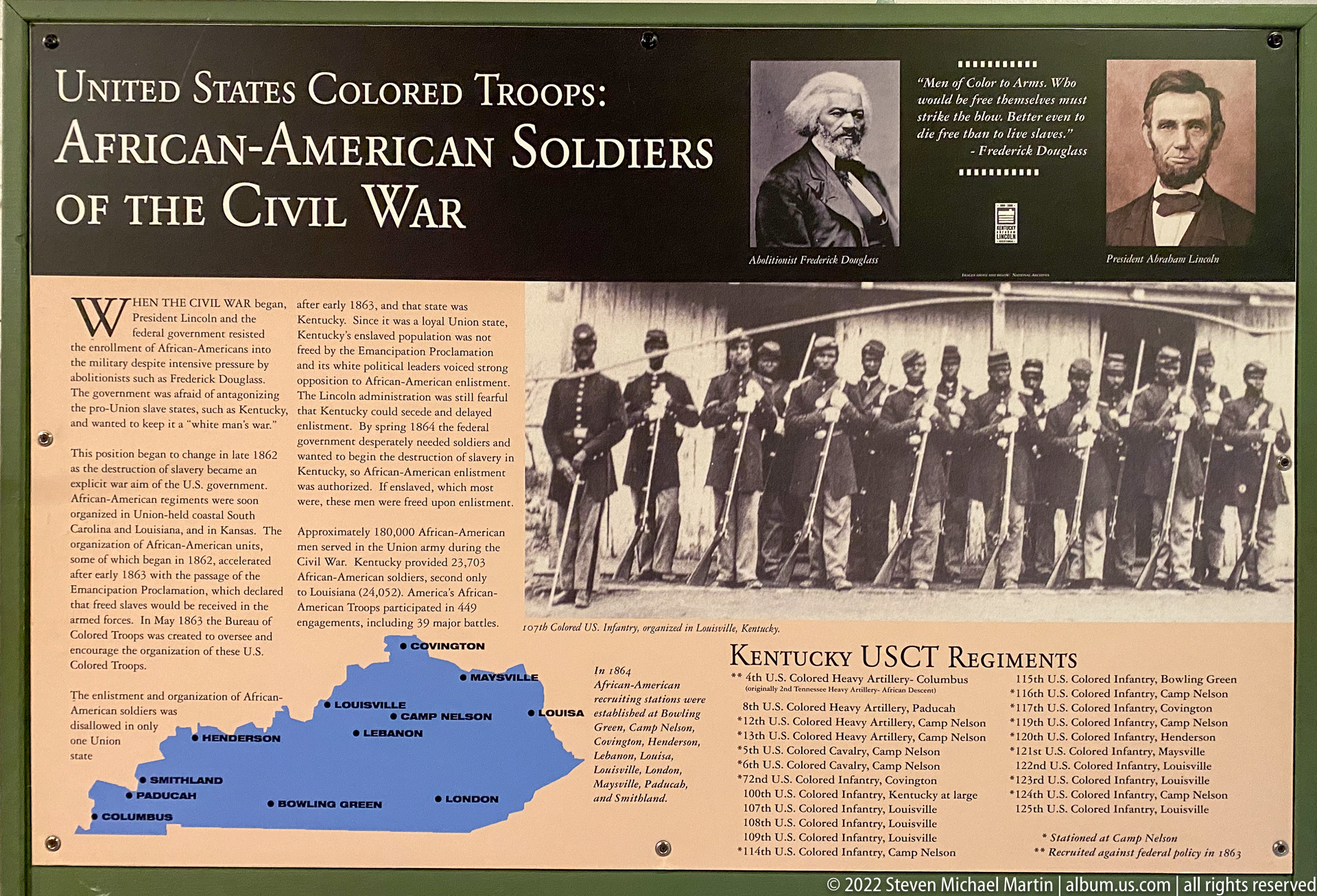
An interpretive panel titled “United States Colored Troops: African American Soldiers of the Civil War” pairs portraits of Abraham Lincoln and Frederick Douglass with a long historic group photograph of uniformed soldiers. A blue map of Kentucky and lists of regiments fill the lower section. The image places the soldiers’ photograph at the center while showing how the exhibit connects their service to locations across the state.
Caption
An interpretive panel titled “United States Colored Troops: African American Soldiers of the Civil War” pairs portraits of Abraham Lincoln and Frederick Douglass with a long historic group photograph of uniformed soldiers. A blue map of Kentucky and lists of regiments fill the lower section. The image places the soldiers’ photograph at the center while showing how the exhibit connects their service to locations across the state.
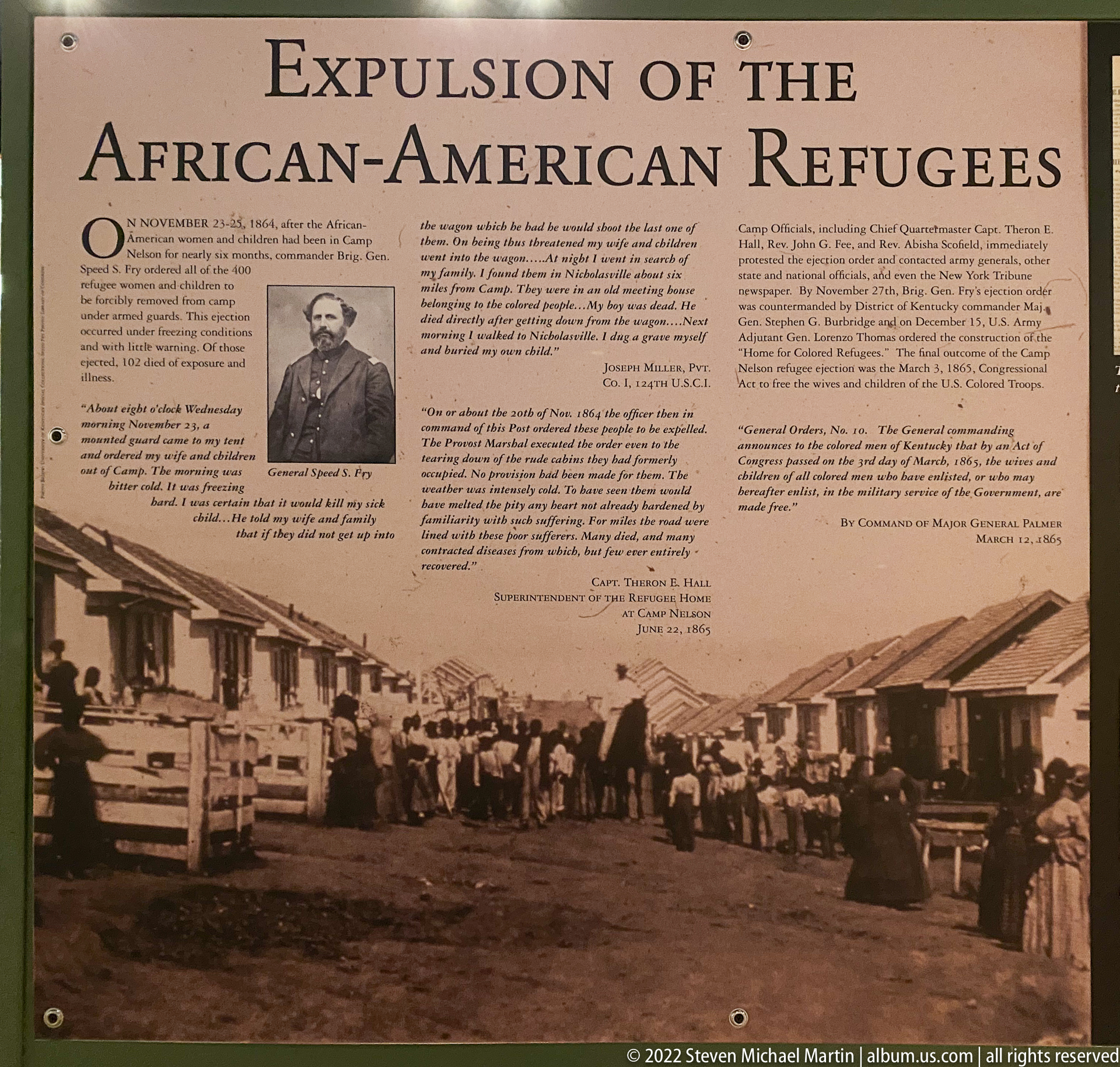
A panel headed “Expulsion of the African-American Refugees” combines a portrait of a bearded man with a large historic photograph of people gathered between rows of buildings. Several blocks of text explain the subject, while a smaller archival image appears in the lower section. The crowded scene occupies the strongest visual area, linking the panel’s narrative to a specific historic photograph without assigning identities to its figures.
Caption
A panel headed “Expulsion of the African-American Refugees” combines a portrait of a bearded man with a large historic photograph of people gathered between rows of buildings. Several blocks of text explain the subject, while a smaller archival image appears in the lower section. The crowded scene occupies the strongest visual area, linking the panel’s narrative to a specific historic photograph without assigning identities to its figures.
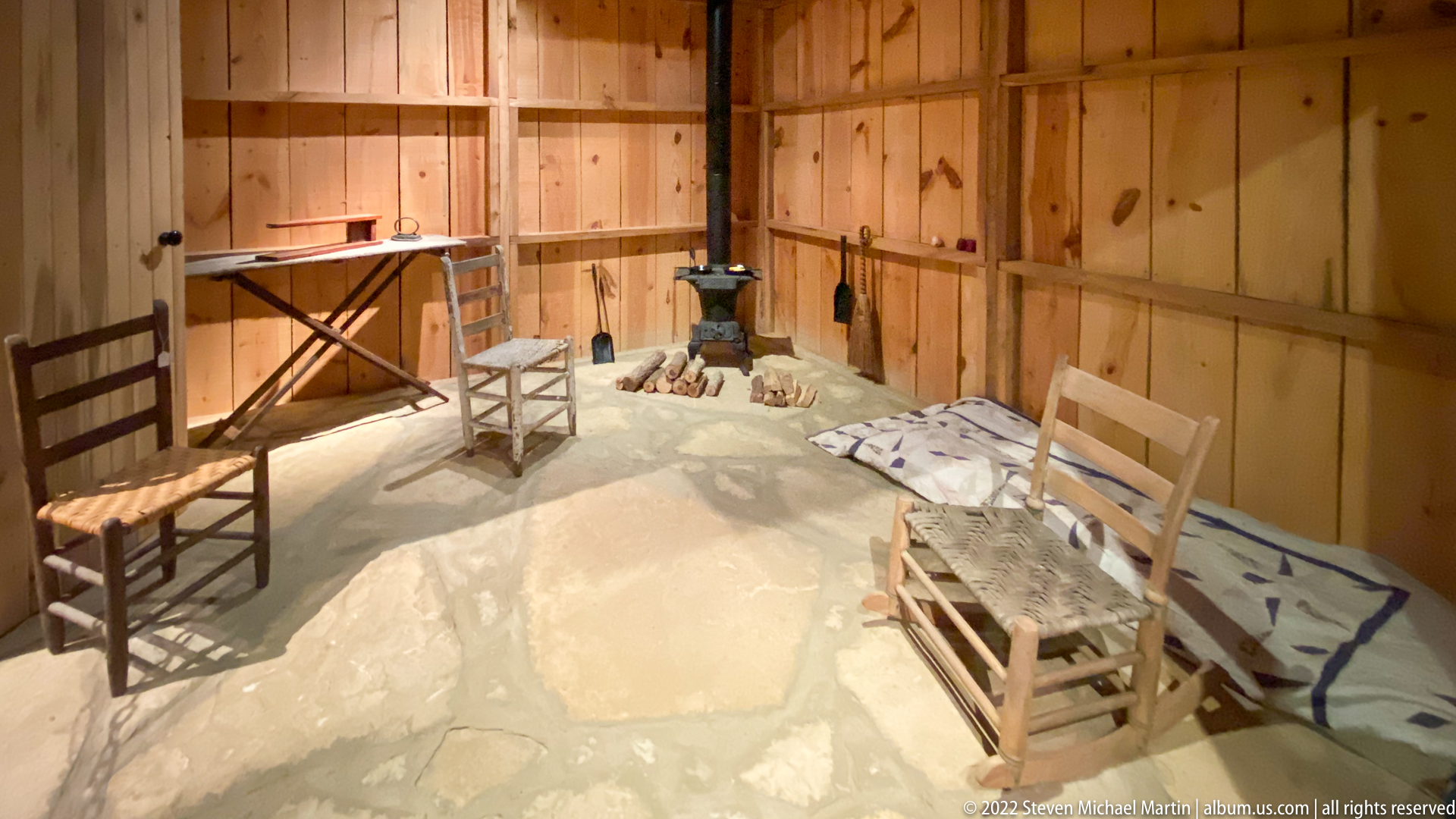
A small cabin room is furnished with wooden chairs, a narrow table, a bed, and a black iron stove set against plank walls. A pale uneven floor surface fills the foreground, and neatly arranged bedding rests along the right wall. Warm interior lighting makes the compact room legible as a recreated domestic space without establishing a specific historical occupant.
Caption
A small cabin room is furnished with wooden chairs, a narrow table, a bed, and a black iron stove set against plank walls. A pale uneven floor surface fills the foreground, and neatly arranged bedding rests along the right wall. Warm interior lighting makes the compact room legible as a recreated domestic space without establishing a specific historical occupant.
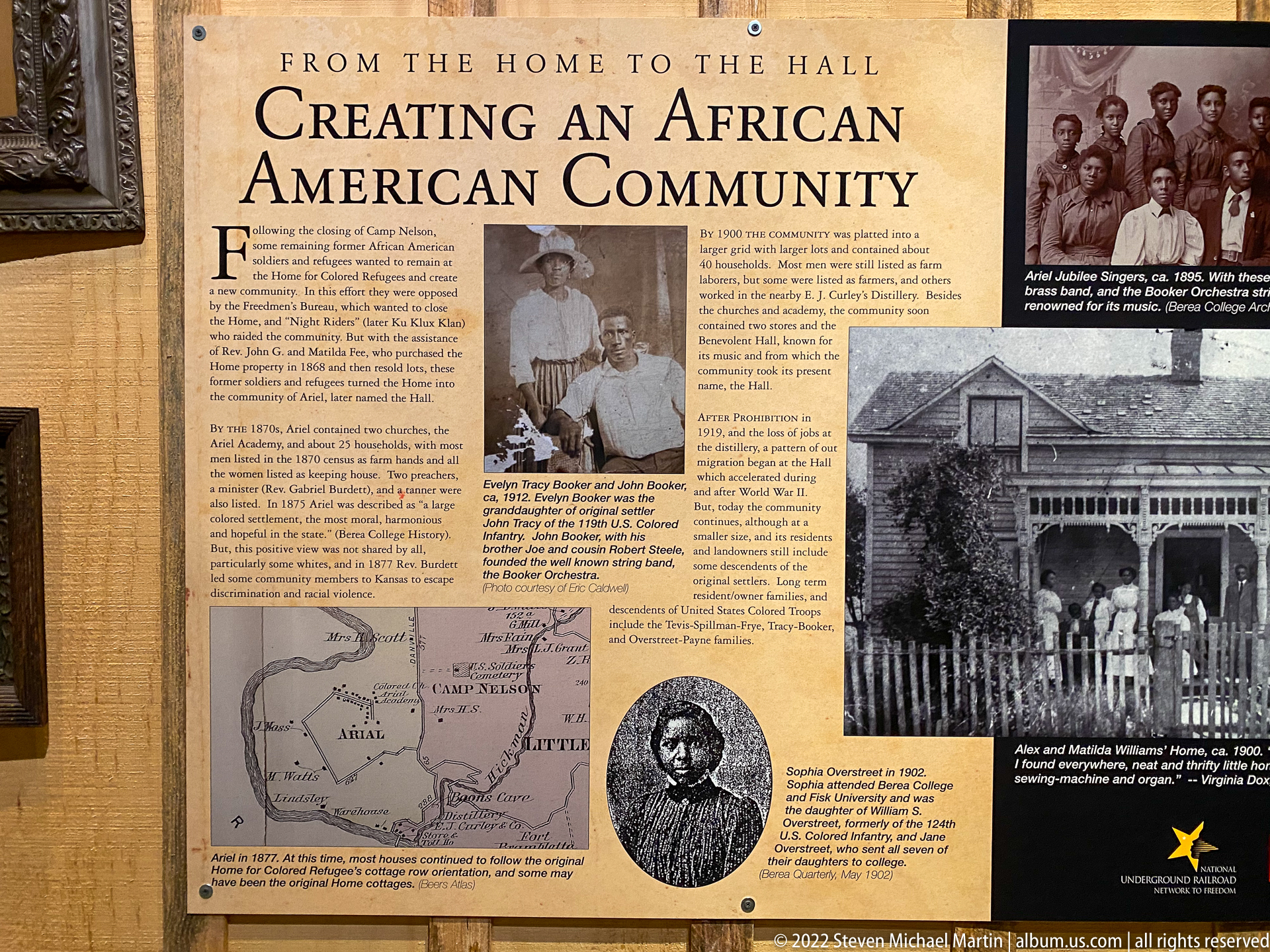
An exhibit panel titled “Creating an African American Community” combines archival photographs, a map, portrait images, and explanatory text. A large group portrait and an image of a substantial house occupy the right side, while a map and smaller portraits fill the lower portion. The arrangement connects personal histories with the community described by the panel.
Caption
An exhibit panel titled “Creating an African American Community” combines archival photographs, a map, portrait images, and explanatory text. A large group portrait and an image of a substantial house occupy the right side, while a map and smaller portraits fill the lower portion. The arrangement connects personal histories with the community described by the panel.
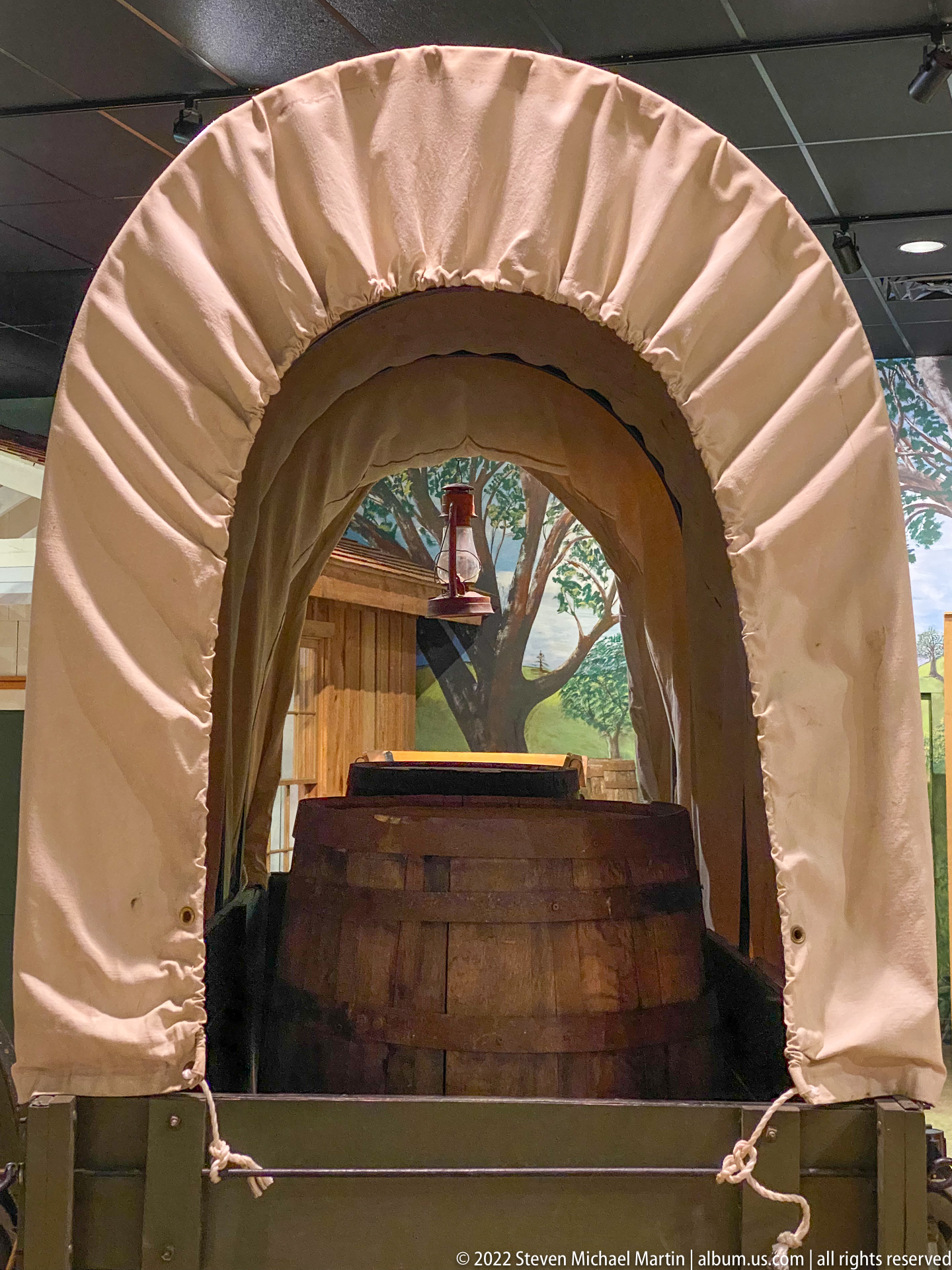
A pale canvas hood arches over the wooden bed of a covered wagon, its curved opening framing a dark interior and a small hanging lantern. The wagon sits behind a low rope barrier inside a gallery, with a painted landscape visible beyond. The close angle emphasizes the stretched fabric and wooden structure rather than the vehicle’s full form.
Caption
A pale canvas hood arches over the wooden bed of a covered wagon, its curved opening framing a dark interior and a small hanging lantern. The wagon sits behind a low rope barrier inside a gallery, with a painted landscape visible beyond. The close angle emphasizes the stretched fabric and wooden structure rather than the vehicle’s full form.
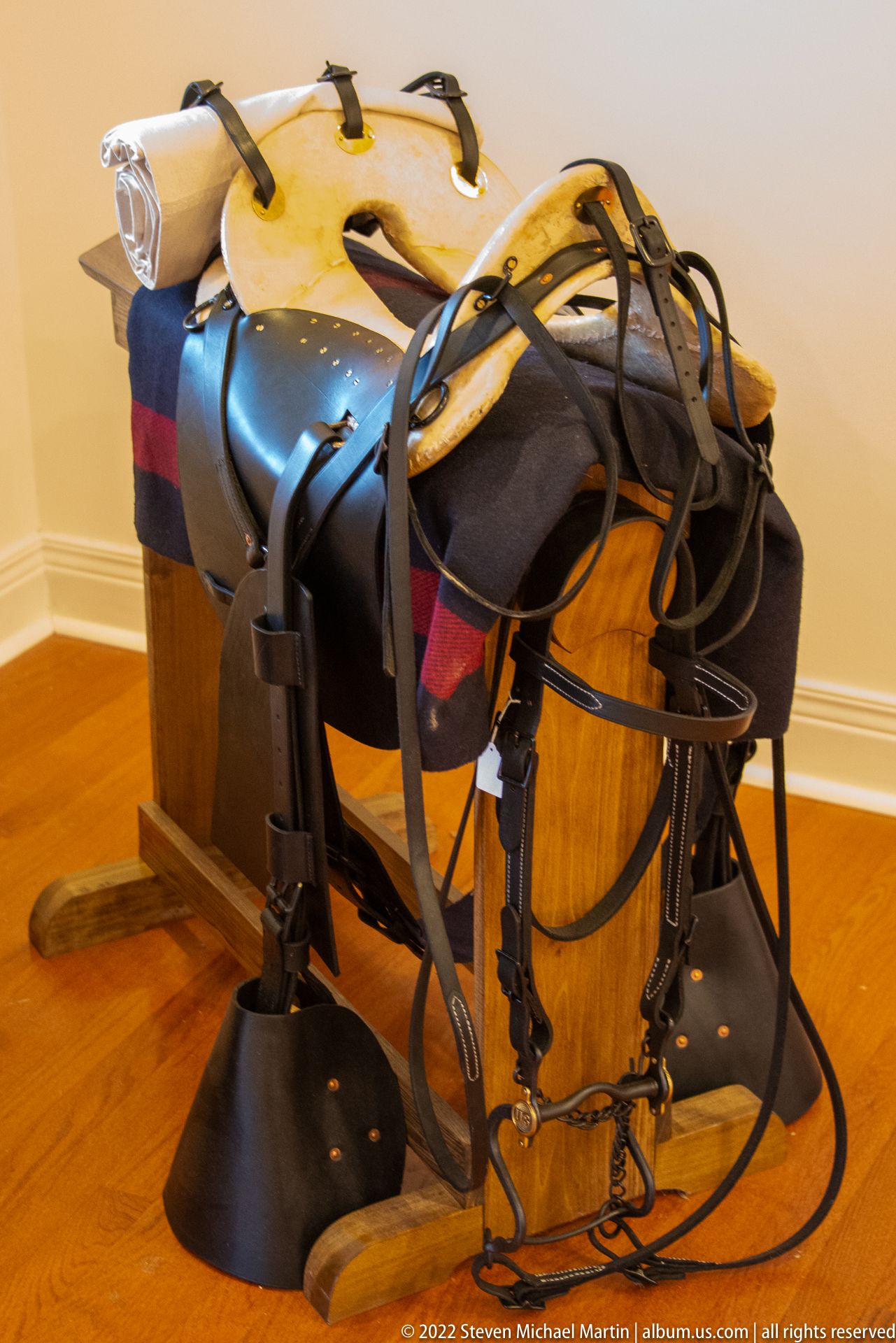
A dark leather saddle and associated straps rest across a wooden support in a warmly lit gallery. A pale patterned blanket drapes over the seat, and metal fittings and loops of leather tack gather around the saddle. The close view reveals the arrangement and materials of the riding gear while the room’s interpretive context remains outside the frame.
Caption
A dark leather saddle and associated straps rest across a wooden support in a warmly lit gallery. A pale patterned blanket drapes over the seat, and metal fittings and loops of leather tack gather around the saddle. The close view reveals the arrangement and materials of the riding gear while the room’s interpretive context remains outside the frame.
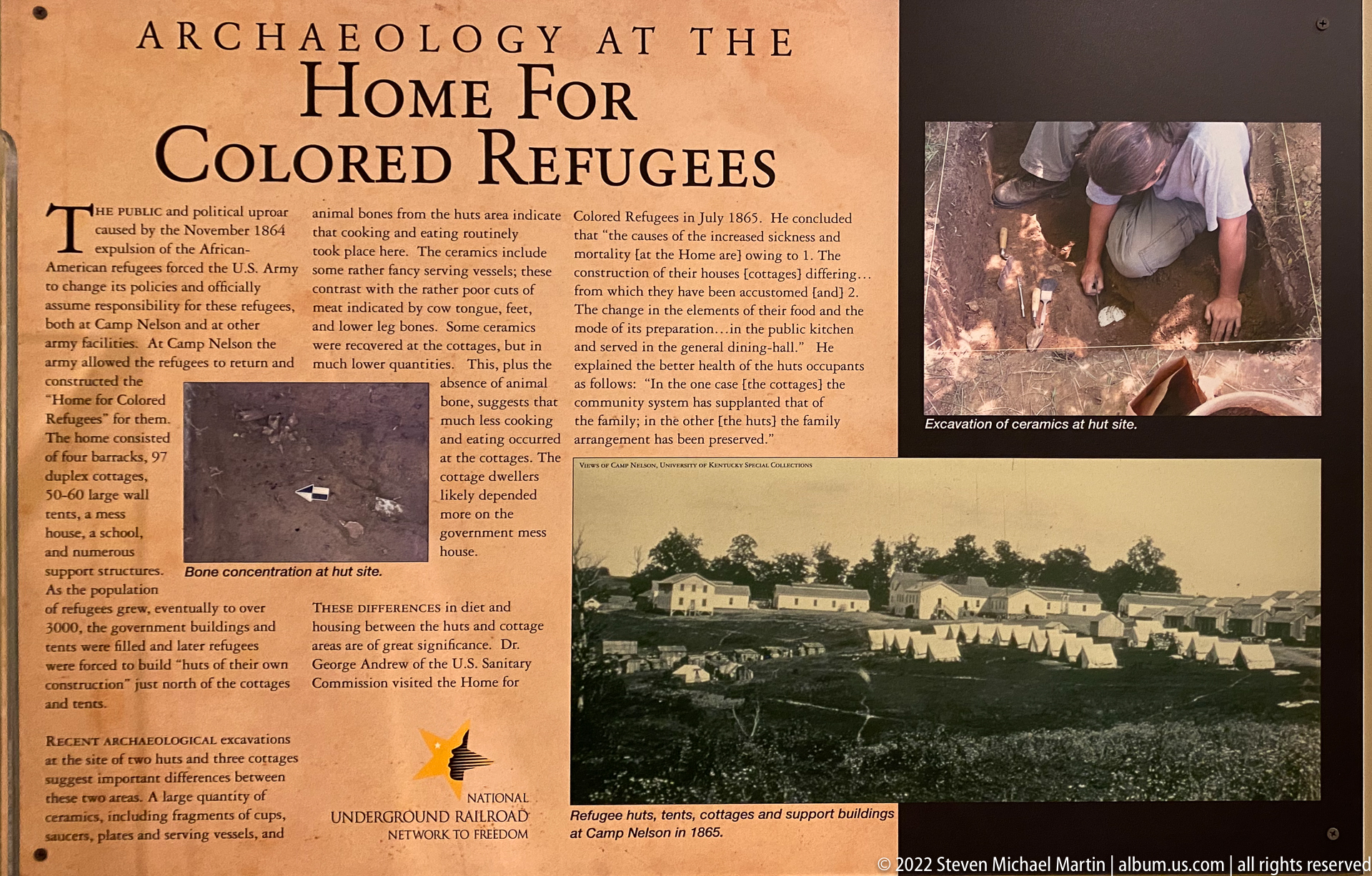
A tall interpretive panel headed “Archaeology at the Home for Colored Refugees” presents excavation photographs, artifact images, and text about the site. A broad historical view of buildings fills the lower section, while smaller images show excavated objects and a stone concentration. The panel’s layout links archaeological evidence to the former settlement without requiring claims beyond its printed interpretation.
Caption
A tall interpretive panel headed “Archaeology at the Home for Colored Refugees” presents excavation photographs, artifact images, and text about the site. A broad historical view of buildings fills the lower section, while smaller images show excavated objects and a stone concentration. The panel’s layout links archaeological evidence to the former settlement without requiring claims beyond its printed interpretation.
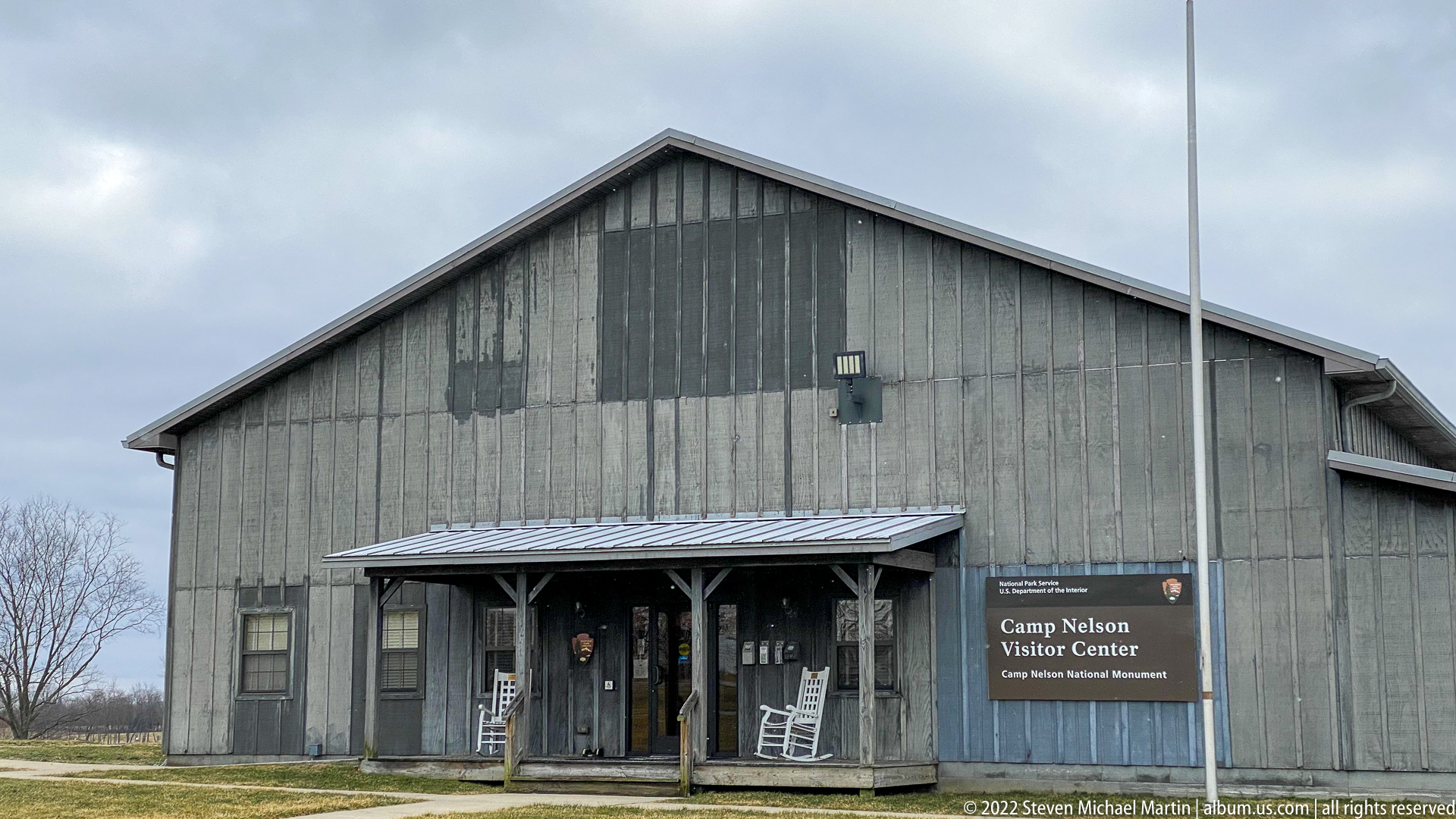
The Camp Nelson Visitor Center occupies a large gray timber-clad building with a steep gable, broad roof, and covered entrance porch. A sign beside the doors identifies the visitor center and the national monument. Bare trees and a flagpole flank the building, while the broad lawn and overcast sky give this frontal view an open, quiet setting.
Caption
The Camp Nelson Visitor Center occupies a large gray timber-clad building with a steep gable, broad roof, and covered entrance porch. A sign beside the doors identifies the visitor center and the national monument. Bare trees and a flagpole flank the building, while the broad lawn and overcast sky give this frontal view an open, quiet setting.

A black iron gate between square stone piers opens toward a large white house set among leafless trees. A low stone wall continues across the foreground, enclosing a lawn that rises gently toward the building. The centered approach makes the gate the immediate threshold while the house remains visible through the bars in the middle distance.
Caption
A black iron gate between square stone piers opens toward a large white house set among leafless trees. A low stone wall continues across the foreground, enclosing a lawn that rises gently toward the building. The centered approach makes the gate the immediate threshold while the house remains visible through the bars in the middle distance.
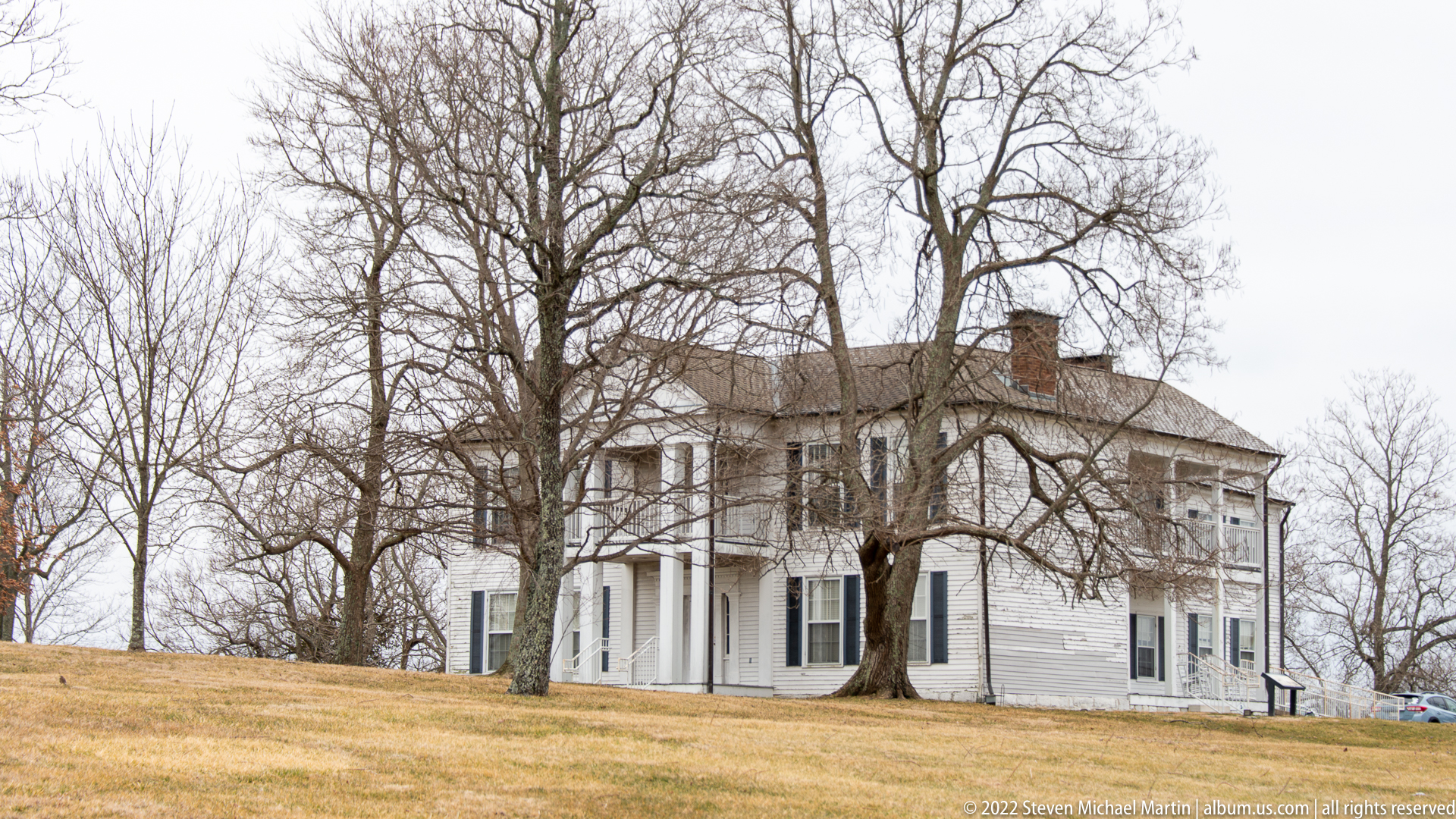
A large white two-story house stands behind a gently sloping lawn, its many windows, porch columns, and central roofline partly screened by mature leafless trees. The broad view shows the building from an oblique angle, revealing the length of its side wing as well as the front porch. The house’s exact historical identity is not established by the image.
Caption
A large white two-story house stands behind a gently sloping lawn, its many windows, porch columns, and central roofline partly screened by mature leafless trees. The broad view shows the building from an oblique angle, revealing the length of its side wing as well as the front porch. The house’s exact historical identity is not established by the image.
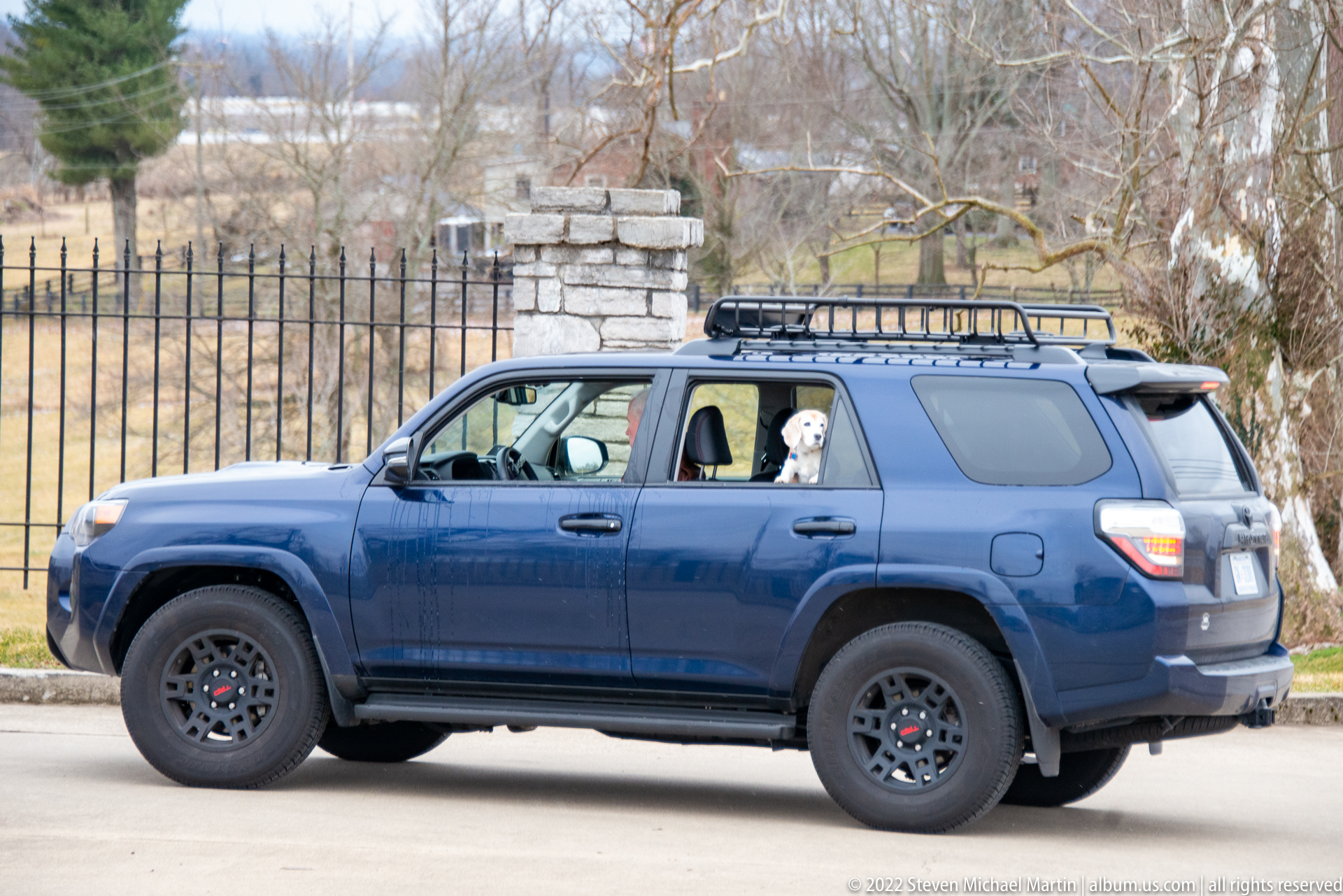
A blue sport utility vehicle is parked parallel to a black iron fence and stone piers, with a roof rack visible above its windows. A light-colored dog appears behind the front side window, looking outward. The vehicle fills most of the frame, bringing contemporary visitor access into a setting otherwise framed by the historic-looking gate and masonry.
Caption
A blue sport utility vehicle is parked parallel to a black iron fence and stone piers, with a roof rack visible above its windows. A light-colored dog appears behind the front side window, looking outward. The vehicle fills most of the frame, bringing contemporary visitor access into a setting otherwise framed by the historic-looking gate and masonry.
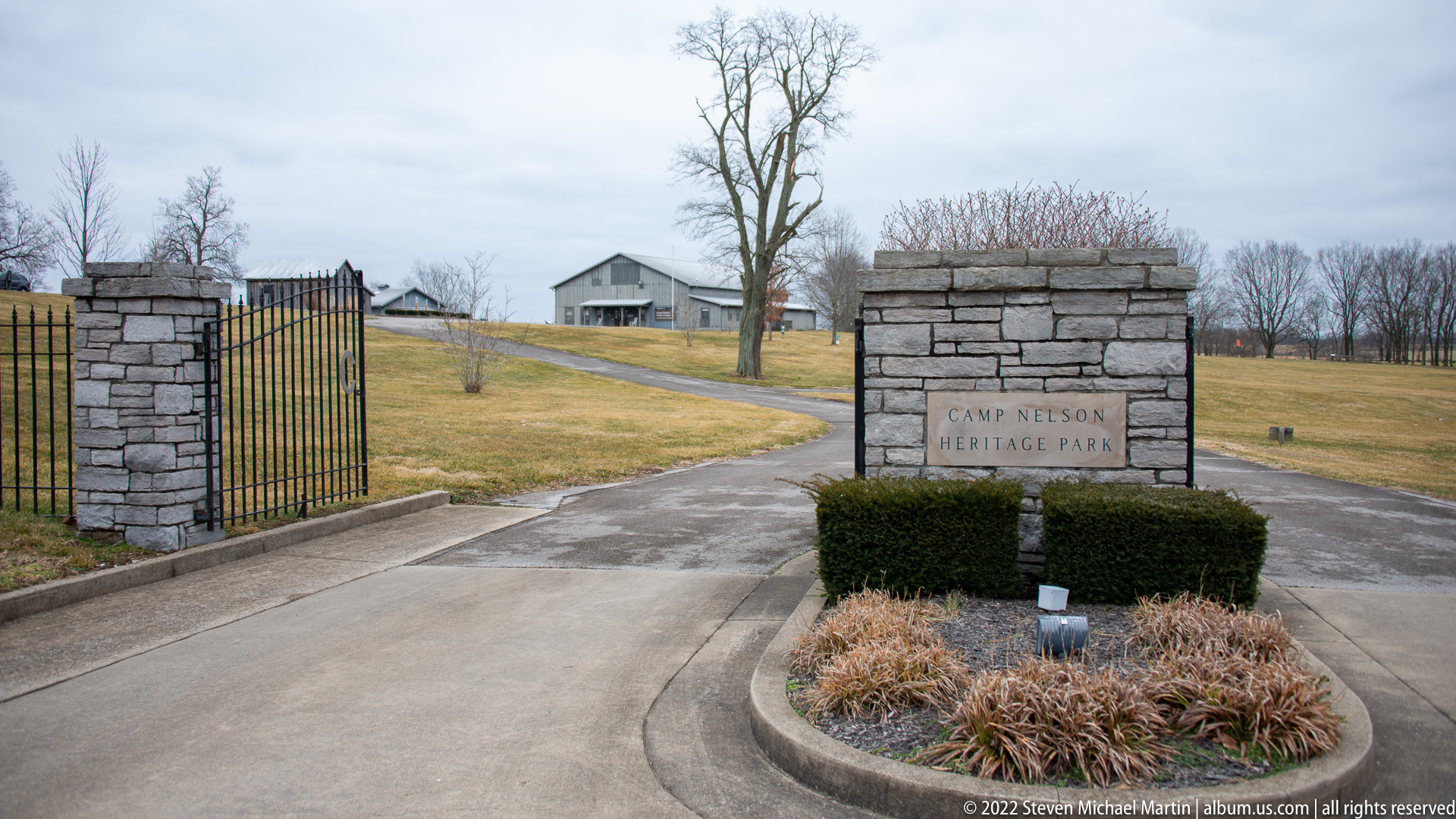
A paved drive passes between an open iron gate and a stone monument sign reading “Camp Nelson Heritage Park.” Low hedges and dormant ornamental grasses border the sign, while a visitor-center building and additional park structures sit farther back. The view looks inward from the entrance and connects the site name with the road and grounds beyond.
Caption
A paved drive passes between an open iron gate and a stone monument sign reading “Camp Nelson Heritage Park.” Low hedges and dormant ornamental grasses border the sign, while a visitor-center building and additional park structures sit farther back. The view looks inward from the entrance and connects the site name with the road and grounds beyond.
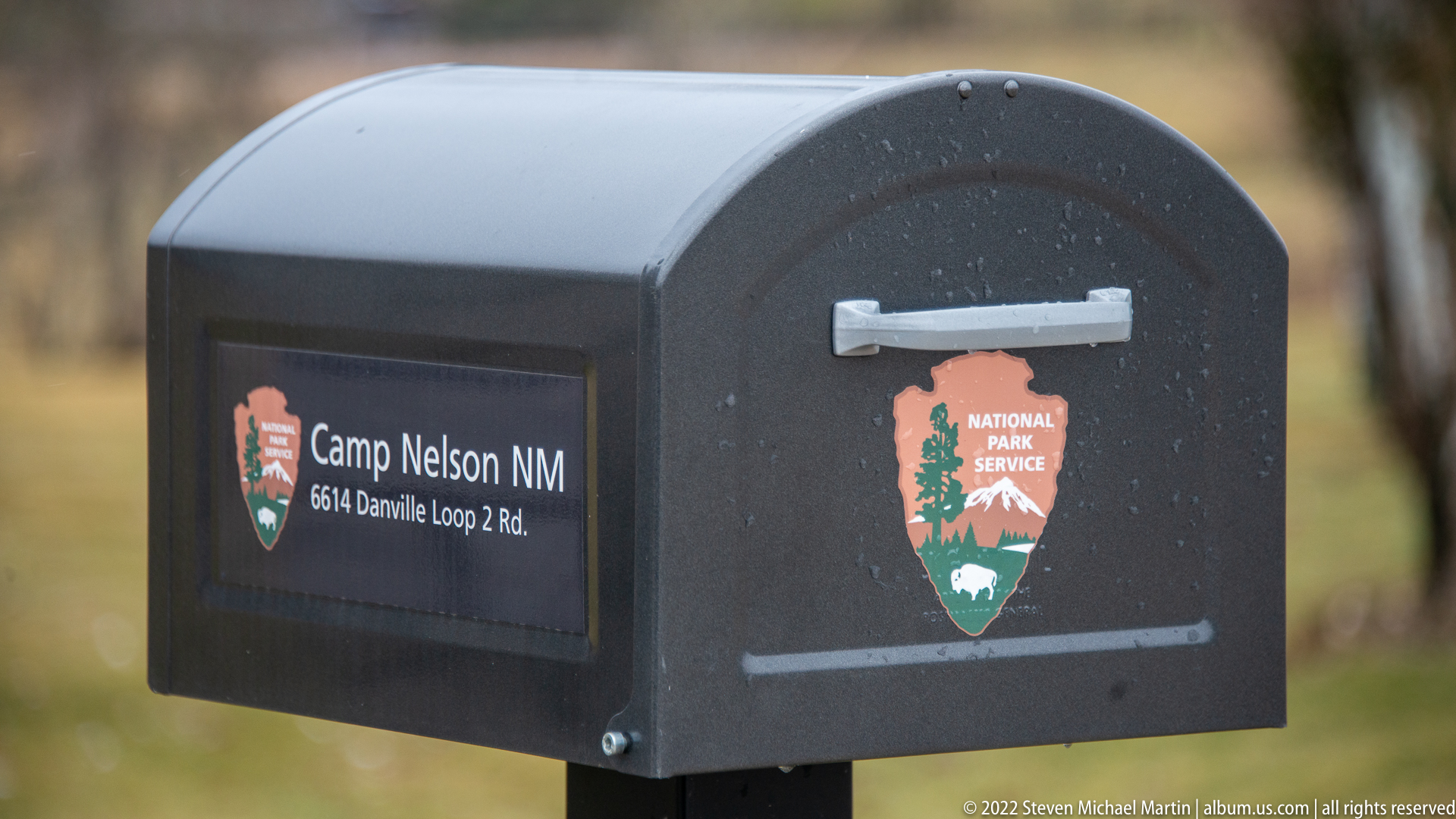
A black mailbox carries a small sign reading “Camp Nelson NM” with the address “6614 Danville Loop 2 Rd.” The National Park Service arrowhead emblem is fixed to the opposite side, and the curved metal lid and handle are sharply visible. The tight composition focuses on the park’s everyday wayfinding detail rather than a larger building or landscape.
Caption
A black mailbox carries a small sign reading “Camp Nelson NM” with the address “6614 Danville Loop 2 Rd.” The National Park Service arrowhead emblem is fixed to the opposite side, and the curved metal lid and handle are sharply visible. The tight composition focuses on the park’s everyday wayfinding detail rather than a larger building or landscape.
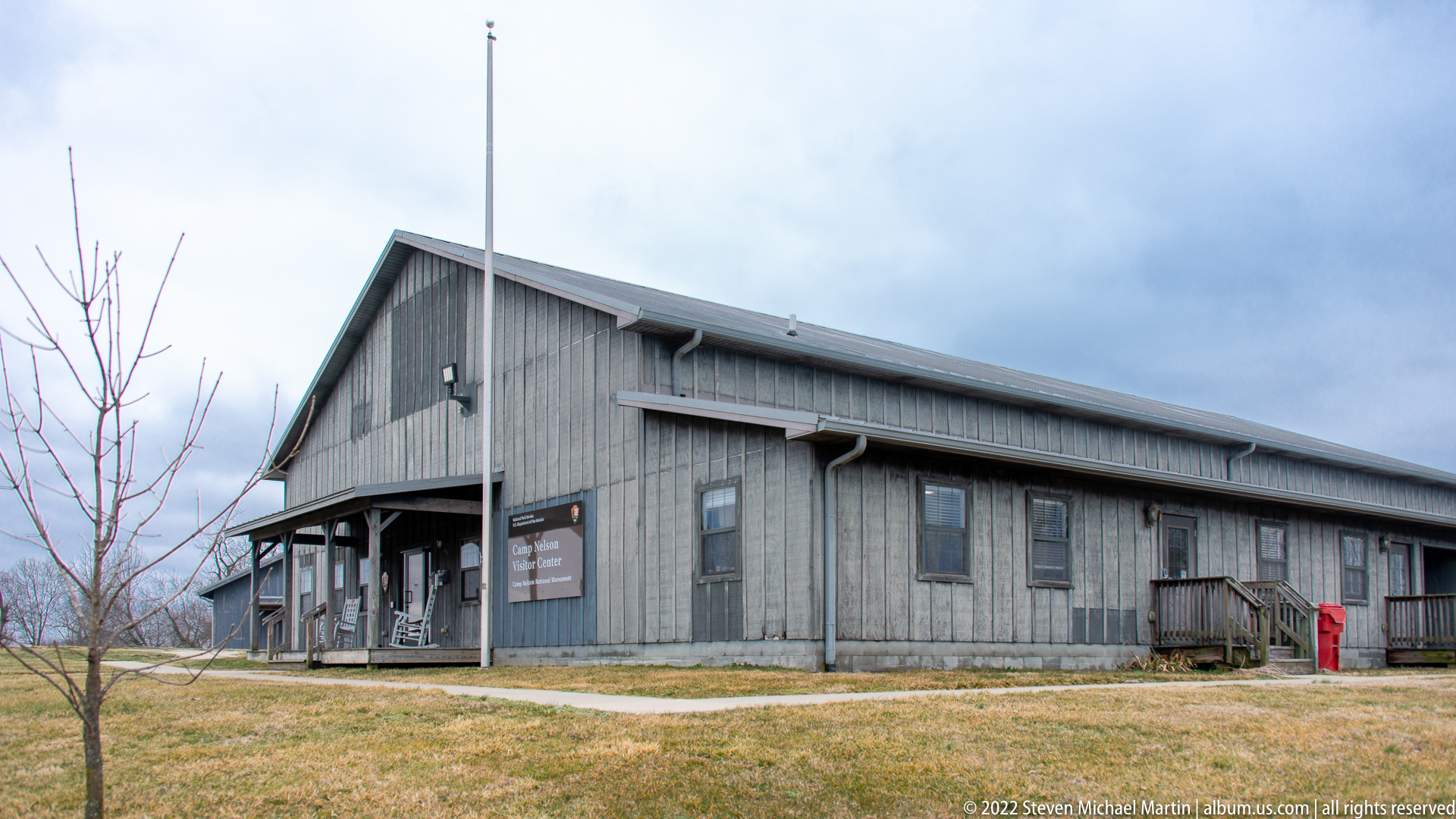
The visitor center extends across the frame, showing its long gray timber exterior, covered entrance, side windows, and accessibility ramp. A small sign hangs beside the front door, while a flagpole and young leafless tree rise from the clipped lawn. This wider oblique view reveals the building’s footprint and visitor approach more fully than the frontal view.
Caption
The visitor center extends across the frame, showing its long gray timber exterior, covered entrance, side windows, and accessibility ramp. A small sign hangs beside the front door, while a flagpole and young leafless tree rise from the clipped lawn. This wider oblique view reveals the building’s footprint and visitor approach more fully than the frontal view.
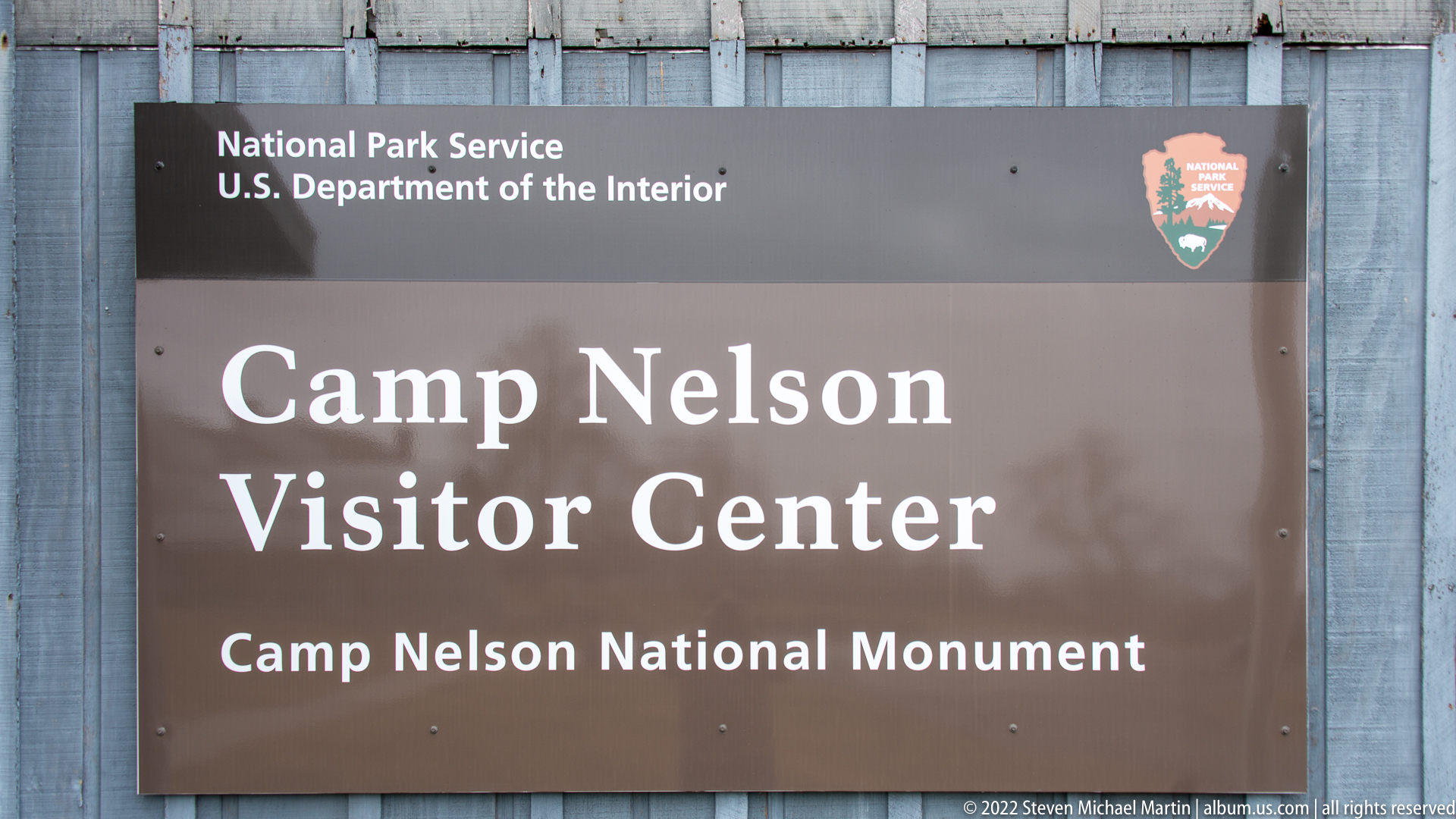
A large brown metal sign mounted on weathered gray siding reads “Camp Nelson Visitor Center” and “Camp Nelson National Monument.” The National Park Service and Department of the Interior names and arrowhead emblem appear above the main lettering. Framed tightly, the sign establishes the building’s public function and federal designation through its own visible text.
Caption
A large brown metal sign mounted on weathered gray siding reads “Camp Nelson Visitor Center” and “Camp Nelson National Monument.” The National Park Service and Department of the Interior names and arrowhead emblem appear above the main lettering. Framed tightly, the sign establishes the building’s public function and federal designation through its own visible text.

A white wooden rocking chair sits on a weathered porch in front of gray vertical siding and a glass entrance door. A National Park Service arrowhead plaque hangs above the chair, while a small sign and door notices occupy the wall to the right. The simple arrangement emphasizes a welcoming porch detail and the contrast between painted furniture and aged boards.
Caption
A white wooden rocking chair sits on a weathered porch in front of gray vertical siding and a glass entrance door. A National Park Service arrowhead plaque hangs above the chair, while a small sign and door notices occupy the wall to the right. The simple arrangement emphasizes a welcoming porch detail and the contrast between painted furniture and aged boards.
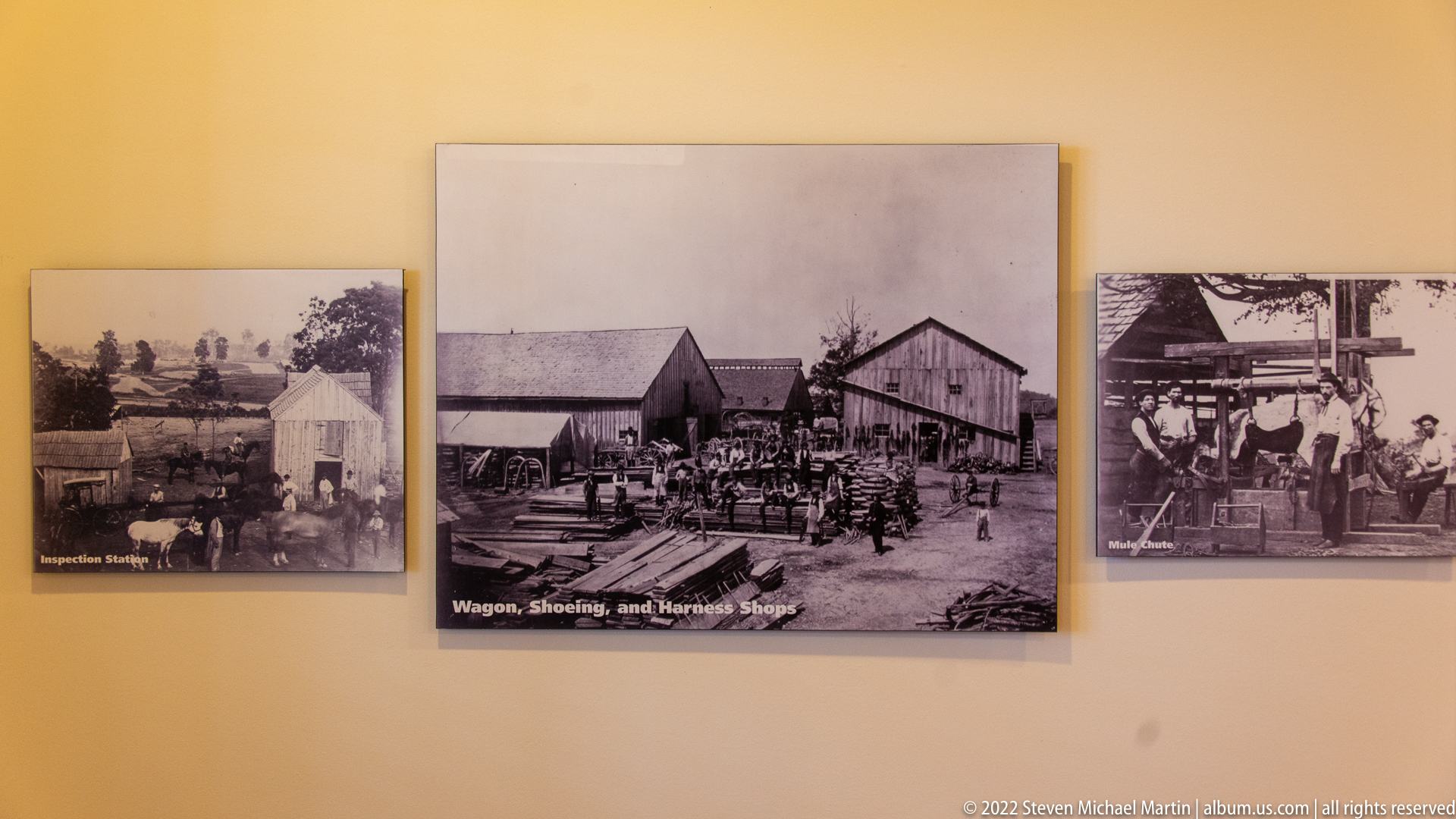
Three historical photographs hang together on a pale gallery wall, with the central image labeled “Wagon, Shoeing, and Harness Shops.” The larger central print shows workshop buildings and equipment, while two smaller photographs flank it. Their grouped arrangement presents a concise visual record of the workspaces named in the central caption.
Caption
Three historical photographs hang together on a pale gallery wall, with the central image labeled “Wagon, Shoeing, and Harness Shops.” The larger central print shows workshop buildings and equipment, while two smaller photographs flank it. Their grouped arrangement presents a concise visual record of the workspaces named in the central caption.
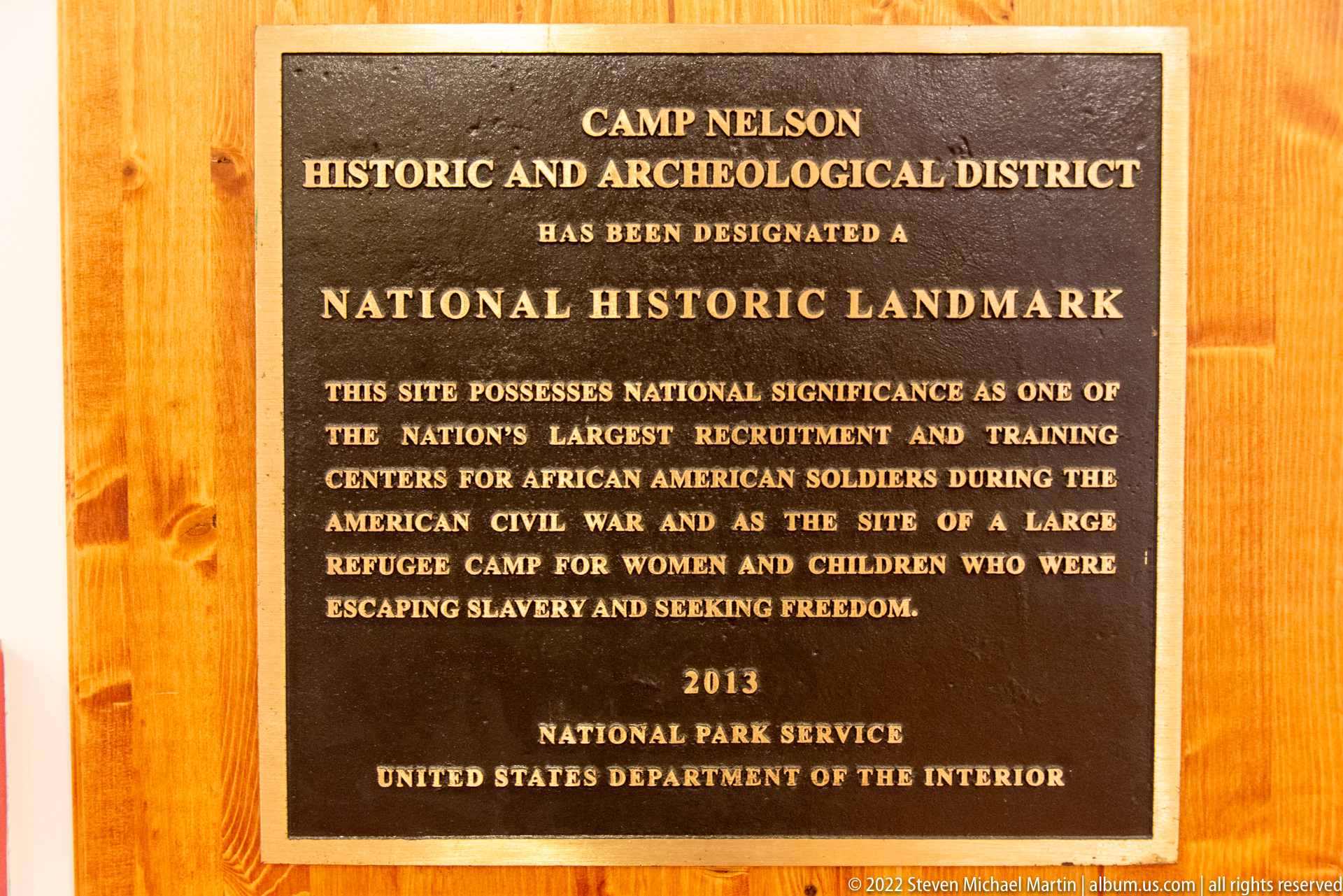
A bronze-colored plaque mounted on a wooden backing identifies the Camp Nelson Historic and Archaeological District as a National Historic Landmark. The text describes the site’s recruitment and training role during the Civil War and its history as a refuge for women and children escaping slavery. The close frontal view makes the designation and commemorative language the central subject.
Caption
A bronze-colored plaque mounted on a wooden backing identifies the Camp Nelson Historic and Archaeological District as a National Historic Landmark. The text describes the site’s recruitment and training role during the Civil War and its history as a refuge for women and children escaping slavery. The close frontal view makes the designation and commemorative language the central subject.
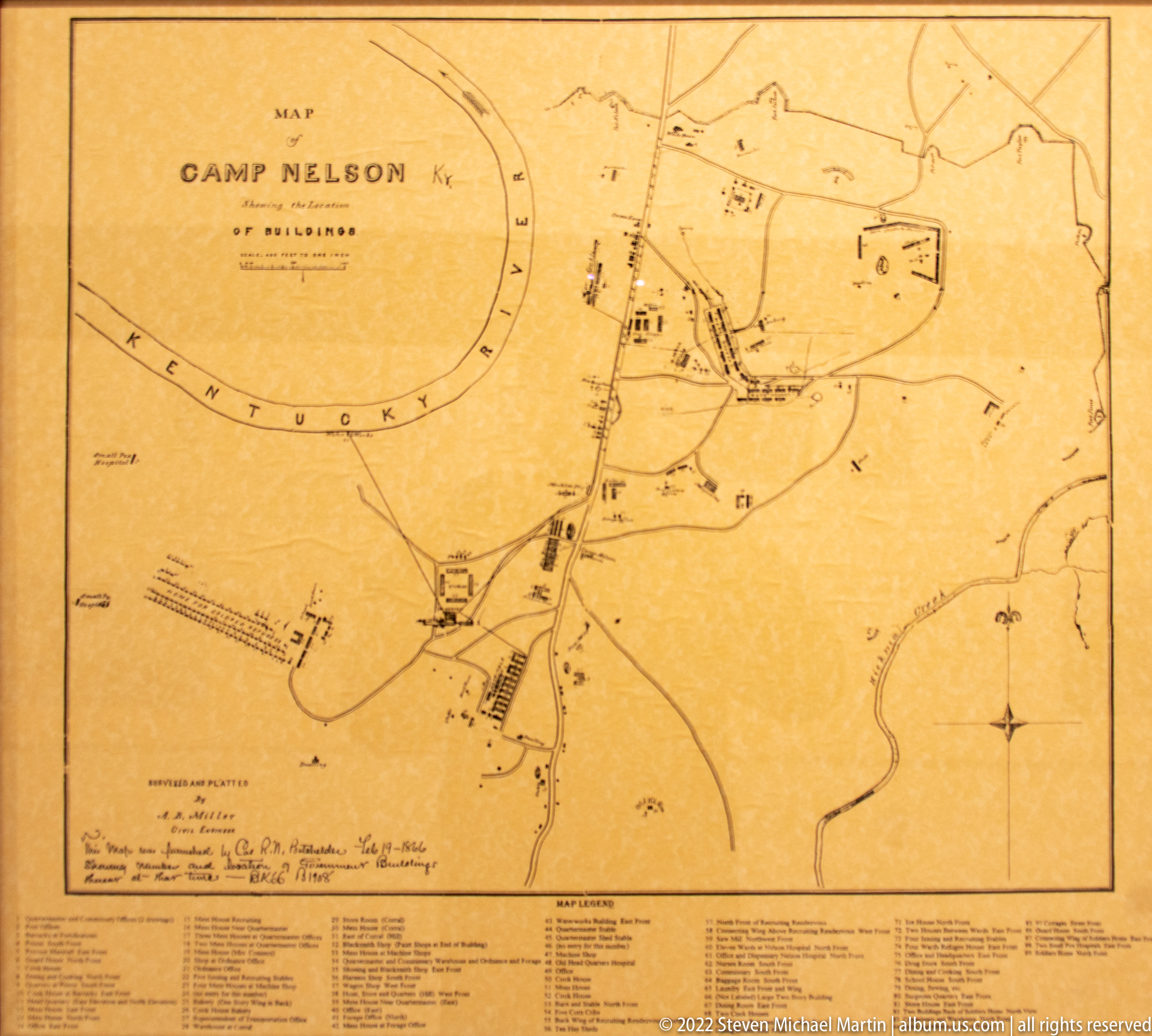
A tan historic map fills the frame, showing the Camp Nelson area with roads, buildings, land divisions, and a river bend. Small labels and a legend run around the edges, though many details are too fine to read at this scale. The close view centers the cartographic layout and gives the site’s geography a different emphasis from the surrounding exhibit photographs.
Caption
A tan historic map fills the frame, showing the Camp Nelson area with roads, buildings, land divisions, and a river bend. Small labels and a legend run around the edges, though many details are too fine to read at this scale. The close view centers the cartographic layout and gives the site’s geography a different emphasis from the surrounding exhibit photographs.
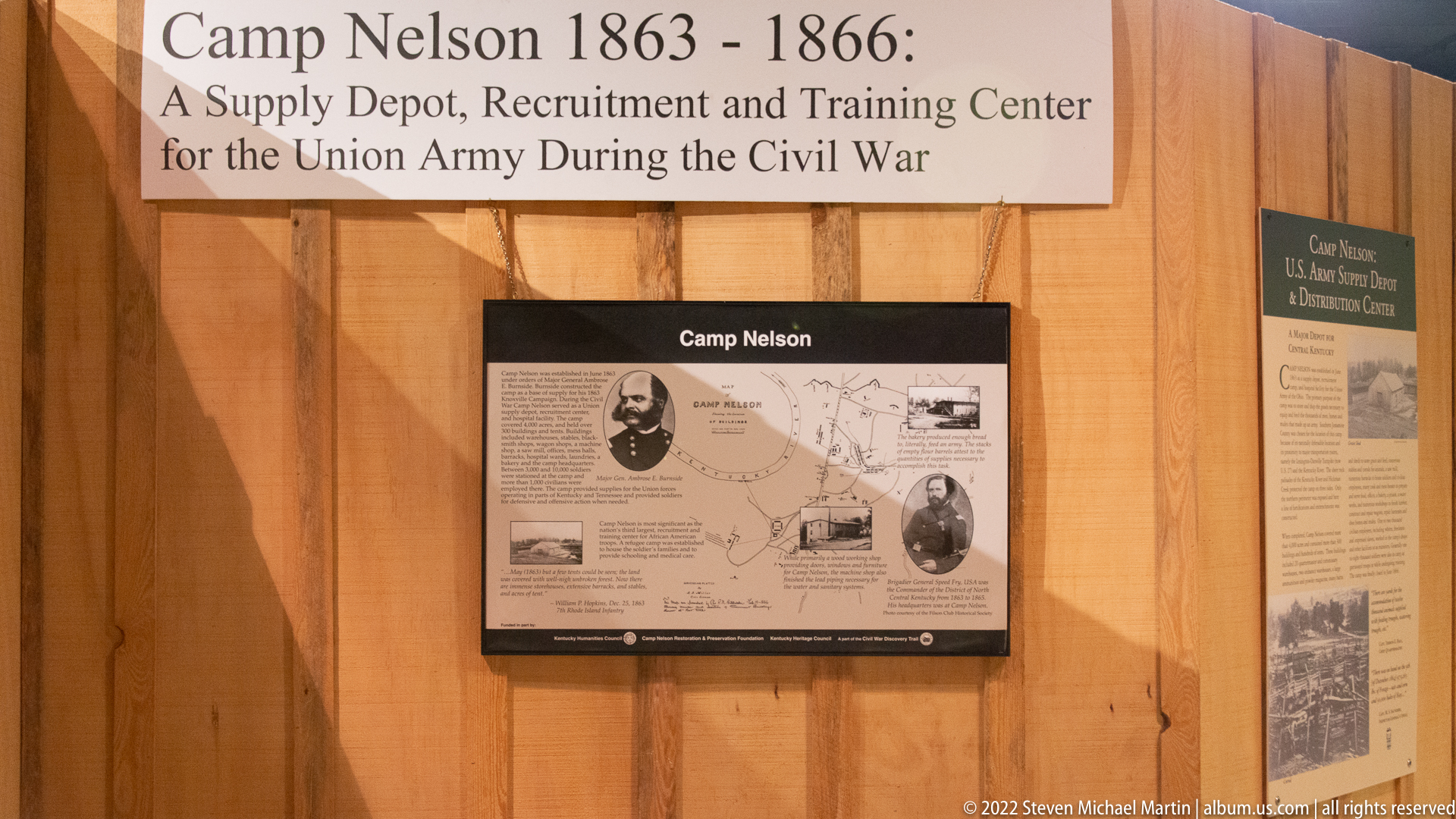
A wall-mounted panel describes Camp Nelson from 1863 to 1866 as a depot, recruitment, and training center for the Union Army during the Civil War. A smaller display below combines portraits, a map, and explanatory text, while neighboring panels and warm wood walls surround it. The framing shows how the central exhibit sits within a larger gallery narrative.
Caption
A wall-mounted panel describes Camp Nelson from 1863 to 1866 as a depot, recruitment, and training center for the Union Army during the Civil War. A smaller display below combines portraits, a map, and explanatory text, while neighboring panels and warm wood walls surround it. The framing shows how the central exhibit sits within a larger gallery narrative.
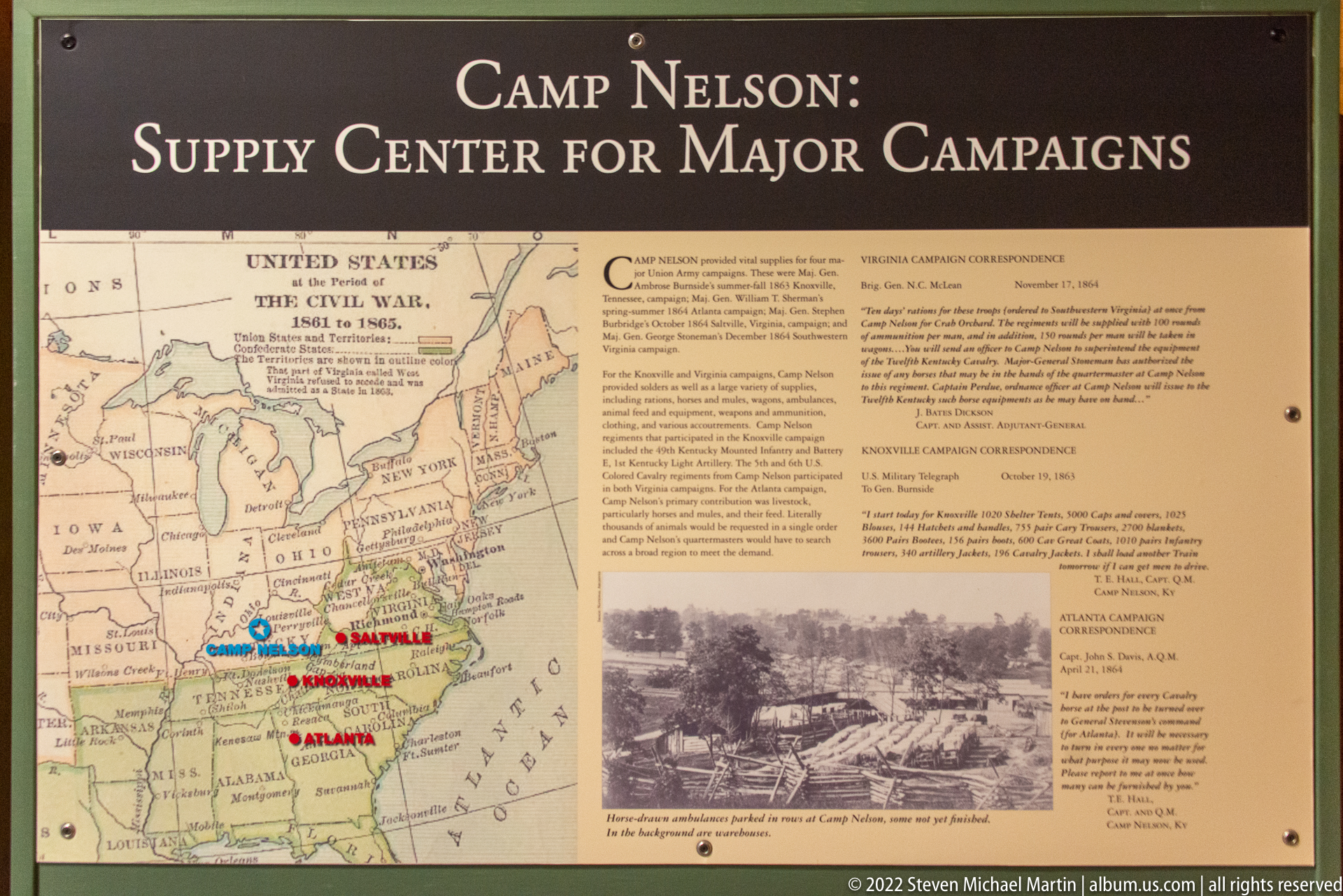
An interpretive panel titled “Camp Nelson: Center for Major Campaigns” combines a regional map with colored route markings, explanatory text, and an archival view of a military encampment. The map fills the left half, while campaign information and the historical photograph occupy the right. Its layout connects the camp to a broader wartime geography.
Caption
An interpretive panel titled “Camp Nelson: Center for Major Campaigns” combines a regional map with colored route markings, explanatory text, and an archival view of a military encampment. The map fills the left half, while campaign information and the historical photograph occupy the right. Its layout connects the camp to a broader wartime geography.

A narrow wooden gallery room displays folded clothing on shelves, hanging straps and garments, stacked boxes, and several large containers. A chain barrier separates visitors from the arrangement, and a small wheeled object sits in the center aisle. The view down the room gives the artifacts a workshop-like setting without identifying every object or assigning it a precise historical use.
Caption
A narrow wooden gallery room displays folded clothing on shelves, hanging straps and garments, stacked boxes, and several large containers. A chain barrier separates visitors from the arrangement, and a small wheeled object sits in the center aisle. The view down the room gives the artifacts a workshop-like setting without identifying every object or assigning it a precise historical use.
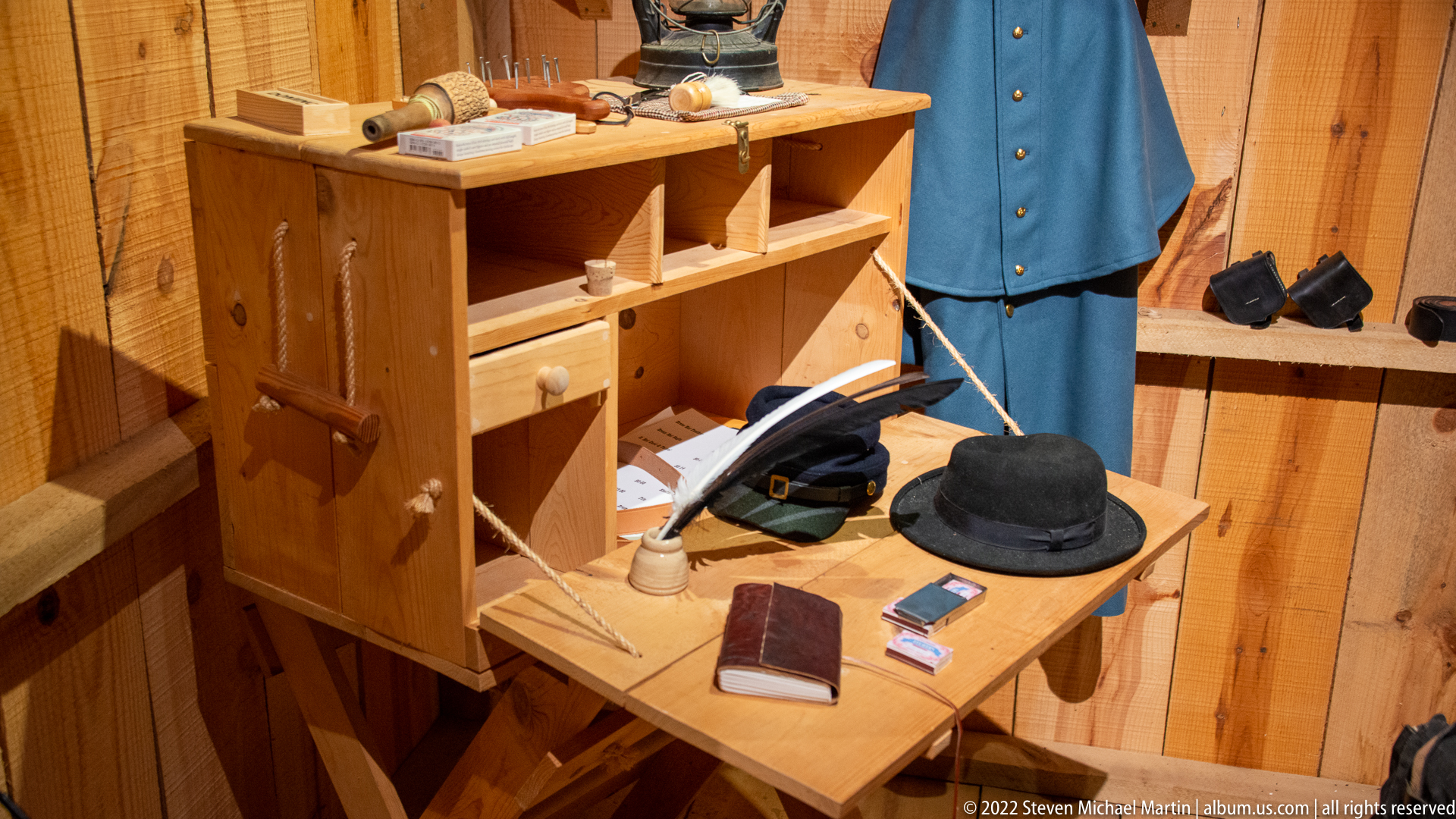
A blue military-style coat hangs beside open wooden shelves and a worktable holding a black hat, books, papers, and small objects. A hand tool and a pair of dark shoes rest among the furnishings, suggesting a staged interior display. The composition brings clothing and personal or work objects together, while avoiding a specific claim about the wearer or room’s original use.
Caption
A blue military-style coat hangs beside open wooden shelves and a worktable holding a black hat, books, papers, and small objects. A hand tool and a pair of dark shoes rest among the furnishings, suggesting a staged interior display. The composition brings clothing and personal or work objects together, while avoiding a specific claim about the wearer or room’s original use.

A black felt hat fills the frame, topped by a brass bugle-shaped badge and a bright blue cord wrapped around its crown. The close crop reveals the hat’s dark nap, stitched edge, and ornamental metalwork against a wooden wall. Its insignia and cord are visible, but the exact regiment or wearer is not identified in the photograph.
Caption
A black felt hat fills the frame, topped by a brass bugle-shaped badge and a bright blue cord wrapped around its crown. The close crop reveals the hat’s dark nap, stitched edge, and ornamental metalwork against a wooden wall. Its insignia and cord are visible, but the exact regiment or wearer is not identified in the photograph.
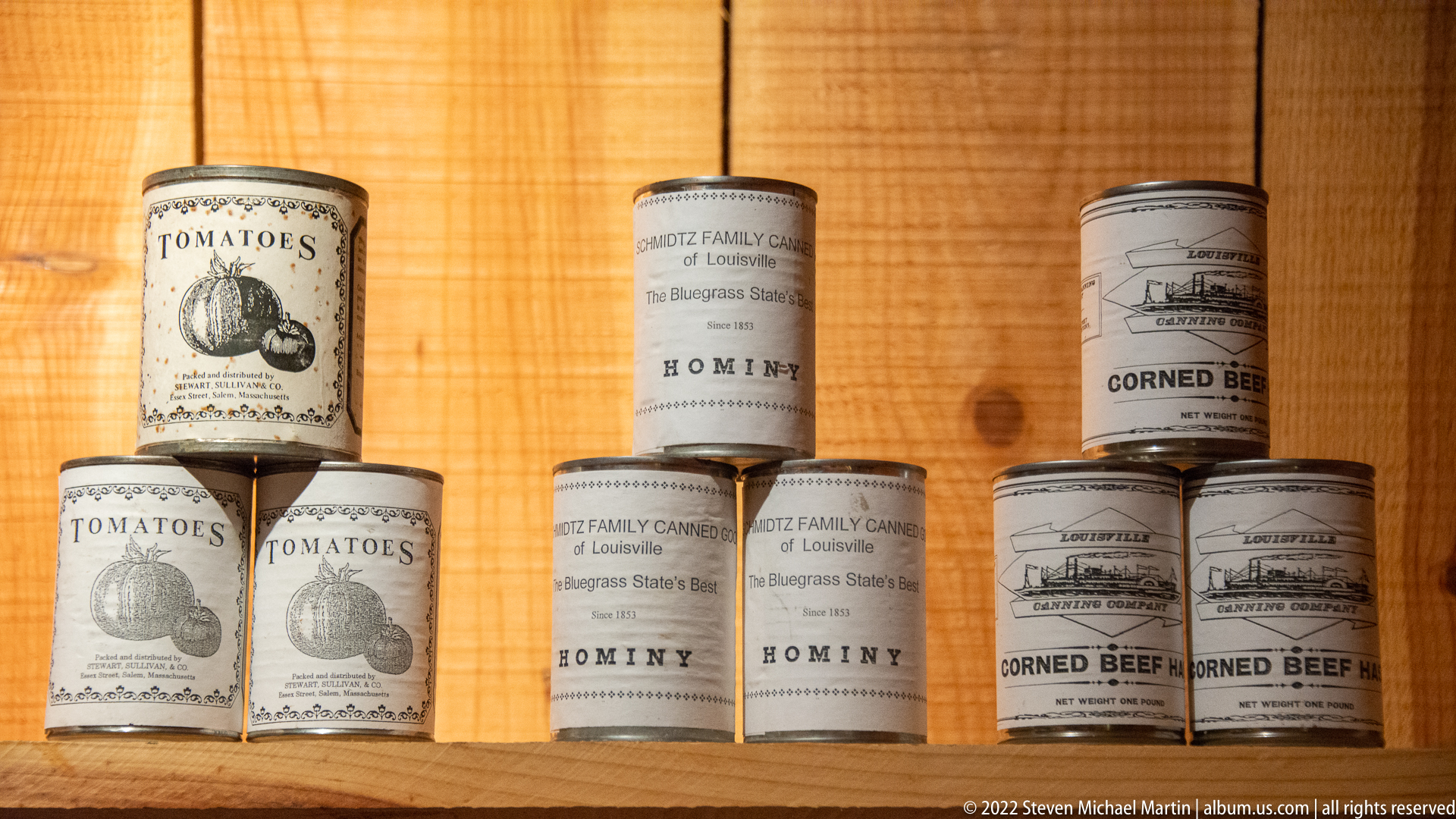
Rows of cylindrical cans are arranged on a wooden shelf, with printed labels identifying tomatoes, hominy, and corned beef. Several labels include the name of a Louisville canning company, and the cans vary slightly in height and condition. The close view presents preserved food as a practical supply display, while the legible product names distinguish each group.
Caption
Rows of cylindrical cans are arranged on a wooden shelf, with printed labels identifying tomatoes, hominy, and corned beef. Several labels include the name of a Louisville canning company, and the cans vary slightly in height and condition. The close view presents preserved food as a practical supply display, while the legible product names distinguish each group.
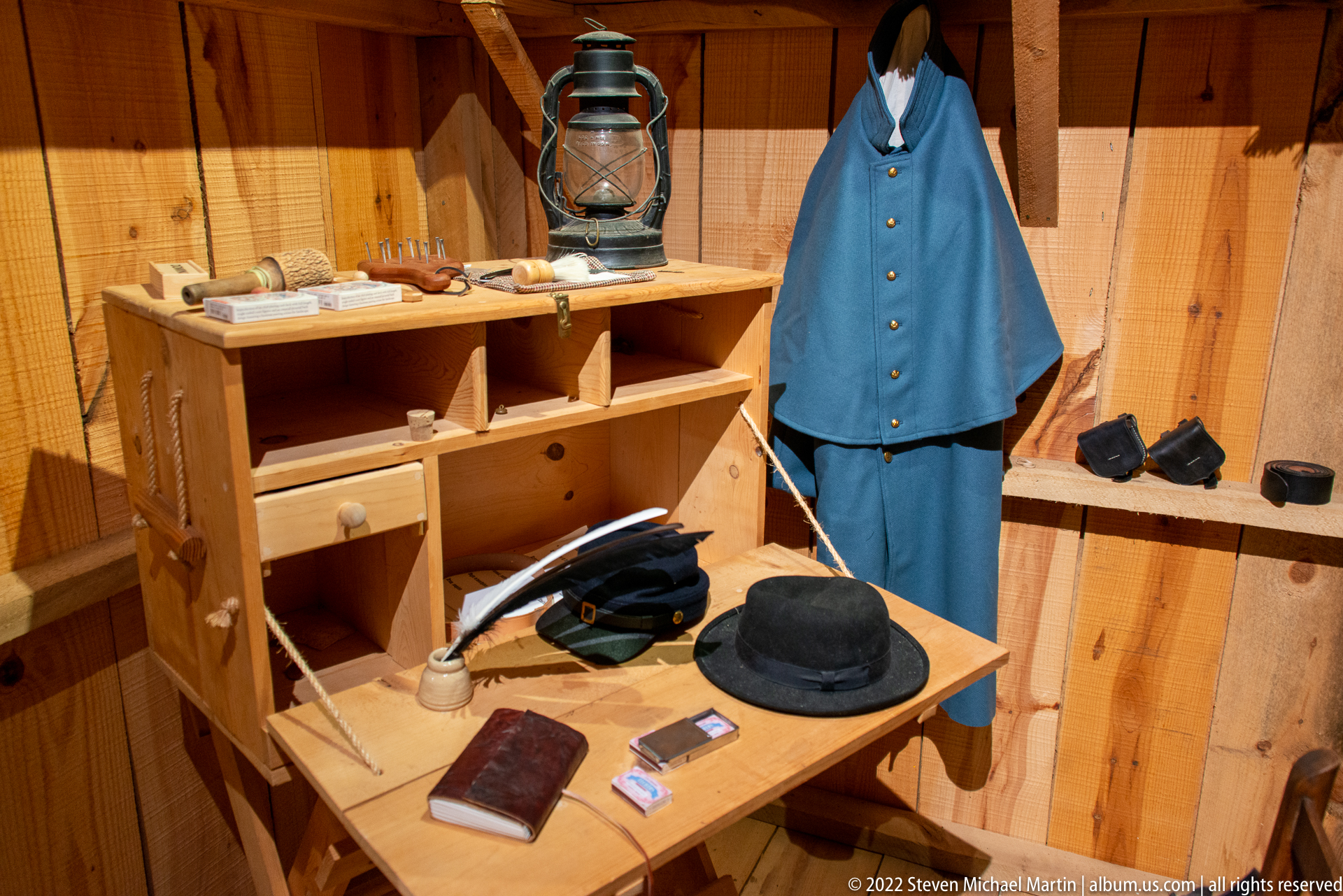
A blue coat hangs at the back of a wooden room while a lantern, black hat, books, straps, and small equipment occupy shelves and a central table. The objects are arranged as a furnished interior rather than isolated in glass cases. This wider view includes both clothing and practical items, offering a broader look at the exhibit than the closer table view.
Caption
A blue coat hangs at the back of a wooden room while a lantern, black hat, books, straps, and small equipment occupy shelves and a central table. The objects are arranged as a furnished interior rather than isolated in glass cases. This wider view includes both clothing and practical items, offering a broader look at the exhibit than the closer table view.
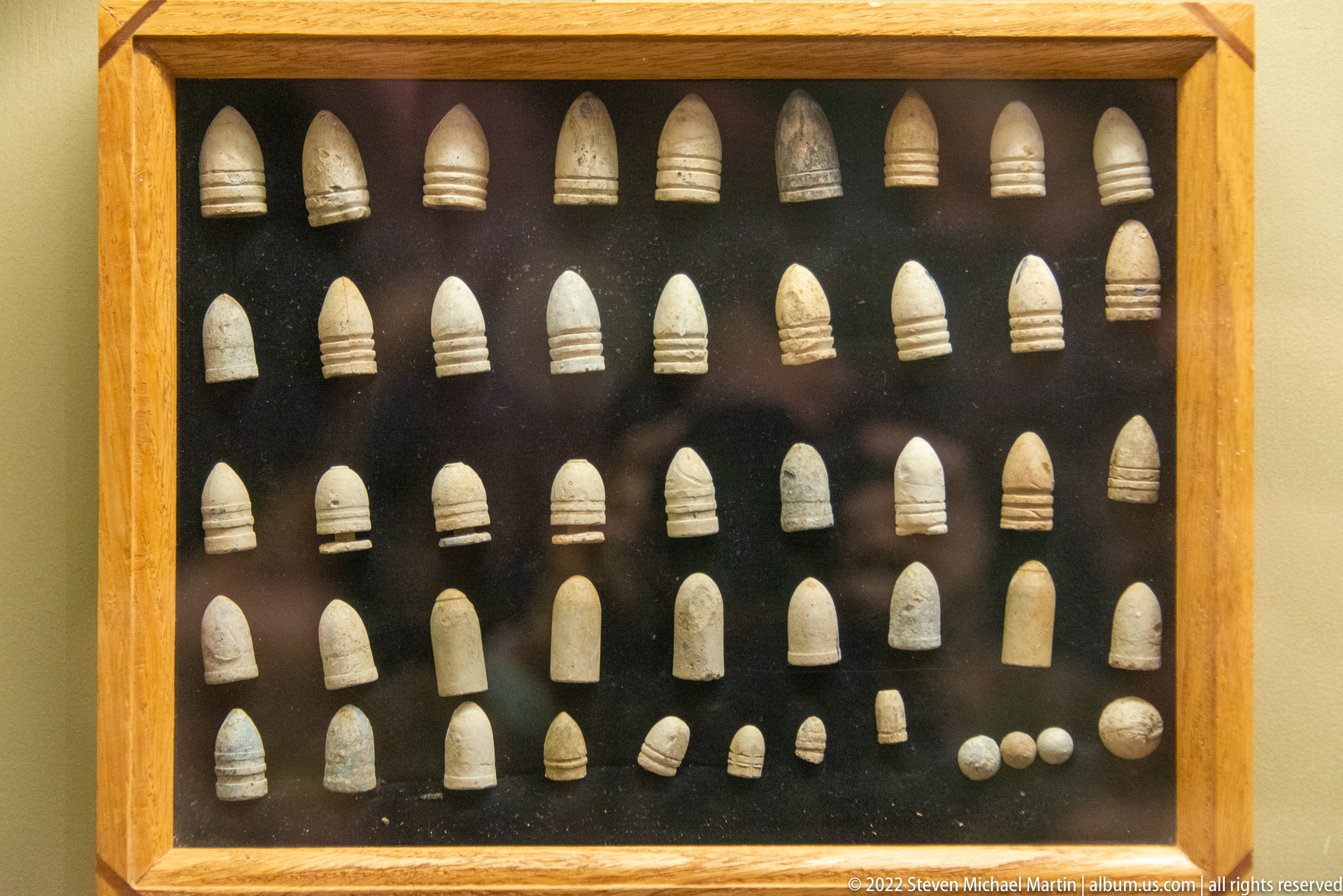
Dozens of small lead projectiles are arranged in orderly rows against a dark backing, with examples varying in size, shape, and molded grooves. The wooden case frames the collection like a study board, allowing differences among the ammunition to be compared. The close view does not identify a specific weapon or battle, so the objects remain described by their visible form.
Caption
Dozens of small lead projectiles are arranged in orderly rows against a dark backing, with examples varying in size, shape, and molded grooves. The wooden case frames the collection like a study board, allowing differences among the ammunition to be compared. The close view does not identify a specific weapon or battle, so the objects remain described by their visible form.
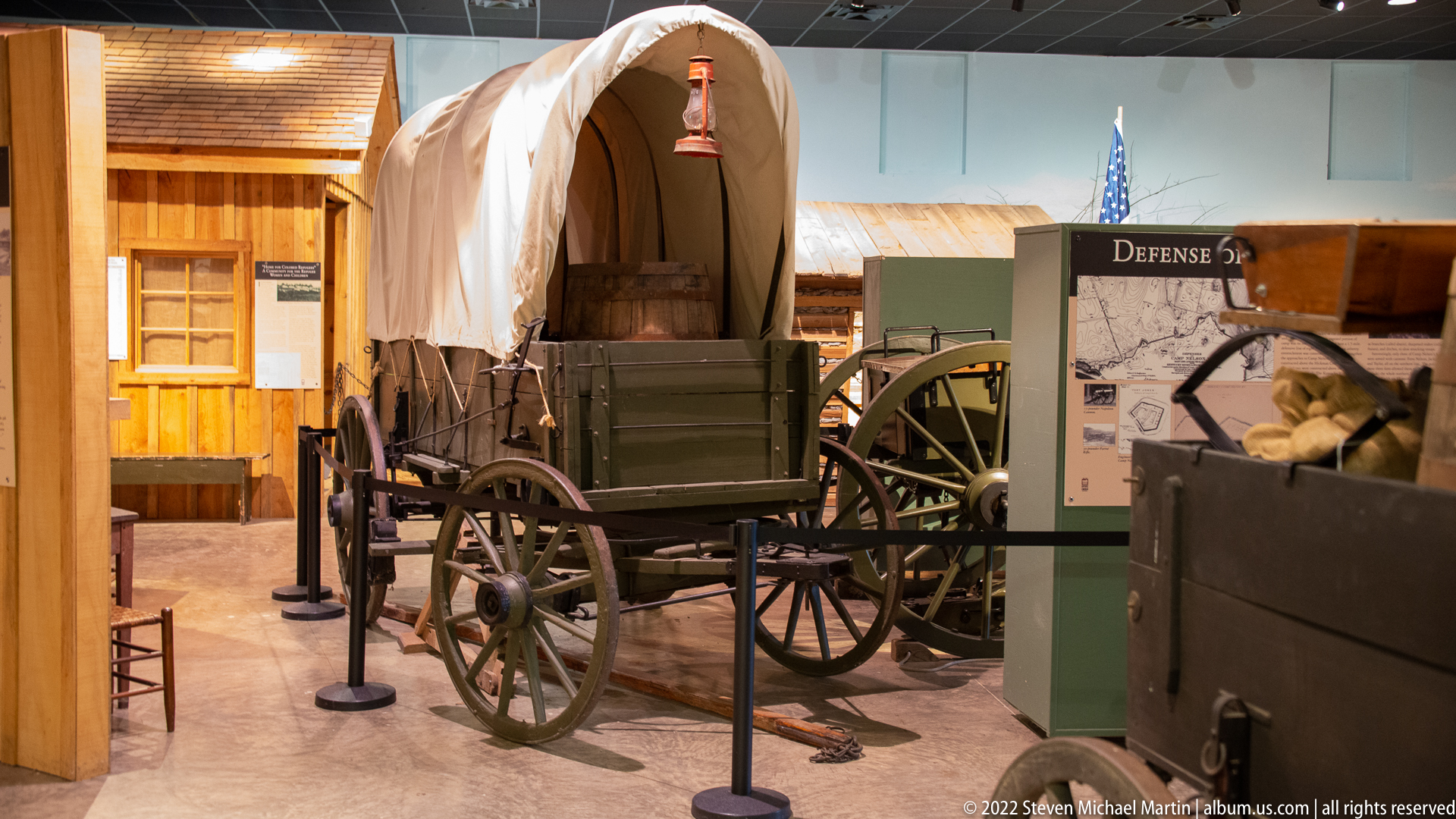
A full-size covered wagon stands inside the gallery, showing its canvas hood, wooden bed, large spoked wheels, and dark green body. A lantern hangs within the shelter, and a nearby interpretive panel and display cases place the wagon among other military-history exhibits. The three-quarter view makes the vehicle’s construction and scale clear.
Caption
A full-size covered wagon stands inside the gallery, showing its canvas hood, wooden bed, large spoked wheels, and dark green body. A lantern hangs within the shelter, and a nearby interpretive panel and display cases place the wagon among other military-history exhibits. The three-quarter view makes the vehicle’s construction and scale clear.
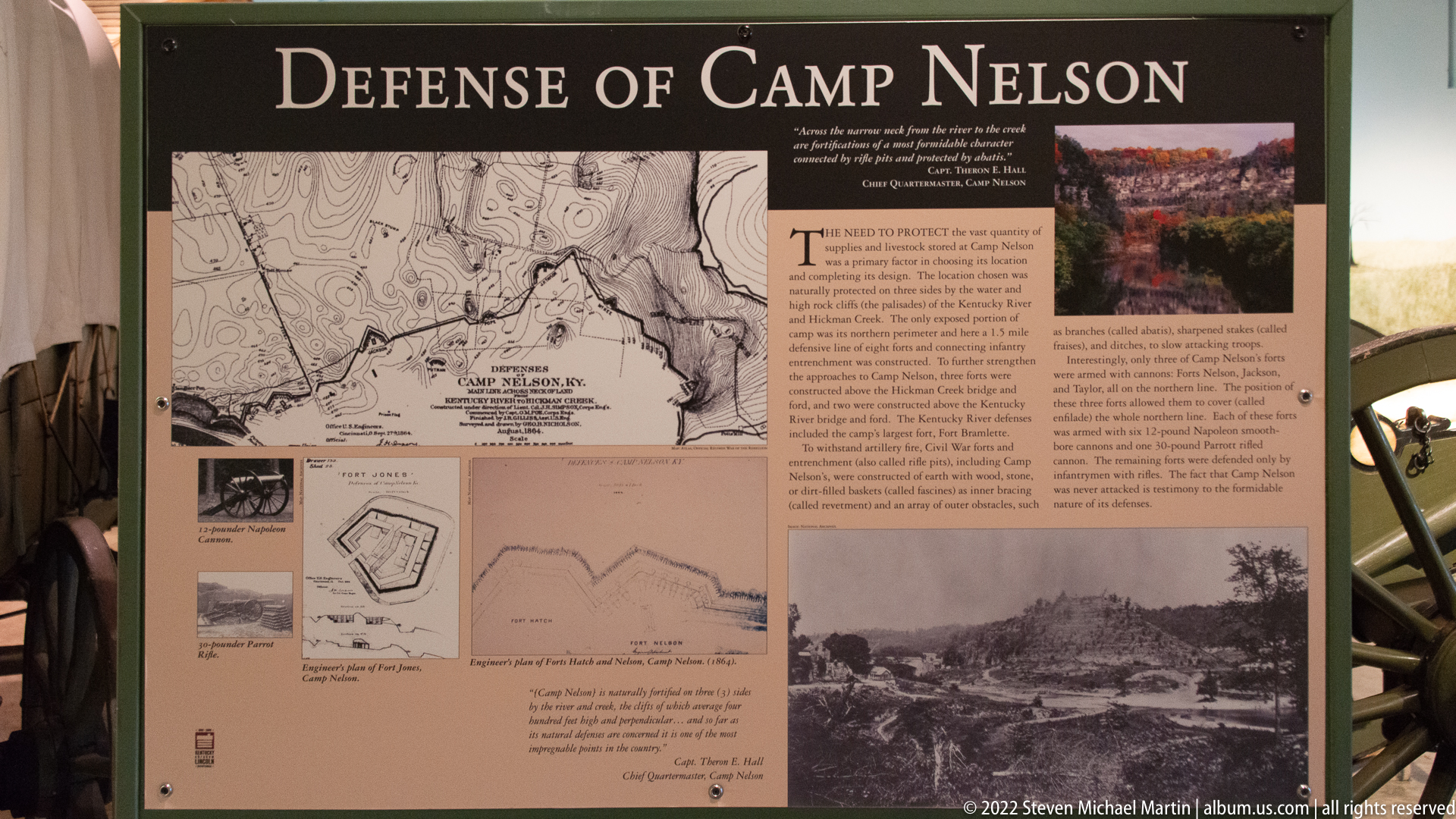
A large panel titled “Defense of Camp Nelson” combines a detailed map, explanatory text, smaller diagrams, and historic landscape photographs. The principal map occupies the upper left, while a second plan and archival images line the bottom. The panel links the site’s defensive layout to its terrain and surviving historical views through a layered visual arrangement.
Caption
A large panel titled “Defense of Camp Nelson” combines a detailed map, explanatory text, smaller diagrams, and historic landscape photographs. The principal map occupies the upper left, while a second plan and archival images line the bottom. The panel links the site’s defensive layout to its terrain and surviving historical views through a layered visual arrangement.
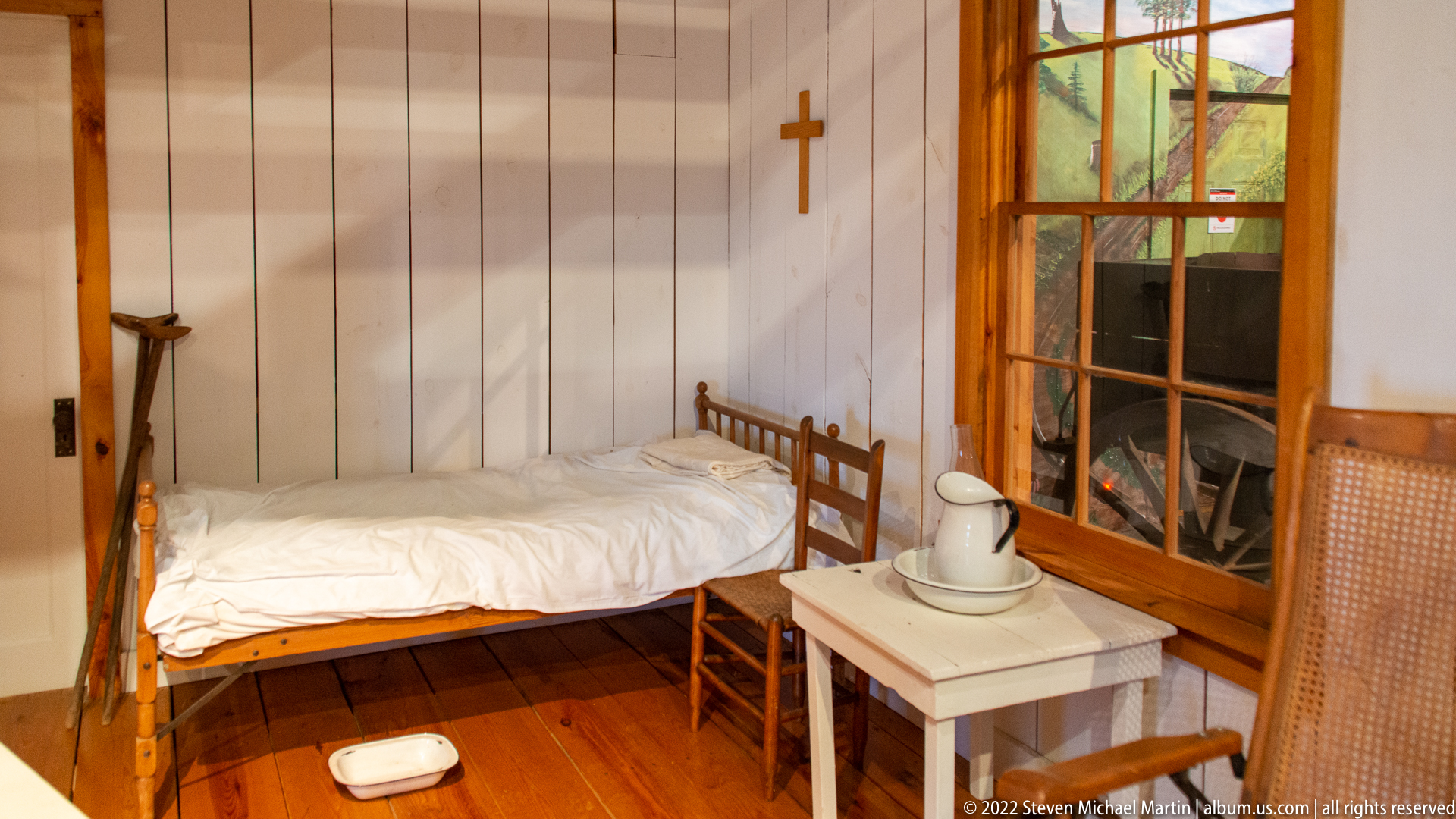
A narrow bed covered with a white quilt stands against a pale paneled wall beneath a small wooden cross. A simple table holds a pitcher and basin, while a chair, small stool, and multi-pane window complete the compact room. The warm wooden floor and sparse furnishings suggest a staged historic interior, though the room’s original function is not identified.
Caption
A narrow bed covered with a white quilt stands against a pale paneled wall beneath a small wooden cross. A simple table holds a pitcher and basin, while a chair, small stool, and multi-pane window complete the compact room. The warm wooden floor and sparse furnishings suggest a staged historic interior, though the room’s original function is not identified.
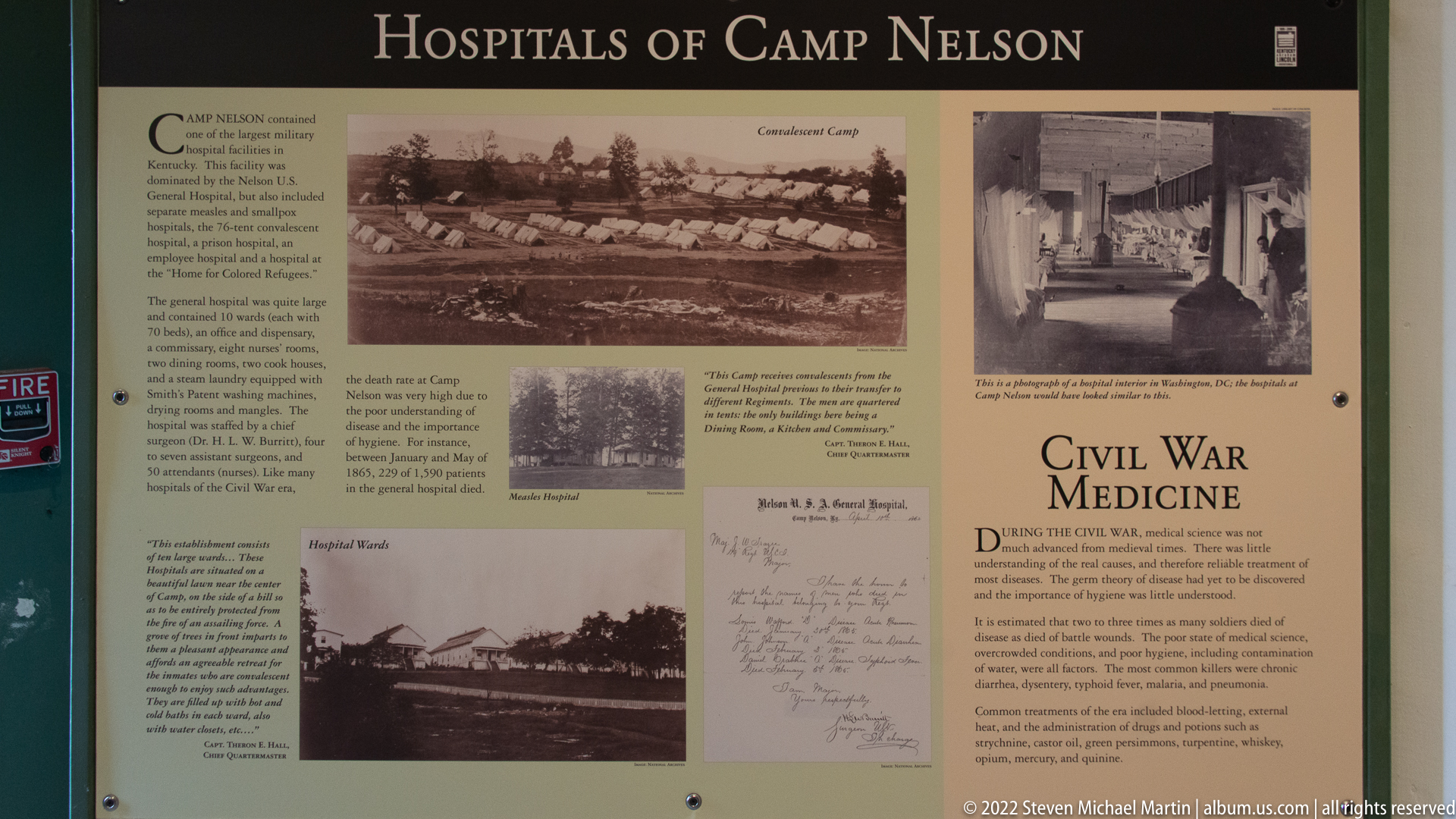
An interpretive panel headed “Hospitals of Camp Nelson” combines historical photographs, text, and a reproduced document to explain the medical facilities associated with the Civil War encampment. Its close, nearly square framing makes the layered exhibit design legible while the edge of another display enters at left.
Caption
An interpretive panel headed “Hospitals of Camp Nelson” combines historical photographs, text, and a reproduced document to explain the medical facilities associated with the Civil War encampment. Its close, nearly square framing makes the layered exhibit design legible while the edge of another display enters at left.
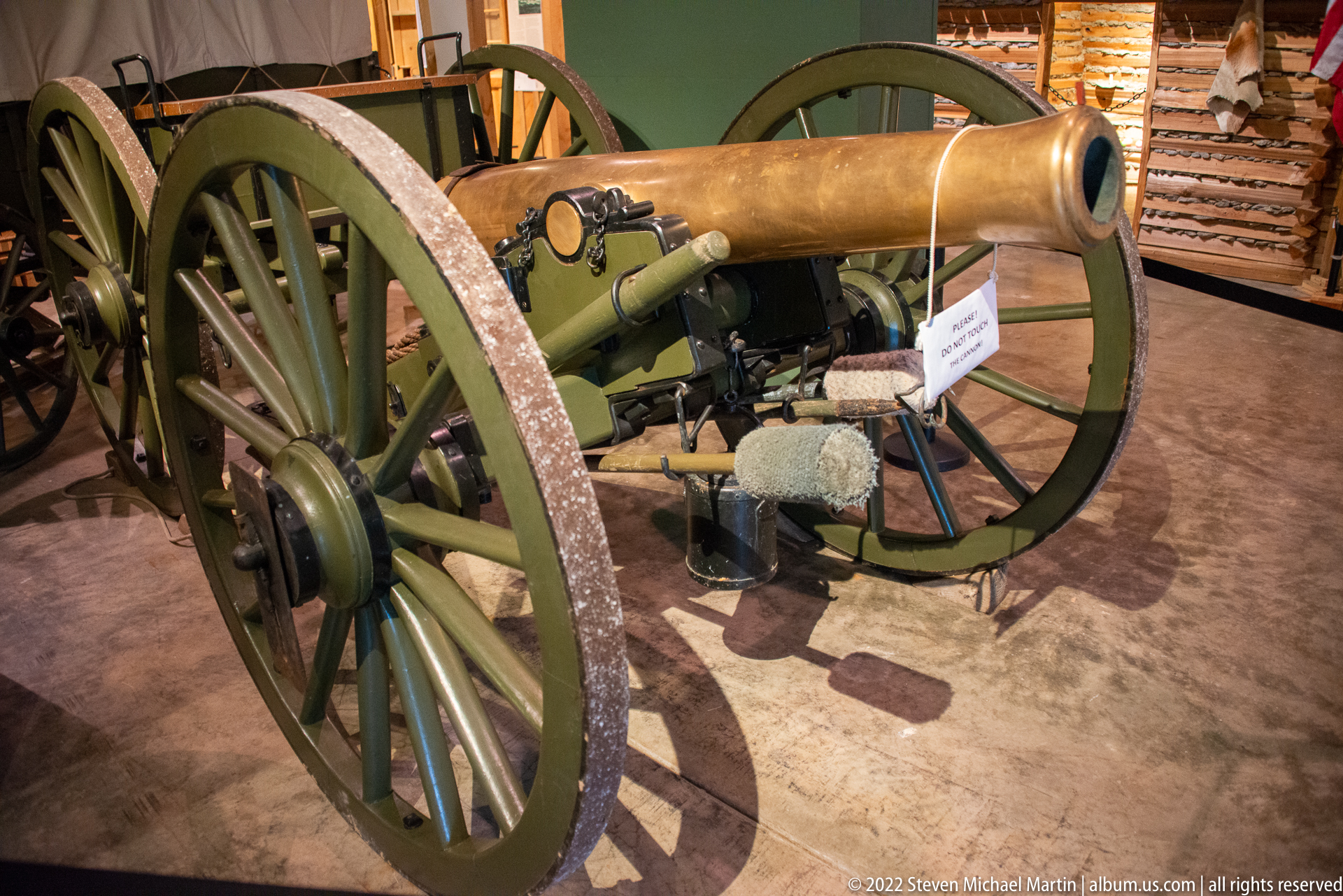
A bronze-colored field cannon stands on a green-painted carriage inside a museum, its large spoked wheels dominating the foreground. A small label and exhibit elements sit near the breech, but the view does not establish the weapon’s exact model or provenance.
Caption
A bronze-colored field cannon stands on a green-painted carriage inside a museum, its large spoked wheels dominating the foreground. A small label and exhibit elements sit near the breech, but the view does not establish the weapon’s exact model or provenance.

Canvas tents and a United States flag form a reconstructed military camp scene behind a broad panel titled “United States Colored Troops at Camp Nelson.” The exhibit foregrounds the service of Black soldiers through portraits and text, while the tent arrangement supplies a period setting without depicting an active encampment.
Caption
Canvas tents and a United States flag form a reconstructed military camp scene behind a broad panel titled “United States Colored Troops at Camp Nelson.” The exhibit foregrounds the service of Black soldiers through portraits and text, while the tent arrangement supplies a period setting without depicting an active encampment.
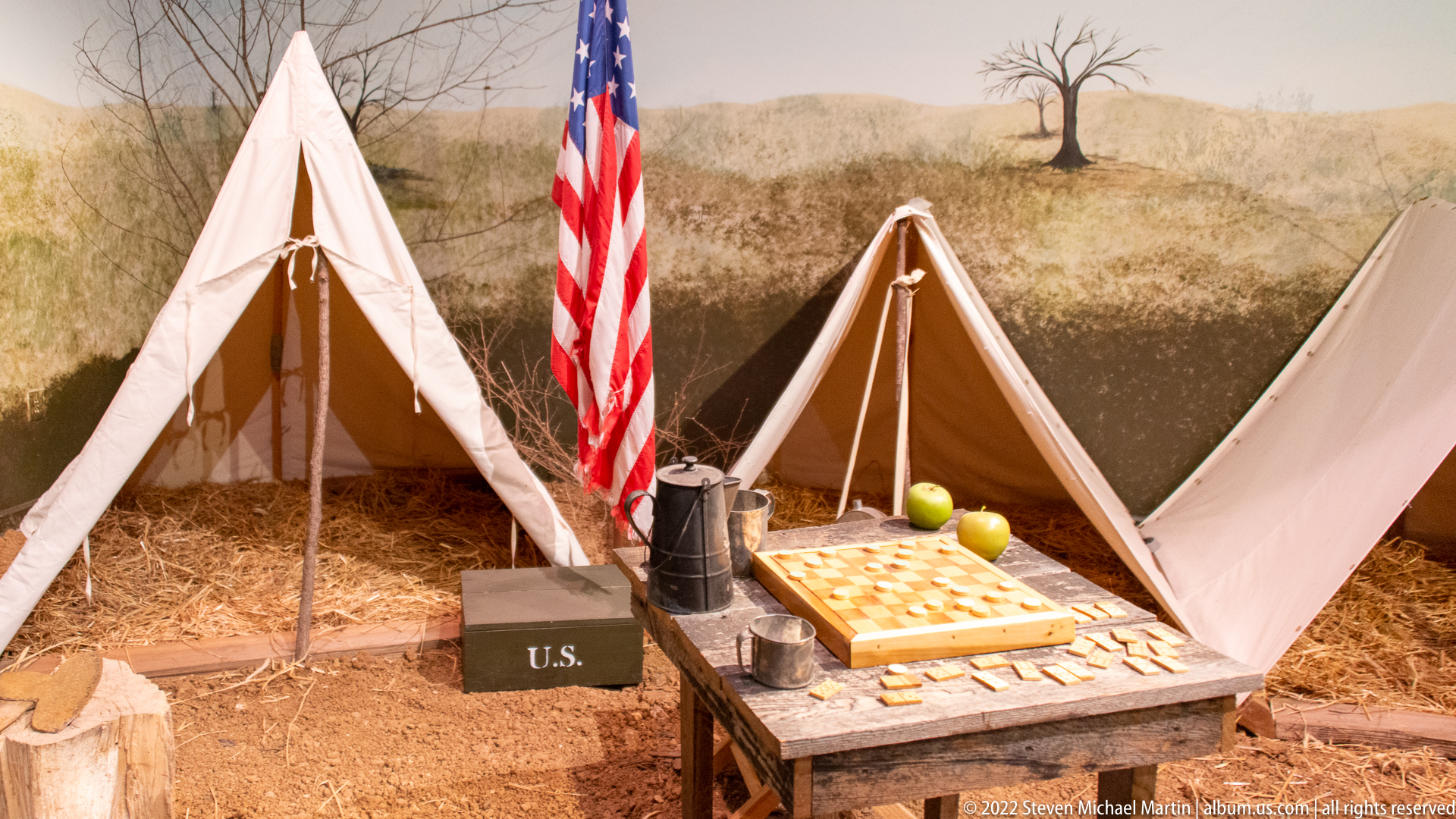
A closer view into a reconstructed camp places several canvas tents around a small wooden table, cooking vessels, and a box marked “U.S.” An American flag hangs between the tents. Straw-covered ground and a painted landscape backdrop create the interior museum setting of this historical tableau.
Caption
A closer view into a reconstructed camp places several canvas tents around a small wooden table, cooking vessels, and a box marked “U.S.” An American flag hangs between the tents. Straw-covered ground and a painted landscape backdrop create the interior museum setting of this historical tableau.
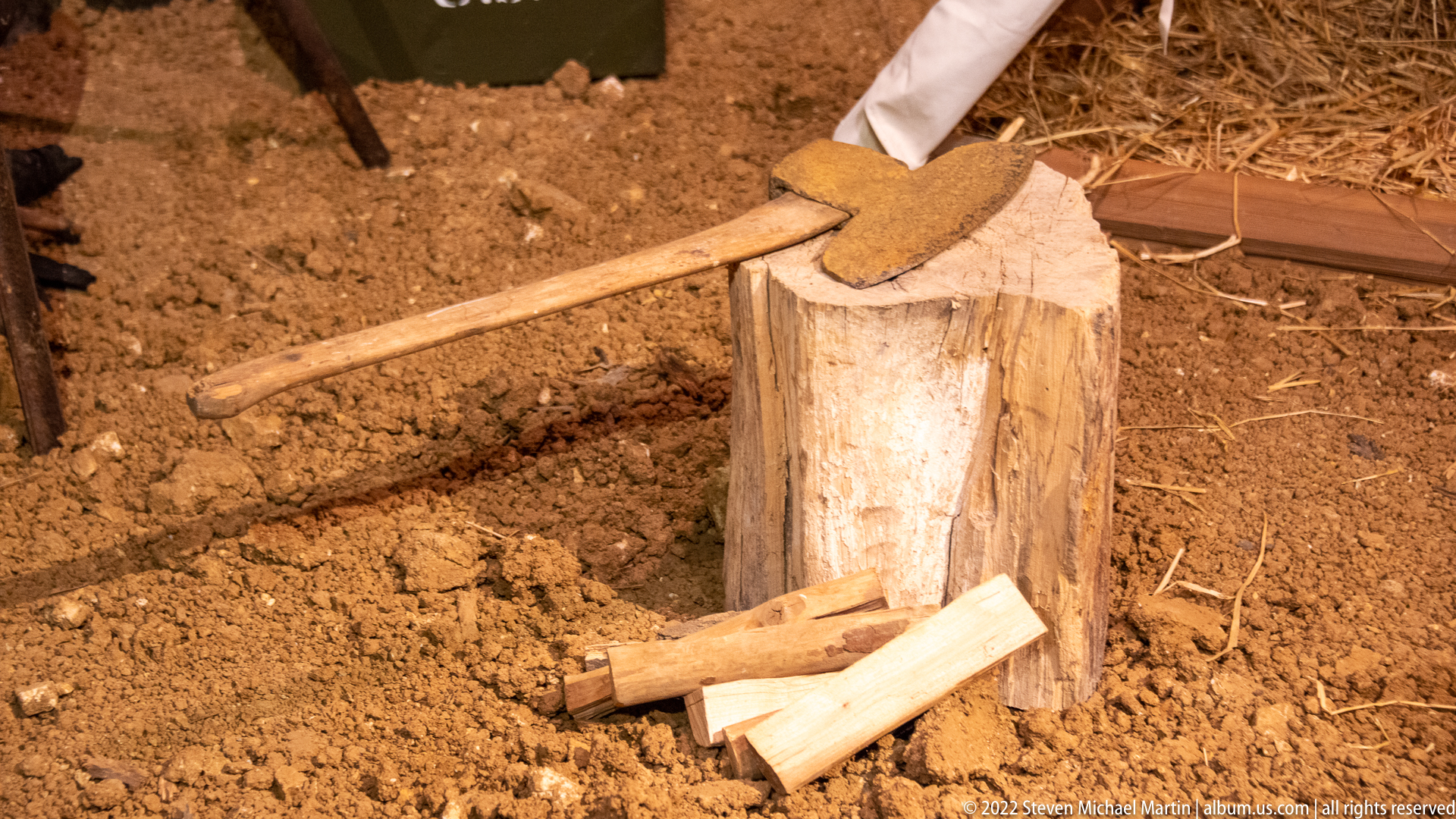
A long-handled axe rests across a cut tree stump in a close study of the reconstructed camp’s woodcutting tools. Split logs lie on the straw-covered ground, while the framing excludes most of the surrounding tableau and draws attention to the tool, stump, and freshly divided wood.
Caption
A long-handled axe rests across a cut tree stump in a close study of the reconstructed camp’s woodcutting tools. Split logs lie on the straw-covered ground, while the framing excludes most of the surrounding tableau and draws attention to the tool, stump, and freshly divided wood.
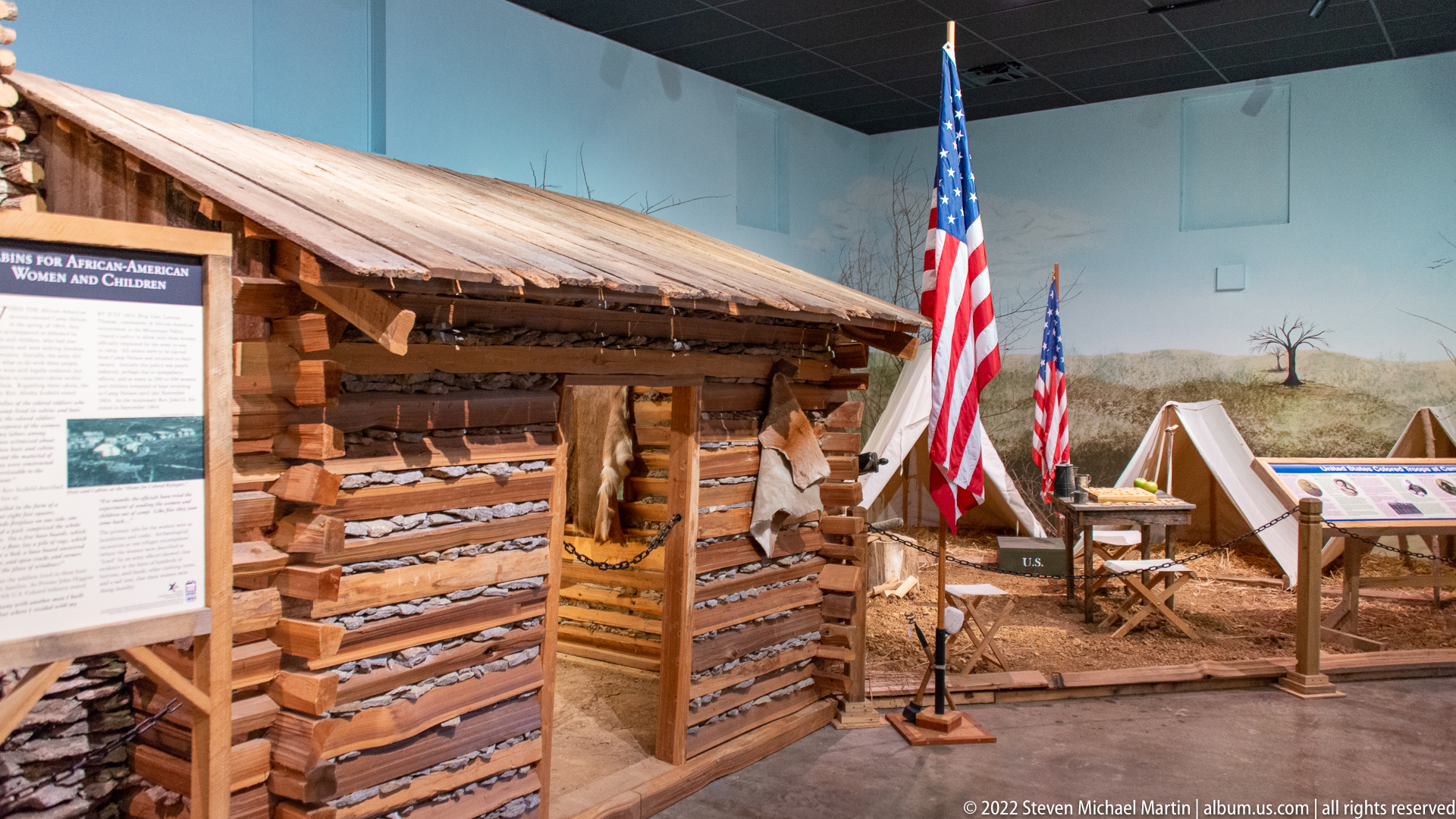
A reconstructed log structure occupies the foreground of this wider museum view, its exposed timber wall and roof framing a doorway. Interpretive panels, canvas tents, flags, and a display table extend behind it, showing how the exhibit combines a cabin-like shelter with a camp tableau.
Caption
A reconstructed log structure occupies the foreground of this wider museum view, its exposed timber wall and roof framing a doorway. Interpretive panels, canvas tents, flags, and a display table extend behind it, showing how the exhibit combines a cabin-like shelter with a camp tableau.
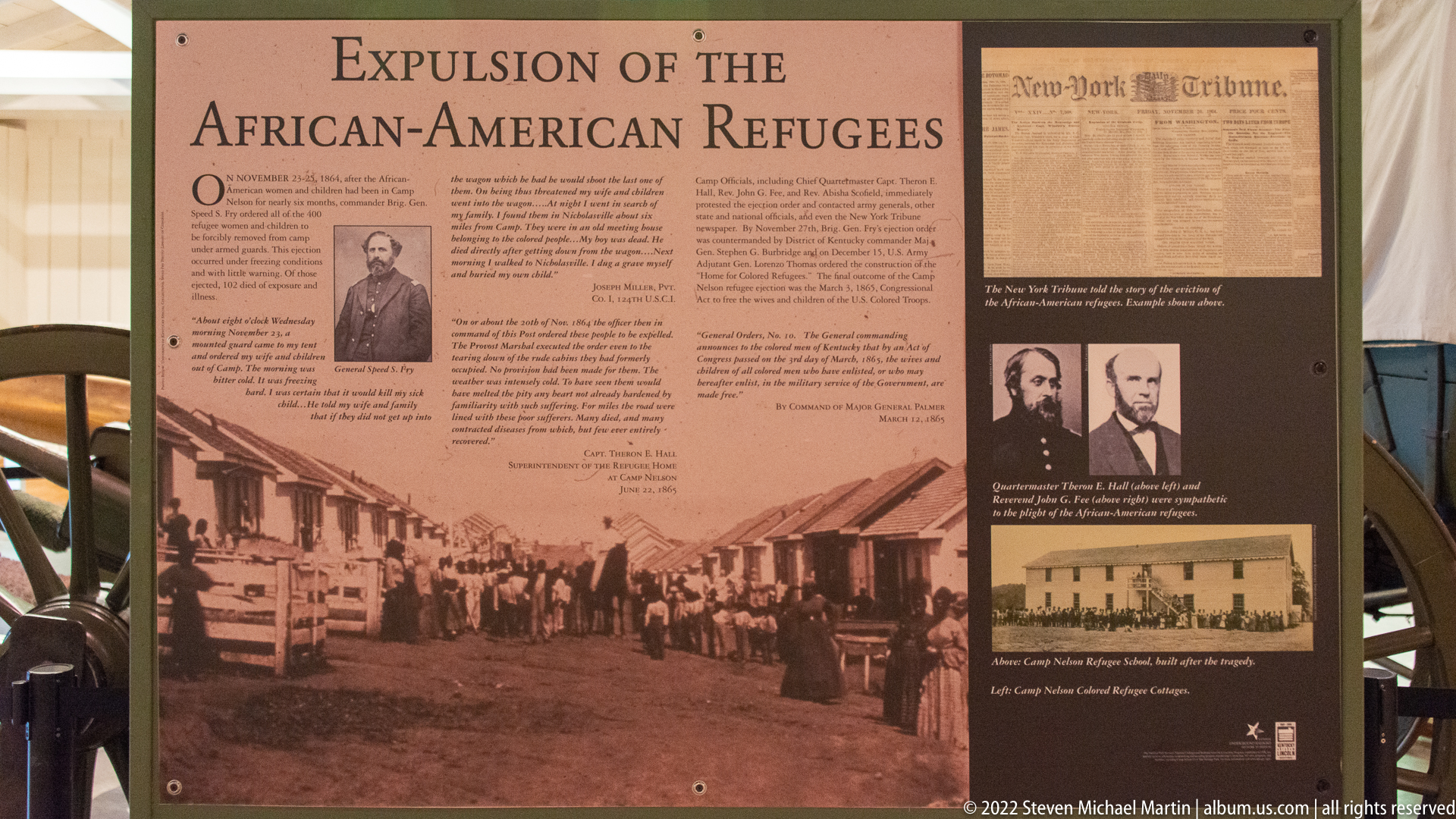
An interpretive display titled “Expulsion of the African American Refugees” pairs explanatory text and portraits with a large historical image of people gathered along a camp street. A reproduced newspaper clipping and historic building image occupy the right side, giving the panel a layered documentary structure.
Caption
An interpretive display titled “Expulsion of the African American Refugees” pairs explanatory text and portraits with a large historical image of people gathered along a camp street. A reproduced newspaper clipping and historic building image occupy the right side, giving the panel a layered documentary structure.
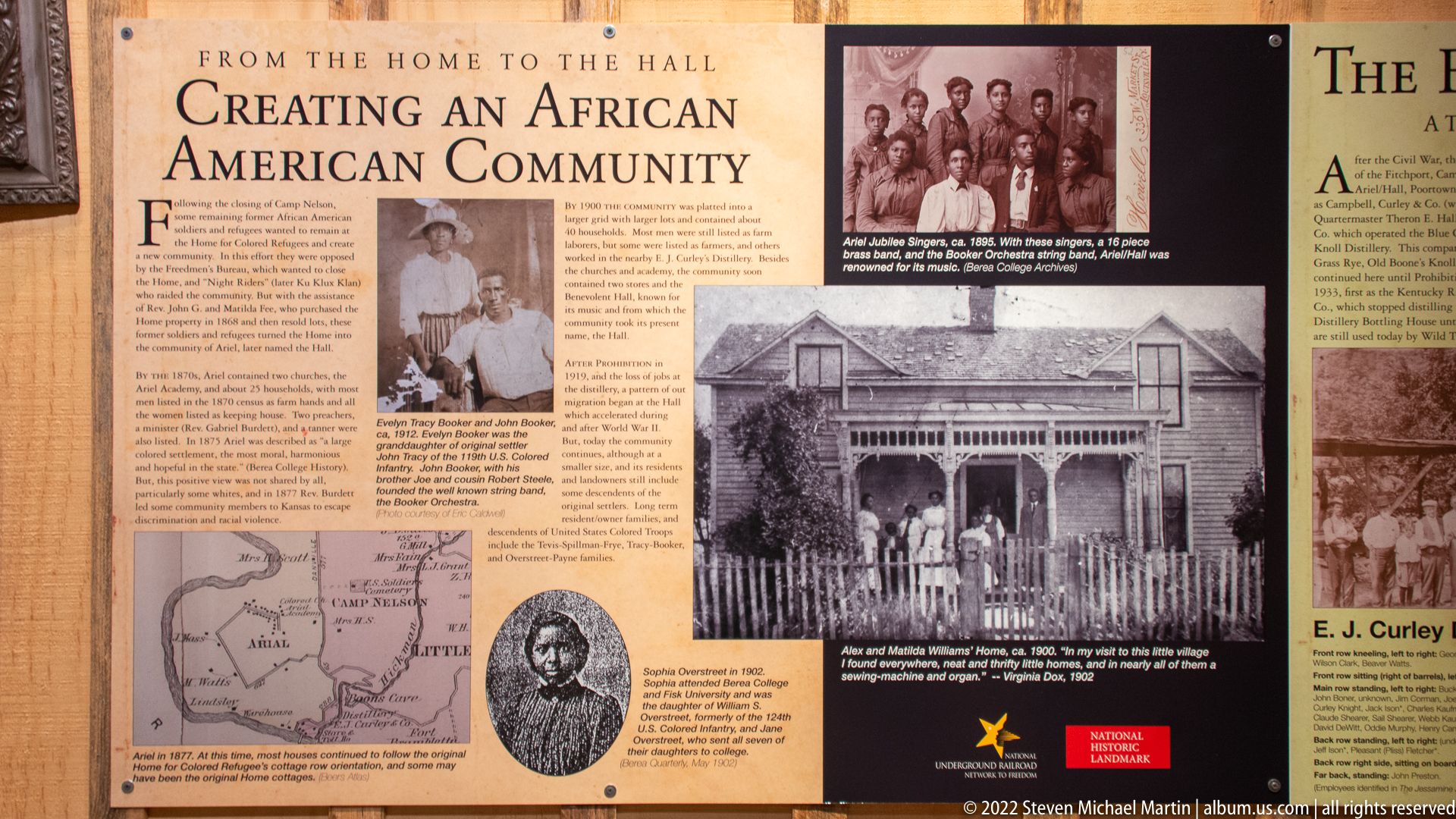
A broad panel titled “The Home to the Hall: An African American Community” presents portraits, a map, and archival photographs of a house and its residents. The paired layout connects community history with individual lives; the adjoining panel is partly visible at right, but the main composition remains centered on the community display.
Caption
A broad panel titled “The Home to the Hall: An African American Community” presents portraits, a map, and archival photographs of a house and its residents. The paired layout connects community history with individual lives; the adjoining panel is partly visible at right, but the main composition remains centered on the community display.
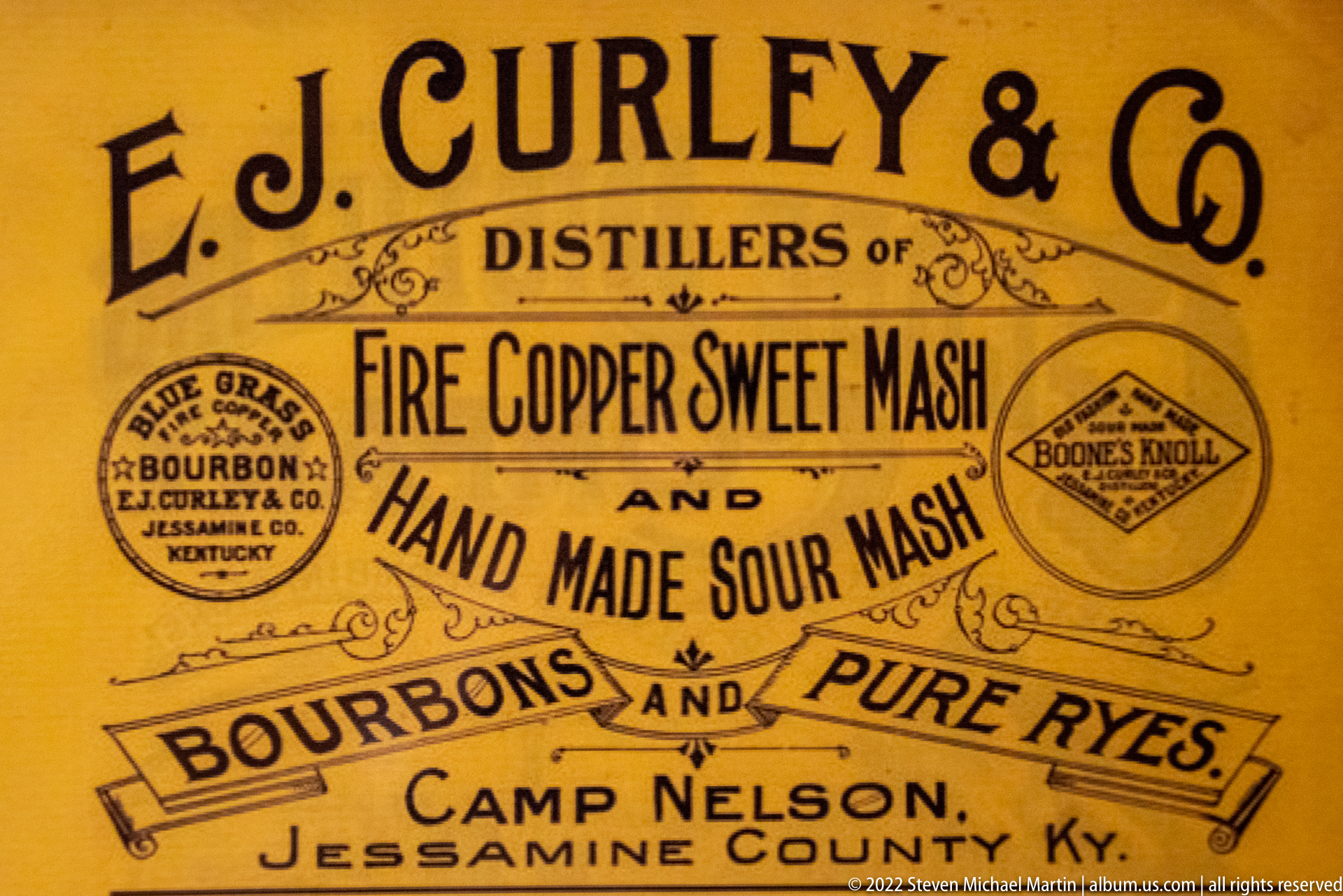
A yellow printed whiskey label fills the frame, its ornate lettering identifying E. J. Curley & Co. and Camp Nelson, Jessamine County, Kentucky. The label advertises bourbon and rye and includes decorative seals and banners; this close view isolates a commercial artifact from the surrounding museum displays.
Caption
A yellow printed whiskey label fills the frame, its ornate lettering identifying E. J. Curley & Co. and Camp Nelson, Jessamine County, Kentucky. The label advertises bourbon and rye and includes decorative seals and banners; this close view isolates a commercial artifact from the surrounding museum displays.
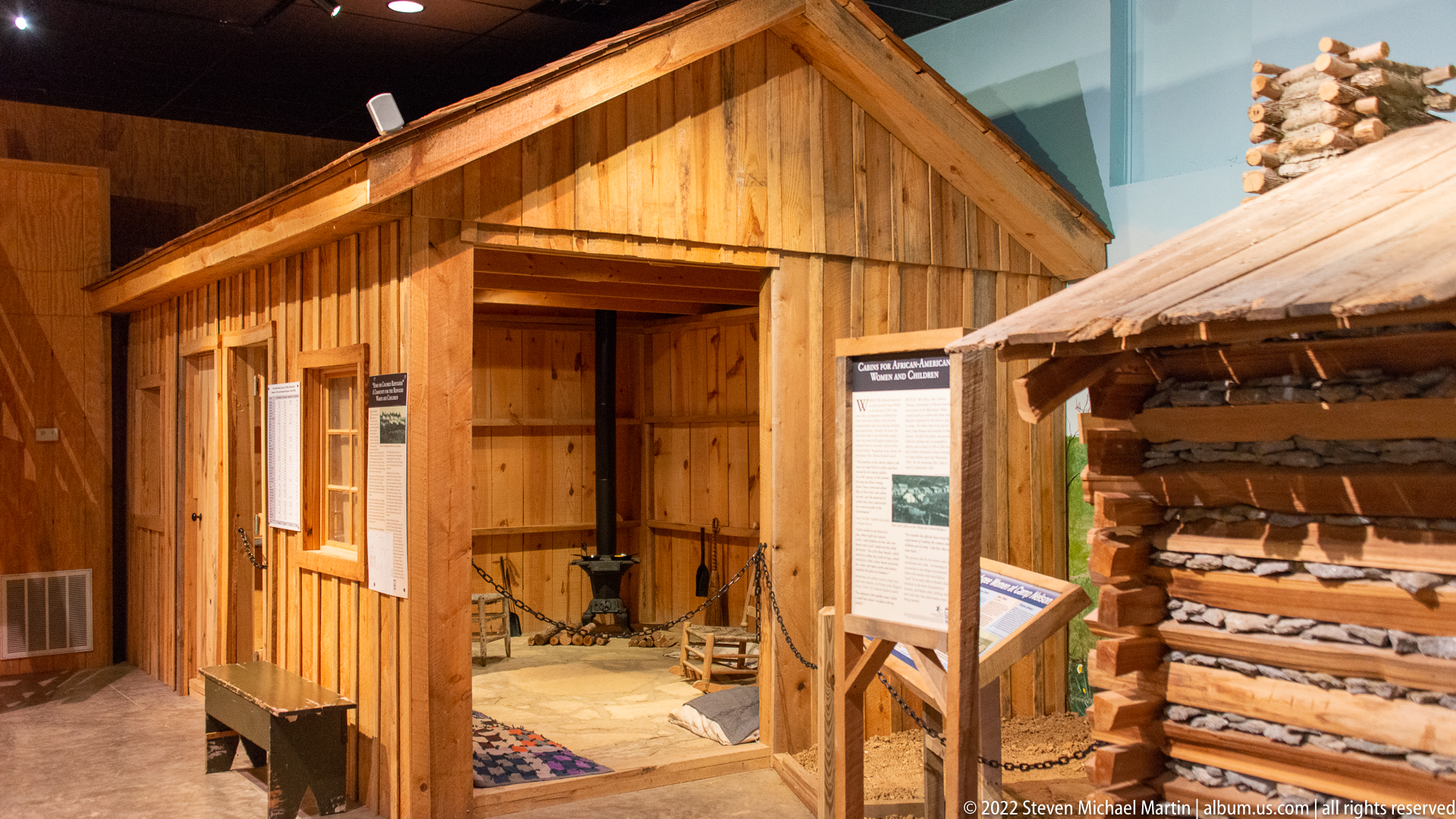
A small timber cabin with a steep gabled roof and open doorway stands beside a reconstructed log shelter inside the museum. The oblique view reveals rough boards, a simple porch threshold, and a chair within, while interpretive panels mark the structures as part of a broader historical display.
Caption
A small timber cabin with a steep gabled roof and open doorway stands beside a reconstructed log shelter inside the museum. The oblique view reveals rough boards, a simple porch threshold, and a chair within, while interpretive panels mark the structures as part of a broader historical display.
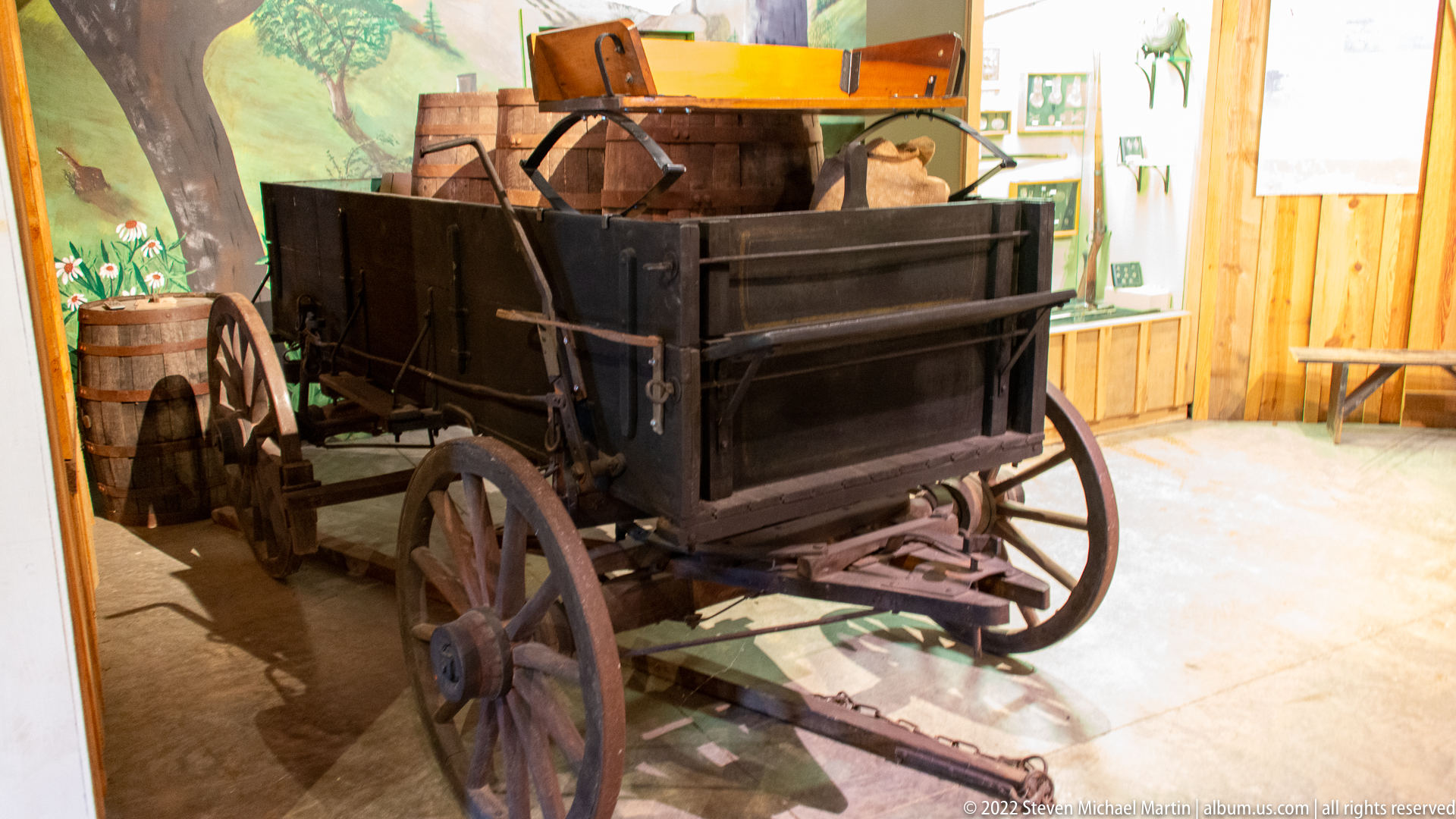
A dark wooden wagon with large spoked wheels is displayed indoors, its box body fitted with high sides and a raised seat. Other household and farm objects sit around it, but the photograph centers on the vehicle’s construction and weathered wood rather than a legible label or precise historical attribution.
Caption
A dark wooden wagon with large spoked wheels is displayed indoors, its box body fitted with high sides and a raised seat. Other household and farm objects sit around it, but the photograph centers on the vehicle’s construction and weathered wood rather than a legible label or precise historical attribution.
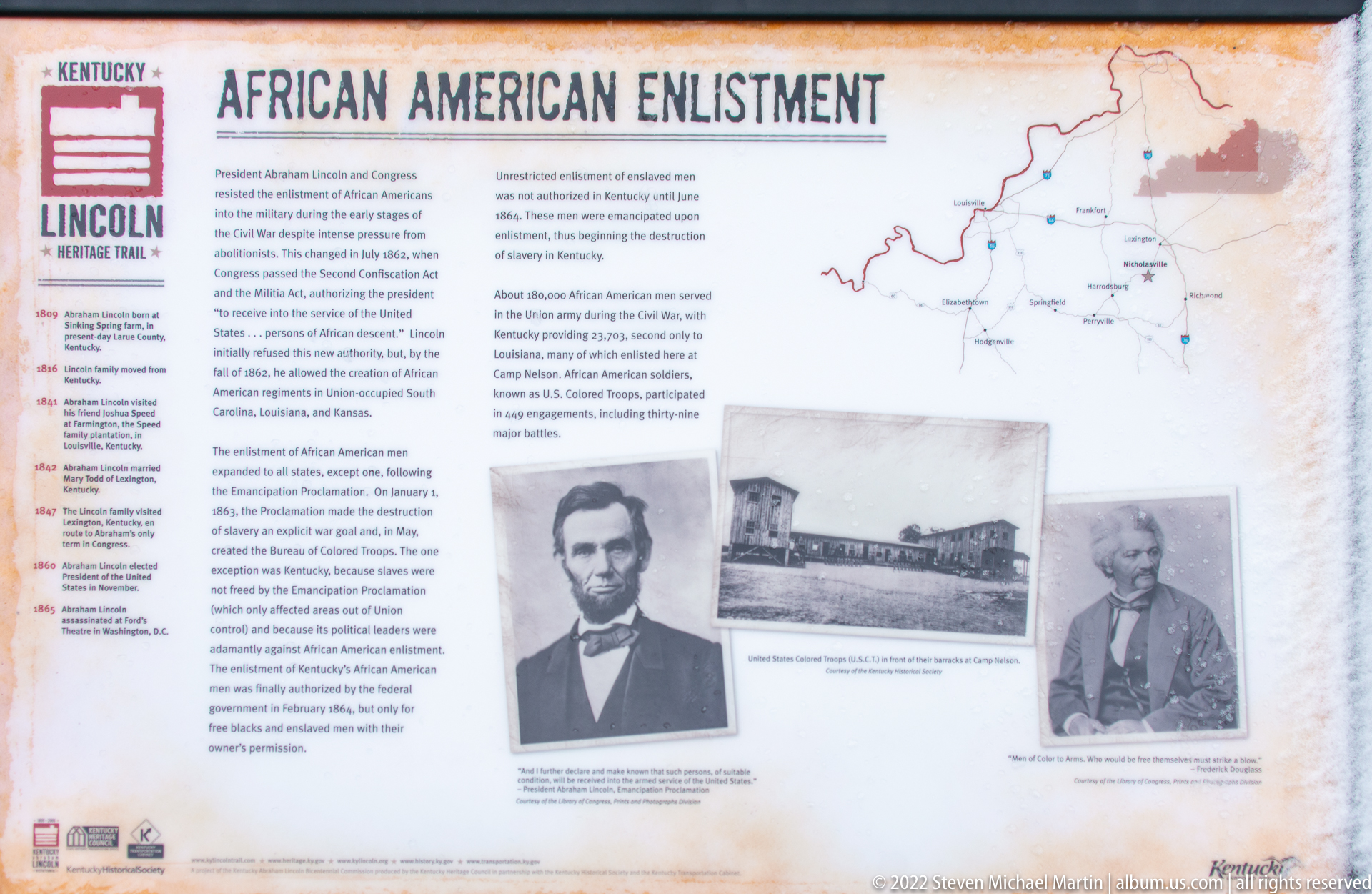
An interpretive panel headed “African American Enlistment” includes a route map, portraits, and historical photographs. The Lincoln Heritage Trail branding appears along the left edge, while the design places explanatory text between the map above and archival images below, linking enlistment history to place and biography.
Caption
An interpretive panel headed “African American Enlistment” includes a route map, portraits, and historical photographs. The Lincoln Heritage Trail branding appears along the left edge, while the design places explanatory text between the map above and archival images below, linking enlistment history to place and biography.
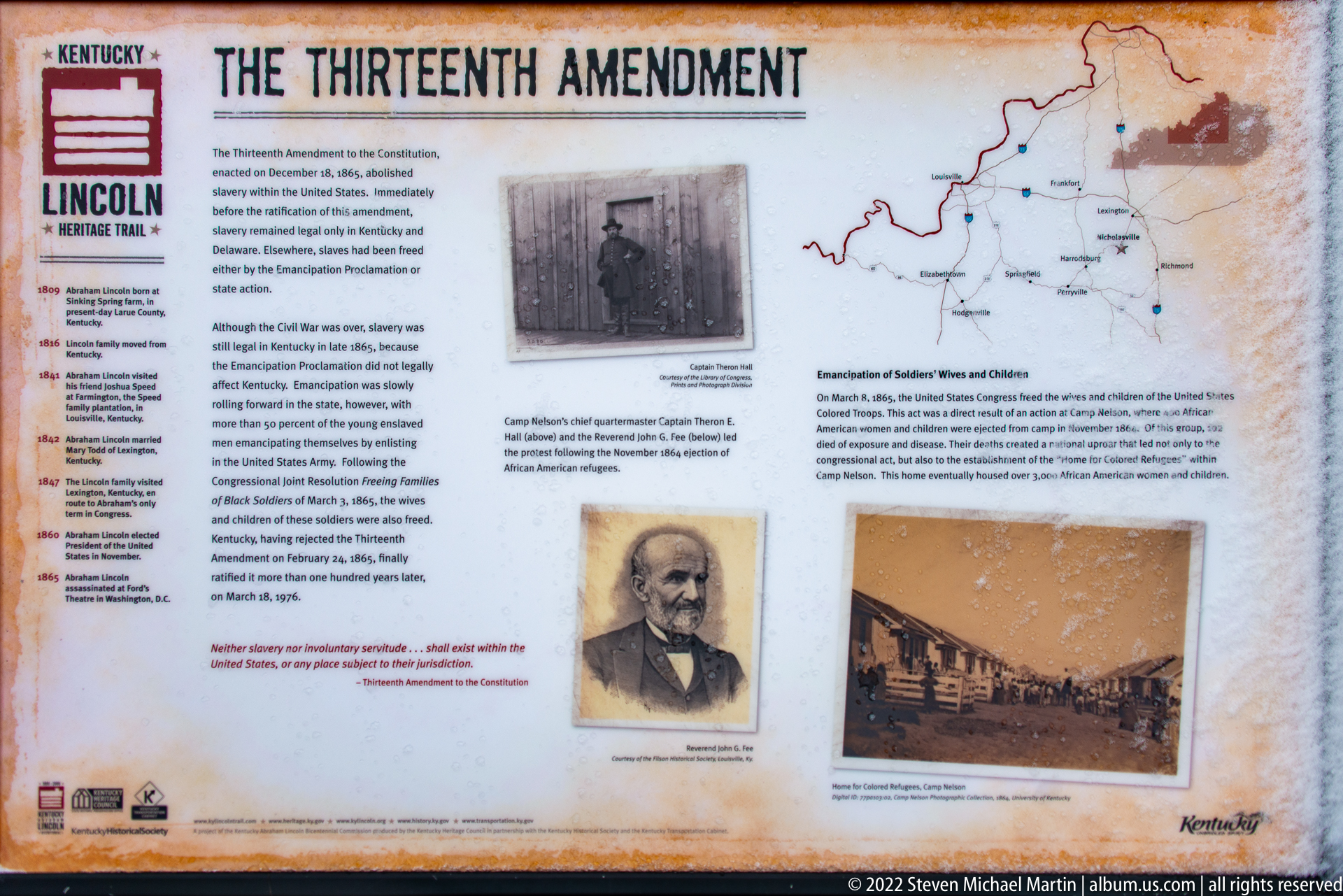
A close view of an interpretive panel titled “The Thirteenth Amendment” combines explanatory text, a route map, portraits, and a historical camp photograph. A red italic statement near the lower left stands apart from the main text, while the Lincoln Heritage Trail mark anchors the display at its edge.
Caption
A close view of an interpretive panel titled “The Thirteenth Amendment” combines explanatory text, a route map, portraits, and a historical camp photograph. A red italic statement near the lower left stands apart from the main text, while the Lincoln Heritage Trail mark anchors the display at its edge.
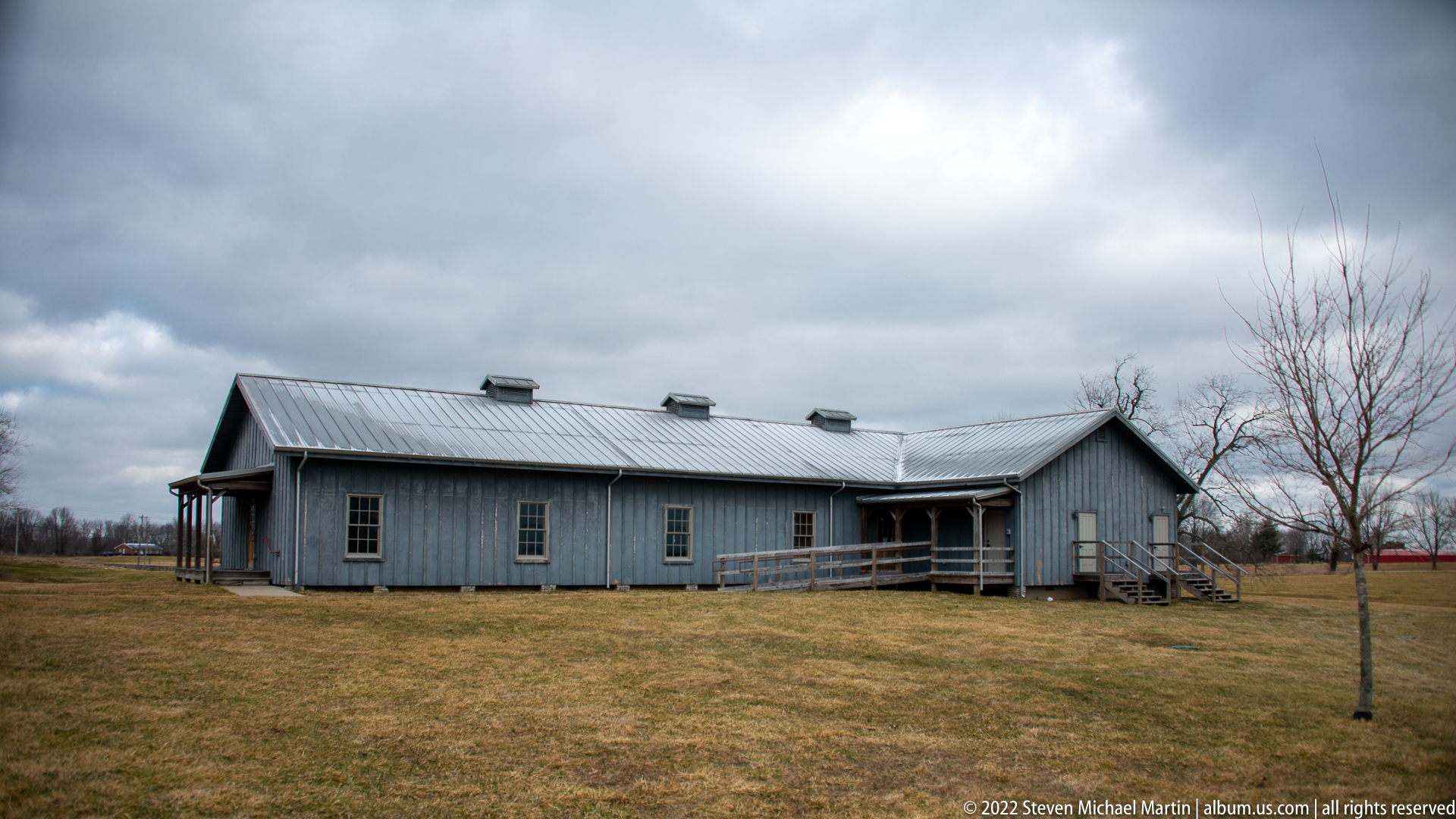
A long, low gray-blue building stands across an open lawn beneath a cloudy sky. Its metal roof, repeated windows, loading-like side projections, and accessible ramp are visible from a slight angle; leafless trees at the edges and the bare winter grass place the structure in an open rural setting.
Caption
A long, low gray-blue building stands across an open lawn beneath a cloudy sky. Its metal roof, repeated windows, loading-like side projections, and accessible ramp are visible from a slight angle; leafless trees at the edges and the bare winter grass place the structure in an open rural setting.
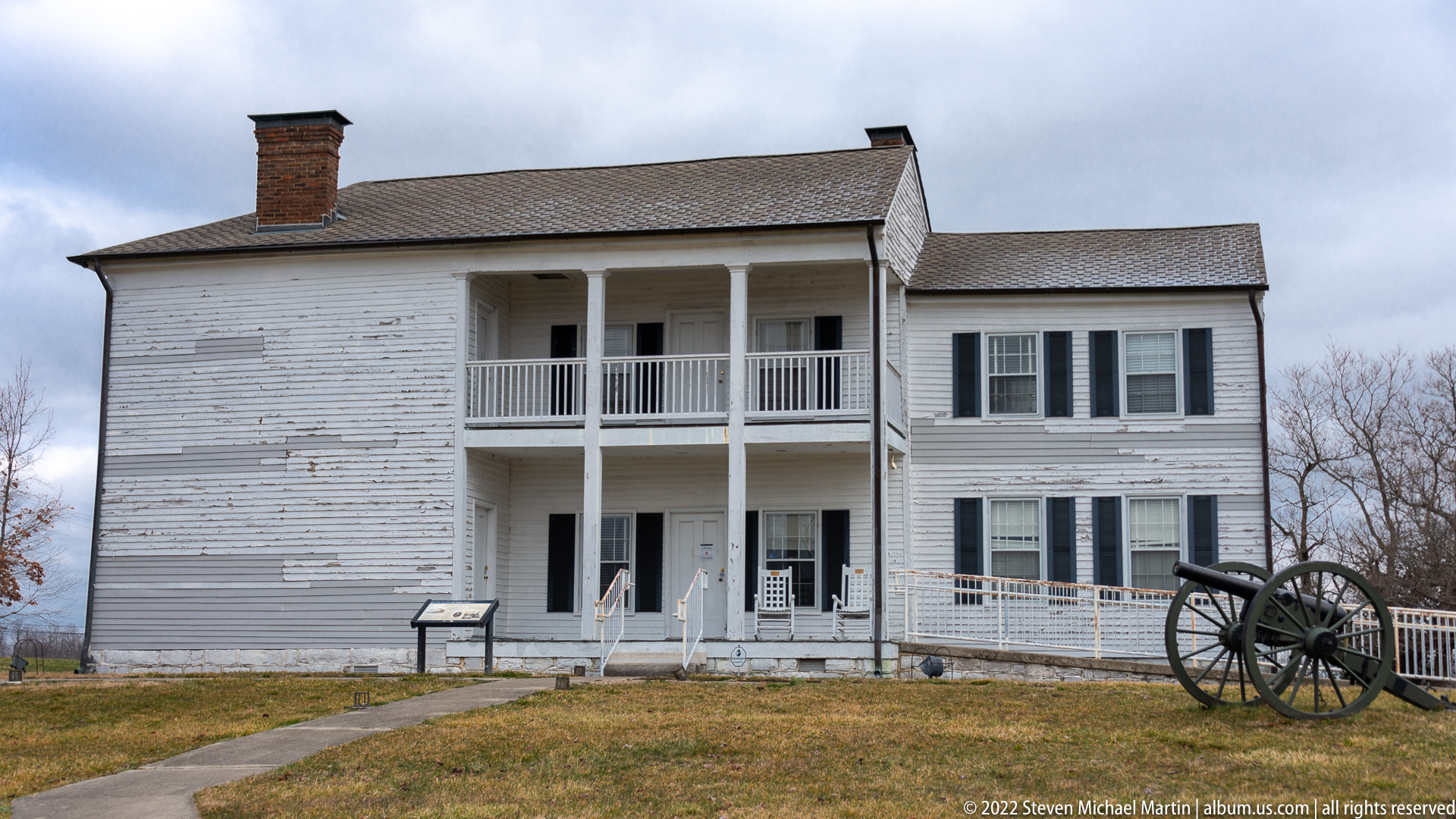
A two-story white clapboard house is photographed from the front at a slight angle, revealing a double-height porch with simple railings and a central entrance. Dark shutters punctuate the windows, while a cannon and low accessibility ramp appear near the lawn; the overcast light softens the façade’s weathered siding.
Caption
A two-story white clapboard house is photographed from the front at a slight angle, revealing a double-height porch with simple railings and a central entrance. Dark shutters punctuate the windows, while a cannon and low accessibility ramp appear near the lawn; the overcast light softens the façade’s weathered siding.
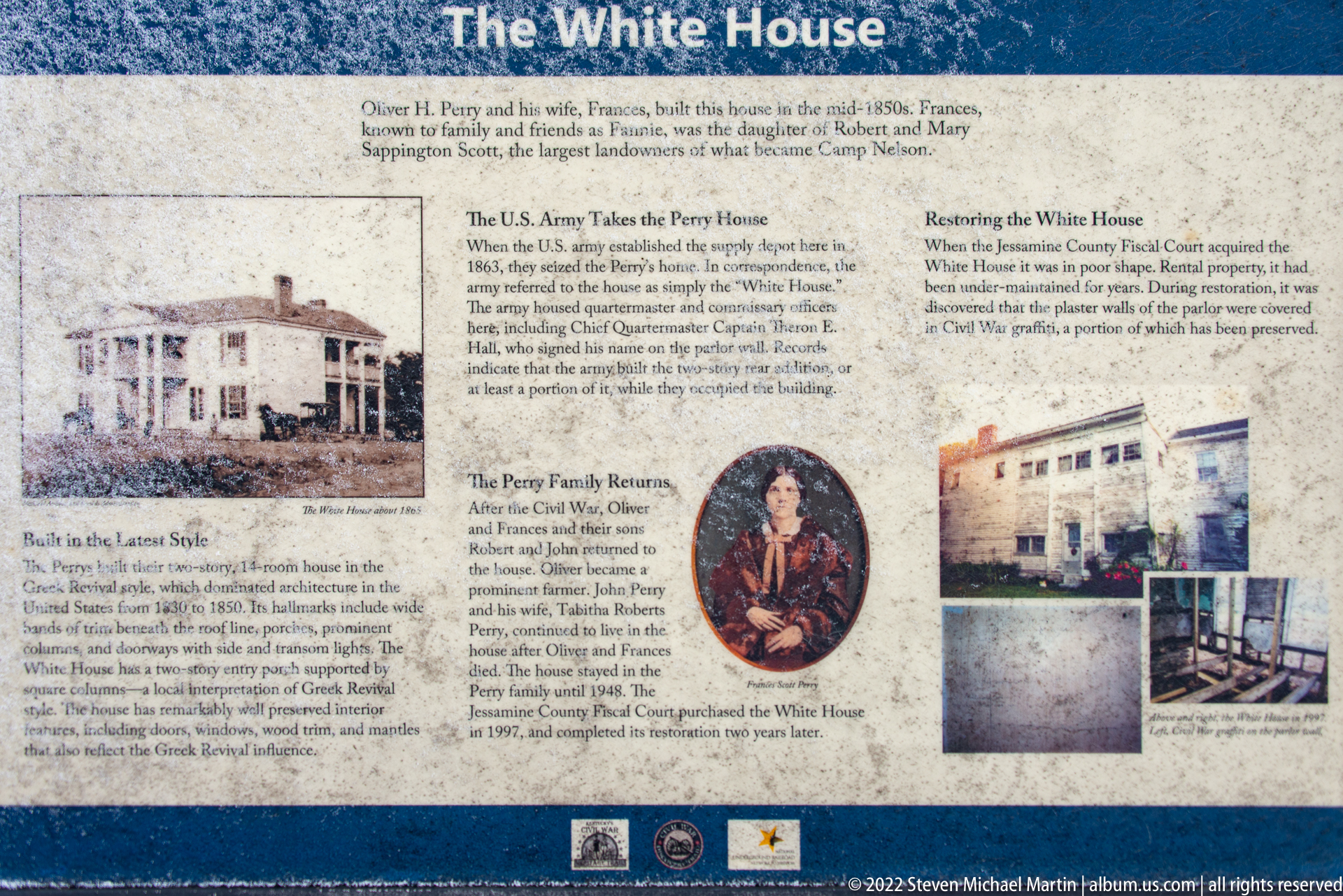
An interpretive board titled “The White House” presents historic photographs and text about the house and the Perry family. The panel pairs images of the building and interiors with a portrait, relating the site’s domestic history to the people associated with it; the printed details are too small to transcribe fully here.
Caption
An interpretive board titled “The White House” presents historic photographs and text about the house and the Perry family. The panel pairs images of the building and interiors with a portrait, relating the site’s domestic history to the people associated with it; the printed details are too small to transcribe fully here.
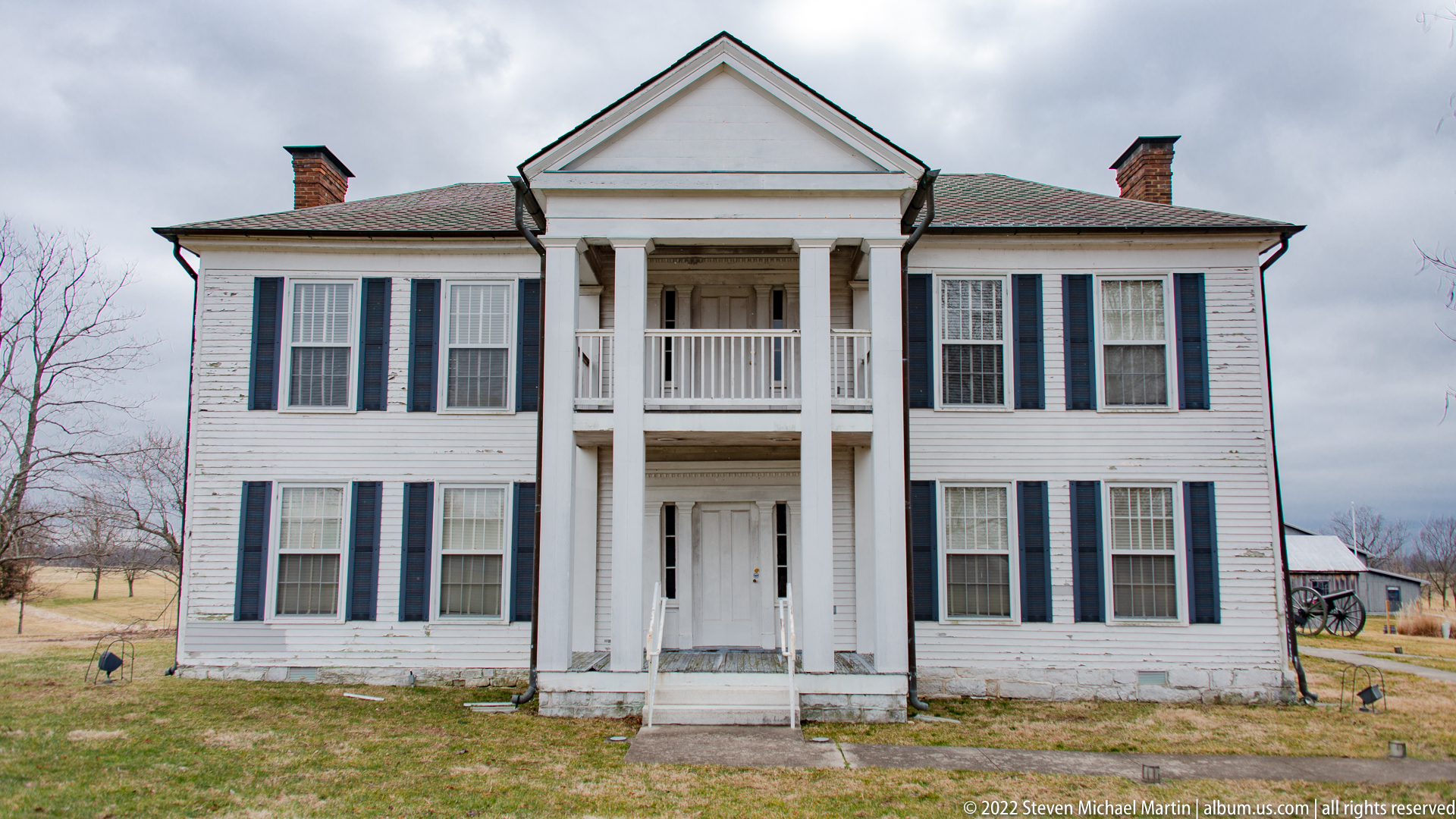
A symmetrical white two-story house faces the camera, with a central portico, paired balconies, dark shutters, and brick chimneys. The broad lawn and bare trees frame the façade, while a carriage wheel enters at right; the frontal view clarifies the house’s balanced arrangement and porch details.
Caption
A symmetrical white two-story house faces the camera, with a central portico, paired balconies, dark shutters, and brick chimneys. The broad lawn and bare trees frame the façade, while a carriage wheel enters at right; the frontal view clarifies the house’s balanced arrangement and porch details.
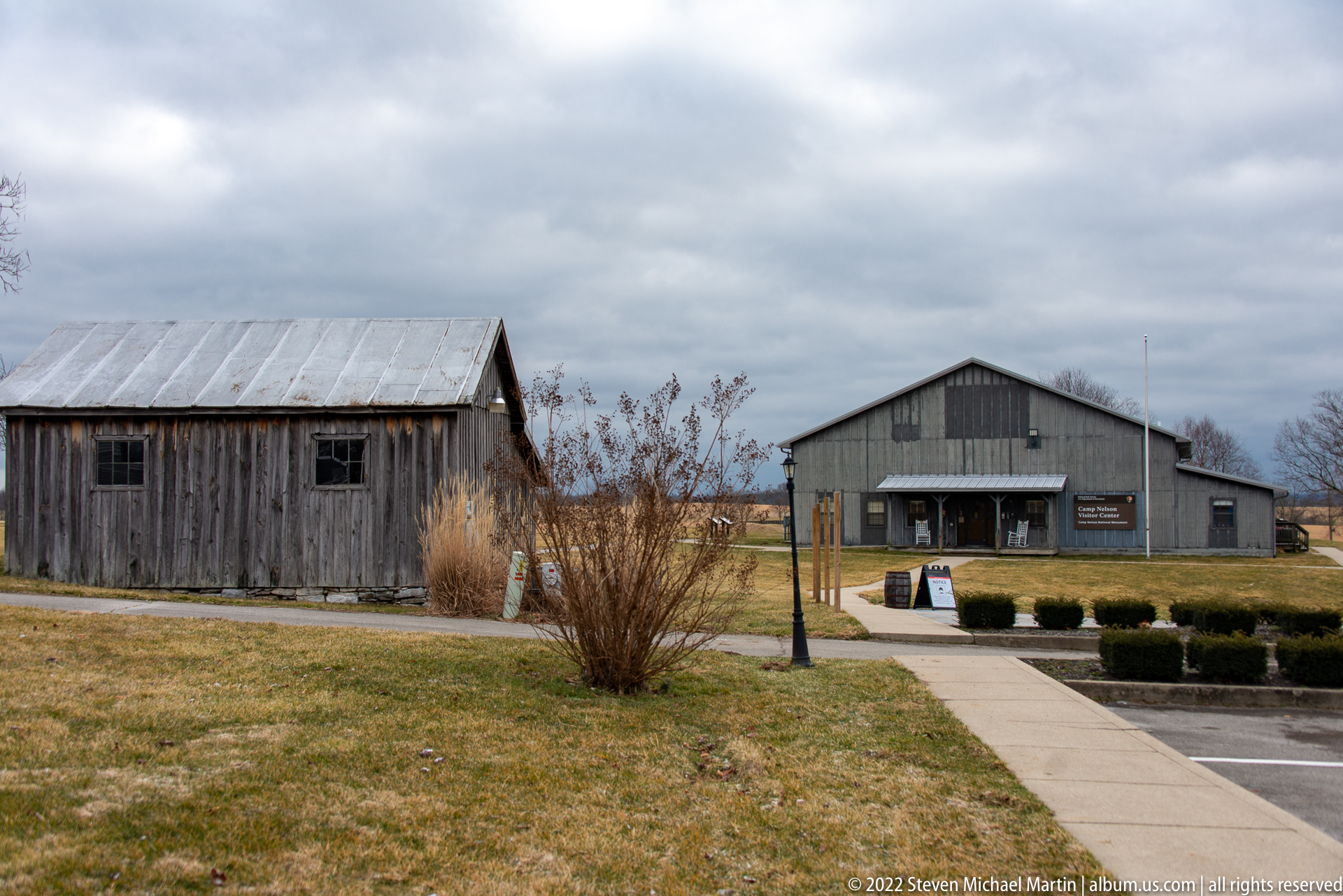
Two weathered wooden buildings stand across a paved path and winter lawn, with a smaller outbuilding at left and a larger gabled structure behind. Signs near the entrance and clipped shrubs suggest a visitor-facing site, while the wide framing records the buildings’ relationship to the grounds.
Caption
Two weathered wooden buildings stand across a paved path and winter lawn, with a smaller outbuilding at left and a larger gabled structure behind. Signs near the entrance and clipped shrubs suggest a visitor-facing site, while the wide framing records the buildings’ relationship to the grounds.
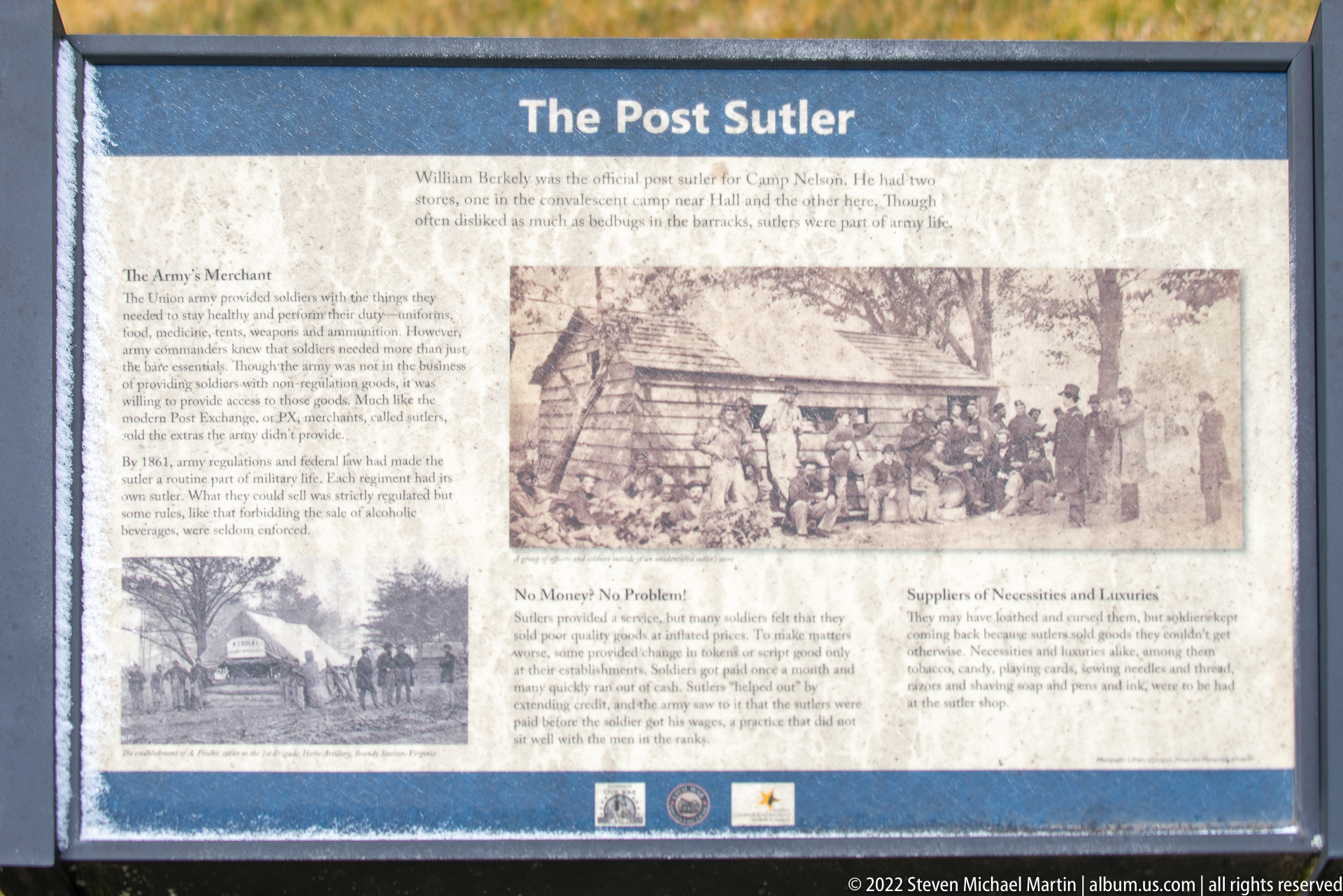
A weathered interpretive panel titled “The Post Sutler” places archival photographs of a wooden building and gathered figures above explanatory text. Its close framing makes the panel itself the subject; the historical images suggest a commercial setting at the camp, though their fine details are not all legible.
Caption
A weathered interpretive panel titled “The Post Sutler” places archival photographs of a wooden building and gathered figures above explanatory text. Its close framing makes the panel itself the subject; the historical images suggest a commercial setting at the camp, though their fine details are not all legible.
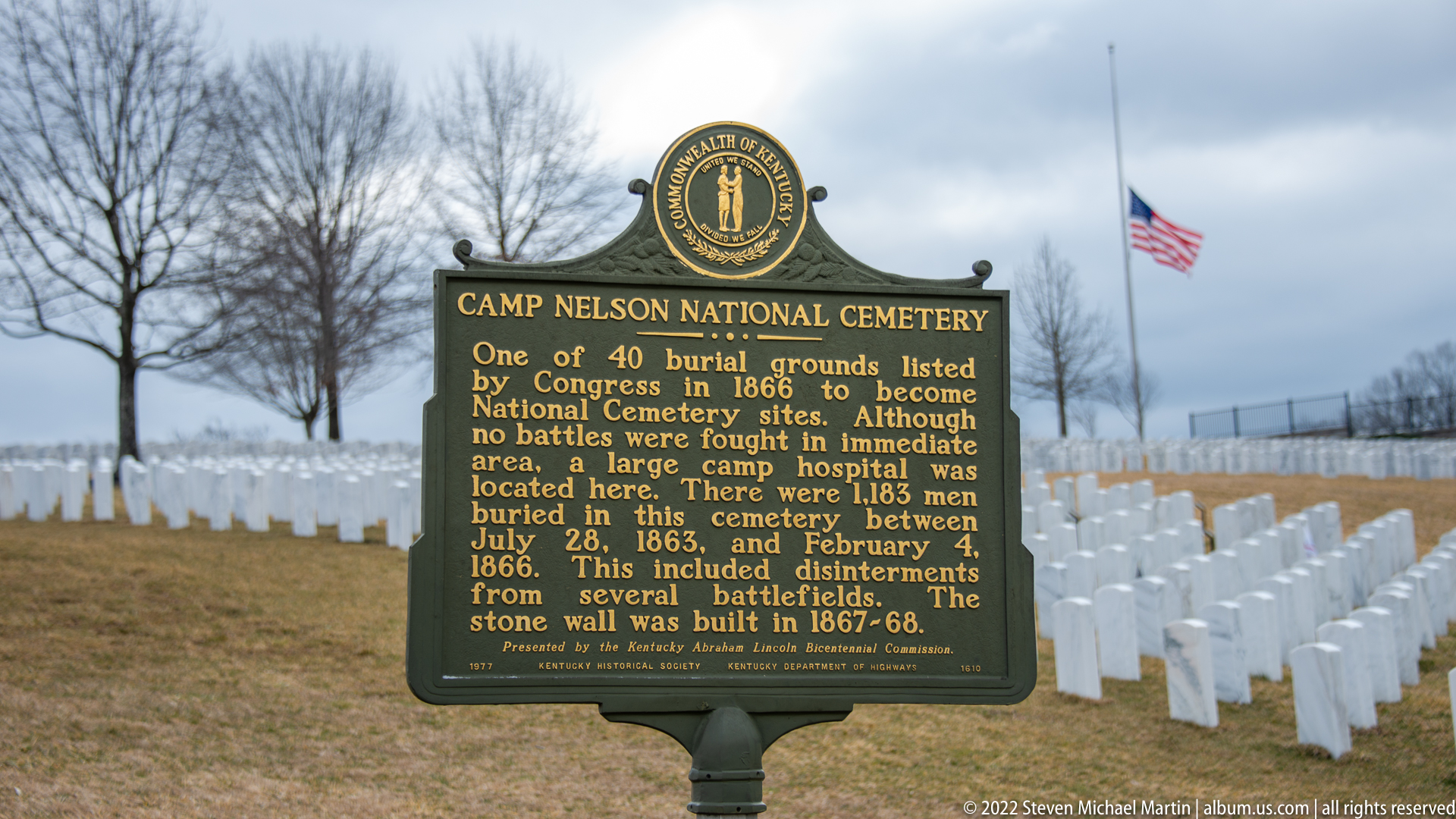
A dark historical marker for Camp Nelson National Cemetery stands in front of rows of white headstones. Its gold lettering describes the cemetery’s designation and burial history; the flagpole and repeated markers behind it connect the close textual view to the cemetery landscape.
Caption
A dark historical marker for Camp Nelson National Cemetery stands in front of rows of white headstones. Its gold lettering describes the cemetery’s designation and burial history; the flagpole and repeated markers behind it connect the close textual view to the cemetery landscape.
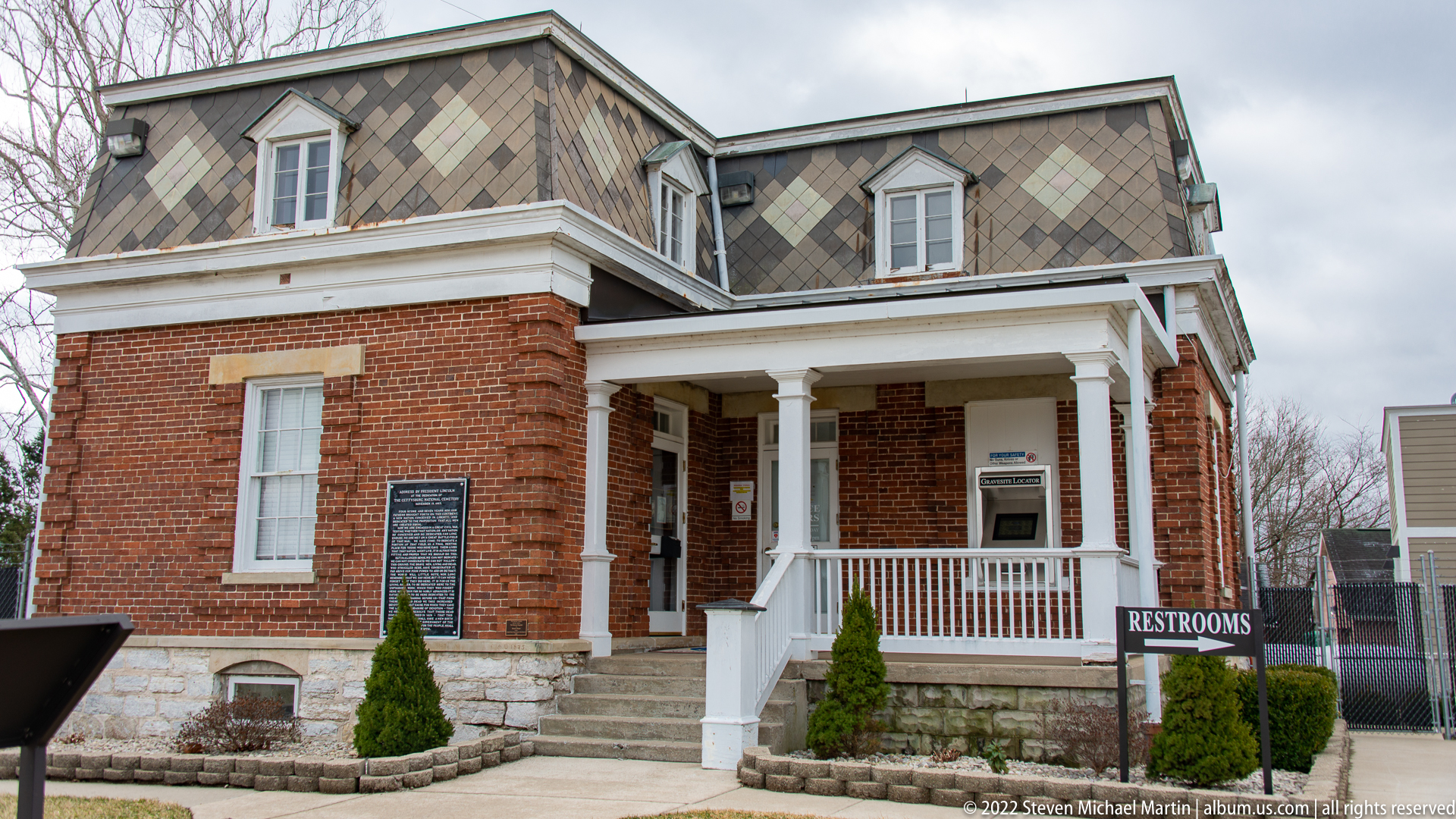
A red-brick building with a steep patterned roof stands above a stone foundation, its white-columned porch facing the viewer. A sign points toward restrooms at right, and a dark plaque is mounted beside the entrance; the photograph records the building’s present-day exterior without resolving its historical identity.
Caption
A red-brick building with a steep patterned roof stands above a stone foundation, its white-columned porch facing the viewer. A sign points toward restrooms at right, and a dark plaque is mounted beside the entrance; the photograph records the building’s present-day exterior without resolving its historical identity.
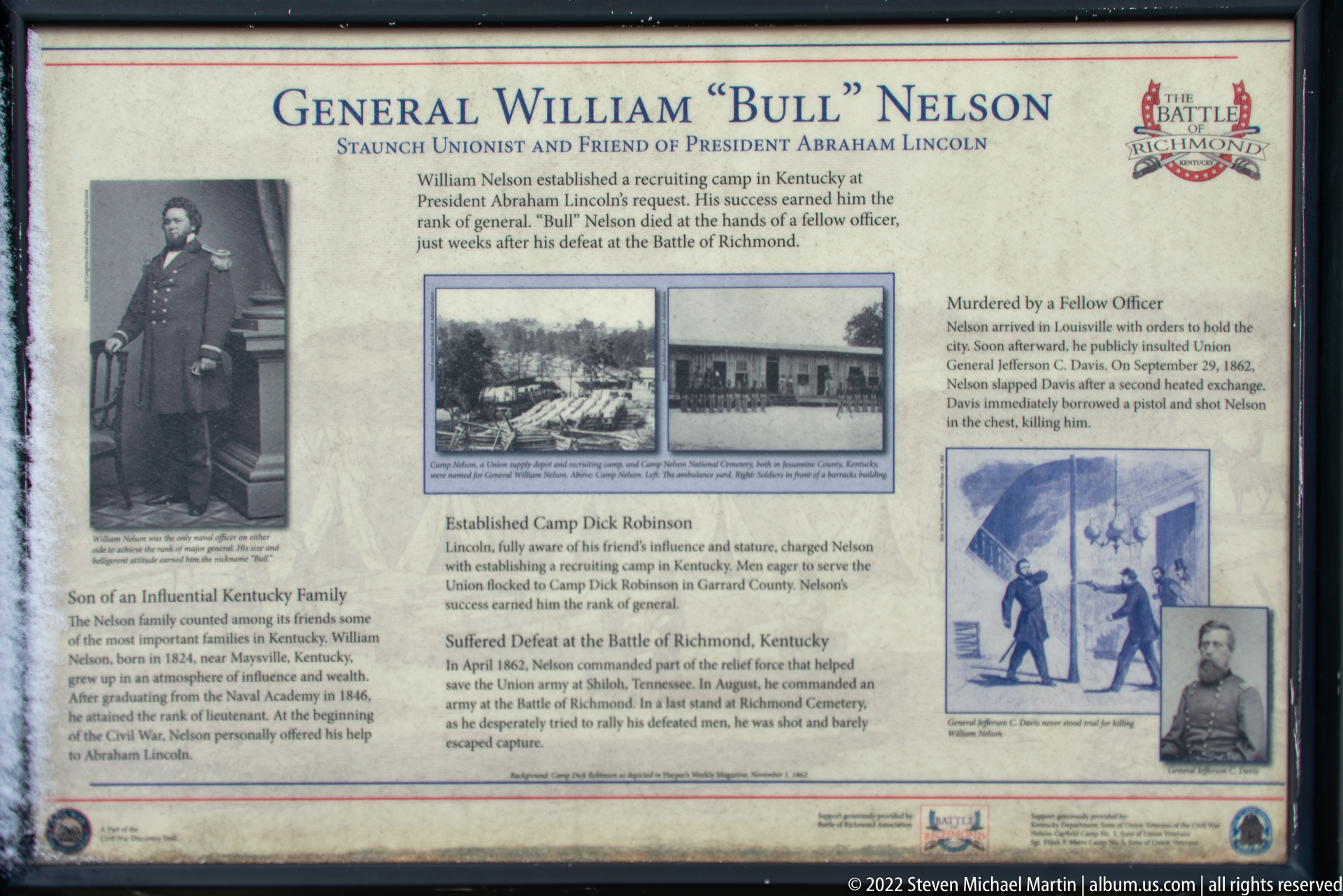
An interpretive panel about General William “Bull” Nelson combines a full-length portrait, photographs, and text about his military career and Camp Nelson. A commemorative emblem sits at the upper right, while blue and red rules frame the information in a design resembling a historical newspaper page.
Caption
An interpretive panel about General William “Bull” Nelson combines a full-length portrait, photographs, and text about his military career and Camp Nelson. A commemorative emblem sits at the upper right, while blue and red rules frame the information in a design resembling a historical newspaper page.
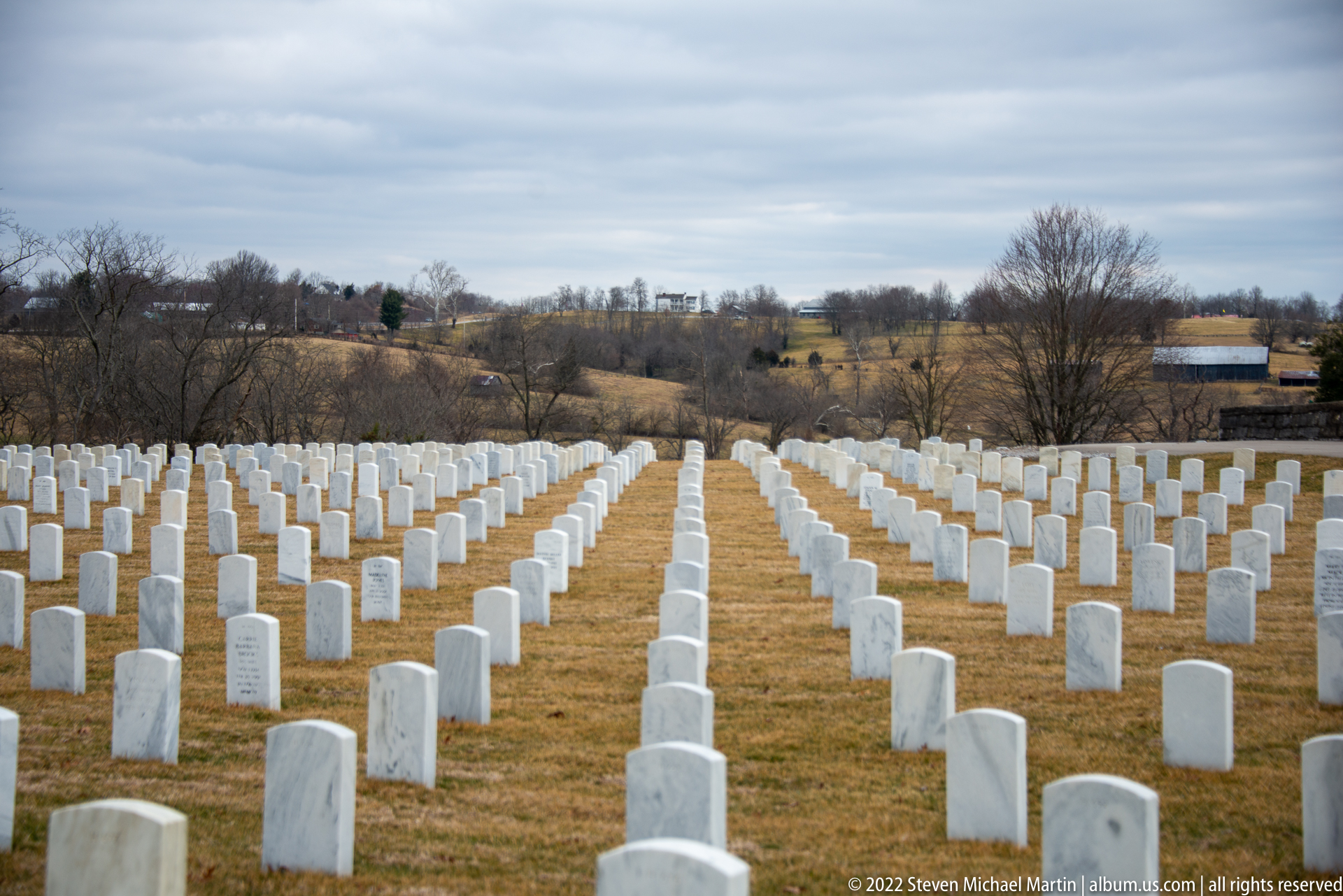
A central aisle divides orderly lines of white headstones, drawing the eye toward the far end of the cemetery. The low viewpoint places several markers close to the lens and reveals rolling ground, distant trees, and a small outbuilding beyond the burial rows under an overcast sky.
Caption
A central aisle divides orderly lines of white headstones, drawing the eye toward the far end of the cemetery. The low viewpoint places several markers close to the lens and reveals rolling ground, distant trees, and a small outbuilding beyond the burial rows under an overcast sky.
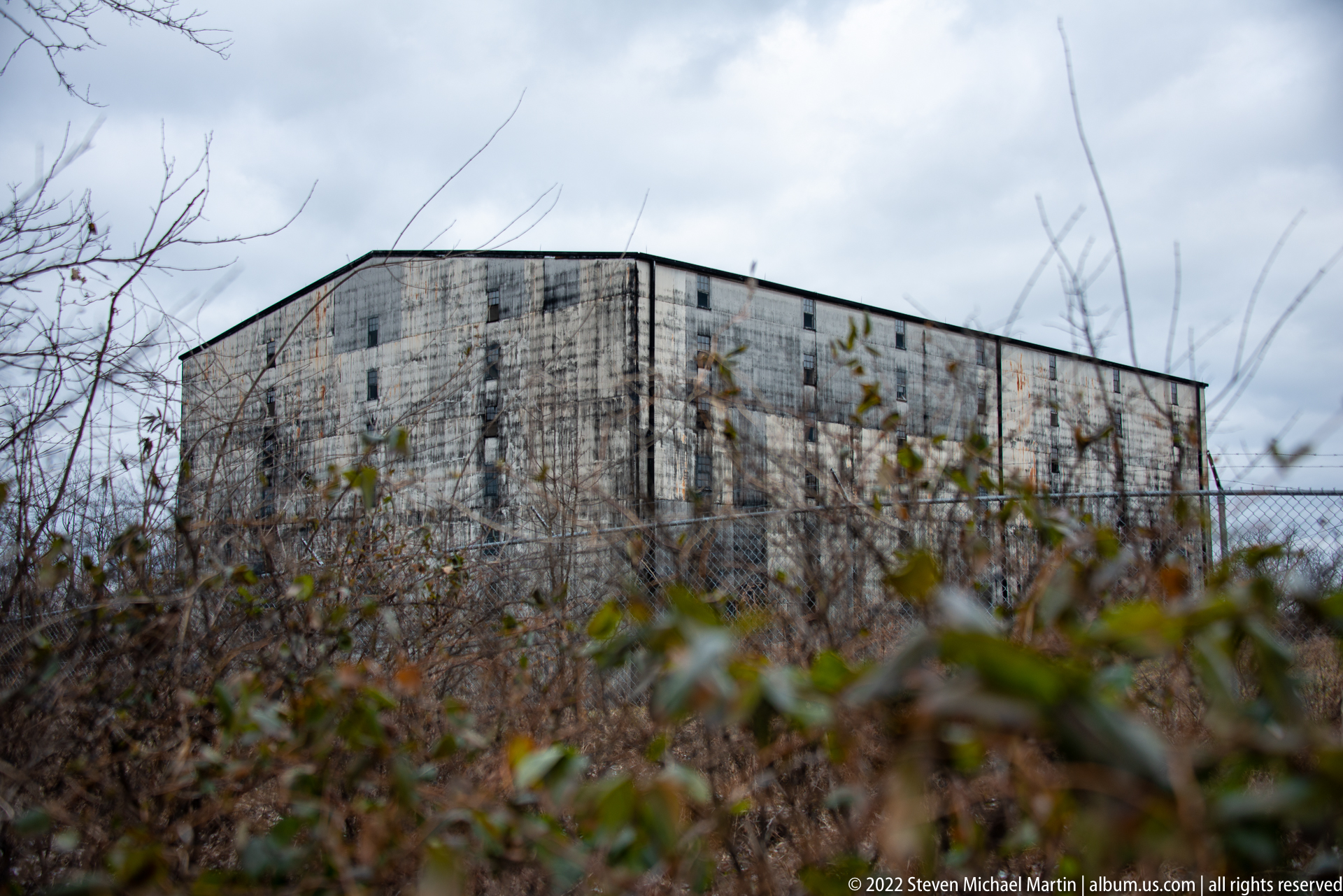
A large rectangular industrial-looking building stands behind a chain-link fence, its pale metal siding mottled with age and discoloration. Leafless branches and brush partly obscure the lower walls, while the upward angle emphasizes the structure’s height and long blank façade; no sign identifies its use.
Caption
A large rectangular industrial-looking building stands behind a chain-link fence, its pale metal siding mottled with age and discoloration. Leafless branches and brush partly obscure the lower walls, while the upward angle emphasizes the structure’s height and long blank façade; no sign identifies its use.
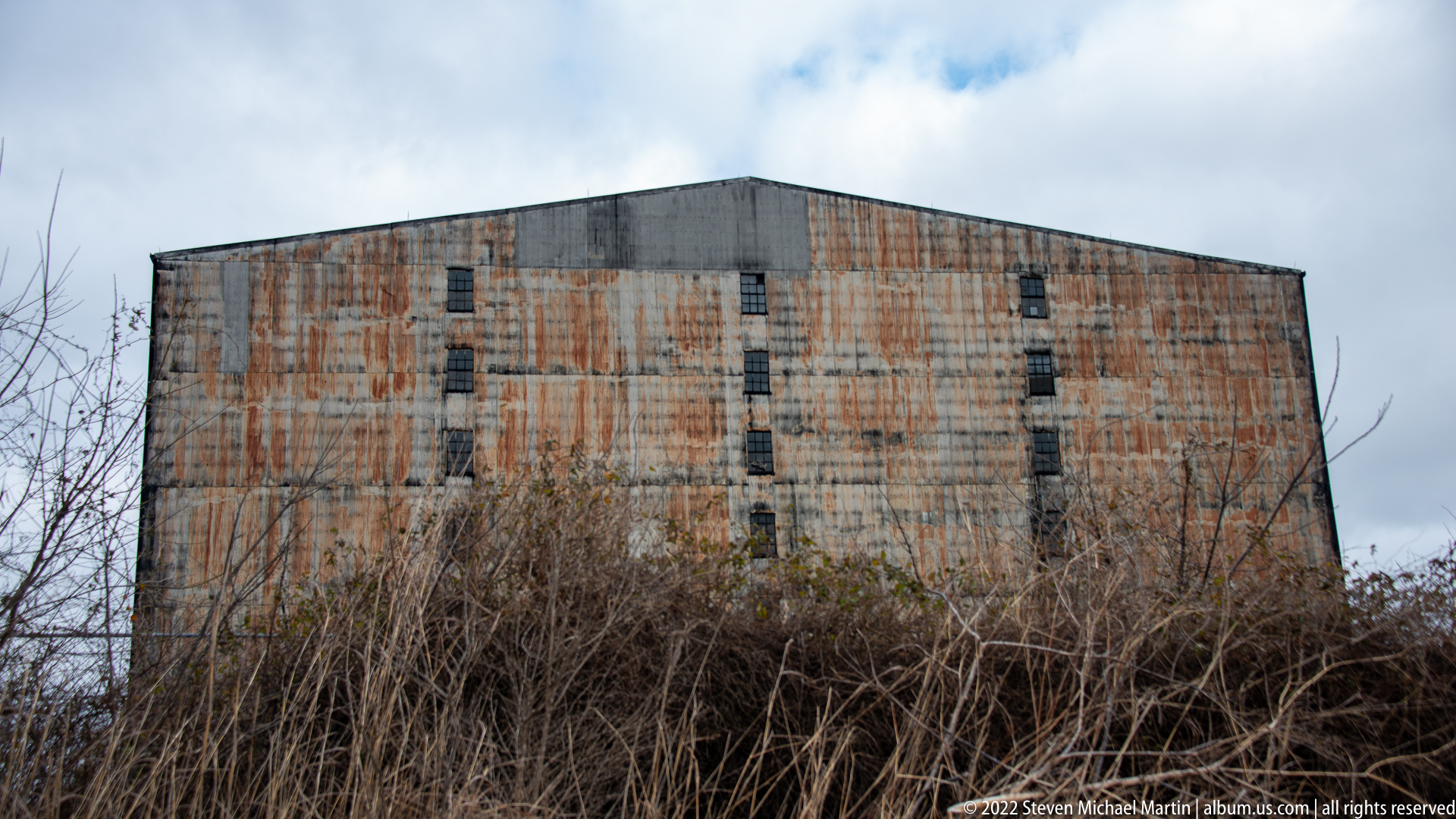
A broad, rectangular building stands behind a screen of leafless brush beneath an overcast sky. Its corrugated metal exterior is mottled with orange rust and gray weathering, and small dark windows punctuate the tall walls. The frontal view emphasizes the structure’s industrial scale and worn surface, but its original use and date cannot be established from the photograph alone.
Caption
A broad, rectangular building stands behind a screen of leafless brush beneath an overcast sky. Its corrugated metal exterior is mottled with orange rust and gray weathering, and small dark windows punctuate the tall walls. The frontal view emphasizes the structure’s industrial scale and worn surface, but its original use and date cannot be established from the photograph alone.
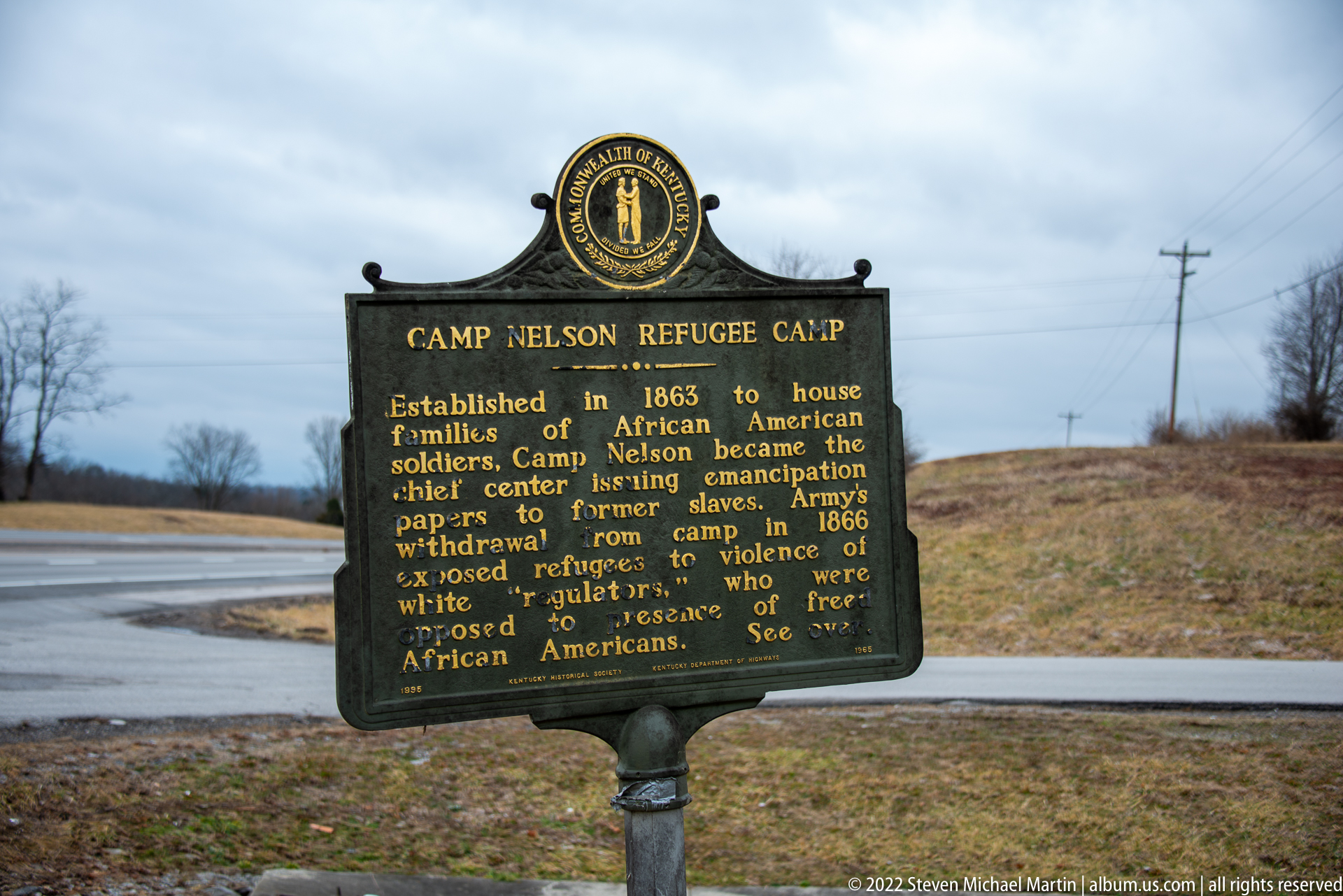
A dark cast-metal roadside marker stands on a short post beside a quiet road, its gold lettering identifying “Camp Nelson Refugee Camp.” The inscription describes the camp’s establishment in 1863 and its role in housing families of African American soldiers. Bare trees, utility lines, and winter grass recede behind the sign, placing the historical text in the present-day landscape.
Caption
A dark cast-metal roadside marker stands on a short post beside a quiet road, its gold lettering identifying “Camp Nelson Refugee Camp.” The inscription describes the camp’s establishment in 1863 and its role in housing families of African American soldiers. Bare trees, utility lines, and winter grass recede behind the sign, placing the historical text in the present-day landscape.
📍 Overview
Camp Nelson National Monument preserves one of the most important recruitment and training centers for African American soldiers during the Civil War. Established by the Union Army in 1863, the site became a gateway to freedom for thousands of formerly enslaved men who enlisted in the United States Colored Troops. Camp Nelson represents both military strategy and a powerful chapter in the broader struggle for emancipation and citizenship.
Located in the rolling landscape of central Kentucky, the monument preserves earthworks, archaeological remains, and interpretive spaces that illustrate the transformation of the site from supply depot to a significant center of enlistment and refuge. Families seeking protection from slavery gathered here, forming a community shaped by resilience, uncertainty, and hope.
⭐ Highlights
- Recruitment center for United States Colored Troops
- Historic Civil War earthworks and fortifications
- Interpretive exhibits explaining the path to emancipation
- Scenic landscape overlooking the Kentucky River valley
- Memorial areas honoring the soldiers and families connected to the site
🔎 Key Features
- Preserved fortifications and defensive earthworks
- Reconstructed structures representing the wartime camp
- Interpretive signage describing daily life for soldiers and refugees
- Archaeological landscape illustrating the scale of the installation
- Walking paths connecting major interpretive locations
📷 Photography Notes
- Soft morning or late afternoon light works well across the open landscape
- Earthworks and rolling terrain create subtle leading lines
- Interpretive structures provide historical context for compositions
- Wide views help convey the scale of the historic site
- Cloud patterns can add visual interest to otherwise open scenes
- Look for quiet details that communicate the human stories connected to the site
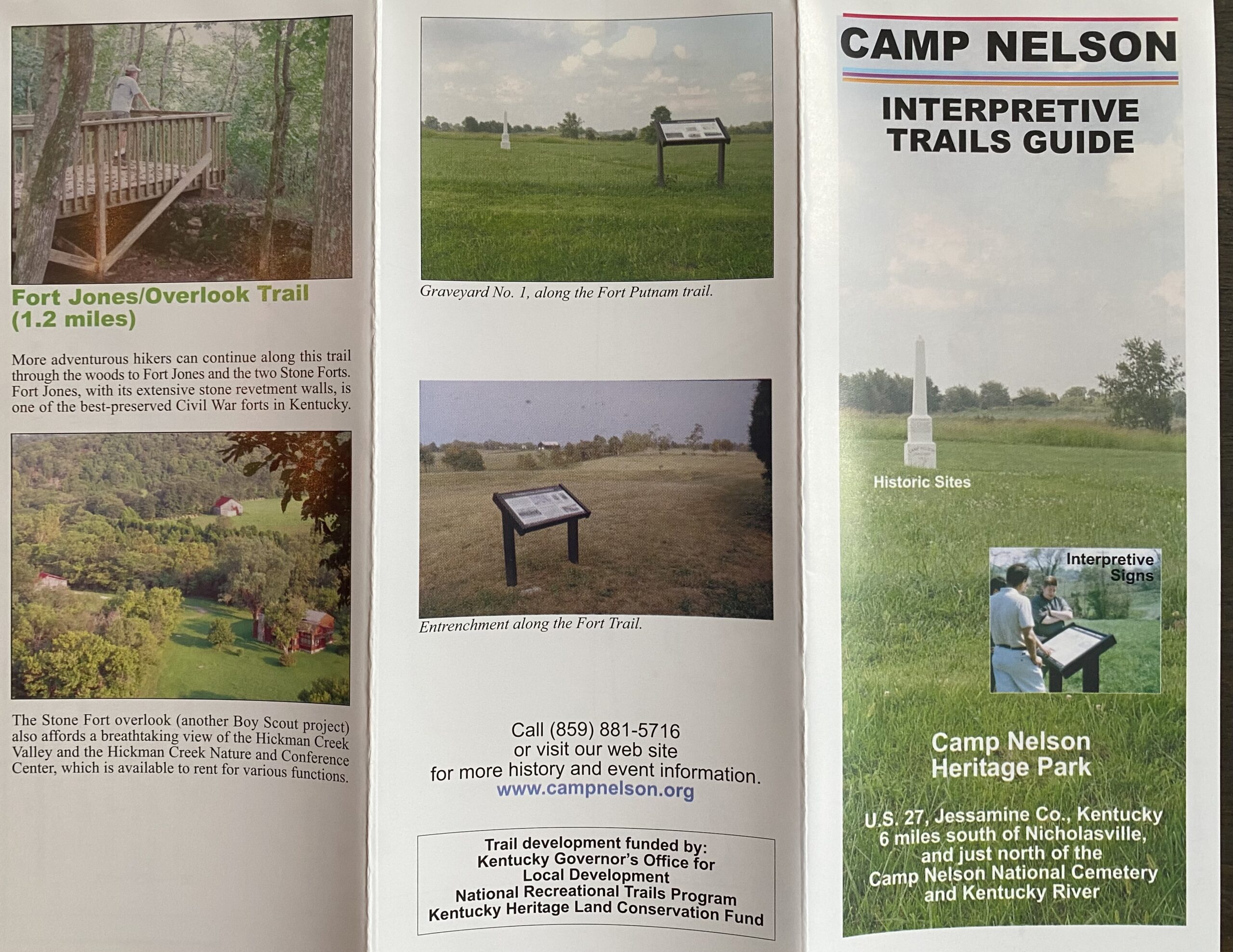
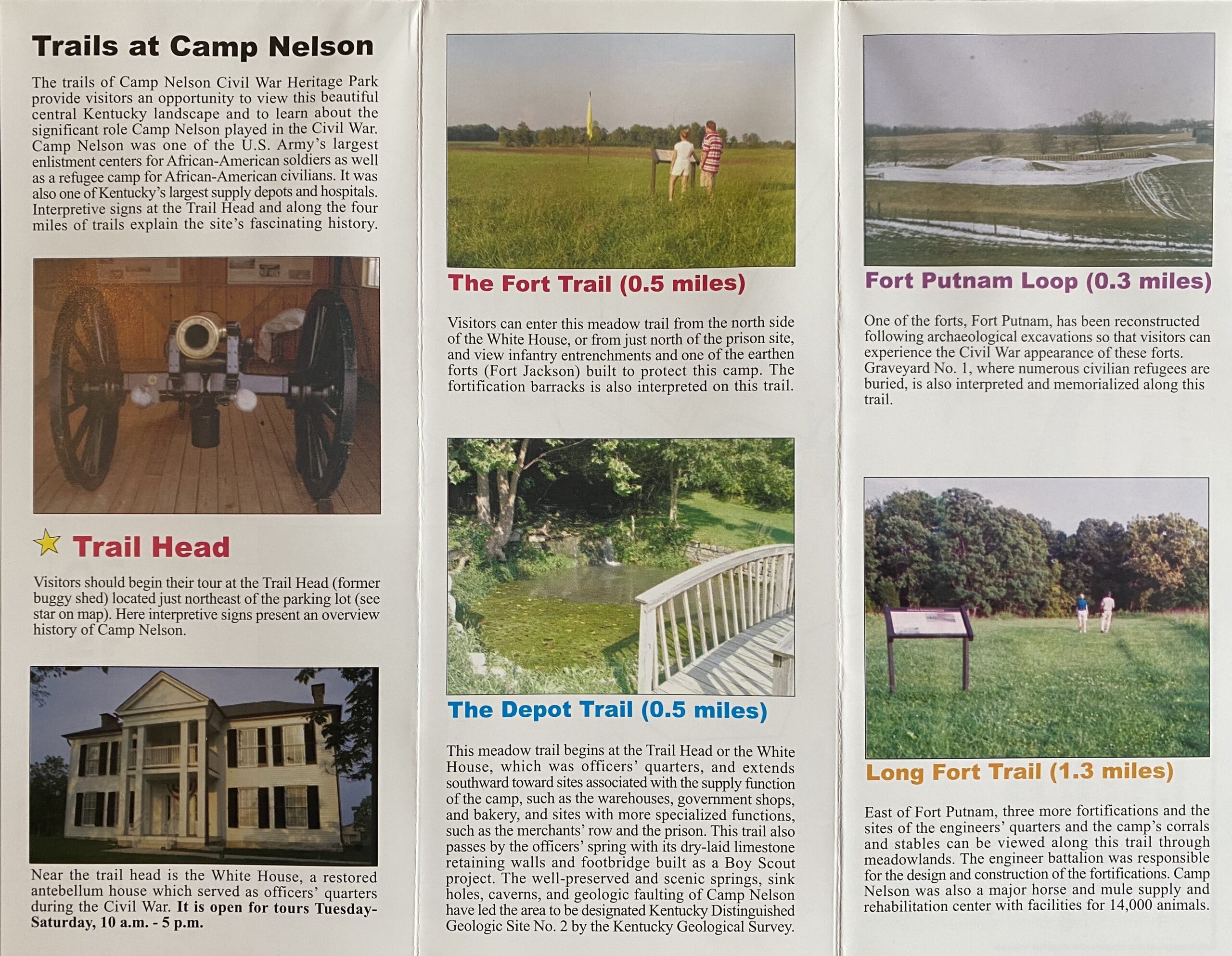
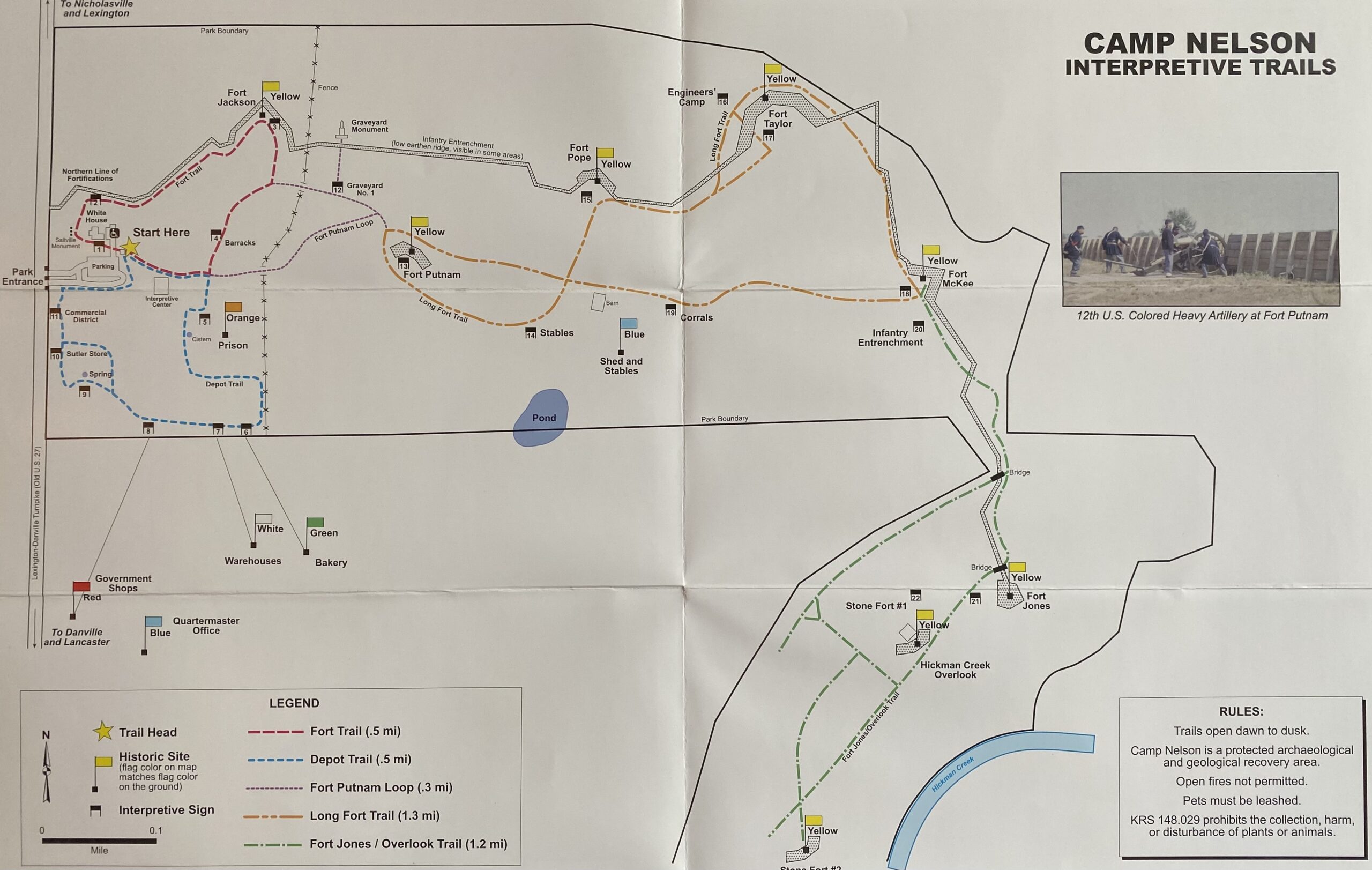
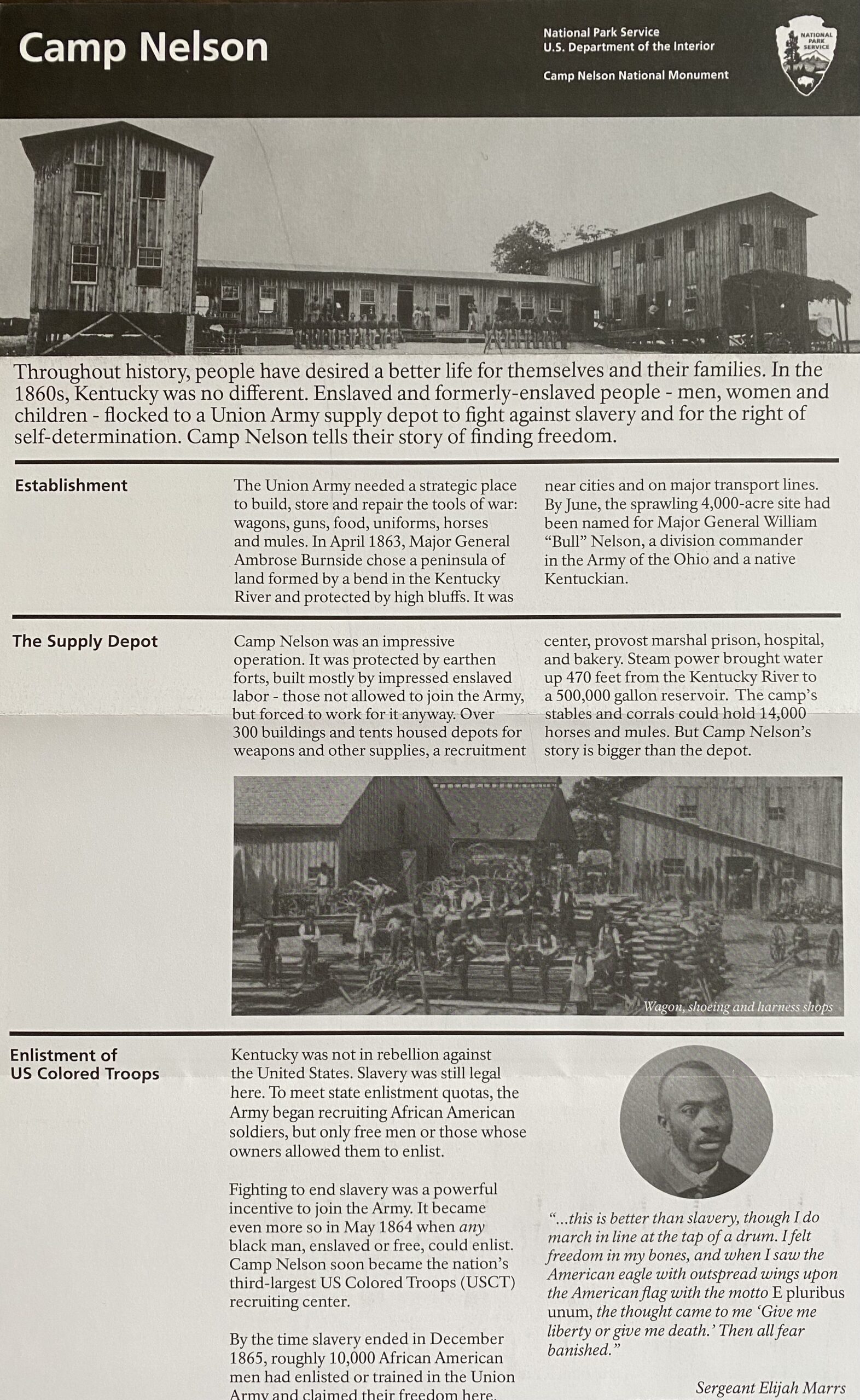
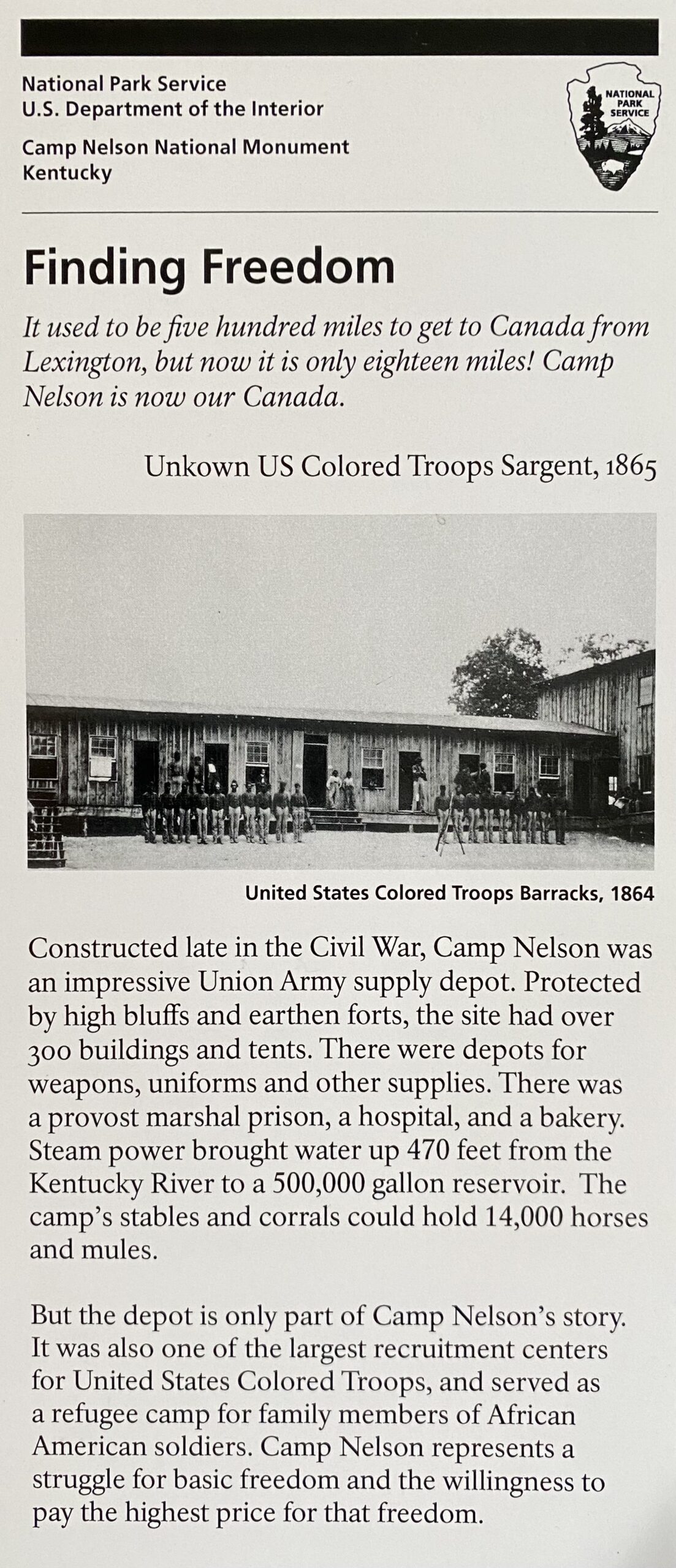
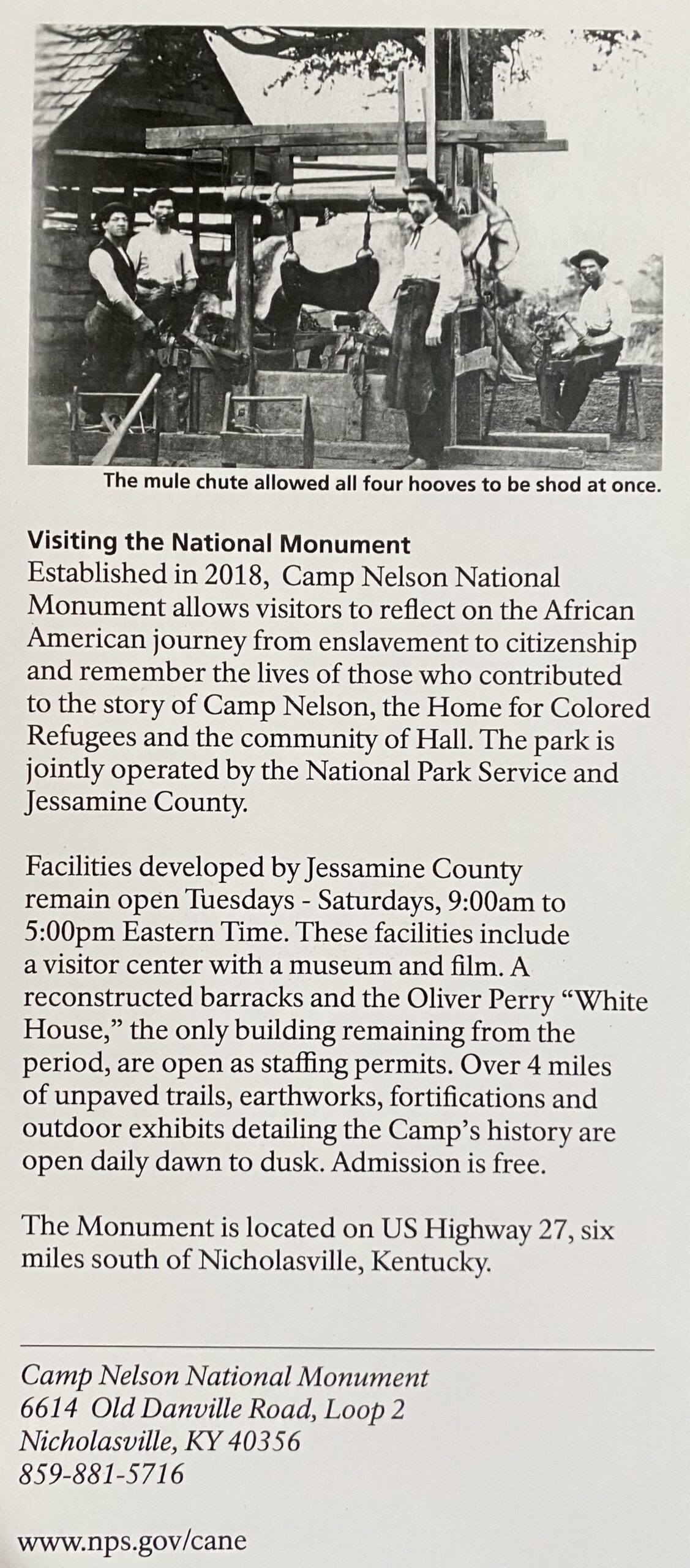
A brochure page continues the Camp Nelson story with sections headed “Camp Nelson Refugee Home” and “Visiting Camp Nelson National Monument.” A long archival photograph of people gathered between rows of buildings stretches across the lower middle, while smaller headings and text explain the site and visitor access. The panel’s layout links the historic refugee community with present-day monument information. A brochure page continues the Camp Nelson story with sections headed “Camp Nelson Refugee Home” and “Visiting Camp Nelson National Monument.” A long archival photograph of people gathered between rows of buildings stretches across the lower middle, while smaller headings and text explain the site and visitor access. The panel’s layout links the historic refugee community with present-day monument information. A printed “Camp Nelson Interpretive Trails Guide” fills the frame, designed with a bold heading, photographs of open fields and trail features, brief descriptions, and visitor information. The page includes small images of an overlook, a trail landscape, and visitors at an interpretive sign. Its layout introduces the monument’s walking routes through a mix of landscape views and practical guidance. A printed “Camp Nelson Interpretive Trails Guide” fills the frame, designed with a bold heading, photographs of open fields and trail features, brief descriptions, and visitor information. The page includes small images of an overlook, a trail landscape, and visitors at an interpretive sign. Its layout introduces the monument’s walking routes through a mix of landscape views and practical guidance. A printed guide page lays out several named Camp Nelson routes, including the Fort Trail, Depot Trail, Fort Putnam Loop, and Long Fort Trail. Each section pairs a short description with small photographs of fields, a cannon, a footbridge, or visitors near trail signs. The page connects walking routes with historic sites across the landscape, while its color headings distinguish the separate trail entries. A printed guide page lays out several named Camp Nelson routes, including the Fort Trail, Depot Trail, Fort Putnam Loop, and Long Fort Trail. Each section pairs a short description with small photographs of fields, a cannon, a footbridge, or visitors near trail signs. The page connects walking routes with historic sites across the landscape, while its color headings distinguish the separate trail entries. A folded map titled “Camp Nelson Interpretive Trails” shows the monument’s roads and landmarks with multiple color-coded walking routes. A legend at the bottom identifies trail distances and symbols, while labels mark historic sites, facilities, and the trailhead. The overhead view presents the route network as a whole, making the spatial relationship between the trails and camp features the central subject. A folded map titled “Camp Nelson Interpretive Trails” shows the monument’s roads and landmarks with multiple color-coded walking routes. A legend at the bottom identifies trail distances and symbols, while labels mark historic sites, facilities, and the trailhead. The overhead view presents the route network as a whole, making the spatial relationship between the trails and camp features the central subject. A black-and-white interpretive panel headed “Camp Nelson” organizes the site’s history into sections on establishment, the supply depot, and the enlistment of U.S. Colored Troops. Archival photographs of a large building and a crowded camp scene divide the columns of text, with a circular portrait near the bottom. The page presents the monument’s history through documentary images and concise explanatory sections. A black-and-white interpretive panel headed “Camp Nelson” organizes the site’s history into sections on establishment, the supply depot, and the enlistment of U.S. Colored Troops. Archival photographs of a large building and a crowded camp scene divide the columns of text, with a circular portrait near the bottom. The page presents the monument’s history through documentary images and concise explanatory sections. A brochure page continues the Camp Nelson story with sections headed “Camp Nelson Refugee Home” and “Visiting Camp Nelson National Monument.” A long archival photograph of people gathered between rows of buildings stretches across the lower middle, while smaller headings and text explain the site and visitor access. The panel’s layout links the historic refugee community with present-day monument information. A brochure page continues the Camp Nelson story with sections headed “Camp Nelson Refugee Home” and “Visiting Camp Nelson National Monument.” A long archival photograph of people gathered between rows of buildings stretches across the lower middle, while smaller headings and text explain the site and visitor access. The panel’s layout links the historic refugee community with present-day monument information. A black-and-white interpretive panel headed “Camp Nelson” organizes the site’s history into sections on establishment, the supply depot, and the enlistment of U.S. Colored Troops. Archival photographs of a large building and a crowded camp scene divide the columns of text, with a circular portrait near the bottom. The page presents the monument’s history through documentary images and concise explanatory sections. A black-and-white interpretive panel headed “Camp Nelson” organizes the site’s history into sections on establishment, the supply depot, and the enlistment of U.S. Colored Troops. Archival photographs of a large building and a crowded camp scene divide the columns of text, with a circular portrait near the bottom. The page presents the monument’s history through documentary images and concise explanatory sections. A close view of an interpretive panel headed “Freedom” centers a historic photograph of long barracks, captioned as United States Colored Troops barracks in 1864. Above it, the panel identifies an unknown U.S. Colored Troops sergeant in 1865; the rest of the board contains explanatory text and a quotation. The pairing of portrait and barracks photograph connects an individual soldier with the larger military site. A close view of an interpretive panel headed “Freedom” centers a historic photograph of long barracks, captioned as United States Colored Troops barracks in 1864. Above it, the panel identifies an unknown U.S. Colored Troops sergeant in 1865; the rest of the board contains explanatory text and a quotation. The pairing of portrait and barracks photograph connects an individual soldier with the larger military site. A brochure page places a historic photograph captioned “The Mule Chute allowed all four hooves to be shod at once” above visitor information for Camp Nelson National Monument. The text below describes the monument’s designation, its museum and trail facilities, and location near Nicholasville, Kentucky. The layout joins a specific historic work scene with practical details for visiting the present-day site. A brochure page places a historic photograph captioned “The Mule Chute allowed all four hooves to be shod at once” above visitor information for Camp Nelson National Monument. The text below describes the monument’s designation, its museum and trail facilities, and location near Nicholasville, Kentucky. The layout joins a specific historic work scene with practical details for visiting the present-day site.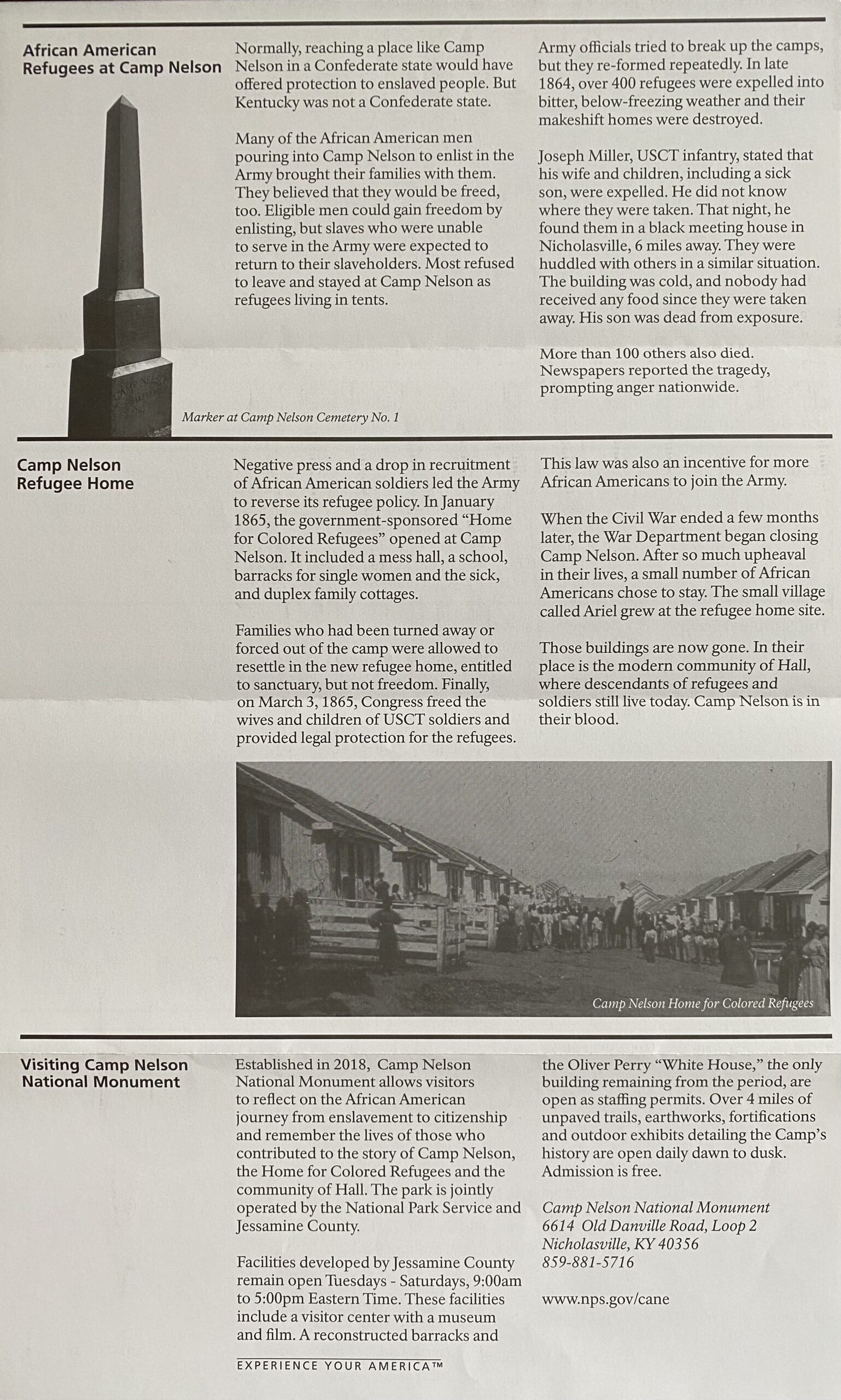
Caption
Caption
Caption
Caption
Caption
Caption
Caption
Caption
Caption