Ambler – Kobuk Valley National Park
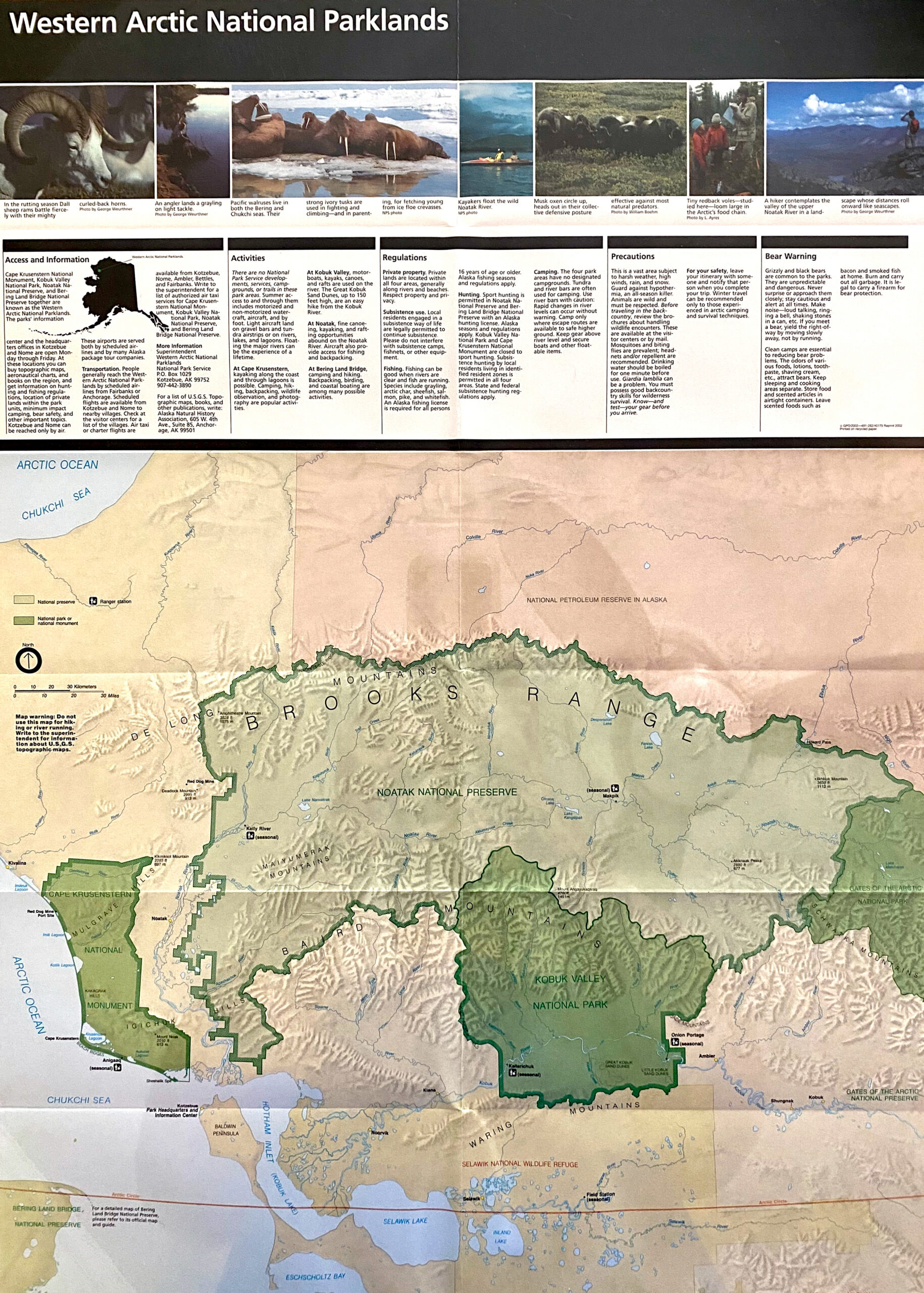
Ambler is a small community located near the southern boundary of Kobuk Valley National Park and serves as a regional access point for remote wilderness landscapes along the Kobuk River. The settlement reflects long-standing Indigenous traditions associated with seasonal migration, fishing, and subsistence practices shaped by the environmental conditions of northwest Alaska. Its location near the river emphasizes the importance of waterways as transportation routes across Arctic environments.
The surrounding region includes tundra, forested uplands, and river corridors that support wildlife populations and seasonal ecological cycles. Communities such as Ambler illustrate the continuing relationship between people and landscape in areas where transportation infrastructure remains limited. Cultural traditions and knowledge of environmental conditions remain essential for travel and survival in remote Arctic regions.
Visitors encounter an environment characterized by expansive views, open skies, and relatively minimal development. Ambler provides insight into contemporary life in Arctic communities while also serving as a gateway to wilderness landscapes preserved within Kobuk Valley National Park.
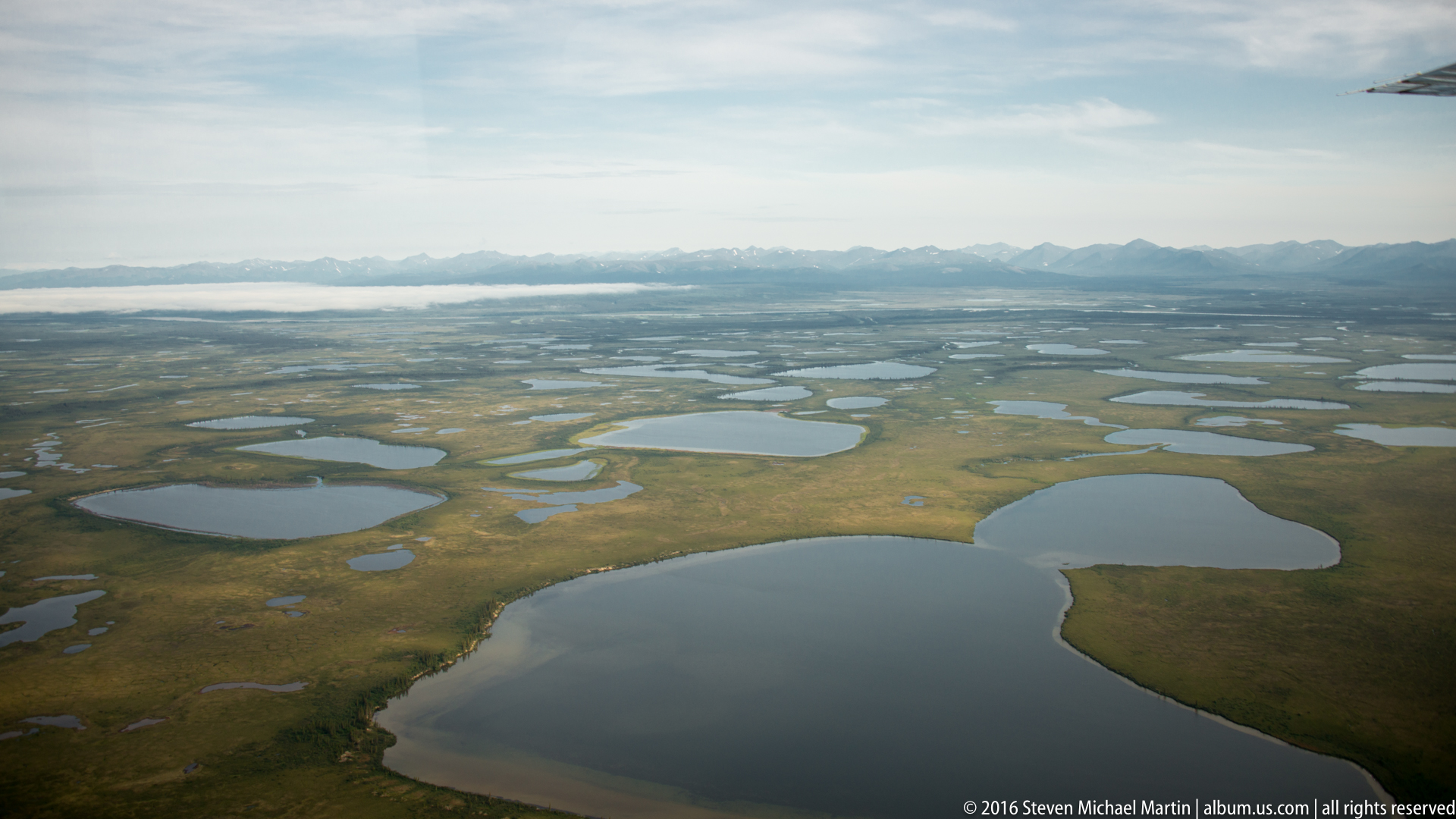
An open tundra plain is dotted with lakes and ponds of many sizes, from small dark pools to a larger water body in the foreground. Low vegetation forms muted green and brown patches between them, and a distant mountain range runs along the horizon. The wide aerial framing emphasizes the density and spread of the water across otherwise gently varied terrain.
Caption
An open tundra plain is dotted with lakes and ponds of many sizes, from small dark pools to a larger water body in the foreground. Low vegetation forms muted green and brown patches between them, and a distant mountain range runs along the horizon. The wide aerial framing emphasizes the density and spread of the water across otherwise gently varied terrain.
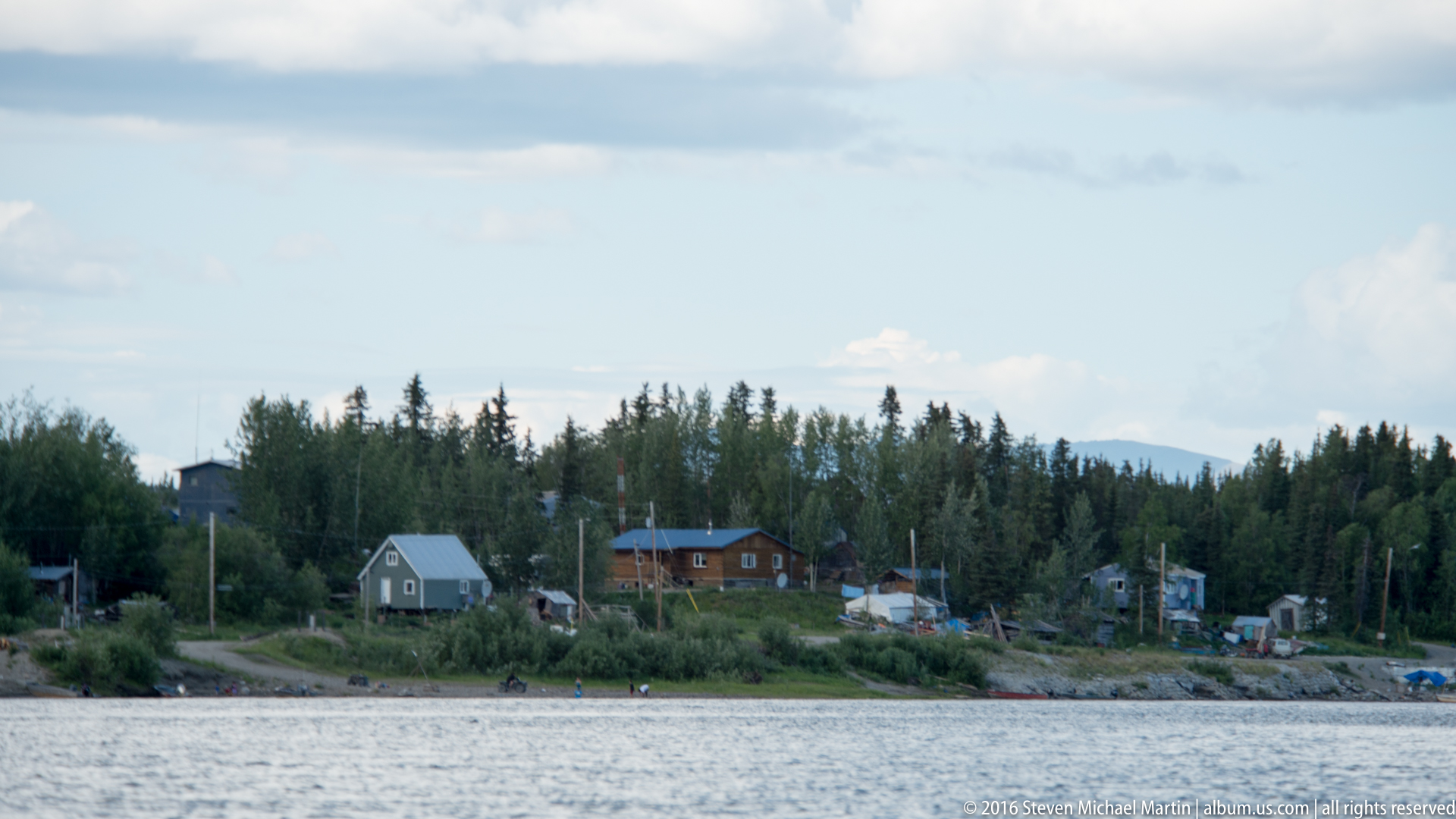
A cluster of small homes and utility poles sits behind a narrow band of shoreline trees across the river. The broad water occupies the foreground, and a low mountain ridge fades behind the settlement. The long-distance view places the village within its river corridor without isolating any single building or identifying residents.
Caption
A cluster of small homes and utility poles sits behind a narrow band of shoreline trees across the river. The broad water occupies the foreground, and a low mountain ridge fades behind the settlement. The long-distance view places the village within its river corridor without isolating any single building or identifying residents.
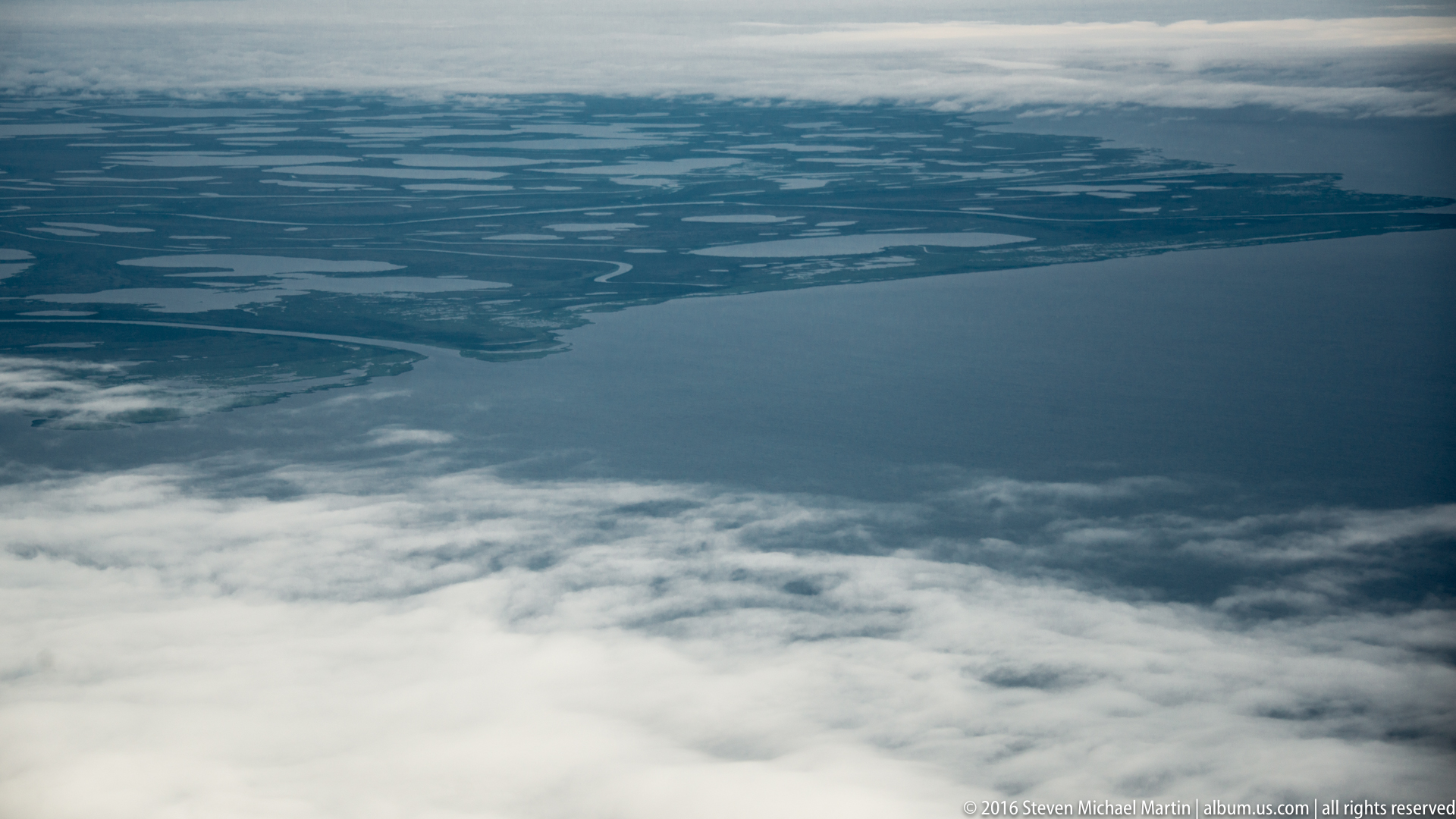
A wide sheet of low cloud crosses the lower half of the view, leaving a blue-gray expanse of water and land visible beyond it. From above, thin channels and scattered pools form a faint pattern beneath the haze. The soft, layered composition records the changing conditions of flight over the northern landscape, with cloud and terrain sharing the frame.
Caption
A wide sheet of low cloud crosses the lower half of the view, leaving a blue-gray expanse of water and land visible beyond it. From above, thin channels and scattered pools form a faint pattern beneath the haze. The soft, layered composition records the changing conditions of flight over the northern landscape, with cloud and terrain sharing the frame.
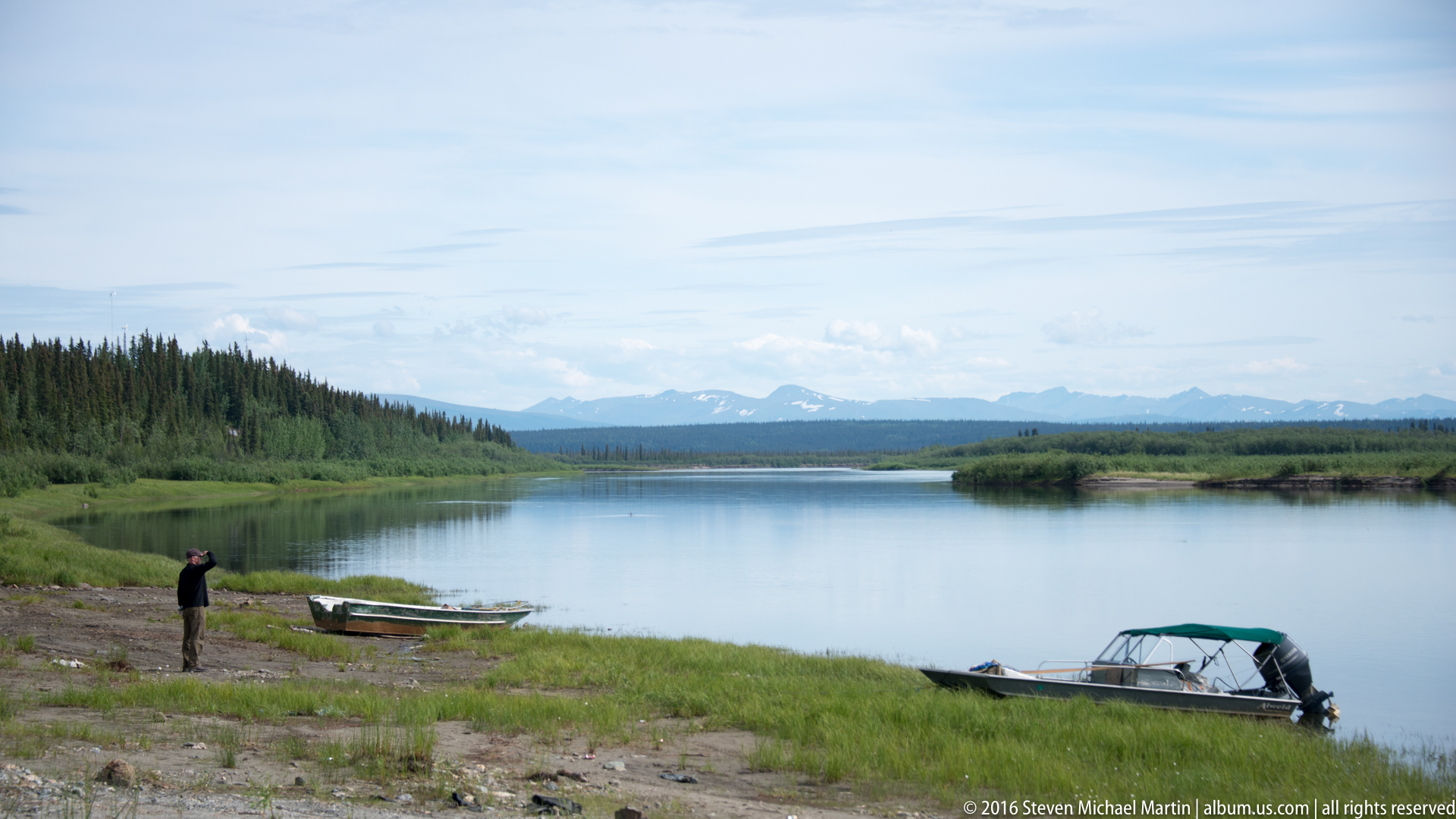
Two boats lie along a gravelly riverbank: a small uncovered craft near a standing person and a larger motorboat with a green canopy at the water. The river’s calm surface leads toward distant wooded banks and low hills. This slightly wider view shows the boats’ placement within the riverside setting.
Caption
Two boats lie along a gravelly riverbank: a small uncovered craft near a standing person and a larger motorboat with a green canopy at the water. The river’s calm surface leads toward distant wooded banks and low hills. This slightly wider view shows the boats’ placement within the riverside setting.
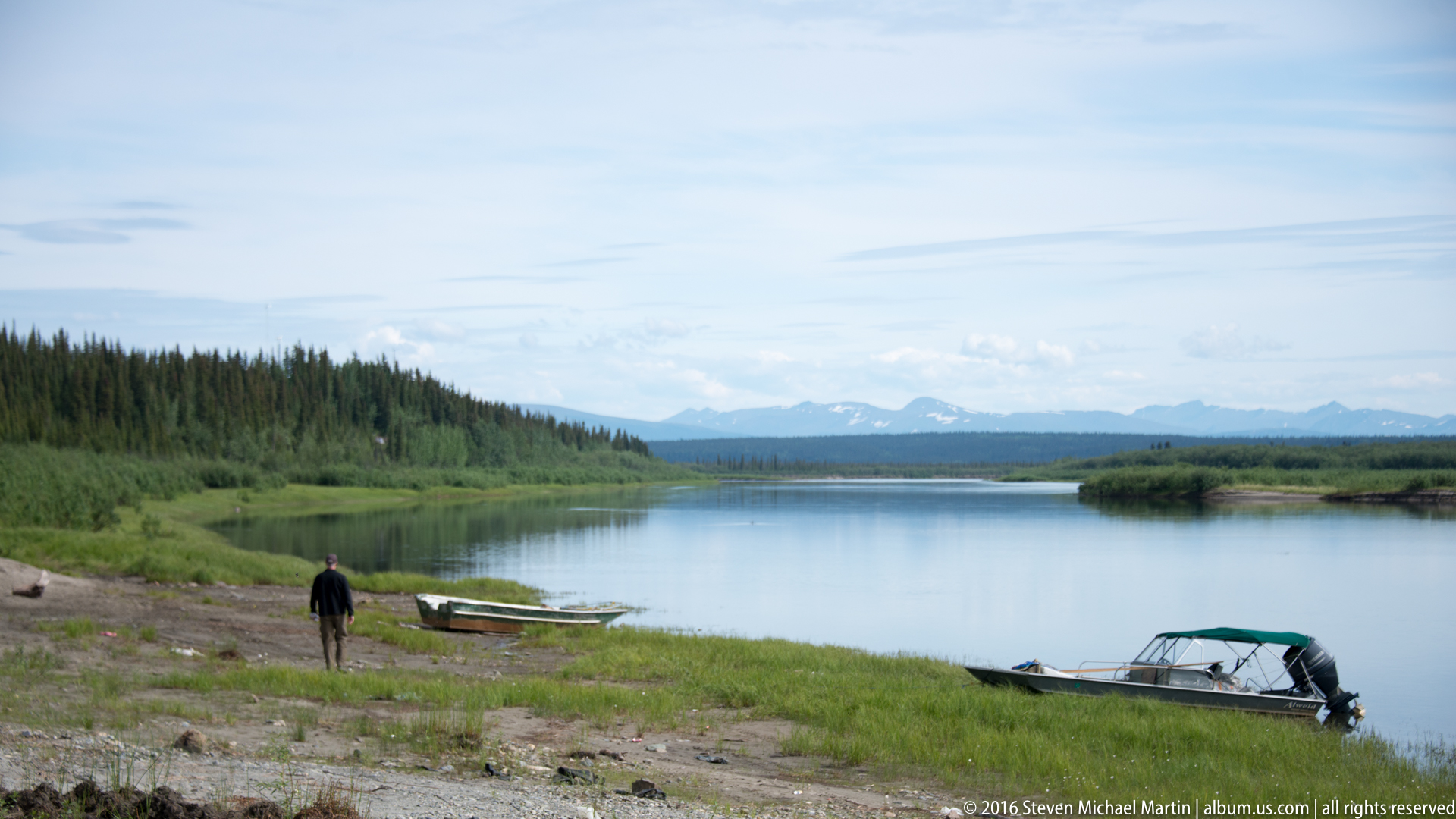
A person stands on a gravelly riverbank beside a small boat, while another covered motorboat rests at the water’s edge to the right. The river narrows toward a low forested horizon beneath a pale sky. The broad view links everyday boat access with the open river corridor near Ambler.
Caption
A person stands on a gravelly riverbank beside a small boat, while another covered motorboat rests at the water’s edge to the right. The river narrows toward a low forested horizon beneath a pale sky. The broad view links everyday boat access with the open river corridor near Ambler.
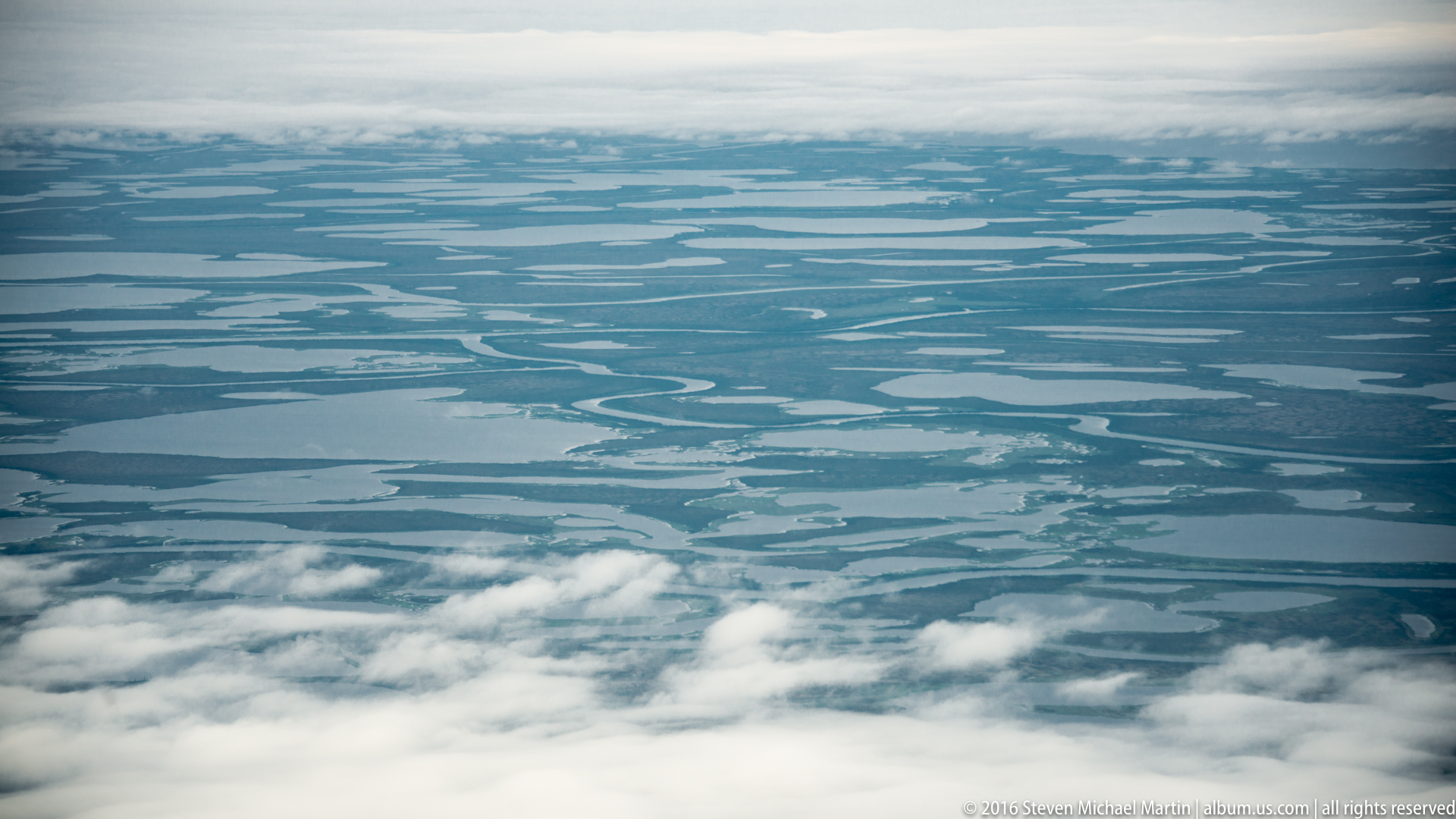
A broken cloud bank opens onto a broad blue-green plain patterned with pools and narrow channels. The aircraft looks across the wetland rather than directly down, so the distant horizon and cloud ceiling remain visible above the water-streaked ground. Compared with the previous view, more of the terrain is exposed, revealing a denser network of pools through the center.
Caption
A broken cloud bank opens onto a broad blue-green plain patterned with pools and narrow channels. The aircraft looks across the wetland rather than directly down, so the distant horizon and cloud ceiling remain visible above the water-streaked ground. Compared with the previous view, more of the terrain is exposed, revealing a denser network of pools through the center.
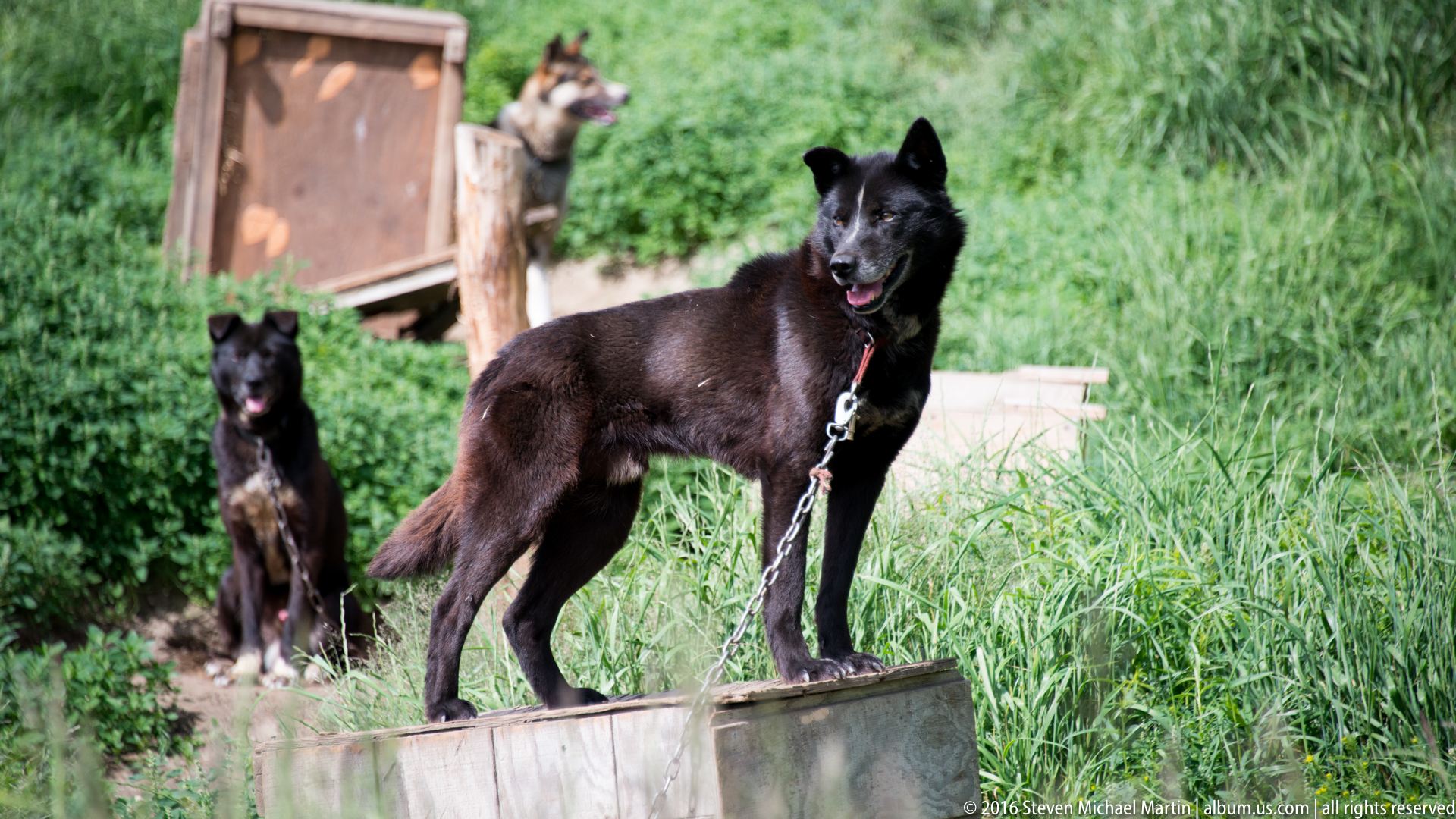
Two black dogs stand in tall grass beside a low wooden platform, one attached to a chain and looking toward the camera. A small weathered structure and dense vegetation fill the background. Their upright ears and alert posture are visible, but the photograph alone does not establish their breed or working role.
Caption
Two black dogs stand in tall grass beside a low wooden platform, one attached to a chain and looking toward the camera. A small weathered structure and dense vegetation fill the background. Their upright ears and alert posture are visible, but the photograph alone does not establish their breed or working role.
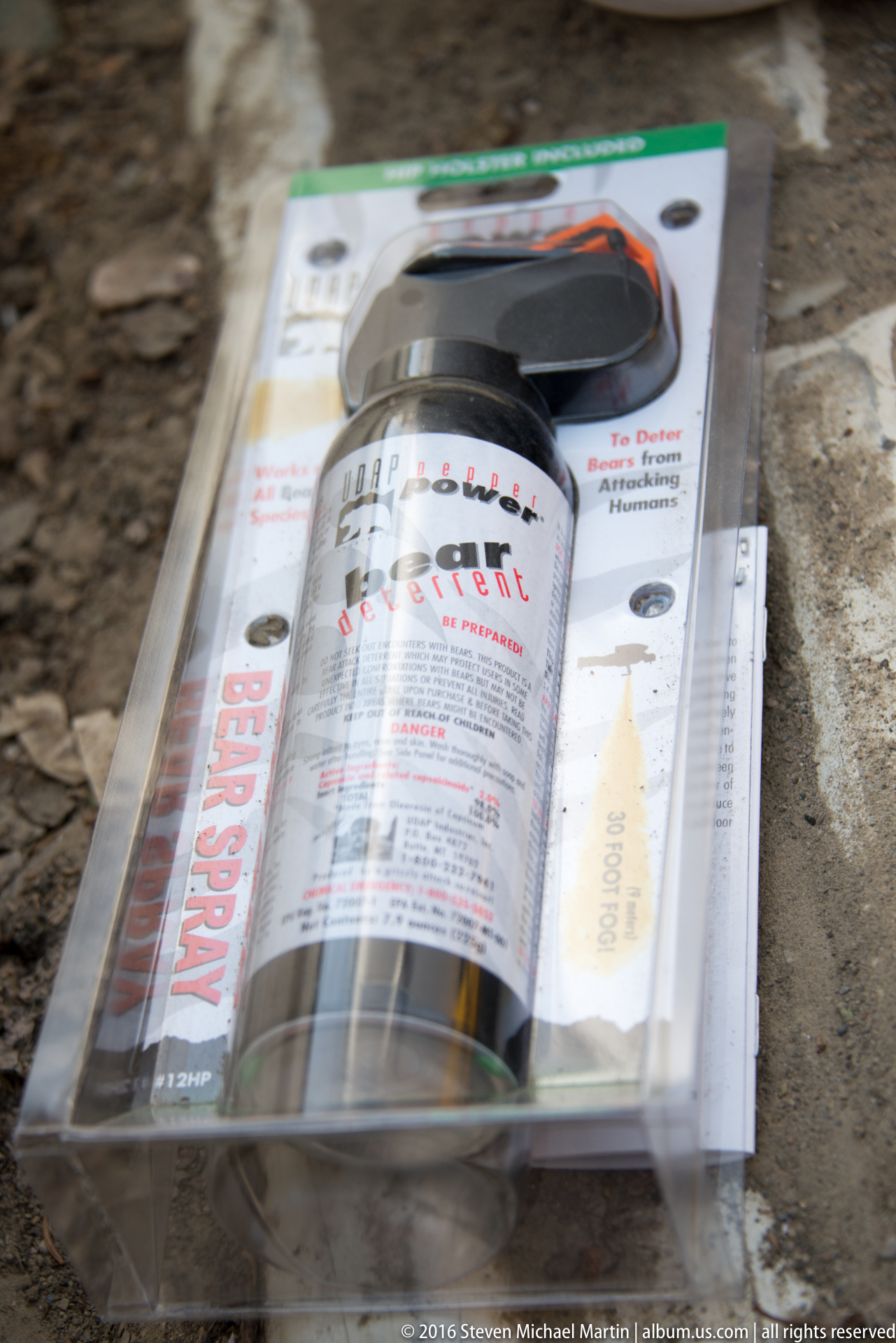
A folded printed page lies beneath a clear plastic cover on a rough gravel surface. Blocks of small text, photographs, and a green header are visible, but the fine lettering cannot be read confidently at this scale. Its outdoor placement and protective covering suggest a practical field or travel document, though the publication’s title and purpose remain uncertain.
Caption
A folded printed page lies beneath a clear plastic cover on a rough gravel surface. Blocks of small text, photographs, and a green header are visible, but the fine lettering cannot be read confidently at this scale. Its outdoor placement and protective covering suggest a practical field or travel document, though the publication’s title and purpose remain uncertain.
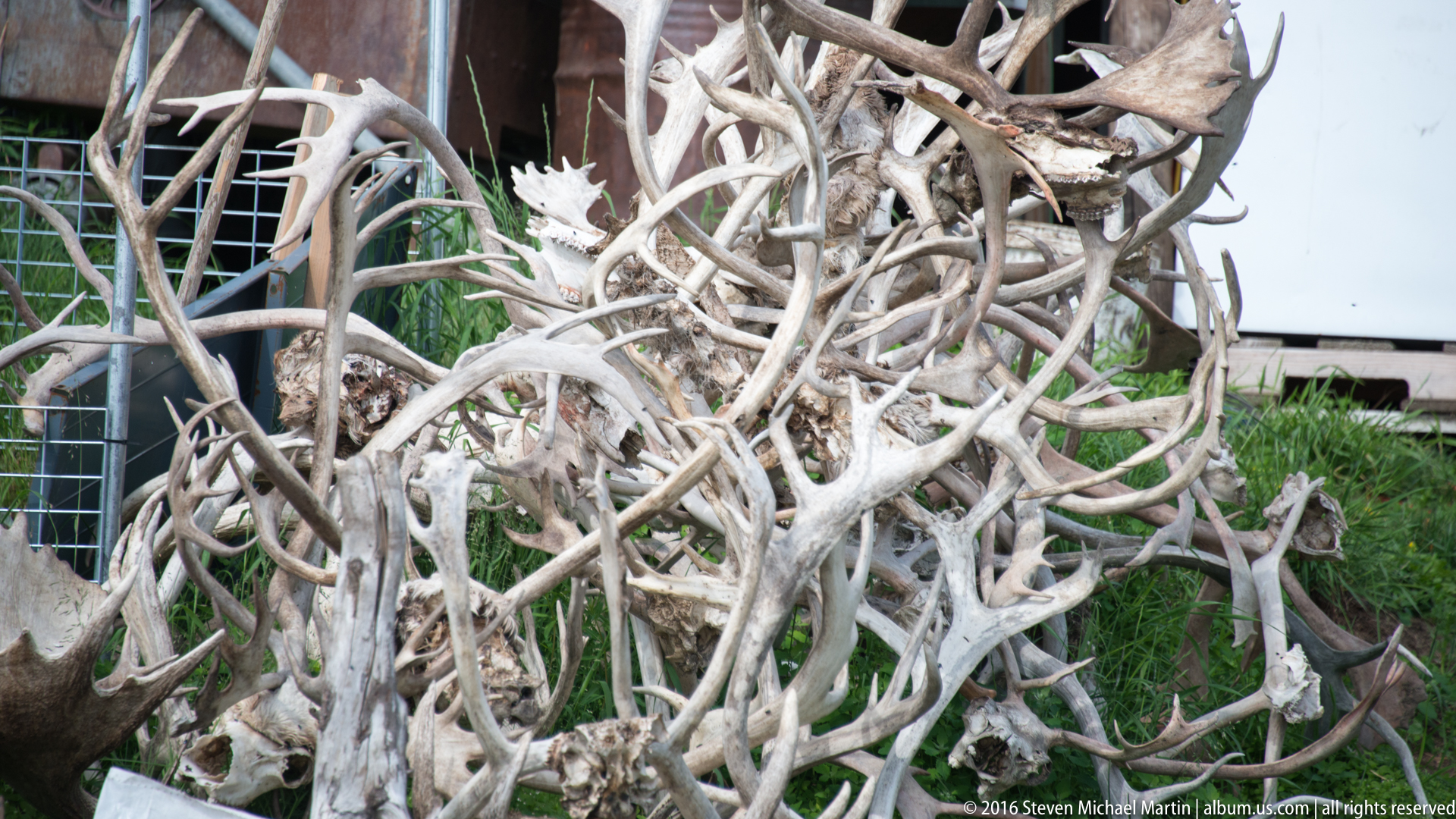
A dense pile of pale antlers fills the foreground, their branching tines overlapping in a tangle. The collection rests beside a wire enclosure and grass, with a light-colored building partly visible behind it. The image records antlers as a stored or displayed material, but does not establish the animal species or how the collection was assembled.
Caption
A dense pile of pale antlers fills the foreground, their branching tines overlapping in a tangle. The collection rests beside a wire enclosure and grass, with a light-colored building partly visible behind it. The image records antlers as a stored or displayed material, but does not establish the animal species or how the collection was assembled.
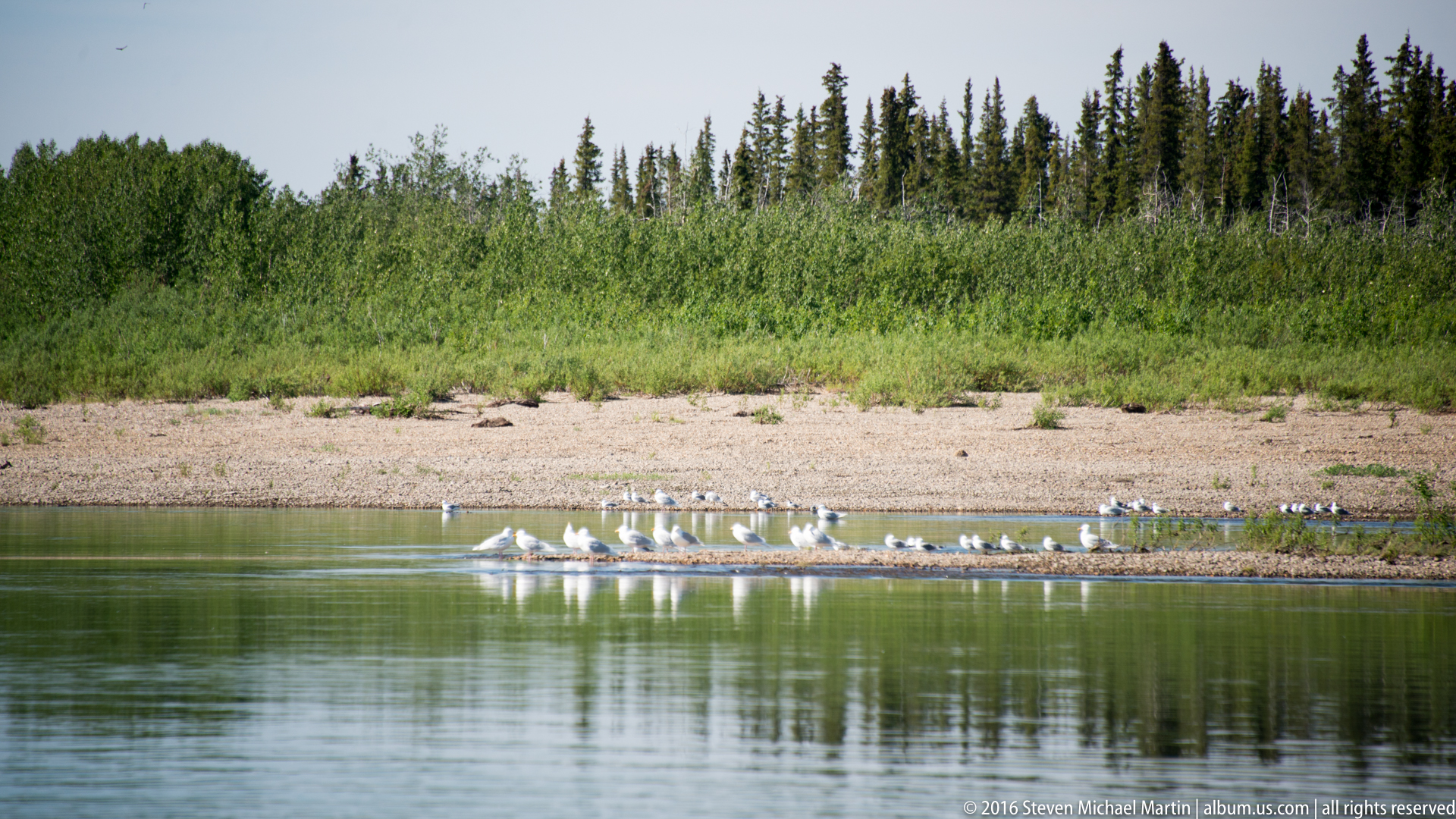
A line of white waterfowl gathers on a low gravel bar dividing the river channel. Dense green shrubs and trees cover the opposite bank, and their muted reflection stretches across the water. The distant viewpoint emphasizes the birds’ grouping along the exposed bar rather than individual plumage details.
Caption
A line of white waterfowl gathers on a low gravel bar dividing the river channel. Dense green shrubs and trees cover the opposite bank, and their muted reflection stretches across the water. The distant viewpoint emphasizes the birds’ grouping along the exposed bar rather than individual plumage details.
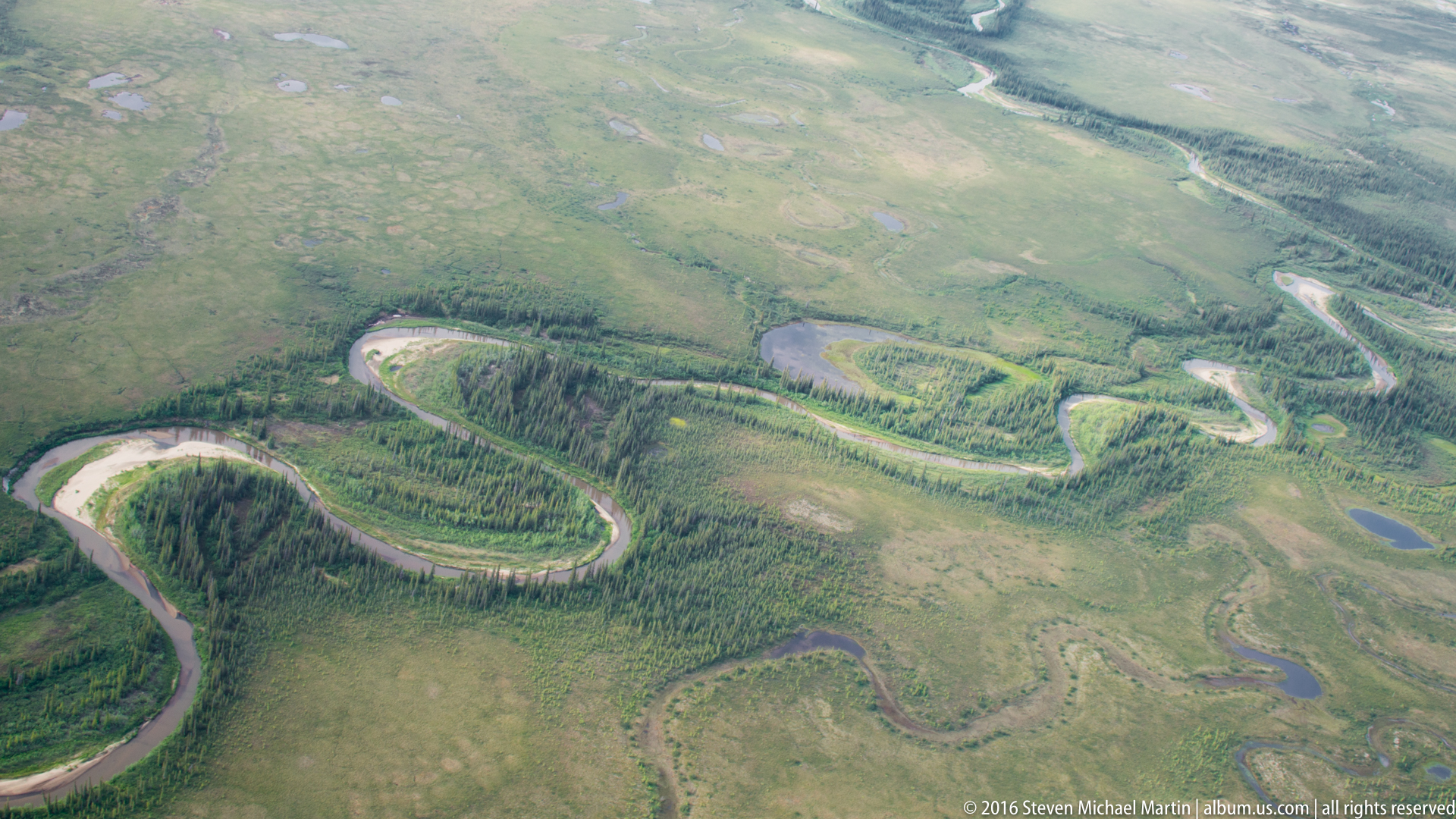
From above, a broad river sweeps through the tundra in looping bends, its pale banks separating open vegetation from dark ribbons of spruce. Smaller channels and ponds appear farther across the plain. The elevated view makes the river’s changing course and its relationship to the wetland valley legible in a way the ground-level landscape could not reveal.
Caption
From above, a broad river sweeps through the tundra in looping bends, its pale banks separating open vegetation from dark ribbons of spruce. Smaller channels and ponds appear farther across the plain. The elevated view makes the river’s changing course and its relationship to the wetland valley legible in a way the ground-level landscape could not reveal.
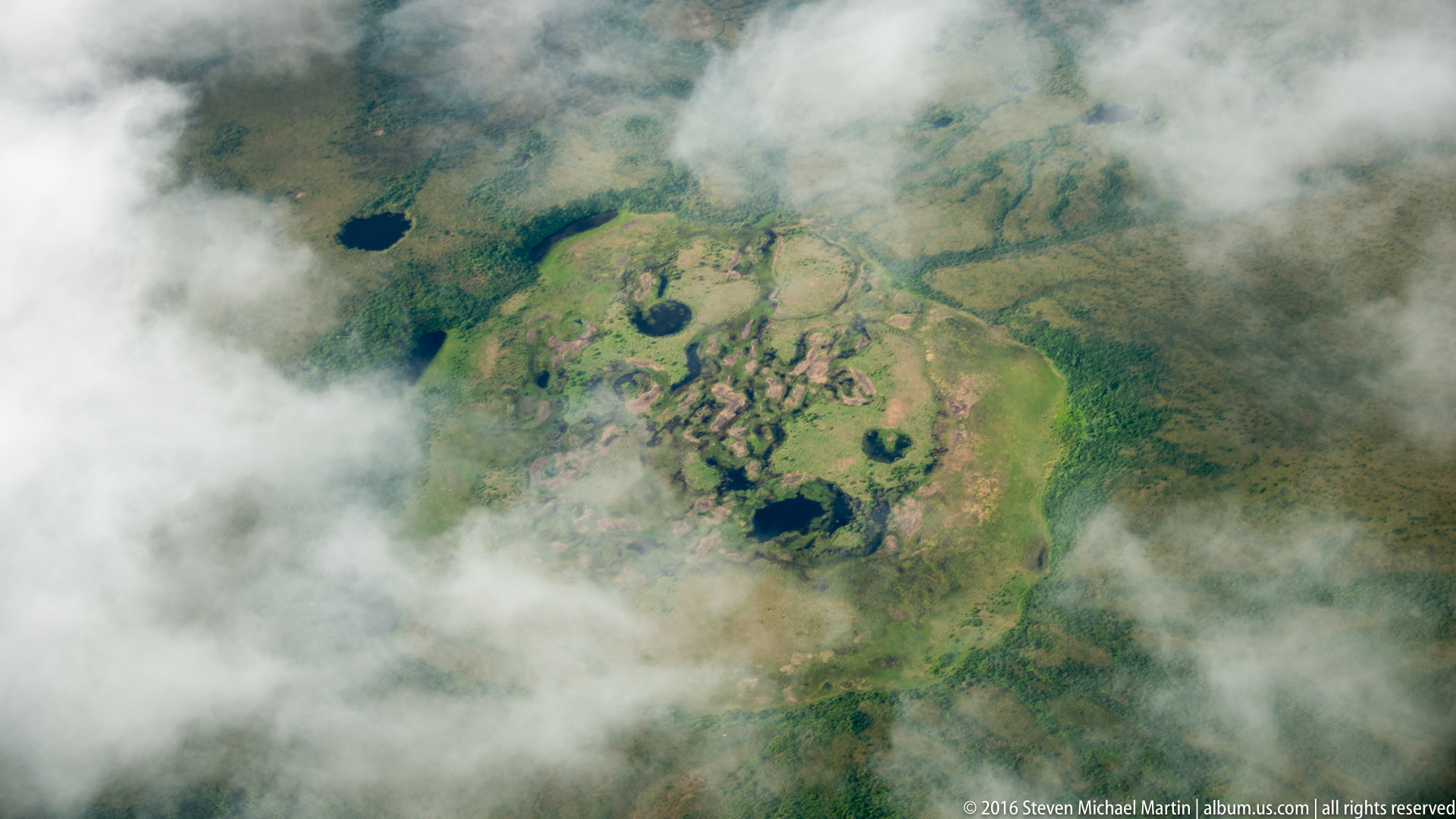
Clouds break around an irregular green basin dotted with dark ponds and small lakes. From the aircraft, the openings in the cloud layer reveal patches of tundra and low ridges, while vapor obscures parts of the surrounding landscape. The partial view gives the terrain a shifting pattern of light and visibility rather than presenting the whole basin at once.
Caption
Clouds break around an irregular green basin dotted with dark ponds and small lakes. From the aircraft, the openings in the cloud layer reveal patches of tundra and low ridges, while vapor obscures parts of the surrounding landscape. The partial view gives the terrain a shifting pattern of light and visibility rather than presenting the whole basin at once.
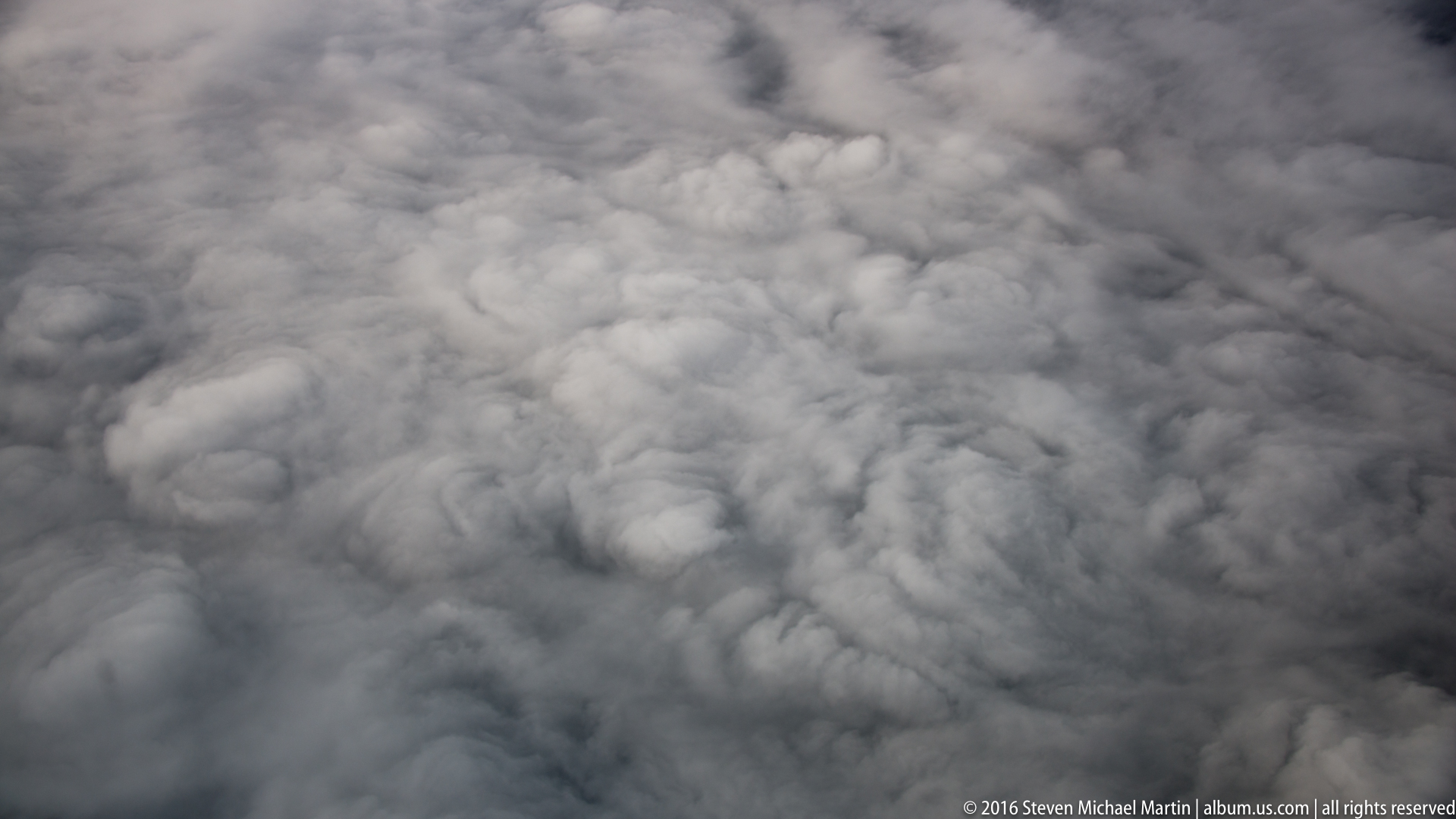
A continuous field of cumulus clouds fills the frame, seen from above with no horizon or ground visible. Rounded cloud tops vary from bright white to deep gray, creating a textured surface that conceals the landscape below. With no other reference point, the image records the flight conditions themselves rather than a specific landform or destination.
Caption
A continuous field of cumulus clouds fills the frame, seen from above with no horizon or ground visible. Rounded cloud tops vary from bright white to deep gray, creating a textured surface that conceals the landscape below. With no other reference point, the image records the flight conditions themselves rather than a specific landform or destination.
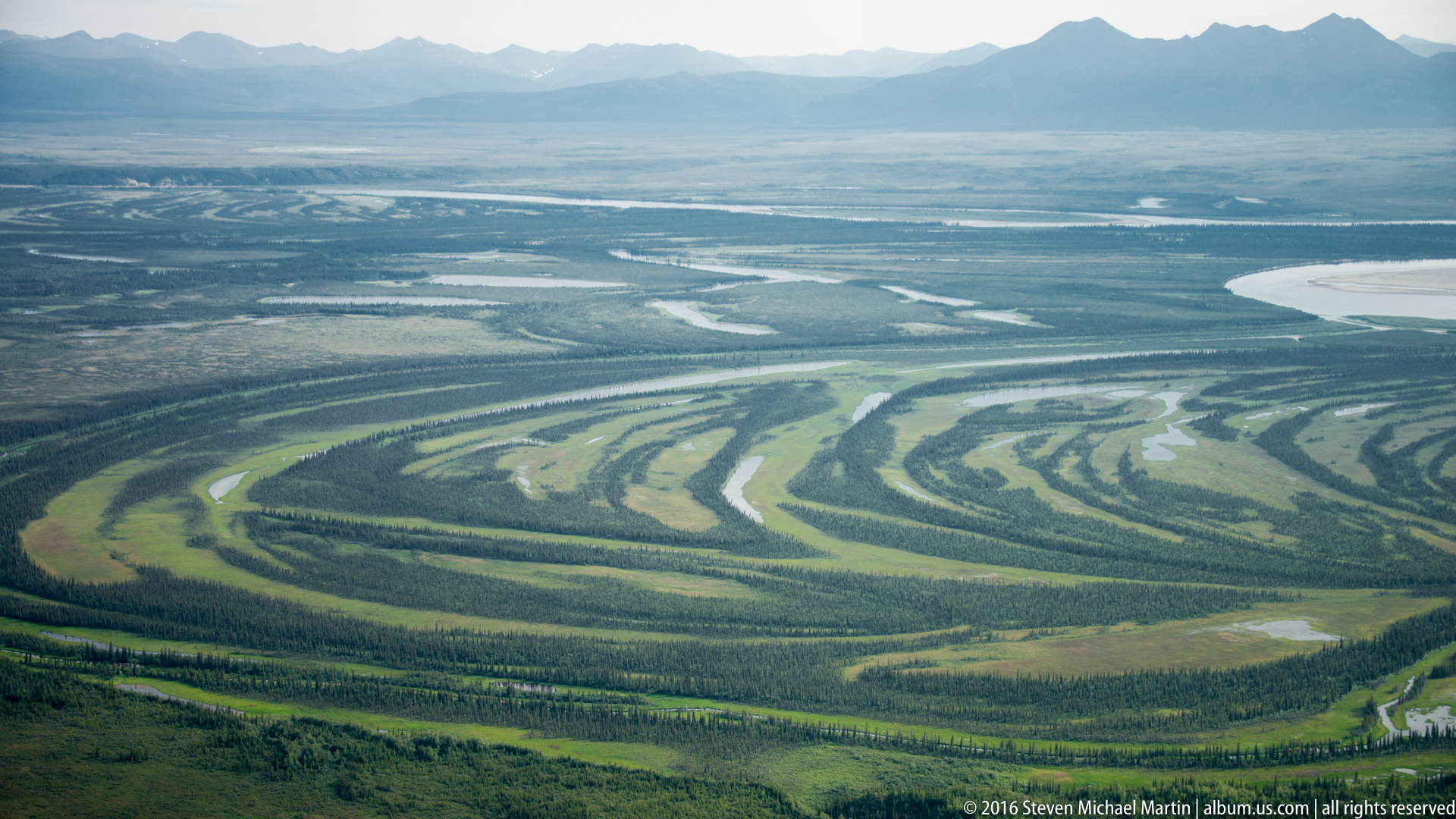
A broad river divides into looping channels across a green plain, with pale gravel bars separating ribbons of water and vegetation. Forested strips trace parts of the river, while a chain of distant mountains closes the horizon. The elevated angle reveals the river’s braided pattern and scale, turning the valley floor into a map of shifting channels.
Caption
A broad river divides into looping channels across a green plain, with pale gravel bars separating ribbons of water and vegetation. Forested strips trace parts of the river, while a chain of distant mountains closes the horizon. The elevated angle reveals the river’s braided pattern and scale, turning the valley floor into a map of shifting channels.
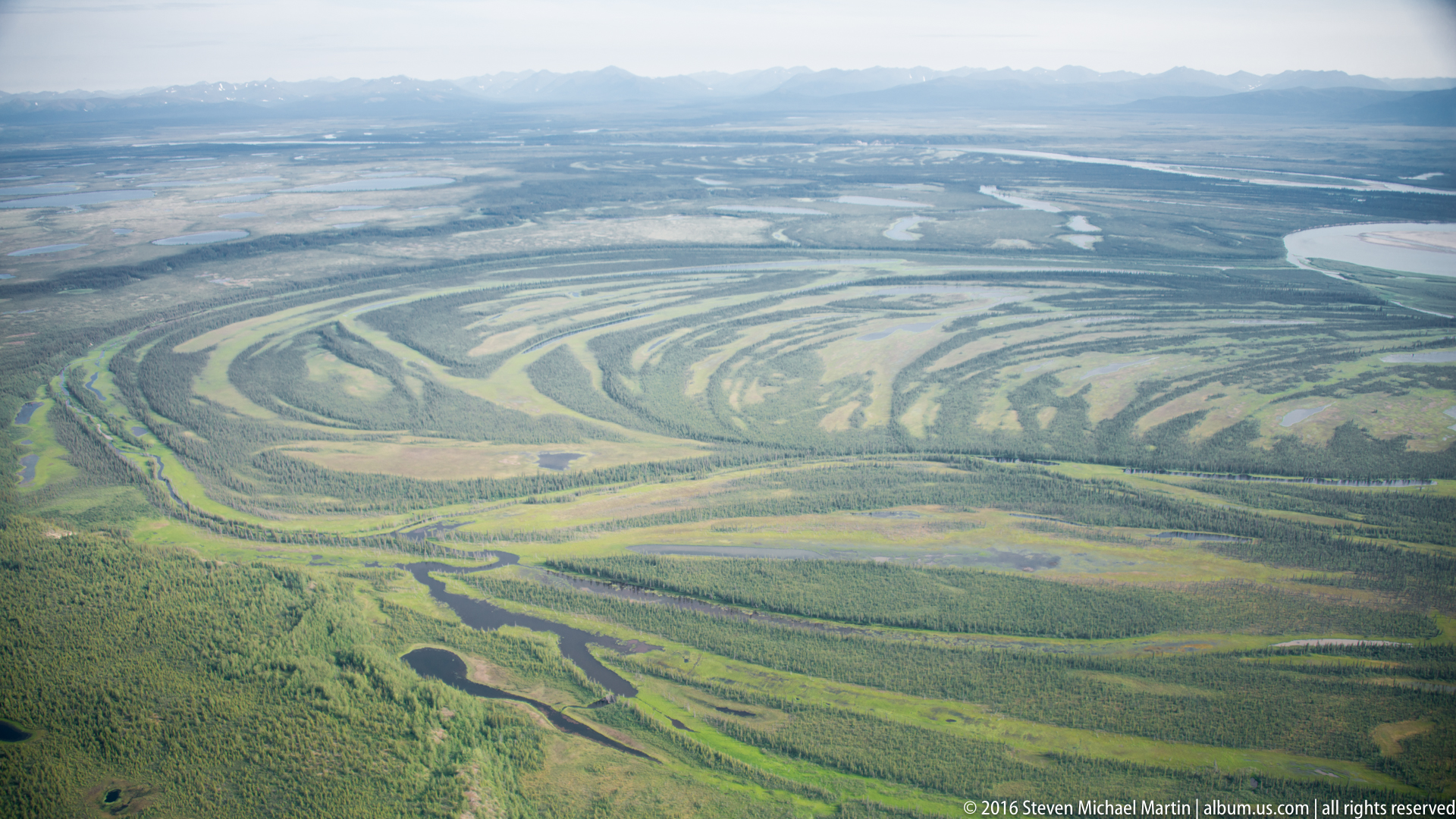
From higher above, repeated curves of water and gravel sweep across the floodplain in nested arcs. The alternating dark channels, pale sediment, and green strips create a broad pattern that extends toward the distant edge of the frame. This near-maplike perspective foregrounds the river’s geometry and the large area shaped by its shifting course.
Caption
From higher above, repeated curves of water and gravel sweep across the floodplain in nested arcs. The alternating dark channels, pale sediment, and green strips create a broad pattern that extends toward the distant edge of the frame. This near-maplike perspective foregrounds the river’s geometry and the large area shaped by its shifting course.
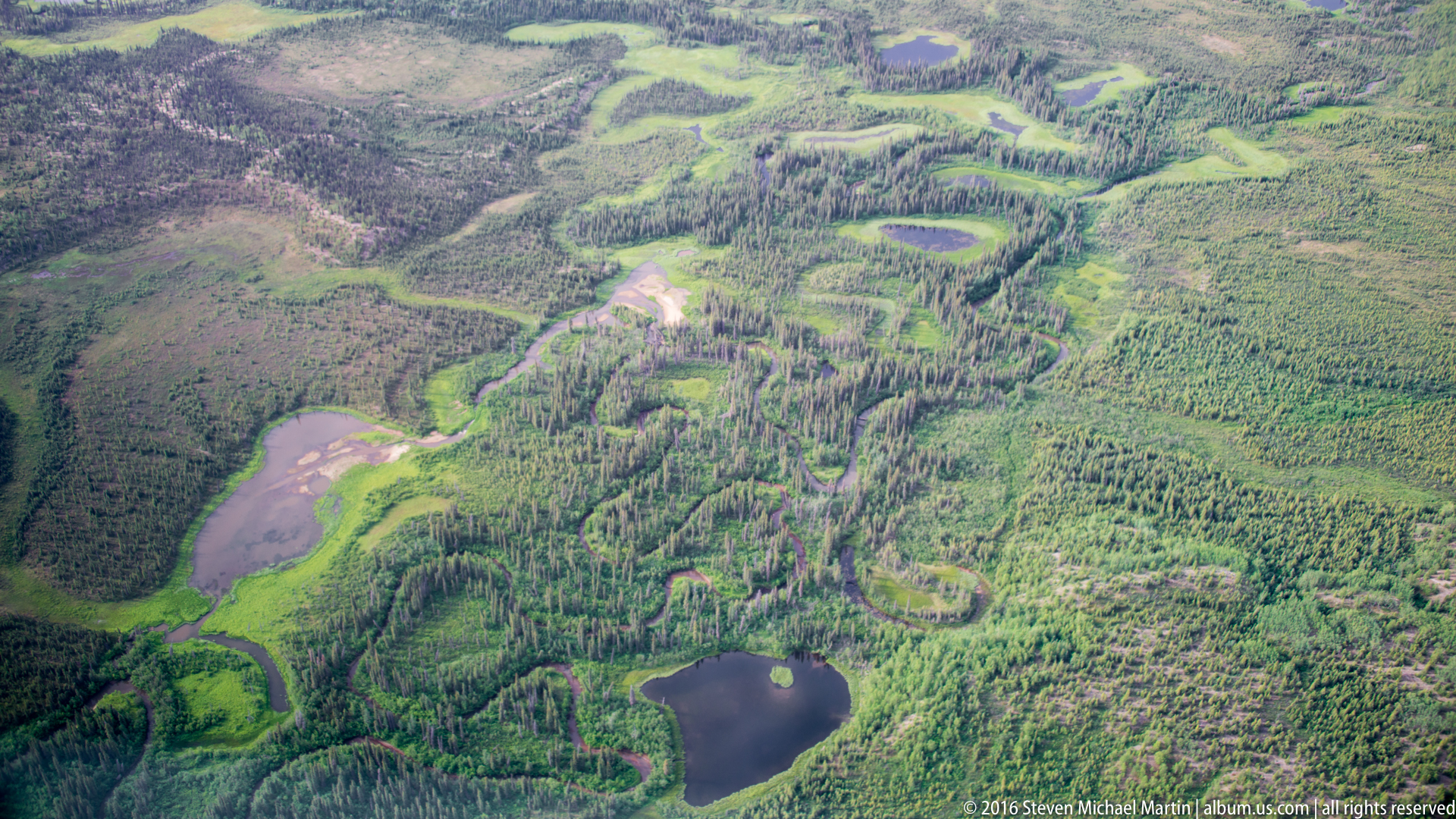
Dark spruce patches alternate with open wetland and shallow pools, while a narrow river winds through the center of the landscape. Small water bodies appear in irregular depressions between tree-covered ground and lighter vegetation. The oblique aerial view connects the drainage pattern to the surrounding forest mosaic, showing how water and vegetation divide the plain into distinct textures.
Caption
Dark spruce patches alternate with open wetland and shallow pools, while a narrow river winds through the center of the landscape. Small water bodies appear in irregular depressions between tree-covered ground and lighter vegetation. The oblique aerial view connects the drainage pattern to the surrounding forest mosaic, showing how water and vegetation divide the plain into distinct textures.
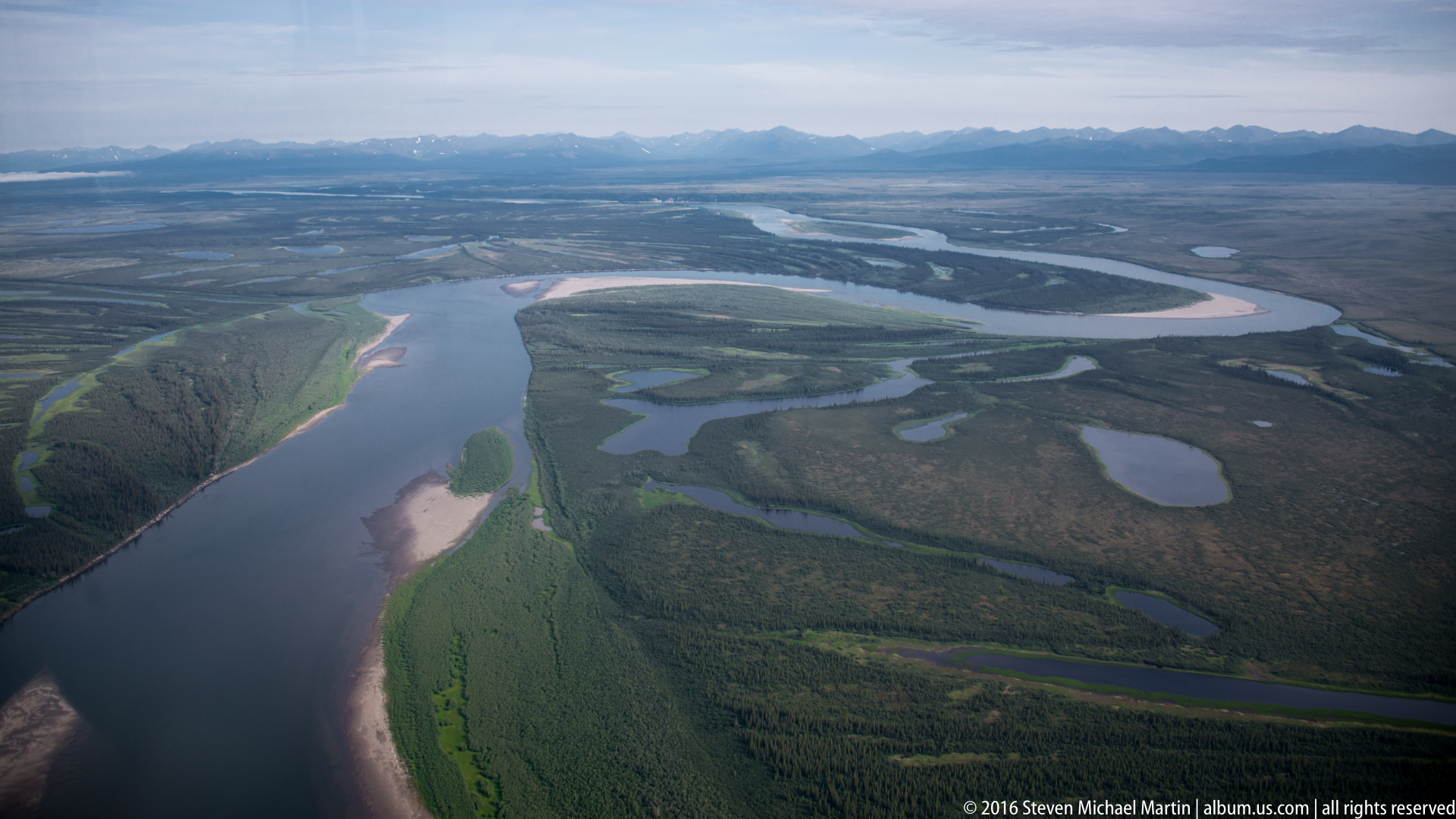
A wide river curve enters from the lower left and bends across open lowland, bordered by green islands and pale banks. Smaller lakes and ponds lie nearby, while a low mountain horizon recedes beneath a hazy sky. The broad composition places the principal river channel among the surrounding water bodies, emphasizing how the floodplain spreads beyond a single river course.
Caption
A wide river curve enters from the lower left and bends across open lowland, bordered by green islands and pale banks. Smaller lakes and ponds lie nearby, while a low mountain horizon recedes beneath a hazy sky. The broad composition places the principal river channel among the surrounding water bodies, emphasizing how the floodplain spreads beyond a single river course.
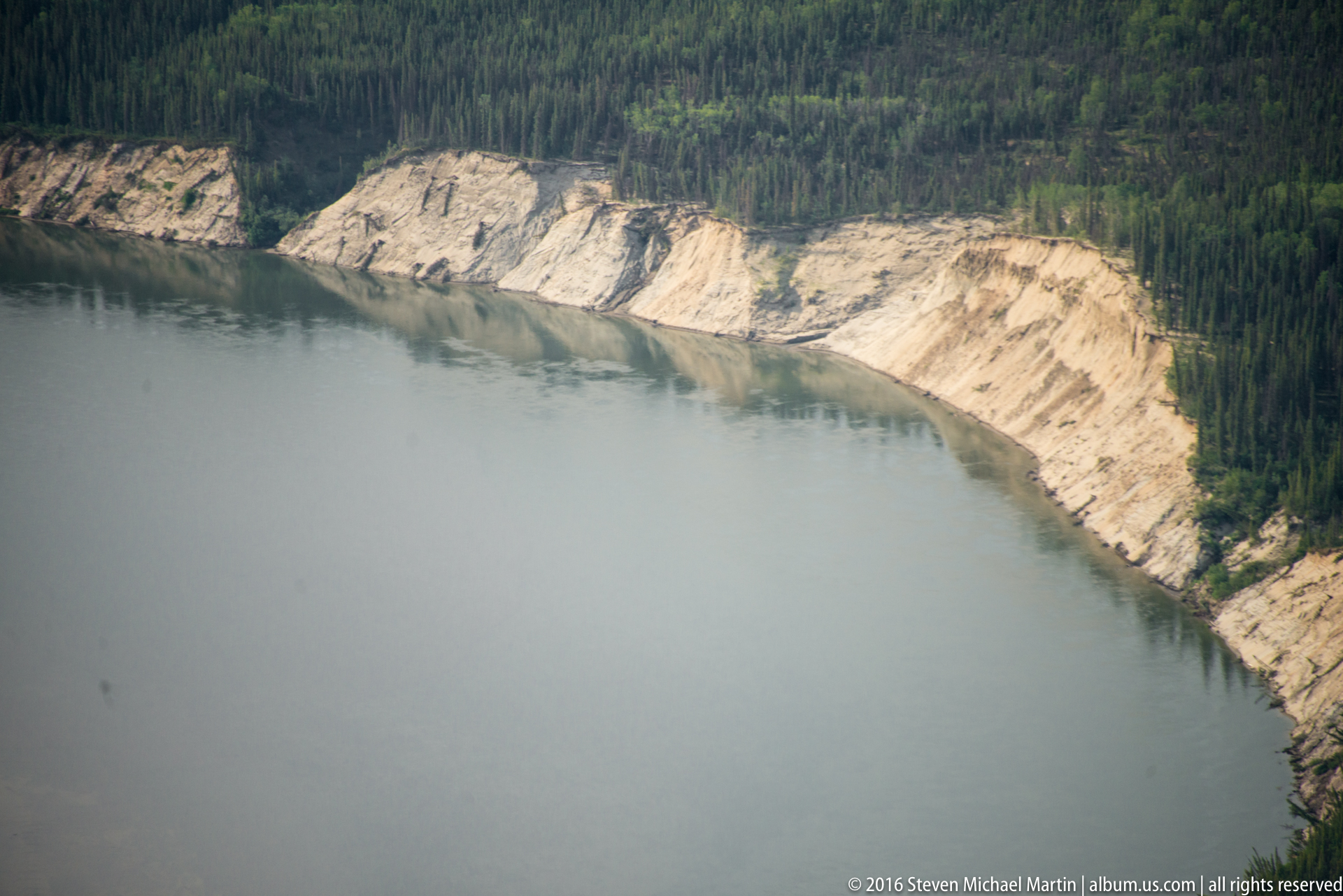
A pale, steep bank arcs around the edge of a broad water body, exposing light-colored sediment beneath a dense line of spruce. The shoreline curves away toward the upper right, while muted water fills the foreground. The contrast between the cut bank and forested rim gives the scene a clear geological profile, though the specific process that formed it is not visible.
Caption
A pale, steep bank arcs around the edge of a broad water body, exposing light-colored sediment beneath a dense line of spruce. The shoreline curves away toward the upper right, while muted water fills the foreground. The contrast between the cut bank and forested rim gives the scene a clear geological profile, though the specific process that formed it is not visible.
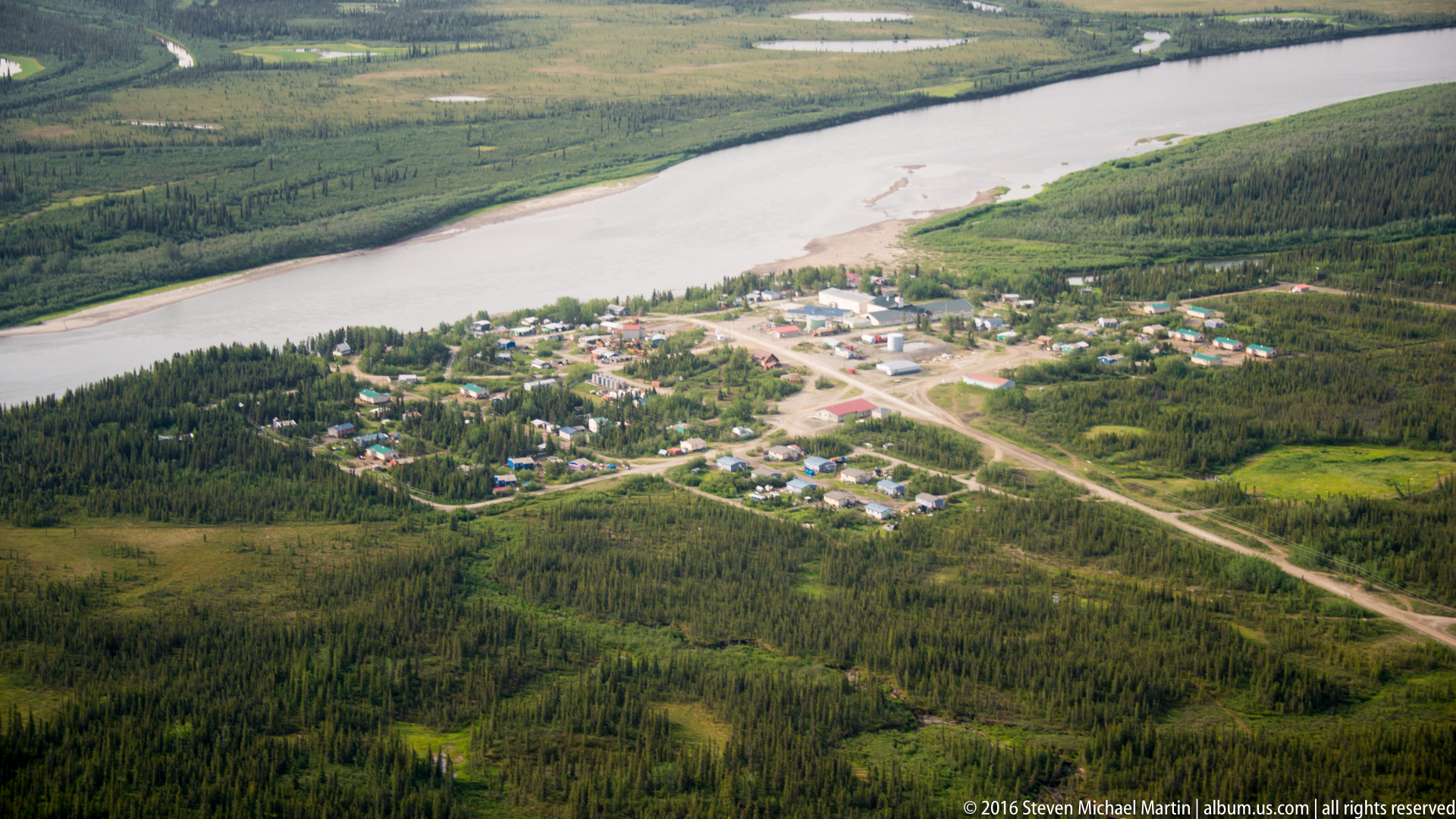
A small settlement spreads through a clearing between dense forest and a broad river. Individual houses, intersecting roads, and open yards form a compact pattern, with the waterway occupying the upper edge of the view. Seen from above, the village’s relation to the river and surrounding forest is more prominent than the details of any one building.
Caption
A small settlement spreads through a clearing between dense forest and a broad river. Individual houses, intersecting roads, and open yards form a compact pattern, with the waterway occupying the upper edge of the view. Seen from above, the village’s relation to the river and surrounding forest is more prominent than the details of any one building.
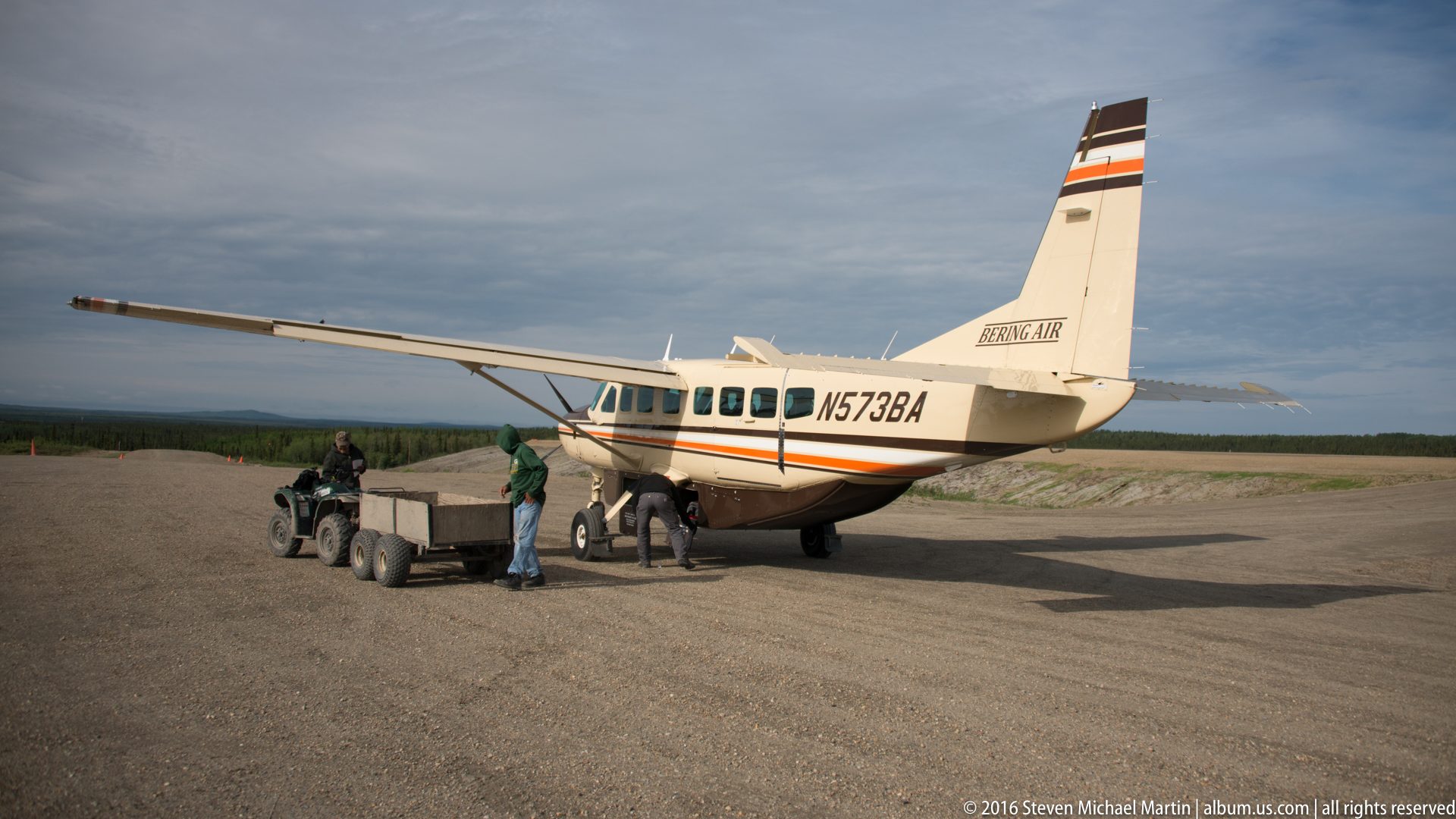
A single-engine utility aircraft stands on a broad gravel strip while several people gather beside a small trailer near its fuselage. Its high wing and tail-mounted horizontal stabilizer identify the practical form of a bush plane, though the distant lettering is too small to read reliably. The empty surrounding ground and low tree line keep the aircraft and loading activity central.
Caption
A single-engine utility aircraft stands on a broad gravel strip while several people gather beside a small trailer near its fuselage. Its high wing and tail-mounted horizontal stabilizer identify the practical form of a bush plane, though the distant lettering is too small to read reliably. The empty surrounding ground and low tree line keep the aircraft and loading activity central.
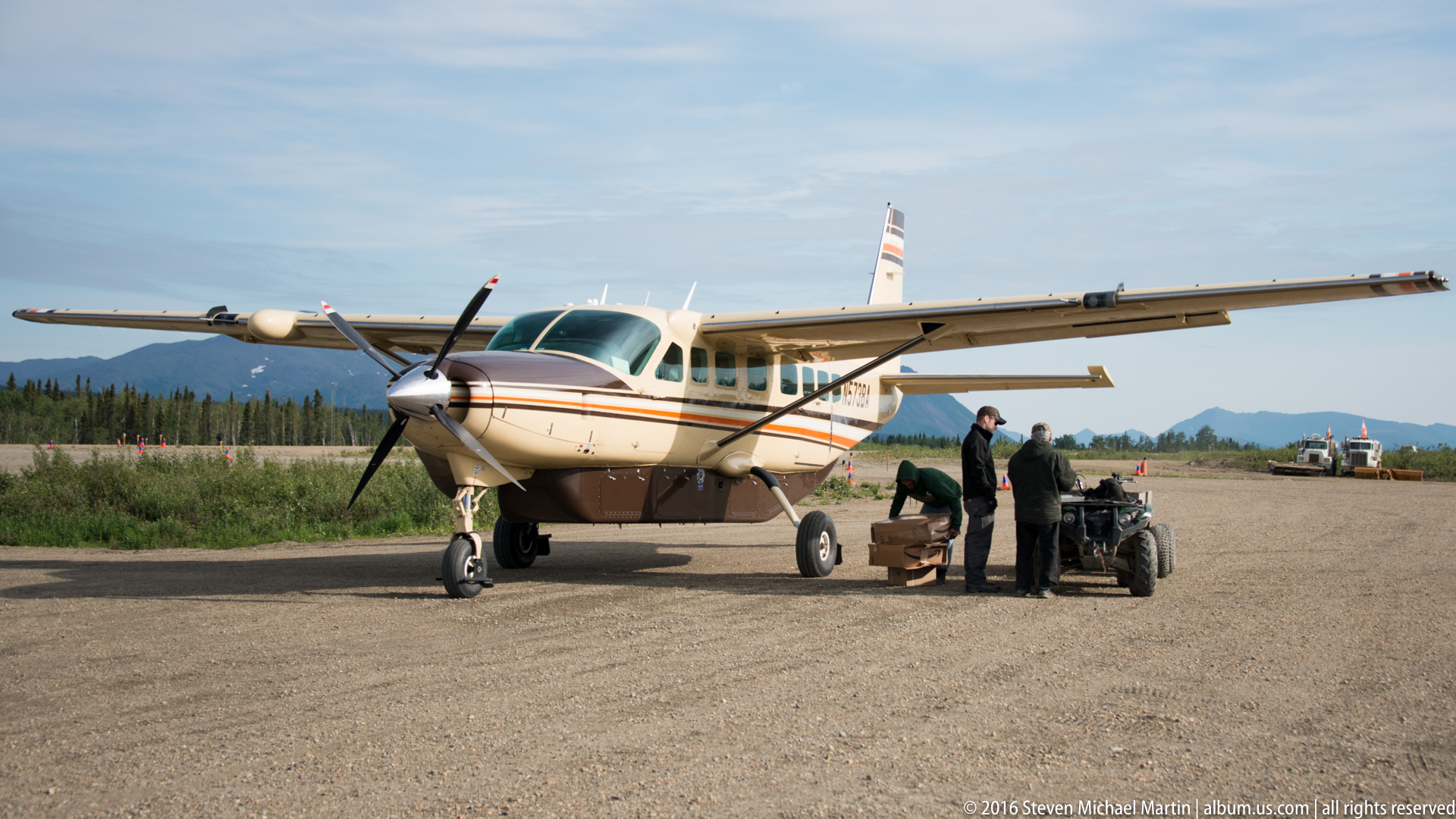
Viewed from the front, the aircraft’s wings stretch across the gravel strip while people stand near boxes and equipment by its right side. A small utility vehicle and another vehicle sit farther back, with low hills and a line of trees beyond. The frontal angle emphasizes the plane’s broad wingspan and the ground activity around its loading area.
Caption
Viewed from the front, the aircraft’s wings stretch across the gravel strip while people stand near boxes and equipment by its right side. A small utility vehicle and another vehicle sit farther back, with low hills and a line of trees beyond. The frontal angle emphasizes the plane’s broad wingspan and the ground activity around its loading area.
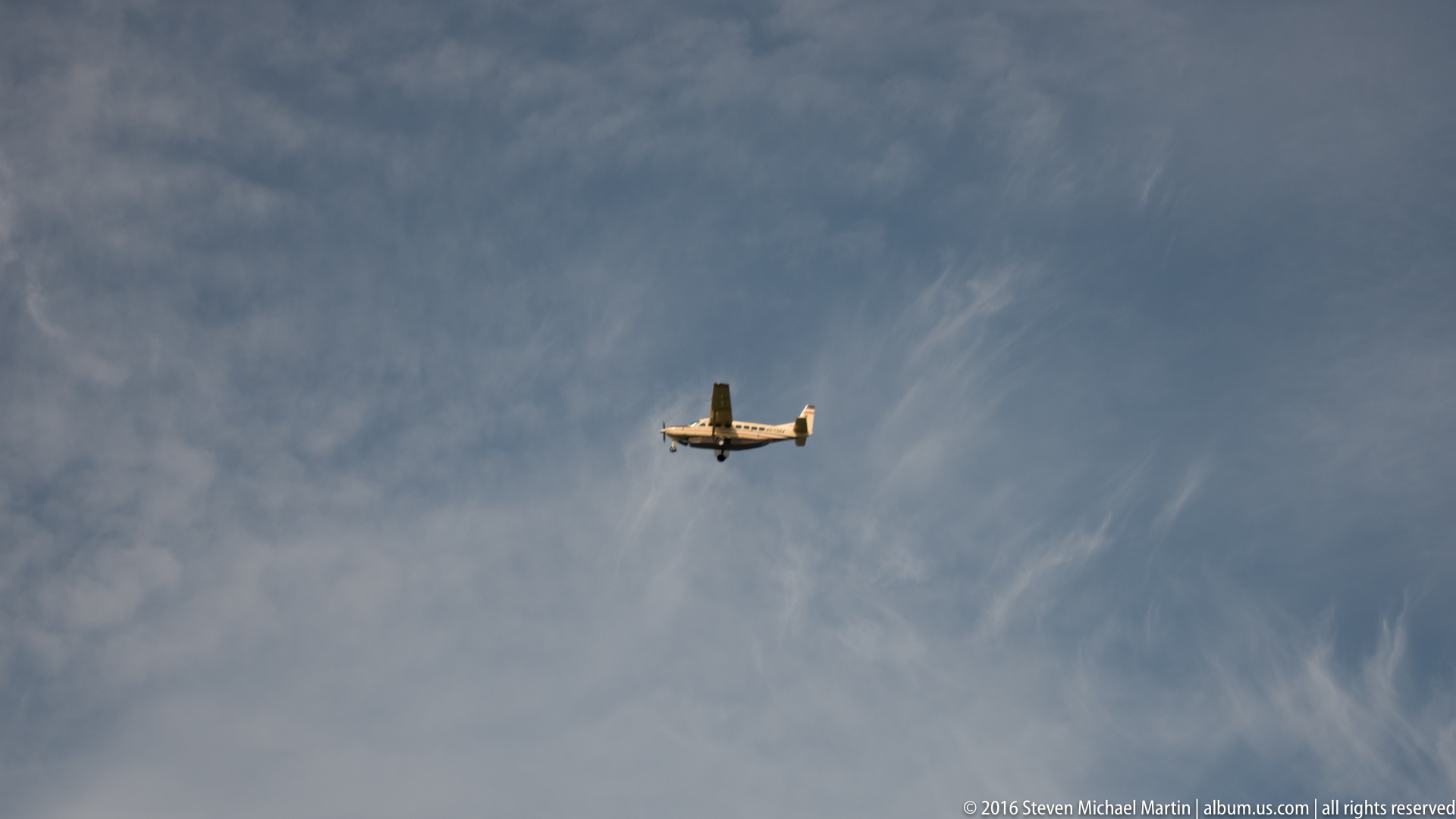
A small single-engine airplane crosses the center of a broad, textured sky. Wispy clouds trail across the gray-blue background, while the aircraft appears in profile with its wings level. The generous empty space around the plane makes its scale and isolation the defining features; no ground or destination is visible to locate the flight more precisely.
Caption
A small single-engine airplane crosses the center of a broad, textured sky. Wispy clouds trail across the gray-blue background, while the aircraft appears in profile with its wings level. The generous empty space around the plane makes its scale and isolation the defining features; no ground or destination is visible to locate the flight more precisely.
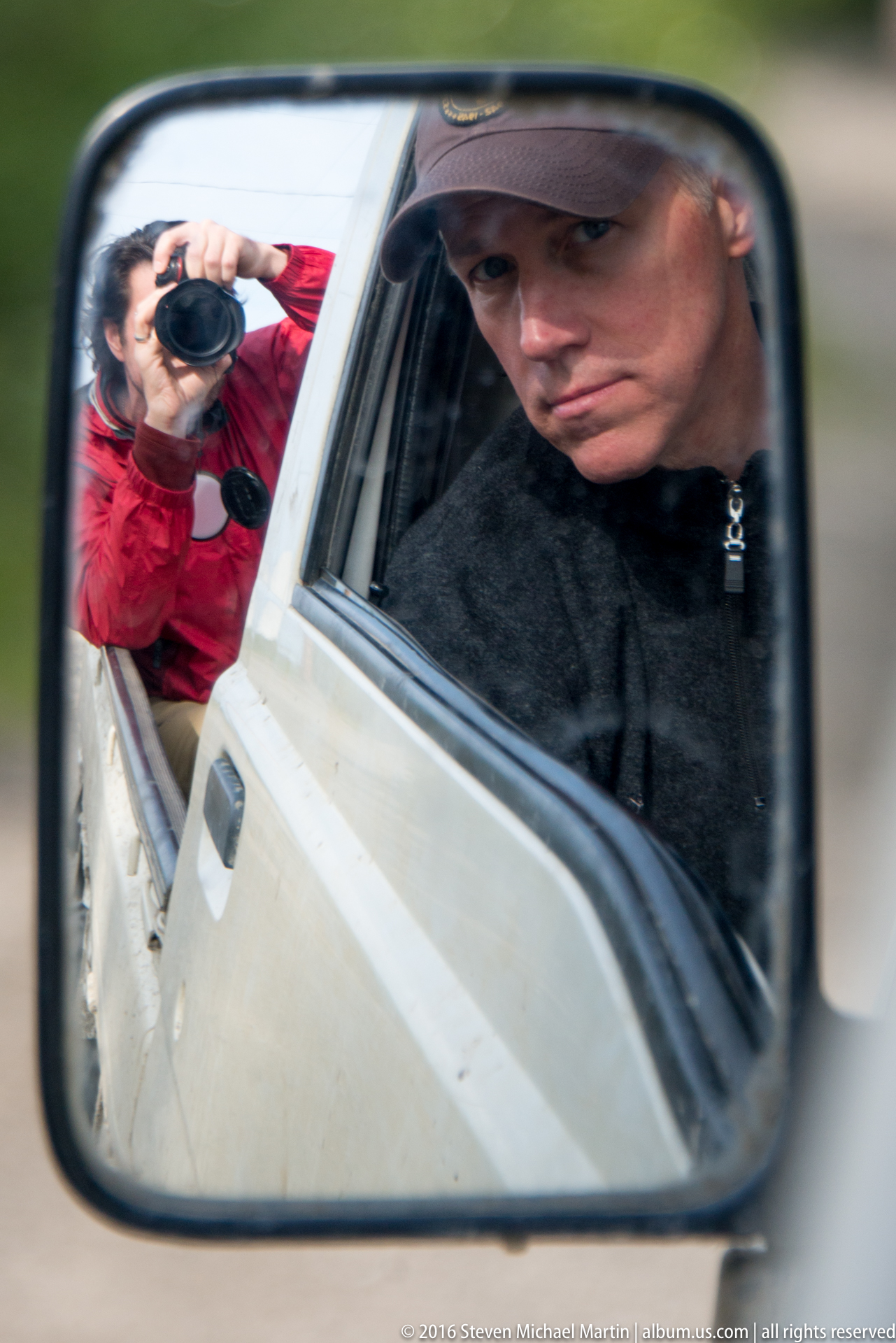
The side mirror frames a man seated inside a vehicle and, behind him, another person in a red jacket holding a camera. The white door and dark mirror rim crop the reflection into a close, layered portrait, with the photographer’s lens aimed directly toward the glass. This indirect view makes the mirror itself part of the scene rather than a background detail.
Caption
The side mirror frames a man seated inside a vehicle and, behind him, another person in a red jacket holding a camera. The white door and dark mirror rim crop the reflection into a close, layered portrait, with the photographer’s lens aimed directly toward the glass. This indirect view makes the mirror itself part of the scene rather than a background detail.
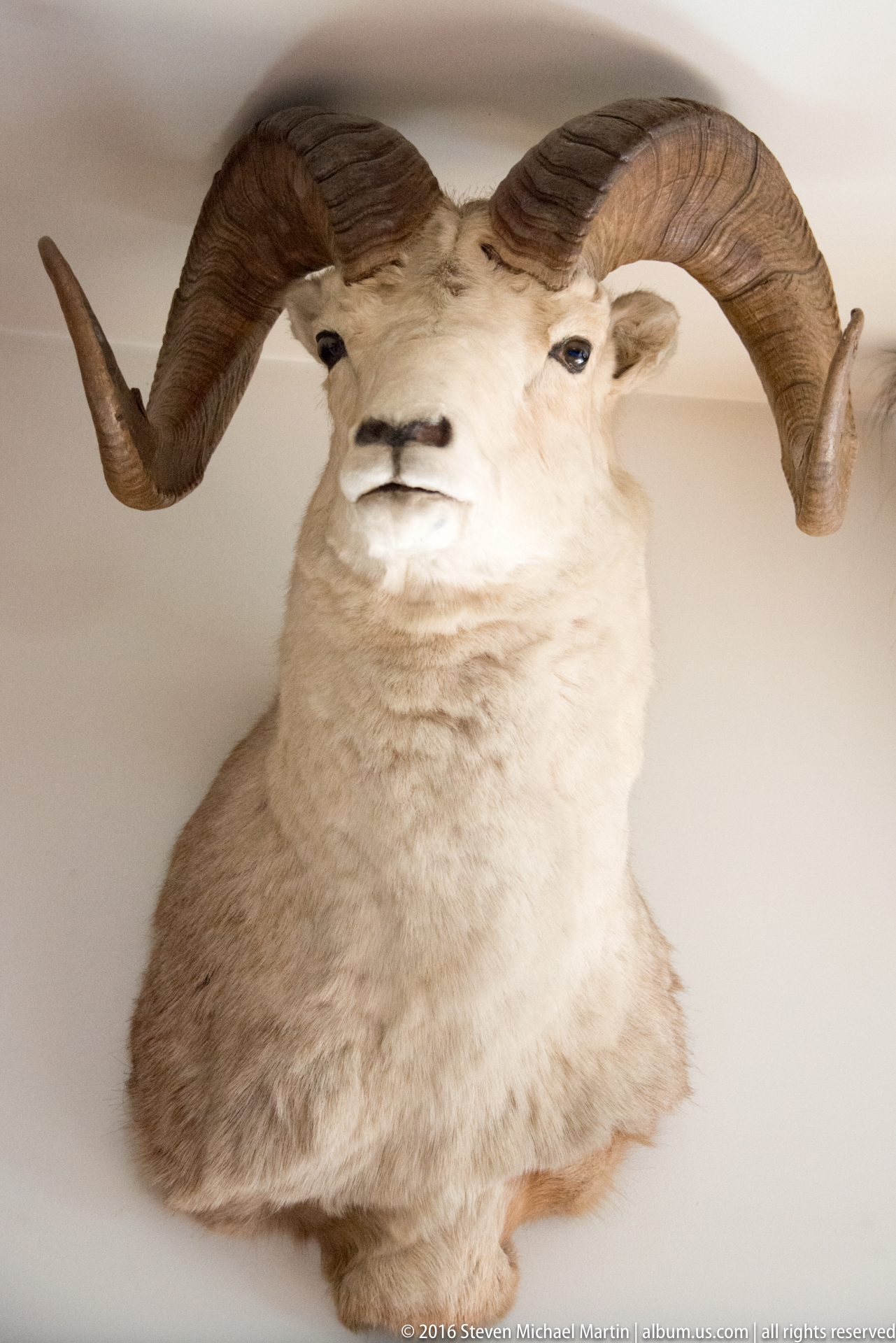
A pale sheep mount faces forward, its massive horns curling outward and down before turning back toward the head. The white face and chest contrast with the darker, ridged horn surface, while the cut edge of the mount remains visible against a plain wall. The horn shape is consistent with a Dall sheep, though the display does not provide a label confirming species.
Caption
A pale sheep mount faces forward, its massive horns curling outward and down before turning back toward the head. The white face and chest contrast with the darker, ridged horn surface, while the cut edge of the mount remains visible against a plain wall. The horn shape is consistent with a Dall sheep, though the display does not provide a label confirming species.
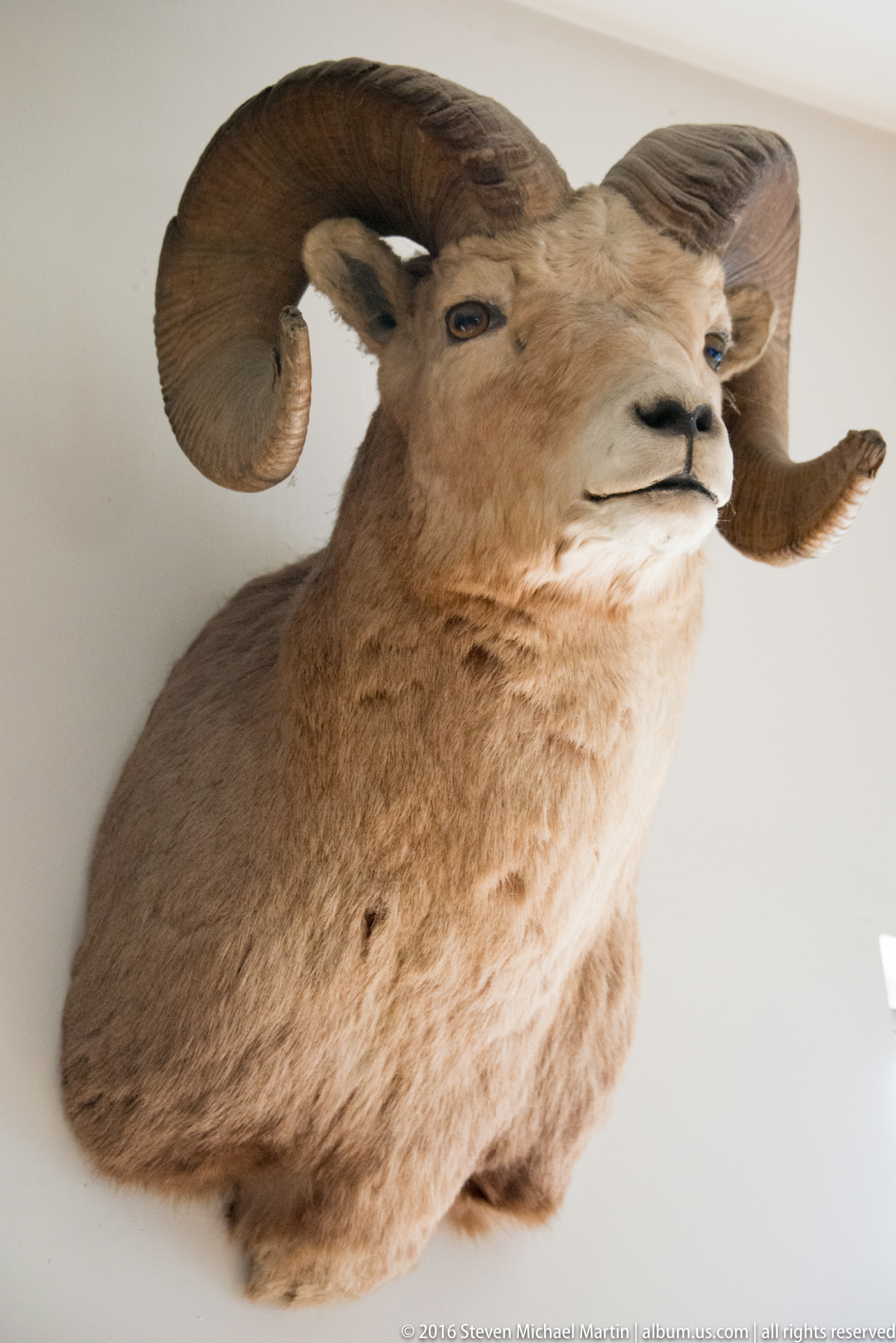
The sheep mount is seen from a closer three-quarter angle, bringing the sweeping curve of its horn into the foreground. Its tan coat, pale muzzle, and dark eye remain visible beneath the horn, while the plain wall isolates the specimen. This view highlights the horn’s profile and the mount’s shoulder form rather than the symmetrical front-facing arrangement of the preceding image.
Caption
The sheep mount is seen from a closer three-quarter angle, bringing the sweeping curve of its horn into the foreground. Its tan coat, pale muzzle, and dark eye remain visible beneath the horn, while the plain wall isolates the specimen. This view highlights the horn’s profile and the mount’s shoulder form rather than the symmetrical front-facing arrangement of the preceding image.
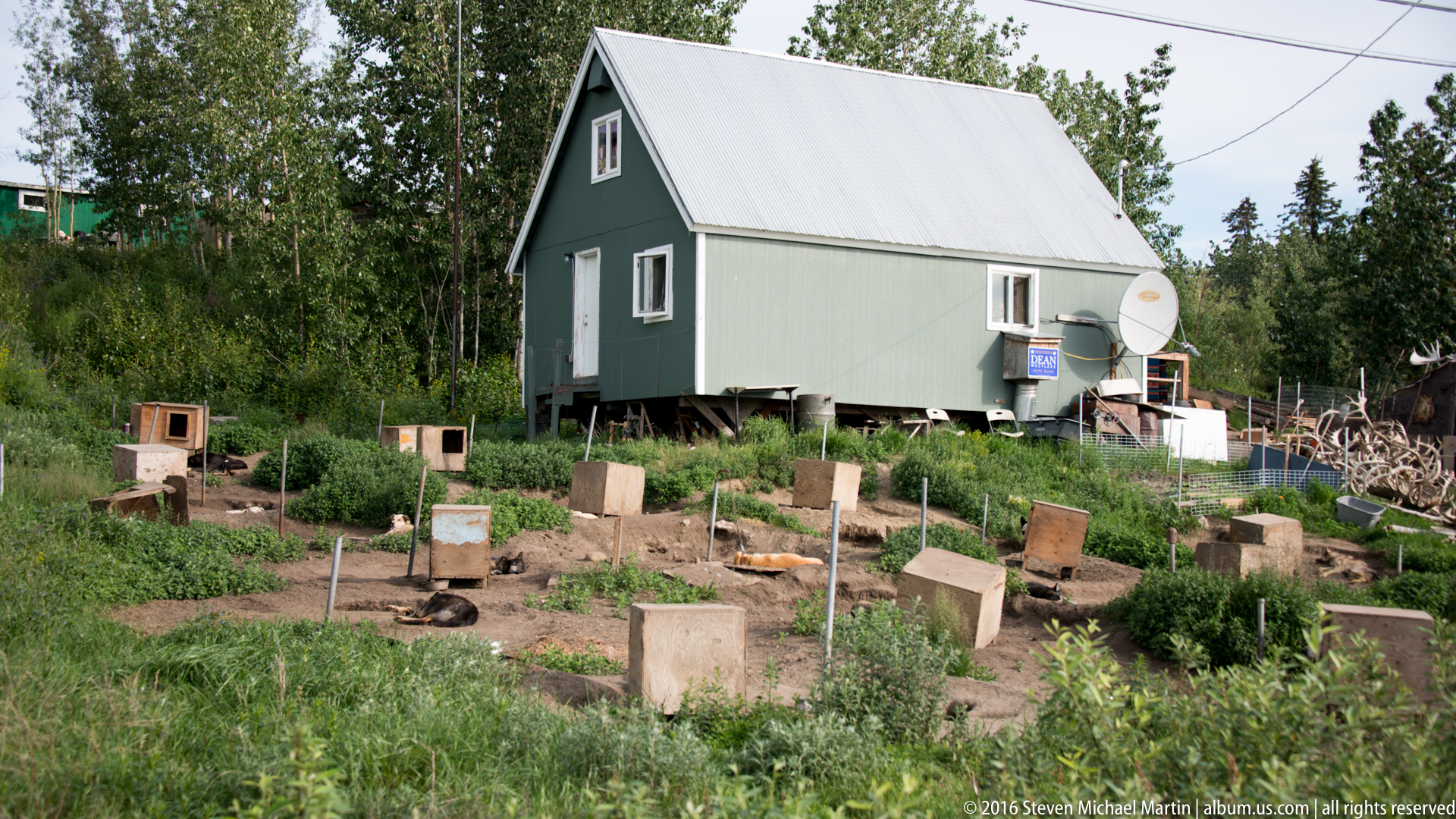
A green, steep-roofed house stands on raised supports above a yard divided into small fenced plots. A satellite dish and utility lines appear beside the building, while wooden boxes, posts, and low vegetation occupy the foreground. The elevated structure and practical yard layout distinguish this residential view from the wilderness panoramas elsewhere in the portfolio.
Caption
A green, steep-roofed house stands on raised supports above a yard divided into small fenced plots. A satellite dish and utility lines appear beside the building, while wooden boxes, posts, and low vegetation occupy the foreground. The elevated structure and practical yard layout distinguish this residential view from the wilderness panoramas elsewhere in the portfolio.
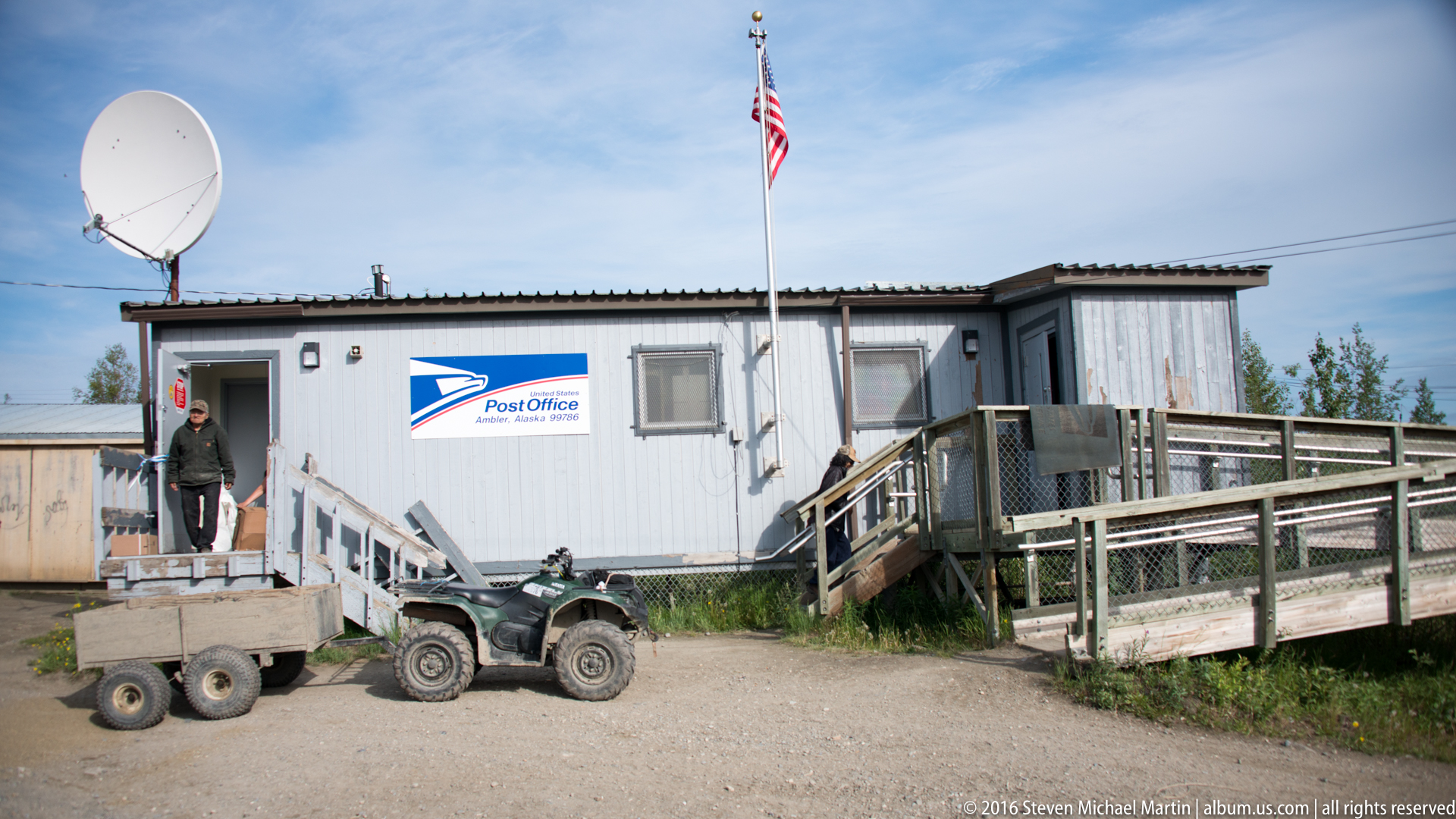
A low modular building bears a visible U.S. Postal Service sign beside its entrance. An elevated ramp and stairs connect the building to the gravel yard, where a small trailer and all-terrain vehicle are parked; an American flag flies above the roof. The functional exterior records a village service building and its access route within a sparse northern settlement.
Caption
A low modular building bears a visible U.S. Postal Service sign beside its entrance. An elevated ramp and stairs connect the building to the gravel yard, where a small trailer and all-terrain vehicle are parked; an American flag flies above the roof. The functional exterior records a village service building and its access route within a sparse northern settlement.
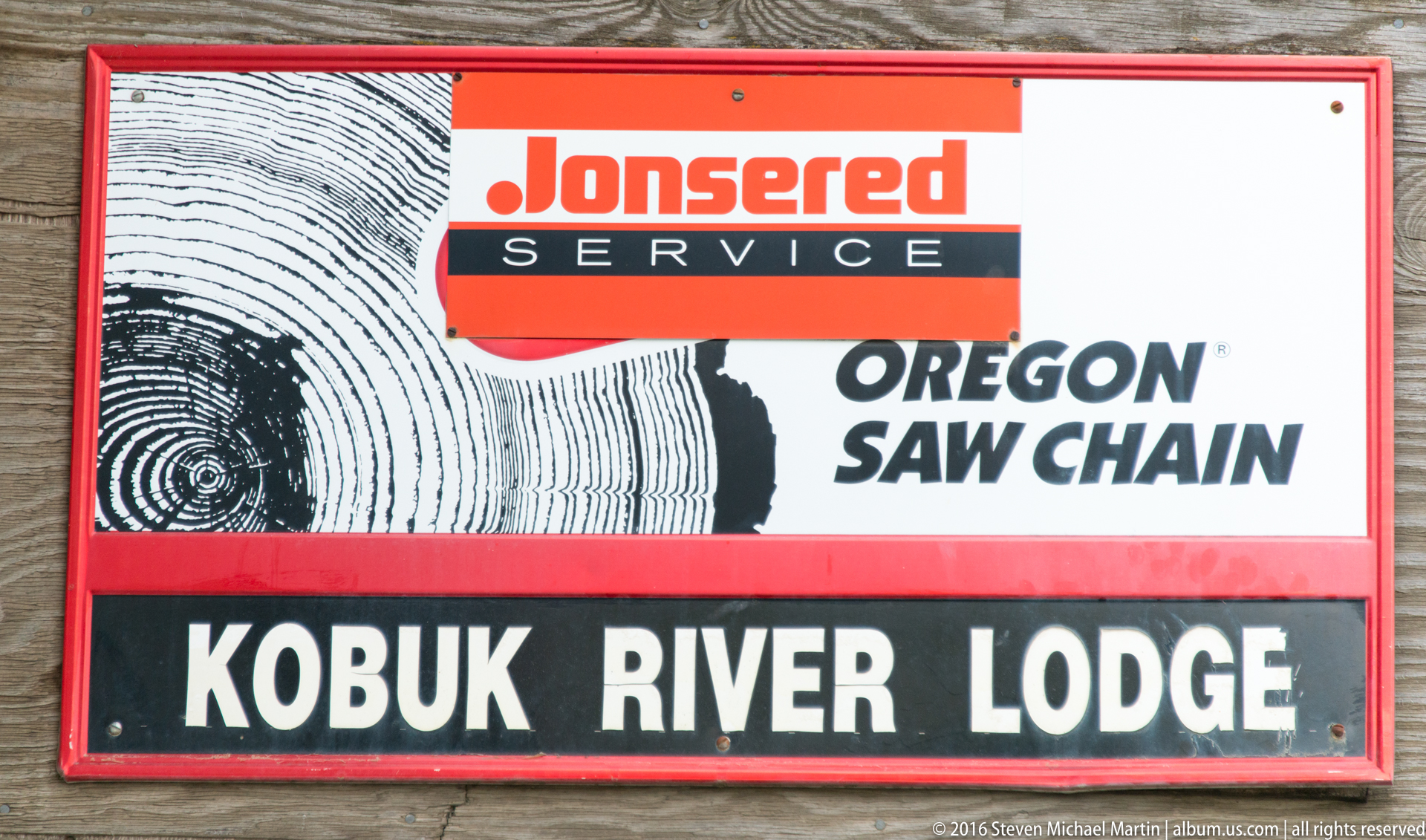
A red-framed sign combines a lodge name with commercial saw-service branding. “Kobuk River Lodge” appears in large white letters along the lower panel, while the upper section reads “Jonsered Service” and “Oregon Saw Chain” beside a black-and-white tree-ring graphic. The close crop preserves the sign’s lettering and design, making it a precise record of local business signage.
Caption
A red-framed sign combines a lodge name with commercial saw-service branding. “Kobuk River Lodge” appears in large white letters along the lower panel, while the upper section reads “Jonsered Service” and “Oregon Saw Chain” beside a black-and-white tree-ring graphic. The close crop preserves the sign’s lettering and design, making it a precise record of local business signage.
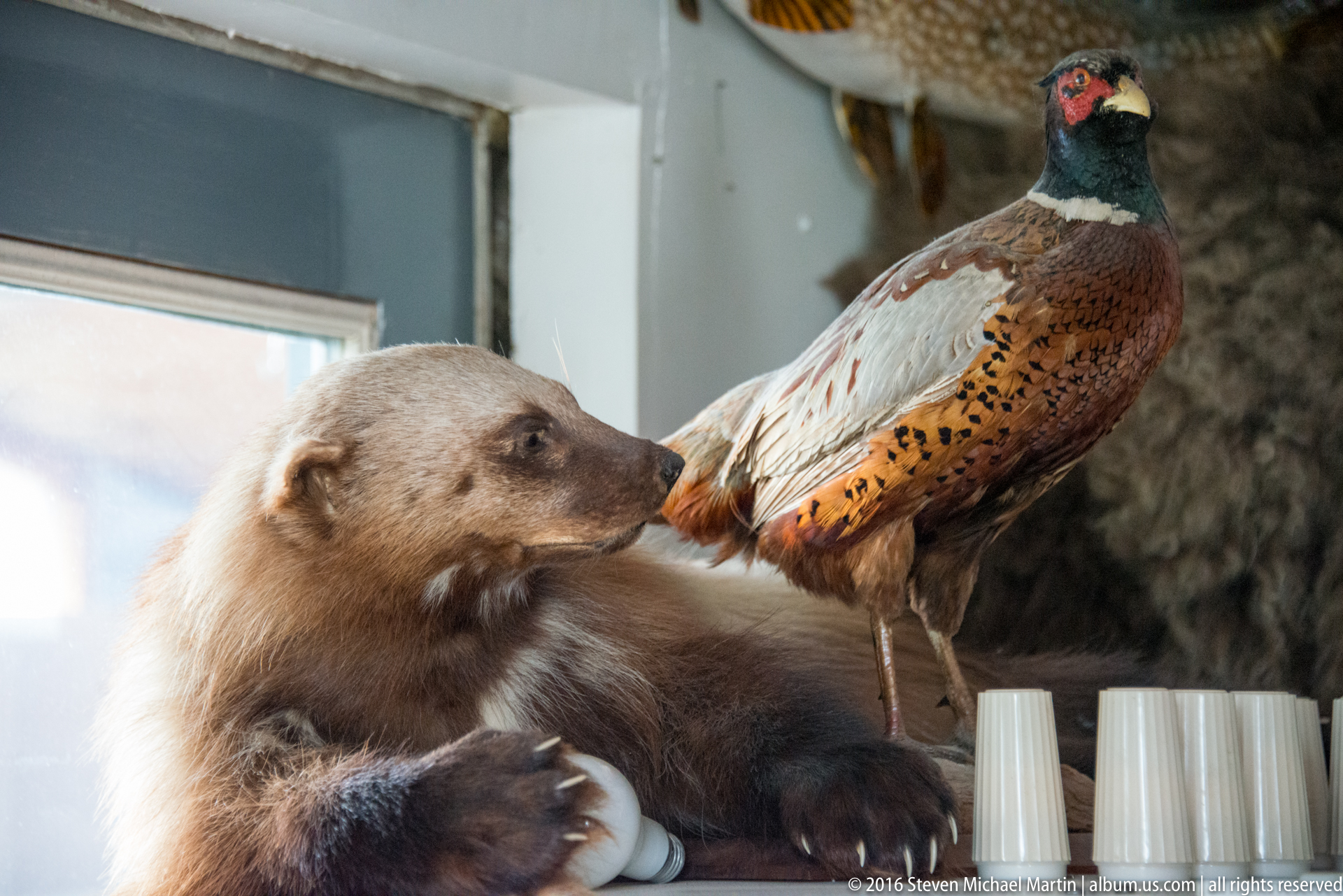
A small brown-furred mammal mount sits on a shelf beside a brightly colored pheasant. The mammal’s rounded head and short visible limbs are partly obscured by the frame and neighboring display, making its species uncertain. The paired mounts occupy a domestic or lodge interior, where taxidermy specimens are arranged close together rather than in a formal natural-history case.
Caption
A small brown-furred mammal mount sits on a shelf beside a brightly colored pheasant. The mammal’s rounded head and short visible limbs are partly obscured by the frame and neighboring display, making its species uncertain. The paired mounts occupy a domestic or lodge interior, where taxidermy specimens are arranged close together rather than in a formal natural-history case.
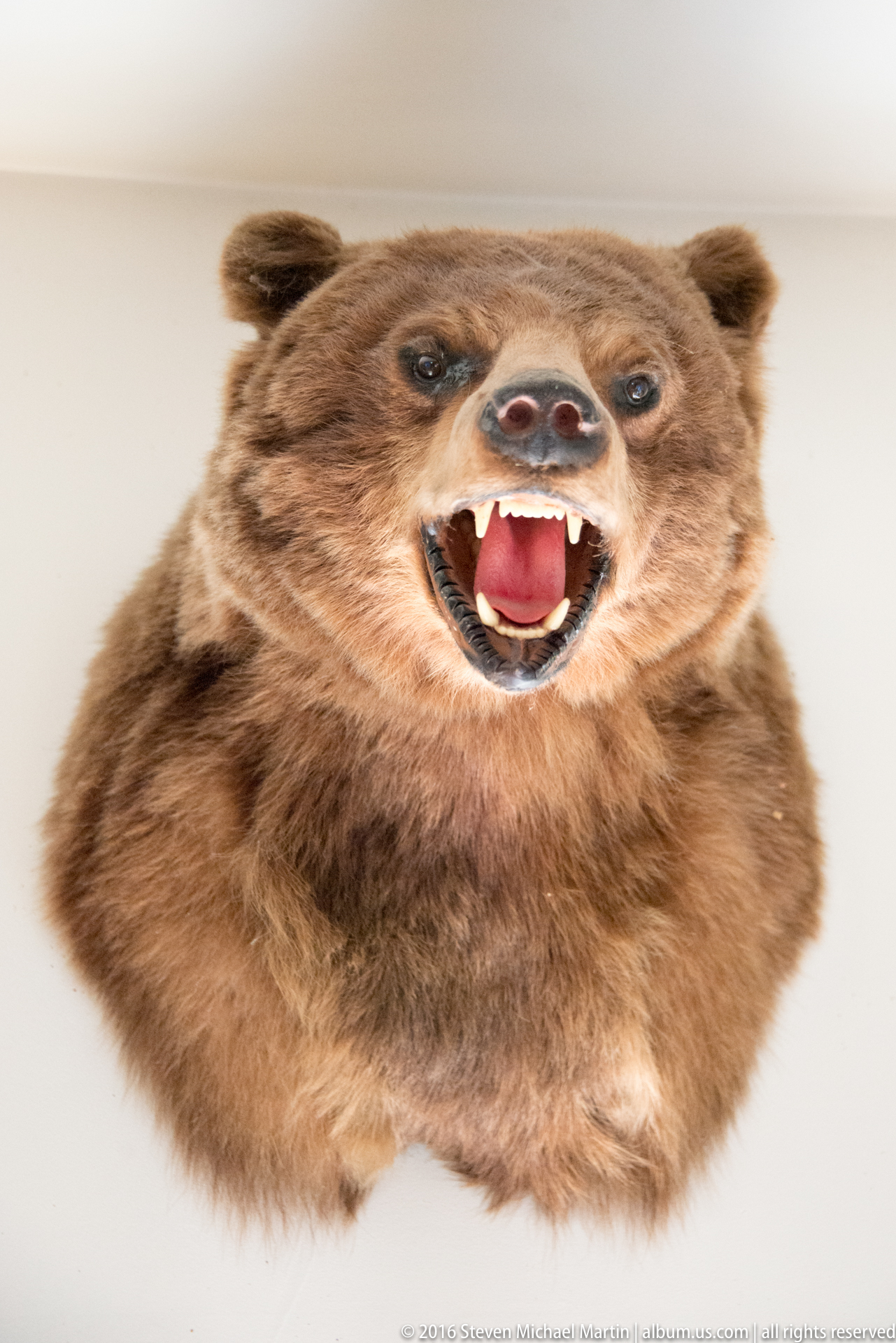
A brown-furred bear mount faces forward with its mouth open, exposing the teeth and dark interior of the jaw. The crop includes the head and upper chest against a pale wall, drawing attention to the animal’s muzzle and expression. No display label is visible, so the mount can be described as a bear without assigning a species from this view alone.
Caption
A brown-furred bear mount faces forward with its mouth open, exposing the teeth and dark interior of the jaw. The crop includes the head and upper chest against a pale wall, drawing attention to the animal’s muzzle and expression. No display label is visible, so the mount can be described as a bear without assigning a species from this view alone.
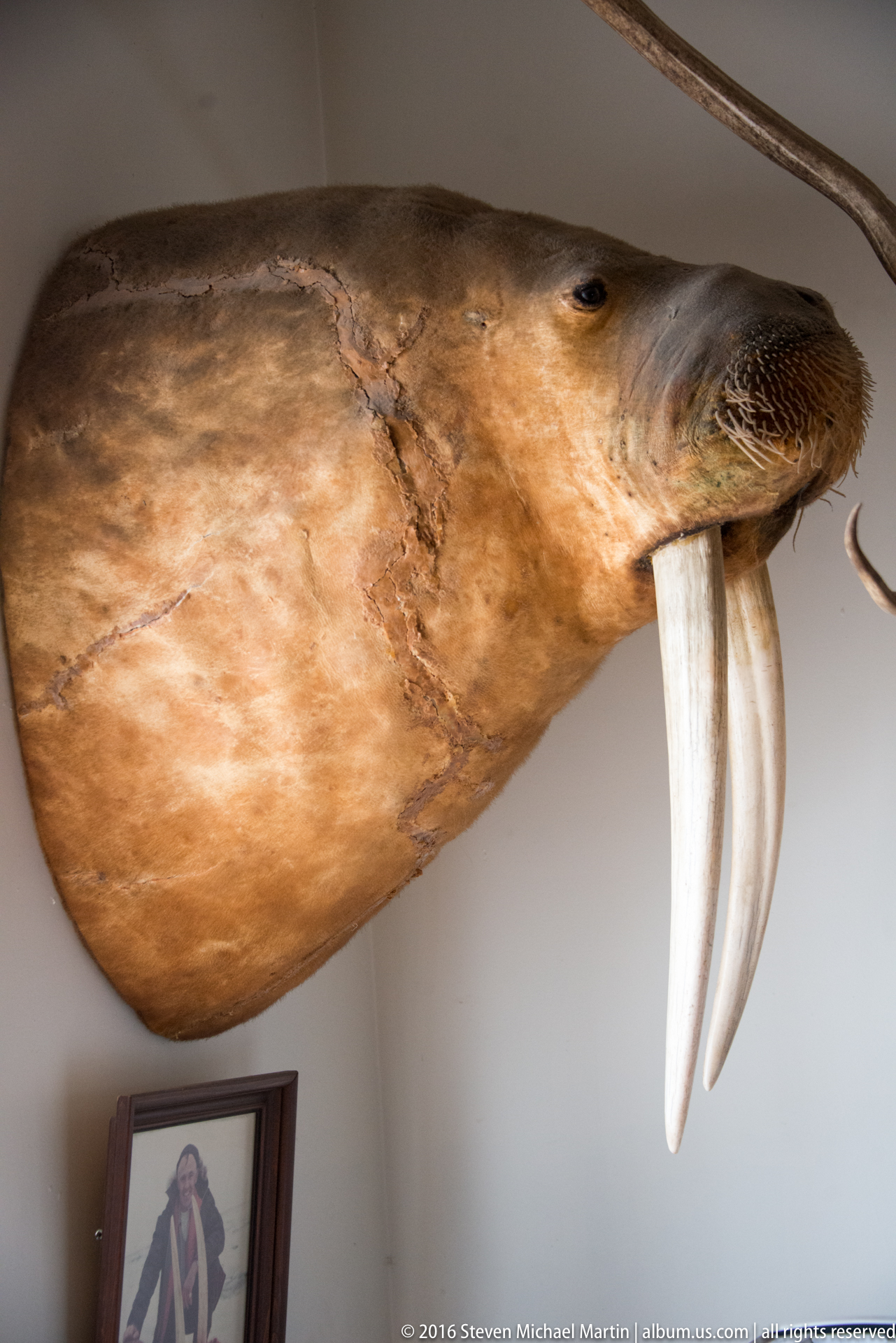
A walrus head mount projects from the wall in close profile, its mottled brown hide ending in a long pale tusk. The eye, whiskered muzzle, and thick facial folds are visible above the tusk, while a framed picture sits below the display. The tight crop emphasizes the animal’s distinctive facial features and the scale of its tusk.
Caption
A walrus head mount projects from the wall in close profile, its mottled brown hide ending in a long pale tusk. The eye, whiskered muzzle, and thick facial folds are visible above the tusk, while a framed picture sits below the display. The tight crop emphasizes the animal’s distinctive facial features and the scale of its tusk.
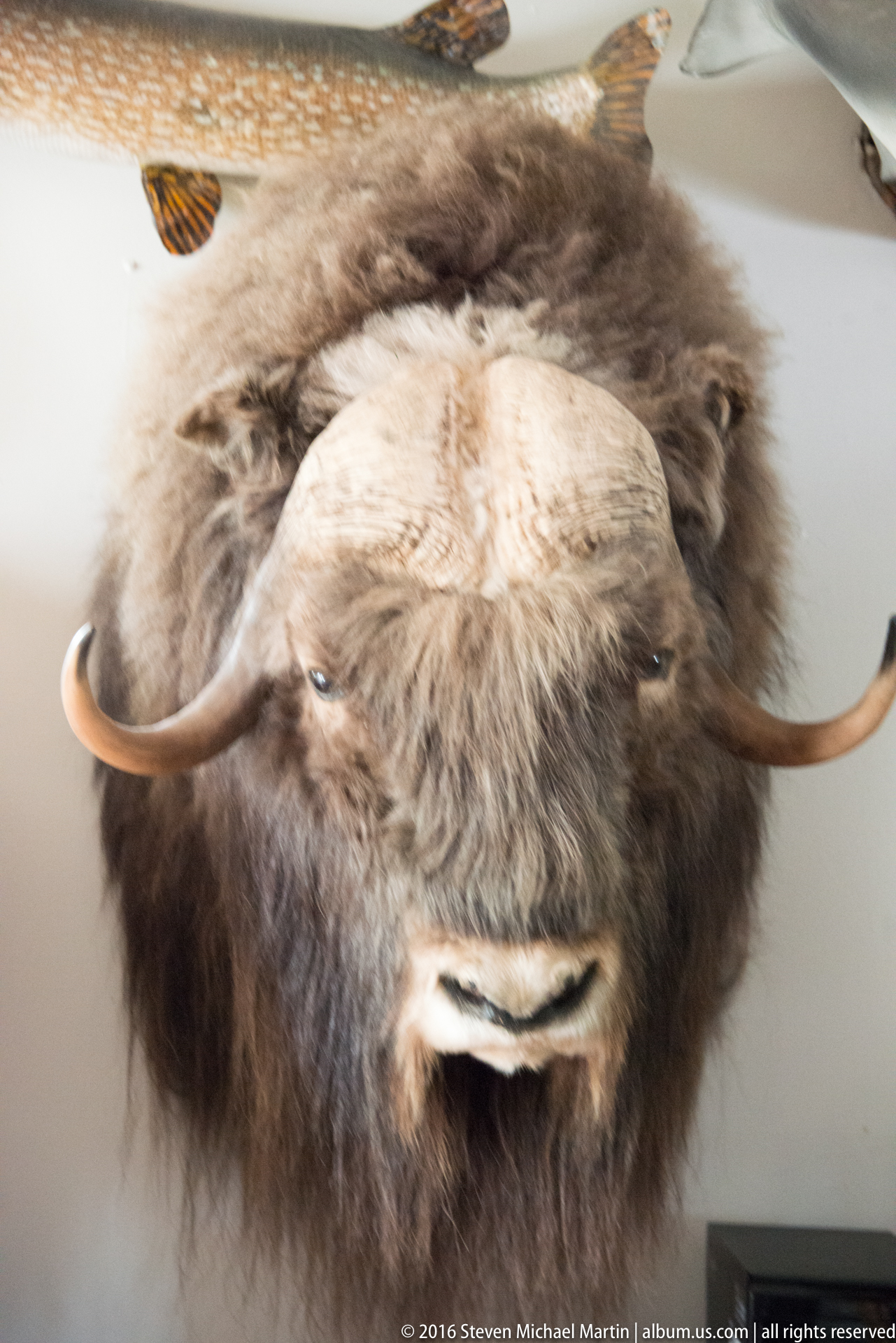
A shaggy muskox mount fills the frame, its dense brown coat surrounding a broad forehead and short, pale muzzle. Heavy horns sweep sideways from the head, with their tips curling upward near the edges. The frontal view makes the animal’s characteristic horn span and thick coat the dominant features; no surrounding habitat is shown.
Caption
A shaggy muskox mount fills the frame, its dense brown coat surrounding a broad forehead and short, pale muzzle. Heavy horns sweep sideways from the head, with their tips curling upward near the edges. The frontal view makes the animal’s characteristic horn span and thick coat the dominant features; no surrounding habitat is shown.
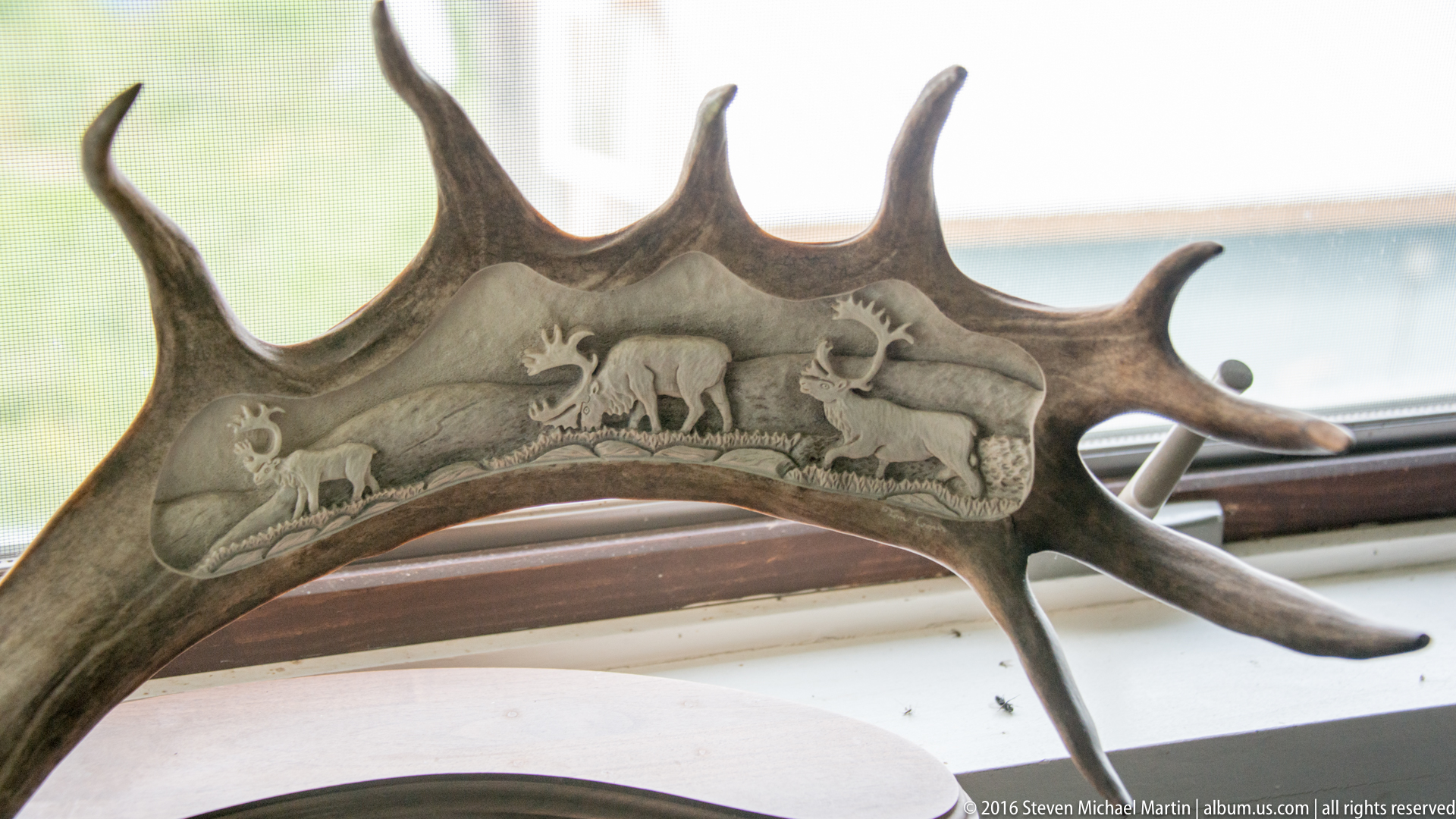
A curved antler section rests near a window, its inner surface engraved with a small scene of animals among landforms. Fine carved lines fill the pale surface, while the branching tines frame the panel. The image supports identification as decorated antler, but the maker, cultural origin, and exact animals in the engraving cannot be established from this view.
Caption
A curved antler section rests near a window, its inner surface engraved with a small scene of animals among landforms. Fine carved lines fill the pale surface, while the branching tines frame the panel. The image supports identification as decorated antler, but the maker, cultural origin, and exact animals in the engraving cannot be established from this view.
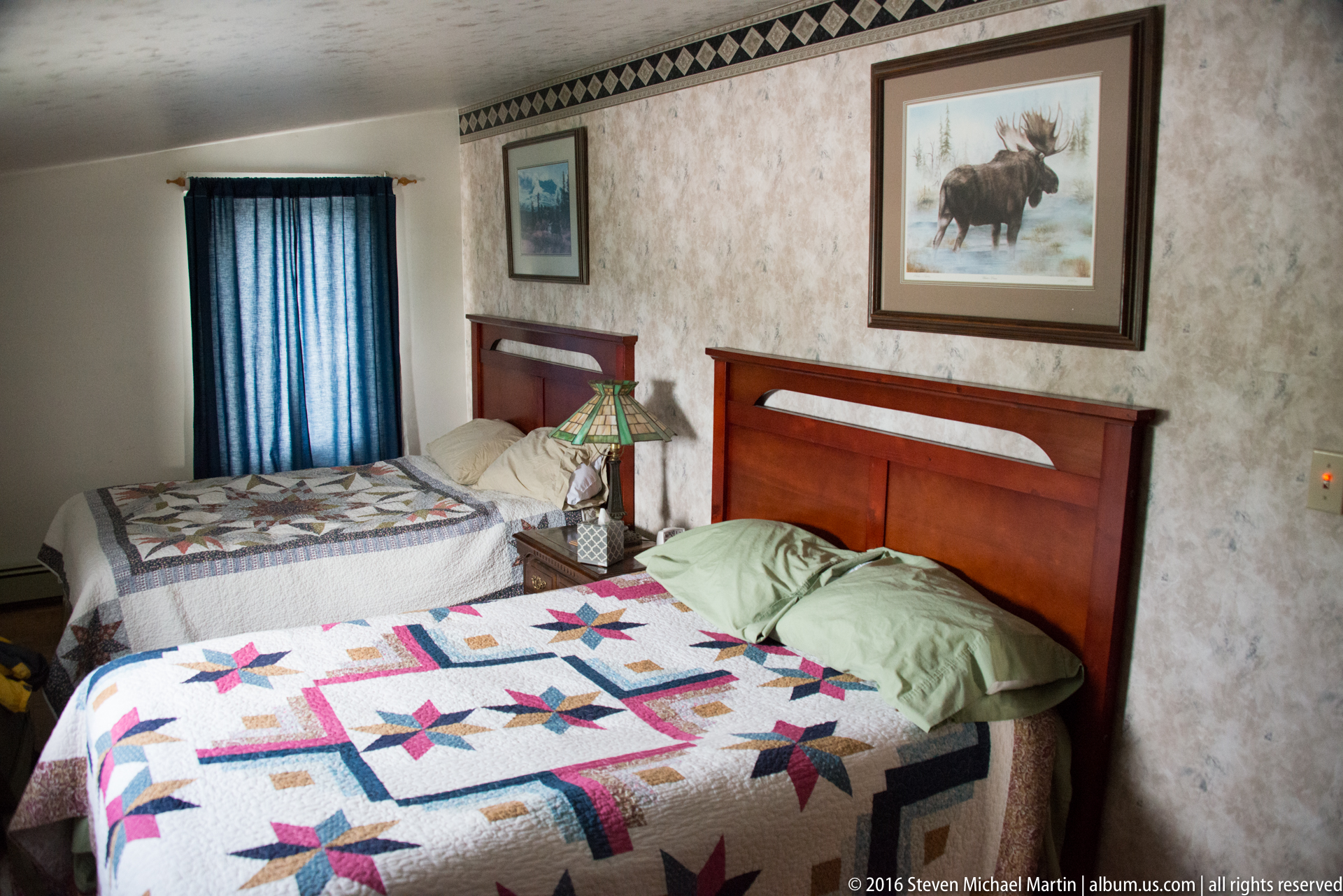
Two beds stand side by side in a modest bedroom, each covered with patterned quilts and pillows. Matching wooden headboards line the wall beneath framed wildlife pictures, and a small table lamp sits between the beds. A blue curtain filters light at the window, while the tidy arrangement gives the room a practical lodging character.
Caption
Two beds stand side by side in a modest bedroom, each covered with patterned quilts and pillows. Matching wooden headboards line the wall beneath framed wildlife pictures, and a small table lamp sits between the beds. A blue curtain filters light at the window, while the tidy arrangement gives the room a practical lodging character.
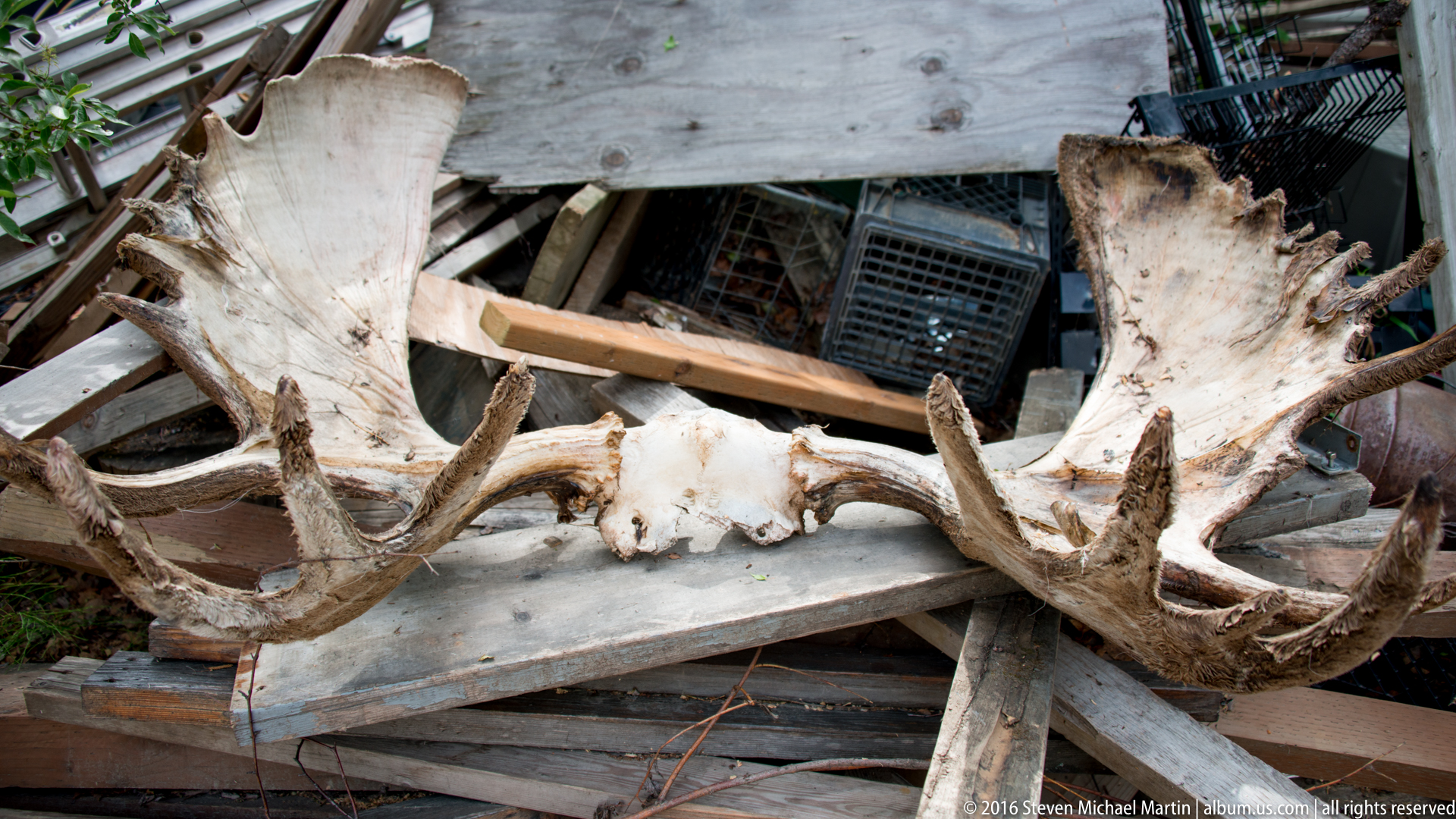
Several large antlers and horns overlap across a cluttered storage area, their branching forms crossing boards and other equipment. The pale surfaces show varied shapes and sizes, but the pile does not make each animal source clear. Rather than a curated display, the arrangement appears to be stored materials awaiting use or placement, with the surrounding objects partly obscured.
Caption
Several large antlers and horns overlap across a cluttered storage area, their branching forms crossing boards and other equipment. The pale surfaces show varied shapes and sizes, but the pile does not make each animal source clear. Rather than a curated display, the arrangement appears to be stored materials awaiting use or placement, with the surrounding objects partly obscured.
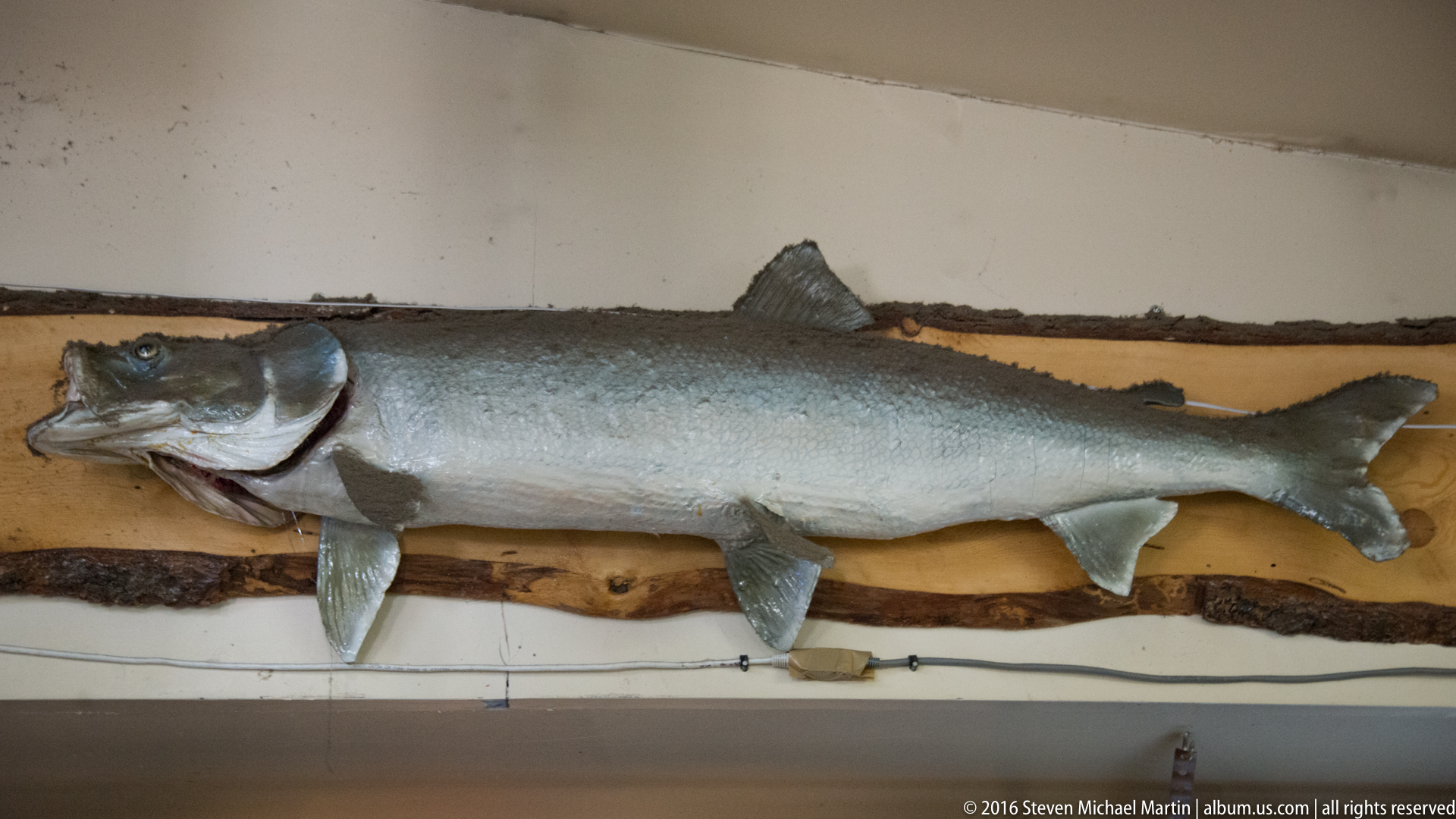
A large silvery fish mount is fixed horizontally to a pale wall above a narrow wooden shelf. Its open mouth, dark eye, broad tail, and fins are visible in profile, while the slightly raised dorsal fin gives the body a clear outline. The specimen’s species is not apparent from the image, so the caption stays with its visible form and display setting.
Caption
A large silvery fish mount is fixed horizontally to a pale wall above a narrow wooden shelf. Its open mouth, dark eye, broad tail, and fins are visible in profile, while the slightly raised dorsal fin gives the body a clear outline. The specimen’s species is not apparent from the image, so the caption stays with its visible form and display setting.
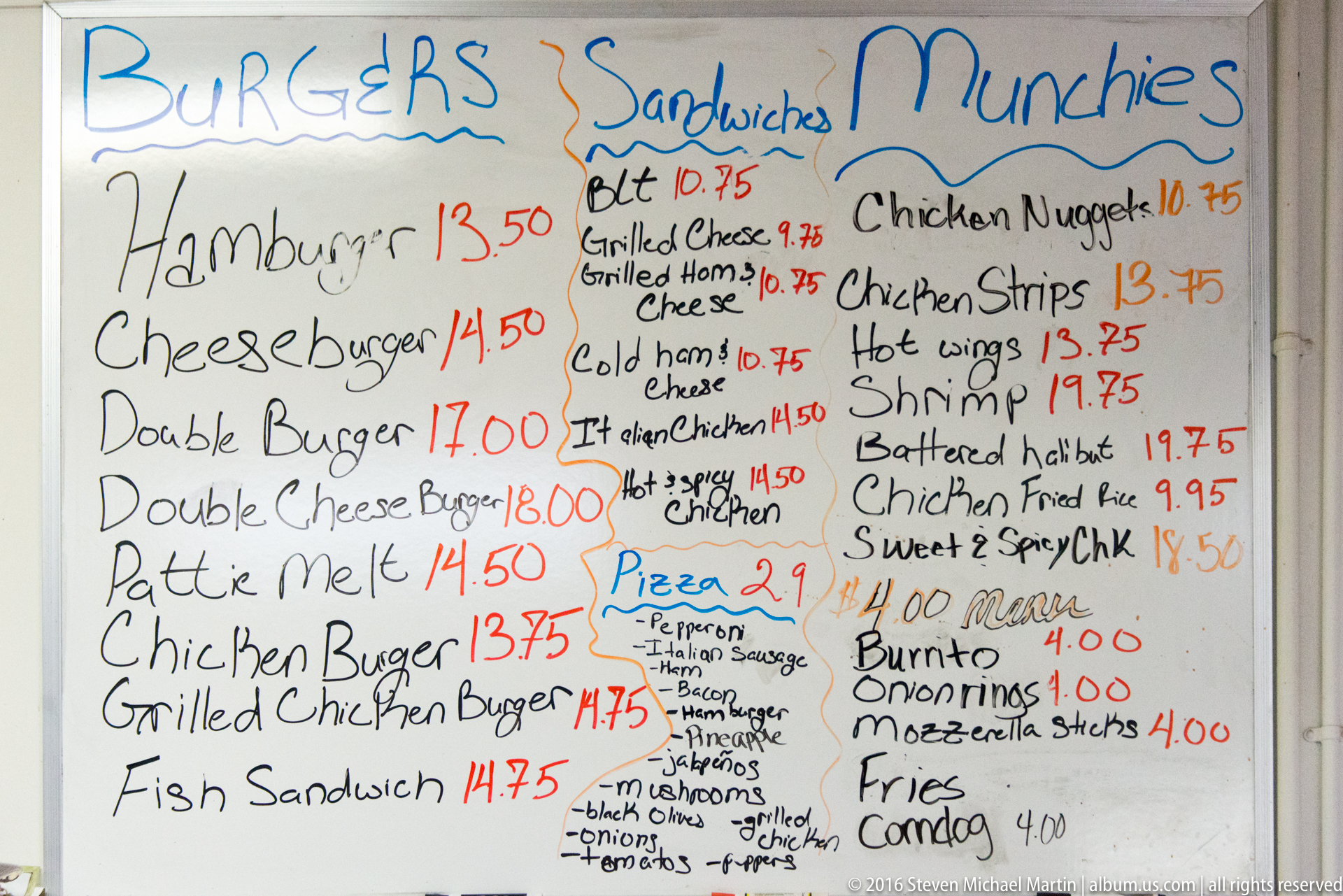
A handwritten whiteboard menu fills the frame with columns headed “Burgers,” “Sandwiches,” and “Munchies,” plus a smaller pizza list. Item names and prices are written in several marker colors, giving the board an informal, changeable appearance. The close view records a practical food-service detail of Ambler rather than the surrounding landscape.
Caption
A handwritten whiteboard menu fills the frame with columns headed “Burgers,” “Sandwiches,” and “Munchies,” plus a smaller pizza list. Item names and prices are written in several marker colors, giving the board an informal, changeable appearance. The close view records a practical food-service detail of Ambler rather than the surrounding landscape.
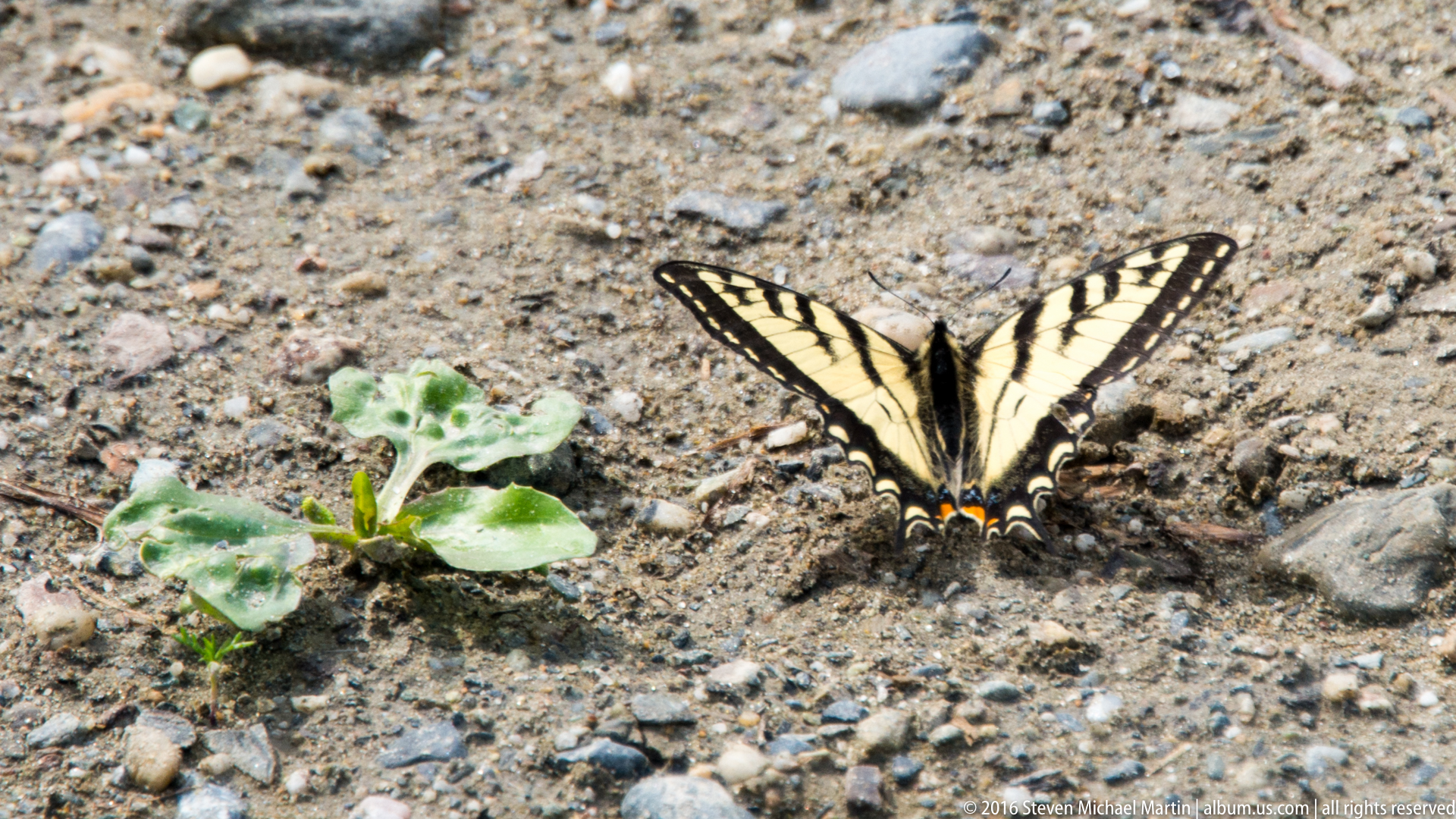
A yellow-and-black butterfly rests with its wings open on pale gravel beside a small broad-leaved plant. Its long tails, dark veins, and orange spots near the hindwing edges are visible against the sparse ground. The close composition records an insect at ground level, though the proof sheet does not resolve a species-level identification.
Caption
A yellow-and-black butterfly rests with its wings open on pale gravel beside a small broad-leaved plant. Its long tails, dark veins, and orange spots near the hindwing edges are visible against the sparse ground. The close composition records an insect at ground level, though the proof sheet does not resolve a species-level identification.
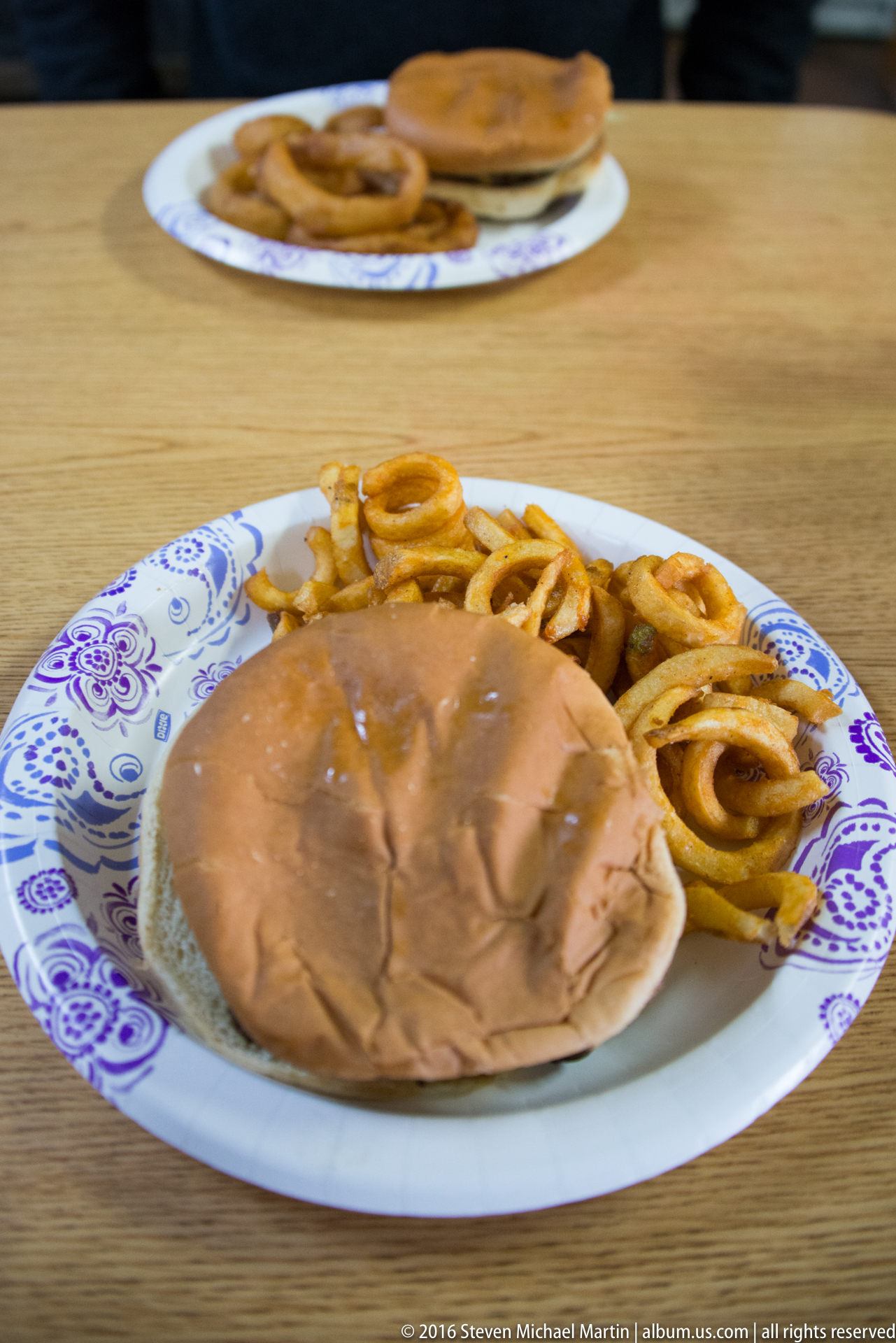
A hamburger sits on a disposable patterned plate beside a generous serving of curled fried pieces and onion rings. A second plate with another meal is partly visible across the wooden table, suggesting a casual dining setting. The shallow viewpoint concentrates on the food and its simple service rather than identifying the establishment.
Caption
A hamburger sits on a disposable patterned plate beside a generous serving of curled fried pieces and onion rings. A second plate with another meal is partly visible across the wooden table, suggesting a casual dining setting. The shallow viewpoint concentrates on the food and its simple service rather than identifying the establishment.
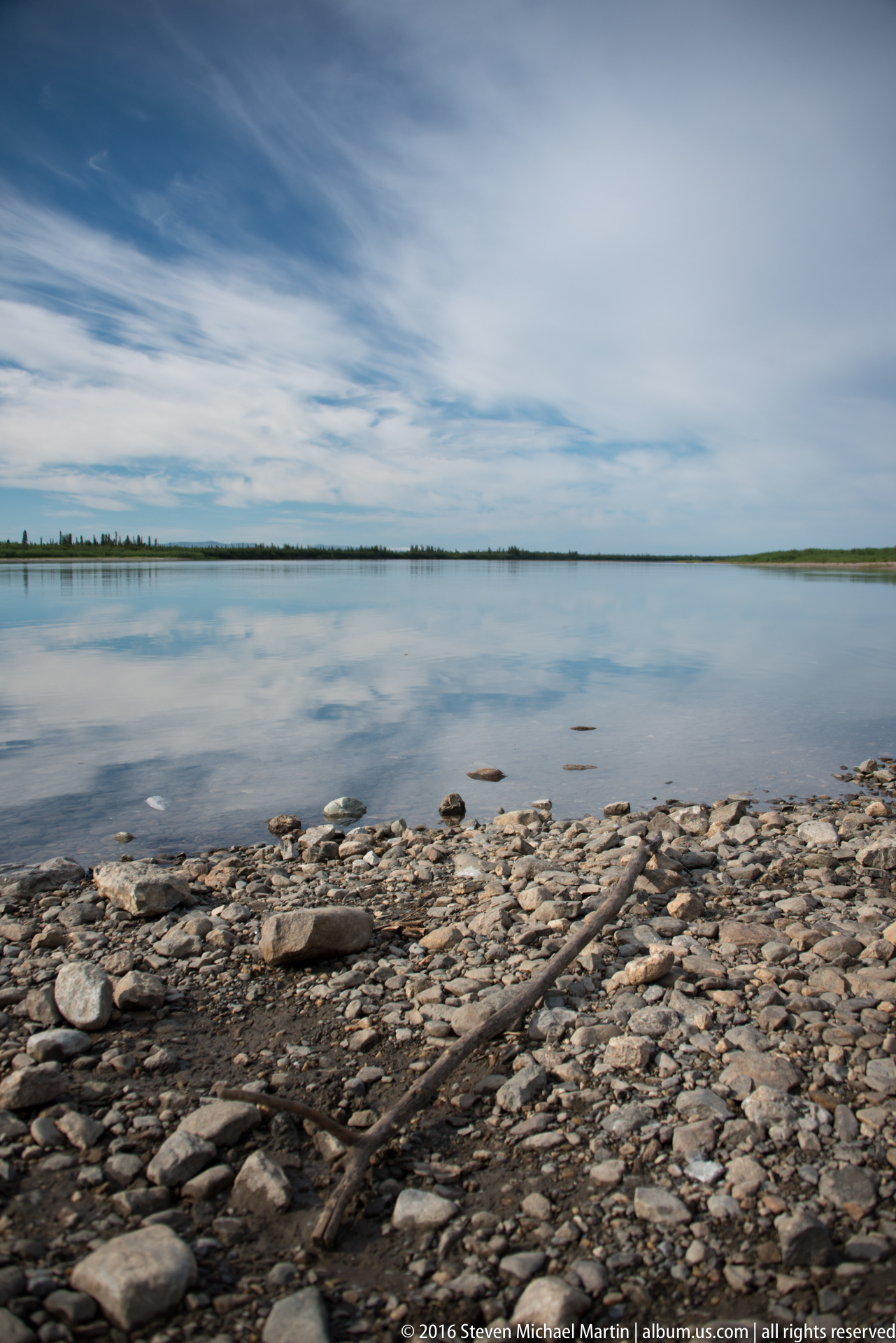
A broad river fills the upper half of the view, carrying soft reflections of streaked clouds. A long pebble shoreline curves across the foreground, where rounded stones and driftwood lie above the waterline. With no people or boats in the frame, the image focuses on the open river surface and its gently sloping bank.
Caption
A broad river fills the upper half of the view, carrying soft reflections of streaked clouds. A long pebble shoreline curves across the foreground, where rounded stones and driftwood lie above the waterline. With no people or boats in the frame, the image focuses on the open river surface and its gently sloping bank.
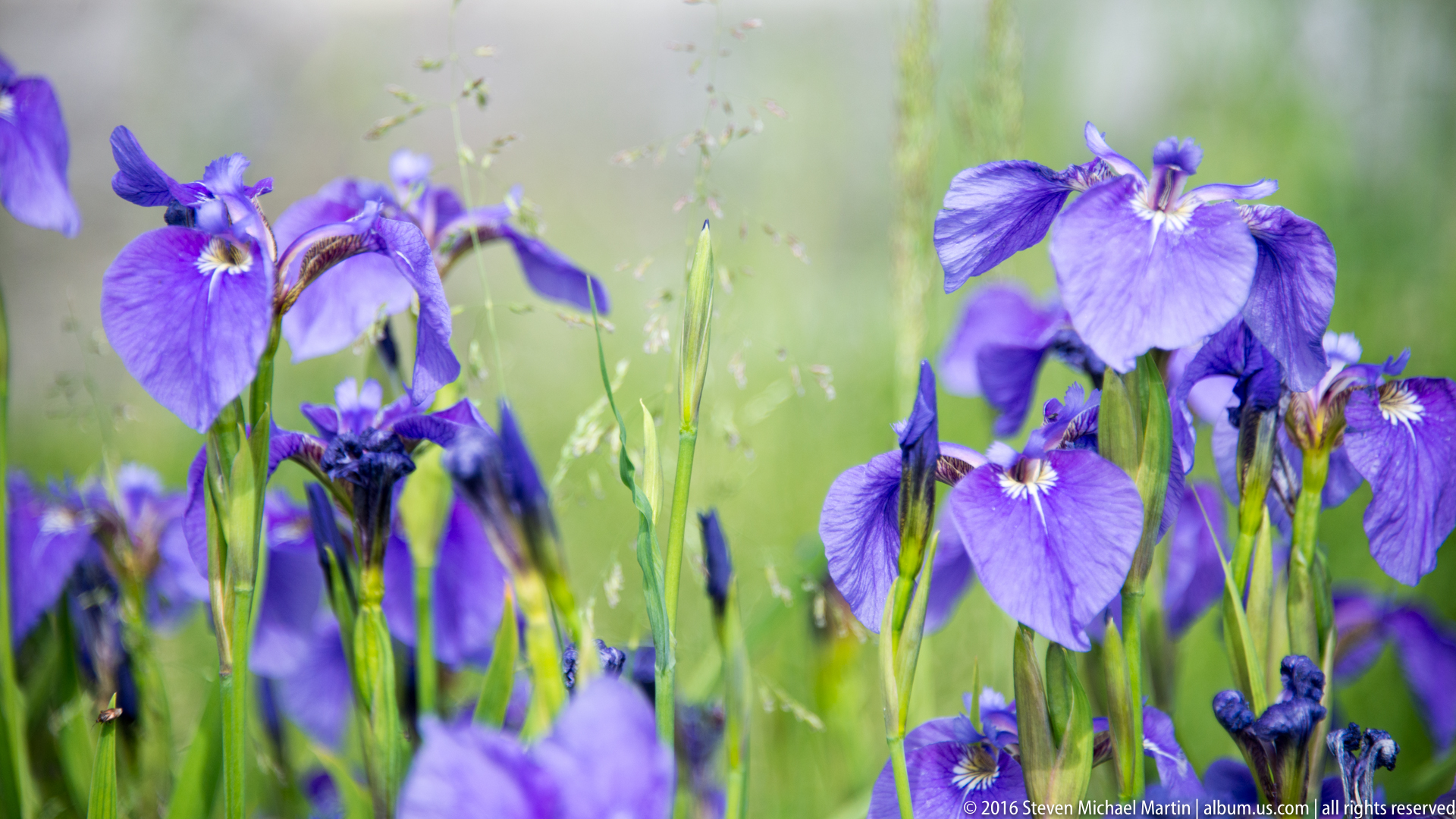
Violet-blue iris flowers rise above slender green leaves, with several blooms open at different angles. A soft background of grasses and pale light keeps attention on the curved petals and small yellow-white markings near their centers. The close framing distinguishes the cultivated or naturally growing flower cluster from the region’s broader landscape views.
Caption
Violet-blue iris flowers rise above slender green leaves, with several blooms open at different angles. A soft background of grasses and pale light keeps attention on the curved petals and small yellow-white markings near their centers. The close framing distinguishes the cultivated or naturally growing flower cluster from the region’s broader landscape views.
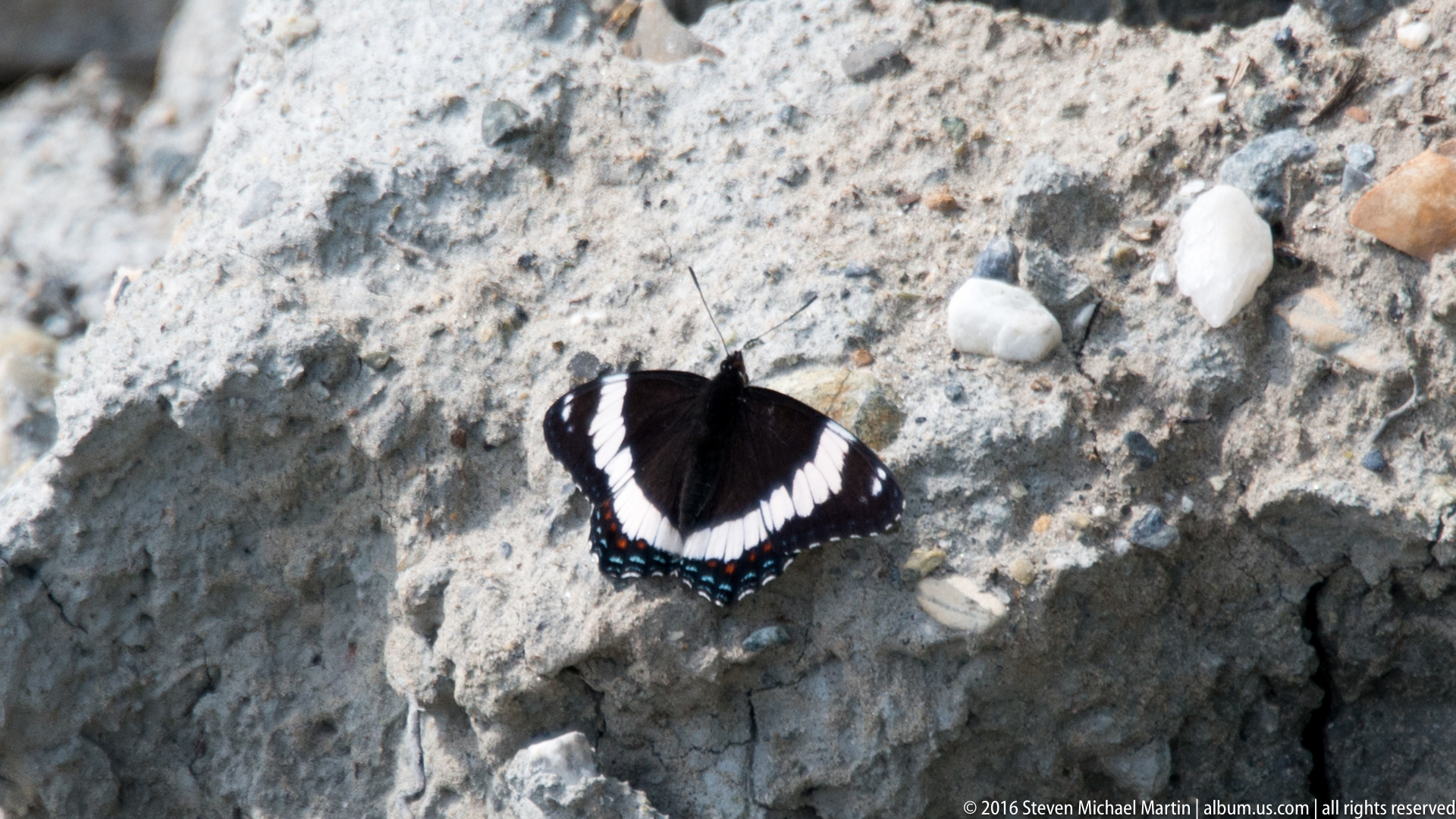
A dark butterfly rests on a pale, broken rock surface with its wings held open. A broad white band crosses the wings, and small blue spots and orange patches mark the outer edges. The contrasting pattern is clear in this close view, although the available image does not support a confident species identification.
Caption
A dark butterfly rests on a pale, broken rock surface with its wings held open. A broad white band crosses the wings, and small blue spots and orange patches mark the outer edges. The contrasting pattern is clear in this close view, although the available image does not support a confident species identification.
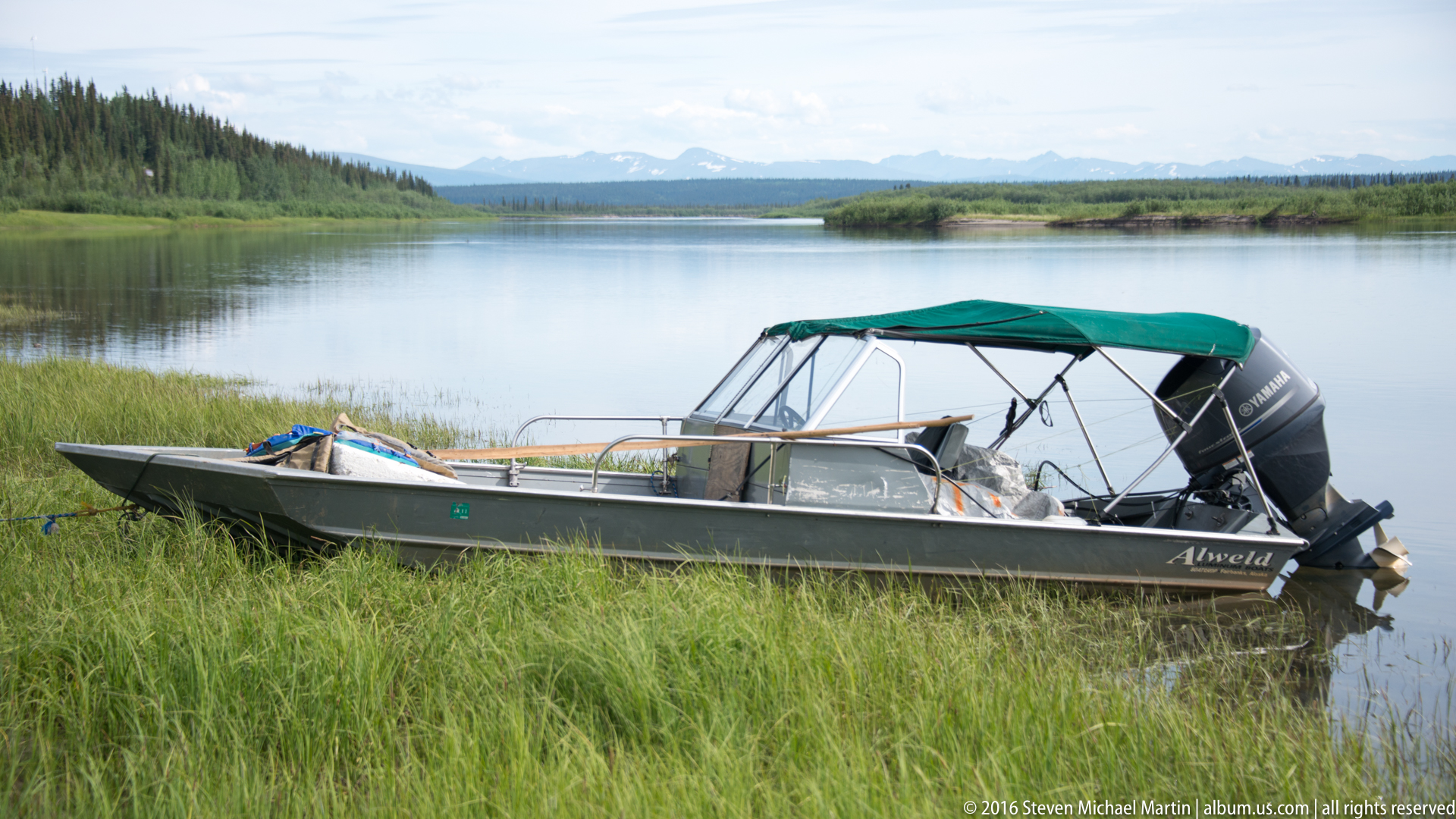
A long aluminum motorboat sits partly in the grass at the river’s edge, its green canopy stretched over the passenger area and a dark outboard engine mounted at the stern. A narrow craft lies alongside the bow. The closer view makes the boat’s practical construction and equipment legible against the calm water and low green bank.
Caption
A long aluminum motorboat sits partly in the grass at the river’s edge, its green canopy stretched over the passenger area and a dark outboard engine mounted at the stern. A narrow craft lies alongside the bow. The closer view makes the boat’s practical construction and equipment legible against the calm water and low green bank.
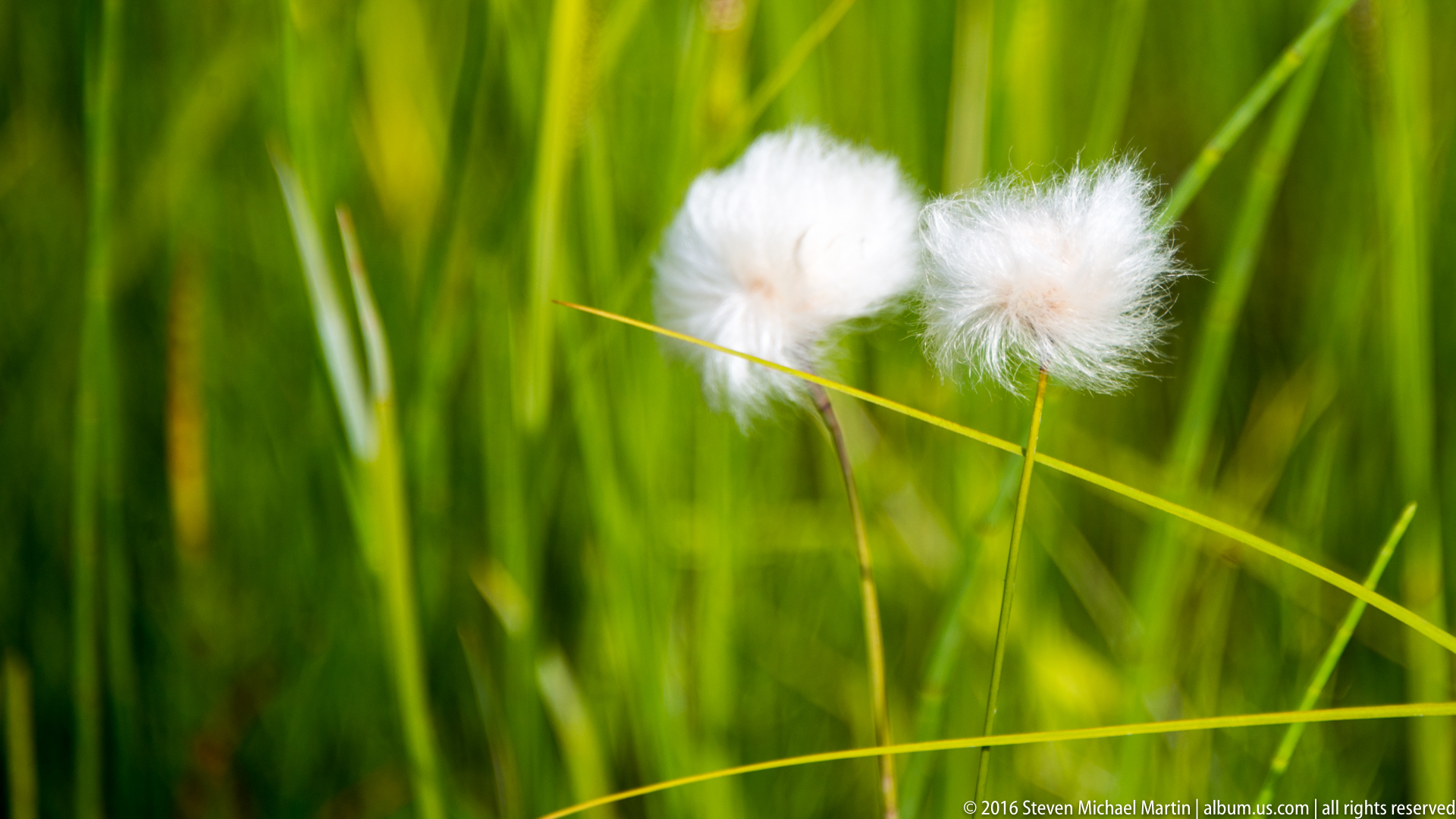
Two soft white seed heads stand on slender stems among vivid green blades. A narrow band of sharper detail isolates the cottony tufts, while the surrounding grasses blur into a saturated background. The plant is consistent with cotton grass, a conspicuous wetland growth in northern regions, though the species is not determined.
Caption
Two soft white seed heads stand on slender stems among vivid green blades. A narrow band of sharper detail isolates the cottony tufts, while the surrounding grasses blur into a saturated background. The plant is consistent with cotton grass, a conspicuous wetland growth in northern regions, though the species is not determined.
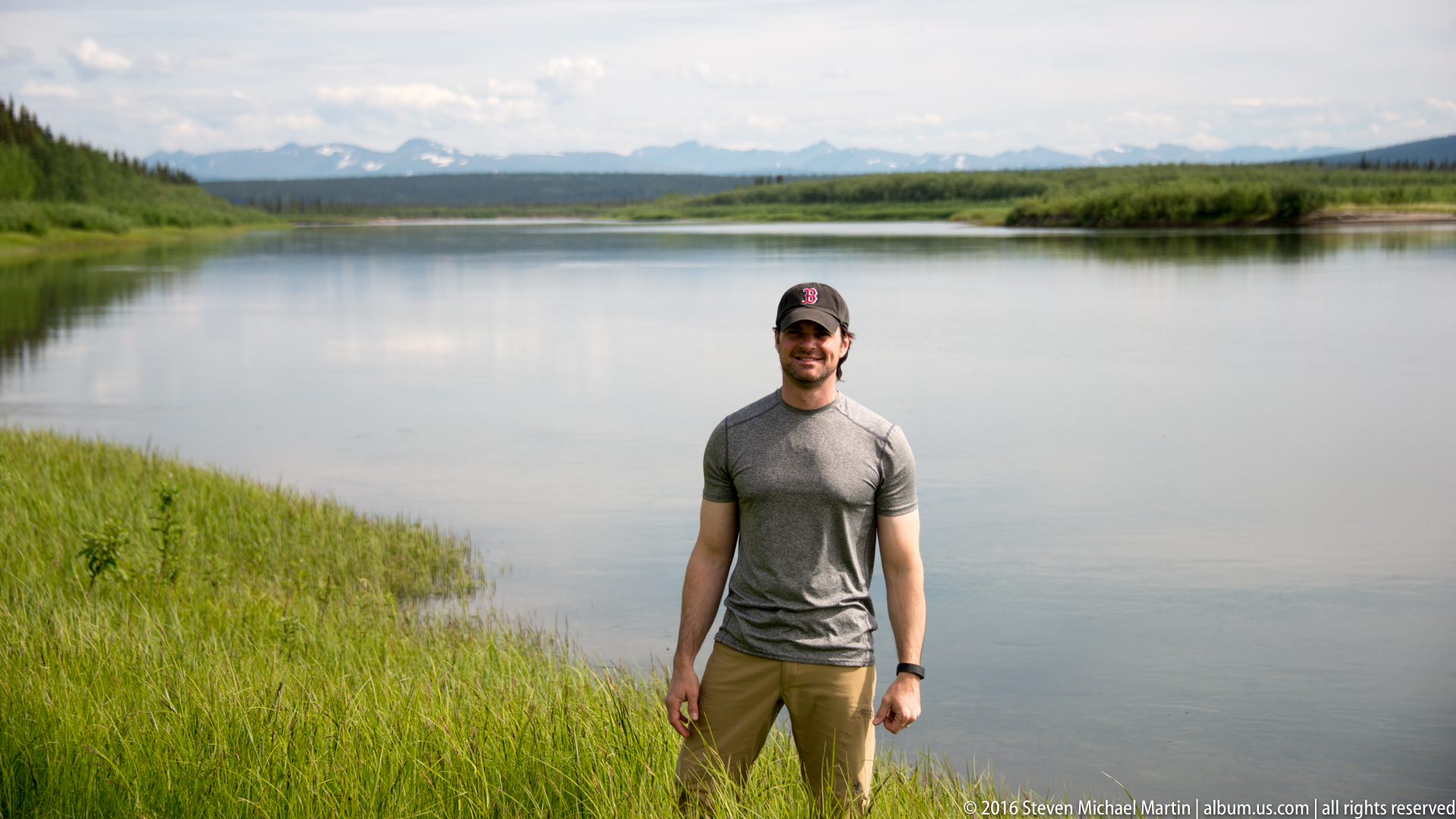
A man in a dark cap and gray shirt stands on a grassy riverbank facing the camera. The quiet water, low vegetation, and forested far shore surround him, while the distant horizon remains low in the frame. The portrait gives human scale to the river landscape without identifying the subject or suggesting a particular activity.
Caption
A man in a dark cap and gray shirt stands on a grassy riverbank facing the camera. The quiet water, low vegetation, and forested far shore surround him, while the distant horizon remains low in the frame. The portrait gives human scale to the river landscape without identifying the subject or suggesting a particular activity.
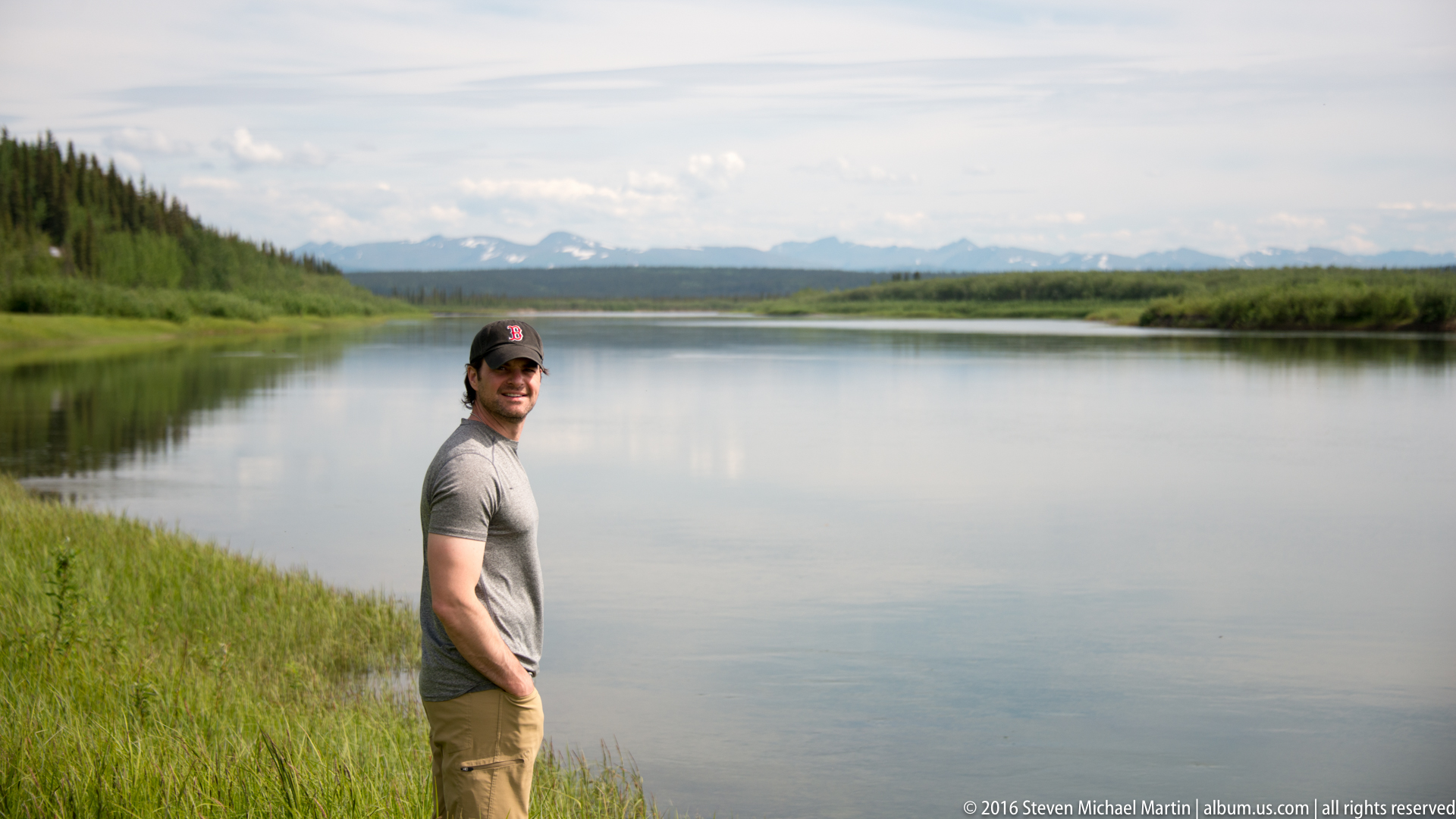
A man in a dark cap stands near the water and turns his upper body toward the camera. The broad river and forested bank create a quiet backdrop, while his profile and relaxed stance distinguish this view from the front-facing portrait on the preceding slot. The photograph records a brief pause beside the water.
Caption
A man in a dark cap stands near the water and turns his upper body toward the camera. The broad river and forested bank create a quiet backdrop, while his profile and relaxed stance distinguish this view from the front-facing portrait on the preceding slot. The photograph records a brief pause beside the water.
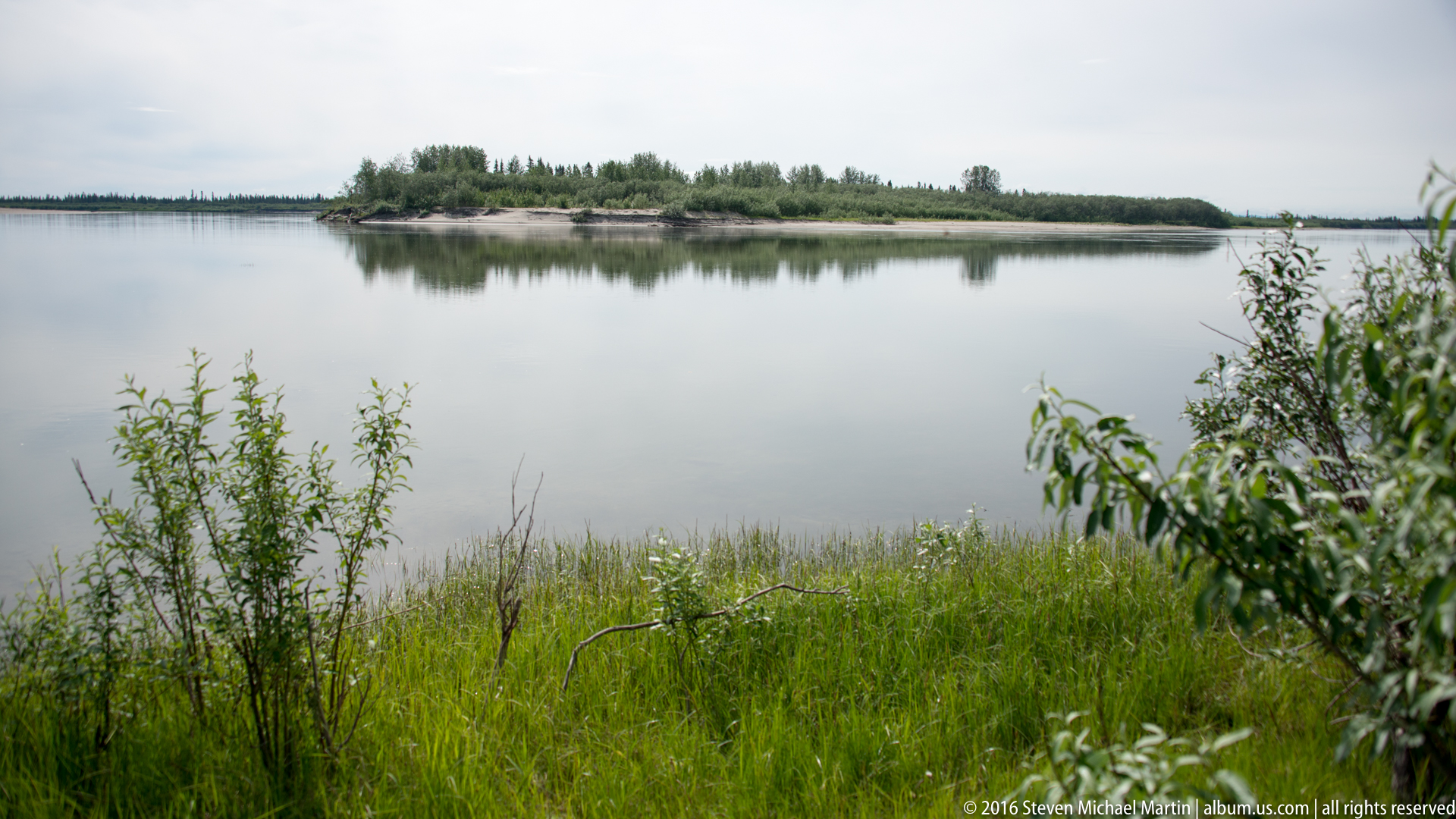
A calm river channel widens across the frame, edged by tall grasses and low shrubs in the foreground. A low, tree-covered island or opposite bank sits near the center, reflected in the smooth water beneath an overcast sky. The subdued light and sparse vegetation give the riverscape a still, open character.
Caption
A calm river channel widens across the frame, edged by tall grasses and low shrubs in the foreground. A low, tree-covered island or opposite bank sits near the center, reflected in the smooth water beneath an overcast sky. The subdued light and sparse vegetation give the riverscape a still, open character.
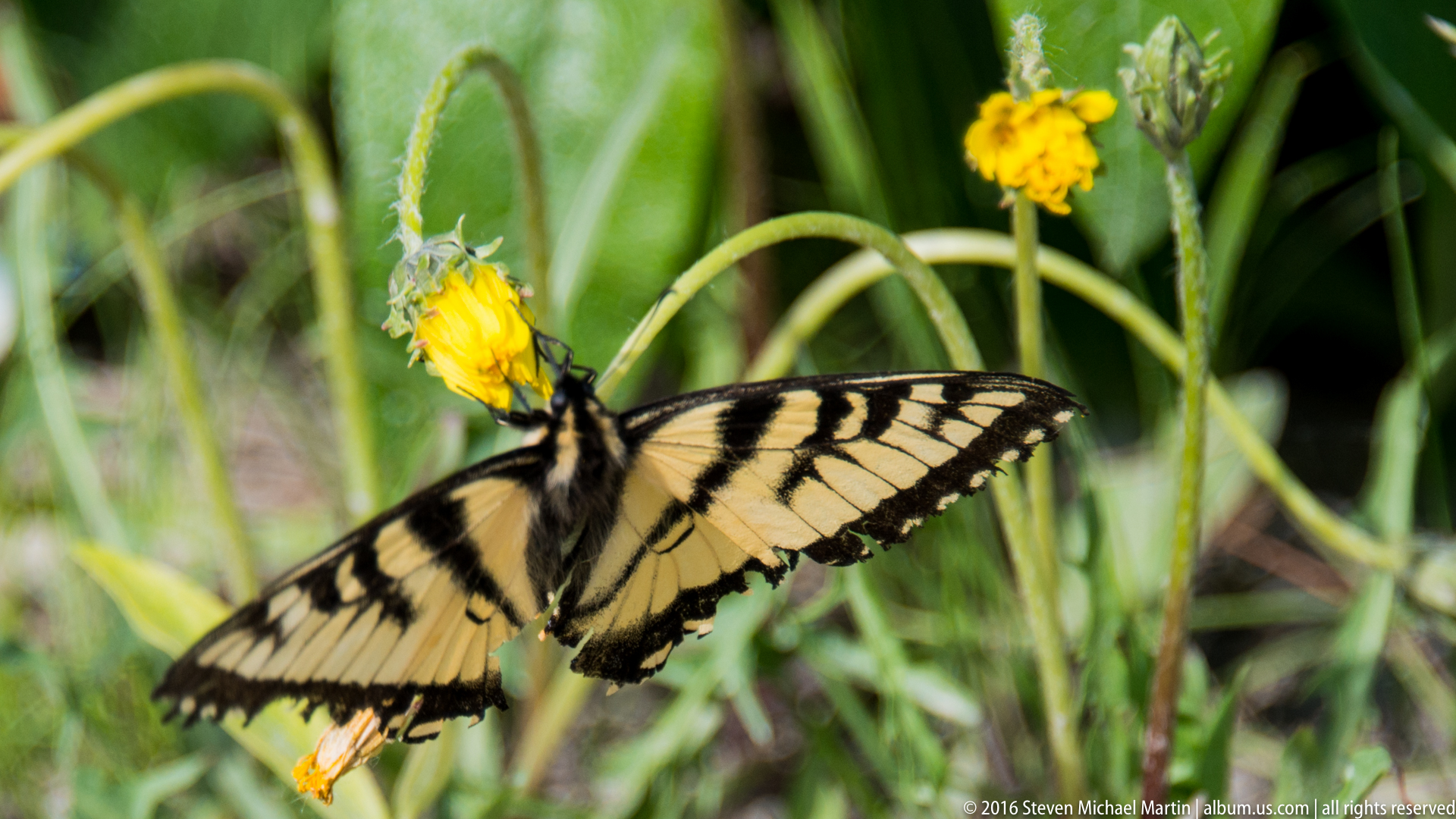
A yellow-and-black swallowtail holds its wings open while perched on small yellow flowers. Its dark veining, long hindwing tails, and orange spots are visible among green stems. The close framing places the butterfly at the center of a meadow-like patch, although its precise species remains uncertain at this scale.
Caption
A yellow-and-black swallowtail holds its wings open while perched on small yellow flowers. Its dark veining, long hindwing tails, and orange spots are visible among green stems. The close framing places the butterfly at the center of a meadow-like patch, although its precise species remains uncertain at this scale.
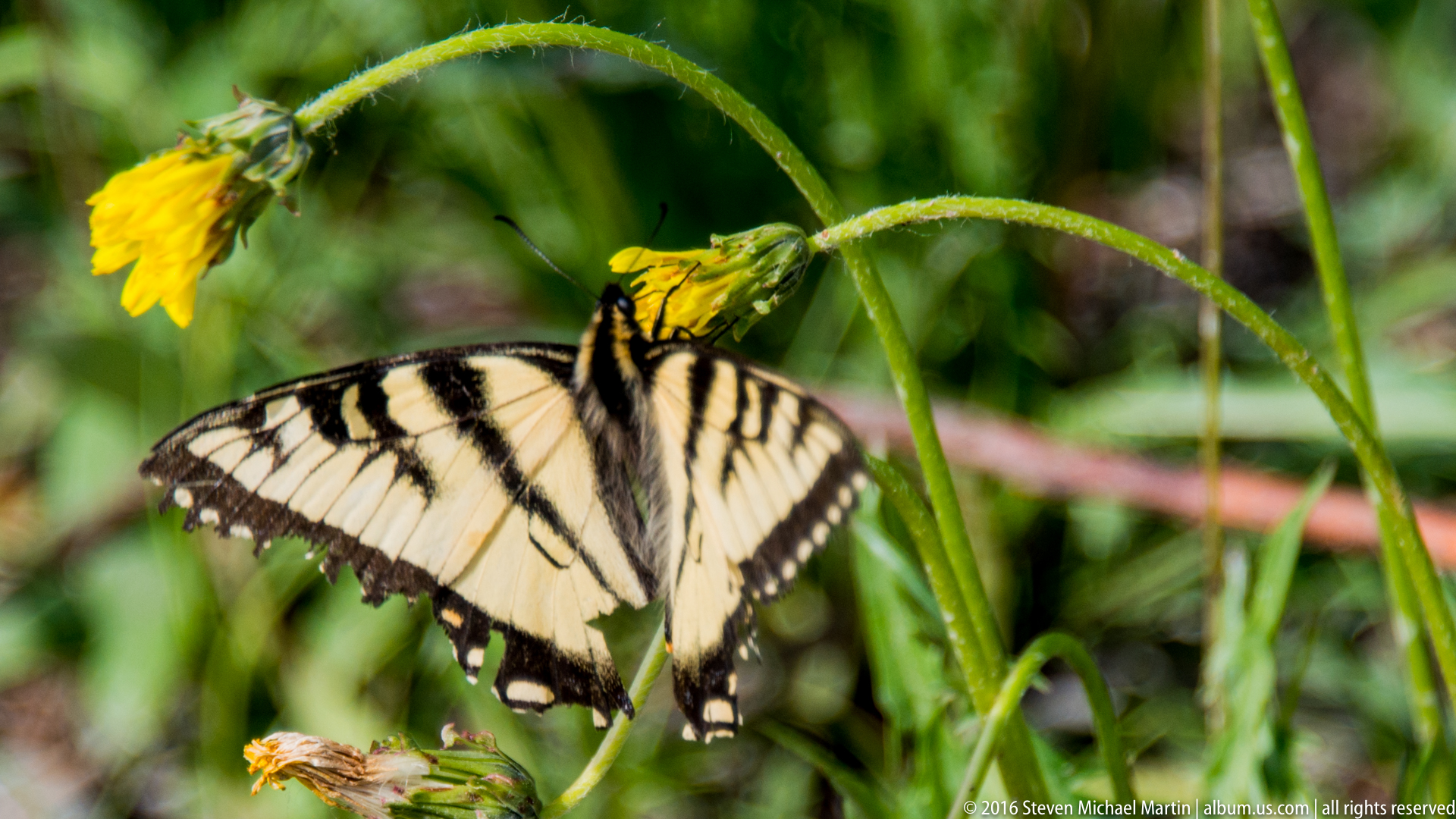
A pale yellow butterfly rests among green stems, its open wings marked by dark bands and spots. A yellow flower head hangs above it, and the soft focus separates the insect from the surrounding vegetation. This second close view shifts emphasis to the butterfly’s wing pattern and the vertical lines of the plant.
Caption
A pale yellow butterfly rests among green stems, its open wings marked by dark bands and spots. A yellow flower head hangs above it, and the soft focus separates the insect from the surrounding vegetation. This second close view shifts emphasis to the butterfly’s wing pattern and the vertical lines of the plant.
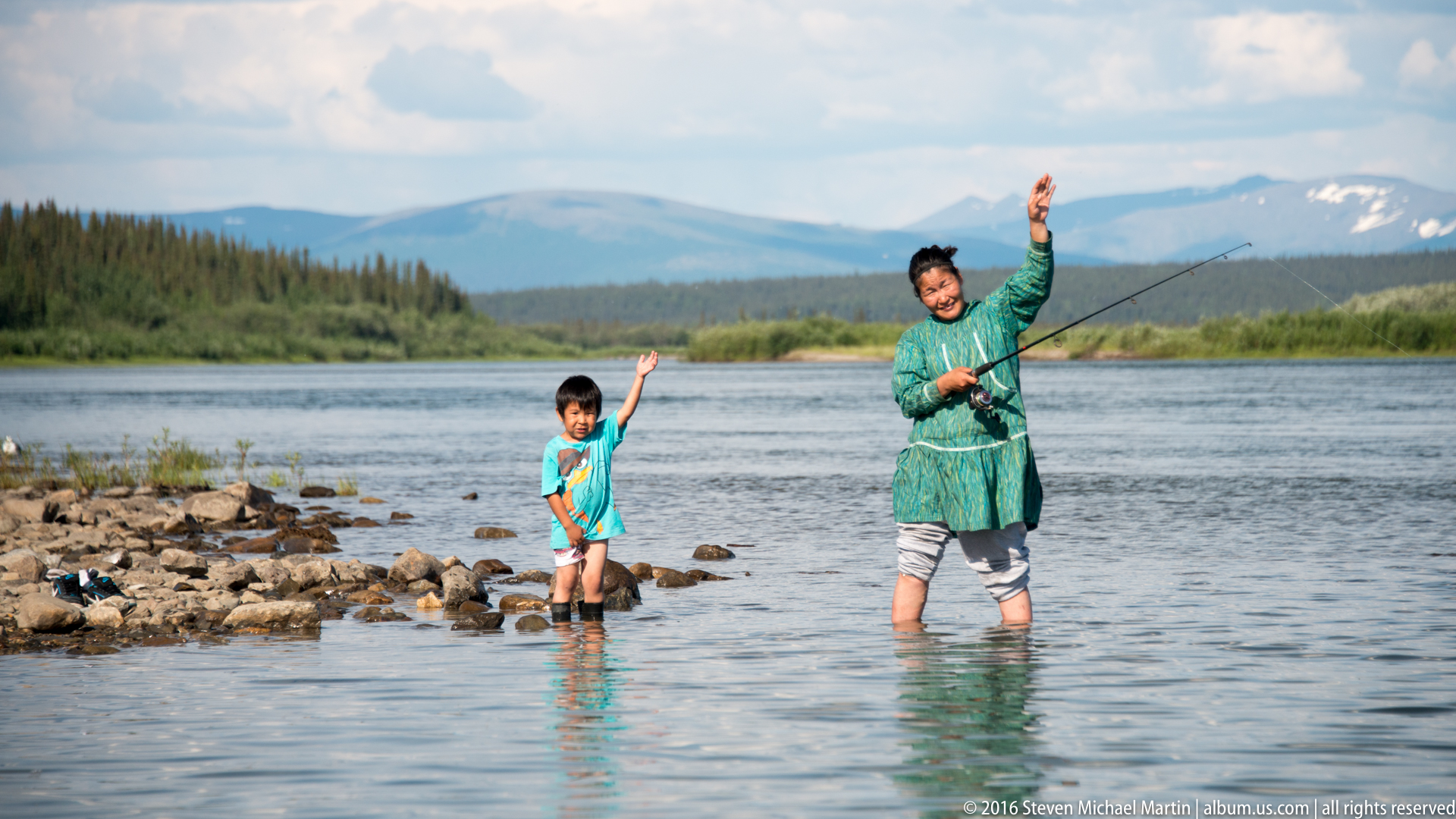
A woman in a green patterned dress and a child in a bright shirt stand ankle-deep among shallow river stones, both raising one hand toward the camera. A fishing rod or similar long pole angles beside the adult. The broad river, low forested banks, and distant hills place the family moment within a wide northern landscape.
Caption
A woman in a green patterned dress and a child in a bright shirt stand ankle-deep among shallow river stones, both raising one hand toward the camera. A fishing rod or similar long pole angles beside the adult. The broad river, low forested banks, and distant hills place the family moment within a wide northern landscape.
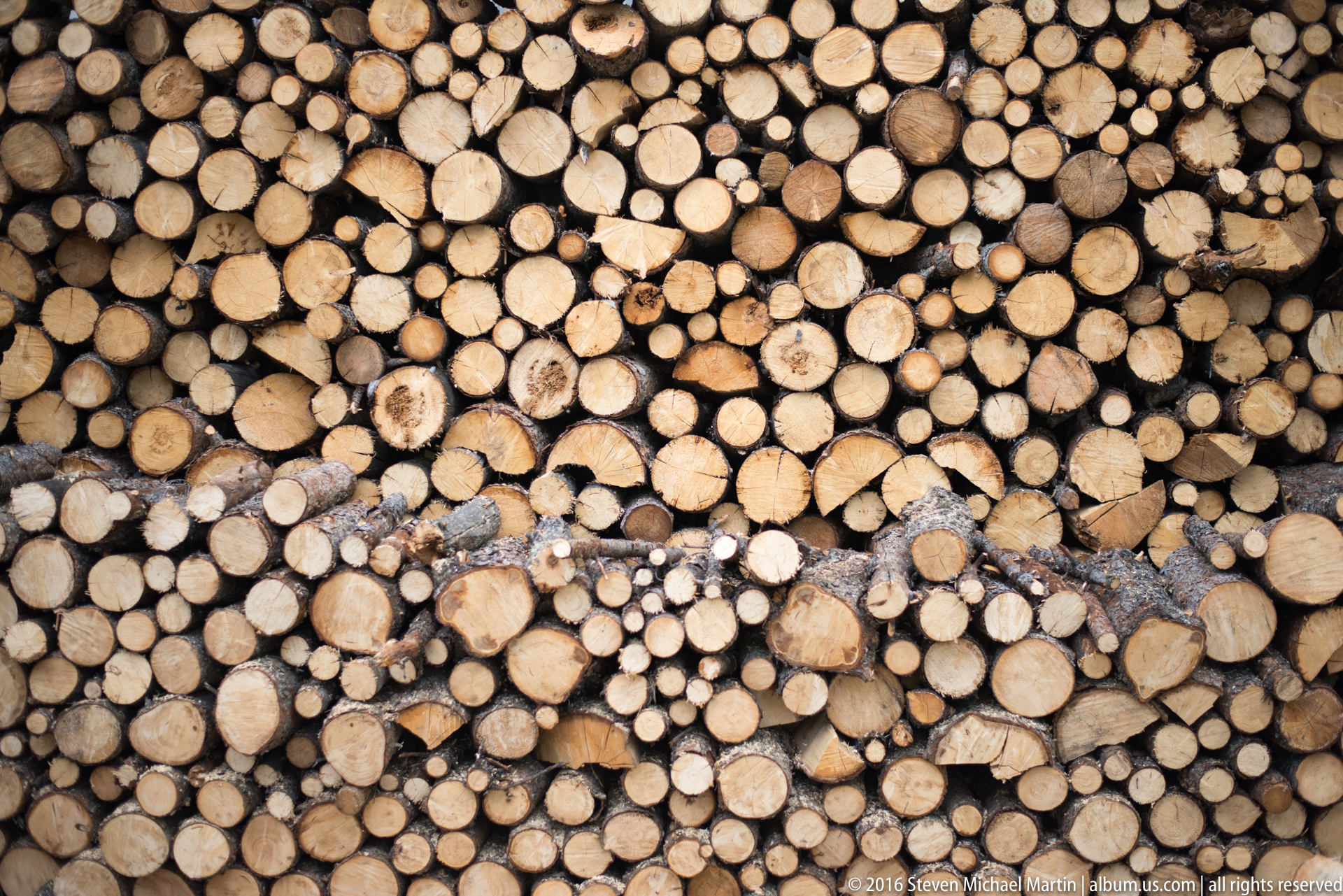
Circular cut ends of firewood fill the frame in a tightly packed stack. The varied diameters, pale sawn surfaces, and dark bark edges create a repeating pattern, with a few larger pieces interrupting the regular rows. The close, frontal view emphasizes the stored wood and its arrangement rather than the surrounding building or landscape.
Caption
Circular cut ends of firewood fill the frame in a tightly packed stack. The varied diameters, pale sawn surfaces, and dark bark edges create a repeating pattern, with a few larger pieces interrupting the regular rows. The close, frontal view emphasizes the stored wood and its arrangement rather than the surrounding building or landscape.
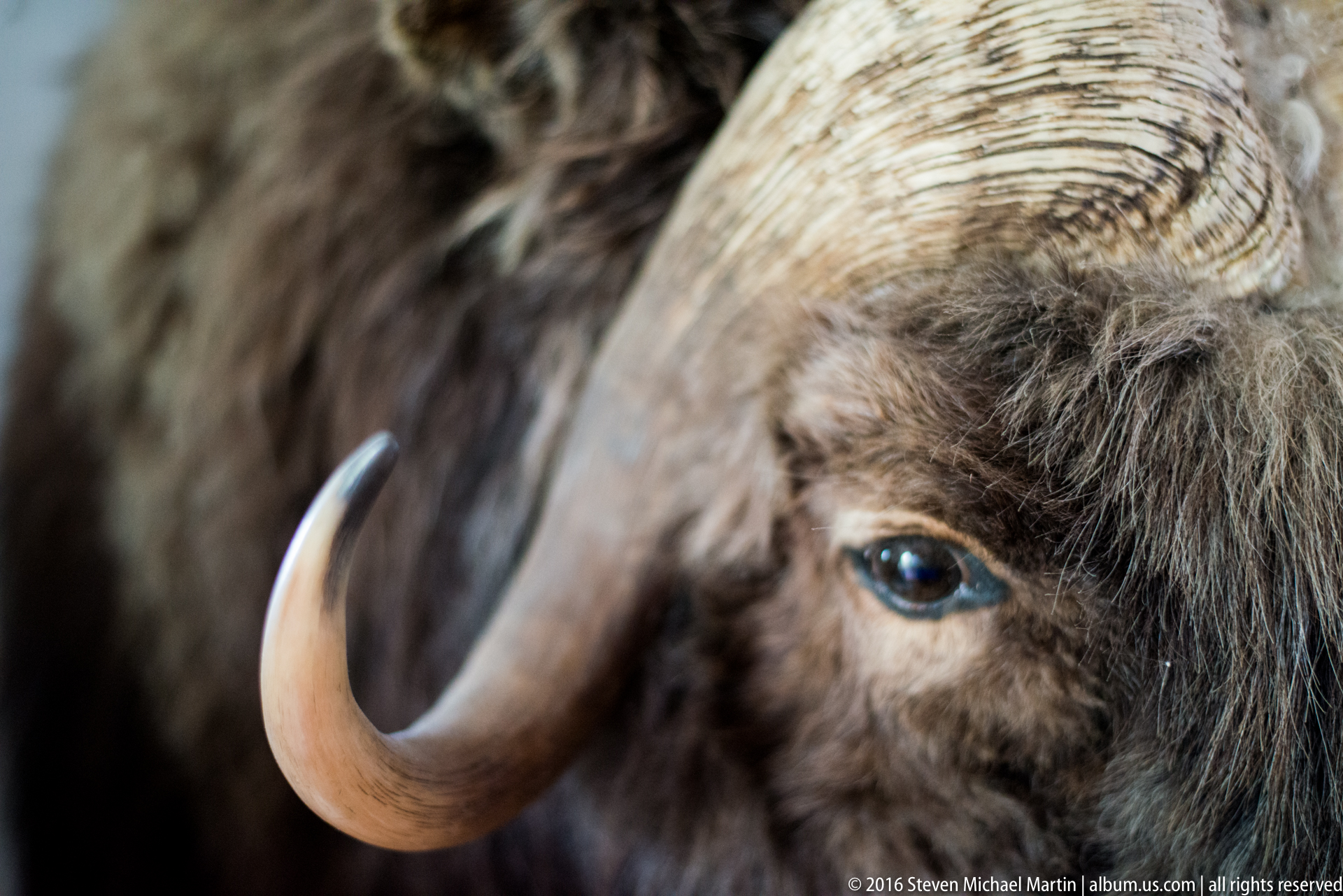
A musk ox fills the frame, its long brown coat surrounding one dark eye and a pale horn that curves down beside the face. The tight crop reveals coarse guard hair and the horn’s smooth surface, presenting the animal at close range without showing its full body or habitat.
Caption
A musk ox fills the frame, its long brown coat surrounding one dark eye and a pale horn that curves down beside the face. The tight crop reveals coarse guard hair and the horn’s smooth surface, presenting the animal at close range without showing its full body or habitat.
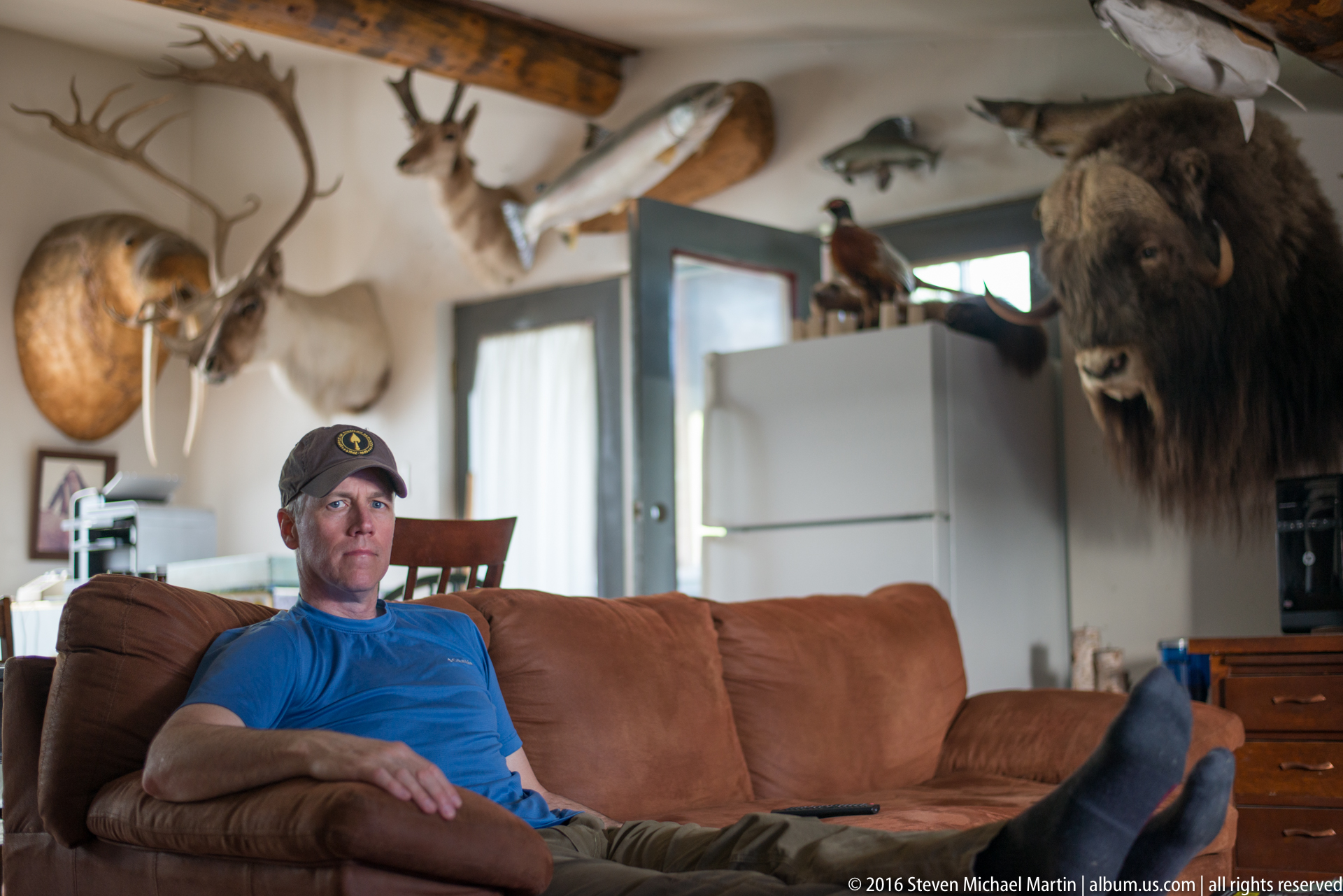
A man in a blue shirt sits on a brown sofa in a bright room displaying mounted fish, antlers, and a large dark animal head. A refrigerator and household furnishings stand behind him, blending domestic space with hunting or wildlife trophies. The wide interior view includes both the seated figure and the room’s prominent natural-history displays.
Caption
A man in a blue shirt sits on a brown sofa in a bright room displaying mounted fish, antlers, and a large dark animal head. A refrigerator and household furnishings stand behind him, blending domestic space with hunting or wildlife trophies. The wide interior view includes both the seated figure and the room’s prominent natural-history displays.
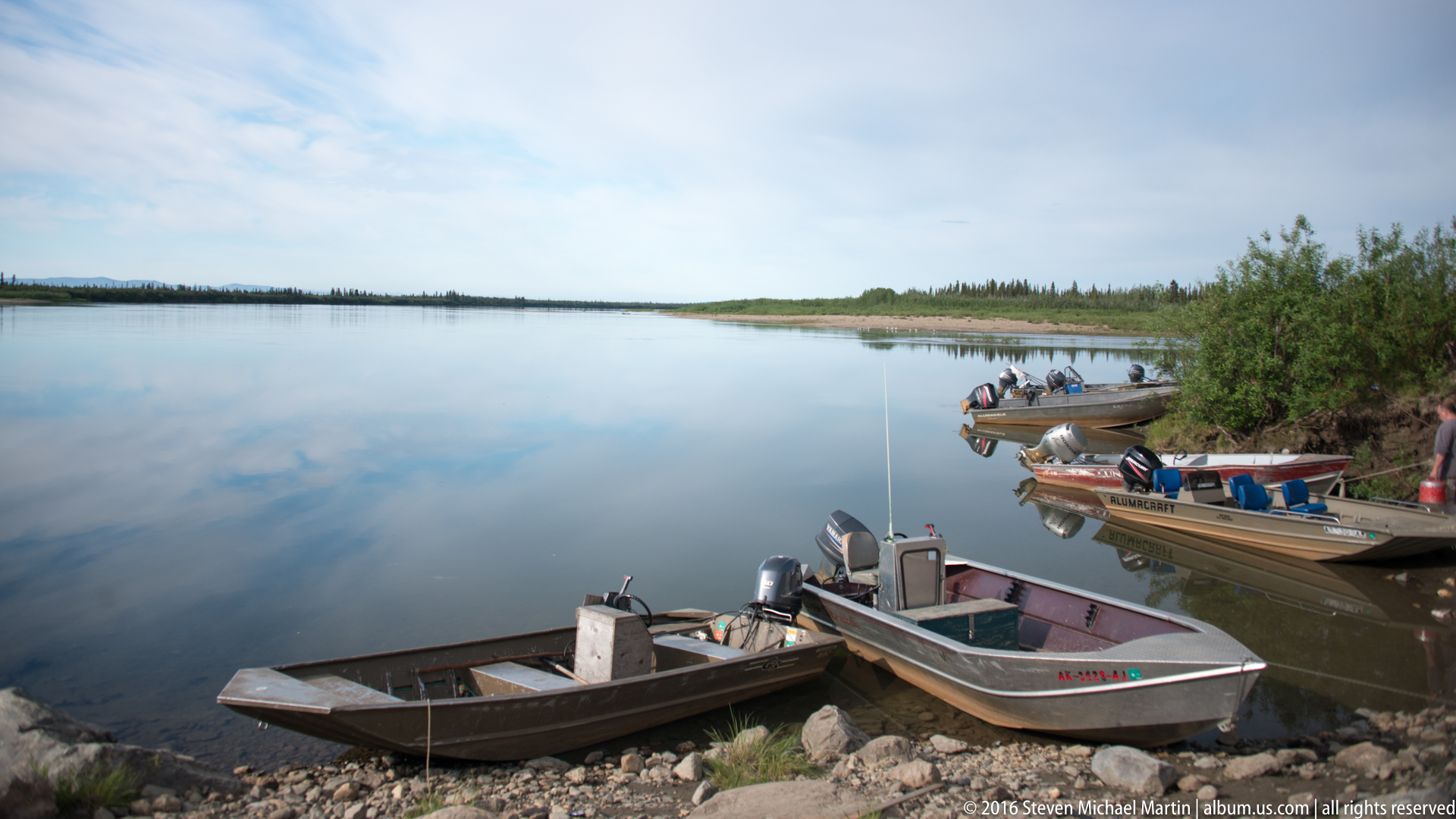
Several small motorboats are tied along a rocky river landing, their outboards and open hulls angled toward the water. A low village shoreline and trees stretch beyond the boats beneath a bright overcast sky. The composition shows the boats clustered at the edge of a broad, calm channel, a practical transport scene in Ambler.
Caption
Several small motorboats are tied along a rocky river landing, their outboards and open hulls angled toward the water. A low village shoreline and trees stretch beyond the boats beneath a bright overcast sky. The composition shows the boats clustered at the edge of a broad, calm channel, a practical transport scene in Ambler.
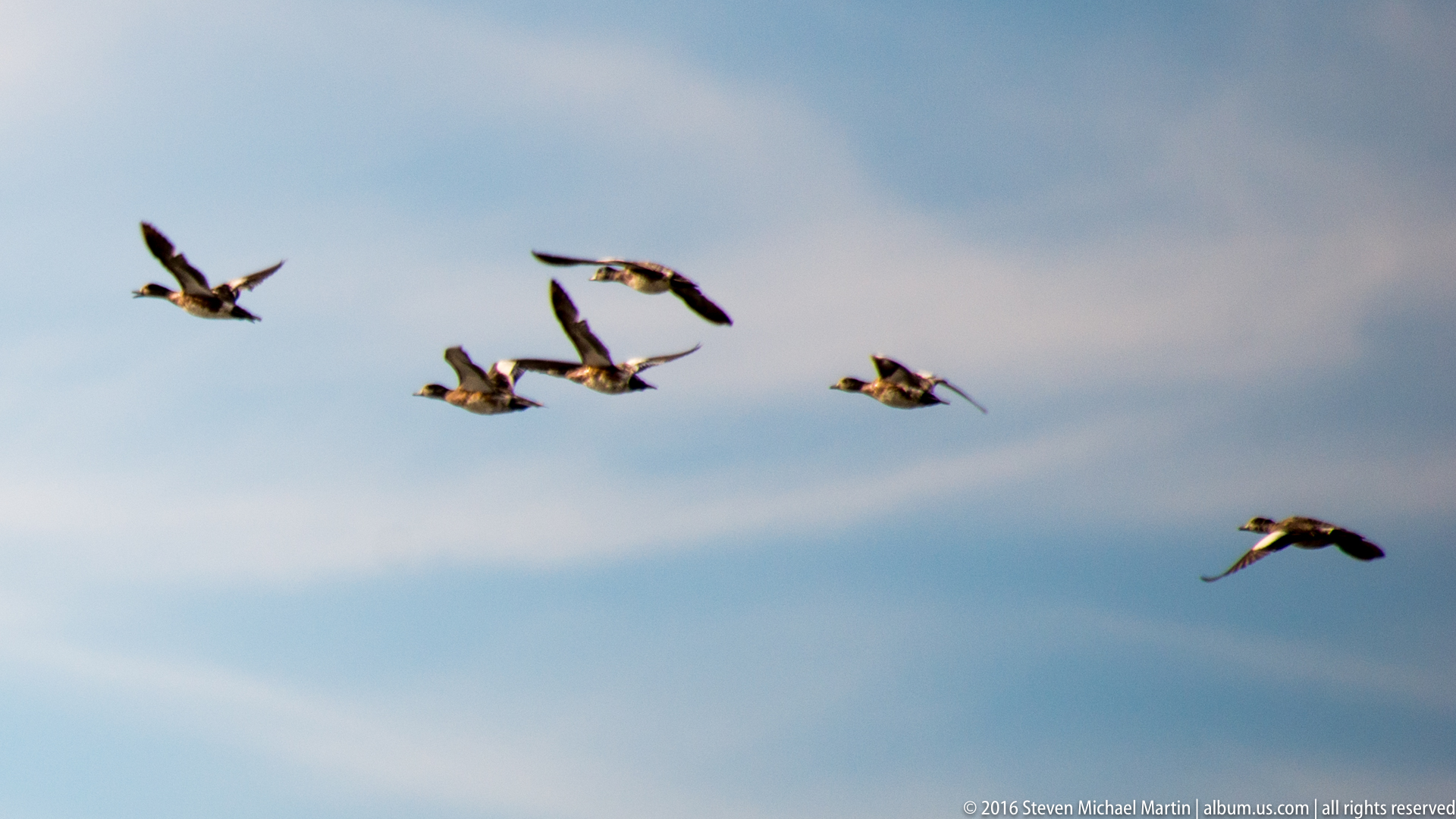
A small flock of large waterfowl crosses a pale blue-gray sky, wings spread at different stages of flight. Their long necks and dark wing tips suggest geese, while the open composition leaves ample negative space around the birds. The photograph isolates their movement from the river landscape visible elsewhere in the sequence.
Caption
A small flock of large waterfowl crosses a pale blue-gray sky, wings spread at different stages of flight. Their long necks and dark wing tips suggest geese, while the open composition leaves ample negative space around the birds. The photograph isolates their movement from the river landscape visible elsewhere in the sequence.
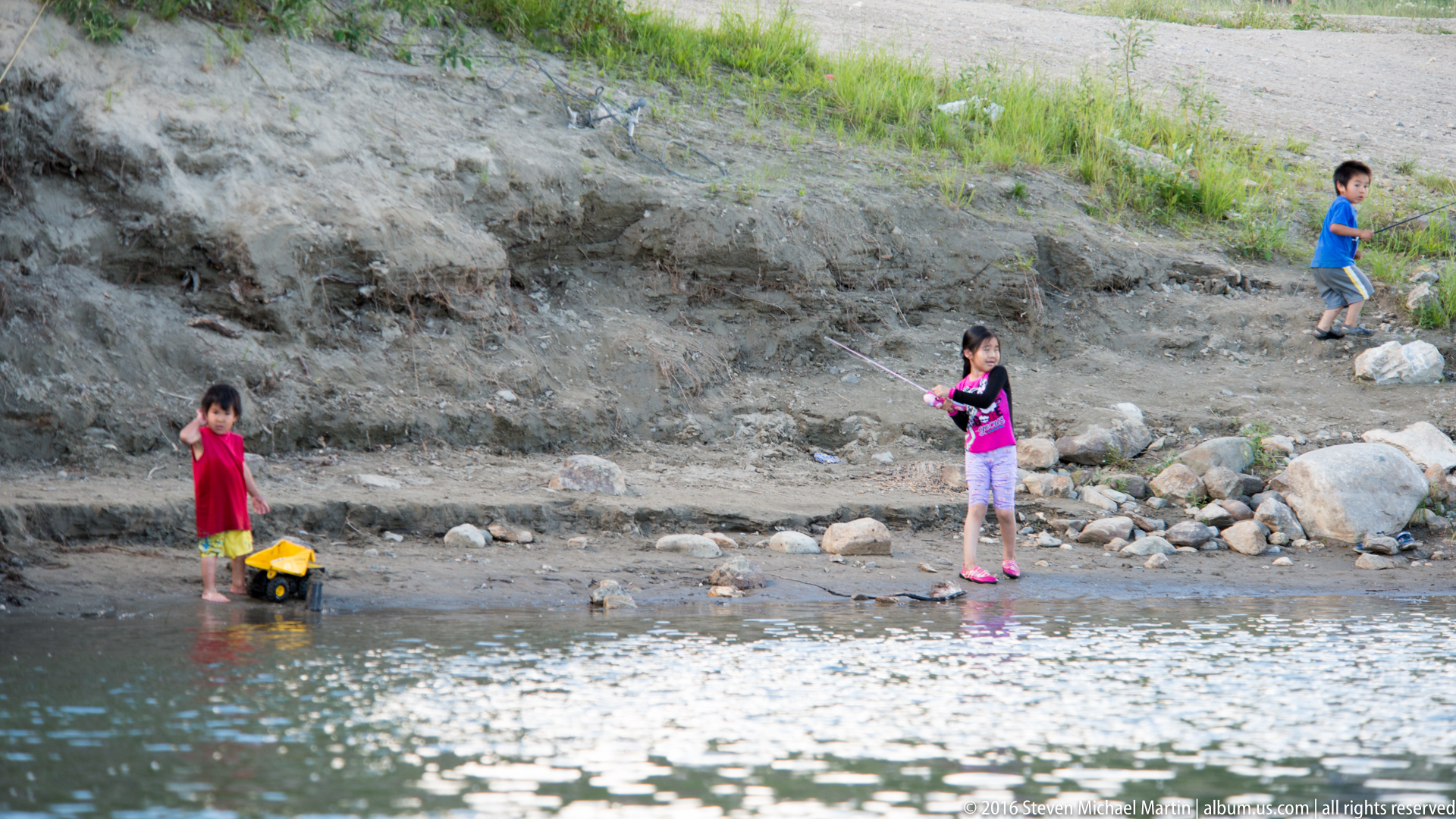
Three children stand at different points in shallow water below a low eroded bank, each holding or standing near a small toy or bucket. The rocky shoreline and grassy lip of the bank form a simple play area at the river’s edge. Their bright clothing stands out against the pale gravel and reflective water.
Caption
Three children stand at different points in shallow water below a low eroded bank, each holding or standing near a small toy or bucket. The rocky shoreline and grassy lip of the bank form a simple play area at the river’s edge. Their bright clothing stands out against the pale gravel and reflective water.
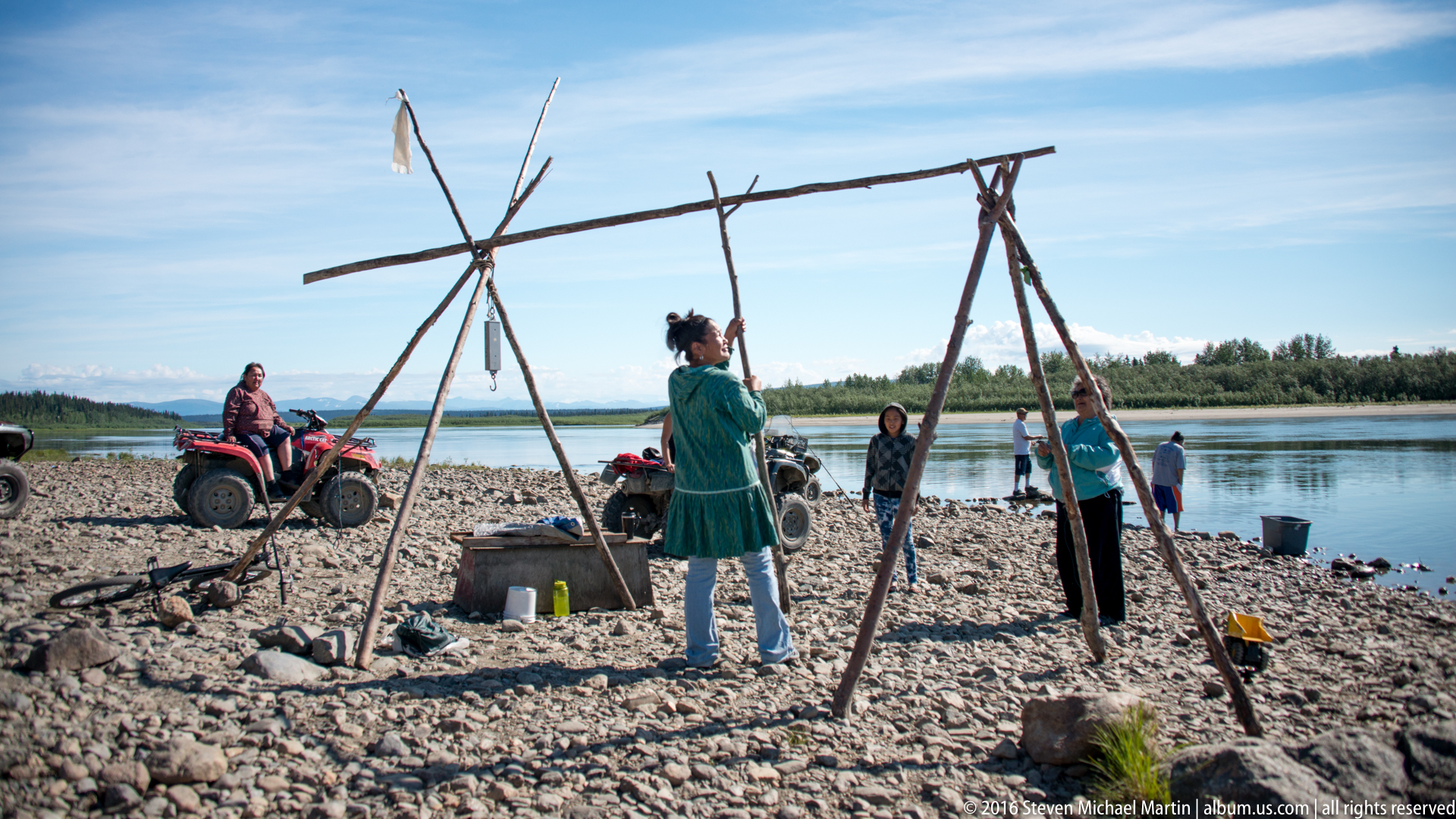
Several tall timber frames made from upright poles and crosspieces stand on a gravel bar beside the river. Adults gather around the frames, with all-terrain vehicles and cooking or storage items nearby. The scene suggests work or preparation at a riverside camp, but the specific purpose of the frames is not visually certain.
Caption
Several tall timber frames made from upright poles and crosspieces stand on a gravel bar beside the river. Adults gather around the frames, with all-terrain vehicles and cooking or storage items nearby. The scene suggests work or preparation at a riverside camp, but the specific purpose of the frames is not visually certain.
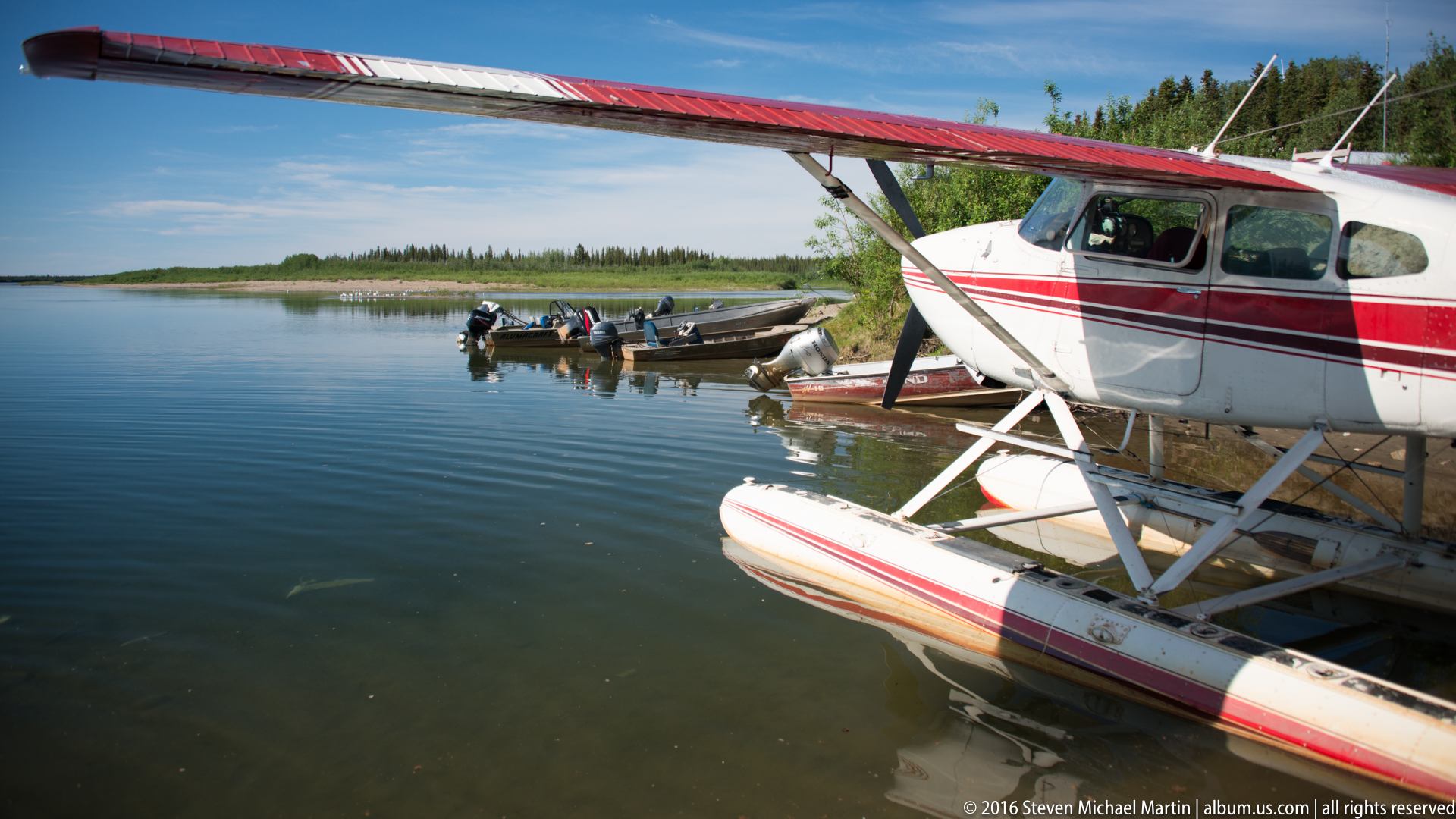
A red-and-white high-wing floatplane occupies the right foreground, its floats resting on calm water beside several small motorboats. The cropped wing extends across the top of the frame, while a green, tree-lined bank closes the background. The arrangement records two kinds of river transport sharing the same landing.
Caption
A red-and-white high-wing floatplane occupies the right foreground, its floats resting on calm water beside several small motorboats. The cropped wing extends across the top of the frame, while a green, tree-lined bank closes the background. The arrangement records two kinds of river transport sharing the same landing.
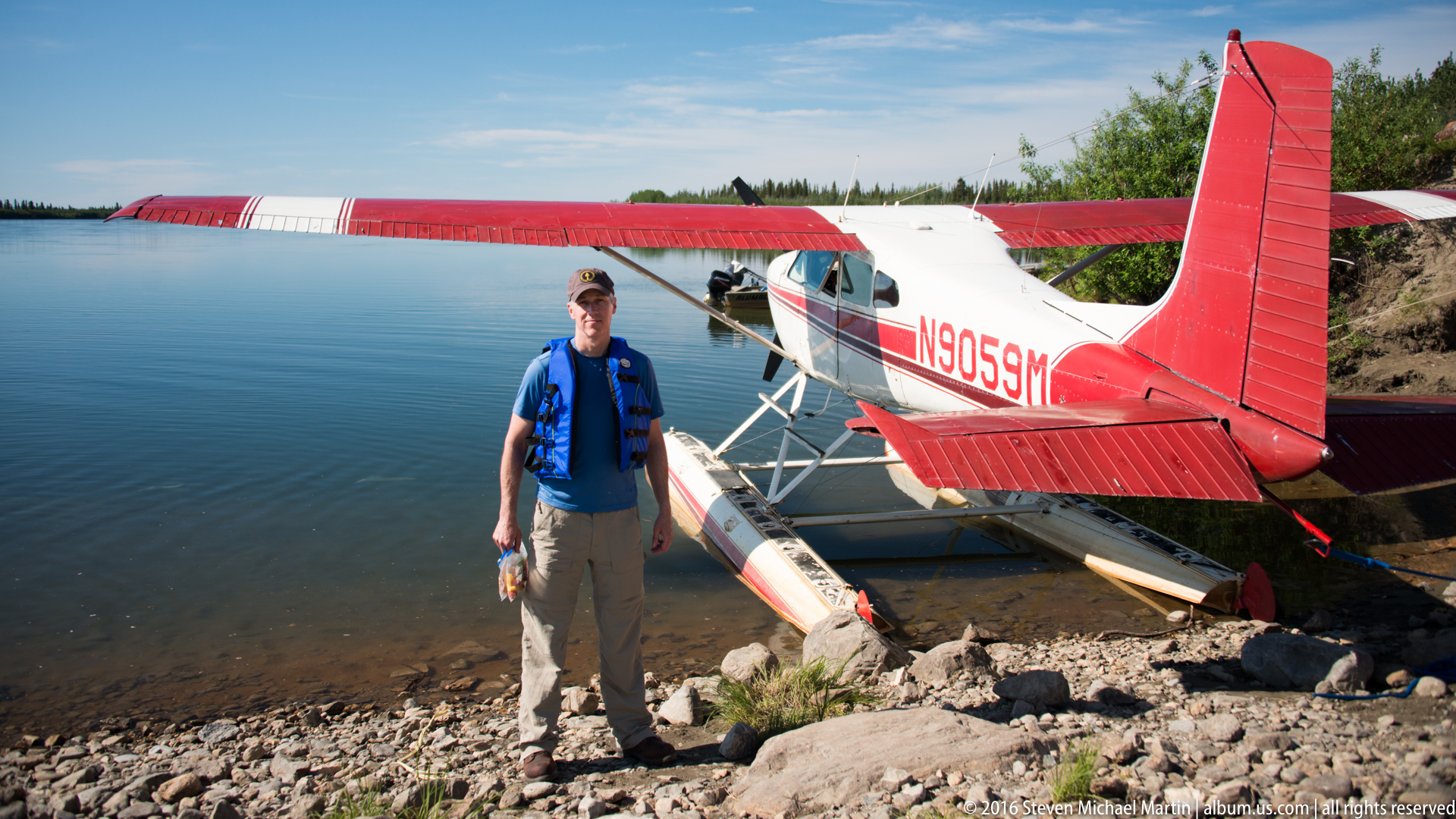
A man in a blue life vest stands on the gravel beside a red-and-white floatplane, whose pontoons rest at the water’s edge. The registration N9059M is legible on the tail, and small boats sit farther along the shore. The full-body view links a person and aircraft to the working river landing without identifying the man.
Caption
A man in a blue life vest stands on the gravel beside a red-and-white floatplane, whose pontoons rest at the water’s edge. The registration N9059M is legible on the tail, and small boats sit farther along the shore. The full-body view links a person and aircraft to the working river landing without identifying the man.
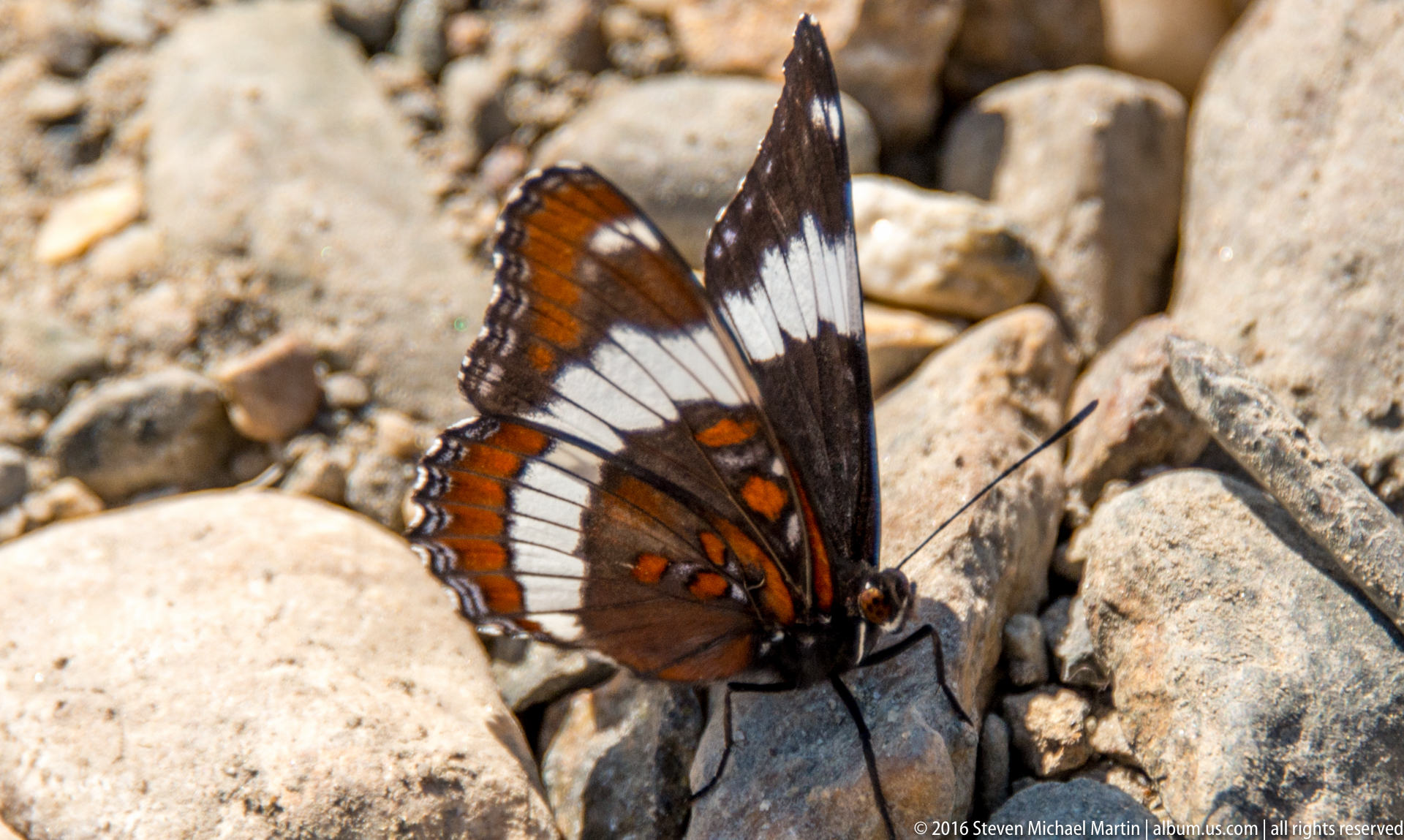
A butterfly rests on pale rounded stones with its wings held partly upright. The visible surfaces combine dark brown, orange, and broad white patches, while the rocky ground fills the background. The close view preserves the wing pattern and resting posture, but does not provide enough detail for a reliable species identification.
Caption
A butterfly rests on pale rounded stones with its wings held partly upright. The visible surfaces combine dark brown, orange, and broad white patches, while the rocky ground fills the background. The close view preserves the wing pattern and resting posture, but does not provide enough detail for a reliable species identification.
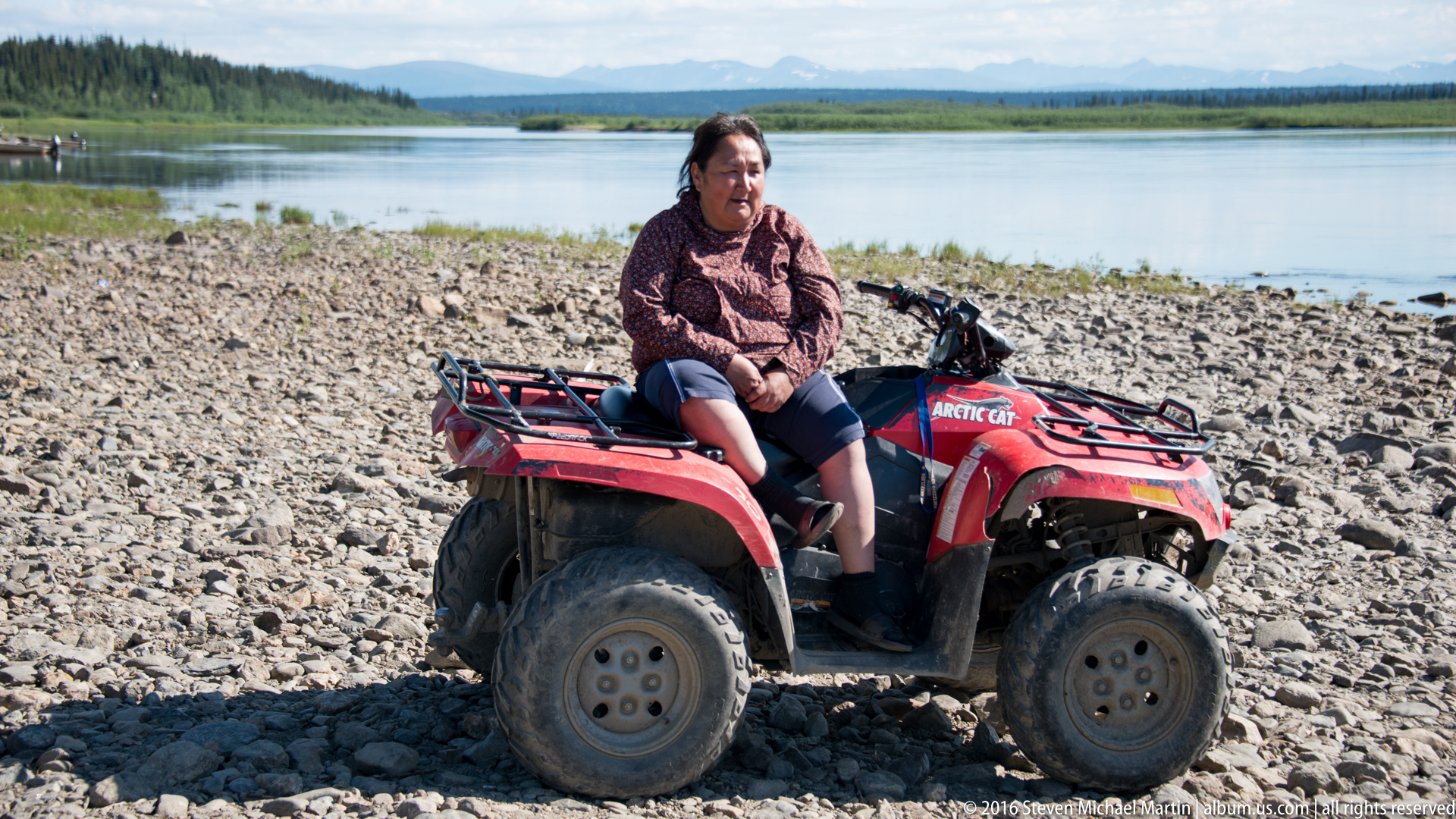
A woman sits astride a red all-terrain vehicle on a broad gravel bar beside a braided river. Beyond the pale stones, shallow channels and a low green bank lead toward a distant mountain horizon under scattered clouds. The ATV and its rider suggest overland travel across this open river corridor, though the location within the park is not identified.
Caption
A woman sits astride a red all-terrain vehicle on a broad gravel bar beside a braided river. Beyond the pale stones, shallow channels and a low green bank lead toward a distant mountain horizon under scattered clouds. The ATV and its rider suggest overland travel across this open river corridor, though the location within the park is not identified.
Kobuk Valley National Park — Field Guide
National Park Field Guide
📍 Overview
Kobuk Valley National Park preserves a remote Arctic landscape shaped by river systems, glacial history, and expansive tundra ecosystems. Located north of the Arctic Circle in northwest Alaska, the park protects the Kobuk River valley as well as one of the largest active sand dune systems in the Arctic. The region illustrates the interaction between geological processes, climate, and ecological adaptation in a largely undeveloped environment.
The Great Kobuk Sand Dunes, Little Kobuk Sand Dunes, and Hunt River Dunes were formed from glacial deposits shaped by wind patterns over thousands of years. Seasonal caribou migrations pass through the region, reflecting long-established wildlife movement patterns that have supported human subsistence for millennia. Archaeological sites such as Onion Portage demonstrate the long-term relationship between Indigenous communities and the landscape.
⭐ Highlights
- Great Kobuk Sand Dunes north of the Arctic Circle
- Seasonal migration routes of the Western Arctic caribou herd
- Kobuk River corridor and tundra ecosystems
- Archaeological sites reflecting thousands of years of human presence
- Remote wilderness landscape with minimal development
🔎 Key Features
- Active sand dunes formed from glacial deposits
- River valley ecosystems supporting wildlife migration
- Tundra vegetation adapted to Arctic climate conditions
- Archaeological evidence of long-term human activity
- Large-scale wilderness environment emphasizing ecological continuity
📷 Photography Notes
- Low-angle light emphasizes texture in sand dunes
- Wide compositions highlight contrast between dunes and tundra
- Cloud formations can enhance scale of open landscapes
- Wind patterns create subtle surface detail in sand
- Foreground dune ridges help add depth
- Look for simple compositions that convey isolation