
USAF National Museum
National Museum of the United States Air Force
The National Museum of the United States Air Force presents one of the most comprehensive collections of military aviation artifacts in the world. Located near Dayton, Ohio, the museum preserves aircraft, exhibits, and interpretive materials that illustrate the development of flight technology and the role of aviation in military history. The collection spans early aviation experiments through modern aerospace innovation.
Exhibits include historic aircraft, experimental prototypes, and spacecraft that demonstrate technological progress across multiple decades. The museum provides context for understanding how aviation has influenced national defense, scientific research, and global transportation networks. The displays illustrate the intersection of engineering innovation and historical events.
Visitors can explore expansive galleries that present aircraft in chronological and thematic groupings. The scale and variety of the collection provide insight into the rapid pace of technological change and the evolving role of air power in modern history.

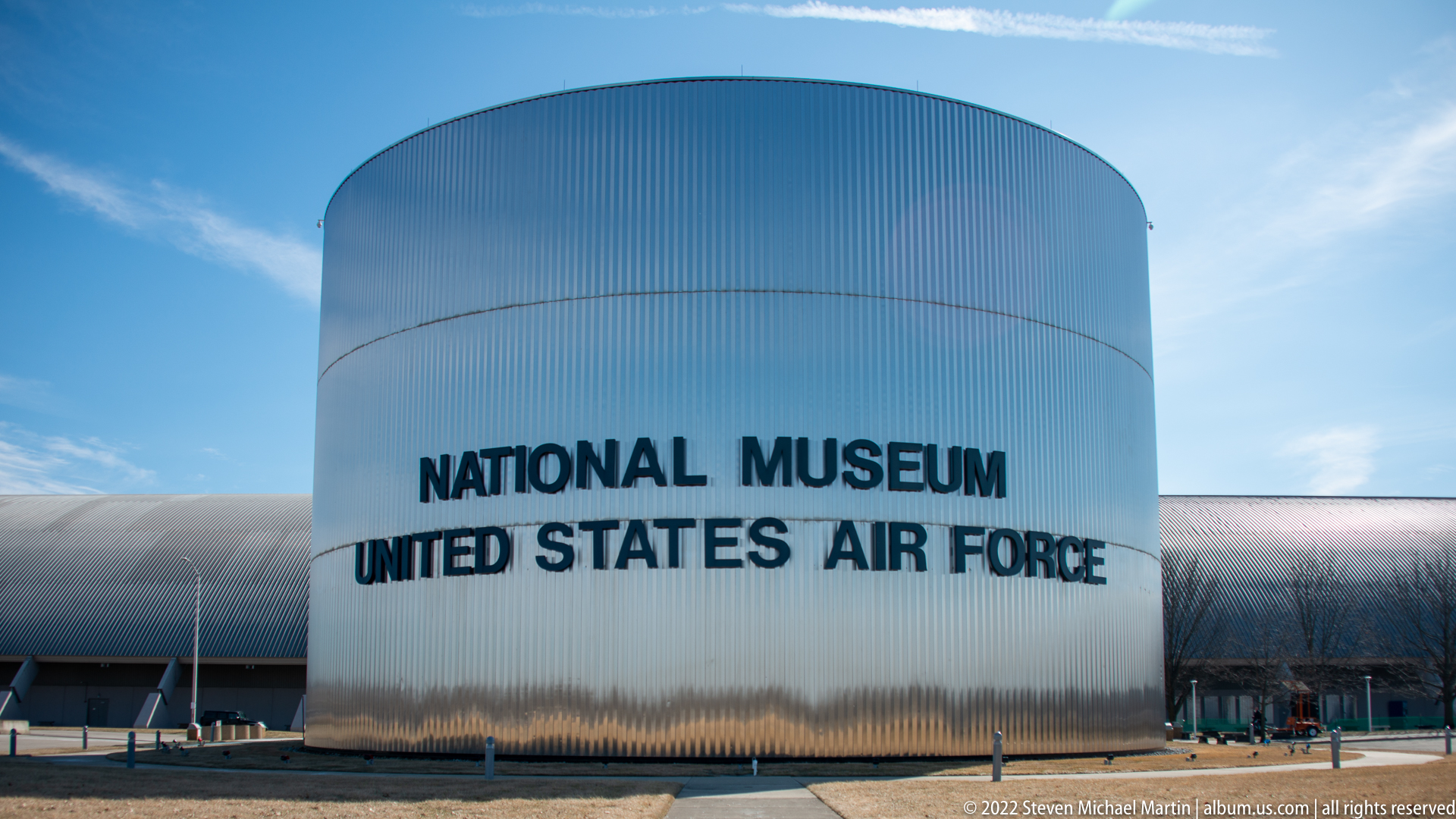
Curved metallic exhibition halls stretch across the background behind the museum’s cylindrical entrance tower, with the institution’s name clearly lettered on its facade. Cars occupy the broad parking area beneath a blue sky streaked with thin clouds. The low, wide view emphasizes the building’s scale and the contrast between the rounded tower and long hangar-like wings.
Caption
Curved metallic exhibition halls stretch across the background behind the museum’s cylindrical entrance tower, with the institution’s name clearly lettered on its facade. Cars occupy the broad parking area beneath a blue sky streaked with thin clouds. The low, wide view emphasizes the building’s scale and the contrast between the rounded tower and long hangar-like wings.
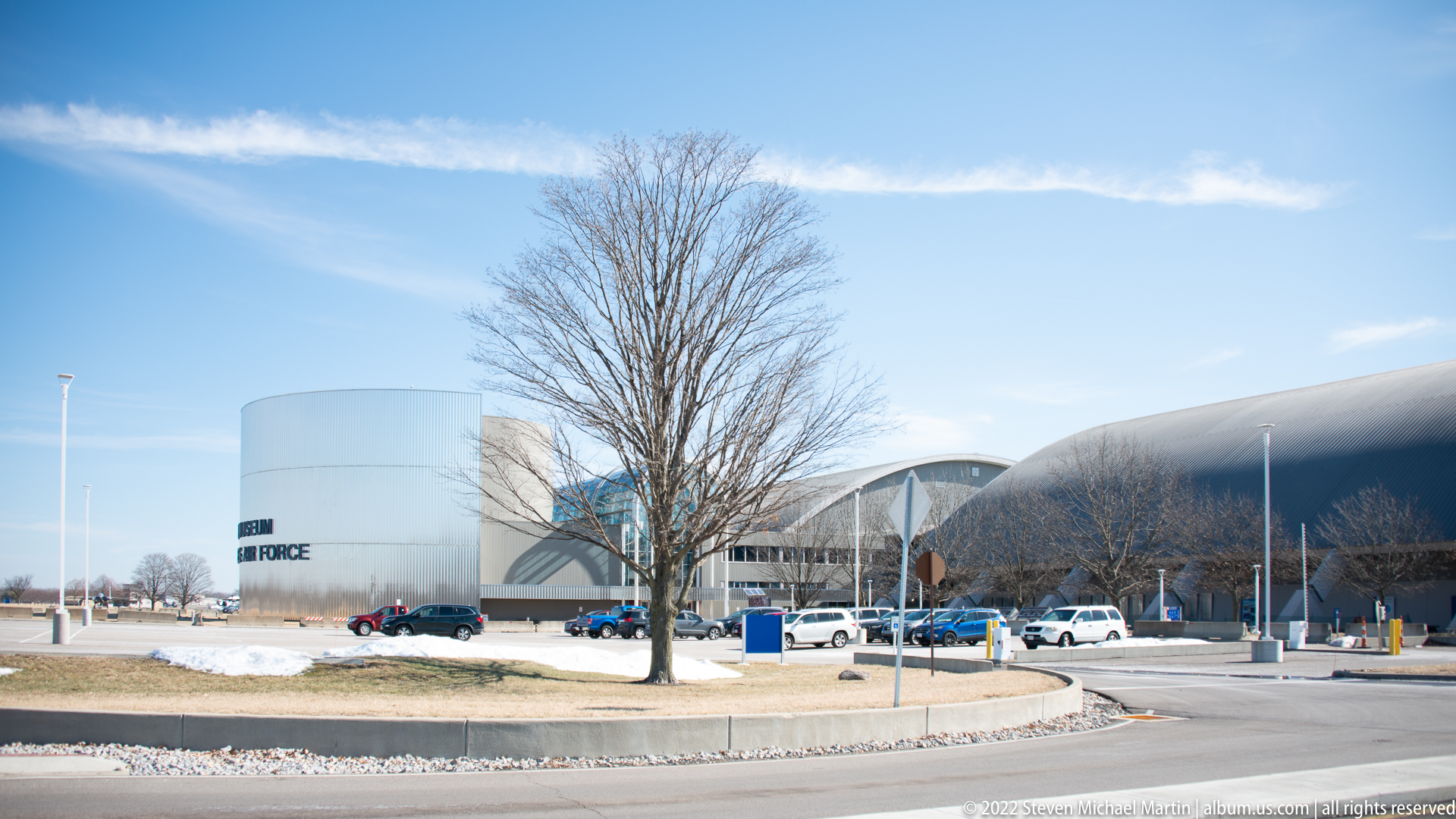
A white cylindrical structure and long curved-roof hangars stand beyond a circular drive, with the words “AIR FORCE” visible on the nearer building. Bare trees, parked vehicles, patches of snow, and a clear winter sky establish the season and campus setting. The broad exterior view records the museum’s large exhibition buildings from across the entrance road.
Caption
A white cylindrical structure and long curved-roof hangars stand beyond a circular drive, with the words “AIR FORCE” visible on the nearer building. Bare trees, parked vehicles, patches of snow, and a clear winter sky establish the season and campus setting. The broad exterior view records the museum’s large exhibition buildings from across the entrance road.

Two long exhibition buildings with rounded roofs sit along the museum campus road, their metal-clad forms extending into the distance. A bare tree, parked cars, and low landscaped islands occupy the foreground, while the bright sky emphasizes the hangars’ sweeping silhouettes. This wider view shows the scale and arrangement of the museum’s aircraft galleries.
Caption
Two long exhibition buildings with rounded roofs sit along the museum campus road, their metal-clad forms extending into the distance. A bare tree, parked cars, and low landscaped islands occupy the foreground, while the bright sky emphasizes the hangars’ sweeping silhouettes. This wider view shows the scale and arrangement of the museum’s aircraft galleries.

The olive-drab nose of the B-17 Memphis Belle fills the frame, with the aircraft’s name and a painted pin-up figure beneath the cockpit windows. A row of mission symbols runs along the fuselage, and the clear nose glazing exposes the bombardier’s compartment. The side view connects the bomber’s iconic nose art with the aircraft’s operational markings while keeping the museum’s surrounding structure in the background.
Caption
The olive-drab nose of the B-17 Memphis Belle fills the frame, with the aircraft’s name and a painted pin-up figure beneath the cockpit windows. A row of mission symbols runs along the fuselage, and the clear nose glazing exposes the bombardier’s compartment. The side view connects the bomber’s iconic nose art with the aircraft’s operational markings while keeping the museum’s surrounding structure in the background.

A large B-17 bomber hangs above visitors in the museum gallery, its glazed nose and four-engine wing stretching across the upper frame. People walking beneath it give the aircraft a sense of scale, while archival displays and exhibit panels fill the background. This wide view emphasizes the bomber’s size and its relationship to the public exhibition space rather than a single surface detail.
Caption
A large B-17 bomber hangs above visitors in the museum gallery, its glazed nose and four-engine wing stretching across the upper frame. People walking beneath it give the aircraft a sense of scale, while archival displays and exhibit panels fill the background. This wide view emphasizes the bomber’s size and its relationship to the public exhibition space rather than a single surface detail.
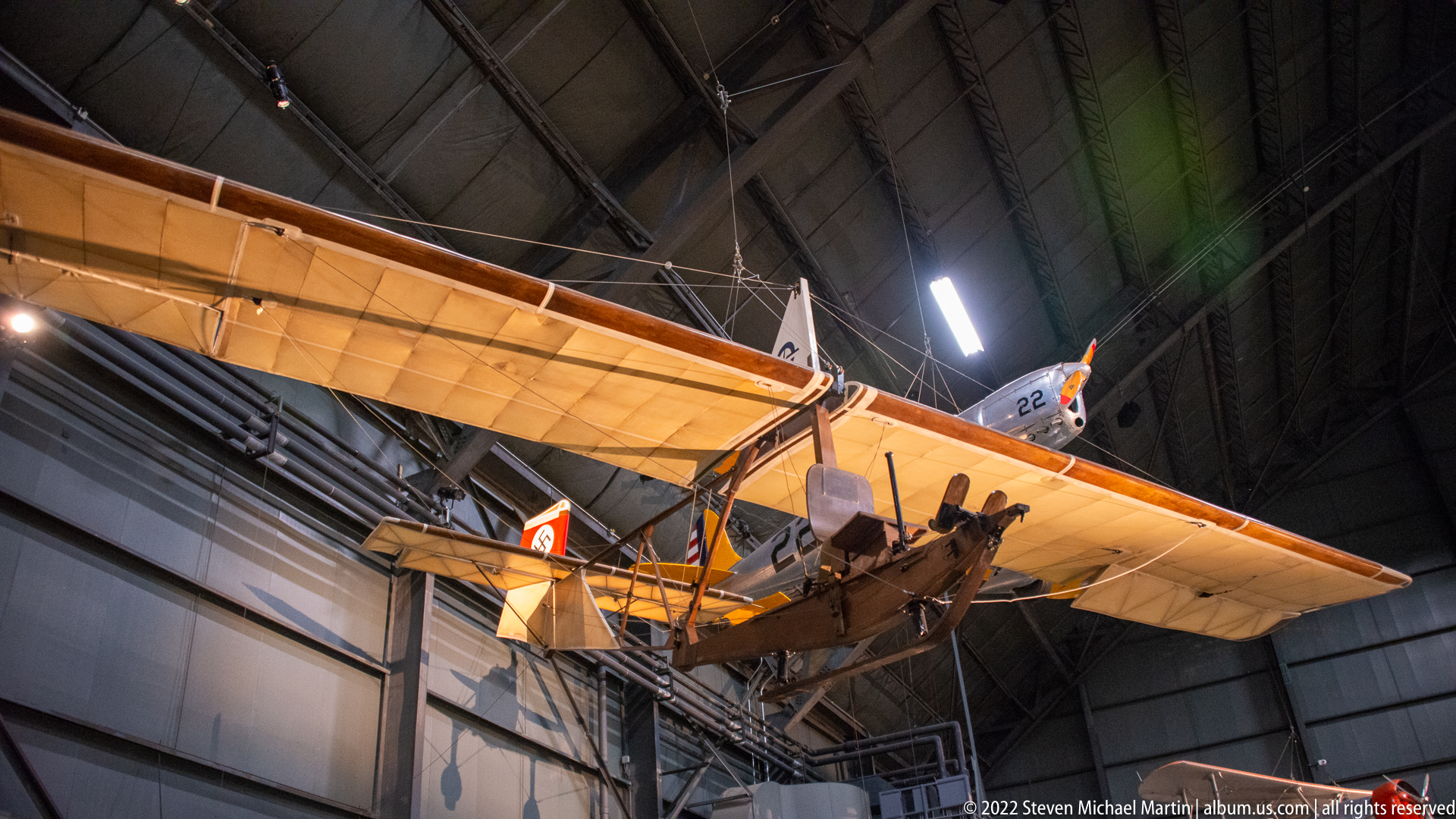
A tan biplane hangs high beneath the museum’s exposed roof trusses, its broad upper wing cutting across the frame. The slim fuselage, open cockpit, landing gear, and lower wing are visible from below, while other suspended aircraft appear deeper in the hangar. The elevated viewpoint stresses the aircraft’s position in three-dimensional space and reveals how the museum uses its high ceiling to display flying machines overhead.
Caption
A tan biplane hangs high beneath the museum’s exposed roof trusses, its broad upper wing cutting across the frame. The slim fuselage, open cockpit, landing gear, and lower wing are visible from below, while other suspended aircraft appear deeper in the hangar. The elevated viewpoint stresses the aircraft’s position in three-dimensional space and reveals how the museum uses its high ceiling to display flying machines overhead.
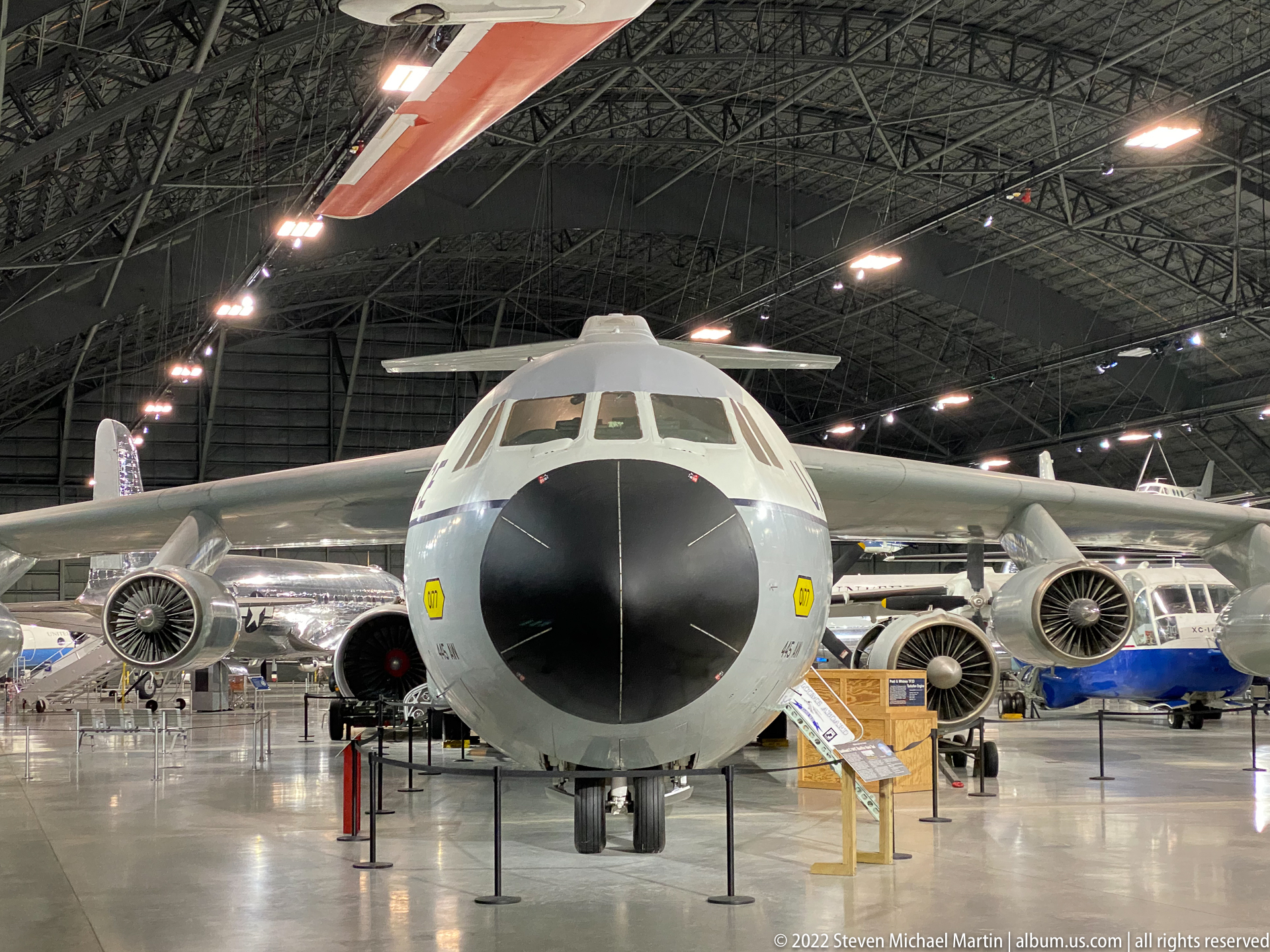
A large four-engine aircraft faces the viewer, its rounded nose centered between broad wings and engine nacelles. A display barrier and information placard stand near the nose landing gear, while other aircraft occupy the hangar behind it. The symmetrical frontal viewpoint conveys the airframe’s width and places the aircraft within the museum’s large-scale exhibition space.
Caption
A large four-engine aircraft faces the viewer, its rounded nose centered between broad wings and engine nacelles. A display barrier and information placard stand near the nose landing gear, while other aircraft occupy the hangar behind it. The symmetrical frontal viewpoint conveys the airframe’s width and places the aircraft within the museum’s large-scale exhibition space.
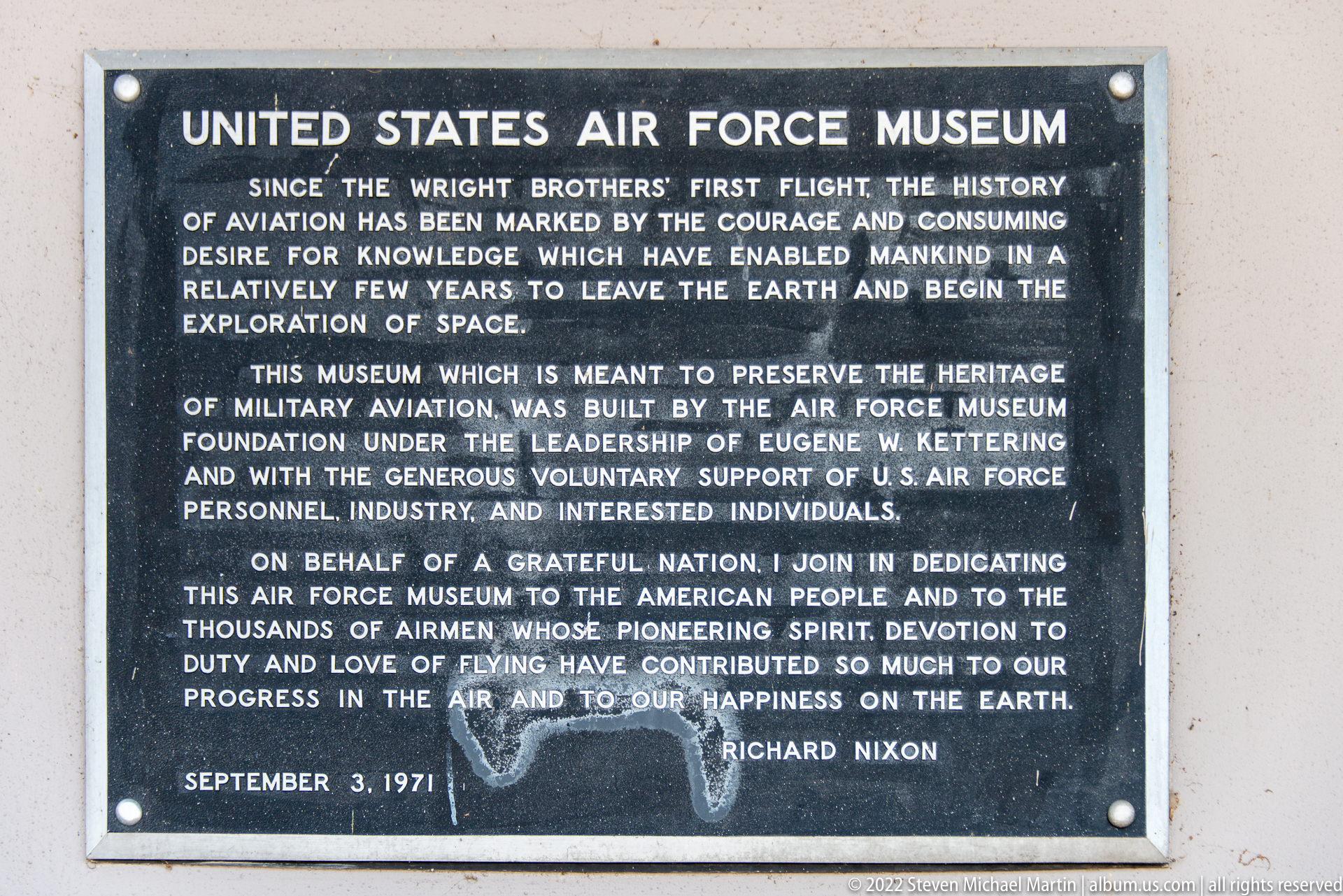
A dark dedication plaque describes the museum’s purpose of preserving military aviation heritage and honors the contributions of airmen. It states that the museum was dedicated to the American people on September 3, 1971, and bears the name Richard Nixon at the lower right. The close, straight-on view preserves the plaque’s text as the primary historical evidence.
Caption
A dark dedication plaque describes the museum’s purpose of preserving military aviation heritage and honors the contributions of airmen. It states that the museum was dedicated to the American people on September 3, 1971, and bears the name Richard Nixon at the lower right. The close, straight-on view preserves the plaque’s text as the primary historical evidence.
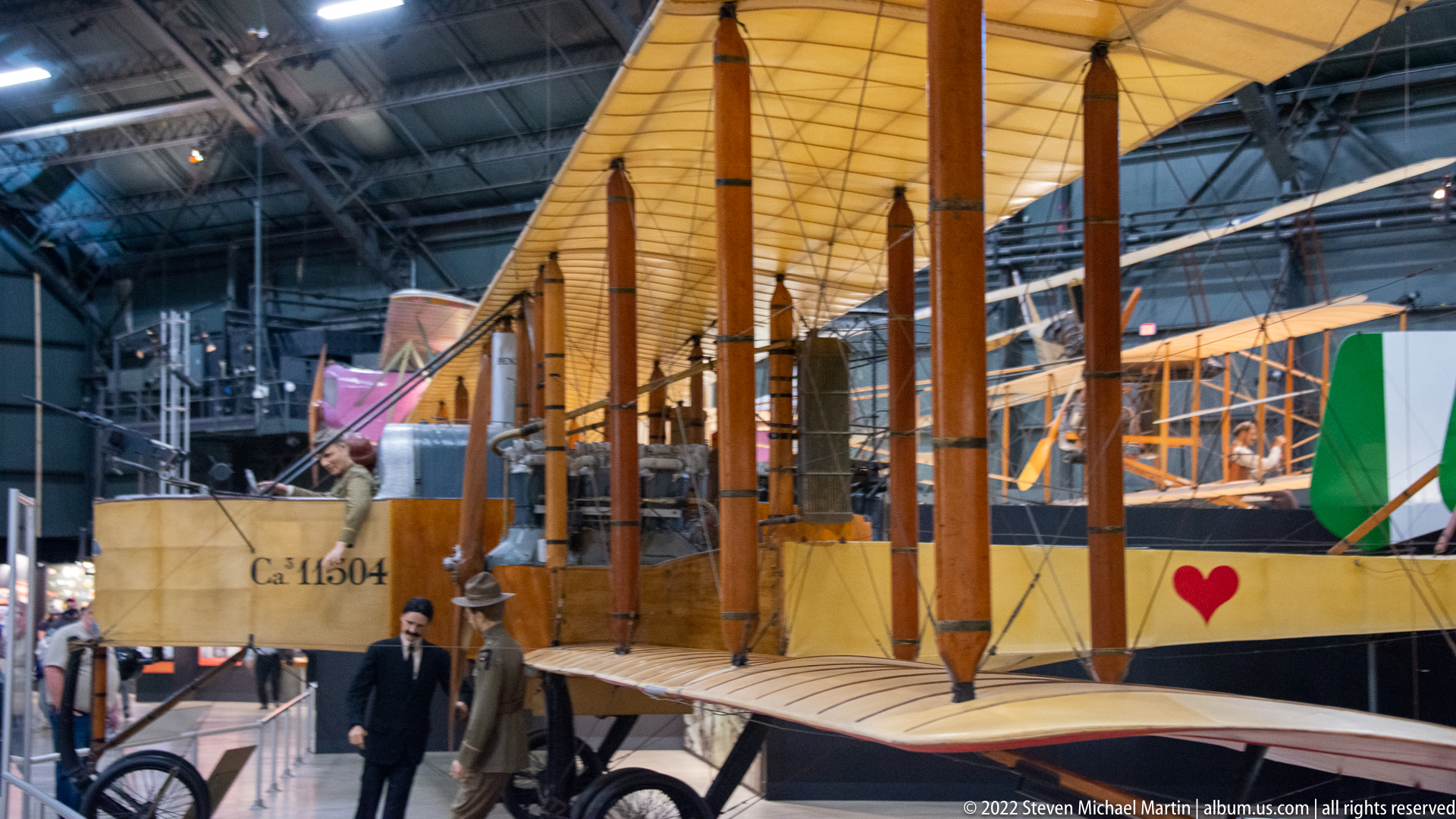
A large yellow biplane stands among other early aircraft, its stacked wings supported by a dense framework of wooden struts and wires. The fuselage bears a red heart, and a visitor beside the plane provides scale. A dark structural frame surrounds the exhibit, making the craft’s delicate open construction stand out against the crowded museum background.
Caption
A large yellow biplane stands among other early aircraft, its stacked wings supported by a dense framework of wooden struts and wires. The fuselage bears a red heart, and a visitor beside the plane provides scale. A dark structural frame surrounds the exhibit, making the craft’s delicate open construction stand out against the crowded museum background.
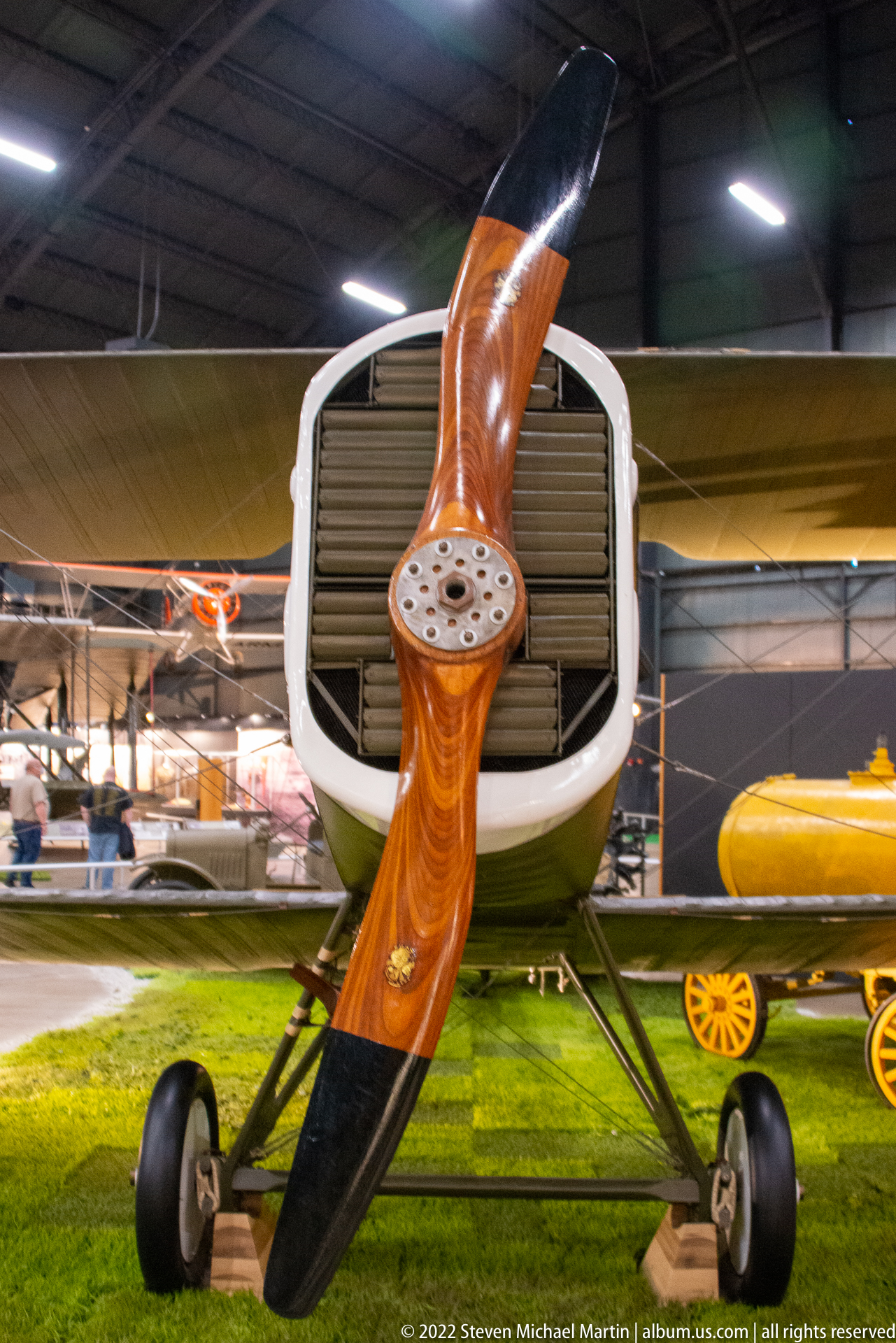
A dark wooden propeller stands vertically across the nose of a small biplane, its broad blades nearly filling the foreground. Behind it, a rectangular cooling grille and pale nose frame sit above the landing wheels; other yellow and green aircraft occupy the hangar beyond. The straight-on viewpoint compresses the airplane’s depth and makes the propeller hub and front structure the defining features of this display.
Caption
A dark wooden propeller stands vertically across the nose of a small biplane, its broad blades nearly filling the foreground. Behind it, a rectangular cooling grille and pale nose frame sit above the landing wheels; other yellow and green aircraft occupy the hangar beyond. The straight-on viewpoint compresses the airplane’s depth and makes the propeller hub and front structure the defining features of this display.
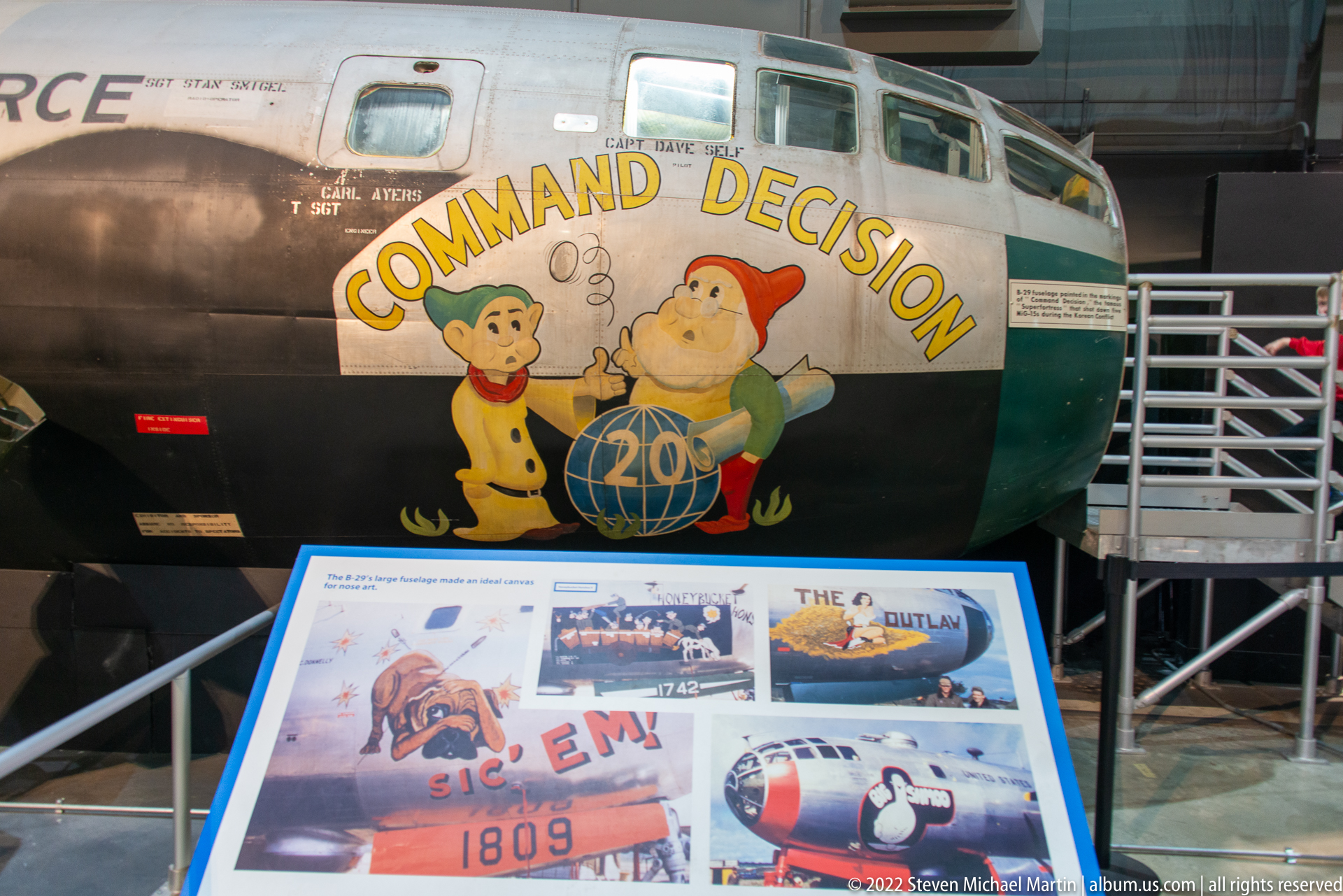
The dark green bomber fuselage carries the large words “Command Decision” above two cartoon figures and a painted globe. A nearby interpretive panel groups this aircraft with other wartime subjects, including an image labeled “The Outlaw” and a damaged aircraft marked “Sic ’Em 1809.” The close view emphasizes nose art as a visual record of crew identity and wartime storytelling.
Caption
The dark green bomber fuselage carries the large words “Command Decision” above two cartoon figures and a painted globe. A nearby interpretive panel groups this aircraft with other wartime subjects, including an image labeled “The Outlaw” and a damaged aircraft marked “Sic ’Em 1809.” The close view emphasizes nose art as a visual record of crew identity and wartime storytelling.
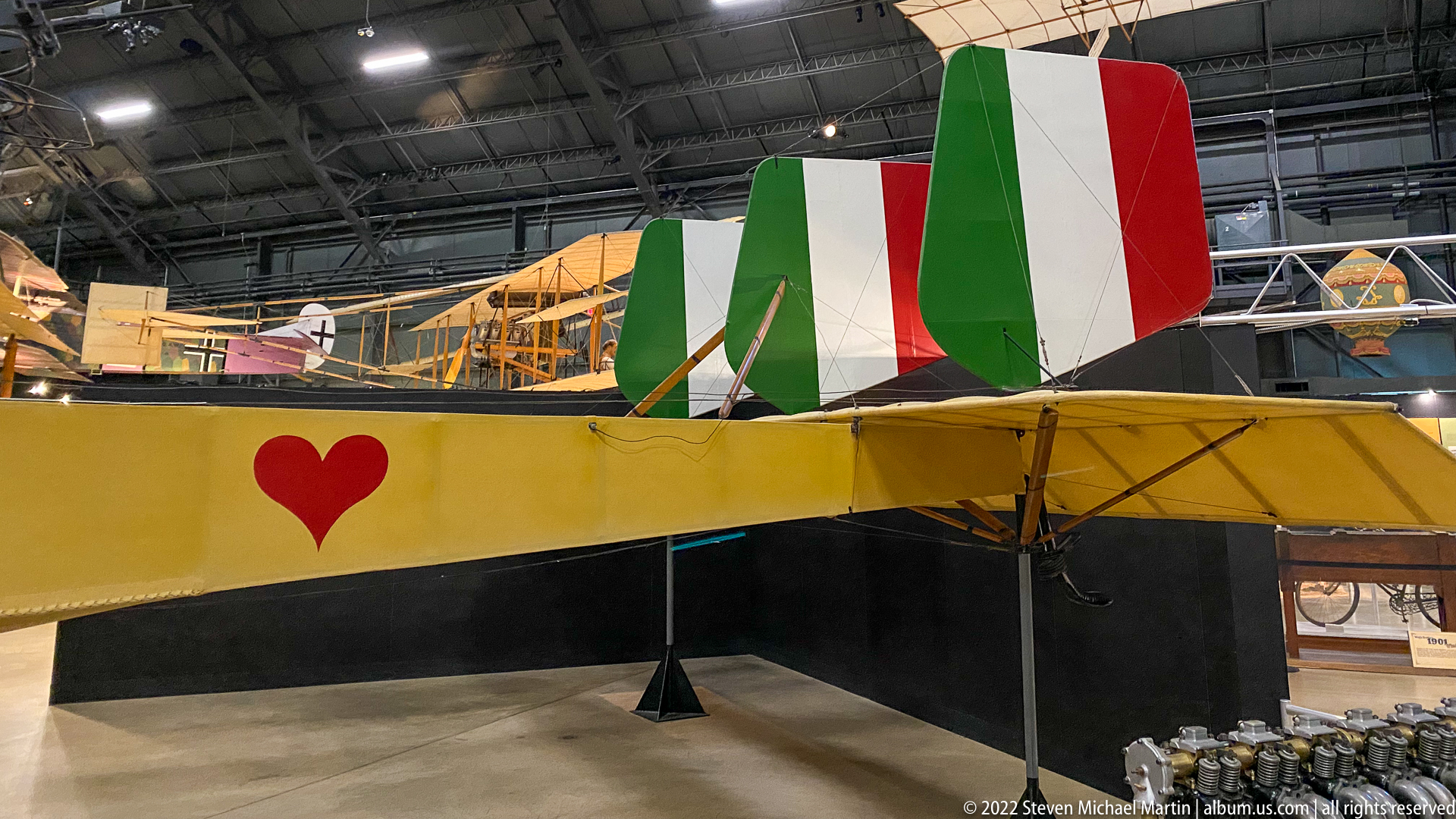
A yellow biplane is seen from the side, its broad wing marked by a red heart and its tail surfaces painted in green, white, and red. Other early aircraft are displayed behind it beneath the museum hangar roof. The close angle foregrounds the bright livery and simple fabric-covered wing structure without relying on a specific aircraft identification.
Caption
A yellow biplane is seen from the side, its broad wing marked by a red heart and its tail surfaces painted in green, white, and red. Other early aircraft are displayed behind it beneath the museum hangar roof. The close angle foregrounds the bright livery and simple fabric-covered wing structure without relying on a specific aircraft identification.
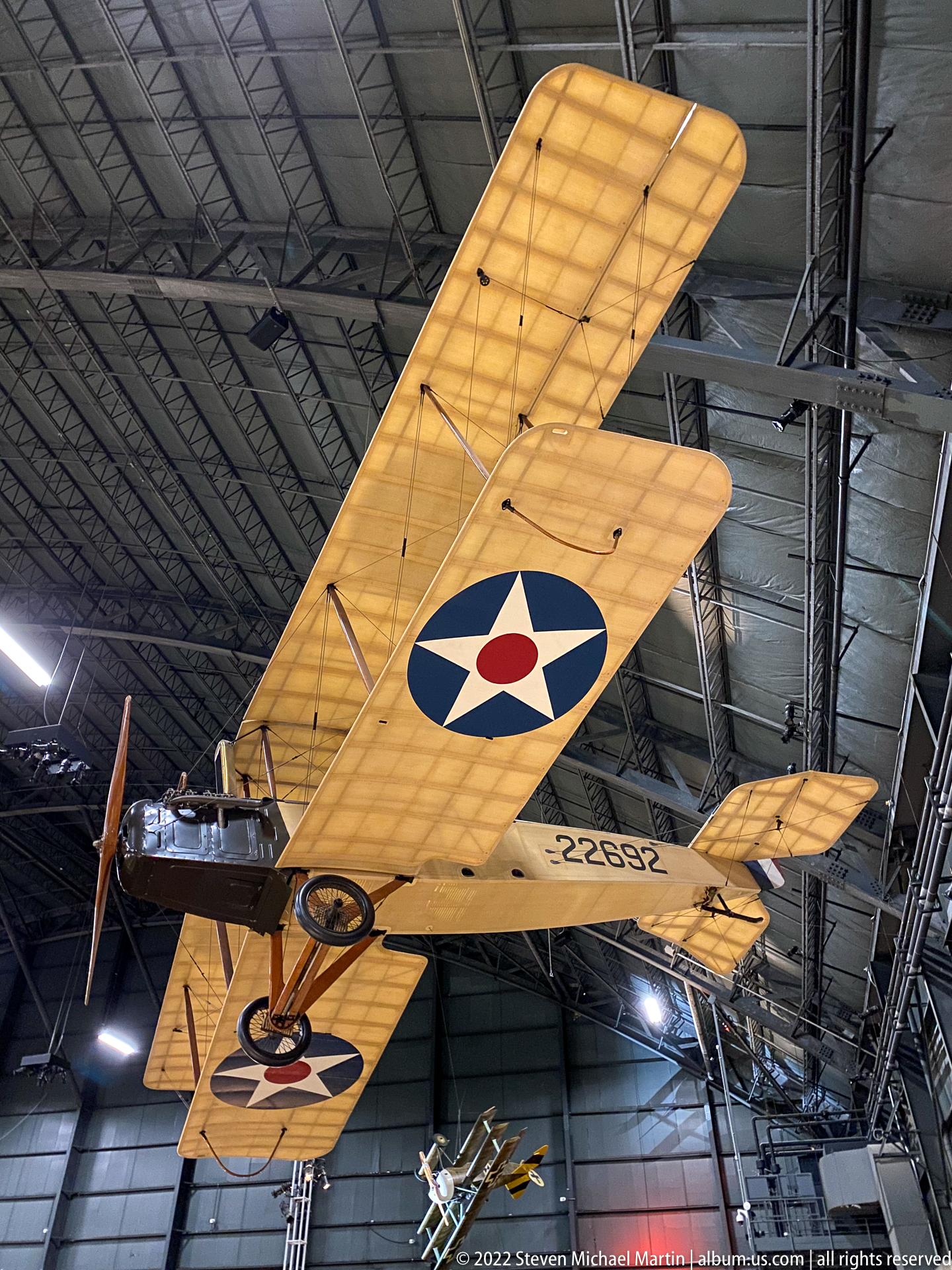
Viewed from below, a yellow biplane displays a red, white, and blue U.S. roundel on its lower wing. Struts and tension wires connect the stacked wings, while the landing gear and wooden propeller remain visible against the steel hangar ceiling. The upward perspective highlights the early aircraft’s open construction and insignia.
Caption
Viewed from below, a yellow biplane displays a red, white, and blue U.S. roundel on its lower wing. Struts and tension wires connect the stacked wings, while the landing gear and wooden propeller remain visible against the steel hangar ceiling. The upward perspective highlights the early aircraft’s open construction and insignia.
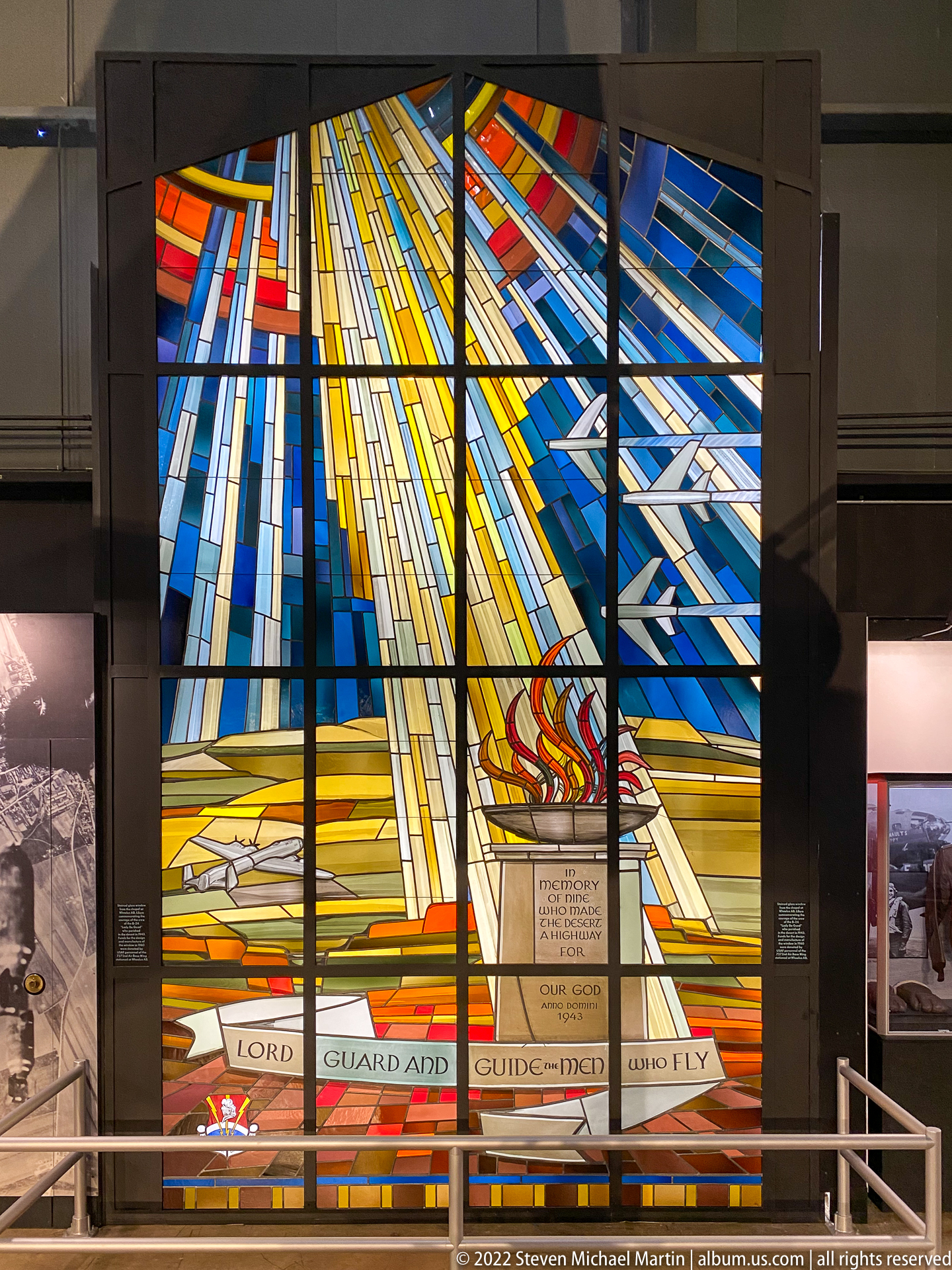
A tall stained-glass panel combines blue, yellow, and red geometric bands with a central red flame-like motif. Across the lower section, a ribbon reads “LORD GUARD AND GUIDE …” while smaller dedication text appears near the base. The symmetrical vertical design uses aviation-related imagery and lettering to turn the museum wall into a memorial display.
Caption
A tall stained-glass panel combines blue, yellow, and red geometric bands with a central red flame-like motif. Across the lower section, a ribbon reads “LORD GUARD AND GUIDE …” while smaller dedication text appears near the base. The symmetrical vertical design uses aviation-related imagery and lettering to turn the museum wall into a memorial display.
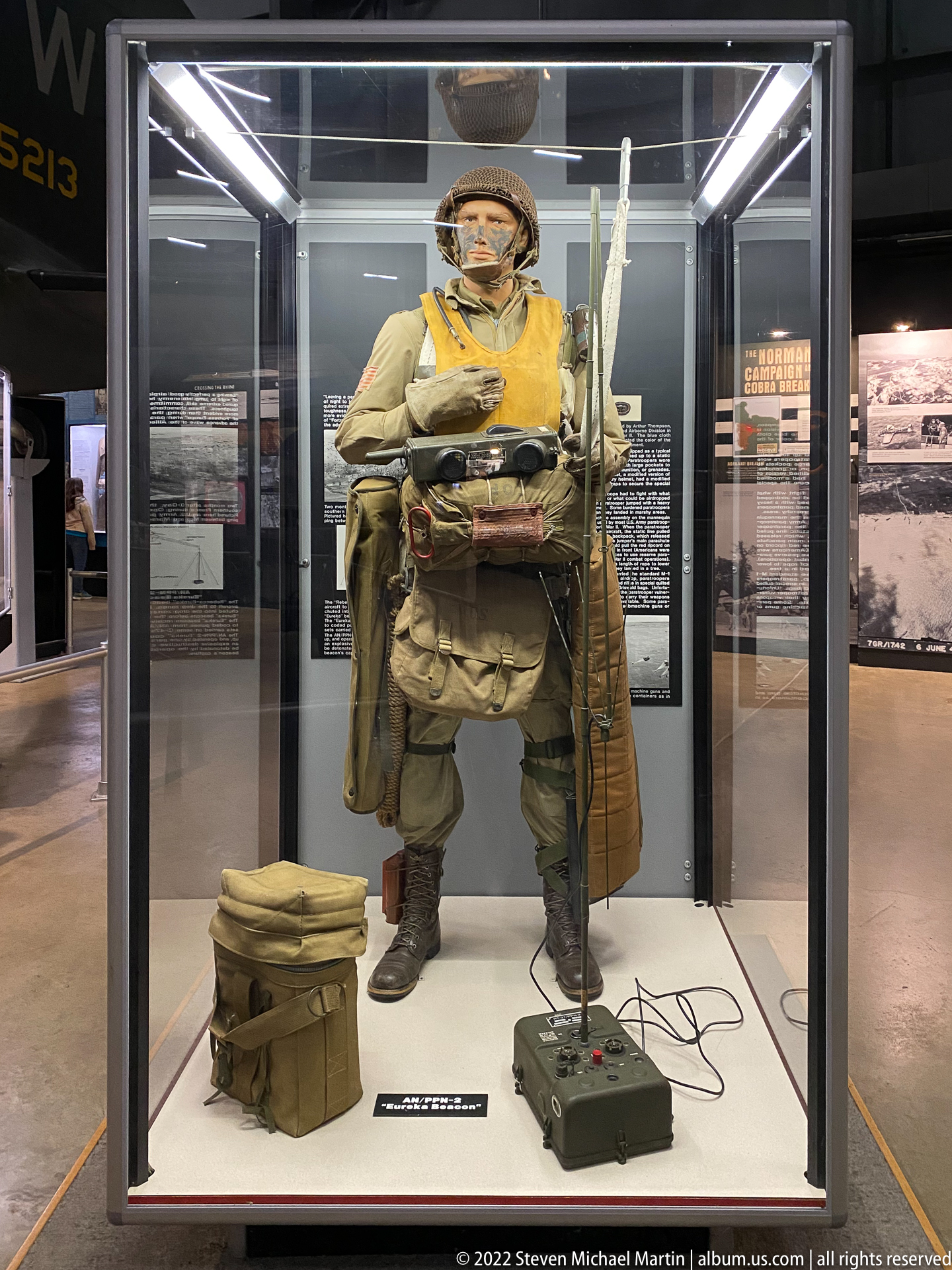
A uniformed figure stands in a glass case wearing layered field clothing and carrying a large pack. A long antenna, cables, and radio equipment surround the display, while archival photographs and explanatory panels line the background. The arrangement presents the equipment as a complete field setup, though the proof-sheet view does not provide enough legible text to identify a specific person or operation.
Caption
A uniformed figure stands in a glass case wearing layered field clothing and carrying a large pack. A long antenna, cables, and radio equipment surround the display, while archival photographs and explanatory panels line the background. The arrangement presents the equipment as a complete field setup, though the proof-sheet view does not provide enough legible text to identify a specific person or operation.
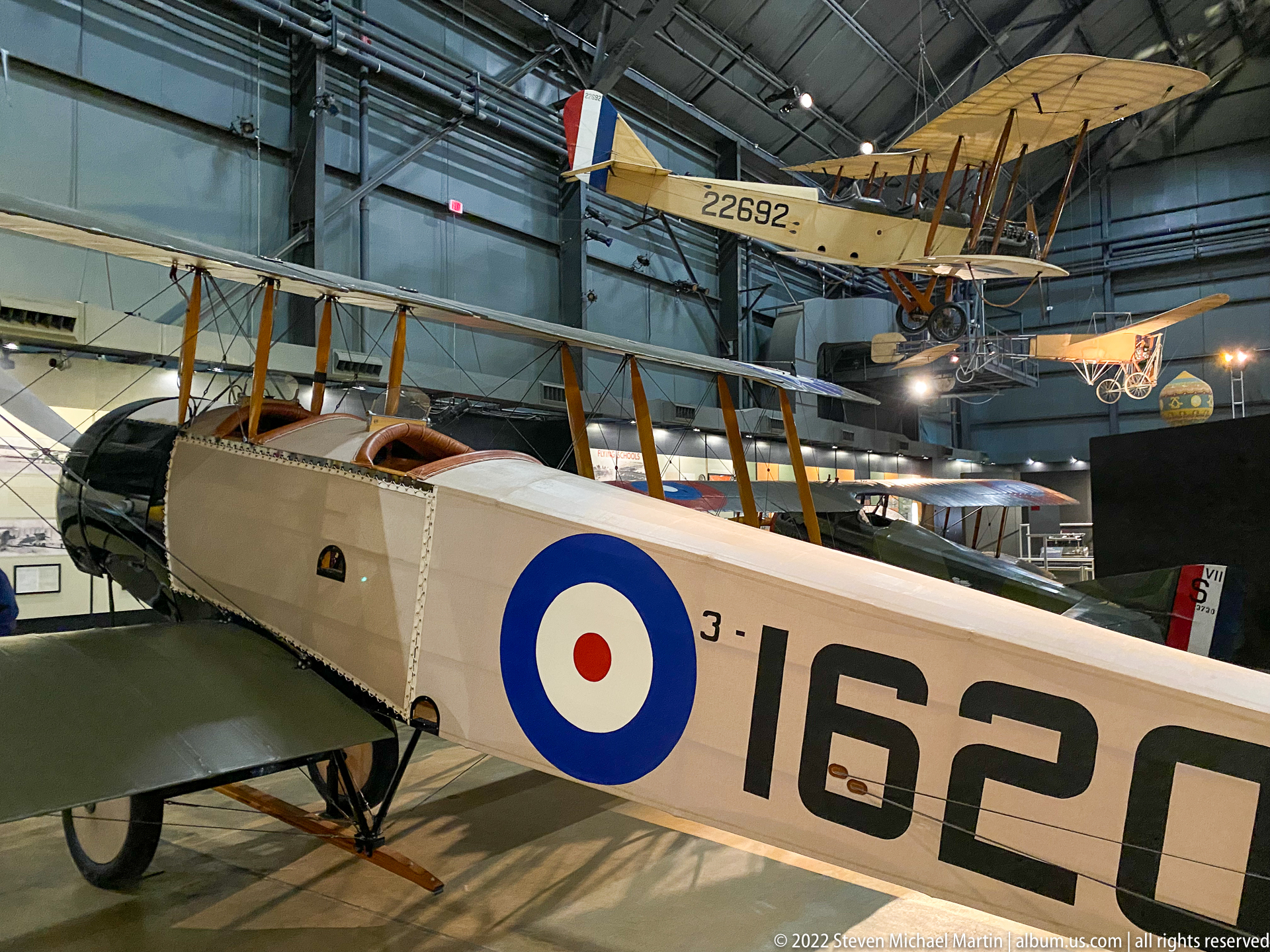
A cream-colored biplane fills the foreground, its fuselage bearing a blue-white-red roundel and the large number 1626. A second yellow aircraft hangs above and behind it, so the image layers two early planes within the crowded gallery. The oblique close view draws attention to the painted insignia and the stacked wings rather than the full aircraft profile.
Caption
A cream-colored biplane fills the foreground, its fuselage bearing a blue-white-red roundel and the large number 1626. A second yellow aircraft hangs above and behind it, so the image layers two early planes within the crowded gallery. The oblique close view draws attention to the painted insignia and the stacked wings rather than the full aircraft profile.
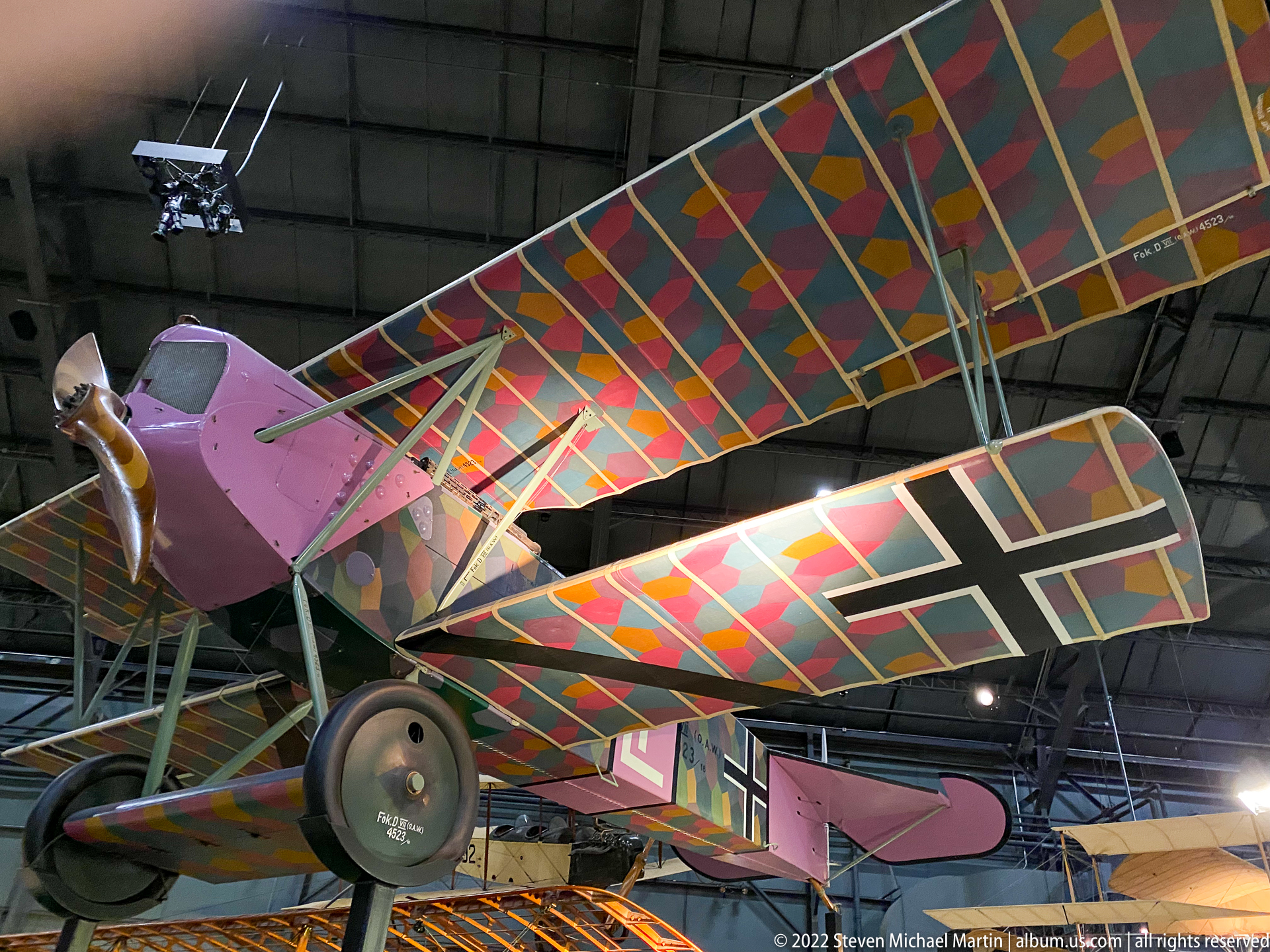
A pink-nosed biplane is displayed at an upward angle, its upper and lower wings covered in bold geometric panels of red, yellow, green, and blue. The fuselage and fixed landing gear appear between the stacked wings, while other aircraft and hangar trusses fill the background. The vivid paint scheme makes this aircraft stand apart from the surrounding olive and yellow displays.
Caption
A pink-nosed biplane is displayed at an upward angle, its upper and lower wings covered in bold geometric panels of red, yellow, green, and blue. The fuselage and fixed landing gear appear between the stacked wings, while other aircraft and hangar trusses fill the background. The vivid paint scheme makes this aircraft stand apart from the surrounding olive and yellow displays.
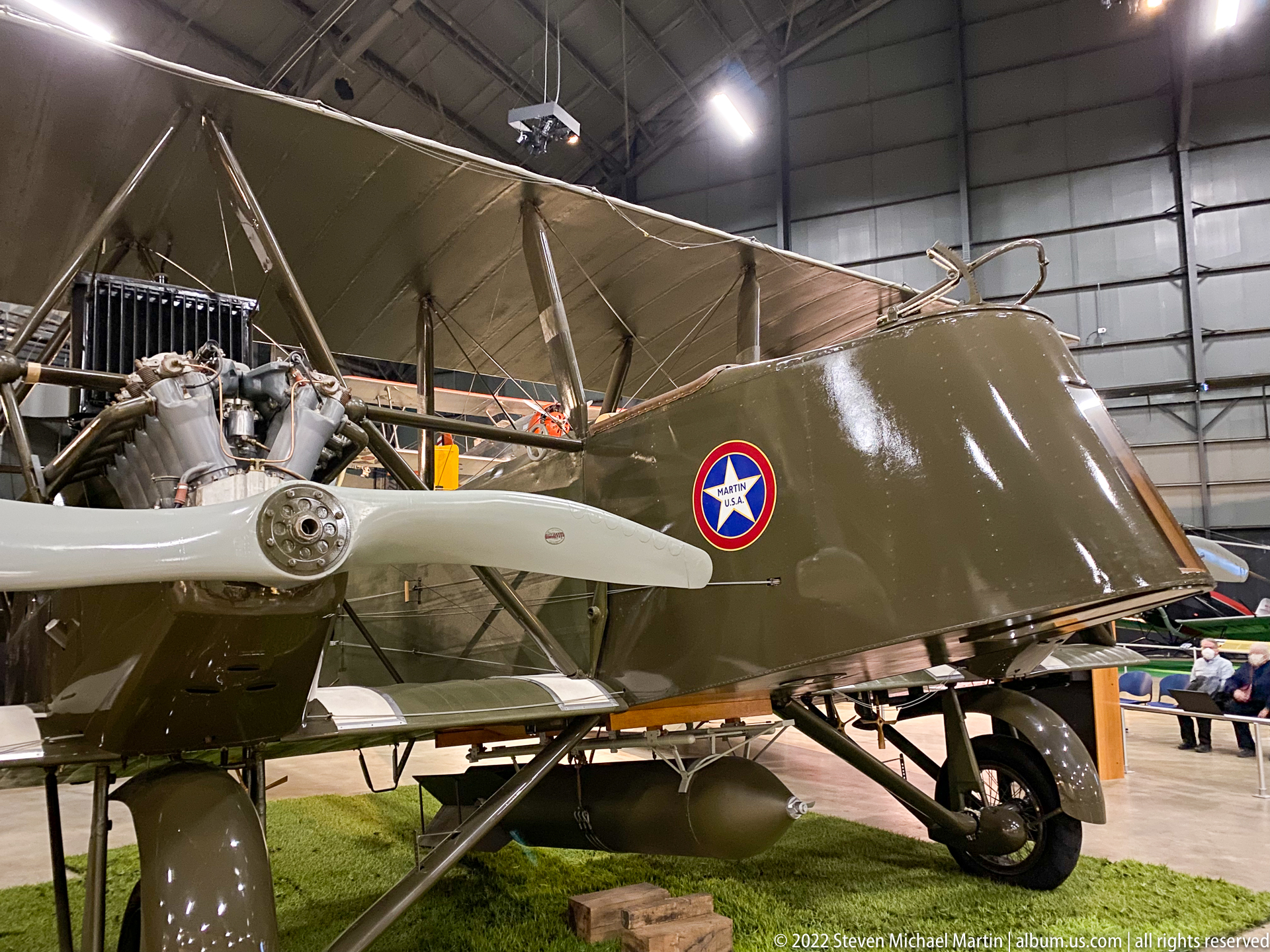
An olive-drab aircraft fills the frame, showing its radial engine, propeller, landing gear, and a circular U.S. military insignia on the fuselage. A second wing and its struts overlap the upper background, revealing how closely the planes are arranged in the museum gallery. The side view emphasizes the engine and military markings rather than the full airframe.
Caption
An olive-drab aircraft fills the frame, showing its radial engine, propeller, landing gear, and a circular U.S. military insignia on the fuselage. A second wing and its struts overlap the upper background, revealing how closely the planes are arranged in the museum gallery. The side view emphasizes the engine and military markings rather than the full airframe.
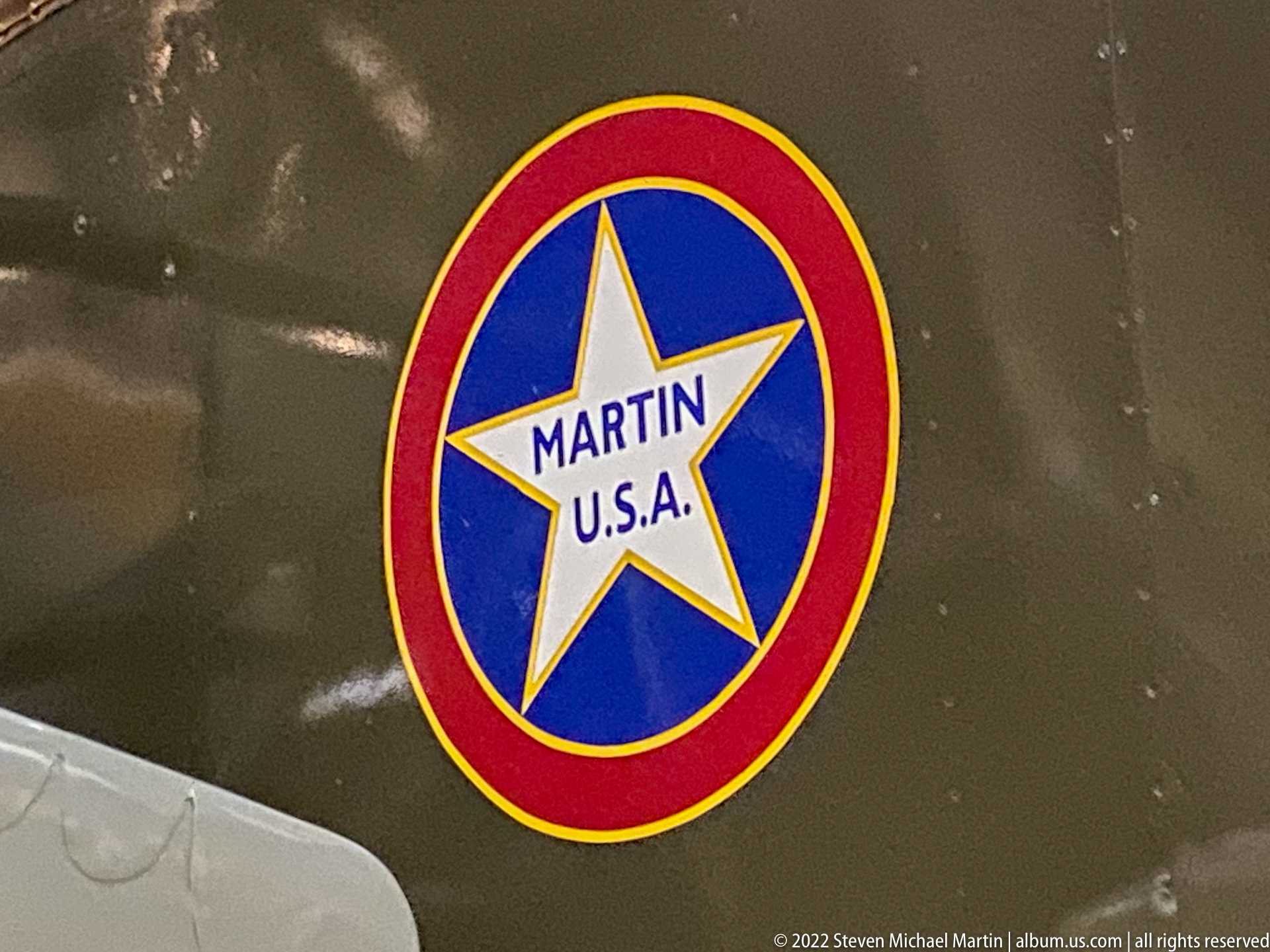
A circular insignia on an olive aircraft reads “MARTIN U.S.A.” across a white star set against blue, with a red outer ring. A small section of pale aircraft structure enters at lower left, while the tight crop isolates the emblem from its full airframe. The graphic records the maker’s name and national identity as presented on the aircraft.
Caption
A circular insignia on an olive aircraft reads “MARTIN U.S.A.” across a white star set against blue, with a red outer ring. A small section of pale aircraft structure enters at lower left, while the tight crop isolates the emblem from its full airframe. The graphic records the maker’s name and national identity as presented on the aircraft.
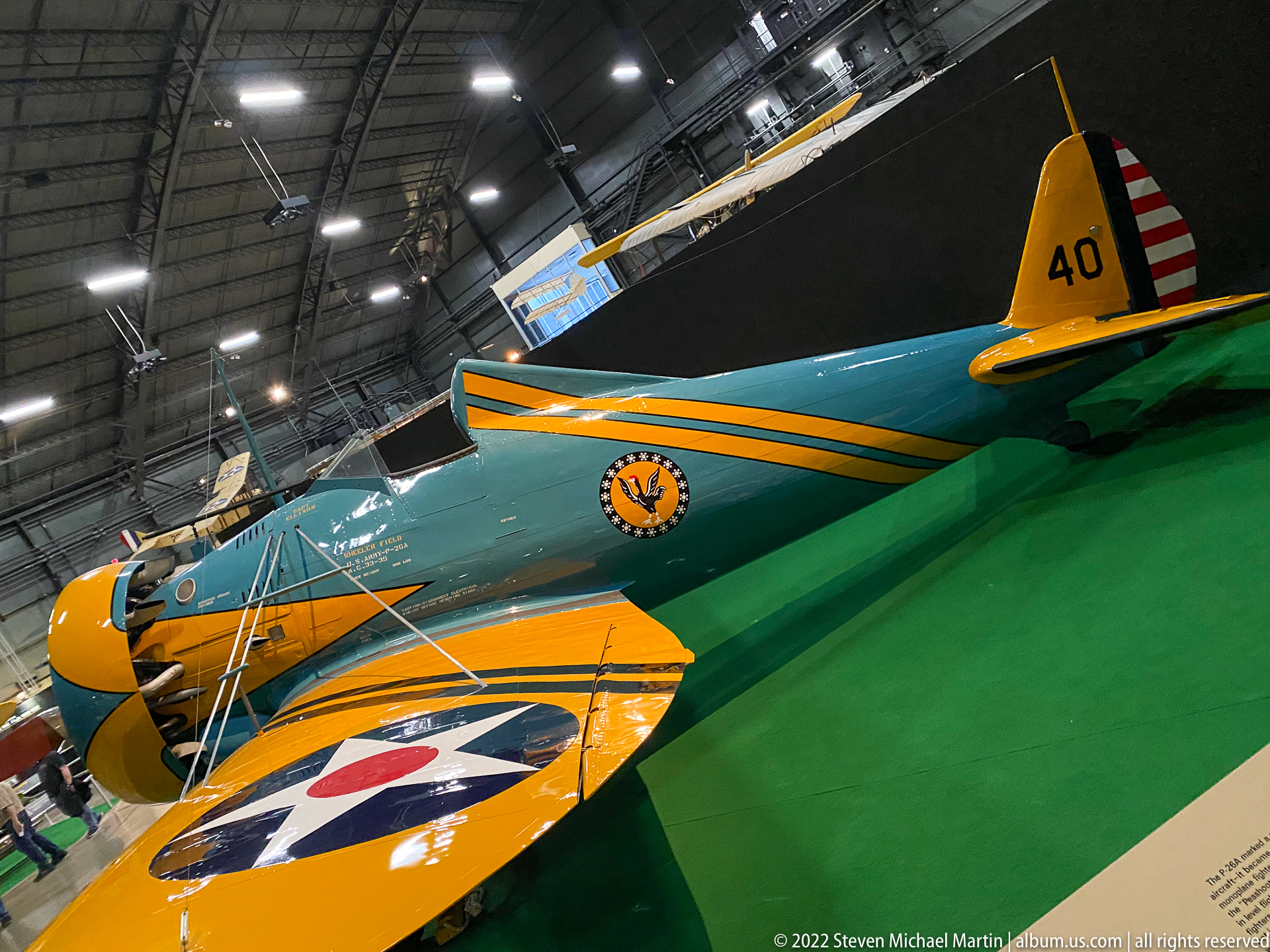
A green-and-yellow biplane is shown from above and behind, its tail marked with the number 40 and a U.S. roundel visible on the nearer wing. The sharply contrasting stripes and colors set it apart from the surrounding aircraft, which hang at different heights in the gallery. The view records the plane’s wing arrangement, tail, and display context.
Caption
A green-and-yellow biplane is shown from above and behind, its tail marked with the number 40 and a U.S. roundel visible on the nearer wing. The sharply contrasting stripes and colors set it apart from the surrounding aircraft, which hang at different heights in the gallery. The view records the plane’s wing arrangement, tail, and display context.
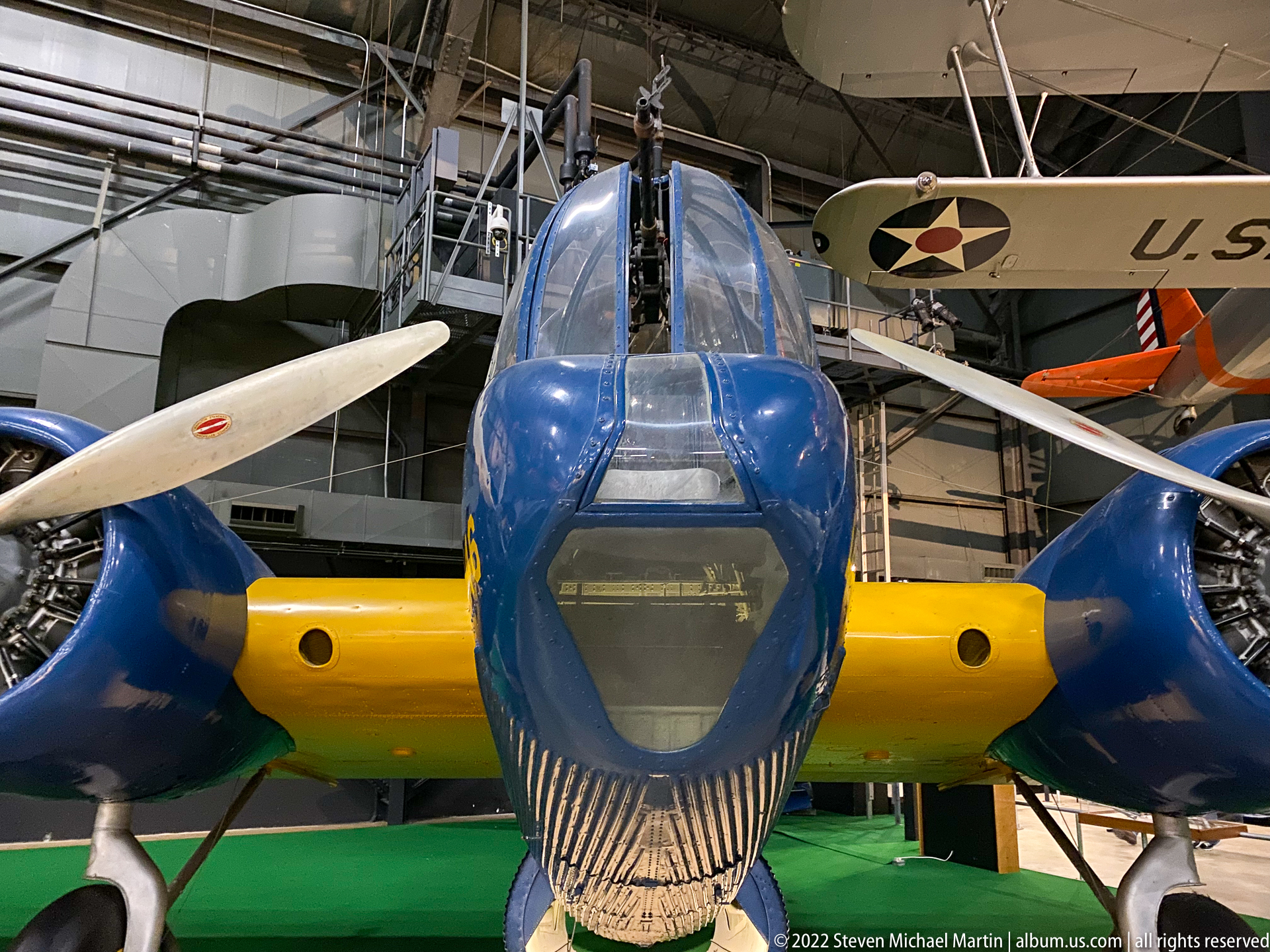
The blue aircraft’s rounded nose and glazed cockpit dominate a head-on view, with a bright yellow band crossing its forward fuselage. Its wings extend toward neighboring planes, including a cream-colored aircraft with a U.S. roundel in the background. The close perspective makes the cockpit glazing and nose geometry the central features of this crowded museum display.
Caption
The blue aircraft’s rounded nose and glazed cockpit dominate a head-on view, with a bright yellow band crossing its forward fuselage. Its wings extend toward neighboring planes, including a cream-colored aircraft with a U.S. roundel in the background. The close perspective makes the cockpit glazing and nose geometry the central features of this crowded museum display.
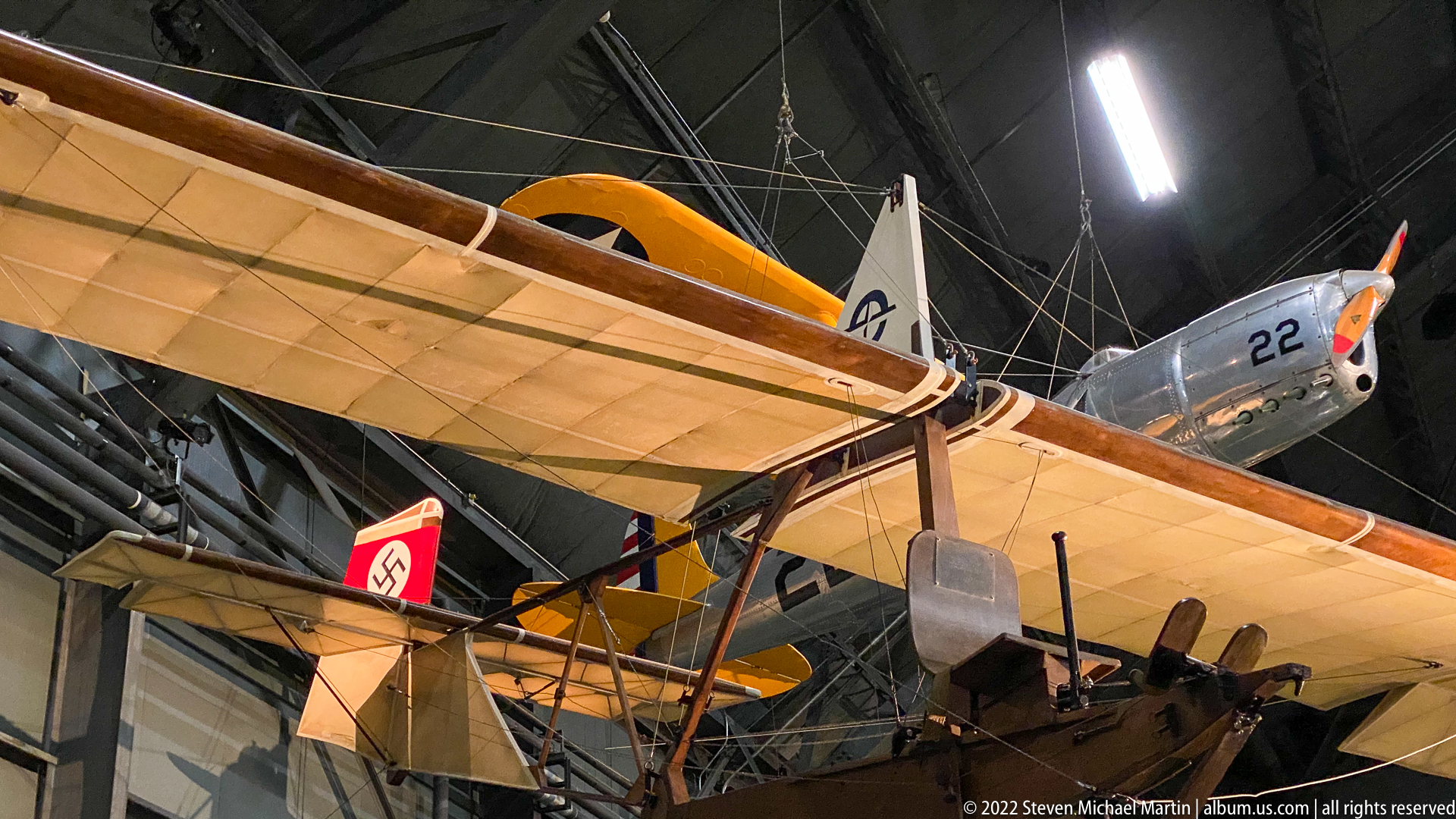
Several early aircraft overlap in this upward view, with a large tan wing crossing above smaller biplanes and exposed struts. A silver-gray aircraft marked 22 appears at the right edge, while a red sign hangs below the closest wing. The dense arrangement conveys the vertical scale of the museum hangar and the variety of aircraft suspended or displayed within it.
Caption
Several early aircraft overlap in this upward view, with a large tan wing crossing above smaller biplanes and exposed struts. A silver-gray aircraft marked 22 appears at the right edge, while a red sign hangs below the closest wing. The dense arrangement conveys the vertical scale of the museum hangar and the variety of aircraft suspended or displayed within it.
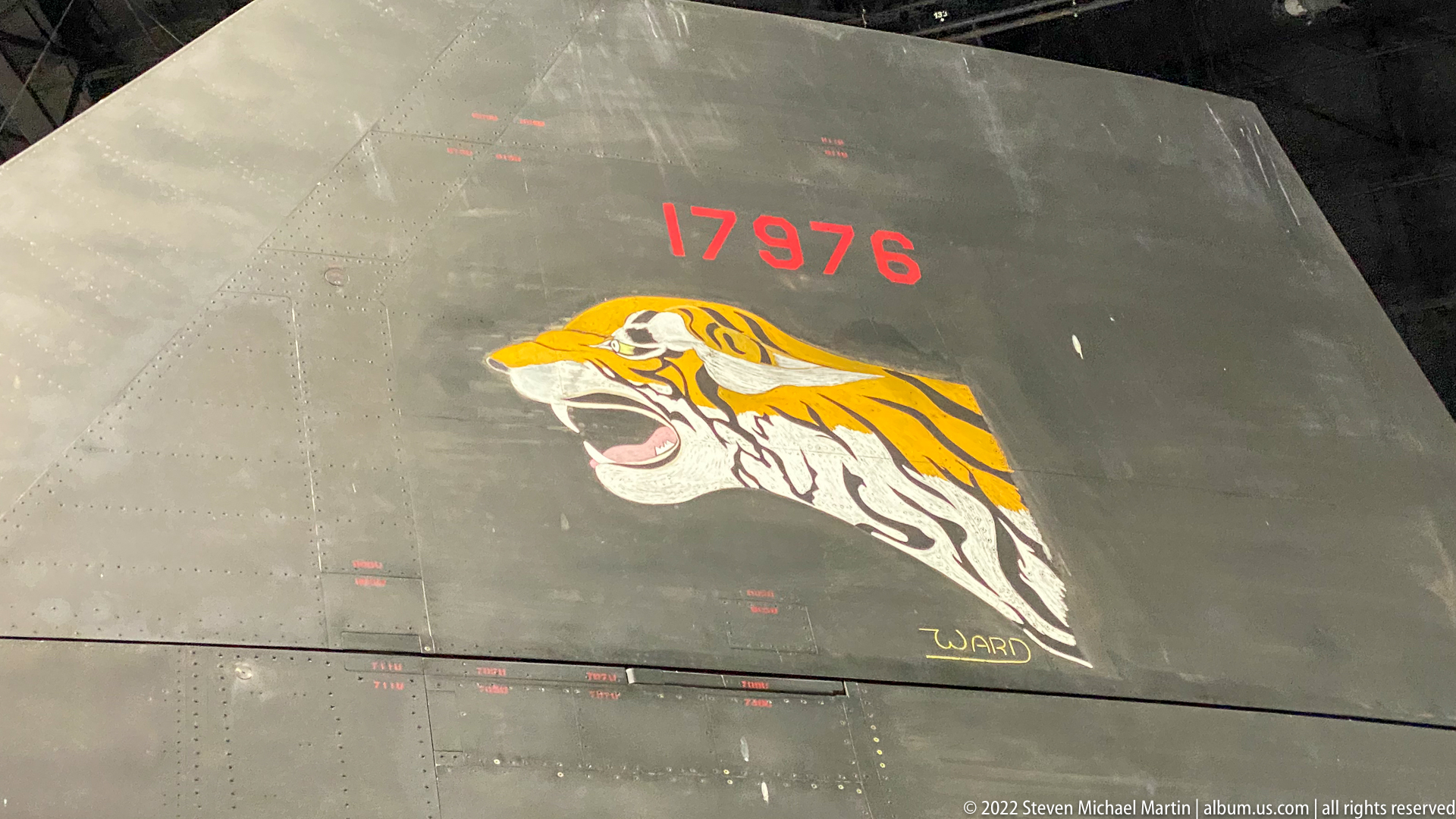
The gray aircraft surface bears the red number 17976 above a snarling tiger head rendered in white, yellow, and black. Small red stencils and panel seams remain visible across the surrounding metal skin. The tight crop turns the painted emblem into the subject, preserving the aircraft’s serial marking as a useful clue without assigning a specific aircraft model.
Caption
The gray aircraft surface bears the red number 17976 above a snarling tiger head rendered in white, yellow, and black. Small red stencils and panel seams remain visible across the surrounding metal skin. The tight crop turns the painted emblem into the subject, preserving the aircraft’s serial marking as a useful clue without assigning a specific aircraft model.
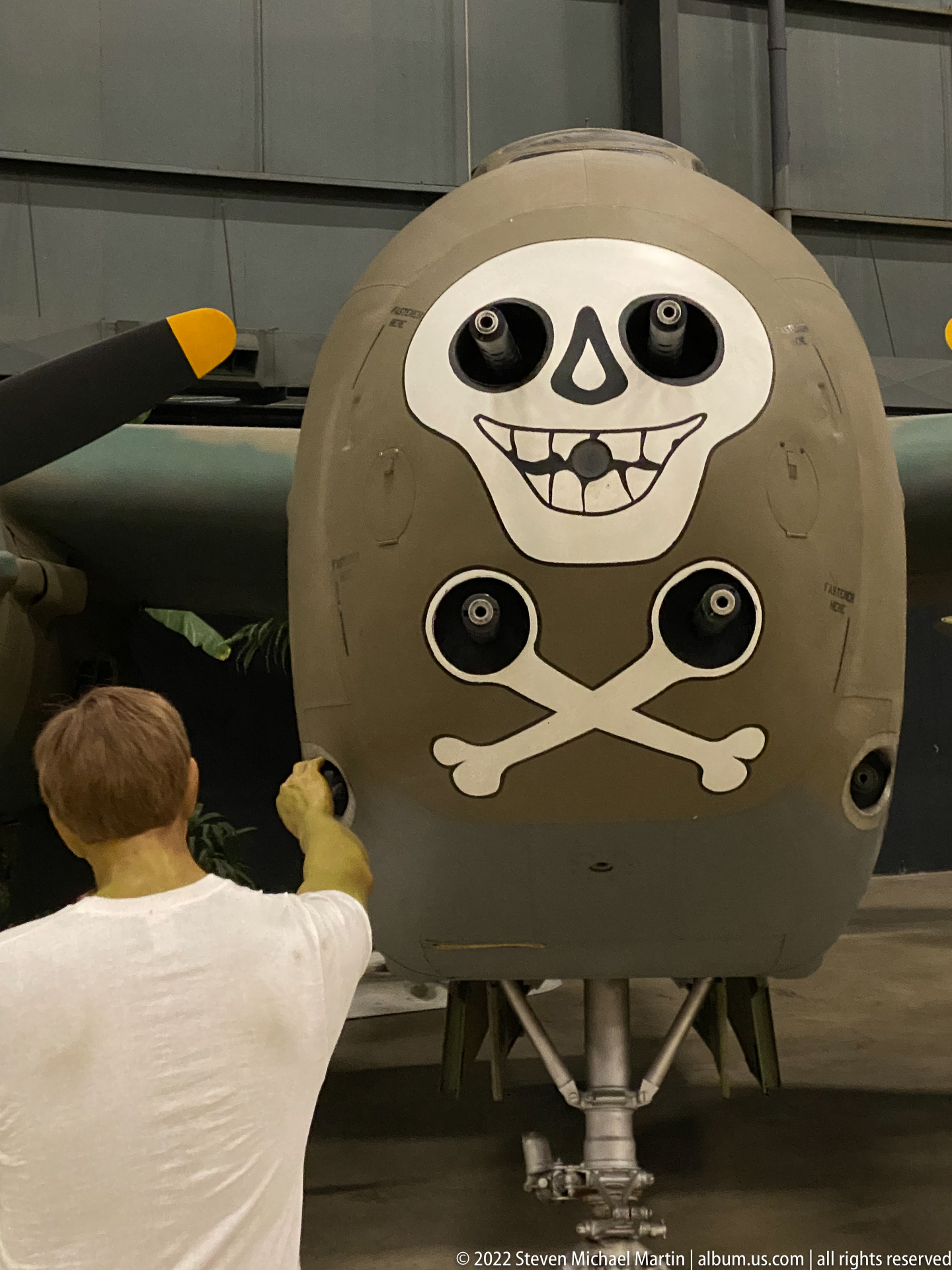
A visitor in a white shirt stands beside a rounded aircraft nose painted with a grinning skull and crossed bones. Four dark circular openings surround the emblem, and the aircraft’s curved metal skin fills most of the view. The human figure provides scale and shows how visitors encounter nose art at close range in the museum hangar.
Caption
A visitor in a white shirt stands beside a rounded aircraft nose painted with a grinning skull and crossed bones. Four dark circular openings surround the emblem, and the aircraft’s curved metal skin fills most of the view. The human figure provides scale and shows how visitors encounter nose art at close range in the museum hangar.
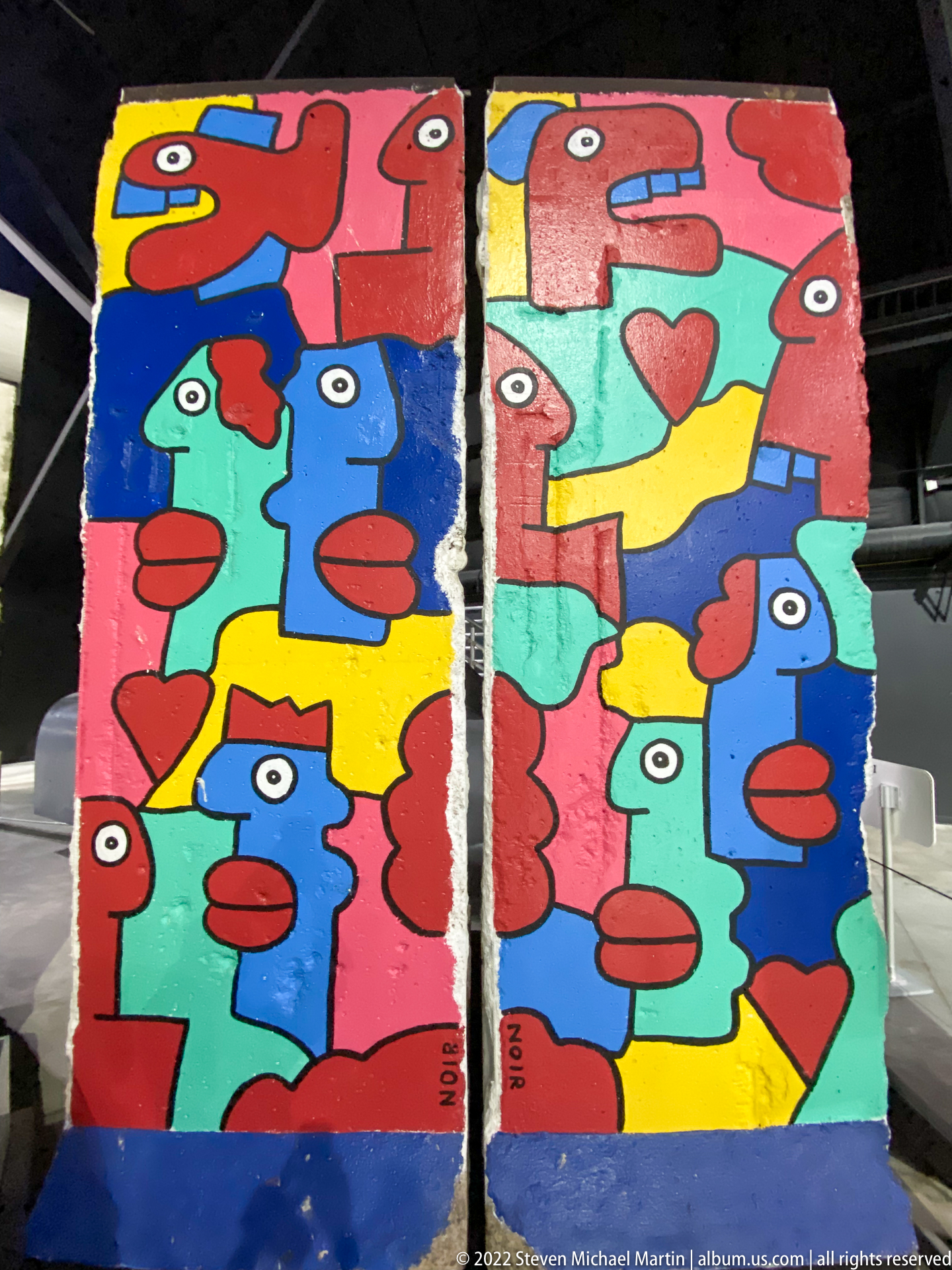
Two tall panels lean side by side, each covered in repeated stylized faces outlined in black and filled with red, blue, green, and yellow. A central red heart appears among the abstract features, while fragments of an aircraft display remain visible behind them. The close composition focuses on the graphic panels as independent works within the aviation museum setting.
Caption
Two tall panels lean side by side, each covered in repeated stylized faces outlined in black and filled with red, blue, green, and yellow. A central red heart appears among the abstract features, while fragments of an aircraft display remain visible behind them. The close composition focuses on the graphic panels as independent works within the aviation museum setting.
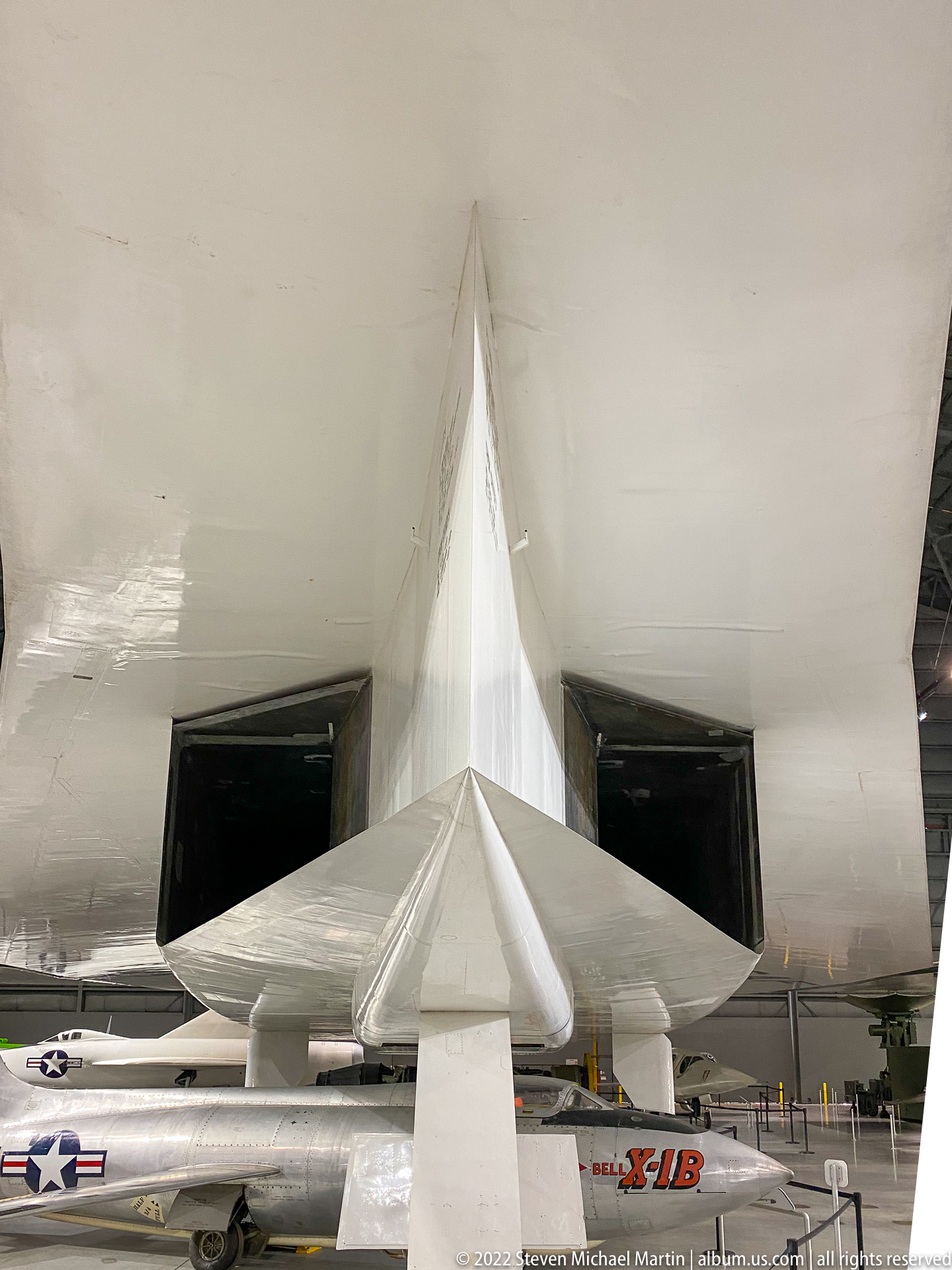
A broad white tail structure fills the frame from below, its central fin rising above the curved rear surfaces. Dark openings and panels interrupt the smooth underside, while other aircraft and a red-marked tail remain visible beneath it. The close low angle emphasizes the scale and geometry of the rear airframe, though it does not expose enough markings for confident model identification.
Caption
A broad white tail structure fills the frame from below, its central fin rising above the curved rear surfaces. Dark openings and panels interrupt the smooth underside, while other aircraft and a red-marked tail remain visible beneath it. The close low angle emphasizes the scale and geometry of the rear airframe, though it does not expose enough markings for confident model identification.

Long, narrow missiles and rockets hang overhead in a dark gallery, their pointed noses and cylindrical bodies extending toward the camera from multiple directions. Spotlights create bright highlights along the painted surfaces, while the upward perspective compresses the suspended objects into a dramatic radial arrangement. The view emphasizes scale and display method rather than individual weapon identification.
Caption
Long, narrow missiles and rockets hang overhead in a dark gallery, their pointed noses and cylindrical bodies extending toward the camera from multiple directions. Spotlights create bright highlights along the painted surfaces, while the upward perspective compresses the suspended objects into a dramatic radial arrangement. The view emphasizes scale and display method rather than individual weapon identification.

Several long aerospace vehicles extend across the dark ceiling, their bodies crossing at different angles beneath bright gallery lights. Painted bands and small markings distinguish the individual objects, but no nearby labels are readable in the frame. The wider upward view gives a stronger sense of the display’s density and the museum’s use of suspended space.
Caption
Several long aerospace vehicles extend across the dark ceiling, their bodies crossing at different angles beneath bright gallery lights. Painted bands and small markings distinguish the individual objects, but no nearby labels are readable in the frame. The wider upward view gives a stronger sense of the display’s density and the museum’s use of suspended space.

The compact X-40A demonstrator rests on its landing gear with the U.S. Air Force, Boeing, NASA, and X-40A markings visible on its white-and-blue body. The pointed nose and short, winged form distinguish it from conventional aircraft nearby. Its labels identify it as part of experimental space vehicle development, while the close side view reveals the vehicle’s unusual proportions.
Caption
The compact X-40A demonstrator rests on its landing gear with the U.S. Air Force, Boeing, NASA, and X-40A markings visible on its white-and-blue body. The pointed nose and short, winged form distinguish it from conventional aircraft nearby. Its labels identify it as part of experimental space vehicle development, while the close side view reveals the vehicle’s unusual proportions.
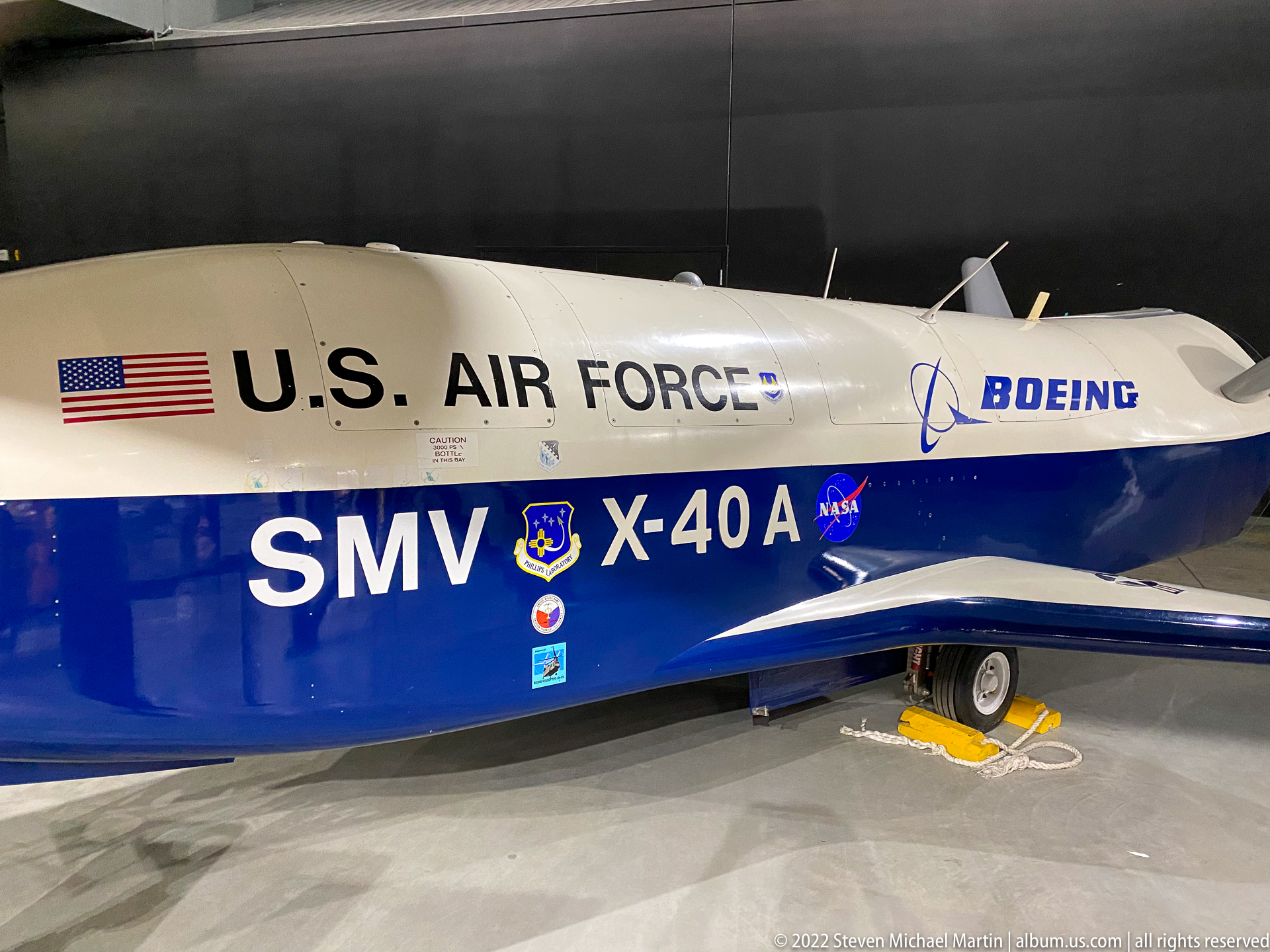
The X-40A’s white upper body and deep blue lower surface fill this side view, with large lettering for the U.S. Air Force, Boeing, and SMV. The compact wing and landing gear show the vehicle resting in the gallery, while small program emblems cluster near the middle. This angle makes the identification markings more prominent than the aircraft’s overall form.
Caption
The X-40A’s white upper body and deep blue lower surface fill this side view, with large lettering for the U.S. Air Force, Boeing, and SMV. The compact wing and landing gear show the vehicle resting in the gallery, while small program emblems cluster near the middle. This angle makes the identification markings more prominent than the aircraft’s overall form.
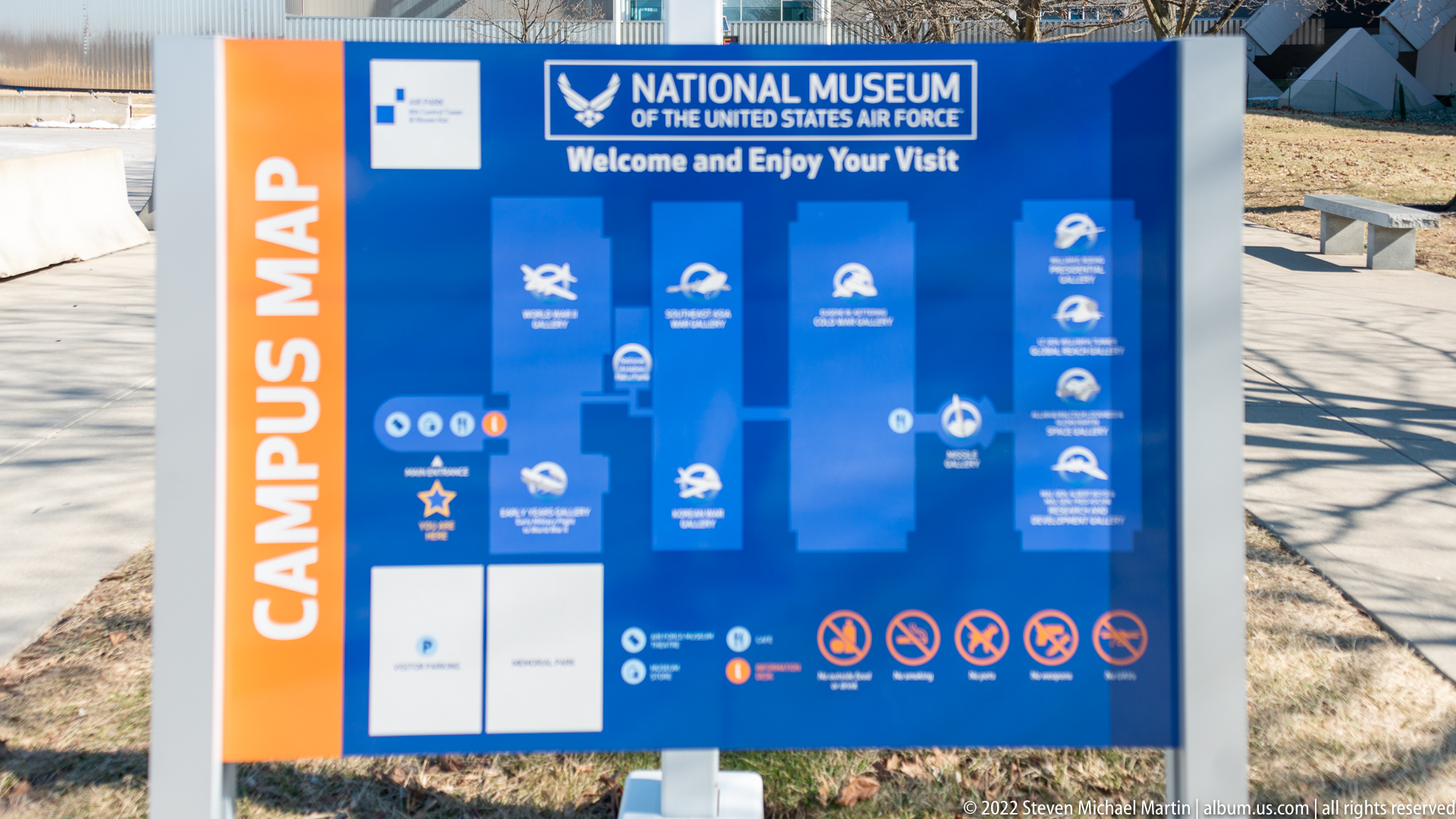
A blue campus map sign welcomes visitors to the National Museum of the United States Air Force. It shows a simplified layout of the exhibition buildings, labeled galleries, orientation symbols, and visitor guidance icons along the bottom. The close framing makes the sign’s wayfinding purpose central, while surrounding grass and paved paths place it outdoors on the museum grounds.
Caption
A blue campus map sign welcomes visitors to the National Museum of the United States Air Force. It shows a simplified layout of the exhibition buildings, labeled galleries, orientation symbols, and visitor guidance icons along the bottom. The close framing makes the sign’s wayfinding purpose central, while surrounding grass and paved paths place it outdoors on the museum grounds.
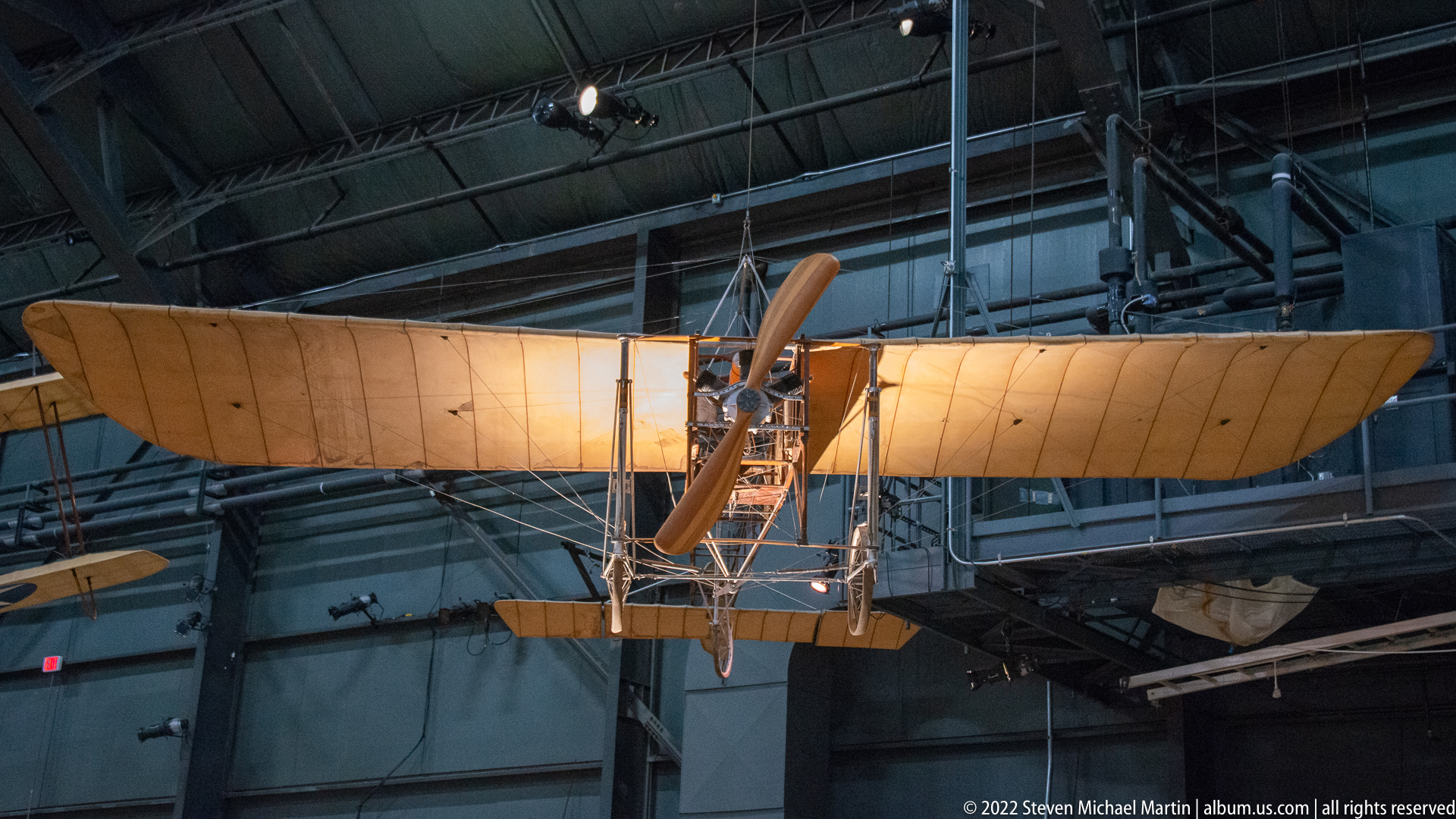
A tan early aircraft hangs overhead, seen from beneath its wide stacked wings and open bracing. A wooden propeller sits at the front, while the slim fuselage and landing gear recede into the dark hangar. The upward view separates the vehicle from the floor displays and reveals how its wings are supported by a lattice of struts and wires.
Caption
A tan early aircraft hangs overhead, seen from beneath its wide stacked wings and open bracing. A wooden propeller sits at the front, while the slim fuselage and landing gear recede into the dark hangar. The upward view separates the vehicle from the floor displays and reveals how its wings are supported by a lattice of struts and wires.
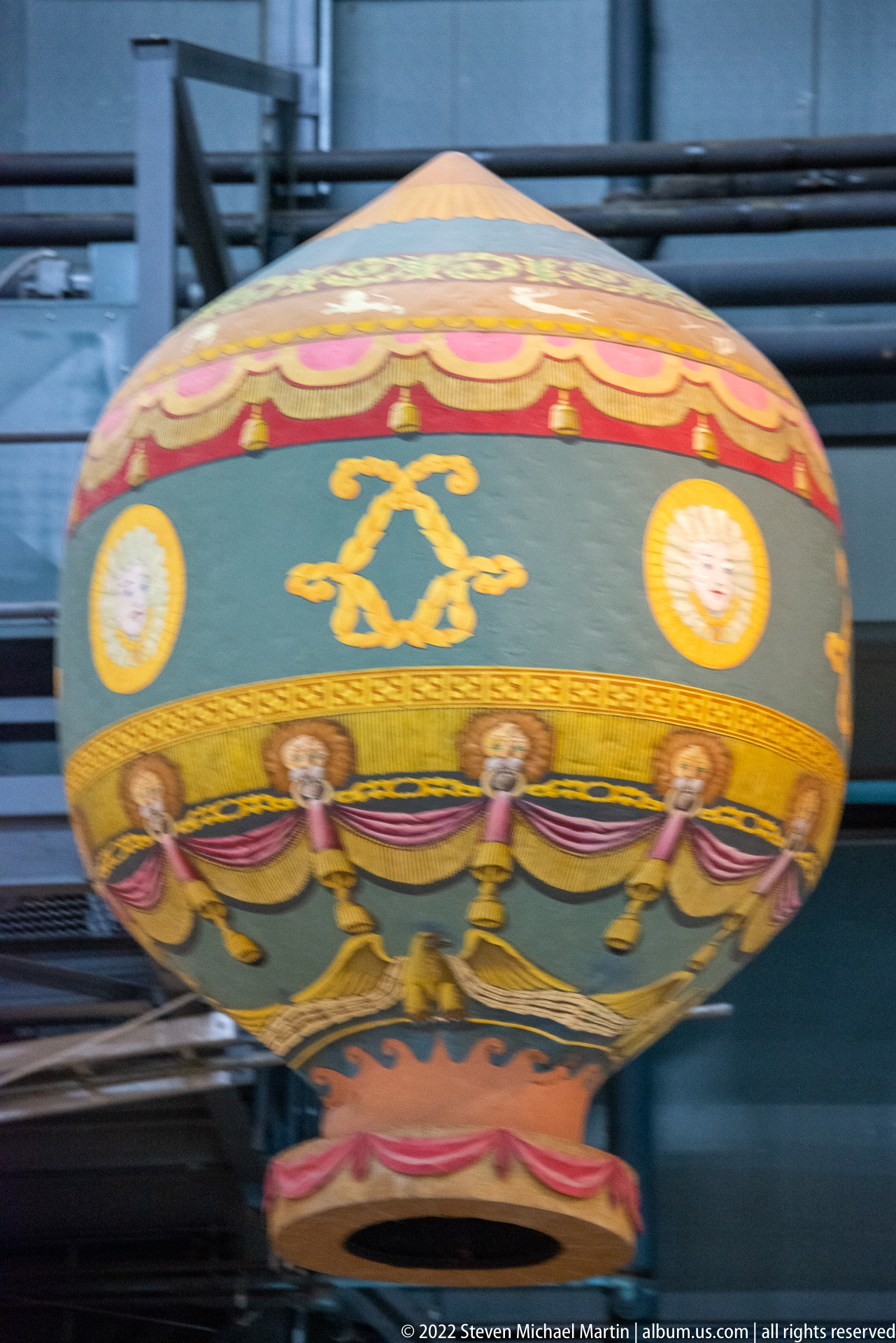
A rounded, suspended fabric form is painted in bands of green, pink, and gold, with repeated human figures and circular medallions around its circumference. A central floral or crossed motif decorates the upper band. The object resembles a balloon envelope, but the image does not show its full suspension or identify its exact role, so the caption stays with its visible form and decoration.
Caption
A rounded, suspended fabric form is painted in bands of green, pink, and gold, with repeated human figures and circular medallions around its circumference. A central floral or crossed motif decorates the upper band. The object resembles a balloon envelope, but the image does not show its full suspension or identify its exact role, so the caption stays with its visible form and decoration.
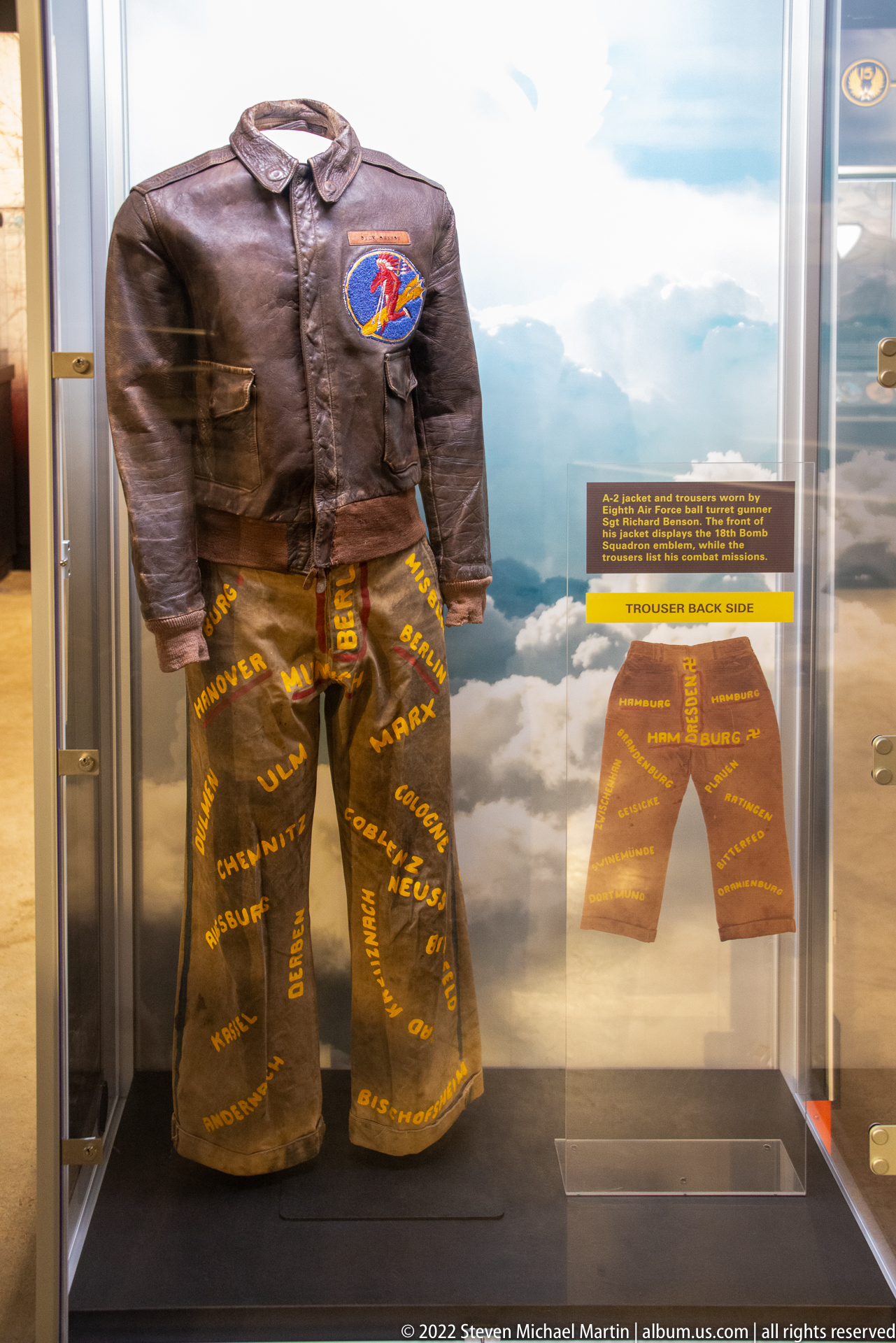
A leather flight jacket and pair of dark trousers are displayed upright inside a glass case against a cloud-and-sky backdrop. The jacket carries a colorful shoulder patch, while yellow names and words cover the trousers; a second decorated garment is arranged beside them. Reflections cross the glass, but the arrangement remains legible as a clothing exhibit focused on personal gear and painted or embroidered markings.
Caption
A leather flight jacket and pair of dark trousers are displayed upright inside a glass case against a cloud-and-sky backdrop. The jacket carries a colorful shoulder patch, while yellow names and words cover the trousers; a second decorated garment is arranged beside them. Reflections cross the glass, but the arrangement remains legible as a clothing exhibit focused on personal gear and painted or embroidered markings.
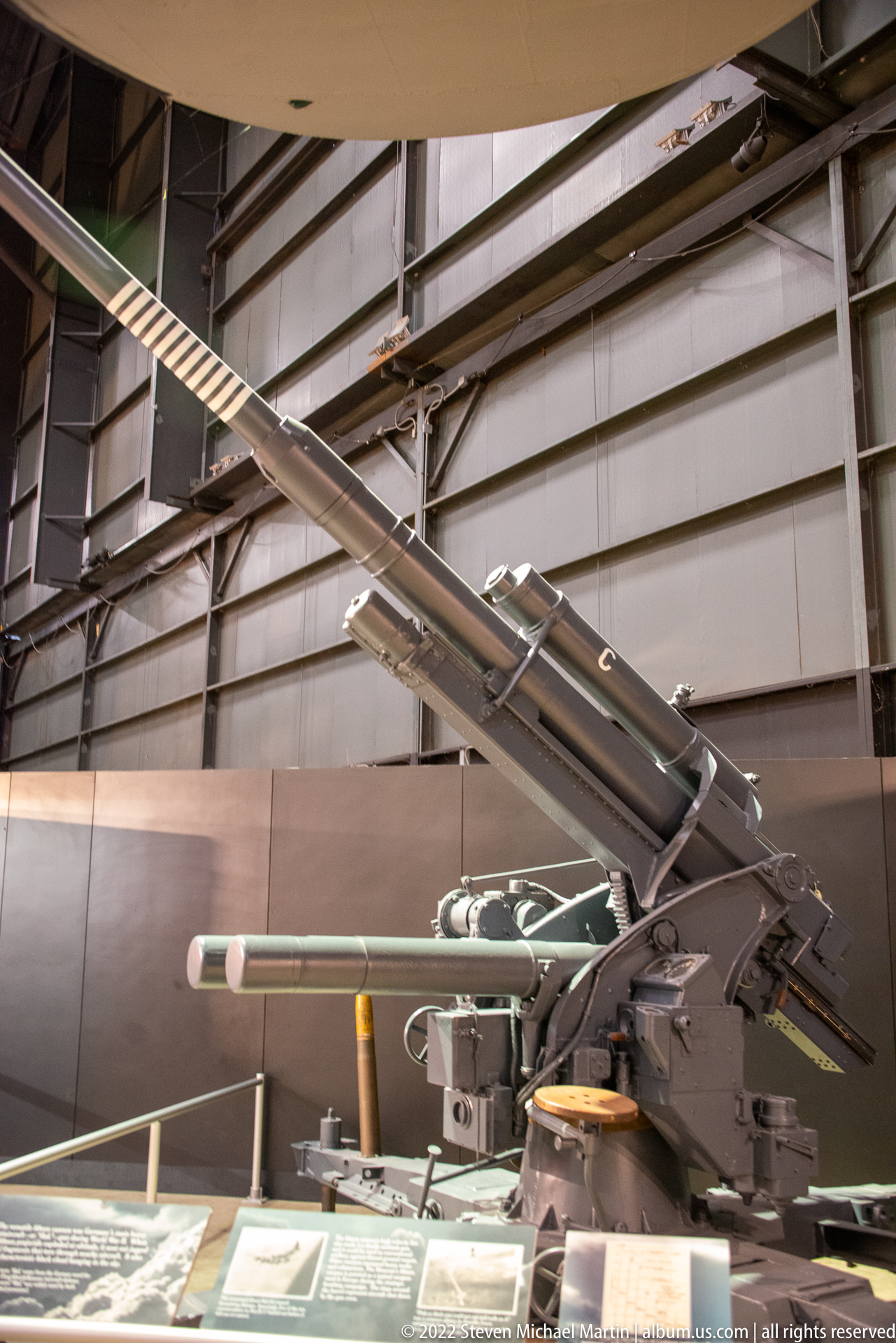
A heavy aircraft gun assembly fills the lower half of the gallery view, its long barrel and angular support arms extending diagonally toward the ceiling. The metal mount includes a cluster of mechanical joints and sighting components, while low interpretive panels line the foreground. The image presents the weapon as a complex piece of aircraft equipment, emphasizing its scale and articulated structure rather than the aircraft it once served.
Caption
A heavy aircraft gun assembly fills the lower half of the gallery view, its long barrel and angular support arms extending diagonally toward the ceiling. The metal mount includes a cluster of mechanical joints and sighting components, while low interpretive panels line the foreground. The image presents the weapon as a complex piece of aircraft equipment, emphasizing its scale and articulated structure rather than the aircraft it once served.
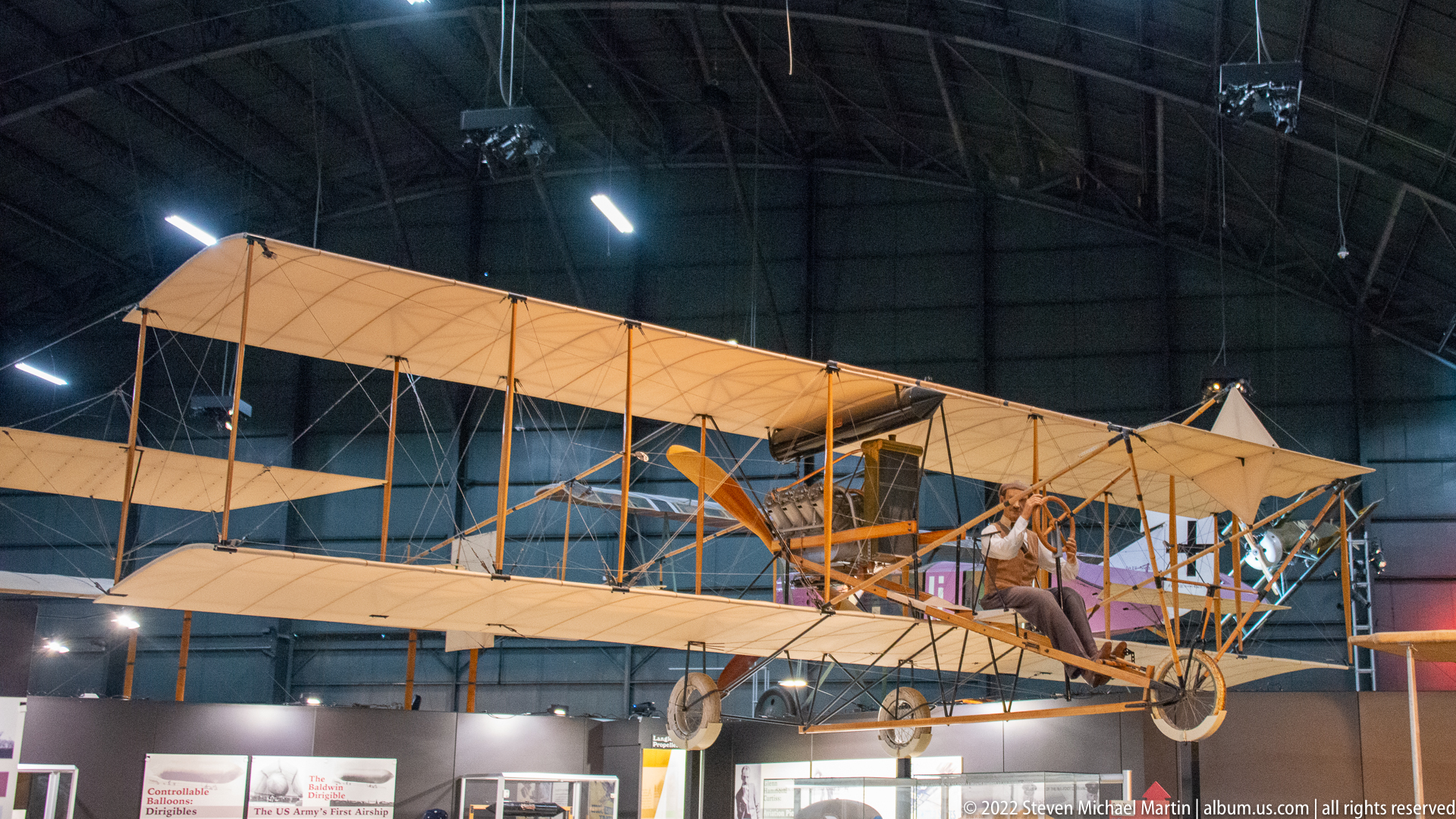
A tan biplane hangs in the gallery with a seated figure visible in its open cockpit. The long wings, delicate struts, and fixed landing gear form a light framework beneath the dark hangar roof. Nearby interpretation panels sit below the aircraft, but their text is too small to read from this view. The composition foregrounds the open cockpit and early flight configuration.
Caption
A tan biplane hangs in the gallery with a seated figure visible in its open cockpit. The long wings, delicate struts, and fixed landing gear form a light framework beneath the dark hangar roof. Nearby interpretation panels sit below the aircraft, but their text is too small to read from this view. The composition foregrounds the open cockpit and early flight configuration.

An olive-drab biplane stands on spoked wheels, its nose framed by a bold red-and-white circular marking. The open cockpit, exposed bracing wires, and stacked wings identify an early aircraft design, while the dark hangar contrasts with the pale floor and brightly colored nose. The oblique view shows the fuselage, landing gear, and wing structure together.
Caption
An olive-drab biplane stands on spoked wheels, its nose framed by a bold red-and-white circular marking. The open cockpit, exposed bracing wires, and stacked wings identify an early aircraft design, while the dark hangar contrasts with the pale floor and brightly colored nose. The oblique view shows the fuselage, landing gear, and wing structure together.
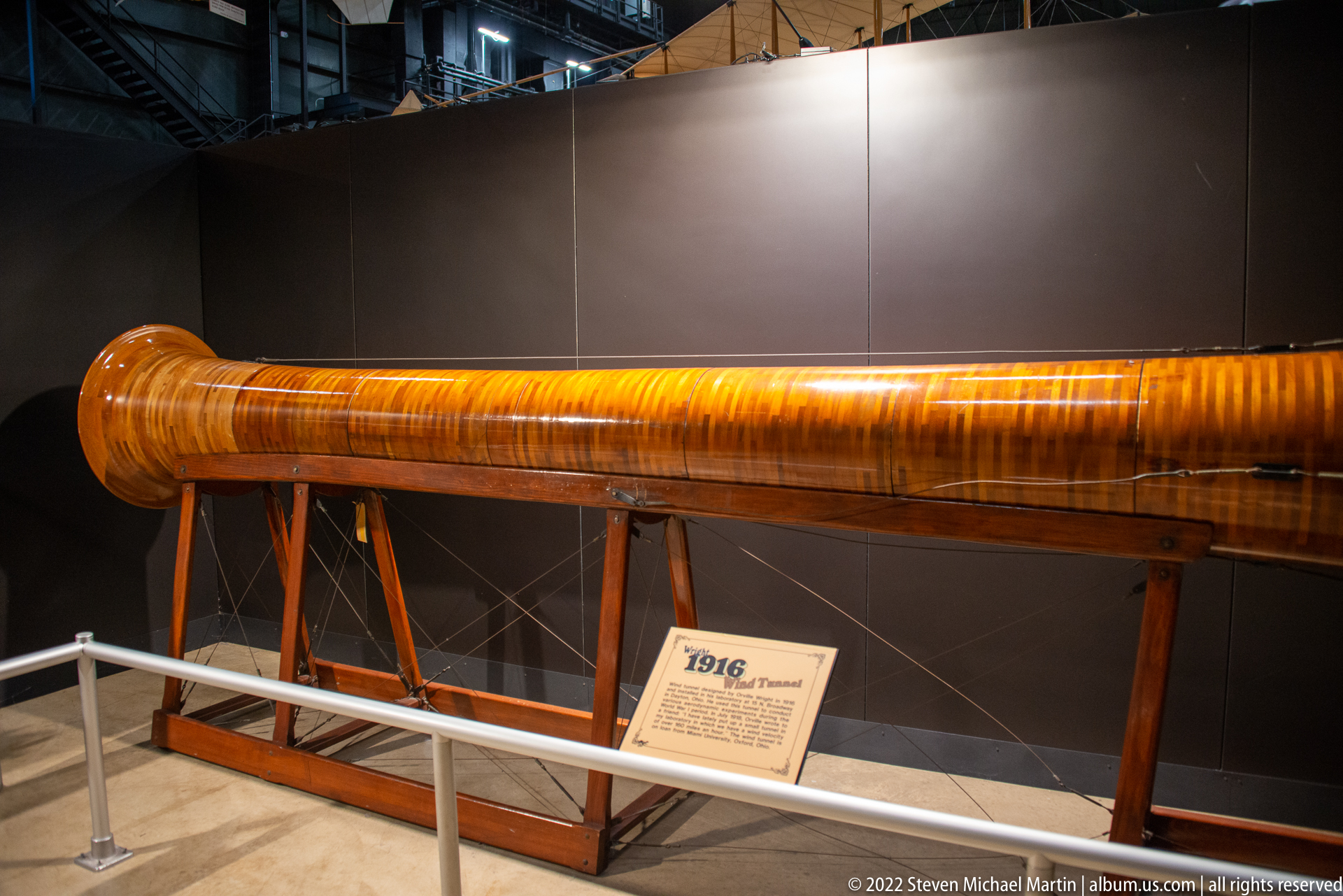
A long laminated wooden propeller is displayed horizontally on a timber stand, its polished amber surface revealing alternating bands of wood. A small interpretive label sits below the blade, while a low rail separates the object from visitors. The close side view emphasizes the propeller’s length, smooth finish, and carefully shaped hub, presenting an aircraft component as a crafted object in its own right.
Caption
A long laminated wooden propeller is displayed horizontally on a timber stand, its polished amber surface revealing alternating bands of wood. A small interpretive label sits below the blade, while a low rail separates the object from visitors. The close side view emphasizes the propeller’s length, smooth finish, and carefully shaped hub, presenting an aircraft component as a crafted object in its own right.
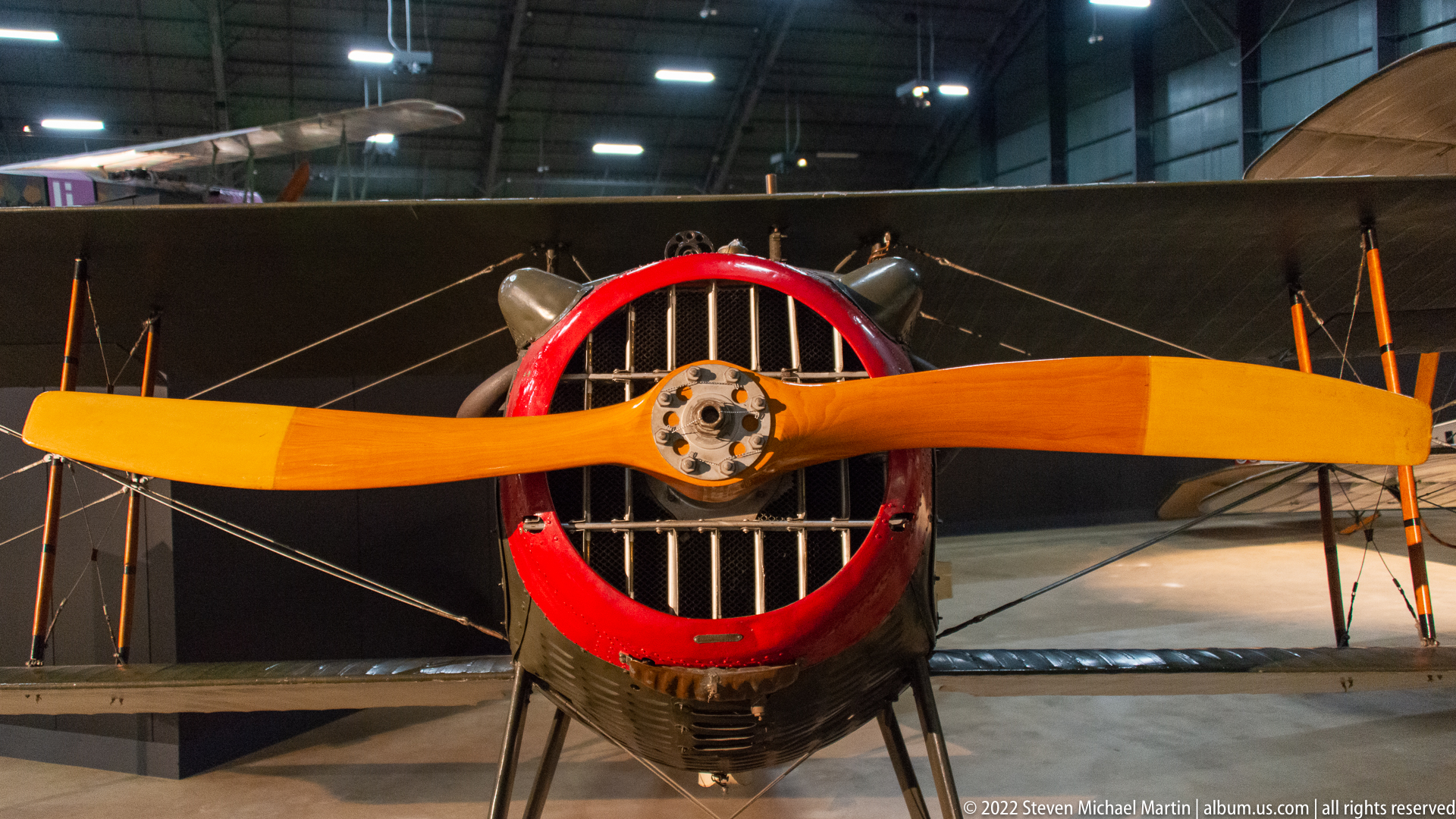
A broad orange wooden propeller spans the frame in front of a red circular aircraft cowling. Viewed head-on, the propeller hub aligns with the dark opening behind it, where internal structural bars remain visible. The bright blade contrasts with the red rim and shadowed fuselage, isolating the meeting point between the external propeller and the aircraft’s nose assembly inside the museum gallery.
Caption
A broad orange wooden propeller spans the frame in front of a red circular aircraft cowling. Viewed head-on, the propeller hub aligns with the dark opening behind it, where internal structural bars remain visible. The bright blade contrasts with the red rim and shadowed fuselage, isolating the meeting point between the external propeller and the aircraft’s nose assembly inside the museum gallery.
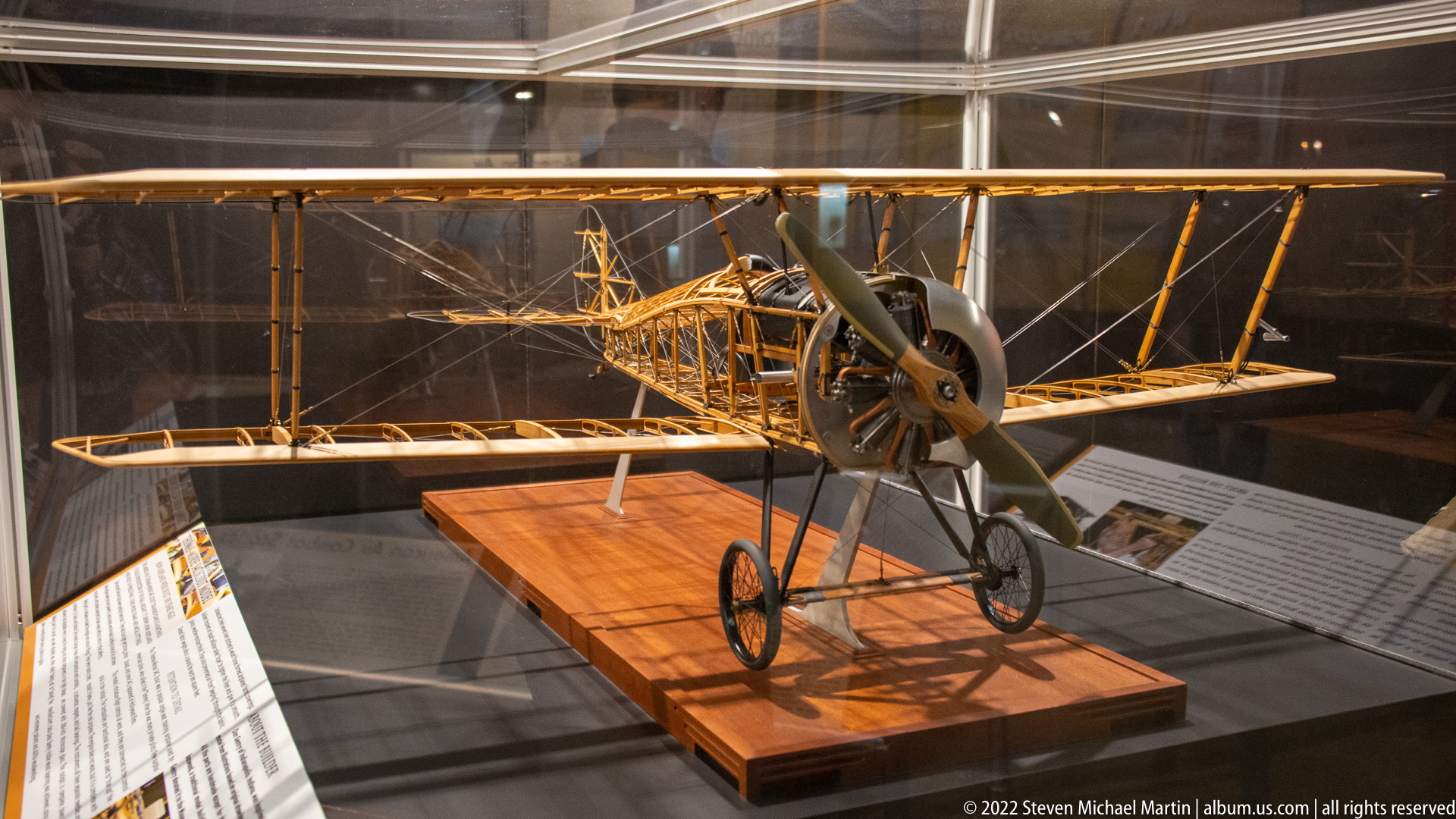
A small early biplane stands on a low wooden platform inside a clear-sided display case. Its stacked wings, fine wire bracing, narrow landing gear, and dark propeller are visible through reflections on the glass. Interpretive panels surround the aircraft at floor level, while the tight enclosure makes its delicate framework stand out against the larger machines elsewhere in the hangar.
Caption
A small early biplane stands on a low wooden platform inside a clear-sided display case. Its stacked wings, fine wire bracing, narrow landing gear, and dark propeller are visible through reflections on the glass. Interpretive panels surround the aircraft at floor level, while the tight enclosure makes its delicate framework stand out against the larger machines elsewhere in the hangar.
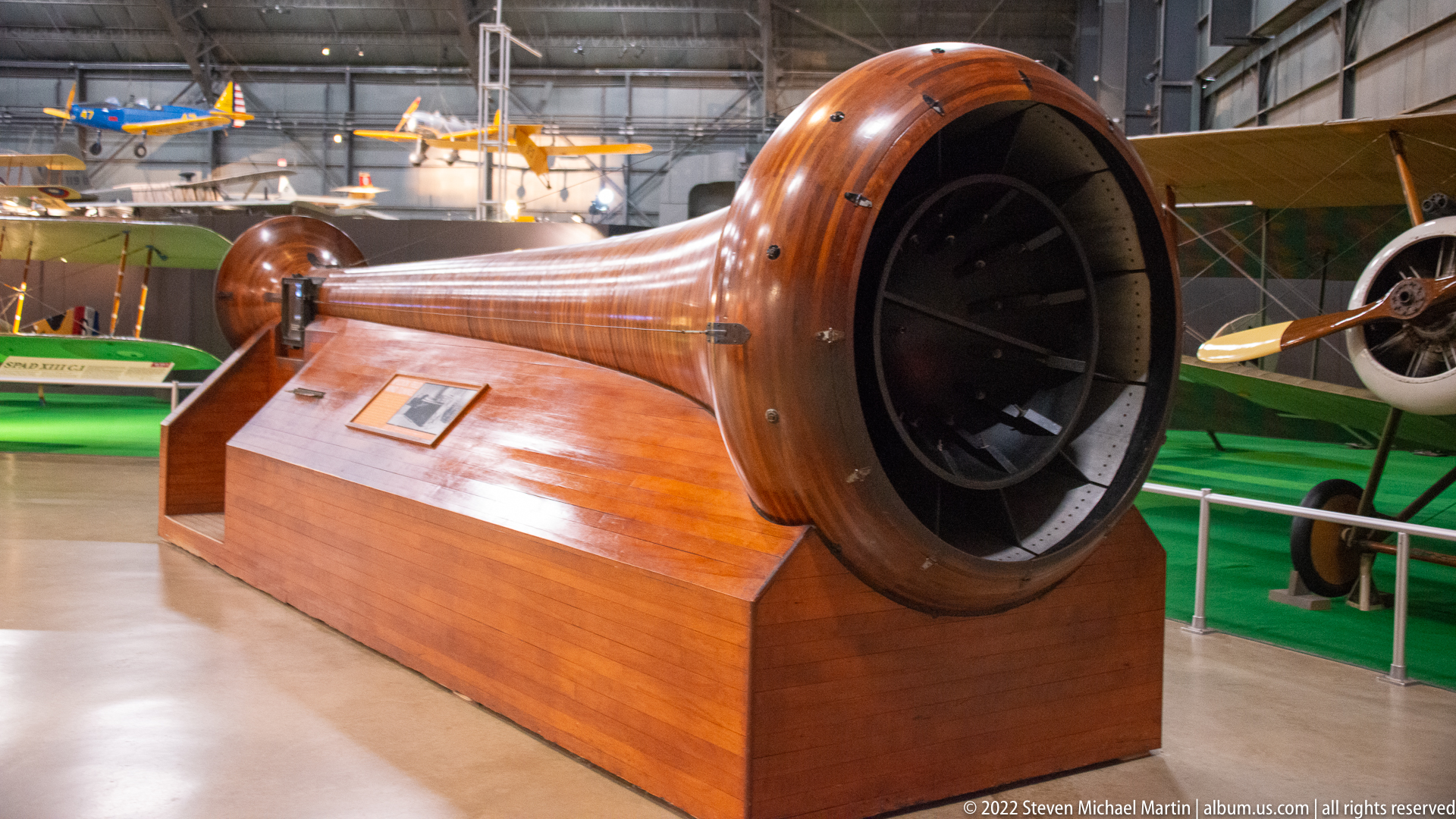
A massive polished wooden aircraft component rests on a stepped display base, its cylindrical body tapering toward a broad circular opening. The dark interior contains a ring of radial supports, while a smaller rounded section is visible at the far end. Nearby aircraft and green floor covering establish the hangar setting, but this close three-quarter view concentrates on the component’s unusual scale and carefully finished wood surface.
Caption
A massive polished wooden aircraft component rests on a stepped display base, its cylindrical body tapering toward a broad circular opening. The dark interior contains a ring of radial supports, while a smaller rounded section is visible at the far end. Nearby aircraft and green floor covering establish the hangar setting, but this close three-quarter view concentrates on the component’s unusual scale and carefully finished wood surface.
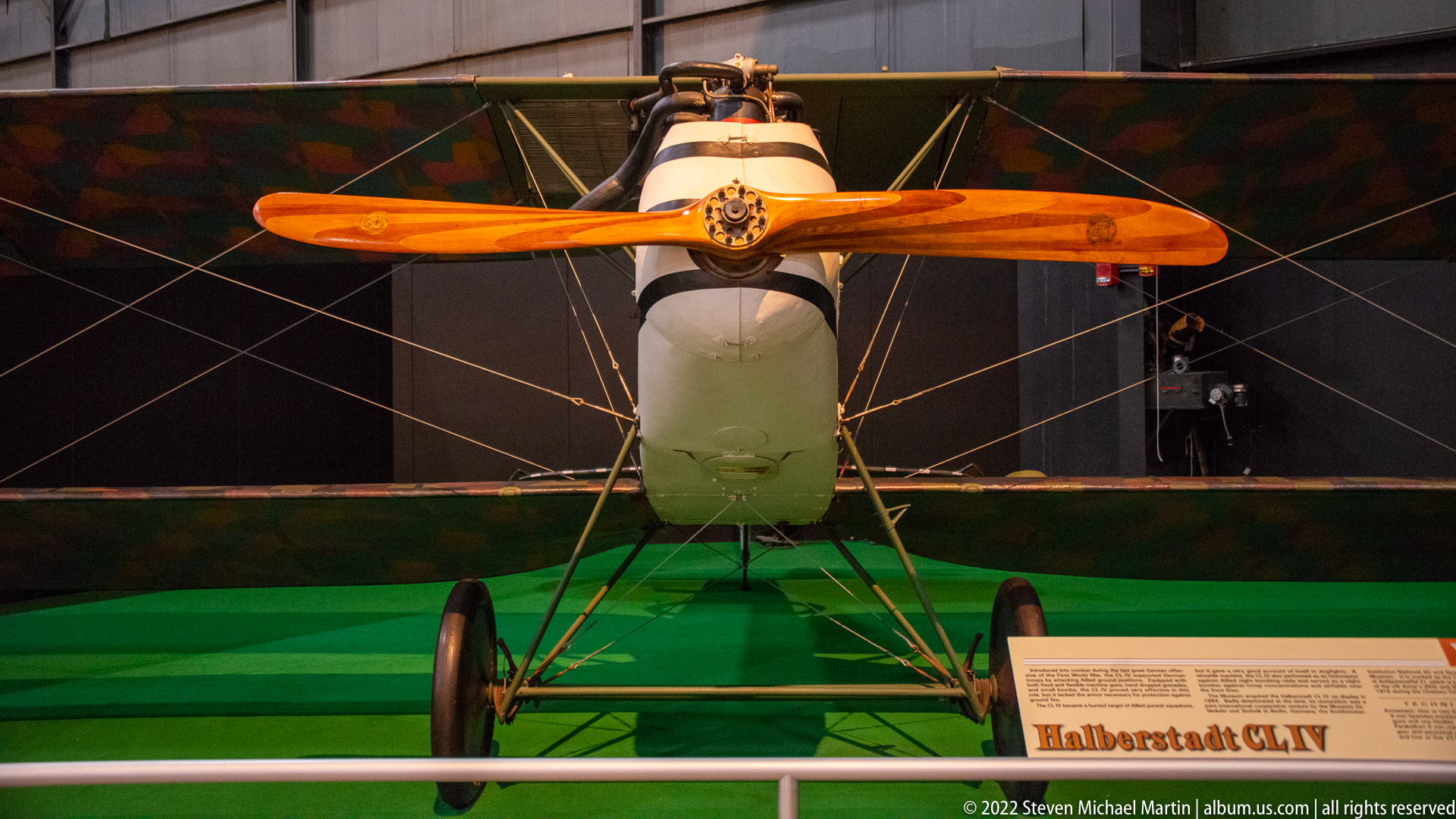
A Halberstadt CL.IV faces the viewer with its pale central fuselage framed by broad wings and a bright wooden propeller. Narrow landing gear and dark struts form a triangle beneath the nose, while the exhibit label at lower right identifies the aircraft. The frontal composition makes the propeller, cockpit line, and symmetrical wing structure legible against the dark gallery backdrop.
Caption
A Halberstadt CL.IV faces the viewer with its pale central fuselage framed by broad wings and a bright wooden propeller. Narrow landing gear and dark struts form a triangle beneath the nose, while the exhibit label at lower right identifies the aircraft. The frontal composition makes the propeller, cockpit line, and symmetrical wing structure legible against the dark gallery backdrop.
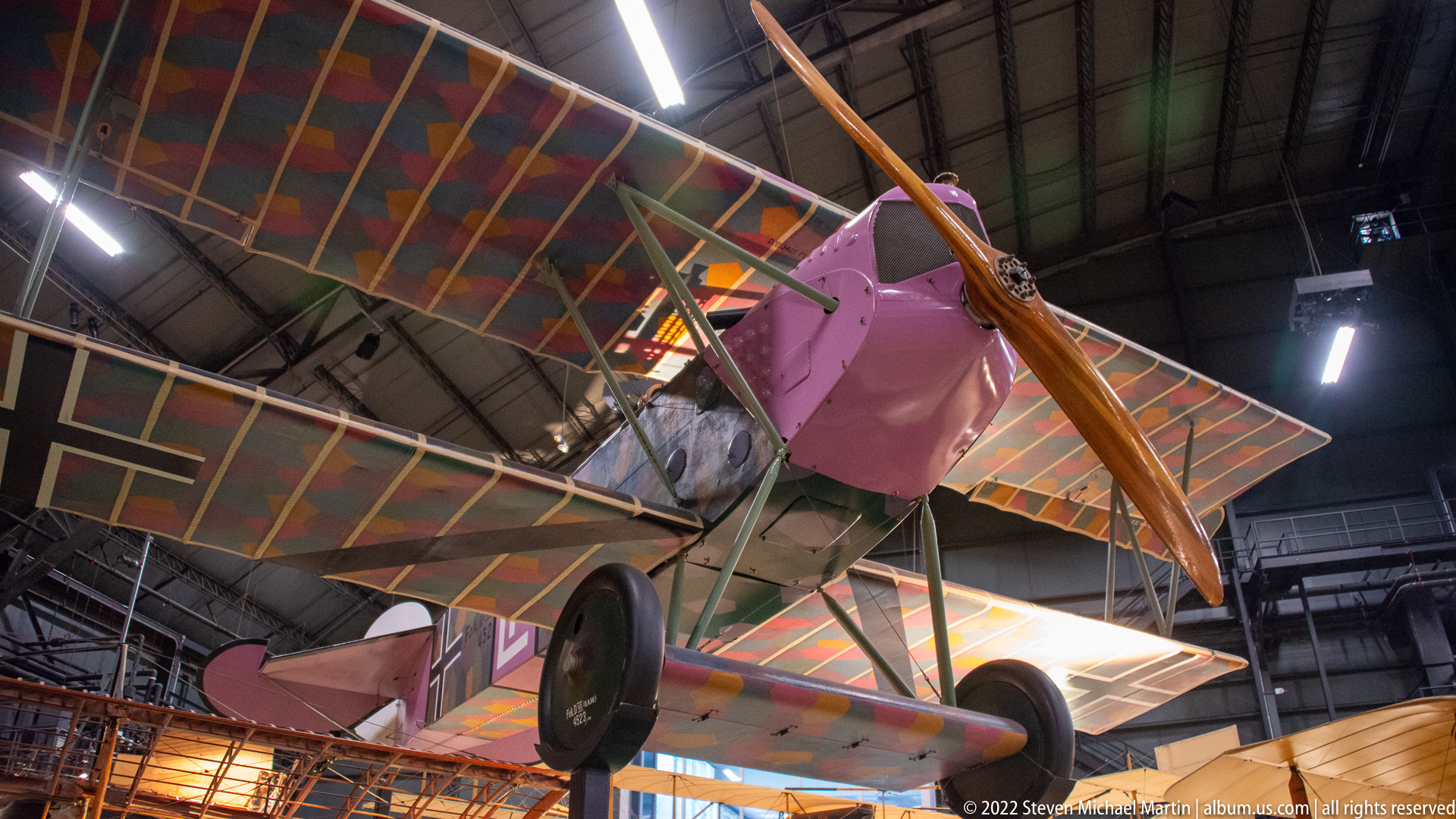
A brightly painted biplane hangs above the gallery floor, seen from a low angle that exposes its wheels, struts, and stacked wings. Pink fuselage panels contrast with patterned orange, green, and purple wing surfaces, while a wooden propeller crosses the upper foreground. The overhead view gives the small aircraft a sculptural presence and draws attention to the colorful surfaces beneath its wings.
Caption
A brightly painted biplane hangs above the gallery floor, seen from a low angle that exposes its wheels, struts, and stacked wings. Pink fuselage panels contrast with patterned orange, green, and purple wing surfaces, while a wooden propeller crosses the upper foreground. The overhead view gives the small aircraft a sculptural presence and draws attention to the colorful surfaces beneath its wings.
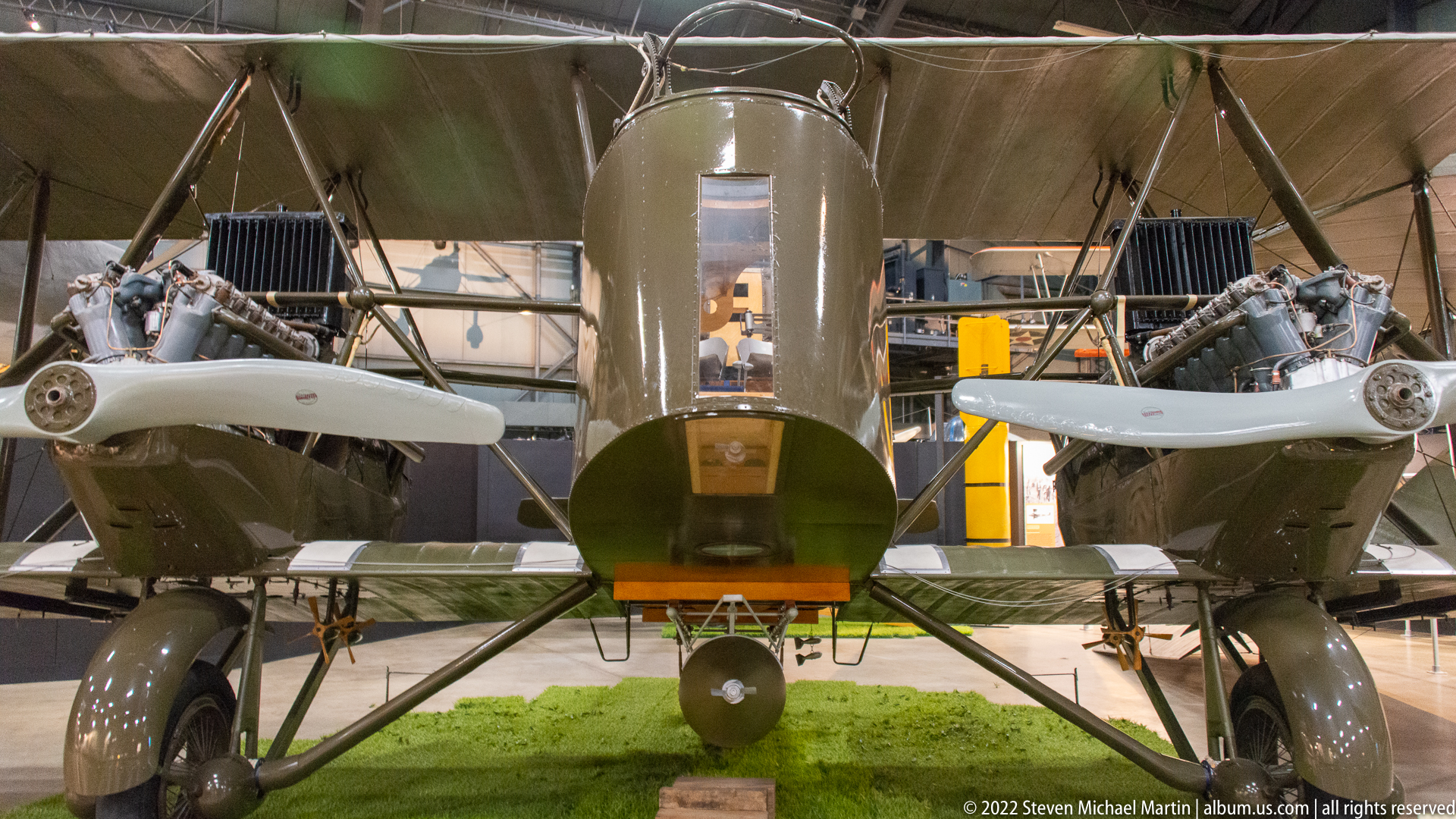
An olive-drab aircraft is seen directly from the front, with its central fuselage, cockpit glazing, and paired wings arranged symmetrically around the nose. Machine guns project forward on either side, and rounded wheel fairings frame the lower structure. The close alignment makes the armament and sturdy landing gear prominent while other aircraft and exhibit lighting recede into the hangar behind it.
Caption
An olive-drab aircraft is seen directly from the front, with its central fuselage, cockpit glazing, and paired wings arranged symmetrically around the nose. Machine guns project forward on either side, and rounded wheel fairings frame the lower structure. The close alignment makes the armament and sturdy landing gear prominent while other aircraft and exhibit lighting recede into the hangar behind it.

A blue-green aircraft with vivid yellow wings fills the frame at a three-quarter angle. Its radial engine, multi-blade propeller, rounded wheel fairings, and cockpit canopy remain visible despite the close crop. The contrasting paint and compact fuselage distinguish it from the more muted aircraft in the surrounding gallery, while the green floor and neighboring displays place it within the museum’s historic-aircraft collection.
Caption
A blue-green aircraft with vivid yellow wings fills the frame at a three-quarter angle. Its radial engine, multi-blade propeller, rounded wheel fairings, and cockpit canopy remain visible despite the close crop. The contrasting paint and compact fuselage distinguish it from the more muted aircraft in the surrounding gallery, while the green floor and neighboring displays place it within the museum’s historic-aircraft collection.
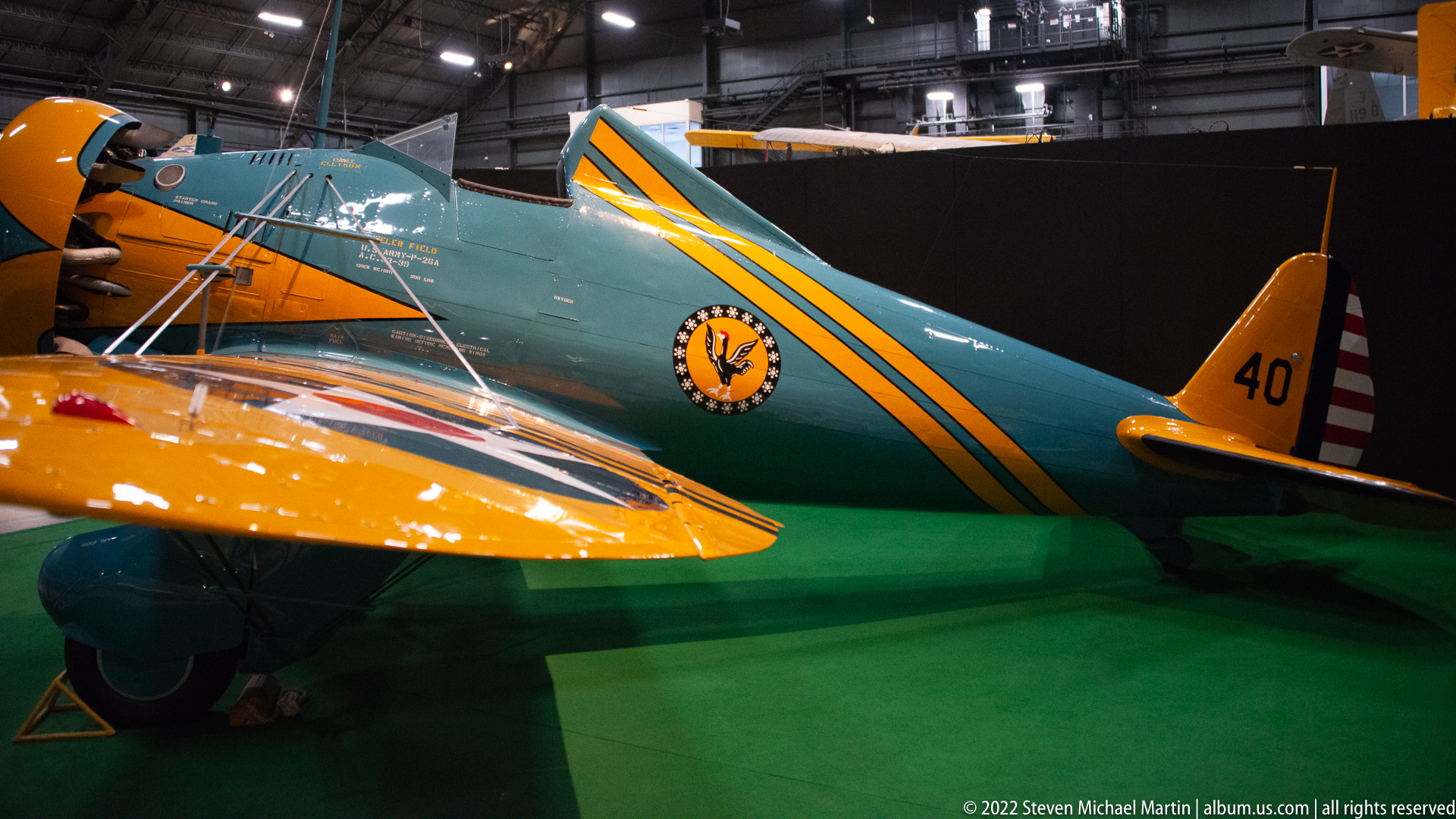
A turquoise aircraft fuselage runs diagonally across the display, marked by two yellow stripes and a circular unit insignia. The tail carries the number 40, while the yellow nose and wing of a neighboring aircraft overlap the foreground. This side view separates the airplane’s distinctive markings from the crowded gallery and shows how the museum positions related aircraft close together for comparison.
Caption
A turquoise aircraft fuselage runs diagonally across the display, marked by two yellow stripes and a circular unit insignia. The tail carries the number 40, while the yellow nose and wing of a neighboring aircraft overlap the foreground. This side view separates the airplane’s distinctive markings from the crowded gallery and shows how the museum positions related aircraft close together for comparison.

A yellow aircraft tail marked “40” rises above a turquoise fuselage striped in yellow. The close crop places the tail number and round insignia at the center, while a second aircraft’s wing with a U.S. star marking crosses behind it. The layered arrangement preserves the museum setting but prioritizes the identifying paint and insignia that distinguish this airplane from the adjacent exhibits.
Caption
A yellow aircraft tail marked “40” rises above a turquoise fuselage striped in yellow. The close crop places the tail number and round insignia at the center, while a second aircraft’s wing with a U.S. star marking crosses behind it. The layered arrangement preserves the museum setting but prioritizes the identifying paint and insignia that distinguish this airplane from the adjacent exhibits.
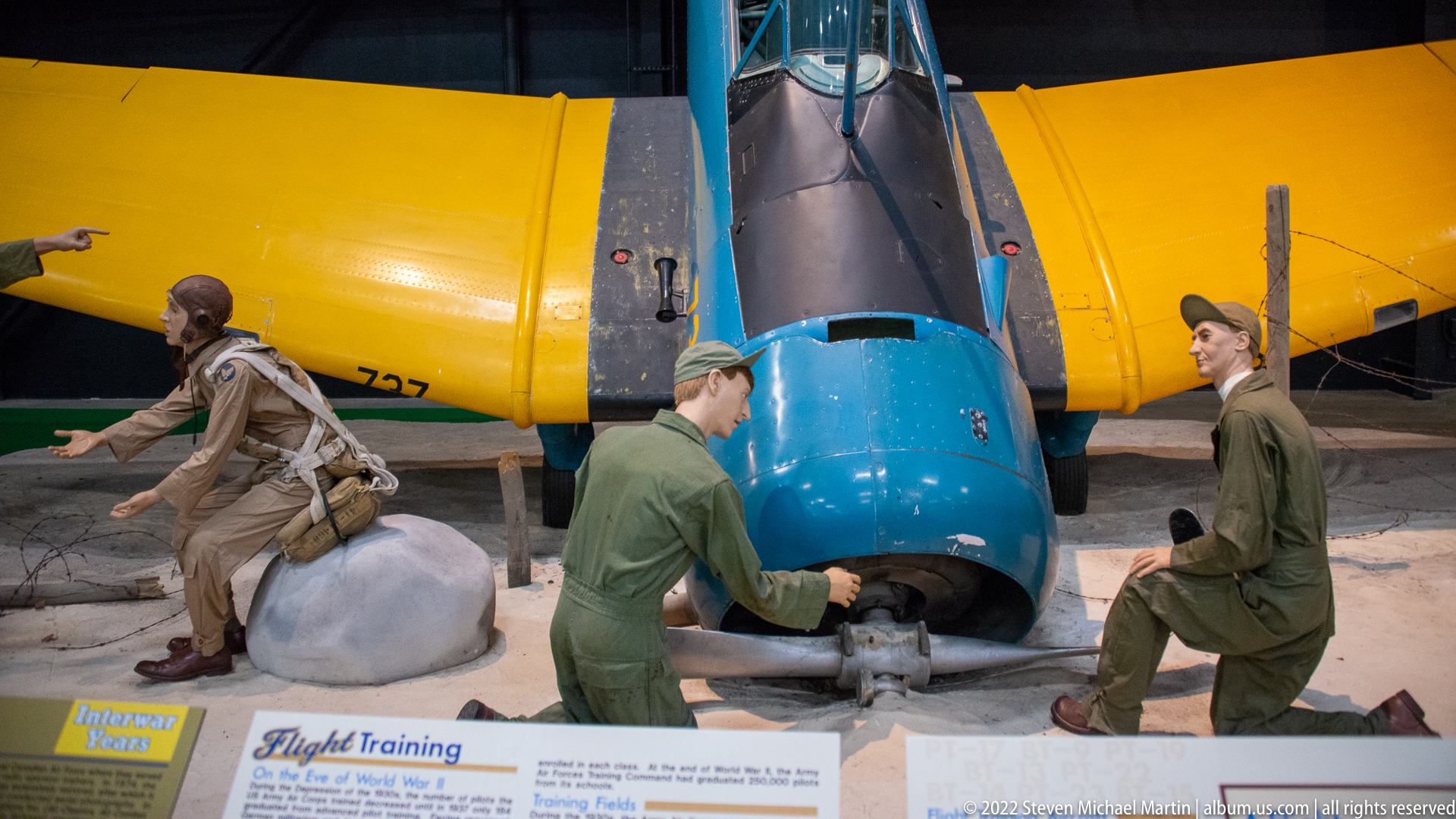
A museum scene pairs a yellow aircraft with life-size figures posed around its nose and landing gear. A seated figure at left, a standing crew member near the center, and another at right create a staged maintenance or training scene. Interpretive panels along the foreground include the heading “Flight Training,” linking the tableau to instruction and ground work rather than presenting the aircraft alone.
Caption
A museum scene pairs a yellow aircraft with life-size figures posed around its nose and landing gear. A seated figure at left, a standing crew member near the center, and another at right create a staged maintenance or training scene. Interpretive panels along the foreground include the heading “Flight Training,” linking the tableau to instruction and ground work rather than presenting the aircraft alone.
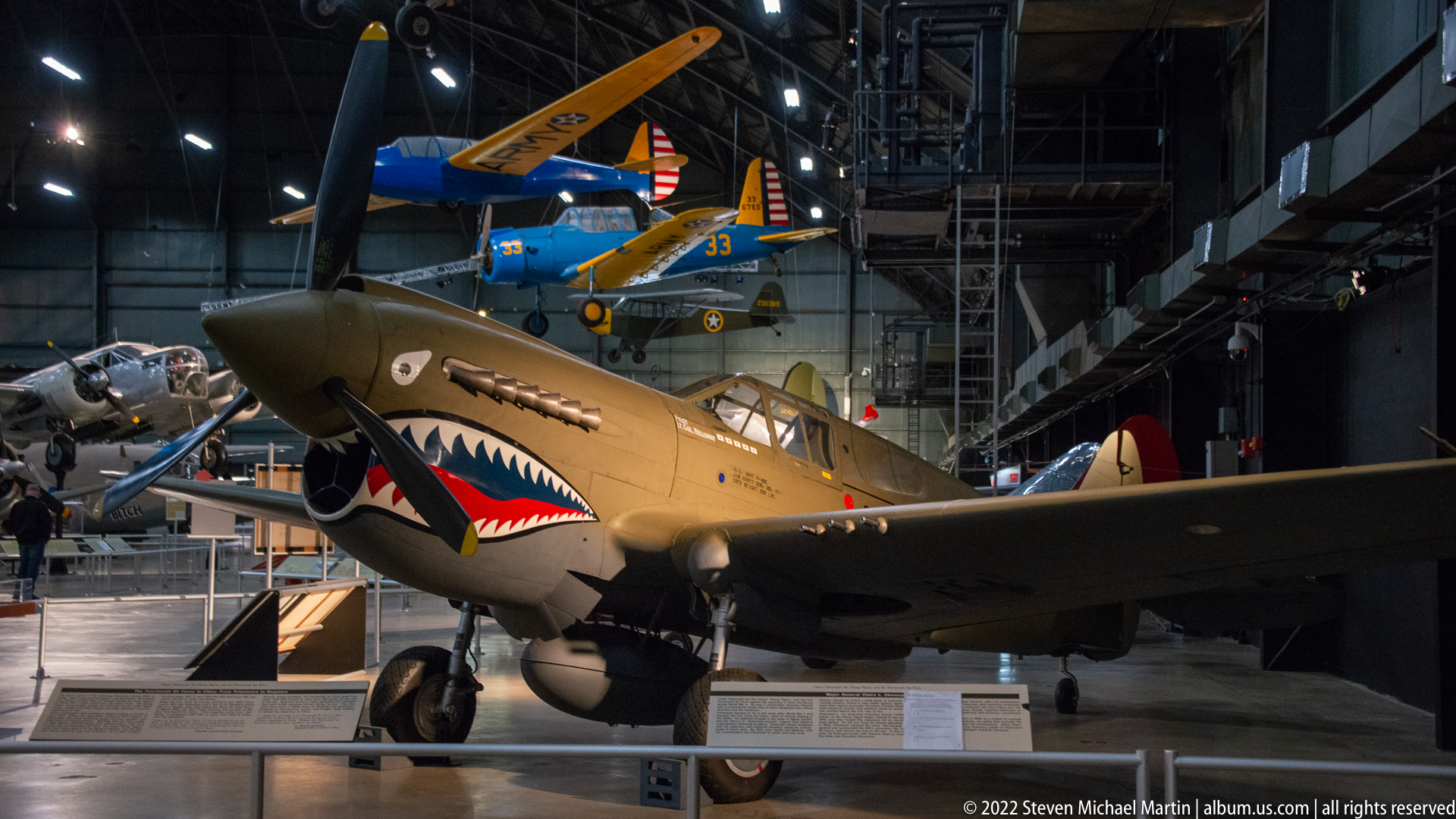
A tan fighter aircraft sits on the hangar floor with a large painted shark mouth curving around its nose. Its propeller, canopy, broad wings, and dark display panels remain visible in the surrounding space, while a blue aircraft hangs overhead. The three-quarter view makes the nose art the immediate focal point and places the fighter among other wartime aircraft in the museum’s crowded gallery.
Caption
A tan fighter aircraft sits on the hangar floor with a large painted shark mouth curving around its nose. Its propeller, canopy, broad wings, and dark display panels remain visible in the surrounding space, while a blue aircraft hangs overhead. The three-quarter view makes the nose art the immediate focal point and places the fighter among other wartime aircraft in the museum’s crowded gallery.

A close view of an olive-drab bomber fuselage shows a line of painted bomb symbols beneath a small stencil identifying the aircraft as a B-17F. The row of yellow marks includes several red stars, while riveted metal panels and a small window reveal the aircraft’s construction. The crop turns the mission tally into the subject, recording how wartime service was represented directly on the airframe.
Caption
A close view of an olive-drab bomber fuselage shows a line of painted bomb symbols beneath a small stencil identifying the aircraft as a B-17F. The row of yellow marks includes several red stars, while riveted metal panels and a small window reveal the aircraft’s construction. The crop turns the mission tally into the subject, recording how wartime service was represented directly on the airframe.

The rounded ball turret projects from the underside of a bomber, its clear panels and circular framing enclosing the gunner’s position. Twin gun barrels extend from the lower portion of the turret, while the aircraft’s riveted metal skin curves around it. Seen at close range, this view explains the turret’s compact shape and its integration into the aircraft’s belly without showing the full bomber.
Caption
The rounded ball turret projects from the underside of a bomber, its clear panels and circular framing enclosing the gunner’s position. Twin gun barrels extend from the lower portion of the turret, while the aircraft’s riveted metal skin curves around it. Seen at close range, this view explains the turret’s compact shape and its integration into the aircraft’s belly without showing the full bomber.

A close detail of a brown leather flight jacket centers on a round embroidered emblem depicting an airman and aircraft. Above it, a blue name patch reads “E. B. Barhey” beneath a winged insignia. The worn leather surface and colorful stitching fill the frame, shifting attention from the garment as a whole to the personal markings that make this piece of flight clothing individual.
Caption
A close detail of a brown leather flight jacket centers on a round embroidered emblem depicting an airman and aircraft. Above it, a blue name patch reads “E. B. Barhey” beneath a winged insignia. The worn leather surface and colorful stitching fill the frame, shifting attention from the garment as a whole to the personal markings that make this piece of flight clothing individual.
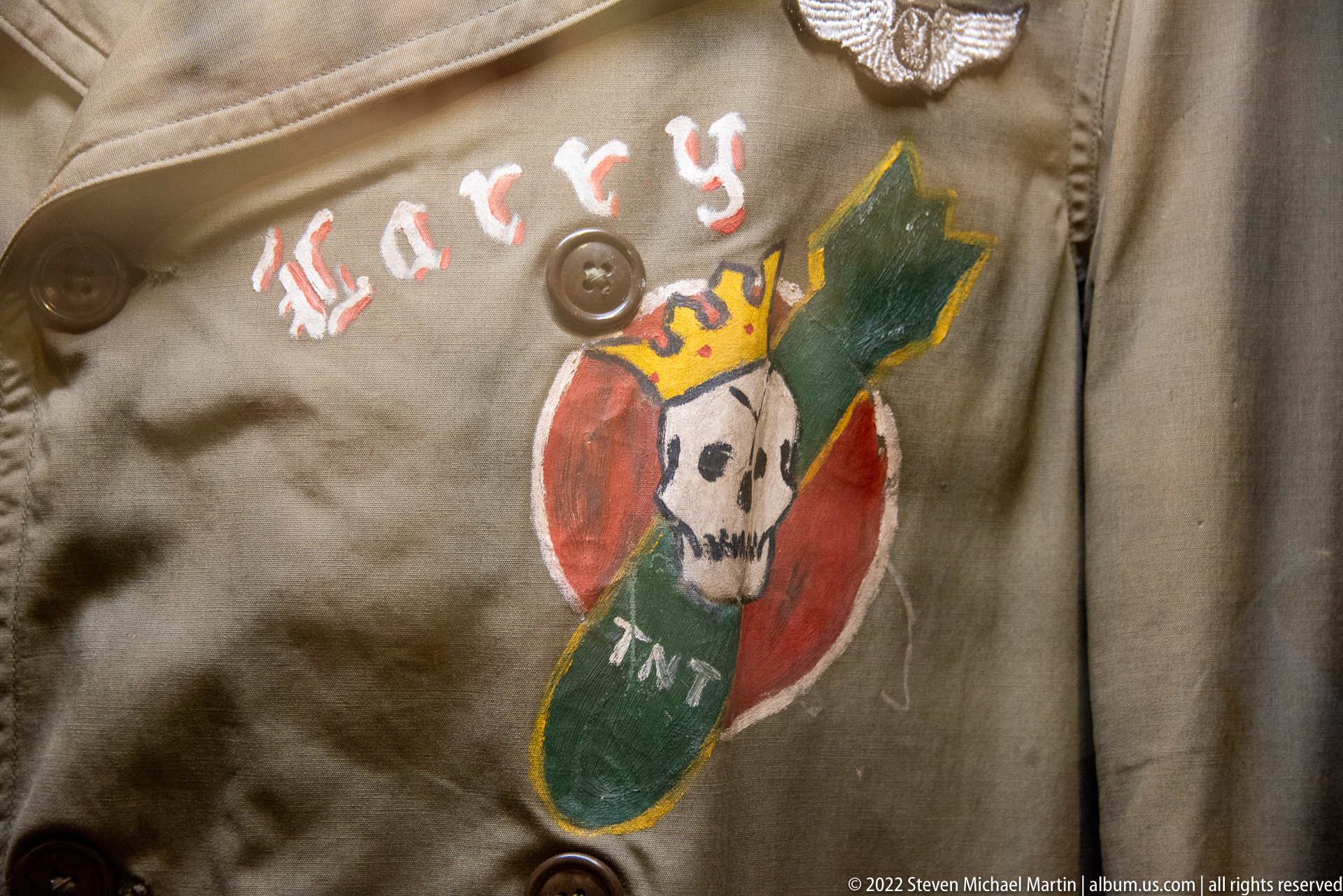
A close view of a khaki flight jacket reveals hand-painted lettering and a skull motif over red, green, and yellow shapes. The uneven brushwork follows the creases of the fabric, and a metal button sits just above the artwork. Framed tightly, the image records an individualized piece of aviation clothing, where the painted design—not the jacket’s overall cut or display—is the principal visual feature.
Caption
A close view of a khaki flight jacket reveals hand-painted lettering and a skull motif over red, green, and yellow shapes. The uneven brushwork follows the creases of the fabric, and a metal button sits just above the artwork. Framed tightly, the image records an individualized piece of aviation clothing, where the painted design—not the jacket’s overall cut or display—is the principal visual feature.
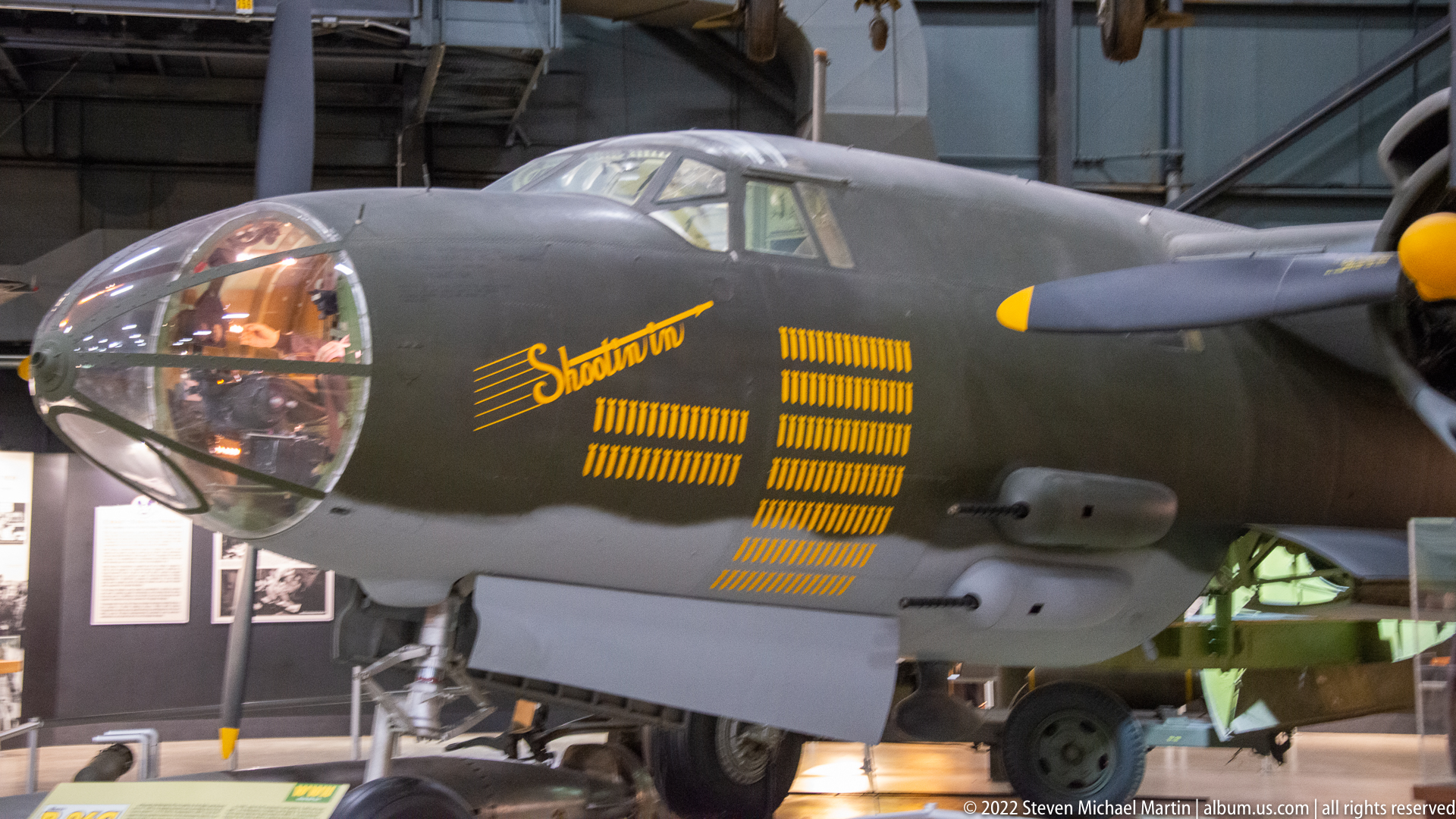
A dark bomber’s glazed nose projects toward the left, its rounded panels reflecting the gallery lights. The name “Shady Lady” is painted in yellow along the fuselage beside rows of mission marks, while the broad wing and engine nacelles extend behind it. This side view brings together the transparent nose compartment and the aircraft’s service markings, distinguishing the bomber from the polished silver aircraft nearby.
Caption
A dark bomber’s glazed nose projects toward the left, its rounded panels reflecting the gallery lights. The name “Shady Lady” is painted in yellow along the fuselage beside rows of mission marks, while the broad wing and engine nacelles extend behind it. This side view brings together the transparent nose compartment and the aircraft’s service markings, distinguishing the bomber from the polished silver aircraft nearby.
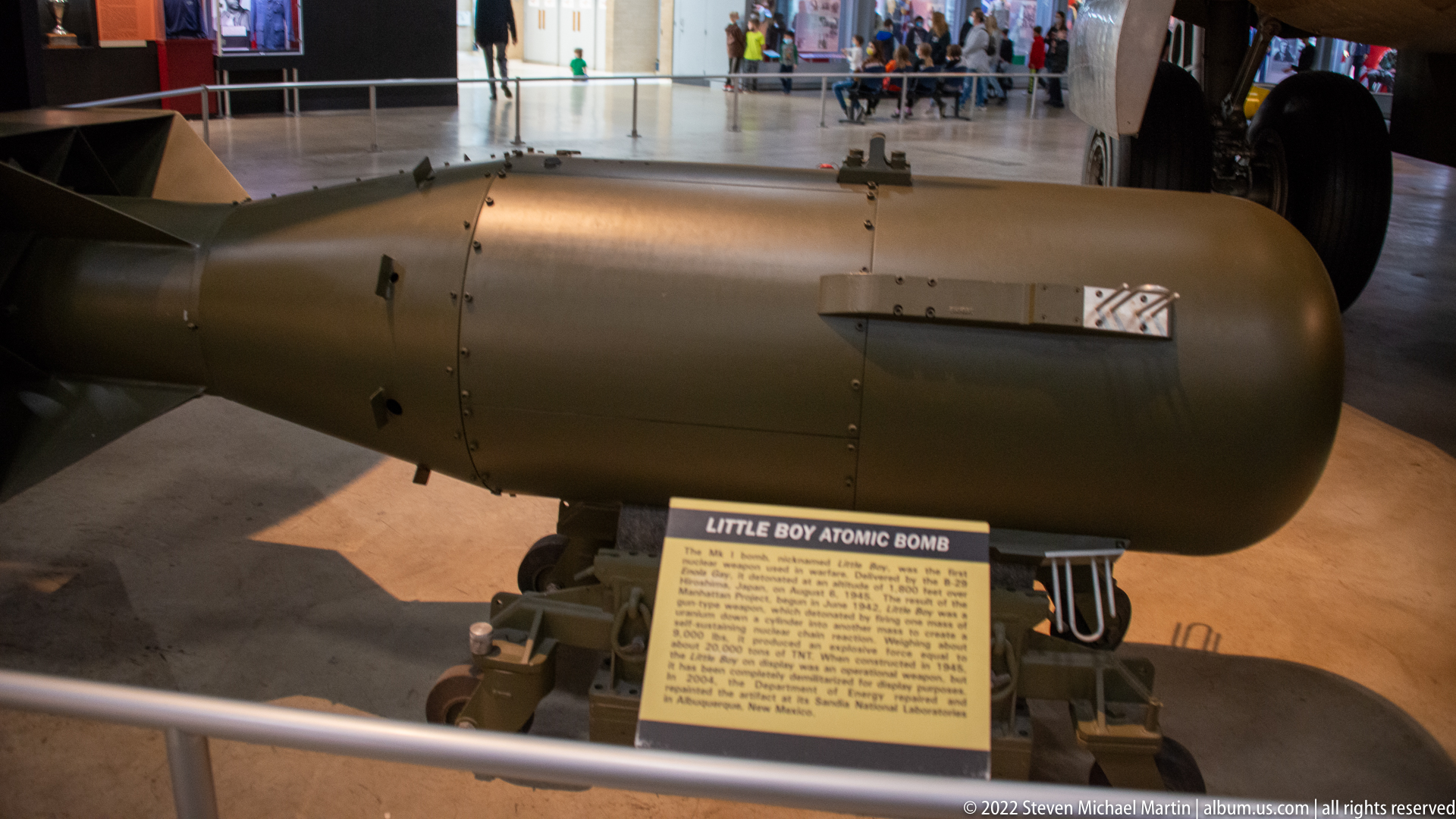
The olive-drab Little Boy atomic bomb rests horizontally behind a low barrier, its long cylindrical body and tapered tail section occupying the gallery floor. An interpretive panel in front identifies the weapon by name and provides historical text. Visitors and the wheel of a nearby aircraft appear in the background, emphasizing the bomb’s scale within the museum. The view records both the object and its explanatory display.
Caption
The olive-drab Little Boy atomic bomb rests horizontally behind a low barrier, its long cylindrical body and tapered tail section occupying the gallery floor. An interpretive panel in front identifies the weapon by name and provides historical text. Visitors and the wheel of a nearby aircraft appear in the background, emphasizing the bomb’s scale within the museum. The view records both the object and its explanatory display.

A pale skull wearing dark goggles is painted above crossed bones on the curved surface of a bomber fuselage. The artwork is framed tightly enough to show brush edges, panel seams, and rivets in the surrounding metal skin. Without the full aircraft in view, the composition concentrates on the graphic nose art and the way a personalized emblem occupies the machine’s exterior.
Caption
A pale skull wearing dark goggles is painted above crossed bones on the curved surface of a bomber fuselage. The artwork is framed tightly enough to show brush edges, panel seams, and rivets in the surrounding metal skin. Without the full aircraft in view, the composition concentrates on the graphic nose art and the way a personalized emblem occupies the machine’s exterior.

A yellow exhibit panel headed “FAT MAN ATOMIC BOMB” fills the frame with explanatory text and a sequence of historic photographs. Images of the bomb, aircraft, and a distant explosion are arranged in columns beside the writing. The close crop turns the interpretive material into the subject, showing how the museum presents the weapon’s construction and historical context through text and archival imagery.
Caption
A yellow exhibit panel headed “FAT MAN ATOMIC BOMB” fills the frame with explanatory text and a sequence of historic photographs. Images of the bomb, aircraft, and a distant explosion are arranged in columns beside the writing. The close crop turns the interpretive material into the subject, showing how the museum presents the weapon’s construction and historical context through text and archival imagery.
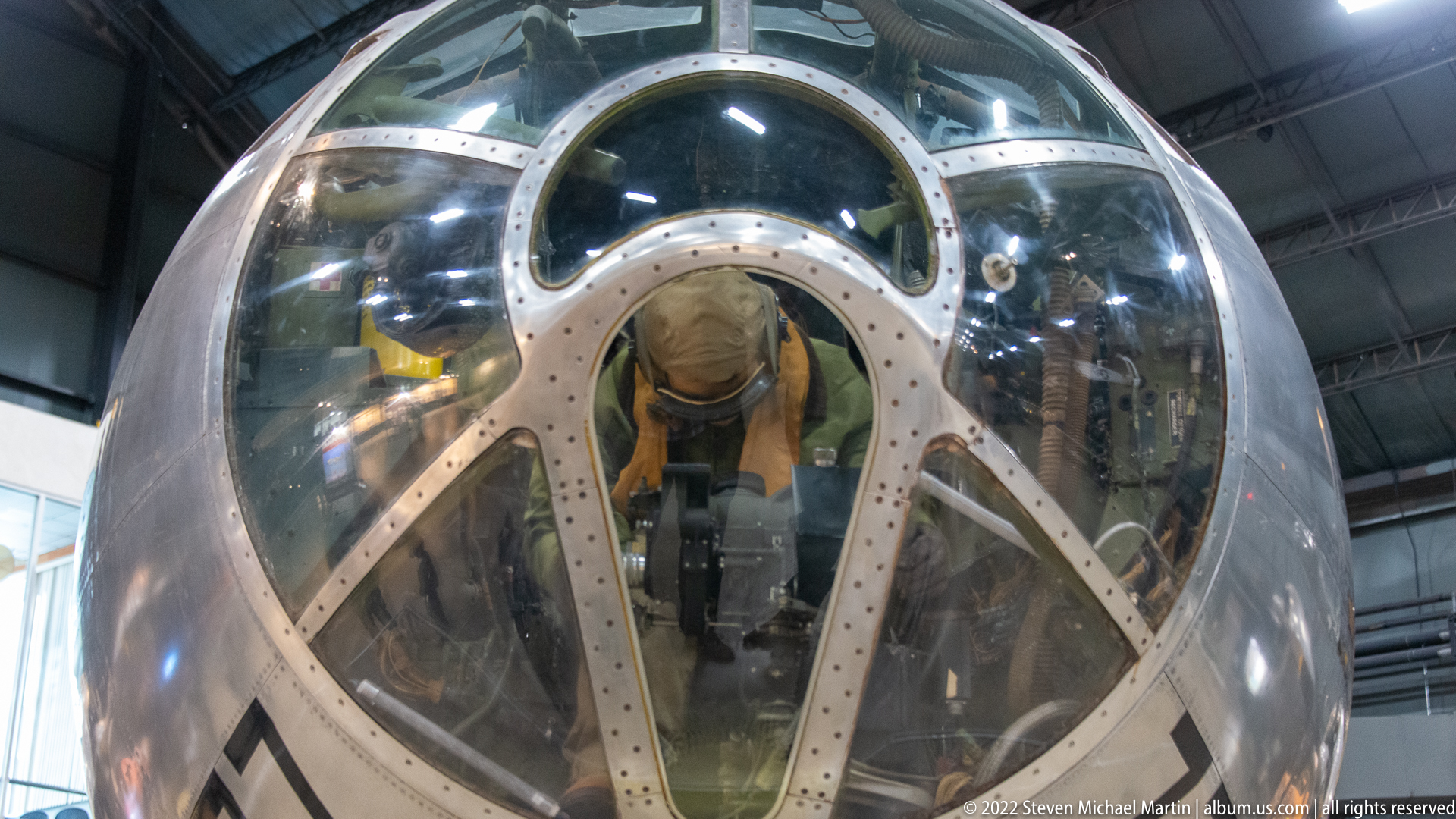
The transparent nose of a B-17 reveals a mannequin positioned inside the cramped forward compartment. Curved glazing, metal ribs, and circular framing surround the figure, while bright reflections from the museum lights spread across the clear panels. The nearly head-on view exposes the aircraft’s enclosed nose more directly than a side profile and shows how the front station occupies the tapered end of the bomber.
Caption
The transparent nose of a B-17 reveals a mannequin positioned inside the cramped forward compartment. Curved glazing, metal ribs, and circular framing surround the figure, while bright reflections from the museum lights spread across the clear panels. The nearly head-on view exposes the aircraft’s enclosed nose more directly than a side profile and shows how the front station occupies the tapered end of the bomber.
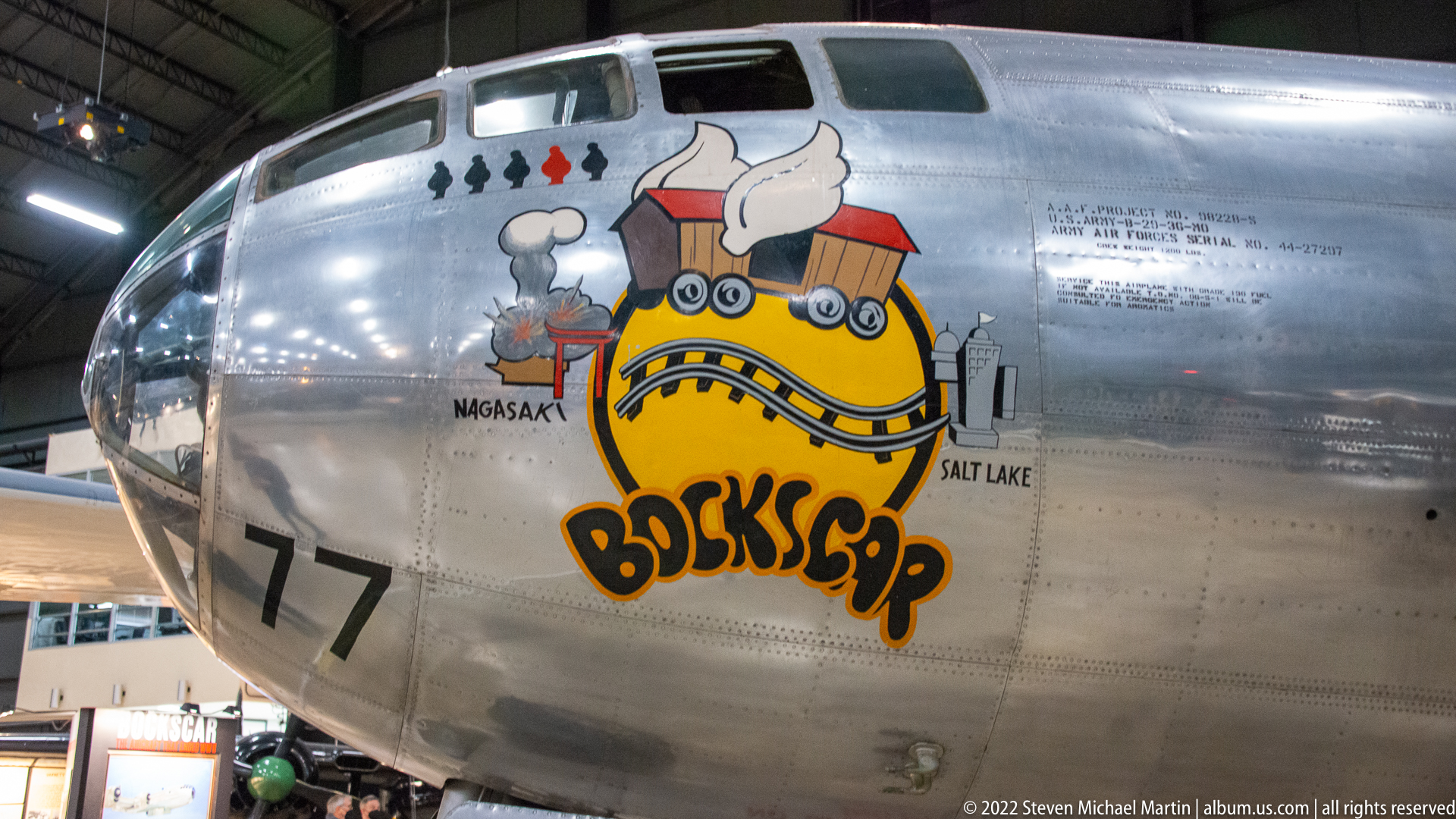
The polished silver nose of the Bockscar B-29 carries a large cartoon train emblem and the aircraft name painted below it. Smaller place names, including Nagasaki and Salt Lake, appear along the fuselage, while the cockpit windows line the upper edge. The close side view presents the bomber’s distinctive nose art and mission-associated markings against the reflective aluminum skin.
Caption
The polished silver nose of the Bockscar B-29 carries a large cartoon train emblem and the aircraft name painted below it. Smaller place names, including Nagasaki and Salt Lake, appear along the fuselage, while the cockpit windows line the upper edge. The close side view presents the bomber’s distinctive nose art and mission-associated markings against the reflective aluminum skin.

A large silver aircraft bearing a U.S. star insignia fills the upper background, while a smaller olive aircraft with a red roundel and the number 3105 sits in front. The overlapping airframes create a layered gallery view of aircraft from opposing sides of the Pacific conflict. A third aircraft and a display case appear nearby, placing the two machines in a broader museum arrangement.
Caption
A large silver aircraft bearing a U.S. star insignia fills the upper background, while a smaller olive aircraft with a red roundel and the number 3105 sits in front. The overlapping airframes create a layered gallery view of aircraft from opposing sides of the Pacific conflict. A third aircraft and a display case appear nearby, placing the two machines in a broader museum arrangement.
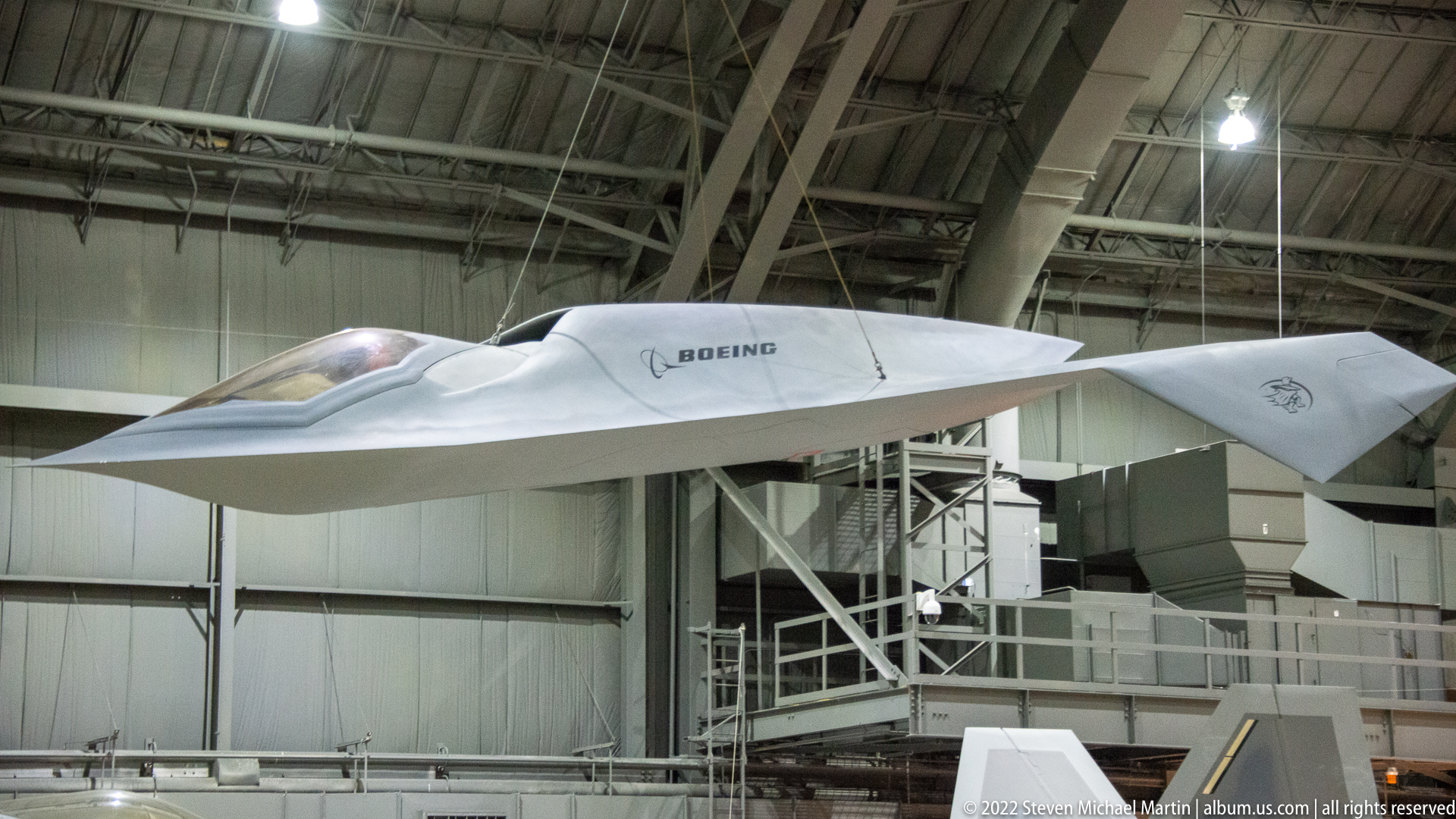
A streamlined white aircraft with a sharply tapered nose and broad swept surfaces rests on a raised display structure beneath the museum’s steel roof. The word “BOEING” is visible on the forward fuselage, while a second white surface extends behind it. Its unusual proportions and clean finish distinguish it from the propeller-driven aircraft around the gallery. The photograph records the prototype’s profile without assigning a model name not visible here.
Caption
A streamlined white aircraft with a sharply tapered nose and broad swept surfaces rests on a raised display structure beneath the museum’s steel roof. The word “BOEING” is visible on the forward fuselage, while a second white surface extends behind it. Its unusual proportions and clean finish distinguish it from the propeller-driven aircraft around the gallery. The photograph records the prototype’s profile without assigning a model name not visible here.
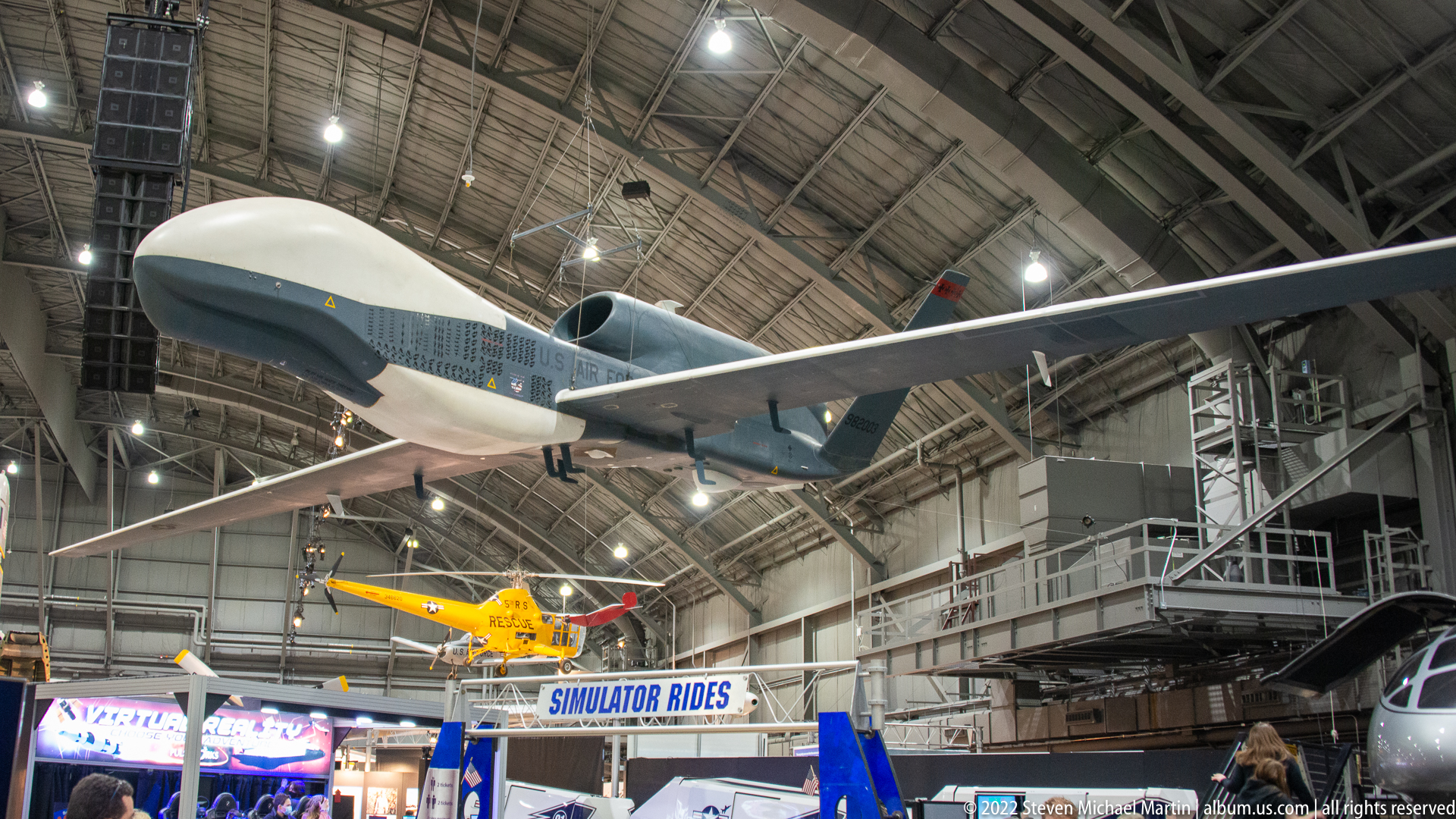
A large high-wing military transport aircraft hangs above the museum floor, its broad wings stretching across the steel-trussed gallery. A smaller yellow aircraft and visitor exhibits sit below, giving a sense of the transport’s scale. The proof-sheet view does not show a readable aircraft designation, so the caption stays with the clearly visible type and setting.
Caption
A large high-wing military transport aircraft hangs above the museum floor, its broad wings stretching across the steel-trussed gallery. A smaller yellow aircraft and visitor exhibits sit below, giving a sense of the transport’s scale. The proof-sheet view does not show a readable aircraft designation, so the caption stays with the clearly visible type and setting.
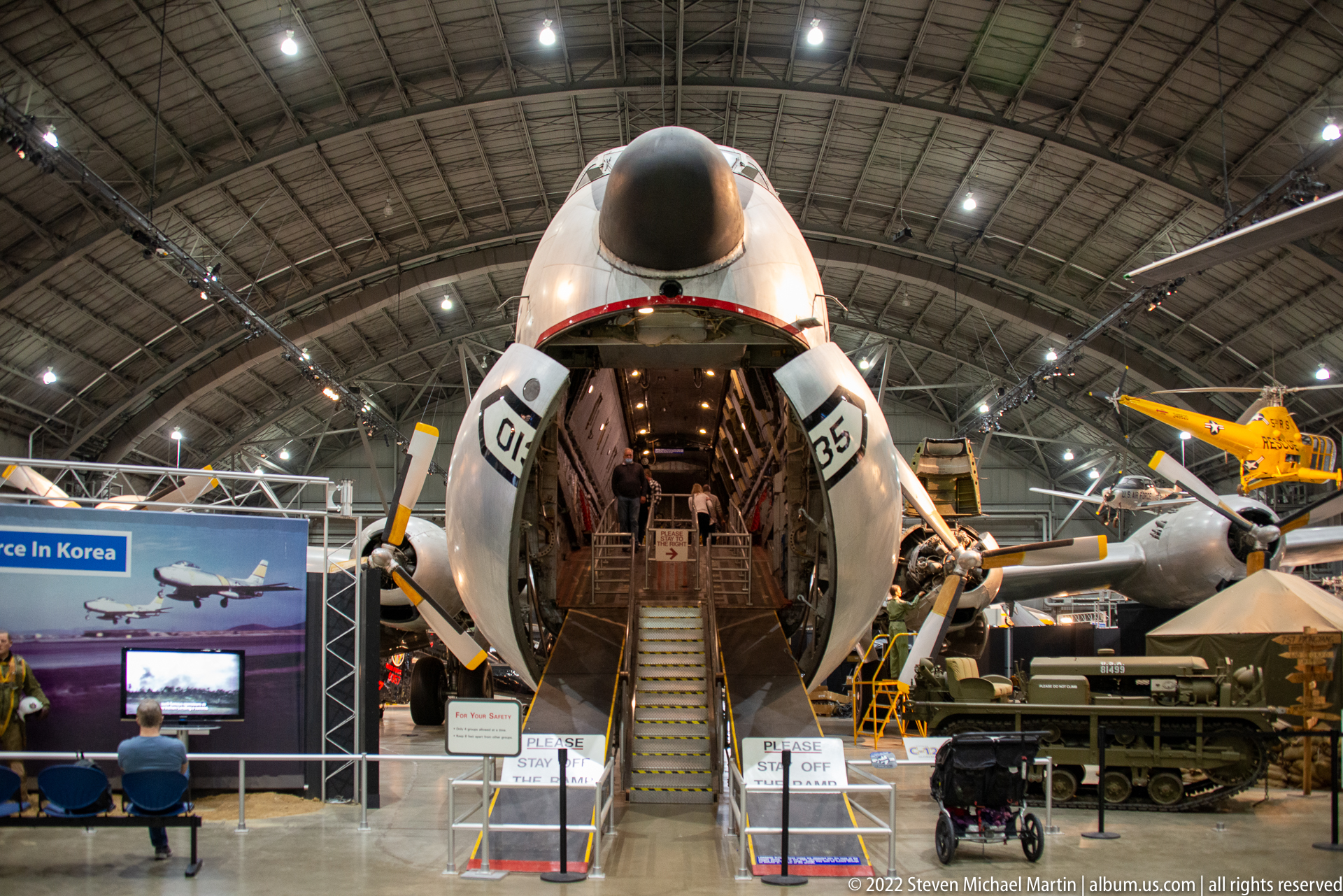
The aircraft’s raised nose exposes a long cargo compartment, with a stairway leading from the hangar floor into the open fuselage. Ground barriers and interpretive displays frame the access point, while other aircraft fill the surrounding gallery. The view makes the loading configuration and the transport aircraft’s internal volume the defining features.
Caption
The aircraft’s raised nose exposes a long cargo compartment, with a stairway leading from the hangar floor into the open fuselage. Ground barriers and interpretive displays frame the access point, while other aircraft fill the surrounding gallery. The view makes the loading configuration and the transport aircraft’s internal volume the defining features.
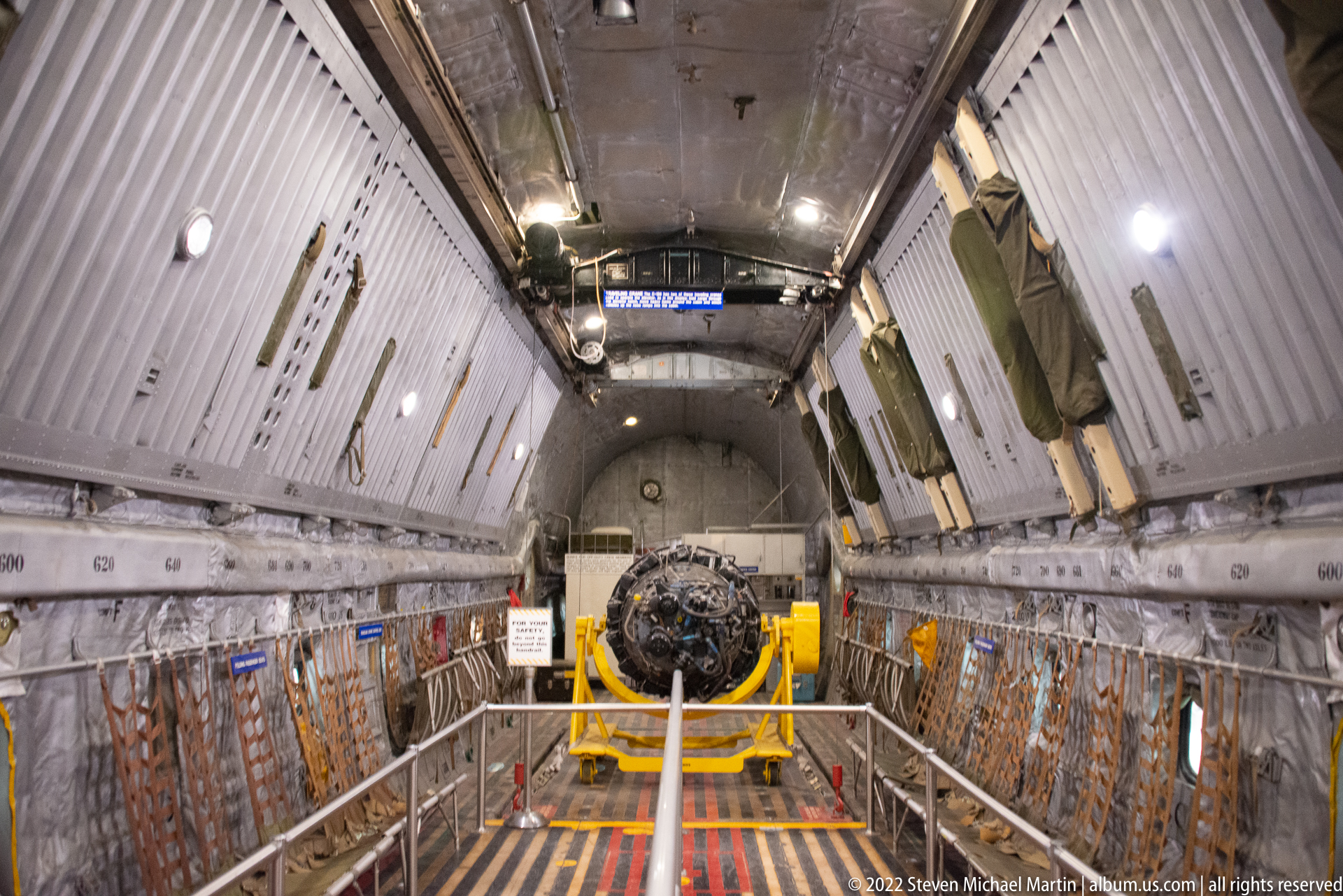
Looking down the length of a cargo compartment, ribbed metal walls and ceiling form a narrow tunnel around a centrally displayed engine or mechanical assembly. Rails and safety barriers guide visitors toward it, while a sign hangs at the far end. The exposed structure makes this view about the aircraft’s interior construction as much as the equipment on display.
Caption
Looking down the length of a cargo compartment, ribbed metal walls and ceiling form a narrow tunnel around a centrally displayed engine or mechanical assembly. Rails and safety barriers guide visitors toward it, while a sign hangs at the far end. The exposed structure makes this view about the aircraft’s interior construction as much as the equipment on display.
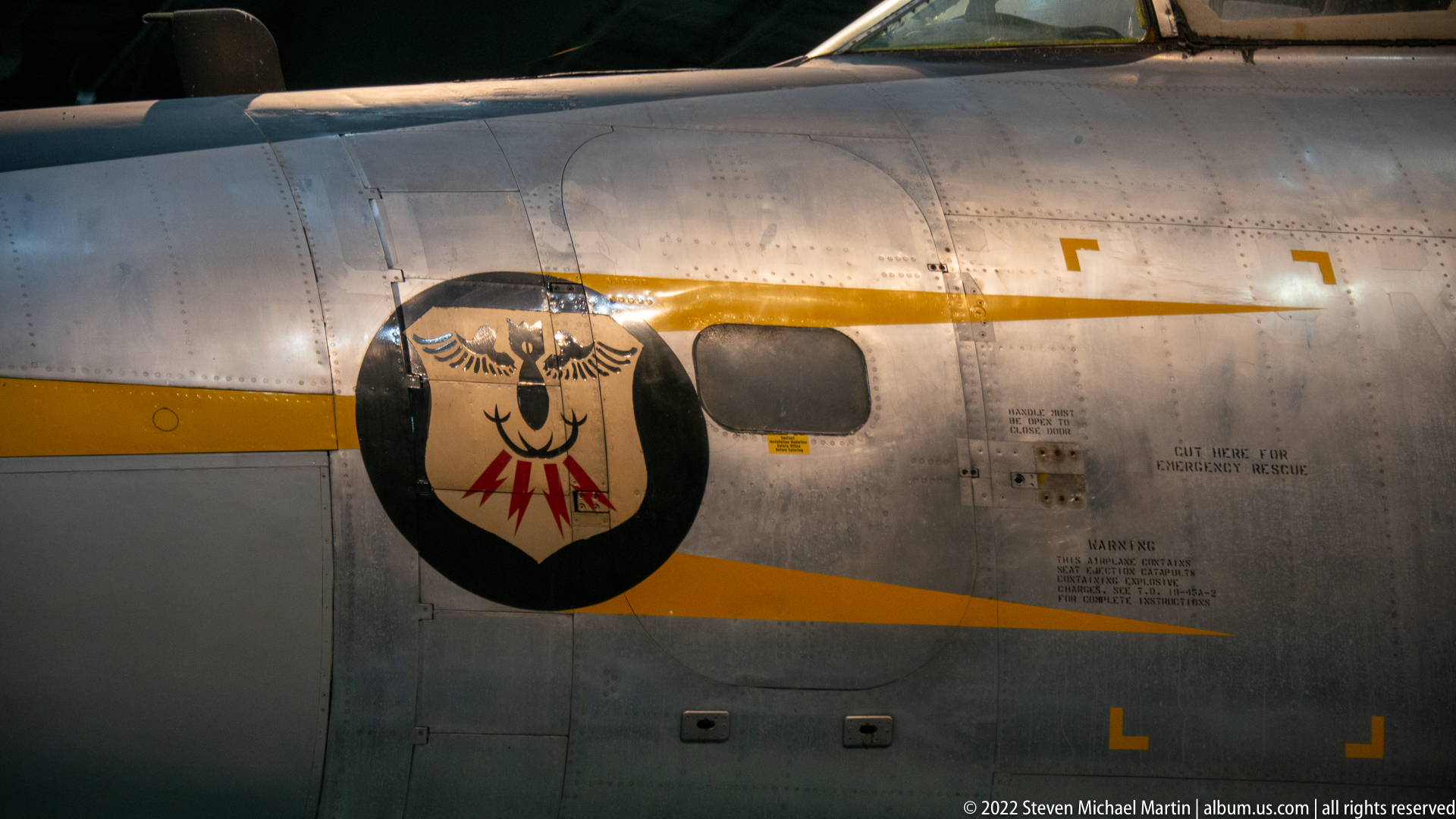
A black shield insignia interrupts the yellow stripe running along this polished silver fuselage. Windows, rivet lines, and small stenciled markings remain visible around the emblem, though the lettering is too small to establish the aircraft’s identity. The close crop records the aircraft’s surface and unit marking rather than its overall form.
Caption
A black shield insignia interrupts the yellow stripe running along this polished silver fuselage. Windows, rivet lines, and small stenciled markings remain visible around the emblem, though the lettering is too small to establish the aircraft’s identity. The close crop records the aircraft’s surface and unit marking rather than its overall form.
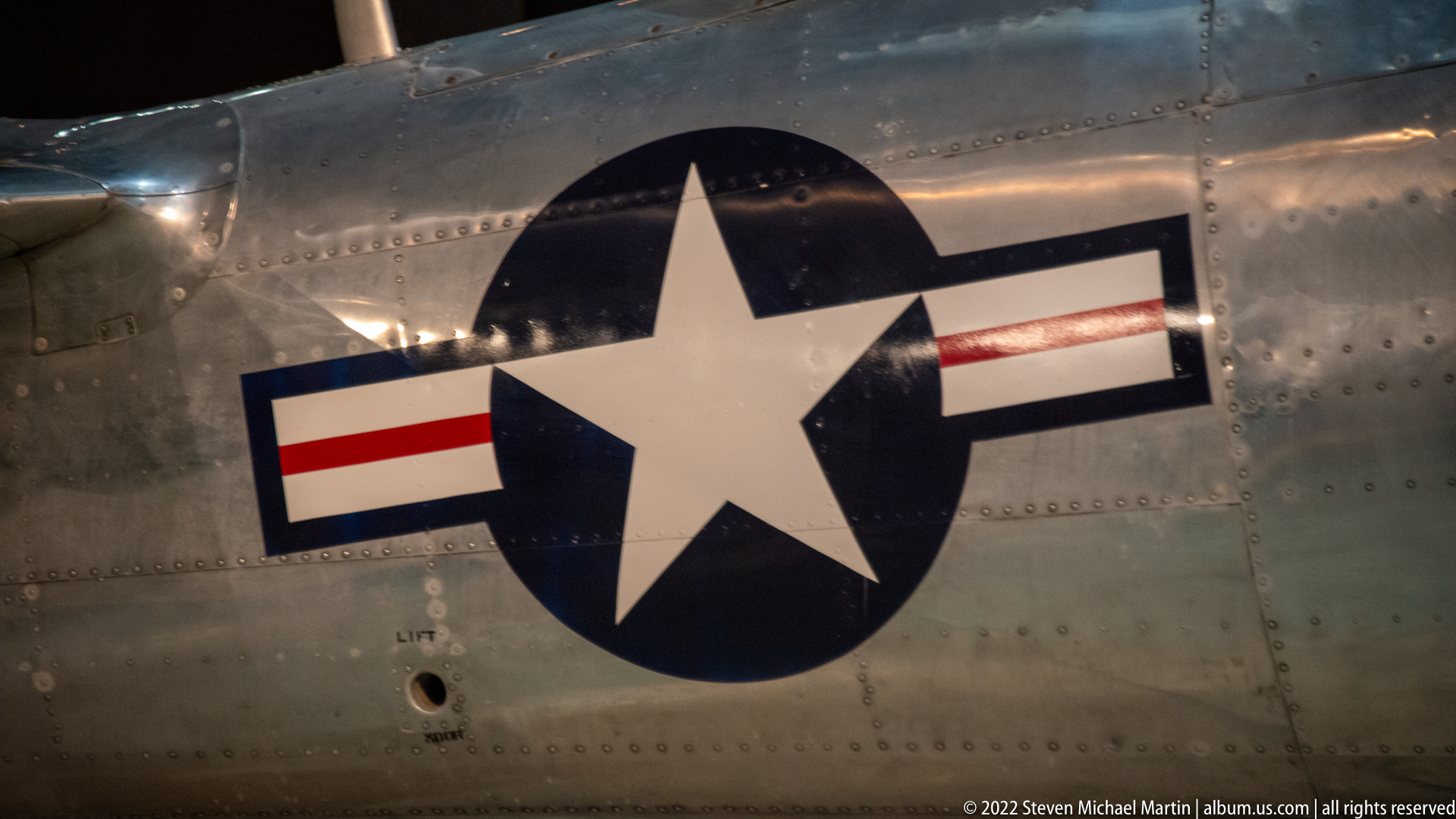
A white five-pointed star sits within a dark blue roundel, crossed by red-and-white bars on a weathered metal aircraft surface. Rows of rivets and subtle discoloration remain visible around the painted insignia. The tight crop isolates a familiar U.S. military marking and the metal skin that carries it, without showing enough of the aircraft to identify a model.
Caption
A white five-pointed star sits within a dark blue roundel, crossed by red-and-white bars on a weathered metal aircraft surface. Rows of rivets and subtle discoloration remain visible around the painted insignia. The tight crop isolates a familiar U.S. military marking and the metal skin that carries it, without showing enough of the aircraft to identify a model.

A broad hangar view places visitors among aircraft arranged across the polished exhibition floor. A transport aircraft anchors the center distance, while a large wing enters from the upper right and smaller planes and interpretive displays line the hall. The high steel roof and repeated lights make the gallery’s scale part of the scene.
Caption
A broad hangar view places visitors among aircraft arranged across the polished exhibition floor. A transport aircraft anchors the center distance, while a large wing enters from the upper right and smaller planes and interpretive displays line the hall. The high steel roof and repeated lights make the gallery’s scale part of the scene.
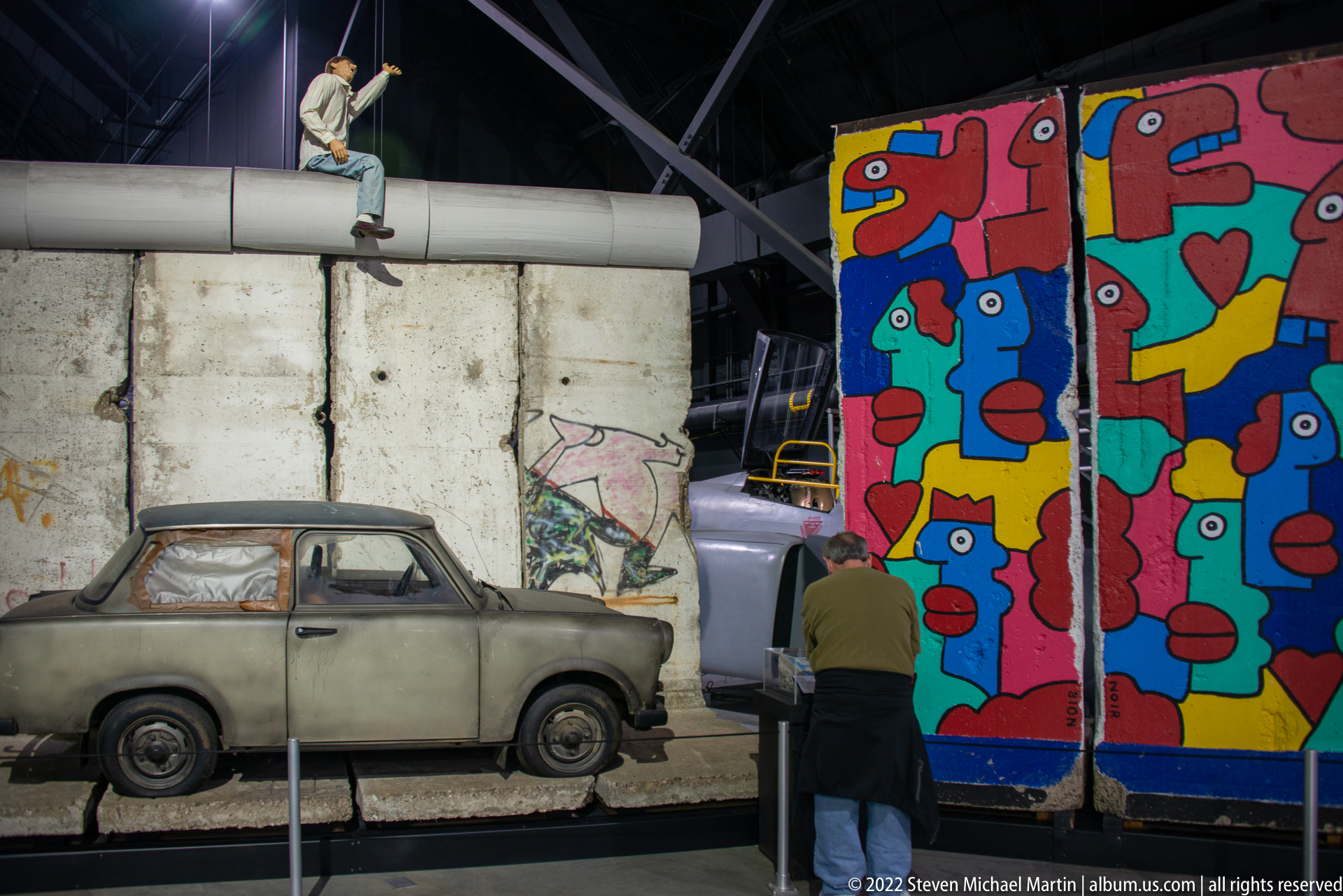
A compact, boxy automobile sits before a concrete wall marked with graffiti, next to brightly painted panels covered in stylized faces and symbols. A visitor leans toward the display, linking the car and mural within a broader historical exhibit. The proof sheet supports a Cold War-era European car setting, but does not show a readable model name.
Caption
A compact, boxy automobile sits before a concrete wall marked with graffiti, next to brightly painted panels covered in stylized faces and symbols. A visitor leans toward the display, linking the car and mural within a broader historical exhibit. The proof sheet supports a Cold War-era European car setting, but does not show a readable model name.
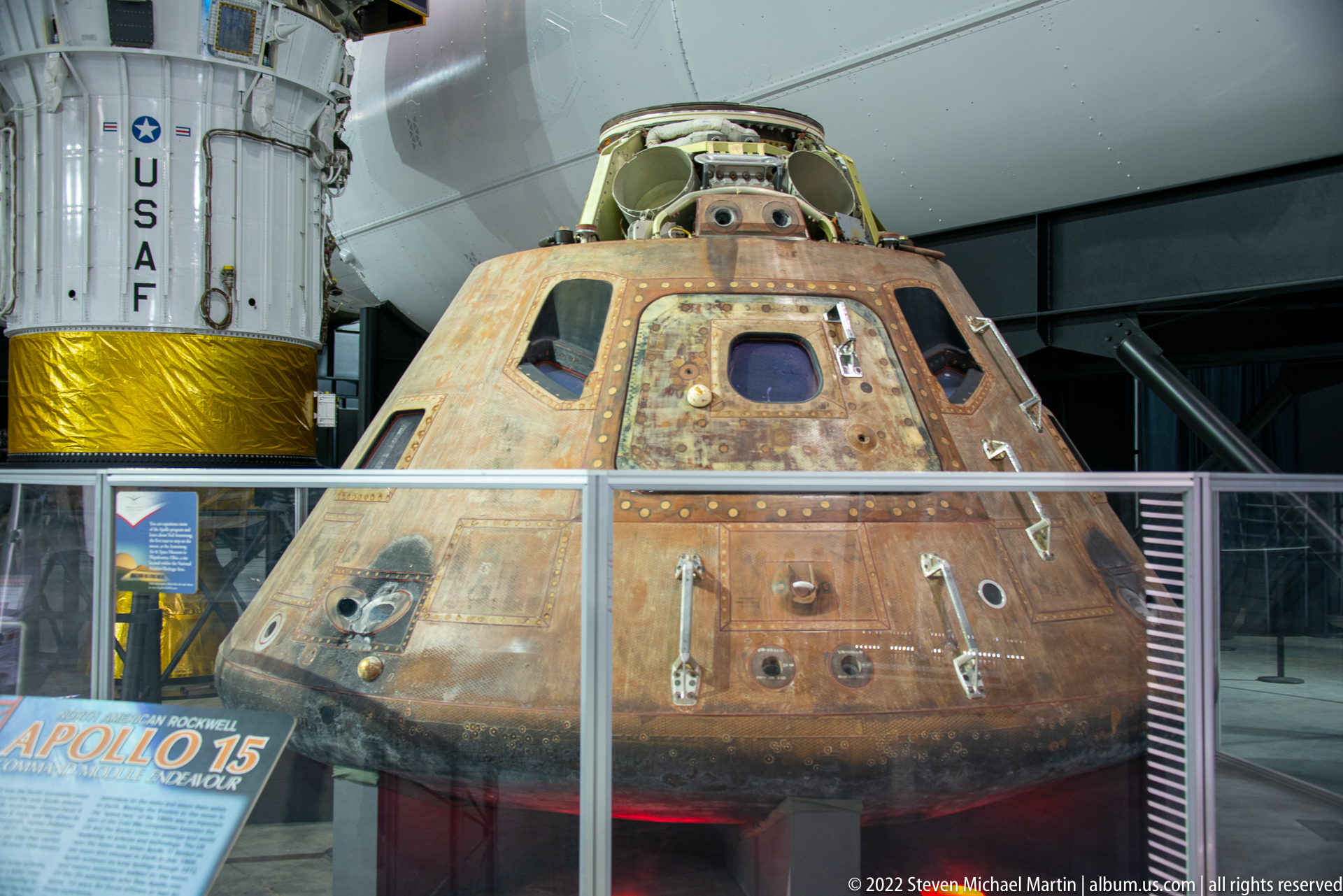
The scorched command module from Apollo 15 rests behind a clear barrier, its conical shell marked by dark reentry staining and rows of fittings. A nearby label identifies it as the Apollo 15 command module, while part of a white-and-gold service module rises behind it. The close view brings the capsule’s heat-marked exterior and practical hardware into focus.
Caption
The scorched command module from Apollo 15 rests behind a clear barrier, its conical shell marked by dark reentry staining and rows of fittings. A nearby label identifies it as the Apollo 15 command module, while part of a white-and-gold service module rises behind it. The close view brings the capsule’s heat-marked exterior and practical hardware into focus.
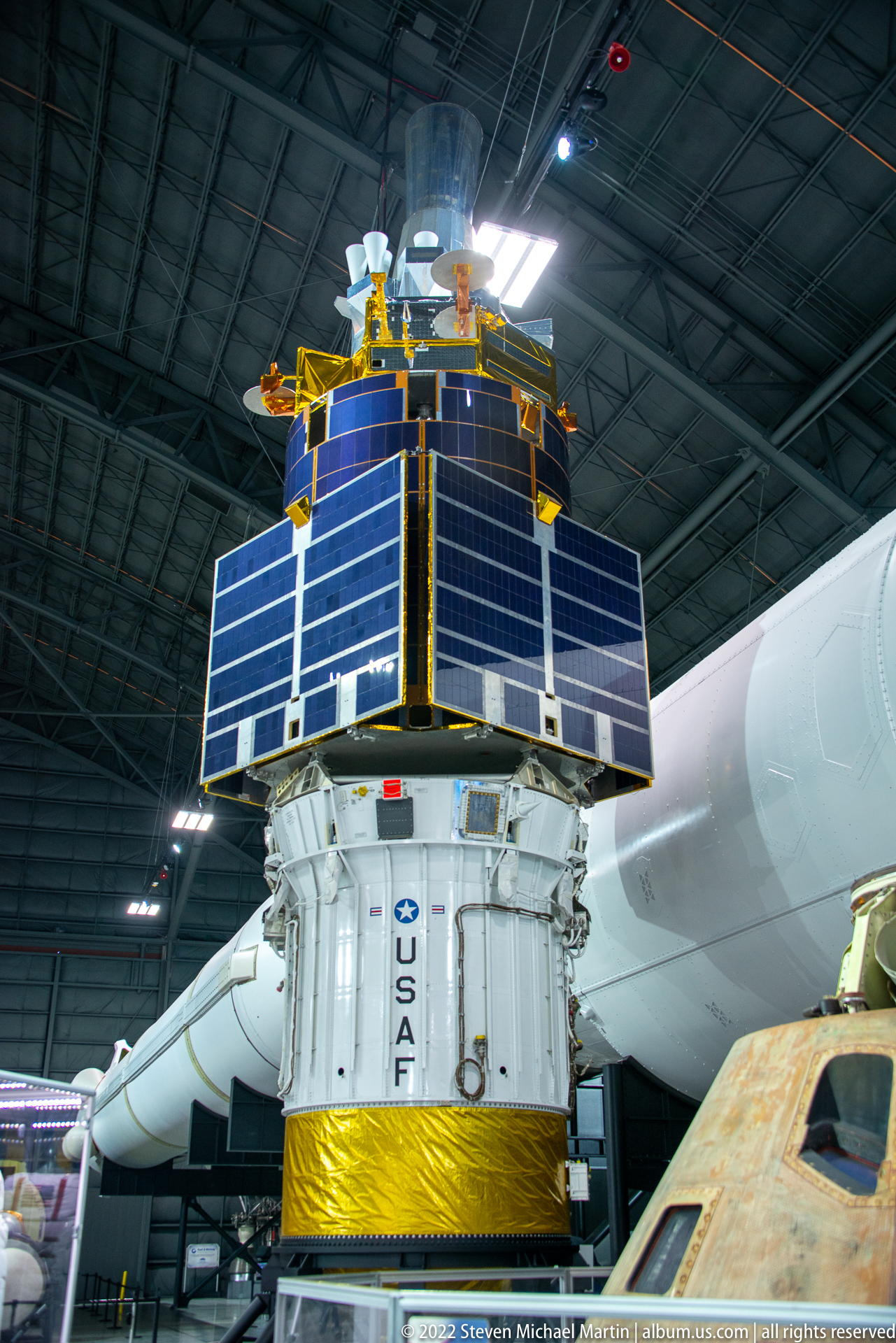
A box-shaped spacecraft with broad blue solar panels stands elevated inside the aircraft gallery. Gold structural details and antenna-like equipment crown the satellite, while “USAF” is printed vertically on its central white body. A large aircraft is visible behind it, underscoring the museum’s range from atmospheric flight to space technology.
Caption
A box-shaped spacecraft with broad blue solar panels stands elevated inside the aircraft gallery. Gold structural details and antenna-like equipment crown the satellite, while “USAF” is printed vertically on its central white body. A large aircraft is visible behind it, underscoring the museum’s range from atmospheric flight to space technology.
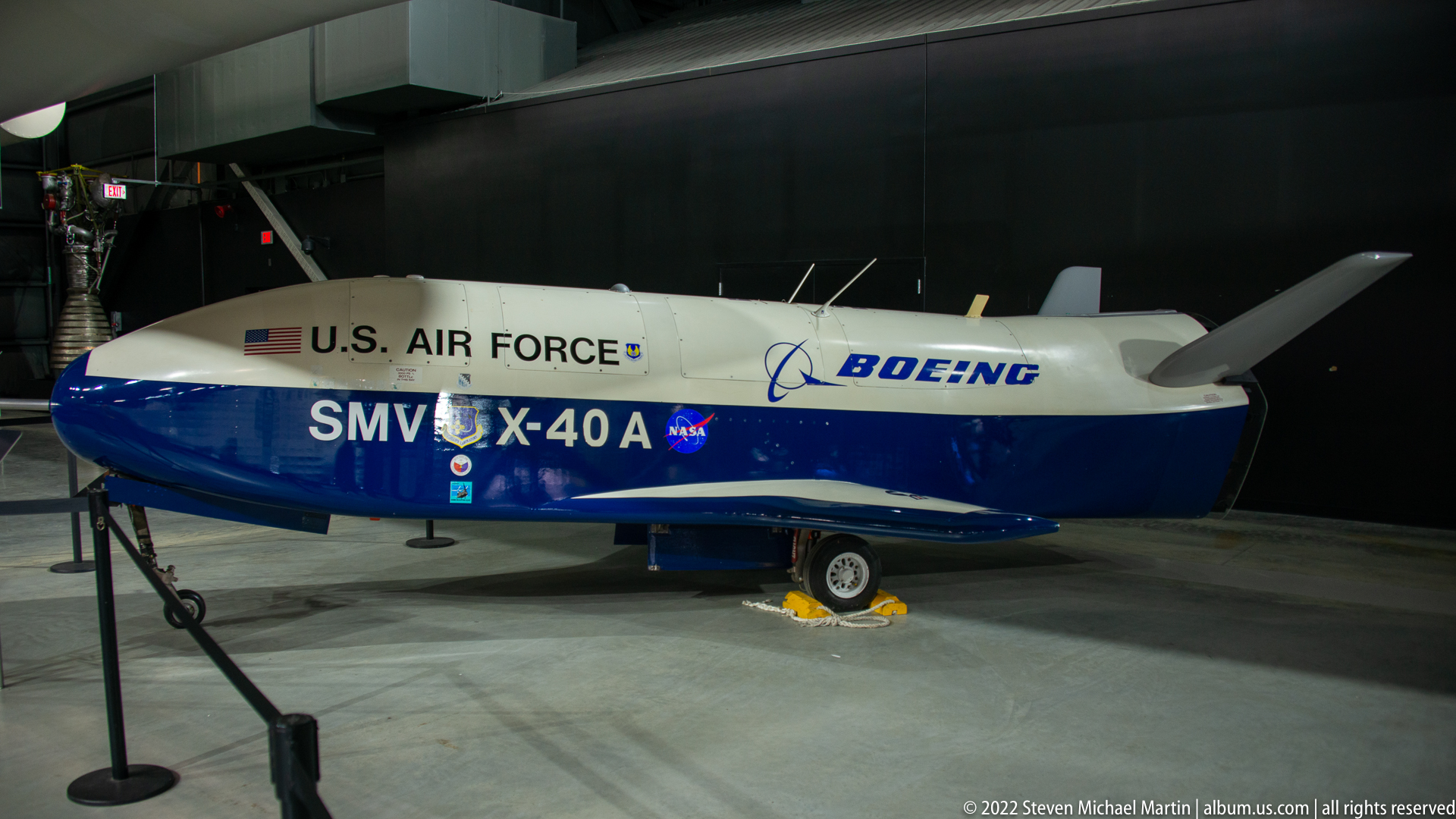
The compact Boeing X-40A rests on landing gear in a dark gallery, its white upper fuselage and blue lower body marked “U.S. AIR FORCE,” “BOEING,” and “SMV X-40A.” NASA insignia also appears near the nose. These prominent markings identify the unpowered test vehicle associated with the Space Maneuver Vehicle program.
Caption
The compact Boeing X-40A rests on landing gear in a dark gallery, its white upper fuselage and blue lower body marked “U.S. AIR FORCE,” “BOEING,” and “SMV X-40A.” NASA insignia also appears near the nose. These prominent markings identify the unpowered test vehicle associated with the Space Maneuver Vehicle program.
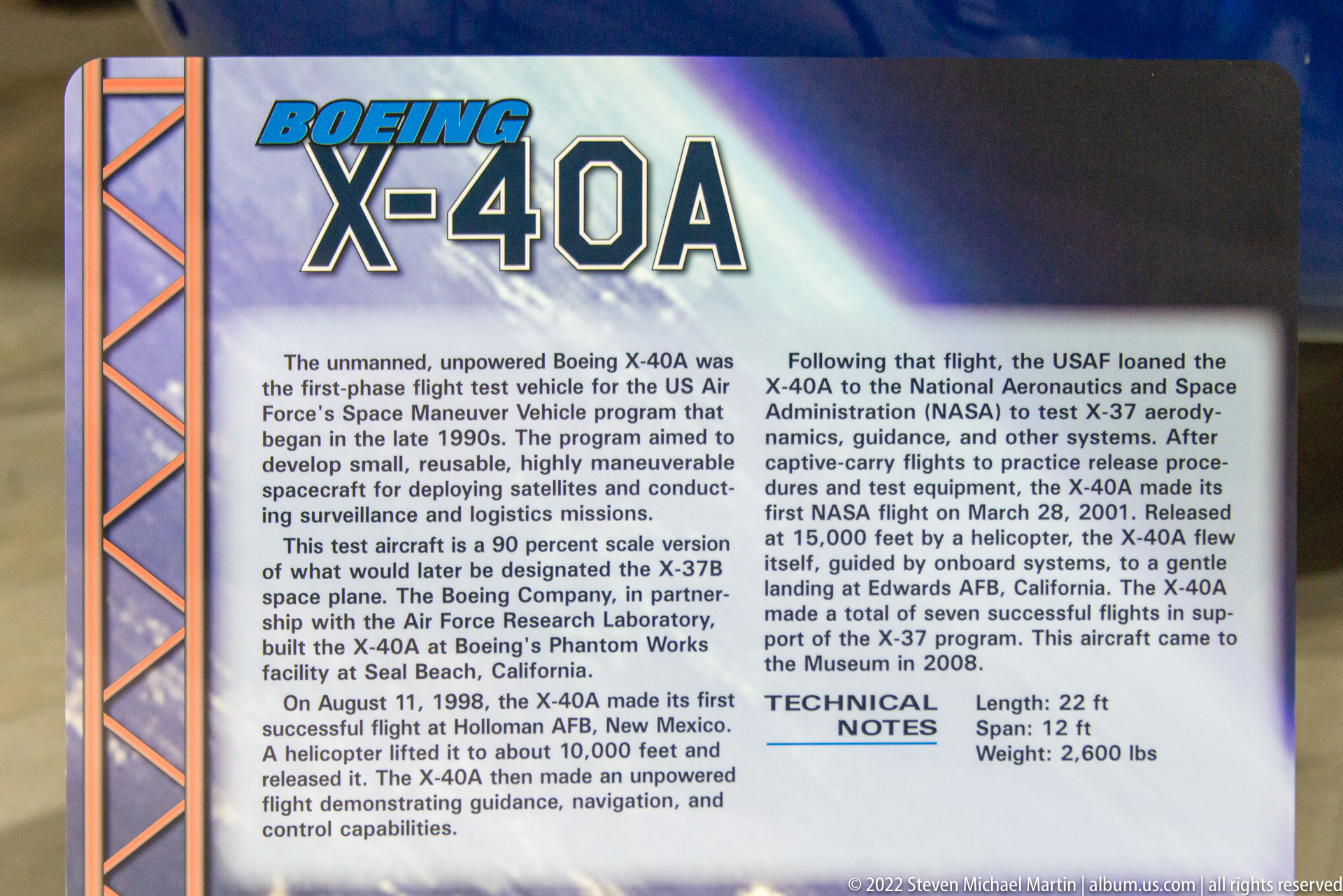
The interpretive panel describes the X-40A as an unpowered test vehicle developed for the U.S. Air Force’s Space Maneuver Vehicle program, with later testing tied to NASA’s X-37 approach and landing procedures. A large “X-40A” heading and technical notes anchor the text. The angled close view pairs the explanatory label with a partial glimpse of the craft behind it.
Caption
The interpretive panel describes the X-40A as an unpowered test vehicle developed for the U.S. Air Force’s Space Maneuver Vehicle program, with later testing tied to NASA’s X-37 approach and landing procedures. A large “X-40A” heading and technical notes anchor the text. The angled close view pairs the explanatory label with a partial glimpse of the craft behind it.
The museum’s cylindrical entrance tower rises above a low, curved roofline, its corrugated metal skin catching the daylight. Large dark letters identify the National Museum of the United States Air Force; the wing-like exhibition buildings extend behind it beneath a clear, lightly clouded sky. With no people prominent in the frame, the photograph isolates the institution’s exterior sign and distinctive rounded form.
Caption
The museum’s cylindrical entrance tower rises above a low, curved roofline, its corrugated metal skin catching the daylight. Large dark letters identify the National Museum of the United States Air Force; the wing-like exhibition buildings extend behind it beneath a clear, lightly clouded sky. With no people prominent in the frame, the photograph isolates the institution’s exterior sign and distinctive rounded form.