Druid Arch – Canyonlands National Park
Druid Arch is a large natural sandstone arch located within the Needles District and represents the effects of erosion acting upon fractured rock layers. The formation was created as weathering gradually removed softer material, leaving a freestanding arch structure supported by more resistant sandstone. The arch’s shape reflects structural characteristics influenced by geological stresses and long-term environmental exposure.
Surrounding rock formations display layered sedimentary patterns that reveal variations in deposition across prehistoric geological eras. The Needles District contains numerous vertical rock spires and eroded fins that illustrate how fractures influence erosion patterns. Druid Arch demonstrates how natural forces produce distinctive formations within desert environments.
Visitors encounter a dramatic geological feature framed by canyon walls and desert vegetation. The scale of the arch and surrounding formations emphasizes the role of erosion in shaping visually striking structures across the Colorado Plateau landscape.
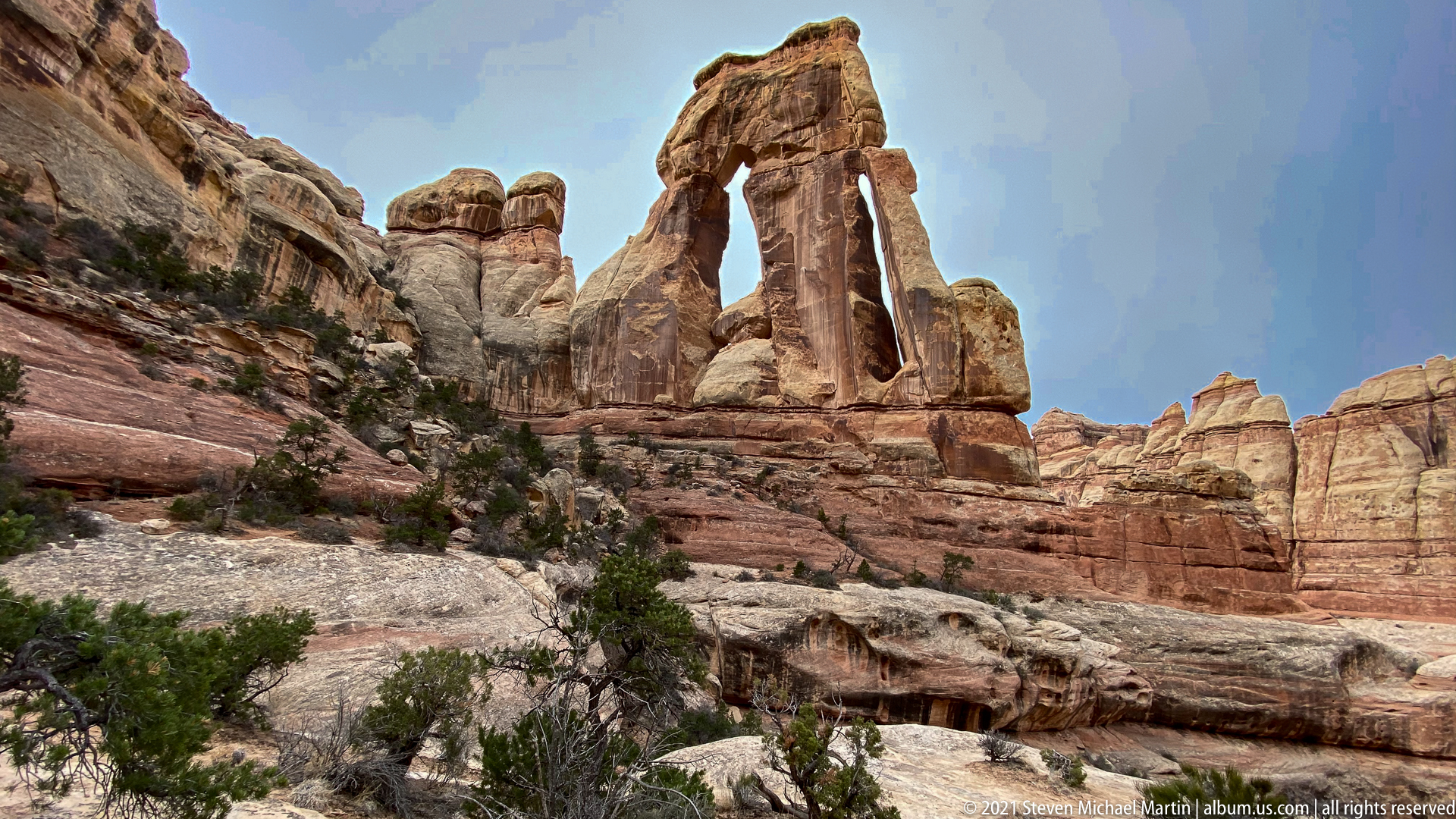
The arch occupies the upper center, with two rounded towers to its left and a row of pale, horizontally banded walls extending right. Foreground ledges and low vegetation lead into the basin, while clear blue sky sharpens the formation’s silhouette. This view brings the neighboring towers into closer relation with the arch than the wider canyon scenes.
Caption
The arch occupies the upper center, with two rounded towers to its left and a row of pale, horizontally banded walls extending right. Foreground ledges and low vegetation lead into the basin, while clear blue sky sharpens the formation’s silhouette. This view brings the neighboring towers into closer relation with the arch than the wider canyon scenes.

Two visitors stand together on the rocky approach, placed left of center beneath Druid Arch. Their upright figures contrast with the arch’s tall sandstone supports and broad, irregular capstone. Juniper and scrub edge the lower slopes, while pale sky opens around the formation. This wider portrait emphasizes the people’s position within the monumental setting.
Caption
Two visitors stand together on the rocky approach, placed left of center beneath Druid Arch. Their upright figures contrast with the arch’s tall sandstone supports and broad, irregular capstone. Juniper and scrub edge the lower slopes, while pale sky opens around the formation. This wider portrait emphasizes the people’s position within the monumental setting.
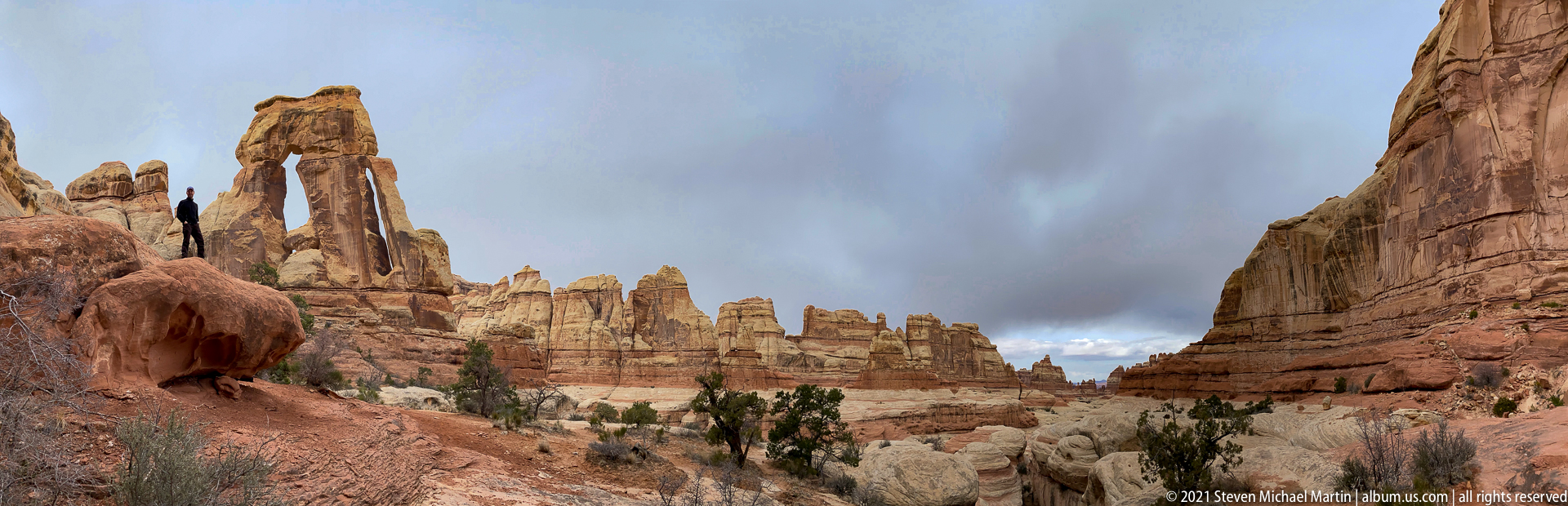
The arch rises at the left above a wide sweep of red rock and scattered juniper-like shrubs. A narrow vertical pinnacle stands at far right, balancing the formation across the open canyon. Gray cloud and a small patch of blue sky soften the light, while the bare foreground traces the rocky approach toward the landmark.
Caption
The arch rises at the left above a wide sweep of red rock and scattered juniper-like shrubs. A narrow vertical pinnacle stands at far right, balancing the formation across the open canyon. Gray cloud and a small patch of blue sky soften the light, while the bare foreground traces the rocky approach toward the landmark.
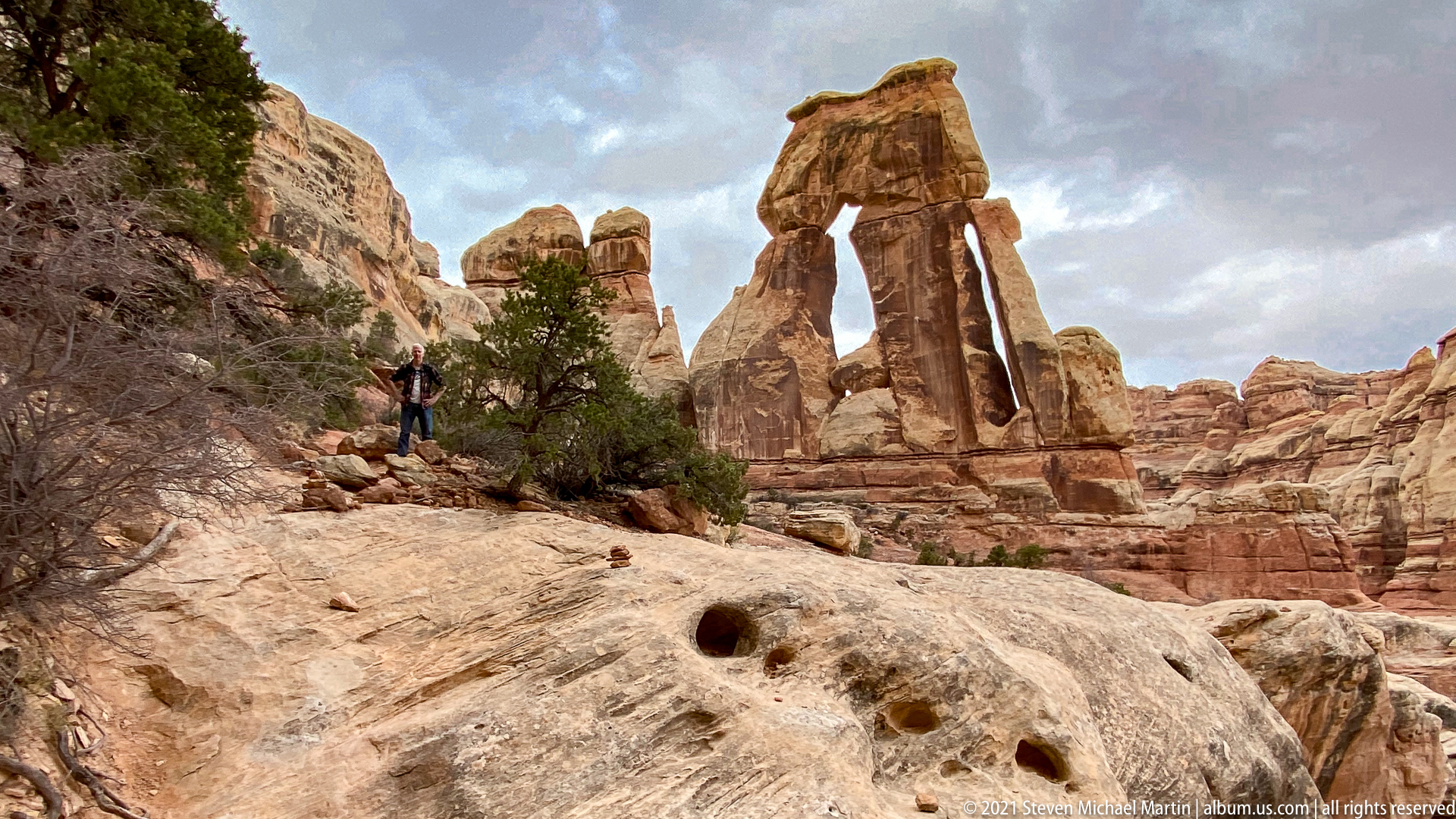
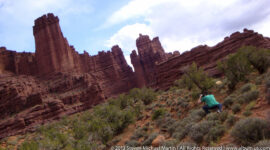
A hiker stands on a pale rock shelf at left, dwarfed by Druid Arch and the surrounding sandstone walls. Dark pothole-like depressions mark the foreground slab, while shrubs grow in cracks along the route. The person’s position gives the arch a clear sense of scale and shows how the approach crosses uneven exposed rock.
Caption
A hiker stands on a pale rock shelf at left, dwarfed by Druid Arch and the surrounding sandstone walls. Dark pothole-like depressions mark the foreground slab, while shrubs grow in cracks along the route. The person’s position gives the arch a clear sense of scale and shows how the approach crosses uneven exposed rock.
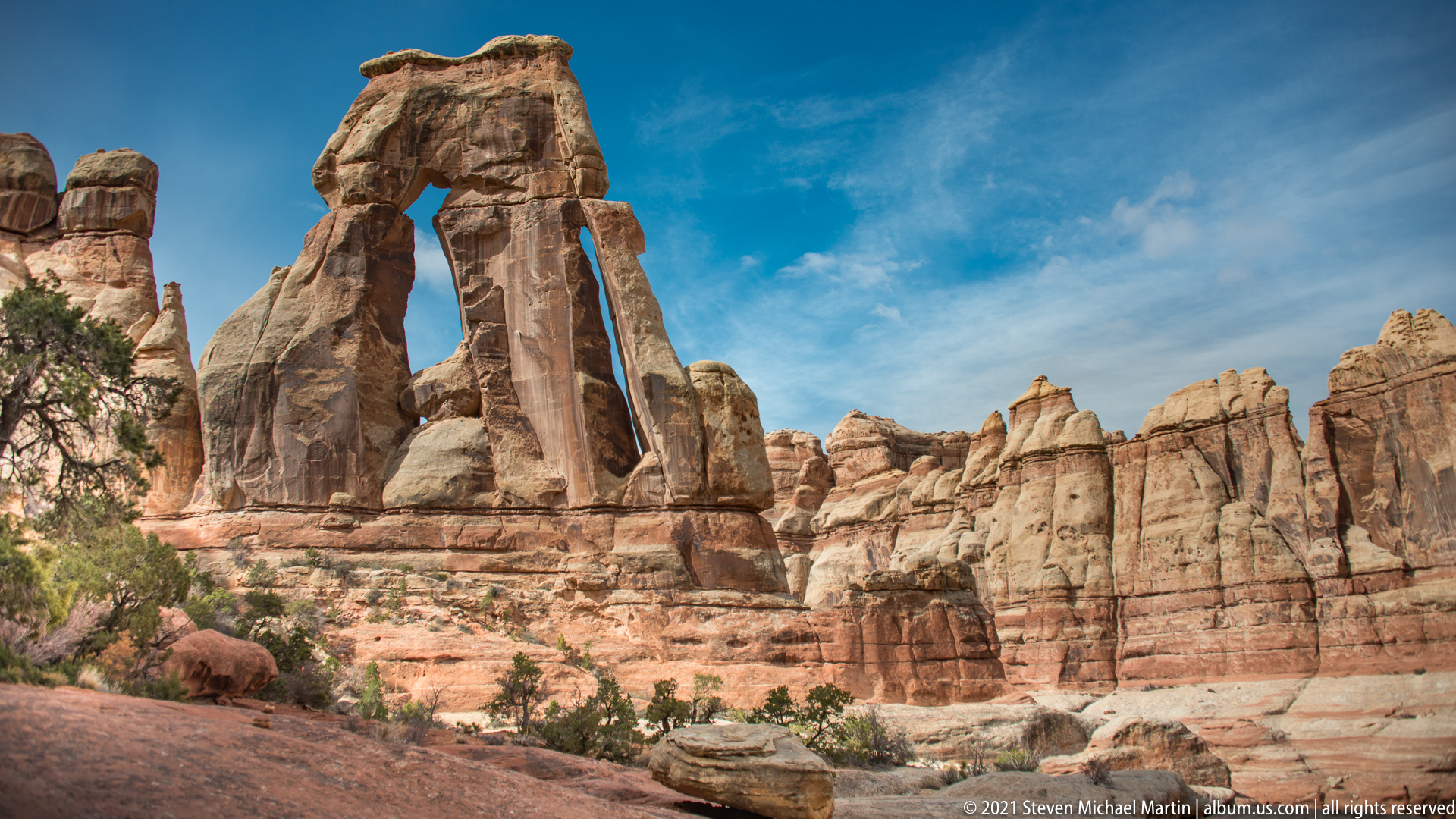
Druid Arch rises near the left side of a broad sandstone amphitheater, surrounded by towers, fins, and layered walls. A sweep of blue sky fills the upper right, balancing the warm rock formations below. With no people prominent, this landscape view places the arch within the larger terrain of the Needles rather than isolating its silhouette.
Caption
Druid Arch rises near the left side of a broad sandstone amphitheater, surrounded by towers, fins, and layered walls. A sweep of blue sky fills the upper right, balancing the warm rock formations below. With no people prominent, this landscape view places the arch within the larger terrain of the Needles rather than isolating its silhouette.
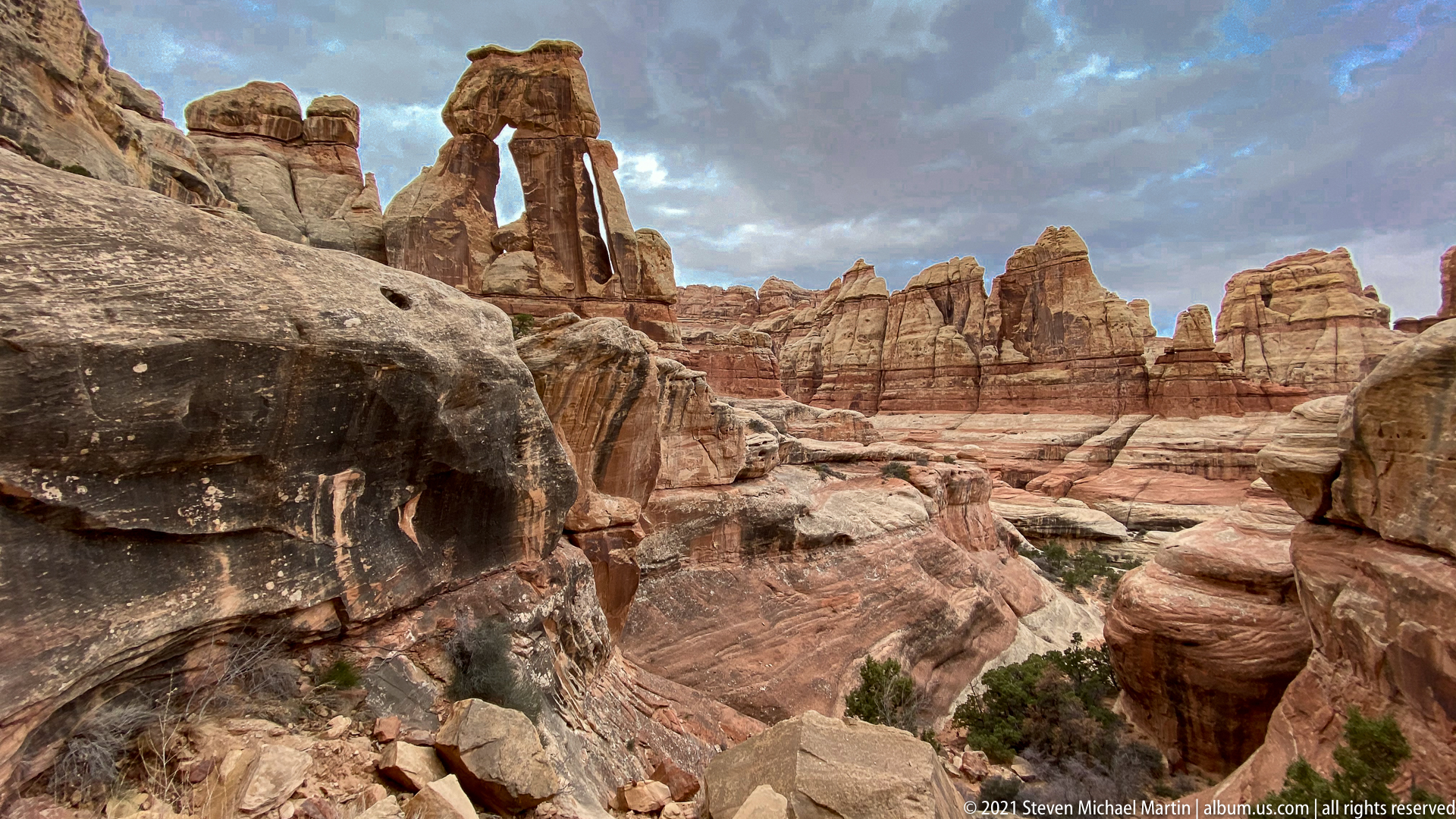
Druid Arch rises above a jumble of red and cream sandstone, its high lintel resting across two tall, narrow supports. Layered spires and canyon walls recede behind it beneath a broken gray-blue sky. From this broad viewpoint, the arch is part of a larger landscape of eroded fins, ledges, and rounded boulders rather than an isolated opening.
Caption
Druid Arch rises above a jumble of red and cream sandstone, its high lintel resting across two tall, narrow supports. Layered spires and canyon walls recede behind it beneath a broken gray-blue sky. From this broad viewpoint, the arch is part of a larger landscape of eroded fins, ledges, and rounded boulders rather than an isolated opening.
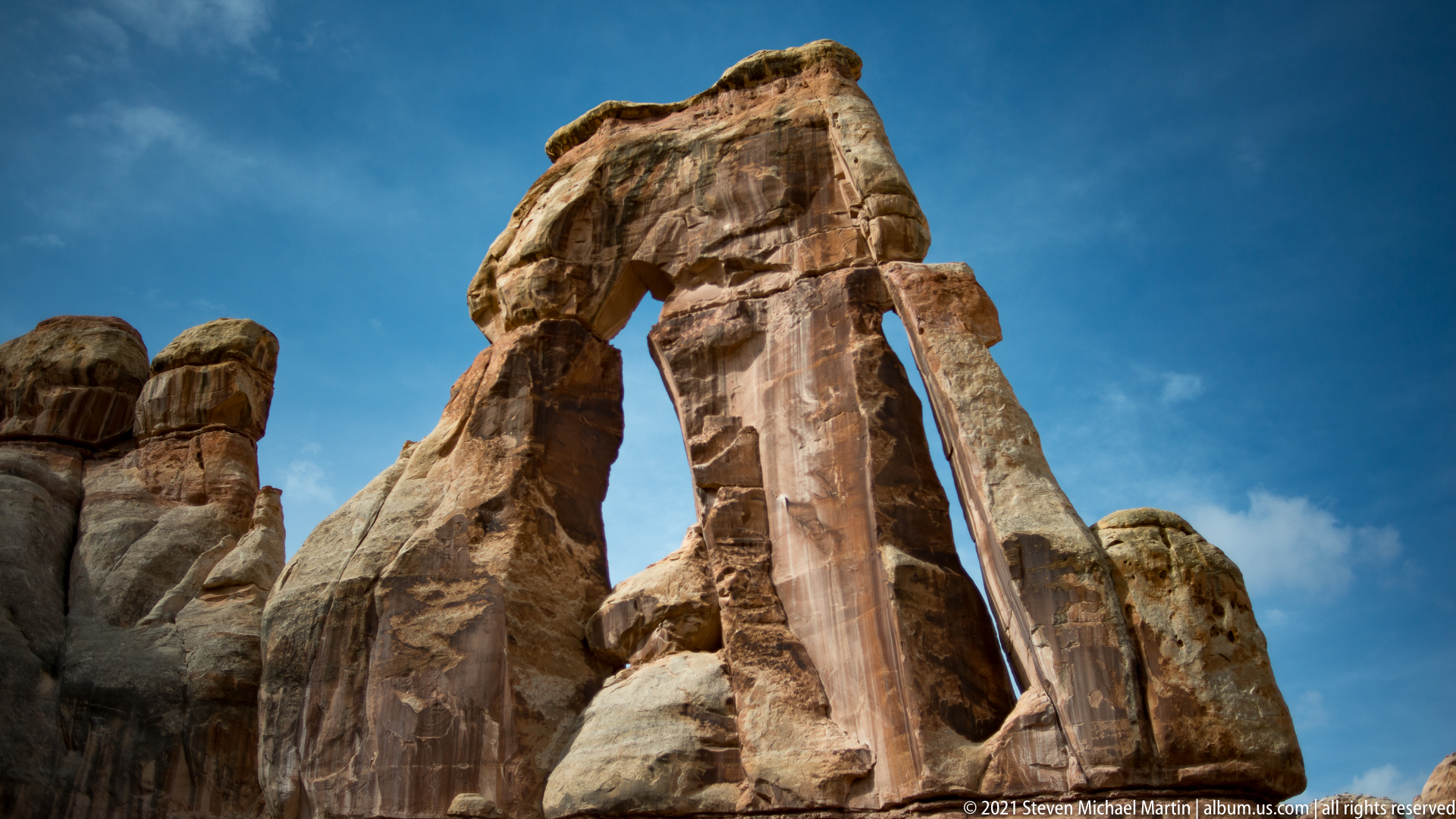
Druid Arch stands alone against a saturated blue sky in this close, upward composition. The capstone’s uneven outline bridges two tall supports, and a narrow side opening separates the right pillar from the central rock. With no people or foreground activity, attention rests on the arch’s structural shape and warm sandstone texture.
Caption
Druid Arch stands alone against a saturated blue sky in this close, upward composition. The capstone’s uneven outline bridges two tall supports, and a narrow side opening separates the right pillar from the central rock. With no people or foreground activity, attention rests on the arch’s structural shape and warm sandstone texture.
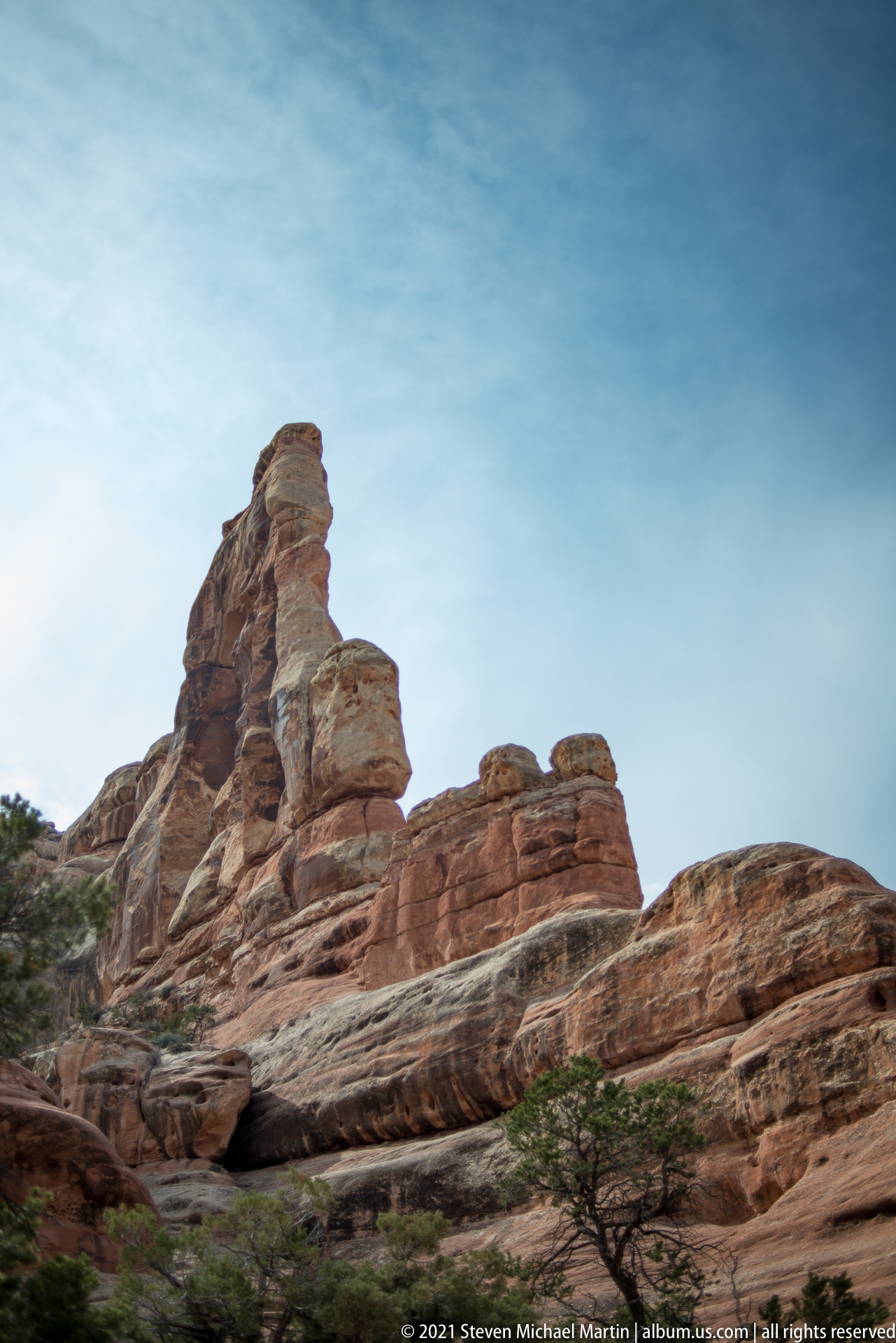
A long sandstone ridge sweeps across the frame beneath a pale blue sky, culminating in a leaning, stacked-looking tower at left of center. Low shrubs cling to the slope, while broad horizontal bands trace the rock’s gradual rise and erosion. The low viewpoint emphasizes the formation’s outline and the contrast between the open sky and the warm, compacted stone.
Caption
A long sandstone ridge sweeps across the frame beneath a pale blue sky, culminating in a leaning, stacked-looking tower at left of center. Low shrubs cling to the slope, while broad horizontal bands trace the rock’s gradual rise and erosion. The low viewpoint emphasizes the formation’s outline and the contrast between the open sky and the warm, compacted stone.
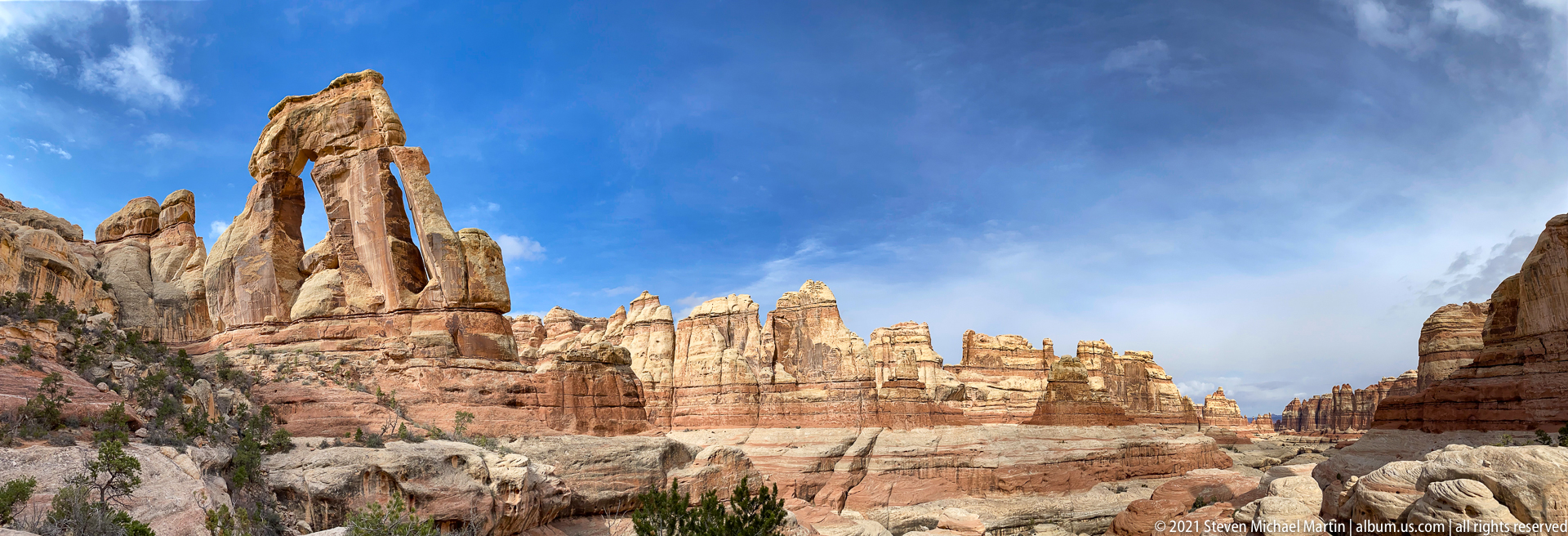
The arch rises at the far left as a long corridor of red and cream cliffs recedes toward the right. Pale boulders and scrub fill the canyon floor, while a wide blue-gray sky occupies nearly half the frame. The panoramic spacing stresses the scale of the rock corridor and the arch’s place within it.
Caption
The arch rises at the far left as a long corridor of red and cream cliffs recedes toward the right. Pale boulders and scrub fill the canyon floor, while a wide blue-gray sky occupies nearly half the frame. The panoramic spacing stresses the scale of the rock corridor and the arch’s place within it.
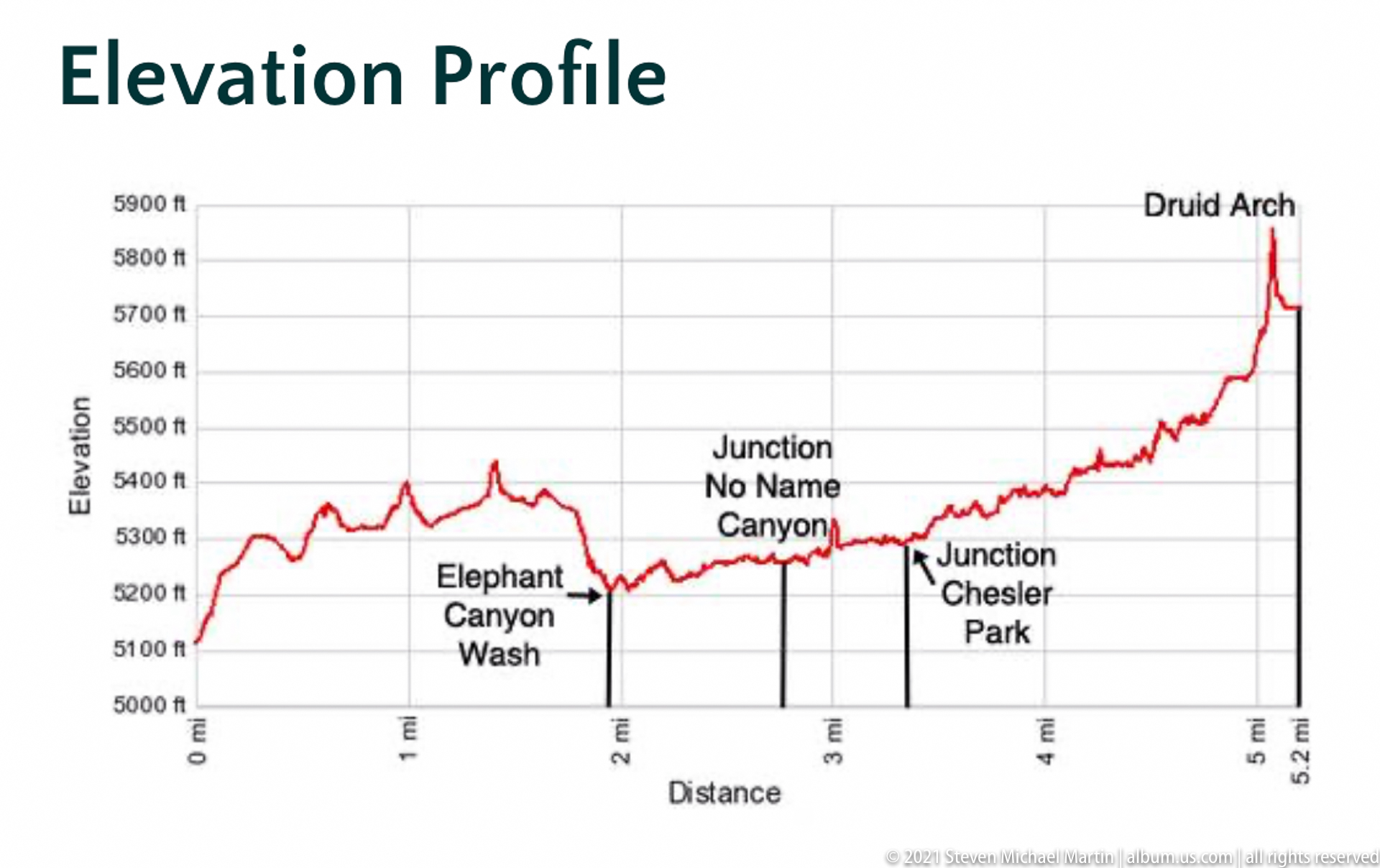
A red elevation trace charts a 5.2-mile route that climbs from about 5,100 feet to nearly 5,900 feet. Labels mark Elephant Canyon Wash, Junction No Name Canyon, Junction Chesler Park, and Druid Arch, making the graph a compact guide to the trail’s changing grade and named waypoints. The sharp final rise signals the steep approach to the arch.
Caption
A red elevation trace charts a 5.2-mile route that climbs from about 5,100 feet to nearly 5,900 feet. Labels mark Elephant Canyon Wash, Junction No Name Canyon, Junction Chesler Park, and Druid Arch, making the graph a compact guide to the trail’s changing grade and named waypoints. The sharp final rise signals the steep approach to the arch.
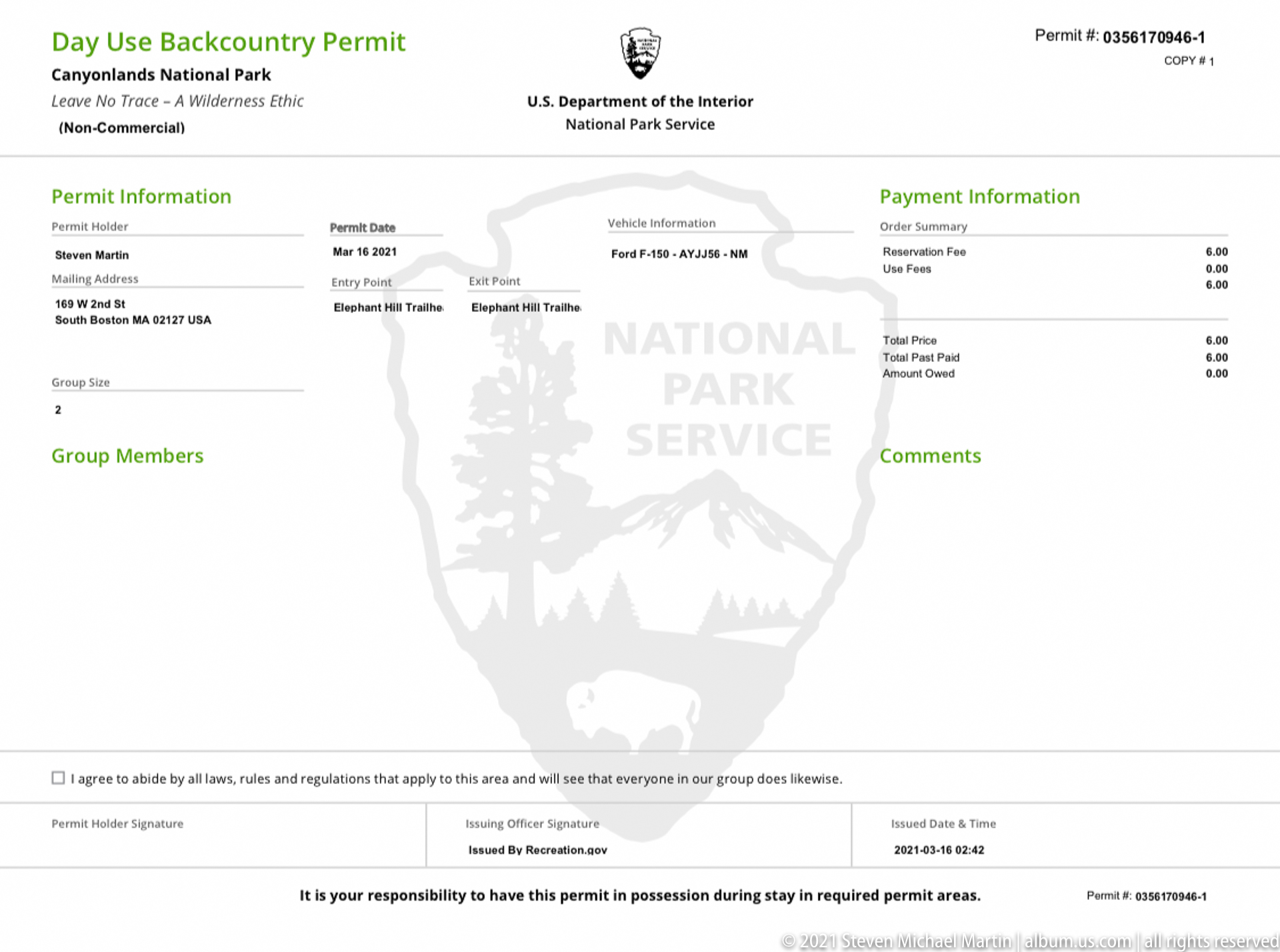
A National Park Service day-use backcountry permit fills the page, with green section headings for permit information, group members, payment, and comments. A large agency emblem sits behind the fields. The document’s layout identifies it as a park access permit, while personal and permit-specific entries are not necessary to describe the image.
Caption
A National Park Service day-use backcountry permit fills the page, with green section headings for permit information, group members, payment, and comments. A large agency emblem sits behind the fields. The document’s layout identifies it as a park access permit, while personal and permit-specific entries are not necessary to describe the image.
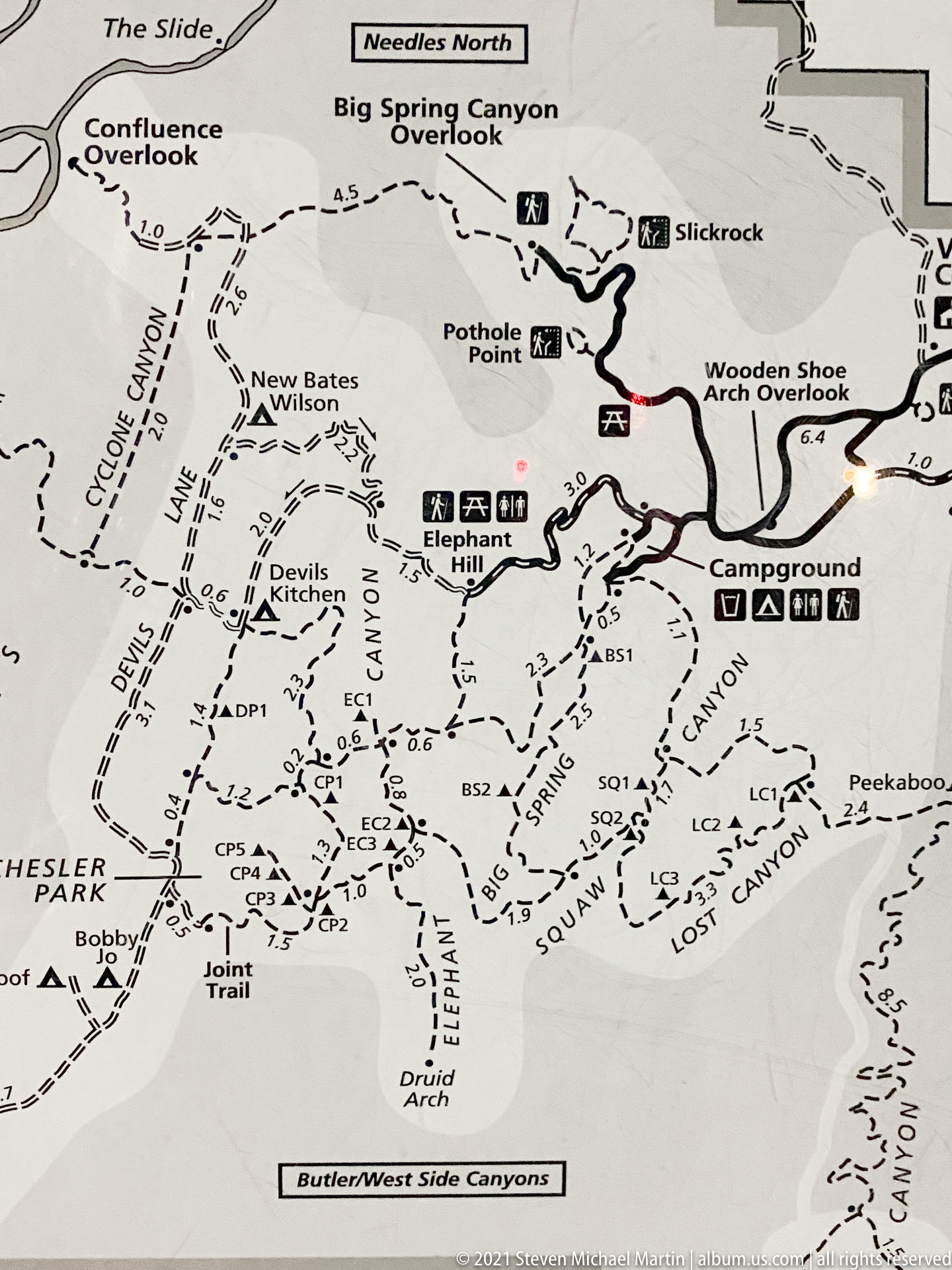
The printed map centers on the Needles North area, with trails and named features including Elephant Canyon, Chesler Park, Wooden Shoe Arch Overlook, Big Spring Canyon Overlook, and Druid Arch. A red segment highlights part of the route near Wooden Shoe Arch Overlook, while dashed lines trace a network of trails across the canyon country.
Caption
The printed map centers on the Needles North area, with trails and named features including Elephant Canyon, Chesler Park, Wooden Shoe Arch Overlook, Big Spring Canyon Overlook, and Druid Arch. A red segment highlights part of the route near Wooden Shoe Arch Overlook, while dashed lines trace a network of trails across the canyon country.
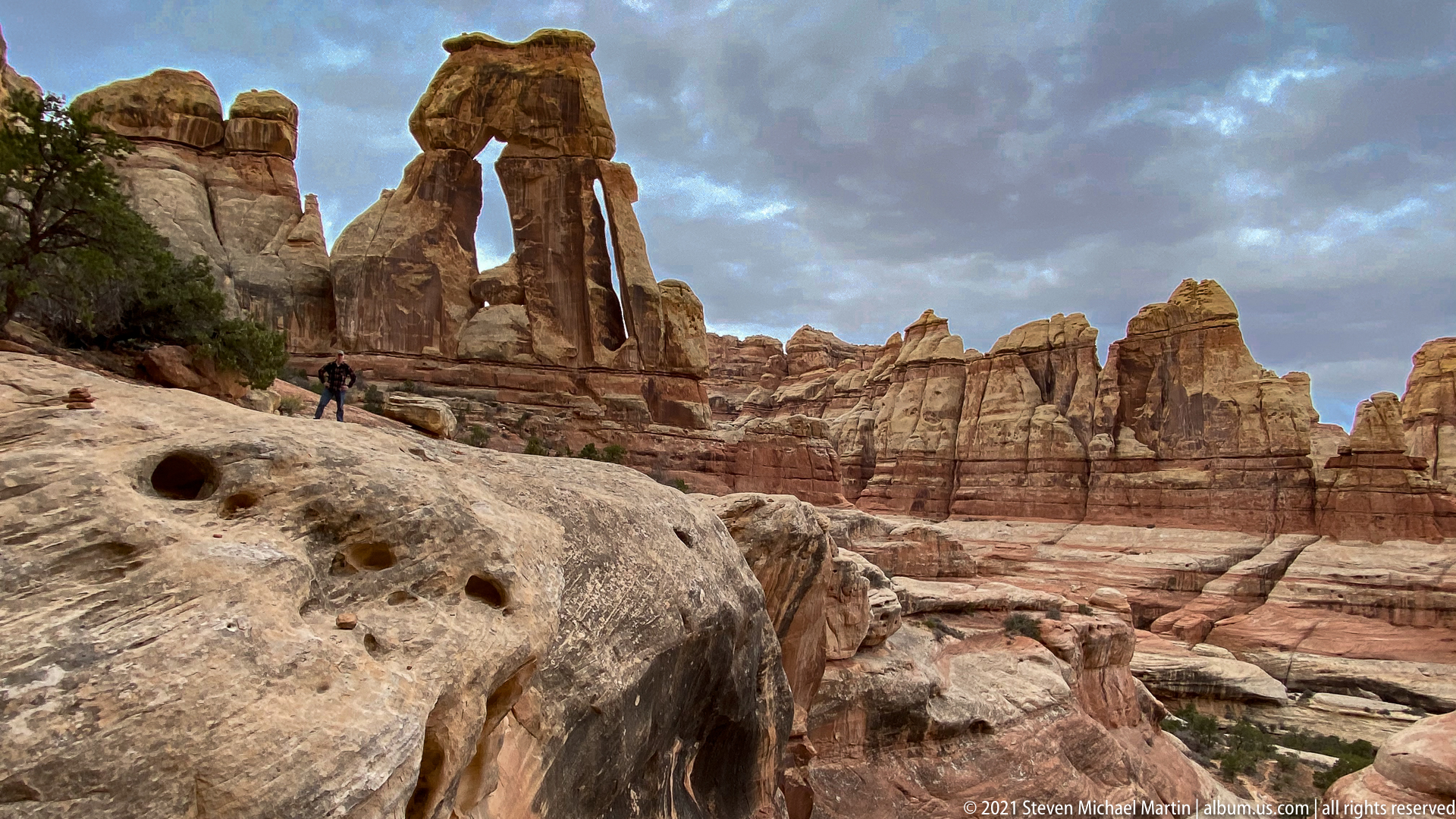
The arch occupies the upper center of a broad canyon view, with cream-colored ledges and red bands stepping down toward a brush-filled basin. A smooth slab with several rounded holes fills the foreground, and a hiker stands to the left of the formation. The layered composition connects the trail surface to the distant landmark.
Caption
The arch occupies the upper center of a broad canyon view, with cream-colored ledges and red bands stepping down toward a brush-filled basin. A smooth slab with several rounded holes fills the foreground, and a hiker stands to the left of the formation. The layered composition connects the trail surface to the distant landmark.
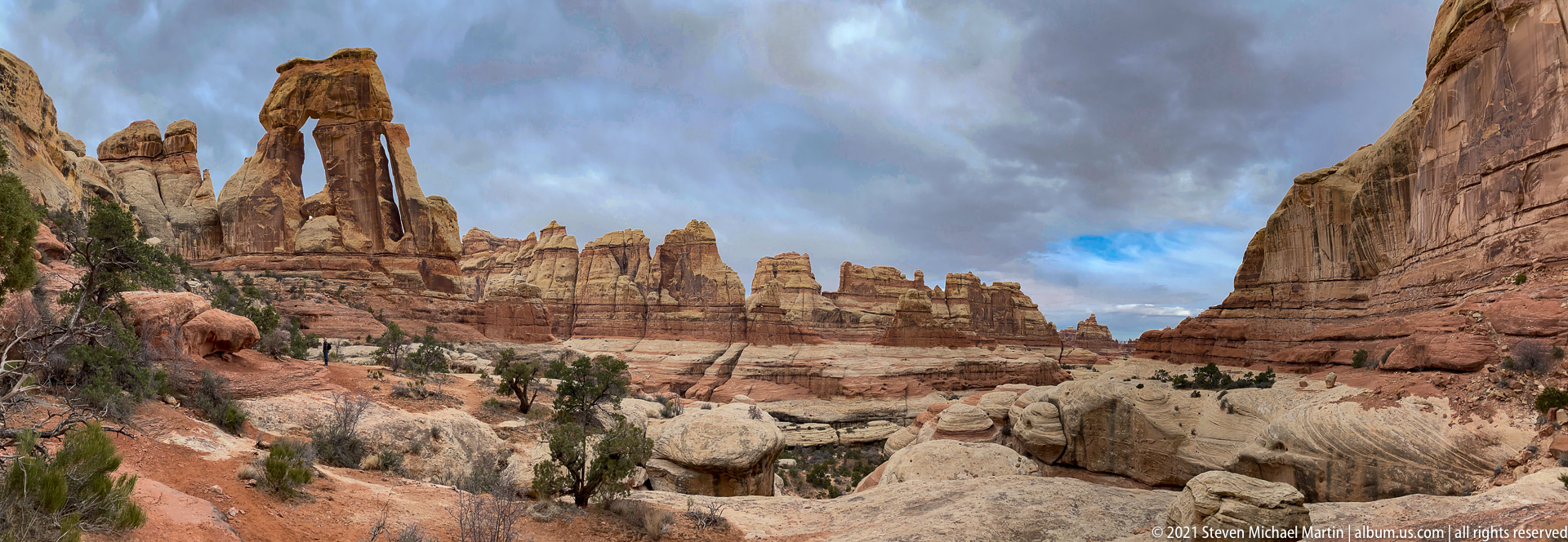
Druid Arch stands near the left edge of a broad corridor of sandstone towers, while a high wall closes the right side of the view. Pale rounded boulders and scattered shrubs fill the lower basin, and a blue opening breaks through the gray clouds overhead. The wide composition emphasizes the arch’s position within the surrounding Needles landscape.
Caption
Druid Arch stands near the left edge of a broad corridor of sandstone towers, while a high wall closes the right side of the view. Pale rounded boulders and scattered shrubs fill the lower basin, and a blue opening breaks through the gray clouds overhead. The wide composition emphasizes the arch’s position within the surrounding Needles landscape.
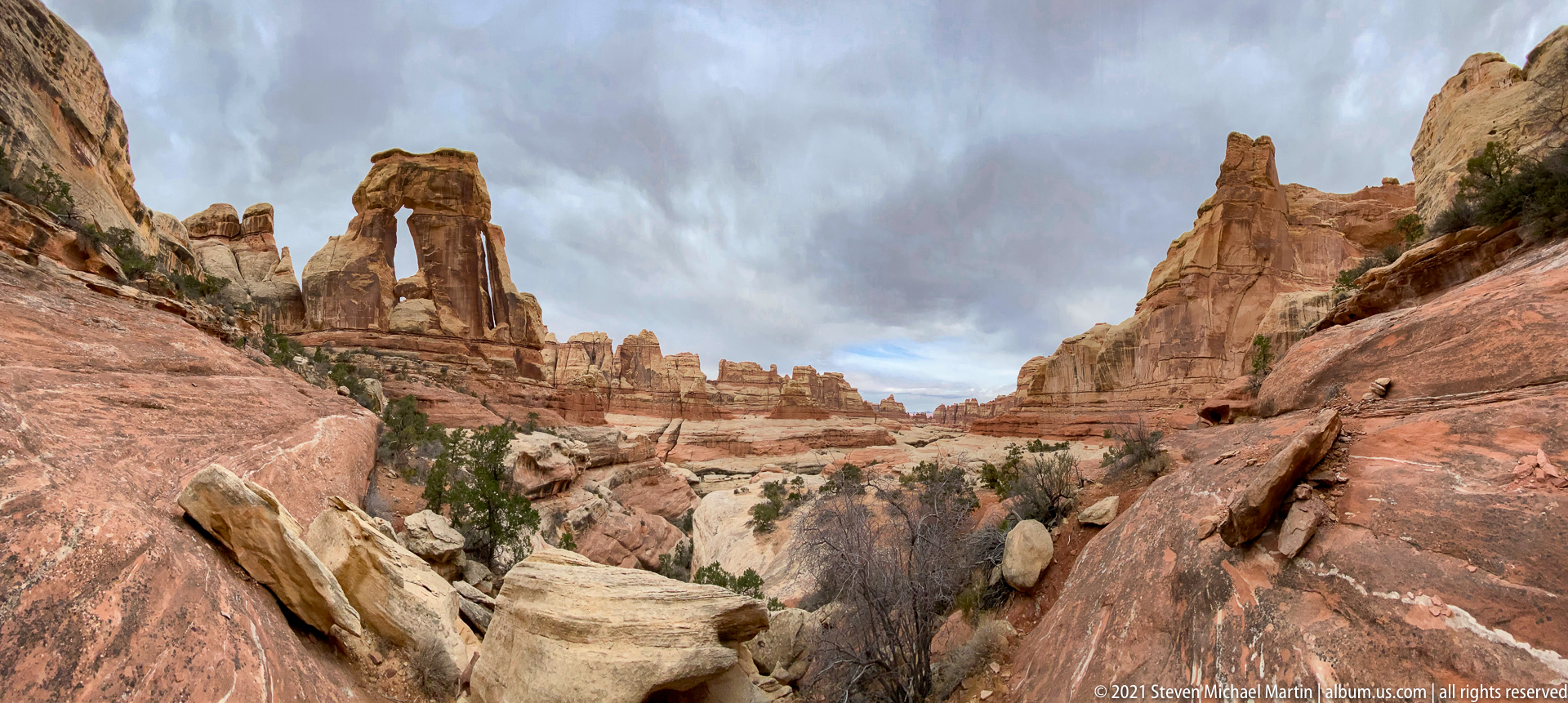
From farther back, the arch appears left of center beyond a basin of pale boulders and brush. Layered canyon walls converge toward the formation, creating depth beneath a sky of low gray cloud. The foreground rocks partly screen the route, while the tall arch remains visible as the focal point above the canyon.
Caption
From farther back, the arch appears left of center beyond a basin of pale boulders and brush. Layered canyon walls converge toward the formation, creating depth beneath a sky of low gray cloud. The foreground rocks partly screen the route, while the tall arch remains visible as the focal point above the canyon.
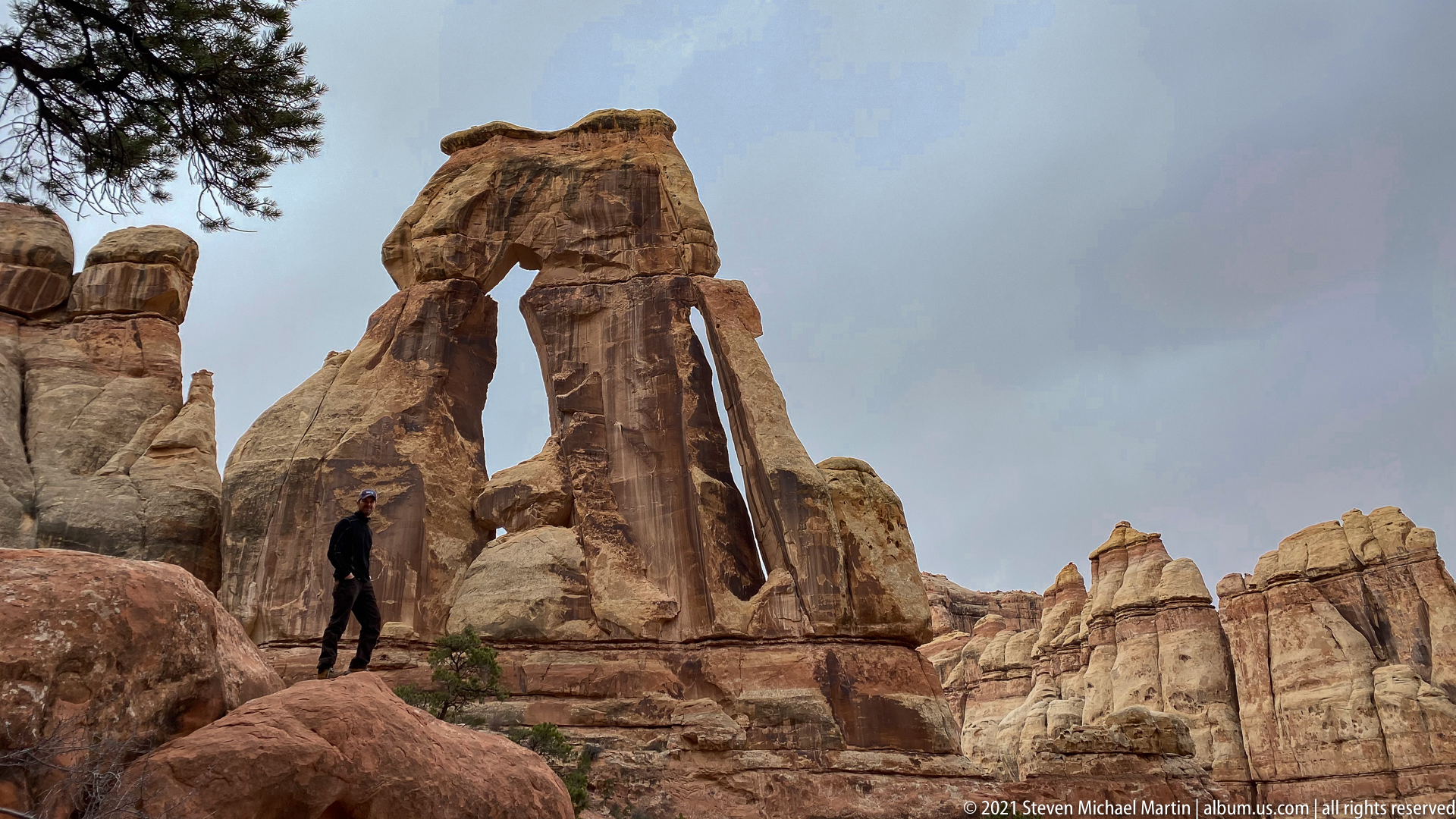
A hiker in dark clothing stands on a red boulder at the lower left, directly beneath the tall supports of Druid Arch. The close low angle makes the vertical pillars and overhead lintel loom against a muted sky, while pale sandstone spires continue across the right background. The visitor provides scale without obscuring the arch’s open span.
Caption
A hiker in dark clothing stands on a red boulder at the lower left, directly beneath the tall supports of Druid Arch. The close low angle makes the vertical pillars and overhead lintel loom against a muted sky, while pale sandstone spires continue across the right background. The visitor provides scale without obscuring the arch’s open span.
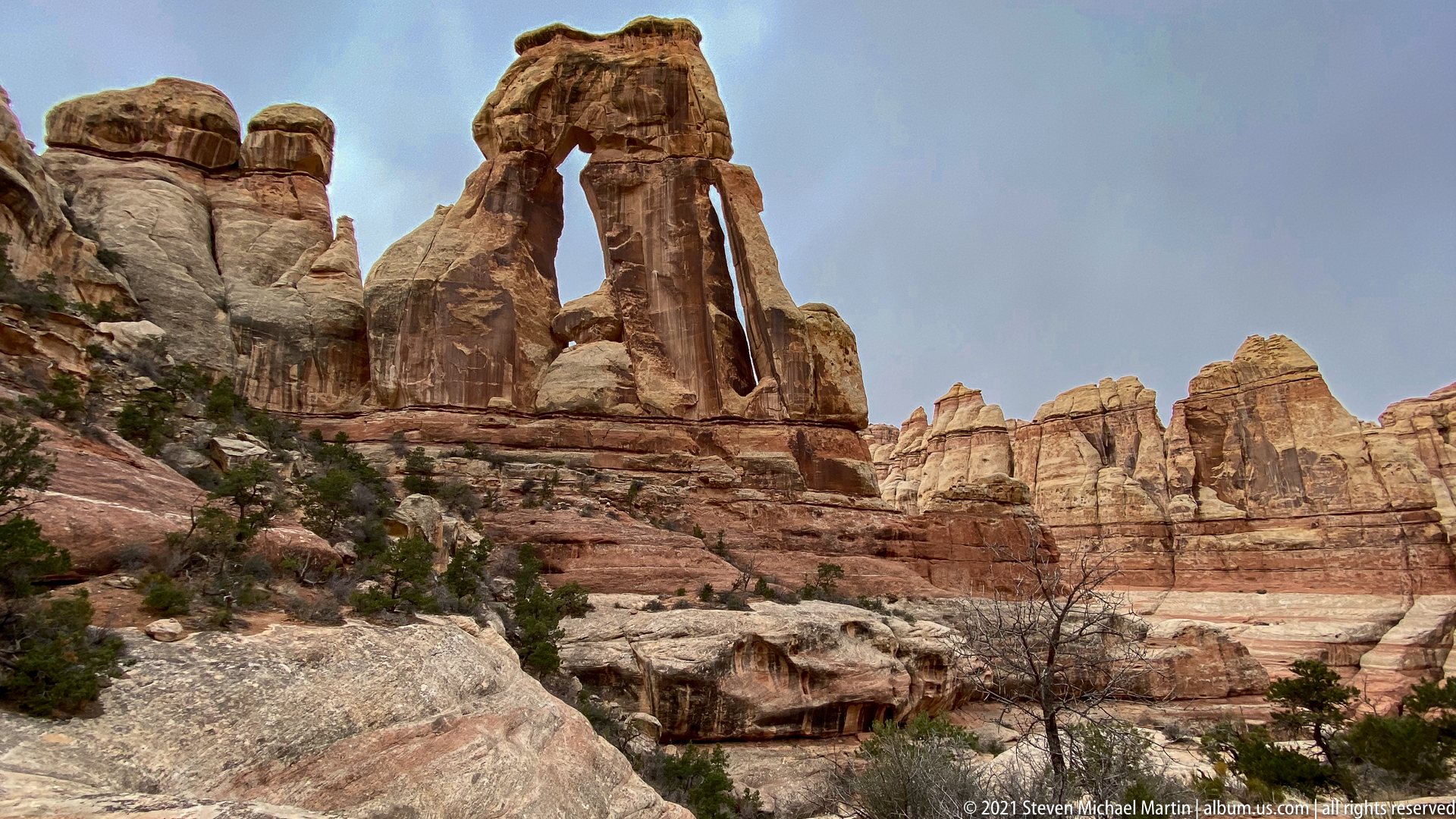
A large rounded boulder fills the lower left, leading the eye toward Druid Arch and the pale, banded walls behind it. The formation’s lintel and paired supports are prominent against a clear blue opening in the sky. Low brush and fractured slabs mark the canyon floor, adding a near-to-far sequence of rock forms.
Caption
A large rounded boulder fills the lower left, leading the eye toward Druid Arch and the pale, banded walls behind it. The formation’s lintel and paired supports are prominent against a clear blue opening in the sky. Low brush and fractured slabs mark the canyon floor, adding a near-to-far sequence of rock forms.
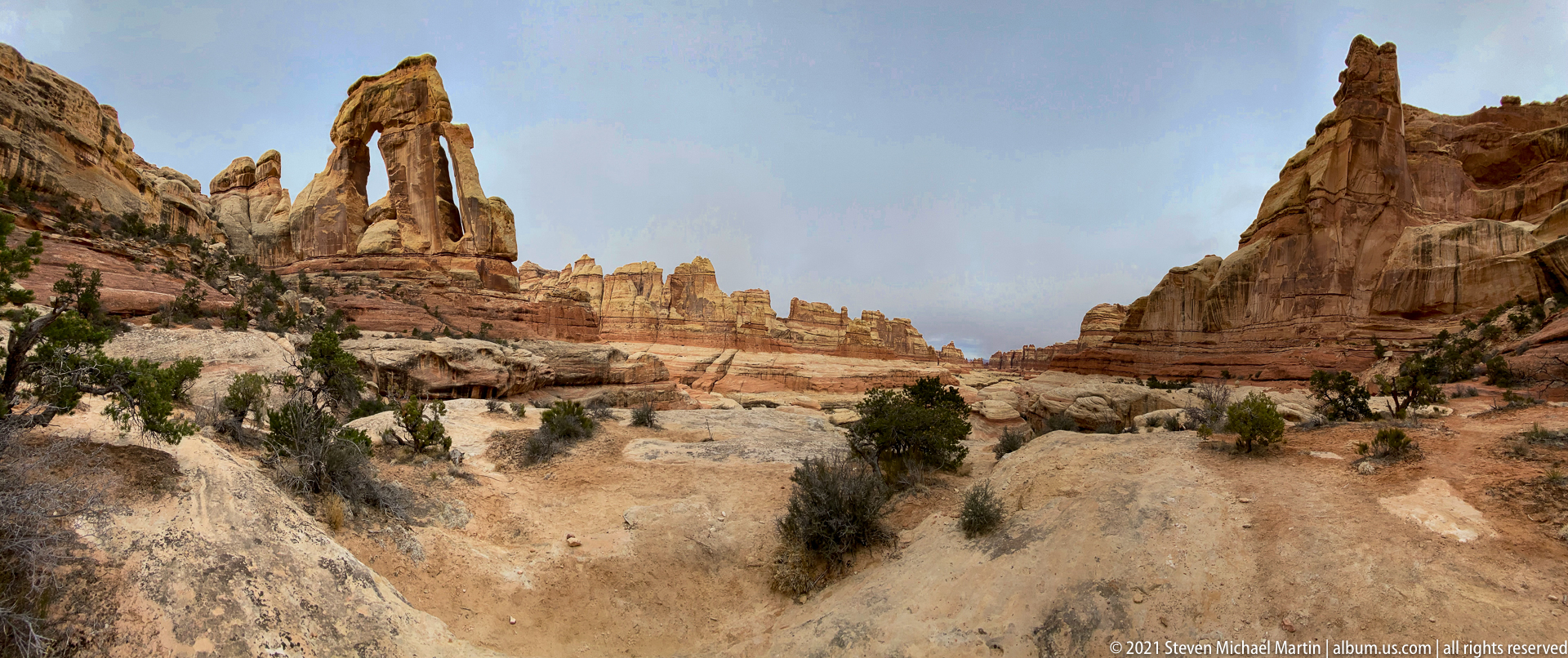
A sandy, uneven approach leads through low shrubs toward Druid Arch, which rises at the left among a long wall of cream and red sandstone. The path is visible as a pale open strip in the foreground before disappearing into the boulder-strewn basin. Soft cloud light reduces shadows and brings out the horizontal layers in the cliffs.
Caption
A sandy, uneven approach leads through low shrubs toward Druid Arch, which rises at the left among a long wall of cream and red sandstone. The path is visible as a pale open strip in the foreground before disappearing into the boulder-strewn basin. Soft cloud light reduces shadows and brings out the horizontal layers in the cliffs.
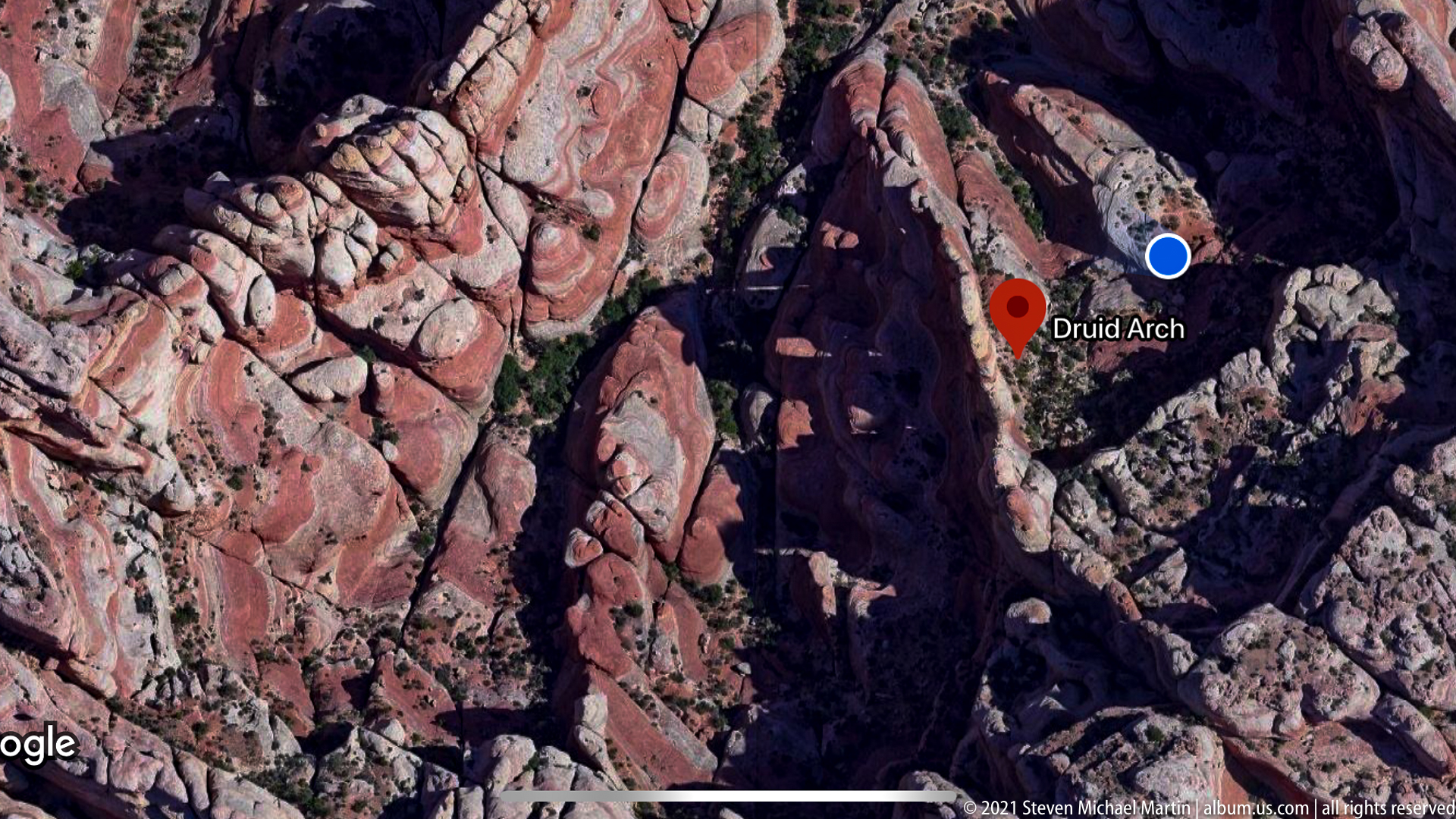
A satellite image shows a narrow canyon system surrounded by striped red and pale rock, with a map pin labeled “Druid Arch” beside a blue location dot. The overhead view makes the arch’s position within the rugged terrain legible, connecting the close landscape photographs to their geographic setting. A small map credit appears at the lower edge.
Caption
A satellite image shows a narrow canyon system surrounded by striped red and pale rock, with a map pin labeled “Druid Arch” beside a blue location dot. The overhead view makes the arch’s position within the rugged terrain legible, connecting the close landscape photographs to their geographic setting. A small map credit appears at the lower edge.
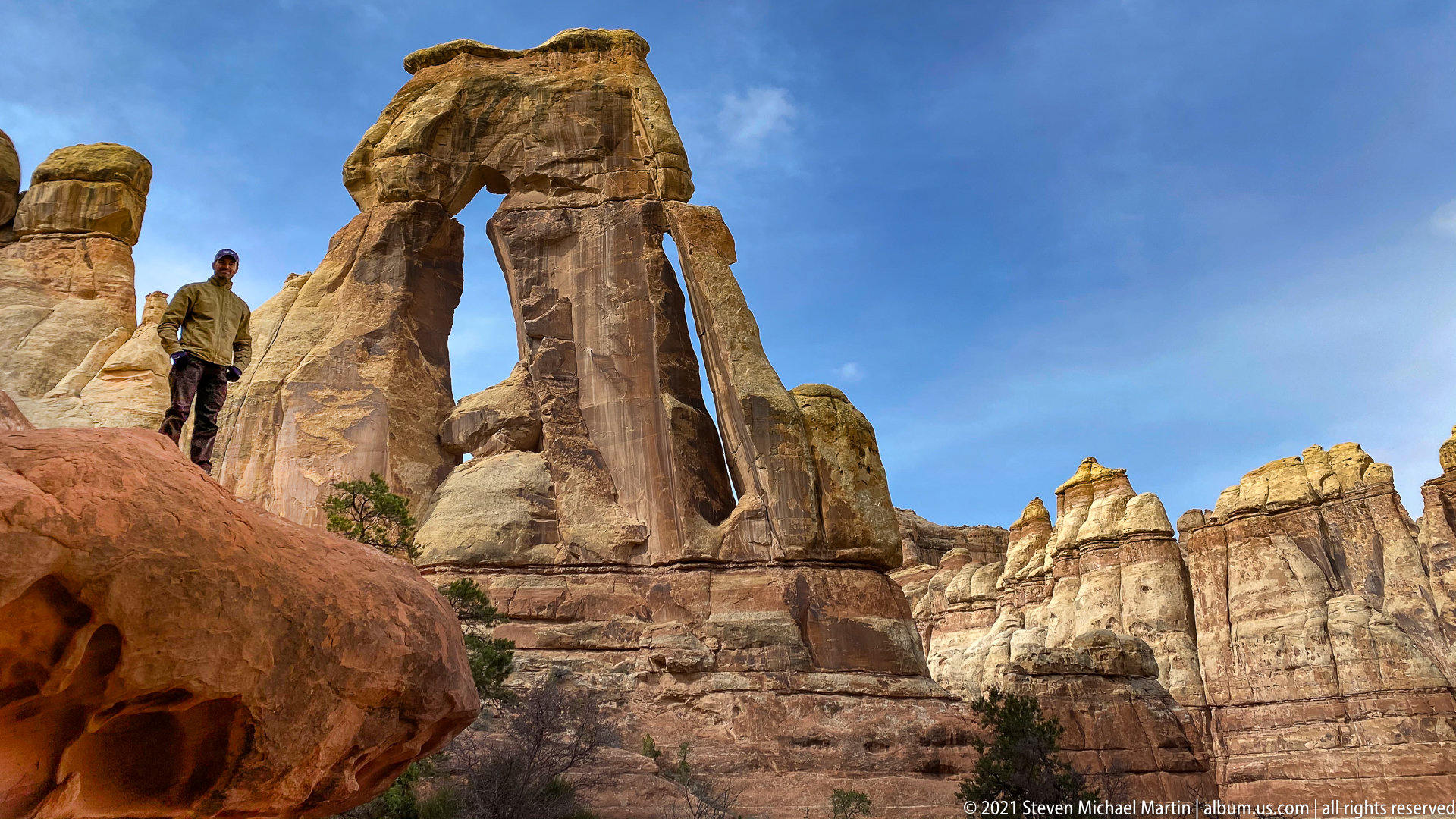
A hiker stands on a sloping ledge at left, dwarfed by the close sandstone pillars that support Druid Arch. The low viewpoint tilts upward toward the heavy lintel and a clear blue sky, while a deep shadowed opening separates the supports. Fine bands and vertical streaks in the rock make the formation’s weathered surfaces prominent.
Caption
A hiker stands on a sloping ledge at left, dwarfed by the close sandstone pillars that support Druid Arch. The low viewpoint tilts upward toward the heavy lintel and a clear blue sky, while a deep shadowed opening separates the supports. Fine bands and vertical streaks in the rock make the formation’s weathered surfaces prominent.
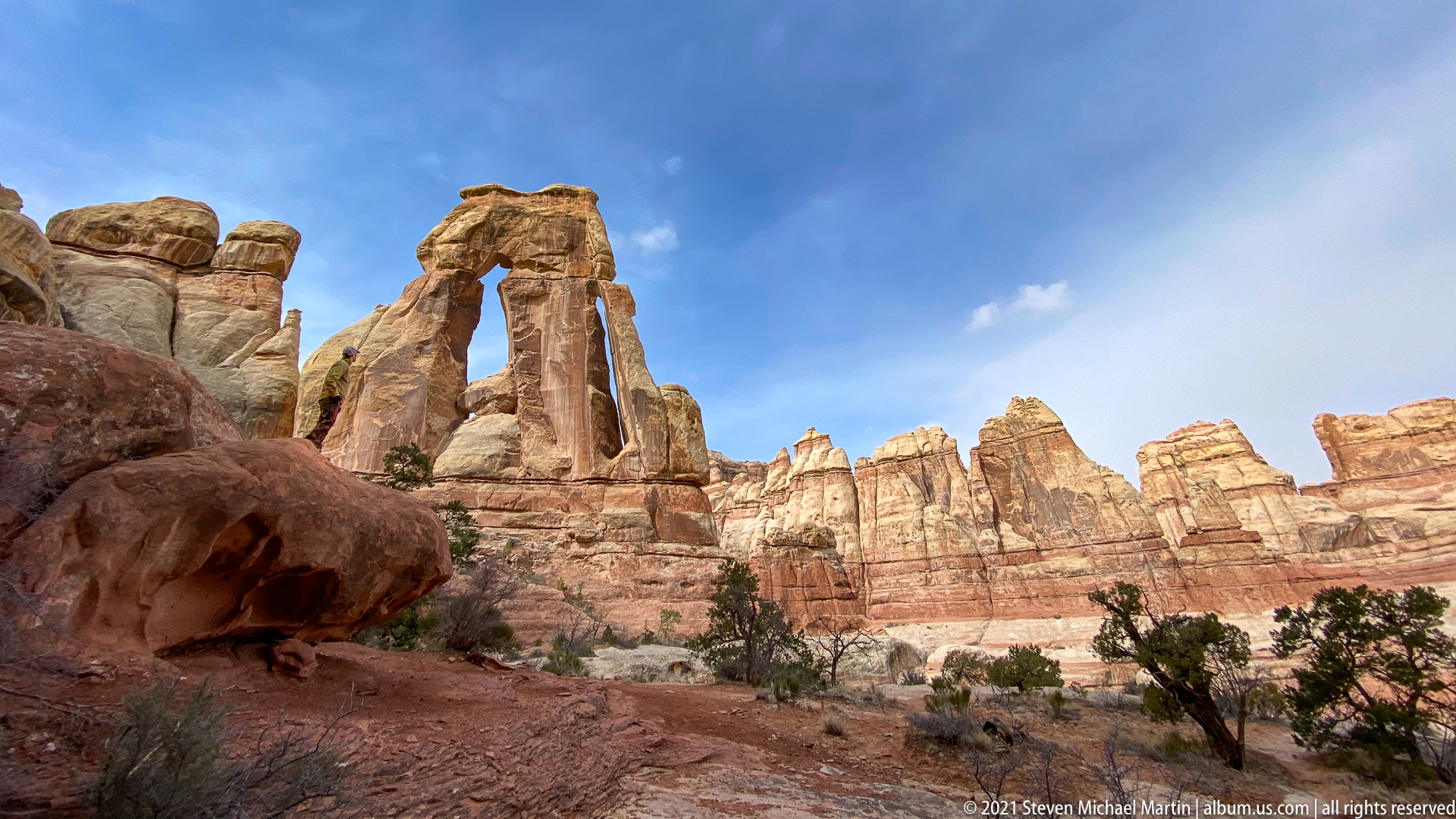
A rounded red boulder anchors the left foreground, while Druid Arch appears farther back near the center-left. A small hiker stands among the rocks beside the formation, giving scale to the towering supports. Pale sandstone walls cross the middle distance beneath a vivid blue sky, creating a contrast between warm rock and open air.
Caption
A rounded red boulder anchors the left foreground, while Druid Arch appears farther back near the center-left. A small hiker stands among the rocks beside the formation, giving scale to the towering supports. Pale sandstone walls cross the middle distance beneath a vivid blue sky, creating a contrast between warm rock and open air.
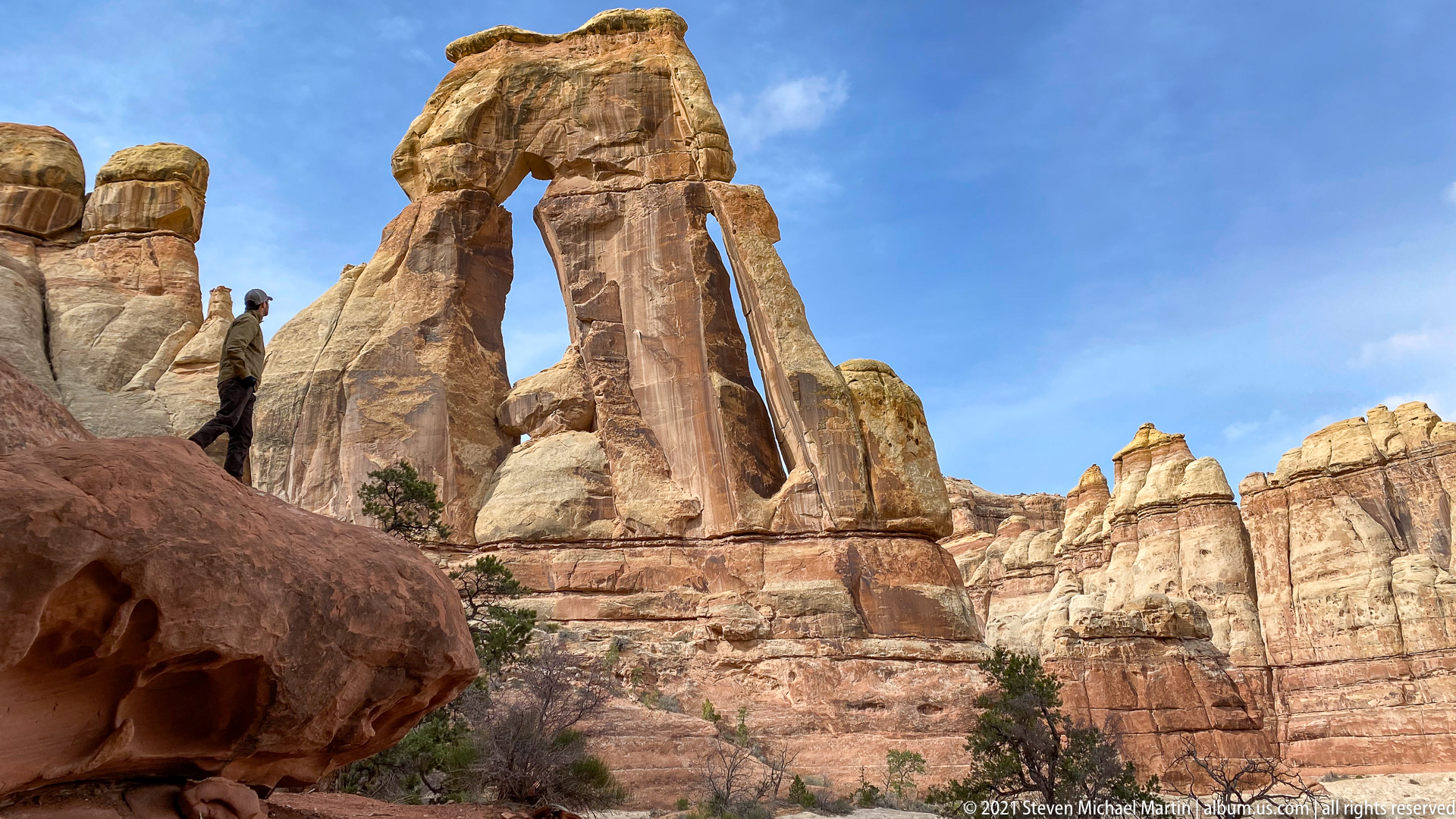
The arch fills the upper left, its thick cap bridging two tall, narrow columns. A hiker stands beside the base on a sloping rock shelf, nearly level with the lower supports but tiny against the full height. Strong sunlight warms the sandstone and reveals parallel bands, while the right side opens onto a row of rounded towers.
Caption
The arch fills the upper left, its thick cap bridging two tall, narrow columns. A hiker stands beside the base on a sloping rock shelf, nearly level with the lower supports but tiny against the full height. Strong sunlight warms the sandstone and reveals parallel bands, while the right side opens onto a row of rounded towers.
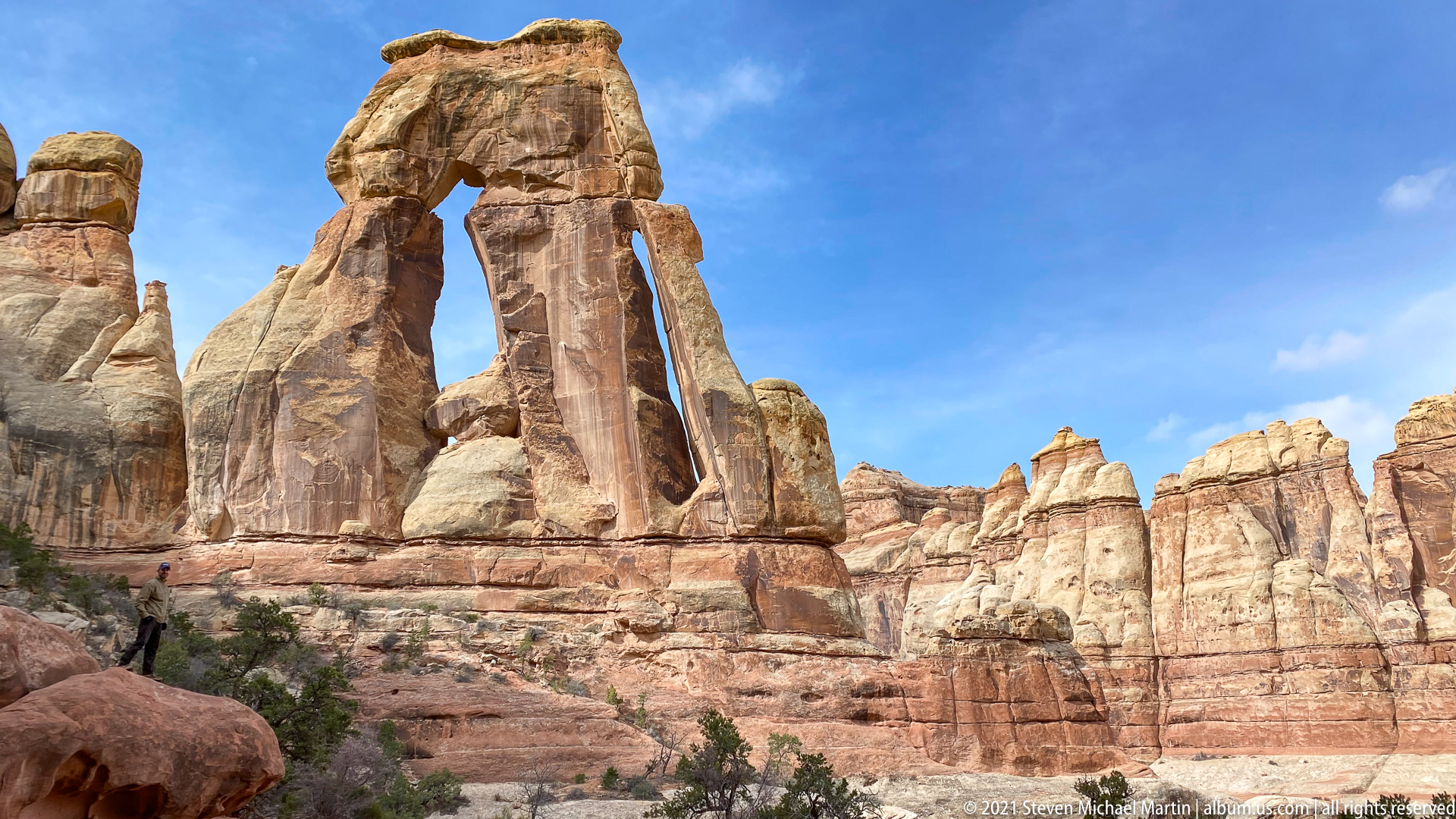
Druid Arch rises left of center above a sloping red boulder, with a long line of pale towers and layered walls extending across the right. Sparse shrubs punctuate the rocky basin beneath a bright blue sky. The composition balances the distinctive arch against the repeated forms of the surrounding Needles, showing both landmark and setting.
Caption
Druid Arch rises left of center above a sloping red boulder, with a long line of pale towers and layered walls extending across the right. Sparse shrubs punctuate the rocky basin beneath a bright blue sky. The composition balances the distinctive arch against the repeated forms of the surrounding Needles, showing both landmark and setting.
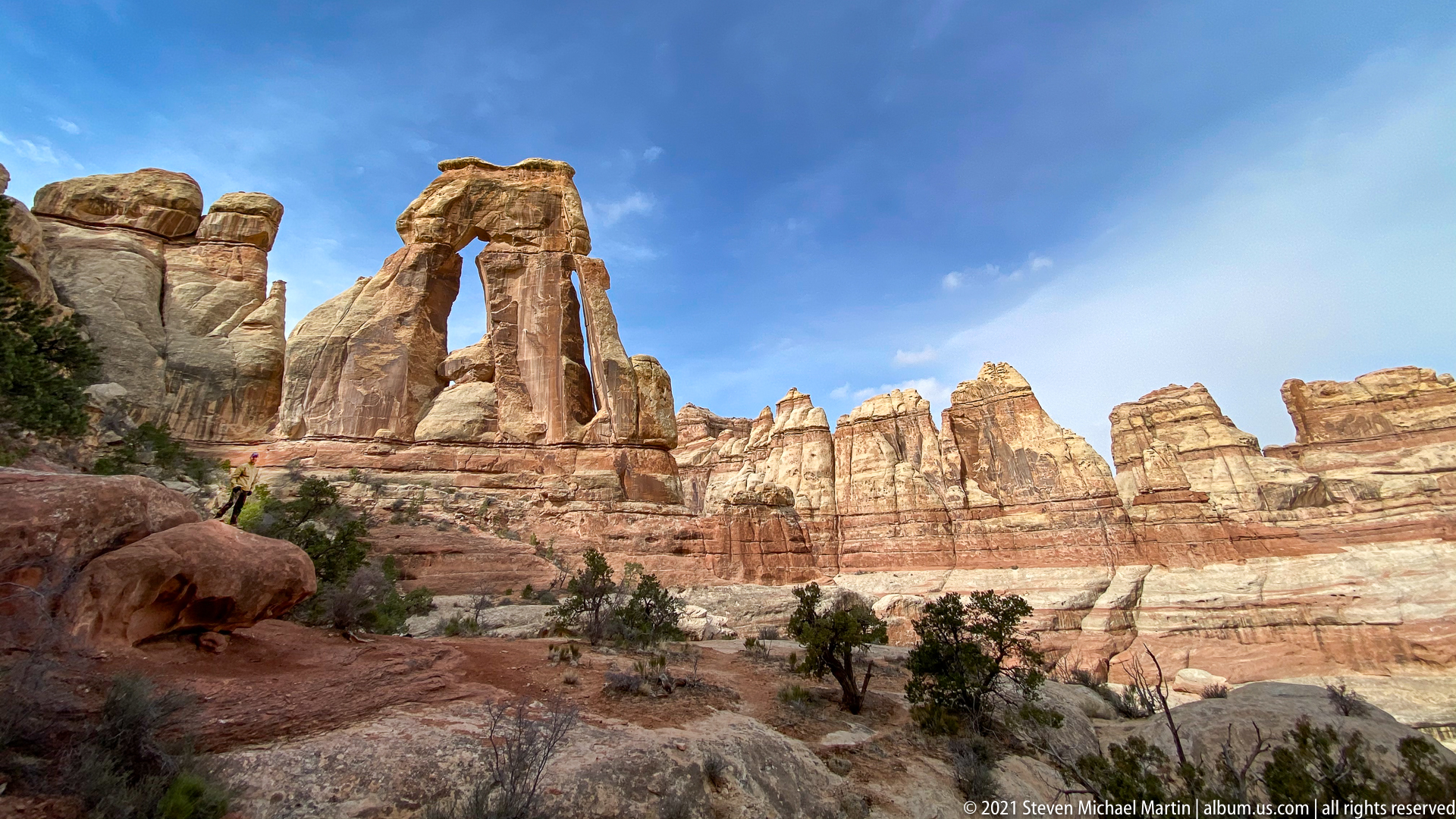
Druid Arch stands at the far left of a broad panorama, dwarfed by the length of the sandstone wall and open basin. A tiny hiker appears on the rocky slope below it, while scattered shrubs cross the pale foreground. Blue sky and bright light reveal the red horizontal bands and the repeated vertical forms of the surrounding formations.
Caption
Druid Arch stands at the far left of a broad panorama, dwarfed by the length of the sandstone wall and open basin. A tiny hiker appears on the rocky slope below it, while scattered shrubs cross the pale foreground. Blue sky and bright light reveal the red horizontal bands and the repeated vertical forms of the surrounding formations.
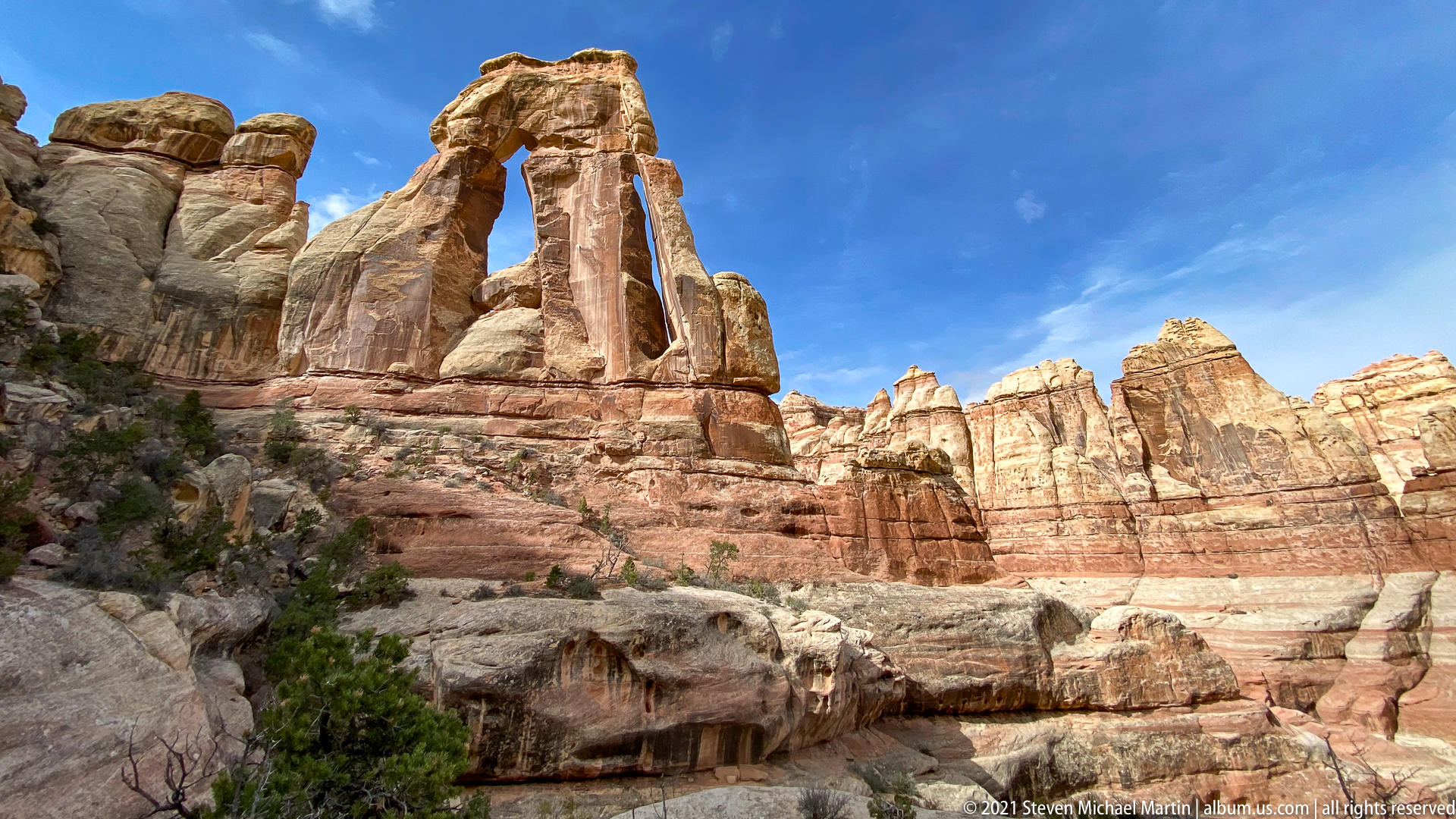
A closer angle isolates Druid Arch against a clear blue sky, with its heavy cap and narrow opening sharply defined. The neighboring cliff rises along the left edge, and the arch’s lower supports meet a pale, sloping ledge. Sunlight accentuates red bands, vertical streaks, and uneven erosion across the sandstone.
Caption
A closer angle isolates Druid Arch against a clear blue sky, with its heavy cap and narrow opening sharply defined. The neighboring cliff rises along the left edge, and the arch’s lower supports meet a pale, sloping ledge. Sunlight accentuates red bands, vertical streaks, and uneven erosion across the sandstone.
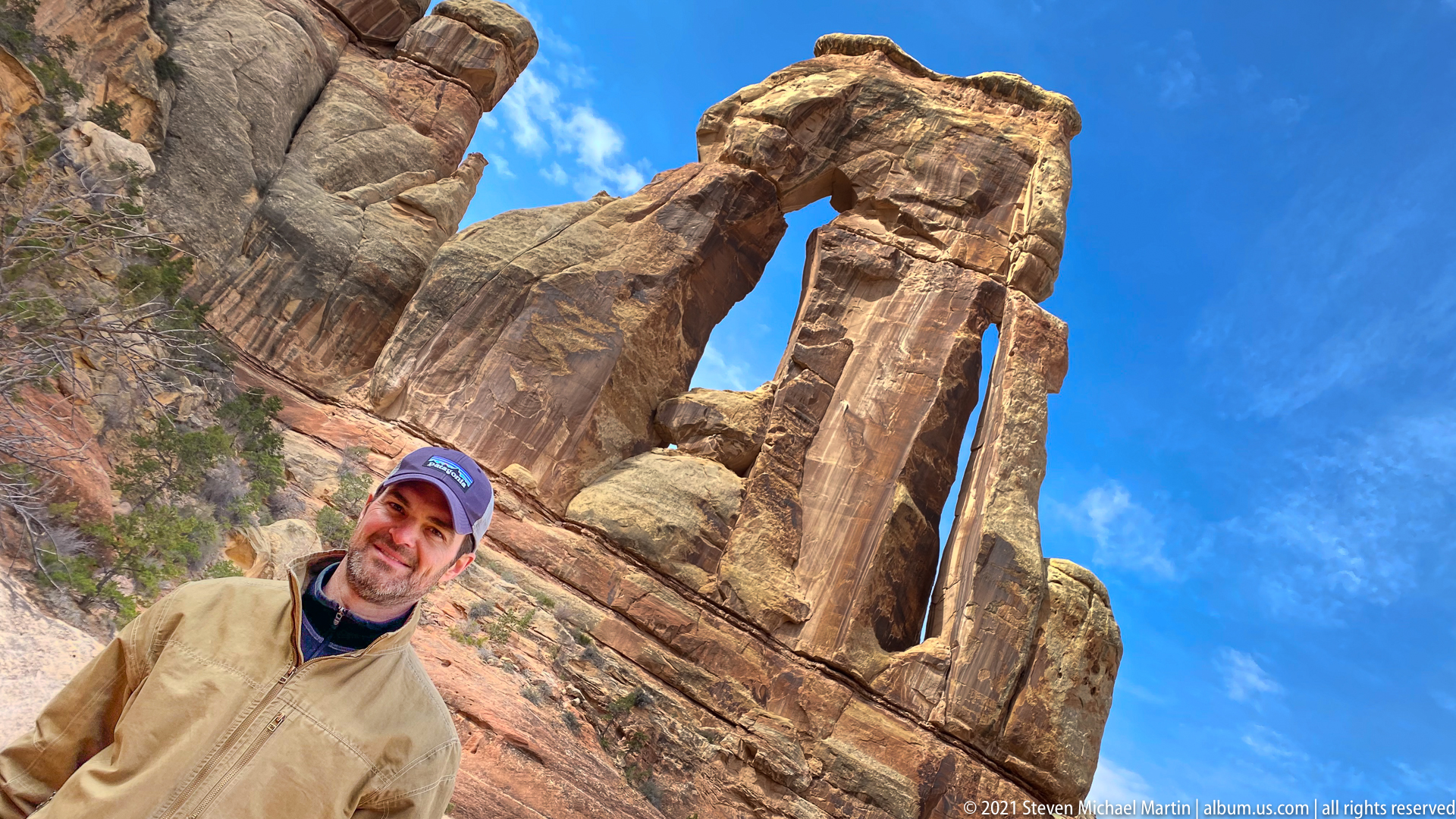
A visitor in a tan jacket and dark cap stands near the lower left, close to the camera, while Druid Arch rises behind him. The tilted framing gives the rock pillars a dramatic vertical sweep, and the blue sky separates the arch from the surrounding formations. The portrait records a person at the landmark without identifying him.
Caption
A visitor in a tan jacket and dark cap stands near the lower left, close to the camera, while Druid Arch rises behind him. The tilted framing gives the rock pillars a dramatic vertical sweep, and the blue sky separates the arch from the surrounding formations. The portrait records a person at the landmark without identifying him.
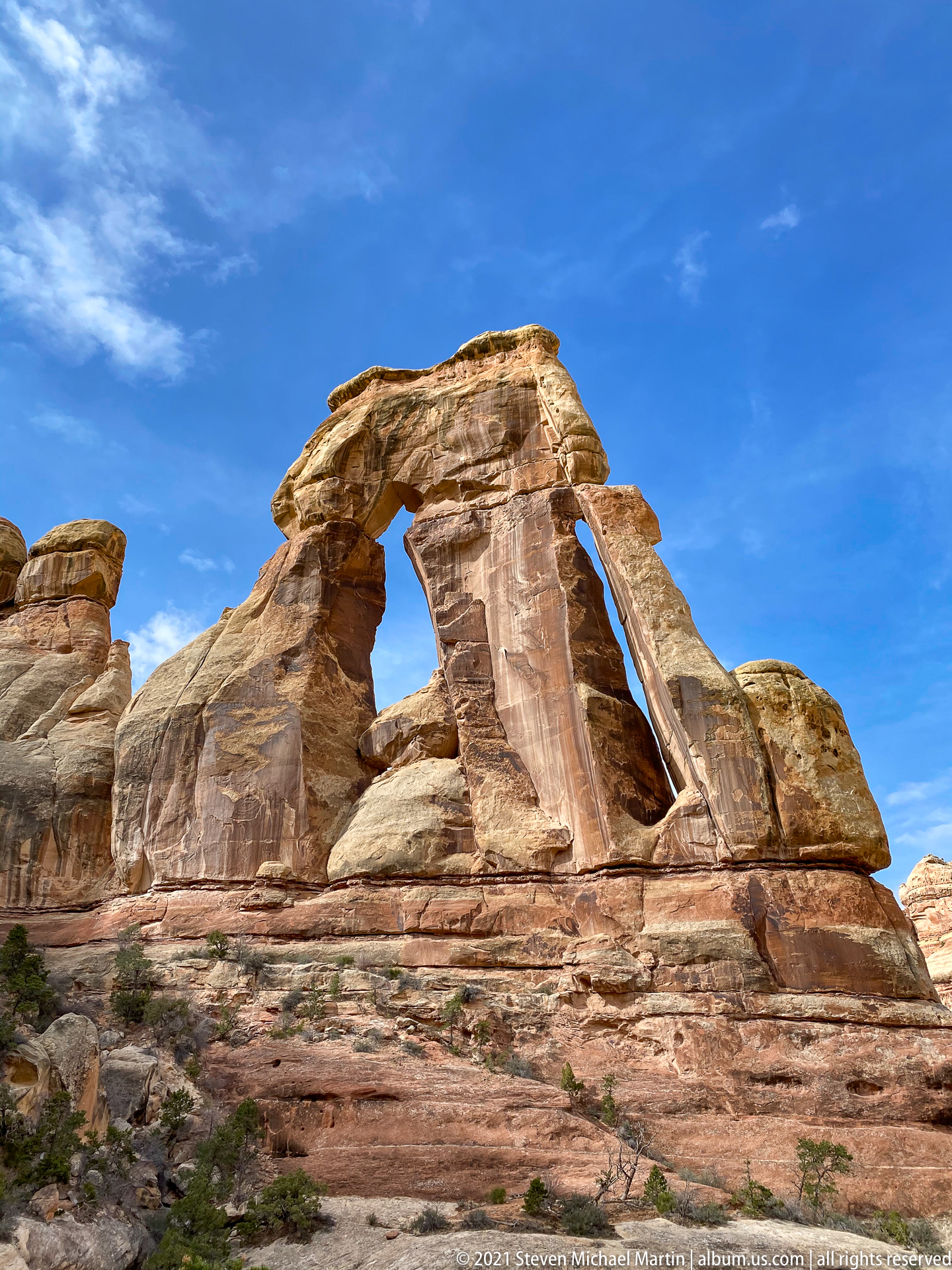
The massive sandstone cap stretches across the upper frame, supported by two weathered columns that create a tall, open window of sky. A narrow secondary gap appears between the right support and a detached slab. The nearly frontal low angle reveals the arch’s asymmetry, layered surfaces, and the uneven base from which the pillars rise.
Caption
The massive sandstone cap stretches across the upper frame, supported by two weathered columns that create a tall, open window of sky. A narrow secondary gap appears between the right support and a detached slab. The nearly frontal low angle reveals the arch’s asymmetry, layered surfaces, and the uneven base from which the pillars rise.
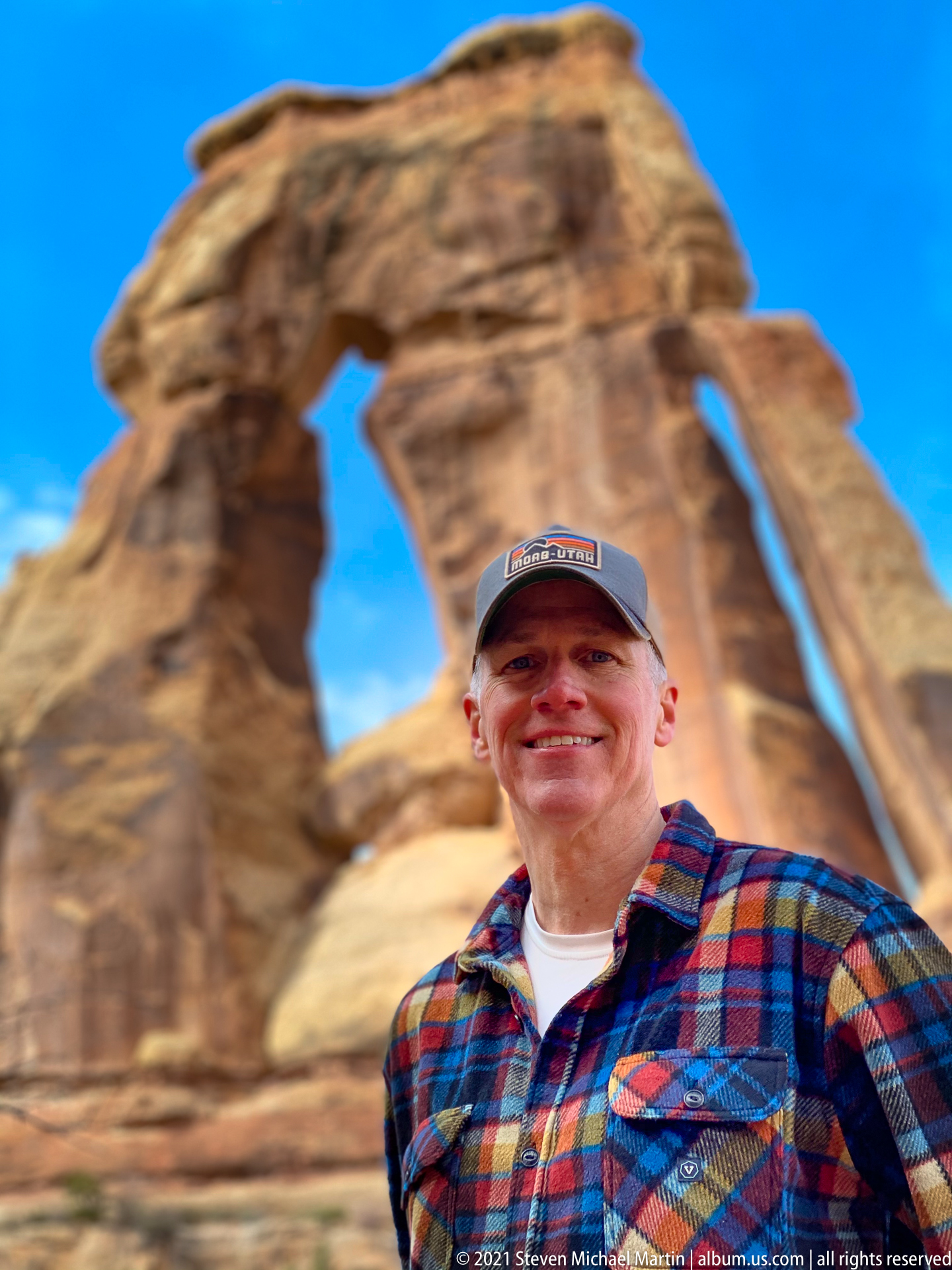
A man in a plaid shirt and baseball cap fills the foreground, smiling toward the camera. Druid Arch rises behind him but is deliberately soft and out of focus, its vertical supports and open center still recognizable. The shallow depth of field shifts attention to the visitor while retaining the iconic formation as a contextual backdrop.
Caption
A man in a plaid shirt and baseball cap fills the foreground, smiling toward the camera. Druid Arch rises behind him but is deliberately soft and out of focus, its vertical supports and open center still recognizable. The shallow depth of field shifts attention to the visitor while retaining the iconic formation as a contextual backdrop.
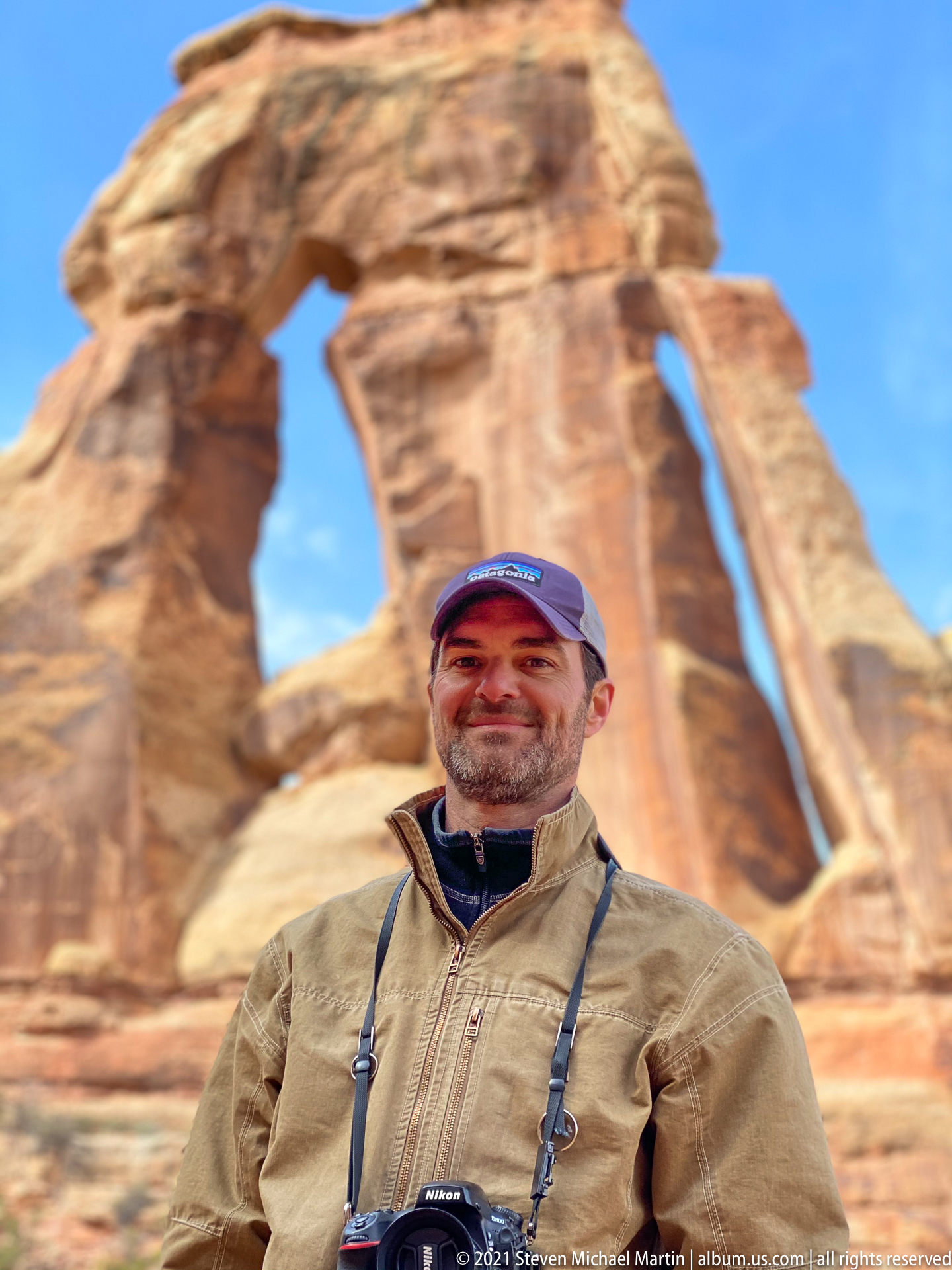
A man wearing a tan jacket, dark cap, and camera strap stands in the foreground, smiling toward the lens. Druid Arch fills the background, its thick cap and tall supports softly blurred by the shallow focus. The close portrait preserves the visitor’s expression and clothing while keeping the recognizable form of the landmark behind him.
Caption
A man wearing a tan jacket, dark cap, and camera strap stands in the foreground, smiling toward the lens. Druid Arch fills the background, its thick cap and tall supports softly blurred by the shallow focus. The close portrait preserves the visitor’s expression and clothing while keeping the recognizable form of the landmark behind him.
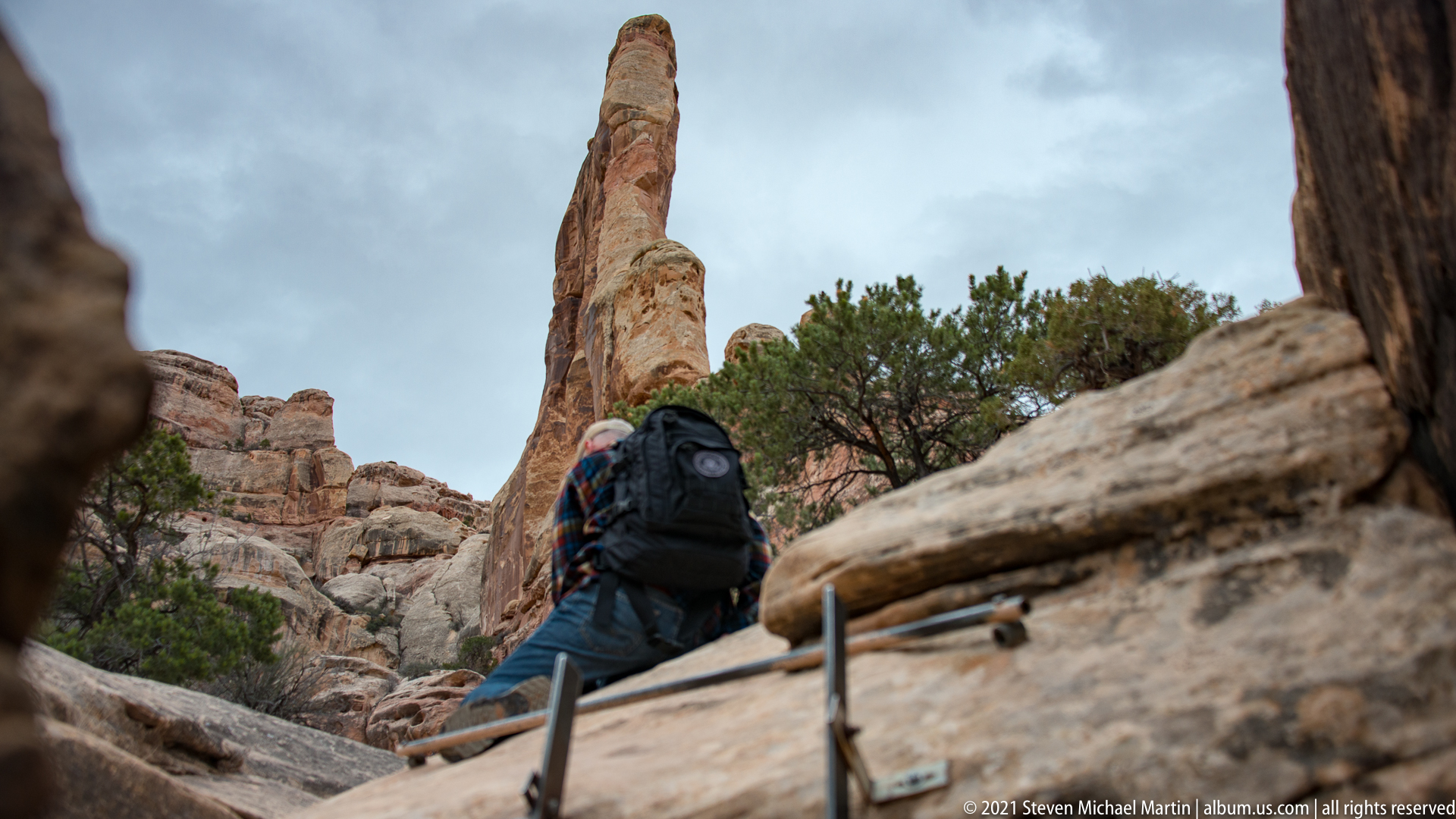
A backpacked hiker climbs a short flight of constructed steps between pale sandstone slabs. A metal handrail follows the route at right, while a tall, narrow rock spire rises behind the person among shrubs and blocky formations. The low viewpoint places the trail infrastructure in the foreground and the vertical landscape beyond.
Caption
A backpacked hiker climbs a short flight of constructed steps between pale sandstone slabs. A metal handrail follows the route at right, while a tall, narrow rock spire rises behind the person among shrubs and blocky formations. The low viewpoint places the trail infrastructure in the foreground and the vertical landscape beyond.
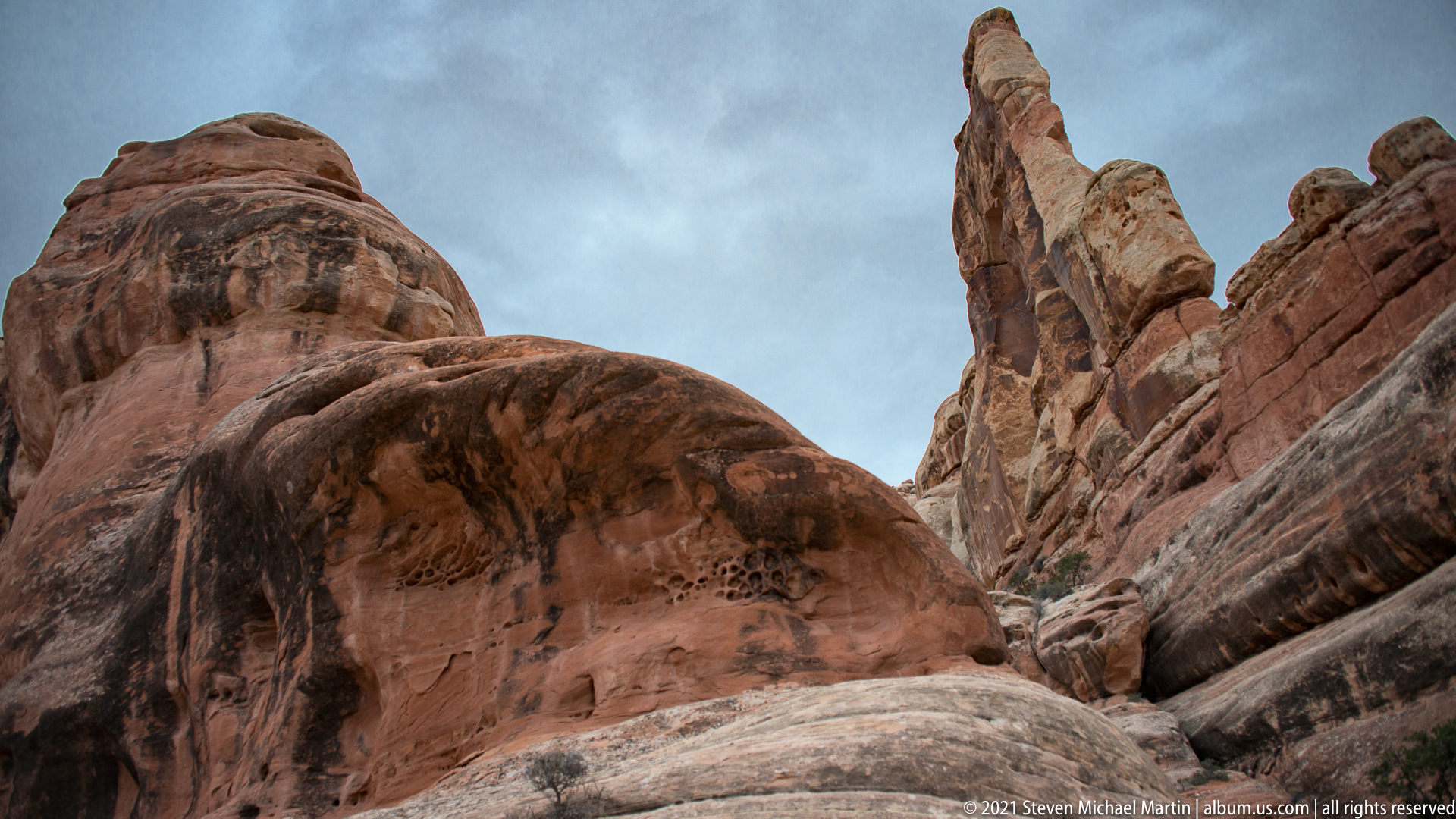
A rounded, dark-red sandstone dome fills the lower left, while a narrow pinnacled tower rises behind it against a pale overcast sky. Broken ledges and sloping rock walls close the right side, creating a compact view of the vertical forms along the trail. The absence of people shifts attention to the shape and texture of the formations.
Caption
A rounded, dark-red sandstone dome fills the lower left, while a narrow pinnacled tower rises behind it against a pale overcast sky. Broken ledges and sloping rock walls close the right side, creating a compact view of the vertical forms along the trail. The absence of people shifts attention to the shape and texture of the formations.
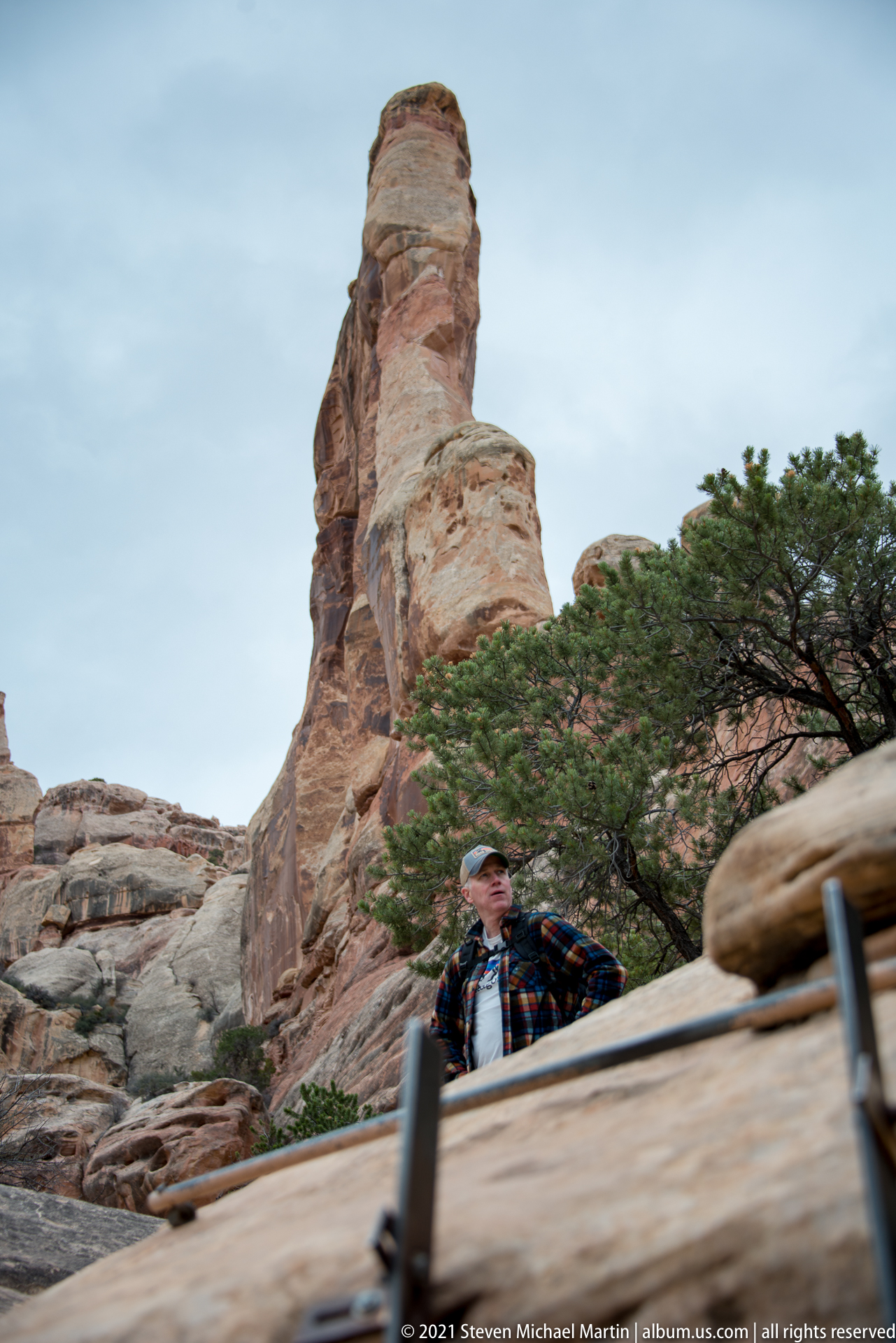
A visitor in a plaid shirt appears behind the low stone stair wall, with a slim sandstone tower rising above shrubs in the center. Metal posts and handrails cross the lower foreground, marking the route through the rocky passage. The composition connects the visitor’s progress with the steep, irregular terrain and the trail’s built access.
Caption
A visitor in a plaid shirt appears behind the low stone stair wall, with a slim sandstone tower rising above shrubs in the center. Metal posts and handrails cross the lower foreground, marking the route through the rocky passage. The composition connects the visitor’s progress with the steep, irregular terrain and the trail’s built access.
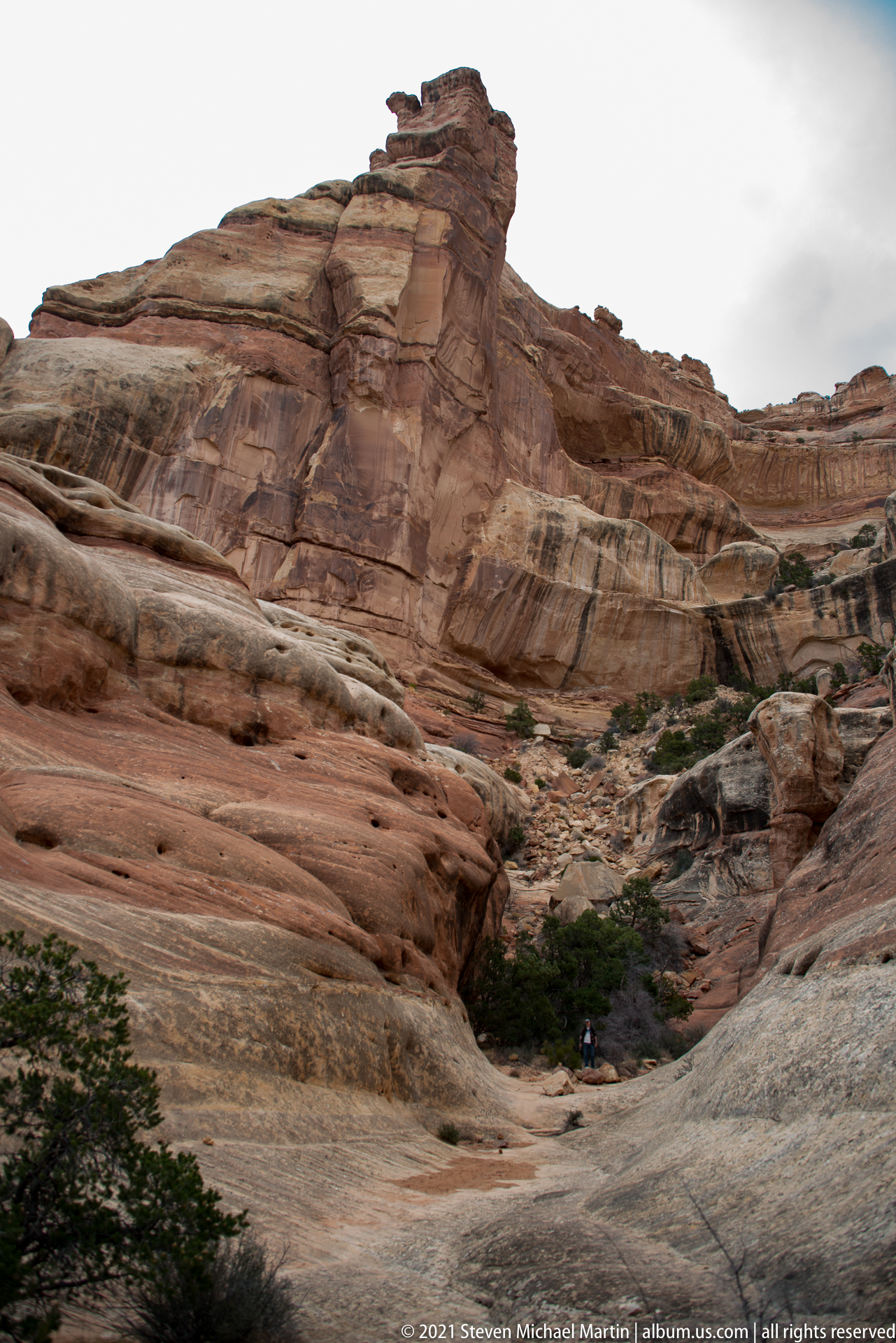
A small hiker stands near the base of a broad sandstone wall whose horizontal bands sweep across the upper frame. Pale rock slopes and rounded boulders narrow toward the person, giving the scene a sheltered, canyon-like depth. The contrast in scale makes the cliff’s mass and the confined route below it especially clear.
Caption
A small hiker stands near the base of a broad sandstone wall whose horizontal bands sweep across the upper frame. Pale rock slopes and rounded boulders narrow toward the person, giving the scene a sheltered, canyon-like depth. The contrast in scale makes the cliff’s mass and the confined route below it especially clear.
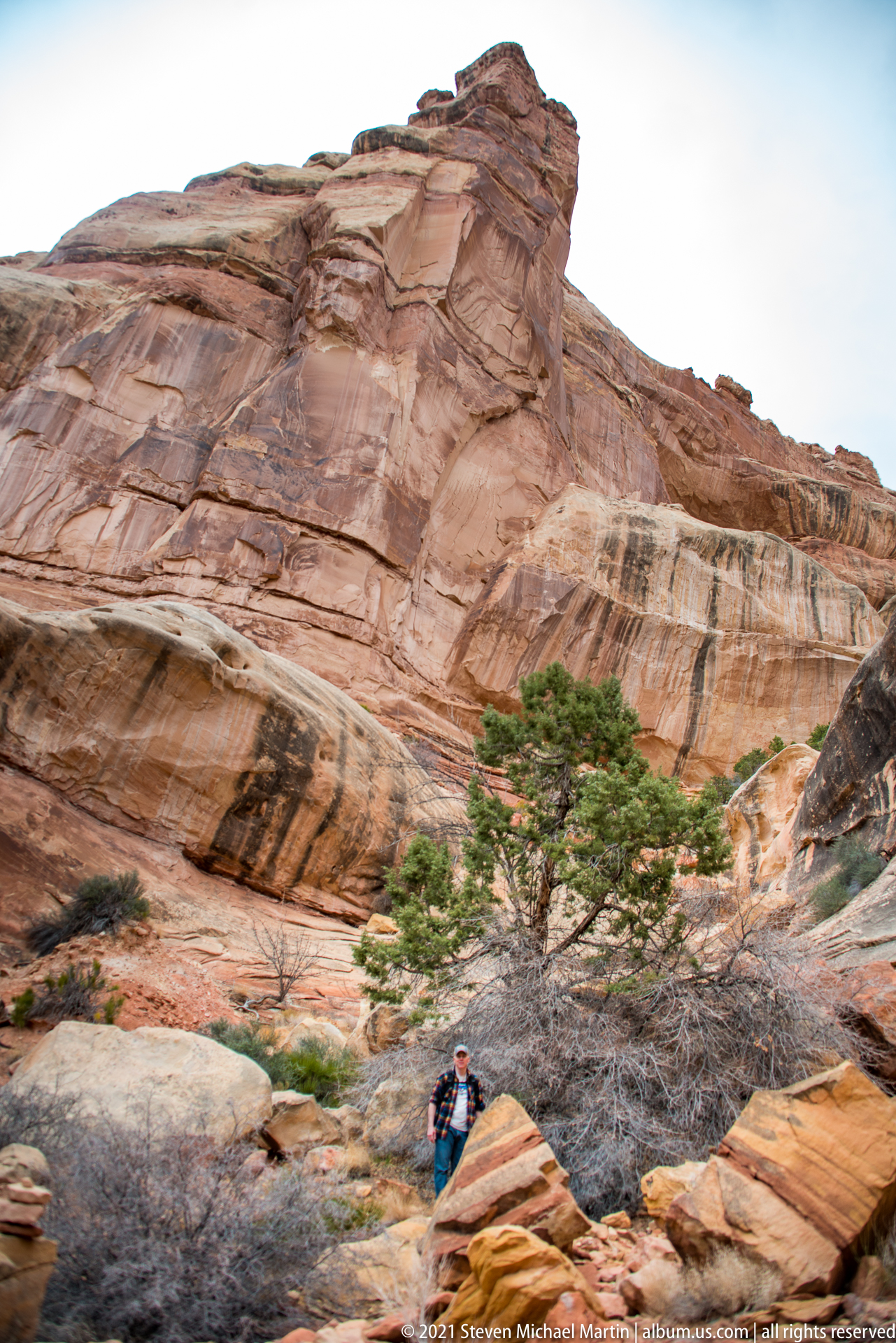
A visitor stands among angular red and cream boulders at the lower center, dwarfed by a towering, horizontally banded wall. A leafy shrub at right softens the rock’s hard lines, while the open patch of sky highlights the cliff’s upper edge. This view includes the person and trail foreground to convey the formation’s scale.
Caption
A visitor stands among angular red and cream boulders at the lower center, dwarfed by a towering, horizontally banded wall. A leafy shrub at right softens the rock’s hard lines, while the open patch of sky highlights the cliff’s upper edge. This view includes the person and trail foreground to convey the formation’s scale.
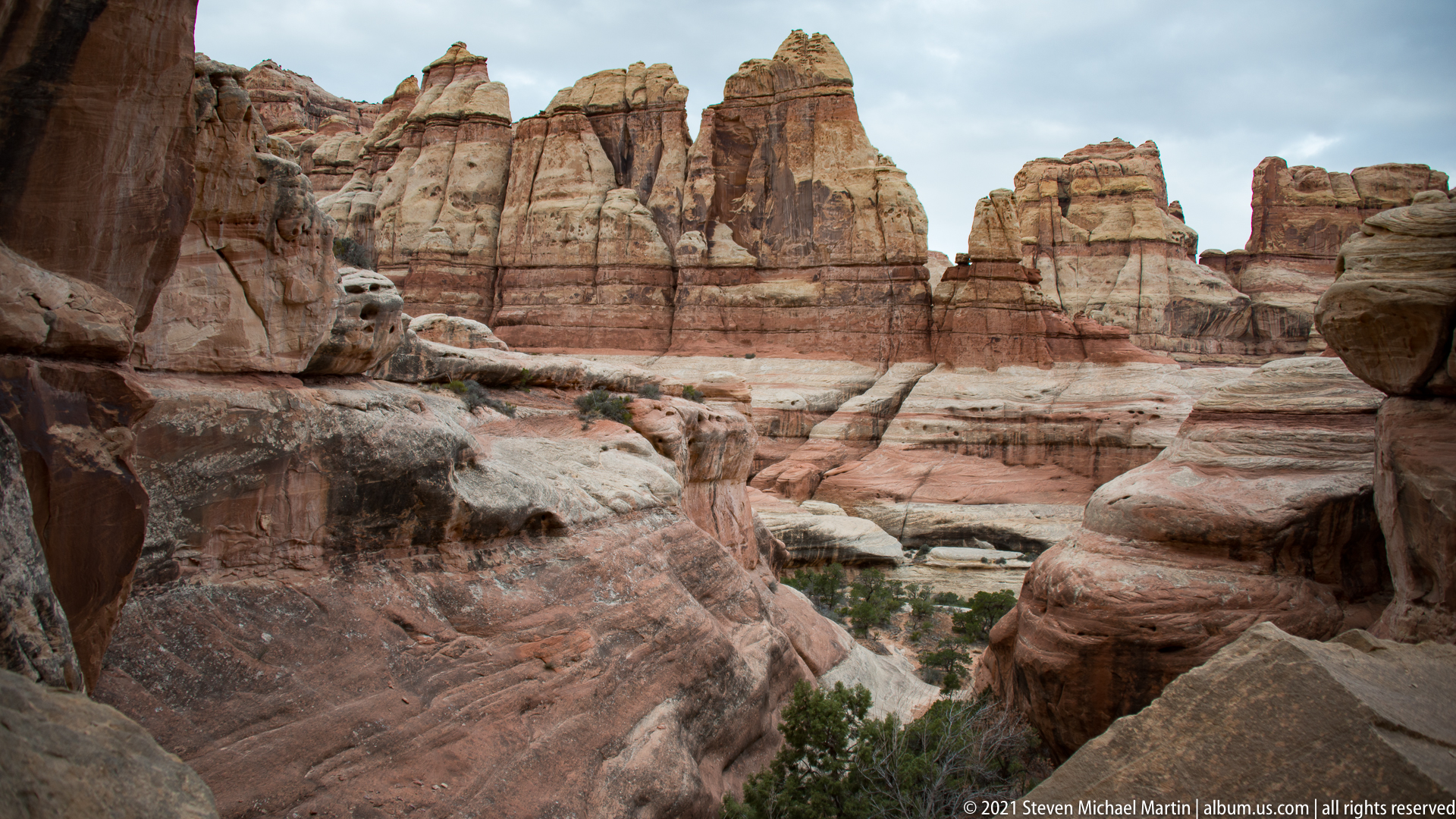
A shallow canyon opens between high walls of banded sandstone, with irregular towers and ledges rising above a sandy, scrub-dotted floor. The view looks into the rock corridor rather than toward the arch itself. Horizontal strata, weathered alcoves, and scattered junipers establish the rugged Needles District setting in this broad landscape view.
Caption
A shallow canyon opens between high walls of banded sandstone, with irregular towers and ledges rising above a sandy, scrub-dotted floor. The view looks into the rock corridor rather than toward the arch itself. Horizontal strata, weathered alcoves, and scattered junipers establish the rugged Needles District setting in this broad landscape view.
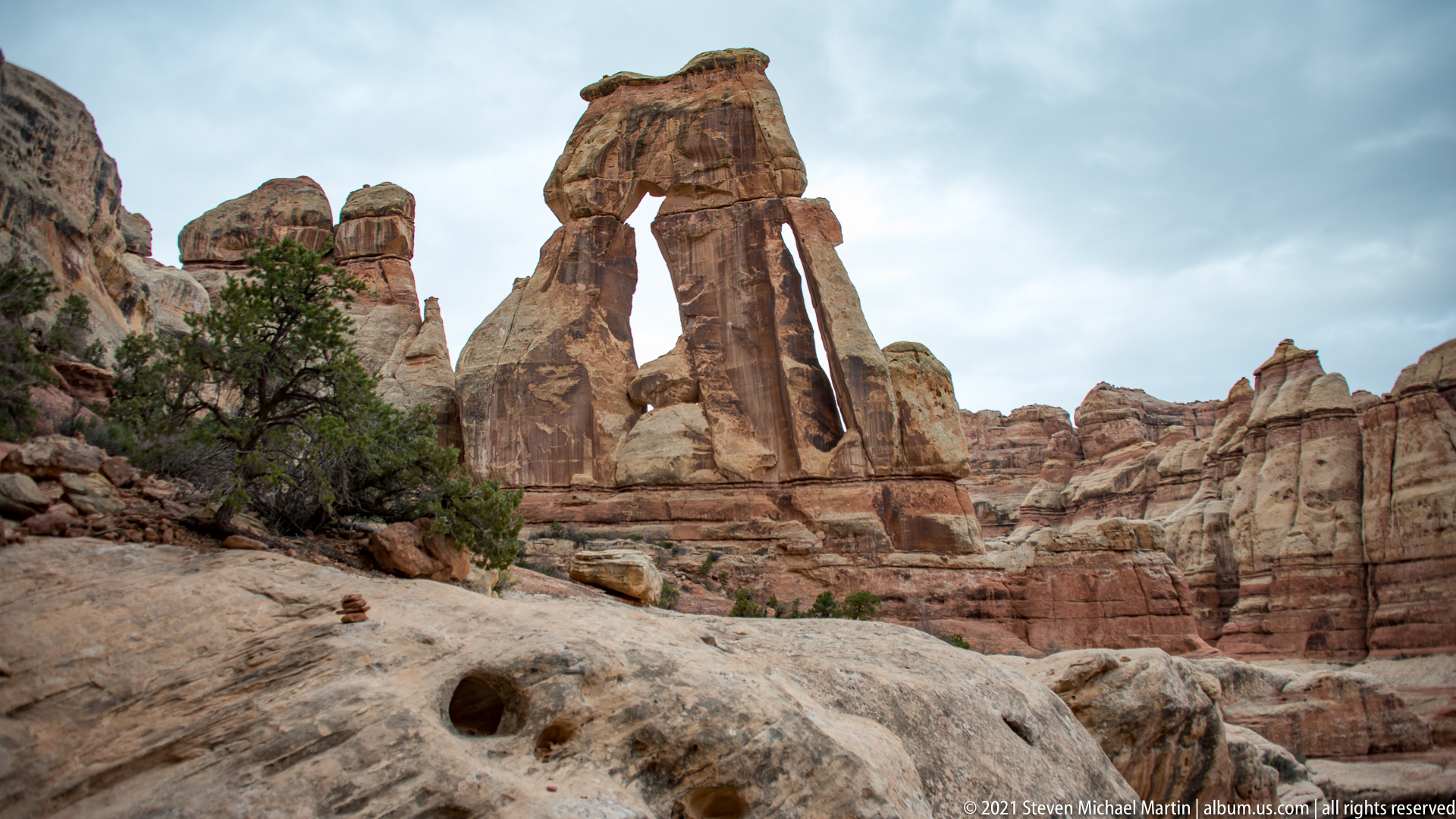
A rounded sandstone ledge occupies the foreground, where a dark circular pothole punctuates the pale surface. Beyond it, Druid Arch stands among clustered red and cream formations, framed by a juniper at left and open sky above. The broad composition links the small weathered basin in front with the monumental arch rising behind it.
Caption
A rounded sandstone ledge occupies the foreground, where a dark circular pothole punctuates the pale surface. Beyond it, Druid Arch stands among clustered red and cream formations, framed by a juniper at left and open sky above. The broad composition links the small weathered basin in front with the monumental arch rising behind it.
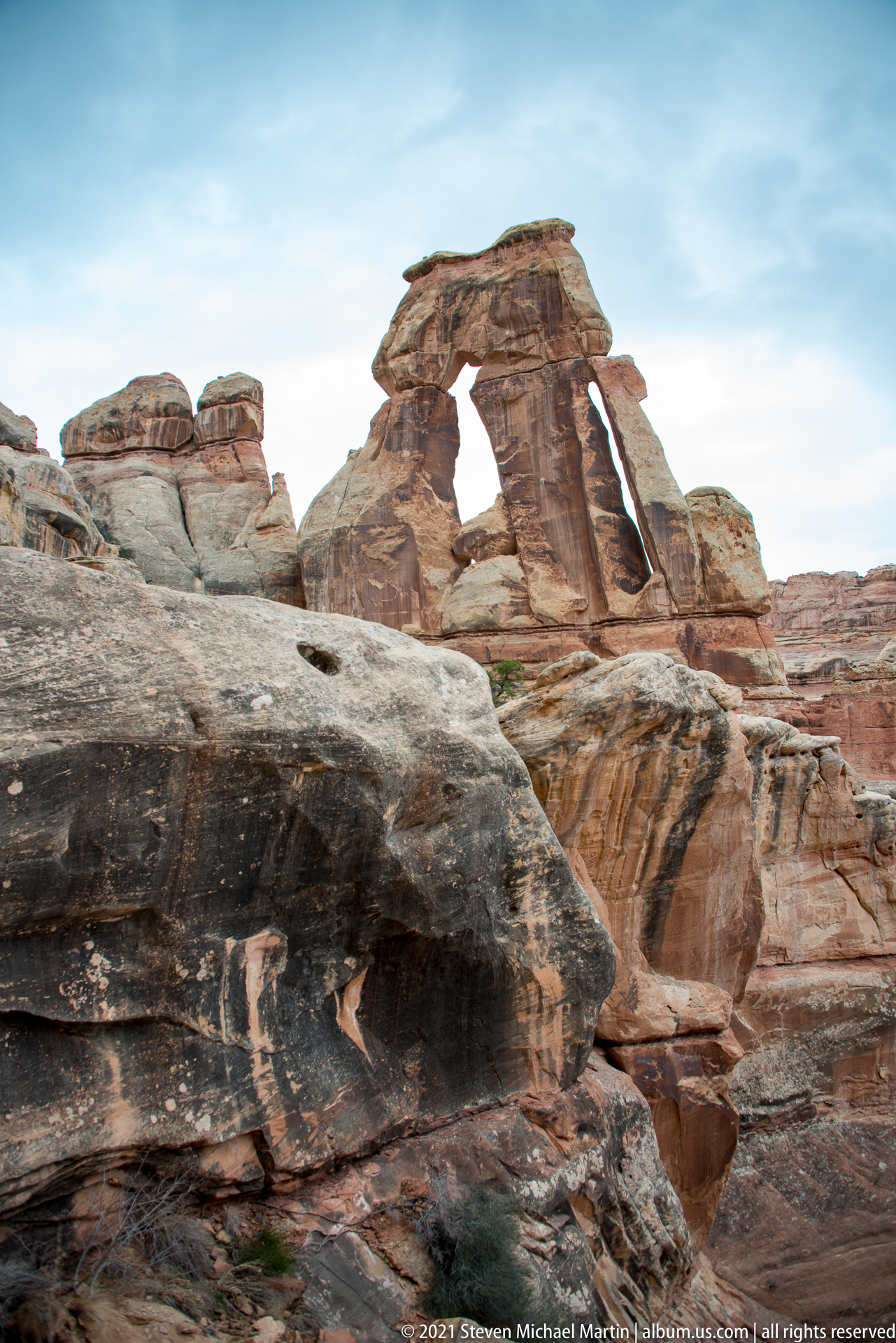
Druid Arch rises beyond a dark, sloping slickrock shelf that fills much of the foreground. Its broad capstone rests on tall, uneven sandstone supports, leaving a bright opening beneath the span. The low viewpoint compresses the base of the formation behind the ledge and emphasizes the arch’s height against a pale, clouded sky.
Caption
Druid Arch rises beyond a dark, sloping slickrock shelf that fills much of the foreground. Its broad capstone rests on tall, uneven sandstone supports, leaving a bright opening beneath the span. The low viewpoint compresses the base of the formation behind the ledge and emphasizes the arch’s height against a pale, clouded sky.
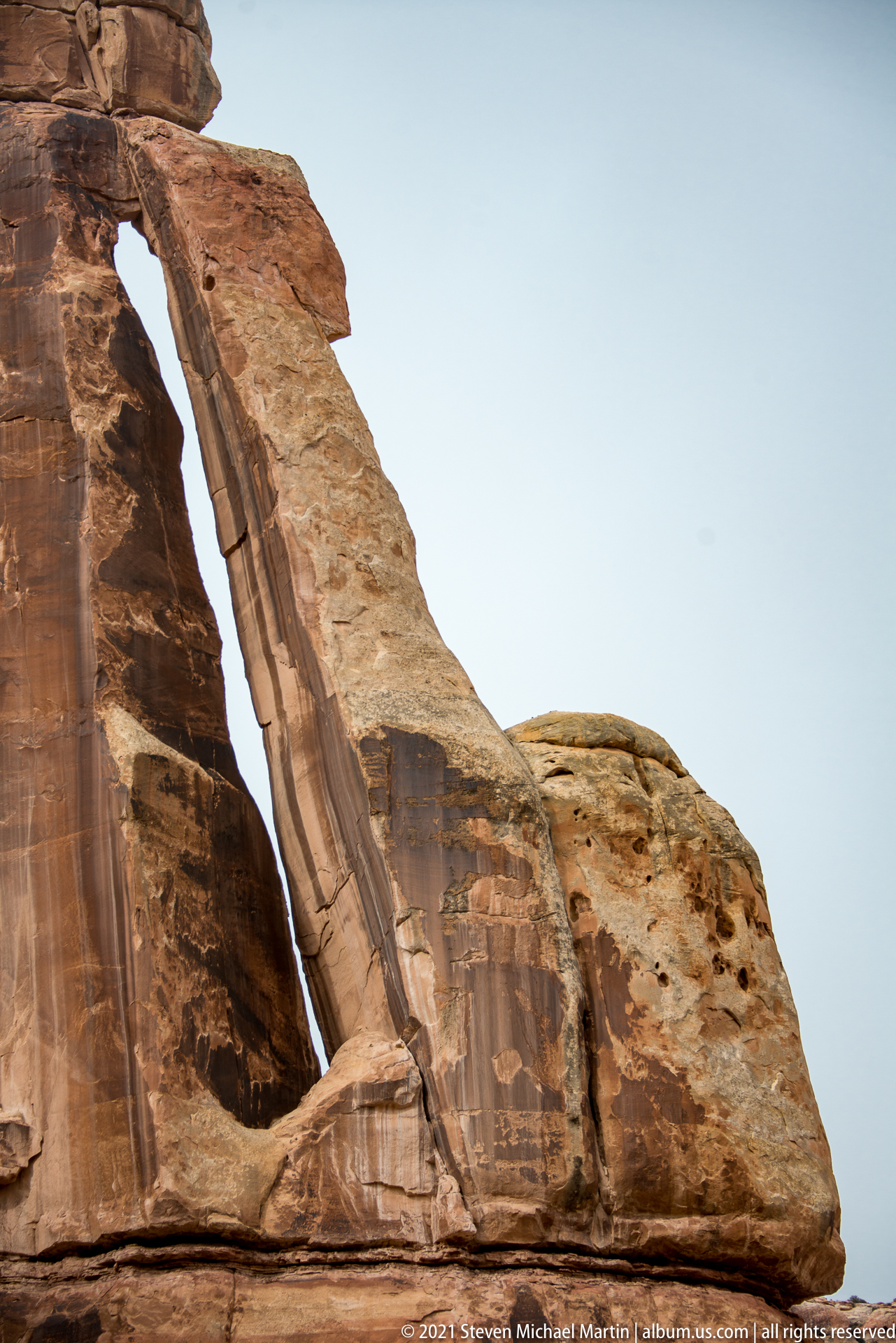
A close crop isolates one sloping sandstone support of Druid Arch and the narrow dark gap beside it. Horizontal bands cross the lower rock, while vertical streaks run down the pillar’s face. The capstone is partly cut off at the upper left, shifting attention from the complete arch to the way its massive supports meet the surrounding bedrock.
Caption
A close crop isolates one sloping sandstone support of Druid Arch and the narrow dark gap beside it. Horizontal bands cross the lower rock, while vertical streaks run down the pillar’s face. The capstone is partly cut off at the upper left, shifting attention from the complete arch to the way its massive supports meet the surrounding bedrock.
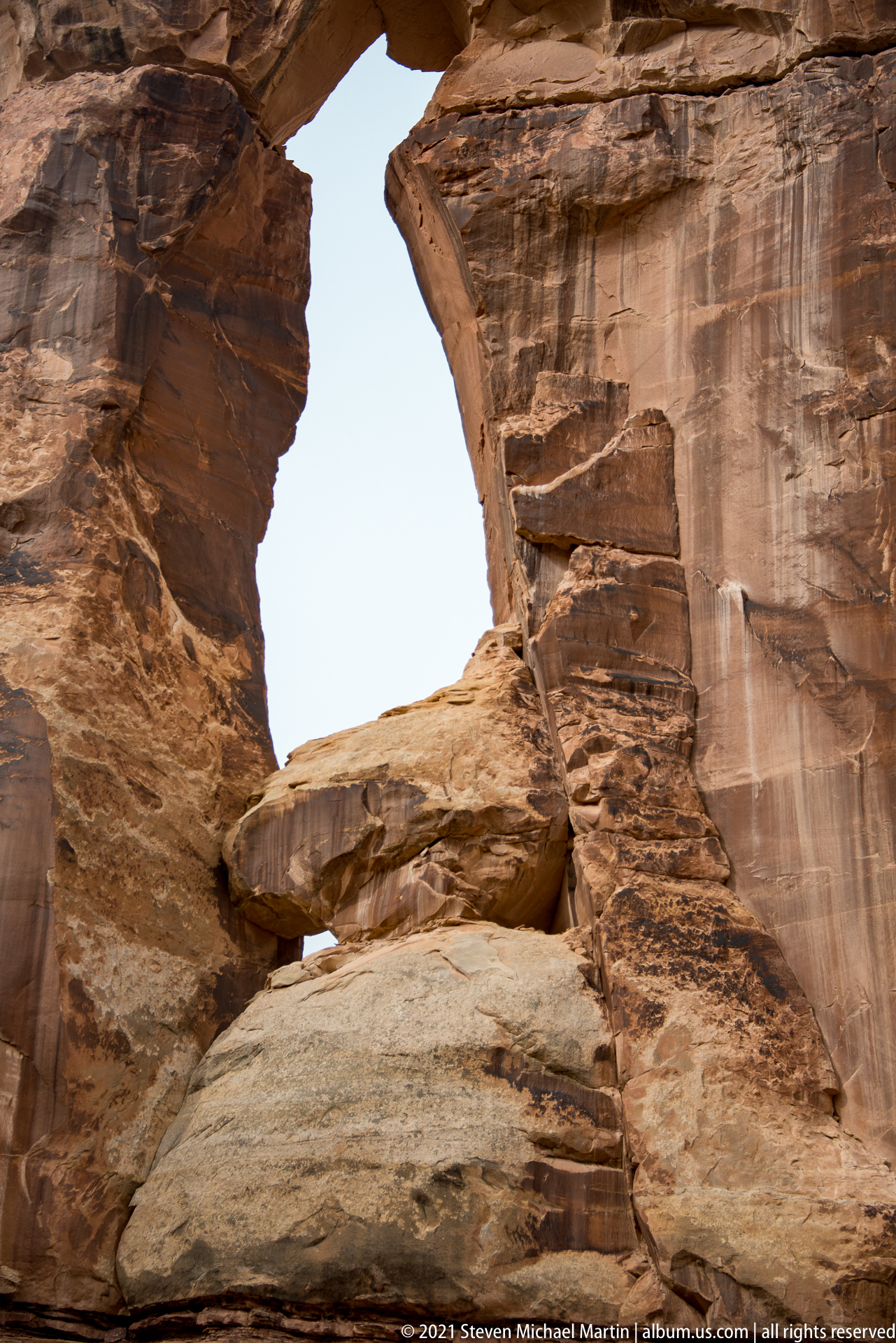
From beneath the formation, the camera looks through Druid Arch’s opening toward a patch of pale sky. Massive sandstone walls frame both sides, and layered ledges rise across the lower foreground. This interior-facing angle reveals the thickness and irregular underside of the natural bridge, distinguishing it from exterior views that show the arch’s full outline.
Caption
From beneath the formation, the camera looks through Druid Arch’s opening toward a patch of pale sky. Massive sandstone walls frame both sides, and layered ledges rise across the lower foreground. This interior-facing angle reveals the thickness and irregular underside of the natural bridge, distinguishing it from exterior views that show the arch’s full outline.
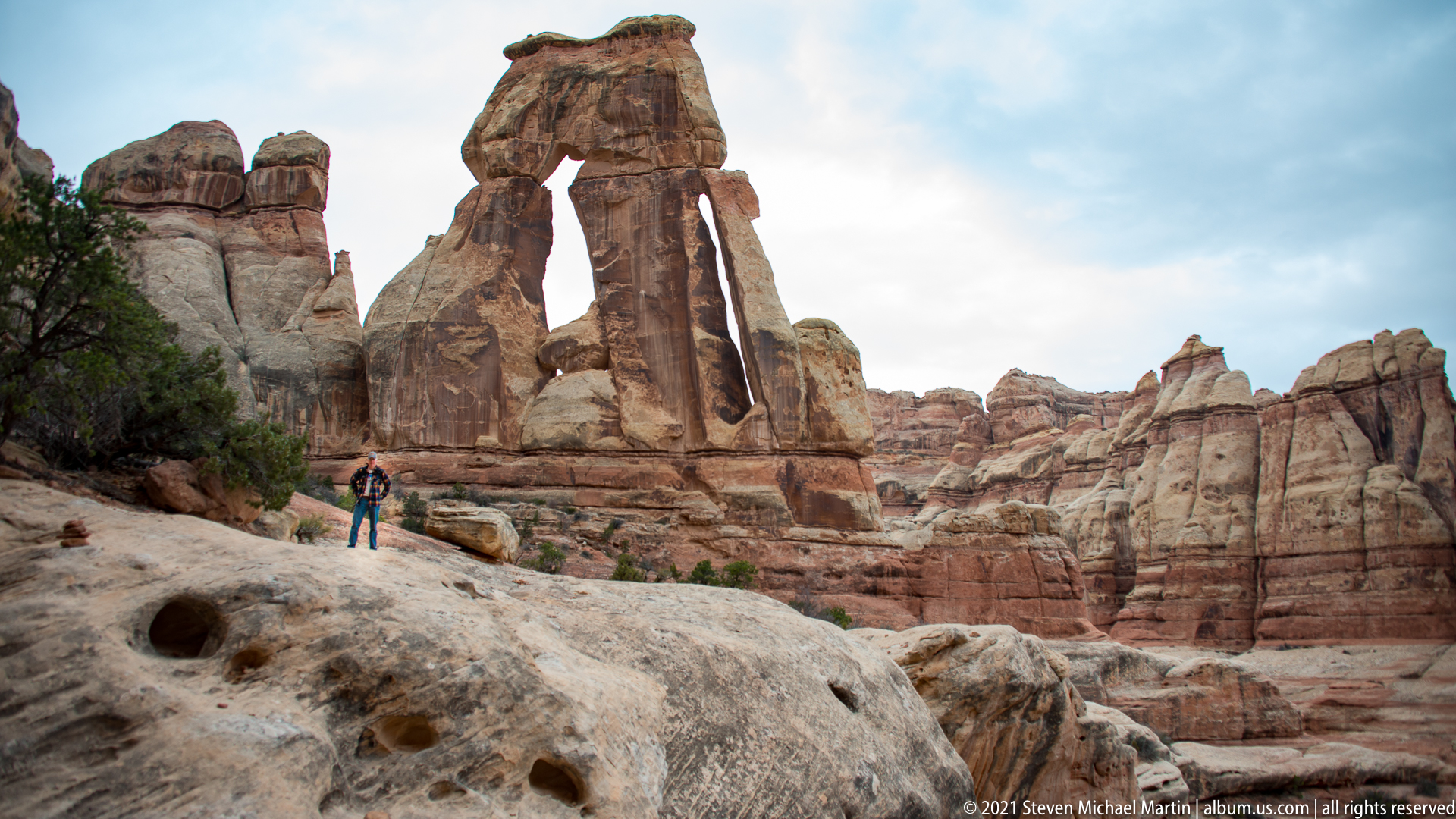
A lone visitor stands on the sloping rock below Druid Arch, providing a clear measure of the formation’s scale. The arch’s massive capstone and narrow central opening rise above layered sandstone walls, while rounded potholes mark the near ledge. The person remains small within the scene, and the composition balances human presence with the enclosing canyon landscape.
Caption
A lone visitor stands on the sloping rock below Druid Arch, providing a clear measure of the formation’s scale. The arch’s massive capstone and narrow central opening rise above layered sandstone walls, while rounded potholes mark the near ledge. The person remains small within the scene, and the composition balances human presence with the enclosing canyon landscape.
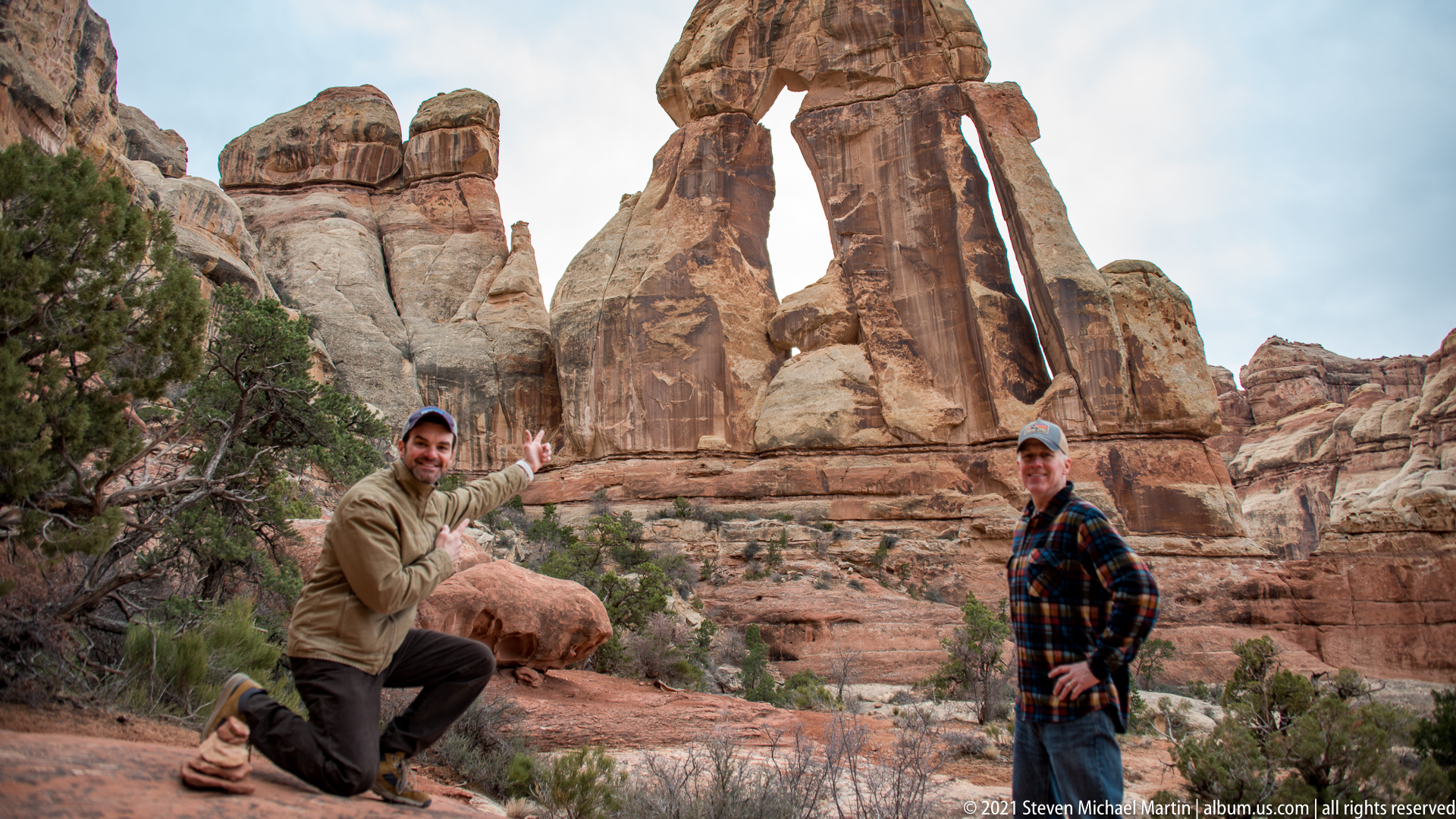
Two visitors pose on the rocky approach beneath Druid Arch. One kneels beside a rounded boulder and raises an arm toward the formation, while the other stands at right; the arch towers over both figures. Juniper branches and layered sandstone frame the scene, which records a moment of human scale and interaction at the base of the landmark.
Caption
Two visitors pose on the rocky approach beneath Druid Arch. One kneels beside a rounded boulder and raises an arm toward the formation, while the other stands at right; the arch towers over both figures. Juniper branches and layered sandstone frame the scene, which records a moment of human scale and interaction at the base of the landmark.
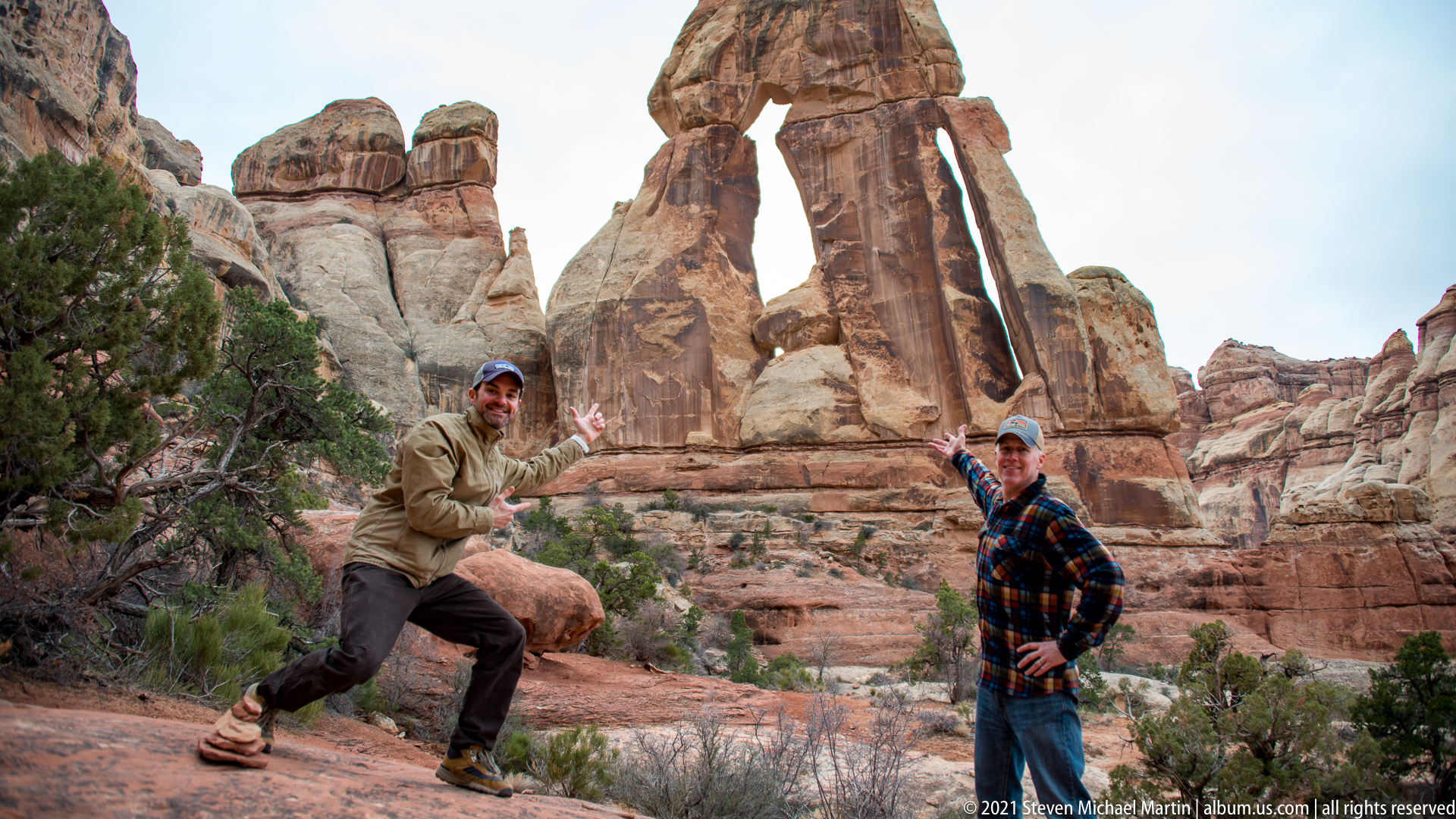
Two visitors gesture toward the towering arch from the rocky foreground. The person at left leans into a wide stance, while the visitor at right raises an arm; both appear small beneath the heavy sandstone capstone. The low viewpoint keeps the full opening and neighboring pillars in view, turning the pose into a playful measure of the landmark’s scale.
Caption
Two visitors gesture toward the towering arch from the rocky foreground. The person at left leans into a wide stance, while the visitor at right raises an arm; both appear small beneath the heavy sandstone capstone. The low viewpoint keeps the full opening and neighboring pillars in view, turning the pose into a playful measure of the landmark’s scale.
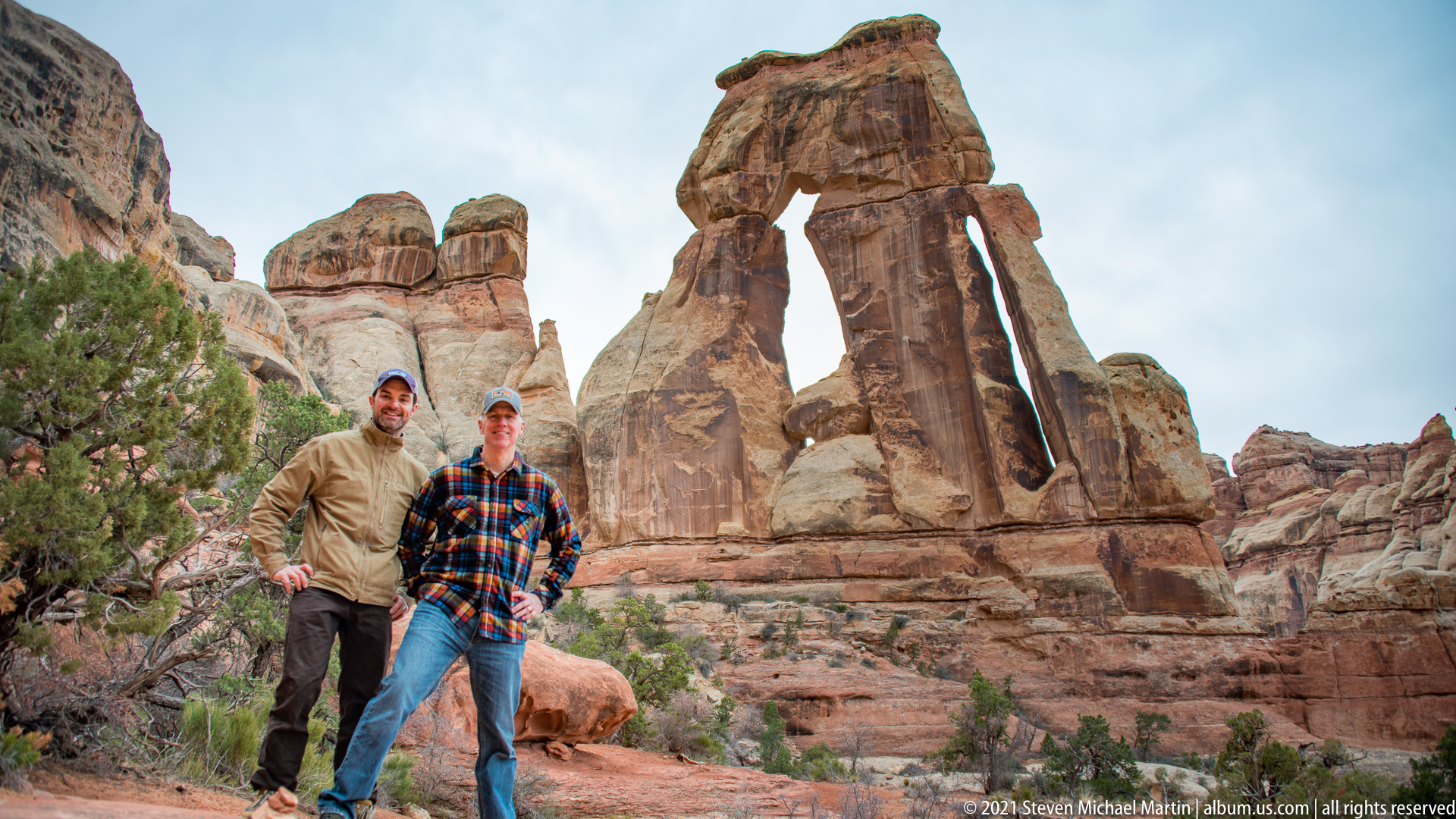
Two visitors pose side by side near the center-left foreground, directly below Druid Arch. Their colorful clothing adds a small human accent to the red and cream rock, while the central opening remains unobstructed above them. The photograph gives equal attention to the pair and to the surrounding sandstone walls, connecting a travel portrait with the scale of the formation.
Caption
Two visitors pose side by side near the center-left foreground, directly below Druid Arch. Their colorful clothing adds a small human accent to the red and cream rock, while the central opening remains unobstructed above them. The photograph gives equal attention to the pair and to the surrounding sandstone walls, connecting a travel portrait with the scale of the formation.
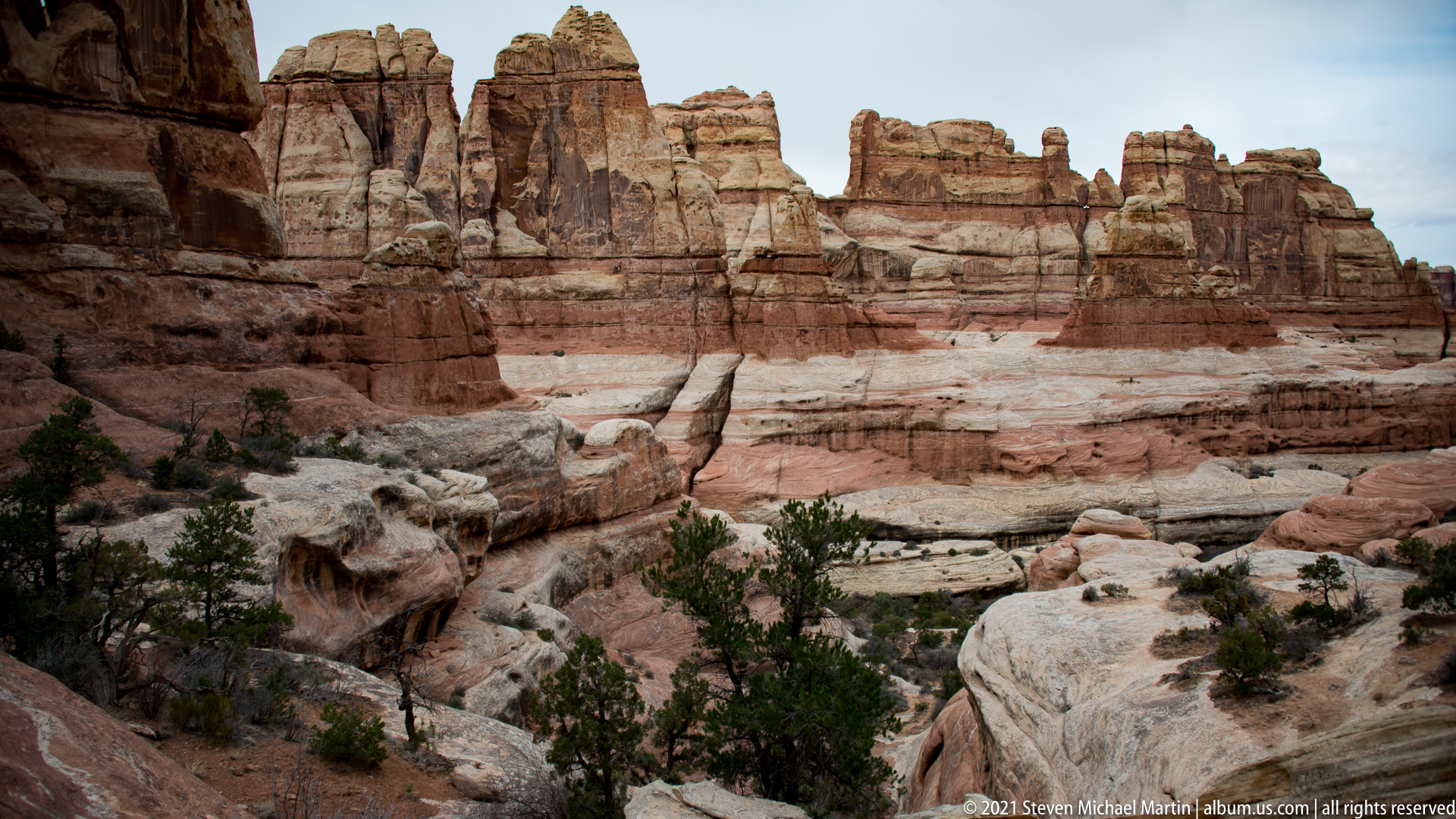
A broad slickrock corridor extends toward a line of banded cliffs, with rounded pale slabs and shallow channels stepping through the foreground. Sparse shrubs interrupt the exposed stone, while darker red walls close the horizon. The arch is outside this frame; the photograph instead records the open, undulating terrain of the route through the Needles District.
Caption
A broad slickrock corridor extends toward a line of banded cliffs, with rounded pale slabs and shallow channels stepping through the foreground. Sparse shrubs interrupt the exposed stone, while darker red walls close the horizon. The arch is outside this frame; the photograph instead records the open, undulating terrain of the route through the Needles District.
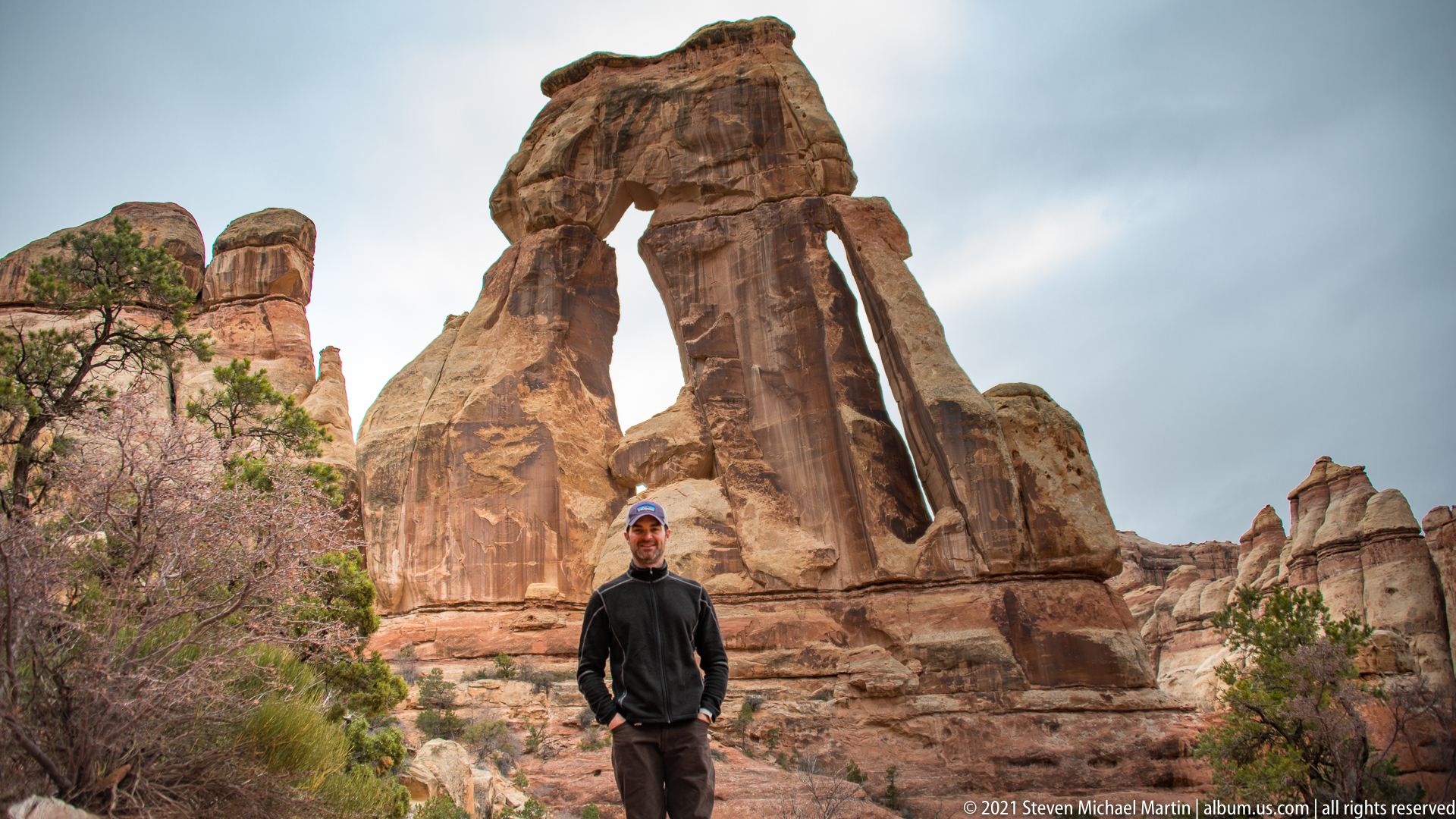
A single visitor stands nearly centered beneath Druid Arch, dwarfed by the tall sandstone supports and heavy capstone overhead. The person’s dark clothing creates a strong focal point against the pale rock, while junipers and scattered boulders fill the lower edges. The frontal view makes the natural opening appear like a monumental gateway.
Caption
A single visitor stands nearly centered beneath Druid Arch, dwarfed by the tall sandstone supports and heavy capstone overhead. The person’s dark clothing creates a strong focal point against the pale rock, while junipers and scattered boulders fill the lower edges. The frontal view makes the natural opening appear like a monumental gateway.
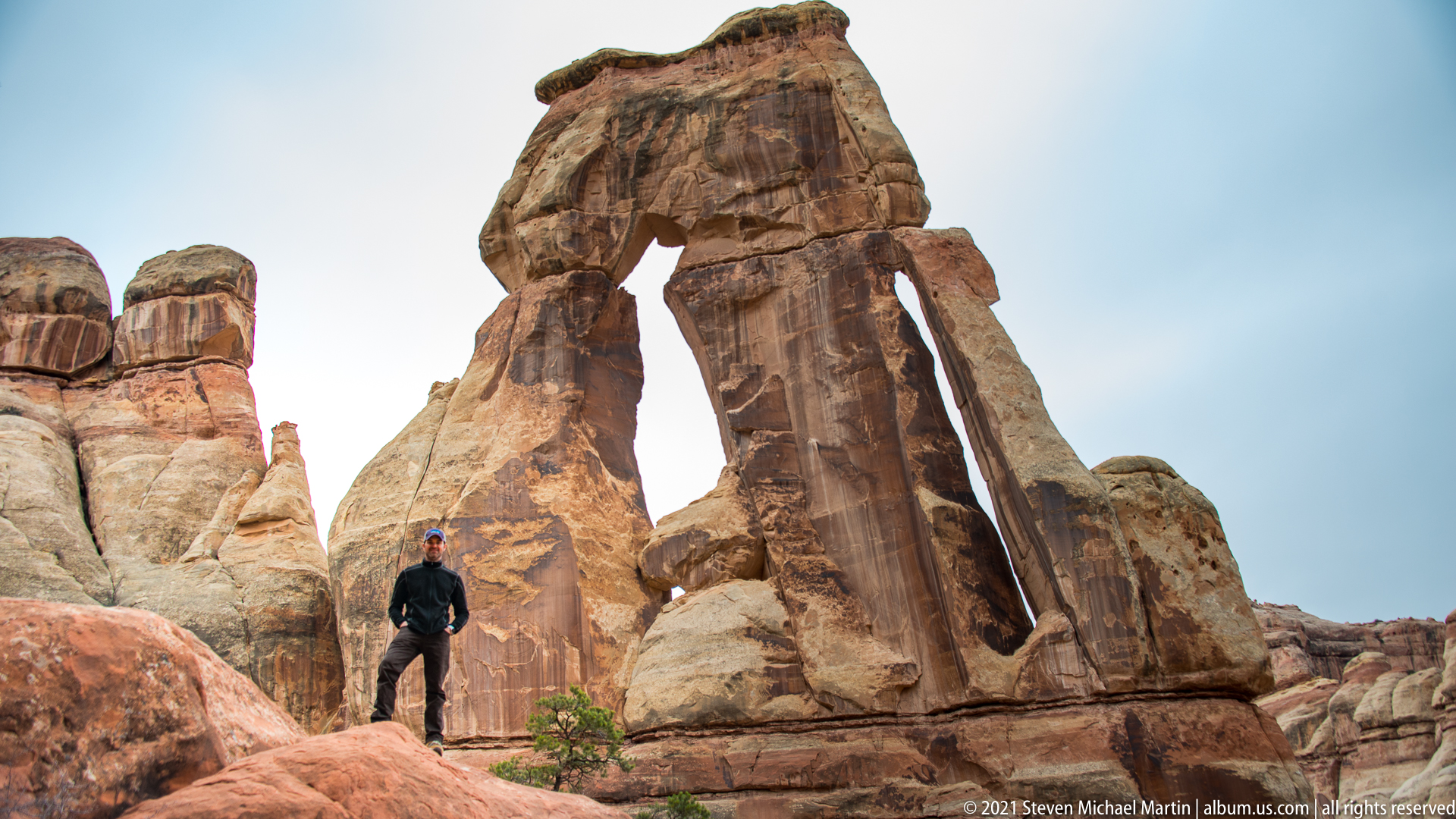
A lone hiker stands at the left base of Druid Arch in this low-angle view. The sandstone span dominates the frame, its weathered upper block bridging narrow supports while the visitor appears small against the vertical rock. A bright sky surrounds the opening and separates the arch from nearby rounded towers, emphasizing the formation’s height and irregular silhouette.
Caption
A lone hiker stands at the left base of Druid Arch in this low-angle view. The sandstone span dominates the frame, its weathered upper block bridging narrow supports while the visitor appears small against the vertical rock. A bright sky surrounds the opening and separates the arch from nearby rounded towers, emphasizing the formation’s height and irregular silhouette.
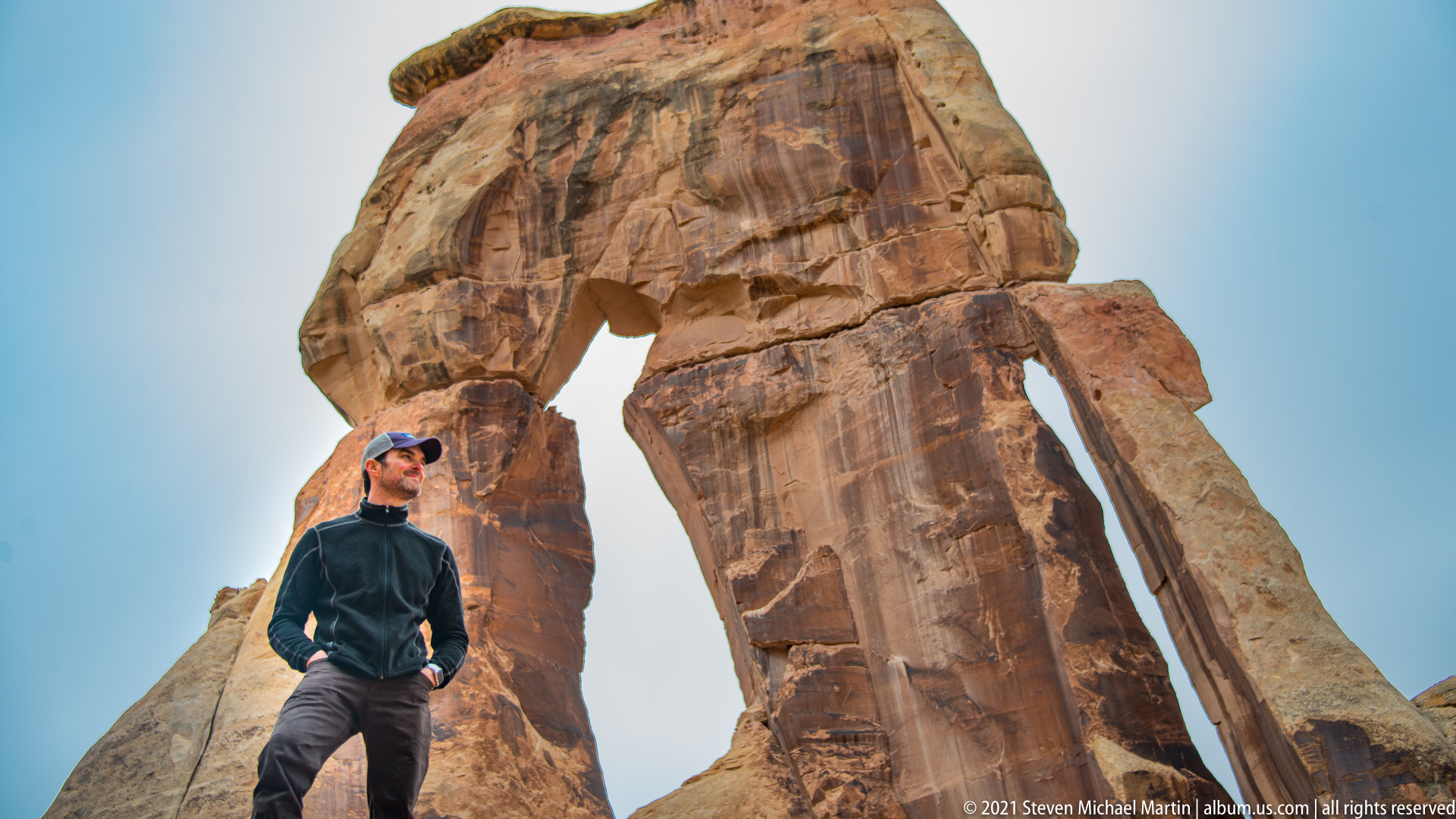
A visitor stands in the lower foreground and looks up toward Druid Arch, whose capstone fills the upper frame. The low viewpoint exaggerates the height of the central support and reveals deep vertical streaks and ledges across the sandstone. A second rounded tower is partly visible at left, setting the arch within a cluster of sculpted rock.
Caption
A visitor stands in the lower foreground and looks up toward Druid Arch, whose capstone fills the upper frame. The low viewpoint exaggerates the height of the central support and reveals deep vertical streaks and ledges across the sandstone. A second rounded tower is partly visible at left, setting the arch within a cluster of sculpted rock.
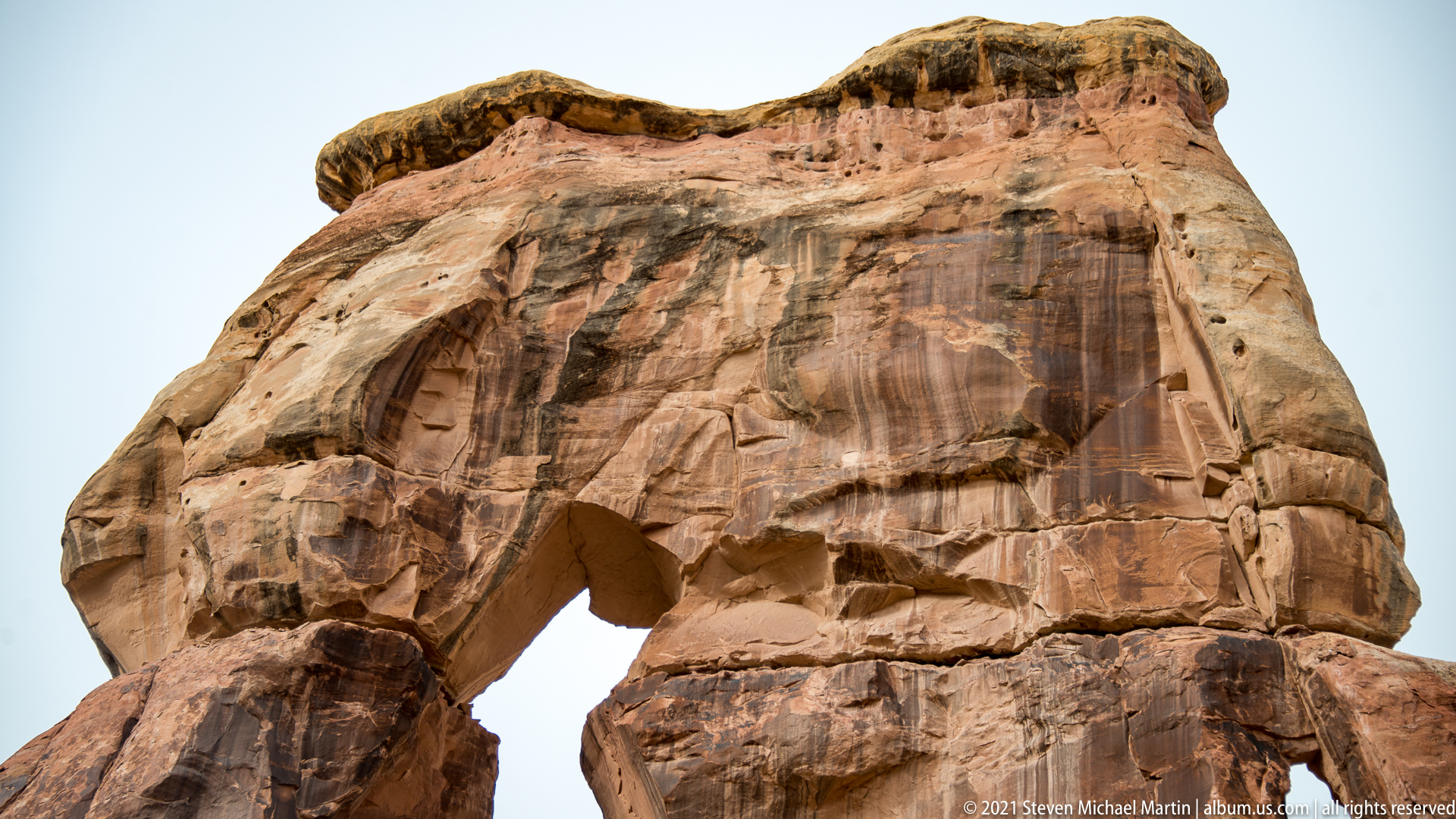
Druid Arch fills the frame in a close upward view, with its broad capstone projecting over a large opening. Vertical streaks, ledges, and color bands mark the sandstone surface, while the sky shines through the space between the supports. The crop gives little attention to the surrounding canyon and instead concentrates on the bridge-like shape and weathered rock texture.
Caption
Druid Arch fills the frame in a close upward view, with its broad capstone projecting over a large opening. Vertical streaks, ledges, and color bands mark the sandstone surface, while the sky shines through the space between the supports. The crop gives little attention to the surrounding canyon and instead concentrates on the bridge-like shape and weathered rock texture.
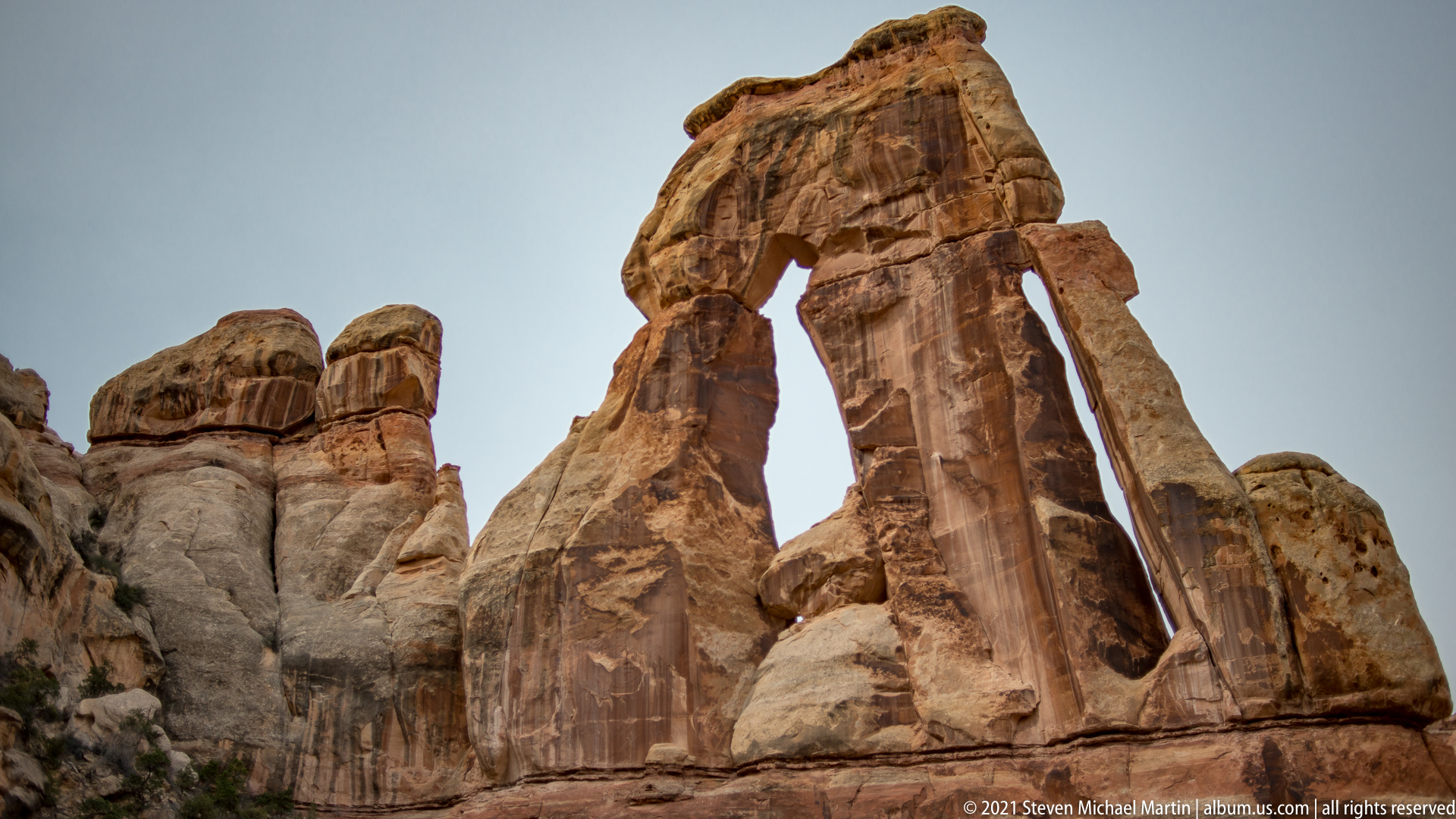
Seen from below, Druid Arch rises sharply against a pale sky. Its capstone bends across the opening above two uneven supports, one broad and streaked and the other narrower. Neighboring rounded towers enter at left, helping place the arch within the surrounding sandstone cluster. The upward angle accentuates its high, irregular outline.
Caption
Seen from below, Druid Arch rises sharply against a pale sky. Its capstone bends across the opening above two uneven supports, one broad and streaked and the other narrower. Neighboring rounded towers enter at left, helping place the arch within the surrounding sandstone cluster. The upward angle accentuates its high, irregular outline.
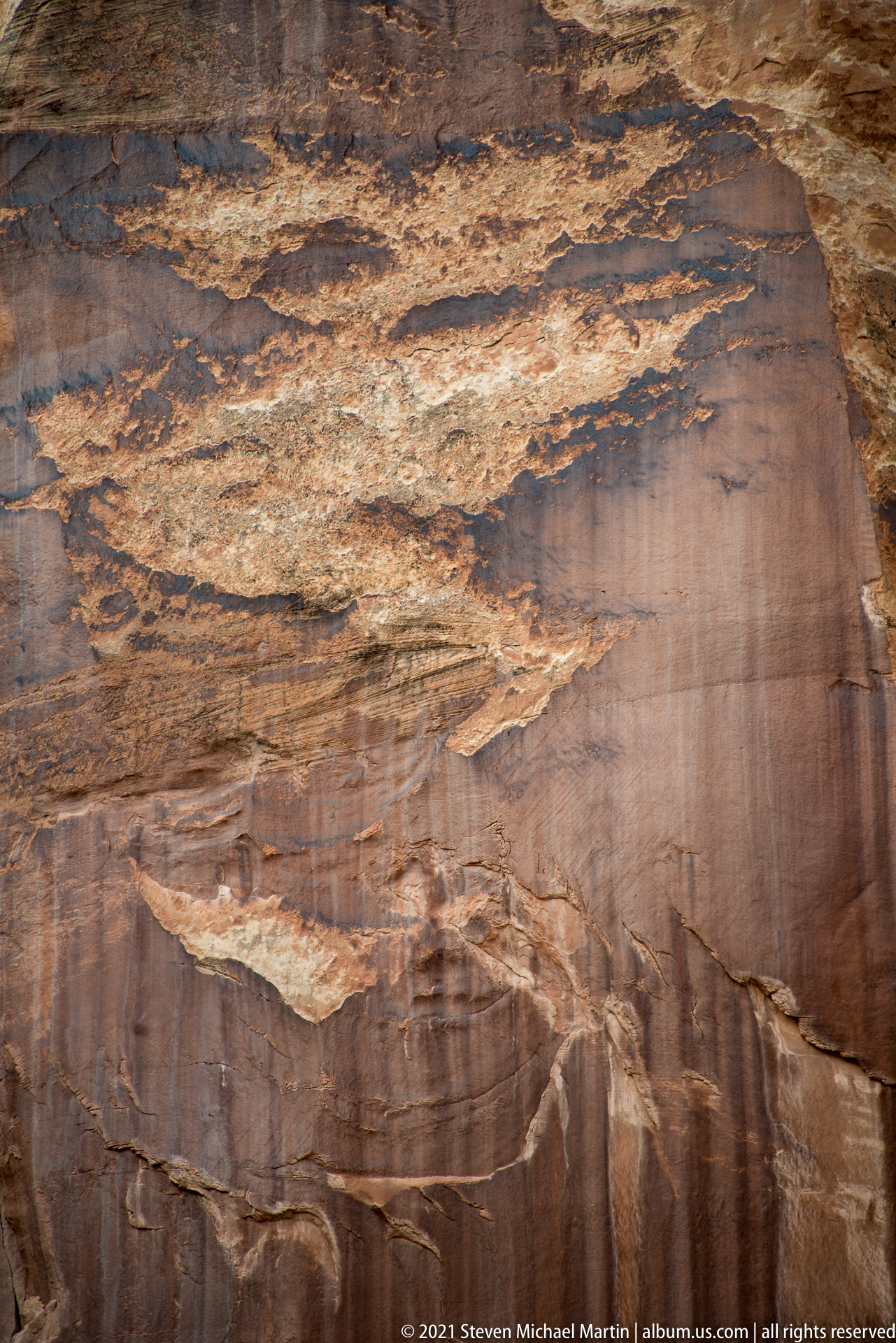
A close study of the canyon wall shows long dark streaks running down a smooth sandstone face, crossed by thin horizontal layers and shallow shelves. Lighter patches and rougher bands interrupt the otherwise vertical surface. With no arch or person in the frame, the photograph focuses on erosion, staining, and the contrasting textures within the red rock.
Caption
A close study of the canyon wall shows long dark streaks running down a smooth sandstone face, crossed by thin horizontal layers and shallow shelves. Lighter patches and rougher bands interrupt the otherwise vertical surface. With no arch or person in the frame, the photograph focuses on erosion, staining, and the contrasting textures within the red rock.
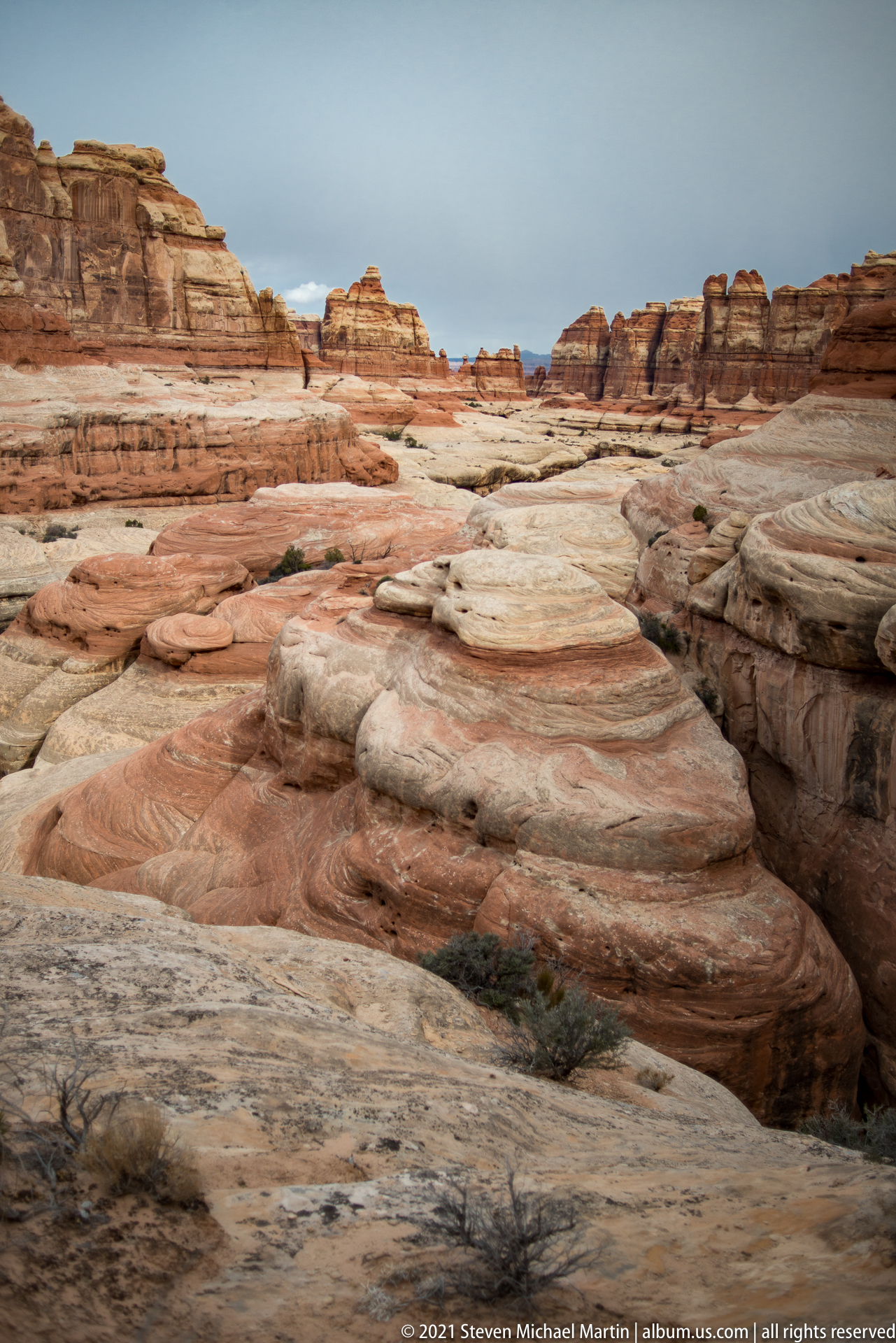
A wide sandstone basin opens beneath a low horizon of layered red cliffs. Pale, rounded shelves and shallow channels form bands across the foreground, with small shrubs scattered along the rock. Druid Arch is not visible from this viewpoint; instead, the composition emphasizes the open slickrock terrain and the transition from bare stone to distant canyon walls.
Caption
A wide sandstone basin opens beneath a low horizon of layered red cliffs. Pale, rounded shelves and shallow channels form bands across the foreground, with small shrubs scattered along the rock. Druid Arch is not visible from this viewpoint; instead, the composition emphasizes the open slickrock terrain and the transition from bare stone to distant canyon walls.
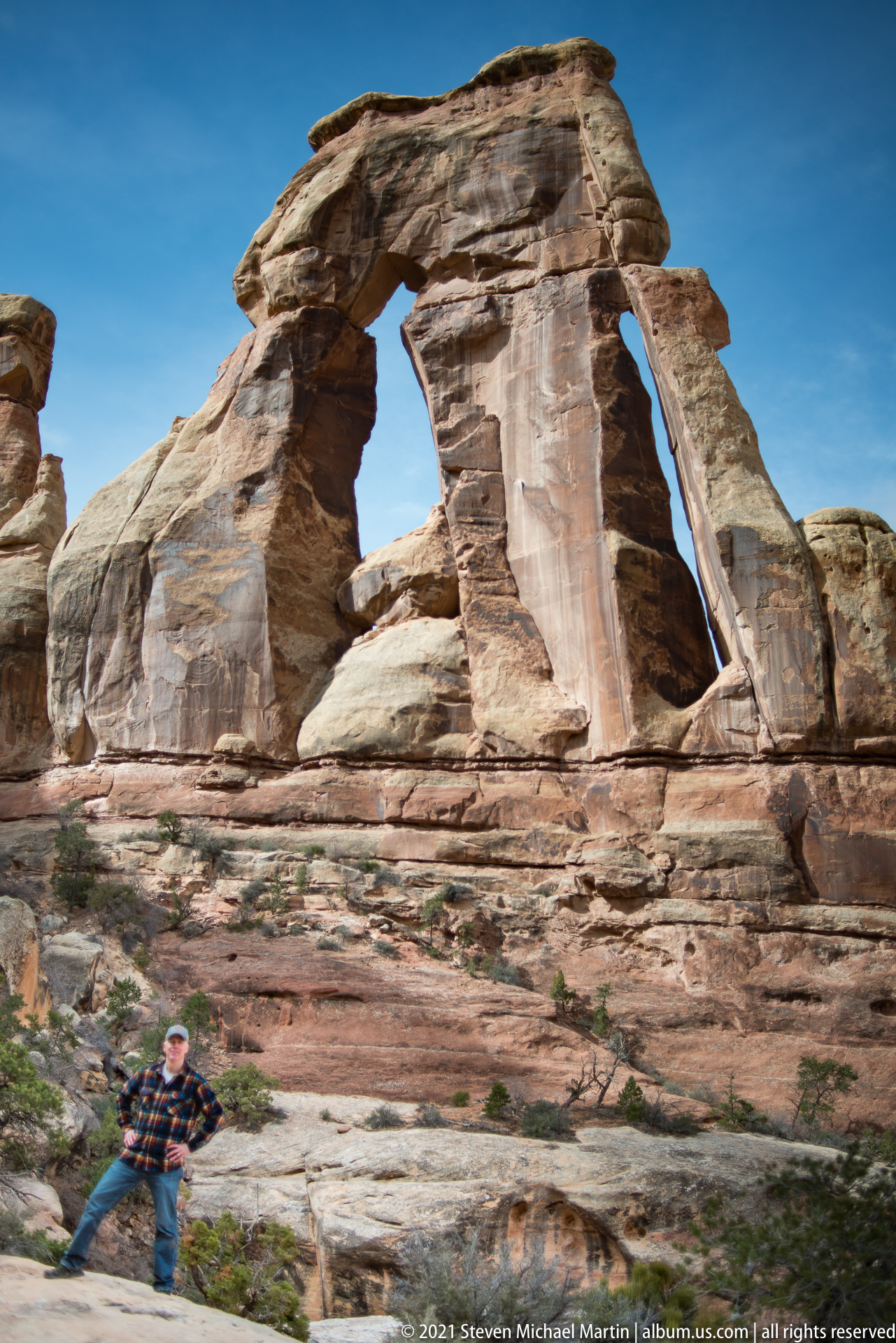
A visitor stands at the far left of the open foreground with legs spread in a playful pose, while Druid Arch fills the upper center. The broad view includes scrub, sandstone benches, and neighboring rock towers, setting the person apart from the formation without obscuring its full span. Deep blue sky sharpens the arch’s warm, weathered surface.
Caption
A visitor stands at the far left of the open foreground with legs spread in a playful pose, while Druid Arch fills the upper center. The broad view includes scrub, sandstone benches, and neighboring rock towers, setting the person apart from the formation without obscuring its full span. Deep blue sky sharpens the arch’s warm, weathered surface.
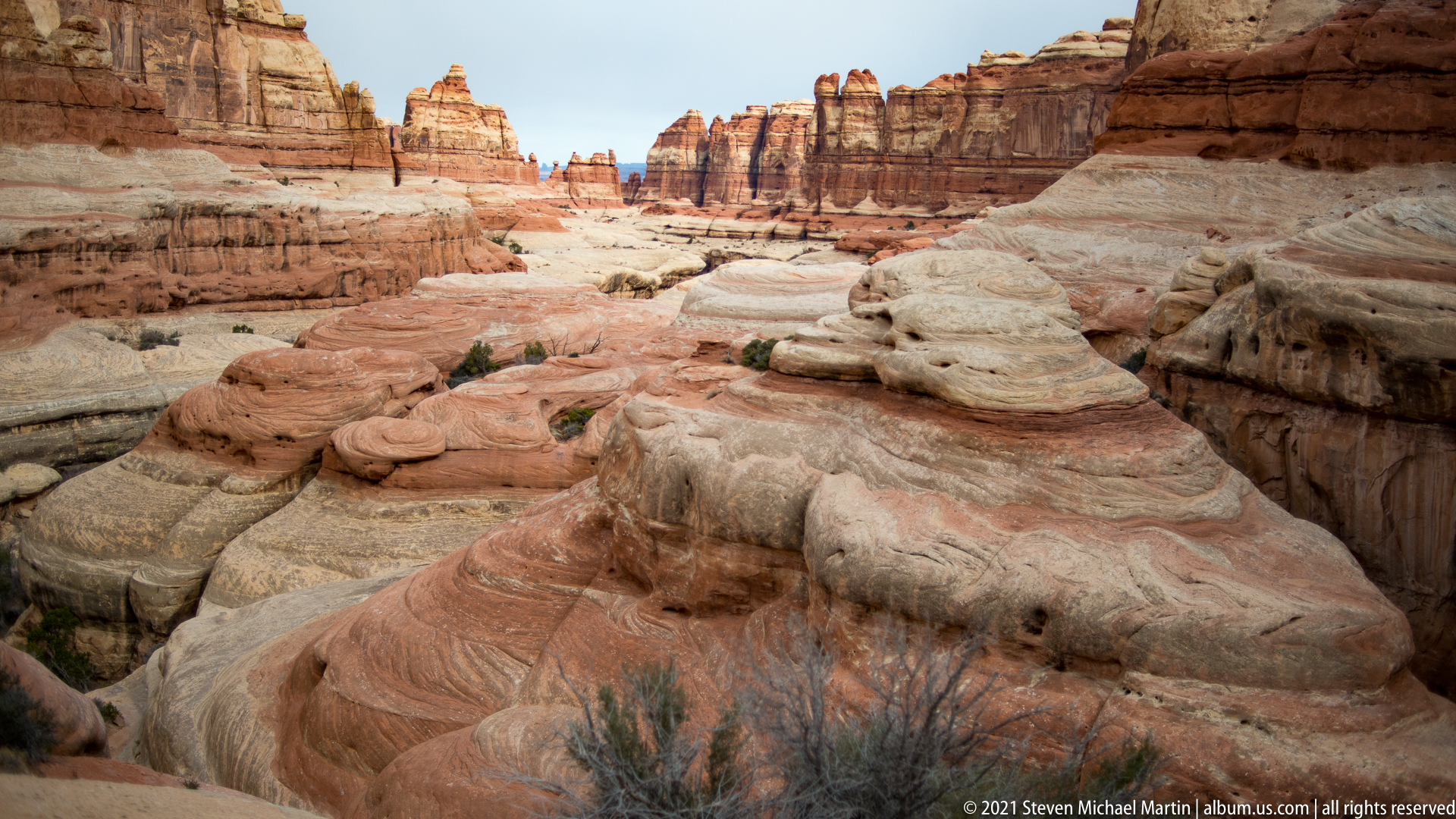
The route crosses a broad slickrock corridor toward tall, banded cliffs that narrow in the distance. Smooth pale slabs and shallow depressions step down through the foreground, while a small shrub anchors the lower edge. The open path between towering walls gives this landscape a strong sense of direction, distinct from the closer views of Druid Arch elsewhere in the series.
Caption
The route crosses a broad slickrock corridor toward tall, banded cliffs that narrow in the distance. Smooth pale slabs and shallow depressions step down through the foreground, while a small shrub anchors the lower edge. The open path between towering walls gives this landscape a strong sense of direction, distinct from the closer views of Druid Arch elsewhere in the series.
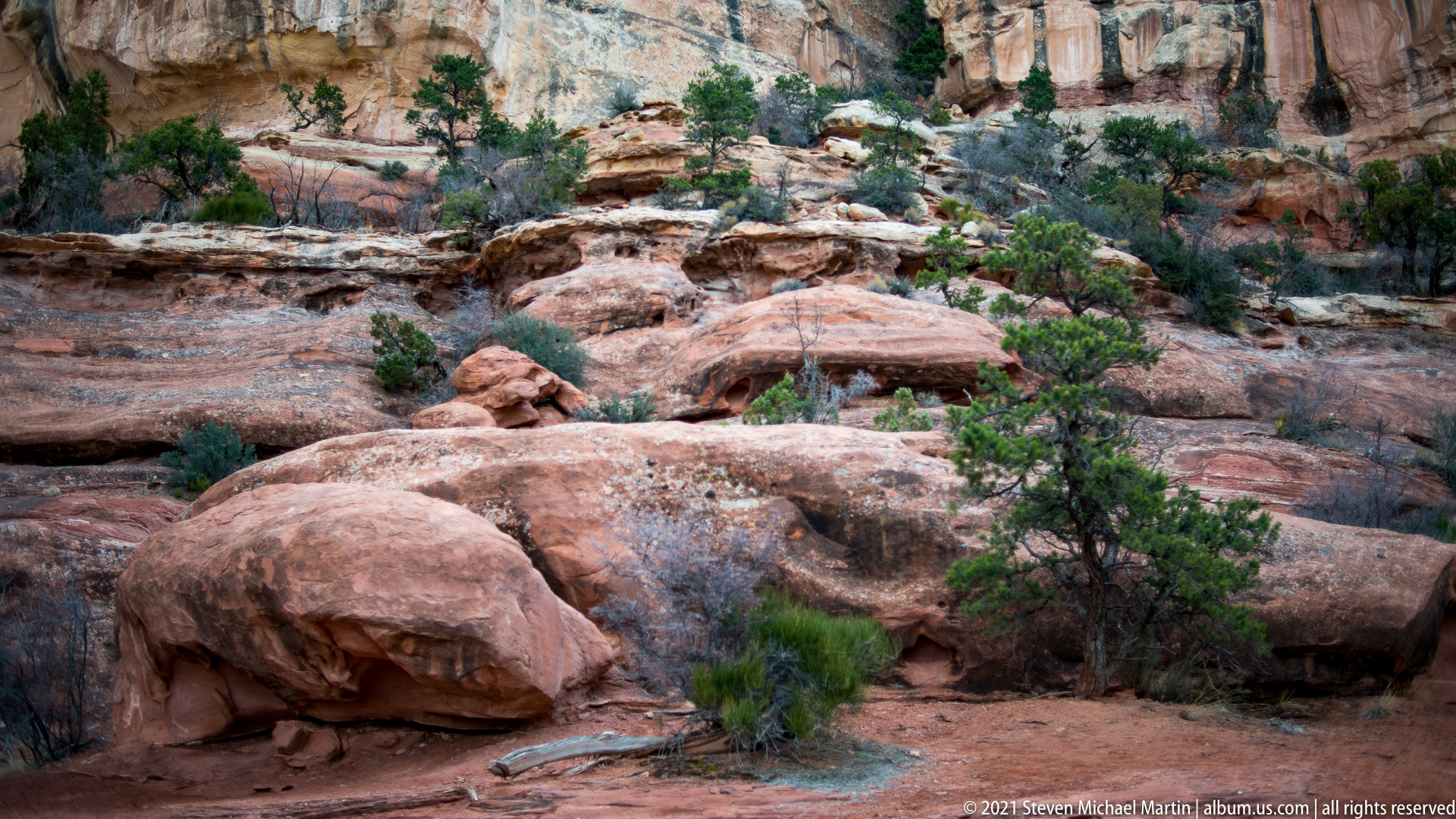
A low juniper grows between rounded sandstone boulders on a broken slope. Behind it, pale shelves and darker cliff bands rise in layers, with scrub scattered across the rock. This closer landscape view shifts attention from the landmark to the vegetation and weathered blocks that occupy the canyon floor, showing how sparse plants root in the stone.
Caption
A low juniper grows between rounded sandstone boulders on a broken slope. Behind it, pale shelves and darker cliff bands rise in layers, with scrub scattered across the rock. This closer landscape view shifts attention from the landmark to the vegetation and weathered blocks that occupy the canyon floor, showing how sparse plants root in the stone.
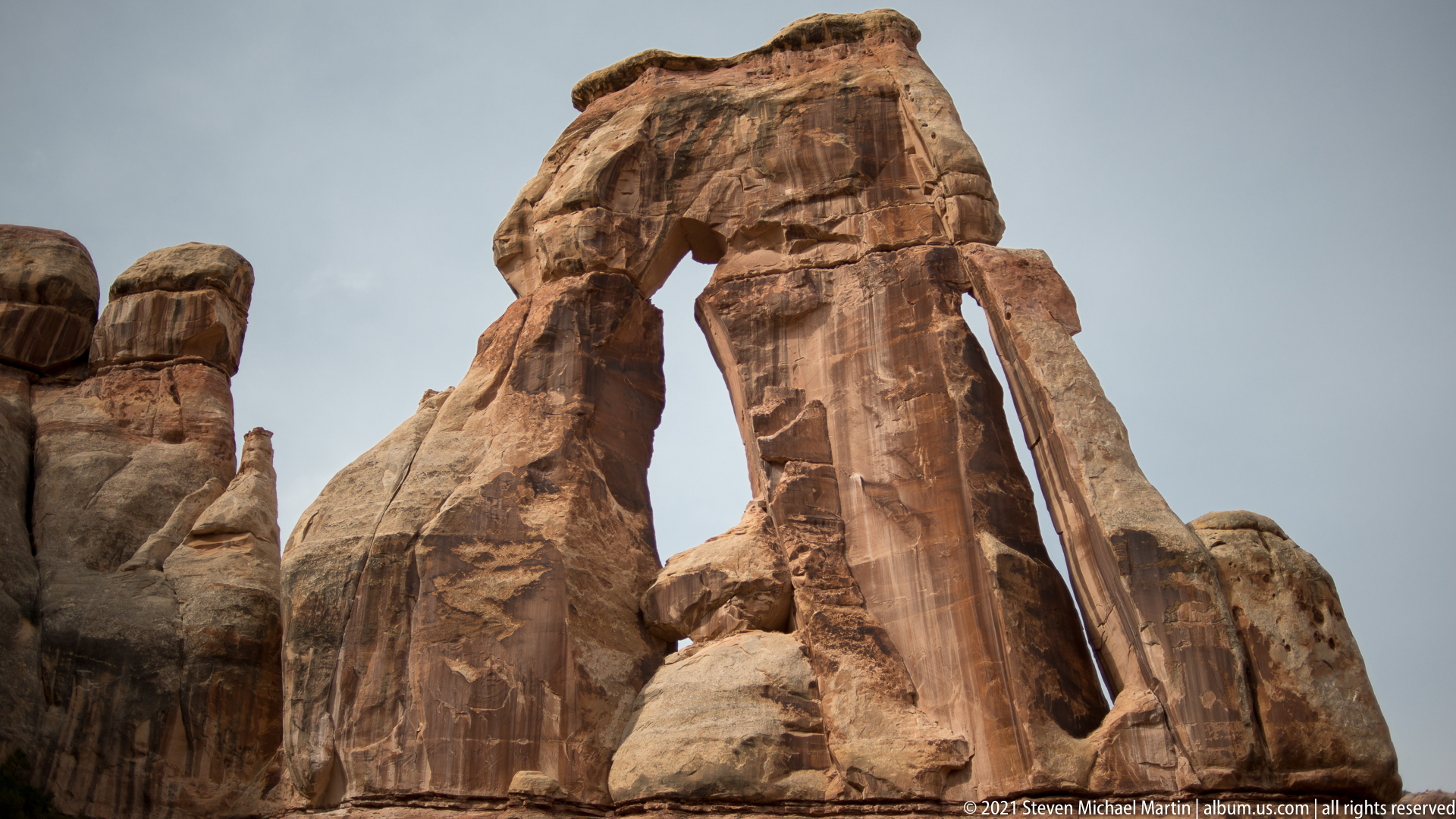
The arch rises nearly edge to edge in this upward view, its heavy capstone balanced over a tall central support and a darker opening. Fine vertical streaks and irregular ledges animate the warm sandstone face. The narrow crop excludes visitors and most of the canyon floor, concentrating the image on Druid Arch’s towering shape and weathered surface.
Caption
The arch rises nearly edge to edge in this upward view, its heavy capstone balanced over a tall central support and a darker opening. Fine vertical streaks and irregular ledges animate the warm sandstone face. The narrow crop excludes visitors and most of the canyon floor, concentrating the image on Druid Arch’s towering shape and weathered surface.
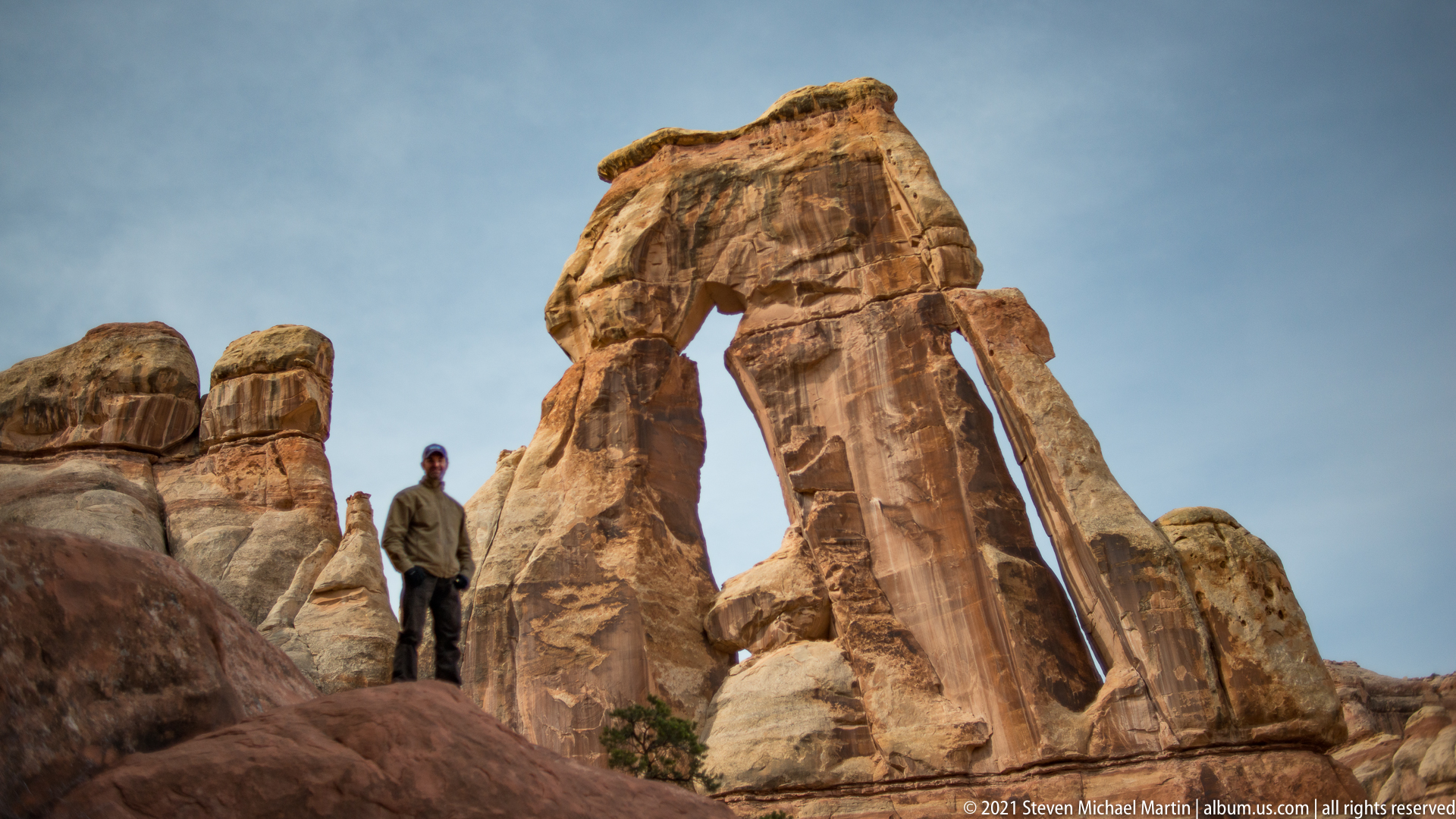
A hiker stands on a reddish ledge at the lower left of Druid Arch, dwarfed by the immense capstone above. The person’s position beside the tall support helps reveal the height and depth of the formation. Blue sky outlines the opening, while neighboring rounded towers and angular boulders frame the base.
Caption
A hiker stands on a reddish ledge at the lower left of Druid Arch, dwarfed by the immense capstone above. The person’s position beside the tall support helps reveal the height and depth of the formation. Blue sky outlines the opening, while neighboring rounded towers and angular boulders frame the base.
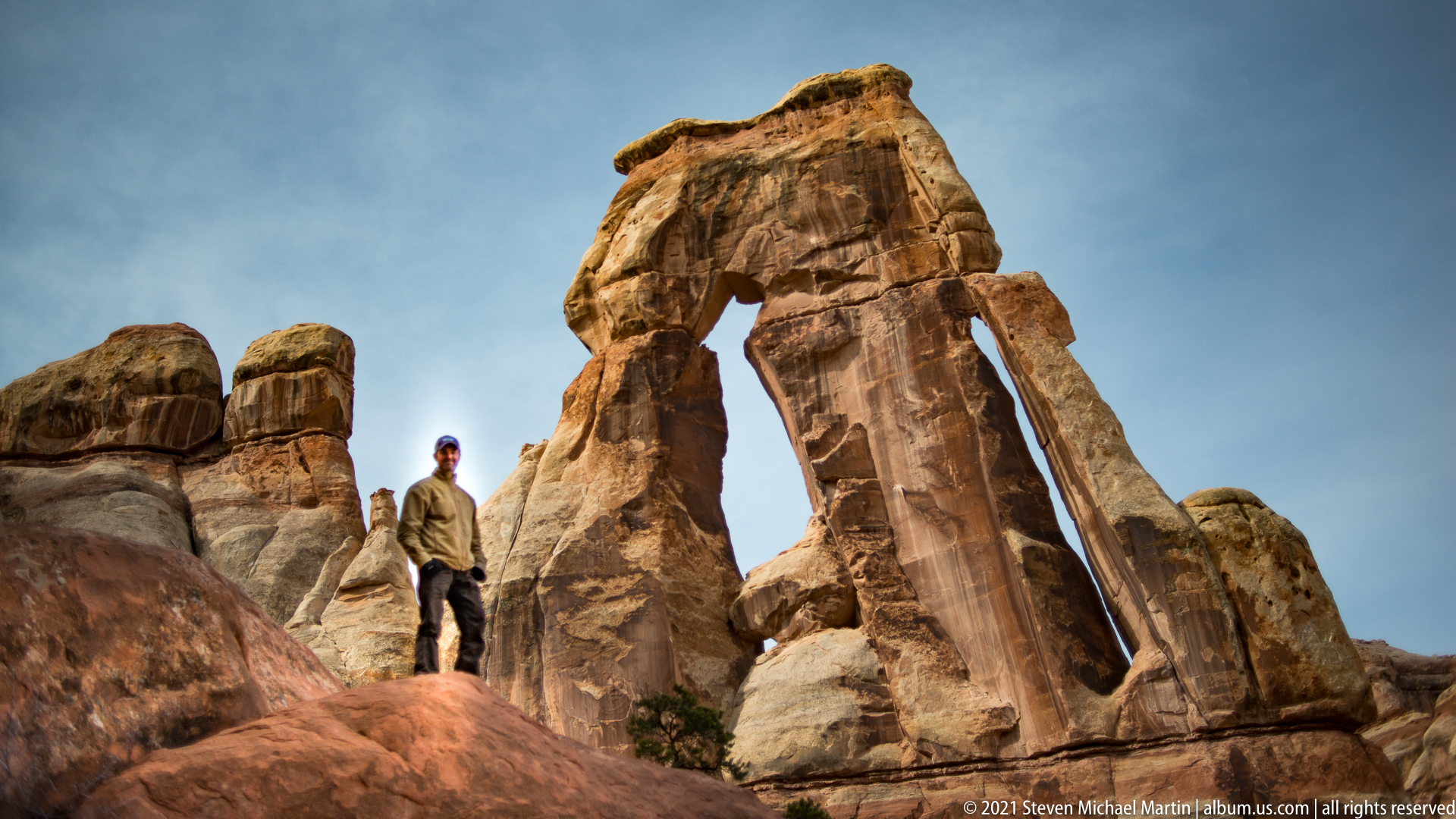
A single visitor stands on a raised rock near the central support, directly beneath Druid Arch’s broad capstone. The figure is small but distinct against the sandstone, making the arch’s height and broad opening easier to read. Nearby rounded towers enter at left, and clear sky separates the upper rock from the horizon.
Caption
A single visitor stands on a raised rock near the central support, directly beneath Druid Arch’s broad capstone. The figure is small but distinct against the sandstone, making the arch’s height and broad opening easier to read. Nearby rounded towers enter at left, and clear sky separates the upper rock from the horizon.
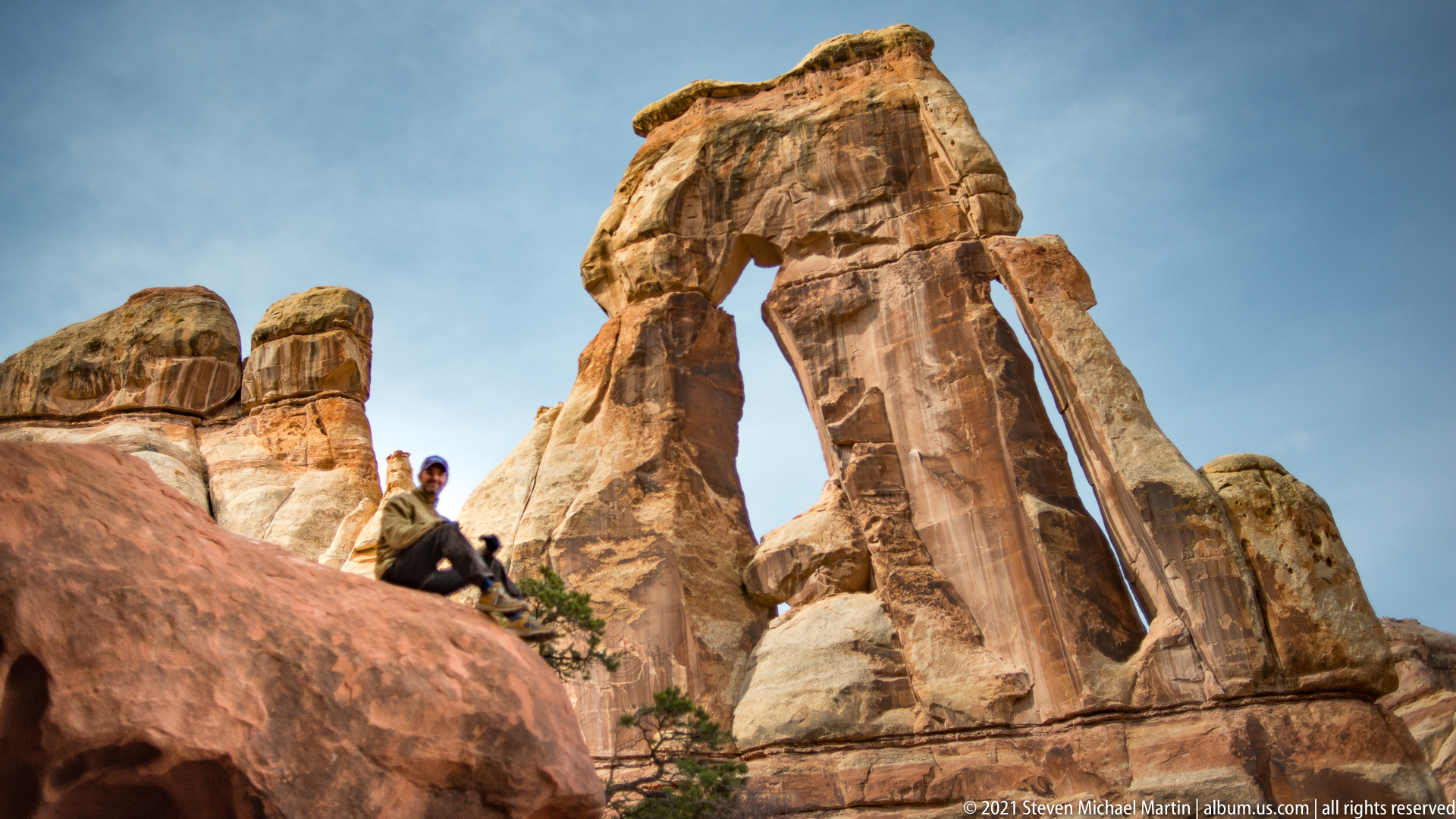
Two visitors rest on a sloping foreground ledge beneath Druid Arch. Their seated and crouched poses appear low in the frame, while the tall sandstone supports and capstone rise behind them. A large boulder partly screens the pair, adding depth between the foreground rock and the monumental arch.
Caption
Two visitors rest on a sloping foreground ledge beneath Druid Arch. Their seated and crouched poses appear low in the frame, while the tall sandstone supports and capstone rise behind them. A large boulder partly screens the pair, adding depth between the foreground rock and the monumental arch.
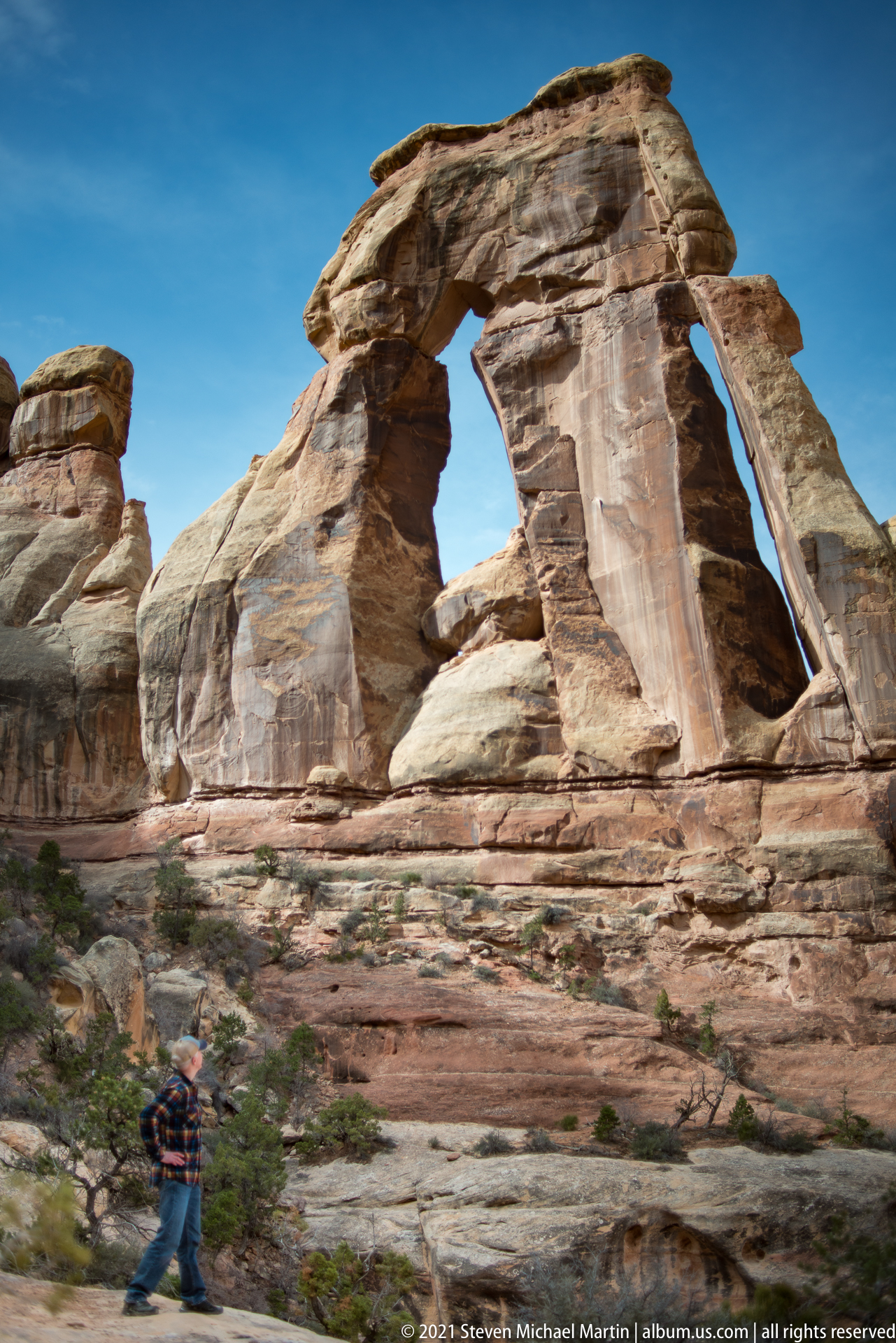
A visitor moves across the lower left foreground beneath Druid Arch, dwarfed by its broad capstone and vertical supports. The formation spans almost the full width of the view, while scrub and pale rock terraces step across the base. The moving figure adds a moment of scale and activity to an otherwise still landscape.
Caption
A visitor moves across the lower left foreground beneath Druid Arch, dwarfed by its broad capstone and vertical supports. The formation spans almost the full width of the view, while scrub and pale rock terraces step across the base. The moving figure adds a moment of scale and activity to an otherwise still landscape.
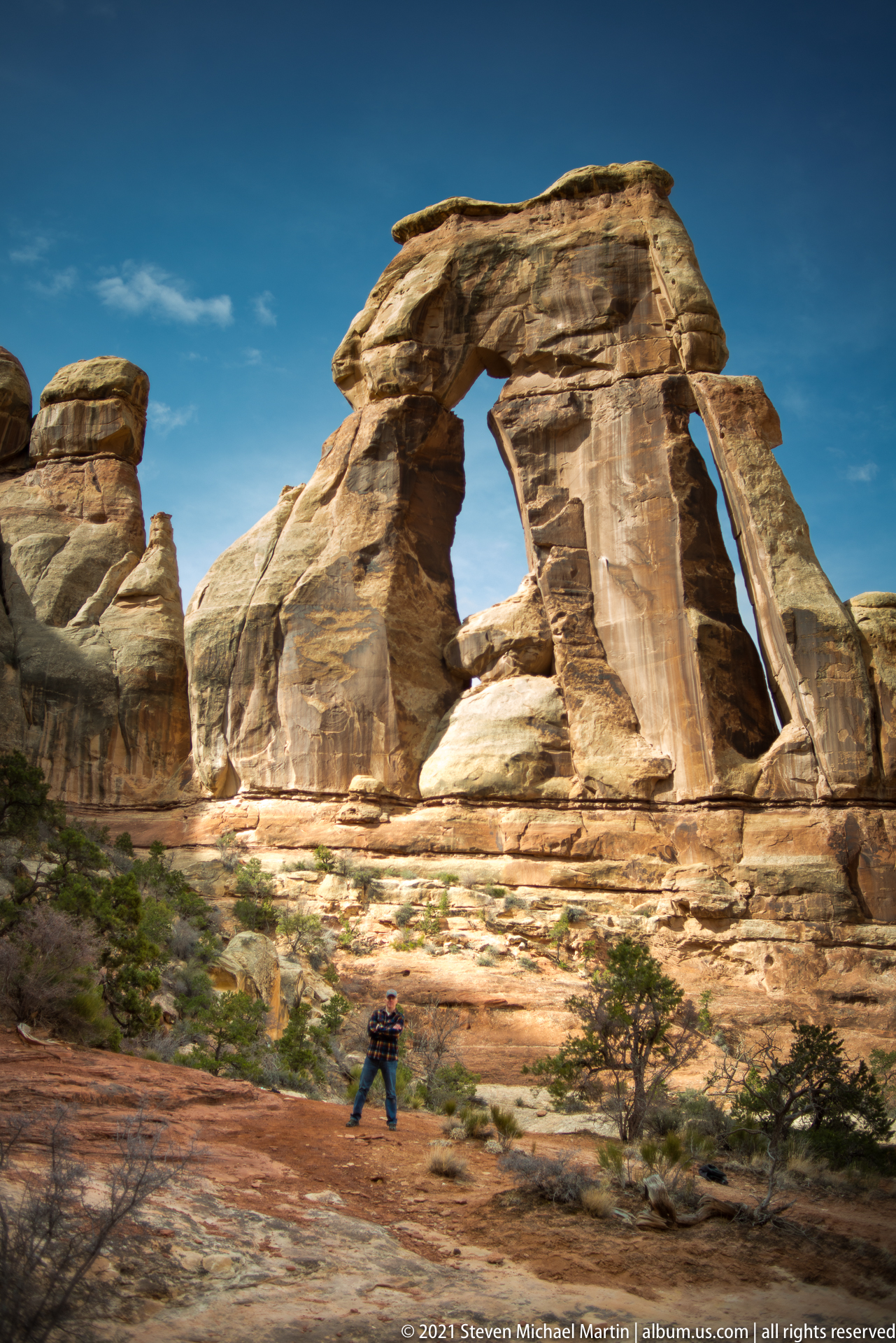
A visitor stands in the lower center of a broad landscape view, dwarfed by Druid Arch and the surrounding sandstone benches. The formation’s capstone and paired supports rise above sparse shrubs, with a distant line of canyon walls visible through the opening. The wide framing connects the human figure to the larger terrain rather than treating the arch as an isolated close-up.
Caption
A visitor stands in the lower center of a broad landscape view, dwarfed by Druid Arch and the surrounding sandstone benches. The formation’s capstone and paired supports rise above sparse shrubs, with a distant line of canyon walls visible through the opening. The wide framing connects the human figure to the larger terrain rather than treating the arch as an isolated close-up.
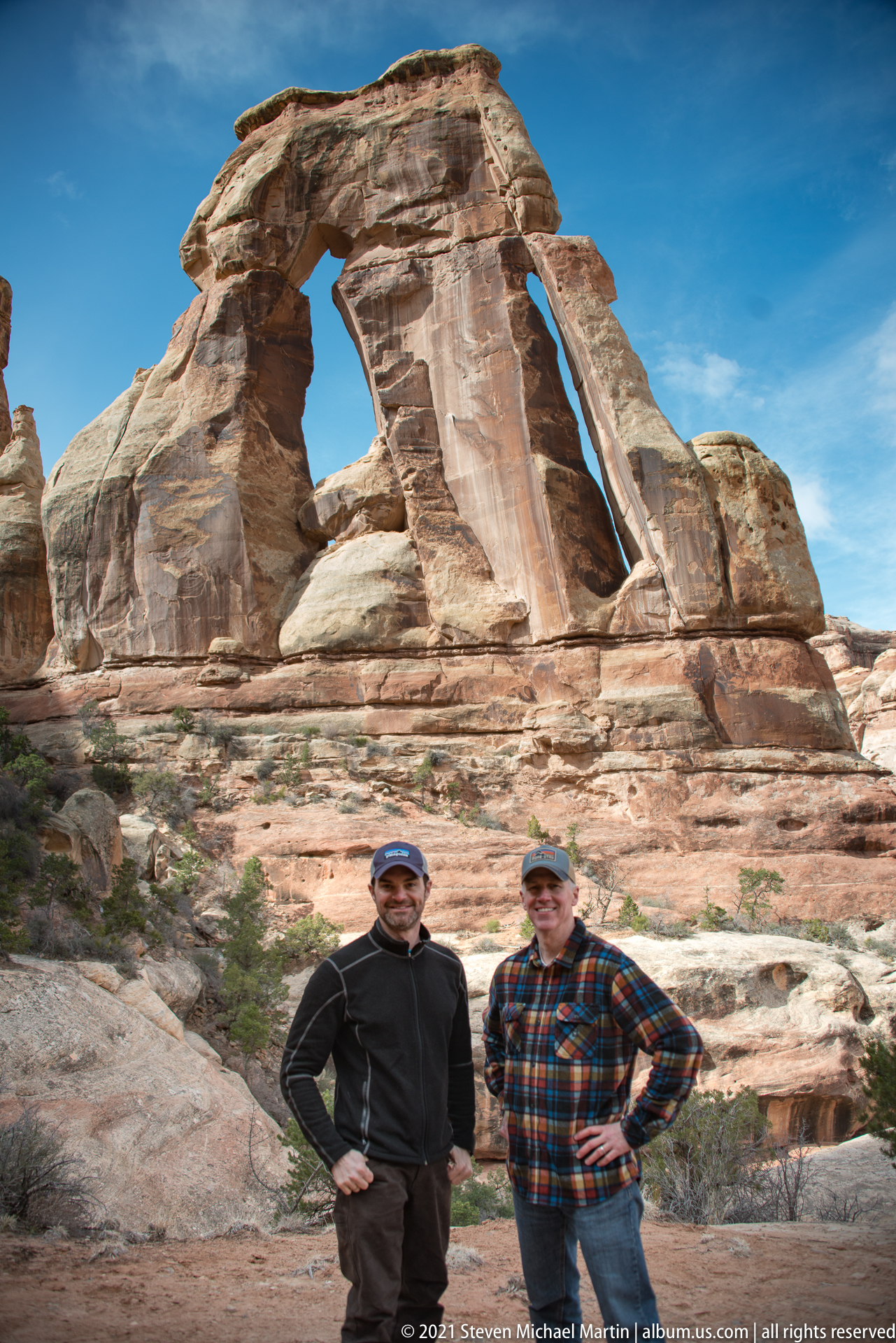
Two hikers stand together on the rocky apron beneath Druid Arch, dwarfed by its broad span and towering sandstone supports. The frontal composition includes the full opening, the layered wall behind it, and a strip of scrubby ground in the foreground. Their presence makes the scale of the formation immediately legible without obscuring its distinctive shape.
Caption
Two hikers stand together on the rocky apron beneath Druid Arch, dwarfed by its broad span and towering sandstone supports. The frontal composition includes the full opening, the layered wall behind it, and a strip of scrubby ground in the foreground. Their presence makes the scale of the formation immediately legible without obscuring its distinctive shape.
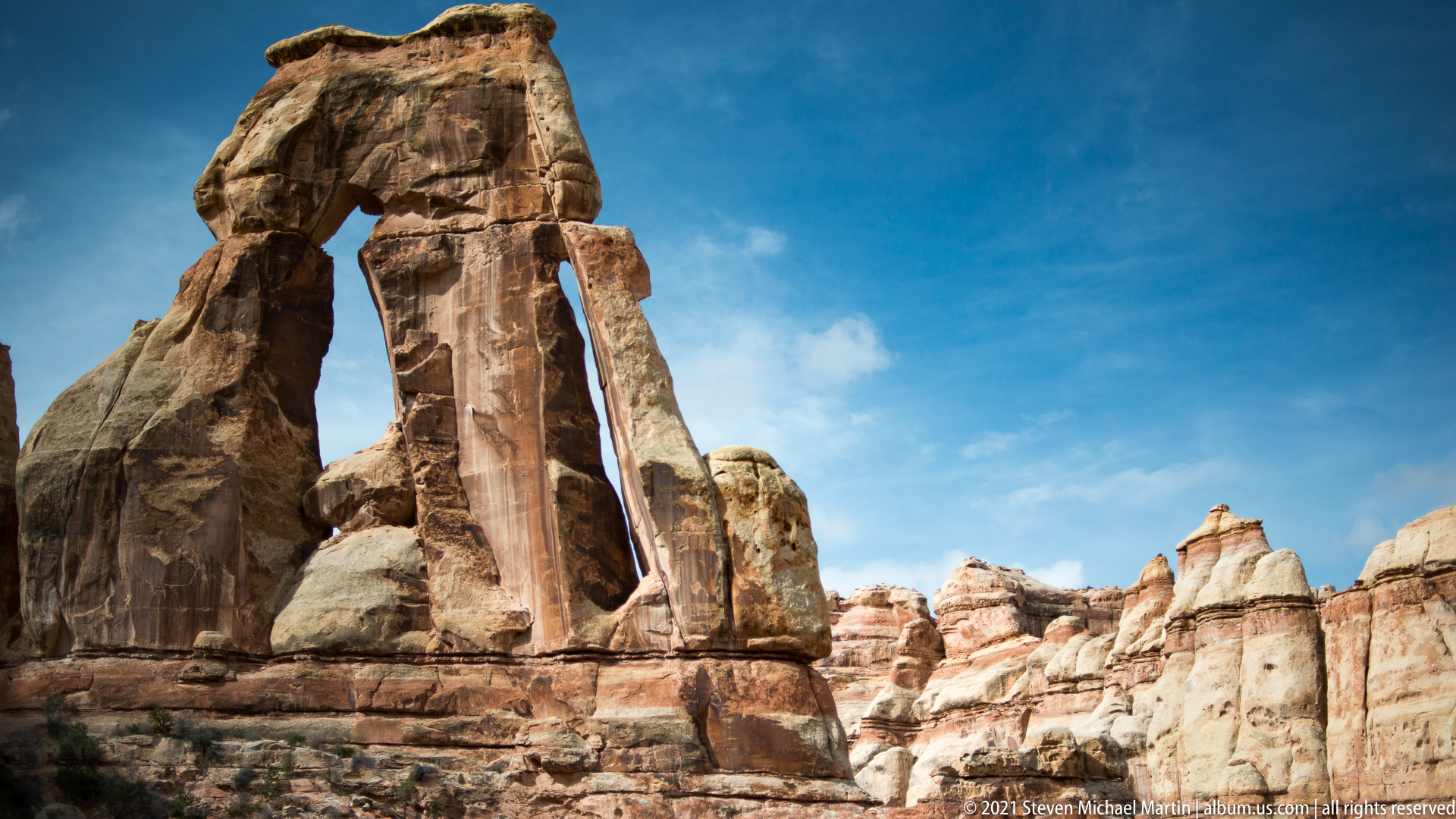
Druid Arch occupies the left half of a broad canyon view, with a line of smaller cream and red towers extending to the right. A small cloud drifts across the vivid blue sky, and scrub dots the lower rock benches. The composition places the famous span within a larger landscape of eroded sandstone forms rather than isolating it.
Caption
Druid Arch occupies the left half of a broad canyon view, with a line of smaller cream and red towers extending to the right. A small cloud drifts across the vivid blue sky, and scrub dots the lower rock benches. The composition places the famous span within a larger landscape of eroded sandstone forms rather than isolating it.
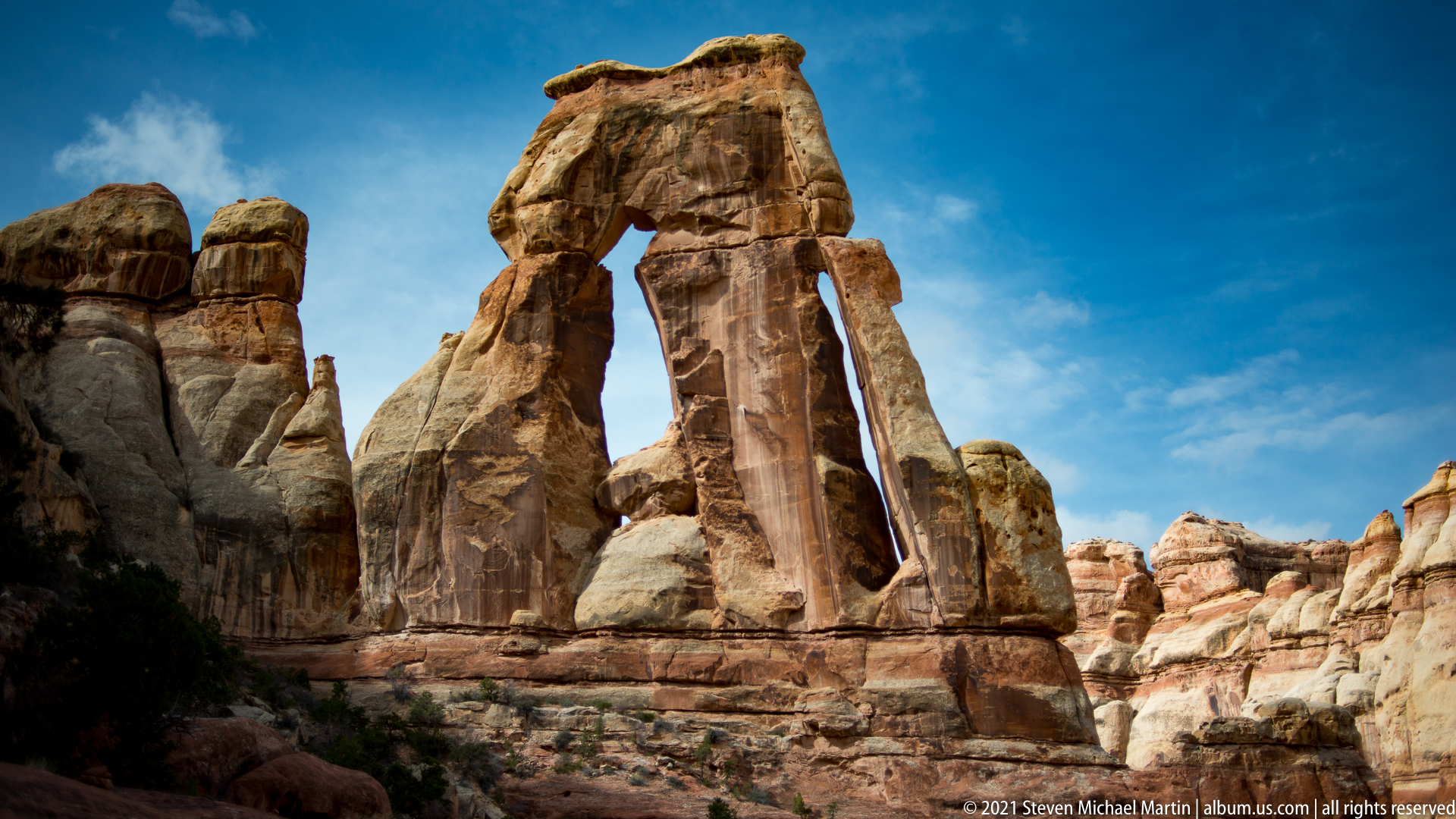
A dark shadow fills the lower left foreground while sunlight reaches Druid Arch and the surrounding sandstone walls. The high formation stands against blue sky, its opening and narrow side gap visible above the layered base. The contrast between shade and warm rock gives this wide view a stronger sense of depth than the evenly lit portraits nearby.
Caption
A dark shadow fills the lower left foreground while sunlight reaches Druid Arch and the surrounding sandstone walls. The high formation stands against blue sky, its opening and narrow side gap visible above the layered base. The contrast between shade and warm rock gives this wide view a stronger sense of depth than the evenly lit portraits nearby.
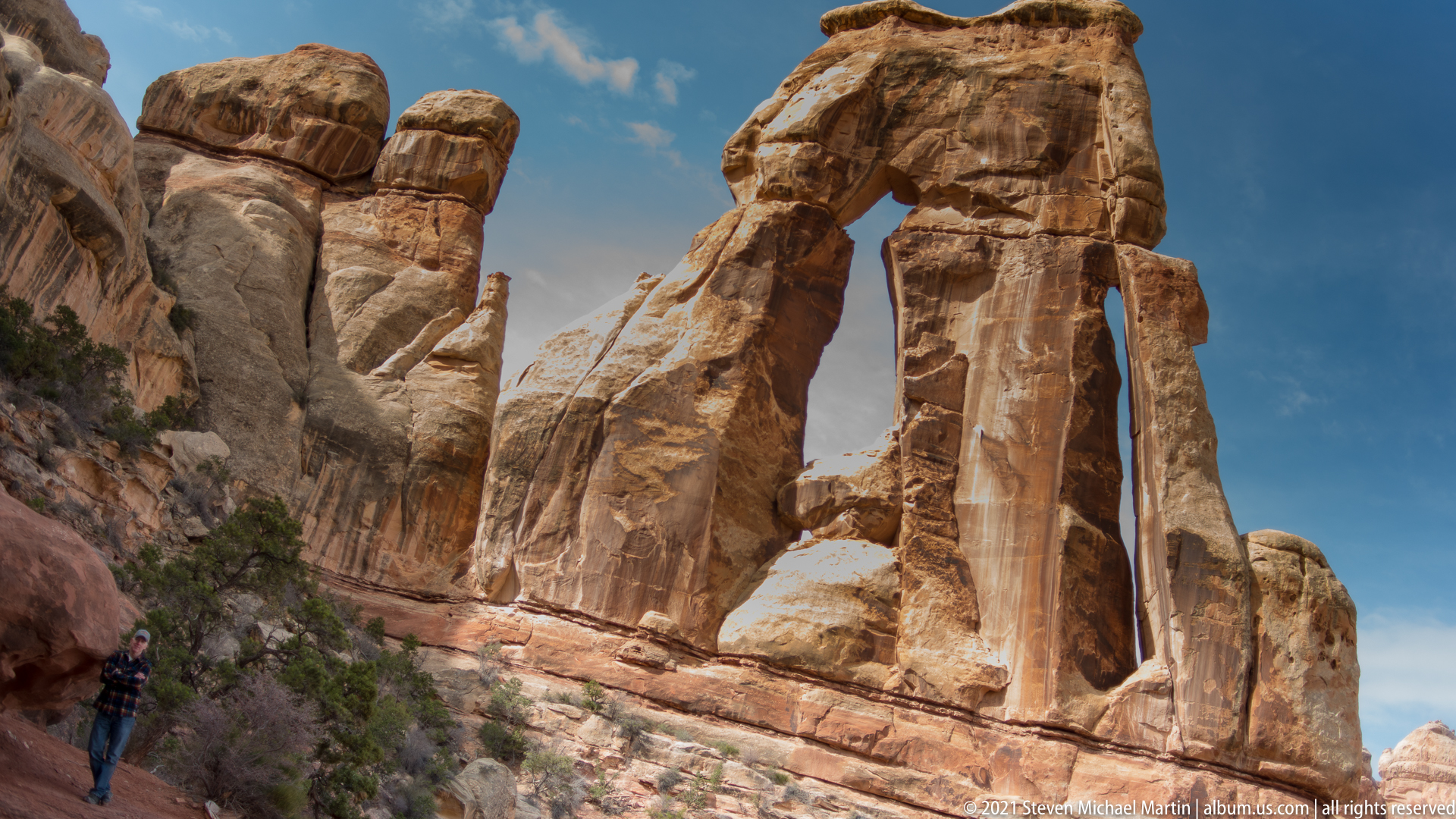
Druid Arch rises above a jumble of pale sandstone blocks, its massive cap bridging two tall, fluted supports. A hiker at the lower left provides scale against the formation, while blue sky and a few clouds open behind it. The close viewpoint emphasizes the arch’s height and the irregular, sculpted surfaces of the Needles District.
Caption
Druid Arch rises above a jumble of pale sandstone blocks, its massive cap bridging two tall, fluted supports. A hiker at the lower left provides scale against the formation, while blue sky and a few clouds open behind it. The close viewpoint emphasizes the arch’s height and the irregular, sculpted surfaces of the Needles District.
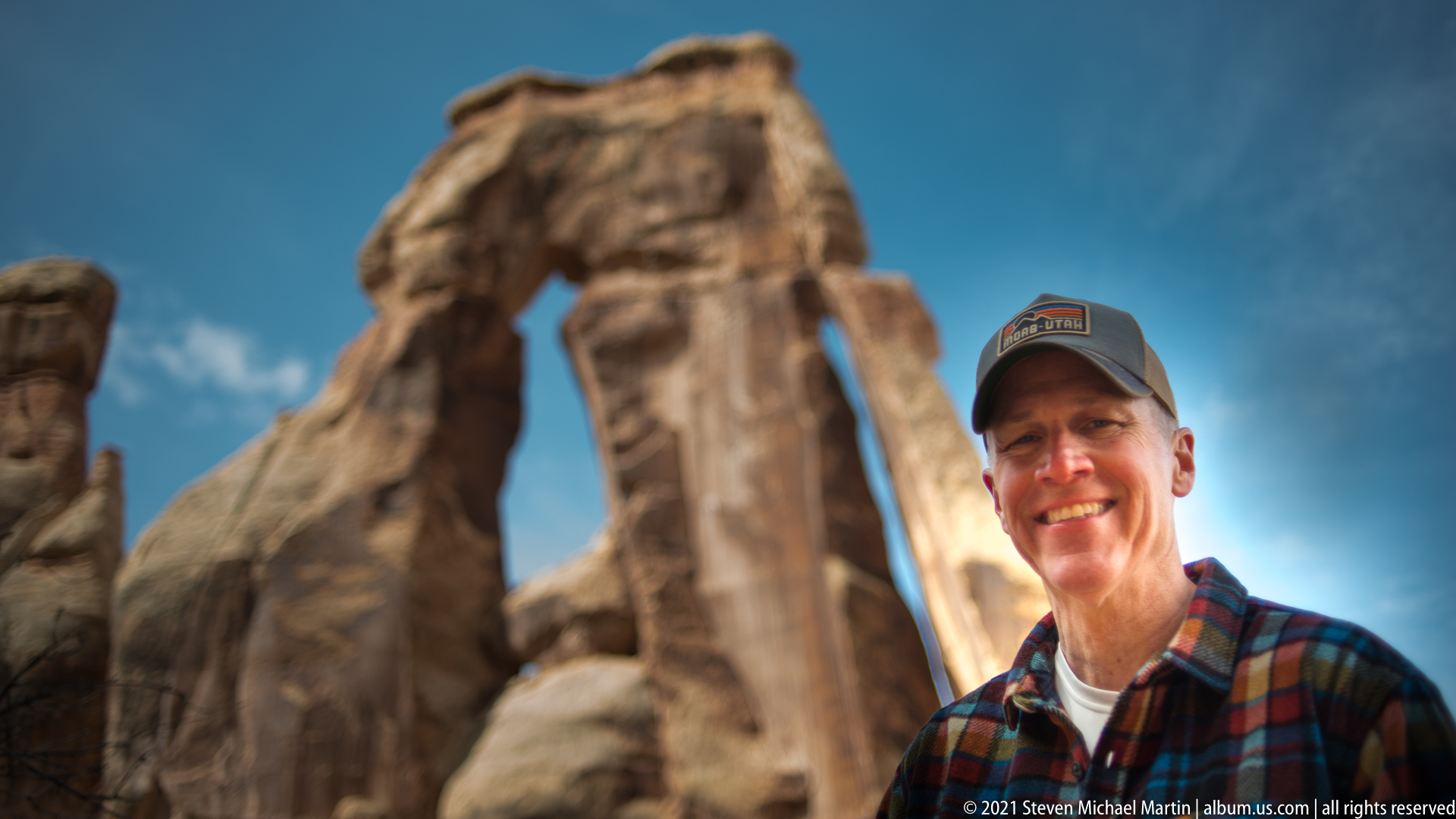
A smiling hiker fills the right foreground, while Druid Arch appears softly out of focus behind him. The shallow focus shifts attention from the monumental rock opening to the visitor’s presence at the destination. His cap, plaid shirt, and outdoor layers suggest a trail stop, and the bright blue sky keeps the background open and uncluttered.
Caption
A smiling hiker fills the right foreground, while Druid Arch appears softly out of focus behind him. The shallow focus shifts attention from the monumental rock opening to the visitor’s presence at the destination. His cap, plaid shirt, and outdoor layers suggest a trail stop, and the bright blue sky keeps the background open and uncluttered.

From a low angle, Druid Arch towers above the surrounding pinnacles, its broad upper bridge supported by steep, ribbed sandstone walls. The frame excludes people, allowing the formation’s scale and vertical lines to dominate. Sunlight brings out warm red and cream bands in the rock, while scattered clouds add texture to the blue sky.
Caption
From a low angle, Druid Arch towers above the surrounding pinnacles, its broad upper bridge supported by steep, ribbed sandstone walls. The frame excludes people, allowing the formation’s scale and vertical lines to dominate. Sunlight brings out warm red and cream bands in the rock, while scattered clouds add texture to the blue sky.
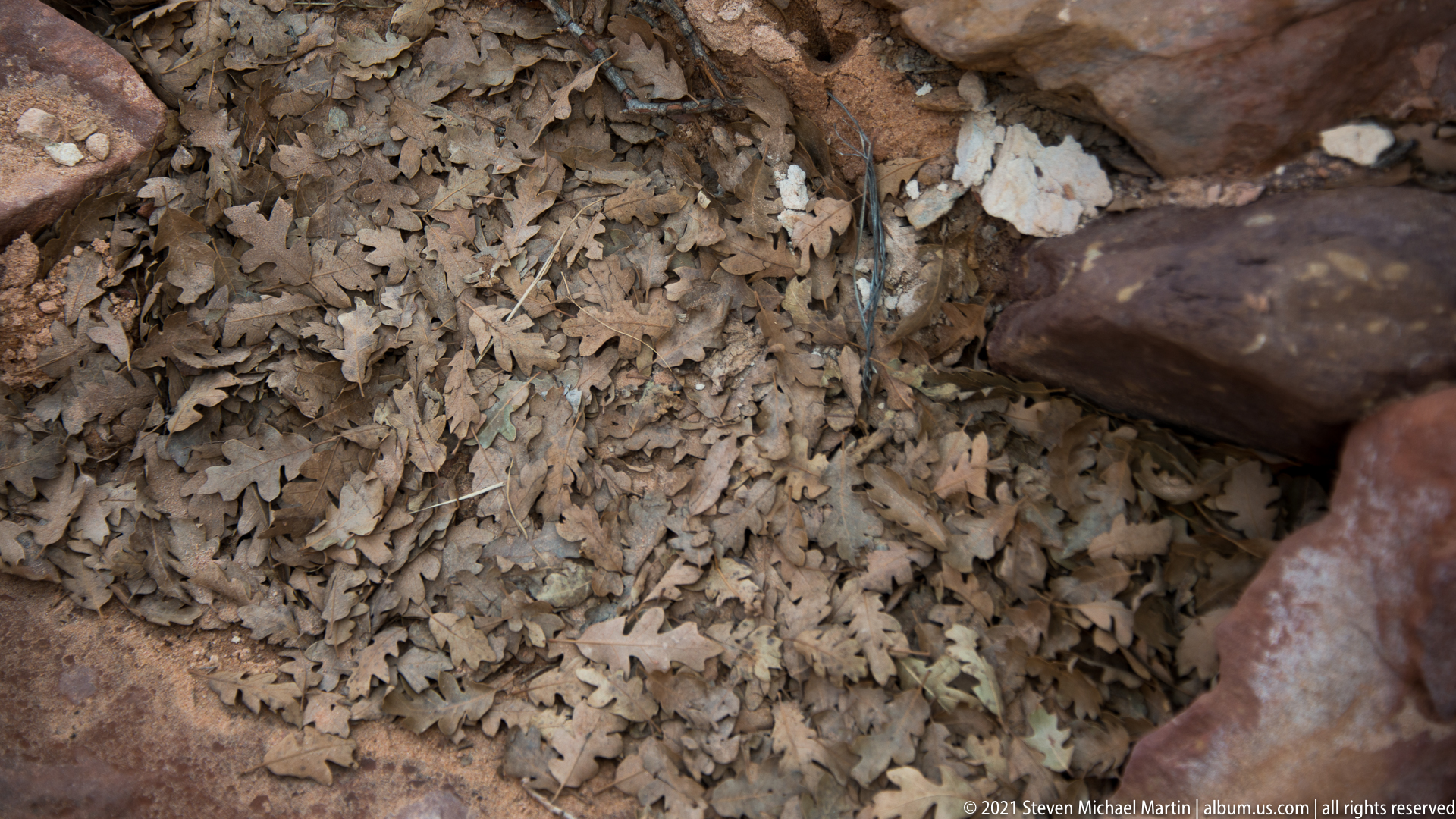
Dry lobed leaves collect in a narrow pocket among reddish sandstone rocks. The close framing removes the larger landscape and focuses on the leaf shapes, fine stems, and shaded crevice where the debris has settled. It offers a small-scale view of plant material within the canyon environment, contrasting with the monumental rock formations in the surrounding trail photographs.
Caption
Dry lobed leaves collect in a narrow pocket among reddish sandstone rocks. The close framing removes the larger landscape and focuses on the leaf shapes, fine stems, and shaded crevice where the debris has settled. It offers a small-scale view of plant material within the canyon environment, contrasting with the monumental rock formations in the surrounding trail photographs.
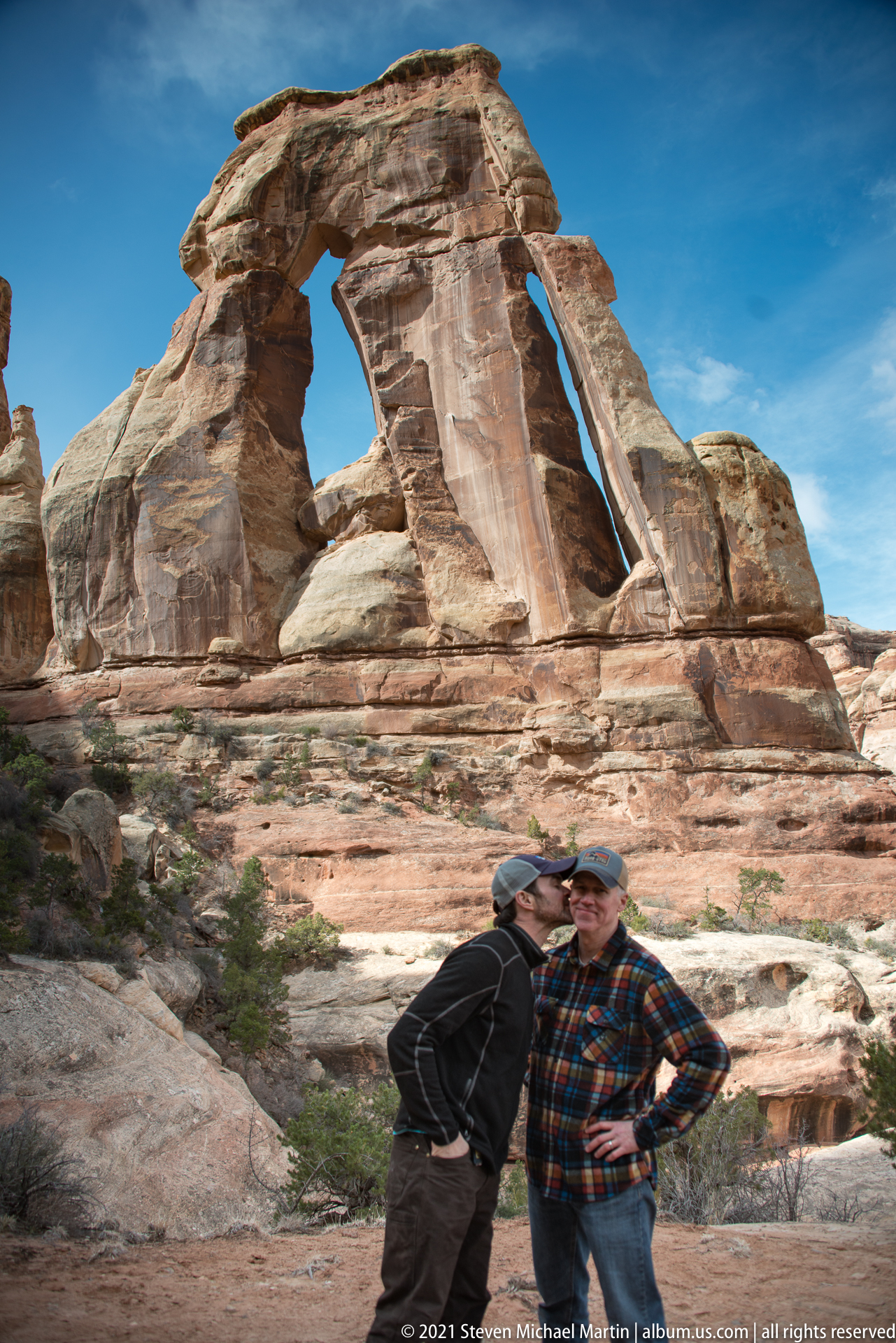
Two hikers stand close together in the lower foreground, with Druid Arch extending across the upper half of the frame. Their dark and plaid layers contrast with the pale rock apron, while the arch’s upright supports and central opening remain clearly visible behind them. This closer human-centered view differs from the wider portrait by making the visitors part of the main composition.
Caption
Two hikers stand close together in the lower foreground, with Druid Arch extending across the upper half of the frame. Their dark and plaid layers contrast with the pale rock apron, while the arch’s upright supports and central opening remain clearly visible behind them. This closer human-centered view differs from the wider portrait by making the visitors part of the main composition.
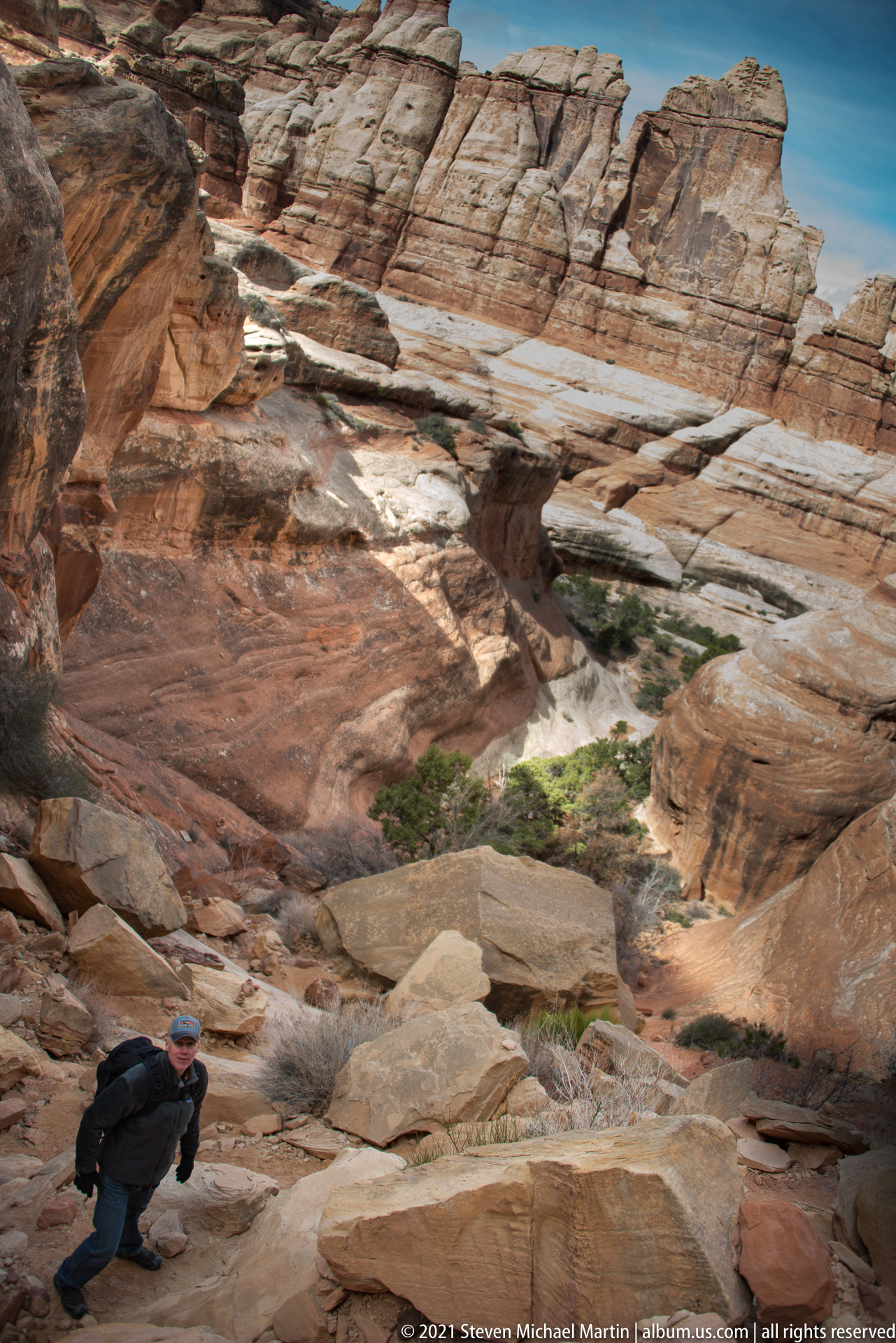
A hiker moves carefully across a sloping rock shelf in a narrow canyon, with layered sandstone cliffs closing in above and behind. Broken slabs and shallow ledges shape the route through the foreground. The person’s small scale against the high walls conveys the rugged terrain of the approach to Druid Arch and the need to negotiate exposed rock underfoot.
Caption
A hiker moves carefully across a sloping rock shelf in a narrow canyon, with layered sandstone cliffs closing in above and behind. Broken slabs and shallow ledges shape the route through the foreground. The person’s small scale against the high walls conveys the rugged terrain of the approach to Druid Arch and the need to negotiate exposed rock underfoot.
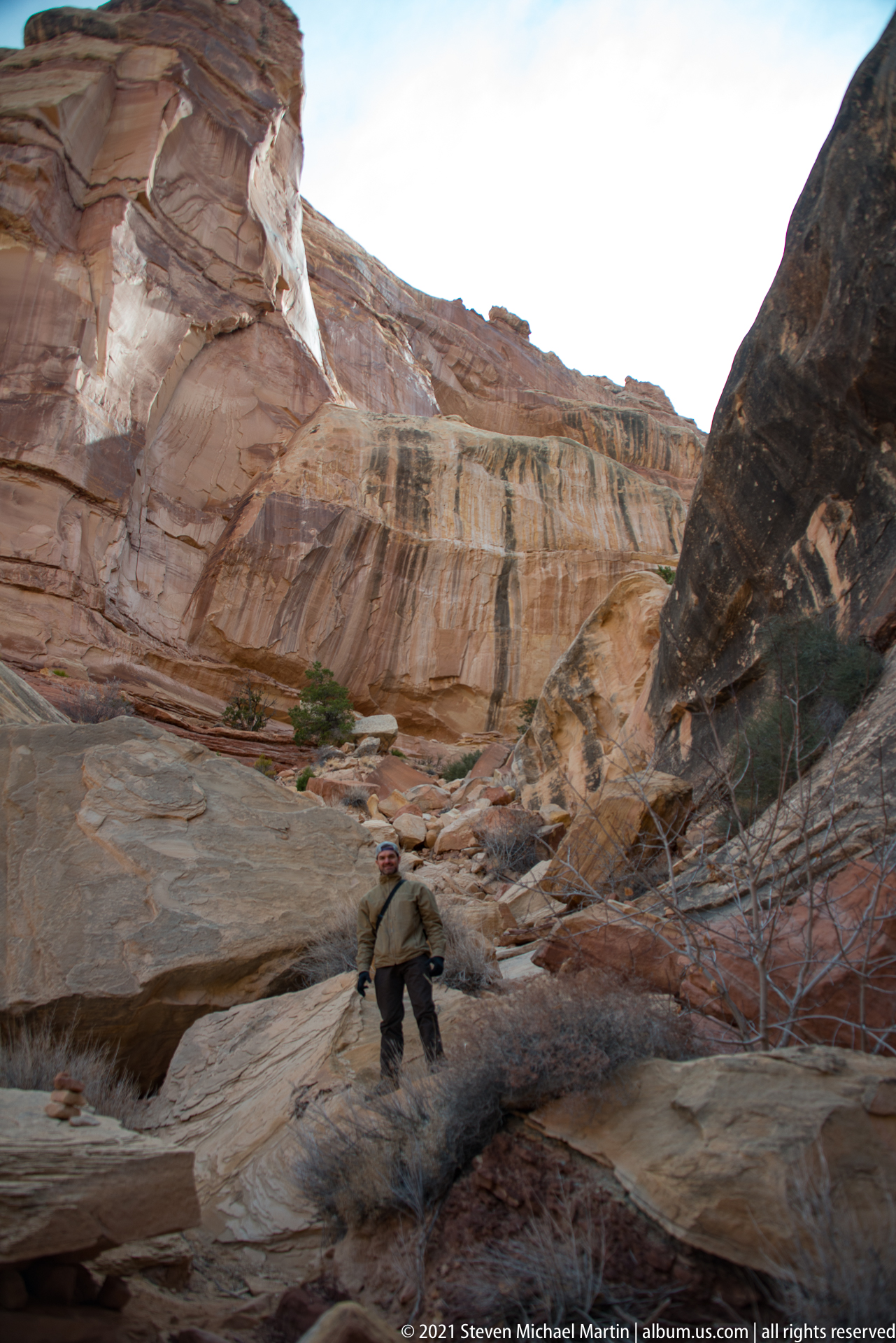
A lone hiker stands in the middle distance of a broad rocky drainage, surrounded by broken sandstone slabs and steep, banded canyon walls. The open, pale sky at the head of the gorge contrasts with the shadowed rock at right. This wide view gives the route a sense of scale and shows how the canyon floor narrows between resistant rock layers.
Caption
A lone hiker stands in the middle distance of a broad rocky drainage, surrounded by broken sandstone slabs and steep, banded canyon walls. The open, pale sky at the head of the gorge contrasts with the shadowed rock at right. This wide view gives the route a sense of scale and shows how the canyon floor narrows between resistant rock layers.
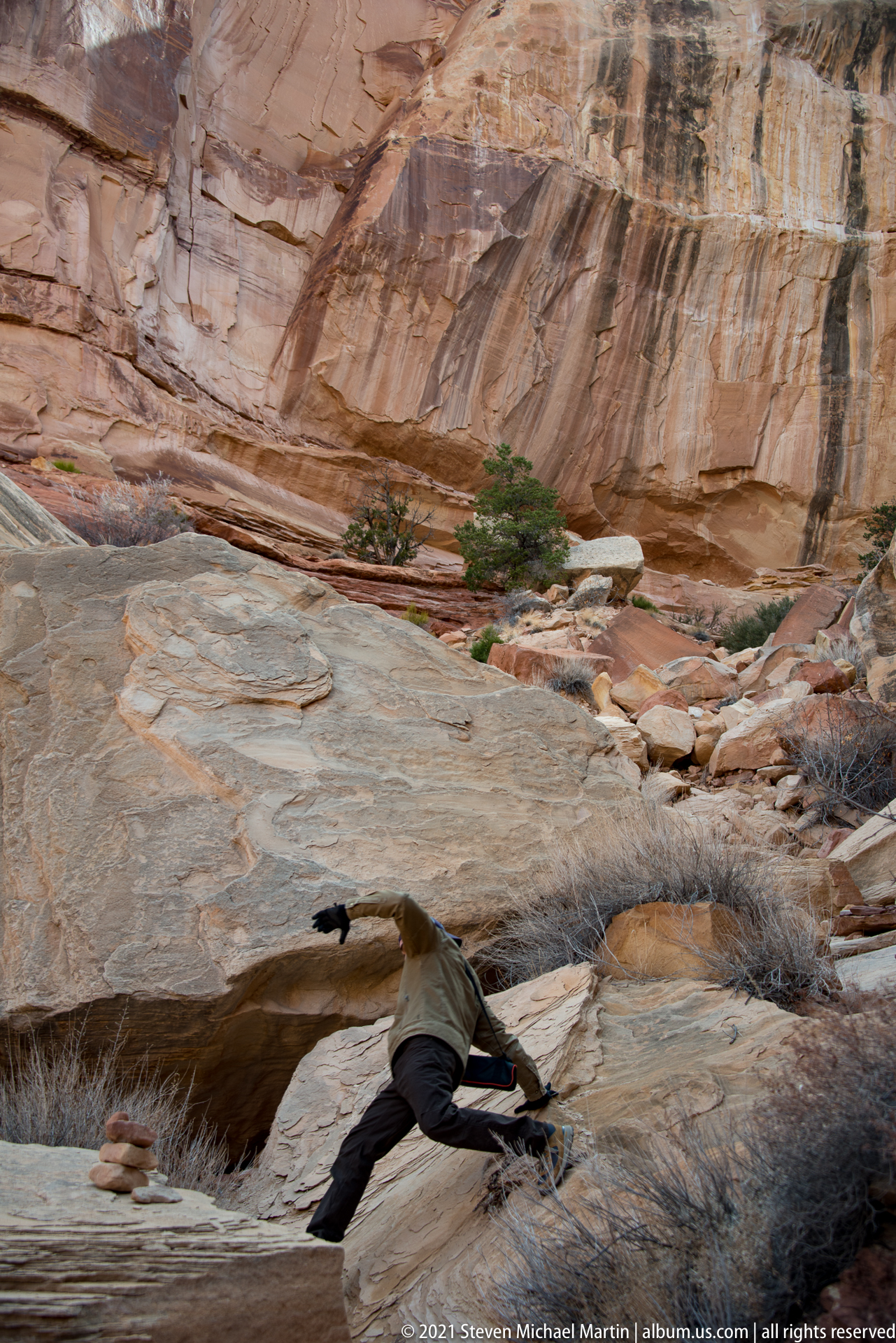
A hiker stretches across a narrow break between sandstone ledges, using a wide stance to negotiate the uneven passage. The camera catches the movement against a high wall streaked with vertical mineral bands, while shrubs and scattered boulders line the drainage below. The human action, rather than the canyon’s scale alone, defines this close trail view.
Caption
A hiker stretches across a narrow break between sandstone ledges, using a wide stance to negotiate the uneven passage. The camera catches the movement against a high wall streaked with vertical mineral bands, while shrubs and scattered boulders line the drainage below. The human action, rather than the canyon’s scale alone, defines this close trail view.

A hiker pauses beside a small stack of flat stones on the canyon floor. Pale slabs fill the foreground, and a high sandstone wall rises behind him with horizontal bands and streaks of darker mineral staining. The composition connects the practical scale of the route with the enclosing geology; the cairn is a visible trail-side feature rather than a basis for inferring direction.
Caption
A hiker pauses beside a small stack of flat stones on the canyon floor. Pale slabs fill the foreground, and a high sandstone wall rises behind him with horizontal bands and streaks of darker mineral staining. The composition connects the practical scale of the route with the enclosing geology; the cairn is a visible trail-side feature rather than a basis for inferring direction.
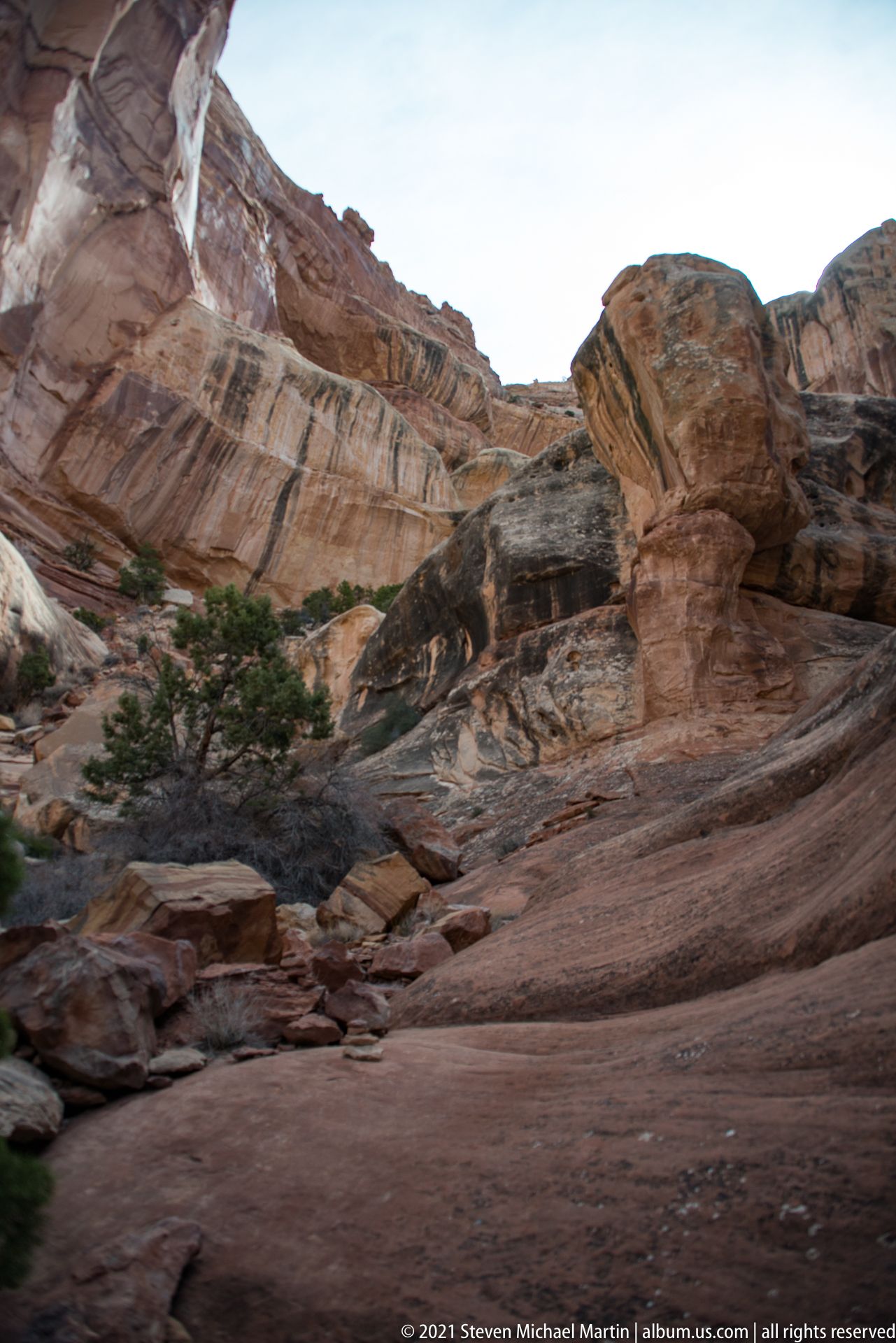
A broad sandstone slope runs beneath a tall, banded cliff, with a small shrub rooted among the fractured ledges. Reddish and cream strata cross the scene in shallow diagonals, while a darker boulder interrupts the wall at right. The calm, unpeopled composition draws attention to the layered structure and sparse vegetation of the canyon.
Caption
A broad sandstone slope runs beneath a tall, banded cliff, with a small shrub rooted among the fractured ledges. Reddish and cream strata cross the scene in shallow diagonals, while a darker boulder interrupts the wall at right. The calm, unpeopled composition draws attention to the layered structure and sparse vegetation of the canyon.
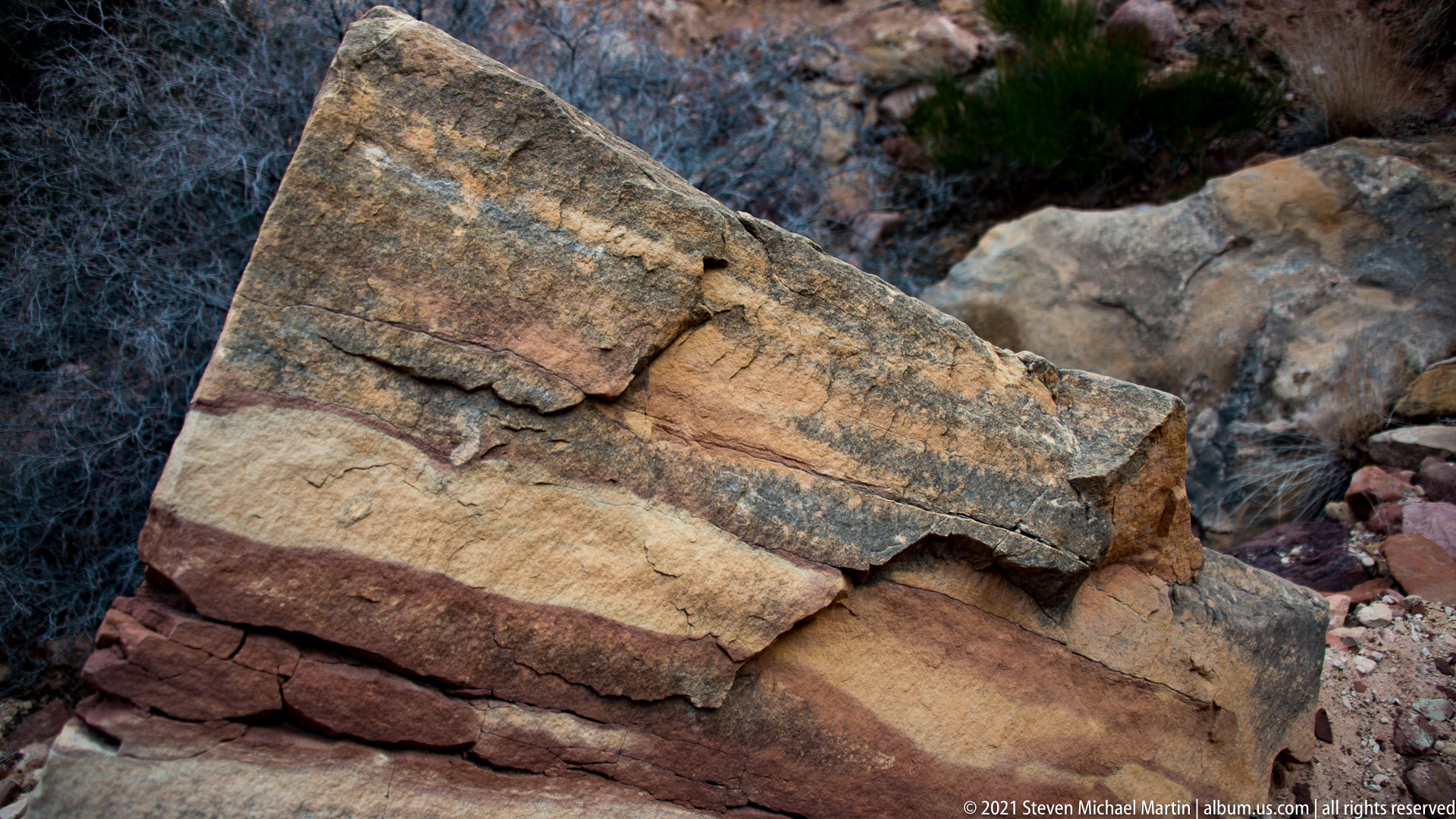
Angular sandstone blocks form a short, uneven stack amid scrub and leafless brush. Their horizontal strata and fractured edges expose bands of tan, ochre, and red stone, with a dark weathered patch on the upper slab. The tight view emphasizes the rock’s layering and breakage rather than assigning the formation to a constructed feature.
Caption
Angular sandstone blocks form a short, uneven stack amid scrub and leafless brush. Their horizontal strata and fractured edges expose bands of tan, ochre, and red stone, with a dark weathered patch on the upper slab. The tight view emphasizes the rock’s layering and breakage rather than assigning the formation to a constructed feature.

A small cairn of flat sandstone pieces is balanced on a larger rock, with a single rounded stone perched at the top. The close focus isolates the stack against a softly blurred background of green and brown, turning a simple trail-side marker into a study of shape, weight, and balance. The layered colors of the stones remain visible across the compact arrangement.
Caption
A small cairn of flat sandstone pieces is balanced on a larger rock, with a single rounded stone perched at the top. The close focus isolates the stack against a softly blurred background of green and brown, turning a simple trail-side marker into a study of shape, weight, and balance. The layered colors of the stones remain visible across the compact arrangement.
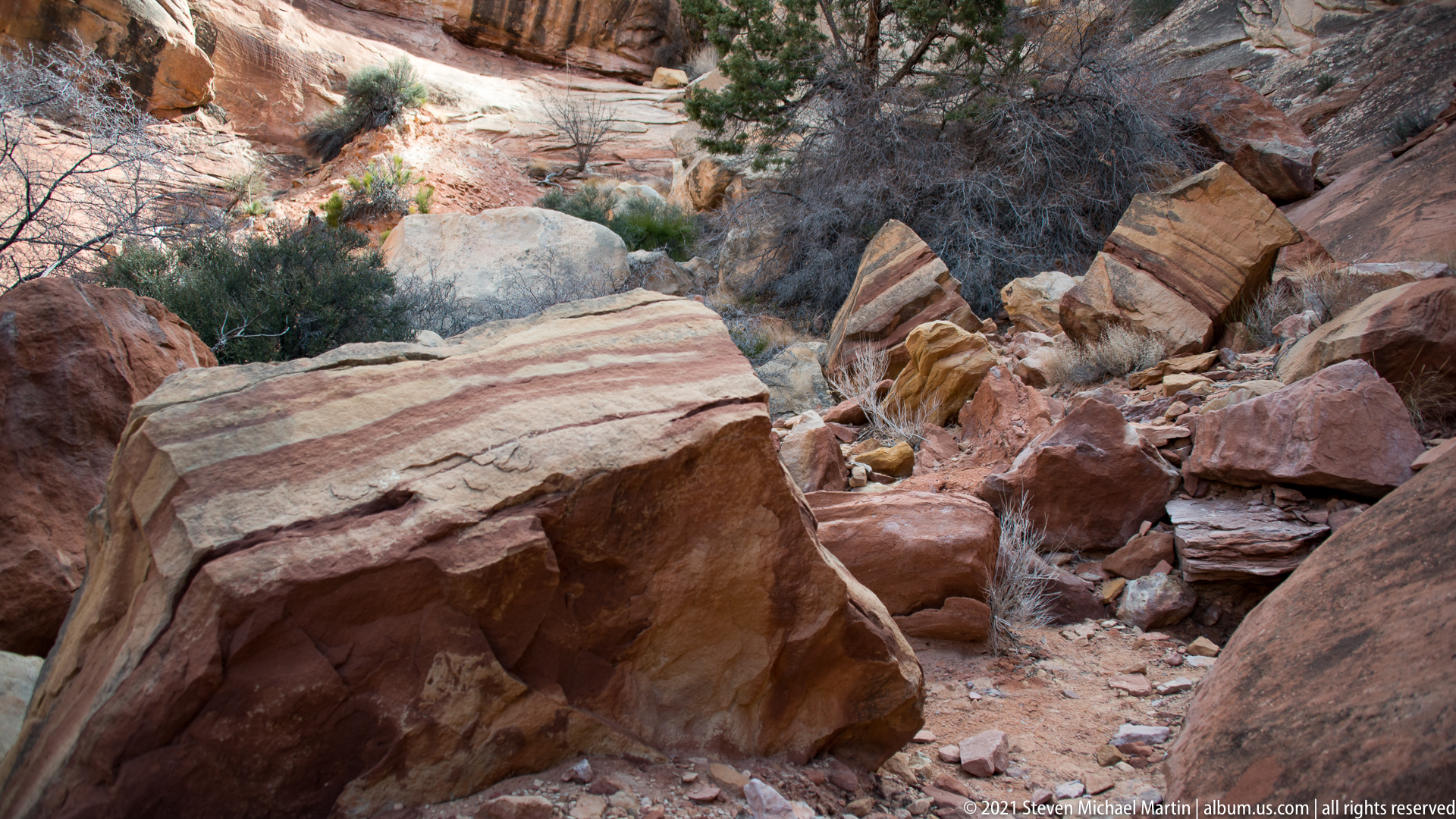
A large striped sandstone boulder dominates the foreground of a jumble of broken slabs, smaller blocks, and desert brush. The terrain rises unevenly toward a narrow passage at the upper right, where layered rock and vegetation partly obscure the route. This view records the rough ground and fractured stone encountered along the approach rather than a single isolated formation.
Caption
A large striped sandstone boulder dominates the foreground of a jumble of broken slabs, smaller blocks, and desert brush. The terrain rises unevenly toward a narrow passage at the upper right, where layered rock and vegetation partly obscure the route. This view records the rough ground and fractured stone encountered along the approach rather than a single isolated formation.
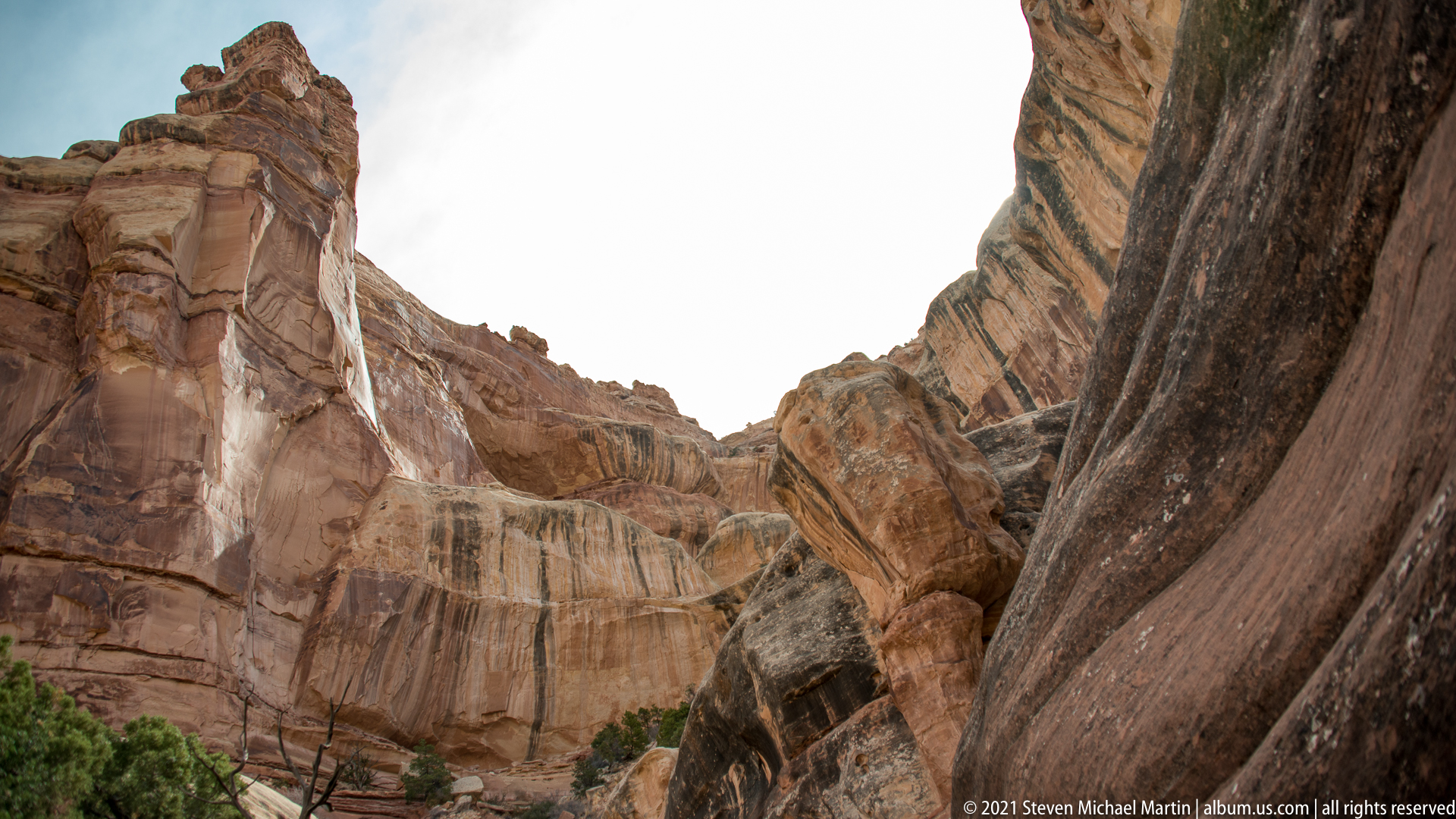
The canyon walls rise steeply on both sides, leaving a narrow opening to the pale sky above. Horizontal bands and dark weathering streaks mark the rock faces, while a cluster of boulders narrows the route in the distance. The upward composition conveys the enclosure of the passage and the scale of its sandstone walls without a person for comparison.
Caption
The canyon walls rise steeply on both sides, leaving a narrow opening to the pale sky above. Horizontal bands and dark weathering streaks mark the rock faces, while a cluster of boulders narrows the route in the distance. The upward composition conveys the enclosure of the passage and the scale of its sandstone walls without a person for comparison.
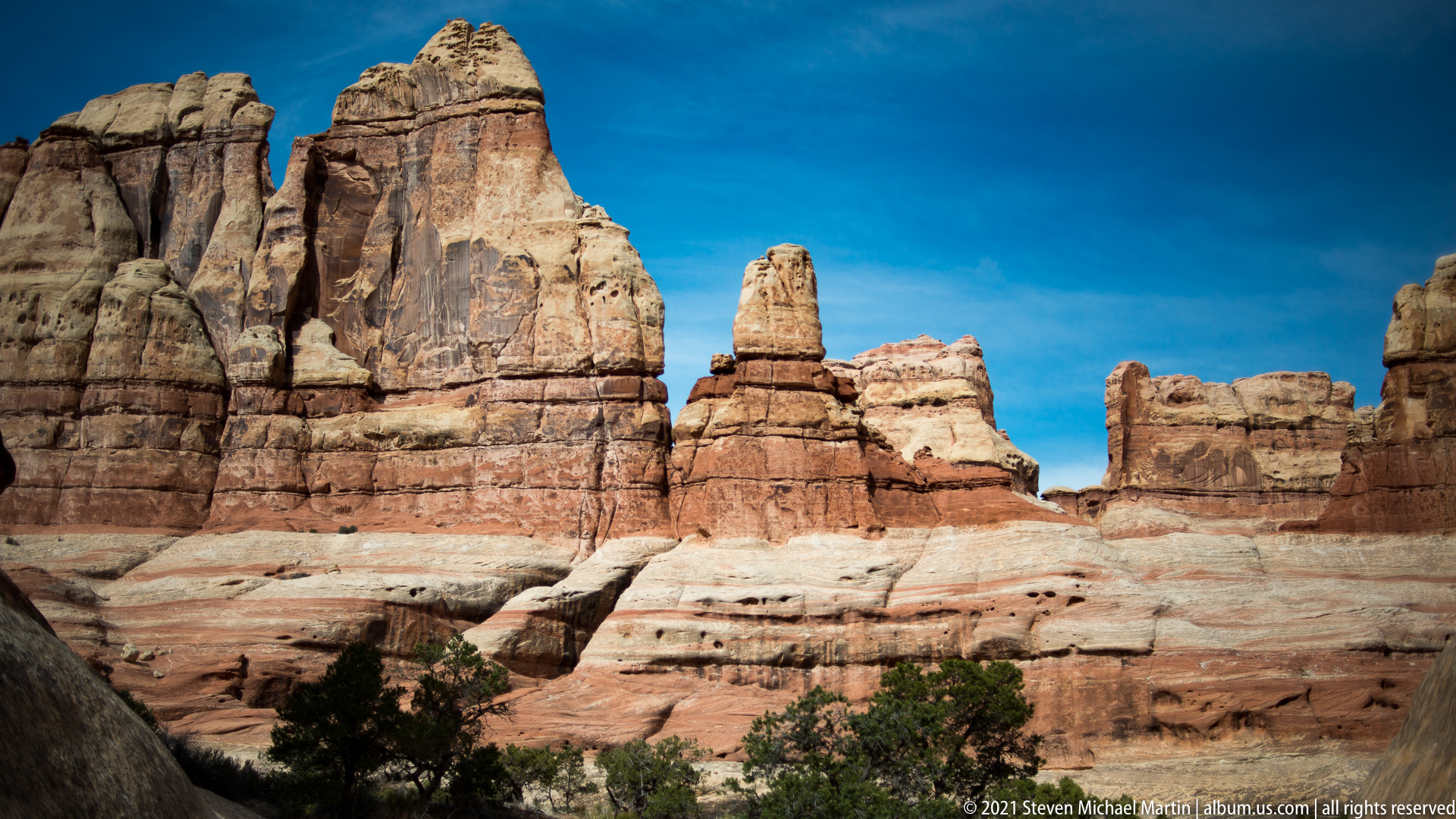
A cluster of sandstone towers and fins rises above a pale ledge, their red lower bands contrasting with lighter upper layers. A tall narrow pinnacle stands near the center, separated from the broader wall behind it. Bright sunlight sharpens the relief and color changes in the rock, while the clear sky keeps the jagged skyline distinct.
Caption
A cluster of sandstone towers and fins rises above a pale ledge, their red lower bands contrasting with lighter upper layers. A tall narrow pinnacle stands near the center, separated from the broader wall behind it. Bright sunlight sharpens the relief and color changes in the rock, while the clear sky keeps the jagged skyline distinct.
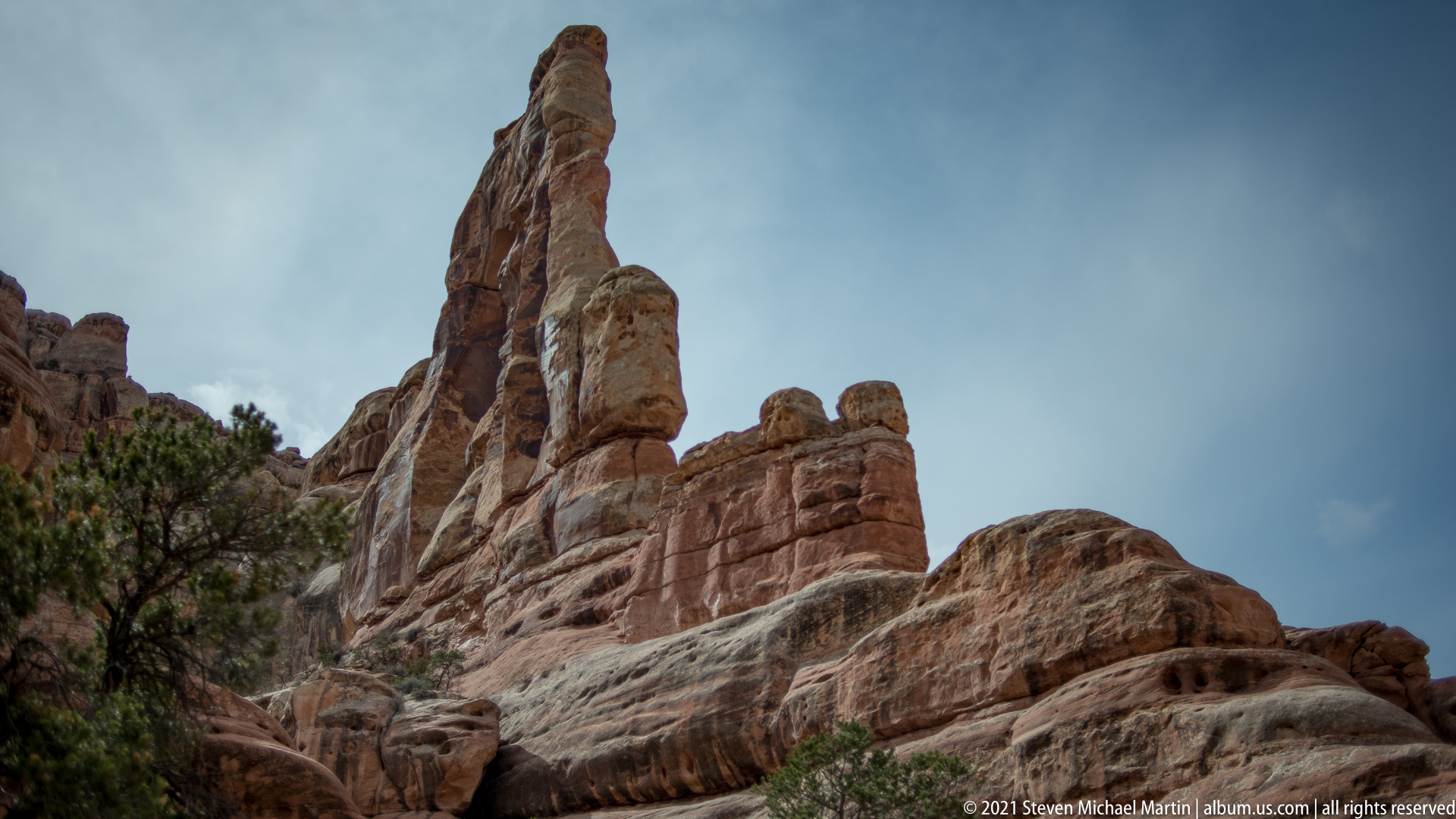
A narrow sandstone spire rises above rounded, layered formations, its tapered profile set against a muted sky. The surrounding rock slopes downward in broad shelves, and a small tree at left provides scale and a hint of vegetation at the base. This view shifts from the arch to the nearby freestanding forms that shape the Druid Arch approach.
Caption
A narrow sandstone spire rises above rounded, layered formations, its tapered profile set against a muted sky. The surrounding rock slopes downward in broad shelves, and a small tree at left provides scale and a hint of vegetation at the base. This view shifts from the arch to the nearby freestanding forms that shape the Druid Arch approach.
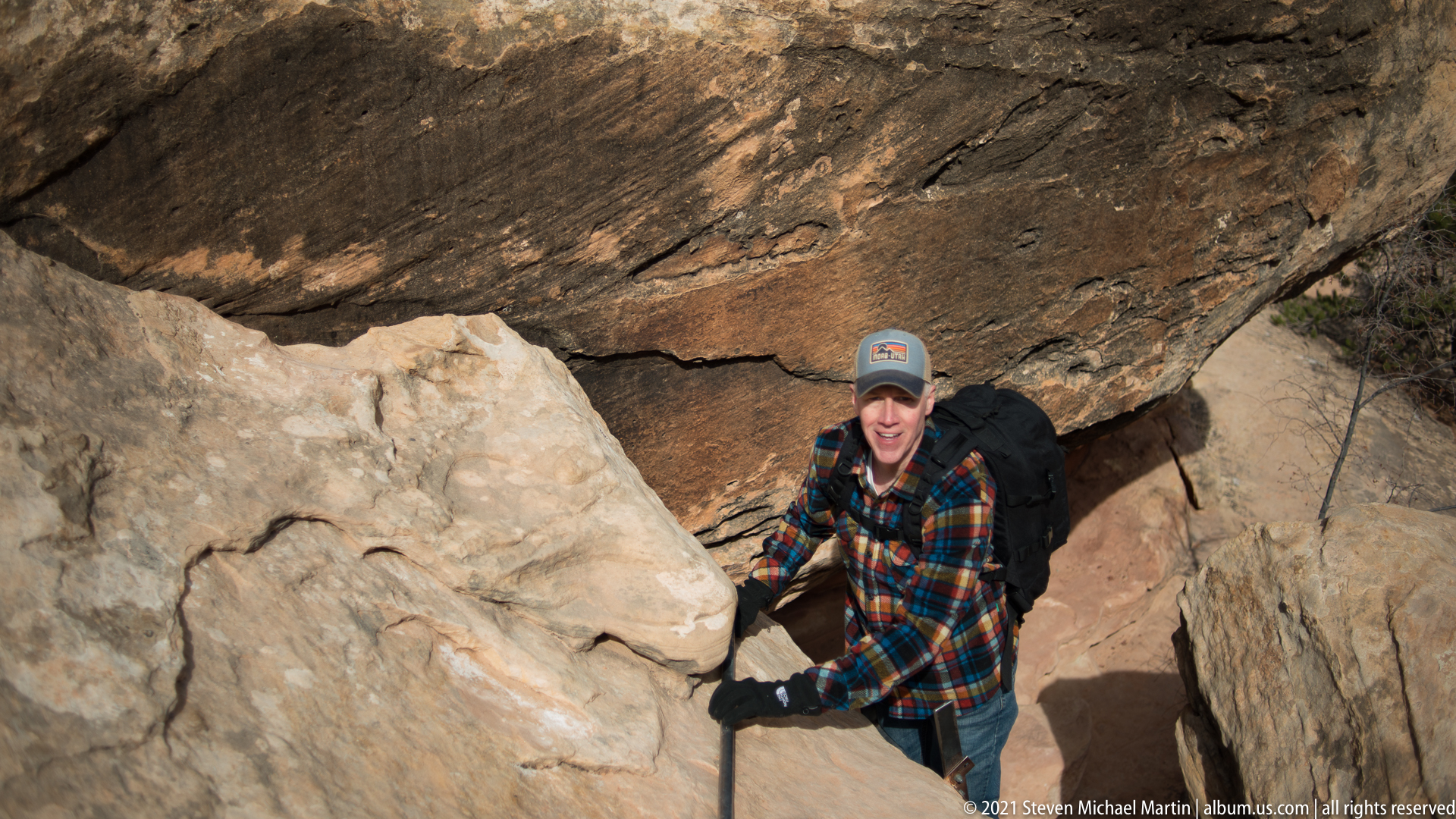
A hiker crouches and climbs through a tight opening between a pale boulder and a dark overhanging rock. One hand braces against the stone while the other reaches toward the narrow passage, showing the hands-on movement required to pass through. The close view centers on the route’s constriction and the contact between person and rock.
Caption
A hiker crouches and climbs through a tight opening between a pale boulder and a dark overhanging rock. One hand braces against the stone while the other reaches toward the narrow passage, showing the hands-on movement required to pass through. The close view centers on the route’s constriction and the contact between person and rock.
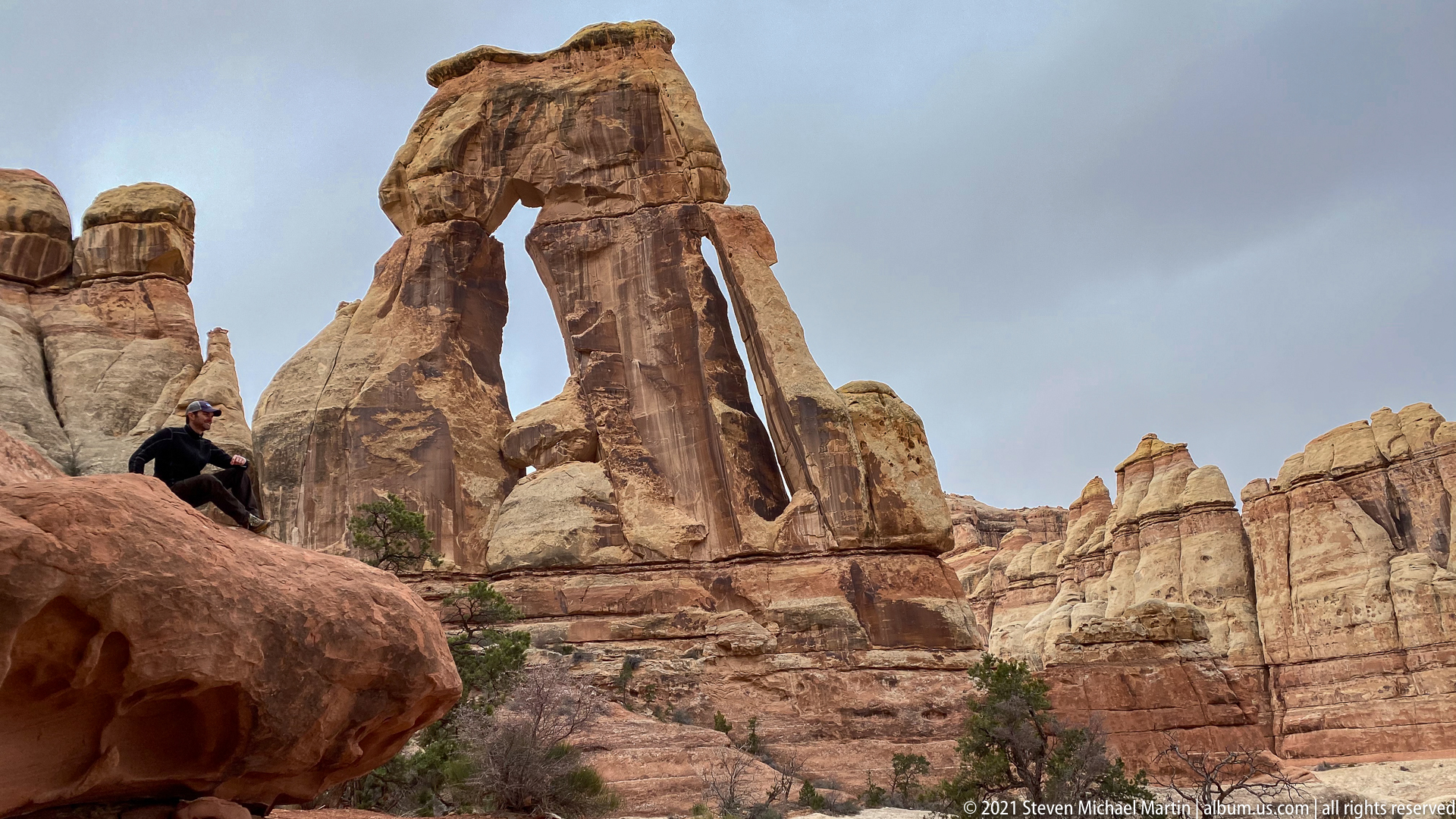
Druid Arch fills the center of this low-angle view, framed by sandstone towers and a pale overcast sky. A hiker sits on a rounded boulder in the lower left, dwarfed by the arch’s tall supports and broad span. The foreground figure gives scale while leaving the opening and the vertically streaked rock face unobstructed.
Caption
Druid Arch fills the center of this low-angle view, framed by sandstone towers and a pale overcast sky. A hiker sits on a rounded boulder in the lower left, dwarfed by the arch’s tall supports and broad span. The foreground figure gives scale while leaving the opening and the vertically streaked rock face unobstructed.
Canyonlands National Park — Field Guide
National Park Field Guide
📍 Overview
Canyonlands National Park preserves an extensive landscape of deeply eroded canyons, mesas, and buttes shaped by the Colorado and Green Rivers. Located within the Colorado Plateau, the park illustrates the long-term effects of tectonic uplift followed by gradual erosion that carved complex canyon systems through layered sedimentary rock. The scale of the landscape reflects geological processes operating over millions of years.
The park is divided into several districts, including Island in the Sky, The Needles, and The Maze, each presenting distinctive geological features formed through variations in erosion and rock composition. Exposed strata reveal changes in environmental conditions across prehistoric eras, while river systems continue to shape canyon depth and form. The landscape provides insight into the interaction between uplift, weathering, and water erosion.
⭐ Highlights
- Colorado and Green River canyon systems
- Island in the Sky mesa landscapes
- The Needles sandstone formations
- Layered sedimentary rock exposures
- Expansive Colorado Plateau desert scenery
🔎 Key Features
- Deeply incised canyon networks shaped by river erosion
- Sandstone formations formed through sediment deposition
- Mesas and buttes created by differential erosion
- Rock layers illustrating geological time sequences
- Large-scale desert landscape with minimal development
📷 Photography Notes
- Early and late light enhances canyon depth and texture
- Wide compositions help convey the scale of mesas and canyons
- Cloud shadows can add visual dimension to the landscape
- Layered rock patterns create natural compositional lines
- Foreground rock formations help provide depth
- Look for viewpoints that show river-carved canyon systems
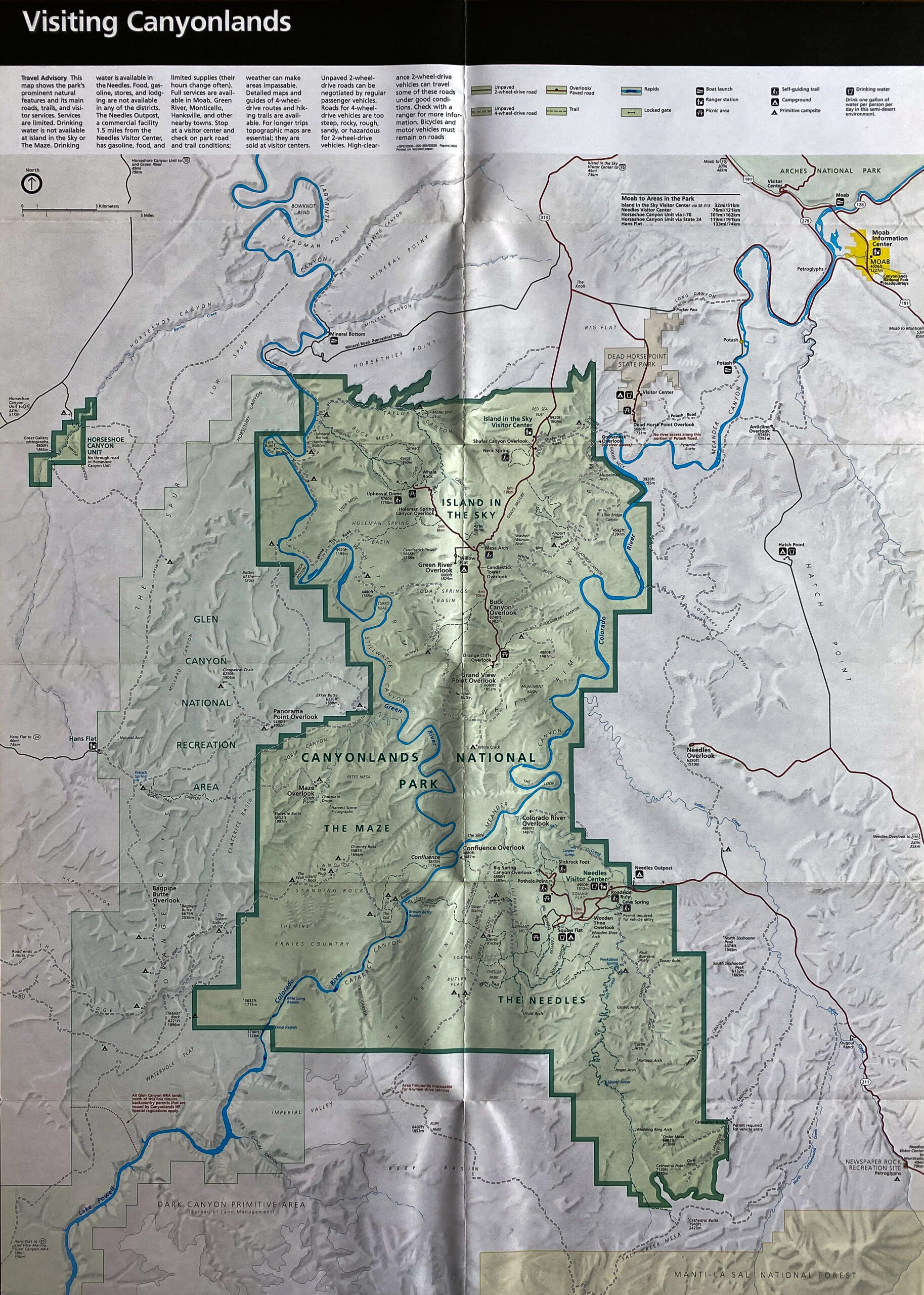
A printed visitor map fills the open brochure, with a large green-outlined park area, winding blue waterways, and a network of roads and labels. The map is surrounded by gray shaded terrain and folds down the center. This view emphasizes the park’s mapped extent and its relationship to nearby routes rather than a single scenic feature.
Caption
A printed visitor map fills the open brochure, with a large green-outlined park area, winding blue waterways, and a network of roads and labels. The map is surrounded by gray shaded terrain and folds down the center. This view emphasizes the park’s mapped extent and its relationship to nearby routes rather than a single scenic feature.

An open National Park Service brochure presents a panoramic photograph across its upper half and a grid of smaller landscape images and text below. The spread is arranged as a visitor overview, pairing scenic views with explanatory panels. Fine print is too small to transcribe from this reproduction, but the layout clearly identifies it as interpretive park material.
Caption
An open National Park Service brochure presents a panoramic photograph across its upper half and a grid of smaller landscape images and text below. The spread is arranged as a visitor overview, pairing scenic views with explanatory panels. Fine print is too small to transcribe from this reproduction, but the layout clearly identifies it as interpretive park material.
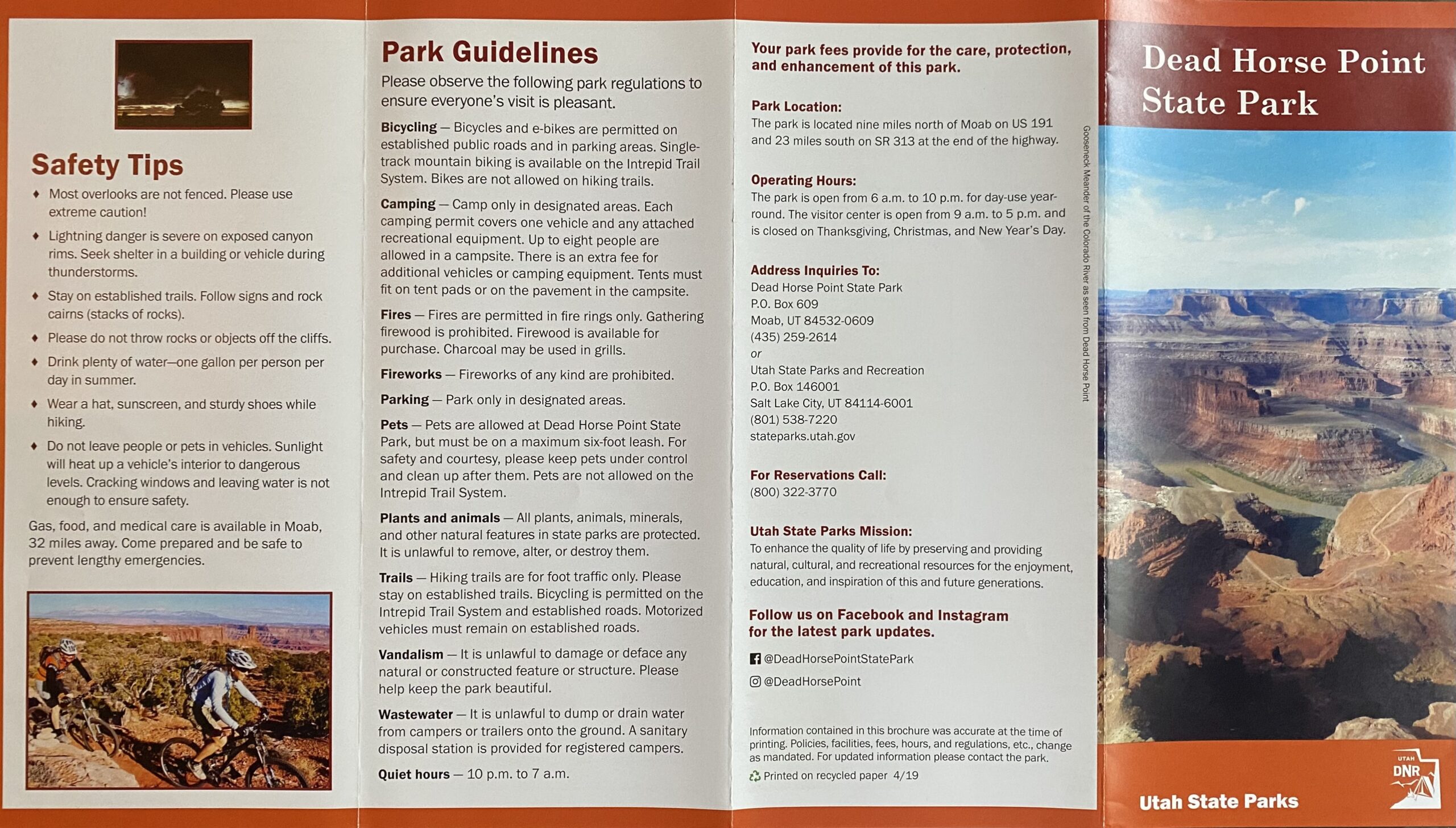
An open visitor guide places safety tips and park regulations across its central panels, with contact details and a tall canyon photograph on the right headed “Dead Horse Point State Park.” The close view shows how practical guidance and scenic imagery share the printed spread. Small body text is not legible enough here to quote reliably.
Caption
An open visitor guide places safety tips and park regulations across its central panels, with contact details and a tall canyon photograph on the right headed “Dead Horse Point State Park.” The close view shows how practical guidance and scenic imagery share the printed spread. Small body text is not legible enough here to quote reliably.
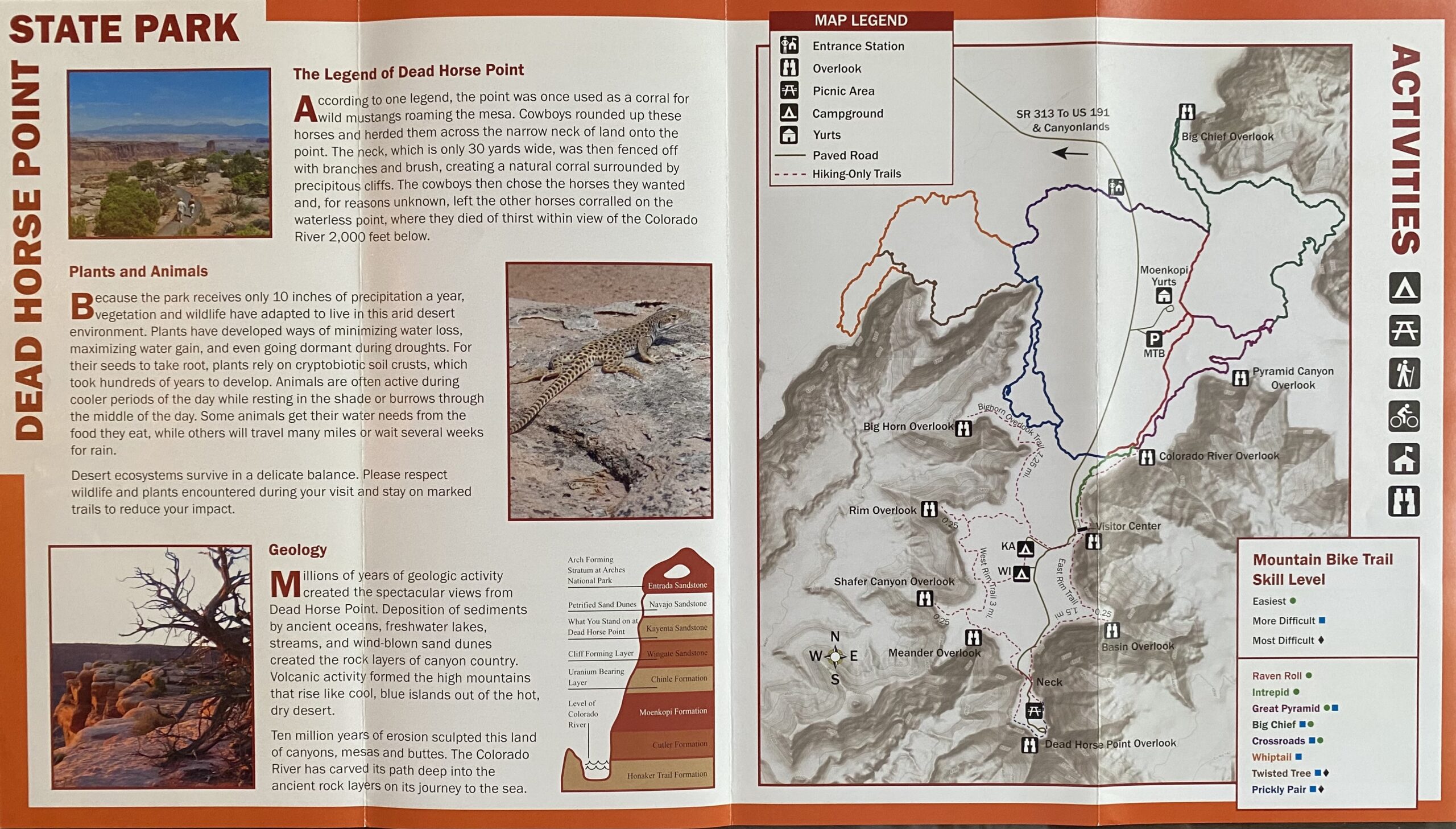
An open Dead Horse Point State Park guide combines a regional map with interpretive text and activity information. The map occupies the right half, marked with routes, facilities, and a legend; the left panel contains sections on plants and animals and geology, accompanied by small landscape photographs. Orange borders and vertical headings organize the brochure, presenting navigation and natural-history information in one printed spread.
Caption
An open Dead Horse Point State Park guide combines a regional map with interpretive text and activity information. The map occupies the right half, marked with routes, facilities, and a legend; the left panel contains sections on plants and animals and geology, accompanied by small landscape photographs. Orange borders and vertical headings organize the brochure, presenting navigation and natural-history information in one printed spread.