Capulin Volcano National Monument
Capulin Volcano National Monument preserves a striking cinder cone volcano rising above the grasslands of northeastern New Mexico. The nearly symmetrical cone provides a clear example of volcanic processes associated with eruptions that built layers of ash, cinders, and lava around a central vent. The site illustrates how relatively recent volcanic activity shaped the surrounding landscape and contributed to the region’s distinctive geology.
The crater rim and surrounding lava flows demonstrate the structure of a classic cinder cone formed by explosive eruptions. From the summit, visitors can observe broad views across volcanic fields, plains, and distant mountain ranges, emphasizing the regional context of volcanic activity in this part of the Southwest. The monument offers an accessible setting for understanding how small volcanoes form and how erosion gradually modifies their shape over time.
Visitors experience a landscape where volcanic form remains visually clear and relatively intact. The monument provides a strong contrast to canyon and plateau environments elsewhere in the itinerary, reinforcing the diversity of geological processes that shaped the American Southwest.
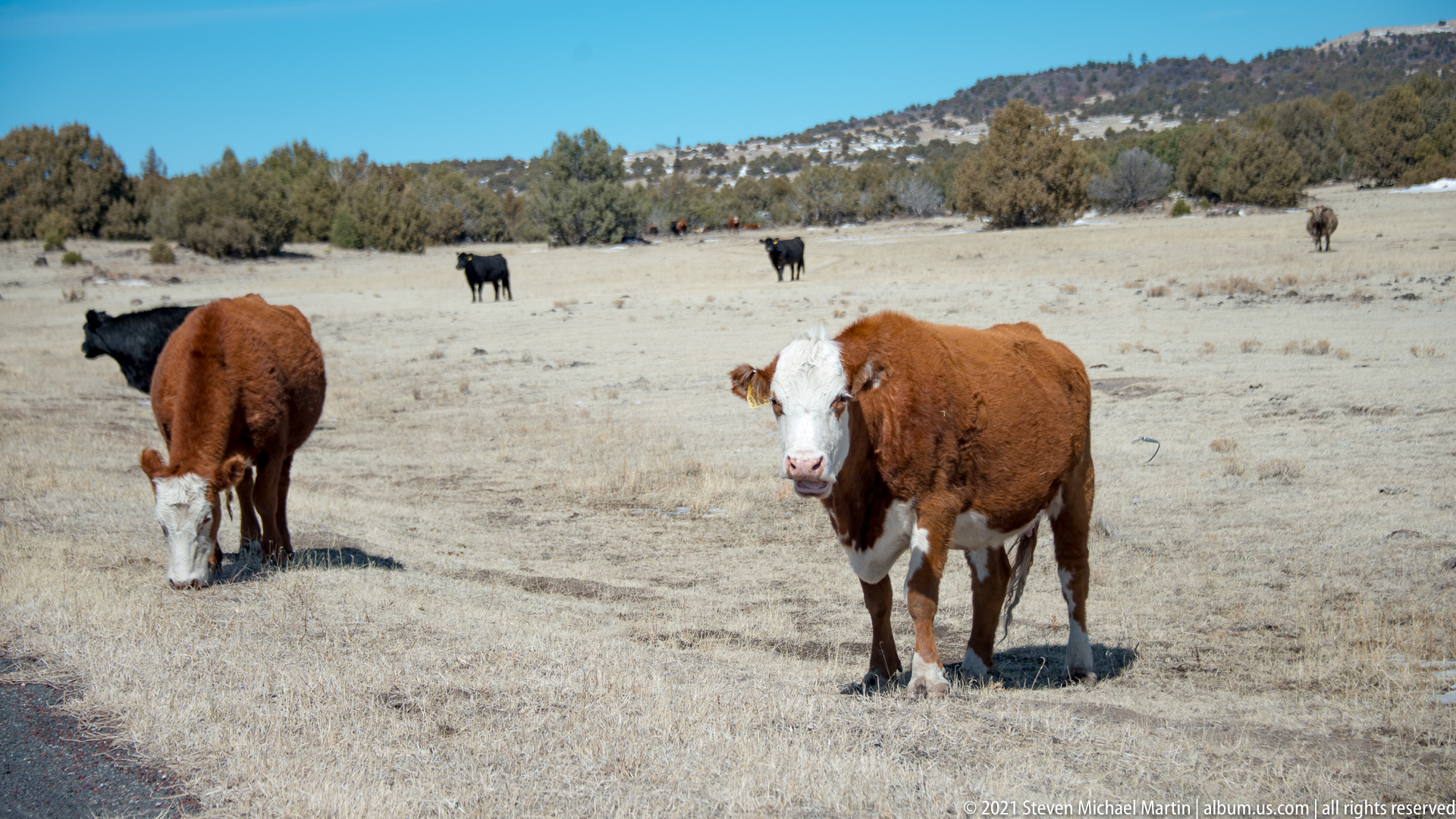
Two brown-and-white cattle occupy a pale, open pasture, one lowering its head to graze while the other faces the camera. More cattle stand across the field below a scrub-covered slope. The working landscape around Capulin Volcano places grazing animals in a broad grassland setting, with the mountain terrain forming a low, textured horizon beneath a clear blue sky.
Caption
Two brown-and-white cattle occupy a pale, open pasture, one lowering its head to graze while the other faces the camera. More cattle stand across the field below a scrub-covered slope. The working landscape around Capulin Volcano places grazing animals in a broad grassland setting, with the mountain terrain forming a low, textured horizon beneath a clear blue sky.
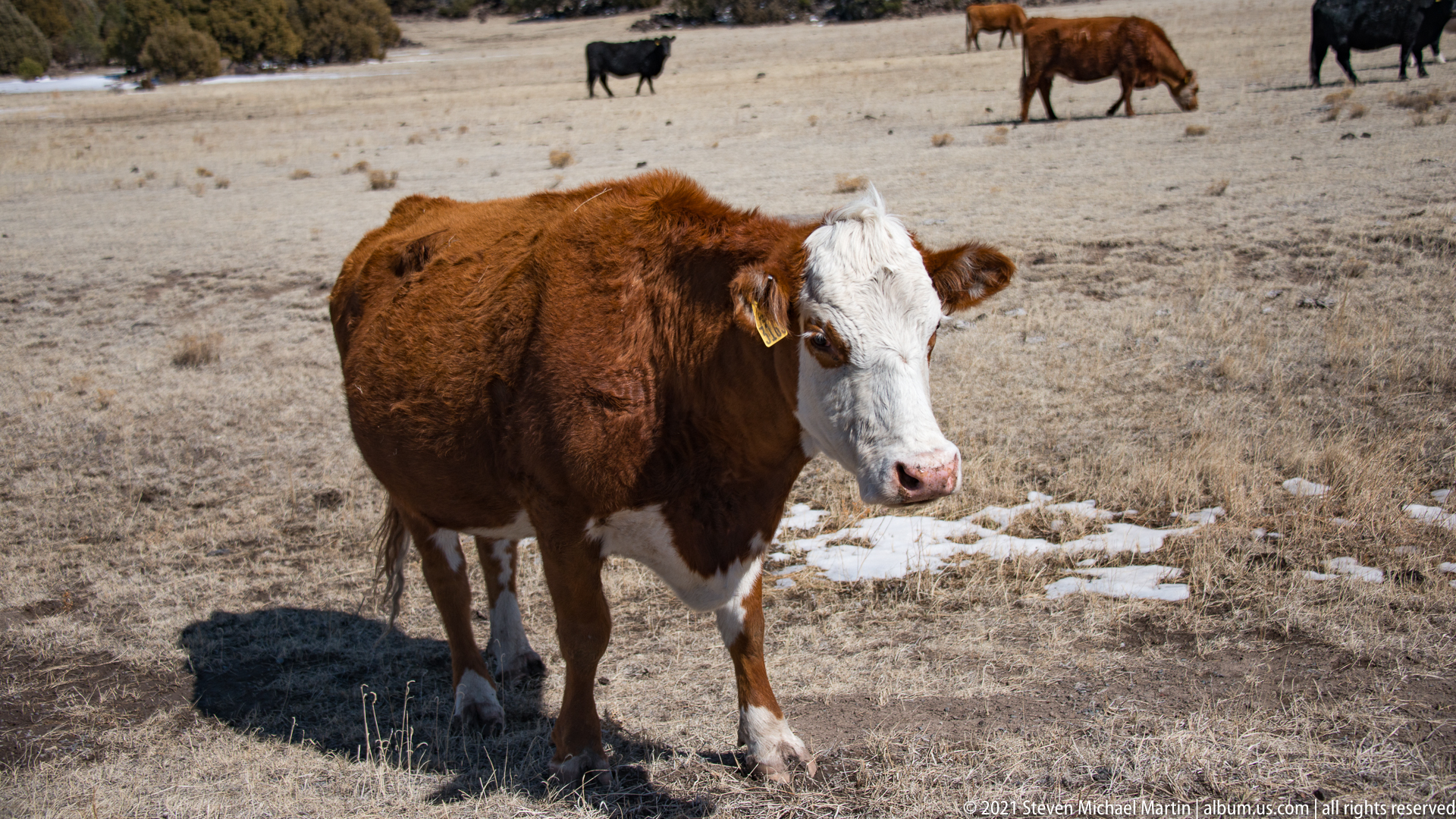
A single brown cow with a broad white face stands near the center of a dry pasture, looking toward the camera. Other cattle graze in the softly receding field, where small patches of snow interrupt the tan grass. The tighter framing makes the animal’s coat, stance, and attentive gaze the focus while retaining the open ranch landscape as context.
Caption
A single brown cow with a broad white face stands near the center of a dry pasture, looking toward the camera. Other cattle graze in the softly receding field, where small patches of snow interrupt the tan grass. The tighter framing makes the animal’s coat, stance, and attentive gaze the focus while retaining the open ranch landscape as context.
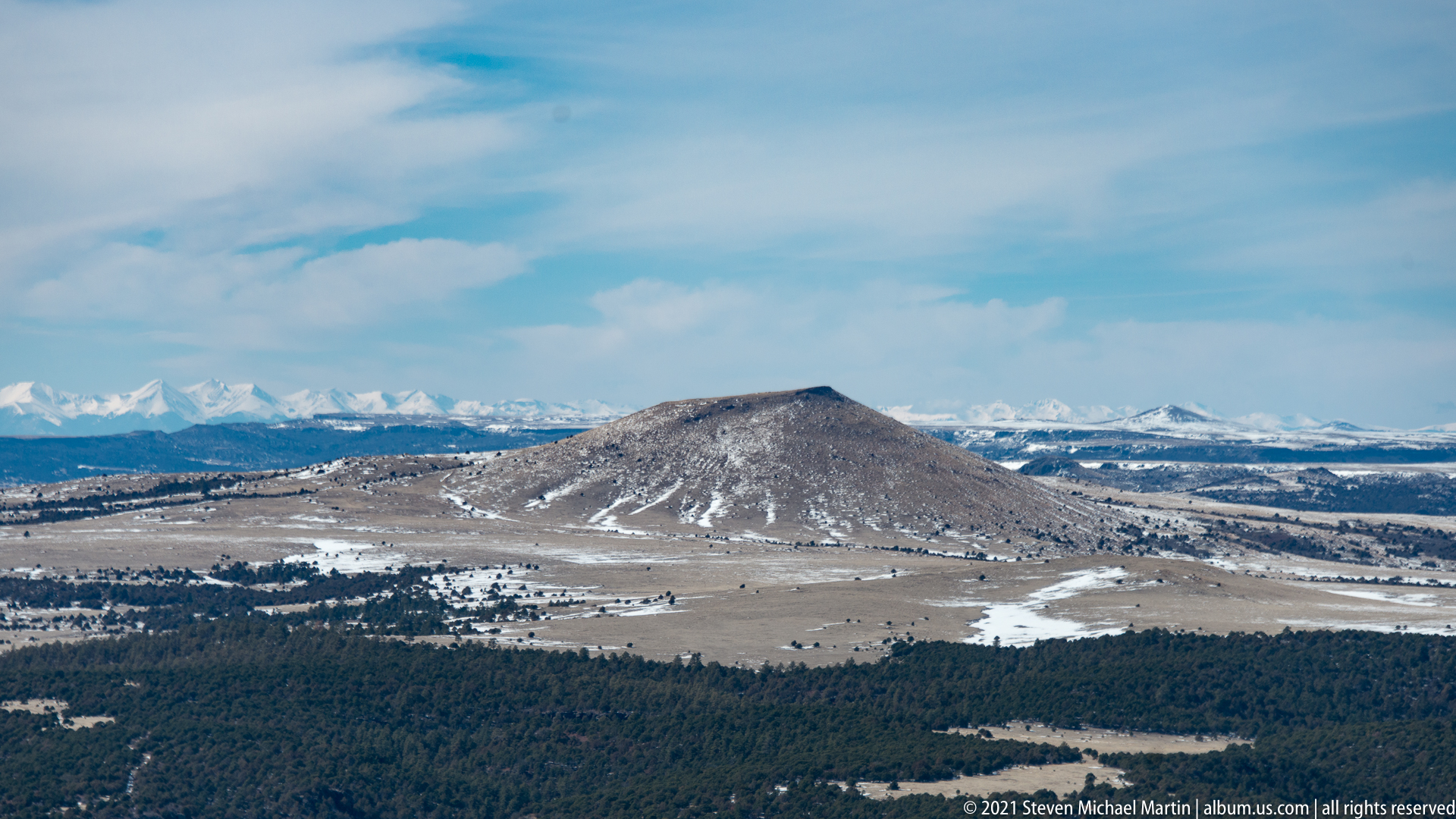
Capulin’s low, rounded cone sits in the middle distance, framed by dark evergreen forest and broad winter grassland. Beyond it, a line of snow-covered mountains stretches along the horizon beneath scattered cloud. The layered view places the monument’s modest cinder cone within a much larger regional landscape, balancing foreground woodland with distant high peaks.
Caption
Capulin’s low, rounded cone sits in the middle distance, framed by dark evergreen forest and broad winter grassland. Beyond it, a line of snow-covered mountains stretches along the horizon beneath scattered cloud. The layered view places the monument’s modest cinder cone within a much larger regional landscape, balancing foreground woodland with distant high peaks.
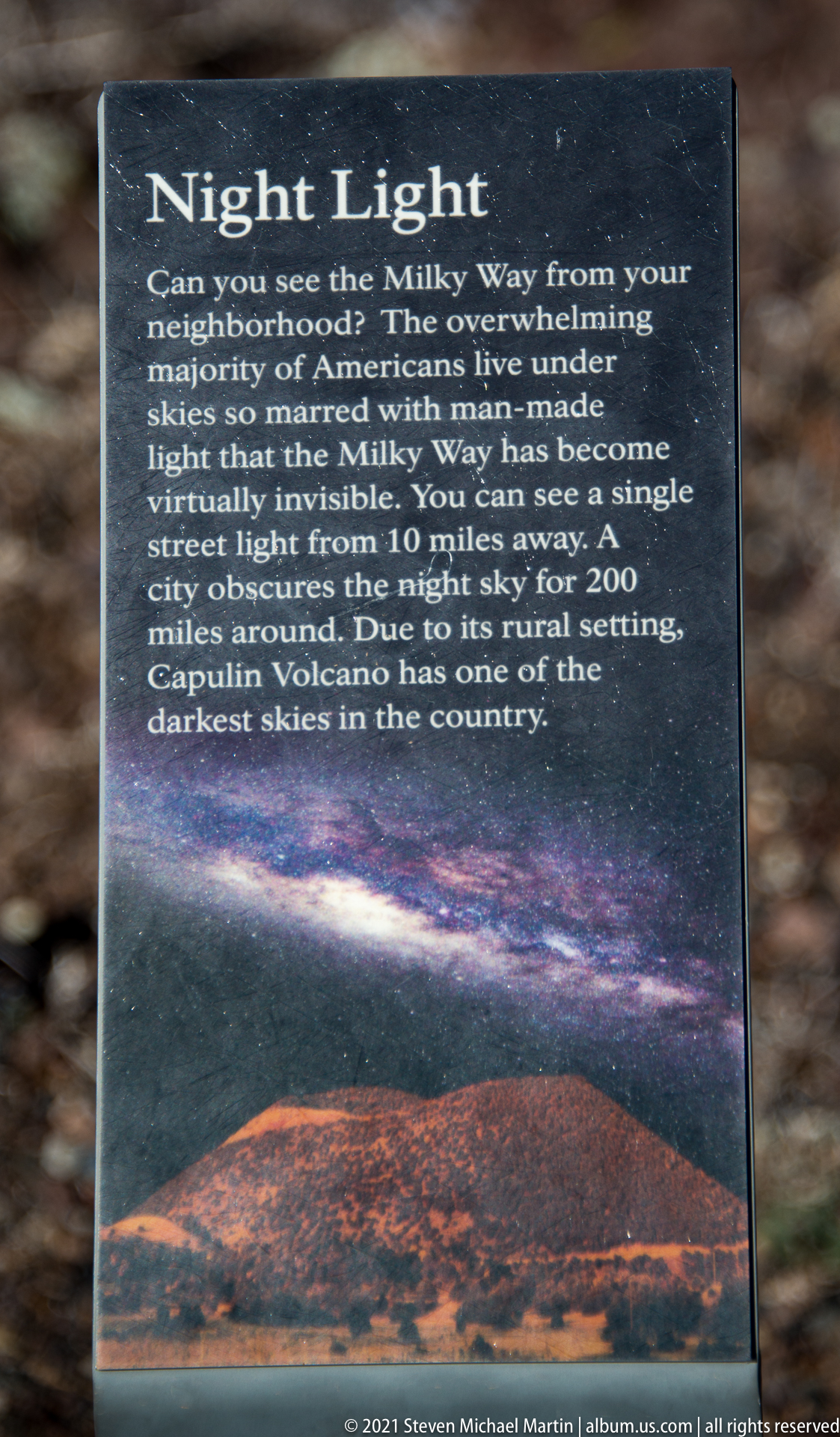
A dark interpretive panel titled “Night Light” asks visitors whether they can see the Milky Way and explains how artificial lighting affects the night sky. An image of a star-filled sky stretches above a glowing volcanic landscape near the bottom of the sign. The panel connects the remote setting to dark-sky viewing and encourages attention to the stars overhead.
Caption
A dark interpretive panel titled “Night Light” asks visitors whether they can see the Milky Way and explains how artificial lighting affects the night sky. An image of a star-filled sky stretches above a glowing volcanic landscape near the bottom of the sign. The panel connects the remote setting to dark-sky viewing and encourages attention to the stars overhead.
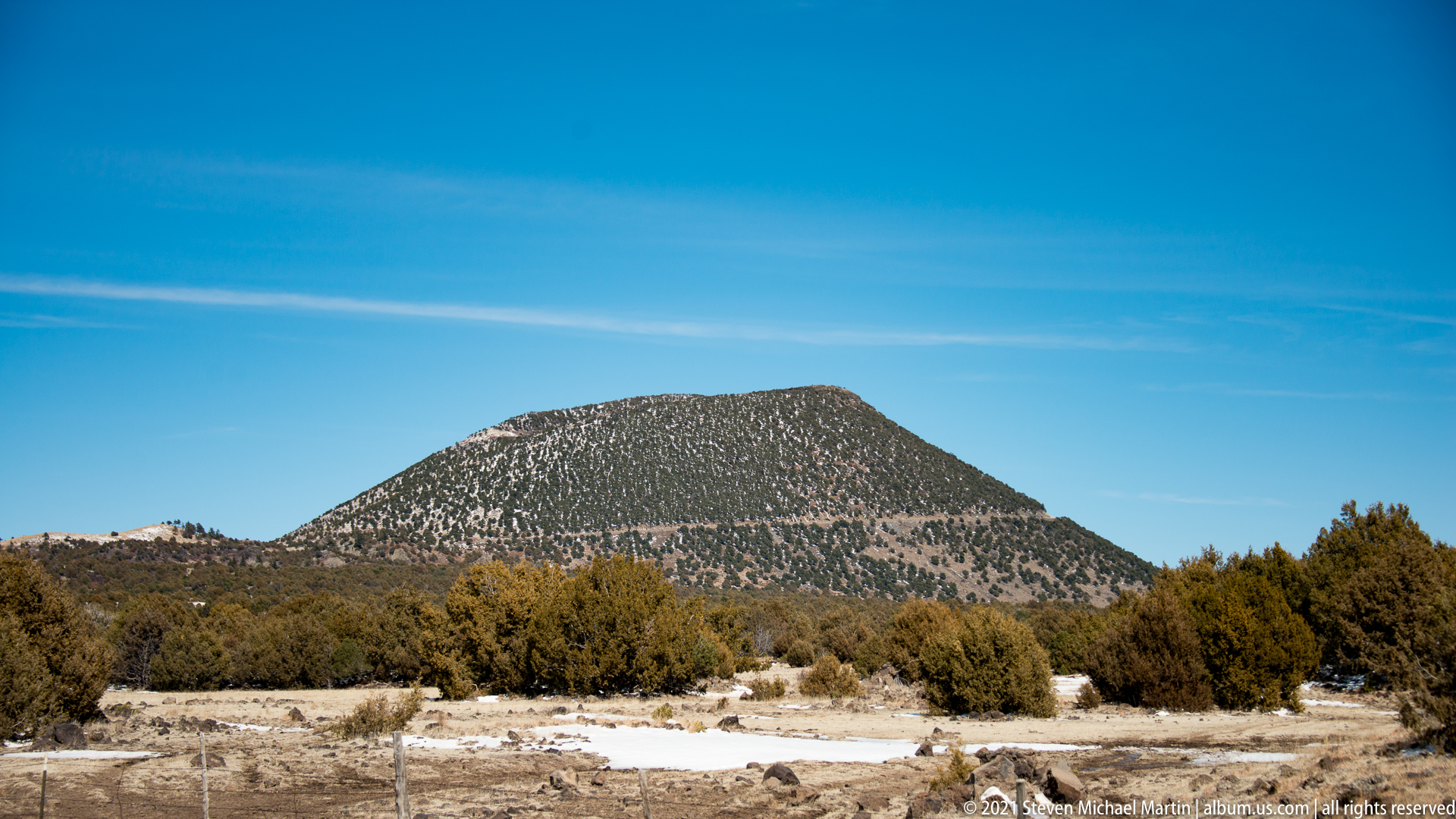
The broad, nearly symmetrical cone of Capulin Volcano rises above a band of evergreen woodland and scrub. A dry, lightly snow-dusted field and fence line cross the foreground, anchoring the volcanic landform in the surrounding ranch country. The low viewpoint emphasizes the cone’s rounded profile against an uninterrupted blue sky, with vegetation tracing its flanks.
Caption
The broad, nearly symmetrical cone of Capulin Volcano rises above a band of evergreen woodland and scrub. A dry, lightly snow-dusted field and fence line cross the foreground, anchoring the volcanic landform in the surrounding ranch country. The low viewpoint emphasizes the cone’s rounded profile against an uninterrupted blue sky, with vegetation tracing its flanks.

Pale gray and yellow-green lichen patches spread across a rough, reddish-black rock face. The tight focus isolates the mottled growth and shallow pits in the stone, leaving the surrounding terrain blurred. The image records how small organisms occupy exposed volcanic surfaces, adding color and fine pattern to a material otherwise defined by dark, coarse texture.
Caption
Pale gray and yellow-green lichen patches spread across a rough, reddish-black rock face. The tight focus isolates the mottled growth and shallow pits in the stone, leaving the surrounding terrain blurred. The image records how small organisms occupy exposed volcanic surfaces, adding color and fine pattern to a material otherwise defined by dark, coarse texture.
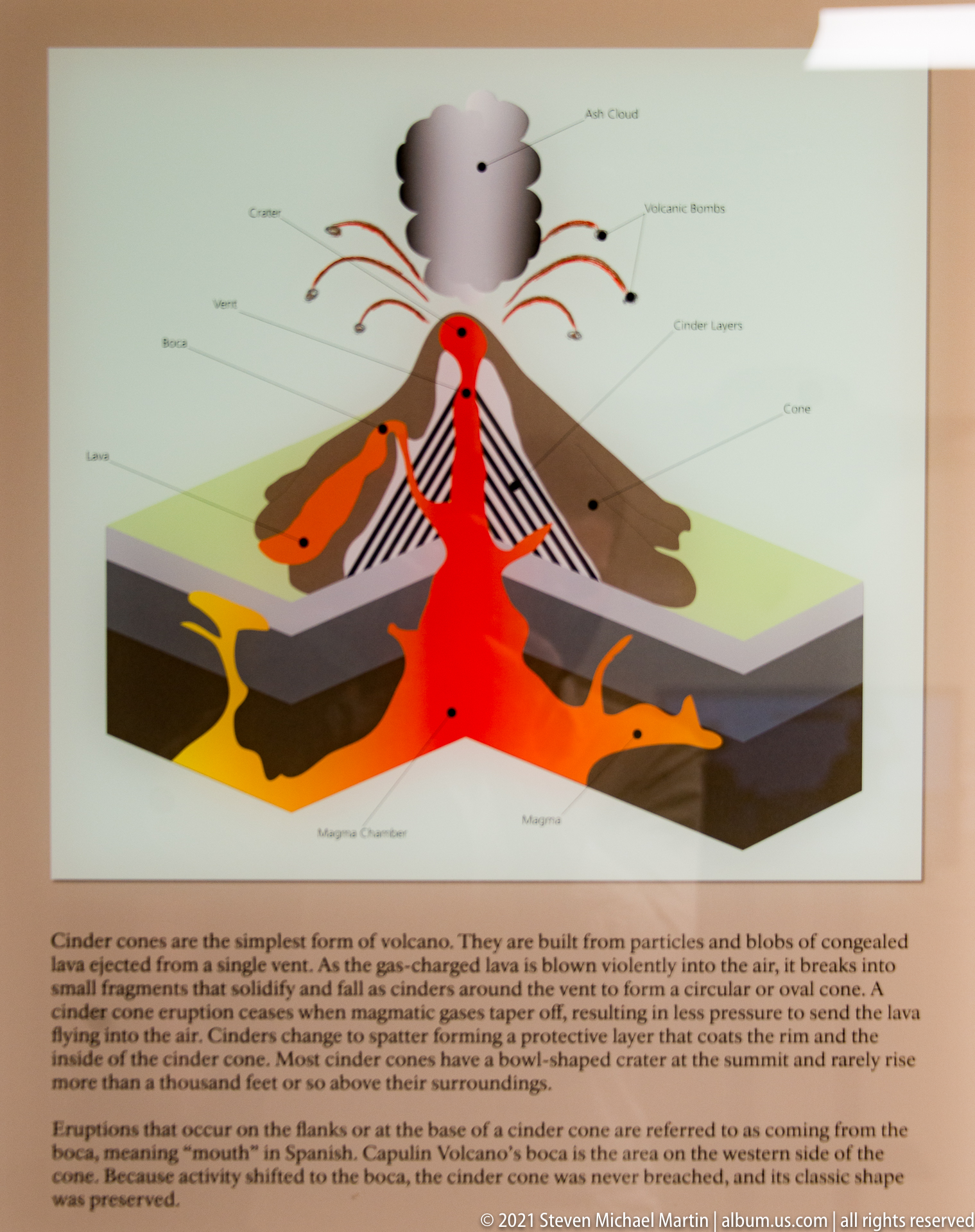
A colorful cutaway model shows a volcano in cross-section, with a central red conduit feeding branching magma beneath layered ground. Orange and dark deposits spread outward from the cone, while an ash plume and small projectiles are shown above the summit. The model translates an underground process into a clear, layered diagram for visitors studying cinder-cone formation.
Caption
A colorful cutaway model shows a volcano in cross-section, with a central red conduit feeding branching magma beneath layered ground. Orange and dark deposits spread outward from the cone, while an ash plume and small projectiles are shown above the summit. The model translates an underground process into a clear, layered diagram for visitors studying cinder-cone formation.

A pale, angular fragment of rock is wedged between parallel rust-colored bars in this close view of trail infrastructure. Its rough, fractured surface contrasts with the evenly spaced metal rails, while the background falls out of focus. The detail places the surrounding volcanic stone in direct contact with a constructed barrier along the visitor route.
Caption
A pale, angular fragment of rock is wedged between parallel rust-colored bars in this close view of trail infrastructure. Its rough, fractured surface contrasts with the evenly spaced metal rails, while the background falls out of focus. The detail places the surrounding volcanic stone in direct contact with a constructed barrier along the visitor route.
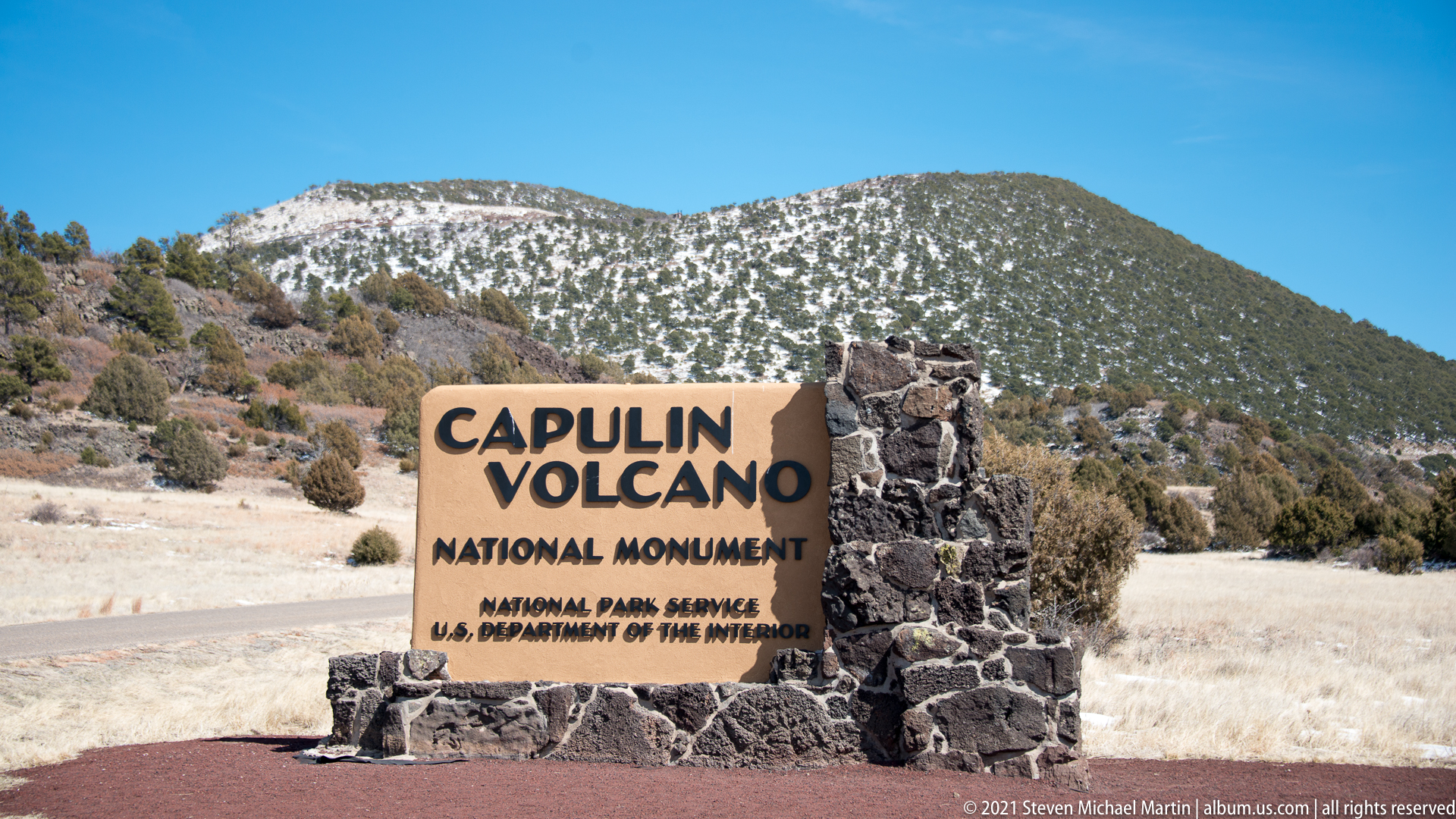
A stone-and-wood entrance sign reads “Capulin Volcano National Monument” and identifies the National Park Service and U.S. Department of the Interior. The volcanic cone rises directly behind the masonry structure, tying the place name to the landform that defines the monument. Dry grass, a paved road, and winter-dusted slopes complete this frontal roadside view.
Caption
A stone-and-wood entrance sign reads “Capulin Volcano National Monument” and identifies the National Park Service and U.S. Department of the Interior. The volcanic cone rises directly behind the masonry structure, tying the place name to the landform that defines the monument. Dry grass, a paved road, and winter-dusted slopes complete this frontal roadside view.
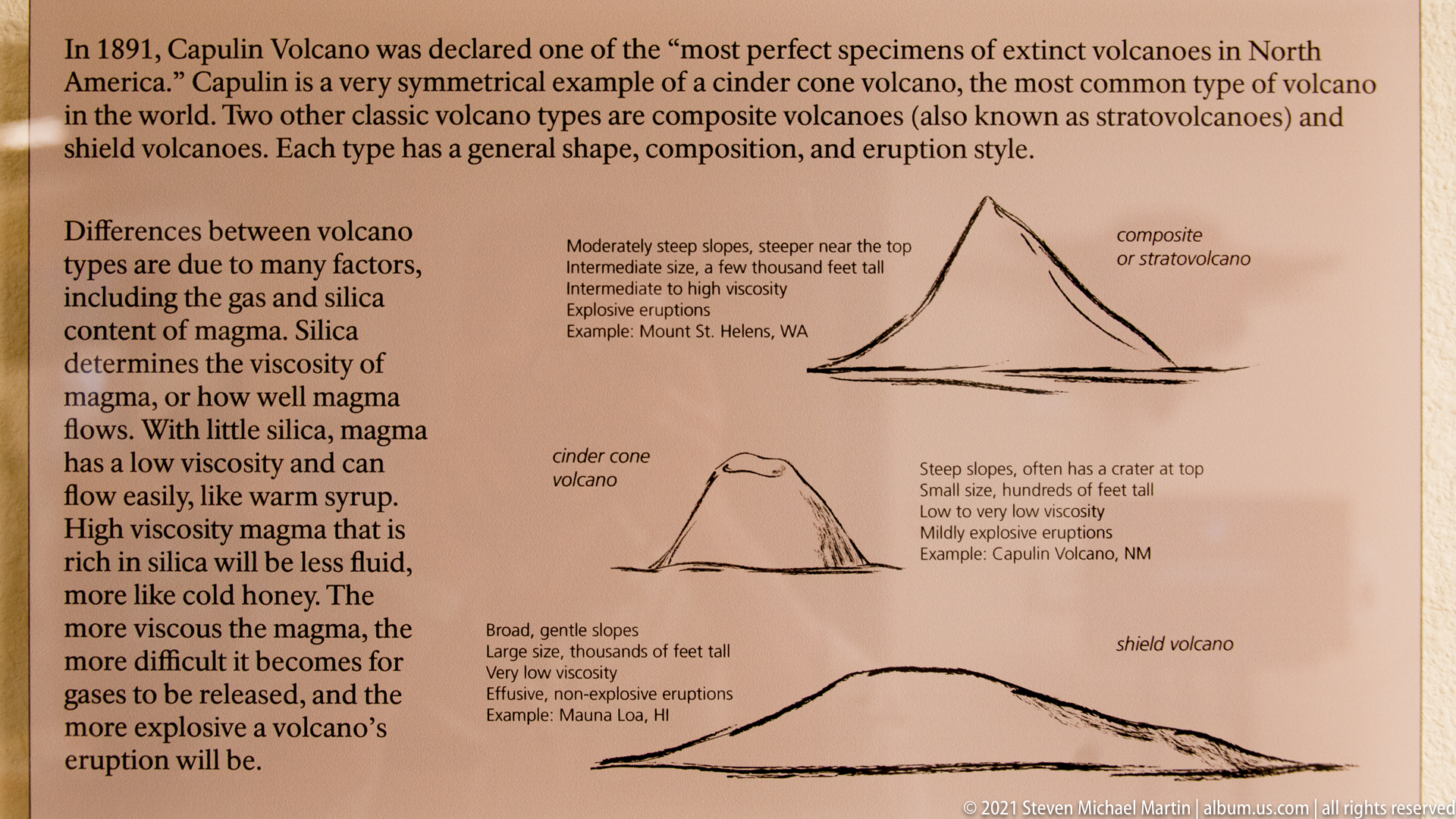
An interpretive panel compares three volcanic profiles: a steep composite cone, a smaller cinder cone, and a broad shield volcano. Text beside the sketches discusses how magma composition and viscosity shape eruption behavior and slope. Capulin appears as the cinder-cone example, allowing visitors to relate the compact diagram to the landform outside the exhibit.
Caption
An interpretive panel compares three volcanic profiles: a steep composite cone, a smaller cinder cone, and a broad shield volcano. Text beside the sketches discusses how magma composition and viscosity shape eruption behavior and slope. Capulin appears as the cinder-cone example, allowing visitors to relate the compact diagram to the landform outside the exhibit.
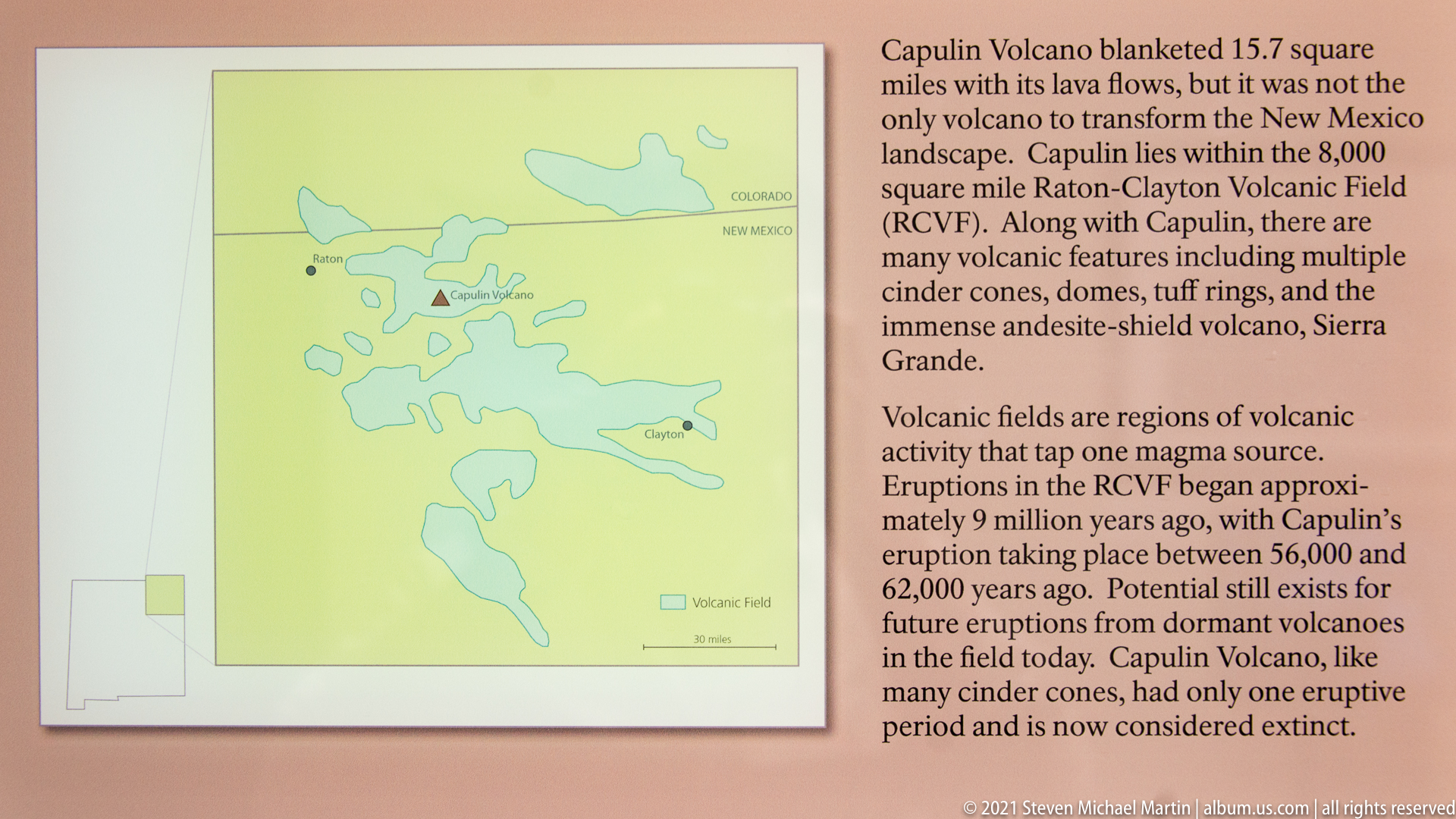
A map and accompanying text place Capulin Volcano within the Raton-Clayton volcanic field of northeastern New Mexico. Pale blue shapes mark volcanic features across the region, while a small inset situates the field within the state. The exhibit explains that the field contains cones, domes, and other volcanic forms, distinguishing Capulin as one landmark in a wider geologic province.
Caption
A map and accompanying text place Capulin Volcano within the Raton-Clayton volcanic field of northeastern New Mexico. Pale blue shapes mark volcanic features across the region, while a small inset situates the field within the state. The exhibit explains that the field contains cones, domes, and other volcanic forms, distinguishing Capulin as one landmark in a wider geologic province.
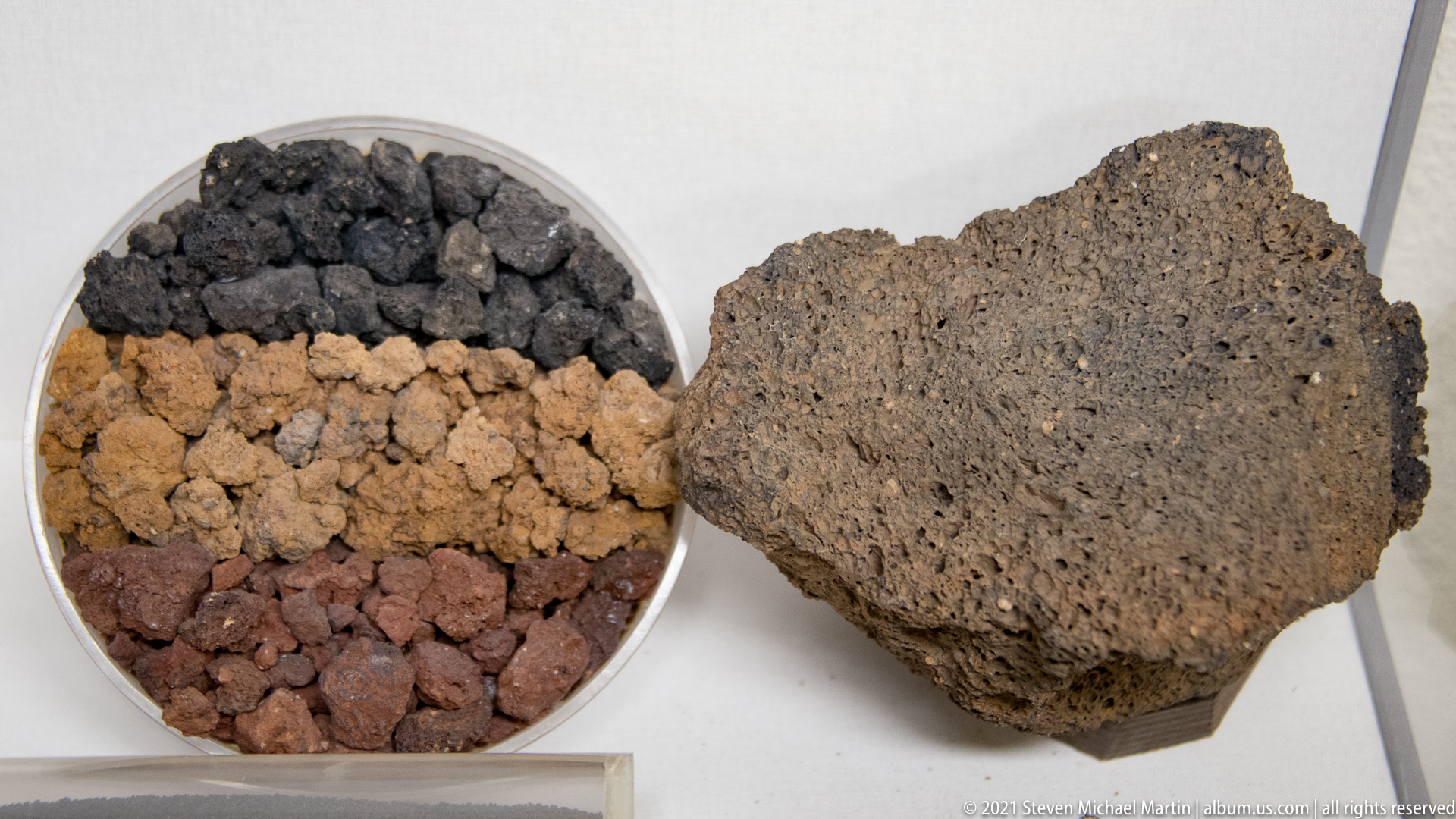
A shallow circular tray holds small volcanic fragments sorted by color, from dark gray to reddish brown, beside a much larger rough specimen. Their irregular surfaces and vesicles reveal textures formed as gas escaped from cooling lava. The display presents the range of volcanic material visitors may encounter around the monument, from loose cinders to a consolidated rock sample.
Caption
A shallow circular tray holds small volcanic fragments sorted by color, from dark gray to reddish brown, beside a much larger rough specimen. Their irregular surfaces and vesicles reveal textures formed as gas escaped from cooling lava. The display presents the range of volcanic material visitors may encounter around the monument, from loose cinders to a consolidated rock sample.
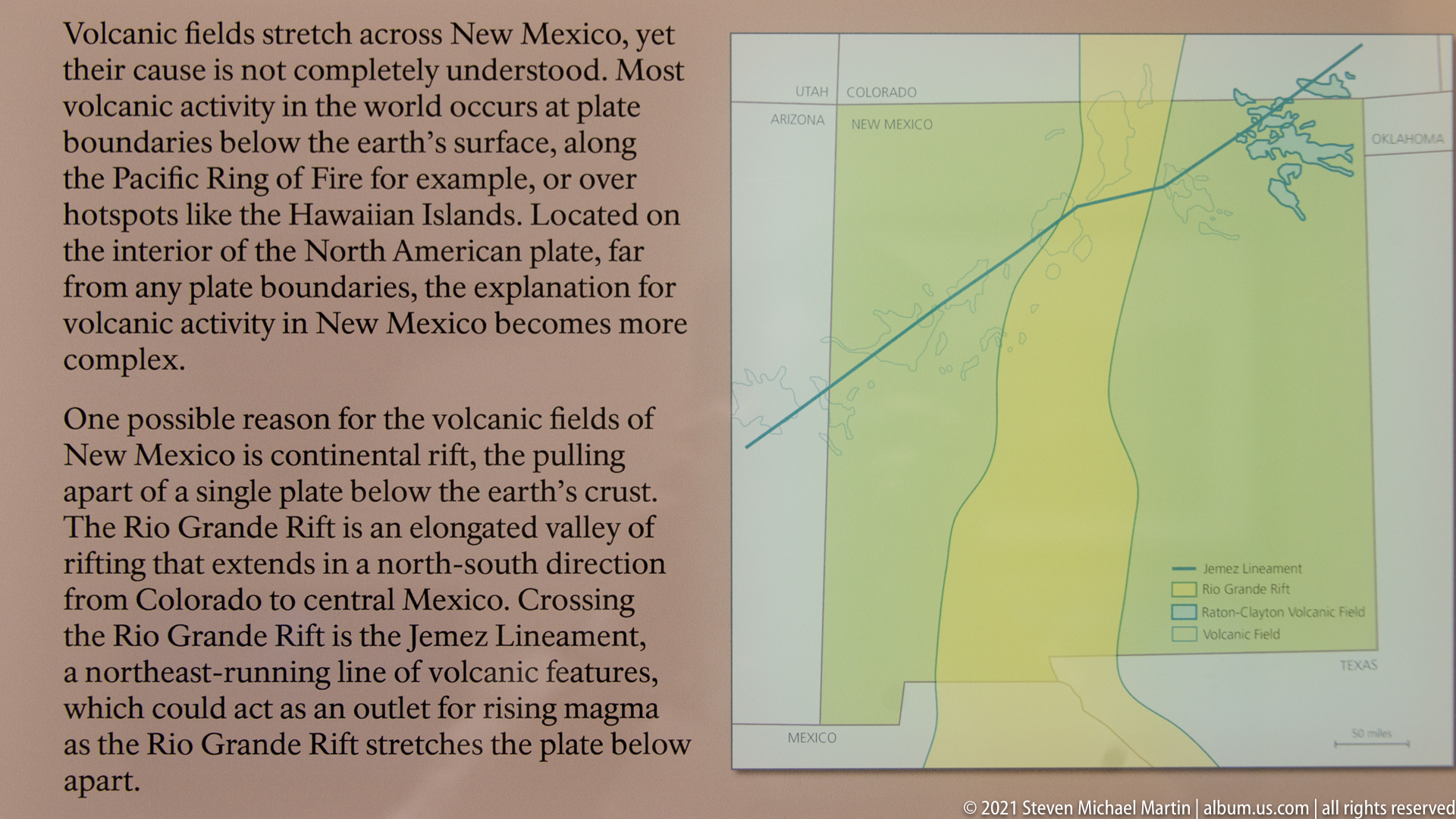
An interpretive map of New Mexico accompanies text about continental rifting and volcanic activity. Colored bands and lines trace regional features, including the north-south Rio Grande Rift and volcanic areas. The panel explains how stretching of the crust may create pathways for magma, placing Capulin’s volcanic setting within a broader tectonic landscape rather than treating the cone as an isolated feature.
Caption
An interpretive map of New Mexico accompanies text about continental rifting and volcanic activity. Colored bands and lines trace regional features, including the north-south Rio Grande Rift and volcanic areas. The panel explains how stretching of the crust may create pathways for magma, placing Capulin’s volcanic setting within a broader tectonic landscape rather than treating the cone as an isolated feature.
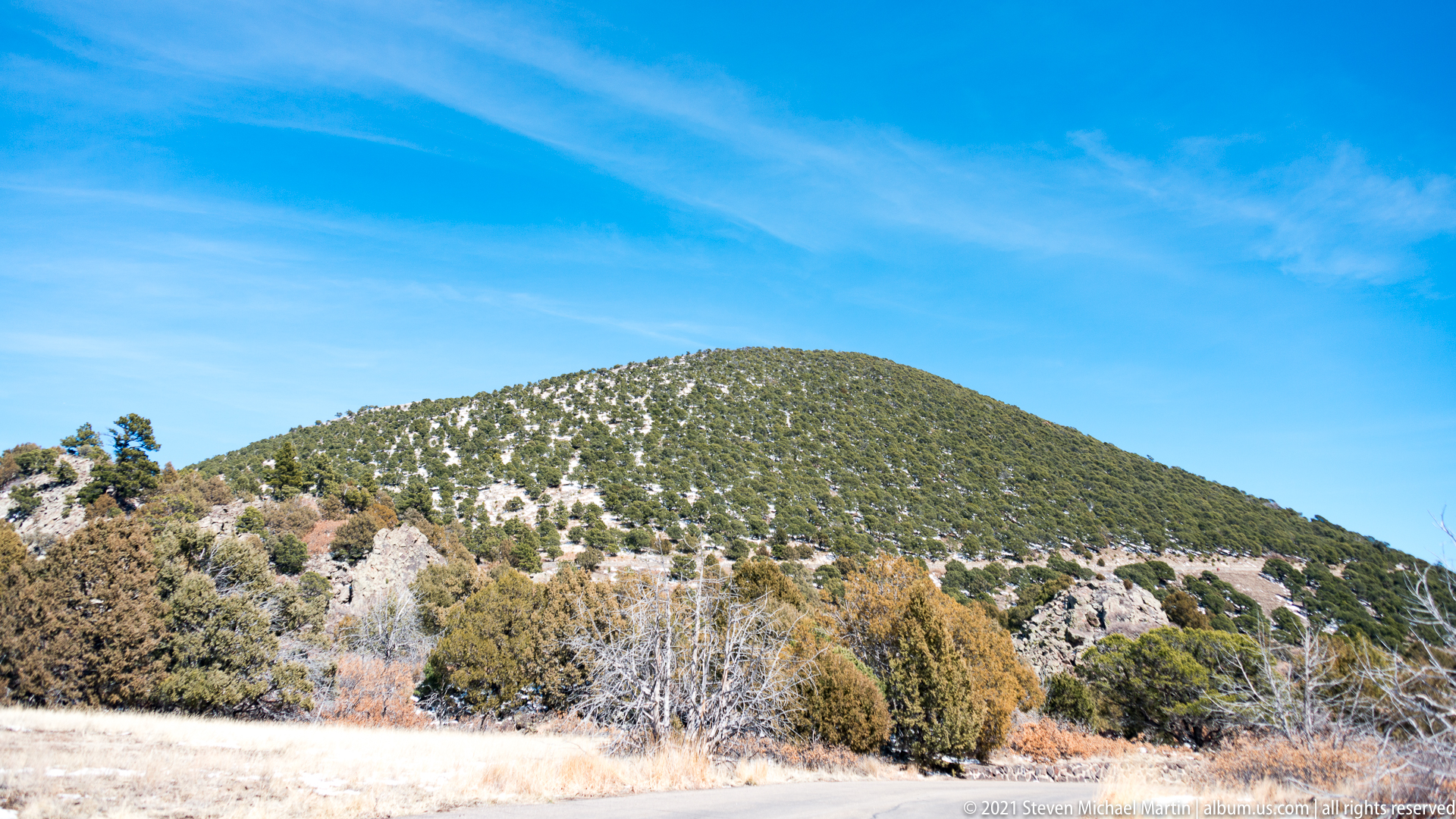
Capulin Volcano fills the horizon beyond a band of trees and shrubs, its dark, vegetation-covered slopes broken by pale patches of snow. Dry grasses occupy the foreground, and the low viewpoint compresses the base of the cone behind the woodland. In this quieter landscape view, the rounded volcanic profile remains the dominant feature without signs or exhibit text.
Caption
Capulin Volcano fills the horizon beyond a band of trees and shrubs, its dark, vegetation-covered slopes broken by pale patches of snow. Dry grasses occupy the foreground, and the low viewpoint compresses the base of the cone behind the woodland. In this quieter landscape view, the rounded volcanic profile remains the dominant feature without signs or exhibit text.
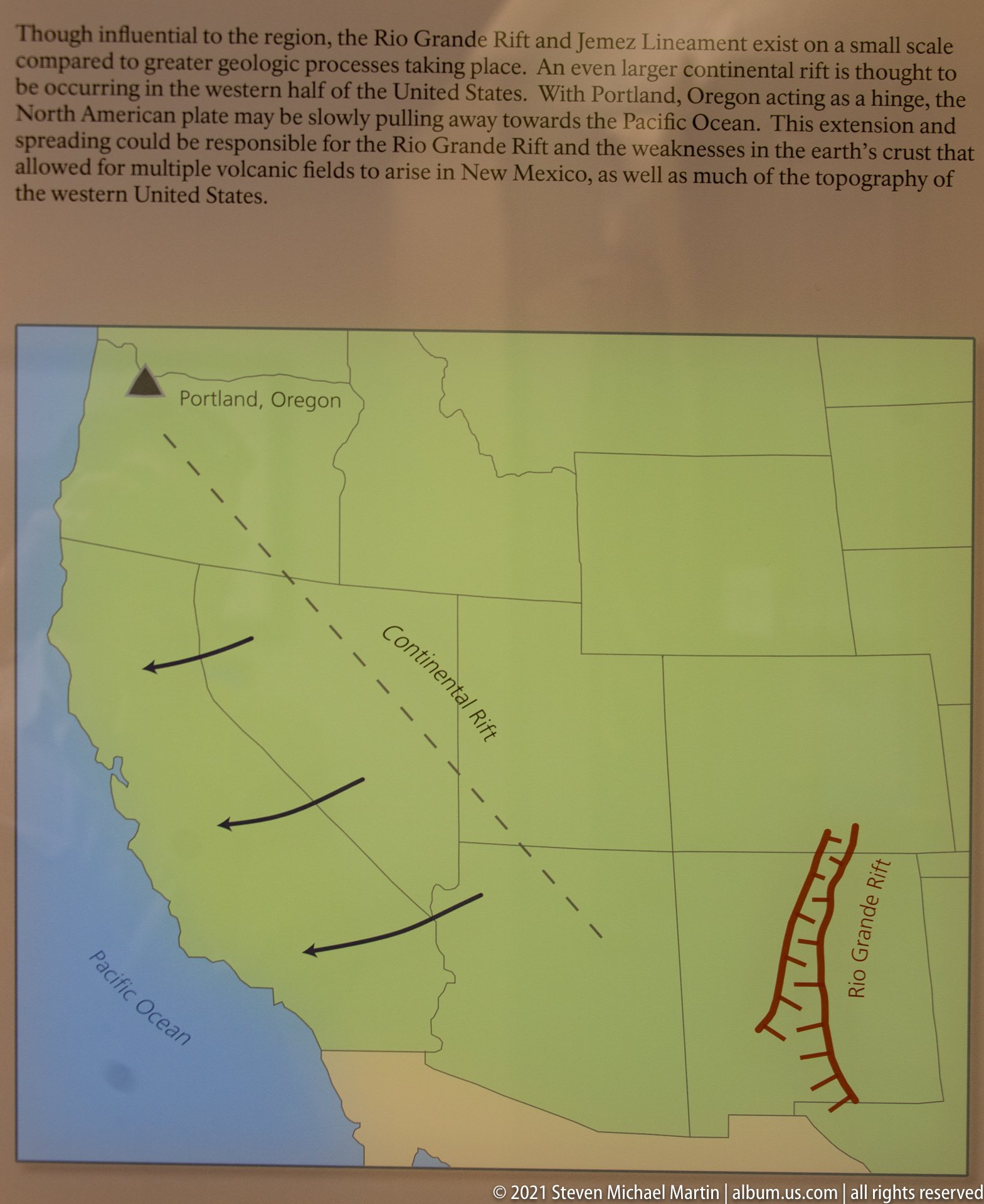
A simplified map spans the western United States from the Pacific coast toward the Rocky Mountain region. Arrows indicate crustal movement around a dashed line labeled Continental Rift, while the Rio Grande Rift is marked farther east. The schematic helps explain the large-scale forces associated with regional volcanic fields, connecting New Mexico’s geology to continental processes.
Caption
A simplified map spans the western United States from the Pacific coast toward the Rocky Mountain region. Arrows indicate crustal movement around a dashed line labeled Continental Rift, while the Rio Grande Rift is marked farther east. The schematic helps explain the large-scale forces associated with regional volcanic fields, connecting New Mexico’s geology to continental processes.
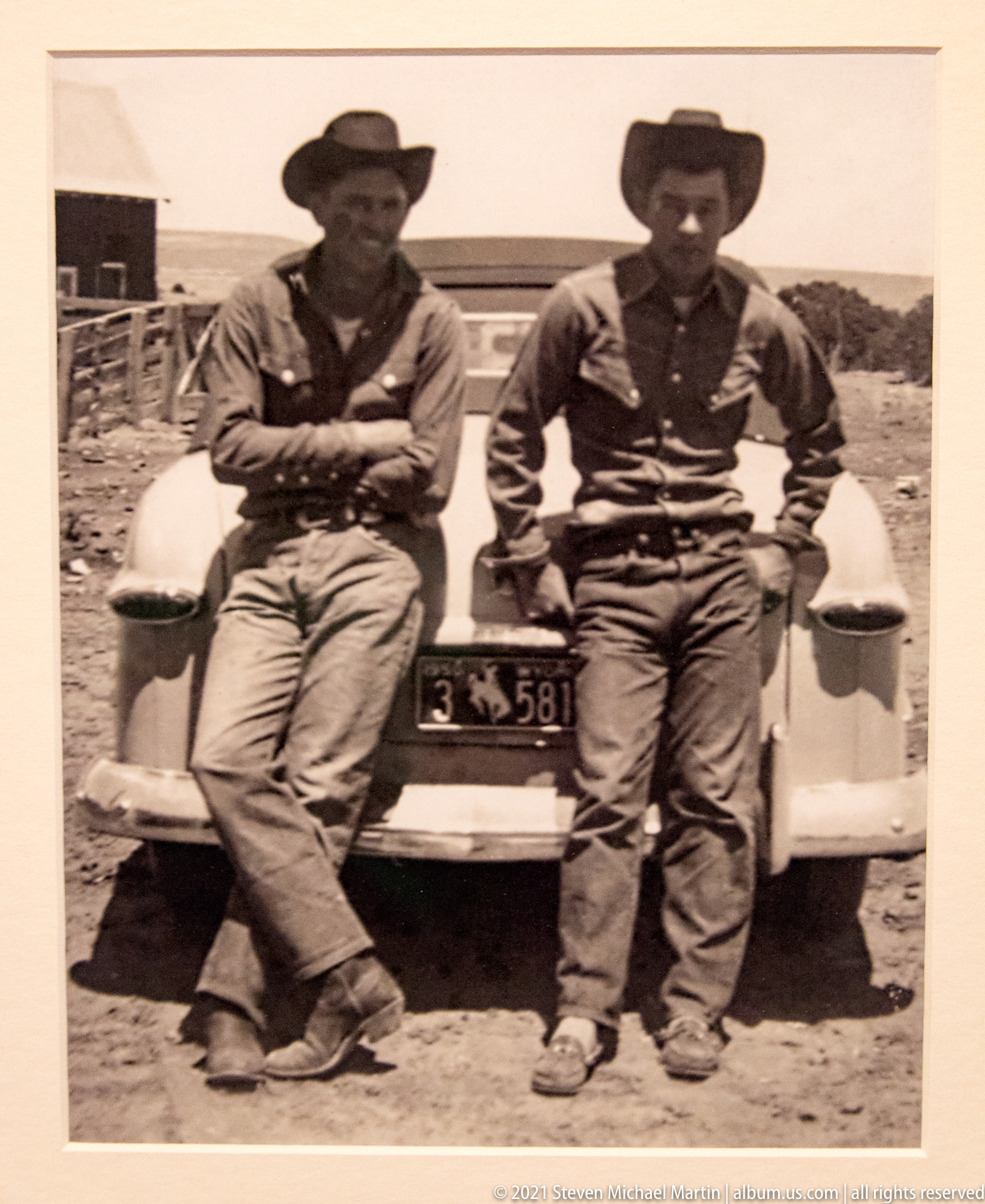
Two men in brimmed hats and work clothes lean against the front of a vehicle in a sepia-toned archival photograph. A license plate and the vehicle’s rounded fenders are visible, while a fence and open ground appear behind them. The image offers a human-scale glimpse of earlier travel or work in the region, though the men and date are not identified here.
Caption
Two men in brimmed hats and work clothes lean against the front of a vehicle in a sepia-toned archival photograph. A license plate and the vehicle’s rounded fenders are visible, while a fence and open ground appear behind them. The image offers a human-scale glimpse of earlier travel or work in the region, though the men and date are not identified here.

A bright magenta panel titled “Cherry on Top” is mounted among leafless branches, with a photograph of green foliage and red berries near its top. The text identifies a flowering shrub and describes its appearance and local use. Bare twigs cross the sign, while patches of snow around it place the botanical exhibit in a winter setting along the trail.
Caption
A bright magenta panel titled “Cherry on Top” is mounted among leafless branches, with a photograph of green foliage and red berries near its top. The text identifies a flowering shrub and describes its appearance and local use. Bare twigs cross the sign, while patches of snow around it place the botanical exhibit in a winter setting along the trail.
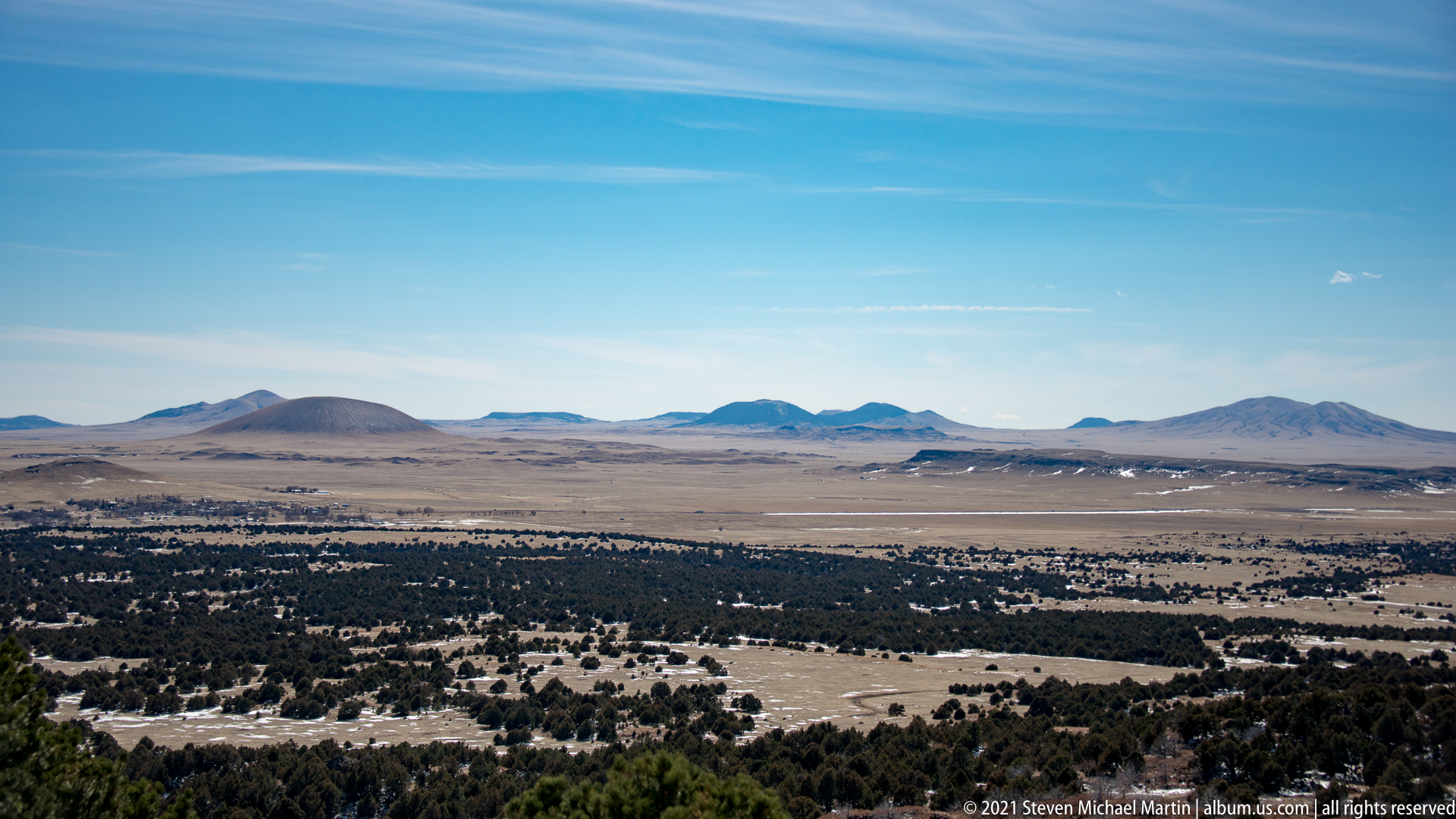
From an elevated vantage, an open plain stretches toward a chain of low volcanic hills on the horizon. Dark evergreen patches interrupt pale grassland in the foreground and middle distance, creating a broad pattern of woodland and open ground. The panorama shifts attention from Capulin’s individual cone to the wider volcanic terrain that surrounds the monument.
Caption
From an elevated vantage, an open plain stretches toward a chain of low volcanic hills on the horizon. Dark evergreen patches interrupt pale grassland in the foreground and middle distance, creating a broad pattern of woodland and open ground. The panorama shifts attention from Capulin’s individual cone to the wider volcanic terrain that surrounds the monument.

A broad tan plain extends toward a low, snow-dusted ridge beneath a deep blue sky. A dark evergreen tree frames the left edge, while sparse shrubs and shallow variations in the ground lead into the open middle distance. The photograph’s wide horizon and restrained foreground make the winter grassland and its distant volcanic uplands the principal subjects.
Caption
A broad tan plain extends toward a low, snow-dusted ridge beneath a deep blue sky. A dark evergreen tree frames the left edge, while sparse shrubs and shallow variations in the ground lead into the open middle distance. The photograph’s wide horizon and restrained foreground make the winter grassland and its distant volcanic uplands the principal subjects.
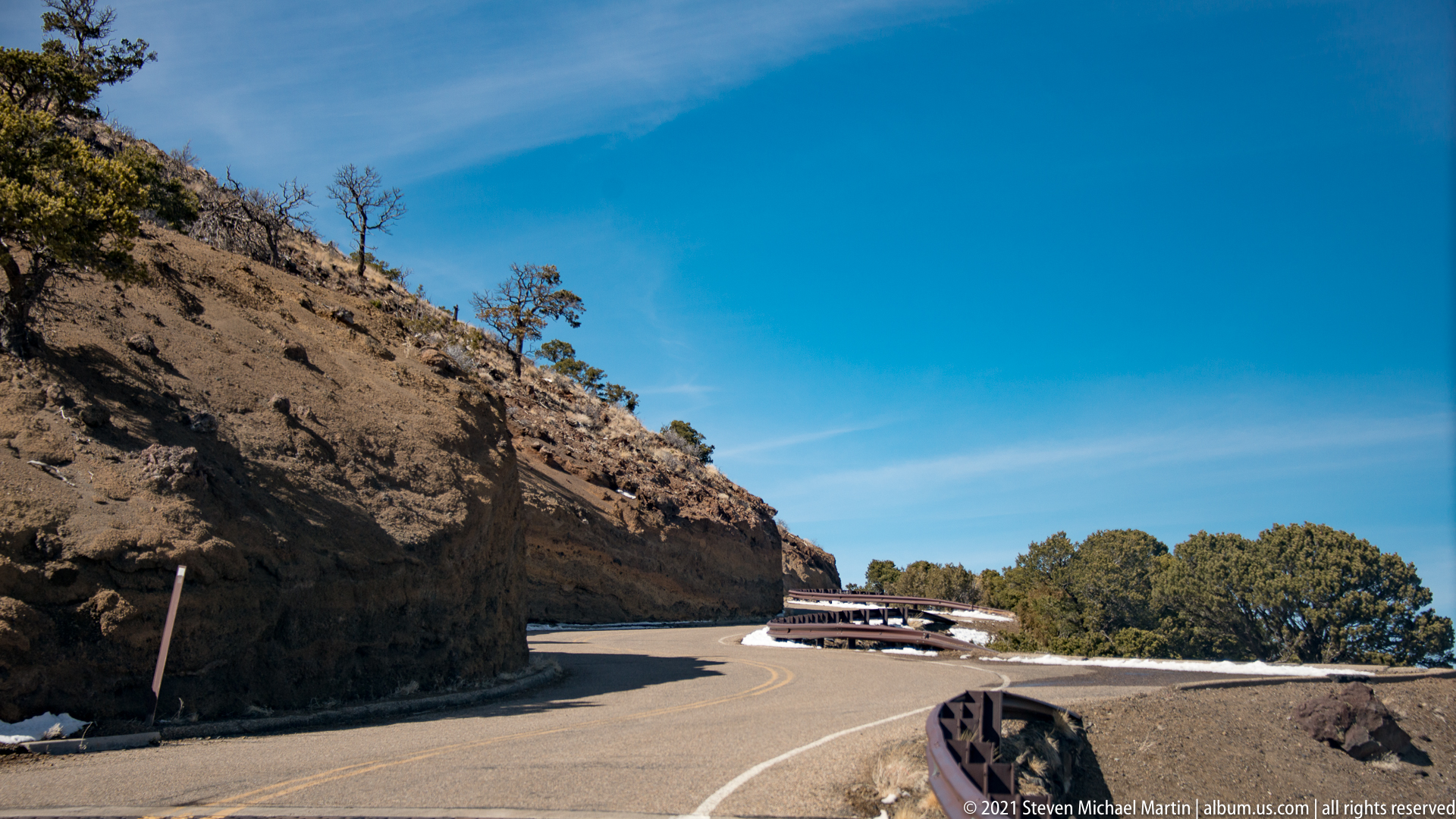
A paved road bends around a dark, layered rock exposure that rises steeply along the left side. The cut face reveals rough, broken volcanic material, contrasting with the smooth pavement and metal guardrail. Low trees and scrub line the opposite shoulder under clear skies. The view foregrounds how the road passes through the monument’s rugged volcanic terrain.
Caption
A paved road bends around a dark, layered rock exposure that rises steeply along the left side. The cut face reveals rough, broken volcanic material, contrasting with the smooth pavement and metal guardrail. Low trees and scrub line the opposite shoulder under clear skies. The view foregrounds how the road passes through the monument’s rugged volcanic terrain.
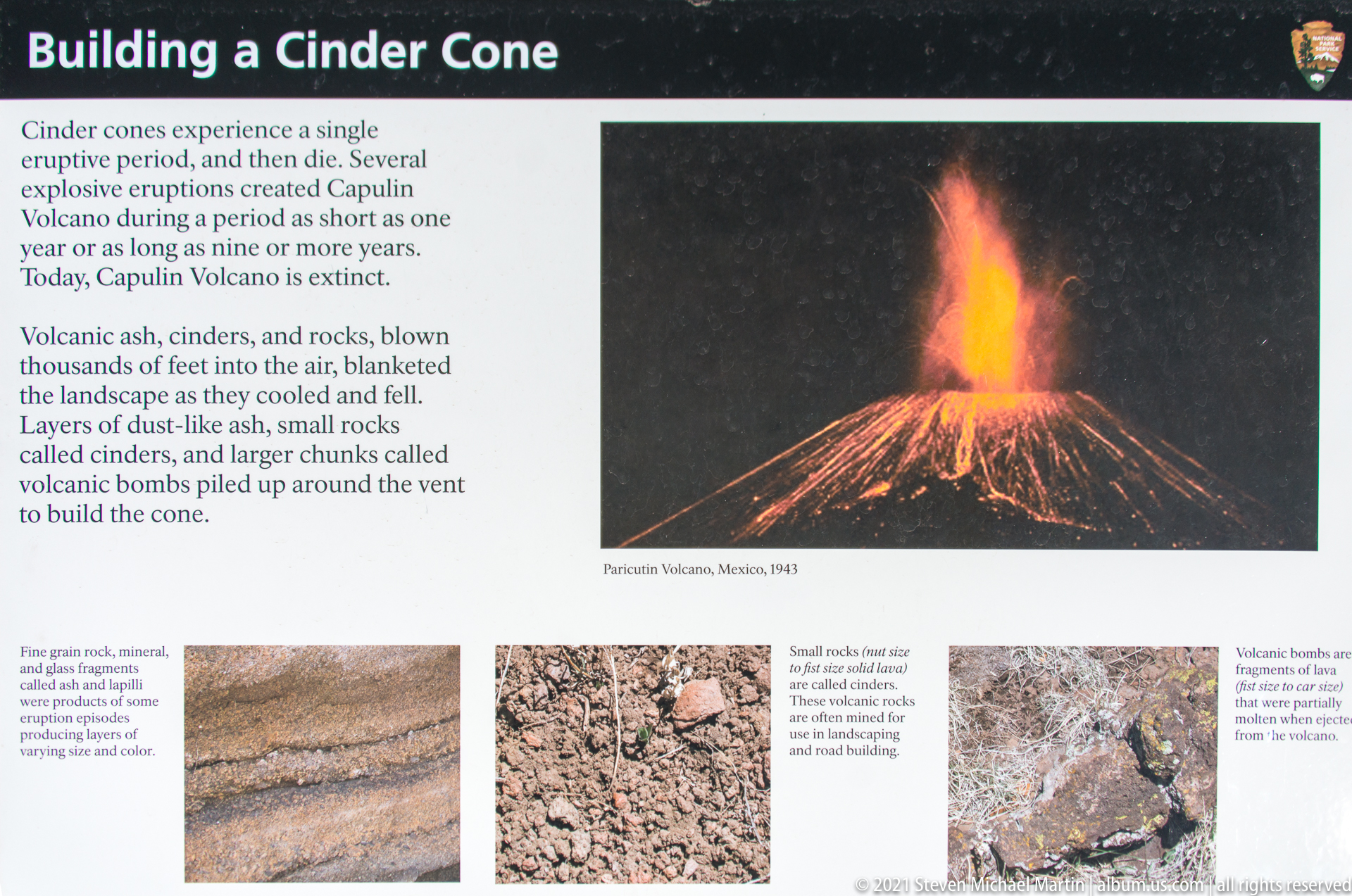
A white interpretive panel titled “Cinder Cone” combines an eruption illustration with close views of several rock textures. Text describes ash, cinders, and larger volcanic fragments building a cone around a vent. The exhibit links the explosive process to the loose, coarse materials visible in its photographs, making the formation of Capulin’s landform legible through both explanation and examples.
Caption
A white interpretive panel titled “Cinder Cone” combines an eruption illustration with close views of several rock textures. Text describes ash, cinders, and larger volcanic fragments building a cone around a vent. The exhibit links the explosive process to the loose, coarse materials visible in its photographs, making the formation of Capulin’s landform legible through both explanation and examples.

The view looks across the interior slope of Capulin Volcano’s crater, where scattered shrubs and grasses cling to a steep, rocky wall. Thin snow patches collect between dark stones and vegetation, accentuating the bowl’s uneven surface. The composition looks down and across the crater rather than outward over the surrounding landscape, revealing the texture of the cone’s inner slope.
Caption
The view looks across the interior slope of Capulin Volcano’s crater, where scattered shrubs and grasses cling to a steep, rocky wall. Thin snow patches collect between dark stones and vegetation, accentuating the bowl’s uneven surface. The composition looks down and across the crater rather than outward over the surrounding landscape, revealing the texture of the cone’s inner slope.
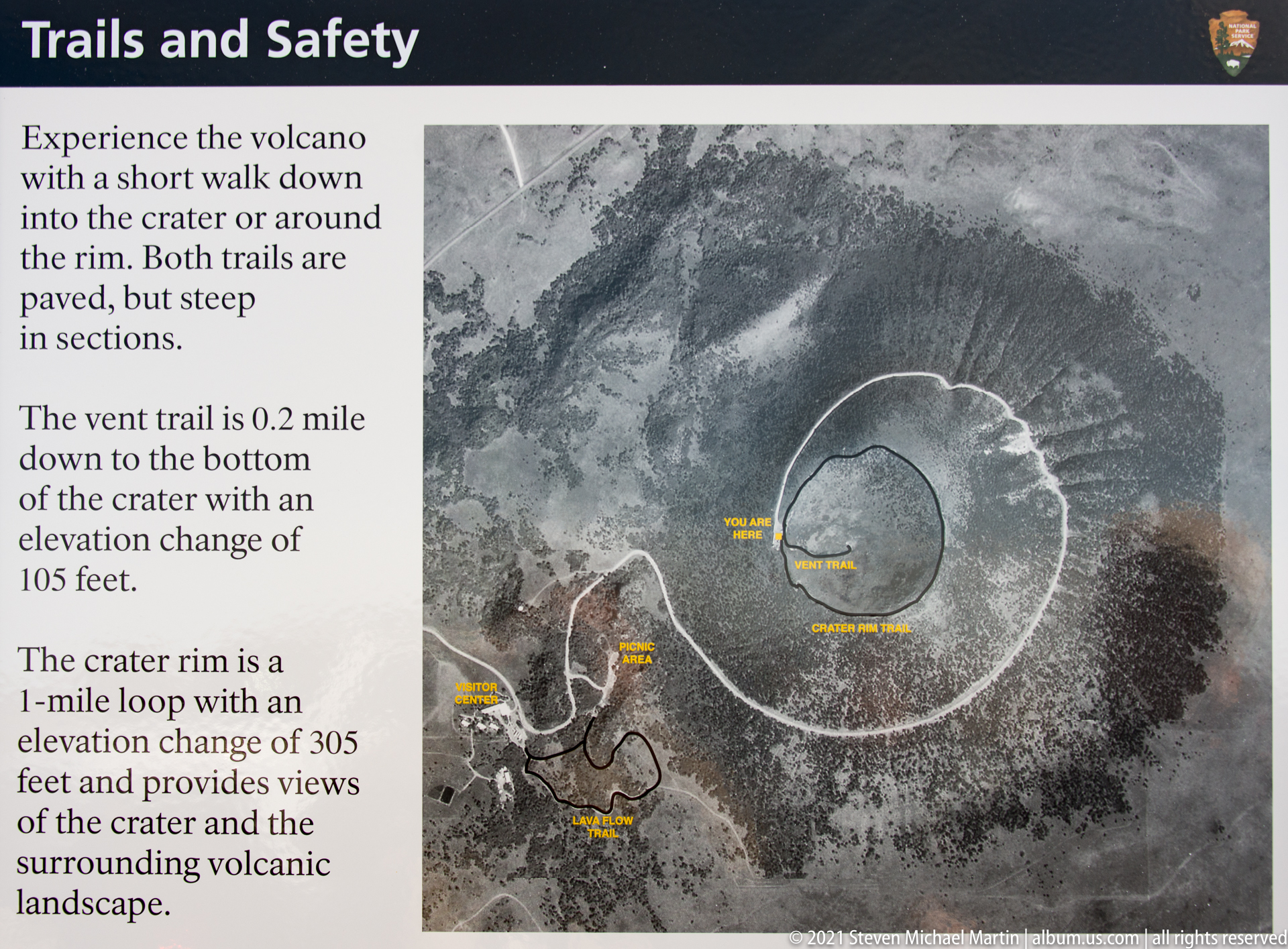
An aerial-style diagram traces a large loop around the crater rim and a shorter route descending toward the vent. Labels distinguish the rim trail from the vent trail, while adjacent text describes their distances and elevation changes. The panel helps visitors understand the crater’s walking routes and steep sections before entering the volcanic bowl.
Caption
An aerial-style diagram traces a large loop around the crater rim and a shorter route descending toward the vent. Labels distinguish the rim trail from the vent trail, while adjacent text describes their distances and elevation changes. The panel helps visitors understand the crater’s walking routes and steep sections before entering the volcanic bowl.

Angular dark and gray boulders crowd a narrow ground-level view, with small pockets of snow lodged between the stones. Thin bare stems rise from the crevice, contrasting with the blocky rock surfaces and their sharp edges. The close framing makes the fractured volcanic terrain feel dense and uneven, with winter moisture revealing gaps between the rocks.
Caption
Angular dark and gray boulders crowd a narrow ground-level view, with small pockets of snow lodged between the stones. Thin bare stems rise from the crevice, contrasting with the blocky rock surfaces and their sharp edges. The close framing makes the fractured volcanic terrain feel dense and uneven, with winter moisture revealing gaps between the rocks.
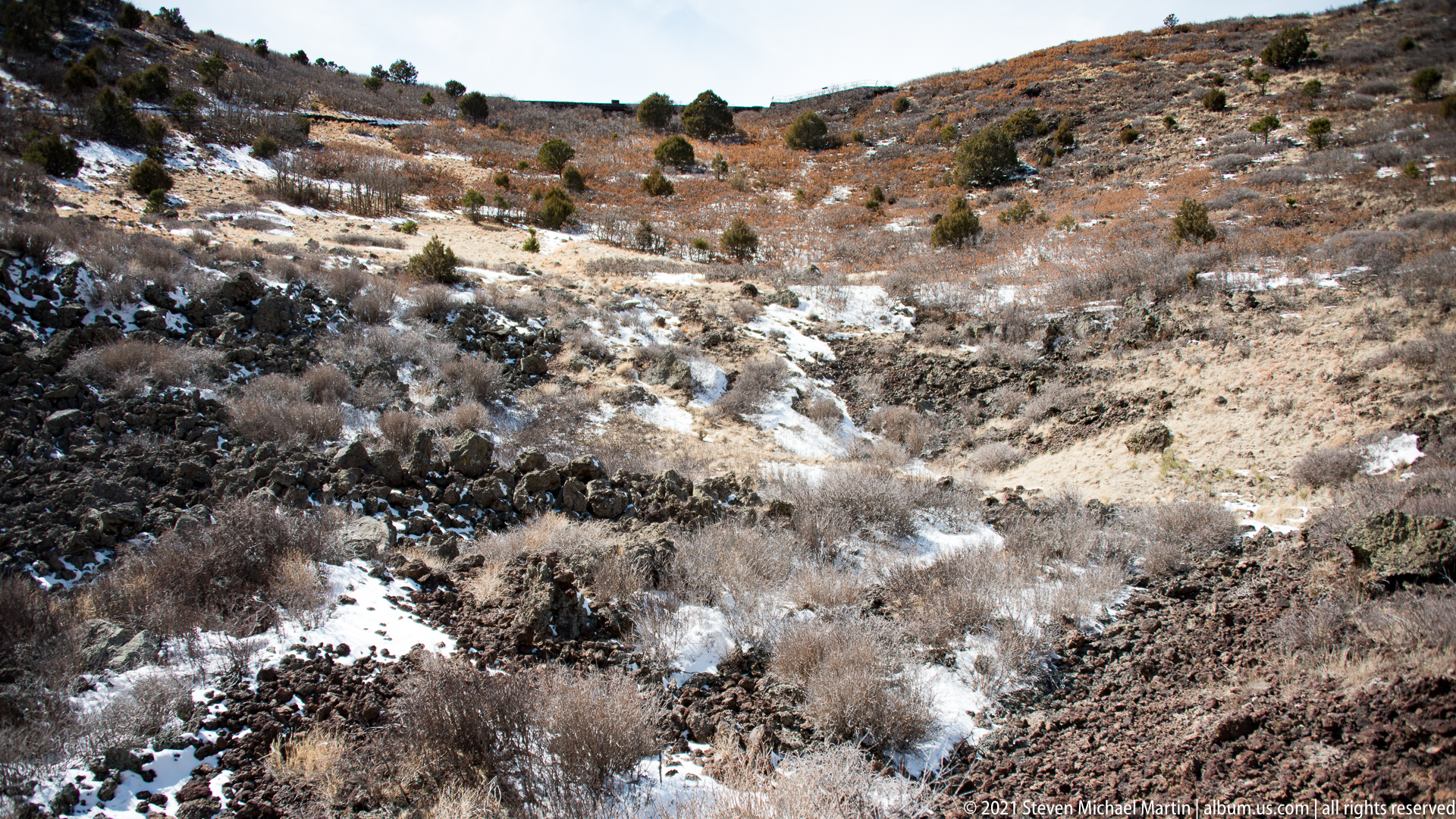
A shallow drainage cuts diagonally through a dry, scrub-covered slope, with scattered snow following its low points. Dark stones and leafless shrubs line the channel, while the surrounding hillside rises gently toward the upper frame. The view emphasizes a small seasonal watercourse and the way winter snow traces the volcanic terrain’s natural contours.
Caption
A shallow drainage cuts diagonally through a dry, scrub-covered slope, with scattered snow following its low points. Dark stones and leafless shrubs line the channel, while the surrounding hillside rises gently toward the upper frame. The view emphasizes a small seasonal watercourse and the way winter snow traces the volcanic terrain’s natural contours.
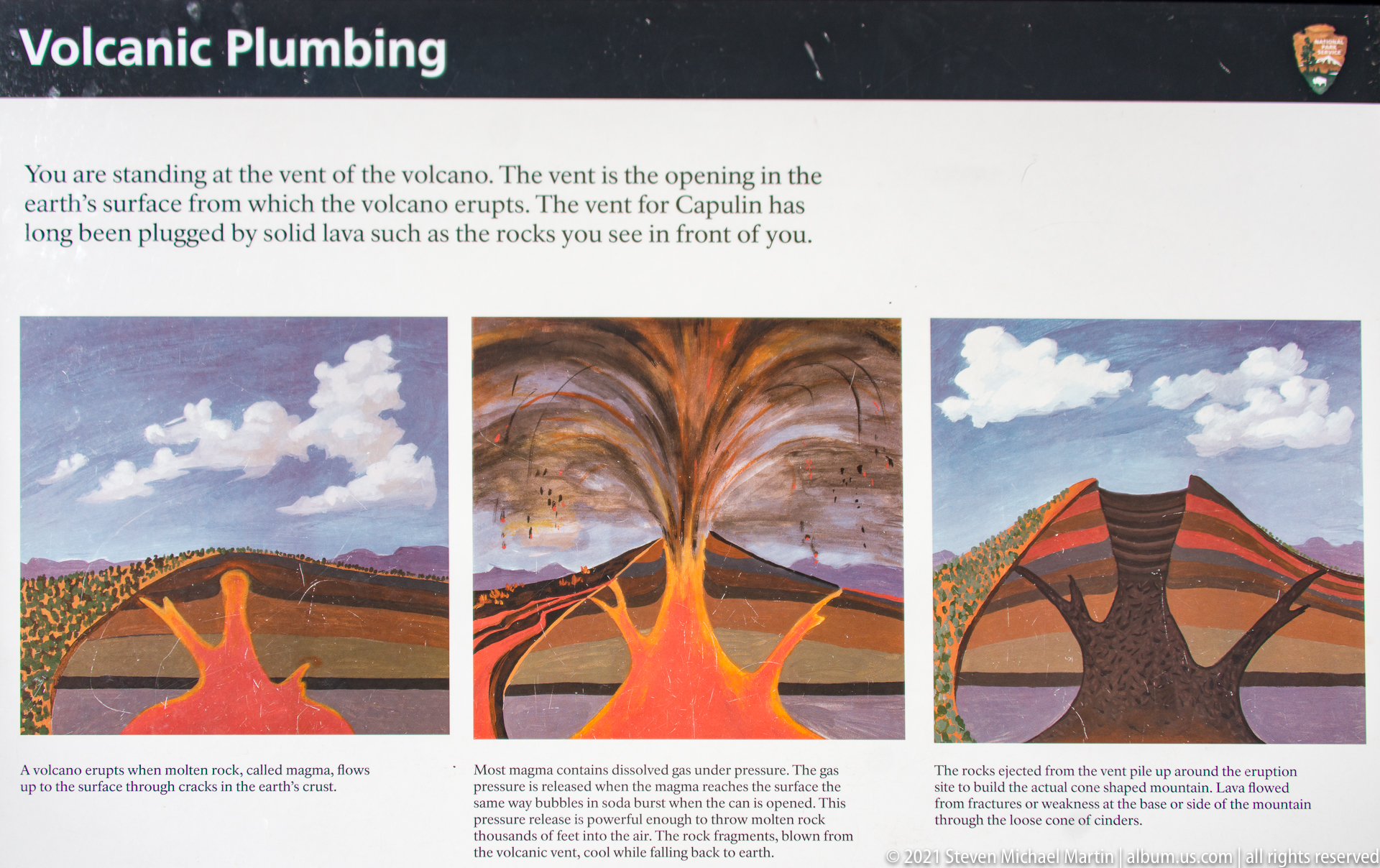
A geology panel explains the volcanic vent with three colored cutaway scenes, showing magma rising, erupting through the surface, and leaving a cone of layered material. The diagrams use arrows and cross-sections to show how deposits accumulate around an opening in Earth’s crust. Its sequential layout turns the vent’s activity into a simple visual process for visitors at the crater.
Caption
A geology panel explains the volcanic vent with three colored cutaway scenes, showing magma rising, erupting through the surface, and leaving a cone of layered material. The diagrams use arrows and cross-sections to show how deposits accumulate around an opening in Earth’s crust. Its sequential layout turns the vent’s activity into a simple visual process for visitors at the crater.
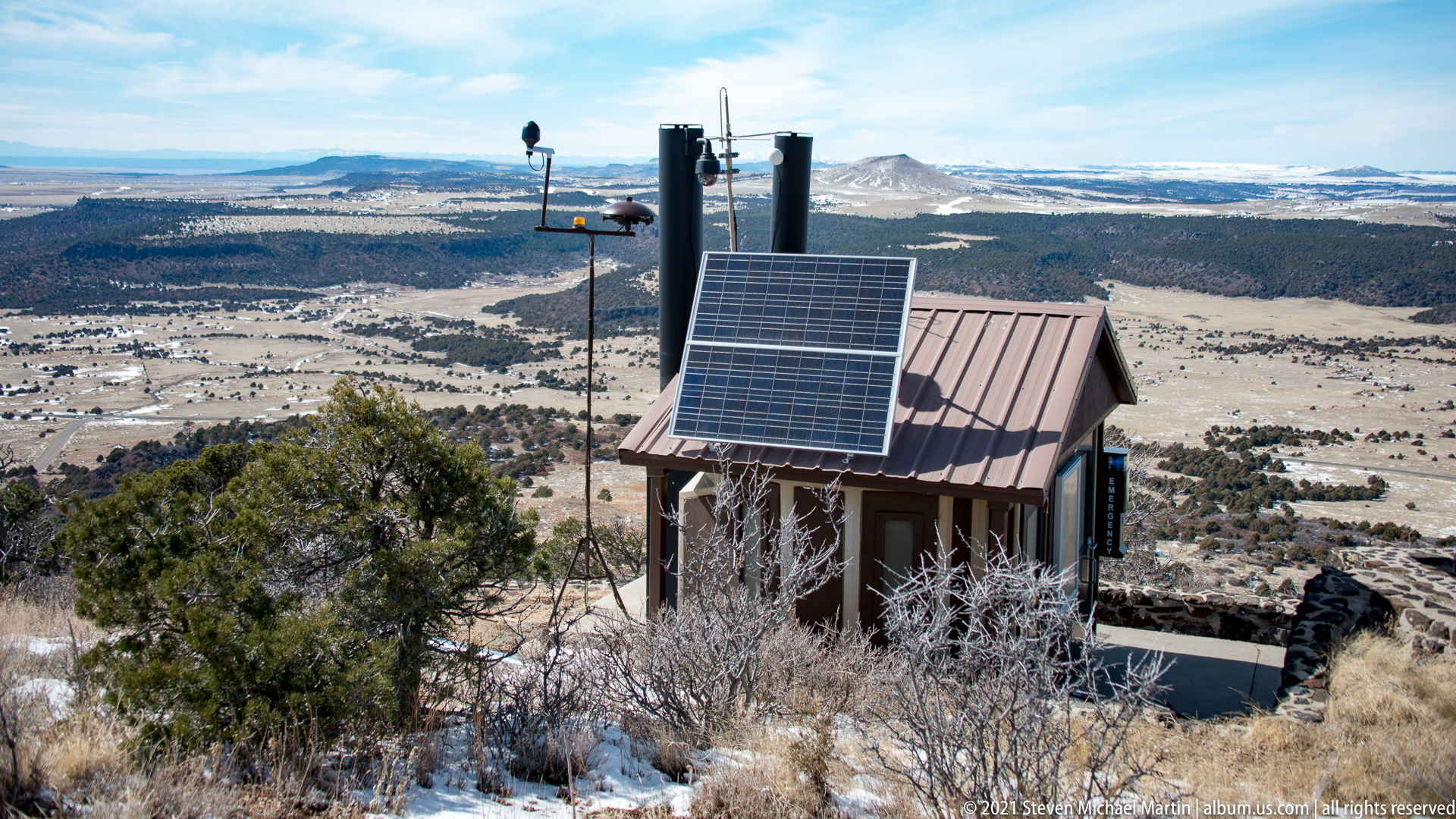
A compact brown-roofed structure sits among low trees on the high rim, with a tilted solar panel mounted prominently in front. Antennas and other equipment rise beside the roof, while a wide view opens across the plain and distant hills behind it. The scene combines a modest summit installation with the expansive landscape visible from the volcano’s upper slopes.
Caption
A compact brown-roofed structure sits among low trees on the high rim, with a tilted solar panel mounted prominently in front. Antennas and other equipment rise beside the roof, while a wide view opens across the plain and distant hills behind it. The scene combines a modest summit installation with the expansive landscape visible from the volcano’s upper slopes.
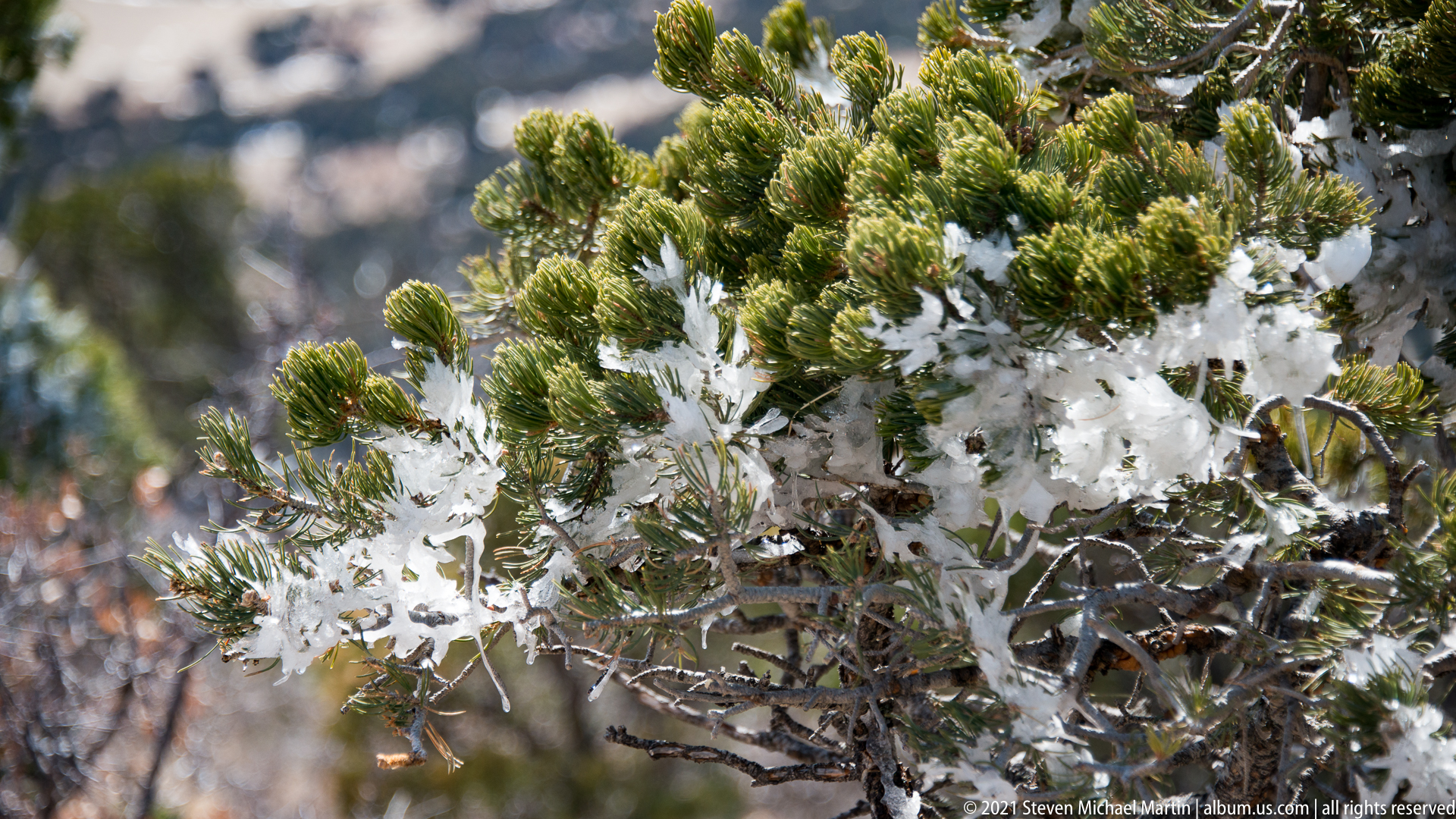
Clusters of white snow cling to the tips and needles of an evergreen branch, which fills the right side of the frame. The shallow focus separates the textured green sprays from a soft, dark woodland background. Fine strands and clumps of snow emphasize the branch’s delicate structure, making this a close botanical detail within the monument’s winter landscape.
Caption
Clusters of white snow cling to the tips and needles of an evergreen branch, which fills the right side of the frame. The shallow focus separates the textured green sprays from a soft, dark woodland background. Fine strands and clumps of snow emphasize the branch’s delicate structure, making this a close botanical detail within the monument’s winter landscape.

Snow gathers in uneven clumps across compact evergreen sprays, with blurred circular highlights and deep shadow behind the branch. The close composition isolates the needles and their white covering, while soft side light brings out the contrast between the foliage’s yellow-green tips and the snow. This image differs from a wider winter landscape by attending to a single plant’s texture.
Caption
Snow gathers in uneven clumps across compact evergreen sprays, with blurred circular highlights and deep shadow behind the branch. The close composition isolates the needles and their white covering, while soft side light brings out the contrast between the foliage’s yellow-green tips and the snow. This image differs from a wider winter landscape by attending to a single plant’s texture.
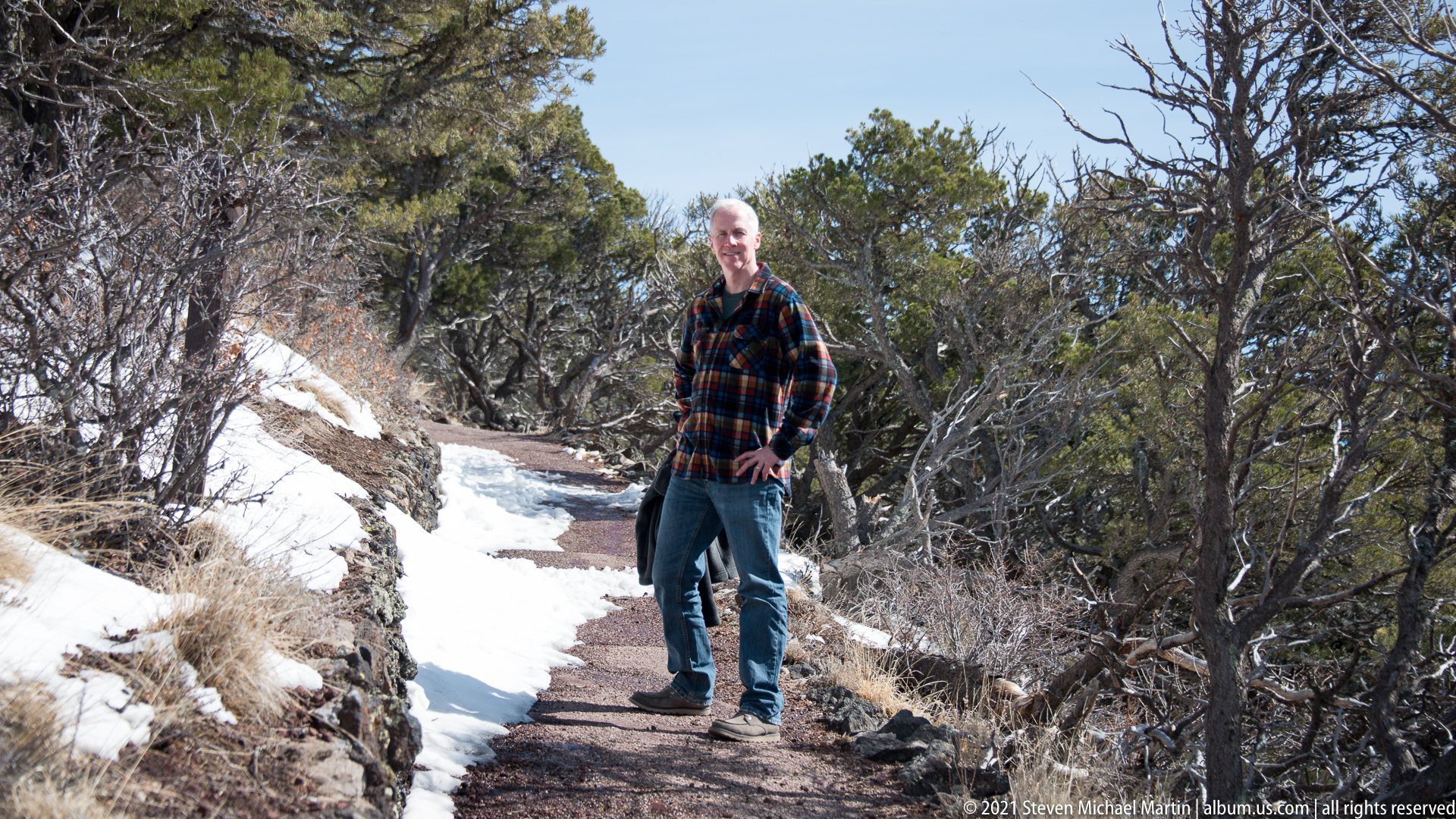
A visitor pauses on a narrow paved trail bordered by snow, low stone edges, and evergreen shrubs. Bare branches and taller trees enclose the path, while the person faces the camera in a relaxed stance. The photograph gives the volcanic setting a human scale and shows the winter conditions visitors encounter along the monument’s walking routes.
Caption
A visitor pauses on a narrow paved trail bordered by snow, low stone edges, and evergreen shrubs. Bare branches and taller trees enclose the path, while the person faces the camera in a relaxed stance. The photograph gives the volcanic setting a human scale and shows the winter conditions visitors encounter along the monument’s walking routes.
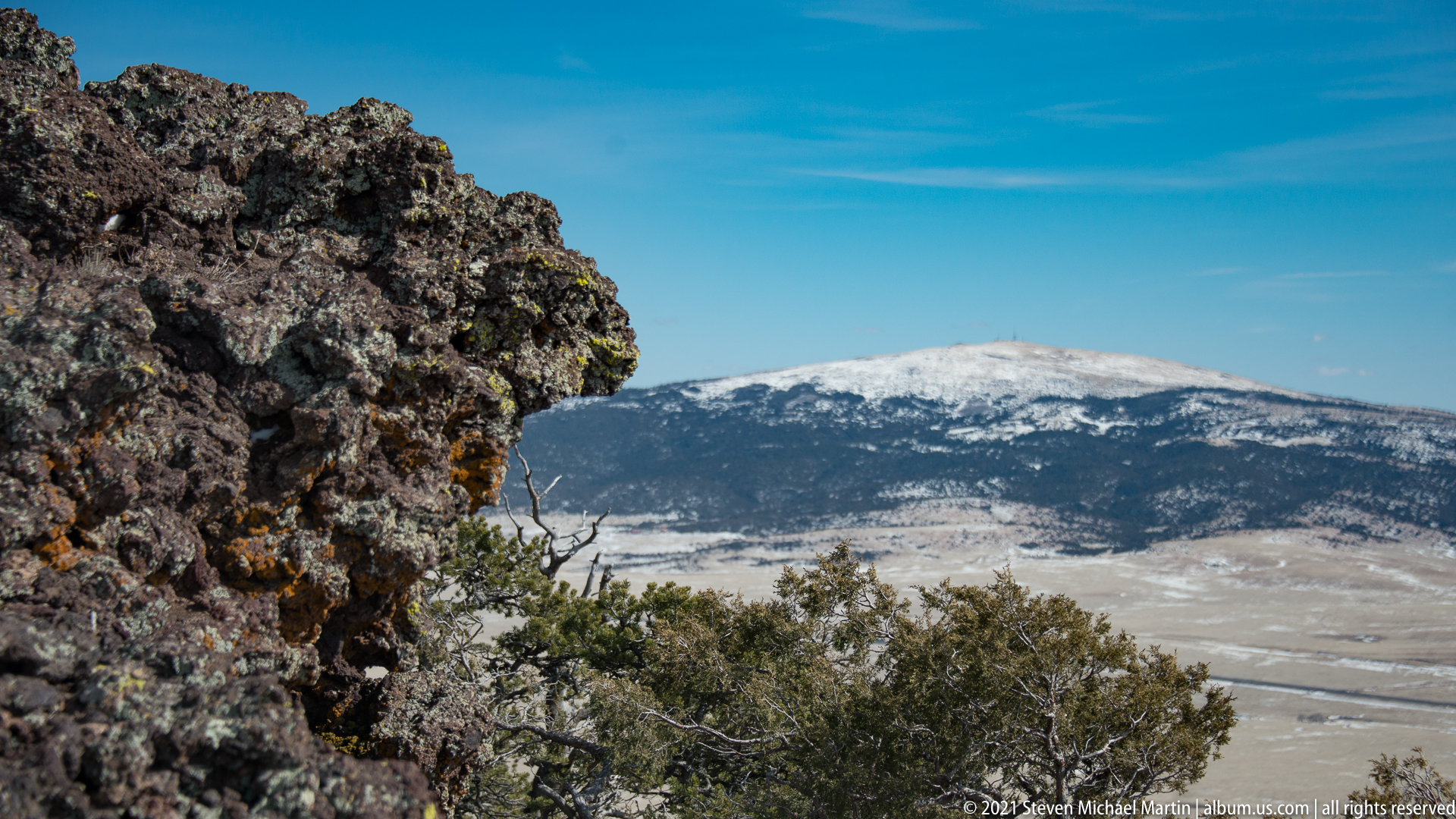
A dark, rough volcanic outcrop fills the left foreground, framing a snow-covered ridge across the open valley. Evergreen trees and shrubs occupy the lower slope, while blue sky and thin cloud give the distant mountain a crisp outline. The rock wall creates a strong near-to-far relationship, linking the monument’s exposed volcanic stone with the wider winter landscape.
Caption
A dark, rough volcanic outcrop fills the left foreground, framing a snow-covered ridge across the open valley. Evergreen trees and shrubs occupy the lower slope, while blue sky and thin cloud give the distant mountain a crisp outline. The rock wall creates a strong near-to-far relationship, linking the monument’s exposed volcanic stone with the wider winter landscape.
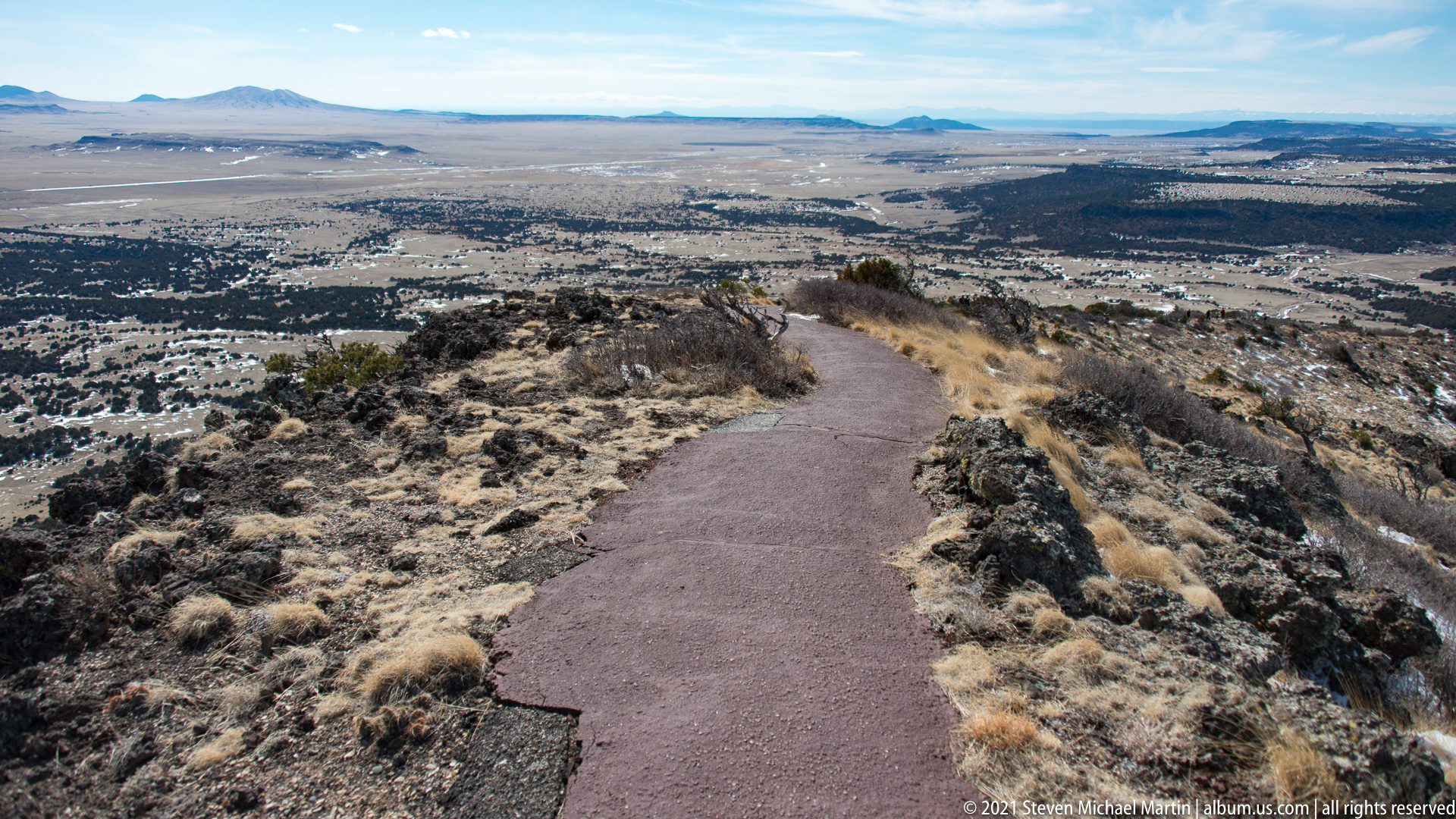
A paved trail curves down the steep, dark volcanic slope toward the broad plains beyond Capulin Volcano. Dry grasses and scattered shrubs border the path, while distant mesas and low mountains define the horizon. The elevated viewpoint connects the cinder cone’s summit route with the expansive volcanic landscape of northeastern New Mexico.
Caption
A paved trail curves down the steep, dark volcanic slope toward the broad plains beyond Capulin Volcano. Dry grasses and scattered shrubs border the path, while distant mesas and low mountains define the horizon. The elevated viewpoint connects the cinder cone’s summit route with the expansive volcanic landscape of northeastern New Mexico.
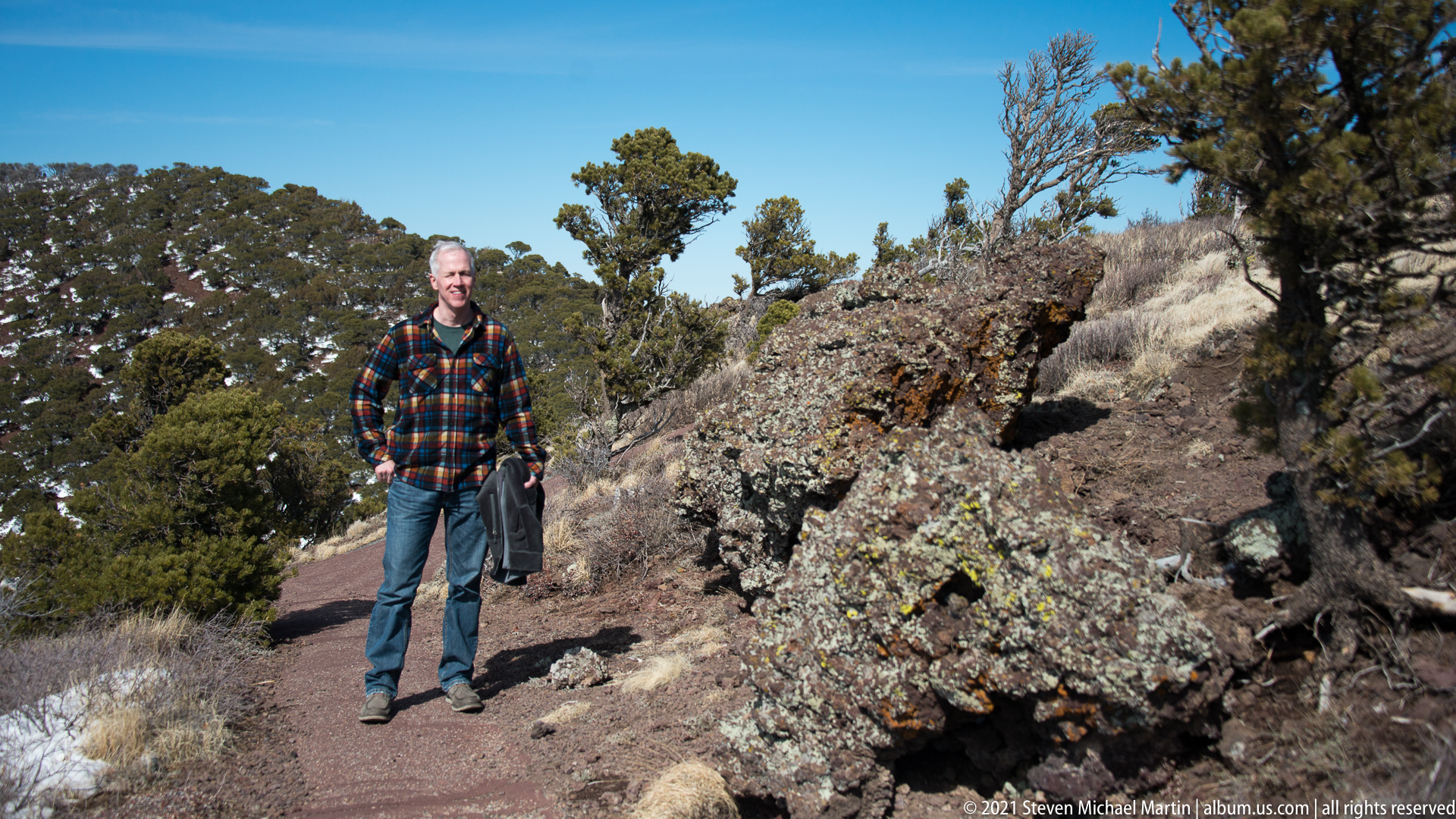
A visitor stands on the reddish summit path beside a steep outcrop of dark, broken volcanic rock. Low grasses and evergreen shrubs grow among the stones, while the open blue sky and sunlit vegetation suggest a clear day. The human figure provides scale for the rough terrain and shows how the trail threads through the monument’s exposed volcanic summit.
Caption
A visitor stands on the reddish summit path beside a steep outcrop of dark, broken volcanic rock. Low grasses and evergreen shrubs grow among the stones, while the open blue sky and sunlit vegetation suggest a clear day. The human figure provides scale for the rough terrain and shows how the trail threads through the monument’s exposed volcanic summit.
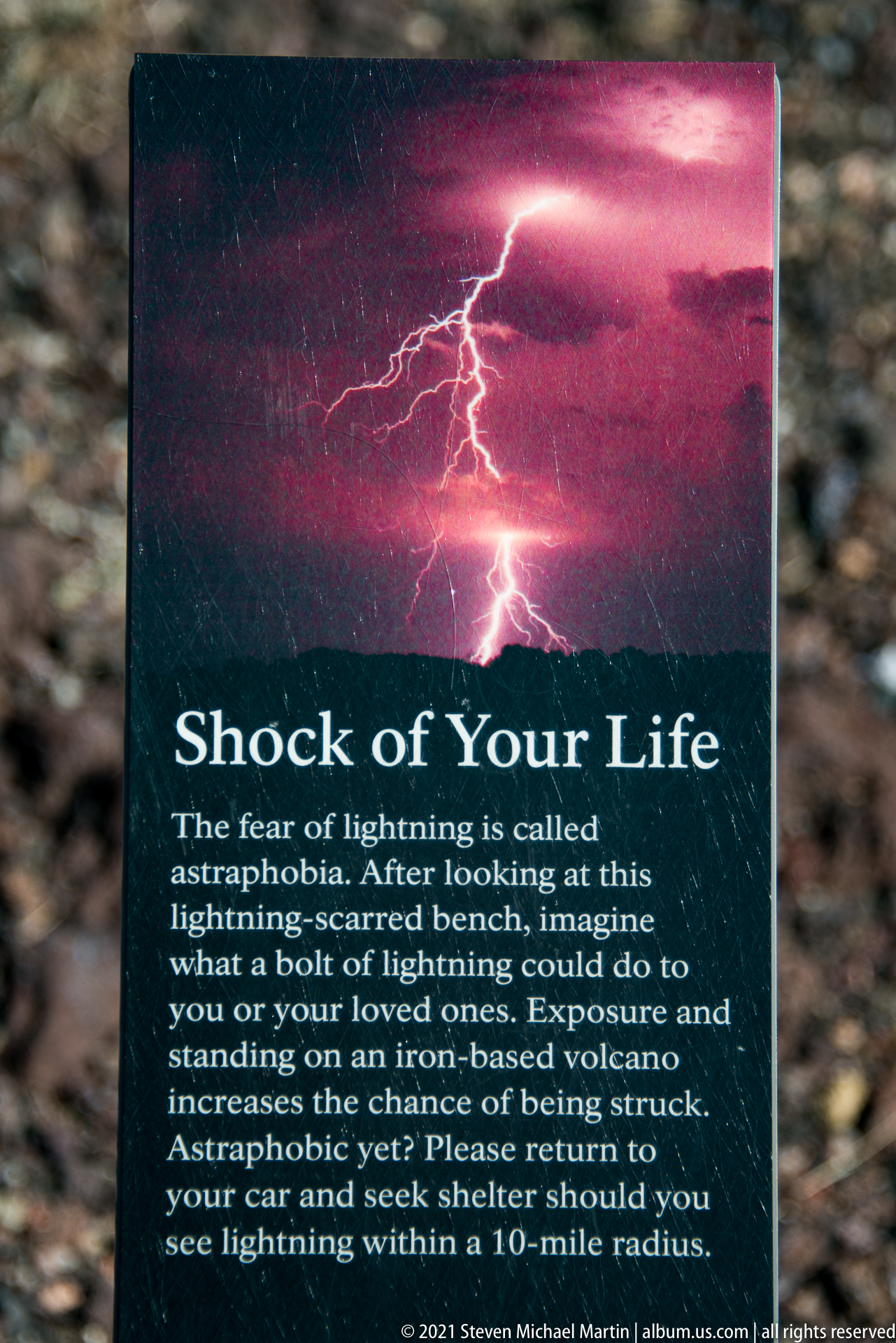
A visitor sign titled “Shock of Your Life” pairs a lightning image with a warning about exposure on the iron-rich volcanic summit. Its text explains that a lightning-scarred bench illustrates the danger of storms and advises visitors to seek shelter when lightning is nearby. The panel turns a visible safety concern into a specific lesson for people walking the exposed trail.
Caption
A visitor sign titled “Shock of Your Life” pairs a lightning image with a warning about exposure on the iron-rich volcanic summit. Its text explains that a lightning-scarred bench illustrates the danger of storms and advises visitors to seek shelter when lightning is nearby. The panel turns a visible safety concern into a specific lesson for people walking the exposed trail.
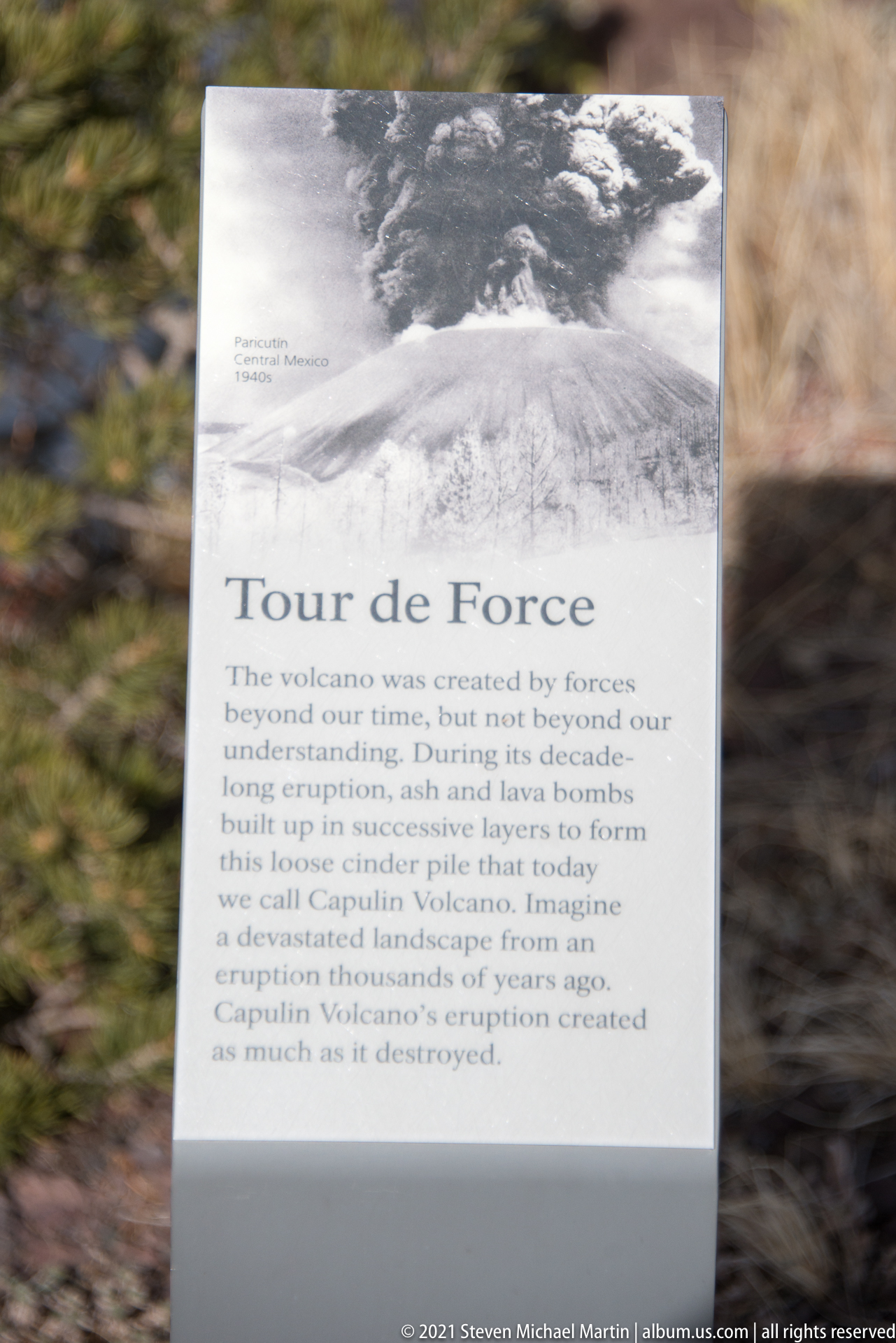
The “Tour de Force” interpretive panel combines an archival-looking volcano photograph with text about the eruption that built Capulin’s cinder cone. The sign describes successive deposits of ash and lava bombs and invites visitors to imagine the earlier landscape. Framed by blurred vegetation, it presents the monument’s origin through a concise geological explanation rather than a direct landscape view.
Caption
The “Tour de Force” interpretive panel combines an archival-looking volcano photograph with text about the eruption that built Capulin’s cinder cone. The sign describes successive deposits of ash and lava bombs and invites visitors to imagine the earlier landscape. Framed by blurred vegetation, it presents the monument’s origin through a concise geological explanation rather than a direct landscape view.
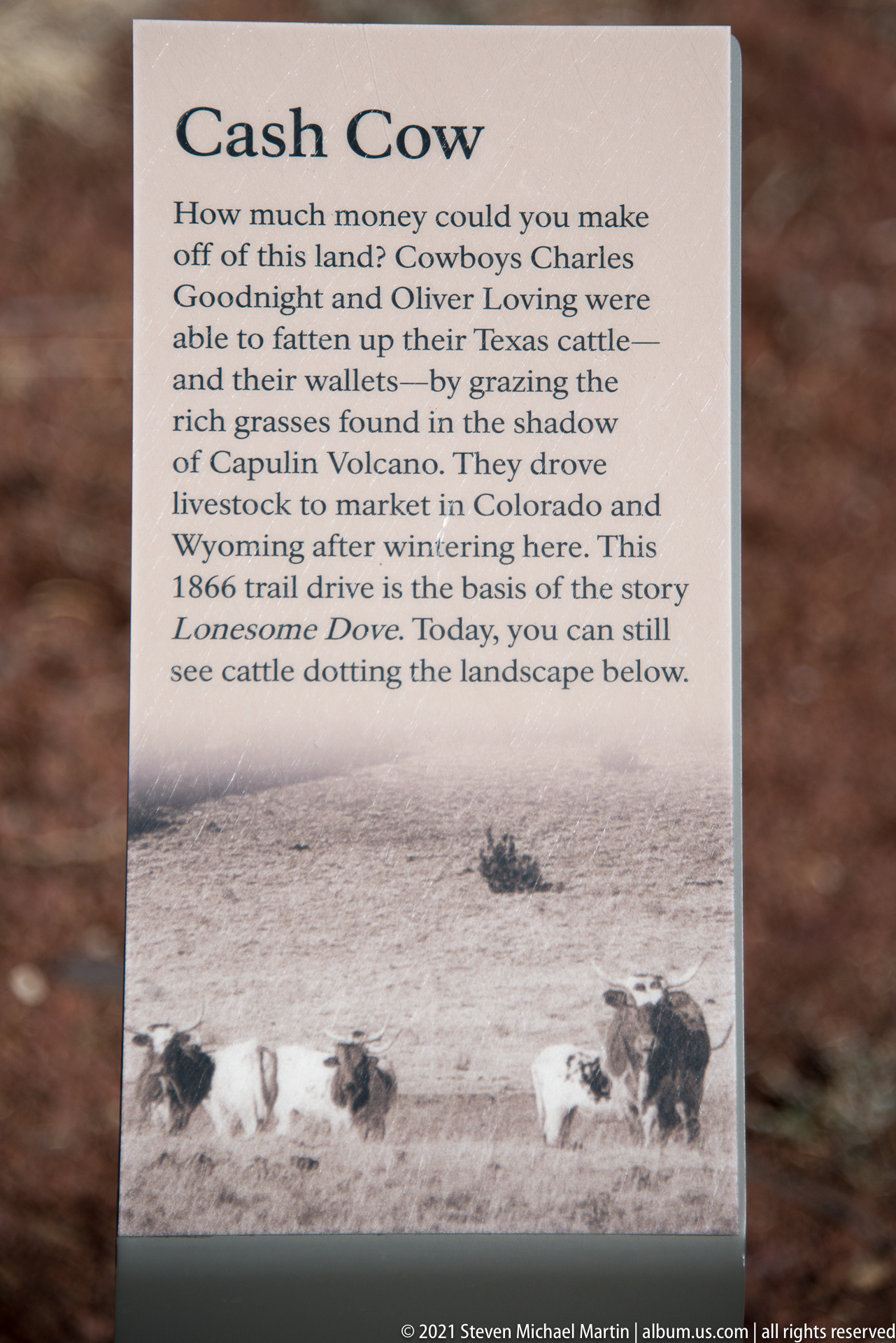
A panel titled “Cash Cow” places a historic cattle image beneath text about grazing on Capulin Volcano’s grasslands. It recounts how Charles Goodnight and Oliver Loving drove cattle toward markets and links the route to the story of Lonesome Dove. The sign also notes that cattle remain visible in the landscape, connecting regional ranching history with the present-day plain shown in the panel.
Caption
A panel titled “Cash Cow” places a historic cattle image beneath text about grazing on Capulin Volcano’s grasslands. It recounts how Charles Goodnight and Oliver Loving drove cattle toward markets and links the route to the story of Lonesome Dove. The sign also notes that cattle remain visible in the landscape, connecting regional ranching history with the present-day plain shown in the panel.
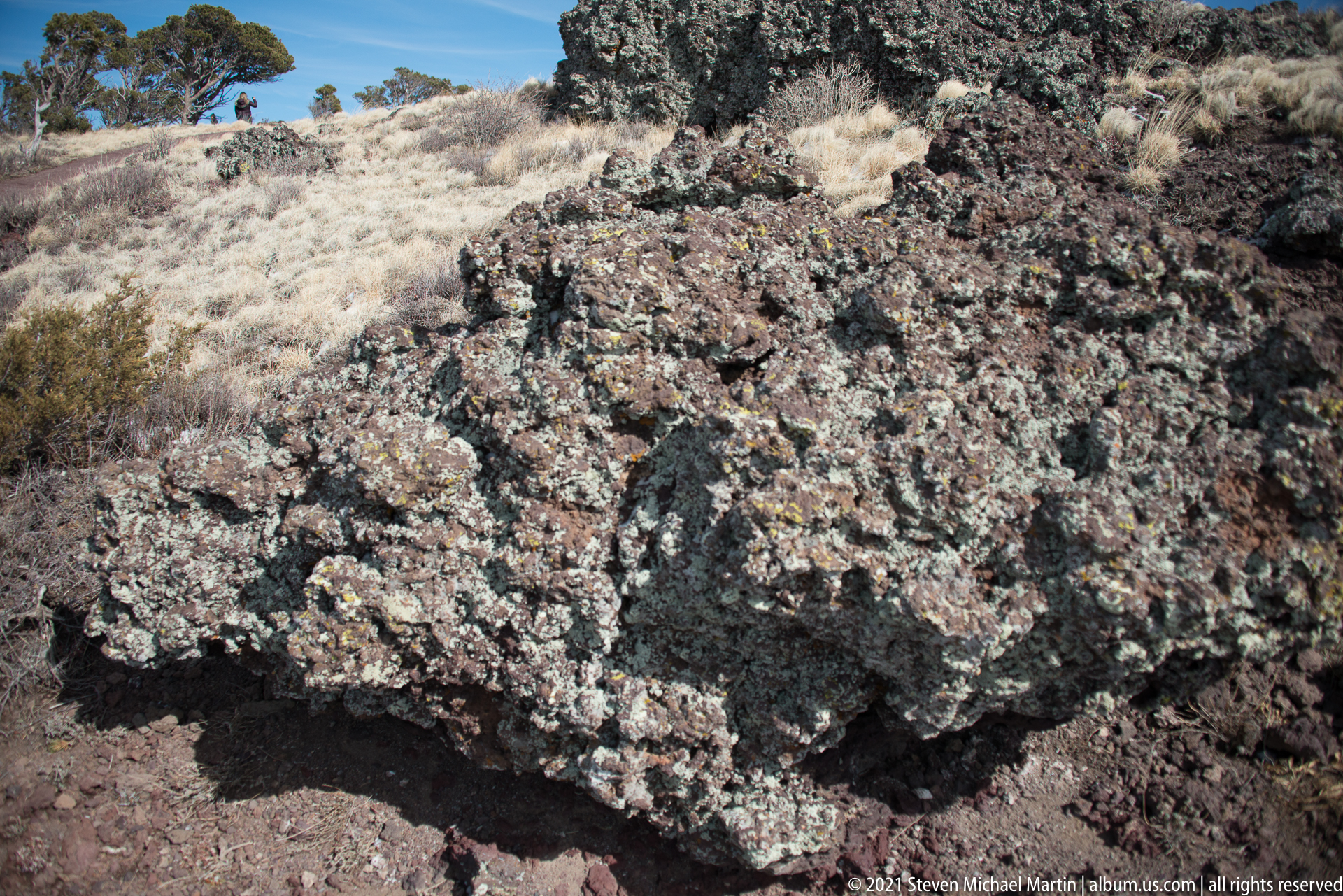
Fractured dark lava fills the foreground, its irregular blocks broken by small pockets of soil and pale dry grass. A rocky rise and sparse shrubs continue across the upper edge of the frame. With no distant view or interpretive text, this photograph emphasizes the coarse surface and vegetation that occupy the immediate ground beside Capulin’s summit route.
Caption
Fractured dark lava fills the foreground, its irregular blocks broken by small pockets of soil and pale dry grass. A rocky rise and sparse shrubs continue across the upper edge of the frame. With no distant view or interpretive text, this photograph emphasizes the coarse surface and vegetation that occupy the immediate ground beside Capulin’s summit route.
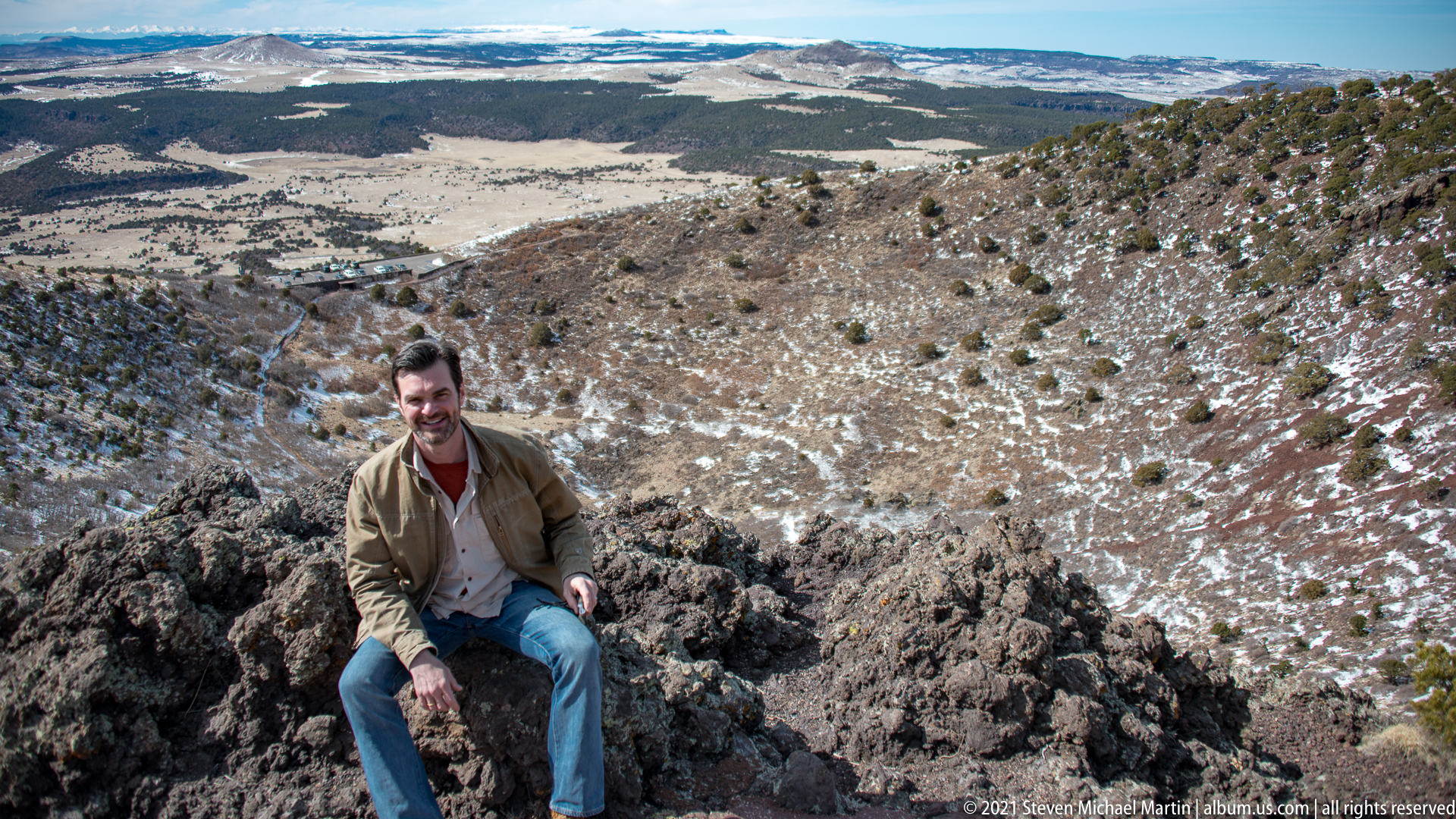
A visitor sits on a rough volcanic ledge near the summit, facing the camera as the high plain spreads out behind him. Snow traces parts of the distant slopes and open ground, while dark rocks fill the foreground. The seated pose and broad view make this a human-scale pause within the exposed landscape, distinct from the nearby standing portrait and trail views.
Caption
A visitor sits on a rough volcanic ledge near the summit, facing the camera as the high plain spreads out behind him. Snow traces parts of the distant slopes and open ground, while dark rocks fill the foreground. The seated pose and broad view make this a human-scale pause within the exposed landscape, distinct from the nearby standing portrait and trail views.
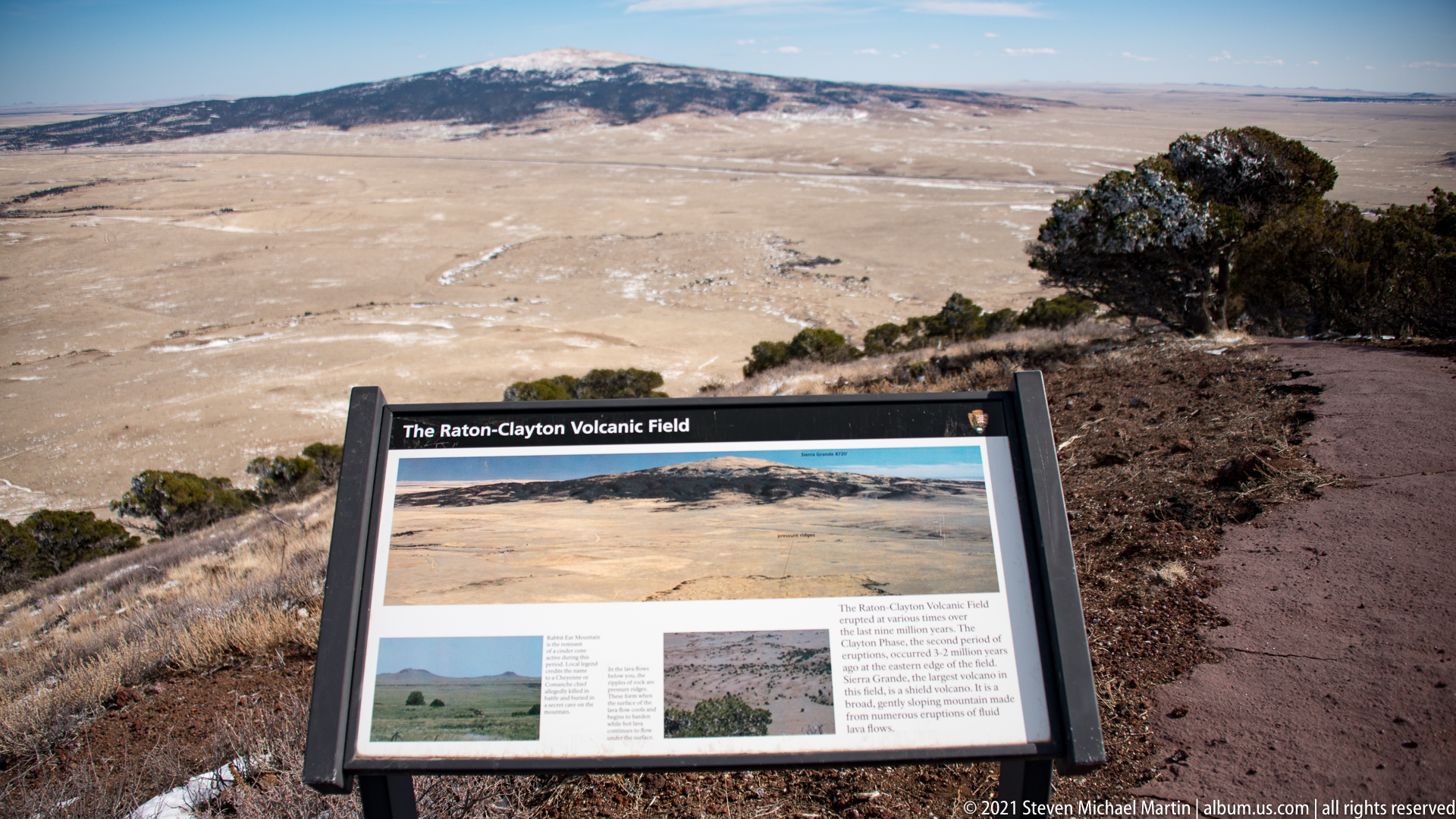
A freestanding interpretive panel occupies the foreground of an overlook, with the tan plains and distant volcanic uplands beyond. Its heading identifies the Raton-Clayton Volcanic Field, and the display labels features across a panoramic image. The arrangement invites visitors to compare the real horizon with the geology and landforms described on the sign.
Caption
A freestanding interpretive panel occupies the foreground of an overlook, with the tan plains and distant volcanic uplands beyond. Its heading identifies the Raton-Clayton Volcanic Field, and the display labels features across a panoramic image. The arrangement invites visitors to compare the real horizon with the geology and landforms described on the sign.
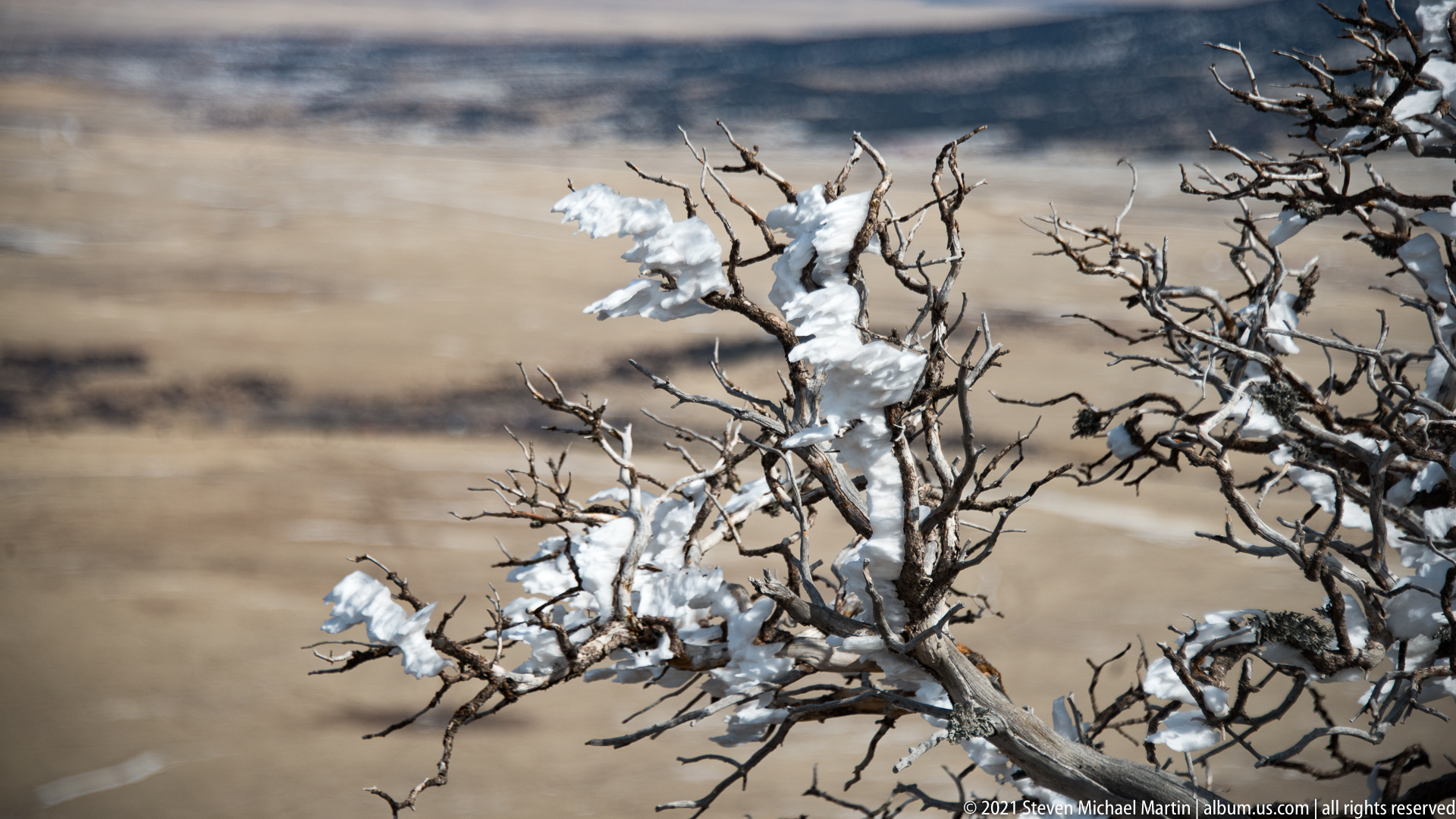
A leafless shrub fills the foreground, its branching twigs coated in irregular white ice. The shallow focus softens the tan plain and dark ridge behind it, isolating the frozen branches from the larger landscape. This close winter detail shifts attention from Capulin’s volcanic forms to the weather and hardy vegetation encountered along the exposed summit.
Caption
A leafless shrub fills the foreground, its branching twigs coated in irregular white ice. The shallow focus softens the tan plain and dark ridge behind it, isolating the frozen branches from the larger landscape. This close winter detail shifts attention from Capulin’s volcanic forms to the weather and hardy vegetation encountered along the exposed summit.
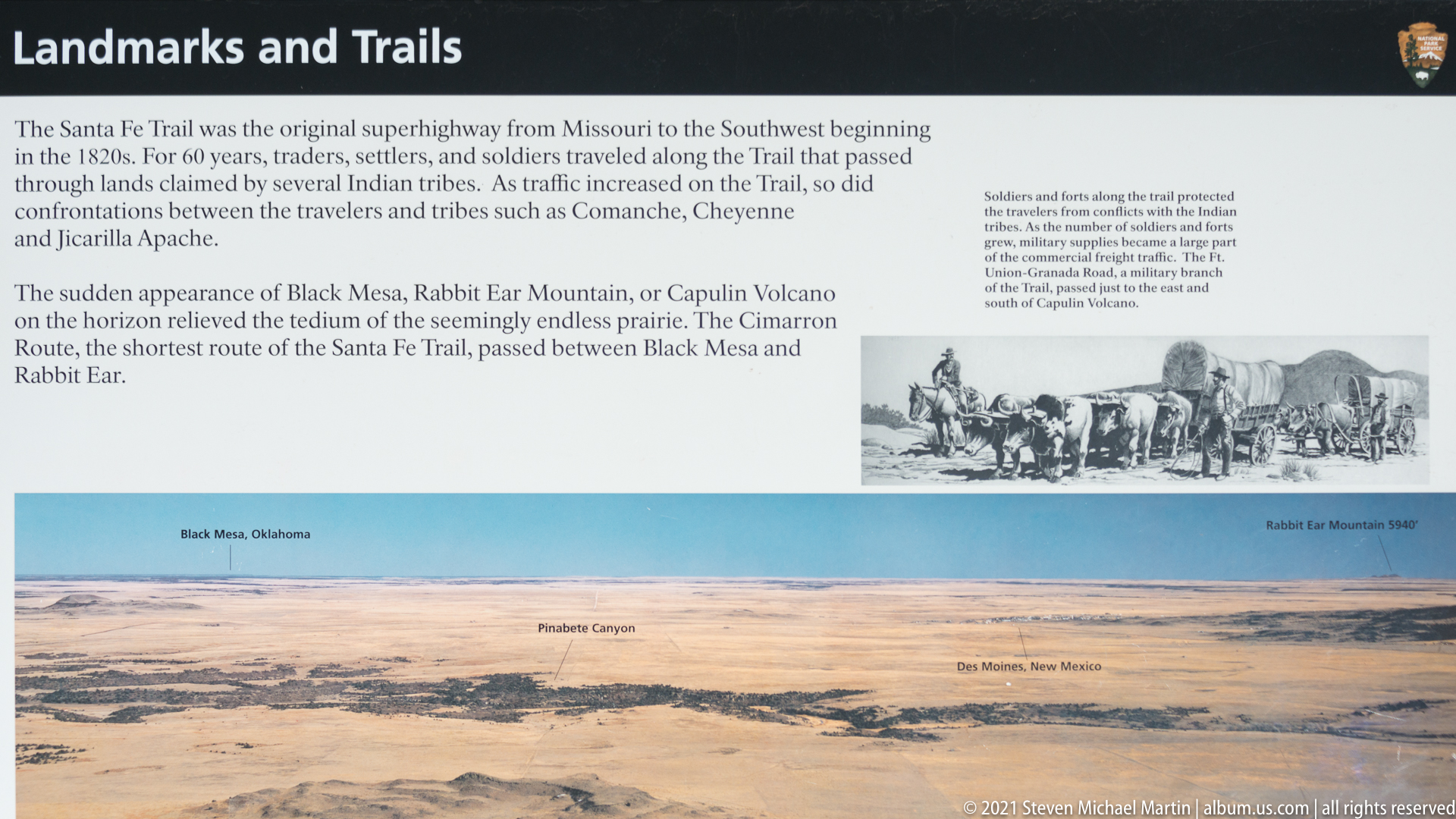
The “Landmarks and Trails” exhibit combines text on the Santa Fe Trail with a black-and-white wagon scene and a panoramic view of the surrounding plains. Labels point toward distant features, including Black Mesa and Rabbit Ear Mountain, while the text discusses routes and encounters along the trail. The wide display connects nineteenth-century travel history to the geography visible from this overlook.
Caption
The “Landmarks and Trails” exhibit combines text on the Santa Fe Trail with a black-and-white wagon scene and a panoramic view of the surrounding plains. Labels point toward distant features, including Black Mesa and Rabbit Ear Mountain, while the text discusses routes and encounters along the trail. The wide display connects nineteenth-century travel history to the geography visible from this overlook.

A broad interpretive panel titled “Settlement and Discovery” brings together text, historical photographs, an archaeological image, and a labeled landscape panorama. The visible sections refer to the 1908 flood and the Folsom archaeological discovery, presenting human history alongside the region’s landforms. Its layered layout is distinct from the single-topic panels nearby, combining several kinds of evidence in one exhibit.
Caption
A broad interpretive panel titled “Settlement and Discovery” brings together text, historical photographs, an archaeological image, and a labeled landscape panorama. The visible sections refer to the 1908 flood and the Folsom archaeological discovery, presenting human history alongside the region’s landforms. Its layered layout is distinct from the single-topic panels nearby, combining several kinds of evidence in one exhibit.
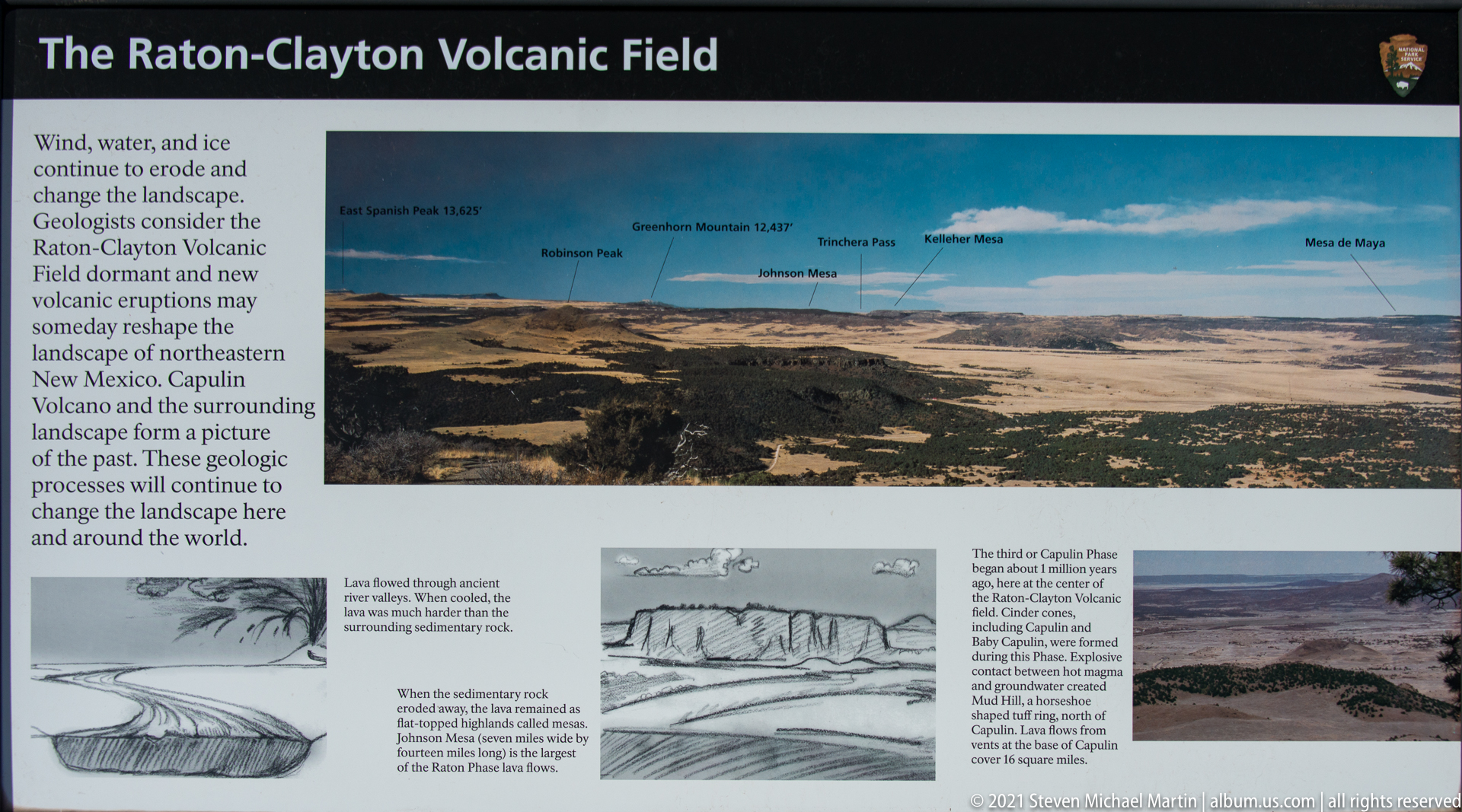
A large “Raton-Clayton Volcanic Field” display places a labeled mountain panorama above drawings of lava flows and explanatory text. The diagrams distinguish successive stages of volcanic activity, while labels identify peaks across the horizon. Photographed nearly straight on, the panel makes geological interpretation the main subject and shows how the monument presents its wider volcanic region to visitors.
Caption
A large “Raton-Clayton Volcanic Field” display places a labeled mountain panorama above drawings of lava flows and explanatory text. The diagrams distinguish successive stages of volcanic activity, while labels identify peaks across the horizon. Photographed nearly straight on, the panel makes geological interpretation the main subject and shows how the monument presents its wider volcanic region to visitors.

A thick branch crosses the frame diagonally, edged with a continuous band of white ice beneath a clear blue sky. Fine, leafless twigs recede out of focus behind it, while the close viewpoint reveals the uneven frozen coating along the bark. The image isolates winter weather on summit vegetation, unlike the previous photograph’s wider shrub and blurred plain.
Caption
A thick branch crosses the frame diagonally, edged with a continuous band of white ice beneath a clear blue sky. Fine, leafless twigs recede out of focus behind it, while the close viewpoint reveals the uneven frozen coating along the bark. The image isolates winter weather on summit vegetation, unlike the previous photograph’s wider shrub and blurred plain.
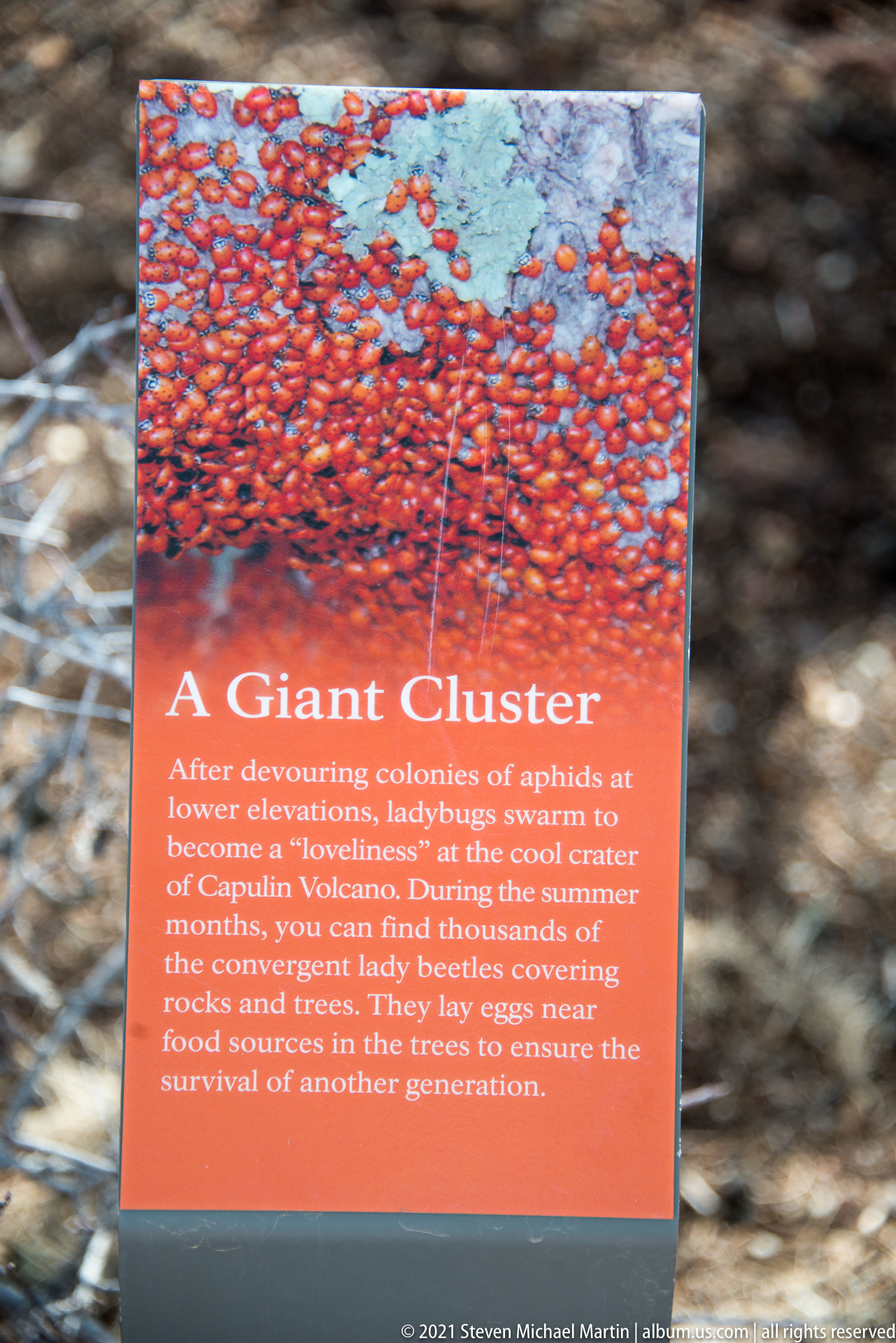
The “A Giant Cluster” panel explains how convergent lady beetles gather on Capulin Volcano after feeding on aphids at lower elevations. The orange sign describes their summer aggregation, use of nearby food sources for egg laying, and the next generation’s survival. A shallow-focus background of lichen-covered rock keeps attention on this seasonal wildlife story and its explanatory text.
Caption
The “A Giant Cluster” panel explains how convergent lady beetles gather on Capulin Volcano after feeding on aphids at lower elevations. The orange sign describes their summer aggregation, use of nearby food sources for egg laying, and the next generation’s survival. A shallow-focus background of lichen-covered rock keeps attention on this seasonal wildlife story and its explanatory text.
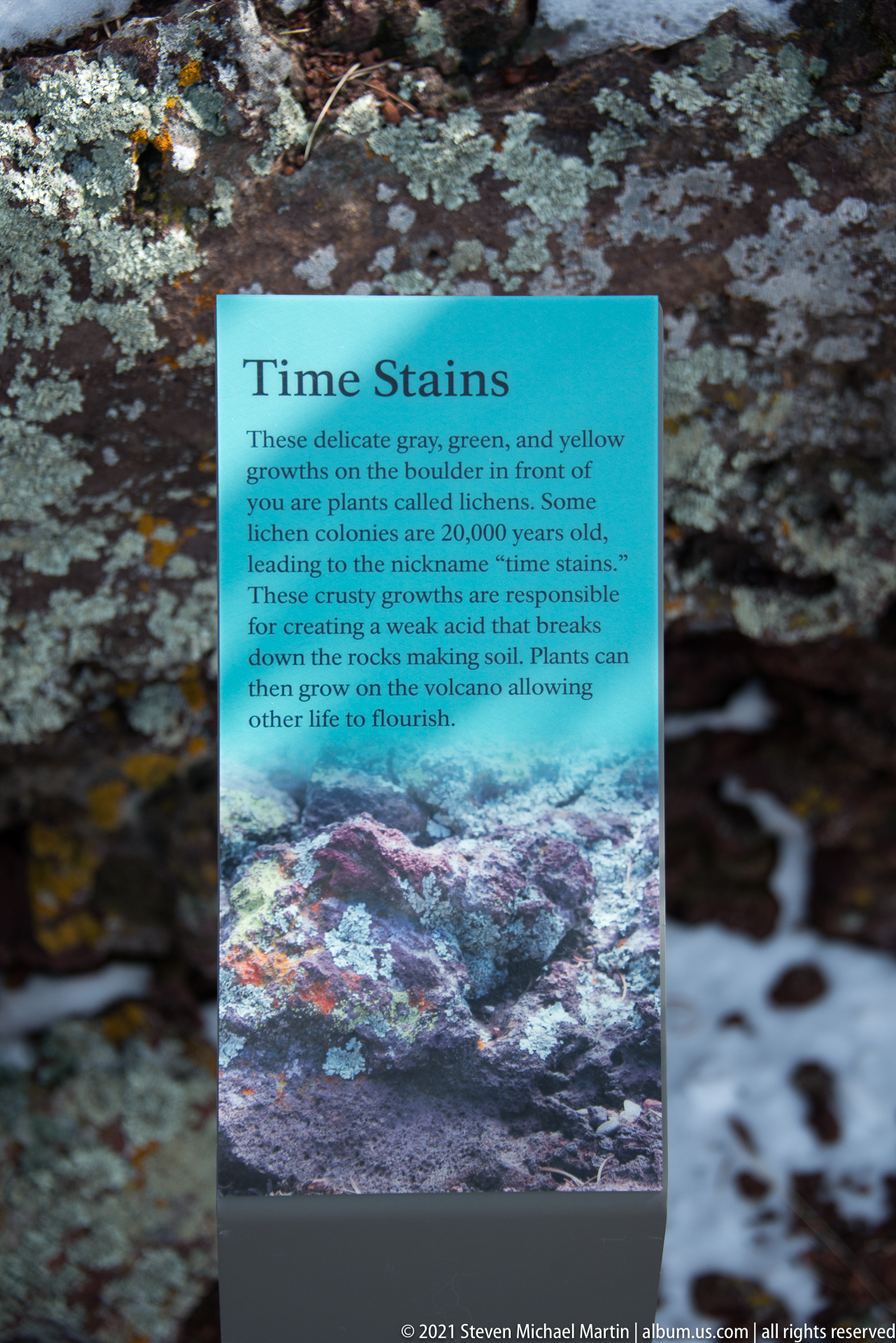
The “Time Stains” interpretive sign identifies the gray, green, and yellow growths on a nearby boulder as lichens. Its text explains that some colonies are very old and that lichens help break down rock, creating soil where other plants can grow. The sign is photographed against the lichen-covered stone it interprets, pairing ecological explanation with its subject.
Caption
The “Time Stains” interpretive sign identifies the gray, green, and yellow growths on a nearby boulder as lichens. Its text explains that some colonies are very old and that lichens help break down rock, creating soil where other plants can grow. The sign is photographed against the lichen-covered stone it interprets, pairing ecological explanation with its subject.
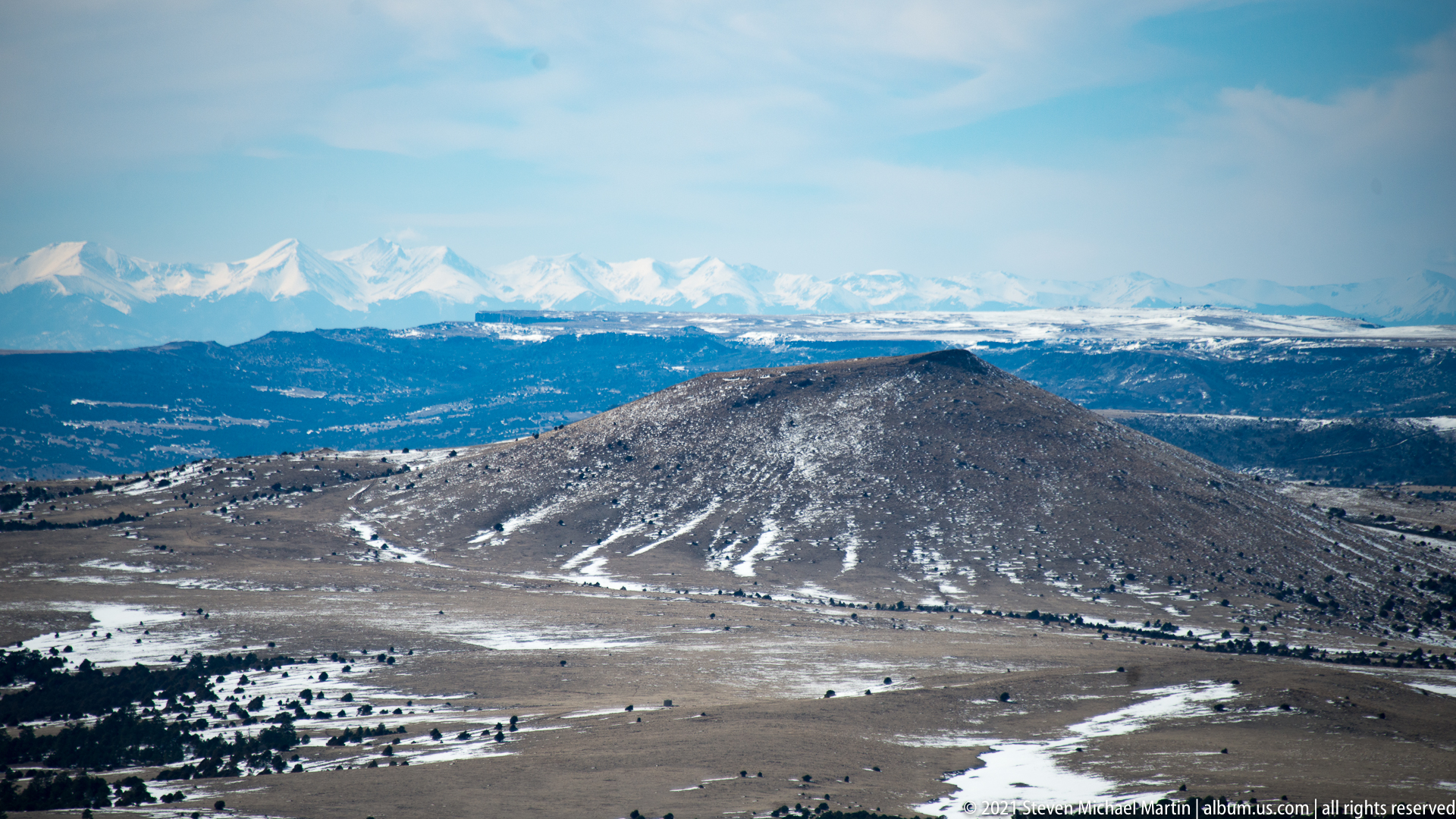
The rounded cinder cone rises above a broad, open plain, its dark slopes streaked with patches of snow. A line of distant, snow-covered mountains spans the horizon beneath a pale blue sky. The wide composition places Capulin’s compact volcanic form against the larger regional landscape, making the cone’s scale and isolated profile easy to read.
Caption
The rounded cinder cone rises above a broad, open plain, its dark slopes streaked with patches of snow. A line of distant, snow-covered mountains spans the horizon beneath a pale blue sky. The wide composition places Capulin’s compact volcanic form against the larger regional landscape, making the cone’s scale and isolated profile easy to read.
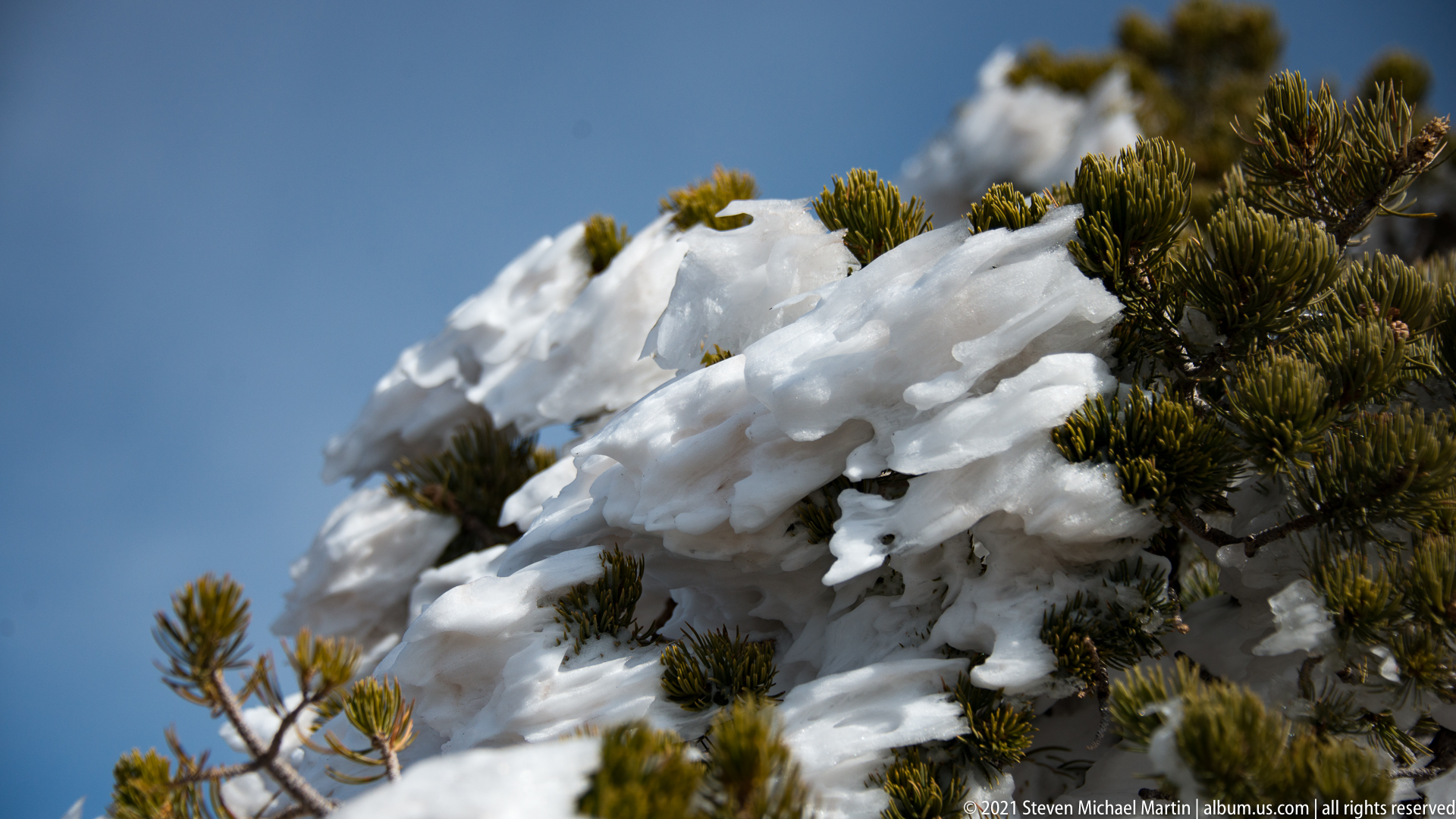
White ice clings in thick, irregular plates to clusters of narrow evergreen needles near the top of the frame. The upward angle sets the frozen foliage against a clear blue sky, with the remaining branches softly blurred. This close study contrasts with the preceding panorama by showing how winter weather marks individual plants on the volcanic summit.
Caption
White ice clings in thick, irregular plates to clusters of narrow evergreen needles near the top of the frame. The upward angle sets the frozen foliage against a clear blue sky, with the remaining branches softly blurred. This close study contrasts with the preceding panorama by showing how winter weather marks individual plants on the volcanic summit.

A woman smiles toward the camera in a close outdoor portrait, wearing a dark blue jacket over a patterned top. Bare trunks and pale snow blur into the background, placing her among the winter trees without competing with her face. The intimate framing differs from the summit views and captures a personal moment during a visit to Capulin Volcano.
Caption
A woman smiles toward the camera in a close outdoor portrait, wearing a dark blue jacket over a patterned top. Bare trunks and pale snow blur into the background, placing her among the winter trees without competing with her face. The intimate framing differs from the summit views and captures a personal moment during a visit to Capulin Volcano.
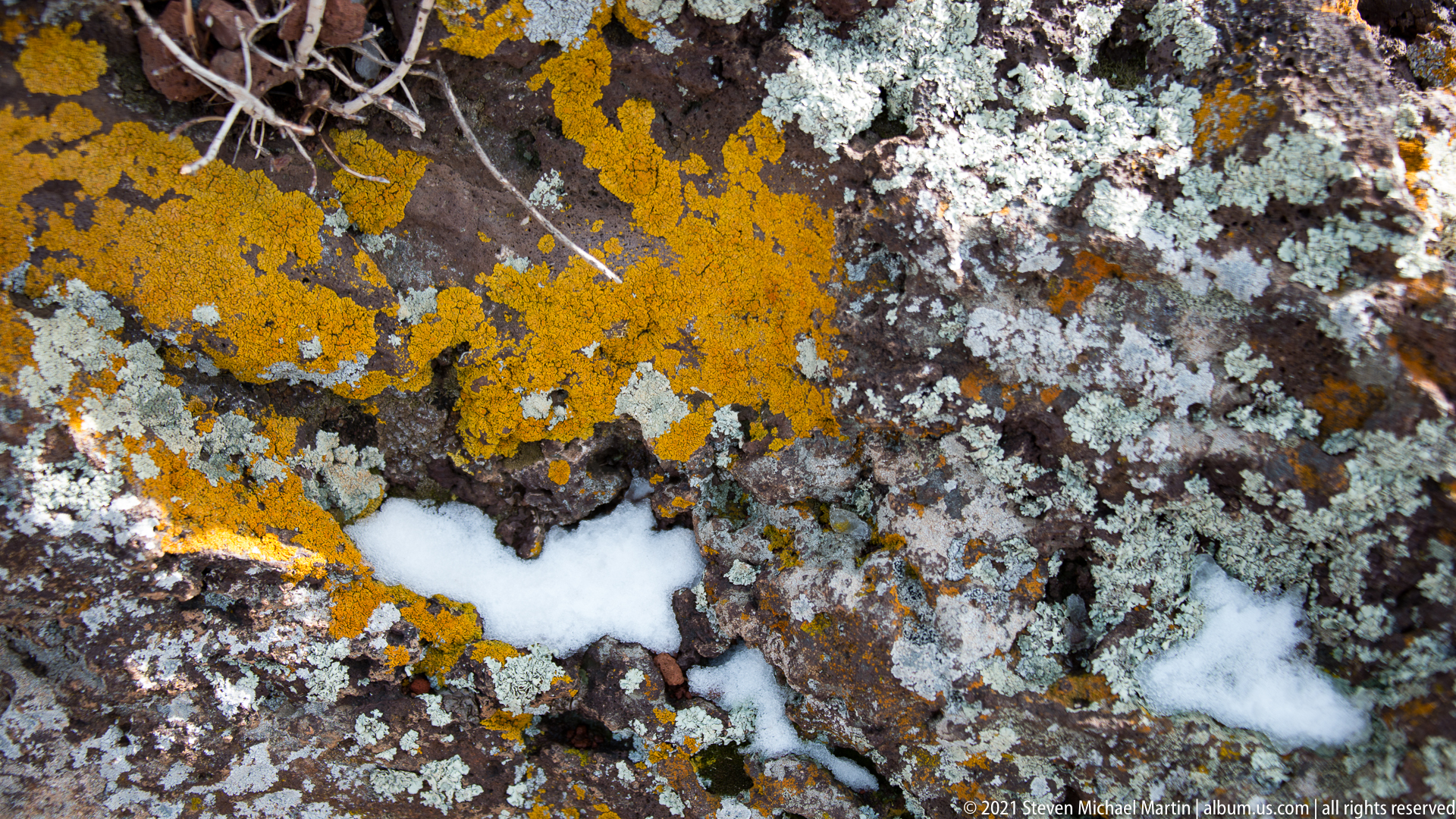
Dense patches of orange and pale gray-green lichen spread across a dark, rough rock surface. Small remnants of snow sit in crevices near the lower edge, adding a seasonal contrast to the bright growth. The tightly cropped view emphasizes the varied textures and colors of organisms colonizing volcanic stone rather than the surrounding landscape.
Caption
Dense patches of orange and pale gray-green lichen spread across a dark, rough rock surface. Small remnants of snow sit in crevices near the lower edge, adding a seasonal contrast to the bright growth. The tightly cropped view emphasizes the varied textures and colors of organisms colonizing volcanic stone rather than the surrounding landscape.
Capulin Volcano National Monument — Field Guide
National Monument Field Guide
📍 Overview
Capulin Volcano National Monument preserves one of the best examples of a cinder cone volcano in North America. Rising above the plains of northeastern New Mexico, the cone was formed by volcanic eruptions that built layers of ash, cinders, and lava around a central vent. The monument provides a clear and accessible introduction to volcanic landforms and the geological history of the region.
The crater, lava flows, and surrounding volcanic field illustrate the processes that shaped the landscape over thousands of years. From the rim, broad views reveal the relationship between the volcano and the wider grassland environment. The monument highlights the visual clarity of volcanic form and the diversity of geological forces represented within the Southwest.
⭐ Highlights
- Well-preserved cinder cone volcano
- Summit crater with panoramic views
- Visible lava flows and volcanic deposits
- Volcanic field landscape in northeastern New Mexico
- Accessible example of eruption-built landforms
🔎 Key Features
- Symmetrical cone formed by explosive eruptions
- Crater rim illustrating volcanic structure
- Lava flows extending into surrounding plains
- Interpretive context for regional volcanic history
- Grassland setting contrasting with volcanic landform
📷 Photography Notes
- Wide views work well from the crater rim
- Morning or late light adds shape to the cone
- Foreground vegetation can help frame volcanic slopes
- Cloud patterns add scale to the open landscape
- Look for angles that show both crater and plains
- Simple compositions emphasize the volcano’s symmetry
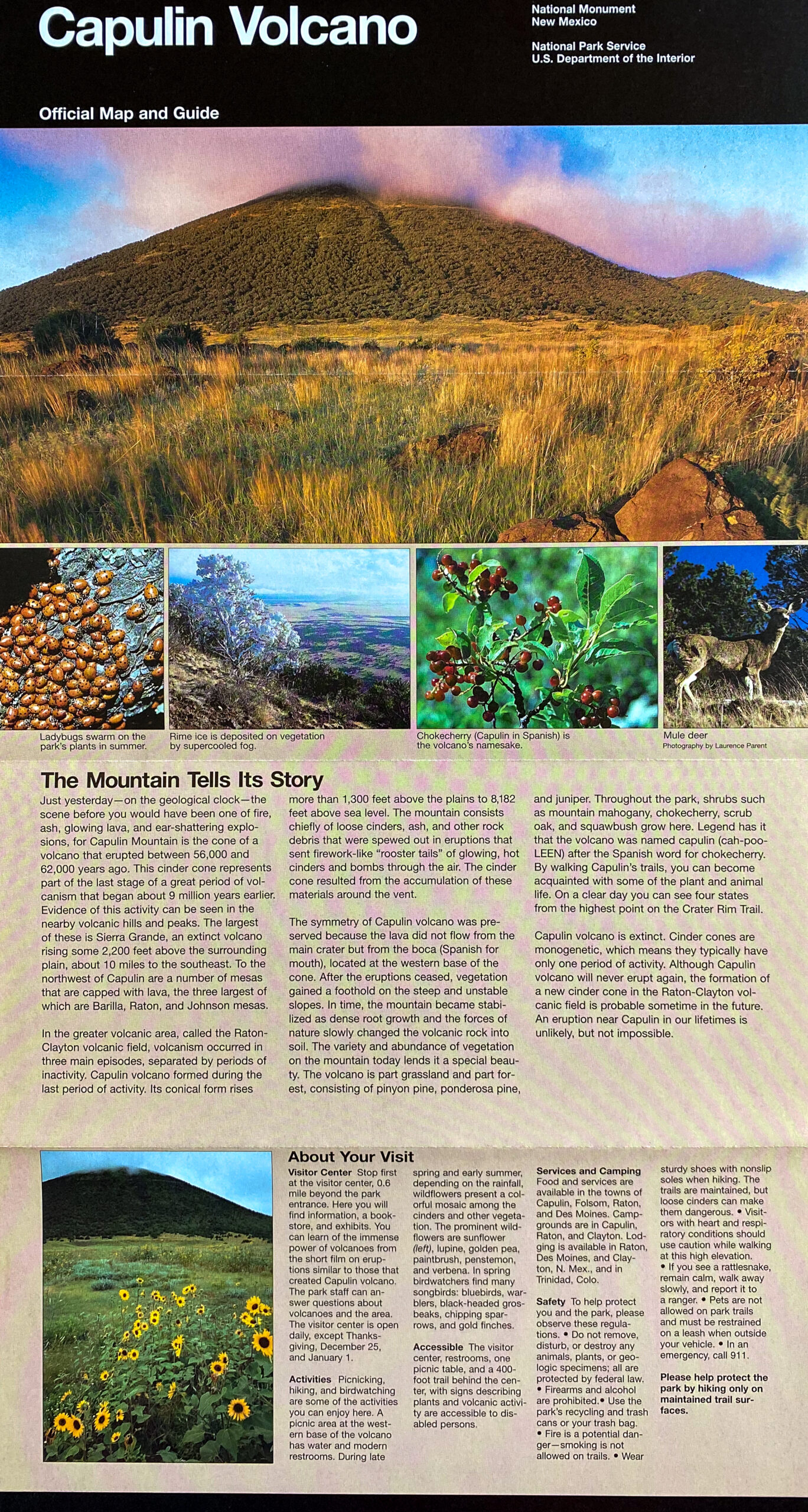
An open National Park Service brochure titled “Capulin Volcano” presents a panoramic landscape banner above photographs, maps, and columns of visitor and geology information. The visible spread includes the heading “The Mountain Tells Its Story” and smaller images of the volcanic landscape and local natural features. This is a designed informational publication rather than a direct photograph of the monument.
Caption
An open National Park Service brochure titled “Capulin Volcano” presents a panoramic landscape banner above photographs, maps, and columns of visitor and geology information. The visible spread includes the heading “The Mountain Tells Its Story” and smaller images of the volcanic landscape and local natural features. This is a designed informational publication rather than a direct photograph of the monument.
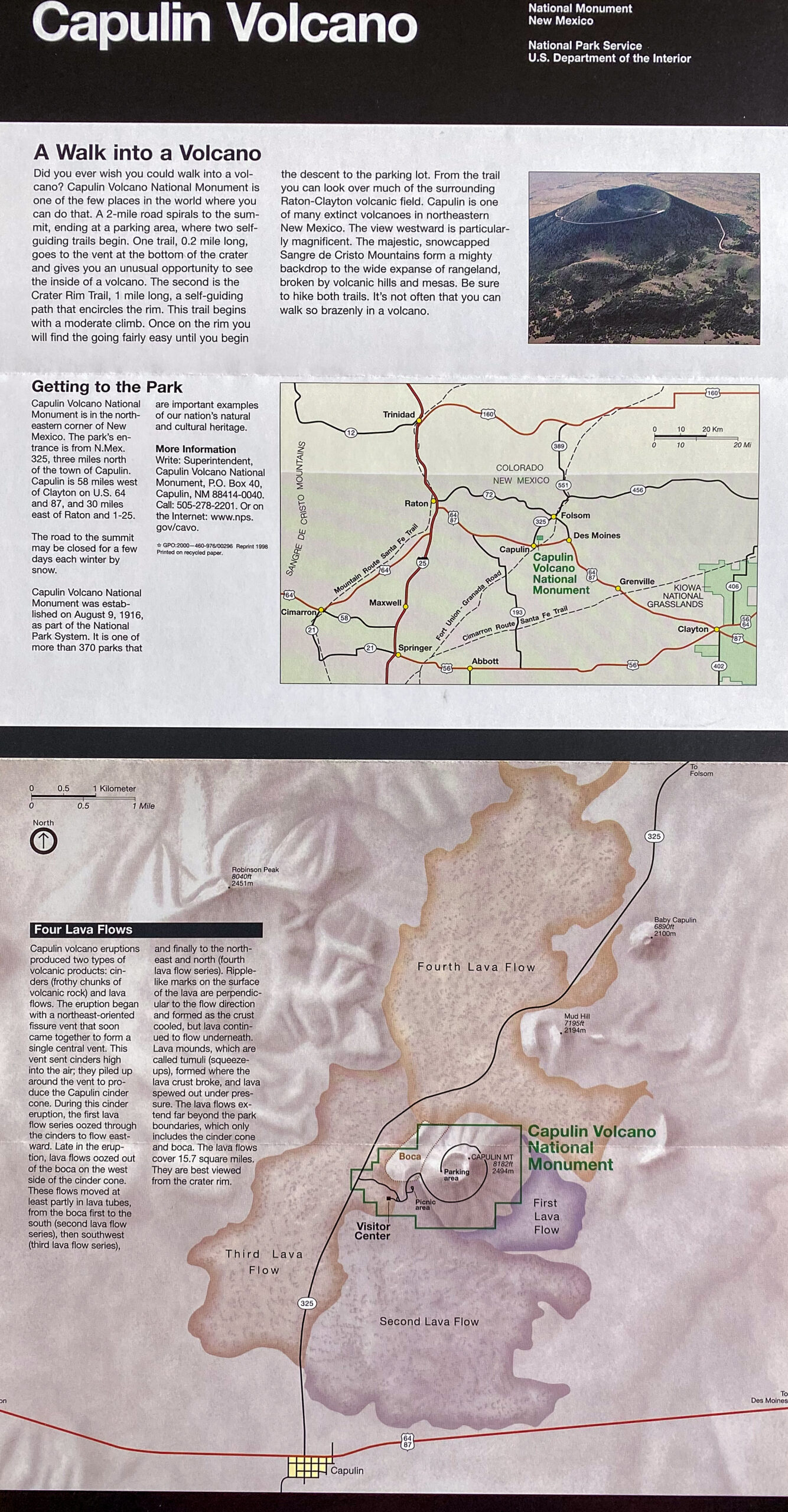
This side of the Capulin Volcano brochure places visitor information and a small landscape photograph above a large map of the monument and surrounding roads. A lower diagram labels the volcano’s lava flows, while the upper map marks the national monument and nearby places. The page functions as a navigation and geology reference, distinct from the image-rich overview on the facing brochure side.
Caption
This side of the Capulin Volcano brochure places visitor information and a small landscape photograph above a large map of the monument and surrounding roads. A lower diagram labels the volcano’s lava flows, while the upper map marks the national monument and nearby places. The page functions as a navigation and geology reference, distinct from the image-rich overview on the facing brochure side.