Mill Springs Battlefield National Monument
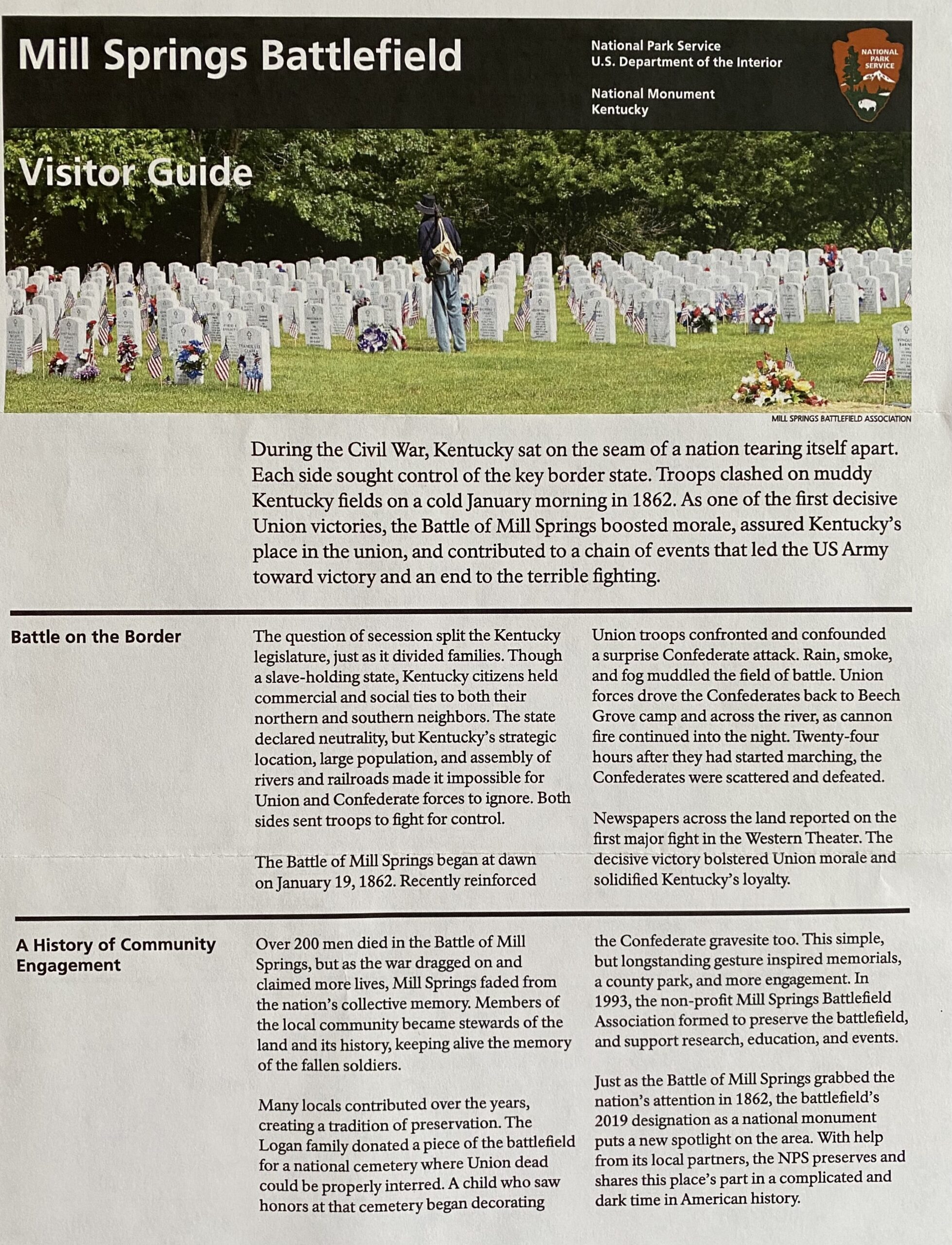
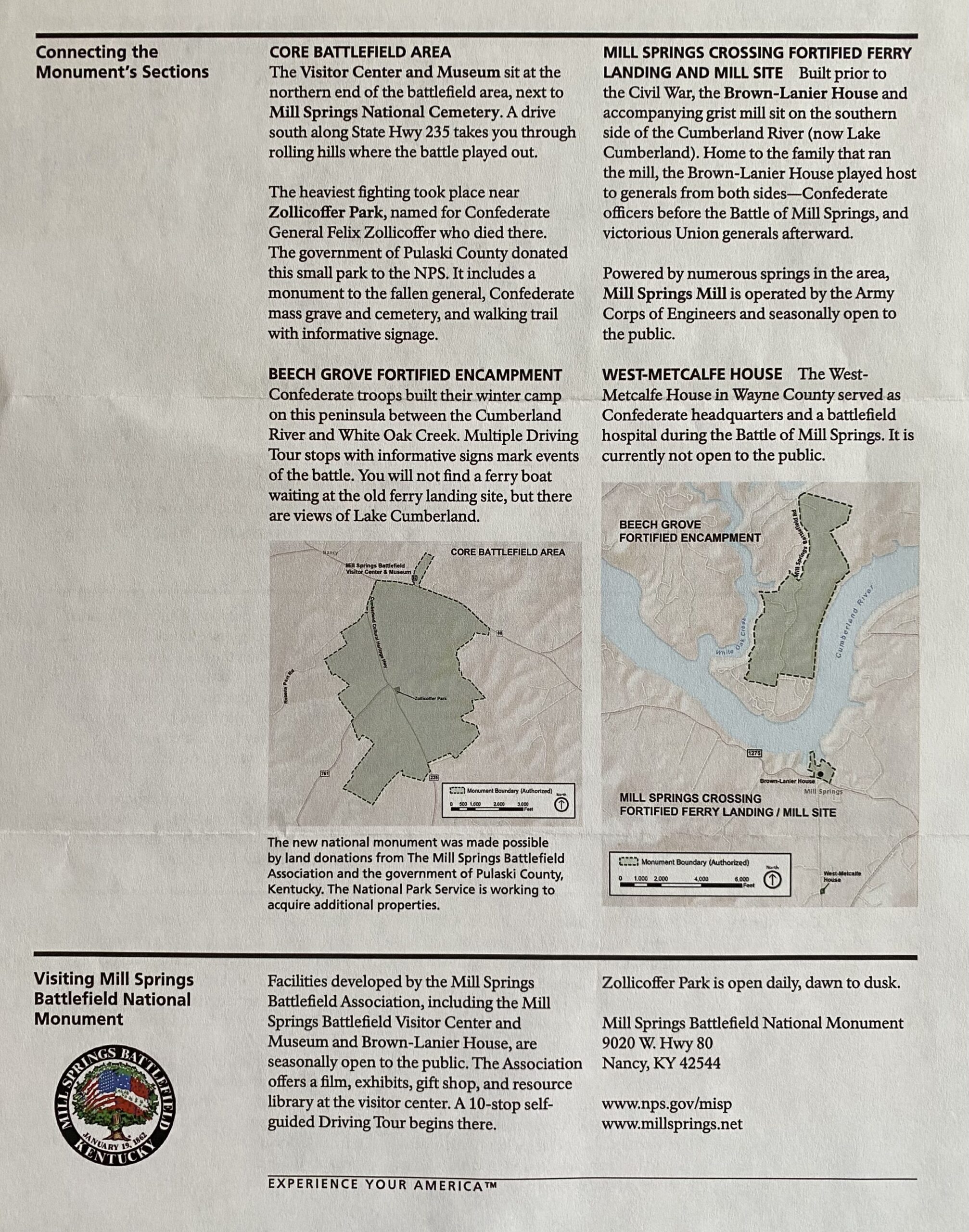
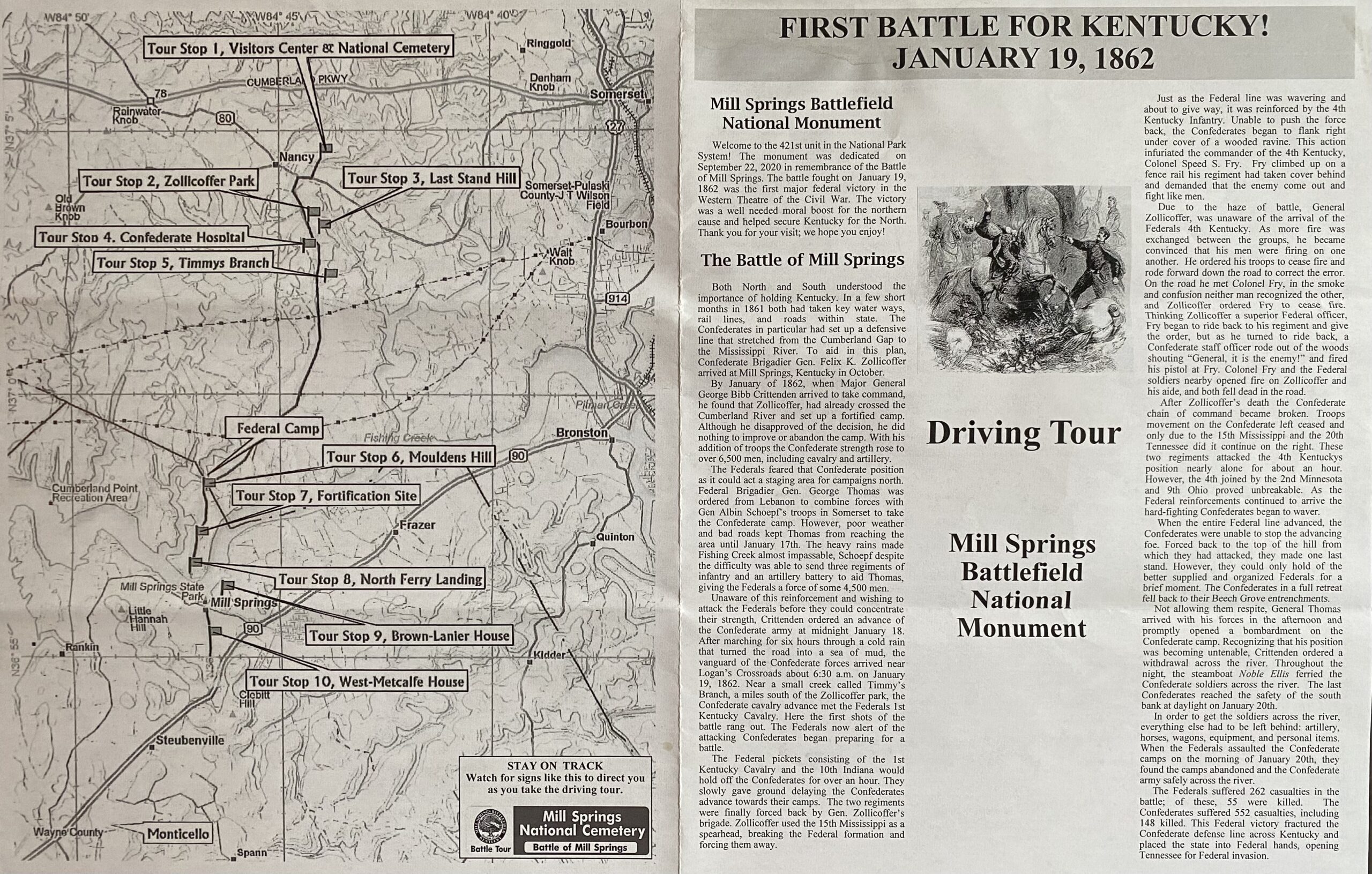
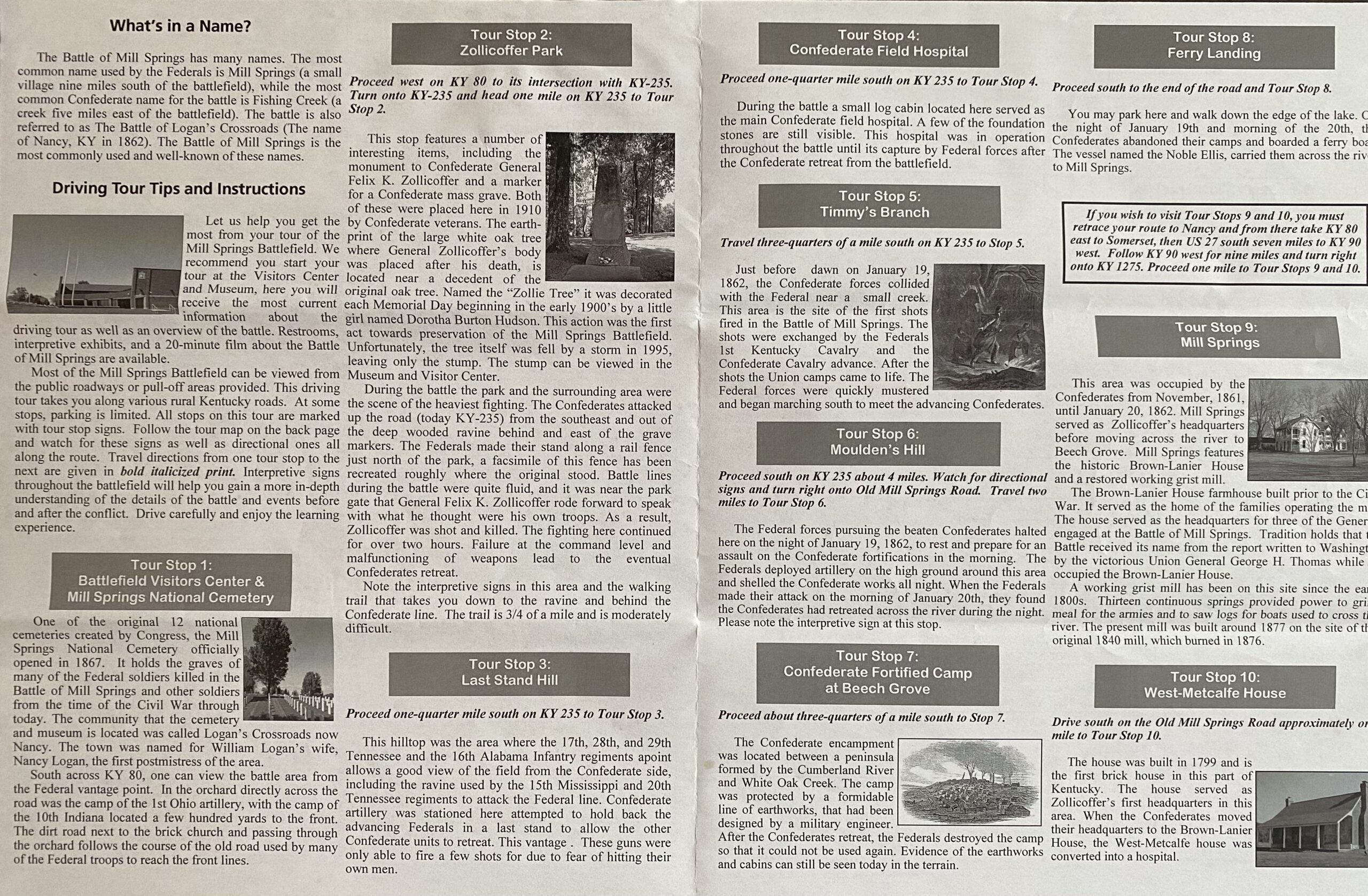
Mill Springs Battlefield National Monument preserves the site of an early and significant Union victory in the Civil War. Fought in January 1862, the Battle of Mill Springs helped secure Kentucky for the Union and demonstrated the strategic importance of controlling transportation routes and river access in the western theater. The battlefield landscape conveys both the uncertainty of early war campaigns and the evolving tactics of Civil War engagements.
The preserved landscape includes rolling terrain, wooded areas, and open fields that illustrate the conditions faced by soldiers during winter operations. Interpretive exhibits and preserved features provide insight into the movements of Union and Confederate forces, highlighting the challenges of command, communication, and terrain during early military campaigns. The battle marked a turning point that strengthened Union morale during a difficult period of the war.
Visitors can explore walking trails, interpretive signage, and scenic viewpoints that convey both the scale of the battlefield and the personal experiences of the soldiers who fought there. The quiet rural setting encourages reflection on the human cost of conflict and the significance of the Union’s strategic gains in Kentucky.

A blue sport-utility vehicle is parked beside a split-rail fence on the battlefield grounds. A beagle peers through the open rear window, its head framed by the dark glass; leaf litter, a gravel drive, and winter trees surround the vehicle. The image catches a small visitor moment within the historic landscape.
Caption
A blue sport-utility vehicle is parked beside a split-rail fence on the battlefield grounds. A beagle peers through the open rear window, its head framed by the dark glass; leaf litter, a gravel drive, and winter trees surround the vehicle. The image catches a small visitor moment within the historic landscape.

A long split-rail fence angles through the foreground toward a dark visitor-center sign set on a lightly snow-covered lawn. The fence rails are uneven and weathered, creating strong diagonal lines across the pale ground. Bare trees and a road edge complete the wintry approach, with the sign partly blurred beyond the fence.
Caption
A long split-rail fence angles through the foreground toward a dark visitor-center sign set on a lightly snow-covered lawn. The fence rails are uneven and weathered, creating strong diagonal lines across the pale ground. Bare trees and a road edge complete the wintry approach, with the sign partly blurred beyond the fence.

A tan-and-white beagle sits in the front seat of a vehicle, looking toward the camera with its blue flower-shaped tag prominent against its chest. The close portrait includes the dark window frame and part of the seat, isolating the dog from the battlefield setting outside. Its relaxed posture gives the image an intimate, personal register.
Caption
A tan-and-white beagle sits in the front seat of a vehicle, looking toward the camera with its blue flower-shaped tag prominent against its chest. The close portrait includes the dark window frame and part of the seat, isolating the dog from the battlefield setting outside. Its relaxed posture gives the image an intimate, personal register.
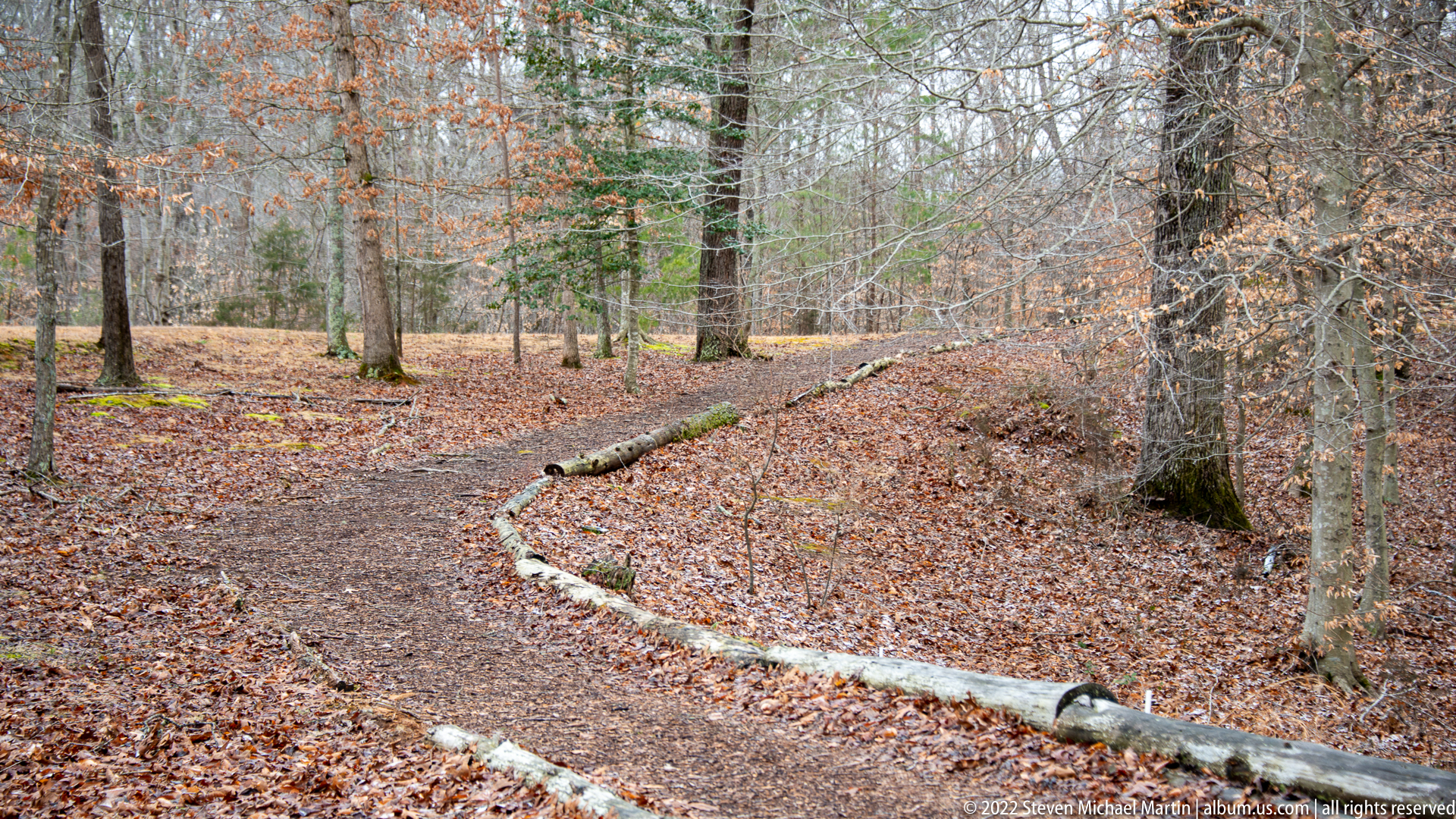
A narrow dirt path curves through leaf-covered woods, edged by a low pale stone border. Bare deciduous trunks and a few evergreens enclose the trail, while fallen branches and damp leaves cover the ground. The quiet woodland view records a route through the battlefield’s wooded terrain without indicating a specific destination.
Caption
A narrow dirt path curves through leaf-covered woods, edged by a low pale stone border. Bare deciduous trunks and a few evergreens enclose the trail, while fallen branches and damp leaves cover the ground. The quiet woodland view records a route through the battlefield’s wooded terrain without indicating a specific destination.
Flat, pale rock layers project into opaque water below a wooded bank. Fallen branches and a rough tree line follow the shore, while a small stone remnant stands among the trees in the distance. The subdued light and winter vegetation make the layered rock and water’s edge the primary subjects, rather than any specific battlefield feature.
Caption
Flat, pale rock layers project into opaque water below a wooded bank. Fallen branches and a rough tree line follow the shore, while a small stone remnant stands among the trees in the distance. The subdued light and winter vegetation make the layered rock and water’s edge the primary subjects, rather than any specific battlefield feature.
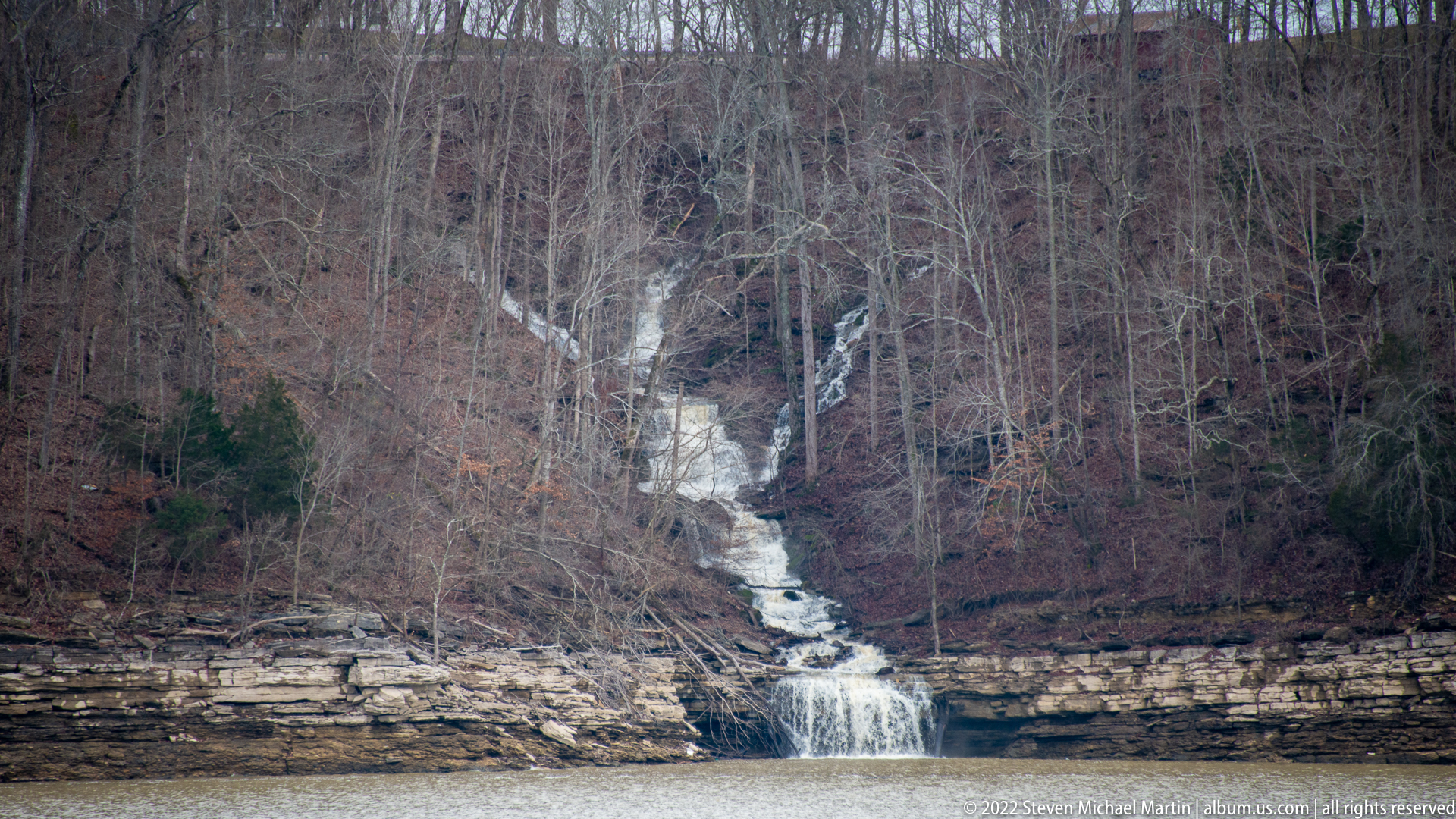
A narrow waterfall descends through a wooded ravine, spilling over several pale rock ledges into a pool. Bare branches frame the cascade, while evergreen shrubs and dark exposed stone add contrast to the winter scene. The distant viewpoint includes the full vertical run of water from the upper slope to the lower shelf.
Caption
A narrow waterfall descends through a wooded ravine, spilling over several pale rock ledges into a pool. Bare branches frame the cascade, while evergreen shrubs and dark exposed stone add contrast to the winter scene. The distant viewpoint includes the full vertical run of water from the upper slope to the lower shelf.
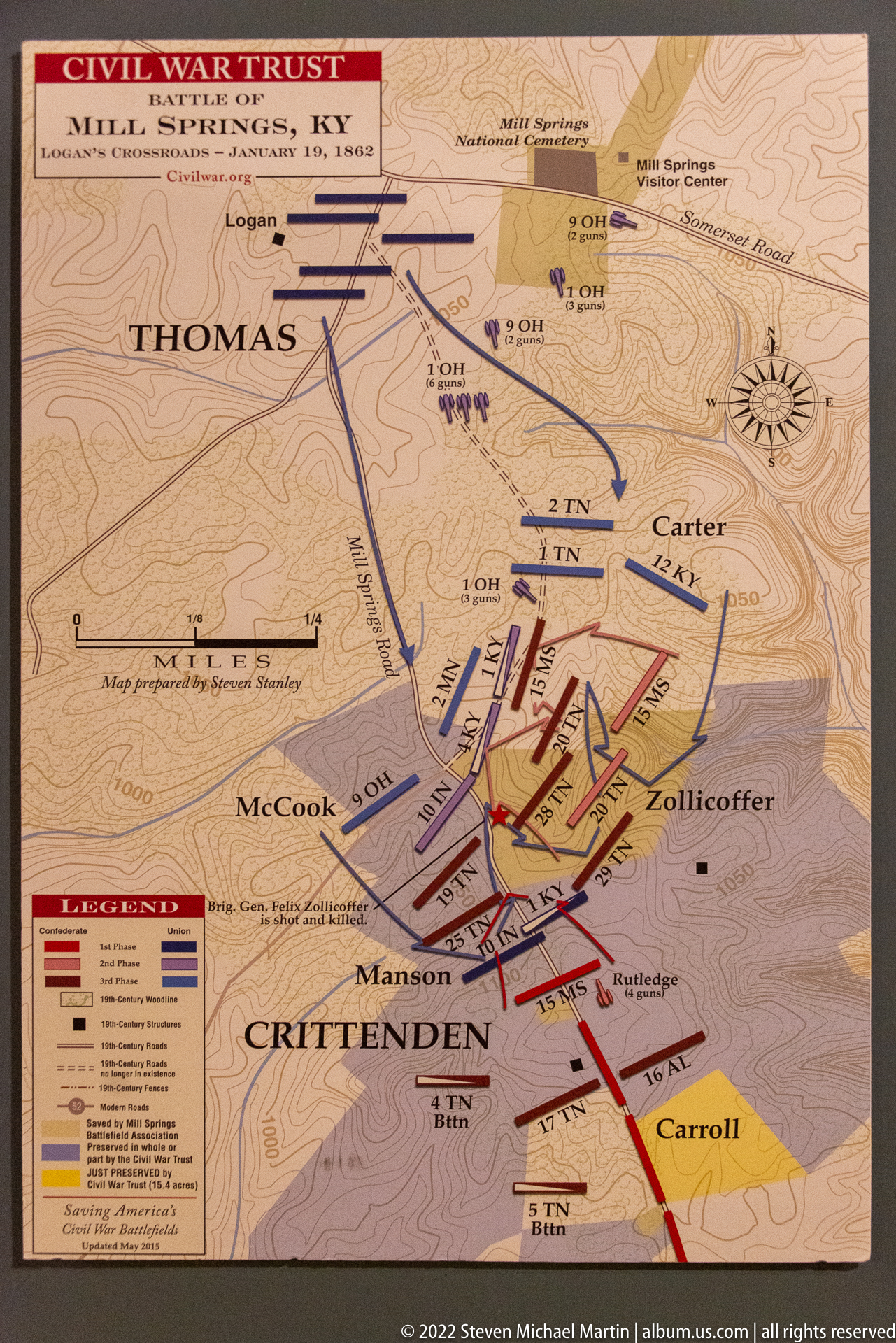
A color topographic map marks Mill Springs, Zollicoffer, Carter, Manson and other local names amid hills and roads. Red and blue arrows trace troop movements across the terrain, with a legend at lower left and a compass rose at upper right. The elevated angle shows how the battlefield action relates to the surrounding settlements and ridgelines.
Caption
A color topographic map marks Mill Springs, Zollicoffer, Carter, Manson and other local names amid hills and roads. Red and blue arrows trace troop movements across the terrain, with a legend at lower left and a compass rose at upper right. The elevated angle shows how the battlefield action relates to the surrounding settlements and ridgelines.
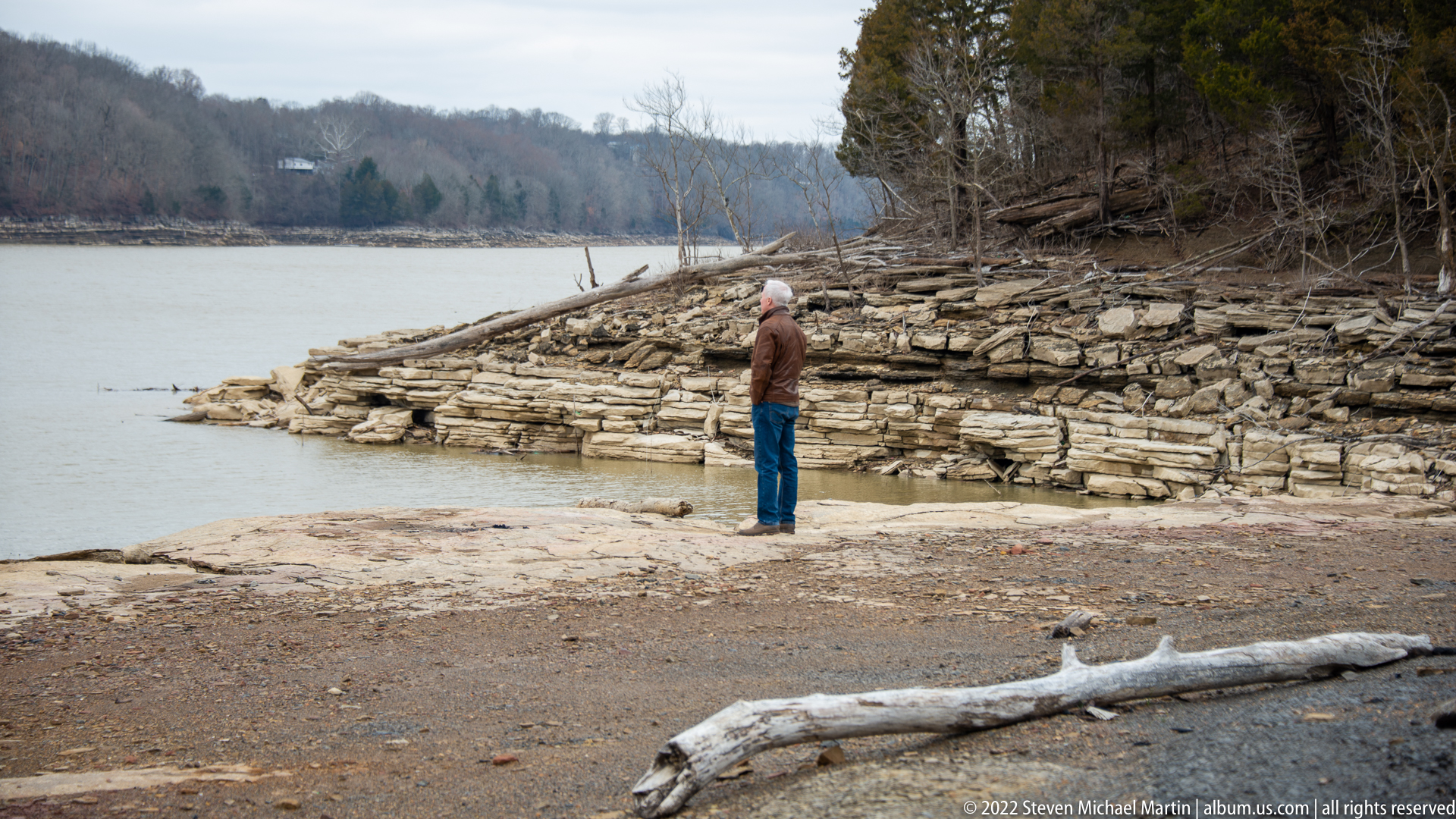
A visitor stands on a broad limestone shelf beside the Cumberland River, facing the water and layered rock bank. Driftwood lies across the foreground, and a narrow strip of trees follows the opposite shore. The human figure provides scale for the exposed stone ledges and the quiet river landing.
Caption
A visitor stands on a broad limestone shelf beside the Cumberland River, facing the water and layered rock bank. Driftwood lies across the foreground, and a narrow strip of trees follows the opposite shore. The human figure provides scale for the exposed stone ledges and the quiet river landing.
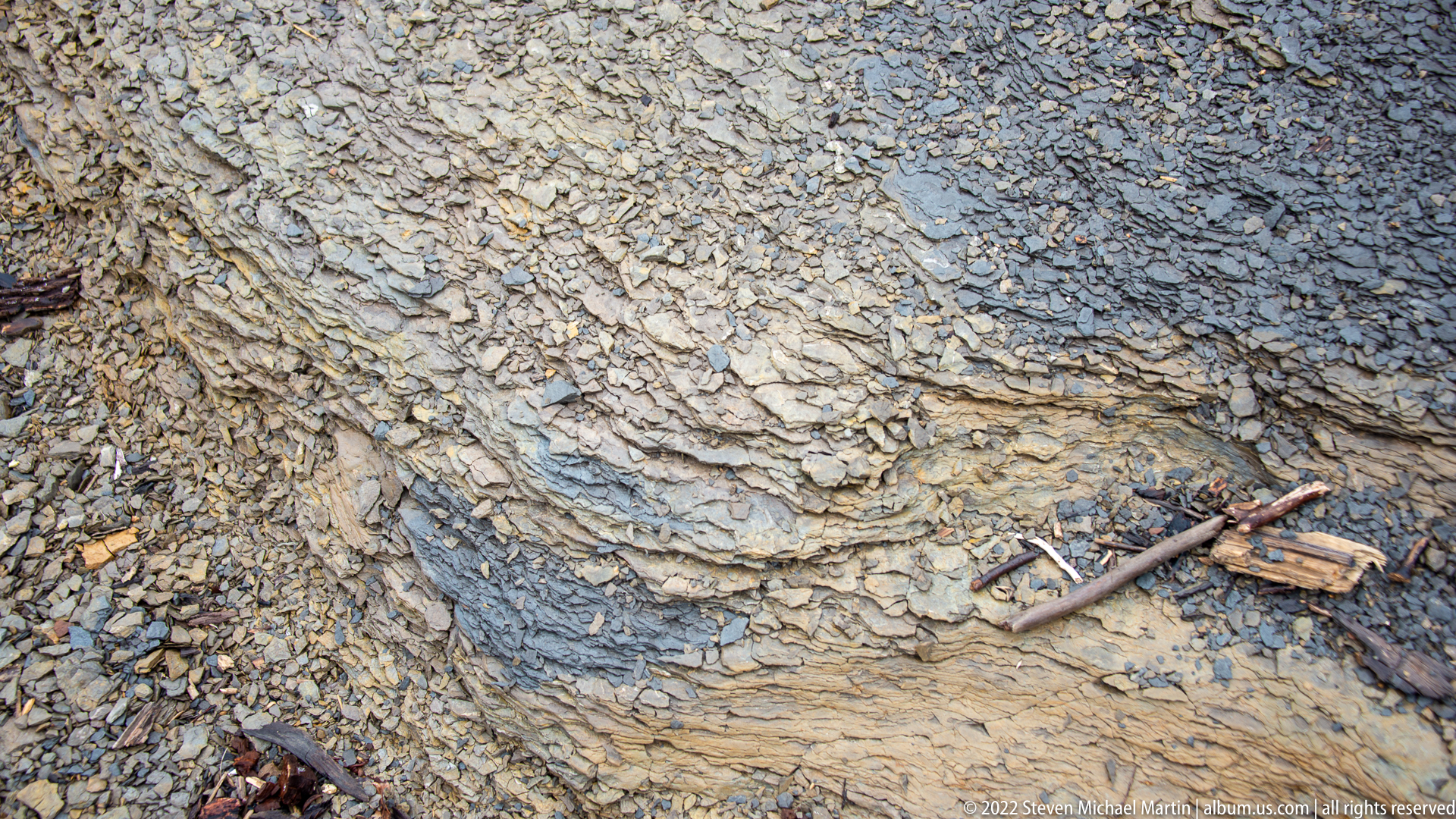
An exposed bank of thinly layered rock fills the frame, its pale gray strata folding and breaking into irregular plates. A narrow branch lies diagonally across the surface, with a small patch of water and dark leaves at lower right. The close view records the texture and erosion of the riverside outcrop.
Caption
An exposed bank of thinly layered rock fills the frame, its pale gray strata folding and breaking into irregular plates. A narrow branch lies diagonally across the surface, with a small patch of water and dark leaves at lower right. The close view records the texture and erosion of the riverside outcrop.
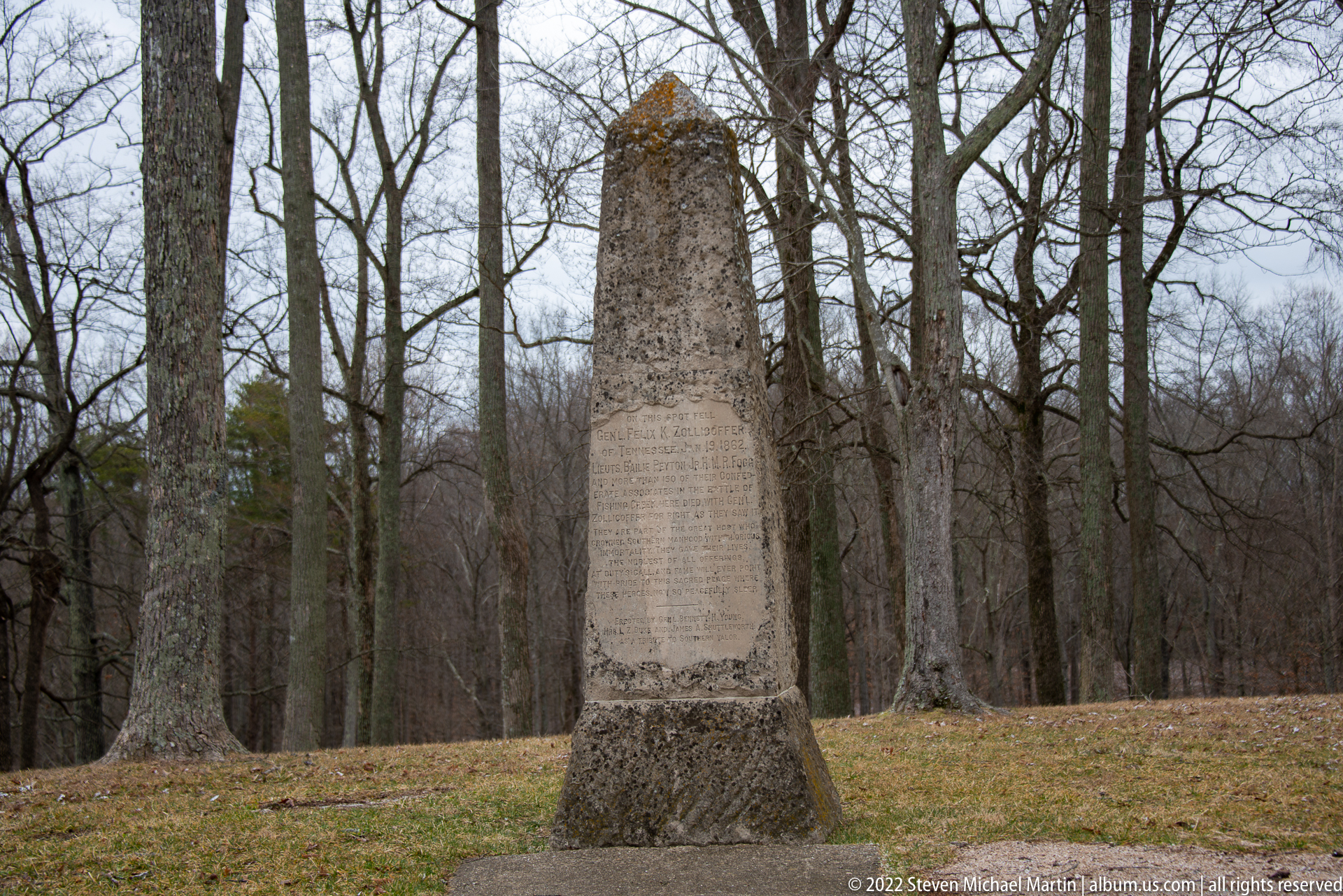
A weathered stone obelisk rises from a low base among bare trees on a winter hillside. An inscribed rectangular panel occupies its front face, but the lettering is too small in this view to read. The monument’s isolated placement and tapering form distinguish it from the nearby ground-level battlefield markers.
Caption
A weathered stone obelisk rises from a low base among bare trees on a winter hillside. An inscribed rectangular panel occupies its front face, but the lettering is too small in this view to read. The monument’s isolated placement and tapering form distinguish it from the nearby ground-level battlefield markers.
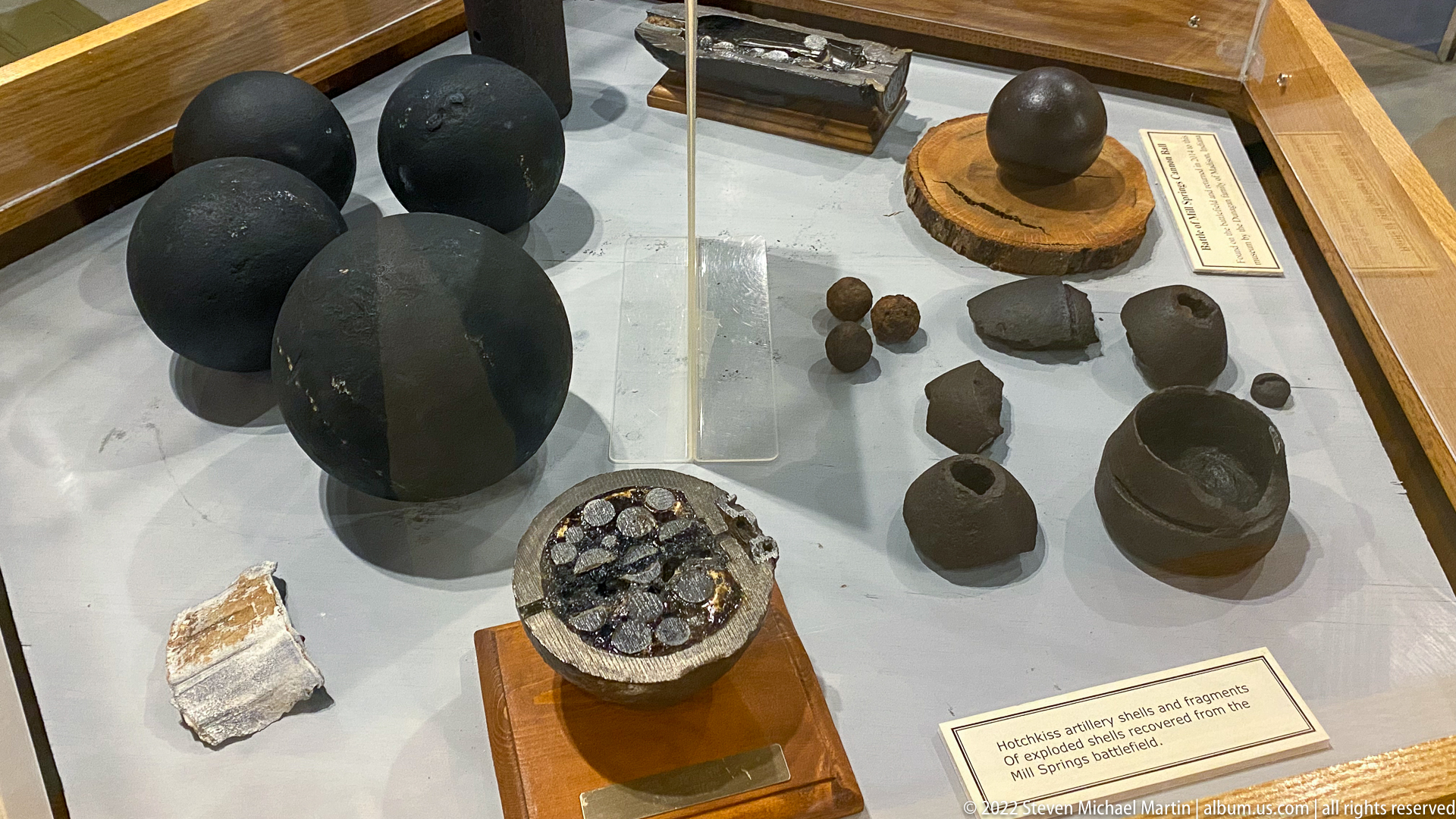
A glass case groups heavy dark iron spheres, smaller fragments, and a shallow container of metal pieces beside a small label. The display presents artillery ammunition as material evidence of the Mill Springs battlefield, but the individual types and provenance are too small to read clearly. Glass reflections and wooden case edges frame the objects as a museum collection rather than a field scatter.
Caption
A glass case groups heavy dark iron spheres, smaller fragments, and a shallow container of metal pieces beside a small label. The display presents artillery ammunition as material evidence of the Mill Springs battlefield, but the individual types and provenance are too small to read clearly. Glass reflections and wooden case edges frame the objects as a museum collection rather than a field scatter.
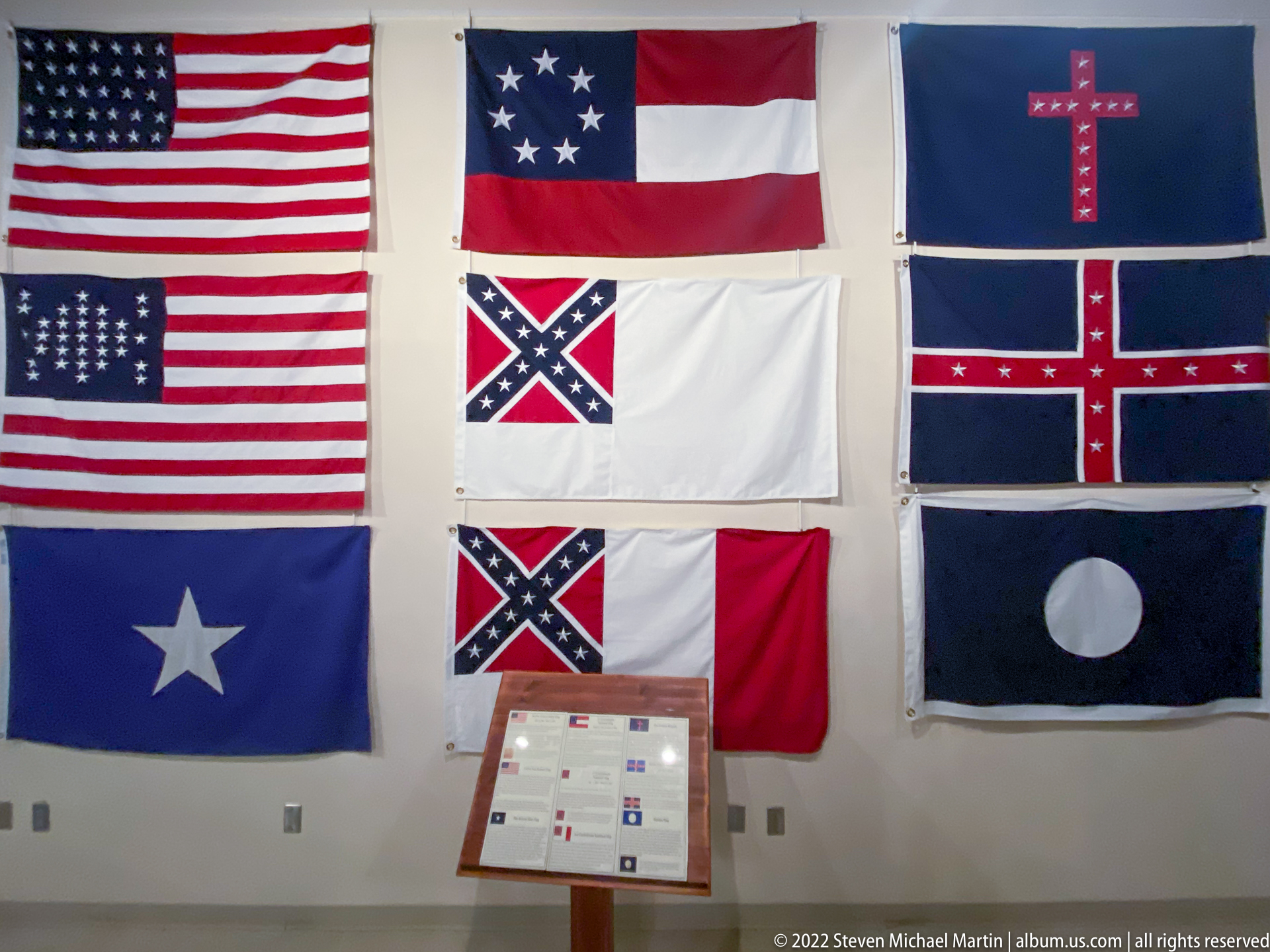
Several flags hang in three rows above a small interpretive stand. The group includes red, white, and blue designs, stars, crosses, and a central arrangement of state or military emblems. Their varied forms suggest a display of flags associated with the Civil War era, though individual units and standards cannot all be identified from the thumbnail.
Caption
Several flags hang in three rows above a small interpretive stand. The group includes red, white, and blue designs, stars, crosses, and a central arrangement of state or military emblems. Their varied forms suggest a display of flags associated with the Civil War era, though individual units and standards cannot all be identified from the thumbnail.
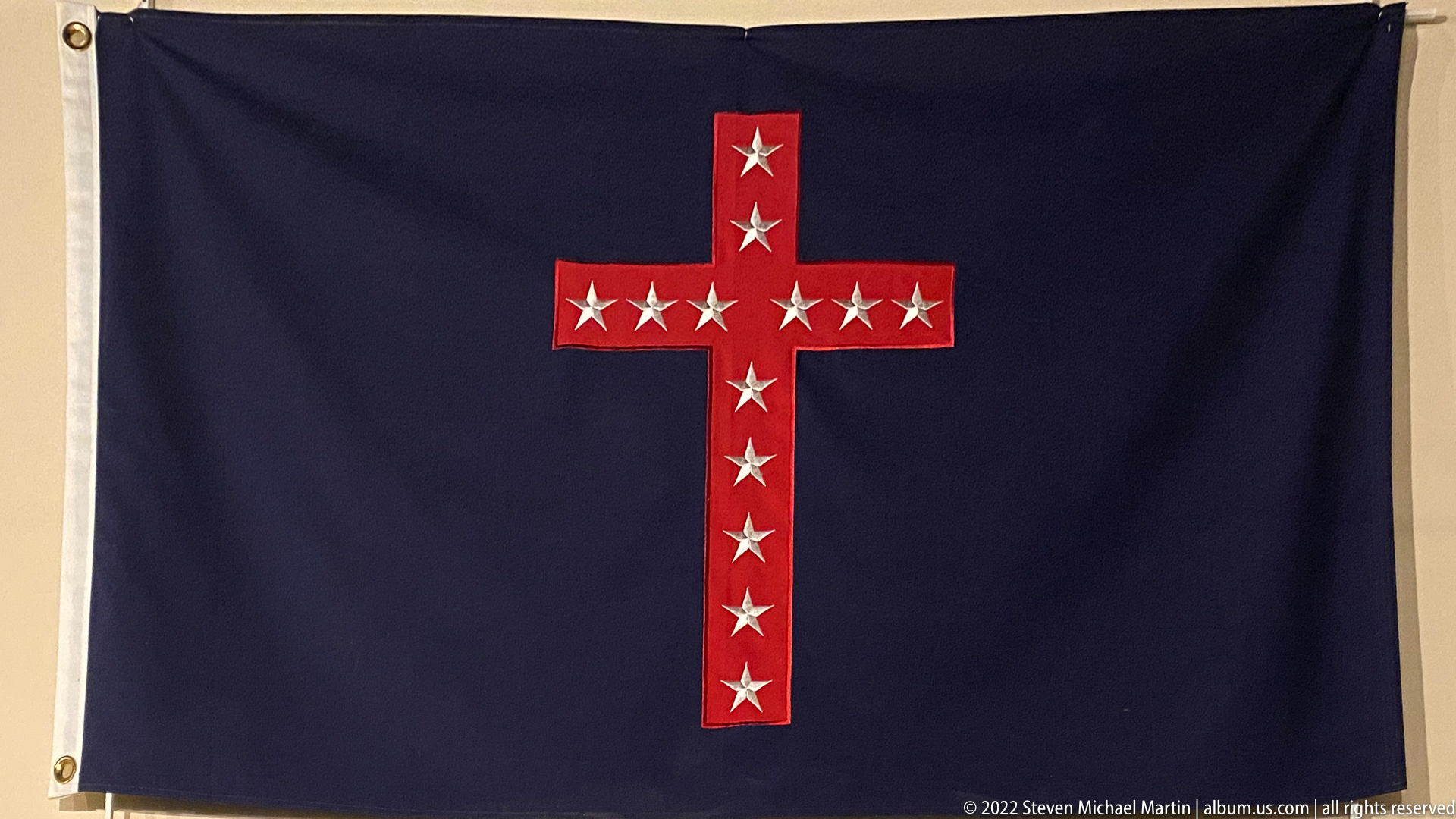
A dark blue flag fills the frame, centered on a red cross outlined in white and set with white stars. The close view reveals the fabric’s folds and stitched border but omits any exhibit label that would identify the flag’s unit or formal name. Its bold, isolated composition makes the cross-and-star design the photograph’s defining feature.
Caption
A dark blue flag fills the frame, centered on a red cross outlined in white and set with white stars. The close view reveals the fabric’s folds and stitched border but omits any exhibit label that would identify the flag’s unit or formal name. Its bold, isolated composition makes the cross-and-star design the photograph’s defining feature.
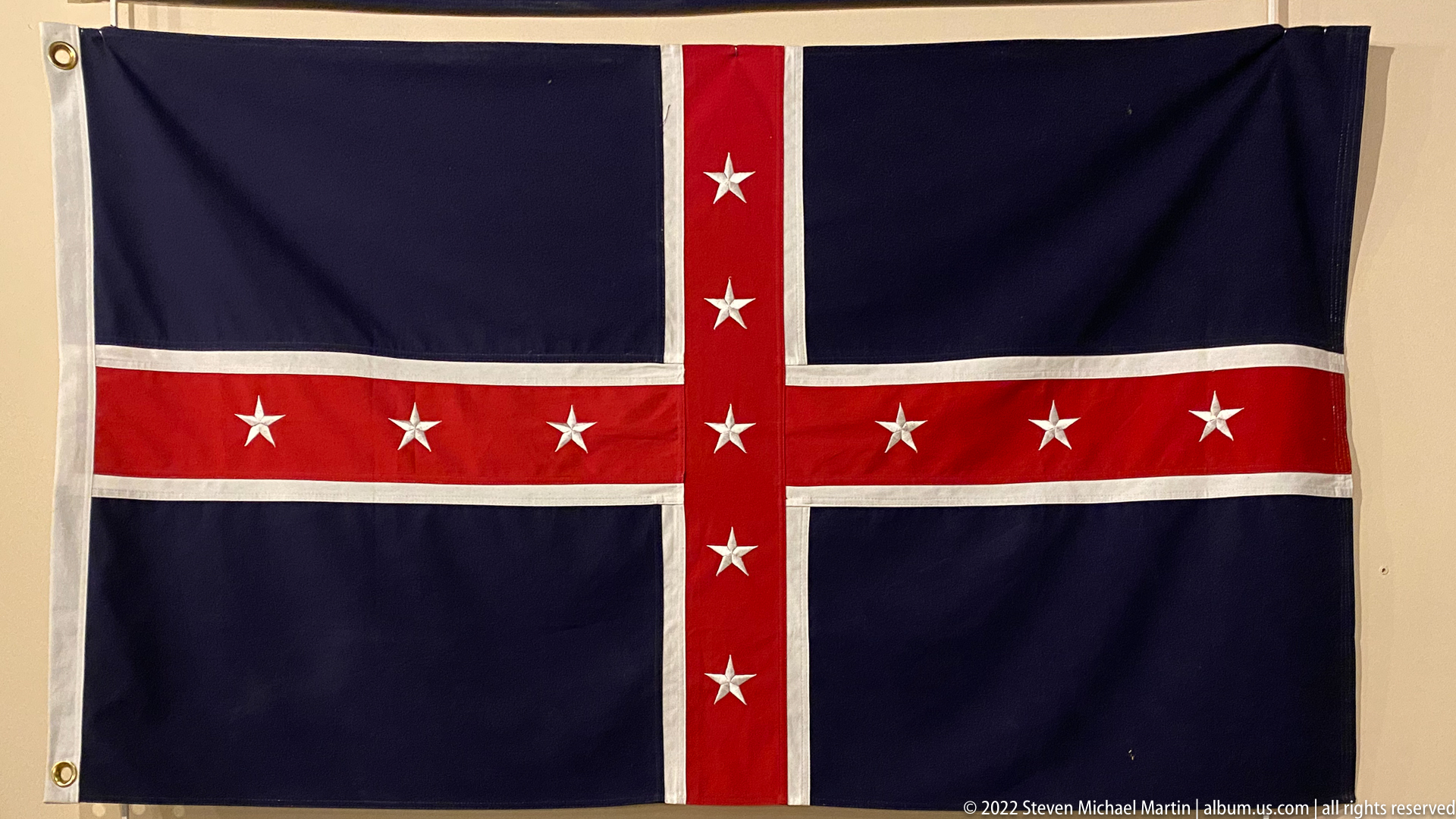
A red cross outlined in white divides a dark blue flag into four panels, with white stars placed along its arms. The textile hangs flat against a pale wall, allowing the proportions and repeated star pattern to read clearly. This wider, square-on view records the complete design and stitching, rather than an isolated detail or surrounding exhibit.
Caption
A red cross outlined in white divides a dark blue flag into four panels, with white stars placed along its arms. The textile hangs flat against a pale wall, allowing the proportions and repeated star pattern to read clearly. This wider, square-on view records the complete design and stitching, rather than an isolated detail or surrounding exhibit.
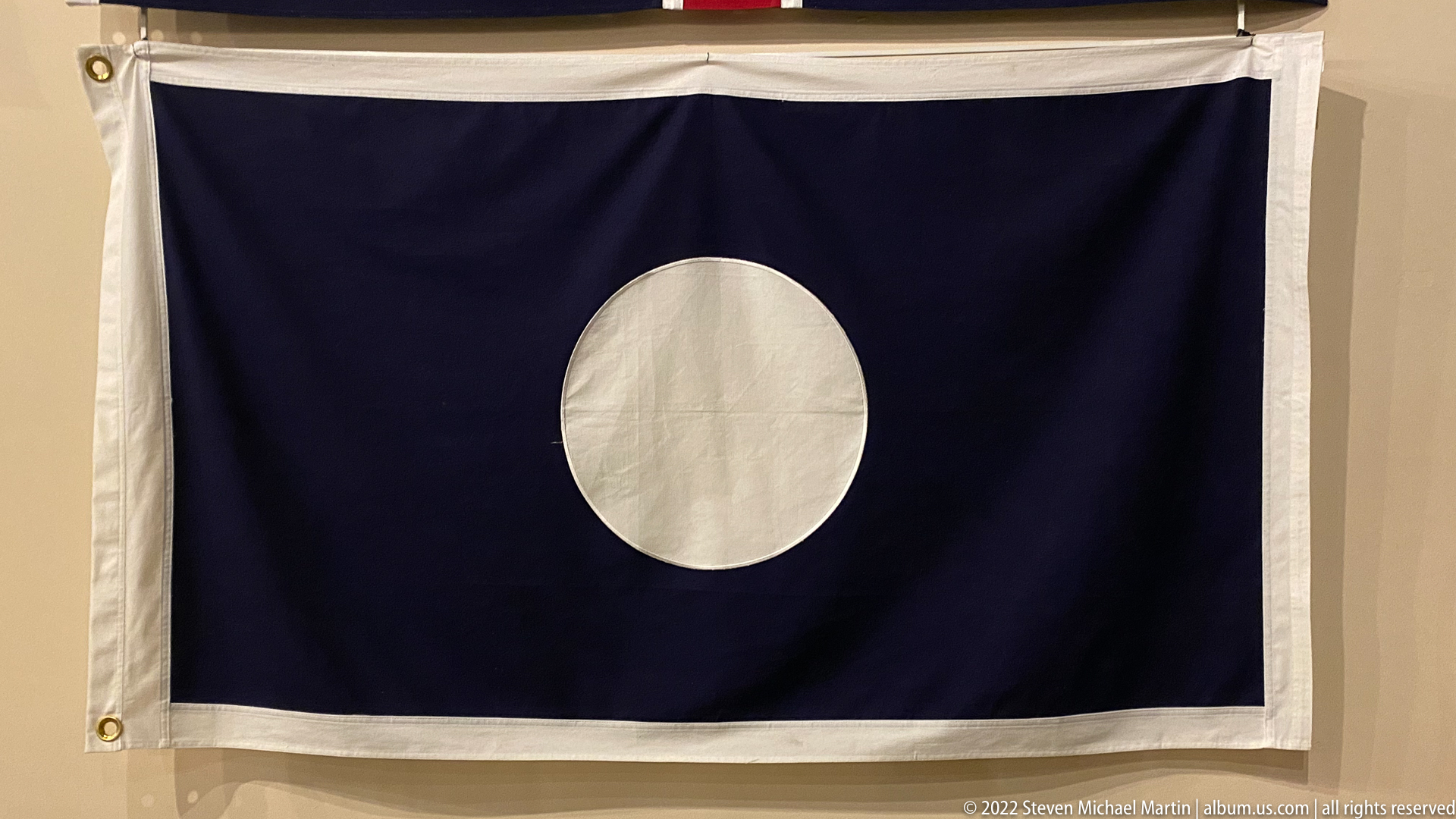
A dark blue textile hangs within a cream-colored border, with one large white circular field centered on the fabric. The minimal design stands apart from the cross and striped flags shown elsewhere in the gallery. No label appears in the close framing, so the flag is best distinguished by its visible colors and central emblem.
Caption
A dark blue textile hangs within a cream-colored border, with one large white circular field centered on the fabric. The minimal design stands apart from the cross and striped flags shown elsewhere in the gallery. No label appears in the close framing, so the flag is best distinguished by its visible colors and central emblem.
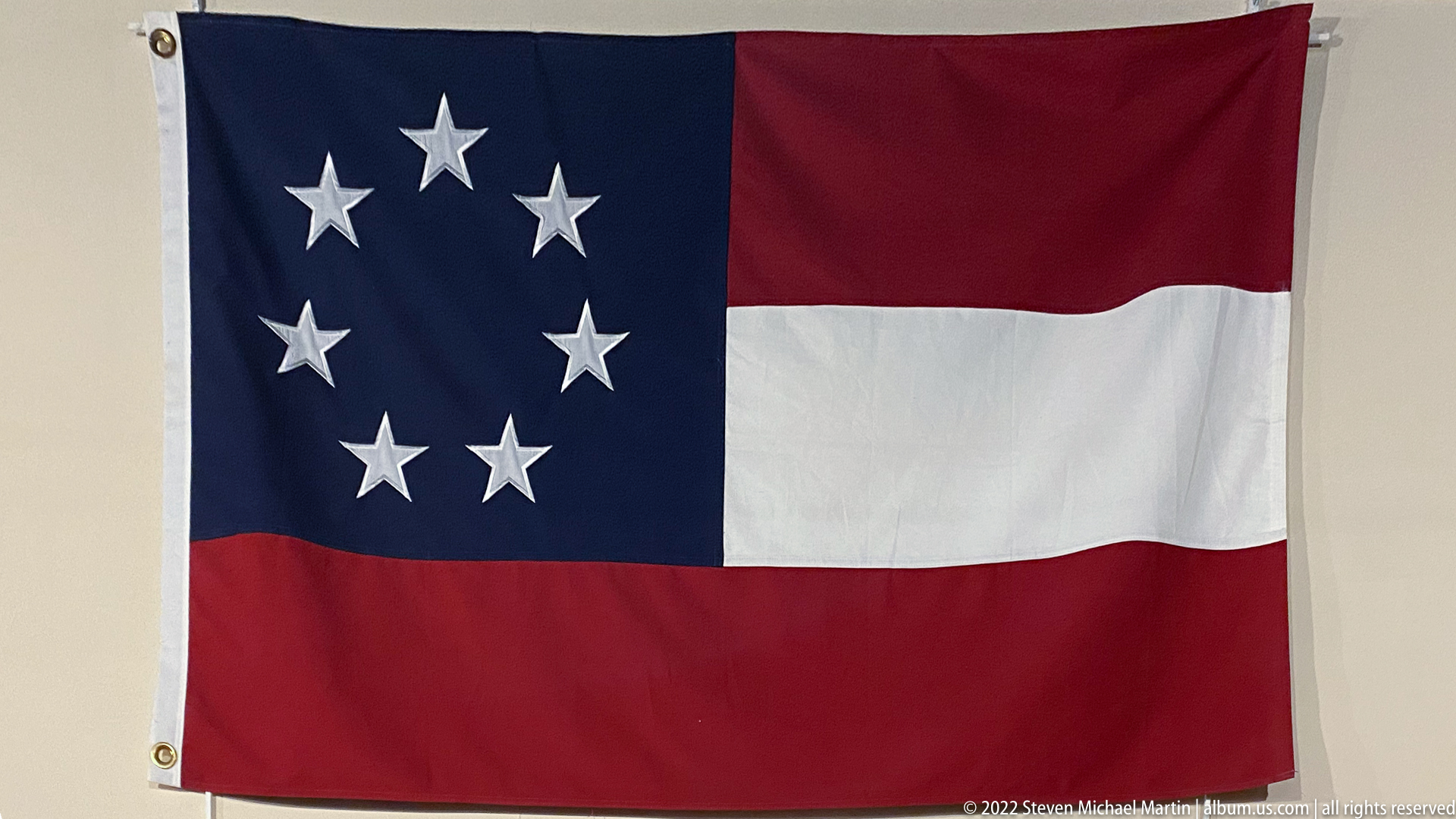
A flag with red and white horizontal bands hangs close to the camera, its blue canton filled with a ring of white stars. The simple, direct composition isolates the textile’s layout and contrasting colors. The flag corresponds to a Confederate national design, but the thumbnail does not show the museum label or identify a specific version.
Caption
A flag with red and white horizontal bands hangs close to the camera, its blue canton filled with a ring of white stars. The simple, direct composition isolates the textile’s layout and contrasting colors. The flag corresponds to a Confederate national design, but the thumbnail does not show the museum label or identify a specific version.
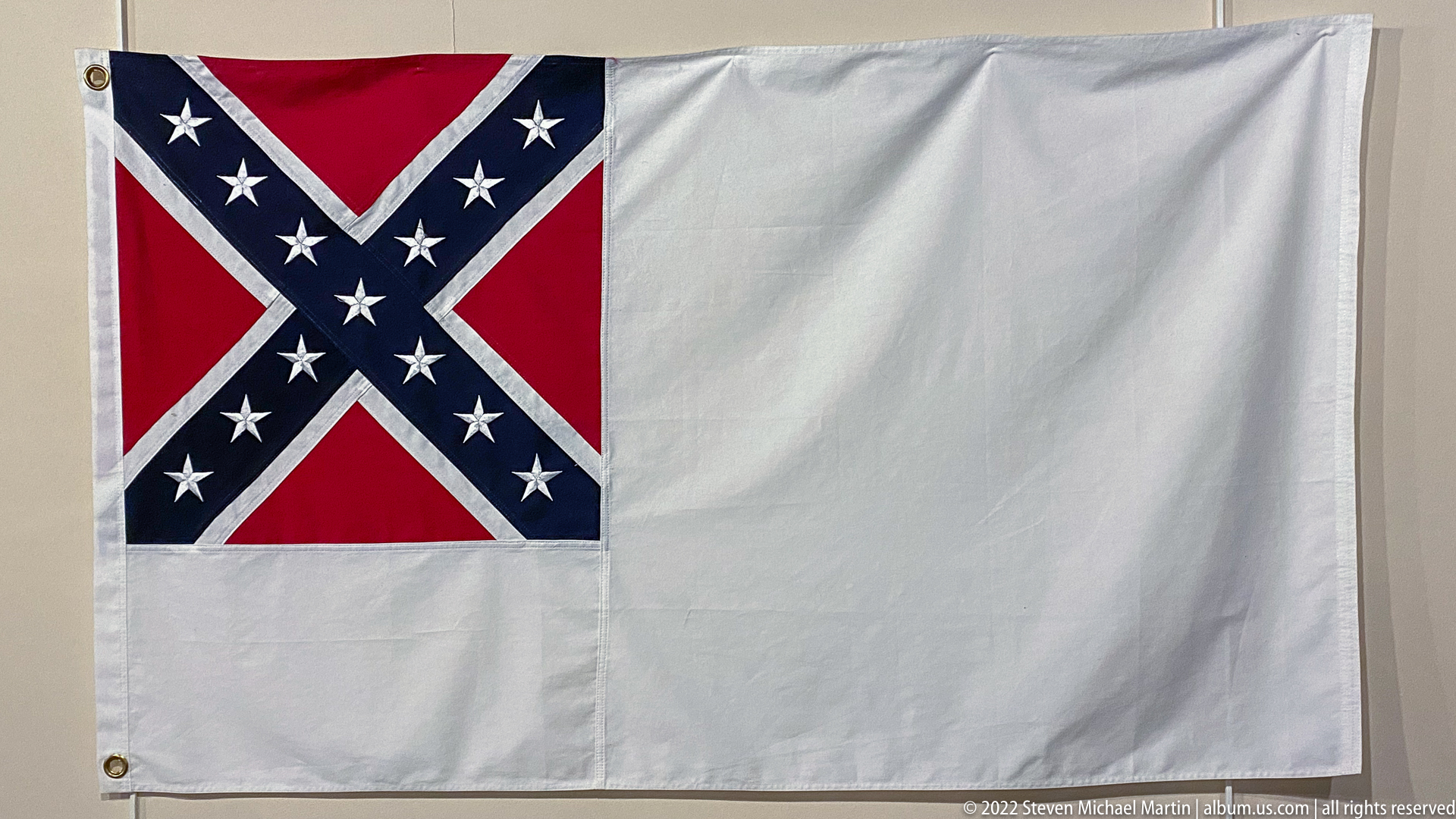
A white flag hangs from a narrow rod, with a red field and blue diagonal cross bearing white stars confined to the upper left. The rest of the textile remains unmarked, making the asymmetrical placement especially clear. The close view records the flag’s contrasting fields and stitched edges without asserting a unit association.
Caption
A white flag hangs from a narrow rod, with a red field and blue diagonal cross bearing white stars confined to the upper left. The rest of the textile remains unmarked, making the asymmetrical placement especially clear. The close view records the flag’s contrasting fields and stitched edges without asserting a unit association.
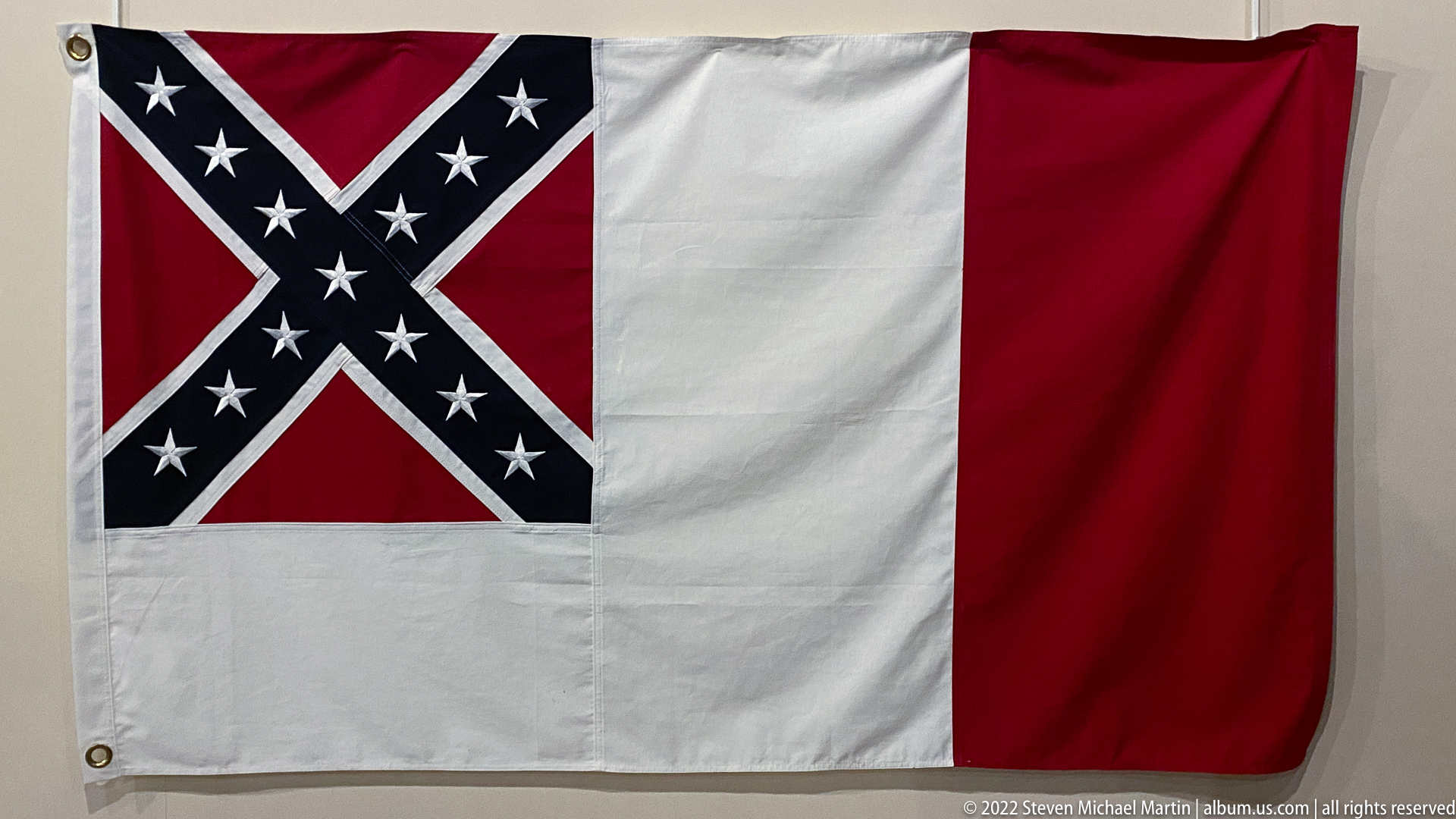
A red-and-white flag is dominated by a blue diagonal cross outlined in white and filled with stars. The lower edge hangs free, revealing folds and a small fastening point near the corner. This composition isolates a familiar Confederate battle-flag design from the explanatory panel and other banners shown nearby.
Caption
A red-and-white flag is dominated by a blue diagonal cross outlined in white and filled with stars. The lower edge hangs free, revealing folds and a small fastening point near the corner. This composition isolates a familiar Confederate battle-flag design from the explanatory panel and other banners shown nearby.
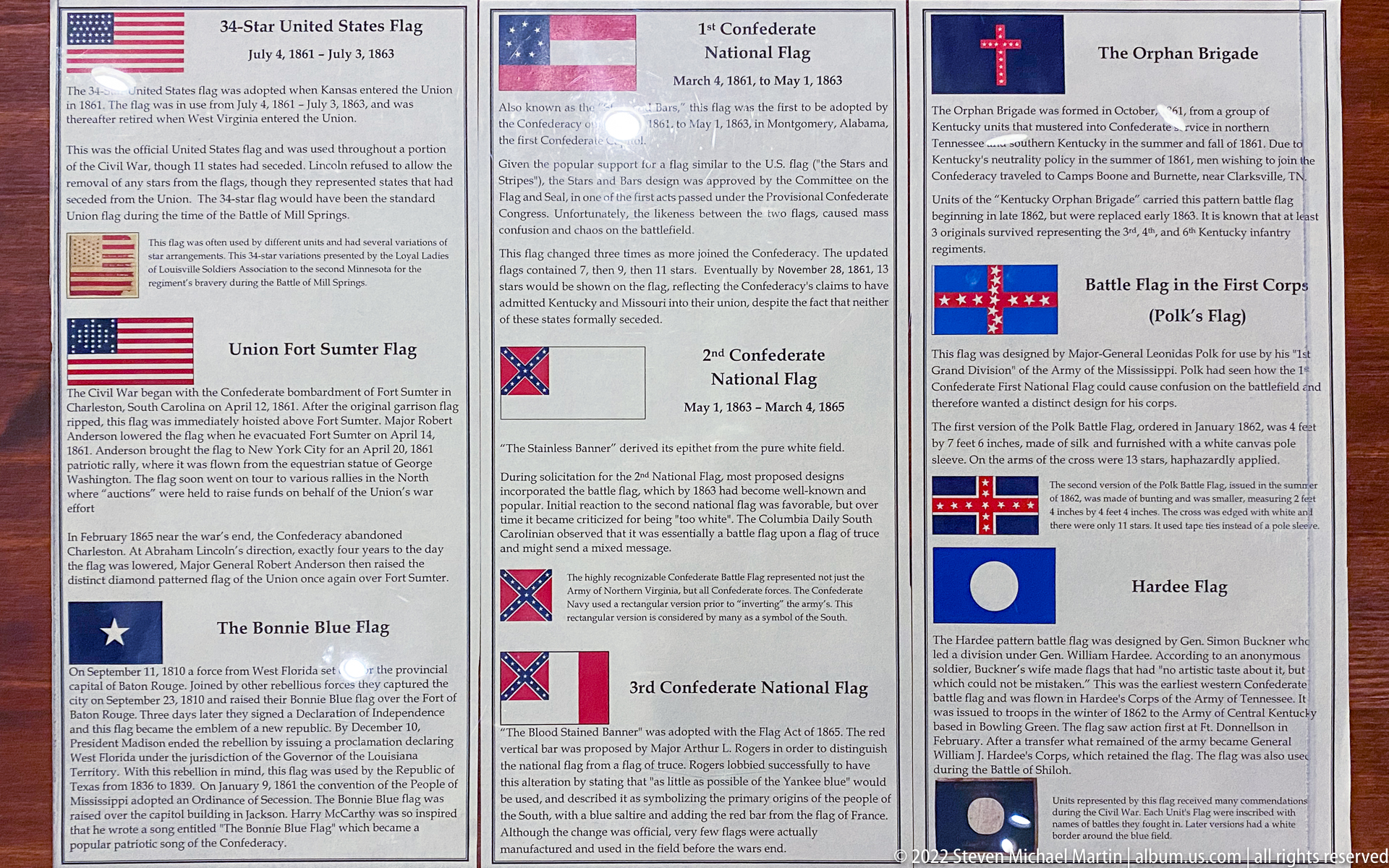
A multi-column panel pairs small flag illustrations with descriptions of Union and Confederate standards. Visible headings include “Union Fort Sumter Flag,” “The Bonnie Blue Flag,” “1st Confederate National Flag,” “The Orphan Brigade,” and “Hardee Flag.” The dense layout gives the flags shown elsewhere in the room their historical names and organizational context.
Caption
A multi-column panel pairs small flag illustrations with descriptions of Union and Confederate standards. Visible headings include “Union Fort Sumter Flag,” “The Bonnie Blue Flag,” “1st Confederate National Flag,” “The Orphan Brigade,” and “Hardee Flag.” The dense layout gives the flags shown elsewhere in the room their historical names and organizational context.
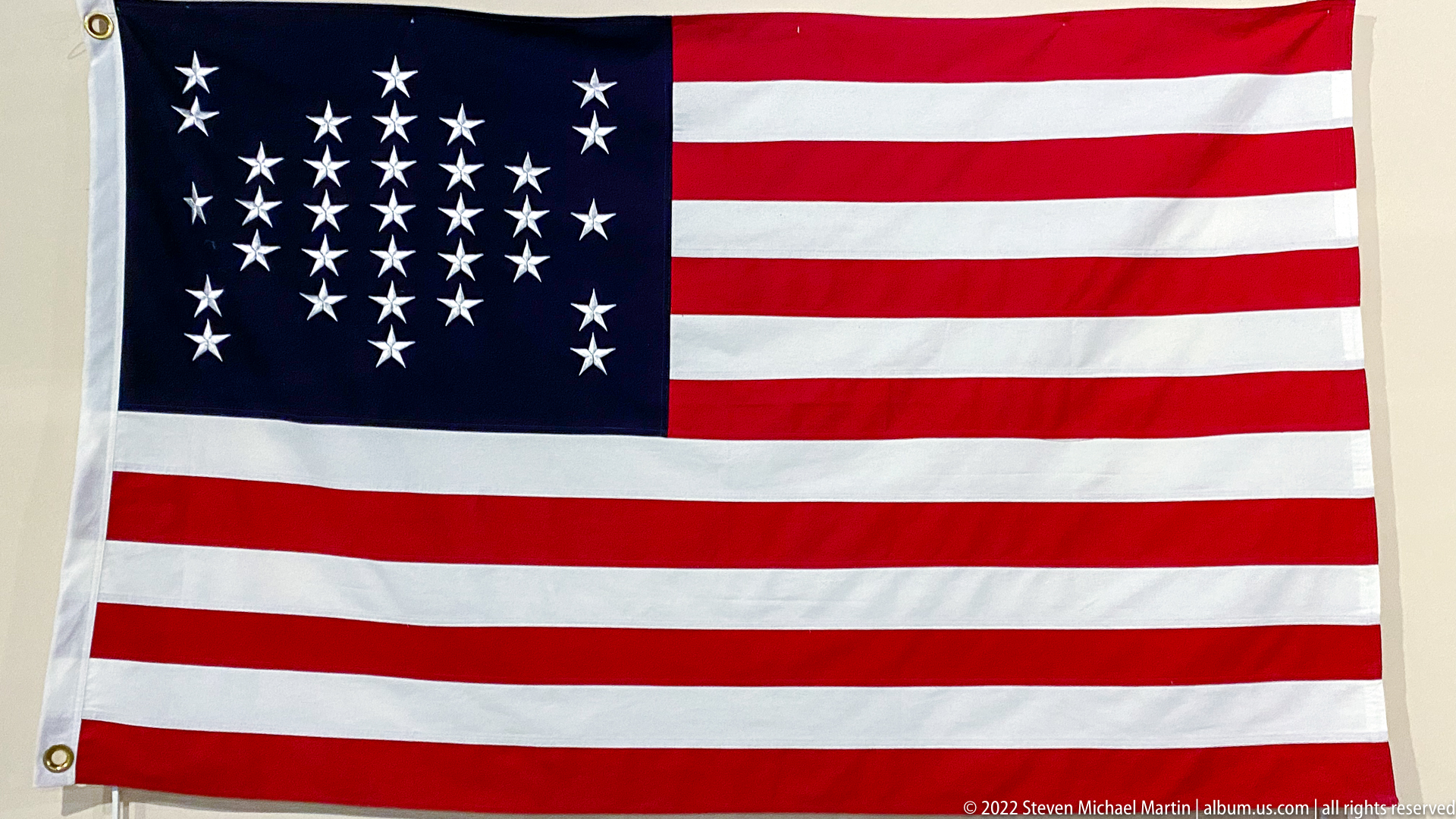
A flag with red and white horizontal bands hangs close to the camera, its blue canton filled with white stars arranged in a circle. The pattern identifies it as a 34-star United States flag, a design used during the Civil War era. The close frontal view isolates its stripes, star field, and stitched edges from the broader exhibit.
Caption
A flag with red and white horizontal bands hangs close to the camera, its blue canton filled with white stars arranged in a circle. The pattern identifies it as a 34-star United States flag, a design used during the Civil War era. The close frontal view isolates its stripes, star field, and stitched edges from the broader exhibit.
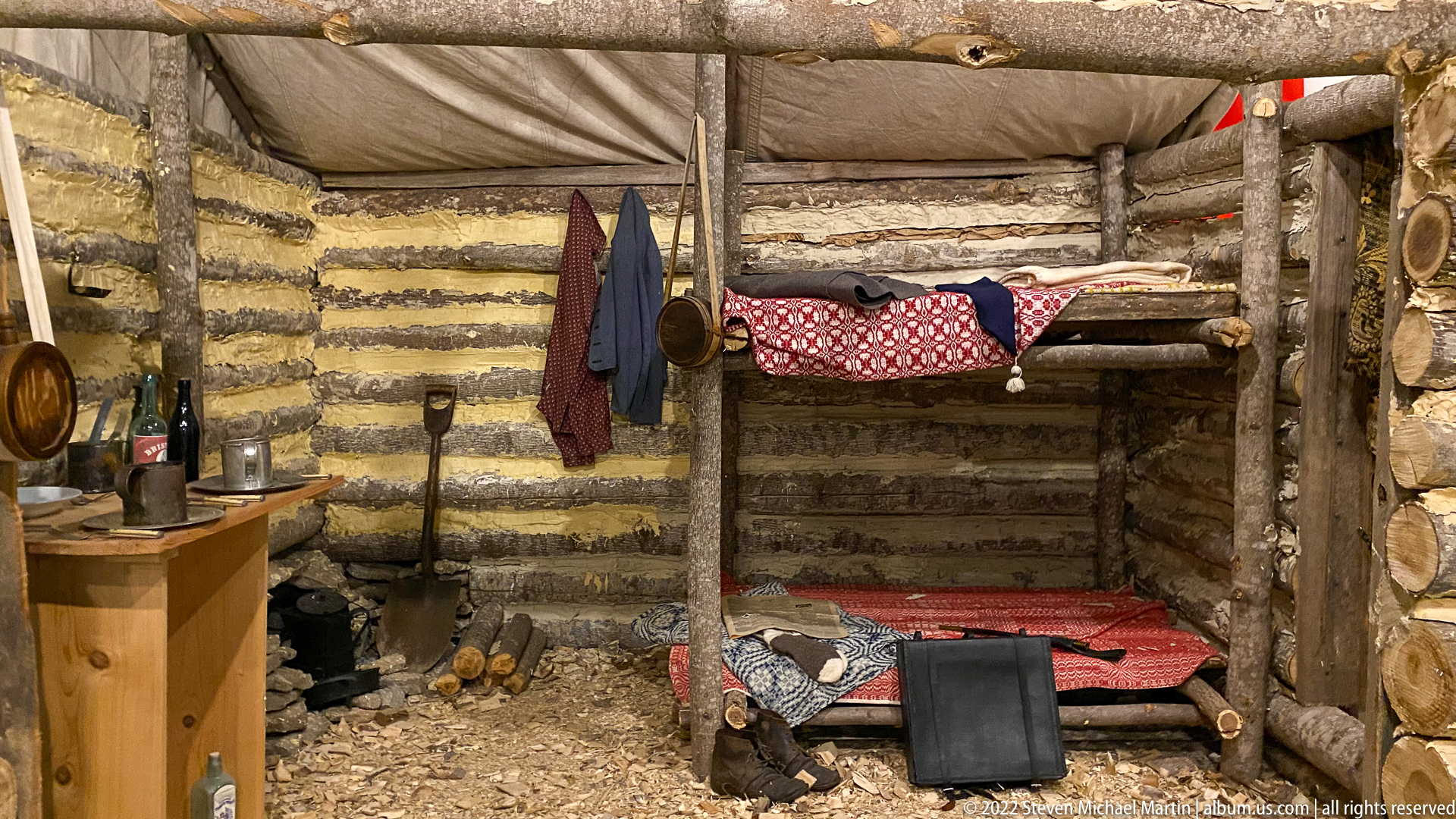
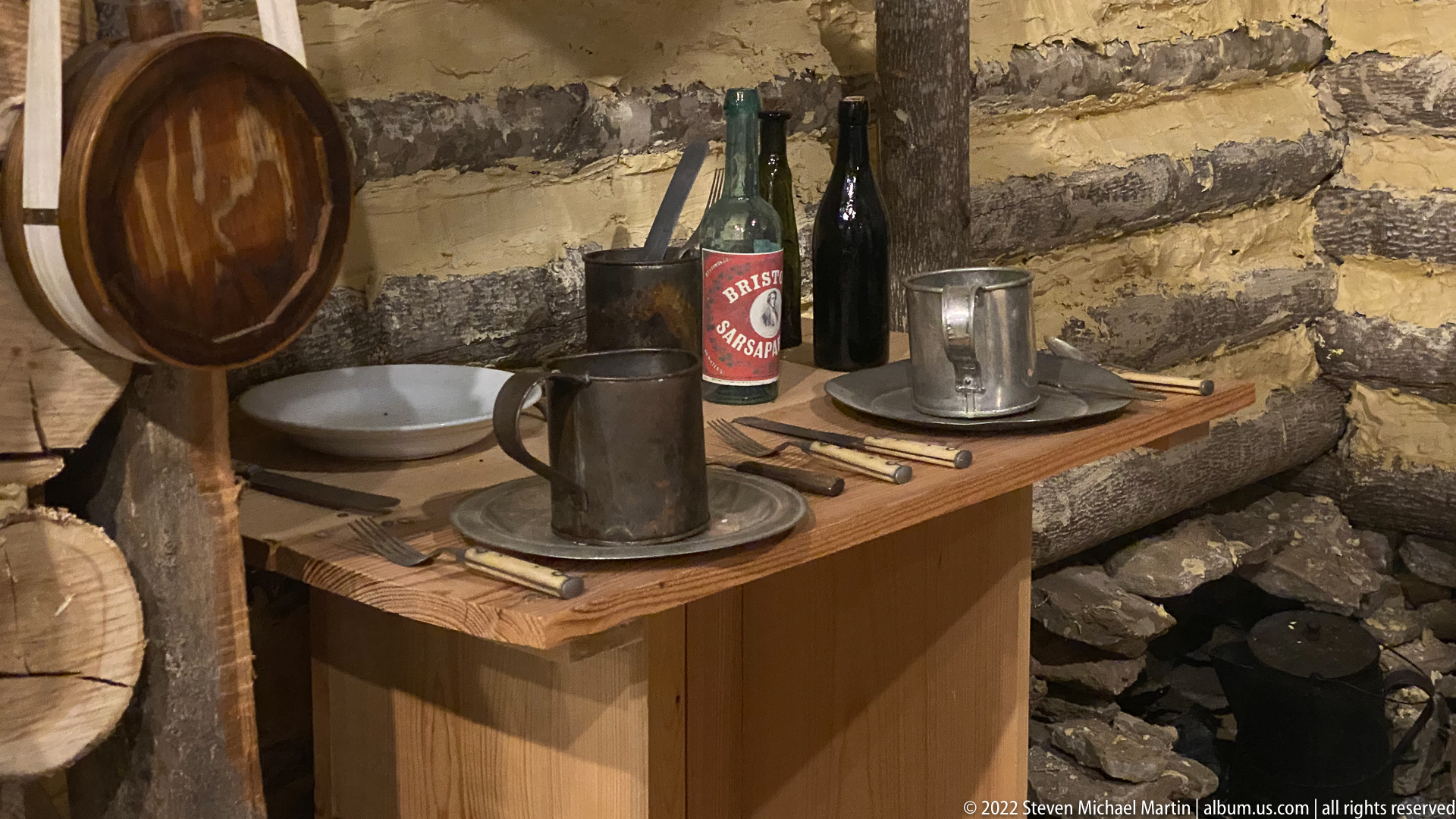
A wooden table in the log-walled room holds metal plates, cups, a pitcher, and a dark bottle, with a large wooden vessel mounted behind it. The objects are arranged as a domestic still life beside the rough cabin wall. This detail shifts attention from the furnished room to the practical household items used in the historical interpretation.
Caption
A wooden table in the log-walled room holds metal plates, cups, a pitcher, and a dark bottle, with a large wooden vessel mounted behind it. The objects are arranged as a domestic still life beside the rough cabin wall. This detail shifts attention from the furnished room to the practical household items used in the historical interpretation.
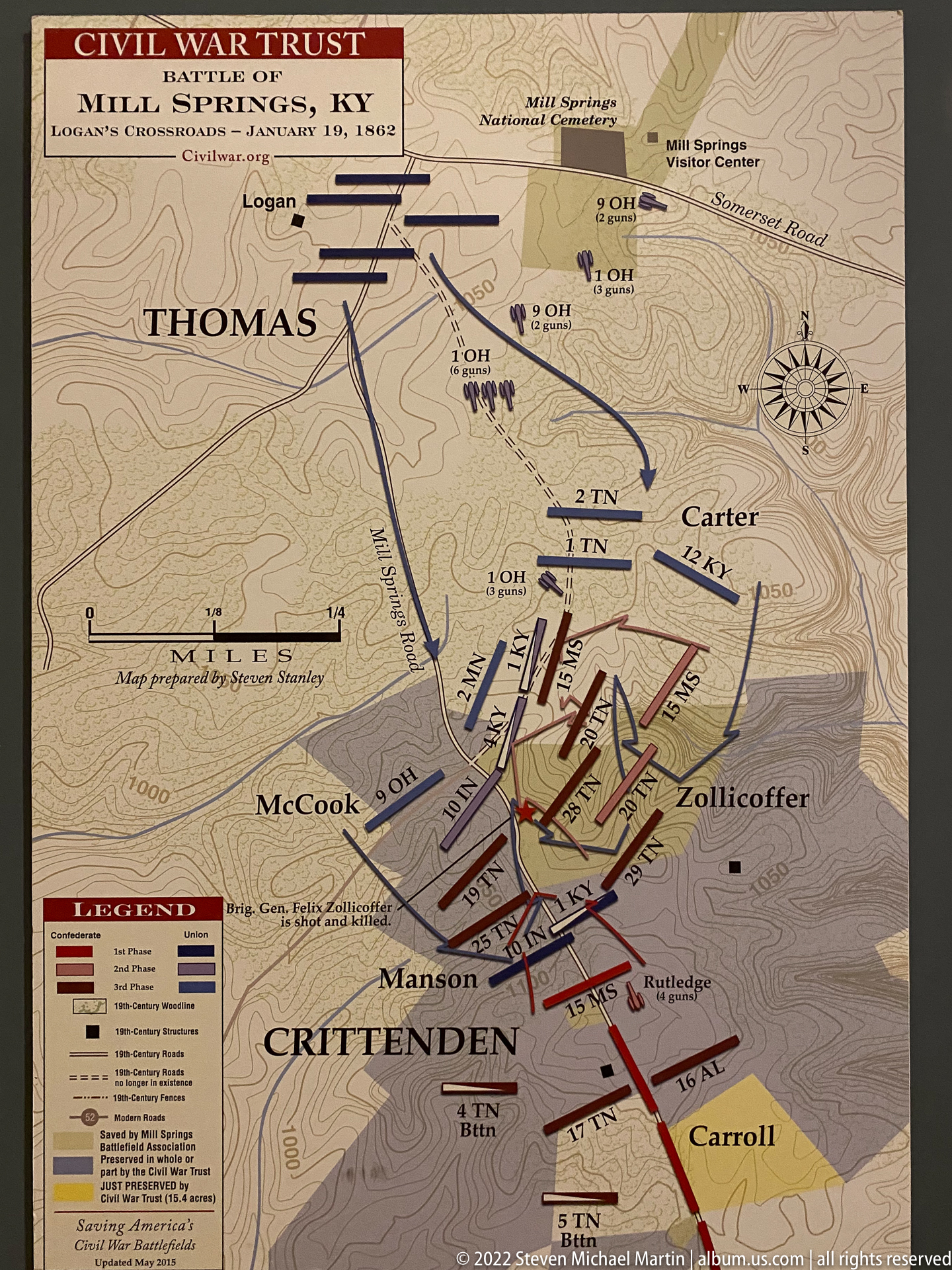
A tan relief-style map marks roads, rivers, and troop movements around Thomas, Carter, and Zollicoffer. Blue and red arrows converge near the center, while a legend distinguishes forces and positions. The close view emphasizes the battlefield’s geography and coordinated movement across the terrain, translating the encounter into a network of routes and placements.
Caption
A tan relief-style map marks roads, rivers, and troop movements around Thomas, Carter, and Zollicoffer. Blue and red arrows converge near the center, while a legend distinguishes forces and positions. The close view emphasizes the battlefield’s geography and coordinated movement across the terrain, translating the encounter into a network of routes and placements.
A furnished room combines a striped long dress, a white blouse displayed on a torso form, a wooden table, shelves, dishes, and a stone fireplace. A framed flag image and other documents occupy the wall beside the hearth. The museum arrangement evokes a nineteenth-century domestic interior, though the specific occupants and exact date are not named in the view.
Caption
A furnished room combines a striped long dress, a white blouse displayed on a torso form, a wooden table, shelves, dishes, and a stone fireplace. A framed flag image and other documents occupy the wall beside the hearth. The museum arrangement evokes a nineteenth-century domestic interior, though the specific occupants and exact date are not named in the view.

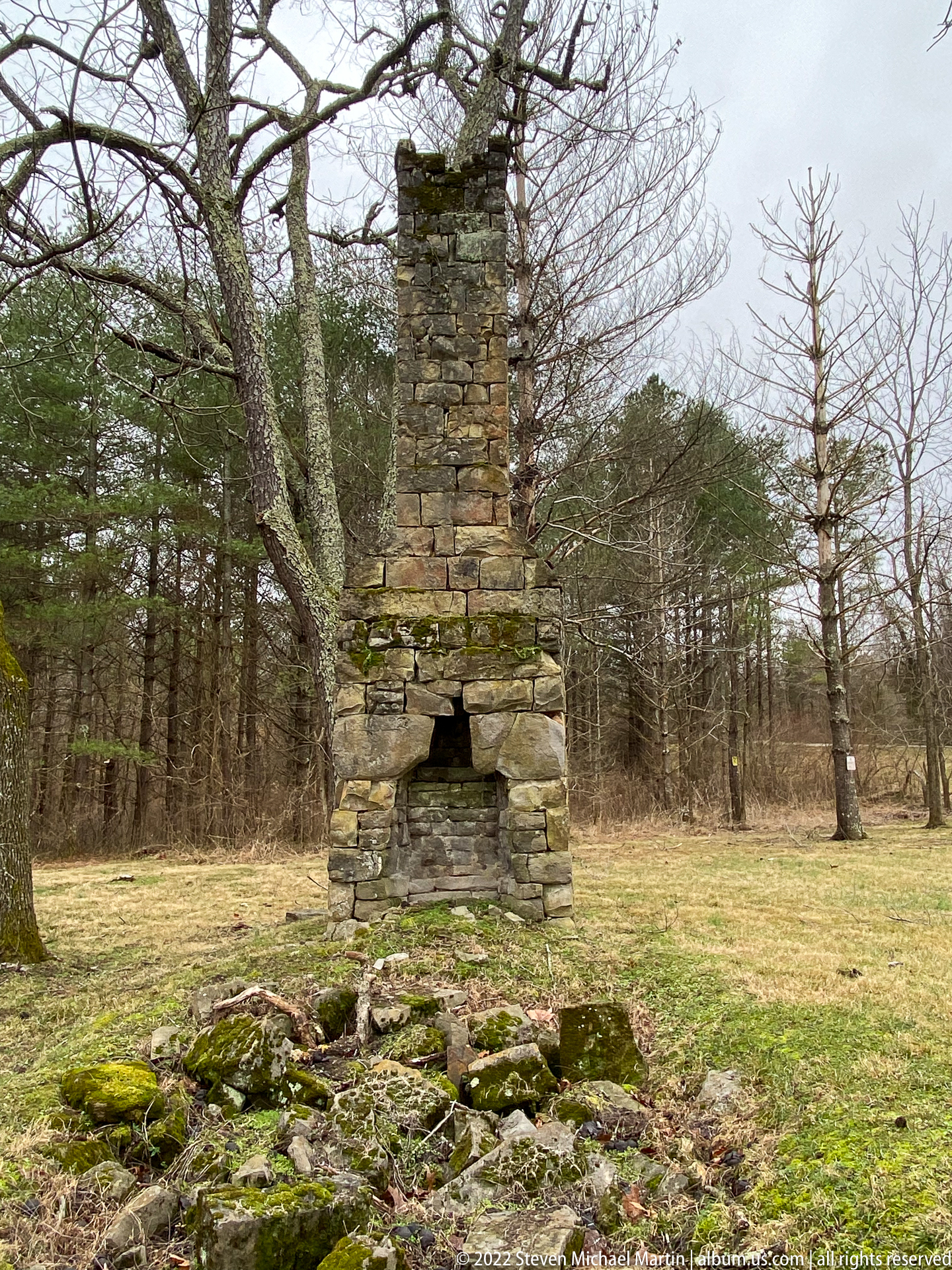
A solitary chimney stands between trees in a patch of winter grass, its rectangular stack rising from a wider base with a low dark opening. Rubble lies in front, suggesting the rest of the structure no longer survives in view. The wider composition situates the remnant within woodland but does not identify the building it once served.
Caption
A solitary chimney stands between trees in a patch of winter grass, its rectangular stack rising from a wider base with a low dark opening. Rubble lies in front, suggesting the rest of the structure no longer survives in view. The wider composition situates the remnant within woodland but does not identify the building it once served.
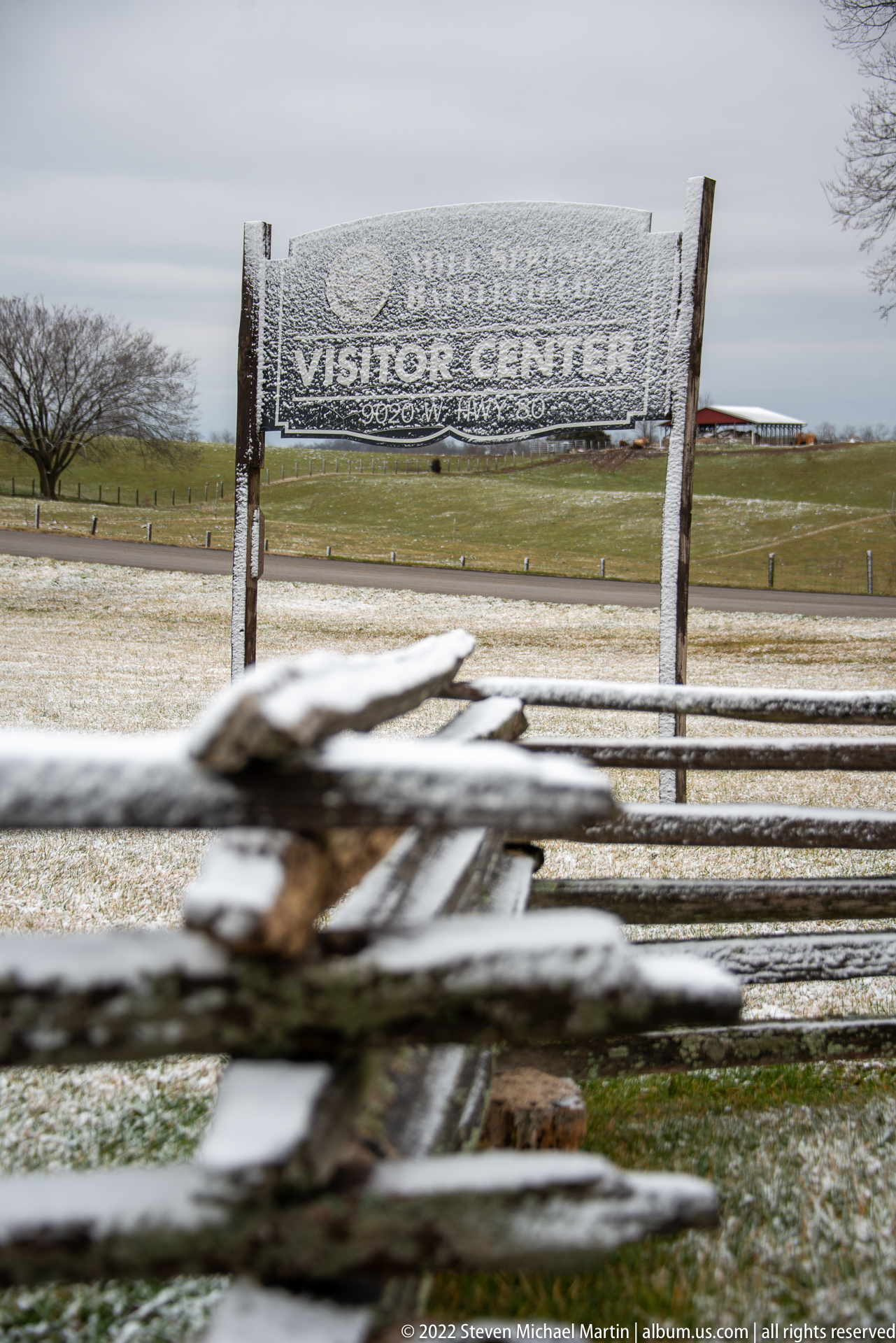
The visitor-center sign stands in the midground beyond a split-rail fence, with snow lightly coating the grass and rails. The low camera angle places the fence across the lower frame and the sign against an open, overcast landscape. This wider view restores the sign’s setting after the previous close-up isolated its frosted surface.
Caption
The visitor-center sign stands in the midground beyond a split-rail fence, with snow lightly coating the grass and rails. The low camera angle places the fence across the lower frame and the sign against an open, overcast landscape. This wider view restores the sign’s setting after the previous close-up isolated its frosted surface.

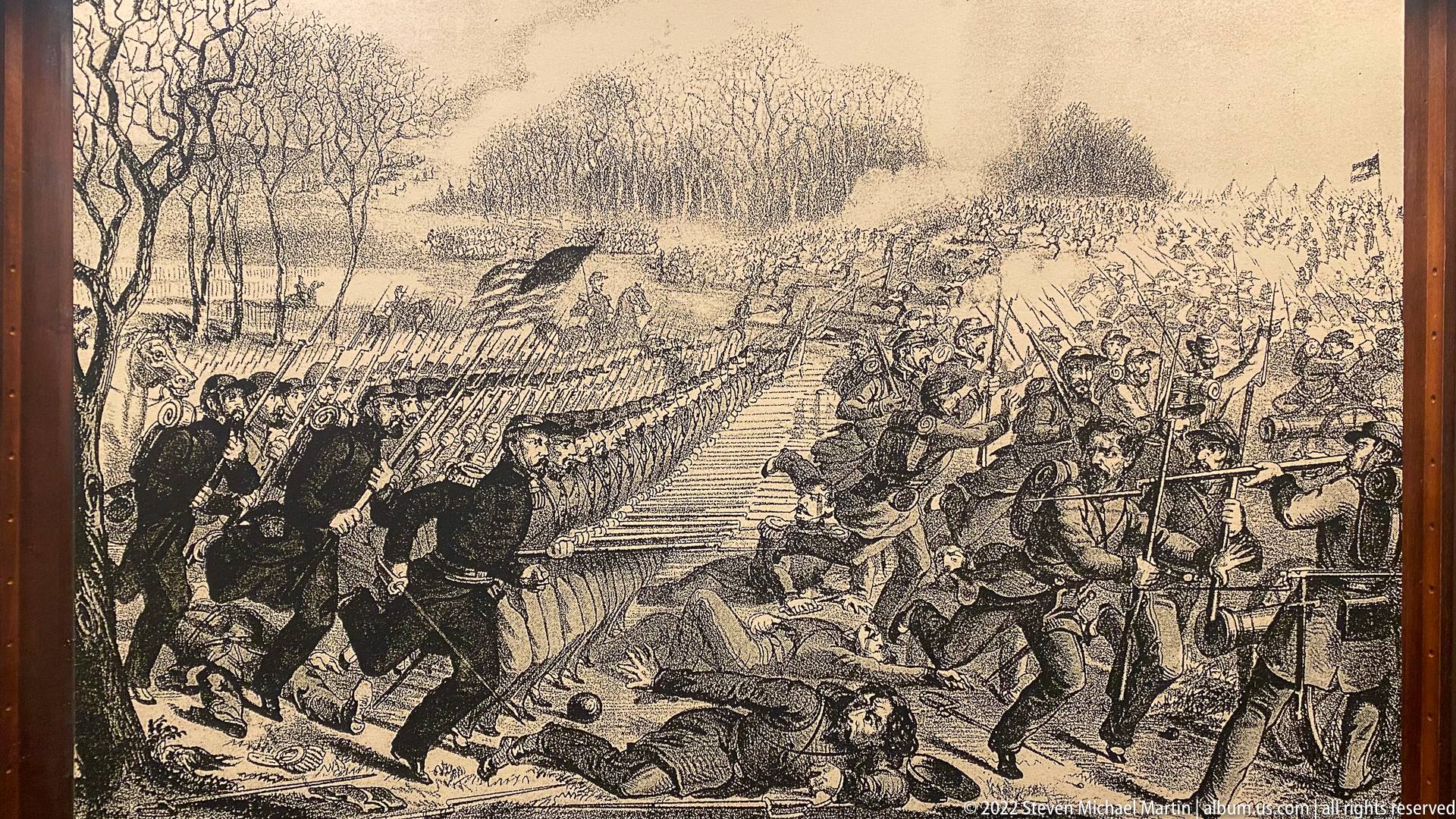
A large monochrome engraving shows soldiers advancing and firing through a wooded area, with figures and fallen men spread across the foreground. Rows of troops and smoke recede toward the distance, creating a dense battlefield scene. The image is presented behind glass in the museum, where its detailed linework offers a period-style visual account of combat.
Caption
A large monochrome engraving shows soldiers advancing and firing through a wooded area, with figures and fallen men spread across the foreground. Rows of troops and smoke recede toward the distance, creating a dense battlefield scene. The image is presented behind glass in the museum, where its detailed linework offers a period-style visual account of combat.
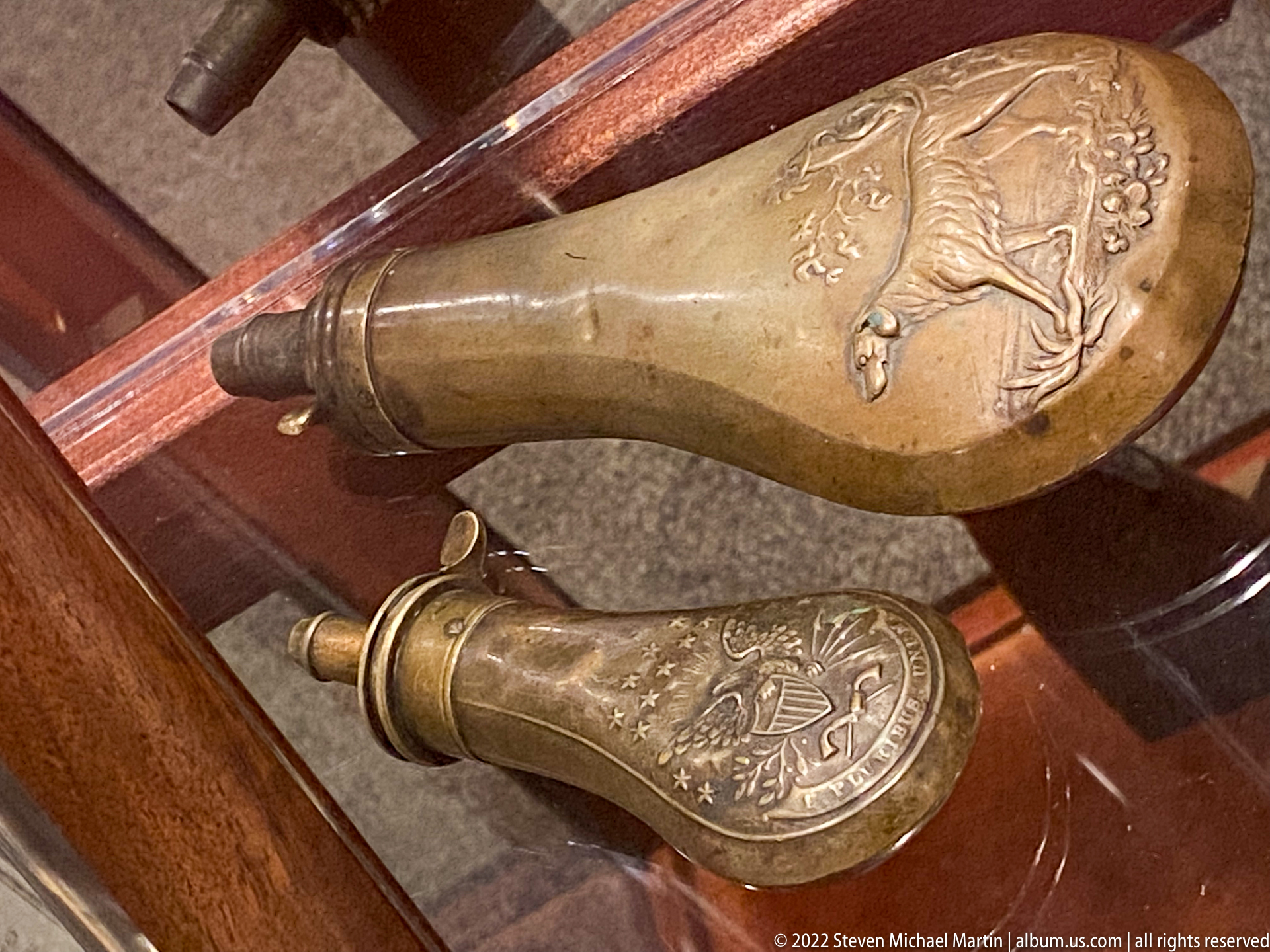
Two elongated flask-shaped objects lie on a wooden display surface, each with a narrow neck and broad flattened body. Their brown surfaces carry raised decorative scenes and borders, with a small cap or fitting visible nearby. The forms resemble powder flasks, but the proof sheet does not show a readable label to confirm their exact material or origin.
Caption
Two elongated flask-shaped objects lie on a wooden display surface, each with a narrow neck and broad flattened body. Their brown surfaces carry raised decorative scenes and borders, with a small cap or fitting visible nearby. The forms resemble powder flasks, but the proof sheet does not show a readable label to confirm their exact material or origin.
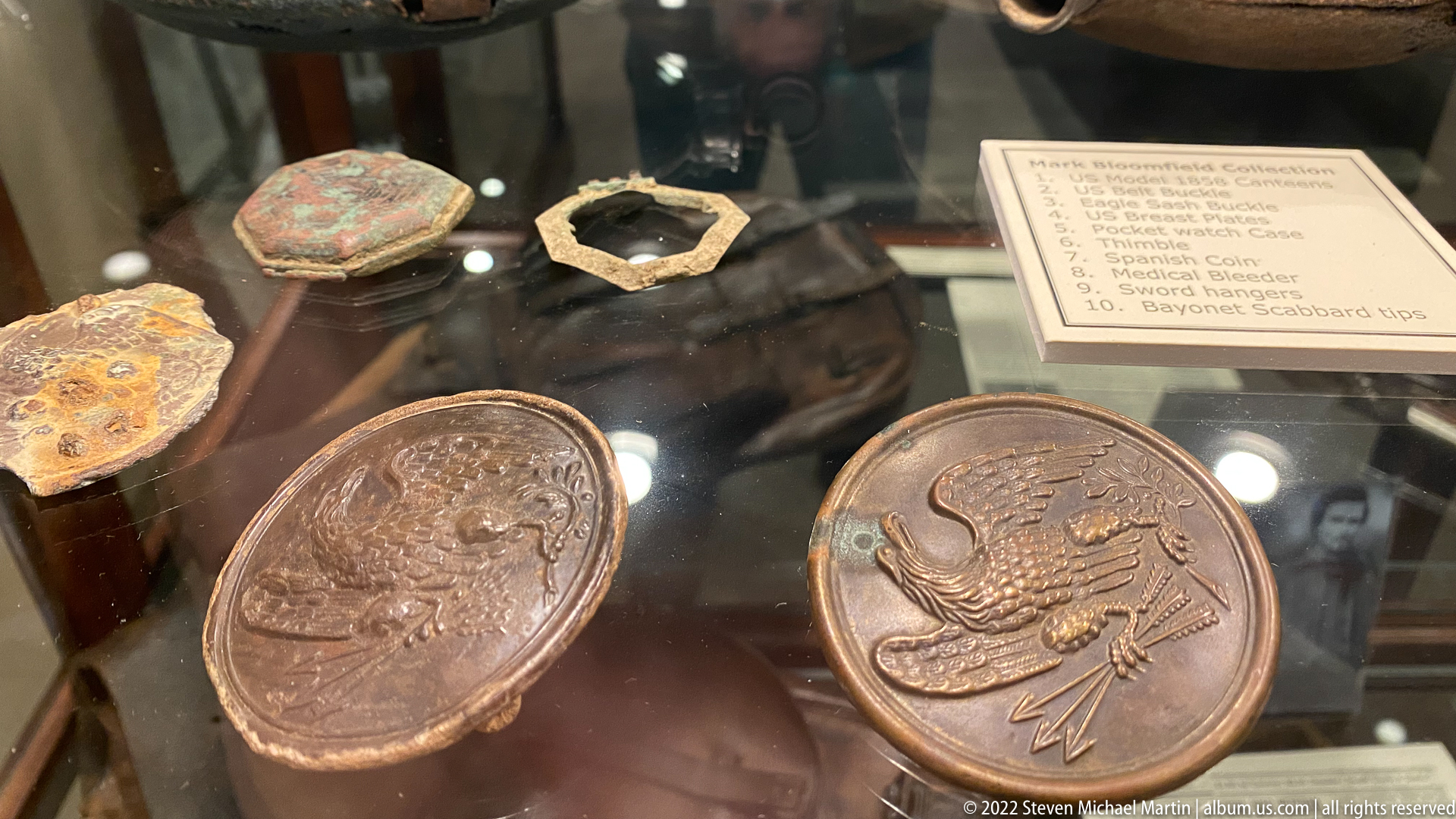
Several round and oval metal objects lie in a glass case beside a small identification card. Two larger medallions have raised designs, including an eagle-like figure and a profile or emblem; smaller pieces and a ring-shaped fragment sit nearby. The close view shows decorative relief and worn surfaces, but not enough detail to name each object.
Caption
Several round and oval metal objects lie in a glass case beside a small identification card. Two larger medallions have raised designs, including an eagle-like figure and a profile or emblem; smaller pieces and a ring-shaped fragment sit nearby. The close view shows decorative relief and worn surfaces, but not enough detail to name each object.
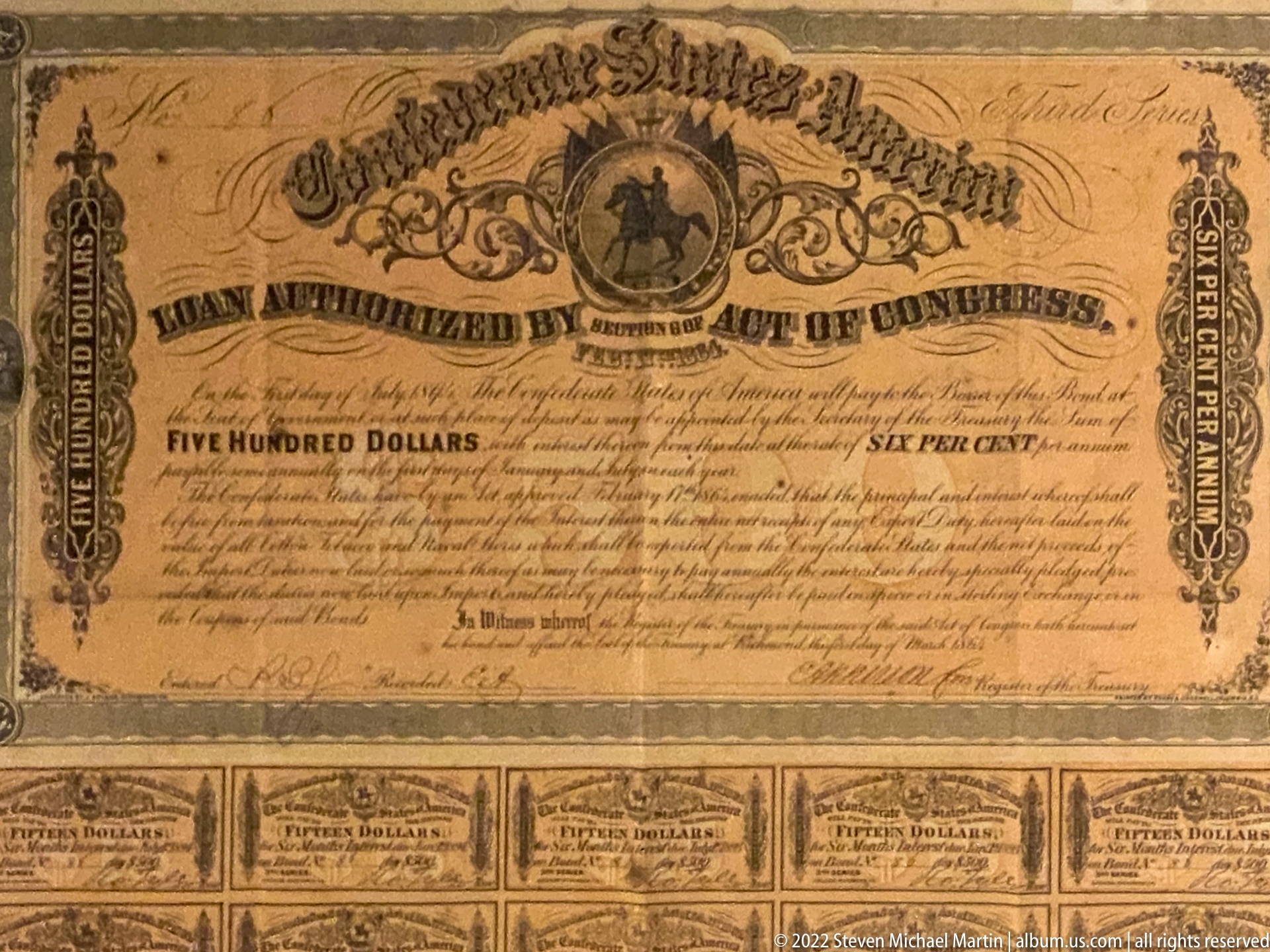
An aged paper note fills the frame, with ornate scrollwork, a central portrait, and large lettering reading “Five Hundred Dollars” and “Loan Authorized by Act of Congress.” Rows of smaller denomination notes appear along the lower edge. The printed typography and decorative frame make the currency’s financial and political context visible without requiring a close reading of the fine text.
Caption
An aged paper note fills the frame, with ornate scrollwork, a central portrait, and large lettering reading “Five Hundred Dollars” and “Loan Authorized by Act of Congress.” Rows of smaller denomination notes appear along the lower edge. The printed typography and decorative frame make the currency’s financial and political context visible without requiring a close reading of the fine text.
Two flags cross on slender poles against a plain interior wall. One has red and white bands with a blue canton of white stars; the other has a broad red lower field and a blue canton with stars. Their overlapping arrangement links national flag designs to the surrounding Civil War exhibits, though the second flag’s exact type is not identified here.
Caption
Two flags cross on slender poles against a plain interior wall. One has red and white bands with a blue canton of white stars; the other has a broad red lower field and a blue canton with stars. Their overlapping arrangement links national flag designs to the surrounding Civil War exhibits, though the second flag’s exact type is not identified here.

A narrow stone chimney rises from a low pile of rubble in a grassy clearing surrounded by mature trees. Its stacked masonry tapers slightly toward the top, with a dark fireplace opening near ground level. Moss marks several stones, while the setting remains open and wooded. The photograph records a surviving domestic or farm structure without assigning its history.
Caption
A narrow stone chimney rises from a low pile of rubble in a grassy clearing surrounded by mature trees. Its stacked masonry tapers slightly toward the top, with a dark fireplace opening near ground level. Moss marks several stones, while the setting remains open and wooded. The photograph records a surviving domestic or farm structure without assigning its history.
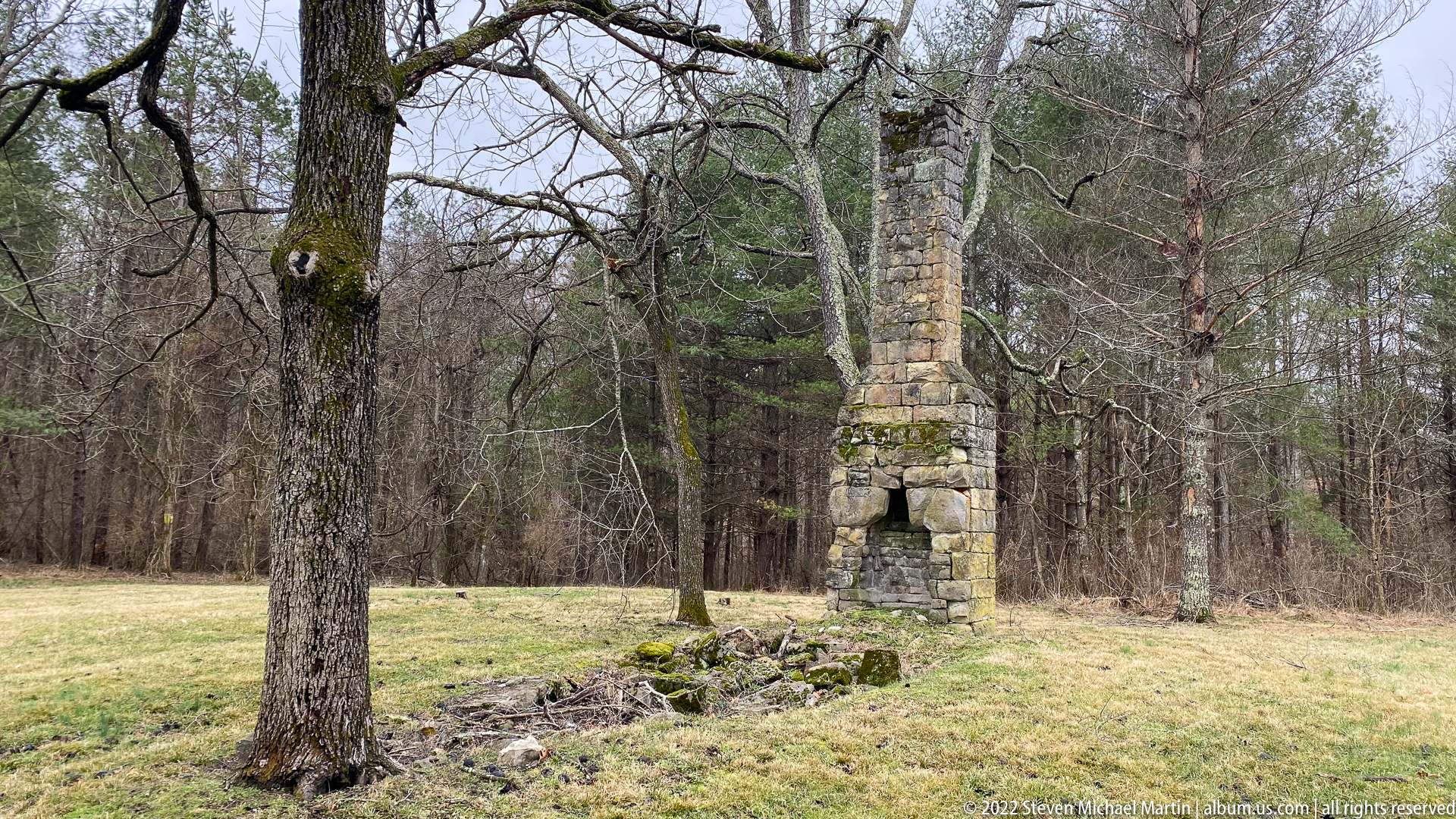
The stone chimney fills more of the frame, revealing courses of irregular rectangular blocks and a dark opening in its broad base. Moss and weathering mark the lower stones, while bare branches cross the background. This closer angle makes the construction and condition legible but provides no plaque or surviving building fabric to identify its original use.
Caption
The stone chimney fills more of the frame, revealing courses of irregular rectangular blocks and a dark opening in its broad base. Moss and weathering mark the lower stones, while bare branches cross the background. This closer angle makes the construction and condition legible but provides no plaque or surviving building fabric to identify its original use.

A weathered split-rail fence crosses the foreground and guides the eye toward a small visitor-center sign and a low brick building on the rise. A thin layer of snow covers the lawn, while bare and evergreen trees punctuate the overcast sky. The broad composition shows the approach and grounds rather than the visitor center’s interior.
Caption
A weathered split-rail fence crosses the foreground and guides the eye toward a small visitor-center sign and a low brick building on the rise. A thin layer of snow covers the lawn, while bare and evergreen trees punctuate the overcast sky. The broad composition shows the approach and grounds rather than the visitor center’s interior.
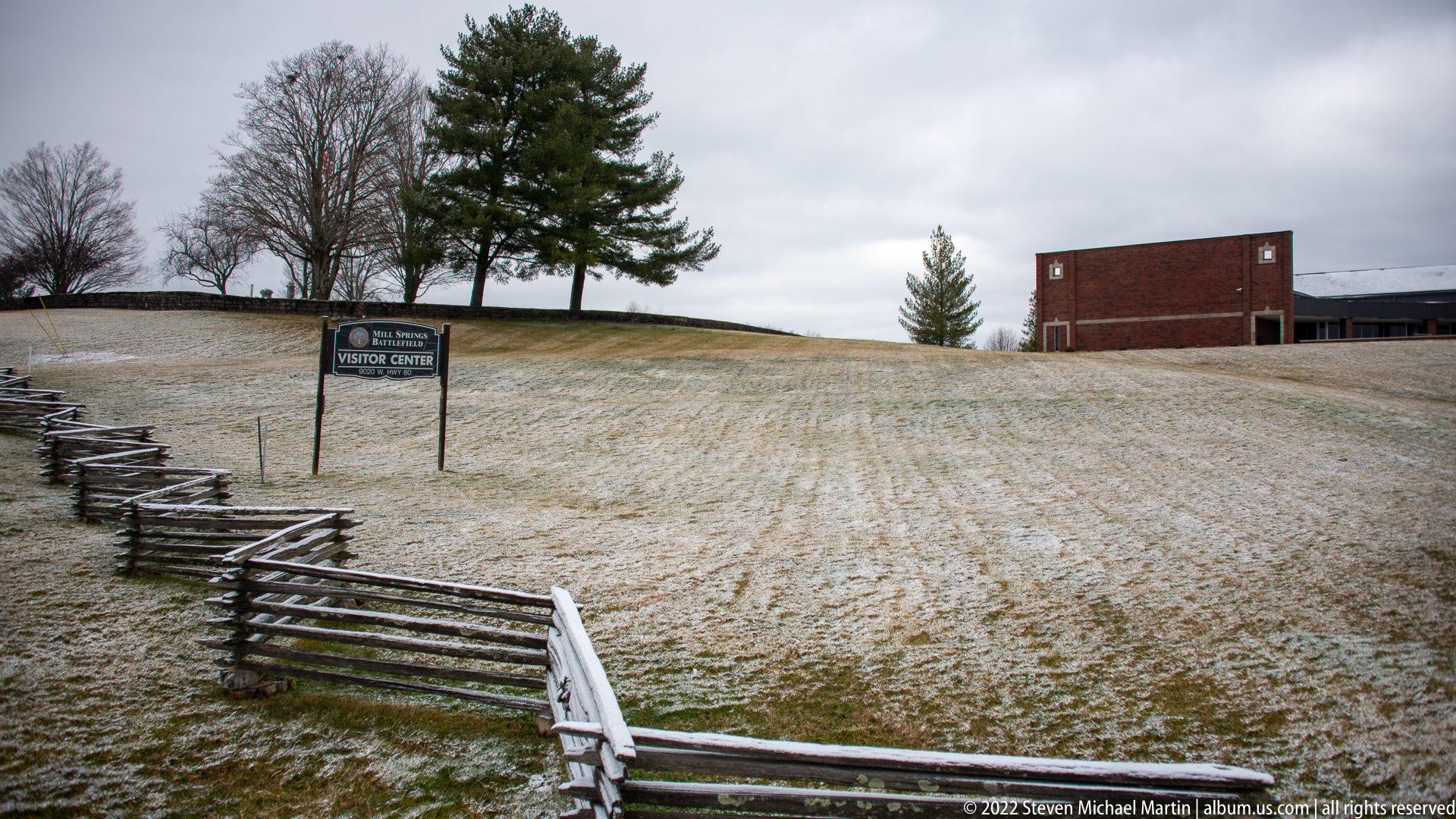
A dark rectangular sign reading “Visitor Center” stands close to the camera, its face speckled with snow or frost. A smaller park sign and open field blur behind it beneath a gray winter sky. The shallow focus gives prominence to the destination marker while retaining a hint of the approach landscape beyond.
Caption
A dark rectangular sign reading “Visitor Center” stands close to the camera, its face speckled with snow or frost. A smaller park sign and open field blur behind it beneath a gray winter sky. The shallow focus gives prominence to the destination marker while retaining a hint of the approach landscape beyond.
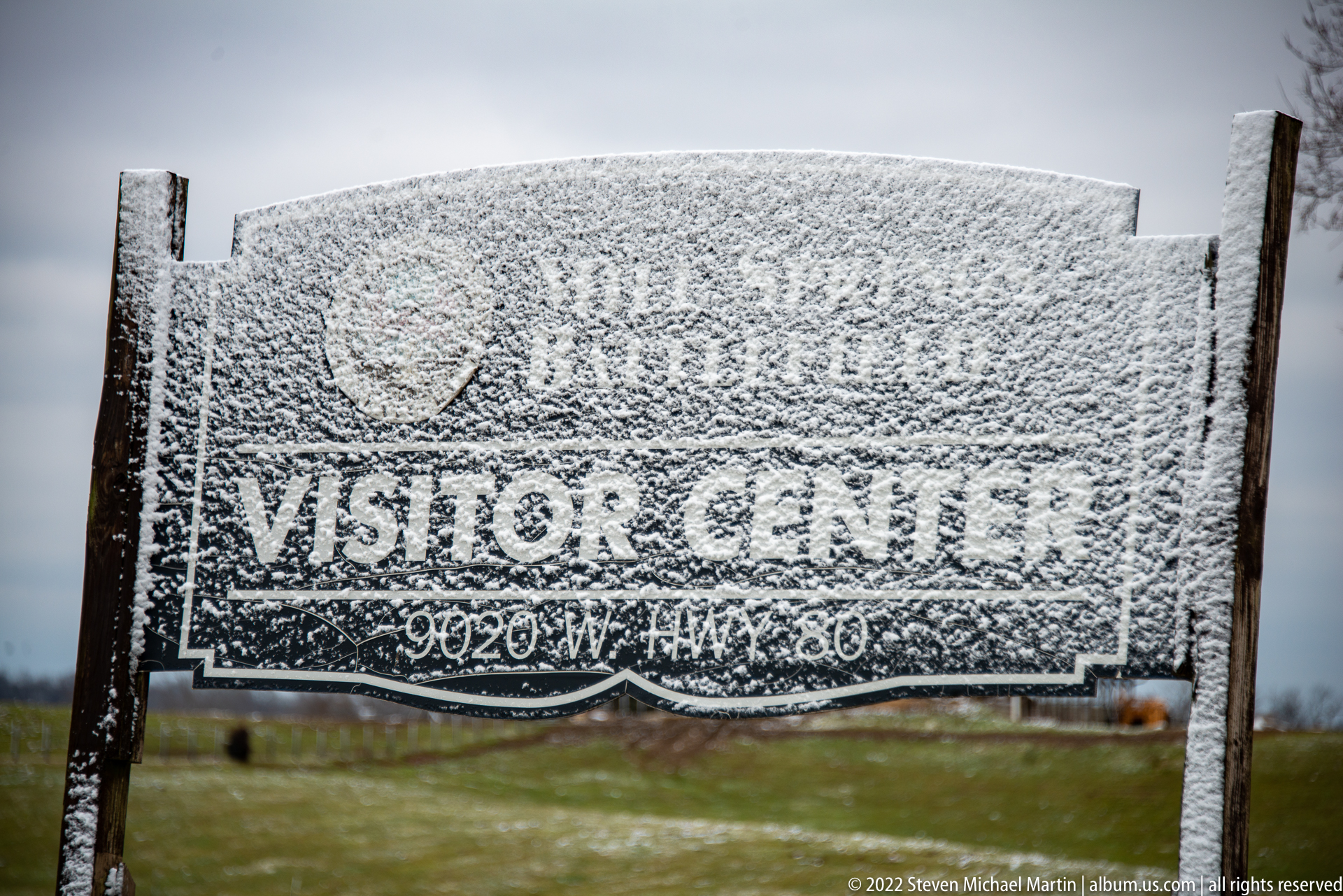
The dark Visitor Center sign occupies nearly the entire frame, its surface stippled with frost and snow. The words “VISITOR CENTER” remain readable, while the smaller address line is partly obscured. A pale field and muted gray sky blur behind the sign, emphasizing the weather’s coating and the marker’s simple rectangular form.
Caption
The dark Visitor Center sign occupies nearly the entire frame, its surface stippled with frost and snow. The words “VISITOR CENTER” remain readable, while the smaller address line is partly obscured. A pale field and muted gray sky blur behind the sign, emphasizing the weather’s coating and the marker’s simple rectangular form.

A low brick building stands on a snowy rise beneath an overcast sky, with two flagpoles extending above its roofline and a small cannon visible at far right. The simple façade has a few small windows and doors, while the open lawn separates the structure from the camera. The wide framing emphasizes the building’s quiet institutional setting.
Caption
A low brick building stands on a snowy rise beneath an overcast sky, with two flagpoles extending above its roofline and a small cannon visible at far right. The simple façade has a few small windows and doors, while the open lawn separates the structure from the camera. The wide framing emphasizes the building’s quiet institutional setting.

A dark brown panel bears the large white words “Mill Springs Battlefield National Monument,” with a National Park Service arrowhead emblem at the upper right. The close crop excludes most of the surrounding structure, making the monument name the dominant element. The sign identifies the site in the terminology used on the display.
Caption
A dark brown panel bears the large white words “Mill Springs Battlefield National Monument,” with a National Park Service arrowhead emblem at the upper right. The close crop excludes most of the surrounding structure, making the monument name the dominant element. The sign identifies the site in the terminology used on the display.
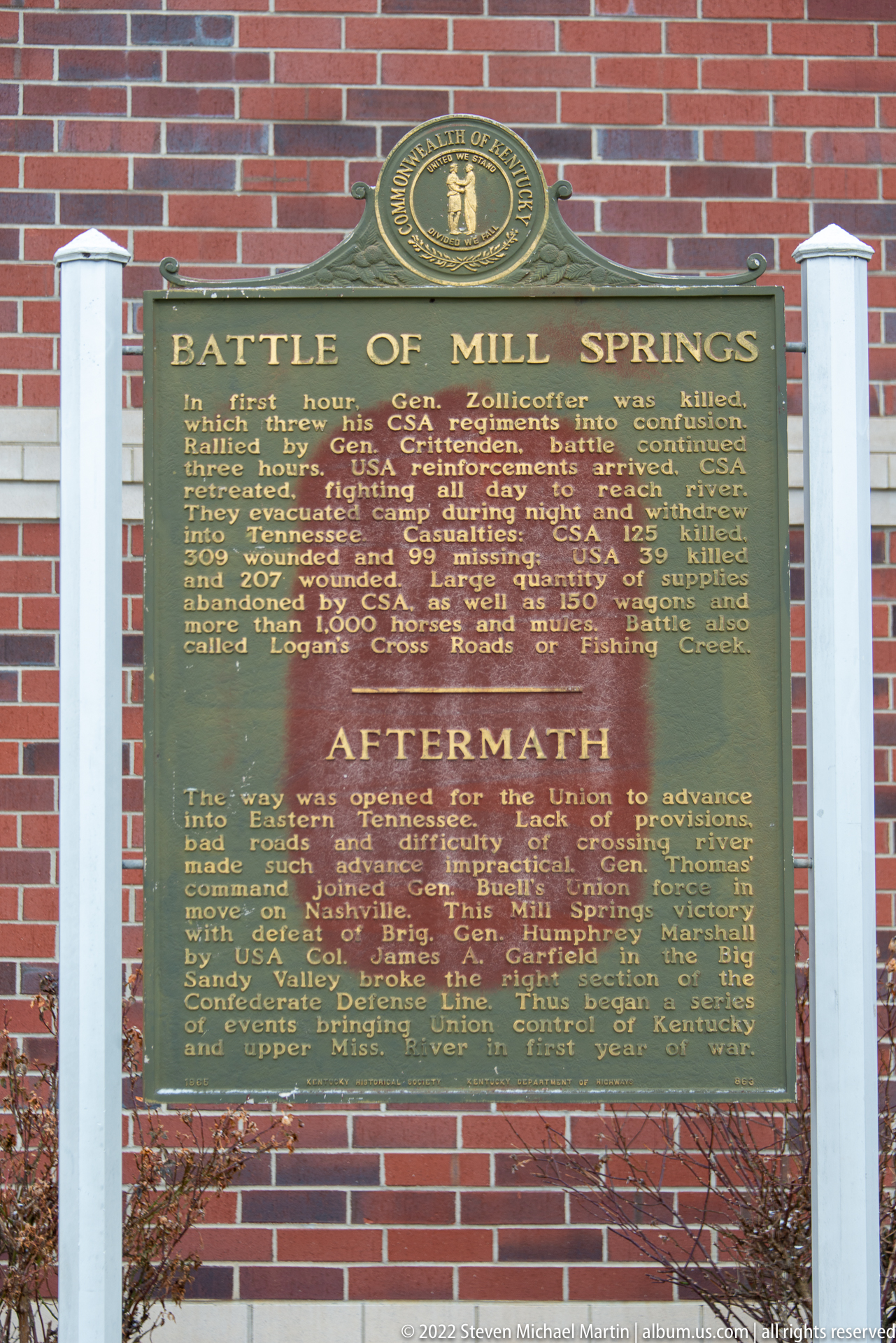
A green metal plaque mounted on a red-brick wall is headed “Battle of Mill Springs” and “Aftermath.” Its text describes the January 1862 battle and its consequences, with a circular emblem centered above the title. The frontal view records the marker as a formal summary of the battlefield’s significance within the visitor-center grounds.
Caption
A green metal plaque mounted on a red-brick wall is headed “Battle of Mill Springs” and “Aftermath.” Its text describes the January 1862 battle and its consequences, with a circular emblem centered above the title. The frontal view records the marker as a formal summary of the battlefield’s significance within the visitor-center grounds.
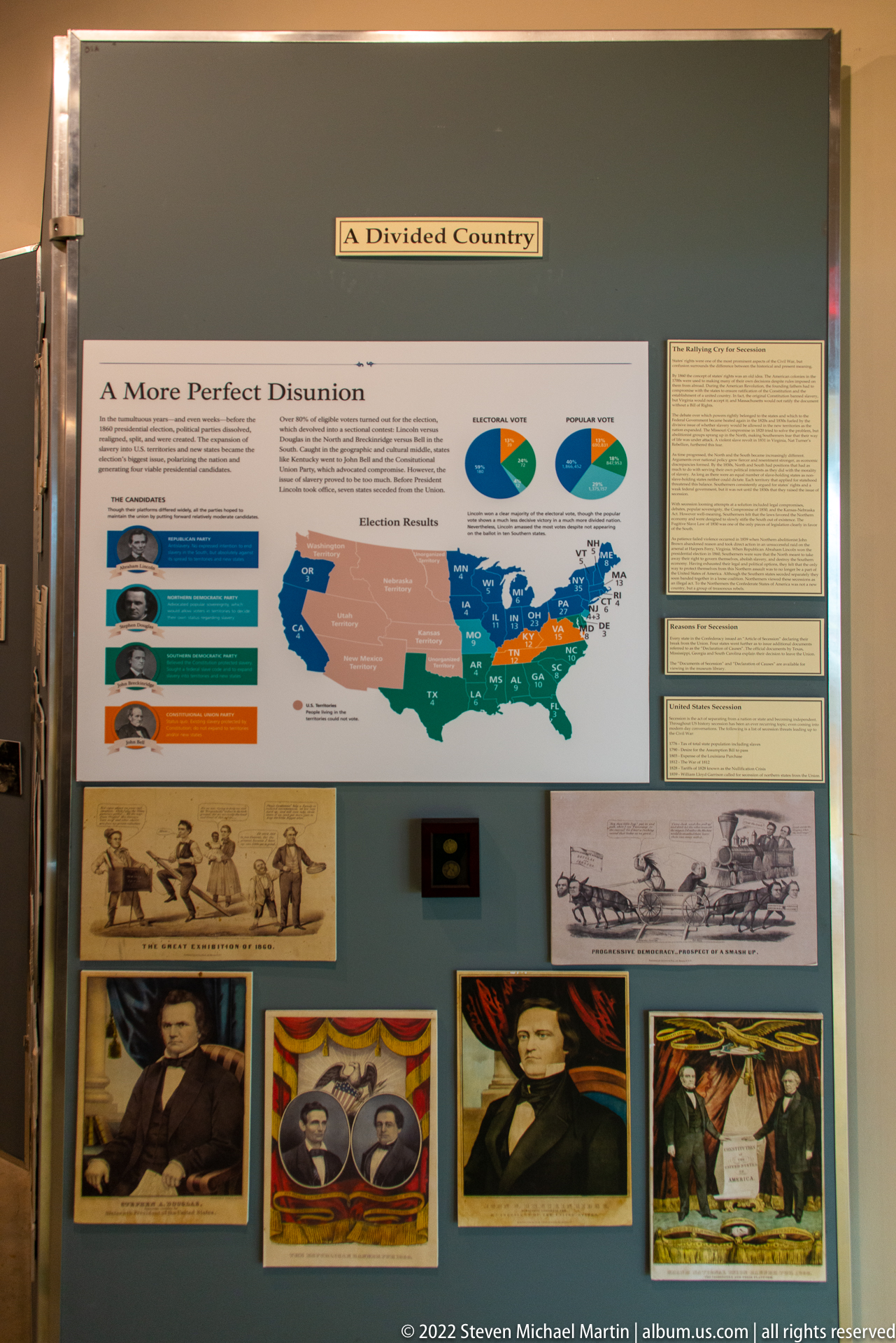
The “A Divided Country” exhibit combines a large “A More Perfect Disunion” panel with electoral maps, party summaries and historical images. A wall of related prints and portraits fills the lower area, linking national political conflict to the coming war. The view captures the exhibit as a whole, while the adjoining map panel offers a closer analysis of election results.
Caption
The “A Divided Country” exhibit combines a large “A More Perfect Disunion” panel with electoral maps, party summaries and historical images. A wall of related prints and portraits fills the lower area, linking national political conflict to the coming war. The view captures the exhibit as a whole, while the adjoining map panel offers a closer analysis of election results.
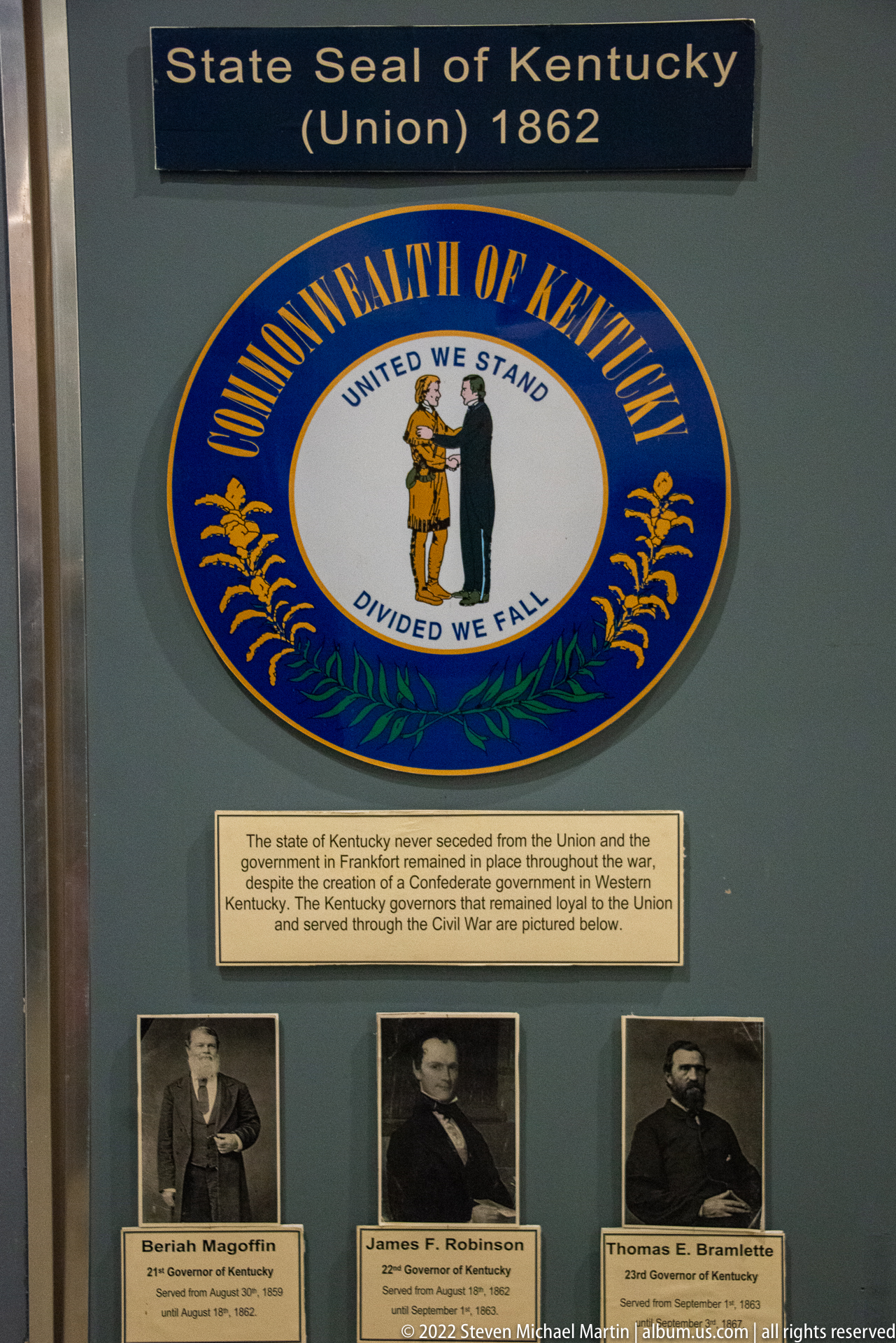
A large oval seal of Kentucky is mounted on a dark exhibit panel headed “State Seal of Kentucky (Union) 1862.” In the seal, two figures stand beneath the words “United We Stand,” surrounded by blue, gold and green ornament. A block of explanatory text and historical portraits below place the seal within the state’s wartime Union identity.
Caption
A large oval seal of Kentucky is mounted on a dark exhibit panel headed “State Seal of Kentucky (Union) 1862.” In the seal, two figures stand beneath the words “United We Stand,” surrounded by blue, gold and green ornament. A block of explanatory text and historical portraits below place the seal within the state’s wartime Union identity.
Raised gold lettering spells out “Mill Springs Battlefield Visitor Center” across a pale wall, with a circular battlefield association emblem mounted at left. The close crop isolates the sign from the surrounding building and makes its dimensional letters and emblem the focus. It identifies the visitor center as the gateway to the battlefield’s museum and interpretive exhibits.
Caption
Raised gold lettering spells out “Mill Springs Battlefield Visitor Center” across a pale wall, with a circular battlefield association emblem mounted at left. The close crop isolates the sign from the surrounding building and makes its dimensional letters and emblem the focus. It identifies the visitor center as the gateway to the battlefield’s museum and interpretive exhibits.
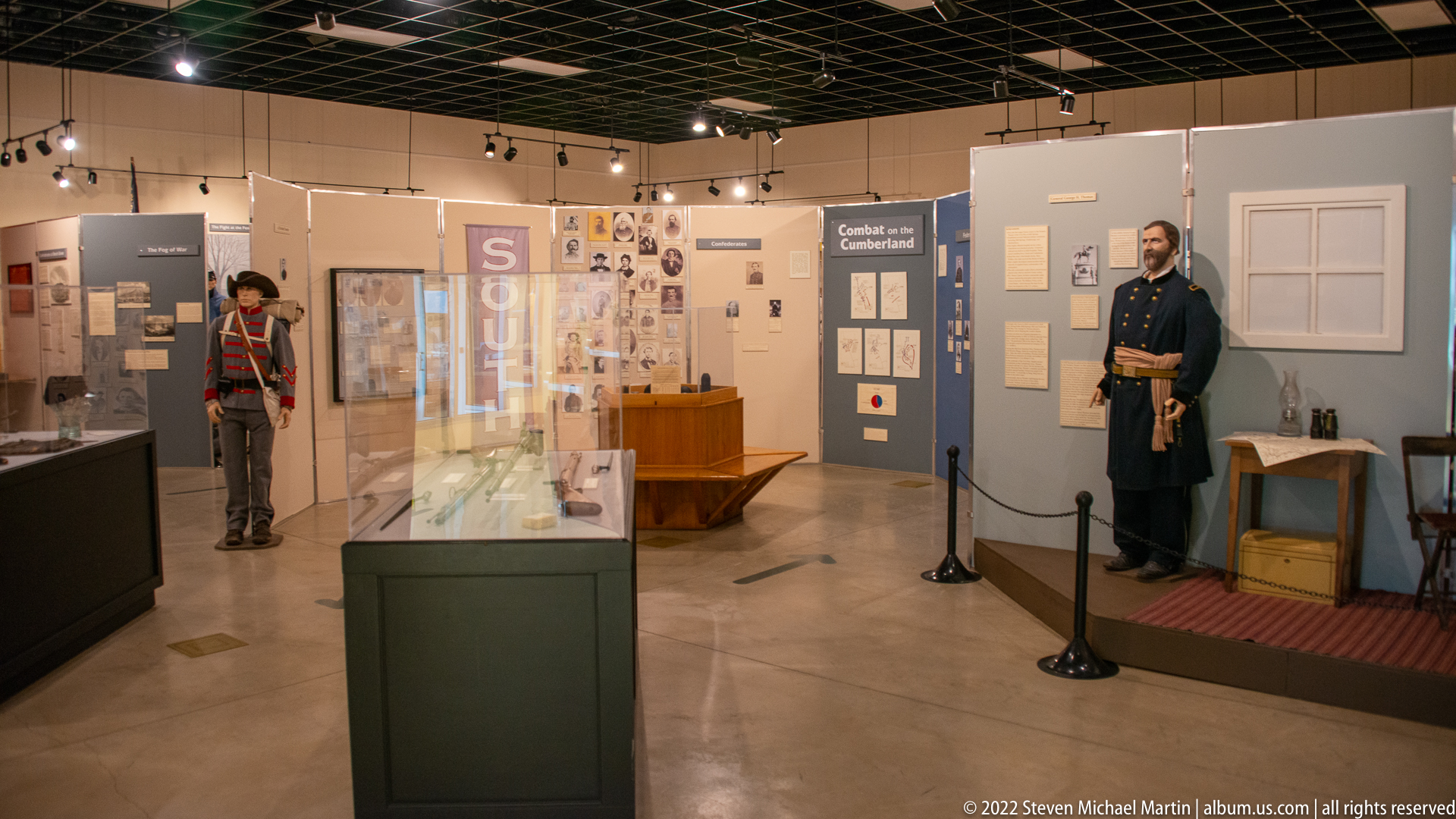
A broad gallery view gathers freestanding cases, wall panels and two life-size Civil War mannequins into one open exhibition space. The figures stand at opposite sides of the room, while a central glass case and rows of interpretive displays guide visitors through the history. Track lighting and a dark grid ceiling distinguish the modern museum setting from the historical subjects represented.
Caption
A broad gallery view gathers freestanding cases, wall panels and two life-size Civil War mannequins into one open exhibition space. The figures stand at opposite sides of the room, while a central glass case and rows of interpretive displays guide visitors through the history. Track lighting and a dark grid ceiling distinguish the modern museum setting from the historical subjects represented.
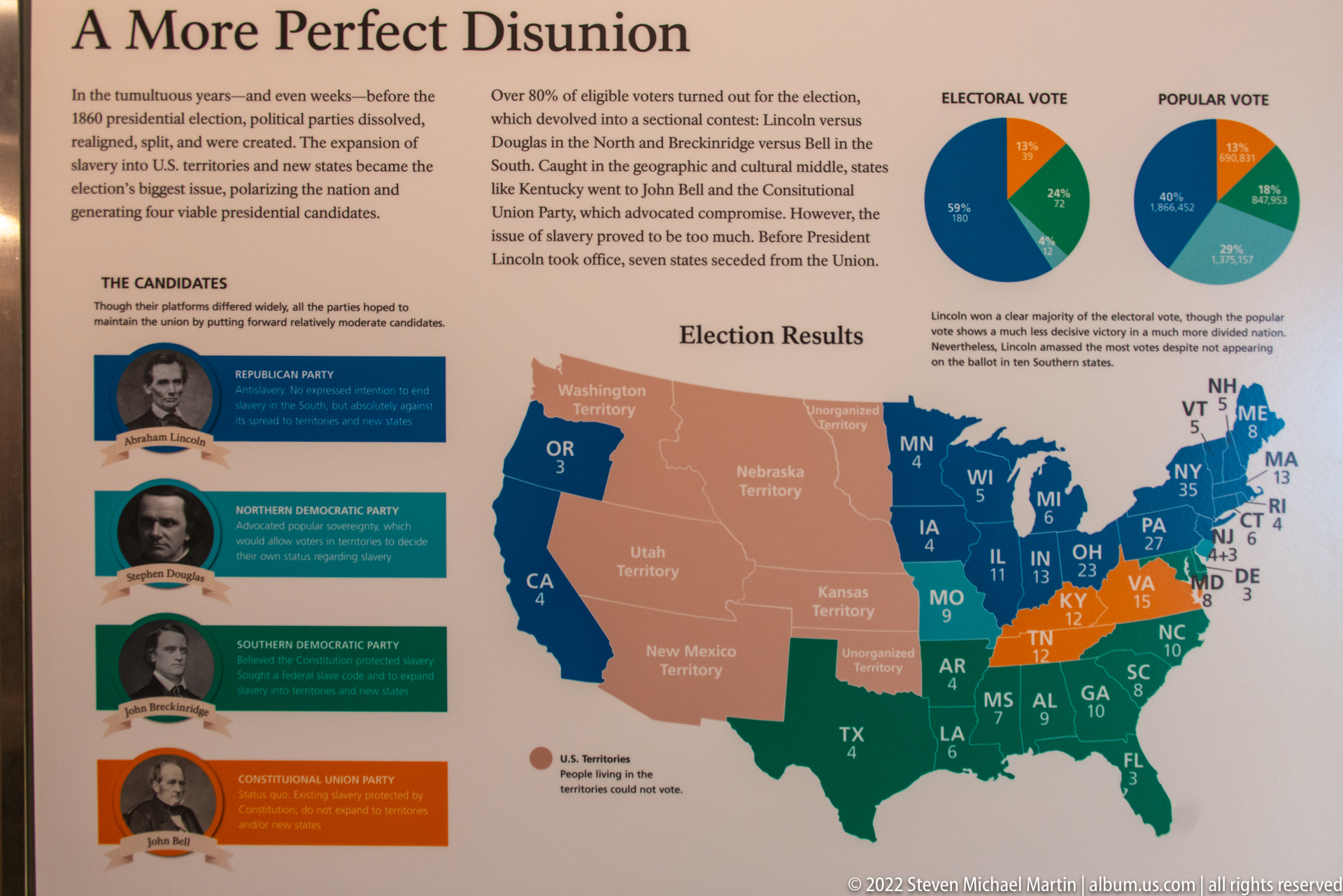
A large exhibit panel titled “A More Perfect Disunion” compares the 1860 presidential election through two circular charts and a color-coded map of the United States. State labels and party colors make regional divisions visible, while candidate panels line the left edge. The close view centers the election graphics, which translate the political split into a spatial pattern.
Caption
A large exhibit panel titled “A More Perfect Disunion” compares the 1860 presidential election through two circular charts and a color-coded map of the United States. State labels and party colors make regional divisions visible, while candidate panels line the left edge. The close view centers the election graphics, which translate the political split into a spatial pattern.
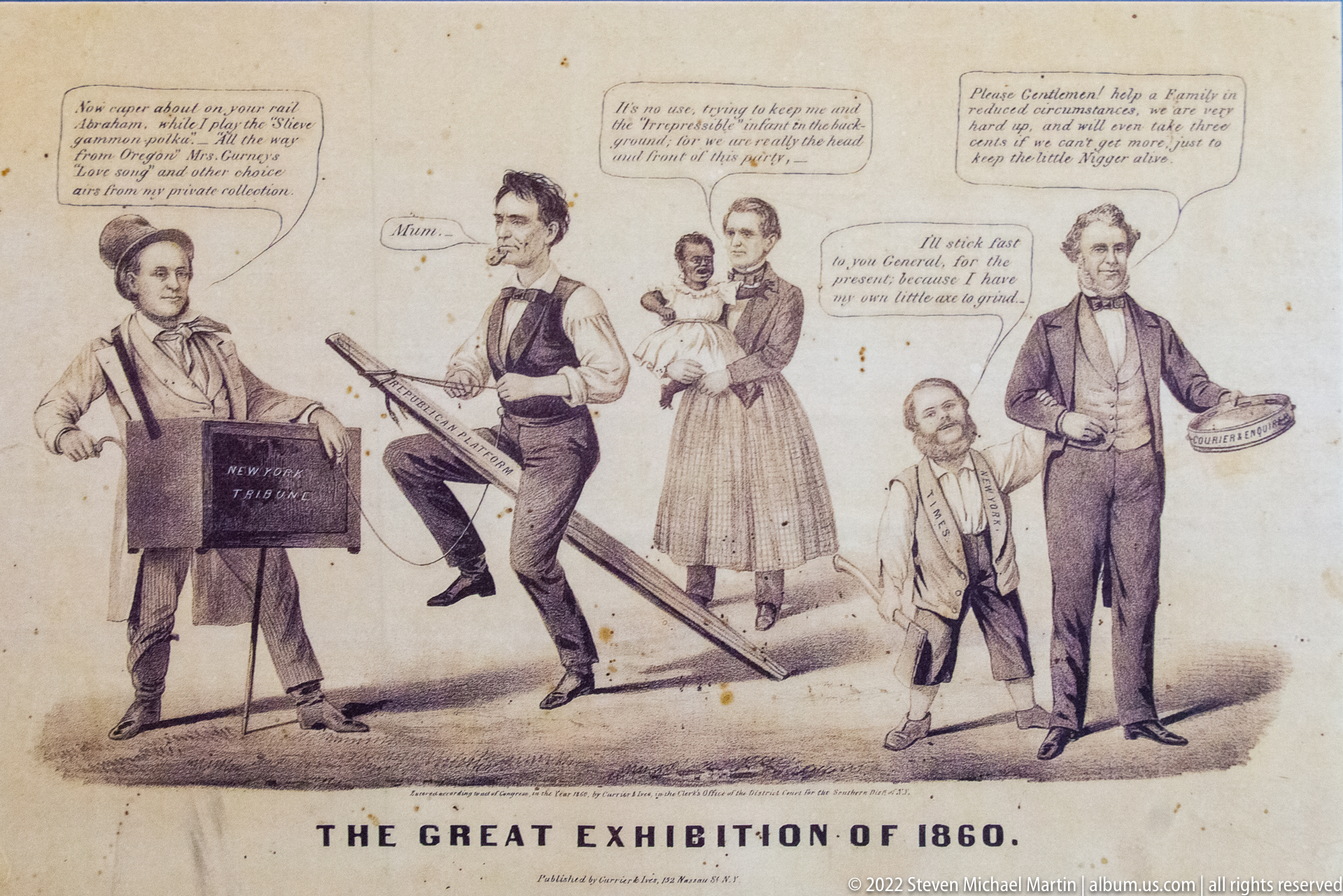
A sepia political cartoon titled “The Great Exhibition of 1860” arranges several contemporary figures across a stage-like scene, each accompanied by speech balloons. The printed title anchors the image, while the exaggerated poses and labeled props turn the presidential campaign into a public spectacle. Displayed on a pale wall, the cartoon offers a period visual commentary on the contested election.
Caption
A sepia political cartoon titled “The Great Exhibition of 1860” arranges several contemporary figures across a stage-like scene, each accompanied by speech balloons. The printed title anchors the image, while the exaggerated poses and labeled props turn the presidential campaign into a public spectacle. Displayed on a pale wall, the cartoon offers a period visual commentary on the contested election.
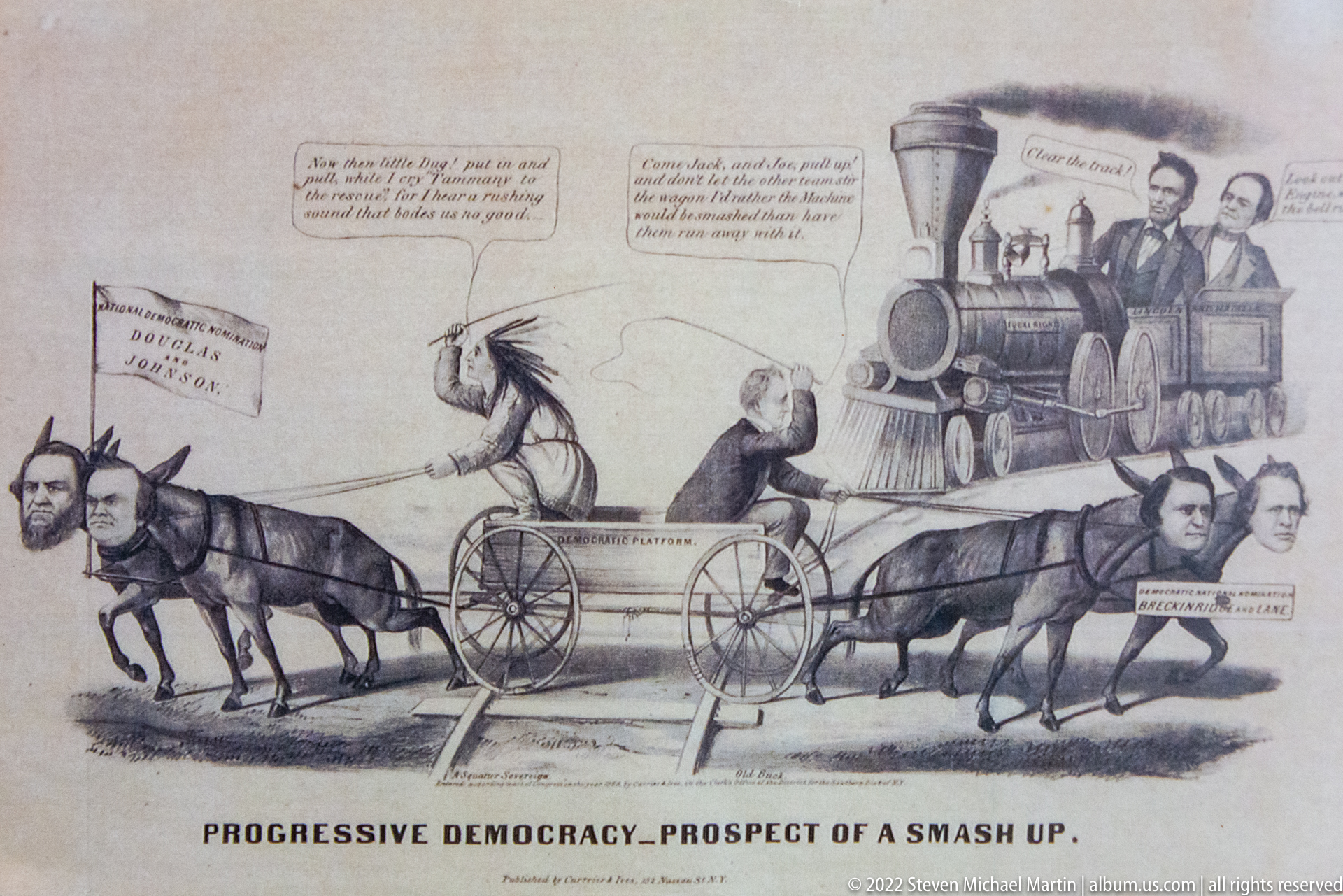
A sepia cartoon titled “Progressive Democracy—Prospect of a Smash Up” depicts a horse-drawn vehicle and a steam locomotive on converging tracks, with caricatured political figures in both conveyances. The crowded, comic scene uses transportation as a visual metaphor for political conflict. Its printed title and labels identify the image as contemporary campaign satire rather than a literal historical event.
Caption
A sepia cartoon titled “Progressive Democracy—Prospect of a Smash Up” depicts a horse-drawn vehicle and a steam locomotive on converging tracks, with caricatured political figures in both conveyances. The crowded, comic scene uses transportation as a visual metaphor for political conflict. Its printed title and labels identify the image as contemporary campaign satire rather than a literal historical event.

A blue-backed exhibit titled “A Divided Kentucky” places portraits of Abraham Lincoln and Jefferson Davis between biographical panels. A central heading calls them “Sons of Kentucky,” while smaller sections below address the state’s neutrality, political choices and wartime leadership. The arrangement presents Kentucky’s divided loyalties through two prominent figures and a series of explanatory topics.
Caption
A blue-backed exhibit titled “A Divided Kentucky” places portraits of Abraham Lincoln and Jefferson Davis between biographical panels. A central heading calls them “Sons of Kentucky,” while smaller sections below address the state’s neutrality, political choices and wartime leadership. The arrangement presents Kentucky’s divided loyalties through two prominent figures and a series of explanatory topics.
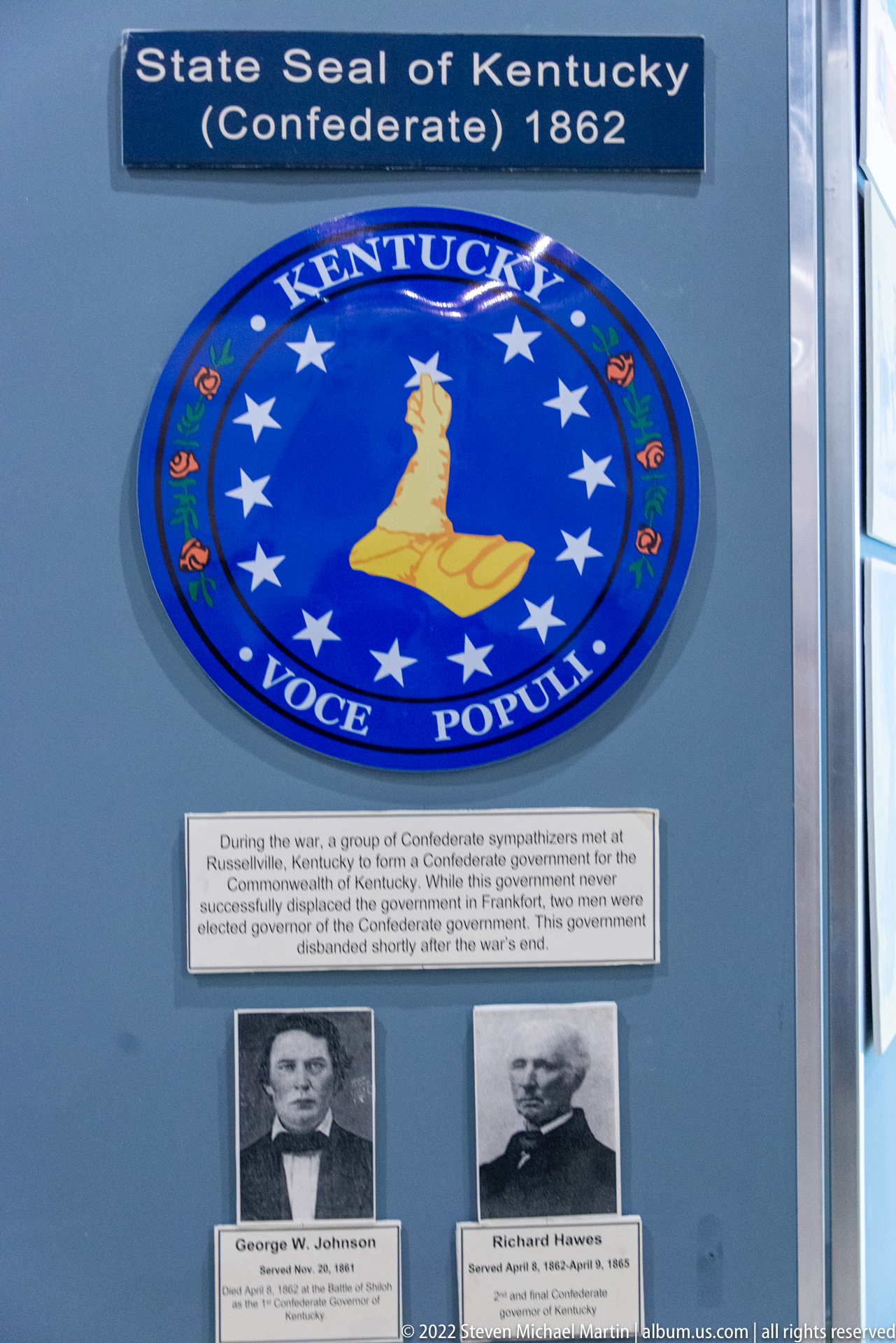
A second exhibit panel presents a blue oval seal marked “Kentucky” and “Vox Populi,” with a central state outline and a ring of white stars. Its heading identifies the “State Seal of Kentucky (Confederate) 1862.” Explanatory text and two portraits below contrast the Confederate association with the Union seal shown in the adjacent display.
Caption
A second exhibit panel presents a blue oval seal marked “Kentucky” and “Vox Populi,” with a central state outline and a ring of white stars. Its heading identifies the “State Seal of Kentucky (Confederate) 1862.” Explanatory text and two portraits below contrast the Confederate association with the Union seal shown in the adjacent display.
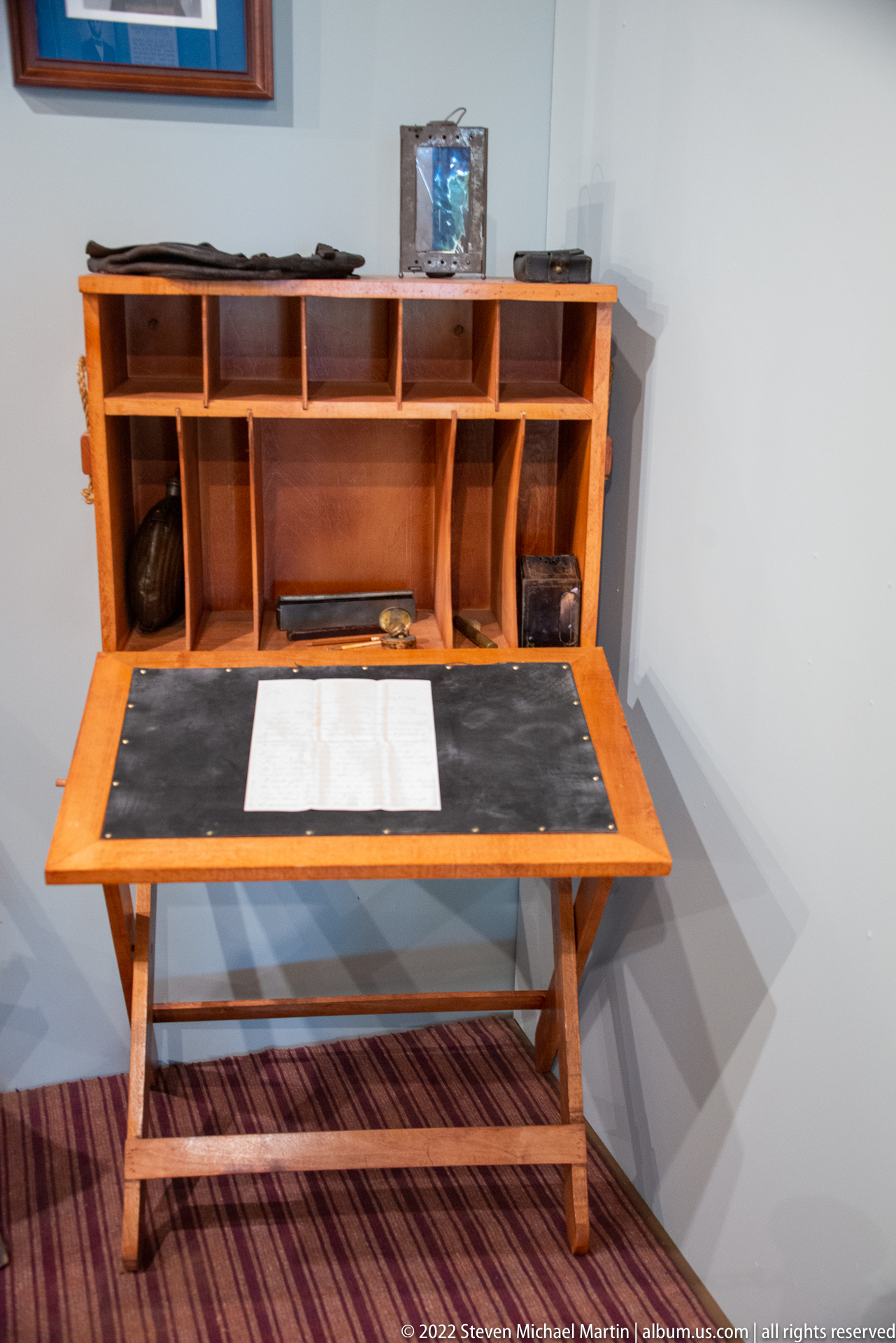
An open wooden writing desk stands on four legs, its slanted writing surface folded down toward the viewer. Small cubbies and drawers line the raised back, while papers and a dark writing surface rest on the desk. The isolated furniture piece is presented against a plain gallery wall, inviting attention to its storage layout and practical workspace.
Caption
An open wooden writing desk stands on four legs, its slanted writing surface folded down toward the viewer. Small cubbies and drawers line the raised back, while papers and a dark writing surface rest on the desk. The isolated furniture piece is presented against a plain gallery wall, inviting attention to its storage layout and practical workspace.

A full-length mannequin in a gray uniform with red trim stands before a log wall, holding a long firearm upright. A broad black hat, cross-body strap and belt complete the displayed outfit, while cabin furnishings and tools frame the figure. The composition shows the soldier as part of a reconstructed domestic setting rather than a standalone uniform display.
Caption
A full-length mannequin in a gray uniform with red trim stands before a log wall, holding a long firearm upright. A broad black hat, cross-body strap and belt complete the displayed outfit, while cabin furnishings and tools frame the figure. The composition shows the soldier as part of a reconstructed domestic setting rather than a standalone uniform display.
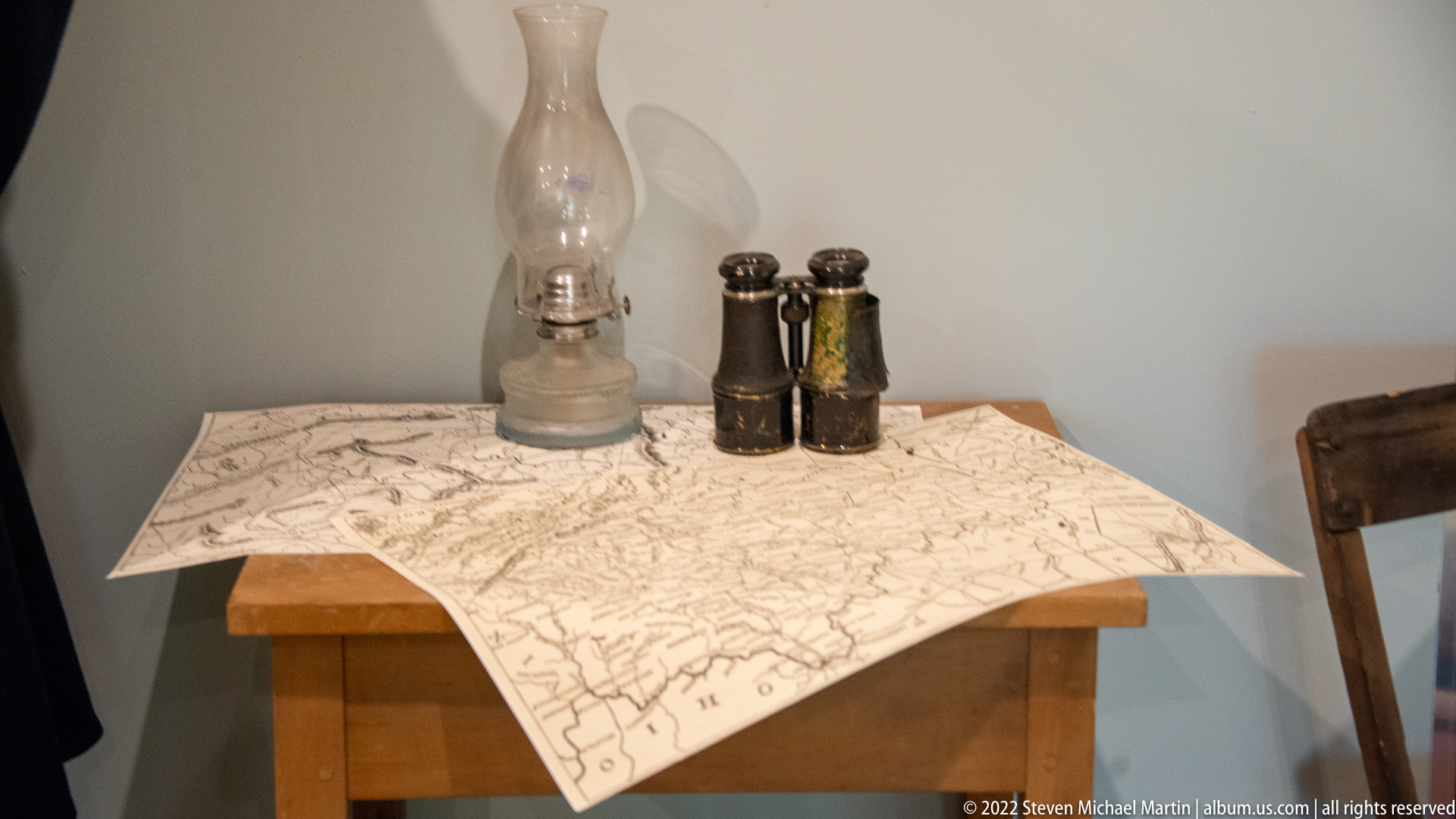
A large paper map drapes across a small wooden table, with a glass oil lamp and two compact optical instruments arranged behind it. The composition suggests a field-planning or command setting, but no label identifies the map’s precise subject or the objects’ provenance. The downward view emphasizes the map’s broad folds and the practical equipment gathered above it.
Caption
A large paper map drapes across a small wooden table, with a glass oil lamp and two compact optical instruments arranged behind it. The composition suggests a field-planning or command setting, but no label identifies the map’s precise subject or the objects’ provenance. The downward view emphasizes the map’s broad folds and the practical equipment gathered above it.
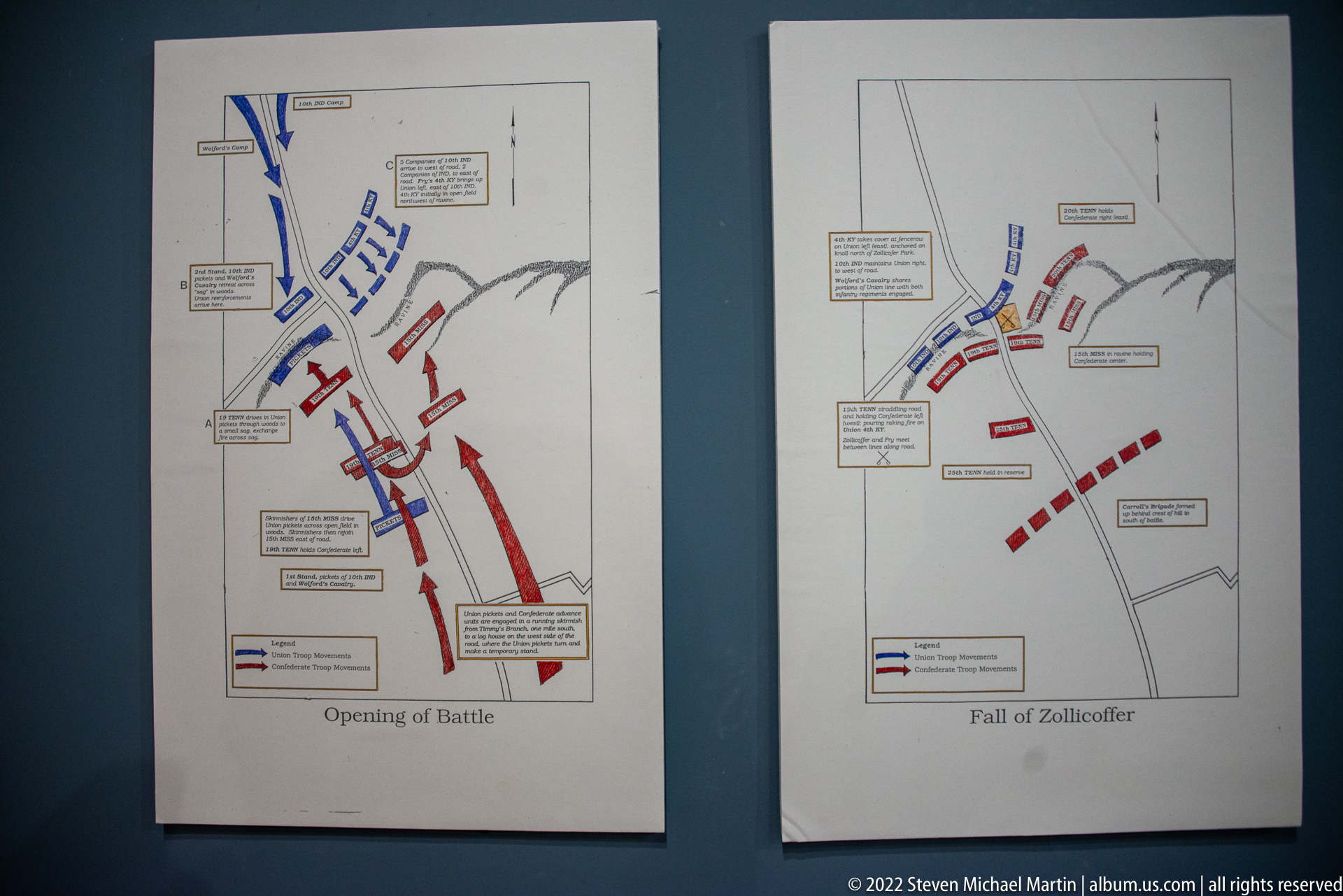
Three vertical maps on a blue wall trace the battle through labeled stages: “Opening of Battle,” “Fall of Zollicoffer,” and subsequent movements. Red and blue arrows show opposing forces advancing along roads and across the local terrain. Together, the diagrams distinguish the opening movements from later phases and provide a concise visual account of the battlefield action.
Caption
Three vertical maps on a blue wall trace the battle through labeled stages: “Opening of Battle,” “Fall of Zollicoffer,” and subsequent movements. Red and blue arrows show opposing forces advancing along roads and across the local terrain. Together, the diagrams distinguish the opening movements from later phases and provide a concise visual account of the battlefield action.

Three framed battlefield diagrams continue the sequence of troop movements, with captions identifying “Confederate Regroup,” “9:00 AM Union Assault” and “Final Rout.” Red and blue arrows curve around roads and terrain features to indicate opposing advances. The grouped panels let viewers compare changing positions across successive stages of the fighting.
Caption
Three framed battlefield diagrams continue the sequence of troop movements, with captions identifying “Confederate Regroup,” “9:00 AM Union Assault” and “Final Rout.” Red and blue arrows curve around roads and terrain features to indicate opposing advances. The grouped panels let viewers compare changing positions across successive stages of the fighting.
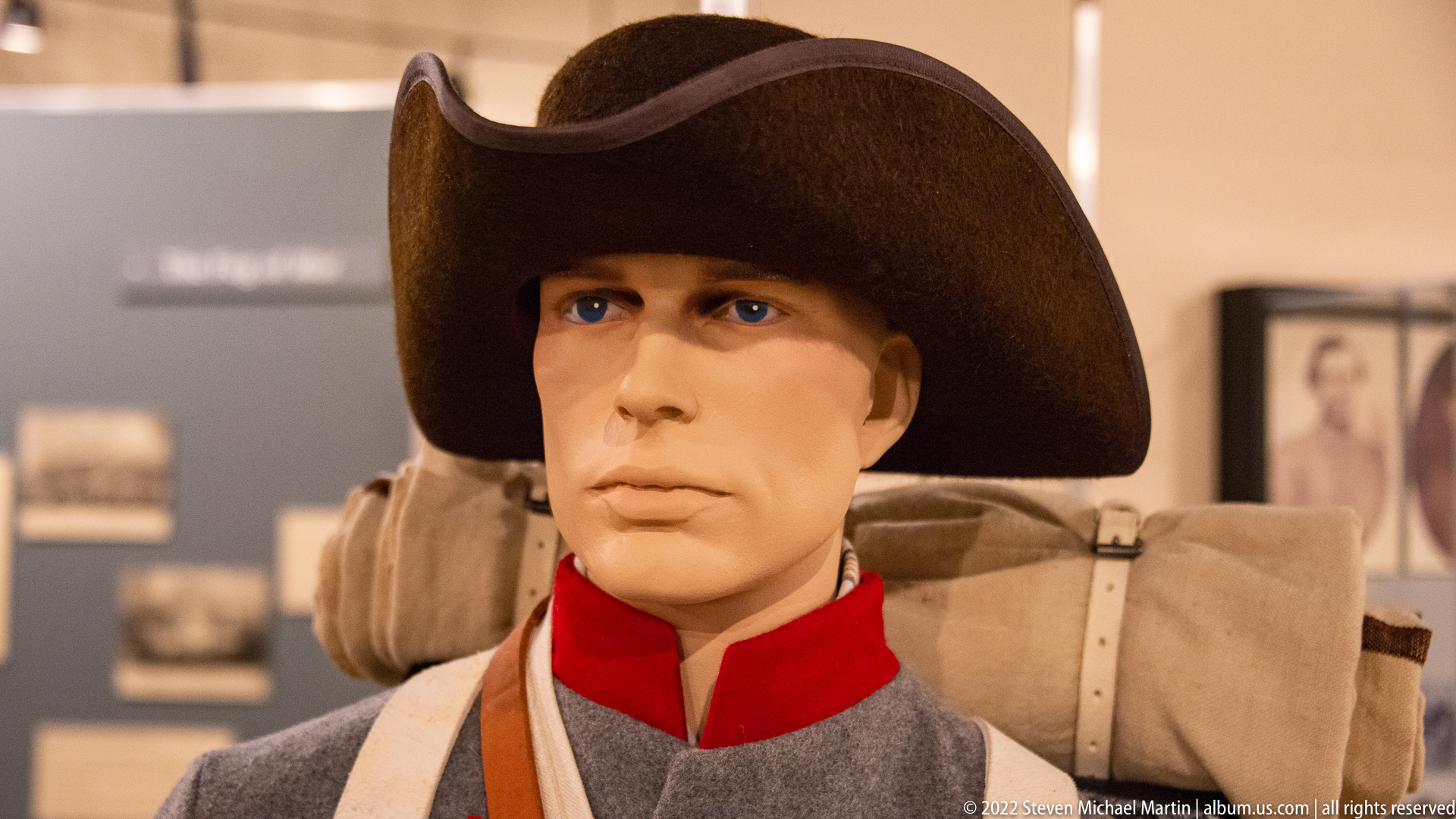
A life-size mannequin wears a broad dark hat, gray coat, vivid red collar and pale cross-belts. A rolled blanket and pack rise behind his shoulders, suggesting a soldier equipped for field service. The close portrait emphasizes the face, hat brim and layered straps against a softly blurred gallery background, without a visible name identifying the figure.
Caption
A life-size mannequin wears a broad dark hat, gray coat, vivid red collar and pale cross-belts. A rolled blanket and pack rise behind his shoulders, suggesting a soldier equipped for field service. The close portrait emphasizes the face, hat brim and layered straps against a softly blurred gallery background, without a visible name identifying the figure.
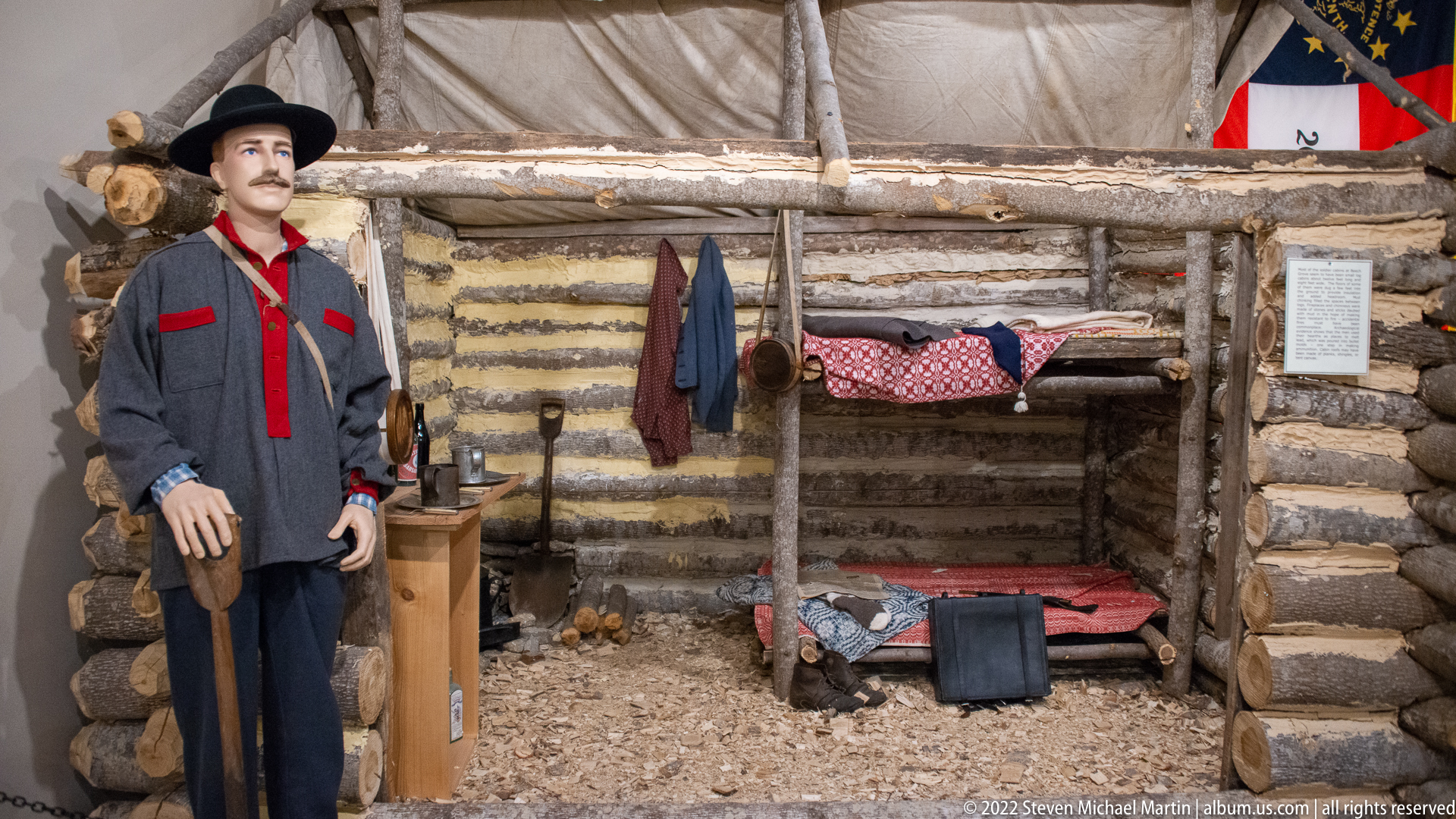
A wider view reveals the log cabin exhibit around the gray-uniformed mannequin. A rough bunk spans the rear wall, piled with blankets and a red patterned cover; clothing hangs from a post, while tools and containers sit near the figure. A Confederate flag is visible at upper right. The room’s furnishings create a domestic backdrop for the military figure.
Caption
A wider view reveals the log cabin exhibit around the gray-uniformed mannequin. A rough bunk spans the rear wall, piled with blankets and a red patterned cover; clothing hangs from a post, while tools and containers sit near the figure. A Confederate flag is visible at upper right. The room’s furnishings create a domestic backdrop for the military figure.
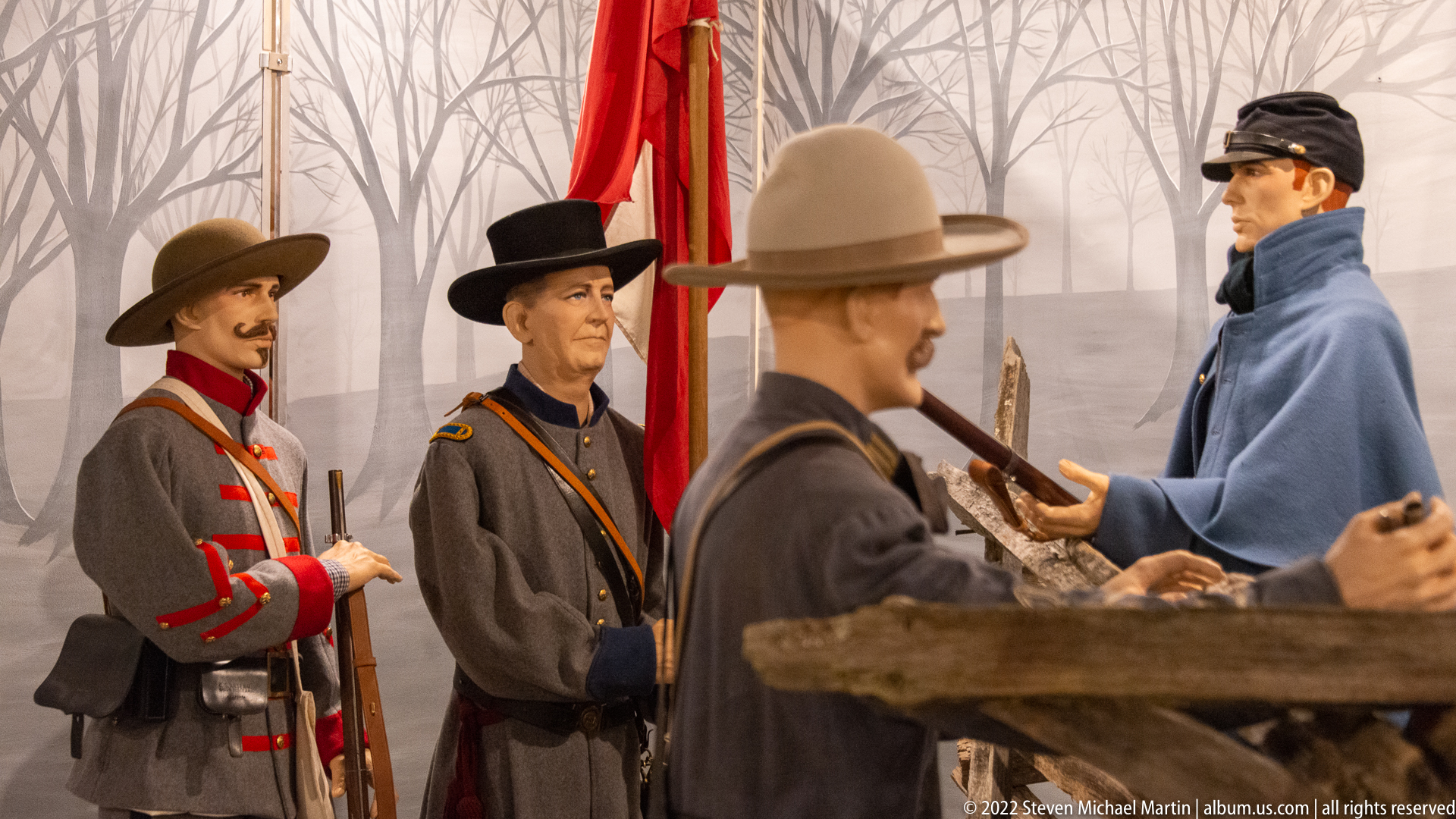
Several Civil War mannequins stand around a central red flag in a woodland-themed exhibit. Gray and blue uniforms, broad hats and long firearms distinguish the figures, while a rough wooden barrier crosses the foreground. Their close arrangement suggests an encounter between opposing soldiers, staged against a painted forest backdrop.
Caption
Several Civil War mannequins stand around a central red flag in a woodland-themed exhibit. Gray and blue uniforms, broad hats and long firearms distinguish the figures, while a rough wooden barrier crosses the foreground. Their close arrangement suggests an encounter between opposing soldiers, staged against a painted forest backdrop.
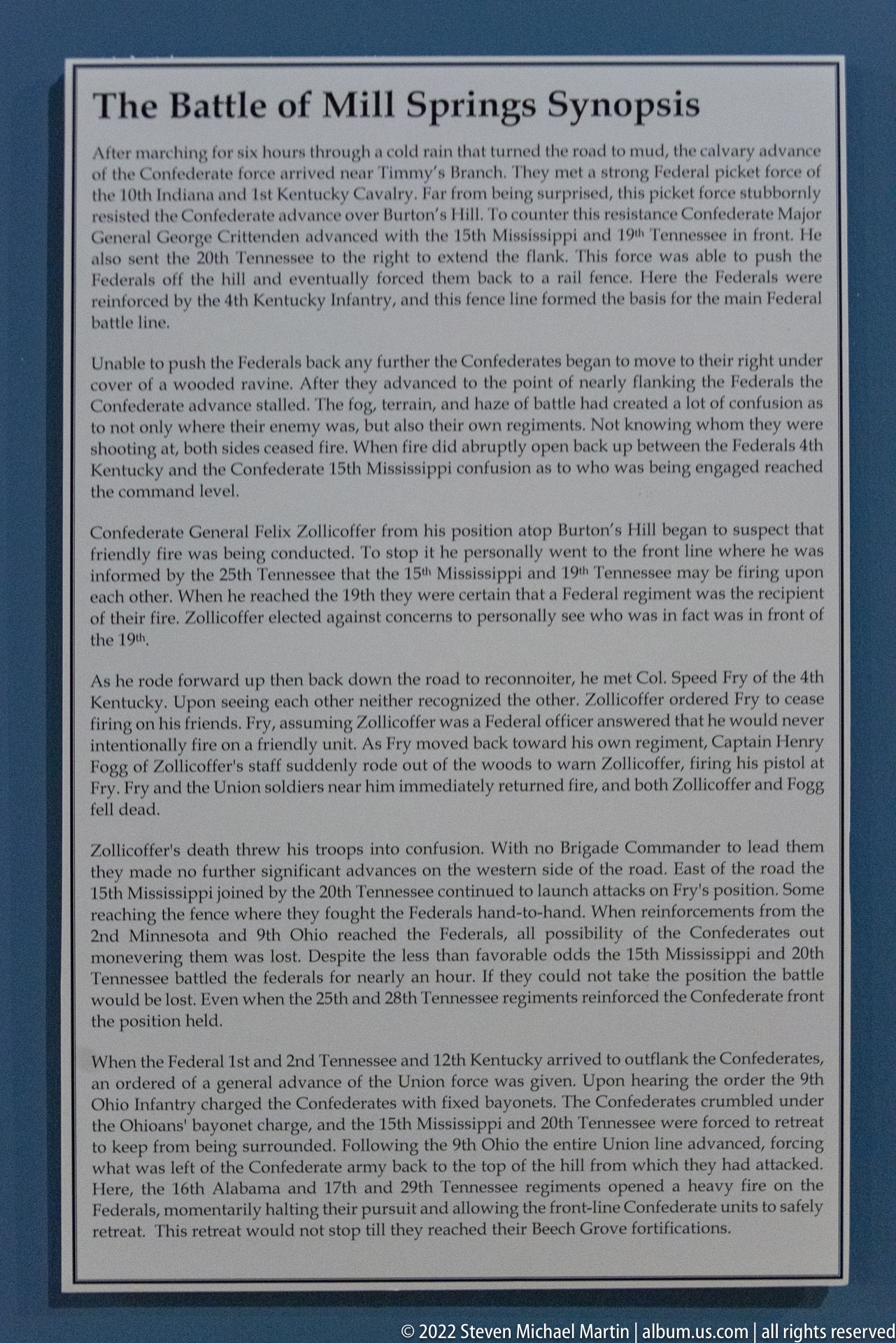
A framed panel titled “Battle of Mill Springs Synopsis” fills the view with closely set historical text. The paragraphs summarize the campaign and battle, with the heading in a large serif typeface at the top. A blue border separates the text from the surrounding gallery wall. The photograph records the interpretive panel as a reading surface, rather than a scene of the battlefield itself.
Caption
A framed panel titled “Battle of Mill Springs Synopsis” fills the view with closely set historical text. The paragraphs summarize the campaign and battle, with the heading in a large serif typeface at the top. A blue border separates the text from the surrounding gallery wall. The photograph records the interpretive panel as a reading surface, rather than a scene of the battlefield itself.
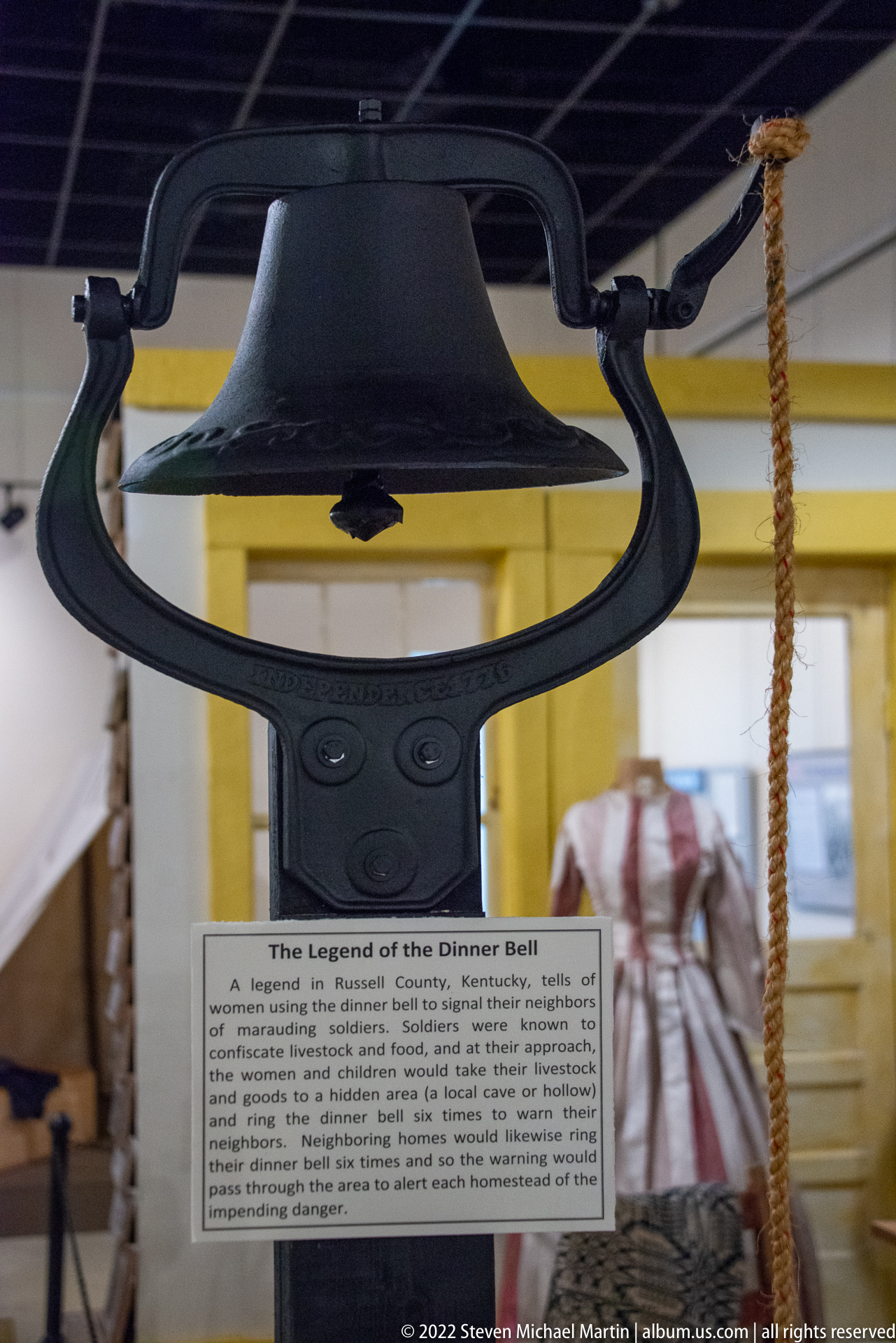
A black cast-metal bell hangs from a curved iron support, with a heavy clapper visible beneath its flared rim. An interpretive card below is headed “The Legend of the Dinner Bell,” connecting this object to a local battlefield story. The close view centers the bell’s solid form and mounting hardware, while the card provides its exhibit context.
Caption
A black cast-metal bell hangs from a curved iron support, with a heavy clapper visible beneath its flared rim. An interpretive card below is headed “The Legend of the Dinner Bell,” connecting this object to a local battlefield story. The close view centers the bell’s solid form and mounting hardware, while the card provides its exhibit context.

A shallow woven basket holding several pale eggs rests on red patterned fabric draped over a woven chair. The textile covers most of the seat and hangs down the back, revealing a repeating geometric design. Warm wood and straw textures fill the scene, which is presented as part of a domestic-life exhibit.
Caption
A shallow woven basket holding several pale eggs rests on red patterned fabric draped over a woven chair. The textile covers most of the seat and hangs down the back, revealing a repeating geometric design. Warm wood and straw textures fill the scene, which is presented as part of a domestic-life exhibit.

A mannequin in a blue coat and dark forage cap sits or crouches behind a rough fallen log, holding a long rifle across his body. A round brass-colored insignia or badge catches light at his chest, and a painted forest recedes behind him. The low, close framing positions the log as field cover between the soldier and the viewer.
Caption
A mannequin in a blue coat and dark forage cap sits or crouches behind a rough fallen log, holding a long rifle across his body. A round brass-colored insignia or badge catches light at his chest, and a painted forest recedes behind him. The low, close framing positions the log as field cover between the soldier and the viewer.
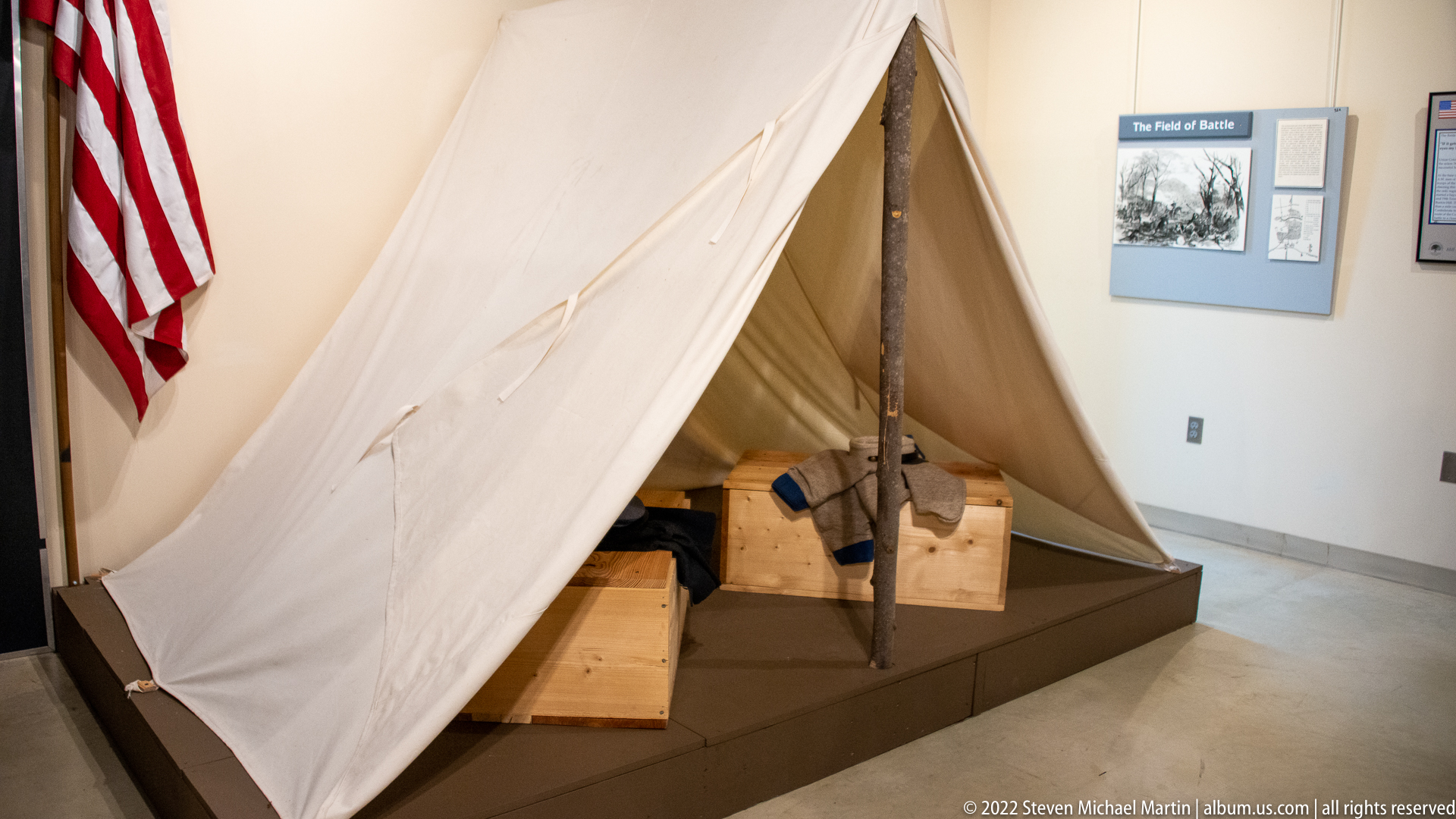
A large pale canvas tent is pitched on a raised platform, with a U.S. flag hanging at left and wooden boxes arranged around the entrance. A wall panel titled “The Place of Battle” stands behind the tent. The display presents a field encampment within the museum, using simple equipment and fabric shelter to suggest soldiers’ living conditions.
Caption
A large pale canvas tent is pitched on a raised platform, with a U.S. flag hanging at left and wooden boxes arranged around the entrance. A wall panel titled “The Place of Battle” stands behind the tent. The display presents a field encampment within the museum, using simple equipment and fabric shelter to suggest soldiers’ living conditions.

A reconstructed cabin wall of dark horizontal logs frames an open white door and a view into another exhibit room. A saddle rests on a wooden stand in the foreground, with a barrel at right and display objects visible through the doorway. The composition links frontier-style furnishings to the broader visitor center gallery beyond.
Caption
A reconstructed cabin wall of dark horizontal logs frames an open white door and a view into another exhibit room. A saddle rests on a wooden stand in the foreground, with a barrel at right and display objects visible through the doorway. The composition links frontier-style furnishings to the broader visitor center gallery beyond.

A medical tableau places a standing attendant in a stained apron beside a patient stretched across a plank table supported by barrels. Cloths, bottles and small supplies surround the reclining figure, while a window and pale walls suggest an improvised treatment room. The wider view establishes the relationship between the attendant, the patient and the makeshift equipment.
Caption
A medical tableau places a standing attendant in a stained apron beside a patient stretched across a plank table supported by barrels. Cloths, bottles and small supplies surround the reclining figure, while a window and pale walls suggest an improvised treatment room. The wider view establishes the relationship between the attendant, the patient and the makeshift equipment.

A reclining mannequin lies on a narrow table beneath a dark brown blanket, with a small illustrated card resting on the cover. A checked shirt sleeve and one outstretched arm remain visible; colorful quilts support the head and shoulders. The tight crop directs attention to the patient’s pose and bedding, separating this detail from the larger medical scene.
Caption
A reclining mannequin lies on a narrow table beneath a dark brown blanket, with a small illustrated card resting on the cover. A checked shirt sleeve and one outstretched arm remain visible; colorful quilts support the head and shoulders. The tight crop directs attention to the patient’s pose and bedding, separating this detail from the larger medical scene.

A museum case displays labeled glass bottles, wrapped bundles, cotton or gauze, and slender metal instruments across a pale shelf. Several bottles contain blue or green liquid, while others are clear or amber. The assortment is arranged as a collection of medical materials, though the small labels and specific uses are not readable at this scale.
Caption
A museum case displays labeled glass bottles, wrapped bundles, cotton or gauze, and slender metal instruments across a pale shelf. Several bottles contain blue or green liquid, while others are clear or amber. The assortment is arranged as a collection of medical materials, though the small labels and specific uses are not readable at this scale.
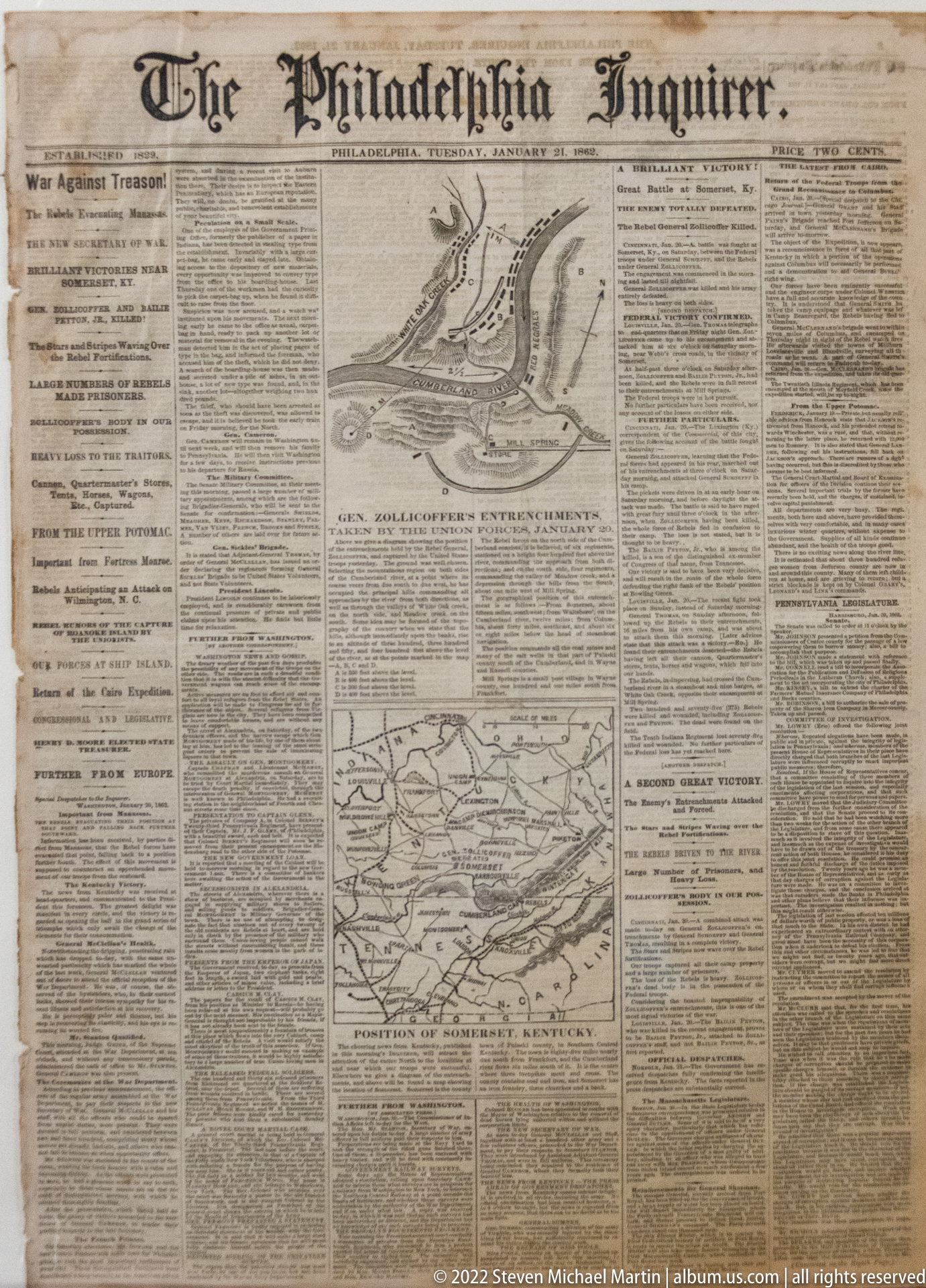
An old newspaper page headed “The Philadelphia Inquirer” contains dense columns of type around two large battle maps. The diagrams occupy the center and lower portion, offering a visual break in the text and likely presenting military positions or movements. Yellowed paper and narrow blackletter-style headings preserve the look of a nineteenth-century printed report.
Caption
An old newspaper page headed “The Philadelphia Inquirer” contains dense columns of type around two large battle maps. The diagrams occupy the center and lower portion, offering a visual break in the text and likely presenting military positions or movements. Yellowed paper and narrow blackletter-style headings preserve the look of a nineteenth-century printed report.
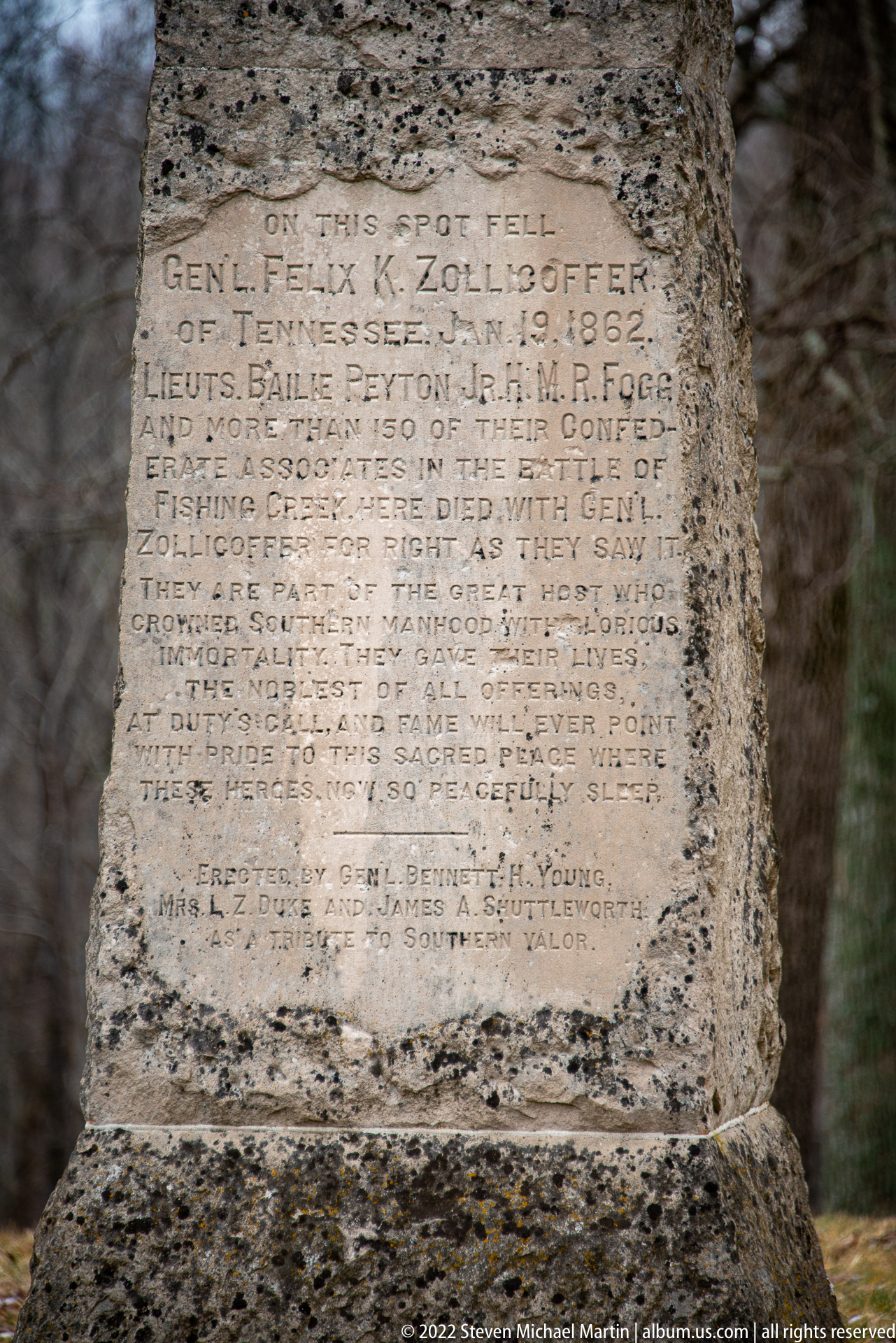
A close view makes the carved inscription on a rough stone marker legible: it identifies the place where Confederate General Felix K. Zollicoffer fell on January 19, 1862. The recessed lettering occupies most of the frame, while the irregular stone surface and darkened characters emphasize the marker’s age and commemorative purpose.
Caption
A close view makes the carved inscription on a rough stone marker legible: it identifies the place where Confederate General Felix K. Zollicoffer fell on January 19, 1862. The recessed lettering occupies most of the frame, while the irregular stone surface and darkened characters emphasize the marker’s age and commemorative purpose.

A glass-fronted display presents rows of small drawings showing soldiers from the front, side and back, with several figures holding or shouldering firearms. The sketches vary in uniform details and stance, forming a comparative visual reference rather than a single battle scene. Reflections in the case reveal the museum setting around the paper illustrations.
Caption
A glass-fronted display presents rows of small drawings showing soldiers from the front, side and back, with several figures holding or shouldering firearms. The sketches vary in uniform details and stance, forming a comparative visual reference rather than a single battle scene. Reflections in the case reveal the museum setting around the paper illustrations.

A large engraved caricature of Jefferson Davis fills the foreground, his furrowed face and heavy coat rendered in fine crosshatching. Newspaper columns and a bold headline remain visible behind the portrait, including a printed reference to Davis at the right. The close crop emphasizes the cartoon’s exaggerated expression and its place within a larger political news page.
Caption
A large engraved caricature of Jefferson Davis fills the foreground, his furrowed face and heavy coat rendered in fine crosshatching. Newspaper columns and a bold headline remain visible behind the portrait, including a printed reference to Davis at the right. The close crop emphasizes the cartoon’s exaggerated expression and its place within a larger political news page.
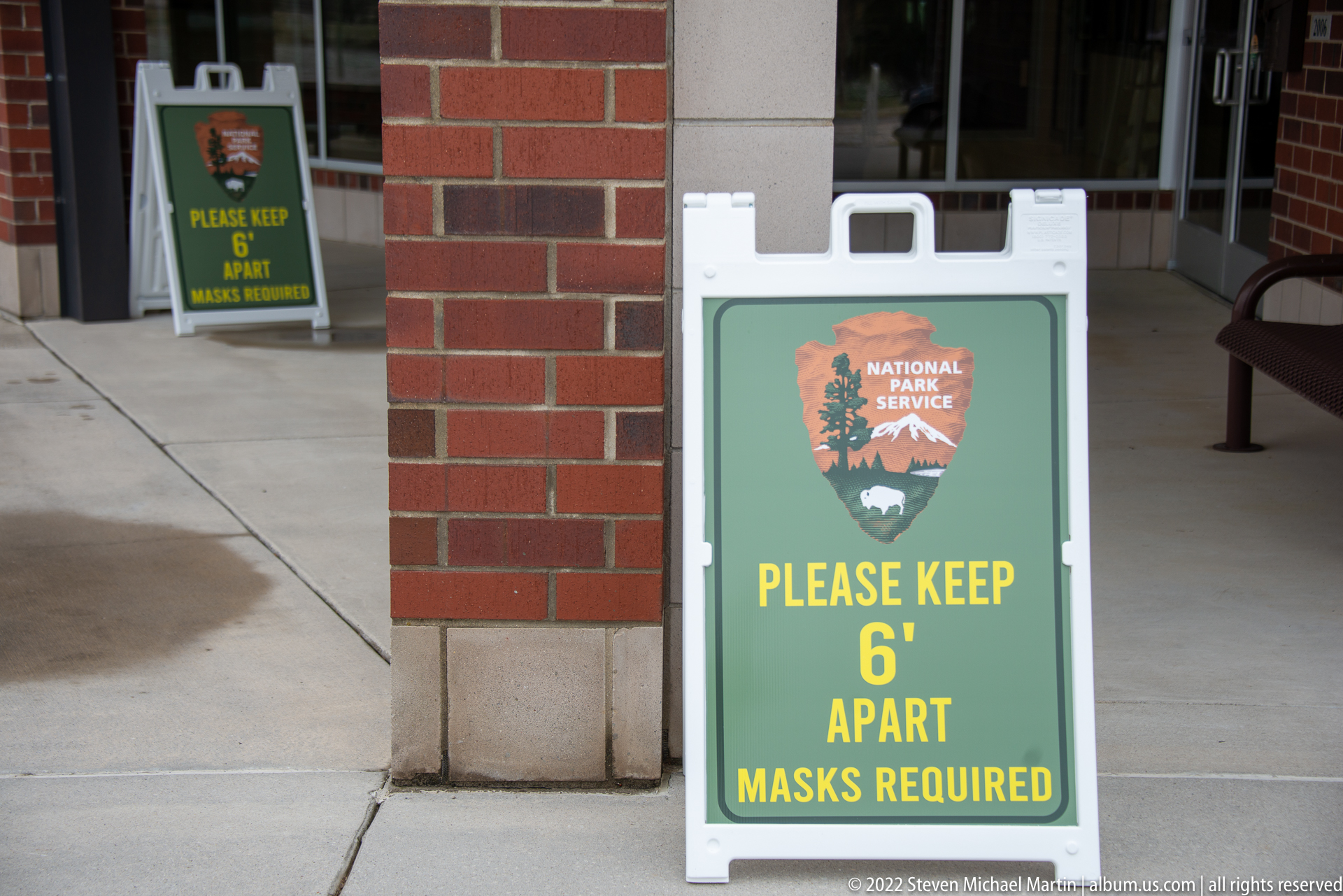
A freestanding National Park Service sign asks visitors to keep six feet apart and wear masks at the visitor center entrance. The green panel stands beside a red-brick wall and glass doorway, with a second notice farther inside. Its close framing preserves a specific moment when public-health measures shaped access to the historic battlefield site.
Caption
A freestanding National Park Service sign asks visitors to keep six feet apart and wear masks at the visitor center entrance. The green panel stands beside a red-brick wall and glass doorway, with a second notice farther inside. Its close framing preserves a specific moment when public-health measures shaped access to the historic battlefield site.

A Kentucky historical marker titled “Zollie Tree” stands before the trunk of a large white oak. Its text describes an annual decoration tradition begun in 1902 in honor of General Zollicoffer, and notes that a Boy Scout trail follows the Confederate retreat toward the Cumberland River. The tree and sign connect local memory with the battlefield landscape.
Caption
A Kentucky historical marker titled “Zollie Tree” stands before the trunk of a large white oak. Its text describes an annual decoration tradition begun in 1902 in honor of General Zollicoffer, and notes that a Boy Scout trail follows the Confederate retreat toward the Cumberland River. The tree and sign connect local memory with the battlefield landscape.
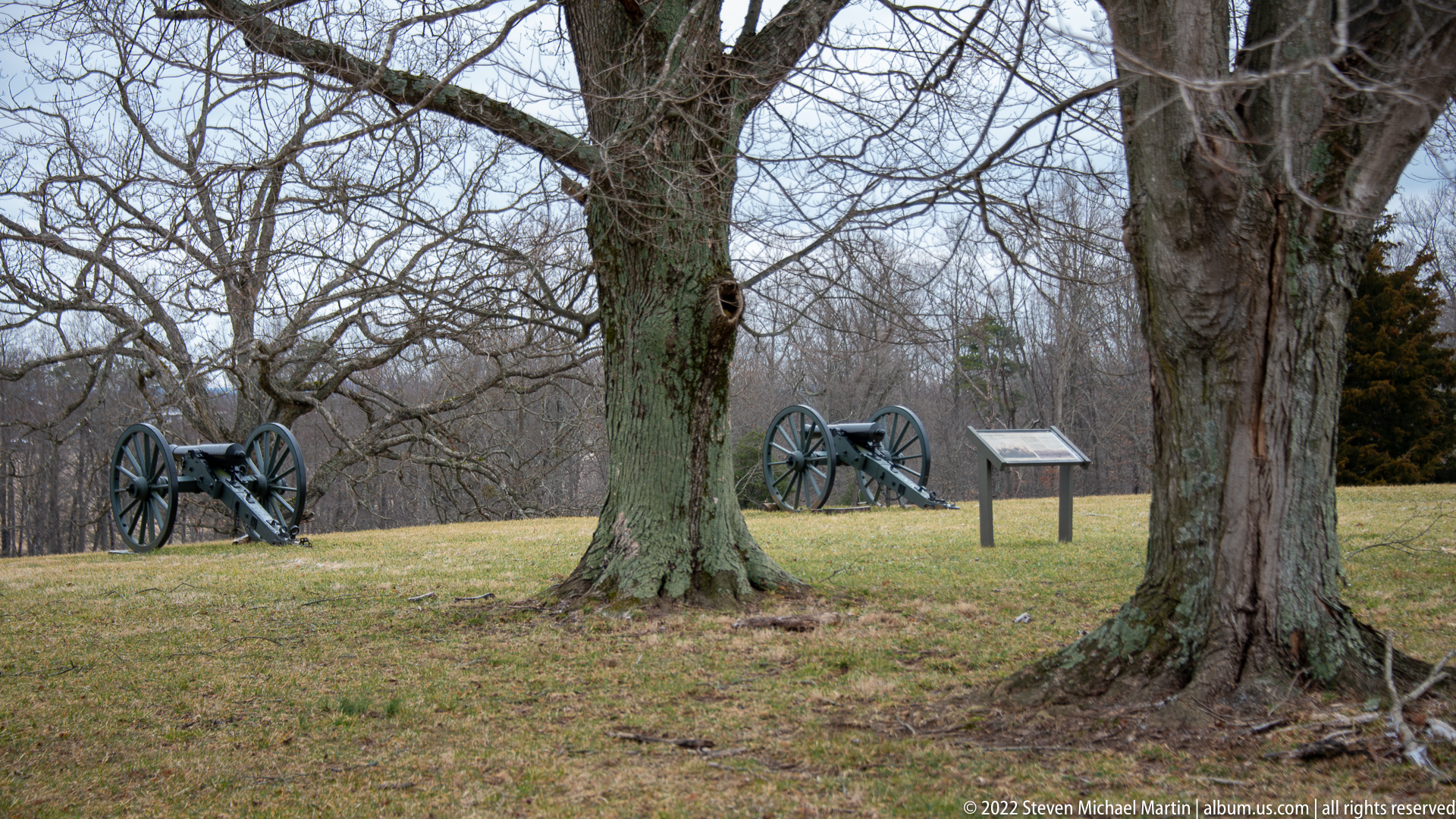
Two black field cannons stand among mature trees beside a low interpretive sign on the grassy battlefield grounds. Their paired placement and spoked wheels are visible through the trunks, while the sign faces the path between them. Bare branches and overcast light give the artillery display a quiet winter setting.
Caption
Two black field cannons stand among mature trees beside a low interpretive sign on the grassy battlefield grounds. Their paired placement and spoked wheels are visible through the trunks, while the sign faces the path between them. Bare branches and overcast light give the artillery display a quiet winter setting.
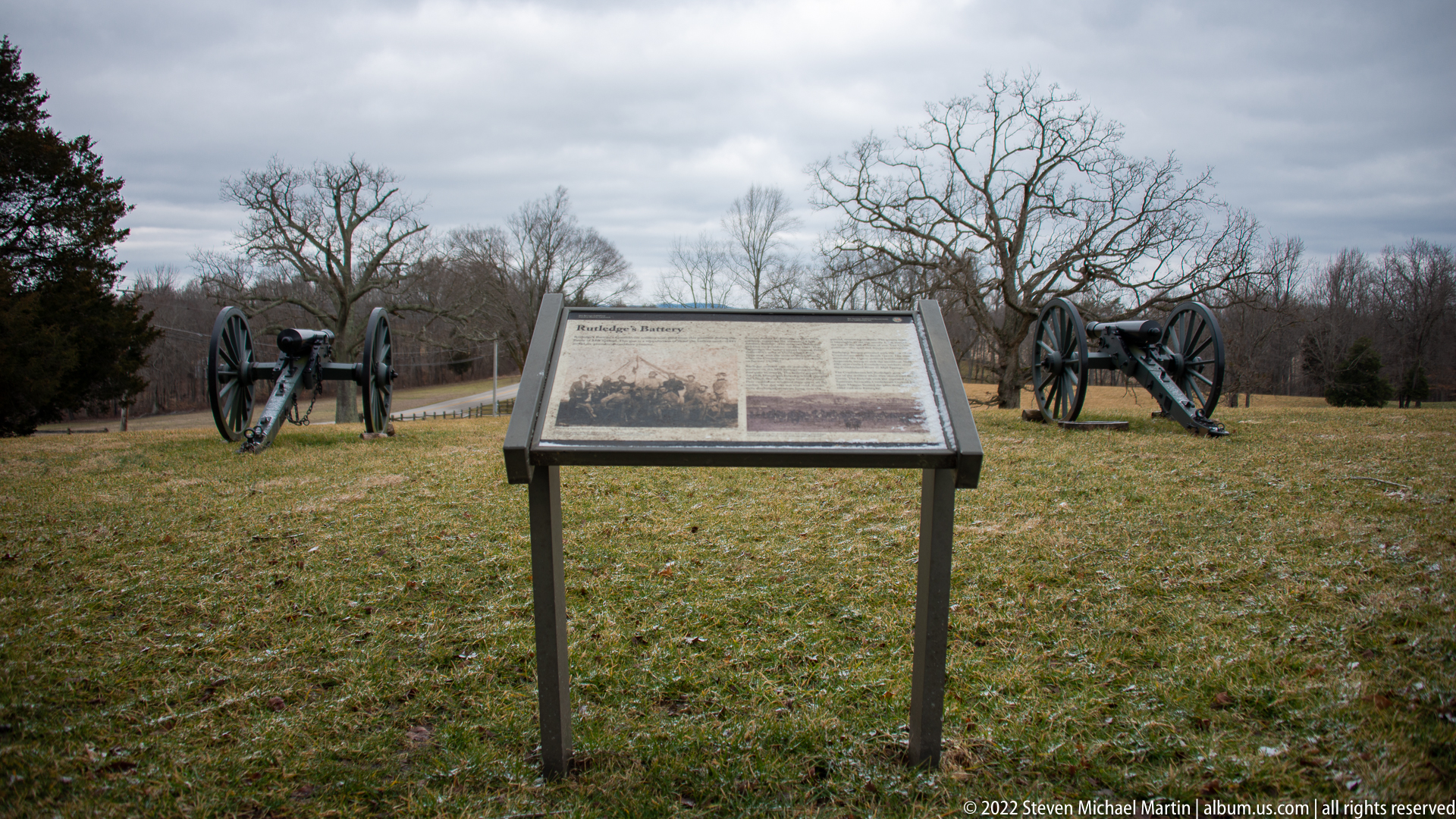
Two field cannons flank a low interpretive panel on an open lawn, with bare trees and a pale winter sky behind. The wide composition makes the display’s arrangement clear: the artillery faces outward on either side of the sign, set apart from the surrounding road and grounds. No firing crew or reenactment activity is present.
Caption
Two field cannons flank a low interpretive panel on an open lawn, with bare trees and a pale winter sky behind. The wide composition makes the display’s arrangement clear: the artillery faces outward on either side of the sign, set apart from the surrounding road and grounds. No firing crew or reenactment activity is present.

An interpretive panel titled “Rutledge’s Battery” presents archival photographs of soldiers and artillery beside explanatory text. The sign rests low over the grass, photographed from above so the printed group portrait and battlefield scene fill much of the frame. Its worn, mottled surface contrasts with the black border and dark metal support.
Caption
An interpretive panel titled “Rutledge’s Battery” presents archival photographs of soldiers and artillery beside explanatory text. The sign rests low over the grass, photographed from above so the printed group portrait and battlefield scene fill much of the frame. Its worn, mottled surface contrasts with the black border and dark metal support.

Two beagles sit together inside a vehicle, their heads turned in slightly different directions toward the open window. Their tan-and-white coats and matching blue flower tags stand out against the dark interior, while the close framing keeps attention on the pair rather than the surrounding park.
Caption
Two beagles sit together inside a vehicle, their heads turned in slightly different directions toward the open window. Their tan-and-white coats and matching blue flower tags stand out against the dark interior, while the close framing keeps attention on the pair rather than the surrounding park.
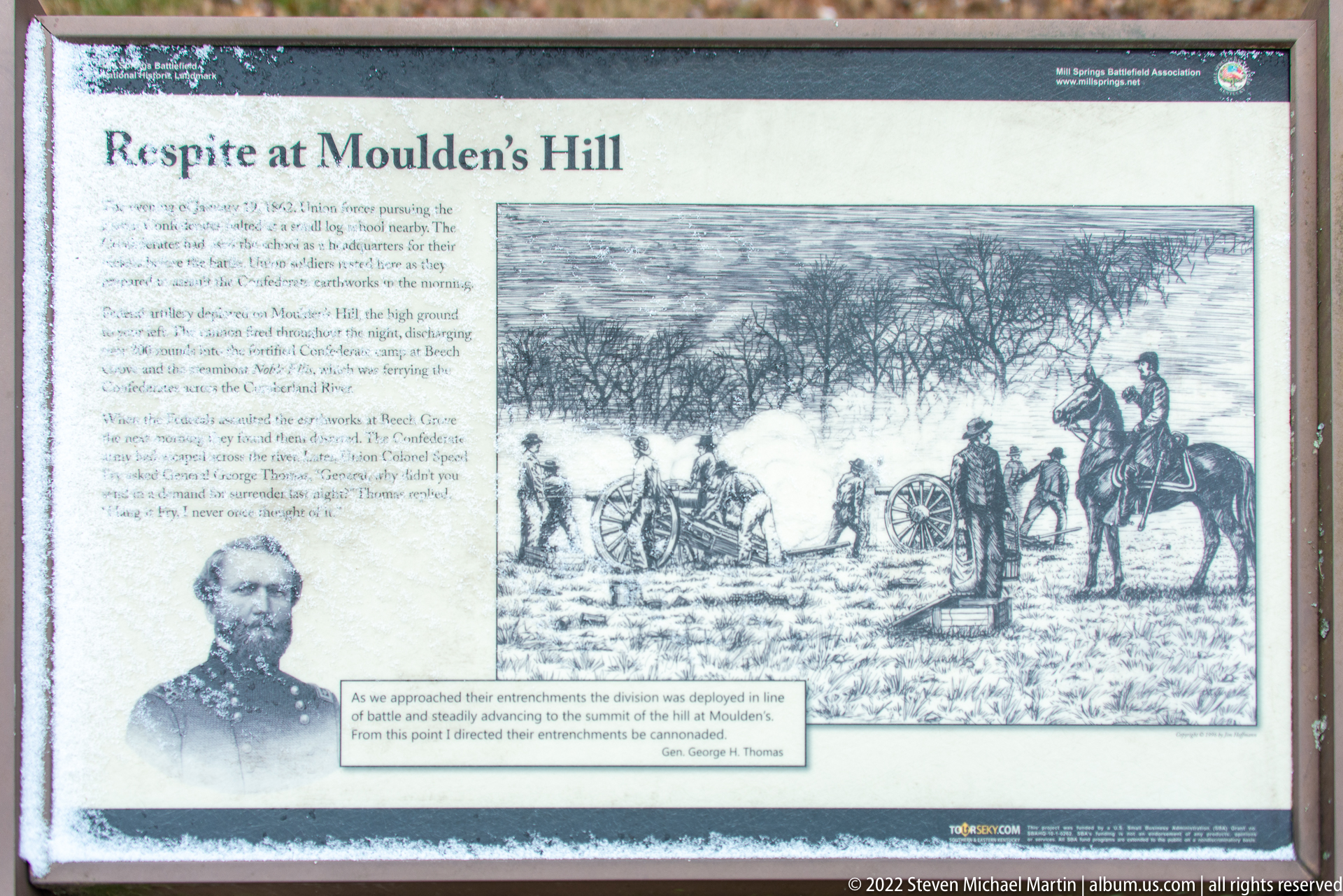
A historical panel headed “Moulden’s Hill” pairs a portrait of a uniformed officer with a drawing of artillery and soldiers moving across a snowy field. The text and quoted account describe the battlefield position and movement of troops; the large monochrome illustration carries most of the visual weight. Fine print is not fully legible at this distance.
Caption
A historical panel headed “Moulden’s Hill” pairs a portrait of a uniformed officer with a drawing of artillery and soldiers moving across a snowy field. The text and quoted account describe the battlefield position and movement of troops; the large monochrome illustration carries most of the visual weight. Fine print is not fully legible at this distance.
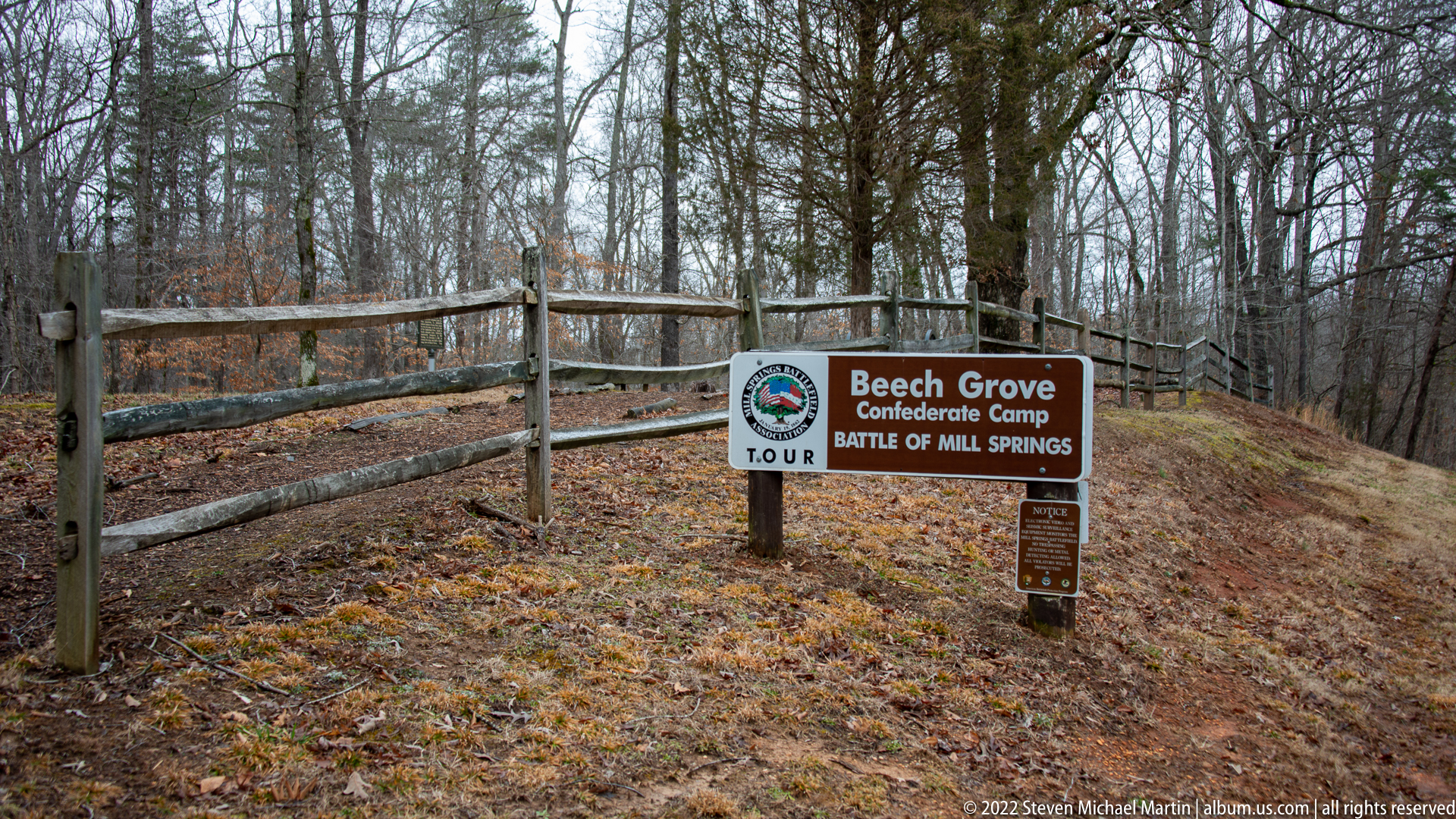
A wooden roadside sign identifies “Beech Grove Confederate Camp” and points visitors toward the Battle of Mill Springs tour. It stands beside a split-rail fence on a leaf-covered rise, with a small route marker below and bare woods behind. The sign places the historic camp within the present-day driving tour.
Caption
A wooden roadside sign identifies “Beech Grove Confederate Camp” and points visitors toward the Battle of Mill Springs tour. It stands beside a split-rail fence on a leaf-covered rise, with a small route marker below and bare woods behind. The sign places the historic camp within the present-day driving tour.

A large outdoor panel fills the frame with a historic battlefield photograph, a portrait, and several blocks of explanatory text. The image appears to show a winter landscape and soldiers, while the sign’s title is washed out and difficult to read. Its placement against the trees suggests a roadside interpretation point, but the precise subject needs confirmation.
Caption
A large outdoor panel fills the frame with a historic battlefield photograph, a portrait, and several blocks of explanatory text. The image appears to show a winter landscape and soldiers, while the sign’s title is washed out and difficult to read. Its placement against the trees suggests a roadside interpretation point, but the precise subject needs confirmation.
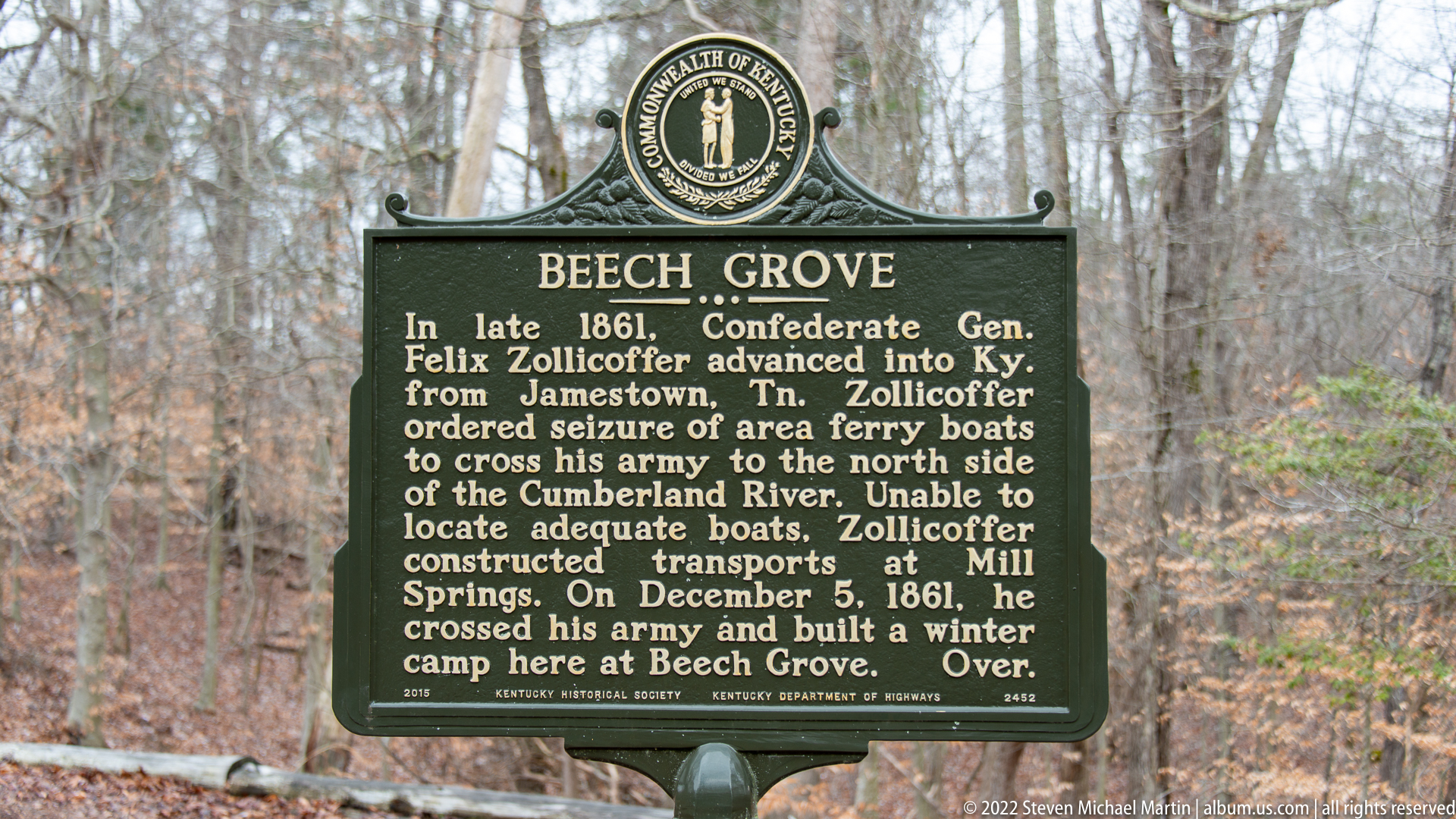
A dark green historical marker titled “Beech Grove” explains that Confederate General Felix Zollicoffer advanced into Kentucky in late 1861 and established a winter camp near Mill Springs. The sign stands in a wooded setting behind a split-rail fence, its gold lettering sharply contrasted against the dark metal face.
Caption
A dark green historical marker titled “Beech Grove” explains that Confederate General Felix Zollicoffer advanced into Kentucky in late 1861 and established a winter camp near Mill Springs. The sign stands in a wooded setting behind a split-rail fence, its gold lettering sharply contrasted against the dark metal face.

The upper medallion and title of a Beech Grove marker fill the frame, showing the Commonwealth of Kentucky seal above bold gold lettering. The state motto circles two figures in the seal, and a decorative relief border spreads across the dark green metal. This tight crop isolates the marker’s emblem and place name from its explanatory text.
Caption
The upper medallion and title of a Beech Grove marker fill the frame, showing the Commonwealth of Kentucky seal above bold gold lettering. The state motto circles two figures in the seal, and a decorative relief border spreads across the dark green metal. This tight crop isolates the marker’s emblem and place name from its explanatory text.

A green historical marker titled “Noble Ellis” stands beside a field cannon and wooden bench beneath pine branches. Its inscription recounts the steamboat supply of Confederate forces and the destruction of the Noble Ellis after the Battle of Mill Springs. The cannon and fenced woods around it place this account within the battlefield’s driving-tour landscape.
Caption
A green historical marker titled “Noble Ellis” stands beside a field cannon and wooden bench beneath pine branches. Its inscription recounts the steamboat supply of Confederate forces and the destruction of the Noble Ellis after the Battle of Mill Springs. The cannon and fenced woods around it place this account within the battlefield’s driving-tour landscape.

A narrow stone pillar stands alone among leafless trees at the edge of a grassy clearing. Its stacked masonry rises vertically from a rough base, but no readable inscription or nearby sign identifies its original purpose. The subdued winter light and surrounding woods make the isolated structure the focal point.
Caption
A narrow stone pillar stands alone among leafless trees at the edge of a grassy clearing. Its stacked masonry rises vertically from a rough base, but no readable inscription or nearby sign identifies its original purpose. The subdued winter light and surrounding woods make the isolated structure the focal point.

A circular Mill Springs Battlefield emblem is painted on a white vertical surface, with a tree carrying a stylized American flag inside the design. The wording names the battlefield and gives the date January 19, 1862. In close view, the emblem’s bright colors and dated title stand apart from the muted winter landscape around the site.
Caption
A circular Mill Springs Battlefield emblem is painted on a white vertical surface, with a tree carrying a stylized American flag inside the design. The wording names the battlefield and gives the date January 19, 1862. In close view, the emblem’s bright colors and dated title stand apart from the muted winter landscape around the site.

An interpretive panel titled “Zollicoffer Gives an Army” recounts the Confederate advance toward Mill Springs and the crossing of the Cumberland River. A large monochrome illustration shows soldiers, wagons, and a river landing, while smaller text blocks describe the march and its confusion. The broad panel makes the movement of troops across the landscape its central narrative.
Caption
An interpretive panel titled “Zollicoffer Gives an Army” recounts the Confederate advance toward Mill Springs and the crossing of the Cumberland River. A large monochrome illustration shows soldiers, wagons, and a river landing, while smaller text blocks describe the march and its confusion. The broad panel makes the movement of troops across the landscape its central narrative.
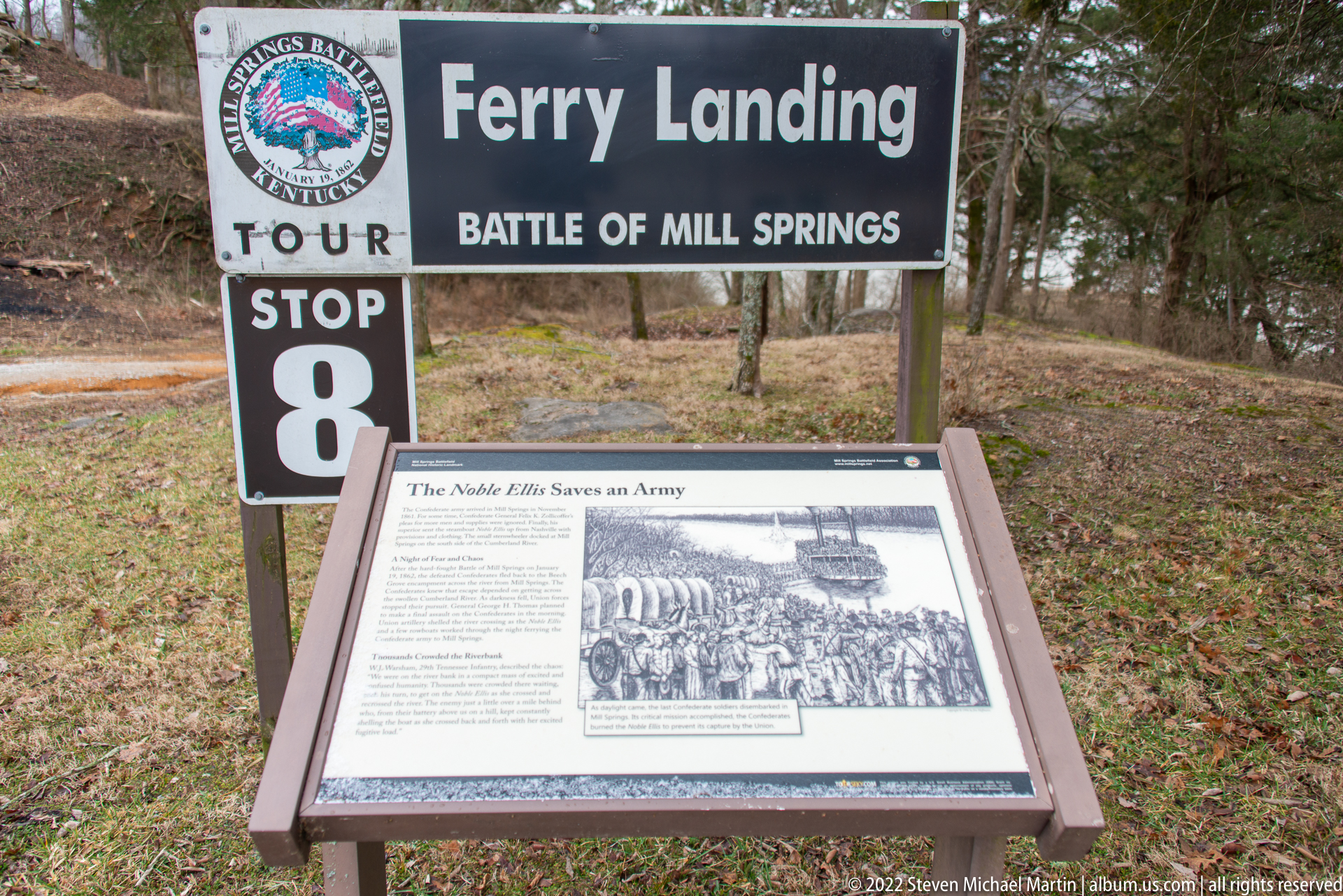
A “Ferry Landing” tour sign stands above an outdoor panel about the Noble Ellis and the army’s river crossing. A separate marker identifies the stop as number eight, while bare trees and leaf litter surround the display. The composition connects the present-day tour route with the river transport described in the historical illustration.
Caption
A “Ferry Landing” tour sign stands above an outdoor panel about the Noble Ellis and the army’s river crossing. A separate marker identifies the stop as number eight, while bare trees and leaf litter surround the display. The composition connects the present-day tour route with the river transport described in the historical illustration.
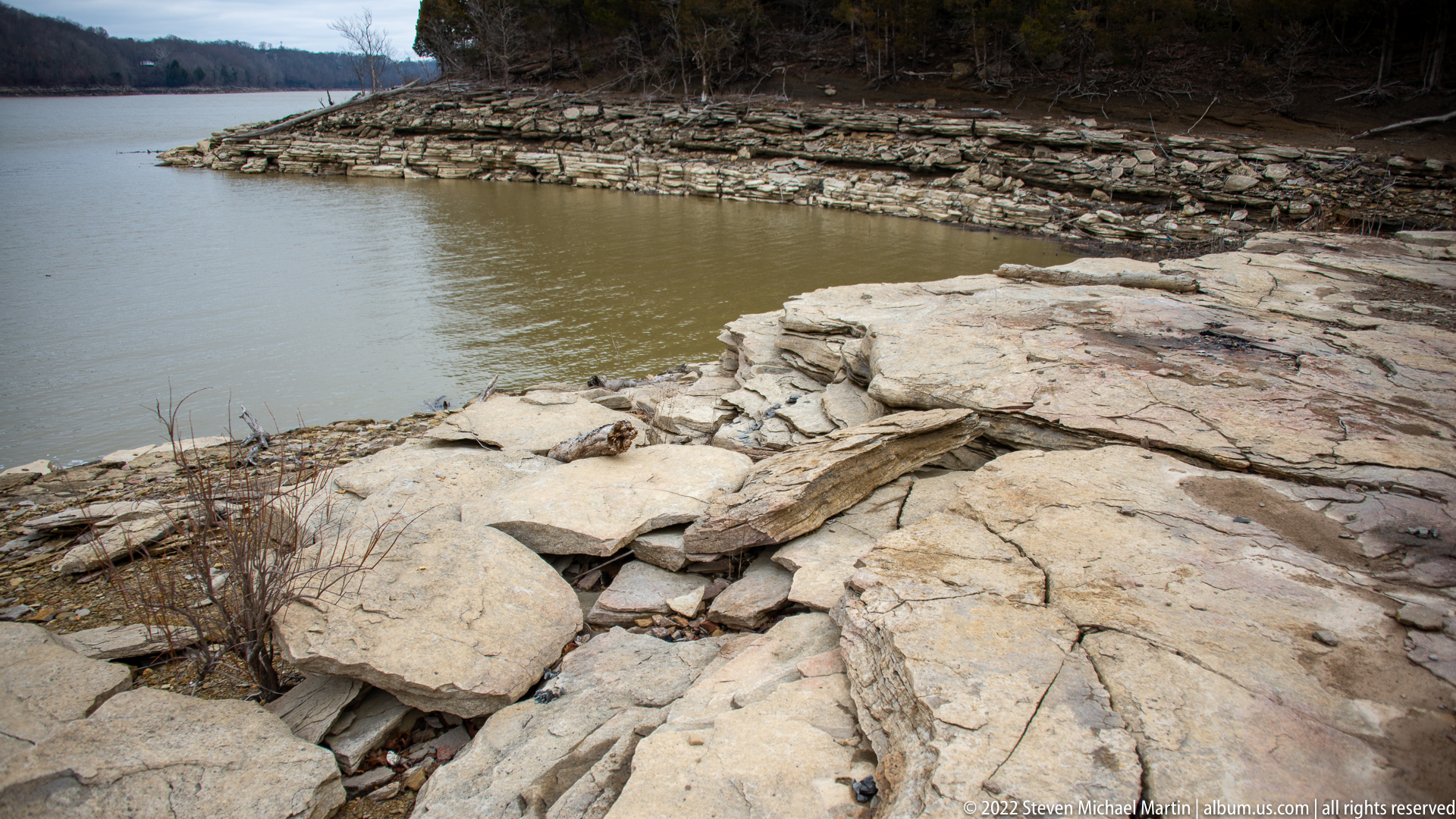
Pale layered limestone shelves fill the foreground and curve around still water at the base of a wooded bank. Thin strata and broken slabs create a stepped edge, while the opposite shore is dark with bare trees. The close landscape view concentrates on the river’s rocky margin rather than the wider crossing or visitor route.
Caption
Pale layered limestone shelves fill the foreground and curve around still water at the base of a wooded bank. Thin strata and broken slabs create a stepped edge, while the opposite shore is dark with bare trees. The close landscape view concentrates on the river’s rocky margin rather than the wider crossing or visitor route.
📍 Overview
Mill Springs Battlefield National Monument preserves the site of an important early Union victory in the Civil War. Fought in January 1862, the Battle of Mill Springs helped secure Kentucky for the Union and strengthened momentum for Federal forces in the western theater. The preserved landscape conveys the uncertainty and intensity of early war campaigns fought across challenging winter terrain.
The battlefield includes rolling fields, wooded ridges, and open farmland that illustrate the conditions faced by soldiers during the engagement. Interpretive exhibits and preserved terrain features help visitors understand the movements of Union and Confederate forces, as well as the strategic importance of transportation routes in the region. The site provides meaningful context for understanding the broader military developments of the Civil War.
⭐ Highlights
- Site of a key early Union victory in the Civil War
- Preserved battlefield landscape with interpretive markers
- Walking trails connecting important engagement locations
- Memorial areas honoring soldiers from both sides
- Scenic rural setting reflecting historic terrain
🔎 Key Features
- Rolling terrain illustrating battlefield movements
- Interpretive signage explaining the course of the battle
- Memorial monuments commemorating participants
- Historic landscape largely unchanged since the conflict
- Accessible paths connecting key interpretive points
📷 Photography Notes
- Early morning or late afternoon light works well across open fields
- Rolling hills provide natural depth and layering
- Interpretive markers can help tell the story visually
- Wide compositions capture the scale of the battlefield
- Cloud formations often add atmosphere to landscape images
- Look for quiet scenes that convey reflection and history