Browns Canyon National Monument
Browns Canyon National Monument preserves a rugged river corridor along the Arkansas River characterized by granite cliffs, forested slopes, and high elevation terrain. The landscape reflects geological processes associated with uplift of the Rocky Mountains and long-term erosion by flowing water. The canyon environment illustrates the transition from plateau landscapes to alpine mountain environments.
The Arkansas River carved its path through resistant rock, creating steep canyon walls and varied terrain that includes exposed stone formations and vegetated slopes. The monument contains a mixture of geological features influenced by tectonic forces that uplifted the surrounding mountain range. The canyon demonstrates the diversity of landforms present where mountain and river systems intersect.
Visitors encounter a landscape that contrasts with the desert canyon environments found farther south and west. Forested slopes and flowing water contribute to a different visual character while still reflecting long-term geological processes shaping western North America.
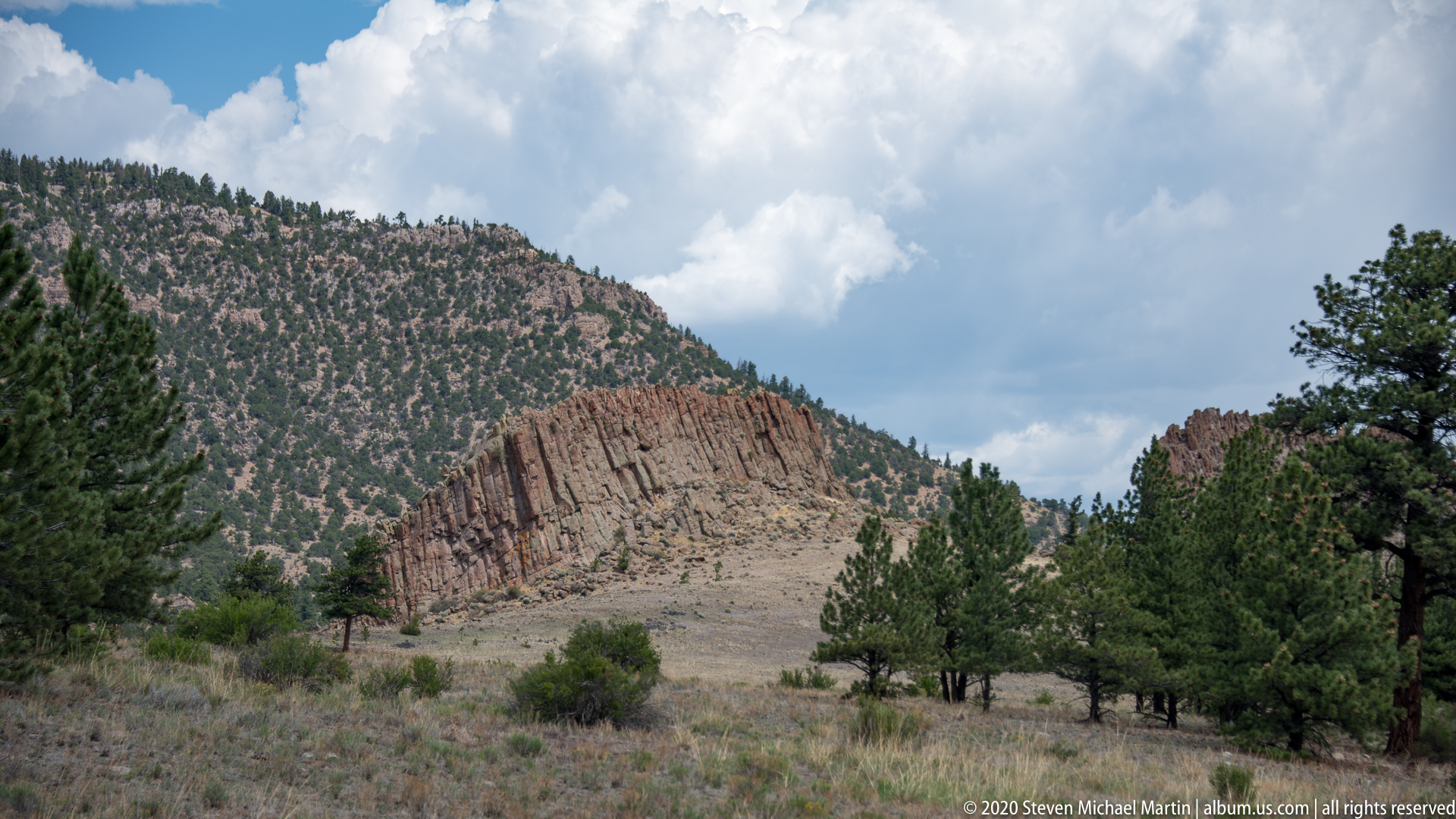
A steep red-brown rock face cuts across the middle of a mountain valley, with a darker pine-covered slope rising behind it. Scrubby open ground and scattered trees occupy the foreground, while broken clouds gather above the ridge. The diagonal composition links the exposed cliff to the forested terrain and gives a sense of the canyon’s changing elevations.
Caption
A steep red-brown rock face cuts across the middle of a mountain valley, with a darker pine-covered slope rising behind it. Scrubby open ground and scattered trees occupy the foreground, while broken clouds gather above the ridge. The diagonal composition links the exposed cliff to the forested terrain and gives a sense of the canyon’s changing elevations.
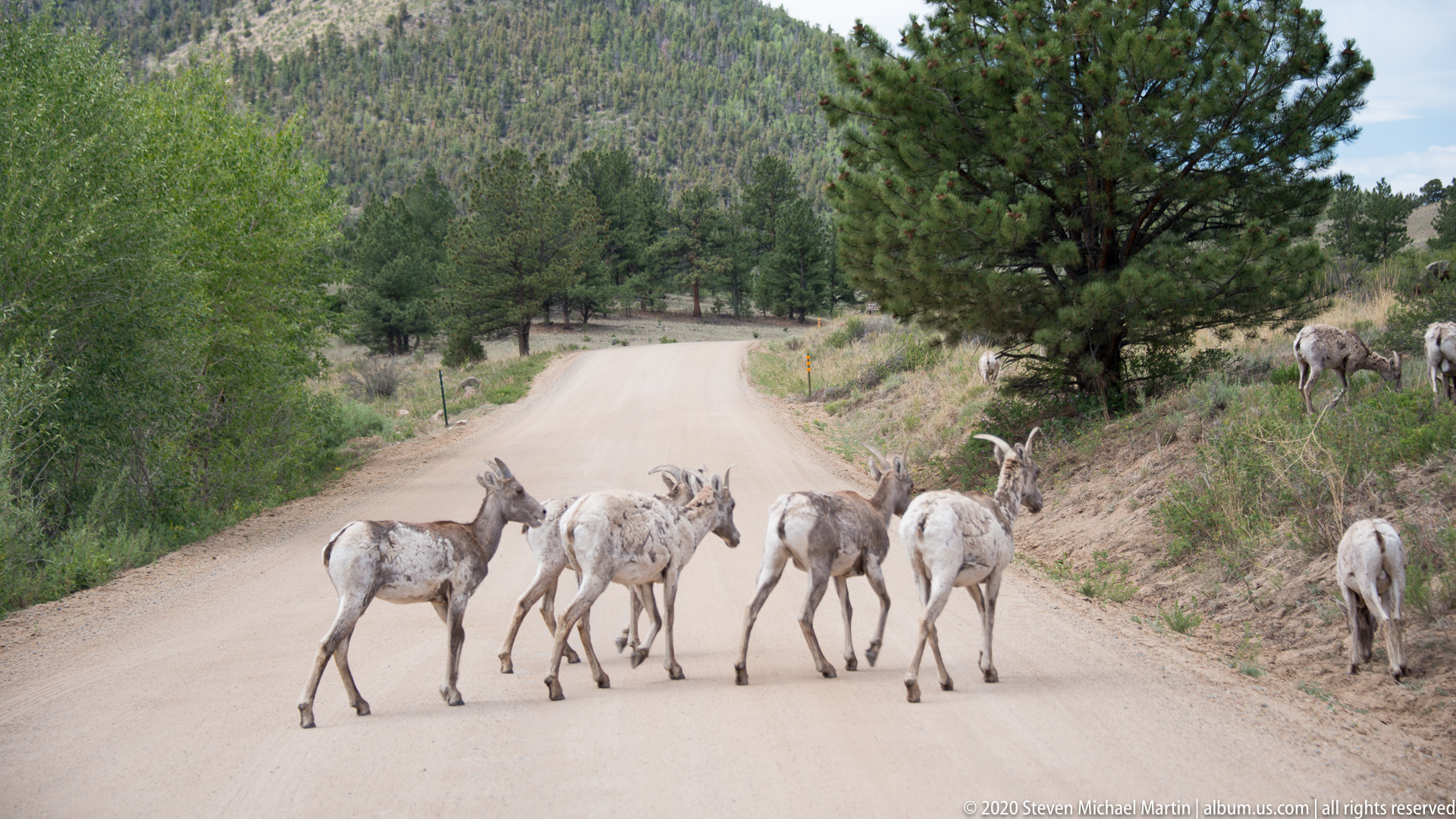
Several bighorn sheep cross a pale dirt road in a loose line, with more animals waiting along the brushy shoulder. The herd moves between wooded slopes, and the wide view leaves the winding road visible as it curves uphill through the landscape. Their differing positions show a moment of group movement rather than a static wildlife portrait.
Caption
Several bighorn sheep cross a pale dirt road in a loose line, with more animals waiting along the brushy shoulder. The herd moves between wooded slopes, and the wide view leaves the winding road visible as it curves uphill through the landscape. Their differing positions show a moment of group movement rather than a static wildlife portrait.
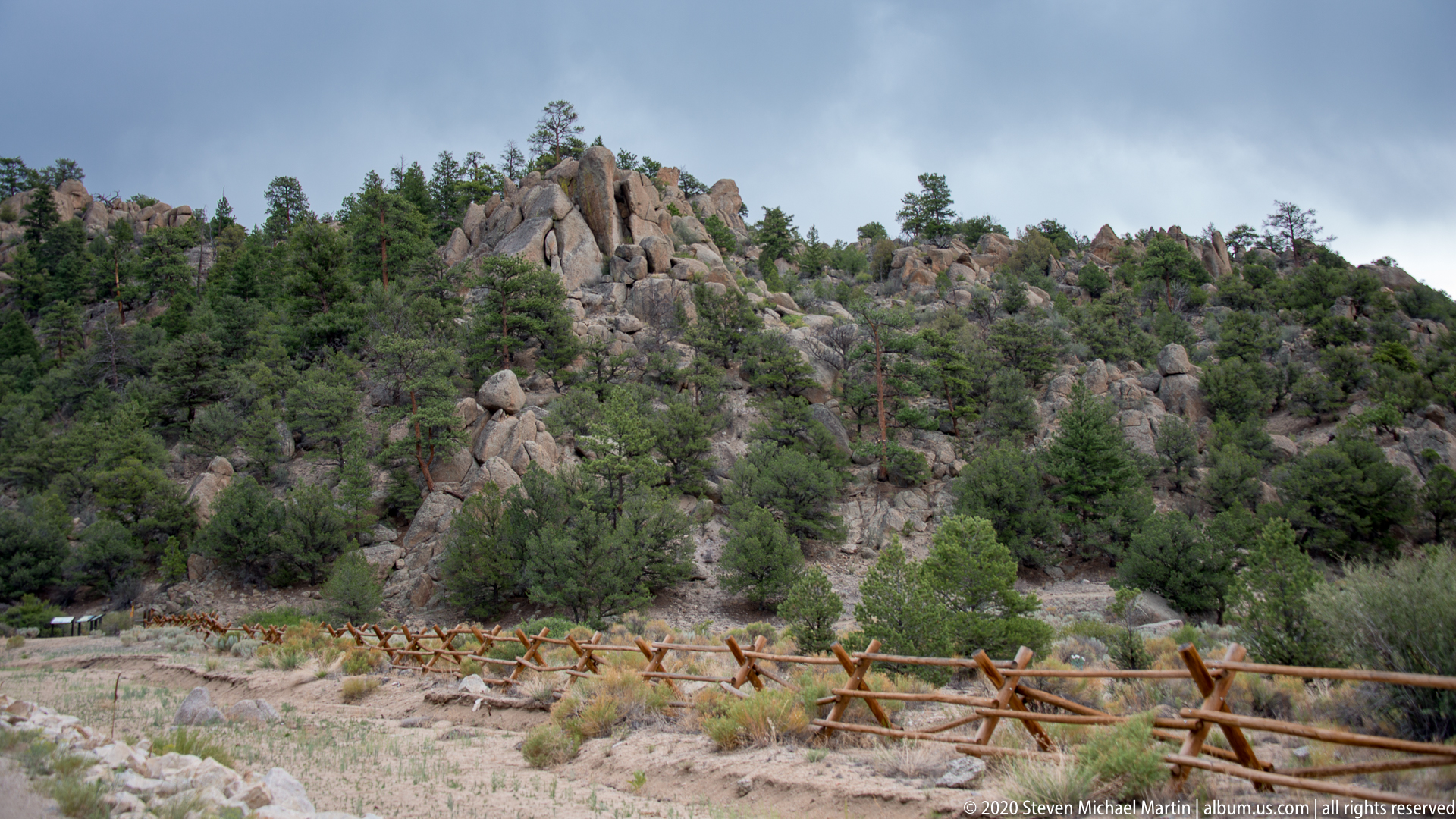
A zigzagging split-rail fence crosses the lower slope, separating a sandy, shrub-covered foreground from a granite hillside dotted with pines. The irregular rock towers rise behind the barrier, giving the scene a layered profile of human boundary and rugged terrain. The photograph records a simple trail-edge structure within the arid woodland setting.
Caption
A zigzagging split-rail fence crosses the lower slope, separating a sandy, shrub-covered foreground from a granite hillside dotted with pines. The irregular rock towers rise behind the barrier, giving the scene a layered profile of human boundary and rugged terrain. The photograph records a simple trail-edge structure within the arid woodland setting.
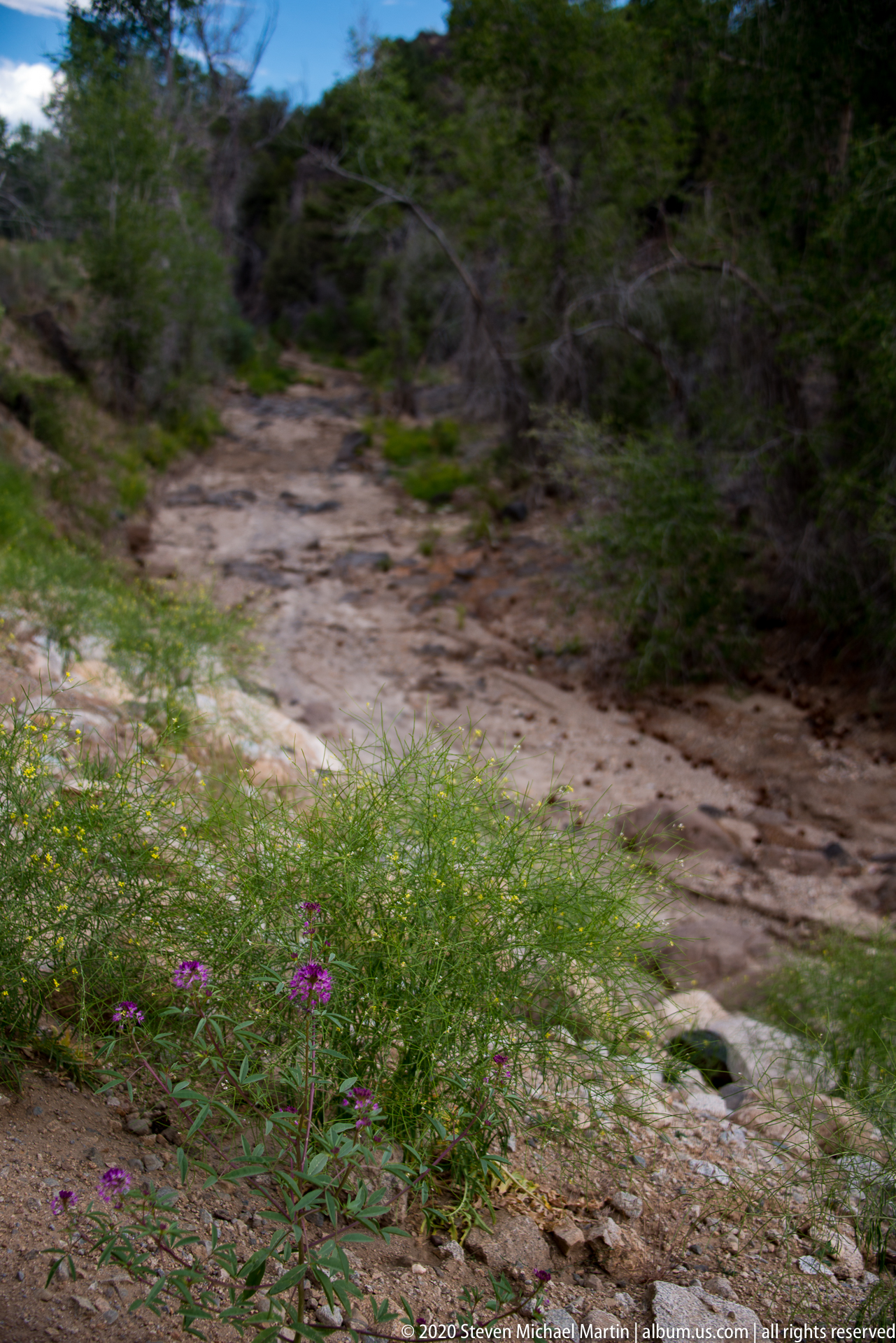
Purple wildflowers rise from a gravelly streambank while a shallow channel winds behind them through dense green vegetation. The close viewpoint places the blossoms against pale stones and moving water, emphasizing the contrast between delicate color and the rough, recently exposed river margin. The photograph records a small riparian detail within the Browns Canyon landscape.
Caption
Purple wildflowers rise from a gravelly streambank while a shallow channel winds behind them through dense green vegetation. The close viewpoint places the blossoms against pale stones and moving water, emphasizing the contrast between delicate color and the rough, recently exposed river margin. The photograph records a small riparian detail within the Browns Canyon landscape.
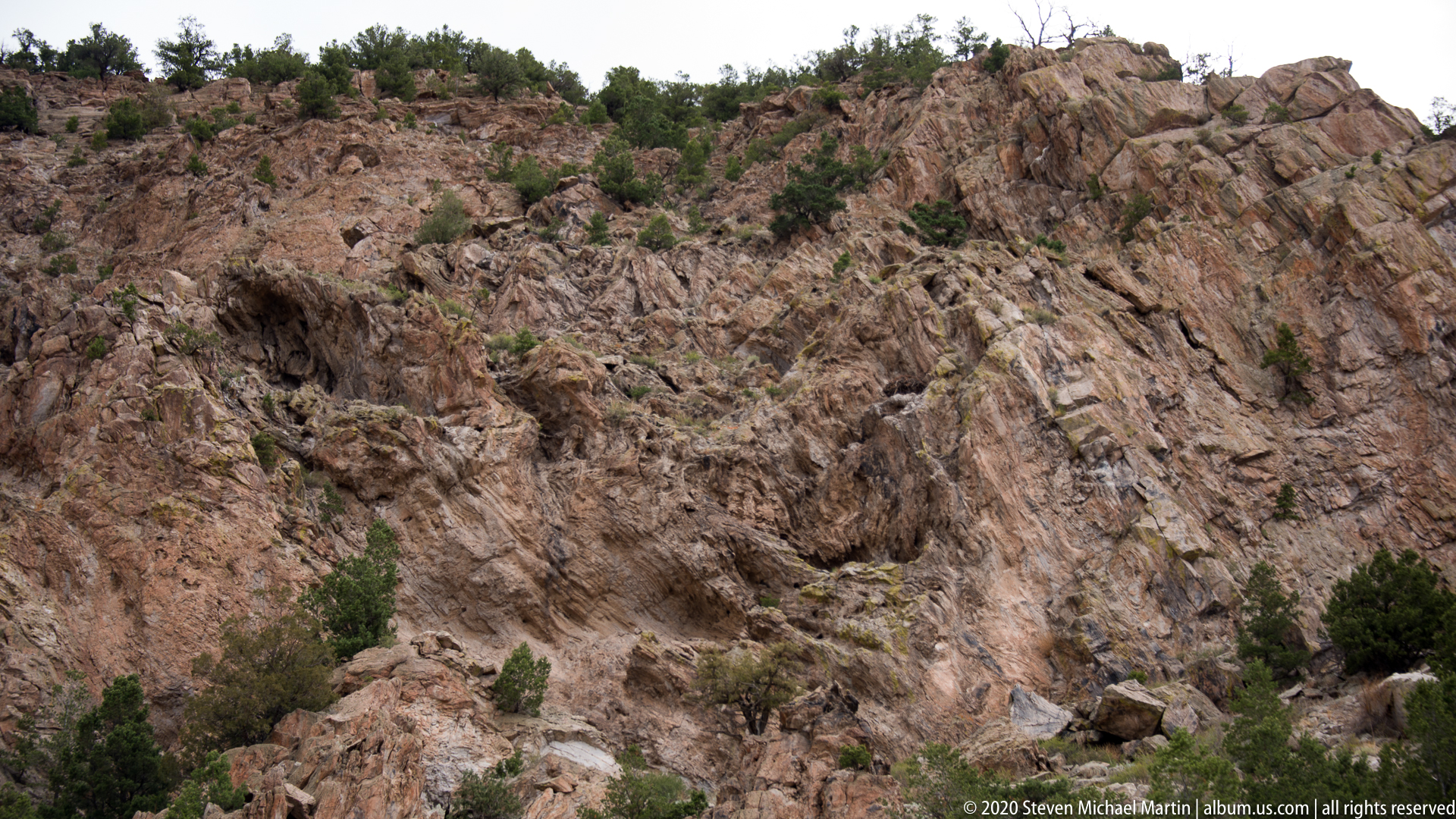
Fractured pink-gray bedrock fills the frame, its angular slabs broken by narrow seams and scattered pockets of scrub. Small pines cling to ledges near the upper edge, giving scale to the steep exposed face. The close perspective isolates the rock’s uneven structure and weathered surfaces rather than presenting a broad mountain panorama.
Caption
Fractured pink-gray bedrock fills the frame, its angular slabs broken by narrow seams and scattered pockets of scrub. Small pines cling to ledges near the upper edge, giving scale to the steep exposed face. The close perspective isolates the rock’s uneven structure and weathered surfaces rather than presenting a broad mountain panorama.

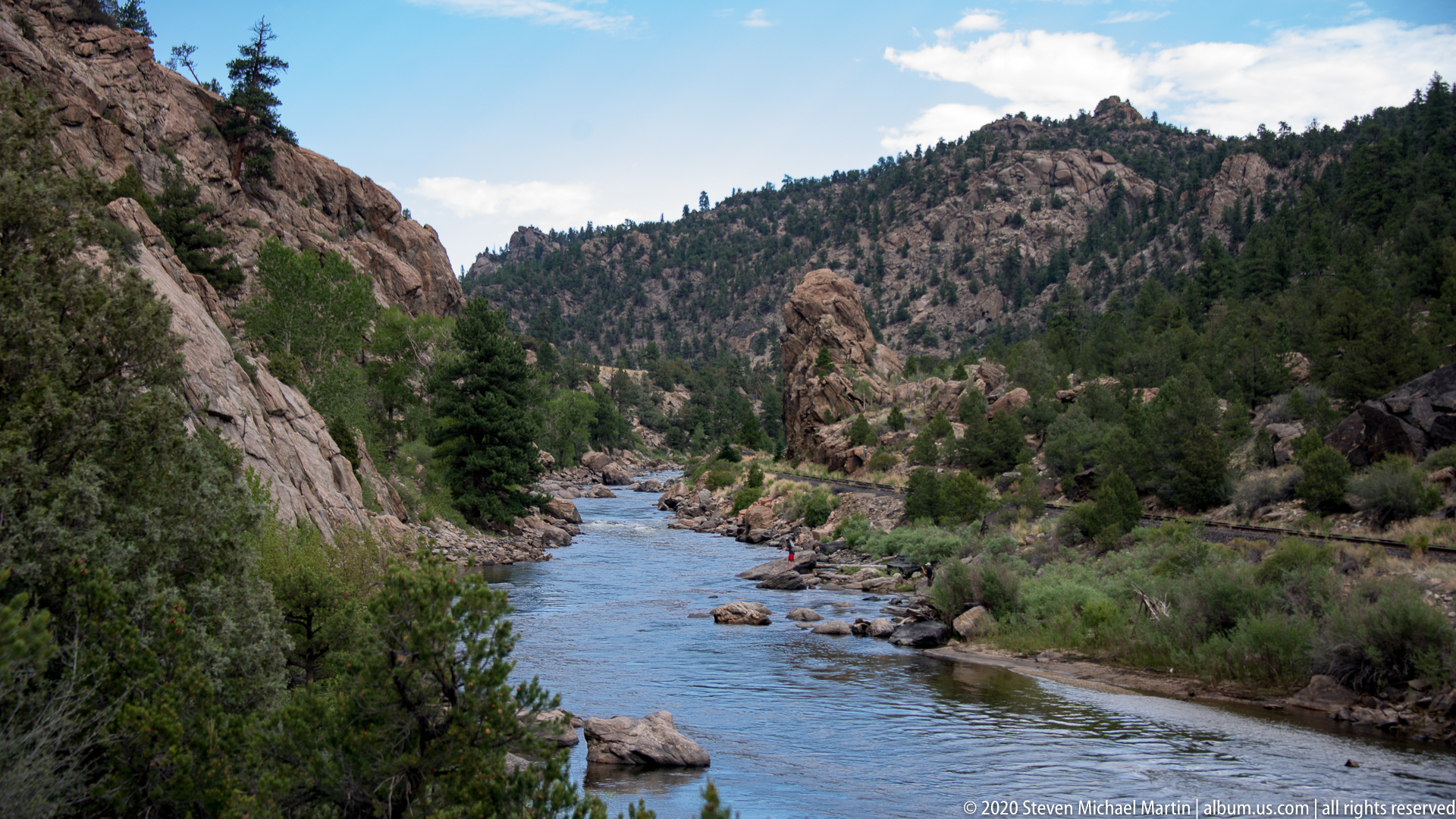
The river runs through the lower frame beneath a high, slanted rock face at left and a forested slope at right. Pine trees cling to the uneven canyon sides, while broken stones follow the near bank. Open sky and distant ridges add depth beyond the constricted foreground channel.
Caption
The river runs through the lower frame beneath a high, slanted rock face at left and a forested slope at right. Pine trees cling to the uneven canyon sides, while broken stones follow the near bank. Open sky and distant ridges add depth beyond the constricted foreground channel.
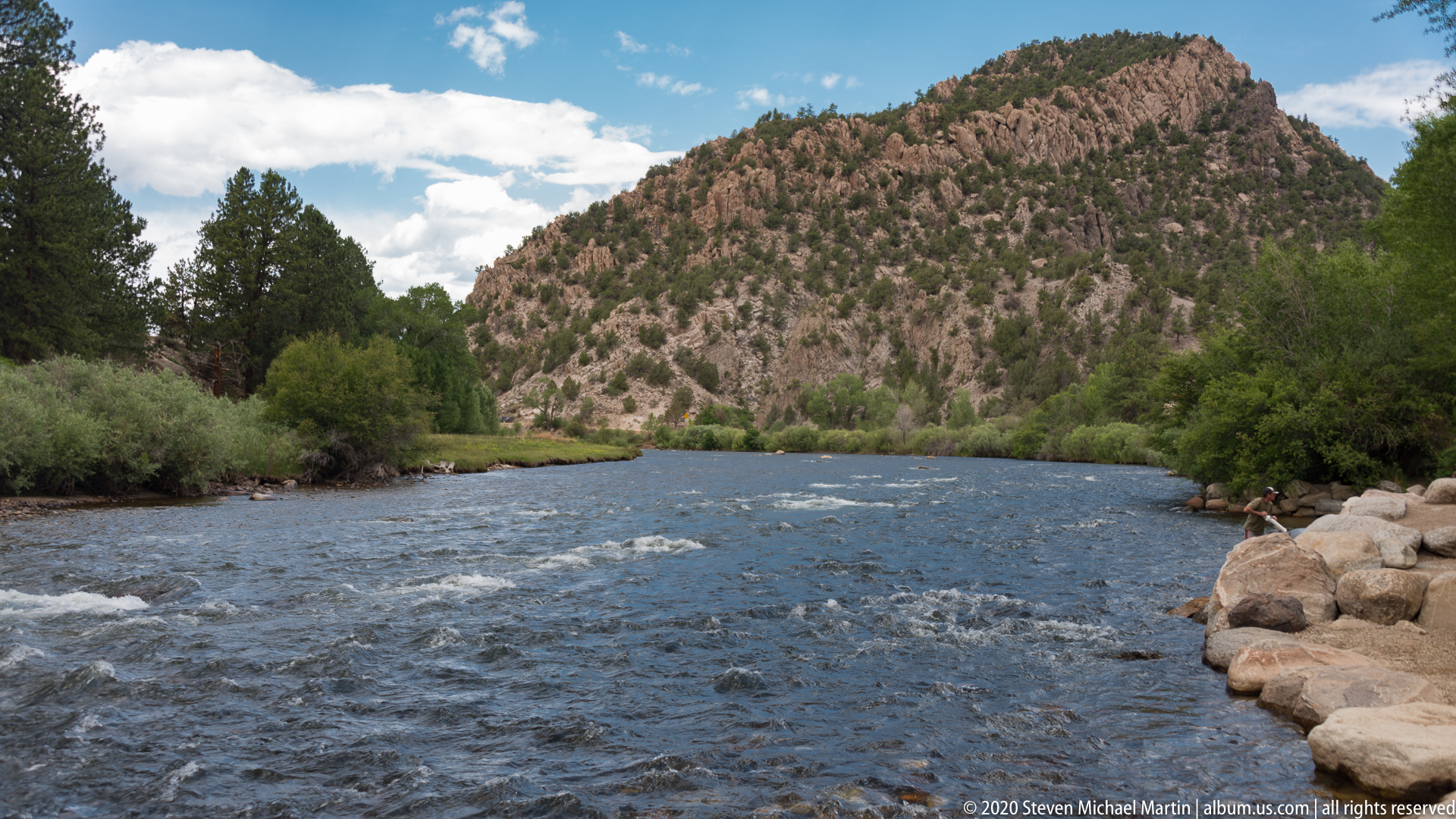
The Arkansas River runs toward a rocky bend beneath a steep, pine-covered hillside. A line of large boulders borders the near bank, while shrubs and trees follow the opposite shore. The open view emphasizes the river corridor’s relationship to the rugged terrain, with rippled current in the foreground and a cloud-dappled sky above the slope.
Caption
The Arkansas River runs toward a rocky bend beneath a steep, pine-covered hillside. A line of large boulders borders the near bank, while shrubs and trees follow the opposite shore. The open view emphasizes the river corridor’s relationship to the rugged terrain, with rippled current in the foreground and a cloud-dappled sky above the slope.
A small raft moves down the river between boulder-lined banks, with a paddler visible as a bright red figure near the center of the channel. Pine-covered slopes rise on both sides, and pale riffles mark the water’s movement. The wide composition makes the boater’s small scale against the surrounding canyon especially clear.
Caption
A small raft moves down the river between boulder-lined banks, with a paddler visible as a bright red figure near the center of the channel. Pine-covered slopes rise on both sides, and pale riffles mark the water’s movement. The wide composition makes the boater’s small scale against the surrounding canyon especially clear.
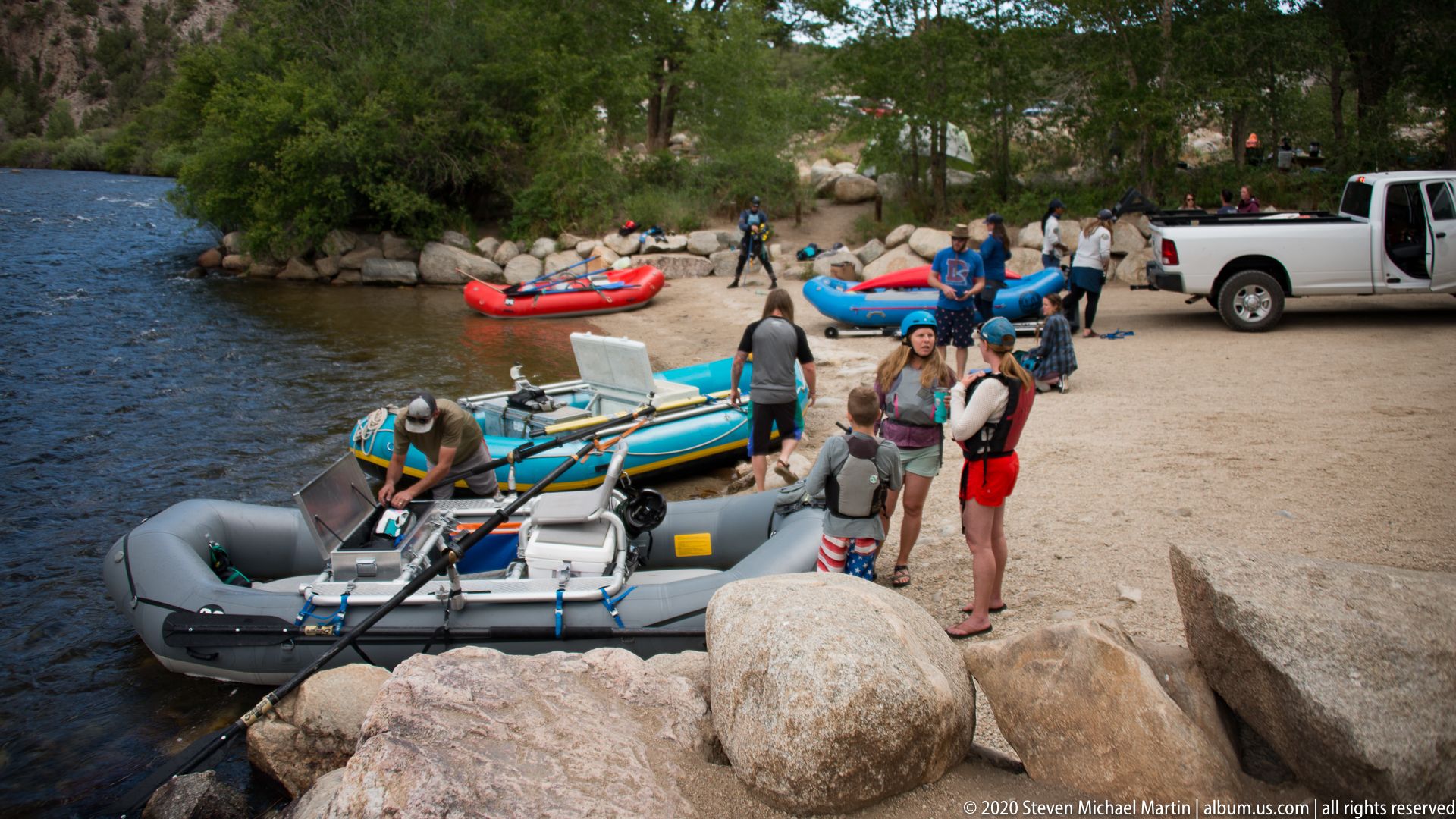
Groups of visitors prepare several inflatable rafts on a sandy, boulder-edged river access. One person works beside a raft in the foreground while others gather around boats and gear near a parked pickup. The broad composition documents the staging of a whitewater trip, showing the practical transition from shore to current along the Arkansas River.
Caption
Groups of visitors prepare several inflatable rafts on a sandy, boulder-edged river access. One person works beside a raft in the foreground while others gather around boats and gear near a parked pickup. The broad composition documents the staging of a whitewater trip, showing the practical transition from shore to current along the Arkansas River.
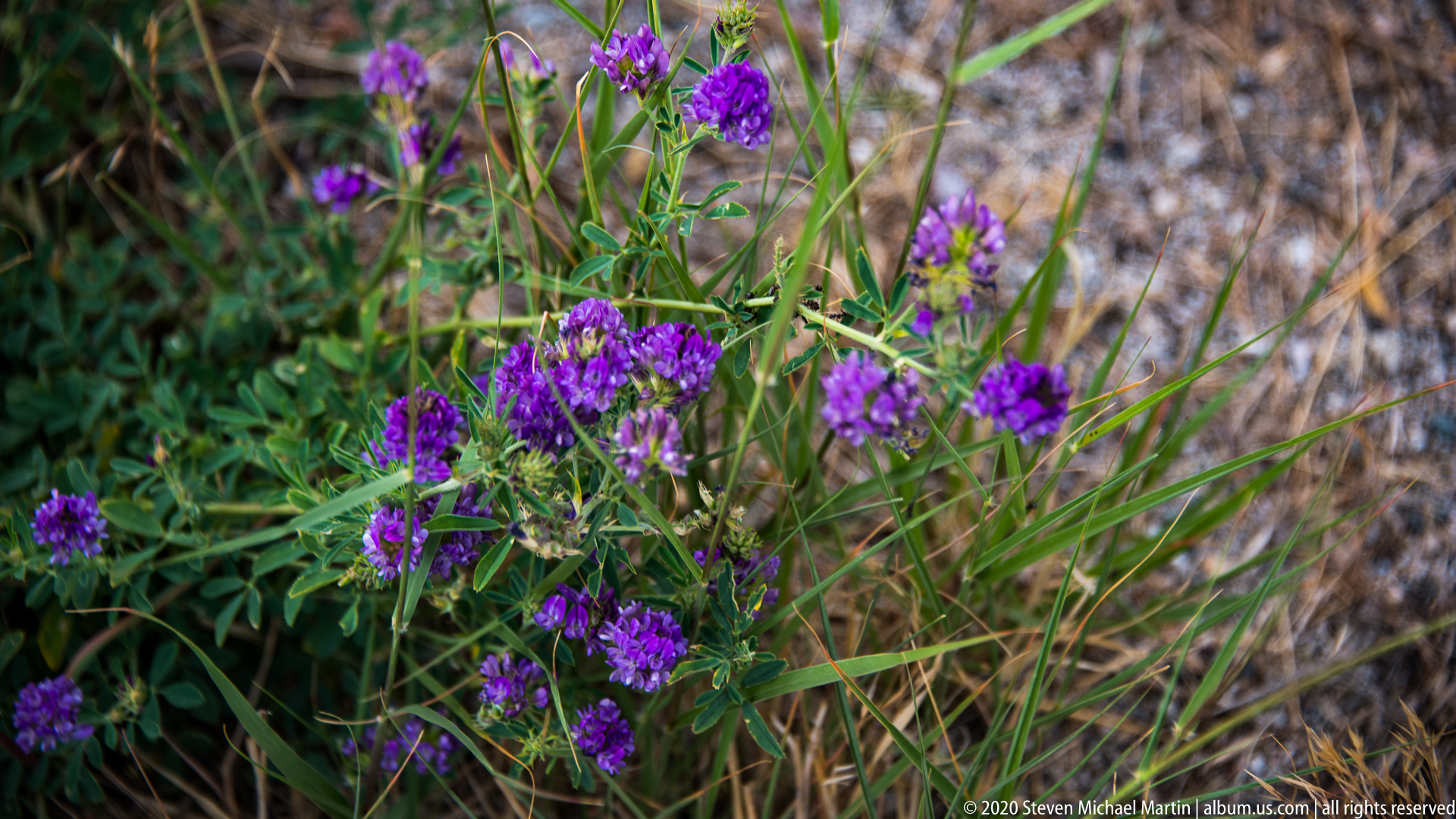
Clusters of small purple blossoms rise above narrow green leaves and dry grasses in a close view. The flowers vary in focus across the frame, while a pale rocky slope softens behind them. This botanical detail presents the color and texture of the canyon’s foothill vegetation without assigning a species that the image does not establish.
Caption
Clusters of small purple blossoms rise above narrow green leaves and dry grasses in a close view. The flowers vary in focus across the frame, while a pale rocky slope softens behind them. This botanical detail presents the color and texture of the canyon’s foothill vegetation without assigning a species that the image does not establish.
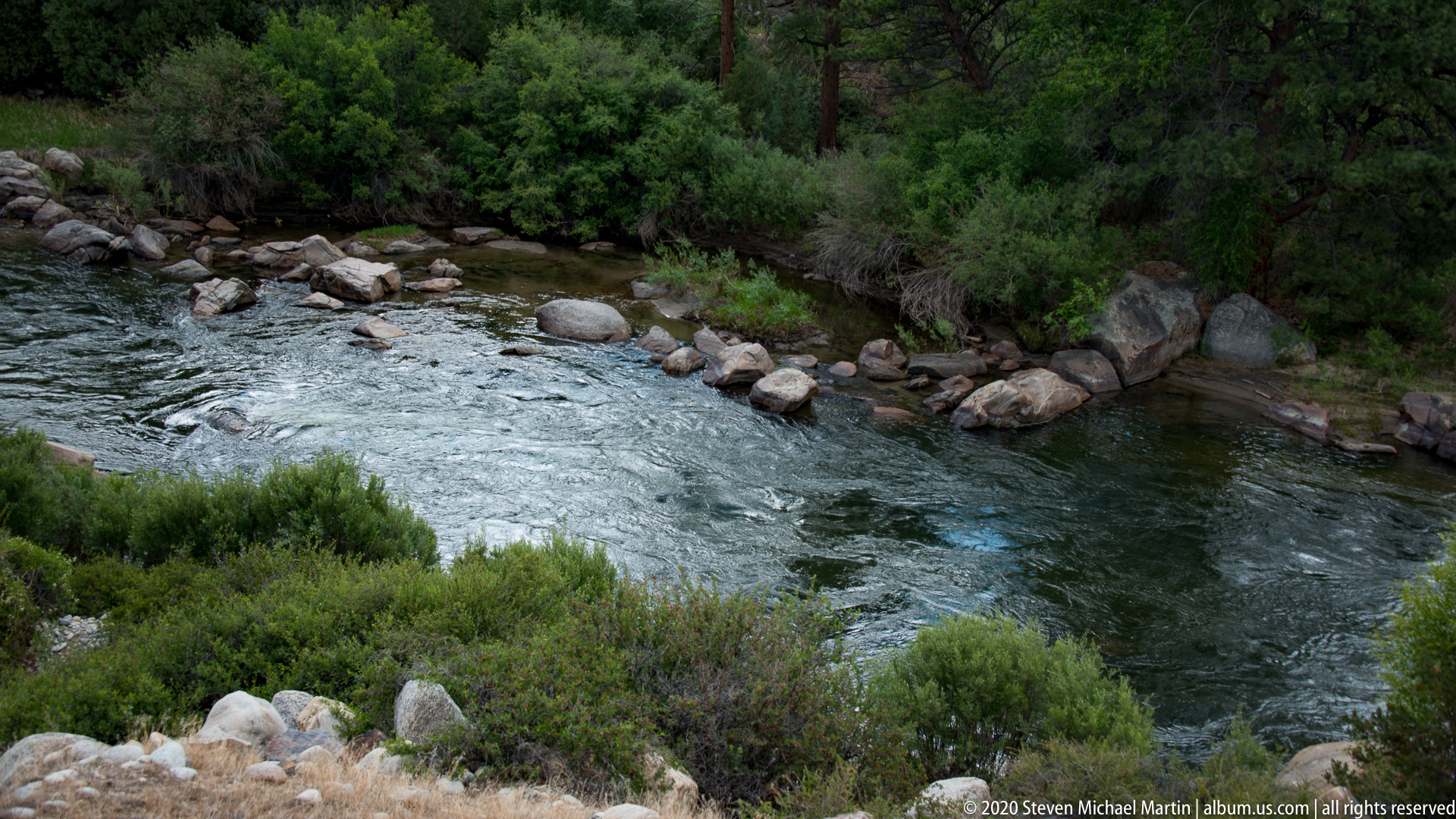
A shallow rapid curls around rounded boulders as the river passes between dense green shrubs. Pale stones line both banks, and dark conifers fill the background. The slightly elevated viewpoint reveals a short stretch of moving water, emphasizing the contrast between the bright riffle and calmer, darker channel at the edge.
Caption
A shallow rapid curls around rounded boulders as the river passes between dense green shrubs. Pale stones line both banks, and dark conifers fill the background. The slightly elevated viewpoint reveals a short stretch of moving water, emphasizing the contrast between the bright riffle and calmer, darker channel at the edge.
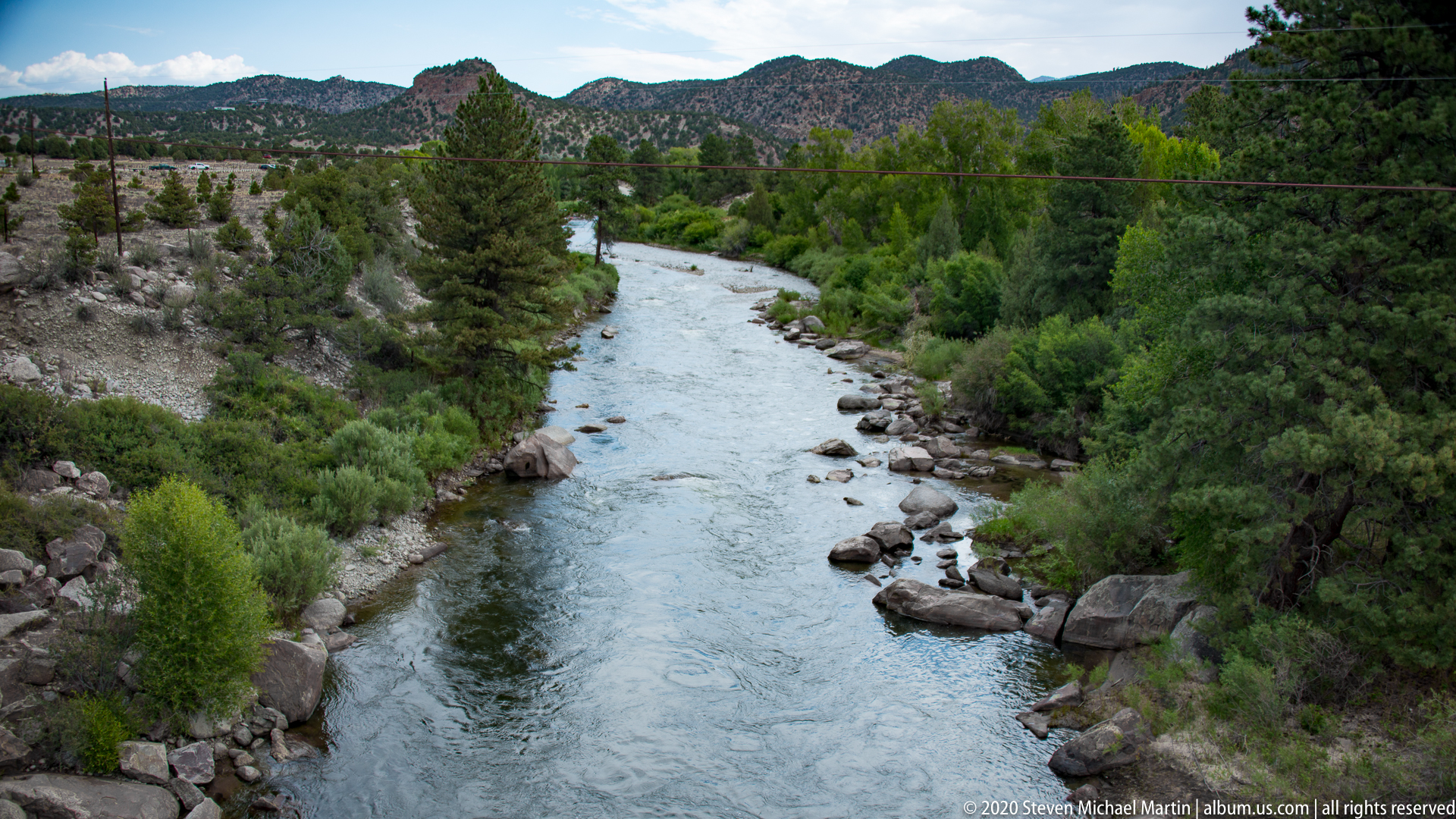
A broad stretch of river flows toward the viewer through a green corridor of shrubs and trees. Rocky slopes rise on both sides, with darker mountain ridges beyond the valley. A thin utility line crosses the upper scene, but the composition remains centered on the river’s route through the forested canyon landscape.
Caption
A broad stretch of river flows toward the viewer through a green corridor of shrubs and trees. Rocky slopes rise on both sides, with darker mountain ridges beyond the valley. A thin utility line crosses the upper scene, but the composition remains centered on the river’s route through the forested canyon landscape.
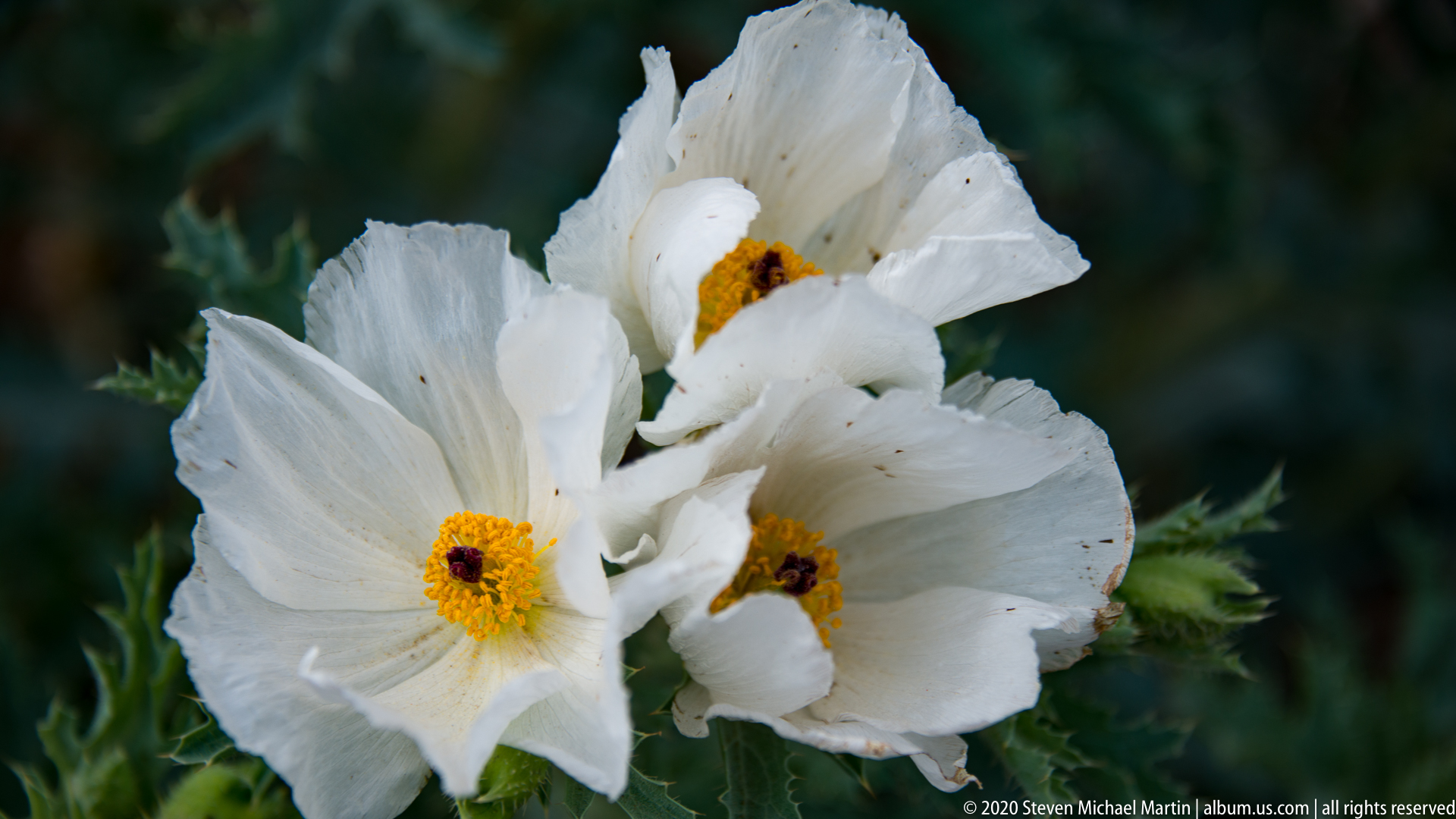
Several large white blossoms with crinkled petals and golden centers fill the frame against dark green foliage. The shallow depth of field isolates the flowers and softens the leaves behind them. Their arrangement and vivid center details are visible, but no distinctive leaf or stem features establish a specific species.
Caption
Several large white blossoms with crinkled petals and golden centers fill the frame against dark green foliage. The shallow depth of field isolates the flowers and softens the leaves behind them. Their arrangement and vivid center details are visible, but no distinctive leaf or stem features establish a specific species.
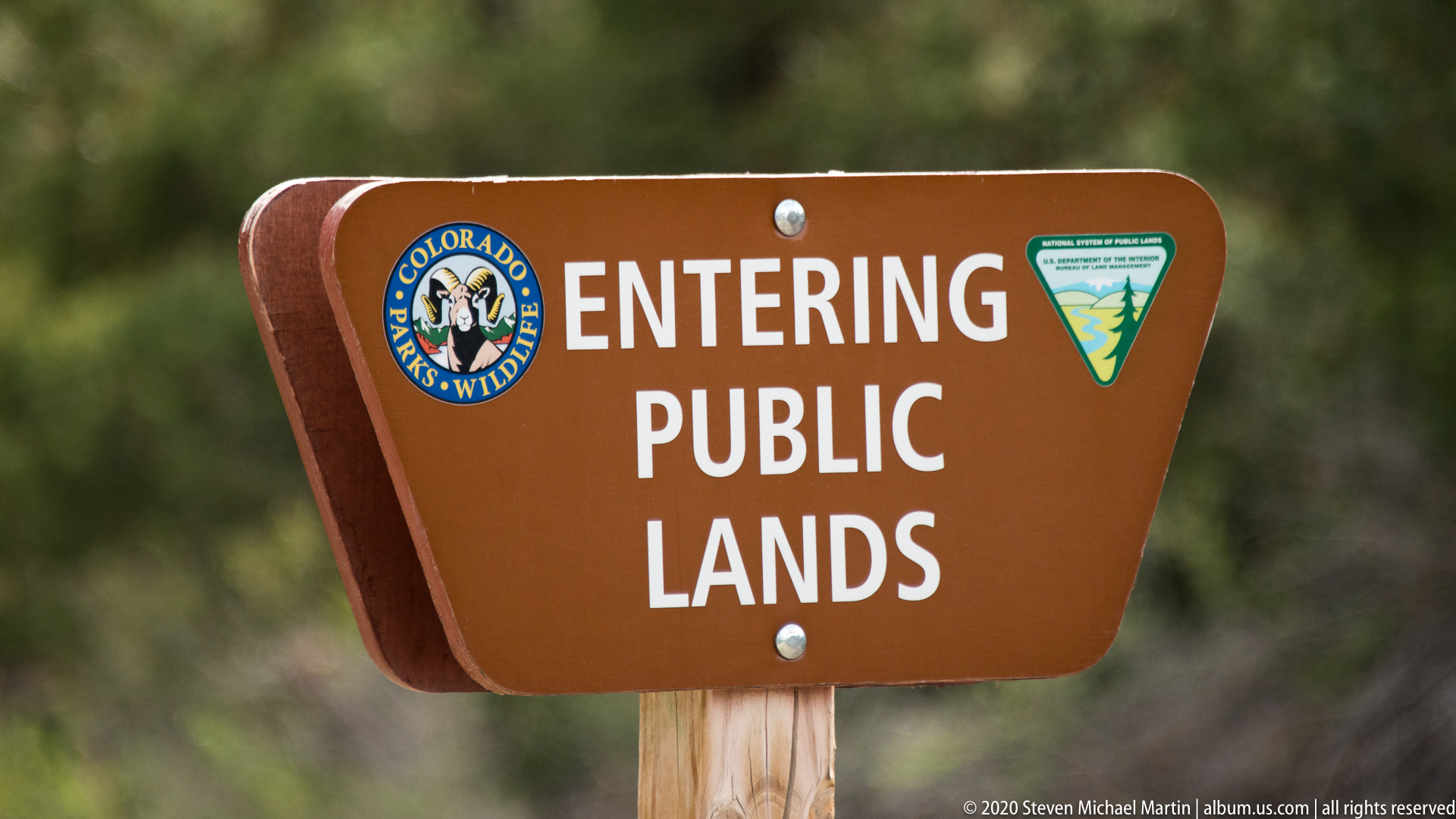
A brown roadside sign reads “Entering Public Lands,” flanked by Colorado Parks and Wildlife and land-management emblems. The sign is mounted on a wooden post and photographed against a softly blurred green background. Its straightforward message and official logos identify a boundary or access point within the public-land landscape.
Caption
A brown roadside sign reads “Entering Public Lands,” flanked by Colorado Parks and Wildlife and land-management emblems. The sign is mounted on a wooden post and photographed against a softly blurred green background. Its straightforward message and official logos identify a boundary or access point within the public-land landscape.
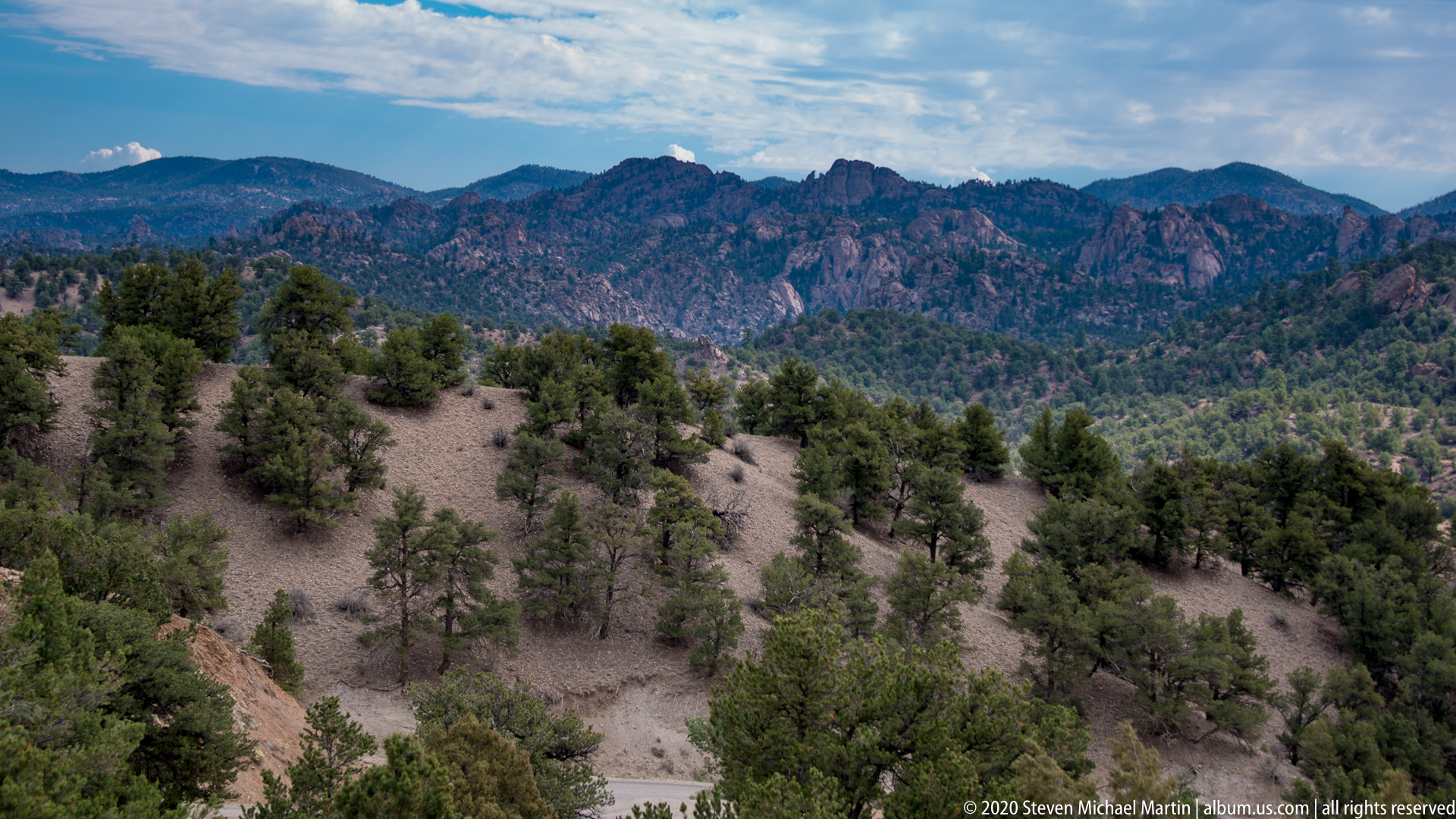
A forested hillside of scattered pines slopes toward a rugged mountain ridge, whose dark rock bands form a broken skyline. Patchy clouds cast alternating light and shade across the distant terrain. The composition gives equal prominence to the nearer trees and the larger ridge behind, showing the transition from woodland to exposed high ground.
Caption
A forested hillside of scattered pines slopes toward a rugged mountain ridge, whose dark rock bands form a broken skyline. Patchy clouds cast alternating light and shade across the distant terrain. The composition gives equal prominence to the nearer trees and the larger ridge behind, showing the transition from woodland to exposed high ground.
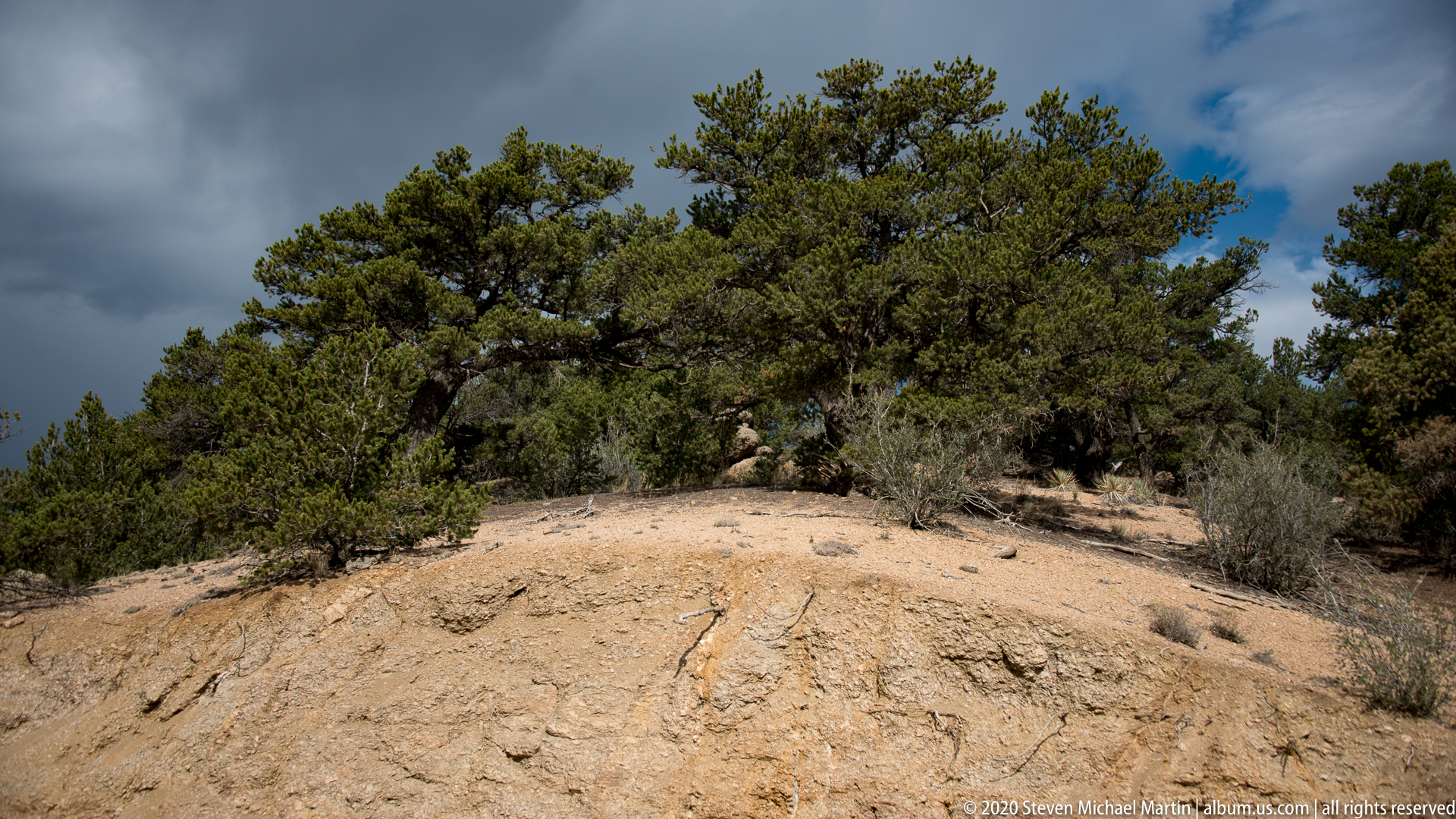
A low sandy rise topped with pines and juniper fills the foreground, with scattered shrubs at its base. Dark clouds gather above the treetops, while the open sky and sparse understory reveal the dry character of this upland habitat. The view focuses on the woodland edge rather than the nearby river.
Caption
A low sandy rise topped with pines and juniper fills the foreground, with scattered shrubs at its base. Dark clouds gather above the treetops, while the open sky and sparse understory reveal the dry character of this upland habitat. The view focuses on the woodland edge rather than the nearby river.
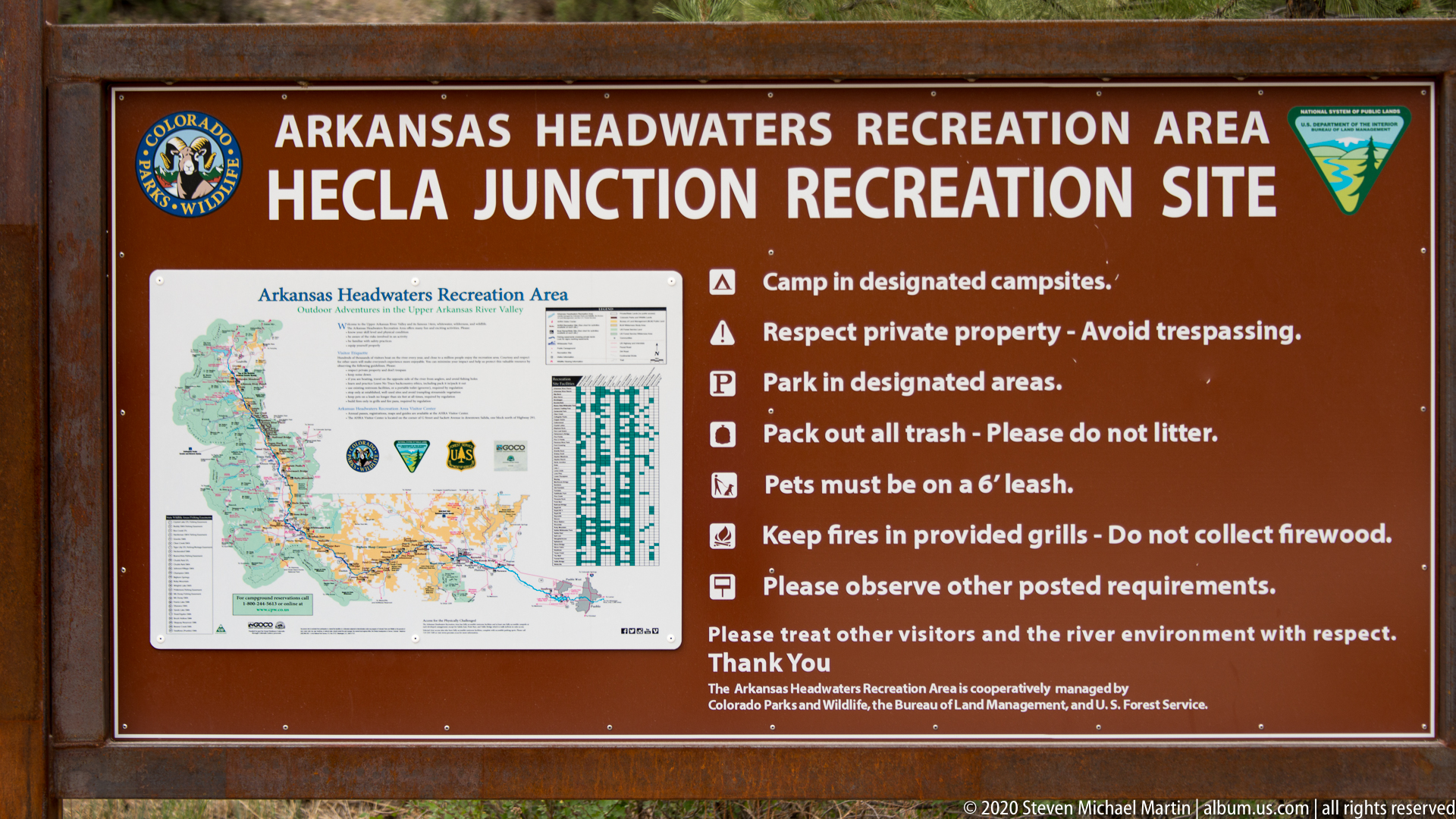
A large brown information board identifies the Arkansas Headwaters Recreation Area and Hecla Junction Recreation Site. A route map occupies the left panel, while the right lists camping, parking, pet, fire, and river-use guidelines. The sign combines wayfinding with practical instructions for visitors using this river access area.
Caption
A large brown information board identifies the Arkansas Headwaters Recreation Area and Hecla Junction Recreation Site. A route map occupies the left panel, while the right lists camping, parking, pet, fire, and river-use guidelines. The sign combines wayfinding with practical instructions for visitors using this river access area.
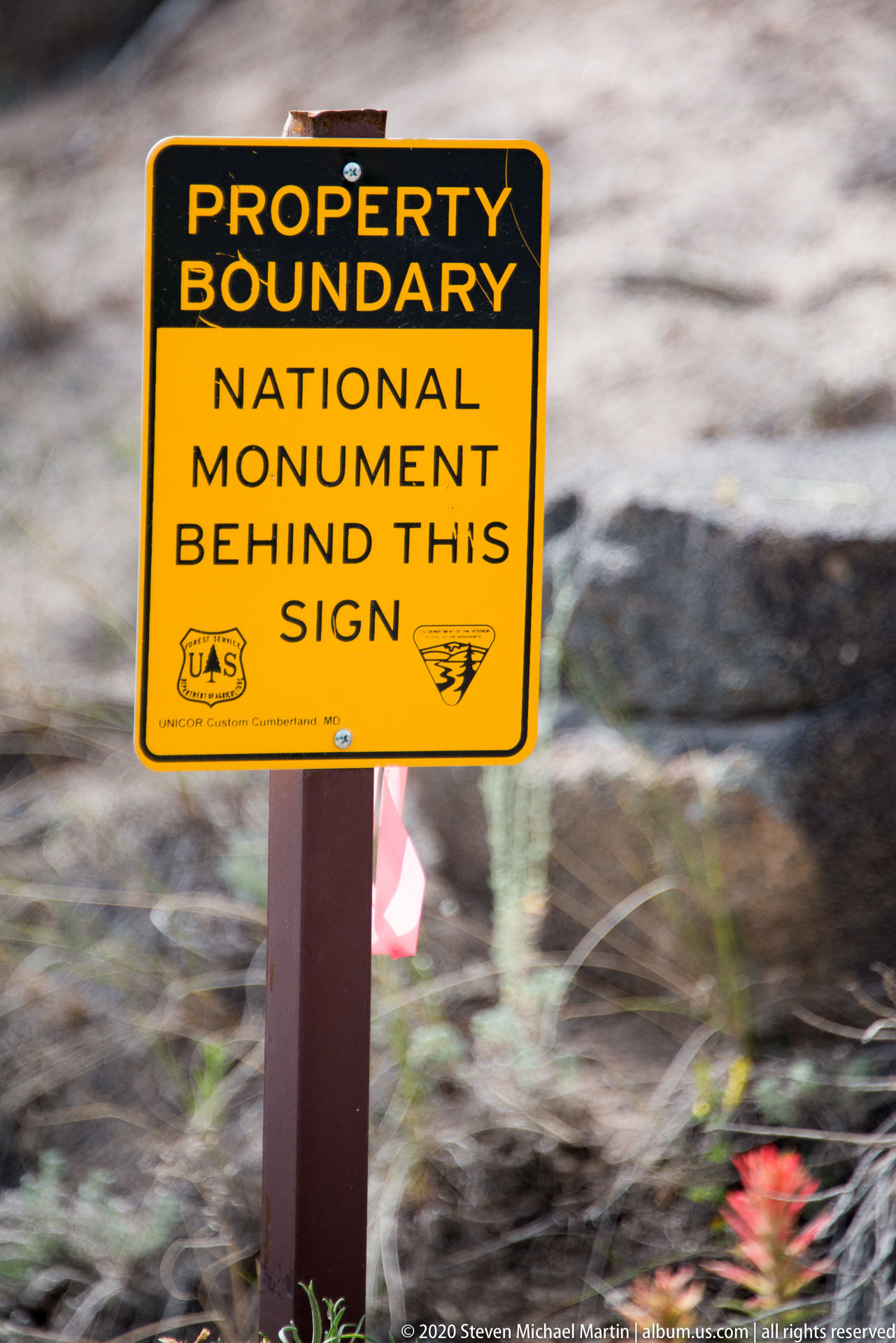
A yellow sign states “Property Boundary—National Monument Behind This Sign,” with federal and state emblems at the lower corners. The post stands amid rocky ground and low vegetation, while motion blur in the background makes the setting less distinct. The sign’s wording marks the transition onto protected public land.
Caption
A yellow sign states “Property Boundary—National Monument Behind This Sign,” with federal and state emblems at the lower corners. The post stands amid rocky ground and low vegetation, while motion blur in the background makes the setting less distinct. The sign’s wording marks the transition onto protected public land.
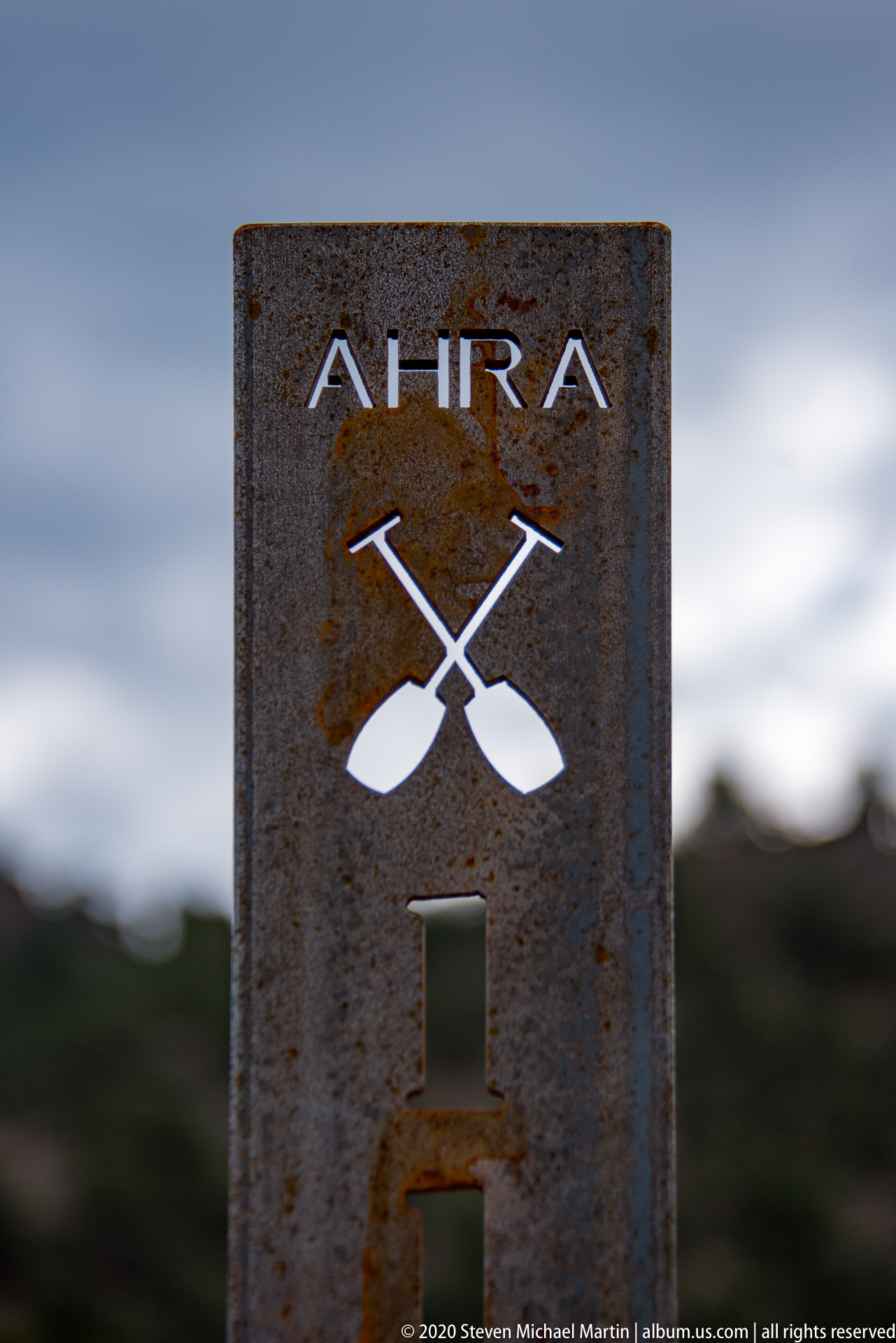
A weathered square metal marker reads “AHRA” above a symbol of crossed paddles. The dark, textured surface is sharply focused, while the river valley behind it blurs into green and gray bands. The emblem identifies a recreation area associated with boating and river use without depicting the activity itself.
Caption
A weathered square metal marker reads “AHRA” above a symbol of crossed paddles. The dark, textured surface is sharply focused, while the river valley behind it blurs into green and gray bands. The emblem identifies a recreation area associated with boating and river use without depicting the activity itself.
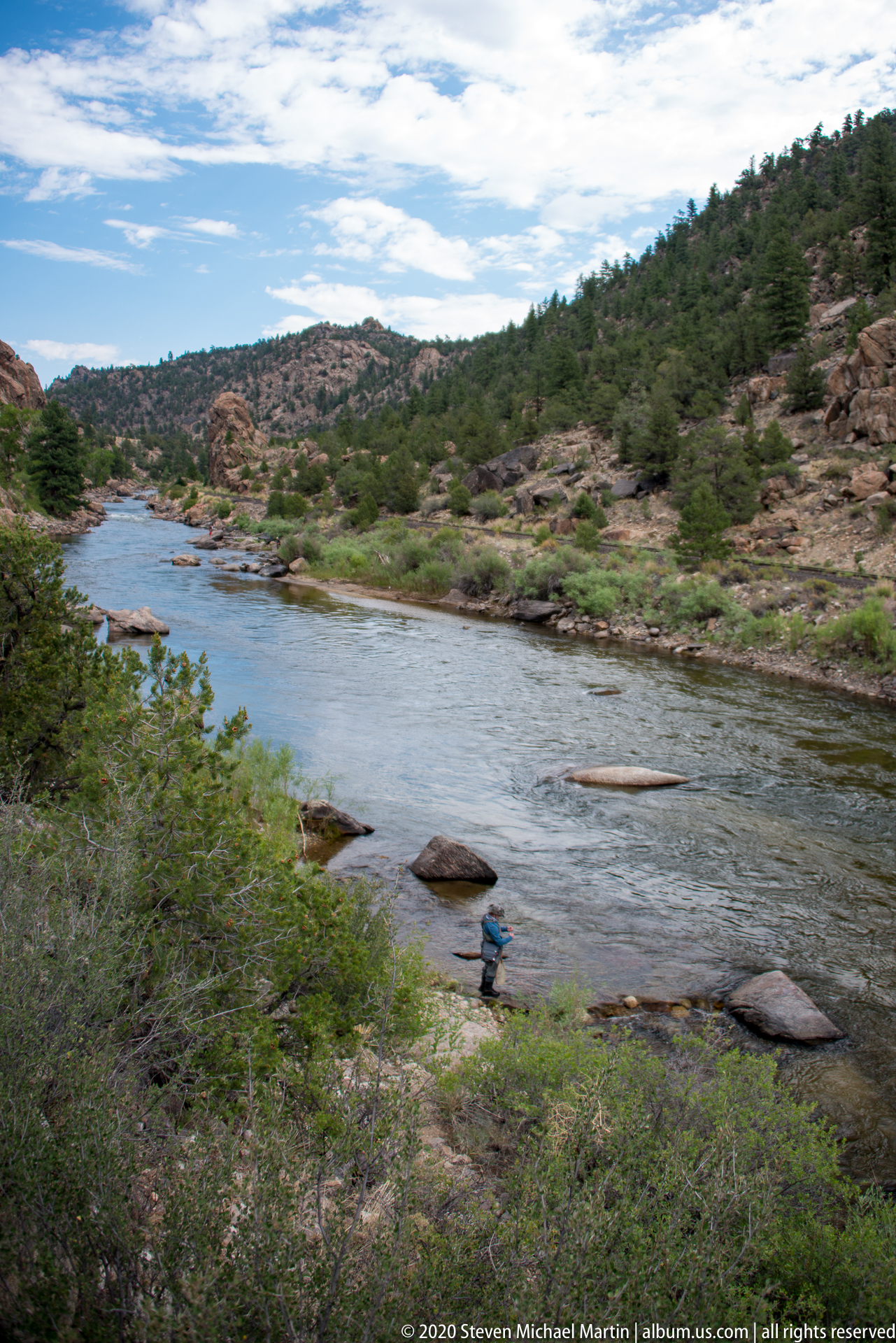
A person in blue sits or crouches near the water’s edge, partly obscured by foreground shrubs. The river occupies the middle of the frame and flows between low, rocky banks, with pine-covered slopes beyond. This quiet riverside moment contrasts with the nearby whitewater and rafting scenes.
Caption
A person in blue sits or crouches near the water’s edge, partly obscured by foreground shrubs. The river occupies the middle of the frame and flows between low, rocky banks, with pine-covered slopes beyond. This quiet riverside moment contrasts with the nearby whitewater and rafting scenes.
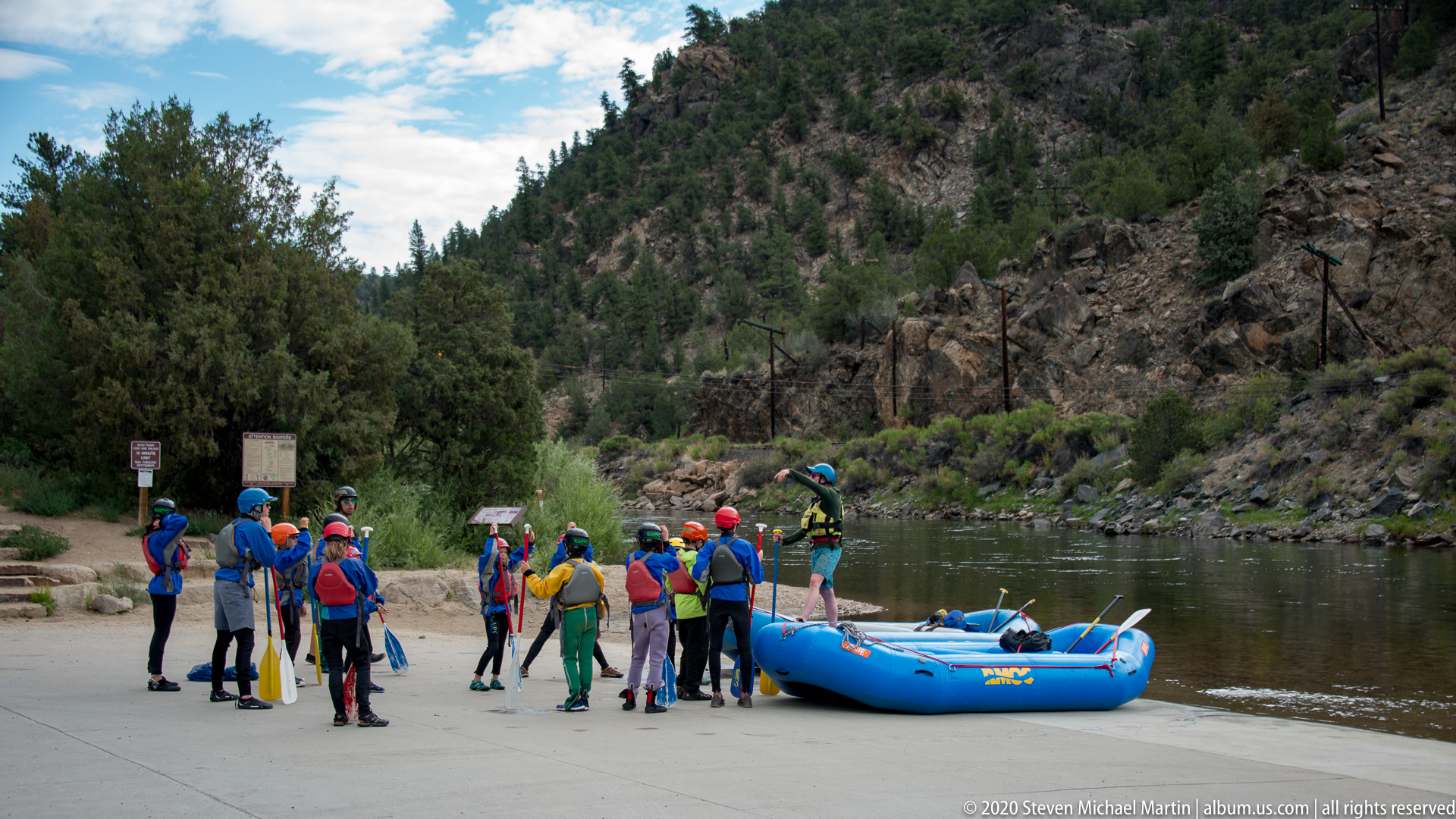
A group wearing helmets and personal flotation devices gathers around a blue inflatable raft at the river’s edge. Several people hold paddles while a guide stands nearby; wooded slopes and calm water form the backdrop. The scene shows the preparation and launch area before a river trip rather than the rapid itself.
Caption
A group wearing helmets and personal flotation devices gathers around a blue inflatable raft at the river’s edge. Several people hold paddles while a guide stands nearby; wooded slopes and calm water form the backdrop. The scene shows the preparation and launch area before a river trip rather than the rapid itself.
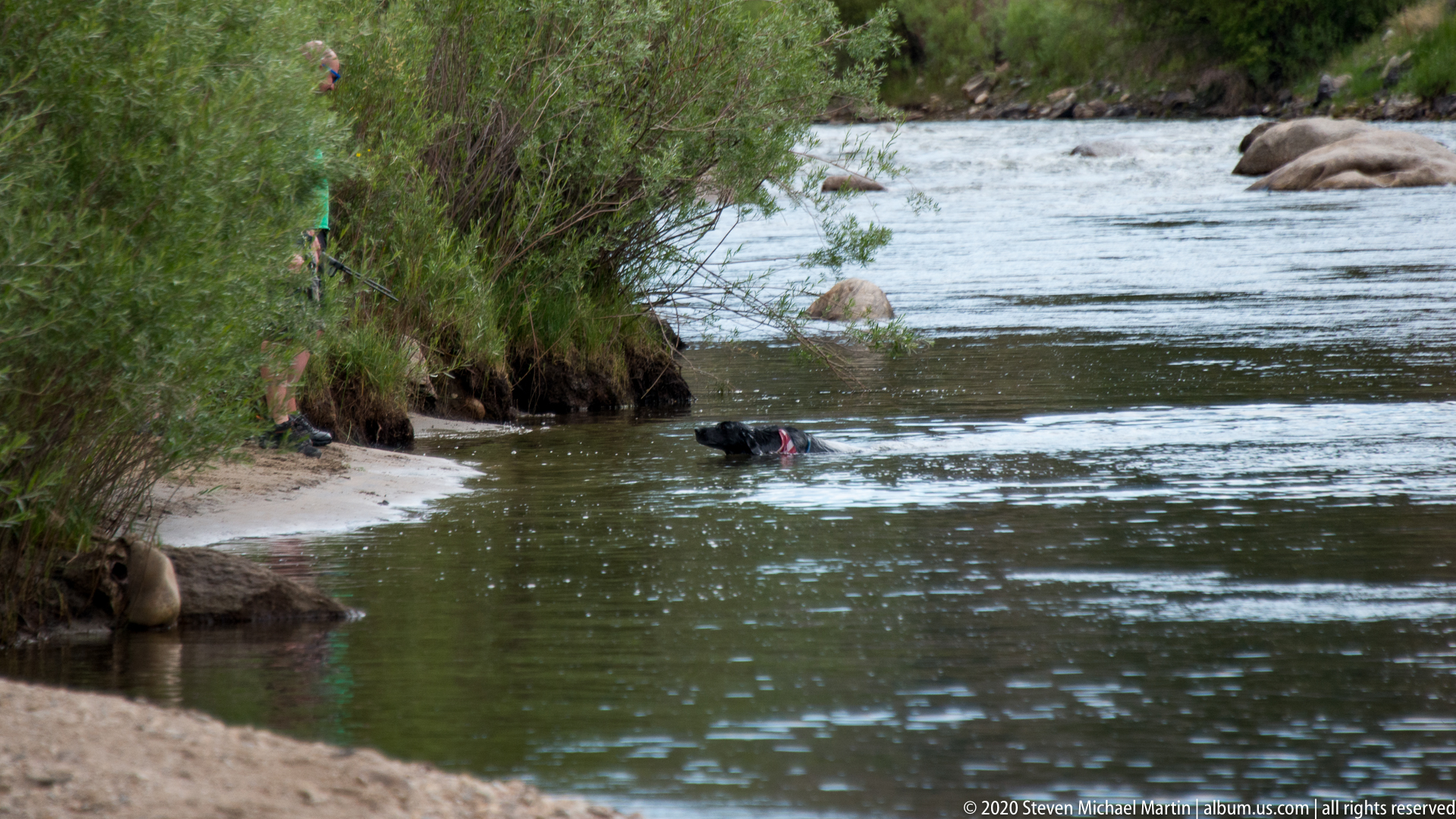
A river user in dark gear floats low in the water beside a shrub-covered bank, with pale rocks and a shallow rapid upstream. Only the upper body is visible, making the person’s exact activity difficult to determine. The close view draws attention to the interaction between the moving channel and its rocky, vegetated edge.
Caption
A river user in dark gear floats low in the water beside a shrub-covered bank, with pale rocks and a shallow rapid upstream. Only the upper body is visible, making the person’s exact activity difficult to determine. The close view draws attention to the interaction between the moving channel and its rocky, vegetated edge.
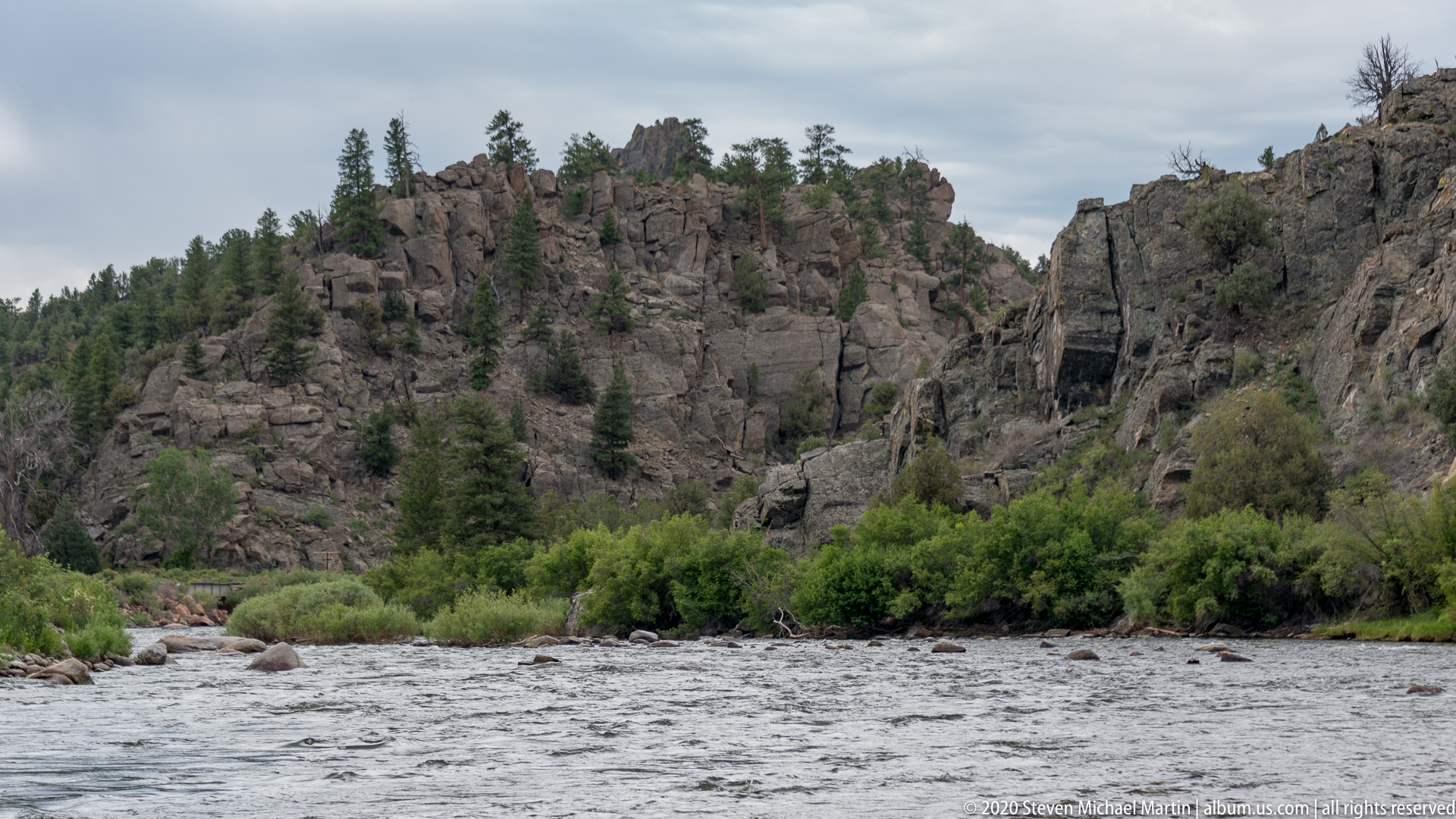
The river crosses the foreground in a broad, lightly rippled channel, while a rugged slope of fractured rock and pines rises beyond the opposite bank. Green shrubs trace the water’s edge and soften the stony terrain. This wide view situates the river within the canyon’s wooded, boulder-strewn landscape.
Caption
The river crosses the foreground in a broad, lightly rippled channel, while a rugged slope of fractured rock and pines rises beyond the opposite bank. Green shrubs trace the water’s edge and soften the stony terrain. This wide view situates the river within the canyon’s wooded, boulder-strewn landscape.

A pine branch projects across the foreground, its long needles surrounding several brown cones at different depths. A rocky, shrub-covered hillside recedes behind the branch in soft focus. This close natural detail links the canyon’s conifer woodland to the broader terrain without requiring a precise pine species identification.
Caption
A pine branch projects across the foreground, its long needles surrounding several brown cones at different depths. A rocky, shrub-covered hillside recedes behind the branch in soft focus. This close natural detail links the canyon’s conifer woodland to the broader terrain without requiring a precise pine species identification.
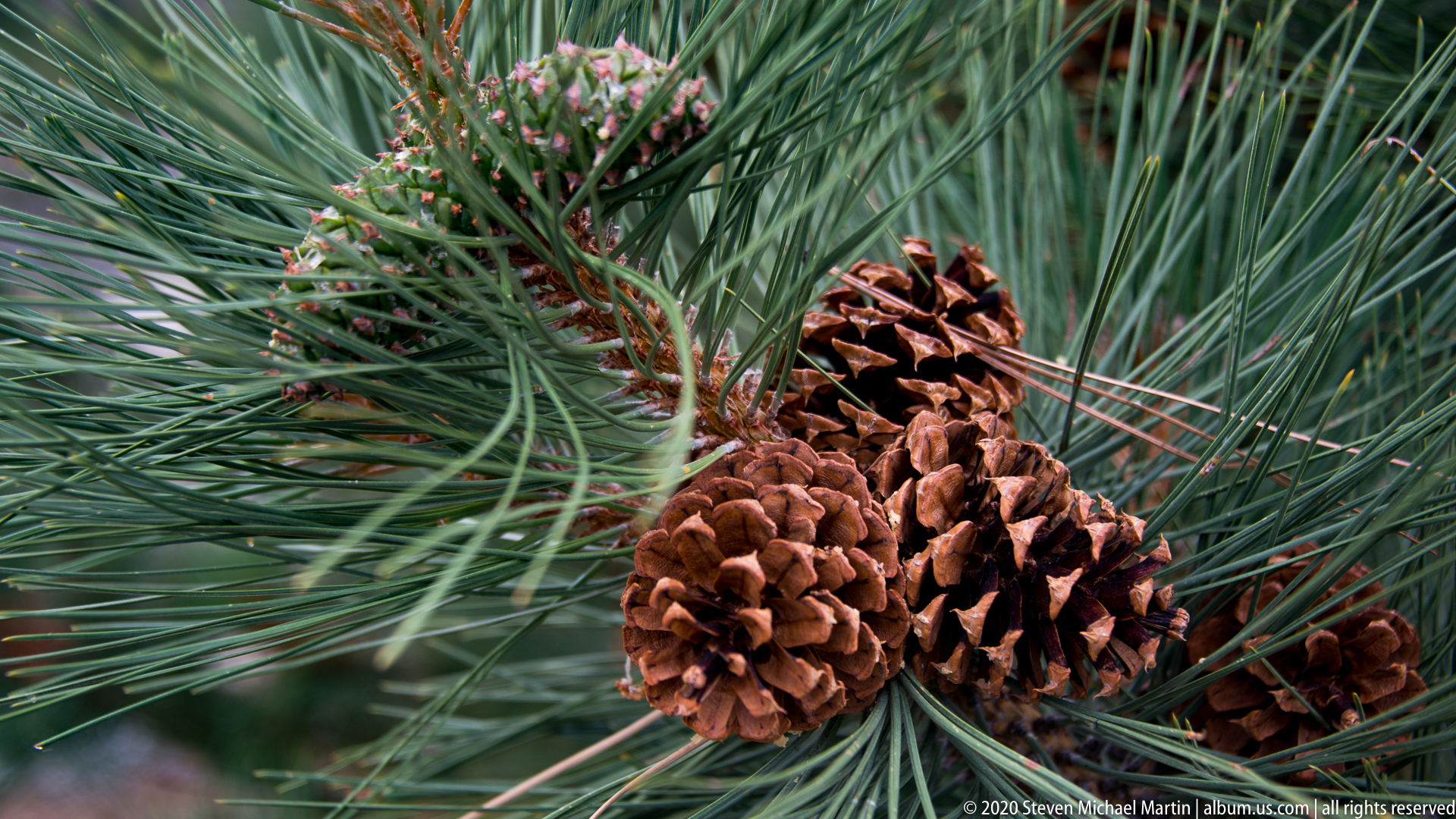
Several mature brown cones cluster among long, narrow green needles, filling the center of the frame. One cone is sharply focused, revealing overlapping woody scales, while others soften toward the edges. The close perspective emphasizes the texture and reproductive structures of the conifer rather than the surrounding forest.
Caption
Several mature brown cones cluster among long, narrow green needles, filling the center of the frame. One cone is sharply focused, revealing overlapping woody scales, while others soften toward the edges. The close perspective emphasizes the texture and reproductive structures of the conifer rather than the surrounding forest.

The river curves through a narrow valley bordered by steep, broken rock slopes and scattered pines. Boulders line the channel, while dense shrubs and trees follow the water. A distant ridge closes the view beneath a lightly clouded sky, placing the river within a rugged, forested canyon corridor.
Caption
The river curves through a narrow valley bordered by steep, broken rock slopes and scattered pines. Boulders line the channel, while dense shrubs and trees follow the water. A distant ridge closes the view beneath a lightly clouded sky, placing the river within a rugged, forested canyon corridor.
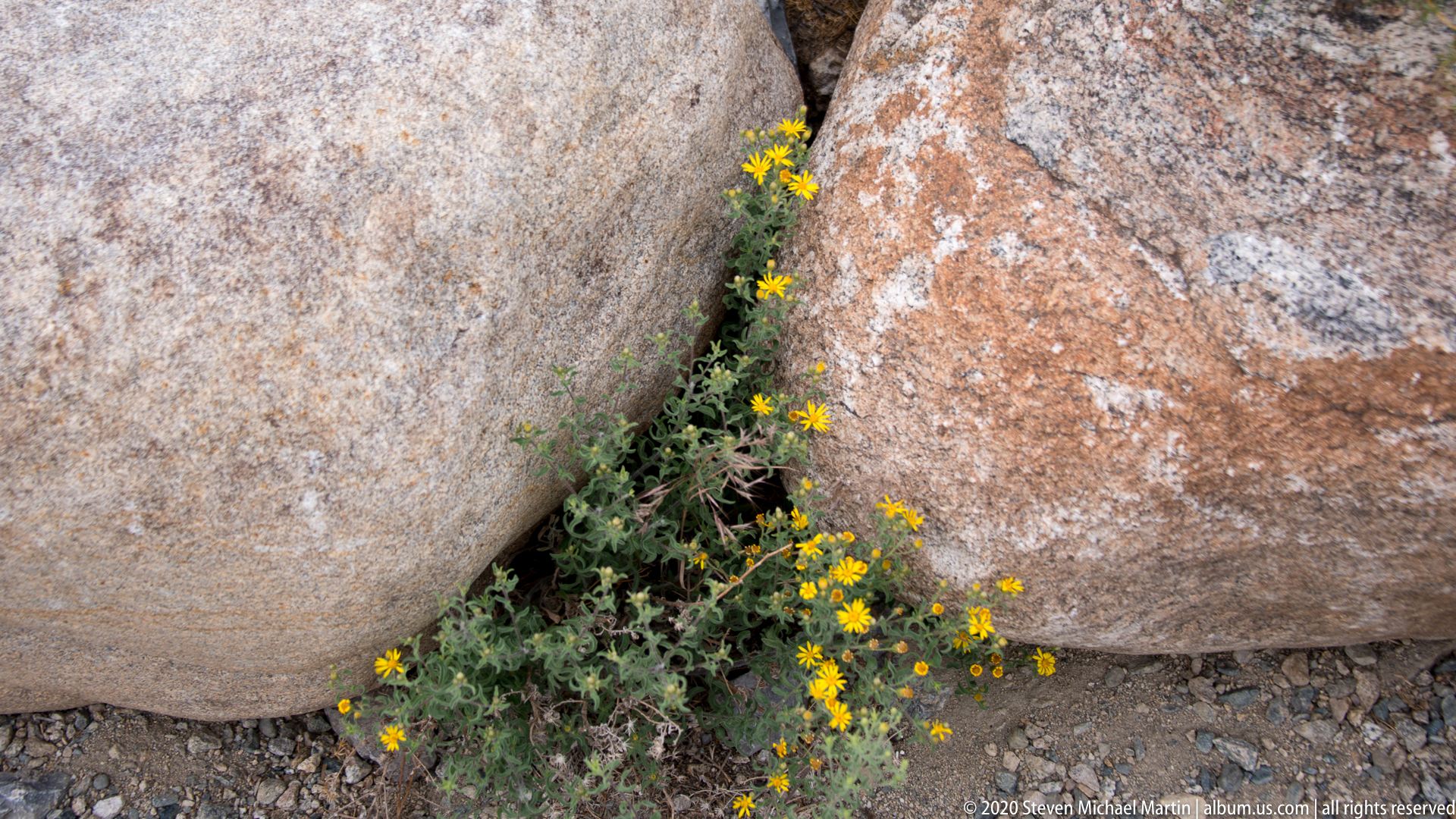
A slender flowering plant grows from a crevice between two large pale boulders. Small yellow blossoms and narrow leaves follow the stem upward, while the stone surfaces fill nearly the entire background. The close composition highlights a plant rooted in a pocket of soil within exposed, rocky terrain.
Caption
A slender flowering plant grows from a crevice between two large pale boulders. Small yellow blossoms and narrow leaves follow the stem upward, while the stone surfaces fill nearly the entire background. The close composition highlights a plant rooted in a pocket of soil within exposed, rocky terrain.
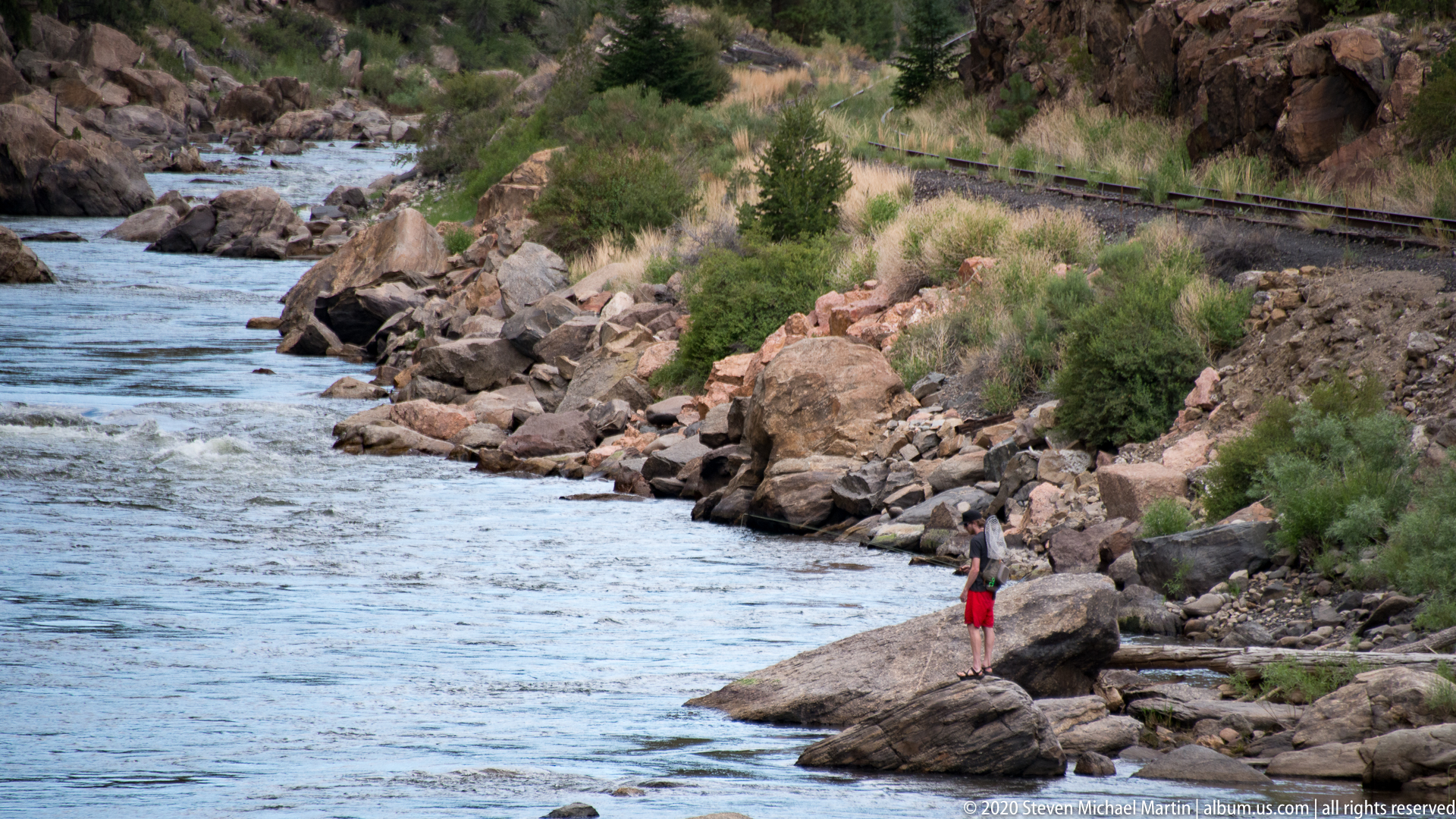
A person in a dark top and red shorts stands on a broad boulder at the river’s edge, looking across the moving water. Large rocks and low grasses line the opposite bank, with a narrow footpath visible above the channel. The figure’s stance suggests a pause beside the river, though no fishing gear is clearly distinguishable.
Caption
A person in a dark top and red shorts stands on a broad boulder at the river’s edge, looking across the moving water. Large rocks and low grasses line the opposite bank, with a narrow footpath visible above the channel. The figure’s stance suggests a pause beside the river, though no fishing gear is clearly distinguishable.
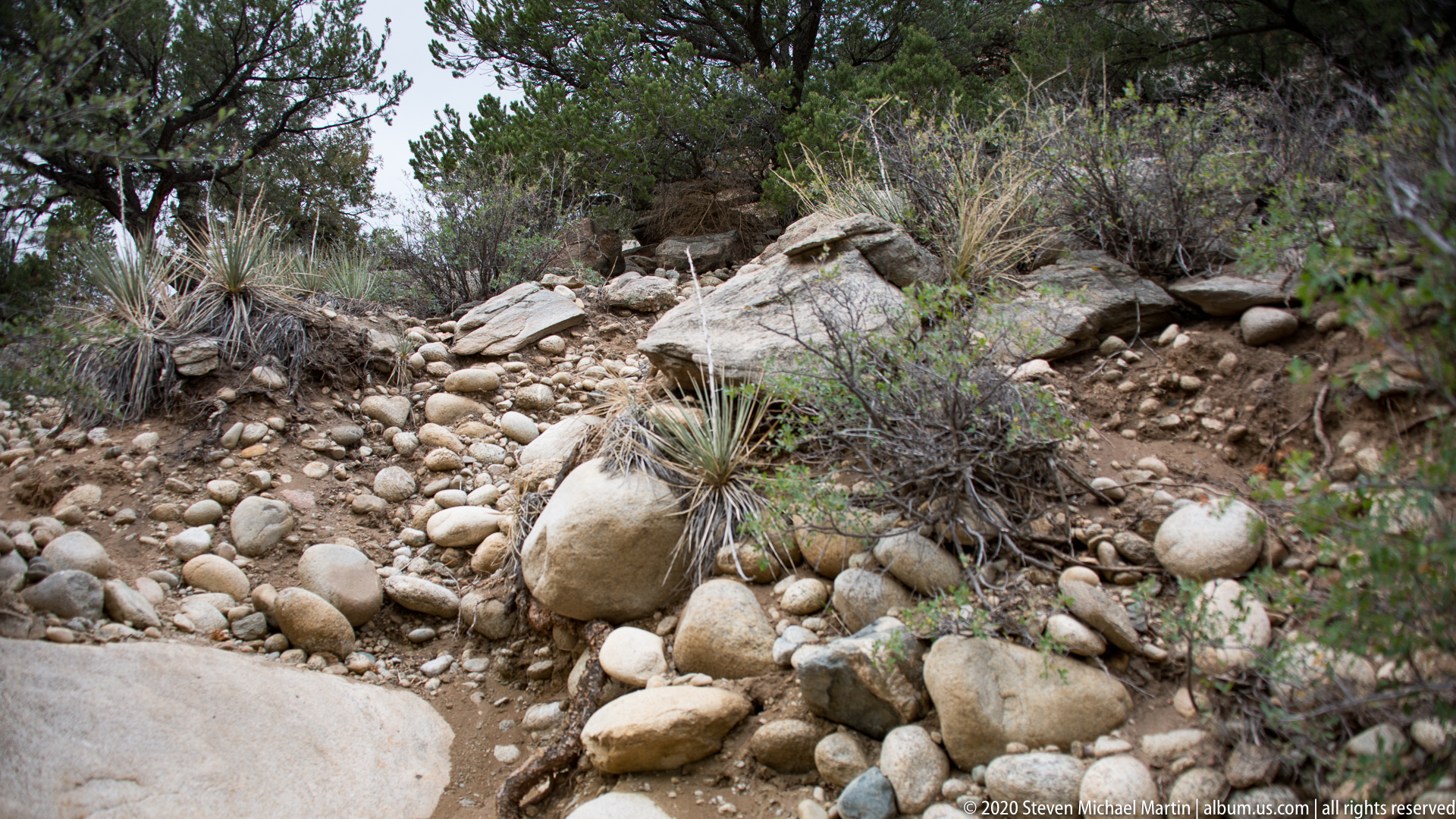
A dry wash is filled with rounded stones, from small gravel to larger boulders, with hardy shrubs and spiky plants rooted along its banks. The channel curves through the frame beneath a small tree, revealing a drainage shaped by intermittent water rather than a flowing stream at the time of the photograph.
Caption
A dry wash is filled with rounded stones, from small gravel to larger boulders, with hardy shrubs and spiky plants rooted along its banks. The channel curves through the frame beneath a small tree, revealing a drainage shaped by intermittent water rather than a flowing stream at the time of the photograph.
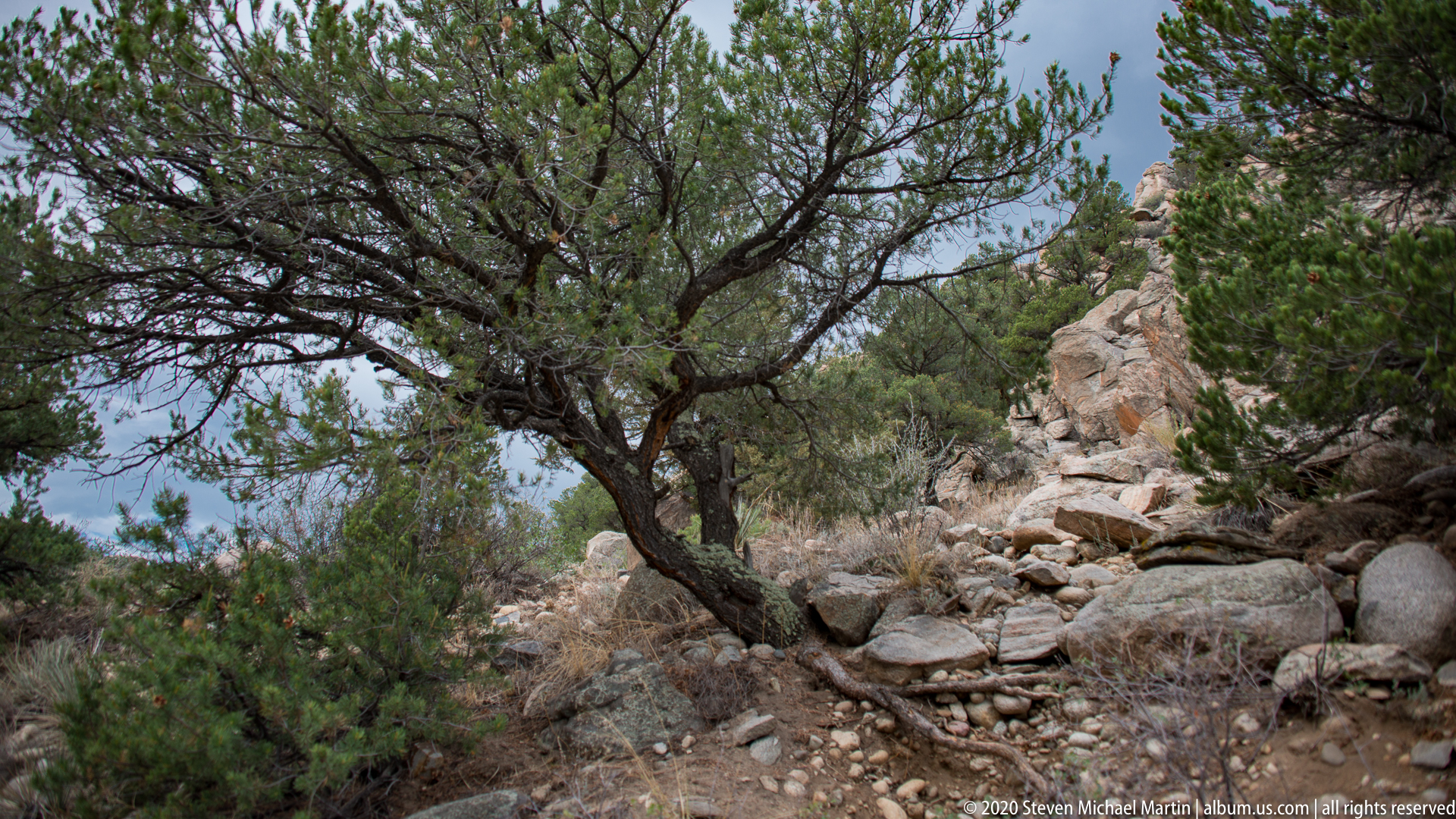
A low evergreen tree spreads its branches above a steep slope of angular rocks. Smaller pines and shrubs surround it, with glimpses of sky and distant greenery through the foliage. The composition centers on the tree’s irregular form and its foothold in the boulder-strewn terrain.
Caption
A low evergreen tree spreads its branches above a steep slope of angular rocks. Smaller pines and shrubs surround it, with glimpses of sky and distant greenery through the foliage. The composition centers on the tree’s irregular form and its foothold in the boulder-strewn terrain.
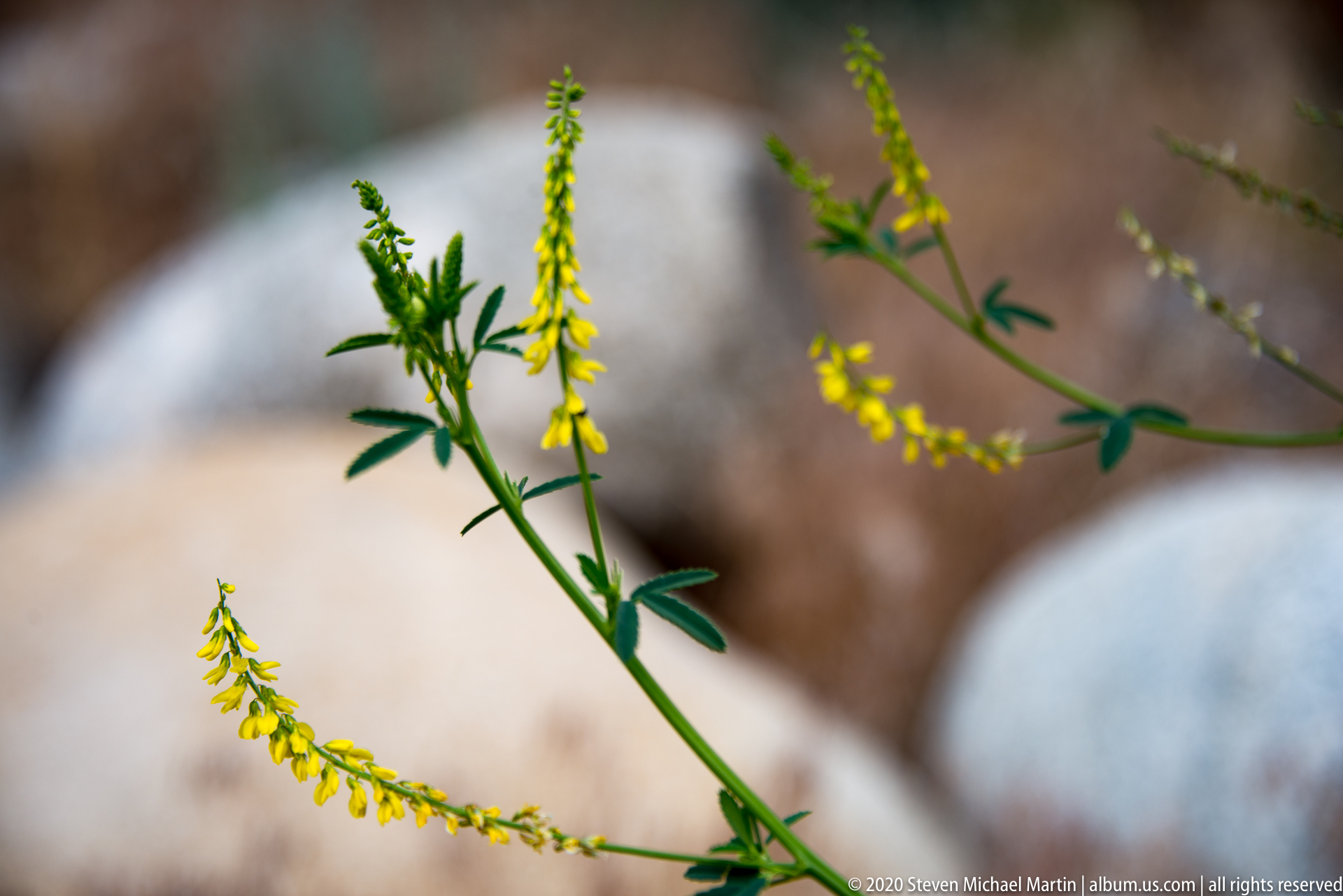
Several delicate stems carry rows of small yellow flowers above narrow, divided leaves. The shallow focus isolates the plant against pale boulders and muted green foliage, revealing the drooping flower clusters and fine branching structure. The image offers a close botanical view but not enough detail to name the species.
Caption
Several delicate stems carry rows of small yellow flowers above narrow, divided leaves. The shallow focus isolates the plant against pale boulders and muted green foliage, revealing the drooping flower clusters and fine branching structure. The image offers a close botanical view but not enough detail to name the species.
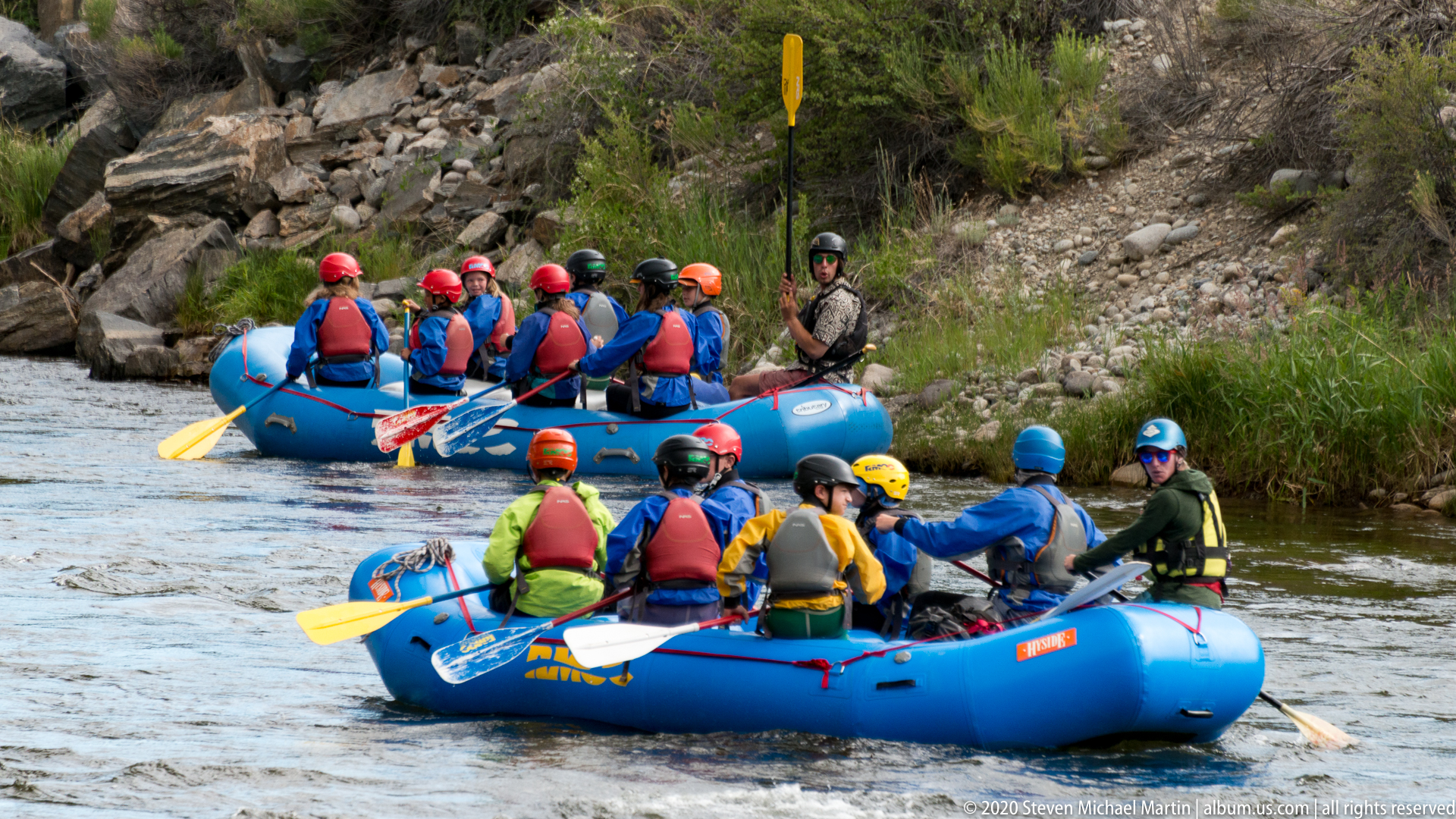
Two blue inflatable rafts carry groups of paddlers wearing helmets and flotation vests along a shallow section of river. Yellow and white paddles extend over the water, while a guide stands on the bank beside a marked pole. The close view emphasizes teamwork and river access at the edge of the canyon.
Caption
Two blue inflatable rafts carry groups of paddlers wearing helmets and flotation vests along a shallow section of river. Yellow and white paddles extend over the water, while a guide stands on the bank beside a marked pole. The close view emphasizes teamwork and river access at the edge of the canyon.
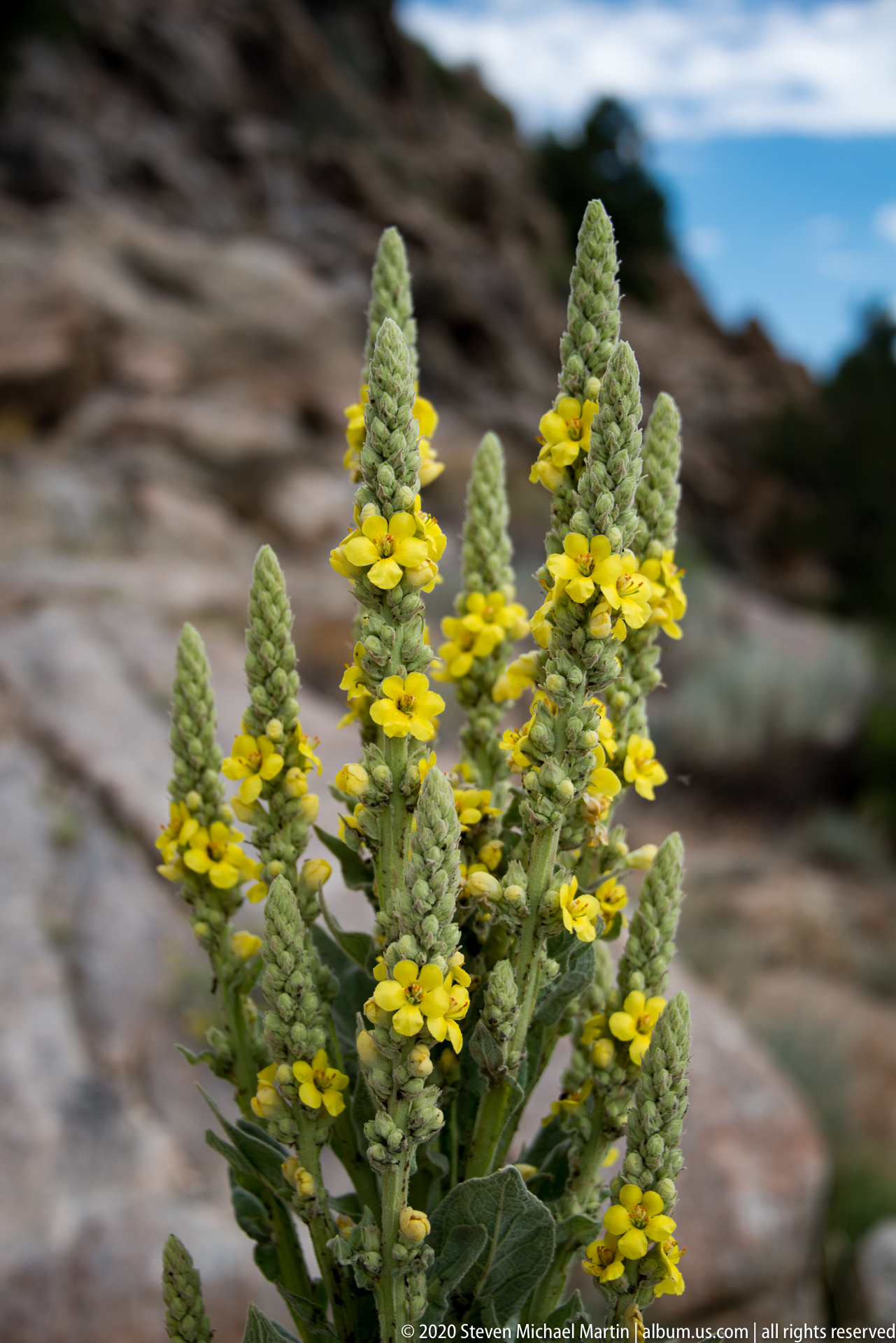
Tall, woolly green flower spikes rise above broad leaves, carrying rings of small yellow blossoms along the stems. The plants stand against a blurred rocky hillside, and the close view reveals the dense felted texture characteristic of common mullein. Their upright form and clustered flowers make this species more identifiable than the other wildflower details in the series.
Caption
Tall, woolly green flower spikes rise above broad leaves, carrying rings of small yellow blossoms along the stems. The plants stand against a blurred rocky hillside, and the close view reveals the dense felted texture characteristic of common mullein. Their upright form and clustered flowers make this species more identifiable than the other wildflower details in the series.
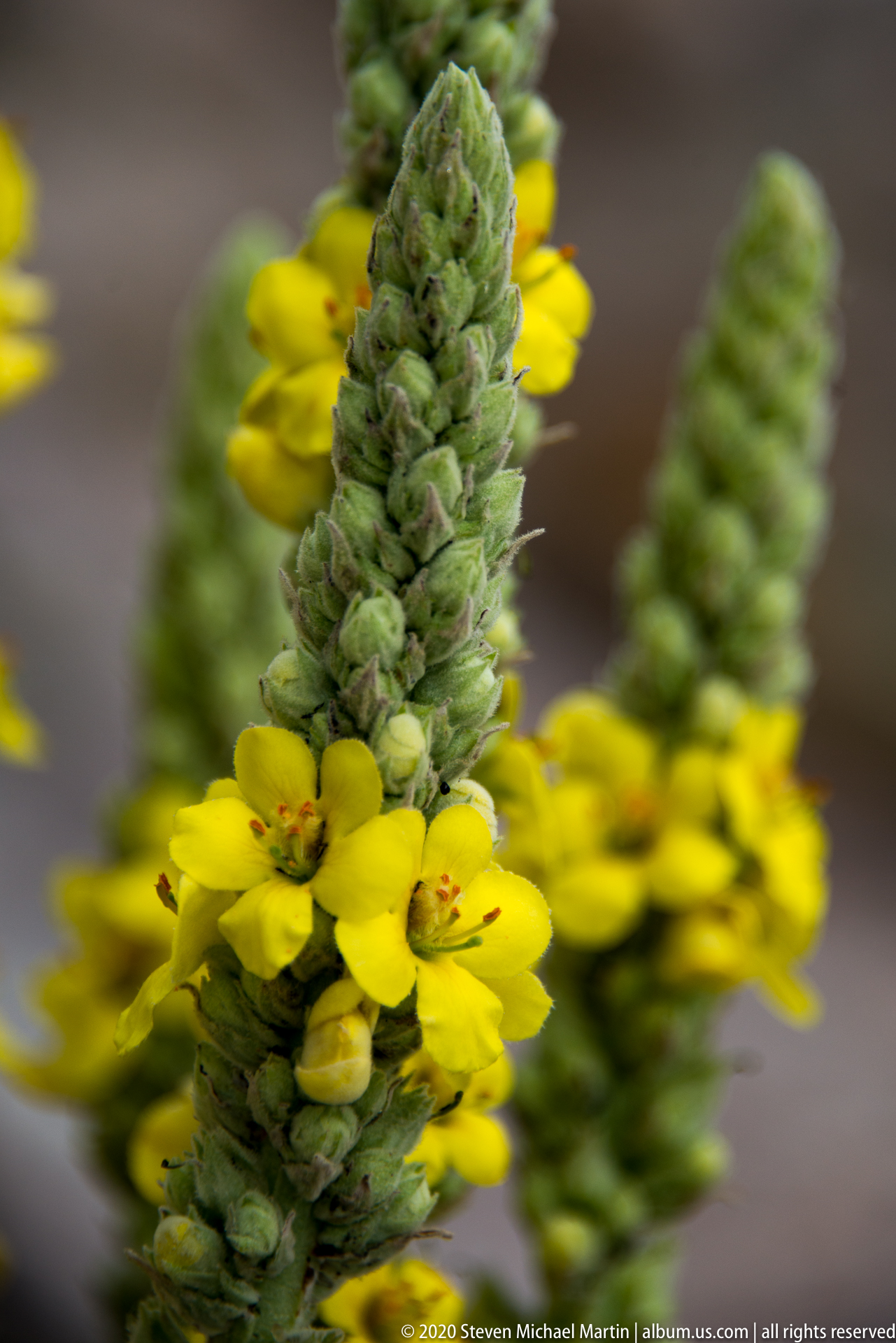
Yellow five-petaled flowers emerge from a thick, pale green woolly spike, with another flower stalk blurred behind. The close framing reveals the blossoms’ rounded petals and fine reddish details at their centers. A shallow depth of field isolates the plant structure, making this a more intimate view than the full mullein stalks.
Caption
Yellow five-petaled flowers emerge from a thick, pale green woolly spike, with another flower stalk blurred behind. The close framing reveals the blossoms’ rounded petals and fine reddish details at their centers. A shallow depth of field isolates the plant structure, making this a more intimate view than the full mullein stalks.

A weathered wooden post stands among low yellow-flowering plants and dry stems on a gravelly, open patch. The close framing gives equal attention to the post’s cracked surface and the vegetation around its base, where small leaves and blossoms interrupt the muted stones. The image records a quiet ground-level detail of the monument’s dryland edge.
Caption
A weathered wooden post stands among low yellow-flowering plants and dry stems on a gravelly, open patch. The close framing gives equal attention to the post’s cracked surface and the vegetation around its base, where small leaves and blossoms interrupt the muted stones. The image records a quiet ground-level detail of the monument’s dryland edge.
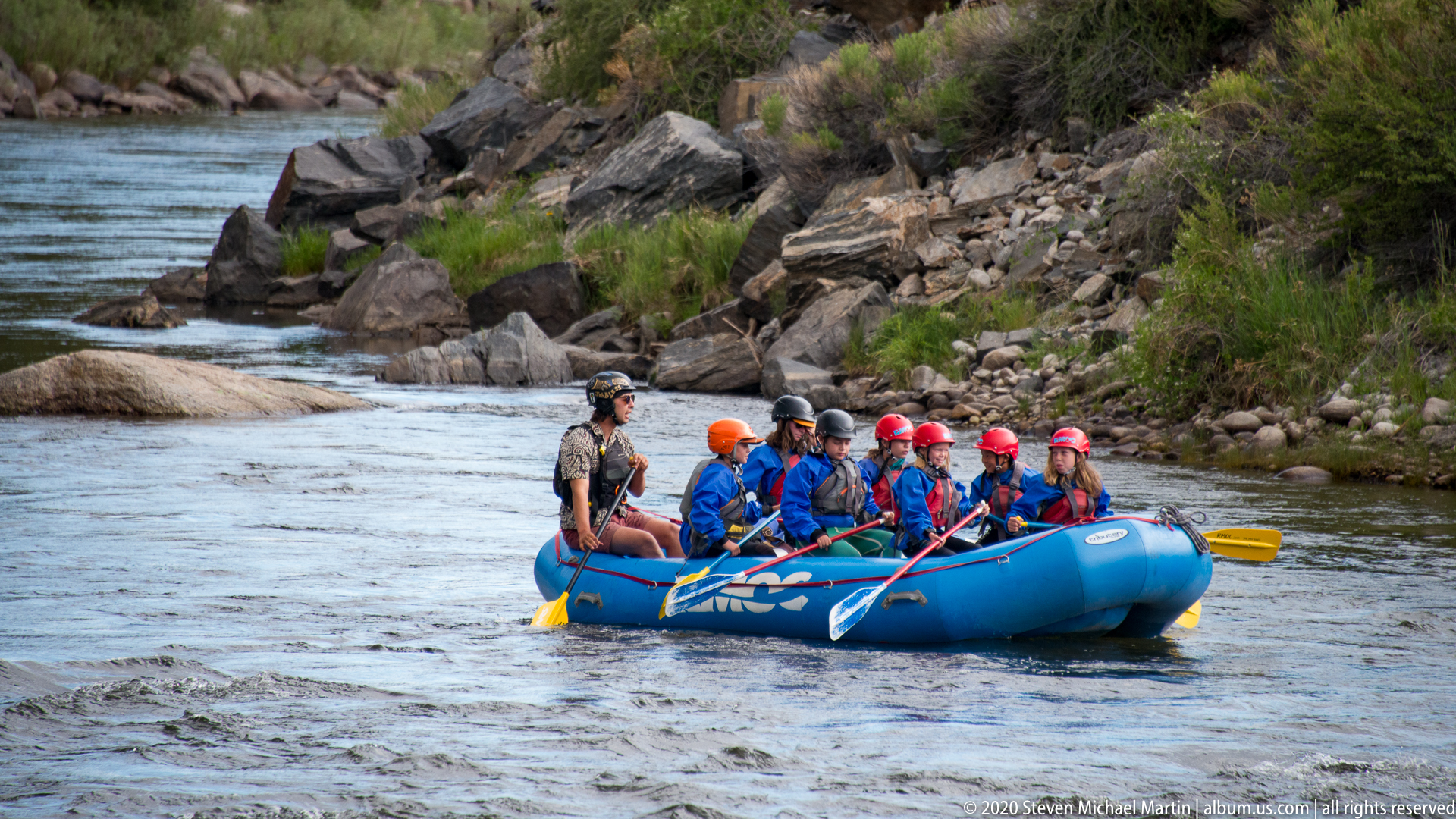
A blue raft moves through a shallow, gently rippling channel, carrying a row of helmeted paddlers with a guide at the rear. Rocky banks and patches of grass frame the water, while a few yellow paddles rest across the raft. The side-on view isolates one boat and its crew against the river corridor.
Caption
A blue raft moves through a shallow, gently rippling channel, carrying a row of helmeted paddlers with a guide at the rear. Rocky banks and patches of grass frame the water, while a few yellow paddles rest across the raft. The side-on view isolates one boat and its crew against the river corridor.

Three people stand on separate paddleboards in a calm river reach, each holding a long paddle. They wear helmets and flotation gear, and bright safety leashes trail into the water. A rocky bank with shrubs rises behind them, contrasting the still foreground water with the rugged canyon shoreline.
Caption
Three people stand on separate paddleboards in a calm river reach, each holding a long paddle. They wear helmets and flotation gear, and bright safety leashes trail into the water. A rocky bank with shrubs rises behind them, contrasting the still foreground water with the rugged canyon shoreline.
A narrow, uneven footpath runs through low shrubs and patches of grass, its surface broken by flat stones and loose gravel. The trail bends gently into a wooded opening, with taller trees and brush closing in on both sides. The ground-level view follows the route rather than revealing its destination.
Caption
A narrow, uneven footpath runs through low shrubs and patches of grass, its surface broken by flat stones and loose gravel. The trail bends gently into a wooded opening, with taller trees and brush closing in on both sides. The ground-level view follows the route rather than revealing its destination.
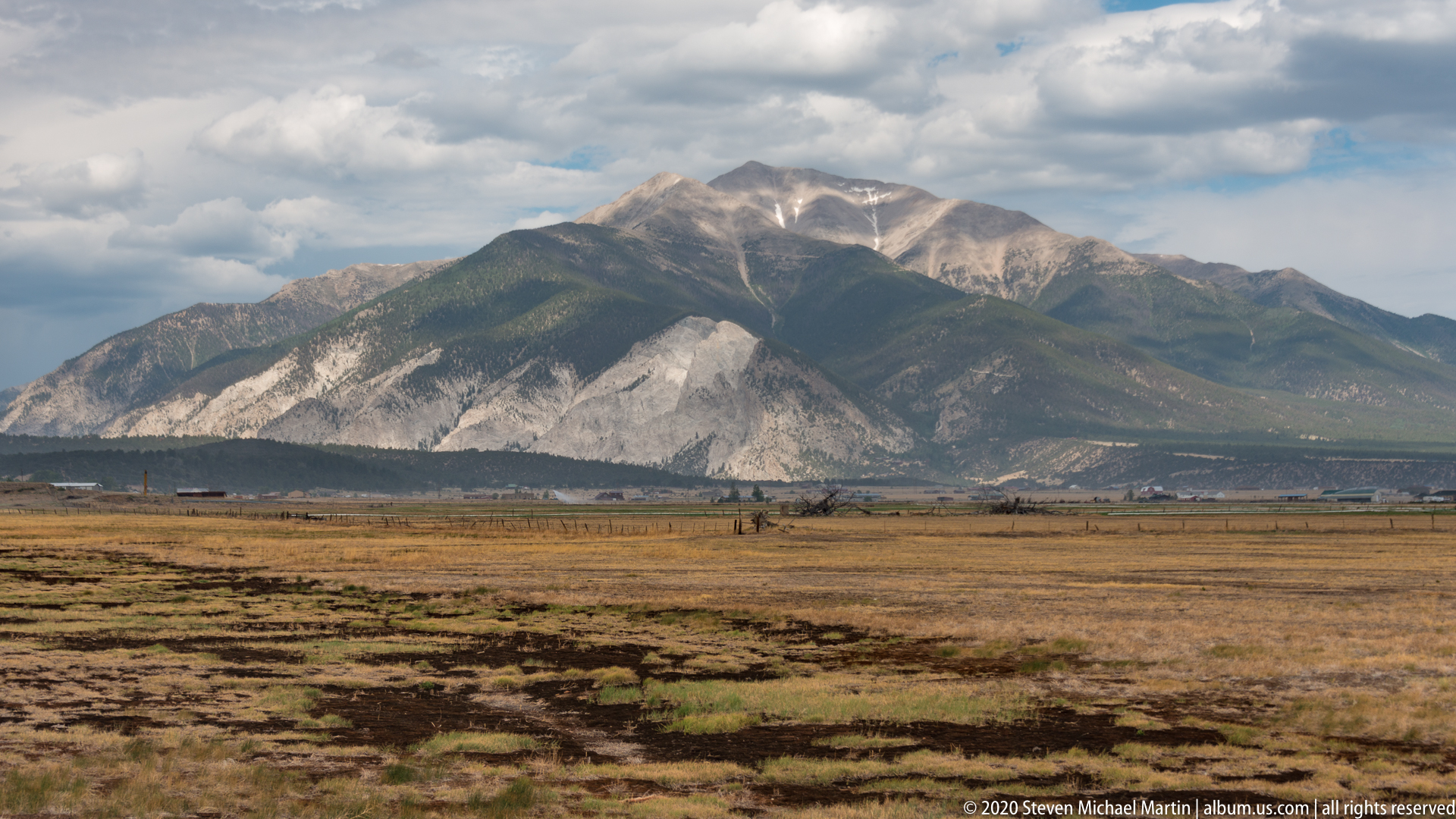
A broad, tawny valley opens toward a high mountain massif marked by pale, exposed rock bands and darker forested slopes. Broken clouds soften the light across the ridgeline, while scattered buildings and field boundaries sit low on the horizon. The expansive composition connects the agricultural valley floor with the rugged elevations of central Colorado.
Caption
A broad, tawny valley opens toward a high mountain massif marked by pale, exposed rock bands and darker forested slopes. Broken clouds soften the light across the ridgeline, while scattered buildings and field boundaries sit low on the horizon. The expansive composition connects the agricultural valley floor with the rugged elevations of central Colorado.
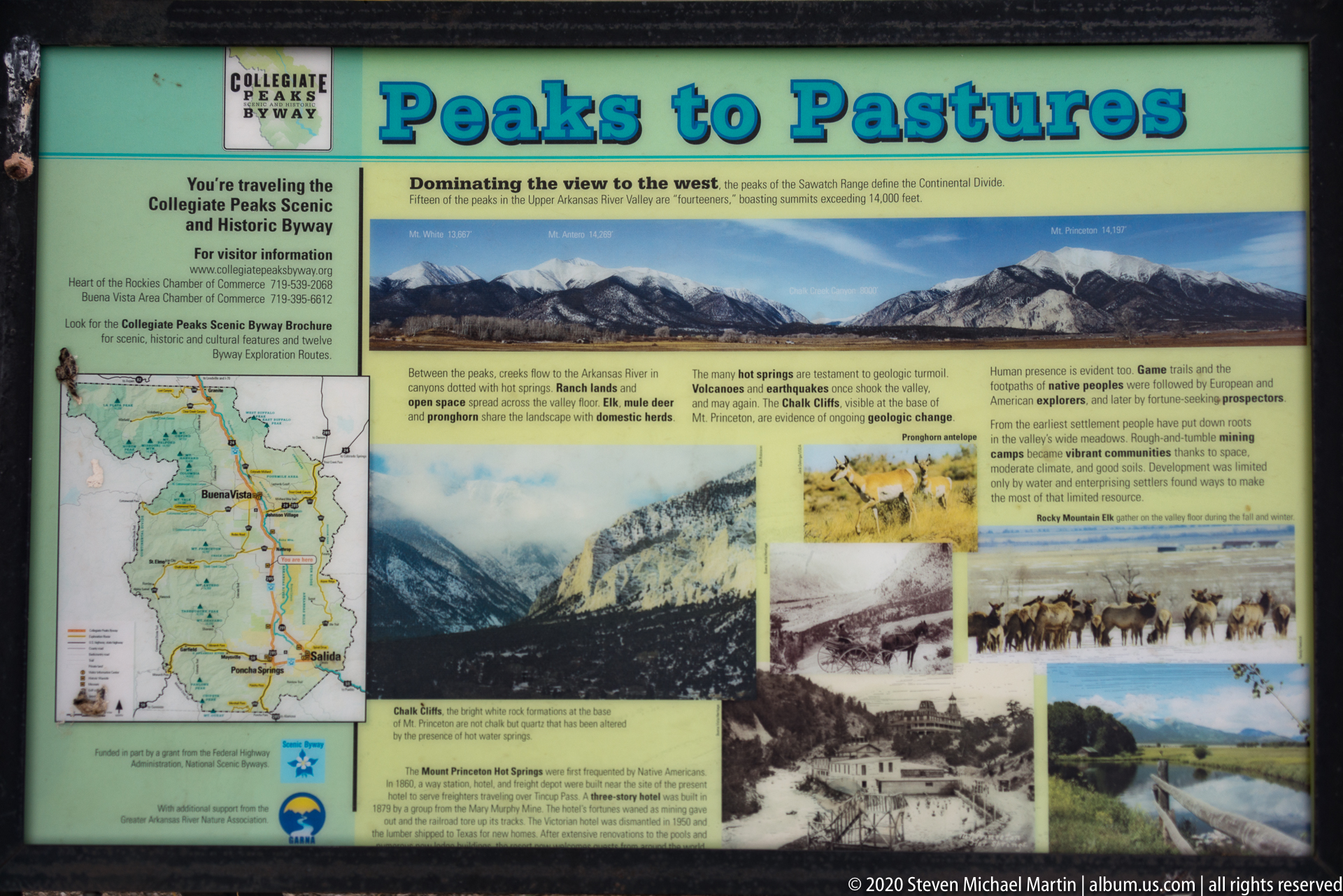
The “Peaks to Pastures” wayside panel combines a regional map with photographs and text about the Collegiate Peaks, the Arkansas River valley, ranching, mining, and geothermal activity. Its layered layout links mountain scenery to human uses of the valley below. The photograph presents the exhibit as a compact interpretive overview, with the map and historic imagery framing the landscape narrative.
Caption
The “Peaks to Pastures” wayside panel combines a regional map with photographs and text about the Collegiate Peaks, the Arkansas River valley, ranching, mining, and geothermal activity. Its layered layout links mountain scenery to human uses of the valley below. The photograph presents the exhibit as a compact interpretive overview, with the map and historic imagery framing the landscape narrative.
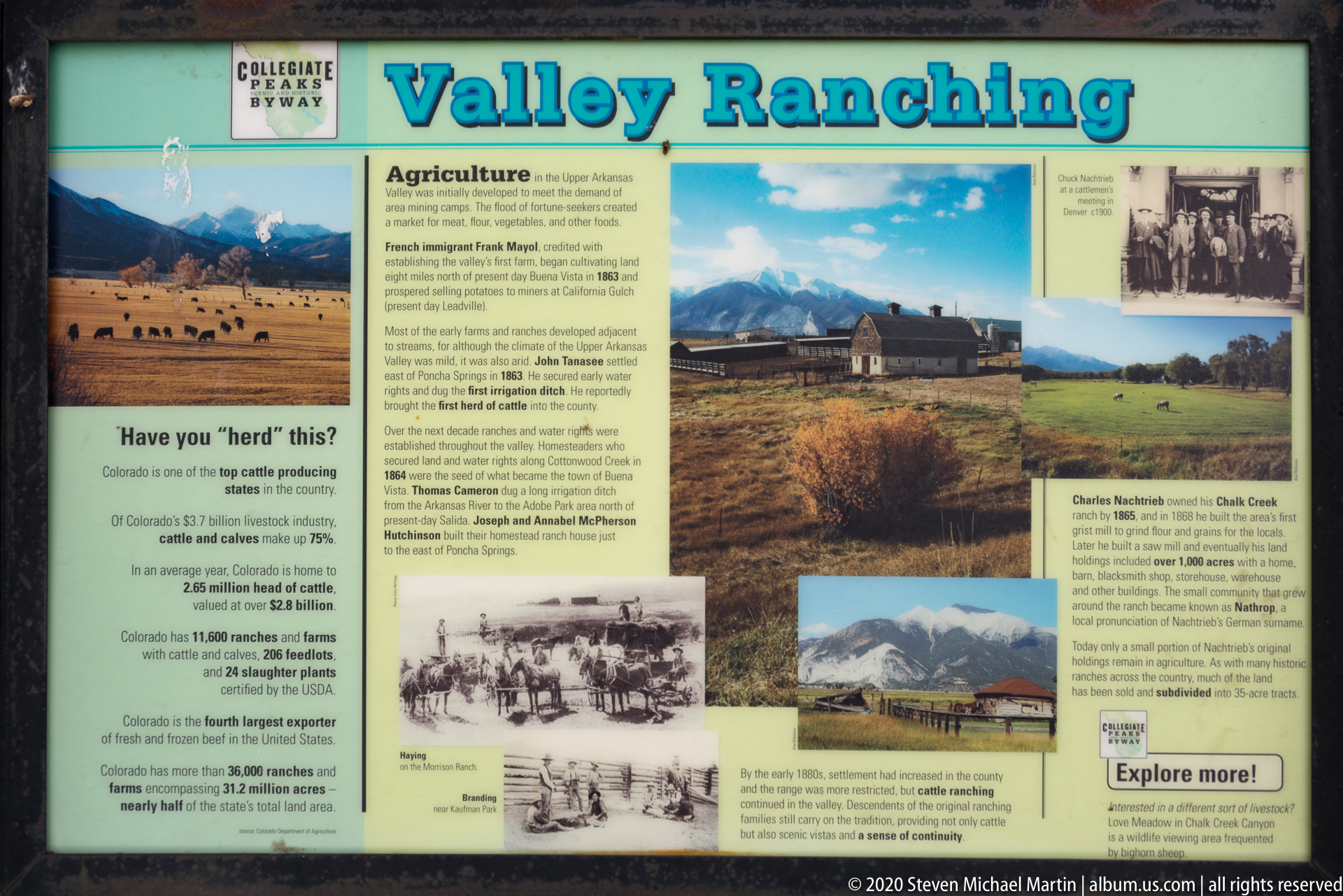
A large “Valley Ranching” wayside panel explains settlement and agricultural history through text, archival photographs, and images of ranch buildings and livestock. The layout places a valley map and present-day landscape views alongside historic scenes, connecting the working ranch landscape with earlier settlement. This view emphasizes the exhibit’s visual collage and its focus on the Arkansas Valley’s ranching past.
Caption
A large “Valley Ranching” wayside panel explains settlement and agricultural history through text, archival photographs, and images of ranch buildings and livestock. The layout places a valley map and present-day landscape views alongside historic scenes, connecting the working ranch landscape with earlier settlement. This view emphasizes the exhibit’s visual collage and its focus on the Arkansas Valley’s ranching past.
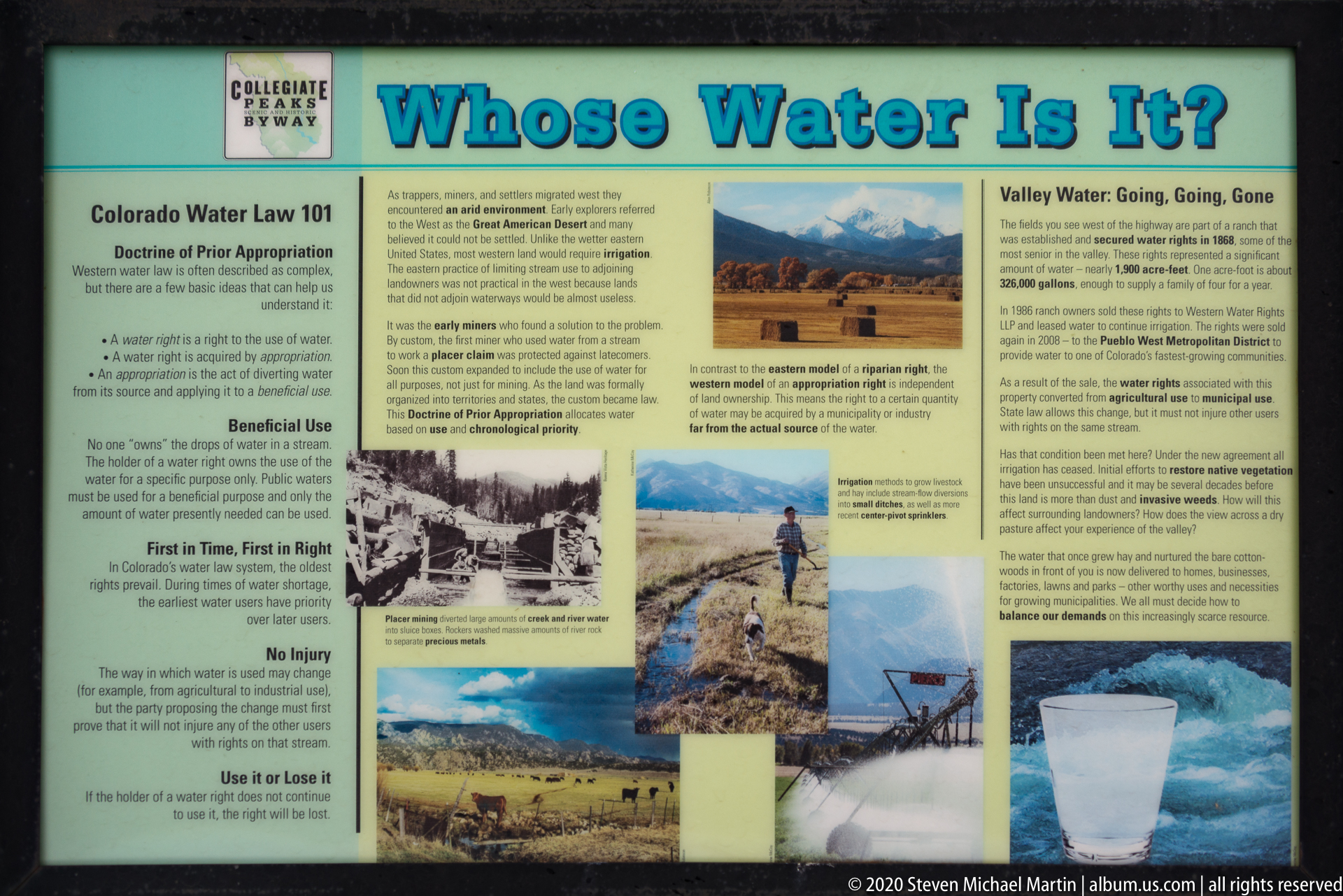
The “Whose Water Is It?” panel introduces Colorado water law with a column of principles beside photographs of irrigation, historic water use, and river recreation. A landscape image, farm scenes, and a diagram help explain how water rights shape land use across the valley. The photograph records an educational display focused on allocation and competing demands for a scarce regional resource.
Caption
The “Whose Water Is It?” panel introduces Colorado water law with a column of principles beside photographs of irrigation, historic water use, and river recreation. A landscape image, farm scenes, and a diagram help explain how water rights shape land use across the valley. The photograph records an educational display focused on allocation and competing demands for a scarce regional resource.
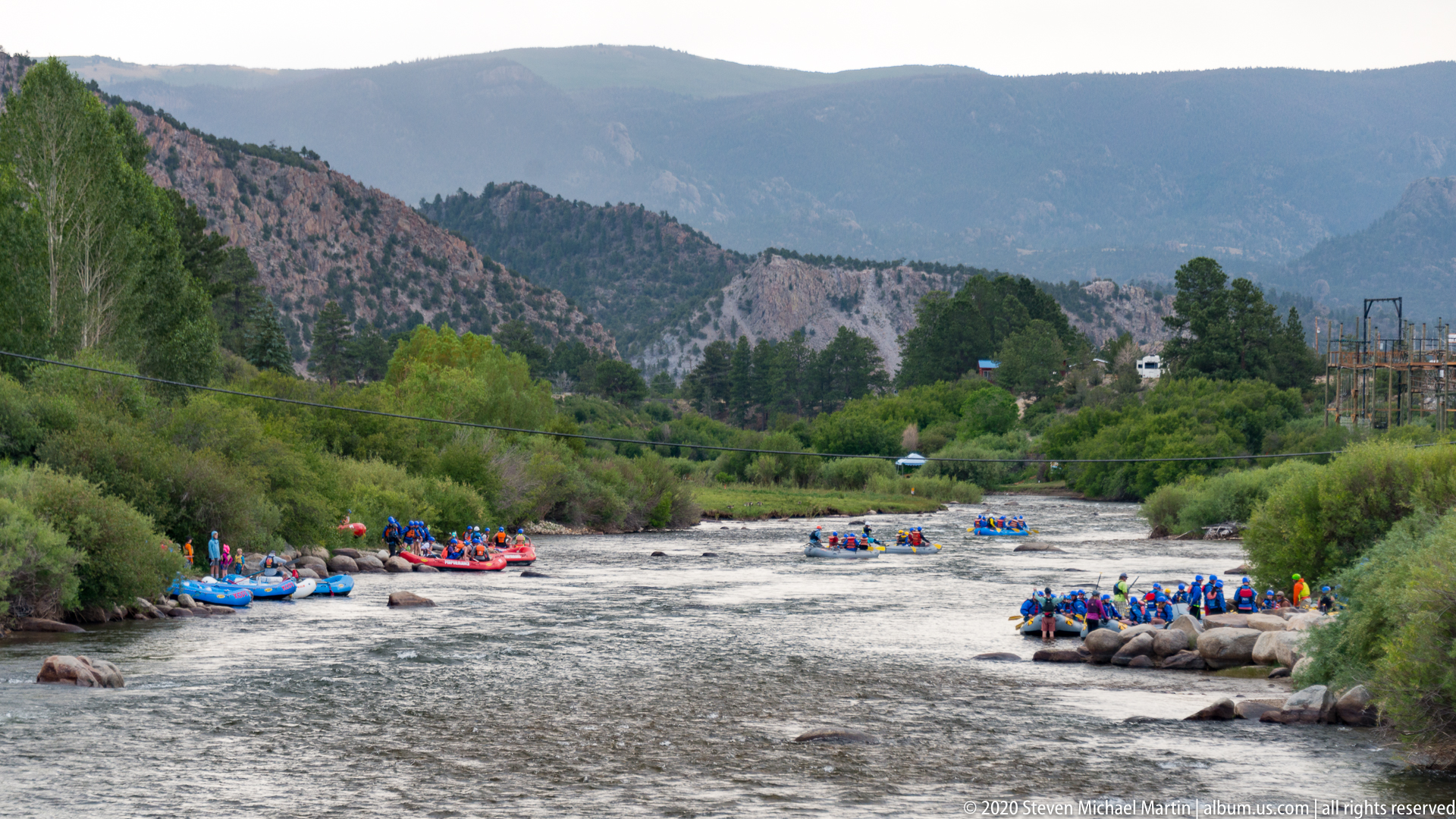
Several brightly colored inflatable rafts carry groups through a fast, shallow river channel. Some boaters gather near the rocky bank while others move through the current, with wooded slopes rising on both sides. The wide view places the recreational activity within a narrow mountain valley and shows how the river’s boulders and shifting water guide the route.
Caption
Several brightly colored inflatable rafts carry groups through a fast, shallow river channel. Some boaters gather near the rocky bank while others move through the current, with wooded slopes rising on both sides. The wide view places the recreational activity within a narrow mountain valley and shows how the river’s boulders and shifting water guide the route.
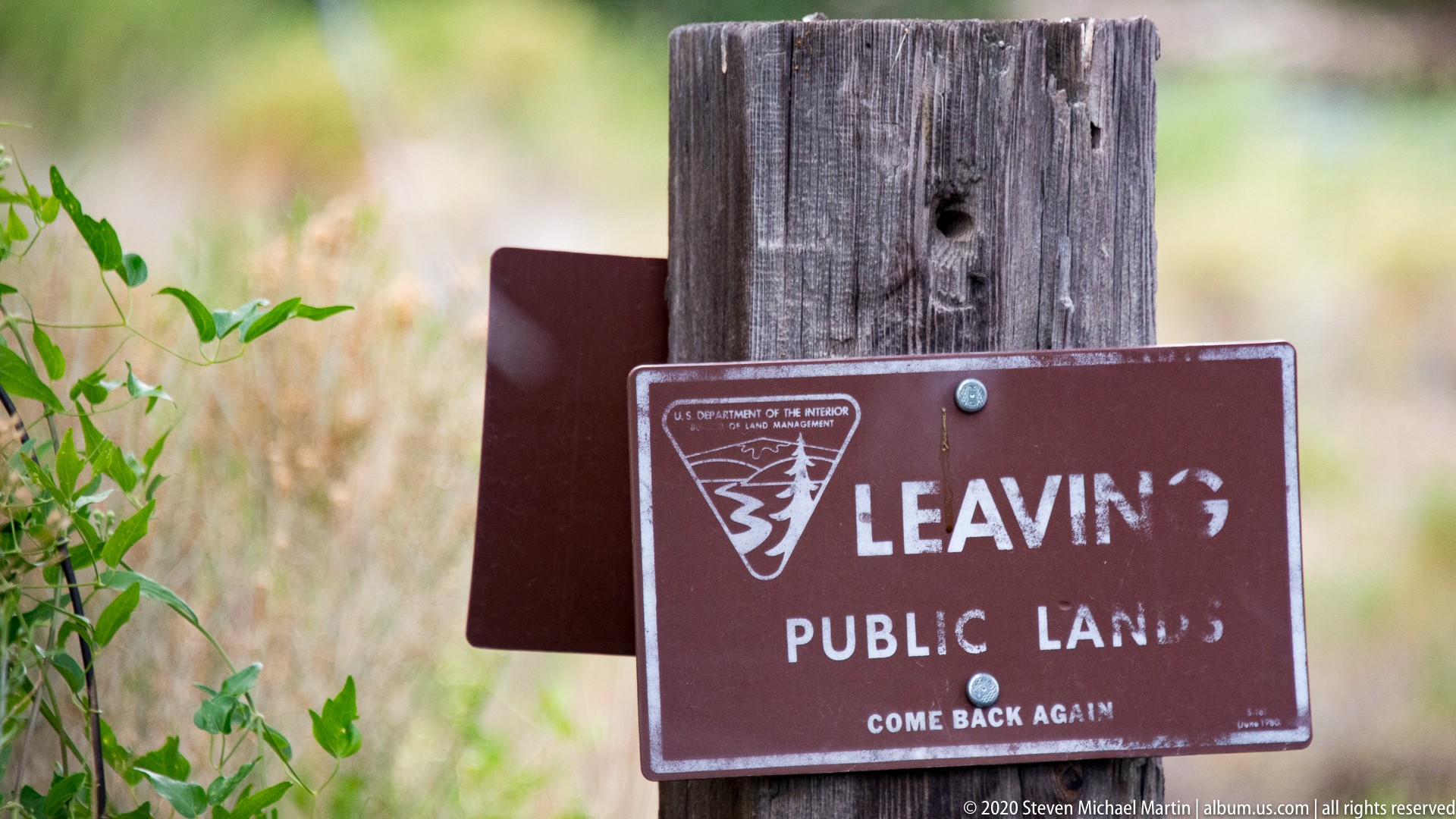
A brown public-lands sign fills the foreground, its visible message urging visitors to “Leave No Trace” and “Come Back Again.” The sign is fastened to a weathered timber post, with green vegetation softly blurred behind it. The close view makes visitor conduct the subject, presenting the land-use ethic as an everyday part of recreation in the area.
Caption
A brown public-lands sign fills the foreground, its visible message urging visitors to “Leave No Trace” and “Come Back Again.” The sign is fastened to a weathered timber post, with green vegetation softly blurred behind it. The close view makes visitor conduct the subject, presenting the land-use ethic as an everyday part of recreation in the area.

A man in a blue T-shirt and light shorts stands with his hands at his hips beside the Arkansas River. The wider portrait keeps the river, boulder-lined bank, and steep wooded hillside in view, placing the visitor within the recreation landscape rather than isolating him from it. Other people are faintly visible along the far bank.
Caption
A man in a blue T-shirt and light shorts stands with his hands at his hips beside the Arkansas River. The wider portrait keeps the river, boulder-lined bank, and steep wooded hillside in view, placing the visitor within the recreation landscape rather than isolating him from it. Other people are faintly visible along the far bank.
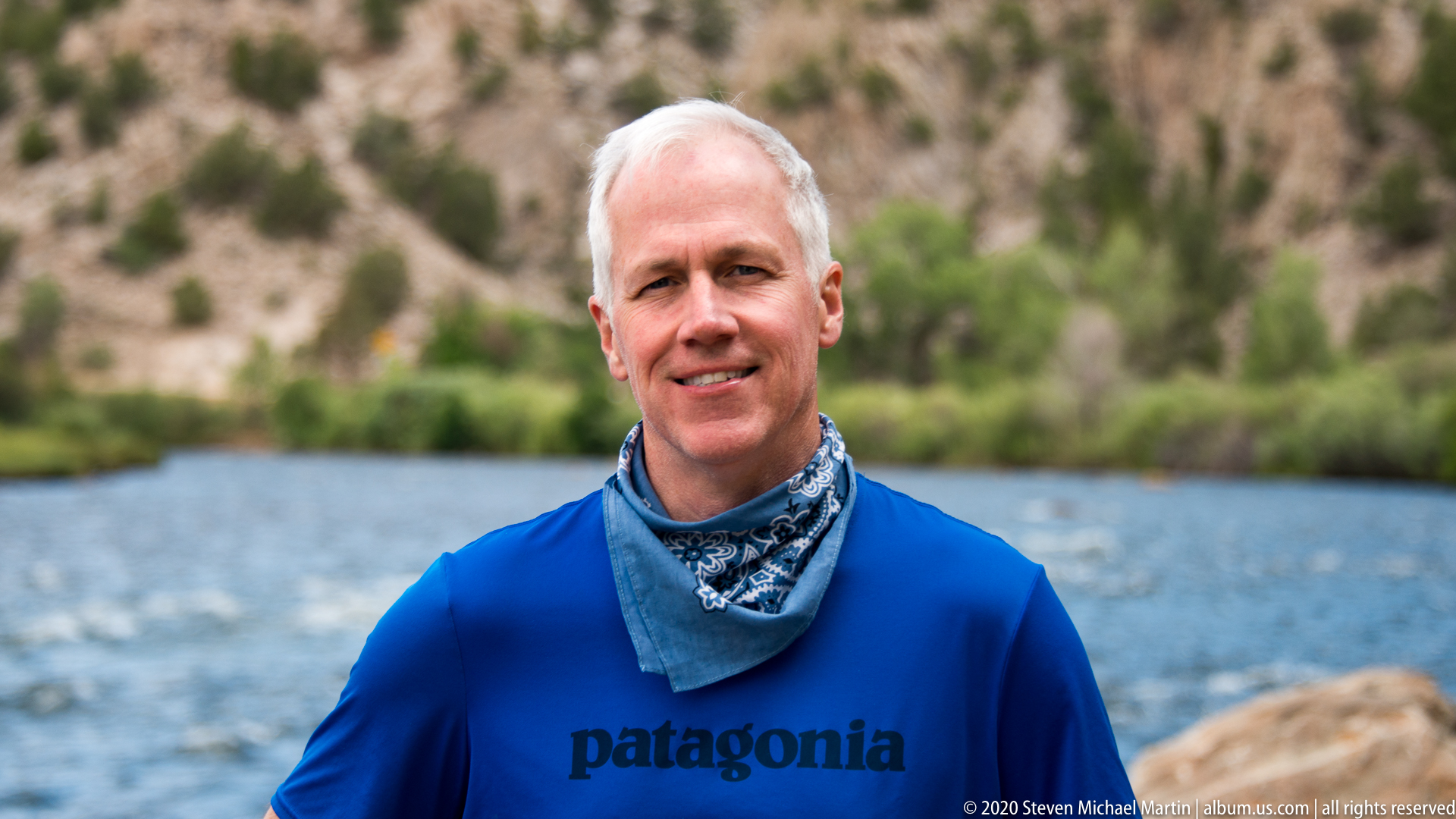
The frame tightens to a head-and-torso portrait of a smiling man in a blue shirt and patterned neck gaiter. The river and green riverbank blur behind him, shifting attention from the surrounding landscape to the visitor’s expression and outdoor clothing. A small portion of the rocky shore remains visible at the lower edge, retaining the riverside setting.
Caption
The frame tightens to a head-and-torso portrait of a smiling man in a blue shirt and patterned neck gaiter. The river and green riverbank blur behind him, shifting attention from the surrounding landscape to the visitor’s expression and outdoor clothing. A small portion of the rocky shore remains visible at the lower edge, retaining the riverside setting.
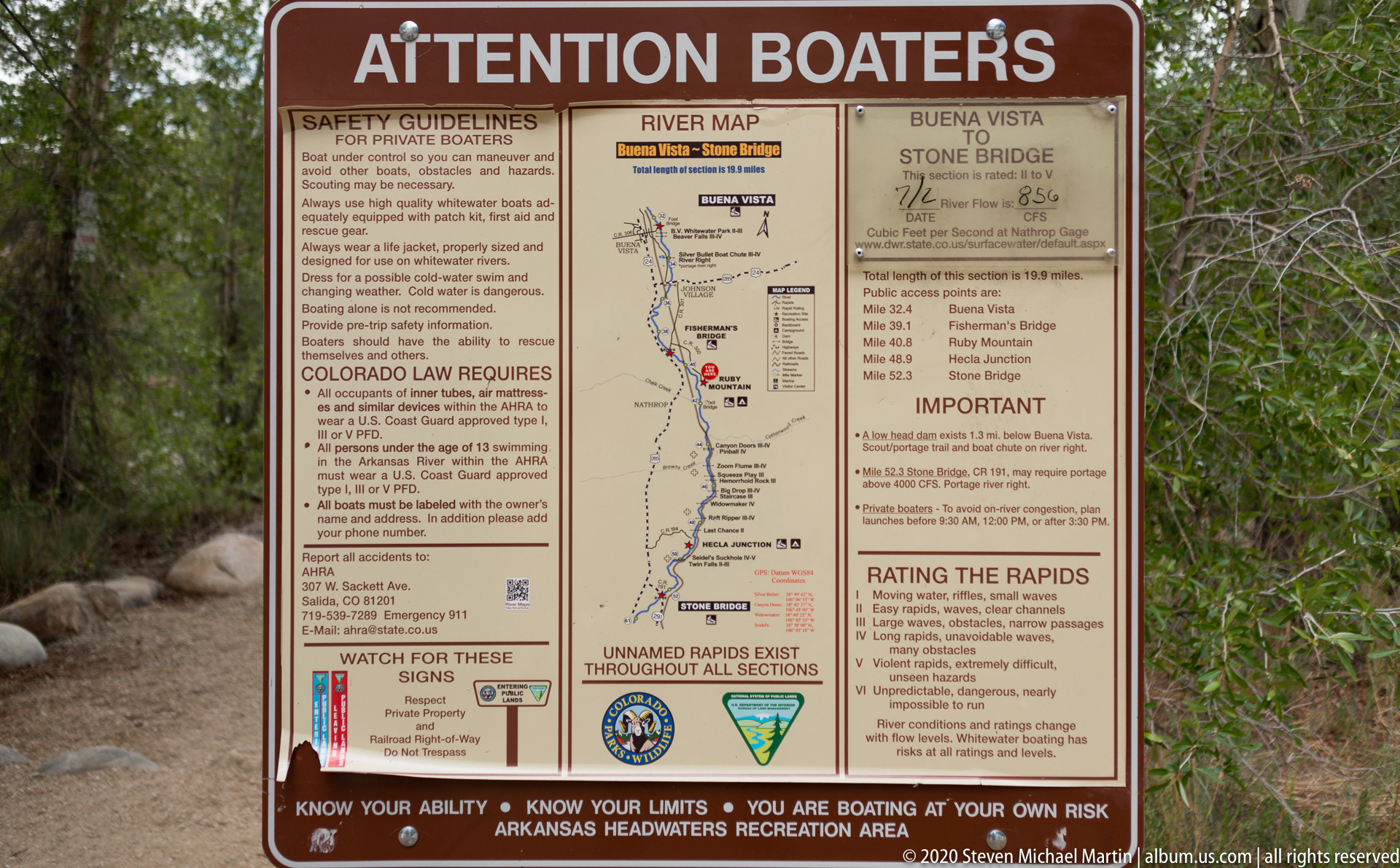
A tall “Attention Boaters” board combines safety guidance, a river map, access points, and a rapid-rating scale. Its panels orient visitors to the Arkansas Headwaters Recreation Area and warn that conditions can change with water levels. Photographed frontally against trees, the sign serves as both a practical navigation aid and a concise guide to river hazards.
Caption
A tall “Attention Boaters” board combines safety guidance, a river map, access points, and a rapid-rating scale. Its panels orient visitors to the Arkansas Headwaters Recreation Area and warn that conditions can change with water levels. Photographed frontally against trees, the sign serves as both a practical navigation aid and a concise guide to river hazards.
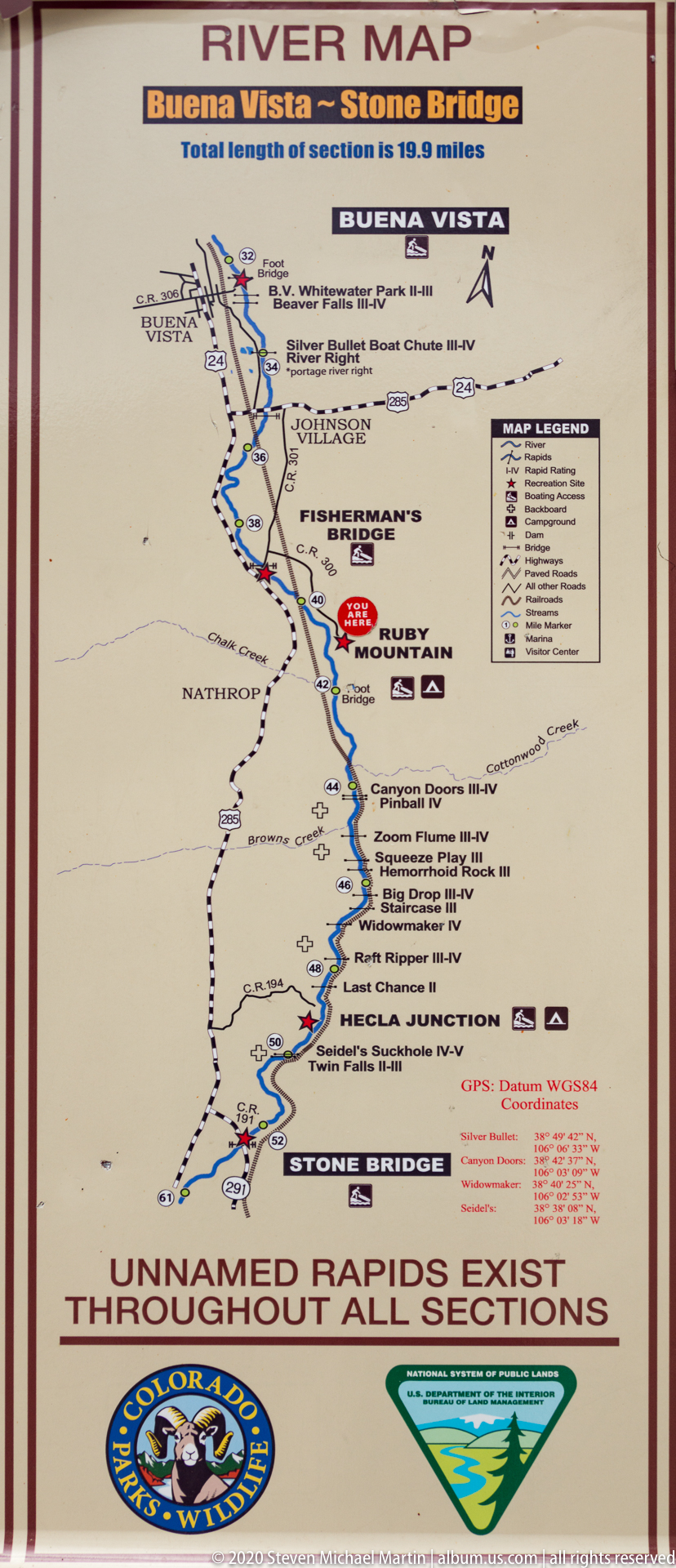
The route map traces the Arkansas River south from Buena Vista toward Hecla Junction and Stone Bridge, marking access points, roads, and named rapids. A “You are here” marker locates the viewer near Ruby Mountain. Framed tightly, the photograph foregrounds the map’s winding blue river line and the sequence of navigational landmarks used by boaters.
Caption
The route map traces the Arkansas River south from Buena Vista toward Hecla Junction and Stone Bridge, marking access points, roads, and named rapids. A “You are here” marker locates the viewer near Ruby Mountain. Framed tightly, the photograph foregrounds the map’s winding blue river line and the sequence of navigational landmarks used by boaters.
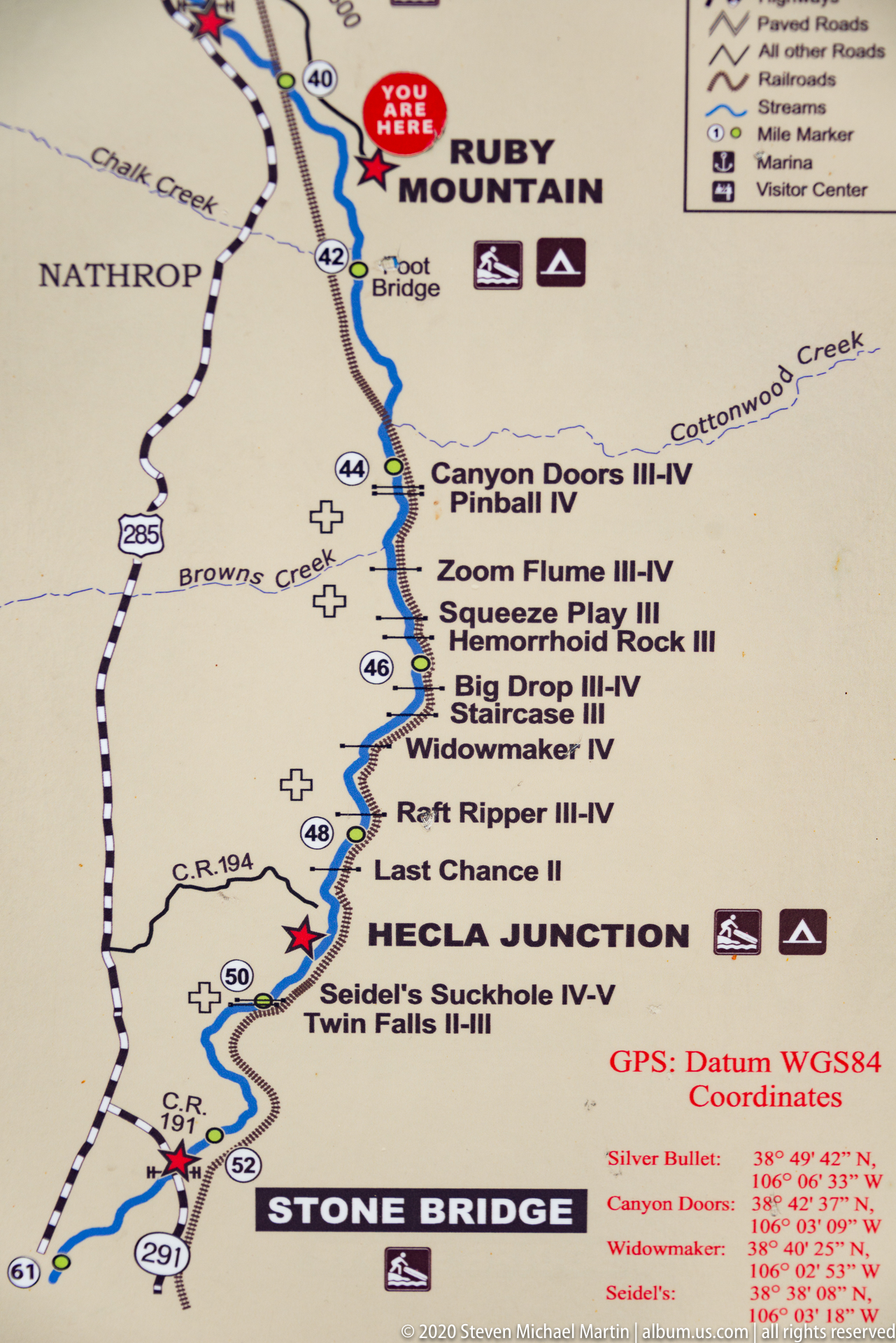
A close crop of the river map lists named rapids along a blue route, including Canyon Doors, Zoom Flume, Squeeze Play, Widowmaker, and Raft Ripper. Hecla Junction and Stone Bridge anchor the lower part of the map. This detail emphasizes how the river is divided into recognizable boating runs and rated sections for trip planning.
Caption
A close crop of the river map lists named rapids along a blue route, including Canyon Doors, Zoom Flume, Squeeze Play, Widowmaker, and Raft Ripper. Hecla Junction and Stone Bridge anchor the lower part of the map. This detail emphasizes how the river is divided into recognizable boating runs and rated sections for trip planning.

The sign’s “Rating the Rapids” section defines a six-level whitewater scale, from moving water and small waves to violent, nearly unrunnable rapids. The close framing excludes most of the surrounding map and isolates the safety information for easy reading. Its final notice stresses that river conditions and ratings change with flow and that boating carries risk at every level.
Caption
The sign’s “Rating the Rapids” section defines a six-level whitewater scale, from moving water and small waves to violent, nearly unrunnable rapids. The close framing excludes most of the surrounding map and isolates the safety information for easy reading. Its final notice stresses that river conditions and ratings change with flow and that boating carries risk at every level.

A dark entrance sign names Browns Canyon National Monument and identifies the Bureau of Land Management and Forest Service as managing partners. Its illustrated upper panel depicts a stylized mountain-and-river landscape, while sage-colored grasses and scattered shrubs surround the structure. The centered view makes the monument designation and shared stewardship legible within the open, dry setting.
Caption
A dark entrance sign names Browns Canyon National Monument and identifies the Bureau of Land Management and Forest Service as managing partners. Its illustrated upper panel depicts a stylized mountain-and-river landscape, while sage-colored grasses and scattered shrubs surround the structure. The centered view makes the monument designation and shared stewardship legible within the open, dry setting.

The Browns Canyon National Monument sign stands at the foot of a rocky, pine-dotted hill, with pale grassland and scattered shrubs extending across the foreground. The wider composition places the designation within the terrain it identifies, while the sign’s partner-agency wording remains visible. Light cloud cover softens the contrast between the pale stone and dark conifers.
Caption
The Browns Canyon National Monument sign stands at the foot of a rocky, pine-dotted hill, with pale grassland and scattered shrubs extending across the foreground. The wider composition places the designation within the terrain it identifies, while the sign’s partner-agency wording remains visible. Light cloud cover softens the contrast between the pale stone and dark conifers.

The “Browns Canyon WSA Northern Trails” panel pairs a trail map with route descriptions, estimated hiking times, access guidance, and recreation reminders. Colored lines distinguish trails around the Arkansas River and nearby drainage corridors. Small photographs along the bottom show river and rock scenery, giving visitors a visual reference for the terrain described in the map and text.
Caption
The “Browns Canyon WSA Northern Trails” panel pairs a trail map with route descriptions, estimated hiking times, access guidance, and recreation reminders. Colored lines distinguish trails around the Arkansas River and nearby drainage corridors. Small photographs along the bottom show river and rock scenery, giving visitors a visual reference for the terrain described in the map and text.

The “Rocky Mountain Climbers” exhibit describes bighorn sheep behavior, habitat, group structure, and seasonal movement. A painted ram with curled horns dominates the right side above an illustrated mountain stream and slope; text columns and wildlife-viewing tips flank the scene. The panel uses naturalistic artwork to introduce the species’ adaptation to steep terrain and guide respectful observation.
Caption
The “Rocky Mountain Climbers” exhibit describes bighorn sheep behavior, habitat, group structure, and seasonal movement. A painted ram with curled horns dominates the right side above an illustrated mountain stream and slope; text columns and wildlife-viewing tips flank the scene. The panel uses naturalistic artwork to introduce the species’ adaptation to steep terrain and guide respectful observation.
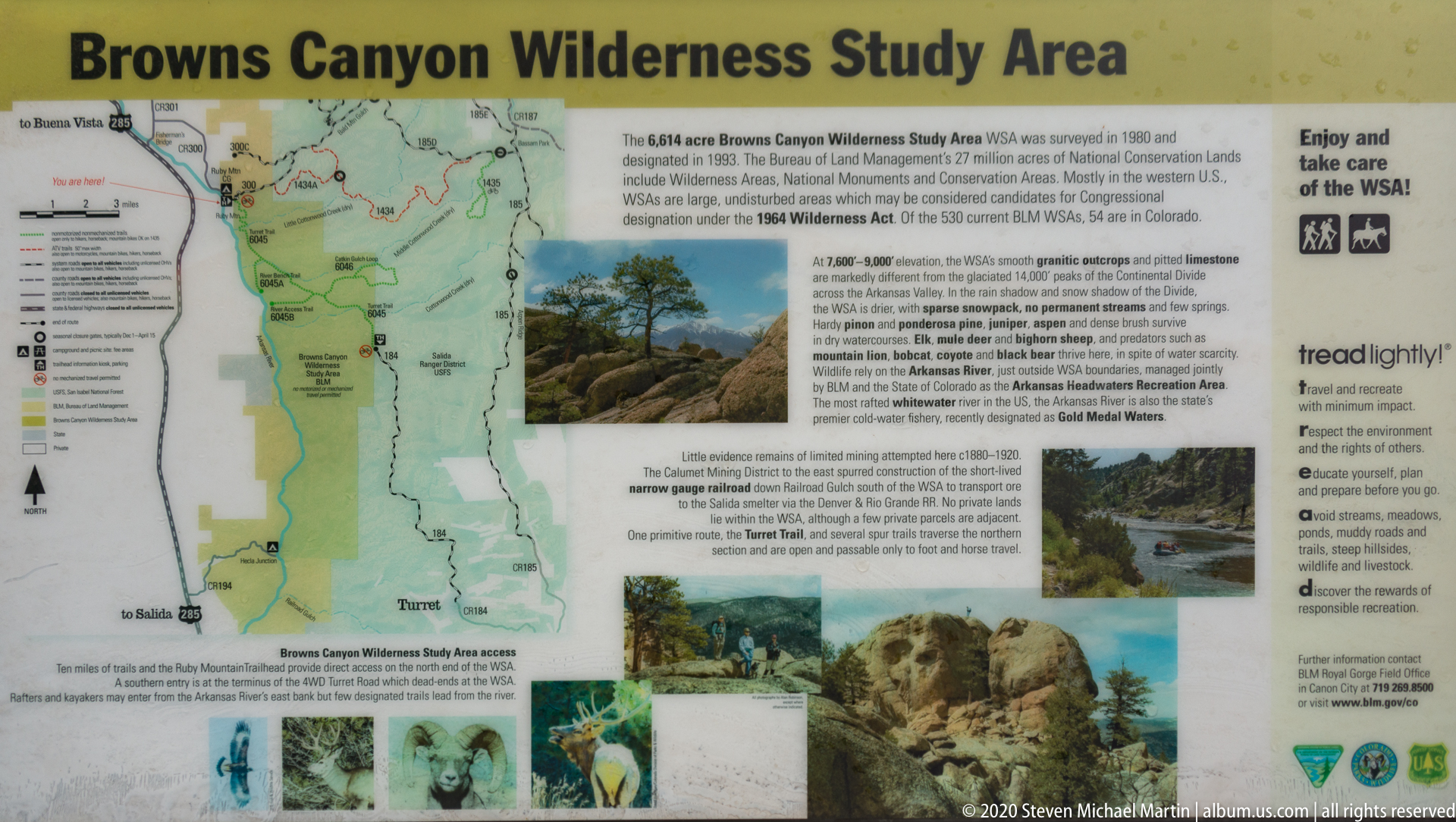
A large panel introduces the Browns Canyon Wilderness Study Area with a boundary map, land-management guidance, and descriptions of geology, vegetation, wildlife, and recreation. Photographs of rocky terrain and river scenery are arranged through the text, while a vertical column urges visitors to travel lightly. The broad view presents both the mapped area and the exhibit’s conservation message.
Caption
A large panel introduces the Browns Canyon Wilderness Study Area with a boundary map, land-management guidance, and descriptions of geology, vegetation, wildlife, and recreation. Photographs of rocky terrain and river scenery are arranged through the text, while a vertical column urges visitors to travel lightly. The broad view presents both the mapped area and the exhibit’s conservation message.
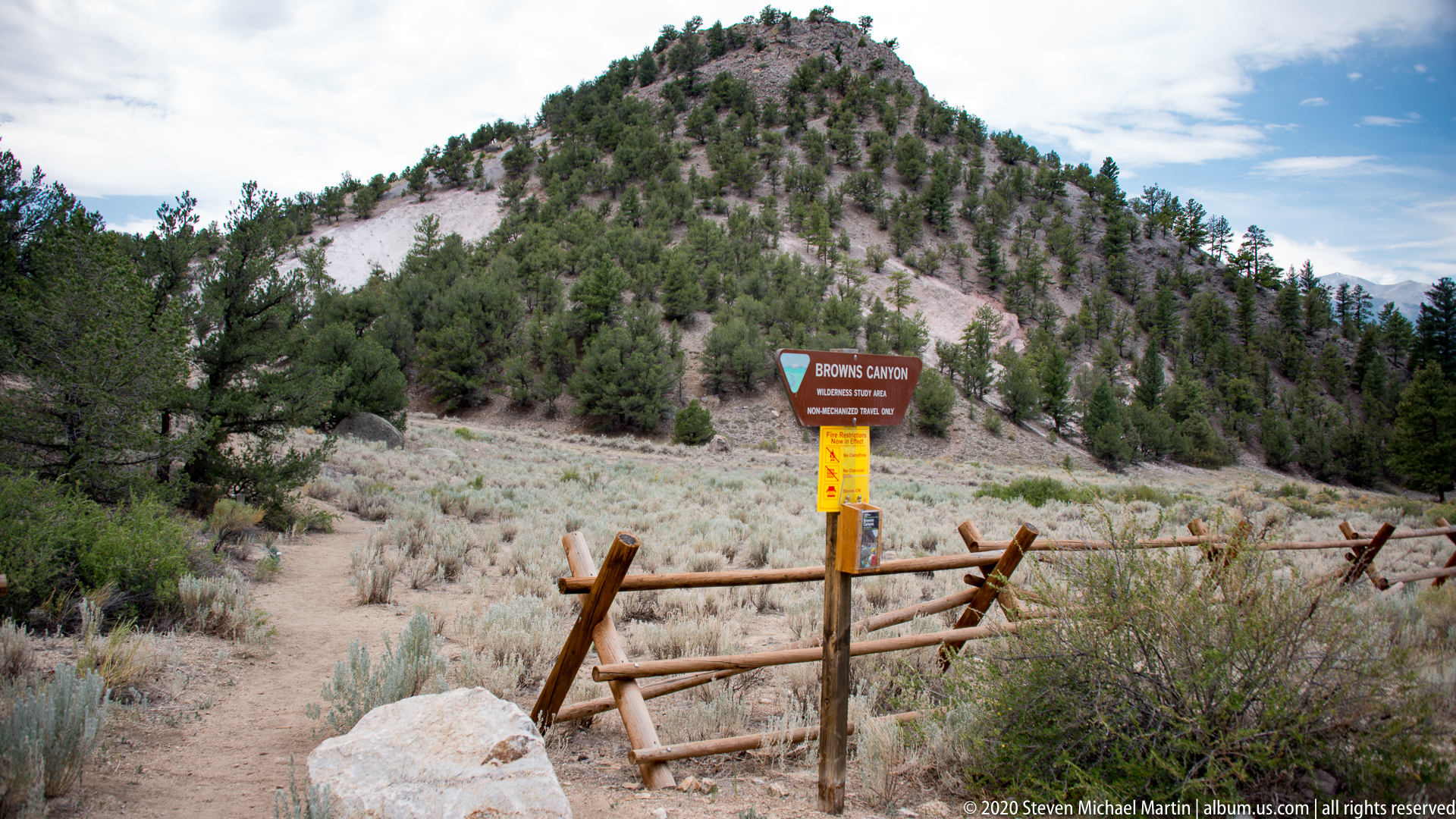
A brown sign for the Browns Canyon Wilderness Study Area marks a narrow path passing through a wooden fence. The trail climbs toward a pale rocky hill dotted with pines, while a bright yellow notice is attached below the sign. The wide view links access control and visitor information with the open, rugged terrain beyond.
Caption
A brown sign for the Browns Canyon Wilderness Study Area marks a narrow path passing through a wooden fence. The trail climbs toward a pale rocky hill dotted with pines, while a bright yellow notice is attached below the sign. The wide view links access control and visitor information with the open, rugged terrain beyond.
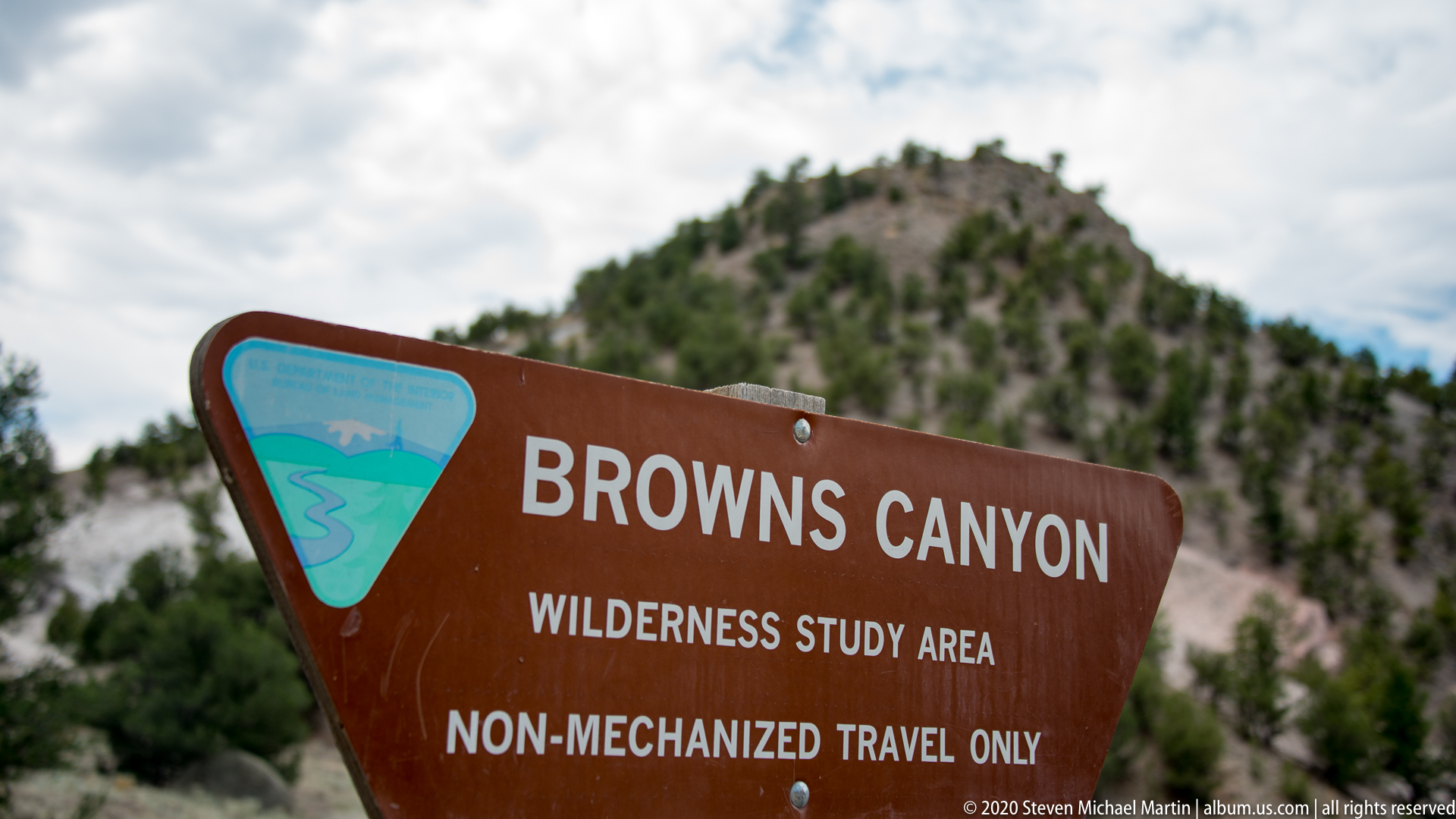
A brown sign fills the foreground with the words “Browns Canyon Wilderness Study Area” and “Non-Mechanized Travel Only.” The turquoise public-lands emblem is prominent, while a rocky, tree-covered hill falls out of focus behind the panel. The close framing prioritizes the access rule and designation over the surrounding landscape, making visitor restrictions the central subject.
Caption
A brown sign fills the foreground with the words “Browns Canyon Wilderness Study Area” and “Non-Mechanized Travel Only.” The turquoise public-lands emblem is prominent, while a rocky, tree-covered hill falls out of focus behind the panel. The close framing prioritizes the access rule and designation over the surrounding landscape, making visitor restrictions the central subject.
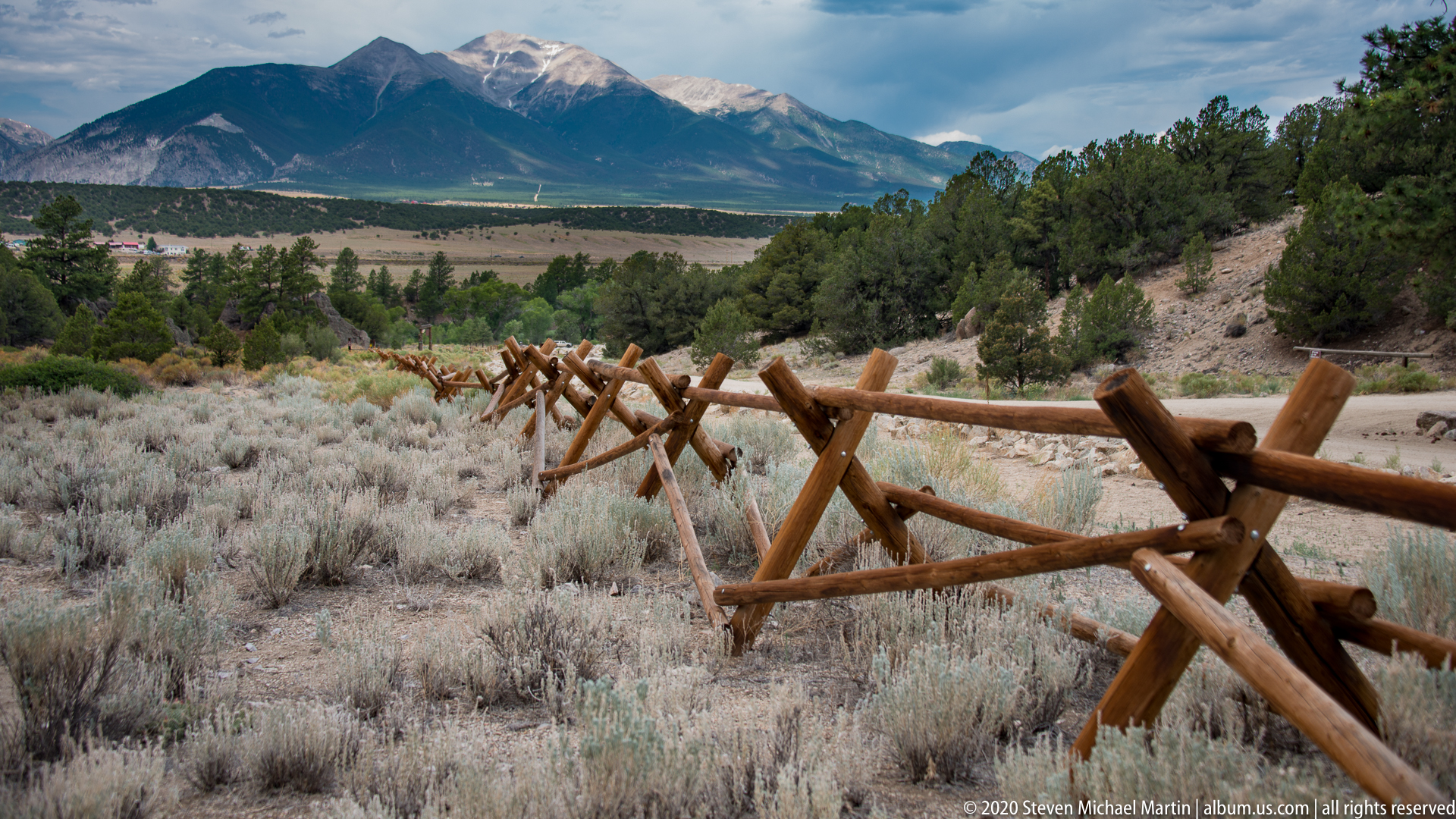
A heavy split-rail fence runs diagonally from the near right foreground toward the distant center, guiding the eye across sage-colored grass and low shrubs. Beyond it, a broad valley and high mountain ridge open under broken clouds. The low viewpoint emphasizes the fence’s construction and its long recession through the dry terrain.
Caption
A heavy split-rail fence runs diagonally from the near right foreground toward the distant center, guiding the eye across sage-colored grass and low shrubs. Beyond it, a broad valley and high mountain ridge open under broken clouds. The low viewpoint emphasizes the fence’s construction and its long recession through the dry terrain.
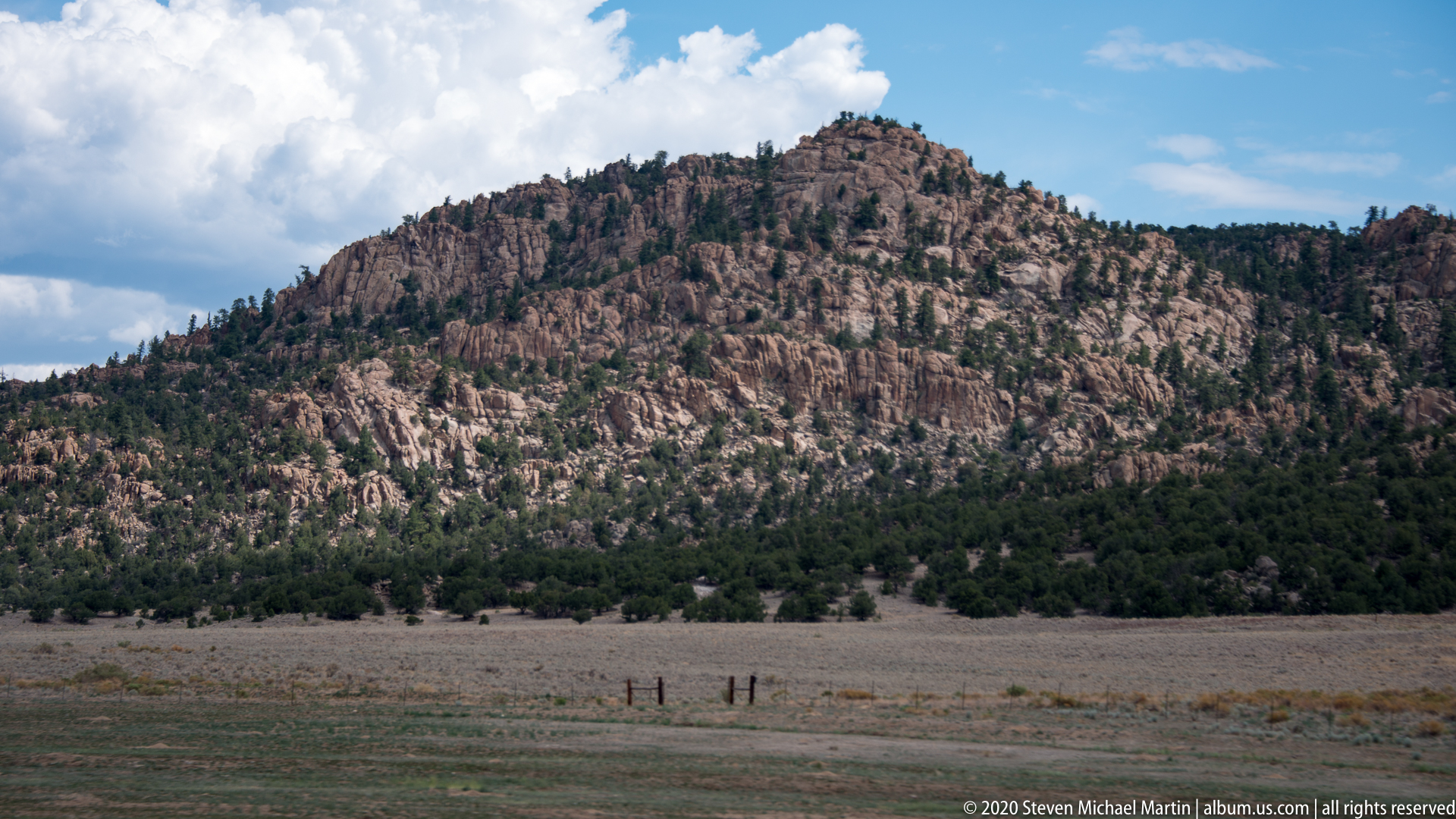
A long rocky ridge rises above a flat, muted grassland, its steep face patterned with exposed stone and scattered conifers. The broad framing holds the low valley in the foreground and the ridge across the middle distance, with cumulus clouds brightening the sky. Sparse fence posts are visible near the field’s center.
Caption
A long rocky ridge rises above a flat, muted grassland, its steep face patterned with exposed stone and scattered conifers. The broad framing holds the low valley in the foreground and the ridge across the middle distance, with cumulus clouds brightening the sky. Sparse fence posts are visible near the field’s center.
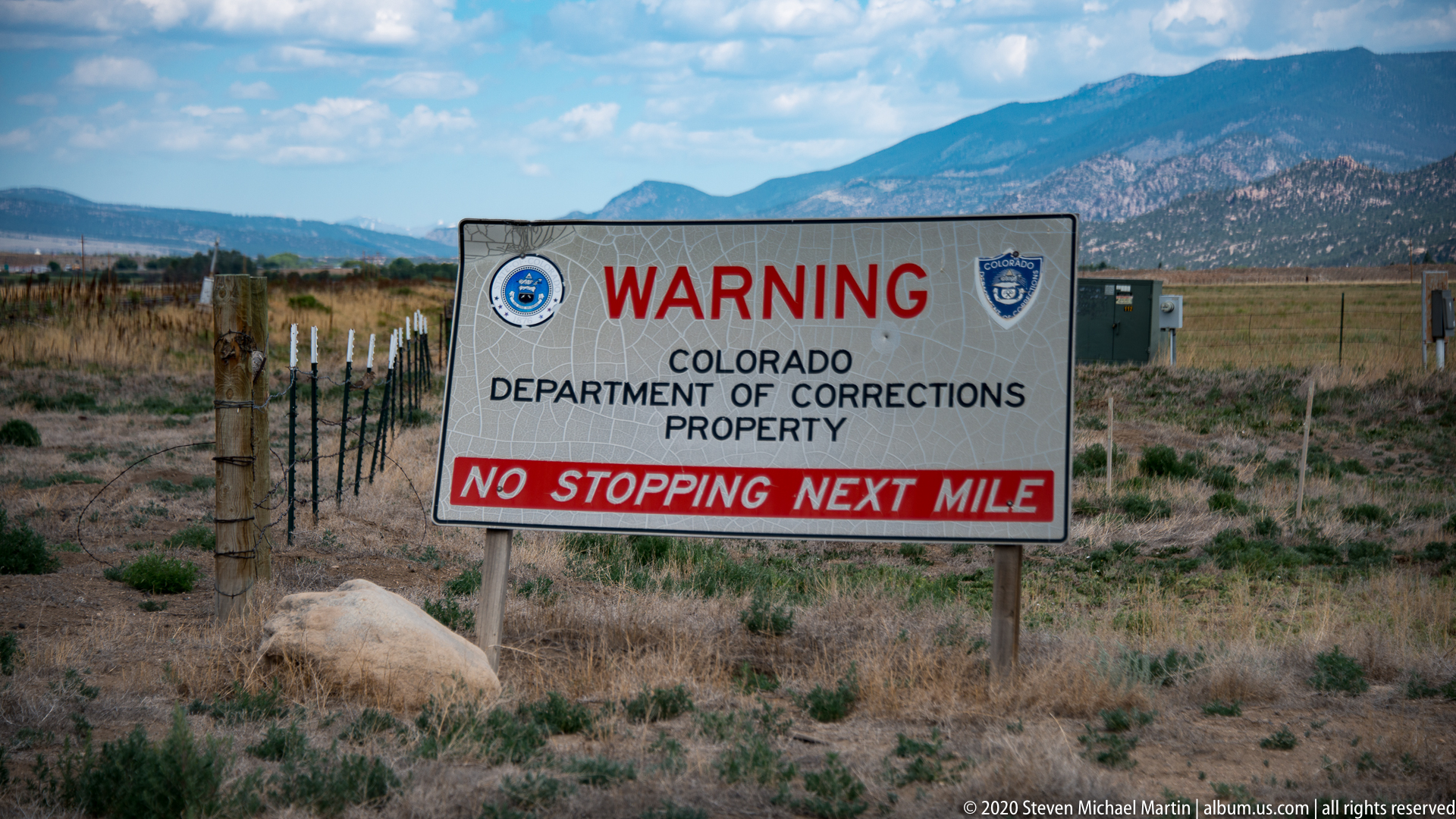
A large white sign warns that the adjoining land is Colorado Department of Corrections property and states “No Stopping Next Mile.” The panel stands beside a fence and gate, with open fields and a mountain ridge behind it. The image documents a sharp change in land access, using official boundary language against a rural Colorado landscape.
Caption
A large white sign warns that the adjoining land is Colorado Department of Corrections property and states “No Stopping Next Mile.” The panel stands beside a fence and gate, with open fields and a mountain ridge behind it. The image documents a sharp change in land access, using official boundary language against a rural Colorado landscape.
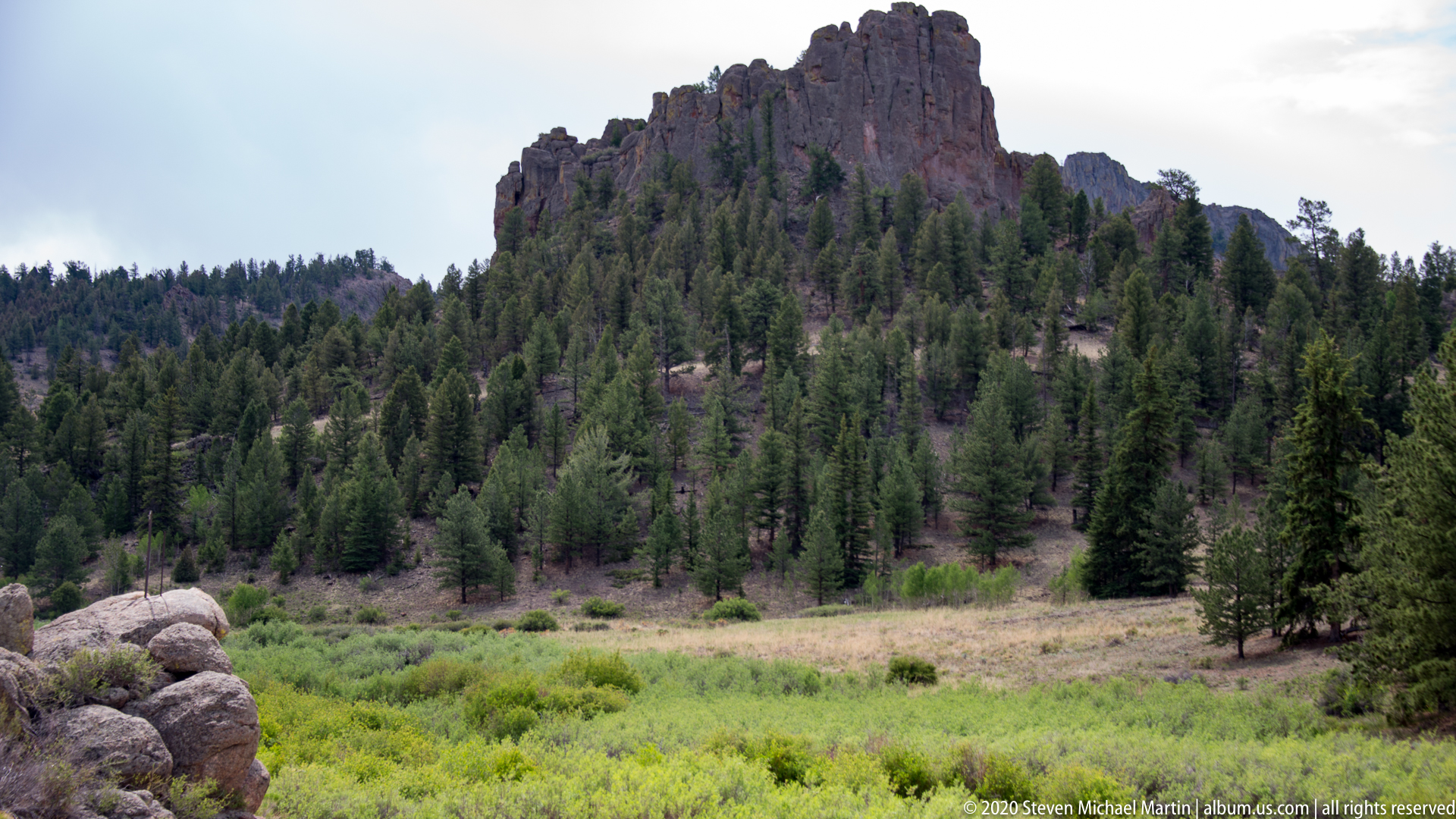
A cluster of dark granite pinnacles rises above a forested slope and bright green meadow. Rounded boulders frame the lower left, while shrubs and grasses fill the flat foreground beneath the rock towers. The composition contrasts the meadow’s soft vegetation with the abrupt vertical forms of the outcrop, presenting a characteristic meeting of valley floor and rugged upland.
Caption
A cluster of dark granite pinnacles rises above a forested slope and bright green meadow. Rounded boulders frame the lower left, while shrubs and grasses fill the flat foreground beneath the rock towers. The composition contrasts the meadow’s soft vegetation with the abrupt vertical forms of the outcrop, presenting a characteristic meeting of valley floor and rugged upland.
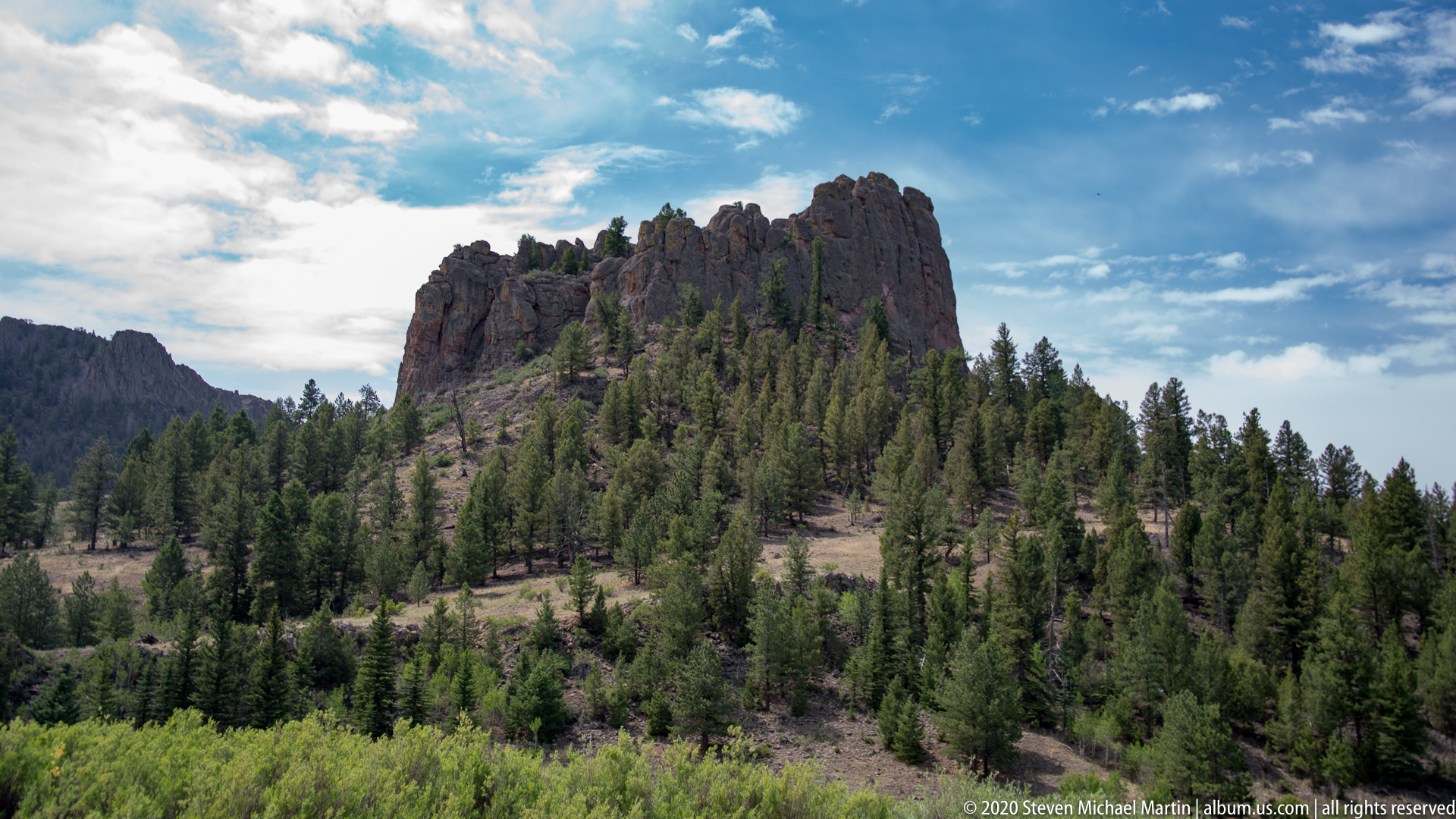
A blocky rock summit rises above a steep slope of conifers and scrub, its fractured crown silhouetted against a blue sky scattered with white clouds. The dark, rugged face contrasts with the softer green vegetation covering the lower hillside. This broad view sets the exposed rock mass within the forested terrain characteristic of the Browns Canyon landscape.
Caption
A blocky rock summit rises above a steep slope of conifers and scrub, its fractured crown silhouetted against a blue sky scattered with white clouds. The dark, rugged face contrasts with the softer green vegetation covering the lower hillside. This broad view sets the exposed rock mass within the forested terrain characteristic of the Browns Canyon landscape.
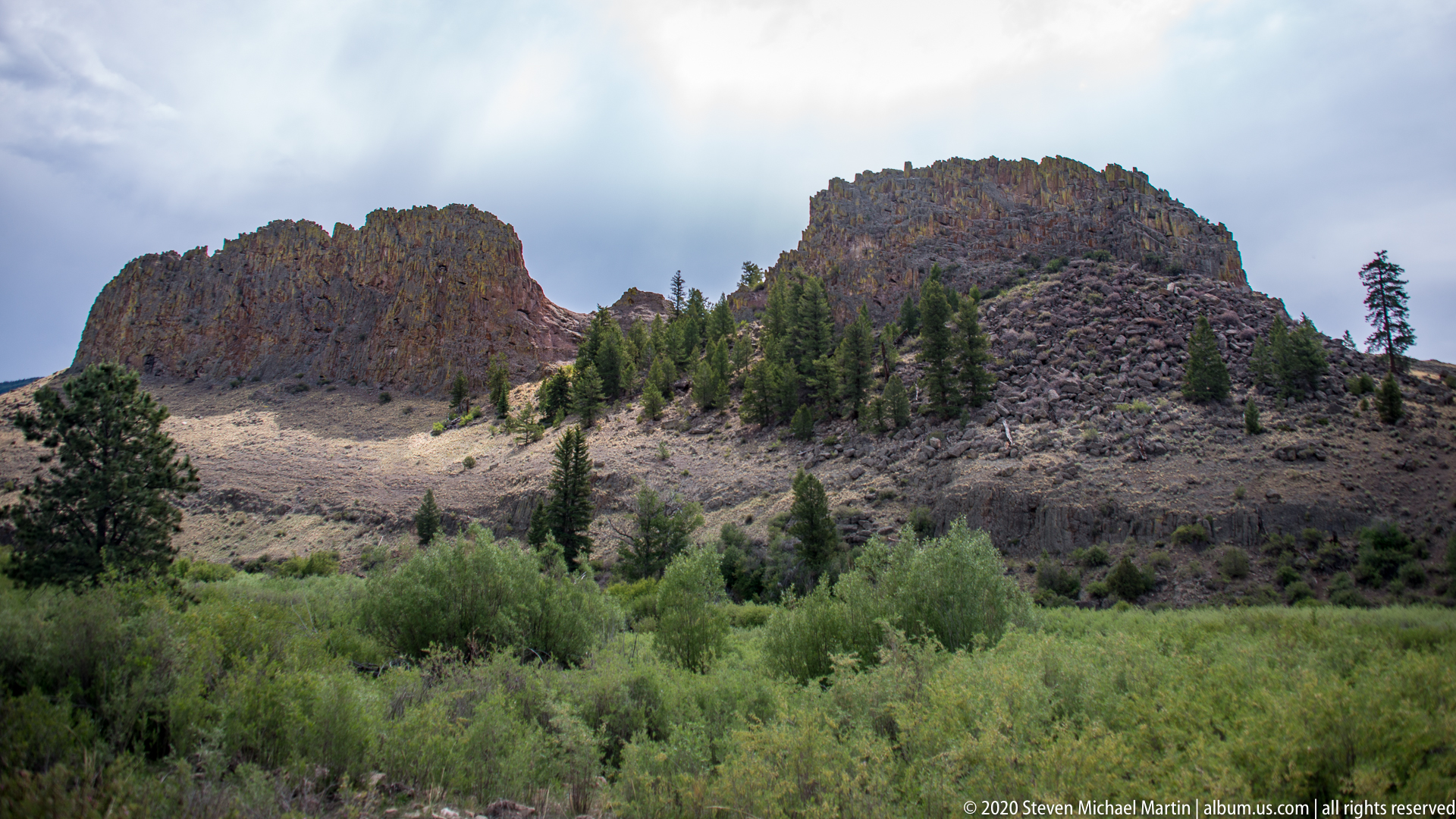
Two rounded rock masses frame a shallow saddle above a dense band of green shrubs. The left ridge is lower and darker, while the right summit is broader and more heavily fractured. Sparse conifers cling to the lower slope beneath the exposed rock, and soft cloud cover mutes the colors across this wide view of the canyon uplands.
Caption
Two rounded rock masses frame a shallow saddle above a dense band of green shrubs. The left ridge is lower and darker, while the right summit is broader and more heavily fractured. Sparse conifers cling to the lower slope beneath the exposed rock, and soft cloud cover mutes the colors across this wide view of the canyon uplands.

A compact cliff-like outcrop crowns a wooded hill beyond a broad green valley. Pine trees line the ridge and descend into the basin, while a pale opening in the cloud cover brightens the rock face. The greater distance softens details of the fractured summit and makes the surrounding vegetation and rolling terrain more prominent than in the closer views.
Caption
A compact cliff-like outcrop crowns a wooded hill beyond a broad green valley. Pine trees line the ridge and descend into the basin, while a pale opening in the cloud cover brightens the rock face. The greater distance softens details of the fractured summit and makes the surrounding vegetation and rolling terrain more prominent than in the closer views.
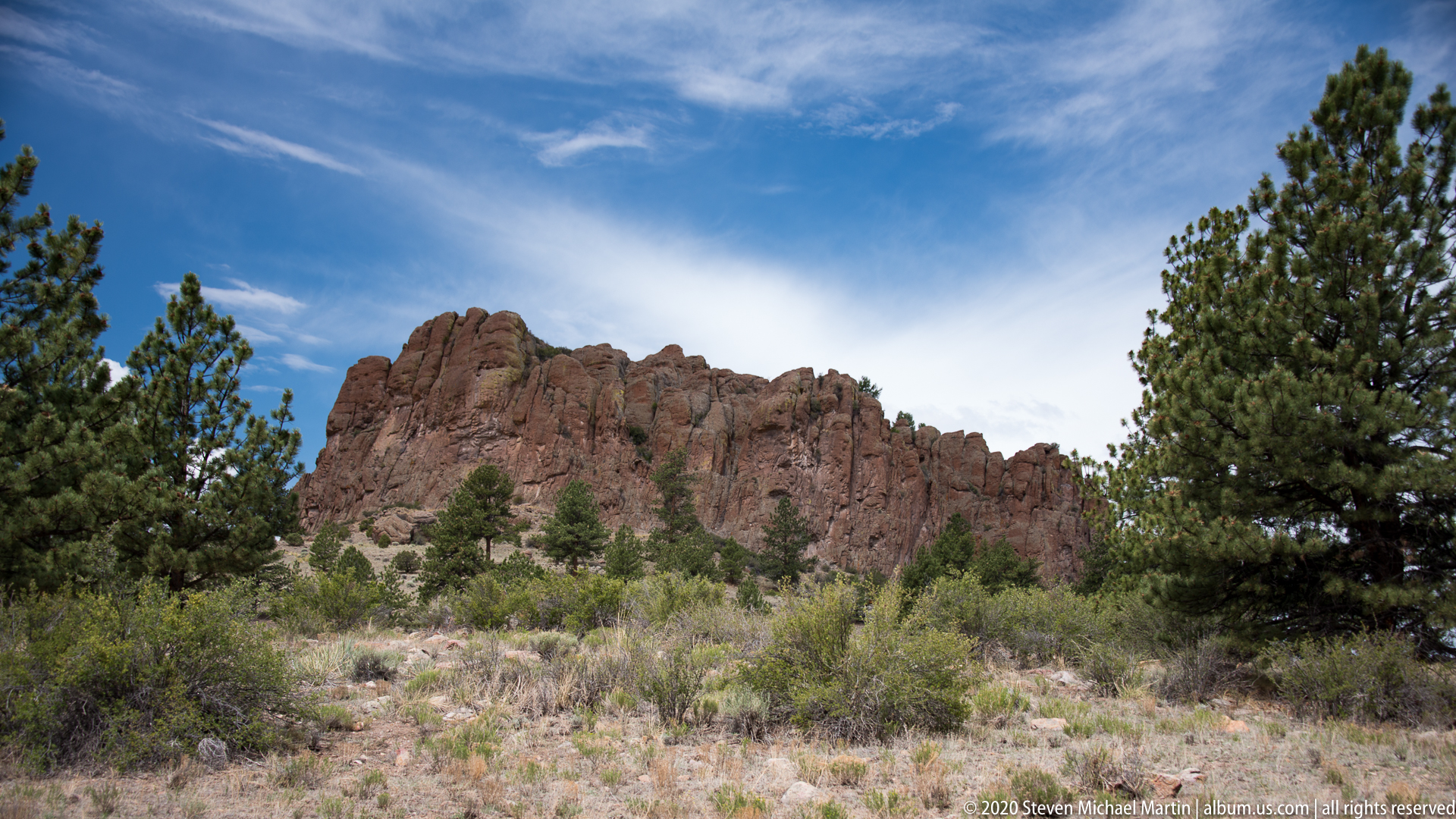
A rugged red-brown rock wall rises behind scrub and young pines, its jagged crest partially screened by taller trees at the right edge. The clear blue sky and wispy clouds open above the ridge, while a narrow sandy path leads into the vegetation. The foreground approach gives the outcrop a more enclosed, immediate presence than the distant skyline views.
Caption
A rugged red-brown rock wall rises behind scrub and young pines, its jagged crest partially screened by taller trees at the right edge. The clear blue sky and wispy clouds open above the ridge, while a narrow sandy path leads into the vegetation. The foreground approach gives the outcrop a more enclosed, immediate presence than the distant skyline views.
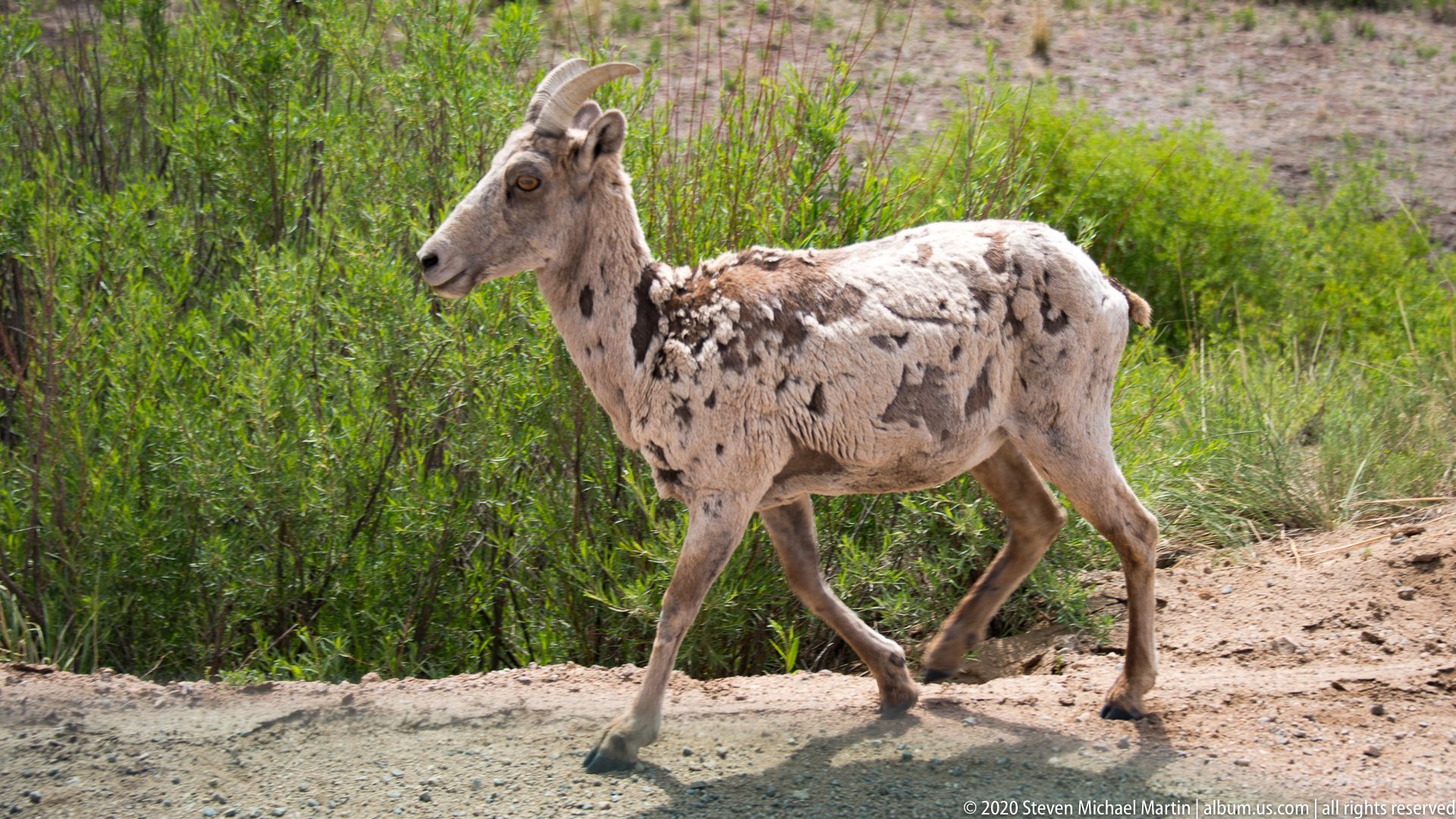
A light-coated bighorn sheep walks across a narrow dirt track beside dense green shrubs. Its mottled tan-and-cream coat and short curved horns are visible in profile, while the animal looks toward the left edge of the frame. The close wildlife view records a single animal moving through the canyon’s brushy habitat, with its path and vegetation clearly defined.
Caption
A light-coated bighorn sheep walks across a narrow dirt track beside dense green shrubs. Its mottled tan-and-cream coat and short curved horns are visible in profile, while the animal looks toward the left edge of the frame. The close wildlife view records a single animal moving through the canyon’s brushy habitat, with its path and vegetation clearly defined.
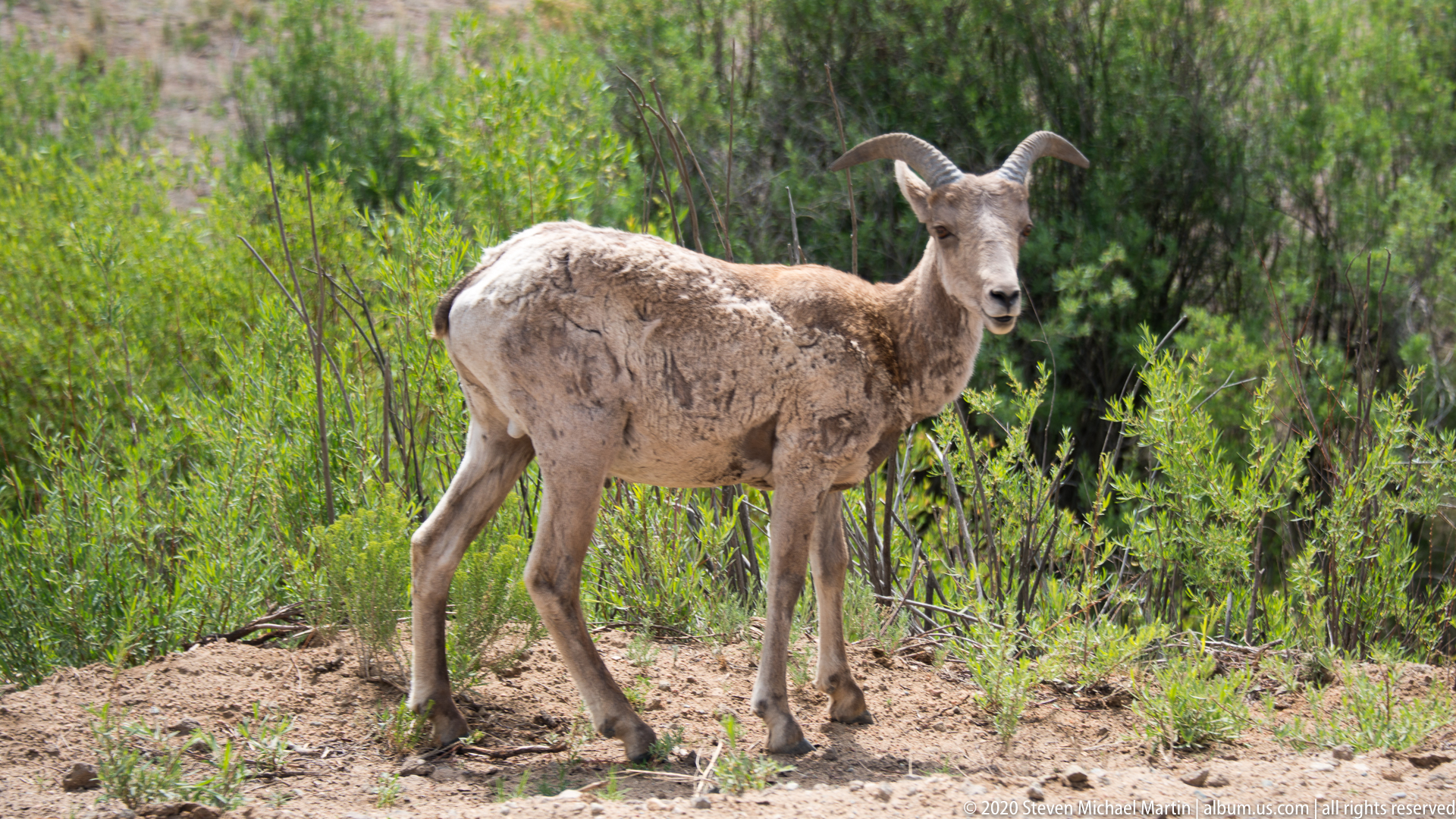
A bighorn sheep stands broadside on the dirt path, turning its head toward the camera. Its short, ridged horns curve back from the crown, and a pale coat blends with the dry soil and green brush behind it. The steady, frontal stance distinguishes this frame from the neighboring walking portrait and gives a clear view of the animal’s face and horns.
Caption
A bighorn sheep stands broadside on the dirt path, turning its head toward the camera. Its short, ridged horns curve back from the crown, and a pale coat blends with the dry soil and green brush behind it. The steady, frontal stance distinguishes this frame from the neighboring walking portrait and gives a clear view of the animal’s face and horns.
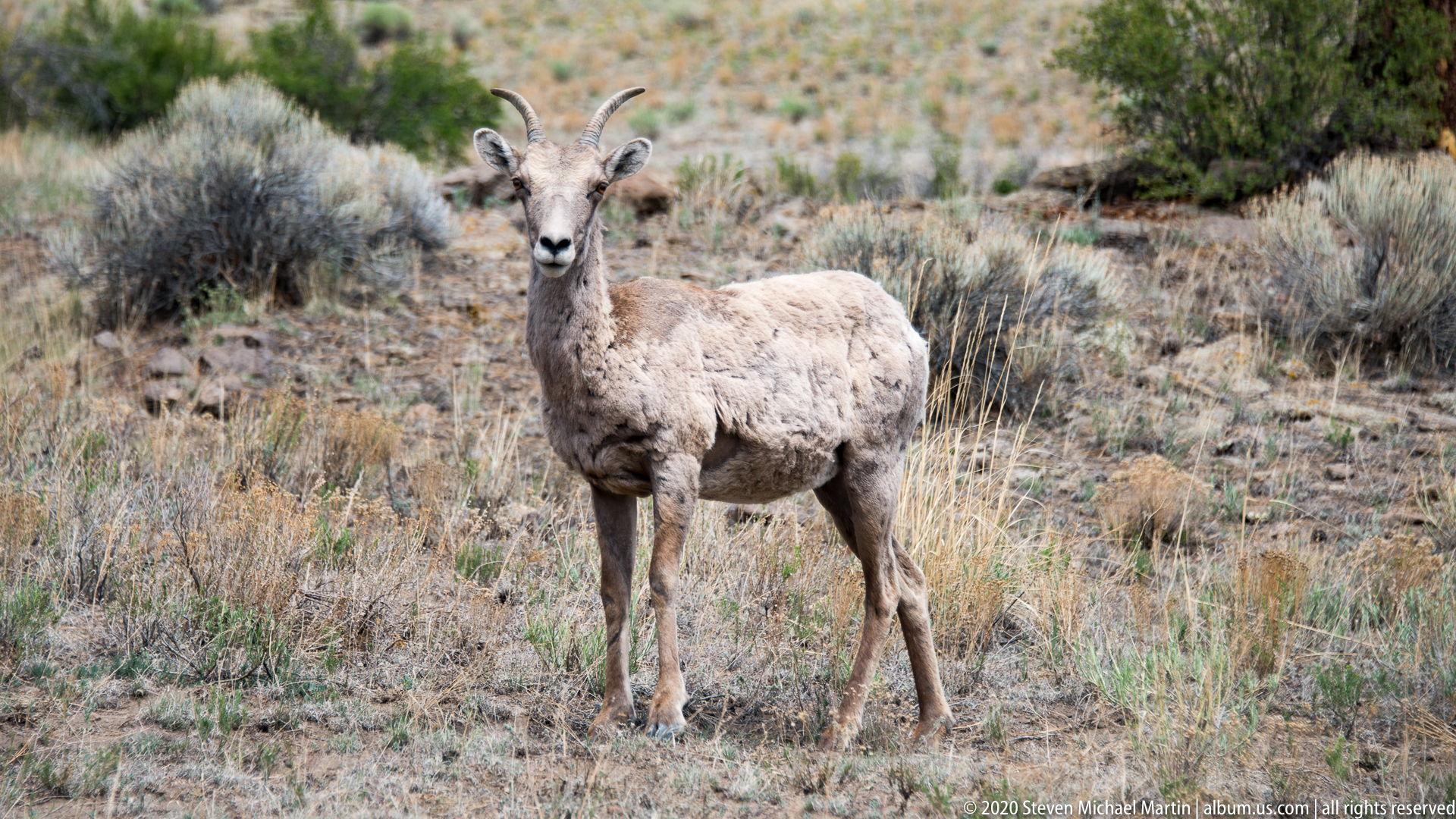
A bighorn sheep stands facing forward on a dry, lightly vegetated slope. Its compact body, pale coat, and short backward-curving horns are fully visible, with low sage-colored plants and bare earth surrounding it. The animal’s direct gaze and the unobstructed full-body view make this a clear portrait, distinct from the tighter head studies and movement shots on the page.
Caption
A bighorn sheep stands facing forward on a dry, lightly vegetated slope. Its compact body, pale coat, and short backward-curving horns are fully visible, with low sage-colored plants and bare earth surrounding it. The animal’s direct gaze and the unobstructed full-body view make this a clear portrait, distinct from the tighter head studies and movement shots on the page.
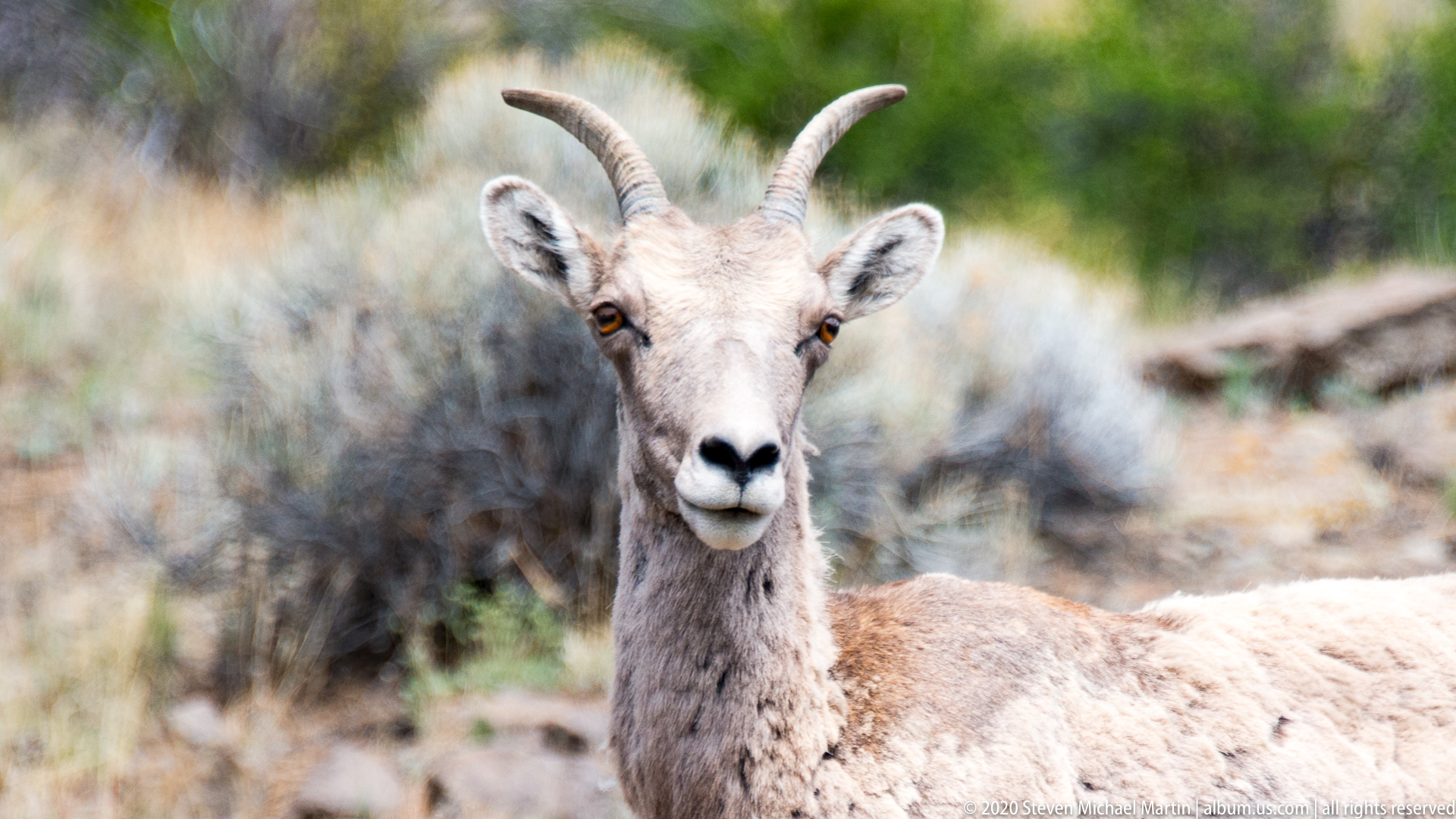
The head and shoulders of a bighorn sheep fill the frame, bringing its ridged horns, pale muzzle, and alert eyes into sharp focus. The animal looks directly toward the camera while the brushy background falls softly out of focus. This close portrait foregrounds the shape and texture of the horns rather than the animal’s full body or its movement through the habitat.
Caption
The head and shoulders of a bighorn sheep fill the frame, bringing its ridged horns, pale muzzle, and alert eyes into sharp focus. The animal looks directly toward the camera while the brushy background falls softly out of focus. This close portrait foregrounds the shape and texture of the horns rather than the animal’s full body or its movement through the habitat.
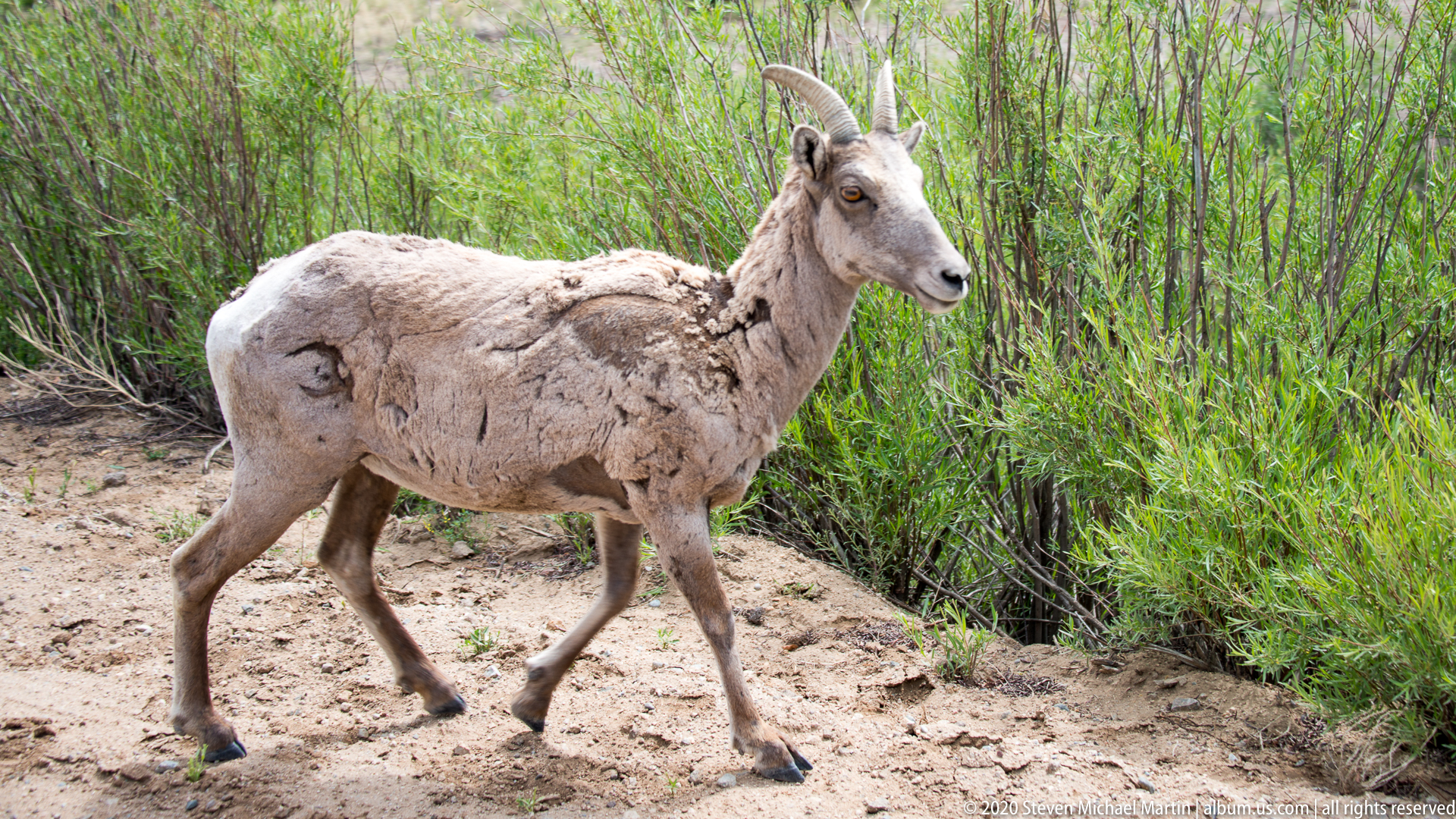
A bighorn sheep strides from left to right along a sandy path, its body shown in profile against tall green shrubs. The horns sweep backward in a tight curve, and one foreleg lifts mid-step. The animal’s side-on posture, visible hoof placement, and forward motion make this frame a study of movement through the dense riparian brush.
Caption
A bighorn sheep strides from left to right along a sandy path, its body shown in profile against tall green shrubs. The horns sweep backward in a tight curve, and one foreleg lifts mid-step. The animal’s side-on posture, visible hoof placement, and forward motion make this frame a study of movement through the dense riparian brush.
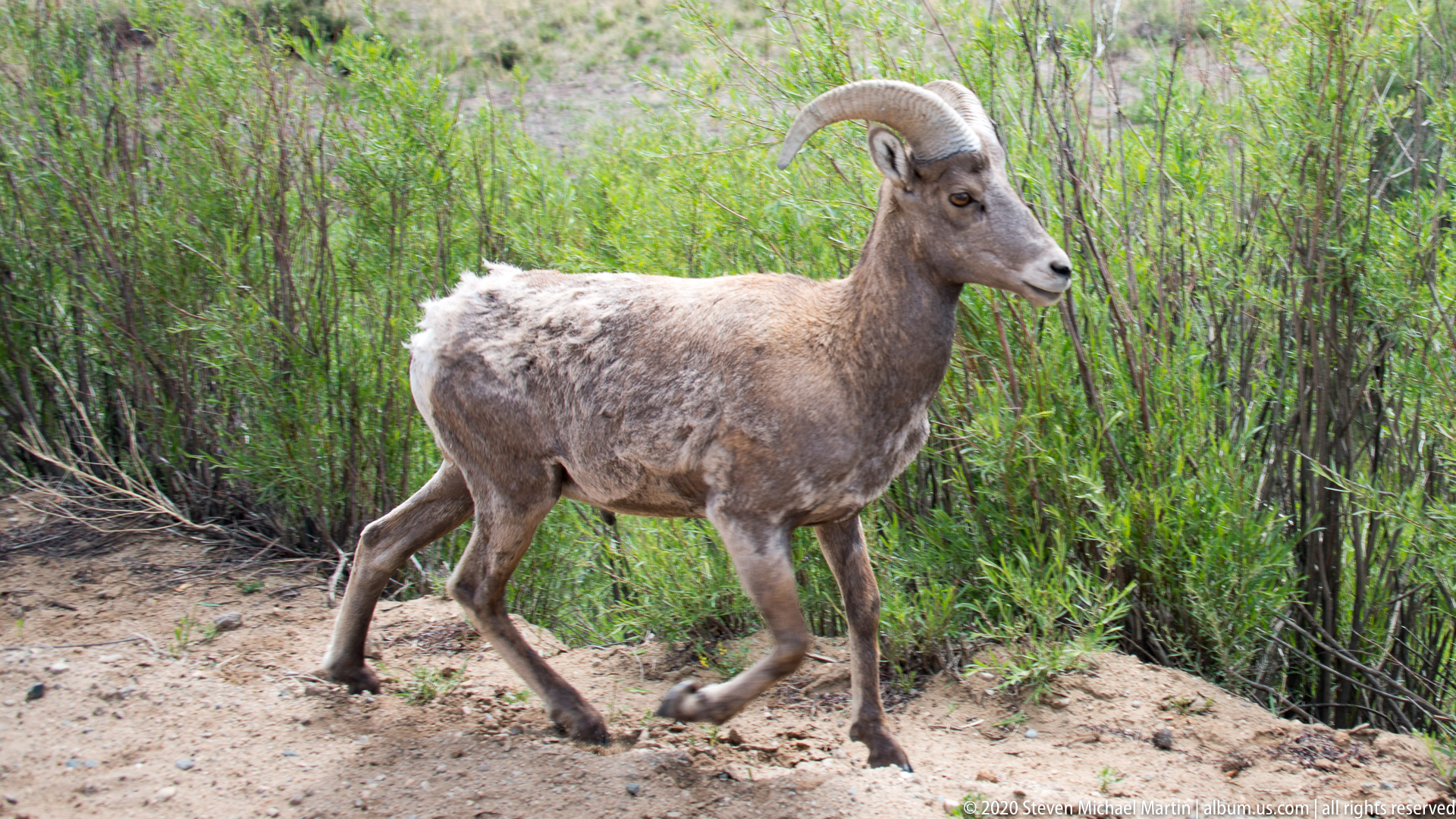
A bighorn sheep crosses the sandy trail with its front legs extended and head angled to the right. Tall shrubs form a green backdrop, while the animal’s gray-brown coat and sweeping horns remain distinct against the vegetation. The captured stride and low viewpoint give this photograph more motion and immediacy than the adjacent side-on portrait.
Caption
A bighorn sheep crosses the sandy trail with its front legs extended and head angled to the right. Tall shrubs form a green backdrop, while the animal’s gray-brown coat and sweeping horns remain distinct against the vegetation. The captured stride and low viewpoint give this photograph more motion and immediacy than the adjacent side-on portrait.
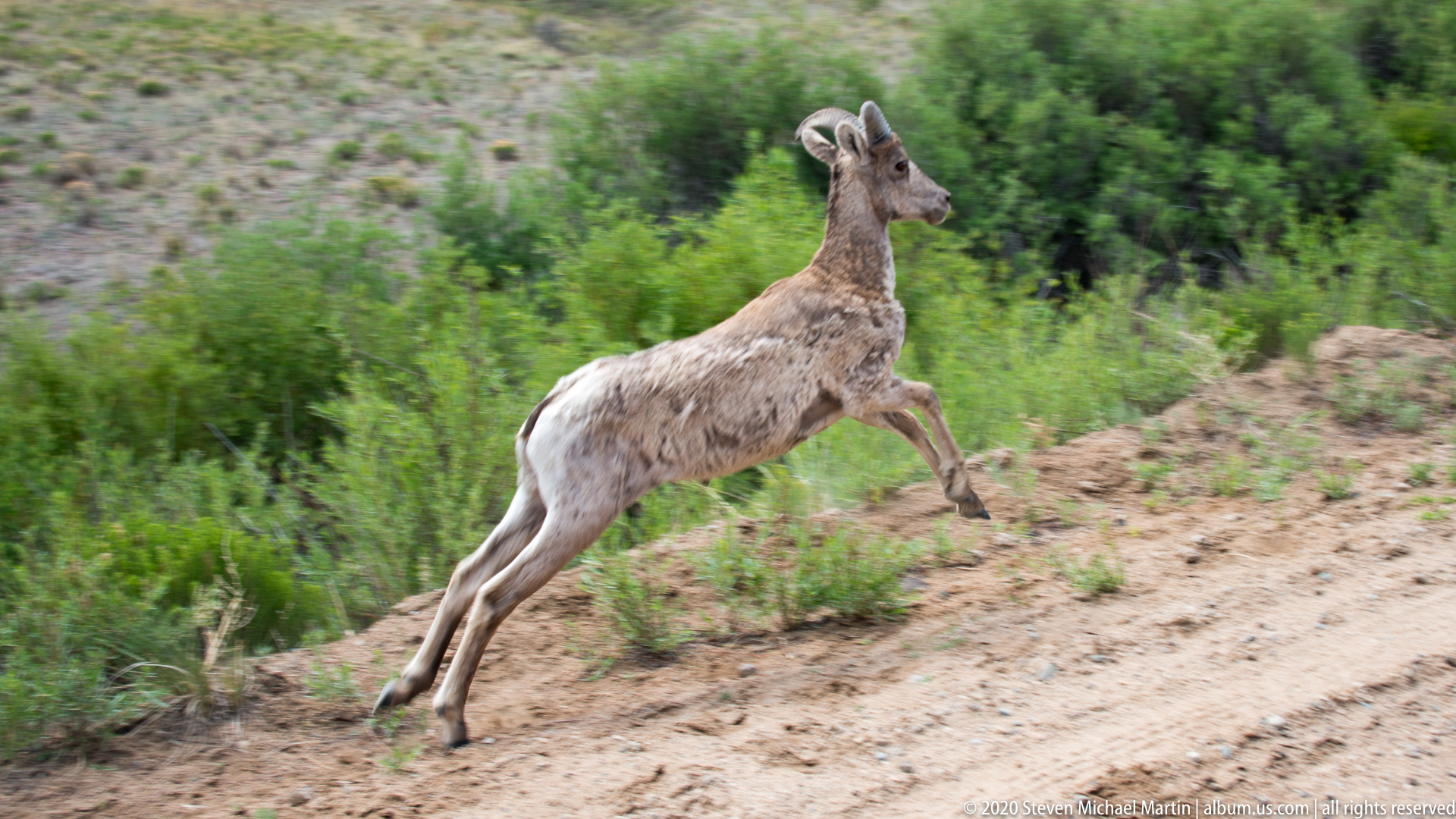
A bighorn sheep bounds up a sandy bank, both forelegs lifted as its hind legs push off the ground. Its body angles sharply upward against a blurred wall of green shrubs, conveying a sudden burst of movement. The tight crop and motion blur isolate the leap, turning the hillside vegetation into a soft backdrop for the animal’s athletic stride.
Caption
A bighorn sheep bounds up a sandy bank, both forelegs lifted as its hind legs push off the ground. Its body angles sharply upward against a blurred wall of green shrubs, conveying a sudden burst of movement. The tight crop and motion blur isolate the leap, turning the hillside vegetation into a soft backdrop for the animal’s athletic stride.
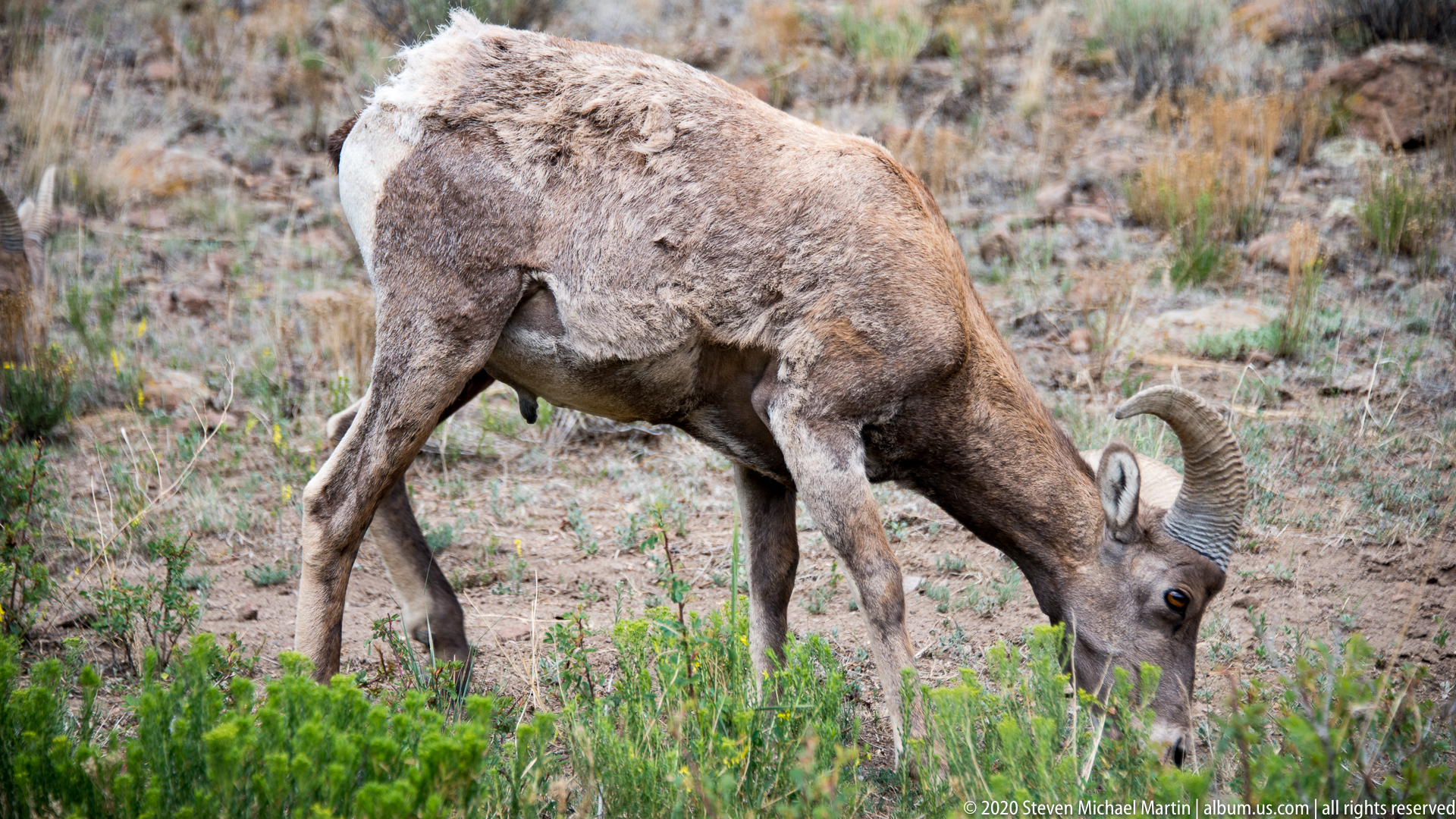
A bighorn sheep lowers its head to graze among low grasses and green shrubs. Its broad body and ridged horns fill much of the frame, while the animal’s legs remain partly visible through the vegetation. The downward posture and feeding behavior distinguish this photograph from the nearby walking and alert portraits.
Caption
A bighorn sheep lowers its head to graze among low grasses and green shrubs. Its broad body and ridged horns fill much of the frame, while the animal’s legs remain partly visible through the vegetation. The downward posture and feeding behavior distinguish this photograph from the nearby walking and alert portraits.
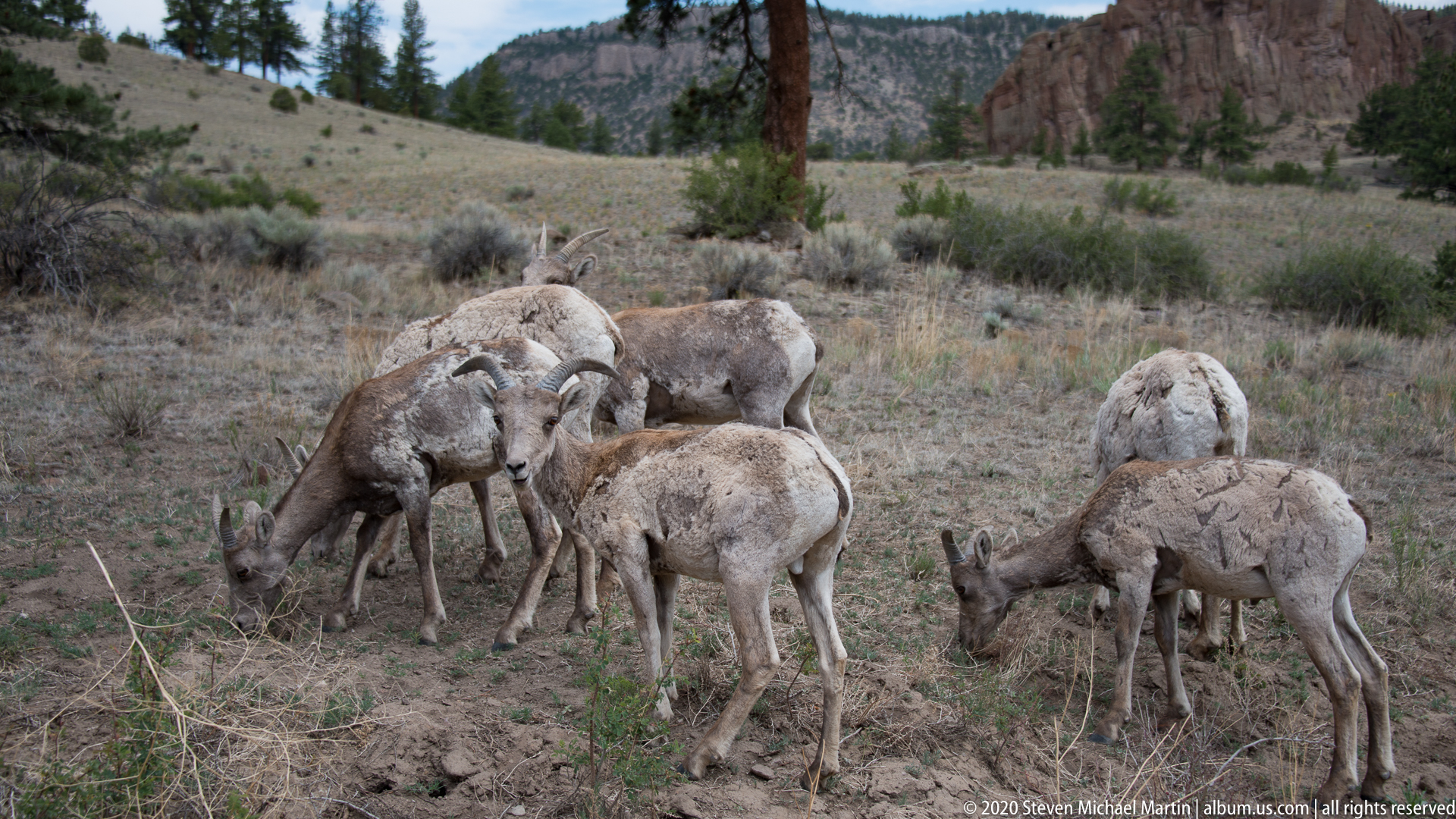
A small group of bighorn sheep gathers in a grassy clearing, most with their heads lowered to feed. Their pale bodies overlap in the foreground, while pine trunks and a steep rocky slope frame the meadow beyond. The clustered arrangement emphasizes shared grazing behavior and the animals’ use of an open patch within the wooded canyon.
Caption
A small group of bighorn sheep gathers in a grassy clearing, most with their heads lowered to feed. Their pale bodies overlap in the foreground, while pine trunks and a steep rocky slope frame the meadow beyond. The clustered arrangement emphasizes shared grazing behavior and the animals’ use of an open patch within the wooded canyon.
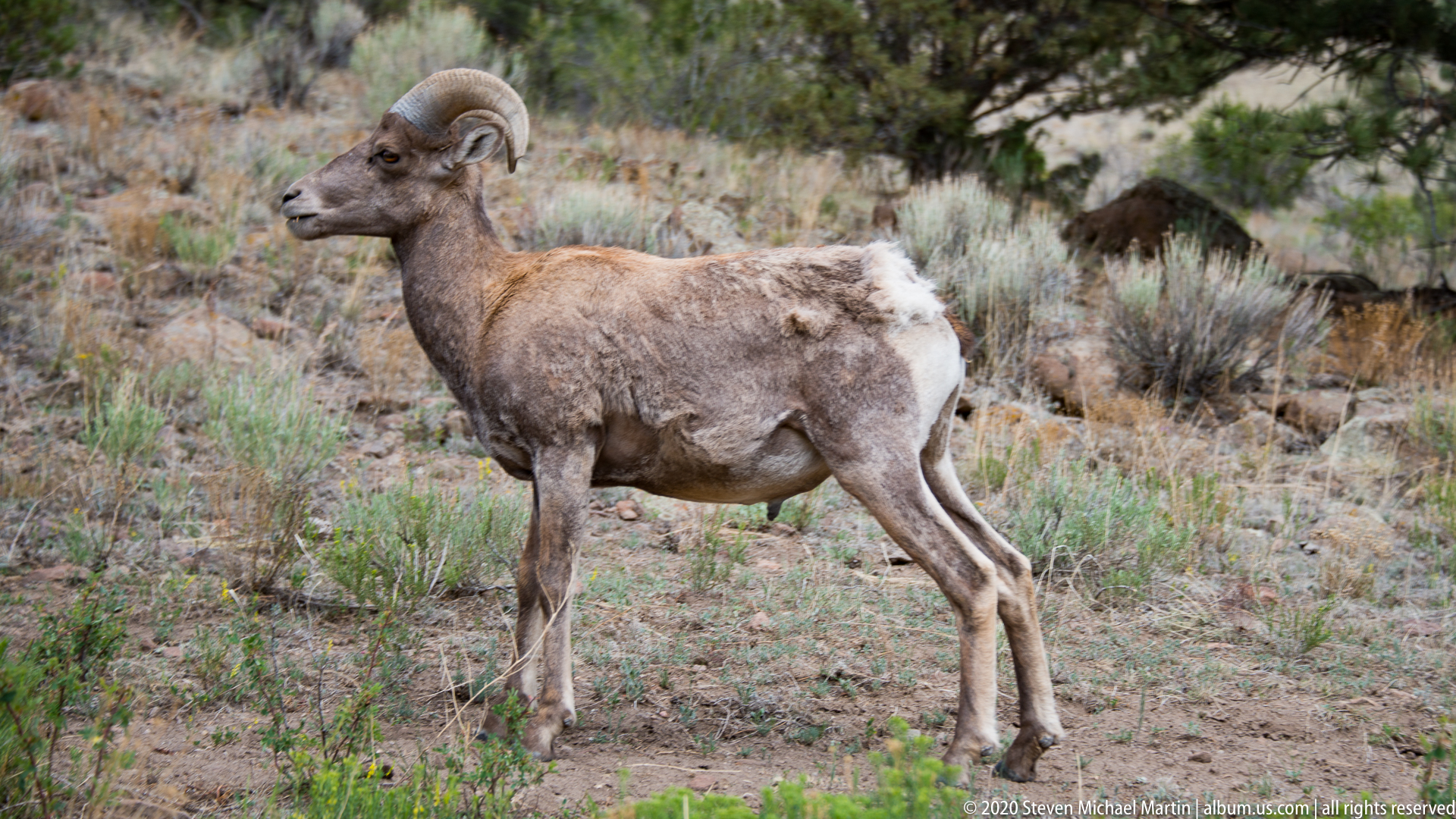
An adult bighorn sheep walks left through sparse brush, its sturdy body and backward-curving horns seen in profile. A second animal grazes farther behind, partly hidden by the low vegetation. The layered positions place the main sheep in a dry, open patch while preserving a glimpse of the small group sharing the habitat.
Caption
An adult bighorn sheep walks left through sparse brush, its sturdy body and backward-curving horns seen in profile. A second animal grazes farther behind, partly hidden by the low vegetation. The layered positions place the main sheep in a dry, open patch while preserving a glimpse of the small group sharing the habitat.
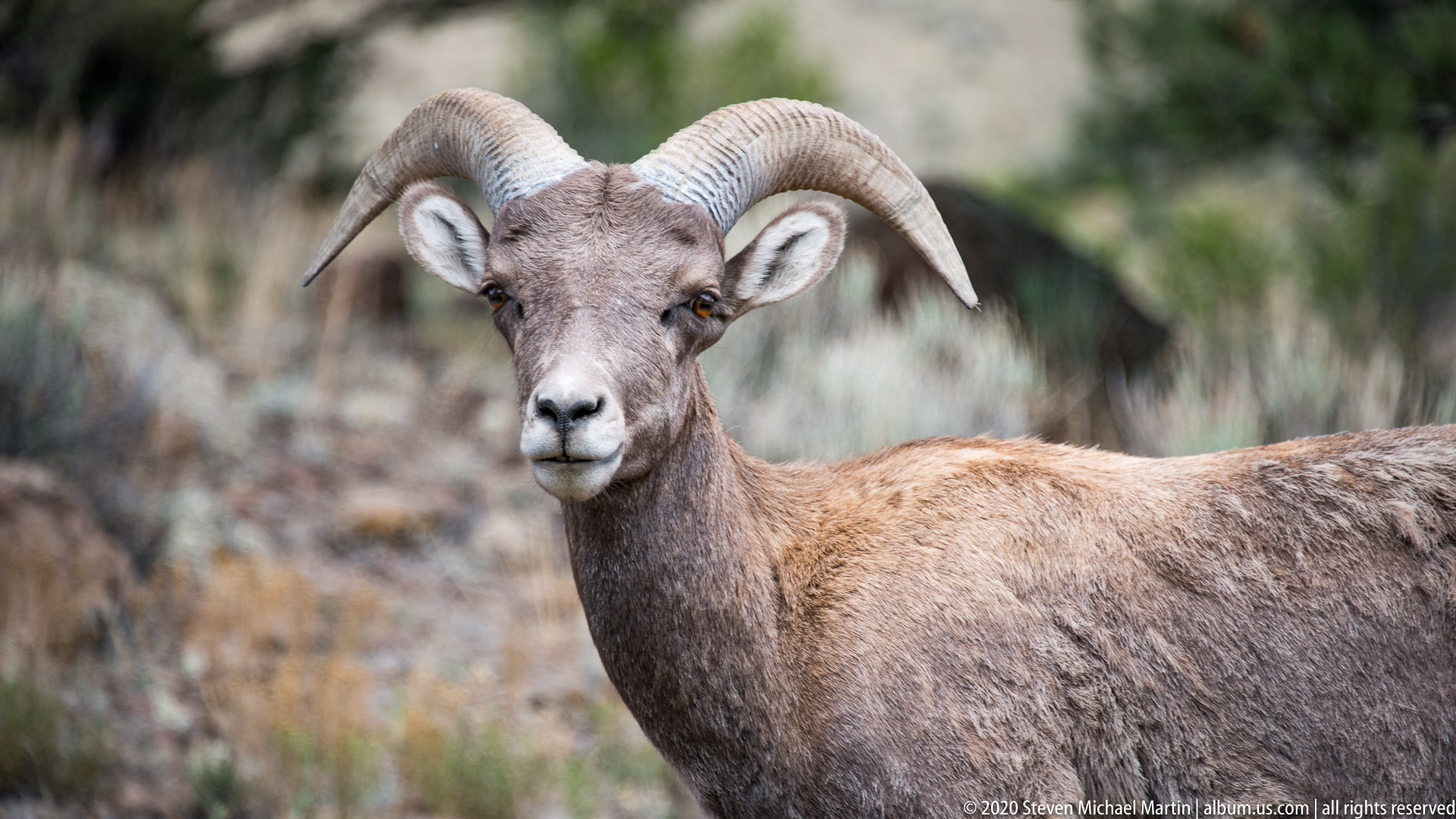
A bighorn ram faces the camera, its large ridged horns sweeping outward and down in near-symmetrical curves. The close framing includes its head and upper body, with muted grasses and brush blurred behind. Direct eye contact and the prominent horn mass distinguish this portrait from the full-body views of sheep moving or feeding.
Caption
A bighorn ram faces the camera, its large ridged horns sweeping outward and down in near-symmetrical curves. The close framing includes its head and upper body, with muted grasses and brush blurred behind. Direct eye contact and the prominent horn mass distinguish this portrait from the full-body views of sheep moving or feeding.
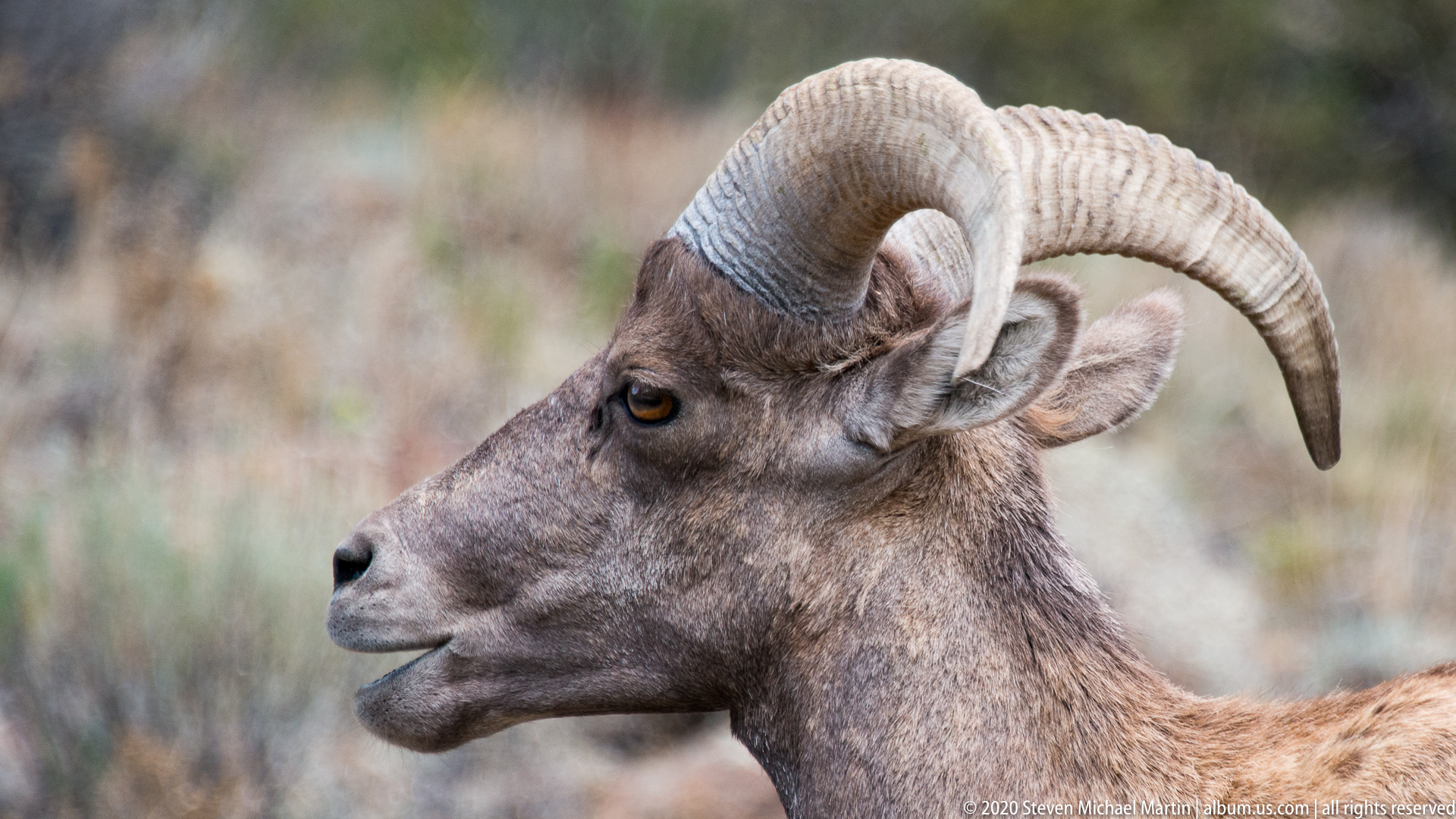
The ram’s head is shown in profile, its heavy ridged horns curling forward around the ear and cheek. The shallow depth of field softens the scrubland behind, while the animal’s eye, muzzle, and layered horn grooves remain sharply defined. This intimate side view isolates the horn’s spiral shape and the contours of the ram’s face.
Caption
The ram’s head is shown in profile, its heavy ridged horns curling forward around the ear and cheek. The shallow depth of field softens the scrubland behind, while the animal’s eye, muzzle, and layered horn grooves remain sharply defined. This intimate side view isolates the horn’s spiral shape and the contours of the ram’s face.
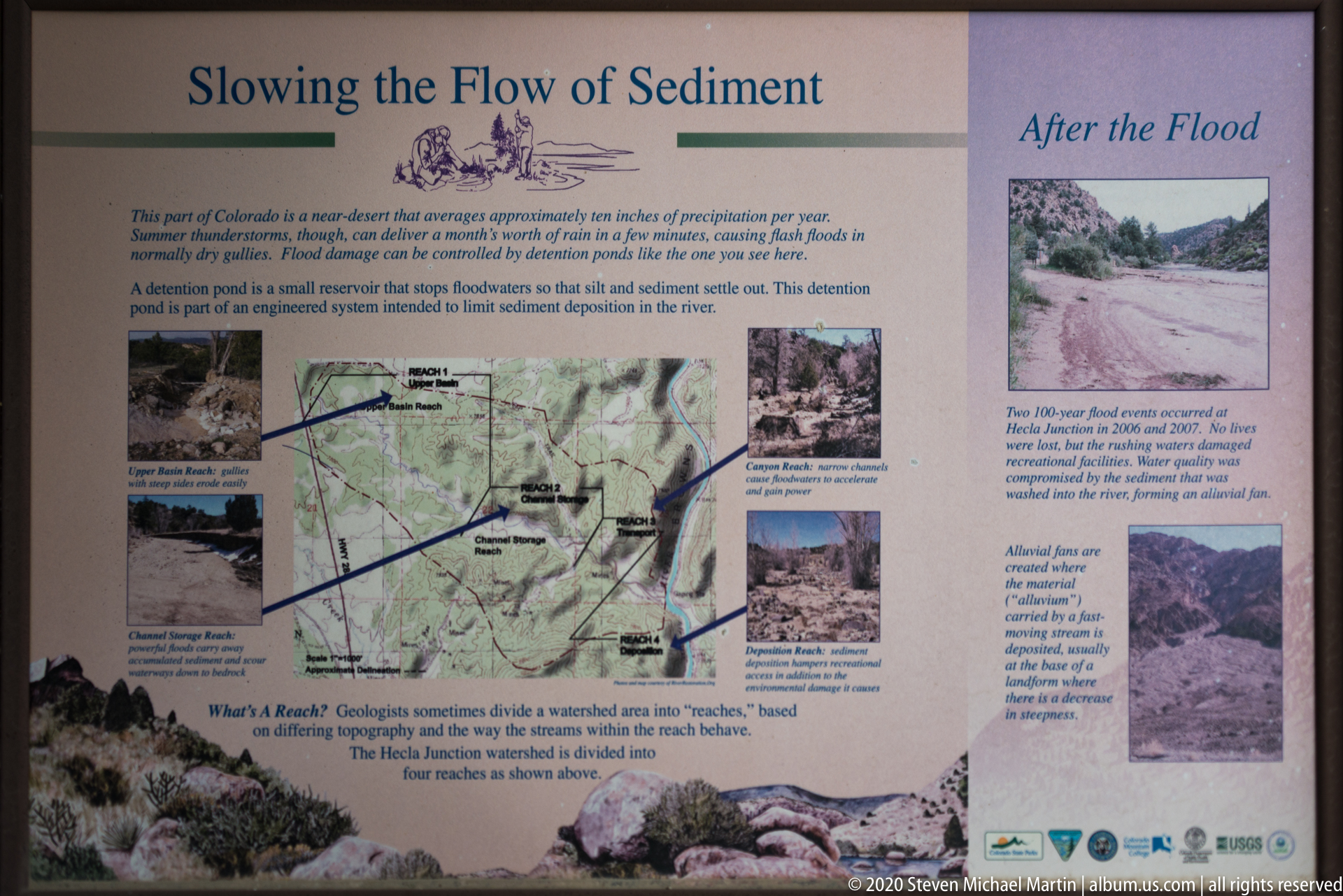
An interpretive panel titled “Following the Flow of Sediment” combines a watershed map, photographs, and text about how water moves material through the canyon landscape. A side column headed “After the Flood” adds images and explanatory notes about flood impacts. The exhibit links landform processes with visible river changes, translating the region’s geology into a visitor-facing diagram.
Caption
An interpretive panel titled “Following the Flow of Sediment” combines a watershed map, photographs, and text about how water moves material through the canyon landscape. A side column headed “After the Flood” adds images and explanatory notes about flood impacts. The exhibit links landform processes with visible river changes, translating the region’s geology into a visitor-facing diagram.
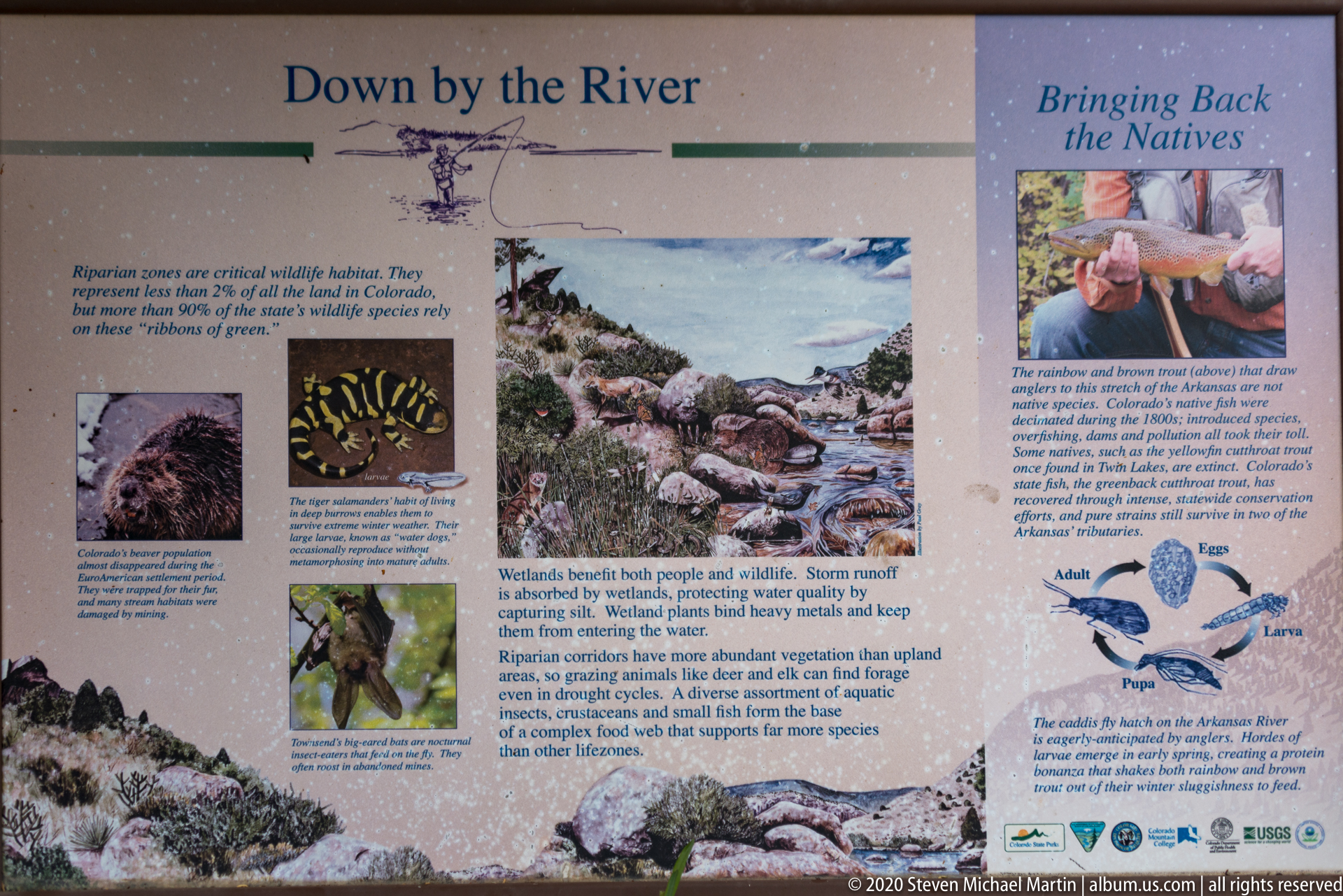
A second interpretive panel, headed “Down by the River” and “Bringing Back the Natives,” presents river habitat, wildlife, and restoration themes. Photographs show fish, plants, and other animals beside a central river scene, while a diagram explains life stages and text discusses riparian areas. The panel connects the canyon’s water system to the species and communities that depend on it.
Caption
A second interpretive panel, headed “Down by the River” and “Bringing Back the Natives,” presents river habitat, wildlife, and restoration themes. Photographs show fish, plants, and other animals beside a central river scene, while a diagram explains life stages and text discusses riparian areas. The panel connects the canyon’s water system to the species and communities that depend on it.
Browns Canyon National Monument — Field Guide
National Monument Field Guide
📍 Overview
Browns Canyon National Monument preserves a rugged river corridor along the Arkansas River where granite cliffs, forested slopes, and mountain terrain illustrate the geological transition between the Colorado Plateau and the Rocky Mountains. The landscape reflects long-term erosion acting upon uplifted rock associated with formation of the surrounding mountain range.
The canyon environment includes exposed stone formations, river-carved valleys, and mixed vegetation adapted to varying elevation and climate conditions. The Arkansas River continues to shape the terrain, contributing to the distinctive character of the canyon and its surrounding slopes.
⭐ Highlights
- Arkansas River canyon corridor
- Granite rock formations and steep slopes
- Transition between plateau and mountain environments
- Forested terrain contrasting with desert landscapes
- Scenic river views within a protected landscape
🔎 Key Features
- River erosion shaping canyon terrain
- Granite formations associated with mountain uplift
- Mixed vegetation influenced by elevation changes
- Landscape illustrating transition into Rocky Mountains
- Geological diversity across western Colorado
🦌 Wildlife Encountered
Wildlife observations in Browns Canyon included sightings of bighorn sheep, one of the most iconic mammals of the Rocky Mountain region. The photographs show both younger sheep and mature rams, illustrating the adaptability of these animals to rocky slopes and open terrain. Their ability to move comfortably across steep ground highlights the rugged character of the canyon landscape.
Bighorn sheep are well suited to the dry hillsides and exposed rock formations that define much of Browns Canyon. Observing these animals within the monument adds an important ecological dimension to the visit and helps connect the geological setting with the living environment that depends upon it.
The mix of canyon walls, forest patches, and semi-arid slopes creates conditions suitable for a variety of mammals and birds adapted to mountain environments. Species such as coyote, fox, bobcat, and birds of prey contribute to the ecological diversity of the monument and help illustrate how the Arkansas River corridor supports both riparian and upland wildlife communities.
📷 Photography Notes
- Wide compositions capture contrast between river and cliffs
- Morning light can highlight texture in granite rock
- Foreground vegetation adds depth to canyon scenes
- River curves can provide natural leading lines
- Cloud patterns can enhance mountain landscapes
- Simple compositions emphasize terrain transitions‹