Dillingham
Dillingham is a small community located along the Nushagak River in southwestern Alaska and serves as an access point for wilderness areas and wildlife habitats associated with Bristol Bay. The town reflects the importance of river transportation, fishing industries, and subsistence traditions in shaping settlement patterns in remote regions. Its location provides access to tundra landscapes and coastal environments influenced by the Bering Sea.
The surrounding region supports important salmon fisheries that have played a central role in both local culture and regional economy. Indigenous traditions remain closely tied to seasonal cycles of fishing and wildlife migration, illustrating long-standing relationships between communities and natural resources. The town’s relative isolation contributes to a strong connection between human activity and environmental conditions.
Visitors encounter a landscape defined by waterways, wetlands, and open tundra environments. The quiet scale of the community reflects the logistical realities of travel in remote Alaska and provides insight into contemporary life in areas where transportation infrastructure remains limited.

Tall pink fireweed rises across the foreground of a blue-gray wooden gable end. Peeling paint, exposed patches of wood, and a single centered window give the weathered facade a distinctly worn texture, while the flowers bring a vivid vertical layer across its base. The close, frontal composition pairs seasonal vegetation with a modest residential structure without claiming an exact building or date.
Caption
Tall pink fireweed rises across the foreground of a blue-gray wooden gable end. Peeling paint, exposed patches of wood, and a single centered window give the weathered facade a distinctly worn texture, while the flowers bring a vivid vertical layer across its base. The close, frontal composition pairs seasonal vegetation with a modest residential structure without claiming an exact building or date.

The settlement spreads along the edge of a broad, silty river mouth, with the airport runway and apron prominent in the foreground. Roads connect the airfield to clusters of buildings among trees, while small vessels dot the water and a winding channel continues into the flat landscape. The elevated view places Dillingham’s compact built area between air and river transport corridors.
Caption
The settlement spreads along the edge of a broad, silty river mouth, with the airport runway and apron prominent in the foreground. Roads connect the airfield to clusters of buildings among trees, while small vessels dot the water and a winding channel continues into the flat landscape. The elevated view places Dillingham’s compact built area between air and river transport corridors.

A child rides an orange all-terrain vehicle through a stylized landscape of flowering plants and winding tracks. Two moose stand behind the rider against a pink, yellow, and blue sky, turning a familiar machine into the center of a whimsical local scene. The frontal viewpoint gives the vehicle’s large tires and red body nearly equal prominence with the rider.
Caption
A child rides an orange all-terrain vehicle through a stylized landscape of flowering plants and winding tracks. Two moose stand behind the rider against a pink, yellow, and blue sky, turning a familiar machine into the center of a whimsical local scene. The frontal viewpoint gives the vehicle’s large tires and red body nearly equal prominence with the rider.

Pale, branching channels divide the low green and brown terrain into a dense braided network, seen from above at a shallow angle. The river threads repeatedly around islands and bars before fading toward the distant horizon. This broad aerial view emphasizes the scale and intricacy of the water system, while the sparse vegetation and nearly level land keep the channels as the dominant pattern.
Caption
Pale, branching channels divide the low green and brown terrain into a dense braided network, seen from above at a shallow angle. The river threads repeatedly around islands and bars before fading toward the distant horizon. This broad aerial view emphasizes the scale and intricacy of the water system, while the sparse vegetation and nearly level land keep the channels as the dominant pattern.

A narrow, light-colored river makes a sequence of tight bends through a patchwork of dark spruce stands and open wetland. From the elevated viewpoint, the channel forms a continuous line from the foreground toward a broad, flat valley, with small ponds scattered beyond it. The contrast between forested islands and open ground gives this view a more intimate scale than the wider braided-river panorama nearby.
Caption
A narrow, light-colored river makes a sequence of tight bends through a patchwork of dark spruce stands and open wetland. From the elevated viewpoint, the channel forms a continuous line from the foreground toward a broad, flat valley, with small ponds scattered beyond it. The contrast between forested islands and open ground gives this view a more intimate scale than the wider braided-river panorama nearby.

A broad river bend dominates the foreground, its pale water curling around flat green marsh before narrowing toward the distance. Low cloud and faint haze reduce contrast across the horizon, giving this aerial view a softer, more atmospheric appearance than the sharper river panoramas nearby. Small ponds and branching wetland channels punctuate the plain, while the sinuous main channel remains the composition’s clearest feature.
Caption
A broad river bend dominates the foreground, its pale water curling around flat green marsh before narrowing toward the distance. Low cloud and faint haze reduce contrast across the horizon, giving this aerial view a softer, more atmospheric appearance than the sharper river panoramas nearby. Small ponds and branching wetland channels punctuate the plain, while the sinuous main channel remains the composition’s clearest feature.

A white Alaska Marine Lines container fills the right foreground, while stacked shipping containers—including refrigerated units marked AML—rise behind it. The low, close viewpoint makes the company lettering and the layered cargo stack easy to read, conveying the scale of freight handling at the waterfront. Crane lines, dock equipment, and a narrow slice of water appear around the containers, but no vessel is visible.
Caption
A white Alaska Marine Lines container fills the right foreground, while stacked shipping containers—including refrigerated units marked AML—rise behind it. The low, close viewpoint makes the company lettering and the layered cargo stack easy to read, conveying the scale of freight handling at the waterfront. Crane lines, dock equipment, and a narrow slice of water appear around the containers, but no vessel is visible.

A red SUV is parked on gravel with severe deformation across its left rear quarter panel and scraped paint around the wheel arch. A full-size spare is mounted on the rear door, and the back window is clouded or covered. The close three-quarter view makes the damage and vehicle condition the subject; no collision scene or cause is visible, so the photograph remains a straightforward record of the parked vehicle.
Caption
A red SUV is parked on gravel with severe deformation across its left rear quarter panel and scraped paint around the wheel arch. A full-size spare is mounted on the rear door, and the back window is clouded or covered. The close three-quarter view makes the damage and vehicle condition the subject; no collision scene or cause is visible, so the photograph remains a straightforward record of the parked vehicle.

A rusted metal pole supports a horizontal crossbar and a small central assembly, with a cylindrical piece rising above the junction. Trees fill the background, and a red utility box stands near the base at right. The photograph records the structure’s weathered construction and unusual cross-shaped arrangement; its function cannot be established from the visible hardware alone.
Caption
A rusted metal pole supports a horizontal crossbar and a small central assembly, with a cylindrical piece rising above the junction. Trees fill the background, and a red utility box stands near the base at right. The photograph records the structure’s weathered construction and unusual cross-shaped arrangement; its function cannot be established from the visible hardware alone.

The Grant Aviation entrance sits beneath a projecting canopy on a two-tone metal-sided building. Posted notices, a wheelchair ramp, and a marked fire lane make this a working transportation office rather than a formal passenger concourse. The close, frontal view records the practical arrival point for regional air travel, with the company name repeated across the upper façade and entrance.
Caption
The Grant Aviation entrance sits beneath a projecting canopy on a two-tone metal-sided building. Posted notices, a wheelchair ramp, and a marked fire lane make this a working transportation office rather than a formal passenger concourse. The close, frontal view records the practical arrival point for regional air travel, with the company name repeated across the upper façade and entrance.

A single pale channel winds across saturated green wetland, making a chain of close, regular bends around low islands and grassy margins. The higher, tighter viewpoint turns the watercourse into a strong graphic line and reveals how little relief separates riverbank from surrounding marsh. Unlike the broader aerial views, this composition concentrates on the repeated curves and the vivid contrast between water and vegetation.
Caption
A single pale channel winds across saturated green wetland, making a chain of close, regular bends around low islands and grassy margins. The higher, tighter viewpoint turns the watercourse into a strong graphic line and reveals how little relief separates riverbank from surrounding marsh. Unlike the broader aerial views, this composition concentrates on the repeated curves and the vivid contrast between water and vegetation.

The wall-mounted Grant Aviation sign fills the upper part of this close exterior view. A stylized aircraft emblem sits between the company name and contact information, while a narrow metal landing and weathered door remain visible below. The framing records the building’s utilitarian finish and the visual identity used to mark the regional air-service facility, rather than the entrance shown in the preceding photograph.
Caption
The wall-mounted Grant Aviation sign fills the upper part of this close exterior view. A stylized aircraft emblem sits between the company name and contact information, while a narrow metal landing and weathered door remain visible below. The framing records the building’s utilitarian finish and the visual identity used to mark the regional air-service facility, rather than the entrance shown in the preceding photograph.

A narrow turquoise welcome sign leans beside a wooden counter, decorated with a large fish, curling blue motifs, and the hand-lettered words “Welcome to Dillingham.” The indoor display stands among beverage dispensers and stacked chairs, giving the sign the feel of a locally made greeting within a public waiting space. Its bright color and informal lettering set it apart from the airline’s printed branding elsewhere in the portfolio.
Caption
A narrow turquoise welcome sign leans beside a wooden counter, decorated with a large fish, curling blue motifs, and the hand-lettered words “Welcome to Dillingham.” The indoor display stands among beverage dispensers and stacked chairs, giving the sign the feel of a locally made greeting within a public waiting space. Its bright color and informal lettering set it apart from the airline’s printed branding elsewhere in the portfolio.

A white passenger van bearing large Grant Aviation lettering is parked parallel to the company building, connecting the office with ground transport for arriving travelers. The side view shows the vehicle’s long passenger body, dark windows, and airport branding against the matching sign on the façade behind it. The paired logos make this a clear record of the service’s visible presence beyond the terminal entrance.
Caption
A white passenger van bearing large Grant Aviation lettering is parked parallel to the company building, connecting the office with ground transport for arriving travelers. The side view shows the vehicle’s long passenger body, dark windows, and airport branding against the matching sign on the façade behind it. The paired logos make this a clear record of the service’s visible presence beyond the terminal entrance.

A long yellow-sided airport building carries a large PenAir and Alaska Airlines sign naming Dillingham. The oblique view follows the facade past several doors and windows, showing a modest regional facility with a broad paved apron in front. The paired airline names place the building within the town’s air-travel infrastructure, while the low profile and practical entrances distinguish it from a large hub terminal.
Caption
A long yellow-sided airport building carries a large PenAir and Alaska Airlines sign naming Dillingham. The oblique view follows the facade past several doors and windows, showing a modest regional facility with a broad paved apron in front. The paired airline names place the building within the town’s air-travel infrastructure, while the low profile and practical entrances distinguish it from a large hub terminal.

A handwritten note asking visitors to close the door is taped to a small window in a worn gray interior door. The close view includes the horizontal push bar and part of the metal threshold, while a brighter adjoining space is visible beyond the opening at right. The simple instruction and well-used hardware give the image its focus, recording an everyday operational detail rather than a general room view.
Caption
A handwritten note asking visitors to close the door is taped to a small window in a worn gray interior door. The close view includes the horizontal push bar and part of the metal threshold, while a brighter adjoining space is visible beyond the opening at right. The simple instruction and well-used hardware give the image its focus, recording an everyday operational detail rather than a general room view.

A row of dark wooden service counters stands beneath a red wall marked Grant Aviation. Notices and forms are displayed along the counter, and an interior doorway opens at the right. The broad view records the working check-in or service area as a sequence of individual stations, with a small American flag mounted high on the wall. The counters and posted information, rather than any passenger activity, define the scene.
Caption
A row of dark wooden service counters stands beneath a red wall marked Grant Aviation. Notices and forms are displayed along the counter, and an interior doorway opens at the right. The broad view records the working check-in or service area as a sequence of individual stations, with a small American flag mounted high on the wall. The counters and posted information, rather than any passenger activity, define the scene.

Black chairs with chrome tubular frames are arranged in close rows beside a pale partition. Their repeated backs and armrests fill the frame, emphasizing the practical seating provided for passengers waiting indoors. No people are present, and the crop offers little of the surrounding room; the varied angles of the chairs create the main visual pattern, with muted carpeting and a plain wall behind them.
Caption
Black chairs with chrome tubular frames are arranged in close rows beside a pale partition. Their repeated backs and armrests fill the frame, emphasizing the practical seating provided for passengers waiting indoors. No people are present, and the crop offers little of the surrounding room; the varied angles of the chairs create the main visual pattern, with muted carpeting and a plain wall behind them.

A young child in a bright green hoodie with a large yellow design rests both hands on a pale counter and looks toward the camera. The close portrait isolates the child against a softly lit interior, with the counter forming a horizontal foreground edge and a muted wall behind. The image records a moment in the passenger space without identifying the child or inferring a relationship to the photographer.
Caption
A young child in a bright green hoodie with a large yellow design rests both hands on a pale counter and looks toward the camera. The close portrait isolates the child against a softly lit interior, with the counter forming a horizontal foreground edge and a muted wall behind. The image records a moment in the passenger space without identifying the child or inferring a relationship to the photographer.

Blue-and-white ceramic mugs are arranged in tight rows, each printed with the same small aircraft emblem and partial red lettering. The repetition turns the merchandise display into a pattern of cylindrical forms and matching aviation graphics. Only part of the lettering is visible, so the mugs are identifiable by their shared emblem and context rather than a fully readable product name.
Caption
Blue-and-white ceramic mugs are arranged in tight rows, each printed with the same small aircraft emblem and partial red lettering. The repetition turns the merchandise display into a pattern of cylindrical forms and matching aviation graphics. Only part of the lettering is visible, so the mugs are identifiable by their shared emblem and context rather than a fully readable product name.

A young child wearing lavender eyeglasses, a pale fuzzy vest, and a turquoise character-print shirt stands close to the camera. Seated travelers and colorful clothing blur into the background, suggesting a busy shared interior. The shallow focus keeps attention on the child’s expression and clothing while the surrounding figures remain indistinct; no names or specific identities can be established from the photograph.
Caption
A young child wearing lavender eyeglasses, a pale fuzzy vest, and a turquoise character-print shirt stands close to the camera. Seated travelers and colorful clothing blur into the background, suggesting a busy shared interior. The shallow focus keeps attention on the child’s expression and clothing while the surrounding figures remain indistinct; no names or specific identities can be established from the photograph.

A pale river sweeps through broad, looping bends across an open, nearly treeless wetland. Low mountains and a narrow blue band of distant water form layered horizons beyond the flat plain, while the bright channel draws a continuous line across the foreground. The elevated viewpoint shows the river’s scale and gentle gradient, with subdued cloud light softening the greens and browns of the tundra.
Caption
A pale river sweeps through broad, looping bends across an open, nearly treeless wetland. Low mountains and a narrow blue band of distant water form layered horizons beyond the flat plain, while the bright channel draws a continuous line across the foreground. The elevated viewpoint shows the river’s scale and gentle gradient, with subdued cloud light softening the greens and browns of the tundra.

Inside a wood-paneled bar, a customer stands at the counter facing shelves of bottles and a wall crowded with memorabilia. A television, small framed pieces, and warm counter lighting fill the compact interior, while the person’s back anchors the scene at the center. The photograph records the lived-in arrangement and close relationship between service counter and display wall.
Caption
Inside a wood-paneled bar, a customer stands at the counter facing shelves of bottles and a wall crowded with memorabilia. A television, small framed pieces, and warm counter lighting fill the compact interior, while the person’s back anchors the scene at the center. The photograph records the lived-in arrangement and close relationship between service counter and display wall.

A close crop centers the blue-and-brown attitude indicator between a speed gauge and a round clock, with additional navigation and vertical-speed instruments below. The red aircraft symbol and horizon line are legible within the central display, while worn dark bezels and surrounding labels show the instruments as part of an operational cockpit. The composition emphasizes the pilot’s instrument layout rather than the aircraft or route.
Caption
A close crop centers the blue-and-brown attitude indicator between a speed gauge and a round clock, with additional navigation and vertical-speed instruments below. The red aircraft symbol and horizon line are legible within the central display, while worn dark bezels and surrounding labels show the instruments as part of an operational cockpit. The composition emphasizes the pilot’s instrument layout rather than the aircraft or route.

The wider cockpit view reveals a dense pilot’s station: paired control yokes in front of banks of round gauges, radio equipment, switches, and a central display. The instruments span the dashboard from side to side, with labels and controls packed into the lower panels. This broader composition places the gauges from the preceding detail within the working cockpit and shows the many systems available to the flight crew.
Caption
The wider cockpit view reveals a dense pilot’s station: paired control yokes in front of banks of round gauges, radio equipment, switches, and a central display. The instruments span the dashboard from side to side, with labels and controls packed into the lower panels. This broader composition places the gauges from the preceding detail within the working cockpit and shows the many systems available to the flight crew.

A cockpit navigation screen shows a blue moving map with a magenta route line leading toward the label ADL. The display also includes a compass rose, range markings, bearing and distance data, and small interface buttons along the right edge. The close framing makes the screen’s route information the subject; the cropped display does not provide enough context to identify a complete flight plan or destination.
Caption
A cockpit navigation screen shows a blue moving map with a magenta route line leading toward the label ADL. The display also includes a compass rose, range markings, bearing and distance data, and small interface buttons along the right edge. The close framing makes the screen’s route information the subject; the cropped display does not provide enough context to identify a complete flight plan or destination.

Several small boats are spaced along a broad, opaque tan river beside a narrow green bank. Seen from above, their separation and tiny scale make the waterway’s width and silty color the dominant features. The high viewpoint also reveals a gently curving shoreline and a few pale shoals. The photograph records river traffic without showing enough detail to identify the boats or their activity more specifically.
Caption
Several small boats are spaced along a broad, opaque tan river beside a narrow green bank. Seen from above, their separation and tiny scale make the waterway’s width and silty color the dominant features. The high viewpoint also reveals a gently curving shoreline and a few pale shoals. The photograph records river traffic without showing enough detail to identify the boats or their activity more specifically.

A gray, weathered wooden shed stands partly hidden by shrubs, with a red vehicle and a white vehicle parked in front. The steep gable roof, uneven boards, and dark openings show a utilitarian structure in visibly worn condition. Trees and a glimpse of water sit beyond the building, placing it within a lived-in settlement rather than an isolated landscape. No sign identifies its former use.
Caption
A gray, weathered wooden shed stands partly hidden by shrubs, with a red vehicle and a white vehicle parked in front. The steep gable roof, uneven boards, and dark openings show a utilitarian structure in visibly worn condition. Trees and a glimpse of water sit beyond the building, placing it within a lived-in settlement rather than an isolated landscape. No sign identifies its former use.

The upward view follows the tan-sided Bear Paw Inn facade to a large blue-and-white welcome sign featuring bears and evergreen trees. Open windows, exterior lights, and the steep roofline frame the sign, which is centered high on the building. The close crop emphasizes the lodging’s name and welcoming graphic rather than its full street setting, making the readable sign the strongest identifying evidence.
Caption
The upward view follows the tan-sided Bear Paw Inn facade to a large blue-and-white welcome sign featuring bears and evergreen trees. Open windows, exterior lights, and the steep roofline frame the sign, which is centered high on the building. The close crop emphasizes the lodging’s name and welcoming graphic rather than its full street setting, making the readable sign the strongest identifying evidence.

A wooden roadside sign identifies the Bristol Bay Campus of the University of Alaska Fairbanks in front of a low campus building. A small wind turbine rises above the roofline, while trees and distant water appear beyond the grounds. The view links the institution’s modest local campus to its wider Bristol Bay setting, with the sign providing the clearest evidence for the place and organization.
Caption
A wooden roadside sign identifies the Bristol Bay Campus of the University of Alaska Fairbanks in front of a low campus building. A small wind turbine rises above the roofline, while trees and distant water appear beyond the grounds. The view links the institution’s modest local campus to its wider Bristol Bay setting, with the sign providing the clearest evidence for the place and organization.

A large red gabled building fills the frame, its broad facade punctuated by white-trimmed windows, a small roof cupola, and an exterior staircase climbing along the right side. An American flag hangs near the entrance. The building’s bold color and substantial form distinguish it from the surrounding low structures, but no legible sign identifies its current function, so the caption stays with the visible architecture.
Caption
A large red gabled building fills the frame, its broad facade punctuated by white-trimmed windows, a small roof cupola, and an exterior staircase climbing along the right side. An American flag hangs near the entrance. The building’s bold color and substantial form distinguish it from the surrounding low structures, but no legible sign identifies its current function, so the caption stays with the visible architecture.

A long red wall is covered with a dense arrangement of brightly painted fish shapes, each patterned with different colors and hand-drawn designs. The wide view reveals the mural as a collective composition rather than a single image, with many individual salmon overlapping in a flowing band along the building. The outdoor artwork adds a public, community-made visual layer to an otherwise plain industrial facade.
Caption
A long red wall is covered with a dense arrangement of brightly painted fish shapes, each patterned with different colors and hand-drawn designs. The wide view reveals the mural as a collective composition rather than a single image, with many individual salmon overlapping in a flowing band along the building. The outdoor artwork adds a public, community-made visual layer to an otherwise plain industrial facade.

Individual fish-shaped panels overlap across a red background, their bright colors carrying handwritten messages, patterns, and symbols. Legible phrases include “Kids are wild” and “Pulling together,” while the composition also includes an infinity symbol and smaller decorative marks. The close crop makes the layered community artwork’s varied lettering and imagery the focus, in contrast with the broad view of the entire mural on the preceding page.
Caption
Individual fish-shaped panels overlap across a red background, their bright colors carrying handwritten messages, patterns, and symbols. Legible phrases include “Kids are wild” and “Pulling together,” while the composition also includes an infinity symbol and smaller decorative marks. The close crop makes the layered community artwork’s varied lettering and imagery the focus, in contrast with the broad view of the entire mural on the preceding page.

A yellow community mural pairs a stylized portrait in regalia with a numbered list about family, school, community, safety, boundaries, and positive expectations. Painted against a red exterior wall and framed by a grid of smaller artworks, it presents the text as part of a public youth-oriented art display. The mural’s detailed wording distinguishes this panel from the surrounding pictures.
Caption
A yellow community mural pairs a stylized portrait in regalia with a numbered list about family, school, community, safety, boundaries, and positive expectations. Painted against a red exterior wall and framed by a grid of smaller artworks, it presents the text as part of a public youth-oriented art display. The mural’s detailed wording distinguishes this panel from the surrounding pictures.

A dense outdoor display arranges dozens of small paintings and drawings in a tight rectangular grid. Bright images of fish, landscapes, animals, people, symbols, and handwritten words create a community-made mosaic, with each panel retaining its own palette and subject. The full-wall view emphasizes the range and accumulation of individual contributions rather than any single artwork.
Caption
A dense outdoor display arranges dozens of small paintings and drawings in a tight rectangular grid. Bright images of fish, landscapes, animals, people, symbols, and handwritten words create a community-made mosaic, with each panel retaining its own palette and subject. The full-wall view emphasizes the range and accumulation of individual contributions rather than any single artwork.

Two smiling figures flank a boat in a brightly colored painting, while salmon leap and swim through blue water around the hull. The boat bears the hand-lettered phrase “Livin’ the Dream,” and a small signature and date appear in the lower left. Sweeping bands of water and land bind the figures, vessel, and fish into a playful coastal scene.
Caption
Two smiling figures flank a boat in a brightly colored painting, while salmon leap and swim through blue water around the hull. The boat bears the hand-lettered phrase “Livin’ the Dream,” and a small signature and date appear in the lower left. Sweeping bands of water and land bind the figures, vessel, and fish into a playful coastal scene.

A cartoon walrus reclines on pale blue water, holding a microphone beneath the large words “Slap Happy Bar” and “Dillingham AK.” Its open mouth, long tusks, and rounded body make the animal immediately recognizable, while the lettering identifies the sign’s local business reference. The flat illustration combines a playful mascot with a direct place name.
Caption
A cartoon walrus reclines on pale blue water, holding a microphone beneath the large words “Slap Happy Bar” and “Dillingham AK.” Its open mouth, long tusks, and rounded body make the animal immediately recognizable, while the lettering identifies the sign’s local business reference. The flat illustration combines a playful mascot with a direct place name.

A large gray fish sculpture hangs horizontally from cables against an overcast sky. Its blunt head, broad body, fins, and forked tail are modeled in a simplified form, while a row of brown oval elements runs along the suspension line above it. The isolated view makes the suspended sculpture’s silhouette and scale the focus, without establishing its species or material.
Caption
A large gray fish sculpture hangs horizontally from cables against an overcast sky. Its blunt head, broad body, fins, and forked tail are modeled in a simplified form, while a row of brown oval elements runs along the suspension line above it. The isolated view makes the suspended sculpture’s silhouette and scale the focus, without establishing its species or material.

A carved bear sculpture rests on a low plinth in front of a coral-red, metal-roofed building. Its lowered body and extended forelegs suggest a bear moving forward, while shrubs partly screen the facade’s windows. The close placement sets the animal figure against a substantial lodging-style building, making the sculpture and its landscaped setting a single composition.
Caption
A carved bear sculpture rests on a low plinth in front of a coral-red, metal-roofed building. Its lowered body and extended forelegs suggest a bear moving forward, while shrubs partly screen the facade’s windows. The close placement sets the animal figure against a substantial lodging-style building, making the sculpture and its landscaped setting a single composition.

A brightly painted fish-shaped wall sculpture combines turquoise and green scales with a red-orange side, a large round eye, and a toothed open mouth. Raised circular details cover its body, giving the flat silhouette a textured, embellished surface. The fish’s exaggerated features and vivid colors distinguish it as decorative folk-style art rather than a naturalistic specimen.
Caption
A brightly painted fish-shaped wall sculpture combines turquoise and green scales with a red-orange side, a large round eye, and a toothed open mouth. Raised circular details cover its body, giving the flat silhouette a textured, embellished surface. The fish’s exaggerated features and vivid colors distinguish it as decorative folk-style art rather than a naturalistic specimen.

An orange pickup truck is parked beside a small aluminum boat resting on a trailer in a grassy yard. The boat’s registration numbers and raised bow are visible above the truck bed, while trees and a modest building frame the background. The side view links two practical forms of local transport and shows the boat stored ashore rather than underway.
Caption
An orange pickup truck is parked beside a small aluminum boat resting on a trailer in a grassy yard. The boat’s registration numbers and raised bow are visible above the truck bed, while trees and a modest building frame the background. The side view links two practical forms of local transport and shows the boat stored ashore rather than underway.

A weathered corrugated-metal shed stands among tall grass and shrubs, its blue-gray walls streaked with rust beneath a reddish metal roof. The front gable contains a small upper opening and a broad closed door, while a shipping container sits close behind the building. Peeling paint and corrosion record prolonged exposure across the shed’s large metal surfaces.
Caption
A weathered corrugated-metal shed stands among tall grass and shrubs, its blue-gray walls streaked with rust beneath a reddish metal roof. The front gable contains a small upper opening and a broad closed door, while a shipping container sits close behind the building. Peeling paint and corrosion record prolonged exposure across the shed’s large metal surfaces.

Purple globe-shaped flower heads rise above a dense patch of narrow green leaves. Several unopened buds and a few pale blossoms appear among the rounded clusters, which stand out against the soft foliage behind them. The close view isolates the flowering plant and its repeating spherical forms; the proof sheet does not provide enough botanical detail to confirm the species.
Caption
Purple globe-shaped flower heads rise above a dense patch of narrow green leaves. Several unopened buds and a few pale blossoms appear among the rounded clusters, which stand out against the soft foliage behind them. The close view isolates the flowering plant and its repeating spherical forms; the proof sheet does not provide enough botanical detail to confirm the species.

A close view of a multi-pane window reveals shattered glass in several upper panes and missing fragments that leave dark openings. The surrounding pale clapboard siding is extensively weathered, with peeling paint and exposed darker layers. Reflections remain in the intact lower panes, setting the damaged glazing against the abandoned-looking exterior without establishing when or why it broke.
Caption
A close view of a multi-pane window reveals shattered glass in several upper panes and missing fragments that leave dark openings. The surrounding pale clapboard siding is extensively weathered, with peeling paint and exposed darker layers. Reflections remain in the intact lower panes, setting the damaged glazing against the abandoned-looking exterior without establishing when or why it broke.

A single-engine high-wing airplane is parked on wet pavement with its cabin door open and boarding steps in place. A person stands beside the doorway, and the registration N9539F is visible on the fuselage. Red striping and a tail emblem mark the white aircraft; the side-on view emphasizes its role as a small passenger or utility plane on a rainy airfield.
Caption
A single-engine high-wing airplane is parked on wet pavement with its cabin door open and boarding steps in place. A person stands beside the doorway, and the registration N9539F is visible on the fuselage. Red striping and a tail emblem mark the white aircraft; the side-on view emphasizes its role as a small passenger or utility plane on a rainy airfield.

An elevated view looks across an airport apron and runway-side service area, where several small aircraft are parked among low hangars and operations buildings. The foreground pavement carries large white lettering, and a forested ridge rises beyond the airfield beneath low clouds. The broad framing connects the airport’s working surfaces and buildings with the wooded landscape surrounding Dillingham.
Caption
An elevated view looks across an airport apron and runway-side service area, where several small aircraft are parked among low hangars and operations buildings. The foreground pavement carries large white lettering, and a forested ridge rises beyond the airfield beneath low clouds. The broad framing connects the airport’s working surfaces and buildings with the wooded landscape surrounding Dillingham.

Rows of fishing boats sit ashore in a broad gravel and mud yard, many resting on stands or trailers with covers, gear, and small equipment around them. The elevated viewpoint compresses the vessels into a dense harbor-side storage scene, with grass at the near edge and water not visible. This working fleet view differs from the individual boats seen closer on the previous page.
Caption
Rows of fishing boats sit ashore in a broad gravel and mud yard, many resting on stands or trailers with covers, gear, and small equipment around them. The elevated viewpoint compresses the vessels into a dense harbor-side storage scene, with grass at the near edge and water not visible. This working fleet view differs from the individual boats seen closer on the previous page.

A pale river bends through an expansive green wetland plain, its broad channel curving between low banks and scattered pools. Dark forest and a mountain ridge span the distance beneath a heavy cloud ceiling. Seen from above, the photograph emphasizes the river’s winding course and the scale of the flat, water-rich landscape rather than a single named feature.
Caption
A pale river bends through an expansive green wetland plain, its broad channel curving between low banks and scattered pools. Dark forest and a mountain ridge span the distance beneath a heavy cloud ceiling. Seen from above, the photograph emphasizes the river’s winding course and the scale of the flat, water-rich landscape rather than a single named feature.

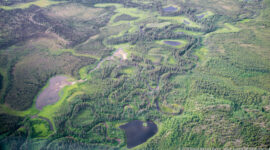
From the air, a broad green lowland spreads across the foreground, patterned with small ponds, marshy channels, and patches of darker vegetation. A low mountain ridge rises beyond the plain under a continuous bank of gray cloud. The oblique view reveals the wetland’s scale and uneven mosaic of water and land, though no individual river or mountain can be securely named from the image alone.
Caption
From the air, a broad green lowland spreads across the foreground, patterned with small ponds, marshy channels, and patches of darker vegetation. A low mountain ridge rises beyond the plain under a continuous bank of gray cloud. The oblique view reveals the wetland’s scale and uneven mosaic of water and land, though no individual river or mountain can be securely named from the image alone.