Hovenweep National Monument
Hovenweep National Monument preserves a series of ancestral Puebloan sites distributed across canyon heads and mesa edges in the Four Corners region. The stone towers and masonry structures reflect a distinctive pattern of settlement that combined defensive positioning, community organization, and adaptation to arid environmental conditions. The monument illustrates the close relationship between architecture and landscape in a region shaped by erosion and limited water resources.
The structures at Hovenweep were built near seasonal drainages and overlook points, taking advantage of both natural protection and access to agricultural land. Towers, room blocks, and associated features demonstrate careful stone construction and continuity with broader ancestral Puebloan traditions across the Colorado Plateau. The surrounding canyon terrain reflects the erosional forces that shaped the mesa and drainage systems where these communities developed.
Visitors encounter a landscape where archaeological remains are integrated directly into the natural setting, creating a strong impression of cultural continuity within the desert environment. The monument offers a quieter and more intimate perspective on ancestral architecture than some larger sites, while still conveying the scale and complexity of settlement across the Four Corners region.

Two narrow masonry walls stand several feet apart on a scrub-covered slope, their rounded outer faces framing a gap between them. The surrounding juniper and sagebrush nearly reach the bases, and a faint footpath approaches from the foreground. The elevated angle shows the structures’ compact footprint and their position within the arid landscape.
Caption
Two narrow masonry walls stand several feet apart on a scrub-covered slope, their rounded outer faces framing a gap between them. The surrounding juniper and sagebrush nearly reach the bases, and a faint footpath approaches from the foreground. The elevated angle shows the structures’ compact footprint and their position within the arid landscape.

The castle’s joined walls fill the frame, revealing tightly fitted sandstone blocks, small square openings, and a rounded tower at right. A dark recessed opening interrupts the left side, while loose stones and desert shrubs gather around the base. This nearer angle shifts attention from the site setting to the varied wall surfaces and the surviving architectural connections between the tower and adjoining rooms.
Caption
The castle’s joined walls fill the frame, revealing tightly fitted sandstone blocks, small square openings, and a rounded tower at right. A dark recessed opening interrupts the left side, while loose stones and desert shrubs gather around the base. This nearer angle shifts attention from the site setting to the varied wall surfaces and the surviving architectural connections between the tower and adjoining rooms.

Low shrubs and junipers cover a rocky plateau cut by shallow drainages, with scattered masonry remains visible among the vegetation. A stone structure appears near the right edge, while additional low walls blend into the middle distance. The wide view gives the archaeological features a small scale within the open canyon country.
Caption
Low shrubs and junipers cover a rocky plateau cut by shallow drainages, with scattered masonry remains visible among the vegetation. A stone structure appears near the right edge, while additional low walls blend into the middle distance. The wide view gives the archaeological features a small scale within the open canyon country.

Low walls and partial rooms extend across a broad sandstone shelf, with shrubs growing through the stones and several taller remnants farther back. The ruin cluster occupies the center of an open plateau, while a blue mountain range lies along the distant horizon. This panorama balances the small-scale masonry with the surrounding high-desert setting.
Caption
Low walls and partial rooms extend across a broad sandstone shelf, with shrubs growing through the stones and several taller remnants farther back. The ruin cluster occupies the center of an open plateau, while a blue mountain range lies along the distant horizon. This panorama balances the small-scale masonry with the surrounding high-desert setting.

A narrow drainage cuts through a broad sandstone landscape, its shadowed channel lined with shrubs and small trees. Exposed slickrock ledges frame both sides, and low juniper-covered hills extend toward the horizon. The wide view follows the ravine diagonally through the terrain, emphasizing the natural canyon form rather than a single architectural feature.
Caption
A narrow drainage cuts through a broad sandstone landscape, its shadowed channel lined with shrubs and small trees. Exposed slickrock ledges frame both sides, and low juniper-covered hills extend toward the horizon. The wide view follows the ravine diagonally through the terrain, emphasizing the natural canyon form rather than a single architectural feature.

A substantial masonry structure occupies a sandstone bench, its tall block walls enclosing a dark opening and broken upper edges. The warm stones contrast with the scrubby canyon country around the building, while loose rock and a low shrub mark the foreground. This oblique view brings the surviving wall mass and its uneven construction into close focus.
Caption
A substantial masonry structure occupies a sandstone bench, its tall block walls enclosing a dark opening and broken upper edges. The warm stones contrast with the scrubby canyon country around the building, while loose rock and a low shrub mark the foreground. This oblique view brings the surviving wall mass and its uneven construction into close focus.

A narrow rocky passage leads between substantial sandstone walls, with one broad tower mass close at left and another rising at right. More masonry structures appear through the gap, creating a compressed view into the cluster. Sunlight sharpens the warm stone against the blue sky, while shrubs at the margins soften the built forms and link the passage to the surrounding desert.
Caption
A narrow rocky passage leads between substantial sandstone walls, with one broad tower mass close at left and another rising at right. More masonry structures appear through the gap, creating a compressed view into the cluster. Sunlight sharpens the warm stone against the blue sky, while shrubs at the margins soften the built forms and link the passage to the surrounding desert.

Seen from the side, two tall wall remnants rise in uneven profiles, with a lower connecting section between them. Their reddish sandstone blocks catch direct sun, while gaps and missing upper courses expose the irregular outline of the ruin. The low viewpoint sets the walls against a clear sky and shows their thickness and surviving height more clearly than the preceding frontal views.
Caption
Seen from the side, two tall wall remnants rise in uneven profiles, with a lower connecting section between them. Their reddish sandstone blocks catch direct sun, while gaps and missing upper courses expose the irregular outline of the ruin. The low viewpoint sets the walls against a clear sky and shows their thickness and surviving height more clearly than the preceding frontal views.

A cluster of tall stone walls stands at the edge of a narrow cleft, with a slender masonry remnant visible lower in the canyon. The pale slickrock foreground slopes toward the opening, while low junipers and shrubs surround the structures. This wider angle separates the elevated tower forms from the fissure below and shows how closely the architecture follows the canyon edge.
Caption
A cluster of tall stone walls stands at the edge of a narrow cleft, with a slender masonry remnant visible lower in the canyon. The pale slickrock foreground slopes toward the opening, while low junipers and shrubs surround the structures. This wider angle separates the elevated tower forms from the fissure below and shows how closely the architecture follows the canyon edge.

A narrow masonry remnant rises from the far rim above a deep, brush-filled cleft, while larger block structures stand on the opposite ledge. Exposed sandstone dominates the foreground and leads the eye toward the ruins. The view makes the relationship between built stonework and the abrupt canyon terrain more prominent than the architecture’s individual details.
Caption
A narrow masonry remnant rises from the far rim above a deep, brush-filled cleft, while larger block structures stand on the opposite ledge. Exposed sandstone dominates the foreground and leads the eye toward the ruins. The view makes the relationship between built stonework and the abrupt canyon terrain more prominent than the architecture’s individual details.
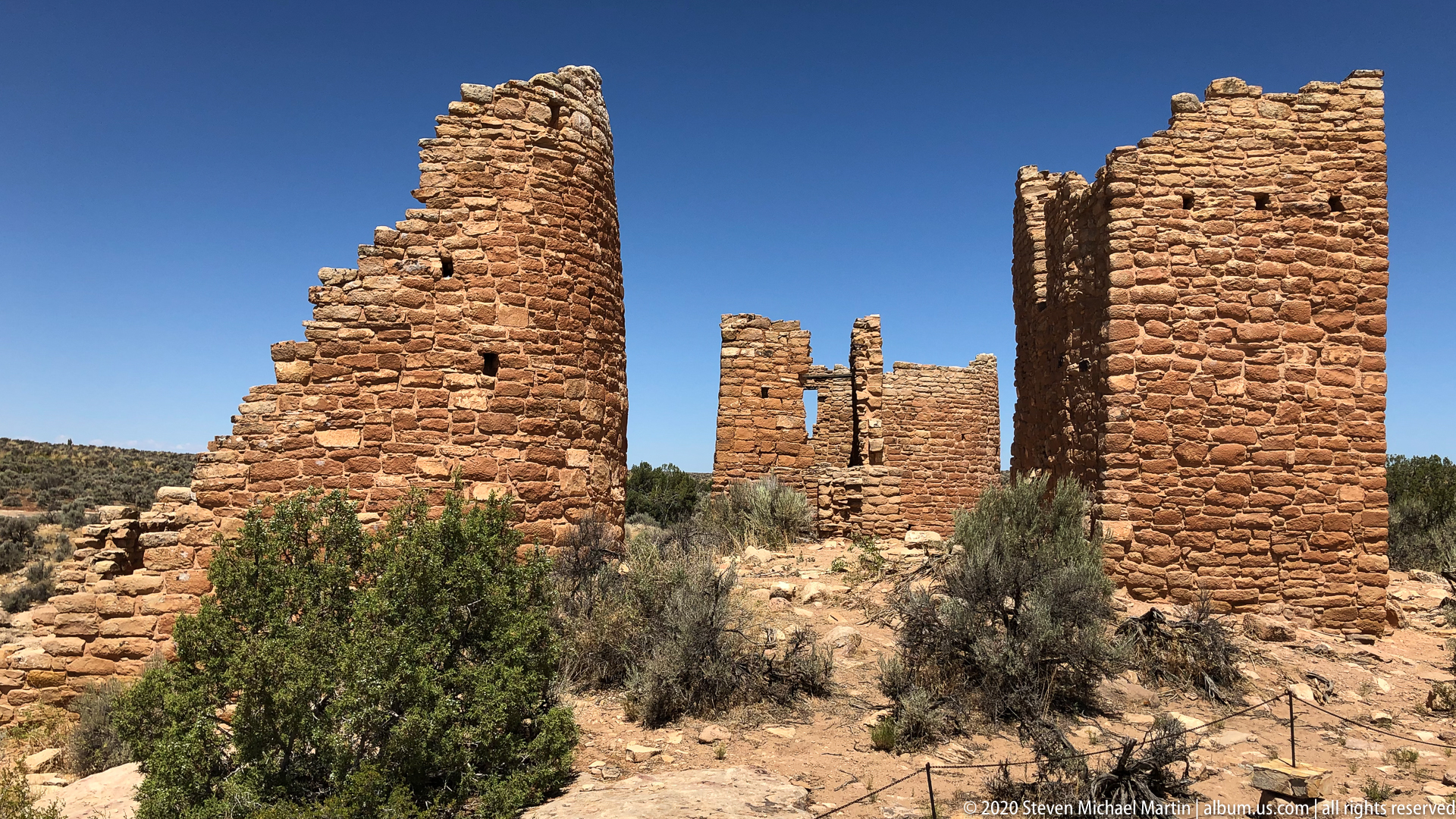
Several freestanding masonry walls rise at different distances across a low, rocky slope. A broad tower wall dominates the left foreground, with smaller structures visible between it and a taller wall at right. Shrubs and a low boundary fence soften the base of the ruins, while the clear sky isolates their uneven silhouettes and varied heights.
Caption
Several freestanding masonry walls rise at different distances across a low, rocky slope. A broad tower wall dominates the left foreground, with smaller structures visible between it and a taller wall at right. Shrubs and a low boundary fence soften the base of the ruins, while the clear sky isolates their uneven silhouettes and varied heights.

Two tall masonry wall sections fill the frame, their irregular courses and broken tops outlined against a cloudless sky. Dark rectangular openings puncture the nearer wall, and a lower connecting section links the structures at ground level. The close perspective reveals the varied stone sizes and the thickness of the surviving walls without assigning a specific building name.
Caption
Two tall masonry wall sections fill the frame, their irregular courses and broken tops outlined against a cloudless sky. Dark rectangular openings puncture the nearer wall, and a lower connecting section links the structures at ground level. The close perspective reveals the varied stone sizes and the thickness of the surviving walls without assigning a specific building name.

A low, multicolored stone sign bears the words “Hovenweep National Monument” beside the National Park Service arrowhead. Sagebrush and dry grasses extend behind it beneath a pale sky, placing the entrance marker in the open high-desert landscape. The front-facing composition makes the monument name and agency emblem the clear subjects.
Caption
A low, multicolored stone sign bears the words “Hovenweep National Monument” beside the National Park Service arrowhead. Sagebrush and dry grasses extend behind it beneath a pale sky, placing the entrance marker in the open high-desert landscape. The front-facing composition makes the monument name and agency emblem the clear subjects.

A low, flat-roofed visitor-center building sits behind a paved approach, with a freestanding stone sign near the entrance. Large pale boulders and desert plants occupy the foreground, while a covered section shades the entry. The broad view shows the center’s modest profile and its integration with the dry, open surroundings.
Caption
A low, flat-roofed visitor-center building sits behind a paved approach, with a freestanding stone sign near the entrance. Large pale boulders and desert plants occupy the foreground, while a covered section shades the entry. The broad view shows the center’s modest profile and its integration with the dry, open surroundings.

A broad stone wall at the visitor-center entrance carries the inscription “Hovenweep National Monument Visitor Center” beside the National Park Service arrowhead. Low stone walls extend to either side, forming a courtyard-like approach in front of the building. The centered view records the monument’s entry point and the textured local-stone construction.
Caption
A broad stone wall at the visitor-center entrance carries the inscription “Hovenweep National Monument Visitor Center” beside the National Park Service arrowhead. Low stone walls extend to either side, forming a courtyard-like approach in front of the building. The centered view records the monument’s entry point and the textured local-stone construction.

A large panel titled “Welcome to Hovenweep National Monument” combines an image of stone ruins with several blocks of explanatory text and a small park emblem. Its dark frame encloses the information against a backdrop of trees. The panel serves as an introduction to the archaeological site, though its smaller text is not fully legible at this proof-sheet scale.
Caption
A large panel titled “Welcome to Hovenweep National Monument” combines an image of stone ruins with several blocks of explanatory text and a small park emblem. Its dark frame encloses the information against a backdrop of trees. The panel serves as an introduction to the archaeological site, though its smaller text is not fully legible at this proof-sheet scale.

The “What’s Where” panel pairs a map of the monument’s site area with a smaller map of the Four Corners region. A text block explains the location of Hovenweep and access to its different areas, while several photographs line the lower edge. The layout links local wayfinding with the monument’s broader regional setting.
Caption
The “What’s Where” panel pairs a map of the monument’s site area with a smaller map of the Four Corners region. A text block explains the location of Hovenweep and access to its different areas, while several photographs line the lower edge. The layout links local wayfinding with the monument’s broader regional setting.

A panel titled “The Square Tower Group” features a large photograph of a masonry tower and a text block describing the cluster of structures. Smaller images at the bottom show additional ruins and architectural details. The sign identifies one named community within Hovenweep, directing attention from the displayed photograph to a specific group of ancestral Puebloan buildings.
Caption
A panel titled “The Square Tower Group” features a large photograph of a masonry tower and a text block describing the cluster of structures. Smaller images at the bottom show additional ruins and architectural details. The sign identifies one named community within Hovenweep, directing attention from the displayed photograph to a specific group of ancestral Puebloan buildings.

A panel headed “Why Did They Build Here?” presents text about Hovenweep’s settlement and adaptation to a dry landscape. Under the main heading, a section titled “Adapting to Their Environment” sits beside four small photographs of water, rock and vegetation. The display links the architecture to environmental conditions, while the fine print remains too small to transcribe fully here.
Caption
A panel headed “Why Did They Build Here?” presents text about Hovenweep’s settlement and adaptation to a dry landscape. Under the main heading, a section titled “Adapting to Their Environment” sits beside four small photographs of water, rock and vegetation. The display links the architecture to environmental conditions, while the fine print remains too small to transcribe fully here.

A panel titled “Unique Architecture” explains the construction and form of Hovenweep’s towers, using a large background image of masonry walls and four smaller photographs below the text. The photographs show varied structures and openings, making architectural comparison part of the exhibit. Its design places written interpretation directly over a monochrome image of the ruins.
Caption
A panel titled “Unique Architecture” explains the construction and form of Hovenweep’s towers, using a large background image of masonry walls and four smaller photographs below the text. The photographs show varied structures and openings, making architectural comparison part of the exhibit. Its design places written interpretation directly over a monochrome image of the ruins.

A dark panel titled “What We May Never Know” organizes questions about the ancestral Puebloan people into short sections, including why they left, where they came from and what they used the structures for. A faded photograph of masonry ruins forms the background. The exhibit emphasizes the limits of archaeological certainty through its question-based format.
Caption
A dark panel titled “What We May Never Know” organizes questions about the ancestral Puebloan people into short sections, including why they left, where they came from and what they used the structures for. A faded photograph of masonry ruins forms the background. The exhibit emphasizes the limits of archaeological certainty through its question-based format.

A blue-framed panel titled “Silence of the Centuries” shows a large reddish masonry tower against a mountain backdrop, with illustrated figures arranged at its base and along the lower edge. Text at right discusses the settlement’s history and architecture. The display combines archaeological imagery with human figures to suggest how the structures fit within a lived landscape.
Caption
A blue-framed panel titled “Silence of the Centuries” shows a large reddish masonry tower against a mountain backdrop, with illustrated figures arranged at its base and along the lower edge. Text at right discusses the settlement’s history and architecture. The display combines archaeological imagery with human figures to suggest how the structures fit within a lived landscape.

A large trail panel presents an illustrated map of the Square Tower area, marking paths and clusters of structures around the canyon. Text at right describes several trail experiences, while a small “You Are Here” marker and visitor-center reference orient the map. The oblique view shows the panel’s layout and its role in planning a walk among the ruins.
Caption
A large trail panel presents an illustrated map of the Square Tower area, marking paths and clusters of structures around the canyon. Text at right describes several trail experiences, while a small “You Are Here” marker and visitor-center reference orient the map. The oblique view shows the panel’s layout and its role in planning a walk among the ruins.

A tilted interpretive panel titled “Little Ruin Canyon” presents a panoramic image that labels several structures around the canyon rim. The text identifies features including Face Towers, Twin Rock House, Enclosed Boulder House and Tower Point. Positioned outdoors above the actual canyon, the panel connects the named ruins to their locations in the surrounding terrain.
Caption
A tilted interpretive panel titled “Little Ruin Canyon” presents a panoramic image that labels several structures around the canyon rim. The text identifies features including Face Towers, Twin Rock House, Enclosed Boulder House and Tower Point. Positioned outdoors above the actual canyon, the panel connects the named ruins to their locations in the surrounding terrain.

A narrow masonry tower stands in the foreground at the edge of a broad canyon basin, with other stone remains dispersed across the opposite slope. Sagebrush and junipers pattern the terrain between exposed rock shelves. The elevated viewpoint gives the foreground structure a strong vertical presence while revealing the larger archaeological landscape beyond it.
Caption
A narrow masonry tower stands in the foreground at the edge of a broad canyon basin, with other stone remains dispersed across the opposite slope. Sagebrush and junipers pattern the terrain between exposed rock shelves. The elevated viewpoint gives the foreground structure a strong vertical presence while revealing the larger archaeological landscape beyond it.

A long sandstone wall crosses a rocky slope, its upper edge stepping down through several surviving sections. The masonry is built from small, irregular stones, and a dark vertical opening interrupts the central wall. Pale bedrock and scrub frame the structure, making its alignment and remaining openings visible from a low, close viewpoint.
Caption
A long sandstone wall crosses a rocky slope, its upper edge stepping down through several surviving sections. The masonry is built from small, irregular stones, and a dark vertical opening interrupts the central wall. Pale bedrock and scrub frame the structure, making its alignment and remaining openings visible from a low, close viewpoint.

Two substantial masonry structures sit on a narrow sandstone shelf above a shadowed cleft. Their rounded wall faces frame a dark gap between them, while a small rectangular opening is visible in the right-hand section. Shrubs and pale rock fill the surrounding slope. The elevated view reveals how the surviving walls follow the edge of the natural ledge.
Caption
Two substantial masonry structures sit on a narrow sandstone shelf above a shadowed cleft. Their rounded wall faces frame a dark gap between them, while a small rectangular opening is visible in the right-hand section. Shrubs and pale rock fill the surrounding slope. The elevated view reveals how the surviving walls follow the edge of the natural ledge.

Two narrow stone towers rise beyond a broad, layered sandstone shelf, with a dark cleft cutting through the rock below them. The structures are separated by a small gap and surrounded by scattered shrubs on the canyon rim. This wider composition places the upright masonry forms in relation to the exposed bedrock rather than isolating their wall details.
Caption
Two narrow stone towers rise beyond a broad, layered sandstone shelf, with a dark cleft cutting through the rock below them. The structures are separated by a small gap and surrounded by scattered shrubs on the canyon rim. This wider composition places the upright masonry forms in relation to the exposed bedrock rather than isolating their wall details.

A massive flat-topped boulder shelters a compact masonry structure, with a dark doorway recessed beneath the rock overhang. Stone walls support the sheltered space, and a second opening is visible along the right side. The composition shows the close fit between built walls and natural rock, with other ruins and scrub rising behind the shelter.
Caption
A massive flat-topped boulder shelters a compact masonry structure, with a dark doorway recessed beneath the rock overhang. Stone walls support the sheltered space, and a second opening is visible along the right side. The composition shows the close fit between built walls and natural rock, with other ruins and scrub rising behind the shelter.

A squat masonry tower stands atop a broad sandstone formation, while a dark recess opens beneath the rock shelf in the foreground. Shrubs and junipers continue across the plateau beyond the structure. This wider view links the built tower to the natural overhang and hollow below, showing the layered geometry of stonework and canyon bedrock.
Caption
A squat masonry tower stands atop a broad sandstone formation, while a dark recess opens beneath the rock shelf in the foreground. Shrubs and junipers continue across the plateau beyond the structure. This wider view links the built tower to the natural overhang and hollow below, showing the layered geometry of stonework and canyon bedrock.

The enormous sandstone caprock dominates this closer view, projecting over a masonry room with a deep, shadowed entrance. A short wall follows the boulder’s underside, and smaller stonework is visible at the right. Dry grasses and shrubs surround the structure. The image centers on the protective overhang and the way the built room occupies the space below it.
Caption
The enormous sandstone caprock dominates this closer view, projecting over a masonry room with a deep, shadowed entrance. A short wall follows the boulder’s underside, and smaller stonework is visible at the right. Dry grasses and shrubs surround the structure. The image centers on the protective overhang and the way the built room occupies the space below it.

A white wooden sign hand-lettered “Sleeping Ute Mountain” stands on two posts above a smaller interpretive placard. A simple burgundy mountain outline runs over the words, while dry brush and a distant blue ridge fill the background. The sign identifies the mountain by name and frames it as a landmark within the surrounding landscape.
Caption
A white wooden sign hand-lettered “Sleeping Ute Mountain” stands on two posts above a smaller interpretive placard. A simple burgundy mountain outline runs over the words, while dry brush and a distant blue ridge fill the background. The sign identifies the mountain by name and frames it as a landmark within the surrounding landscape.

A long blue mountain ridge stretches across the horizon beyond an open plain of sagebrush, junipers and scattered exposed rock. The low, dry foreground occupies most of the frame, while the distant peaks rise as a continuous silhouette beneath a pale cloud-dotted sky. The preceding sign names Sleeping Ute Mountain, but this image itself is a broad landscape view.
Caption
A long blue mountain ridge stretches across the horizon beyond an open plain of sagebrush, junipers and scattered exposed rock. The low, dry foreground occupies most of the frame, while the distant peaks rise as a continuous silhouette beneath a pale cloud-dotted sky. The preceding sign names Sleeping Ute Mountain, but this image itself is a broad landscape view.

Hovenweep Castle rises from a scrub-covered sandstone bench, its joined masonry walls and rounded tower forms standing above a sandy approach. A small interpretive sign sits low in the foreground, while sagebrush and distant mesas place the structure within an open high-desert landscape. The wide view establishes the ruin’s clustered plan and its relationship to the surrounding terrain.
Caption
Hovenweep Castle rises from a scrub-covered sandstone bench, its joined masonry walls and rounded tower forms standing above a sandy approach. A small interpretive sign sits low in the foreground, while sagebrush and distant mesas place the structure within an open high-desert landscape. The wide view establishes the ruin’s clustered plan and its relationship to the surrounding terrain.

A closer view brings the thick sandstone masonry of Hovenweep Castle into focus, including a dark doorway-like opening and a rounded tower end. The small sign in the foreground clearly reads “Hovenweep Castle,” anchoring the identification. Irregular stones, eroded wall tops, and sagebrush at the base reveal the structure’s weathered condition against a cloudless desert sky.
Caption
A closer view brings the thick sandstone masonry of Hovenweep Castle into focus, including a dark doorway-like opening and a rounded tower end. The small sign in the foreground clearly reads “Hovenweep Castle,” anchoring the identification. Irregular stones, eroded wall tops, and sagebrush at the base reveal the structure’s weathered condition against a cloudless desert sky.

A narrow rectangular tower of fitted stone stands on a rock ledge above a brush-filled drainage. Lower wall fragments occupy the opposite foreground, while exposed bedrock and juniper-like shrubs follow the ravine through the scene. The separated structures and steep terrain make this view distinct from the close castle images; the exact tower name is not legible, so it is identified by its visible form and setting.
Caption
A narrow rectangular tower of fitted stone stands on a rock ledge above a brush-filled drainage. Lower wall fragments occupy the opposite foreground, while exposed bedrock and juniper-like shrubs follow the ravine through the scene. The separated structures and steep terrain make this view distinct from the close castle images; the exact tower name is not legible, so it is identified by its visible form and setting.

A long, low sandstone wall with a taller surviving section stands on a natural rock ledge amid sparse shrubs and grasses. The composition leaves broad space around the masonry, showing how the structure occupies the edge of uneven bedrock rather than a level clearing. A small upright stone feature caps the taller wall, but the proof-sheet view does not establish a specific building name.
Caption
A long, low sandstone wall with a taller surviving section stands on a natural rock ledge amid sparse shrubs and grasses. The composition leaves broad space around the masonry, showing how the structure occupies the edge of uneven bedrock rather than a level clearing. A small upright stone feature caps the taller wall, but the proof-sheet view does not establish a specific building name.
Hovenweep National Monument — Field Guide
National Monument Field Guide
📍 Overview
Hovenweep National Monument preserves a collection of ancestral Puebloan structures located along canyon heads and mesa edges in the Four Corners region. Built primarily between the thirteenth and fourteenth centuries, the masonry towers and room blocks demonstrate careful stone construction adapted to the arid environment of the Colorado Plateau. The site reflects the relationship between settlement location, water availability, and defensive positioning within a landscape shaped by erosion.
The structures are notable for their distinctive towers, which vary in shape from circular to square and often occupy prominent positions near canyon rims. Archaeological evidence suggests that these locations were selected both for strategic visibility and proximity to seasonal water sources. The surrounding terrain illustrates how canyon systems and mesa topography influenced patterns of habitation across the region.
⭐ Highlights
- Stone towers overlooking canyon heads
- Distinctive masonry construction techniques
- Settlement patterns adapted to mesa and canyon terrain
- Archaeological connections to broader ancestral Puebloan culture
- Quiet desert landscape within the Four Corners region
🔎 Key Features
- Circular and square stone tower structures
- Masonry adapted to irregular rock foundations
- Canyon-edge settlement positioning
- Evidence of water management and agricultural adaptation
- Cultural landscape integrated into Colorado Plateau geology
📷 Photography Notes
- Low-angle light enhances texture in stone masonry
- Wide compositions show relationship between ruins and canyon landscape
- Side lighting emphasizes structure of towers
- Foreground vegetation can provide depth and scale
- Simple framing helps highlight architectural form
- Morning light often produces warm tones on stone surfaces