Natural Bridges National Monument
Natural Bridges National Monument preserves three large natural bridges formed through erosion acting upon sandstone canyon walls. Unlike arches formed primarily through weathering, these bridges were created by flowing water that gradually carved openings through rock layers. The formations demonstrate the influence of river systems on the development of distinctive geological structures across the Colorado Plateau.
Sipapu, Kachina, and Owachomo bridges each illustrate variations in rock structure and erosional processes that influenced their development. The surrounding canyon environment reveals layered sedimentary rock shaped by long-term water flow and weathering. The monument provides insight into the relationship between canyon formation and structural geology.
Visitors encounter a landscape where canyon corridors and natural bridges illustrate the continuing influence of erosion on uplifted terrain. The monument highlights how water movement contributes to the evolution of distinctive landforms within desert environments.

A thick sandstone span arches across a narrow canyon, framing distant ledges and blue sky. In the foreground, a sandy footpath approaches the bridge between low shrubs and is edged by a simple wooden rail. The near angle connects the natural formation with the visitor route, showing the bridge’s height above the rough, vegetated drainage.
Caption
A thick sandstone span arches across a narrow canyon, framing distant ledges and blue sky. In the foreground, a sandy footpath approaches the bridge between low shrubs and is edged by a simple wooden rail. The near angle connects the natural formation with the visitor route, showing the bridge’s height above the rough, vegetated drainage.
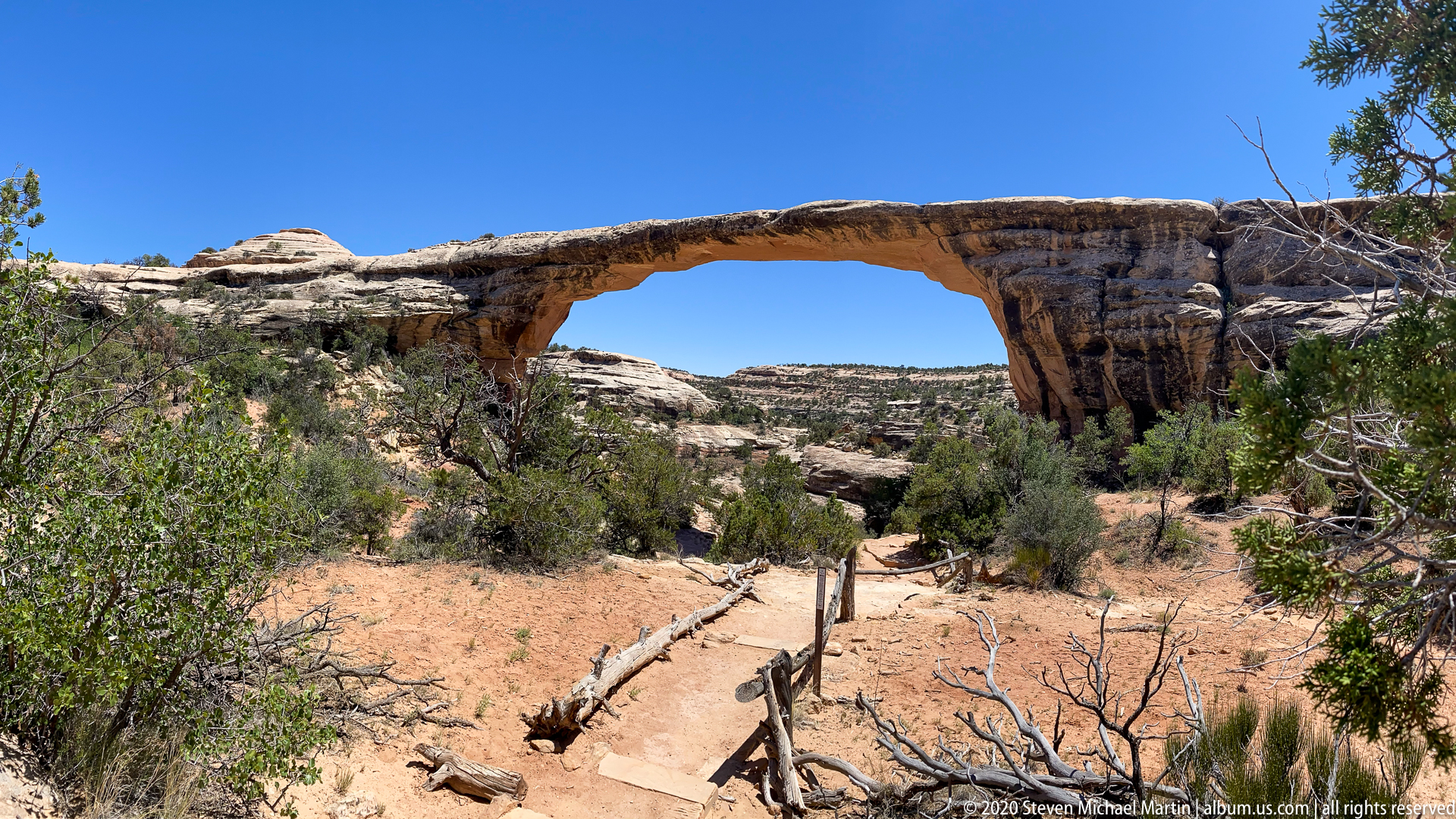
The long, pale bridge runs nearly level across the canyon, with its underside in warm shadow and a bright opening beneath it. A sandy path and low wooden barrier lead toward the span through scattered shrubs and dead branches. Compared with a distant overview, this ground-level perspective makes the bridge’s width and the visitor approach easier to read.
Caption
The long, pale bridge runs nearly level across the canyon, with its underside in warm shadow and a bright opening beneath it. A sandy path and low wooden barrier lead toward the span through scattered shrubs and dead branches. Compared with a distant overview, this ground-level perspective makes the bridge’s width and the visitor approach easier to read.

The sandstone bridge occupies the upper middle of the view, connecting two pale rock shelves above a deeply shaded ravine. Below it, green trees cluster around a sandy wash, while sunlit slickrock extends across the plateau. The wider framing includes more of the surrounding terrain than the previous image, clarifying the bridge’s position within the canyon landscape.
Caption
The sandstone bridge occupies the upper middle of the view, connecting two pale rock shelves above a deeply shaded ravine. Below it, green trees cluster around a sandy wash, while sunlit slickrock extends across the plateau. The wider framing includes more of the surrounding terrain than the previous image, clarifying the bridge’s position within the canyon landscape.

A broad natural bridge spans the upper-left part of a pale, heavily eroded canyon, while rounded rock fins and layered ledges descend toward the foreground. Green vegetation traces the drainage beneath the opening. The wide elevated view shows the bridge as one feature among a larger field of sculpted sandstone, with the canyon’s shelves and recesses filling the frame.
Caption
A broad natural bridge spans the upper-left part of a pale, heavily eroded canyon, while rounded rock fins and layered ledges descend toward the foreground. Green vegetation traces the drainage beneath the opening. The wide elevated view shows the bridge as one feature among a larger field of sculpted sandstone, with the canyon’s shelves and recesses filling the frame.

A pale sandstone bridge sweeps across a narrow canyon, its thick horizontal span joining the rock walls above a dense patch of green trees. Layered bands mark the bridge’s upper surface, while the shaded opening beneath reveals a sandy trail and vegetation below. Viewed from above, the scene shows both the bridge structure and the canyon it crosses.
Caption
A pale sandstone bridge sweeps across a narrow canyon, its thick horizontal span joining the rock walls above a dense patch of green trees. Layered bands mark the bridge’s upper surface, while the shaded opening beneath reveals a sandy trail and vegetation below. Viewed from above, the scene shows both the bridge structure and the canyon it crosses.

The underside of a high sandstone bridge frames a view into the canyon beyond. Warm orange rock forms a broad arching ceiling across the upper frame, with pale ledges, green shrubs, and a sandy route visible through the opening. The shaded foreground and sunlit canyon create a strong tonal contrast and convey the bridge’s scale from below.
Caption
The underside of a high sandstone bridge frames a view into the canyon beyond. Warm orange rock forms a broad arching ceiling across the upper frame, with pale ledges, green shrubs, and a sandy route visible through the opening. The shaded foreground and sunlit canyon create a strong tonal contrast and convey the bridge’s scale from below.

From a rocky overlook, a broad pale canyon basin extends toward red and purple mesas on the horizon. Junipers and pinyon trees frame the near slopes, while a sandy path descends through the center-left foreground. The panoramic composition links the scrub-covered rim with the deeply eroded sandstone country beyond.
Caption
From a rocky overlook, a broad pale canyon basin extends toward red and purple mesas on the horizon. Junipers and pinyon trees frame the near slopes, while a sandy path descends through the center-left foreground. The panoramic composition links the scrub-covered rim with the deeply eroded sandstone country beyond.

Broad cream and pink sandstone shelves step down toward a narrow, shadowed drainage, with juniper and pinyon trees scattered through the broken terrain. A long mesa forms the horizon beyond the plateau. From this high vantage, shallow canyons and interlocking rock benches create a complex pattern of ledges, clefts and vegetation across the foreground.
Caption
Broad cream and pink sandstone shelves step down toward a narrow, shadowed drainage, with juniper and pinyon trees scattered through the broken terrain. A long mesa forms the horizon beyond the plateau. From this high vantage, shallow canyons and interlocking rock benches create a complex pattern of ledges, clefts and vegetation across the foreground.

A pale sandstone bridge crosses a deep canyon cleft, its broad curved span linking layered rock walls above a pocket of green trees. The elevated viewpoint reveals the bridge’s relationship to the surrounding slickrock benches and the narrow drainage below. Horizontal strata continue across the plateau, while shadow beneath the span makes its thickness and arching form distinct.
Caption
A pale sandstone bridge crosses a deep canyon cleft, its broad curved span linking layered rock walls above a pocket of green trees. The elevated viewpoint reveals the bridge’s relationship to the surrounding slickrock benches and the narrow drainage below. Horizontal strata continue across the plateau, while shadow beneath the span makes its thickness and arching form distinct.

A wide expanse of pale slickrock fills the foreground, broken by shallow channels, isolated shrubs and low junipers. Beyond it, a long mesa with a reddish upper band stretches across the horizon beneath a clear blue sky. This view emphasizes the open plateau and its subtle drainage patterns rather than a single bridge or cliff feature.
Caption
A wide expanse of pale slickrock fills the foreground, broken by shallow channels, isolated shrubs and low junipers. Beyond it, a long mesa with a reddish upper band stretches across the horizon beneath a clear blue sky. This view emphasizes the open plateau and its subtle drainage patterns rather than a single bridge or cliff feature.

A brown roadside sign points left toward Lake Powell and Natural Bridges National Monument. Set on two metal posts, it stands among junipers, sagebrush and dry grasses beside a sunlit road corridor. The clear lettering makes this an orientation image, while the surrounding high-desert vegetation places the sign in a sparsely wooded landscape.
Caption
A brown roadside sign points left toward Lake Powell and Natural Bridges National Monument. Set on two metal posts, it stands among junipers, sagebrush and dry grasses beside a sunlit road corridor. The clear lettering makes this an orientation image, while the surrounding high-desert vegetation places the sign in a sparsely wooded landscape.

A tall brown sign welcomes visitors to Natural Bridges National Monument and directs them toward the visitor center four miles away. A separate notice beneath prohibits wood cutting and gathering, with a federal recreation emblem attached to the post. The sign stands in red sandy soil among junipers and scrub, combining destination information with a specific land-use rule.
Caption
A tall brown sign welcomes visitors to Natural Bridges National Monument and directs them toward the visitor center four miles away. A separate notice beneath prohibits wood cutting and gathering, with a federal recreation emblem attached to the post. The sign stands in red sandy soil among junipers and scrub, combining destination information with a specific land-use rule.

A low masonry monument frames a wooden panel reading “Natural Bridges National Monument,” with the National Park Service arrowhead emblem mounted at the left. Text below identifies the Department of the Interior and National Park Service. The stuccoed lintel and brick-faced supports give the entrance marker a solid, built form against the surrounding junipers.
Caption
A low masonry monument frames a wooden panel reading “Natural Bridges National Monument,” with the National Park Service arrowhead emblem mounted at the left. Text below identifies the Department of the Interior and National Park Service. The stuccoed lintel and brick-faced supports give the entrance marker a solid, built form against the surrounding junipers.

A broad horizontal sandstone ledge projects over a deep, dark recess, its pale upper surface contrasting with the rust-colored, vertically streaked wall beneath. Beyond the overhang, low trees and distant red mesas extend across the canyon. The elevated framing reveals the layered structure of the cliff and the depth created by the shaded alcove.
Caption
A broad horizontal sandstone ledge projects over a deep, dark recess, its pale upper surface contrasting with the rust-colored, vertically streaked wall beneath. Beyond the overhang, low trees and distant red mesas extend across the canyon. The elevated framing reveals the layered structure of the cliff and the depth created by the shaded alcove.

Small rounded cavities densely pockmark a rust-orange sandstone surface, creating a rough, cellular texture across the frame. The close crop excludes the broader landscape and shows variations in pit size, depth and shadow. The visible pattern is consistent with honeycomb-style weathering, though the photograph alone does not establish the precise process or rock type beyond sandstone-like texture.
Caption
Small rounded cavities densely pockmark a rust-orange sandstone surface, creating a rough, cellular texture across the frame. The close crop excludes the broader landscape and shows variations in pit size, depth and shadow. The visible pattern is consistent with honeycomb-style weathering, though the photograph alone does not establish the precise process or rock type beyond sandstone-like texture.

A bleached, twisted tree sprawls across pale slickrock in the foreground, its bare limbs reaching toward the canyon. Beyond it, a deep shadowed cleft cuts across the layered sandstone plateau, with scattered green trees growing below. The dead trunk provides a strong foreground anchor against the horizontal rock shelves and distant mesas.
Caption
A bleached, twisted tree sprawls across pale slickrock in the foreground, its bare limbs reaching toward the canyon. Beyond it, a deep shadowed cleft cuts across the layered sandstone plateau, with scattered green trees growing below. The dead trunk provides a strong foreground anchor against the horizontal rock shelves and distant mesas.

A weathered, fallen juniper trunk lies across red sandy ground beneath living trees. Prickly pear pads and low shrubs cluster around the wood, while scattered stones and dry leaves cover the slope. The close view focuses on the contrast between the bleached trunk, green cactus and reddish soil rather than the larger canyon scenery.
Caption
A weathered, fallen juniper trunk lies across red sandy ground beneath living trees. Prickly pear pads and low shrubs cluster around the wood, while scattered stones and dry leaves cover the slope. The close view focuses on the contrast between the bleached trunk, green cactus and reddish soil rather than the larger canyon scenery.

A broad sandstone bridge crosses a narrow canyon whose bottom is filled with green trees. Layered pale shelves extend from the span into the surrounding plateau, while shadow along the inner wall reveals the opening’s depth. The elevated view includes both ends of the bridge and the ravine beneath, making the formation’s connection to the canyon legible.
Caption
A broad sandstone bridge crosses a narrow canyon whose bottom is filled with green trees. Layered pale shelves extend from the span into the surrounding plateau, while shadow along the inner wall reveals the opening’s depth. The elevated view includes both ends of the bridge and the ravine beneath, making the formation’s connection to the canyon legible.

The bridge’s dark, vertically streaked underside sweeps across the upper frame, while pale rounded boulders rise from the canyon below. Green trees fill the narrow drainage visible through the arch, adding a vivid band of vegetation to the otherwise cream and rust-colored rock. This closer composition concentrates on the bridge opening and its layered interior.
Caption
The bridge’s dark, vertically streaked underside sweeps across the upper frame, while pale rounded boulders rise from the canyon below. Green trees fill the narrow drainage visible through the arch, adding a vivid band of vegetation to the otherwise cream and rust-colored rock. This closer composition concentrates on the bridge opening and its layered interior.

A man in a gray shirt and bright blue neck gaiter stands at an overlook, smiling toward the camera. Behind him, a sandstone bridge curves across the canyon above green trees, with layered mesas softened in the distance. The portrait combines a clear human subject with the monumental landscape, using the visitor’s position to establish scale.
Caption
A man in a gray shirt and bright blue neck gaiter stands at an overlook, smiling toward the camera. Behind him, a sandstone bridge curves across the canyon above green trees, with layered mesas softened in the distance. The portrait combines a clear human subject with the monumental landscape, using the visitor’s position to establish scale.

A man in a gray shirt and blue neck gaiter leans against a red metal railing, facing the camera with his hands together. The natural bridge and pale canyon walls sit behind him, slightly softened by the shallow focus. This wider portrait includes the overlook barrier and more of the setting, placing the visitor at a designated viewing point.
Caption
A man in a gray shirt and blue neck gaiter leans against a red metal railing, facing the camera with his hands together. The natural bridge and pale canyon walls sit behind him, slightly softened by the shallow focus. This wider portrait includes the overlook barrier and more of the setting, placing the visitor at a designated viewing point.

A man wearing a gray shirt and blue neck gaiter stands close to the camera, smiling with one hand at his hip. The natural bridge and a deep, green-lined canyon opening blur behind him. The shallow focus gives priority to his face while retaining the distinctive curved sandstone span as a clear contextual element.
Caption
A man wearing a gray shirt and blue neck gaiter stands close to the camera, smiling with one hand at his hip. The natural bridge and a deep, green-lined canyon opening blur behind him. The shallow focus gives priority to his face while retaining the distinctive curved sandstone span as a clear contextual element.

From beneath the massive bridge, the shaded underside forms a dark arch over a narrow canyon floor. Green trees cluster along the drainage, while pale boulders and sculpted rock knobs rise on the right. Sunlit ledges beyond contrast with the shadowed foreground, showing how the bridge encloses and frames the canyon passage.
Caption
From beneath the massive bridge, the shaded underside forms a dark arch over a narrow canyon floor. Green trees cluster along the drainage, while pale boulders and sculpted rock knobs rise on the right. Sunlit ledges beyond contrast with the shadowed foreground, showing how the bridge encloses and frames the canyon passage.

A compact cluster of yellow flowers rises above narrow gray-green leaves beside a sandy footpath. Low shrubs and patches of bare red soil surround the plant, with a pale rock at the edge of the frame. The close framing isolates the bloom from the larger landscape; the species is not clear at this scale.
Caption
A compact cluster of yellow flowers rises above narrow gray-green leaves beside a sandy footpath. Low shrubs and patches of bare red soil surround the plant, with a pale rock at the edge of the frame. The close framing isolates the bloom from the larger landscape; the species is not clear at this scale.

A mature juniper stands on a gently sloping sandstone shelf, its asymmetrical crown silhouetted against a clear blue sky. A broad, pale rock surface fills the foreground, while a canyon and low mesas recede to the left. The tree’s roots and trunk anchor the otherwise exposed slickrock setting.
Caption
A mature juniper stands on a gently sloping sandstone shelf, its asymmetrical crown silhouetted against a clear blue sky. A broad, pale rock surface fills the foreground, while a canyon and low mesas recede to the left. The tree’s roots and trunk anchor the otherwise exposed slickrock setting.

Pale sandstone benches descend through a patchwork of shallow channels, rounded knobs and dark crevices. Small trees and shrubs occupy the lower pockets, while broad horizontal ledges continue toward a red-banded mesa at the top. The elevated perspective shows how water-carved pathways divide the rock pavement into stepped forms.
Caption
Pale sandstone benches descend through a patchwork of shallow channels, rounded knobs and dark crevices. Small trees and shrubs occupy the lower pockets, while broad horizontal ledges continue toward a red-banded mesa at the top. The elevated perspective shows how water-carved pathways divide the rock pavement into stepped forms.

A fallen, bleached tree lies diagonally across red sandy ground, its branches pointing toward a broad sandstone canyon. Low shrubs frame the foreground, and pale horizontal ledges descend into shadow beyond. The deadwood adds a close, textured foreground to the open canyon view and contrasts with the living brush around it.
Caption
A fallen, bleached tree lies diagonally across red sandy ground, its branches pointing toward a broad sandstone canyon. Low shrubs frame the foreground, and pale horizontal ledges descend into shadow beyond. The deadwood adds a close, textured foreground to the open canyon view and contrasts with the living brush around it.

Overlapping prickly pear pads spread across the sandy ground, ranging from fresh green to pale, dried surfaces. Fine spines catch the light across their dotted surfaces, with dry grasses and low shrubs filling the gaps. This close study of desert vegetation contrasts the cactus’s flat, jointed pads with the twiggy plants around it.
Caption
Overlapping prickly pear pads spread across the sandy ground, ranging from fresh green to pale, dried surfaces. Fine spines catch the light across their dotted surfaces, with dry grasses and low shrubs filling the gaps. This close study of desert vegetation contrasts the cactus’s flat, jointed pads with the twiggy plants around it.

Several low stone-built structures stand beneath a broad sandstone overhang, sheltered from direct sun. Rounded masonry forms and small dark door openings are visible along the back of the alcove, with loose stones scattered across the foreground. The proof-sheet view supports identification as an archaeological dwelling complex, but does not establish a specific ruin name or date.
Caption
Several low stone-built structures stand beneath a broad sandstone overhang, sheltered from direct sun. Rounded masonry forms and small dark door openings are visible along the back of the alcove, with loose stones scattered across the foreground. The proof-sheet view supports identification as an archaeological dwelling complex, but does not establish a specific ruin name or date.

A cluster of low masonry rooms occupies the back of a wide rock shelter, with large rounded boulders spread across the floor in front. The enclosing sandstone ceiling forms a deep horizontal roof above the structures; daylight reaches the sandy approach while the rooms remain in shadow. The view distinguishes several built forms within the larger alcove rather than a single isolated wall.
Caption
A cluster of low masonry rooms occupies the back of a wide rock shelter, with large rounded boulders spread across the floor in front. The enclosing sandstone ceiling forms a deep horizontal roof above the structures; daylight reaches the sandy approach while the rooms remain in shadow. The view distinguishes several built forms within the larger alcove rather than a single isolated wall.

A long, dark-streaked sandstone wall curves above a narrow band of masonry remains at its base. Loose rock covers the foreground, and a small upright post or remnant stands near the center. The distant framing makes the dwelling structures appear modest against the sweeping cliff and emphasizes the protective scale of the overhang.
Caption
A long, dark-streaked sandstone wall curves above a narrow band of masonry remains at its base. Loose rock covers the foreground, and a small upright post or remnant stands near the center. The distant framing makes the dwelling structures appear modest against the sweeping cliff and emphasizes the protective scale of the overhang.

A row of low stone rooms sits in deep shade beneath a broad, pale sandstone roof. Small rectangular openings punctuate the masonry, while sunlit ledges and shrubs frame the lower foreground. The oblique viewpoint separates the built structures from the natural alcove above and shows the shelter’s overhang extending well beyond the room line.
Caption
A row of low stone rooms sits in deep shade beneath a broad, pale sandstone roof. Small rectangular openings punctuate the masonry, while sunlit ledges and shrubs frame the lower foreground. The oblique viewpoint separates the built structures from the natural alcove above and shows the shelter’s overhang extending well beyond the room line.

A broad reddish sandstone wall fills the background, with a continuous overhang sheltering low stone structures near the canyon floor. The rooms are partly lost in shadow and appear small against the long curved cliff. Sunlit pale rock crosses the upper right, contrasting with the dark alcove and emphasizing the shelter’s depth.
Caption
A broad reddish sandstone wall fills the background, with a continuous overhang sheltering low stone structures near the canyon floor. The rooms are partly lost in shadow and appear small against the long curved cliff. Sunlit pale rock crosses the upper right, contrasting with the dark alcove and emphasizing the shelter’s depth.

A visitor in a blue shirt walks across pale bedrock toward a massive sandstone span that projects from the cliff at right. Its dark, layered underside contrasts with the bright open plateau beyond, while a metal handrail follows the sloping path. The low viewpoint makes the bridge’s thickness and the small scale of the person especially clear.
Caption
A visitor in a blue shirt walks across pale bedrock toward a massive sandstone span that projects from the cliff at right. Its dark, layered underside contrasts with the bright open plateau beyond, while a metal handrail follows the sloping path. The low viewpoint makes the bridge’s thickness and the small scale of the person especially clear.

A man in a blue shirt and light hat stands beside a metal safety rail at the overlook, with pale slickrock benches, scattered shrubs, and red mesas extending behind him. The elevated perspective opens across a broad basin rather than focusing on a single bridge. Sunlight reveals the layered bedrock and the low, dry vegetation covering the plateau.
Caption
A man in a blue shirt and light hat stands beside a metal safety rail at the overlook, with pale slickrock benches, scattered shrubs, and red mesas extending behind him. The elevated perspective opens across a broad basin rather than focusing on a single bridge. Sunlight reveals the layered bedrock and the low, dry vegetation covering the plateau.

A smiling visitor in a blue shirt, patterned neck scarf, and broad-brimmed hat fills the foreground. Behind the person, a dark opening beneath a pale sandstone span remains softly out of focus, linking the portrait to the canyon setting without obscuring the face. Bright reflected light from the rock contrasts with the shaded underside of the formation.
Caption
A smiling visitor in a blue shirt, patterned neck scarf, and broad-brimmed hat fills the foreground. Behind the person, a dark opening beneath a pale sandstone span remains softly out of focus, linking the portrait to the canyon setting without obscuring the face. Bright reflected light from the rock contrasts with the shaded underside of the formation.

A few small yellow flowers rise from a sparse plant in sandy soil beneath a weathered fallen branch. The limb crosses the upper half of the frame and casts a hard-edged shadow, while scattered twigs and dry debris mark the open ground. The low composition isolates delicate blooms in an exposed, rocky environment.
Caption
A few small yellow flowers rise from a sparse plant in sandy soil beneath a weathered fallen branch. The limb crosses the upper half of the frame and casts a hard-edged shadow, while scattered twigs and dry debris mark the open ground. The low composition isolates delicate blooms in an exposed, rocky environment.

The frame is filled with a coarse, reddish rock surface perforated by hundreds of small pits and cavities. Strong side light catches the raised grains and deepens the shadows within each hollow, making the stone appear almost cellular. No wider landscape is visible, so this close study records the texture and weathering of the sandstone itself.
Caption
The frame is filled with a coarse, reddish rock surface perforated by hundreds of small pits and cavities. Strong side light catches the raised grains and deepens the shadows within each hollow, making the stone appear almost cellular. No wider landscape is visible, so this close study records the texture and weathering of the sandstone itself.

A broad pale sandstone shelf extends over a dark, shallow recess, its layered edge forming a low horizontal ceiling. The sheltered ground beneath is smooth and shaded, with sparse shrubs and bare branches visible above the rock. This frontal view concentrates on the span’s underside and the contrast between sunlit stone and the shadowed pocket below.
Caption
A broad pale sandstone shelf extends over a dark, shallow recess, its layered edge forming a low horizontal ceiling. The sheltered ground beneath is smooth and shaded, with sparse shrubs and bare branches visible above the rock. This frontal view concentrates on the span’s underside and the contrast between sunlit stone and the shadowed pocket below.

A deep, narrow cleft cuts between pale sandstone walls and ends in a dark opening near the bottom of the frame. Angular ledges and broken blocks surround the gap, while shrubs grow along the canyon rim. The high, downward viewpoint emphasizes the vertical drop and the irregular passage carved through the rock.
Caption
A deep, narrow cleft cuts between pale sandstone walls and ends in a dark opening near the bottom of the frame. Angular ledges and broken blocks surround the gap, while shrubs grow along the canyon rim. The high, downward viewpoint emphasizes the vertical drop and the irregular passage carved through the rock.

A long sandstone bridge crosses the ravine from left to right, its pale top forming a nearly level line above the darker, recessed underside. Green shrubs and small trees fill the drainage below, with sandy footpaths visible among them. The distant view gives the formation a clear structural outline and shows how the span links the opposing canyon walls.
Caption
A long sandstone bridge crosses the ravine from left to right, its pale top forming a nearly level line above the darker, recessed underside. Green shrubs and small trees fill the drainage below, with sandy footpaths visible among them. The distant view gives the formation a clear structural outline and shows how the span links the opposing canyon walls.

A visitor in a blue shirt and light hat stands on a sandy path beneath a broad sandstone bridge, providing a clear measure of its height and width. The rock forms a high arch across the upper frame, while pale benches and dense shrubs continue into the canyon behind the person. This view combines a human-scale reference with the formation’s full opening.
Caption
A visitor in a blue shirt and light hat stands on a sandy path beneath a broad sandstone bridge, providing a clear measure of its height and width. The rock forms a high arch across the upper frame, while pale benches and dense shrubs continue into the canyon behind the person. This view combines a human-scale reference with the formation’s full opening.

A man in a gray shirt and blue neck scarf stands beneath the orange sandstone underside of a bridge, looking toward the right. The rock opening curves overhead and frames a patch of clear blue sky, green shrubs, and pale canyon ledges. The medium portrait preserves the visitor’s profile while keeping the dramatic overhead span visible.
Caption
A man in a gray shirt and blue neck scarf stands beneath the orange sandstone underside of a bridge, looking toward the right. The rock opening curves overhead and frames a patch of clear blue sky, green shrubs, and pale canyon ledges. The medium portrait preserves the visitor’s profile while keeping the dramatic overhead span visible.

A visitor in a blue shirt, dark shorts, and pale hat pauses on a sunlit sandstone trail, hands resting at the hips. Juniper shrubs and weathered logs border the route, while low pale rock rises behind. The open framing shows the rough, exposed walking surface and sparse vegetation characteristic of the plateau trail.
Caption
A visitor in a blue shirt, dark shorts, and pale hat pauses on a sunlit sandstone trail, hands resting at the hips. Juniper shrubs and weathered logs border the route, while low pale rock rises behind. The open framing shows the rough, exposed walking surface and sparse vegetation characteristic of the plateau trail.

A hiker walks toward the camera along a pale sandy path, one foot raised mid-step. The route passes between juniper and low shrubs, with fallen wood along the right edge and a small weathered trunk behind. A bright blue sky and sunlit slickrock give the scene a clear, dry character, while the figure leads the eye along the trail.
Caption
A hiker walks toward the camera along a pale sandy path, one foot raised mid-step. The route passes between juniper and low shrubs, with fallen wood along the right edge and a small weathered trunk behind. A bright blue sky and sunlit slickrock give the scene a clear, dry character, while the figure leads the eye along the trail.

A long red sandstone escarpment rises above a broad belt of juniper and scrub, its pale caprock and darker horizontal bands tracing the ridge from left to right. A small path crosses the base of the cliff, while open blue sky leaves the rock profile unobstructed. The wide view emphasizes the scale and continuity of the layered wall.
Caption
A long red sandstone escarpment rises above a broad belt of juniper and scrub, its pale caprock and darker horizontal bands tracing the ridge from left to right. A small path crosses the base of the cliff, while open blue sky leaves the rock profile unobstructed. The wide view emphasizes the scale and continuity of the layered wall.
Natural Bridges National Monument — Field Guide
National Monument Field Guide
📍 Overview
Natural Bridges National Monument preserves three large sandstone bridges formed by water erosion cutting through canyon walls over extended geological time. These formations illustrate how river systems influence the structure of canyon landscapes within the Colorado Plateau. The monument demonstrates the continuing interaction between flowing water and uplifted sedimentary rock layers.
Sipapu, Kachina, and Owachomo bridges represent different stages of erosional development influenced by variations in rock hardness and water flow patterns. The surrounding canyon terrain reveals layered sedimentary formations shaped by long-term weathering processes. The monument provides insight into geological processes responsible for forming natural bridge structures.
⭐ Highlights
- Sipapu Bridge spanning White Canyon
- Kachina Bridge sandstone formation
- Owachomo Bridge slender rock span
- Canyon landscapes shaped by water erosion
- Colorado Plateau geological environment
🔎 Key Features
- Natural bridges formed by river erosion
- Layered sedimentary rock canyon walls
- Structural geology influencing erosion patterns
- Desert environment shaping weathering processes
- Geological diversity within canyon systems
📷 Photography Notes
- Early and late light enhances texture in sandstone bridges
- Wide compositions help convey scale of formations
- Foreground canyon walls add depth
- Side lighting reveals structural detail
- Cloud shadows can enhance dimensional contrast
- Look for viewpoints that frame the full span of each bridge

A printed Natural Bridges handout presents a panoramic bridge photograph across its top and organizes visitor information into labeled sections below. Headings include “General Information,” “Visitor Safety,” and “Caring for the Canyons,” with practical details set in narrow columns. The grayscale page is text-heavy, but its layout clearly combines orientation, safety, and conservation guidance.
Caption
A printed Natural Bridges handout presents a panoramic bridge photograph across its top and organizes visitor information into labeled sections below. Headings include “General Information,” “Visitor Safety,” and “Caring for the Canyons,” with practical details set in narrow columns. The grayscale page is text-heavy, but its layout clearly combines orientation, safety, and conservation guidance.

An open National Park Service brochure headed “Natural Bridges” combines panoramic photographs of sandstone spans with maps, descriptive text, and a diagrammatic model near the bottom. The spread introduces the monument’s natural bridges and provides visitor information in several compact sections. Small print is not consistently legible at this scale, but the layout clearly joins scenic imagery with practical interpretation.
Caption
An open National Park Service brochure headed “Natural Bridges” combines panoramic photographs of sandstone spans with maps, descriptive text, and a diagrammatic model near the bottom. The spread introduces the monument’s natural bridges and provides visitor information in several compact sections. Small print is not consistently legible at this scale, but the layout clearly joins scenic imagery with practical interpretation.

A brochure page pairs a large map of Natural Bridges National Monument with small landscape photographs, route markings, and several columns of explanatory text. The monument boundary and internal roads are drawn in contrasting colors, making the map the dominant element. Its surrounding information appears to describe the bridges and visitor routes, though the small paragraphs cannot be read reliably in the proof sheet.
Caption
A brochure page pairs a large map of Natural Bridges National Monument with small landscape photographs, route markings, and several columns of explanatory text. The monument boundary and internal roads are drawn in contrasting colors, making the map the dominant element. Its surrounding information appears to describe the bridges and visitor routes, though the small paragraphs cannot be read reliably in the proof sheet.

A second printed guide page places a map of the monument across the upper portion, with marked routes and bridge locations. Beneath it, small photographs and dense text describe the natural bridges and their trails, including distance and route information in a compact table. The layout functions as both a map and field guide; individual fine-print details are not reliably legible here.
Caption
A second printed guide page places a map of the monument across the upper portion, with marked routes and bridge locations. Beneath it, small photographs and dense text describe the natural bridges and their trails, including distance and route information in a compact table. The layout functions as both a map and field guide; individual fine-print details are not reliably legible here.