Onion Portage – Kobuk Valley National Park
Onion Portage represents one of the most significant archaeological sites in Arctic Alaska and preserves evidence of human activity spanning thousands of years. Located along the Kobuk River, the site reflects a traditional crossing point used by migrating caribou herds and Indigenous communities who depended on these seasonal movements for subsistence. The location demonstrates the importance of geographic features in shaping long-term patterns of settlement and resource use.
Archaeological research has revealed cultural layers representing repeated occupation over millennia, providing valuable insight into technological development and adaptation to Arctic conditions. The site illustrates the continuity of human presence in the region and the ways in which environmental knowledge contributed to survival across generations.
Visitors encounter a landscape defined by river corridors and broad tundra plains that emphasize the importance of migration routes for both animals and people. Onion Portage highlights the relationship between geography, culture, and ecological systems in Arctic environments.
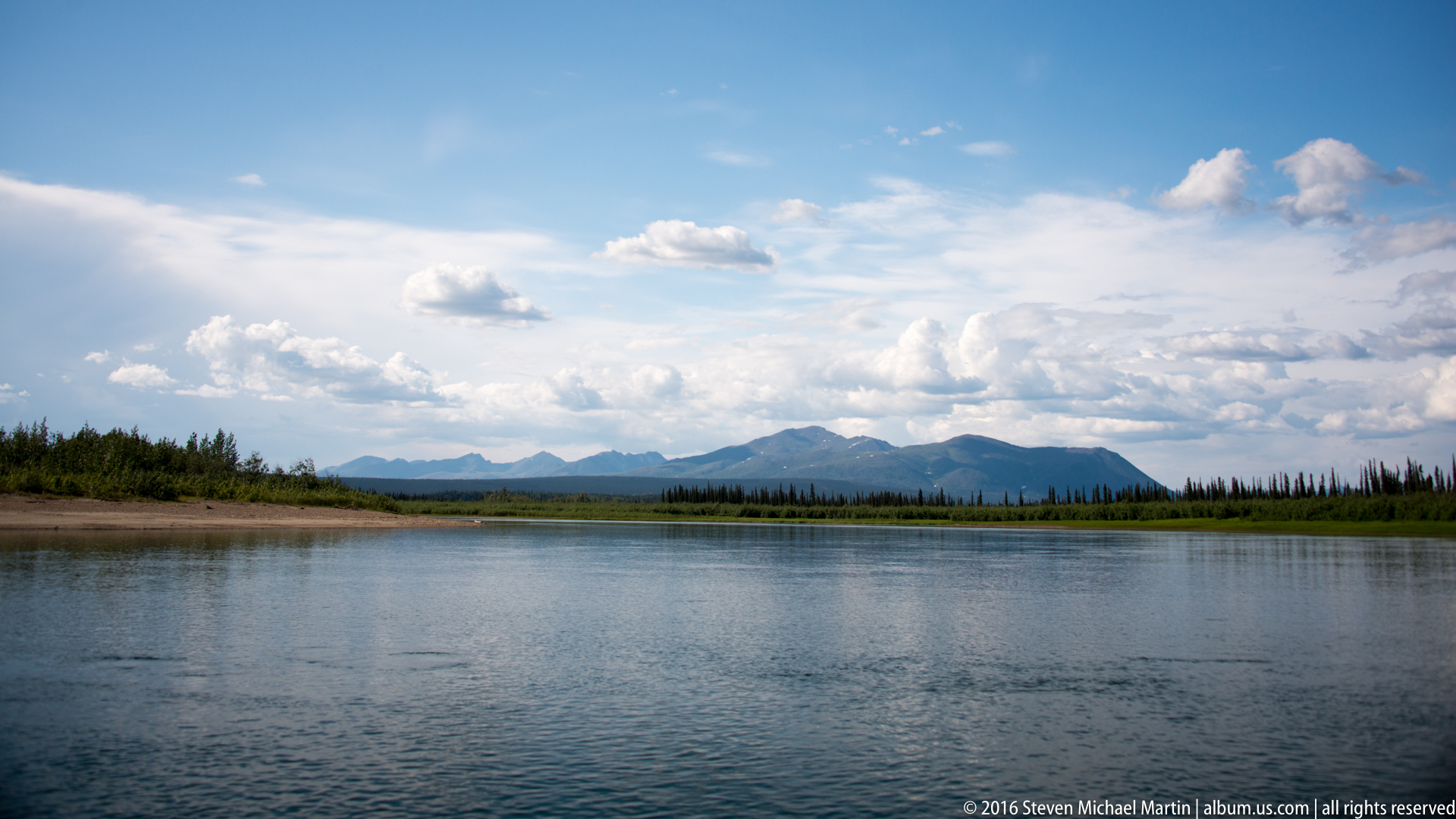
A broad river fills the foreground beneath a wide blue sky scattered with cumulus clouds. A narrow line of spruce marks the far bank, and low mountains rise beyond it in soft blue layers. The level viewpoint makes the water’s expanse and the distant horizon the focus, while changing cloud shapes add scale above the low river corridor.
Caption
A broad river fills the foreground beneath a wide blue sky scattered with cumulus clouds. A narrow line of spruce marks the far bank, and low mountains rise beyond it in soft blue layers. The level viewpoint makes the water’s expanse and the distant horizon the focus, while changing cloud shapes add scale above the low river corridor.
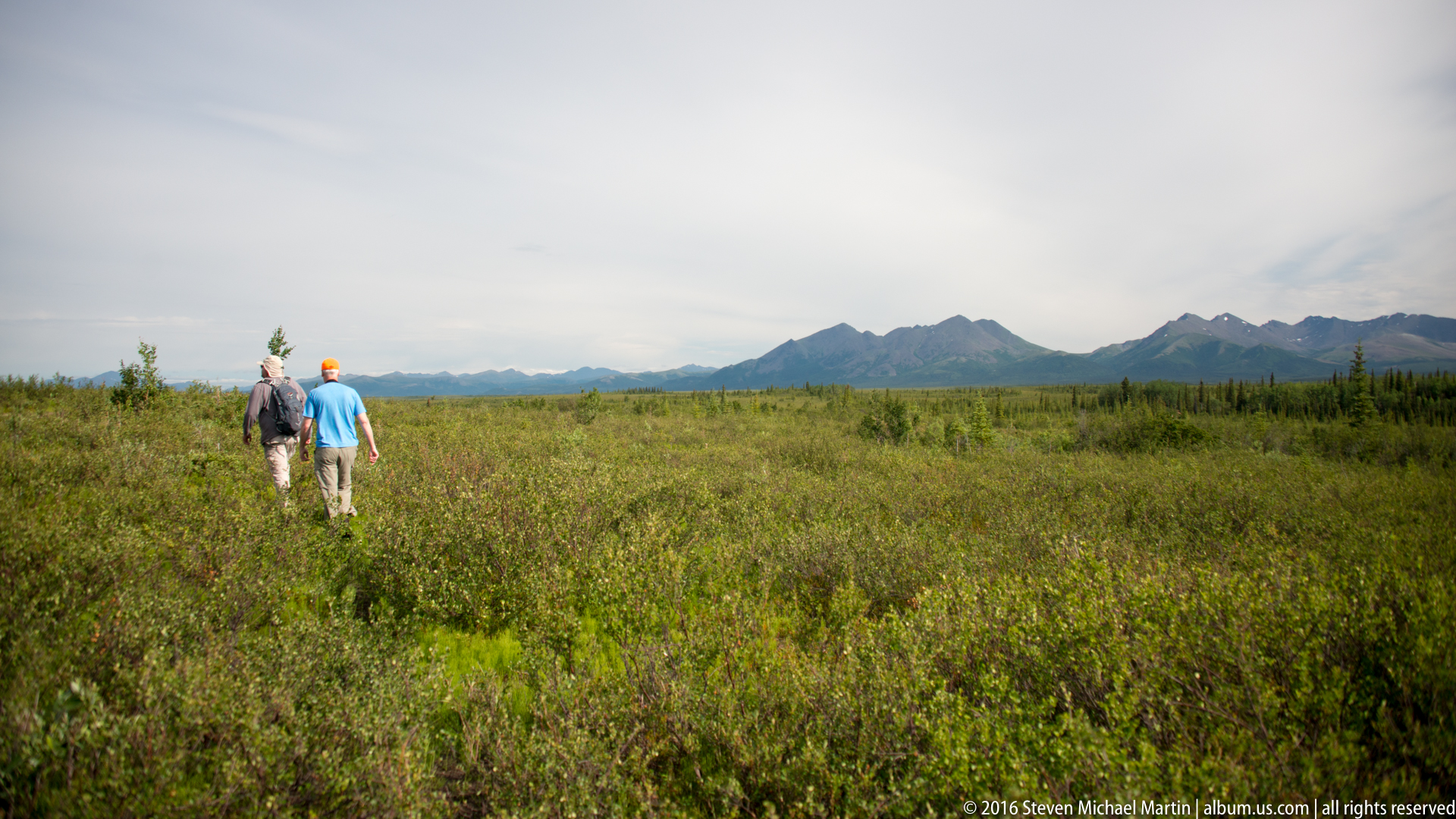
Two hikers walk away through a broad expanse of low green tundra vegetation toward a jagged mountain range. Their small figures sit left of center beneath a high, pale sky, emphasizing the scale of the open plain. The wide view places human movement within the expansive landscape rather than focusing on individual gear or facial detail.
Caption
Two hikers walk away through a broad expanse of low green tundra vegetation toward a jagged mountain range. Their small figures sit left of center beneath a high, pale sky, emphasizing the scale of the open plain. The wide view places human movement within the expansive landscape rather than focusing on individual gear or facial detail.
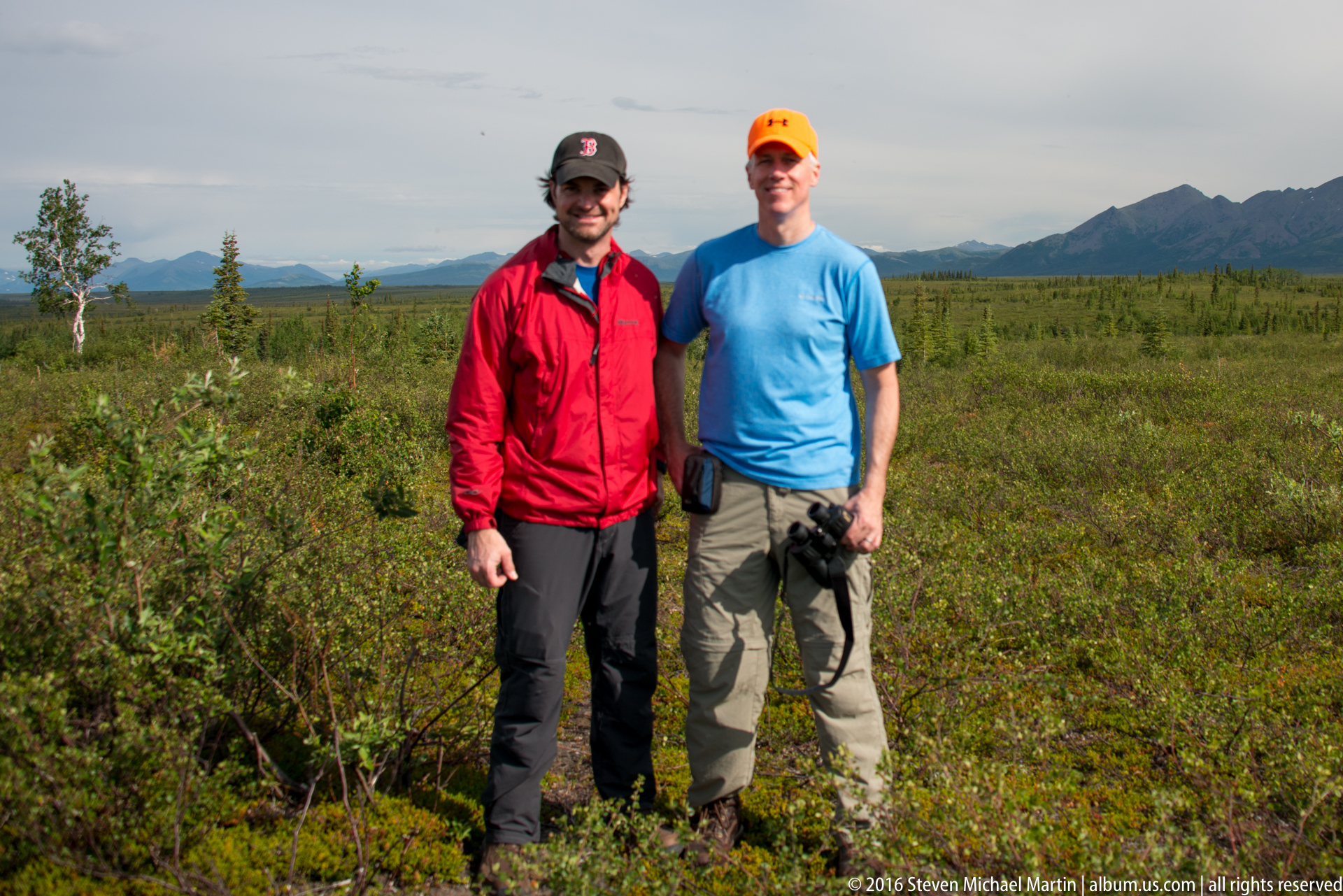
Two men stand side by side in low tundra vegetation, one wearing a red jacket and the other a blue shirt and orange cap. The open terrain and distant mountains form a simple backdrop to their portrait. Their outdoor clothing and relaxed stance suggest a pause during travel, but no personal identities are supplied.
Caption
Two men stand side by side in low tundra vegetation, one wearing a red jacket and the other a blue shirt and orange cap. The open terrain and distant mountains form a simple backdrop to their portrait. Their outdoor clothing and relaxed stance suggest a pause during travel, but no personal identities are supplied.
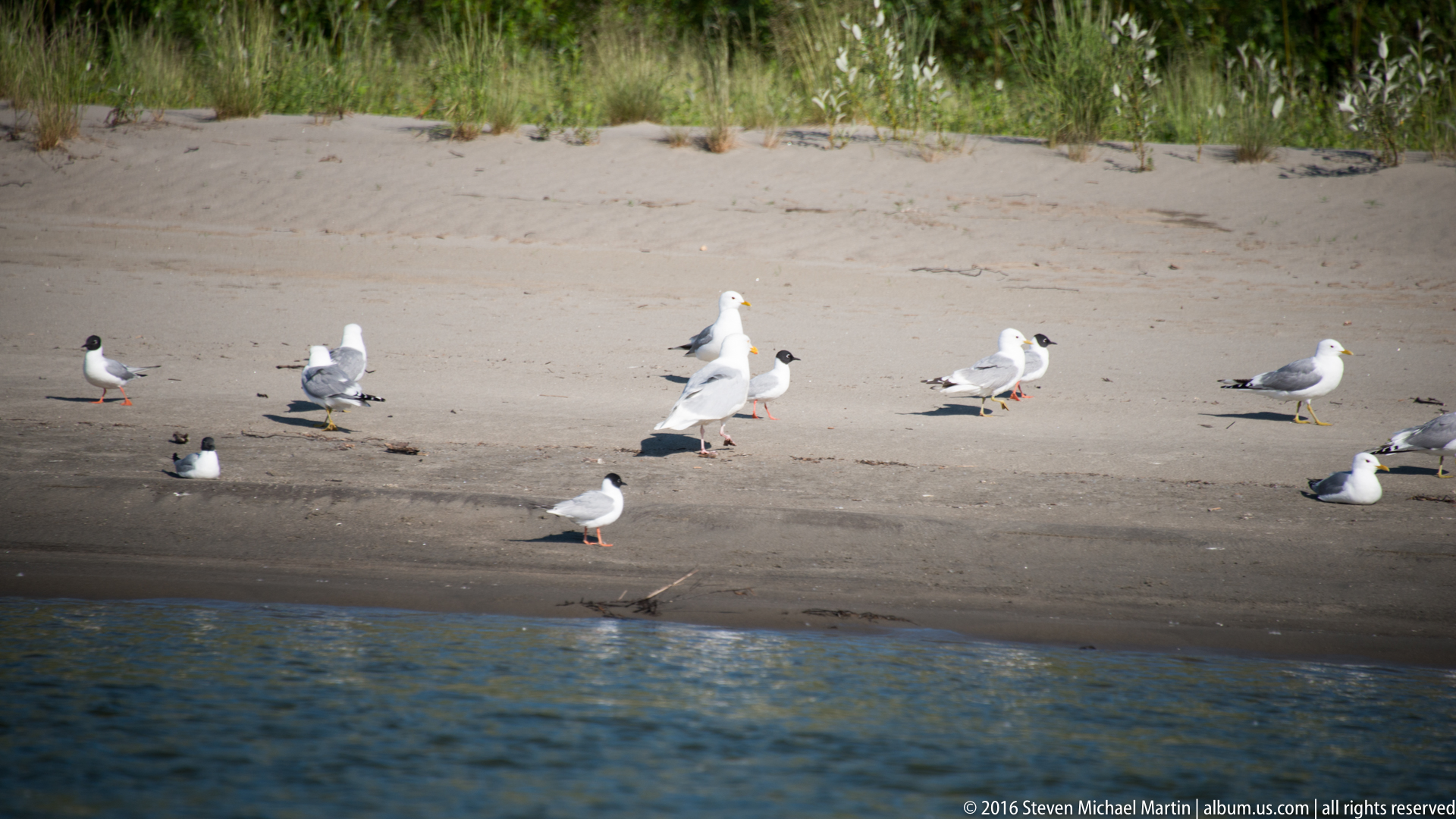
Several gulls gather on a broad sandy bank at the water’s edge. Some stand close together while others rest farther along the shore, their pale bodies and gray wings contrasting with the dark rippled water in the foreground. A strip of grasses and shrubs marks the far edge of the sand, giving the birds a clear feeding or resting margin between river and land.
Caption
Several gulls gather on a broad sandy bank at the water’s edge. Some stand close together while others rest farther along the shore, their pale bodies and gray wings contrasting with the dark rippled water in the foreground. A strip of grasses and shrubs marks the far edge of the sand, giving the birds a clear feeding or resting margin between river and land.
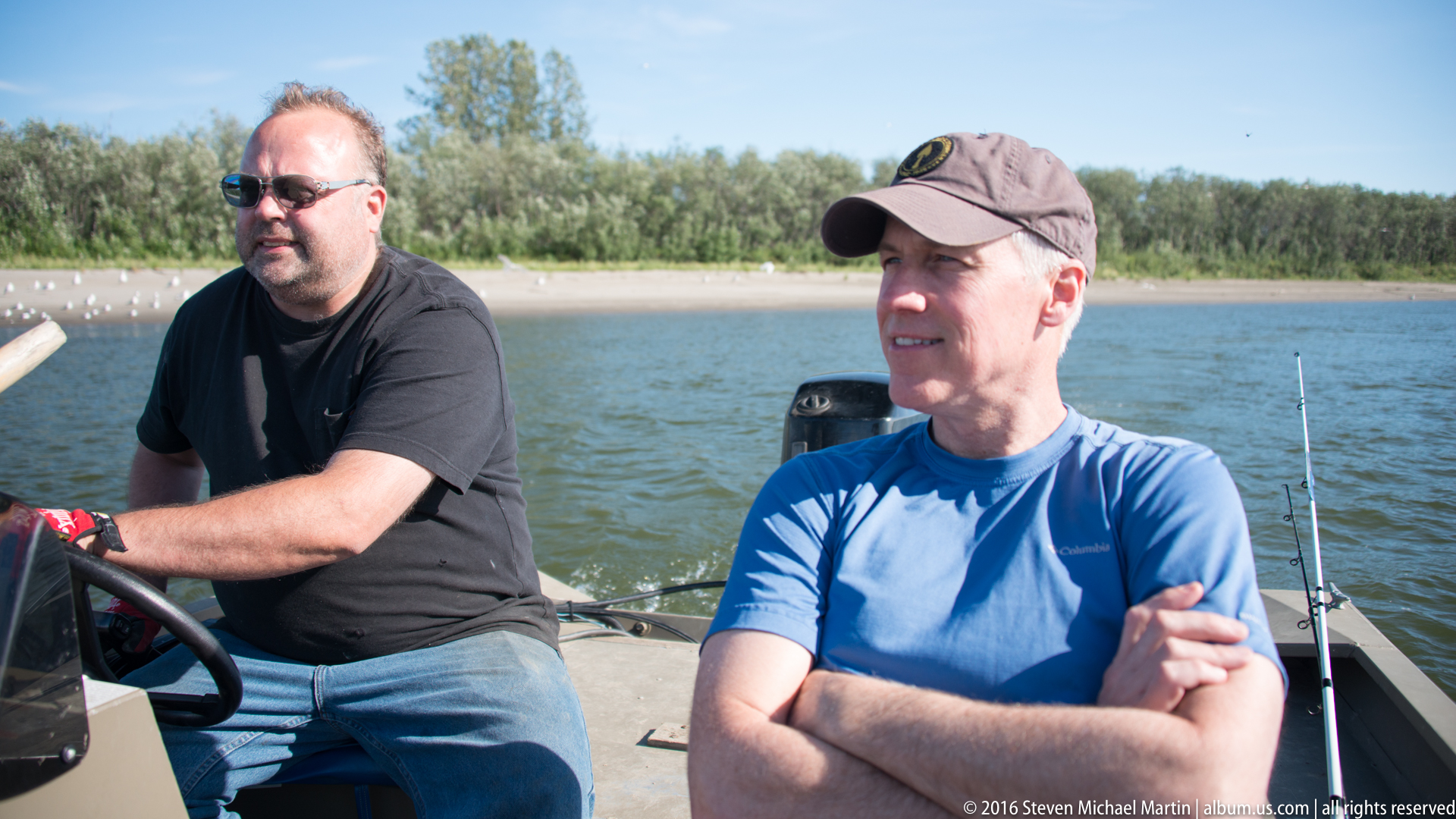
Two men sit side by side in a small motorboat on open water. A dark outboard motor and a fishing rod are visible behind them, while a sandy bank and leafy riverside trees stretch across the background. Their relaxed posture and the boat’s low position place the scene within everyday river travel, with the water and shore enclosing the frame.
Caption
Two men sit side by side in a small motorboat on open water. A dark outboard motor and a fishing rod are visible behind them, while a sandy bank and leafy riverside trees stretch across the background. Their relaxed posture and the boat’s low position place the scene within everyday river travel, with the water and shore enclosing the frame.
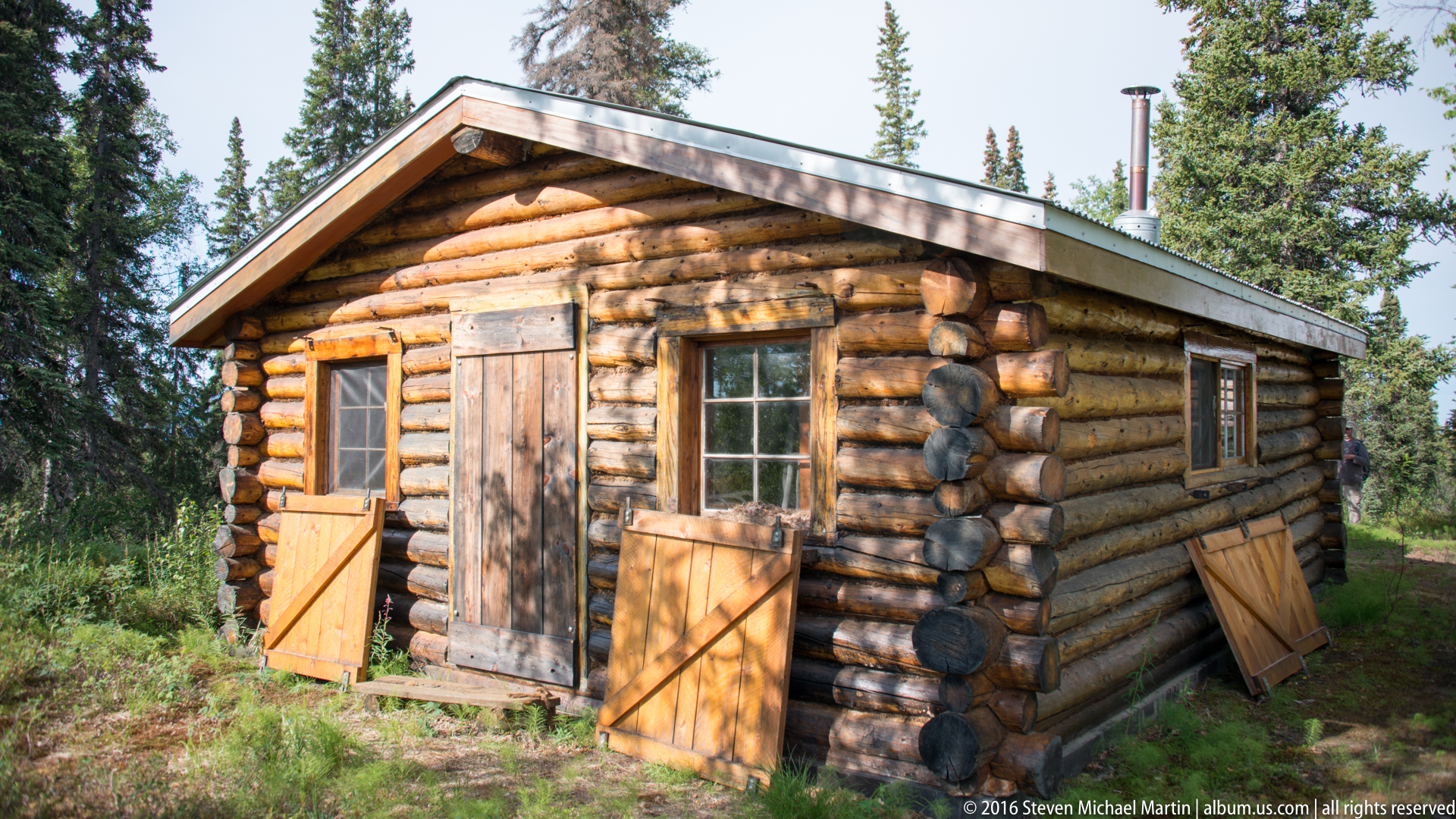
A one-room log cabin stands in a sunlit clearing, its central plank door flanked by windows with wooden shutters opened outward. A metal stovepipe rises through the sloped roof, and rounded log ends project at the corners. The angled viewpoint reveals both the front and side walls, showing the compact cabin’s construction and fittings.
Caption
A one-room log cabin stands in a sunlit clearing, its central plank door flanked by windows with wooden shutters opened outward. A metal stovepipe rises through the sloped roof, and rounded log ends project at the corners. The angled viewpoint reveals both the front and side walls, showing the compact cabin’s construction and fittings.
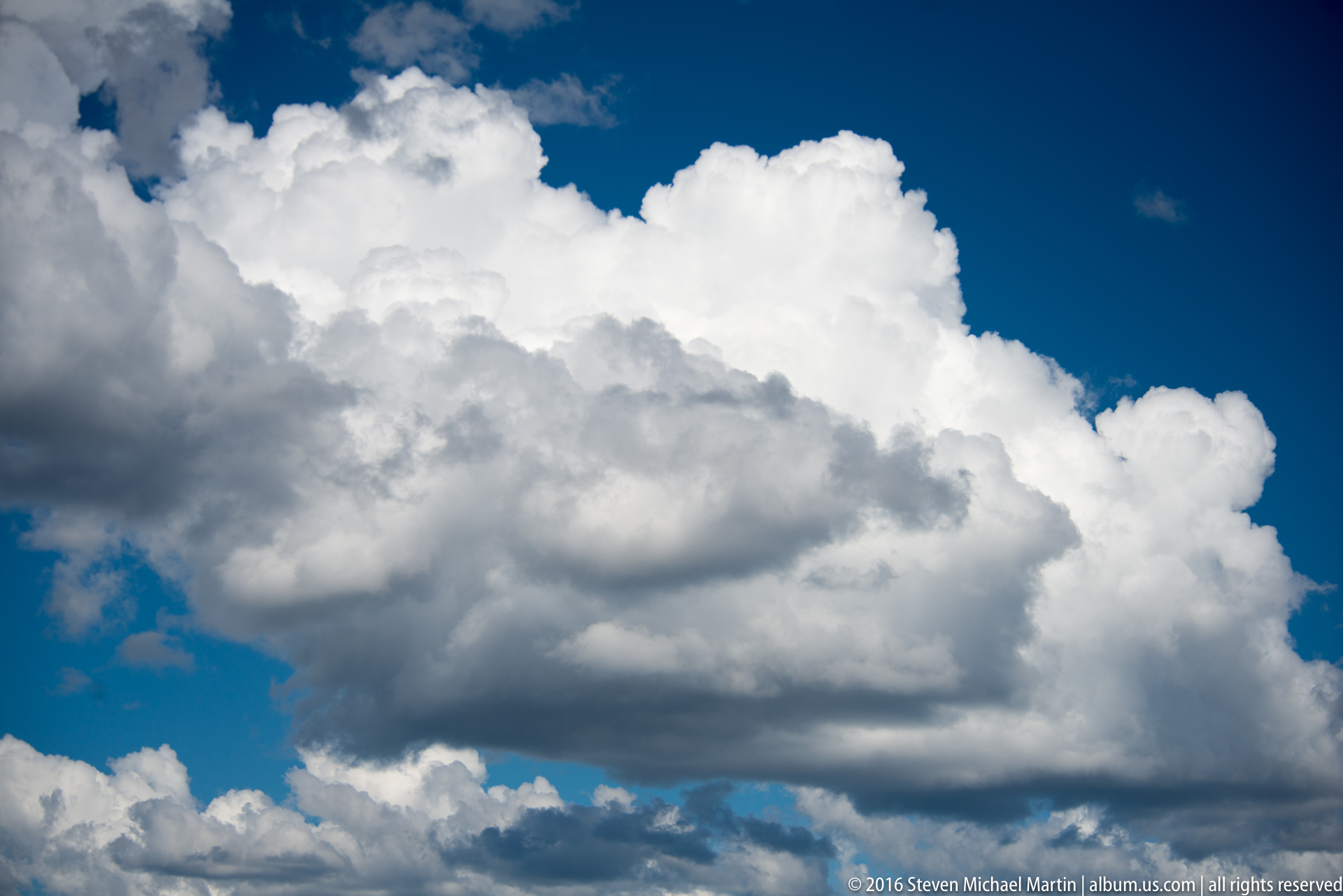
A towering white cumulus cloud swells above a deep blue sky, its sunlit lobes sharply defined against darker gray undersides. Smaller cloud forms gather near the lower edge, emphasizing the vertical scale of the central mass. With the ground excluded, this study focuses on cloud structure and changing light.
Caption
A towering white cumulus cloud swells above a deep blue sky, its sunlit lobes sharply defined against darker gray undersides. Smaller cloud forms gather near the lower edge, emphasizing the vertical scale of the central mass. With the ground excluded, this study focuses on cloud structure and changing light.
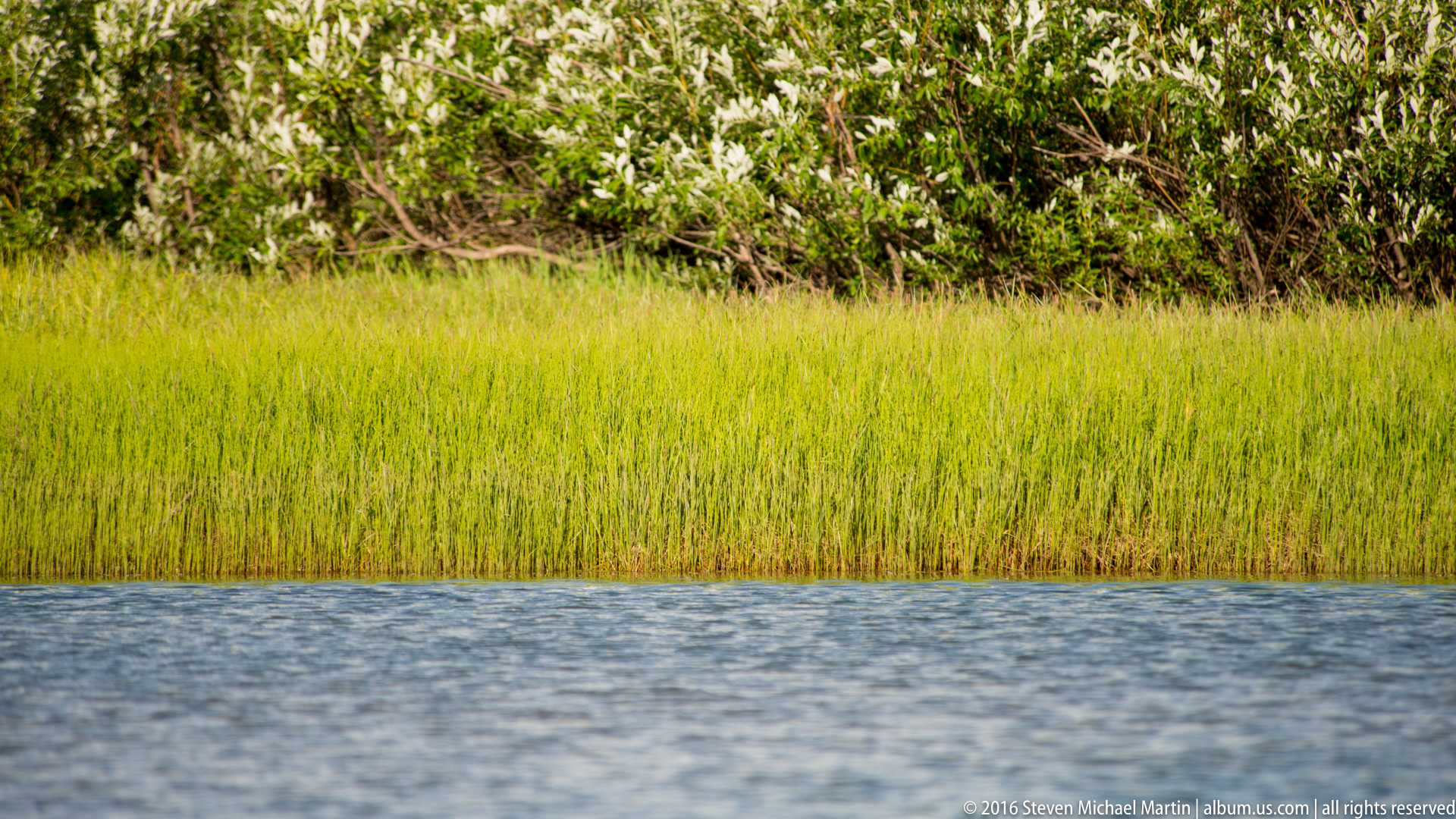
A dense band of bright green reeds rises from the water’s edge, with leafy shrubs and trees forming a deeper green backdrop. The river surface occupies the lower portion of the frame, its small ripples contrasting with the upright reed stems. The close shoreline view records a narrow transition zone between open water and thick riverside vegetation.
Caption
A dense band of bright green reeds rises from the water’s edge, with leafy shrubs and trees forming a deeper green backdrop. The river surface occupies the lower portion of the frame, its small ripples contrasting with the upright reed stems. The close shoreline view records a narrow transition zone between open water and thick riverside vegetation.
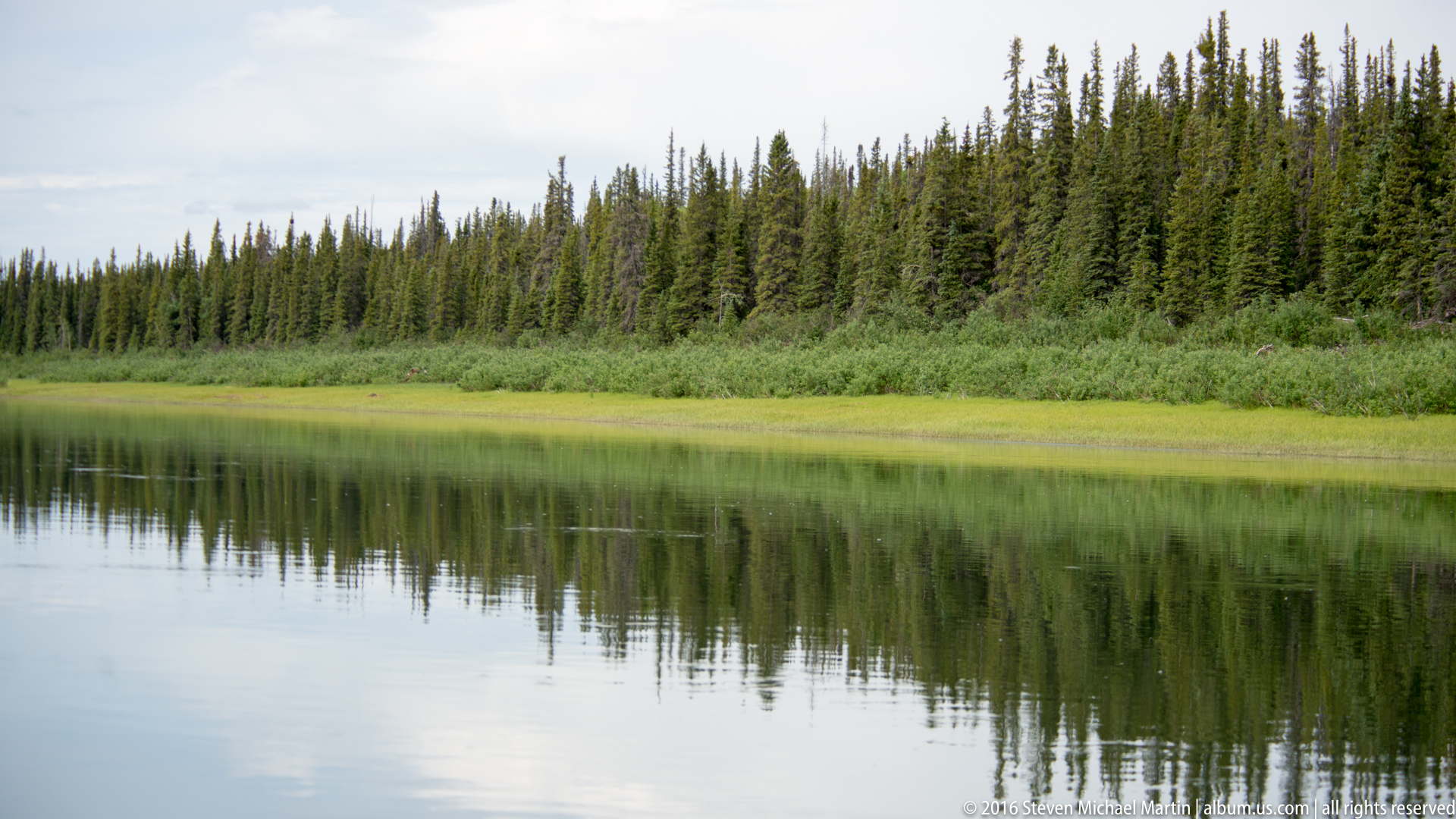
A continuous wall of conifers rises behind low riverside shrubs, with a narrow strip of bright green vegetation at the water’s edge. The forest and its reflection occupy nearly equal halves of the composition, forming a dark, nearly uninterrupted band across the river. No boats, wildlife, or people interrupt the quiet scene.
Caption
A continuous wall of conifers rises behind low riverside shrubs, with a narrow strip of bright green vegetation at the water’s edge. The forest and its reflection occupy nearly equal halves of the composition, forming a dark, nearly uninterrupted band across the river. No boats, wildlife, or people interrupt the quiet scene.
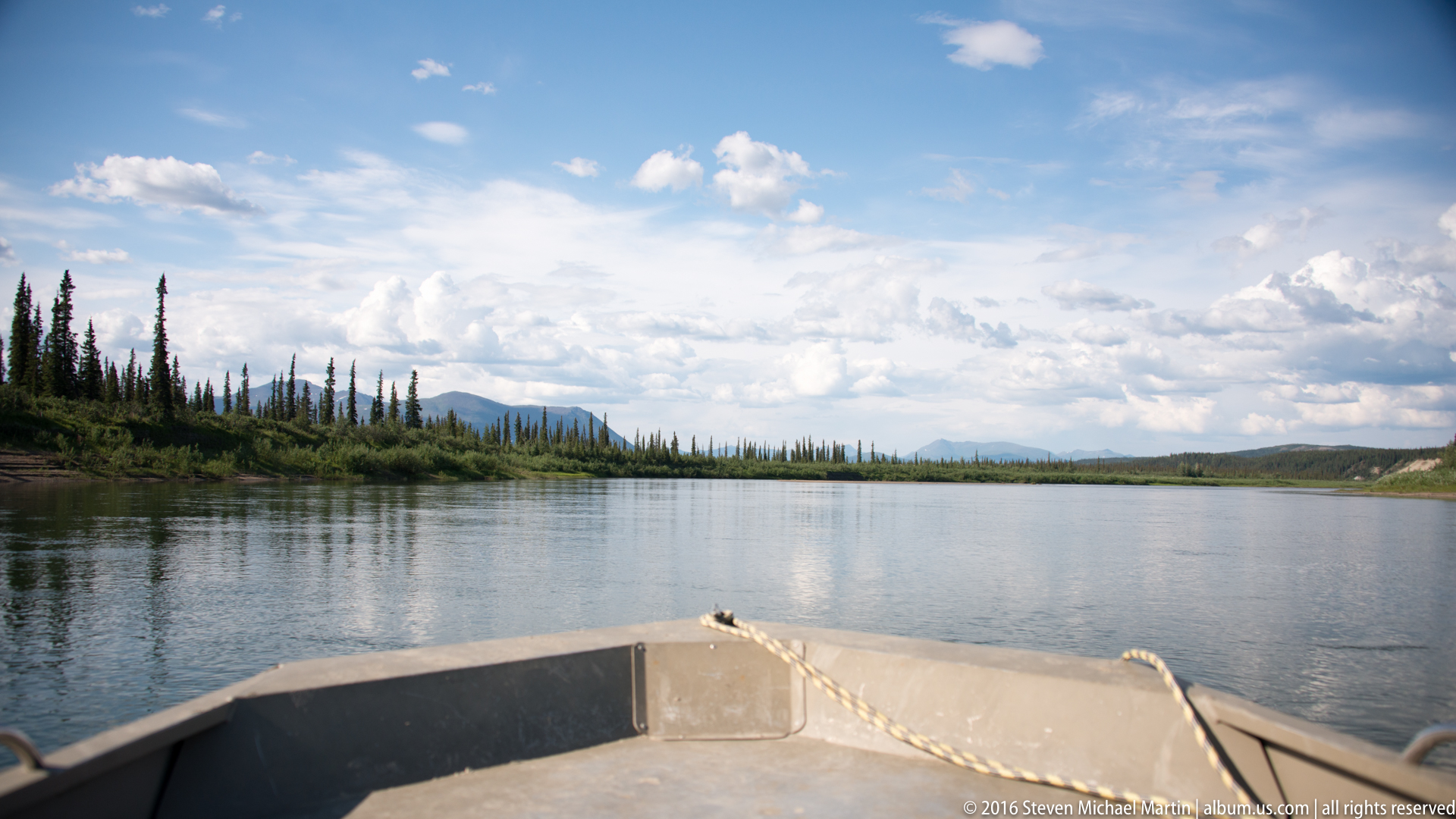
The blunt, pointed bow of a small boat occupies the lower foreground, directing the view across a broad river toward a low wooded shore. A rope is coiled near the bow, and the water reflects the pale sky in broken streaks. The onboard perspective places the viewer at the start of a river passage rather than on the bank.
Caption
The blunt, pointed bow of a small boat occupies the lower foreground, directing the view across a broad river toward a low wooded shore. A rope is coiled near the bow, and the water reflects the pale sky in broken streaks. The onboard perspective places the viewer at the start of a river passage rather than on the bank.
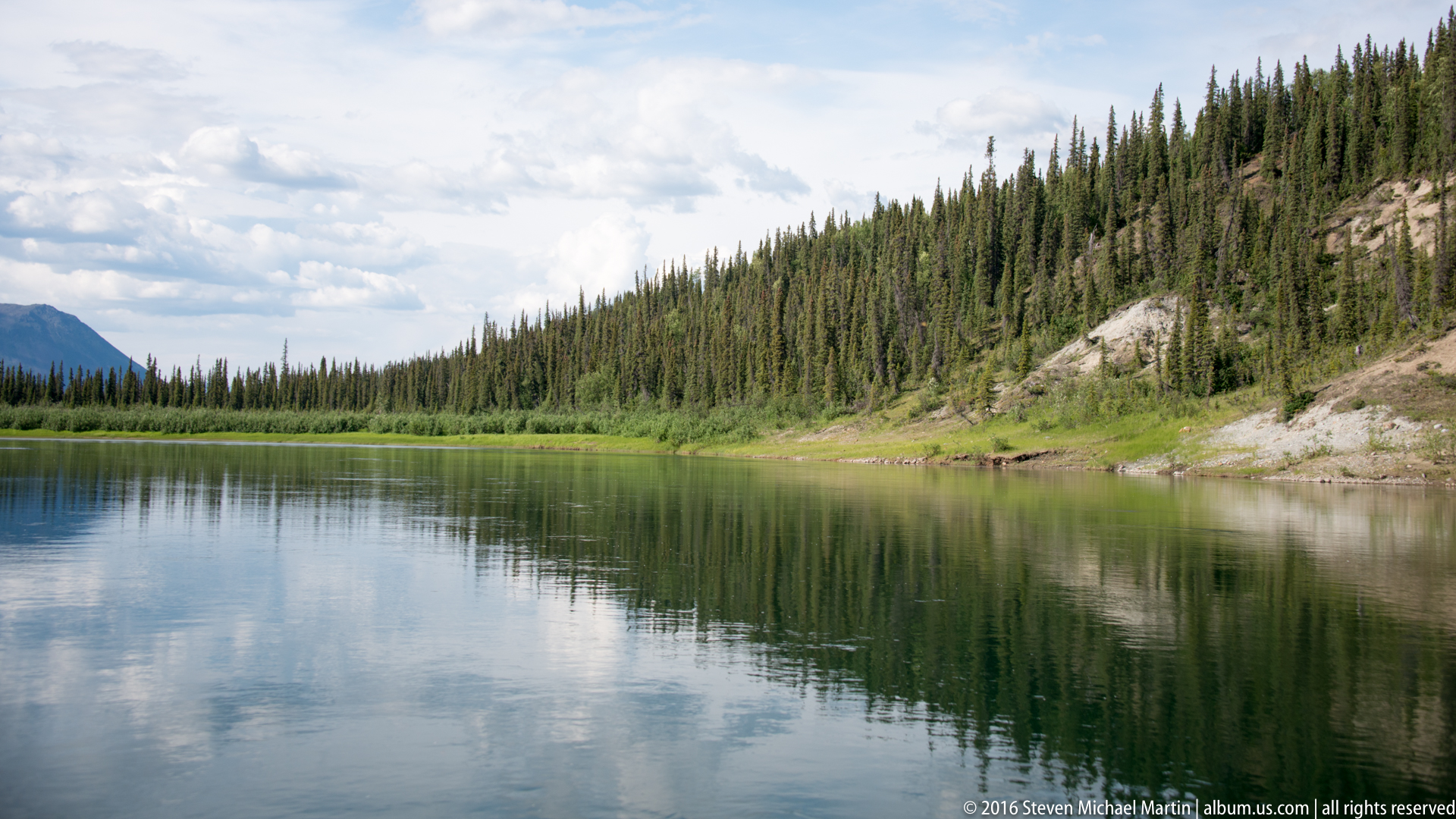
A steep bank lined with spruce rises from the river, its green slope and pale sandy edge repeated in the calm water below. The shore curves gently into the distance, where low clouds soften the mountain horizon. This view balances the wooded slope above with its reflection beneath, creating a quiet horizontal study of riverbank and water.
Caption
A steep bank lined with spruce rises from the river, its green slope and pale sandy edge repeated in the calm water below. The shore curves gently into the distance, where low clouds soften the mountain horizon. This view balances the wooded slope above with its reflection beneath, creating a quiet horizontal study of riverbank and water.
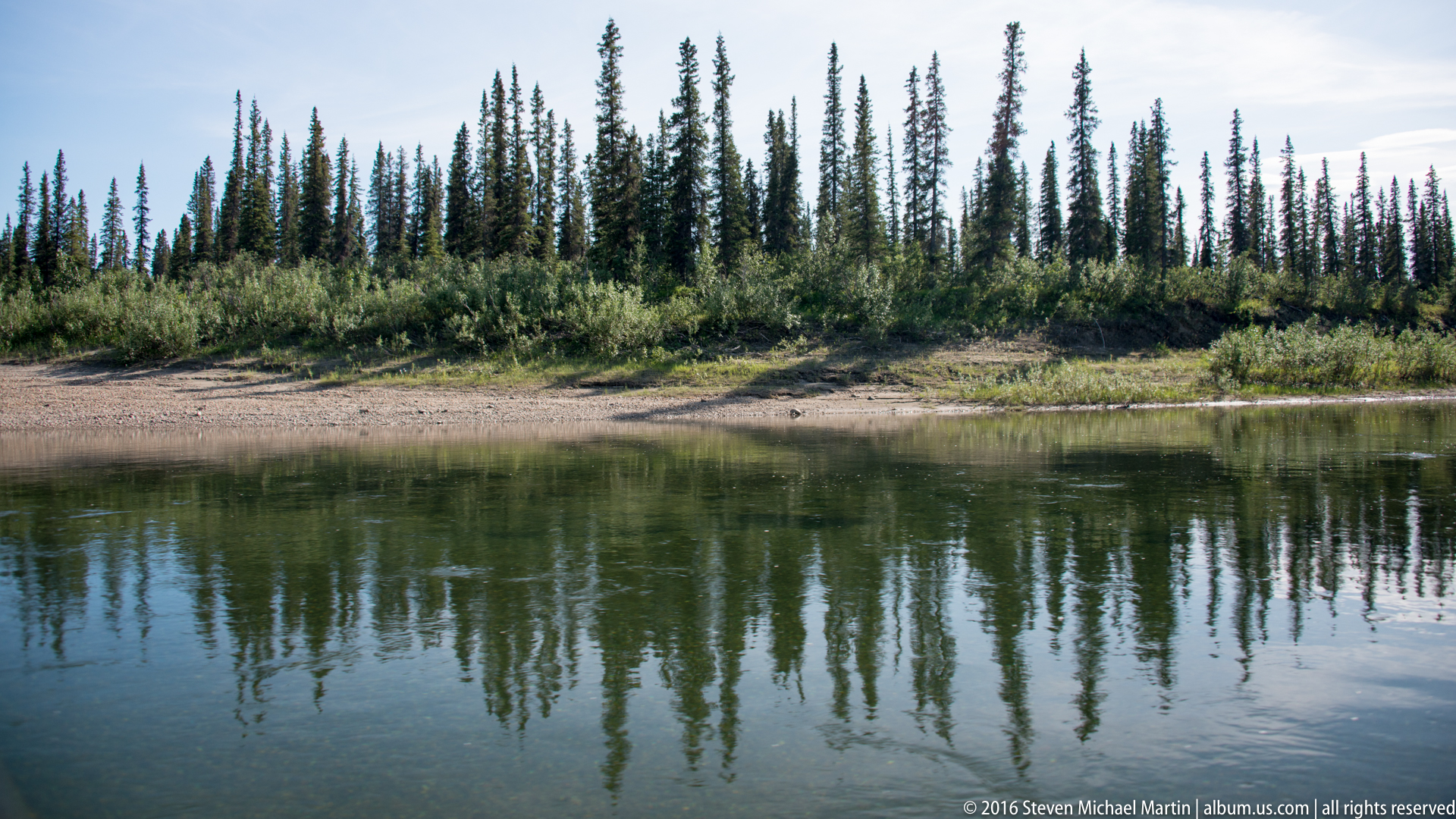
A row of tall, slender spruce trees stands along a low sandy bank, mirrored in the green-brown river. Their dark vertical forms contrast with the thin bright shoreline and the muted reflection beneath. The composition avoids the mountains and open sky of nearby views, concentrating instead on the repeated tree trunks and their quiet symmetry in the water.
Caption
A row of tall, slender spruce trees stands along a low sandy bank, mirrored in the green-brown river. Their dark vertical forms contrast with the thin bright shoreline and the muted reflection beneath. The composition avoids the mountains and open sky of nearby views, concentrating instead on the repeated tree trunks and their quiet symmetry in the water.
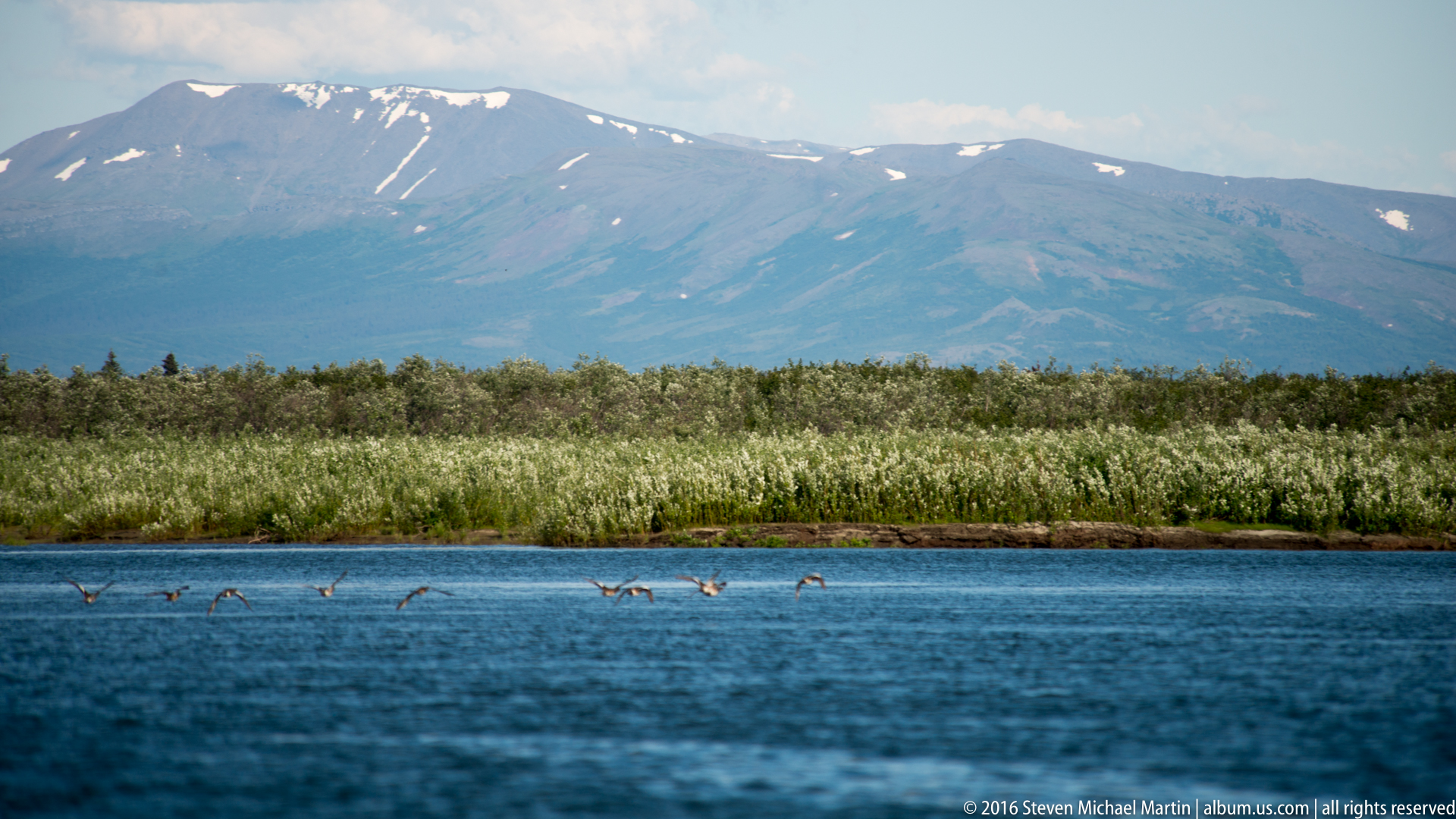
Several animals move in a line through deep blue water, with only their heads and upper backs visible above the surface. Their spacing and direction suggest a river crossing; a pale band of shrubs lines the opposite shore, and a mountain range rises behind it. The distant scale makes individual features difficult to inspect, so the identification remains cautious.
Caption
Several animals move in a line through deep blue water, with only their heads and upper backs visible above the surface. Their spacing and direction suggest a river crossing; a pale band of shrubs lines the opposite shore, and a mountain range rises behind it. The distant scale makes individual features difficult to inspect, so the identification remains cautious.
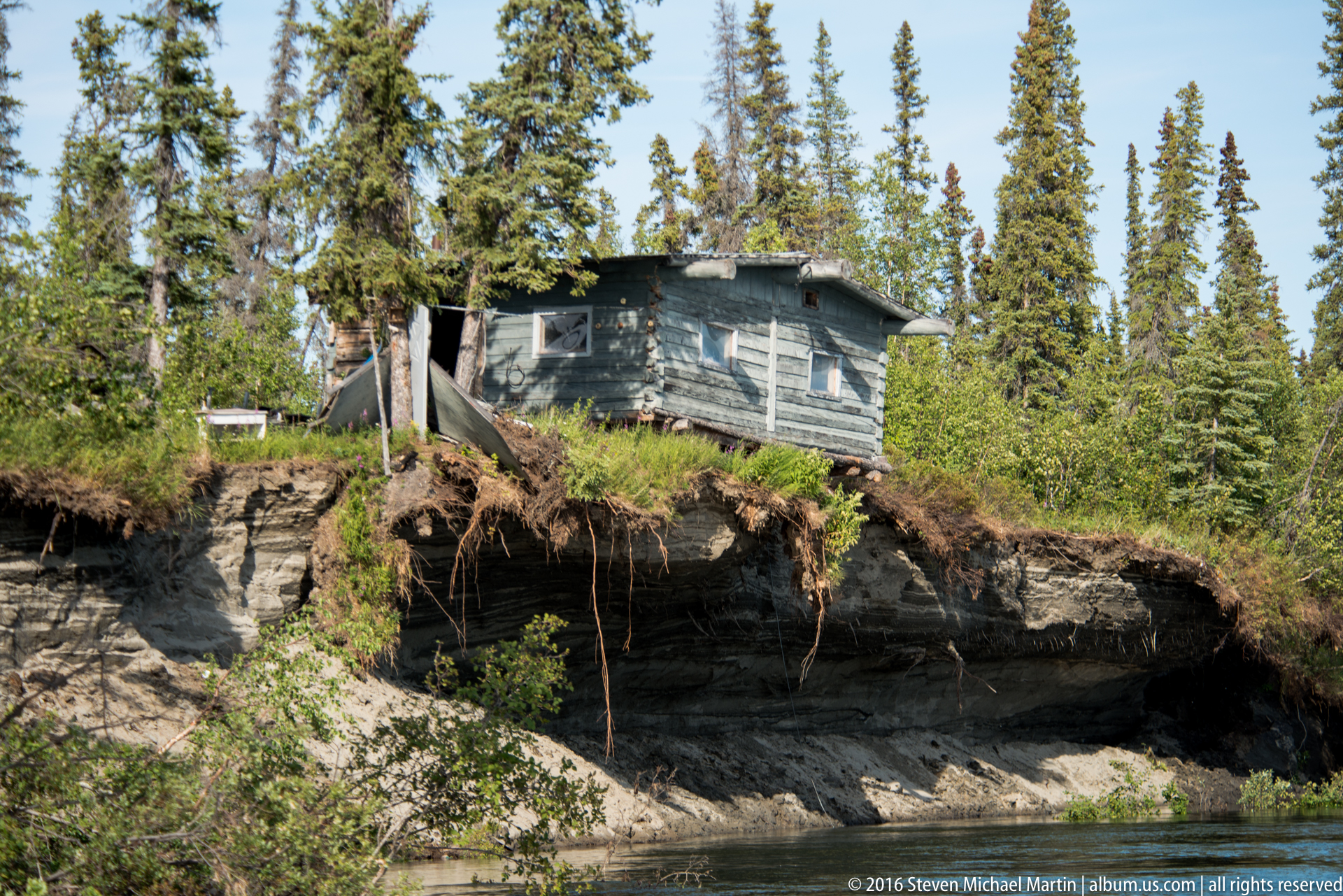
A weathered wooden house sits close to the edge of a steep bank where layers of pale soil are exposed above the river. Roots hang from the cut face beneath the building, and spruce trees stand behind it. The view draws attention to the relationship between settlement and an actively shaped river margin, without establishing when or how the bank eroded.
Caption
A weathered wooden house sits close to the edge of a steep bank where layers of pale soil are exposed above the river. Roots hang from the cut face beneath the building, and spruce trees stand behind it. The view draws attention to the relationship between settlement and an actively shaped river margin, without establishing when or how the bank eroded.
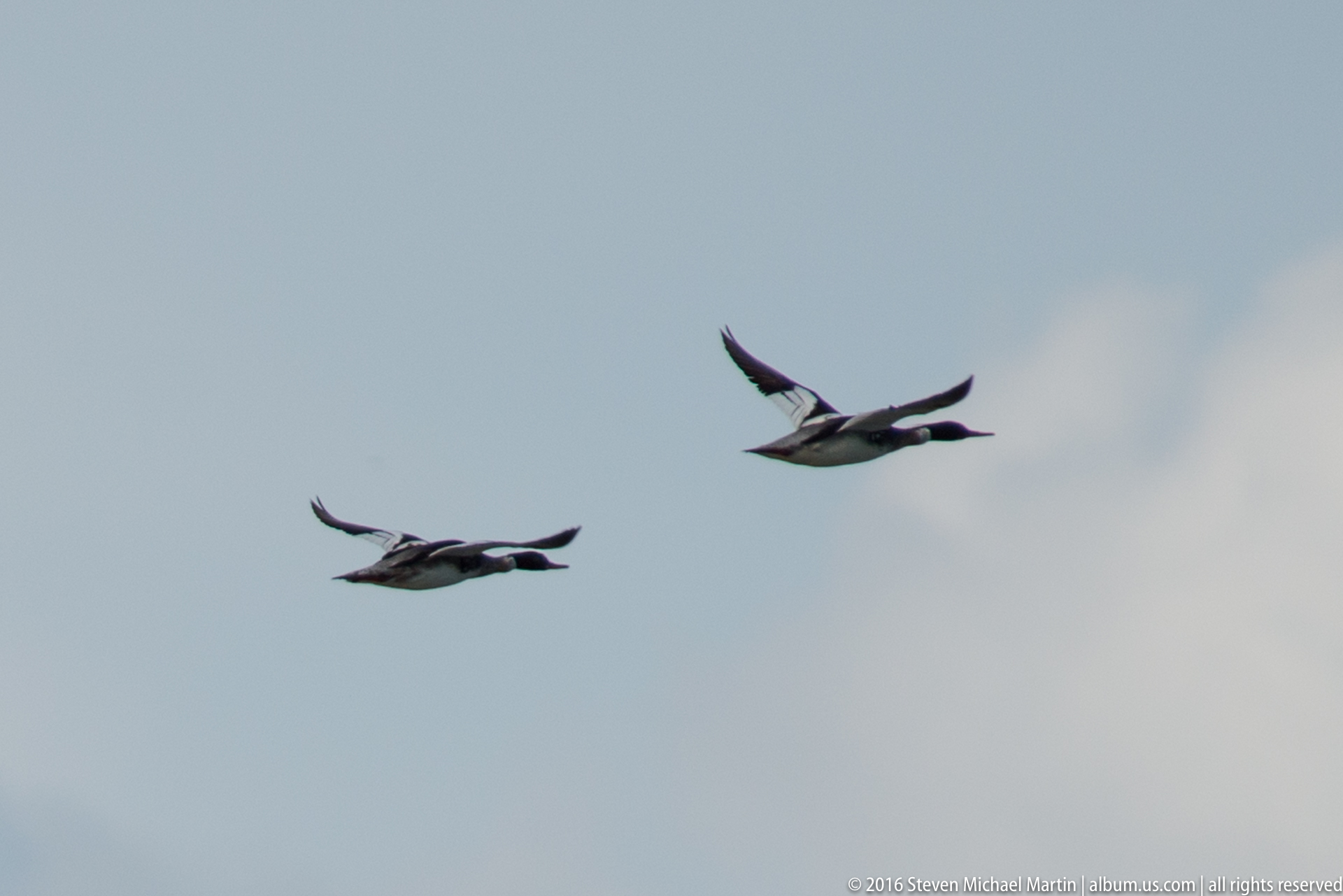
Two dark birds fly through an open gray-blue sky, one slightly ahead of the other. Their wings are extended at different points in the beat, creating a clear sense of motion against the otherwise empty background. The distant silhouettes do not reveal enough detail for a reliable species identification, so the scene is best described as a brief passage of waterfowl in flight.
Caption
Two dark birds fly through an open gray-blue sky, one slightly ahead of the other. Their wings are extended at different points in the beat, creating a clear sense of motion against the otherwise empty background. The distant silhouettes do not reveal enough detail for a reliable species identification, so the scene is best described as a brief passage of waterfowl in flight.
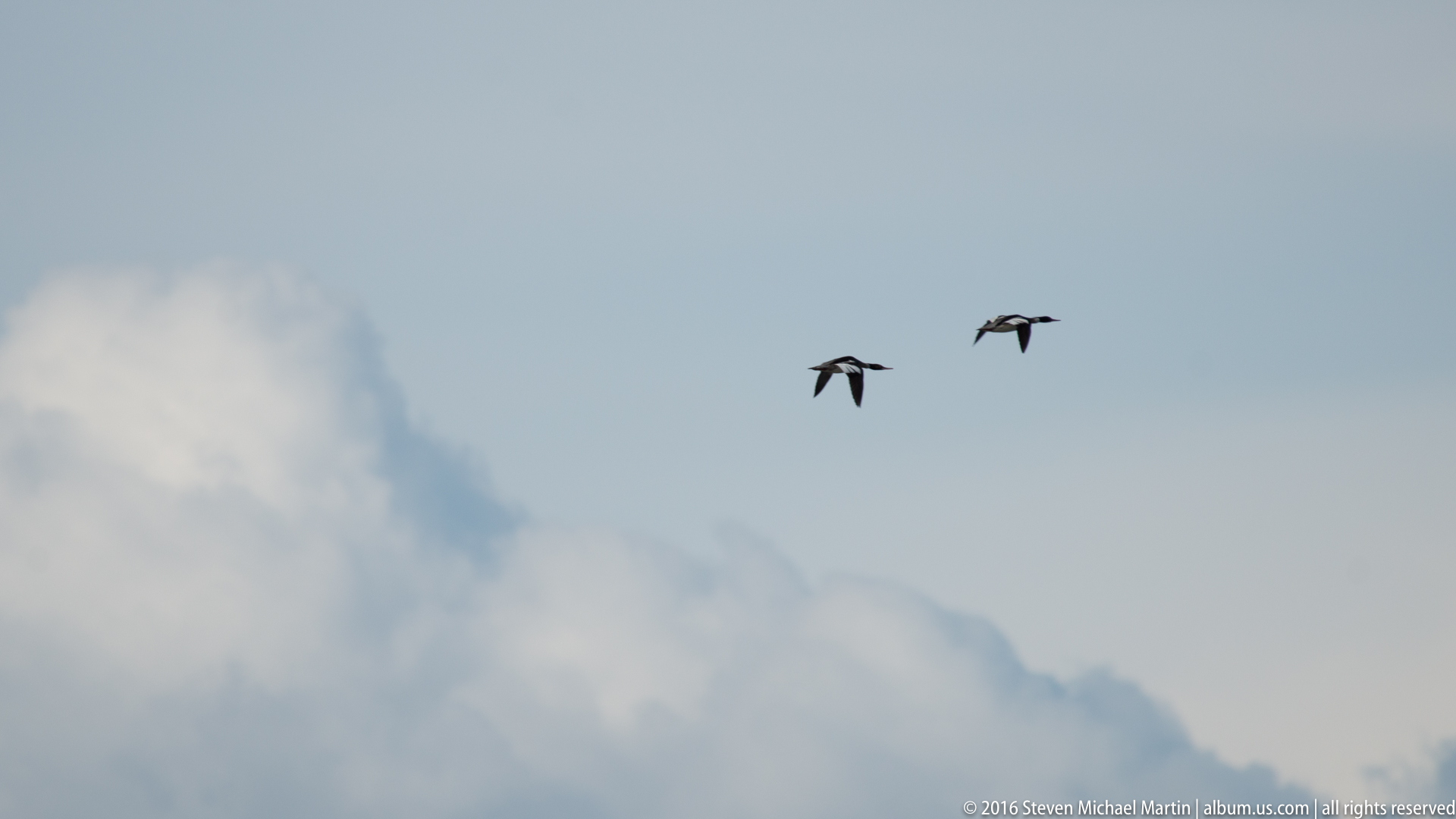
Two small birds fly across a pale sky, their silhouettes separated against a large soft-edged cloud bank. The sparse composition emphasizes their flight path and the open air rather than any identifiable habitat below. At this distance, plumage and body shape are not clear enough to name the birds beyond a general description.
Caption
Two small birds fly across a pale sky, their silhouettes separated against a large soft-edged cloud bank. The sparse composition emphasizes their flight path and the open air rather than any identifiable habitat below. At this distance, plumage and body shape are not clear enough to name the birds beyond a general description.
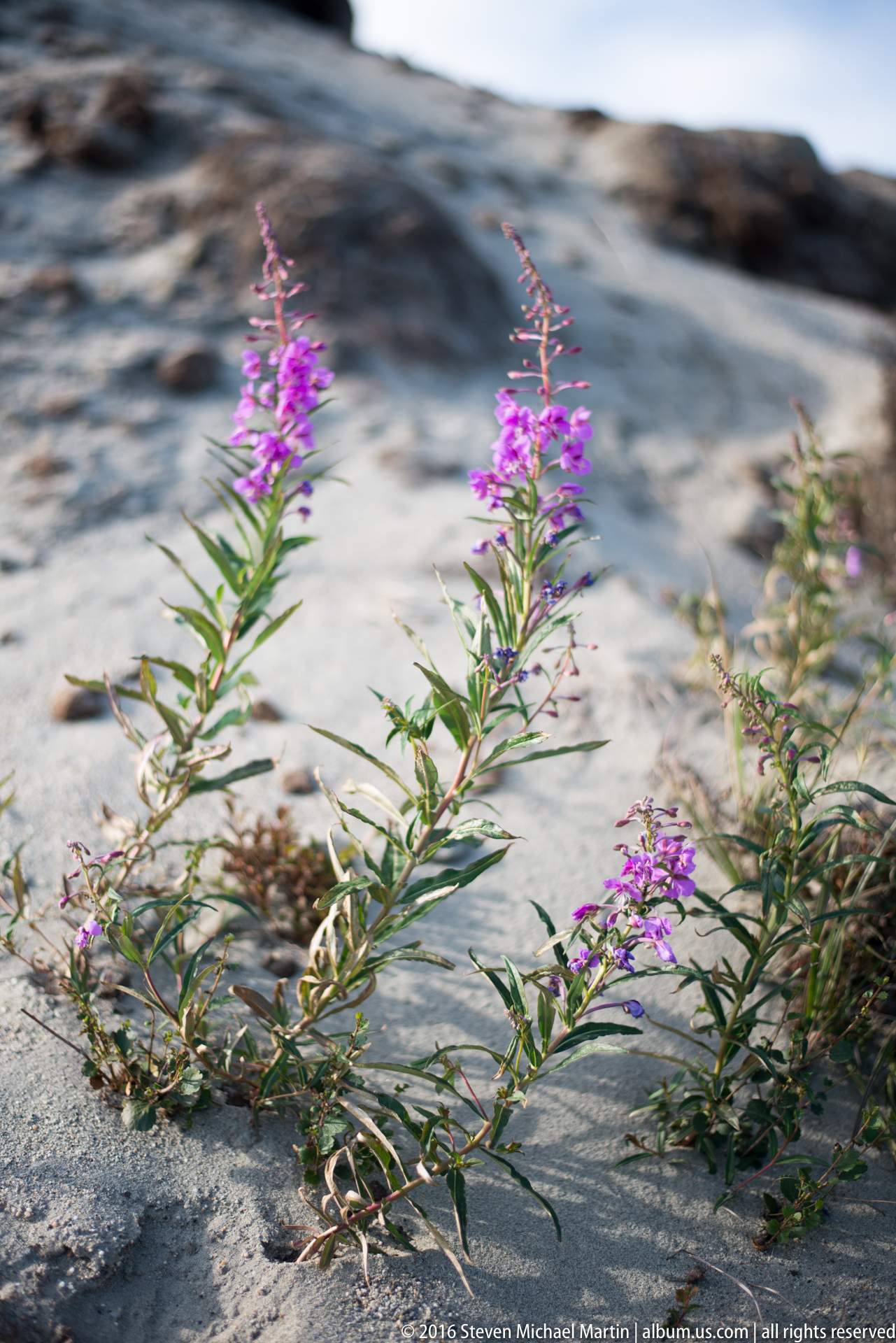
Several fireweed stalks rise from a pale sandy bank, their narrow leaves and vivid pink-purple flower spikes standing out against the muted ground. A dark rock slope blurs into the background, while a few fallen branches lie near the plants. The composition isolates a patch of riverbank vegetation, showing flowers taking root in the exposed sandy margin.
Caption
Several fireweed stalks rise from a pale sandy bank, their narrow leaves and vivid pink-purple flower spikes standing out against the muted ground. A dark rock slope blurs into the background, while a few fallen branches lie near the plants. The composition isolates a patch of riverbank vegetation, showing flowers taking root in the exposed sandy margin.
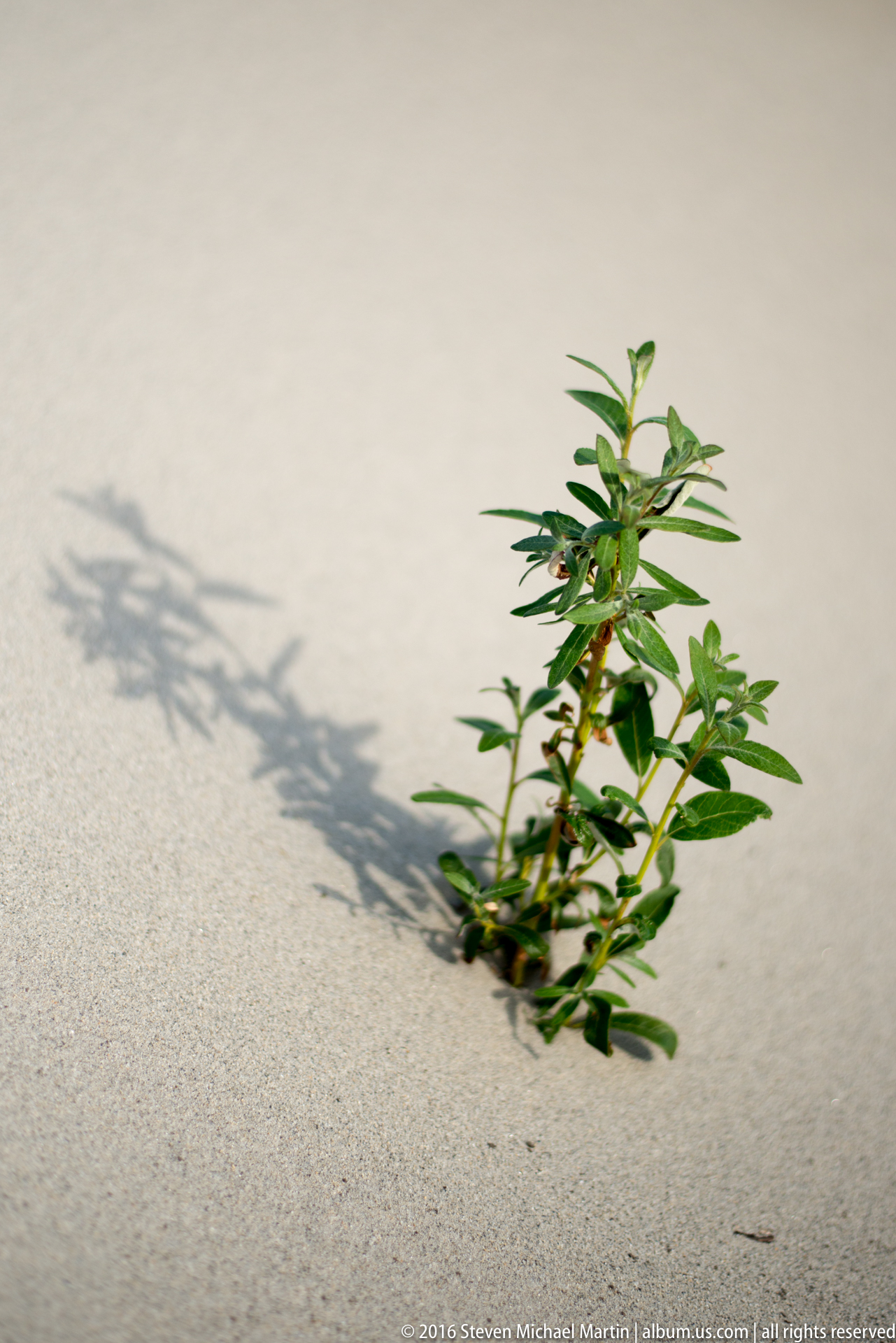
A small green plant rises alone from loose pale sand, its narrow leaves and several upright stems casting a long shadow across the open surface. The isolated growth contrasts with the nearly bare bank around it and shows vegetation establishing itself on exposed sediment. The plant’s overall form is visible, but the proof image does not support a confident species identification.
Caption
A small green plant rises alone from loose pale sand, its narrow leaves and several upright stems casting a long shadow across the open surface. The isolated growth contrasts with the nearly bare bank around it and shows vegetation establishing itself on exposed sediment. The plant’s overall form is visible, but the proof image does not support a confident species identification.
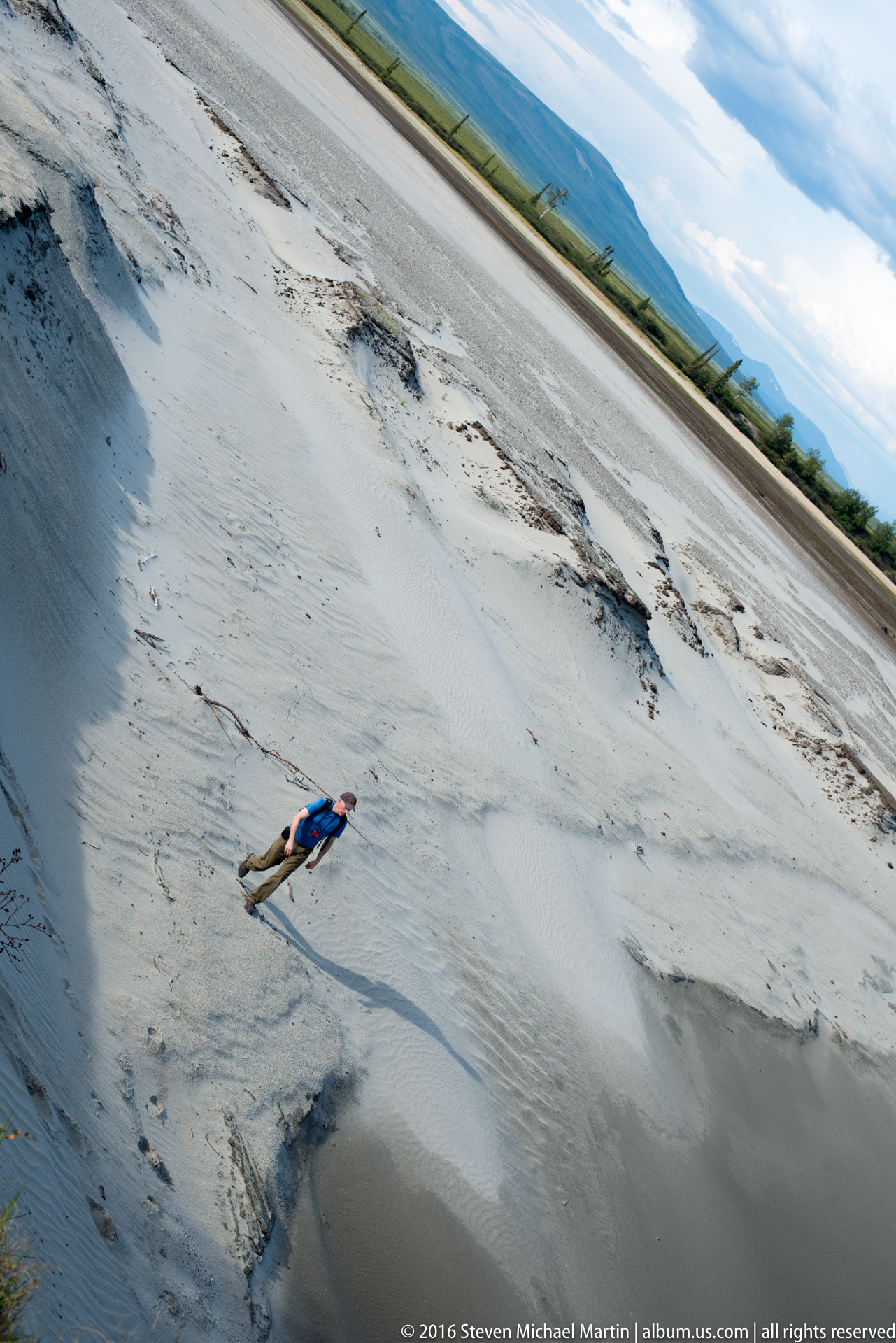
A person in blue and red clothing moves across the pale sand, appearing small against the broad, sloping bank. The frame is deliberately tilted, so the distant tree line cuts diagonally across the top and the sand fills most of the composition. The figure’s position and shadow give the open surface scale, while the precise action is difficult to determine from the distant view.
Caption
A person in blue and red clothing moves across the pale sand, appearing small against the broad, sloping bank. The frame is deliberately tilted, so the distant tree line cuts diagonally across the top and the sand fills most of the composition. The figure’s position and shadow give the open surface scale, while the precise action is difficult to determine from the distant view.
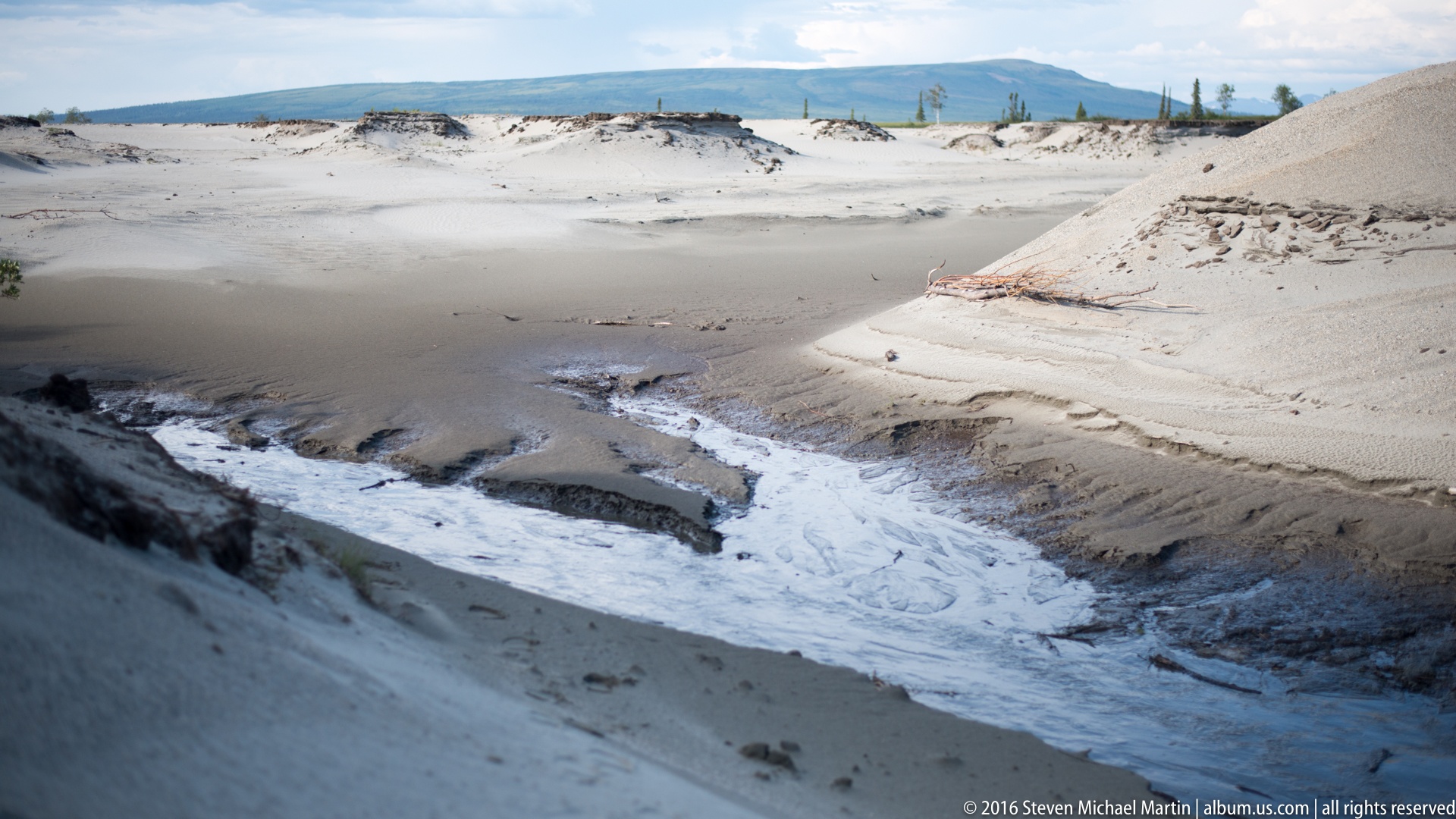
A narrow stream spills through a pale sandy cut, its white surface churning where it meets darker water below. Steep banks rise on either side, exposing loose sand and small ledges. The scene records a concentrated point of drainage through the river margin, where moving water is actively shaping the sand, though the duration or cause of the flow is not visible.
Caption
A narrow stream spills through a pale sandy cut, its white surface churning where it meets darker water below. Steep banks rise on either side, exposing loose sand and small ledges. The scene records a concentrated point of drainage through the river margin, where moving water is actively shaping the sand, though the duration or cause of the flow is not visible.
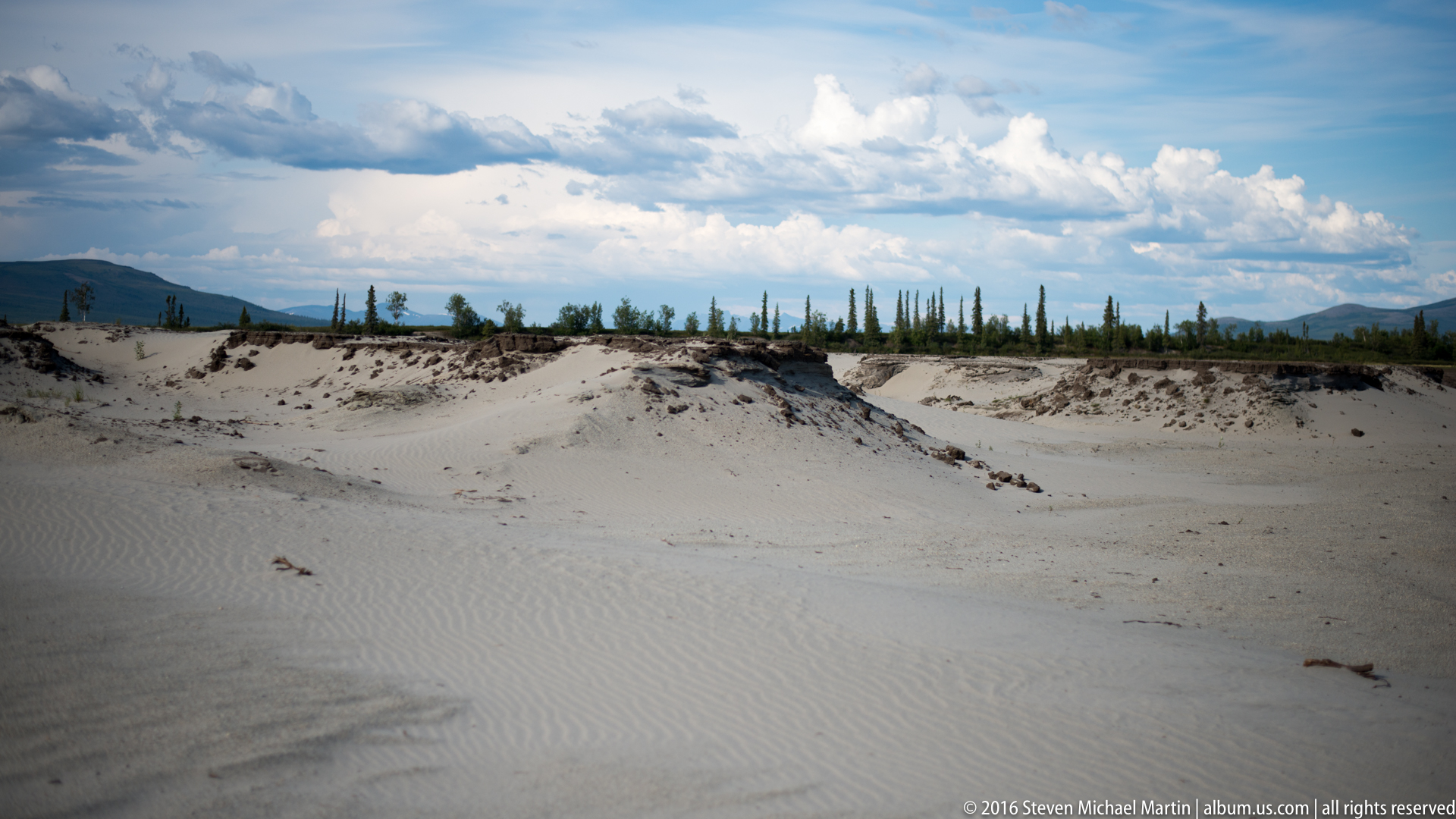
Broad pale sand rises into low dunes marked by fine wind ripples. A dark line of spruce and low mountains separates the sand from the sky, while a large cloud bank adds depth behind the landscape. The open view shows the exposed sandy area as a distinct landform within a forested river corridor, without implying a specific origin for the dunes.
Caption
Broad pale sand rises into low dunes marked by fine wind ripples. A dark line of spruce and low mountains separates the sand from the sky, while a large cloud bank adds depth behind the landscape. The open view shows the exposed sandy area as a distinct landform within a forested river corridor, without implying a specific origin for the dunes.
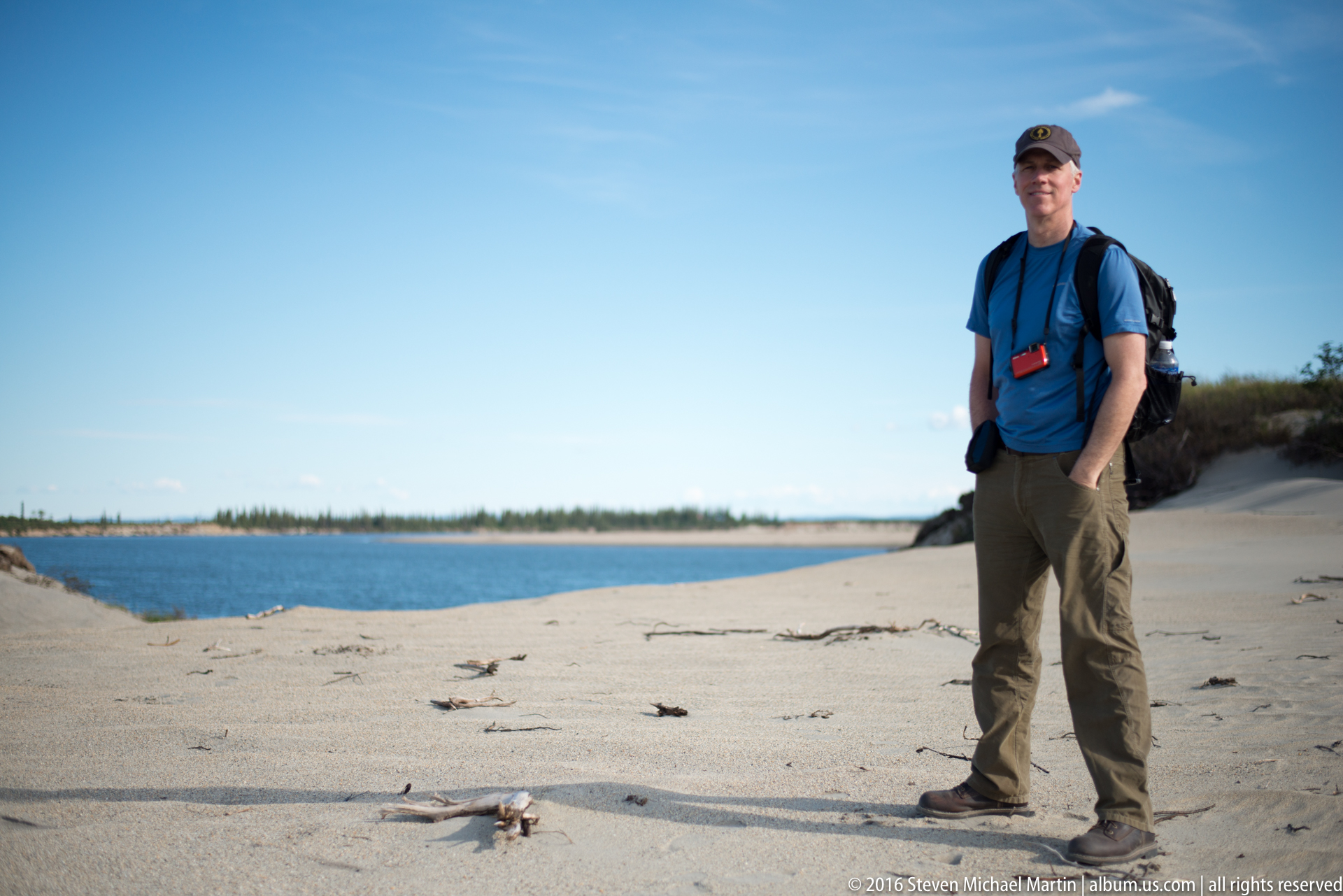
A man wearing a blue shirt and backpack stands on the sandy riverbank beside a stretch of blue water. His small red camera hangs at his chest, and a few pieces of driftwood lie across the foreground. The wide framing gives the person a modest scale against the open shoreline, while the bright sky and low far bank keep attention on the landscape around him.
Caption
A man wearing a blue shirt and backpack stands on the sandy riverbank beside a stretch of blue water. His small red camera hangs at his chest, and a few pieces of driftwood lie across the foreground. The wide framing gives the person a modest scale against the open shoreline, while the bright sky and low far bank keep attention on the landscape around him.
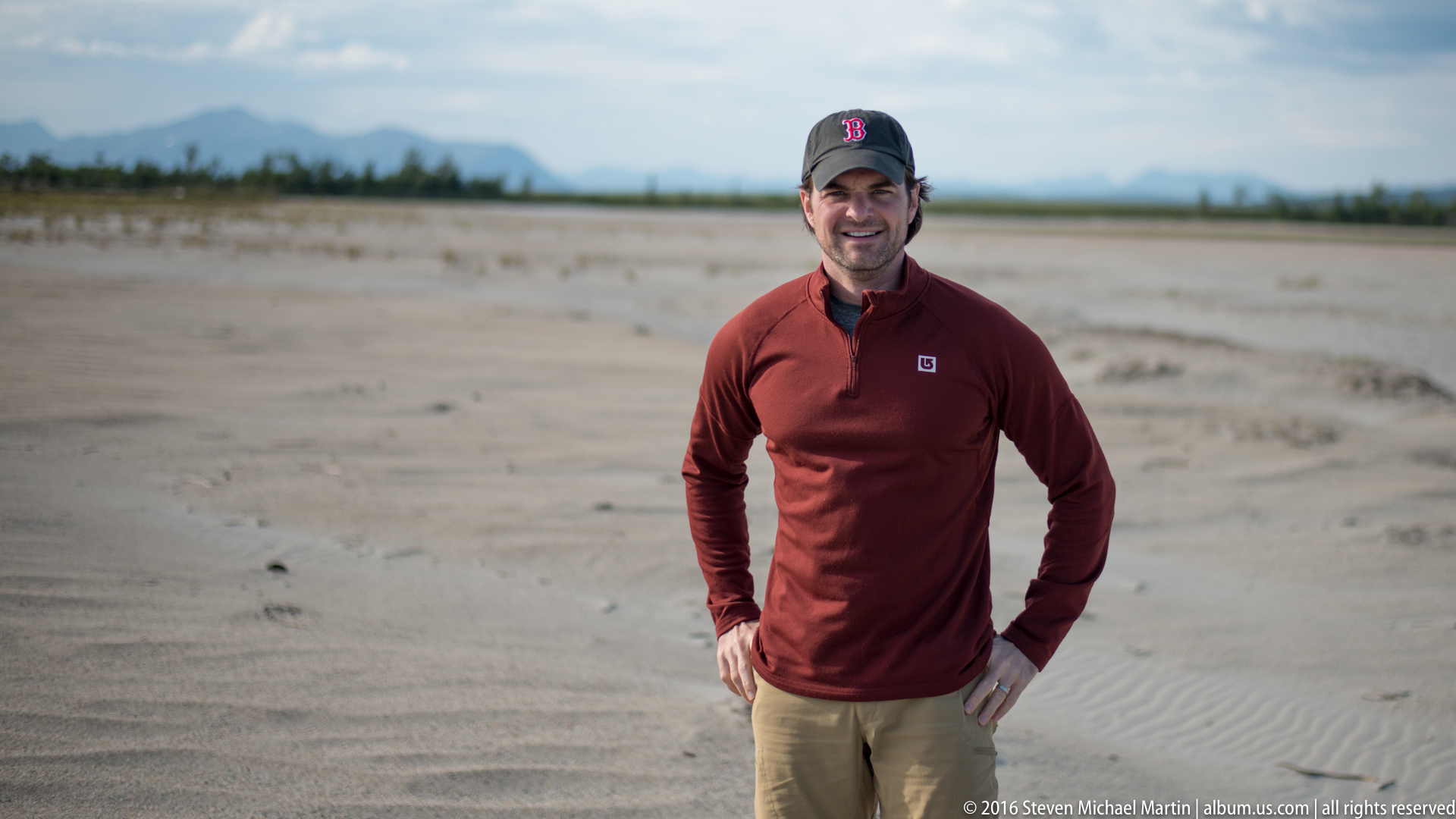
A man in a red long-sleeved shirt and dark cap stands alone on an open sand flat, with his hands at his waist. The pale ground and low distant tree line leave little visual clutter around him, making his clothing the strongest color in the scene. This portrait places a visitor within the expansive sandy landscape without adding an unsupported activity or identity.
Caption
A man in a red long-sleeved shirt and dark cap stands alone on an open sand flat, with his hands at his waist. The pale ground and low distant tree line leave little visual clutter around him, making his clothing the strongest color in the scene. This portrait places a visitor within the expansive sandy landscape without adding an unsupported activity or identity.
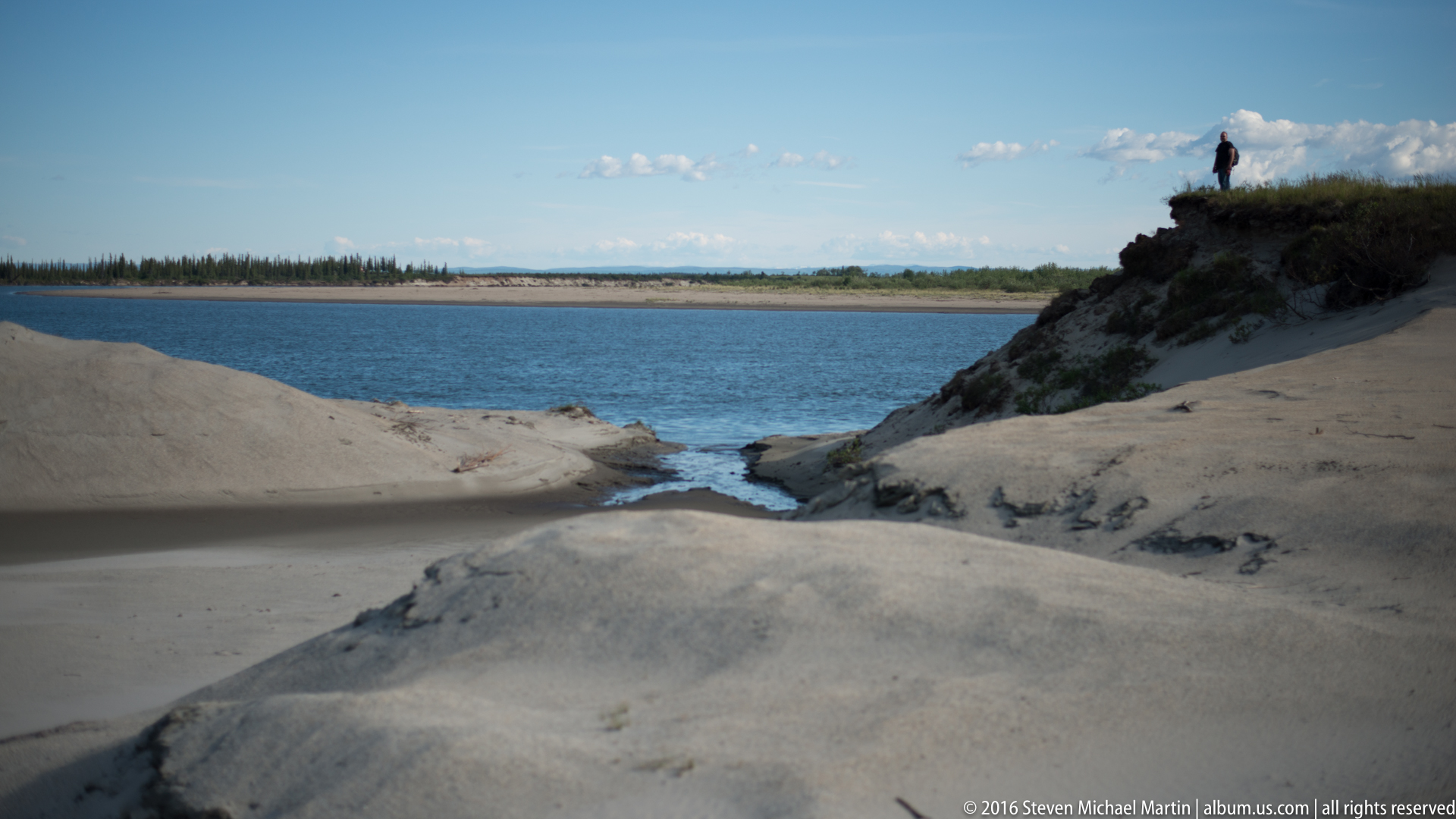
A small figure stands on a low vegetated rise above a narrow channel that cuts through pale sand toward the river. Sandbanks form a shallow V around the water, while the blue river and far tree line stretch across the background. The person’s elevated position gives the broad sandy channel a sense of scale and reveals its connection to the larger waterway.
Caption
A small figure stands on a low vegetated rise above a narrow channel that cuts through pale sand toward the river. Sandbanks form a shallow V around the water, while the blue river and far tree line stretch across the background. The person’s elevated position gives the broad sandy channel a sense of scale and reveals its connection to the larger waterway.
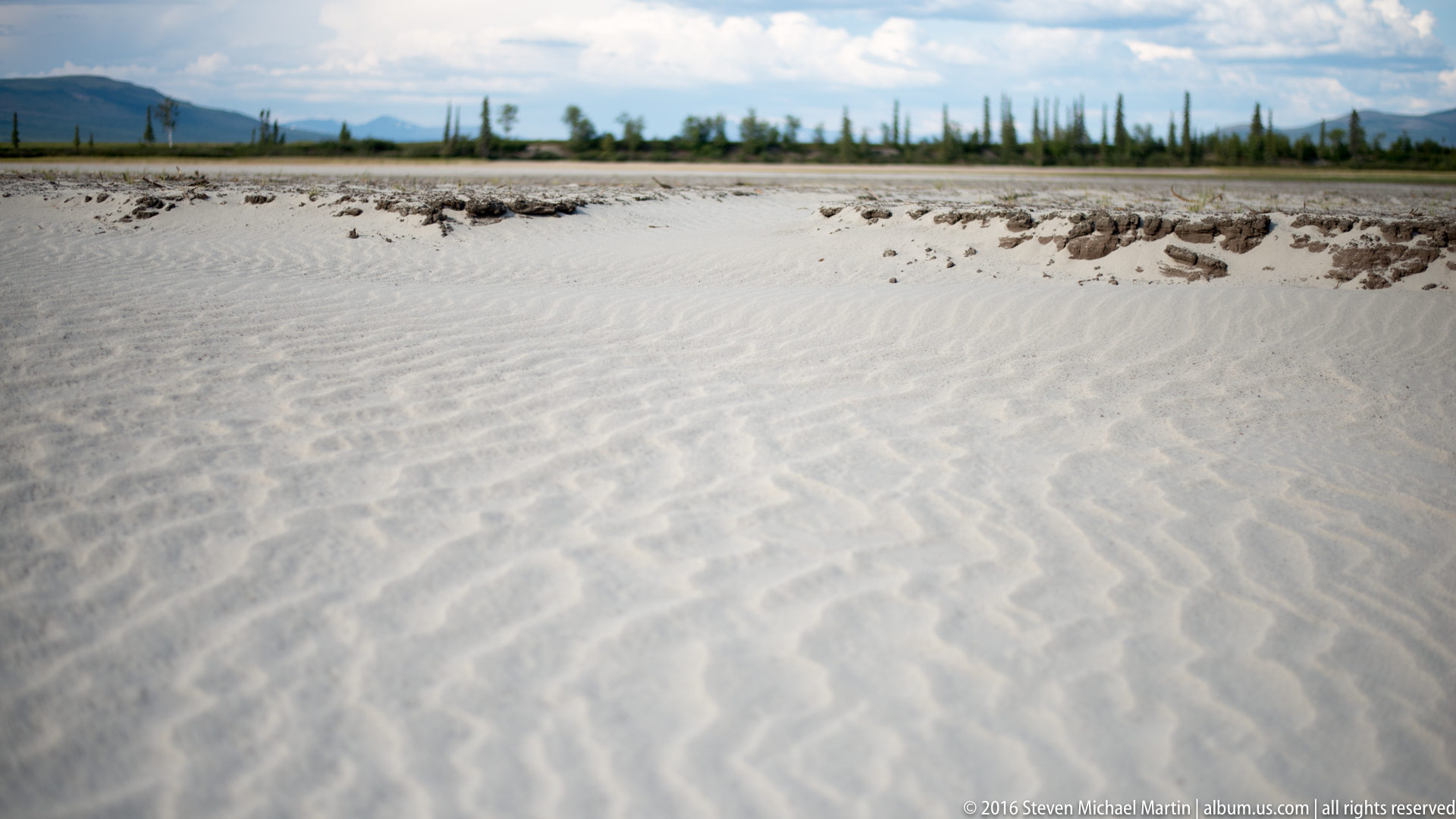
Fine, repeated ripples cover a pale sand surface in the foreground, forming soft ridges that run toward the horizon. A low band of spruce and shrubs marks the far bank beneath a narrow strip of blue sky. With no people or water in the foreground, the image concentrates on the texture and subtle variations of wind-shaped sand.
Caption
Fine, repeated ripples cover a pale sand surface in the foreground, forming soft ridges that run toward the horizon. A low band of spruce and shrubs marks the far bank beneath a narrow strip of blue sky. With no people or water in the foreground, the image concentrates on the texture and subtle variations of wind-shaped sand.
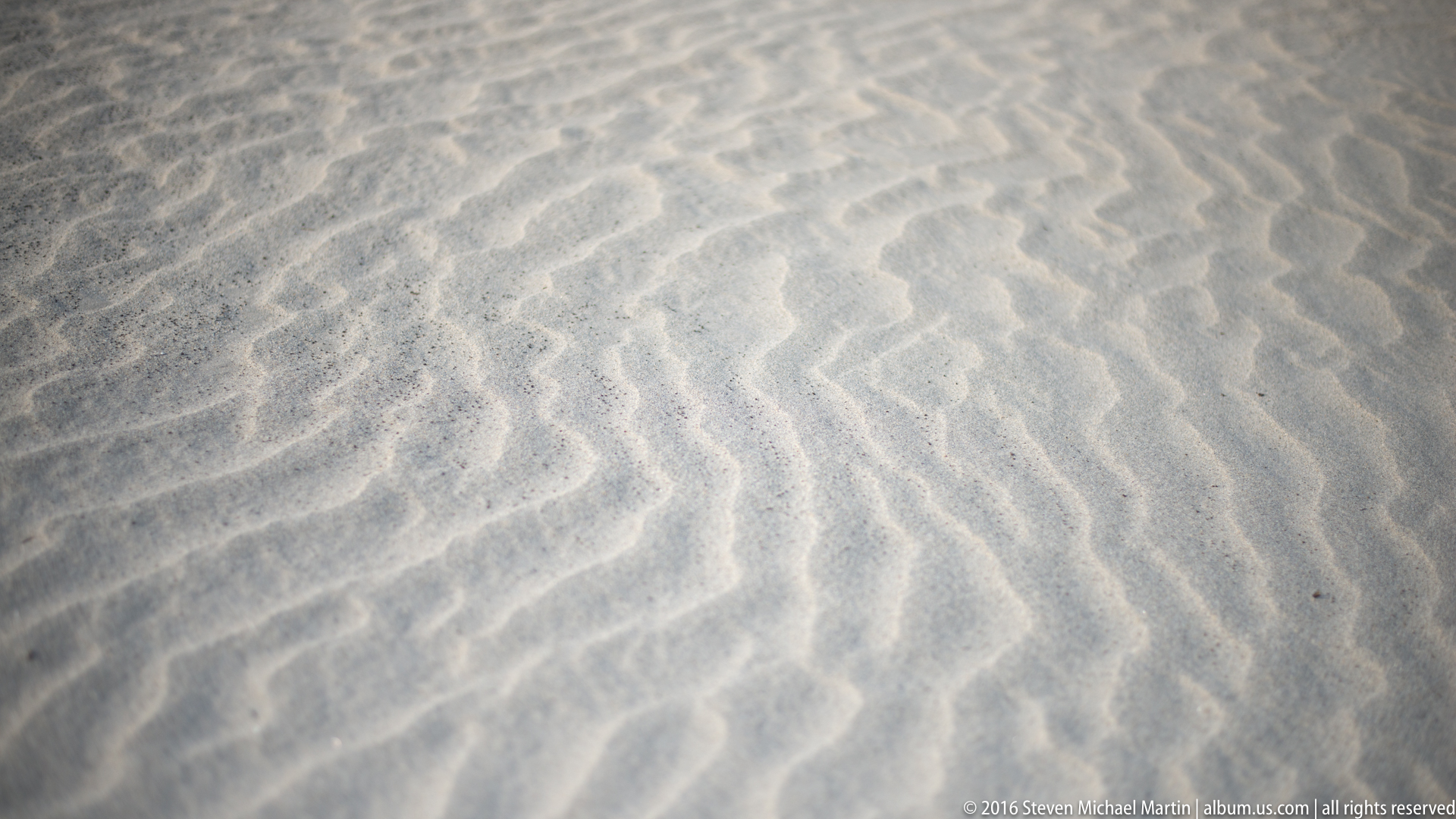
Pale sand fills the frame, its surface marked by closely spaced ridges and troughs. Low side light brings out the alternating bands of shadow and brightness, while the absence of vegetation or water keeps attention on the fine pattern. This close study shifts from the river’s broad geography to the small-scale forms created across an exposed sandy surface.
Caption
Pale sand fills the frame, its surface marked by closely spaced ridges and troughs. Low side light brings out the alternating bands of shadow and brightness, while the absence of vegetation or water keeps attention on the fine pattern. This close study shifts from the river’s broad geography to the small-scale forms created across an exposed sandy surface.
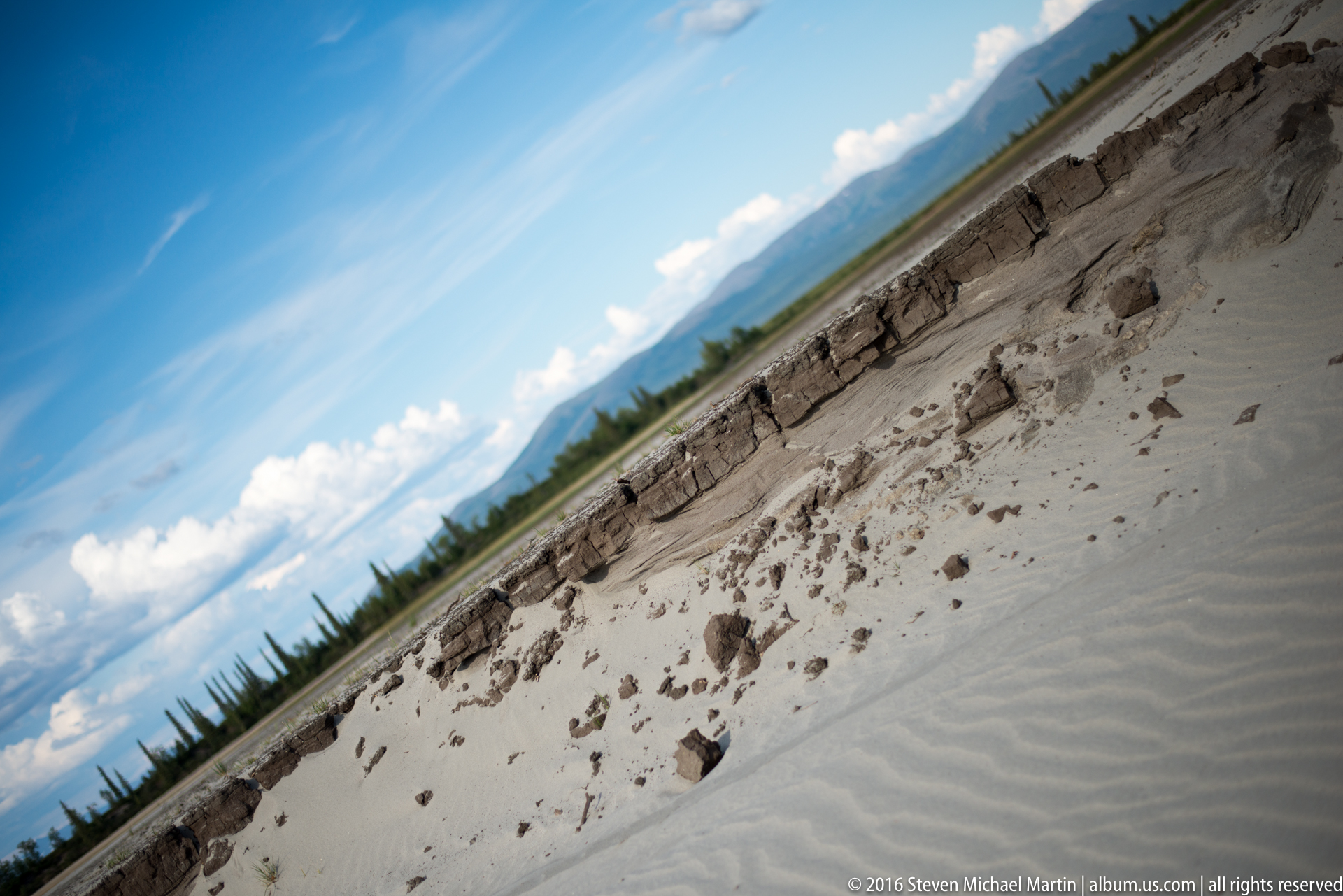
The image tilts the horizon as it follows a pale cutbank where chunks of sediment have broken away above a sandy shore. Darker bands and exposed blocks interrupt the bluff face, while spruce and a distant mountain line appear along the upper edge. The diagonal framing intensifies the bank’s broken profile and reveals the contrast between loose foreground sand and the more compact bluff.
Caption
The image tilts the horizon as it follows a pale cutbank where chunks of sediment have broken away above a sandy shore. Darker bands and exposed blocks interrupt the bluff face, while spruce and a distant mountain line appear along the upper edge. The diagonal framing intensifies the bank’s broken profile and reveals the contrast between loose foreground sand and the more compact bluff.
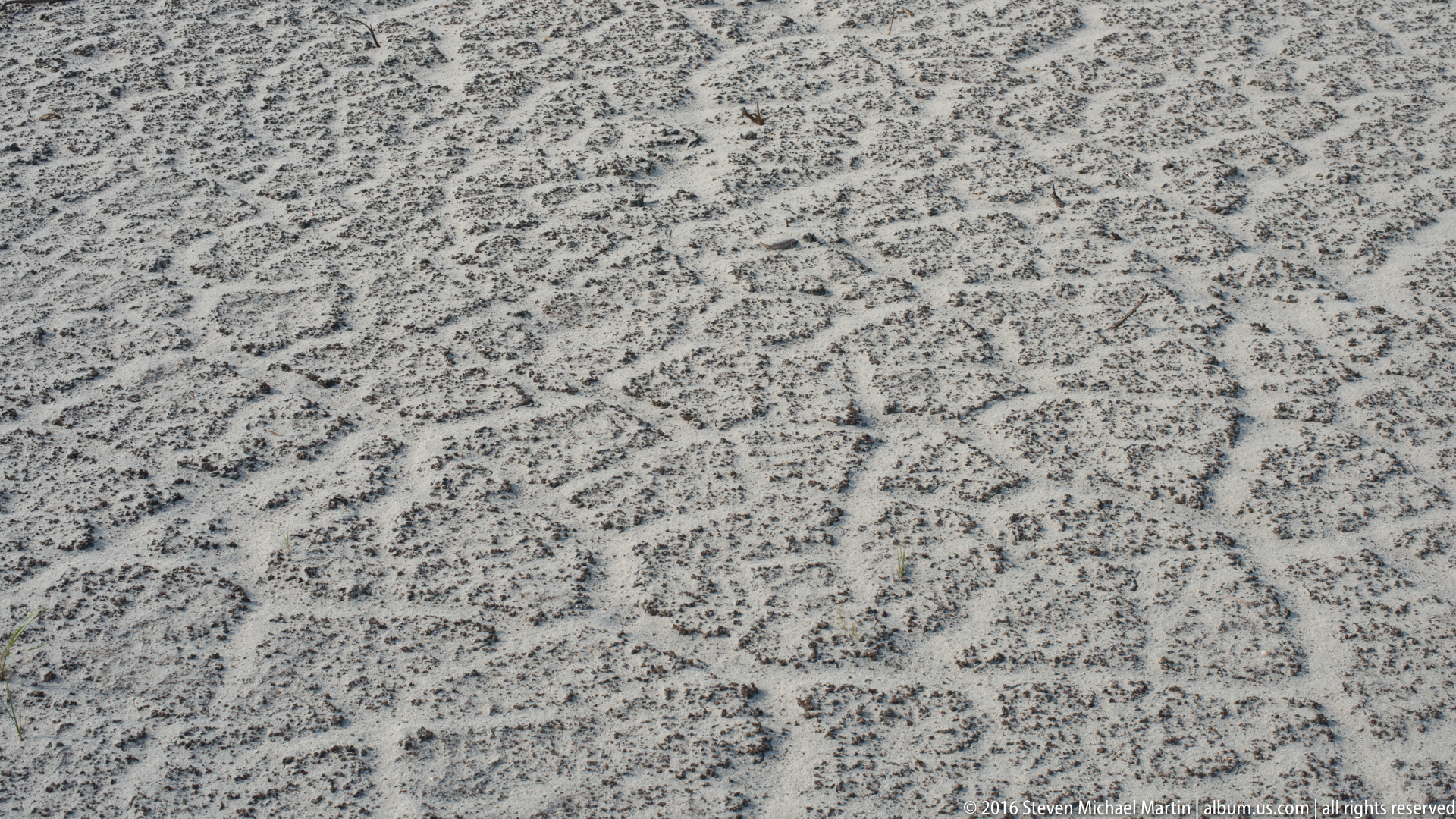
A close patch of pale sand is covered with fine intersecting lines and shallow impressions. The irregular marks create a dense surface pattern, though the proof image does not make their source clear. No animal or object appears in the frame to explain them, so the photograph is best described as a texture study of marked sand rather than attributed to a particular track or process.
Caption
A close patch of pale sand is covered with fine intersecting lines and shallow impressions. The irregular marks create a dense surface pattern, though the proof image does not make their source clear. No animal or object appears in the frame to explain them, so the photograph is best described as a texture study of marked sand rather than attributed to a particular track or process.
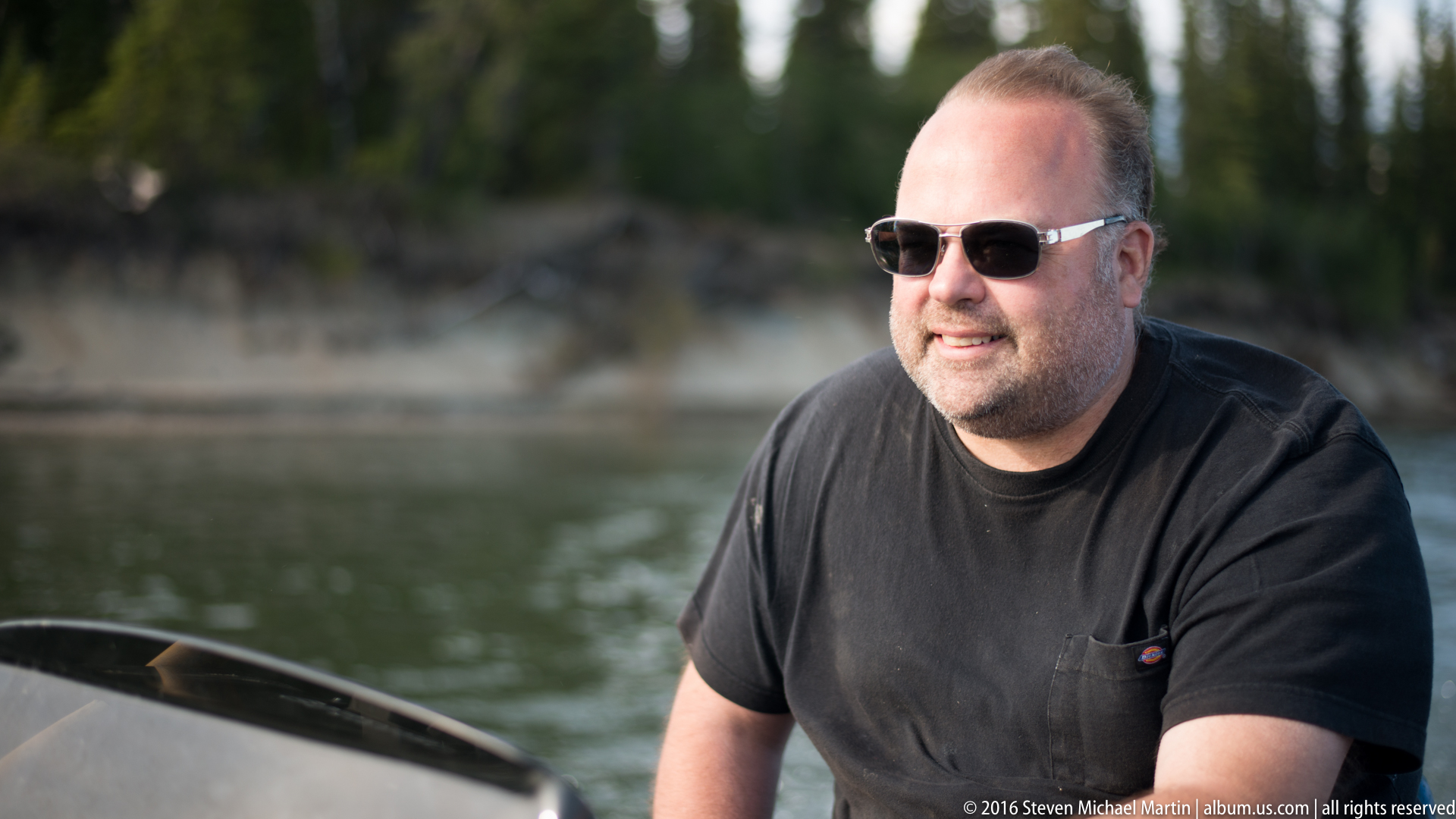
A man wearing dark sunglasses and a black shirt sits in a boat, turned slightly toward the camera. The boat’s gunwale cuts across the lower corner, while softly blurred water and a sandy bank form the background. The medium portrait preserves the river setting but draws attention to the passenger’s relaxed posture and the close, shaded space of the boat.
Caption
A man wearing dark sunglasses and a black shirt sits in a boat, turned slightly toward the camera. The boat’s gunwale cuts across the lower corner, while softly blurred water and a sandy bank form the background. The medium portrait preserves the river setting but draws attention to the passenger’s relaxed posture and the close, shaded space of the boat.
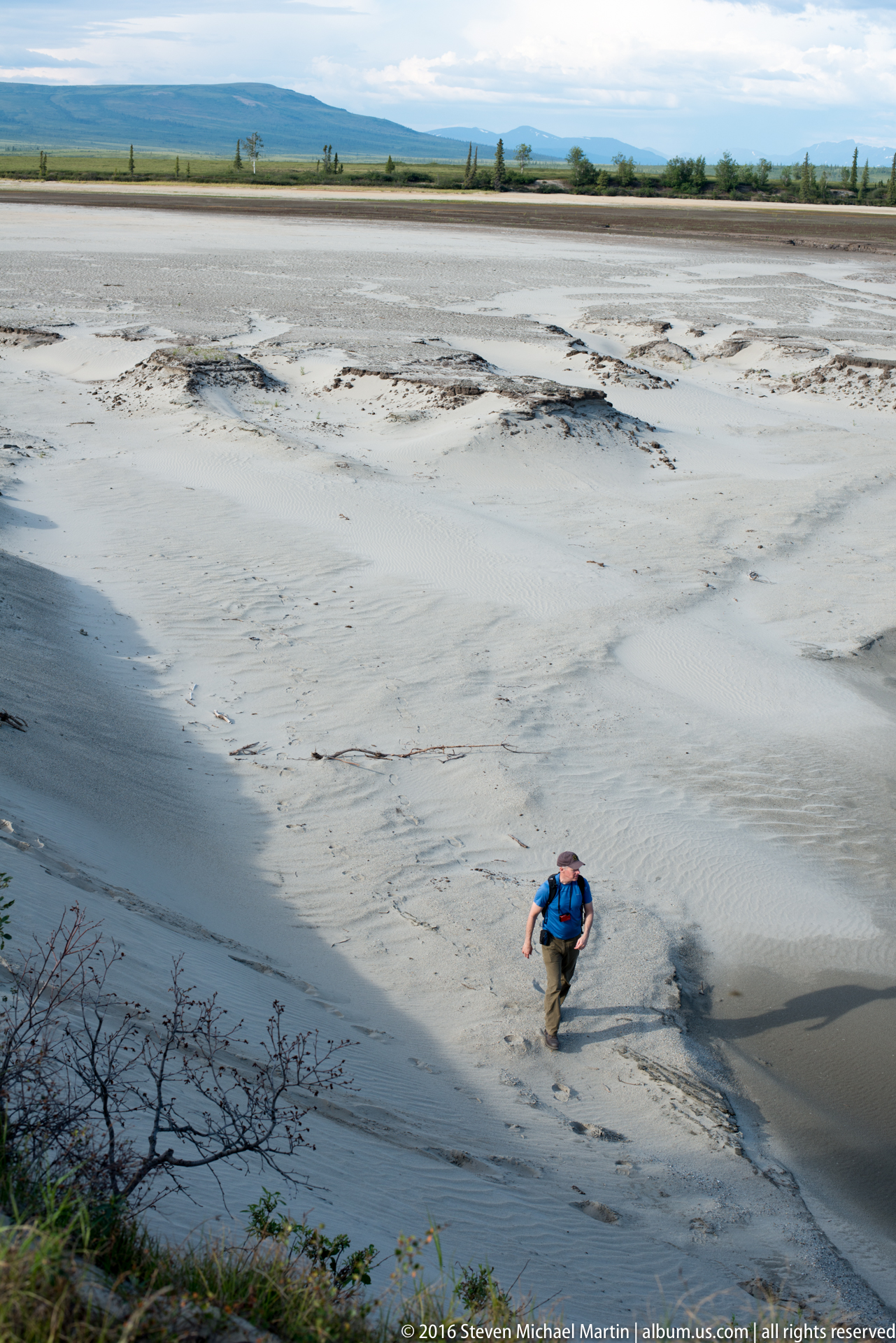
A man in a blue shirt walks through shallow wet sand, leaving small splashes around his legs. The low riverbank and open sky form a narrow strip across the top of the frame, while smooth pale sediment dominates the foreground. His movement across the exposed flat conveys the changing edge between water and land without making the destination or purpose of the walk explicit.
Caption
A man in a blue shirt walks through shallow wet sand, leaving small splashes around his legs. The low riverbank and open sky form a narrow strip across the top of the frame, while smooth pale sediment dominates the foreground. His movement across the exposed flat conveys the changing edge between water and land without making the destination or purpose of the walk explicit.
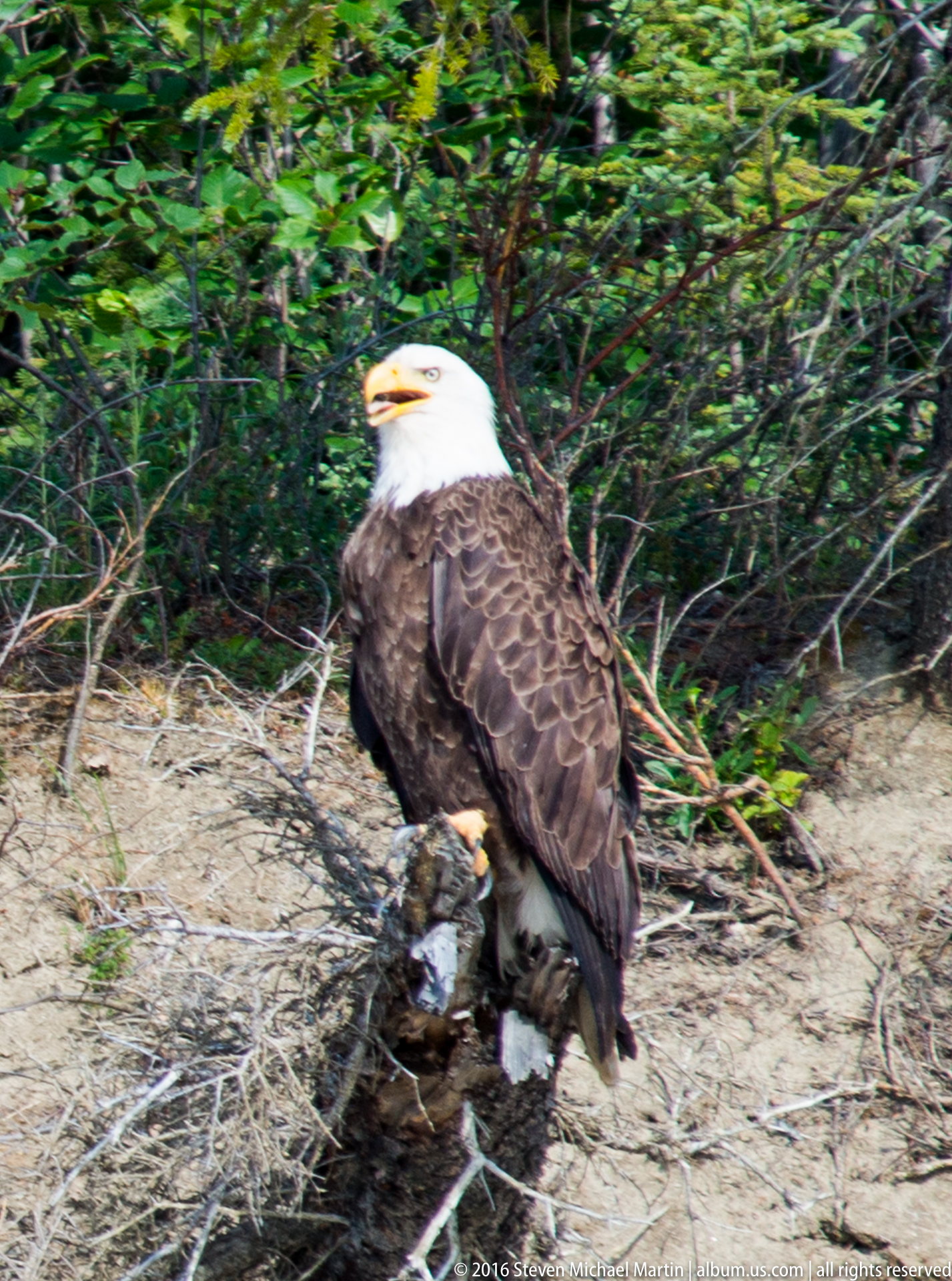
An adult bald eagle stands on a piece of driftwood at the edge of dense green brush. Its white head and tail, dark brown body, and yellow bill and feet are visible in profile. Sandy ground and scattered branches open around the perch, placing the bird at a disturbed or exposed river margin.
Caption
An adult bald eagle stands on a piece of driftwood at the edge of dense green brush. Its white head and tail, dark brown body, and yellow bill and feet are visible in profile. Sandy ground and scattered branches open around the perch, placing the bird at a disturbed or exposed river margin.
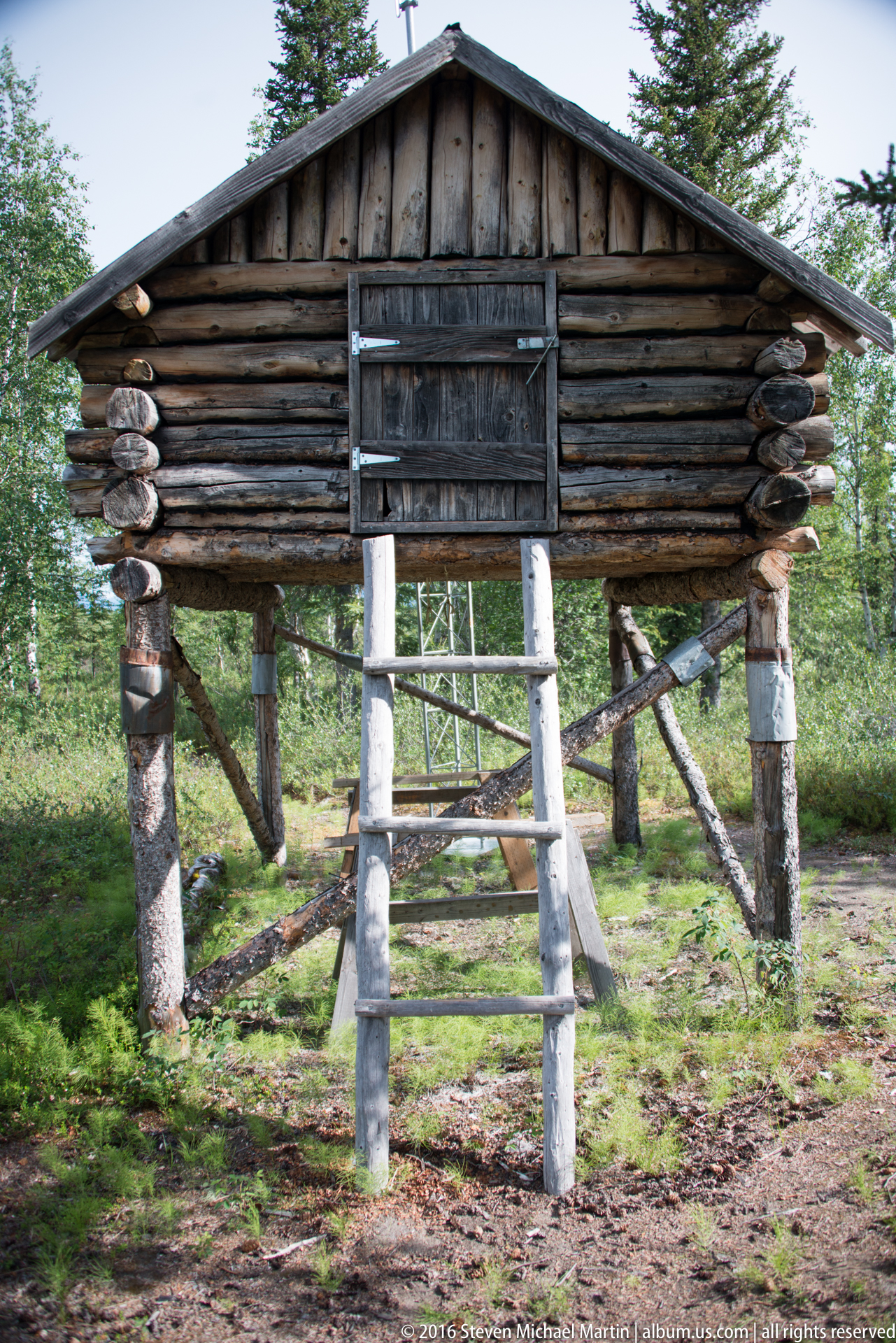
A compact log structure stands high on stout wooden supports, with a ladder leading to a dark rectangular opening beneath its gabled roof. The elevated platform is characteristic of a storage cache designed to keep supplies above ground, though the photograph does not show its contents. Forest trees and low vegetation surround the structure.
Caption
A compact log structure stands high on stout wooden supports, with a ladder leading to a dark rectangular opening beneath its gabled roof. The elevated platform is characteristic of a storage cache designed to keep supplies above ground, though the photograph does not show its contents. Forest trees and low vegetation surround the structure.
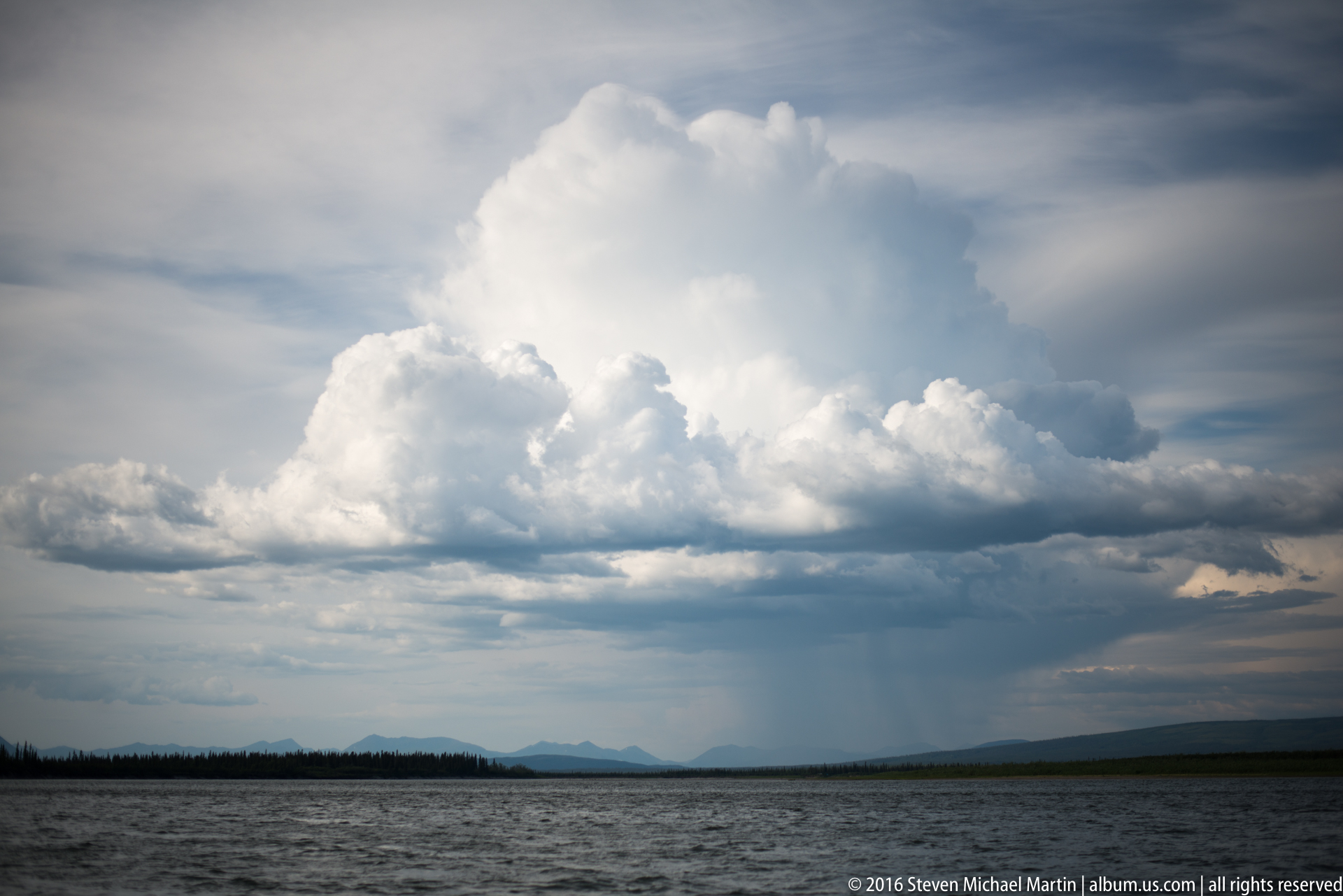
A towering white cumulus cloud rises over a low, dark tree line and distant mountains. The broad river occupies the foreground, its textured surface catching muted reflections beneath the heavy cloud mass. The composition gives most of its space to the sky, making the cloud’s vertical growth the principal subject within an otherwise level river landscape.
Caption
A towering white cumulus cloud rises over a low, dark tree line and distant mountains. The broad river occupies the foreground, its textured surface catching muted reflections beneath the heavy cloud mass. The composition gives most of its space to the sky, making the cloud’s vertical growth the principal subject within an otherwise level river landscape.
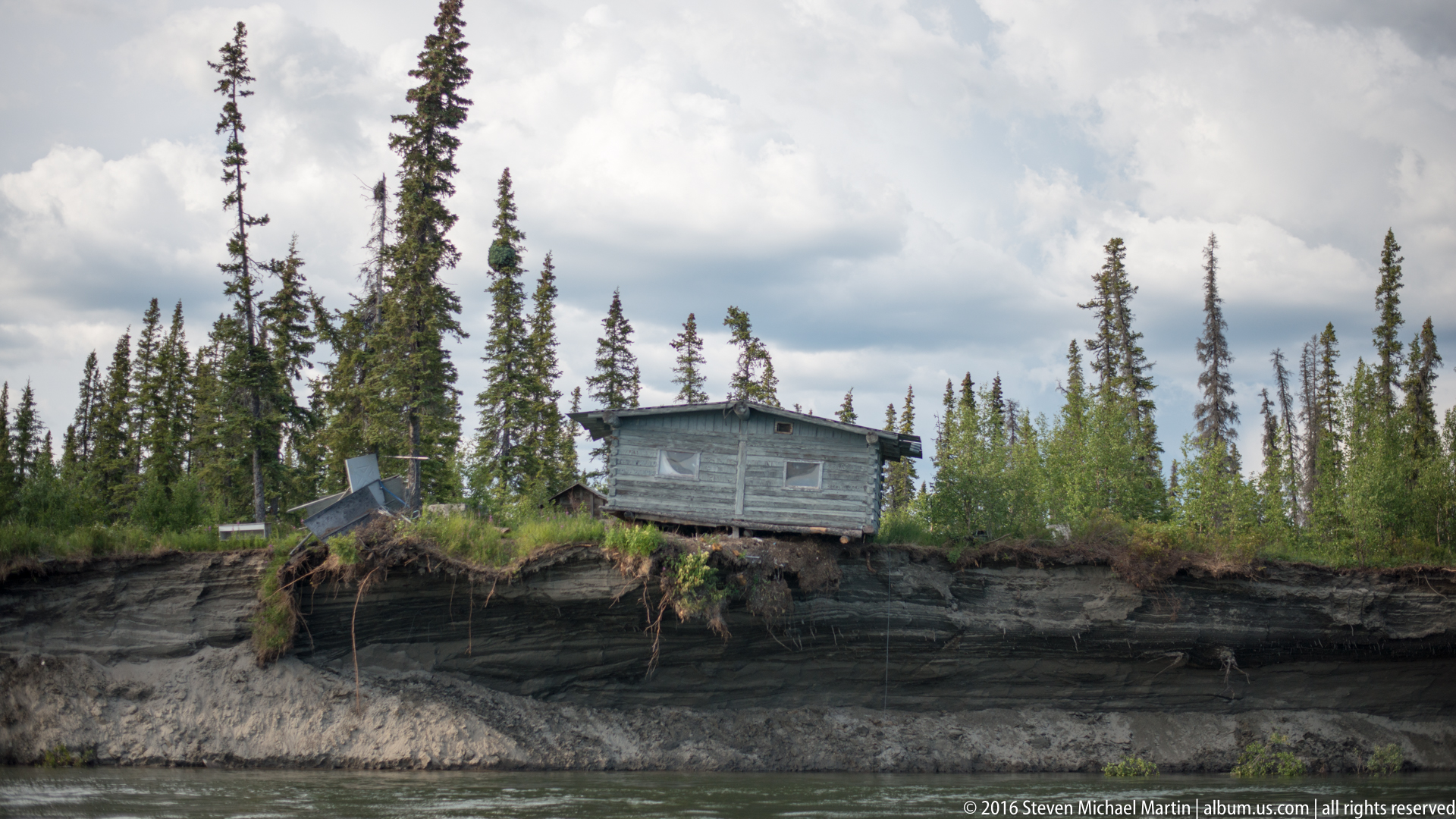
A weathered house sits close to the edge of a steep, layered bank above the river. The cut face exposes pale and dark sediment bands, while spruce and shrubs cluster around the structure at the top. The low angle places the house against the sky and emphasizes the height of the bank beneath it, making the relation between habitation and river erosion central.
Caption
A weathered house sits close to the edge of a steep, layered bank above the river. The cut face exposes pale and dark sediment bands, while spruce and shrubs cluster around the structure at the top. The low angle places the house against the sky and emphasizes the height of the bank beneath it, making the relation between habitation and river erosion central.
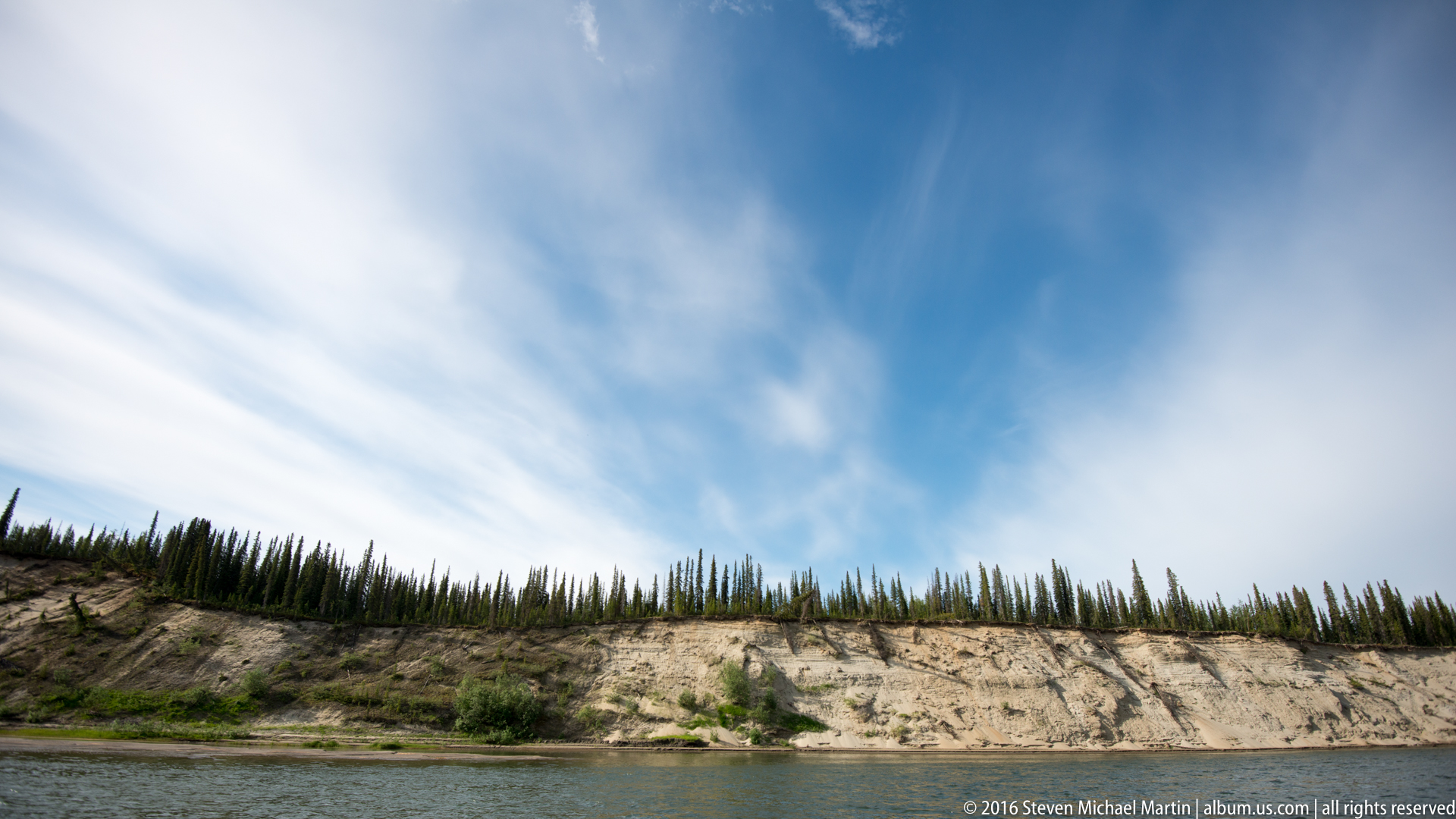
A pale bluff runs horizontally across the frame, topped by a narrow line of spruce and low shrubs. Wispy clouds spread through a blue sky above it, while a strip of river water sits below the exposed bank. The broad low viewpoint emphasizes the contrast between the bare sediment face and the thin band of vegetation clinging to its rim.
Caption
A pale bluff runs horizontally across the frame, topped by a narrow line of spruce and low shrubs. Wispy clouds spread through a blue sky above it, while a strip of river water sits below the exposed bank. The broad low viewpoint emphasizes the contrast between the bare sediment face and the thin band of vegetation clinging to its rim.

A steep pale bank fills most of the frame, its face cut into vertical grooves and angular blocks. Dark roots and soil cling to the top edge beneath a line of spruce and leafy trees. The close upward angle reveals the exposed structure of the bank and the fragile boundary where vegetation meets loose sediment, without establishing the bank’s geological age.
Caption
A steep pale bank fills most of the frame, its face cut into vertical grooves and angular blocks. Dark roots and soil cling to the top edge beneath a line of spruce and leafy trees. The close upward angle reveals the exposed structure of the bank and the fragile boundary where vegetation meets loose sediment, without establishing the bank’s geological age.
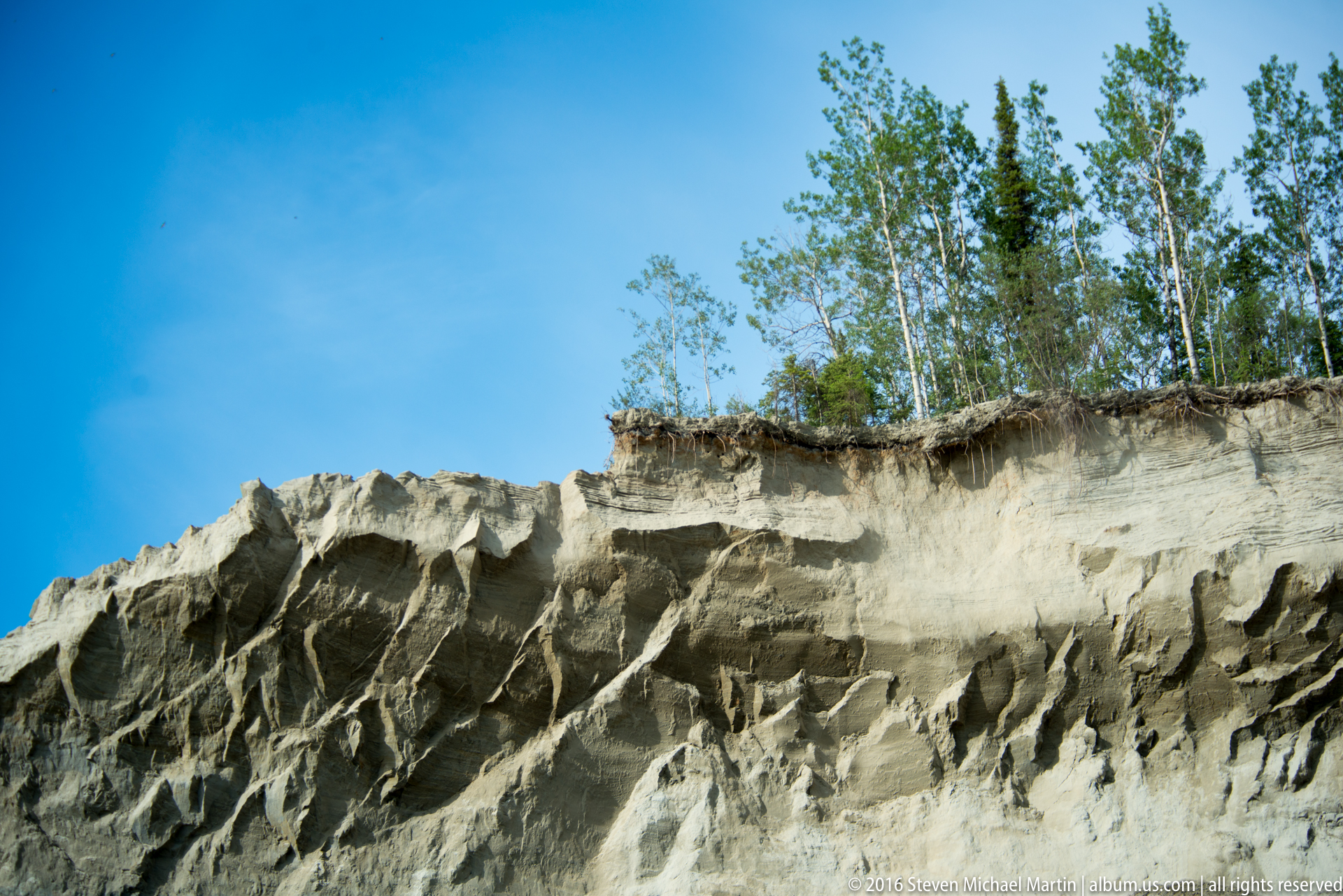
A pale bluff rises in angular ridges beneath a clear blue sky, its sharply cut face divided by deep grooves and shadowed ledges. A few trees stand along the uneven rim, their roots exposed above the sediment. The upward view emphasizes the steep relief and irregular profile of the riverbank, making erosion’s visible forms the central subject.
Caption
A pale bluff rises in angular ridges beneath a clear blue sky, its sharply cut face divided by deep grooves and shadowed ledges. A few trees stand along the uneven rim, their roots exposed above the sediment. The upward view emphasizes the steep relief and irregular profile of the riverbank, making erosion’s visible forms the central subject.
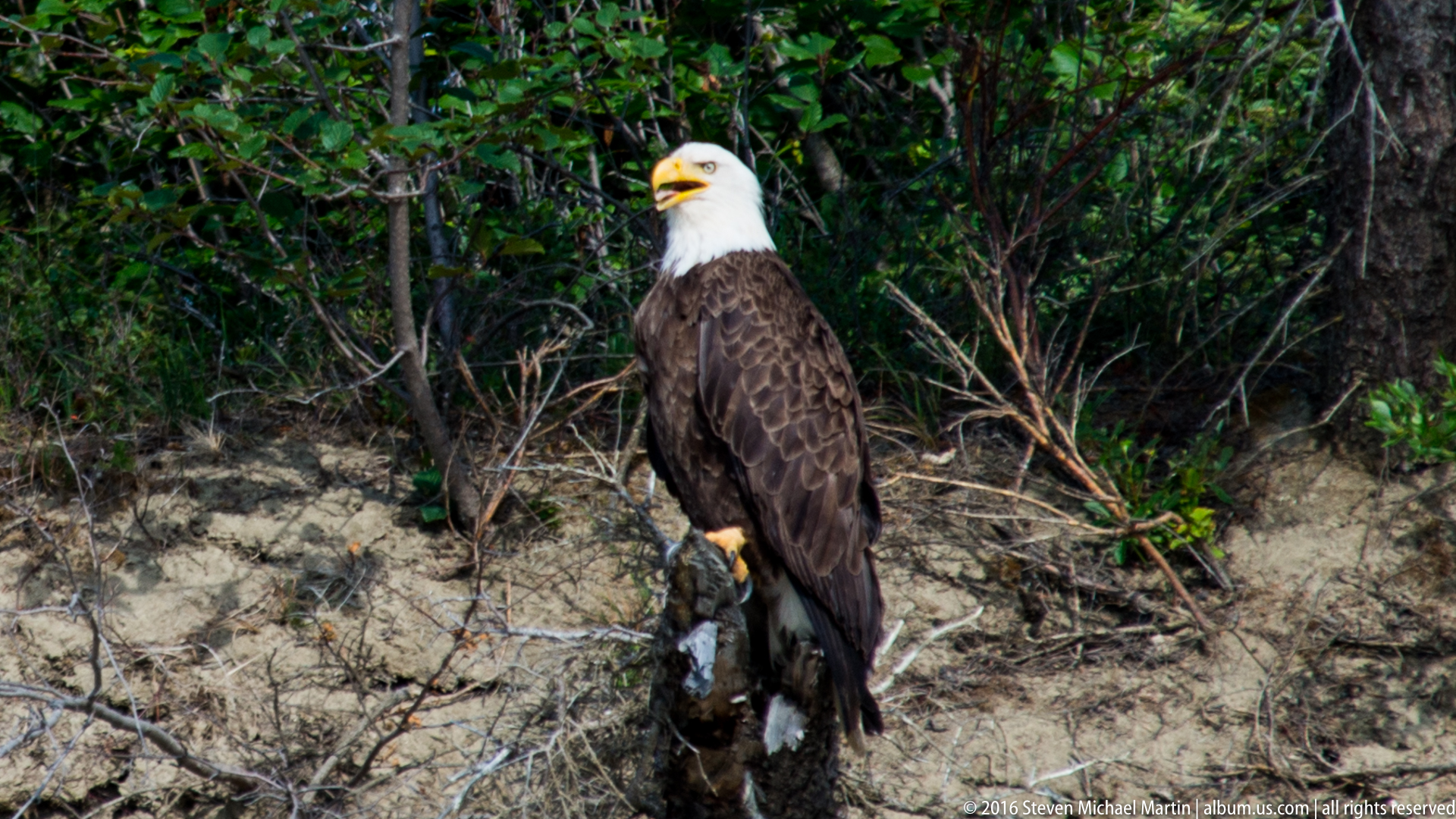
A bald eagle stands upright on a low, broken stump in front of dense leafy branches. The vertical pose shows its white head, yellow bill, dark folded wings, and white tail more clearly than the side-on view nearby. The dark understory isolates the bird while keeping its riverside habitat visible.
Caption
A bald eagle stands upright on a low, broken stump in front of dense leafy branches. The vertical pose shows its white head, yellow bill, dark folded wings, and white tail more clearly than the side-on view nearby. The dark understory isolates the bird while keeping its riverside habitat visible.

A bald eagle perches on a fallen tree that angles across a brushy bank above exposed pale soil. The bird appears small within the wider scene, with its white head and tail contrasting against dark branches. This environmental view shows how the eagle’s perch relates to the sloping riverbank and surrounding vegetation.
Caption
A bald eagle perches on a fallen tree that angles across a brushy bank above exposed pale soil. The bird appears small within the wider scene, with its white head and tail contrasting against dark branches. This environmental view shows how the eagle’s perch relates to the sloping riverbank and surrounding vegetation.
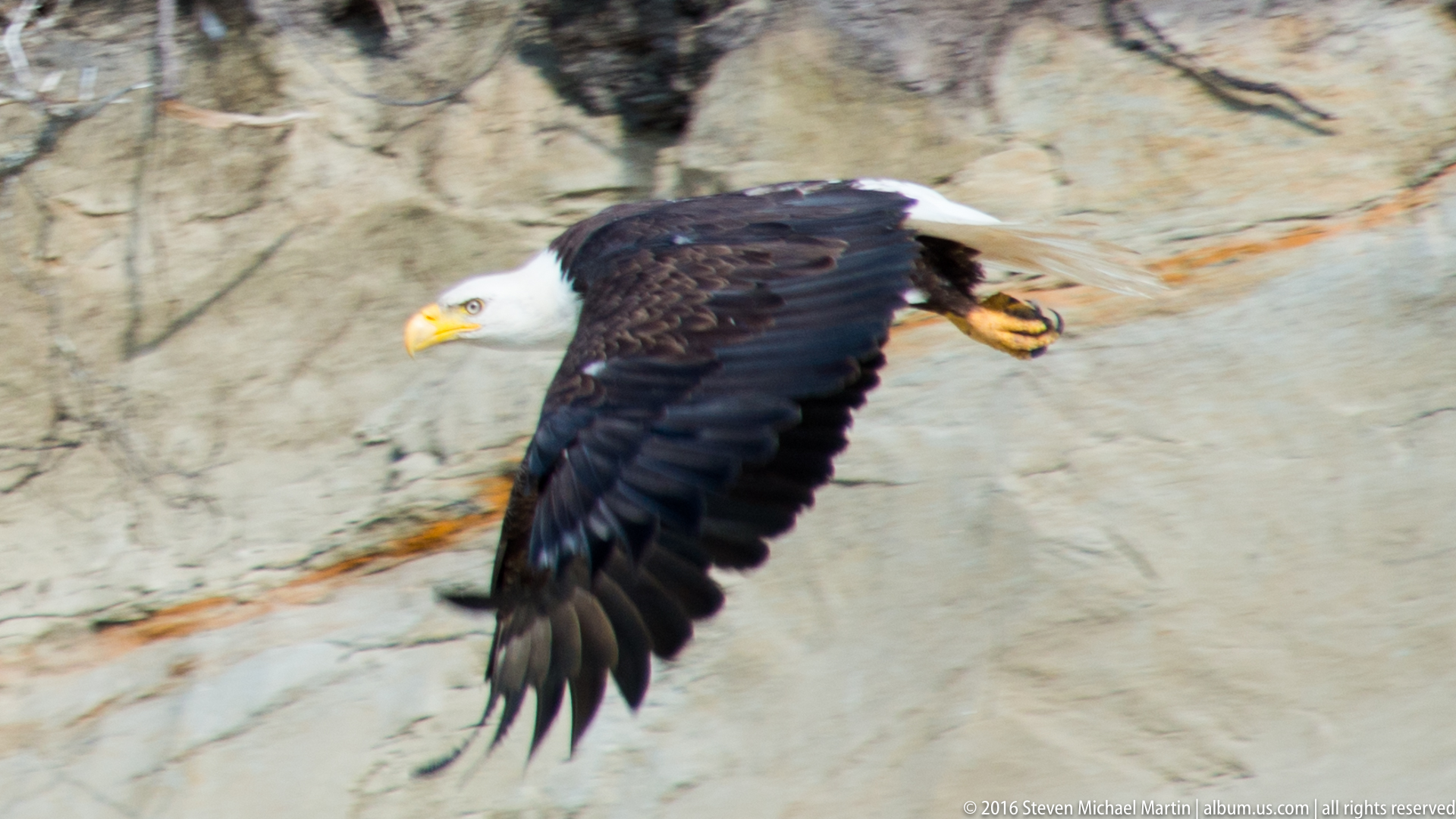
An adult bald eagle glides across the frame in front of a pale rock face, one broad dark wing extended downward and the yellow feet trailing behind. Its white head and tail remain distinct against the stone. The motion-blurred background emphasizes the bird’s flight and wing span rather than the cliff’s geological detail.
Caption
An adult bald eagle glides across the frame in front of a pale rock face, one broad dark wing extended downward and the yellow feet trailing behind. Its white head and tail remain distinct against the stone. The motion-blurred background emphasizes the bird’s flight and wing span rather than the cliff’s geological detail.
The proof-sheet slot for attachment 89317 displays an IMAGE NOT FOUND notice and reports that the original file path is missing. No photograph is available to identify a subject, habitat, or activity. This record is retained to match the numbered page slot and requires the source image to be restored before editorial use.
Caption
The proof-sheet slot for attachment 89317 displays an IMAGE NOT FOUND notice and reports that the original file path is missing. No photograph is available to identify a subject, habitat, or activity. This record is retained to match the numbered page slot and requires the source image to be restored before editorial use.
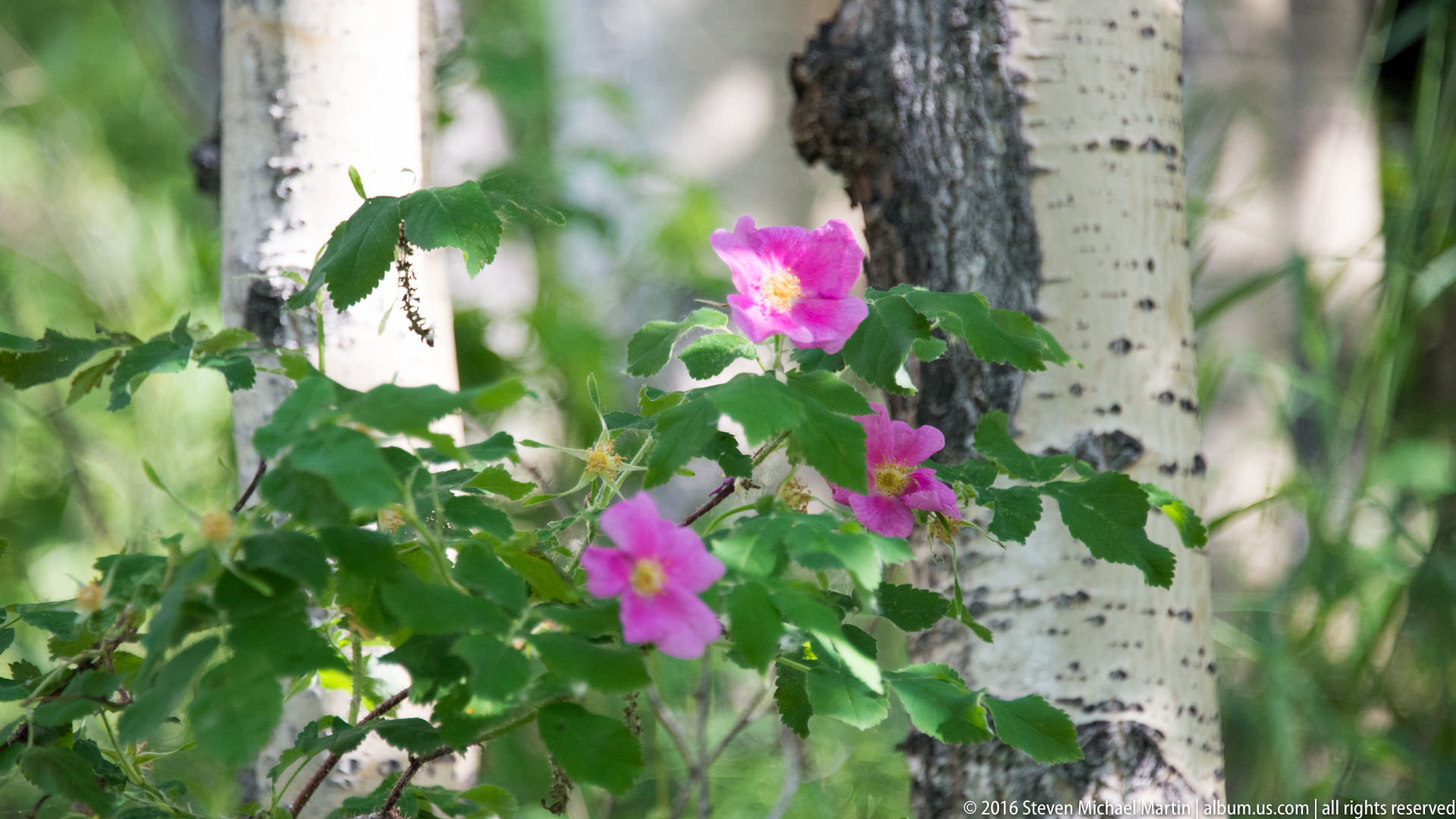
Several pink wild rose blossoms and unopened buds rise among serrated green leaves beside a white birch trunk. The flowers are shown in soft natural light, with shallow focus separating them from the pale bark and leafy background. The close composition foregrounds flowering vegetation at the edge of a northern woodland.
Caption
Several pink wild rose blossoms and unopened buds rise among serrated green leaves beside a white birch trunk. The flowers are shown in soft natural light, with shallow focus separating them from the pale bark and leafy background. The close composition foregrounds flowering vegetation at the edge of a northern woodland.
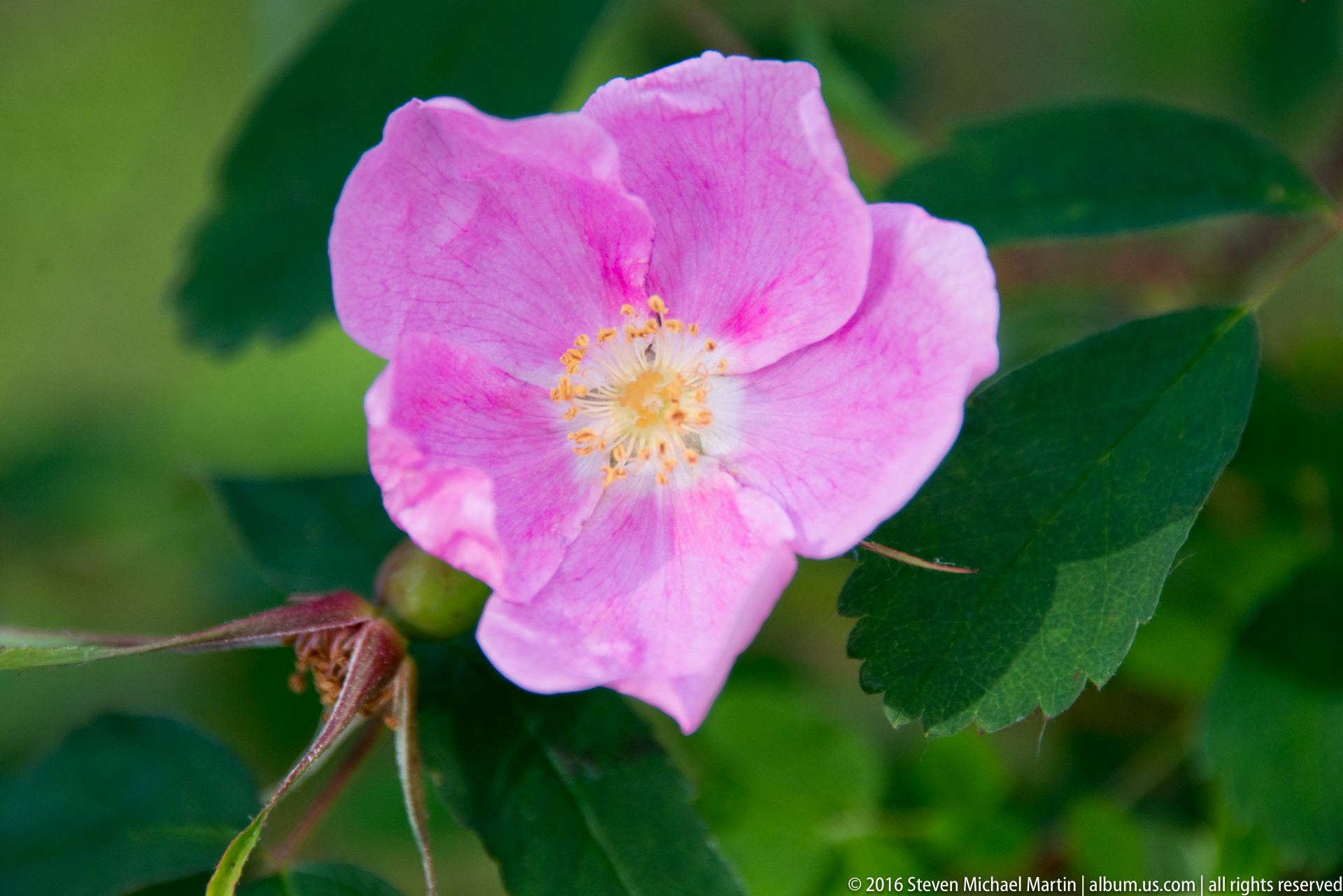
A single pink flower fills the frame, its five broad petals surrounding a dense cluster of yellow stamens. Dark green leaves and a thorned stem border the bloom, while the background falls into deep green blur. This close view isolates the flower’s structure and color, complementing the wider rose-and-birch composition nearby.
Caption
A single pink flower fills the frame, its five broad petals surrounding a dense cluster of yellow stamens. Dark green leaves and a thorned stem border the bloom, while the background falls into deep green blur. This close view isolates the flower’s structure and color, complementing the wider rose-and-birch composition nearby.
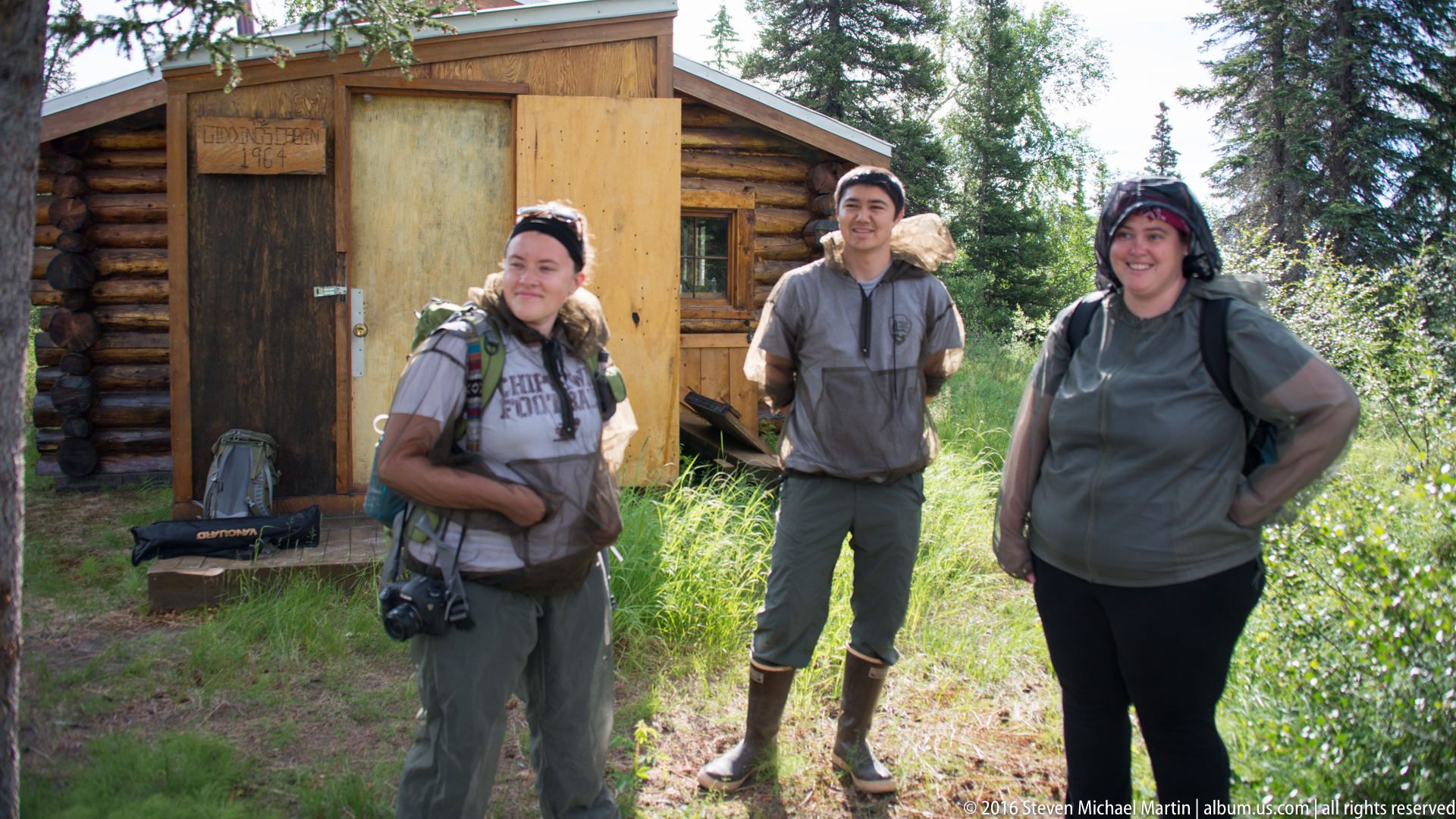
Three visitors stand together outside a log building, two women at either side of a man. They wear practical outdoor clothing and backpacks, while a second small structure and a woodpile sit nearby. Their relaxed poses provide a human scale for the cabin complex without identifying the people or the building’s specific function.
Caption
Three visitors stand together outside a log building, two women at either side of a man. They wear practical outdoor clothing and backpacks, while a second small structure and a woodpile sit nearby. Their relaxed poses provide a human scale for the cabin complex without identifying the people or the building’s specific function.
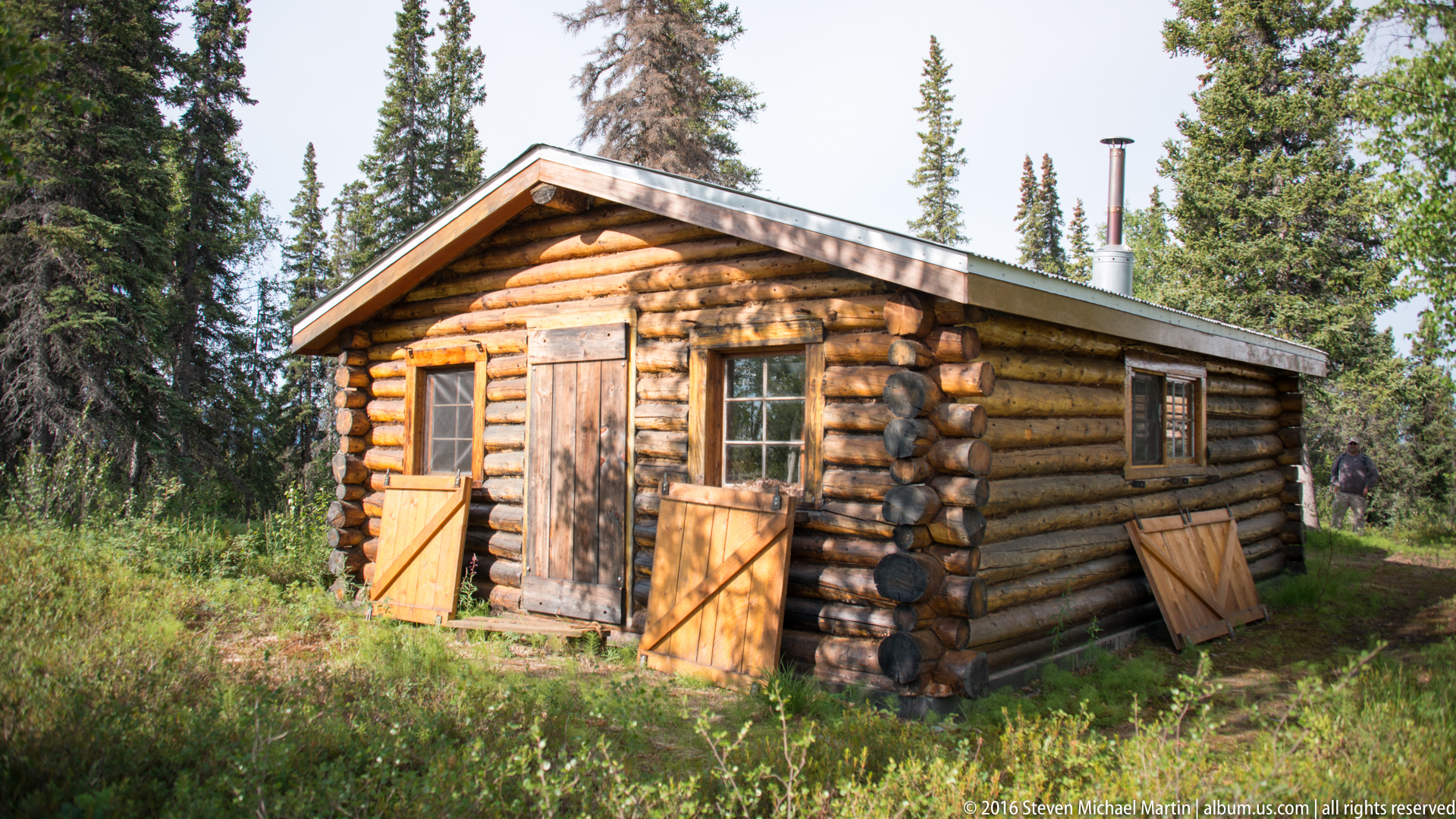
A low log cabin is seen from farther back, revealing its gabled front and long side wall among spruce and birch. Wooden shutters stand open beside the windows, and a metal stovepipe rises behind the roof ridge. The grassy clearing and trees provide context for the small building’s placement within the surrounding forest.
Caption
A low log cabin is seen from farther back, revealing its gabled front and long side wall among spruce and birch. Wooden shutters stand open beside the windows, and a metal stovepipe rises behind the roof ridge. The grassy clearing and trees provide context for the small building’s placement within the surrounding forest.

A pale branching antler lies across low tundra shrubs and gravel, its tines rising against a distant mountain ridge. The object is photographed at ground level with open country extending behind it. This still-life view separates the antler from the human portraits on the preceding slots and emphasizes its form within the habitat.
Caption
A pale branching antler lies across low tundra shrubs and gravel, its tines rising against a distant mountain ridge. The object is photographed at ground level with open country extending behind it. This still-life view separates the antler from the human portraits on the preceding slots and emphasizes its form within the habitat.
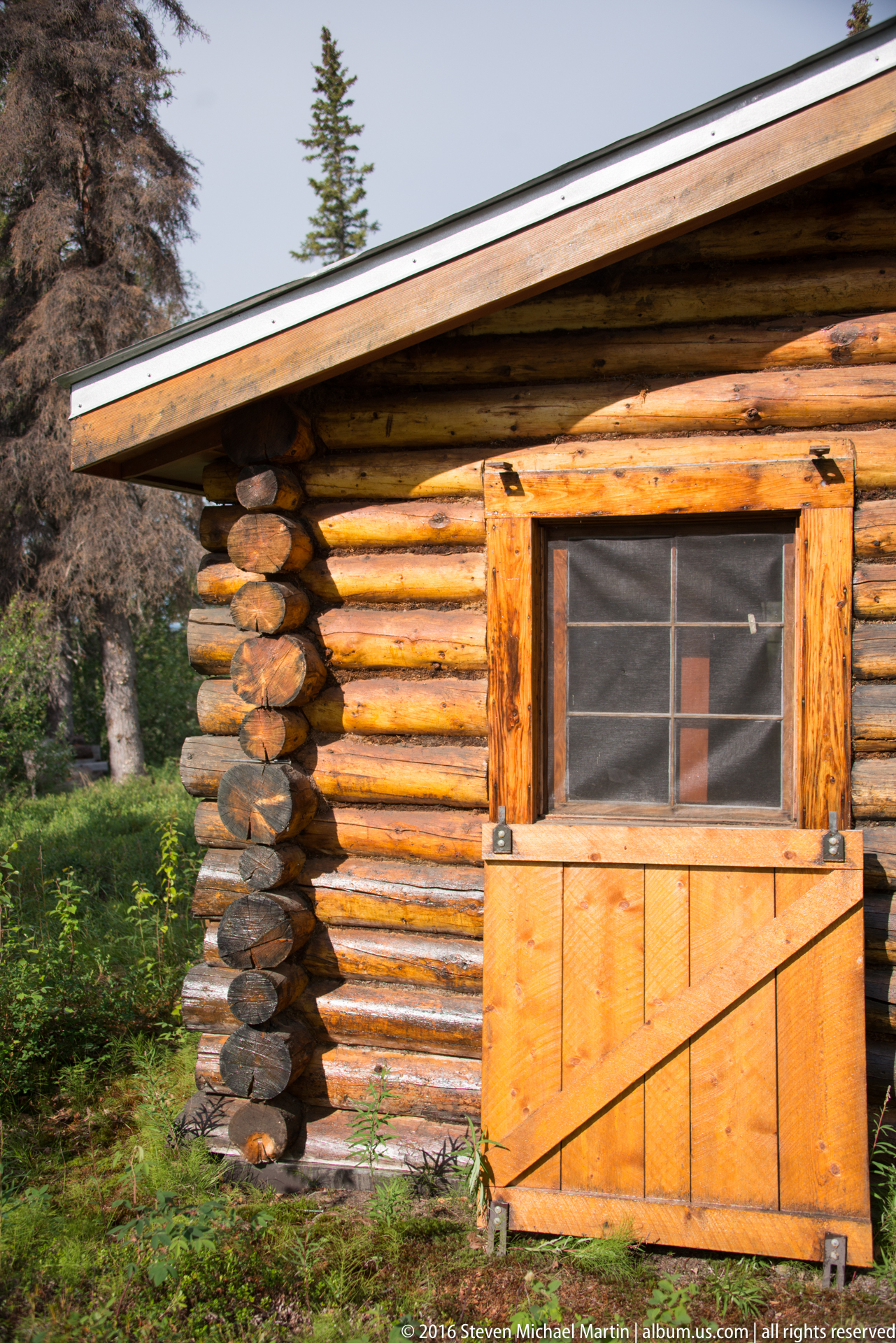
A close oblique view isolates a screened cabin window set between thick log courses. A wooden shutter projects outward beneath it, while the roof edge cuts diagonally across the top of the frame. The warm timber grain and simple joinery become the subject, distinct from the full-building views on the same page.
Caption
A close oblique view isolates a screened cabin window set between thick log courses. A wooden shutter projects outward beneath it, while the roof edge cuts diagonally across the top of the frame. The warm timber grain and simple joinery become the subject, distinct from the full-building views on the same page.

A man in an orange cap and blue shirt holds a pale branching antler across his chest, with binoculars hanging from a strap. Low tundra vegetation and a distant mountain ridge fill the background. The portrait records the antler as a found or collected object, but does not establish the animal species or where it was discovered.
Caption
A man in an orange cap and blue shirt holds a pale branching antler across his chest, with binoculars hanging from a strap. Low tundra vegetation and a distant mountain ridge fill the background. The portrait records the antler as a found or collected object, but does not establish the animal species or where it was discovered.
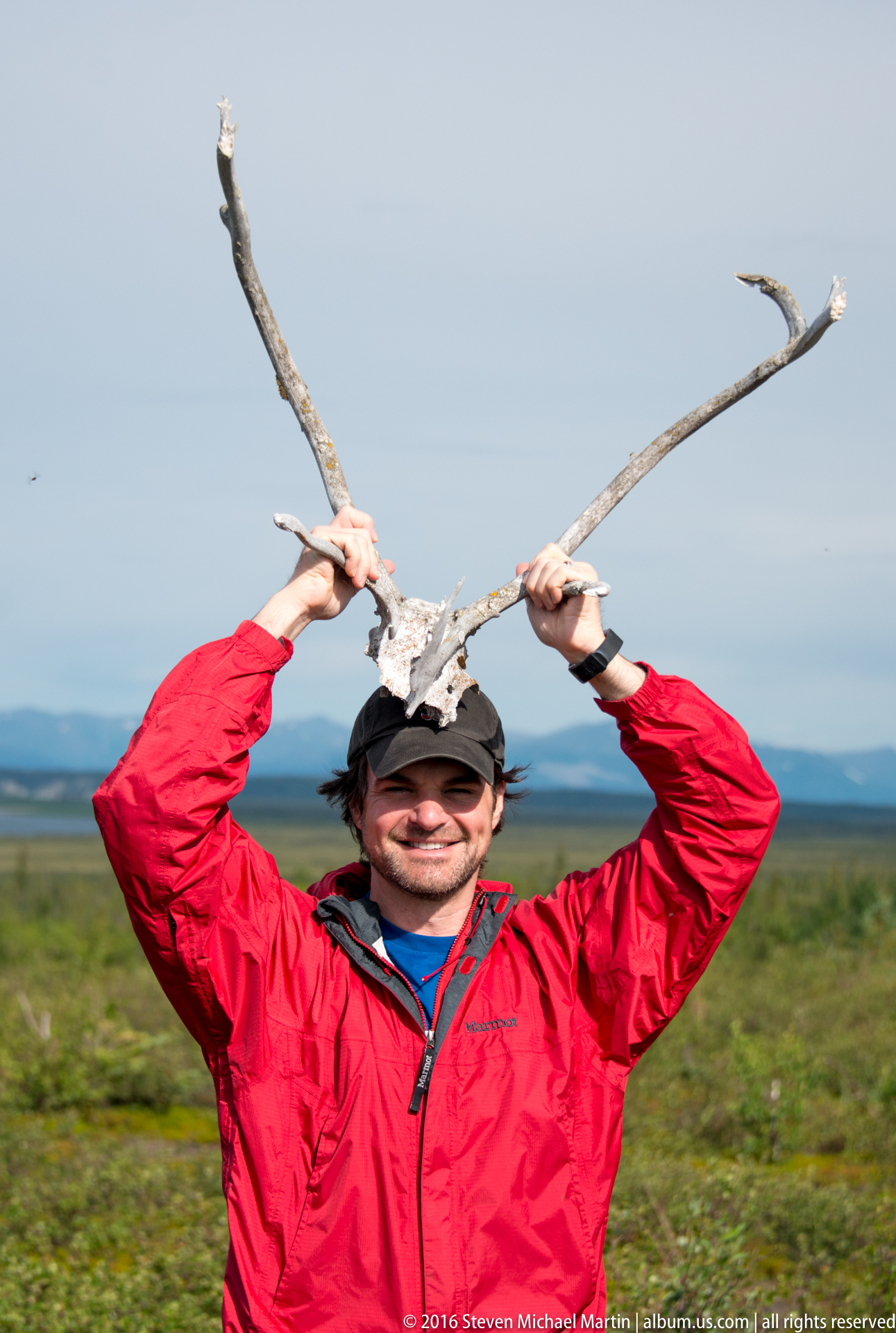
A man in a red jacket and dark cap raises a large pale antler above his head, holding one end in each hand. The open tundra and low mountains blur behind him. The playful pose turns a found natural object into the focus of a portrait, while the antler’s species remains uncertain.
Caption
A man in a red jacket and dark cap raises a large pale antler above his head, holding one end in each hand. The open tundra and low mountains blur behind him. The playful pose turns a found natural object into the focus of a portrait, while the antler’s species remains uncertain.
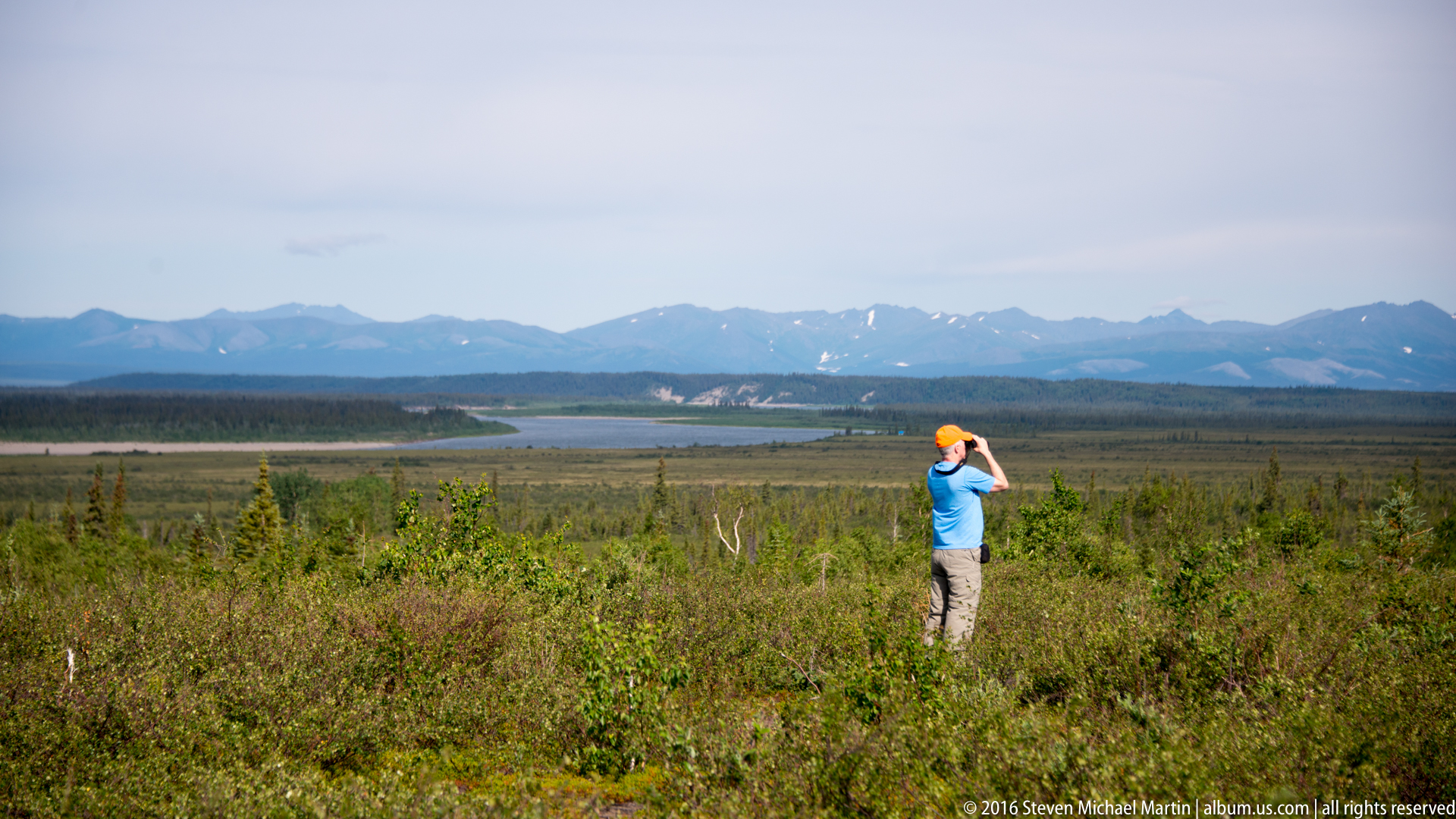
A man in a blue shirt and orange cap stands alone on a broad tundra slope, one hand raised to shade his eyes as he looks toward a distant river and mountain range. The figure is small within the frame, and the open terrain dominates. The gesture suggests observation, though the object of his attention is not visible.
Caption
A man in a blue shirt and orange cap stands alone on a broad tundra slope, one hand raised to shade his eyes as he looks toward a distant river and mountain range. The figure is small within the frame, and the open terrain dominates. The gesture suggests observation, though the object of his attention is not visible.
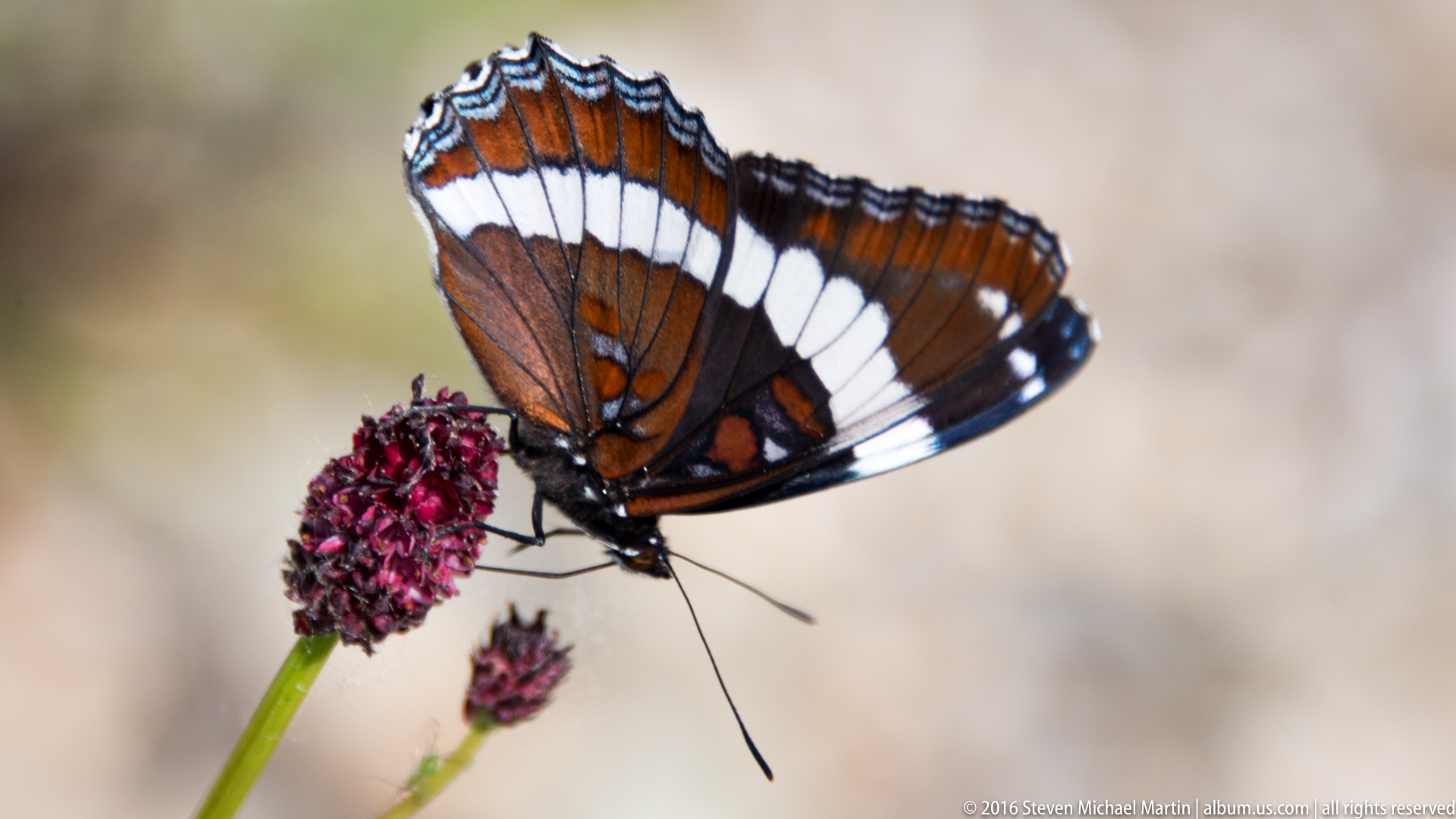
An orange-brown butterfly holds its wings open while feeding on a dark purple flower head. A broad white band crosses the wings, bordered by black and pale markings. The shallow-focus background isolates the insect and bloom, but the visible pattern is not sufficient for a confident species identification.
Caption
An orange-brown butterfly holds its wings open while feeding on a dark purple flower head. A broad white band crosses the wings, bordered by black and pale markings. The shallow-focus background isolates the insect and bloom, but the visible pattern is not sufficient for a confident species identification.
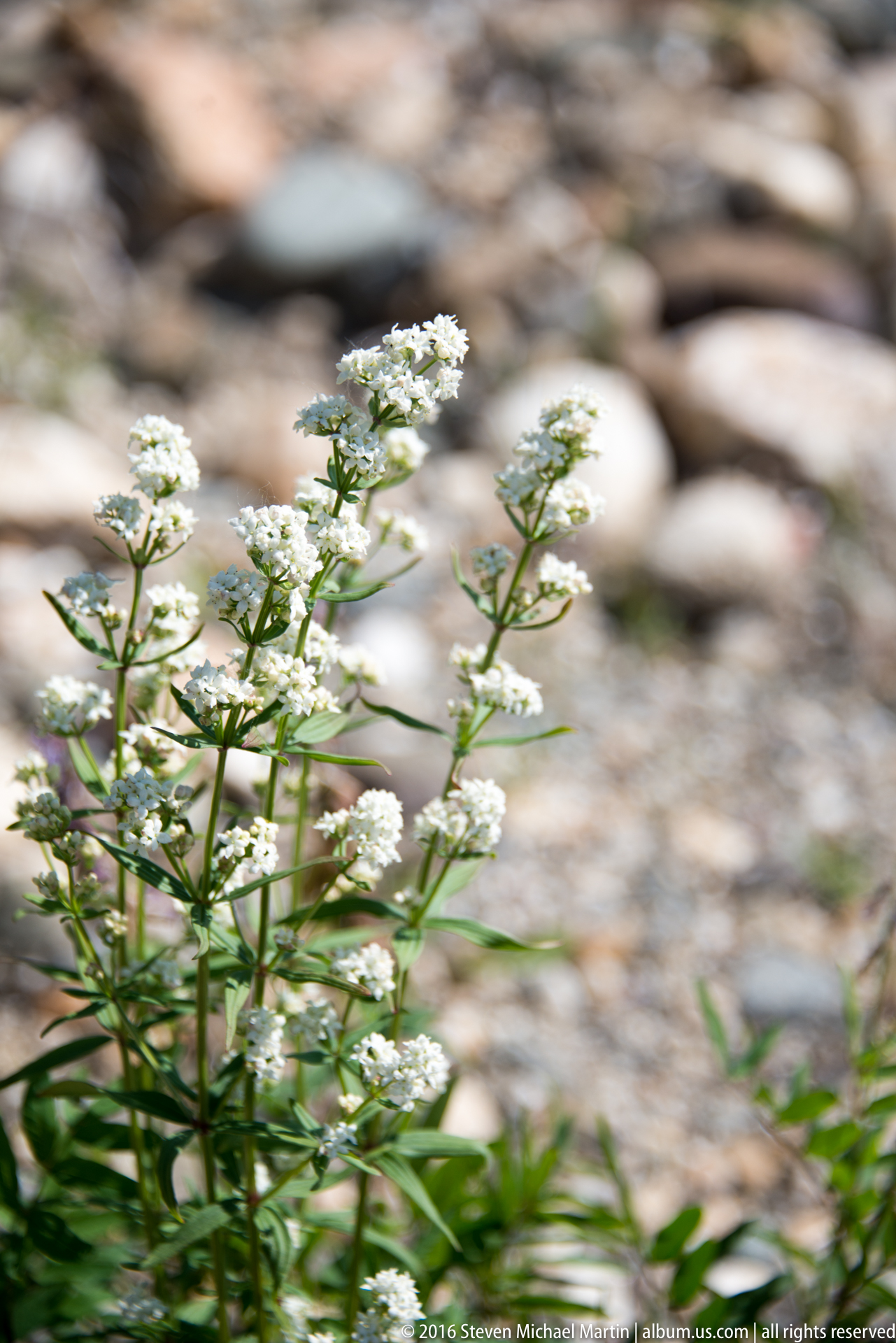
Clusters of small white flowers bloom on slender stems above narrow green leaves, with a stony riverbank softly blurred behind them. The delicate flower heads stand out against the gray gravel and muted ground. The close framing supports a general wildflower description, but not a reliable species identification.
Caption
Clusters of small white flowers bloom on slender stems above narrow green leaves, with a stony riverbank softly blurred behind them. The delicate flower heads stand out against the gray gravel and muted ground. The close framing supports a general wildflower description, but not a reliable species identification.
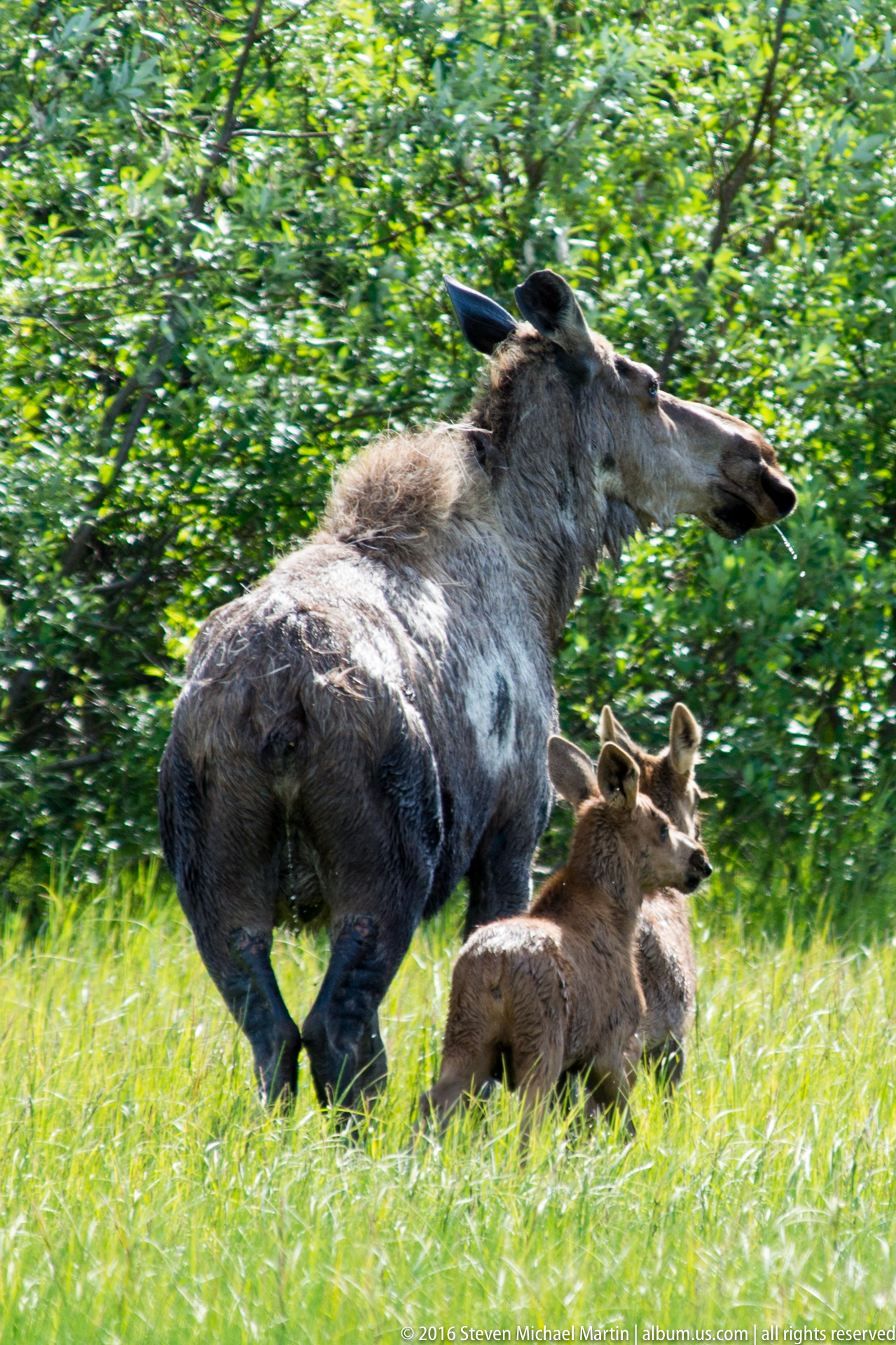
An adult moose moves quickly through dense green vegetation with a calf running beside her. The cow’s body stretches across the frame, while the calf’s ears and smaller form remain visible near her shoulder. Motion blur in the background reinforces their speed and makes this the most dynamic view in the sequence.
Caption
An adult moose moves quickly through dense green vegetation with a calf running beside her. The cow’s body stretches across the frame, while the calf’s ears and smaller form remain visible near her shoulder. Motion blur in the background reinforces their speed and makes this the most dynamic view in the sequence.
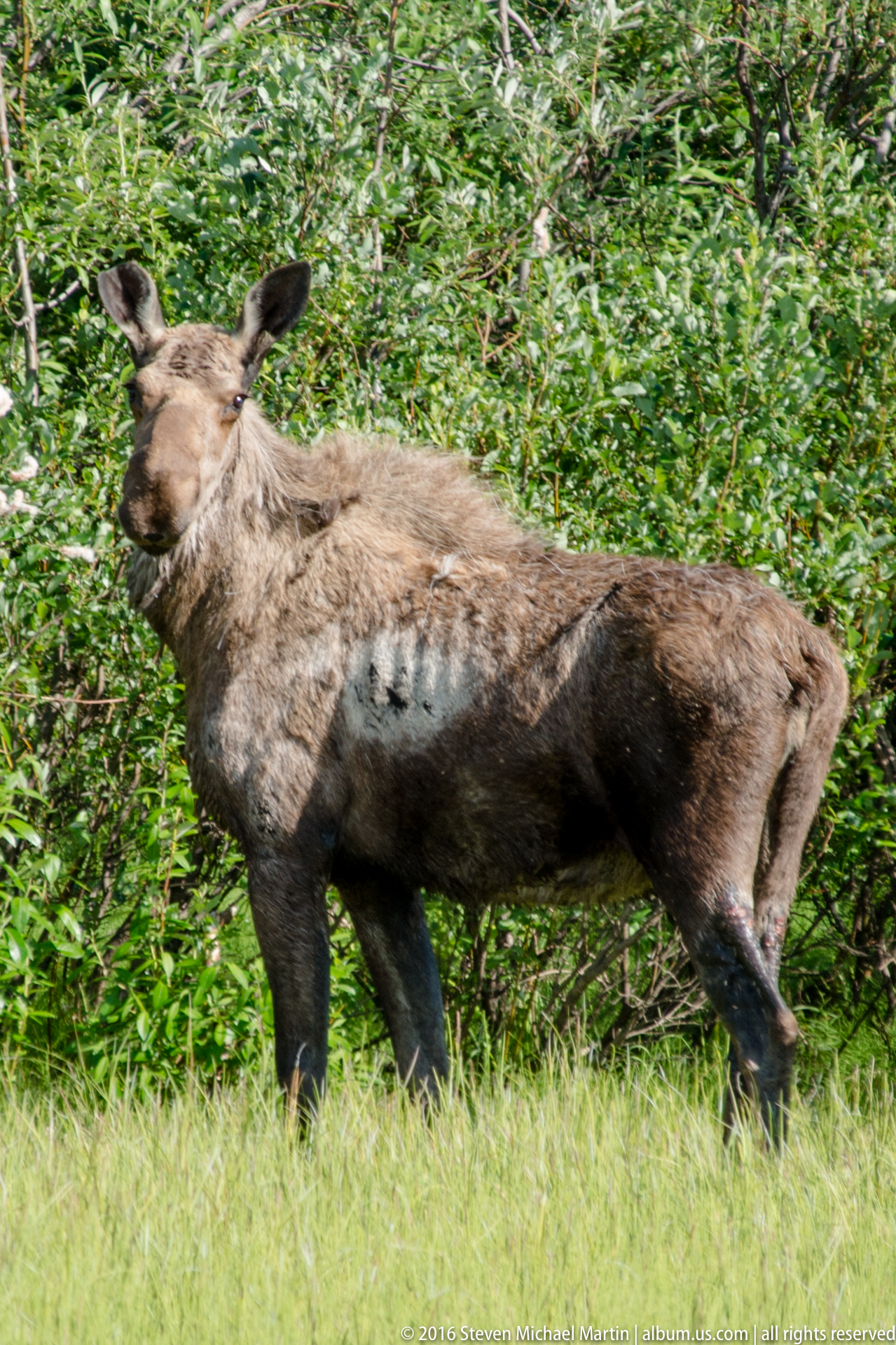
A large moose cow fills the frame as she walks through short grass, her long muzzle, broad ears, and coarse brown coat sharply visible. Willow shrubs blur behind her, and no calf appears in this closer view. The side-on composition brings attention to the animal’s proportions and movement without implying a specific behavior beyond walking.
Caption
A large moose cow fills the frame as she walks through short grass, her long muzzle, broad ears, and coarse brown coat sharply visible. Willow shrubs blur behind her, and no calf appears in this closer view. The side-on composition brings attention to the animal’s proportions and movement without implying a specific behavior beyond walking.
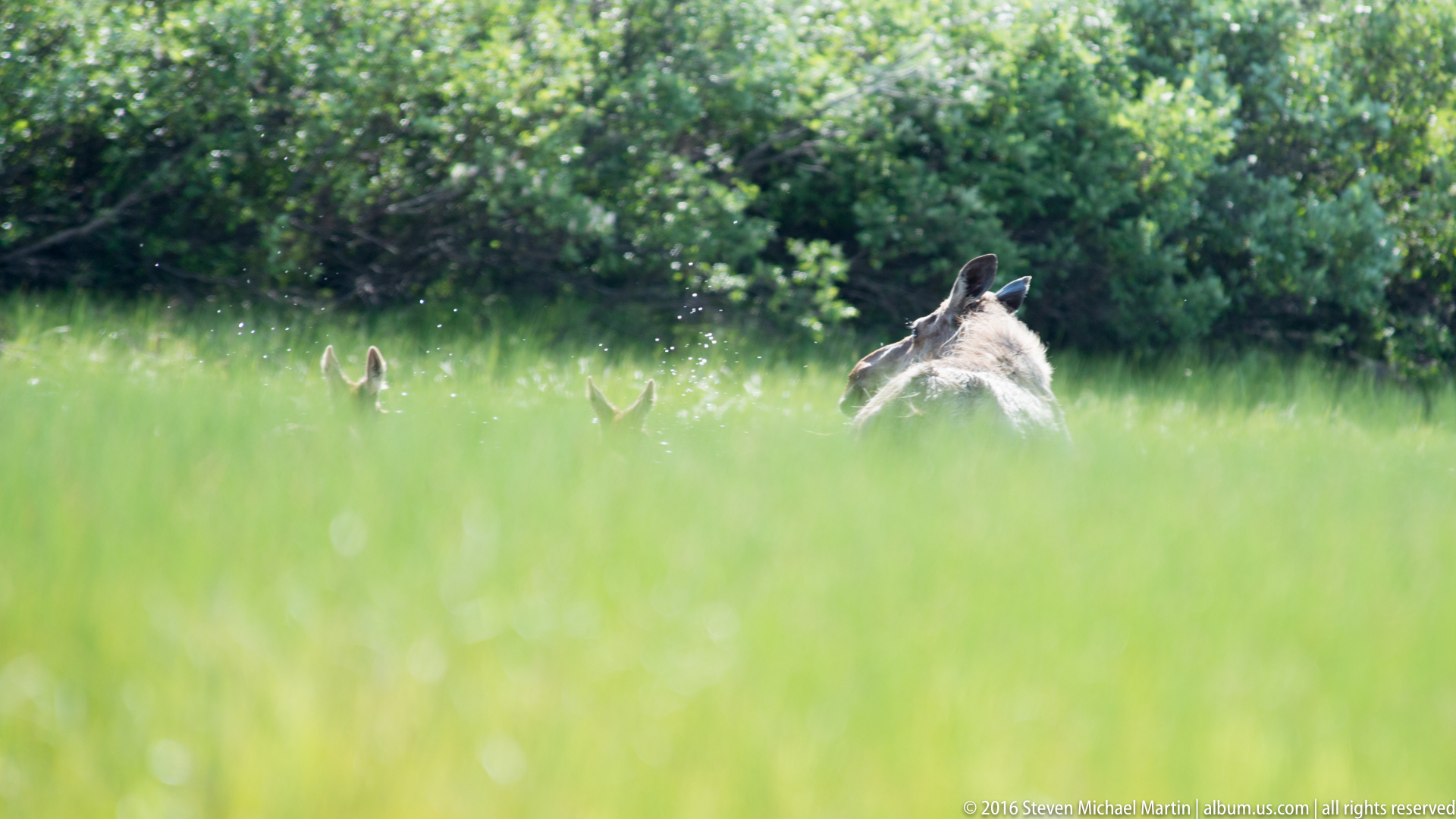
A moose cow is almost entirely concealed by tall green grass, with two ears and the upper part of her head visible against a leafy tree line. The soft foreground makes the animal difficult to see at first glance. The image records how vegetation can obscure wildlife in a wet meadow habitat.
Caption
A moose cow is almost entirely concealed by tall green grass, with two ears and the upper part of her head visible against a leafy tree line. The soft foreground makes the animal difficult to see at first glance. The image records how vegetation can obscure wildlife in a wet meadow habitat.
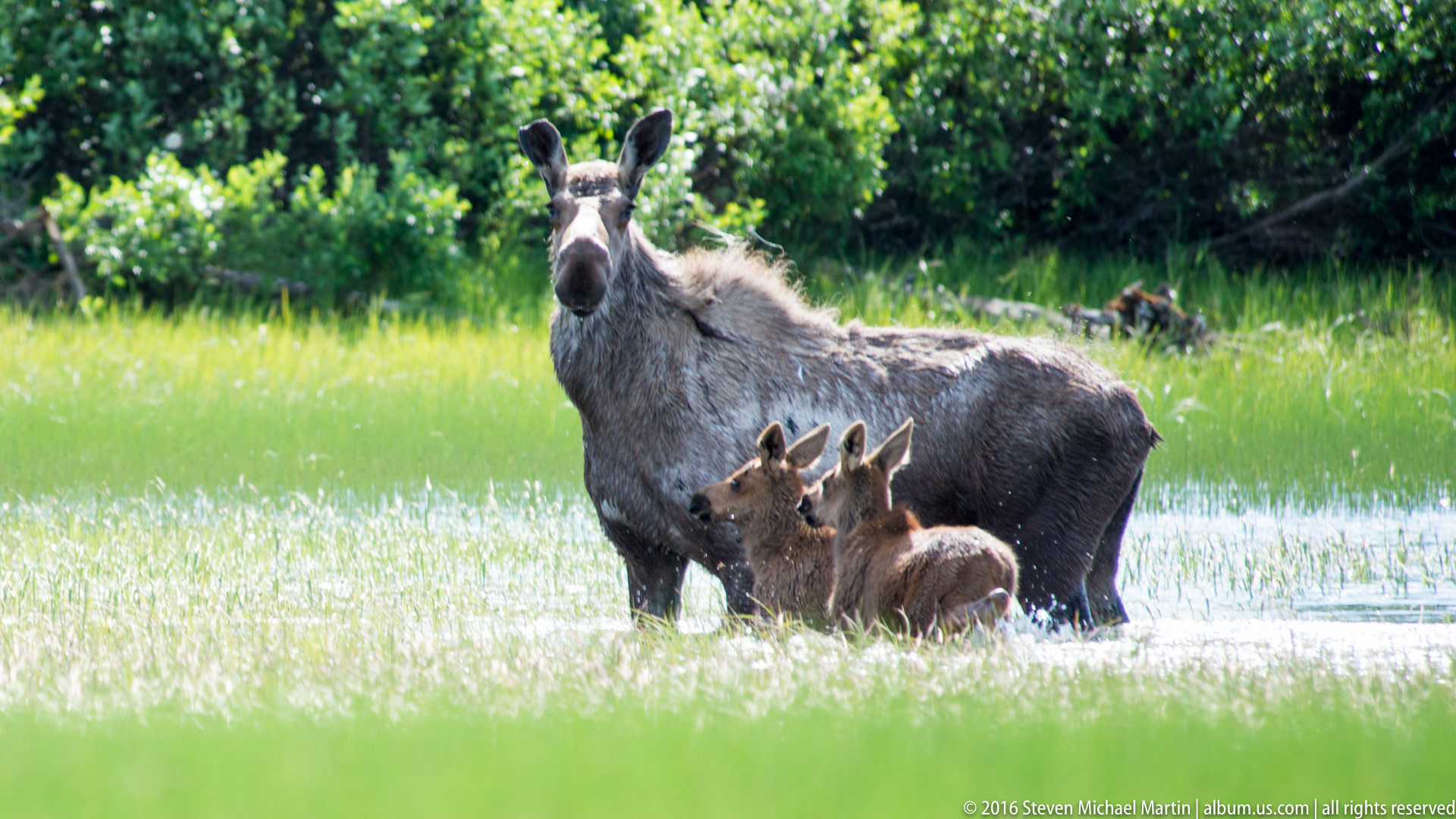
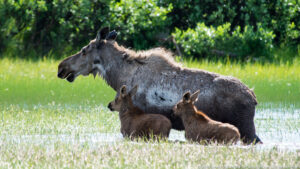
An adult moose stands in shallow meadow water beside a small brown calf. The cow’s long face and shoulder rise above the grass, while the calf presses close to her front legs. Sunlit green shrubs and trees form a dense background, emphasizing the family’s position in a marshy feeding area.
Caption
An adult moose stands in shallow meadow water beside a small brown calf. The cow’s long face and shoulder rise above the grass, while the calf presses close to her front legs. Sunlit green shrubs and trees form a dense background, emphasizing the family’s position in a marshy feeding area.
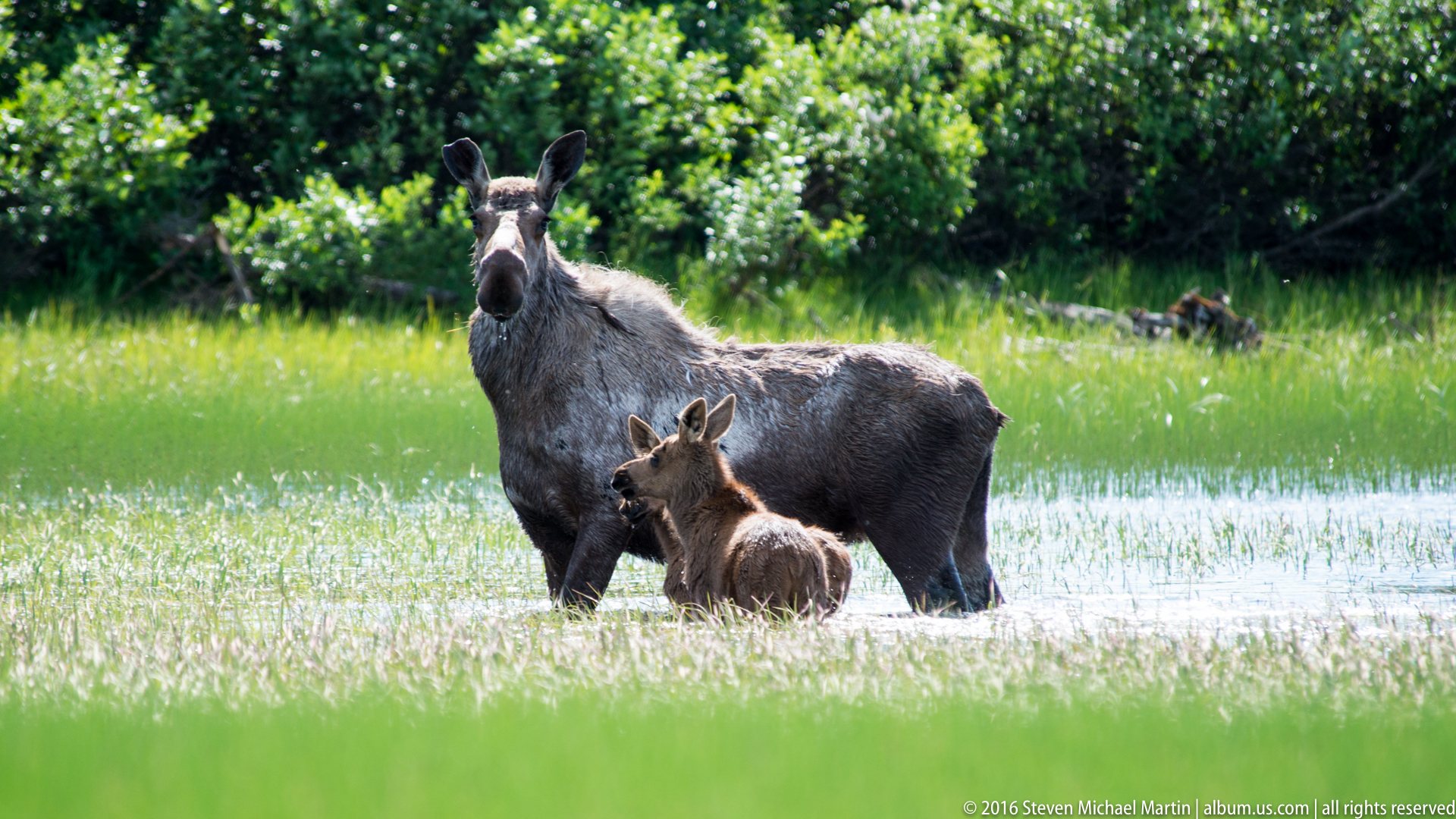
An adult moose stands in shallow water with two small calves gathered beneath and beside her. The cow faces left as the calves cluster close to her body, their smaller heads and rounded ears visible above the wet grass. Bright light and a leafy background make this family grouping clear despite the vegetation around their legs.
Caption
An adult moose stands in shallow water with two small calves gathered beneath and beside her. The cow faces left as the calves cluster close to her body, their smaller heads and rounded ears visible above the wet grass. Bright light and a leafy background make this family grouping clear despite the vegetation around their legs.
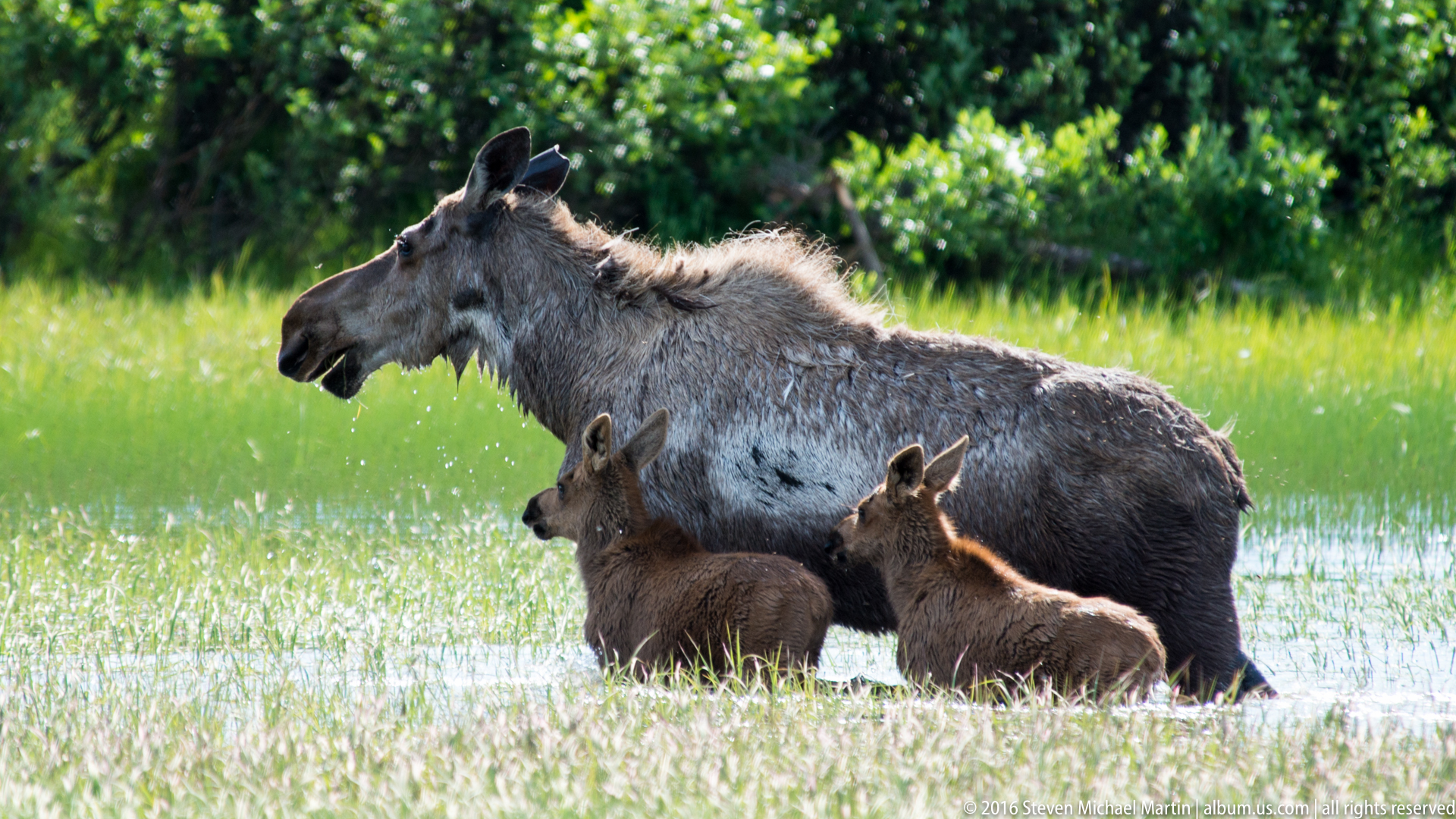
A moose cow lowers her head over two calves standing close at her side in a sunlit wet meadow. The cow’s gray-brown coat and long muzzle contrast with the warmer brown coats of the young animals. Tall grass partly covers their legs, while dense shrubs and trees enclose the clearing.
Caption
A moose cow lowers her head over two calves standing close at her side in a sunlit wet meadow. The cow’s gray-brown coat and long muzzle contrast with the warmer brown coats of the young animals. Tall grass partly covers their legs, while dense shrubs and trees enclose the clearing.

An adult moose strides through shallow water in a green marsh, lifting one foreleg as two calves follow close behind. The cow’s long body is fully visible above the grass, and the young animals remain clustered near her flank. The sequence shifts from standing portraits to active movement through the wet meadow.
Caption
An adult moose strides through shallow water in a green marsh, lifting one foreleg as two calves follow close behind. The cow’s long body is fully visible above the grass, and the young animals remain clustered near her flank. The sequence shifts from standing portraits to active movement through the wet meadow.

A cow moose moves left through shallow marsh water, with two calves keeping pace beside her. Their legs splash through the wet grass, and the adult’s lifted foreleg marks the crossing. Dense green shrubs form a continuous background, keeping the family centered as they move through the flooded meadow.
Caption
A cow moose moves left through shallow marsh water, with two calves keeping pace beside her. Their legs splash through the wet grass, and the adult’s lifted foreleg marks the crossing. Dense green shrubs form a continuous background, keeping the family centered as they move through the flooded meadow.
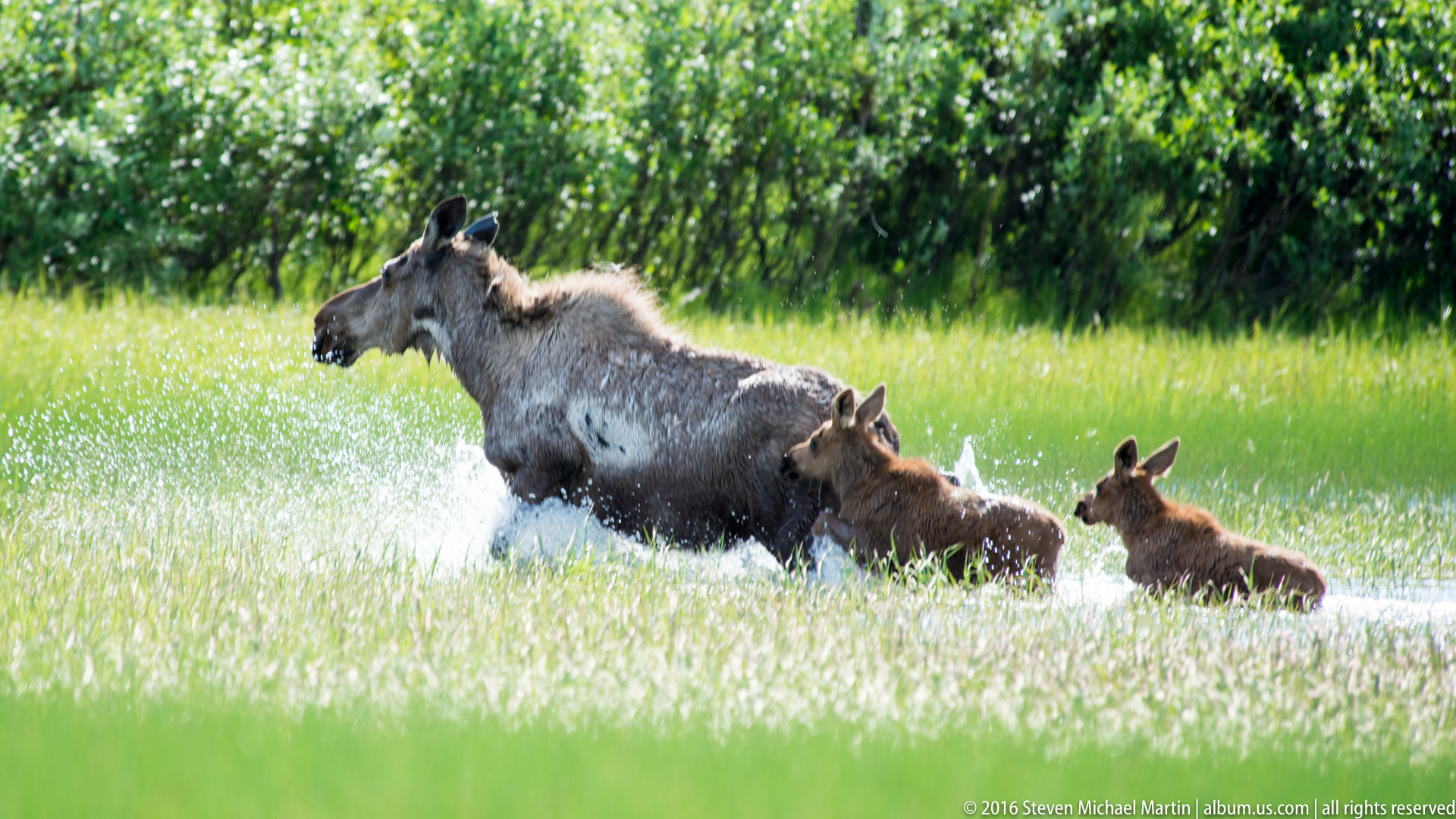
An adult moose pushes through shallow water with a forceful stride, sending a small splash around her legs as two calves follow. The family moves toward the left edge of the frame, their bodies set against a bright meadow and dark green shrub line. The image conveys a brief burst of movement rather than a static feeding pose.
Caption
An adult moose pushes through shallow water with a forceful stride, sending a small splash around her legs as two calves follow. The family moves toward the left edge of the frame, their bodies set against a bright meadow and dark green shrub line. The image conveys a brief burst of movement rather than a static feeding pose.

Two brown moose calves stand in tall green grass, one seen from behind and the other in profile with its ears raised. The adult is outside the frame, making this a focused view of the young animals rather than the full family group. Bright, dappled light catches their coats against the softer meadow background.
Caption
Two brown moose calves stand in tall green grass, one seen from behind and the other in profile with its ears raised. The adult is outside the frame, making this a focused view of the young animals rather than the full family group. Bright, dappled light catches their coats against the softer meadow background.
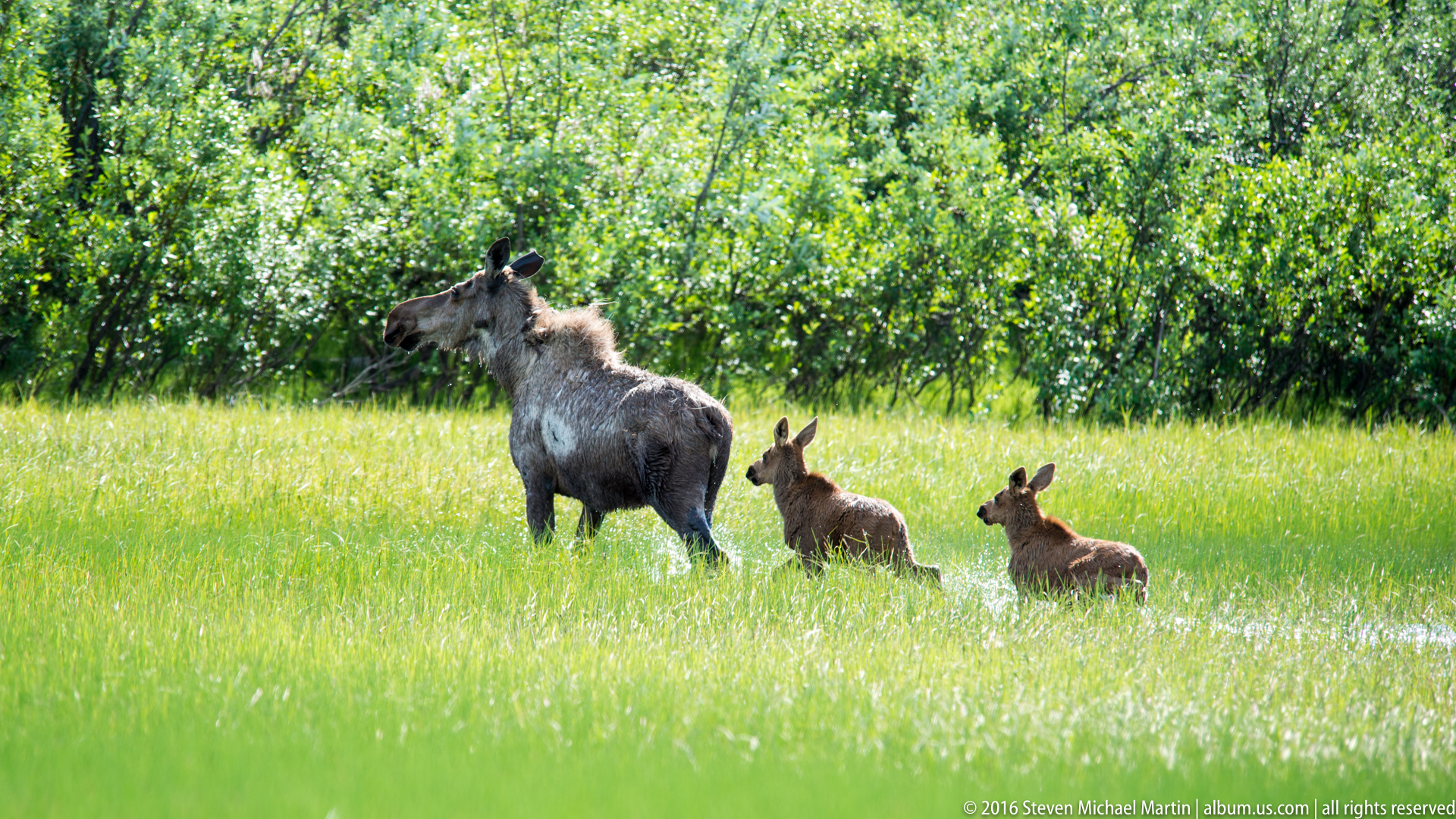
A cow moose walks left through a sunny clearing with two calves following several steps behind. The spacing reveals the animals’ sequence of movement, while the meadow grass and dense leafy shrubs create a bright, enclosed habitat. Compared with closer frames in this series, this view gives more room around the family and shows their direction of travel.
Caption
A cow moose walks left through a sunny clearing with two calves following several steps behind. The spacing reveals the animals’ sequence of movement, while the meadow grass and dense leafy shrubs create a bright, enclosed habitat. Compared with closer frames in this series, this view gives more room around the family and shows their direction of travel.
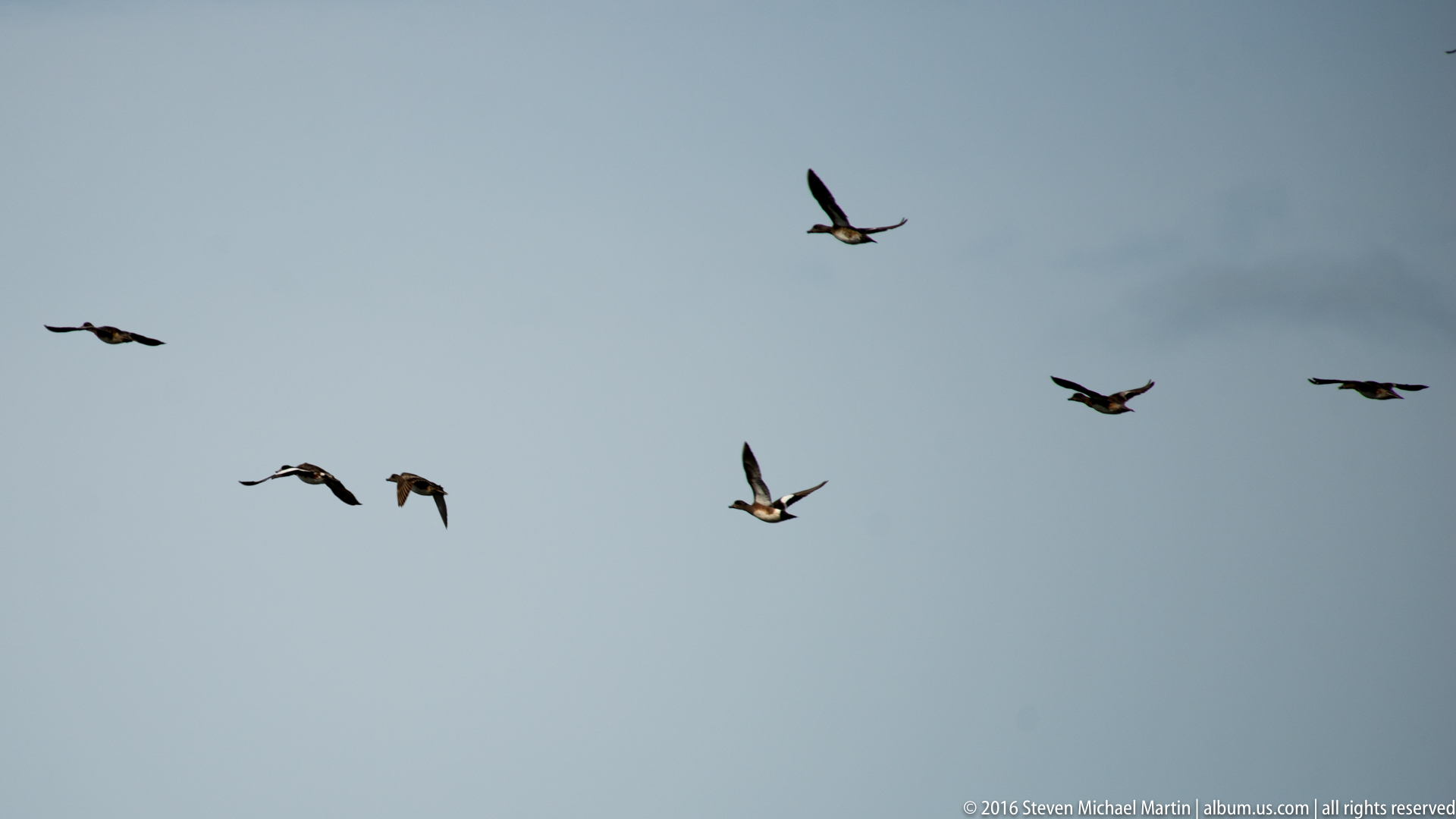
A small flock of waterfowl crosses an open blue-gray sky, each bird separated against the uncluttered background. Several birds bank at different angles, exposing pale undersides and dark wing edges. With no water or shoreline in view, the photograph concentrates on the group’s flight and spacing rather than a specific habitat.
Caption
A small flock of waterfowl crosses an open blue-gray sky, each bird separated against the uncluttered background. Several birds bank at different angles, exposing pale undersides and dark wing edges. With no water or shoreline in view, the photograph concentrates on the group’s flight and spacing rather than a specific habitat.
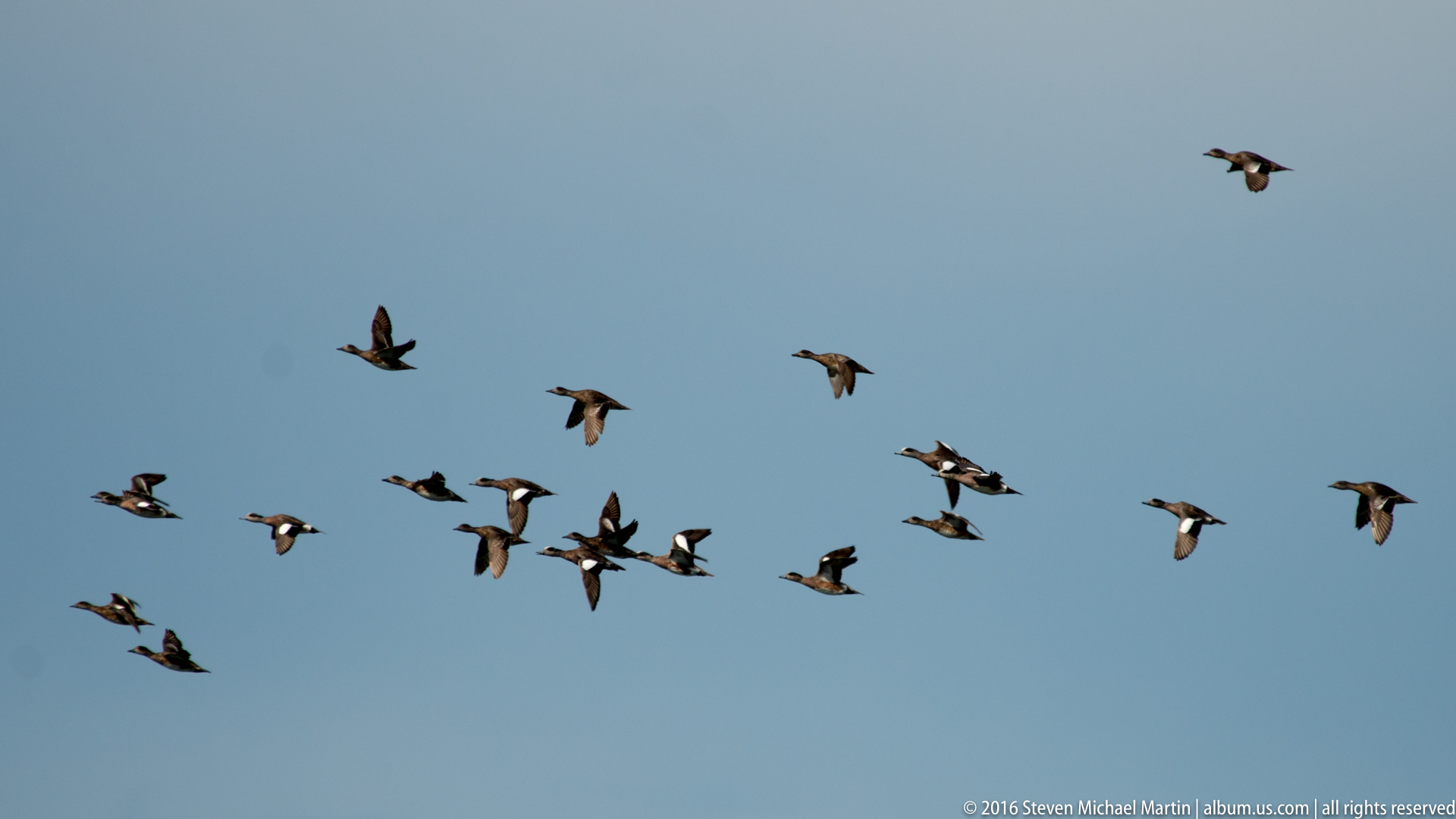
A larger flock of waterfowl spreads across the blue sky, with birds at varied distances and wing positions. The central cluster overlaps while several individuals trail at the edges, creating a loose moving formation. Pale wing patches and dark bodies are visible, but the small proof-sheet view does not settle whether these are ducks or geese.
Caption
A larger flock of waterfowl spreads across the blue sky, with birds at varied distances and wing positions. The central cluster overlaps while several individuals trail at the edges, creating a loose moving formation. Pale wing patches and dark bodies are visible, but the small proof-sheet view does not settle whether these are ducks or geese.
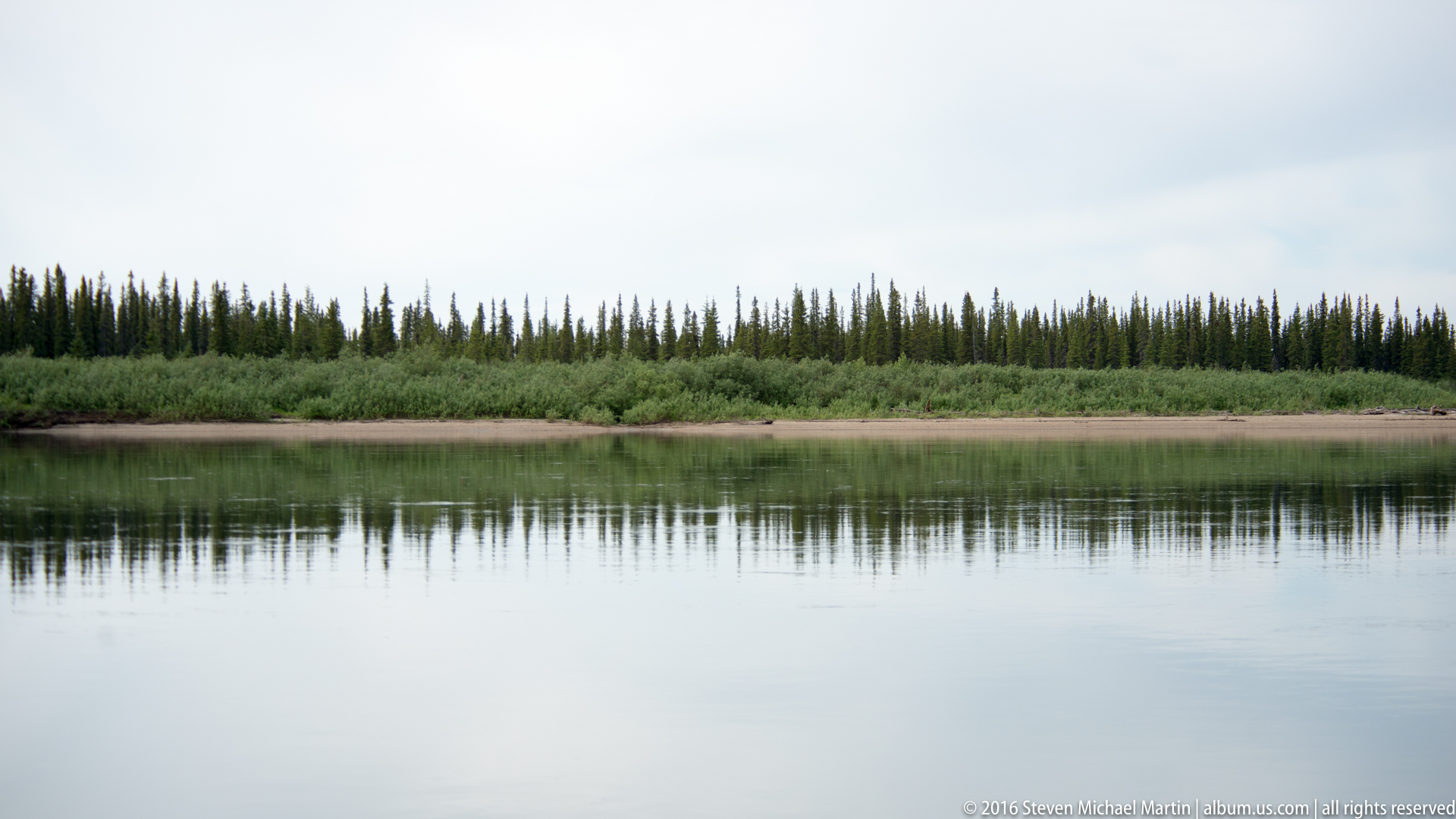
A narrow band of shrubs and tall conifers traces the opposite bank above a quiet river. Their dark vertical forms repeat in the smooth water, while a pale strip of exposed sand separates vegetation from the current. The low, horizontal composition records the river corridor as a layered sequence of water, shore, brush, and forest.
Caption
A narrow band of shrubs and tall conifers traces the opposite bank above a quiet river. Their dark vertical forms repeat in the smooth water, while a pale strip of exposed sand separates vegetation from the current. The low, horizontal composition records the river corridor as a layered sequence of water, shore, brush, and forest.
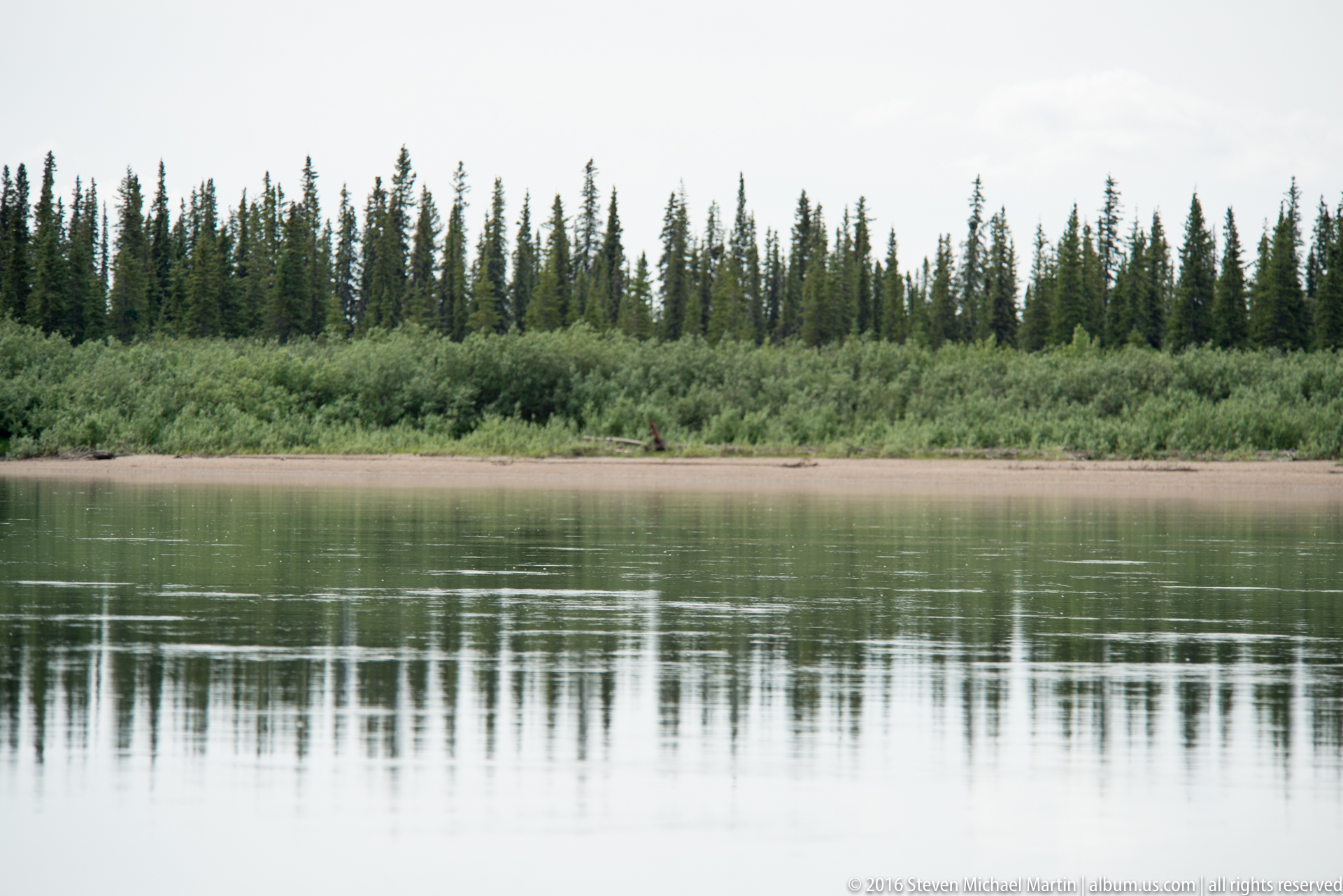
A closer view of the opposite bank brings the conifer canopy and dense shrub layer into sharper relief. Their reflections break into wavering vertical streaks across the river, contrasting with the smooth water in the previous frame. A thin sandy margin remains visible between the green vegetation and the channel.
Caption
A closer view of the opposite bank brings the conifer canopy and dense shrub layer into sharper relief. Their reflections break into wavering vertical streaks across the river, contrasting with the smooth water in the previous frame. A thin sandy margin remains visible between the green vegetation and the channel.
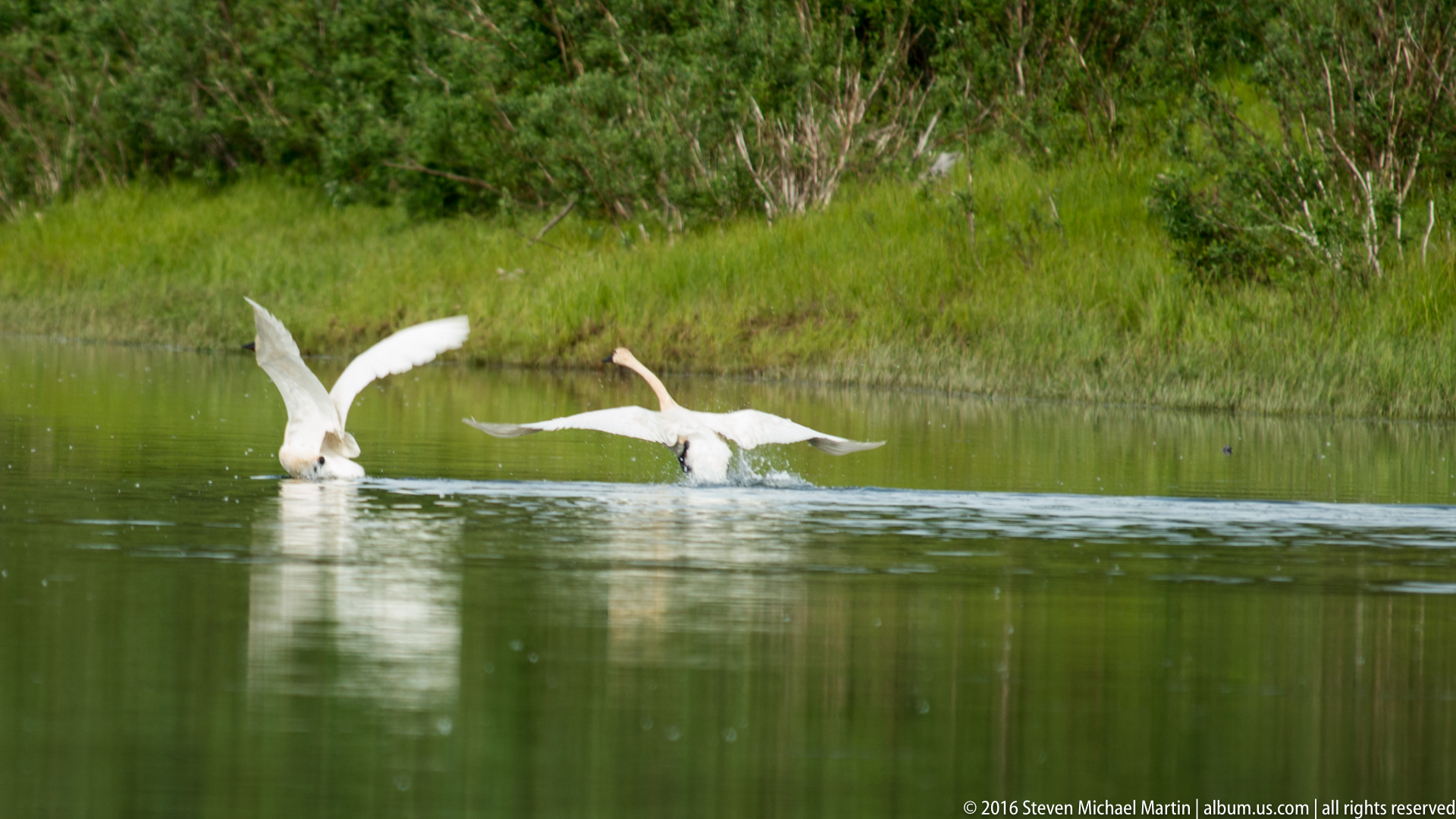
Two large white swans beat their wings and run across the water, their feet throwing up small splashes as they lift. The birds move in parallel in front of a grassy, shrub-lined bank. Their synchronized effort and low position over the river make this frame a moment of transition from swimming to flight.
Caption
Two large white swans beat their wings and run across the water, their feet throwing up small splashes as they lift. The birds move in parallel in front of a grassy, shrub-lined bank. Their synchronized effort and low position over the river make this frame a moment of transition from swimming to flight.
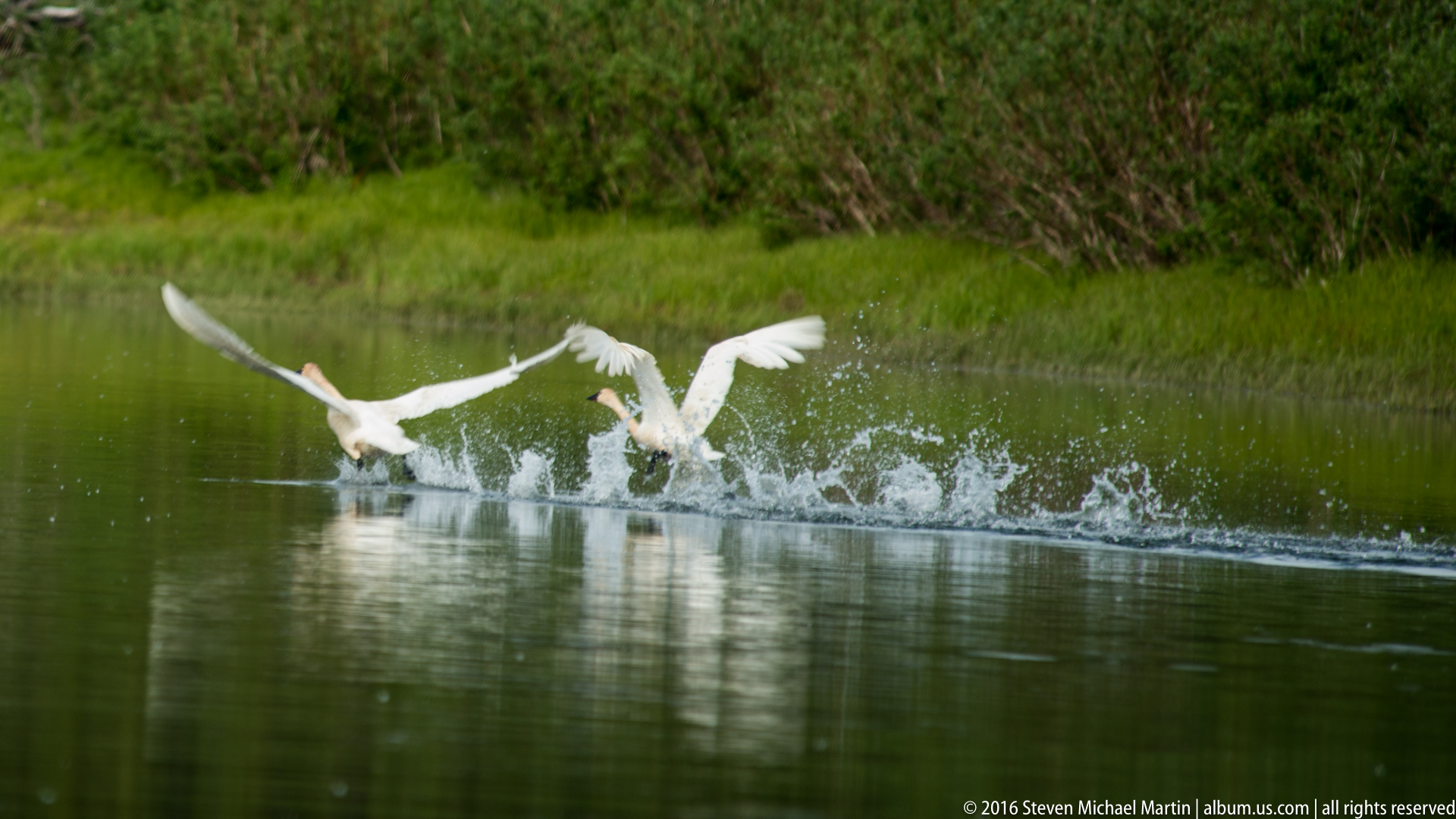
The two swans push off more forcefully, their wings extended as water sprays behind their feet. The leading bird is slightly ahead while the second follows close beside it, both just above the river surface. A soft green bank fills the background, keeping attention on the birds’ powerful takeoff.
Caption
The two swans push off more forcefully, their wings extended as water sprays behind their feet. The leading bird is slightly ahead while the second follows close beside it, both just above the river surface. A soft green bank fills the background, keeping attention on the birds’ powerful takeoff.
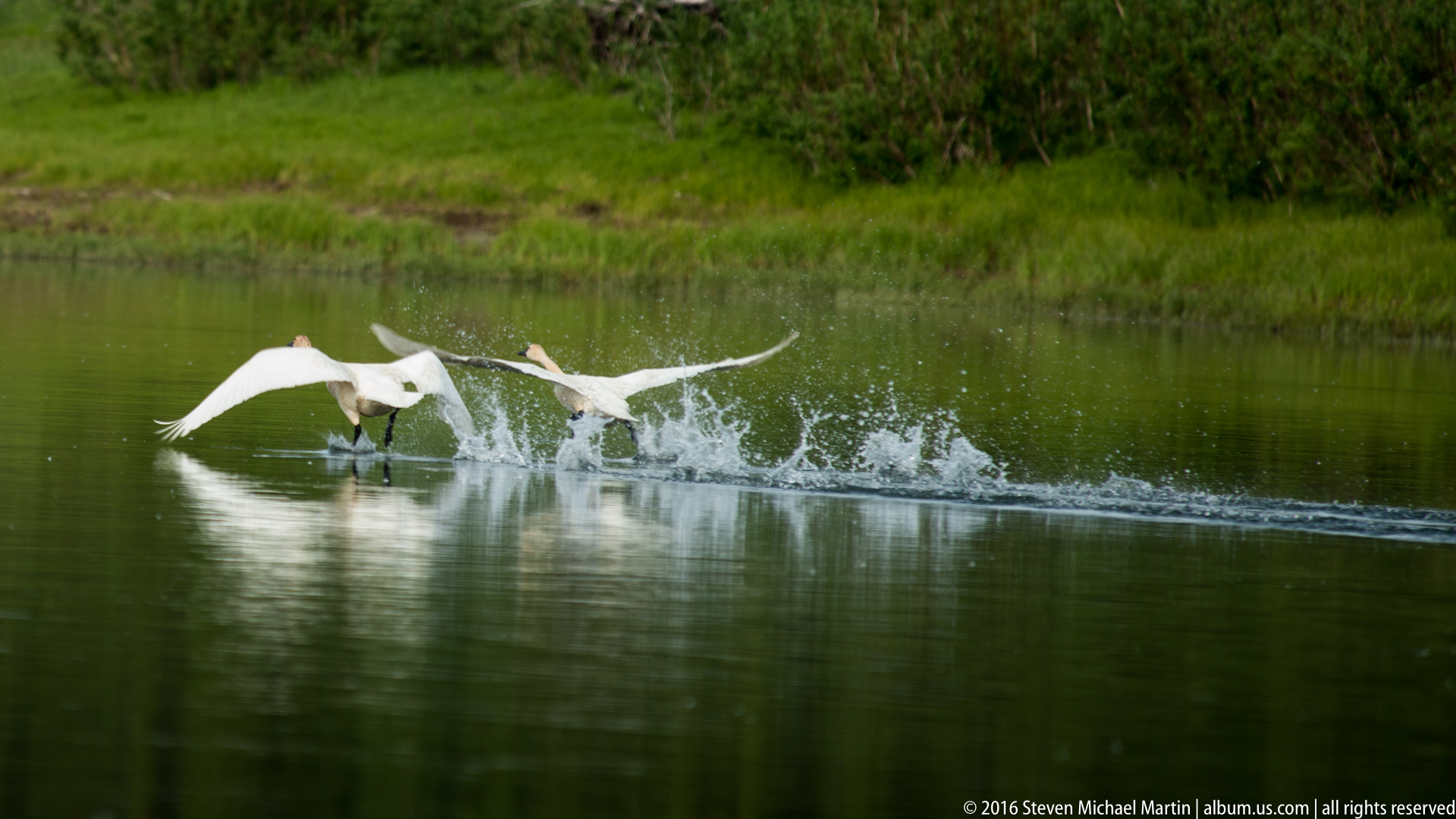
Seen from slightly farther away, the pair of swans runs across the green water with wings open and a spray trailing behind. The grassy river edge and shrubs frame their movement, while their reflections faintly echo the birds below. The composition emphasizes the distance covered during the takeoff rather than a static portrait.
Caption
Seen from slightly farther away, the pair of swans runs across the green water with wings open and a spray trailing behind. The grassy river edge and shrubs frame their movement, while their reflections faintly echo the birds below. The composition emphasizes the distance covered during the takeoff rather than a static portrait.
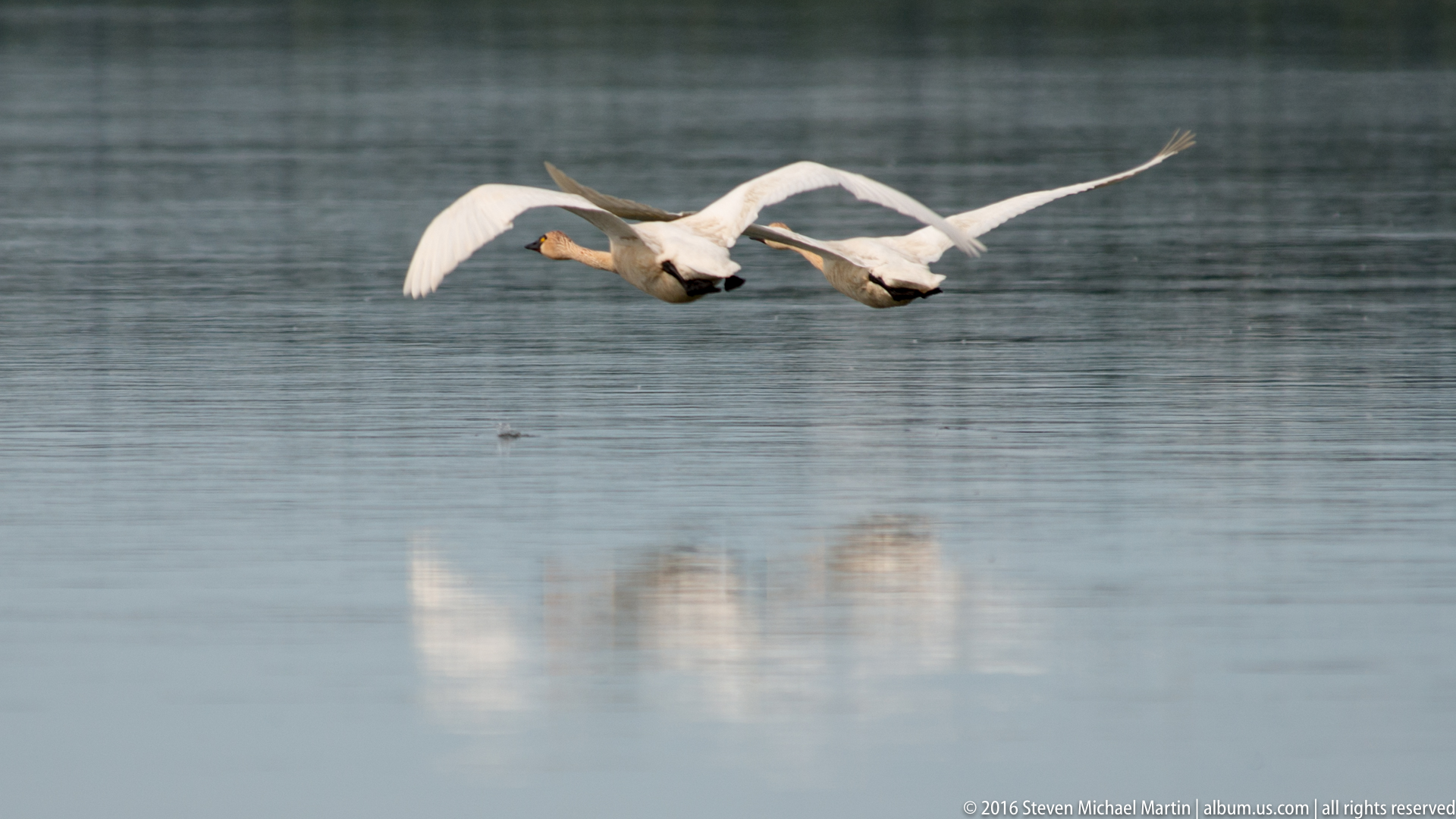
Two white swans fly low over rippled water, their long necks extended and wings held at different angles. Blurred reflections trail below them, separating this airborne moment from the preceding splash-filled takeoff images. The tight horizontal framing isolates the pair against a softly textured gray-blue river surface.
Caption
Two white swans fly low over rippled water, their long necks extended and wings held at different angles. Blurred reflections trail below them, separating this airborne moment from the preceding splash-filled takeoff images. The tight horizontal framing isolates the pair against a softly textured gray-blue river surface.
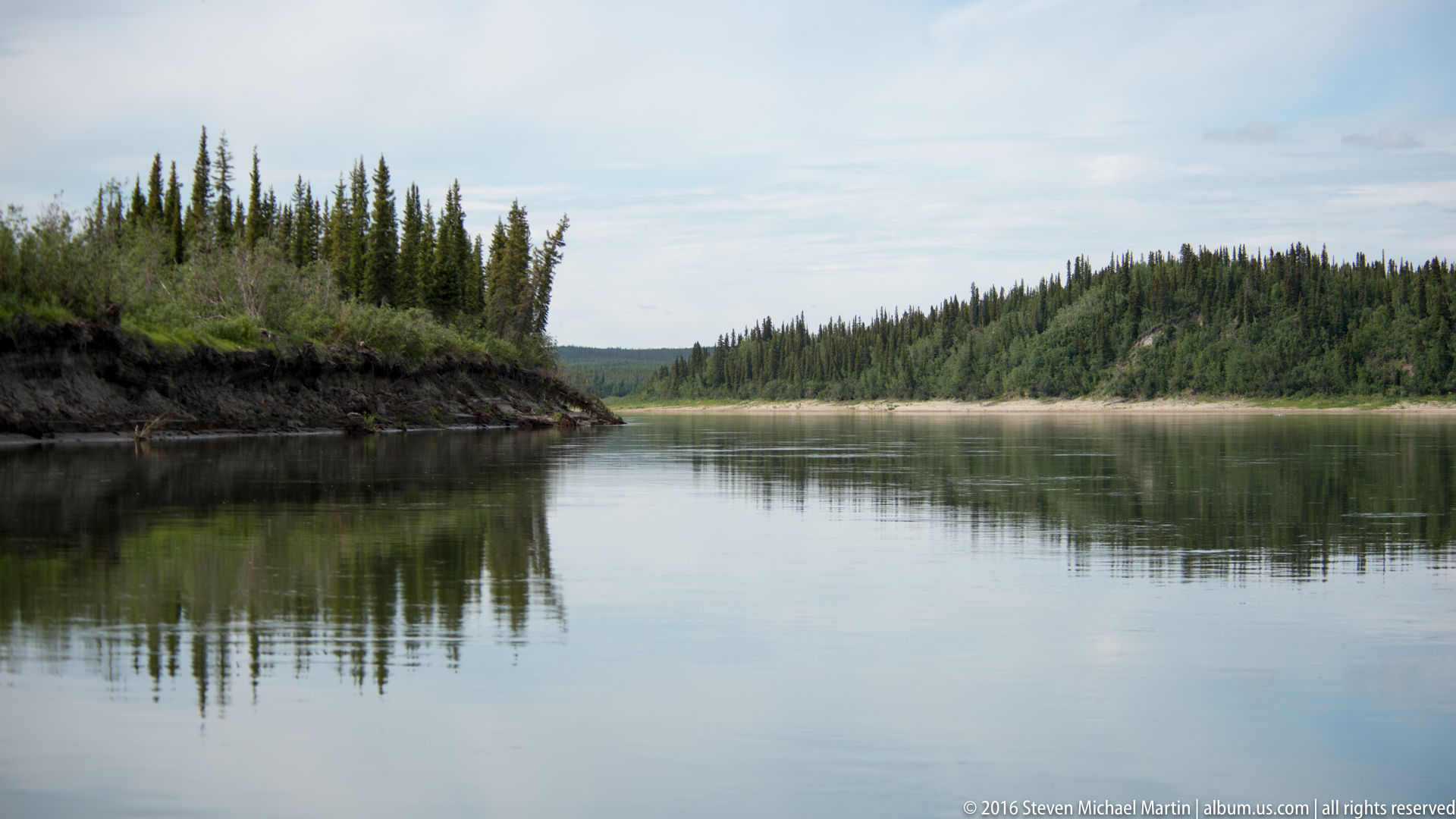
The river opens into a broad bend between two forested banks, with an undercut, shadowed edge in the foreground and a pale sandy shoreline beyond. Conifers follow the channel into the distance, guiding the eye toward the narrowing waterway. The wider view reveals the river’s course rather than isolating its reflective shoreline.
Caption
The river opens into a broad bend between two forested banks, with an undercut, shadowed edge in the foreground and a pale sandy shoreline beyond. Conifers follow the channel into the distance, guiding the eye toward the narrowing waterway. The wider view reveals the river’s course rather than isolating its reflective shoreline.
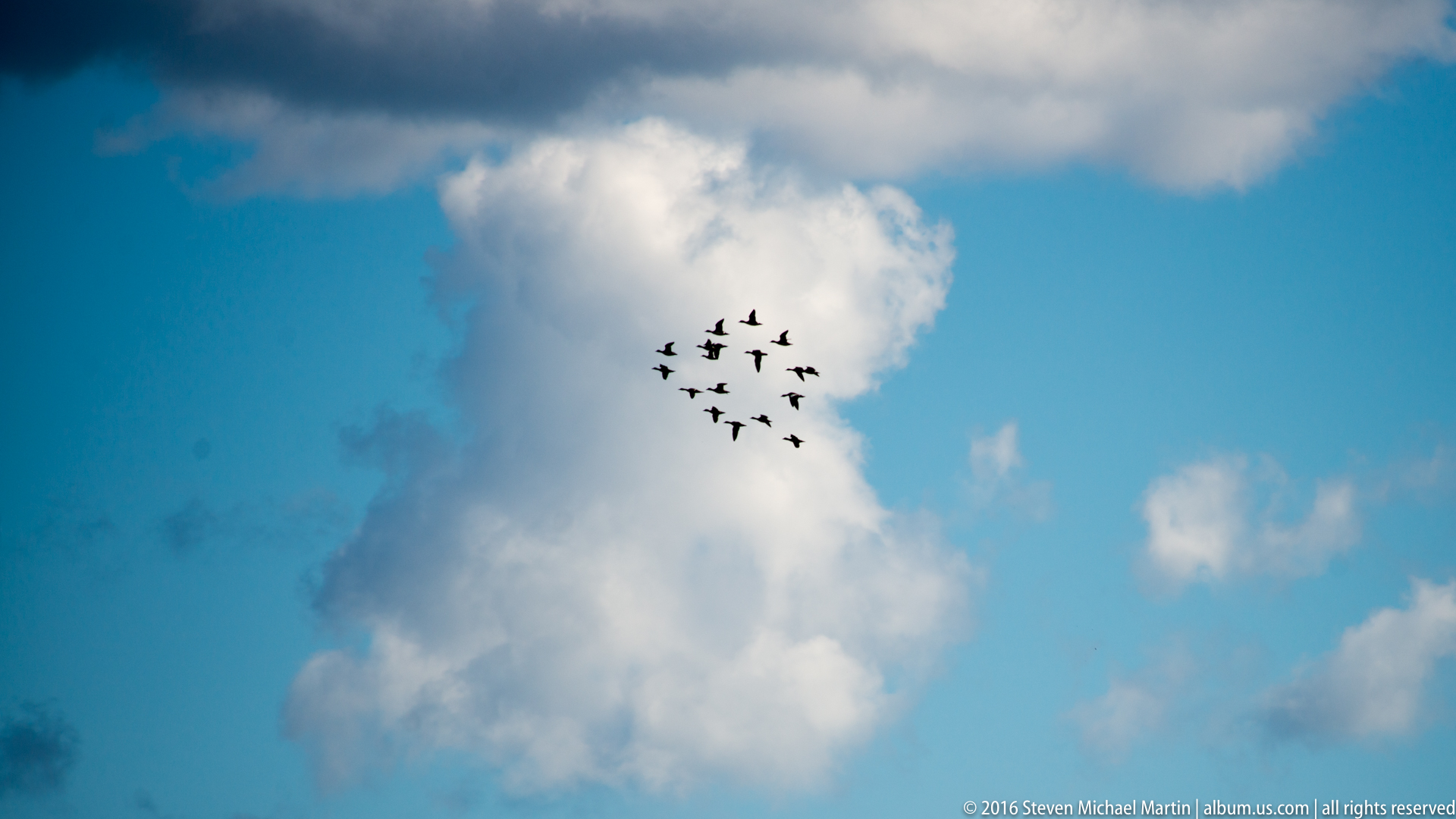
A compact flock of dark birds crosses in front of a towering white cloud, their silhouettes sharply separated from its bright surface. The uneven spacing and varied wing positions suggest active flight rather than a fixed pattern. The small scale of the birds makes species identification uncertain, while the cloud supplies a dramatic backdrop.
Caption
A compact flock of dark birds crosses in front of a towering white cloud, their silhouettes sharply separated from its bright surface. The uneven spacing and varied wing positions suggest active flight rather than a fixed pattern. The small scale of the birds makes species identification uncertain, while the cloud supplies a dramatic backdrop.
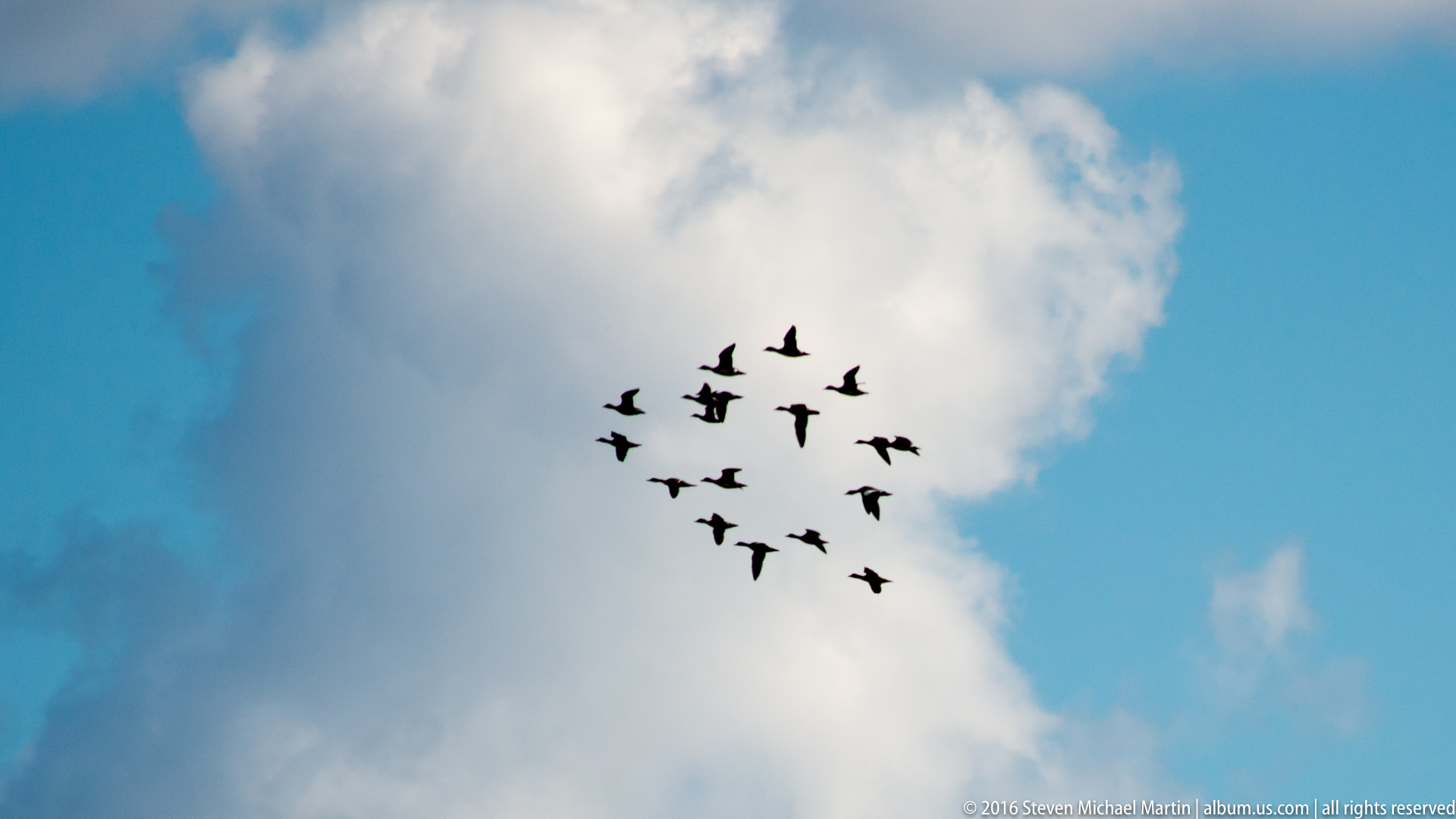
A small flock of birds passes across the face of a tall white cloud, with blue sky visible on either side. Their dark silhouettes form a loose cluster, each bird holding a distinct wing position. The cloud’s vertical shape frames their movement; no landscape features are present to identify the birds’ route or habitat.
Caption
A small flock of birds passes across the face of a tall white cloud, with blue sky visible on either side. Their dark silhouettes form a loose cluster, each bird holding a distinct wing position. The cloud’s vertical shape frames their movement; no landscape features are present to identify the birds’ route or habitat.
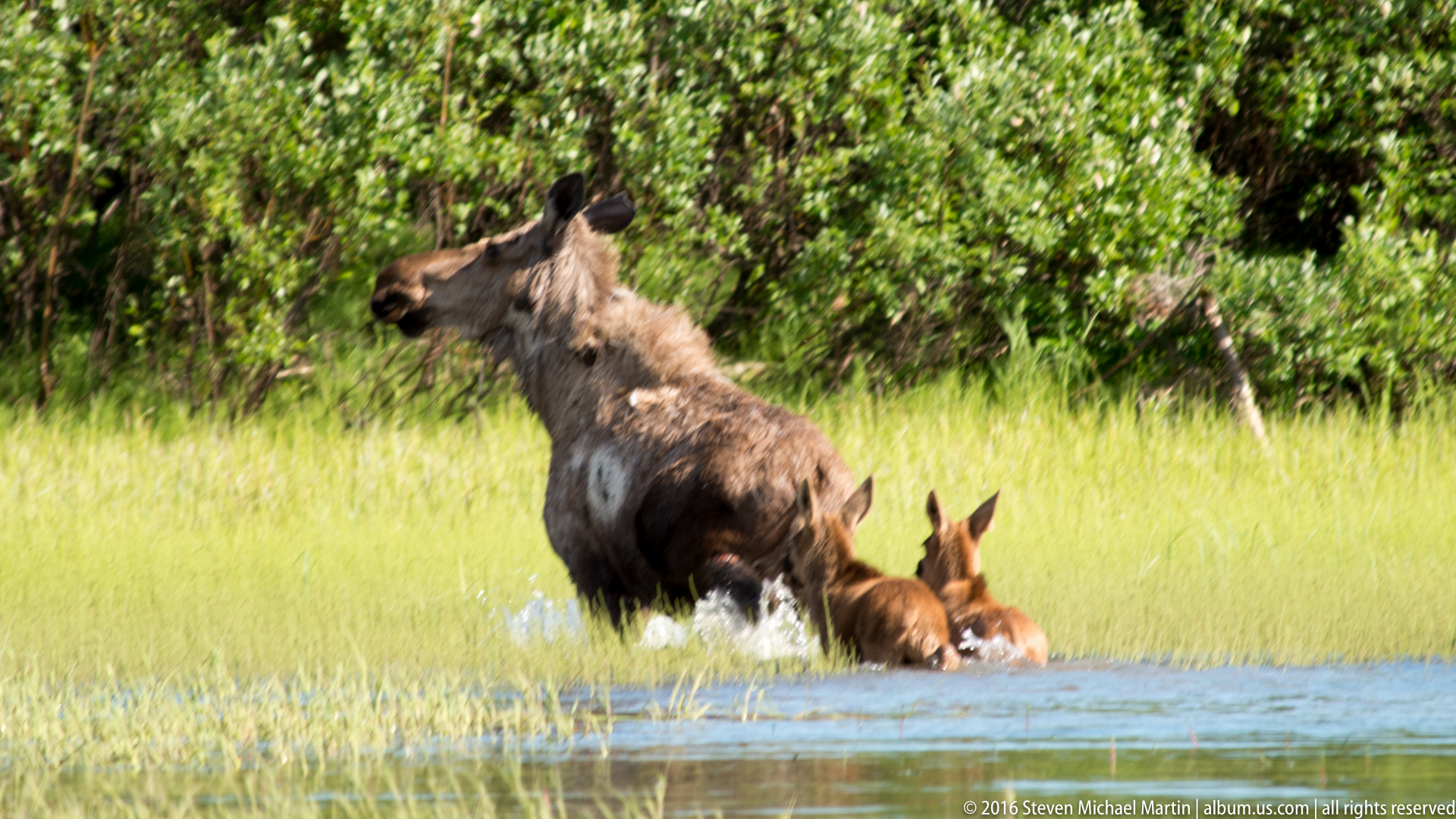
An adult moose stands in shallow water at the edge of a grassy marsh, with two reddish-brown calves close beside her. Dense willow-like shrubs form a green backdrop, while ripples and splashes mark the animals’ movement through the wet margin. The family group is clear, though the calves’ precise age is not established.
Caption
An adult moose stands in shallow water at the edge of a grassy marsh, with two reddish-brown calves close beside her. Dense willow-like shrubs form a green backdrop, while ripples and splashes mark the animals’ movement through the wet margin. The family group is clear, though the calves’ precise age is not established.
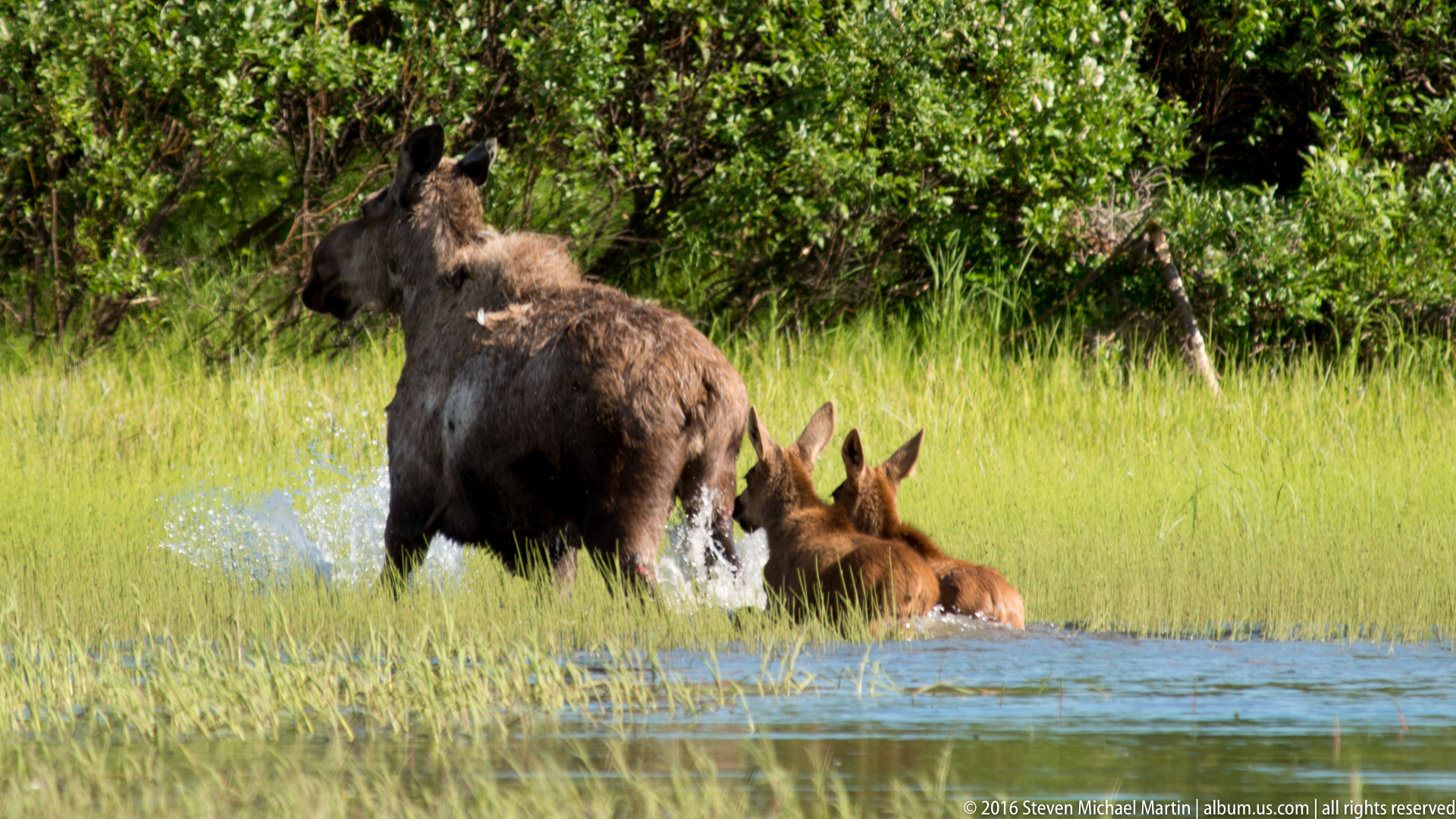
The moose cow moves through the marsh with her two calves close behind, sending water outward as they leave the shallows. One calf is partly hidden by the adult while the second follows at her flank. Bright sedges and dense shrubs frame the family, turning the sequence into an image of coordinated movement rather than a posed wildlife view.
Caption
The moose cow moves through the marsh with her two calves close behind, sending water outward as they leave the shallows. One calf is partly hidden by the adult while the second follows at her flank. Bright sedges and dense shrubs frame the family, turning the sequence into an image of coordinated movement rather than a posed wildlife view.
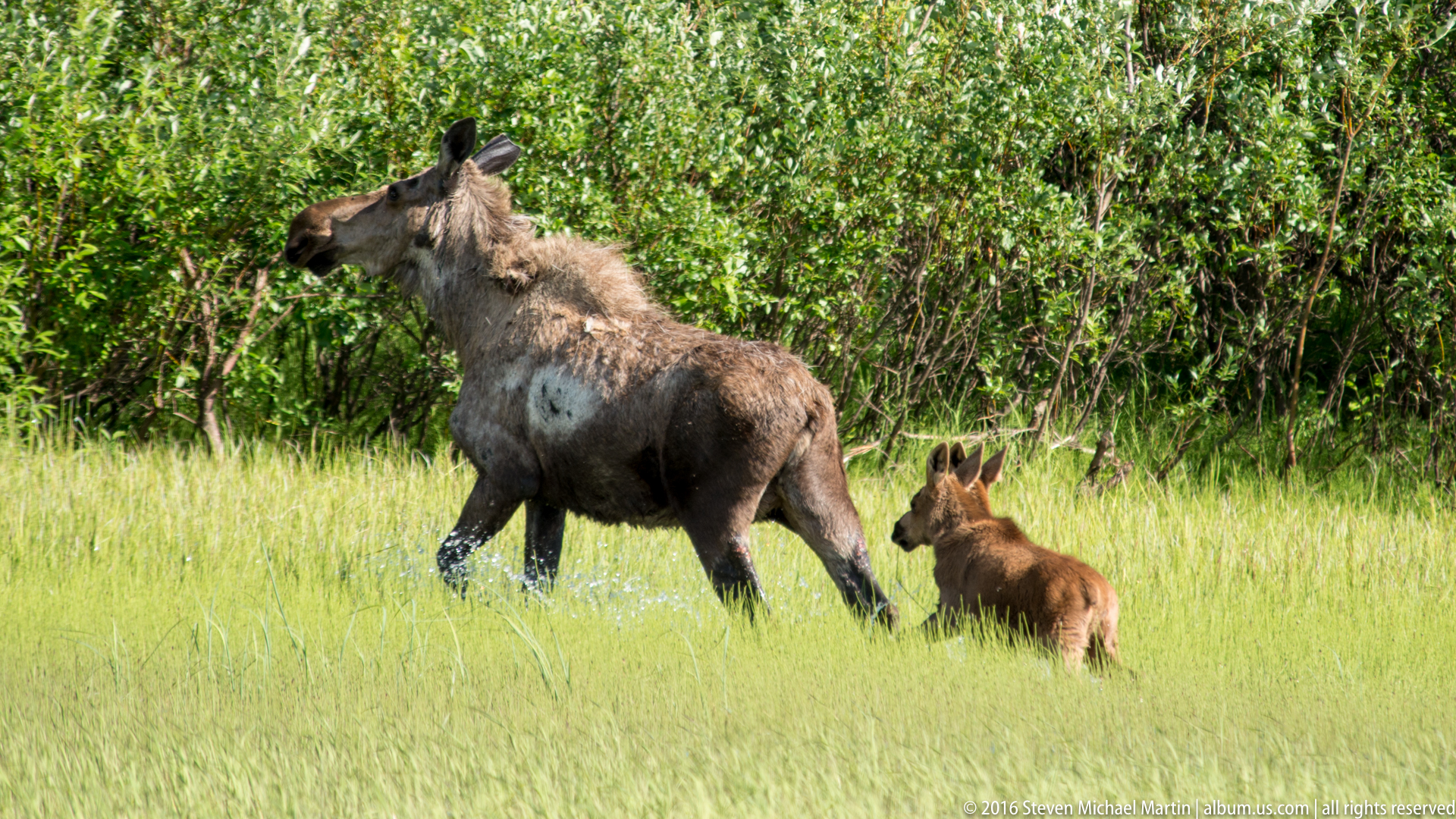
An adult moose strides through tall marsh grass while one calf follows just behind her hindquarters. The cow’s lifted leg and the calf’s close position make their movement through the wet meadow explicit. Willows fill the background, and shallow water borders the foreground. This frame shows the pair separated from the second calf visible nearby in earlier views.
Caption
An adult moose strides through tall marsh grass while one calf follows just behind her hindquarters. The cow’s lifted leg and the calf’s close position make their movement through the wet meadow explicit. Willows fill the background, and shallow water borders the foreground. This frame shows the pair separated from the second calf visible nearby in earlier views.
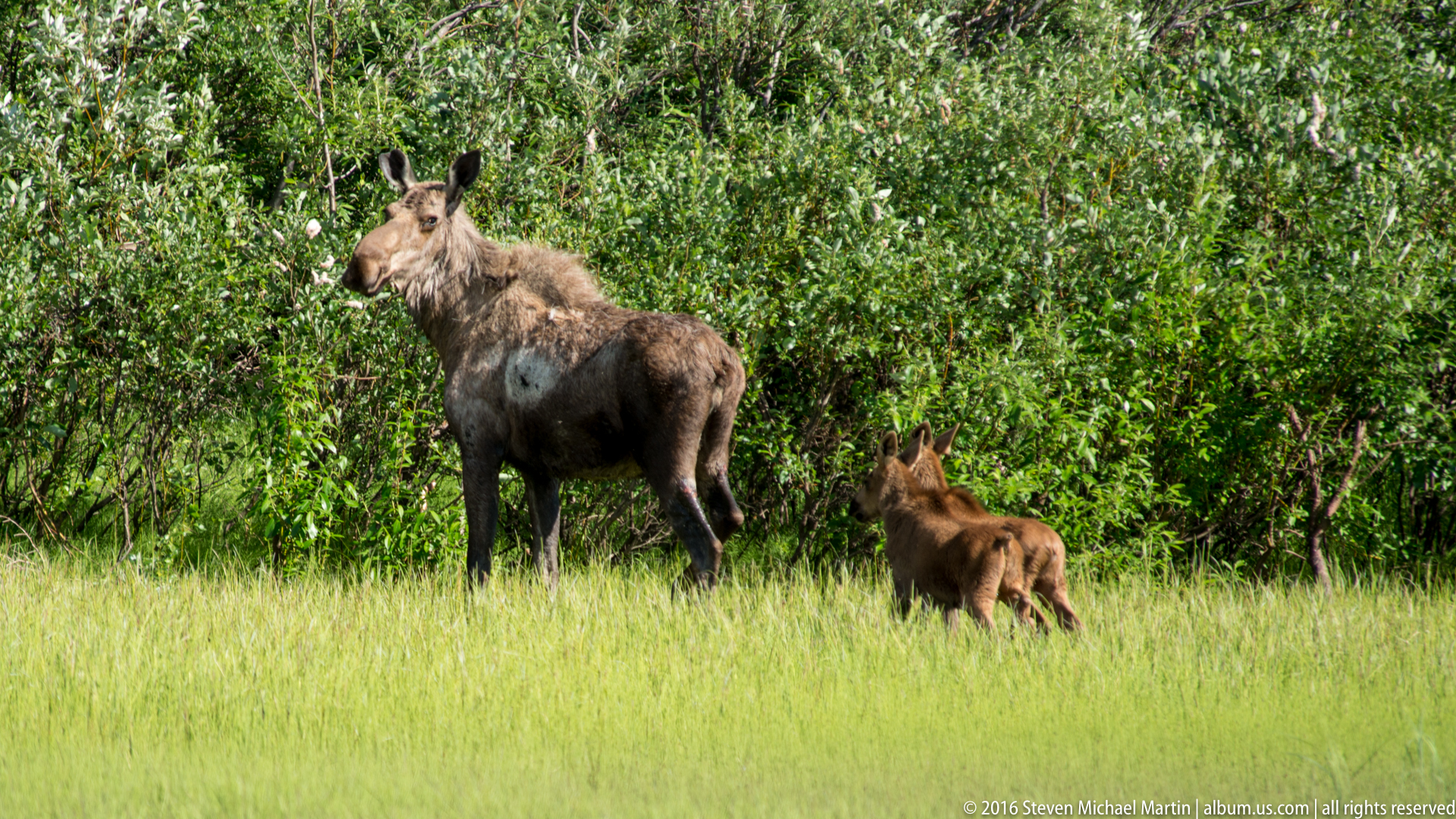
The adult moose pauses in tall grass and turns her head toward the camera, while a calf remains close behind her flank. Their bodies are fully visible against dense green shrubs, creating a clear view of the size difference between cow and young. The alert posture and open meadow distinguish this moment from the family’s movement through water.
Caption
The adult moose pauses in tall grass and turns her head toward the camera, while a calf remains close behind her flank. Their bodies are fully visible against dense green shrubs, creating a clear view of the size difference between cow and young. The alert posture and open meadow distinguish this moment from the family’s movement through water.
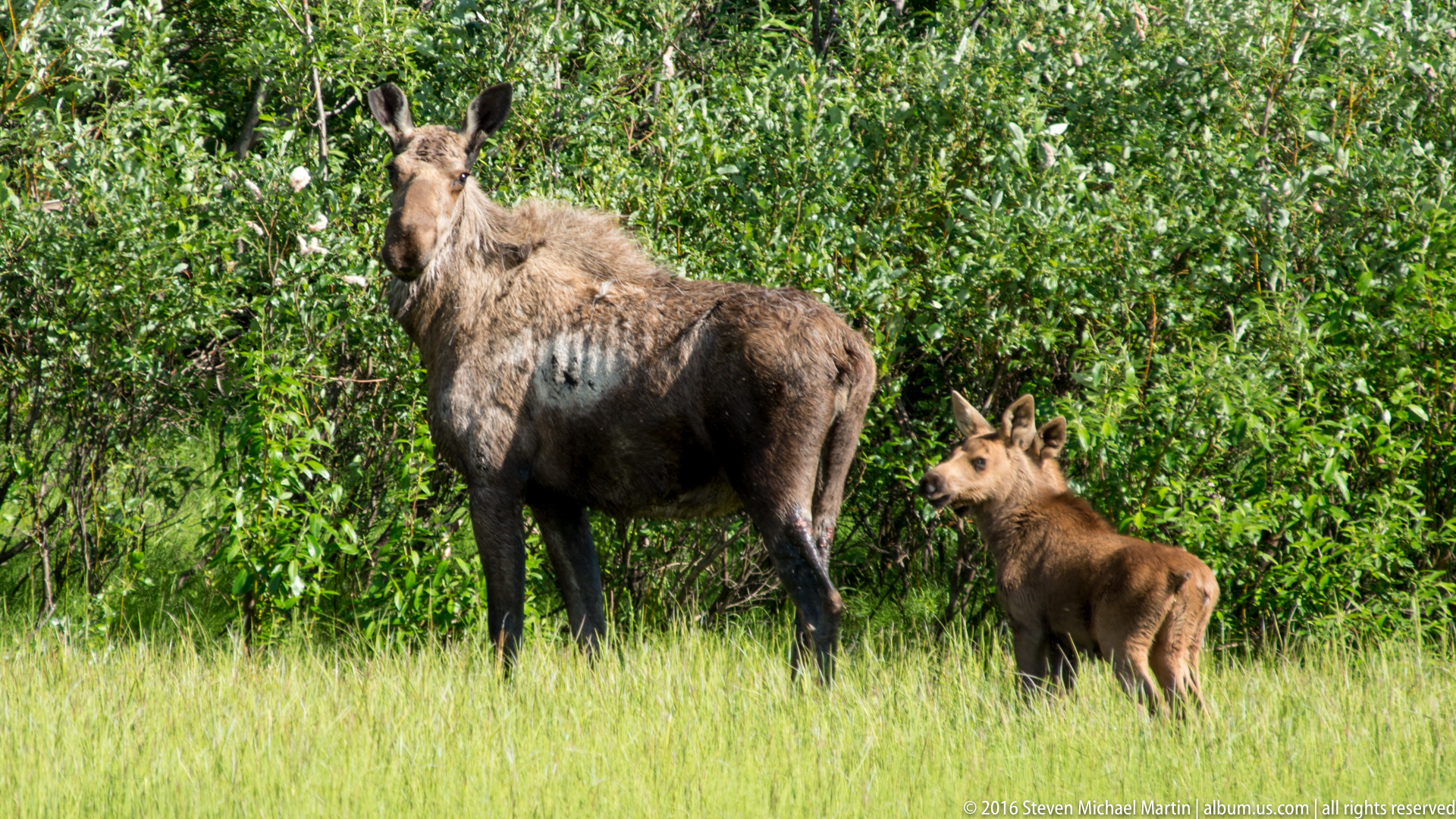
An adult moose stands in tall grass with a calf tucked close to her side, both oriented toward the left. The calf looks up toward the cow as the adult raises her head above the meadow. Dense shrubs create a green backdrop, while the pair’s full bodies and size contrast remain visible.
Caption
An adult moose stands in tall grass with a calf tucked close to her side, both oriented toward the left. The calf looks up toward the cow as the adult raises her head above the meadow. Dense shrubs create a green backdrop, while the pair’s full bodies and size contrast remain visible.
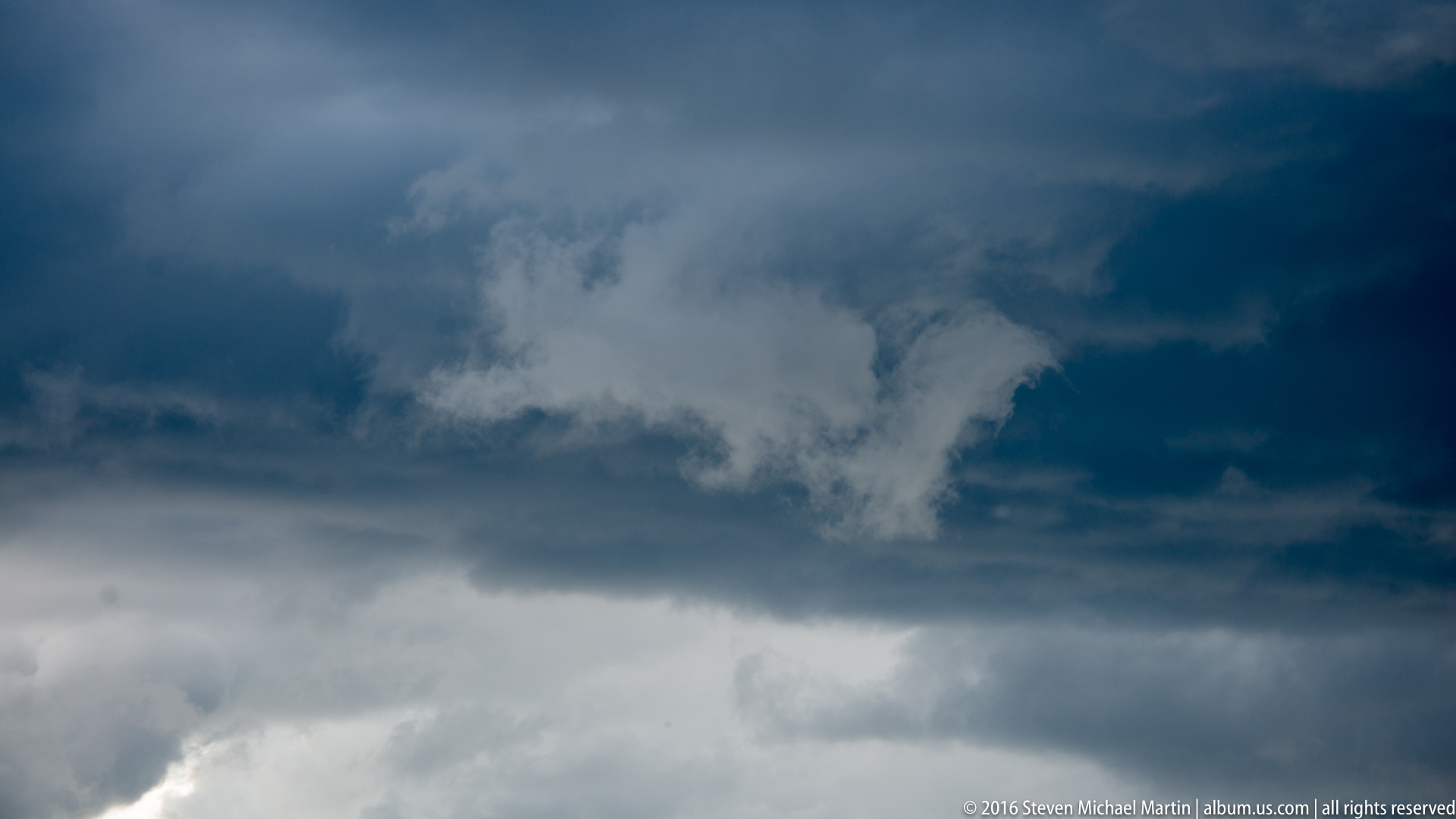
A dense, blue-gray cloud mass fills nearly the entire frame, with layered edges and a lighter opening near its center. The absence of a horizon or landscape turns the image into a close study of storm structure, tonal shifts, and the contrast between shadowed cloud and pale light.
Caption
A dense, blue-gray cloud mass fills nearly the entire frame, with layered edges and a lighter opening near its center. The absence of a horizon or landscape turns the image into a close study of storm structure, tonal shifts, and the contrast between shadowed cloud and pale light.
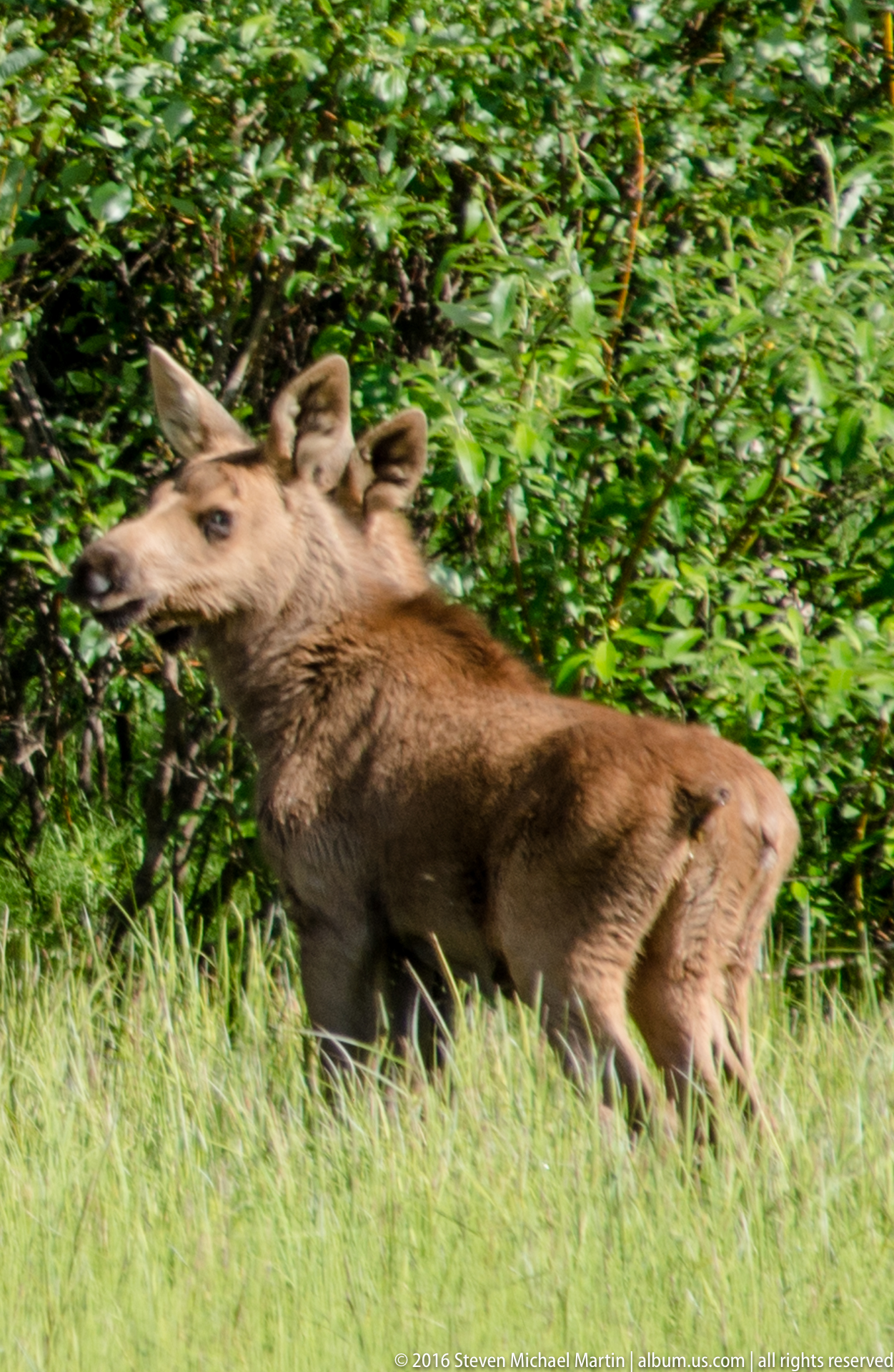
A young moose moves alone across tall grass, its long legs partly hidden by the meadow and its large ears visible above the vegetation. Dense leaves and branches fill the background. The calf’s side profile and forward stride are apparent, but its mother is outside this tighter frame.
Caption
A young moose moves alone across tall grass, its long legs partly hidden by the meadow and its large ears visible above the vegetation. Dense leaves and branches fill the background. The calf’s side profile and forward stride are apparent, but its mother is outside this tighter frame.
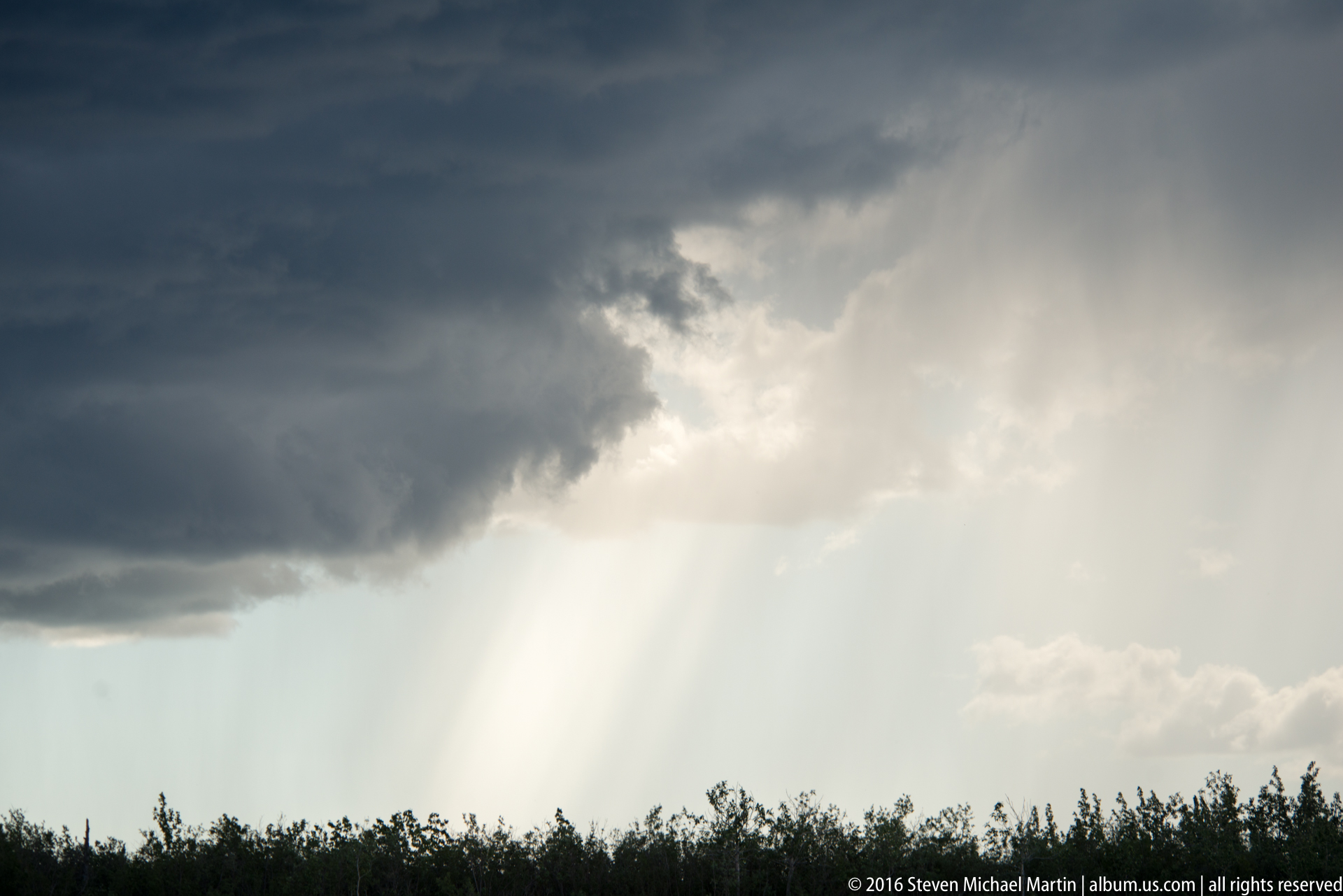
Bright shafts of sunlight descend from an opening beneath a heavy dark cloud, spreading across a pale sky above a narrow tree line. The rays fan downward at an angle, illuminating the atmosphere without revealing the sun itself. The low horizon gives the dramatic cloud and light beams nearly all of the composition.
Caption
Bright shafts of sunlight descend from an opening beneath a heavy dark cloud, spreading across a pale sky above a narrow tree line. The rays fan downward at an angle, illuminating the atmosphere without revealing the sun itself. The low horizon gives the dramatic cloud and light beams nearly all of the composition.
Kobuk Valley National Park — Field Guide
National Park Field Guide
📍 Overview
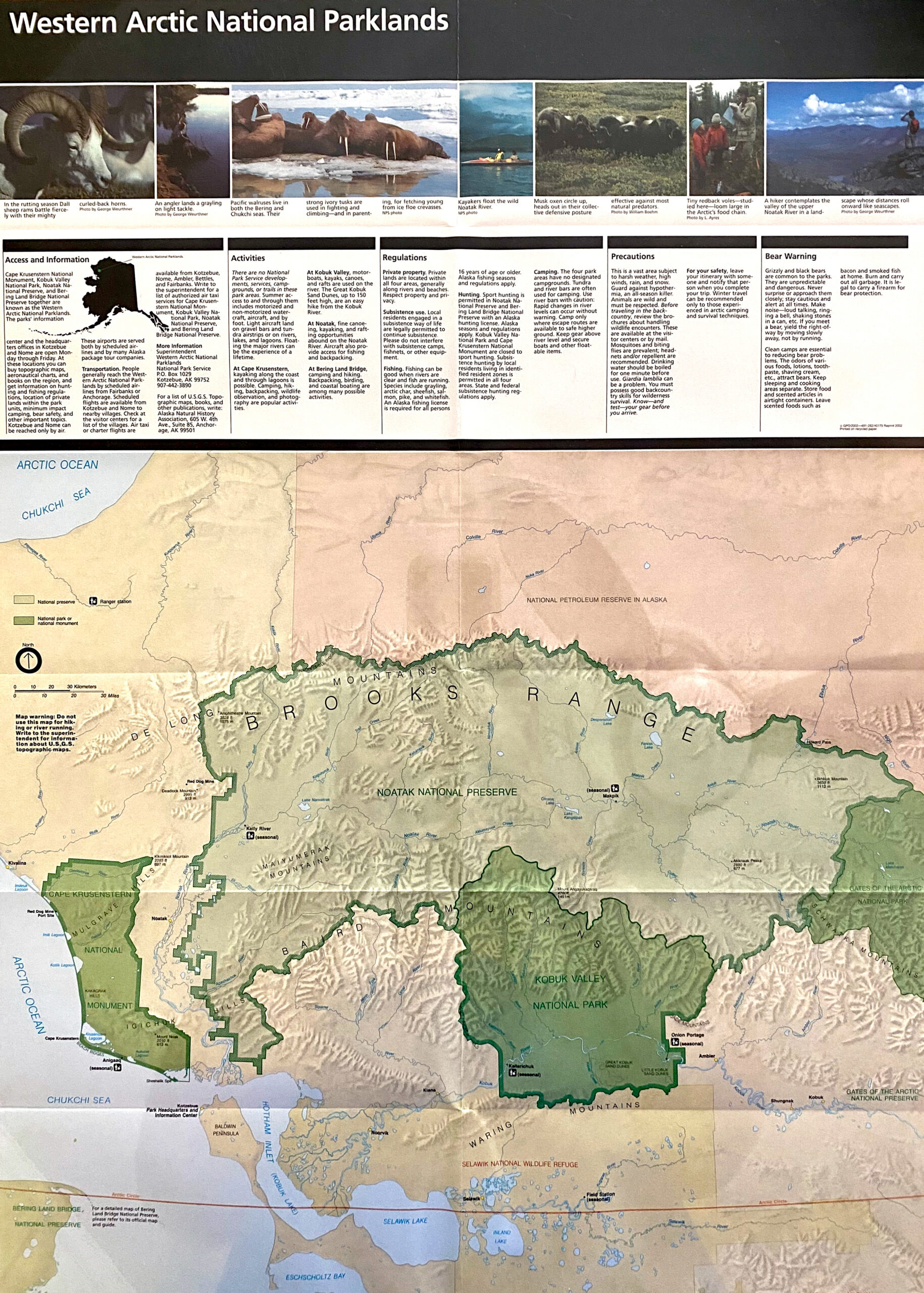
Kobuk Valley National Park preserves a remote Arctic landscape shaped by river systems, glacial history, and expansive tundra ecosystems. Located north of the Arctic Circle in northwest Alaska, the park protects the Kobuk River valley as well as one of the largest active sand dune systems in the Arctic. The region illustrates the interaction between geological processes, climate, and ecological adaptation in a largely undeveloped environment.
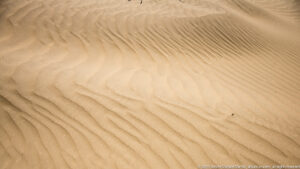
The Great Kobuk Sand Dunes, Little Kobuk Sand Dunes, and Hunt River Dunes were formed from glacial deposits shaped by wind patterns over thousands of years. Seasonal caribou migrations pass through the region, reflecting long-established wildlife movement patterns that have supported human subsistence for millennia. Archaeological sites such as Onion Portage demonstrate the long-term relationship between Indigenous communities and the landscape.
⭐ Highlights
- Great Kobuk Sand Dunes north of the Arctic Circle
- Seasonal migration routes of the Western Arctic caribou herd
- Kobuk River corridor and tundra ecosystems
- Archaeological sites reflecting thousands of years of human presence
- Remote wilderness landscape with minimal development
🔎 Key Features
- Active sand dunes formed from glacial deposits
- River valley ecosystems supporting wildlife migration
- Tundra vegetation adapted to Arctic climate conditions
- Archaeological evidence of long-term human activity
- Large-scale wilderness environment emphasizing ecological continuity
🦌 Wildlife Encountered
Wildlife encounters along the Kobuk River included extended observation of a moose cow accompanied by calves moving through wet meadow and riparian habitats typical of Arctic Alaska. Moose are well adapted to these northern environments, often feeding on aquatic plants and shrubs found along slow-moving river channels and seasonally saturated tundra.
Birdlife observed along the river corridor included migratory waterfowl and bald eagles. Bald eagles are commonly associated with northern river systems where fish and tall trees provide suitable nesting and hunting habitat. The Kobuk River serves as an important ecological corridor supporting seasonal bird movements across the Arctic.
Onion Portage has long been recognized as a significant wildlife migration corridor, particularly for the Western Arctic caribou herd, illustrating the ecological importance of the Kobuk River valley as a transition zone between boreal forest and tundra ecosystems.
📷 Photography Notes
- Low-angle light emphasizes texture in sand dunes
- Wide compositions highlight contrast between dunes and tundra
- Cloud formations can enhance scale of open landscapes
- Wind patterns create subtle surface detail in sand
- Foreground dune ridges help add depth
- Look for simple compositions that convey isolation

Other Arctic Alaska Portfolios:
Gates of the Arctic NP – Anaktuvuk Pass

Gates of the Arctic NP – Bettles
Gates of the Arctic NP – Lake Nutuvukti
Kobuk Valley NP – Onion Portage and River Exploration
Kobuk Valley NP – Sand Dunes
Kobuk Valley NP – Ambler
Gates of the Arctic NP – Selby Lake
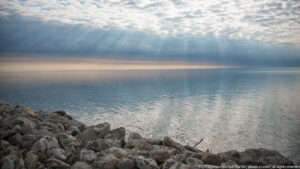
Kotzebue, Alaska
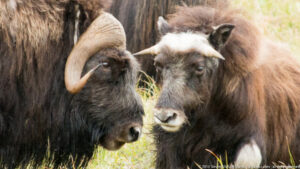
Bering Land Bridge NPRES
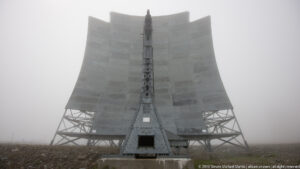
Nome, Alaska

Togiak NWR
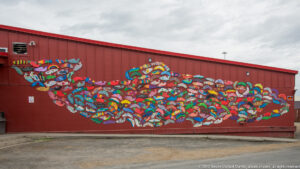
Dillingham, Alaska