Kobuk Valley Sand Dunes – Kobuk Valley National Park
The sand dunes of Kobuk Valley National Park form one of the most unexpected landscapes in the Arctic region. Located north of the Arctic Circle, these expansive dune fields were created by glacial processes that deposited sand later shaped by wind activity. The dunes represent a rare geological feature within a predominantly tundra environment and illustrate the diversity of landscapes found in northern Alaska.
Seasonal vegetation partially stabilizes portions of the dunes, while exposed areas continue to shift under the influence of wind patterns. The dunes create strong visual contrast with surrounding boreal forest and tundra environments. Their formation demonstrates the interaction between glacial deposition, river transport, and climatic conditions over thousands of years.
Visitors encounter open sandy terrain framed by distant mountain ridges and expansive sky. The scale and unexpected character of the dunes provide a distinctive visual experience that contrasts with the more typical Arctic landscape of tundra and wetlands.
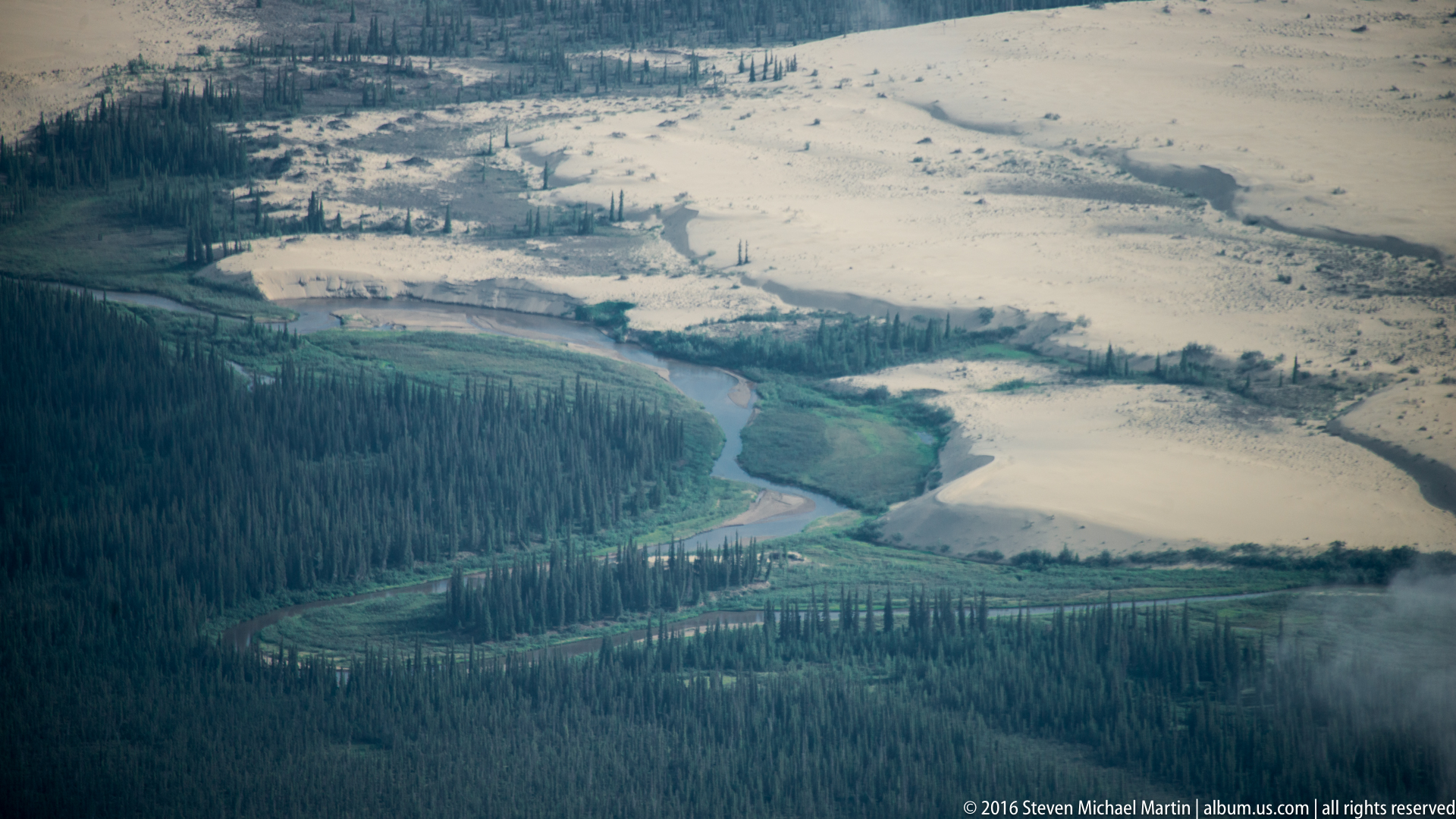
From above, a narrow river curves between dark conifer forest and pale, sparsely vegetated sand dunes. Green riparian growth traces the watercourse and marks a sharp transition between woodland and open sand. The high viewpoint makes the river’s winding path and the contrasting textures of this unusual northern landscape the central subjects.
Caption
From above, a narrow river curves between dark conifer forest and pale, sparsely vegetated sand dunes. Green riparian growth traces the watercourse and marks a sharp transition between woodland and open sand. The high viewpoint makes the river’s winding path and the contrasting textures of this unusual northern landscape the central subjects.
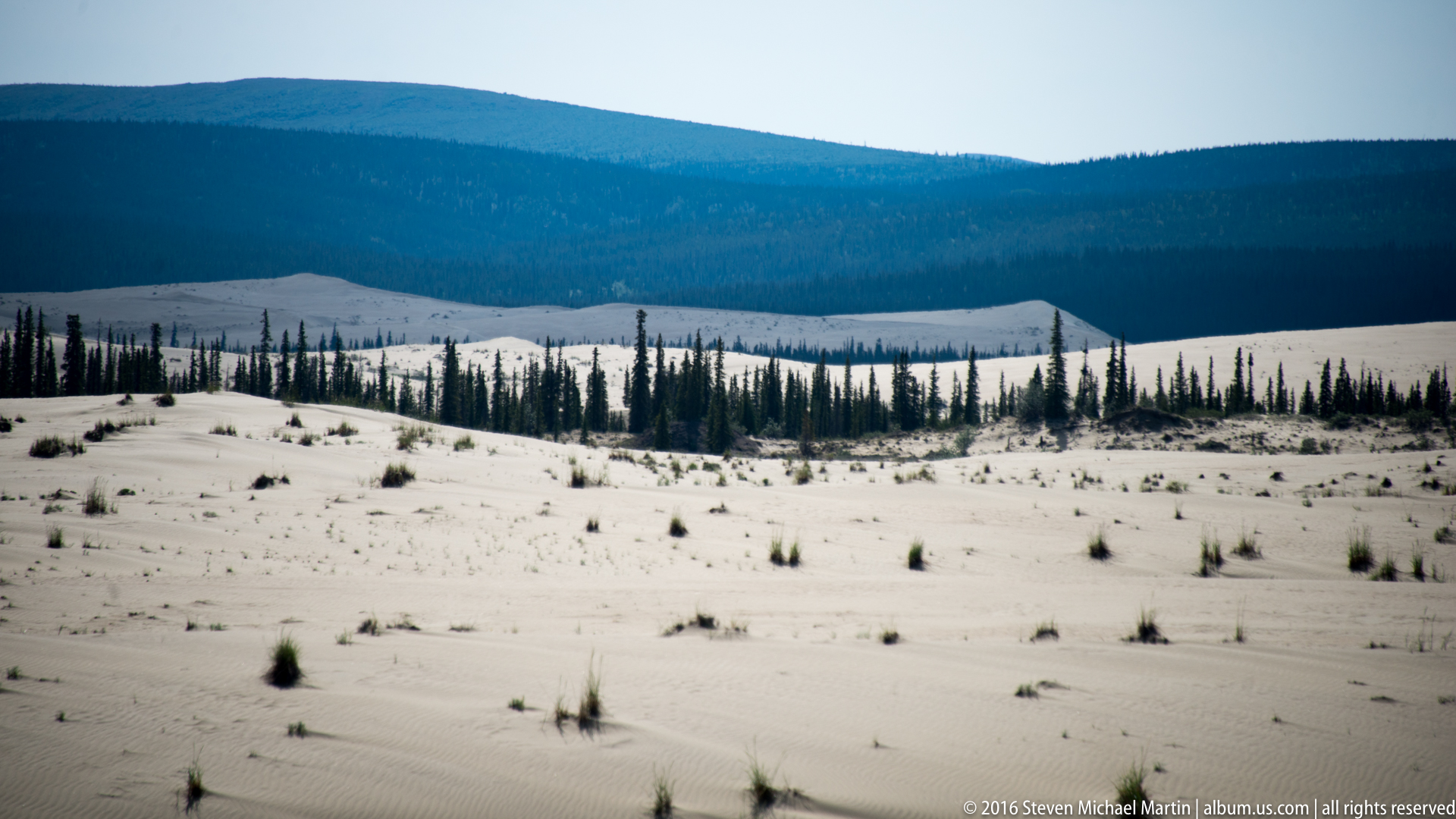
Pale dunes dotted with small shrubs spread across the foreground, while a dark belt of spruce separates them from a long blue mountain ridge. The layered bands compress distance and show the dunes as part of a larger landscape rather than an isolated feature. Slightly subdued light softens the far slopes and leaves the sandy foreground bright.
Caption
Pale dunes dotted with small shrubs spread across the foreground, while a dark belt of spruce separates them from a long blue mountain ridge. The layered bands compress distance and show the dunes as part of a larger landscape rather than an isolated feature. Slightly subdued light softens the far slopes and leaves the sandy foreground bright.
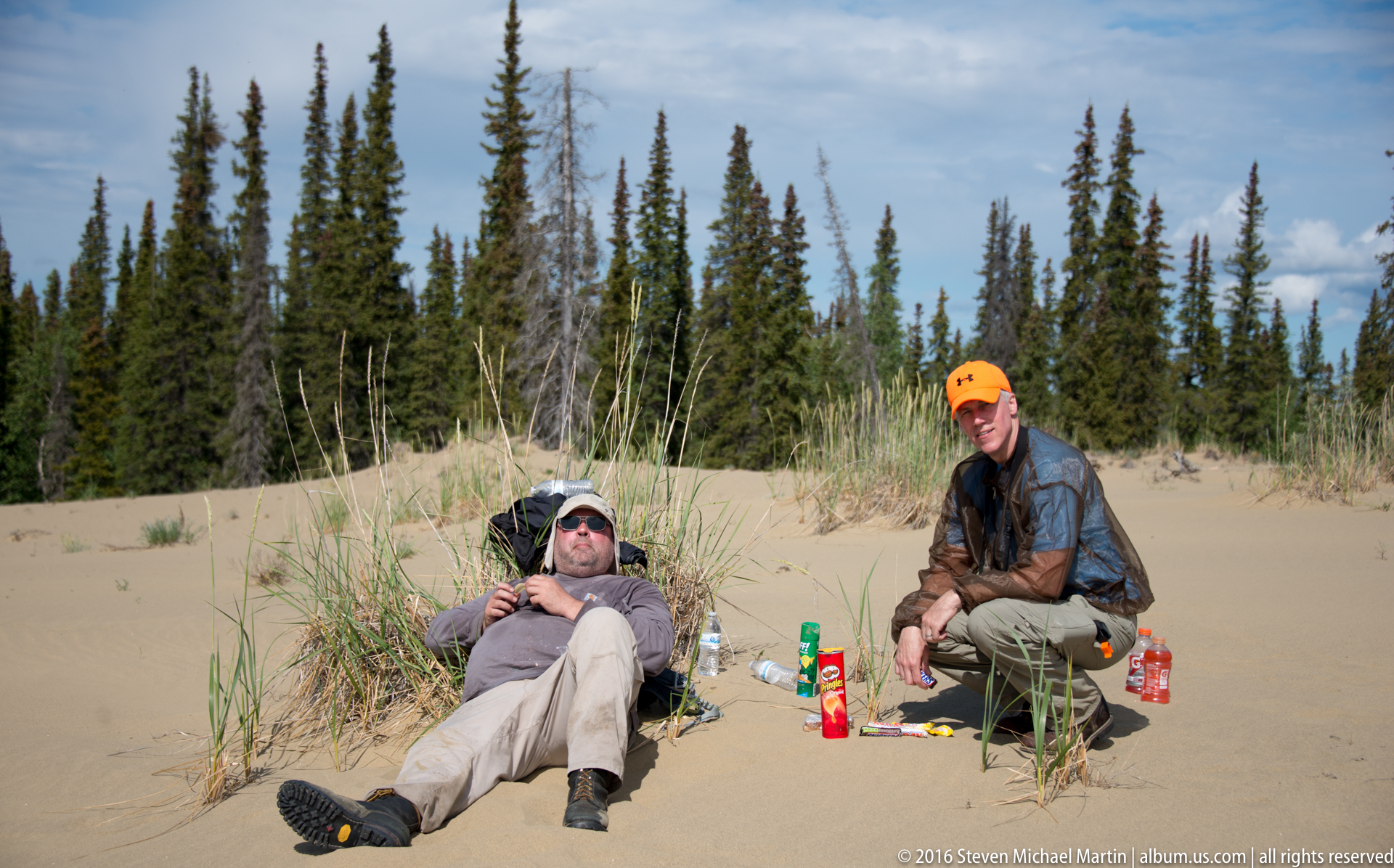
Two people rest beside a clump of dune grass, one reclining with legs extended and the other seated nearby. Brightly colored drink bottles and small supplies lie on the sand between them. A dense spruce stand forms the background, making the rest stop legible as a human moment within the open dune-and-forest setting.
Caption
Two people rest beside a clump of dune grass, one reclining with legs extended and the other seated nearby. Brightly colored drink bottles and small supplies lie on the sand between them. A dense spruce stand forms the background, making the rest stop legible as a human moment within the open dune-and-forest setting.

A trail of small dark impressions runs across closely rippled sand, with the marks varying in depth and spacing as they cross the frame. The tight overhead composition excludes the wider landscape and makes the footprints’ repeated rhythm the focus. Their maker is not identifiable from this view, but the marks register movement across an otherwise open dune surface.
Caption
A trail of small dark impressions runs across closely rippled sand, with the marks varying in depth and spacing as they cross the frame. The tight overhead composition excludes the wider landscape and makes the footprints’ repeated rhythm the focus. Their maker is not identifiable from this view, but the marks register movement across an otherwise open dune surface.
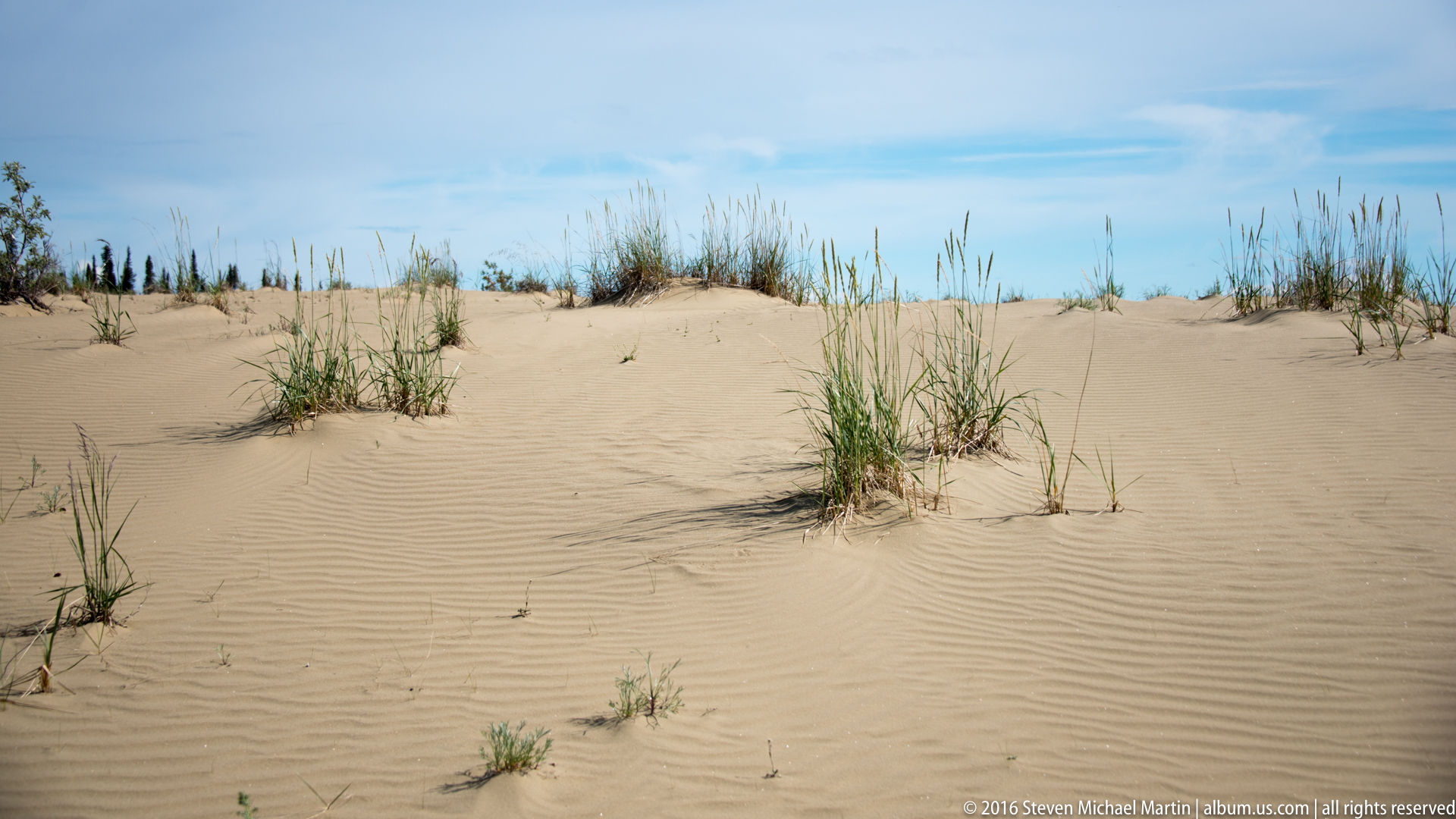
Clusters of upright grass grow from the crest and face of a low sandy ridge, their thin blades casting delicate shadows across wind-rippled sand. Spruce tops appear beyond the skyline at left, while clear blue sky opens above the dune. The composition draws attention to how scattered vegetation interrupts the smooth, exposed surface.
Caption
Clusters of upright grass grow from the crest and face of a low sandy ridge, their thin blades casting delicate shadows across wind-rippled sand. Spruce tops appear beyond the skyline at left, while clear blue sky opens above the dune. The composition draws attention to how scattered vegetation interrupts the smooth, exposed surface.

Rounded dune ridges and shallow troughs fill the foreground, their pale surfaces broken by small dark patches and sparse vegetation. A continuous forest band borders the sand and recedes toward the horizon. The oblique aerial perspective reveals the dunes’ repeated forms and broad scale, while the forest edge gives the open landform a clear spatial boundary.
Caption
Rounded dune ridges and shallow troughs fill the foreground, their pale surfaces broken by small dark patches and sparse vegetation. A continuous forest band borders the sand and recedes toward the horizon. The oblique aerial perspective reveals the dunes’ repeated forms and broad scale, while the forest edge gives the open landform a clear spatial boundary.

Two sharply defined human shadows stretch across sunlit sand, their raised arms forming expressive silhouettes. The people themselves remain outside the frame; only their outlines and gestures appear. This playful, ground-level composition turns the visitors into part of the dune’s graphic pattern, with the pale sand serving as a simple field for the dark shapes.
Caption
Two sharply defined human shadows stretch across sunlit sand, their raised arms forming expressive silhouettes. The people themselves remain outside the frame; only their outlines and gestures appear. This playful, ground-level composition turns the visitors into part of the dune’s graphic pattern, with the pale sand serving as a simple field for the dark shapes.
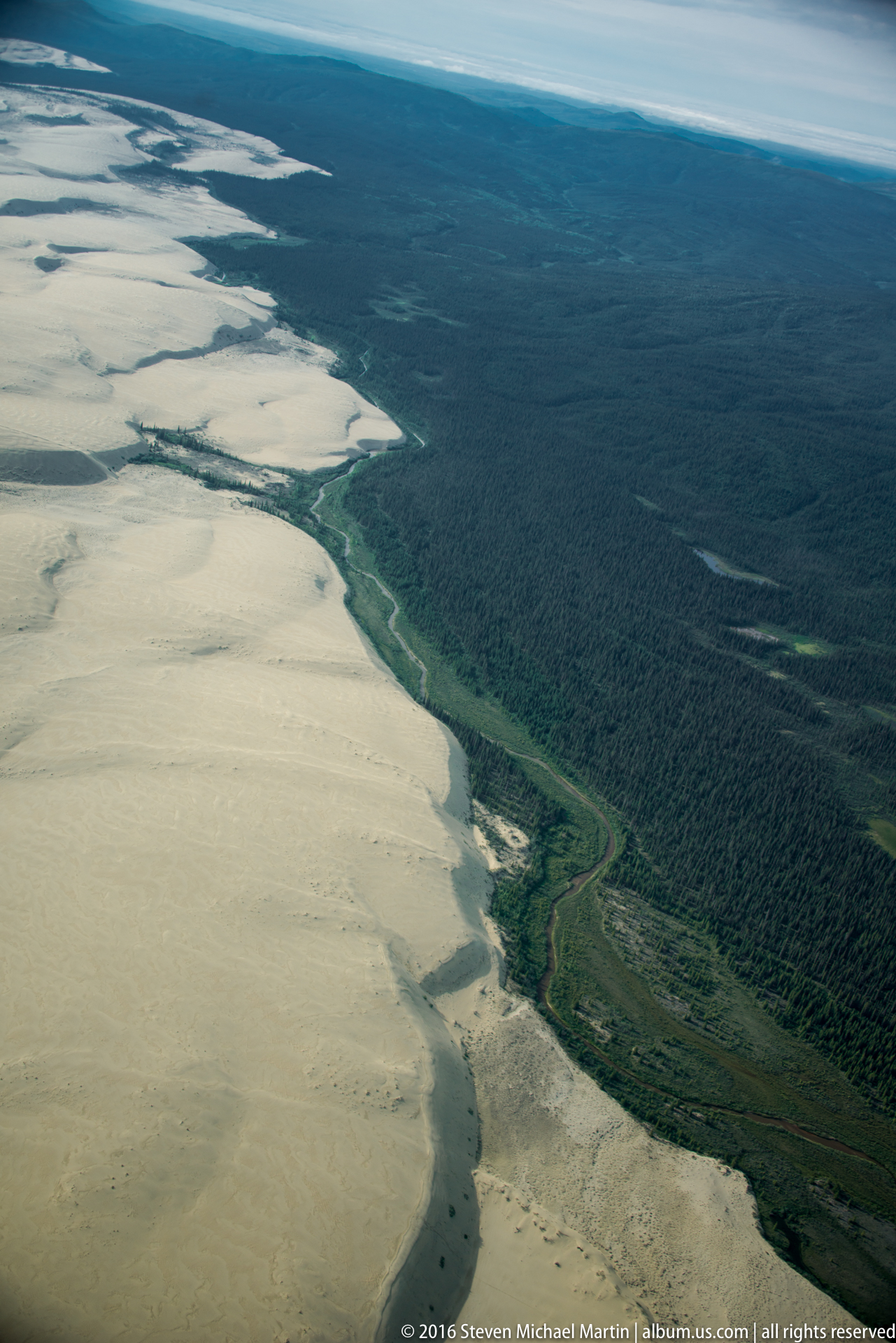
A wide pale dune field fills the foreground and left side, meeting a nearly unbroken dark forest across the right half of the frame. A thin green drainage line follows the border between them. From this elevated viewpoint, the photograph stresses the stark scale and clean contrast of the park’s sandy landform against surrounding northern woodland.
Caption
A wide pale dune field fills the foreground and left side, meeting a nearly unbroken dark forest across the right half of the frame. A thin green drainage line follows the border between them. From this elevated viewpoint, the photograph stresses the stark scale and clean contrast of the park’s sandy landform against surrounding northern woodland.

A sinuous channel enters from the foreground and threads through a broad mosaic of pale sand and green wetland. Its repeated bends draw the eye toward the distant dune plain, while forest presses in along the left edge. The photograph emphasizes the river’s winding geometry and the narrow vegetated corridor that persists within a predominantly sandy terrain.
Caption
A sinuous channel enters from the foreground and threads through a broad mosaic of pale sand and green wetland. Its repeated bends draw the eye toward the distant dune plain, while forest presses in along the left edge. The photograph emphasizes the river’s winding geometry and the narrow vegetated corridor that persists within a predominantly sandy terrain.
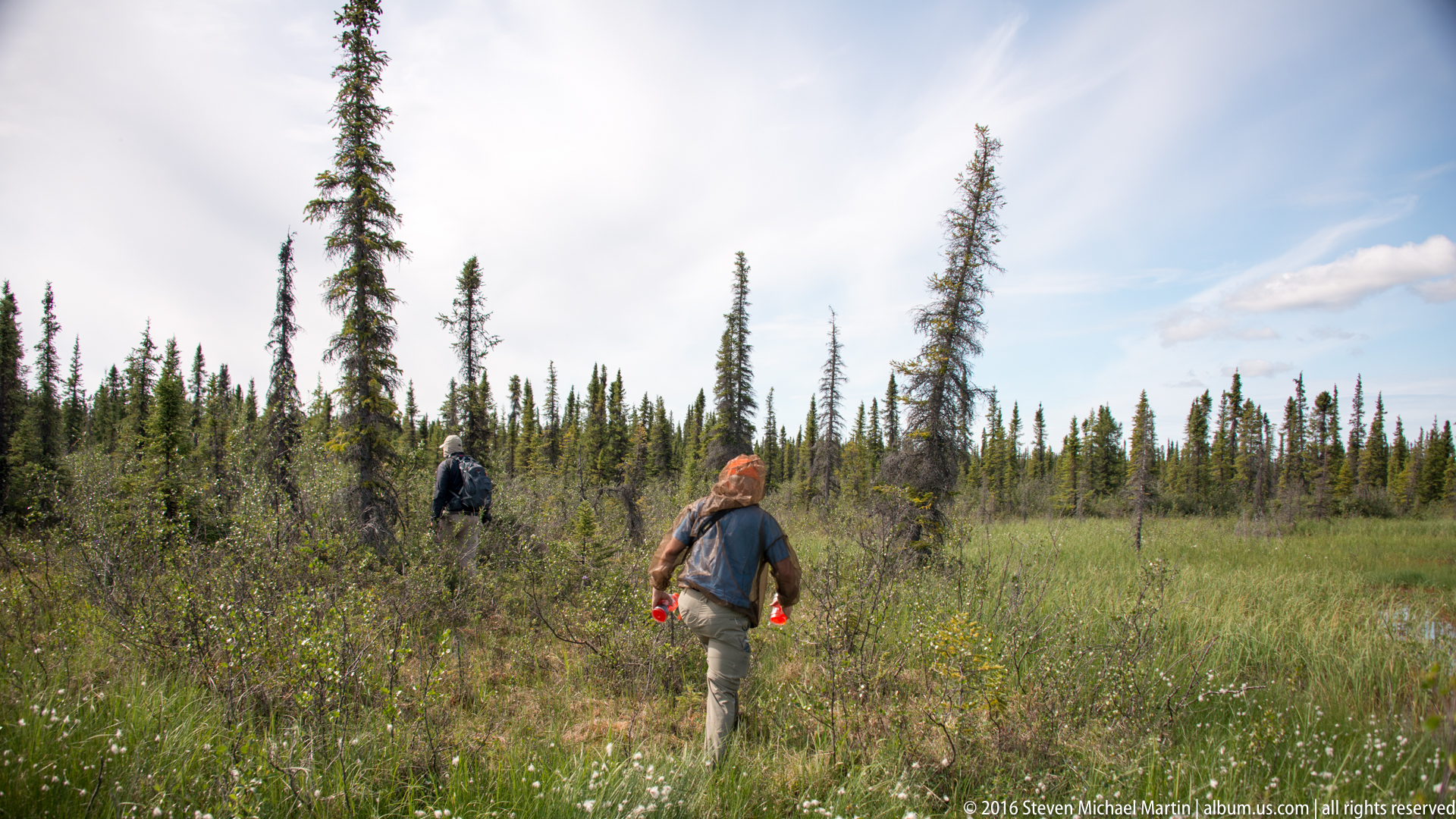
Two hikers move through a low, brushy meadow bordered by tall spruce, their packs and bright orange head covering visible above the vegetation. The open ground is uneven and dotted with shrubs, while a second figure walks farther ahead. This ground-level view places human movement within the forest-and-wetland transition of the Kobuk Valley landscape.
Caption
Two hikers move through a low, brushy meadow bordered by tall spruce, their packs and bright orange head covering visible above the vegetation. The open ground is uneven and dotted with shrubs, while a second figure walks farther ahead. This ground-level view places human movement within the forest-and-wetland transition of the Kobuk Valley landscape.
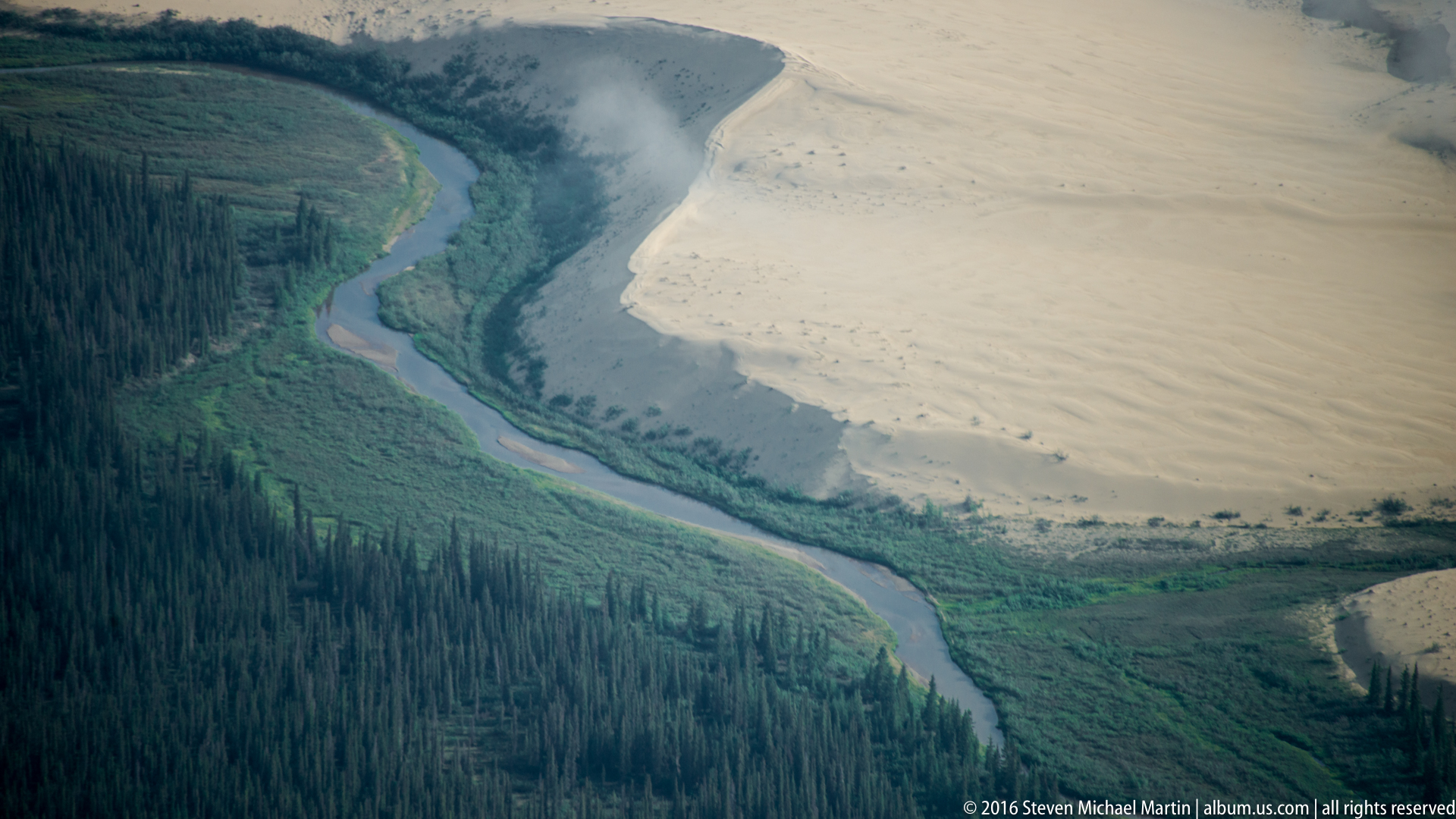
The river sweeps diagonally around a broad pale dune field, its blue-gray channel bordered by a narrow band of green shrubs. Dense conifers occupy the opposite bank and extend beyond the frame. This closer oblique view isolates the contact between moving water, riparian vegetation, forest, and exposed sand rather than presenting the dunes as a single uninterrupted expanse.
Caption
The river sweeps diagonally around a broad pale dune field, its blue-gray channel bordered by a narrow band of green shrubs. Dense conifers occupy the opposite bank and extend beyond the frame. This closer oblique view isolates the contact between moving water, riparian vegetation, forest, and exposed sand rather than presenting the dunes as a single uninterrupted expanse.
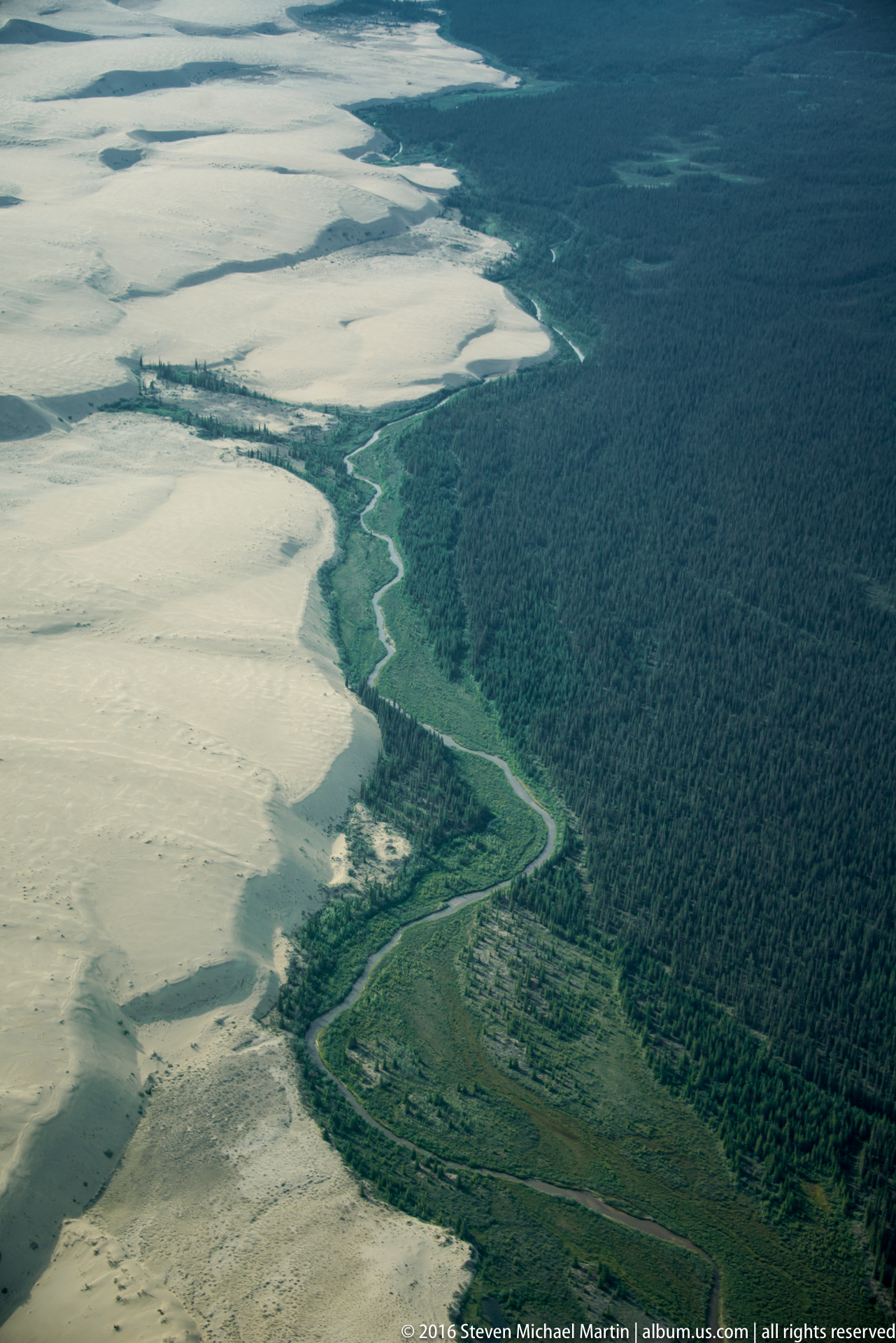
Seen from higher above, a slim creek curls through a green corridor between an extensive forest canopy and pale dunes. Small side channels and irregular wet patches widen the valley floor in places. The broad composition records how the watercourse links the forest margin to the open sand, with its scale conveyed by the immense contrasting blocks of land cover.
Caption
Seen from higher above, a slim creek curls through a green corridor between an extensive forest canopy and pale dunes. Small side channels and irregular wet patches widen the valley floor in places. The broad composition records how the watercourse links the forest margin to the open sand, with its scale conveyed by the immense contrasting blocks of land cover.
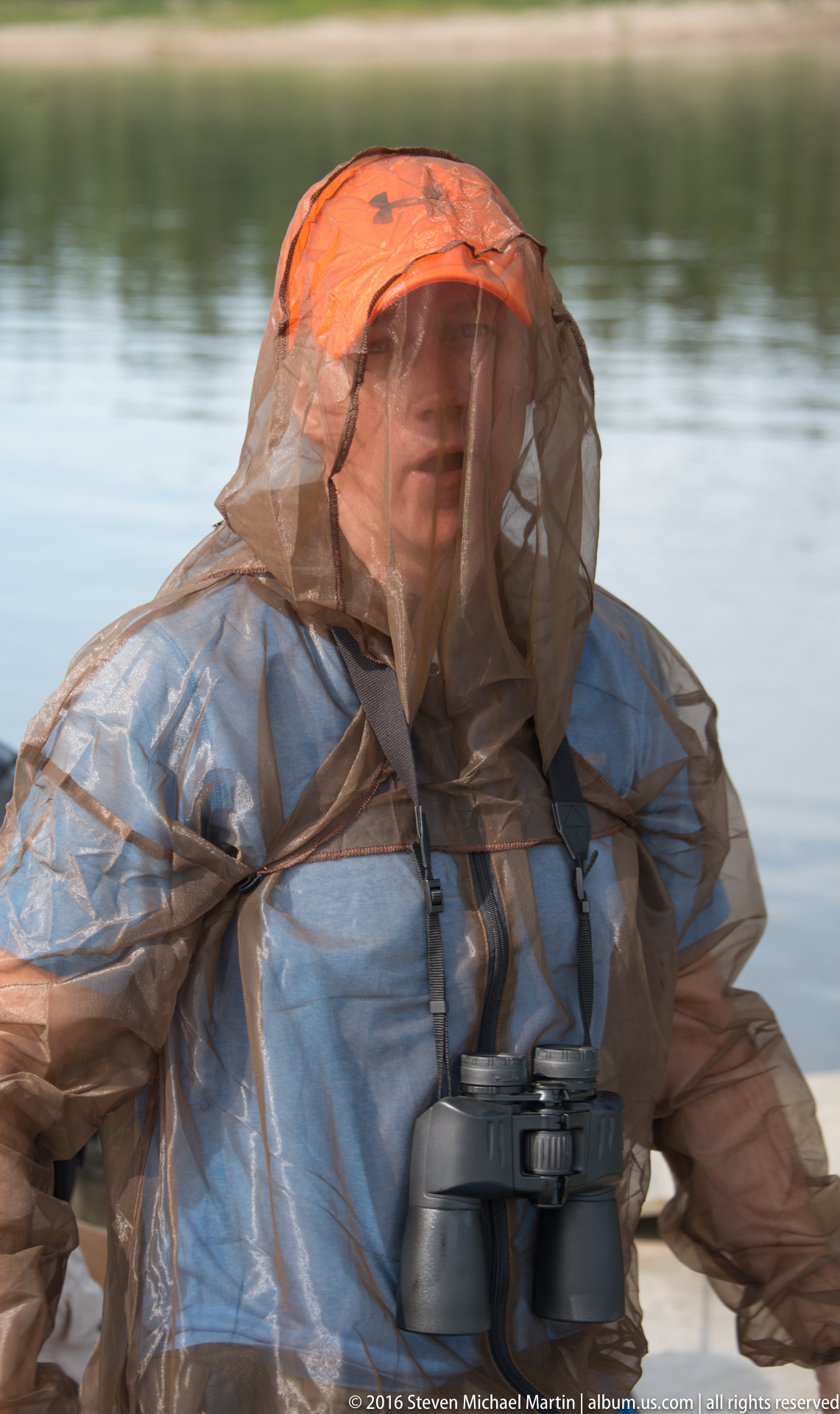
A person wearing a fine mesh insect veil and outdoor clothing faces the camera near a calm waterway. Binoculars hang at chest level, suggesting attentive observation of the surrounding habitat, though no specific activity is visible. The close framing turns practical field gear into the subject, while the softly blurred water and green bank retain the setting.
Caption
A person wearing a fine mesh insect veil and outdoor clothing faces the camera near a calm waterway. Binoculars hang at chest level, suggesting attentive observation of the surrounding habitat, though no specific activity is visible. The close framing turns practical field gear into the subject, while the softly blurred water and green bank retain the setting.
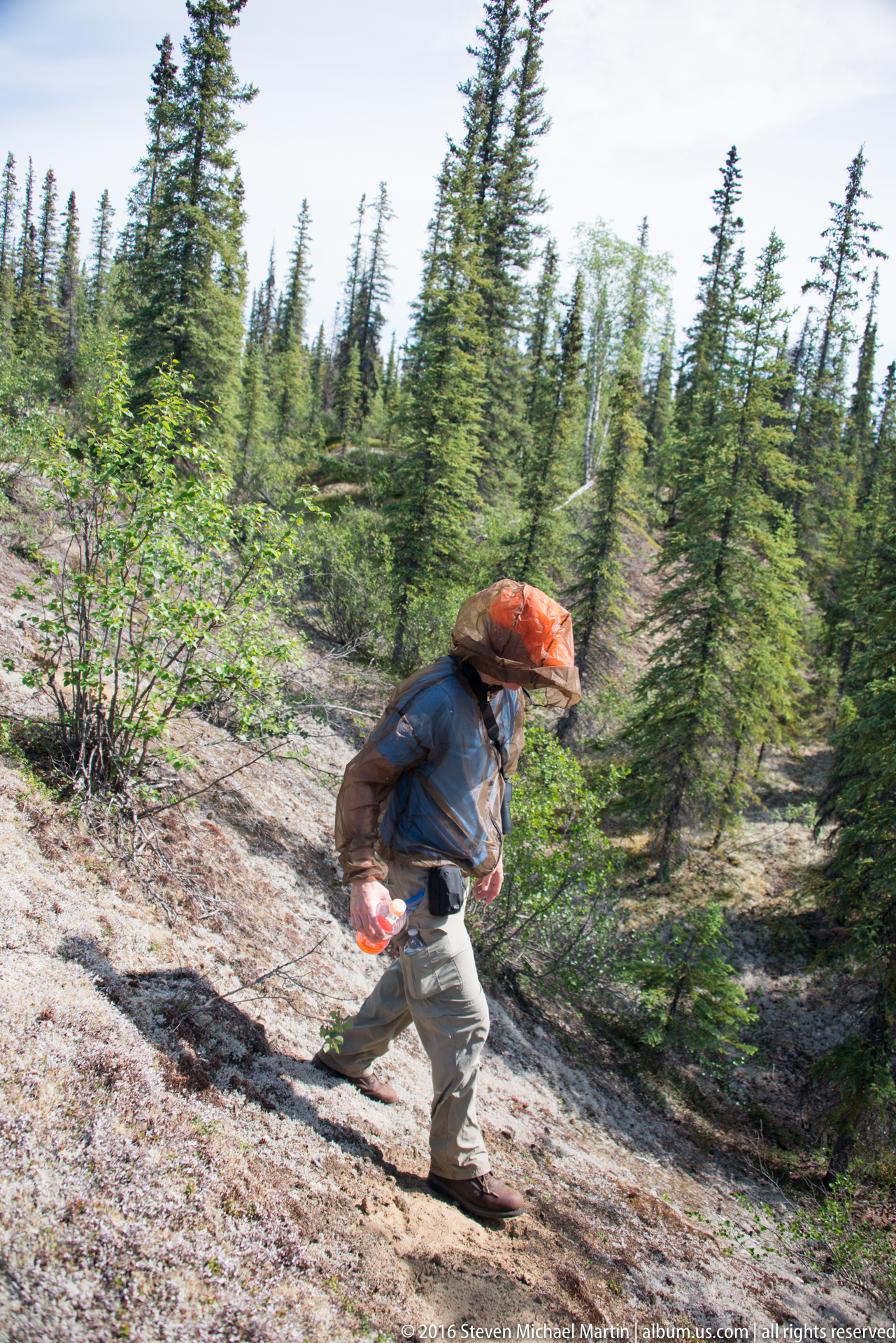
A hiker in a mesh head covering crosses a sandy slope beneath a canopy of spruce and deciduous trees. One leg is raised mid-step, and exposed roots, needles, and scattered plants break up the pale ground. The tilted terrain and motion blur convey a careful traverse through the wooded transition zone rather than a walk across open dunes.
Caption
A hiker in a mesh head covering crosses a sandy slope beneath a canopy of spruce and deciduous trees. One leg is raised mid-step, and exposed roots, needles, and scattered plants break up the pale ground. The tilted terrain and motion blur convey a careful traverse through the wooded transition zone rather than a walk across open dunes.
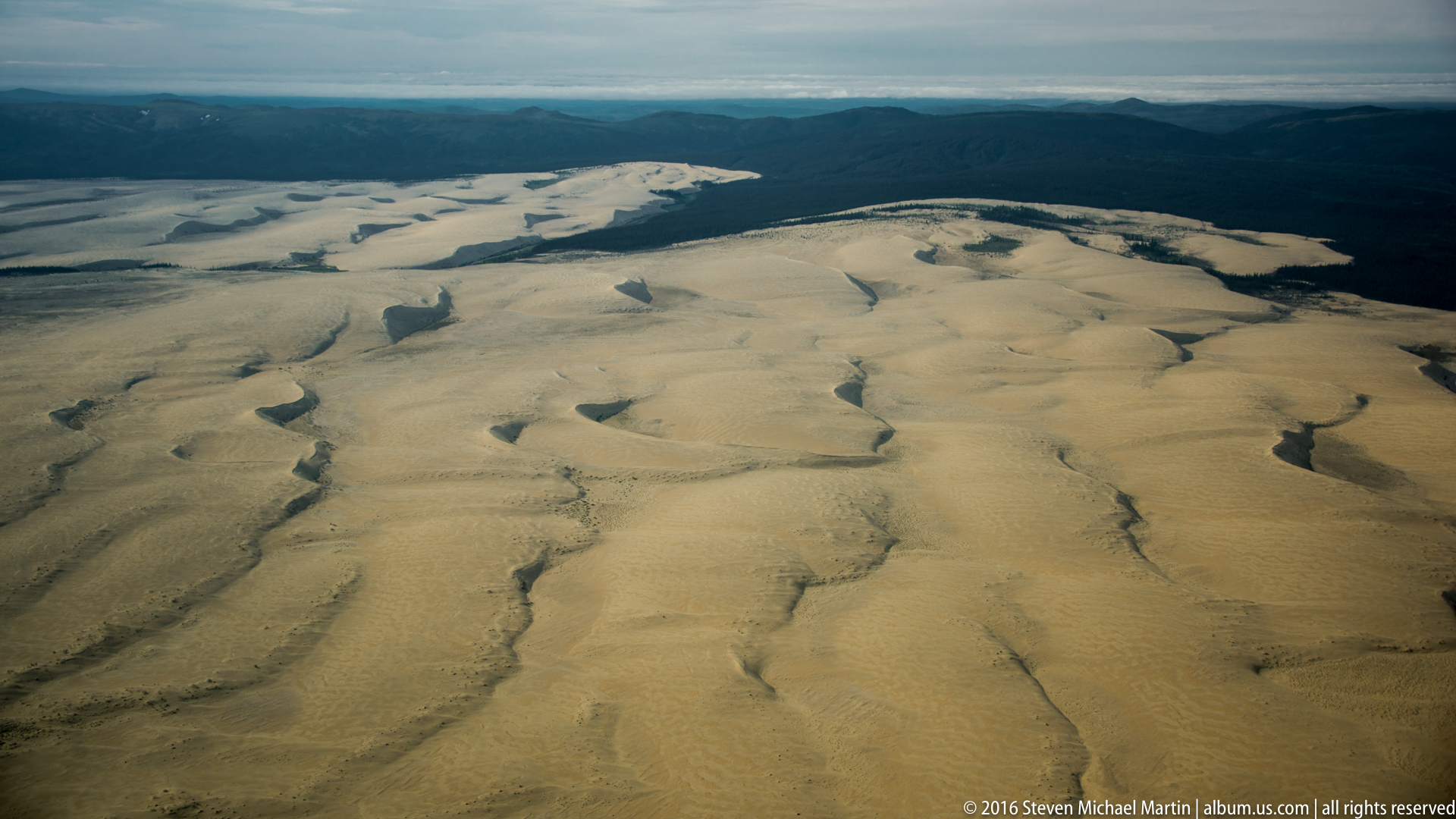
A close aerial view reduces the landscape to a repeating pattern of ridges and branching shallow gullies. Warm light defines the relief, turning each crest into a narrow highlight and each trough into a soft shadow. The distant forested horizon anchors this study of dune topography, where subtle differences in elevation create a richly textured surface.
Caption
A close aerial view reduces the landscape to a repeating pattern of ridges and branching shallow gullies. Warm light defines the relief, turning each crest into a narrow highlight and each trough into a soft shadow. The distant forested horizon anchors this study of dune topography, where subtle differences in elevation create a richly textured surface.
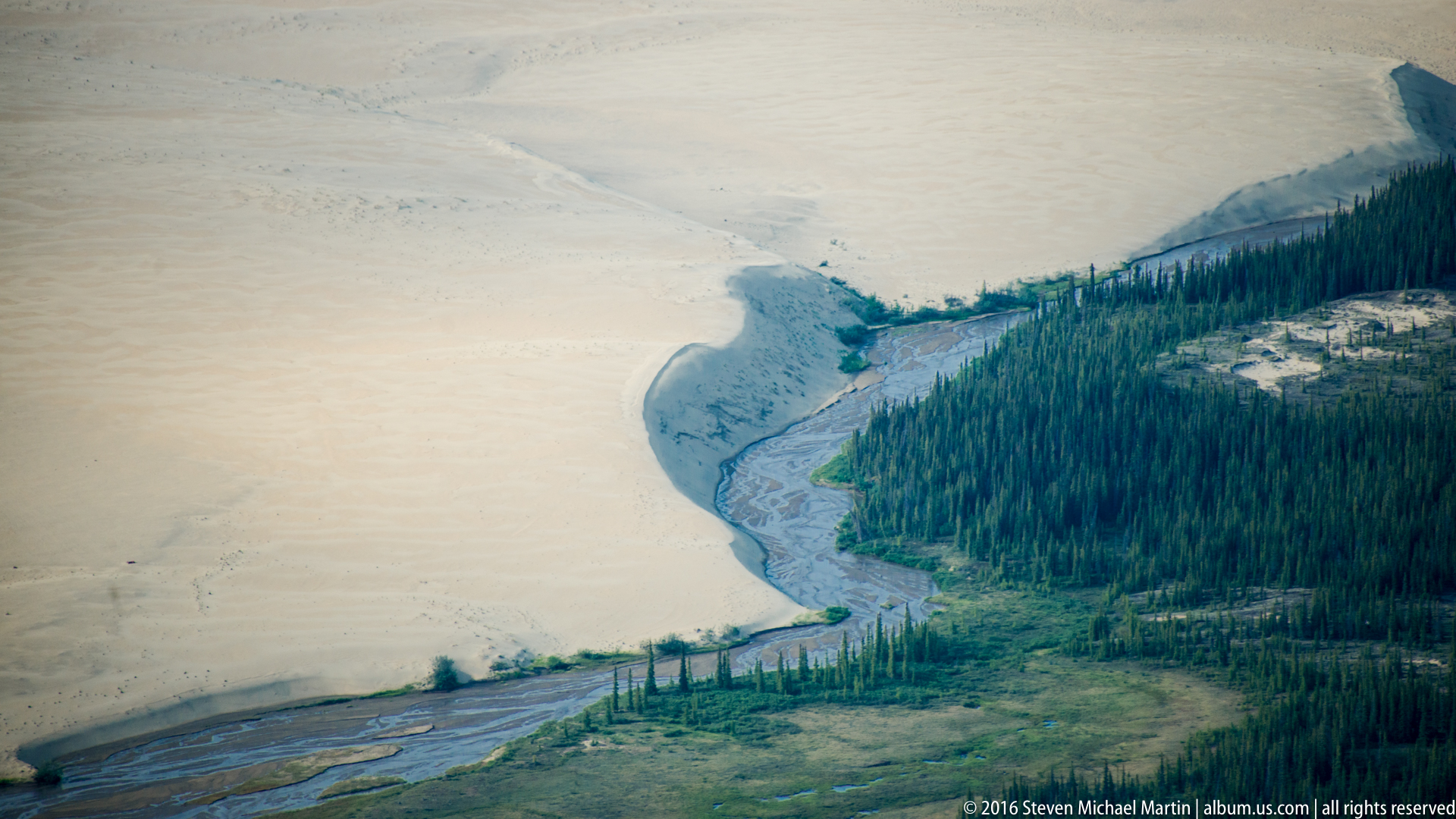
Pale sand slopes down to a broad blue-gray channel braided with shallow bars and side channels. Conifers crowd the opposite bank, while a few green patches interrupt the sandy foreground. The image concentrates on the river’s active edge, showing how water cuts through the dune margin and separates exposed sand from forested ground.
Caption
Pale sand slopes down to a broad blue-gray channel braided with shallow bars and side channels. Conifers crowd the opposite bank, while a few green patches interrupt the sandy foreground. The image concentrates on the river’s active edge, showing how water cuts through the dune margin and separates exposed sand from forested ground.

A narrow trail cuts straight through a wet meadow toward a line of spruce, dividing tall grasses and low shrubs. Shallow standing water reflects the sky in the foreground, emphasizing the saturated ground around the path. The eye-level view records a modest route through the landscape, framed by open sky and the dense northern forest beyond.
Caption
A narrow trail cuts straight through a wet meadow toward a line of spruce, dividing tall grasses and low shrubs. Shallow standing water reflects the sky in the foreground, emphasizing the saturated ground around the path. The eye-level view records a modest route through the landscape, framed by open sky and the dense northern forest beyond.
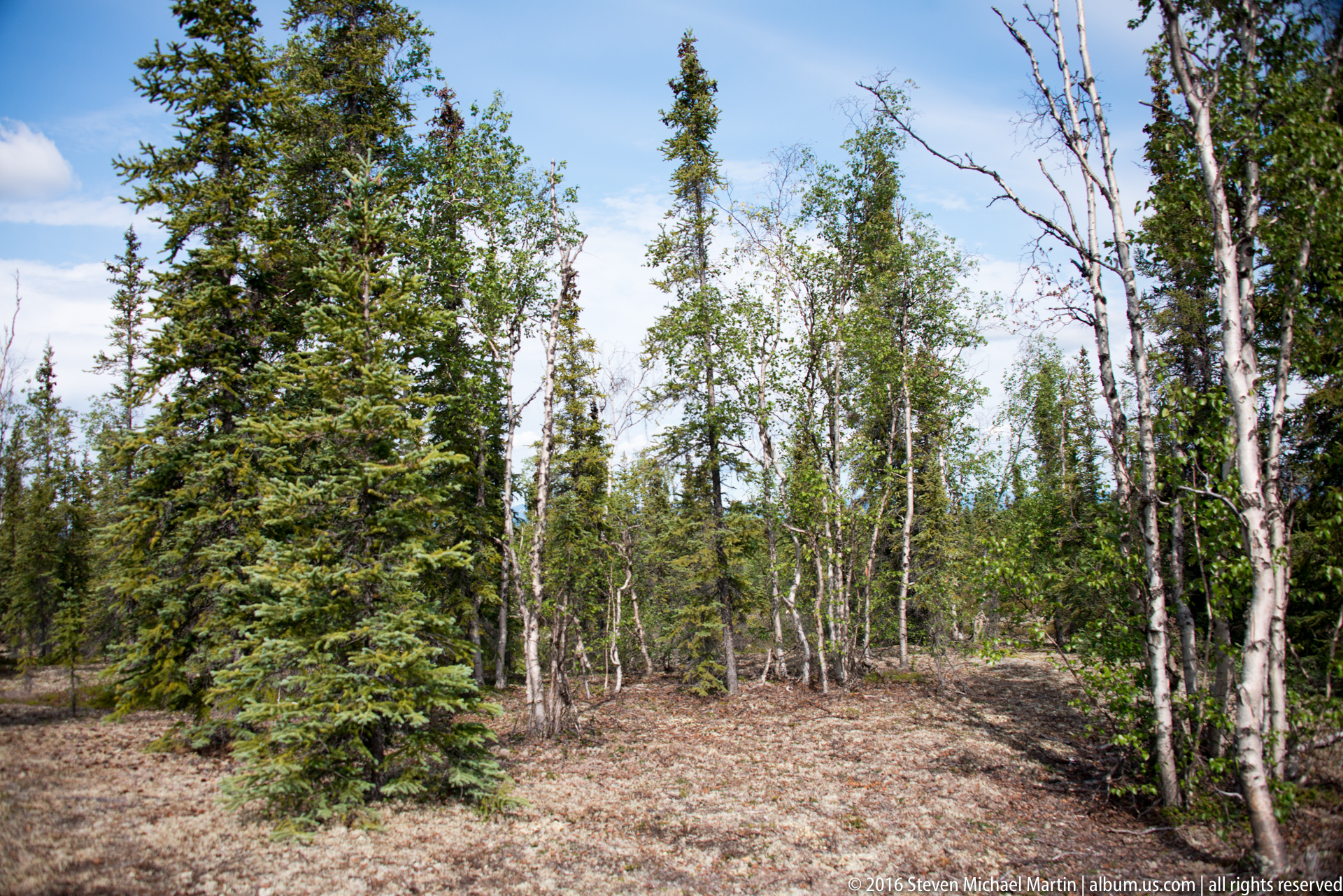
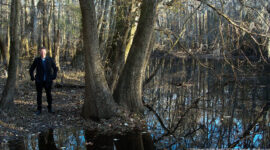
A small opening among spruce and slender deciduous trunks reveals a quiet woodland floor covered with brown leaf litter and low ground plants. The closely spaced trees create a layered screen, with filtered daylight reaching the center of the clearing. This ground-level view shifts attention from the park’s open dunes to the wooded habitat at their margin.
Caption
A small opening among spruce and slender deciduous trunks reveals a quiet woodland floor covered with brown leaf litter and low ground plants. The closely spaced trees create a layered screen, with filtered daylight reaching the center of the clearing. This ground-level view shifts attention from the park’s open dunes to the wooded habitat at their margin.

Two figures are separated across a sloping dune: one climbs near the crest while another moves lower down among scattered shrubs. Their dark clothing and long shadows stand out against the pale sand. The wide view gives the slope room to dominate, making the people’s positions and the steep climb more significant than individual facial detail.
Caption
Two figures are separated across a sloping dune: one climbs near the crest while another moves lower down among scattered shrubs. Their dark clothing and long shadows stand out against the pale sand. The wide view gives the slope room to dominate, making the people’s positions and the steep climb more significant than individual facial detail.
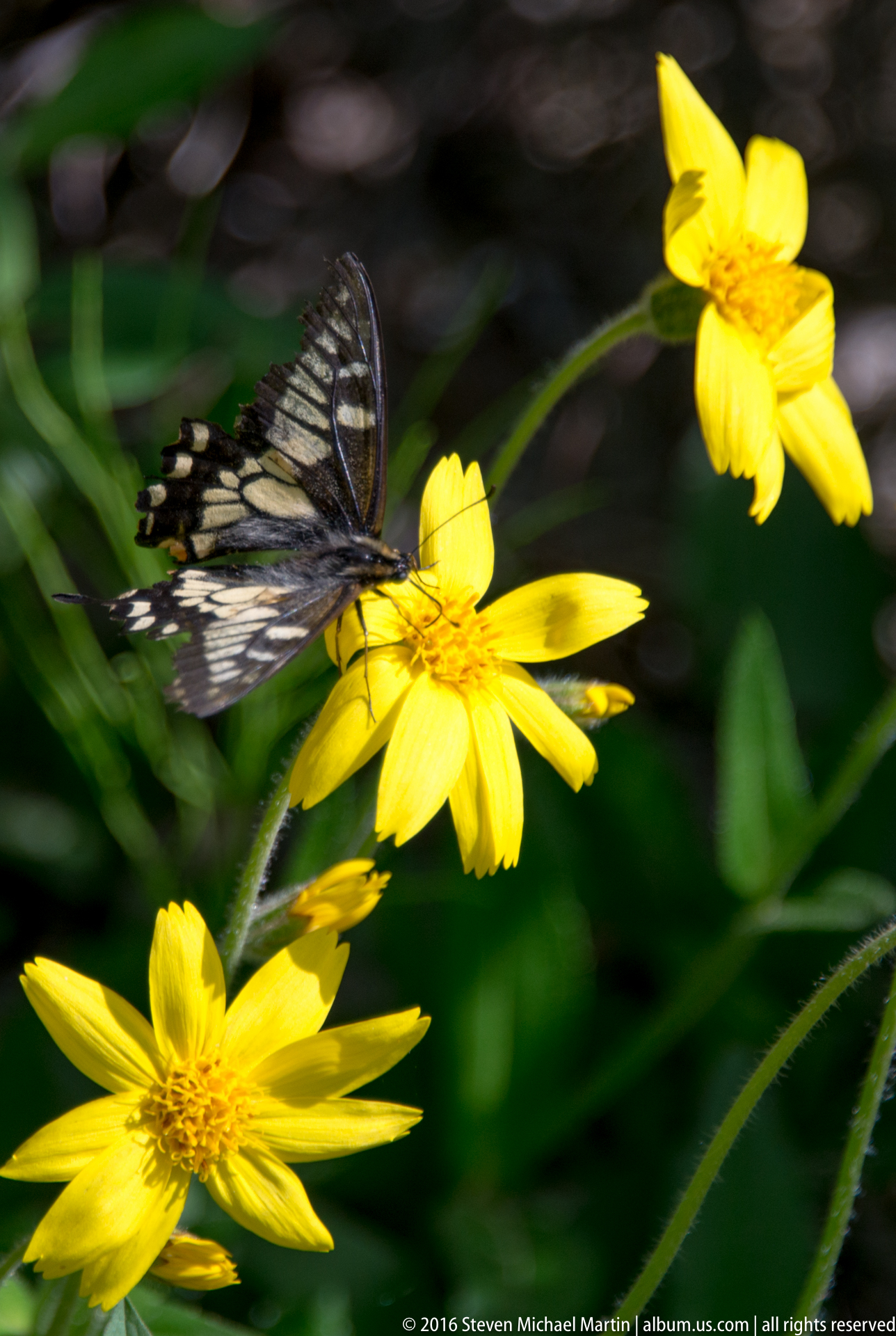
A butterfly with black-and-cream wings settles on a vivid yellow flower, its body aligned with the central disk. Another blossom enters from the upper right and a third glows near the lower edge, creating depth against the dark green background. This tighter portrait makes the insect’s wing pattern and contact with the flower more legible than the surrounding habitat.
Caption
A butterfly with black-and-cream wings settles on a vivid yellow flower, its body aligned with the central disk. Another blossom enters from the upper right and a third glows near the lower edge, creating depth against the dark green background. This tighter portrait makes the insect’s wing pattern and contact with the flower more legible than the surrounding habitat.

Deep footprints form a broken line from the lower foreground toward the crest of a pale dune. Sparse grasses and small plants dot the slope, while the blue sky occupies a narrow strip above the ridge. The close perspective makes the track’s direction and the incline immediately clear, documenting a human passage through the fragile sandy terrain.
Caption
Deep footprints form a broken line from the lower foreground toward the crest of a pale dune. Sparse grasses and small plants dot the slope, while the blue sky occupies a narrow strip above the ridge. The close perspective makes the track’s direction and the incline immediately clear, documenting a human passage through the fragile sandy terrain.

A dark butterfly with pale markings rests low among bright yellow, daisy-like flowers and narrow green leaves. Several blossoms frame the insect at different distances, while the shallow focus softens the surrounding foliage. The close composition centers the relationship between pollinator and flowering plants, but the visible pattern is not sufficient to assign a precise butterfly species.
Caption
A dark butterfly with pale markings rests low among bright yellow, daisy-like flowers and narrow green leaves. Several blossoms frame the insect at different distances, while the shallow focus softens the surrounding foliage. The close composition centers the relationship between pollinator and flowering plants, but the visible pattern is not sufficient to assign a precise butterfly species.

Fine, parallel ripples cover the entire frame, forming alternating bands of light and shadow with no plants, tracks, or horizon visible. The uniform pattern records wind shaping the exposed sand at a small scale. By excluding broader landmarks, this detail isolates the dune’s surface texture and the gentle changes in relief across otherwise similar grains.
Caption
Fine, parallel ripples cover the entire frame, forming alternating bands of light and shadow with no plants, tracks, or horizon visible. The uniform pattern records wind shaping the exposed sand at a small scale. By excluding broader landmarks, this detail isolates the dune’s surface texture and the gentle changes in relief across otherwise similar grains.

A person in a mesh insect veil walks toward the camera across open pale sand, with a sparse line of spruce behind. The figure’s arms hang at their sides and the lower legs are cropped by the frame, lending the image the immediacy of a field portrait rather than a distant landscape view. The wide dune setting remains clearly visible around the subject.
Caption
A person in a mesh insect veil walks toward the camera across open pale sand, with a sparse line of spruce behind. The figure’s arms hang at their sides and the lower legs are cropped by the frame, lending the image the immediacy of a field portrait rather than a distant landscape view. The wide dune setting remains clearly visible around the subject.

A man stands facing the camera in a dark cap and outdoor jacket, with a translucent mesh layer still draped over his shoulders. Low dune grasses and pale sand extend behind him to a dense band of spruce. The straightforward portrait connects the human presence to the open dune setting and preserves practical clothing details visible in the field.
Caption
A man stands facing the camera in a dark cap and outdoor jacket, with a translucent mesh layer still draped over his shoulders. Low dune grasses and pale sand extend behind him to a dense band of spruce. The straightforward portrait connects the human presence to the open dune setting and preserves practical clothing details visible in the field.

A dense tuft of grass rises from the foreground sand, its blades fanning outward from a partly exposed base. Beyond it, smaller plants dot the dune and a continuous forest line stretches across the horizon beneath scattered clouds. The near plant gives scale to the open sandy ground and marks one place where vegetation has taken hold.
Caption
A dense tuft of grass rises from the foreground sand, its blades fanning outward from a partly exposed base. Beyond it, smaller plants dot the dune and a continuous forest line stretches across the horizon beneath scattered clouds. The near plant gives scale to the open sandy ground and marks one place where vegetation has taken hold.

One upright plant with a cluster of violet-blue flowers stands alone against an expanse of pale sand. Its green leaves gather around the stem near the base, and a small shadow falls to the right. A blurred line of trees barely touches the top edge, leaving most of the composition devoted to the plant’s isolated growth in the dune.
Caption
One upright plant with a cluster of violet-blue flowers stands alone against an expanse of pale sand. Its green leaves gather around the stem near the base, and a small shadow falls to the right. A blurred line of trees barely touches the top edge, leaving most of the composition devoted to the plant’s isolated growth in the dune.

Clumps of grass and low shrubs break up a low, gently sloping dune, with exposed sand visible between them. Behind the ridge, spruce trees stand at varied heights beneath a sky filled with cumulus clouds. The eye-level view records the gradual transition from open sand to forest and the patchy vegetation occupying the dune surface.
Caption
Clumps of grass and low shrubs break up a low, gently sloping dune, with exposed sand visible between them. Behind the ridge, spruce trees stand at varied heights beneath a sky filled with cumulus clouds. The eye-level view records the gradual transition from open sand to forest and the patchy vegetation occupying the dune surface.

A broad pale dune rises across the foreground, where sparse plants and a tiny solitary figure provide scale. Beyond it, an unbroken forest band meets a wide sky filled with tall cumulus clouds. The distant human presence is almost overwhelmed by the land and weather, making the photograph an expansive view of the open sand within its forested setting.
Caption
A broad pale dune rises across the foreground, where sparse plants and a tiny solitary figure provide scale. Beyond it, an unbroken forest band meets a wide sky filled with tall cumulus clouds. The distant human presence is almost overwhelmed by the land and weather, making the photograph an expansive view of the open sand within its forested setting.
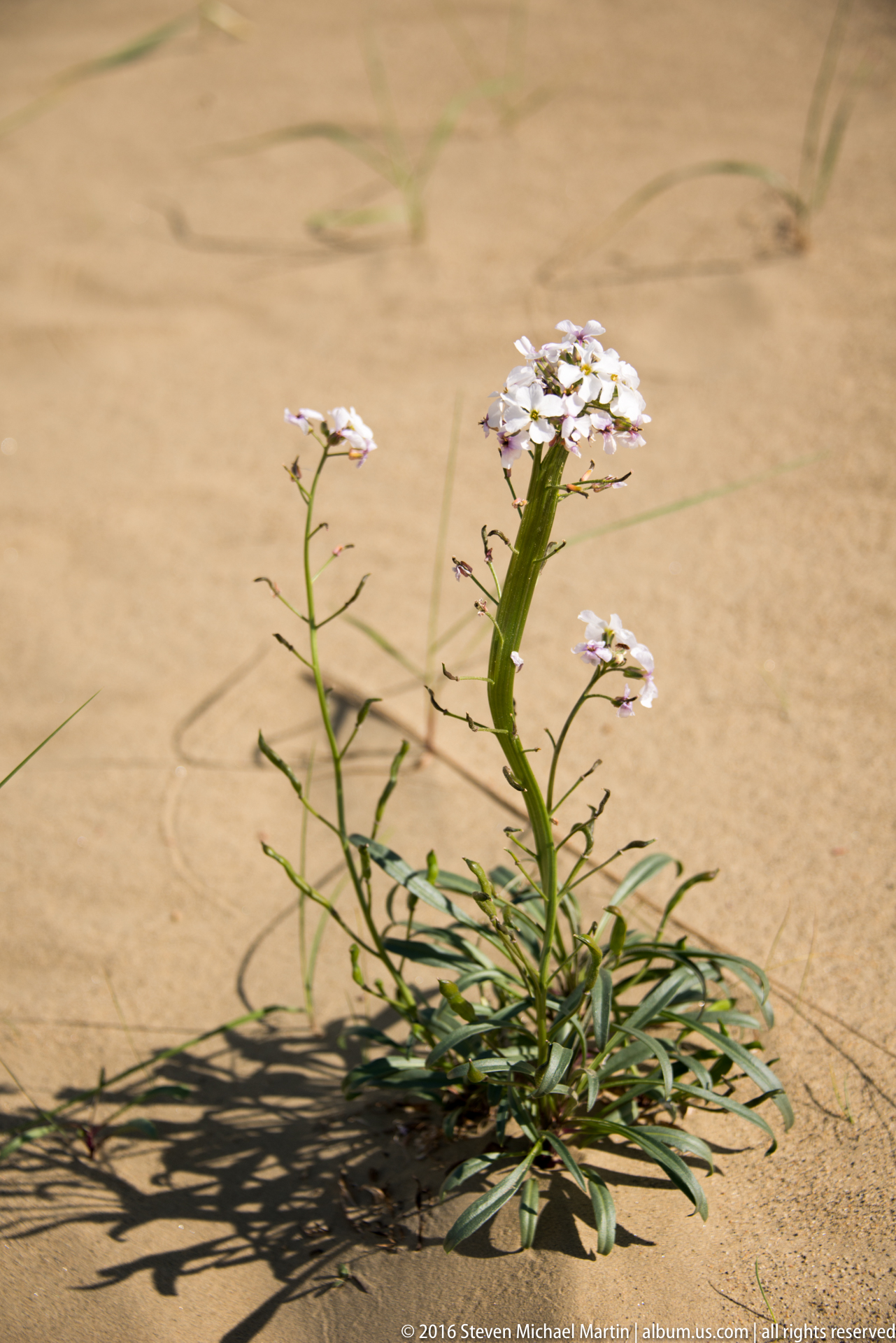
Several small white flower clusters rise on thin stems above a compact rosette of narrow green leaves. The plant grows directly from tan sand, and its delicate shadow stretches across the foreground. A few blurred grasses enter along the upper edge, but the sparse composition keeps attention on the contrast between the soft blossoms and dry, exposed ground.
Caption
Several small white flower clusters rise on thin stems above a compact rosette of narrow green leaves. The plant grows directly from tan sand, and its delicate shadow stretches across the foreground. A few blurred grasses enter along the upper edge, but the sparse composition keeps attention on the contrast between the soft blossoms and dry, exposed ground.

Small yellow flower heads rise above narrow green leaves, with several purple blooms farther back in the shallow-focus frame. The sandy setting links this close view to the park’s dune habitat, where scattered vegetation contrasts with exposed, shifting ground. The soft background keeps attention on the flowers and their branching stems without requiring a species-level identification.
Caption
Small yellow flower heads rise above narrow green leaves, with several purple blooms farther back in the shallow-focus frame. The sandy setting links this close view to the park’s dune habitat, where scattered vegetation contrasts with exposed, shifting ground. The soft background keeps attention on the flowers and their branching stems without requiring a species-level identification.
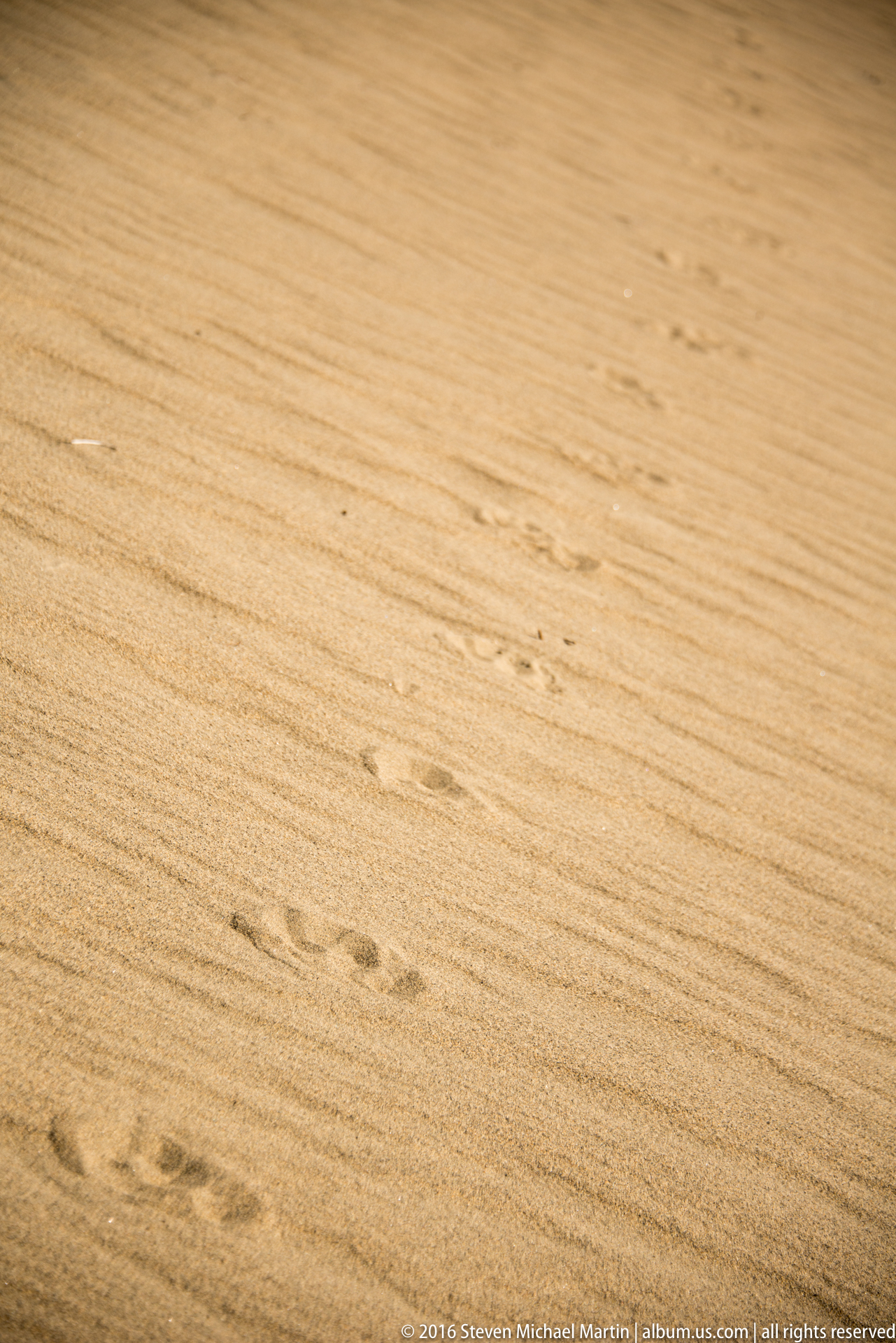
A diagonal line of footprints crosses a smooth, sloping dune, each depression casting a small shadow that reveals its depth. The repeated impressions create the photograph’s only strong directional feature against faint wind-formed lines in the sand. Their spacing and shape read as human steps, offering a close record of passage across an otherwise open surface.
Caption
A diagonal line of footprints crosses a smooth, sloping dune, each depression casting a small shadow that reveals its depth. The repeated impressions create the photograph’s only strong directional feature against faint wind-formed lines in the sand. Their spacing and shape read as human steps, offering a close record of passage across an otherwise open surface.
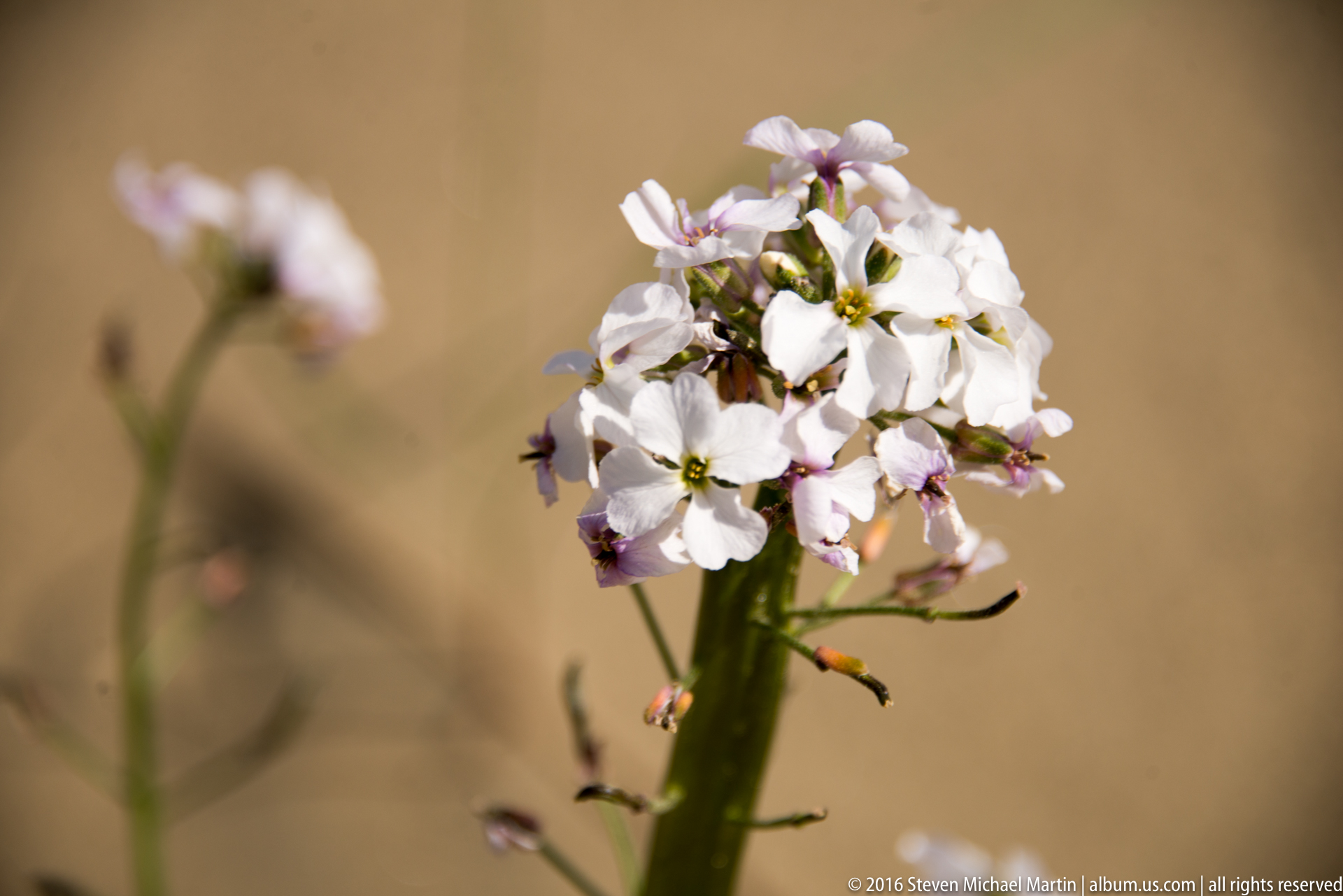
A compact cluster of white flowers fills the center of the frame, each bloom showing four rounded petals around a small yellow-green center. Buds and branching stems remain visible beneath the cluster, while tan sand and a few out-of-focus blossoms dissolve into the background. This close view isolates floral structure and shallow focus from the broader dune setting.
Caption
A compact cluster of white flowers fills the center of the frame, each bloom showing four rounded petals around a small yellow-green center. Buds and branching stems remain visible beneath the cluster, while tan sand and a few out-of-focus blossoms dissolve into the background. This close view isolates floral structure and shallow focus from the broader dune setting.

A broad, pale dune crest occupies the foreground, dotted with upright grasses. Beyond it, a dark band of forest meets a distant mountain ridge beneath towering clouds. The layered composition places the open sand within a larger northern landscape, showing how the dune margin transitions to wooded terrain rather than presenting the sand in isolation.
Caption
A broad, pale dune crest occupies the foreground, dotted with upright grasses. Beyond it, a dark band of forest meets a distant mountain ridge beneath towering clouds. The layered composition places the open sand within a larger northern landscape, showing how the dune margin transitions to wooded terrain rather than presenting the sand in isolation.
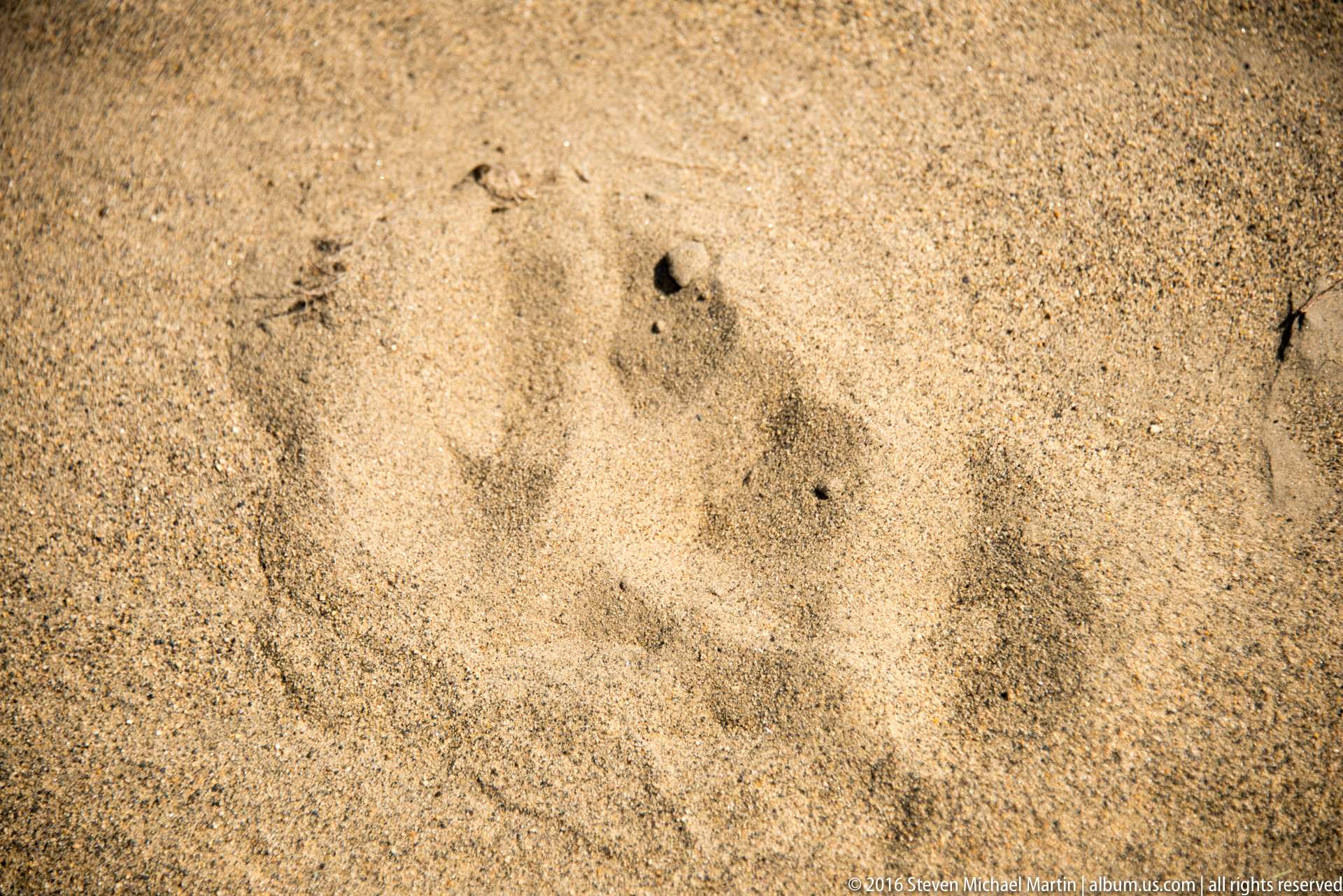
A close, nearly top-down view isolates a shallow, irregular depression in coarse golden sand. Small dark pits and scattered marks interrupt the otherwise fine granular surface, but the shapes do not establish whether they came from a person, animal, or erosion. The photograph records the subtle marks as texture, keeping their uncertain origin open.
Caption
A close, nearly top-down view isolates a shallow, irregular depression in coarse golden sand. Small dark pits and scattered marks interrupt the otherwise fine granular surface, but the shapes do not establish whether they came from a person, animal, or erosion. The photograph records the subtle marks as texture, keeping their uncertain origin open.
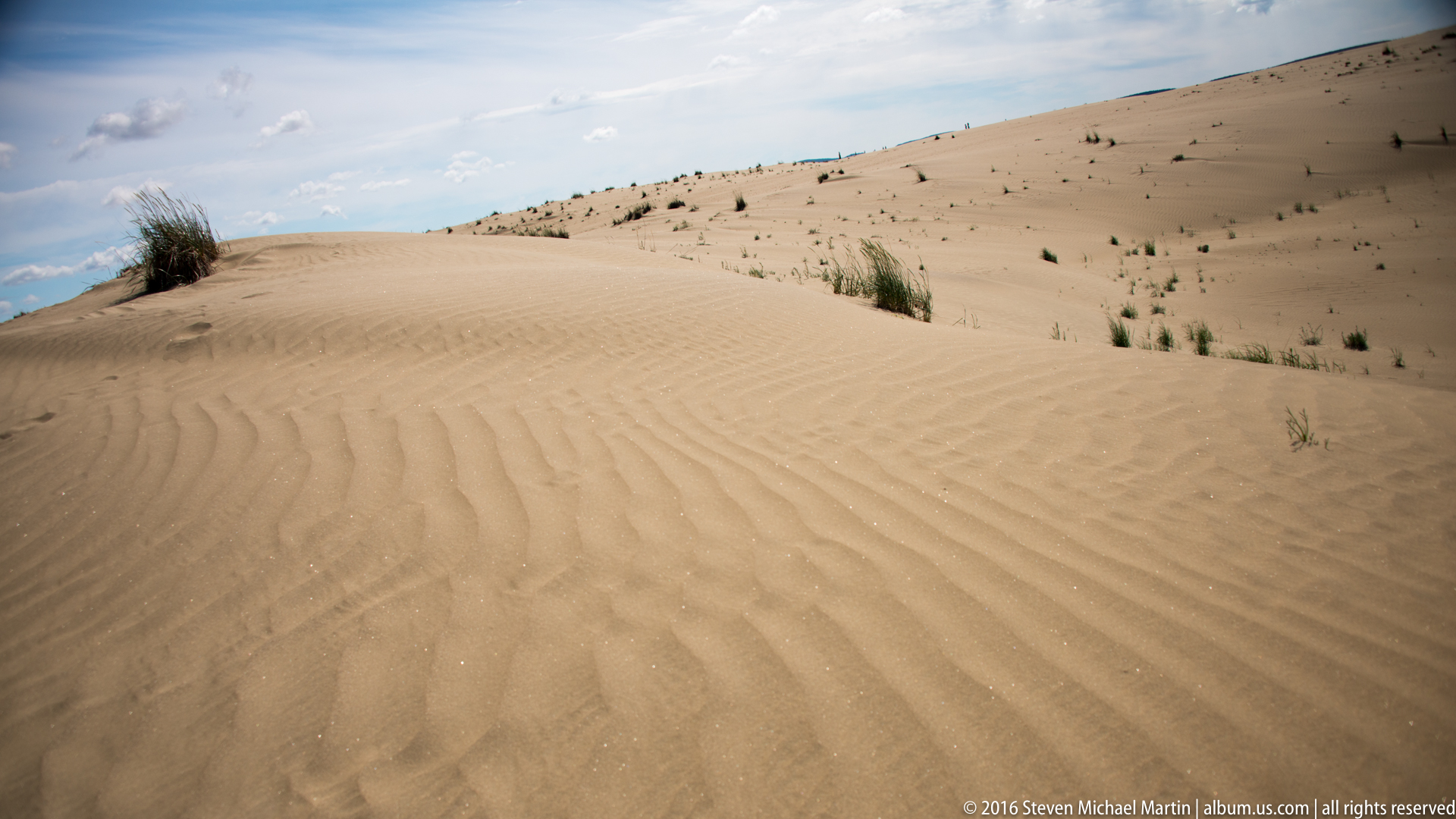
Fine, parallel ripples sweep across the foreground dune, curving with the contours of the sand. Beyond them, scattered grasses and low shrubs punctuate a rising slope, their spacing emphasizing the otherwise open surface. The view shifts from the broad ridge on the previous frame to the dune’s smaller textures and sparse plant cover at close range.
Caption
Fine, parallel ripples sweep across the foreground dune, curving with the contours of the sand. Beyond them, scattered grasses and low shrubs punctuate a rising slope, their spacing emphasizing the otherwise open surface. The view shifts from the broad ridge on the previous frame to the dune’s smaller textures and sparse plant cover at close range.
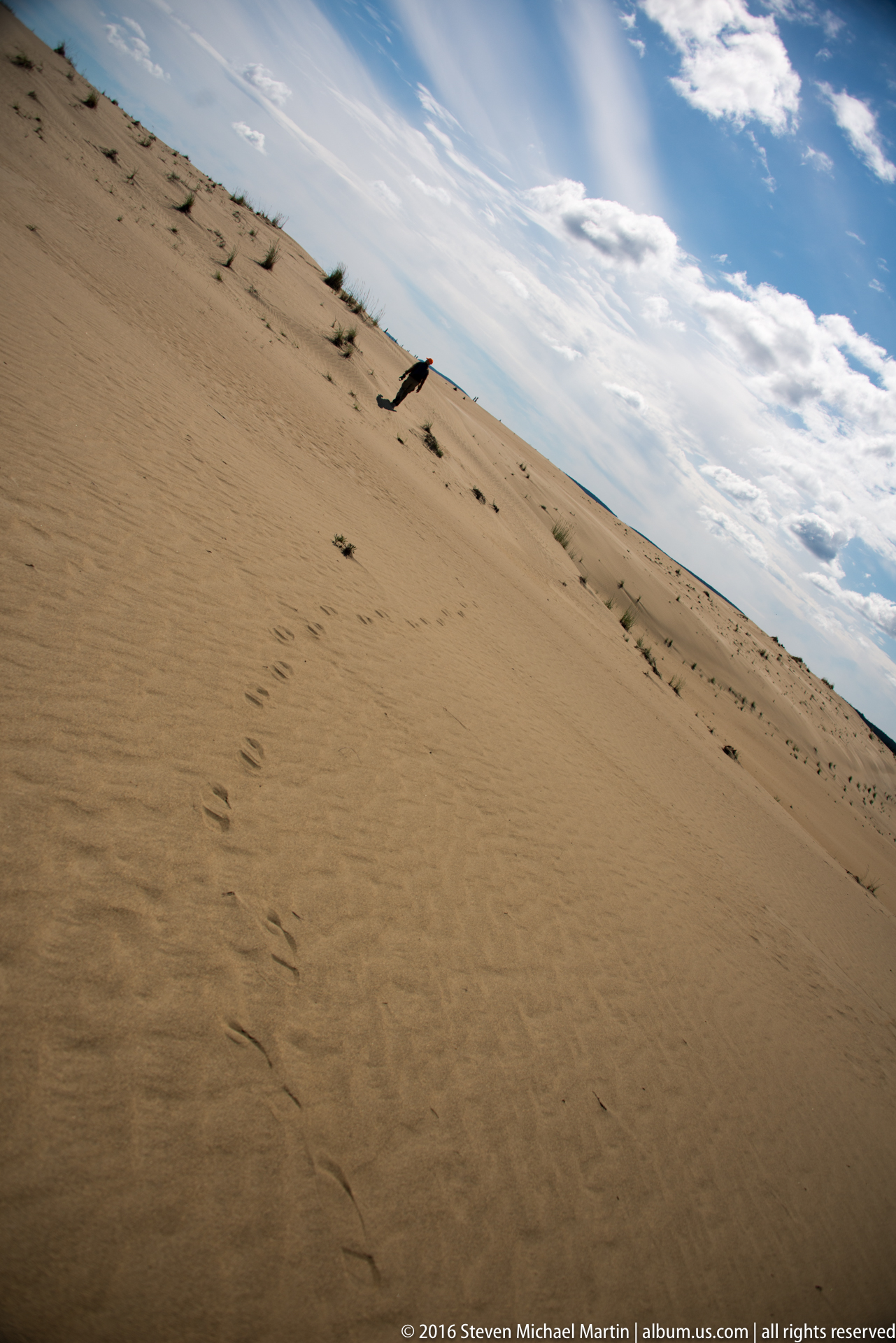
A steep dune face cuts diagonally across the frame, its long slope mostly bare except for scattered plants near the upper edge. A dark branch or piece of driftwood lies partway down, providing a small scale cue against the expanse of sand. Blue sky and broken clouds occupy the upper corner, emphasizing the incline and open exposure.
Caption
A steep dune face cuts diagonally across the frame, its long slope mostly bare except for scattered plants near the upper edge. A dark branch or piece of driftwood lies partway down, providing a small scale cue against the expanse of sand. Blue sky and broken clouds occupy the upper corner, emphasizing the incline and open exposure.

Two small clumps of green grass emerge from a broad, pale dune, one prominent in the foreground and another on the crest. Their shadows fall sharply across the sand under direct sunlight. The low horizon and large area of open ground make the plants appear isolated, emphasizing how little vegetation interrupts this exposed stretch of the dune.
Caption
Two small clumps of green grass emerge from a broad, pale dune, one prominent in the foreground and another on the crest. Their shadows fall sharply across the sand under direct sunlight. The low horizon and large area of open ground make the plants appear isolated, emphasizing how little vegetation interrupts this exposed stretch of the dune.
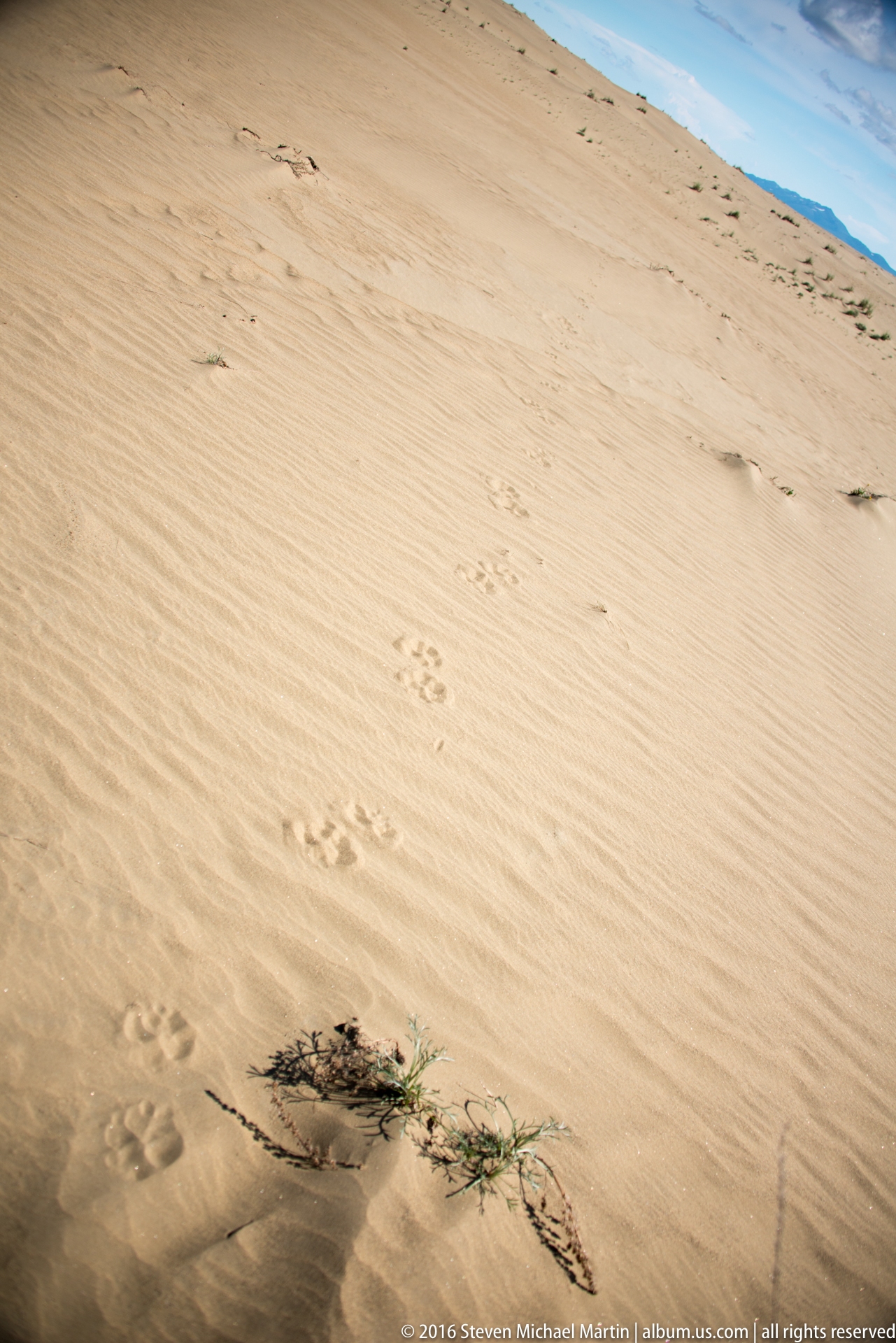
A chain of footprints crosses the sloping dune toward a low plant rooted near the center of the frame. The tracks curve around the plant and descend toward the foreground, giving the otherwise open sand a clear route and sense of scale. Fine wind ripples and a narrow wedge of blue sky complete this view of movement across the dune.
Caption
A chain of footprints crosses the sloping dune toward a low plant rooted near the center of the frame. The tracks curve around the plant and descend toward the foreground, giving the otherwise open sand a clear route and sense of scale. Fine wind ripples and a narrow wedge of blue sky complete this view of movement across the dune.

A visitor stands near the dune edge, looking across the landscape as grasses rise from the sand around him. A dark forest and distant mountain ridge form horizontal bands behind the figure, placing a human scale against the open dune and broad sky. The upright stance and side-facing view make this a portrait within the landscape rather than a close study of the terrain.
Caption
A visitor stands near the dune edge, looking across the landscape as grasses rise from the sand around him. A dark forest and distant mountain ridge form horizontal bands behind the figure, placing a human scale against the open dune and broad sky. The upright stance and side-facing view make this a portrait within the landscape rather than a close study of the terrain.
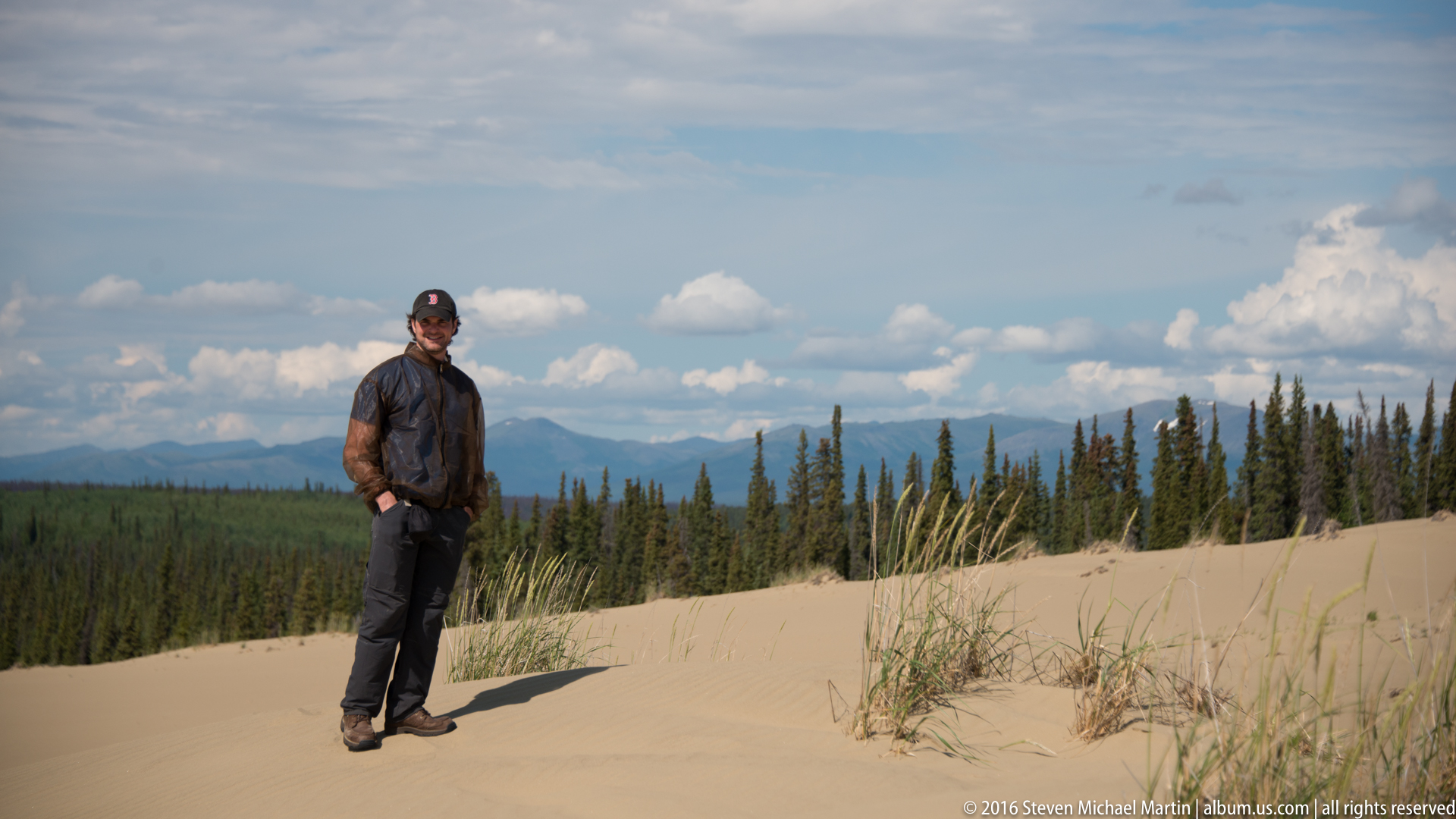
Framed from a slightly different position, the visitor stands left of center while a long shadow stretches across the sand. Grasses cluster around the ridge, and the dark forest continues to the mountain horizon. The wider open sky and shifting cloud forms give this view a more expansive balance than the neighboring portrait, while retaining the figure as a measure of scale.
Caption
Framed from a slightly different position, the visitor stands left of center while a long shadow stretches across the sand. Grasses cluster around the ridge, and the dark forest continues to the mountain horizon. The wider open sky and shifting cloud forms give this view a more expansive balance than the neighboring portrait, while retaining the figure as a measure of scale.
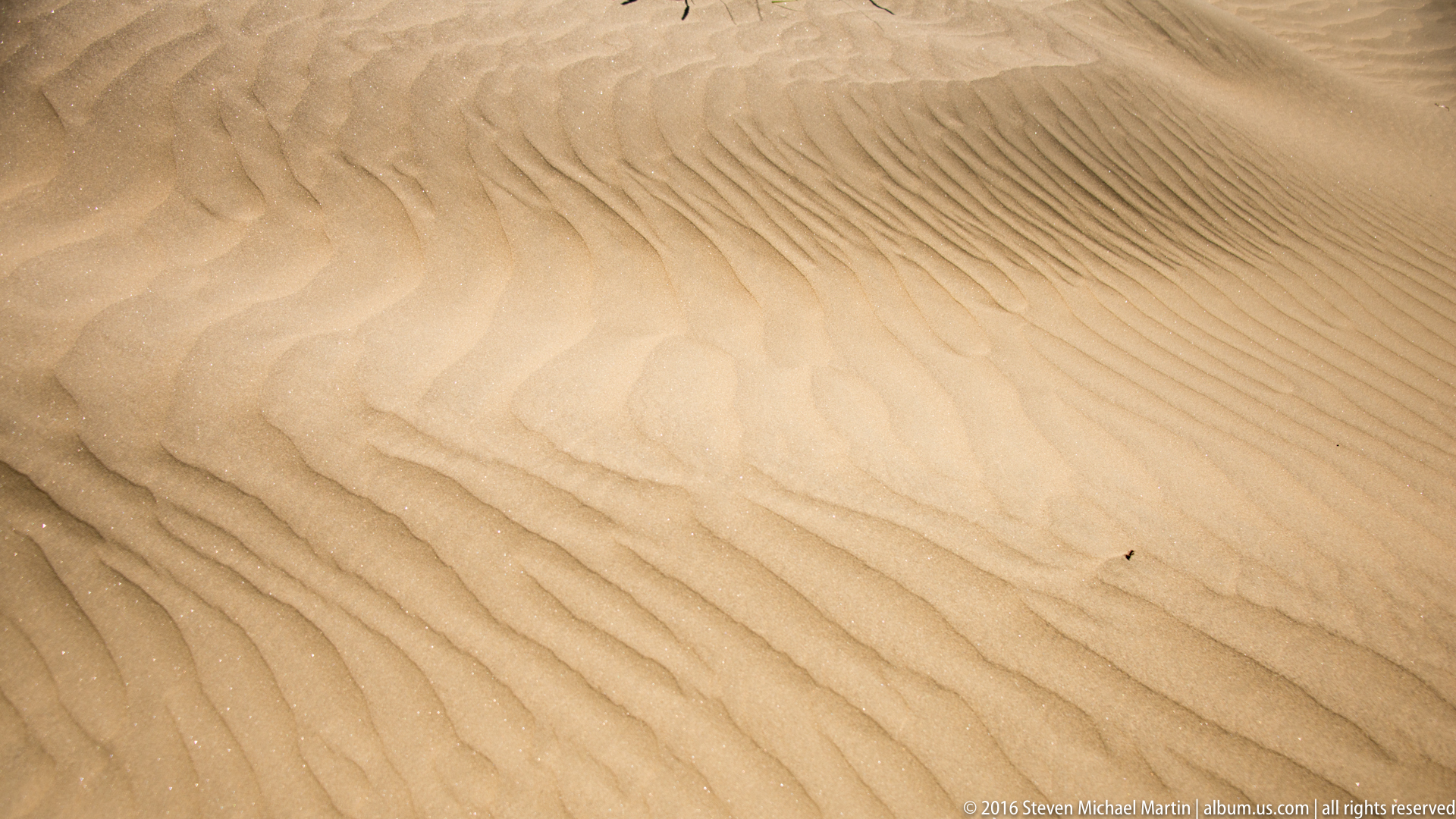
In close view, closely spaced ridges run diagonally down the dune, their alternating light and shadow making the surface appear almost pleated. A broader smooth area at lower left interrupts the regular pattern, while a few tiny dark flecks sit near the upper edge. The frame concentrates on wind-shaped sand and the changing scale of its surface forms.
Caption
In close view, closely spaced ridges run diagonally down the dune, their alternating light and shadow making the surface appear almost pleated. A broader smooth area at lower left interrupts the regular pattern, while a few tiny dark flecks sit near the upper edge. The frame concentrates on wind-shaped sand and the changing scale of its surface forms.
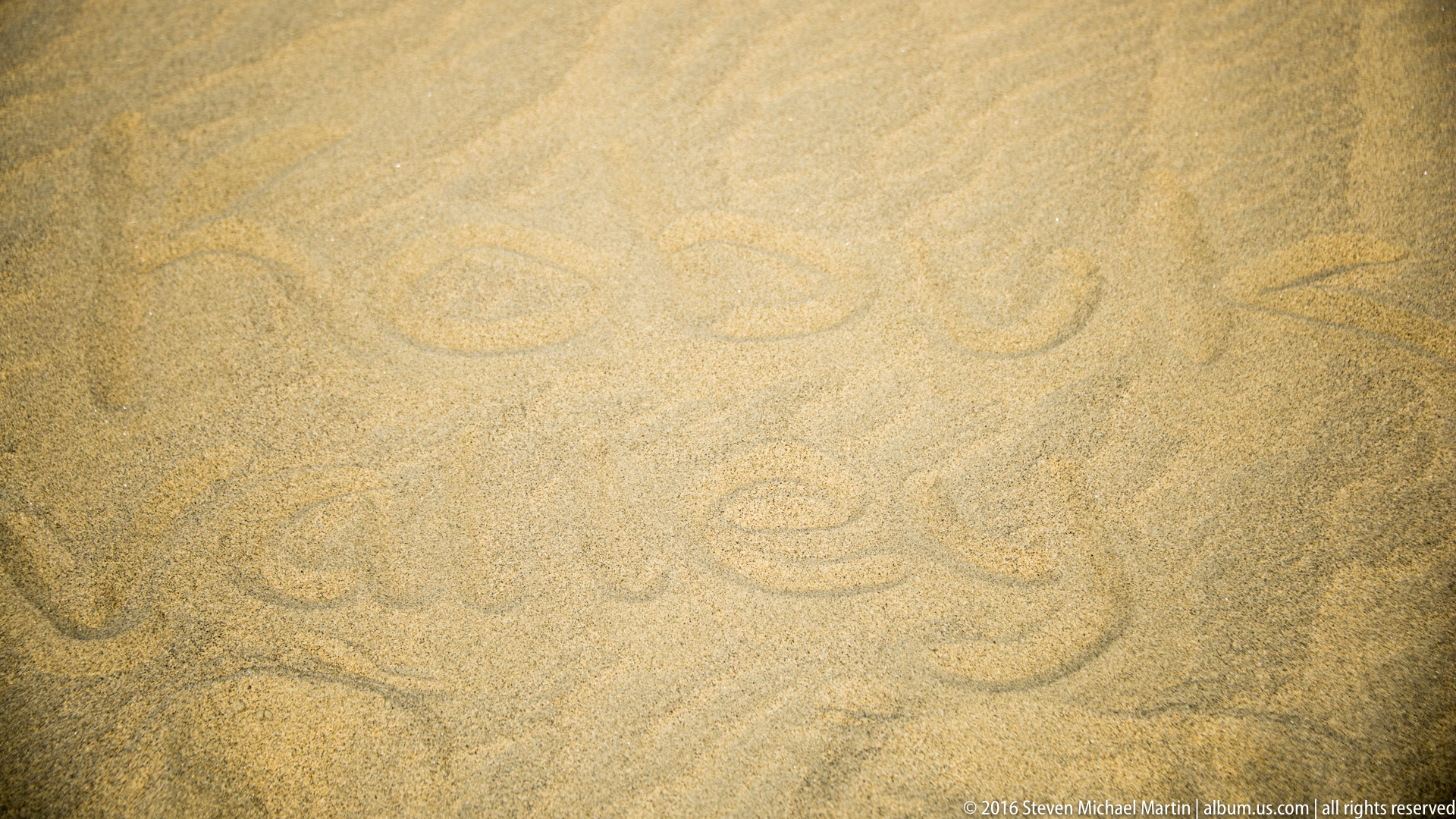
Shallow serpentine grooves cross the fine sand in broad, repeated curves. Their rounded turns form a loose pattern that differs from the straight ridges and footprints elsewhere in the sequence. The photograph gives no indication of who or what made the lines, so their value lies in the visible drawing-like trace and its contrast with the uniform granular surface.
Caption
Shallow serpentine grooves cross the fine sand in broad, repeated curves. Their rounded turns form a loose pattern that differs from the straight ridges and footprints elsewhere in the sequence. The photograph gives no indication of who or what made the lines, so their value lies in the visible drawing-like trace and its contrast with the uniform granular surface.
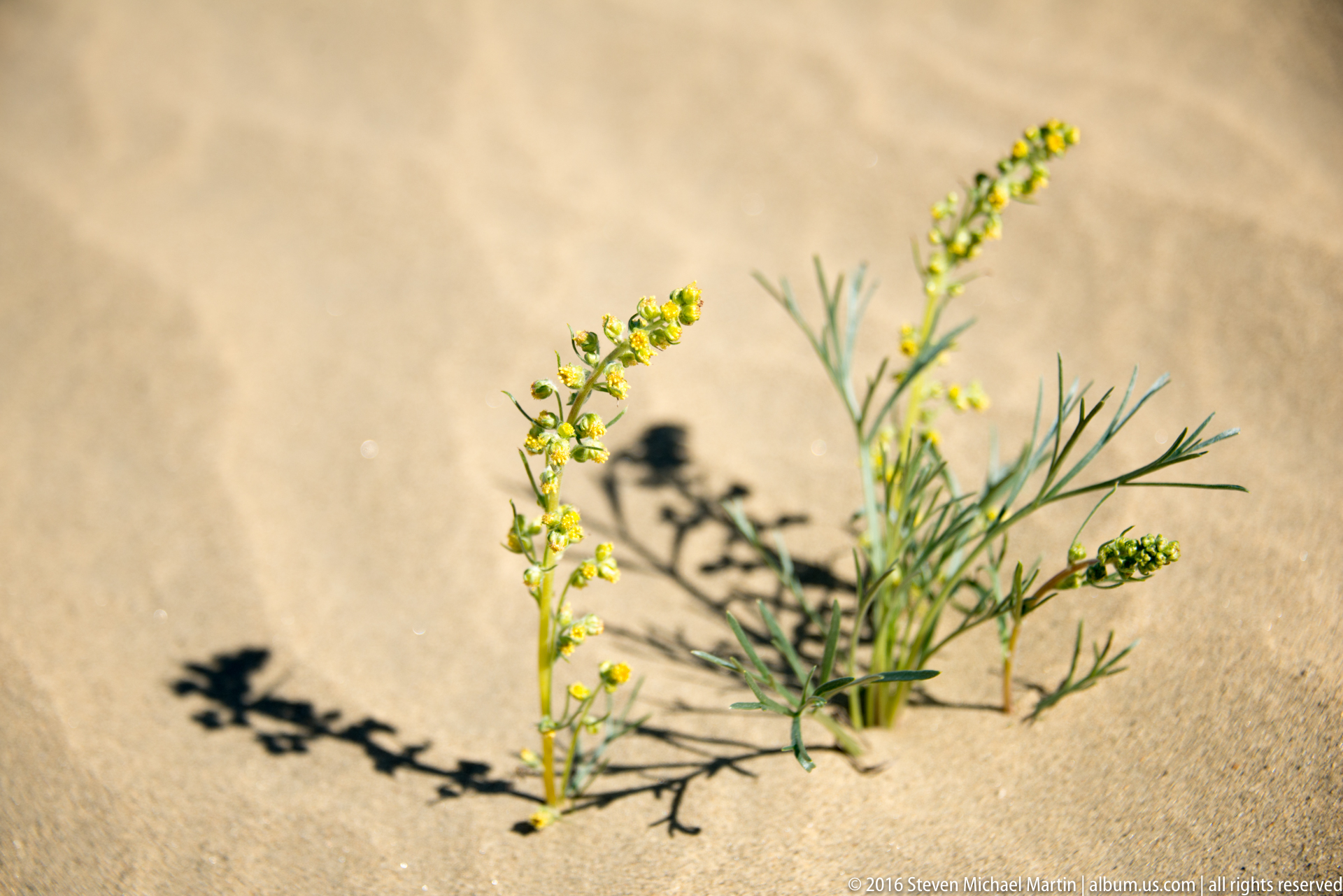
A small plant rises alone from bare sand, its narrow leaves branching beneath clusters of tiny yellow flowers. Direct sunlight casts a crisp shadow beside it, revealing the plant’s fine structure and the low relief of the surrounding ground. The shallow focus softens the dune beyond, isolating this modest patch of vegetation within an otherwise open sandy habitat.
Caption
A small plant rises alone from bare sand, its narrow leaves branching beneath clusters of tiny yellow flowers. Direct sunlight casts a crisp shadow beside it, revealing the plant’s fine structure and the low relief of the surrounding ground. The shallow focus softens the dune beyond, isolating this modest patch of vegetation within an otherwise open sandy habitat.
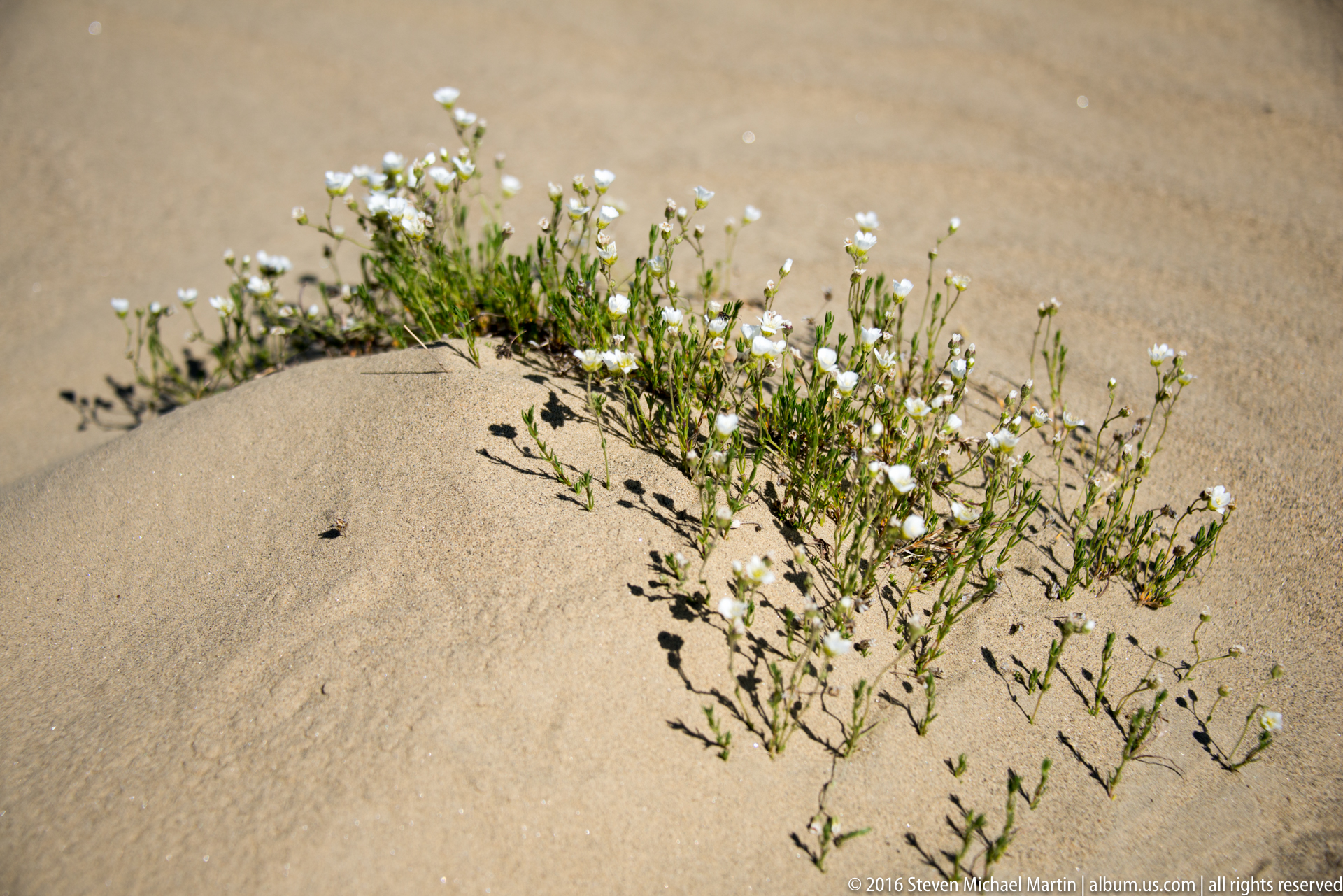
A low cluster of white flowers and green leaves grows from the crown of a small sandy rise. The mound’s curved edge is visible beneath the plants, and several stems lean outward into the sunlight. The surrounding dune remains bare, making the compact patch of blooms and its foothold in loose sand the focus of the composition.
Caption
A low cluster of white flowers and green leaves grows from the crown of a small sandy rise. The mound’s curved edge is visible beneath the plants, and several stems lean outward into the sunlight. The surrounding dune remains bare, making the compact patch of blooms and its foothold in loose sand the focus of the composition.
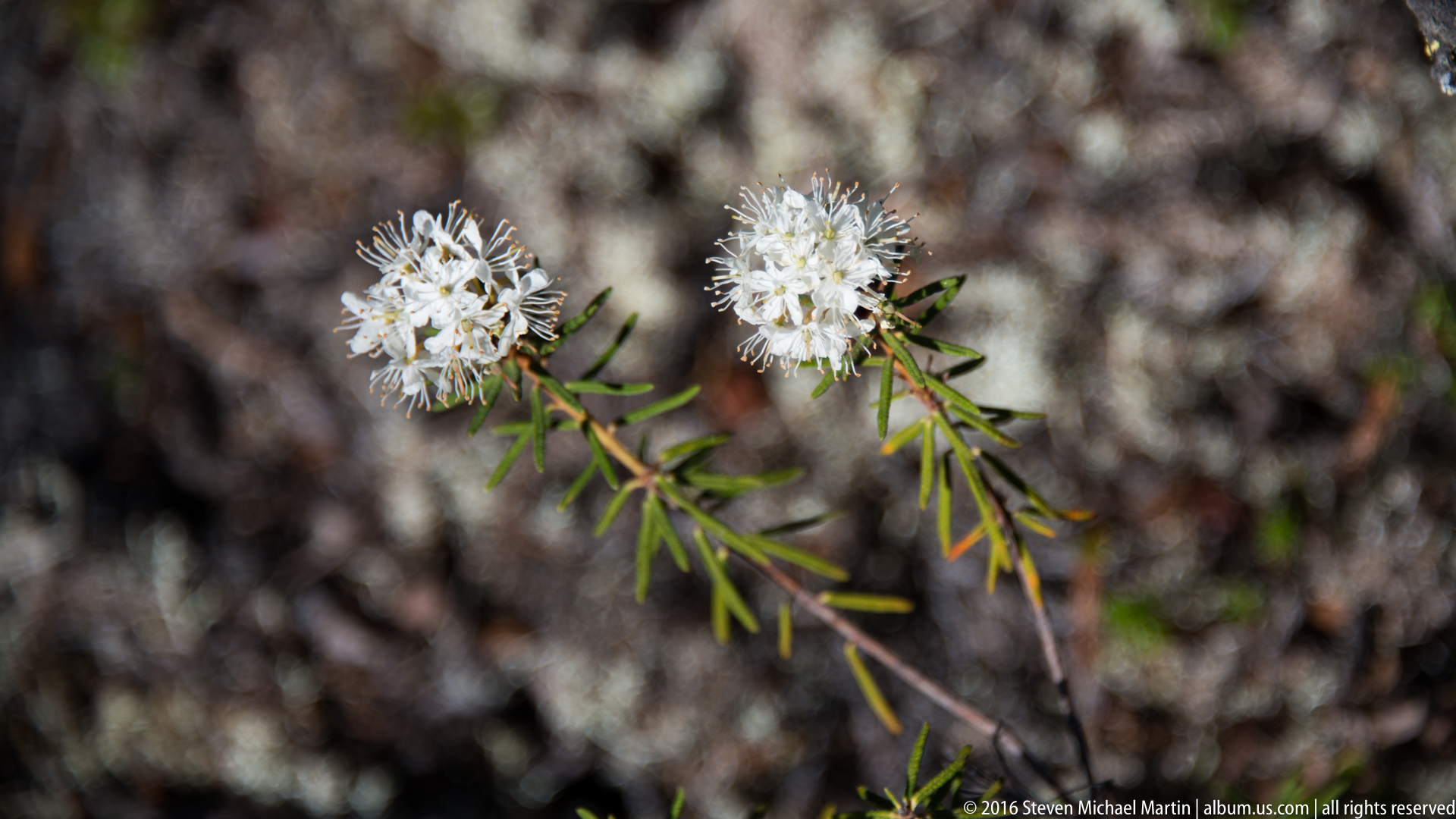
Two rounded clusters of small white blossoms stand out against a dark, softly blurred background. Narrow green leaves extend from reddish-brown stems, giving this close view a stronger contrast than the broader dune-plant photographs nearby. The framing isolates the flower heads and their branching structure; the proof sheet supports a description of the blooms but not a definitive species name.
Caption
Two rounded clusters of small white blossoms stand out against a dark, softly blurred background. Narrow green leaves extend from reddish-brown stems, giving this close view a stronger contrast than the broader dune-plant photographs nearby. The framing isolates the flower heads and their branching structure; the proof sheet supports a description of the blooms but not a definitive species name.
Kobuk Valley National Park — Field Guide
National Park Field Guide
📍 Overview
Kobuk Valley National Park preserves a remote Arctic landscape shaped by river systems, glacial history, and expansive tundra ecosystems. Located north of the Arctic Circle in northwest Alaska, the park protects the Kobuk River valley as well as one of the largest active sand dune systems in the Arctic. The region illustrates the interaction between geological processes, climate, and ecological adaptation in a largely undeveloped environment.
The Great Kobuk Sand Dunes, Little Kobuk Sand Dunes, and Hunt River Dunes were formed from glacial deposits shaped by wind patterns over thousands of years. Seasonal caribou migrations pass through the region, reflecting long-established wildlife movement patterns that have supported human subsistence for millennia. Archaeological sites such as Onion Portage demonstrate the long-term relationship between Indigenous communities and the landscape.
⭐ Highlights
- Great Kobuk Sand Dunes north of the Arctic Circle
- Seasonal migration routes of the Western Arctic caribou herd
- Kobuk River corridor and tundra ecosystems
- Archaeological sites reflecting thousands of years of human presence
- Remote wilderness landscape with minimal development
🔎 Key Features
- Active sand dunes formed from glacial deposits
- River valley ecosystems supporting wildlife migration
- Tundra vegetation adapted to Arctic climate conditions
- Archaeological evidence of long-term human activity
- Large-scale wilderness environment emphasizing ecological continuity
📷 Photography Notes
- Low-angle light emphasizes texture in sand dunes
- Wide compositions highlight contrast between dunes and tundra
- Cloud formations can enhance scale of open landscapes
- Wind patterns create subtle surface detail in sand
- Foreground dune ridges help add depth
- Look for simple compositions that convey isolation

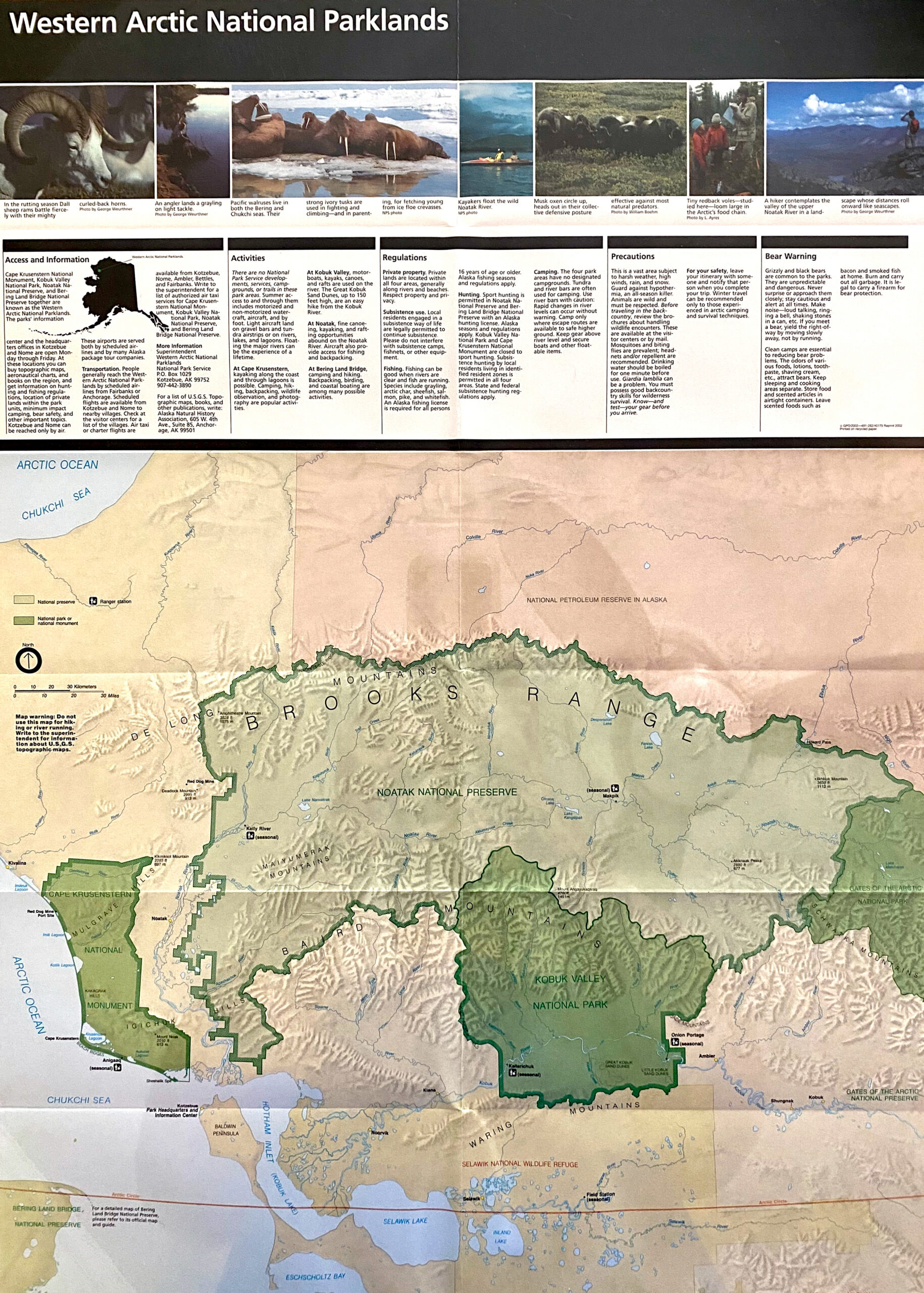
Other related portfolios:
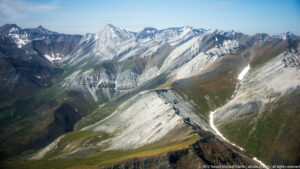
Gates of the Arctic NP – Anaktuvuk Pass

Gates of the Arctic NP – Bettles
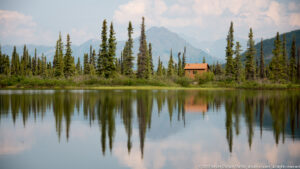
Gates of the Arctic NP – Lake Nutuvukti
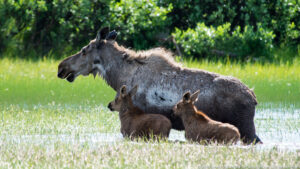
Kobuk Valley NP – Onion Portage and River Exploration
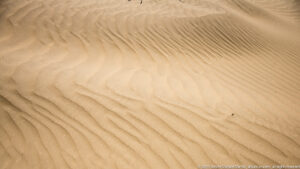
Kobuk Valley NP – Sand Dunes
Kobuk Valley NP – Ambler
Gates of the Arctic NP – Selby Lake
Kotzebue, Alaska
Bering Land Bridge NPRES
Nome, Alaska

Togiak NWR
Dillingham, Alaska